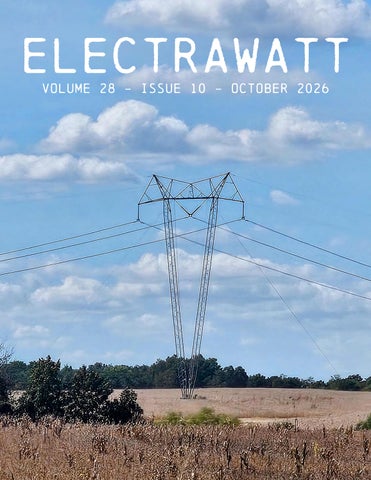
Electrawatt Volume 28 - Issue 10 - October 2026
Slow Down, Verify, and Stay Cyber Safe CONTENTS 2 Cybersecurity Awareness 3 Celebrating the Co-op Difference 4-5 In Case You Were Wondering... Rate Adjustment FAQs 6 Mini-member Puzzle 7 Halloween Electrical Safety & Invitation 8 Harvest Safety Cover photo taken by Laura Moorman Contact Us: 765-544-2600 www.rse.coop (USPS 171-360 Published Monthly)
Contributor: Courtney Mendoza Publication Office: 2777 S. 840 W. Manilla, IN 46150 Periodical Postage paid in Indianapolis, Indiana 46206 POSTMASTER: Send address changes to: ELECTRAWATT P.O. Box 55 Manilla, IN 46150
As the leaves change and fall routines begin, it is a good time to refresh your cybersecurity habits. October is National Cybersecurity Awareness Month, but protecting your personal information deserves attention all year long. At RushShelby Energy, cybersecurity is a critical part of providing safe, reliable electric service. While much of our focus is on protecting the physical systems that operate the electric grid, we also work to protect the systems and information that help us serve you, including online accounts, payment systems, member portals, and outage communications. Unfortunately, scammers are becoming more sophisticated. Artificial intelligence (AI) now makes it easier to create convincing emails, text messages, websites, and voice recordings that look and sound legitimate. The FBI has warned that generative AI can make fraudulent schemes harder to recognize, including utility scams. A scammer may impersonate RushShelby Energy and claim your account is past due, demand immediate payment, or even threaten to disconnect your service. These scams can look surprisingly convincing and may include our logo, professional-looking language or a link to a website that appears legitimate. According to the Federal Trade Commission, consumers reported losing $3.5 billion to imposter scams in 2025, making these types of scams the most commonly reported type of fraud. Nearly one in three fraud reports involved an imposter scam. So, what should you do if you receive an unexpected message claiming to be from RushShelby Energy? If you receive an unexpected message that creates urgency or threatens disconnection, slow down and verify it. Do not click links or call numbers in the message. Instead, contact RushShelby Energy directly at 765-544-2600, through our website at www.rse.coop, or by email at rse@rse.coop. Protect your online accounts before a scam occurs by using a long, unique passphrase and avoiding reusing passwords. And when available, use multi-factor authentication (MFA) for an added layer of protection. Most importantly, remember that you do not have to make a payment simply because someone tells you that you do. Verify any unexpected request. RushShelby Energy is committed to protecting the systems that help us deliver your electricity and serve our members. You can help by protecting your own account, slowing down when something seems urgent, and contacting us directly when you are unsure. For questions about your account or payment options, please contact our office.
Celebrating the Co-op Difference This National Co-op Month, RushShelby Energy is celebrating what makes being a cooperative different. At RSE, we are more than an electric utility, we are a locally owned cooperative, guided by the needs of the members and communities we serve. Unlike businesses driven by outside investors or shareholders, cooperatives are owned by the people they serve. That means RushShelby Energy’s focus is on providing reliable electric service, meeting local needs, and strengthening the communities we call home. Our cooperative roots began with neighbors coming together to bring electricity to areas that other utilities would not serve. While much has changed since those early days, our purpose remains the same: to provide safe, reliable electricity while serving our members and communities. Being locally owned allows RSE to focus on the needs of our service area. We listen to our members, support local organizations, and look for practical ways to make a difference. You can see the co-op difference throughout the year. During Community Day, RSE employees step away from their regular duties to volunteer on projects that benefit local communities and organizations. We support educational activities, including a local school’s annual egg drop, where students put creativity, problem-solving, and STEM skills to the test. Throughout the summer, RSE also participates in county fairs and community events, giving employees the opportunity to visit with members and celebrate the communities we serve. The co-op difference is also found in the everyday moments—lineworkers working safely to restore power after a storm, employees answering members’ questions, team members volunteering at community events, and board members helping guide the cooperative’s future. These efforts reflect one of the core principles of the cooperative model: Concern for Community. We believe our responsibility extends beyond delivering electricity. It means being a good neighbor, supporting the communities we call home and working together to help them thrive. This National Co-op Month, we invite you to celebrate what makes RushShelby Energy special. This is your cooperative. Your membership makes our work possible and keeps us focused on what matters most, the people and communities we serve. We are proud to be your local electric cooperative, and we are proud to serve you.
Co-op Month is Poppin’
Every Friday in October, stop by RushShelby Energy for some popcorn as we celebrate the cooperative spirit that brings us together. While you're there, enter for a chance to win a popcorn-themed gift basket. We'll draw the winner on Monday, November 2.
In Case You Were Wondering... The last two issues of the Electrawatt have provided information about the rate adjustment that went into effect October 1. While we were able to answer some common questions, we understand that you may still have questions or concerns. The next two pages address questions we have received from members, as well as questions that may arise as you review your electric bill and the new rates. Our goal is to provide clear, helpful information and ensure our members understand the adjustment and how it may affect them. What does it mean to be a member-owner of RSE? RSE is a member-owned, not-for-profit electric cooperative. Unlike an investor-owned utility, the cooperative exists to serve its members rather than outside shareholders. Members elect the board of directors, and margins are allocated to members as capital credits. How often are RSE's rates reviewed? Rates are reviewed every 3-5 years using a Cost-of-Service Rate Study. This rate study evaluates expenses, revenues, energy use, and other financial and operational information to determine whether existing rates are sufficient to support the cooperative’s needs. When was RSE’s last rate adjustment? RSE’s last rate adjustment was in 2023. Can SmartHub help me track, understand, or manage my usage? Yes. SmartHub is a tool available online using a desktop computer and through a mobile app. It allows members to view their electric usage and compare it over time. Looking at daily and monthly usage can help members identify patterns and see how weather, heating and cooling, appliances and changes in household activity affect your electric bill. Where can I find my current rate information? Rate information can be found on our website at https://www.rse.coop/my-account/rate-tariffs/. Your specific rate tariff is listed on your bill under the green box that says, "Rate." Why doesn’t everyone pay the same amount? Members have different electricity needs and use different amounts of energy. Your bill reflects both the fixed costs associated with having electric service available and the amount of electricity you use. Why does my bill sometimes change even when rates have not changed? Your electricity bill can change from month to month because your electricity use changes. Weather, heating and cooling, the number of days in a billing cycle, changes in household activity and the use of appliances or other equipment can all affect your monthly usage. The Power Cost Adjustment, or PCA, can also change as wholesale power costs change. Is the $55 monthly Connection Charge increasing? No. The residential Connection Charge will remain $55 per month. The Connection Charge helps cover a portion of the fixed costs associated with making electric service available, including poles, lines, meters, equipment, and other infrastructure.
What are some of the biggest contributors to high electric bills? Heating and cooling are often among the largest contributors to household electricity use. Specific factors vary and could include poor insulation, outdated appliances, drafty windows and entryways, keeping your thermostat too low or too high during extreme temperatures; causing constant running, using space heaters or window A/C units, especially in large open areas, and having additional refrigerators and freezers. Why can’t RSE absorb the additional costs or just cut costs? As a not-for-profit electric cooperative, RSE must collect enough revenue to cover these costs. When efficiencies alone are not enough to keep rates aligned with the cost of providing service, a rate adjustment may be necessary. Continually absorbing rising costs without adjusting revenue could eventually affect the cooperative’s financial stability and its ability to maintain the reliable service our members depend on. RSE continually monitors expenses and looks for ways to operate more efficiently. Still, many costs are essential to providing safe, reliable electric service, including wholesale power purchases, system operations and maintenance, outage response, equipment replacement, and necessary infrastructure improvements. Who approved the rate adjustment? RSE’s Board of Directors approved the updated rates following a review of the cooperative’s financial needs and the results of a rate study. As a member-owned cooperative, RSE’s board is made up of members elected to represent the membership and provide oversight of the cooperative. What happens if RSE does not adjust its rates? If rates do not keep pace with the cost of providing electric service, the cooperative may not collect enough revenue to adequately maintain the system, make necessary improvements, and meet its financial obligations. Making appropriate rate adjustments helps protect long-term reliability and financial strength of the cooperative. Is RSE making a profit from the rate increase? RSE is a not-for profit, member-owned electric cooperative. Rates are designed to provide the revenue necessary to operate the cooperative, maintain the electric system and meet financial obligations. When revenues exceed expenses, those margins are allocated to members as capital credits in accordance with the cooperative’s capital credit practices. If RSE returns capital credits, why not use that money to avoid a rate increase? Capital credits and electricity rates serve different purposes. Rates are designed to collect the revenue needed to operate the cooperative and provide electric service. When annual revenues exceed expenses, those margins are allocated to members as capital credits. Capital credits are retired and returned to members over time when the cooperative’s financial condition allows. How does RSE compare with other electric utilities? Electric rates vary among utilities because each utility has different costs, infrastructure, customer density, energy needs, and service territories. As a rural electric cooperative, RSE serves a less densely populated area, which means the cost of poles, lines, and other infrastructure is shared among fewer members per mile of line than in many more densely populated service areas. Who can I contact if I have questions about my bill? If you have questions about your bill, you can call our office at 765-544-2600 and you will be directed to the appropriate team member. You can also reach out through our website, www.rse.coop. The QR code will take you directly to the Rate Tariffs page.
Halloween Electrical Safety: Keep Your Fright Night Safe Halloween is a time for costumes, decorations, trick-or-treating and a little spooky fun. As you decorate your home or prepare for visitors, remember to make electrical safety part of your Halloween plans. Inspect decorations before use. Check lights, cords and other electrical decorations for frayed wires, cracked sockets or other damage. If something looks worn or damaged, replace it rather than taking a chance. Avoid overloading outlets. Halloween decorations can quickly add up. Plugging too many devices into one outlet or power strip can create a fire hazard. Follow the manufacturer's instructions and use power strips equipped with overload protection when appropriate. Use outdoor-rated decorations outside. Make sure lights, extension cords and other electrical decorations are specifically designed for outdoor use when placed outside. Keep connections protected from rain and moisture and never use damaged cords. Be careful with extension cords. Use the proper length and type of extension cord for the job, and never run cords through doorways, windows or under rugs where they can become damaged or create a tripping hazard. Keep decorations away from power lines. When hanging decorations, use caution with ladders, poles and other equipment. Always keep yourself and your equipment a safe distance from overhead power lines. Consider using LED lights. LED bulbs use less energy and produce less heat than traditional incandescent bulbs, making them a great choice for Halloween decorations. Turn decorations off when you leave or go to bed. Don't leave electrical decorations operating unattended. Using a timer can be an easy way to make sure lights turn off at the end of the night. Most importantly, keep safety in mind while enjoying the holiday. A little extra attention can help ensure your Halloween is filled with treats, not electrical tricks!
Stop by RSE in costume on Friday, October 30, from 10:00 a.m. to 2:30 p.m. for some Halloween fun and sweet treats!
PERIODICAL POSTAGE PAID
Harvest Safety As harvest season ramps up, farmers and their crews are busy moving equipment to and from the fields. This increased activity, however, raises the risk of accidents, especially those involving electricity. Combines and grain augers are large pieces of equipment. It can be easy to assume that everything will fit under the power lines, but that is not always the case. The biggest cause of farm-related electrocutions is equipment accidentally touching power lines. Below are some tips for farmers to protect themselves and their workers: Observe your surroundings. Always check above and around before moving or raising equipment. Remember, power lines can sag, especially in hot weather. Maintain a minimum clearance of 10 feet from all power lines and poles. Never try to raise power lines to allow tall equipment to pass through. Even non-metallic objects like wood poles or branches can conduct electricity. Measure before you move equipment. Know the height of your equipment when it is fully raised or extended and determine the height of nearby power lines. Make sure there is enough clearance between the equipment and the lines before entering or leaving a field. When in doubt, stay well away from power lines and choose another route. Be cautious around power poles. Striking a pole can cause it to break, dropping live wires onto your equipment. Lower the equipment properly. Ensure that equipment such as grain augers and other portable equipment is fully lowered before transport. Use a spotter. When navigating near power lines, use a spotter to enhance safety by providing an extra set of eyes. Plan your route. Identify the location of all power lines and poles on the property. If you are unsure whether the equipment can safely pass beneath a power line, choose an alternate route. Stay put in emergencies. If you’re in equipment that touches power lines, assume the equipment and ground are energized. Stay in the cab and call for help. Tell others to stay away and do not let anyone touch the equipment. In the rare case of a fire and an emergency exit is necessary, jump clear without touching the ground and the equipment at the same time, and land with your feet together. Then, shuffle with both feet together for at least 30 feet to avoid electrical shock. Working the land has enough hazards in the work itself. With care and planning, moving to and from the fields should not be one of them.