T O U R I S M • H O S P I T A L I T Y • B U S I N E S S • D I P L O M A C Y • C U L T U R E OCTOBER 2026
T O U R I S M • H O S P I T A L I T Y • B U S I N E S S • D I P L O M A C Y • C U L T U R E OCTOBER 2026
T O U R I S M • H O S P I T A L I T Y • B U S I N E S S • D I P L O M A C Y • C U L T U R E OCTOBER 2026
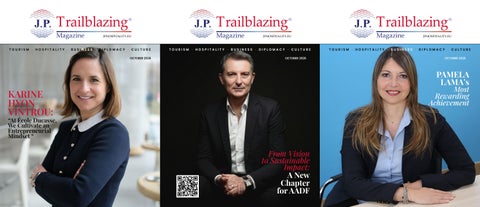
PAMELA LAMA’s
Most Rewarding Achievement
KARINE HYON VINTROU:
“At École Ducasse, We Cultivate an Entrepreneurial Mindset “
From Vision to Sustainable Impact: A New Chapter for AADF
Founder’s Note
Contents
AI Into the Progress of Hospitality and Services Artificial Intelligence (AI) is /will progressively transform the hospitality industry, changing how hotels operate, manage employees, to serve the guests more effectively and also increase profits.
OCTOBER 2026
Can a hotel encapsulate the lifestyle of a destination? From Vision to Sustainable Impact: A New Chapter for AADF
6 9
Karine Vintrou on the Future of Gastronomy: Where Tradition, Innovation, and Leadership Meet
19
LES ROCHES’ - María Dolores Martos Pérez..
25
Luxury, Reimagined
25
Carolina Reis: “Why I Embraced the Master in Marketing and Management for Luxury Tourism at Les Roches”
33
PiramidaFest 2026: Beyond What You Know, Into What’s Possible
40
TID/BID Models in Albania: Building Stronger Destinations Through Local Partnership
46
PAMELA’s Most Rewarding Achievement: “Witnessing EU4Culture’s Vision Transformation into Lasting Impact”
54
Shaping the Future of Journalism in Albania: A Conversation with Alda Shabani on PENA Fellowship
66
LEADing with Purpose: A Conversation with Dea Llagami
71
From Heritage to Leadership: Sabian Hasani’s LEAD Journey
82
JAMES SOO YONG KIM: Designing Through the Human Experience
90
Heroes of Our Past & the Culture of Books and Puppets: The 4th Hungarian Cultural Week Arrives in Albania in October
100
In Brief
102
For hotels, with 4- and 5-star, AI is not simply a technological investment. It is becoming a management tool that can improve and make operational efficiency more agile, personalize guest experiences, control costs and support better decision-making. The main challenges are to address several important issues:
• Integration: the Older PMS, accounting and reservation systems may not communicate easily with new AI tools, it will need either upgrades or investment in an UpToDate version • Actual employees, this will require a review of Staff skills and if their education degrees are to understand how to use AI and the requisites that such will require. • Data protection: Guest information must be handled securely and in accordance with applicable privacy laws.
Rudina Hoxha • Founder & Editor-in-Chief
Jose Pinto • Co-Founder
AI could identify a returning guest’s previously expressed preferences and inform the front office before arrival. The employee could then provide a more personal welcome.
Similarly, a general manager could receive a daily report identifying unexpected cost increases, lower restaurant demand or maintenance issues requiring attention.
The hotel management team would still make the important decisions, but with more timely information. The future hotel will combine AI-powered operational efficiency with human hospitality. The objective should not be to automate every interaction, but to use technology where it adds measurable value and preserve personal service where it matters most. For hotel owners and general managers, the central question is no longer simply whether to adopt AI. It is
• Investment: Software, hardware, integration and training can be expensive. • Service quality: Pay attention and do not implement excessive automation it can makes a luxury hotel feel impersonal.
A hotel should also ensure that AI-generated information is checked, particularly when it concerns guest complaints, financial decisions or sensitive personal data.
What this means for the future of luxury hotels In luxury hospitality, AI is likely to become an important support system behind the scenes, while the human interaction must remain provide the personal guest experience.
5
recommended that they study carefully their operations and human resources and prepare an integration along with the hotel’s business strategy, new policies, operating procedures and employee development.
Rudina Hoxha
Founder & Editor-in-Chief Trailblazing Magazine Rudina.hoxha@jphospitality.eu JP TRAILBLAZING MAGAZINE
By Lola Mugoša Lola is an avid fan of hotels around the world. She has been working with hotels for the last 10 years and shares some of her experiences and observations in this column.
Can a hotel encapsulate the lifestyle of a destination? 5 am, total tranquility with an underlay of the sound of gently lapping waves on to the beaches at the Old Town. The sun is about to rise and a gentle breeze of salty air sweeps through the narrow streets. The first doors open to accept the early deliveries and someone hoses down the outdoor spaces of the empty cafes and restaurants. Soon they will be filled with guests and locals taking in the atmosphere and watching how the city changes during the day and
into the night. That´s Budva early in the Morning. A few steps from the Old Town before you reach some of the more modern properties in the city there is the traditional hotel „Budva“. This hotel has just been fully refurbished and renovated and is now affiliated as a Crowne Plaza with an international Hotel Company.
Lola Hotels and the City
The legendary American hotelier E.M. Statler said ``There are three things that make a hotel famous, first location, second location, third location``. And the original owner of hotel Budva and now Crowne Plaza Budva have heeded that advice. The location is perfect. The heart of the public area of the hotel is a huge and hugely popular terrace.
Budva is at your feet. Leave the terrace, turn right and within a short stroll you are in the Old Town. Turn left and within an equally short stroll you are in the middle of the famous nightlife of Budva. Leave the terrace go straight and you are at the Budva Eye (a ferris wheel) and the beach. The hotel itself has beautifully appointed comfortable rooms and a service culture that reminds one more of a family visit than an international business hotel (and that is meant as a huge compliment). The terrace is the hotel´s true ´piece the resistance´. Stylish and comfortable furniture is framed by a roof of wonderfully scented Jasmine, the scent of which is whirled around by some ceiling fans. In the evening, like most of Budva, the terrace transforms into a gathering place with live music and traditional inspired Montenegrin food. But between the morning mood in Budva and the evening life, Budva has a lot to be discovered. Directly in the Old Town, which is surrounded by a historic stone wall are two special beaches.´Ricardova Glava´, which has a particular attraction in the form of the famous cafe ´Mozart´with its wonderful selection of sweets, cakes and other little culinary sins and the beach ´Pizana´which provides free sunbeds and a magnificant view of the old town. A particular attraction on the way to Pizana Beach is the old
Photo credit: Karlo Bjelic
Column
harbour with its traditional boats and impressive yachts. Pizana Beach and the adjacent waterpolo stadium carry the biggest chances of meeting the locals of Budva. Before the nightlife begins a must see is the sunset at the bronze ballerina that gracefully stands on a rock in the sea. For the more explorers the secret pass code is Mogren I and Mogren II, two beaches that can only be reached by walking through tunnels in the rocks guarded by the ballerina. This column is called Lola Hotels and the City and the Crowne Plaza formerly Hotel Budva is right in the middle of the City. And between all this different activities and there are many more, you have a perfect retreat in the guestrooms of this hotel. Just sit in the armchair open the window, let the breeze move the curtains and be ingulfed by the scent of cypress and pine trees and fall in love with the lifestyle of that Montenegrin gem called Budva.
Mića Ivanović General Manager Address: Crowne Plaza Budva Slovenska Obala bb, Budva Montenegro, 85310 Mobile: +382 68 184058 Email: Mica.ivanovic@cpbudva.com Web: www.ihg.com 6
JP TRAILBLAZING MAGAZINE
7
Lola Mugoša Sales Director Hospitality Address: m3connect GmbH, Pascalstrasse 18 52076 Aachen Mobile: +4915140761402 Email: l.mugosa@m3connect.de Web: www.m3connect.de LinkedIn: www.linkedin.com/in/lolamugo%C5%A1a-163001216 JP TRAILBLAZING MAGAZINE
LEADERSHIP DEVELOPMENT
From Vision to Sustainable Impact: A New Chapter for AADF By Rudina Hoxha For more than two decades, Martin Mata has been part of Albania’s development journey through the Albanian-American Enterprise Fund and the Albanian-American Development Foundation (AADF). Today, as AADF’s CEO, he continues to advance a vision centered on sustainable development, institutional strengthening, and creating opportunities for future generations. In this interview, Mata reflects on Albania’s transformation, the role of strategic philanthropy in driving meaningful change, and AADF’s distinctive approach to building institutions and sustainable models rather than simply funding individual projects. From education, technology, and entrepreneurship to cultural heritage, tourism, and agriculture, he explores how long-term investment in people, knowledge, and institutional capacity can contribute to Albania’s economic and social progress.
8
JP TRAILBLAZING MAGAZINE
9
Looking ahead, Mata shares his vision for AADF’s next chapter, emphasizing the importance of connecting successful initiatives, expanding their reach, and transforming local achievements into lasting national impact. At the heart of his perspective is a clear conviction: Albania’s greatest asset is its people, and the country’s future depends on creating the opportunities and institutions that allow their potential to flourish. Full interview follows: You have been part of AADF for more than two decades. What has changed most profoundly in Albania during this journey, and what still needs to change? Our perspective on Albania is quite unique because AADF is part of an institutional journey that goes back more than three decades. The Foundation grew
JP TRAILBLAZING MAGAZINE
That experience has profoundly influenced the way we think about our own projects. We know from our own history that initial support can be catalytic—but the real achievement is creating something strong enough to stand on its own. For that reason, many AADF initiatives combine financing with institutional design, expertise, partnerships, governance structures, human capacity and a clear path toward long-term sustainability.
out of the experience and success of the Albanian-American Enterprise Fund, which has been present in Albania since the early years of the country’s transition. That continuity matters. It means that while we operate with international standards, governance and expertise, we are also deeply rooted in Albania. We have grown alongside the country’s institutions, businesses and communities. In many ways, we have been able to observe Albania’s transformation from very close range. Albania today is a fundamentally different country from the one we encountered three decades ago. We have seen the emergence of a much more dynamic private sector, a new generation of entrepreneurs and professionals, greater international exposure, rapid technological adoption, and a society that is increasingly connected to Europe and the world. Perhaps one of the most important changes is in ambition. Young Albanians today expect
10
to compete internationally. Businesses think beyond the domestic market, universities are building stronger international connections, and institutions are increasingly exposed to global standards. At the same time, Albania’s next stage of development requires stronger institutions, greater implementation capacity and more opportunities for talented people to build their future here. The challenge is no longer simply introducing good ideas. It is creating systems that allow those ideas to become sustainable institutions. That combination of local understanding and international standards is central to how AADF works. We understand the Albanian context because we have been part of it for decades, but we also continuously bring international experience, expertise and benchmarks into the way we design our interventions. That transition—from projects to sustainable institutions—is where I believe AADF can continue to make an important contribution.
JP TRAILBLAZING MAGAZINE
One of AADF’s distinguishing characteristics is that it does not simply fund an idea—it often builds the structure that allows that idea to survive. What is the philosophy behind this approach? From the beginning, our objective has not been simply to finance projects. We look for interventions that can change how a sector works. Funding can solve an immediate problem. Building a model can solve the same problem repeatedly. In many ways, this philosophy reflects AADF’s own institutional journey. The AlbanianAmerican Enterprise Fund was initially established with support from the United States Government, through USAID, but the model was designed to create value rather than remain dependent on continuous external funding. Its success ultimately enabled the establishment of AADF, which today operates through a self-financed and sustainable model, using returns generated 11
Whether we are working in education, entrepreneurship, cultural heritage, tourism or technology, we ask similar questions from the outset: Can this become a model? Can local institutions eventually own it? Can it develop a sustainable financial and operational structure? Can it continue without permanent dependence on AADF? And could what we learn from it be replicated elsewhere? Our role is often to provide the initial capital, expertise and confidence needed to make a new model possible, while designing for the moment when our direct involvement is no longer essential. Ultimately, we try to apply to our projects the same principle that has defined AADF’s own evolution: support should create independence, not dependency. AADF has invested in education, leadership, entrepreneurship, culture, tourism and technology. Where do you see the greatest opportunity for transformation over the next decade? I would hesitate to isolate one sector because one of the clearest lessons from our experience is that development is interconnected.
JP TRAILBLAZING MAGAZINE
LEADERSHIP DEVELOPMENT
LEADERSHIP DEVELOPMENT
from its own investment assets to support its development mission.
Education creates talent. Research generates knowledge. Entrepreneurship turns knowledge and talent into opportunity. Technology expands access and productivity. Leadership strengthens institutions. Cultural heritage and tourism can generate economic development while protecting identity. And increasingly, through initiatives such as TOKA, we are applying the same thinking to agriculture— connecting knowledge, skills, entrepreneurship, institutions and markets around a sector that remains essential to Albania’s economy and communities.
developed interventions that can accompany people through almost every stage of their learning and professional journey: from ROOTS, supporting early childhood development at ages 0–5; to elementIT, introducing children to technology from an early school age; AI 4 Youth for highschool students; TUMO, where teenagers develop creative and technological skills; AADF Scholarships, expanding educational opportunities for young people; and 42 Tirana, providing an alternative pathway into advanced coding and technology for adults.
If there is one common denominator across all these areas, however, it is human capital.
For the next decade, I believe our opportunity is therefore not simply to launch more individual initiatives, but to complete, connect and strengthen the ecosystems we have already started building.
But developing human capital does not stop with formal education or technical skills. A strong ecosystem also needs knowledge creation, academic exchange and research capacity. Through READ Albania, AADF has established a platform connecting Albanian universities with academics and researchers from the Albanian diaspora and international academic networks. By supporting research through grants and facilitating collaboration between scholars inside and outside Albania, READ has helped reconnect intellectual capital with the country’s universities and generate new research, partnerships and professional networks.
Education and technology offer perhaps the clearest example. Over time, AADF has
This is especially important for a country like Albania. The diaspora should not be
Albania’s greatest strategic resource is its people. Investing in their skills, knowledge, exposure, leadership capabilities and opportunities creates a multiplier effect that reaches far beyond any single project.
12
JP TRAILBLAZING MAGAZINE
The ecosystem then continues beyond learning and research. Through the Innovation Hub, young professionals and teams have a space to collaborate, experiment and develop ideas, while Plug and Play connects entrepreneurs and startups with mentorship, international networks, markets and investment opportunities. The value lies not only in each program individually, but in the connections between them. A child introduced to technology today should be able to find progressively more advanced opportunities as they grow. A student should be able to move from education into research or professional development. An academic should be able to connect with peers abroad. An entrepreneur should be able to move from an idea to a network, a market and potentially investment.
inspire a broader culture of philanthropy in Albania? I think we first need to broaden the way we understand philanthropy. Philanthropy is often confused with charity. Both are valuable, but they respond to different needs. Charity usually addresses an immediate need: helping someone today, responding to an emergency or providing direct support. Strategic philanthropy asks a different question: what can we change so that the same problem is less likely to exist tomorrow? This means looking beyond the donation itself. It means investing in knowledge, people, institutions, systems and models capable of producing lasting public value. And philanthropy is certainly not foreign to Albania. We have our own historical tradition of individuals who used private wealth for the public good, particularly in education and nationbuilding. One remarkable example is Ali Agjah Bej Biçakçiu of Elbasan, born in
This is the direction I see for AADF over the coming decade: moving from successful individual interventions toward mature, interconnected ecosystems—in education and technology, research, entrepreneurship, agriculture, cultural heritage and other strategic areas. The real transformation happens when projects stop functioning as islands and begin reinforcing one another. AADF represents a distinctive model of philanthropy, where capital is used to create sustainable economic and social value. How would you define this approach, and could it
13
JP TRAILBLAZING MAGAZINE
TOURISM/HOSPITALITY
TOURISM/HOSPITALITY
viewed only through the lens of people who may physically return. Knowledge can return as well. Researchers, professors and professionals abroad can contribute through collaboration, mentoring, joint research and institutional partnerships, creating a continuous exchange between Albania and its global intellectual community.
LEADERSHIP DEVELOPMENT
1870 and a signatory of Elbasan’s declaration of independence in 1912. In his 1918 testament, he dedicated his estate to Albanian national education. Historical research identifies his act as the first documented case of an Albanian dedicating an entire estate to national education. His legacy later contributed to the establishment of a school in Elbasan that still bears his name. What I find particularly powerful about examples like this is the thinking behind them. He was not simply helping individual students. He was investing in education as infrastructure for the country’s future. More than a century later, the instruments of philanthropy have become more sophisticated, but the fundamental idea remains very similar: private resources can be deliberately directed toward creating longterm public value. AADF represents a modern institutional expression of that philosophy. Our own story is unusual. The Albanian-American Enterprise Fund was established with support from the United States Government and created an investment model that generated value in Albania. The success of that model ultimately enabled the creation of AADF. Today, rather than depending on continuous donor contributions, AADF operates through a self-sustaining financial model, investing its assets and using the returns to finance its development mission. That financial independence gives us something particularly important in philanthropy: time. We can think beyond annual funding cycles. We can make long-term commitments, accept that systemic change may take years, invest in models before their full impact is visible, and stay involved long enough to help institutions mature.
14
But strategic philanthropy is not simply about having resources. It is about how those resources are used. At AADF, capital is usually only one component. We combine it with expertise, partnerships, institutional design, governance, capacity building and international knowledge. We often work across the public, private, academic and nonprofit sectors because complex challenges rarely belong to only one institution. And we constantly ask ourselves: are we funding an activity, or are we building a capability? Are we financing something that ends when the grant ends, or helping create an institution, model or ecosystem that can continue? That is the shift I believe Albania’s philanthropic culture can increasingly make—from generosity alone toward strategic generosity. Albania today has successful entrepreneurs and businesses, a very strong diaspora, professionals with international experience and growing pools of private wealth. There is enormous potential to mobilize not only money, but also knowledge, networks and expertise around long-term national priorities. Philanthropy cannot and should not replace government or the private sector. Its strength is different. It can take risks, test ideas, bring actors together, demonstrate new models and invest patiently in areas where the results may take time. If more Albanian individuals, companies and institutions begin to think this way, philanthropy can become much more than giving. It can become an important force for the country’s long-term development.
JP TRAILBLAZING MAGAZINE
AADF reports more than $190 million in total commitments and an estimated $500 million in overall economic impact. Beyond the numbers, what do you consider AADF’s most important legacy? The numbers demonstrate scale, but I would not want AADF’s legacy to be defined primarily by how much money we invested. Our most important legacy should be the institutions, models, communities and capabilities that remain stronger because of those investments. Sometimes that legacy is visible in an individual’s life: a young person who gains access to an educational or professional opportunity that changes the direction of their career. Sometimes it is an institution or a new model that continues to function and serve people long after its initial establishment.
this very clearly. These interventions were never conceived simply as beautification projects or physical restoration. The objective has been much broader: to protect the historical identity of these areas while giving them new economic and social vitality. That means working at several levels at once. It means improving public infrastructure and urban spaces. It means restoring historic buildings and protecting architectural heritage. But it also means investing in the people who give these places life—local entrepreneurs, artisans, shop owners, hospitality businesses and other members of the community.
And sometimes, it is visible in the transformation of an entire place.
Through grants, business advice and capacity-building, local businesses have been supported to improve their offer, strengthen their operations and benefit from the renewed attractiveness of their areas. In that way, preserving heritage becomes connected to livelihoods, tourism, entrepreneurship and local economic development.
Our work in the historic centers of Gjirokastra, Kruja, Korça, Shkodra, Berat and Vlora reflects
For us, that is an important distinction. Restoring a building preserves a piece of
15
JP TRAILBLAZING MAGAZINE
they determine how strong and sustainable everything above them can become.
When these elements come together, investment can change not only the face of an area, but also its trajectory. A historic center becomes more attractive to visitors and investment, businesses gain new opportunities, residents see greater value in preserving their environment, and cultural heritage becomes an economic asset rather than something disconnected from everyday life.
The next layer is the trunk. That is our people, our institutional capacity, our expertise and the partnerships we have built across Albania and internationally. A strong organization is not defined only by the resources it invests. It is defined by the quality of its people, its ability to learn, and its capacity to bring together government, business, academia, civil society, communities and international expertise around a shared objective.
That kind of transformation captures what we mean by long-term impact. We want communities not simply to receive an investment, but to be better positioned to create value from it themselves. Perhaps most importantly, I hope AADF’s legacy will be the demonstration that ambitious change is possible in Albania when there is long-term commitment, strong governance, collaboration and investment in local capacity. Capital is important. But knowledge, institutional capacity, community ownership and confidence are equally powerful forms of capital. As you begin this new chapter as AADF’s sole CEO, what do you want the next generation of AADF to build that does not yet exist in Albania? When I think about the next chapter of AADF, I often think of the organization as a tree. For a tree to grow wider and reach further, it first needs strong roots. For AADF, those roots are our mission, our values, our governance, our policies and procedures, and the institutional principles that have been built over many years. They may not always be the most visible part of an organization, but
16
My priority for AADF’s next chapter is to continue strengthening both. Because when the roots are deep and the trunk is strong, the branches can grow further. For us, those branches represent our programs, models and partnerships—and ultimately the impact they create. The ambition is for them to reach more of Albania: more communities, more young people, more entrepreneurs, more researchers, more local businesses and more institutions. This does not necessarily mean simply creating more projects. It means making the models we already know can work deeper, stronger and more scalable. It means connecting initiatives that currently operate in the same ecosystem, replicating successful approaches where they can generate value, and making sure that AADF’s accumulated knowledge reaches beyond the places and communities we have already served. I would like to see the benefits of AADF’s work increasingly extend beyond individual institutions or individual cities. A successful education model should have the potential to reach children across the country. A model that
JP TRAILBLAZING MAGAZINE
revitalizes a historic center should generate knowledge that can benefit other communities. An agricultural model should strengthen an entire value chain. A successful connection with the diaspora should become a permanent bridge for knowledge and expertise.
LEADERSHIP DEVELOPMENT
LEADERSHIP DEVELOPMENT
history; strengthening the community around it helps preserve its future.
That is what growth means to me: not simply a larger organization, but a stronger institution whose impact reaches further. And there is one more dimension to that tree. As it matures, it also produces knowledge that can travel beyond its own environment. AADF has spent decades bringing international experience and successful models to Albania. In the next chapter, I believe we should increasingly do the reverse as well. Our self-sustaining philanthropic model, our experience in institution-building, education, cultural heritage, community development and public-private collaboration have created knowledge that can contribute to international conversations. So the ambition is twofold: deepen our roots in Albania while extending our branches further—across the country and, increasingly, beyond it. If we achieve that, the next generation of AADF will not simply be defined by the projects it funds, but by the strength of the institution it becomes and by how widely the value it creates is shared. What gives you the greatest confidence in Albania’s future? The people. After more than two decades of working across different sectors, I continue to meet extraordinarily capable, ambitious and resilient Albanians—in schools, businesses,
17
universities, public institutions, startups and communities across the country. What has changed is that this talent is increasingly connected to the world. The distance between Tirana and the world’s leading universities, companies, technologies and ideas is much smaller than it once was. Albania is also a country where transformation can still happen relatively quickly. A successful model can move from an idea to national relevance within a relatively short period when the right people and institutions come together. That combination—talent, openness and the possibility of meaningful change—is what makes me optimistic. Our responsibility is to create enough opportunity, strong enough institutions and a compelling enough future for that talent to choose to invest its energy here.
JP TRAILBLAZING MAGAZINE
Karine Vintrou on the Future of Gastronomy:
Where Tradition, Innovation, and Leadership Meet
Rudina Hoxha
18
JP TRAILBLAZING MAGAZINE
19
A
n exclusive interview with Karine Vintrou, Managing Director of École Ducasse, on culinary excellence, sustainable gastronomy, and the next generation of global culinary leaders. In a world where gastronomy is constantly evolving, the challenge lies in preserving the traditions that define culinary excellence while embracing the ideas that will shape its future. For École Ducasse, this balance is at the heart of its philosophy: transmitting exceptional French culinary and pastry savoir-faire while fostering creativity, responsibility, and leadership in the next generation of professionals. Under Karine Vintrou’s leadership, Managing Director of École Ducasse, the institution continues to strengthen its international presence and reinforce its position as a leading reference in culinary education. From sustainability and emerging technologies to entrepreneurship, emotional intelligence, and the changing expectations of the hospitality industry, its approach reflects a broader understanding of what it means to be a culinary professional today. In this interview, Karine Vintrou shares her perspective on the values that distinguish École Ducasse, the importance of preparing future chefs to become responsible leaders, and the role of women in shaping the future of prestigious culinary institutions. She also reflects on the evolving landscape of global gastronomy and the institution’s long-term ambition to bring together heritage, innovation, and excellence on an international scale.
JP TRAILBLAZING MAGAZINE
What is the core philosophy that defines École Ducasse, and how do you ensure it remains relevant in today’s evolving culinary world? The core philosophy that defines École Ducasse can be distilled into one guiding principle: excellence through transmission. Founded by Alain Ducasse, we are committed to preserving and elevating French culinary and pastry savoir-faire while cultivating rigor, discipline, and creativity in each new generation of professionals. To remain relevant in a constantly evolving culinary landscape, our programs evolve in response to industry transformations: From sustainability to plant-based approaches, entrepreneurship, and artificial intelligence. Our philosophy is not static; it is alive. It respects tradition while anticipating the future. What distinguishes École Ducasse from other international culinary institutions? What sets École Ducasse apart is the combination of heritage, rigor, and global vision. We don’t only teach culinary and pastry techniques, we are shaping future responsible leaders. Our recognition as World’s Best Culinary Training Institution for the 3rd year in a row in 2025 reflects this commitment to excellence. Students train in highly immersive, hands-on environments under chefs who bring realworld expertise from Michelin-starred and luxury establishments worldwide. Beyond skills, we cultivate mindset. How do you prepare students not only to become chefs but also leaders and entrepreneurs in the gastronomy industry? Today’s chef is not only a craftsman but also a professional who shapes and leads their culinary environment. At École Ducasse, our programs integrate leadership, financial management, sustainability strategy, and
20
operational excellence to prepare students for the full scope of the profession. We cultivate an entrepreneurial mindset. Gastronomy is both an art and a business, and we equip our students to excel in both dimensions. How important are discipline, creativity, and emotional intelligence in shaping future culinary professionals? They are fundamental. Discipline builds consistency and reliability. Creativity allows chefs to express their identity and adapt to changing expectations. Emotional intelligence is perhaps the most essential… kitchens are human ecosystems. A great chef must know how to lead teams, manage pressure, and create meaningful experiences for guests. Technical mastery without emotional awareness is incomplete. How does École Ducasse collaborate with luxury hospitality brands and Michelinstarred restaurants worldwide? We maintain close relationships with leading hospitality groups, luxury brands, and Michelin-starred restaurants across the globe. These partnerships enrich our curriculum, offer internships and professional placements, and ensure that our teaching reflects real industry standards. This proximity to the luxury and fine-dining ecosystem allows our students to understand the level of excellence expected in the most demanding environments. In your opinion, how is global gastronomy evolving, and how should young chefs adapt to these changes? Global gastronomy is becoming more conscious, more sustainable, and more culturally interconnected. Guests seek
JP TRAILBLAZING MAGAZINE
21
JP TRAILBLAZING MAGAZINE
We teach concrete practices such as seasonal and local sourcing, plantforward cuisine, responsible seafood, waste reduction strategies, and resource management in professional kitchens. Our campuses also serve as living laboratories: students interact directly with producers, work with seasonal ingredients, and develop a deeper understanding of the relationship between gastronomy, agriculture, and ecosystems. In addition, École Ducasse is a member of the Collège Culinaire de France, an institution that promotes quality craftsmanship and responsible sourcing while setting standards for culinary excellence and authenticity. Our goal is simple: to train chefs who not only master technique, but also understand their responsibility toward the product, the environment, and the communities they serve.
authenticity, transparency, and purpose — not just technical brilliance. Young chefs must develop agility. They should master fundamentals, but also remain curious, open to global influences, and aware of environmental and social responsibilities. Adaptability will define the next generation. Sustainability is becoming central in hospitality. How is École Ducasse integrating responsible practices into its curriculum? 22
At École Ducasse, sustainability is not treated as a standalone topic—it is integrated throughout the entire learning experience. It is taught through dedicated academic courses, expert masterclasses, industry talks, professional visits, and partnerships with producers and leading institutions. Most importantly, these principles are embedded in all student projects, where learners must consider seasonality, sourcing, waste management, and environmental impact as part of their culinary approach.
JP TRAILBLAZING MAGAZINE
As a woman, what leadership values do you recommend to other women who aim to run leading positions in such prestigious institutions like École Ducasse? For me, leadership begins with alignment: knowing who you are, what you stand for, and leading from that place with integrity. As women, we do not need to adopt predefined leadership codes. Our perspective, our sensitivity to nuance, our capacity to build trust and foster collective intelligence are powerful assets. Leadership is not about occupying space; it is about creating it, for ideas, for talent, for ambition to grow.
23
I would encourage women to cultivate both high standards and humanity. Surround yourself with people who challenge and elevate you. Stay curious. Stay demanding. And lead in a way that feels deeply your own, because authenticity, more than authority, is what endures. What advice would you give to ambitious students who dream of studying at École Ducasse? Stay curious. Practice relentlessly. Learn to respect the product before seeking to transform it. Ambition is essential, but so is discipline. Excellence is never accidental; it is the result of rigor, repetition, and humility. Be prepared to work hard, to question yourself, and to grow through both precision and perseverance. Most importantly, understand that gastronomy is a lifelong journey. At École Ducasse, we provide the foundations, the standards, and the tools. What you ultimately build will depend on your commitment, your resilience, and the depth of your passion. Looking ahead, what is your long-term vision for the future of École Ducasse globally? Our ambition is to continue expanding internationally while preserving the integrity of our heritage. We aim to remain a global reference for culinary and pastry excellence, developing programs that anticipate industry transformations. The future of gastronomy lies at the intersection of tradition, innovation, sustainability, and leadership. École Ducasse will continue to shape professionals who embody all four.
JP TRAILBLAZING MAGAZINE
LES ROCHES’ María Dolores Martos Pérez.. Luxury, Reimagined
Luxury tourism is evolving rapidly, driven by changing consumer expectations, digital innovation and the growing demand for personalized experiences. In this context, specialized expertise in luxury marketing and management has never been more relevant. In this interview, María Dolores Martos Pérez, Program Coordinator Master in Marketing and Management for Luxury Tourism, explores Les Roches’ Master’s in Marketing and Management for Luxury Tourism, its approach to developing future industry leaders, and the importance of connecting academic learning with the world of luxury brands. She also discusses Exclusive Brands Week, industry experience and the skills shaping the future of luxury tourism. By Rudina Hoxha
24
JP TRAILBLAZING MAGAZINE
25
JP TRAILBLAZING MAGAZINE
What are the core subjects students study in this program, and how do they prepare graduates for leadership roles in the luxury tourism and hospitality industry? The curriculum is structured progressively, so that students move from understanding the luxury environment, to developing strategic marketing and management capabilities, and finally to applying those capabilities in a professional context. This progression is important because the objective of the programme is not simply to produce specialists in luxury marketing, but future professionals who can understand the business as a whole and take leadership responsibilities.
Full interview follows: Why did Les Roches decide to create a specialized Master’s program in Marketing and Management for Luxury Tourism, and what makes this field so relevant today? Les Roches created the programme in response to the growing need for professionals who understand both marketing and management within the specific context of luxury tourism. Luxury is not simply about offering a premium product; it is about creating value, building a strong brand and understanding increasingly sophisticated and demanding consumers. That is why the programme focuses specifically on luxury marketing strategy, 26
premium brand development, value creation, new marketing tools, innovation and emerging technologies. Students are not studying marketing in a generic way; they are learning how these concepts work when applied to luxury brands and highend tourism. The relevance today comes from the fact that luxury tourism is evolving very quickly. Consumers are looking for increasingly personalized and meaningful experiences, while tetchnology, data and digital channels are transforming how luxury brands communicate with and understand their customers. The programme therefore prepares students to understand not only the luxury market as it exists today, but also the innovations and trends shaping its future. JP TRAILBLAZING MAGAZINE
In Semester 1, students build the foundations by understanding both the luxury sector and the forces transforming it. They explore the characteristics of the luxury market, luxury consumers and the trends shaping the industry, while developing a strong marketing perspective. A particularly important part of this semester is the focus on new innovations and concepts, digital and data-driven marketing, and luxury trends. This reflects the reality that luxury is evolving rapidly: consumers are changing, digital technologies are transforming customer journeys, data is becoming increasingly important for decision-making, and new concepts of luxury are emerging. The objective is therefore not simply to teach students how to communicate a luxury brand. They learn to analyse markets and consumers, identify opportunities, understand emerging trends and consider how innovation and digital technologies can be integrated into luxury strategies. This gives them the analytical foundations they need before moving into more advanced management and leadership topics. 27
In Semester 2, the programme becomes increasingly strategic and managerial. Once students understand the luxury environment and the marketing tools available to them, they move towards marketing and leadership, with a stronger focus on how organisations create value through their brands and how that value can be assessed through performance. This is a very important transition. In luxury, it is relatively easy to focus only on the visible side of marketing—communication, campaigns, social media, events or storytelling. But a manager needs to understand what happens behind those activities. How does a brand create value? How do marketing decisions contribute to the company’s objectives? How do we evaluate whether a strategy has been successful? How do we balance brand desirability and exclusivity with financial or commercial performance? This is where the management dimension of the Master’s becomes particularly important. Students are encouraged to connect marketing, leadership, brand value and performance, rather than treating them as separate areas. The programme therefore develops a broader understanding of leadership in luxury. A future luxury manager needs creativity and a strong understanding of the customer, but also needs to be able to make strategic decisions, interpret information, manage resources, understand performance and lead people. That combination is essential in an industry where maintaining brand desirability and exclusivity has to coexist with sound business management. Then, in Semester 3, students move from the classroom into a professional or applied environment. The programme includes a JP TRAILBLAZING MAGAZINE
six-month professional internship or the possibility of completing a Master thesis. This final stage is particularly valuable because it allows students to consolidate everything they have learned during the previous two semesters. For students choosing the internship route, this means taking their knowledge of luxury, marketing, digital transformation, consumer behaviour, innovation, leadership, brand value and performance and applying it to real business situations. They are no longer analysing a case from the perspective of a student; they are experiencing the complexity of working within a real organisation, with real customers, real objectives and real business constraints. The Master thesis provides a different but equally valuable route. It allows students to investigate a relevant issue in greater depth, develop their analytical and research capabilities and demonstrate that they can independently explore a strategic question within the luxury tourism and hospitality environment. And this is also where the industry dimension of the programme becomes particularly important. Throughout the Master’s, students are exposed to professionals, companies and real examples from the luxury sector. Experiences such as Exclusive Brands Week help them connect academic concepts with what is happening in the industry, while the internship or thesis gives them the opportunity to take that learning one step further. So, for me, the strength of the curriculum is really the progression between the three stages: 28
First, understand. Students understand the luxury ecosystem, the consumer, the market, trends, innovation and the changing marketing landscape. Second, think strategically. They develop more advanced marketing and management capabilities and learn to connect leadership, brand value and business performance. Third, apply. They take those capabilities into a professional environment through a six-month internship or develop them through an applied Master thesis. Luxury brands rely heavily on storytelling and exceptional customer experiences. How do you teach students to create and manage these experiences?
We teach students to see the luxury experience as a complete journey, rather than as a single interaction with a customer. It starts with understanding the luxury consumer, their expectations and motivations, and then translating the brand’s identity into every touchpoint of that journey. Through subjects related to luxury marketing, digital and data-driven marketing, innovation and luxury trends, students learn how to use information and creativity to develop experiences that are personalized, relevant and consistent with the brand. We also emphasize that storytelling has to be supported by the actual experience. A luxury brand can communicate a wonderful story, but if the customer experience does not deliver on that promise, the brand loses credibility. Students therefore learn to connect brand identity, storytelling, customer experience and value creation. JP TRAILBLAZING MAGAZINE
One of the program’s highlights is the Exclusive Brands Week. What is Brand Week, and what kind of opportunities does it offer students to engage with the world’s leading luxury brands?
Exclusive Brands Week is an opportunity to bring the luxury industry directly into the academic environment. It is a week of masterclasses and conferences where students meet senior professionals from leading luxury brands and have the opportunity to understand, first-hand, how these companies approach marketing, customer experience, innovation, leadership and brand management. What makes the initiative particularly special is the breadth of luxury sectors represented. In recent editions, we have welcomed professionals and brands such as Chopard, Louis Vuitton, Patek Philippe, Bentley, Lamborghini, Loewe, La Prairie, NUBA, TAG Heuer, Le Creuset, Bodegas Numanthia, NOBU, Dior or Clase Azul, Montblanc, among others. This allows students to see how the 29
concept of luxury is interpreted differently across fashion, jewellery and watches, automotive, travel, hospitality, beauty, gastronomy and lifestyle. We have already hosted seven editions of Exclusive Brands Week, with more than 60 luxury brands having participated over the years, delivering masterclasses, conferences and round-table discussions to our students. The most recent edition, held in May 2026, brought together 13 companies and 18 industry professionals, with around 100 students representing approximately 60 nationalities. This creates an exceptionally international learning and networking environment. Students have the opportunity not only to learn directly from industry leaders, but also to ask questions, exchange perspectives and, importantly, start building meaningful relationships with professionals working in the sectors and brands they aspire to join. JP TRAILBLAZING MAGAZINE
But I also see Brand Week as a winwin experience. For students, it provides exposure to senior industry professionals, real business perspectives and networking opportunities that can influence their career paths. For the brands, Les Roches gives them access to a highly international group of future luxury professionals who are already developing a strong understanding of the sector. They can share their expertise, communicate their brand values and connect with potential future talent.
And we can already see the diversity of opportunities our students are accessing. For example, students from the programme are currently moving into roles such as Client Experience and Events, Southern Europe, at Tiffany & Co. (N.M.T.), CRM Coordinator Intern at Van Cleef & Arpels (T.U.), Sales and Marketing Intern at Mandarin Oriental Palace Luzern, Switzerland (M.M.), Retail Operations Intern at TAG Heuer, LVMH (M.V.), and Talent & Culture Management Trainee at Rosewood Doha (S.Q.).
And this is why we consider Brand Week much more than a networking or recruitment event. It is an academic exchange between the industry and the university. Students bring their questions, curiosity and international perspectives, while the brands bring their experience, knowledge and real-world challenges.
These are very different roles, but they all connect directly with the competencies developed in the Master’s. A client experience position allows students to work directly with the luxury customer journey and events; a CRM role develops their understanding of customer relationships and data; a Sales and Marketing internship strengthens their commercial and marketing skills; a Retail Operations position provides insight into the management of a luxury brand environment; and a Talent & Culture role gives them exposure to the people and leadership side of luxury hospitality.
Ultimately, the value is in creating a genuine dialogue between both sides: students learn from the industry, the industry connects with the next generation of luxury talent, and both benefit from being part of the Les Roches ecosystem. How important are internships, industry projects, and direct interaction with luxury brands in shaping students’ careers? I would say they are essential. At Master’s level, students need more than theoretical knowledge; they need opportunities to test and apply what they have learned in real professional situations. The six-month internship is a particularly important part of the Master’s because students can take what they have learned in luxury marketing, digital marketing, brand strategy, customer experience and leadership and apply it within a real organisation. 30
I also believe there is a very important win-win relationship with the industry. Students gain knowledge, professional contacts and career opportunities, while companies have the opportunity to meet a highly international pool of future luxury professionals, share their expertise and identify potential talent. Ultimately, the objective is to create a continuous connection between classroom learning, industry exposure and career development. Students learn the concepts, see how they work in practice, and then have the opportunity to apply them professionally. That makes the transition from Master’s student to luxury professional much more natural and meaningful. What skills and qualities will define the next generation of leaders in luxury tourism, and how does Les Roches ensure its graduates stay ahead of global trends? I believe future leaders in luxury tourism
will need to combine strategic thinking, creativity, digital and data skills, leadership and a deep understanding of the luxury consumer. Technology and AI are changing the way brands understand customers and design experiences, so graduates need to be comfortable with innovation and data. But at the same time, luxury remains fundamentally human. Emotional intelligence, cultural awareness, creativity, empathy and the ability to build relationships will remain essential. The curriculum reflects this combination by bringing together luxury marketing, innovation, digital and data-driven marketing, trends, leadership, brand value and performance. Combined with industry exposure and the six-month internship, this gives students the ability not only to understand today’s luxury industry, but to adapt and lead as it continues to evolve.
This demonstrates something that is very important about the programme: there is no single career path in luxury tourism. Graduates can move towards marketing, CRM, sales, commercial roles, guest experience, retail, brand management, talent and culture, or other areas of luxury hospitality and tourism. And internships are only one part of that professional development. Through Exclusive Brands Week, industry speakers, masterclasses, company visits and practical projects, students are continuously interacting with professionals and discovering how the concepts they study are applied in real businesses. JP TRAILBLAZING MAGAZINE
31
JP TRAILBLAZING MAGAZINE
Carolina Reis:
“Why I Embraced the Master in Marketing and Management for Luxury Tourism at Les Roches” By Rudina Hoxha
Welcome to this exclusive interview spotlighting the vibrant world of high-end travel and education. Today, we sit down with Carolina Reis, Student Ambassador for the Master in Marketing for Luxury Tourism at Les Roches. The global luxury travel sector is evolving rapidly. High-net-worth travelers now demand deeply personalized, sustainable, and unforgettable experiences. To meet this demand, next-generation industry leaders require a unique blend of strategic marketing expertise, cultural intelligence, and a deep understanding of premium hospitality.
“The Exclusive Brands Week is one of Les Roches’ most interesting experiences of the Marketing Program. For an entire week, the campus becomes a meeting point between students and some of the world’s leading luxury brands.”
32
JP TRAILBLAZING MAGAZINE
Our guest today represents the frontline of this specialized field. As a Student Ambassador, they bridge the gap between rigorous academic theory and realworld luxury brand management. In this conversation, we will explore her academic journey, the insider experience and her ambassador role. Whether you are an aspiring luxury marketer, a prospective student looking for your next academic step, or an industry professional curious about the future of premium travel talent, this interview offers a rare behind-the-scenes look at a premier program. Let’s dive in.
33
What inspired you to choose the Marketing and Management for Luxury Tourism program at Les Roches, and why did it stand out among other universities? Choosing Les Roches was one of the most intentional decisions I’ve ever made. I came to Les Roches through the Luís Patrão Scholarship, awarded by Turismo de Portugal to four young people across the country. From the very beginning, my ambition was to learn at the highest level so that I could bring that knowledge back to Portugal and contribute to reinforce my country’s position as one of the world’s top luxury tourism destinations. I didn’t go abroad to leave Portugal behind, I went abroad to come back with something worth bringing home. As I explored universities around the world, I looked far beyond rankings and brochures. Outstanding institutions can be found everywhere. What I was searching for was a place where academic excellence was matched by human values. The Master in Marketing and Management for Luxury Tourism immediately captured my attention for its forward-thinking curriculum and its global perspective on the future of luxury hospitality. Yet what truly convinced me to stay was the people! From my very first interaction, I experienced an extraordinary level of care. Every JP TRAILBLAZING TRAILBLAZING MAGAZINE MAGAZINE
email, every document, every step of the admissions process, and even the preparation for my arrival reflected an organisation that genuinely cared about its students. My advisor, Idoya, made me feel welcomed long before I set foot on campus and that first impression stayed with me forever. For me, that was the real definition of hospitality. If a school treats a prospective student with such attention, respect and warmth before they even arrive, it says everything about the culture that exists within its walls. I realised I wasn’t simply choosing a university, I was choosing a community whose values aligned perfectly with my own. What have been the most interesting or valuable courses you’ve taken so far, and how are they preparing you for a career in the luxury tourism industry? Without hesitation, Experiential Marketing has been the most fascinating course of my Master’s. What surprised me most is how interdisciplinary it is. Before coming to Les Roches, I never imagined that, as part of a marketing programme, I would be studying the human brain. One week we’re discussing luxury branding; the next we’re holding a model of the brain in class, exploring how different regions respond to memory, emotion and decisionmaking, and how subtle sensory cues can activate them. I realised that the future of luxury tourism won’t be defined by product descriptions, but by emotion, sensation and the anticipation of guests’ needs. Luxury begins long before a guest consciously experiences
34
to step forward, especially if they feel comfortable with public speaking.
it. It starts the moment you’re greeted by name before introducing yourself, and your morning coffee is already prepared exactly the way you like it. Real luxury orchestrates all five senses at once, and I’ve come to see hospitality as something closer to composing a symphony than managing a property. That diversity is exactly what makes studying at Les Roches so engaging. Every course constantly connects different disciplines, encouraging us to think far beyond traditional hospitality. It makes learning incredibly practical, creative and exciting. Experiential Marketing was taught by Professor Pablo Ferreiros, a TEDx speaker and published author whose passion for the subject made every lecture unforgettable. Learning from professionals who are actively shaping the future of the industry is one of the reasons why Les Roches stands where it does today. Brand Week is one of the program’s signature experiences. What was it like to meet and learn from leading luxury brands, and what did you take away from the experience? The Exclusive Brands Week is one of Les Roches’ most interesting experiences of the JP TRAILBLAZING MAGAZINE
“The essence of Les Roches. We’re united by something much stronger than assignments. We genuinely love hospitality. That shared passion creates a community where everyone wants to help each other grow, and where learning extends far beyond the classroom.”
Marketing Program. For an entire week, the campus becomes a meeting point between students and some of the world’s leading luxury brands. Instead of traditional lectures, we have executives and industry leaders who deliver interactive masterclasses, share real business challenges and openly discuss the future of luxury hospitality. During my Master’s, we had the opportunity to welcome brands and organisations such as Louis Vuitton, TAG Heuer, Dior, Nobu Hotels and UN Tourism. What I particularly love about Brands Week is that it creates opportunities for students 35
For the final Brands Week session, Miss Martos, our Programme Coordinator, invited me to host and introduce the guest speakers on stage. It was an incredible experience and a great example of how Les Roches always encourages its students to go the extra mile. Afterwards, I also had the privilege of interviewing the Louis Vuitton team, leading a conversation about the brand, its culture and its vision for the future of luxury. The week concludes with a closing cocktail at Alchimia, our fine dining restaurant, where we continue those conversations in a much more relaxed setting. That’s what I love most about Les Roches. The learning doesn’t end when the presentation finishes, it evolves naturally through curiosity, events and conversations. Here, networking is everything! How does the program combine classroom learning with practical industry exposure, and how has that influenced your professional development? One of the greatest strengths of Les Roches is that it empowers students to become active contributors to campus life. We’re trusted to lead, organise and create opportunities that enrich the entire community. Career fairs regularly bring some of the world’s leading hospitality companies JP TRAILBLAZING MAGAZINE
to campus, making conversations with recruiters feel natural rather than intimidating. As a Student Ambassador, I had the privilege of welcoming and having lunch with the Mandarin Oriental team during one of those events, which gave me a unique opportunity to engage with industry leaders in a much more personal setting. The student clubs are another perfect example. Entirely led by students, they give us real responsibility, autonomy and leadership experience. From the Golf Club to Wine, Beer, Spanish, Debate, Football, Wellness Club, and many more, there’s something for everyone. Every week, students design and lead engaging sessions for other students, creating opportunities to connect over shared passions or discover entirely new ones.
36
As President of the Leadership Club, I regularly invite industry leaders to speak on campus. Most recently, we welcomed the Ambassador of the Women@Dior & UNESCO programme, creating an open conversation where students could ask questions, exchange ideas and understand the professional world. For the students attending, these sessions become unique networking opportunities with people they would rarely meet elsewhere. For those of us organising them, they teach us ownership, initiative and the confidence to lead projects from start to finish. That, to me, is the essence of Les Roches. We’re united by something much stronger than assignments. We genuinely love hospitality. That shared passion creates a community where everyone wants to
JP TRAILBLAZING MAGAZINE
help each other grow, and where learning extends far beyond the classroom. Luxury tourism is evolving rapidly. What trends do you believe will shape its future, and how has Les Roches prepared you to respond to those changes? Technology will undoubtedly make travel smoother. It will personalise recommendations, simplify logistics and anticipate guest preferences more accurately than ever before. But I will never replace the growing desire for human connection. Think about what we’ve all lived through. After years of lockdowns, distance and screens replacing human interaction, people aren’t travelling simply to escape anymore, they’re travelling to reconnect. With people, with cultures and with experiences that feel real. 37
Luxury travellers no longer want to be spectators. They want to become participants. People are no longer travelling simply to admire a destination. They want to understand it, learn from it and contribute to it. In Portugal, harvesting grapes has become a luxury experience in itself. Twenty years ago that might have sounded like work; today, the list goes on! Rather than tasting a regional cheese, they want to make it. Rather than watching an artisan embroider, they want to sit beside her, hear her story and leave with a skill they didn’t have before. Travelling is becoming less about collecting places and more about collecting memories. Les Roches prepared me exactly for this. The programme never let me be a passive student. We were constantly encouraged to share our own experiences, apply ideas JP TRAILBLAZING MAGAZINE
in real-world settings and engage with people from more than 100 nationalities. One of my favourite initiatives is our Cultural Food Fair, held every semester. Students come together to represent their countries by preparing traditional dishes, wearing national dress and sharing their music, traditions and stories. For one afternoon, the campus becomes a journey around the world. It’s joyful, immersive and a true masterclass in cultural Exchange! What advice would you give to young people across Europe—and especially in the Balkans—who are considering a career in luxury tourism and hospitality? Come curious, come open-minded, and get ready to live one of the best chapters of your life! This industry doesn’t ask where you’re from. It asks how curious you are, how willing you are to listen, and how open you are to being changed by people who see the world completely differently than you do. I came from Portugal, not knowing a single person when I arrived, and today some of my closest friends are from India. Through those friendships, we exchanged traditions, ways of life and perspectives. They experienced Christmas the Portuguese way with my family, and later I had the opportunity to celebrate Hindu festivals with them in India during the school break. And that’s not a coincidence. That’s what happens when you choose curiosity over comfort. Don’t be afraid to step outside your comfort zone, that’s where the most extraordinary opportunities begin.
38
Don’t Forget that Hospitality isn’t just about hotels, it’s about people. It will teach you empathy, resilience and cultural intelligence. The more cultures you experience, the more languages you hear, and the more uncomfortable situations you’re willing to embrace, the better hospitality professional you’ll become. Luxury can be taught. Curiosity cannot. If you remain genuinely curious about people, cultures and the world around you, you’ll never stop growing. Above all, enjoy every moment. Hospitality is one of the very few industries where your career can take you almost anywhere in the world. That’s an incredible privilegie, and, in my opinion, one of the most rewarding careers you can choose.
JP TRAILBLAZING MAGAZINE
39
JP TRAILBLAZING MAGAZINE
PiramidaFest 2026:
Beyond What You Know, Into What’s Possible By Rudina HOXHA On October 14, Piramida will become a living showcase of education, technology and innovation as PiramidaFest Tech Edition 2026 brings together twelve AADF projects under one roof. Designed not simply as a festival, but as an invitation to experience what happens inside Piramida every day, the event will turn visitors into participants through workshops, demonstrations, interactive experiences, talks, games and opportunities to connect.
P
iramidaFest is approaching this October. What is the idea behind this year’s Tech Edition, and what makes it different from a traditional festival format?
From children discovering through play to young people exploring coding and AI, from skills and scholarships to careers, entrepreneurship and startups, PiramidaFest brings together different stages of learning and opportunity in one place. The aim is not to prescribe a single path, but to help visitors discover what might come next for them.
It began with a simple observation. AADF projects at Piramida kept receiving invitations to fairs, conferences and festivals, and each time, one of them would set up a stand somewhere else in the city. When we looked at how many invitations there were and how many projects we had, the conclusion was clear: we didn’t need to keep going out. We could invite people in, to the home where it all happens.
In this interview, Erisjena Rruplli, lead organiser of PiramidaFest, shares the thinking behind the Tech Edition, the collaborative process of bringing twelve projects together, and the role Piramida itself plays in the festival’s identity. She also reflects on the importance of curiosity, participation and creating spaces where people can move from discovering an opportunity to taking their next step.
And bringing people in would give us the opportunity to show them something else, too. We sometimes hear people call Piramida “the coffee place.” The cafés are there, and they’re part of what makes it welcoming. But Piramida is, first and foremost, an innovation centre. PiramidaFest gives people the chance to see what the building is really for.
As Erisjena puts it, PiramidaFest is ultimately about going beyond what you already know, beyond what you think is available to you, and beyond what you thought you could do. 40
JP TRAILBLAZING MAGAZINE
41
JP TRAILBLAZING MAGAZINE
When we put everything together, we realized that, for the first time, we could show almost the entire education and technology journey in one place, across different ages and stages of life. It can start with a child discovering through play and curiosity, continue through creative industries, technology, coding and AI, move into skills, education and career opportunities, and eventually lead to entrepreneurship. In a way, you can enter this ecosystem as a child and one day return as an entrepreneur. That became the logic behind PiramidaFest. We didn’t want to simply put twelve projects next to each other. We wanted to make the opportunities visible and show how one experience can open the door to another. And that is what sets it apart from a traditional festival. Visitors are participants, not spectators. They try things, ask questions, play, create and sign up for new opportunities. For one day, the entire building comes alive in front of the public, with everything that happens inside it on display. PiramidaFest brings together a wide range of education and technology experiences under one roof. How did you approach shaping all these different programs into one coherent visitor journey? It was an iterative and highly collaborative process. We worked closely with our POMs, Proven Operating Models such as Piramida, TUMO, 42 Tirana and Protik, their staff, and every project team. We gave each project the space to show what it does best, while working together to connect these individual experiences into one coherent journey.
42
But the journey is not prescribed. Not everyone needs to follow the same path, and that is important to us. AADF creates the opportunities, provides the tools and opens the doors; people make their own choices.
TUMO and AI for Youth, into 42 Tirana, Protik x GA Academy, AADF Scholarships and CleanScore/Libre.al. From there, Junior Achievement, the Innovation Hub and Plug and Play connect learning with careers, entrepreneurship and startups. The Piramida Interactive Exhibition, now in development, adds another missing piece: the history of Piramida itself and the story of how the building has evolved. What makes this progression important is that it removes the idea that education belongs to one age or one stage of life. At PiramidaFest, a six-year-old, a teenager, a university student, a professional, a teacher and a founder can all find something relevant to them. That continuity is what we wanted the festival to make tangible. The Pyramid itself hosts many of these initiatives. How does the venue shape the
identity of PiramidaFest and help visitors understand the wider technology and education ecosystem inside it?
Piramida is not the venue for PiramidaFest. Piramida is the story. For years, people knew this building for what it used to be. Today, some still know it mainly for its steps, its cafés, or as a place to meet. PiramidaFest challenges people to look beyond that. Because behind those doors, something much bigger is happening every day. Young people are coding, creating, experimenting with AI, developing ideas, learning new skills and building their futures. For one day, we make all of that impossible to miss. You go underground to 42 Tirana, the Innovation Hub and the Green Cube, move upward through TUMO, encounter activities throughout the building, and see the stairs, cubes and public spaces become part of the experience.
We believe that being interested is still interesting. Curiosity has value in itself. Our role is to create an environment where that curiosity has somewhere to go next. One of the most distinctive elements of the festival is that it speaks to different age groups. How important was that educational progression when designing the festival experience?
It was fundamental. When we mapped everything together, we realized that we could show almost the entire learning and opportunity journey in one place. It starts with Roots, where we are researching opportunities for children aged 0–6, then moves through ElementIT, JP TRAILBLAZING MAGAZINE
43
JP TRAILBLAZING MAGAZINE
You don’t come to PiramidaFest to hear what Piramida has become. You experience it. The building has already undergone an extraordinary physical transformation. Now we want people to discover the transformation happening inside it. What can audiences expect from the October 2026 programme? Which experiences do you think best show the variety of what the festival has to offer?
The festival takes place on 14 October and opens with a ceremony at the entrance. Throughout the day, visitors can watch the ElementIT documentary in the Cinema Cube, explore the 42 Tirana campus, and join TUMO workshops and demos across two floors. The programme continues with the Junior Achievement national conference, the AI for Youth student showcase, a talk by AADF Scholarship alumni, and an applied AI session with Protik and GA Academy. A Plug and Play startup story rounds out the afternoon. At 18:00 we honour the participants at the awards, and the night closes with a party. For variety, I’d point to the all-day experiences. The Future Makers Expo gathers all twelve projects in one space. Alongside it, visitors can try a Future Job Simulator, an AI Battle Royale, a Digital Art Tunnel, a Real Life Video Game, a Creator Lab and a Tech Confessions Booth. Within a single hour, you can move from a film to a startup story to an AI game. If someone spends a full day at PiramidaFest, what do you hope they leave with? Curiosity, and the confidence to do something with it.
44
I don’t expect everyone to leave knowing exactly what they want to do next. But I want them to leave knowing more about what is possible, asking better questions, and wanting to explore further. And for some, curiosity will turn into action. Apply to a program. Learn a skill. Start a project. Meet someone. Ask a better question. Discover an opportunity they didn’t know existed. That is what we want PiramidaFest to create: the moment when “I didn’t know this existed” becomes “I want to know more.” And sometimes, that is all it takes to start something much bigger. As the lead organiser, what has been the most exciting part of bringing PiramidaFest to life, and what has been the biggest challenge? The people. For both.
The most exciting part has been watching teams that usually have their own projects, priorities and deadlines start thinking as one. At some point, it stopped being my stand, my activity, my audience and became our festival. That shift is probably the part I am most proud of. And naturally, that is also the challenge. Twelve projects mean twelve teams, different audiences, different ideas and a lot of moving pieces. You cannot make that work by trying to control everything yourself. You need clear ownership, constant communication and, most importantly, people who feel trusted to make decisions. We divided responsibilities clearly across the AADF project team, our POM teams and our partners. Everyone owns a piece,
JP TRAILBLAZING MAGAZINE
but everyone is responsible for the whole experience. And we are still iterating. Some things will work exactly as planned; others will show us what to do differently next time. I am very comfortable with that. You can plan endlessly, but eventually you have to launch. That is when assumptions become reality, and real learning begins. PiramidaFest is not built around one single activity, but around many connected experiences. How did you balance education, interaction, discovery and entertainment? We never really saw them as things that needed to be balanced. The best experiences do all four at once.
You can learn through a conversation, discover something through a game, understand AI by trying it, or become interested in coding because someone your age shows you what they built. That is much more powerful than simply being told what a program does. So we designed PiramidaFest around participation. There are talks and conferences, but there are also challenges, games, demonstrations, workshops and spaces to explore. You can listen, but you can also touch, try, question, build and play. And that matters because people engage differently. What looks like entertainment to one person may be the moment that sparks an interest in technology for another. We are not trying to make education entertaining. We are showing that learning, when you experience it rather than just hear about it, is already interesting. 45
If you could describe PiramidaFest Tech Edition 2026 in three words, what would they be, and why? Home. Possibility. Beyond.
Home, because we stopped taking our projects elsewhere and opened the doors to the place where they actually live, grow and connect. Possibility, because that is what people will find inside. Not one prescribed journey, but many possible ones, a first encounter with technology, a new skill, a scholarship, a connection, an idea, a startup. And Beyond, because that is ultimately what PiramidaFest is about. Beyond what you already know. Beyond what you think is available to you. Beyond what you thought you could do. PiramidaFest doesn’t tell you where to go. It shows you there is more. JP TRAILBLAZING MAGAZINE
TID/BID Models in Albania: Building Stronger Destinations Through Local Partnership
In this interview, Marin Shtylla, Project Manager at AADF explains how TID/ BID models can strengthen Albania’s tourism destinations by bringing together businesses, municipalities, communities, and other local stakeholders. Business Improvement Districts (BIDs) and Tourism Improvement Districts (TIDs) are collaborative models that bring together local businesses, property owners, local government, and other stakeholders to improve, manage, and promote a defined commercial or tourism area. Introduced in Albania by AADF in 2010 with BID Shkodra, the model has since expanded to several destinations, including Korça, Berat, Kruja, Tirana, Gjirokastra, and Vlora. Shtylla highlights its role in moving beyond infrastructure investment toward long-term destination management, stronger local partnerships, year-round tourism, and sustainable economic development. His central message is clear: the future of a destination depends not only on how it is developed, but on how local stakeholders work together to manage, promote, and sustain it.
By Rudina Hoxha
Full interview follows:
46
JP TRAILBLAZING MAGAZINE
47
JP TRAILBLAZING MAGAZINE
US Events - Kruja
For those hearing about TID/BID models for the first time, what are they and how do they work in practice? Business Improvement Districts (BIDs) and Tourism Improvement Districts (TIDs) are collaborative models that bring together local businesses, property owners, local government, and other stakeholders to improve, manage, and promote a defined commercial or tourism area. At their core, these models are based on a simple but powerful principle: the people and businesses that operate within a destination should have an active role in shaping its development. Typically, a BID or TID is organized through a dedicated non-profit structure representing businesses and stakeholders within a clearly defined geographic area. Its establishment follows a participatory process, generally requiring the support of a certain proportion of the businesses involved. Once created, the organization develops common priorities and establishes a sustainable mechanism
48
Old Photos from Shkodra city
for financing activities, often through shared contributions or locally agreed fees. Importantly, a TID or BID does not replace local government. Instead, it complements municipal services by creating an organized platform through which the private and public sectors can work together more effectively. Depending on the needs of the area, this may include enhanced cleaning and maintenance, improved lighting and public spaces, destination marketing, events, visitor services, business support, or other initiatives that increase the overall attractiveness and competitiveness of the district. AADF introduced and implemented this model in Albania for the first time in 2010 as part of its Entrepreneurship Program, starting with what is today known as BID Shkodra, along the city’s well-known pedestrian area. The experience was subsequently expanded and adapted to other Albanian destinations, including BID and TID initiatives in Korça, Berat, Kruja, Tirana, Gjirokastra, and Vlora. Today, AADF
JP TRAILBLAZING MAGAZINE
Old Photos from Shkodra city
is also working to introduce and develop the model through new initiatives in Durrës and Elbasan. What makes the model particularly valuable is that it goes beyond physical investment. It establishes a mechanism for the long-term management of a destination after the initial infrastructure has been completed. What are the main benefits of a TID/BID model for businesses, local communities, and the destination as a whole? One of the strengths of the model is that its benefits extend well beyond individual businesses. For businesses, a better-managed and more attractive district can generate increased visitor traffic, longer stays, greater commercial activity, and potentially higher property values. Businesses also benefit from joint marketing efforts that would often be difficult or costly to undertake individually. Perhaps equally important, they gain a structured collective
49
voice when engaging with local government and other institutions. For local communities, these models can contribute to cleaner, safer, better maintained, and more vibrant urban environments. Successful districts can stimulate employment, encourage new businesses and services, and bring renewed social and cultural life into historic centers, commercial streets, markets, and neighborhoods. At the destination level, the impact can be even broader. A well-managed district can develop a recognizable identity and a coherent visitor experience rather than functioning simply as a collection of individual businesses. Through coordinated branding, programming, public-space management, and promotion, destinations can become more competitive both nationally and internationally. Ultimately, the model creates alignment: businesses, communities, and institutions begin working toward a shared vision for the area rather than operating independently from one another.
JP TRAILBLAZING MAGAZINE
Why could this model be particularly relevant for Albania and its tourism destinations? The model is especially relevant to Albania because the country has made significant investments in the regeneration of historic centers, commercial areas, public spaces, and tourism destinations over the past years. However, physical rehabilitation is only the first step. The longer-term challenge is ensuring that these investments are properly maintained, activated, managed, and continuously developed. This is precisely where TID and BID models can add value. They help transform an infrastructure project into a sustainable local ecosystem. Instead of asking only, “How do we rehabilitate this area?”, the conversation becomes, “How do we make sure this area continues to work, evolve, attract people, and generate economic value ten or twenty years from now?”
JP TRAILBLAZING MAGAZINE
How does a TID/BID model bring together local government, businesses, residents, and other stakeholders around shared priorities? One of the most important functions of a TID or BID is that it creates a structured platform for dialogue. In many destinations, different actors may care about the same area but approach it from different perspectives. A municipality may be concerned with public infrastructure and regulation; businesses may focus on commercial activity; residents may prioritize quality of life; tourism operators may focus on the visitor experience. The TID/BID model creates a mechanism through which these interests can be discussed collectively and translated into shared priorities.
There is also an important tourism dimension. Albania is experiencing strong growth as a tourism destination, but a key opportunity is to develop tourism that is more geographically distributed and less dependent on a short summer season.
This can include very practical issues: lighting, cleanliness, signage, security, traffic management, opening hours, public-space use, events, destination marketing, or visitor information.
Well-organized destinations can build event calendars, cultural programming, visitor experiences, commercial initiatives, and joint promotion throughout the year. This can help extend the tourism season while creating economic activity that benefits local communities more consistently.
Because priorities are developed through consultation, stakeholders are also more likely to understand not only what needs to be done, but who is responsible for doing it.
Finally, the model strengthens local ownership. Albania has a dedicated legal framework for BIDs, which provides an important basis for developing long-term cooperation between municipalities and the private sector.
50
For destinations to remain successful, local stakeholders ultimately need to feel that they are not simply beneficiaries of an investment— they are its custodians.
51
That shared responsibility is essential. A successful destination cannot depend entirely on the municipality, a donor, or a handful of individual businesses. Sustainable management requires everyone involved to recognize that they have both a voice and a role.
JP TRAILBLAZING MAGAZINE
Over time, this process also helps build trust—a critical element in any effective public-private partnership. What types of projects or investments can be supported through a TID/BID, and what impact can they have on a destination? The interventions can vary significantly depending on the needs and identity of each destination. They may include physical improvements such as tourism signage, street furniture, lighting, landscaping, or small-scale improvements to public spaces. They can also include destination marketing and digital promotion, helping an area develop a more recognizable identity and reach potential visitors more effectively. Another important area is programming. Festivals, fairs, cultural activities, markets, seasonal events, and community initiatives can give people new reasons to visit a destination— and importantly, new reasons to return. Capacity-building is equally important. Training programs for businesses in hospitality, customer service, destination management, marketing, or other relevant skills can strengthen the quality of the visitor experience across the entire district. The combined effect of these interventions can be substantial. When a destination becomes more attractive, better organized, and more active, visitors are more likely to spend additional time there. Longer stays generally create greater opportunities for local spending— from restaurants and accommodation to retail, cultural activities, and other services. The objective therefore is not simply to increase the number of visitors. It is to create a stronger local economy around the destination and
52
ensure that tourism activity translates into tangible opportunities for the community. What are the biggest challenges in introducing and managing a TID/BID model, particularly in the Albanian context? Perhaps the first challenge is building a culture of collaboration and trust. A TID or BID requires businesses that may normally see one another primarily as competitors to recognize that they also share common interests. A cleaner street, better lighting, stronger destination branding, or a successful event benefits the entire area. Building that collective mindset takes time. There may also initially be skepticism toward new management structures or shared financial contributions. This makes transparency particularly important. Businesses need to understand how decisions are made, where resources are invested, and what tangible value the organization creates. The second major challenge is financial sustainability.
US Events - Kruja
Successful districts require professional management. A TID/BID manager needs to understand business needs, coordinate with public institutions, oversee projects and budgets, organize activities, communicate with stakeholders, and continuously maintain community engagement.
During the initial stages, external support from organizations such as AADF can help establish the model, develop infrastructure, strengthen local capacities, and demonstrate its potential. But the long-term objective must be for the district to develop a sustainable financing mechanism and progressively take ownership of its own management.
Ultimately, infrastructure may help transform a place physically, but it is good management that determines whether that transformation lasts.
That transition from externally supported development to local self-sustainability is one of the most important tests of the model.
The success of a destination does not depend only on its natural beauty, cultural heritage, or a one-time investment in infrastructure.
A third challenge is institutional and managerial capacity.
It depends on what happens after the investment is completed.
JP TRAILBLAZING MAGAZINE
What is the one message you would like businesses, local authorities, and communities to take away about the potential of TID/BID models for Albania?
53
Who maintains the area? Who brings activity into it? Who promotes it? Who listens to businesses and residents? Who identifies the next challenge or opportunity? And most importantly, who feels responsible for its future? The TID/BID model offers one answer to these questions by placing local stakeholders at the center of destination management. When businesses, communities, and local authorities work together around a shared vision, a destination becomes more than a rehabilitated physical space. It becomes a living local economy—one that can continuously adapt, improve, and generate opportunity. That is perhaps the most important potential of the model for Albania: moving from investment to stewardship, from individual interests to shared responsibility, and from shortterm transformation to sustainable local development.
JP TRAILBLAZING MAGAZINE
PAMELA’s Most Rewarding Achievement:
“Witnessing EU4Culture’s Vision Transformation into Lasting Impact” By Rudina Hoxha
For more than five years, Pamela Lama has been part of Albania’s cultural heritage journey, leading EU4Culture through restoration, innovation and community engagement. In this special conversation with Trailblazing Magazine, she reflects on a professional journey that became deeply personal—one that took her from restoring historic sites to discovering the people, traditions and landscapes of Albania. “The real challenge is ensuring that these places remain alive, connected to their communities, and able to generate value over time,” she says, capturing the philosophy behind her work. For Lama, heritage is not simply about preserving the past. “The key message is that heritage should not be seen only as something to preserve from the past, but as a resource that can help communities shape their future.” Her most emotional memories include the meticulous restoration of the Shqipëria mosaic on the façade of the National Historical Museum—a project that brought together conservators, engineers, scientists, students and some of the original artists. “Every time I now cross Skanderbeg Square and look up at the restored façade, I feel an immense sense of pride.” Yet perhaps the most revealing part of her story comes when she speaks about Albania itself. After more than five years, she says:
54
JP TRAILBLAZING MAGAZINE
55
“Albania is no longer simply the country where I came to work on an international project. It has become a place that has given me friendships, memories and experiences that I will carry with me wherever I go.” And when asked what legacy she hopes EU4Culture will leave behind, her answer is simple and powerful: “Places that came back to life. Places where people meet, learn, create memories and feel connected to their heritage.” This is Pamela Lama’s story—not only of a major cultural heritage programme, but of a five-year journey in which professional responsibility evolved into a lasting personal connection with Albania. Full interview follows:
JP TRAILBLAZING MAGAZINE
What inspired you to take on the leadership of the EU4Culture project, and what can you define its most rewarding achievement?
Taking on the leadership of the EU4Culture project (eu4culture.al) was not something I had originally planned. At the time, I was managing a major EU-funded transnational research project on cultural heritage-led urban regeneration, coordinated by the City of Bologna, where I worked. The UNOPS Talent Outreach team contacted me about an open position they believed matched my profile and encouraged me to apply. After reading the vacancy announcement and learning more about EU4Culture, I was immediately drawn to its purpose. Funded by the European Union, the project had just been launched to restore and revitalise cultural heritage sites damaged
by Albania’s devastating 2019 earthquake. What particularly appealed to me was the opportunity to move from research and policy into implementing a large-scale programme delivering tangible results on the ground. It was a unique chance to combine my academic and professional background with meaningful international development work, contributing to the recovery of historic monuments and the resilience, identity and sustainable development of local communities. The most rewarding achievement has been witnessing this vision turn into lasting impact. Restoring historic buildings is a visible and important outcome, but the project’s legacy goes much further. EU4Culture has strengthened institutional capacities, introduced new approaches
to heritage management and disaster preparedness, supported local cultural and creative actors, and helped position heritage as a driver of sustainable tourism and socio-economic development. Above all, it has enabled communities to reconnect with places central to their identity, while attracting new visitors and raising awareness of the importance of protecting Albania’s heritage for future generations. Seeing these restored sites come back to life as vibrant spaces has undoubtedly been the greatest professional satisfaction of my career.
56
JP TRAILBLAZING MAGAZINE
57
How has EU4Culture contributed to preserving Albania’s cultural heritage while supporting local communities? EU4Culture combined the restoration of damaged sites with activities that connected them to the people around them.
Through three calls for proposals, the project supported 33 civil society organisations, most of them women-led. Their initiatives included educational activities for schools, cultural and hiking routes, and the revival of traditional arts and crafts. Local artisans shared their knowledge with younger generations, helping
JP TRAILBLAZING MAGAZINE
communities become active participants in preserving and promoting their heritage. We also improved visitor experiences through virtual reality, audio guides, immersive projections and interactive displays. Many features were designed for families and children, making the sites more accessible and engaging. These investments complemented the restoration work by giving people new reasons to visit and use these places. Which project or restoration under EU4Culture has touched you the most personally, and why?
Without hesitation, I would say the restoration of the monumental mosaic Shqipëria (“Albania”) on the façade of the National Historical Museum in Tirana. Covering more than 560 square metres, it is one of the country’s most iconic public artworks, depicting figures from different periods and social groups in Albanian history. Created during the communist era, it is appreciated today for both its artistic value and its place in Albania’s collective memory. What initially appeared to be a relatively straightforward conservation project became one of the programme’s most complex and fascinating restorations, taking almost two years.
Once conservators could access the mosaic up close, they discovered that its condition was far more complex than earlier surveys had suggested. The team documented every tessera—the small coloured pieces forming the mosaic—revealing 123 colour shades and much more extensive deterioration. This required the conservation strategy to be completely revised. What impressed me most was the dedication and collaboration behind the restoration. We reunited several original mosaic artists, many of whom had not met for decades, and sourced replacement tesserae from the same Venetian furnace that had produced the originals. Conservators, engineers, scientists and institutions combined their expertise, while students and young professionals from the University of Tirana supported the documentation under specialist guidance, helping build the next generation of heritage professionals. For me, the most memorable moments were seeing the temporary workshop where new fragments were prepared from the original documentation and observing the meticulous process of selecting and placing each tessera. Being able to stand on the scaffolding and admire the mosaic from just a few centimetres away was
Every time I cross Skanderbeg Square and look up at the restored façade, I feel an immense sense of pride. Knowing that future generations will continue to admire one of Albania’s most iconic works of art is an incredibly rewarding feeling. What lessons from Albania could inspire similar cultural initiatives across Europe? I believe one of the main lessons from EU4Culture is that cultural heritage interventions should go beyond physical restoration. As mentioned earlier, restoring a building is only the first step; ensuring that it remains alive and connected to its community is the real challenge.
The first challenge came before restoration even began. Because the mosaic is a protected work of art, the 22-metre-high scaffolding could not be anchored to the façade. Engineers therefore had to design a completely self-supporting structure to ensure the conservators’ safety and protect the artwork. Developing that solution alone took several months.
58
unforgettable, revealing details and artistry impossible to appreciate from the ground.
EU4Culture combined conservation with capacity building, improved interpretation and community engagement, working
JP TRAILBLAZING MAGAZINE
59
closely with municipalities, institutions, civil society organisations, entrepreneurs and local communities. This cooperation helped connect restored sites with wider cultural and local development initiatives. Another important lesson is the value of investing in people and knowledge. Collaboration among architects, engineers, conservators, researchers, artisans and students improved the quality of restoration while strengthening long-term capacity for heritage protection. The recovery after the 2019 earthquake also offered an opportunity to rethink how heritage can contribute to resilience and sustainable development. This is relevant across Europe: heritage is a resource that can support local economies, encourage participation and social inclusion, and help communities shape their future.
JP TRAILBLAZING MAGAZINE
What are the biggest challenges you have faced while implementing such an ambitious project?
Implementing a programme of this scale came with several challenges. In restoration, the real condition of a building often becomes clear only once works begin. Hidden structural problems or unexpected conservation needs can affect timelines and costs, requiring flexibility, continuous assessment and close collaboration. Another challenge was the diversity of the 23 sites supported by EU4Culture, from museums and castles to churches, archaeological sites, a historic bridge and a theatre. Each required a different approach, balancing historical authenticity with continued use by communities. Wherever possible, we used traditional techniques and local expertise, including making adobe bricks by hand and preparing mud mortar using historical methods. Finding specialised skills was not always easy. EU4Culture brought together national and
international experts and collaborated with academia, including the University of Applied Arts Vienna, to address conservation needs while supporting knowledge exchange and capacity building. Safety was another key priority, particularly on fragile historic structures. UNOPS engineers monitored site conditions and supported contractors, while training helped make safe practices a shared responsibility. One of the most important measures of success was ensuring that everyone working on these sites could return home safely. Ownership and registration issues sometimes had to be resolved before works could proceed, requiring close cooperation with national and local authorities. Bringing institutions, experts, contractors and communities together was essential to finding solutions and building shared ownership of the results. Managing the available financial resources also required close monitoring, prioritisation
and adjustments to address unexpected needs while maintaining project objectives and quality standards. Looking back, these challenges encouraged innovation, strengthened partnerships and revived traditional knowledge. They reinforced the importance of people and cooperation in sustaining the results beyond the project. As an Italian living and working in Albania, what surprised you the most when you first arrived?
To tell you the truth, despite Albania being so close to Italy, I knew little about the country before arriving and was not sure what to expect. Perhaps I still imagined it through the grey image associated with its communist past. What surprised me most was the extraordinary vitality of Tirana and the warmth of its people: the lively fruit and vegetable markets, the cafés full of people, and everyday life unfolding in public spaces. The café culture reminded me of Italy, with people taking time to meet, talk and enjoy being together. I quickly discovered that it is almost impossible not to feel at home around a table in Albania. From small zgara serving delicious grilled dishes to family-run restaurants, food is central to social life. I love being able to find somewhere to eat almost any time of day, although, I must admit, it does not always help when you are trying to stay on a diet! I also appreciated the feeling of safety and trust: finding my bicycle where I had left it, feeling relaxed about my belongings at a café, or walking through the city in the evening with a sense of tranquillity. These small things make a real difference to feeling comfortable and part of a community.
60
JP TRAILBLAZING MAGAZINE
61
Then there is the variety of places to discover, from beaches to mountains, historic towns and archaeological sites. After more than five years, and almost every weekend spent exploring, there are still places I would love to visit. Albania continues to surprise me. What still impresses me is how the country combines strong traditions with an energy for change. It carries its history with it while looking forward with creativity and ambition. What aspects of Albanian culture have made you feel most at home?
What made me feel at home in Albania, above all, was the warmth and openness of its people. From the beginning, I experienced genuine hospitality: meeting friends for coffee, being welcomed into someone’s home or sharing a meal. The importance given to family and friendships felt familiar to me and helped me feel included very quickly. I also love the small everyday experiences, especially exploring local markets and second-hand shops, where I can spend hours looking for good deals and discovering items with character. These moments have become part of my routine and my connection with the country. Another aspect I admire is Albania’s religious coexistence: mosques alongside Catholic and Orthodox churches, and different celebrations respected and shared peacefully. It is a beautiful example of tolerance and mutual respect. I have also been touched by the affection many Albanians express towards Italy and Italians for the welcome they received during difficult times. Living here has helped me understand how deeply our countries are connected through shared experiences and personal stories across the Adriatic.
JP TRAILBLAZING MAGAZINE
After more than five years, Albania is much more than a place where I live and work. It holds friendships and memories that I will carry with me. Ultimately, what makes a country feel like home is the people who make you feel you belong. Have you discovered any hidden gems in Albania that you believe deserve greater international recognition?
I recently visited Theth and was truly impressed by its mountain landscape, traditional houses and strong connection with local traditions. I had a similar feeling at the Shala River, with its spectacular turquoise waters surrounded by mountains. Both offer a very different experience from Albania’s better-known coastal destinations. In Theth, I was also surprised to see so many young people coming for trekking and outdoor experiences. It shows the potential of these areas to attract visitors looking for a closer connection with nature and local communities. What makes these places special is that traditions and community life remain strong. With the right balance between promotion and protection of their fragile environments, they can welcome more visitors while preserving the authenticity that makes them so appealing. How has your experience in Albania changed you both personally and professionally? My experience in Albania has been a true journey of growth, both professionally and personally.
Joining UNOPS represented a major step forward. Discovering its work in infrastructure, procurement and project management, including in complex international contexts, was an invaluable learning experience. When
62
I joined in April 2021, I also served as Country Manager for a couple of years, helping consolidate the newly established office in Albania. I was fortunate to work with highly professional and motivated colleagues, supported by our offices in Vienna, Geneva and Copenhagen. I never felt alone: challenges and risks were addressed collectively, with a strong culture of collaboration, accountability and learning. I particularly valued UNOPS’ systems for sharing knowledge and reviewing project progress, alongside its commitment to ethics, gender equality, health and safety. Leading EU4Culture further strengthened my skills as a project manager and leader. Working with ministries, local authorities, experts, contractors and communities taught me a great deal about finding solutions in a constantly evolving environment. I will bring this broader perspective and stronger professional confidence back to my work on EU-funded projects for the City of Bologna. Personally, it has been an honour to contribute to the recovery of Albania’s cultural heritage. Many friends came to visit after hearing my stories, and I now look forward to welcoming those who shared this journey with me in Italy, as friends.
After more than five years, Albania is much more than the country where I came to work. It has given me friendships, memories and experiences that I will carry with me wherever I go. As a woman leading an international challenging cultural initiative, what qualities have helped you succeed?
First of all, I would not describe EU4Culture’s success as an individual achievement. It has been the result of the commitment and collaboration of colleagues, institutions, experts, contractors, communities and partners. As a woman leading such a challenging initiative, listening and building relationships have helped me enormously. I have tried to lead with authority, but also with kindness and empathy. Strong leadership does not mean having every answer: acknowledging uncertainties and asking for support can strengthen trust within a team. Complex programmes succeed when people feel valued and part of something meaningful. Communication has been central to this approach. Throughout EU4Culture, I tried to involve partners, share progress and challenges openly, and focus on finding solutions together. Honest discussions
about risks and constraints were particularly important in our cooperation with the EU Delegation and national and local institutions, helping build trust and shared responsibility. My Italian background and professional experience also helped me understand different perspectives and connect people with different roles and expectations. And in stressful moments, a sense of humour and a little lightness often made a real difference to the team.
What advice would you give to young women who aspire to build international careers in diplomacy, development, or cultural management?
My first advice would be to build your skills and experience from an early stage, including the ability to communicate, work with others and adapt to different environments. International careers develop over time, and experiences that seem unrelated can prove valuable later. As a student, I worked every summer and took on different jobs during university, including at a local television channel. I did not see them as preparation for an international career, but they taught me how to communicate with different audiences, work under pressure and understand different perspectives.
Listening to people’s experiences of migration, return and life under communism helped me understand Albania beyond its landscapes and monuments, and appreciate the resilience of its people. Whenever I hear Albanian spoken in Italy, I want to exchange a few words. My biggest regret is that I never fully learned the language, although my daughter has, and I want us to keep discovering its language and culture.
JP TRAILBLAZING MAGAZINE
63
JP TRAILBLAZING MAGAZINE
My own path has involved continuous learning. I studied International Political Sciences and specialised in EU law, then began through a traineeship at the Municipality of Bologna, where after a year I started managing EUfunded projects. Working on cultural heritage projects with the Department of Architecture later encouraged me to pursue a PhD in Architecture. I did this while leading an office and raising a two-year-old daughter. It was challenging, but it expanded my expertise and opened new opportunities. For those interested in international organisations, I would also suggest looking beyond the most obvious paths. The United Nations needs many kinds of expertise, from engineering, procurement and finance to IT, climate change, gender equality and social inclusion. There are also different entry points. National positions can provide valuable experience before moving into international roles. At UNOPS, we hosted interns for six to twelve months, many of whom moved into professional opportunities afterwards. Finally, be selective without limiting yourself. Apply where your skills, experience and motivation match the requirements, and remain open to unexpected opportunities. Above all, never stop learning: it is never too late to develop new skills or take a different direction. How important is it to have more women leading cultural and international cooperation projects?
I believe it is extremely important to have more women leading cultural and international cooperation projects. Representation matters, and diverse teams bring different perspectives and approaches to solving complex challenges.
64
During EU4Culture, I was particularly proud to work with women engineers and a female Cultural Heritage Adviser who were excellent professionals and important role models. We highlighted their contributions through initiatives such as International Women in Engineering Day, showing younger generations that these career paths are open to everyone.
What is your vision for the future of Albania’s cultural heritage over the next decade?
Women in technical fields can face additional challenges in gaining recognition and establishing their authority. I saw colleagues address these barriers through competence, determination and strong leadership. I also admired their commitment in balancing demanding professional and personal responsibilities, including travelling regularly to construction sites to supervise quality and safety.
This will require strong heritage institutions and close connections with local communities, cultural routes and tourism experiences. Albania’s diverse heritage can create jobs, sustain traditional skills and offer visitors meaningful experiences across the country.
For me, the objective is to create environments where everyone can contribute, grow and be recognised for their skills. Visible role models help younger women imagine themselves in professions and leadership positions they might not otherwise have considered.
JP TRAILBLAZING MAGAZINE
I believe Albania has a unique opportunity in the coming decade to build on the restoration of its cultural heritage and fully realise its potential. As mentioned earlier, the priority is ensuring that these sites are well managed, maintained and remain meaningful for future generations.
The key will be continued investment in people and knowledge, so that the benefits of restoration last and heritage remains a resource for communities. If you could describe Albania in three words to someone who has never visited, what would they be? If I had to describe Albania in three words, I would say: “avash avash”, “coffee” and “discovery”.
65
“Avash avash” (slowly slowly) because, despite Albania’s energy and vitality, things have their own rhythm. Living here has taught me patience, perseverance and the importance of taking time to build relationships. “Coffee” because, as I mentioned earlier, it is almost a social institution here. It is much more than a drink: a moment to sit, talk, exchange ideas and connect with others. And “discovery” because, after more than five years, Albania still surprises me with new places, traditions and stories. There is always something more to explore, and that is one of the things I love most about living here. What legacy would you like EU4Culture to leave behind?
I would like EU4Culture’s legacy to be that these sites are not remembered only as buildings that were restored after the earthquake, but as places that came back to life. Places where people meet, learn, create memories and feel connected to their heritage.
JP TRAILBLAZING MAGAZINE
We felt that the time was right because the profession is going through a period of significant transformation. We need a new generation of journalists who are not only professionally capable, but also connected, collaborative, adaptable and willing to take responsibility for shaping the future of their profession.
Shaping the Future of Journalism in Albania:
A Conversation
with Alda Shabani
PENA was created to help build that community — a space where talented professionals can learn from one another, exchange perspectives, build meaningful relationships and ultimately turn individual potential into broader impact.
on PENA Fellowship
We also see a need for more mentorship, stronger professional networks and international exposure. This is an area where AADF believes it can contribute meaningfully. By investing directly in individuals and creating opportunities for them to learn from experienced professionals, peers and international practices, we can support development that goes beyond the individual and contributes to strengthening the sector as a whole. PENA was designed with exactly this approach in mind.
What are the most important gaps you currently see in the professional development of Albanian journalists?
As journalism navigates rapid technological change, shifting audience habits and growing pressure on professional standards, investing in the people behind the profession has become increasingly important.
We spoke with Alda Shabani about the thinking behind PENA, the challenges facing young journalists today, and why professional development matters for the future of the media sector.
The Albanian-American Development Foundation (AADF) is addressing this need through PENA, a new fellowship programme designed to support the professional development of young Albanian journalists. The programme builds on AADF’s broader approach of investing in people, leadership and professional communities as a way of contributing to stronger sectors and institutions over the long term.
Alda, what was the idea behind creating PENA, and why did you feel that the time was right for such an initiative?
Through training, mentorship, networking and international professional exposure, PENA aims to give emerging journalists the tools, connections and confidence to navigate a changing media landscape while maintaining the core principles of journalism.
At AADF, we have seen through different programmes how investing directly in individuals can create effects that extend well beyond one person’s professional development. With PENA, we wanted to bring this approach specifically to journalism.
66
I think one of the main gaps is access to continuous professional development. Journalism is changing rapidly, particularly with digital transformation, artificial intelligence and new technologies, so professionals need opportunities to continuously strengthen and update their skills.
Journalism today is changing at extraordinary speed. How will this programme help journalists adapt to artificial intelligence, digital platforms and new forms of storytelling without compromising journalistic integrity? Is PENA primarily about “I think one of the main gaps is developing technical access to continuous professional skills, or is it also about development. Journalism is developing a new changing rapidly, particularly with professional mindset?
digital transformation, artificial intelligence and new technologies, so professionals need opportunities to continuously strengthen and update their skills.”
PENA is not only about technical skills. Of course, we want journalists to
The idea behind PENA came from a simple observation: there are many talented and ambitious young professionals in Albania who have the skills, ideas and motivation to contribute, but they do not always have access to the right networks, opportunities and platforms to turn that potential into impact.
JP TRAILBLAZING MAGAZINE
67
JP TRAILBLAZING MAGAZINE
understand and adapt to AI, digital platforms and new forms of storytelling, but equally important is understanding how to use these tools responsibly while protecting the core values of journalism. For us, the goal is to encourage a mindset of continuous learning, critical thinking and adaptability. Technology will continue to change, and the tools journalists use today may look very different a few years from now. What should remain constant are principles such as accuracy, ethics, accountability and journalistic integrity. The programme therefore combines professional skills with a broader focus on how journalists think, learn and take responsibility for their work. What skills do you believe the journalist of the future will need most? I think the journalist of the future will need a combination of strong traditional journalism skills and the ability to adapt to new technologies. Critical thinking, fact-checking, digital literacy and the responsible use of AI will become increasingly important. At the same time, selfdevelopment, leadership skills and professional integrity will be essential. Journalists will need to continuously learn, adapt and take responsibility for their work while maintaining strong ethical standards.
Technology will change the way journalism is produced and consumed, but curiosity, integrity and the ability to tell meaningful and accurate stories will remain at the heart of the profession.
We will carefully select mentors from AADF’s network of senior professionals, both from Albania and the diaspora, based on their experience and expertise.
One of the challenges facing journalism globally is declining public trust. What can journalists do to rebuild that trust?
Their role will be to guide and support the Fellows, share professional experience, provide practical advice and help participants navigate their own development.
In Albania, rebuilding trust is particularly important because public confidence in media has been affected by concerns around political and economic influence, media independence and, in some cases, editorial and ethical standards. I think trust is built through consistency, transparency and professional integrity. Journalists need to verify information carefully, be transparent about their sources and corrections, clearly distinguish facts from opinions, and remain accountable to their audiences. There is no single initiative that can rebuild trust on its own. Ultimately, trust is earned through the quality, independence and integrity of the work journalists produce every day. How important is mentorship in the programme? Mentorship is a very important part of PENA and will run throughout all three components of the programme.
At AADF, we see mentorship as much more than the transfer of knowledge. It creates a relationship through which young professionals can test ideas, gain perspective and learn from the experience of people who have already faced similar professional challenges. For PENA, this is an important part of turning learning into real professional growth. AADF has developed a number of programmes around the idea that investing in people can create long-term institutional impact. How does PENA fit into this broader philosophy? PENA fits naturally into AADF’s broader philosophy of investing in people to create longterm impact. We have seen this approach through programmes such as LEAD Albania, which has been implemented for 14 years and has helped build a strong community of professionals and leaders. The idea is that when you invest in individuals — in their knowledge, leadership, networks and professional development — the benefit does not stop with that individual. Those professionals carry their experience into the institutions, organisations and communities where they work. With PENA, we are bringing this experience into the media and journalism sector. Our aim is not only to support individual careers, but also to contribute over time to a stronger professional community and a more resilient media sector. Your own professional experience includes marketing, UNDP and leadership development. How have these experiences influenced the way you approach your work with journalists and professional development? My professional experience across marketing, UNDP and leadership development has shaped the way I understand professional growth.
68
JP TRAILBLAZING MAGAZINE
69
“The idea is that when you invest in individuals — in their knowledge, leadership, networks and professional development — the benefit does not stop with that individual. Those professionals carry their experience into the institutions, organisations and communities where they work.”
But I would say that my own professional development within AADF has been particularly influential. Working in an environment that invests in people, gives you opportunities to learn, encourages you to take responsibility and allows you to grow has influenced the way I approach professional development for others. It has taught me that growth is not only about technical skills. It is also about mentorship, leadership, networks, exposure to different perspectives and the willingness to continuously develop yourself. This is very much the approach we are bringing to PENA — supporting journalists not only to gain new skills, but also to grow as professionals and as future leaders in their field.
And finally, what message would you give to a young Albanian journalist questioning journalism’s future? Journalism is evolving, but the need for people who are curious, ethical, courageous and committed to telling meaningful stories will always remain. My message would be: invest in yourself, keep learning, stay curious, build your professional network and remain true to your integrity. The future of journalism will be shaped by the people who choose to be part of that change, and I believe young Albanian journalists have an important role to play in it. PENA was created to support exactly that journey. If you are an emerging journalist who wants to grow professionally, challenge yourself and become part of a wider professional community, I would encourage you to apply.
JP TRAILBLAZING MAGAZINE
LEADing with Purpose: A Conversation with DEA LLAGAMI What does it take to lead change? For Dea Llagami, LEAD Fellow 2026, leadership is not about a title—it is about responsibility, integrity and the courage to turn ideas into meaningful change. With a background in law, competition policy and EU integration, Dea brings an international perspective and a strong commitment to public service. In this interview, she reflects on her LEAD journey, the future of Albania’s European integration, and her vision for a new generation of leaders who can help build stronger institutions and greater opportunities for the country.
By Rudina Hoxha
70
JP TRAILBLAZING MAGAZINE
71
JP TRAILBLAZING MAGAZINE
Full interview follows: You have built your career at the intersection of law, competition, public policy and EU integration. What first inspired you to choose this path? In some ways, law was the most natural choice I could have made. I come from a family with a locg legal tradition. My great-greatgrandfather was one of Tirana’s first lawyers, and several members of my extended family have worked within the legal profession and the justice system. I grew up with law not simply as a profession, but almost as part of the family language. Discussions
about justice, institutions and responsibility were never entirely abstract to me. At the same time, I wanted to find my own place within that tradition. Competition law became one way of doing that. When I chose it as my area of specialization at the University of Amsterdam, it was still a relatively uncommon field in Albania and that made it more interesting to me. I wanted to understand not only the theory, but also how it functioned in practice, which eventually led me to work for five years within the Albanian Competition Authority. I still find competition law one of the most fascinating areas of public law because its
effects are far more tangible than people sometimes realize. In many EU Member States, competition authorities are among the strongest and most respected regulatory institutions, and at European level the European Commission attaches enormous importance to preventing distortions of competition. In Albania, however, public awareness of the role of the Competition Authority remains quite limited, even though in a relatively young and developing market economy, the opposite should be true. An independent, strong and transparent competition authority is indispensable because its decisions can affect whether businesses are genuinely able to compete,
of making it work. A well-drafted law can remain largely theoretical if the machinery behind it is weak. Public policy is where legal principles meet economic realities, institutional constraints and political choices and it is precisely this complexity that drew me to it. EU integration ultimately brings all of these interests together for me, particularly because Albania is living through a genuinely historic period. There is now a real political window for the country to become a member of the European Union, and history shows that such windows do not remain open indefinitely. Through my work on negotiations concerning Chapter 8 “Competition Policy”, I had the privilege of representing Albania during the bilateral screenings with the European Commission in Brussels, and later on EU alignement. These kinds of experiences make you realize that EU accession is not one grand political decision, but the cumulative result of hundreds of legal, institutional and policy choices that will ultimately shape the kind of state Albania becomes.
whether new entrepreneurs are given a fair opportunity to enter a market, and ultimately even the prices and choices citizens encounter in their everyday lives. There is still considerable work to be done in this field in Albania, and I think recognizing its importance is part of building a more mature market economy. My interest in public policy grew from the same conviction, that law only acquires its full meaning when institutions are capable
72
JP TRAILBLAZING MAGAZINE
73
You are currently a LEAD Albania Fellow at the Ministry of Justice. What has the LEAD experience revealed to you about leadership and public service that you may not have learned through your academic or professional career? LEAD has taught me that leadership is much more complex, and much less glamorous, than it can appear from the outside. This is also something I would
JP TRAILBLAZING MAGAZINE
tell future LEAD Fellows and young professionals entering public administration: you do not become a leader simply because you walk through the doors of a ministry with an excellent CV. Nobody rolls out a red carpet and waits for you to lead them.
closely on the quality of rules. Working inside government has taught me to look beyond the text and think just as carefully about implementation: whether an institution has the capacity to apply a policy, whether the incentives are right, where obstacles may arise and what consequences a decision may have in practice. A technically excellent proposal can still fail if these questions are not considered from the beginning.
LEAD selects exceptionally capable young people through a very rigorous process. By now, I have had the opportunity to meet many impressive fellows and alumni that have come through this programme. But academic excellence and professional achievement are only the starting point. When you enter an institution, particularly as a young person, you also need humility, patience and perseverance. You need to understand the institution before trying to change it, and you need to recognize that the people already there often carry years of experience and institutional knowledge that you can learn from. I have also seen how easy it can be for talented young professionals to become discouraged when responsibility or recognition does not come immediately. From my own experience, what matters is to stay patient, wait for the right opportunities and most importantly, find yourself in an environment with people who are willing to recognize your potential and give you the space to grow. My role at the Ministry has grown gradually, month by month. In the beginning, I spent more time listening and learning than trying to prove what I already knew. Over time, as trust developed, so did the responsibilities I was given, including contributing to several important processes within the Ministry and to the task force preparing Tirana to host the World Law Congress in 2027, which will bring one of the most significant international legal gatherings ever held in Albania. So if I had one piece of advice for future LEAD Fellows, it would be not to measure their impact too early. Enter with ambition, but also with curiosity. Learn the institution, earn trust,
74
I have also come to appreciate how collaborative policymaking is. Meaningful reforms rarely belong to one person or even one institution. What eventually appears as a single government decision may be the result of months of discussion, negotiation and adjustment among civil servants, experts, other institutions, international partners and stakeholders.
stay patient when things move more slowly than expected, and be ready when greater responsibility eventually comes. Leadership is rarely announced, more often it develops quietly as others begin trusting you to carry things forward. 3. LEAD Albania brings talented professionals into the heart of public institutions. What has been the most valuable aspect of experiencing policymaking from inside government? The most valuable part has been understanding how policy is actually made: not as an abstract concept, but as a process. From the outside, we usually see the final result: a law, a strategy, a decision, a reform. Inside government, you see all the work that has to happen before that final document exists. My legal background trained me to focus
JP TRAILBLAZING MAGAZINE
EU integration makes this process even more visible. Alignment with the acquis is not simply about adopting legislation that reflects European standards. The real challenge is building the administrative capacity, procedures and institutional culture necessary to make those standards function in practice. That distinction between “adopting a rule” and “making a rule work” is probably one of the most important things I have learned from experiencing policymaking from within government. 4. Your work has involved competition law and market regulation. Why are strong competitive institutions important for Albania’s economic development and for creating opportunities for young entrepreneurs? Competition policy matters because, at the end of the chain, it affects what people pay, what choices they have and whether new businesses are given a genuine chance to compete. We tend to explain rising prices almost exclusively
75
through inflation, but market structure is very important as well. In concentrated markets, where competitive pressure is weak and entry is difficult, consumers can end up paying more without necessarily receiving better quality or greater choice. This is particularly relevant for a small economy such as Albania where market concentration can develop more easily. We speak often about entrepreneurship and innovation, but neither can flourish if a new company entering a market can simply be pushed out by an established operator with vastly greater resources. If that becomes the norm, people stop taking risks and markets stop renewing themselves. A healthy market should reward businesses because they offer a better product, a better service or a more innovative idea, not because they are powerful enough to prevent others from competing. Competition law is a particularly demanding area of regulation because anti-competitive behavior itself has become increasingly sophisticated. It is no longer always a matter of obvious practices or straightforward pricing conduct. It can involve tying and bundling, loyalty schemes, margin squeezes, discriminatory access, strategic use of data or other forms of conduct that may appear commercially legitimate in isolation but have exclusionary effects when analysed in their wider market context. Digital markets and increasingly complex business models have made this analysis even more difficult. This is precisely why expertise matters so much in this field. Competition cases require much more than a general understanding of law or economics, but also specialised knowledge of the relevant sector and a real understanding of how businesses behave. As markets evolve, competition authorities have to evolve with them. That means investing continuously in specialised expertise and investigative capacity
JP TRAILBLAZING MAGAZINE
while, above all, preserving the independence and integrity on which credible enforcement depends.
which sectors can adapt easily, which require investment and where transitional arrangements may be justified.
For me, the principle is quite simple. I believe strongly in free markets, but freedom in a market cannot mean freedom to close that market to everyone else. Competition law should not decide who wins, nor should it protect inefficient businesses from stronger competitors. Its purpose is to preserve the conditions in which being better, not simply being bigger or more entrenched, is what ultimately determines success. That matters for consumers, but it matters just as much for the next generation of Albanian entrepreneurs.
There is another dimension of enlargement that I think the average citizen understandably does not always see: accession is not only a technical process, it is a deeply political and diplomatic one. The European Commission assesses whether the criteria are met, but Member States ultimately make the political decisions, and every one of them must ratify an Accession Treaty. We have also seen bilateral disputes, most visibly in North Macedonia’s case, become obstacles at EU level. So, fulfilling the acquis is essential, but so is maintaining political support across the Union through sustained diplomacy, credibility and the ability to build alliances well before the final stage of accession.
5. You have also worked on legislative reforms and EU alignment. From your perspective, what does Albania still need to strengthen most as it moves toward EU membership? I think Albania has reached a point where there is no serious strategic alternative to EU membership. Precisely because membership will transform so much of our economy and institutions, accession should not become an exercise in simply closing chapters as quickly as possible, but we have to know where our national interests and vulnerabilities lie and negotiate accordingly. This is where I think Albania still has some work to do. Most importantly, we need to strengthen our capacity to implement what we negotiate. Albania has made significant progress in aligning its legislation with the acquis, however the more difficult phase in my view is implementation. It requires institutions able to retain expertise and institutional memory, technically strong regulators, consistent enforcement and greater predictability for citizens and businesses. We also need to prepare the economy itself. Albanian farmers, SMEs and entrepreneurs will eventually compete in a market of almost 450 million people, so we should understand early
76
At the same time, I believe this enlargement is taking place in very different geopolitical circumstances. After Russia’s aggression against Ukraine, the EU faces a fundamental question about what does it intends to do with this part of Europe that we are part of, the Western Balkans as it is frequently called. I personally prefer “South-Eastern Europe” to “Western Balkans”. Language helps shape perceptions and the latter sometimes has the effect of making the region sound like something adjacent to Europe rather than part of it.
I believe Albania’s greatest asset is that its public support for EU integration has remained remarkably constant even while Europe itself has gone through Brexit, growing
Euroscepticism and periods of doubt about enlargement.
But that enthusiasm creates a responsibility as much as an opportunity. My generation has heard about Albania’s “European future” for almost our entire lives and we may now be the generation that actually sees it happen. I therefore do not think our ambition should
JP TRAILBLAZING MAGAZINE
opportunity to speak directly with officials from the European Commission and Parliament who work closely with Albania. They knew the country and its institutions really well, and what struck me the most during those discussions was hearing how the process looks from the other side of the table. They were candid about the work that still remains to do, but they were equally clear about the progress in Albania’s administrative capacity and the seriousness with which many institutions are approaching the negotiations. Despite all the difficulties that inevitably accompany a transformation of this scale, there is a sense that EU integration has become a national priority in the work of the Albanian administration. Behind every chapter are teams preparing legislation, producing data, coordinating positions and demonstrating evidence of implementation. Much of that work is technical and largely invisible to the public, yet it is what ultimately moves the process forward.
simply be to reach membership, but to use this historic window wisely: by strengthening our institutions, preparing our economy and defending our legitimate interests so that Albania enters the Union to live successfully inside it. 6. You recently participated in an Executive Programme on EU Integration at the College of Europe. What was the most important insight you brought back to Albania from that experience? One of the most valuable parts of the programme at the College of Europe was the
77
The programme also gave me a much deeper understanding of the functioning of the Union itself: how the Commission, Parliament, Council and Member States interact and how legal rules, institutional interests and political judgment come together in decision-making. It made the EU feel less like a fixed institutional architecture and more like a living political system built on constant negotiation and compromise. Our visit to the Permanent Representation of Croatia to the EU added another perspective that I found particularly valuable. Croatia has experienced enlargement from both sides: first as a candidate adapting its institutions and negotiating membership, and now as a Member State participating in the decisions of the Union. Hearing about the difficulties of reform, the choices made during negotiations and the realities of membership offered a much more complete picture of what accession actually demands.
JP TRAILBLAZING MAGAZINE
Perhaps the main insight I brought back, therefore, was that the EU should not be imagined as a distant institution in Brussels periodically assessing Albania, but like a system our institutions are already learning to work within. And I found that shift in perspective personally encouraging, because it made the accession process feel, although still demanding, much more concrete and achievable. 7. You have also had the opportunity to attend Harvard Kennedy School Executive Education. How have these international experiences influenced your understanding of leadership? Harvard Kennedy School reinforced for me an idea about leadership that I think becomes more important the further you progress professionally: there is no point in a career at which you are done growing. I attended a programme led by Professor Brian Mandell and Professor Kessely Hong, and the level of the programme was exceptional. Other fellows from our LEAD cohort attended the programme on inclusive growth, where they learned from Professor Ricardo Hausmann, whom we later had the opportunity to meet again in Tirana during the Opening Session of the World Law Congress organised by the Ministry of Justice. What stayed with me was not only their intellectual calibre, but how remarkably down-toearth they were. These are people whose work is internationally renowned, yet there was no sense that their achievements had made them less curious, less approachable or less interested in engaging with the people around them. In a way, that was itself a lesson in leadership. The more accomplished someone genuinely is, the less they seem to need to prove it. I noticed something similar among the people sitting beside me in the classroom. They were
78
senior public officials from different parts of the world, executives of major companies, international lawyers, economists and professionals already well established in their careers. Yet everyone was there to learn, to question assumptions, practise negotiations, make mistakes and reconsider their positions. It was a powerful reminder that the people who remain exceptional are often those who never become too comfortable with what they already know. The negotiation programme added another dimension to my understanding of leadership. It made me see negotiation less as simply persuading someone to accept your position and more as understanding what is really at stake: the interests behind positions, what is essential and what is flexible, and where value can be created before deciding how it is divided. The best outcome is not necessarily the one in which you extract the most from the other side, but often the one in which you manage to construct an agreement that both sides have a reason to sustain. That way of thinking is relevant far beyond a negotiation table, it applies equally to governance, policymaking and leadership. 8. LEAD invests in people rather than simply in projects. What do you think makes a young professional capable of becoming a transformational leader? One of the things I value most about LEAD is precisely its belief that investing in people can have an impact far beyond any single programme. When young professionals are exposed to high-quality experiences like the ones we, as fellows, are provided, they begin to develop a broader sense of what is possible. Over time, that is how you shape a generation of leaders who question more intelligently, expect more from themselves and from institutions and are better equipped to turn ambition into meaningful change.
JP TRAILBLAZING MAGAZINE
I think transformational leadership begins with the ability to imagine that things can work differently, but it cannot stop there. Young professionals often bring the energy, ambition and willingness to question established ways of doing things. That matters, especially in public institutions, because sometimes change begins simply with refusing to accept that “this is how it has always been done”. But transformation is not disruption for its own sake. Having a good idea is relatively easy but understanding an institution well enough to turn that idea into lasting change is much harder. It requires persistence, good judgment, the ability to work with people rather than around them and the credibility to convince others that the change is worth pursuing. Integrity is equally important. In public service, intelligence and ambition without integrity can do more harm than good. A transformational leader has to remember that public authority is exercised on behalf of others, and that every decision carries a responsibility that should weigh more than personal advancement. And ultimately, I think leadership is best measured by what remains once you are no longer at the centre of the work: whether an
79
institution functions better, whether you have opened more doors for the people around you, and whether the standards you helped introduce continue to hold. Transformational leadership is not only about being associated with change, it is about leaving behind change that no longer depends on you. 9. How important is it for Albania to have a new generation of public leaders—professionals who combine international experience with a strong commitment to public service? I think it is essential and Albania is already creating more space to benefit from a generation of professionals who have studied or worked abroad and then chosen to bring that experience back into public service. LEAD is largely contributing to this as well: many of the fellows I have met come from exactly this kind of background and share a genuine interest in contributing to Albanian institutions. I am fortunate to be part of this generation. We studied alongside European peers and were exposed to different cultures and ways of thinking early on in our careers, that broadened our expectations of what institutions and public service can look like. I think we now have a responsibility to turn those opportunities into something useful for our country.
JP TRAILBLAZING MAGAZINE
That will become even more important with EU membership. Some of the professionals developing inside the Albanian administration today may soon be representing the country within EU institutions, negotiating with other Member States, building alliances and defending national positions. Albania will need people who are technically excellent, entirely at ease in international environments and deeply committed to the country they represent. At the same time, renewal should never mean disregarding experience. Albanian institutions have exceptional professionals from older generations whose expertise and institutional memory are invaluable. The strongest public administration is one in which that experience is combined with the energy, ambition and different perspective of a younger generation. And I think that last part matters. Being young is not by itself the same as being new. You can be young in age and inherit very old habits of thought. A genuinely new generation should not simply reproduce existing models with different faces. It should develop its own standards, intellectual independence and vision. It should know what is worth preserving, but also have the courage to question the status quo if they believe that some things can be done better. 10. If you could change one thing about the way public institutions work in Albania, what would it be? I would probably focus on the relationship between public institutions and the citizen. Institutions can sometimes feel too distant from the everyday problems of the people they exist to serve. A request, complaint or application may look routine from inside an administration, but for the person waiting for an answer it can have a real impact in their life. That is why it is important to have an administration that is accessible, responsive and accountable.
80
During our visit to the US as LEAD fellows, we had the opportunity to meet congressional staff and representatives’ offices on Capitol Hill in Washington D.C., which was an immensely valuable experience. What impressed me was the culture of accessibility around Congress: citizens could approach their representatives’ offices and request meetings with Members or their staff to raise concerns. I found that particularly powerful because institutions remain more accountable when the people they represent are not kept at a distance.
being right or speaking the loudest. It is about having the credibility, judgment and empathy to bring other people with you.
This matters particularly at times when trust in institutions is fragile. Albania carries a difficult legacy in this respect, and that has contributed to a deep-rooted skepticism toward public institutions. Changing that perception cannot be achieved through communication alone, it has to be earned through everyday institutional behavior.
I deliberately distinguish that from simply seeing more women in high-level positions. We have made important progress in representation, including through gender quotas, and that matters. But representation should ultimately translate into real influence, for women to shape decisions, set agendas and lead according to their own abilities and beliefs.
This is also something I have become more engaged with through my work at the Ministry of Justice. I am currently involved in several initiatives that aim to make justice feel more accessible, create space for genuine dialogue with citizens and bring the young generation into the conversation while policies are still taking shape rather than only after decisions have been made. I believe trust in grows when people feel their voice can matter before the process is over. It is important that citizens do not feel like the last step in an administrative chain, but like the reason that chain exists in the first place. 11. What does leadership mean to you personally—not as a position, but as a responsibility? Ruth Bader Ginsburg once advised young women: “Fight for the things that you care about, but do it in a way that will lead others to join you.” I have always found that a particularly intelligent definition of leadership. Conviction matters, but leadership is not simply about
JP TRAILBLAZING MAGAZINE
Ginsburg is also personally inspiring to me as a woman, a mother and a judge who built an extraordinary career while challenging assumptions about where women belonged and how much space they could occupy in the legal profession and public life. That brings me to something I care about deeply: I would like to see more women genuinely leading in Albania.
There is another idea about leadership that has stayed with me: Max Weber’s distinction between an ethic of conviction and an ethic of responsibility. Conviction alone is not enough, someone exercising leadership must also confront and accept responsibility for the consequences of their decisions. I think the two ideas complement each other beautifully. Leadership requires convictions strong enough to stand for, but also the ability to bring people with you and the responsibility to think seriously about where you are leading them. It is not only about occupying a position of authority. It is about deserving the influence that position gives you and using it to open more doors than the ones that were opened for you. 12. And finally, after your LEAD journey, what kind of leader do you want to become—and what kind of Albania do you want to help build?
81
LEAD has been a turning point for me and has completely changed the way I think about opportunity. It has given me the chance to learn, test myself and meet remarkable people. There is a sense of purpose around LEAD that stays with you. When an experience makes you more capable, more aware and perhaps a little wiser, you cannot treat that only as a personal achievement. You begin to feel a responsibility to put that better version of yourself to some use. When I think about the Albania I want to contribute to, I think about my son and the life I hope he will have here. I have a beautiful little boy, so for me the future is no longer an abstract idea twenty years away. It has a face. I want him to grow up here without ever feeling that staying in his country means accepting fewer possibilities. I want Albania to offer him the education, freedom and opportunity to fulfil his potential and build a happy life here, if that is what he chooses. That is probably one of my strongest motivations to keep working on myself. I cannot shape the country he will inherit on my own, and I do not think leadership requires imagining that you can. But I believe deeply in the cumulative power of people doing their part well: a better decision, a fairer process, an institution that works better, an opportunity created where there was none before. I do not think of leadership only in terms of a title I may hold one day. I want to remain curious enough to keep learning, demanding enough not to grow comfortable with what can still be improved, and grounded enough to remember why the work matters. Perhaps the real measure is whether the generation after ours inherits a country with more opportunities than the one we inherited.
JP TRAILBLAZING MAGAZINE
From Heritage to Leadership:
Sabian Hasani’s LEAD Journey By Rudina Hoxha In this interview, Sabian Hasani, LEAD Fellow 2025, reflects on a professional journey shaped by curiosity, creativity, and a strong commitment to Albania’s cultural heritage. With experience spanning archaeology, photography, digital technology, and public policy, Hasani offers a unique interdisciplinary perspective on how different fields can come together to preserve, understand, and share the past. After more than a decade working in archaeology and cultural heritage, including international experience in Albania, Italy, and the United States, Hasani joined LEAD Albania, where he gained firsthand insight into public institutions and the decisionmaking processes surrounding cultural heritage. His experience has allowed him to connect practical fieldwork with technology and public leadership, particularly through digital mapping and 3D documentation. Throughout the interview, Hasani discusses the importance of making Albania’s rich heritage more accessible to both local communities and the international public. He also shares his thoughts on 82
leadership, interdisciplinary education, opportunities for young professionals, and the role of technology in protecting and communicating cultural heritage. Ultimately, his vision extends beyond preserving the past. Hasani hopes to contribute to an Albania where young people have the confidence and opportunity to explore ideas, develop their skills, and actively shape the country’s future.
Full interview follows: Your professional journey brings together archaeology, photography, technology and public policy. What is the common thread connecting all these disciplines? The common thread is curiosity, combined with a desire to make what I learn interesting and useful to others. Archaeology, photography, technology and public policy involve different kinds of work, but in my experience, they have grown out of one another. JP TRAILBLAZING MAGAZINE
83
JP TRAILBLAZING MAGAZINE
You joined LEAD Albania after more than a decade working in archaeology and cultural heritage. What motivated you to step from the field into the world of public leadership? To be honest, I had never imagined myself working in government before I learned about LEAD Albania. From the outside, I expected it to be bureaucratic and rigid, with limited room for initiative. But after more than a decade in archaeology and cultural heritage, I knew how closely our work depended on public institutions. Decisions made within them shape individual projects and the longerterm direction of the field.
and explore whether public service could be a longer-term path for me. I applied with an open mind. I wanted to test my assumptions, understand the work firsthand and see where I could be useful. During your LEAD fellowship at the Ministry of Economy, Culture and Innovation, what did you learn about how decisions concerning Albania’s cultural heritage are made? From the field, you often encounter the outcome of a decision without seeing the discussions and steps that preceded it. The fellowship gave me a clearer view of the institutions and levels involved, and the
Photography came first. I have been drawn to it for as long as I could hold a camera, alongside a love of travel. Travelling gave me more to photograph, and photography made me more attentive to the places I visited. Archaeology and Cultural Heritage later deepened both interests, giving me more context for what I was seeing and more reasons to explore. Technology became a practical way to bring these interests together. Through digital mapping and 3D documentation, photography could also become a tool for recording, studying and sharing heritage. Public policy came later and gave me a setting in which to draw on these experiences together. Archaeology had given me practical knowledge of cultural heritage, photography had helped me communicate its value, and travel had exposed me to different ways of caring for and presenting it. These experiences gave me a useful starting point for contributing to discussions and decisions about heritage at an institutional level. 84
There was no fixed plan behind that progression. Each interest opened the door to another. JP TRAILBLAZING MAGAZINE
LEAD offered an opportunity to understand that process at the ministerial level, contribute through my practical experience 85
points at which expert advice and different perspectives enter the process.
JP TRAILBLAZING MAGAZINE
needs to hear concerns as well as ideas. Finally, there is follow-through. A willingness to do many things only takes us so far; what matters is what gets done and how well. For me, leadership means helping people do good work and taking responsibility for turning decisions into results. It also helped me understand why coordination matters. A proposal can involve several institutions with different responsibilities. Moving it forward requires clear communication and a shared understanding of what is needed. For heritage, that means maintaining a close connection between those working directly in the field and those responsible for decisions affecting it. Did LEAD change your understanding of leadership? If so, what does effective leadership mean to you today? Yes. Training at Harvard Kennedy School, the College of Europe in Bruges, AADF and Albanian institutions exposed us to experienced professionals with different approaches to leadership. I could reflect on those discussions alongside what I observed at the ministry. One lesson was how much depends on the people immediately around a leader. Specialists’ advice often passes through that team, so its competence, dedication and ability to convey information accurately matter greatly. Effective leadership also means giving people room to express their professional judgment, including when their assessment differs from that of their superiors. A leader 86
JP TRAILBLAZING MAGAZINE
87
You have worked extensively on digital archaeology, including mapping and 3D modelling. Albania possesses extraordinary archaeological and cultural treasures, but much of this heritage remains unknown internationally. What do we need to do differently to tell Albania’s story to the world? Albania has extraordinary heritage for a country of its size. Decades of isolation and the difficult transition that followed limited its visibility and the support available to it. We need to make that heritage easier to discover and understand, including for people living here. Digital maps, 3D models and online collections can help, but they need reliable information and engaging explanations that convey why a place or object matters. This effort should extend to rural areas and lesser-known sites. Greater awareness can support their protection and create opportunities for local communities, provided promotion goes hand in hand with care. Thoughtful investment in technology can widen access for the public and support professionals in their work. Our heritage forms part of humanity’s shared history, and we have both a responsibility and an interest in sharing it more widely. JP TRAILBLAZING MAGAZINE
people consider other perspectives and approach problems with a more open mind. That is especially useful in a small country with a limited pool of specialists. My experience in the United States showed me the value of having room to explore different subjects at the university level. Those opportunities are less readily available to many people in Albania. The priority, for me, is helping people develop a strong and varied set of skills relevant to their work. Passion matters, but it needs fair compensation and opportunities to progress. People should be able to keep learning and build a sustainable career around work they care about.
You have worked in Albania, Italy and the United States. What have these international experiences taught you about Albania’s strengths—and about the areas where we still need to improve? Growing up in the United States, I became familiar with an academic environment that places strong emphasis on research, funding it and communicating findings. During seven excavation seasons with the Gabii Project near Rome, I saw how deeply heritage is valued in Italy and the importance of rigorous professional standards. Excavation is irreversible, so careful methods and documentation are essential. The connection between heritage, identity and public pride also stayed with me.
88
What was the most valuable lesson you took from the LEAD community and from working alongside other young Albanian professionals in public institutions? What struck me most was how capable and well-qualified the people in my cohort were. Almost all had international experience, yet they had chosen to return to Albania to build their lives and contribute here. Getting to know them was encouraging, and some have become friends I expect to keep for life.
Albania has remarkable heritage throughout the country and a relatively small but dedicated community of specialists. We need more consistent institutional support for research and more opportunities for younger professionals. Part of that responsibility lies within the profession: mentoring younger colleagues, making room for their ideas and taking pride in their progress. That is how we build the capacity to care for this heritage over time.
The clearest lesson was that Albania has talented people willing to contribute. What is harder to find is an opportunity to take on greater responsibility, particularly at higher levels of government. LEAD opened that door for us and showed me the value of creating more pathways for capable professionals to put their knowledge to use.
Do you think Albania needs more professionals with interdisciplinary backgrounds—people who can move between culture, technology, science, business and government? Yes. Understanding different fields helps JP TRAILBLAZING MAGAZINE
89
After LEAD, what kind of contribution do you want to make to Albania’s future? What is Albania you would like the next generation to inherit? In my current role, I want to help modernize how we document and share heritage and strengthen its connection to local communities. I hope the improvements we make now will give those who come after us a stronger foundation for their work. For the next generation, I would like an Albania that encourages people to dare to try. Those who bring knowledge, commitment and vision should have room to test their ideas and learn from experience. Alongside a heritage they can understand and value, I hope they inherit the confidence that they can shape their country’s future.
JP TRAILBLAZING MAGAZINE
JAMES SOO YONG KIM: Designing Through the Human Experience By Rudina Hoxha James Soo Yong Kim, a multidisciplinary creative— chef, architect, and former fashion designer—explains how his approach to design is rooted in human experience, memory, and cultural context rather than trends or technical ego. He reflects on how working across New York, Los Angeles, the UAE, and Albania has reshaped his philosophy around food, hospitality, and authenticity. Now in Tirana, he collaborates with Tirana Marriott Hotel. With local chef Abi Cani, Executive Chef of Tirana Marriott Hotel, he is into “New Albanian Cuisine”—not to improve Albanian food, but to reframe it through an outsider’s lens. He stresses he is not Albanian and only recently arrived, so he cannot claim to know the soul of the cuisine. Instead, he compares it to music theory: two jazz musicians from different places can jam because they understand structure, even if their influences differ. The first dinner is framed as ‘cousins meeting for the first time’—curious, playful, exploratory. Future dinners will build on this foundation. His goal is not personal fame—his name is Sooyoung Kim, which won’t resonate locally—but to create a movement that belongs to Tirana. He wants ‘New Albanian Cuisine’ to inspire local chefs to innovate and feel ownership. He sees Tirana at a tipping point: currently dominated by Italian and imported concepts like sushi, it lacks a culinary identity of its own. His aim is to ‘shatter the glass ceiling’ and spark a wave of ambition, creativity, and pride in local food.
90
JP TRAILBLAZING MAGAZINE
91
JP TRAILBLAZING MAGAZINE
A restaurant’s location already tells you a lot. It has a neighborhood, a demographic, a traffic pattern, a history, and a purpose. Once you understand those things, they begin to define the architecture, the food, the service, and the entire experience. That’s why I don’t see these disciplines as separate. They are different mediums for solving the same problem. You are known for creating “total work” of design and dining. What does this philosophy mean to you, and how will it translate in your experience in Tirana?
You are a Michelin-awarded chef, architect, creative director, and former fashion designer. How do these identities come together? No young person sets out thinking, “I’m going to become an architect, a chef, a creative director—and a fashion designer.” I spent ten years in fashion, and over time I realized that, although these disciplines look completely different from the outside, I approach all of them through the same lens: the human experience.
the most powerful examples is food memory. If you ask someone what the best food in the world is, they will often say their grandmother’s or mother’s cooking. That’s because we have an incredibly strong relationship with smell and flavor. We can forget a name five minutes after hearing it, but we can smell something decades later and immediately be transported somewhere.
Architecture is often misunderstood as simply making something beautiful. To me, good architecture is about removing what is unnecessary and putting something in the right place so that it belongs to its environment. Food can work the same way.
Whether I’m designing a building, a restaurant, a dish, or a brand, I start by asking: Who is this for? What are they looking for? What does this place mean to them?
For most of human history, we relied far more on our senses than on written language or visual communication. Our bodies evolved around those senses. Sweetness told us there was energy and glucose. Bitterness could signal danger. Smell helped us recognize what was safe, familiar, or nutritious.
Take a hamburger. You can add avocado, bacon, or all kinds of ingredients, but sometimes what people really want is that cheap American cheese, the soft bun, the crumpled wax paper. Why? Because that is how they first experienced a hamburger. It is memory.
A lot of young designers and chefs begin with what is trendy or what looks cool. But those trends exist because of human stories. One of
That’s why I think good design—whether architectural or culinary—is fundamentally about understanding what people already respond to.
So, when I approach a project, I’m not asking, “What do I want to design?” I’m asking, “What is supposed to be here?”
92
JP TRAILBLAZING MAGAZINE
93
JP TRAILBLAZING MAGAZINE
My entry into architecture was almost accidental.
enter? Where do people wait? How does the space work?
In 2016, I was working on a project in Pristina and had a very difficult time finding an architecture company that could execute what we envisioned. We went through several firms, but they kept doing exactly what we had asked them not to do.
The fact that it eventually looked like a fashion or design flagship was almost accidental.
At that point, I had only designed my own studio in Los Angeles. Back in 2006, we had a 12,000-square-foot art gallery and photography studio, and that was actually where I first started using SketchUp. We built things ourselves, including an underwater photography tank, and I learned by simply figuring things out. So, in Pristina, we eventually decided to do the project without an architect. That experience gave me the confidence to approach my first project in Abu Dhabi in the same way. I worked directly with a general contractor and drew most of the shop drawings in Illustrator rather than AutoCAD. After that project, people started approaching me and asking if I could design their spaces. I realized I needed a team, and that eventually led to WKND in Dubai.
It took me several more projects before I became comfortable introducing color, texture, and different materials. But that process taught me something important: design should begin with function and context, not aesthetics. Eventually, I became very interested in connecting the menu, architecture, service, and location into one complete experience. Today, I’m reluctant to take on a project unless I can influence that entire ecosystem. You have worked across New York, Los Angeles, and the UAE. What have these very different cultural landscapes taught you about creativity and hospitality? The biggest lesson is very simple: you have to constantly remember that you don’t know sh.. That is probably the most important thing I’ve learned. If you come from New York as a Michelin chef and arrive in Dubai or Abu Dhabi thinking, “I
WKND became extremely popular and received a lot of press. People compared the space to the work of Virgil Abloh or Kanye West, which was funny because that was never the intention. The space was almost entirely white—concrete, Corian, white surfaces—because, honestly, at the time I didn’t really know what I was doing. When you don’t know what you’re doing, sometimes the smartest thing is to choose one material and focus on function. Where does the staff move? How does the guest
94
JP TRAILBLAZING MAGAZINE
know how this works,” you are already making a mistake. You don’t know. You are entering somebody else’s culture. For a long time, there was a perception that Dubai and Abu Dhabi lacked soul. Chefs and designers would arrive from London, New York, or elsewhere and try to impose their own idea of what food or design was supposed to be. That mentality is completely wrong. Culture is always evolving. Food is always evolving. What we consider “traditional” is often the result of centuries of migration and adaptation.
I learned this personally when I opened my first sushi restaurant in the UAE. A photographer friend suggested putting Cheetos on the sushi. My immediate reaction was, “That’s ridiculous.” But then I learned what Cheetos meant to people who grew up in the UAE. For someone who encountered Cheetos as a new and exciting American product in the late 1990s, it could carry a completely different emotional meaning than it did for me growing up in Los Angeles. That made me realize how arrogant it is to judge someone else’s relationship with food through your own cultural lens.
Look at sushi. The sushi that became globally popular developed differently in America than it did in Japan. New York pizza is not the same as pizza in Naples. Chinese food in America became something different from Chinese food in China.
I experienced something similar when I left Korea as a child. Around that same period, Kentucky Fried Chicken and Pepsi arrived in Seoul. To us, they represented something exciting and almost exotic—something from America.
That evolution doesn’t make those foods less authentic. It is the story continuing.
So, I learned to separate technical knowledge from cultural assumptions.
95
JP TRAILBLAZING MAGAZINE
You should hold on to your technical expertise, but you have to be willing to adapt it to the people and place in front of you. That is what I eventually started doing in the UAE. Instead of asking, “What would a French chef or Japanese chef traditionally do?” I started asking, “What do people living here actually love? How does this connect to Indian, Saudi, Yemeni, Emirati, and other regional cultures?” That’s where creativity becomes interesting. How did that thinking lead you to the idea of “New Albanian cuisine”?
understand the emotional role those memories play. So, I can take those experiences and look for connections. This first dinner is almost like two cousins meeting for the first time. You know you are related, but you have never met. You spend some time together, figure each other out, and then you meet again. That is how I see this first project. It is an introduction.
I approach Albanian cuisine in much the same way. I’m not Albanian, and I haven’t been here long enough to claim that I understand the soul of Albanian cuisine. I would never pretend otherwise. But I can understand its technical language. I think of it like music. A jazz musician from Tirana and a jazz musician from New York may have completely different cultural backgrounds, but they can still play together because they understand the underlying language of music—the rhythm, structure, tension, and release. I can approach Albanian food in a similar way.
peppers transformed Korean cuisine, even though they were not originally from Korea. Pasta itself has a complicated history of cultural exchange.
I’m interested in imagining how Albanian cuisine might naturally evolve.
So, I’m interested in continuing the story rather than freezing it.
For example, what would Albanian food look like if 50,000 Japanese people had moved to Tirana 40 years ago and had been living here ever since? What would “byrek” (pie) look like? What would sushi look like? How would those cultures influence one another over several generations?
What do you hope “New Albanian cuisine” becomes?
That is more interesting to me than simply calling something “fusion.”
I don’t have the childhood memories of Albanian food. I didn’t grow up with the smell of a particular dish coming from my grandmother’s kitchen. But I do have my own memories of my grandmother’s food, and I
96
The goal is not to say, “This is the new and improved version of Albanian food.” It is simply to say: here is how I see Albanian food through my own experience.
Cuisine has always evolved this way. Tomatoes transformed Italian cooking, even though tomatoes came from the Americas. Chili
JP TRAILBLAZING MAGAZINE
97
I don’t want to own the idea. Actually, I would be happiest if, two years from now, “New Albanian cuisine” became a movement and nobody associated it with me. I want restaurants across Albania to feel ownership over the term. I want chefs here to become excited about experimenting with Albanian ingredients and traditions.
JP TRAILBLAZING MAGAZINE
Tirana is at an interesting moment. There is a growing international food culture, but there is also a ceiling. You see Italian restaurants, Japanese restaurants, international concepts, and the same familiar formats repeated again and again. I want to break that ceiling. The question shouldn’t simply be, “How do we bring Japanese food to Albania?” It should be, “What happens when Japanese food becomes part of Albania?” What happens when Albanian ingredients, memories, techniques, and traditions flow into Japanese food, Italian food, or something completely new? That is how cuisines become part of a culture. Ultimately, I want someone visiting Tirana to be told, “You have to try this. This is our food.” Not my food. Our food. What has impressed you most about Tirana’s existing food culture? My favorite restaurant in Tirana is probably Era. What I appreciate is its simplicity, tradition, and consistency. Consistency sounds like a boring word, but it is incredibly difficult. Somebody in the kitchen has to care deeply for consistency to exist. The most consistent restaurant in the world might be McDonald’s. Think about how much money and infrastructure goes into making sure that a product tastes the same every time.
And I think that same sense of ownership needs to exist around Albanian cuisine. A cuisine needs to belong to people before people can become passionate about it. If you tell someone, “This is Japanese food in Albania,” they might enjoy it, but it isn’t necessarily theirs. But if you give people something that feels connected to their own memories, ingredients, culture, and identity, eventually they can say, “That’s our food.” That is what I want to help create. The hospitality industry can sometimes become a strange bubble. You work in a kitchen for fourteen hours a day, go home, sleep, and come back. Eventually, you forget that you are actually making food for people living outside that kitchen. It’s almost like a factory worker repeating the same movement thousands of times a day. You stop thinking about the final product. So, part of my job is to break that cycle—to remind people why they are cooking in the first place. If we can create that sense of ownership, I think it can generate something much bigger: a wave of creativity, ambition, and competition among chefs and restaurants. And that is ultimately what I hope New Albanian cuisine can become—not a single restaurant or a single chef’s idea, but a cultural movement that belongs to Albania.
Consistency isn’t accidental. It comes from people caring.
98
JP TRAILBLAZING MAGAZINE
99
JP TRAILBLAZING MAGAZINE
Heroes of Our Past & the Culture of Books and Puppets:
The 4th Hungarian Cultural Week Arrives in Albania in October The 4th Hungarian The program The central pillar of the event series Cultural Week will will also expand is the remembrance of heroes, which be held in Albania with a special, imbues the events with a sense of from October 19 lasting historical elevated solemnity. The focus of the to 22, carrying a memento: an events centers on János Hunyadi, the deeply profound information board conqueror of Turks and once a loyal and respectful will be erected at ally and helper of Skanderbeg, as theme this year. Krujë Castle, in the The central pillar of square named well as the brave martyrs of the 1956 the event series is after John Hunyadi. Revolution and Freedom Fight. the remembrance The placement of heroes, which of this board imbues the events with a sense of elevated carries symbolic significance. Krujë Castle solemnity. The focus of the events centers was the legendary center of resistance on János Hunyadi, the conqueror of for the brilliant Albanian commander, Turks and once a loyal ally and helper of Skanderbeg, while János Hunyadi and Skanderbeg, as well as the brave martyrs the Balkan Christian alliance provided a of the 1956 Revolution and Freedom Fight. In crucial backdrop to these heroic struggles. the spirit of historical memory, ceremonial The board aims to ensure that visiting wreath-layings will take place at the locals and tourists can learn precisely Hunyadi monument in Tirana and the 1956 about the shared historical past of the monument in Shkodra. two nations and discover why the square 100
JP TRAILBLAZING MAGAZINE
This year, cultural art will also speak to the Albanian audience through the playful yet professional world of puppetry. The acclaimed Hungarian puppet artist Kata Csató will hold an exclusive workshop for adult Albanian puppeteers, offering insight into her professional experience and the behind-the-scenes secrets of modern puppetry.
bears the name of the great Hungarian commander. The event series will also host the opening of a unique fine arts exhibition, the likes of which Albania has never seen before. Within the walls of Galeria Kalo, Judit Szendrei will debut her work, “painting with stamps” using a highly unusual and specific technique. Her collage- and mosaic-like compositions, built from postage stamps, create a completely new aesthetic value in today’s digital world. In contrast to digital isolation, the cultural week reaches back to the roots by bringing books and the written word to the forefront. The National Széchényi Library and the National Library of Albania will sign an official cooperation agreement, tightening the professional ties between the two countries. Beyond the agreement, the organizers are leaving behind a tangible cultural heritage: a significant book donation will establish a permanent Hungarian book corner, welcoming readers mainly with Hungarian-language volumes. This year, cultural art will also speak to the Albanian audience through the playful 101
yet professional world of puppetry. The acclaimed Hungarian puppet artist Kata Csató will hold an exclusive workshop for adult Albanian puppeteers, offering insight into her professional experience and the behind-the-scenes secrets of modern puppetry. Entertainment for the youngest audiences and families will be provided by the internationally recognized Bence Sarkadi. The artist will enchant the Tirana audience with his impressively technical puppet show titled Budapest Marionettes. Respect for the past and its heroes does not belong solely to the pages of history books. A nation’s identity, desire for freedom, and cultural backbone are nourished by its ability to remember those who gave their lives or political work for independence. The examples of John Hunyadi and the heroes of ‘56 remind us of the value of freedom and the importance of alliances between nations. The organizers encourage all interested parties, as well as lovers of culture and history, to follow and attend the diverse programs of the 4th Hungarian Cultural Week in Albania! Source: Embassy of Hungary in Albania JP TRAILBLAZING MAGAZINE
ARTS/CULTURE
ARTS/CULTURE
In Brief
Inside royal Bedrooms From Around the World For a small group of the elite, sleeping like a king is more than an idiom. Of course, we’re talking about royals and their luxurious bedchambers. In this gallery, you’ll get the chance to peek into a number of royal bedrooms from monarchs around the world. Click on and check out where royals through history have rested their heads.
Six Style Lessons from Michelle Obama’s New Book
All MICHELIN-Starred Restaurants in Portugal 2026
After much sartorial scrutiny during her time in the White House, she’s now sharing her tips straight from the First Lady playbook.
With 11 new Stars in the 2026 edition of The MICHELIN Guide, Portugal now boasts a total of 53 MICHELIN-Starred restaurants. EXPLORE THE FULL LIST HERE!
102
JP TRAILBLAZING MAGAZINE
103
REA D MORE
JP TRAILBLAZING MAGAZINE
11 Best Sex Resorts for an Erotic Vacation In 2026 Between the black-out curtains, kid-free kingsize bed, and piles of pillows, there’s no doubt that hotels are the perfect place to make sexy memories. But did you know that at some hotels and resorts, your… FULL STORY FOLLOWS
World’s first moving hotel lets guests wake up in forests, lakes or treetops A futuristic new travel concept offers guests a ‘hotel on wheels’ experience. Ecolines, designed by Turkey-based Hayri Atak Architectural Design Studio & Caps Office, features high-tech solar-powered pods that… READ THE STORY
104
JP TRAILBLAZING MAGAZINE
105
JP TRAILBLAZING MAGAZINE
Inside Switzerland’s Extraordinary Medieval Library For centuries, Switzerland’s largest and oldest monastery library, the Abbey Library of St Gallen has been regarded as one of Europe’s intellectual treasures. READ MORE
These are Officially Europe’s Best Airports in 2026 The results of the Skytrax World Airport Awards have landed, with four European hubs ranking among the world’s best. READ MORE
106
JP TRAILBLAZING MAGAZINE
107
JP TRAILBLAZING MAGAZINE
Hospitality Eu Linking the Oceans
We OFFER: CONSULTANCY AND BUSINESS SERVICES FOR HOTELS AND RESORTS
PROMOTION AND ORGANIZATION OF FIELD TRIPS FOR INTERNATIONAL JOURNALISTS/BLOGGERS
INTERNATIONAL LEGAL CONSULTANCY
PR/MEDIA SERVICES
Contact us at: jose.pinto@jphospitality.eu or rudina.hoxha@jphospitality.eu