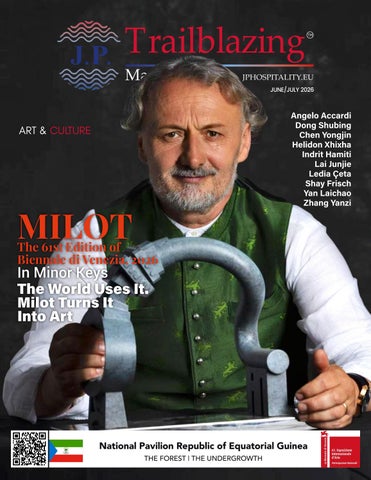
JUNE/JULY 2026
Angelo Accardi Dong Shubing Chen Yongjin Helidon Xhixha Indrit Hamiti Lai Junjie Ledia Çeta Shay Frisch Yan Laichao Zhang Yanzi
ART & CULTURE
MILOT
The 61st Edition of Biennale di Venezia, 2026
In Minor Keys The World Uses It. Milot Turns It Into Art
MILOT Nella Biennale di Venezia, 2026 In Minor Keys
Contents JUNE/JULY 2026
8
Milot Artist’s Bio
11 MILOT: My Keys’ Message:
18 “Key of Today” in Naples: A Universal Message in the City’s Oldest Square 20 Chen Yongjin’s Works 21 The Portrait of a Leading Artist 22 From No Man’s Land to Cultural Landmark: Dong Shubing’s Wilderness Art Practice 26 Mathematics, Art and Sebastian
Founder’s Note
Art has always been humanity’s most enduring language—a bridge between cultures, generations, and visions of the future. It is therefore a profound honor to present this special Art & Culture Edition of Trailblazing Magazine at the prestigious Venice Art Biennale, one of the world’s most celebrated stages for artistic expression and cultural dialogue. This edition is a tribute to the transformative power of creativity and to the artists, institutions, and visionaries who continue to shape our collective cultural landscape. Through these pages, we explore stories that transcend borders, celebrating innovation, heritage, imagination, and the enduring role of art in fostering understanding and connection.
32 Shay Frisch campo 34 campo Spiritual Modules of Art 42 “Pulse of Life. Chengdu Biennale” Grandly Opens, Bringing Together 251 Artists from Around the Globe 48 Zhang Yanzi Art Work 50 From Hotels to Canvases: The Artistic Journey of Markus Lehnert 54 Ledia Çeta: Where the Sea Remembers 56 Beneath the Skin: The Visual Explorations of Lai Junjie 60 Inside the Pop Surrealism of Angelo Accardi 62 Indrit Hamiti: A Practice Shaped by Context and Transformation
10
66 ALBANIAN Key 68 Yan Laichao’s - Différance Transcending the Gaze 69 Spatial Reconstruction in Yan Yu’s Sculptures 70 Jorida Muho: “Butrint, a Reference Model for Integrated Cultural and Natural Heritage Management 74 The Mythopoeic Pulse: The Essence of Gregory de la Haba’s Art 77 Lin Jiangquan’s - “Library of Prohibited Books”
We are particularly delighted that this edition has been prepared in close collaboration with renowned Albanian artist Alfred Mirashi (Milot), whose remarkable work graces our cover. His artistic vision embodies the spirit of this publication: bold, thought-provoking, and deeply rooted in cultural identity while embracing a global perspective. As Trailblazing Magazine continues its mission of spotlighting exceptional individuals and meaningful initiatives, we are proud to bring this special edition to Venice—a city where art, history, and inspiration converge. May these pages encourage dialogue, spark new ideas, and celebrate the extraordinary creative forces that enrich our world. Thank you to our contributors, partners, and readers for joining us on this cultural journey.
70
Rudina Hoxha
Founder & Editor-in-Chief Trailblazing Magazine Rudina.hoxha@jphospitality.eu
32
Rudina Hoxha • Founder & Editor-in-Chief
“No more Keys” by Alfred Mirashi (Milot) 30 terracotta plates and 30 keys in 3D, mixed media, 3m x 3 metres, work exhibited at the 61st Venice Biennale
Jose Pinto • Co-Founder
TRAILBLAZING MAGAZINE COVER JUNE/JULY 2026
Glion Hospitality & Luxury Business Education Where Luxury Meets Leadership At Glion, luxury is not a concept - it is a discipline, a mindset, and a future you can master. In a world where excellence is expected and experience is everything, Glion prepares the next generation of leaders to shape the future of luxury industries. From the world of elevated hospitality to global luxury brands, our programs are designed for those who aspire to define standards.
Our Luxury Programs Bachelor in Luxury Business Master in Luxury Management and Guest Experience Executive Master in Luxury Management and Guest Experience
This is where your vision of luxury becomes a career of influence. Begin your journey in Switzerland with Glion.
On the Cover: Alfred Mirashi Milot Photographer: Season Yeung
Ava i l a b l e a t: www.jphospitality.eu Co n ta ct: rudina.hoxha@jphospitality.eu jose.pinto@jphospitality.eu
info@glion.edu l +41 21 966 35 35 l glion.edu
MILOT ARTIST’S BIO Following the public and critical acclaim he received at the 6th Beijing Art Biennale at the National Museum of the capital, where he was the protagonist of the exhibition “Breaking Light Yan Laichao & Milot”, organized by GDMOA and curated by Ji Shaofeng, from October 10, 2025 to January 6, 2026, at the Guangdong Museum of Art in Guangzhou, he is present at the 61st International Art Exhibition in Venice. A contemporary artist of international fame, he was born in 1969 in Milot, a town in the Kurbin commune in northern Albania. This “dry and desolate” land, devastated by the violence exerted by man on man due to human ideology, has now become a land of hope, thanks in part to the human and artistic commitment of Milot, who currently lives and works in Florence, but who has never forgotten his birthplace. After attending the high school of arts in Durrës, he arrived in Italy in 1991 with the first exodus on March 6, immediately after the fall of the communist regime in Albania.
Photo by Season Yeung
He enrolled at the Academy of Fine Arts in Brera, where he himself, in an interview, states that he experienced his most beautiful and vibrant years from an artistic perspective. Milot graduated in painting in 1999. Then, he received a scholarship to the University of Art and Design in Loughborough, England, and began his journey to the New World, staying for a while in New York. After returning to Italy, the artist settled first in Naples and then in Florence, where he still lives and works today. His art arouses great interest and highlights a personality that is “volcanic and impetuous but at the same time sweet and sensitive”. Milot carries within himself the struggle and the sacrifice, the fatigue of
ART AND CULTURE
someone who has had to bend down to open up to the world, but at the same time he enjoys the pleasure of his art. An art that is the expression and testimony of a journey, his journey and that manifests itself in the theme of the ”key.” Since 2000, his works have traveled everywhere and have been exhibited in collective and personal exhibitions in many Italian and foreign cities; first in Otranto at the Aragonese Castle, then in Milan at the Museo Permanente, in Naples at the Museo del Maschio Angioino, in the Palazzo Reale in Turin, in Venice for the exhibition “Open 14”, an international exhibition of sculptures and installations curated by Paolo De Grandis, at the Tornabuoni Gallery in Florence, and in Turkey, China, and wherever the message of his Keys can open doors and unite peoples in the spirit, both pictorial and sculptural, of a relationship of humanity and brotherhood. The exhibitions in which he participates and their corresponding catalogues have been curated by renowned contemporary art historians and critics, from Francesco Poli and Eduardo Cicelyn to Paolo Thea, from Philippe Daverio to Jean Blanchaert, from Anselmo Villata to James Genovese and Charlotte Stein, from Massimo Guastella to Alberto Ghinzani, to name just a few. The artist has received numerous awards and honors. In 2010, he won the “Excellence Award” at the Naples Cultural Classics exhibition. During the 2012 Olympic Games, he was awarded the gold medal in painting at the Barbican Center Museum in London. That same year, he was invited to participate in the 6th Beijing International Art Biennale at the National Museum in Beijing. In 2015, he won first prize at the Water Cube Museum in Beijing. In 2016, Milot was appointed Visiting Professor by the Shandong University of Art and Design in China and, that same year, he curated the international section
of the 6th Jinan Photography Biennale in China. In Rome, he won first prize at “The Excellence of the Contemporary Art” exhibition, curated by Francesco Gallo Mazzeo. The following year, he curated a solo exhibition of the international photographer Zeng Yi at the National Museum in Tirana, and in 2020, he was appointed Director of the DODO Art Museum in Beijing. Throughout the first quarter of the 20th century, Milot exhibited paintings and sculptures in Italy and abroad without interruption. His art is made even more powerful by the famous, monumental “Keys”, which have become an emblem, commissioned from all over the world, and appreciated in the most important public spaces. Among his permanent public works, in 2017, we recall the installation of Corten steel in Cervinara, in the province of Avellino, “a giant U-shaped key 20 meters high and weighing 4,000 kilograms, which stands at the entrance to the city of Irpinia”, and the Chiave Rossa, made of red-painted steel in Lizzanello, in the province of Lecce. This was followed by the extremely laborious Corten steel Chiave di Montevergine, the Key of Today, exhibited in Naples’ Piazza Municipio in 2023. Two years later, after 60 days of planning and 7 months of work with over 30 workers, the Albanian Key became a ‘majestic’ Corten steel key weighing almost 20,000 kilograms, which stands proudly in Shkodër, Albania. Thanks to his participation in these highly prestigious projects, which have seen him featured in numerous exhibitions in Europe and around the world, the ItalianAlbanian artist Alfred Mirashi Milot enjoys wide acclaim from prominent critics and collectors. He possesses an artistic versatility that continues to fascinate and arouse great interest across the international art market.
9
MILOT: My Keys’ Message: “Despite OUR differences, WE are all part of the same whole” By Rudina Hoxha From the historic streets of Florence to major cultural capitals around the world, Albanian-born artist Alfred Mirashi Milot has built an extraordinary career shaped by creativity, dialogue, and human connection. Internationally renowned for his iconic “Keys of Unity” sculptures, Milot has transformed a simple symbol into a powerful artistic message that transcends borders, cultures, and generations. Living and creating in Florence, he has developed a distinctive artistic language that reflects his Albanian roots, Italian artistic influences, and a global vision of peace, coexistence, and understanding. Over the last decade, Milot has cultivated a particularly meaningful connection with China, where his art has been embraced for its universal message of unity and cultural exchange. Through exhibitions, artistic collaborations, and enduring friendships with leading Chinese artists, he has become an active participant in a vibrant dialogue between Eastern and Western artistic traditions. His close relationship with China’s art community has enriched his creative perspective and reinforced his belief that art can serve as a bridge between peoples, cultures, and civilizations. In this exclusive interview with Trailblazing Magazine, Milot reflects on his remarkable life journey, the milestones that have defined his international career, and the inspiration behind his celebrated “Keys of Unity.” He shares insights into his artistic experiences in China, his collaborations and friendships with Chinese artists over the past ten years, and his vision of art as a catalyst for connection in an increasingly interconnected world. Through his story and
Photo credit: Michele Stanzione 10
ART AND CULTURE
ART AND CULTURE
11
The 2026 Venice Art Biennale Courtesy of Galleria il Ponte (The Bridge Gallery) Florence, Italy
my aesthetic sensibility, pushing me toward artistic research centered on harmony, symbolism, and the dialogue between memory and contemporaneity. MILOT at the 2026 Venice Biennale with his installation “No More Keys” Courtesy: Galleria Il Ponte, Florence Photo credit: Michele Stanzione
At the same time, I have never severed my connection with my Albanian origins, especially my stage name, Milot. My personal experience of migration and belonging to two different cultures has become an integral part of my creative identity. Freedom and cultural encounter: elements that reflect both Albania’s historical memory and the cosmopolitan openness I developed in Italy.
philosophy, Alfred Mirashi (Milot) reminds us that art is more than an expression of beauty—it is a universal language capable of opening doors, building bridges, and bringing humanity closer together. Full interview follows: You have lived in Florence for over thirty years. How has this city shaped your artistic identity, while preserving your Albanian roots? Living in Florence for over thirty years has meant daily encountering a city where art is not separate from life, but constitutes its natural language. The constant presence of the Renaissance and historic architecture has profoundly influenced
12
Composition: Red Key Trittico, trittico 120x1190 cm , Biennale di Curitiba 2026
ART AND CULTURE
Florence and Italy offered me the cultural and artistic tools to develop my own international language, while my Albanian roots kept alive a strong emotional dimension and identity. The result is an art that combines formal elegance and human commitment, capable of simultaneously speaking about beauty, migration, identity,
ART AND CULTURE
and dialogue between cultures. Looking back on your early years, what were the decisive moments that led you to become the artist you are today? What role does spirituality play in your work and your creative process? Looking back on my early years, I believe the decisive moments were those when I realized that art wasn’t just a passion, but an inner necessity. Coming to Italy had a profound impact on my growth: here I encountered cultures, artistic languages, and people who helped me look at my work with greater depth. The difficulties, the changes, and even the exposure to a new reality shaped me as much as my studies at the Brera Academy in Milan and my artistic practice. Every experience has pushed me to transform emotions and memories into something visible through art. When I work, I always seek authenticity and emotional energy, and spirituality helps me maintain this balance. It influences the colors,
13
“Florence and Italy offered me the cultural and artistic tools to develop my own international language, while my Albanian roots kept alive a strong emotional dimension and identity.”
Mediterranean Corner 2003 180x190 cm Diptych Work exhibited at the Maschio Angioino Museum, Naples, 2003
shapes, and message of my works, because I want the viewer to not only see an image, but also feel an emotion, a reflection, or an internal connection. “Key of Unity” - A Message to the World Your work, “Key of Unity,” conveys a powerful message. What inspired its creation? “Key of Unity” was born from the desire to represent what unites people beyond all differences. The key symbolizes openness to dialogue, understanding, and peace. Through this work, I wanted to convey the idea that art can create connections and remind us that, despite our differences, we are all part of the same whole. Why did you choose the symbol of the “key” to express dialogue and harmony? Do you believe artists have a responsibility to address social and global issues?
14
I chose the symbol of the “key” because it represents something that opens, connects, and brings communication. A key can open physical doors, but also symbolic ones: those of dialogue, mutual understanding, and harmony between different people and cultures. I was interested in the idea that dialogue is a tool capable of resolving conflicts and creating new spaces for encounter. Furthermore, the very shape of the key evokes the concept of access: without listening and discussion, we often remain closed in our differences, whereas dialogue allows us to overcome barriers and build more balanced relationships. I also believe that art has an important role in addressing social and global issues. Artists are not obligated to engage in activism, but they have the opportunity—and in some cases, the responsibility—to stimulate reflection, raise public awareness, and give voice to issues that risk being ignored. Art often manages to communicate emotions and messages more immediately and universally than other forms of expression, creating empathy and awareness. This is why I believe it can contribute concretely to the dialogue on issues such as peace, the environment, social inequality, or human rights.
ART AND CULTURE
The Key of Cervinara 2017 10x6x7 m Corten Steel
“Coming to Italy had a profound impact on my growth: here I encountered cultures, artistic languages, and people who helped me look at my work with greater depth.” What kind of emotional or intellectual response do you hope viewers will experience when faced with this monumental work like your keys? I hope viewers will experience wonder and curiosity when faced with a monumental work like my keys. I would like the symbol of the key to convey a sense of openness, dialogue, and hope, prompting people to reflect on the importance of mutual understanding. If the work succeeds in generating emotion and sparking questions or reflections, then it has achieved its goal. In an often-divided world, how can art like yours help build bridges between people? I believe art can unite people because it speaks a universal language, capable of overcoming
ART AND CULTURE
cultural, linguistic, and social differences. Through symbols like keys, my works aim to encourage dialogue, understanding, and mutual respect. In a divided world, art can create moments of encounter and reflection, helping people feel closer and more connected. In your opinion, what does it mean to represent Albanian identity through art on an international stage today? Representing Albanian identity through art on an international stage today means valorizing one’s culture and roots, but also demonstrating its openness to the world. I believe it’s important to convey an image of Albania based on history, creativity, dialogue, and contemporaneity. Through art, we can share universal values,
15
“Ancient Chinese philosophy and art have influenced my artistic language in the search for balance and harmony, particularly in the relationship between solids and voids and in the dialogue between the work, space, and the viewer.”
MILOT (L) with Mr. Fabrizio Bucci, former Italian ambassador to Tirana, Albania
creating connections between different cultures and showcasing the richness of Albanian identity beyond stereotypes. Can you elaborate on your participation in the 2026 Venice Art Biennale? You emphasize human values and connection. How do you translate such abstract concepts into visual form at a world-renowned event like this? At the 2026 Venice Art Biennale, my participation is part of a broader reflection on contemporary languages and human relationships. The project revolves around a simple yet powerful idea: transforming abstract concepts like connection, dialogue, and human values into concrete, immediately perceptible visual forms. The “keys” become the primary means of this translation. They are not merely symbolic objects, but physical presences in space that invite the viewer to question what it means
16
to “open” something today: a relationship, a culture, a possibility of understanding. Through the monumental scale, the material, and the spatial arrangement, the symbol becomes a direct, almost corporeal experience. In an event like the Biennale, which brings together artists and audiences from around the world, this visual language aims to create a meeting point: something that transcends linguistic and cultural barriers and makes visible the idea that connection between people is not an abstract concept, but a real and shared necessity. You describe your connection with China and its artists as a “true school.” What were the most valuable lessons you learned from this relationship? How did ancient Chinese art and philosophy influence your artistic language? My connection with China has been a true learning experience, especially in my
ART AND CULTURE
Mediterranean Corner 2022 140x180cm Work exhibited at the Guangdong Museum in Guangzhou, 2025
understanding of art as a process, discipline, and profound reflection. I learned the importance of patience and care in every phase of the work. Ancient Chinese philosophy and art have influenced my artistic language in the search for balance and harmony, particularly in the relationship between solids and voids and in the dialogue between the work, space, and the viewer. This has enriched my vision, making it more open and universal. Can you share a memorable collaboration or experience with Chinese artists? One of the most memorable experiences was the direct interaction with Chinese artists and masters during my solo exhibitions and shared
ART AND CULTURE
projects, where the dialogue was not only verbal but above all practical. Working together in the same space allowed me to closely observe a very different approach to the creative process: slower, more meditative, and deeply rooted in tradition. The Chinese are very friendly with the Albanians and know our history well. In particular, I remember how every gesture was charged with meaning and how even the preparation phase of the work was considered an essential part of the final result. This exchange greatly enriched my way of working, leaving a strong mark on me, both personally and artistically. Do you consider yourself a cultural ambassador through your work? More than an “ambassador” with a tie and official stamp, I consider myself someone who travels with works of art instead of a passport. If I must say it with a bit of irony: I’m an ambassador who never stays put at the embassy. My “keys” travel back and forth between different cultures, opening doors, and sometimes even forgetting where they left their suitcase. Ultimately, if art can make people who don’t share a language or borders communicate, then yes—perhaps I’ll do a bit of diplomacy too, but without protocol and with much more emotion.
17
“Key of Today” in Naples: A Universal Message in the City’s Oldest Square
not just an installation but also a stimulus for study and discussion. After so many years of work, what continues to inspire me is precisely this ability to continually renew a language without losing its essence: the dialogue between people, cultures, and different visions.
By Gaetano Manfredi • Mayor of Naples In Naples, in the historic Piazza Mercato, one of the city’s oldest sites, Milot’s monumental sculpture “Key of Today” is on display for six months. This extraordinary work finds its ideal setting in a vibrant and symbolic context, offering a unique experience to all who pass by.
From left to right: Milot, Ledia MIRAKAJ, head of culture at the Albanian Embassy in Rome and Joan Abello, curator of the Equatorial Guinea Pavilion
The artist has chosen an open location, far from the confines of museums and enclosed spaces, to convey a universal message: the hope for a world without barriers. The sculpture’s monumentality not only captures the eye, but also becomes a symbol of dialogue and mutual respect, inviting reflection on the importance of shared spaces and the possibility of cultivating a future of peace and freedom. Born in our city, the beating heart of the Mediterranean and a crossroads of languages, cultures, and ideas, “Key of Today” brings Naples to the international stage, reminding us that art can begin in places and reach far, transforming squares and speaking to the entire world.
18
Key of Today 22x10x10m Corten Steel Naples 2023
What projects or ideas are you currently working on? What inspires you after such a long and enriching career? After the Venice Biennale, I’m working on a new monumental work for the Lecce Academy, curated by Massimo Guastella. This project represents an important step for me, as it fits into a vibrant academic and cultural context, where the work is
MILOT (R) with the Mayor of Naples, Mr. Gaetano Manfredi
ART AND CULTURE
ART AND CULTURE
After more than 30 years abroad, what does “home” mean to you today? What advice would you give to young Albanian artists dreaming of building an international career? After more than 30 years abroad, “home” is no longer just a place on the map. It has become something more flexible: sometimes it’s a studio, sometimes a mental space, other times simply a sense of balance. I’d say it’s where I can feel in dialogue with myself and with what I’m creating... even if the phone keeps ringing at odd hours. I would advise young Albanian artists not to rush to “arrive,” because art doesn’t work with train schedules. It’s better to build with patience, remaining curious and true to your own identity, but without fear of being influenced by the world. And above all: always carry your roots with you, but let them breathe.
19
CHEN YONGJIN’S WORKS Chen Yongjin, graduated from the Hubei Institute of Fine Arts in 1994, is the Director of Wuhan Art Museum.
The Portrait of a Leading Artist
He also serves as: Member of the China Artists Association. Member of its Watercolor Art Committee. Vice Chairman of the Wuhan Artists Association. Member of the Hubei Artists Association Watercolor Committee.
Introduction: “My life will reach out to the East and support my threshold.” The hymn of sun and fire spans millennia, testifying to the treasures of civilization, such as Qu Yuan lacquerware and other works, and Chu culture has colored civilization with the sun’s red. Chinese ancestors participated in the creation of heaven and earth and left their mark on civilization with wisdom.
Artistic style Chen Yongjin’s paintings are known for: Dreamlike landscapes combining realism and abstraction. Rich textures and expressive color. Reflections on Chinese history, architecture, and cultural memory. A philosophy of merging Eastern consciousness with Western painting techniques, a concept he frequently emphasizes in discussions of his work. His series depicting monuments, ancient towns, and natural scenery are especially admired for their emotional depth and sophisticated composition.
Chu lacquerware is dyed with ink on the outside, painted on the inside by Zhu, who grew up in Hubei. The red and black colors chosen for the works, inherited from Chu culture, are also used.
2024.11.11.5, oil color and acrylic on canvas, 220X160cm, 2025
Beneath the deep colors, straight geometric shapes permeate the series, and crisp geometric lines reflect the strengths of today’s rapidly growing modern China. The geometric shapes in the picture are beautiful, but they have formed a mutual care between the extremity of the natural arrangement, and the relationship between man and man, man and things, things and things, implicitly between the blocks of color of the cracked paint - harmony and difference, harmony and symbiosis.
Oil color and acrylic on canvas, 220X180cm, 2025
2024.11.11.4, oil color and acrylic on canvas, 220X160cm, 2025
ART AND CULTURE
director of the Oil Painting and Watercolor Creation Studio. His reputation steadily grew through exhibitions, teaching, and artistic research. In 2014, he joined the Wuhan Academy of Fine Arts as a senior academic leader and served as dean. Since 2020, he has been the curator of the Wuhan Art Museum, helping shape exhibitions and promote contemporary Chinese art.
Chen Yongjin is a contemporary Chinese artist, watercolor and oil painter, educator, and museum curator. He is widely recognized for blending traditional Chinese aesthetics with modern artistic expression, creating atmospheric landscapes and symbolic works that often explore history, memory, and the relationship between humans and nature. Early life and education Chen Yongjin was born in July 1972 in Wuhan, Hubei Province, China. He graduated from the Hubei Academy of Fine Arts in 1994, majoring in watercolor painting. Career After graduating, Chen joined the Hubei Academy of Fine Arts, where he became
ART AND CULTURE
Awards and recognition Throughout his career, Chen has received numerous honors, including: Selection for the 8th National Art Exhibition (1994). Silver Award at the 1995 National Watercolor Painting Exhibition. Silver Award at the 3rd National Watercolor & Gouache Exhibition (1996). Awards at national Chinese sports art exhibitions and many other prestigious exhibitions. Today, Chen Yongjin is regarded as one of the leading contemporary Chinese watercolor and landscape painters. His works are exhibited internationally and are included in important public and private collections.
21
From No Man’s Land to Cultural Landmark:
Dong Shubing’s Wilderness Art Practice
L a i J u n j i e • ( C o l l e g e o f F i n e A rt s a n d D e s i g n , H e b e i N o r m a l U n i v e r s i t y ) As a leading figure in contemporary Chinese public art and Vice Dean of the Academy of Arts & Design at Tsinghua University, Dong Shubing has carved out a new path for Chinese public art through a decade of continuous wilderness art practice, while delivering a replicable model of art-driven regional empowerment for countries worldwide with similar vast territories. There is an inherent temporal and contextual dislocation between the evolution of contemporary Chinese public art and Western art history, making direct side-by-side comparisons inappropriate. In the 1960s and 1970s, pioneering Western
land artists including Robert Smithson and Michael Heizer broke free from the constraints of the gallery “white cube”, bringing their practice to remote wilderness. Their radical, large-scale interventions into the landscape were designed as a rebellion against the commercialized art system, marking a groundbreaking milestone in art history (Kastner & Wallis, 2010). A fundamental divergence exists at the very origin of the two practices: Western land art centers on formal rebellion and conceptual breakthrough within art history, treating the wilderness merely as a canvas for the artist’s individual vision, and remaining confined to niche, elite circles. In contrast, Dong Shubing’s wilderness
project was anchored in public value and regional empowerment from its inception, rejecting the reduction of the wilderness to a backdrop for personal artistic expression. As Western land art completed its arthistorical mission of rebellion, contemporary Chinese public art was deeply tied to the country’s rapid urbanization, long facing two core dilemmas: the homogenization of urban public art, and the chronic neglect of cultural value in vast non-urban areas. Dong Shubing’s Wilderness Art Project, launched in 2016 in the Gobi Desert of Guazhou, Gansu Province along the ancient Silk Road, is a precise response to this local context. Turning down a high-profile solo exhibition in Beijing’s core 798 Art District, he situated his work in the uninhabited Gobi, with a core mission not to deliver a personal artistic manifesto, but to inject sustainable, cross-culturally communicable
The Beginning of the Hai Period, granite, steel frame, 260×150×200cm, 2025
Non-Vertical Coordinates, weathering steel, stainless steel, 2060×2020×1560cm, 2023
ART AND CULTURE
contemporary humanistic value into a land long dismissed as the “fringes of civilization” (Dong & Meng, 2023). The most iconic achievement of this practice is its complete transformation of the land itself: the once uninhabited Gobi, through works including Son of the Earth and Unbounded, has become a premier destination for self-driving travelers across China and the world, drawing millions of visitors annually. What was once a blank space on the cultural map has evolved into a globally recognized public cultural landmark, driving cultural and tourism integration along the Silk Road. For the development of Chinese public art, this practice has shattered the rigid perception that “public art equals urban accessory sculpture”, breaking down the elite barrier of contemporary art and providing a mature, replicable model of “art anchoring the region, humanity activating the wilderness”. For countries around the world with vast territories and underdeveloped non-urban areas in need of cultural empowerment, this light-touch intervention model—one independent of urban core resources, non-destructive to the native landscape, and capable of delivering long-term symbiosis between cultural and economic value—offers a practical, accessible new path for public art, distinct from the elite Western land art canon. References Kastner, J., & Wallis, B. (2010). Land & Environmental Art (Revised ed.). Phaidon Press. Dong, S., & Meng, C. (2023). Wilderness Art Project. Art Magazine, (6), 46-49.
23
Papavasili Studio Philosophy
s Room
uites S &
The Garden Hotel Confe
182 NEWLY RENOVATED ROOMS
+355 4 22 35 035
r
te n e C rence
9 CONFERENCE & EVENT ROOMS CAPACITY UP TO 400 PEOPLE
www.rogner.com/tirana
ary n i l u C
REFINED LOCAL & INTERNATIONAL GASTRONOMY
ime T e r u Leis POOLSIDE RELAXATION, SPA & HAMMAM AND TENNIS
Bulevardi “Dëshmorët e Kombit” 9, Tirana 1010 - AL
At the core of Papavasili Studio’s philosophy lies Genius Loci, where the place itself is the brain for Architecture. We believe that the place creates identity, therefor we begin THE PROCESS we define as “building archaeology”, a careful reading of environment, context, and history. Through this process, THE SPIRIT of the site is uncovered and translated into volume, space and materiality, using art, science and sociology as tools, to finally unfold THE DESIGN language and create architecture that engages the senses, stimulates the intellect, and elevates human experience. This is what we call THE ALBANIAN AVANTGARDE ARCHITECTURE, an architectural expression that is distinct and contemporary, yet deeply rooted in its origin.
Contribution to Contemporary Architecture Papavasili Studio contributes by proposing an alternative architecture to globalized, uniform design approaches. Instead of adopting a neutral international style, the studio advances a model where local heritage becomes innovation generator. Our work demonstrates how Albanian architectural principles (climate, culture, and daily life) can be transformed into a contemporary and exportable design language. This approach not only strengthens local identity but also positions it within a global architectural discourse. Ultimately, Papavasili Studio seeks to create architecture that is recognizable, meaningful, and enduring, works that reflect a distinct authorship and contribute to a more diverse and culturally grounded contemporary architecture.
Some of the key projects of Papavasili Studio are Porto Albania, Turra Castle, Kavaja - Local Architects, in cooperation with Emilio Tuñón Architect; A Bridge Between Tradition and Innovation — Agrotourism, Cultural Heritage, and Technology for a Future Habitat (in the area of Has), Garden of Eternity – Berat Castle part of the team with Taulant, Planarch and Cooperativa Archeologia. Revitalization of Berat Castle.
LOCATION: Rr. “Dora D’ Istria” (Milto Tutulani), Ndertesa 4, Hyrja 6, Apartamenti 21, Njesia Administrative 5, Tirane
CONTACT: +355 69 26 00 791 info@papavasilistudio.com www.papavasilistudio.com @papavasili_studio
T
here was a time when the response to the question “What is mathematics?” was often something along the lines of “Mathematics is the science of . . . ” Well now, those days are long gone. Today it would be better to begin to answer this question with something like “Mathematics is the art that seeks . . . ” In sum, in recent years our vision of mathematics has undergone an immense change. Mathematics is no longer seen as one of the natural sciences the way it was before. Now it is considered, with ample validity, a form of art. How did this shift come about? British philosopher and mathematician Bertrand Russell expressed this claim most clearly and elegantly as follows:
Mathematics, Art and Sebastian By Herbert A. Hauptman
Mathematics, rightly viewed, possesses not only truth, but supreme beauty—a beauty cold and austere, like that of sculpture . . . sublimely pure, and capable of a stern perfection such as only the greatest art can show. This point of view in recent years has also received the support of Mexican artist ART AND CULTURE
Sebastian, who has revealed through his constructions the hidden and unexpected relations among different polyhedric forms. Despite the fact that Sebastian’s work offers the most easily accessible illustrations of mathematics as art, they should not in any way be regarded as the only ones of their kind. Only a fraction of these works surely would include among many others concepts: 1. 2. 3.
4.
Euclid’s proof of the existence of an infinitude of prime numbers. Gauss’s discovery that regular polygons can be constructed with a straightedge and compass. How to pack 231 spheres with 4 different measurements into a regular dodecahedron that fit as tightly as possible. The proof that the square root of no rational number is equal to 2.
Sebastian’s sculptures, in addition to their unquestionable beauty, represent the most obvious proof that mathematics is an art. I would hope that Sebastian’s work would 27
Sebastian Sculptor By Roger Penrose
motivate the general public toward a greater appreciation of the beauty of mathematics. At the same time, he posits remarkable challenges for mathematicians and artists. In the case of the former, proving and explaining geometric phenomena confronting them and in the case of the latter, paving the way for new ways to explore art. * [Text originally published in Héctor Tajonar (ed.), Sebastian Escultor, Madrid, Fundación Sebastian, Turner and Fundación José F. Llopis, 2009, p. 27.—Ed.]
28
ART AND CULTURE
The magnificent creations of the Mexican sculptor Sebastian build upon the Platonic forms of the classical geometry of ancient Greece and also of ancient Mexican culture, but they do so with an imagination and artistry which is truly modern. The range of these works is extraordinary. Some are of a tiny size and can be picked up and manipulated with the fingers, while others are on a scale that is vast, so that they can easily dominate the surrounding architecture. Some are of bold design, and are clearly assertive of what they stand for, while others are so delicate that they give the illusion that they maintain their geometric precision by sheer magic. Yet others present an uncanny mixture of the two. Some of the small ones are deliberately designed so that they can be changed in shape. Geometric transformations can be revealed whereby one geometrical form unexpectedly transforms itself to another that appears utterly different. The sculptures are frequently playful and often humorous in the way that the strict Platonic geometry can be elaborated in so many differently inventive ways. The sculptures are genuinely abstract, and do not usually represent a recognizable entity of normal experience, such as a plant or animal. Nevertheless, sometimes a deliberate allusion to something familiar, such as a cockerel, may reveal itself to the eye. More usually, there is no obvious allusion, and the statement made by the sculpture is simply of itself, exhibiting some novel way in which geometrical shapes can be stretched, twisted, and contorted in surprising ways, perhaps with subtle repetitions, so that more is gained from its geometry the longer it is examined.
ART AND CULTURE
29
30
ART AND CULTURE
ART AND CULTURE
31
Shay Frisch’s practice explores the theme of energy through the creation of electric fields. By employing sequential assemblages of commonly used electrical adapters arranged in modular repetitions, he creates works that generate electromagnetic fields, forming immersive environments in which induction becomes a spatial and perceptual experience. The circulation of electricity throughout the work activates the assemblage of inert material, infusing it with life and radiating light that reveals the electric charge embedded within, bearing witness to an ongoing phenomenon and to the field’s inner, fiery and primordial nature. His monochromes are characterized by primary geometric forms, mathematical proportions, essential and archetypal signs, often of archaic origin. The interplay with the exhibition space and the use of form aim to favor the evocative potential of the field (campo) as well as a state of contemplation.
Shay Frisch campo
Frisch has exhibited his work in museums and at major international exhibitions worldwide. In 2013, the Galleria Nazionale d’Arte Moderna e Contemporanea in Rome presented a major solo exhibition of his work, curated by Achille Bonito Oliva.
Ph. Michele Stanzione
Other selected solo exhibitions include: MAM Museum of Modern Art Shanghai (2025); Riso Museo d’Arte Moderna e Contemporanea
della Sicilia, Palermo – a two-artist exhibition with Christian Boltanski (2020); MACRO Museo d’Arte Contemporanea Roma, Rome (2019); ZAC - Zisa Arti Contemporanee, Palermo (2018); MAC Lima, Museo de Arte Contemporáneo, Lima (2017); Fondazione San Fedele, Milan (2017); MAC Santiago, Museo de Arte Contemporáneo, Santiago de Chile (2016); CIAC, Centro Internazionale per l’Arte Contemporanea, Castello Colonna, Genazzano (2015); Herzliya Museum of Contemporary Art, Herzliya (2011). His work has been featured in the Chengdu Biennial at the Tianfu Museum of Contemporary Art, China (2026), in two editions of the Venice Biennale, the 57th and 59th International Art Exhibition, Italy (2017 and 2022); three editions of the Bienal de Curitiba at MON Museu Oscar Niemeyer, Brazil (2015, 2017 and 2019); Milan World EXPO, Italy (2015); Bienal del Fin del Mundo in Valparaíso, Chile (2015) and Mar del Plata, Argentina (2014); Spoleto Festival dei Due Mondi, Italy (2012). In 2012 he exhibited for the first time in the USA, at Haunch of Venison gallery, New York and in 2018 presented an installation at the Reggia (Royal Palace) di Caserta. His work can be found in various public and private collections, including the permanent collection of the Galleria Nazionale d’Arte Moderna e Contemporanea in Rome. Shay Frisch is an Israeli-born artist based in Rome.
campo
Spiritual Modules of Art By Achille Bonito Oliva
campo 25032_N (detail) – GNAM Galleria Nazionale d’Arte Moderna e Contemporanea Rome
campo 60298_N – MACRO Museo d’Arte Contemporanea Rome
HALO – Installation view – MAM Modern Art Museum Shanghai
HALO – Installation view – MAM Modern Art Museum Shanghai
campo 121745_B/N – Installation view – ZAC Zis Art Contemporanee Palermo
36
ART AND CULTURE
ART AND CULTURE
Shay Frisch severs, with silent resolution, the umbilical cord and adopts a sort of calm cynicism that allows him to analyze the language he pursues, since he no longer believes in the absolute value of art, but in a relative value that stems precisely from the meta-linguistic experience of the work as a repeated exercise on the work itself. This new “system” may unfold only from a presumed tabula rasa, a turning point that allows quête, crossing a definitive, tautological linguistic labyrinth. The work is cleansed from all indetermination and immersed within a controlled and verifiable method. The artist probes into a different use for geometry, as a prolific field of an “irregular” reason that adores developing its own principles, adopting surprise and emotion. But these effects do not clash with the planning principle; if anything, they strengthen it through a pragmatic (and non-preventative) use of descriptive geometry. In him, the module becomes the structural element that shapes the complexity, infinitely multiplies and strengthens the surprise of geometry. The principle of asymmetrical reasoning sustains the work that formalizes irregularity as the creative counterpoint. In this way, the concept of planning is invested with new meaning; it no longer refers to a moment of proud precision but, if anything, of open verification, even though guided by a method built upon practice, the exercise of execution. The method refers to the need for a constant yet gradual parameter, rooted in an awareness of the context dominated by technique. In this, the artist is classically modern, the producer of differences through the creation of forms that fruitfully employ 37
strategy that gives shape to the material or dematerializes it as an installation. Shay Frisch confirms minimal art’s primary line of investigation, with an analysis of the structural elements of painting and sculpture: light and space. His installations and works emphasize such an analysis, with an essential and phenomenal process of these two poles of the work as a concrete event. Light is highlighted, rendered volumetric through formal structuring which concretely frames and contains it in the space. Ultimately, Shay Frisch’s “illuminated” work illustrates great tension with the surrounding space. An intention vaporized in the space. As with Rothko’s painting, form comes undone before the viewer’s gaze and acquires a liquid and invasive force. The geometry of darkness opens its slits and hands traces and deposits of light to us. Intense spirituality marks the radically aniconic work of this artist, an epiphany suspended or slowed down of a “mystery” between life and almost nothing, between light and dark. Shay Frisch turns on both the spirituality of form to the modularity of reason, and before our eyes there appears an inhabited silent field, a profound reason. campo 16746_B – HALO – MAM Modern Art Museum Shanghai
standardization, objectivity, and neutrality; capable of infiltrating the imaginary of a mass humanity imbued with the primacy of the technique, which is thus emptied of subjectivity. But this emptying is not necessarily seen as a loss. Instead, it could be the result of a new anthropology that functions according 38
to a metabolism of modular reason which does not mean symmetrical repetition but rather asymmetrical multiplication, namely, an application of the refined rules of intelligent chance, and this means for man the ability to invite discontinuity by avoiding the pitfall of ineffective reasoning. This acceptance derives from the attenuation of Western logocentrism that patiently ART AND CULTURE
absorbs the world’s reflection and moves pragmatically, not belligerently, opened to the world. Shay Frisch’s paradigmatic essentiality and reduction of the creative process lead him to the clearness of a gesture that can be controlled and repeated. Thrust and surgical precision support the creative ART AND CULTURE
Therefore, this is the approach of an artist who, beginning from a wandering space, has adopted dynamism as a system intrinsic to that very space, a combination system of mobile rapports: the field creates connections between various points of the installation, entrusting its definition to the charge, to the flow of energy within the work. The visual advent of a prophecy, the philosophical one by Merleau-Ponty that announces temporal forms for contemporary art. 39
to experience. With horizontal slits and vertical openings there arises a work that displays the structural element of art—light— in all its ardor, visually defining its inner nature, energy that expands, hides, and joins in the modular layering of a slightly ruffled surface. Here space is a temporal form; continuous, beneath-the-surface surprises of light endow it with a latent energy that is consumed beneath the skin of the work, withdrawing definition from the space itself. Shay Frisch works upon the ambivalence of a creative furor that plays between skillful revealing and energy sublimation, between the noise of the light and the silence of the module, between composure and campo 11028_N – Tianfu Museum of Contemporary Art Chengdu power. The work moves its pace, the installation The system with various fields in tension slowly imposes itself in its color reserve allows a single magnetic field to vibrate, upon the surrounding space, acquiring the permeating the exhibition space. The brick authoritative force of dystopia. employed is the modular element of the entire combination system of commonly Shay Frisch avoids the utopia that always used electrical plugs and outlets. designates an indefinite non-place, and in his field, what prevails is dystopia, In turn, prolific seriality opens up to an the disciplined interference of the idea of infinity through a reciprocity of phenomenon of the work upon that space and time. The viewer’s visual field of life. is dynamic and enveloping, a space
campo 16720_N – Tianfu Museum of Contemporary Art Chengdu
40
ART AND CULTURE
ART AND CULTURE
41
“Pulse of Life. Chengdu Biennale”
Grandly Opens, Bringing Together 251 Artists from Around the Globe
Title: Memory Island Artist: Yuan Xiaotian Material: Perforated Aluminum Plate Dimensions: 700(W) × 700(D) × 320(H) cm Year: 2026 Brief Statement: Memory Island is a conceptual installation exploring memory and existence. Using perforated aluminum plate as the main material, its layered, translucent and malleable qualities metaphorize the accumulation, ambiguity and reshaping of memory. The work transforms intangible inner memory into a tangible visual form.
On February 8, 2026, a grand cultural feast commenced—one that measures life through the lens of art. The “Pulse of Life · Chengdu Biennale” opened to the public free of charge at the Chengdu Art Museum. Featuring 328 works by 251 artists from 29 countries and regions, this edition of the Biennale takes “Pulse of Life” as its theme. It is structured around six core sections: «Where the Heart Belongs», “The Extraordinary in the Ordinary”, “Villes Réelles, Ville Rêvée”, “Timescape Journey”, “Back to Life. Back to Reality”, and “24 Hours in Chengdu”, complemented by an outdoor exhibition area that opened earlier on December 19 last year. The Biennale seeks to reinterpret daily life through artistic expression and explores the vitality and sense of happiness of a city. Chief Curator Wu Hongliang remarked that while an «index» signifies data in economics, within the context of this Biennale, it transforms into mood, love, and the pursuit of art itself. The opening marks a shift from presenting art as something to be revered from a distance, to actively integrating it into neighborhoods and daily life, allowing its energy to truly resonate.
A Global Spotlight: Deepening Dialogues Between International Art and the City’s Pulse This edition sets a new record for the Biennale in terms of international participation, showcasing works by 116 overseas artists from 29 countries and regions. The lineup includes globally renowned figures such as Victor Vasarely, Daniel Buren, Shay Frisch as well as the French art treasure, Bernar Venet and leading British contemporary artist, Julian Opie. A significant highlight is the 45 new works specifically created for Chengdu or this Biennale. The exhibition has garnered substantial attention and support from the international art community, with several overseas
42
Trendsetting: A New Generation Voices the Spirit of the Times
Title: Recall/Chengdu(回唤/成都) Artist: Beili Liu Material: Paraffin wax, thread, hardware Dimensions: 2743mm x 4876mm x 2590mm Year: 2026 Photo credit: Wu Yang
pieces realized with the backing of foreign consulates and cultural institutions. For the opening, many international artists traveled to Chengdu to participate in on-site installations, exchanges, and masterclasses, gaining a genuine and appreciative understanding of the city. This represents not just an introduction of global cutting-edge perspectives to Chengdu, but a meaningful twoway cultural exchange. The special consideration for Chengdu extends beyond visual art. At the opening ceremony, the Chengdu Symphony Orchestra gave the world premiere of «Bridges», a piece specially commissioned for the Biennale by composer James Reynolds; its melody capturing a unique artistic impression of the city.
ART AND CULTURE
Alongside masterpieces by modern Chinese art masters like Qi Baishi and leading contemporary artists such as Xu Bing, He Duoling, Zhang Yanzi, Liang Quan, Yin Xiuzhen, Jiao Xingtao, and Yu Hong, the Biennale provides a crucial platform for emerging trends and young creators. Artists born in the 1990s and later constitute a significant and growing contingent, showcasing remarkably diverse approaches. Employing media like AI and virtual technologies, they grapple with contemporary themes such as digital identity and ecological ethics, pointing to new directions and possibilities in artistic evolution.
Cross-Border Fusion: Art as a Catalyst for Innovation A defining feature of this Biennale is its dedication to breaking down boundaries, deeply integrating art with technology, AI, music, fashion, intangible cultural heritage, and film to create a dynamic, innovative cultural ecosystem. A prime example is «Poem of Carbon: Light, Shadow and Power», a collaboration between the Chengdu Art Museum and multidisciplinary teams from Sichuan University. Utilizing world-leading, patented nanoscale photolithography, the scientists meticulously recreated the ancient “Sun and Immortal Birds” motif at a microscopic level. This fusion of art and cutting-edge technology offers the public
ART AND CULTURE
a tangible, profound way to connect with both cultural heritage and scientific innovation. These cross-border explorations exemplify a broader movement where contemporary art actively engages with scientific research, industrial innovation, and cultural preservation, forging deep, organic connections with societal production and everyday life.
City-Wide Nourishment: Art Flows into Streets and Alleys The Biennale’s influence extends far beyond the museum walls. Twenty “Pop-up Art Museum” events, over 15 parallel exhibitions, and 28 designated urban art sites will bring workshops, salons, street performances, and more to iconic Chengdu locations like Yulin Lane, Kuanzhai Alleys, Eastern Suburb Memory, and Chengdu Tianfu International Airport. Art becomes an engine driving the city’s cultural vibrancy, while also offering enriched cultural travel experiences for upcoming holidays like the Spring Festival and May Day, truly weaving artistic activity into the fabric of local life. Where daily life thrives, art finds its pulse. This mutual embrace between art and the city vividly animates the spirit of Chengdu. We anticipate that this grand event, running through August 23, will not only nourish the city’s inherent cultural vitality but also help chart a future for Chengdu that shines with renewed brilliance in its ongoing dialogue with world civilizations.
43
《面对》 01 空心卷 轴 综合材 料 320x90cm 2022-2024年
《面对》 02 空心卷 轴 综合材 料 320x90cm 2022-2024年
《面对》 03 空心卷 轴 综合材料 320x90cm 2022-2024年
《面对》 05 空心卷 轴 综合材 料 320x90cm 2022-2024年
《面对》 06 空心卷 轴 综合材 料 320x90cm 2022-2024年
Title: Encounter Artist: Zhang Yanzi Material: Currency, pain relief patches, gauze, mounting debris, etc Dimensions: 19*320cm 10 pieces Year: 2024-2025
Encounter embodies my understanding of "emptiness". Rooted in the traditional Chinese scroll format, the mounted sections of each piece carry the symbolic meaning of the work, while the painting core is deliberately hollowed out. The scrolls are suspended in sequence within the space. Though presented as hanging scrolls—a conventional way of displaying classical Chinese paintings—this work subverts the traditional viewing experience. Viewers may walk around and observe freely, gazing through the hollowed cores at passing people and shifting scenery. The mounted sections become the field where I articulate my concepts, creating a tense dialogue with the empty cores. Materials including currencies from various countries, pain relief patches, gauze, medicated plasters,
44
band-aids, and portraits of emperors allude to primal human desires and struggles under social structures. A solemn form unfolds alongside dismantled, metaphorical imagery, forming a layered, paradoxical rhythm. When viewing, the audience is left with infinite possibilities to reconstruct the painting core in their own minds. The hollow space stands as both an intangible clash of thoughts and an intimate, illusory connection. In short, Encounter is an experimental work that achieves a contemporary transformation of traditional Chinese artistic language, drawing from local contexts and resources. This approach is not framed through a Western perspective; rather, it represents a kind of realization and reflection grounded truly in the spiritual dimension of humanity.
《面对》 04 空心卷 轴 综合材 料 320x90cm 2022-2024年
Encounter ART AND CULTURE
ART AND CULTURE
45
This page: Installation view; Victor Vasarely, Infin. Opposite page, from left to right: Tianfu Museum of Contemporary Art, Chengdu; Works by Daniel Buren and Milot; Nighttime view through the museum’s glass façade reflecting the artworks on display.
46
ART AND CULTURE
I
n contemporary artistic creation, employing the body as a medium and trauma as an entry point to explore the relationship between the individual and reality, as well as between the collective and the era, has become a central concern for numerous artists.
Zhang Yanzi’s installation
“We” stands as a powerfully striking artistic tour de force, laying bare the existential struggles and spiritual predicaments of the individual. Through metaphorical materials and an oppressive visual language, the work fully reveals the discipline imposed on people by reality, as well as the insignificance and helplessness of the individual within the collective. Using blood-stained gauze as her material, the artist wraps and forms small, featureless human figures. These anonymous, flattened, and symbolic dolls serve as the tangible embodiment of “we”.
Zhang Yanzi
48
Art Work
ART AND CULTURE
What makes the work most unsettling is the thick, rigid steel rod that pierces the chests of all the figures. Two enormous nuts at either end clamp more than a dozen dolls tightly onto the rod. The figures are pressed and piled together in intensely uncomfortable postures, like skewered meat, with no room to stretch or breathe. The inspiration for “We” stems from the artist’s observations and reflections on social reality. The interplay and tension between the individual and the collective, between resistance and submission, form the real-life foundation of the work, freeing it from empty conceptual rhetoric
ART AND CULTURE
and endowing it with an unflinching force that confronts reality head-on. Beyond its visceral visual impact, “We” carries profound depth and a tone of compassion. One feels pity when looking down at ants, yet unaware that from a higher perspective, humans are equally tiny and scarred beings. The “small figures” in the work represent every ordinary individual struggling in reality, swept along by life—a collective portrait of countless “us”, articulating the fragility and humility of individual life. Through “We”, Zhang Yanzi poses profound questions to the viewer regarding the body and the spirit: when pulled by the gravitational force of reality, is it only the physical body that suffers, or the spirit as well? As the vessel of the spirit, can the body safeguard the independence of the mind and allow it to follow its own direction? The synesthetic experience evoked by the work extends far beyond physical pain, pointing to spiritual repression and numbness. When the individual is engulfed by the collective and constrained by reality, physical confinement eventually evolves into spiritual degeneration. People drift passively, gradually losing their capacity for independent thought and their spiritual bearings. This is both a reflection on the existential plight of the individual and a sharp critique of human alienation in modern society. With “We”, Zhang Yanzi conducts a comprehensive examination of reality, the individual, and the spirit. Its oppressive visual scenario enables every viewer to see themselves reflected in the work and reflect on their relationship with the world. In doing so, the piece transcends mere artistic expression to become a mirror of the times—one that reflects reality and stirs the soul.
49
By Rudina Hoxha
SHORT BIO
For this special Art & Culture Edition of Trailblazing Magazine, we explore the fascinating intersection between business, travel, and art through the eyes of a man who navigates both worlds with equal elegance. In this exclusive conversation, Markus Lehnert, Senior Vice President of Marriott International, reflects on creativity as a leadership force, the emotional language of art, and how painting allows him to reconnect with stillness, imagination, and human connection in an increasingly fast-paced world. You move between two very different yet creative worlds: hospitality and painting. How do these identities coexist within you? Which came first in your life — the passion for art or the passion for hospitality? A wise man once said, you can find creativity in every field. Some do that and find creativity everywhere and some look at
Brandenburg Gate Berlin
50
rainbows and it moves nothing within them. Luckily, I am probably in the first category. I discovered that when I was six years old and my father taught me art history. He was a great teacher but did not want me to paint (way too messy). So I started at the age of 25 to paint myself, always (well 95%) in oil and probably in a fairly
The American Bar ( Loos Bar) in Vienna
Markus Lehnert was born in Essen, Germany on 27th January1966. Between1986 – 1999 he lived in London and is in Switzerland since 1999. Through his father, Reinhard Lehnert (who in the 1960s discovered ‘LICHTMUSIK’), he was exposed to and educated in art and art history from an early age. Over three decades ago, he started to paint, mainly in oil and he focused early on expressionism and inspirational art. In 2004, he had his first exhibition of his art in the Gallery Mons Indigo in Berlin (‘Masks and Moods’), followed by annual exhibitions in Frankfurt 2005 (‘Metropolights’), Cologne 2006 (‘Meilensteine’), Munich 2007 (‘Lichtbilder’), Frankfurt 2008 (‘Before Breakfast’ together with Michael Apitz), Zürich 2009 (‘Series’ together mit Ferry Ahrle), Frankfurt 2013 (‘Refocus’), Munich 2016 (‘Fotografien’) und Wien 2019 (‘Idols’). Markus Lehnert has spent a lot of time framing his art conceptionally without limited the breadth and variety and convey this to the viewers of his art, who he believes are a very important part of the process because they ‘ are actively and regularly consuming art’. To capture the essence of his work could be described as “chromatic haptic”, “photographic colorforming” (Photos like paintings) and “mono-chromism”. His register of works lists over 1,000 paintings, most of which are in private collections in the UK, US, Germany, Austria and Switzerland or are on display in selected official buildings.
ART AND CULTURE
Skyline of Frankfurt
expressionistic fashion. Back then, my passion for hospitality was not yet as burning as it has become but painting, I saw as something quite different. The only boundaries in painting are the edges of the canvas and some would even say that is not the case. You have a complete freedom to express yourself in painting, sometimes that expression is more deliberate, sometimes it is more by chance. When I am dealing in matters related to hospitality, my mind is highly alert to find creative solutions to issues or in negotiations. When I am painting, I am in a state of mental tranquility, almost a trance, and then I can paint fast and intensely. But it is a different mindset and I presume a different part of my brain is active. Therefore, I would never have compared the two, but since both sides are within me, I guess the question is justified.
ART AND CULTURE
Do you see hotels as emotional spaces in the same way you see a canvas? The focus is different. In a hotel, your aim is to read the mind of the customer. You want to make sure the customer has what he or she needs in a simple and cost-effective fashion. The customer and end user is at the center of all considerations in hospitality. With painting and with a canvas, this is different. You access your inner emotions, they are paramount. The blank canvas is a challenge, a big void, that is ready to capture what pours out of your creative mind. Every painting you create - you create for eternity. That, at least, is the lofty goal. In order to do that you need to bring the canvas to life. Your energy as a painter, whether you paint abstract or a motive, whether you paint fast and grand with noticeable paint strokes or whether you paint faintly, deliberate and fine, the result consists of paint…….
and your energy. Equally to the paint you also apply your energy on the canvas. Energy is the key. Everybody can buy paint but the energy is unique to the artist. And it is also this energy that strikes a viewer of that piece of art. If you are able with the energy you applied to have a viewer of that painting experiencing an emotion out of that painting, you created an inspirational piece of art. Something that every artist strives for. That also means that there is a direct dialog between artist and viewer of the painting. For a viewer to decide whether they love the painting or not would normally take no more than a few seconds. That is the emotional viewing which is very powerful. Cognizant observation and artistic and art historic analysis happens perhaps as well at some stage and takes days or weeks, but while the first approach is like falling in love, the second is a scientific reflection.
51
Looking back at the Question, I think the canvas is much more emotional. What inspires your paintings most deeply — people, travel, architecture, emotions, or silence? Atmosphere and energy are the main drivers. They touch all of the above. I had an exhibition in 2013 called “Re-focus”, where I painted very minimalist. Silence and solitude were strong aspects and the exhibition was very successful. In 2018 I had an exhibition in Vienna called ‘Idols’, where I painted a large number of portraits of famous people. I am not a portraitist, but I discovered that I included in each portrait something distorting. I included in the portraits some innermost feelings, sentiments, and characteristics of these idols. The portraits caught their personality on their faces rather than depicting the way they really looked. It was powerful but not very successful. A main passion of mine is certainly
capturing cities, particularly inspirational cities such as London, Paris, New York, Berlin, Rome and dozens more. Those city portraits are where my expressionism really blooms. The colors of Rio are different to those of Moscow, so you can work with all stylistic tools that the expressionists applied, Form, color, texture, motive. And to answer your question above. Painting is a journey, if it creates an emotion in me and I can transform that emotion into energy, then it may create an emotion in the eyes of the viewer or customer and that applies to all categories. Many say hospitality itself is an art. Do you agree? It is definitely not a science! So yes, there is an aspect of art and that art is to exceed customer expectations. Exceeding customer expectations creates an emotional bond between the hotels and the customers, who then see the hotel not as
Study as abstract painting for the painting “Mangroves” (Title painting of the 2007 exhibition).
a commodity but as a home. In order to achieve that, you need to delight the customer, which can happen in many a ways. That is probably an entire separate interview on that! What art and hospitality have in common is emotion. And – to look at another art form – the theatre. Like the theatre, the hotel gives every day a performance, the staff are the cast, sometimes they excel, sometimes, they fail, but every day the curtain goes up for another performance. What are you currently dreaming of creating — on canvas or in life?
PYRAMID OF TIRANA “From historic icon to the region’s leading tech destination”
Happiness and contentment for the people around me, who touch my life and the ones whose life I touch. On the canvas - It is time for another exhibition, my mind is full of ideas, totally un-sorted – but I can feel that they need to get out soon, and then I probably paint for two months on the go.
•
Cafe Central in Vienna
info@piramida.edu.al 52
ART AND CULTURE
piramida.edu.al
There is a quiet surrender in the way the pigment moves—especially on silk—spreading, bleeding, escaping the certainty of the hand. Çeta does not resist this movement; she listens to it. The painting becomes a collaboration between intention and accident, between what is guided and what is allowed to happen. And then, at times, a rupture. A sudden brightness. A trace of red, like a pulse beneath the surface. Brief, unexpected, alive. These moments do not disturb the calm—they deepen it. They remind us that stillness always carries something underneath. The sea, here, is not a place. It is a memory that does not settle. A passage. A distance. A return. To stand before these works is not to look, but to enter. To follow the slow drift of colour, the soft erosion of edges, the silence between forms. Ledia Çeta paints not what the sea looks like, but how it feels to belong to it—and to be carried by it, again and again.
From the series: Under the Sea (2025) Acrylic on Canvas 180x90cm (Triptych)
Ledia Çeta: Where the Sea Remembers In Ledia Çeta’s paintings, the sea is never still. It breathes, it dissolves, it returns. There is no fixed horizon here. Blue slips into green, green fades into light, and the shoreline trembles as if it cannot decide where it belongs. The image does not hold; it drifts. What appears at first as landscape slowly becomes something more intimate— an interior tide, a quiet movement of feeling. At the edge of the canvas, matter gathers. Earth, salt, memory—dense, textured, almost fragile. Above it, colour
54
opens and thins, as though lifted by air or thought. This meeting point, between weight and release, becomes a place of transformation. Nothing is fully contained. Nothing is fully lost. Seen together, the paintings echo one another like waves. Repetition without sameness. A rhythm that expands across surfaces, from one canvas to the next, carrying subtle shifts of light and depth. Some works sink into darker waters, where forms hover and dissolve, like memories not yet ready to surface. Others rise into softer luminosity, where colour breathes and space begins to open.
ART AND CULTURE
From the series: Under the Sea (2025) Acrylic on Canvas 60x90cm
Ledia Çeta Contact Info.
ART AND CULTURE
E-mail Instagram Facebook Web
: : : :
lediacetaart@gmail.com www.instagram.com/lediaceta/?hl=en www.facebook.com/ledia.ceta www.facebook.com/handpaintedbyledia
55
Beneath the Skin: The Visual Explorations of Lai Junjie Harmony of form springs from divergent designs, Collision of ideas breaks the chains of confined minds, Power of emotion strikes at the order of existence, Wry metaphors plumb the depths of sculptural essence.
With the sweeping impact of globalization, the renewal of ideological formations and the rise of digital technology, we have entered the age of mass culture and the information age. Artists no longer confine the inheritance and evolution of art to a single form. Their sensitivity to new technologies, exploratory attempts at the unknown, coupled with the public’s shifting attitudes and growing desire for art, have
made concepts, forms, consciousness, aesthetic orientations and symbolic values increasingly plural and diverse. Therefore, when interpreting Lai Junjie’s visual creations, it is easy to discern that behind his expression lies a sprawling, shifting vein of perception. Whether in his inheritance of traditional sculptural techniques, or his abstract sculptural creations rooted in the fabric of contemporary society, one can feel that Lai Junjie has not let his self-awareness and individual expression be drowned out by the tide of the information age. Instead, following the flow of his own perception, he shapes the material life of diverse cultural forms, forging a unique stylistic language and a whimsical worldview born from the
new ecology of art and culture. Whether in his integration of artificial intelligence with traditional sculptural craftsmanship, his meditations on utopia, or his deep dive into the inner self and the awakening of personal spirit, his works hold up a social and cultural mirror to different eras. This may well stem from Lai Junjie’s teaching experience, or his artistic and academic journey, and the fluid reality of his life background... Born in the 1990s, he grew up in a social environment shaped by the rise of the internet, the ubiquity of blockbuster films and the explosive proliferation of information. This generation is inherently unruly and adventurous, and the irregular shifts in their thinking and geographic
location have become the norm in their upbringing. As a member of this generation, Lai Junjie has clearly never settled for a static life. He graduated successively from the Academy of Arts & Design, Tsinghua University, and the Accademia di Belle Arti di Firenze in Italy, and is now a full-time faculty member at the College of Fine Arts and Design, Hebei Normal University. The diverse cultural backgrounds of these countries planted a seed in him during his studies, one dedicated to exploring the pluralistic development of sculpture. After returning to China to teach upon graduation, his sculptural practice has gained even greater timeliness, innovation and critical depth in its engagement with the return and integration of cultural and artistic forms. In the series Island Dwellers, Lai Junjie reveals the psychological and social predicaments of humanity in the information society through a form that merges the weight of figuration with abstract forms. Comprising 11 life-sized sculptures, the work forms a sculptural ensemble, or a “tribe of human figures” rooted in reality yet imbued with an unknown morphology. Viewers are free to walk through the installation, and by choosing different paths of entry and movement, experience emotional interaction and spiritual resonance with the Island Dwellers, alongside the divergence of lives and the onslaught of information... Within this perceptual labyrinth constructed through sculpture, the abstract form of each figure is like a concrete human being wrapped in an invisible membrane. This membrane can be read, from the artist’s individual perspective, as an irony of the unconscious homogenization of individuality; an exploration of the paradox of simultaneous closure and
56
ART AND CULTURE
ART AND CULTURE
57
openness in the information age, shaped by technological iteration and the omnipresence of data; and a visual metaphor for the estrangement between the individual and the outside world... The figures in this sculptural labyrinth vary in posture and identity, their faces blurred and indistinct, yet emotions such as anxiety, disorientation, struggle, intimacy, alienation, joy and exaltation burst forth powerfully from every corner. These varied artistic gestures and emotional states symbolize the diverse psychological responses and living conditions of people trapped in clusters of information cocoons. Through Lai Junjie’s extraction and construction of sculptural elements that exist within the figurative social world yet grow from an abstract spiritual realm, he has forged a complex narrative model of the human predicament in the information age, encompassing both the psychological state of the individual and the macro perspective of social culture. Just as the visual expression itself presents: it is simultaneously personal and public, visible and ambiguous, enclosed and open, the bustle of community and the solitude of the individual, integrated yet isolated... If Island Dwellers is an “island of information” and a “labyrinth of emotion” constructed by Lai Junjie through artistic means, then behind his expression lies not only his personal interpretation of the inherent solitude of humanity, as put forward by Jean-Paul Sartre in Being and Nothingness, but also a resistance to the surveillance of information cocoons through the act of “enclosure”, and a breakthrough from the predicament of the information age. In contrast, his “Duck Series” departs from the abstract language of Island Dwellers, highlighting instead his masterful control and reinvention of figurative forms. 58
The “Duck Series” primarily presents Lai Junjie’s meditation on cultural homogenization. The term “homogenization” originates from anthropology, referring to the reality that diverse cultures gradually become similar or identical under the influence of globalization, informatization, political and economic factors. Yet it is clear that homogenization has no place in the contemporary world, whether in terms of the uniqueness of the individual within a group, or the divergent cultural backgrounds of different countries and regions—and Lai Junjie has captured this truth. Thus, in the visual presentation of the series, while the head of each figure consistently adopts the symbol of a duck, and some forms may even be duplicated across works, each iteration of the duck symbol bears a distinct difference. There are guardian forms echoing traditional imperial guards, reinventions of forms from classic artworks, and three-dimensional, mesmerizing cycles of contemporary schemas. The works not only merge tradition and contemporaneity, but also bridge East and West, serving both as a meditation on civilization and an expansion of the aesthetics of formal elements.
creating a fresh visual aesthetic experience and artistic vitality. By merging ancient Greek narratives with contemporary elements, Lai Junjie has created a new narrative space. This narrative strategy not only breaks the boundaries of traditional sculptural storytelling, but also provides the audience with a brandnew narrative experience. Returning to the series’ core meditation on cultural homogenization, it further embodies his research into the forms of cultural transmission, his reflection on the state of human existence, and his exploration and innovation of artistic expression shaped by emerging technologies. He uses seemingly homogenized imagery to create distinct individual works within the same series, exploring individuality through formal conformity, and weaving a bond between art and social dialogue through cultural commonality. For this reason, his “Duck Series” not only inherits the individuality of art and culture through the interpenetration of art and society, history and contemporaneity, iconography and trend, but also challenges the boundaries of artistic paradigms and expands the limits of expression.
Through Lai Junjie’s selection and deconstruction of objects, and his integration and extraction of artistic expression forms, one can observe that his visual expression is both individual and collective; it is both an inheritance of traditional art and rooted in contemporary social reality. If the flattened three-dimensionality is Lai Junjie’s response to how planar information envelops the public, then qualitative regeneration is his way of rediscovering objects and constructing identity relationships beyond pure visual language through the interpretation of artifacts. Kōbō Abe, the famous Japanese novelist and playwright, wrote in his short story collection The Wall: “’What are you waiting for?’ ‘If I knew what I was waiting for, who would still be waiting’”. Then, between the tangible and the intangible, what is Lai Junjie shaping? What is he searching for? And what is he waiting for? Let us listen, observe and feel... Ji Cong
Shijiazhuang, Hebei Province
Take New Cultural Heritage: Laocoön Duck, for example. The work retains the iconic symbol of Laocoön, inheriting the rigor and balance of ancient Greek sculpture. What makes it compelling, however, is that Lai Junjie has replaced the original figure of Laocoön with the image of a duck. This injection of a new cultural layer endows the work with the historicity of culture, the inherent power and balance of sculptural art, while also offering a contemporary interpretation of the classic myth. It breathes new life into the past, while ART AND CULTURE
ART AND CULTURE
59
INSIDE THE POP SURREALISM OF
ANGELO ACCARDI Angelo Accardi is a contemporary Italian artist and one of the leading exponents of Pop Surrealism. His work is distinguished by a recognizable visual language that blends references to art history, pop imagery, symbolic elements, and surreal scenarios. His artworks, characterized by the recurring presence of iconic figures such as ostriches, create narratives suspended between irony
60
and reflection, exploring the relationship between contemporary reality and cultural memory. Accardi has exhibited in galleries and institutional venues across both East and West, consolidating an international presence and establishing himself as a contemporary interpreter of a new vision of surrealism.
ART AND CULTURE
INDRIT HAMITI
Process as Continuity The name Inceptio speaks not of completion, but of beginning. Architecture, in this view, is never static; it evolves, carrying its origin forward while adapting through time.
A Practice Shaped by Context and Transformation
Founded in 1999 and redefined in 2019, Inceptio Studio operates across Albania and beyond, engaging projects that range from intimate dwellings to complex urban systems. Its work is distinguished not only by what is built, but by the depth of inquiry that precedes it.
INDRIT HAMITI Architect
This philosophy takes form through a dialogue between local building traditions and contemporary technologies—a form of techno-vernacular thinking. Rather than replicating the past, inherited knowledge is reinterpreted through modern tools and construction methods, allowing architecture to remain rooted while addressing present conditions.
At its core lies a disciplined yet sensitive method: to observe before intervening. Each site is approached as a living palimpsest, layered with history, social rhythms, and material traces. Rather than imposing fixed solutions, the studio allows constraints, context, and circumstance to guide design, producing architecture that feels both inevitable and precise. Nowhere is this approach more vital than in Tirana, a city transforming at remarkable speed. Here, growth carries both promise and responsibility—toward memory, environment, and the fragile continuity of urban life. Parallel to its architectural work, the studio sustains a strong artistic practice. Drawing becomes a space of distillation, where ideas are reduced to their essential qualities before taking form. This duality— analytical and poetic—allows Inceptio to operate with clarity while remaining open to discovery. Together, these positions define a practice grounded in a continuous dialogue between tradition and innovation, structure and atmosphere, constraint and freedom. At its core lies a clear ambition: to shape a built environment that is thoughtful, inclusive, and deeply connected to its context—an architecture that does not impose, but emerges.
INDRIT HAMITI indrit.hamiti@inceptio.al indrithamiti@yahoo.com +355 69 208 0359 INCEPTIO STUDIO info@inceptio.al www,inceptio.al
Within this framework, material, structure, light, and colour are not treated as secondary attributes, but as generative forces. Structure establishes order; material anchors presence; light shapes perception and temporal change; while colour emerges as both substance and atmosphere. Together, they form a dynamic system that defines not only how space is constructed, but how it is experienced and remembered. Their behavior over time, their interaction with context, and the way they influence one another are integral to the design process, allowing architecture to be understood as a continuous transformation rather than a fixed object. Projects such as Blerina Farm, the Retro Museum, and Villa Trinity embody this approach. Conceived as living systems rather than isolated objects, they integrate architecture with landscape, supporting ecological continuity and long-term resilience.
62
ART AND CULTURE
ART AND CULTURE
63
The Founder: From Constraint to Liberation At the heart of Inceptio Studio stands its founder, Indrit Hamiti, whose architectural vision is closely tied to his personal history. Raised in Communist Albania, within an environment shaped by rigid and repetitive structures, he experienced architecture as a tool of control rather than expression.
At the same time, early influences such as the vernacular towers of Chameria contributed to a deeper sense of identity and spatial meaning. From this tension—between constraint and memory— emerged a lasting pursuit of spatial freedom. His work departs from orthogonal rigidity, embracing fragmentation, movement, and layered perception. In this, one can trace affinities with the cubist language of Ibrahim Kodra, where form is deconstructed and reassembled, and space unfolds through shifting perspectives. Translated into architecture, this approach generates compositions that are dynamic, open, and emancipated—a deliberate move away from confinement toward fluidity and expression. With more than two decades of experience, Hamiti’s practice extends beyond architecture into broader cultural and civic engagement. As a careful observer of societal change, he remains attuned to the evolving realities of the region. His work reflects a commitment to inclusion, human dignity, and the preservation of cultural identity— particularly significant in contexts where rapid development risks erasing collective memory. Through both built projects and public discourse, he advocates for an architecture that bridges past and present, permanence and transformation. This perspective is reinforced through lectures, academic forums, and collaborative exchanges, where ideas are continuously tested and expanded. Alongside his architectural work, he has contributed to the cultural landscape through exhibitions and artistic initiatives, reinforcing a practice that operates at the intersection of space, art, and society.
64
ART AND CULTURE
ALBANIAN Key W
By BENET BECI • Mayor of Shkodër
ithin the urban and landscape fabric of Shkodër, in proximity to Rozafa Castle—an emblematic site of the territory’s historical and symbolic stratification—stands the sculpture “The Albanian Key,” a significant intervention within the framework of contemporary artistic practices in public space. Miloti’s work operates as an open semiotic device, whose essential form gestures toward an archetypal dimension: that of the key as an instrument of access, but equally as a metaphor for mediation between disparate cultural systems. In this sense, the sculpture prompts a reflection on the dynamics of connection, intersection, and translation between local identities and global horizons. As part of an international network of analogous installations, distributed across diverse urban contexts, “The Albanian Key” contributes to the construction of a relational geography
66
of contemporary art. This network does not adhere to a logic of formal replication; rather, it is grounded in a principle of symbolic interconnectivity, whereby each node acquires meaning in relation to the others, collectively shaping a shared transnational narrative. Within this framework, Shkodër assumes the role of a point of convergence between historical memory and contemporary artistic practice, foregrounding how public art may function not merely as an aesthetic element but as an active agent in the redefinition of social and cultural space. Thus, “The Albanian Key” emerges not solely as an object to be contemplated but as a conceptual framework capable of activating interpretive processes, inviting the viewer to interrogate notions of access, belonging, and relationality in the contemporary world.
ART AND CULTURE
Milot’s “Albanian Key” By Fabrizio Bucci*
What does it mean to “open up” to others? The answer is carved in steel in Shkodër, right at the foot of Rozafa Castle. Milot’s “Albanian Key” is a simple graphic sign that redefines urban space and dialogue between peoples. The work reflects its creator’s history: born in Albania but an Italian citizen by adoption, Milot personally embodies the cultural bridge his sculpture celebrates, ideally uniting the two shores of the Adriatic. Set within a constellation of international cities united by the same message of sharing, the “Key” transforms the concept of access into an unforgettable visual experience. In a perfect balance between minimalism and depth, Shkodër thus becomes the protagonist of a global narrative without borders. *ex-Ambassador of Italy to Albania
ALBANIAN Key, 20x10x10 m, Corten Steel, Permanent work, Shkodra, Albania 2024
Yan Laichao’s
Spatial Reconstruction in Yan Yu’s Sculptures
By Lin Jiangquan
Created by Chinese sculptor Yan Yu, this work, made of mirror-finish stainless steel, realizes a thorough reconstruction of traditional symbols through impactful deconstruction. Taking the hand—a symbolic human image—as the prototype, the artist disassembles and rearranges its integral form into an open structure of overlapping layers, where solid and void interact.
Différance Transcending the Gaze Throughout his artistic career, Yan Laichao has juxtaposed voyeurism with fragmented, enigmatic slices of reality, venturing into forbidden territories via multi-layered, expressive visual codes that blur the boundary between the real and the illusory.
profound cosmic truths and guards them in secrecy, even decoding the invisible in a brutally candid manner that radiates a potent sense of the absurd. These images captivate the viewer, filling them with both rapture and disquiet, drawing them away from the mere Yan Laichao confronts act of looking and into restricted, off-limits deep psychological Attic, Mixed Media, 40x40x40cm, 2025 scenes, engaging in introspection. Stepping confrontational, perilous into his schema, each a and uncanny negotiations around space awaiting the unveiling of truth, the antagonistic relationships. For alluring, viewer cannot help but surrender mind temptation-laden subject matter, he and body to the id time and again, in a employs austere compositional structures to living validation of Jacques Lacan’s famous contain desire-inducing information, thereby dictum: “I think where I am not, therefore I deferring the pleasure of recognition, and am where I do not think”. tracing the path of différance along with the unnameable uncanny. The human body mirrors the territory it inhabits. The full trajectory of Yan Laichao’s Looking back at Yan Laichao’s artistic artistic practice unfolds from the body, from practice, one witnesses his tireless the inner landscapes of the human form, philosophical inquiry into the id. His outward to the landscapes beyond the pursuit of the gaze is transformed into a body. He embodies the notion that “I think de-visualized dimension, which, through outside my body”, erecting a window that its unvarnished connotations, is further transcends the gaze to gain unimpeded elevated to a relentless interrogation of access to the innermost realms of being. the self. His contemplation of the invisible His windows, much like the eponymous rear is lifted to the ontological dimension of window in Alfred Hitchcock’s classic thriller existence: magnifying or diminishing Rear Window, open one after another, or all everyday objects, he alternately reveals at the same time. 68
ART AND CULTURE
The highly reflective mirror material dissolves the sculpture’s physical weight, integrating the exhibition space, viewers’ silhouettes and the work itself into a dynamic visual field. As viewers move around, the disassembled structures recombine into new contours, enabling multi-dimensional perception. Yan Yu retains the spiritual connotations of creation and connection of the “hand” in Eastern culture, while deconstructing its fixed symbolic cognition, endowing the work with cross-cultural contemporary vitality amid the tensions between figuration and abstraction, substance and space.
In the context of global contemporary art, Yan Yu’s practice of “reshaping symbolic shells” breaks the Western classical definition of sculpture as “substantial and monumental”, transforming internal voids from passive negative space into a core field of spiritual narration. Rooted in Eastern aesthetics of “mutual generation of solid and void” and integrated with international installation art language, his work responds to the trends of dematerialization and spatial turn in contemporary art, reconstructing the boundaries of sculptural medium. Against the backdrop of consumerism and formal homogenization in global art, Yan Yu subverts passive spectatorship, guiding viewers’ active participation. His works dissolve the binary opposition between Eastern tradition and Western modernity, constructing a cross-cultural sculptural language, which provides an Eastern paradigm for global contemporary sculpture and promotes the contemporary transformation of world sculpture.
Title of the work: Touch Material: stainless steel Year of creation: 2024 Size: 60 × 45 × 40cm
ART AND CULTURE
69
The long-term objective is for Butrint to serve as a leading model for integrated heritage and landscape management, both regionally and internationally. What does sustainable management mean in practice? Sustainable management at Butrint is understood as a systems-based conservation approach, where the site is treated as an interconnected cultural and natural landscape. Drawing from architectural and spatial thinking, the principle is that the integrity of the system depends on the equilibrium of its constituent components. When one component, be it conservation, tourism, ecology, or infrastructure dominates or is insufficiently integrated, systemic balance is compromised. Accordingly, sustainable management requires the coordinated functioning of conservation, landscape protection, visitor management, research, interpretation, and community engagement.
Jorida Muho:
“Butrint, a Reference Model for Integrated Cultural and Natural Heritage Management Within the Mediterranean Context and Beyond”
This approach reflects the long-term resilience of Butrint itself, which has endured through centuries precisely due to the interdependence of its cultural and environmental systems. Today, sustainability is operationalized through evidencebased decision-making, preventive conservation principles, and adaptive management strategies that ensure continuity without compromising authenticity or integrity. What are the biggest challenges of preserving such a layered site?
By Rudina Hoxha
Full interview follows:
Ms. Jorida Muho, Executive Director of the Butrint Management Foundation (BMF), an NGO executing projects for the management and protection of the cultural heritage and natural landscape in the subzones of Butrint National Park managed by Butrint Management Foundation, explains in this interview different aspects of her work within this Foundation.
What is your vision for the future of the Foundation?
Leading the stewardship of one of Albania’s most treasured UNESCO sites, one that honors its extraordinary past while engaging with the cultural conversations of today. The Foundation’s mission extends beyond conservation, embracing research, education, community engagement, and sustainable cultural development. 70
My vision for the Butrint Management Foundation is to establish an integrated management framework for Butrint National Park, one that brings together cultural heritage conservation, environmental stewardship, scientific research, education, community engagement, and sustainable tourism within a unified operational and strategic system. Given the Outstanding Universal Value of Butrint and its sensitivity as a multilayered archaeological and ecological landscape, its management requires a carefully calibrated balance between protection, access, and knowledge production. ART AND CULTURE
Few places in the Mediterranean carry the depth and continuity of Butrint. Its multiple layers of civilization coexist within a single landscape, each adding to its narrative complexity. The challenge lies in preserving this richness without simplifying it. Conservation here requires constant negotiation between historical periods, between research and public access, and increasingly, between cultural preservation and environmental pressures such as climate change. Every decision must therefore be precise, measured, and deeply informed. How is environmental sustainability approached within the park? At Butrint, cultural heritage and natural heritage constitute an inseparable and interdependent system. ART AND CULTURE
The site’s lagoons, wetlands, and forest ecosystems are integral components of its cultural landscape and contribute directly to its Outstanding Universal Value. As a designated Ramsar wetland of international importance, Butrint already holds significant ecological recognition within global conservation frameworks. The management approach is therefore based on integrated landscape conservation, with the objective of reinforcing the interrelationship between ecological processes and archaeological heritage. Are there green initiatives currently underway? A quiet transformation is underway at Butrint one that places sustainability at the heart of the visitor experience without ever announcing itself too loudly. At its core stands a new visitor centre designed by Kengo Kuma, conceived as both architecture and landscape. The building is designed to blend seamlessly into its surroundings, guided by a bioclimatic approach that reduces energy demand through form, orientation, and material intelligence rather than technological excess. It represents a refined understanding of sustainability embedded in design itself. Alongside it, a carefully structured mobility system is being introduced. Visitors will access the site via electric transport from a parking area located approximately three kilometres away. This approach delivers a dual achievement: a tangible reduction in CO2 emissions, and the restoration of quietness across the archaeological landscape. The absence of traffic, noise, and visual intrusion allows Butrint to be experienced in its most essential form through space, silence, and continuity. Together, these measures signal a broader shift toward a more conscious model of heritage management, where environmental responsibility is not an add-on, but a foundation. How do you balance preservation with increasing tourism demand? Butrint currently receives high levels of visitation, averaging approximately 300,000 visitors annually. In this context, the central management challenge is not quantitative expansion, but the regulation and optimization of carrying capacity. Enhanced interpretation systems are also being developed to improve visitor understanding while 71
for its adaptive and responsible evolution. What projects and collaborations are shaping the Foundation’s work?
reducing the need for physical access to fragile areas. The overarching objective is to ensure that visitor use remains compatible with the conservation requirements of the site, without compromising its authenticity, integrity, or longterm resilience. How does your architectural background influence your approach? My architectural training fundamentally informs the way I engage with Butrint as a spatial, cultural, and environmental system. Architecture, as a discipline, is grounded in the principles of spatial organization, material coherence, contextual integration, and longterm durability. These principles translate directly into heritage management, particularly in relation to complex, multilayered archaeological landscapes. At Butrint, this means working across disciplinary boundaries, integrating archaeological conservation, environmental management, visitor infrastructure, and community engagement into a coherent spatial and operational framework. The core challenge is not disciplinary isolation, but integration ensuring that all interventions contribute to a unified conservation vision that safeguards the integrity of the site while allowing
72
The Butrint Management Foundation operates within a governance framework established through cooperation between the Ministry of Culture and the Albanian-American Development Foundation (AADF), combining institutional oversight with operational expertise. The current strategic programme prioritizes the long-term conservation of both cultural and natural values, supported by strengthened cooperation with national and international institutions in archaeology, conservation science, environmental management, and landscape research. How do you see Butrint evolving over the next decade? Looking ahead, I see Butrint consolidating its position as a reference model for integrated cultural and natural heritage management within the Mediterranean context and beyond. The ambition is to demonstrate that cultural heritage conservation, environmental protection, scientific research, technological innovation, tourism management, and community development can operate within a single, coherent governance and management system without compromising the integrity of the site. Over the next decade, Butrint will increasingly function as a living laboratory for advanced heritage management practices. Its legacy will not only be defined by what is preserved, but by the establishment of a transferable management model, one that is resilient, adaptive, and designed to inform future practice internationally.
ART AND CULTURE
Rr Abdyl Frasheri Tel: 069 702 4113
Gregory de la Haba Biography
de la Haba in his NYC Studio, 2026 Photo by Bryan Thatcher
Between Wavelengths And Street Signs_ Lola’s Break
The Mythopoeic Pulse: The Essence of
Gregory de la Haba’s Art Gregory de la Haba’s paintings pulse with a restless, luminous energy that feels both ancient and urgently contemporary. At their core lies a profound engagement with the mythopoeic—the human impulse to create living myths that shape reality, heal wounds, and illuminate hidden truths. His most recent paintings, Between Wavelengths and Street Signs: Lola’s Break and Where The Blood Meridian & The Locus of Sanctuary Converge, exemplify this pursuit. In one, a vertical neon-pink “stringer line” slices through swirling, flesh-toned chaos and urban fragments; in the other, a horizontal band of electric light bisects the layered (and altered) faces of Mount Rushmore and a nocturnal street scene. These luminous dividers are not mere compositional devices. They
74
serve as stabilizers amid visual turbulence, quiet axes around which frenzy and memory orbit.
almost sacred—cutting through the density to suggest moments of clarity within existential noise.
De la Haba’s surfaces are palimpsests of oil paint, and collage—raw, atmospheric, and densely layered. Figures emerge and dissolve: a woman’s torso caught in pink haze, spectral faces hovering like ancestral presences, anonymous figures huddled before the glowing façade of The Roosevelt Hotel. Street signs, traffic lights, and architectural echoes collide with organic, serpentine forms that twist like neural pathways or cosmic tendrils. The color is never decorative; it is alchemical. Magenta bleeds into violet, fiery orange into blood red, creating an electric twilight where the body, the city, and the subconscious intertwine. Light itself becomes a protagonist—neon, ethereal,
This visual language finds its deepest articulation in de la Haba’s own words: “With my art, I offer a reminder of the self-guiding mythopoeic potential available to all people. Myths are getaways since they are gateways to dynamism and cogency. Find essential myth, often rooted in our most pronounced ironies, and its cryptic truth could yield our deliverance, whether personal zen or societal wisdom. My quest, embodied in my art, is so aspirationally marked.” Here, the essence of his practice crystallizes. De la Haba does not merely depict; he invokes. His canvases are modern altars where personal
ART AND CULTURE
Where The Blood Meridian & The Locus of Sanctuary Converge
mythology meets collective unconscious. The “stringer lines” act as thresholds— much like the myths he champions— offering a momentary pause, a breath, a guiding light amid the storm of contemporary life. The ironies he mines are everywhere: the loneliness of the migrant crowds, the sacredness hidden in neon-lit streets, the fragile beauty of the human form entangled in urban infrastructure and digital-age longing. In an era of fragmentation, de la Haba’s work insists on reconnection. It reminds us that we are all myth-makers. By confronting chaos with deliberate beauty, by balancing raw energy with luminous order, his paintings become both escape and entrance. They invite viewers to locate their own essential myths—the cryptic truths buried in irony—and, in doing so, move toward deliverance. Whether experienced at the Oscar Niemeyer Museum in Brazil or the Palazzo Donà Dalle Rose in Venice, de la Haba’s art carries the same quiet, electrifying promise: that within the turbulence of existence lies the potential for personal zen and, perhaps, broader societal wisdom. His quest is indeed aspirationally marked, and through his luminous, myth-drenched canvases, he extends that aspiration to every viewer willing to look deeply. ART AND CULTURE
Gregory de la Haba (b.Queens, New York) is a New York-based interdisciplinary artist, writer, curator, and cultural producer whose conceptually driven practice resists easy categorization. A cum laude graduate of Harvard University and classically trained in fine art with a pedagogical lineage tracing back to Jacques-Louis David, de la Haba works primarily in large-scale oil paintings and mixed-media works. His practice explores profound themes of addiction, contemporary notions of masculinity, gambling, fatherhood, energy as light, and the concept of duende—a heightened state of authentic emotion and artistic expression— fusing classical technique with street culture and deeply personal narrative. A fixture of New York’s art scene, de la Haba has exhibited internationally in galleries, museums, and biennials. Beyond the studio, de la Haba has curated groundbreaking exhibitions, produced cultural events, and collaborated with global creatives and institutions to further dialogue around contemporary art and culture. His artistic vision is driven by a desire to connect the rawness of lived experience with the sublime, making his work a mirror of both the individual psyche and the collective spirit.
Where The Blood Meridian & The Locus of Sanctuary Converge
In October 2024, he was awarded First Prize at the Durres International Biennale in Albania, representing the United States National Pavilion. In 2026, he will participate in the 61st Venice Biennale as part of the guest artists section in Diaspora: Dissonance En Fa Mineur, marking a major career milestone. With accelerating institutional recognition, and high-level strategic patronage, Gregory de la Haba stands at a pivotal moment of international expansion and artistic influence.
75
roh
Lin Jiangquan’s
“Library of Prohibited Books”: What Should Be Public Is Instead Hidden, and What Should Be Confidential Is Instead Public
We help ambitious clients achieve extraordinary outcomes
In the spring of 2026, the solo exhibition "Lin Jiangquan and Zeng Dongping," jointly curated by Swedish artist Miriam and Italian professor Andrea Romoli Barberini, was held at the Gothenburg Central Library (organizing body “The Hidden Library of Prohibited Books: Revealing of the Gothenburg Publicity and Opening Up Restrictions,” by Lin International Jiangquan and Zeng Dongping. Variable size; Toulouse, France, 2020. Contemporary Art Biennale). The exhibition featured In the winter of 2025, the solo the large-scale exhibition of the China artist installation *The Banned Book duo "Lin Jiangquan and Zeng Library: Hidden Publicity and Dongping" was held at the Opened Restrictions*, spanning Palazzo Esposizioni Roma, the 12,700 square meters. National Art Museum of Italy. The artists displayed Among the exhibited works information about both publicly was the installation art piece available books and restricted "Mutual Translation" —which banned books throughout conceals books that have the library, interweaving the already been translated and latter among the former to published while leaving those transform the space into that cannot be translated a "European Banned Book exposed, exploring the relationship between traducible Library," embodying the concept that "what should be and untraducible texts. This public becomes concealed, artistic strategy of reverse while what should remain negotiation between the two private ends up visible." The has permeated many of Lin project involved extensive Jiangquan's artistic practices.
horwathhtl.com Hospitality / Tourism / Leisure
ART AND CULTURE HTL ALBANIA ADVERT.indd 1
15/06/2026 09:52
documentation and collection of banned books; the exhibition area included sections for Braille editions, office materials, ancient collections, children's books, banned films, and prohibited music CDs, covering genres such as literature, gender studies, sociology, Western history, religion, and children's literature. A computer-based book search system also featured a database of restricted publications, prompting visitors to reflect during interactive artistic sessions. Through approaches from book publishing studies, editorial studies, and library science, they conducted in-depth research on banned books and updated contemporary installations created by other artists using these books as sculptural elements. Nordic critics regard Lin Jiangquan's methods of deconstructing forms as more socially significant, contradictory, and complex—particularly his groundbreaking approach of concealing everyday objects to provoke reflection on forbidden themes, establishing this work as a milestone in both art and intellectual discourse.
77
ART & CULTURE
Alessandra Migliano He Tianquan Jiang Shuzhuo Michele Stanzione Markus Lehnert Rossa Mundi Sebastian Tonin Marinaj Wang Yucheng ART AND CULTURE
JUNE/JULY 2026
Jiang Heng The artwork “You Are My Body”
1
Contents JUNE/JULY 2026
8
The artwork “You Are My Body”
9
Description of I Divided My Body into Pixels for You
10 A Statement for the Creation of Artificial Hairs 13 Beyond Eternity – Yan Laichao & Milot Dual Solo Exhibition 17 Giubileo di Luce, “Oltre le mura” Giubileo di Luce 21 Michele Stanzione - at the 61st International Art Exhibition – La Biennale di Venezia 24 ROSA MUNDI - Aka Countess Chiara Modìca Donà dalle Rose
37 Rainy Mist on the Half-Mountain Clouds: The Artistic Conception 38 Malësia e Madhe Towards an Elite and Sustainable Tourism, with a Consolidated Destination 40 What Makes Malësi e Madhe Such a Particular Region 48 Mental Retraction and a Gentle Solo Journey 50 Albania Explorer 52 Artis Suavitas: The Story of a Gentle Ambition that Conquered Beauty
16
62 Reading Conquers All “Juan” — Unlocking the Code of China’s Cultural Lineage in Ancient Reading Practices 63 Writing Books Under Pine Trees 64 A Person’s Theater — He Tianquan 68 Alessandra Migliano’s Galería Errante - Challenges Traditional Exhibition Formats 70 Ji Shaofeng: The “Milot Key”Serves as the Key to Unlocking the Gateway of Art 71 The Art of Milot Through the Eyes of Wang Shaoqiang 72 Milot “Key,”a Symbolic Representation of Cultural Communication Between the East and the West 74 The Significance of Action Reflections on Viewing Wang Yucheng’s Paintings
24
Rudina Hoxha • Founder & Editor-in-Chief
We are particularly delighted that this edition has been prepared in close collaboration with renowned Albanian artist Alfred Mirashi (Milot), whose remarkable work graces our cover. His artistic vision embodies the spirit of this publication: bold, thought-provoking, and deeply rooted in cultural identity while embracing a global perspective.
44 MILOT’s Promising Dinner
60 The Duas Maria Collective Tracing the Soul Beneath the Skin
Art has always been humanity’s most enduring language—a bridge between cultures, generations, and visions of the future. It is therefore a profound honor to present this special Art & Culture Edition of Trailblazing Magazine at the prestigious Venice Art Biennale, one of the world’s most celebrated stages for artistic expression and cultural dialogue. This edition is a tribute to the transformative power of creativity and to the artists, institutions, and visionaries who continue to shape our collective cultural landscape. Through these pages, we explore stories that transcend borders, celebrating innovation, heritage, imagination, and the enduring role of art in fostering understanding and connection.
34 TESORO AL, Growing to Become a Strategic Hospitality Partner Across Albania, Kosovo, and the Balkans
58 The International Biennial of Contemporary Art of Curitiba 2026
Founder’s Note
20
As Trailblazing Magazine continues its mission of spotlighting exceptional individuals and meaningful initiatives, we are proud to bring this special edition to Venice—a city where art, history, and inspiration converge. May these pages encourage dialogue, spark new ideas, and celebrate the extraordinary creative forces that enrich our world. Thank you to our contributors, partners, and readers for joining us on this cultural journey.
Rudina Hoxha
Founder & Editor-in-Chief Trailblazing Magazine Rudina.hoxha@jphospitality.eu
“No more Keys” by Alfred Mirashi (Milot) 30 terracotta plates and 30 keys in 3D, mixed media, 3m x 3 metres, work exhibited at the 61st Venice Biennale
Jose Pinto • Co-Founder
TRAILBLAZING MAGAZINE COVER JUNE/JULY 2026
TIRANA MARRIOTT HOTEL Marriott Tirana brings a new level of modern sophistication to the capital. Its thoughtfully designed rooms and suites offer calming interiors and panoramic views, creating a perfect balance between elegance and comfort. At the heart of the hotel’s social and culinary scene is Terra, a vibrant dining destination where Mediterranean flavors, local ingredients, and warm ambiance come together. The hotel stands out with its versatile event spaces, designed to host everything from executive meetings to large corporate events and private celebrations.
On the Cover: Alfred Mirashi Milot Photographer: Season Yeung
Ava i l a b l e a t: www.jphospitality.eu Co n ta ct: rudina.hoxha@jphospitality.eu jose.pinto@jphospitality.eu
Tel: +355 44 500 500
Email: mhrs.tiamc.reservations@marriott.com
Web: Marriotthotels.com/TIAMC
Hospitality Eu Linking the Oceans
STITCH & STONE
We OFFER: CONSULTANCY AND BUSINESS SERVICES FOR HOTELS AND RESORTS
PROMOTION AND ORGANIZATION OF FIELD TRIPS FOR INTERNATIONAL JOURNALISTS/BLOGGERS
INTERNATIONAL LEGAL CONSULTANCY
PR/MEDIA SERVICES
Eleana Beruka Founder of Stitch & Stone Suites
Contact us at: jose.pinto@jphospitality.eu or rudina.hoxha@jphospitality.eu
Gjirokastër, Albania
stitchandstonesuites@gmail.com
+355 692718250
My Body No.1, 250x160cm, Embroidery and Mixed Media, 2025-2026, Jiang Heng
THE ARTWORK “YOU ARE MY BODY” “In Minor Keys,” continuing my nearly three-decadelong exploration of the body and existence. The work deconstructs and abstracts the medicinal “capsule” into multicolored visual symbols, transcending individual illness to become a “world image” that carries social realities such as war, disease, exile, poverty, trauma, racial divides, and class stratification. Employing traditional Chinese embroidery as its medium, the piece weaves its imagery with needle and thread, stitching together fragmented experiences to transform them. Through this process, harsh realities are
8
Description of I Divided My Body into Pixels for You
My Body No.1, 250x160cm, Embroidery and Mixed Media, 2025-2026, Jiang Heng
enveloped by soft silk threads, creating a warm, comforting tactile texture. By paradoxically juxtaposing capsules (trauma) with musical notes (healing), the work constructs a polyphonic space of tension. This achieves a spiritual elevation from the individual body to the social body, culminating in a quiet yet resilient artistic whisper that resonates with the interplay between resistance and solace.
My Body No. 2, 250x160cm, Embroidery and Mixed Media, 2025-2026, Jiang Heng
My Body No. 3, 150x150cm, Embroidery and Mixed Media, 2025-2026, Jiang Heng
ART AND CULTURE
T
he intelligent technology and virtual digital illusions generated by hightech have entered our daily lives to create dreams and produce ideal myths with or without desire. Here, beauty can be reshaped, life reborn, and a beautiful vision recreated. The sudden pixel grids create an illusion that images cannot be opened on the interface. The digital flowers dissolve, catalyzing the beautiful vision of the personal spiritual world when people feel helpless and lost. The digital flowers glimpse the abyss of contemporary people in the midst of numerous weak petals, falling petals, and shade. Their blooming period extends with digital illusions empowered by algorithms. Beautiful memories and aspirations can suspend the period, which
ART AND CULTURE
blurs the boundaries of time and space and forever resides in the perception system. I Divided My Body into Pixels for You extends the pixel clues in the Flowers Bloom and Fade series and transcends physical matter with physical objects. The brief blossoming phase of fresh flowers finds a captivating expression in the perpetual allure of “evergreen” digital blooms, brought to life through the marvels of AI technology. The charming pixel flowers, constructed from a symphony of digital points, exude a mesmerizing array of special effects. In their transitory beauty, they appear perpetually on the verge of withering, invoking a poignant metaphor that “when all that is solid completely vanishes,” the philosophy of digital flowers emerges as a resilient entity, poised for growth and evolution.
9
Dancing Gracefully No.4 100x78cm, Oil on Canvas, 2025, Jiang Heng
so embedded in the Han Chinese mindset that people would rather be decapitated than damage the hair. From ancient to modern times, artificial hairs were more than a daily necessity; they were a popular fashion object—a result of political, economic and social development.
“OBJECT · LANGUAGE”—
A Statement for the Creation of Artificial Hairs
Jiang Heng, 2016
W
hen we look at China and the West, different geological landscapes, ways of life and historical developments have resulted in different aesthetic habits, humanitarian traditions and artistic trends. Artificial hairs as symbols of personal social status were significantly recorded in literature along
10
history both in China and the West; from ancient Egypt, ancient Greece, ancient Rome to the modern times in the West, to the Chinese literary records of the Spring and Autumn period in Chuang Tzu · Heaven and Earth and Classic of Poetry · Odes of Yong · Companion of Her Lord till Death, the statements
varied throughout history as well as across regions; the value of artificial hairs as personal needs, exterior decoration and social status varied along time. Classic of Filial Piety by Zengzi said: “The body, hair and skin, all have been received from the parents, and so one doesn’t dare damage them.” It was
ART AND CULTURE
As a code system of social development, artificial hairs bear a history of mankind; it speaks volumes for cultural habits, social status, as well as politics, religion, ritual, economy, culture, wear, gender, fashion, hierarchy, customs and natural factors—in both the West and Asia. Different values were attached to artificial hairs— such primitively processed wear—in different times; it was deified and demonized; it was thrust into secular life. It had been through ups and downs as accessory and bodily code. Its function of mirroring power and hierarchy fascinates me; the definition of the object and its ambiguity leads to my suspicion of the history of the object, which drives me to rewrite it and restore its original value as accessory and bodily symbol/code, as well as how it was mystified by people in different times of history. I try to enter its tunnel of time and space through my personal creation and
ART AND CULTURE
unveil it as it was throughout the tunnel. With artificial hairs as an object and code of body, the manufacturers focus on constant processing and duplication; quality depends on needs of class, and hence defines a prosperous or declining market. In recent years, I found a historical angle and carried out a number of experiments; I found that artificial hairs as my way of expression suited me. First of all, it gives viewers a visual challenge: they would not get what it is at first sight, or the technicality of it; I am creating a visual uniqueness and illusion: it is indistinct as mirage, real and dreamy—just as everything that happened in history and everything that is happening at present. As to presentation of the work, I combine weathered classic frames with modern rusty or colorful metal frames; viewers
would look at the phantom of artificial hairs from up close to from a distance, so that they would get to the landscapes from ancient to contemporary times, tangled as the hairs. The hairs are brightly colored, sleek and glossy. They have been through loads of processing stages, nonvital, a counterfeited object compounded with different materials. They are put into a space by me through painting via way of overlapping or dispersing. Extremely detailed and real when looked at closely, abstract when from a distance, like a symbol. My presentation is not limited to the restoration of the object, but rather inspires imaginations from viewers beyond the specific object itself. I hope to achieve a visual estrangement that challenges the judgement from close-up observation, a surreal experience beyond the object itself; it could be a shape in your imagination, or an experience or memory in your personal life—an imagination filled with illusions and uncertainty. I have found a similarity of the past and present, time and space held still, history replaying.
180X110CM, Oil on Canvas, 2017, Jiang Heng
11
Beyond Eternity – Yan Laichao & Milot Dual Solo Exhibition Opening Scene Recap Coinciding with China’s traditional Dragon Boat Festival, the opening ceremony of Beyond Eternity – Yan Laichao & Milot Dual Solo Exhibition took place at Dplus Art Museum in Shenzhen on the afternoon of June 20. Dr.Didi Wong, Founder of Dplus Art Museum and Producer of the exhibition, joined a gathering of distinguished art professionals and art enthusiasts to celebrate the opening. Following their acclaimed 2025 collaborative exhibition Refraction at the Guangdong Art Museum, the two artists reunite once again. Presenting a total of 39 works, they bring a new chapter of Sino-Italian artistic and cultural dialogue to Shenzhen. The exhibition will be open to the public through August 23, 2026. The official opening reception commenced at 15:00 on June 20, hosted by Shen Haoran, Curator of Dplus Art Museum. On behalf of the museum, Shen Haoran extended a warm welcome and sincere gratitude to all guests in attendance.
Ji Shaofeng, Vice Chairman of the Chinese Sculpture Society, served as the academic advisor for the exhibition. Unable to be present due to official commitments, he entrusted renowned artist Li Bangyao to deliver a speech and convey his sincere congratulations on the exhibition’s opening. Subsequently, Massimo Guastella (Italian curator of the exhibition) and Feng Xiaorui, Deputy Curator of Luohu Art Museum, delivered opening speeches respectively. Exhibiting artists Milot and Yan Laichao expressed their heartfelt
gratitude to all institutions and individuals who supported and facilitated the exhibition. Renowned artist Jiang Heng and Zhang Xun, Exhibition Coordinator and Director of Shenzhen Awaken Gallery, also delivered keynote speeches at the ceremony. Following the speech session, the two artists conducted in-depth on-site gallery tours, sharing their creative concepts and engaging in interactive dialogue with the audience. Chinese artist Yan Laichao presents a series of his latest oil paintings and immersive
On-site Highlights • Speech delivered by guest speaker Li Bangyao • Speech delivered by curator Massimo Guastella • Speech delivered by curator Feng Xiaorui • Acknowledgement speech by artist Milot • Acknowledgement speech by artist Yan Laichao • Speech delivered by guest speaker Jiang Heng • Speech delivered by guest speaker Zhang Xun • Artist-led on-site exhibition tour • Group portrait of attending guests • Exhibition venue & on-site installation views • Exhibition Works Introduction
Yan Laichao & Milot
Photo by Season Yeung
ART AND CULTURE
13
installation works in this exhibition. The showcased pieces fully demonstrate his continuous exploration of contemporary artistic languages. Breaking the boundaries of traditional abstract painting, he innovatively integrates optoelectronic technology and new composite materials into his installation creations, forming a unique and diversified artistic expression system. Italian artist Milot exhibits a fine selection of oil paintings and bronze sculptures. His works are defined by a highly recognizable personal visual symbol — the distorted key
14
Artist Biographies Yan Laichao
motif. Beyond its unique aesthetic value, the key symbol carries a profound implication: unlocking the door to cross-cultural communication and SinoItalian artistic integration.
A number of his sculptural works have been permanently installed as landmark public artworks in multiple cities across Italy and Albania.
Born in Xiantao, Hubei Province in 1985, Yan Laichao currently lives and works between China and Italy. He obtained dual Bachelor’s degrees in Oil Painting (Central China Normal University) and Marketing (Zhongnan University of Economics and Law) in 2010. In 2017, he graduated from the Accademia di Belle Arti di Firenze (Florence Academy of Fine Arts). Currently a PhD candidate in Literature and Art Studies at Jinan University, he also serves as Secretary-General of the International Association for Cultural Exchange and Development (Italy).
Milot
Born in Laç, Albania in 1969, Milot later immigrated to Italy and now resides in Florence. He graduated from the Painting Department of the Brera Academy of Fine Arts in 1999 and was awarded a scholarship from Loughborough University School of Art and Design, UK. From 2016 to 2022, he served as a Visiting Professor at Shandong University of Art & Design, China.
ART AND CULTURE
ART AND CULTURE
Exhibition Information
Exhibition Title: Beyond Eternity – Yan Laichao & Milot Dual Solo Exhibition Producer: Dr.Didi wong Academic Advisor: Ji Shaofeng Curators: Massimo Guastella, Feng Xiaorui Executive Curator: Shen Haoran Exhibition Coordinator: Zhang Xun Organizer: Dplus Art Museum Acknowledgements: Awaken Gallery Artist Portrait Photographer: Yang Lili Exhibition Duration: June 20 – August 23, 2026 Venue: Dplus Art Museum, No.3 Xiangshan East Street, OCT Creative Park, Nanshan District, Shenzhen, China
15
Giubileo di Luce, “Oltre le mura” Giubileo di Luce: Oltre le mura, the journey of
Helidon Xhixha’s
S
sculptures from the abbey to the landscape an Galgano, Tuscany, In an event that unites spirituality and contemporary art, the installation “Jubilee of Light” by Italian-Albanian artist Helidon Xhixha marks an exciting transition. His sculptures, made of polished stainless steel, had until now been enclosed within the intimacy of the abbey, where a profound dialogue had developed between Gothic and modern architecture. Inside, every reflection of the steel seemed to encapsulate the abbey’s centuries-old history. Now, in a symbolic
ART AND CULTURE
gesture, the works leave the sacred walls to expand outside, entering into a dialogue with nature. The light, reflected in the metal, now connects with the wind, the stone, and infinity, and the public becomes part of the work. Each viewer, through reflections, enters the story, participating in a journey that transcends time, uniting the Gothic past, the modern present, and the future of the nature that surrounds us. Curated by: Carlo Pizzichini Photo by: Michele Stanzione
17
18
ART AND CULTURE
ART AND CULTURE
19
Michele Stanzione
at the 61st International Art Exhibition– La Biennale di Venezia
tensions. His photography, predominantly in black and white, is distinguished by a strong symbolic charge and a visual construction capable of suspending the viewer within a liminal space between reality and transcendence. His images do not document; they evoke. They function as poetic devices that interrogate interiority and the meaning of existence.
with a spiritual tension that transcends time. The result is a collective image that evokes a universal sense of identity and belonging, prompting reflection on the role of art as a custodian of memory. Stanzione’s participation in the Biennale represents not only an institutional recognition, but also a coherent step within an already established international trajectory, marked by exhibitions, academic appointments, and significant collaborations. Among these are his role as Visiting Professor at the Shandong University of Art and Design and his position on the scientific committee of the DODO ART MUSEUM in Beijing.
Bosco Sacro unfolds as a layered reflection on memory and the sacred, through the photographic reinterpretation of faces drawn from African sculptural traditions. The images restore a renewed presence to these forms, establishing a dialogue between contemporary sensibility and deep cultural roots.
W
ithin the landscape of international contemporary art, Michele Stanzione’s participation in the 61st Venice Biennale marks a significant moment in his visual and conceptual research. Scheduled from May 9 to November 22, 2026, the exhibition stands as one of the foremost global platforms for artistic practices, a space where languages, identities, and visions engage in dialogue on a worldwide scale. As part of the Pavilion of the Republic of Equatorial Guinea—one of seven new
22
countries participating in this edition— Stanzione presents the project Bosco Sacro (Sacred Forest), included in the curatorial framework “THE FOREST – THE UNDERGROWTH,” curated by Joan Abelló under the direction of Commissioner Paulo Speller. The exhibition venue, Palazzo Donà dalle Rose, becomes a stage for an encounter between cultures, historical periods, and artistic sensibilities. Born in Benevento in 1981, Stanzione has long pursued a practice centered on the exploration of the human soul and its deepest
ART AND CULTURE
The iconographic foundations of the work trace back to some of the most ancient civilizations of West Africa: from the terracottas of the Nok culture, characterized by essential and archetypal stylization, to Akan traditions, in which sculpture serves memorial and ritual functions. Further references emerge from the cultures of Sao, Sokoto, and Katsina, known for their expressive realism and profound spiritual dimension,
ART AND CULTURE
as well as from the enigmatic terracottas of Komaland and the funerary sculptures of the Bura-Asinda-Sikka culture. Within this network of references, contemporary photography becomes a medium of connection between past and present. Through Stanzione’s lens, sculpted faces appear as living presences, imbued
With Bosco Sacro, Michele Stanzione reaffirms his ability to create images that move beyond aesthetic form, positioning themselves as inner experiences. His practice stands among the most sensitive and profound voices in contemporary photography, capable of restoring to the image a ritual, almost initiatory function, in an age increasingly oriented toward surface.
23
ROSA MUNDI Aka Countess Chiara Modìca Donà dalle Rose Photo credit: Michele Stanzione
www.rosamundivisualart.com rosamundiartist@gmail.com rosa@rosamundivisualart.com Italian version
R
osa Mundi is the pseudonym of an internationally renowned Italian artist who remained anonymous for thirty years. After being selected for the Venice Biennale from the Polytechnic University of Turin to the Arsenale in 2016 and in 2022 for the Pavilion of the Republic of San Marino, it was in 2023, during the Awards ceremony at the Cyprus Biennale, that her true identity was revealed, before the ministers and curators of Cyprus and Greece who had gathered for the announcement. Since then, Rosa Mundi’s true identity has been made public, although the artist continues to use her pen name, which, as she often says, best represents her in the simplicity of her gestures and feelings: the compass rose. In reality, Rosa Mundi has a thousand-year history. He is, in fact, a direct descendant on his mother’s side of the legendary Prince of Epirus, Giorgio Castriota Scandelberg, and on his father’s side of the Norman Barons Modìca de Moac, brought to Sicily with Roger II, and for over a quarter of a century wife and Countess Donà dalle Rose, a Venetian patriciate family among the most important in the history of the Serenissima Republic of Venice. But Rosa Mundi, born Chiara Modìca Donà dalle Rose in life and registered as Chiara Modìca Donà dalle Rose, has always kept a secret from anyone who knows her, and especially from anyone who sees and touches her works, often hiding behind stand-ins or a thick black wig, attributing to herself a more African than Norman appearance. In addition to having participated in the Dakar Biennale off, Rosa Mundi was selected, despite her skin being whiter than a sheet, for the Dak’art On section, reserved only for people generally of African origin, as it is dedicated
ART AND CULTURE
to the diaspora of black civilization. Rosa Muni represented Italy with her works at the 2025 Osaka Expo in the Italian Pavilion, at the 2024 Durres Biennial, at Pixelake in Helsinki in 2016, at the 2021 Alpine Ski World Championships in Cortina, at the Cairotronic Biennial in 2016 and 2018, at the 2017 Trieste Biennial, at the 2017 Salt Biennial, and will represent Italy in Curitiba, Brazil, at the 2026 Art Biennial. Her history is rich in international events in Europe, Africa, and overseas. Her works are exhibited in numerous public museums, foundations, and private and public art collections. The Barcelona-based company Etnia, which purchased the Church of the Misericordia in Venice, selected and commissioned four works of art made from glasses in the “Moi Aussi” section. It also commissioned a documentary on Rosa Mundi’s artwork, filmed in Venice inside the church before its near completion of a monumental restoration. In 1992, Rosa Mundi wrote the manifesto of Neo-Spatialism, developing her vision of the world and the theater of the world, developing Lucio Fontana’s themes in her own unique way. Her most famous works are the armillary spheres in glass and iron, wood, and, for over six years, marble. The armillary spheres are the essence of her thought and artistic reflection on space and time, beyond the visible and the invisible. Her materials are natural, and the pigments are made by herself, sometimes using plants from her garden as organic marine extracts, such as the jellyfish that wash up on the island of San Erasmo in the northern lagoon of Venice. Rosa Mundi is a universe unto herself, whose works are composed of precious and discarded materials, words and music. Since 2016, she has combined her works from the “THE BOX” and “I TAMBURI” series with music, 27
using a carefully crafted system. She wrote some of the music herself, while others were composed by musicians such as Mario Bajardi and Carlo Condarelli, but she is always seeking new collaborations. In 2024, she personally curated the guest artists of the Cameroon Pavilion, and for the 61st Edition, she is personally curating the guest artists of the Collateral Event of the Swiss/Senegalese Tissali Art & Cultures Foundation. The world is present in her art, with a particular predisposition for Africa, the Middle East, and the Far East, where she has exhibited numerous times in solo and group shows in exceptional locations. Some of her works are integral parts of Buddhist temples in Japan and have been exhibited in Beijing as part of the Venice Laguna Prize. Rosa Mundi’s hallmark is her loyalty to art, avoiding personal prominence but dedicating herself to it fully. In 2015, Rosa Mundi created a Biennial called BIAS, where artists are chosen for their philosophical, scientific, cultural, and religious identity, rather than their nationality. This Biennale was an opportunity for Rosa Mundi to help many highly talented artists emerge and enter the international art scene, beyond their own country or region. She curated the exhibition personally, involving leading curators such as Rolando Bellini, Joan Abelló, Massimo Scaringella, Angela Vettese, Alberto Ferlenga, Giancamillo Custoza, Vittorio Sgarbi, Guido Brivio, Andrea Guastalla, Michele Citro, Massimo Reggiani, and Bruno Corà. Marella Rossi Hottinguer and many others helped select the artists and works, and then personally took charge of the distribution and installation at the various BIAS locations in Palermo, throughout Sicily in 2018 and 2019, in Porto Rotondo, Piedmont, and Tuscany, in Dakar in 2020, in 2024 and 2025, and then in Egypt’s Sinai Peninsula in 28
ART AND CULTURE
ART AND CULTURE
2018. BIAS has allowed many highly talented artists to be exhibited for the first time at the Regional Museum of Contemporary Art of Sicily, Palazzo Belmonte Riso, including now-established artists such as Philippe Berson, Bizhan Bassiri, Nicola Pucci, Mark Art, Ezio Cicciarella, Barbara Cammarata, Sandro Sanna, William Mark Zanghi, Martin Emshermann, Solveig Cogliani, Cristiano and Patrizio Alviti, Vincenzo Muratore, and in Senegal, artists such as Silvia Scarringella, Laura Mega, Tony D’Amico, and Alex Bourden. 29
For the 2026 Venice Biennale, she has chosen to curate 14 artists from every corner of the globe on the theme “In Minor Keys,” with a unique twist: “Diaspora: Dissonances in F Minor.” As was once a good practice among artists, Rosa Mundi is happy to curate and showcase other artists, some she has met in the field, others she has invited to share a particular theme. For the diaspora, she has called on artists from Colombia, New Zealand, Arabesque (improperly called Albanian), Senegalese, Malaysian, American, and even Italian— many Italians—to express the concept of diaspora in its entirety, in art and in the soul. Her works are also on display today at the Orestiadi Foundation in Gibellina Nuova, Capital of Culture for 2026. For 2026, Rosa Mundi, revealed in her true identity, has also created an adult Pinocchio, to commemorate the 200th anniversary of the death of the writer Collodi, and a continuation of the tale. Rosa Mundi’s Pinocchio is double-sided, over two meters tall, with two noses—a small one in memory of the first human “robot” and a very long one in reference to Artificial Intelligence. Inside its limbs are the formulas of Bayes’ theorem, the father of statistics and probability theory, which were the basis of the first search engines, now superseded by the latest developments in neuroscience. Rosa Mundi’s adult Pinocchio has been exhibited in Osaka and Durazzo, but can be viewed from May 5th to August 5th at Palazzo Donà dalle Rose in Venice. ROSA MUNDI (alias Contessa Chiara Modìca Donà dalle Rose) www.rosamundivisualart.com rosamundiartist@gmail.com rosa@rosamundivisualart.com 30
Rosa Mundi è lo pseudonimo di un artista italiana di fama internazionale che per trent’anni ha scelto l’anonimato. Dopo essere stata selezionata per la Biennale di Venezia dal Politecnico di Torino all’arsenale nel 2016 e nel 2022 nel Padiglione della Repubblica di San Marino è nel 2023 che in occasione della proclamazione dell’Awars alla Biennale di Cipro che si è rivelata la sua vera identità, davanti ai Ministri e curatori di Cipro e della Grecia, accorsi per la proclamazione. Da quel momento la vera identità di Rosa Mundi si è resa pubblica pur continuando l’artista ad utilizzare il suo nome d’arte che, come dice spesso, meglio la rappresenta nella semplicità dei suoi gesti e del suo sentire, la rosa dei venti. In realtà dietro Rosa Mundi si cela una storia millenaria. È infatti un discendente diretta da parte di mamma del mitico Principe dell’Epiro, Giorgio Castriota Scandelberg, da parte di padre dei Baroni Normanni Modìca de Moac , portati in Sicilia con Ruggero II e da più di un quarto di secolo moglie e Contessa Donà dalle Rose, famiglia del patriziato veneziano tra le più importanti della storia della Repubblica Serenissima di Venezia. Ma Rosa Mundi, nella vita ed all’anagrafe Chiara Modìca Donà dalle Rose, se la si conosce e soprattutto di vedono e si toccano le sue opere di tutto ciò ne ha sempre fatto mistero, celandosi spesso addirittura dietro controfigure o una folta parrucca nera, attribuendosi sembianze più africane che normanne. Rosa Mundi oltre ad avere partecipato alla Biennale di Dakar off, è stata selezionata, nonostante la sua pelle sia più bianca di un lenzuolo, alla sezione di Dak’art On, riservata solo alle persone generalmente di origine Afro, in quanto dedicata alla diaspora della civiltà nera. Rosa Muni ha rappresentato con le sue opere l’Italia all’Expo di Osaka nel 2025 nel Padiglione Italia, alla Biennale di Durazzo nel 2024, a Pixelake nel 2016 ART AND CULTURE
a Helsinki, Campionati del mondo di Sci Alpino 2021 a Cortina, la Biennale del Cario “Cairotronic” nel 2016 e 2018, la Biennale di Trieste nel 2017, la Biennale del Sale del 2017 e rappresenterà l’Italia a Curitiba in Brasile nella prossima Biennale dell’arte 2026. La sua storia è densa di eventi internazionali in Europa, in Africa e oltre oceano. Le sue opere sono esposte in numerosi musei pubblici, fondazioni e collezioni d’arte private e pubbliche. La società Etnia di Barcellona, che ha acquistato la Chiesa della Misericordia a Venezia, nella sezione “Moi Aussi” ha selezionato e commissionato ben 4 opere d’arte ricavate da degli occhiali ed ha commissionato un documentario sulle opere d’arte di Rosa Mundi, girato proprio a Venezia dentro la Chiesetta prima del ciclopico restauro prossimo alla fine. Rosa Mundi nel 1992 scrive il manifesto del Neo spazialismo, sviluppando la sua ART AND CULTURE
visione del mondo e del teatro del mondo sviluppando a modo suo le tematiche di Lucio Fontana. In particolare, le sue opere più note sono le sfere armillari in vetro e ferro, in legno e da oltre 6 anni anche in marmo. Le sfere armillari sono l’essenza del suo pensiero e della sua riflessione artistica sullo spazio e sul tempo, oltre il visibile e l’invisibile. I suoi materiali sono naturali e i pigmenti da lei stessa fabbricati, a volte utilizzando le piante del suo giardino come estratti organici marini, quali le meduse che spiaggiano sull’isola di San Erasmo nella laguna nord di Venezia. Rosa Mundi è un universo a parte, le cui opere si compongono di materiali preziosi e di scarto, di parole e di musica. Sin dal 2016 ha associato alle sue opere della serie “THE BOX “ e della serie “I TAMBURI” delle musiche con un sistema congeniato che ha messo al suo interno. Alcune musiche le ha scritte lei personalmente altre le ha 31
fatte comporre da musicisti del calibro di Mario Bajardi e Carlo Condarelli, ma apre sempre nuove collaborazioni. Nel 2024 ha curato personalmente gli artisti guest del Padiglione del Camerun ed per la 61° Edizione sta curando personalmente come artista gli artisti guest dell’Evento collaterale della Fondazione Tissali Art & Cultures, svizzera/ senegalese. Nella sua arte è presente il mondo, con una particolare predisposizione per l’Africa, il Medio Oriente ed Oriente dove ha esposto molteplici volte in numerose mostre personali e collettive, in luoghi d’eccezione. Alcune sue opere sono parte integrante di Templi Buddisti in Giappone e sono state esposte a Pechino nell’ambito del Venice Laguna Price. Caratteristica di Rosa Mundi è il suo essere fedele all’arte, senza protagonismi personali ma dedicandosi ad essa nel modo più completo. Rosa Mundi nel 2015 ha creato una Biennale denominata BIAS dove gli artisti vengono scelti per la loro identità filosofica, scientifica, culturale e religiosa e non per la nazione in cui sono nati. Questa Biennale è stata l’occasione per Rosa Mundi per aiutare tanti artisti di grande talento per emergere ed entrare nel vero circuito dell’arte internazionale, uscendo dalla loro nazione o regione. Ha infatti curato personalmente, coinvolgendo grandi curatori come Rolando Bellini, Joan Abelló, Massimo Scaringella, Angela Vettese, Alberto Ferlenga, Giancamillo Custoza, Vittorio Sgarbi, Guido Brivio, Andrea Guastalla, Michele Citro, Massimo Reggiani, Bruno Corà. Marella Rossi Hottinguer e tanti altri nella selezione degli artisti e delle opere, per poi spendersi personalmente nella distribuzione e nell’allestimento nelle varie sedi della BIAS a Palermo, in tutta la Sicilia nel 2018 e nel 2019, a Porto Rotondo, in Piemonte ed in Toscana, nel 2020 a Dakar nel 2024 e 2025 e poi in Egitto nel Sinai nel 2018. La Bias ha permesso a 32
ART AND CULTURE
molti artisti di grande talento di essere esposti per la prima volta dentro il Museo Regionale di arte Contemporanea della Sicilia, Palazzo Belmonte Riso, come gli artisti oggi affermati del calibro di Philippe Berson, Bizhan Bassiri, Nicola Pucci, Mark Art, Ezio Cicciarella, Barbara Cammarata, Sandro Sanna, William Mark Zanghi, Martin Emshermann, Solveig Cogliani, Cristiano e Patrizio Alviti, Vincenzo Muratore e in Senegal artisti del calibro di Silvia Scarringella, Laura Mega, Tony D’Amico e Alex Bourden. Per la Biennale di Venezia 2026 ha scelto di curare 14 artisti, provenienti da ogni angolo della terra, sul tema “In Minor Keys”, con una declinazione particolare, “Diaspora: dissonanze in fa minore”. Come era buona abitudine un tempo tra artisti, Rosa Mundi è felice di curare e valorizzare gli altri artisti, alcuni conosciuti sul campo altri da lei chiamati per condividere un tema una tematica particolare. Per la diaspora ha chiamato artisti colombiani, neozelandesi, arabesche (impropriamente chiamati albanesi), senegalesi, malesi, americani e anche italiani, tanti italiani per esprimere il concetto di diaspora a tutto tondo, nell’arte e dell’anima. Le sue opere sono visibili oggi anche in Fondazione Orestiadi a Gibellina Nuova, Capitale della Cultura per il 2026. Per il 2026 Rosa Mundi, svelata nella sua vera identità, ha realizzato anche un Pinocchio adulto, per i 200 anni della morte dello scrittore in arte Collodi e una continuazione della favola. Il pinocchio di Rosa Mundi è bifacciale, alto oltre due metri, con due nasi un piccolo in memoria del primo “Robot” umani ed un naso lunghissimo in riferimento all’Intelligenza Artificiale e dentro le sue membra riporta le formule del teorema di Bayes, padre della statistica e del calcolo delle probabilità ART AND CULTURE
alla base dei primi motori di ricerca oggi soppiantati dagli ultimi sviluppi della neuroscienza. Pinocchio adulto di Rosa Mundi è stato esposto a Osaka e Durazzo ma è visibile dal 5 maggio al 5 agosto a Venezia a Palazzo Donà dalle Rose. 33
TESORO AL,
and tourism operators. Another defining step was establishing partnerships with internationally recognized manufacturers and hospitality brands. These collaborations enabled us to introduce products and solutions that meet the highest global industry standards and deliver greater value to our clients. Equally important was earning the trust of our first major hotel projects.
Growing to Become a Strategic Hospitality Partner Across Albania, Kosovo, and the Balkans
Today, TESORO AL continues to grow through innovation, brand development, and the expansion of our product portfolio, with the ambition of becoming a strategic partner for the hospitality industry across Albania, Kosovo, and the wider Balkan region. What are the biggest challenges hotels face today when it comes to sourcing quality supplies?
By Rudina Hoxha
In this interview with Trailblazing Magazine, Veton Muçaj, founder of Tesoro AL, shares the vision driving his company’s growth in the hospitality sector. Focused on innovation, quality, and long-term partnerships, Muçaj discusses the opportunities shaping the industry, the importance of building trusted relationships, and the ambitious roadmap that positions Tesoro AL as a key player in the region’s evolving hospitality landscape.
found them and managed to bring to the Albanian market the most famous international brands such as; ADA Cosmetics, Indel B, Bentley Europe, Amonn, Stark, Ormel, Kirpoglou Premium line textiles.
Full interview follows:
This vision led me to establish TESORO AL and build a company dedicated to serving the hospitality sector with professional hotel supplies and operational solutions. Over the years, we have invested heavily in developing long-term relationships with prestigious international manufacturers and brands, carefully selecting products that meet the evolving expectations of modern hotels and resorts.
What inspired you to enter the hotel supply industry, and how did your journey lead you to working with major hotel brands?
Today, our greatest achievement is not only supplying products, but contributing to the elevation of hospitality standards and helping create exceptional guest experiences across the market.
Hospitality has always inspired me because it is an industry that combines business with the creation of memorable guest experiences. Early in my career, I recognized a growing need in the regional market for specialized partners who could provide not only products, but also international standards, quality, and tailored solutions for hotels and after doing a 2-year market study we came to the conclusion that tourism will be a great prospect in Albania. We did a search for the best international hotel supplier companies and fortunately we
34
What were the defining moments that shaped your company’s growth? The growth of TESORO AL was not defined by a single milestone, but by a series of strategic decisions and challenges that helped shape our evolution. One of the most significant moments was our decision to focus exclusively on the hospitality sector, allowing us to develop deep expertise and gain a comprehensive understanding of the needs of hotels, resorts,
ART AND CULTURE
Today, hotels face several important challenges when sourcing quality supplies. One of the most significant is balancing quality, cost efficiency, and sustainability. Guest expectations continue to rise, while hospitality operators must carefully manage budgets and maintain operational performance. Another major challenge is ensuring supply chain reliability. In recent years, global economic fluctuations, transportation costs, and production disruptions have demonstrated how vulnerable supply chains can be, directly affecting product availability and delivery timelines. Hotels are also increasingly challenged to align international brand standards with local market requirements. This requires suppliers who not only provide high-quality products but also understand hotel operations and can offer flexible, tailored solutions that support each property’s unique needs. In my view, the greatest challenge is not simply finding quality products—it is finding reliable long-term partners who can consistently deliver quality, availability, innovation, and professional support. This is where the difference lies between a standard supplier and a true strategic partner for the hospitality industry.
much more than functional products; they seek solutions that enhance the guest experience, strengthen brand identity, and improve operational efficiency. One of the most influential trends is the growing emphasis on sustainability and environmental responsibility. As a result, we prioritize ecofriendly products, recyclable materials, and solutions that reduce environmental impact while maintaining the quality and luxury standards expected by modern hospitality operators. Another key trend is the demand for personalization and unique guest experiences. Hotels increasingly want to differentiate themselves and create distinctive identities. This encourages us to offer products and collections that can be customized to reflect each property’s concept, design vision, and brand standards. We are also seeing increased demand for products that combine aesthetics, functionality, and innovation. Modern guests appreciate comfort, elegant design, and smart solutions that elevate their stay. For this reason, we continuously monitor international market developments and collaborate with leading global brands to bring the latest hospitality innovations to our region. Ultimately, our strategy is simple: identify the most relevant global trends and transform them into practical, high-value solutions that help our clients remain competitive in an evolving hospitality landscape.
How do global hospitality trends influence the way you design or select your products?
What does it take to meet the standards of leading hotel chains? How do expectations differ between luxury hotels and more budgetconscious chains?
Global hospitality trends play a fundamental role in shaping the way we select and develop our product portfolio. Today’s hotels are looking for
Over the years, TESORO AL has had the privilege of supporting some of the most prestigious hospitality projects in Albania and the region.
ART AND CULTURE
35
Meeting the standards of major hotel chains involves far more than simply supplying products. It requires consistent quality, strict adherence to technical specifications, internationally recognized certifications, reliable delivery schedules, and the ability to maintain the same standards throughout the entire operational lifecycle. At this level, suppliers must act as strategic partners rather than traditional vendors. Luxury hotels place a strong emphasis on guest experience, premium quality, design excellence, attention to detail, and customization. Every product and service element is expected to contribute to a distinctive and memorable guest journey. In contrast, more budget-conscious hotel chains tend to prioritize operational efficiency, product durability, standardization, and cost optimization while still maintaining comfort and quality expectations for guests. Regardless of segment, however, one principle remains universal: hotels expect consistency, reliability, and professional service. These are the values upon which TESORO AL has built its reputation and long-term partnerships throughout the hospitality industry. Are there specific eco-friendly materials or processes you are investing in? Yes, sustainability has become an increasingly important priority for both the hospitality industry and TESORO AL. We believe that the future of hospitality will be shaped by solutions that reduce environmental impact without compromising quality, functionality, or the guest experience. We are actively expanding our portfolio with products made from recyclable and renewable materials, as well as alternatives designed to reduce the use of single-use plastics. At the same time, we work closely with international manufacturing partners that invest in resource-efficient production processes, responsible sourcing practices, and internationally recognized environmental certifications. Another key focus is product longevity. In our view, a durable product that requires fewer replacements and generates less waste over its lifecycle is just as important as the materials from which it is made. For this reason, we prioritize solutions that combine quality, durability, and environmental responsibility.
36
We are also seeing growing demand from international hotel operators for products that support their ESG (Environmental, Social and Governance) objectives and broader sustainability strategies. As a trusted hospitality partner, our goal is to provide solutions that help clients meet these expectations while creating more responsible and efficient operations.
Rainy Mist on the Half-Mountain Clouds:
For us, sustainability is not a short-term trend— it is a long-term transformation that will define the future of global hospitality.
( P r o f e ss o r a t C h i n a J i n a n U n i v e r s i t y )
How has working with international brands impacted your business strategy? Working with international brands has had a profound impact on the way we have built and developed TESORO AL. Collaborating with globally recognized hospitality companies and hotel operators has continuously challenged us to elevate our standards of quality, professionalism, and operational excellence. One of the greatest benefits has been gaining a deeper understanding of international hospitality standards. These partnerships have reinforced the importance of consistency, quality assurance, sustainability, innovation, and a guest-centric mindset. As a result, we have adopted more advanced processes and a more strategic approach to every project we undertake. International collaborations have also broadened our perspective on the market. They provide valuable insight into emerging global trends, allowing us to anticipate industry developments and introduce innovative solutions to Albania and the wider region before they become mainstream. This enables us to deliver greater value and more competitive solutions to our clients. Most importantly, these experiences have strengthened our belief that long-term success is built on trust, strong partnerships, and continuous improvement. Today, our strategy is focused on serving as a bridge between leading international hospitality brands and the rapidly growing Balkan market, helping raise industry standards and create lasting value for our partners.
ART AND CULTURE
The Artistic Conception Jiang Shuzhuo Standing halfway up the mountain and looking up, one sees the peaks faintly visible amidst the misty rain, with clouds and fog swirling around, evoking the spiritual essence of heaven and earth. This scene of “misty rain and clouds halfway up the mountain” is undoubtedly one of the most iconic artistic conceptions in the history of China’s art. It transcends mere natural landscapes to become a cultural symbol and a spiritual emblem. The pursuit of elusive, subtle, and unfinished beauty constitutes the core characteristic of Chinese artistic conception, and “misty rain and clouds halfway up the mountain” perfectly embodies this aesthetic tradition.
the wisdom of the interplay between the tangible and the intangible. Laozi stated: “The Dao as a thing is vague and indistinct. In this vagueness and indistinctness lies its form; within this indistinctness and vagueness resides its substance.” This emphasizes that the Dao takes all things as its own manifestation and is in constant flux—a combination and evolution of the tangible and intangible, thus an organic unity where the tangible and intangible give rise to each other. Laozi also said: “Qi is empty and awaits things; only the Dao fills the void.” Laozi believed that only when the human mind attains a state of emptiness, Misty Rain and Half-Mountain Clouds Chinese Calligraphy, 40cm × 90cm clarity, and purity can it harmonize with The artistic conception of “smoky rain and the Dao, thereby comprehending the true clouds halfway up the mountain” embodies essence of the universe. ART AND CULTURE
37
Malësia e Madhe Towards an Elite and Sustainable Tourism, with a Consolidated Destination for the Whole Year By Tonin Marinaj
Mayor of Malësi e Madhe Malësia e Madhe stands for one of the richest regions of Albania in terms of the cultural heritage and touristic potential intertwining harmoniously its centurial tradition with its rare natural beauties. This region is known for its special hospitality, a value, inherited through generations which makes every visitor feels welcomed and appreciated. One of the most important symbols of the cultural identity of this region is Xhubleta/jubleta, a unique traditional outfit, well-known internationally and already part of the protected heritage by UNESCO. This cultural richness is followed by other important events such as “Logu i Bjeshkëve” (Amphitheatre of the Mountains), a feast organized at the Predelec Pass (at the Administrative Unit of Kelmend in Municipality of Malësia e Madhe), which promotes the beauty, tradition and the pride of the local girls, turning the region into a special attraction for the local and foreign tourists. On the other hand, Malësia e Madhe has an extraordinary touristic potential thanks to a comprehensive offer which combines the nature, the adventure and the calmness. Visitors have the opportunity to enjoy various activities such as boat trips on Lake Shkodra, fishing or even exploring nature through hiking in mountainous areas. The beauties of the Albanian Alps are among the most impressive in the region, where areas such as Boga, Razma, Tamara, Lëpusha, Vermoshi, Reçi etc.
38
offer picturesque landscapes, fresh air and an authentic alpine experience. These areas are ideal for both family tourism and adventurers looking for unique experiences in the nature. In its development strategy, the Municipality of Malësia e Madhe is focused on promoting elite tourism. Our approach aims to attract upscale tourists, who value quality, authenticity and personalized experiences, even though they may be fewer in number. This approach helps in the sustainable economic development of the area and in the preservation of natural and cultural resources. To support this vision, the Municipality has made a series of key investments in improving infrastructure, especially in tourist areas. Improving roads, signage, services and facilities for the visitors has significantly increased access and the quality of the tourist experience. These investments are an important step towards transforming Malësia e Madhe into a consolidated tourist destination throughout the 12 months of the year, where tradition, nature and modern development walk side by side. Come to Malësia e Madhe where you will find not only an extraordinary tourist potential, but also hospitality, organic food and accommodation in resorts, hotels and guesthouses of the highest quality and according to the demands of local and foreign visitors. “Bread, salt and heart” as the saying goes to describe the ultimate symbol of traditional hospitality in Albania.
ART AND CULTURE
“Come to Malësia e Madhe where you will find not only an extraordinary tourist potential, but also hospitality, organic food and accommodation in resorts, hotels and guesthouses of the highest quality and according to the demands of local and foreign visitors.”
ART AND CULTURE
39
For a few fields and a few mountains, They are not calling it Malësi e Madhe, But the bravery is greater, Where Malsia took its name
WHAT MAKES MALËSI E MADHE SUCH A PARTICULAR REGION
The stone tower is great, But the man’s faith is greater, The oath and the honor of the house That gave the name Malsia. As Malësi e Madhe occupies the most extreme place in Northern Albania, one cannot fail to highlight the achievements and cultural values of this region. The epic of the Kreshniks with the “Songs of Mujit and Halilit” may also be the origin of the collection of folklore and the cultural heritage of our region, showing in this case through these songs the antiquity of this region. Also striking is the preservation of thousands of years of traditions to our days, such as the characteristic clothing typical of this region such as xhamadane, çakshir and xhubleta.
By Sytki Ndrecaj, Deputy Prefect of Malësi e Madhe
Anyone who does not know the region of Malësi e Madhe immediately thinks of a highlander. But this is the most honorable name, embodying all human and social qualities, personality and all-round respect. And you can’t help but attach to these lines the hymn verses for Malësi e Madhe:
“Malësi e Madhe is a profound, lifelong love—a symbol of loyalty and generosity, and a land of bravery, peace, unparalleled patriotism, and pride. Here, tradition and modernity beautifully blend with speech and personality, unique styles of dress and distinct patterns of speech coexist with civic civilization, and nobility is embodied within a rich spiritual and democratic culture.”
“Where are you Malësi e Madhe, Well, I know you’ve had a lot of trouble, You’re heroic, You’re good, I’m proud to be your son.” Here is how Edith Durham, a British writer and anthropologist, expresses herself about Malësi e Madhe. “First, I head to you Malësi e Madhe, not to see the mountains, but to observe life, history, the world and the great unknown, as the highlander sees them.” Here I want to add that it is truly not only the mountains, the fields, the lake, the characteristic towers, the traditional clothing, etc., that make our region, Malësi e Madhe, a well-known region, but as the highland poet Nikolla Spathari says:
— Author: Sytki Ndrecaj
Photo credit: Terenc Pepa
40
ART AND CULTURE
ART AND CULTURE
The Municipality of Malësi e Madhe borders the Municipality of Tuzi and the Municipality of Gucië under the Republic of Montenegro to the north, the Municipality of Shkodra to the east and south, and the Lake of Shkodra (in ancient times known as the Lake of Labetaëve) to the west. The Administrative Center of this Municipality is the City of Koplik. It is a Municipality destined only in the field of: tourism, agriculture, livestock and fishing. The Municipality of Malësi e Madhe extends at an altitude of 6 m above sea level (on the lake shore - Lake Shkodra)) to an altitude of over 2100 m above sea level (with the whiteness of the snow of the Northern Alps). With a Mediterranean mountainous climate and humidity of 2100 mm of precipitation per year. Malësi e Madhe is distinguished by a high ecological and biological diversity. The Municipality of Malësi e Madhe has an area of about 980.12 km2. It has a population of about 55,700 inhabitants (with civil status) and about 15 thousand families with a density of about 61 inhabitants/km2. 41
Types of tourism The very geographical position of Malësi e Madhe creates an amazing ensemble in Tourism that in terms of types can be unique in Albania and in the region. Malësi e Madhe gives the opportunity for 12 months of the year to develop all types of tourism starting with: Water Tourism where a special place is occupied by Lake Shkodra with a length of about 30 km from Vraka-Gril to Han i Hotit as well as the Cem River with a length of about 31 km that crosses Kelmend. In Lake Shkodra we can mention several beach resorts such as that of Grilit-Omaraj and Grizhë, Culaj (Koplik), Polvarë, Sterbeq, Kamice and others. Green and White Tourism which constitutes the most attractive tourism where the most popular tourist spots are Razma, Boga, Reçit Zone, Pajat e Rrjollit in the Shkreli Municipality, Tamara, Vukli, Nikçi, Selca, Lepusha, Vermoshi in the Kelmend Municipality, Granazhdoli, Luizi, Fush-Zeza, Bratoshi, Kastrati, Hoti, Rapsha in the Kastrat Municipality as well as the Chestnut Grove (Lepurosh, Egç, Kurte, Dukë etc.) and Murrani i Vorfës in the Gruemire Municipality. In these tourist spots, accommodation is available on a daily, weekly or monthly basis, guaranteeing a contemporary service and the
42
tradition of the aforementioned areas, whether in accommodation with modern hotels or characteristic houses (guesthouses) of the areas, especially the Alpine ones, but also in food, which should be appreciated as it is all BIO with local products of all kinds, starting from meat, fish (mainly Cemite Trout), potatoes, various vegetables and fruits, but also local wine and brandy, and especially fresh water coming from the numerous mountains of these areas. Historical-cultural tourism: This tourism occupies an important place in the entire tourist area of the Municipality of Malesi e Madhe for its history and culture inherited from generation to generation from this region. Malesi e Madhe is known for its traditions such as: hospitality, generosity, faith, wisdom and so on and so forth. Hospitality is so sacred to this region that during the time of the Turkish invaders, they sentenced a mountaineer to death as an opponent of the regime and while sending him to be hanged, the Turkish officer asked the mountaineer if he had ever felt more lonely than now that he was hanging and the mountaineer replied: “When a friend came to my house and I had nothing to offer him”. Here I can also add other ethno-cultural characteristics of the region preserved from generation to generation such as the national costumes Xhubleta e Malësia, xhamadani, cakshira, etc. Here is how the Hungarian author Daniel Kornidez expressed it
ART AND CULTURE
in the years 1753-1754: “Neither the peacock nor the rainbow has as many colors as the turban of the mountain women.” In continuation of this type of tourism, we can suggest to all local and foreign tourists some details hundreds and thousands of years old such as the Town of Balleze in Kurte (Rrjollë), the Spring of Murran in Vorfe, the Church of Shengjoni (Shnjin) in Hysaj in the Gruemire Municipality, the Cave of Frasheri in Bajze, the Castle of Marsheji, the Mountain of Velecik ic the Kastrati Municipality, the Shkreli Valley, the Water Wells in Razem, the Spring of Bogë and Granazhdol, the hundred-year-old chestnut trees of Reç in the Shkreli Municipality, the Tamara Bridge, the Ruins of the Clementine Castle of Vukli, the Log of the Mountain in Qafe of Bredelec, where every year MISS BJESHKA (Miss Mountain) is elected, a thousand-yearold tradition, the Vermoshi Valley, etc. in the Kelmendi Autonomous Municipality. Sports tourism: The very position and the great natural resources that the entire Malesi e Madhe Municipality has, make up for the great opportunities for the development of many sports such as water sports (swimming, water ball games, boat trips, fishing and various bird
ART AND CULTURE
hunting) in Lake Shkodra, rowing on the Cem River, hunting wild animals in mountainous areas and what gives great pleasure is skiing in areas covered by snow during the winter period. We can also mention the mountaineering offered in the Northern Alps, Bjeshket e Nemuna (“Cursed Mountains”), the Velecik Mountain, the Jezerca Mountain and other natural resources that this region offers. Geo-archaeological tourism: Local and foreign visitors can explore various caves throughout Malesi e Madhe which also offer vital data of the millennial population. The most famous caves are in Kelmend, Shkrel, Reç, Kastrat and Gruemire.
43
MILOT’s Promising Dinner By Fatmir Juka* In the midst of the end of 531 years, amidst sounds, cheers and calls for attention, with a seemingly highly provocative approach—almost blasphemous to the accepted sanctity and already fixed in the global collective memory of this subject—such as Leonardo da Vinci’s undisputed “Last Supper”, Alfred Mirashi Milot, in one of the corners of the magnificent market of the Venice Biennale, sets out his “Promising Dinner”. A magnificent banquet of keys, almost embroidered with notes of flavors and colors of vineyards never tasted before, promises a paradisiacal experience. Almost completely stripped of tradition—not to say turned into the opposite—this MILOT dinner turns into a political manifesto, which not only subverts the message of an “icon” of art, but above all challenges an inherited thought as a derivative of the sanctity of Da Vinci’s commemorative pictorial act. From a dramatic scene with a ghastly ending, the work rises to a level of light that furthers the value of openness, of dialogue and, above all, of the effort to open up from within oneself. The invitation for keys is, in essence, an invitation to a meal that is served to us unconditionally by the artist; but the menu contains a variety of “lozas” and vine tails from the Mediterranean, where the flavors of humanist thought are still cooked.
In a sense of humor, it seems as if this invitation should have been made by Saint Peter, but the artist, without wanting to add too much, in the ritual of the banquet he sets, carries his Albanian code, inevitably the promise of “betsa”, with the sacred word, which guarantees with life, in his own home, to his friend, with the most precious thing, the value of life. There comes a moment, beyond clichés, when this dinner transforms itself into an open invitation for everyone— an invitation of the artist’s soul and of the mind that seeks that “crack”, that breaking that leads to liberation. MILOT ‘s “key” approach is a moment to pause for a long time. From the “open” squares, this approach moves away from the somewhat obligatory aspect of being observed and penetrates into our most intimate environments, where it was previously not thought possible, to the limits of experience and desire or taste... This provocative aesthetic approach leaves the discussion open and, to some extent, inaccessible to us as a public, making the final image of this symbol used by the artist unclear— perhaps intentionally so... * Artist, Art Historian Director of Art Gallery of Shkoder
Key of Lecce 2026 by Alfred “MILOT” Mirashi, Academy of Fine Arts of Lecce 44
ART AND CULTURE
30 Years
Tradition, Sea, Passion
For a 30 years, Laguna e Vjetër brings to the table the freshness of the sea and the love of Albanian tradition.”
On the banks of the Mat River, in Kurbin, where flavor meets tradition, "Laguna e Vjetër" is not simply a restaurant — it is an experience. For more than 30 years, this temple of seafood cuisine has elevated the cooking of fish to the level of art, telling stories through every dish. Under the magic of the hands of chefs Liljana and Gjevalin, every recipe becomes a unique creation, where the sea breathes in every aroma and every flavor. Here, thousands of visitors from around the world have found not only food, but emotion — a feeling that lingers long in the memory. "From the fishermen's nets, into the hands of the masters – Laguna e Vjetër, the flavor that speaks for itself." Every morning, like a ritual unchanged for decades, the local fishermen bring the treasures of the sea, while the farmers of Kurbin offer the freshness of the land. Every ingredient is handselected by Gjevalin himself, with a dedication that knows no rest, guaranteeing uncompromising quality. The service? A poem in itself. The young men from the Kurbin area bring to the table not only dishes, but smiles and sincere warmth, making every visit feel like home. "Laguna e Vjetër" is the place where loyalty is born naturally — where customers return again and again, enchanted by the authentic flavors and the endless creativity of the seafood kitchen. Chef LILJANA LUCAJ
“A 30-year heritage refined in every flavor – welcome to the world of Laguna e Vjetër.”
Address: AL, Rruga Zef Pal Corri, 4705, Albania Call: +355 67 408 9111 Email: lagunaevjeter@hotmail.com instagram: lagunaevjeter
Mental Retraction and a Gentle Solo Journey —A Revisit to Xiao Fengs Installation Art Xiao Fengs installation art from around the year 2000 maintains a rare tranquility amidst the bustling contemporary landscape. He neither pursues media innovation nor participates in stylistic competitions, but instead persistently focuses his work on the theme of “spiritual retreat.” Looking back more than two decades later, these works offer not nostalgia, but rather an attitude toward universal dilemmas: using silence, disappearance, and emptiness to construct containers for the ineffable.
performer, leaving behind only the remnants of the ceremony. This is what Deleuze calls the “weak force” —silently
“The Reality of News” (Figure 1)
“News Reality” (Figure 1) combines newspapers and visual materials through cutting and overlapping, creating a “noise field” amidst information overload. News ceases to be mere information; instead, it becomes a substitute ritual in an era of spiritual absence. Fragments fill our perceptions, while genuine dialogue is marginalized. “Commemoration of the Spirit” (Figure 2) leads to the most extreme form of emptiness: a commemoration devoid of objects or devotees. The artist acts like a solitary ritual
In Memory of the Spirit” (Figure2)
continuing an act that has lost its meaning.
“In Memory of the Spirit” (Figure2) The four sets of works collectively form a spiral narrative spanning sealing, fragmentation, disappearance, and ultimate emptiness: the black box serves as a silent vessel of time; news fragments represent remnants of information; ice sculptures embody the process of spiritual dissolution; and the empty altar stands as the residual space of ritual. Each work poses the question: When the spirit retreats, what can art still accomplish? Xiao Fengs response is to create witnesses—not to replace the spirit, nor to mourn its absence, but to stand quietly where the retreat occurs, becoming “empty sites.” This is the essence of “moderate solitude”: stepping back in an era of noise and embracing spiritual retreat through quiet creation. Xiao Feng independently constructs a “spiritual void”; his works do not provide answers, yet through their rare and incisive silence, they serve as a continuous and possible response.
Author of this article: Cheng Ran (Member of the Experimental Art Committee of Hubei Provincial Artists Association, Member of the Art Theory Committee of Wuhan Artists Association)
48
ART AND CULTURE
XHEKO IMPERIAL TIMELESS LUXURY IN THE HEART OF TIRANA
HOTEL
SPA
ROOFTOP
Xheko Imperial offers a complete luxury experience, featuring elegant standard rooms and exclusive suites, versatile event and conference spaces and a serene indoor wellness center with pool, massage rooms, sauna, jacuzzi and hammam. Guests can indulge in fine dining and a stylish rooftop lounge on the 5th floor, or host unforgettable private events at Eden Garden on the 14th floor, where the city unfolds beneath you.
BOOK NOW
St. Ibrahim Rugova, Tiranë
+355 68 502 2230
contact@xheko-imperial.com
than fifteen countries. This expansive network is supported by a robust B2B booking system and direct contracts with hotels across the Balkans, ensuring competitive rates and unparalleled access.
COMPREHENSIVE SERVICES FOR EVERY TRAVELER
Since its inception in May 2007, Albania Explorer has stood as a beacon of excellence in the Southeast European tourism sector. As a leading Tour Operator and Destination Management Company (DMC), the firm has dedicated nearly two decades to transforming the way the world experiences Albania and the wider Mediterranean and Balkan regions. IATA accredited and deeply rooted in a philosophy of integrity, Albania Explorer is more than a travel provider; it 50
is an architect of lifetime memories.
A LEGACY OF EXCELLENCE AND INTEGRITY At the heart of Albania Explorer’s operations is a steadfast commitment to core values: responsibility, sustainability, and quality. In an era where travel is as much about the impact as it is about the destination, the company prides itself on its ethical organizational behavior. By blending profound local
knowledge with professional dedication, they ensure that every itinerary—whether a standard round trip or a bespoke tailor-made program—meets the highest international standards. The company’s reach is truly regional. From the sun-drenched coasts of Greece and Italy to the historic landscapes of Kosovo, Montenegro, North Macedonia, Croatia, and beyond, Albania Explorer offers a seamless travel experience across more ART AND CULTURE
Create By AI: Create/Book your trip with AI copilot, is the latest innovative system on our website. The company’s MICE department handles everything from site selection and hotel negotiations to full-scale stage design and travel budget management, making them a preferred partner for international institutions.
The team, comprising 35 full-time professionals and a network of multilingual guides and coordinators, is trained to monitor service execution meticulously. Following the challenges of the global pandemic, the company has emerged stronger, doubling down on its motto: “The best service and quality, at the best possible rate.”
Albania Explorer caters to a diverse clientele, ranging GLOBAL PRESENCE from independent travelers INFRASTRUCTURE AND Regularly featured as (FIT) to large-scale corporate QUALITY CONTROL exhibitors at major groups. Their service portfolio What sets Albania Explorer international tourism fairs is exhaustive, including: apart is its operational selfsuch as WTM London, ITB Tailor-Made Tours: Custom- sufficiency. Its sister transport Berlin, and FITUR Madrid, Albania Explorer continues designed itineraries suited to company, Explorer by Bus, maintains a modern fleet of to bridge the gap between specific client requirements. 17 vehicles, including luxury regional beauty and global Specialized Excursions: cars, minivans, and full-sized travelers. For those seeking Focus areas including city coaches. This integration a partner who understands tours, coastal exploration, ensures that quality control the pulse of the Balkans, and cultural heritage. remains absolute, from the Albania Explorer remains the Executive Services: moment a guest arrives until definitive choice. Dedicated support for their departure. business travelers, including VIP transfers and high-end logistics. Company Profile at a Glance MICE Expertise: A rapidly Established: May 2007; Main Regions: Albania, Balkans, growing division specializing Mediterranean, SE Europe; Specialties: DMC, MICE, in team-building programs, Tailor-made Tours, B2B Booking; international congresses, Contact: www.albaniaexplorer.com. and seminars. ART AND CULTURE
51
Artis Suavitas:
The Story of a Gentle Ambition that Conquered Beauty
From left: Gigi D’Alessio, famous Italian singer; Alessia Mancini, TV host; Iginio Massari, pastry chef (who served on the scientific committee for the Award); Cav. Antonio Larizza - lawyer, President of Artis Suavitas
Luciano Spalletti, former Italian national team coach and Juventus coach, receives the award at the Archaeological Park of Pompeii.
The Royal Palace of Naples, the Roman Amphitheatre of Pompeii, the Amphitheatre of Avella, the Temples of Paestum, and now the Maschio Angioino: the milestones of the legacy of Beauty signed by Artis Suavitas. A chronicle of an extraordinary journey through the sanctuaries of history, born to sow the seeds of merit and heritage for future generations. NAPLES – There are stones that do not merely watch time pass, but wait for someone capable of making them vibrate once more. The journey of Artis Suavitas began just like this: as a heartbeat that restored a voice to marble and tuff, transforming the sanctuaries of our history into the stages of a gentle revolution. It was not a simple geographical path, but a journey of the soul that chose to dwell within greatness to speak to the future. Today, that heartbeat has become a collective work of art that has reached the pinnacles of world 54
heritage, uniting the eternity of the past with the excellence of the present. Roots in Myth: From Pompeii to Paestum The history of Artis Suavitas is not written in offices, but amidst the sacred silences of history. The Award has mastered the art of inhabiting places envied by the entire world, transforming the Court Theater of the Royal Palace of Naples, the Roman Amphitheater of Pompeii, the Roman Amphitheater of Avella and the Temples of Paestum into stages for the soul. In these settings, the beauty of the past has mirrored the excellence of the present, creating an emotional short-circuit that has become the hallmark of the project led by Cav. Avv. Antonio Larizza.
A Roll of Honor Spanning Generations
If history is made by people, then the history of Artis Suavitas is a story of giants. Edition after edition, the Scientific Committee has ART AND CULTURE
skillfully woven a tapestry of awardees representing the pinnacle of human ingenuity: from Senator Liliana Segre to Piero Angela, from Placido Domingo to Pupi Avati, through to Giovanni Allevi, Mogol, Pinguini Tattici Nucleari and Gigi D’Alessio. Contemporary thought has been represented by Michelangelo Pistoletto, Milot, Liu Ruowang, Helidon Xhixha, Ji Shaofeng, Lorenzo Quinn, Raffaele Morelli, Paolo Crepet and Massimo Recalcati; meanwhile, the worlds of sport and culture have featured protagonists such as Luciano Spalletti, Marcello Lippi, Carolina Kostner, Malika Ayane, Nicola Gratteri, Pierluigi Pardo and Iginio Massari.
A Vision Supported by Major Brands and Global Art
The prestige of Artis Suavitas is reflected not only in its locations but also in the solid alliances formed with giants of excellence. The project boasts a historic ART AND CULTURE
partnership with Costa Crociere: the official press conference for the new edition will be held on September 23, 2026, aboard the majestic Costa Toscana, an international preview marking the beginning of an extraordinary new chapter. Alongside them, the support of Mondadori Retail and other prestigious partners confirms the Award as a true alliance for beauty. The international stature of the Award is sealed by the presence of a worldrenowned artist like Milot, who enriches the project with a global aesthetic dimension. To guarantee this cultural depth, a highprofile Scientific Committee oversees the project: Pupi Avati (Honorary President), Milot (Head of Contemporary Art), Iginio Massari, Maurizio de Giovanni, Antonello Perillo and Tiziana D’Angelo.
55
The President’s Vision On the occasion of the upcoming milestone at the Maschio Angioino in Naples, we met the soul of the Award, Cav. Avv. Antonio Larizza. President, Artis Suavitas seems to be much more than an award ceremony. What does this “journey” represent to you? “It is a form of resistance. As a lawyer, I am accustomed to defending rights; however, through Artis Suavitas, I have chosen to defend duties: the duty to remember, the duty to reward merit, and the duty to protect beauty. It is not an event; it is a construction site open to the future. Every time we honor excellence, we are telling our children that talent, if cultivated with discipline, is the only social elevator that never breaks down.” You often speak of a “better land” for our children. How do the rigor of law and the emotion of art come together?
“Law provides order; art provides meaning. Seeing my children, Francesca, Pietro, and Artemisia, grow up in a society that often confuses notoriety with value pushed me
to react. Heritage is not just the marble and tuff of our amphitheaters; it is human heritage. Enhancing a monument is futile if we do not educate the eyes of those who observe it. Artis Suavitas serves this purpose: to re-educate our vision through the example of the greats.” The choice of the Costa Smeralda and the Maschio Angioino for 2026: what message do you wish to send?
“The sea represents travel and openness; the Castle represents protection and roots. Bringing culture onto a flagship like the Costa Smeralda means saying that our beauty must travel; it must be an ambassador to the world. Returning to the Maschio Angioino is an act of love toward Naples. We want the city to be more than just a backdrop; it must be the protagonist of an evening where merit does not ask for permission, but takes its place of honor.” What is your response to those who see culture as a superfluous luxury?
“That culture is the foremost essential good. Without it, we are merely numbers in a
Artis Suavitas to the sculptor Milot, responsible for the Contemporary Art Award 56
ART AND CULTURE
declining society. Talent is a fire that must be fed; if we let it go out, we will be left in the dark. Artis Suavitas is our small, lit torch, hoping that young people, by looking at it, find the strength to light their own.” This year’s emotion is tied to the new commemorative sculpture: “The Tree of Culture.” Tell us about it...
“It is a work that strikes the chords of the soul. When I saw it, I felt a deep sense of emotion. Maestro Domenico Sepe has molded the very essence of our mission into bronze. The powerful, intertwined roots sink into the memory of the millennial sites we have traversed—from the Royal Palace to Pompeii—drawing lifeblood from our history. But the true miracle happens in the branches: they reach toward the sky, strong and full of life, and they do not only bear leaves. From those bronze branches, as if by magic, books are born.” It is a very powerful image. What message does it convey? “The Tree of Culture tells us that knowledge is not static, but a living organism that sprouts. Those books born from the branches are the dreams of our youth, knowledge becoming fruit, history continuing to write itself. Sepe’s bronze— eternal and incorruptible—guards this promise: to nourish the new generations so they may flourish in beauty and intellect. It is an invitation to remain planted in values, but with one’s gaze always turned toward the infinity of knowledge.” President, behind every great vision, there is often an invisible force that sustains us. Looking at your private life, how much has love influenced this journey and in what way has it changed your perception of the world?
ART AND CULTURE
“This is a question that touches the deepest chords of my soul. If Artis Suavitas is my way of protecting beauty in the world, Adriana, my partner, is the beauty that saved my world. Meeting her was a true rebirth: she changed the perspective with which I look at the future and the value of roots. The love for her has taught me that every public battle we fight draws lifeblood from the light we cultivate in private. Adriana is my compass, the gentle strength that sustains me and has given a new meaning to my concept of family. On this journey, my heart beats for all my children: for Francesca and Pietro, who represent my roots and the continuity of my commitment, and for little Artemisia, born from my bond with Adriana, who is the perfect meeting point between our dreams and tomorrow. It is for all of them that I work: to leave behind a land more fertile with values. Without Adriana’s support and the love that binds me to my children, this ‘journey of the soul’ would not have the same intensity, and I would never have had the courage to dream so big.”
The New Chapter Today, this journey reaches a new, monumental milestone. 2026 marks the meeting between history and the infinity of the sea. The official presentation will take place on September 23, 2026, aboard the Costa Smeralda, a symbol of an Italy sailing toward excellence. The journey will culminate on September 26 in Naples: within the walls that have seen kings and poets pass, Artis Suavitas will write a new page, honoring those who, through their lives, continue to make the world a place more worthy of being lived. 57
The Museu Oscar Niemeyer (MON)
The International Biennial of Contemporary Art of Curitiba 2026
Muma - Municipal Museum of Art of Curitiba
T
he International Biennial of Contemporary Art of Curitiba announces the title, curatorial concept, and visual identity of its 16th edition, which will take place starting June 14, 2026, across various venues in the city and the state of Paraná, including the Oscar Niemeyer Museum, the largest art museum in Latin America. We are living in a moment of transformation, in which the boundaries between humans and their technologies, the natural and the artificial, are
58
point toward new ways of existing and creating. The edition will be led by curators Adriana Almada and Tereza de Arruda, along with a multicultural team of invited curators.
The General Director of the International Biennial of Contemporary Art of Curitiba, Luiz Ernesto Pereira
becoming increasingly fluid. In light of this context, this year’s edition presents the title THRESHOLDS, proposing a space of transition and reflection on the changes that shape the present and
The curatorial concept understands this threshold moment we are experiencing as a fertile space in which art acts as a mediator between worlds. Inhabiting this boundary and creating from uncertainty guide a proposal that positions itself as a space for exchange between different fields of knowledge and cultures. For curators ART AND CULTURE
Adriana Almada and Tereza de Arruda, “more than a concept, THRESHOLDS is a curatorial attitude: <… We are living in an era marked by the omnipresence of algorithms, the rise of artificial intelligence, and the dominance of digital capitalism. In this context, artistic practice ceases to be exclusively an individual expression and becomes an expanded field of collaboration among humans, machines, and intelligent systems. The traditional concept of authorship is called into question, making room for the artist as a programmer, mediator, or facilitator of algorithmic processes. How is the aesthetic experience transformed in times of augmented realities, big data, and digital ecologies? Art, more than representing the world, becomes a living, ART AND CULTURE
responsive, and critical interface that questions regimes of visuality and the systems of power that structure our daily lives. Hybrid languages—blending the physical and the virtual, the organic and the computational—expand the horizons of sensibility and open pathways to new forms of activism, memory, and subjectivity…(Adriana Almada and Tereza de Arruda)>
of Curitiba will present exhibitions by major artists from diverse backgrounds working across multiple media, from the material to the virtual. It is a necessary return to the global art circuit, reinforcing Latin America’s position as a cultural powerhouse. In its last in-person edition, in 2019, the Curitiba Biennial attracted more than one million visitors.
The 16th International Biennial of Curitiba promotes dialogue among artists, researchers, scientists, and students, inviting the public to reflect on how to be present in a rapidly changing world and to imagine new forms of coexistence. Marking the long-awaited return to an in-person format after the fully online 2021 edition, the 16th International Biennial
The program in Curitiba will take place in institutions such as the Oscar Niemeyer Museum, the Paranaense Museum, the Museum of Contemporary Art of Paraná, the Museum of Image and Sound of Paraná, the Alfredo Andersen Museum, the Photography Museum, the Engraving Museum – Memorial de Curitiba, and the Municipal Museum of Art.
59
The Coletivo Duas Maria, founded in 2012 by artists Malu Rebelato and Nani Nogara, is based in Cascavel– PR, Brazil. Both hold degrees in Visual Arts and postgraduate qualifications in Art and Education. Their research operates within the expanded field of contemporary art, articulating performative photography, video art, and installation through historical, symbolic, and socio political investigations of the feminine. Their work tensions myth and contemporaneity, body and territory, memory and social critique, constructing visual narratives marked by formal rigor and conceptual density. They have participated
THE DUAS MARIA COLLECTIVE Tracing the Soul Beneath the Skin
60
ART AND CULTURE
ART AND CULTURE
in the Curitiba International Biennials (2015, 2017, 2019), exhibited at the Oscar Niemeyer Museum (2023) and Luka Art Gallery, Portugal (2024), were featured in the Reina Sofía Painting and Sculpture Prize (Spain, 2025), and received First Prize in Sculpture at the Biennale Internazionale d’Arte della Riviera Romana (Italy, 2025). In Brazil, distinctions include the Acquisition Prize at the 21st Cascavel Visual Arts Exhibition– MAC Cascavel (2019) and the Cultural Merit Medal awarded by the Military Medal Academy of Cascavel–PR (2018). Their trajectory consolidates an artistic practice committed to experimentation, symbolic awareness, and critical reflection on the feminine in contemporary culture. The Duas Maria Collective, through photography, installations, and video, intertwines women’s stories, revealing representations of the contemporary human condition—caught between the natural passage of time and an identity striving for liberation, engaging in a search for seduction and sensuality. Through a series of images that are clearly narrative, the artists construct their
own visual language, one that becomes increasingly coherent and refined over time, including in its aesthetic composition. Their performances address the body as a site of introspection, capable of raising a range of compelling questions. Suspended between action and passion, in a journey through the layers and inner rooms of a person’s essence, the works immediately question the possibility of reaching the soul through the representation of the body—as if it could both know and express its most intimate secrets. Individuals, sometimes isolated but not always, are placed against backgrounds that often evoke a vortex, seemingly devouring the body like trinkets that appear inanimate. Yet it is precisely through their presence that they affirm their existence and their continued movement into tomorrow, as expressions of a shared everyday life. The two artists take on the task of uncovering the body’s exterior in order to capture the fleeting truths of the soul—even when they reveal only the garment—within a concept where truth is always intuitive, affective, and emotional. In their work, the depicted object and the subject who depicts it are not indifferent to one another; rather, they are mutually involved and intertwined.
61
Reading Conquers All “Juan” —
he inscribed a line in seal script: “For years on end, I have shut my door to write books; the pine trees I planted have all grown scales like old dragons”. Reading in Autumn Woods, painted by Ming Dynasty artist Xiang Shengmo, depicts a scholar who found pure joy in reading. After traveling to Baiyue Mountain (today’s Qiyun Mountain in Anhui Province), Xiang was filled with profound emotion. He completed a volume of poetry and painted the scroll Reading in Autumn Woods, forging an indissoluble bond with Baiyue Mountain from then on. This work was painted from memory when the artist was 27 years old, shortly after his return from Baiyue Mountain, based on the scenery he witnessed and the poems he composed during his journey.
Unlocking the Code of China’s Cultural Lineage in Ancient Reading Practices
Gao Jing In China, reading has enjoyed a lofty status since ancient times. Chinese history is replete with inspiring anecdotes of ancient literati dedicating themselves to diligent study, including classic tales such as Tying Books to Ox Horns to Read While Herding, Boring a Hole in the Wall to Steal Light for Reading, and Tying One’s Hair to the Roof Beam and Pricking One’s Thigh with an Awl to Stay Awake While Studying. China has a time-honored bibliographic tradition of “illustrations on the left and historical texts on the right” dating back to antiquity. Images were transmitted alongside Confucian classics and canonical works, and like written documents, they bore the function of embodying the Dao and conducting moral enlightenment, serving to “uphold the Confucian ethical code and guide the conduct of the general public”. At
62
the themed exhibition Cultivating Classics in a Flourishing Age — The Comprehensive Collection of Chinese Paintings Through the Ages held at the China Millennium Monument, a special section is dedicated to “appreciating the Chinese cultural lineage in calligraphy and painting with sustained and persistent efforts”. The exhibition showcases reading practices spanning ancient and modern times, as well as the vivid, varied expressions of ancient people immersed in reading. Through these works, viewers can trace the evolution of reading trends across successive dynasties, experience the rich diversity of reading environments, understand the development and transformation of artistic styles, and explore the true features of reading communities from different social strata in ancient China.
ART AND CULTURE
Writing Books Under Pine Trees, by Wang Meng, Yuan Dynasty Wang Meng, who lived in seclusion on Yellow Crane Mountain on the outskirts of Hangzhou, created a large number of works centered on the theme of “reading” during his hermitage. These include Reading in Spring Mountains (1345, in the collection of the Shanghai Museum) and Study in Pine Mountains (1349, collected in Taipei). In the upper right of this painting, ART AND CULTURE
We appreciate ancient paintings within classic texts, and peruse classic texts within ancient paintings. Through this conversion of mediums and crisscross of time and space, we can not only look back on the scholarly cultural tradition of the Chinese nation passed down through generations, and comprehend the humanistic ideals and inner worlds of the ancient sages, but also reflect on the present day. It promotes nationwide reading of classics, carries forward the spirit of Chinese aesthetic education, allows the “code of cultural lineage” to be passed down from generation to generation through the appreciation of calligraphy and painting, and enables the “light of civilization” to shine ever brighter through the practice of the unity of knowledge and action.
63
A Person’s Theater — He Tianquan
Hu Bin, Professor at the School of Art and Humanities, Guangzhou Academy of Fine Arts
Work: Evolution 2021 No.8 Size: 180×160 cm Materials: Acrylic, oil paint, canvas Date: 2021
fluctuations but rather as an internal spiritual turmoil that enriches his inner world. In this realm, diverse materialities and the cultural memories they carry collide and interact, presenting a unique and multifaceted visual landscape.
Work: Evolution 2021 No.6 Size: 180×160 cm Materials: Acrylic, oil paint, canvas Date: 2021
From the vast and open Xinjiang to the densely populated and lushly vegetated Guangdong, the 64
geographical environment and cultural atmosphere have undergone tremendous changes. For He Tianquan,
who remains steadfast in his inner convictions, however, this profound shift in life’s trajectory does not manifest as external ART AND CULTURE
In recent years, one of the old objects that He Tianquan has meticulously collected and studied is the planer. His studio resembles an old hardware store, filled with a dazzling array of parts and tools, with the planer undoubtedly occupying a central position.
ART AND CULTURE
This essential tool for traditional woodworking has long faded from modern life. In traditional craftsmanship, the planer was used by carpenters to both remove certain sections of wood and shape new structures. He Tianquan’s collection of various planers is not aimed at restoring their historical practical function but rather using them as a point of entry for contemplation and a medium for spiritual expression, conveying an awareness of deconstructing and reconstructing both himself and society. He
continuously transforms these planers: originally tools for altering objects and witnesses to bygone eras, they are now reworked through disassembly, layering, transformation, reconfiguration, and integration with new imagery and objects. Through the artist’s work, the planer becomes a hybrid entity that connects memories and cognitive experiences across different historical periods. These elements from different times and spaces are folded into a fictional realm, akin to a
65
play directed and performed by the artist himself. The theater can be described as both vast—featuring military equipment and consumer society landscapes—and intimate, composed of numerous small components: planes, stool corners, nails, rulers, metal wires, spheres, and more; some even operate through mechanical mechanisms, reminiscent of toy assemblies found in children’s playgrounds. Yet these elements do not seem to convey joy; rather, they reflect the shadow of an adult who is both enchanted and profoundly contemplative. Thus, He Tianquan constructs his own theater, where historical memories and the clamor of the world are enacted—a space that does not aim to address a broad audience but rather turns primarily inward. His graphic works essentially stage a dialectical struggle of his own thought, serving as a “battlefield” where two linguistic approaches intersect. One features hardedge abstraction derived from
Work: Rise and Fall 2026A No.1, Dimensions: 65×45×60 cm, Materials: Stainless steel, Stone (meteorite), Date: 2026
66
Work: Rise and Fall 2025B No.1, Dimensions: 200×60 cm (variable), Materials: stainless steel, vintage furniture, solid wood oil paint, canvas Date: 2021
the plane as its prototype, while the other comprises chaotic brushstroke traces that unfold according to his inner disposition. If one embodies the discipline of rationality, the other signifies a spirit of wild rebellion and liberation from constraints; their conflict and interaction reveal the overlapping process of deconstructing and reconstructing the order of the mind. Whether in installations or paintings, I discern in He Tianquan’s works an detached attitude toward an era of rapid transformation, along with intense inner conflicts and profound physical and psychological struggles. The simultaneous realization of a mind as still as still water and a mind surging with emotion is vividly demonstrated by his fluid, continuously evolving artistic practice.
ART AND CULTURE
Key of Wuhan 2023 9mx8mx6m Corten Steel Permanent artwork in front of the Wuhan Museum of Modern Art
ART AND CULTURE
67
MEXICO
artwork and space, where architecture becomes an active component of the curatorial narrative. This nomadic condition allows Galería Errante to remain adaptive and responsive, embracing instability as a creative strategy. By situating art outside the white cube, the platform fosters new forms of engagement and expands the possibilities of exhibitionmaking.
ALESSANDRA MIGLIANO’s GALERÍA ERRANTE Challenges Traditional Exhibition Formats
interdisciplinary dialogue. Each exhibition is treated as a constructed environment rather than a simple display of objects.
CURATORIAL APPROACH
The gallery works closely with artists to develop siteresponsive presentations where scale, light, material, and movement are carefully considered. Museography plays a central role, functioning as a silent structure that supports the work without imposing itself.
Galería Errante’s curatorial methodology is centered on spatial awareness and
This approach encourages a slower, more reflective viewing experience, allowing
audiences to engage with the work through presence and perception rather than spectacle. PROGRAM & PROJECTS Galería Errante has developed a series of projects that explore the relationship between contemporary art and architectural space. Its program includes solo exhibitions, curated group shows, and collaborative interventions that bring together artists, designers, and thinkers. Each project is conceived as a temporary yet impactful situation, emphasizing process over permanence. The gallery’s exhibitions have been presented in diverse contexts, reinforcing its commitment to experimentation and spatial dialogue. MISSION
ALESSANDRA MIGLIANO — CURATOR & GALLERIST Alessandra Migliano is a curator and gallerist whose practice is defined by a commitment to redefining how contemporary art is experienced. Her work extends beyond traditional exhibitionmaking into the construction of spatial and conceptual environments where art, design, and architecture converge. Her curatorial approach is rooted in the creation of relationships: between artists, works, spaces, and audiences. Rather than imposing rigid narratives, Migliano develops frameworks that allow artworks to unfold organically within their context. Her projects are characterized by precision, sensitivity, and a deep understanding of spatial dynamics, positioning her within a new generation of curators working beyond institutional conventions. Over the years, she has cultivated a practice that balances rigor and intuition, consistently
68
GALERÍA ERRANTE — NOMADIC PLATFORM
Galería Errante aims to challenge traditional exhibition formats by creating meaningful connections between art, space, and audience. Its mission is to expand the ways in which art is experienced, fostering environments where disciplines intersect and new perspectives emerge.
Founded by Alessandra Migliano, Galería Errante is a nomadic platform dedicated to contemporary art, design, and interdisciplinary practices. Rejecting the traditional fixed gallery model, it operates through site-specific exhibitions that activate architecturally and historically charged spaces.
Through its nomadic structure, the gallery continues to redefine the role of curatorial practice in contemporary art, positioning itself as a platform for exploration, dialogue, and transformation.
engaging with both emerging and established artists. Her work emphasizes dialogue across disciplines, generating encounters that challenge conventional boundaries and invite a more contemplative and immersive engagement with art.
The gallery seeks out locations such as former factories, private residences, and transitional urban environments, transforming them into temporary exhibition contexts. Each project is conceived as a unique encounter between
ART AND CULTURE
ART AND CULTURE
69
Ji Shaofeng:
The “Milot Key” Serves as the Key to Unlocking the Gateway of Art Milot has evolved from classical to modern themes, transitioning from personal discourse to public discourse, and from individual experiences to public spaces. His work *The Key* stands out as a highly recognizable cultural symbol. This “key” not only serves as his personal artistic identifier but also becomes a significant representation of cultural exchange and mutual learning among civilizations.
Having lived and studied in Italy for an extended period, Milot’s artistic practice was deeply rooted in both European classical and contemporary cultural traditions. Upon returning to his native cultural context, he developed a distinctive and clear artistic grammar. Milot constructs rational spaces through light and structural composition, with his works emphasizing order and embodying “the contours of Apollo.” Using “keys” and “locks” as symbolic cores, he transforms these cultural symbols into structural elements within his paintings, while the outlines visually represent the order of classical architecture.
He has participated in several major international exhibitions. Just last year, his works not only took part in the 2024 Second Wuhan Biennale but also donated this giant “Key” to the Wuhan Art Museum, where it is now permanently displayed in China Wuhan. Today, he has come to the Guangdong Museum of Art to hold an exhibition and donated his works to us, which fully demonstrates his support for public collection initiatives and noble sentiments. The Milot Key serves as the key to unlocking the gateway of art, fostering sincere reflections and passionate expressions of contemporary society and artistic life among people from diverse nations and eras. It transcends identity, ethnicity, and national boundaries, employing artistic means to provoke contemplation on the current state of existence in this world. Finally, I wish him a long and prosperous journey in the future development of art. I also wish the friendship tree between China and Albania, and between China and Italy, to remain evergreen.
70
The Art of Milot Through the Eyes of Wang Shaoqiang
ART AND CULTURE
ART AND CULTURE
of the exhibition’s structure. It reveals that art is not a one-way expression, but rather a practice of navigating, shifting, and reorganizing across multiple grammatical frameworks. Rationality and sensibility, construction and deconstruction, are no longer mutually exclusive opposites, but rather expand our understanding of contemporary painting through interweaving, reflection, and symbiosis.
“Refraction” thus transcends physical phenomena to become the central metaphor
71
Milot “Key,” a Symbolic Representation of Cultural Communication Between the East and the West By Jiang Shuzhuo* Milot is an Italian artist of Albanian descent. His sculptures and the oil painting series “Key” have become his artistic signature, which, in my view, also serves as a symbolic representation of cultural communication between the East and the West. Milot introduces the symbol of “key” and its various transformations, through which we open the doors of Eastern and Western art, making this “key” (key) our shared “keyword” (keyword), thereby propelling cultural exchanges between China and Italy, and between China and Albania, into a new phase.
Milot is my friend and the curator of my China calligraphy art exhibition held in Florence. We spent several wonderful and unforgettable days together in Florence. We had planned to meet in Guangzhou, and this day has finally arrived, which makes me very happy. Originally, I had planned to invite him to give a lecture on the university campus and engage in indepth exchanges with friends from the art world. Unfortunately, he will be heading to Beijing tomorrow to attend an exhibition on Albania, leaving with a rush. I hope he can stay a few more days when he visits Guangzhou in the future to enjoy the scenery and art of the City of Rams. * President of the Guangdong Province Writers’ Association, Professor and Doctoral Mentor at Jinan University
Milot - Primatus Key ARCOS – The Museum of Contemporary Art in Benevento, Italy 202x160x160 cm- Firenze 2018
72
ART AND CULTURE
ART AND CULTURE
73
The Significance of Action
Reflections on Viewing Wang Yucheng’s Paintings Li Bangyao Who is Wang Yucheng? The art world is unaware of him. He never aspired to achieve fame in the art world. Even when he passionately worked in his studio—those moments of complete physical and mental release brought an indescribable sense of joy and liberation—it was akin to a burning bonfire: the wood crackled as it burned away until completely consumed, marking a transformation from one substance to another, and life beginning to be reborn in a new form; only then was his work considered complete. He worked solely for himself, which is why he remained unknown to the world. Wang Yucheng, a native of Shiyan, Hubei Province, currently
resides in Zhuhai, Guangdong. In the 1980s, he studied at Hubei Academy of Fine Arts and Shiyan University. From an early age, he demonstrated a strong artistic personality in his paintings, embracing expressionism. After graduating from university, he moved south to Guangdong in the late 1980s to pursue business amid the economic reforms, experiencing numerous ups and downs and hardships along the way. He never mentions his painful past, always wearing an optimistic smile. At the beginning of the 21st century, circumstances began to improve; in his spare time, he resumed painting, focusing on ink art. Initially, he was likely influenced by the renowned painter Mr.Zhou Shaohua, who worked
Work: “Chu Ci No.28”, Author: Wang Yucheng, Size: 290×135 cm, Year: 2025, Material: Acrylic on canvas
74
in Shiyan, Hubei in his early years and moved to the provincial capital Wuhan in the early 1980s, subsequently serving at the Hubei Academy of Fine Arts and the Provincial Federation of Literary and Art Circles. Mr.Zhou’s early ink painting practice focused on grand mountains and rivers, characterized by majestic scale, a macrocosmic perspective, and a longitudinal historical dimension. His work completely subverted the traditional language of Chinese painting— avoiding flashy techniques and rigid brushwork, while employing every possible method such as collage and printing. His artistic worldview infused a fresh vitality into China’s painting scene, profoundly influencing many artists of his time. Yu Cheng’s initial ink paintings also depicted vast landscapes, a phase that lasted for several years. A genuine transformation occurred around 2015: the bold ink splashing and freehand brushwork techniques proved too restrictive at home, prompting him to rent a studio.
ART AND CULTURE
Work: “Chu Ci No.30”, Author: Wang Yucheng, Size: 290x135 cm, Year: 2025, Material: Acrylic on canvas
The pent-up impulses and passions of many years erupted like an oilfield blowout. He began abandoning traditional brushwork and media constraints, interweaving acrylic paints with ink, and painting with unrestrained freedom and abandon. In recent years, he has devoted more time to his art, and the transformations he has achieved are astonishing. Typically, before painting, he would gaze at the canvas for a long time, silently sketching in his mind; then suddenly pick up the paint bucket and begin splashing the paint onto the canvas while simultaneously adding other color combinations. Ink serves as an indispensable medium— when the paint mixes with it, the canvas moves in all directions as the colors blend and flow. At this point, he might pick up a mop or a flat brush to scrape and sweep; after a brief period of contemplation, he repeats the process of scraping,
ART AND CULTURE
splashing, and smearing multiple times until satisfied before concluding. The entire process unfolds seamlessly, akin to a performance art piece—during which the artist fully immerses himself, and the viewer experiences both mental and physical fulfillment. Once, right after he had finished splashing and sweeping, I happened to arrive at his studio and saw the scraped paint flowing across the floor like molten lava; I felt profound regret. I thought he must be the favorite artist among paint suppliers. He said: Once he begins painting, he is filled with passion. The inner impulse while creating a work is indescribable, often difficult to control or halt. This reminds me of American painter Pollock, who innovatively employed the drip painting technique, creating dynamic traces on his canvases through bodily movement and improvisation. Yu Cheng
shares striking similarities with Pollock—both utilize flowing and sweeping motions to allow pigments to interpenetrate and solidify during the creative process. While both accomplished their paintings through physical action, their fundamental differences lie in cultural and contextual backgrounds. In his early artistic practice, Yu Cheng developed a profound interest in Chu culture. Geographically, he descends from Chu ancestors residing in the Yunyang region. Shiyan lies within the eastern heartland of the Qinba Mountains, with the Wudang Range running through its center and the Han River flowing eastward from Xunyang in southern Shaanxi. During the pre-Qin period, this area served as a vassal state of the Shang and Zhou dynasties; later, it belonged successively to the Chu and Qin regimes during the Spring and Autumn and Warring States periods. Yunyang borders Xiangfan and Suizhou. Archaeological findings from the Suizhou Tomb of Marquis
75
Work: “Tianwen-2”, Author: Wang Yucheng, Size: 160x120 cm, Year: 2025, Material: Acrylic composite on canvas
Yi of Zeng and the Zaoyang Jiuliantun burial complex reveal highly advanced bronze and lacquerware craftsmanship. By the Warring States period, the region had reached remarkable prosperity, embodying an ethereal aura. Its inhabitants possessed a spiritual elegance reminiscent of immortals—a quality deeply ingrained in Yu Cheng’s character: composed and steady in adversity, grand and visionary in action, yet unconcerned with trivial details. When examining Yu Cheng’s paintings, his recent works are themed and structured after the “Chu Ci.” Even though abstract in nature, the compositions— through their grand, flowing
76
imagery and color schemes inspired by classical motifs— evokes the romantic humanistic spirit and ethos of Chu culture: "Riding on cloud currents, commanding flying dragons, and roaming beyond the four seas."1 The extensive use of red creates thick, textured marks reminiscent of lacquer; closer inspection reveals a certain magical power: "Ten suns rise alternately, casting golden sparks upon the stones. With this gentle rhythm, the soul finds solace. Return! This cannot be entrusted. Soul, return!” These verses from “Chu Ci: Invoking the Soul” exemplify the work’s enigmatic and dynamic quality. In Chu art, this is fully manifested through an aesthetic approach
of “flowing contemplation” — bridging heaven and earth while allowing the gaze to wander freely—accompanied by symbolic imagery that transcends mere imitation and a vast, profound sense of spatial transformation2. The spiritual core of Chu culture is closely intertwined with the philosophies of Laozi and Zhuangzi, embodying a profound dedication to life and a pursuit of spiritual freedom—a sentiment vividly manifested in Wang Yucheng’s artistic practice. His painting process itself represents a state of utter freedom in life and complete mental relaxation, where expenditure becomes regeneration.
ART AND CULTURE