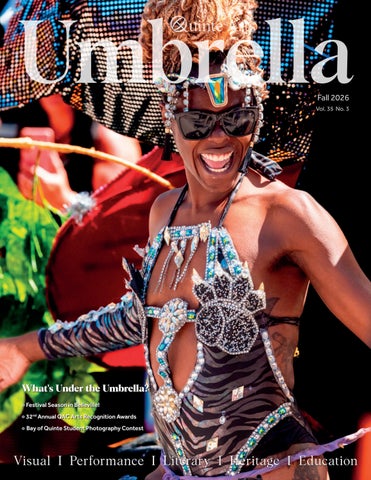
uinte Arts
Fall 2026 2025 Vol. 35 34 No. 3
What's Under the Umbrella? o Festival Season in Belleville! o 32nd Annual QAC Arts Recognition Awards o Bay of Quinte Student Photography Contest
Visual I Performance I Literary I Heritage I Education
Janet Jarrell, Executive Director janet@quinteartscouncil.org Andrew Gray, Program Director drew@quinteartscouncil.org Kim Lidstone, Bookkeeper qac@quinteartscouncil.org Graphic Design: Drew Gray The Quinte Arts Council is a notfor-profit, charitable organization, registration number 107869448 RR 0001. Published by: The Quinte Arts Council, P.O. Box 22113 Belleville, Ont. K8N 2Z5. Material may be reprinted only with permission. Umbrella is available in digital format through Issuu. The information contained within is believed to be reliable, but accuracy cannot be guaranteed. We do not assume responsibility for any errors and/or omissions related to submitted content.
Janet Jarrell, Executive Director Janet Jarrell, Executive Director, Quinte Arts Council Featured Artwork: Graham Gillmore, Photo: Ash Murrell
This is a time for art, culture and marks 75 years of community theatre, belonging. while Macpherson House in Napanee turns 200 — two very different histories, Across the Bay of Quinte, our com- both reminding us of the importance of munities are coming together through the places where stories are created, festivals, exhibitions, performances, shared and remembered. music, storytelling and shared experiences. Fall is one of my favourite Music fills these pages, too. From times to see our creative community the Belleville Caribbean Festival and in action — gathering in theatres and Downtown Belleville Blues Festival galleries, filling downtown streets with to Beautiful View Music Festival and music, discovering new artists and cel- Porchfest Belleville, these gatherings ebrating those who have helped shape show what happens when music moves our cultural landscape. into our streets, parks and public spaces: people come together. This issue of Umbrella is filled with those stories. Throughout the issue, you’ll meet creWe celebrate the artists and arts cham- atives working across disciplines, inpions recognized at Quinte Arts Coun- cluding photographer Gerry Fraiberg, cil’s 32nd Annual Arts Recognition filmmaker Doug Knutson, ARTrepreAwards and look ahead to Quinte Arts neur Titus Tolentino, performer Leah Fest — bringing writers, musicians, film- Hamilton, playwright Megan Hutton makers and audiences together this fall. and jewelry designer Delane Cooper. In Prince Edward County, Flowering Wild We also celebrate some remarkable explores how creative work and land milestones. The Belleville Theatre Guild stewardship can coexist.
We talk mystery, storytelling and the writing life with Janet Kellough and Women Killing It, and explore the creativity growing throughout our region. Closer to home at Quinte Arts, we share the work happening through our Accessibility Labs and CreateWell, celebrate arts education at A Loveliegh Place, introduce our Bay of Quinte Student Photography Contest, and welcome Edith Lepage Crete’s Fury and Grace. As you turn these pages, I hope you discover someone new, revisit something familiar, and feel that wonderful sense of connection that happens when we experience art together. Because art and culture don’t just make our communities more interesting — they help make them places where we belong. See you out there.
Cover: Caribbean Festival, Caleb Sayor
John M. & Bernice
PARROTT F O U N D AT I O N
QAC programs are funded in part by:
Back: Summer R
Table of Contents Quinte Arts Council Contributors Christopher Gentile Shoots the Quinte Arts Team QAC's 32nd Annual Arts Recognition Awards Quinte Arts Fest Autumn Attractions
2 3 4 10 14
Music Belleville Caribbean Festival Downtown Belleville Blues Festival Beautiful View Music Festival Porchfest Belleville
18 22 26 30
Photography Gerry Fraiberg
34
Film Doug Knutson
42
ARTrepreneur Titus Tolentino
46
Literary Women Killing It
48
Fine Arts Flowering Wild
50
Craft Delane Cooper
54
Performing Arts Leah Hamilton
56
Theatre Megan Hutton's Small Town The Belleville Theatre Guild Celebrates 75 Years
58 60
Heritage Macpherson House in Napanee Turns 200
62
Arts Education A Loveliegh Place
64
Quinte Arts Council Prioritizing Accessibility in the Performing Arts CreateWell Fury and Grace by Edith Lepage Crete Student Photography Contest
66 70 72 76
Bay of Quinte Regional Marketing Board Artist to Watch Richard Salaudeen
84
Contributors
Jennifer Shea
Lauren Little
Richard Hughes
Ardith Racey
Megan Lumgair
Greg Teal
Doug Knutson
Scott Williams
Quinte Arts Council
Janet Jarrell
02
Quinte Arts Council 03
Arlo Newman, Andrew Gray, Lauren Little, Janet Jarrell Christopher Gentile Photography
04
Quinte Arts Council
05
Rob Spence
Quinte Arts Council
Quinte Arts Council
2026 Arts Recognition Awards By Janet Jarrell 2026 Recipients Sean Sroka, Carl Wiens, Carlotta Rutledge, Wendy May, Janice “Kahehtóktha” Brant, Hannah Georgas, Photo by Caleb Sayer
There is something powerful about a room full of people coming together simply to say: we see you, we value what you do, and it matters.
That was very much the feeling at the Quinte Arts Council’s 2026 Arts Recognition Awards, held September 24 at Dinkel’s Restaurant in Belleville. Artists, friends, family, patrons, volunteers and community leaders gathered over lunch to celebrate six recipients whose contributions demonstrate just how many
Carlotta Rutledge
different ways the arts can connect people and create belonging. Since 1994, the Arts Recognition Awards have celebrated people and organizations whose creativity, leadership, mentorship and commitment have strengthened arts and culture throughout the Quinte region. This year’s recipients could not have represented that breadth more beautifully.
keeper from Tyendinaga Mohawk Territory, was recognized for a creative practice deeply connected to language, culture, traditional knowledge and the natural world. Through her art, teaching and community work, Brant continues to share knowledge while creating opportunities for others to learn and connect.
Janice “Kahehtóktha” Brant, a Kanyen'kehá artist, educator and seed
Artist and mentor Debra Vincent was celebrated for a lifetime of creativity, leadership and generosity. Her vibrant work reflects culture and teachings, but her influence reaches well beyond her
Janice06 “Kahehtóktha” Brant
Debra Vincent
Kevin Clarke (rep. Chris Mallette, MP), Mayor Neil Ellis, Wendy May, Janet Jarrell QAC ED, Tyler Allsopp, MPP
own artistic practice. Vincent has encouraged and mentored other artists, created opportunities and contributed to her community in countless ways. Wendy May was recognized for her vision and leadership behind the Loyalist College Arts Experience. What began with approximately 60 students in 2024 has grown to connect more than 400 learners with professional artists and creative experiences. At its heart is something wonderfully simple: give
people the opportunity to experience the arts, meet artists and discover their own creativity. For Carlotta Rutledge, the recognition celebrated the extraordinary contribution of someone who understands that community theatre is built both onstage and behind the scenes. Actor, director, producer, costumer, volunteer and mentor, Rutledge has spent years encouraging others to find their confidence and their own creative voice.
07
Belleville-based illustrator and artist Carl Wiens was recognized for a career that has taken his work around the world while keeping him firmly connected to the Quinte region. His illustrations have appeared in publications including The New York Times, The Wall Street Journal and Canadian Geographic. Most recently, millions of Canadians can carry a piece of his work in their pockets: Wiens designed the Royal Canadian Mint’s 2026 commemorative toonie celebrating the CN Tower’s 50th anniversary.
Dug Stevenson, Janet Jarrell, Hannah Georgas, Sean Sroka
Quinte Arts Council
Carl Wiens
Janet Jarrell
And then there is Beautiful View Music Festival, founded by musicians Hannah Georgas and Sean Sroka. In only two years, Beautiful View has created a new gathering place for music in downtown Belleville — bringing artists and audiences together while creating paid opportunities for musicians and building something that feels distinctly connected to this community. Different disciplines. Different journeys. Different stories.
Tony Silvestri filled the room with live piano throughout the afternoon
Helping bring those stories together was the afternoon’s MC, Hazzem Koudsi, Executive Director of Habitat for Humanity Hastings Prince Edward. With warmth, humour and an easy ability to connect with a room, Koudsi kept the celebration moving — and kept everyone laughing along the way.
But each recipient shares something important: through the arts, they connect people, create community and help others find a place where they belong.
And because every good celebration needs a soundtrack, Tony Silvestri filled the room with live piano throughout the afternoon, adding another layer of
Tony Silvestri, Photo by Drew Gray
08
Ross McDougall
Hazzem Koudsi, Photo by Caleb Sayer
warmth to the conversations, congratulations and connections happening around him. The Quinte Arts Council also acknowledged the continued support of McDougall Insurance & Financial, the Ontario Arts Council, the Parrott Foundation, the City of Belleville and the Bay of Quinte Regional Marketing Board, whose support helps make arts and cultural programming possible throughout the region.
Dug Stevenson
There were certificates, speeches, photographs, laughter and plenty of applause. But perhaps the most meaningful part of the afternoon was simply seeing the recipients surrounded by the people whose lives they have touched. Congratulations to the 2026 Arts Recognition Award recipients. Thank you for creating, teaching, mentoring, taking chances, opening doors and giving people a place to belong. Photography by Rob Spence
09
Mark Armstrong
Photo by Caleb Sayer
Quinte Arts Council
Downtown Belleville
Writers Fest October 23rd & 24th
Music Fest
November 6th & 7th
Supported in part by Experience Ontario Logo: Kory Parkin Bookshelf: Tim Fallis Guitar: Gerry Friaberg
November 14th & 15th Supported in part by
quinteartscouncil.org
Quinte Arts Council
Local Film Fest
Christopher Gentile Photography
Quinte Arts Council
Terry Fallis
Jane Urquhart
Fiona Campbell
Janet Kellough
Belleville Club, Oct 23rd
Belleville Public Library, Oct 23rd
Glanmore House, Oct 24th
Belleville Public Library, Oct 23rd
quinteartsfest/authors
O Green
Pinnacle Playhouse, Nov 7th
Pinnacle Playhouse, Nov 7th
Ten Kills The Pack
Kyra
Belleville Club, Nov 6th
quinteartsfest/music
Belleville Club, Nov 6th
Quinte Arts Council
Donovan Woods
Quinte Arts Council
Gerry Fraiberg
Creepy Curiosities Exhibit at the Glanmore National Historic Site October 1st-November 1st
FeeJee Mermaid
glanmore.ca 14
Kory Parkin Exhibition at the QAC Cultural Hub Presentation November 5th
Kory Parkin, Land Acknowledgement
koryparkin.com 15
Quinte Arts Council
Kory Parkin
Quinte Arts Council
Gerry Fraiberg
Steel Magnolias
at the Pinnacle Playhouse October 13th-November 1st
bellevilletheatreguild.ca 16
True Crime on the Bay of Quinte at Theatre in the Wings November 13th-15th
theatreinthewings.ca 17
Quinte Arts Council
Gerry Fraiberg
18
Music
Music 19
Caleb Sayer
A Celebration of Culture and Community Music
By Janet Jarrell
Belleville Caleb Sayer
You can feel a city's
pulse and see arts and culture before you ever step inside a space — sometimes, all you have to do is follow the sounds down the street. This summer and fall, Belleville did just that. Music moved onto porches and sidewalks, dancers filled downtown with colour, and neighbours gathered to
listen, dance, celebrate and belong. Across four very different festivals, the arts became part of the life of the city. In August, the fifth annual Belleville Caribbean Festival brought the sights, sounds and flavours of the Caribbean to downtown Belleville. Front Street became a place to gather and celebrate Caribbean culture through music, dance, food and art.
Caleb20 Sayer
A colourful parade moved through downtown before giving way to performances by Impulse Steel Orchestra, DJ Snipa, Ravi Sookhoo & N2, Snowflakes dance and Elvin Belfon. Joyful, energetic and community driven, the festival created an opportunity to celebrate Caribbean culture while welcoming the wider community to experience it. A few weeks later, the sound changed.
Caleb Sayer
Music 21
Caleb Sayer
Music
22
Sweet Pete and The Heat, Photo by Stuart Roberts
Music 23
Tony Vani, Photo by Deb Walters
Music
Bluesfest! The Belleville Downtown Blues Festival transformed downtown into a weekend-long celebration of the blues. The Fabulous Tonemasters, Sweet Pete and the Heat, Blues Harvest Band, Jay Blues Trio, Angelique Francis Band, Tim Campbell and The Stir were among the
Miss Emily, Photo by Deb Walters
musicians filling downtown with music. Free performances, workshops and family activities invited people not only to listen, but to participate. The festival also supported Gleaners Foodbank, connecting music and community with an opportunity to give back.
Shawn Dore Big Blues Band Photo by Deb 24 Walters
Jay Blues Trio, Photo by Stuart Roberts
25
Angelique Francis Band, Photo by Stuart Roberts
Music
Angelique Francis Band, Photo by Stuart Roberts
Music
26
Sarah Harmer, Photo by @lazompire
Music 27
Hannah Georgas
Music
Beautiful View! On September 18 and 19, the second annual Beautiful View Music Festival offered something a little more intimate. Founded by musicians Hannah Georgas and Sean Sroka, Beautiful View brought music into smaller downtown spaces, creating a close connection between artists, audiences and the city itself.
Ten Kills The Pack, Photo by @lazompire
Sarah Harmer and Hannah Georgas, Photo by @lazompire
The lineup included Sarah Harmer, Jeremie Albino, Ada Lea, Cadence Weapon, Thanya Iyer, Lisa Bozikovic and other emerging and established artists. Audiences moved between spaces, discovering new music while experiencing downtown in a different way. And then Belleville opened its porches.
28
Jeremie Albino, Photo by @lazompire
Music 29
Lisa Bozikovic, Photo by Lynda Rollins
Music
Porchfest! On September 26, Porchfest Belleville returned to the Old East Hill, with approximately 60 musicians and bands performing from front porches throughout the neighbourhood.
The Remedy Photo by Richard Barrett
September was also filled with cultural celebrations that reflected the many communities, identities and experiences that contribute to our region. The Jeepney Filipino Festival celebrated Filipino arts, food, music and culture, while Diwali brought the community together through tradition, performance and celebration. At Sir James Whitney School for the Deaf, Expression Unbound: Deaf Arts & Culture Festival celebrated Deaf artists,
People walked and cycled from house to house, following the sound of music along tree-lined streets. A porch became a stage. A front lawn became a concert hall. Neighbours became hosts.
30
Ryan Williams
culture and creativity, creating space for connection, expression and pride. Together, these festivals and celebrations tell a larger story about arts and culture in our community.
tions, but together they create something bigger: a community where culture is visible, accessible, celebrated and shared. That sense of belonging may be one of the most important things the arts give us.
Caribbean, Filipino and South Asian culture. Deaf arts and culture. Blues, indie, folk and contemporary music. Local musicians performing just a few feet from their audiences. Each gathering has its own identity and tradi-
We listen together. We dance together. We share our cultures and discover those of our neighbours. And somewhere between the music, art, food, stories and people, our community feels a little more like home.
Greg 31 Conway
Sam Bady of Impish Grins, Photo by Stuart Roberts
Music
Impish Grins, Photo by Stuart Roberts
32
Music
Music 33
Greg Conway
34
Photography
Photography 35
Gerry Fraiberg
Photography
Gerry Fraiberg By Doug Knutson
He is a man of many interests, many talents, and a long career in the arts. Born and raised in Montreal, one of Gerry Fraiberg's first jobs was as a tour guide at Expo 67. He started working in radio in 1969 in production. His first on-air job was at CKSO doing all-night DJ in Sudbury in 1976,
which caught the attention of the program director, who offered him a job in news. “I had no training, no formal education. So basically, they threw me into the deep end.” This led to a job offer at CJBQ in 1981, which brought him to Belleville, a move which Fraiberg has never regretted. He worked at CJBQ until 1997.
36
Belleville
Anna Fraiberg
Fraiberg got into photography not only as a business opportunity but a life-long passion. At that time, the CJBQ was in the same building as the Intelligencer and he got to know all the reporters and photographers and started picking their brains about things. Fraiberg also took a couple of evening courses at Loyalist College with
37
Photography
Photography
Joe Callahan. Fraiberg undertook photography projects for the Ministry of Natural Resources, Procter and Gamble, Three Oaks Foundation as well becoming the “Gala photographer” for County & Quinte Living magazine. Video was a natural step from photography. “Along comes Super-VHS and then the Video Toaster which allowed me to create a high-end polished look on an extremely low budget”.
In the early 90’s with McEwen and Associates Engineering, he began producing educational and promotional videos and also documentaries.
in the local Dancing With The Stars fundraise. This was a story of discovering inner strength and overcoming lifealtering misfortune.
Beyond the Beach (2002) focused on the ecosystem of the dunes at West Lake - the world's largest fresh-water bay mouth bar.
Code Stroke (2015) – an in-service instructional video for Quinte Health on cutting edge methods of treating strokes, has helped train countless paramedics and medical staff. It has over 481,000 views on YouTube! Fraiberg justifiably says “I'm proud of that one”.
One Step Away (2017) followed double amputee John Cairns as he participated
38
Music might seem like an afterthought for Fraiberg, but he says “I got my first guitar when I was 11 and it's always been a part of me”. Not playing much in public since High School, Fraiberg picked up the guitar again during the pandemic. “I'm going to go and do an open mic at Old Church Theatre. I hadn't played for anybody in decades. And I was shaking like a leaf, but I got through it, and I was talking to some of the performers there, and I said, so how do you do this? And they said, well, just keep going through it, you know, and eventually it calms down. But it doesn't really leave”. Fraiberg somehow managed to calm his nerves and has played at many open mics since then.
- that was the Christmas play in 2015. After the opening night standing ovation, I was smitten”. Fraiberg acted in more plays but also did front of house, sweeping floors, changing letters on the marquee, sound design and became technical director. The theatre has become “my church, if you will, or second family or tribe. You know, it becomes like one big family”.
Fraiberg has also squeezed in other volunteer work and served on the Boards of DocFest, the Hastings County Historical Society, and the Belleville Public Library and John M. Parrott Art Gallery. Fraiberg is currently editing interviews he has recorded with the major players of the Belleville Theatre Guild for its 75 anniversary. Photography by Gerry Fraiberg
visionandvoice.ca
Belleville’s Pinnacle Playhouse has become like a second home for Fraiberg over the past 11 years or so. “Peter Paylor, who I've known for a few years, suggested that I audition for It's a Wonderful Life, 39
Photography
Fraiberg’s company name, “Vision and Voice” also hints at his distinctive baritone voice. A natural for his work in radio news, Fraiberg has done voicework for his own videos and others and for clients such as Belleville Transit and TrainMasters TV.
40
Photography
Photography 41
Gerry Fraiberg
42
Film
Film 43
Doug Knutson, filming The Edge (Lee Tamahori, 1997)
Doug Knutson By Scott Williams
Belleville
Serengeti, Africa
Film
The life of a freelancer has many pluses and minuses, but one of the undisputed pluses is the variety of work it offers. Over the course of over four decades, Belleville filmmaker Doug Knutson has worked on everything from wedding videos to corporate communications to big-budget Hollywood productions, along the way working with names such as Anthony Hopkins and Alec Baldwin, and acclaimed cinematographer Derek Vanlint (Alien and Dragonslayer). To say there’s been a wide variety is to understate the gulf between the smallest and largest projects, and Knutson says he’s enjoyed them all: “Every one has been a challenge. I've never stopped being at university.”
University is where it all began, with a Film Studies degree from Queen’s. Unlike many of his peers, Knutson eschewed theory and analysis for more hands-on pursuits, creating Windswept Productions just a few years after graduation. Now, having worked in film production steadily over a forty-plus-year career makes him a film school rarity. Hundreds of projects over the years span every subject imaginable, but generally his independent work coalesces around three big themes: local history, the natural world, and social justice writ broad. A few examples of his work at home and abroad include:
CBC Radio Q
44
Hunger at Home was a commissioned by the United Church on food insecurity in Belleville Damned Rascal: the Story of John Walden Meyers is a work in progress profiling the man known as the founder of Belleville. The Sicily Campaign features World War II veterans sharing first-hand accounts of Operation Husky, the campaign that ultimately removed Italy from the war. A Hope in Hell: Small Steps in Haiti's Crawl to Recovery documents the challenges facing Haitians struggling with devastating gang violence and the ongoing aftermath of the 2010 earthquake.
Trenton Film Studio
Dam Beavers: The Struggle to Coexist is one of a number of Knutson's films exploring issues in nature and conservation in an urban setting.
“What I have on my desk or on my phone… it wasn’t even science fiction when I was in film school.” Along the way, Knutson has amassed an impressive library of archival material – thousands of hours of raw footage – and he’s been creating it for so long now that some of it has historical value of its own. The veterans Knutson interviewed for “The Sicily Campaign” have all since passed away, as have all other vets of that campaign. When Knutson interviewed Gwendolyn Lazier – the woman who, as an 18-yearold in 1924 rode a horse, alone, 800 miles to Washington D.C. to hand-deliver a letter from Belleville Mayor W.C. Mikel to President Calvin Coolidge, inviting him to the 140th anniversary celebration of the landing of United Empire Loyalists in the Bay of Quinte – she was already 97 years old. “In all of those cases, I sort of looked around, said, ‘well, no one else is doing it, I better get these done.’”
Knutson admits that he sees himself now “in the twilight” of his career, but the poignancy of the comment is balanced by a sense that perhaps he thinks the timing is right. “Everything has changed,” he says. “What I have on my desk or on my phone… it wasn’t even science fiction when I was in film school.” And while technology has been an enabler in many ways – allowing him to remain in Bellville for virtually his entire career, for example – he also sees how it has commoditized much of the work. “It's never been easier to do this, but nobody wants to pay anything for it.” It’s a long-term trend that has only gotten worse post-Covid. “Budgets
45
have virtually vanished, and the competition is infinite.” On top of that, there’s AI. “It’s the unspoken thing that’s looming over everything.” As for its impact on his own work: “It’s just a big question mark.” In the meantime, the work continues. Knutson has a list of projects – “the things I want to finish before I die” – that he initially says is a list of four items, but then proceeds to list four plus another half dozen. One gets the sense that, pending retirement notwithstanding, Knutson will continue telling stories on film for as long as there are stories to be told. windsweptproductions.ca
Quinte Museum of Natural History
Film
Serengeti, Africa
Titus Tolentino ARTrepreneur
By Lauren Little
Belleville
On Superstar set, Buzzflix, Photo by Kristen Walsh
Skills and drive, Belle- and Bruno Mars, he began to see his cre- appeared on a Times Square billboard ative pursuits as a possible career. for KOH Montreal’s “Barong” line and ville-based 22-year-old Titus Tolentino has both. Tolentino is a multi-talented creative working as an actor, model, dancer and content creator, with acting as his primary career goal. He is also an entrepreneur, operating his own photography and videography business, TVisual Media. Immersed in the arts from an early age, Tolentino began as a self-taught dancer at four, took up acting at ten and was creating social media content by twelve. Encouraged by teachers and peers, and inspired by artists such as Michael Jackson
Christopher Gentile Photography
That direction was strengthened through Centennial Secondary School’s Arts Program and the influence of his Communications Technology teacher, Michelle Beaudette, whose passion for the film industry helped shape his journey. Tolentino graduated from Loyalist College’s Television, Filmmaking and Digital Content Creation program in 2024. His career continues to gain momentum across both modelling and acting. He
walked the runway at Toronto Fashion Week for Juan Iskandar’s “Metempsychosis” collection. His on-screen work has included a Netflix x T-Mobile commercial, working alongside members of the cast of Stranger Things, and background work on the Netflix production I Will Find You. Looking to expand his opportunities in the Bay of Quinte and Toronto, Tolentino signed with The Agency Talent Management in July 2025. In summer 2026, he
46 Juan Isklander's "Metempsychosis" Runway
starred in the lead role of the four-part movie series Superstar with Buzzflix. Working with director Adrian Coelho on Superstar became a turning point. The role required Tolentino to tap into intense emotions and taught him to step away from strict memorization, focusing instead on experiencing his character’s emotional journey. To prepare for a role, he analyzes the script and creates personalized playlists to connect with his character. When perfectionism disrupts his focus, he turns to improvisation and warmups to stay grounded.
MN8 , short film (directed by Lauren Little, 2026)
“The most frustrating part is comparing yourself to others, but remembering that even though you’re not at the level that others are at, it doesn’t mean you won’t get there, because you can, one day.”
Looking ahead, he hopes to broaden his acting repertoire beyond romantic comedies and explore more action-oriented roles, including opportunities involving stunt work.
Tolentino sees his development as an ongoing journey, recognizing there is no single blueprint for success. For him, the fundamentals remain consistent: keep practising, hold onto your passion, persevere through challenges and build meaningful relationships.
Ultimately, Tolentino values the relationships he is building as much as the roles themselves. Every opportunity offers something to learn—not only about his craft, but about himself and the kind of artist he hopes to become. titustolentino
Between bookings, Tolentino continues to audition for commercials, television and film while building industry connections, acting in student short films and running TVisual Media. His skills also include singing and dancing, and after practising hip-hop for most of his life, he has recently expanded into contemporary, jazz and theatre. Navigating the creative industry comes with challenges, particularly the temptation to compare his progress with others. 47 Ethan Kikkert
ARTrepreneur
On Stranger Things set with Noah Schnapp
Women Killing It: In Conversation with Janet Kellough By Janet Jerrell
Prince Edward County
Literary
Wishful Seeing by Janet Kellough, cover art
There is something dark and intriguing about a group of women getting together under the banner Women Killing It. Rest assured, no actual crimes are planned. At least none that we know of.
For Prince Edward County writer Janet Kellough, however, murder, mystery and the darker side of human nature have provided plenty of material over the years.
dlebag preacher through 19th-century Upper Canada. The fifth novel in the series, Wishful Seeing, was shortlisted for the 2017 Crime Writers of Canada Arthur Ellis Award for Best Novel and later made the leap from page to stage when it was adapted for a production by 4th Line Theatre.
Her writing has wandered through contemporary and historical fiction, science fiction, journalism and theatre. Her science fiction thriller The Bathwater Conspiracy was nominated for an Alberta Publishing Award in 2019, and she has written numerous feature articles for community newspapers.
But mysteries are only part of Janet Kellough’s story.
Then there is storytelling.
"The world is full of fascinating things, and if you find something that gets you jazzed, chances are that you'll have first run across it in a book you read."
"They always say write what you know, but it actually makes more sense to write what you don't know, but would like to find out about. The research is half the fun." Kellough has always understood the power of a good story, and she tells them well. She has written, produced and performed shows rooted in local and regional history, including Fowke Tales, Survivors of War and the wonderfully titled Tales from the Wellington Dump.
Kellough is one of those writers who is difficult to fit neatly into a box. Novelist, storyteller, playwright and performer, she has spent a lifetime telling stories in just about every way imaginable — on the page, on the stage and in front of a live audience.
There is a common thread running through all of it: people, place and the stories that connect the two.
She is perhaps best known for The Thaddeus Lewis Mystery Series, seven historical mysteries that follow a sad-
That connection to place is particularly fitting for a writer who 48
calls Prince Edward County home. Kellough describes herself as living in an “unfashionable” part of the County with her husband, a blue heeler and thousands of red cedar trees. In a place increasingly known for wineries, restaurants and weekend getaways, it feels reassuringly County.
How does a writer turn history into mystery? Where do characters come from? How does a story change when it moves from the page to the stage? And after decades of writing, performing and telling stories, what keeps a writer curious enough to sit down and begin another one?
Kellough also helped create a space specifically for women who write about murder.
Perhaps most interestingly, what is it about crime writing that continues to fas-
cinate both writers and readers — and why are women so very good at killing people on paper? Come hear the stories from someone who has spent a lifetime collecting, creating and telling them. quinteartsfest/authors janetkellough.com
Together with fellow crime writer Vicki Delany, she co-founded Women Killing It, a literary festival focused on women authors working in mystery and crime writing. What began as an opportunity to bring writers and readers together became part of the local literary landscape and now continues under the umbrella of the Prince Edward County Library system. On October 23, Kellough brings the conversation to the Quinte Arts Festival Writers Fest for Women Killing It: In Conversation about Mystery Writing, Storytelling and the Writing Life. And there is plenty to talk about. 49
Women Killing It 2023: Carolyn Whitzman, Vanessa Westermann, Janet Kellough, Photo by Joanne Fralick
Literary
Janet Kellough Photo by coffeecanine
50
Fine Arts
Fine Arts 51
Kassandra Melnyk
Fine Arts
What have you learned from the land you inhabit? By Megan Lumgair
Like a red-tailed hawk circling in the sky, this question has been circling inside my mind for months. It is deeply connected to Flowering Wild, an art project that began in 2019 as a response to creative liberation and has evolved into an exploration of how creative work and land stewardship can coexist.
Prince Edward County
On Sunday, July 19, Flowering Wild presented its latest installation at Sarah Crawford and David Kirkwood’s farm in Prince Edward County. The restored location, celebrated for its land stewardship and adaptive reuse of historic agricultural buildings, served as the canvas for this collaborative floral art event.
The day before, florists arrived in the rain carrying buckets of foraged smokebush, sweet pea, wild carrot, wheatgrass, asparagus, mountain mint and yarrow. In another building, artists Sarah Crawford and Lori Richards were putting the finishing touches on Regeneration, an installation made from objects found on the farm. Four tree-
Flowering Wild is a collective of independent florists, growers and land-connected creatives, convened through studio free folk, who come together to create immersive floral
installations rooted in seasonality, place and community care. We gather around a shared belief that flowers are both art and offering—ephemeral, expressive and deeply tied to the land.
Alysia Ausubel (Begonia Moon Flower Studio) Alexis Bouma (Alexis Joy Florals) Sarah Crawford (East Lake Farm) Krista Dalby (The Department of Illumination) Megan Lumgair (studio free folk) Kassandra Melnyk (Kassandra Melnyk Photography) Marilou Perron (Early Grey) Bethany Puttkemery (Smells Like Flowers) Lori Richards (Lori Richard Art) Kylea Smart (The Kenhtè:ke Seed Sanctuary and Learning Centre) Kate Turkington (Westbriar Floral)
52
themed paintings by Richards anchored the space, reflecting what Crawford describes as Richards’ use of “natural elements to explore the mysteries of landscape and consciousness.” In 2021, proceeds from the second edition of Flowering Wild supported the Kenhtè Seed Sanctuary & Learning Centre, an acknowledgement that I, like other settlers, live and work on stolen land. This year, Flowering Wild again supported the Seed Sanctuary, alongside the Department of Illumination—two community organizations deeply rooted in restoring reciprocity, community care and storytelling.
Fine Arts
For me, Flowering Wild has always stirred feelings of both grief and gratitude. Grief for our planet under increasing pressure, made especially immediate as I watch my daughter’s summers marked by air-quality warnings and intense heat. And gratitude— for the artists, florists and volunteers involved in this project, for the people who attend, and for the fact that art can hold space for difficult conversations. The juxtaposition—the heavy thud of dread and the glimmer of gratitude—is an invitation to recognize that multiple things can be true. I keep returning to something Kylea Smart from the Seed Sanctuary said: “Stewardship is not about control, but about working in relationship with the natural world.” That idea has changed how I think about Flowering Wild. The flowers, installations and seasons are temporary. What remains is the relationship—to the land, to each other, and to the responsibilities we inherit from those who came before and those who come after us. And when I think of my own answer to that opening question, I dance with the concept of wild time, and the way the land reminds me that everything has its own season. And so, dear reader, what have you learned from the land you inhabit? Go ahead and answer. The land is listening. Photography by Kassandra Melnyk
53
Delane Cooper: When Dreams Meet Craft Crafts
By Ardith Racey
"Jewellery tells a story without even a single word” (Michael Rosey West), but what if there are multiple stories and meanings held within a single piece? And what if that absolutely gorgeous piece has been custom made? That’s Delane Cooper’s goal when she creates her striking, one-of-a-kind rings and bracelets. In fact, she writes a story and gives it a title before she even begins designing and crafting a piece.
Cooper calls herself a “dreamatizer,” and for good reason. Her work is the result of taking others’ jewels, stories and histories and creating something meaningful
and resonant through a process of dreaming, meditation, research and craft. Cooper is no ordinary goldsmith: she uses intuition and dreamscapes to inspire both her work and her life.
Prince Edward County a celebration, or to symbolically hold loved ones near.”
Cooper understands trauma and the importance of confronting the past, while also recognizing its ability to shape the present and inform her work.
“Many people say that they feel like warriors when they wear the piece because it gives them connection,” says Cooper. That is an important part of Cooper’s gift: her ability to discern and empathize with others’ grief and joy, listening with her heart and thinking with her hands.
“I do a lot of remakes - especially old, inherited jewels and metals, and I try to recreate a story and image that’s meaningful. I sit with people and learn why they want the piece. Often it’s to commemorate a pivotal moment,
Imagine, for example, a ring made from family stones, using lacework and engraving to suggest a stone fence beneath a sky of Irish constellations, each representing family members, and you begin to understand. Cooper’s work is
54
Letters to Eli - My Story, the Story of Many, a memoir chronicling her early life experiences through a series of letters, encourages readers to use words and art to move through traumatic experiences. She also plans to write a novel.
The result was “my first art installation at the Carriage House, Macaulay Heritage Park, in Picton, called Straddling Grief - it was inspired by a series of bangles that I did with only a torch and my hands to represent intergenerational trauma.”
"Art gives us a voice when words are not there.”
After spending many years in the corporate world of sales, Cooper says, “being an artist allows me to be who I am without being fake. My one rule as an artist is to be me, and now that I am working full time as an artist, I’m in alignment with myself.”
The experience opened another creative path, leading Cooper to experiment with wood and other materials and to explore
Her own support of community organizations is another extension of her creative practice. Cooper and Jackie Eldridge co-founded The Lotus Hero Project, now in its fourth year, a collaborative arts program for girls focused on preventing trauma and strengthening young voices through art and art therapy.
That sense of alignment—with herself, her creativity and the world around her—is apparent in her work and words. But perhaps most remarkable is her ability to distill stories, memories and emotions into jewelled symbols that can be carried with us.
Cooper says, “if I’d had a safe space to talk about things, maybe I would have been safe sooner. Now, creating is how I’m heard - what you see in my art is my voice. Art gives us a voice when words are not there.” But Cooper also uses words. 55
Cooper touches people’s lives by combining the craft of goldsmithing with dreamsmithing. Her jewellery can hold a family history, commemorate a moment, carry grief or celebrate joy—all within something small enough to wear on a hand or wrist. If creativity comes through dreams, then dream on, Delane Cooper. Delane Cooper
Crafts
“A while ago, I began to think of my jewellery as small sculptures, so I began to wonder if I could do something big,” says Cooper.
public art. Her work has since been displayed at Verity, a women’s boutique hotel and club in Toronto. Cooper says she often has to “dig deep,” while acknowledging the support and mentorship she has received along the way.
elegant yet complex—small, storied emblems of our roots and our dreams.
Leah Hamilton: Building a Career in the Arts By Jennifer Shea
Belleville
Performing Arts
Sebastian King
Leah Hamilton is a Gen Z arts entrepreneur who has parlayed her artistic talents into a thriving business built around helping other artists. This high-energy arts and culture enthusiast has grown Elevation Hall through a breadth of experience, strategic collaborations and seemingly endless energy.
Elevation Hall offers two distinct services: arts education and artist talent representation. Working with a Toronto-based colleague, the business has evolved and expanded beyond its Belleville headquarters.
Having grown up in the arts as a professional dancer with Quinte Ballet School of Canada, Leah’s artistic endeavours have included modelling, acting, singing, choreography and theatrical production. She completed a degree in Amsterdam, studying arts entrepreneurship, arts education and cultural cognition—how the arts develop our brains. When her work visa expired during the COVID pandemic, she returned home to Belleville and started Elevation Hall. Back in Belleville, Leah set about networking and finding other like-minded arts professionals to collaborate with.
“When you’re in a small community, if you’re open to it, it’s easy to see how everything is inter-related. You need that as an artist. Your career is in the value of your connections. It’s such a cliché to say, ‘it’s who you know’, but it is.” Those connections are at the heart of Elevation Hall. “Every time we launch a new course or a workshop or even a community event, it’s all about how to bring together all these artists with great potential who love what they do and help them put it out into the world. Industry-integrated arts education is what I’m focusing on now and going forward.” Leah’s enthusiasm bubbles over when she talks about a new workshop being offered by Elevation Hall: “Dance on Film.” “It’s a dance class, but we teach students how to work with the camera – for movies, music videos, social media reels – learning how to apply those skills to the film industry. That’s something that I think we’re going to take on the road because it has such excitement.” On the talent agency side of Elevation Hall, Leah works with performers of all ages. She encourages her clients—
56
Elevation Hall
whether models, actors or dancers—to think of themselves as having their own small start-up business. “I’ve scouted a few people who I think can be connected to jobs locally, Toronto, Montreal or internationally. It’s all about getting them in the room with the right people. Trying to find an agent is like trying to find an investor for your company. You’re looking for someone who will invest in you, train you a bit, and walk you through the life cycle of student to career.” Her focus is also on creating more opportunities closer to home.
Sebastian King
“With the agency, it’s also about bringing projects here. With two creators – a feature film director and producer – we have a few feature film projects. This helps support local talent, giving them more opportunities.”
Leah also recognizes that participating in a variety of arts experiences makes her better at what she does. It is a holistic approach to the arts that carries through to the educational opportunities offered by Elevation Hall.
After the hustle of saying “yes” to every opportunity that came along during the uncertainty of the pandemic, Leah is now able to be more selective and balanced in how she spends her time. She has returned to Quinte Ballet School to teach musical theatre and has stepped onto the community theatre stage as an actor in Sister Act and A Midsummer Night’s Dream. She also choreographed dance numbers for Sister Act.
With one parent an elementary school music and piano teacher and the other in business, Leah feels it may have been inevitable that she would become an arts entrepreneur. But how she has shaped that path, built Elevation Hall and created strong connections throughout the arts community is distinctly her own. elevationhall.com
She is realizing that her own time in the arts is just as important as her work supporting the careers of others. The arts are where she wants to be—even if she didn’t need to work. “It feels very intuitive. I love people and I love talking to people. That’s a huge part of this job, whether it’s dealing with clientele, helping them network – it’s a people business. Also, carving out time to perform for myself. That’s my why – why I’m doing this. It’s my therapy to be on stage or in a dance class, doing it for myself.” Lauren Kauffman
57
Elevation Hall
Performing Arts
Sebastian King
Megan Hutton's Year of Living Theatrically
Theatre
By Scott Williams
Prince Edward Coun-
So when she declared 2026 her “year of theatre,” it was a nuanced pivot.
She began by creating The Marysburgh Mummers’ musical The Ultimate County Kid, a fun, satirical exploration of County tropes through the lens of an American Idol-style talent contest. Participants defend their County bona fides through recollections of local lore. The audience reaction was enthusiastic—“Awesome,” “Just incredible,” “Amazing, amazing, amazing!”—and all but the earliest performances were entirely sold out.
“It wasn’t the beginning of my relationship with theatre, so much as the year I decided to stop standing halfway outside it.”
Hutton describes creating County Kid as a natural first step in her theatrical year.
ty's singer-songwriter and recording artist Megan Hutton has spent years in and around community theatre, acting in Rosalita’s Piano and Spring Awakening, script editing Private Reuben Pearce, scoring Bridge Street, and writing Keep Sakes, winner of the 2024 SPARC playwriting contest.
Prince Edward County “I felt comfortable with that being the first thing out of the gate because it felt like a normal transition from songwriter to writing a musical and then writing a play.” That play became the second of her two 2026 productions, Small Town, originally conceived as a musical before being rewritten as a drama/comedy.
Small Town is set in the fictional community of Monroe, a place on the edge of generational change and populated by characters instantly recognizable to anyone who has lived in a small town. There is Lyle Monroe, the elderly mayor whose family gave the town its name, and his grandson Kyle, destined to follow in his footsteps but armed with progressive ideas—his “manifesto”—and gay to boot. Doc Bishop is the town’s should-probably-already-be-retired GP, while his son Ben is fresh out of medical school and eager to modernize his father’s oldschool practice. At the centre is Kate Wright, owner of the town’s only newspaper, who must decide whether to sell and leave the small town behind.
58
“There wasn’t a dry eye in the house,” she says, clearly proud of the emotional impact the scene had on her audience.
As the story unfolds, it becomes clear that life is not always ideal in this idyllic small town. Kate and Ben’s developing relationship fractures, Kyle’s manifesto creates speculation and hostility, Kate and Kyle’s shared grief threatens to overwhelm them, and Kate’s decision to sell becomes a lightning rod for resentment and backlash.
Hutton says Small Town is about “change versus tradition, about grief and belonging and community,” and all of that is true. But the play also asks its audience to look a little deeper: to peel back the layers of our own beliefs and consider what community really means. What is important to us? What values do we share? And what does our shared humanity look like when change inevitably arrives?
Through it all, Hutton maintains a sense of optimism without slipping into sentimentality—a deliberate choice. “The world is a chaotic mess right now, and when I wrote these two plays it was really important for me to put some positive messaging out there.” In The Ultimate County Kid, after a newcomer is kicked out of the contest simply for being a newcomer, Hutton follows the scene with the song You Belong Here, a moment of catharsis that closes the first act.
59
Perhaps that interpretation brings something unintended to the play. But part of the strength of Small Town is that, while its world and characters are fully formed, there is still room for audiences to find their own meaning within it—their own understanding of belonging, tradition, change and community. Hutton says she spent years feeling she didn’t quite belong in the theatre world. In her self-declared “year of theatre,” she finally stopped standing halfway outside it. Photography by Sarah Kirby Megan Hutton
Theatre
Around them are the farmers, sheriff, pastor’s wife and other familiar figures who make Monroe feel immediately lived-in.
75th Anniversary of the Belleville Theatre Guild Theatre
By Janet Jarrell
For 75 years the Belleville Theatre Guild has been creating magic — one production, one volunteer and one story at a time.
It began simply in 1951, when a group of friends gathered at the home of Gladys and Bert Simpson to read a play for pleasure. They enjoyed the experience so much that an idea began to take shape: why not create a theatre group?
Later that year, a public meeting at the Corby Library marked the beginnings of the Belleville Theatre Guild. One of the Guild’s earliest productions, Robertson Davies’ The Voice of the People, quickly demonstrated what this new group could accomplish. The oneact play won the Eastern Ontario Drama League Festival and earned an invitation to the Dominion Drama Festival the following spring.
The early years were not without challenges. Without a permanent home, members rehearsed and worked wherever they could find space. Then, in 1969, the Guild found its home. The former Salvation Army Citadel on Pinnacle Street became the Pinnacle Playhouse, beginning a new chapter in the organization’s history. Over the decades, the building has evolved alongside the Guild, becoming an important home for community theatre in Belleville. For its 75th season, the Guild is reaching into that history. Rather than simply marking the anniversary, the season revisits favourite productions from years past, many selected by Guild members. These revivals offer an opportunity to see familiar stories through new eyes — and to recognize the generations of performers, directors, crews and audiences who have shaped the Guild along the way. Among them is Steel Magnolias, originally directed at BTG by Paul Moorman
60
And there are many people behind every production.
in 1995. An audience favourite then, its return brings together members of the original production with new cast members, connecting two moments in the Guild’s history on the same stage. The season will also revisit Oliver!, a particularly significant production in BTG’s story. It was the first musical ever performed by the Guild, originally staged at the BCI auditorium and directed by Liz Marshall. Bringing it back during the 75th anniversary season is a fitting nod to the people, productions and places that came before the Pinnacle Playhouse became the Guild’s permanent home.
Community theatre depends on actors and directors, but also set builders, costume makers, lighting and sound crews, stage managers, musicians, front-of-house volunteers, board members and countless others who quietly make sure the show goes on. Over 75 years, local residents have learned their craft at the Guild, discovered talents they didn't know they had, made lifelong friendships and found a place where they belong. Perhaps that is the real story behind 75 years of the Belleville Theatre Guild: not simply the number of productions staged, but the generations of people who have made them possible. 61
The sets change. The costumes change. Generations come and go. But after 75 years, the lights are still coming up at the Pinnacle Playhouse — and there are still stories waiting to be told. Photography by Greg Pinchin Belleville Theatre Guild
Theatre
Looking back, however, is only part of an anniversary. The 75th year also brings plans for improvements to the auditorium, audience access, backstage areas and technical spaces — ensuring the building continues to serve the people creating and experiencing theatre there.
Heritage
A Treasure Discovered Along the Banks of the Napanee River By Richard Hughes
Wouldn't it be wonderful if we could step through a doorway and pass from this fast-moving electronic world of computers, smartphones and endless social media into a slower time of calm, quiet and solitude? Even for a few hours.
Right here in Quinte, it is possible to step back to the 1820s, into a world without electricity, where the calm and tranquility are palpable. The elegant home of Allan Macpherson, built in 1826 on the banks of the gently flowing Napanee River, offers just such a haven—a setting of pioneer elegance and simplicity. There is an instant change of atmosphere as you pass through its stately entrance into the world of some of our region’s earliest settlers. The man who built this house was Allan Macpherson, born in Scotland and the son of a senior military officer who came to Canada in 1809. Rather than following his father into a military career, Allan saw his future in the business opportunities emerging in this new land.
Napanee
While living in Kingston, Macpherson recognized opportunity in the small village of Napanee, where he rented a grist mill and sawmill, eventually coming to own them. He achieved considerable success, producing lumber for newly arrived settlers to construct their homes and barns, as well as fine-quality flour that he shipped to Kingston and Montreal. Clearly, Macpherson had a vision for Napanee’s future. He steadily expanded his operations, opening a general store to provide equipment and supplies for the growing village, followed by a post office within the store. Recognizing that a thriving community also needed a school and church, he helped establish both. Macpherson became deeply involved in the life of the growing region, serving as road commissioner, court commissioner and justice of the peace, among other roles. In 1839, he established a distillery and, the following year, joined others in opening Napanee’s first newspaper. He had both the vision and energy to turn ideas into reality, contributing signifi62
cantly to Napanee’s development as a prosperous and growing village. In 1848, Allan and his wife, Mary, moved to Kingston, where he became Crown Lands Agent for the Midland District, while his son continued the family’s many businesses.
Heritage Along with his contributions to the development of Napanee, Macpherson left another treasure that remains today— his magnificent 1826 home overlooking the Napanee River. The classical Georgian house, with its symmetrical doors and windows and large, airy rooms, has been lovingly restored and furnished to reflect its years as the estate of the “Laird of Napanee.” Stepping inside, it is easy to imagine Allan sitting before the great fireplace in the summer kitchen or studying accounts in his office, while Mary sews or knits, visits with other women in the community, and their six surviving children gather in the playroom.
transferred the house and its collections to the County, integrating them into the holdings of the Lennox and Addington County Museum and Archives. Now marking its 200th anniversary, Macpherson House remains a tangible connection to Napanee’s early history.
Throughout the house, these glimpses of everyday life transport visitors to another age—one that existed here two centuries ago. In 1962, the Lennox and Addington Historical Society purchased and restored the property, remaining faithful to its origins. In 2014, the Historical Society
63
Within its rooms, the story of one family intertwines with the story of a community taking shape along the river. Two hundred years later, step through the doorway and, for a little while, the modern world seems very far away. countymuseum.ca
Arts Education
A Truely Loveliegh Place By Greg Teal
For Leigh McCarthy,
learning has never been confined to a classroom. After more than 20 years teaching in public, private and international schools, she wanted a different kind of teaching and learning environment— one where creativity, community and self-expression could take centre stage. That vision became A Loveleigh Place in Napanee. “I still wanted to be teaching and learning,” McCarthy says, “but spend more time immersed in visual arts.”
Napanee
She found that art was often where those two needs came together most naturally.
That is one reason she is particularly drawn to abstract art.
“There were multiple entry points for sharing and self-expression,” she says. “Tons of windows to be CREATIVE.”
“I’m definitely more of a fan of abstract art styles,” she says, “precisely because of the freedom and veering away from perfectionism.”
For McCarthy, art also provides something that traditional classroom learning sometimes cannot: the opportunity to enter a state of deep concentration and simply get lost in the process. She describes it as a “flow state,” where internal chatter and self-criticism can quiet down.
Her studio and learning space, which opened in 2024, brings those interests together, offering art workshops, tutoring and opportunities for people of all ages and abilities to learn and create. McCarthy’s teaching career took her to international schools in Thailand, Qatar, Tanzania and Japan before bringing her back to Ontario. Those experiences reinforced something she had already learned: people want to learn, but they also want to be seen and heard. 64
At A Loveleigh Place, mistakes are not failures. They are possibilities. McCarthy encourages participants to embrace the kind of “happy accidents” celebrated by Bob Ross, reminding them that crooked lines
And then, she says, comes the best part: watching them do it.
“Whatever you call it,” McCarthy says, “it is wonderful.” That focus on confidence and inclusion extends throughout the studio. Accessibility was part of McCarthy’s original vision, both physically and financially. A new ramp and fully accessible washroom have brought her closer to realizing that goal, while her
Sharing to Create Opportunities Fund has provided more than $4,000 in donated support for people who might otherwise not be able to participate. Through a partnership with Community Living Lennox & Addington, A Loveleigh Place has also hosted weekly art workshops for adults with developmental disabilities, supported by grants from the Community Foundation for Lennox & Addington. McCarthy says the experience has been a source of tremendous joy. That sense of shared creativity is perhaps what best captures A Loveleigh Place. McCarthy describes the “creative collective energy” that develops when eight to twelve people sit around the studio table, each absorbed in their own project while quietly creating alongside one another. Someone might share an idea, admire another person’s work, or simply enjoy the company before returning to their own creation. 65
“Whatever you call it,” McCarthy says, “it is wonderful.” What does she hope visitors take away from the experience? “To be inspired, feel peaceful – if not happy, and a sense of welcome and belonging,” she says. For McCarthy, that would mean they had truly visited A Loveleigh Place. Photography by Greg Teal aloveleighplace.ca
Arts Education
and unexpected results can sometimes make the most interesting art. The same philosophy applies to learning. McCarthy is a strong believer in the growth mindset and the power of changing “I can’t do this” into “I can’t do this yet.” For students struggling with confidence, she sees her role as providing enough guidance and encouragement for them to glimpse what they might eventually accomplish.
Quinte Arts Council
Prioritizing Accessibility in the Performing Arts By QAC Team
This past summer, the Quinte Arts Council brought artists, arts organizations, volunteers, board members, and community leaders together for a three-part Accessibility in the Performing Arts learning series—creating space to listen, reflect, ask questions, and consider how we can build more accessible and welcoming arts experiences across our region.
Dr. Terri-Lynn Brennan is Executive Director of LodgePole Arts Alliance and Founder and CEO of Inclusive Voices Inc. An intercultural planner, educator, sociologist, and public policy leader with Kanien’kehá (Mohawk) and British ancestry, she has spent more than 30 years advancing Indigenous self-determination, reconciliation, equity, and inclusive community development.
Rachel Marks is Executive Director of Réseau SPARC Network (Supporting Performing Arts in Rural and Remote Communities) and an accessibility consultant working within the performing arts. Drawing on experience in theatre production, arts education, and disability advocacy, Rachel works with organizations to identify and remove barriers and create more accessible experiences
66 Terri-Lynn Brennan Dr.
Rachel Marks
The free, full-day sessions were part of Quinte Arts’ ongoing commitment to accessibility in the arts. Designed to meet participants wherever they were in their accessibility journey, the series combined practical knowledge with thoughtful conversation, lived experience, and opportunities to learn alongside others working toward the same goal. Guiding the learning were Dr. Terri-Lynn Brennan, Rachel Marks, and Brittany Dale, each bringing distinct knowledge, experience, and perspective.
Quinte Arts Council for Deaf, Disabled, neurodiverse, and equity-deserving communities. Brittany Dale is an Indigenous academic, policy analyst, and visual artist whose work brings together Indigenous knowledge, public policy, creativity, and community engagement. Through LodgePole Arts Alliance, she has helped facilitate learning around accessibility,
disability justice, and creating more inclusive arts spaces. Her own artistic practice includes traditional and contemporary beadwork. Throughout the series, participants explored Indigenous histories, cultures, lived experiences, contemporary realities, and the lasting impacts of colonization. Conversations considered the importance of relationship-building and our responsibilities as treaty partners, while asking how arts and community spaces can become more respectful, informed, and inclusive. One of the most meaningful discussions centred on the Seven Generations Principle—the understanding that the decisions we make today can have an impact far beyond ourselves. From organizational policies and programming to everyday interactions, participants were encouraged to consider how our choices
Brittany Dale
67
might shape the experiences of generations still to come. That long view offered a powerful lens through which to think about accessibility. Rather than approaching inclusion as a checklist or a problem to be solved, what happens when we understand it as an ongoing responsibility to one another? The learning continued through conversations about the ways disability is understood and experienced across different cultures and communities. Participants explored disability, accessibility, and lived experience, considering how listening to different perspectives can deepen our understanding and help create arts spaces where more people feel that they belong. During the second learning lab, discussions centred on the Ten Principles of Disability Justice. The frame-
Quinte Arts Council
Lodgepole Arts Alliance
work encouraged participants to look beyond simply removing physical barriers and to consider the systems, attitudes, relationships, and decisions that influence who can participate—and how. Our final session, Approaches to Inclusion from an Indigenous and Disabled Lens, brought these ideas together.
Guided by the Seven Grandfather Teachings and the Ten Principles of Disability Justice, participants worked through real-world scenarios and considered how these values could inform the choices arts organizations make every day.
work already happening within their organizations. Accessibility is not about reaching a perfect destination. It is about continuing to learn, noticing where barriers remain, listening to lived experiences, and taking meaningful action.
Throughout the series, participants were also encouraged to recognize the
By the end of the series, participants had identified areas for continued growth and practical steps they could carry forward into their own organizations and communities. The formal conversations may have ended, but the work continues. Accessibility and inclusion are ongoing practices—built through the policies we create, the programs we offer, the spaces we welcome people into, and the relationships we nurture. Each decision gives us another opportunity to ask who is included, who may still be facing barriers, and what we can do differently.
68
Quinte Arts Council A special thank you to our facilitators Dr. Terri-Lynn Brennan, Brittany Dale, and Rachel Marks, and to Knowledge Holder Carol Anne Maracle, whose presence, teachings, and guidance helped ground this work in respect, relationship, and shared responsibility. Most of all, we are grateful to everyone who joined us with openness, curiosity, and a willingness to learn from one another. Creating a more accessible arts community is work we do together—and every conversation, question, and action helps move us forward. Thank you to the Canada Council for the Arts for supporting this work and making these learning opportunities possible. Photography by Rob Spence lodgepolearts.ca sparcperformingarts.com rachelmarks.ca
69
Quinte Arts Council
CreateWell By QAC Team
Quinte Arts is proud to have launched CreateWell, a community-based arts-for-wellness program in collaboration with Maggie Stevenson of Blue Roof Studio and Jodi Cooper of Creative Way, and made possible through the City of Belleville’s Social Infrastructure funding. The program strengthens wellbeing, connection, and belonging through creative expression.
Delivered in partnership with community organizations across the Quinte region, CreateWell brings accessible arts experiences into welcoming community spaces where creativity supports personal growth, social connection, and community resilience. The program brought accessible, arts experiences into familiar, welcoming community spaces by partnering directly with local organizations serving equityMaggie Stevenson
70
deserving groups. By strengthening protective factors such as belonging, self-expression, creative problem-solving, and stress reduction, CreateWell’s research-informed design supports existing community initiatives that focus on crisis prevention, addiction recovery, mental health services, and housing stability. CreateWell equipped local artists with training to facilitate psychologically safe, inclusive arts sessions that strengthened community capacity, fostered social connection, and supported wellbeing. Delivered in collaboration with local artists, therapists, and by working with community organizations, including Belleville and Quinte West Community Health Centre and the Enrichment Centre, ensured participants received professional guidance and a supportive environment to explore their creative potential. Sessions were tailored
Quinte Arts Council to meet the unique needs of various groups, including youth, seniors, and those facing socioeconomic barriers. Through creative participation, individuals build confidence, explore new perspectives, develop coping and problem-solving skills, strengthen relationships, and experience joy, meaning, and possibility. Grounded in research on the benefits of arts engagement, CreateWell recognizes creativity as a powerful resource for individual and collective wellbeing. Studies have shown that creative arts therapy can have a profound impact on mental health. According to the Canadian Mental Health Association, one in five Canadians will experience a mental illness in any given year, and research indicates that participation in the arts can reduce symptoms of anxiety and depression while improving overall life
satisfaction. Additionally, a report by the Canadian Centre on Substance Use and Addiction highlights that early intervention programs incorporating arts-based therapies can help prevent substance abuse and its associated risks, including homelessness. “The arts have a profound ability to heal, connect, and empower individuals,” said Janet Jarrell, Executive Director of the Quinte Arts Council. “Through this program, we are not only fostering creativity but also providing a safe space for people to express themselves, build resilience, and find support within the community. We are incredibly grateful to the City of Belleville for recognizing the vital role the arts play in social well-being and for their support in bringing this initiative to life.” Blue Roof Studio Creative Way 71
Jodi Cooper
72
Quinte Arts Council
73
Quinte Arts Council
Quinte Arts Council
Fury and Grace By QAC Team
Quinte West
July's exhibition by bilingual Quinte West artist and educator Edith Lepage Crete showcased a collection of acrylic paintings exploring visceral landscapes, moments of gentle serenity and the explosive forces of nature. Infused with an adventurous spirit, the works reflected the powerful connections between our inner lives and an exterior world beyond our control. There is a poetry to Crete’s approach, both personal and profound. “The canvas is a mirror of my inner world. Through light, movement, and texture, I translate emotion into form. My work seeks the meeting point between strength and serenity, where beauty becomes both refuge and revelation,” said Lepage Crete. “These pieces are not depictions of specific places, but rather fragments of memories and meticulously studied inspirations. Together, they form a powerful narrative of nature’s beauty, its fury, and its grace.” 74
75
Quinte Arts Council
76
Quinte Arts Council
77
Hannah H
Quinte Arts Council
Quinte Arts Council
Bay of Quinte Student Photographers By QAC Team
Brooklyn S
were invited to share their fireworks, ferris wheels, dramatic skies Quinte Arts, in part- Participants unique perspectives and capture what and familiar landmarks. nership with the Bay of Quinte Regional Marketing Board, presented the fourth annual Student Photography Contest, offering a vibrant and inspiring look at the people, places and natural beauty of the Bay of Quinte region—through the eyes of young photographers.
makes the region special to them. Their photographs explored everything from familiar landmarks and quiet landscapes to wildlife, friendships and the importance of community. For some, a photograph captured much more than a place. “I took this photo while I was on my bus to go to school, crossing both the physical bridge and the metaphorical bridge of my future.” Summer R. Participants competed across four age categories: 7-9, 10-12, 13-15 and 1618, with recipients receiving prizes that included a new professional digital camera and the opportunity to have their photography featured in the monthlong exhibition.
Cabot D
The August exhibition brought together photographs from 22 participants, revealing the region from many different perspectives—from cats and birds to 78
“I love this photo because it shows the beauty of Belleville City Hall in a way that feels unique. I wanted to submit this photo because it captures a place that represents the city and shows how cool everyday places can look …” Richard S. Others found inspiration by simply paying attention to what was happening around them. “This photo was taken from inside my house, I saw the purple clouds clashing beautifully with the gilded skies” Zakari D. “Wild things are beautiful too. look for the hidden beauty all around” Hannah H. While the exhibition celebrated technical skill and creativity, the photographs also offered glimpses into the experiences and relationships that shape young lives. Sometimes an image becomes a way of holding onto a moment that is already beginning to change.
“I took this picture with my friends on the last day of school. Most stars have 5 points, but my star has 6 because my friend group has 6 people. We all are going to be in different schools after the summer.” Anna J. Together, the photographs offered a wonderfully personal portrait of the Bay of Quinte. Through the lenses of these young artists, everyday places became worth another look, familiar landscapes revealed something new, and moments with friends became memories worth preserving. More than a showcase of emerging talent, the exhibition gave young photographers a place to share how they see the community around them—and reminded the rest of us that sometimes the most familiar places can look entirely different through someone else’s eyes.
Best in Age(13-15) Trinity W
79
Quinte Arts Council
Beatrice L
Quinte Arts Council
Best in Age (7-9) Steven M
Eli B
Evera L
80
Best in Age (10-12) Katie J
Amy VS
81
Quinte Arts Council
Xavier S
Quinte Arts Council
82
Best in Age (16-18) Cabot D
Quinte Arts Council 83
Best in Show Anna J
Content created in collaboration with the Bay of Quinte Regional Marketing Board
Richard Salaudeen is a photographer and videographer attending Bayside Secondary School.
"I mainly focus on sports and landscape photography. I was inspired to start taking photos from my grandpa who is a bird photographer. I like to keep the photos looking natural without editing them much, it is an opportunity to capture a moment that will never happen in quite the same way again.
I like to capture vibrant action shots of people and nature's beautiful stillness. I go to Bayside SS, grade 11, where I volunteer taking shots of competitions and events. I have had the opportunity to photograph for the Belleville Soccer Club this summer and many other sports events. My mentor, Dug Stevenson from the Bay of Quinte Marketing Board, has given me valuable tips about professional photography and several opportunities to grow my skills through photoshoots.
These experiences have given me a chance to practice working in realworld situations—where the action is unpredictable, the lighting can change, and there is often only one opportunity to capture a particular moment. I am not only learning how to operate a camera, but how to see. My goal is to continue growing my photography and videography businesses into a full-time career." RS Media5