WEDNESDAY 24 JUNE 2026



FINE ANTIQUE ARMS, ARMOUR & MILITARIA
AN IMPORTANT ENGLISH PRIVATE COLLECTION PROPERTY OF THE MARQUESS OF ANGLESEY, REMOVED FROM PLAS NEWYDD, ANGLESEY THE ROBERT E. BROOKER JR. COLLECTION OF RARE ANTIQUE ARMS AND ARMOUR, PART FIVE
TO BE SOLD BY AUCTION: 25 Blythe Road, London W14 0PD
AUCTION: Wednesday 24th June 2026, 11am, precisely
PUBLIC EXHIBITION:
Sunday 21st June 12pm to 4pm
Monday 22nd June 10am to 7pm
Tuesday 23rd June 10am to 5pm
SALE NUMBER OA0183
ENQUIRIES:
Thomas Del Mar
David Williams
Simeon Beever
CONSULTANTS: Ian Eaves
Peter Smith
Charles Webb
Sachiko Hori
Brijeshwari Gohil
+44 (0) 207 806 5545 armsandarmour@olympiaauctions.com
ARCHIVIST: Ainslie Johnston
ONLINE CATALOGUE AND LIVE INTERNET BIDDING AVAILABLE THROUGH: www.olympiaauctions.com www.the-saleroom.com www.invaluable.com www.drouotonline.com
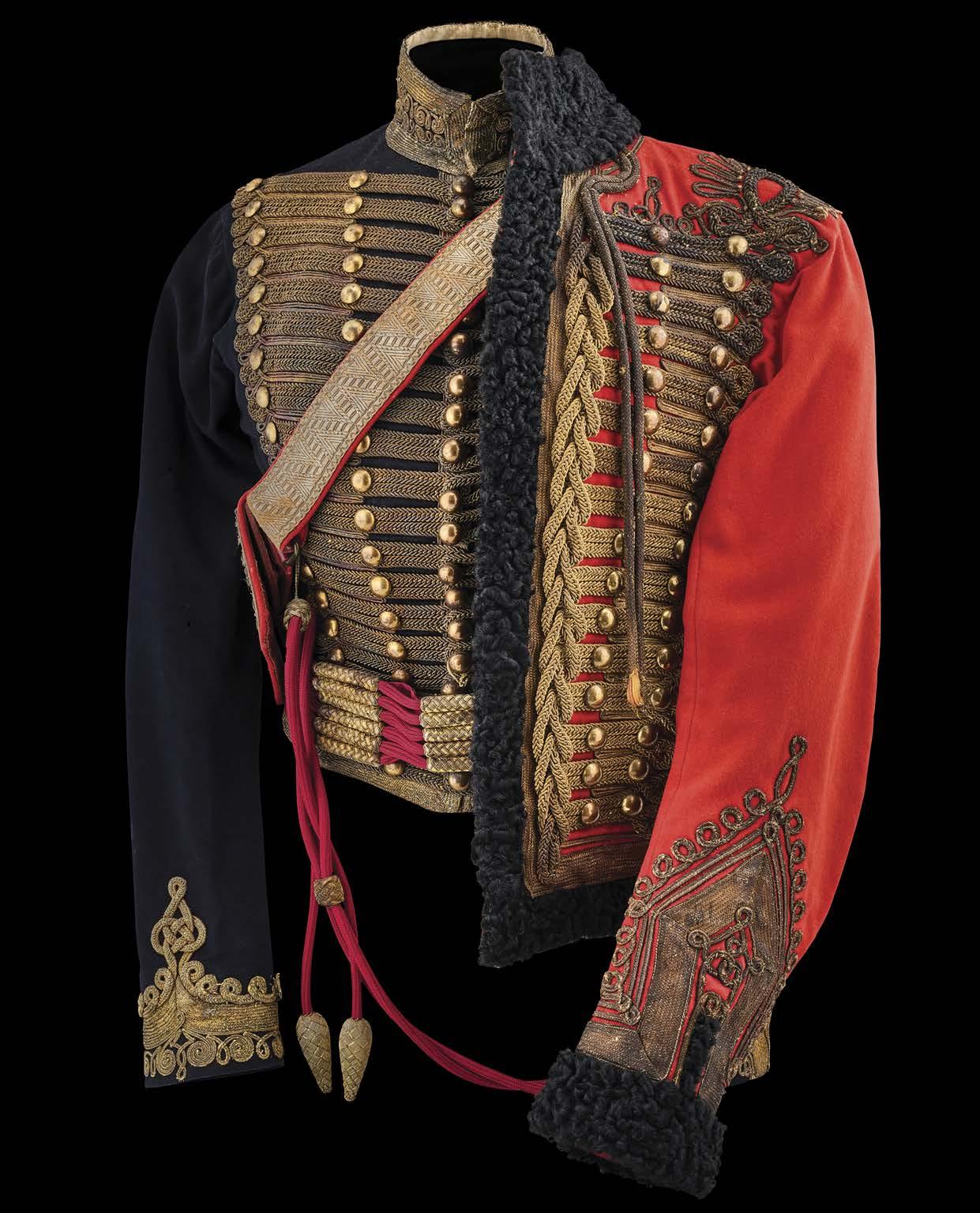
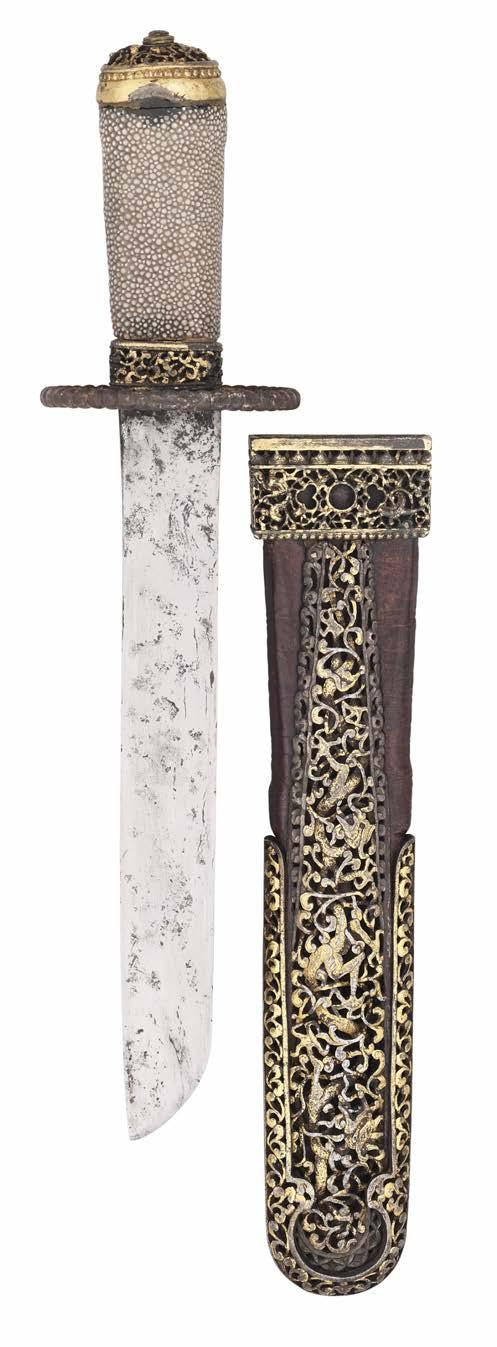
1
A RARE TIBETAN DAGGER, 16TH/18TH CENTURY with single-edged blade (polished over old pitting), iron hilt comprising circular guard of tsuba form with beaded outer edge, the top damascened in gold with symmetrical scrolls within a border of fine running scrollwork, and with bold gold scrolls beneath, fishskin-covered grip with basal mount pierced and chiselled with foliage, and gilt pommel-cap deeply pierced and chiselled with a dragon amid foliage, in its leather-covered wooden scabbard with iron locket, chape and tapering frontal mount en suite with the grip mounts, the back of the scabbard (leather incomplete) with remains of old wax seal, 23.5 cm blade
See Donald J. LaRocca, Warriors Of The Himalayas: Rediscovering the Arms and Armor of Tibet, 2006, p. 197, no. 70.
£4,000-5,000
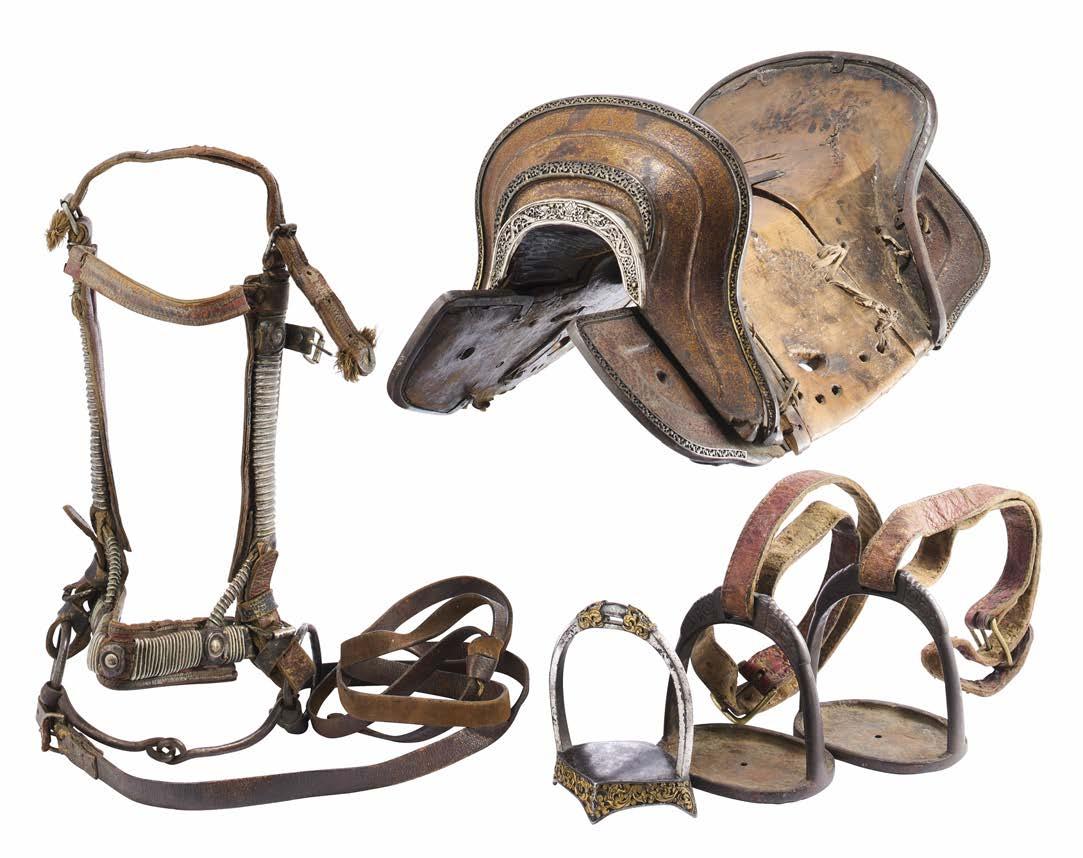
A TIBETAN SADDLE, BRIDLE, PAIR OF STIRRUPS, AND A FINE SINGLE STIRRUP, 18TH/19TH CENTURY OR EARLIER the first of wood in three parts secured together by a leather strap and bindings, the pommel, cantle and protruding ends fore and aft with gilt lacquered decoration (old wear) and mounted with iron borders pierced and gilt with running foliage, the lower border at the cantle arched and inhabited by a pair of dragons , the pommel with silver arched lower border en suite; the second of leather with ribbed white-metal mounts carrying an iron bit and leather reigns; the third each of iron, chiselled at the arched top with cloud scrolls and pierced for leathers, and with integral recessed ovoidal foot-plate; the last of iron with silverdamascened arched faceted top chiselled and gilt with foliage in low relief either side of the leather loop, flat foot-plate of diamond form with arched apron chiselled and gilt en suite with the top, the first: 56.5 cm long (5)
See Donald J. LaRocca, Warriors Of The Himalayas, 2006, pp. 242-245, nos. 126-131.
£2,000-3,000
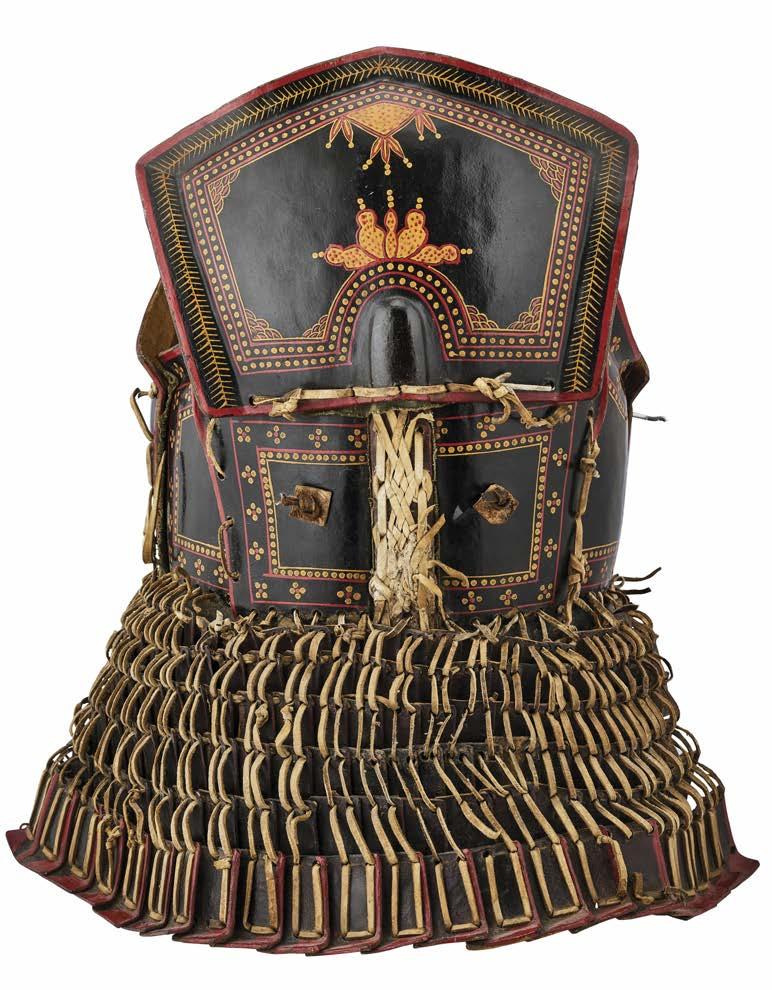
A CHINESE CUIRASS, SOUTHWEST CHINA, 19TH/20TH CENTURY, YI OR NUOSUO (LOLO) PEOPLE of yellow cattle hide, the chest-panels painted black and decorated with borders of red paint lined with rows of arrows and circles in yellow, the interior panel filled with dotted flower-heads and other painted designs, the decoration repeated on the cuirass’ back, the remaining four panels decorated with painted borders of four-petalled flower-heads and further rows of circles, those under the chest- and back-panels fixed with small roundels of leather tied with a band allowing the cuirass to be carried on the shoulder, leather straps secure the sections together and reappear including at the skir t which comprises six rows of closely interconnected lamellae each flaring slightly at the lower edge and lacquered with red and black, 50.0 cm high
£1,200-1,800
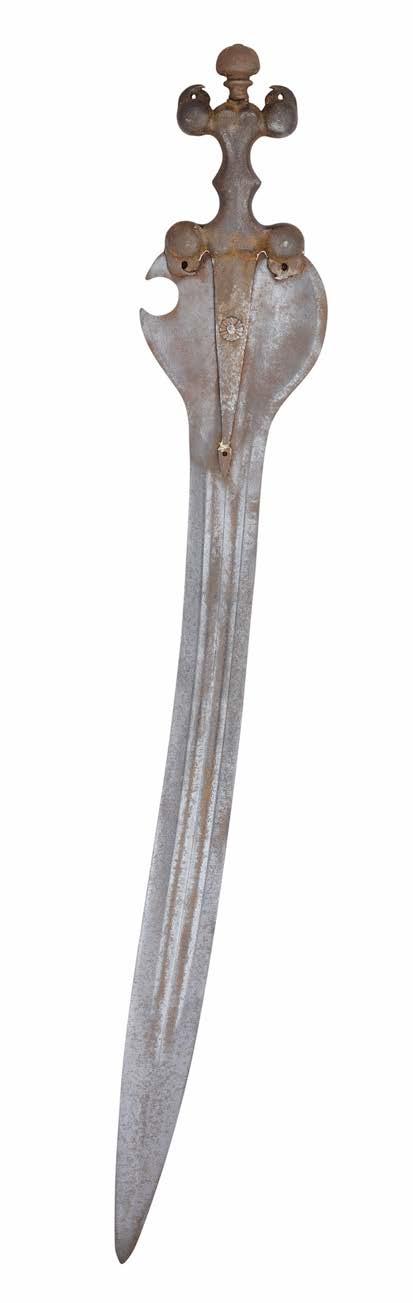
A VERY RARE SOUTH INDIAN SHORT SWORD, DECCAN, THE HILT 15TH/16TH CENTURY
with replacement double-edged blade cut with two central fullers forming a shallow ridge over each side to the point, and widening at the forte to form a disc cut with an incomplete circle on one side, russet iron hilt with tapering langet on both sides (one terminal missing, the other replaced) secured by a transverse rivet on petalled washers, integral grip swelling at the centre between pairs of stylised parrot-heads forming the quillons and pommel respectively, the latter surmounted by an associated spherical finial (old rust patination), 58.8 cm blade
For other examples of this rare type see Robert Elgood, Hindu Arms and Ritual: Arms and Armour from India 1400-1865, Chicago 2004, p. 123, fig. 11.24, and Robert Hales, Islamic and Oriental Arms and Armour: A Lifetime’s Passion, St Peter Port 2013, p. 71, figs. 153-155.
£1,000-2,000
A
RARE
SOUTH INDIAN PATALLAH, 17TH CENTURY
with broad double-edged blade widening slightly at the tip, hilt comprising long riveted slender langets of flattened triangular section extending over a third of the blade length on each side and engraved with red pigment filled symmetrical foliage, hilt comprising downcurved beak-shaped blade-catching quillons decorated en suite and set below the bent-up disc-shaped guard, cup-shaped pommel engraved with a bands of scrolling foliage between bands of S’s and pellets, and tubular grip swelling at the centre (old rust patination overall), 92.3 cm blade
A related example was sold in this room, 4 December 2024, lot 46. £500-700

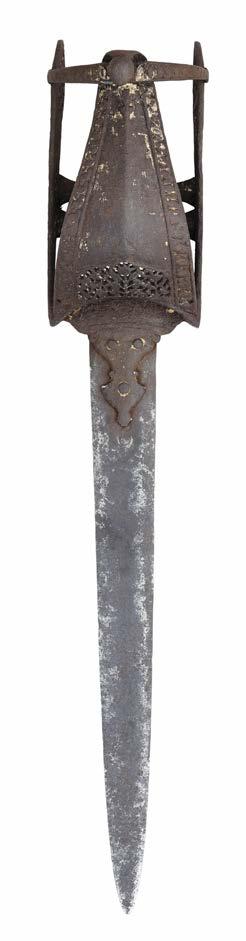
AN UNUSUAL SOUTH INDIAN KATAR WITH EUROPEAN BLADE, VIJAYANAGARA, 16TH/17TH CENTURY
with tapering double-edged blade adapted from a sword blade and with remains of an incised inscription on one side at the forte, characteristic russet iron hilt retaining traces of gilding and comprising a shaped riveted plate extending over each side of the forte, tapering side-bars chiselled around the borders with repeated botehs and pierced with symmetrical foliage at the top, baluster grips with two small beads between, and recurved triangular hand-guard arcaded beneath and decorated en suite with the side-bars, rising to a bud-shaped finial and with chiselled reinforcing bar beneath (old rust patination and pitting), 28.7 cm blade
See Robert Elgood, Hindu Arms and Ritual: Arms and Armour from India 1400-1865, Chicago 2004, pp. 145-162.
£500-800
7
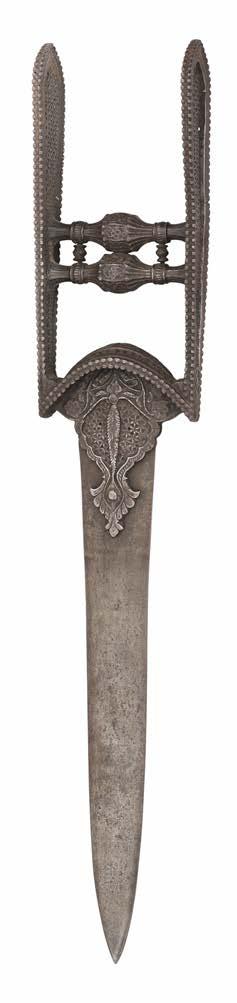
A SOUTH INDIAN KATAR, 17TH/18TH CENTURY, PROBABLY TANJORE OR GOLCONDA
with slightly tapering double-edged blade adapted from a European sword-blade, iron hilt with beaded borders and arched over a rivetted shaped plate extending over each side of the forte and chiselled with foliage and a central cypress tree against a pierced ground of trellised stars, tapering sidebars pierced en suite, and bound reeded grips each with bud-shaped central swelling chiselled with florets and flanked by a fluted swivelling bead, 29.0 cm blade
A related example was sold in this room, 4 December 2025, lot 13.
£400-600
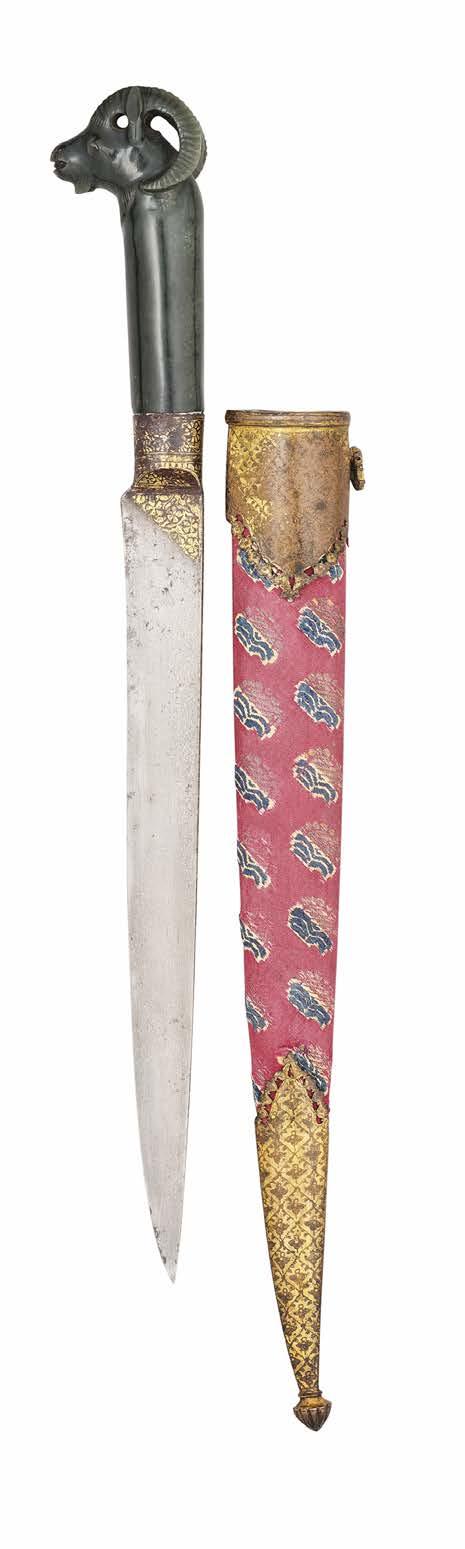
AN INDIAN JADE-HILTED KARD WITH RAM’S HEAD POMMEL, 18TH CENTURY
with tapering slightly hollowed single-edged blade of finely watered wootz steel damascened with gold foliage along the entire length on the back, on both sides at the forte and on the pinched-in basal mount (some old pitting), spinach jade hilt of slight oval section with integral pommel carved and pierced in the round as a ram’s head (beard chipped and eyes missing), in its later textile-covered wooden scabbard with original copper-alloy locket and chape retaining some original gilding and pricked with a trellised pattern of flower-heads, the former with loop for a tassel pierced with arabesques, the latter with fluted bud-shaped terminal, 24.2 cm blade
For a related example see Robert Hales, Islamic and Oriental Arms and Armour: A Lifetime’s Passion, St Peter Port 2013, p. 29, fig. 71. £2,000-3,000
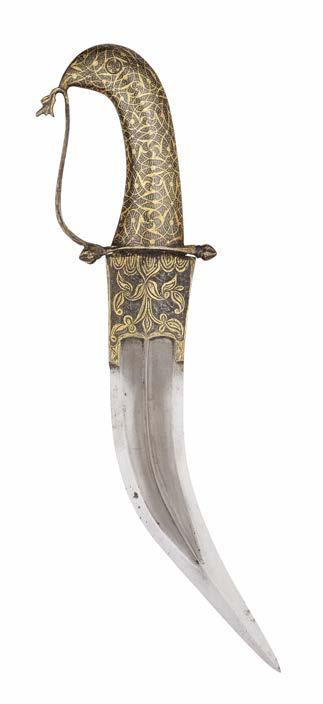

AN INDIAN KHANJAR, LATE 19TH CENTURY
of steel, with bright curved double-edged blade of flattened diamond section at the point and cut with two fullers forming a medial ridge on both sides, the forte on each side roughly chiselled with gold-damascened foliage against a pricked ground, gold-damascened hilt comprising fluted bud-shaped quillons, tapering knuckle-guard with foliate finial, and grip decorated overall with interlaced arabesques against a flecked ground and rising up to a stylised bird’s head pommel, 24.7 cm blade
£600-800
10
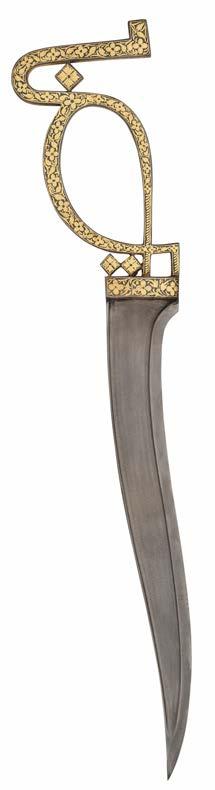
AN INDIAN PESH-KABZ WITH CALLIGRAPHIC HILT, 20TH CENTURY
of steel, with tapering recurved single-edged blade of finely watered wootz steel reinforced along the cutting edge and of T-section along the back, hilt decorated overall with repeated gold-damascened flowering foliage and pierced to form the word Nasir (for Helper, one of the names of God), 27.5 cm blade, 43.3 cm overall
For a similar example, see David Alexander, The Arts of War: Arms and Armour of the 7th to 19th Centuries, London & Oxford 1992, p. 190, no. 124 (illustrated). Another was sold Bonhams Knightsbridge, 24 November 1999, lot 68.
£1,000-1,500
11
AN INDIAN KARD, 19TH CENTURY
with sharply tapering single-edged blade of T-section along the back, pinched-in basal mount, and steel hilt with rounded grip decorated along both sides with a parcel-gilt flowering plant against a punched silver ground, the top of the beaked pommel with gold-damascened flower-head and inscription (some old rust patination and light pitting), 31.4 cm blade
£350-450
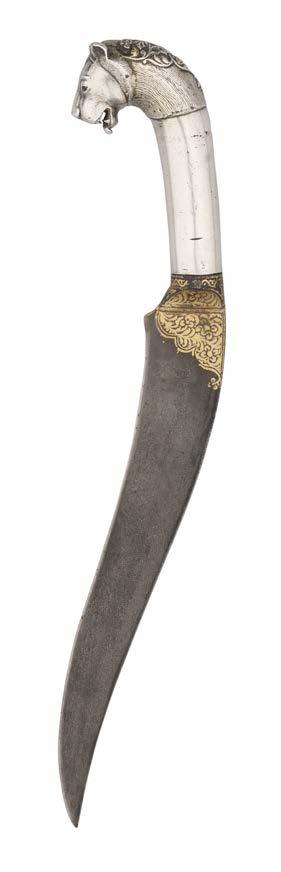
AN INDIAN SILVER-HILTED KHANJAR WITH LION-HEAD POMMEL, 19TH CENTURY
with recurved single-edged blade of finely watered wootz steel, the forte on both sides and waisted basal mount damascened in gold with flowering foliage, and hilt with grip of circular section rising to the lion-head pommel formed in the round with tongue protruding from his open mouth, chased with symmetrical flowering foliage on the back of the mane, and originally set with gem stones for eyes and between the ears, 23.3 cm blade
£600-800
13
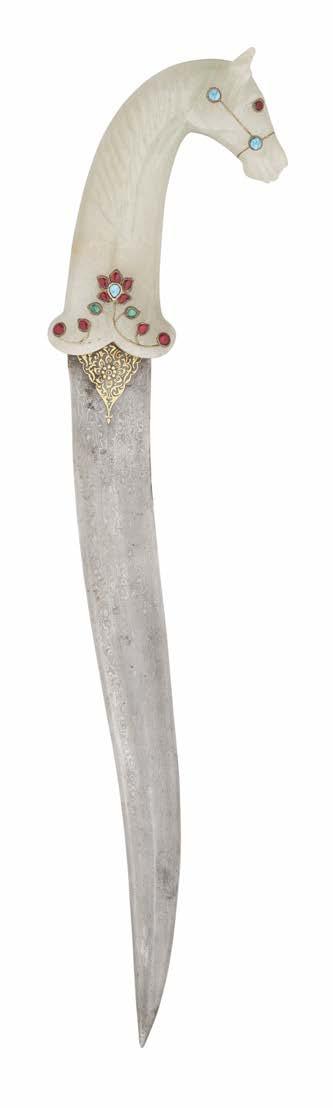
AN INDIAN KHANJAR, 20TH CENTURY
with watered recurved double-edged blade of flattened diamond section gold-damascened with a flower-head within a cartouche of arabesques on both sides at the forte, pale green nephrite hilt inlaid on both sides at the base with gilt-metal foliage (minor losses on one side) set with imitation cabochon rubies and emeralds, the flower-head set with a cabochon turquoise, the pommel carved in the round with a horse’s head with imitation ruby eyes and gilt-metal bridle, the latter set with two cabochon turquoises on each side, 30.5 cm blade
£800-1,200
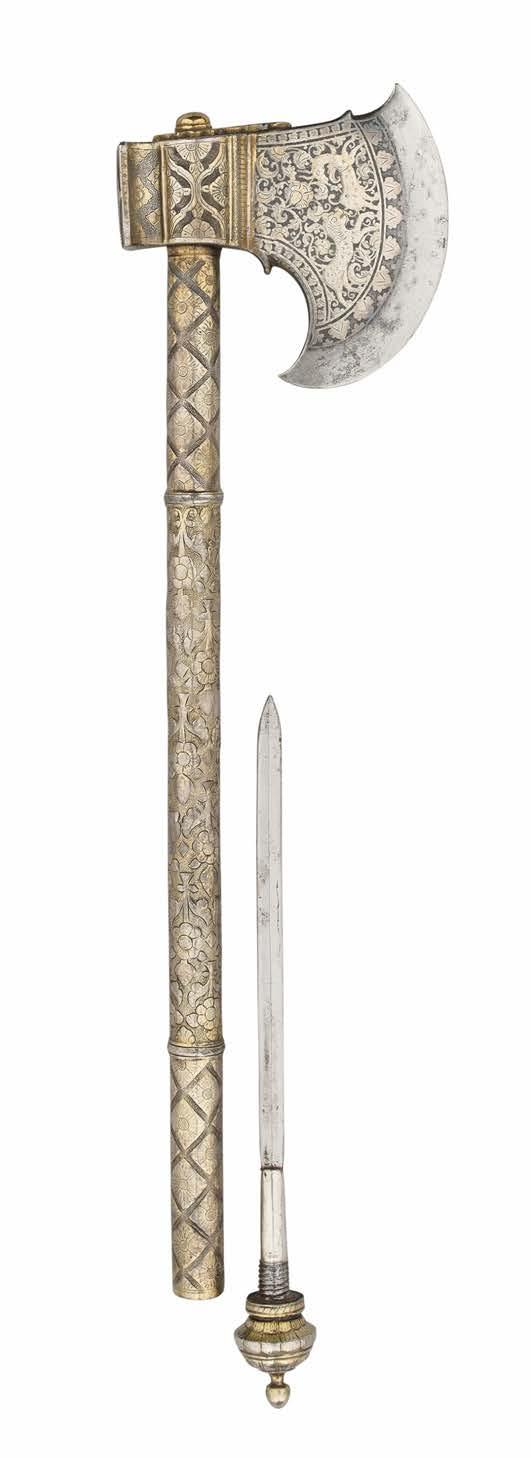
AN INDIAN AXE, 19TH CENTURY, PROBABLY KUTCH with crescentic blade decorated on both sides with silver-gilt foliage inhabited by a lion attacking a deer, rounded socket and waisted block-shaped peen encrusted in silver-gilt with symmetrical designs of flower-heads against finely punched grounds, gilt retaining screw and shaped washer, on tubular socket entirely covered in silver-gilt en suite with the head, large silver-gilt bud-shaped terminal threaded and opening to reveal a slender double-edged blade of flattened diamond section, 13.2 cm head, 53.0 cm overall
£1,000-1,500
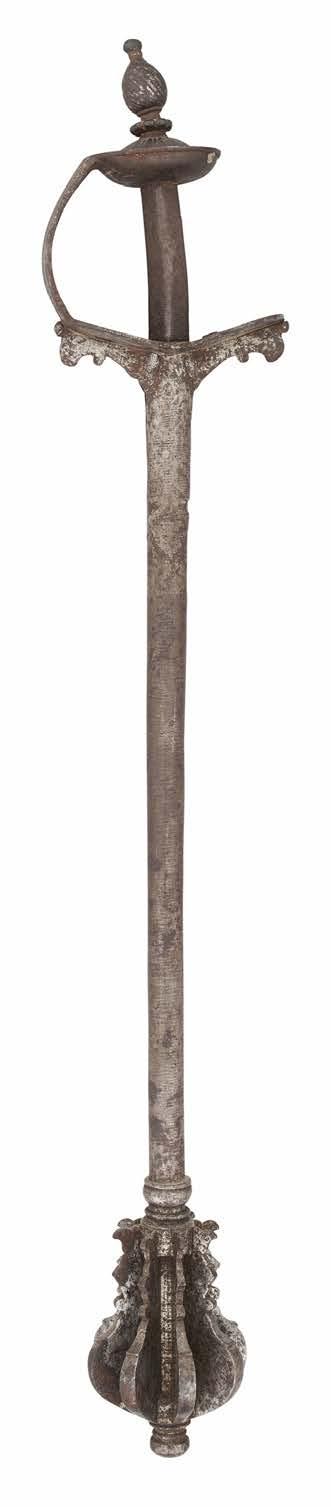
AN INDIAN MACE (GURZ) WITH HILT OF FIRANGI FORM, 17TH CENTURY
formed entirely of steel, the head of eight robust flanges of shaped outline each pierced at the base with a trefoil, and surmounted by a turned button finial, on tubular haft (old repair) of simulated turns, hilt comprising beaked quillons each with small bud-shaped terminal, bent-up guard, knuckle-guard with raised borders and tapering up to join the disc-shaped pommel, the latter with writhen bud-shaped finial on a rayed dome and beaded collar, and slender grip of flattened diamond section (old wear and rust patination), 78.5 cm overall
£2,000-3,000
16
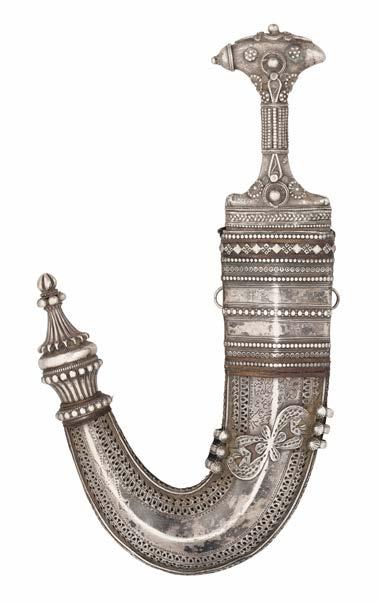
AN ARABIC OR YEMENI JAMBIYA, 19TH CENTURY with brightly polished curved double-edged blade with medial ridge along both sides, and waisted silver hilt decorated with applied beadwork and roundels (one missing at the pommel), in its leather-backed silver scabbard with borders of beadwork at the locket, pricked Arabic inscription, pierced and chased double borders, elaborate bud-shaped finial, and chased suspension mounts with three fixed rings on either side, 20.0 cm blade
£300-400
17
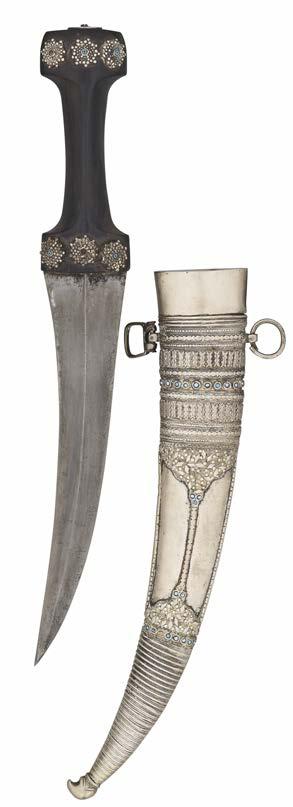
AN OTTOMAN JAMBIYA, LATE 19TH CENTURY with curved dull grey double-edged blade of slightly hollowed flattened diamond section, waisted ebony hilt with grip of diamond section and set with three silver filigree rosettes at the base and pommel on one side, the rosettes each centred on a small turquoise bead (two missing), the top of the pommel set with a silver coin dated 1293 AH corresponding to 1876 AD, in original wood-lined white-metal scabbard with decorative bands, wirework, beads and pellets set on the outside with small turquoise cabochons (two missing), and suspension mount (the other replaced by a ring), 21.5 cm blade
£400-500
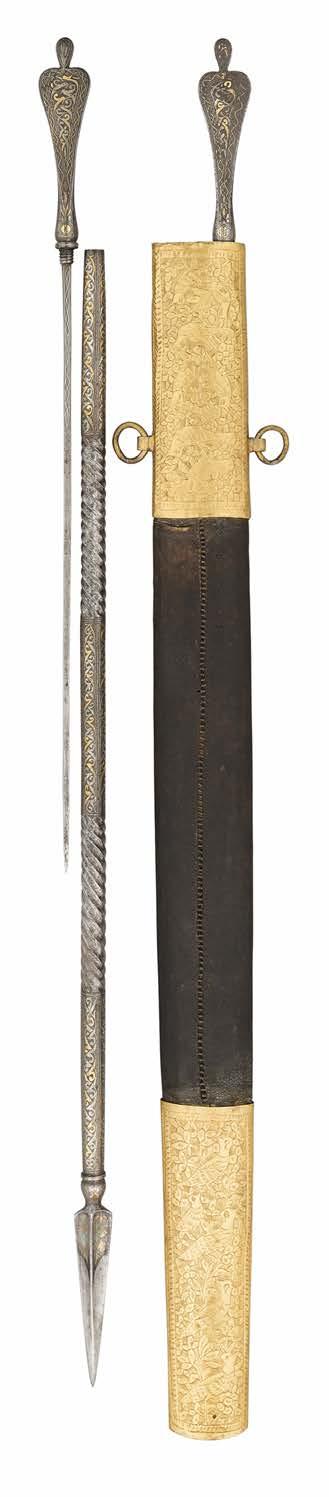
A RARE PAIR OF PERSIAN JARIDS IN THEIR SCABBARD, QAJAR, 19TH CENTURY
each with spear point of hollow diamond section damascened with panels of gold- and silver-damascened foliage and arabesques at the moulded base, flattened kite-shaped terminal and tubular haft decorated en suite, the latter between two spiral twist sections, the threaded finial opening to reveal a long slender blade of square section, in their wooden scabbard covered in black leather seamed along the inside, and gilt-metal locket and chape each chased with foliage inhabited by birds on both side, the former with two suspension rings, both 81.0 cm long
For a single example without scabbard see Bonhams, Knightsbridge, Eastern Arms & Armour From the Richard R. Wagner Jr. Collection, 29 April 2015, lot 23.
£2,000-3,000
19
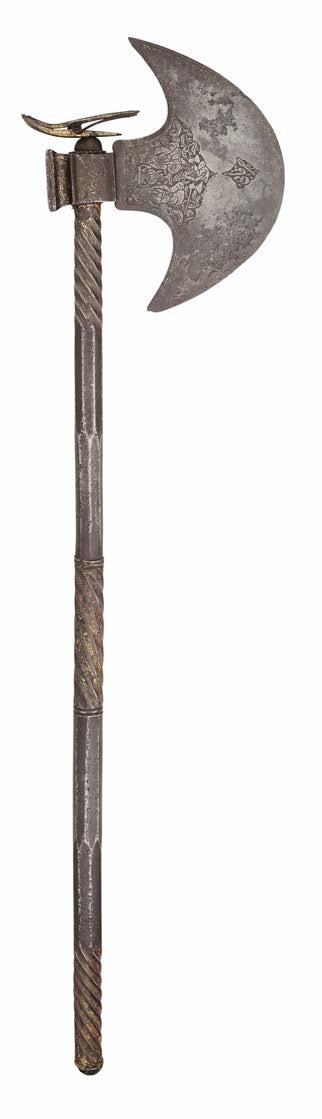
A PERSIAN AXE, QAJAR, 19TH CENTURY of steel, with crescentic blade chiselled on both sides with a cartouche containing contemporary Persian figures seated amid foliage involving axes and a vase, a smaller cartouche beneath chiselled with Arabic calligraphy, rounded socket and block-shaped peen chiselled with panels of calligraphy en suite, and retaining traces of golddamascening, on faceted tubular haft in five stages retaining traces of silver-damascening, the top, central and bottom sections spirally twist and retaining some original gilding, and surmounted by a sprung clip formed as a chased and gilt bird with turquoise eyes (one missing, some old pitting overall), 19.4 cm head
Provenance
Bonhams Knightsbridge, Antique Arms & Armour, 25 November 2015, lot 11
£500-600
20
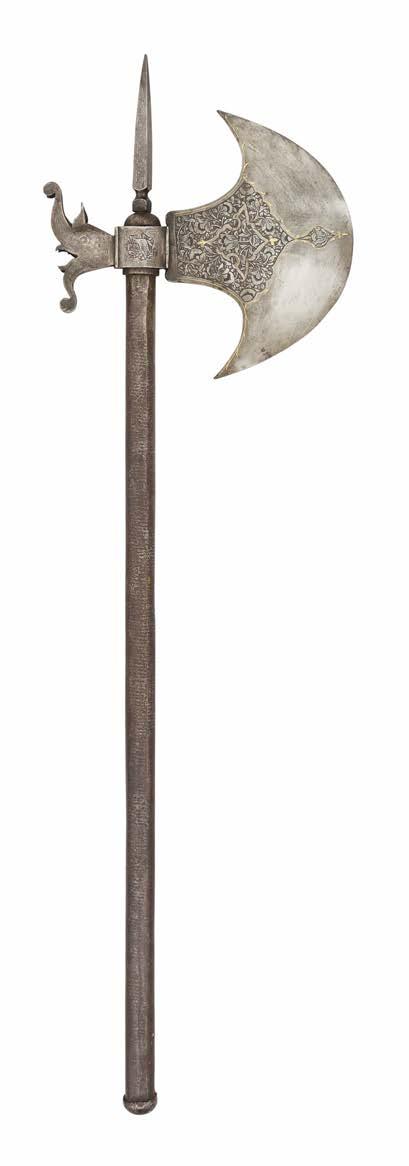
A PERSIAN AXE, QAJAR, 19TH CENTURY of steel, with crescentic blade chiselled with a panel of flowering foliage on both sides within gold-damascened borders, socket chiselled with a partridge and foliage on both sides, and silver-damascened makara-head peen, in tubular haft etched with watering, and surmounted by a silver-damascened spike of diamond section (some wear), 22.0 cm head
£400-600
21
AN OTTOMAN GUN BARREL MUZZLE
MOUNTED TO FORM A MACE, THE MUZZLE LATE 17TH CENTURY
of russet iron and of swelling faceted form, the upper flat with shallow groove for sighting, and retaining some of its gold-damascened foliate decoration, mounted in the 19th century on a snakeskin-covered wooden haft of circular section, 61.5 cm overall
For a gun barrel with a muzzle of similar form see Holger Schuckelt, Die Türckische Cammer, 2010, pp. 230-231, no. 231.
£400-600

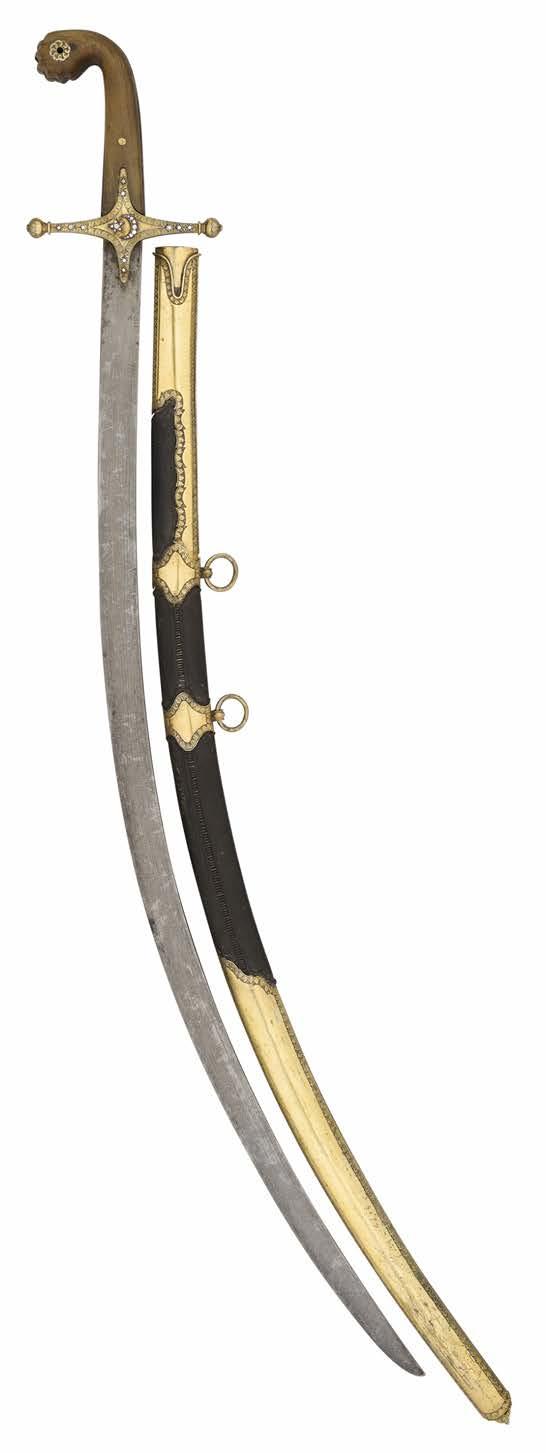
A TURKISH JEWELLED AND SILVER-GILT MOUNTED SHAMSHIR, REIGN OF ABDULAZIZ (1277-93 AH CORRESPONDING TO 1861-76 AD)
with curved single-edged blade of watered steel, hilt comprising quillon-block chased with acanthus borders against finely punched grounds and set with cut diamonds on the outside along the pointed langets and quillons, the former with a diamond set star and crescent at the centre, the latter each with bud-shaped terminal engraved with a flower-head, gripstrap with acanthus borders en suite, rounded rhinoceros horn grips, the pommel fluted at the front and pierced for a swordknot, the piercing set with a mount on each side chased as a flower-head, in its wooden scabbard covered in black leather with silver-wire seam along the inner side and deep locket, chape and suspension mounts all with acanthus borders against finely punched grounds, two suspension rings, and retaining virtually all its gilding, 81.0 cm blade
Provenance
The Royal House of Hanover Schloss Cumberland, Gmunden, inv. no. 344 Schloss Marienburg, Hanover, Sotheby’s, 13 October 2005, lot 3607
Literature
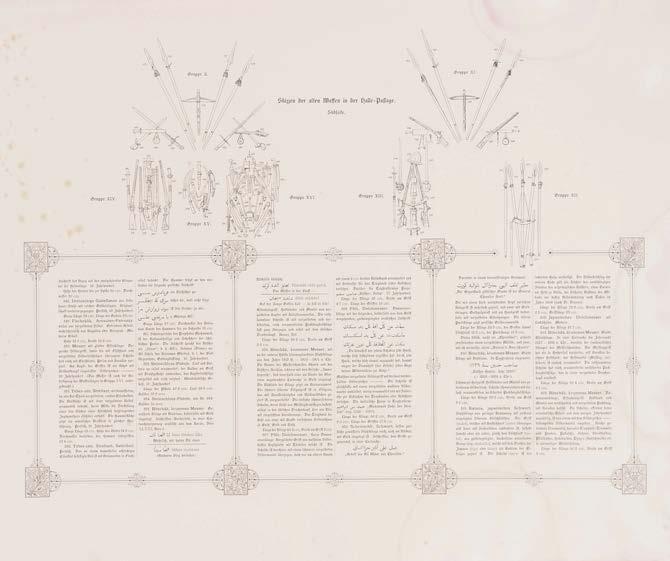
Dr. Onno Kloop et al, Schloss Seiner Konigl, hoheit des Herzogs von Cumberland, Herzogs zu Braunschweig und Luneburg, 1890, Gruppe XV, no. 344.
£12,000-18,000
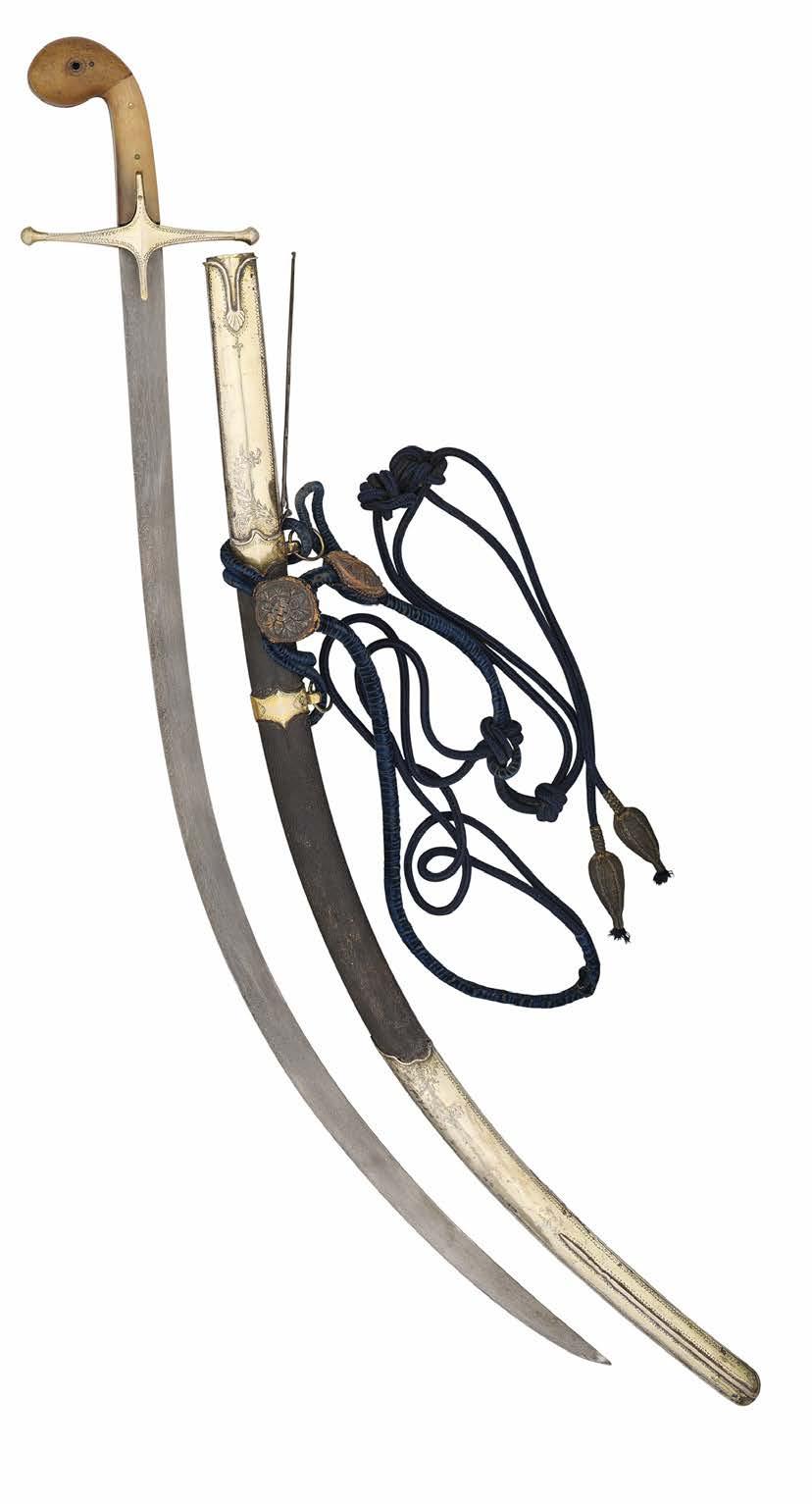
A TURKISH SILVER-GILT MOUNTED SHAMSHIR, TURKISH SILVER AND TUGHRA MARKS, PROBABLY REIGN OF ABDULAZIZ (1277 AH CORRESPONDING TO 1861-76 AD)
with curved single-edged blade of finely watered wootz steel, hilt comprising border engraved quillon-block and grip-strap, the former with pointed langets and bud-shaped quillon terminals, and rounded rhinoceros horn grip and pommelscales, the latter pierced for a sword-knot (one mount missing), in original wooden scabbard covered in black leather with silver wire seam along the inside, deep locket, chape and suspension mounts en suite with the quillon-block and including some foliate decoration, the locket with hinged blade guide along one side, two suspension rings, retaining its blue silk suspension cords partly covered in blue velvet with two silver embroidered leather mounts and two bullion tassels, and retaining much of its original gilding, 90.0 cm blade
£3,000-4,000
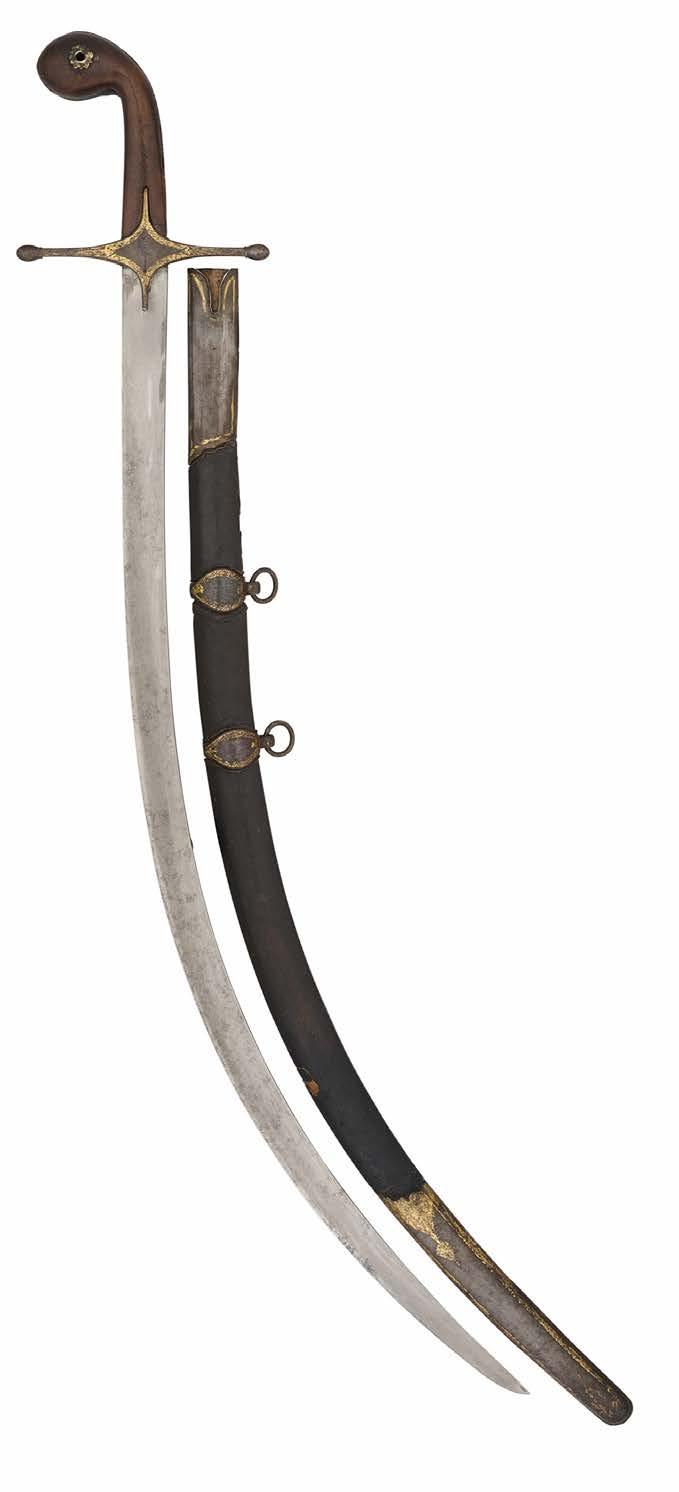
A TURKISH SHAMSHIR, PROBABLY REIGN OF ABDULAZIZ (1277-93 AH CORRESPONDING TO 1861-76 AD) with curved single-edged blade of finely watered wootz steel (some old light rust patination), hilt comprising steel quillonblock with gold-damascened borders, pointed langets and bud-shaped quillon terminals, plain grip-strap, and rounded rhinoceros grip-scales, the pommel pierced for a sword-knot and with gilt floret on each side, in original wooden scabbard covered in black leather (minor old damage and worming) with silver wire seam along the inside, deep steel chape and suspension mounts with golddamascened borders en suite with the quillon-block, the latter each with suspension ring (some old wear, locket replaced), 80.0 cm blade
£1,500-2,000
25
A RARE TURKISH SILVER-MOUNTED SHAMSHIR FOR A YOUTH, TURKISH SILVER AND TUGHRA MARKS, PROBABLY REIGN OF ABDULAZIZ (1277-93 AH CORRESPONDING TO 1861-76 AD) with curved single-edged blade of finely watered wootz steel, hilt comprising quillon-block with bluntly-pointed langets and bud-shaped quillon terminals, plain grip-strap, and rounded rhinoceros horn grip-scales, the latter pierced for a swordknot at the pommel and with fluted domed silver mount on each side, in original fabric-covered wooden scabbard with deep locket and chape, shaped suspension mounts each with suspension ring, and retaining traces of gilding (some old wear), 52.5 cm blade
£1,000-1,500
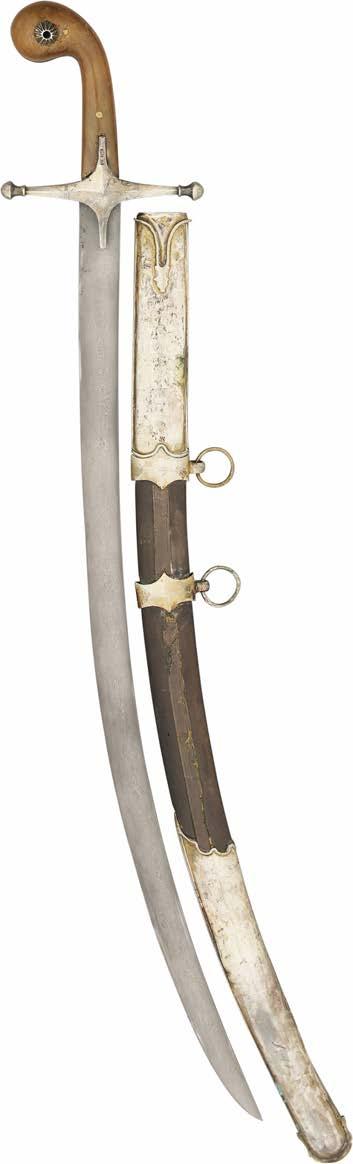
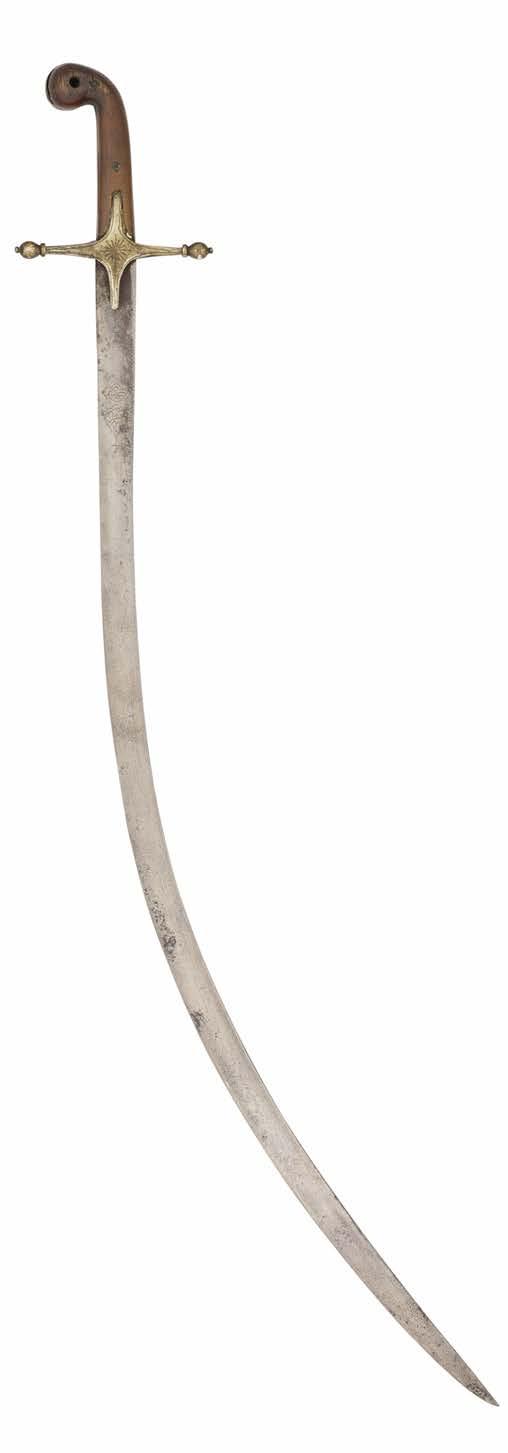
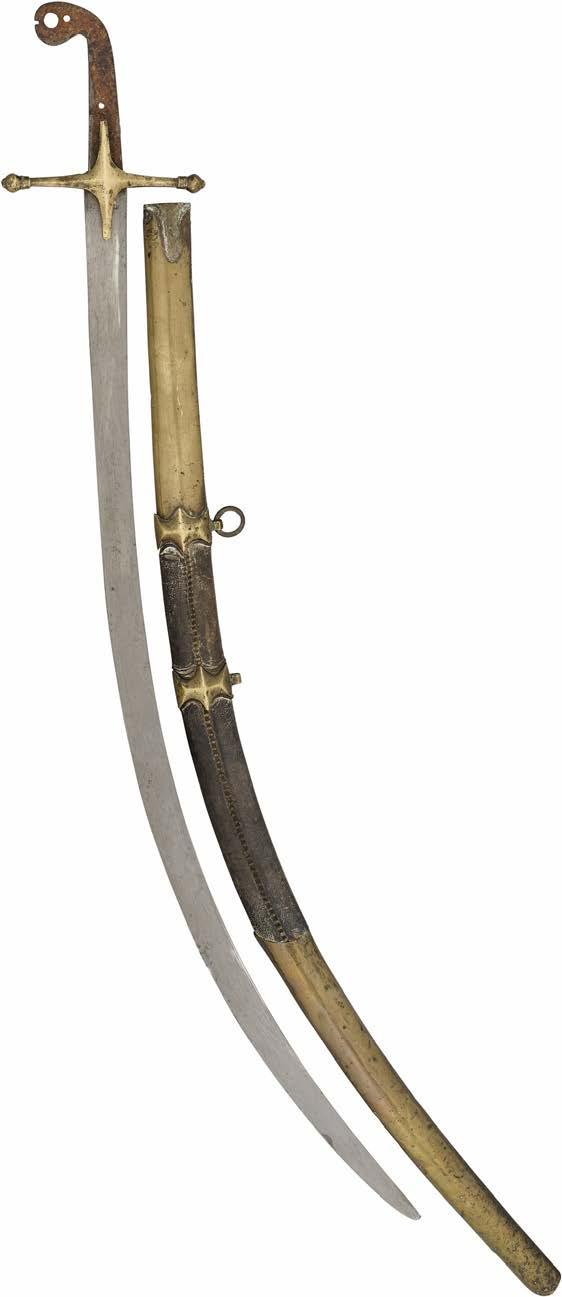
A TURKISH SHAMSHIR, REIGN OF MUSTAFA III (1171-1187 AH CORRESPONDING TO 1757-1774 AD) with slender curved single-edged blade (scattered old pitting) of finely watered wootz steel dated 1181 AH (corresponding to 1767 AD), the forte on one side inlaid with two copper alloy calligraphic cartouches, hilt comprising white-metal quillon-block engraved with wrigglework decoration and with pointed langets and bud-shaped quillon terminals, white-metal grip-strap, and rounded rhinoceros horn grip-scales each pierced for a sword-knot at the pommel (scabbard missing), 85.5 cm blade
£1,500-2,000
27
A TURKISH SHAMSHIR, PROBABLY REIGN OF ABDULAZIZ (1277-93 AH CORRESPONDING TO 1861-76 AD) with curved single-edged blade (extreme tip slightly re-shaped) of dull grey watered steel, hilt retaining its copper alloy quillon-block only with pointed langets and bud-shaped quillon terminals, in original wooden scabbard covered in black leather with copper alloy wire seam along the inside, deep copper alloy locket and chape (old denting, the former missing its langet mounts), and shaped suspension mounts each with suspension ring, 76.5 cm blade
£400-600
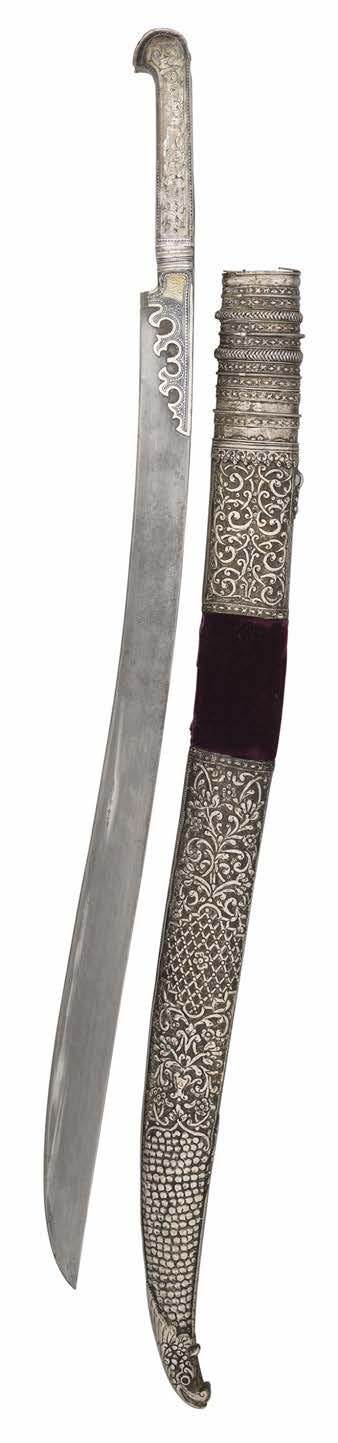
A TURKISH OR BALKAN YATAGHAN, 19TH CENTURY with slightly recurved unusually watered single-edged blade with shaped nielloed silver mount over the forte on each side engraved with gilt arabesques, and silver hilt with ‘eared’ pommel and decorated with nielloed scrollwork against hatched grounds, all within nielloed borders, in original wooden scabbard now covered in plum velvet and with deep silver locket and chape each embossed and chased with symmetrical designs of foliage, the former with embossed and plaited silver bands around the top, and with suspension loop, the latter with monster-head terminal, 53.0 cm blade
Provenance
Bonhams Knightsbridge, Eastern Arms & Armour From the Richard R. Wagner Collection, 29 April 2015, lot 54
See Robert Elgood, The arms of Greece and her Balkan neighbours in the Ottoman period, London 2009, p. 145, fig. 164.
£1,000-1,500
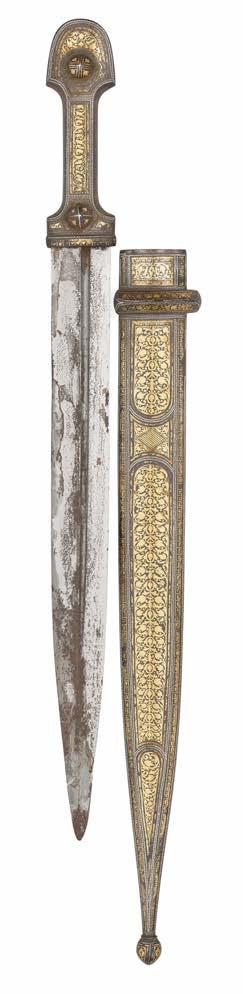
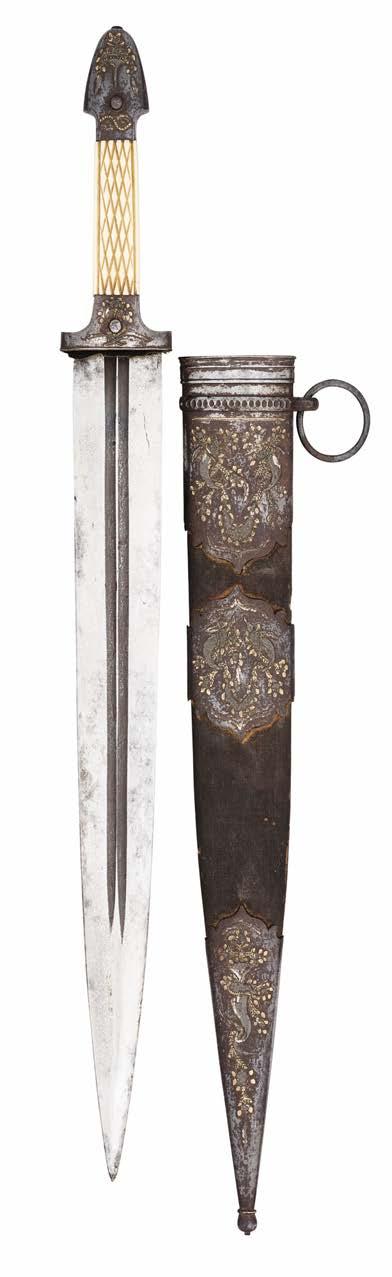
A CAUCASIAN KINDJAL, 19TH CENTURY
with bright tapering double-edged blade (some surface rust) cut with an off-set fuller along most of its length on both sides, the waisted steel hilt and wood-lined scabbard profusely decorated with symmetrical designs of gold foliage (some old wear), all within finely beaded silver borders on the outside, the scabbard open along the inside and covered in black leather, cut at the top for a missing by-knife, 28.5 cm blade
£1,800-2,200
30
A RARE RUSSIAN (TULA) HUNTING DAGGER OF KINDJAL FORM, 19TH CENTURY
with tapering double-edged blade cut with two medial fullers along both sides to the point of flattened diamond section, hilt comprising waisted steel quillon mount and tall arched pommel both retaining some blueing and encrusted over each side with characteristic silver and copper foliage (some losses), and rectangular bone grip cut with vertical lines along the inner sides, and with chequering on the outer sides, in its velvetcovered wooden scabbard (plush worn off) with shaped steel locket, chape and suspension mount decorated with flowering cornucopia en suite with the hilt, the former with slender steel mount carrying a large suspension ring, 37.5 cm blade
£1,500-2,000
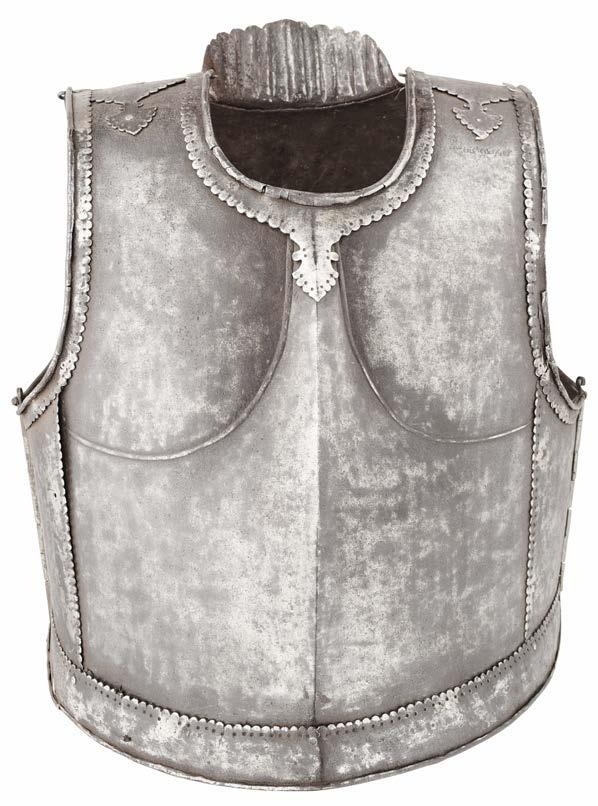
A RARE CENTRAL INDIAN CUIRASS, 17TH/18TH CENTURY
of steel, formed as a male torso and hinged at the sides and shoulders (hinges working replacements, securing pins later), the front plate with low medial ridge and shaped over the pectorals, the left shoulder with incised inscription, the back plate (patched inner repair on the right side) shaped over the shoulder-blades and with separate ver tically fluted neck-plate, the main edges (minor replacements at the shoulders) with riveted turned borders cusped around the outer edges and pierced with small holes (old pitting overall), 44.0 cm high
Provenance
Almost certainly from the armoury of the Nizams of Hyderabad
For a very similar cuirass inscribed ‘Sarkar Mir Nizam Alikhan Bahadur 1192’ [1778-1779], see Christie’s London, Art Of The Islamic World, 25 April 2013, lot 162 (£25,000 including premium). For another bearing the same inscription, see David Alexander, The Nasser D. Khalili Collection Of Islamic Art, The Arts Of War, 1992, p. 175, no. 108. The inscriptions indicate that these cuirasses were in the armoury of the fifth Niz am of Hyderabad (ruled 1762-1803), however their actual date of manufacture is probably sometime in the 17th century.
£3,000-4,000
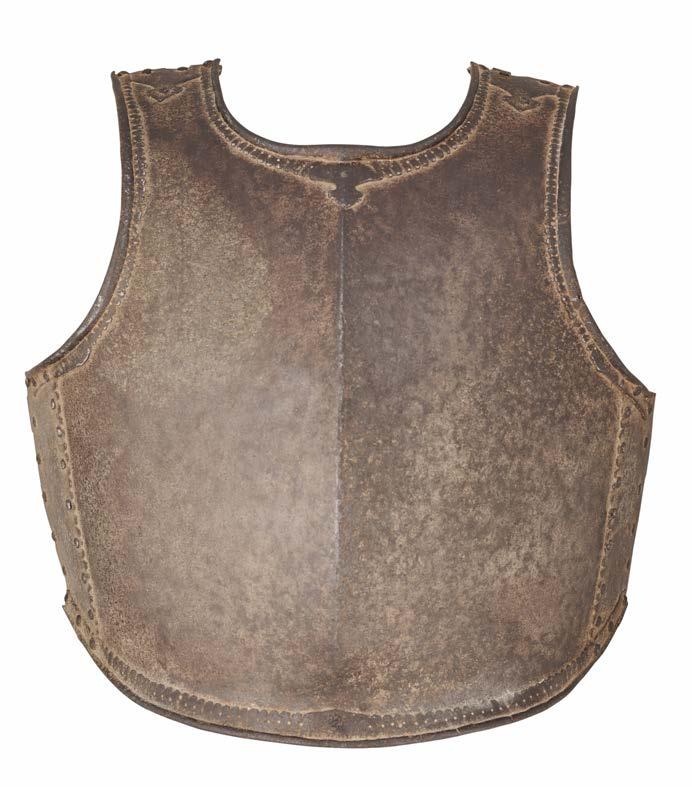
A SOUTH INDIAN BREASTPLATE, 17TH/18TH CENTURY, PROBABLY HYDERABAD, ANDHRA PRADESH of russet steel, formed in the European fashion with medial ridge, the main edges with riveted turns each with cusped inner edge, riveted side-plates, and pointed mount at each shoulder for shoulder-straps (missing, old pitting overall), 42.5 cm high
Another cuirass of this type, of crucible steel, from the Hyderabad Royal Armoury, is preserved in the Metropolitan Museum of Art, New York (Acc. No. 29.158.165). Another, in the Nasser D. Khalili Collection, is illustrated David Alexander, The Arts of War: Arms and Armour of the 7th to 19th Centuries, London & Oxford 1992, p. 175, no. 108. Both examples have inscriptions recording them in the armoury of the fifth Nizam of Hyderabad (ruled 1762-1803) though their date of manufacture is almost certainly earlier.
£400-600
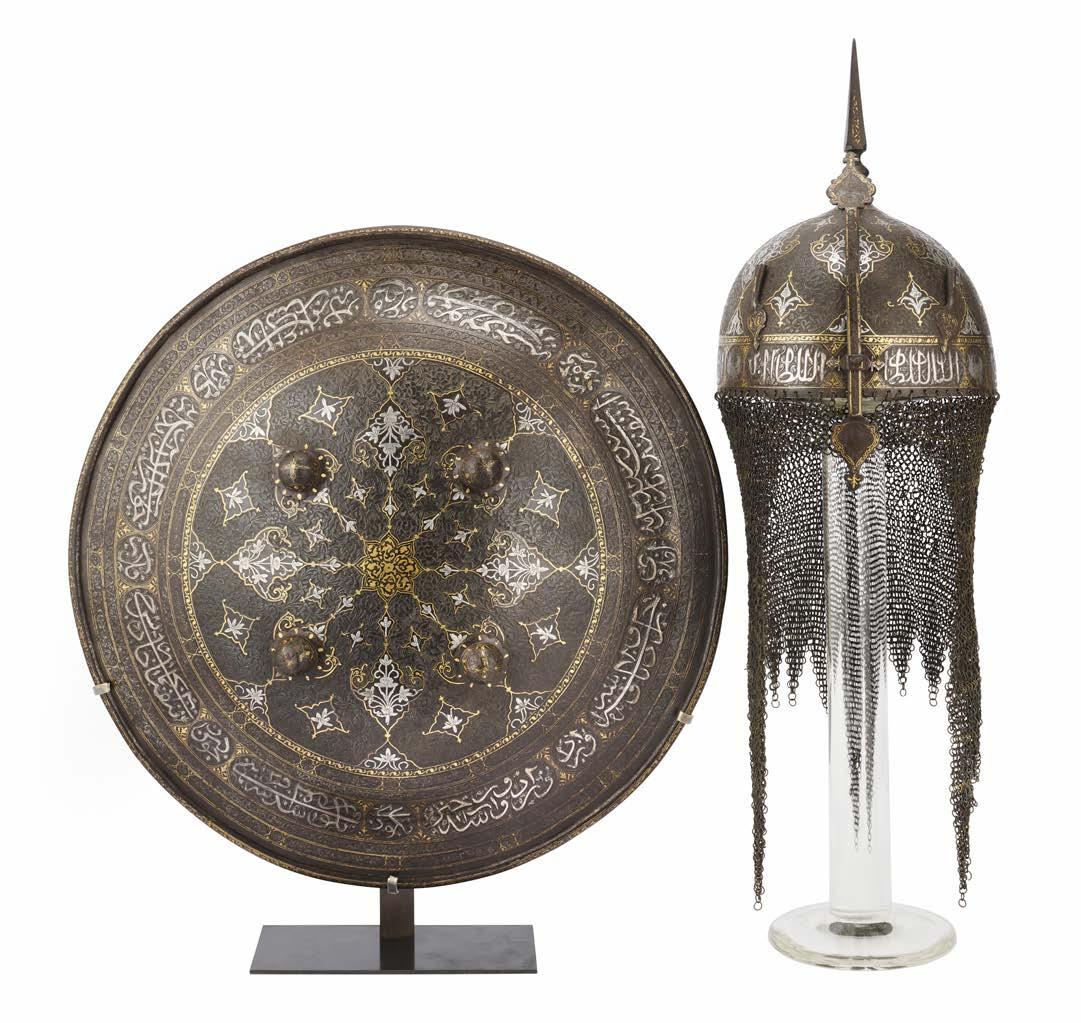
A HIGHLY DECORATED PERSIAN KULAH KHUD AND DHAL, QAJAR, 19TH CENTURY of steel, the first with domed skull decorated overall with cartouche-shaped panels of chased encrusted silver flowering foliage, all within gold-damascened line borders, the larger panels flanked by monster-heads, all against a densely chiselled ground of flowering foliage, the rim bordered by ovoidal and circular panels, the former enclosing silver-damascened Persian verses in thulth script, the latter each with a brace of chased silver partridges , all between gold-damascened foliate borders, fitted with two plume-holders, central threaded spike of diamond section and adjustable nasal all decorated en suite with the skull, and vandyked camail of butted steel and copper alloy rings; the second of circular convex form with applied outer border, made in two pieces and with four domed bosses, the outer surface decorated en suite with the kulah khud, and both in fine condition: the dhal mounted on a metal stand, 47.0 cm diameter and 28.0 cm high (not including camail) (3)
£8,000-10,000
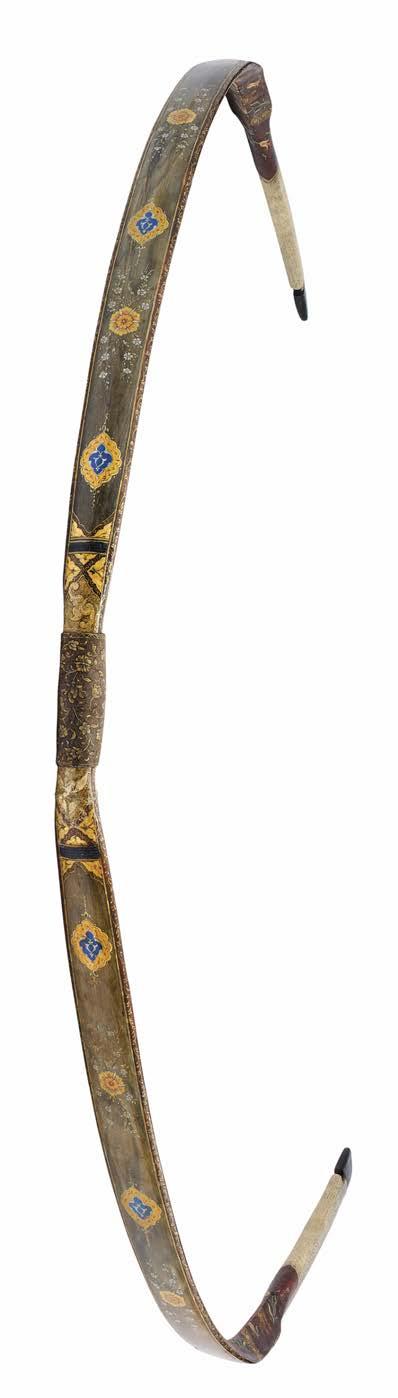
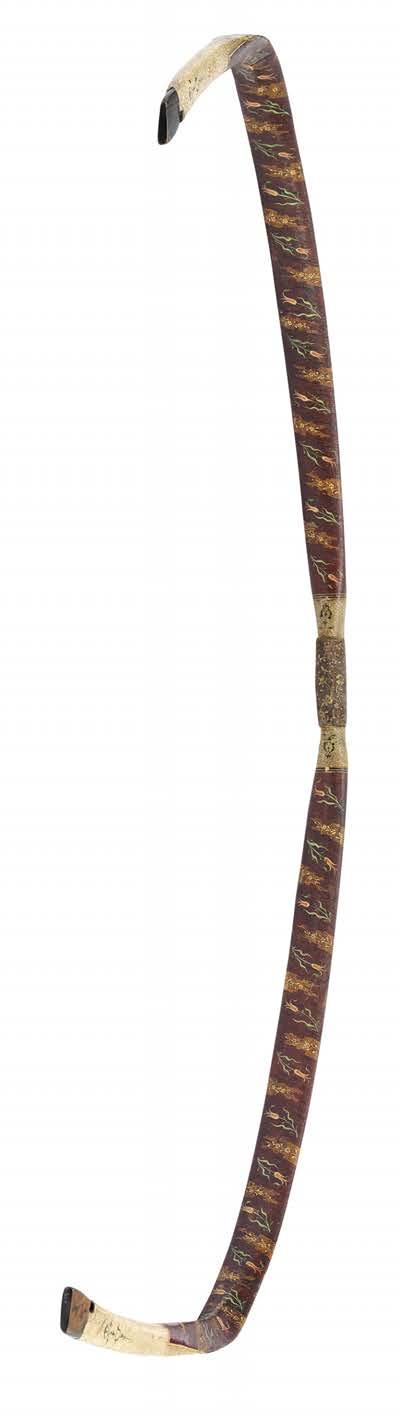
A FINE OTTOMAN COMPOSITE LACQUERED BOW, 18TH/19TH CENTURY
of characteristic recurved form, the exterior painted in polychrome with repeated tulips between white-painted flowers, all against a brown lacquered wrapped ground, the interior painted in polychrome with repeated cartouches of arabesques within borders of finely painted foliage, and between flower-heads centred on flowering foliage, all against a ground of polished natural horn, outer borders painted in gilt with running foliage, fishskin-covered hocks each finely painted with arabesques, grip partly covered in fishskin decorated with foliage within gilt borders on the inside, and leather-covered grip decorated with gilt and polychrome flowering foliage, and in fine condition
£2,000-3,000
35
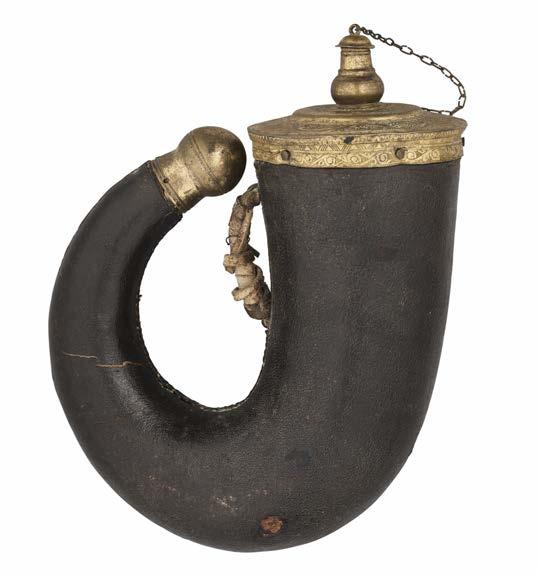
AN OTTOMAN POWDER-HORN, 17TH CENTURY
with black leather-covered body of curved tapering circular section seamed along the inside and incorporating a buff leather suspension thong, ormolu mounts comprising circular top and terminal of spherical form, the former stepped and chased with borders of running foliage against grounds of cross-hatching, plain bulbous nozzle with stopper-cap retained by a chain, and retaining much of its gilding, 22.5 cm high
For two other examples of similar form in the former ‘Turkische Commer’ of the Electors of Saxony, now in the Staatliche Kunstsammlung, Dresden, see Holger Schuckelt, Die Türckische Cammer, 2010, pp.118 and 120, nos. 42 and 90.
£1,000-1,500
36
AN OTTOMAN 20 BORE FLINTLOCK SILVER-MOUNTED HOLSTER PISTOL, EARLY 19TH CENTURY
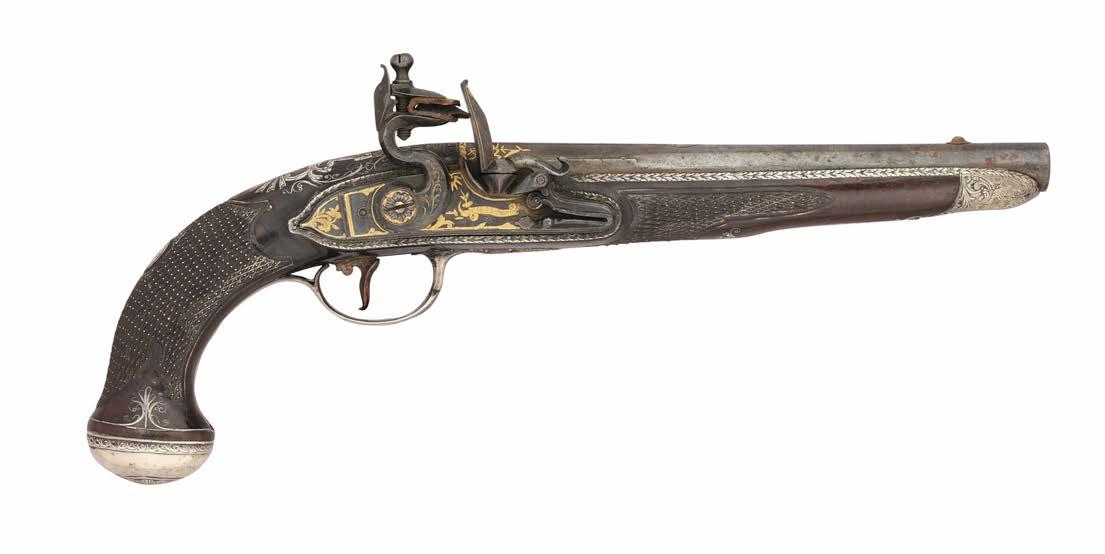
with tapering barrel decorated with a small gold palmette in front of the copper fore-sight, breech with top flat with chiselled and gilt foliate finial, the rear at the breech with engraved gold line and foliage, the lat ter surmounted by three gold banners, gilt touchhole, tang with gold borders, flat bevelled lock in the English fashion inlaid with engraved foliate borders and signed ‘Isma’il Shahni’ in Arabic on a gold-inlaid foliate scroll, gold-lined rainproof pan and roller, the cock and steel decorated en suite with the lock, figured full stock, the chequering on the fore-end and butt highlighted with small silver pins, and inlaid with silver-wire scrollwork around the barrel tang, on the side-flat and on both sides above the pommel, mounts comprising side-nail plates pierced and engraved with foliage within a border of repeated foliage, tang-plate en suite and secured by small silver pins, small engraved escutcheon, border engraved rounded pommel-cap, foliate engraved trigger-guard and fore-end cap, the latter with engraved extension along the bottom for the fore-end, and no provision for a ramrod, 22.3 cm barrel
Provenance
Christie’s London, Antique Arms And Armour, 20 September 2007, lot 153
£1,000-1,500



EUROPEAN EDGED WEAPONS
AN IMPORTANT ENGLISH PRIVATE COLLECTION
39
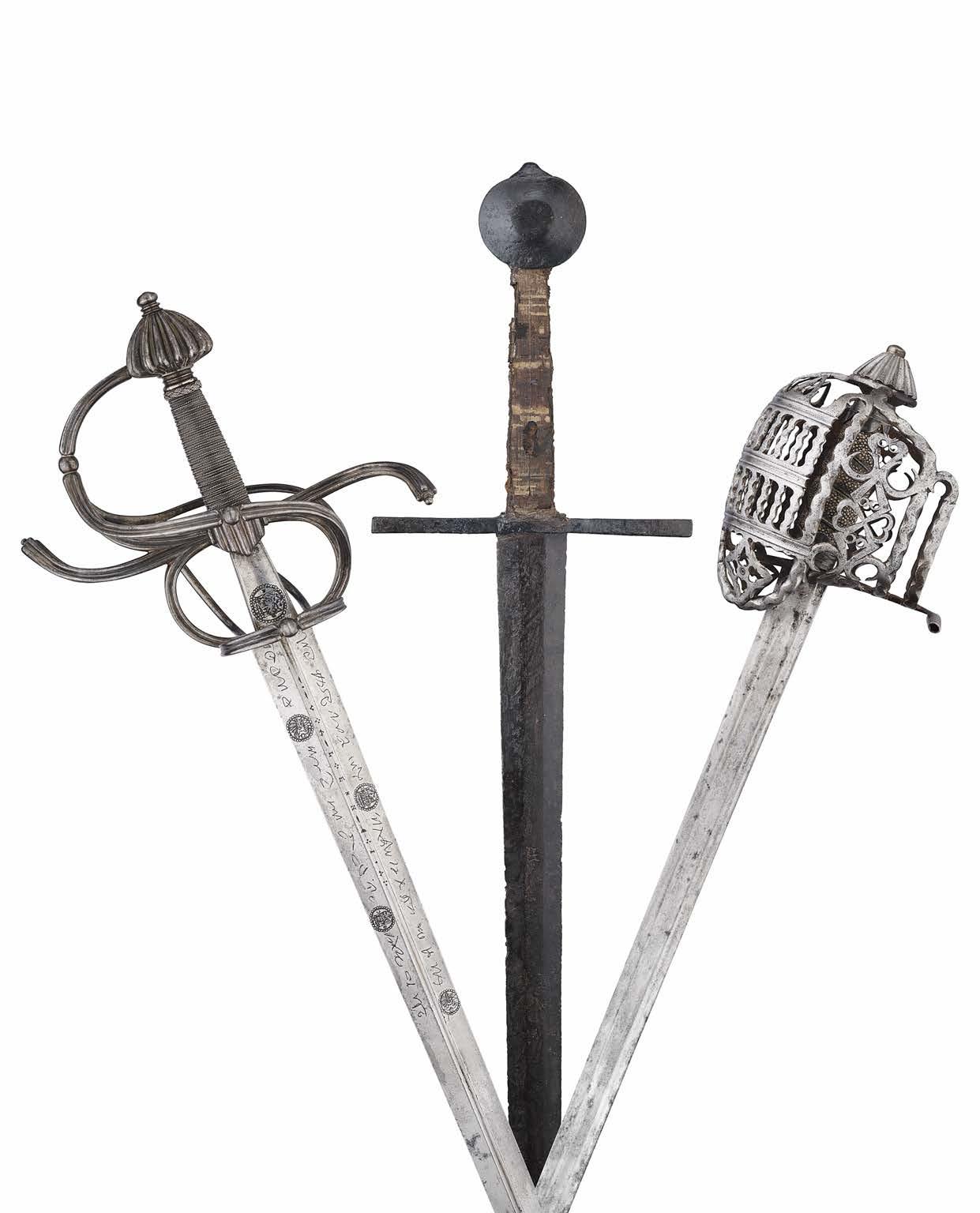
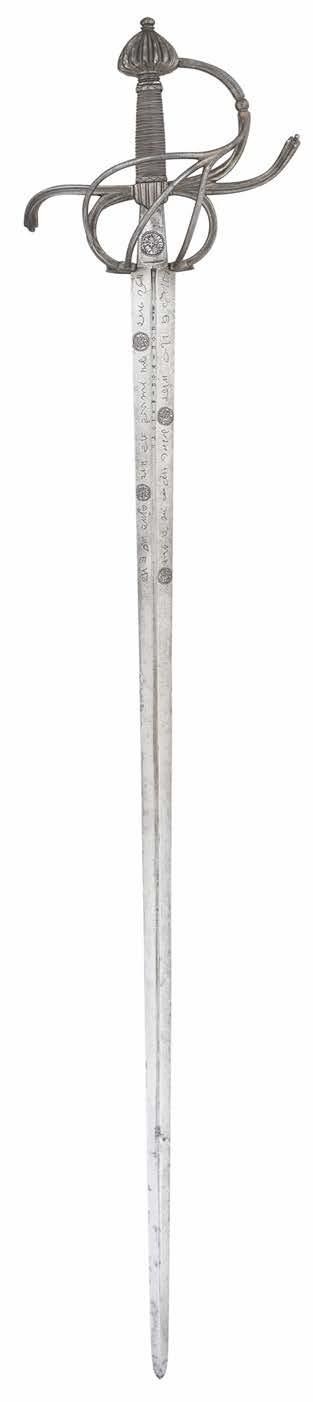
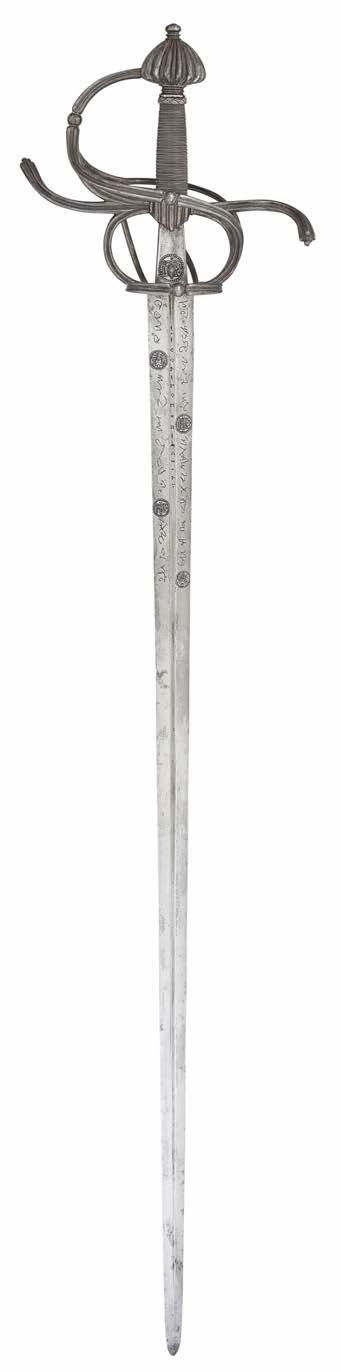
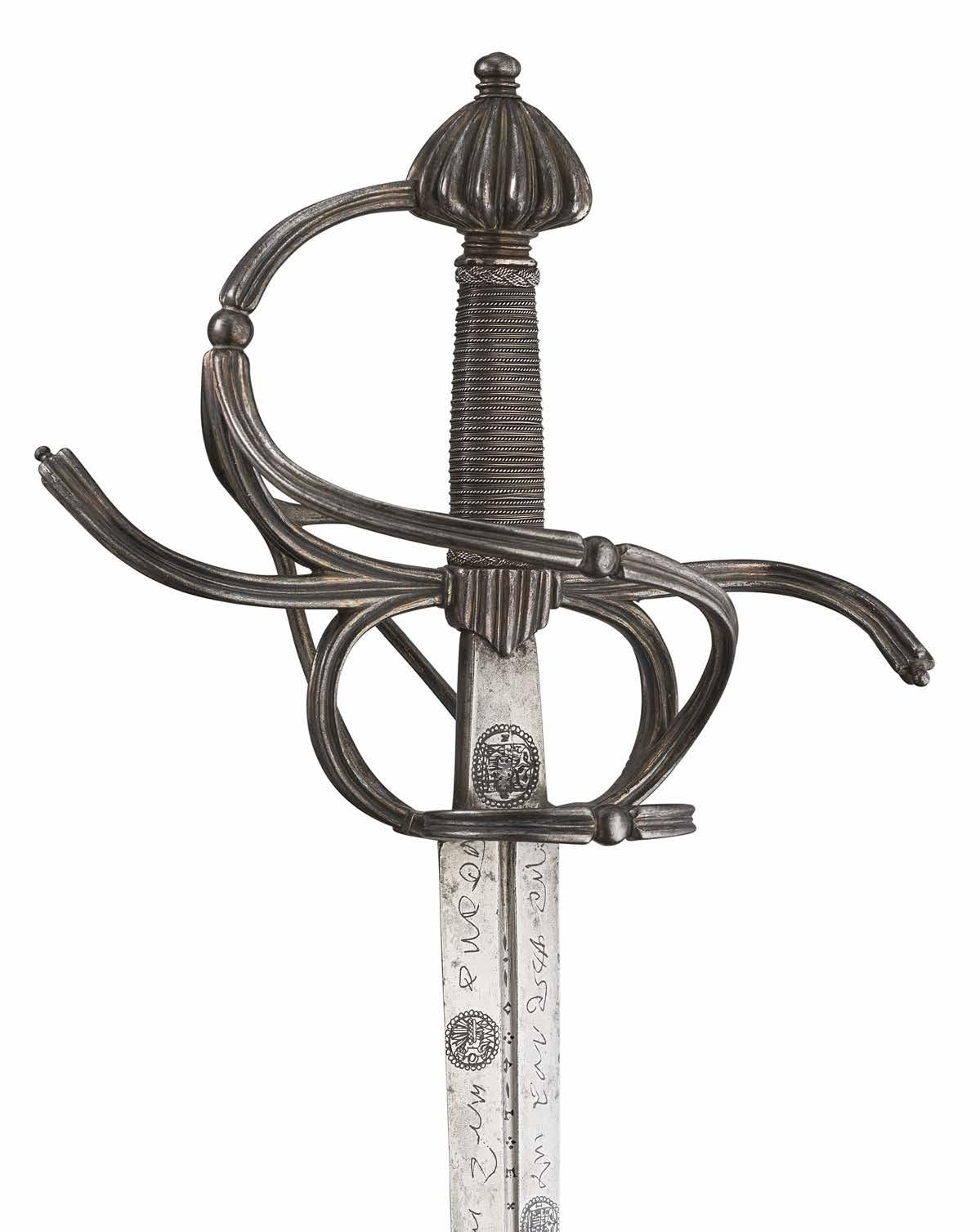
A FINE SAXON SWEPT-HILT RAPIER, CIRCA 1570
with broad tapering blade of flattened diamond section stamped ‘Me Fecit’ and ‘Valencia’ on the respective faces within a slender full-length fuller, forte etched on each face with the arms and combined badges of Ferdinand and Isabella of Spain and spurious Ottoman calligraphy, ricasso struck with a mark on each face, silvered iron hilt with guard of slender fluted bars, comprising lower ring-guard joined to the knuckle-guard by an S-shaped bar, each interrupted by a knop-shaped moulding, a pair of straight quillons with recurved inward and outward-canted terminals with small spherical finials, trifurcated innerguard of plain bars joined at the knuckle-guard, fluted mushroom-shaped pommel, and original grip bound with plaited silver wire between ‘Turk’s Heads’, and remaining in fine condition throughout, 101.5 cm blade
Provenance
Earl of Londesborough, Christie’s, 4 July 1888, Lot 31
Edwin J. Brett, Christie’s, 18-21, 25, 26 March 1895, Lot 187
Baron Charles Alexander de Cosson
R.T. Gwynn
Anon. sale, Christie’s, Geneva, 26 April 1977, Lot 32
Anon. sale (Hirschel Boyd?), Christie’s London, 12th December 1997, lot 261, £27,600
Literature
Edwin J. Brett, A Pictorial and Descriptive Record of the Origin and Development of Arms and Armour, 1894, plate LXV, 5
Baron Charles Alexander de Cosson, ‘Some Ancient Sword Blades bearing spurious inscriptions’ in Proceedings of the Society of Antiquaries, 25, XVIII, London (1899-1900), pp. 205-9
Sir Guy Franics Laking, A Record of European Armour and Arms Through Seven Centuries, 1920, p. 302, fig. 1366
J.F. Hayward, ‘A Notable Private Collection. XVth and XVIth Century Armour and Swords in the Collection of R. T. Gwynn, Esquire’ in The Connoisseur Year Book, 1954, p. 44, fig. XIX (c)
Claude Blair, European and American Arms, 1962, plate 116
Ewart Oakeshott, ‘Three Swords from the Dresden Armoury’ in The Sixteenth Park Lane Arms Fair, London 1999, pp. 29-30.
A sword with a closely related hilt, also etched with the Spanish Royal arms on the blade, is preserved in the Victoria and Albert Museum (inv. no. M.48-1947) and a left-hand dagger with a hilt of this type is preserved in the same museum (M.76-1957). Two further rapiers with very similar hilts are preserved in the Tøjhusmuseet, Copenhagen (inv. nos. C236.1942 and C.235.1945).
£30,000-40,000
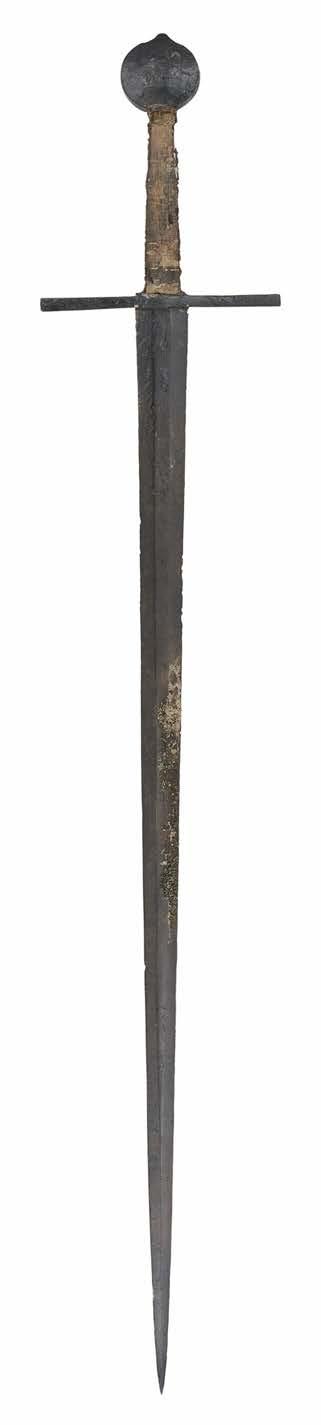
A FINE MEDIEVAL SWORD, MID-LATE 14TH CENTURY, PROBABLY FRENCH
in fine excavated condition with blackened river finish and accretions, with sharply tapering double-edged blade of flattened hexagonal section changing to diamond section at the point, and incised with a bladesmith’s mark, a gothic ‘h’, on the flat on both sides towards the forte, hilt comprising straight quillons of square section widening slightly towards the tips, flat slightly tapering tang retaining traces of grips, and chamfered wheel pommel with pyramidal tang button, 84.5 cm blade, 105.0 cm overall
A sword with an almost identical but reversed mark is in the Wallace Collection, London (inv. no. A462). Another (found in France) bearing the same mark was lent by Baron de Cosson to the Victoria & Albert Museum between 1891 and 1893, and was later in the collection of Sir Guy Laking. The same mark was also used on a sword from the so-called Castillon group, sold in this room 4th December 2024, lot 119.
£6,000-8,000
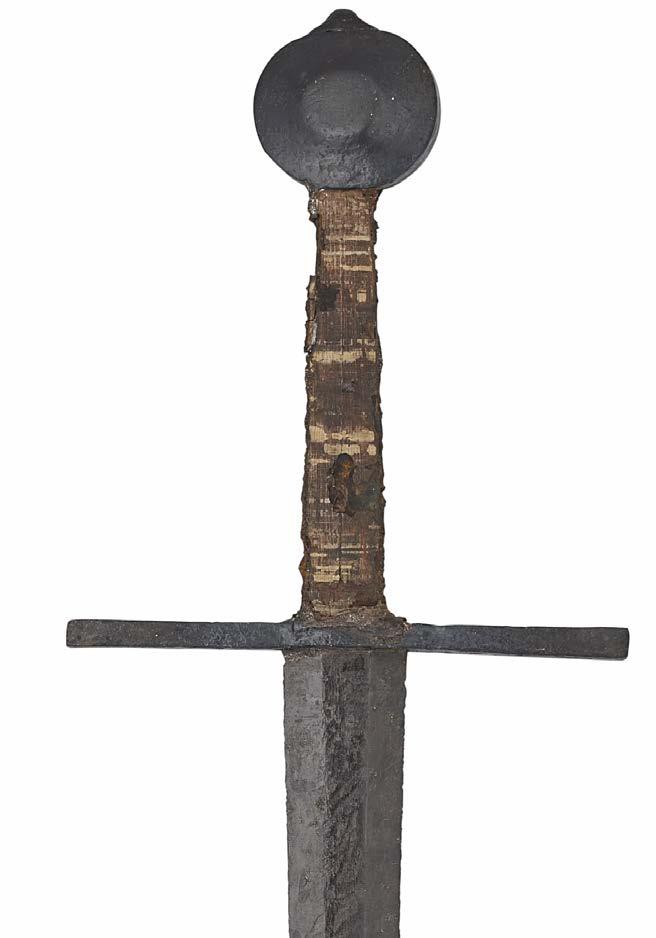
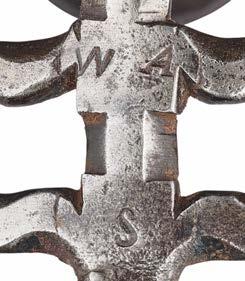
A
FINE SCOTTISH BASKET-HILTED BACKSWORD, THE HILT BY WALTER ALLAN OF STERLING, SECOND QUARTER OF THE 18TH CENTURY
with tapering blade double-edged towards the point and with central fuller over its entire length over each side, a narrow fuller bordering it along the back, iron guard composed of waved bars of rectangular section framing a large central panel and two side panels, the former pierced with two horizontal rows of waved bars between lightly punched fluted borders, the forward loops enclosing diamond-shaped panels each with four heart-shaped piercings centred on a concentric circle, the side panels each with two ‘ram’s horns’ and pierced with triangles and pairs of circles all centred on a pair of hearts, rear quillon engraved ‘WA’ over ‘S’ and with scrolled wristguard, fluted conical pommel with flattened tang button, and writhen fishskin-covered grip bound with a strand of silver wire between silver ferrules, 82.2 cm blade
Provenance
Believed to have been owned by Nicholas Bogart Quackenbush (1734-1813), a member of the fourth generation of Albany Quackenbushes, who sided with the Revolutionary Cause during the time of the American Revolution
Literature
David Oliver, ‘The Quackenbush Sword: A Basket Hilted Sword by Walter Allan Of Sterling’ in London Park Lane Arms Fair Guide, Spring 2009, pp. 79-81, pls. 1 & 2
Another example, by the same hilt maker, was sold in this room, 26 June 2007, lot 253.
£10,000-15,000


A RARE ENGLISH OR LOWLAND SCOTTISH BASKETHILTED BACKSWORD, LATE 16TH/EARLY 17TH CENTURY
with broad blade double-edged at the point and cut with three fullers along the back over most of its length on each side, the fullers at the forte retaining traces of incised letters, iron hilt of slender flat bars framing solid plates including four with decorative piercings flanked on either side by saltires, inner bifurcated wrist-guard, and formed with four bars at the top made in one with a semi-circular bar let into the flat discshaped pommel with prominent tang button, and writhen leather-covered grip (old rust patination overall), 91.2 cm blade
Literature
The Baron of Earlshall, The Scottish Basket Hilted Sword, Volume I c. 1450 to 1600, 2016, pp. 376-382, pls.268-272
For a discussion of guards of this type see Claude Blair, ‘The early BasketHilt in Britain’ in Scottish Weapons and Fortifications 1100-1800, D.H. Caldwell (ed.), Edinburgh, 1981, pp. 221-227, figs. 124-125 and 128, and G.M. Wilson, ‘Notes on Some Early Basket-Hilted Swords’ in Journal of the Arms and Armour Society, Vol. XII, No. 1 (March 1986), pp. 10-12, pls. VII and VIII. See also Cyril Mazansky, British Basket-Hilted Swords, 2005, pp. 59-60, A18-A18b.
For a related example see Christie’s South Kensington, 19 July 2001, lot 58. £5,000-7,000
A SCOTTISH ‘RIBBON’-HILTED BROADSWORD, LAST QUARTER OF THE 17TH CENTURY
with tapering double-edged blade cut with two narrow fullers over both sides of the forte retaining traces of Andrea Ferara inscription, russet hilt of broad flat bars involving two saltires each pierced with a hole and flanked on either side by an ‘S’, most of the bars incised with line decoration, rudimentary quillons, bun-shaped pommel with flattened button, and writhen leather-covered grip (old rust patination), 83.0 cm blade
For other examples of this distinctive type see Cyril Mazansky, Basket-Hilted Swords, 2005, pp.70-73.
£2,000-3,000
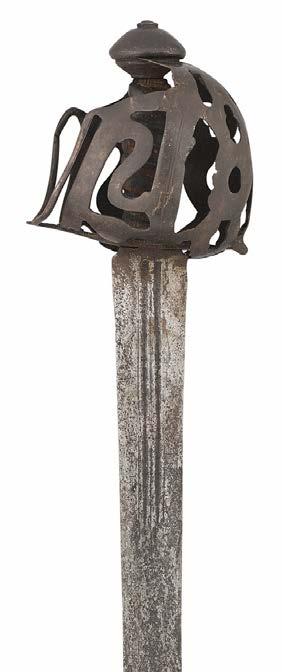
44
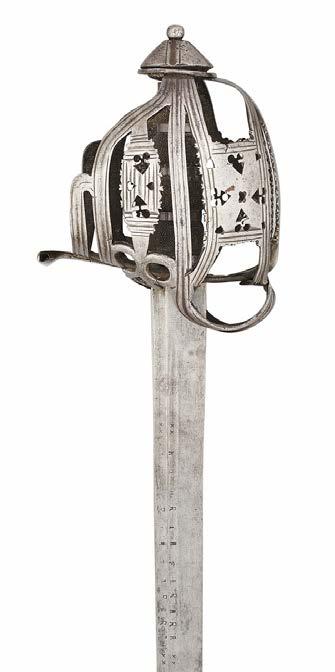
A SCOTTISH BACKSWORD WITH BASKET GUARD OF GLASGOW TYPE, CIRCA 1720
the tapering blade with narrow double fuller along the back over most of its length on both sides to the doubleedged point, the fullers on both sides at the forte incised ‘ANDREA FARARA’ between double ’X’ marks, iron guard of fluted rectangular bars framing finely fretted panels pierced with small hearts and triangular trefoils, the side panels each with a ‘ram’s horn’ pierced with a triangular trefoil, fore-guards, scrolled riveted wrist-guard, bun-shaped pommel fluted between incised lines and with rounded tang button, and later fishskincovered grip swelling between silver bands, 86.5 cm blade
Provenance
The Earl of Stair, Christie’s London, 12 April 1978, lot 187
Literature
David Oliver & Tony Willis, ‘Hidden Treasures: Concealed Signatures on Scottish Basket Hilted Sword’ in London Park Lane Arms Fair Guide, Spring 2008, pp. 53-56, figs. 3 & 4
£3,000-4,000
45
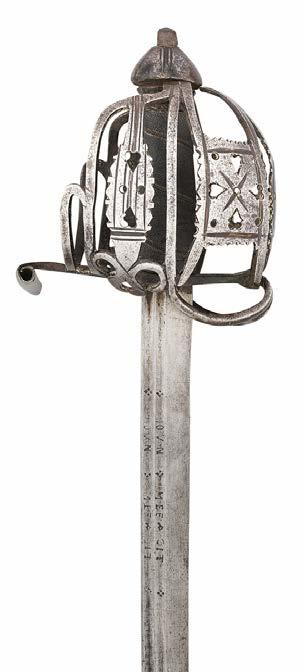
A SCOTTISH BASKET-HILTED BACKSWORD, SECOND QUARTER OF THE 18TH CENTURY
the tapering blade with shallow double fuller along the back over most of its length on both sides to the doubleedged point, the fullers on both sides of the forte incised ‘IOVN ME FACIT’ between quatrefoil marks, iron guard of rectangular bars framing fretted panels pierced with stylised hearts and circles within incised line borders, the main panels centred on saltires each with small central piercing, the fluted side panels each with ‘ram’s horn’ terminal pierced with a stylised heart, the scrolled wrist-guard engraved ‘A’ beneath, bun-shaped pommel fluted between incised lines and with separate tang button, and fishskin-wrapped grip bound with a strand of twisted wire between a Turk’s head and a ferrule, 84.2 cm blade
For a closely related sword exhibited in The Swords and the Sorrows, Culloden Commemorative Exhibition, September 1996 (p. 29, 1:12), see Bonhams Knightsbridge, 13-22 May 2024, lot 124.
£2,500-3,500
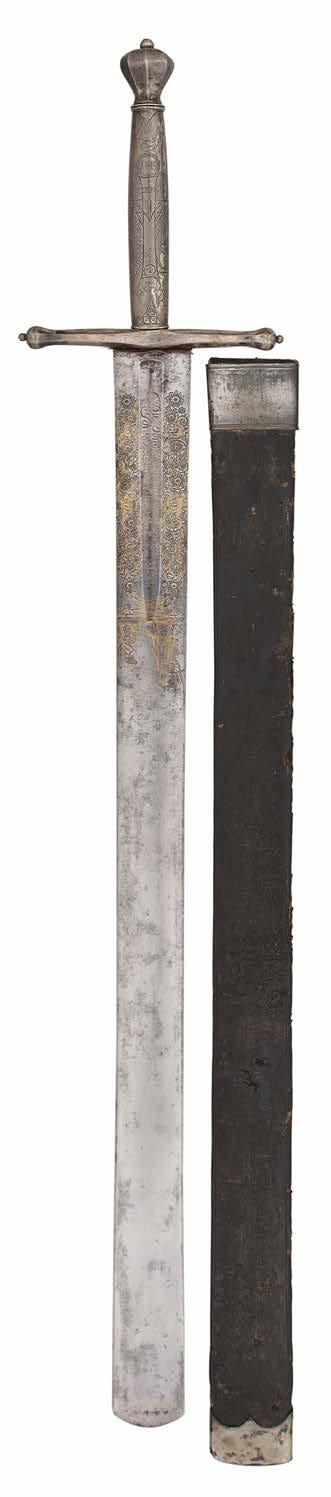
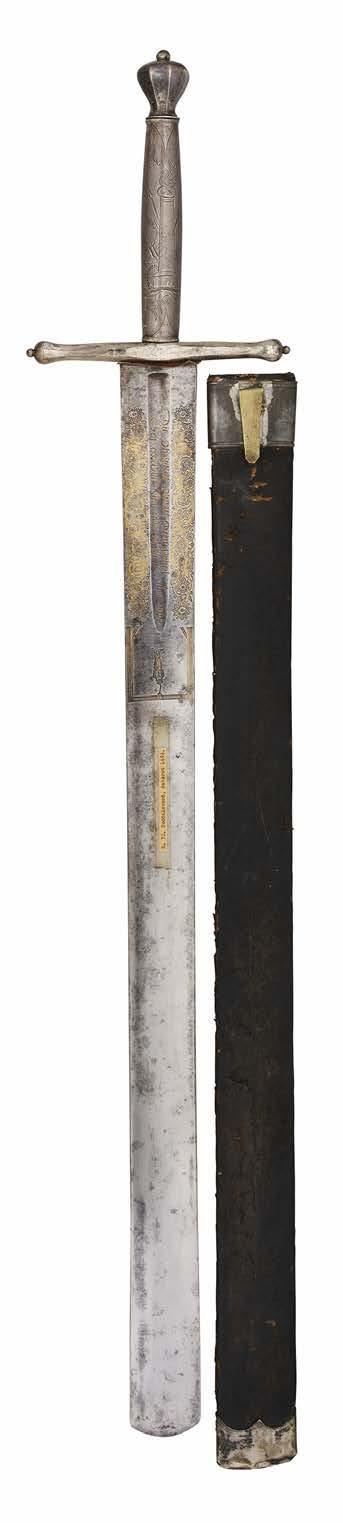
A FINE AND RARE GERMAN SILVER-HILTED EXECUTIONER’S SWORD, DATED ANNO 1694, POSSIBLY SAXON
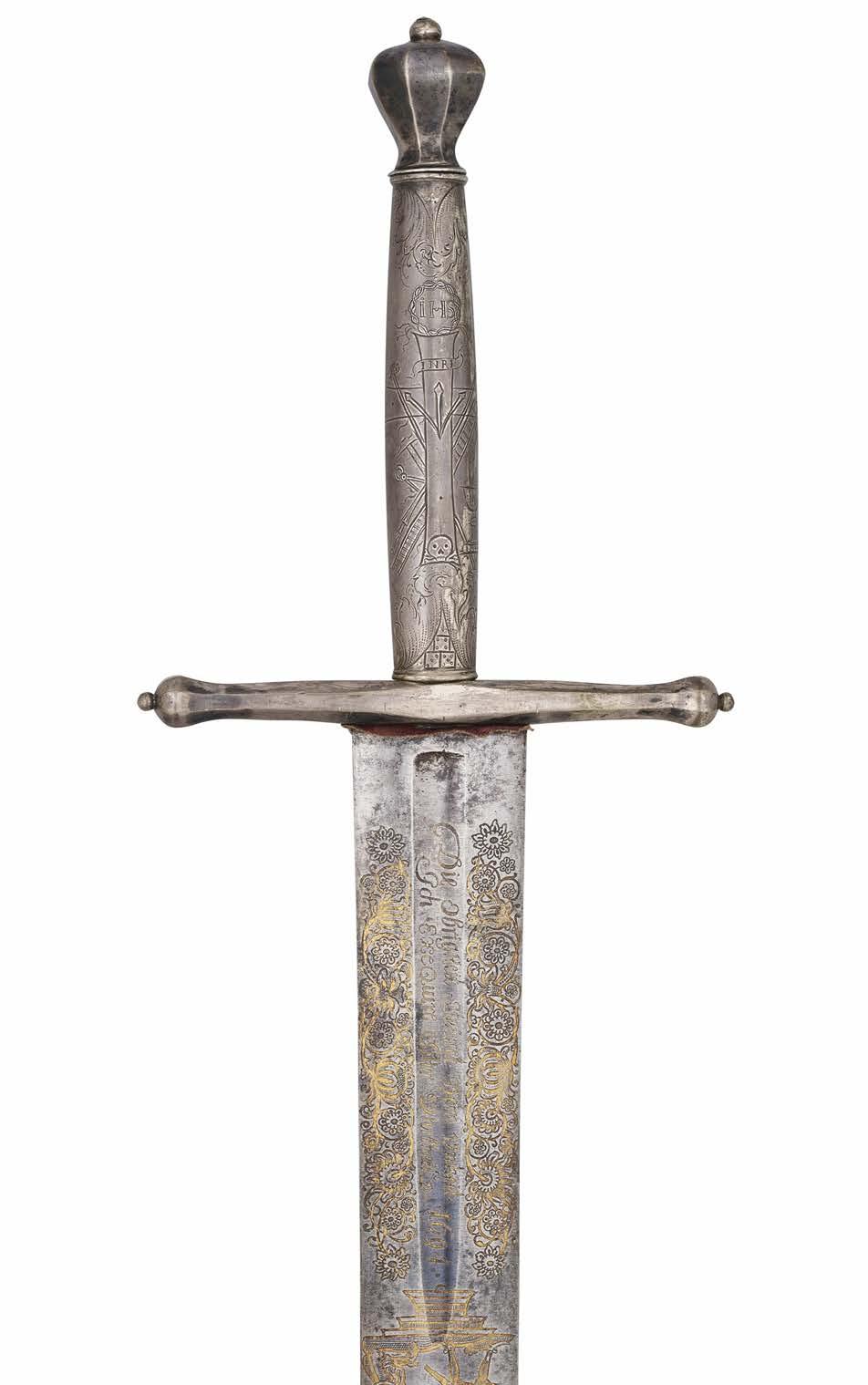
with bright broad double-edged rebated blade (scattered old staining) etched and gilt on one side beyond the forte with a female execution scene by sword, the figures each in contemporary costume, and on the other with a male figure hanging from a gallows, the forte on both sides with central fuller etched and gilt with the rhyming couplet ‘Die Obrigkiet Steuret Dem Unheil .Ich Exequire Ihr Unhrtheil. Anno 1694.’, and flanked by etched and gilt scrolling flowering foliage, hilt comprising horizontal quillons of octagonal section swelling at the tips, the latter each with button terminal, fig-shaped pommel of octagonal section surmounted by a tang button, and slightly swelling tubular grip engraved along one side with a crucifix and tools of execution, the sacred ‘IHS’ within a wreath and on a scroll above, a skull and crossed bones above three dice at the base, and all between acanthus, and along the other side with a cockerel perched atop a martial column between acanthus en suite, in its scabbard covered in black leather (old wear and damage, open along one side) with locket and silver chape, the former with replaced copper alloy hook, the latter stamped with a mark, ‘10’, 89.5 cm blade
Provenance
Boelcke Collection, Berlin
Auction sale, Oslo, 4 October 1935, lot 55
E.A. Christensen’s Collection, Copenhagen
Dr. Jerome Zwanger Collection, Massapequa Park, New York, USA Literature
Ada Bruhn Hoffmeyer, Gammelt Jern, E.A. Christensens Vabensamling, 1968, pp. 122, 124 and 125, pl. 30, no. 83
The inscription is in old German and reads in translation: ‘The authorities condemn the wrongdoer. I merely carry out their sentence’.
Executioner's swords with silver hilts are exceptionally rare. ‡ £20,000-30,000
A SILVER-HILTED RAPIER, POSSIBLY MID-17TH CENTURY
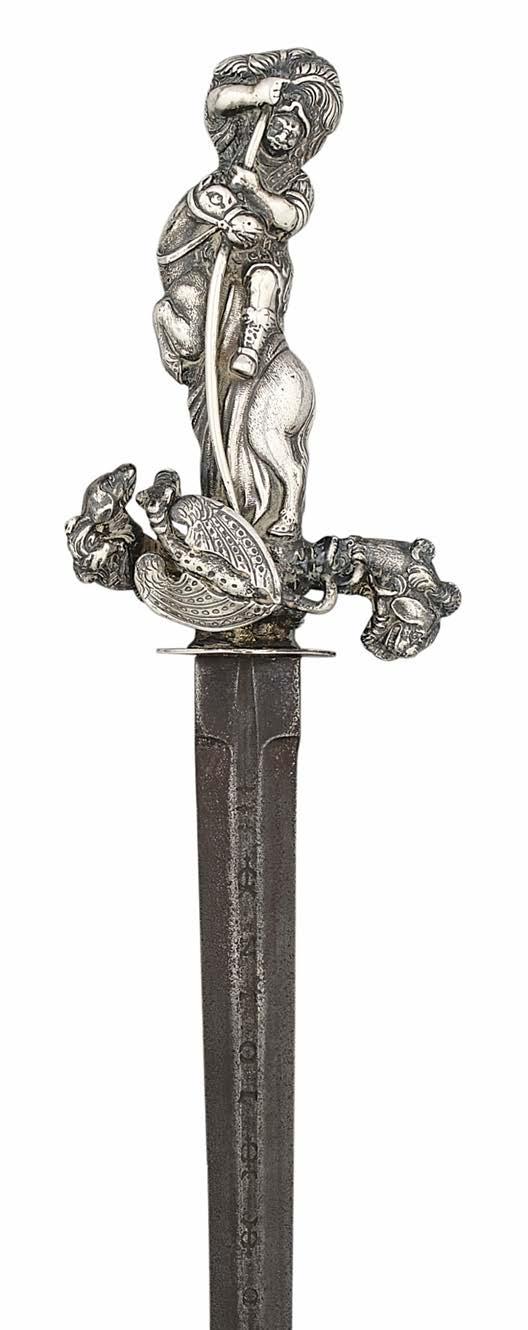
with tapering double-edged blade (old rust patination and edge nicks) incised ‘IN TOLEDO’ within the narrow fuller on both sides of the forte, silver hilt cast and chased in the round as the figure of St. George on horseback spearing the dragon beneath him on one side, recurved quillons each formed as a hound amid foliage and including the initials ‘PC’ in a cartouche on the inside, 84.0 cm blade
Provenance
Peter Dale Ltd, London, 1989
Hilts of this type have been attributed to the famous steel chiseller Gottfried Leygebe of Nuremberg and Berlin. See A. Bruhn, Der Schwertfeger Gottfried, 1945; and A.V.B. Norman, The Rapier & Small-Sword, 1460-1820, 1980, pp. 327-328.
£1,500-2,000
A FINE ENGLISH SILVER-HILTED SMALL-SWORD RETAILED BY BOCK, COCKSPUR STREET, CHAR. CROSS, CIRCA 1768
with brightly polished sharply tapering blade (small areas of surface rust) of hollow triangular section, the forte on both sides etched with panel of hatched foliated strapwork, characteristic hilt cast, pierced and chased in low relief with martial trophies and foliage between bright-cut borders, swelling grip bound with twisted and plain silver wire, and in fine condition, in original vellum-covered scabbard with silver locket and chape, the latter chased en suite with the hilt and including frog-hook and iron ring for suspension, the inner side pricked with retailer’s details, 86.3 cm blade
Mark Boch (I) (1729-82) is recorded as a citizen and weaver of London. He was trained as a gilder and chaser and was by profession a silver-hilt maker and sword cutler. For more information see Leslie Southwick, London Silver-Hilted Swords: Their Makers, Suppliers and Allied Traders, with Directory, Leeds 2001, pp. 52-53.
£1,000-1,500
49
AN ENGLISH SMALL-SWORD WITH SILVER-GILT HILT, INDISTINCT LONDON HALLMARKS, MAKER’S MARK OF CORNELIOUS BLAND, CIRCA 1790
with sharply tapering blade of hollow triangular section bright over two-thirds of its length to the point, the forte on both sides etched and gilt with rocailles and foliage involving a trophy, all against a blued ground, hilt comprising dished ovoidal guard and inner-guard each with beaded outer border, quillon-block with a flower-head on both sides, knuckle-guard with a flower-head between beading on both sides, swelling reeded grip decorated en suite, urn-shaped pommel, and retaining nearly all its gilding, in its wood-lined snakeskin scabbard (the lower third replaced in vellum, chape missing) with silver-gilt locket and suspension mount, and two suspension rings, 85.8 cm blade
For further details of Cornelious Bland (1748-94), gifted goldsmith, silversmith and hilt maker and for a related example of his work (in the Royal Armouries, Leeds, inv. no. IX.2243) see Leslie Southwick, London Silverhilted Swords: Their Makers, Suppliers and Allied Traders, with Directory, 2001, pp. 50,51 and 295, pl. 93.
£800-1,000





50
AN ENGLISH SILVER-HILTED SMALLSWORD, CIRCA 1765
with sharply tapering blade (old rust patination) of hollow triangular section, the forte etched on both sides with strapwork and rocailles, one side involving a sun-in-splendour and a bird, characteristic hilt cast and chased with bright-cut stars centred on pierced scrolling foliage within bright-cut and foliate borders, lobed quillons en suite, and grip bound with silver ribbon and twisted silver and copper-alloy wire, in its vellum-covered scabbard with linear engraved silver locket, chape and suspension mount, and two rings for suspension, 82.5 cm blade
£600-800
51
AN ENGLISH SILVER-HILTED SMALLSWORD, LONDON SILVER HALLMARKS FOR 1764, MAKER’S MARK OF WILLIAM KINMAN with polished colichemarde blade (light surface rust) of sharply tapering hollow triangular section, the forte on both sides with indistinct French inscription centred amid strapwork, characteristic hilt cast and chased in relief with European and Oriental miliary busts each centred on a martial trophy, swelling grip bound with silver ribbon and two types of silver wire, and in fine condition, 83.5 cm blade
For details of this maker see Leslie Southwick, London Silver-Hilted Swords: Their Makers, Suppliers and Allied Traders, with Directory, Leeds 2001, pp.159-160.
£600-900
52
AN ENGLISH SILVER-GILT HILTED SMALL-SWORD, INDISTINCT SILVER MARKS, LATE 18TH CENTURY with colichemarde blade (worn and lightly rust patinated) of tapering hollow triangular section retaining traces of etched scrolling foliage and French inscription on both sides at the forte, hilt of characteristic form including dished ovoidal guard cast and chased overall with differing trophies within beaded ovals and all against grounds of fluting, beading and foliage, and enriched with silver roping, the tang button (slightly reduced) formed as a moustachioed helmeted head, 83.5 cm blade
£600-800
A FINE FRENCH SMALL-SWORD WITH CHISELLED AND GILT STEEL, CIRCA 1750-60
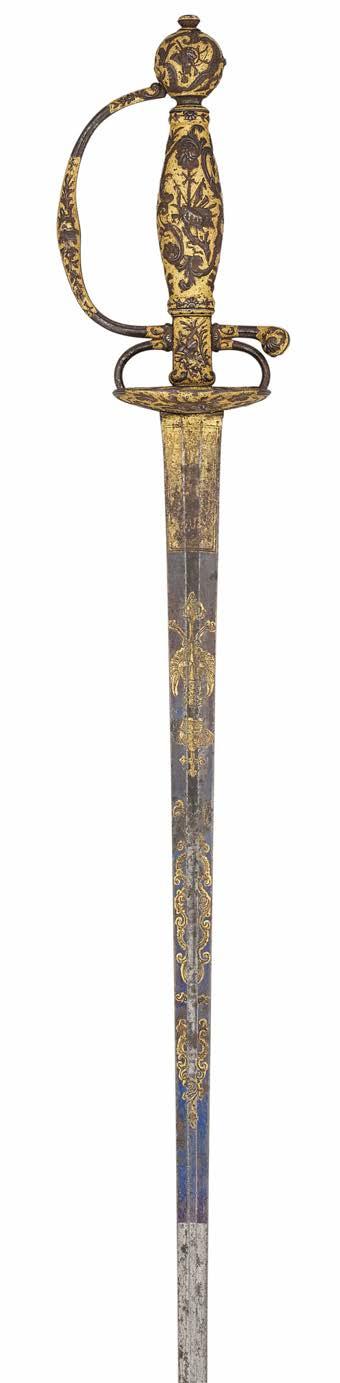
with sharply tapering blade of flattened hexagonal section bright over half its length to the point, the forte etched and gilt against a blued ground on each side with a panel inscribed ‘VIVE LE ROY’ within rocailles and foliage, bright-cut decoration framed by etched and gilt rocailles comprising recessed circles, a rosette and a cross, and with an etched and gilt crowned eagle of the Kingdom of Sardinia on one side, the russet hilt of characteristic form decorated in relief with Classical trophies-of-arms, of the chase, science and music, all framed by rocailles and foliage on minutely punched gilt grounds within gold beaded borders (some old wear and loss of gilding), 83.3 cm blade
Provenance
Christie’s South Kensington, Antique Arms And Armour, 27 April 1988, lot 38
Bonhams Knightsbridge, Antique Arms, Armour and Modern Sporting Guns, 29 July 2009, lot 414
£2,500-3,500


54
A FINE FRENCH SMALL-SWORD WITH CHISELLED AND GILT HILT, MID-18TH CENTURY
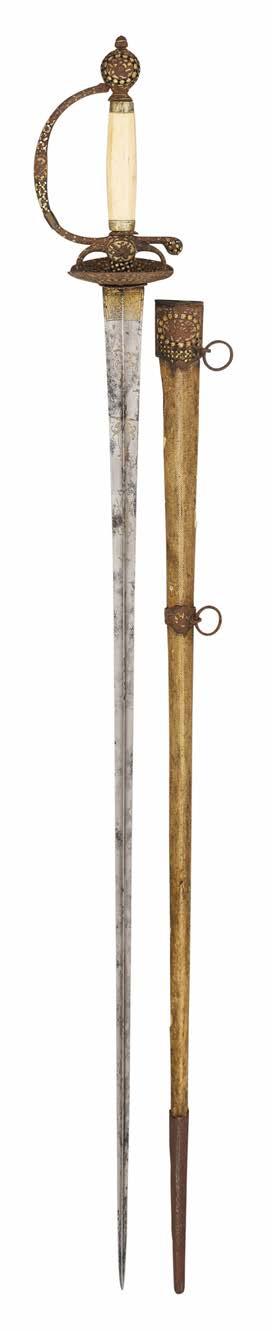
with bright slender tapering blade (some old rust patination) of hollow triangular section, the gilt forte on one side etched with a martial trophy, a figure in an oval between foliage beyond, and on the other with a martial trophy and foliage beyond, characteristic steel hilt (minor surface rust in places) chiselled in relief with foliage and swags supporting flowering urns, all against finely punched gold grounds, and grip bound with silver-gilt ribbon and three types of twisted silver wire between Turk’s heads, 80.2 cm blade
£800-1,200
55
A FRENCH SMALL-SWORD WITH CHISELLED AND GILT HILT, MID-18TH CENTURY
with tapering blade of hollow triangular section (some old rust patination), the forte etched and gilt on both sides with foliage framing a crowned fleur-de-lys in an oval on one side, and a martial trophy on the other, characteristic russet steel hilt chiselled in relief with differing trophies each against finely punched grounds framed by gilt husks, and all against pierced and gilt trellised grounds, and with replacement ivory grip of octagonal section (knuckle-guard repaired, tang button replaced), in its snakeskin-covered wooden scabbard with russet locket and chape en suite with the hilt (chape replaced), and two suspension rings, 71.0 cm blade
Ivory Registration: H5XKC5PX
£400-500
56
A FRENCH SILVER-HILTED SMALLSWORD, MID-LATE 18TH CENTURY
with sharply tapering blade (old rust patination) of hollow triangular section, the forte on both sides etched and gilt with symmetrical strapwork and trophies, one side involving a figure above ‘Rien Sans Vous’, characteristic tarnished hilt cast and chased in low relief with profile portrait busts of warriors each in a wreath and against a ground of repeated florets and dots, and grip bound with two thicknesses of twisted silver wire, 86.2 cm blade
£400-500
57
A STEEL-HILTED SMALL-SWORD, LATE 18TH CENTURY, PROBABLY RUSSIAN
with sharply tapering blade (old wear and rust patination) of hollow triangular section, the forte on both sides retaining traces of etched foliate decoration, hilt (some surface rust) decorated with encrusted chased gold flowerheads some within gold ovals, the pommel between arched borders, the ovoidal shell-guard with gold-encrusted rayed design within a border en suite, and swelling grip bound with steel ribbon encrusted with minute gilt rosettes, copper-alloy ribbon and two types of twisted copper-alloy wire, 81.0 cm blade
£600-800
58
A CONTINENTAL SMALL-SWORD WITH GOLD DECORATED HILT, EARLY 18TH CENTURY
with plain colichemarde blade of tapering hollow triangular section, characteristic steel hilt (old wear) decorated overall busts, figures and foliage, replacement silver knuckle-guard pierced and chased with foliage between beaded lines, and replacement swelling grip bound with two thicknesses of silver wire between Turk’s heads (tang button replaced), 78.0 cm blade
Provenance
The Carl Beck Foundation, Bonhams Knightsbridge, 29 July 2004, lot 171 (B. 380)
The knuckle-guard and grip fitted in England during the mid-18th century.
£350-450
59
A SILVER-HILTED SMALL-SWORD, THE HILT MID-LATE 18TH CENTURY
with 17th century blade of sharply tapering flattened diamond section, the central fuller on both sides of the forte incised ‘TOMAS DAIELES’ between double cross marks, the hilt of characteristic form including dished ovoidal guard cast and chased in low relief with stars and bright-cut clusters, all between beaded and crimped borders (pommel possibly an old replacement), the underside of the guard engraved with crowned thistles and ‘DUM SPIRO SPERO’, 71.3 cm blade
£400-500






60
AN UNUSUAL CONTINENTAL SMALLSWORD, MID-18TH CENTURY
with sharply tapering blade (some wear and light surface rust) of hollow triangular section, the forte on both sides etched and gilt with a martial trophy, on one side with foliage and a figure representing Victory and Peace against a ground of bright-cut spheres, and on the other with a trophy and symmetrical foliage, parcel-gilt steel hilt including boat-shell guard (old wear) pierced and chiselled with martial trophies encrusted in white-metal with reclining figures, a portrait bust and other elements, and grip (probably a working replacement) bound with plain and twisted copper-alloy wire, 79.7 cm blade
£350-450
61
A FRENCH SMALL-SWORD WITH CHISELLED AND GILT HILT, MID-18TH CENTURY
with colichemarde blade (old wear and rust patination) of tapering hollow triangular section, the forte etched on both sides with panels of foliated strapwork, characteristic steel hilt chiselled in low relief with martial trophies on carriages being drawn by winged hounds (old wear), all against gold grounds, and grip bound with silver-gilt ribbon and two types of twisted silver wire between Turk’s heads, 81.6 cm blade
£300-450
62
A CONTINENTAL STEEL-HILTED SMALLSWORD, SECOND HALF OF THE 18TH CENTURY
with bright slender tapering blade of hollow triangular section retaining traces of etched foliate decoration on both sides of the forte, hilt comprising dish-shaped guard with shaped cusped border, inner ovoidal guard with cusped border and chiselled with a garland against a finely punched gold ground, quillon-block, rear quillon, knuckle-guard and ovoidal pommel all decorated en suite, and swelling grip with a studded star on both sides, in its wood-lined black leather scabbard (old repair) with plain steel locket, chape and suspension mounts, and two suspension rings, 82.0 cm blade
£350-450
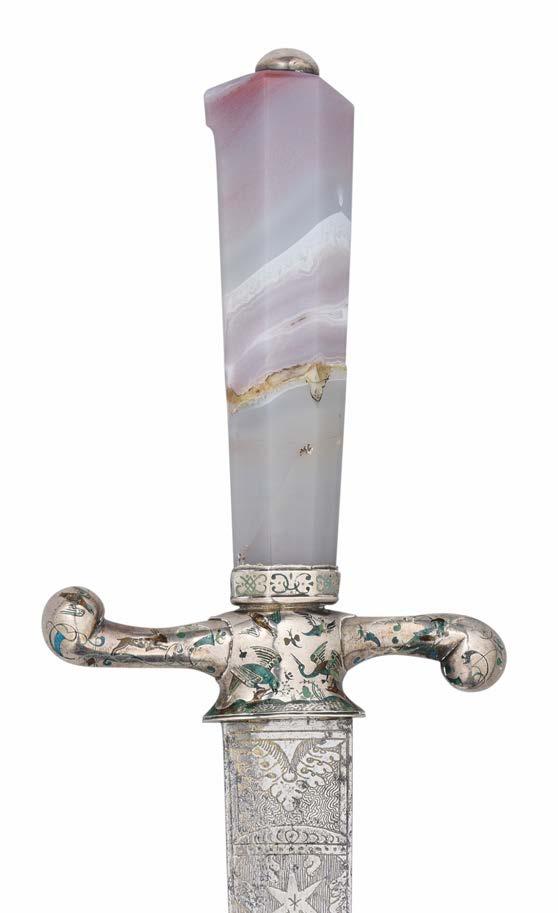
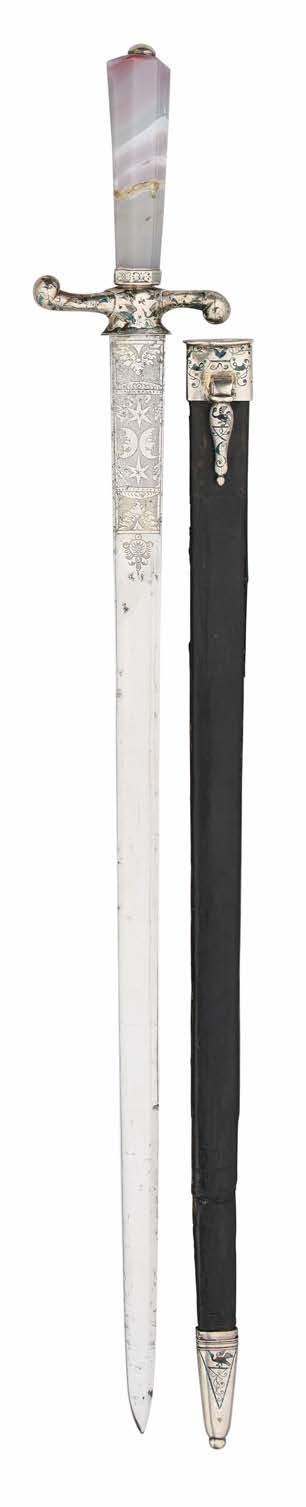
A FINE GERMAN HUNTING SWORD WITH ENAMELLED SILVER MOUNTS, AUGSBURG, 17TH CENTURY
with slender blade double-edged towards the point, and decorated on both sides at the forte with etched panels of foliage and celestial motifs on alternate matted and faux damascus gilt grounds, silver hilt involving recurved short quillons and enamelled in basse-taille aquamarine, green, blue, amber, yellow and black patterns in the manner of David Altenstetter, comprising exotic birds, insects, butterflies, snails, frogs, mice and hares within designs of scrolls and tree foliage, fitted with faceted pink agate grip with silver tangbutton, and in original leather-covered wooden scabbard with silver locket and chape en suite with the hilt (small pieces of enamel chipped, grip with neat repair, scabbard split on both edges), 50.8 cm blade
Provenance
John F. Hayward, Sotheby’s, November 1983, lot 24
Sotheby’s New York, January 1991, lot 646, $26,400
Exhibited
Welt im Umbrach, Augsburg, 1980, cat. no. 881
This technique of enamelling is usually attributed to David Altenstetter of Augsburg, Munich and Prague, circa 1547-1617. Altenstetter was appointed court goldsmith and enameller to the Emperor Rudolf II, circa 1600-1610. This example is probably the product of a pupil of his workshop.
‡ £6,000-10,000
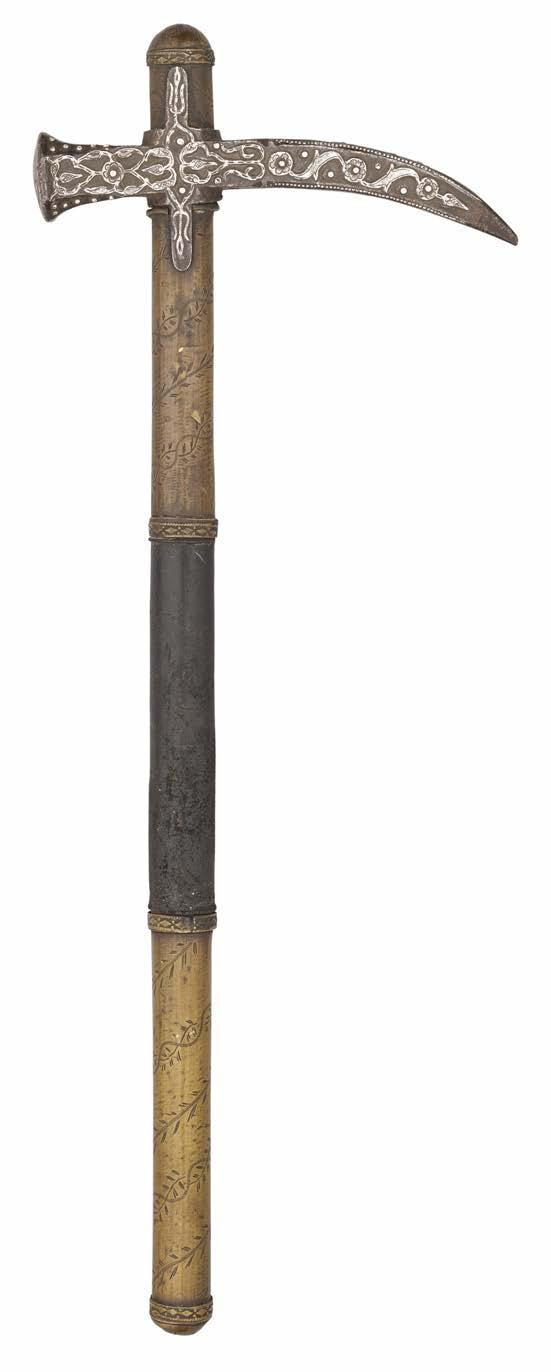
AN EAST EUROPEAN WAR-HAMMER (OBUCH), 17TH CENTURY, HUNGARIAN, POLISH, OR BALKAN
the iron head comprising waisted octagonal head balanced by a robust beakshaped fluke, circular socket with rounded projection above and below on both sides, and decorated overall in Ottoman fashion with encrusted chased silver arabesques and symmetrical foliage, all within beaded silver borders and highlighted with silver pellets, on leather-covered wooden haft of circular section seamed along one side and with tubular copper alloy mounts chased with spiral foliate bands. 17.3 cm head
A strikingly similar war hammer decorated in the same manner was donated to the National Hungarian Museum by Count Gyula Keglevich in 1865. See Tibor S. Kovács, Maces, War-hammers and Topors from Hungarian Collections, Budapest 2016, p. 196, no. 74. For a discussion on Polish war-hammers see M. Paszkiewicz, Polish War Hammers: Czekan, Nadziak, Obuch in The Journal of the Arms and Armour Society, Volume VIII, No. 3, 1975, pp. 225-228, pls. LXXXI-LXXXII.
£1,000-1,500
A
RARE GERMAN GOTHIC STEEL MACE, LATE 15TH CENTURY
with head of six wedge-shaped flanges each pierced with a trefoil and tapering down to a moulding of octagonal section, each taper with two beakshaped projections, and surmounted by a replacement writhen finial, on tapering haft of octagonal section with seam showing copper brazing, petalled hand-guard, and pierced above the basal moulding for a thong, the former crimped around the inside and retaining the remains of its wooden terminal (old pitting), 54.0 cm overall
Provenance
Christie’s London, The Collection of Arms & Armour Formed By Morgan S. Williams, 26 April 1921, lot 239
Literature
Clive Thomas, ‘The Gothic Mace’ in London Park Lane Arms Fair Guide, Spring 2014, pp. 14-43, pl. 61.
For two related examples see Christie’s London, Fine Antique Arms and Armour and Books From the R.T. Gwynn Collection, 24 April 2001, lot 49, and another sold in this Room, Fine Antique Arms, Armour & Militaria, 4 December 2024, lot 129.
£8,000-10,000

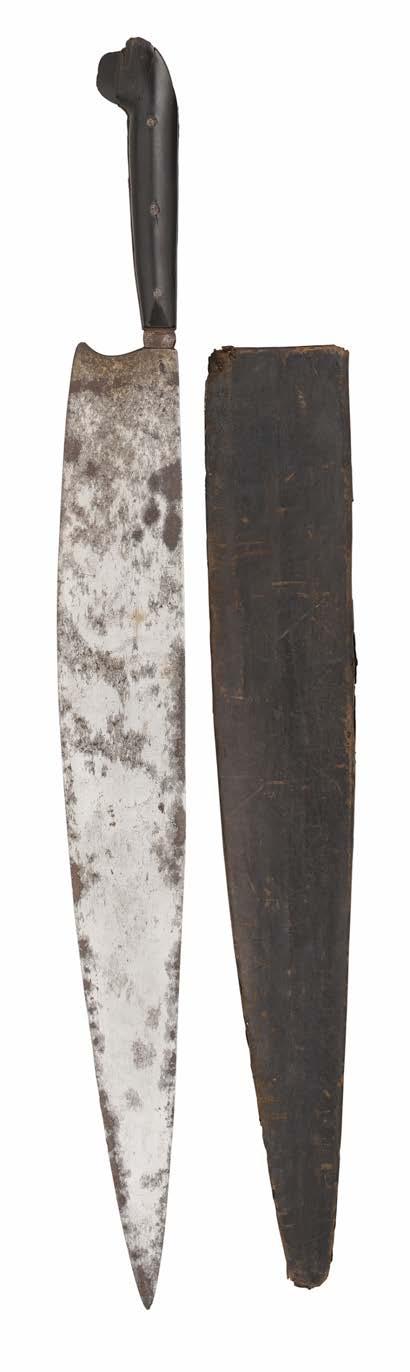
AN UNUSUAL GERMAN STATE GLAIVE (KUSE) OF AN OFFICER OF THE BODYGUARD OF SIGISMUND FRANCIS, ARCHDUKE OF AUSTRIA, AND CONVERTED TO EXECUTIONER’S USE IN THE CITY OF ALGIERS, DATED 1663
with broad single-edged knife-shaped blade (some areas of old staining and pitting) retaining traces of original etching including the date above ‘S...’ on one side, integral grip tang, and ‘eared’ hardwood grips (minor chips) secured by three transverse steel pins, in its wood-lined brown leather scabbard (damaged) with red painted French inscription along one side, 58.0 cm blade
Provenance
Dr. Ben Hamon Collection, Paris Bonhams Knightsbridge, 26th November 2014, lot 89 Exhibited
Oliver Hoare, Every Object Tells A Story, 2014, cat. no.143
The inscription reads in translation: ‘Executioner’s sword found by Captain Müller in the kasbah during the taking of Algiers... bears the date 1663, was used in particular for the beheading of Christians’.
Probably originally taken as loot by the Ottomans at the time of the Austro-Turkish war and siege of Vienna in 1683. This glaive was presumably subsequently used as an executioner’s sword in Algiers until captured by Captain Müller under the command of General Count de Ghaisnes de Bourmont at the time of the defeat of Hussein Dey, ruler of the Ottoman Regency of Algiers. Sigismund Franz (1630-1665), Archduke of Austria, was ruler of further Austria including Tyrol from 1662 to 1665. He was appointed Bishop of Augsburg in 1646, bishop of Gurk in 1653 and bishop of Trent in 1659.
For a fully etched example see Math. Lempertz, Köln, Waffensammlung Konsol A.D., Hans C. Leiden, 20 June 1934, lot 428.
£3,000-4,000

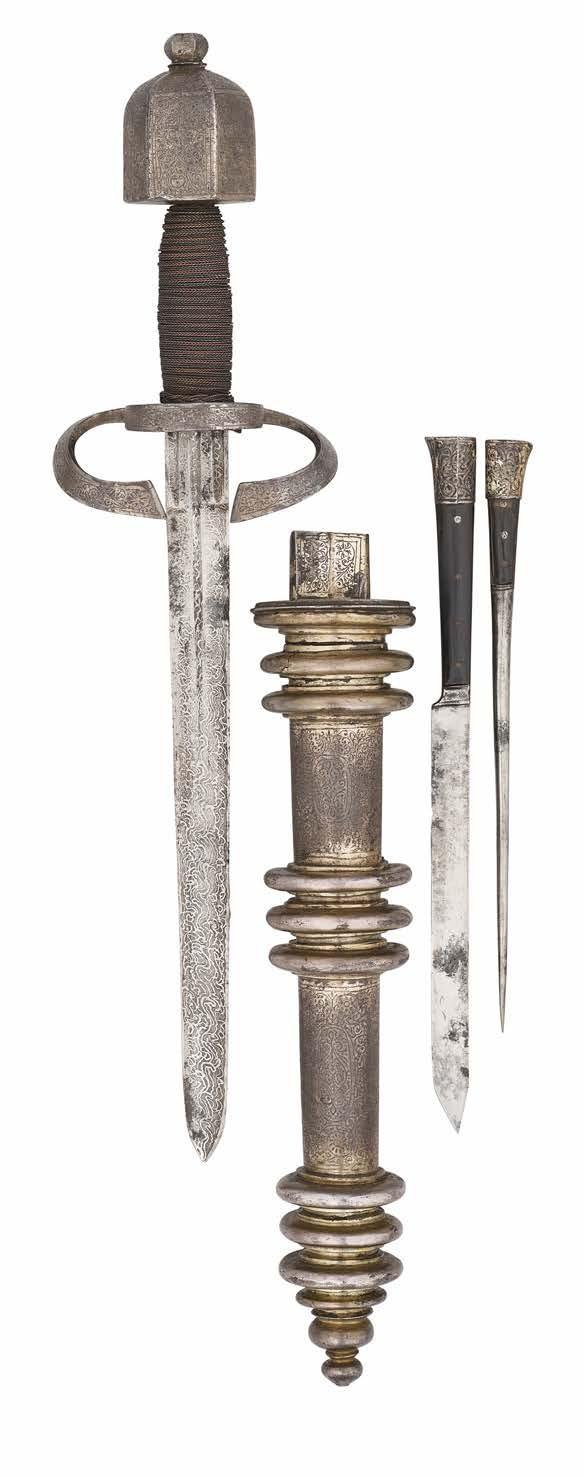
A VERY RARE GERMAN ‘LANDSKNECHT’ DAGGER WITH ETCHED AND SILVERED DECORATION, LATE 16TH CENTURY
with double-edged blade etched in imitation of watering and with narrow central fuller over each side of the forte, fluted ricasso, iron hilt finely engraved with flowering scrolling foliage within line borders and retaining most of its silvering, comprising curved slightly down bent quillons each widening at the spatulate tip, a large side-ring above, large domed pommel of octagonal section with octagonal tang button above, and grip bound with twisted copper alloy and iron wire and retaining a single Turk’s head, in original iron scabbard decorated en suite including the standing locket, the locket and mid-section both with three prominently ‘puffed’ bands, the chape formed of graduated ‘puffed’ bands en suite to a budshaped terminal, the first pierced with two apertures for the by-knife and bodkin (both with some old pitting) each with riveted rounded wooden grip-scales, and beaked pommel decorated to match the hilt and scabbard, and three fixed rings for suspension on the inside. 26.4 cm blade, 44.5 cm overall
Provenance
The Armoury of the Counts von Stauffenberg, sold, Sotheby’s Olympia, Fine Antique Arms, Armour & Militaria, 10 July 2002, lot 198
An etched scabbard of similar form, previously in the collection of Prince Carl of Prussia, latterly in the Berlin Zeughaus and now preserved in the Museum für Deutsche Geschichte, Berlin is illustrated in Heinrich Müller and Hartmut Kölling, Europäische Hieb-und Stichwaffen, Berlin 1990, p. 234, no. 192. For other examples see The Wallace Collection, London (inv. nos. A752, A754 and A756) and another example sold in this room, 25 June 2025, lot 136.
£15,000-18,000
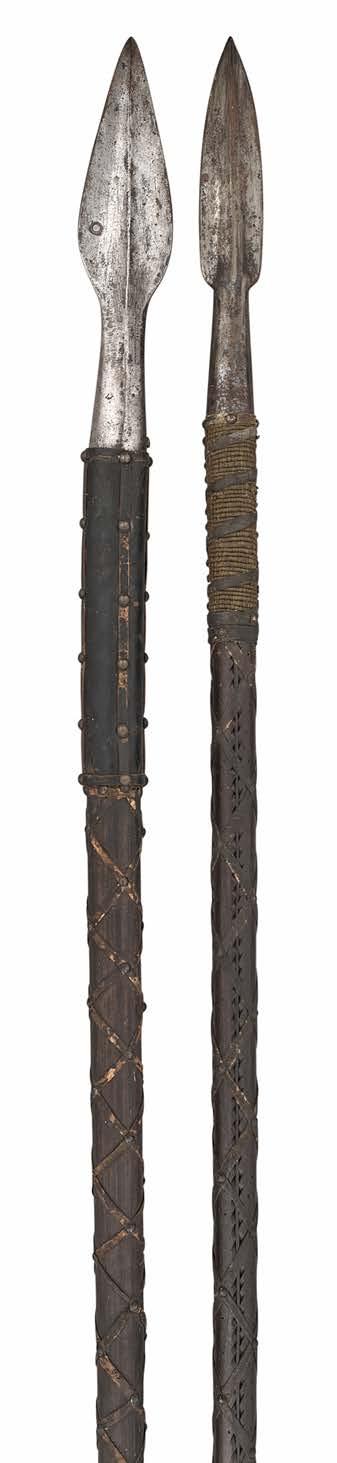
TWO GERMAN BOAR-SPEARS, LATE 18TH/19TH CENTURY
each with broad leaf-shaped blade of hollowed diamond section, and robust tapering socket (some old pitting), each on its wooden staff of circular section mostly covered with a trellis of leather thongs secured by dome-headed nails, one carved in chip work with longitudinal lines and with cord binding at the top, 32.5 cm and 35.0 cm heads (2)
‡ £1,000-1,500
69
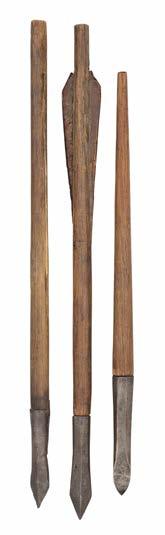
THREE GERMAN CROSSBOW BOLTS, LATE 15TH/EARLY 16TH CENTURY
the first with finely formed pointed head of square section struck with a cross mark and integral with the socket of octagonal section, on its wooden shaft; the last two each with lapped lozenge-shaped head of stiff diamond section, and each on wooden shaft, one with leather flights and the other with remains of wooden flights, 32.3 cm to 38.0 cm (3)
‡ £400-500
70
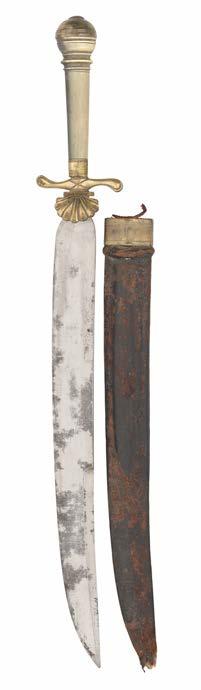
A CONTINENTAL HUNTING HANGER AND PLUG BAYONET, MID-18TH CENTURY
with bright slightly curved blade (some old rust staining) double-edged towards the point and latten-filled crescent-shaped mark on one side, ormolu-mounted hilt comprising small shell sideguard, recurved lobed quillons, and reversable horn grip of tapering circular section with turned spherical pommel and ormolu cap, in its leather scabbard with ormolu chape and pocket for a byknife (chape and by-knife missing, leather with old damage), 33.4 cm blade
‡ £300-400
A SCOTTISH OFFICER’S REGIMENTAL BASKETHILTED BROADSWORD BY HENRY WILKINSON, PALL MALL, LONDON, NO. 52581 FOR 1914/17 with bright fullered double-edged blade etched over half its length on one side with symmetrical thistles, crowned ‘GR’ cypher and the maker’s details, and along the other with symmetrical thistles, silvered guard of characteristic form retaining its buff leather liner faced in red woollen cloth and red tassel, in its brown leather-covered field service scabbard with silvered chape, 83.0 cm blade
£600-800
72
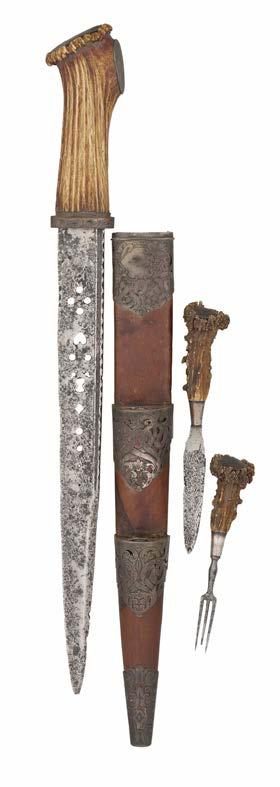
A HIGHLAND DRESS DIRK, 19TH CENTURY
with tapering blade double-edged at the point (extreme tip missing), notched and fullered along the back edge and pierced with holes, a heart and a stylised thistle, and natural staghorn grip with foliate engraved silver mounts, in original brown leather scabbard with silver mounts pierced and engraved with symmetrical scrolling foliage on the outside, side-pockets for by-knife and fork en suite with the dirk, and suspension bar (blades and fork pitted), 32.5 cm blade
‡ £400-600

Over five centuries the Paget family has included an array of eclectic and eccentric characters, including many key players in global diplomacy and Britain’s military history. William Paget, 1st Baron Paget, served Henry VIII, Edward VI and Mary I, and was sufficiently prominent in European affairs to be favoured by the Emperor Charles V. William Paget, the 5th Baron, was equally prominent and fought for the King in the Civil War; his namesake, the 6th Baron, served as ambassador-extraordinary to the Ottoman court at Istanbul and played a notable part in the negotiations that led to the Treaty of Karlowitz in 1699, ending a long conflict between the Ottoman Empire and the Habsburgs, Poland-Lithuania, Venice and Russia. Paget’s Istanbul embassy gave the family one of its most exotic chapters. He appears to have enjoyed marked favour at the Ottoman court: the Sultan is said to have pressed William III to leave him in post and, when Paget eventually departed, to have loaded him with gifts including shamshirs and twelve magnificent Turkish horses. The latter were presented to Paget by the Sultan, and in turn given to Queen Anne, while the former were retained by the family and later kept at Plas Newydd. In the 18th century the Pagets’ fortunes were transformed. The 7th Baron was created Earl of Uxbridge by George I, and the subsequent union with the Bayly inheritance brought with it Plas Newydd and the great Anglesey estates. This acquisition came at a moment of exceptional opportunity. As the Industrial Revolution gathered pace, the iron, copper and coal beneath the family lands greatly increased their wealth.
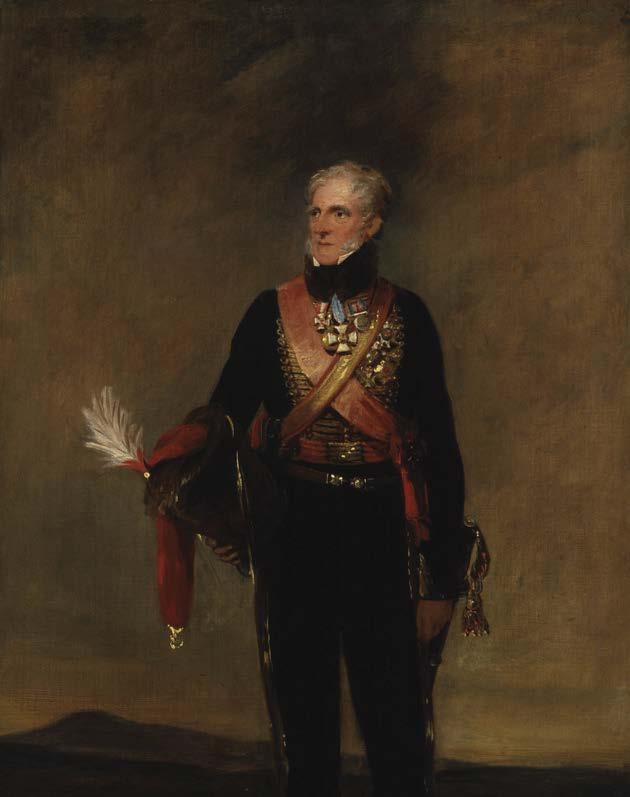
Henry William Paget, later 1st Marquess of Anglesey (1768 – 1854), was a brilliant cavalry officer in the Peninsular War, who rose rapidly through the ranks to command the British cavalry in the Waterloo campaign and to serve as Wellington’s second-in-command. His appointment was not without irony as some years earlier he had caused a scandal by eloping with the wife of Wellington’s brother. Uxbridge’s more instinctive, even romantic, idea of how to use cavalry proved critical. In the early afternoon of 18 June 1815, as d’Erlon’s corps pressed hard against Wellington’s centre-left and threatened to break the Allied line, Uxbridge ordered the British heavy cavalr y forward. The charge was magnificent, uncontrolled and costly; but it came at a key moment and helped shatter the French assault at a time when success seemed possible. He is also famously remembered near the close of the battle, when a cannon shot struck his leg. “By God, Sir, I’ve lost my leg,” he is said to have remarked to Wellington, who replied, with characteristic economy, “By God, so you have.”
Anglesey returned from Waterloo a hero. He was created Marquess of Anglesey, appointed to the Order of the Garter, and fitted with an innovative articulated wooden leg. He lived for another thirty-two years, active in politics and public life (see lot 98), twice ser ving as Lord Lieutenant of Ireland and supporting Catholic emancipation. He lived in corresponding splendour, between Plas Newydd, Beaudeser t, Uxbridge House, Burlington Gardens and his yacht Pearl. His gift to the Royal Yacht Squadron of the “Gold Mug” became part of the early history of what is now the America’s Cup.
The martial tradition did not end with him. Lord George Paget, following his father into the cavalry, served in the Crimea. He became famous as Lord Cardigan’s second-in-command during the Charge of the Light Brigade, remembered, with almost theatrical composure, for smoking a cigar as he rode. Lord Clarence Paget joined the Royal Navy, fought at Navarino in 1827 and later became Vice-Admiral and Commander-inChief of the Mediterranean Fleet. Lord Alfred Paget served Queen Victoria as Chief Equerry. The later Marquesses belonged to the world of the Victorian court, sport and dynastic marriage, culminating in the 4th Marquess’s marriage to the American heiress Mary “Minna” Livingston King.
See Alex Anglesey, The Great Survivor of the Tudor Age: The Life and Times of Lord William Paget, 2023.
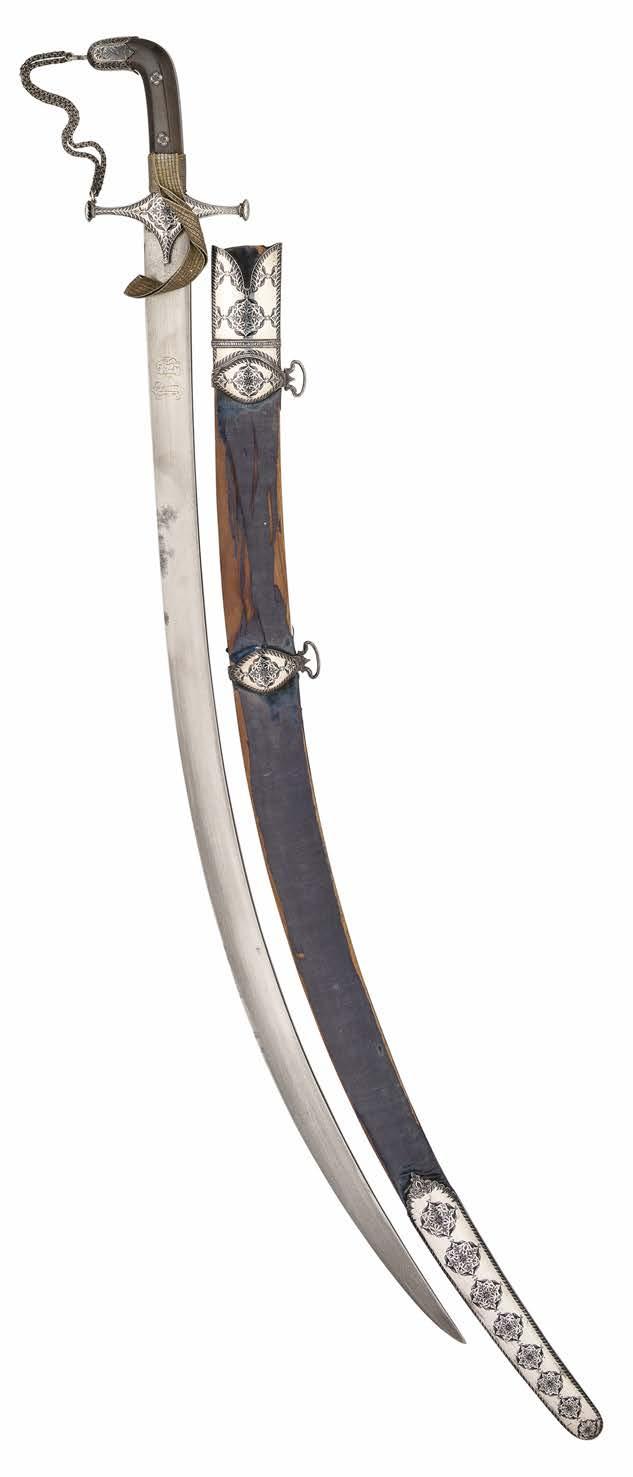
A RARE INDO-PERSIAN SILVER-MOUNTED SHAMSHIR, LATE 18TH CENTURY
with curved single-edged blade (minor old patch of rust patination) of finely watered wootz steel, the forte on one side inlaid in copper alloy with two calligraphic cartouches (some wear), hilt comprising quillon-block decorated in black enamel on both sides with a central arrangement of flowering foliage within pairs of petals and borders of repeated fronds, pointed langets and quillons with button terminals en suite, grip-strap and faceted pommel enamelled with running foliage, the latter with pierced and enamelled suspension loop carrying a pair of suspension chains linked to the forward quillon terminal, bevelled horn grip-scales secured by two transverse pins each with enamelled fluted shaped washers, and silver bullion wriststrap, in its wooden scabbard covered in blue velvet (incomplete, plush worn off) with silver locket, deep chape and suspension mounts all en suite with the hilt, 82.0 cm blade
Provenance
Property of the Marquess of Anglesey, removed from Plas Newydd, Anglesey
£3,000-5,000
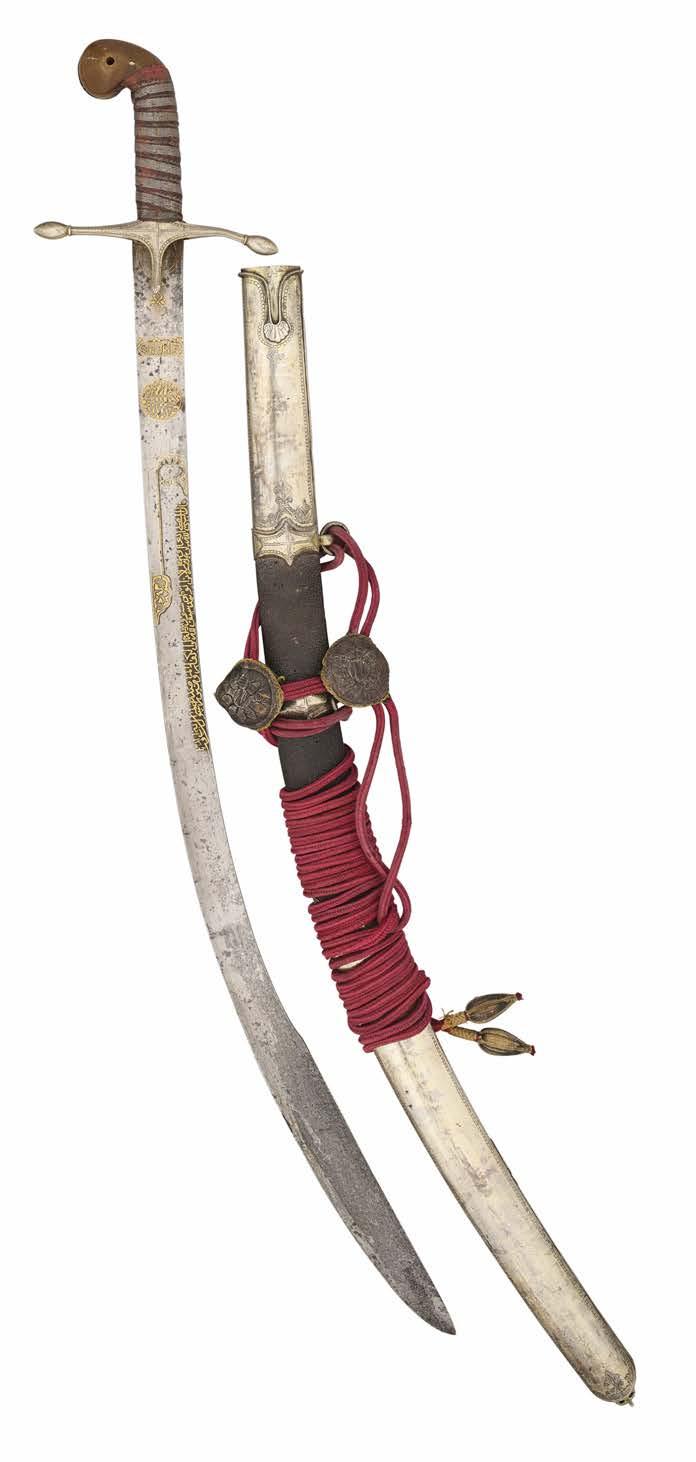
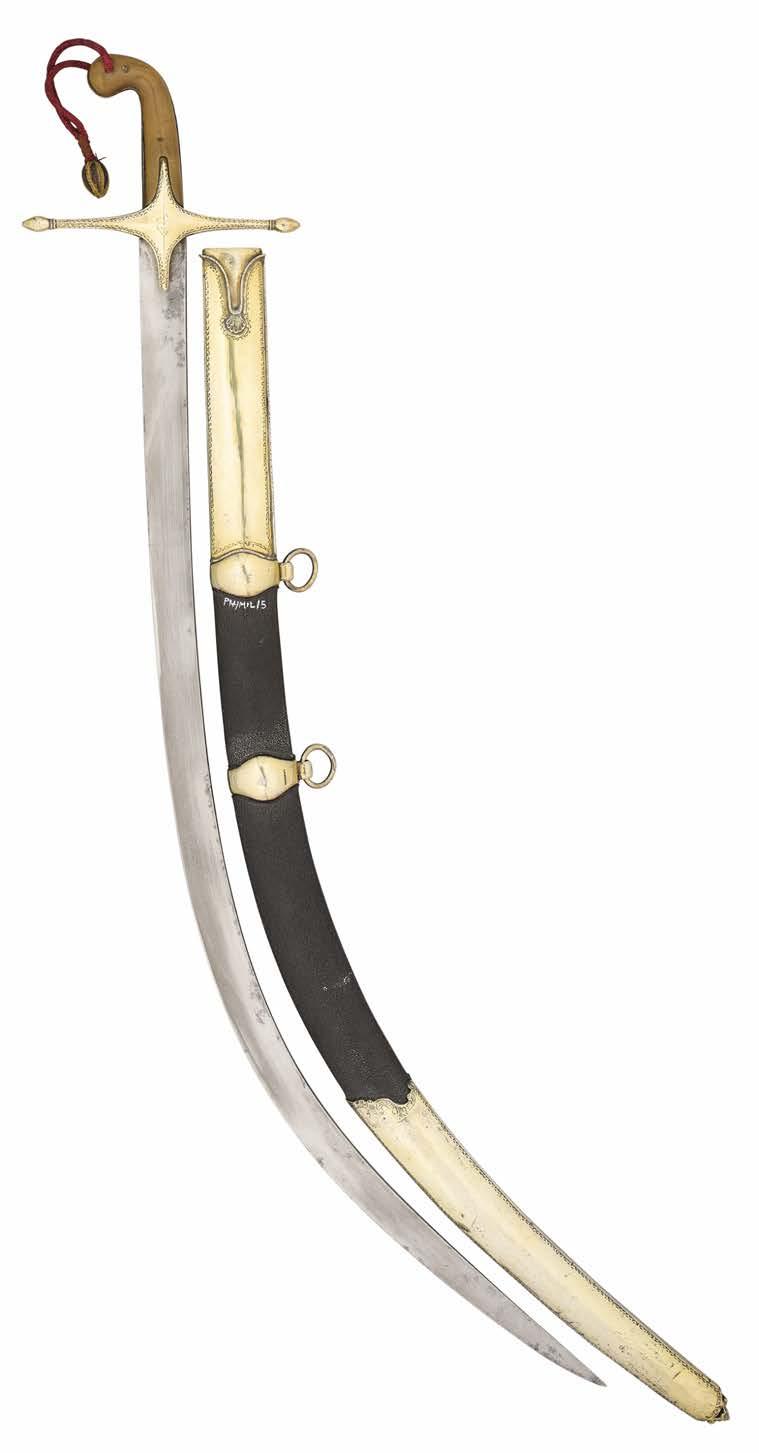
A TURKISH KILIJ WITH GOLD BLADE INSCRIPTIONS, PROBABLY REIGN OF SELIM
III (1789-1807)
with earlier curved blade (some old staining) double-edged along the back of the point in front of the yelman, the forte on one side gold-inlaid with a double carnation within a cartouche of double gold lines, a rectangular and a circular panel of calligraphy above each against a gold ground above, the former being one of the ninety-nine names of God ‘the owner of all sovereignty’ in thulth, the latter being the Bismillah in thulth, and surmounted by two further panels of arabesques against gold grounds and linked together by plain and beaded gold borders to form a hooked shape and enclosing a short gold inscription, the back of the blade on the same side with goldencrusted hadith of the Prophet Mohammad regarding swords, silver-gilt mounted hilt comprising border engraved quillonblock with pointed langets and bud-shaped quillon terminals, reeded grip-strap, and rounded rhinoceros horn grip-scales, bound silver brocade ribbon, the pommel pierced for a tassel, in its black leather wood-lined scabbard with three silver wire seams along the inside, border engraved silver-gilt deep locket and chape (minor denting) decorated with foliage, the latter engraved ‘Khalil al-Ghassal’, probably an owner’s name, border engraved suspension mounts each with suspension ring, complete with burgundy suspension cords with two padded velvet mounts each embroidered in silver threads with a flower-head, and retaining some of its gilding, 80.5 cm blade
Provenance
Property of the Marquess of Anglesey, removed from Plas Newydd, Anglesey
£6,000-8,000
A TURKISH SHAMSHIR WITH SILVERGILT MOUNTS, TURKISH SILVER AND TUGHRA MARKS, LATE 18TH/EARLY 19TH CENTURY, REIGN OF SELIM III (1789-1807) OR MAHMUD II (1807-1839) with curved single-edged blade (minor old staining), hilt comprising border engraved quillon-block with pointed langets and budshaped quillon terminals, reeded grip-strap, and rounded rhinoceros horn grip-scales pierced through the pommel for a red cord tassel, in its black leather wood-lined scabbard with wire seamed along the inside and deep border engraved locket and chape (minor old denting), rounded suspension mounts each with suspension ring, and retaining much of its gilding, 84.5 cm blade
Provenance
Property of the Marquess of Anglesey, removed from Plas Newydd, Anglesey
£1,500-1,800
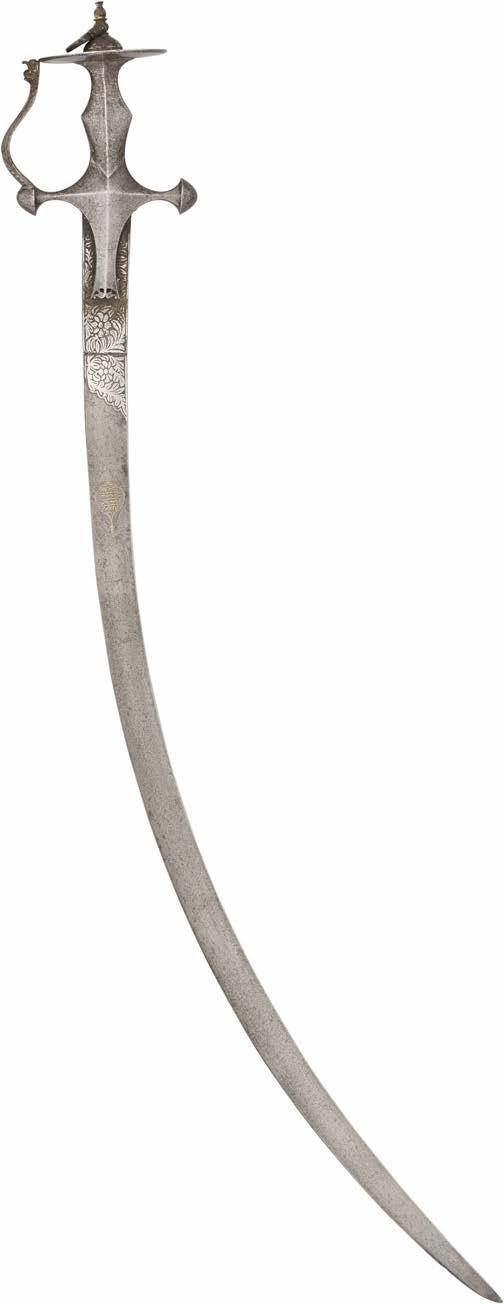
AN INDIAN TULWAR, LATE 18TH/EARLY 19TH CENTURY
with curved single-edged blade gold-damascened with a calligraphic cartouche on one side at the forte, the latter damascened in silver with flowering foliage along both sides and along the back, characteristic steel hilt of flattened diamond section and comprising waisted langets each with pierced double arabesque terminal, waisted domed quillons, the forward one with integral recurved knuckle-guard pierced with a central slot and with chiselled makara-head terminal, disc-shaped pommel on a dome with rayed border, the former with faceted finial carrying a pierced loop for a tassel, 80.0 cm blade
Provenance
Property of the Marquess of Anglesey, removed from Plas Newydd, Anglesey
£600-800
77
AN INDO-PERSIAN SHAMSHIR, LATE 18TH/EARLY 19TH CENTURY, AND A NORTH AFRICAN JAMBIYA, LATE 19TH CENTURY
the first with curved single-edged blade (some old rust patination and minor areas of pitting), hilt comprising silver-gilt quillon-block engraved with foliate decoration and borders against finely punched grounds and including pointed langets and quillons with bud-shaped terminals, gilt grip-strap and gilt copper alloy pommel-cap decorated en suite, the latter with a ring for a tassel, and chequered horn grip-scales; the second with slightly curved blade double-edged over half its length to the point (surface rust), waisted wooden hilt with chased copper alloy basal mount and flat arched pommel, in its wood-lined copper alloy scabbard (old repair) chased with foliate designs, three suspension rings, and yellow cord tassels, 80.0 cm and 24.0 cm blades
Provenance
Property of the Marquess of Anglesey, removed from Plas Newydd, Anglesey
£500-700
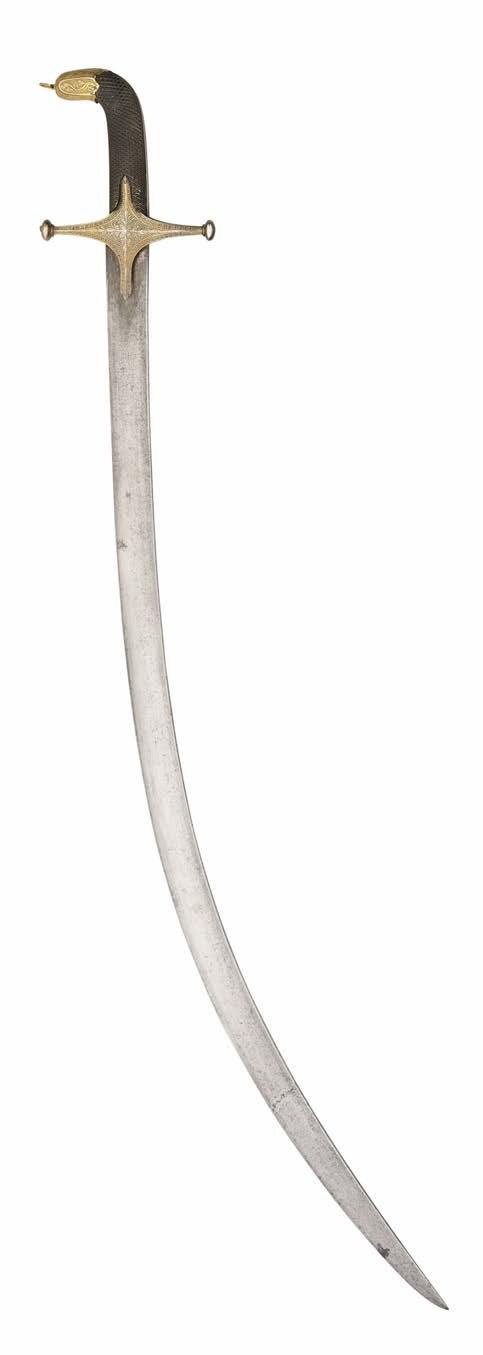
AN INDIAN SHAMSHIR FOR A BRITISH OFFICER, EARLY 19TH CENTURY
the curved blade (some old staining) with false double edge towards the point, steel quillon-block with gold-damascened borders and comprising pointed langets, waisted flat quillons widening towards the tips and golddamascened with foliage along the top and bottom flats, border engraved gilt grip-strap, and ivory grips each retained by two gilt florets on both sides, the pommel with giltmounted hole for a sword-knot, in its reeded wooden scabbard covered in black leather tooled with scrollwork over stringing, steel locket and chape with etched watering and with gold-damascened borders en suite with the hilt, the rounded suspension mounts each with fixed gilt suspension loop formed as a double arabesque, 84.5 cm blade
Provenance
Property of the Marquess of Anglesey, removed from Plas Newydd, Anglesey
Ivory Registration: WA9EY98Q
£1,500-2,000
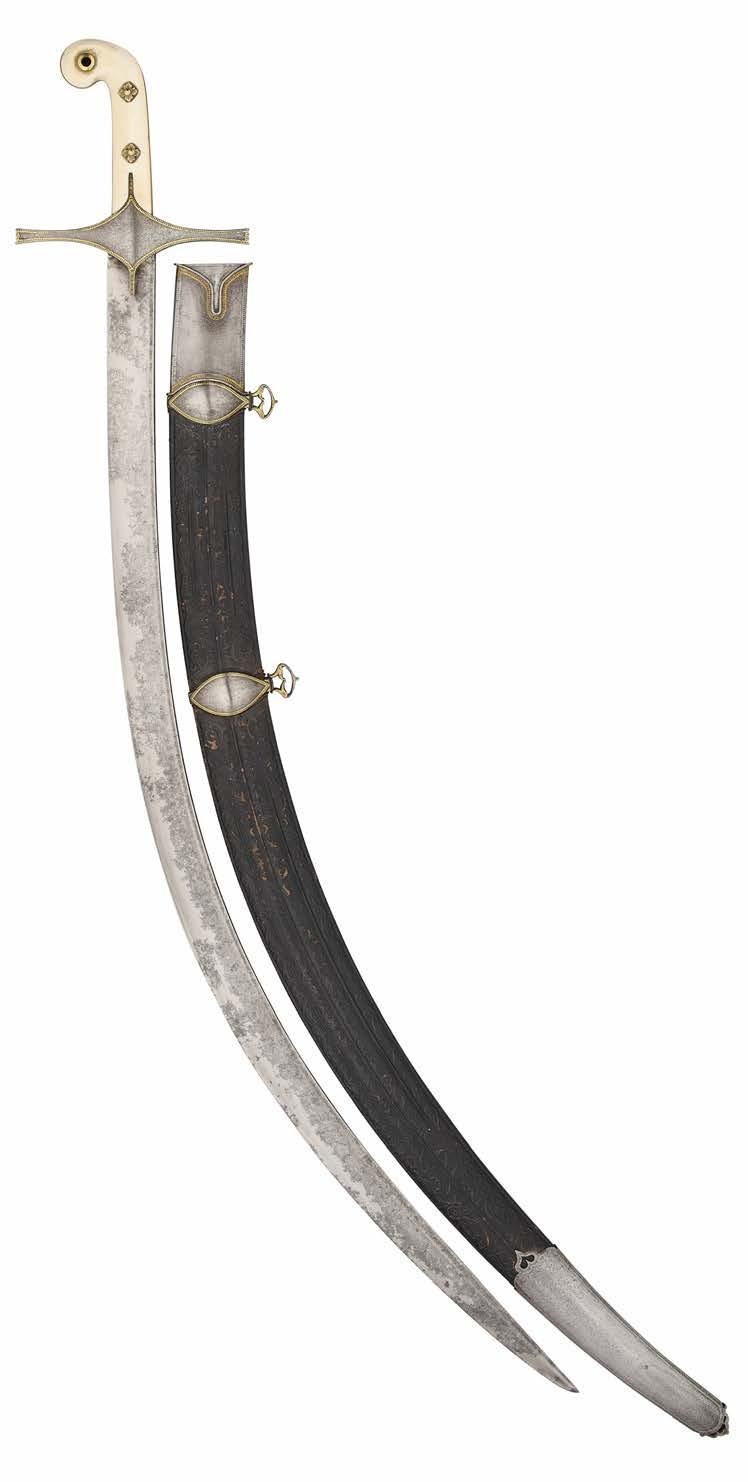
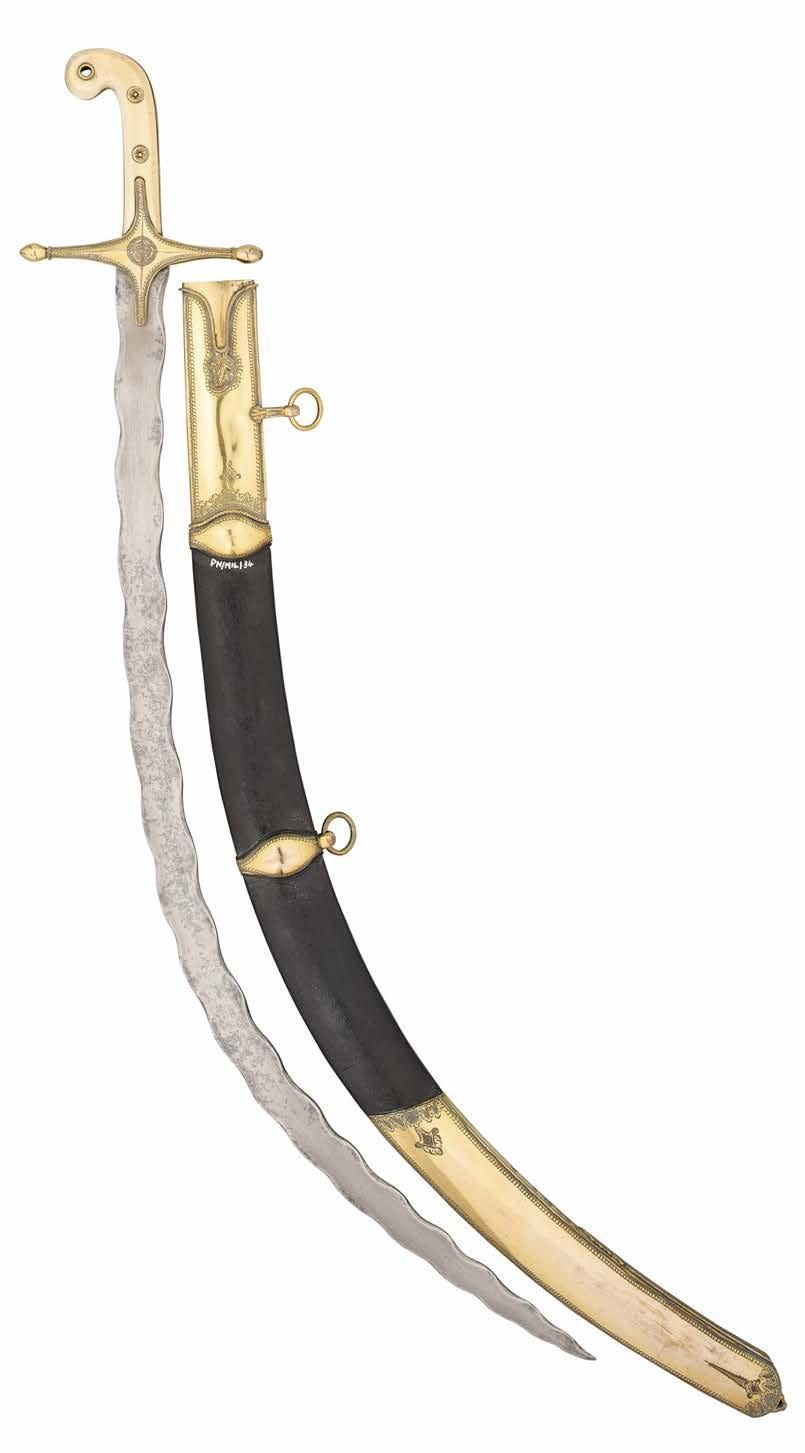
A BRITISH OFFICER’S MAMELUKE-HILTED SHAMSHIR IN THE OTTOMAN FASHION, EARLY 19TH CENTURY with curved waved single-edged blade (some old staining), hilt comprising border engraved quillon-block decorated with a star in a circle on both sides, pointed langets and quillons with birdshaped tips, English mameluke grip with reeded gilt strap, and bevelled ivory grips each retained by two gilt florets on both sides, and pommel pierced for a sword-knot, in its black leather wood-lined scabbard with deep locket, chape and rounded suspension mounts en suite with the hilt, two suspension rings, and retaining nearly all is gilding, 78.0 cm blade
Provenance
Property of the Marquess of Anglesey, removed from Plas Newydd, Anglesey
For a related sword see Richard Dellar, ‘The British Cavalry Sword 17881912: Some New Perspectives’ in The British Cavalry Sword, 2013, p.109, pl. 12.2.
Ivory Registration: PSAQYN7V
£1,500-2,000
80
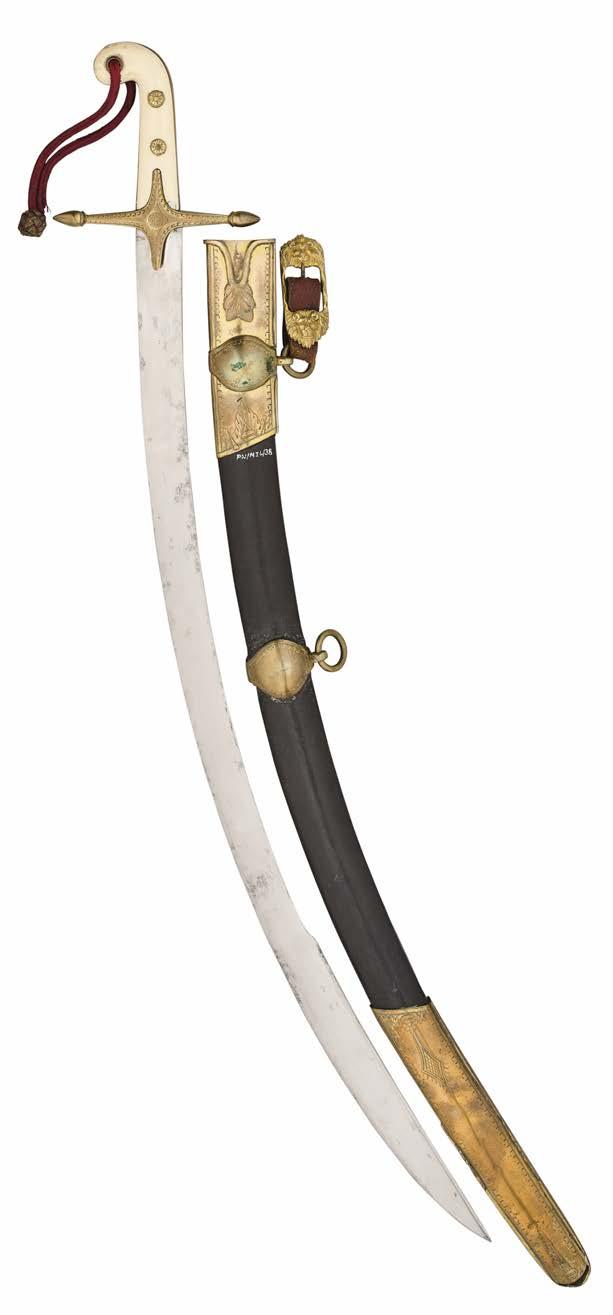
A BRITISH OFFICER’S MAMELUKEHILTED SABRE IN THE OTTOMAN FASHION, EARLY 19TH CENTURY
with bright curved blade (old light staining) double-edged in front of the yelman, border engraved copper alloy hilt retaining traces of gilding and comprising quillon-block engraved with a star within a circle on both sides, foliate engraved grip-strap, and rounded ivory grips each retained by two gilt florets on both sides, the pommel retaining its red cord sword-knot (knot incomplete), in its wooden scabbard covered in black leather with ormolu locket, deep chape and rounded suspension mounts decorated en suite with the hilt, and with two suspension rings, one retaining its ormolu double lionmask sword-belt buckle (some old wear to gilding), 79.0 cm blade
Provenance
Property of the Marquess of Anglesey, removed from Plas Newydd, Anglesey
For a related sword see Richard Dellar, ‘The British Cavalry Sword 1788-1912: Some New Perspectives’ in The British Cavalry Sword, 2013, p. 109, pl. 12.2.
Ivory Registration: 2XVLVEHB
£600-900
81
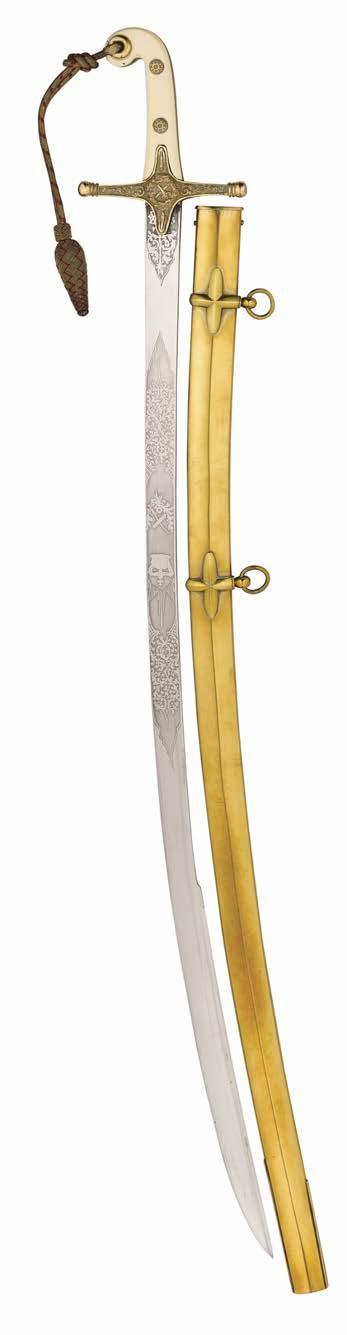
AN 1831 PATTERN GENERAL OFFICER’S MAMELUKE HILTED SABRE RETAILED BY MEYERS, MORTIMER & CO., LONDON, 19TH CENTURY
of regulation pattern, with bright curved blade double-edged to the point in front of the yelman, etched over both sides between symmetrical scrolling foliage with crowned ‘VR’ cypher, and crowned crossed sword and baton above a wreath of oak and laurel, the ricasso on one side with retailer’s details, gilt copper alloy-mounted hilt including characteristic quillon-block, grip-strap, and bevelled ivory grip-scales each retained by two gilt florets on both sides, and retaining its red cord and bullion sword-knot, in its brass scabbard with two suspension rings, and in fine condition, 80.0 cm blade
Provenance
Property of the Marquess of Anglesey, removed from Plas Newydd, Anglesey
Ivory Registration: QPJELNS7
£600-800
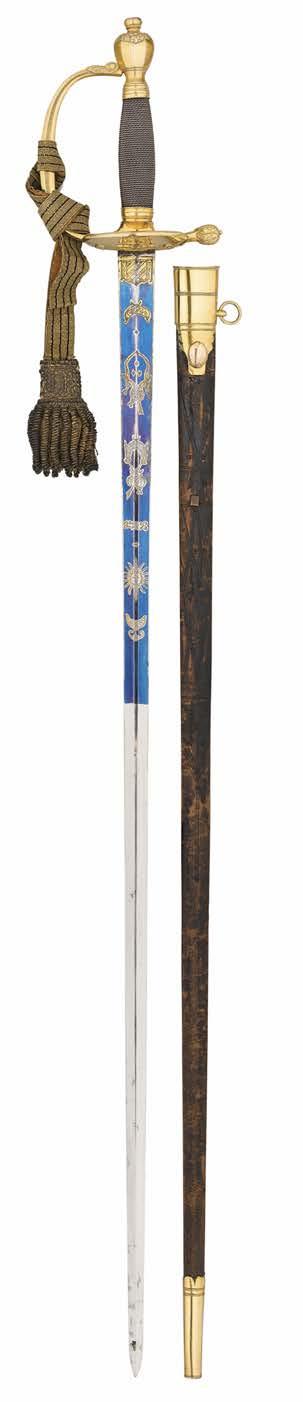
A FINE 1796 PATTERN INFANTRY OFFICER’S SWORD RETAILED BY GOLDNEYS LATE NEILD, ST. JAMES’S STREET, SWORD CUTLER’S TO HIS ROYAL HIGHNESS PRINCE OF WALES, LATE 18TH/EARLY 19TH CENTURY of regulation pattern, with tapering blade of flattened hexagonal section bright over two thirds of its length to the point, the forte etched and gilt against a blued ground along both sides with Turkish trophies, cabalistic symbols, turbans, a sun-in-splendour and foliage, gilt copper alloy hilt comprising double shell-guard, rear quillon and faceted pommel all cast and chased with foliage, bevelled knuckle-guard retaining its bullion sword-knot, and grip bound with twisted silver wire, in its black leather scabbard (some old wear) tooled with crossed double line ornament along one side beneath the locket, linear engraved locket and chape, the former with frog-button and suspension ring, engraved with retailer’s details in an oval on one side, and retaining nearly all its original finish, 83.0 cm blade
Provenance
Property of the Marquess of Anglesey, removed from Plas Newydd, Anglesey
Thomas Goldney and his brother Samuel succeeded James Neild at 4 St. James, Piccadilly, Westminster and remained at that address until 1828. See Southwick, 2001, pp. 119-121.
£1,000-1,500
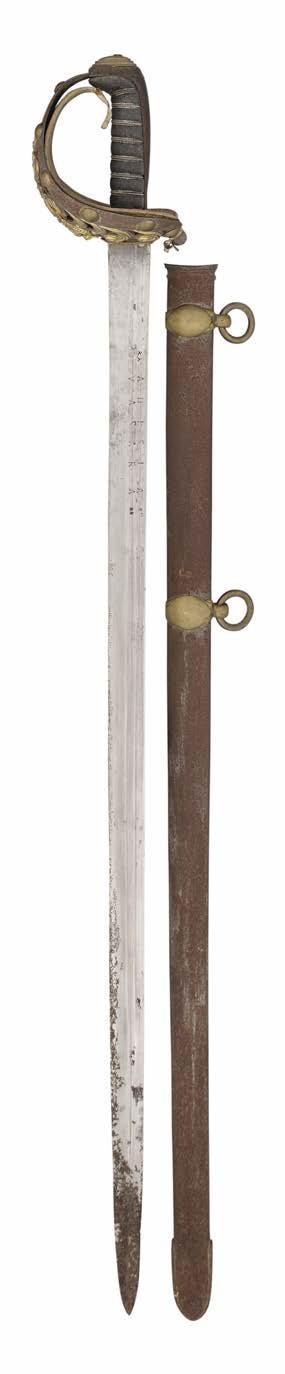
A 1ST LIFE GUARDS OFFICER’S SWORD BY PROSSER, MANUFACTURER TO THE KING, CHARING CROSS, LONDON, CIRCA 1835 of regulation pattern, with fullered blade (heavily corroded over most of its length on both sides), the forte bright and etched with maker’s details on both sides, the back engraved ‘Ld. U’ (for Lord Uxbridge), pierced steel hilt with characteristic applied copper alloy mounts on the guard including crowned foliate ‘1’ centred on a foliate ‘LG’, all within a border of twelve domed copper alloy studs, steel pommel and back-piece in one, the former with stepped copper alloy tang button, wire-bound fishskin-covered grip, and retaining its buff leather liner, in its steel scabbard with ovoidal copper alloy suspension mounts each with suspension ring, the throat on one side engraved ‘Ld U’ (hilt and scabbard old rust patination), 94.0 cm blade
Provenance
Property of the Marquess of Anglesey, removed from Plas Newydd, Anglesey
£1,500-1,800
84
A 1ST LIFE GUARDS OFFICER’S SWORD, CIRCA 1830 of regulation pattern, with bright 17th century blade doubleedged towards the point (some surface rust) and incised ‘ANDRIA’ and ‘VARARA’ between cross marks within the narrow double fullers along the back on both sides, pierced steel hilt with characteristic applied ormolu mounts on the guard including crowned foliate ‘1’ centred on a foliate ‘LG’, all within a border of twelve domed copper alloy studs, steel pommel and back-piece in one, the former with stepped ovoidal tang button, wire-bound fishskin-covered grip, and retaining its buff leather liner, in its steel scabbard with ovoidal copper alloy suspension mounts each with suspension ring (hilt and scabbard with old surface rust), 85.8 cm blade
Provenance
Property of the Marquess of Anglesey, removed from Plas Newydd, Anglesey
£1,000-1,500

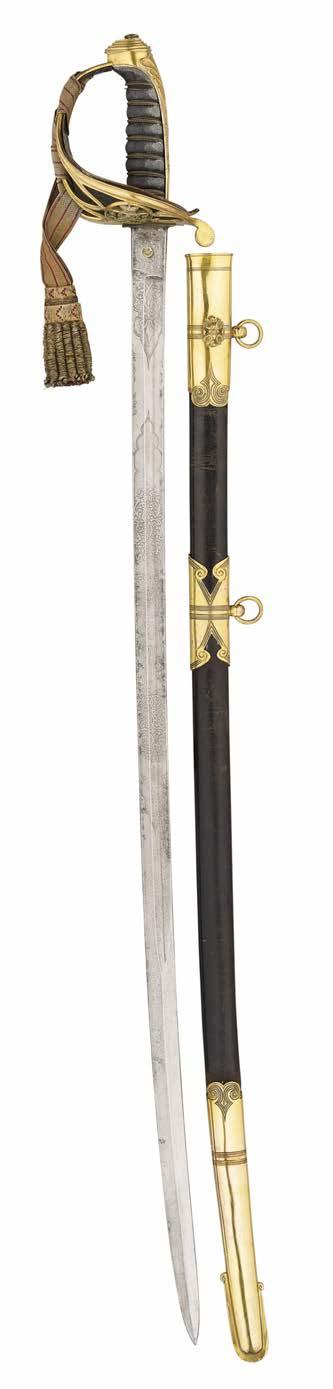
AN 1845 PATTERN INFANTRY OFFICER’S SWORD RETAILED BY MEYERS & MORTIMER, CONDUIT ST., HANOVER SQRE., LONDON, MID-19TH CENTURY of regulation pattern, with slightly curved fullered blade (some old staining, the cutting-edge with some file marks on one side) double-edged at the point, of flattened diamond section, the forte on both sides etched with crowned ‘VR’ cypher between symmetrical foliage, the ricasso with retailer’s details on one side and ‘PROVED’ stamp centred on foliage on the other, gilt copper alloy hilt incorporating crowned ‘VR’ cypher above union foliage in an oval, and retaining its leather liner and red cord and bullion sword-knot, folding inner-guard, and wire-bound fishskin-covered grip (wire slightly loose), in its black leather scabbard with linear engraved ormolu mounts and two suspension rings, the locket with foliate frog-button, and retaining much of its gilding, 82.0 cm blade
Provenance
Property of the Marquess of Anglesey, removed from Plas Newydd, Anglesey
£600-800
86
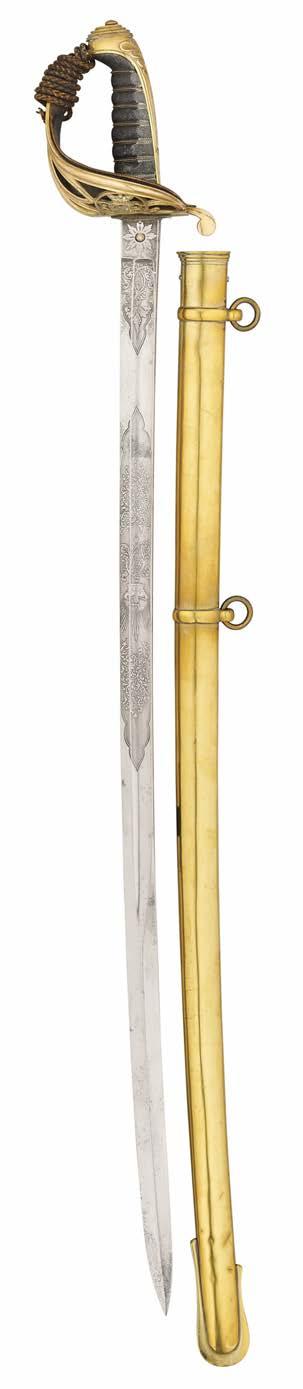
AN 1845 PATTERN INFANTRY OFFICER’S SWORD RETAILED BY MEYER & MORTIMER, LONDON, MID-19TH CENTURY
of regulation pattern, with bright slightly curved fullered blade double-edged at the point of flattened diamond section, the forte on both sides etched with crowned ‘VR’ cypher between symmetrical foliage, ricasso etched with retailer’s details on one side and with ‘PROVED’ stamp centred on foliage on the other, gilt copper alloy hilt incorporating crowned ‘VR’ cypher above union foliage in an oval, and retaining its leather liner and the remains of its sword-knot, folding inner-guard, and wire-bound fishskin-covered grip, in its copper alloy scabbard (minor denting) with two suspension rings, and retaining much of its gilding, 82.0 cm blade
Provenance
Property of the Marquess of Anglesey, removed from Plas Newydd, Anglesey
£500-700
A CAVALRY TROOPER’S SWORD, EARLY 19TH CENTURY
with straight fullered blade (heavily rust patinated) doubleedged towards the point, hilt comprising two rounded side-bars rivetted to the flat ovoidal guard and swept-up to join the knuckle-guard, pommel-cap and back-piece in one, the former with rounded tang button, and cord-bound leather-covered wooden grip (leather worn through in places), in its steel scabbard with horseshoe-shaped shoe and two suspension rings (hilt and scabbard with old patination and surface rust), 93.0 cm blade
Provenance
Property of the Marquess of Anglesey, removed from Plas Newydd, Anglesey
£400-600
88 AN 1887 PATTERN HEAVY CAVALRY OFFICER’S SWORD RETAILED BY SKINNER & CO., 57 JERMYN ST., LONDON, LATE 19TH CENTURY
of regulation pattern, with fullered blade etched over half its length on both sides with scrolling foliage framing crowned ‘VR’ cypher above the retailer’s details on one side, and above the owner’s crowned conjoined ‘VA’ monogram framed by foliage on the other, hilt pierced and chased with symmetrical foliage and retaining its leather sword-knot, and wire-bound fishskin-covered grip, in its brown leather-covered field service scabbard with nickel-plated locket and chape (old surface and rust patination overall), 88.5 cm blade
Provenance
Property of the Marquess of Anglesey, removed from Plas Newydd, Anglesey Skinner & Co. are recorded at 57 Jermyn Street, London between 1882 and 1901.
£400-500
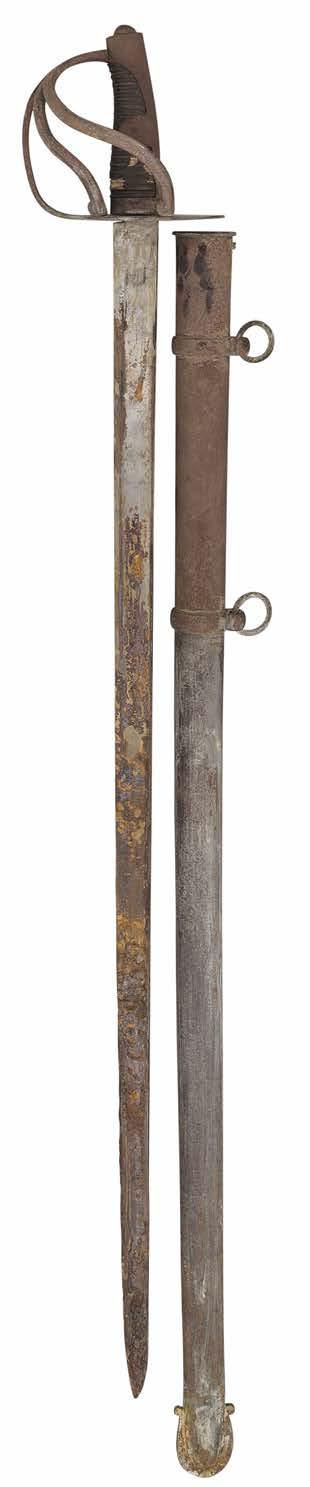
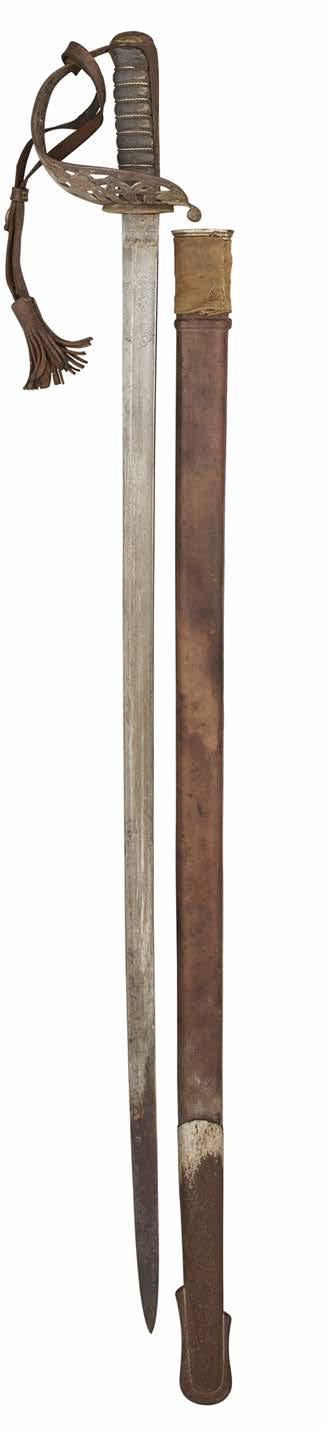
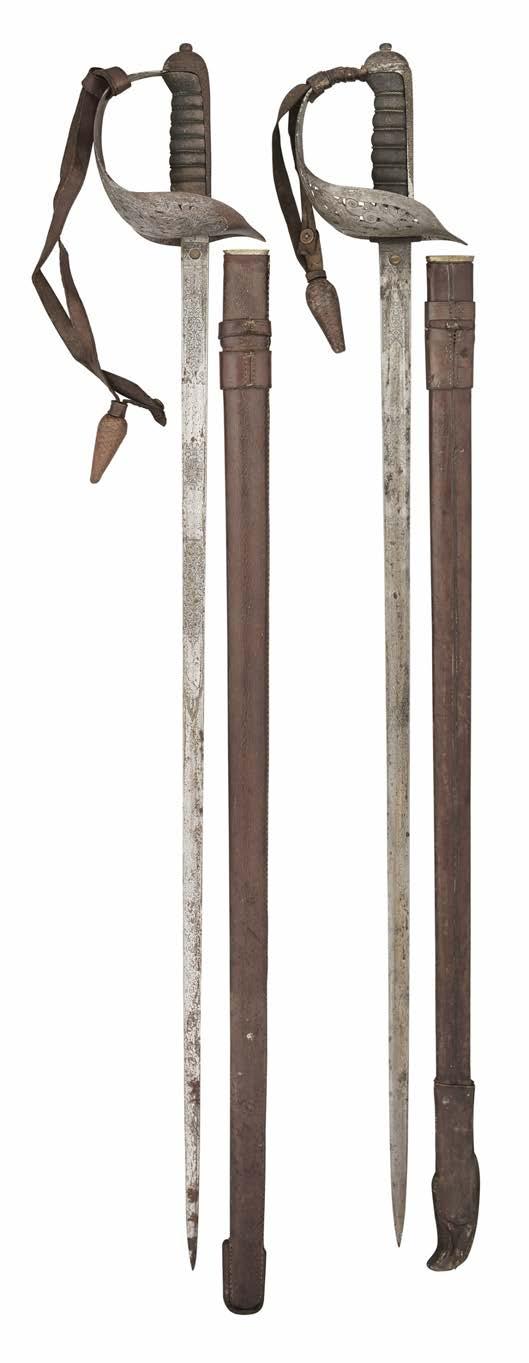
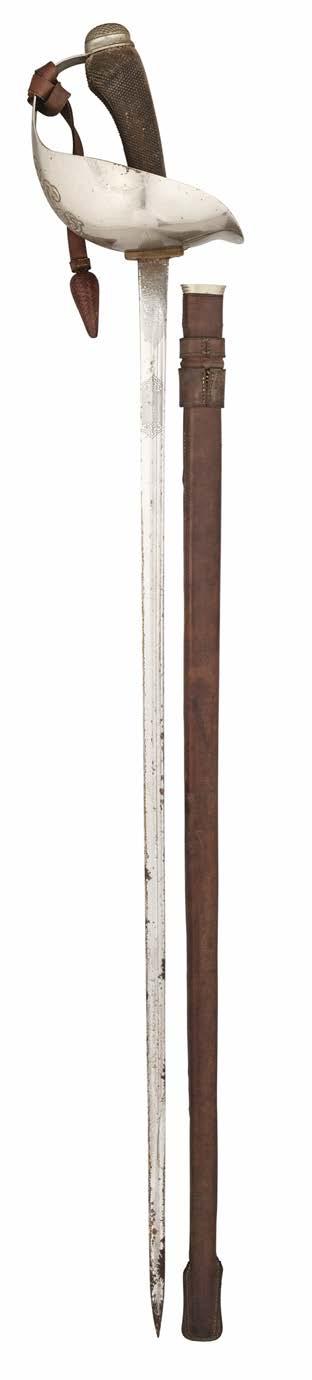
TWO 1897 PATTERN CAVALRY OFFICER’S SWORDS, THE FIRST REIGN OF EDWARD VII (1901-1910), THE SECOND REIGN OF GEORGE V (1910-1936)
both of regulation pattern, with etched fullered blades, hilts each pierced with designs of foliage and incorporating their respective crowned cyphers, leather sword-knots, and wire-bound fishskin-covered grips, each in its brown leather-covered field service scabbard (both with some old wear and rust patination), 84.0 cm and 81.5 cm blades (2)
Provenance
Property of the Marquess of Anglesey, removed from Plas Newydd, Anglesey
£350-450
90
A 1912 PATTERN CAVALRY OFFICER’S SWORD OF THE ROYAL HORSE GUARDS BY HENRY WILKINSON, PALL MALL, LONDON, NO. 45127 FOR 1914/17
of regulation pattern, with bright slender tapering fullered blade (some minor surface rust), the forte etched ‘I.’ within a foliate cartouche above the maker’s details on one side, and with octagonal gilt maker’s proof mark within an etched star on the other, nickel-plated bowl guard (old rust patination on the inside) chased with crowned foliated ‘RHG’ monogram and pierced for the leather sword-knot, and chequered pommel and composition grip, the latter hollowed for the thumb, in its brown leather-covered field service scabbard, 89.5 cm blade
Provenance
Property of the Marquess of Anglesey, removed from Plas Newydd, Anglesey
£300-400
THE 1874 PATTERN ROYAL HORSE GUARDS
OFFICER’S SWORD OF CHARLES PAGET, 6TH MARQUESS OF ANGLESEY BY HENRY WILKINSON, PALL MALL, LONDON, NO. 40092 FOR 1904
of regulation pattern, with bright fullered blade (some rust patination) double-edged at the point of flattened diamond section, nickel-plated hilt with characteristic copper alloy mounts on the guard including crowned foliate ‘RHG’, all within a border of twelve domed copper alloy studs, chequered copper alloy pommel, wire-bound fishskin-covered grip, and retaining its whitened buff leather liner, and burgundy leather and bullion sword-knot, in its nickel-plated scabbard (some surface rust and minor denting) with copper alloy chape and reeded suspension mounts, the latter each with suspension ring, and complete with its brown leather storage bag, the lid tooled ‘A’ next to a crown, 94.0 cm blade
Provenance
Property of the Marquess of Anglesey, removed from Plas Newydd, Anglesey
The Wilkinson sword records state sword no. 40092, a Royal Horse Guards pattern, was sold to Lord Anglesey, Royal Horse Guards, 13th May 1904.
Charles Paget, 6th Marquess of Anglesey (1885-1947) briefly served in the Royal Horse Guards before his election as Mayor of Burton upon Trent from 1911 to 1912. He rejoined the Royal Horse Guard during the first month of the First World War and was sent to France but was invalided out. He returned to serve as aide-de-camp to Sir John Maxwell, the General Officer Commanding Egypt – for which he was decorated with the Order of the Nile (4th class) in 1918 – and to Sir Willkiam Birdwood in Gallipoli. He went on to serve as Assistant Military Secretary to the General Officer Commanding in Ireland in 1916 and served in the Home Guard during World War II. He was Lord Chamberlain to Queen Mary from 1922 until his death in 1947.
£1,800-2,200
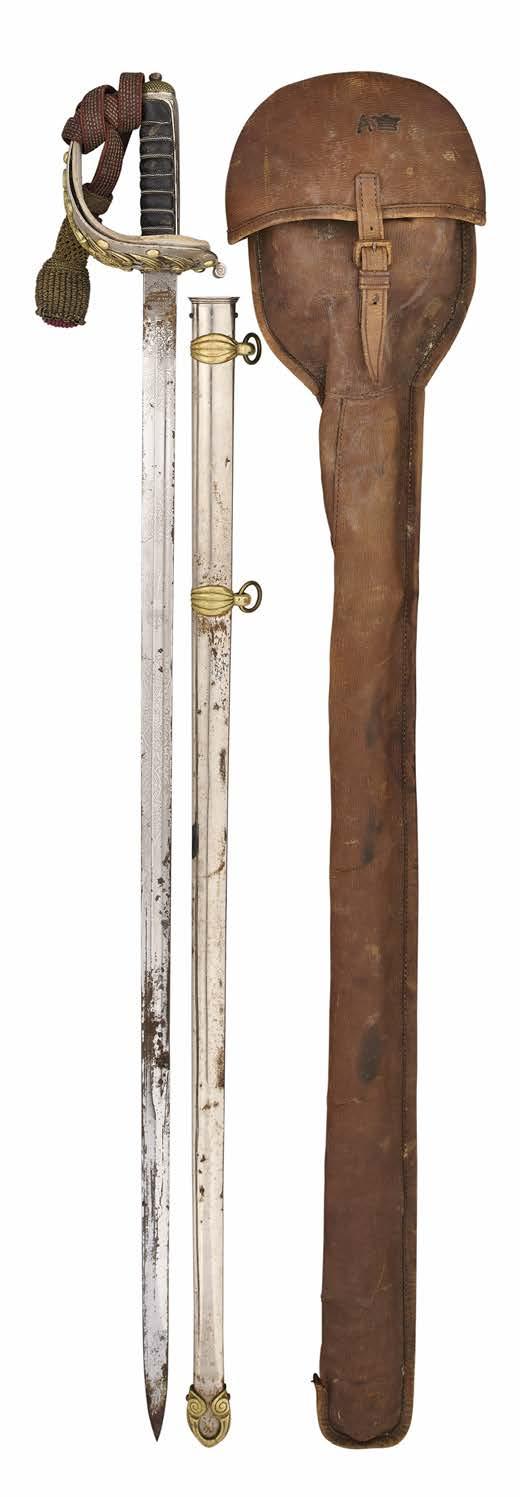
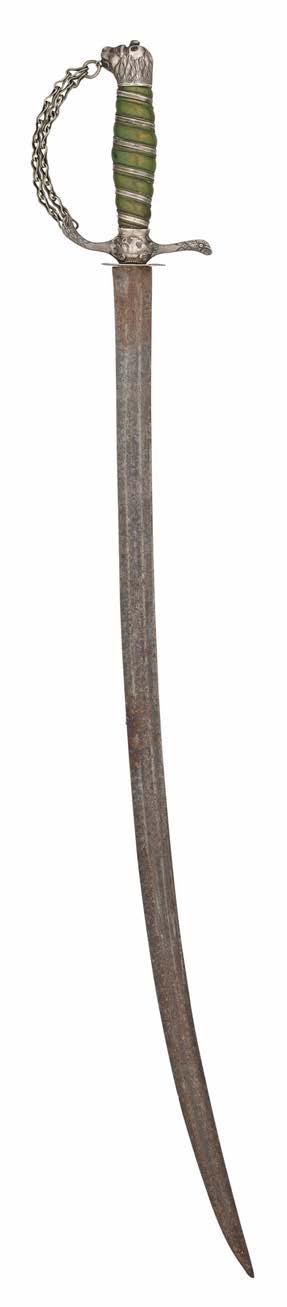

AN ENGLISH SILVER-MOUNTED HUNTING HANGER, INDISTINCT SILVER HALLMARKS AND MAKER’S MARK, CIRCA 1770
with slightly curved fullered blade (worn and rust patinated) double-edged at the point, hilt comprising quillon-block cast and chased with trophies on each side against finely punched grounds, recurved quillons with eagle-head terminal, lion-head pommel carrying a double knuckle-chain originally attached to the forward quillon, and writhen green-stained ivory grip bound with silver ribbon (some old wear), 65.0 cm blade
Provenance
Property of the Marquess of Anglesey, removed from Plas Newydd, Anglesey
Ivory Registration: RRH8KE2N
£400-500
93
AN ENGLISH SILVER-MOUNTED HUNTING HANGER, CIRCA 1770
with slightly curved fullered blade (some surface rust and old staining) double-edged towards the point, hilt comprising quillon-block cast and chased with a dragon on one side and a stag in a landscape on the other, recurved eagle-head quillons, eagle-head pommel with chased details and surmounted by the tang button, and swelling spirally-fluted green stained ivory grip, in its it tooled leather scabbard (worm, chape missing) with locket and suspension mount, the former embossed and chased with an eagle framed by rocailles on one side and pricked with traces of retailer’s details on the other, and two suspension rings, 55.3 cm blade
Provenance
Property of the Marquess of Anglesey, removed from Plas Newydd, Anglesey
Ivory Registration: 4TGCURHM
£400-500
94
A GILT COPPER ALLOY-MOUNTED ROBE SWORD RETAILED BY MEYER & MORTIMER, CONDUIT ST., LONDON, 19TH CENTURY
with slender tapering blade etched over half its length at the forte with scrolling foliage enclosing crossed palms on one side, and crossed banners on the other, the former with retailer’s details at the ricasso, cruciform hilt comprising quillon-block including trefoil-shaped terminals with raised borders against stippled grounds, compressed globular pommel with button, and writhen ivory grip bound with twisted copper alloy wire, in its leather scabbard covered in burgundy velvet (plush worn off) with bullion seam along one side, and locket and chape chased with laurels, the former with frog-hook, 79.0 cm blade
Provenance
Property of the Marquess of Anglesey, removed from Plas Newydd, Anglesey
Ivory Registration: PVH6U79X
£250-350
95
A CONTINENTAL FENCING FOIL, AND A FRENCH MODEL 1866 CHASSEPOT BAYONET, BOTH 19TH CENTURY
the first with slender tapering blade of hollow diamond section etched with Klingenthal manufactory detail on one side at the forte, dish-shaped guard, rounded pommel with tall tang button, and wirebound fabric-covered grip; the second of regulation pattern with ribbed copper alloy grip, in its steel scabbard (red surface rust, blade inscription polished off), 87.0 cm and 57.5 cm blades (2)
Provenance
Property of the Marquess of Anglesey, removed from Plas Newydd, Anglesey
£60-80
96
AN 1859 PATTERN MKII NAVAL CUTLASS
BAYONET, NO. 4074, CIRCA 1860
of regulation pattern, with bright slightly curved blade (some old rust patination) of flattened diamond section at the point, russet bowl guard with muzzlemount also forming a lobed rear quillon, beaked pommel with spring bayonet catch, and chequered hard rubber grips, in its leather scabbard (some old wear and crazing) with linear engraved russet steel locket and chape, the former with frog-button, 68.0 cm blade
Provenance
Property of the Marquess of Anglesey, removed from Plas Newydd, Anglesey
£200-300

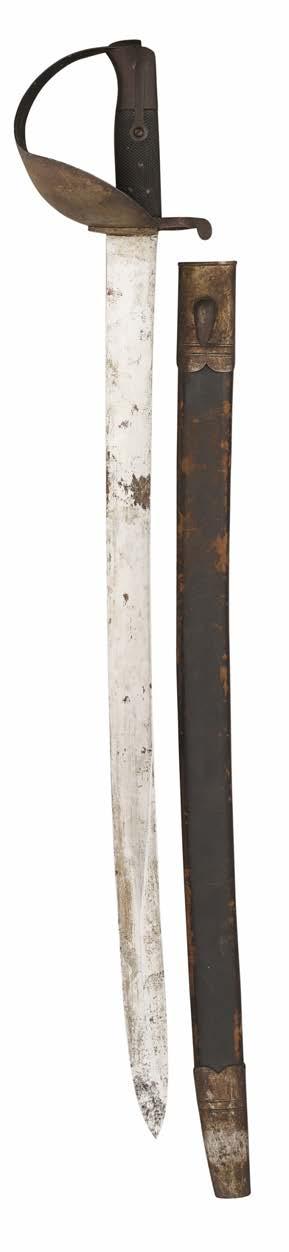
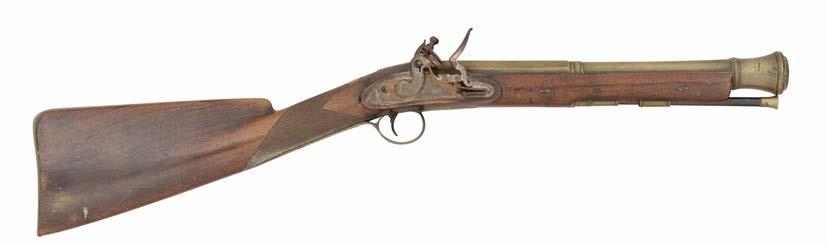
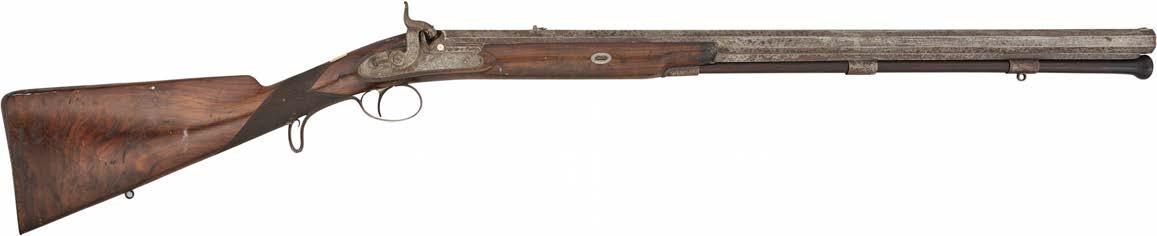
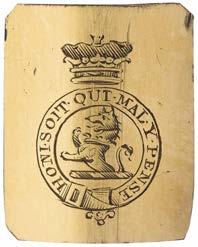
97
A BRASS-BARRELLED FLINTLOCK BLUNDERBUSS BY W. PARKER, HOLBORN, LONDON, EARLY 19TH CENTURY
with two-stage barrel turned and belled at the muzzle, octagonal breech signed along the top flat and engraved with three flower-heads on the flats behind the girdle, and struck with London proof marks, foliate engraved tang, signed border engraved flat bevelled lock (action defective) decorated with foliage, pierced cock en suite and with safety-catch behind, roller, figured full stock (old split behind the tail of the lock and one side of the fore-end) with chequered grip, border engraved copper alloy mounts decorated with martial trophies and comprising butt-plate and trigger-guard, the latter with pineapple finial turned ramrod-pipes, and original brassmounted ramrod with threaded cap over the worm (steel parts with old rust patination), 35.5 cm barrel
Provenance
Property of the Marquess of Anglesey, removed from Plas Newydd, Anglesey
William 3 Parker was Contractor to Ordnance between 1804 and 1838; to the East India Company between 1805 and 1841; the Hudson’s Bay Company between 1837 and 1841 and supplied Police Offices from 1803. £600-800
THE .600 (22 BORE) PERCUSSION SPORTING RIFLE OF HENRY, 1ST MARQUESS OF ANGLESEY BY
WESTLEY RICHARDS OF BRIMINGHAM, NO. 2055 FOR 1853 with twist octagonal leaf-sighted barrel (old rust patination) rifled with twelve grooves, retaining most of its browning on the bottom flats at the breech, and struck with Birmingham proof marks and barrelsmith’s marks, recessed breech with two platinum lines and pierced platinum plug, foliate scroll engraved tang, signed flat lock and dolphin hammer, the latter with engraved safety-catch behind, figured half-stock (butt with some old damage on one side) with dark horn fore-end cap and chequered grip, border engraved steel mounts decorated with foliate scrollwork, retaining traces of blueing and comprising butt-plate, spur trigger-guard, trigger-plate with pineappleshaped finial engraved with a shell, gold escutcheon engraved with owner’s crest and motto, and original ramrod with ebony tip (lock and mounts with old rust patination), 69.8 cm barrel
Provenance
Property of the Marquess of Anglesey, removed from Plas Newydd, Anglesey The crest and motto is that of Field Marshall Henry William Paget (17681854) KG, 1st Marquess of Anglesey (created 1815).
Henry William Paget, later 1st Marquess of Anglesey (1768 – 1854), was a brilliant cavalry officer in the Peninsular War, who rose rapidly through the ranks to command the British cavalry in the Waterloo campaign and to serve as Wellington’s second-in-command. His appointment was not without irony as some years earlier he had caused a scandal by eloping with the wife of Wellington’s brother. Uxbridge’s more instinctive, even romantic, idea of how to use cavalry proved critical. In the early afternoon of 18 June 1815, as d’Erlon’s corps pressed hard against Wellington’s centre-left and threatened to break the Allied line, Uxbridge ordered the British heavy cavalry forward. The charge was magnificent, uncontrolled and costly; but it came at a key moment and helped shatter the French assault at a time when success seemed possible. He is also famously remembered near the close of the battle, when a cannon shot struck his leg. “By God, Sir, I’ve lost my leg,” he is said to have remarked to Wellington, who replied, with characteristic economy, “By God, so you have.”
Anglesey returned from Waterloo a hero. He was created Marquess of Anglesey, appointed to the Order of the Garter, and fitted with an innovative articulated wooden leg. He lived for another thirty-two years, active in politics and public life, twice serving as Lord Lieutenant of Ireland and supporting Catholic emancipation. He lived in corresponding splendour, between Plas Newydd, Beaudesert, Uxbridge House, Burlington Gardens and his yacht Pearl. His gift to the Royal Yacht Squadron of the “Gold Mug” became part of the early history of what is now the America’s Cup.
£1,000-1,500

A .577 SNIDER MARK II NAVAL SHORT RIFLE,
CIRCA 1865 of regulation pattern, the barrel struck with London proof marks, border engraved lock with crowned ‘V.R’ on the tail, three-quarter stock stamped with War Department broad arrow mark on one side, copper alloy mounts, and sling loops (breech-block seized, ramrod missing, steel parts rust patinated), 78.0 cm barrel
Provenance
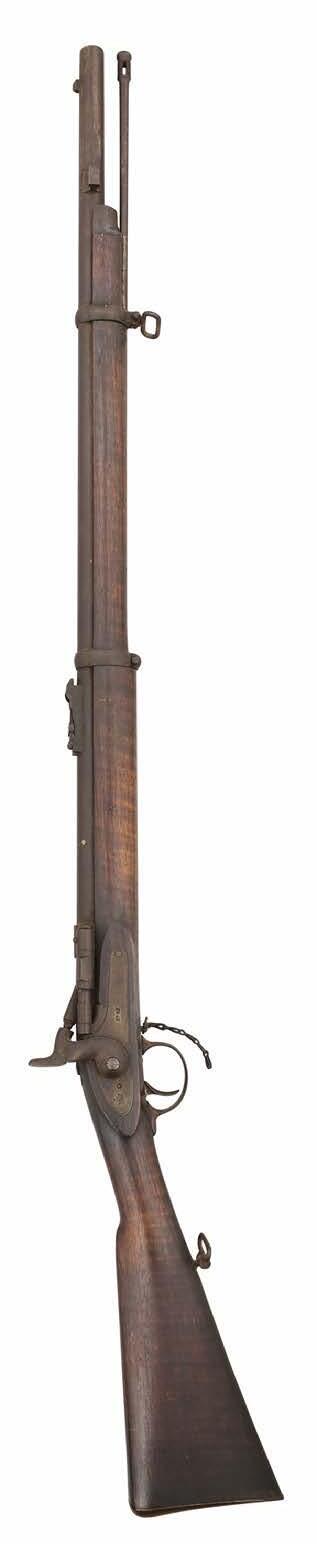
Property of the Marquess of Anglesey, removed from Plas Newydd, Anglesey
£300-400

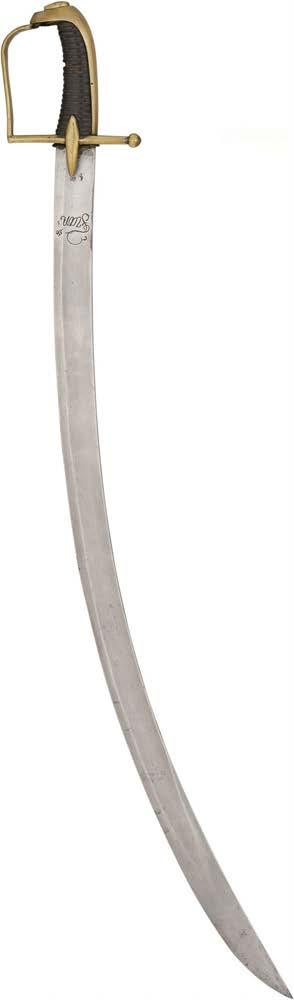
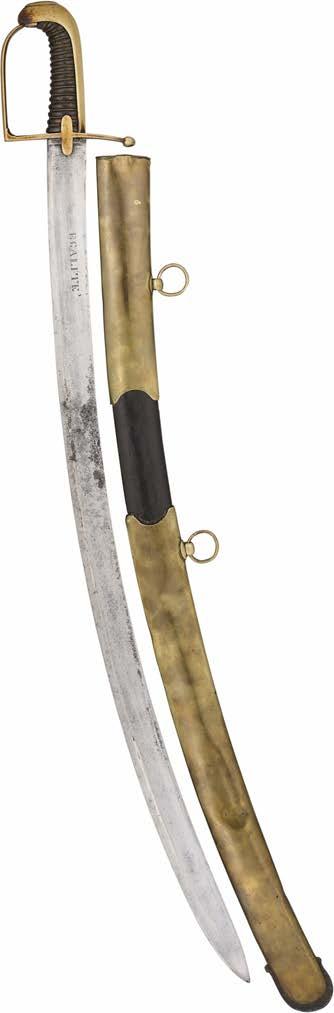
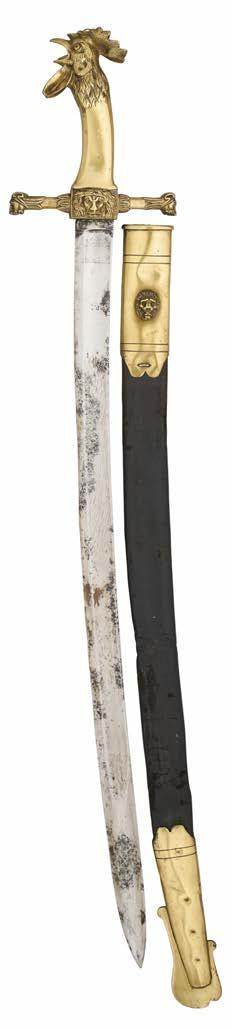
101
A RARE FRENCH REVOLUTIONARY PERIOD
SABRE, AND THE BLADE OF ANOTHER, CIRCA 1792-1793
each with curved fullered blade double-edged towards the point, the forte on one side etched ‘Rep:e’, and on the other with ‘Fran:se’ above two struck marks, one of de Cabannes, the back at the forte etched ‘KLINGENTHAL’, copper alloy stirrup hilt (the other modern and incomplete) comprising ovoidal langets, straight rear quillon with faceted bud-shaped terminal, knuckle-guard indistinctly stamped ‘353’ and hooked into the beaked-shaped pommel in one with the backpiece, the former with ovoidal tang button, and ribbed leather-covered grip (minor old damage), 83.0 cm and 82.5 cm blades (2)
The inscriptions on the blades are abbreviations of Republique Francaise, and the mark is that of de Cabannes, sous-Directeur of the Klingenthal Manufactory in 1792-93. See Jean Lhoste and JeanJacques Buigne, Armes Blanches Françaises: Symbolisme, inscriptions, marquages, fourbisseurs, manufactures, 1993, pp. 148 and 236.
£800-1,000
102
A FRENCH SABRE, PROBABLY REVOLUTIONARY PERIOD
with curved fullered blade (patch of old pitting on one side) double-edged over a third of its length to the point, the forte etched ‘LIBERTE’ on one side, and ‘EGALITE’ on the other, copper alloy stirrup hilt with beaked pommel and back-piece in one, the former with ovoidal cap, and ribbed horn grip bound with a strand of copper alloy wire, in its black leather scabbard with deep copper alloy locket and chape (some old denting), the latter with iron shoe, and two suspension rings, 82.0 cm blade
£500-700
103
A FRENCH NAPOLEONIC SAPPER’S SABRE, EARLY 19TH CENTURY
of regulation pattern, with curved fullered blade (old pitting and file marks) etched ‘Coulaux & Cie, Klingenthal’ along the back, copper alloy hilt comprising quillon-block cast with a lion-mask on both sides, quillons each with lion-head terminal, and grip with cockerels’ head pommel in the round, in its black leather scabbard (old wear and repairs, seam open) with linear engraved copper alloy locket and chape (old dents), the former with lion-mask frog-button, 72.5 cm blade
£500-700
A FINE AND RARE FRENCH NAPOLEONIC OFFICER’S
SWORD BASED ON THE MODEL 1814
SABRE
DE GENDARME DE LA
MAISON DU ROI BY COUILLIEZ, FOURBISSEUR, RUE HONNORE EN FACE DE LA FONTAINE DE HARBRE SEC, NO. 102, REIGN OF NAPOLEON BONAPARTE (1804-1814)
the tapering blade with double fuller over each side and bright over half its length to the point (some old rust patination), etched and gilt over half its length on both sides against a blued ground with differing trophies of war, agriculture, science and foliage, one side at the forte with the maker’s details, cast and chased gilt coper alloy hilt comprising locket mount with laurel leaves, circular side-guard with a portrait bust of Napoleon within a wreath of palms and against a finely stippled ground, two curved side-bars above linked to the knuckle-guard and each decorated with branches of laurel, the latter with dolphinhead terminal hooked into the pommel, foliate rear quillon, pommel and back-piece decorated with neo-classical foliage, and wire-bound fishskin-covered grip, in its nickel-plated scabbard with ormolu mounts en suite with the hilt, two suspension rings, and retaining most of its gilding, 92.5 cm blade
£3,000-4,000

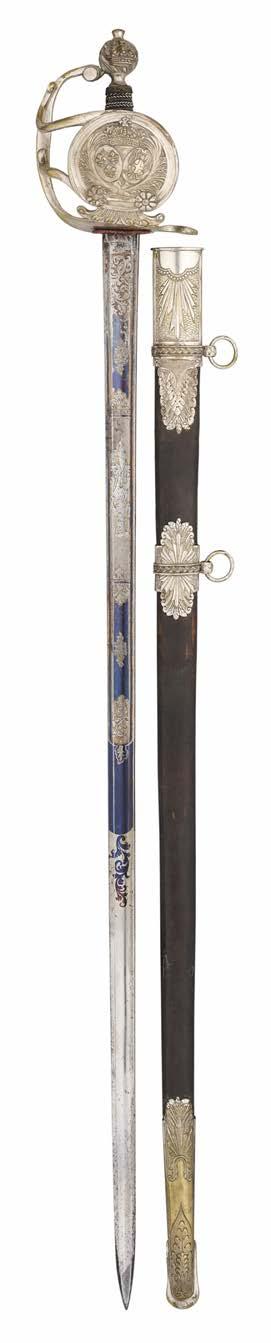
A RARE FRENCH OFFICER’S SWORD OF THE QUEEN’S CUIRASSIER REGIMENT BY ROULANT A PARIS, CIRCA 1815-20
with tapering fullered blade bright and blued with a foliate scroll on both sides to the double-edged point, etched and gilt along both sides with foliage against blued grounds, one side enclosing a brightly etched knightly figure in armour, and with a cavalry scene in a landscape on the other, the back of the blade etched with maker’s name and ‘Coulaux Freres a Klingenthal, cast and chased silvered copper alloy hilt comprising circular guard with crowned arms of France and Savoy within a wreath, joined to the knuckle-guard by two side-bars swept-up to join the knuckle-guard, the latter hooked into the writhen globular pommel with a crown on both sides, fleur-de-lys shaped rear quillon, and grip bound with two thicknesses of twisted silver wire between Turk’s heads, in its black leather scabbard with silvered copper alloy mounts cast and chased with symmetrical designs of foliage on the outside against punched scaled grounds, two suspension rings, and retaining most of its silvering, 81.0 cm blade
The crowned arms on the hilt are in homage to Queen Josephine Louise (wife of Louis XVIII) and Marie Therese (wife of Charles X), both from the House of Savoy.
£2,000-3,000
106
A FRENCH STAFF OFFICER’S SABRE, RESTORATION PERIOD (1814-1830)
with bright fullered blade etched and gilt over nearly half its length on both sides with a martial trophy and foliate panels, all against a gilt ground terminating in scrolled foliage, ormolu hilt cast and chased with neo-classical foliage including a recumbent lion on one side of the rectangular quillon-block and comprising down scrolled rear quillon, knuckle-guard joined to the chin of a bearded warrior wearing a plumed helmet, laurelled grip-straps, and reeded mother-of-pearl grips, in its copper alloy scabbard retaining some of its gilding and decorated with a chased martial trophy and symmetrical design of foliage along one side, the locket with frog-hook, 81.0 cm blade
Provenance
Literature
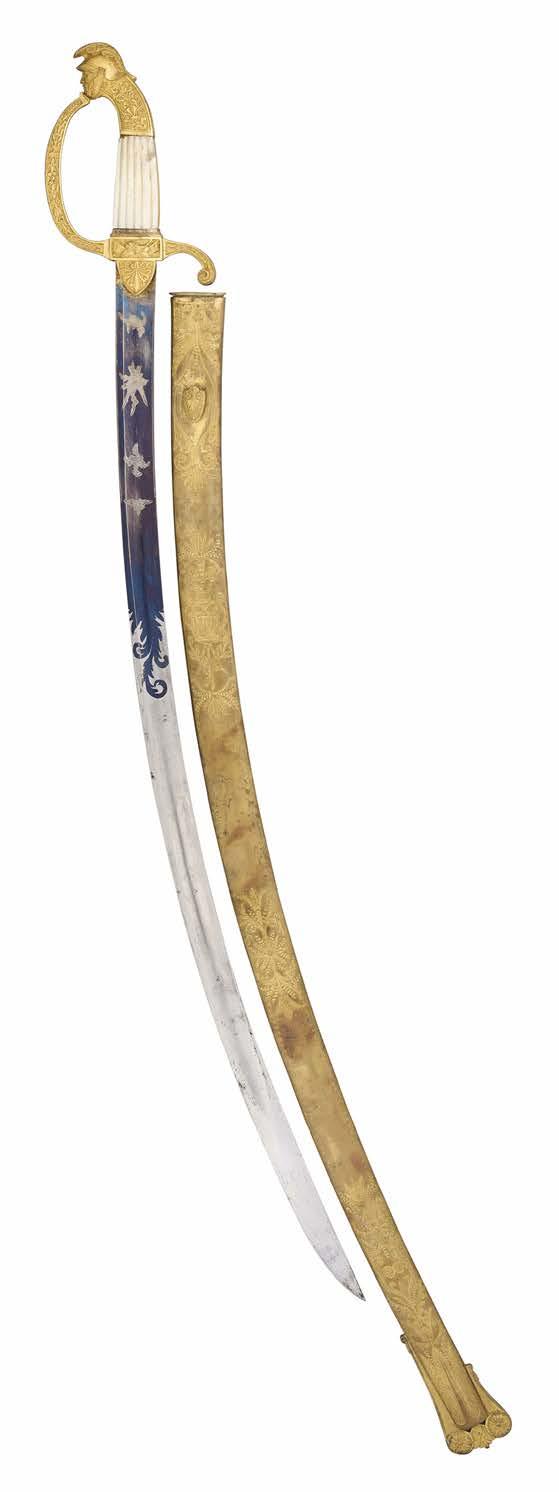
Sotheby’s South, Billingshurst, Sussex, 13 July 1999. lot 109
Jean Lhoste and Patrick Resek, Les Sabres Portes Par L’Armee Francaise, p.137, fig. 189
£1,000-1,500
107
A SAXON OFFICER’S SABRE, REIGN OF KING FREDERICK AUGUSTUS I (1806-1827)
with curved fullered blade double-edged at the point (some old rust patination), the latter etched with bright stars and dots against a damascus ground, decorated over two-thirds of its length along one side with etched and gilt martial trophies, crowned Saxon royal arms and two cornucopia of foliage, all against a blued dotted ground, and along the other with differing martial trophies, a reclining figure in a landscape, a basket of flowers against a scythe and foliage, gilt copper alloy hilt comprising recurved fluted quillons with hound-head terminals, a neo-classical mask on each ovoidal langet, plain grip-strap (knuckle-chain missing), and ivory grips each retained by two domed studs on both sides, the pommel pierced for a sword-knot, in its ormolu scabbard chased in low relief along one side with symmetrical designs of foliage against finely punched grounds, suspension mounts each with a lion-mask in relief on both sides, two suspension rings, and retaining much of its gilding, 80.5 cm blade
Ivory Registration: ZBFTWA99
£1,500-1,800
108
A GERMAN NAVAL OFFICER’S SWORD BY A. & E. HOLLER, SOLINGEN, MID-19TH CENTURY
with straight pipe-back blade etched along both sides over half its length with differing martial trophies between symmetrical foliage involving urns of fruit, foliage and flames, the forte etched with maker’s details over both sides, cast and chased ormolu hilt comprising circular guard with a Classical trophy on a shield centred on pierced vines and foliage, and joined to the knuckleguard by three up scrolled side-bars, the former resting beneath the jaws of a dragon-head pommel with plain back-piece, folding inner-guard of two scrolled bars, wire-bound fishskin-covered grip, and retaining much of its gilding, in its copper alloy scabbard with two suspension mounts cast and chased with laurels, and two suspension rings, one retaining the copper alloy suspension chains and clips, 84.0 cm blade
£1,000-1,500
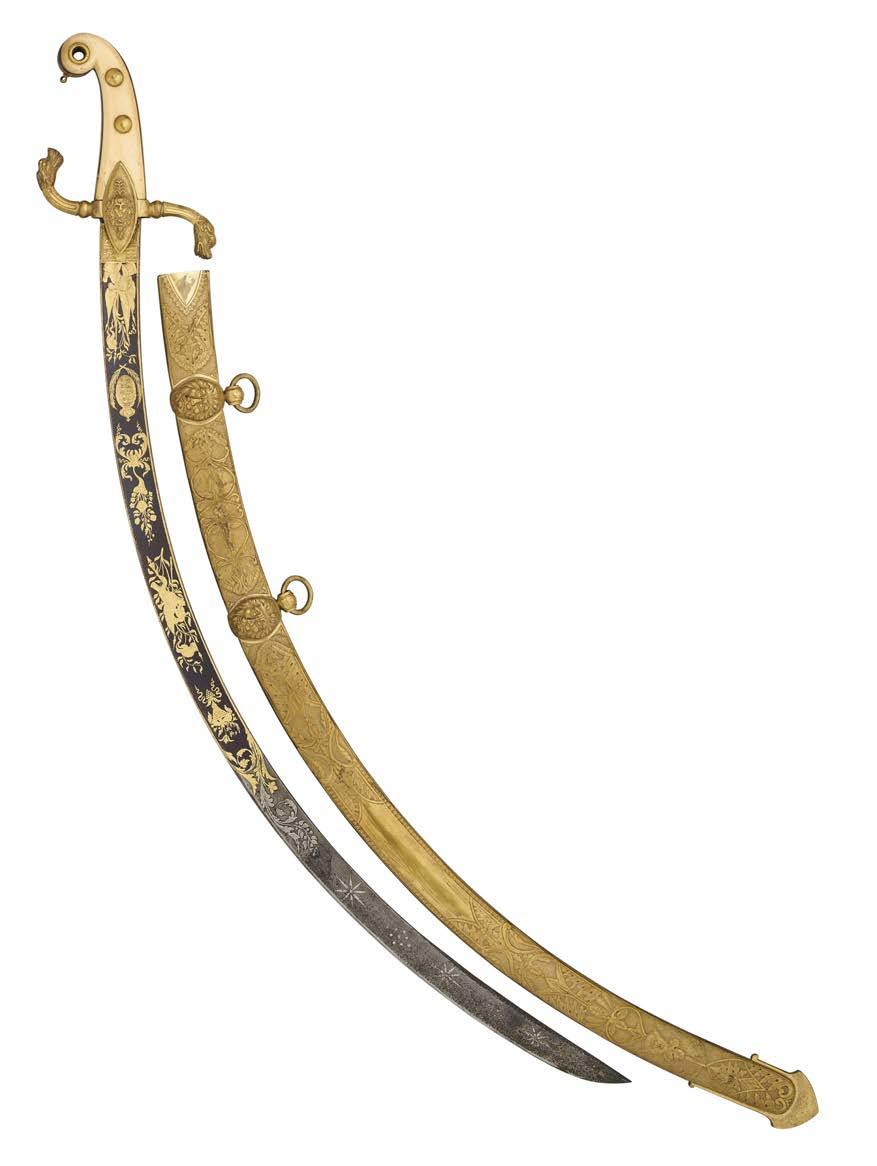
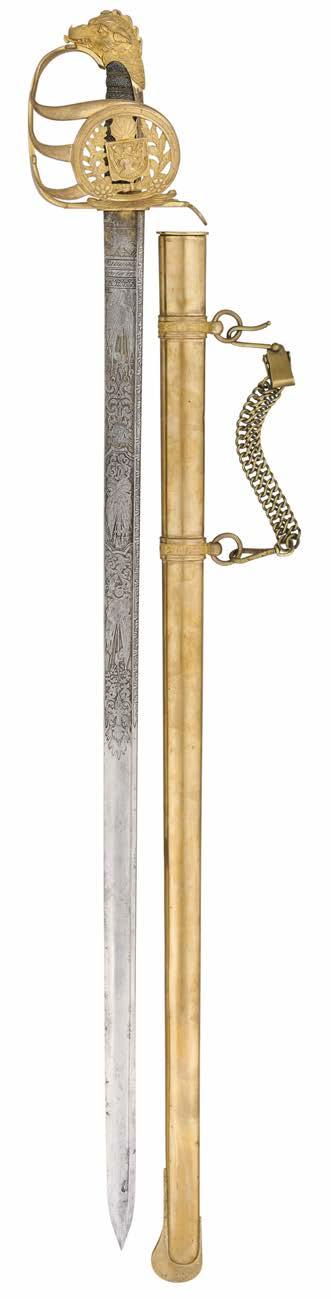
AN EXTREMELY RARE AND FINE ‘WHITE RUSSIAN’ PRESENTATION SABRE TO THE COMMANDER OF THE ASSIRO-KHAPAESKY BATTALION, THE HILT SIGNED CARTIER, PARIS, CIRCA 1920-30, ALMOST CERTAINLY PRESENTED TO AGHA PETROS ELLOFF (1880-1932)
with slightly curved fullered bright blade etched with the presentation inscription in Russian between foliage against a grey ground along one side, and with scrolling foliage over most of its length on the other including the signature ‘Atre. Caprion’ towards the point, the back at the forte with maker’s details ‘Coulaux & Co., Klingenthal, France’, gilt-metal hilt comprising sideguard cast, pierced and chased as an Assyrian Lamassu above neo-classical foliage and joined to the knuckle-guard by four scrolled upcurved side -bars, the knuckle-guard chased with foliage and set with a row of black hardstones along the bottom on the outside, down scrolled rear quillon, langets each formed as three feathers, inner-guard with neo-classical foliage en suite and flanked by scrolled side-bars (one slightly detached), pommel of stepped octagonal section set with black hardstones in a stylised feathered design along the back of the grip and around the top on each facet above pairs of dots, and surmounted by a black hardstone carved with the recipient’s coat-of-arms, wire-bound ribbed ivory grip (minor age cracks), and retaining its silver bullion sword-knot, in its lightly gilt nickel-plated scabbard with feathered suspension mount with hinged suspension loop, 80.5 cm blade
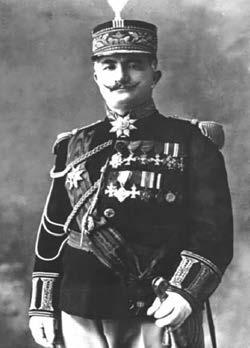
The inscription reads in translation: ‘To the commander of the A ssiro-Khapaesky Battalion, soldiers of the Russian Army who fought under the banners of Kornilov, Denikin, Kolchak, and Wrangel’.
Lavr G. Kornilov (1870-1918) was a military commander of the Volunteer Army who was killed during the Ekaterinodar campaign.
Anton I. Denikin (1872-1947) was Commander of the Volunteer Army/Armed Forces of South Russia after Kornilov and led the main southern White offensive. Admiral Aleksandr V. Kolchak (1874-1920) was termed ‘Supreme Ruler of Russia’ and was the principle White leader in Serbia and eastern Russia.
Pyotr N. Wrangel (1878-1928) was the last major commander of the White forces in South Russia and Crimea. He was known as the ‘Black Baron’.
Agha Petros Elloff, Assyrian commander, diplomat and national advocate was also known as Petros Elia of Baz, one of the most prominent Assyrian military and political figures of the First World War. Born in 1880 among the independent Assyrian tribes of the Persian borderlands, he came from the mountainous region between Persia and the Ottoman Empire, a world repeatedly drawn into the rival ambitions of Russia, Turkey and Britain.
Educated in the United States, he returned to his homeland around 1900 and soon entered public life. He served for a time as Turkish consul in Urmia , before transferring his sympathies and services towards Russia, which he regarded as the most likely protector of the Assyrian people. By 1912–13 he was attached to the Russian consulate in Urmia, and had begun to acquire the confidence of Russian officers operating in north-west Persia
With the outbreak of war in 1914, Agha Petros became an indispensable ally of the Russian campaign in Persia . Supplied with arms, uniforms and funds, he raised and commanded an Assyrian fighting force against Ot toman and Kurdish incursions. His men fought in the defence of Urmia, Salmas and other Assyrian centres, and helped protect Christian communities during a period of extreme danger and upheaval.
His relationship with Russian officers was close. Major-General Vladimir Levandovsky, the Russian commander in Persia, recognised in him a leader of courage, loyalty and tactical ability. After the Russian Revolution, the Assyrian forces were left without their principal protector. Agha Petros’s hopes for an Assyrian national future were frustrated by the collapse of old alliances and the indifference of the post-war settlement. He went into exile in France, travelling to Paris via Marseille. There, as commander-in-chief of the Assyrian- Chaldean forces and chairman of the National Assyrian-Chaldean Committee, he pleaded at international conferences for recognition and protection for his people. His appeals were largely unsuccessful.
Agha Petros died in Toulouse in 1932. To those who knew him in exile, he was remembered not only as a soldier but as a loyal friend and protec tor. General D. I. Andrievsky, who had known him for many years, wrote:
“In the person of Agha Petros Ellov, Russia has lost a sincere, deeply devoted friend and an invaluable ally—one of its finest and most dedicated figures in the Middle East.”
His dream of an independent Assyrian homeland was never realised. Yet among Assyrians he remained a symbol of resistance, self-determination and national courage: a warrior-diplomat whose life was shaped by the collapse of empires and the struggle of a stateless people to be heard
This presentation sabre is an exceptionally rare example of a bespoke ceremonial weapon commissioned by Cartier Paris during the inter war period. Unlike standard military swords, it combines the work of a luxury jeweller with the symbolism of a high-level military presentation piece. Surviving Car tier swords from this period are extraordinarily uncommon, and examples linked to major historical figures are rarer still. The most important comparison and from the exactly the same era is probably the presentation sword bestowed to the Federation of French Veterans of the Great War in Honour of Marshal Foch, Supreme Allied Leader (1918-20), and presented to him at Georgetown University during his 1921 American tour.
Ivory Registration: 4TGF6VUF
£15,000-20,000
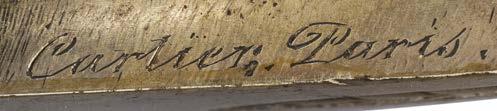
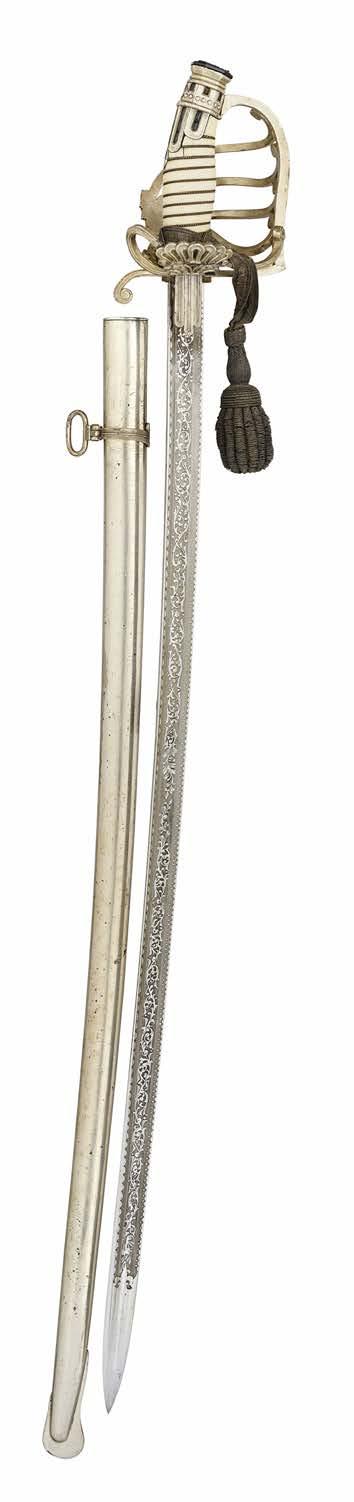
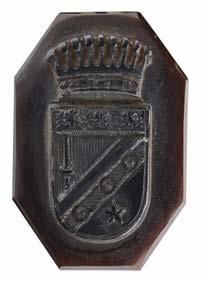
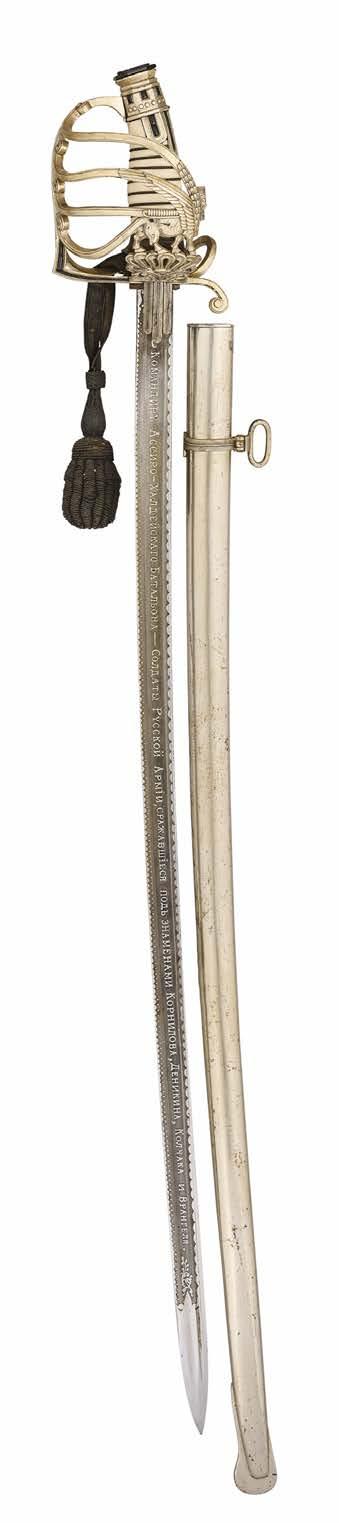
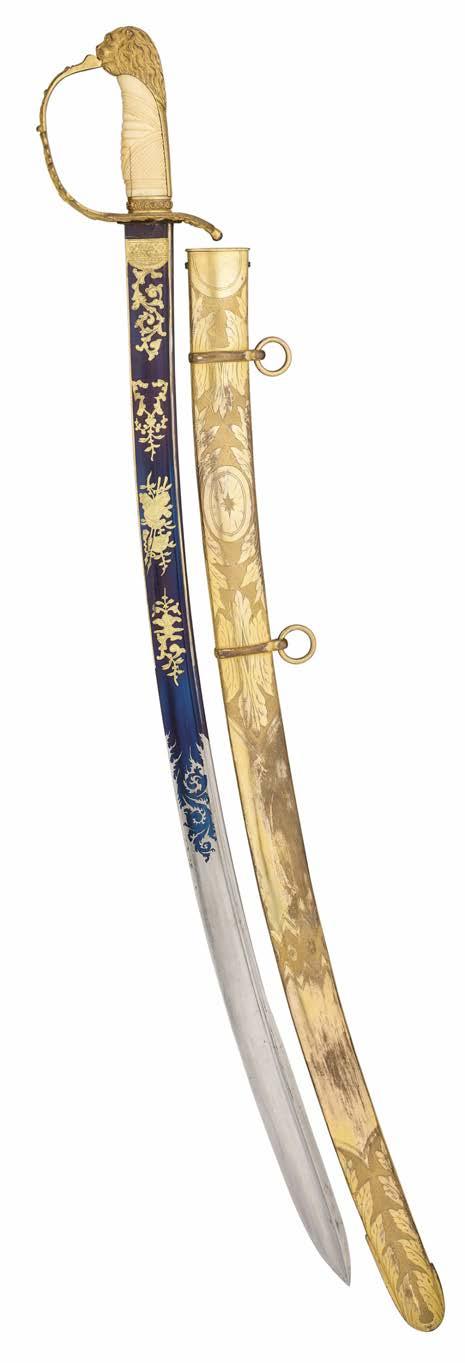
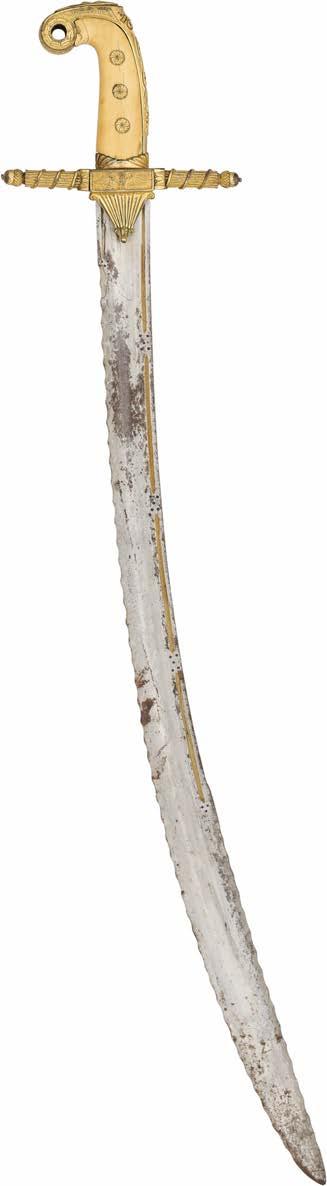
110
A
FINE INFANTRY OFFICER’S SWORD OF 1803 PATTERN TYPE, EARLY 19TH CENTURY
with curved pipe-back blade bright towards the double-edged quill point, etched and gilt against a blued ground over half its length along both sides with a differing martial trophy and designs of foliage, gilt copper alloy hilt comprising pierced guard cast and chased in relief with foliage extending along the knuckle-guard, lionhead pommel with faceted back-piece, and partly chequered ribbed and fluted grip (minor age splits) with floral basal mount, in its gilt copper alloy scabbard (minor old dents and loss of gilding) engraved on the outside with symmetrical designs of foliage against finely stippled grounds, plain suspension mounts each with suspension ring, and in fine condition, 76.8 cm blade
£1,800-2,200
111
A
GILT COPPER ALLOY-HILTED SABRE WITH INDIAN BLADE, EARLY 19TH CENTURY
the curved fullered serrated blade (some old rust patination) double-edged towards the point, the forte and along the back cut with narrow fullers between groups of five dots, cast and chased hilt comprising rectangular quillon-block decorated on both sides with a spread eagle against a finely punched ground, fan-shaped langets below, quillons each formed as a bound fasces with acorn-shaped terminal, scaled pommel chased with vine-leaves, pierced for a sword-knot and with a further spread eagle on an oval on top, the back-piece with a Classical trophy involving a fasces and against a finely punched ground, rounded ivory grip (old chips and narrow splits) with three flowerheads along both sides, and retaining much of its gilding, 75.0 cm blade
Ivory Registration: 8J7FVV3H
£1,000-1,500
112
AN 1803 PATTERN INFANTRY
OFFICER’S SWORD BY WOOLEY & DEAKIN OF BIRMINGHAM, CIRCA 1805 of regulation pattern, with curved fullered blade (point with minor old pitting) etched and gilt against a blued ground over half its length on one side with Union foliage, post 1801 royal arms, a trophy and a scroll inscribed ‘WOOLEY & DEAKIN’, and on the other with a infantry officer, crowned ‘GR’ cypher and foliage, ormolu hilt with pierced crowned ‘GR’ cypher, lion-head pommel and back-piece in one, and ribbed leather-covered grip bound with twisted copper-alloy wire, in its black leather scabbard with linear engraved copperalloy mounts, and two rings for suspension, 74.2 cm blade
£600-800
113
AN 1803 PATTERN OFFICER’S SWORD, EARLY 19TH CENTURY
of regulation pattern, with curved fullered blade (surface rust patination and some old pitting) etched and gilt against a blued ground over half its length on one side with crossed banners, pre-1801 royal arms and a foliate scroll inscribed ‘WARRANTED’, and on the other with an infantry officer, crowned ‘GR’ cypher and foliage, ormolu hilt retaining traces of gilding and with pierced crowned ‘GR’ cypher, lion-head pommel and back-piece, and ribbed ivory grip (old splits and chip) bound with twisted copper-alloy wire, in its black leather scabbard with linear engraved copperalloy mounts (chape dented) with two suspension rings, 75.5 cm blade
Ivory Registration: 47T9KG37
£400-500
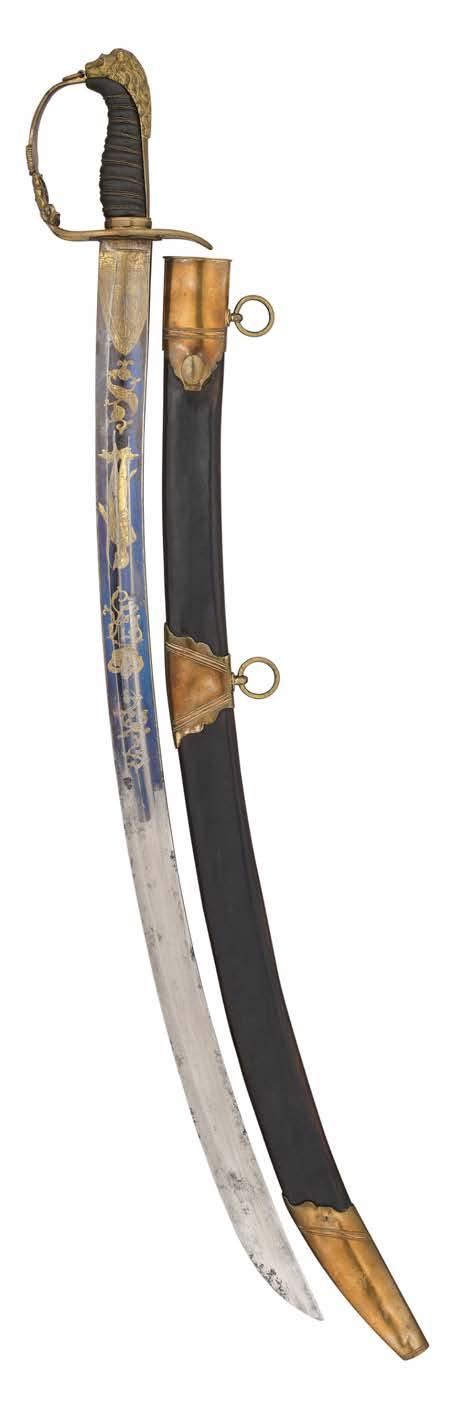
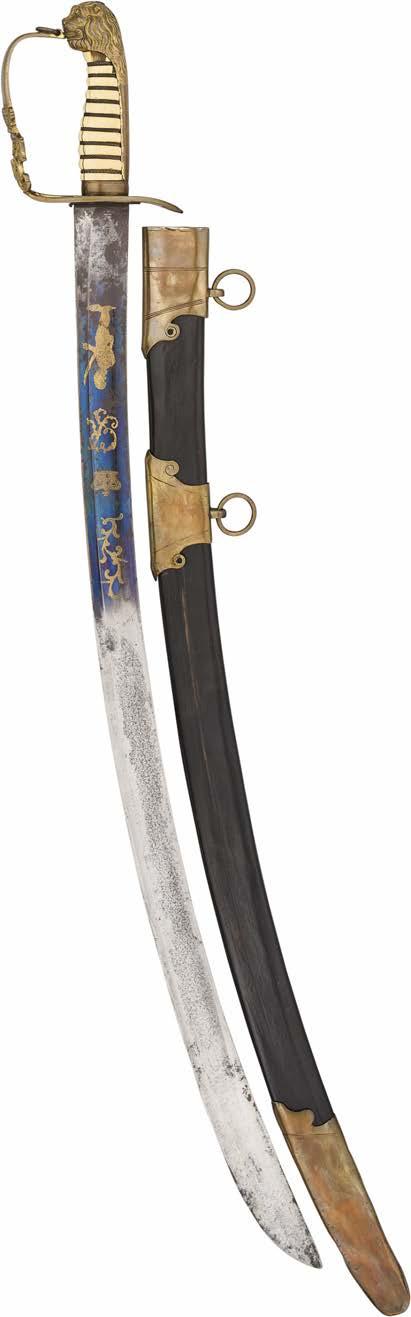
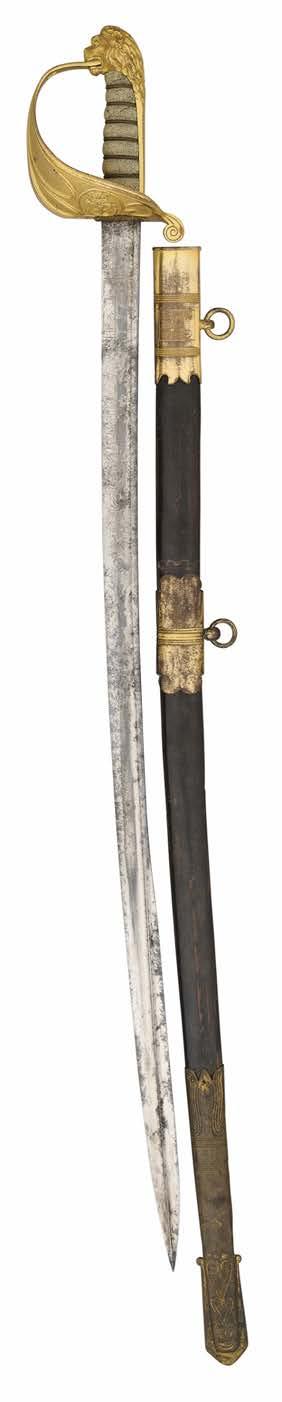
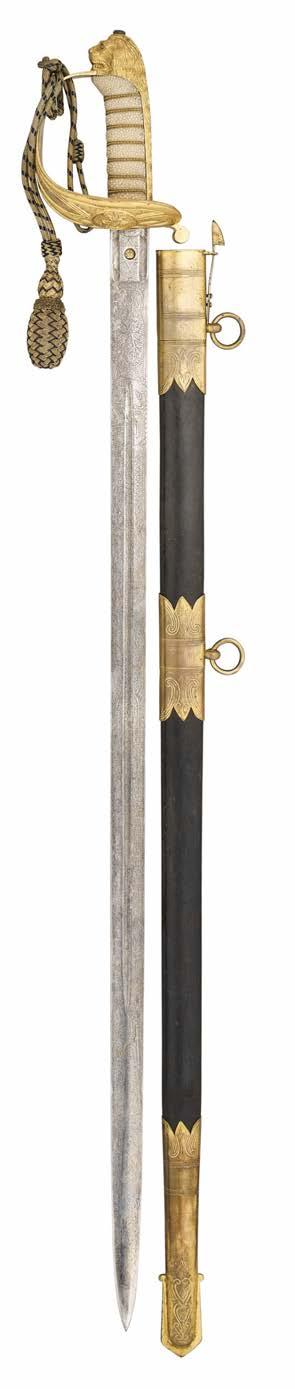
114
AN 1827 PATTERN NAVAL OFFICER’S SWORD BY SEAGROVE ,‘HARD’, PORTSEA, MID-19TH CENTURY of regulation pattern, with curved pipe-back blade (some old rust patination) with double-edged ‘quill’ point, the forte etched along one side with maker’s details, crowned fouled anchor and foliage, and along the other with foliage framing a crowned royal arms above a lion and unicorn, ormolu hilt incorporating a crowned fouled anchor in an oval, folding inner-guard, lion-head pommel with faceted back-piece, and wire-bound fishskin-covered grip, in its black leather scabbard (old wear) with linear engraved ormolu mounts (some wear to gilding, particularly on the chape which is dented) and two suspension rings, the locket engraved with makers details on one side, 76.5 cm blade
William Seagrove is recorded at 28 Common Hard, Portsea in 1830 and at 22 Common Hard, Portsea in 1839. William and Edward Seagrove were at 22 & 23 Common Hard, Portsea between 1850 and 1851, and Edwin and William Seagrove were at the same address between 1852 and 1859.
£350-450
115
AN 1827 PATTERN NAVAL OFFICER’S SWORD BY HENRY WILKINSON, PALL MALL, LONDON,
NO. 33593 FOR 1896
of regulation pattern, with tapering blade (some old patination) etched with oak foliage within roped borders enclosing a crowned fouled anchor and an Arabic inscription on one side, and crowned royal arms and maker’s details on the other, ormolu hilt of simulated bars enclosing a crowned fouled anchor and retaining its bullion and blue cord sword-knot, lion-head pommel, its mane forming the back-piece, and wirebound fishskin-covered grip, in its black leather scabbard with linear engraved gilt copper alloy mounts (some wear to gilding) including locket hilt retaining clip and shield bearing the maker’s details on one side, two suspension rings, and retaining much of its gilding, 80.0 cm blade
The sword of Captain F.L. Campbell RN (1854-1906). On 17 October Campbell was commanding the Majestic-class battleship HMS Prince George when the ship was accidentally rammed by sister ship HMS Hannibal off Cape Finisterre, Spain. The collision caused a massive hole in the ship, and it was in danger of sinking for several hours. Campbell successfully guided HMS Prince George into the harbour at Ferrol, Spain using only his engines for steering and without the benefit of a rudder, a feat widely praised as a masterpiece of seamanship.
£600-800
A FINE PRESENTATION SWORD OF MILITARY TYPE TO BREVET MAJOR P.W. GILLUM BY HIS FRIENDS IN BELFORD FOR HIS GALLANT CONDUCT ON BOARD THE TROOP SHIP SARAH SANDS WHEN ON FIRE IN THE INDIAN OCEAN SIGNED REEVES TOLEDO WORKS, DATED 1857
with very slightly curved fullered blade of flattened diamond section at the point, brightly etched over most of its length along one side with the presentation inscription, foliage including laurel branches and Union foliage, the recipient’s crest and neo-classical ornament, the ricasso with maker’s details on a shield, and along the other symmetrical designs of foliage involving trophies of arms, crowned ‘VR’ cypher and a crown on a cushion against a crossed sword and sceptre, the ricasso with circular metal-lined ‘PROOVED’ mark, gilt copper alloy hilt comprising half-basket guard cast, pierced and chased in low relief with scrolling foliage inhabited by a lion and a serpent, and incorporating a crowned ‘VR’ cypher above Union foliage, pommel and back-piece with foliage, the latter including a Classical helmet, ribbed wire-bound fishskin-covered grip, and retaining its red cloth and bullion sword-knot, in its gilt copper alloy scabbard with locket, chape and suspension mounts each cast and chased in low relief with formalised symmetrical foliage against hatched grounds, two suspension rings, and in fine condition retaining nearly all its gilding, 82.5 cm blade
The presentation inscription reads: ‘PRESENTED TO BREVET MAJOR P.W. GILLUM H.M. 54 REGT. BY HIS FRIENDS IN BELFORD For his Gallant conduct on board the troop ship SARAH SANDS when on fire in the Indian Ocean Novr 11th 1857’.
Major P.W. Gillum (Brevet Major, 54th Regiment) is a celebrated figure in British military history for his heroic leadership during the tragic fire aboard the troopship Sarah Sands in November 1857. The ship was chartered to transport the headquarters and several hundred troops of the 54th Regiment to India during the Indian Mutiny. On 11 November roughly 800 miles from Mauritius a devastating fire broke out in the ship’s hold near the powder magazine. With the threat of a catastrophic explosion, Gillum and his men exhibited exceptional gallantry. Gillum was heavily involved in the perilous effort to contain the blaze, shovel out ammunition and manage the panic among the crew and troops. Despite severe explosions that blew out the ship’s stern and an intense fire that completely gutted the vessel, no lives were lost. The crew and troops managed to keep the ship afloat for days before being rescued. For his extraordinary coolness, courage and leadership, Major Gillum was commended and honoured by his peers and the public. In recognition of his bravery, a special presentation was made to him by his friends in Belford. The remarkable survival and discipline shown by the 54th Regiment during the disaster was unprecedented and led directly to the Royal Warrant of 1858, which amended the Vic toria Cross statutes to allow acts of gallantry in the face of non-enemy threats to be eligible for the award.
The incident inspired Rudyard Kipling’s, The Burning of the “Sarah Sands”, 1898, and was the subject of a BBC4 Making History programme broadcast on 14 October 2008.
£3,000-5,000
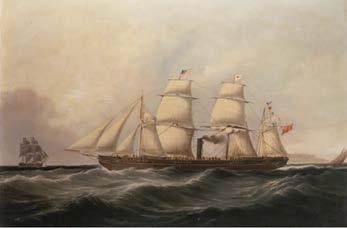
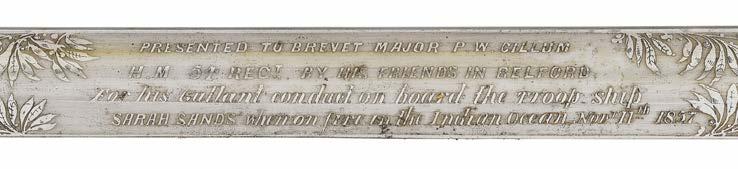


A FINE CASED SILVER-MOUNTED SWORD PRESENTED TO MAJOR G.A. SPOTTISWOODE, COMMANDING 2ND CITY OF LONDON RIFLE VOLUNTEER CORPS, FROM THE OFFICERS, NON COMMISSIONED OFFICERS AND PRIVATES APRIL 1863, RETAILED BY WIDDOWSON & VEALE, GOLDSMITHS, 73 STRAND, LONDON SILVER HALLMARKS FOR 1862, MAKER’S MARK OF THOMAS WILLIAM DEE & SONS
of regulation type, with slightly curved fullered blade (small areas of rust patination, circular proof stamp missing) etched over nearly its entire length on both sides with differing designs of scrolling flowering foliage, one side framing the presentation inscription, and along the other with two martial trophies and crowned ‘VR’ cypher, hilt comprising half-basket guard finely pierced and chased with foliate scrollwork and ribbons, the former incorporating the recipient’s crest and motto, the latter engraved ‘2ND City Of London Rifle Volunteers’, folding inner-guard pierced and chased with foliage en suite, lobed rear quillon, lion-head pommel with stylised mane extending down the back of the grip, and stippled grip with alternate cusped and clawed bands and dots, in its black leather scabbard with mounts engraved with symmetrical strapwork against hatched grounds, and suspension rings: in original contoured fitted wooden case covered in maroon leather (some scuffing) and lined in navy blue velvet, 82.5 cm blade
Provenance
Sotheby’s Billingshurst, 25 March 1997, lot 107
George A. Spottiswoode (1827-1899), of the printing firm Eyre & Spottiswoode, was one of the first officers to be commissioned into the 2nd City of London upon its formation in May 1860.
£1,800-2,200
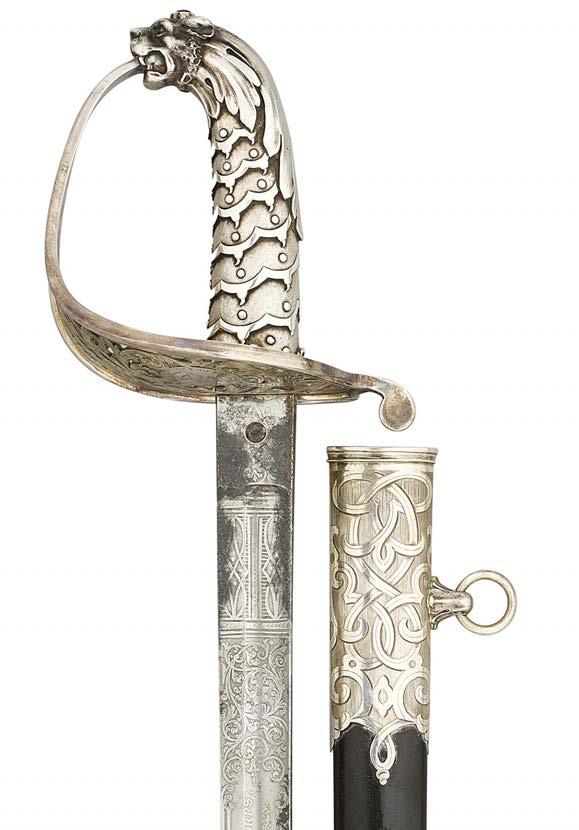
A FINE SCOTTISH REGIMENTAL SILVER-HILTED SWORD PRESENTED TO CAPTAIN ALEXANDER EWING BY THE NON-COMMISSIONED OFFICERS & PRIVATES OF THE GLASGOW YEOMANRY CAVALRY BY RAIT & SONS, BUCHANAN ST., GLASGOW, LONDON SILVER HALLMARKS FOR 1868, MAKER’S MARK DW OVER JW
with bright fullered blade double-edged at the point of flattened diamond section, etched over both sides with symmetrical designs of foliage and strapwork framing a trophy of arms, the presentation inscription and the recipient’s coat-of-arms along one side, and a pineapple in a basket of fruit and a crowned martial trophy along the other, the forte on one side with maker’s details, and with circular metal-lined ‘PROVED’ mark on the other, hilt comprising half-basket guard cast, pierced and chased in relief with strapwork involving flower-heads and fruiting oak foliage, all within borders of beadwork, pommelcap and back-piece each chased with leaves and beadwork, and ribbed ivory grip (minor chips and small split) bound with two thicknesses of twisted silver wire, in its silver-plated scabbard engraved with Union foliage and strapwork against hatched ground at the locket, chape with foot and at the suspension mounts, two suspension rings, and in fine untouched condition, 87.5 cm blade
Provenance
Sold in this room, 8 December 2010, lot 84
The presentation inscription reads: ‘PRESENTED [ON HIS PROMOTION] TO CAPTAIN ALEXANDER EWING OF A TROOP QUEENS OWN ROYAL REGIMENT OF GLASGOW YEOMANRY CAVALRY, BY THE NON-COMMISSIONED OFFICERS & PRIVATES UNDER HIS COMMAND IN TOKEN OF THEIR RESPECT & ATTACHMENT.1868.’
Alexander Ewing was descended from the Dunbartonshire family, the Ewings of Keppoch, and appears to have been associated with the Queen’s Own Glasgow and Lower Ward of Lanarkshire Yeomanry Cavalry from its inception in 1848: he is recorded as having signed the Oath of Allegiance immediately prior to the forming of the regiment. Ewing is said to have been born on 6th August 1810, the son of Alexander Ewing (d.1858), and may have served in the ranks of the yeomanry for ten years before being commissioned cornet in the regiment on 11th November 1858. Promoted lieutenant on 24th April 1863, he was promoted captain on 16th April 1868 - when the men of his troop, ‘A’ Troop, presented him with this silver-mounted sword. Ewing’s regiment received its Royal title in 1849, following a visit by Queen Victoria to Glasgow during which the regiment formed the escort to the Queen. The regiment was deployed - reasonably peacefully - in Aid to the Civil Power against striking coalminers in 1856, participated in the Volunteer Review on Glasgow Green in 1861 and had one troop involved in the sham fight known as the ‘Battle of Pollok’ in 1861. Ewing married Maria, daughter of Robert Macauley of Glenoak, County Antrim, on 3rd December 1840 and the couple had two sons, Robert and Alexander; Alexander was commissioned into his father’s yeomanry regiment as a sub-lieutenant on 1st March 1875. Alexander Ewing, senior, who was a Justice of the Peace for Glasgow and who may have been a senior partner in the corn factoring business of Ewing, Angus & Co., died on 13th March 1876 and his son resigned his commission the following year. Both Alexander Ewing’s sons moved to England late in the 19th century, owning properties in Hertfordshire and Kent, and the family ceased at that point to have any connection with Scotland. See Anon, The Queen’s Own Royal Glasgow Yeomanry 1848-1948, Glasgow 1949 and Burke’s 1906.
Ivory Registration: 9XJ8AAK7
£2,000-3,000

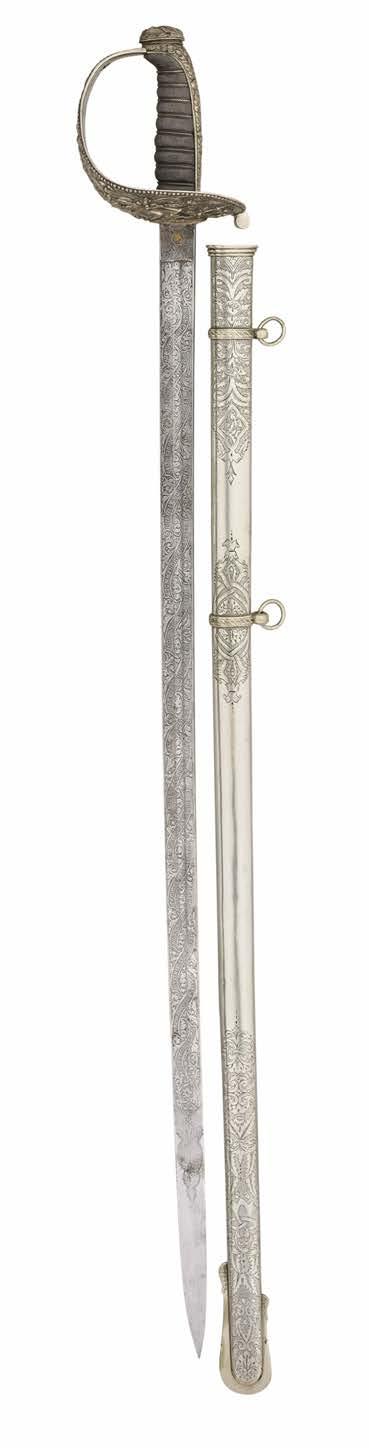
A REGIMENTAL PRESENTATION SWORD TO MAJOR DAVID RANKIN BY THE OFFICER’S AND GUNNERS OF THE 5TH AYRSHIRE VOLUNTEER ARTILLERY BY S. HOBSON & SON, ARTILLERY PLACE, WOOLWICH, DATED 1871
with very slightly curved bright fullered blade double-edged at the point of flattened diamond section, etched over most of its length on one side with the presentation inscription on scrolls amid foliage, the ricasso with circular metal-lined ‘PROOVED’ mark, and along the other with symmetrical designs of foliage, recipient’s crest and motto, crowned ‘VR’ cypher and regimental badges, the ricasso with maker’s details, nickel hilt comprising half-basket guard cast and chased in low relief with flower-heads and strapwork framing oak foliage against a finely stippled ground, pommel-cap and back-piece with thistles, and wire-bound fishskin-covered grip, in its nickel scabbard engraved over both sides with symmetrical designs of strapwork and fruiting oak foliage, engraved suspension mounts each with suspension ring, and in fair condition, 82.0 cm blade
The presentation inscription reads: ‘PRESENTED TO MAJOR DAVID RANKIN BY THE OFFICERS AND GUNNERS OF THE 5TH AYSHIRE VOLUNTEER ARTILLERY AS A MARK OF RESPECT AND ESTEEM FOR HIM AS THEIR COMMANDING OFFICER ON HIS APPOINTMENT AS MAJOR OF THE BRIGADE. KILMARNOCK. 28TH MARCH 1871.’
£1,000-1,500
A PRESENTATION SWORD OF MILITARY TYPE TO MR. CHARLES BALDWYN CHILDE PEMBERTON BY THE TENANTS ON THE MILLICHOPE ESTATE BY E. ROBINSON & CO., THE SQUARE, SHREWSBURY, DATED 1874
with slightly curved fullered blade double-edged at the point of flattened diamond section, brightly etched over most of its length on one side with the presentation inscription between symmetrical foliage involving a Classical trophy and a smoking urn, the ricasso with the maker’s details , and along the other with symmetrical foliage involving Classical trophies and the winged figure of Victory, the ricasso with circular metal-lined ‘PROOF’ mark, hilt comprising lightly gilt nickel-plated half-basket guard cast, pierced and chased in low relief on the outside with scrolling foliage inhabited by the Classical figures of Victory and Peace, pommel with a recumbent lion on both sides and with foliage along the back-piece, and ribbed wire-bound fishskin-covered grip, in its lightly gilt nickel scabbard engraved with symmetrical foliage against finely punched grounds over both sides within foliate borders, plain suspension mounts each with suspension ring, and retaining much of its gilding, 82.5 cm blade
The presentation inscription reads: ‘PRESENTED TO MR. CHARLES BALDWIN CHILDE PEMBERTON ON HIS ATTAINING HIS MAORITY by the TENANTS on the MILLICHOPE ESTATE as a small TOKEN of their ESTEEM and REGARD 27th September 1874’
Millichope Park is a Greek-Revival building built in the mid-19th century by the Shropshire architect Edward Haycock for Reverend Norgrave Pemberton, Rector of Church Stretton. In 1544, the More family bought Lower Millichope and Thomas More, who inherited the estate, started the creation of the pleasure park. The estate descended to Norgrave Pemberton who left the ‘new’ house, gardens and estate to his cousin, Charles Orlando Childe. He passed it on to his son who sold the estate in 1896 to Captain Beckwith whose family thereafter descended.
£1,500-1,800
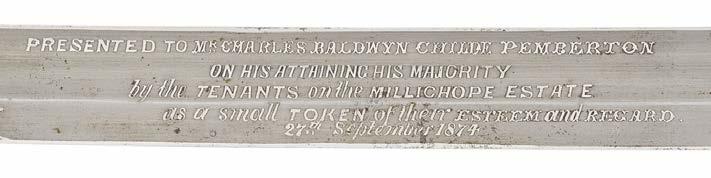
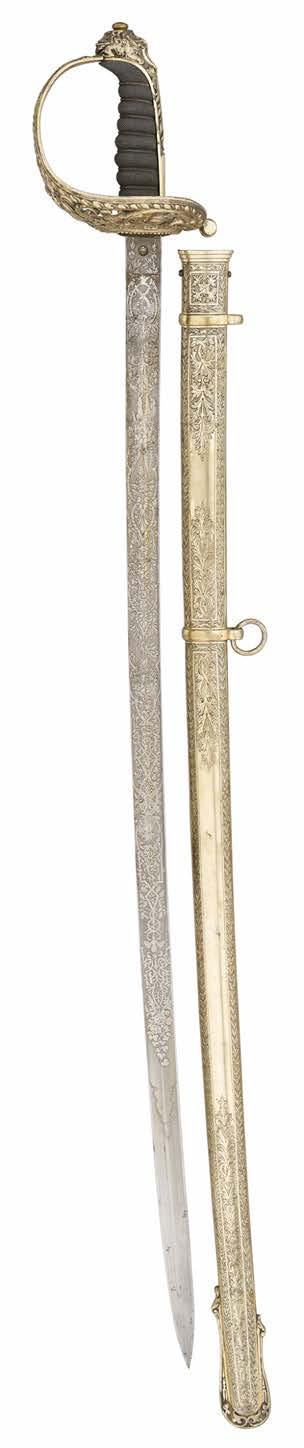

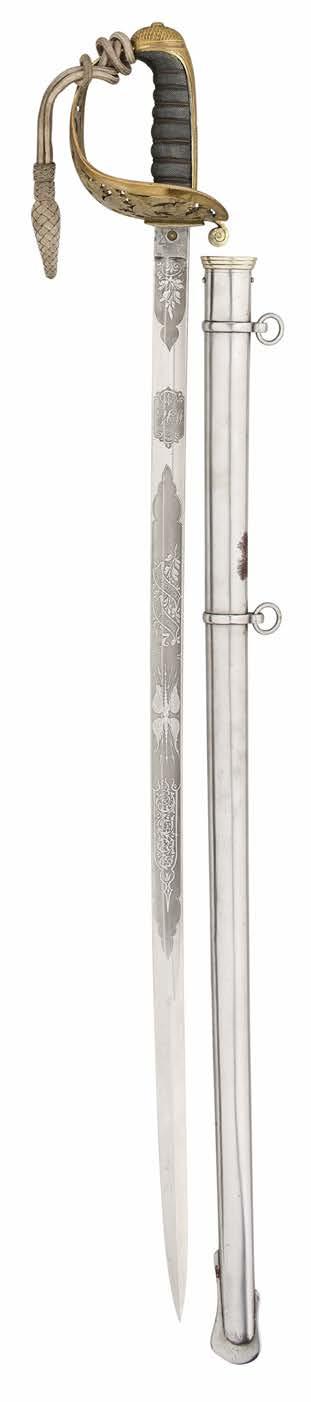
121
A FINE REGIMENTAL SWORD PRESENTED TO CAPTN & HON MAJOR H.G. EDWARDS BY THE MEMBERS OF E COMPANY 1ST V.B. SUFFOLK REGT BY S. J. PILLIN, 31 GERRARD ST., SOHO, LONDON, NO. 99237, DATED 1891 with bright fullered blade double-edged at the point of flattened diamond section, etched over both sides with panels of scrolling foliage framing Suffolk Regiment 1st V.B. badges and details and the presentation inscription along one side, and military trophy and crowned ‘VR’ cypher along the other, the forte on one side with maker’s details surmounted by the royal arms, and with circular white-metal lined ‘PROVED’ mark on the other, silvered hilt cast and chased in relief with foliage and incorporating a crowned slung bugle horn, scrolled rear quillon, pommel and back-piece with oak foliage, and wirebound fishskin-covered grip, in its silvered scabbard with shoe and suspension mounts all cast and chased with oak foliage, two suspension rings, and in fine condition, 84.0 cm blade
The presentation inscription reads: PRESENTED TO CAPTN & HON MAJOR H.G. EDWARDS BY THE MEMBERS OF E COMPANY 1ST V.B. SUFFOLK REGT AS A TOKEN OF THEIR REGARD & ESTEEM. MAY, 1891.’
£600-800
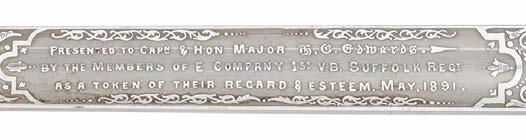
122
AN 1857 PATTERN OFFICER’S SWORD OF THE 2ND TOWER HAMLETS ENGINEER VOLUNTEERS BY BENNETT, 66 ST. MARTINS LANE, LONDON, CIRCA 1870 of regulation pattern, with slightly curved blade of flattened diamond section towards the double-edged point, brightly etched over most of its length along one side with scrolling foliage, regimental badge and title, the latter on scrolls, and owner’s monogram ‘WJE’, the ricasso with circular metal-lined ‘PROOVED’ mark, and along the other with crowned ‘VR’ cypher and foliage, the ricasso with maker’s details, copper alloy hilt retaining some gilding and comprising half-basket guard pierced and chased with scrolling foliage, chequered pommel and back-piece, wire-bound fishskin-covered grip, and retaining its bullion sword-knot, in its bright steel scabbard with two suspension rings, and in fair condition, 82.0 cm blade
The 2nd Tower Hamlets Engineer Volunteers was raised in 1868. £500-700
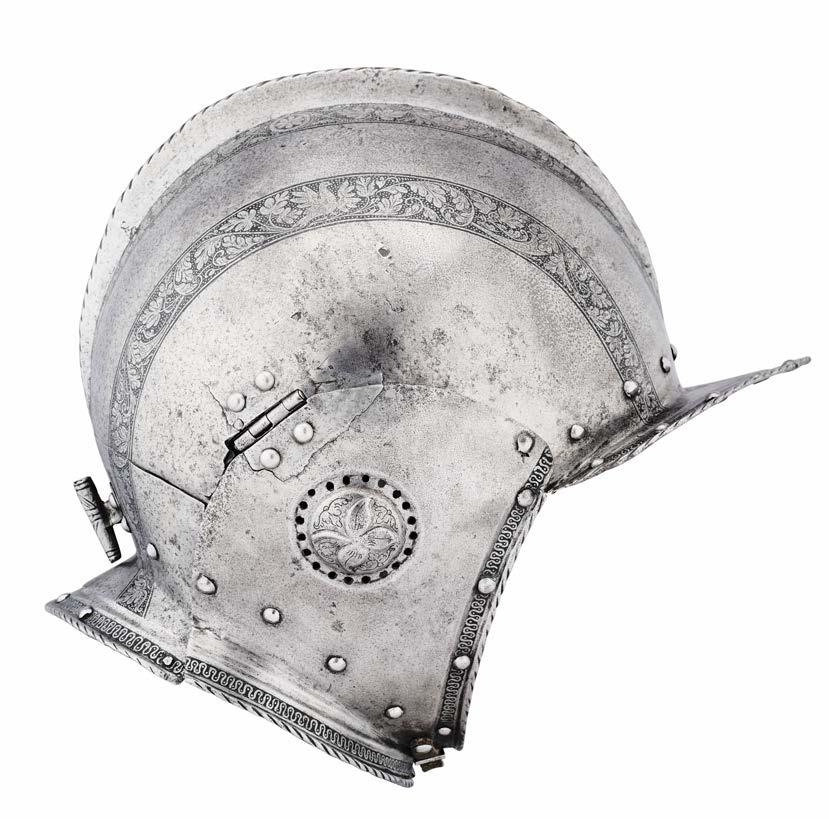
123
A RARE NORTH GERMAN ETCHED BURGONET, BRUNSWICK, CIRCA 1540 of bright steel, with skull of pronounced rounded form rising to a low roped medial comb projecting forward to a pointed peak (old patched internal repair), flanged outwards to form a bluntly-pointed neck-guard at the nape, the latter with incised line decoration, fitted with a slender tubular plume-holder, hinged cheek-pieces (old patched repair at each hinge) flanged outwards at their lower edge as a continuation of the neck-guard, on a roundel embossed centrally with an etched trefoil against a ground of florets and encircled by recessed auditory holes, and each drawn- out under the chin and secured by leather straps and an iron buckle, the main edges etched with a band of continuous loops and dots bet ween recessed, turned and roped borders, and decorated over the skull, peak and neck-guard with etched bands of scrolling foliage inhabited by a dove on both sides of the skull, 26.0 cm high
The etched decoration closely relates to that occurring on the armour of Duke Heinrich the Younger of Brunswick, now preserved in Vienna (inv. no. 396), and thought to have been used by him in 1545 and the so -called “Giant Armour” in the Royal Armouries (inventory number II.22). They are etched with the initials F.B and A.B which Dr Alheidis von Rohr has sug gested may stand Franz Bock and Bonaventura Abt respectively. The later is recorded as a painter in Brunswick 1525-52, working for the town and for Prince Heinrich the Younger (1489-1568). He is documented in 1535, ‘painting’ an armour. See Or twin Gamber & Christian Beaufort, Kunsthistoriches Museum, Wien, Hofjagd- und Rüstkammer. Katalog der Liebrüstkammer, II. Teil-Der Zeitrum von 1530-1560, 1990, p. 88, pl. 34.
£10,000-15,000 123
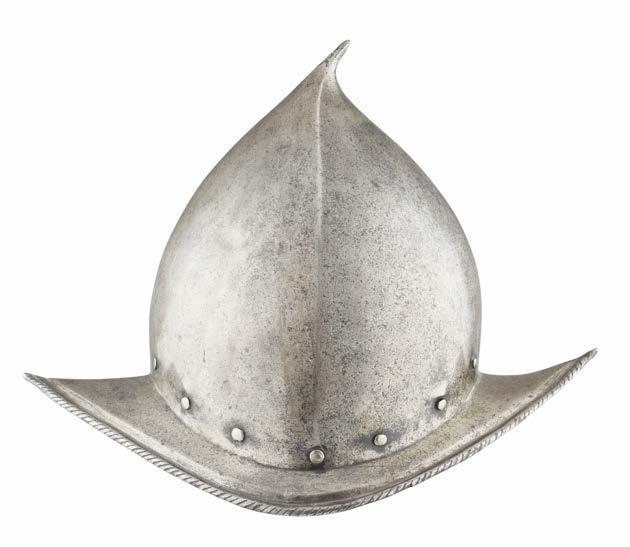
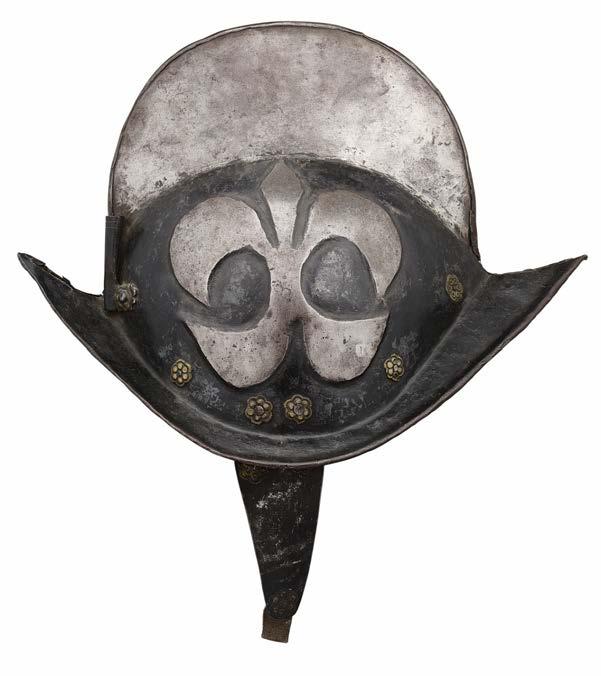
A NORTH ITALIAN ‘SPANISH’ MORION, CIRCA 1580 of iron and made in one piece, with tall faceted almond-shaped skull rising to a swept stalk, the base encircled by a row of dome-headed lining rivets (washers and plume-holder missing), and narrow downturned brim curving up to a point fore and aft, and with recessed turned and roped border (minor damage, old light pitting overall), 29.0 cm high
£1,200-1,500
125
A GERMAN BLACK AND WHITE COMB MORION, CIRCA 1600 with two-piece skull rising to a bright high turned comb, embossed on each side of the skull with a large fleur-de-lys in low relief, downturned brim curving up to a point fore and aft, and with turned border, the base of the skull with lining rivets on embossed copper alloy washers, tubular plume-pipe to one side at the rear, triangular cheek-pieces en suite, and retaining much of its old blackened finish, 28.0 cm high
£800-1,200
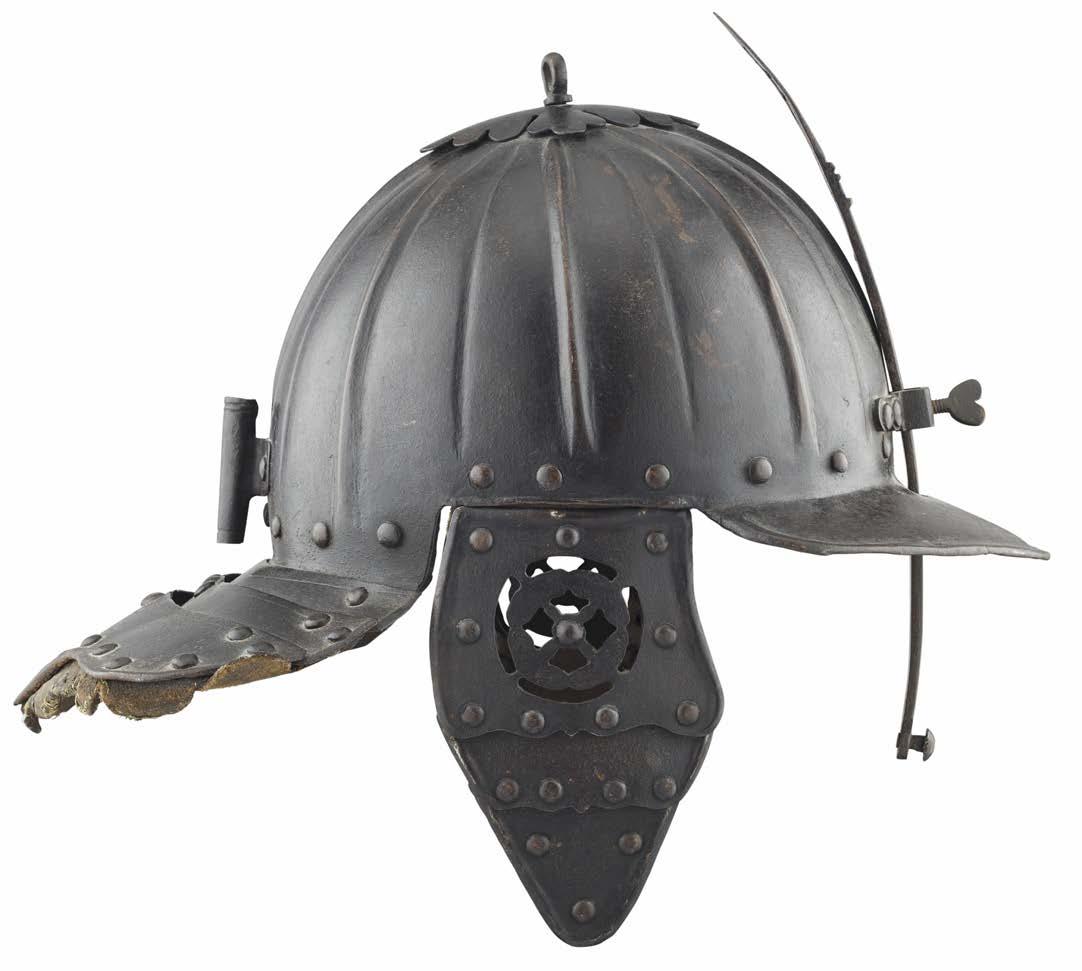
A FLEMISH HORSEMAN’S POT HELMET, MID-17TH CENTURY of blackened russet steel, with rounded one-piece skull embossed with vertical ribs and flutes radiating downwards from a ringshaped finial centred on a large leaf-shaped washer, tubular plume -holder at the rear, the front drawn-out to a bluntly-pointed slightly downcurved peak with turned edge and pierced for an adjustable narrow curved bar-nasal with pierced ovoidal finial and working on a wing-headed screw, neck-guard of three upward-lapping plates, the bottom one drawn-out to a point and retaining remains of lining on the inside with leather piccadill border, separate cheek-pieces of three plates each, the top one pierced with a rosette design over each ear, the main edges turned and with dome-headed rivets throughout, 29.0 cm high
Provenance
Henk L. Visser Collection, sold Bonhams Knightsbridge, 28 November 2007, lot 163
£2,000-3,000
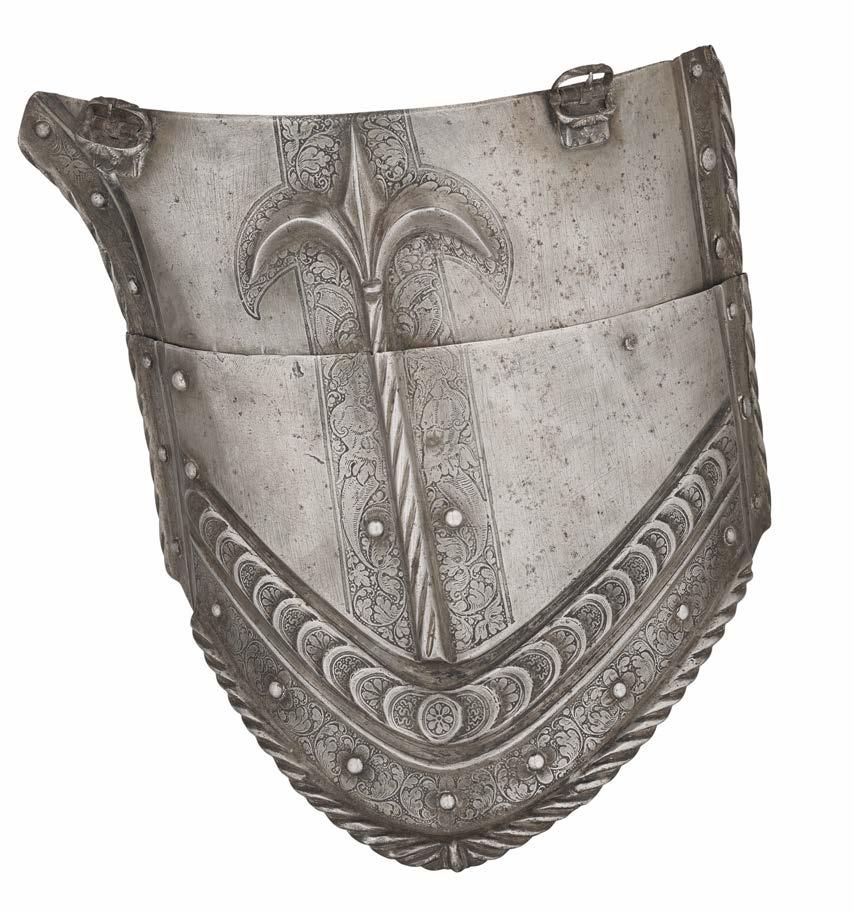
127
A FINE NORTH GERMAN LEFT TASSET FROM AN ARMOUR OF EXCEPTIONAL SIZE, CIRCA 1540
comprising two broad plates, shaped to the thigh and obtusely pointed at the base, the top fit ted with two buckles for suspension, the principle edges with roped inward turns, accompanied by a border of etched scrolling foliage framed on the inside by a fluted border, embossed in the centre with a tapering gutter-shaped roped moulding rising to a trifurcated terminal on a finely etched stippled ground of scrolling leafy tendrils with a cornucopia above a laurel-crowned male and female demi-figure flanking each side, and the lower border accompanied by a further panel of overlapping scale ornament filled with flowers and wrigglework, applied on the inside with a typed label ‘v.Langen- Austellung 232’, 27.7 cm high
The embossed scale pattern and the etched designs closely relate to the so-called ‘Giant Armour’ in the Royal Armouries (inventory number II.22), which is etched with the initials ‘A. B.’ Dr Alheidis von Rohr has stated these initials may be for Bonaventura Abt who is recorded as a painter in Brunswick 1525-52, working for the town and for Prince Heinrich the Younger (1489-1568). He is documented in 1535, ‘painting’ an armour. In 1566 the Brunswick painters’ guild noted that, among other things, it would accept as the masterpiece of an etcher a heavy field armour (Curitz) or light field armour (Drabbharnisch), suggesting that the decoration of armour had become a significant source of employment for its members. A vambrace and couter decorated in a very closely related manner, perhaps from the same garniture and formerly in the armoury of the Princely House of HohenloheLangenburg at Schloss Langenburg was sold in this room, 3rd December 2014, lot 202. An armour with related embossed ornament is preser ved in the Philadelphia Museum of Art (cat. No. 9, pl. IX). The catalogue entry gives the provenance as the Princes Radziwell, thence together with other pieces, to Prince Hohenlohe-Schillingsfürst, a cadet branch of the Hohenlohe-Langenburg line, which suggests a possible common origin of the present tasset and other armours. See A. V. B. Norman and Ian Eaves, Arms & Armour: in the Collection of Her Majesty The Queen: European Armour, 2016, p. 120.
£3,000-4,000
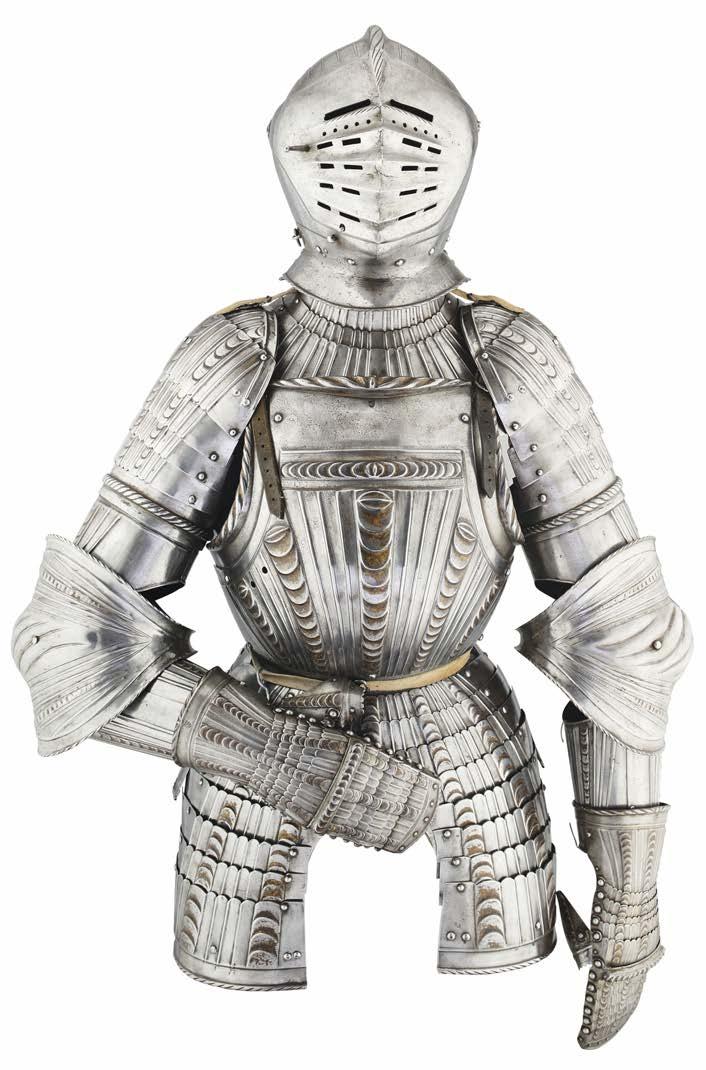
A FINELY CONSTRUCTED HALF ARMOUR IN THE NORTH GERMAN STYLE OF CIRCA 1530, LATE 19TH CENTURY comprising close helmet with rounded two-piece skull rising to a low roped medial comb, fitted at its rear with neck-guard of three lames and at its front with ‘bellows’ visor and bevor attached by common pivots; collar of four lames front and rear; breastplate formed of a rounded main plate struck with Nuremberg town mark, boldly roped at the neck and arm openings, skirt of four lames carrying a pair of tassets each of four lames, matching backplate with culet of five lames; a pair of vambraces including upper cannon with turner, large bracelet cowters, tubular lower cannon; a pair of mitten gauntlets each struck with Nuremburg mark, decorated throughout with bold fluting, framed in the case of the cuirass, vambraces and gauntlets with a pattern of overlapping scales, with some painted gold finish and in clean condition throughout, on a wooden stand, 130.0 cm (including stand)
The present armour appears to be based upon those manufactured in Brunswick circa 1530, such as that now preserved in the Museum für Deutsche Geschichte, Berlin (inv. nr. W2333). For a discussion of related armours manufac tured in Germany during the late 19th and early 20th century see Hans Shedelman, ‘Der Waffensammler’ in ZHWK, 3, vol. 6, 1964.
£7,000-9,000
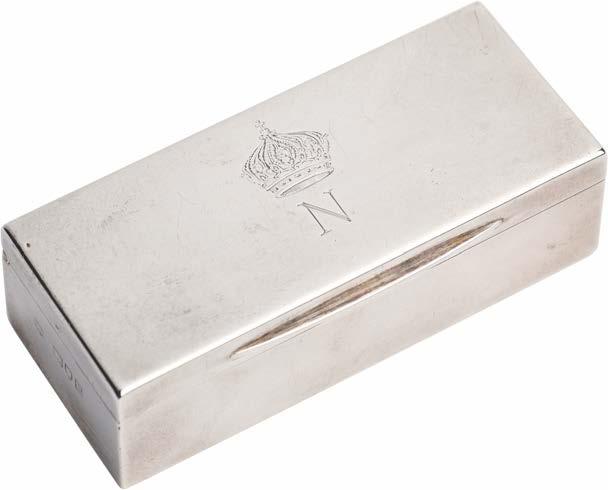
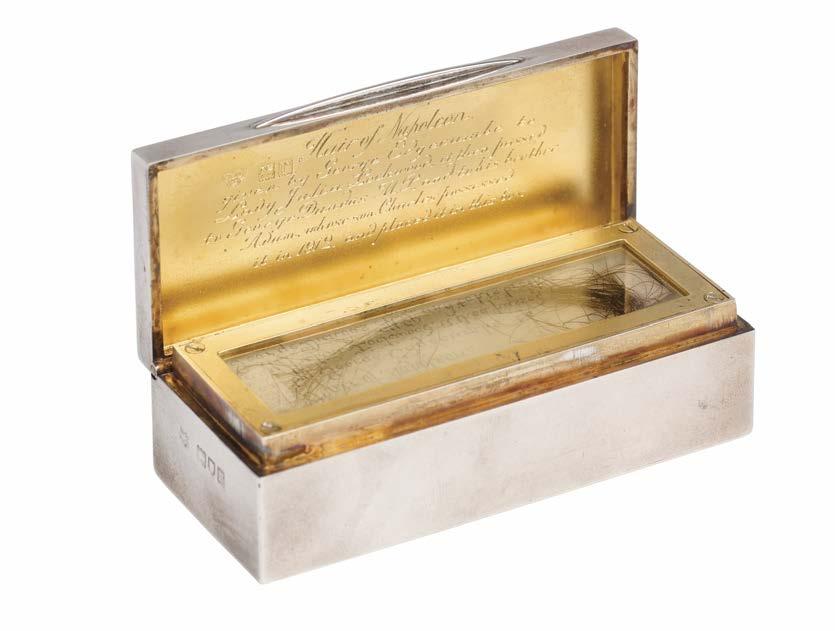
A SMALL CASED LOCK OF NAPOLEON’S HAIR, THE SILVER CASE WITH LONDON SILVER HALLMARKS FOR 1912, MAKER’S MARK OF GOLDSMITHS & SILVERSMITHS COMPANY LTD., 112 REGENT ST. W
the lock lying on cream velvet beneath glass in a silver-gilt frame, the gilt interior of lid engraved ‘Hair of Napoleon, given by George Edgecumbe to Lady Julia Lockwood, it then passed to George Dundas M.P., and to his brother Adam, whose son Charles possessed it in 1912, and placed it in this box.’, the exterior of the lit engraved with a crowned Imperial ‘N’, 7.7 cm long x 3.5 cm wide x 2.5 cm deep
The George Edgcumbe referred to in the inscription is most probably George Edgcumbe (1720-1795), 1st Earl of Mount Edgcumbe, who was a highranking naval officer, Vice-Admiral in 1770 and Admiral in 1778. He not ably served under Admiral Boscawen and played a role in the Seven Years’ War. The family seat, Mount Edgcumbe House, is located in southeast Cornwall, directly across from the Royal Naval Dockyard at Plymouth. Although George died in 1795, his son Richard Edgcumbe, the 2nd Earl lived on the estate during the time Napoleon was held aboard HMS Bellerophon in Plymouth Sound, and was a known supporter of the government that was responsible for Napoleon’s confinement.
£2,000-3,000
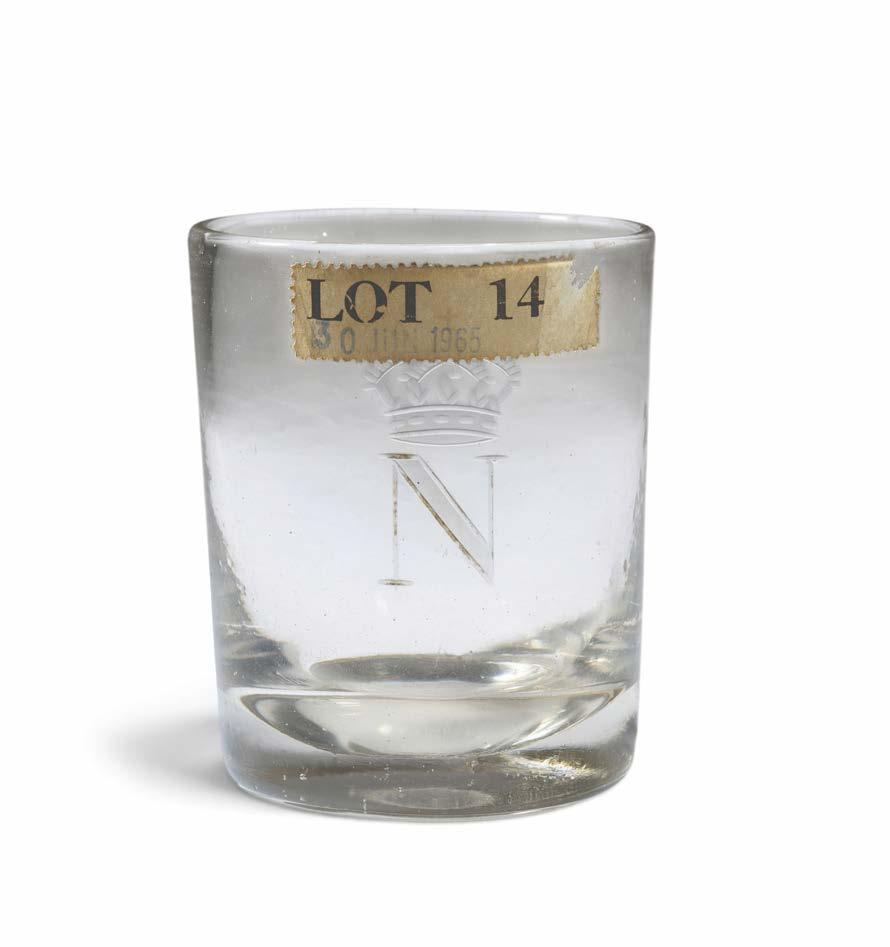
A GLASS TUMBLER BELIEVED TO HAVE BEEN TAKEN FROM NAPOLEON’S CARRIAGE AT WATERLOO, EARLY 19TH CENTURY
the glass cut with a crowned initial ‘N’ (minor old chip to foot): mounted on an ebonised wooden plinth with oval silver plate engraved ‘NAPOLION’S TUMBLER taken from his carriage AT WATERLOO JUNE 18th 1815’, in a modern carrying case covered in black leather, 8.8 cm tall
Provenance
Christie’s London, The Right Honourable Earl of Harewood, 30 June 1965, lot 14
£2,000-3,000
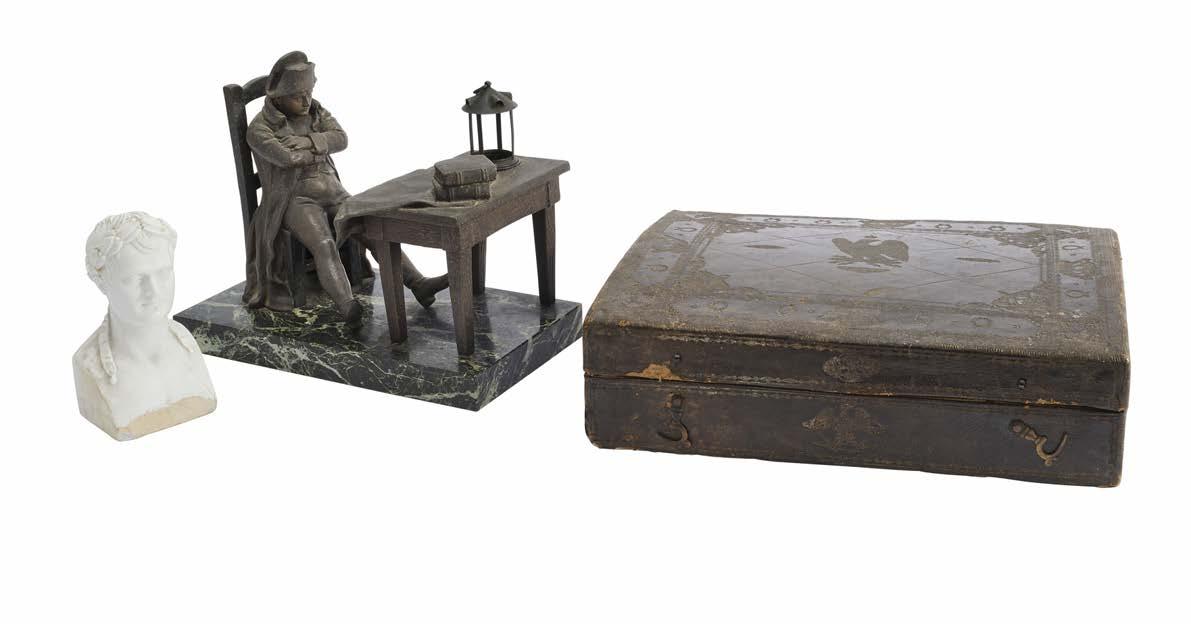
131
A FRENCH NAPOLEONIC DISPATCH BOX, 19TH CENTURY
of wood covered in tooled dark brown leather, the slightly domed lid tooled with a crowned Imperial eagle centred on a border tooled with Imperial symbols, the interior lined in buff paper, the interior of the lid inscribed in ink ‘Ceci m’a Ete Donne Par Betsy Balcombe’ above a central Imperial eagle (some old wear and losses); together with a spelter figure of Napoleon seated in front of a map of Waterloo, two books and a lantern on a table, his arms folded and legs stretched out in front of him: mounted on a green marble base; and a white moulded ceramic bust of Napoleon adorned with a wreath of laurel, the first: 32.0 cm x 24.5 cm (5)
Provenance
The first: Christie’s London, 31 March 1977, lot 3 (a copy of the sale catalogue and original sales invoice is offered with the lot).
The first believed to have belonged to Napolean Bonaparte.
Lucia Elizabeth Balcombe Abelle (1802-1871) is known to have been a friend of Napoleon during his exile to St. Helena. The Balcombe family resided in a cottage named The Briars, where Napoleon was their guest during his first three months of exile whilst Longwood House was being renovated for his use. Lucia, known as Betsy, is recorded as referring to Napoleon as ‘Boney’ and often visited him at Longwood House.
£800-1,000
132
A FRENCH RED MOROCCO LEATHER MONTHLY DOCUMENT FILE BY MAGNIER, RUE DE RICHELIEU, NO. 34, A PARIS, FIRST QUARTER OF THE 19TH CENTURY
tooled and gilt with delicate borders of repeated foliage and scrolls, the interior of green silk sectioned for the months of the year each labelled in tooled and gilt red leather tabs, and with silver clasp and catch (the front with some old staining), 32.5 cm x 18.5 cm
Provenance
Christie’s London, Fine French Furniture And Objects Of Art, 22 April 1982, lot 18 (offered with the sale catalogue, cover detached)
£400-500
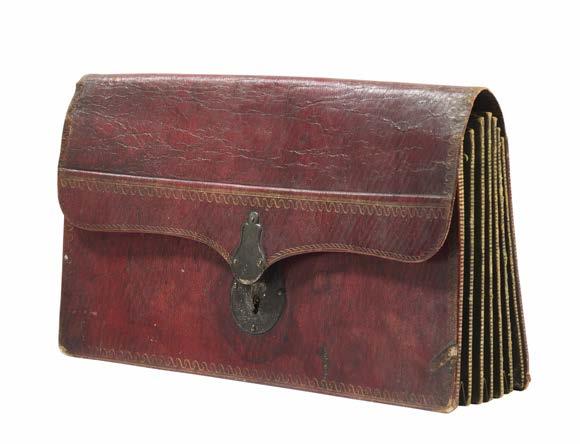
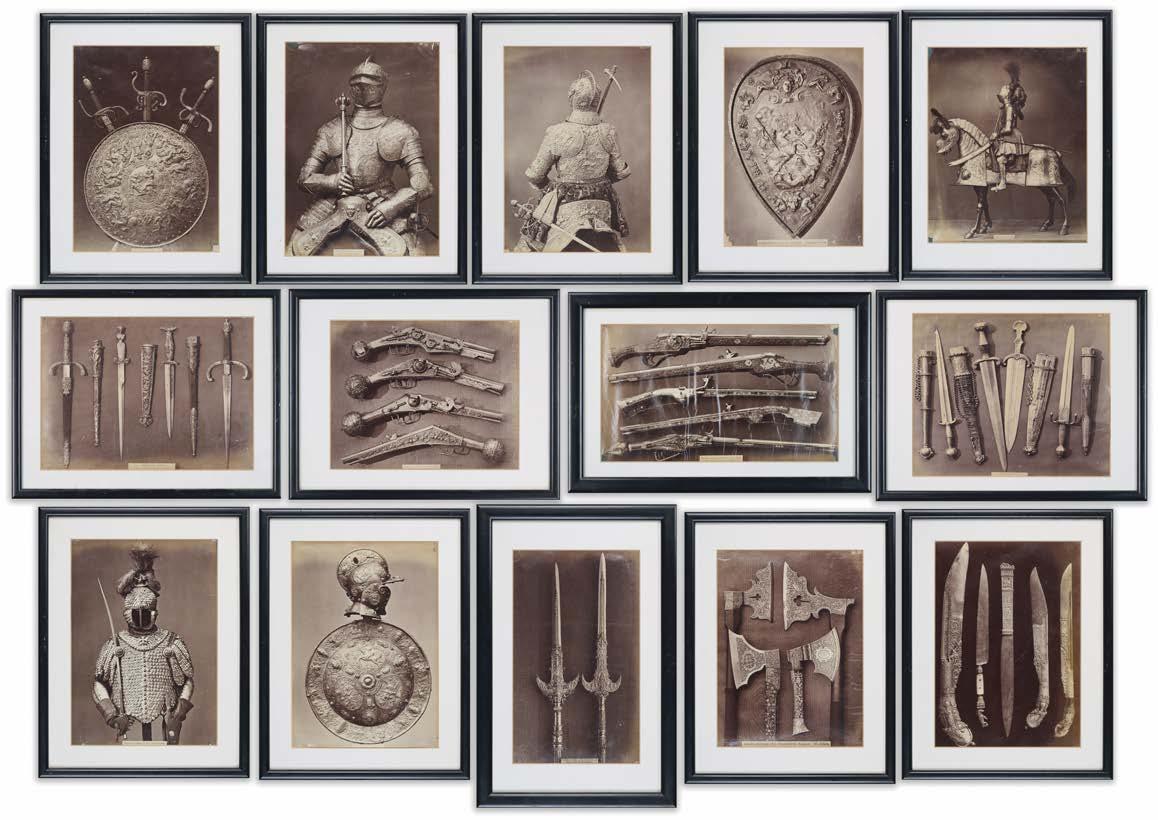
133
FOURTEEN ALBUMIN PHOTOGRAPHIC PRINTS OF ARMOUR AND WEAPONS IN THE SAXON ROYAL ARMOURIES, DRESDEN, LATE 19TH CENTURY
depicting daggers, rapiers, polearms, axes, wheel-lock pistols, and armour including the equestrian armour of the Elec tor Chris tian I by Anton Peffenhauser, mostly 32.0 cm high x 24.5 cm wide (framed and glazed) (14)
The first published illustrations of pieces in the Saxon Royal Armouries, Dresden appeared in Max Rade, Auswahl von Ornamenten zum Praktischen Gebrauch, published in 1883.
£500-700
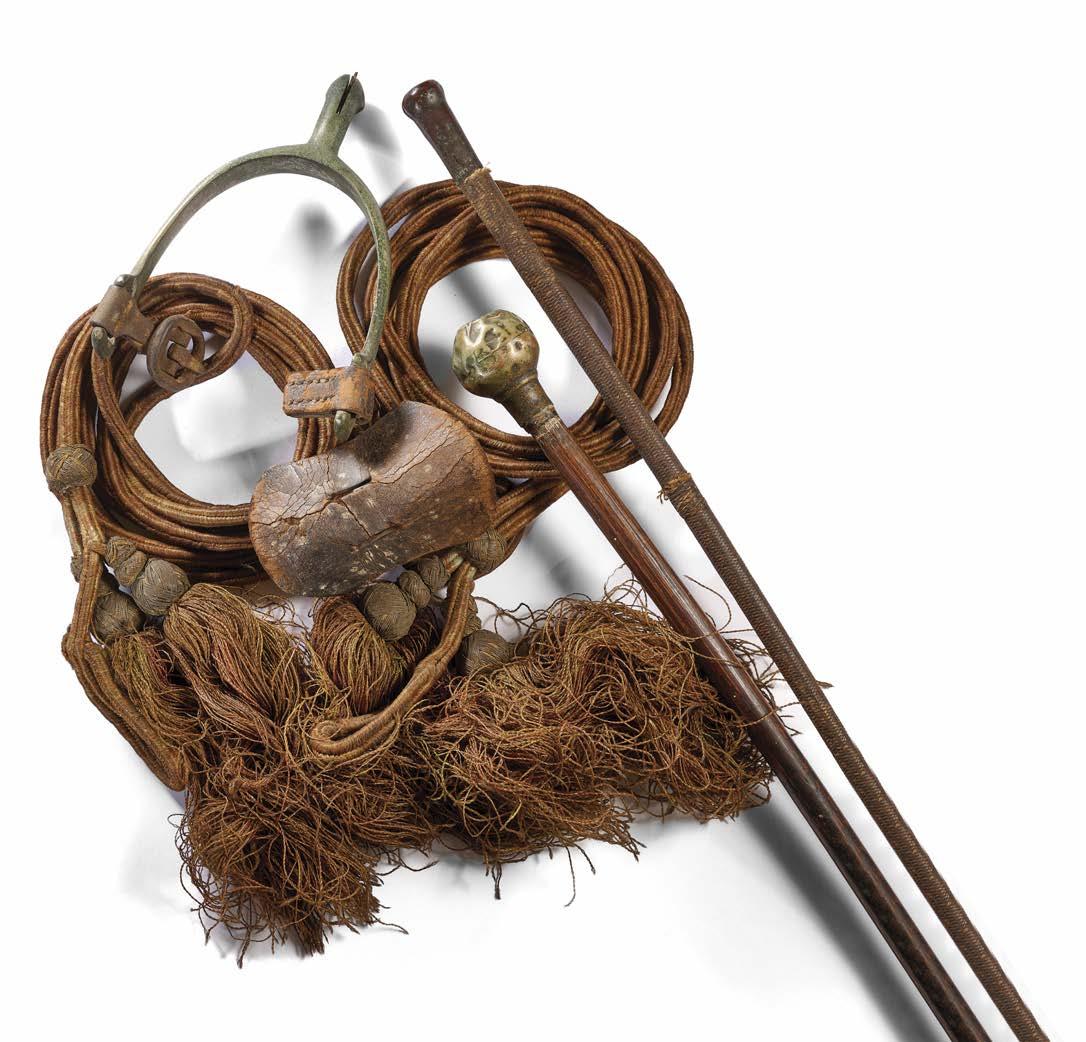
FOUR ITEMS BY REPUTE BELONGING TO T.E. LAWRENCE (OF ARABIA)
comprising a pair of corded adjustable tassels, possibly for securing a keffiyeh, the tassels each on a silver bullion knot; a white-metal spur with remains of leathers; a plaited riding crop (in poor condition) with copper knop; and a Royal Airforce swagger stick (the top worn and dented) (5)
Provenance
Given by T.E. Lawrence (the famous ‘Lawrence of Arbia’) to the vendor’s father, John H. Harvey FSA (1911-1997) an architectural historian, who specialised in writing on English Gothic architecture and architects. The Ar t historian Paul Crossley described him as ‘the most prolific and arguably the most influential writer on Gothic architecture in the post-war years’.
As a youth of 16, John Harvey was employed by Sir Herbert Baker (1862-1946), the prominent British imperial architect and friend of T E. Lawrence in whose office at 14 Barton Street, Westminster, London Lawrence was allowed to live in an attic room. It was here that he wrote much of his second draft of Seven Pillars of Wisdom following the loss of the original manuscript at Reading Station in 1919. Lawrence continued to use the room for years afterwards and wrote to his mother in 1922 ‘I’m perfectly well, and ver y comfortable in Barton Street which is quite beautiful. The quiet of so little a place in the middle of a great mess has to be experienced a thousand times before it is properly felt. I will be very sorry to leave.’ The sculptor Sir Charles Wheeler, who visited 14 Barton Street to sculpt Lawrence in 1929 wrote in his autobiography ‘The small room in which he wrote and slept above Baker’s office was littered with books. He was constantly sent new books for comment or review. He told me that one day he found it prac tically impossible to get into bed, so he filled his knapsack with the most recent novels and made nocturnal visits to Canons’ houses in Westminster Abbey Close to deposit those volumes which he thought most suitable in the appropriate letter-boxes…
His presence at 14 Barton Street was kept a secret from the general public. But one morning the telephone rang and a voice announced: “Is Colonel Lawrence there – I am George Bernard Shaw.” The duteous office boy [John H. Harvey] slapped down the receiver with “Tell that to the Marines”. Ten minutes later a loud knocking on the door heralded G.B.S. in person’.
£1,000-1,500
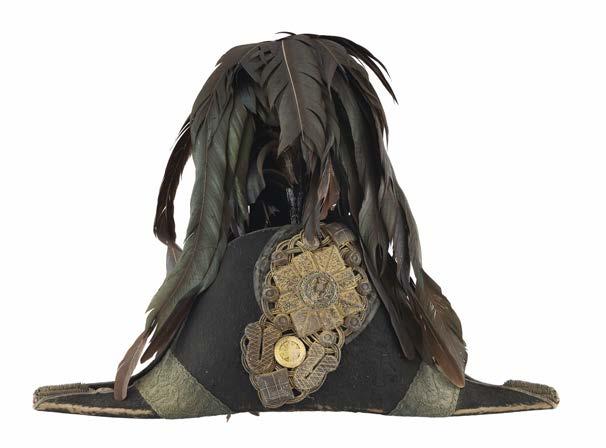
135
A VERY RARE ROYAL COMPANY OF ARCHER’S BONNET AND TUNIC, LATE 18TH CENTURY
the bonnet of plum velvet lined in plum-coloured cloth with adjustable cream silk sweat-band (some old tears), the arched front of cream silk trimmed along the top in green, and finely embroidered with sprays of Scottish thistles in coloured threads centred on a crowned garter ribbon bearing the Company motto and set with a Wedgwood jasperware oval of St. Andrew, green silk ribbon at the back, green and cream silk bow on the left at the front bearing an ostrich plume, and green silk and silver bullion tassel; the pleated tunic of wool in the Company tartan lined in green woollen cloth, the sleeves and pockets lined in cream woollen cloth, the front and sleeves above the cuffs with cord and silver bullion threaded loops enriched with green silk and silver bullion tufts, green velvet collar, silver-fringed epaulettes and cuffs, the latter each with loops and tufts en suite, buttons faced in woven silver, and in fine condition (2)
The Royal Company of Archers was founded in 1676 as a private Edinburgh archery club and is the ceremonial Sovereign’s bodyguard in Scotland. The Company was granted a Royal Charter in 1704 and transitioned from a 17th century archery club into a prestigious ceremonial unit, assuming its official royal bodyguard role during the visit of King George IV to Scotland in 1822.
£2,000-3,000
136
A BICORN HAT OF THE QUEEN’S BODYGUARD (ROYAL
COMPANY OF ARCHERS)
of black brushed velvet (edges worn) with elaborate Company badge in bullion threads incorporating an ormolu Company button on the right, bullion and red cord tassel fore and aft, and surmounted by a feather plume, the interior lined in plum silk with leather sweatband
£200-300
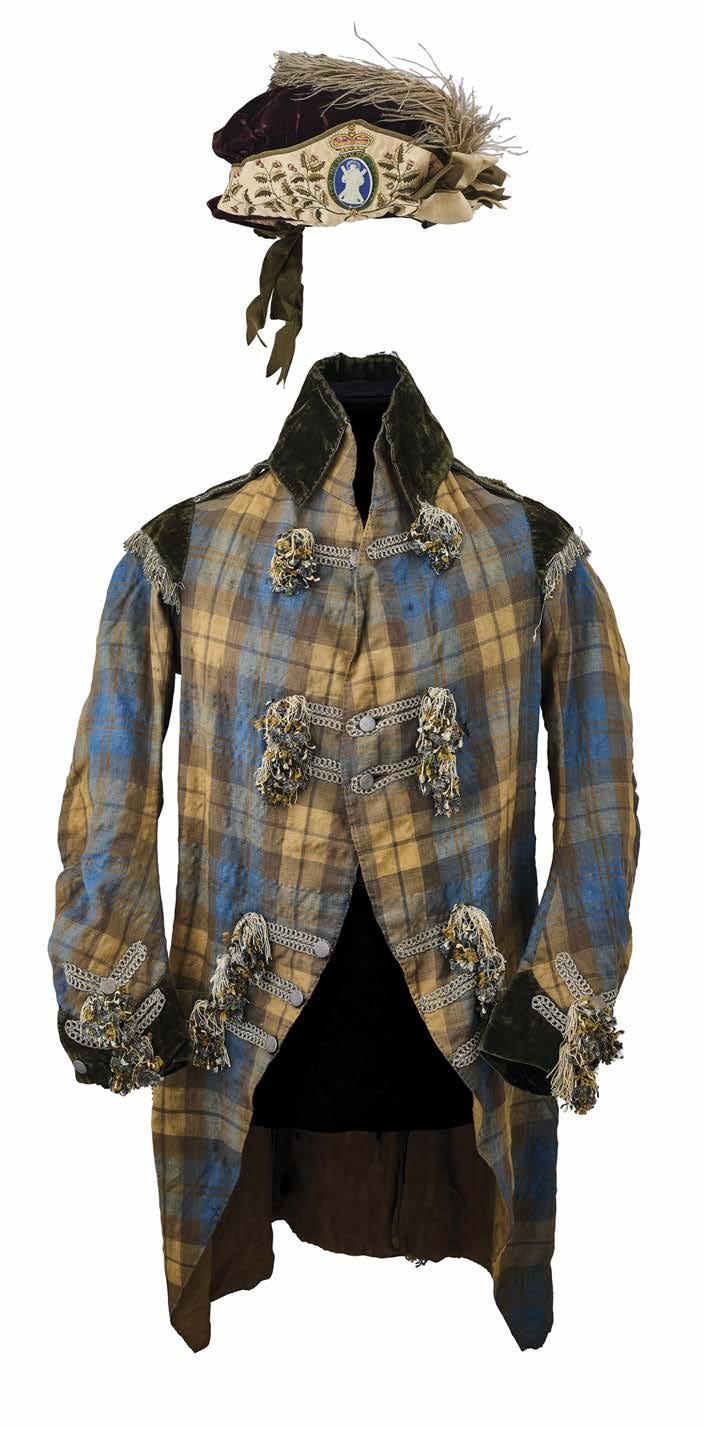
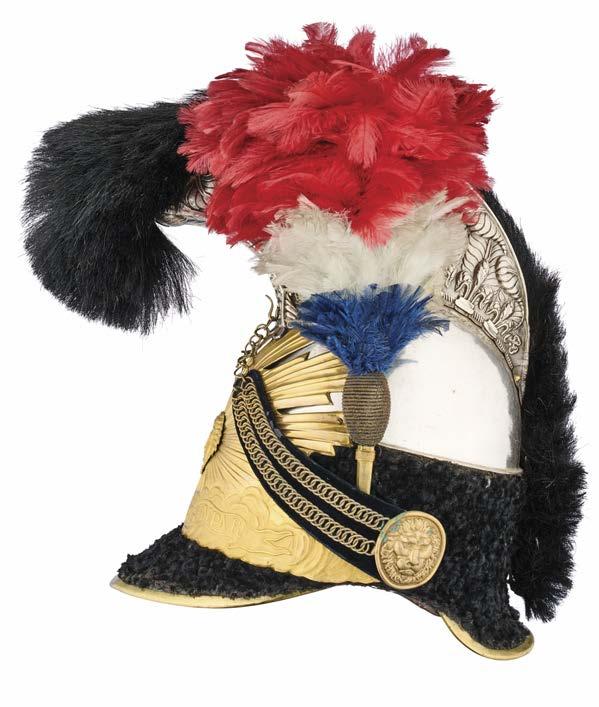
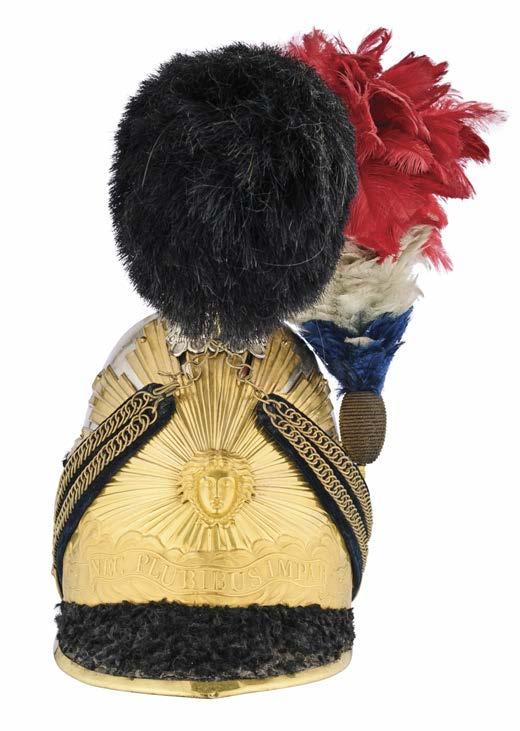
MILITARIA
137
AN ORNATE FRENCH CAVALRY OFFICER’S HELMET
the silvered steel skull with black astrakhan “skirt” to the lower half and to the gilt edged peak, very large gilt frontplate mounted with the face of Helios, at the centre of sun rays emerging from clouds, bearing a scroll inscribed NEC PLURIBUS IMPAR, metal crest with feathers and fleurs-de-lys decoration to sides and front, mounted with an upper crest of black horsehair, red, white and blue feather plume with a silver-embroidered and gilt socket, chinstraps of black velvet faced with double narrow corded gilt chains and lion’s head bosses, black leather headband and black silk partial lining (minimal dents and scratches to skull, some fittings tarnished and plumefeathers dirty, otherwise very good condition)
£1,800-2,200
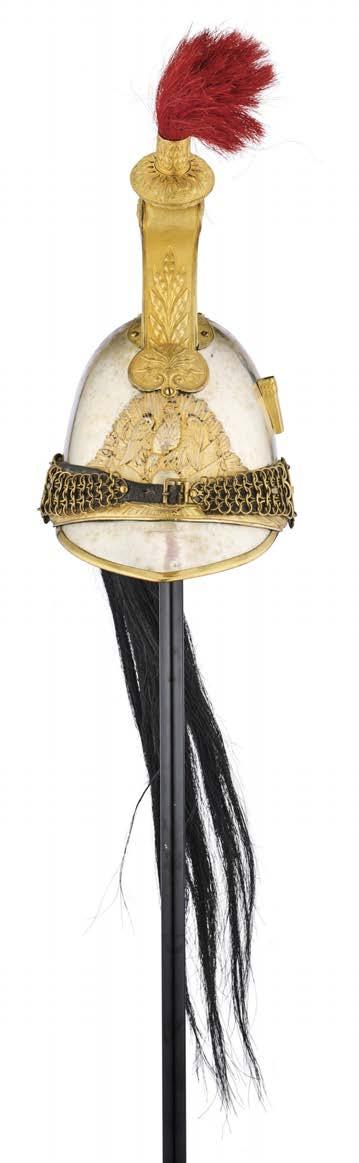
A FRENCH OFFICER'S 1848 PATTERN HELMET OF THE GARDE REPUBLICAINE the silvered metal skull with brass edging to the peaks, rayed plate struck with a cockerel amid a trophy-of-arms above a scroll inscribed GARDE REPUBLICAINE, gilt crest with engraved and embossed decoration to the front, sides and top, with a red “shaving brush” in a cylindrical and cushioned gilt socket, and a black horsehair tail, gilt plume-socket on left-hand side (plume absent), tapered leather two-part chinstrap, faced with three rows of narrow interlocked chainlinks and gilt rayed bosses, eight-tongued headband (dents, scratches and tarnish to the skull, otherwise in fair condition for age)
£1,200-1,800
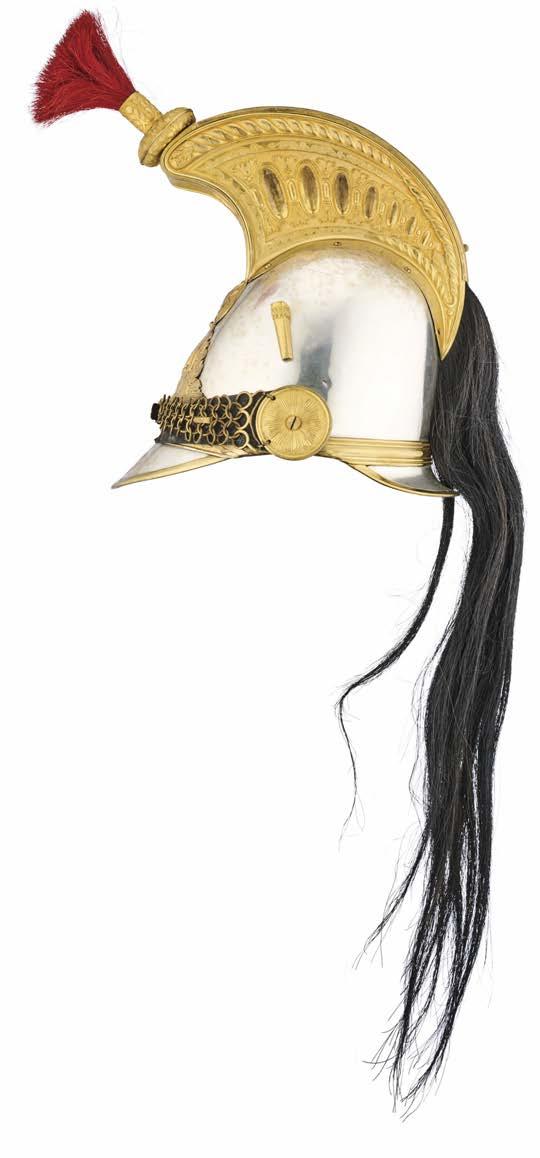
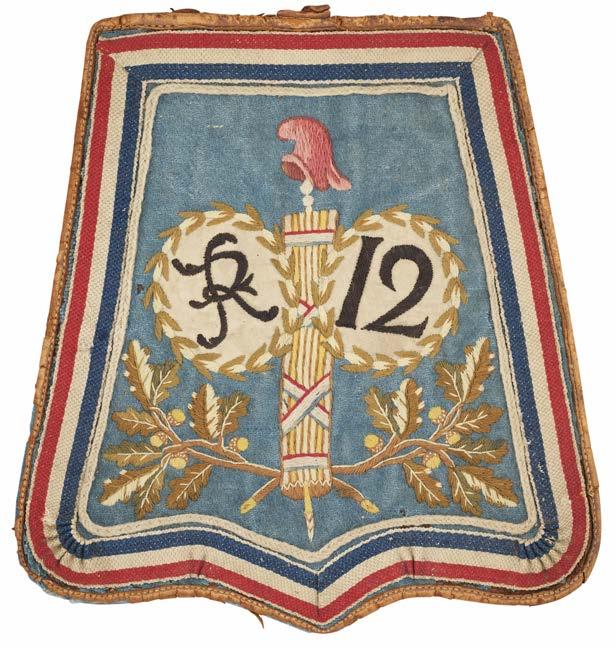
A FRENCH SABRETACHE, LATE 18TH CENTURY
of Light Cavalry style, with brown leather pocket, brown leather flap faced with grey-blue cloth, edged with woven red, white and blue cotton braid and embroidered with a fasces between two white roundels inscribed R and 12 in black, above oakleaf sprays, back of the pocket inscribed by hand, in English (of which a transcript is attached), headed “La Hoche, October 1798” (suspension rings absent, slight moth damage to the face, leather perished on back and edges)
£2,500-3,500
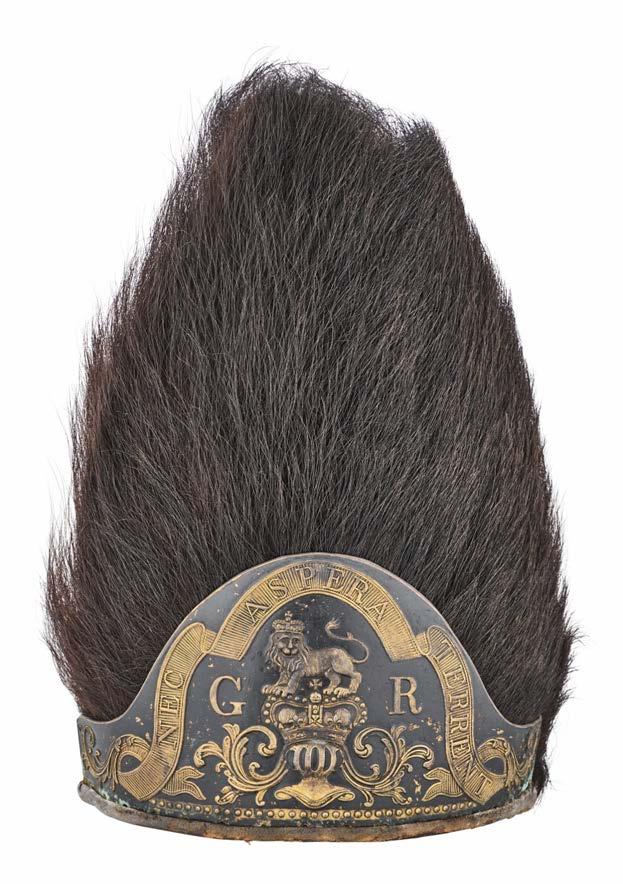
A GRENADIER’S 1768 PATTERN FUR CAP with gilt copper-alloy frontal plate embossed in relief against a black japanned ground, leather-trimmed stitched canvas liner, the fur with red woollen liner (minor moth damage) at the back, and in fine condition
For a related example see Bonhams Knightsbridge, 22-23 November 2023, lot 118
£2,000-3,000
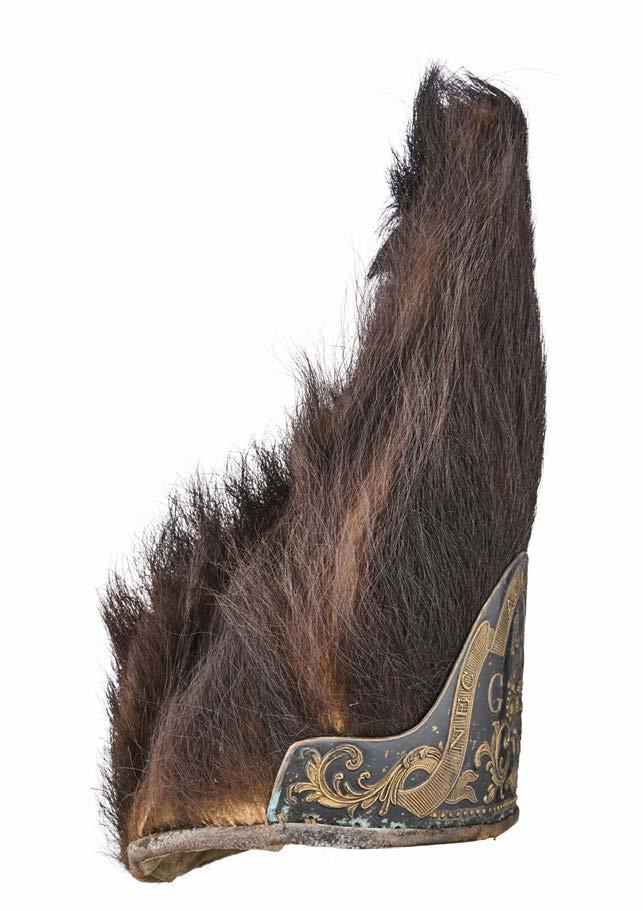
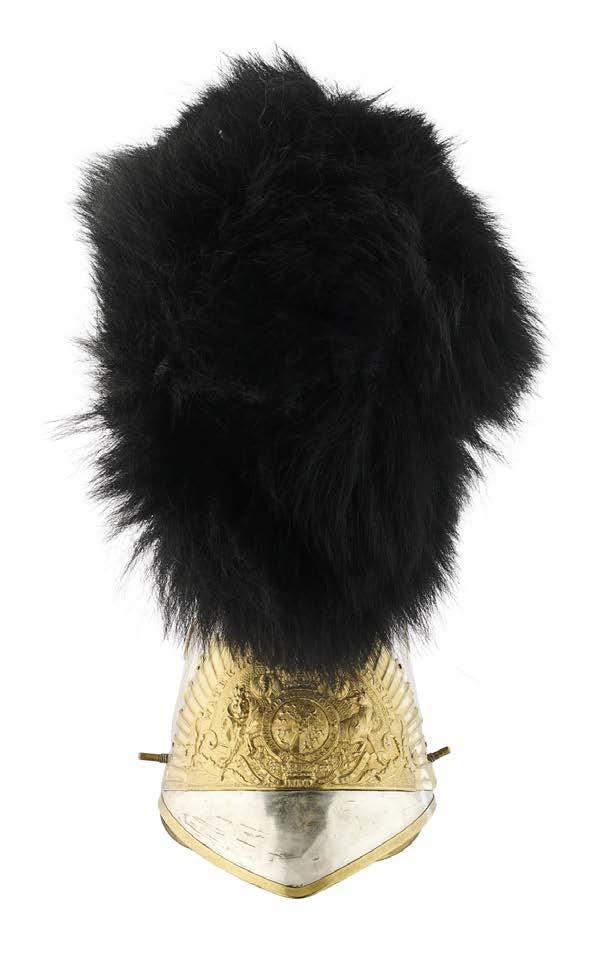
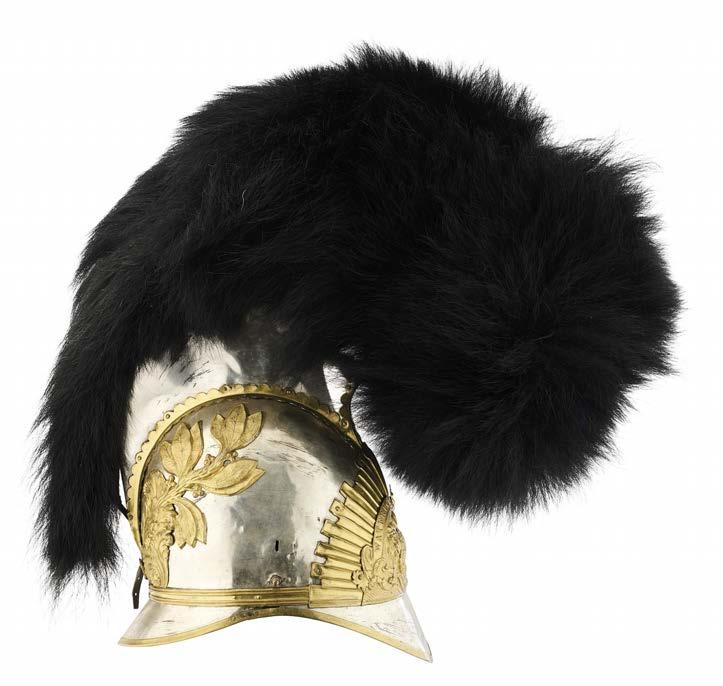
141
A GEORGIAN HELMET OF AN OFFICER OF DRAGOONS, CIRCA 1818
the skull of white metal, the back mounted with gilt bay leaves, the peaks with narrow brass edging, white metal crest, edged with curved strips of scalloped brass, fitted with a massive upper crest of black bearskin, the rayed front plate overlaid by a smaller plate struck with the crowned Royal Arms and battle honours Peninsula and Waterloo, fifteen-tongued black leather headband (dents to the skull, peak, crest and front plate, chinscales absent, otherwise as found but suitable for restoration)
£5,000-8,000
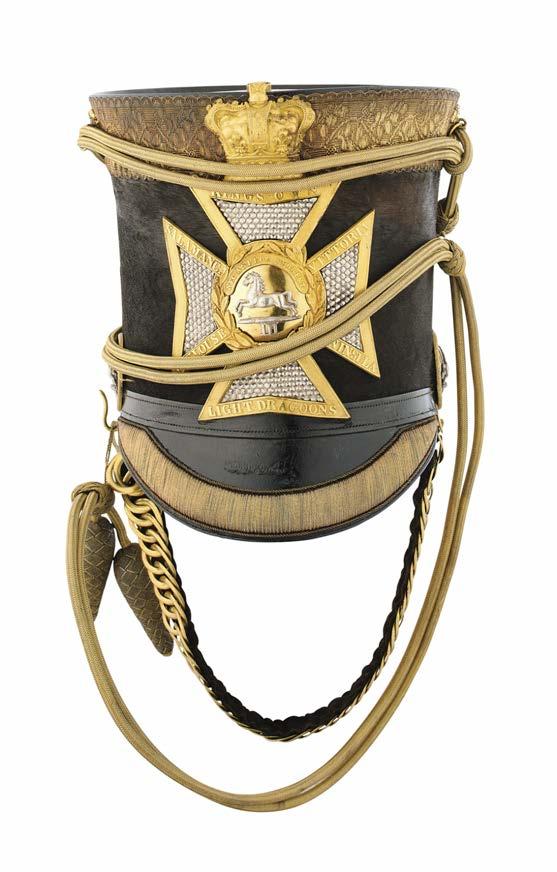
A FINE OFFICER’S SHAKO OF THE 3RD LIGHT DRAGOONS of Albert pattern, the body with slightly concave sides of black fur felt, edged round the top with wide 'oakleaf' lace, black leather sunken top, drooping peak edged with gold 'passing' embroidery, very large crowned Maltese Cross plate, cut-steel arms with gilt edges inscribed with 'KING’S OWN LIGHT DRAGOONS' and the battle honours Salamanca, Toulouse, Vittoria and Peninsula , the slightly domed gilt centre mounted with a silver horse above III, within a bay leaf wreath and scroll inscribed 'NEC ASPERA TERRENT', gilt chin-chain lined with black velvet, the gilt bosses each bearing a running horse in whitemetal, gold cord cap-lines with woven acorn finials, pale leather headband with crimson silk part-lining, in near very good condition
£3,000-4,000
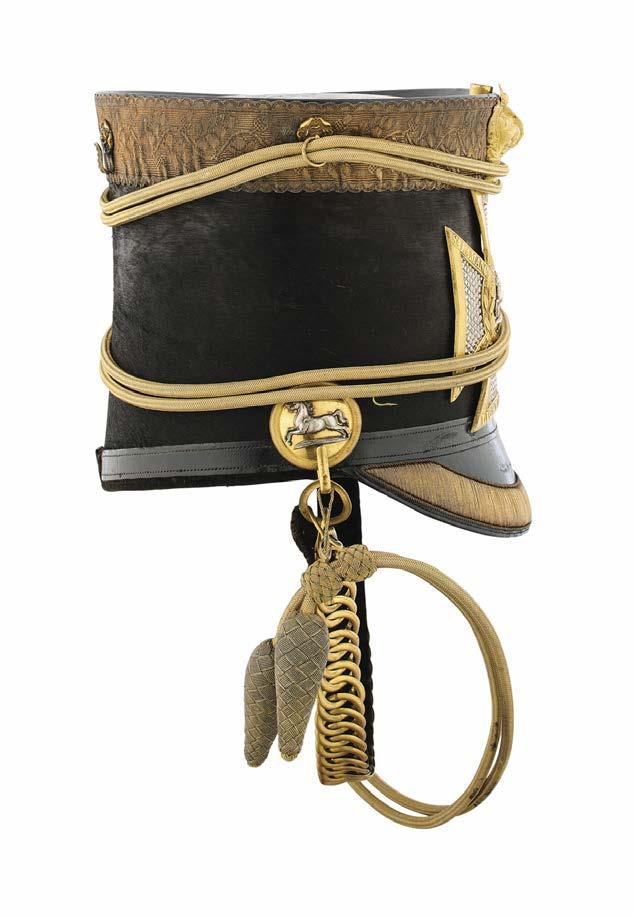
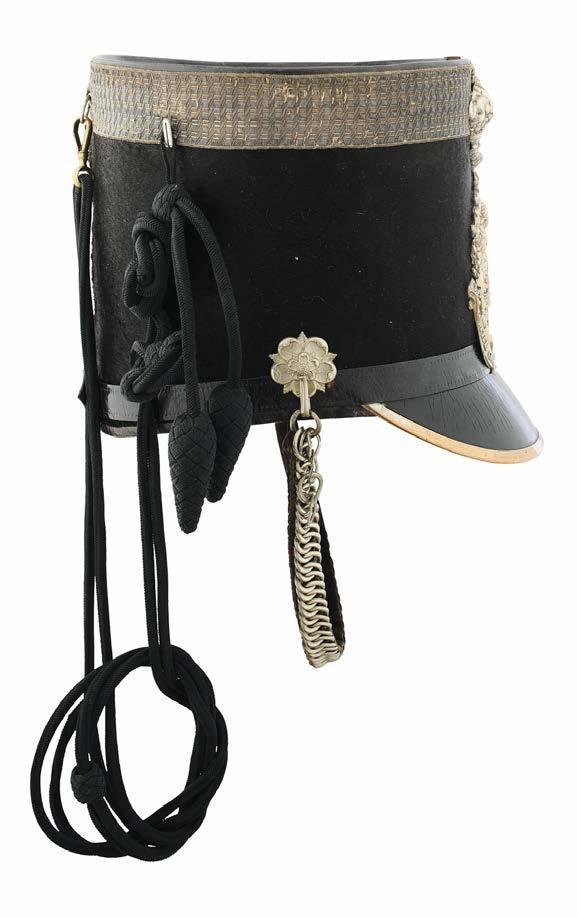
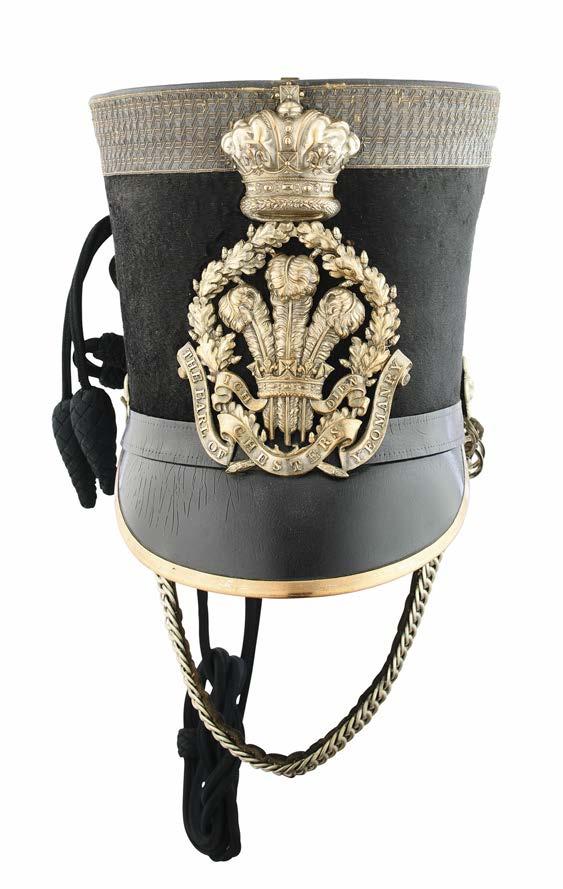
143
AN OFFICER’S SHAKO OF THE EARL OF CHESTER’S YEOMANRY
the cylindrical body with black fur felt covering and black leather sunken top, the upper part edged with wide 'bias and stand' silver lace, massive silvered Prince of Wales's plumes with scroll inscribed 'THE EARL OF CHESTER’S YEOMANRY' within an oak leaf wreath, beneath a crown, white-metal chinscales on black velvet with rose bosses, black square cord cap-lines with acorn finials, drooping peak with metal edging (lining and plume absent and a dent in the leather top, otherwise in good condition)
£2,500-3,000
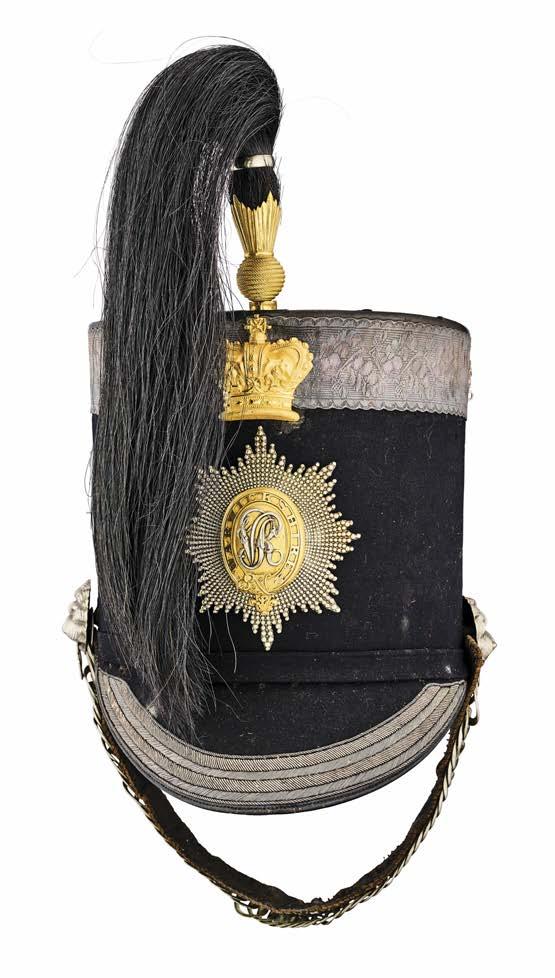
AN OFFICER’S LIGHT DRAGOON PATTERN SHAKO OF THE WARWICKSHIRE YEOMANRY with parallel-sided black felt body, the top edge with ‘oakleaf’ lace, and peak edged with silver embroidery, black leather top, tapered white-metal chin-chain attached to lion’s head bosses (one detatched), pale leather headband and crimson silk lining, gilt crown above a star in cut steel, mounted with a white metal VR cypher, within a gilt oval inscribed WARWICKSHIRE, black drooping horsehair plume in gilt socket (minor damage to leather top, lace tarnished, lining damaged and discoloured, a few moth-holes to body, otherwise in fair condition)
£600-900
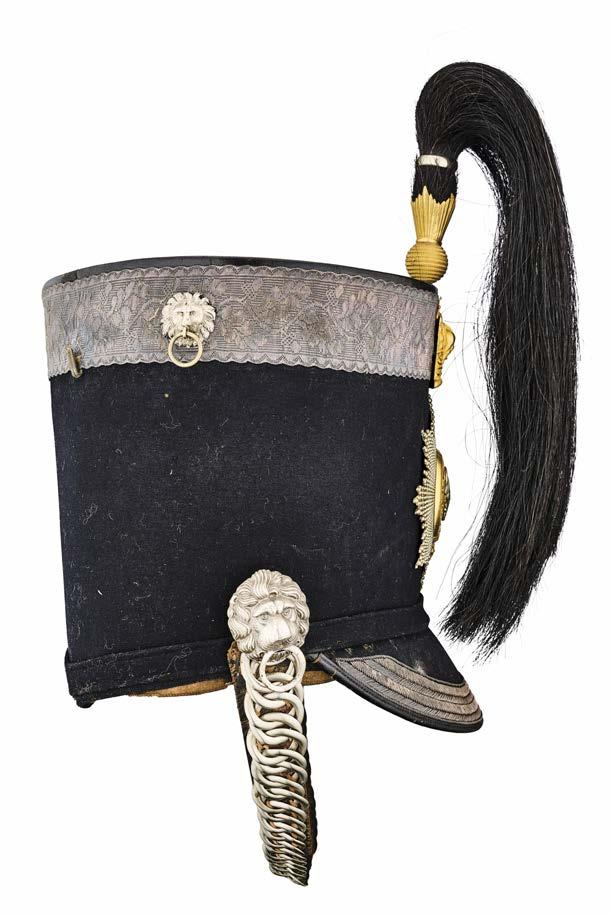
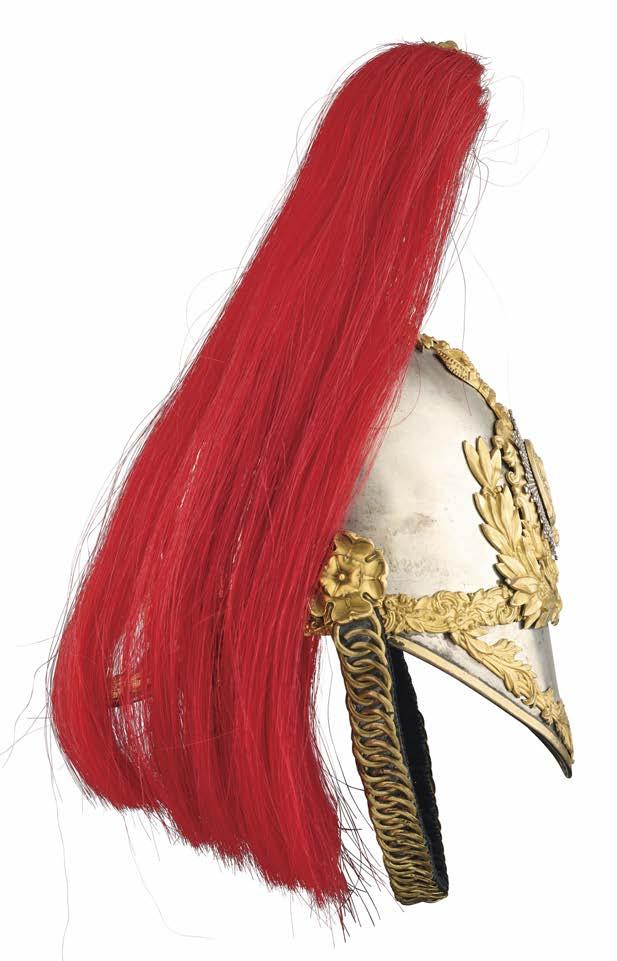
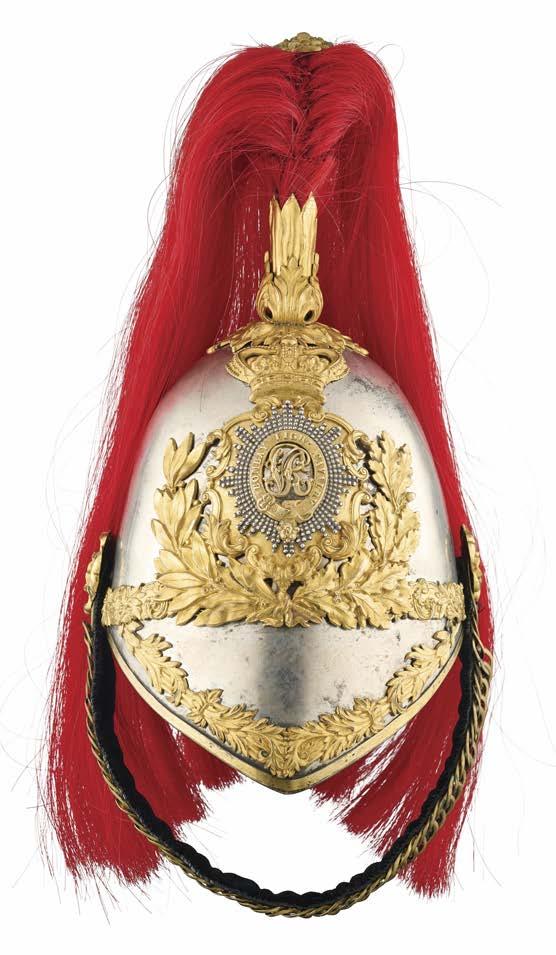
145
AN 1847 PATTERN OFFICER’S HELMET OF THE BOMBAY LIGHT CAVALRY, MID-19TH CENTURY with red horsehair plume (skull with some old tarnishing, leather sweatband worn and damaged)
£3,000-4,000
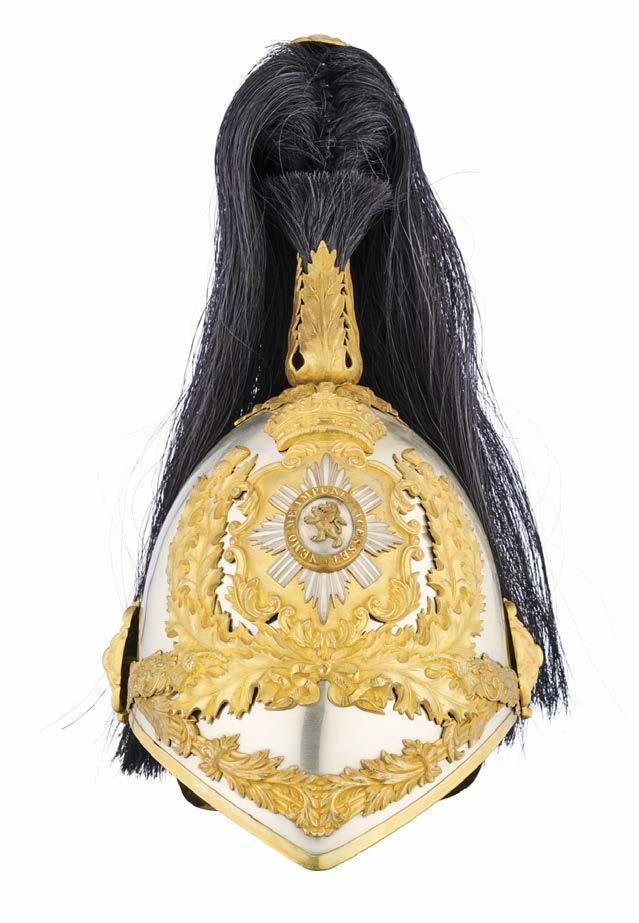
AN OFFICER’S HELMET OF THE GLASGOW YEOMANRY
with fine white metal skull, mounted with gilt decoration including a foliate-edged shield bearing a Thistle Star in white metal between thistle sprays above an acanthusleaf peak-edging, black horsehair plume in a gilt socket with acanthus base, gilt chin-chain with velvet lining and large rose bosses (minimal dents to skull, otherwise in near very good condition)
£2,000-3,000
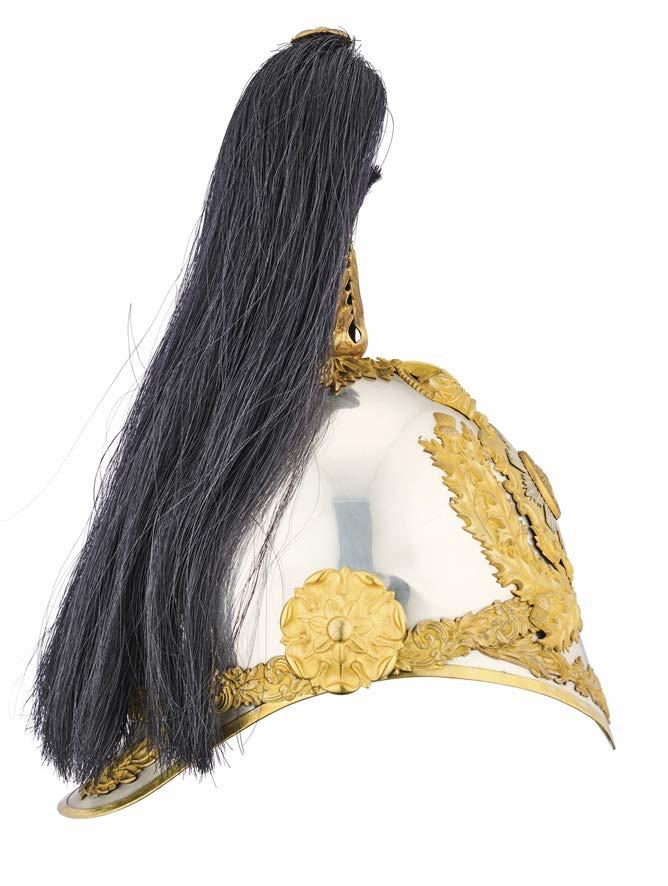
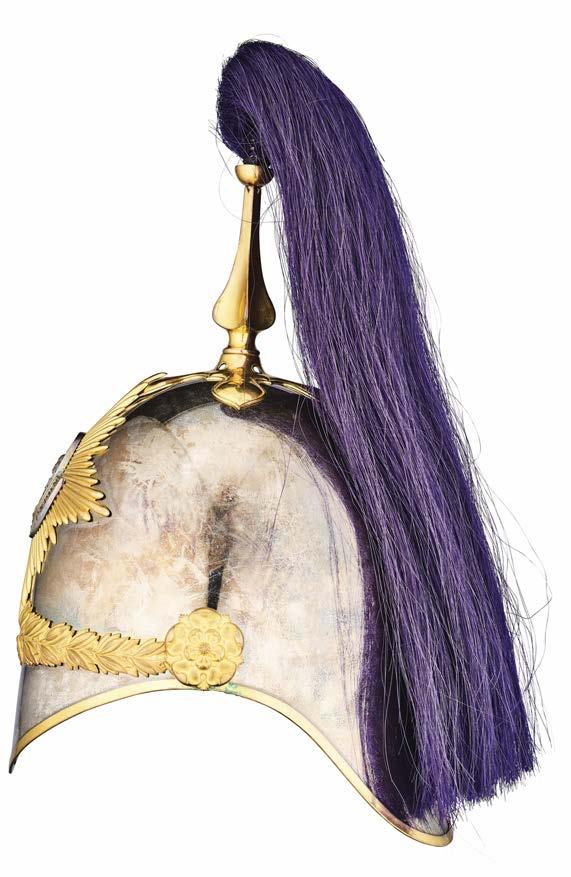
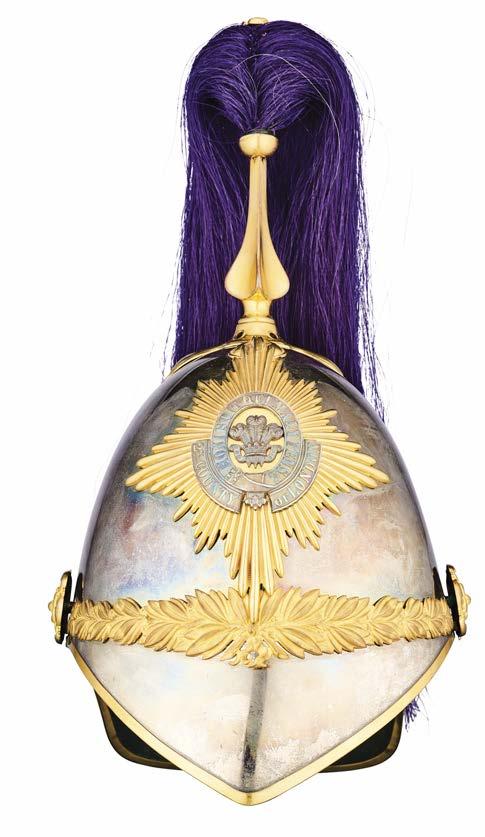
147
A VERY FINE OFFICER’S HELMET OF THE WESTMINSTER DRAGOONS with white-metal skull and gilt edging and fittings, the gilt star plate bearing Prince of Wales’s plumes in an oval Garter above a scroll inscribed ‘2ND COUNTY OF LONDON’, spike with purple drooping horsehair plume, fine silk headband, rosettes for chin-chain: together with its carrying tin (chin-chain absent, otherwise in very fine condition) £1,000-1,500
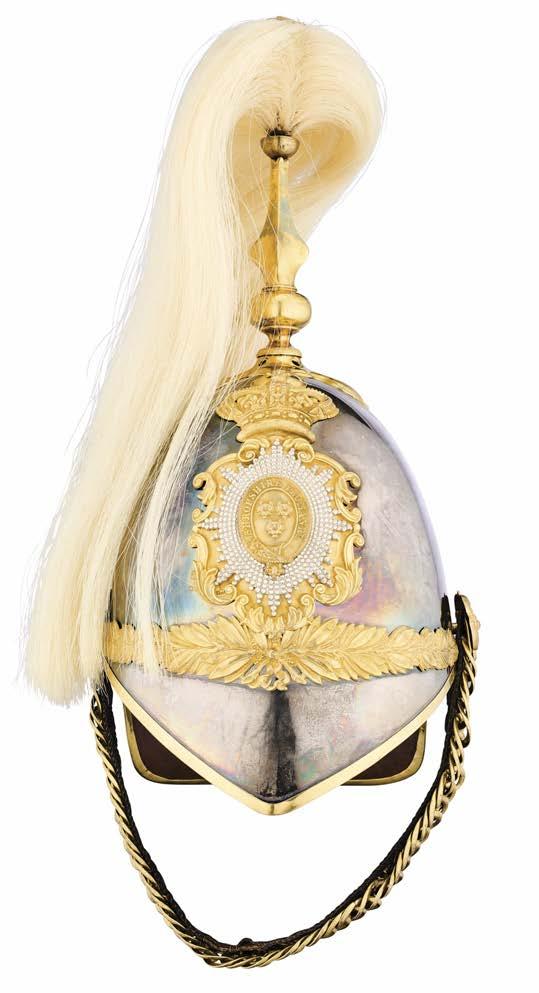
A FINE OFFICER’S HELMET OF THE SHROPSHIRE YEOMANRY
the white-metal skull with narrow gilt edging, large crowned gilt shield with foliate edging, bearing three ‘logger heads’ within an oval gilt strap, mounted on a diamond-cut whitemetal star, gilt wreath and rosettes, white horsehair plume in a gilt spike with knop and cruciform base, fine quilted silk headband, gilt chin-chain lined with blue leather £1,000-1,500
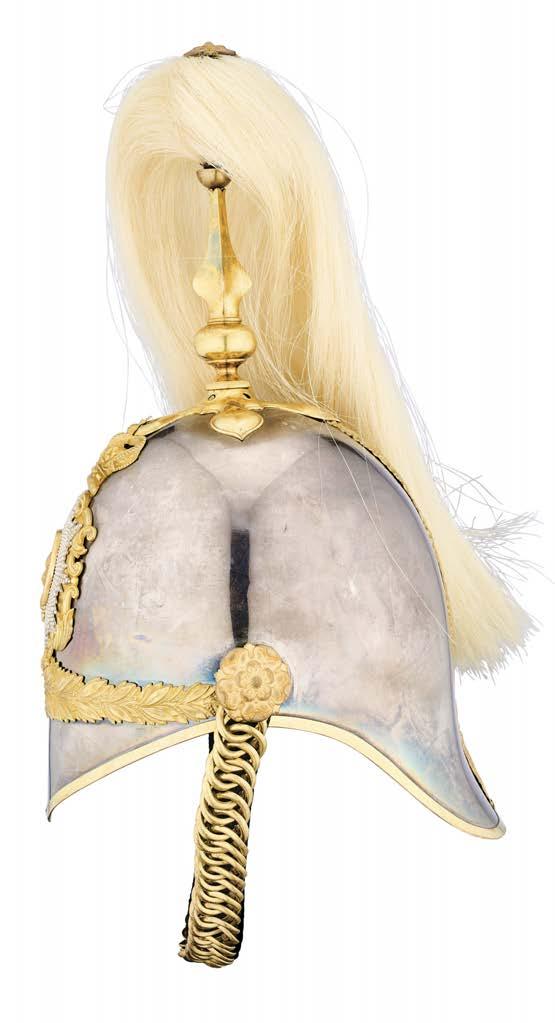
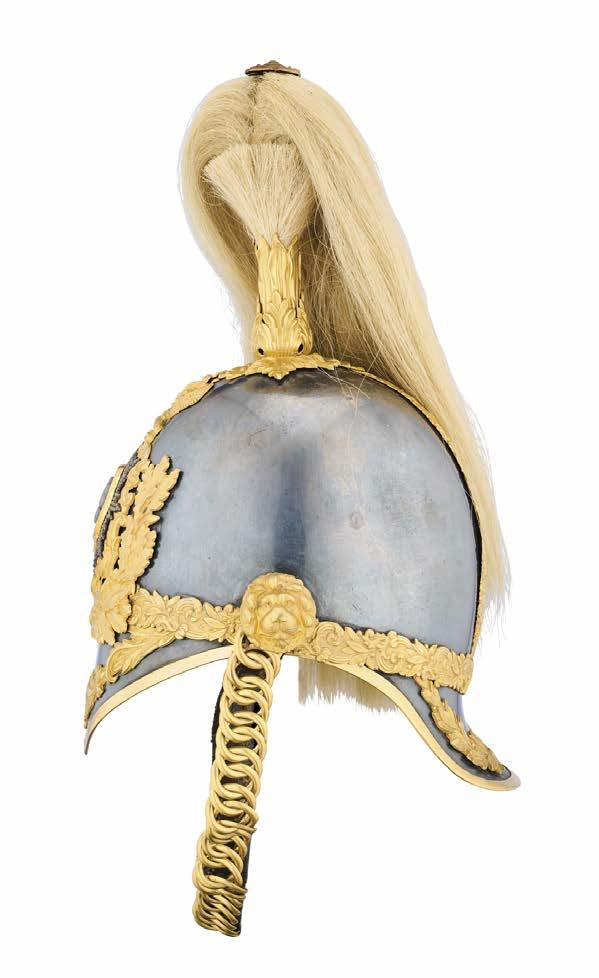
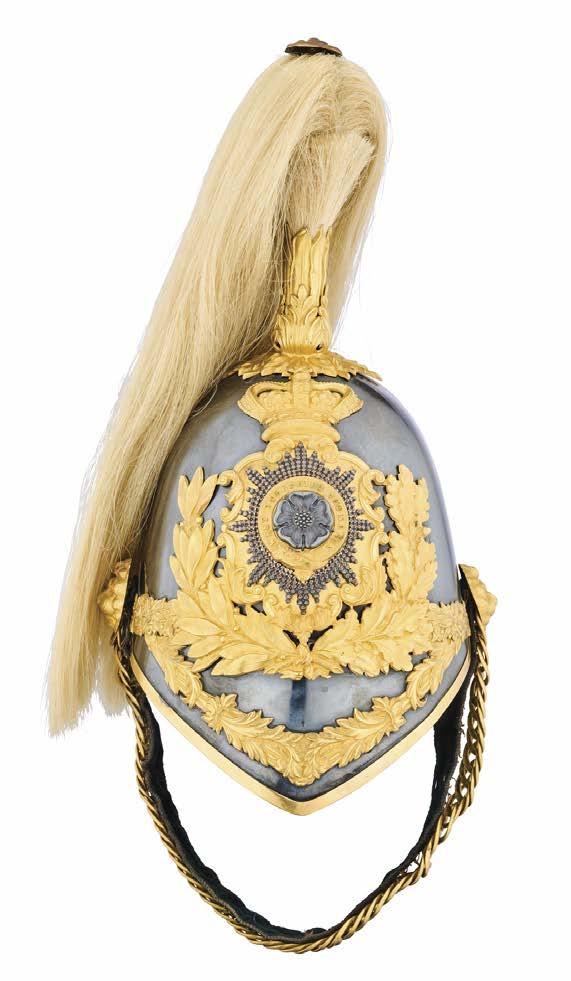
149
AN OFFICER’S HELMET OF THE WEST YORKSHIRE YEOMANRY
with fine skull of dull white-metal, gilt edging to the peaks, good gilt crown above a shield with foliate edges, mounted with a white metal rose within a gilt strap inscribed with the regimental title, on a diamond-cut star, all within gilt laurel and oakleaf sprays, foliate bands to the front peak, and a gilt bay leaf spray to the rear, white horsehair plume in a gilt ‘candlestick’ socket, gilt chin-chain with black velvet lining and lion’s head bosses, quilted buff silk headband (minimal dents to skull and scratches to rear peak, otherwise in very good condition)
£800-1,200
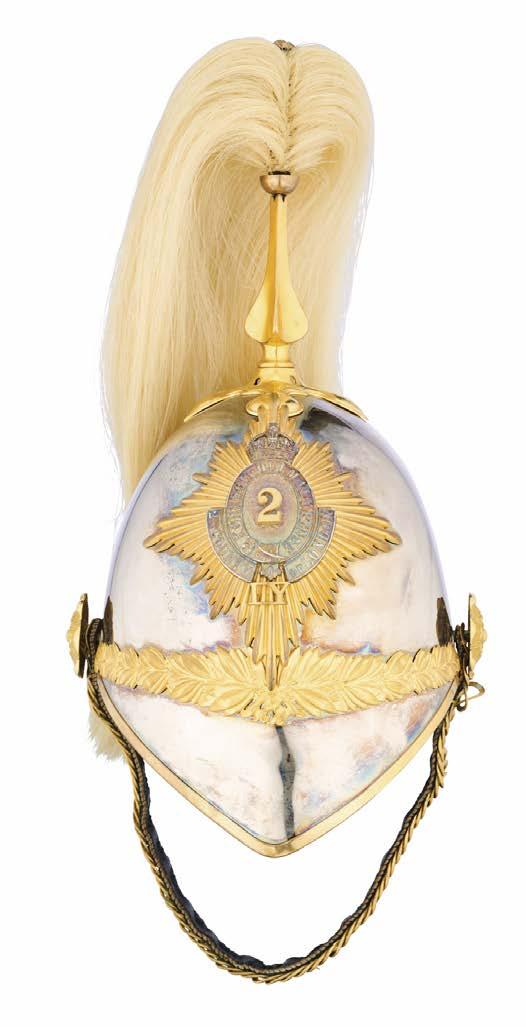
150
AN OFFICER’S HELMET OF THE 2ND COUNTY OF LONDON YEOMANRY (WESTMINSTER DRAGOONS)
with fine plain silvered skull with gilt edging to the peaks, gilt laurel-leaf band to front, and an oakleaf strip to the rear, tall rayed gilt star, mounted with a King’s crown in white metal above a numeral 2 within an oval Garter and regimental title, and LY in gilt below, white horsehair plume on tall gilt spike with cruciform base, gilt chin-chain lined with leather, rose bosses, quilted brown silk headband, together with its carrying tin (minimal dents to peak, otherwise in very good condition)
£800-1,200
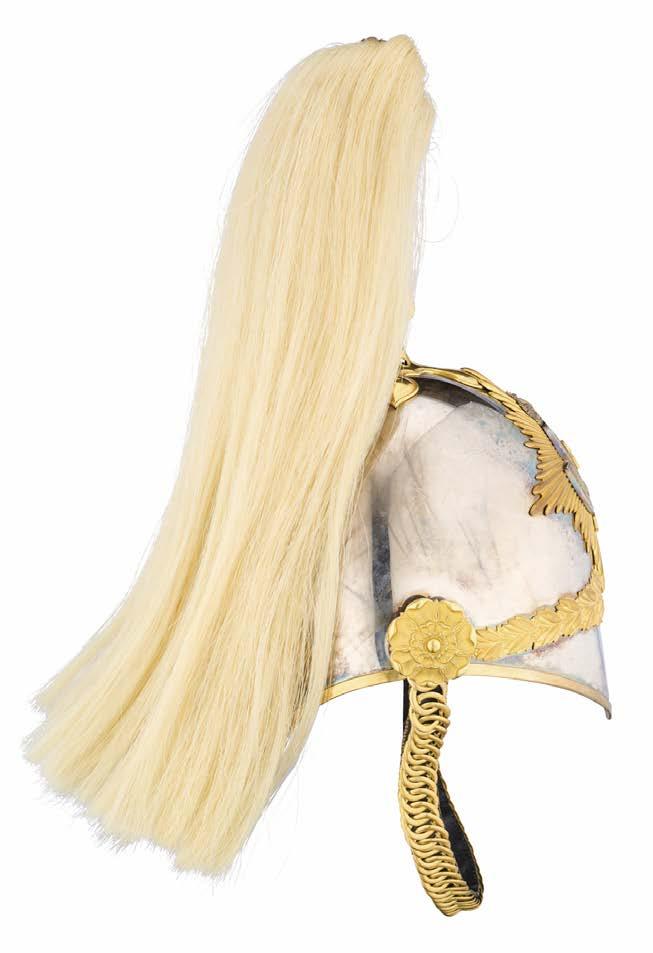
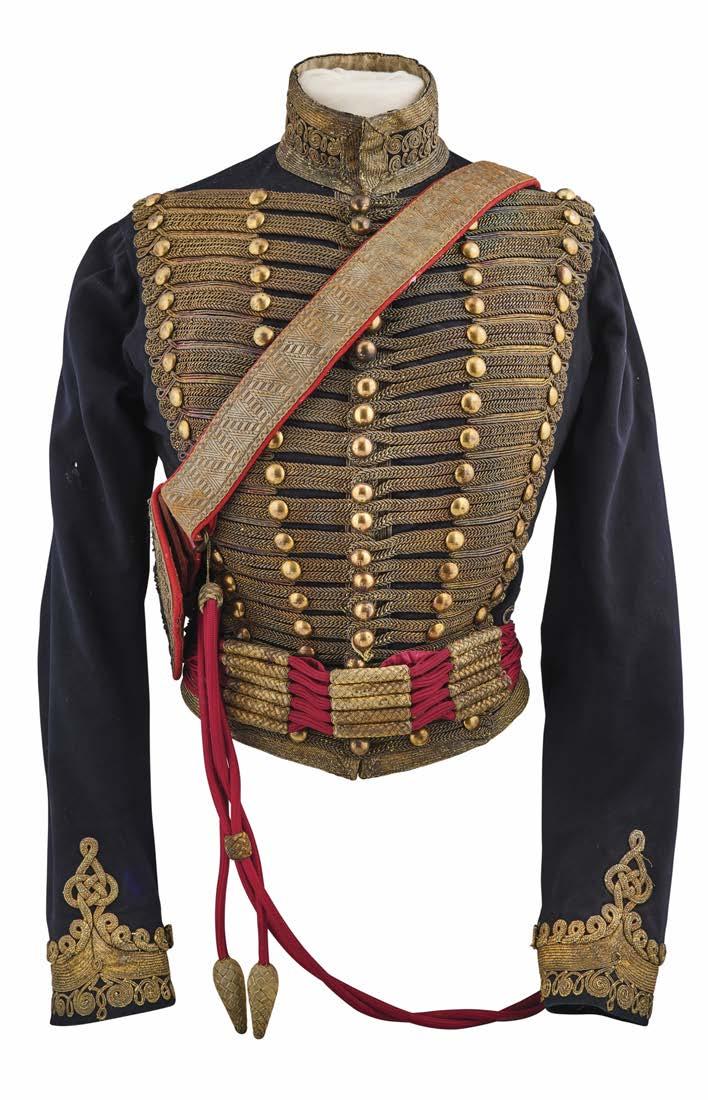
151 AN OFFICER’S DOLMAN OF THE 7TH QUEEN’S OWN HUSSARS, PROBABLY REIGN OF WILLIAM IV (1830-1837) of blue woollen cloth (minor old moth damage), the front, back and cuffs braided in bullion, and retaining a full complement of copper alloy buttons; together with cross belt and pouch (minor moth damage) of regimental pattern, red cord and bullion barrel sash, and aiguilettes en suite (4)
£3,500-5,000
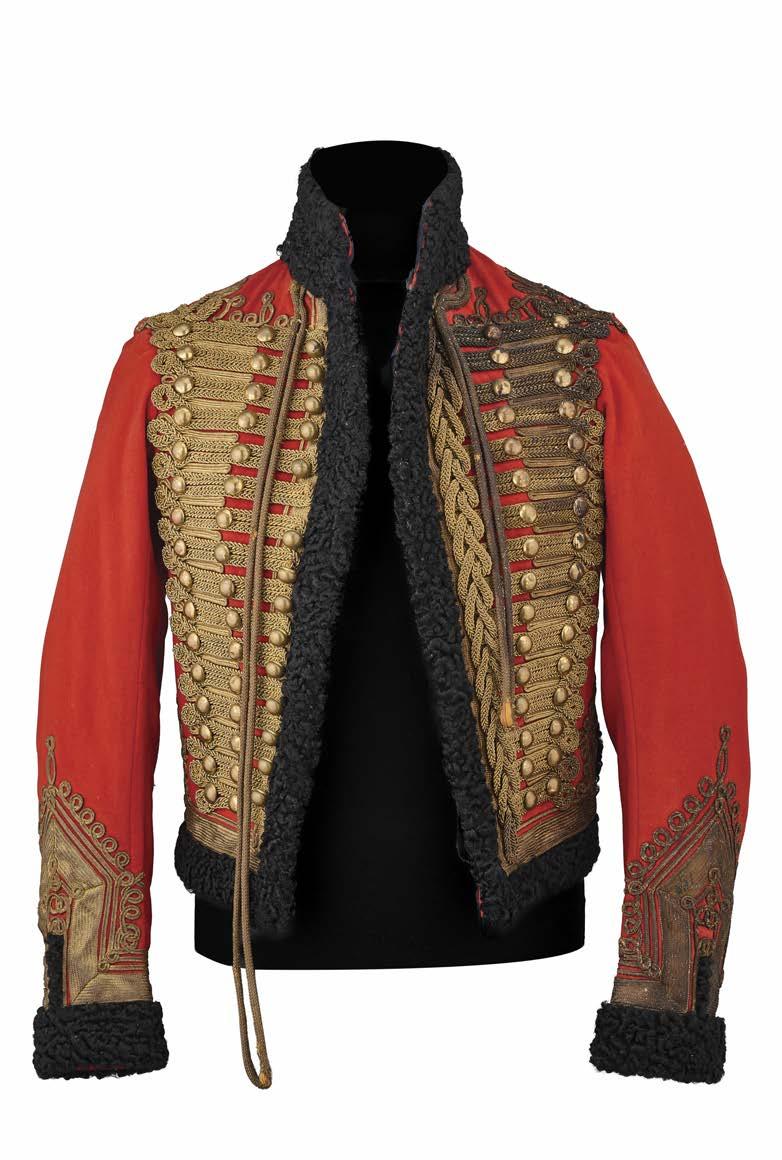
152
A FINE OFFICER’S PALISSE OF THE 7TH QUEENS OWN HUSSARS, MID-19TH CENTURY of red woollen cloth lined in dark blue fabric, trimmed with black astrakhan around the collar, main edges and cuffs, the front, back and cuffs braided in bullion, and retaining a full complement of copper alloy buttons (some with minor old tarnishing)
The dress regulations of 1830 changed the colour of uniforms to red.
£3,500-5,000
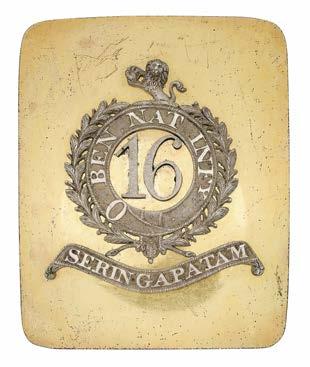
153
A 16TH BENGAL NATIVE INFANTRY OFFICER’S
SHOULDER BELT PLATE, CIRCA 1829-57
the small (9.0 cm by 7.5 cm) burnished gilt plate with rounded corners (slight rubbing), bearing white-metal laurel wreath topped by a lion and surrounding a garter strap inscribed ‘BEN NAT INFY’, seeded ‘16’ to centre, battle honour scroll inscribed ‘SERINGAPATAM’ below, reverse stamped ‘V&S / 40OZ’ and with two hooks and two studs
£600-800
154
A 39TH BENGAL NATIVE INFANTRY OFFICER’S
SHOULDER BELT PLATE, CIRCA 1824-57
the burnished gilt plate (slightly rubbed) with manufacturer’s marks (unidentified), mounted with a white-metal laurel wreath, centred by a garter inscribed ‘BENGAL NAT INF’ and white-metal ‘39’, surmounted by a skull and three flags, ‘SERINGAPATAM’, ‘VOLUNTEERS’ and ‘’PUNNIAR’ on scrolls below, two hooks and two studs to reverse
£800-1,200
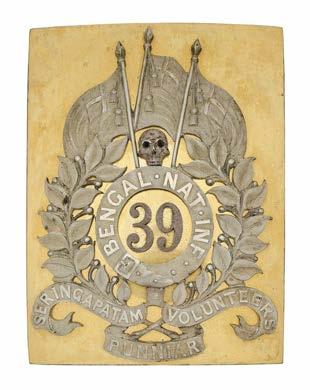
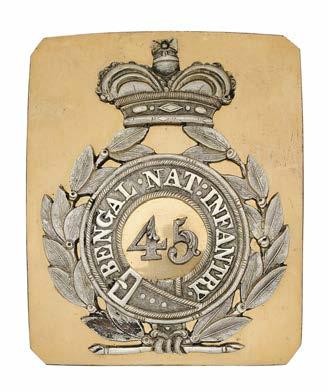
155
A 45TH BENGAL NATIVE INFANTRY SHOULDER BELT PLATE, CIRCA 1824-57
the smaller burnished gilt plate (9.0 cm by 7.5 cm) with crowned white-metal laurel wreath surrounding a garter inscribed ‘BENGAL NAT INFANTRY’, floreated ‘45’ to the centre, two hooks and two studs to reverse
£800-1,200
156
A 53RD BENGAL NATIVE INFANTRY OFFICER’S SHOULDER BELT PLATE, CIRCA 1842-57
the burnished gilt plate bearing white-metal laurel wreath surrounding crowned garter strap inscribed ‘BENGAL NAT INFANTRY’, central burnished gilt mound bearing seeded white-metal ‘53’, battle honour scroll inscribed ‘CABOOL / 1842’ below, two hooks and two studs to reverse, complete with leather backing
£800-1,200
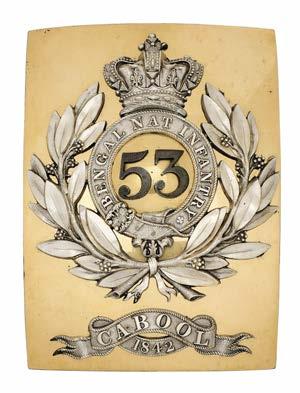
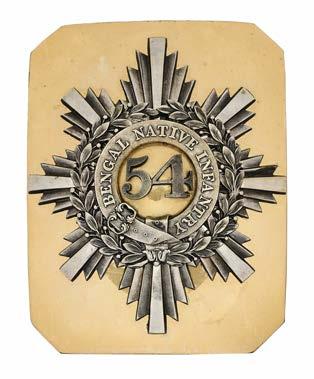
157
A 54TH BENGAL NATIVE INFANTRY OFFICER’S
SHOULDER BELT PLATE, CIRCA 1824-57
the smaller burnished gilt plate (9.0 cm by 7.5 cm) mounted with white-metal rayed 8-pointed star, surmounted by a laurel wreath and garter strap inscribed ‘BENGAL NATIVE INFANTRY’, seeded ‘54’ to the central burnished gilt dome, two hooks and two studs to reverse, complete with leather backing
£800-1,200
158
AN 8TH BOMBAY NATIVE INFANTRY OFFICER’S
SHOULDER BELT PLATE, CIRCA 1843-57
the smaller (10.0 cm by 8.0 cm) burnished gilt plate mounted with white metal laurel wreath with battle honour scroll inscribed ‘HYDERABAD’, central seeded white-metal diamond mounted with crowned gilt garter strap inscribed ‘REGIMENT NATIVE INFANTRY’ around a gilt eight-pointed rayed star, surrounding a burnished white-metal mound bearing seeded gilt ‘VIII’, a white metal bugle to the top, two hooks and two studs to reverse £800-1,200
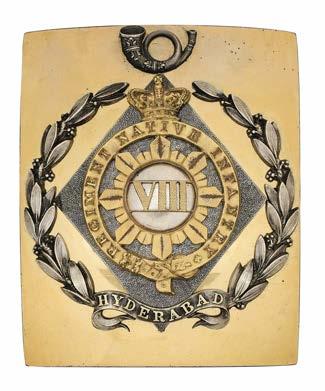
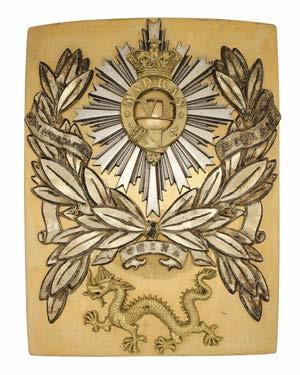
159
A 6TH MADRAS NATIVE INFANTRY OFFICER’S SHOULDER BELT PLATE, CIRCA 1843-57
th e burnished gilt plate (slight rubbing) bearing gilt laurel wreath with battle honour scrolls inscribed ‘SERINGAPATAM’, ‘BOURBON’ and ‘CHINA’, surrounding a white-metal rayed star surmounted by a small crowned gilt strap with central burnished gilt mound bearing seeded gilt ‘VI’, gilt Chinese dragon to the bottom, two hooks and two studs to reverse, complete with leather backing
£1,000-1,500
160
A RARE MADRAS ARTILLERY OFFICER’S SHOULDER BELT PLATE, CIRCA 1838-57
the burnished gilt plate mounted with gilt crowned garter inscribed ‘MADRAS ARTILLERY’ resting in a laurel wreath interlaced with scroll bearing battle honours, Royal Arms to centre, below a scroll inscribed ‘NAGPOOR’ over a gun on a tablet inscribed ‘AYA JAVA’, flanked by an elephant on a tablet inscribed ‘ASSAYE’ and a Sphinx on a tablet inscribed ‘EGYPT’, two hooks and two studs to reverse, complete with its leather liner
£1,000-1,500
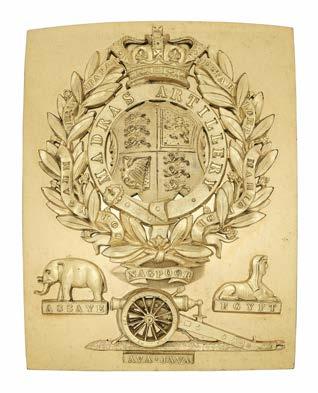
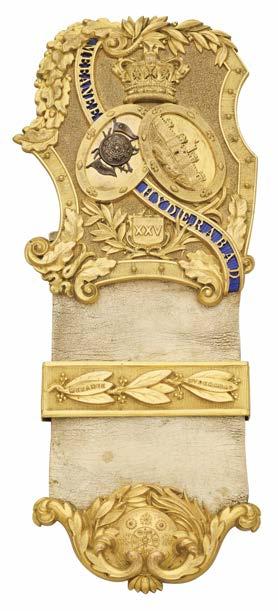
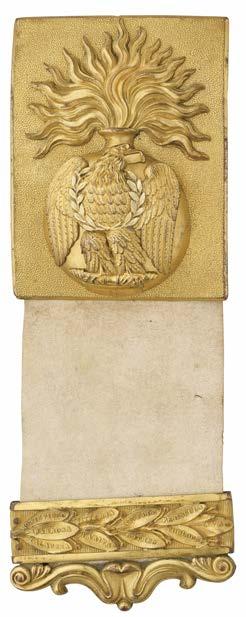
161
A FINE 25TH BOMBAY NATIVE INFANTRY OFFICER’S SHOULDER BELT PLATE, CIRCA 1845-57
the large gilt plate with curved and foliate edges, bearing a Queen’s crown above overlapping oval shields, curved scroll incised with battle honours ‘MEEANEE’ and ‘HYDERABAD’ in gilt on blue enamel, above ‘XXV’ between bay leaf and other foliate sprays, the plate attached with studs to a wide strip of enamelled white leather which also bears a gilt slider with bay leaves inscribed with ‘MEEANEE’ and ‘HYDERABAD’, and a dhal within an ornate finial
£1,000-1,500
162
A
FINE 87TH (ROYAL IRISH FUSILIERS) REGIMENT OF FOOT OFFICER’S SHOULDER BELT PLATE, CIRCA 1840-55
the seeded gilt plate with burnished edges mounted with a large gilt flaming grenade, an eagle on a plinth inscribed ’8’ on the ball, two hooks and two studs to reverse; with buff leather strap holding gilt slide with laurel spray inscribed with battle honours ‘MONTE VIDEO’, ‘BARROSA’, ‘TALAVERA’, ‘VITTORIA’, ‘TARIFA’, ‘NIVELLE’, ‘ORTHES’, ‘PENINSULA’, ‘TOULOUSE’ and ‘AVA’, and gilt scrolled tip
The eagle represents the Eagle on the flagstaff of the 8th French Light Infantry captured by Sergeant Patrick Masterson of the 87th Fusiliers at Barossa on 5th March 1811.
£800-1,200
163
A
DRUM MAJOR’S MACE OF THE 2ND/6TH BN. THE QUEEN’S ROYAL REGIMENT (WEST SURREY) BY BOOSEY & HAWKES LTD., NO. 25729, REIGN OF ELIZABETH II (1926-2022)
of characteristic form, with parcel-gilt silver-plated head cast and chased with regimental badge and motto, encircled by the regimental title in capitals, and surmounted by a crown and crowned lion, on its Malacca cane retaining its crossed chains, and with collar chased with vines against a punched ground, and plain basal mount (some old denting), 28.5 cm head, 164 cm overall
The Queen’s Royal Regiment (West Surrey) was a line infantry regiment of the English and later British Army from 1661 to 1959. It was the senior English infantry regiment of the British Army, behind only the Royal Scots in the British Army line infantry order of precedence.
£500-700
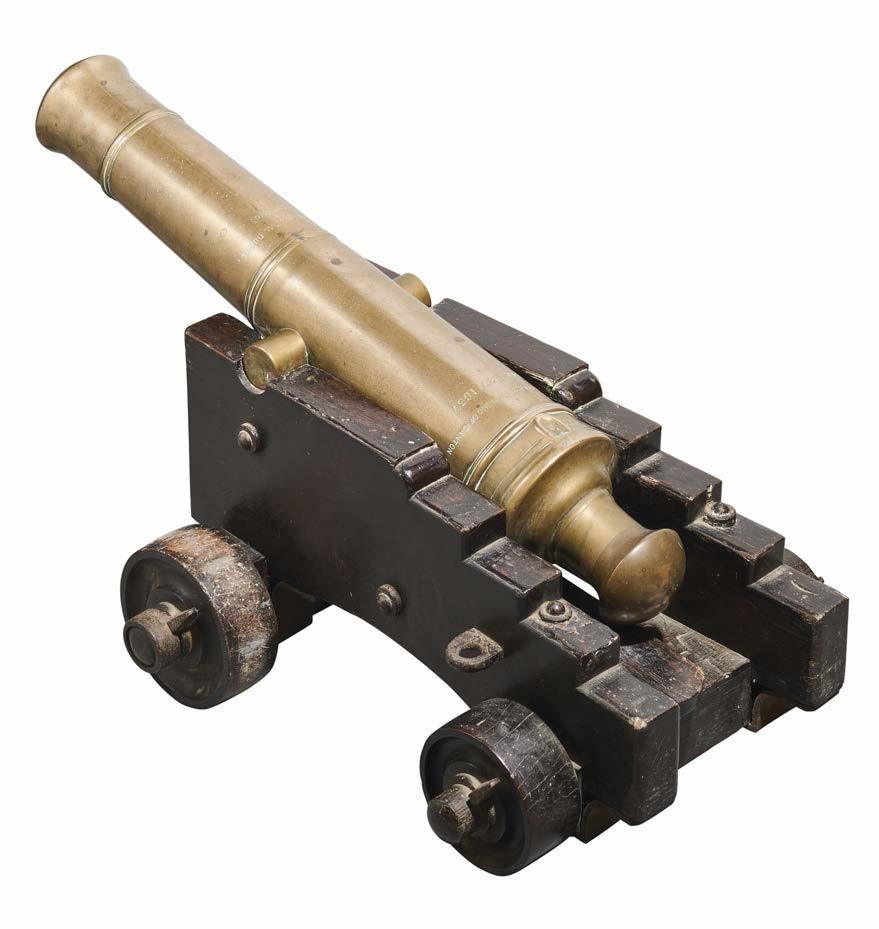
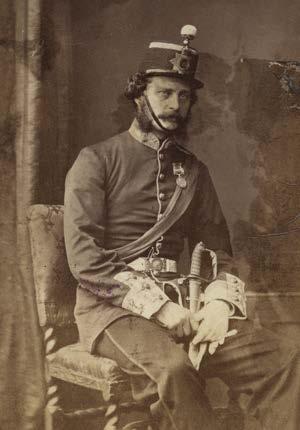
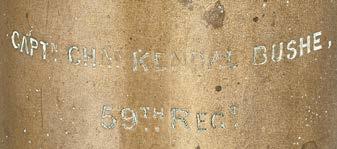
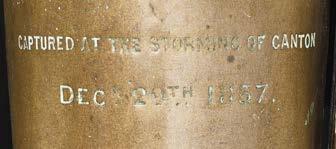
164
AN HISTORIC BRONZE CANNON CAPTURED AT THE STORMING OF CANTON, DATED DEC. 29TH., 1857
in three stages with raised mouldings and belled muzzle, an arch over the touchhole, large spool-shaped cascabel, and plain trunnions, the first reinforce engraved ‘CAPTURED AT THE STORMING OF CANTON DEC 29TH. 1857’, the second reinforce engraved ‘CAPTN. CHAS. KENDAL BUSCHE 59TH REGT.’: on its wooden carriage of stepped naval type with wooden trucks and steel mounts, 75.0 cm barrel, 6.0 cm bore
The Battle of Canton was fought by the British and French forces against Qing China between 28 and 31 December 1857 during the Second Opium War. Lord Elgin, the British High Commissioner was keen to take the city of Canton as a demonstration of power and to capture the Chinese official Ye Mingchen, who had resisted British attempts to implement the 1842 Treaty of Nanking.
Charles Kendall Bushe was appointed Ensign in the 59th Foot, from the Royal Military Academy, on 14 April 1843; Lieutenant, 14 April 1846; Captain, 11 May 1849, these commissions all by purchase; Brevet Major, 13 April 1858; Major, 23 September 1862; Lieutenant-Colonel, by purchase, 26 June 1866; retired with the rank of Colonel in June 1871.
Colonel Kendall served in the Second China War and commanded the troops in the operations before and during the bombardment of Canton by the Royal Navy under Sir Michael Seymour in the latter part of 1856 and the beginning of 1857. He was subsequently present at the assault and capture of that city in December 1857, and of Namtow on 11 August 1858, being employed as Brigade Major during some of that period.
£6,000-8,000
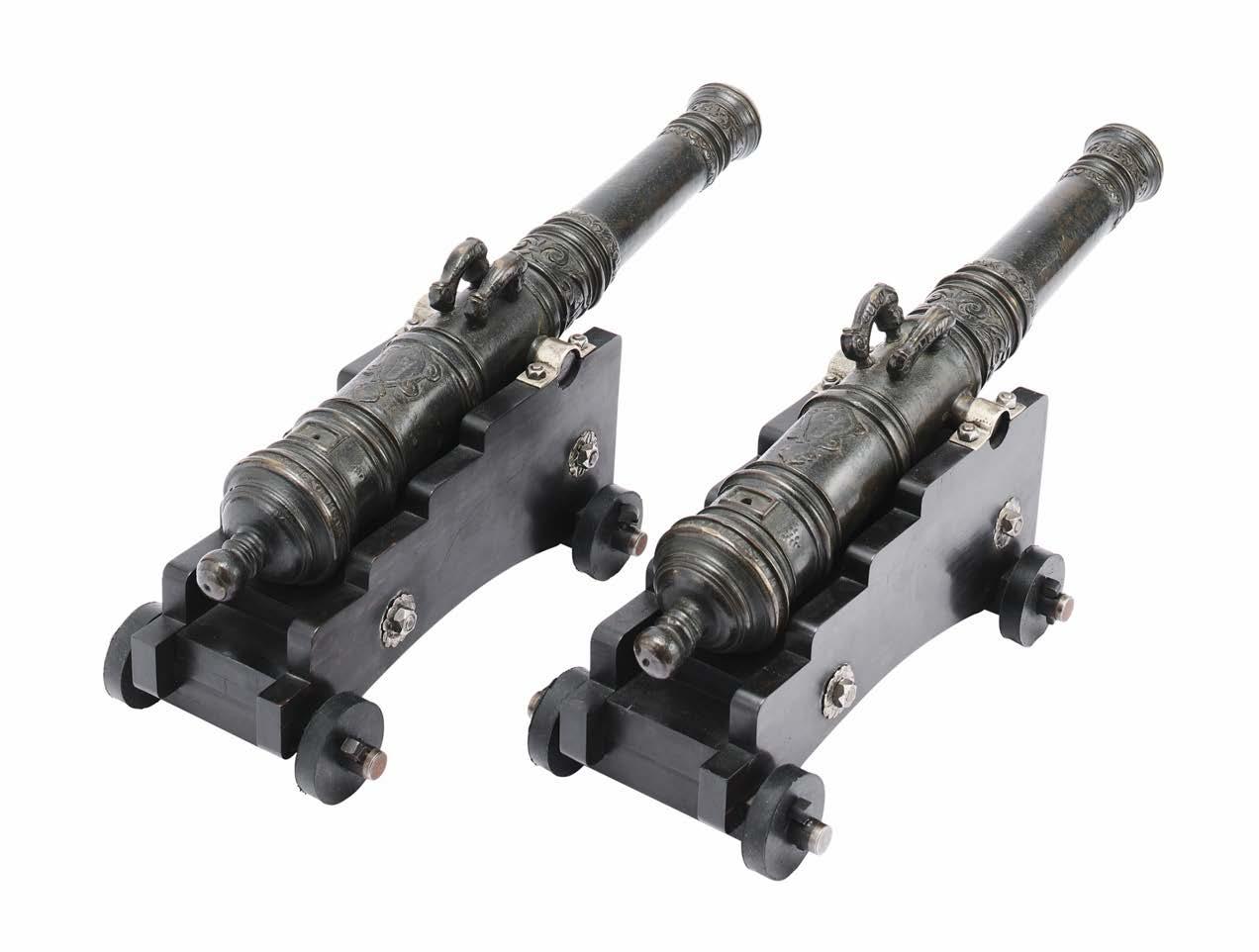
A PAIR OF DUTCH SIGNAL CANNON BY JAN KARELS, AMSTERDAM, DATED 1734 each of tapering multi-stage form and rich dark patina, cast with raised mouldings and at the for ward sections with bands of foliage, turned and flared muzzles, the first reinforce each st amped with indistinc t Amsterdam mark in a cartouche-shaped panel, base-rings each inscribed ‘. JAN . KARELS . AMSTERDAM . 1734 . ME FECIT . ‘, touch-holes each in a raised rectangle, naturalistic dolphin lifting handles, plain trunnions, and knob-shaped cascabels: on modern stepped ebony carriages of naval type with black composition trucks, 39.5 cm long, 2.0 cm bores (2)
This cannon founder appears to be unrecorded.
£2,000-3,000
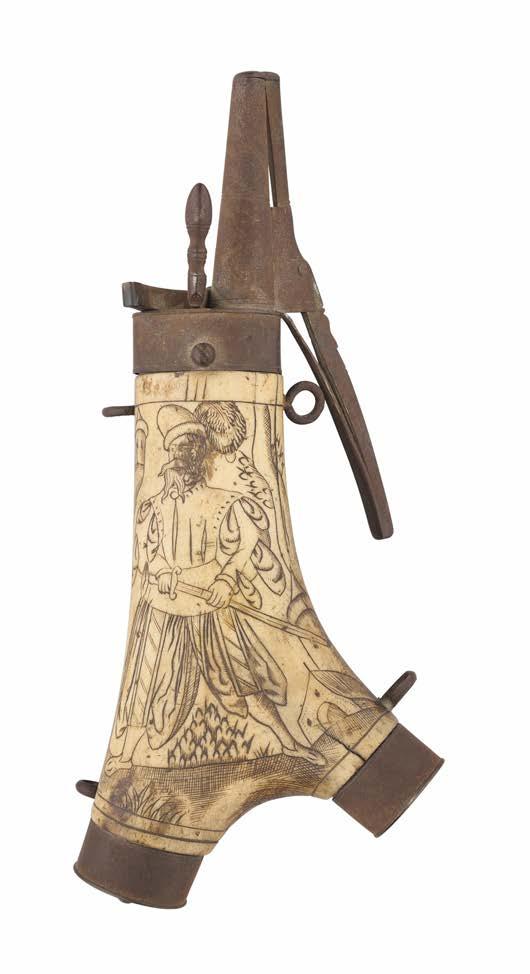
166
A GERMAN POWDER-FLASK, LATE 16TH CENTURY
with forked body of natural staghorn, the front polished and engraved with a male figure in contemporary costume, standing in a landscape and armed with a sword, russet iron basal mounts and top, the latter with line engraved tapering nozzle with sprung tap and cut-off lever, the latter with budshaped finial, slender belt hook, and four rings for suspension, 21.8 cm
‡ £500-700
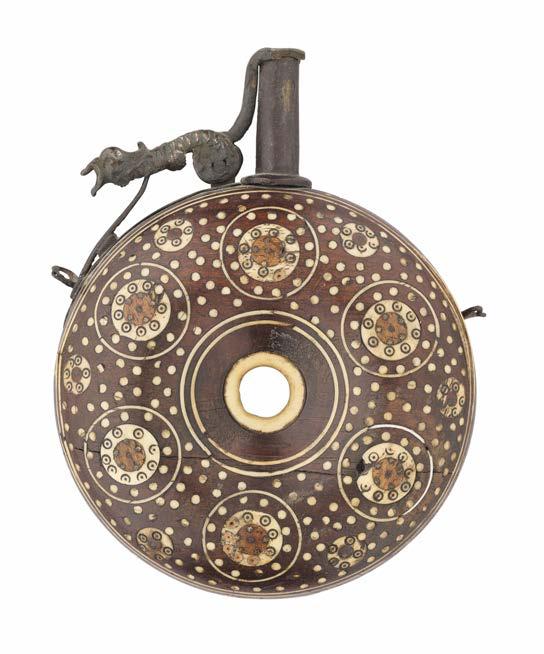
167
A GERMAN CIRCULAR POWDER-FLASK, 17TH CENTURY
with rounded fruitwood body (minor old split on one side) with pierced central hole lined in staghorn, inlaid overall with white horn roundels each centred on a wooden inset enriched with small copper-alloy stars, all against a ground of white horn dots and within white horn lines, tubular copper-alloy nozzle, and sprung tap cast as a marine monster, its tail fitting over the nozzle, and two suspension rings (old damage), 12.0 cm diameter
‡ £600-800
THE ROBERT E. BROOKER JR. COLLECTION OF RARE ANTIQUE ARMS AND ARMOUR
PART FIVE
Robert Elton Brooker, Jr. started collecting firearms in 1954 at the age of 17, when he identified an original Colt revolver for sale in Morelia, Mexico. This led to a lifetime of collecting and scholarship related to technology development and geopolitics viewed through the lens of European military pistols. His first book, British Military Pistols 1603-1887, was published in 1978. This was followed by Armes de Poing Militaires Francaises (2006), Landeszeughaus Graz, Austria (2007), and finally British Military Pistols and Associated Edged Weapons (2016), an updated version of his original book, illustrated largely with items from his personal collec tion. He authored scholarly articles about Napoleon's Mamluk guard, Saxon military pistols, Neapolitan pistols, and other topics, plus t wo unfinished book manuscripts: one about Spanish and Latin American pistols, another about the Bavarian Army Museum collection. He received the Great Medal of Honor from the Austrian state of Styria in 2008.
Alongside his collecting and scholarship, Brooker built a career initially as an officer and pilot in the US Marine Corps. In the summer of 1959 he was granted a leave of absence from the Marines to work as an interpreter for the American Exhibition in Moscow. While there, he happened to be in the room where Richard Nixon and Nikita Khrushchev entered and filmed what later became known as the Kitchen Debate. Following an MBA at Harvard Business School, he served in senior management roles at Cummins Engine Company, NL Industries, Lord Corporation, and Connell LP. He oversaw the development of horizonal drilling technology that later transformed the oil and gas industry. He retired from business to obtain a PhD in Art History from Brown University. He speaks six languages and was an enthusiastic scuba diver. All these achievements took place alongside his wife of 60 years, Kitty Brooker. He has four children and six grandchildren.
The Robert Brooker Jr. Collection represents the greatest collection of its type assembled in the history of the subject. Spanning more than three centuries and comprising a unique group of munition firearms, edged weapons and associated objects, its magnitude, breadth and quality are truly remarkable.
A SAXON RAPIER, CIRCA 1600
with tapering double-edged blade (old pitting) of flattened diamond section, the forte with central fuller on both sides extending from the rectangular ricasso and incised with letters, the former with incised line borders, re-blackened hilt of flattened ovoidal bars incised with a pattern of boar fur and comprising side-ring drawn-in at the centre to a small recessed point, recurved knuckle-guard and down bent rear quillon each widening towards the tip, downcurved arms with two up-bent arms on the outside each widening towards the tip and joined together by an arched bar, the inner-guard of two plain bars curved in and joined by a rectangular mount at the centre, ovoidal pommel with tang button and chiselled with triangular panels of foliage on both sides, and spirally-grooved grip bound with blackened twisted wire between Turk’s heads, 99.5 cm blade
Provenance
Bonhams Knightsbridge, 24 July 2002, lot 191
Robert Brooker Collection, inv. no. S-820
‡ £2,000-3,000



169
A GERMAN RAPIER, LATE 16TH/EARLY 17TH CENTURY with broad tapering double-edged blade of flattened hexagonal section cut with double fullers on both sides at the forte, incised with letters within incised line borders, the latter each with cross-shaped terminal, rectangular ricasso fluted within line borders on both sides and struck with an indistinct bladesmith’s mark, hilt of flattened bars linked together and comprising side-ring linked to the knuckle-guard by an upswept bar, the latter with bifurcated inner-guard of slender bars, arms, downcurved rear quillon with rounded terminal en suite with the knuckle-guard, barrel-shaped pommel, and grip bound with t wisted copper alloy wire (loose), 101.5 cm blade
Provenance
Robert Brooker Collection, inv. no. S-1002
‡ £1,500-1,800
170
A SPANISH RAPIER, EARLY 17TH CENTURY with slender tapering blade of flattened diamond section, the forte with central fuller on both sides indistinctly incised ‘JOHANNES ALI…’ on one side, and ‘SOLINGON’ on the other, rectangular ricasso incised with a large crowned ‘O’ over ‘T’ on one side, hilt of flattened ovoidal bars comprising downcurved arms with up-bent side-ring on the outside, recurved quillons each widening toward the tip, knuckle-guard with bird’s head terminal, faceted fig-shaped pommel with tang button, and grip of octagonal section bound with twisted iron wire between Turk’s heads (old pitting overall), 105.5 cm blade
Provenance
Robert Brooker Collection, inv. no. S-1351
‡ £1,000-1,500
171
A NORTH EUROPEAN MILITARY SABRE (TESSAK),
LATE 16TH/EARLY 17TH CENTURY
with broad curved blade with narrow fuller over most of its length on both sides to the double-edged point, the back on each side stamped with a series of small serrated ovals, hilt comprising up bent shell guard (upper edge incomplete) linked by a recurved slender bar to the knuckle-guard, the latter joined on the inside to a small bifurcated guard of slender bars becoming a side-ring and incorporating thumb-ring, recurved quillons each with shell-shaped tip, large hexagonal pommel with tang button, and grip bound with copper alloy ribbon and twisted wire (old rust patination and surface rust overall), 68.5 cm blade
Provenance
Schloss Marienburg, sold Sotheby's, The Royal House of Hanover, 5 October 2005, lot 215
Robert Brooker Collection, inv. no. S-1017
‡ £1,000-1,500
172
A NORTH EUROPEAN MILITARY SABRE (TESSAK),
LATE 16TH/EARLY 17TH CENTURY, PROBABLY GERMAN
with slightly curved fullered blade with waved cutting-edge and double-edged towards the point, hilt of slender rounded bars forming a half-basket, the side-bars and knuckle-guard each with central flattened cusped roundel, the former with small beaked finial, side-ring below formed as a double scroll crossed at the centre and with acorn-shaped terminals, quillons each with flat disc-shaped terminal, compressed pyramidal pommel with flattened button, and cord-bound wooden grip (old damage to cord, old surface rust patination overall), 69.2 cm blade
Provenance
Schloss Cumberland, Gmunden
Schloss Marienburg, sold Sotheby’s, The Royal House of Hanover, 5 October 2005, lot 216
Robert Brooker Collection, inv. no. S-1015
‡ £800-1,200
173
A NORTH EUROPEAN MILITARY SABRE (TESSAK), LATE 16TH/EARLY 17TH CENTURY, PROBABLY GERMAN
with curved blade (some old lamination on one side and cutting edge nicks) double-edged towards the point, the forte on one side incised with a cross and three dot marks, hilt with halfbasket guard of flattened bars each drawn-out to a central double point and comprising side-ring drawn-up to join the knuckle-guard and with a diagonal bar between, straight triangular quillons each with small button terminal, inner guard of slender bars with central thumb-ring, compressed pyramidal pommel, and leather-covered wooden grip (old pitting overall), 74.0 cm blade
Provenance
Robert Brooker Collection, inv. no. S-1187
‡ £600-800
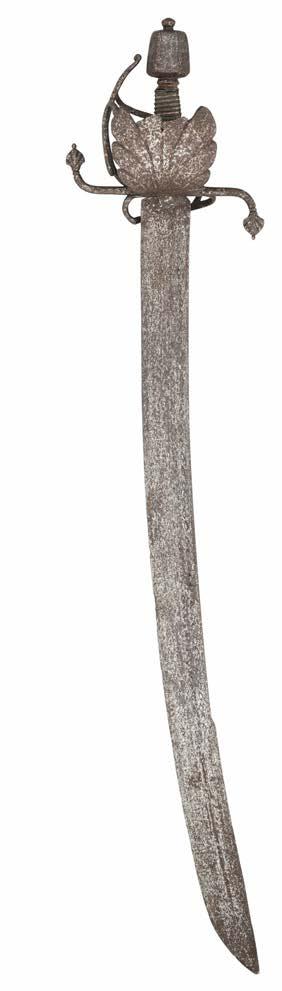
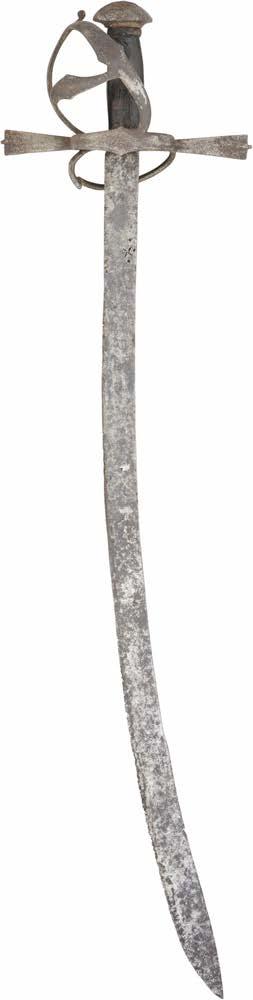
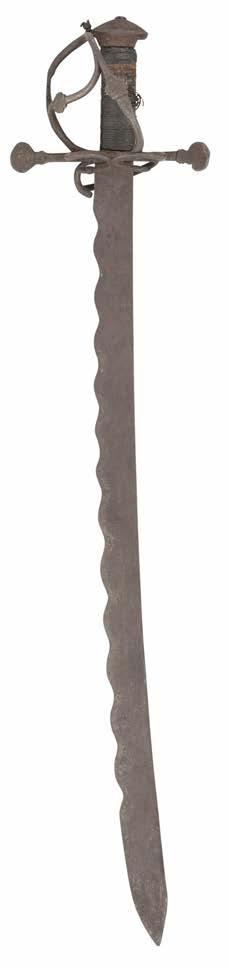
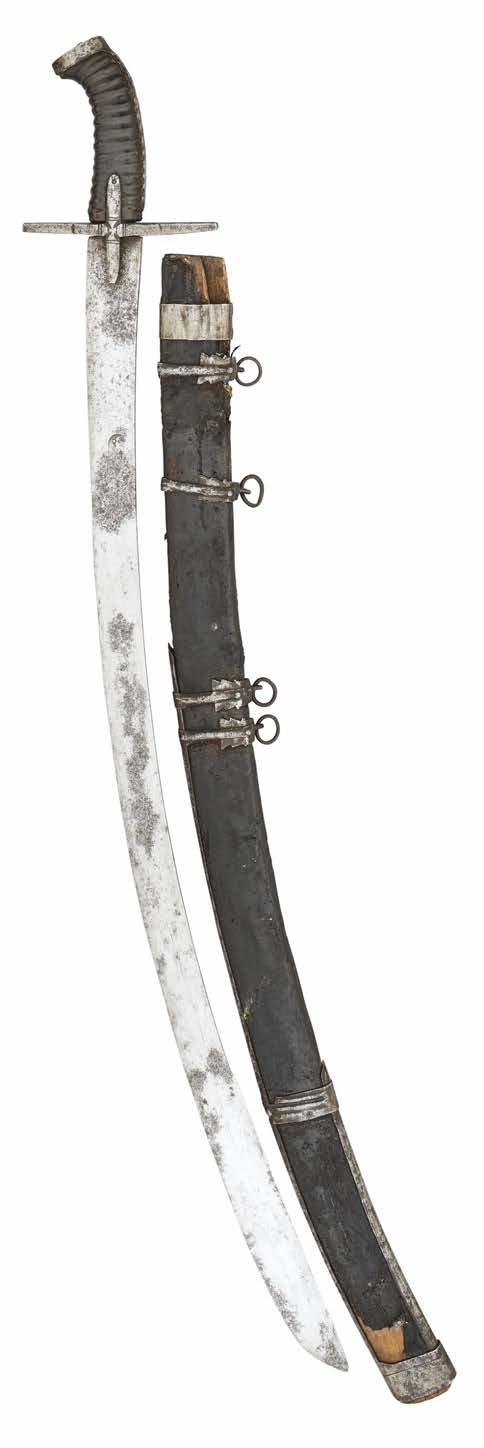
A
CENTRAL EUROPEAN PALLASCH, EARLY 17TH CENTURY, PROBABLY HUNGARIAN OR AUSTRIAN with curved blade double-edged towards the point in front of the shallow yelman and struck with a man-in-the-moon mark on both sides at the forte, hilt comprising iron cross-guard with ovoidal langets centred on a chiselled cross potent between double incised lines on both sides, flat tapering quillons, flat oval pommel-cap with back-piece, and cordbound leather-covered grip, in its iron-mounted wooden scabbard covered in black leather (seam open, some old losses, throat incomplete on one side and with later reinforcing mount) with four suspension mounts each with suspension ring (old pitting overall), 82.0 cm blade
Provenance
Robert Brooker Collection, inv. no. S-272
‡ £1,200-1,500
175
A NORTH EUROPEAN CAVALRY SWORD, THE BLADE DATED 1659, PROBABLY GERMAN with fullered tapering blade (old wear and pitting) doubleedged towards the point, the forte over both sides retaining traces of etched decoration involving figures in contemporary costume, two on horseback, and Latin inscriptions including the date on one side, iron hilt of rounded bars comprising side-ring enclosing a sprung-in plate pierced with stars and circles (minor damage), and linked to the knuckle-guard by a side-bar and recurved bar above forming a half-basket and all with central spherical feature, quillons each with swelling terminal, inner thumb-ring, globular pommel with tang button, and grip bound with twisted and plain copper alloy wire between ferrules, 79.3 cm blade
Provenance
Robert Brooker Collection, inv. no. S-1067
‡ £400-600
176
A NORTH EUROPEAN CAVALRY SWORD, SECOND QUARTER OF THE 17TH CENTURY, DUTCH OR GERMAN
with slightly tapering blade fullered along the back on each side to the double-edged point, the forte on both sides etched with inscriptions between a bird, an arm emerging from a cloud holding a falchion, and a bird, blackened iron hilt with double ring-guard each enclosing a sprung-in plate embossed and chased with a foliated ‘wild man’ mask, the larger outer one with central double moulding, inner thumb-ring, swelling rear quillon, knuckle-guard with central double moulding and hooked into the compressed globular pommel with flattened button, and wooden grip bound with twisted and plain copper alloy wire (loose) between Turk’s heads, 80.0 cm blade
Provenance
Robert Brooker Collection, inv. no. S-852
‡ £600-800
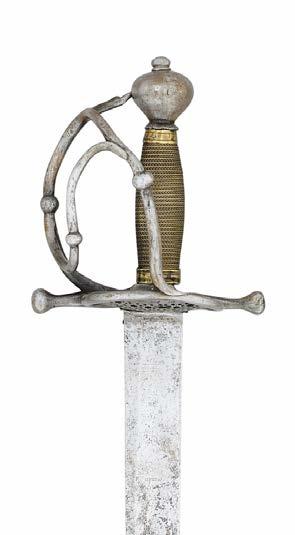
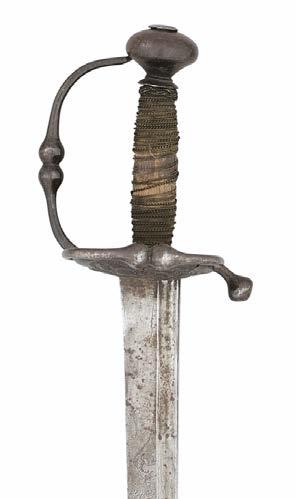
177
A EUROPEAN CAVALRY SWORD, MID-17TH CENTURY, POSSIBLY SWISS
with tapering double-edged blade (old rust patination and some edge nicks) of flattened diamond section etched along both sides in front of the forte with a male profile portrait bust wearing a turban, Latin inscriptions including ‘SOLI DEO GLORIA’, and a bird perched above scrolling foliage, the forte of flattened hexagonal section etched ‘ADAMVS’ on the flat between foliate scrolls on one side, and ‘WELGELL’ between scrolls on the other, iron hilt comprising side-rings each enclosing a sprung-in plate pierced with numerus small holes, side-bar and knuckle-guard each with double central moulding and screwed to the compressed globular pommel, the latter with large tang button, inner thumb-ring, rear quillon with swelling terminal, and wire-bound octagonal grip, 84.4 cm blade
Provenance
Robert Brooker Collection
‡ £500-700
178
A NORTH EUROPEAN CAVALRY SWORD, MID-17TH CENTURY
with tapering blade fullered along the back on both sides and double-edged towards the triangular point, iron hilt comprising outer side-ring (inner one missing) enclosing a sprung-in replacement plate pierced with a border of minute holes centred on a minute cross, side-bar and knuckle-guard each with double central moulding, linked by a slender bar and hooked into the globular pommel, the latter with flattened tang button, rear quillon with button terminal, and grip bound with twisted and plain wire between Turk’s heads (old rust patination overall), 77.3 cm blade
Provenance
Robert Brooker Collection, inv. no. S-1005
‡ £300-400
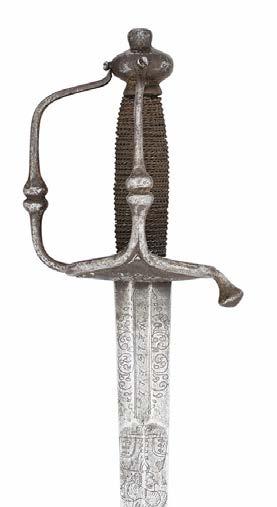
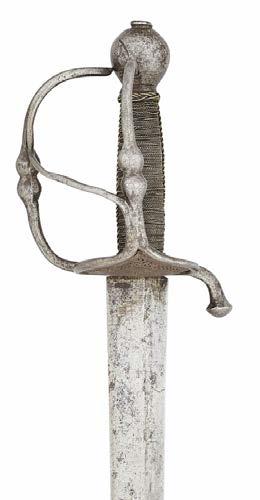
179
A
EUROPEAN CAVALRY SWORD, MID-17TH CENTURY OR LATER, POSSIBLY SWISS
with curved blade fullered along the back on each side to the double-edged point, the forte on both sides retaining traces of etched decoration and Latin inscriptions, iron hilt comprising siderings each enclosing a sprung-in copper alloy plate pierced with small holes, sidebar and knuckle-guard each with double central moulding and hooked into the globular pommel, the latter with tang button, inner thumb-ring, rear quillon with beaked terminal, and grip bound with twisted copper alloy wire between Turk’s heads (old wear and pitting overall), 80.0 cm blade
Provenance
Robert Brooker Collection, inv. no. S-1010 ‡ £350-450
180
A
NORTH EUROPEAN CAVALRY SWORD, MID-17TH CENTURY with fullered tapering single-edged blade, iron hilt comprising side-rings each enclosing a sprung-in plate, the outer one embossed and chased with foliage (inner one replaced and pierced with small holes), side-bar and knuckleguard each with double central moulding, linked by a slender recurved bar and joined to the globular pommel, the latter with prominent tang button, rear quillon with button terminal, and scaled leather-covered grip (old wear), in its black leather scabbard (damaged and in two parts) with iron locket and chape, the former with frog-hook and suspension ring (some old rust patination), 74.8 cm blade
Provenance
Robert Brooker Collection, inv. no. S-136 ‡ £400-500
181
A SWISS CAVALRY SWORD, LATE 17TH/EARLY 18TH CENTURY
with tapering fullered blade (old wear and light pitting) sightly curved at the doubleedged point, the forte on one side incised with the falchion mark of Christoph Stantler of Munich, copper alloy hilt (old joins and repairs) comprising side-guards, the larger outer one cast and chased with a crown between lion supporters, between foliage and within a heart-shaped border, the inner side and the smaller inner-guard (minor old holes) cast with a lion within a foliate border, side-bar and knuckle-guard both with central mouldings, the latter flanked by recurved bars and hooked into the lower jaw of the lion-head pommel with open mouth and curly mane, tang button, inner thumb-ring, and grip bound with thick twisted copper alloy wire between ferrules, 73.2 cm blade
Provenance
Robert Brooker Collection, inv. no. S-534
For a similar mark, see Rudolf Wegeli, Inventar der Waffensammlung des Bernischen Historischen Museums in Bern, Volume 2, 1929, p. 61.
‡ £600-900
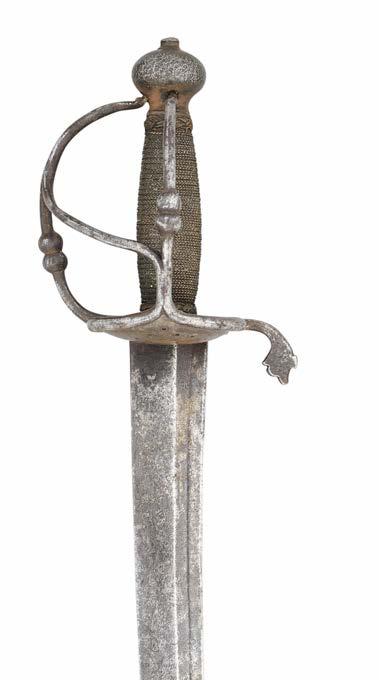
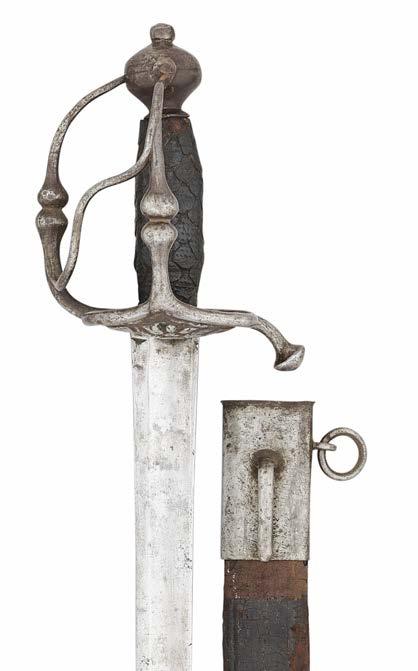
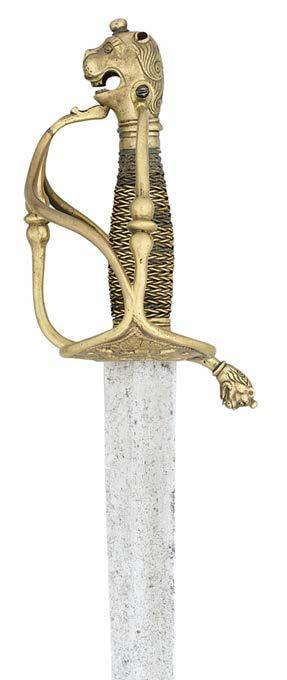
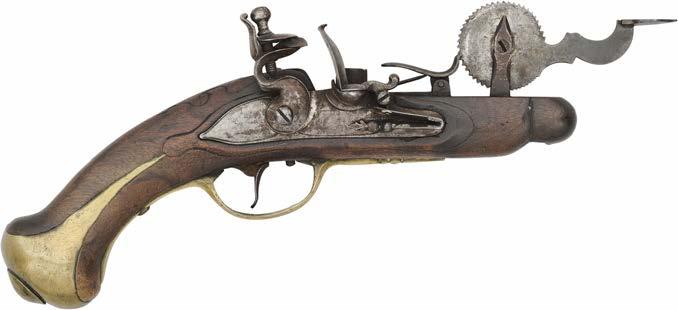
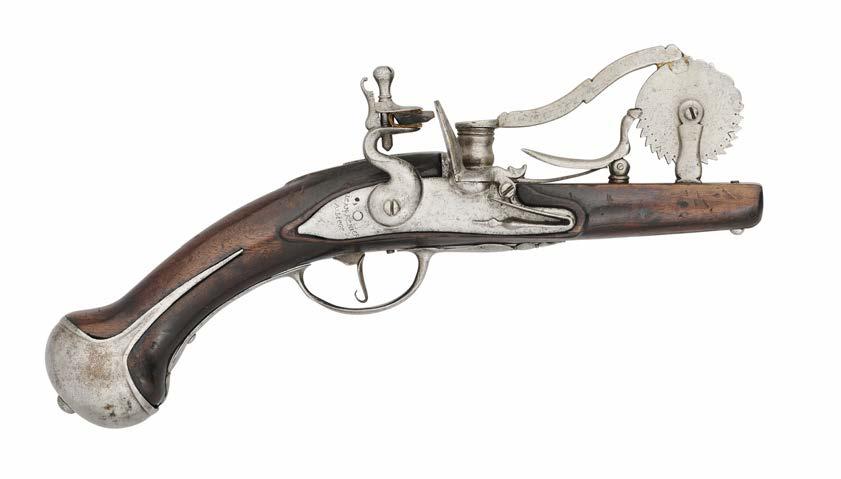
182
A EUROPEAN FLINTLOCK POWDER-TESTER (EPROUVETTE), MID-18TH CENTURY, PROBABLY GERMAN
of pistol form, with large unnumbered indicator wheel mounted on a pillar, operating against a sprung lever, and with an anvil fitting against the top of the chimney above the touchhole, plain tang, rounded lock and cock each with moulded border, moulded full stock lightly carved behind the tang, copper alloy mounts comprising spurred pommel with domed cap, and bevelled trigger-guard with pointed finial, 29.5 cm
Provenance
Robert Brooker Collection, inv. no. 671
For similar example see R.T.W. Kempers, Eprouvettes: A Comprehensive Study of Early Devices for the Testing of Gunpowder, 1998, p.108, fig. 10.
‡ £300-400
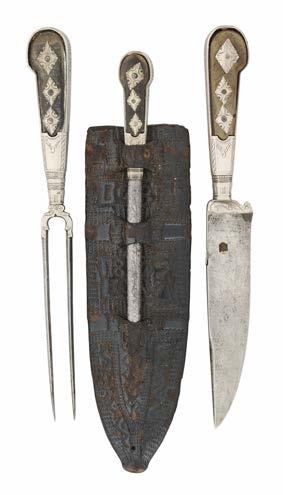
183
A LIÈGE FLINTLOCK POWDER-TESTER (EPROUVETTE), BY JEAN RENIER, LIÈGE, CIRCA 1720
of pistol form and possibly rebuilt from a military pistol, with large indicator wheel mounted on a pillar, operating against, sprung lever, and with long brazed anvil fitting against the top of the baluster chimney above the touch-hole, plain tang, rounded lock signed across the tail, figured full stock with apron around the tang, iron mounts comprising rounded scroll side-plate, spurred pommel with central retaining screw, and trigger-guard with pointed finial, 34.0 cm
Provenance
R.T.W. Kempers Collection, KEM 66
Robert Brooker Collection, inv. no. 1417
Literature
R.T.W. Kempers, Eprouvettes: A Comprehensive Study of Early Devices for the Testing of Gunpowder, 1998, pp. 120-121, figs. 120-122
‡ £400-600
184
A GERMAN OR AUSTRIAN SPORTSMAN’S TROUSSE, DATED 1822
comprising a knife, fork and sharpening steel, each with whitemetal mounted grip engraved with foliage within line borders, the knife including owner’s initials ‘JGB’ and the date, and struck with a mark on one side of the blade, and horn gripscales each with three white-metal florets on both sides (one replaced), in their hardened black leather scabbard tooled with geometric ornament, the outside with initials ‘IG.BR’ above the date and ‘IG W’, all between two integral loops for retaining the steel, 12.0 cm blade
Provenance
Robert Brooker Collection
‡ £300-500
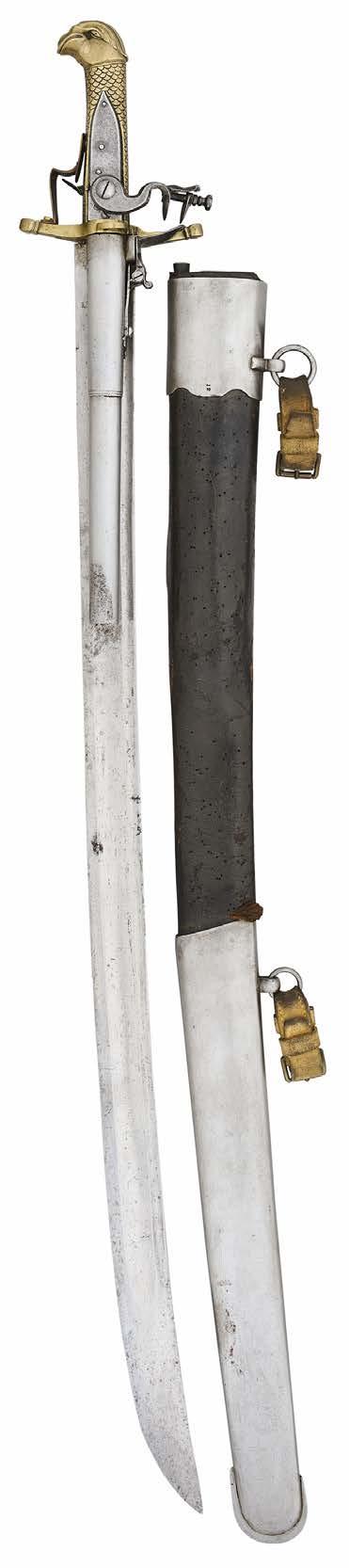
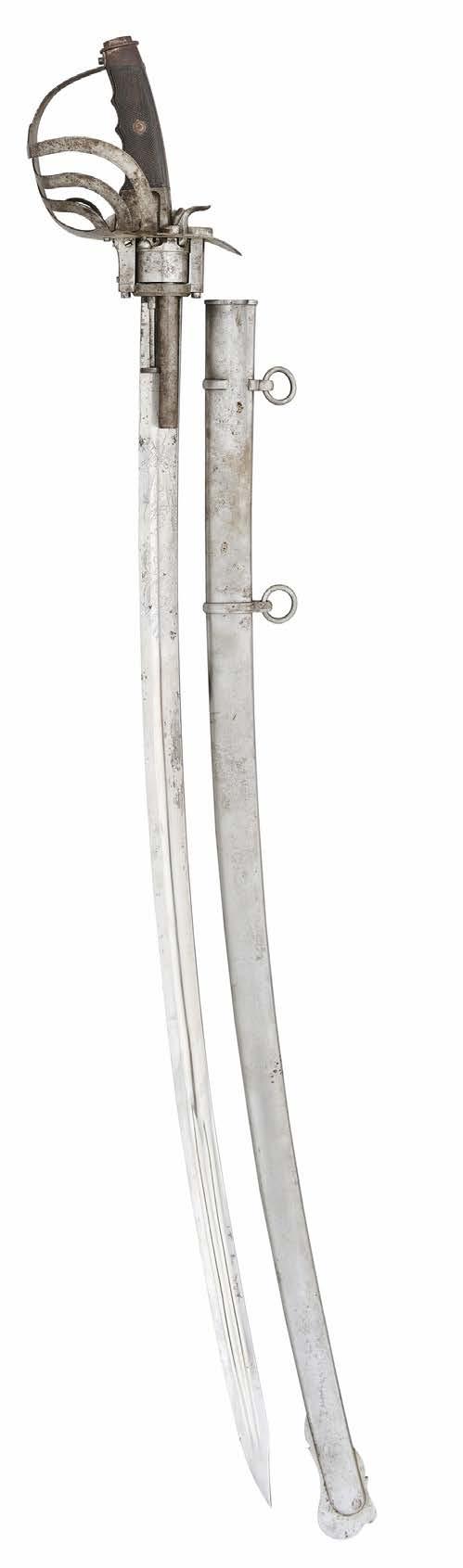
187
A RARE GERMAN 30 BORE MIQUELET-LOCK AXE-PISTOL with octagonal barrel swelling at the muzzle and fitted with an axeblade beneath, the latter with crescentic blade drawn-out to a point and deeply struck on one side with a mark ‘PB’ in a square beneath a triangular feature cut with line decoration, and secured by a screw through the socket and a sprung bar beneath, plain tang, characteristic flat bevelled lock, figured haft (old splits and minor worming) inlaid with engraved diamond-shaped staghorn panels along the faceted back and with an ovoidal staghorn panel on both sides with engraved decoration, staghorn terminal housing a later horn-tipped ramrod, and engraved with leaf decoration and notched borders, and later iron trigger-guard, 17.2 cm barrel, 62.0 cm overall
Provenance
Robert Brooker Collection, inv. no. 1707
Believed by the owner to have been produced in Germany for the Swedish navy. A very similar example is illustrated in F. Theodore Dexter, Half Century Scrapbook of Vari-Type Firearms, 1960, plate 24, no. 889.
‡ £1,500-1,800
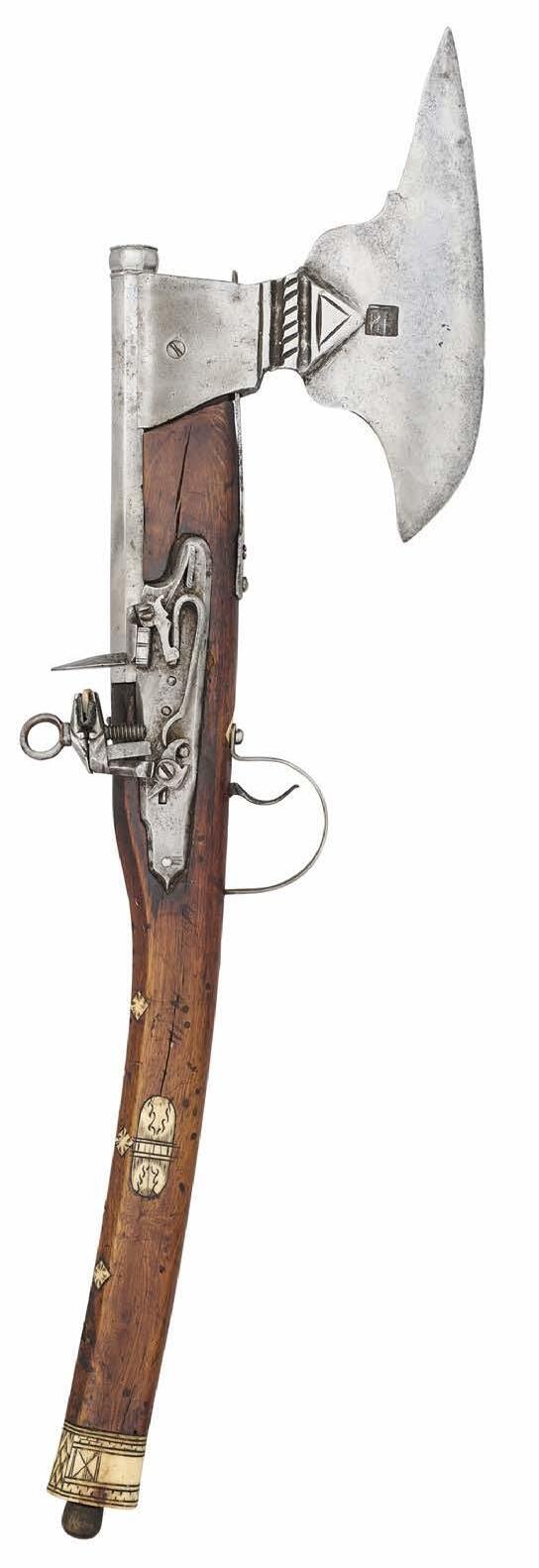


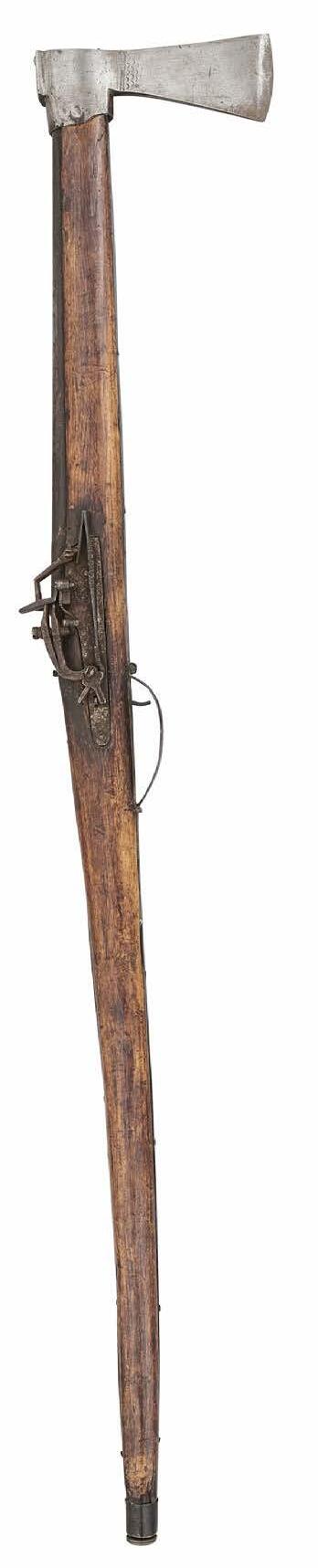
A RARE SWEDISH 50 BORE SNAPHAUNCE RIFLED
AXE-PISTOL, EARLY 17TH CENTURY
with two-stage barrel rifled with six grooves and fitted with an axe-blade at the muzzle, the former with fore-sight in the block-shaped peen and punched with a series of scales on one side, octagonal breech with large back-sight, plain tang, characteristic flat lock with chiselled external mainspring also forming the steel-spring, and pivoting pan-cover, figured haft of tapering circular section with reinforcing strap along the top and bottom, circular basal mount threaded for the replacement steel ramrod, and iron trigger-guard fixed by a staple at the rear and a screw threaded into the barrel tang at the front (iron parts with some old rust patination), 39.0 cm barrel, 100.0 cm overall
Provenance
Robert Brooker Collection, inv. no. 1708
‡ £1,500-2,000
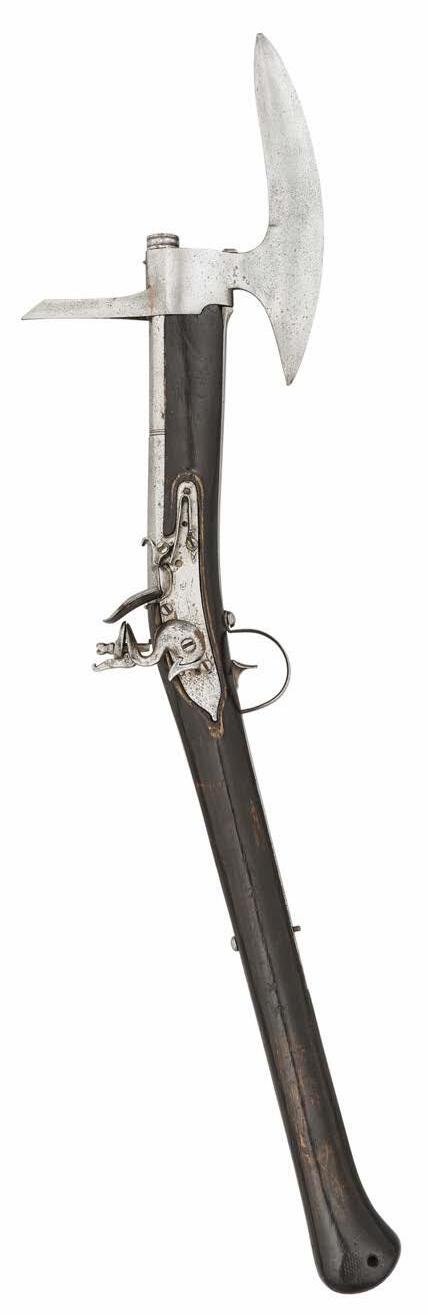
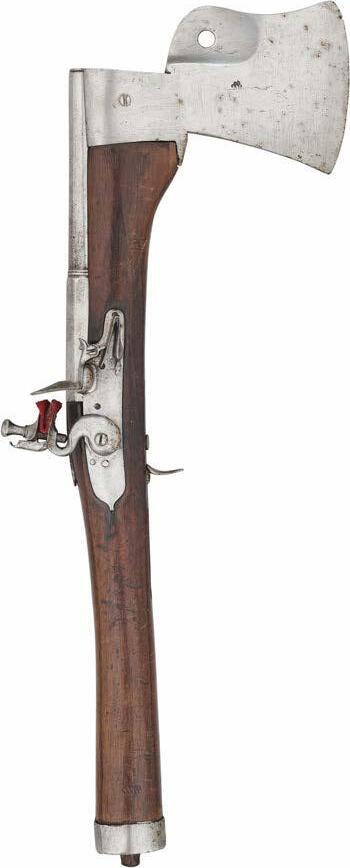
189
A RARE SWEDISH 20 BORE FLINTLOCK AXE-PISTOL, EARLY 18TH CENTURY
with two-stage sighted barrel turned at the muzzle and fitted with an axe, the latter with curved double-edged blade and baized spikeshaped peen arched to allow sight of the fore-sight, octagonal breech becoming polygonal and struck with a circular mark on the right flat, rounded lock struck with a mark and with dogcatch engaging with the rear of the cock, ebonised haft of circular section pierced for a wrist-thong at the rounded terminal, reinforcing straps above and below, and steel trigger-guard (trigger incomplete, steel parts with old wear and light pitting), 25.5 cm barrel, 87.3 cm overall
Provenance
Robert Brooker Collection, inv. no. 1739
For another example preserved in the Royal Armouries, Leeds, see Heinz-Werner Lewerken, Kombinationswaffen des 15-19 Jahrunderts, pp. 214, cat. no. 16.
‡ £1,000-1,500
190
A RARE EUROPEAN 50 BORE FLINTLOCK AXE-PISTOL, LATE 17TH CENTURY
the two-stage barrel with octagonal breech and fitted with an axe-blade beneath the muzzle, the latter with slightly curved cutting-edge, struck with a flower-head mark on one side, and with rounded projection fluted on one side and pierced with a hole, plain tang, rounded lock and cock, the former retained by three side-nails, figured haft of circular section and stamped with a flower-head mark behind the barrel tang, and iron band at the rear centred on an aperture for a wooden ramrod (trigger-guard missing), 20.4 cm barrel, 52.5 cm overall
Provenance
Robert Brooker Collection
‡ £1,000-1,500
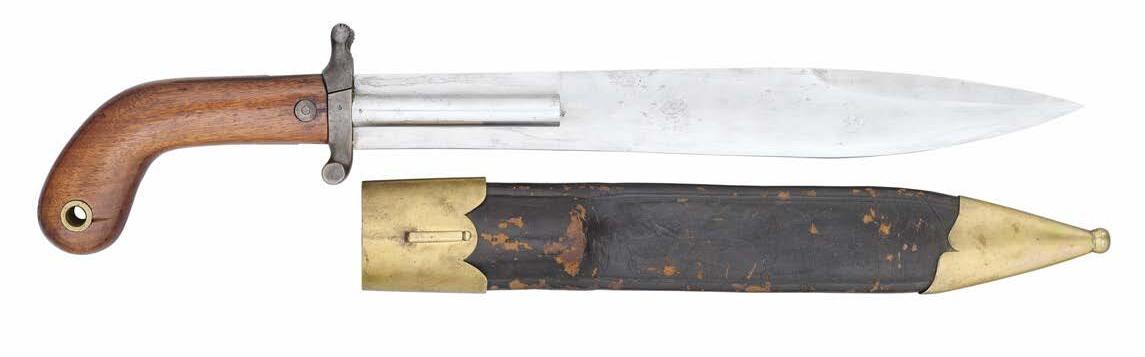
191
A SWEDISH 90 BORE PERCUSSION D.B. DAGGER PISTOL OF DUMONTHIER TYPE BY C.G. GRANBERG, NO. 5, MID-19TH CENTURY
with bright blade double-edged towards the swelling point and stamped with maker’s name and ‘5’ along the back at the forte, bright rifled barrels each stamped with initials and numbered ‘5’, rounded case-hardened serial numbered quillons, the upper ones forming the hammers, butt incorporating the folding triggers and with figured rounded grip-scales (one with minor chip), pommel with copper alloy-lined hole for a suspension strap, and in fine condition, in its black leather scabbard (some old surface losses) with copper alloy locket and chape, the former with frog-hook , 35.8 cm blade, 10.2 cm barrels
Provenance
Robert Brooker Collection, inv. no. 1504
Believed to have been issued to the Swedish Post Office. For related examples of this type see Heinz-Werner Lewerken, Kombinationswaffen des 15-19 Jahrunderts, pp. 232-233, cat. nos. 57, 58.
‡ £1,000-1,500
192
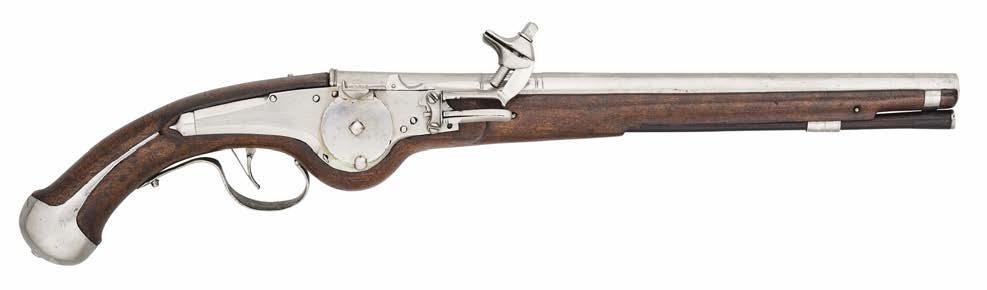
A STYRIAN 26 BORE WHEEL-LOCK HOLSTER PISTOL, MID-LATE 17TH CENTURY
with bright three-stage barrel turned at the girdle, octagonal breech becoming polygonal and struck with Dietrichstein armoury mark on the top flat, narrow ramp at the rear and plain tang, bright flat bevelled lock with pointed rounded tail, exposed wheel retained by a bracket beneath, sliding pancover operating against an internal spring, figured full stock with rounded butt, bright iron mounts comprising spurred pommel, trigger-guard, baluster ramrod-pipe, fore-end band, and iron-capped ramrod, 36.0 cm barrel
Provenance
Robert Brooker Collection, inv. no. 1389
‡ £2,000-3,000
193
AN AUSTRIAN 23 BORE WHEEL-LOCK HOLSTER PISTOL, LATE 17TH CENTURY
with bright two-stage barrel, octagonal breech becoming polygonal and struck with a barrelsmith’s mark on the top flat, crowned ‘L’ between dots in an oval, plain tang, bright rounded lock struck with a mark, ‘PL’ between a cross and a dot in a shield, exposed wheel with retaining bracket beneath, sliding pan-cover operating against an internal spring, figured full stock (fore-end split along the ramrod-channel) carved in bas-relief with a foliate scroll on the side flat, rounded butt with flat ovoidal pommel encircled by an iron band, iron mounts comprising trigger-guard and replacement ramrod-pipe and fire-end band, and iron-mounted ramrod with threaded reversable worm, 43.2 cm barrel
Provenance
Robert Brooker Collection, inv. no. 1371
The marks on the barrel and lock appear to be unrecorded.
‡ £1,800-2,200
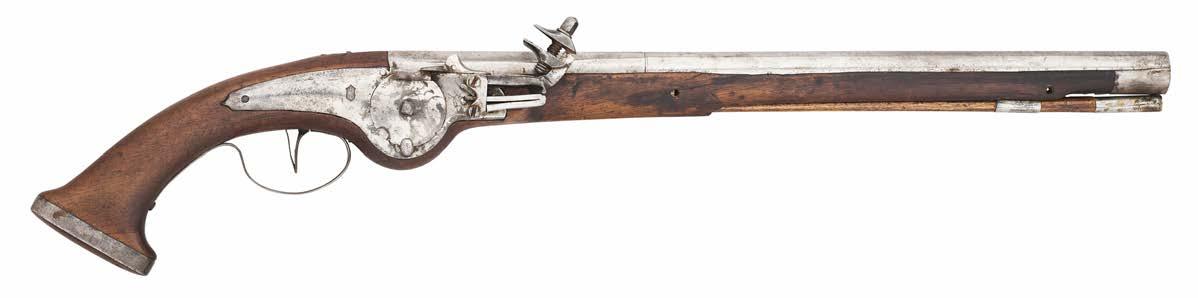
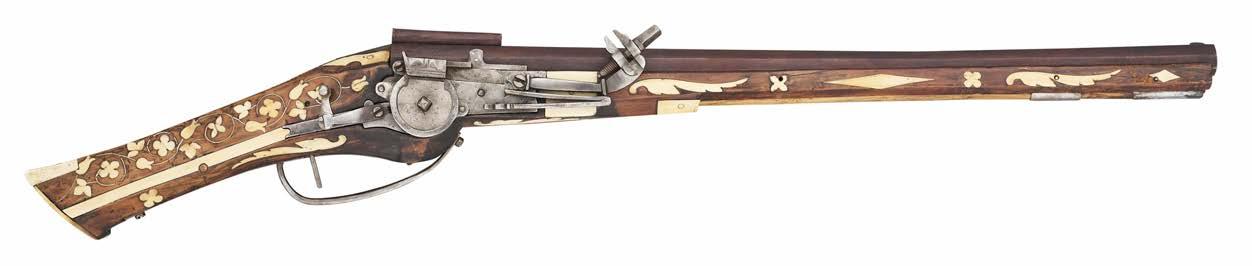
194
A GERMAN 30 BORE WHEEL-LOCK CARBINE, SECOND HALF OF THE 16TH CENTURY AND LATER with octagonal sighted barrel now browned and struck with an unidentified shield-shaped barrelsmith’s mark on the top flat in front of the tubular back-sight, the latter open along the top, flat lock with wheel-retaining bracket and sprung safety-lever at the rear, fruitwood full stock inlaid in white staghorn with foliate panels, diamonds and quatrefoils, and along the back of the angled butt with scrolling foliage on both sides between borders of white staghorn, horn heel- and butt-plates, iron trigger-guard, and iron-tipped ramrod, 53.0 cm barrel
Provenance
Robert Brooker Collection
‡ £3,000-4,000
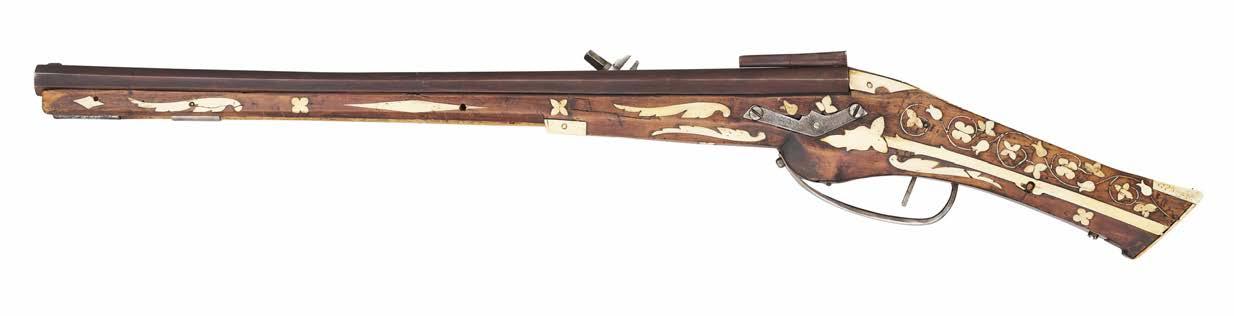
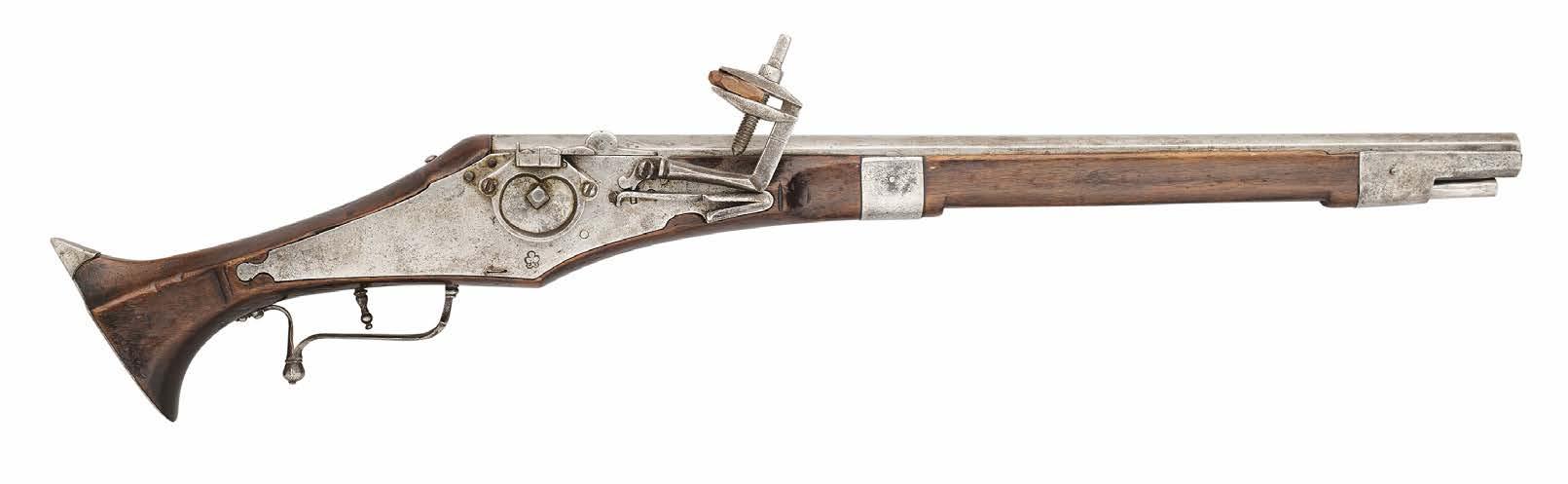
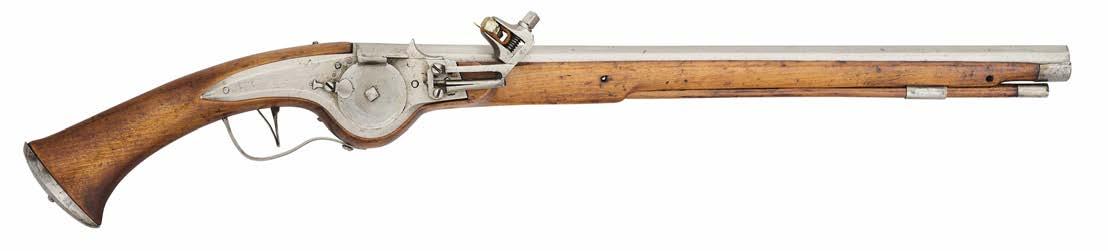

196
A NORTH EUROPEAN 30 BORE WHEEL-LOCK HOLSTER PISTOL, CIRCA 1640-50, PROBABLY DUTCH OR GERMAN
with bright octagonal barrel and plain tang, bright flat bevelled lock and exposed wheel, the latter retained by a bracket secured by a screw, sliding pan-cover operating against an internal spring, lightly figured full stock with rounded butt and flared ovoidal pommel, iron mounts comprising pommel-cap, slender trigger-guard, single ramrod-pipe, fire-end band, irontipped ramrod, probably original, and in fine condition, 43.4 cm barrel
Provenance
Robert Brooker Collection, inv. no. 642
‡ £2,500-3,500
197
A NORTH EUROPEAN 30 BORE WHEEL-LOCK HOLSTER PISTOL, CIRCA 1630-40, PERHAPS SWEDISH with octagonal barrel and plain tang, the former struck with an indistinct mark on the left flat at the breech, bevelled lock exposed wheel retained by a bracket secured by a screw, sliding pan-cover operating against an internal spring, fruitwood full stock (minor worming) carved with a rear ramrod-pipe in front of three incised lines, slightly curved butt of ovoidal section, iron mounts comprising slightly domed octagonal pommel-cap, replacement trigger-guard, ramrodpipe and fore-end band, and later ramrod, 30.8 cm barrel
Provenance
Robert Brooker Collection, inv. no. 1100
‡ £1,500-2,000
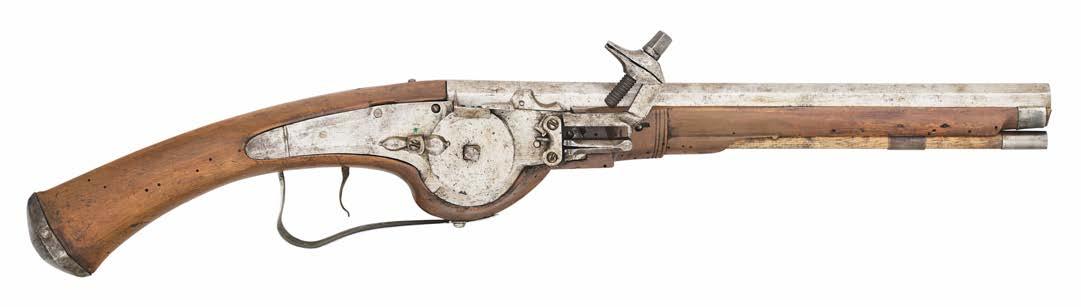
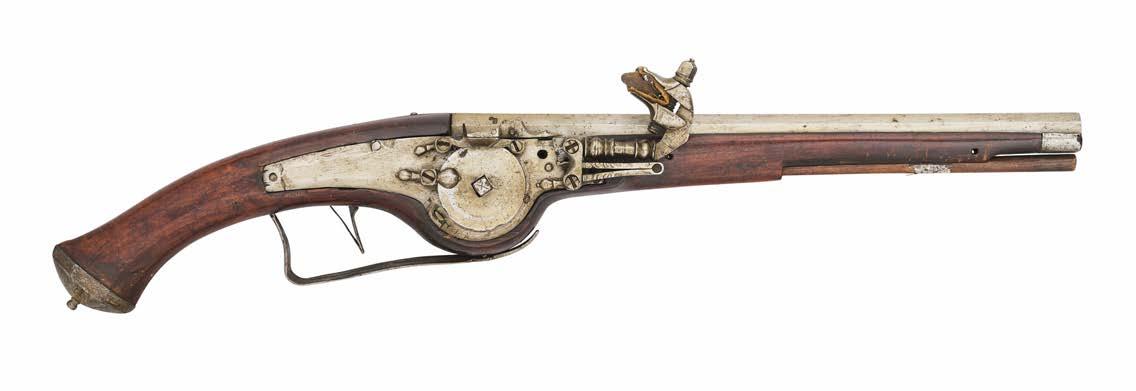
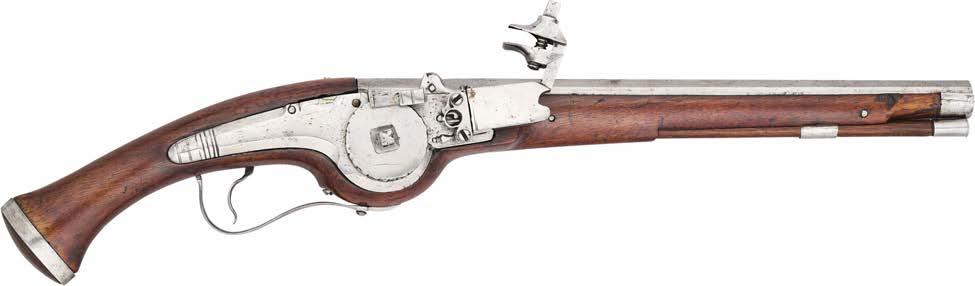
198
A NORTH EUROPEAN 22 BORE WHEEL-LOCK HOLSTER PISTOL, CIRCA 1630-40, PERHAPS SWEDISH with octagonal barrel deeply struck with a mark(?) on the right flat at the breech, plain pointed tang, flat bevelled lock with blunt tail and exposed wheel, the latter retained by a bracket secured by a screw, sliding pan-cover (release button missing), the pan secured by two screws, cock with baluster neck, fruitwood full stock (some old chips along the bottom of the lock) with slightly curved butt of ovoidal section, iron mounts comprising slightly domed octagonal pommel-cap engraved with pairs of lines radiating from a small button terminal, trigger-guard with pointed finial, single ramrod-pipe (old damage), fore-end band, and wooden ramrod, 32.4 cm barrel
Provenance
Robert Brooker Collection, inv. no. 1406
‡ £1,500-2,000
199
A NORTH EUROPEAN 23 BORE WHEEL-LOCK HOLSTER PISTOL, MID-17TH CENTURY
with bright octagonal barrel and plain tang, bright flat lock with bevelled tail decorated with incised and engraved lines, exposed wheel, sliding pan-cover operating against an internal spring, and cock unusually formed with an integral shield over the spring, figured full stock (old repair behind the muzzle) with rounded butt and ovoidal pommel, the latter encircled by an iron band, iron mounts comprising slender trigger-guard with pointed finial, single ramrod-pipe, and iron-tipped ramrod, 34.5 cm barrel
Provenance
Robert Brooker, inv. no. 658
‡ £1,500-2,000
200
A VERY RARE GERMAN OR AUSTRIAN 25 BORE MIQUELETLOCK PISTOL, CIRCA 1620-40 with russet octagonal barrel and plain tang, flat lock retained by a single sidenail and with a line of punched decoration at the tail, the cock and steel springs each with some incised decoration, figured full stock with double incised line decoration behind the rear ramrod-pipe, rounded butt widening to an ovoidal pommel encircled by an iron band, russet iron trigger-guard, single ramrod-pipe and fore-end band, and wooden ramrod. 18.7 cm barrel
Provenance
Robert Brooker Collection, inv. no. 2069
‡ £1,000-1,500
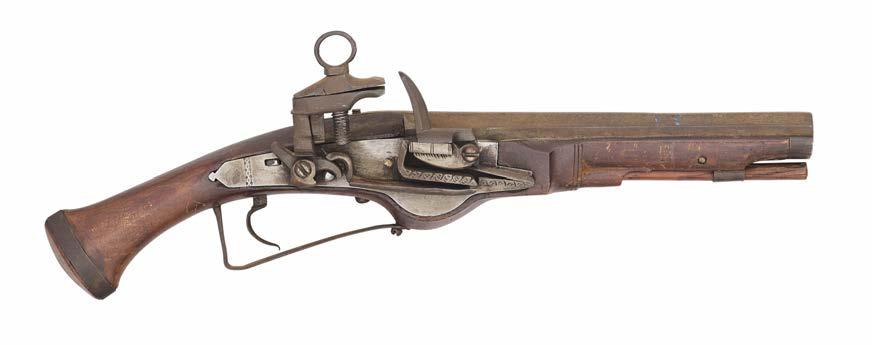
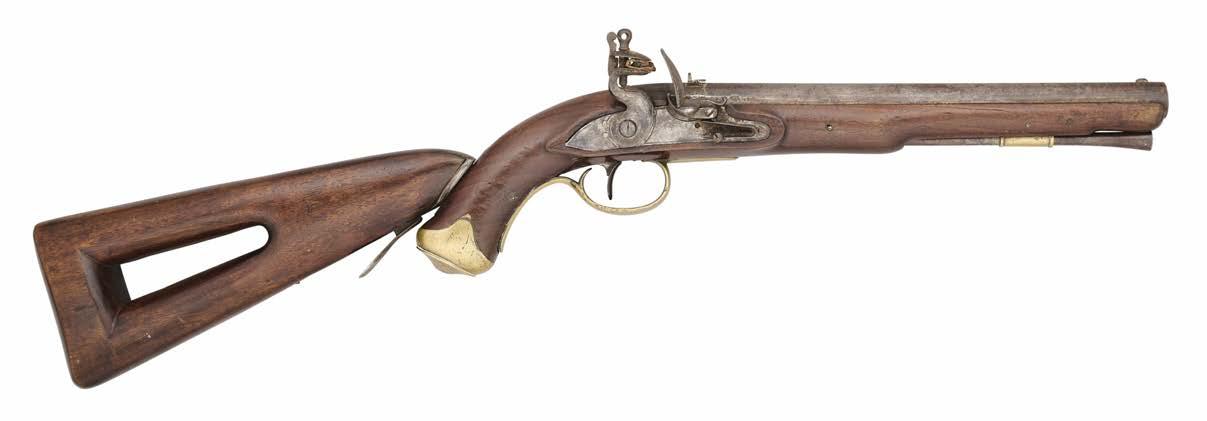
A
RARE 18 BORE FLINTLOCK NEW LAND PATTERN YEOMANRY PISTOL CARBINE WITH SHOULDER-STOCK
BY D. EGG, LONDON,
EARLY 19TH CENTURY
with russet sighted barrel for ball and signed along the top flat, breech with folding-leaf back-sight, plain tang, signed border engraved rounded lock and cock, figured full stock (some old bruising) with steel mount for the detachable shoulder-stock at the back of the butt, regulation copper-alloy mounts (pommel bruised), figured skeleton butt with sprung release-lever and inscribed ‘D. Egg’s PATENT BUTT’, on the border engraved tang, and steel ramrod, probably original (barrel and lock with some old rust patination), 30.3 cm barrel (2)
Provenance
Robert Brooker Collection, inv. no. 1598
For full details regarding Durs Egg, see Claude Blair, 'The Egg Family, Part I and Part II (contd.)' in Journal of the Arms and Armour Society, Volume VII, 1973, pp. 266-299 and 305-353.
‡ £2,000-3,000
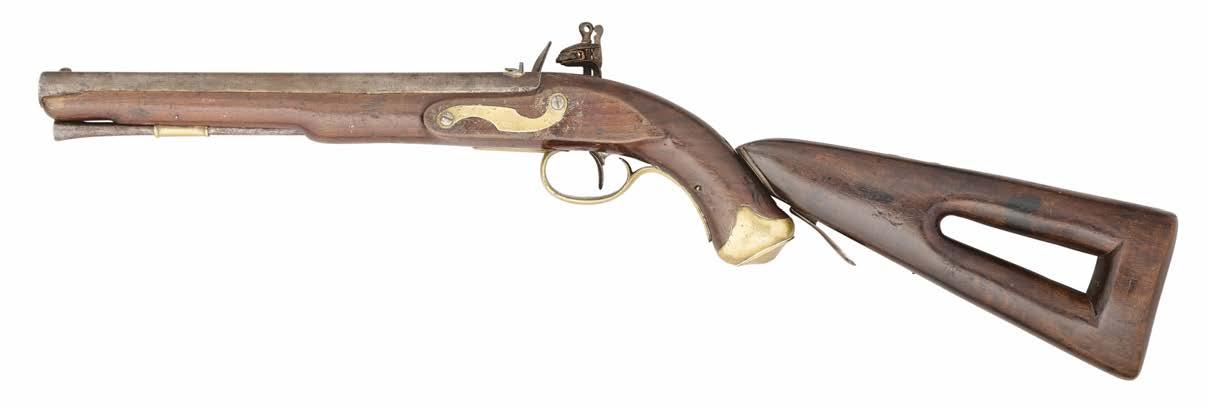
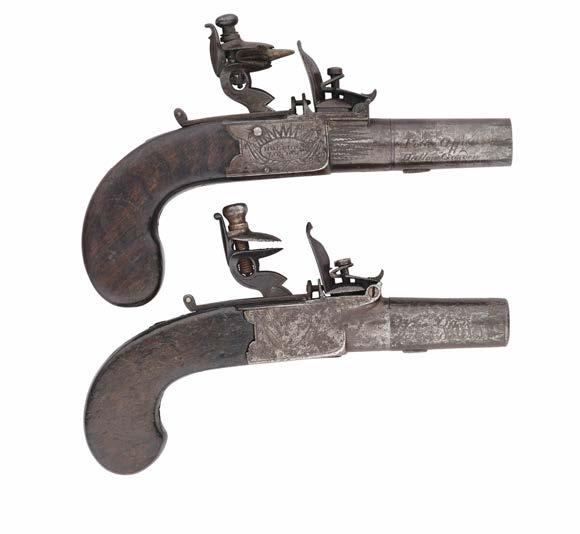
TWO RARE 45 BORE FLINTLOCK BOX-LOCK POCKET PISTOLS FOR THE POLICE OFFICE, HATTON GARDEN
SIGNED W. PARKER, LONDON, CIRCA 1815-20
with turn-off barrels each engraved around the muzzle and ‘Police Office Hatton Garden’ along one side, one breech engraved with a starburst on both sides and each struck with Tower private proof marks, actions each signed in an oval against a martial trophy over both sides, engraved thumbpiece safety-catches also locking the steels (one top jaw and screw replaced), folding triggers, and flat-sided butts, and silver escutcheons, one engraved ‘WP’ over ‘5’, the other engraved with owner’s initials and ‘Hatton Garden 7’ (one pistol worn and pitted), 4.3 cm and 4.5 cm barrels (2)
Provenance
Frederick Wilkinson, sold in this room, 7 December 2006, lot 82
Robert Brooker Collection, inv. nos. 1625 and 1626
‡ £400-500
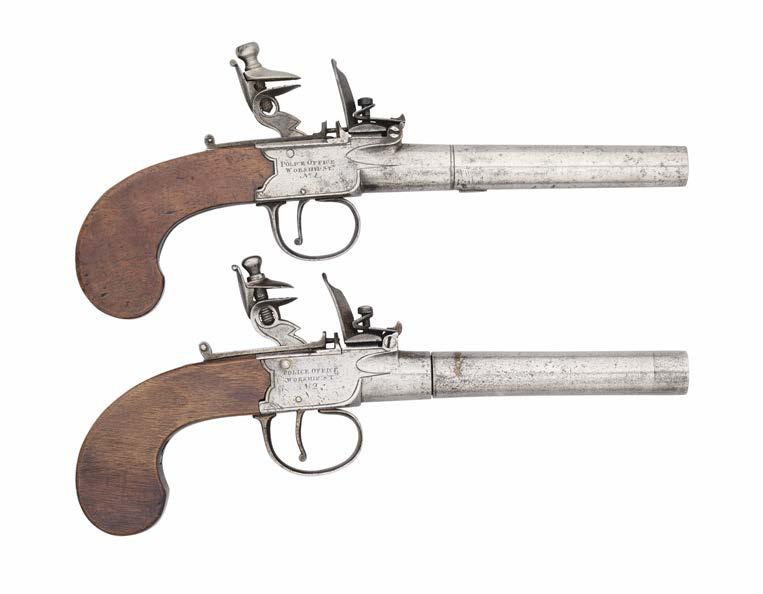
A RARE PAIR OF 60 BORE FLINTLOCK BOX-LOCK PISTOLS FOR THE POLICE OFFICE, WORSHIP STREET, LONDON BY W. PARKER, HOLBORN, LONDON, NOS. 1 AND 2, EARLY 19TH CENTURY
with plain turn-off barrels, breeches each struck with London proof mark s, actions each signed on one side and engraved ‘POLICE OFFICE WORSHIP ST.’ over ‘No. 1’ and ‘No. 2’ respectively, thumbpiece safet y-catches also locking the steels (one top jaw and screw replaced), trigger-guards each engraved with a flower-head, shield-shaped escutcheons engraved ‘1’ and ‘2’ (crudely replaced) respectively, and figured flat-sided butts (one replaced, some old rust patination), 9.0 cm and 9.8 cm barrels (2)
Provenance
Frederick Wilkinson, sold in this room, 7 December 2006, lot 78
Robert Brooker Collection, inv. nos. 1623 and 1624
‡ £350-450
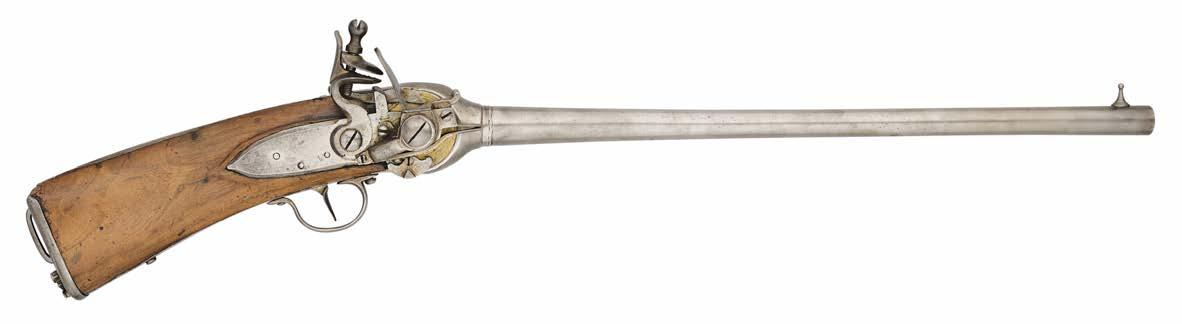
A VERY RARE 30 BORE FLINTLOCK MILITARY CARBINE ON THE LORENZONI PRINCIPLE, LATE 18TH CENTURY, AUSTRIAN OR DUTCH
the slightly swamped barrel with pillar fore-sight, bevelled back-action lock , characteristic action with sighting groove and automatically cocked via a flat bar engaging with the circular copper alloy breech-block and operated by the side-lever, figured club-shaped butt with hinged steel cover at the back opening to reveal two circular apertures for balls, the cover with catch operating against a spring and with suspension bar above, and steel trig ger-guard, 42.5 cm barrel
Provenance
Frank Bivens
Robert Brooker Collection, inv. no. 1362
Literature
F. Theodore Dexter, Forty-Two Years' Scrapbook of Rare Ancient Firearms, 1954, p. 219 illustrated ‡ £3,000-5,000
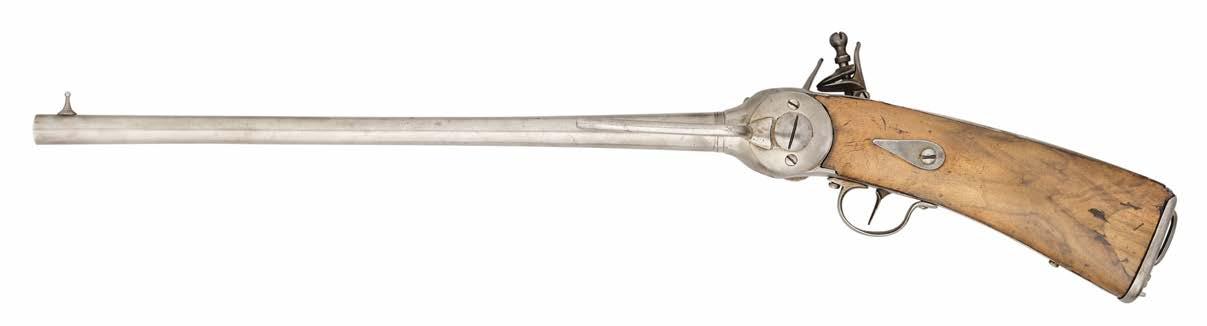
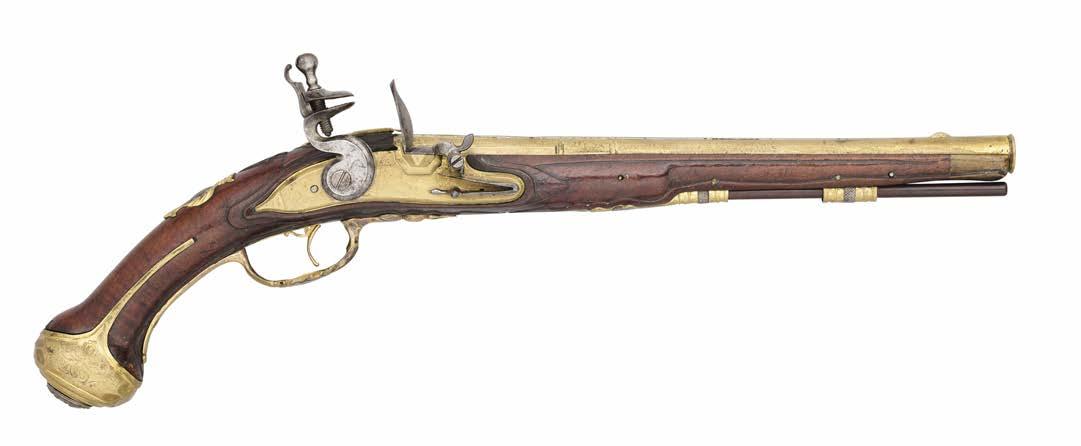
205
A HIGHLY UNUSUAL SAXON 28 BORE FLINTLOCK HOLSTER PISTOL WITH ORMOLU BARREL, LOCK AND MOUNTS, REIGN OF AUGUSTES II 'THE STRONG', ELECTOR OF SAXONY (1694-1733)
the sighted three-stage barrel with slender ring around the muz zle and raised tapering silver sighting rib along the top, the latter engraved with foliage at the breech, the two stages at the breech engraved with scrolling foliage, tang engraved en suite and with pointed finial, foliate engraved flat bevelled lock with the Saxon royal arms in front of the pan, moulded figured full stock with horn fire-end cap and carved with foliage behind the barrel tang apron, cast and chased mounts comprising pierced foliate sideplate, crowned escutcheon, and rear ramrod-pipe all set with silver inlays, spurred faceted pommel engraved with symmetrical foliage on both sides and with silver grotesque mask cap, turned and faceted ramrod-pipes each with stippled silver band, gilt trigger, later wooden ramrod, and retaining some of its gilding, 31.7 cm barrel
Provenance
Robert Brooker Collection, inv. no. 536 ‡ £3,000-4,000
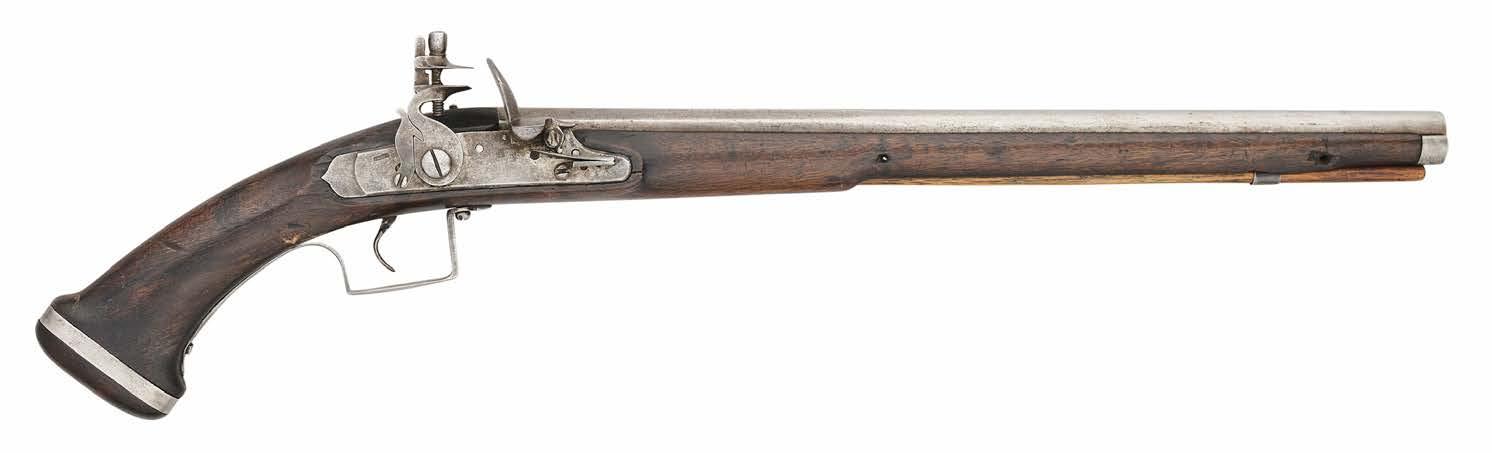

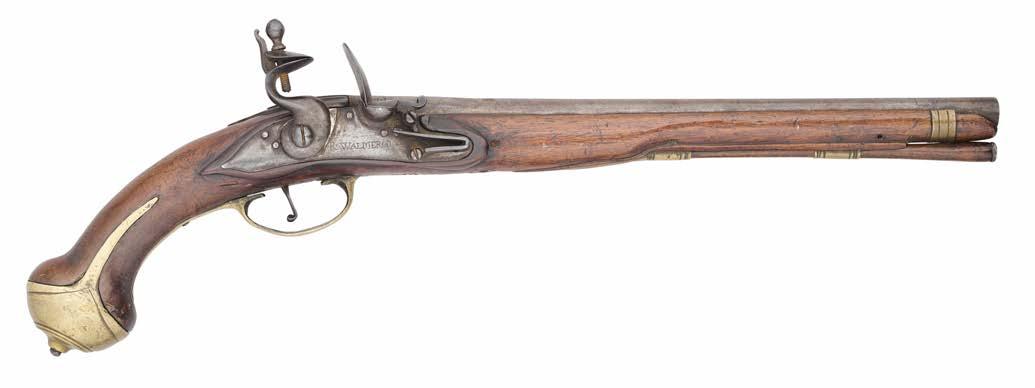
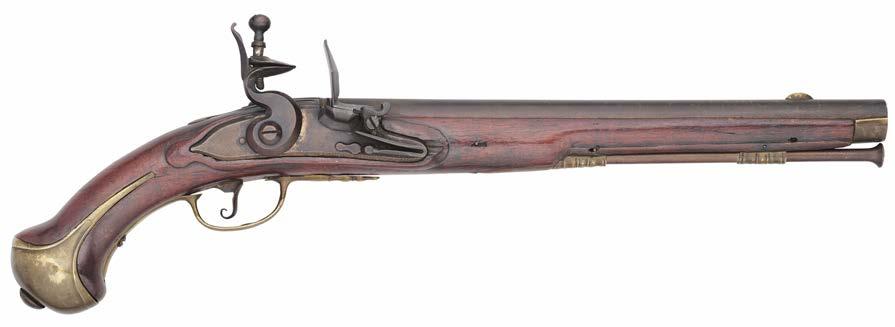
207
A GERMAN 18 BORE FLINTLOCK HOLSTER PISTOL BY R. WALMEROD, REIGNS OF WILLIAM ERNEST (1683-1707) OR ERNST AUGUST I (1707-1748), DUKES OF SADE WEIMAR
with russet barrel stamped at the breech with maker’s name, crowned mark and ‘R’, tang number ‘18’, signed rounded lock, moulded figured full stock (small repair on one side at the muzzle) incised ‘CGRD’ in a circle in front of the trigger-guard, copper alloy mounts comprising scrolled side-plate, spurred pommel with raised circular cap centred on the retaining screw, trigger-guard with pointed finial, turned ramrod-pipes, fore-end band, and iron-capped wooden ramrod, 36.0 cm barrel
Provenance
Robert Brooker Collection, inv. no. 383
This maker appears to be unrecorded.
‡ £800-1,000
208
A LIÈGE 12 BORE FLINTLOCK HOLSTER PISTOL BY CLAUDE NIQUET A LIÈGE, EARLY 18TH CENTURY
the patinated barrel with copper alloy fore-sight, plain fore-sight, patinated flat bevelled lock signed along the bottom edge below the steel-spring, moulded figured full stock (old chip in front of the lock) with spherical terminal behind the apron, copper alloy mounts comprising flat scroll side-plate, spurred pommel, bevelled trigger-guard with pointed finial, baluster ramrod-pipes, fore-end band, and steel ramrod, 33.3 cm barrel
Provenance
Robert Brooker Collection, inv. no. 2055
‡ £500-700
209
A EUROPEAN 28 BORE FLINTLOCK D.B. PISTOL, MID-18TH CENTURY, PROBABLY GERMAN with sighted barrels (rib dented), the right one rifled, grooved tang, flat bevelled locks, figured moulded full stock (some old worming) with raised drops behind the locks and barrel tang, copper alloy mounts comprising spurred pommel with domed cap, trigger-guard with integral suspension loop behind the guard, turned ramrod-pipes, and later ramrod (some old wear and rust patination), 26.3 cm barrels
Provenance
Robert Brooker Collection, inv. no. 679
‡ £400-500
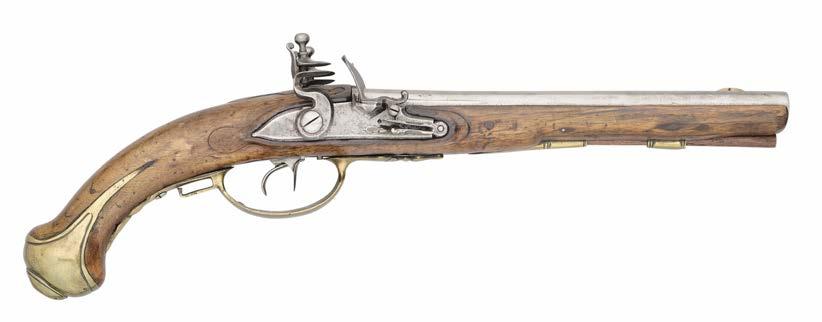
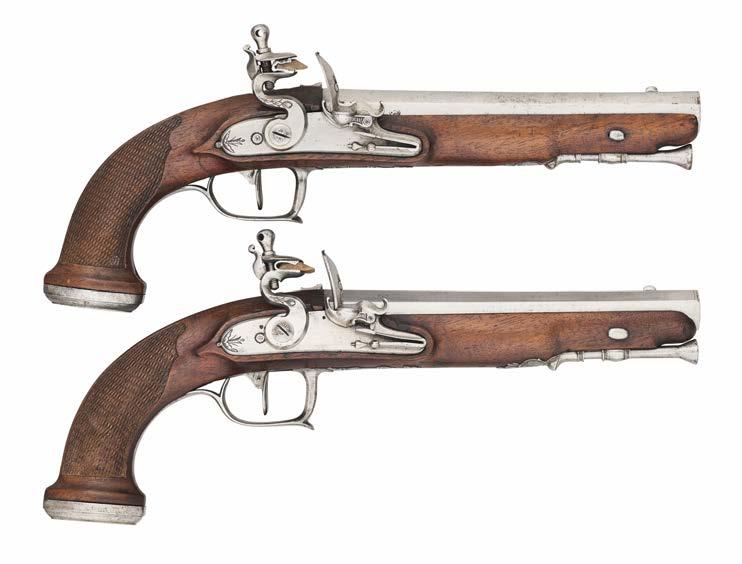
A PAIR OF LIÈGE 14 BORE FLINTLOCK OFFICER’S PISTOLS, UNSIGNED, EARLY 19TH CENTURY
the octagonal sighted barrels each with punched decoration retaining traces of gilding around the muz zle and breech, the top flats each struck with gilt fleur-de-lys mark, and with Liège proof mark on the right flats, border engraved tangs each with back-sight, flat bevelled locks and cocks lightly engraved with foliage, figured full stocks each chequered on both sides of the butt, foliate engraved steel mounts comprising side-nail plates, stepped ovoidal pommel-caps each decorated with a flower-head, triggerguards each with foliate finial, turned slotted ramrod-pipes, and steel ramrods, one probably original, 19.9 cm barrels (2)
Provenance
Robert Brooker Collection, inv. nos. 1699 and 1700
‡ £800-1,000
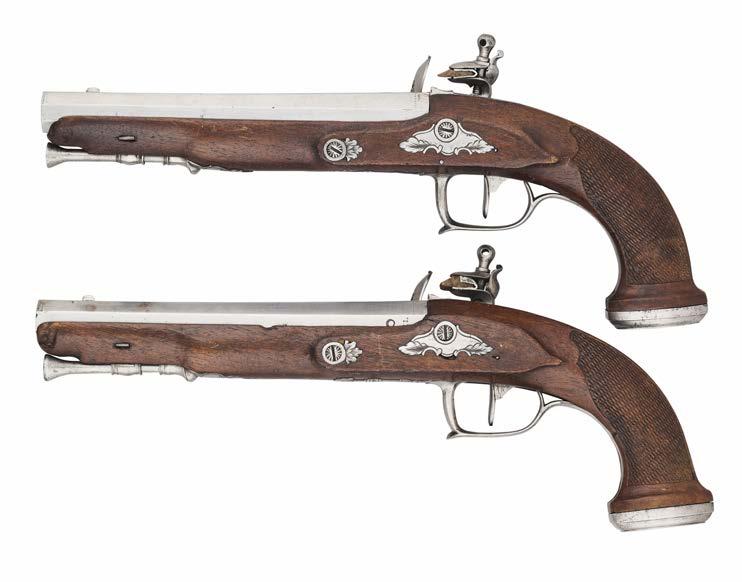
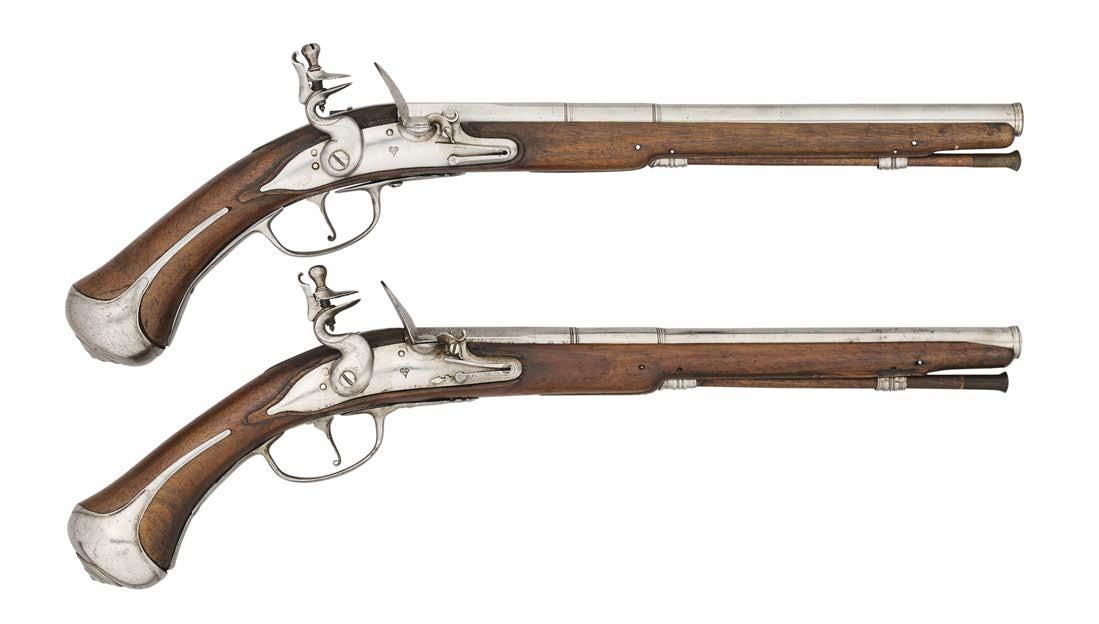
211
A RARE PAIR OF SWISS 45 BORE FLINTLOCK BELT PISTOLS, DATED 1687 with bright three-stage barrels each turned at the muzzle, octagonal breeches each struck on the top flat with maker’s mark ‘CM’ above a star in a heart, and with initials ‘IA’, left flats each incised with the date, plain tangs, rounded bright locks each struck with the same heart-shaped maker’s mark, moulded figured full stocks (one fore-end chipped on each side at the muzzle) each with side-flat and apron behind the barrel tang, bright iron mounts comprising spurred pommels each with stepped rounded cap, trigger-guards each with rounded pointed finial, turned ramrod-pipes (one rear terminal missing), slender belt hooks, and later ramrods, 32.3 cm barrels (2)
Provenance
Galerie Fischer, 17 September 1999, lot 275
Robert Brooker Collection, inv. nos. 1434 and 1435
The maker is probably a member of the Meunier family of Geneva. For a similar mark of Jaques Meunier see Neue Støckel 7947. ‡ £1,500-1,800
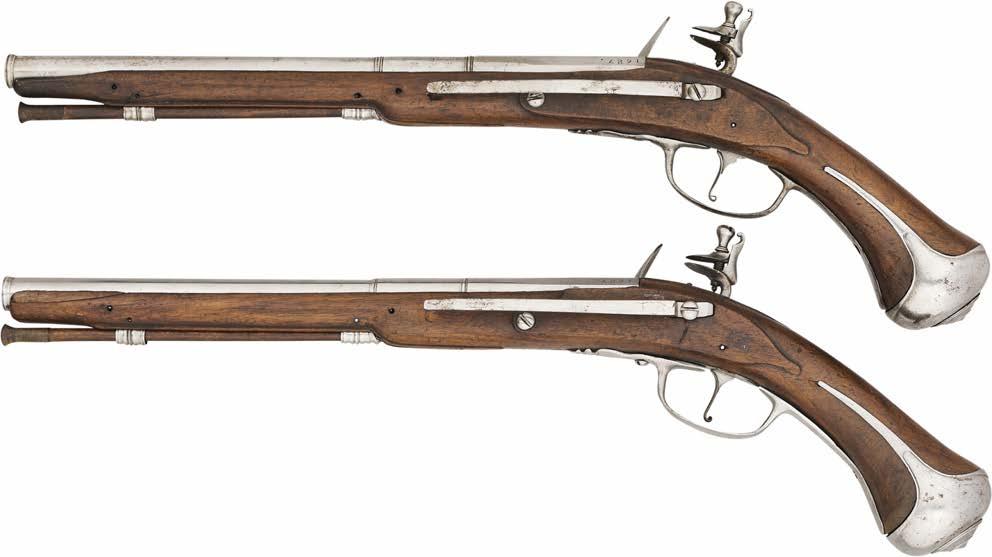
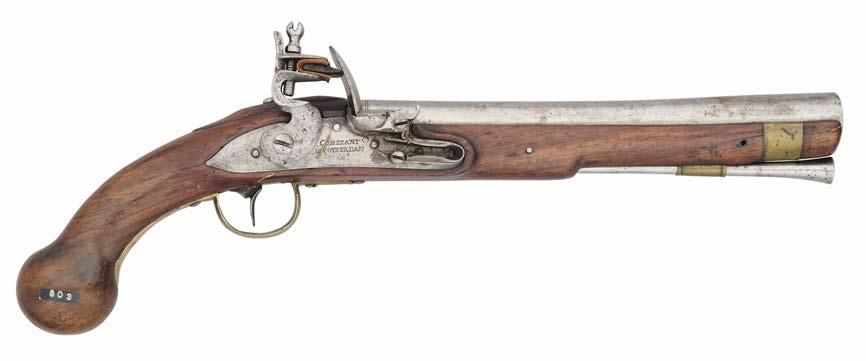
212 A DUTCH FLINTLOCK BLUNDERBUSS BELT-PISTOL BY CONSTANT, ROTTERDAM, LATE 18TH CENTURY the plain barrel with elliptical muzzle, breech struck with a barrelsmith’s mark, signed rounded lock, figured full stock with apron around the barrel tang and swelling pommel, steel belt hook, copper alloy mounts comprising trigger-guard, single ramrod-pipe and fore-end band, and steel ramrod, probably original, 27.0 cm barrel
Provenance
Robert Brooker Collection, inv. no. 803
‡ £800-1,200
213 A EUROPEAN MIQUELET-LOCK BLUNDERBUSSPISTOL, LATE 17TH CENTURY, POSSIBLY SWEDISH with plain long barrel flared at the muzzle, plain tang and characteristic flat lock, figured full stock (fore-end partly replaced) shaped around the lock and side-flat, apron around the barrel tang, iron mounts comprising spurred rounded pommel, trigger-guard with rounded finial, turned ramrodpipes, and wooden ramrod, 34.3 cm barrel
Provenance
Robert Brooker Collection, inv. no. 1759
‡ £500-700
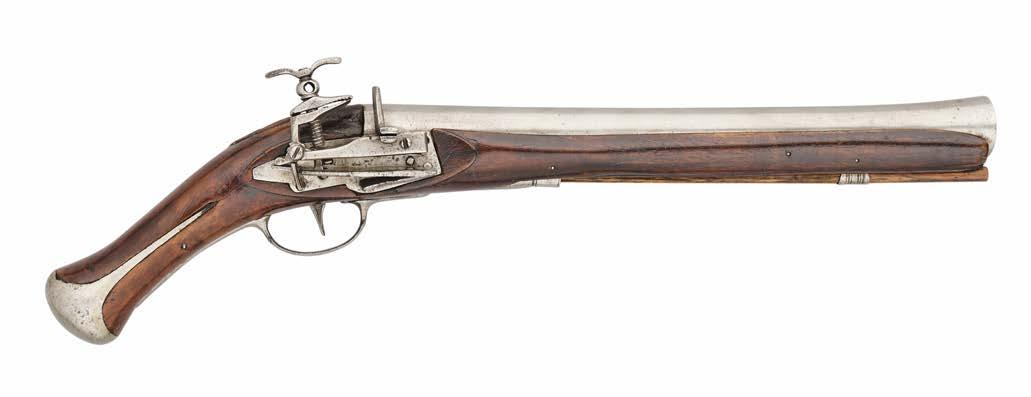
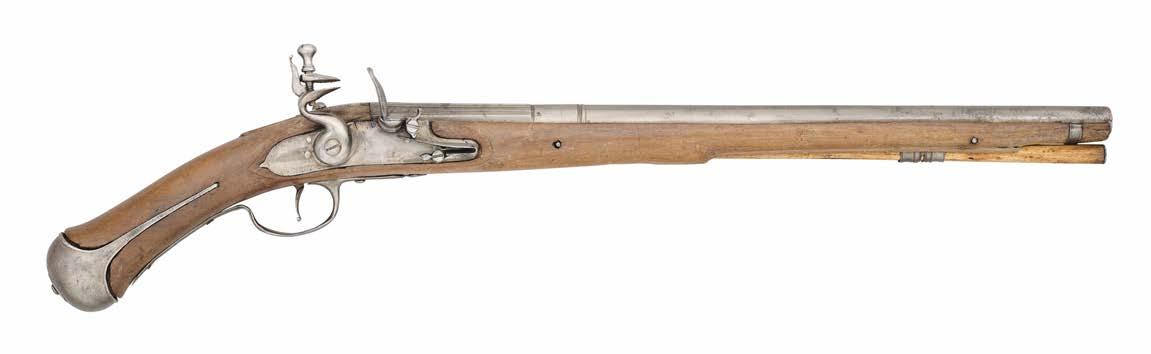
214
A FRENCH 30 BORE FLINTLOCK HOLSTER PISTOL, LATE 17TH CENTURY
with three-stage barrel cut with longitudinal lines along the top of the breech, plain tang and rounded lock, moulded lightly figured full stock with side-flat and apron around the barrel tang, iron mounts comprising side-plate pierced and engraved with foliage involving a bird’s head, spurred pommel with flat circular cap centred on the retaining screw, trigger-guard with shaped pointed finial, single slotted baluster ramrod-pipe, foreend band, and replacement ramrod (some old wear and rust patination overall), 40.8 cm barrel
Provenance
Robert Brooker Collection, inv. no. 1724
‡ £400-600
215
A PAIR OF EUROPEAN 24 BORE FLINTLOCK HOLSTER PISTOLS, EARLY 18TH CENTURY, PROBABLY FRENCH
with bright barrels each with tapering sighting flat to the muzzle, bright tangs and flat bevelled locks, one struck with a crowned fleur-de-lys mark, moulded figured full stocks (foreends mostly replaced) each with foliate terminal behind the barrel tang, bright steel mounts comprising side-plates each pierced and chiselled with foliage centred on a vacant oval, crowned vacant escutcheons, spurred pommels each with slightly domed circular cap, trigger-guards each with foliage finial, ramrod-pipes, and later ramrods (old wear and rust patination overall), 34.5 cm barrels (2)
Provenance
Robert Brooker Collection, inv. nos. 358 and 359
‡ £600-900
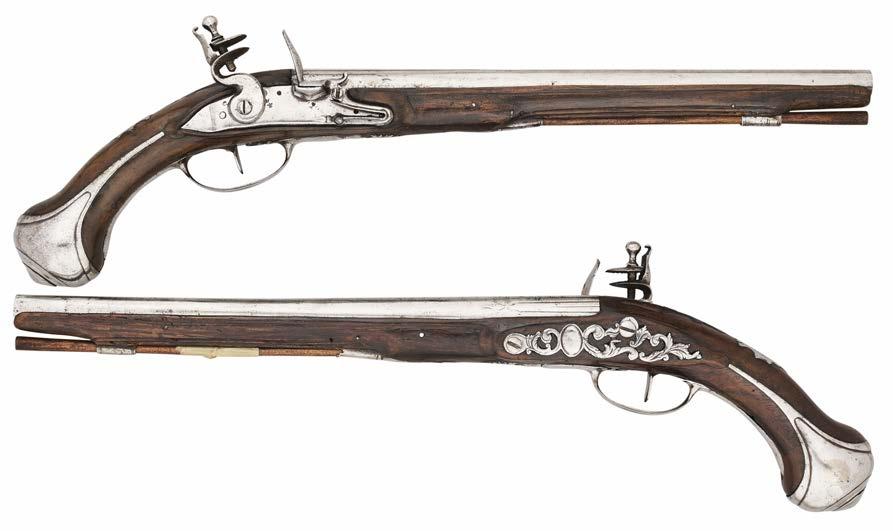
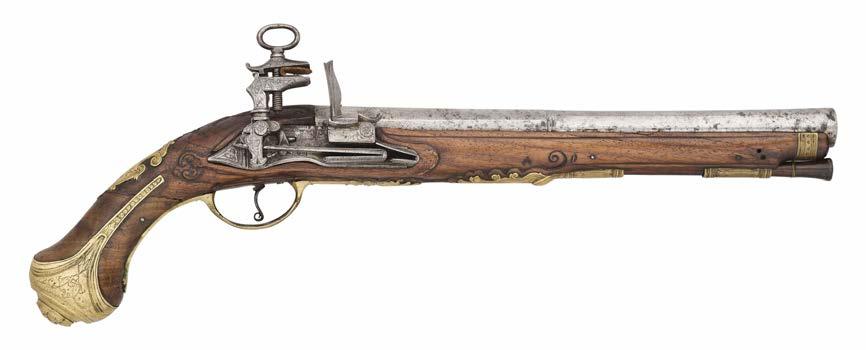
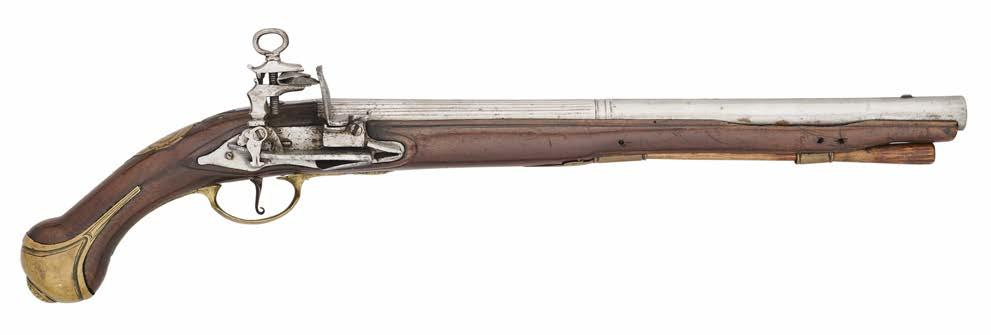
216
AN ITALIAN 14 BORE ROMANLOCK PISTOL, MID-18TH CENTURY
with two-stage barrel (old light pitting) slightly flared towards the muzzle and turned at the girdle, octagonal breech struck with indistinct barrelsmith’s mark and two gilt fleur-de-lys marks, plain tang, border engraved flat bevelled lock lightly decorated with foliage involving two heads in profile, moulded figured full stock (minor chip on one side of the fore-end, butt split through and repaired) carved with foliage behind the barrel tang, lock and side-flat, border engraved copper alloy mounts decorated with foliage and comprising pierced side-plate (repaired), pierced escutcheon engraved with a bust of a warrior, spurred pommel with grotesque mask cap, trigger-guard with foliate finial, turned baluster ramrodpipes, fore-end band, and original horn-tipped ramrod, 29.2 cm barrel
Provenance
Robert Brooker Collection, inv. no. 740 ‡ £500-700
217
AN ITALIAN 25 BORE ROMANLOCK PISTOL, MID-18TH CENTURY with long two-stage barrel turned at the girdle and cut with a slender line to the muzzle and carrying the fore-sight, breech cut with longitudinal lines, plain tang and characteristic flat lock, moulded figured full stock (slightly incomplete along one side of the fore-end) carved with foliage behind the barrel tang, border engraved copper alloy mounts comprising side-plate, escutcheon with owner’s coat-of-arms, spurred pommel with domed cap engraved as a flowerhead, trigger-guard with foliate finial, faceted ramrod-pipes, and later wooden ramrod, 34.4 cm barrel
Provenance
Robert Brooker Collection
‡ £300-400
218
AN ITALIAN 25 BORE FLINTLOCK PISTOL SIGNED LAZARO LAZARINO, MID-18TH CENTURY with two-stage sighted barrel, breech cut with longitudinal ribs, signed along the top flat and struck with a mark on the left side, plain tang, signed rounded lock, moulded figured full stock (some old splits and chips) carved with foliage behind the barrel tang and rear ramrod-pipe, copper alloy mounts comprising flat bevelled side-plate, spurred pommel with flat ovoidal cap, trigger-guard with pointed finial, turned ramrod-pipes, and later wooden ramrod (barrel and lock with some old rust patination), 24.6 cm barrel
Provenance
Robert Brooker Collection, inv. no. 786
‡ £350-450
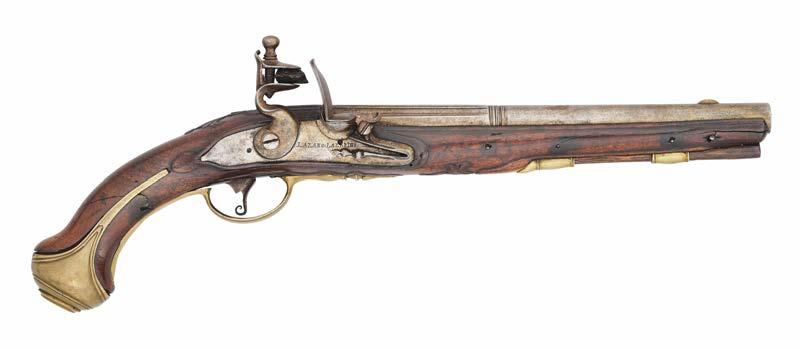

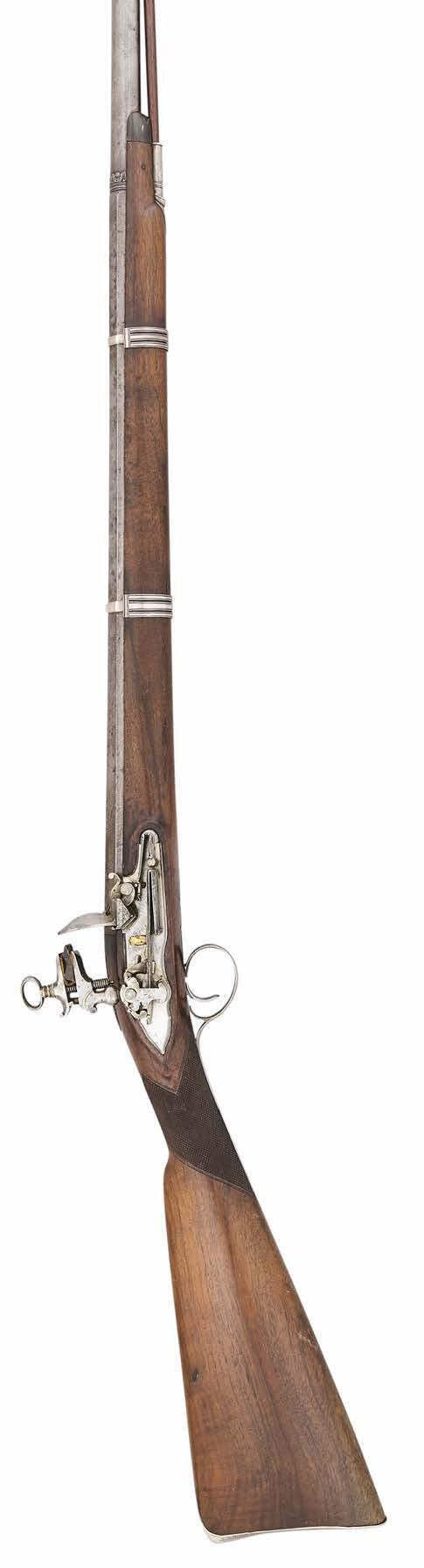
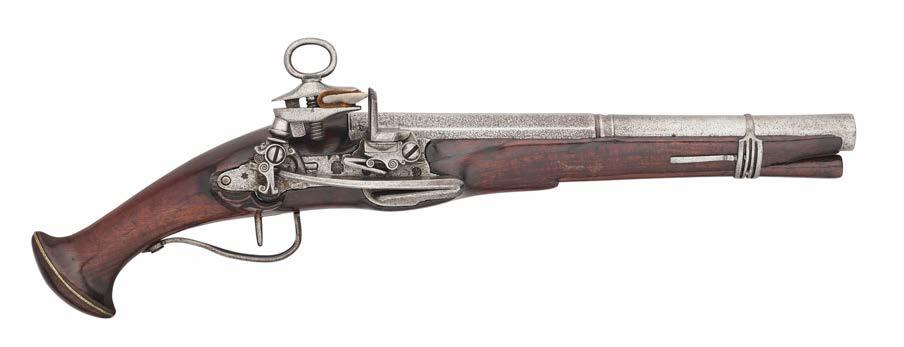
220
A RARE 20 BORE EARLY SPANISH MIQUELET-LOCK
BELT PISTOL, DATED 1660
with swamped barrel formed in two stages and retained by a single pierced steel band retained by a sprung catch, octagonal breech struck with a series of decorative marks and the barrelsmith's mark, a cross moline in a shaped recess, borderengraved tang, patilla lock struck with the barrelsmith's mark and a further decorative star mark, stamped 'Ano 1660' on the inside, the cock, steel and spring bridles all decorated with filed scrolls, the steel engraved with a double eagle charged with the letters 'Po. Pieres' on the front, and inscribed 'Sotomajor' at the base (the mainspring associated), full stock carved with a pronounced raised moulding behind the lock (small chips and cracks), elliptical butt of North European form bound with a slender brass band, steel mounts comprising pierced belt-hook, trigger-guard formed en suite (the steel parts with light pitting throughout), and original wooden ramrod with steel worm, 27.2 cm barrel
Provenance
Mark Dinely
William Keith Neal
James D. Lavin PhD, sold in this room 5 December 2012, lot 325
Robert Brooker Collection, inv. no. 134
Literature
W. Keith Neal, Spanish Guns and Pistols, London 1955, p. 25, illus. 48, 51-2
James D. Lavin PhD, A History of Spanish Firearms, London 1965, pp. 190-1 Sotomayor is a town in the Portevedra province of Galicia, Spain. ‡ £1,000-1,500
221
A SPANISH COLONIAL 12 BORE MIQUELET-LOCK CAVALRY BELT PISTOL, REIGN
OF CHARLES IV (1788-1808)
with two-stage barrel retained by a spring-held copper alloy barrel band, octagonal breech engraved ‘REGIM TO DE CABALL DE SANTIAGO’ along the top flat and with indistinct copper-lined barrelsmith’s mark at the rear in front of the plain tang, plain flat lock incised with a ‘V’ and with pan made in one with a plate enclosing the steel-spring, figured full stock with spliced fore-end and apron around the barrel tang, copper alloy mounts comprising flat side-plate (belt hook missing), escutcheon engraved with Spanish royal arms between lion supporters, spurred pommel with cap, trigger-guard, turned ramrod-pipe, fore-end band, and steel ramrod (some pitting), 32.0 cm barrel
Provenance
Robert Brooker Collection, inv. no. 1387 ‡ £400-500
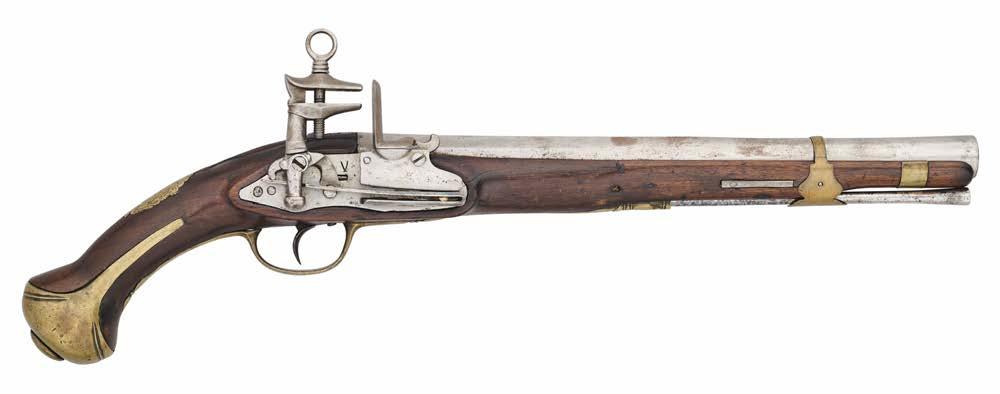
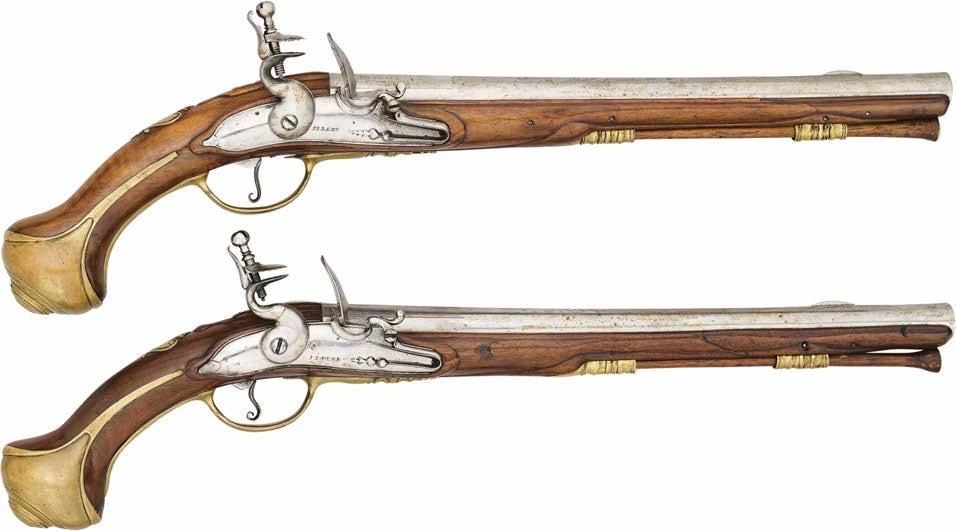
TWO EUROPEAN 16 BORE FLINTLOCK HOLSTER PISTOLS ALMOST FORMING A PAIR SIGNED I.I. BEHR FOR JOHAN JACOB BEHR OF WURZBURG, MAASTRICHT AND LIÈGE, CIRCA 1705
with bright slightly swamped sighted barrels each with tapering sighting flat, one engraved ‘I.I. BEHR’, grooved tangs, bright signed locks each with narrow moulded border (one cock repaired), moulded figured full stocks (one fore-end partly replaced, the other repaired) each with drop-shaped apron around the barrel tang, copper alloy mounts comprising characteristically shaped rounded side-plates, crowned vacant shield-shaped escutcheons, spurred pommels each with graduated ovoidal cap, trigger-guards each with reeded bow and foliate finial, baluster ramrod-pipes, and wooden ramrods each with copper alloy cap, both pistols in unusually fine condition, 34.5 cm and 35.5 cm barrels (2)
Provenance
Henk L. Visser Collection, sold Bonhams Knightsbridge, 28 November 2007, lot 349
Robert Brooker Collection, inv. nos. 682 and 683
Literature
G. de Vries and B.J. Martens, The Visser Collection, vol. I, part 4, cat. no. 877, pp. 450-451
These are two of the set of eight such pistols described and illustrated by J.P. Puype, The Visser Collection, vol. I, part 2, cat. no. 314, pp. 188-193.
The maker, whose signature is rendered in a variety of forms, came from Bavaria to Maastricht and Liège after 1700.
‡ £2,500-3,500
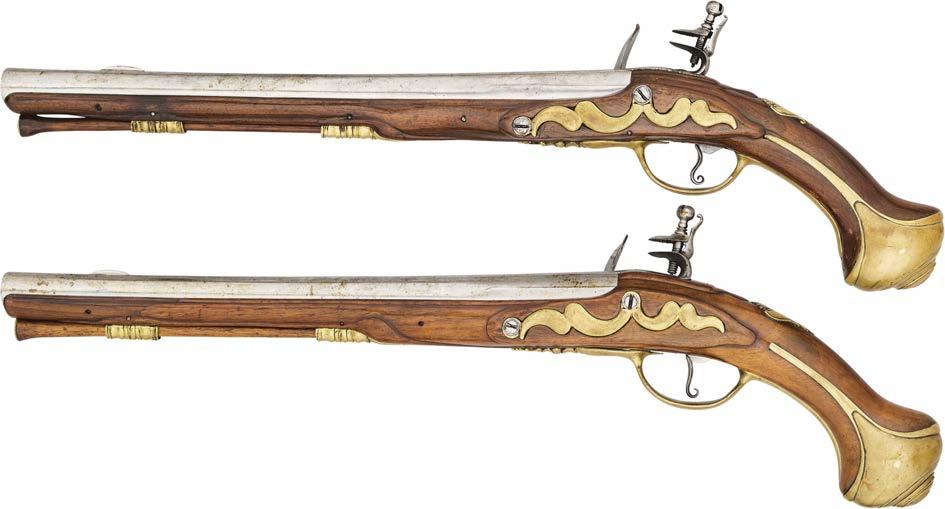
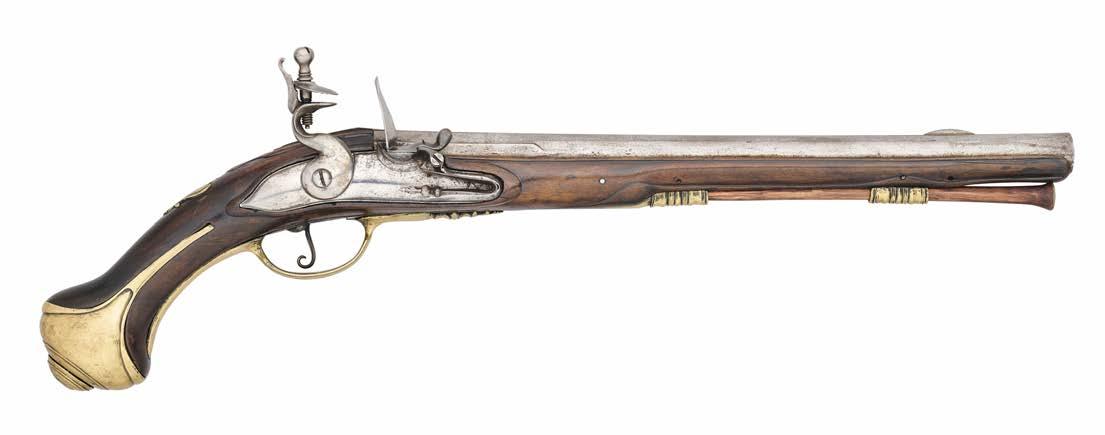
A EUROPEAN 15 BORE FLINTLOCK HOLSTER PISTOL, UNSIGNED BUT ALMOST CERTAINLY BY JOHAN JABOB BEHR BEHR OF WURZBURG, MAASTRICHT AND LIÈGE, CIRCA 1705
with slightly swamped sighted barrel with tapering sighting flat, grooved tang, bright rounded lock with narrow moulded border, moulded figured full stock with drop-shaped apron around the barrel tang, copper alloy mounts comprising characteristically shaped rounded side-plate, crowned vacant shield-shaped escutcheon, spurred pommel with graduated ovoidal cap, trigger-guard with reeded bow and foliate finial, baluster ramrod-pipes, and replacement ramrod with copper alloy cap, 36.2 cm barrel
Provenance
Robert Brooker Collection, inv. no. 693
This is possibly one of the set of eight such pistols described and illustrated by J.P. Puype, The Visser Collection, vol. I, part 2, cat. no. 314, pp. 188-193. See footnote to lot 222.
‡ £1,000-1,500
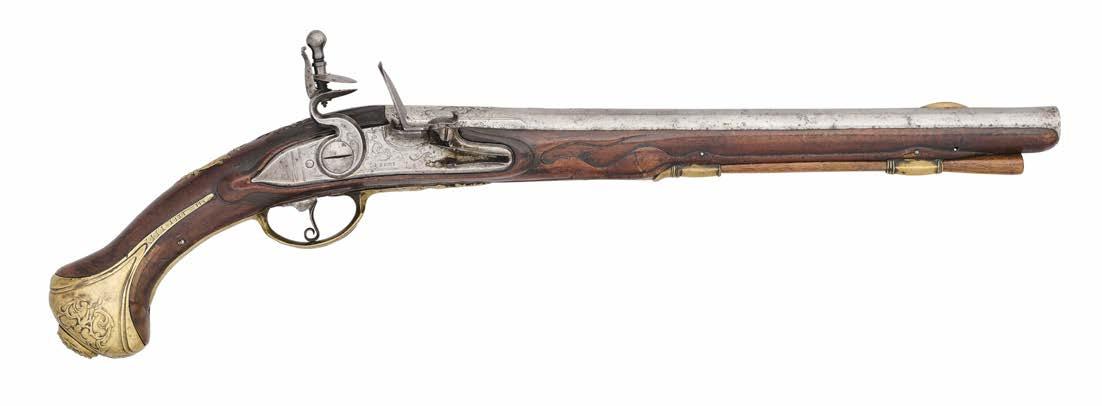
224
A EUROPEAN 16 BORE FLINTLOCK HOLSTER PISTOL
BY I.I. BEHR OF WURZBURG, MAASTRICHT
AND LIÈGE, EARLY 18TH CENTURY
the slightly swamped sighted barrel with tapering sighting flat over most of its length chiselled with a foliate terminal at the breech, the latter engraved with foliage and chiselled with a finial en suite, a chiselled human mask between engraved foliage beyond, grooved tang partly engraved with foliage, border engraved signed bevelled lock decorated with foliate scrollwork, cock en suite, moulded figured full stock carved with foliage behind the barrel tang, cast and chased copper alloy mounts comprising pierced foliate side-plate involving a ‘Wildman’ mask, crowned foliate escutcheon engraved with owner’s coat-ofarms, a grotesque mask below, spurred pommel decorated with a figure amid foliage on both sides, trigger-guard with a Classical portrait bust between foliage and a grotesque mask behind the foliate finial, turned faceted ramrod-pipes, and later wooden ramrod (some old wear and light rust patination), 35.5 cm barrel
Provenance
Robert Brooker Collection, inv. no. 1061
The maker, whose signature is rendered in a variety of forms, came from Bavaria to Maastricht and Liège after 1700.
‡ £600-900
225
A EUROPEAN 13 BORE FLINTLOCK HOLSTER PISTOL, EARLY 18TH CENTURY
the three-stage barrel (fore-sight missing) with octagonal breech becoming polygonal, plain tang and border engraved rounded lock (top of cock replaced), moulded figured full stock with staghorn fore-end cap and carved with foliage behind the barrel tang and rear ramrod-pipe, steel mounts comprising rounded scroll side-plate, shaped vacant escutcheon, spurred pommel with shallow rounded cap centred on the retaining screw, trigger-guard with pointed rounded finial, baluster ramrod-pipes, and later wooden ramrod (old wear and light pitting), 35.7 cm barrel
Provenance
Robert Brooker Collection, inv. no. 618
‡ £400-500
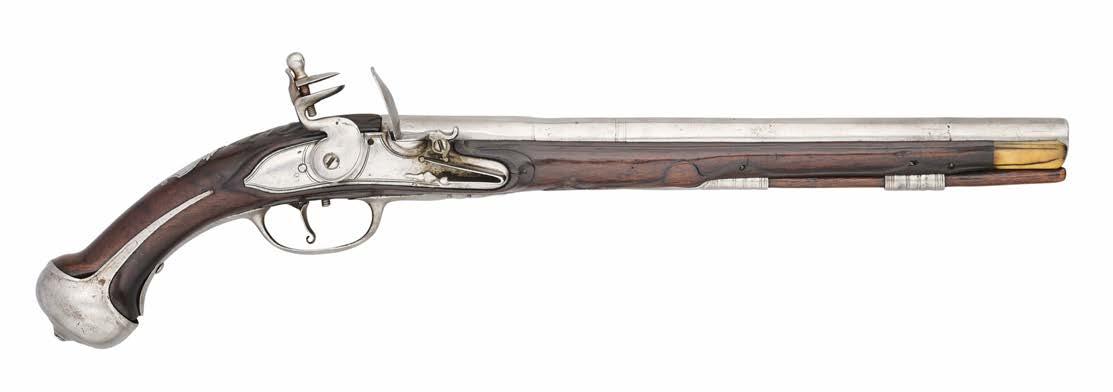
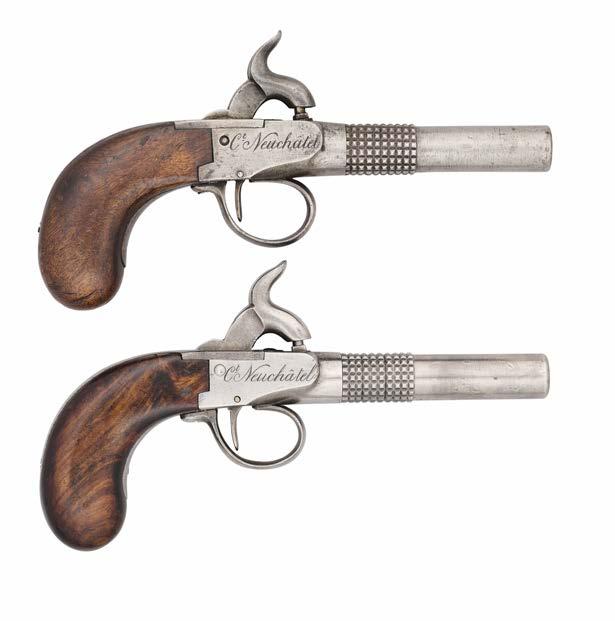
TWO RARE SWISS 50 BORE PERCUSSION MODEL 1851 SUPERIMPOSED-LOAD BOX-LOCK POLICE PISTOLS, NOS. 25 AND 74, MID-19TH CENTURY
with turn-off barrels each deeply chequered at the breech, one struck with Swiss proof marks, actions each numbered on one side and engraved ‘Ct. Neuchatel’ on the other, double hammers formed in one, trigger-guards, and figured rounded butts, 9.0 cm barrels (2)
Provenance
Robert Brooker Collection, inv. nos. 897 and 1422
Originally supplied with longer interchangeable barrels to form a baton.
‡ £1,000-1,500
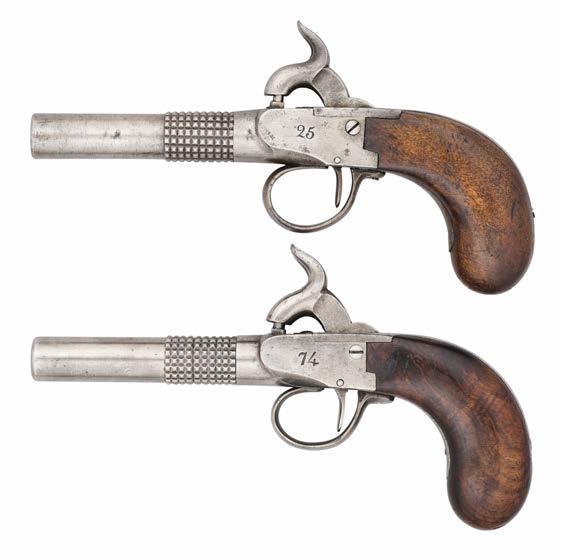
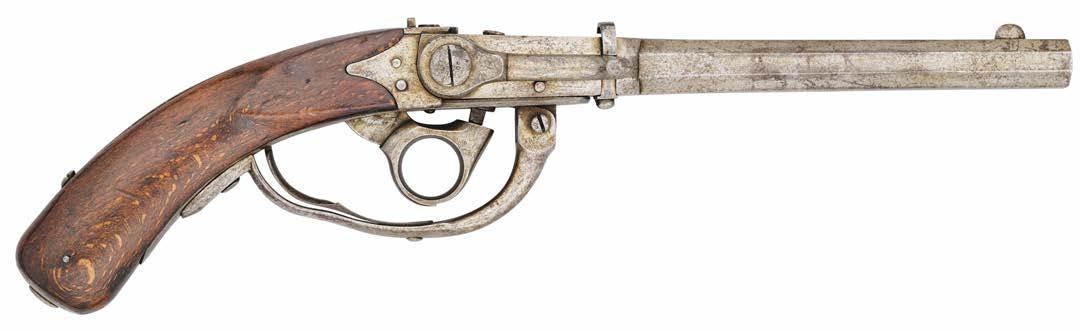
227
A RARE DANISH 16 BORE PERCUSSION LOBNITZ PATENT MODEL 1841 BREECH-LOADING MILITARY PISTOL, NO. B-104, DATED 1842
with tip-up octagonal sighted barrel rifled with six grooves and released by a pivoting lever on the right secured by a spring-clip, the breech stamped ‘GHRE: 95’ on the left flat, long slender tang , box-lock action stamped with the model dates and serial number on the left side, ring-trigger and under-hammer operated by a spring-release catch on the inside of the trigger-guard, figured butt of flattened ovoidal section numbered ‘119’ on one side and with steel butt-cap, and match serial numbers throughout, 21.0 cm barrel
Provenance
Robert Brooker Collection, inv. no. 1148
N.J. Lobnitz patented his breech-loading system in 1833. For another example (no. B-154) see Bonhams Knightsbridge, 1 April 2004, lot 54. ‡ £2,000-3,000
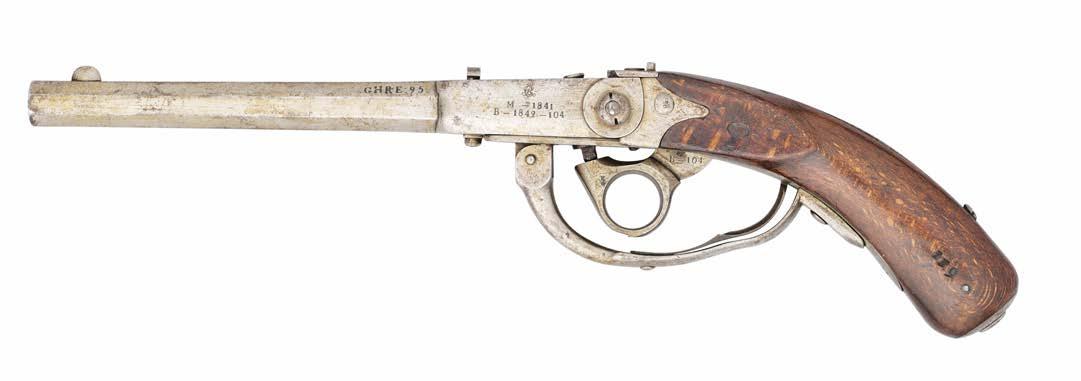
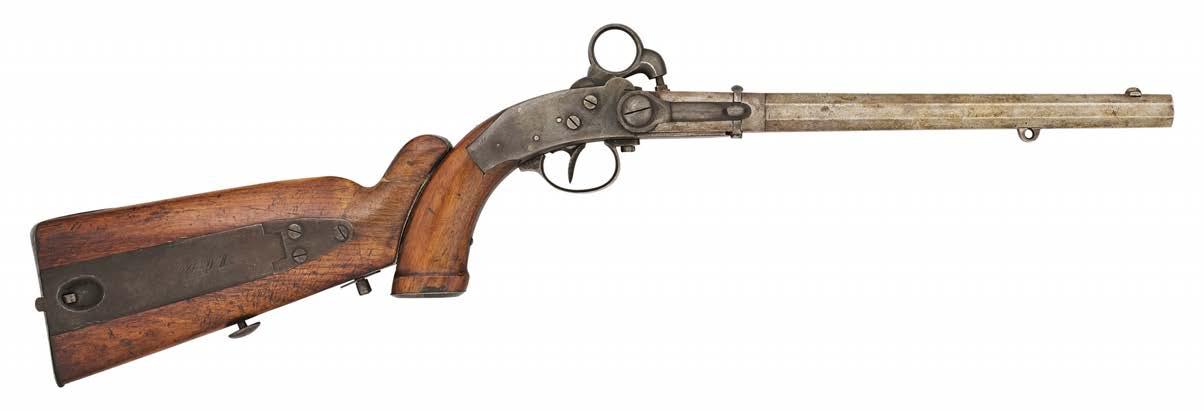
A RARE DANISH LOBNITZ PATENT 22 BORE PERCUSSION MODEL 1842 BREECH-LOADING MILITARY PISTOL CARBINE WITH SHOULDER-STOCK, REIGN OF FREDERICK VII (1848-1861), NO. H.G. 120, DATED 1853 with sighted octagonal rifled barrel released by a pivoting lever on the right side secured by a spring-clip (broken), the bottom flat stamped ‘I. SAUERB’, the breech with crowned ‘RVII’ cypher, case-hardened action dated behind the back-sight, ring-hammer, figured butt, case-hardened mounts comprising bevelled pommel-cap and trigger-guard, the back of the butt with aperture for the figured detachable shoulder-stock (old repair), the latter with hinged rec tangular patch-cox cover engraved ‘H.G. 120’ and with recessed spring catch, and retaining some of its finish, 29 cm barrel (2)
Provenance
Robert Brooker Collection, inv. no. 1152 and 1153
N.J. Lobnitz patented his breech-loading system in 1833. ‡ £2,000-3,000
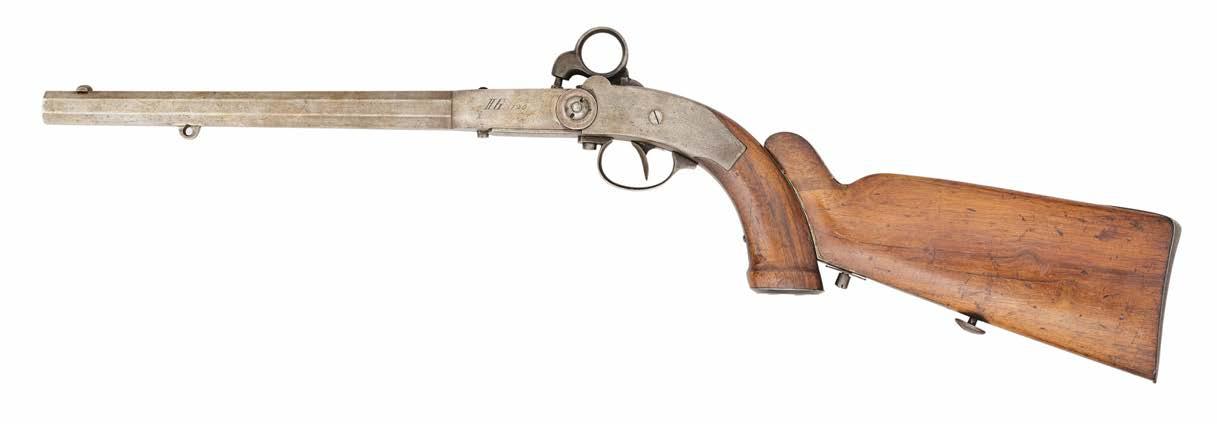
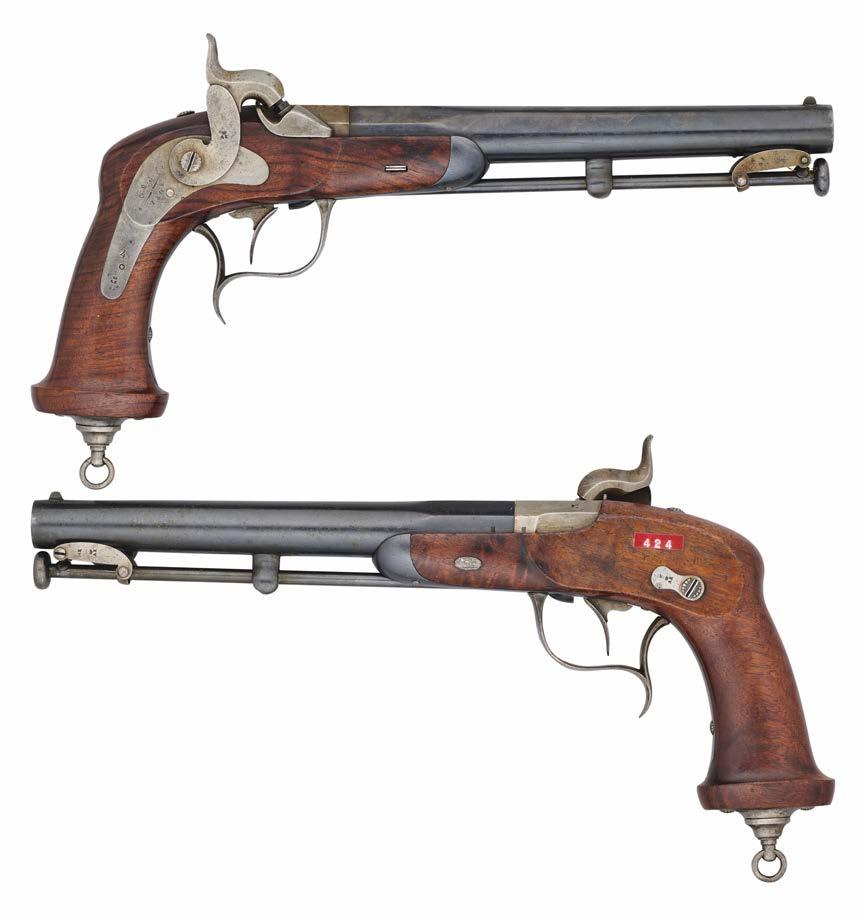
A PAIR OF RUSSIAN 14 BORE PERCUSSION DELVIGNE SYSTEM MODEL 1848 OFFICER’S PISTOLS WITH ANGLED BUTTS, NO. C.O. 3, DATED 1848, REIGN OF NICHOLAS I (1825-1855), PERHAPS FOR THE IMPERIAL GUARD with blued sighted rifled barrels, serial numbered case-hardened breeches, tangs each engraved with a crowned ‘A’, dated and serial numbered back-action locks each stamped with inspector’s marks and numbered respectively ‘3’ and ‘4’, figured half-stocks each with ovoidal pommel, the latter with threaded swivelling lanyard ring, spur trigger-guards and blued fore-end mounts each pierced to accommodate the stirrup ramrod, stamped with crowned ‘AR’ inspec tor’s mark throughout, and in fine condition retaining much of their finish, 20.8 cm barrels (2)
Provenance
G. Martin, 1973
Robert Brooker Collection, inv. nos. 424 and 425 ‡ £3,000-4,000
A RARE COLT HARTFORD-ENGLISH DRAGOON PERCUSSION REVOLVER, NO. 566 FOR 1853 with sighted barrel with New York City address along the top of the breech, and struck with London proof marks on the left flat, cylinder with roll engraved Texas Ranger and Indian scene, and with ‘U.S.M.R.’ and ‘COLT’S PATENT’, each framed
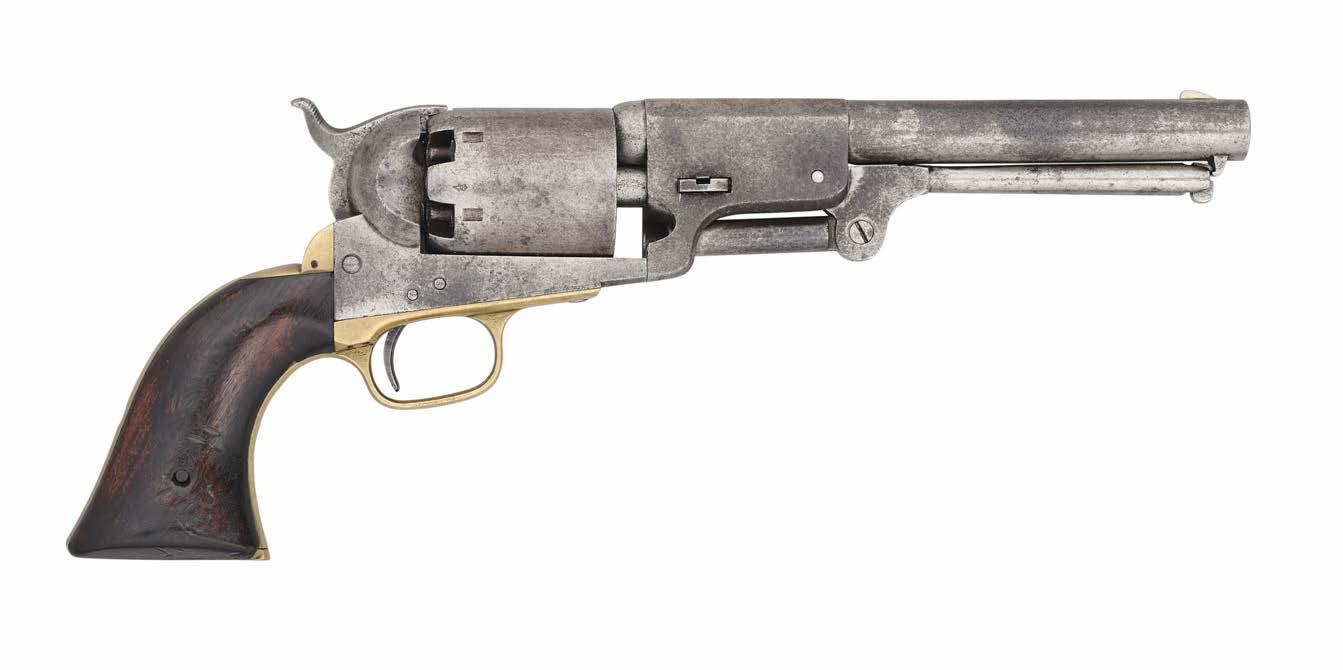

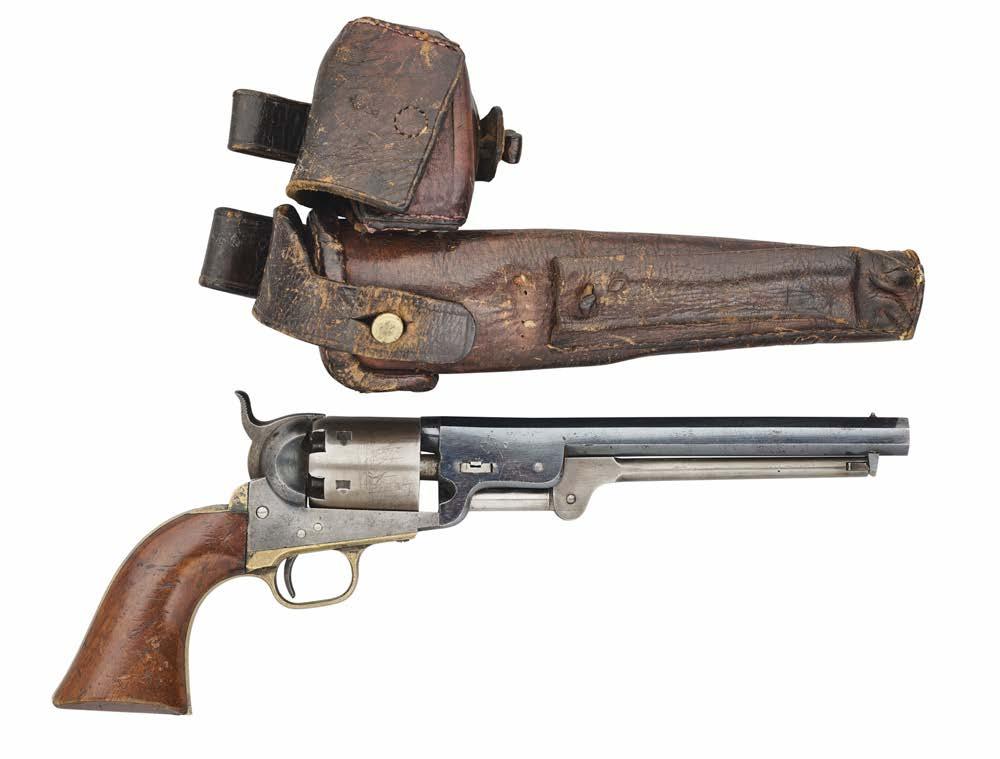
A PRUSSIAN SYSTEM COLT PERCUSSION REVOLVER OF NAVY MODEL 1851 TYPE, NO. 37655 FOR CIRCA 1855 with blued octagonal sighted barrel engraved ‘SYSTEM COLT’ along the top flat, cylinder with roll engraved naval engagement scene, case-hardened frame stamped ‘COLT’S PATENT’ on one side, trigger-guard and back-strap retaining some silvering, the latter stamped ‘KM 549’ behind the hammer, rammer, figured rounded grips, matching numbers, and retaining much of its finish: in its rare leather holster with side-pocket for tools and pouch for a spare cylinder (one securing tab missing, the other detached, seam partly open), the latter stamped with crowned ‘KM’ mark, 19.3 cm barrel (2)
Provenance
Robert Brooker Collection, inv. no. 1936A
‡ £1,500-2,000
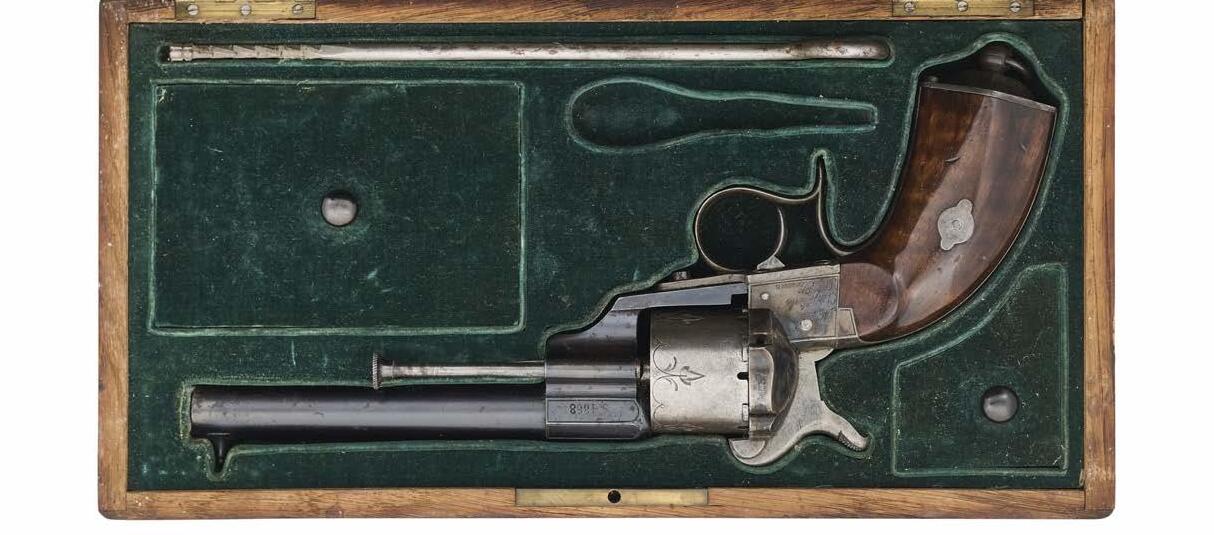
A FINE CASED 60 BORE PIN-FIRE SINGLE-ACTION SIX-SHOT OFFICER’S REVOLVER ENGRAVED MRE IMPALE
DE ST. ETIENNE, NO. 208, DATED 1868 with blued sighted barrel, border engraved part octagonal breech stamped with inspector’s marks on one side and ‘S. 1868’ on the other, cylinder engraved with foliage around the forward edge, case-hardened action lightly decorated with foliage and engraved with manufacturer’s details on one side, hinged loading-gate, cartridge extracting rod, case-hardened spur trigger-guard and butt in one, the former decorated with a rose, the latter with suspension ring, and in fine condition retaining nearly all its finish: in original oak case fitted and lined in green velvet and retaining its cleaning rod (turnscrew missing), the interior of the lid stamped ‘DEVISME A PARIS’ in gilt letters, the exterior with vacant copper alloy escutcheon, 15.5 cm barrel
Provenance
Robert Brooker Collection, inv. no. 282
‡ £800-1,000

VARIOUS OWNERS
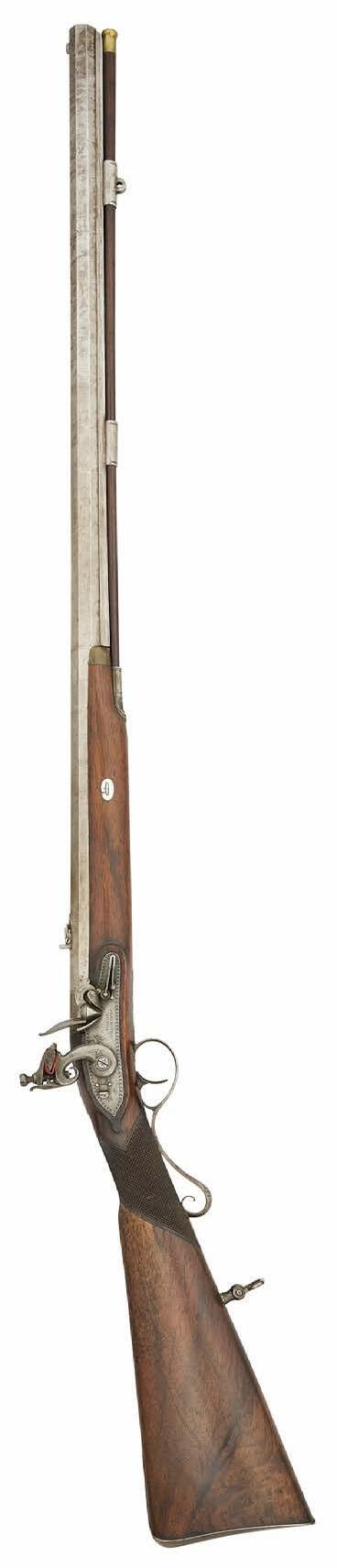
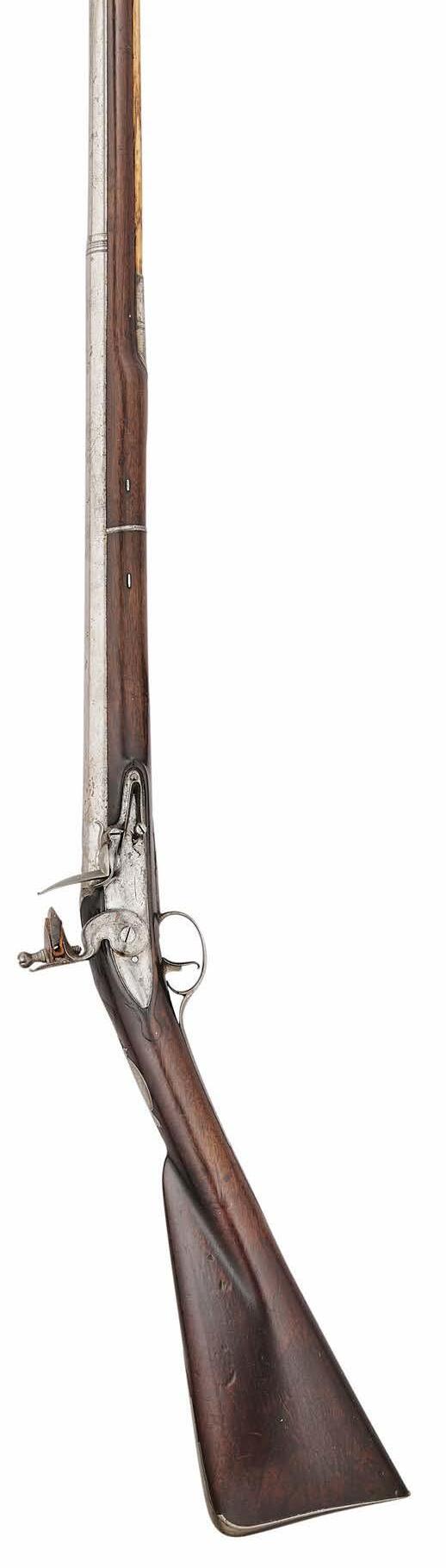


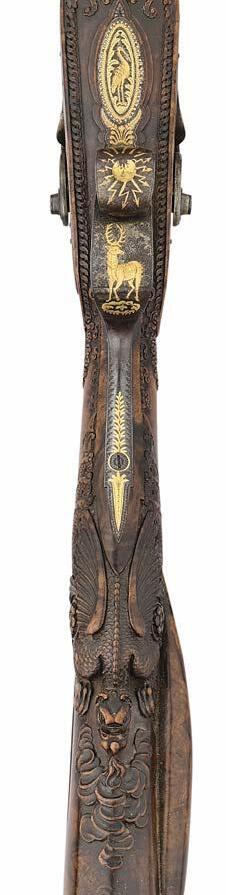

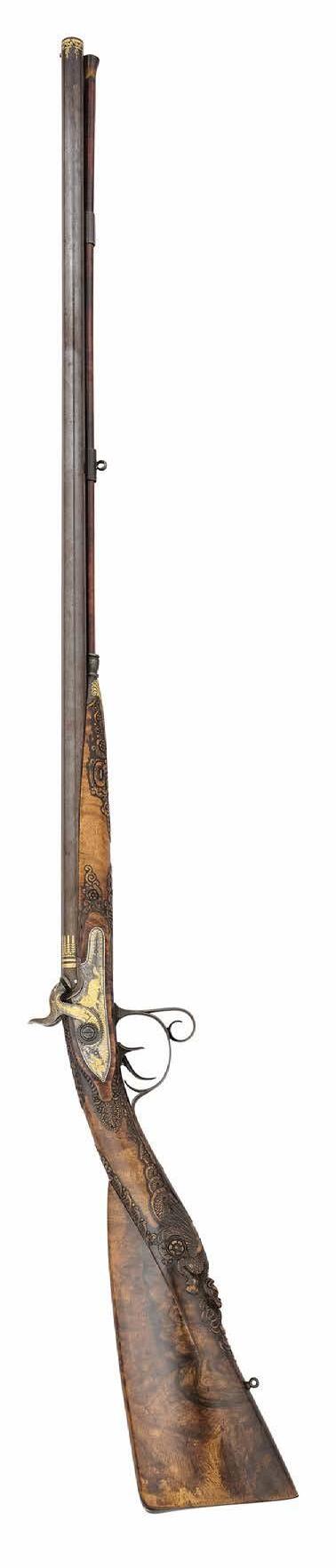
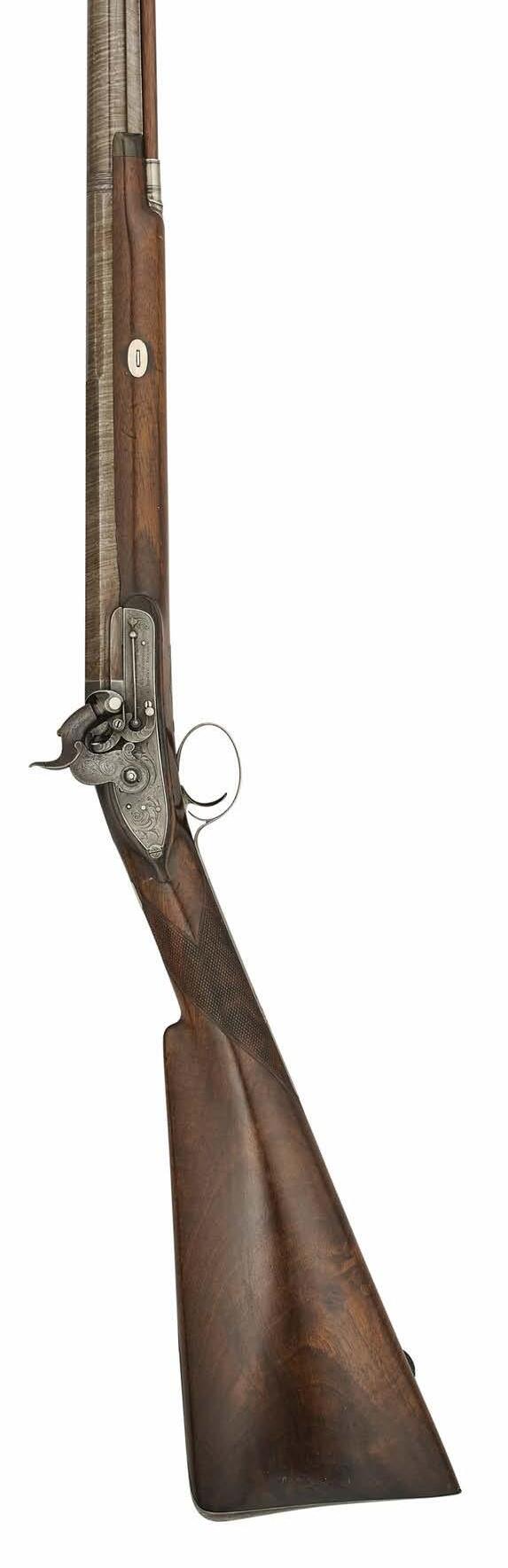

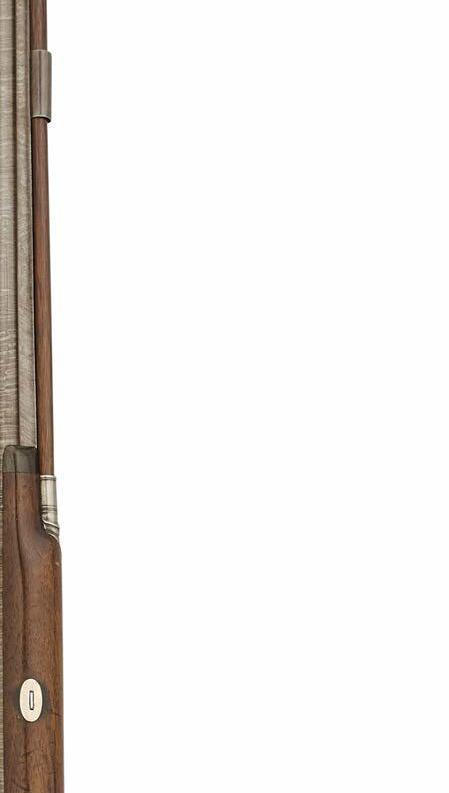
238
A 16 BORE PERCUSSION D.B. SPORTING GUN BY J. HALL OF BIRMINGHAM, CIRCA 1830 with browned twist sighted barrels each engraved with a frond at the breech and struck with Birmingham proof marks beneath, the rib inlaid in gold with an engraved pointer and gamebirds in a landscape, foliate engraved breeches with two gold lines between, foliate engraved tang inhabited by gamebirds, a tiger’s mask at the top, border engraved back-action locks each signed on the tail and decorated with a gundog and gamebirds in a landscape, foliate engraved dolphin hammers, figured half-stock inlaid with an engraved silver gundog behind the chequered grip, border engraved steel mounts decorated with gundogs and gamebirds, and comprising butt-plate and scroll triggerguard, trigger-plate with pineapple finial, silver rear ramrod-pipe en suite, and original copper alloy mounted ramrod with threaded cap over the worm, 75.8 cm barrels £600-800
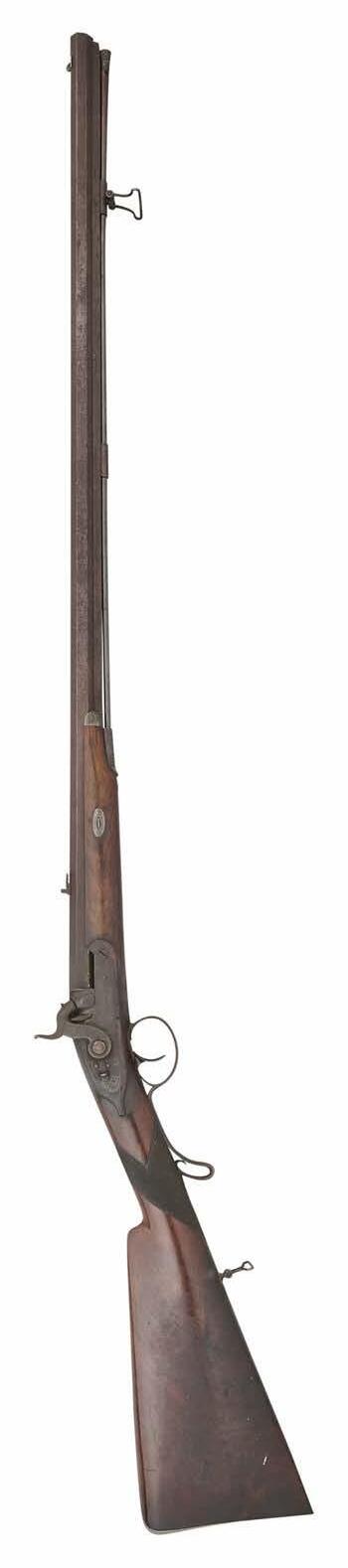

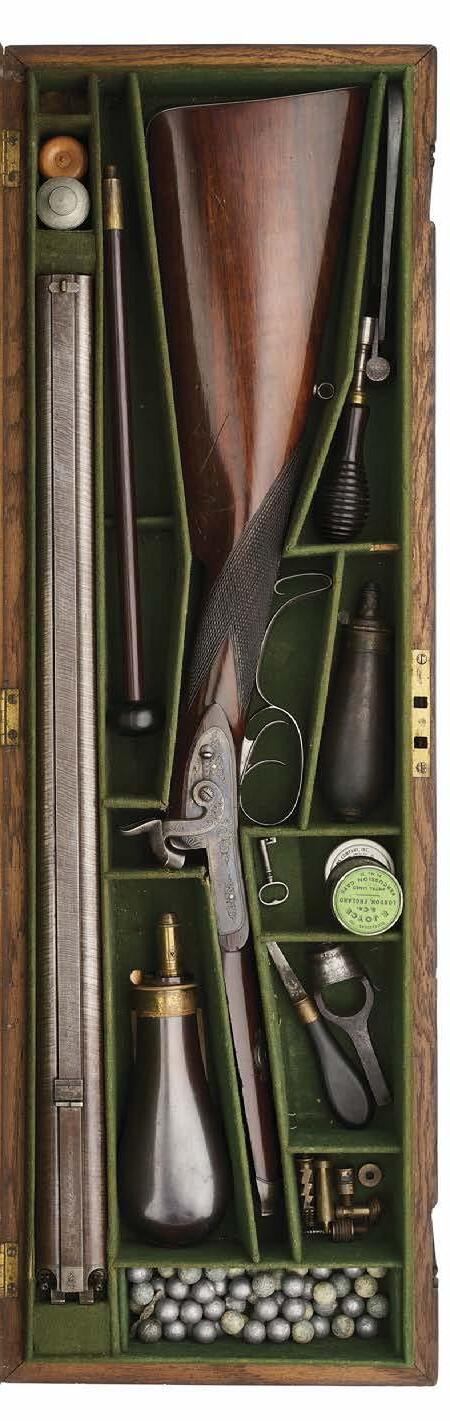
A CASED 30 BORE PERCUSSION SHORT
D.B. SPORTING RIFLE BY JOS.H MANTON & SON, HOLLES STREET, CAVENDISH SQUARE, LONDON, CIRCA 1834 with browned twist leaf-sighted barrels each rifled with seven broad spiral grooves, signed along the top strap and struck with London proof marks beneath, border engraved case-hardened breeches decorated with scrollwork between, foliate scroll engraved case-hardened tang, signed border engraved flat locks and dolphin hammers, engraved safety-catches, figured half-stock (fore-end with minor split beneath the left barrel-bolt escutcheon) with chequered grip, border engraved casehardened mounts decorated with foliate scrollwork including fore-end cap and trigger-guard with chequered spur, vacant silver escutcheon, and copper-alloy mounted ramrod with threaded cap over the worm: in original lined and fitted copperalloy mounted oak case (one compartment divider loose) with some accessories including two powderflasks (one for revolvers and in poor condition), the interior of the lid with maker’s trade label, the exterior with circular vacant copper-alloy escutcheon centred on a circular flush-fitting carrying handle, 55.0 cm barrels
Literature
D.H.L. Back, Great British Gunmakers: The Mantons 1782-1878, 1993, p. 127 £800-1,200
A
FINE
CASED 16 BORE PERCUSSION D.B. SPORTING
GUN WITH ECCENTRICALLY TWIST BARRELS BY PRITCHARD OF BIRMINGHAM, NO. 1098, CIRCA 1835 with browned sighted barrels of alternate eccentrically twist pattern, twist sunken ribs, and struck with Birmingham proof marks on each breech, case-hardened breeches engraved with a scallop shell between double gold lines, long case-hardened tang engraved with scrolling foliage, signed border engraved flat locks each engraved with scrolling foliage, dolphin hammers en suite, the internal working parts retaining their burnished finish, highly figured lacquered half-stock (minor old bruising) with chequered grip, border engraved blued steel mounts decorated with foliate scrollwork and comprising butt-plate, trigger-guard, trigger-plate with pineapple-shaped finial, and rear ramrod-pipe, blued triggers, silver barrel-bolt escutcheons, original steel-tipped ramrod with threaded cap over the worm, and in fine condition retaining virtually all its original finish: in original lined and fitted copper ally mounted mahogany case with accessories including powder-flask with reeded bag-shaped body and retaining its lacquered finish, G. & J.W. Hawksley black leather shot-flask, tubular copper ally powder and shot measure, steel shot-dispenser, nipple-key and turnscrew, patch-cutter and glass oil bottle, the interior of the lid with illustrated trade label of R. Watmough, 13 Blackfriars Street, Manchester, the exterior with circular vacant copper alloy escutcheon, 71.8 cm barrels
Provenance
W. Keith Neal Collection
Christie’s South Kensington, 12 December 1997, lot 87 Bonhams Knightsbridge, 1 December 2009, lot 558
Literature
Richard Akehurst, Game Guns And Rifles: Percussion to Hammerless Ejector in Britain, 2004, pls. 9 and 10
A handwritten note in the case reads: ‘Gun & Case Property of Charles G. Down 1890 J. de Peyster Down April 20/90 Purch.d in Manchester England July 1835’.
£3,000-4,000
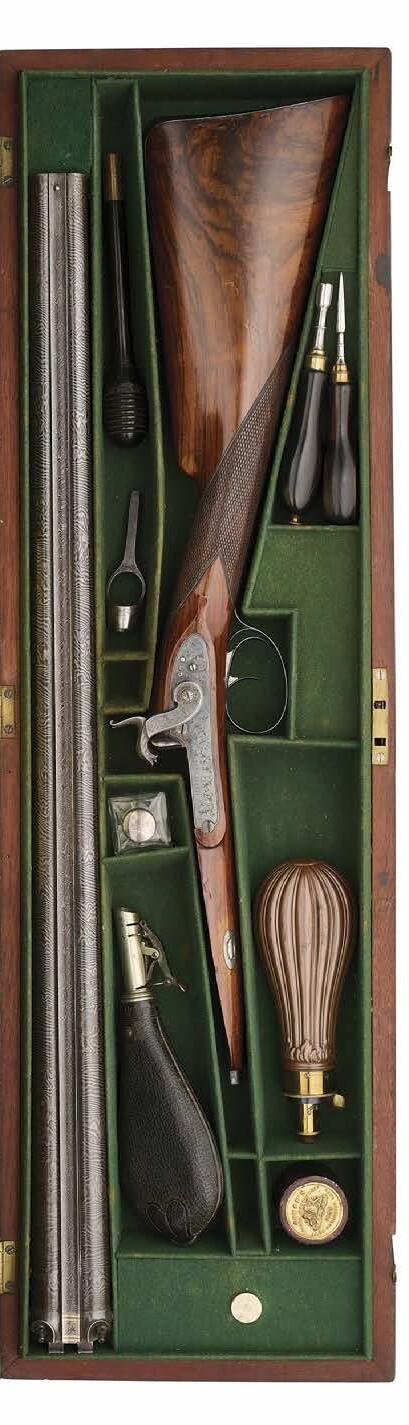
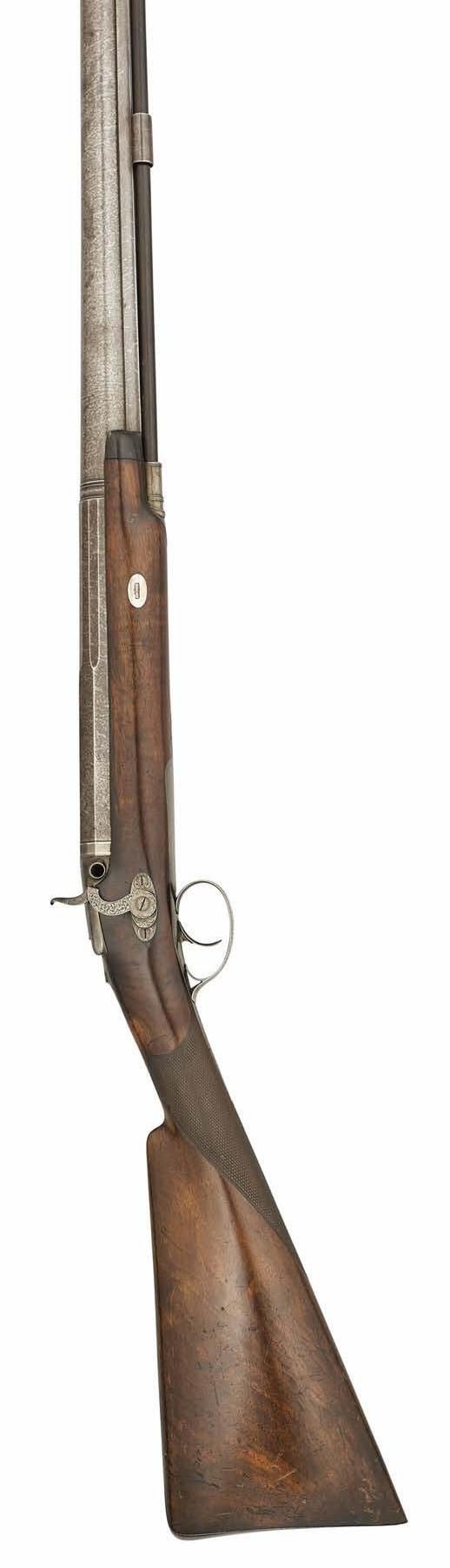

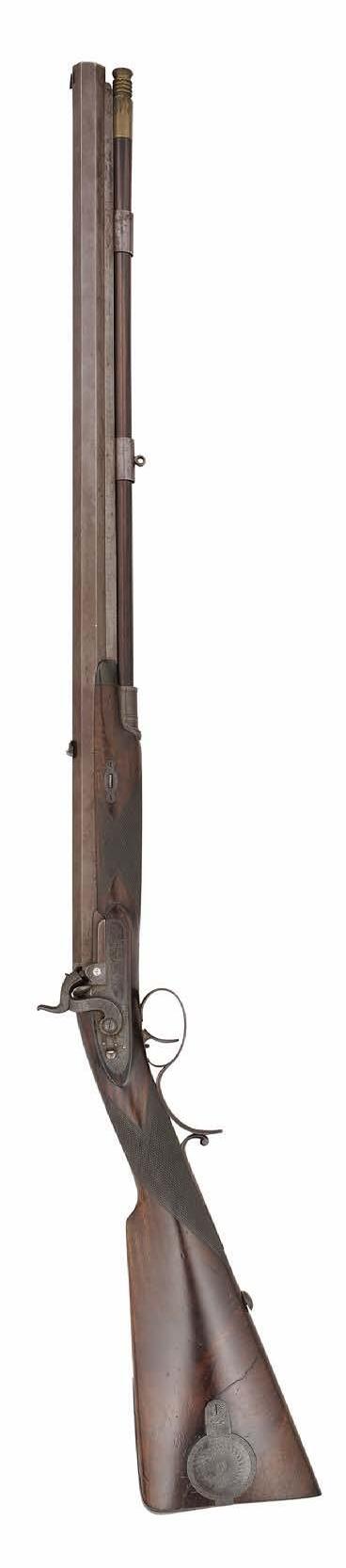
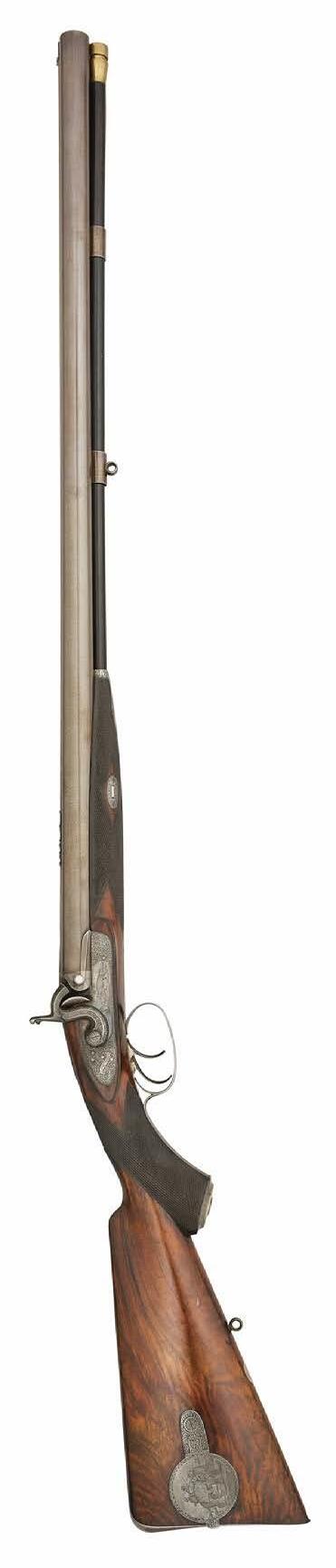


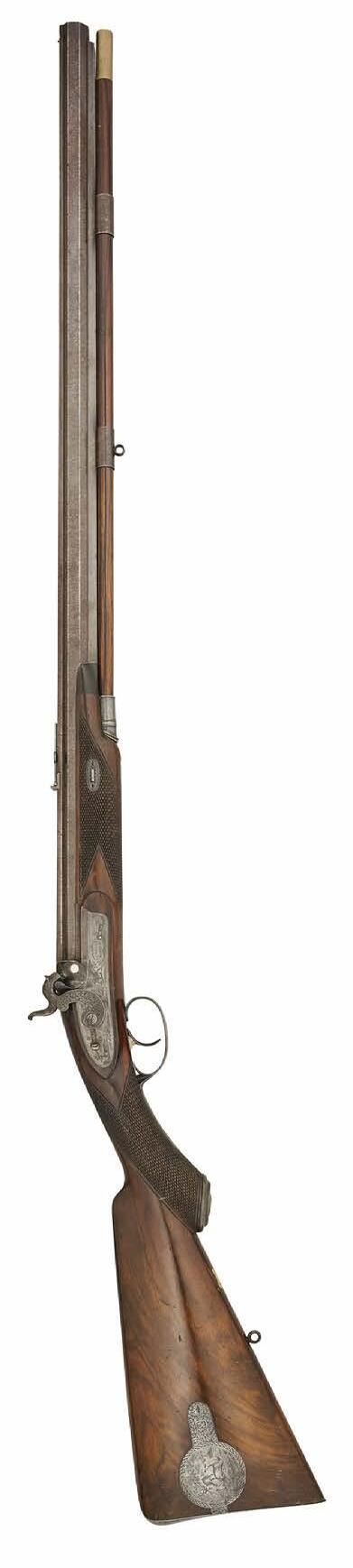
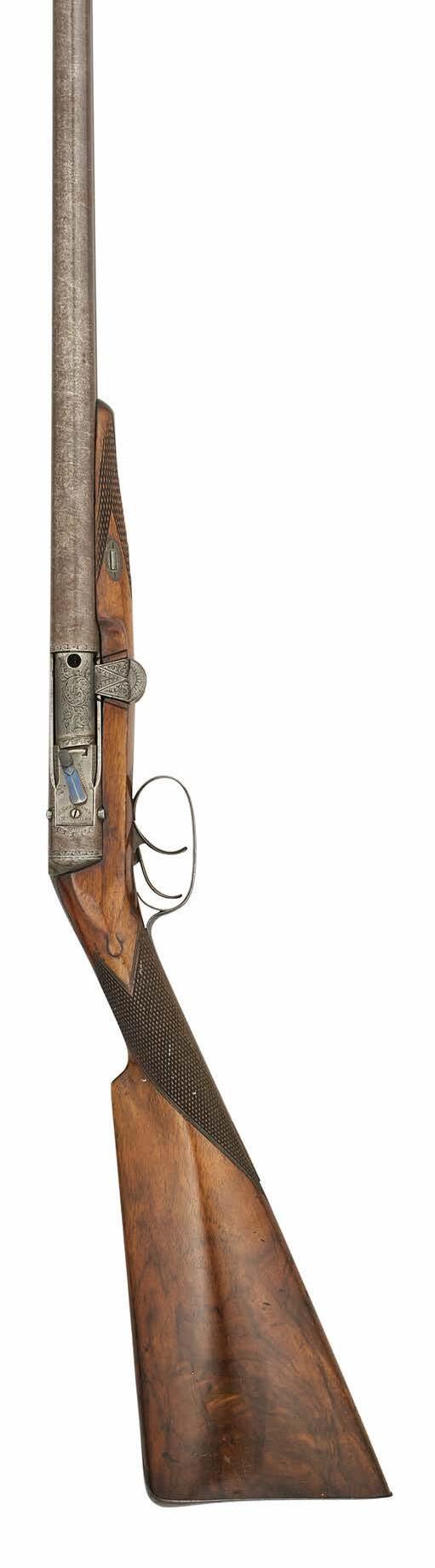

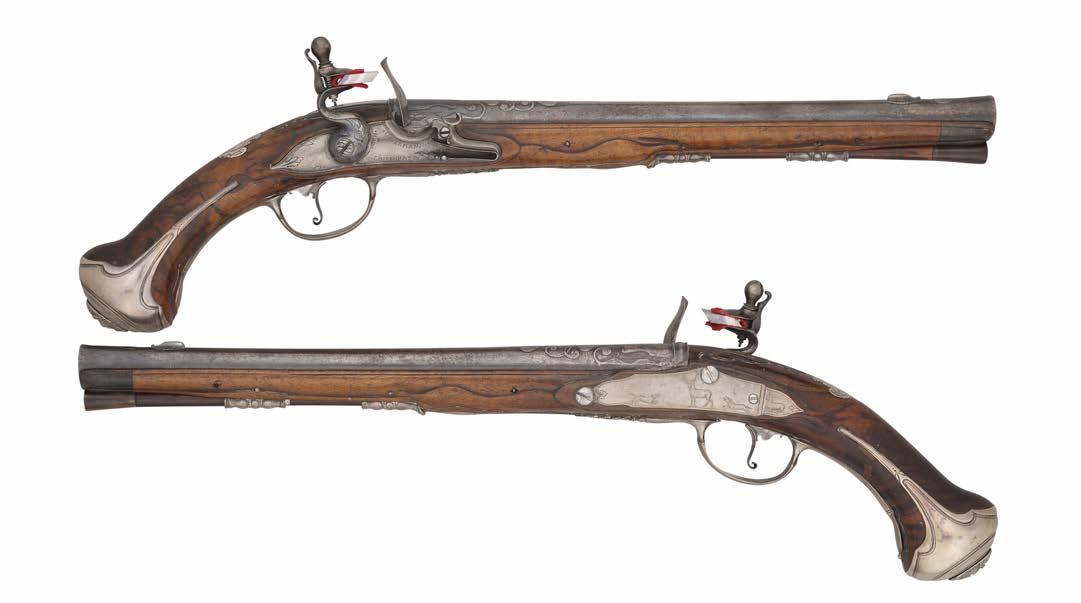
246
A RARE PAIR OF ROYAL DANISH 22 BORE FLINTLOCK SILVER-MOUNTED HOLSTER PISTOLS FROM JAGDSHLOß KRANICHSTEIN BY FREDERICH OSTERMANN, COPENHAGEN, EARLY 18TH CENTURY
with swamped barrels each retaining some blueing, engraved around the muzzle and chiselled with symmetrical foliage at the breech, sighting flats each with silver fore-sight and chiselled with a pointed foliate panel behind the muz zle, border engraved tangs polished bright, signed border engraved rounded locks, foliate engraved rounded cocks (one probably an old replacement) and steels, moulded highly figured full stocks (minor old bruising and small repairs) each carved with foliage behind the apron around the barrel tang, and stamped with a small lion rampant mark beneath the tail of the lock, border engraved silver mounts comprising shaped solid side-plates each decorated with a stag beset by two hounds, and with a prone hind on the tail, crowned escutcheons engraved with mirror monogram, probably of Landgrave Ludwig VIII (1691-1768), spurred pommels each with grotesque mask cap, trigger-guards each engraved ‘N. 32’ behind the foliate finial, turned baluster ramrod-pipes, scroll triggers, dark horn fore-end caps, and original horn-tipped ramrods, one with iron worm, 32.8 cm barrels (2)
Provenance
Believed to have been presented by Frederich IV of Denmark to the Landgraf Ludwig of Hesse
F. Theodore Dexter
G.P. Jenkinson
Sotheby’s London, 1st July 1987, lot 168
Jagdschloß Kranichstein, now in the suburbs of Darmstadt, is first recorded by that name in 1572, but at its height as a hunting lodge during the reigns of the Landgraves Ernst Ludwig (1667-1739, reg. 1678-1739) and, above all, his son Ludwig VIII (1691-1768). Both were passionate hunters, and their activities in connection with this brought Hesse-Darmstadt to the edge of financial ruin. They enlarged and beautified the castle, and in 1715, after a fire in the Residenz in Darmstadt, began successively to use it as an alternative residence for themselves and the Court: Ludwig, in fact, held his Court almost continuously at Kranichstein and formed a major collection of sporting weapons there. This was kept in the large two-storied ‘hunting arsenal’ (Jagdzeughaus) that had been built during the period 1688-90 by Ernst Ludwig, together with a large collection of hunting and shooting equipment of all kinds
Later rulers of Hesse-Darmstadt embellished and made alternations to the castle. Distinguished visitors included Queen Victoria and her daughter Princess Beatrice. In 1918, the Grand Duke decided to open it to the public as a museum, and to this end assembled in it all the related material from other residences. After the destruction of Darmstadt in 1944 the castle became an old-peoples’ home for a time and the collection was put into store. In 1952 the last member of the Grand-Ducal family, Prince Ludwig (d.1968), placed it and its contents in the guardianship of the ‘Hessischer Jägerhof ’- a foundation for the preservation of hunting territory and traditions but a considerable number of pieces were sold.
Friedrich Osterman is recorded in Copenhagen between 1684 and the year of his death in 1719.
£6,000-8,000
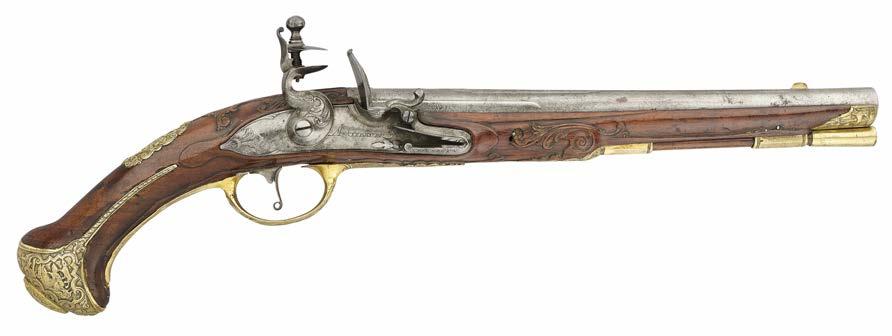
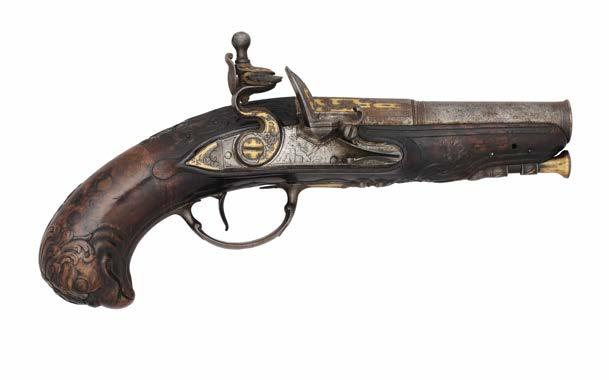
247
A DANISH 25 BORE FLINTLOCK ORMOLUMOUNTED HOLSTER PISTOL BY A. GEBAUER, COPENHAGEN, MID-18TH CENTURY
the watered barrel with sighting flat and copper alloy foresight, triangular flat at the breech pricked ‘2’, tang chiselled with symmetrical foliage, signed rounded lock chiselled with foliage on the tail, cock and steel decorated en suite, moulded figured full stock carved with scrolling foliage on either side of the fore-end and around the barrel tang, mounts comprising side-plate cast and chased with scrolling foliage, on a finely punched ground and centred on stags in a wooded landscape, escutcheon with a falconer on horseback, a grotesque mask above and below, trigger-guard with sportsman on the bow and a fox between trees on the finial, spurred pommel with a stag and a boar hunting scene between strapwork on each side, and pommel cap with further hunting scene, faceted ramrod-pipes, the rear one with a hawk above a monster head on the finial, fore-end cap with a hunting scene, later copper alloy-tipped ramrod, and retaining some original gilding, 28.2 cm barrel
Andreas Gebauer is recorded in Copenhagen between 1730 and 1755.
£600-900
248
A SMALL FRENCH 40 BORE FLINTLOCK BELT PISTOL, MID-18TH CENTURY
with two-stage barrel flared at the muzzle, octagonal breech becoming polygonal, the upper flats engraved with rocailles and foliage against finely punched gold grounds, border engraved tang en suite, border engraved flat bevelled lock engraved with a winged cherub seated on a martial trophy, the stepped tail, cock including top jaw and steel all decorated en suite with the breech, moulded figured full stock (old split through the fore-end) carved in low relief with foliage and rocailles behind the rear ramrod-pipe and barrel tang, the pommel carved in the round as an eagle’s head, steel mounts decorated en suite with the breech and comprising side-plate, trigger-guard and slotted ramrod-pipes, waved belt hook, and original horn-tipped ramrod with steel cap, 9.7 cm barrel
£500-600
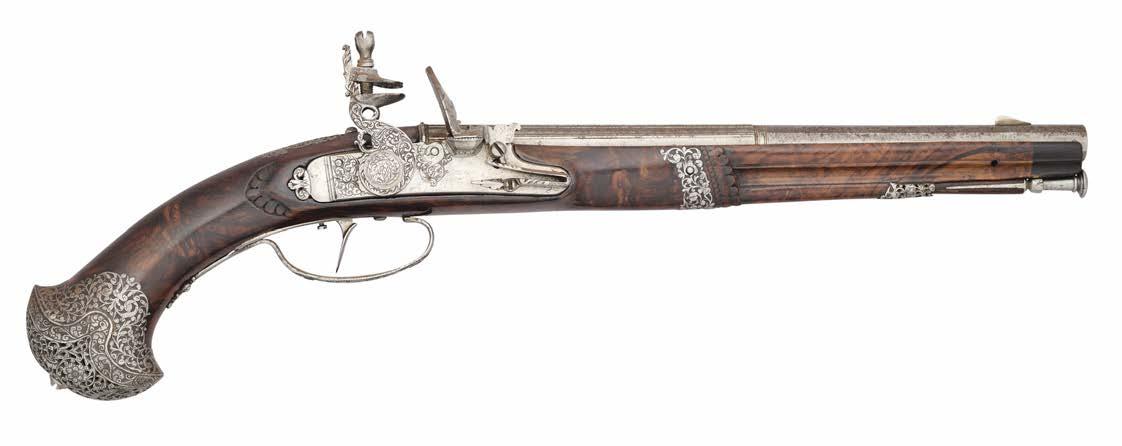
249
A BRESCIAN 40 BORE FLINTLOCK BELT PISTOL, CIRCA 1660 with shortened two-stage barrel faceted towards the muzzle and with later silver fore-sight, turned girdle, breech cut with raised longitudinal lines and stamped ‘LAZARINO COMINAZZO’ between trefoil marks (Neue Støckel 7259), later gold-lined touchhole, plain slender tang, flat bevelled lock engraved with a coiled monster and foliage, the tail pierced and chased with foliage, ring-neck cock en suite, the retaining screw engraved with a winged monster, highly figured full stock inlaid with steel panels finely pierced and engraved with symmetrical designs of elaborate scrolling foliage, fluted fore-end carved with a foliate band at the rear, steel mounts pierced and engraved en suite with the stock inlays and comprising rounded pommel with short spurs, trigger-guard and rear ramrod-pipe (belt hook removed), later set trigger and horn fore-end cap, and wooden ramrod with turned steel tip, 27.5 cm barrel
Provenance
Bonhams Knightsbridge, 25 July 2007, lot 215
Literature
F. Theodor Dexter, Half Century Scrapbook of Vari-Type Firearms, 1960, p. 77, pl. 81 and p. 81, pl.35, No. 932
£1,800-2,200
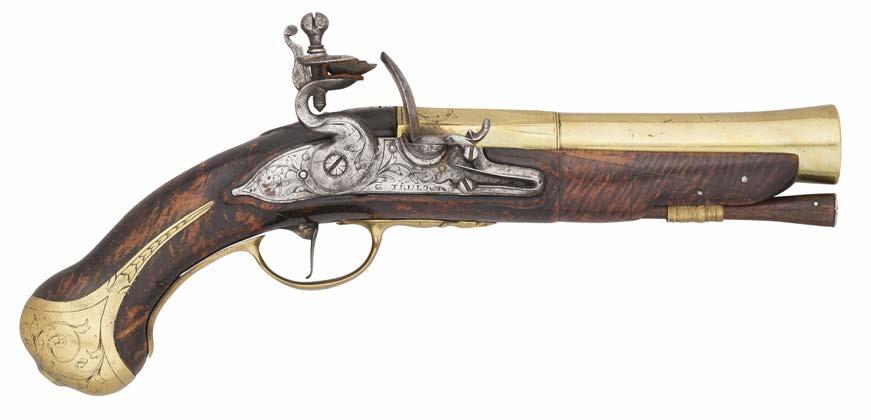
250
A VERY RARE EARLY FLINTLOCK BLUNDERBUSS-PISTOL BY G. TRULOCK OF LONDON, LATE 17TH CENTURY with two-stage copper alloy barrel flared at the muzzle, oc tagonal breech becoming polygonal, signed along the top flat, engraved with strawberry foliage in front of a wriggle work line at the rear, and struck with London proof marks and Trulock’s barrelsmith’s mark, tang with later lightly engraved decoration, signed border engraved rounded lock decorated with strawberry foliage, cock en suite, artificially figured full stock (small old chip in front of the lock, fore-end partly replaced) with apron around the tang , mounts comprising cast and pierced copper serpentine side-plate, spurred copper alloy pommel engraved with strawberry foliage and with a wreath around the retaining screw, border engraved trigger-guard with trefoil-shaped finial and decorated with strawberry foliage on the bow, single baluster ramrod-pipe, and later ramrod, 19.0 cm barrel
Provenance
The J.C.L. Knapton Collection Bonhams Knightsbridge, 23 & 24 May 2018, lot 484 Literature
J.N. George, English Pistols and Revolvers, 1938, p. 33, pl. IV, fig. 5 George 1 Trulock was apprenticed to Harward Darke and turned over to his father William 1 (mentioned in Pepys’ Diary 29 March 1667 ‘One Trulocke the famous gunsmith, that is a mighty ingenious man and he did take my gun to pieces and made me understand the secrets thereof’) in 1680. In 1687 he was allowed to prove guns under his father’s mark and was free of the Gunmakers’ Company the following year. He was Gunmaker to Ordnance between 1695 and 1708, and supplied gun barrels and Barbary locks ‘finely wrought for presents to the emperor of Morocco’ in 1704.
£5,000-7,000
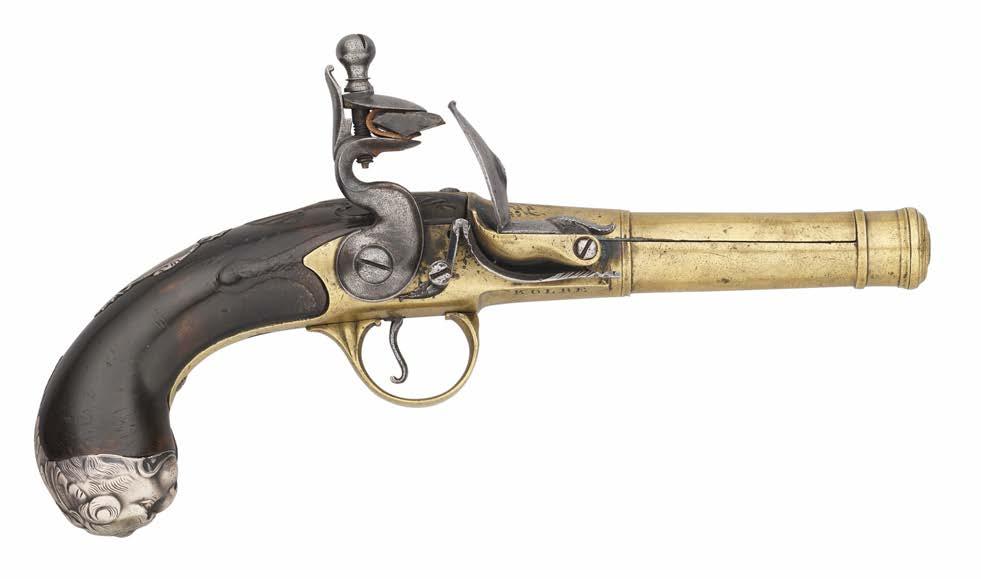
A VERY RARE FLINTLOCK SILVER-MOUNTED TINDER-LIGHTER DISGUISED AS A PISTOL BY KOLBE OF LONDON, CIRCA 1740-50
with copper alloy cannon barrel and action in one piece, the former in two stages, hinged on the left side and engraved with acanthus at the breech, released when the trigger is pressed to reveal a sprung tubular adjustable copper alloy candle-holder, the latter signed beneath the chiselled steel-spring, border engraved waisted copper alloy tang decorated with foliage, copper alloy trigger-guard, moulded figured rounded butt carved with scallop shells around the tang, cast and chased mounts comprising pierced foliate side-plate, vacant foliate escutcheon with scallop shell above, and lion-mask and acanthus butt-cap, 26.0 cm
John Lawrence Kolbe (Colby) or Johann Gottfried Kolbe specialised in making repeating and walking-stick guns, his masterpiece being the magnificent silver-mounted air gun probably made for King George II (formerly exhibited at the Victoria & Albert Museum, inv. no. M.494-1894).
For an account of Kolbe and his weapons see Howard L. Blackmore, ‘Who was Kolbe?’ in Journal of the Arms and Armour Society, Vol. XIV, No. 2 (September 1992), pp. 41-63. See p. 52, 54-56, fig. 9a and b, for the only other example known of a flintlock tinder-lighter pistol, by Kolbe, formerly in the Clay P. Bedford Collection (1500) and now in the Metropolitan Museum of Art, New York. Blackmore suggests that the actual maker may possibly have been Joseph Griffin.
£3,000-4,000
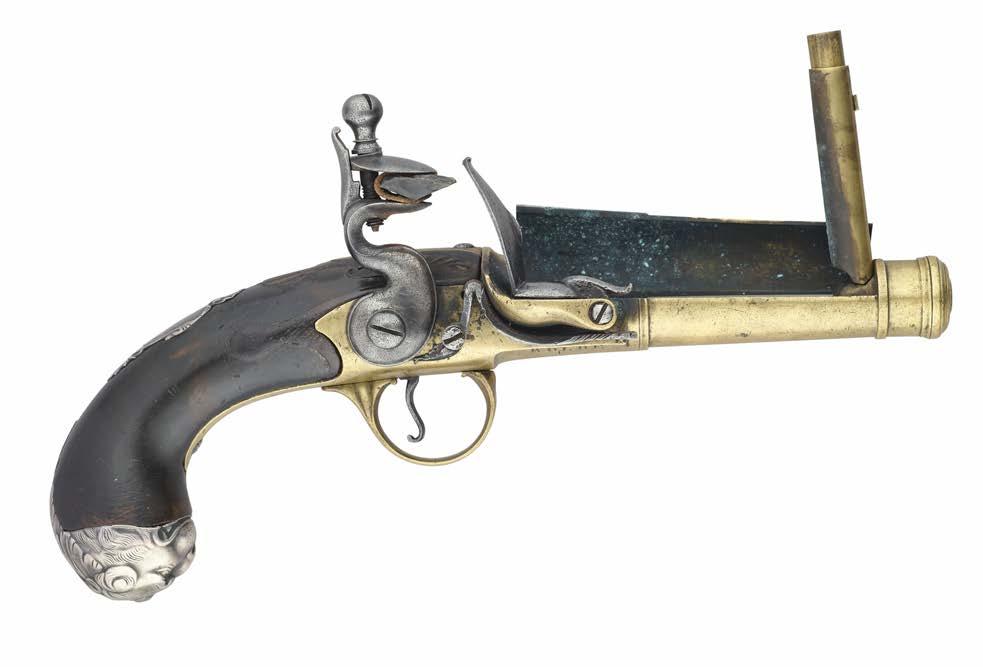
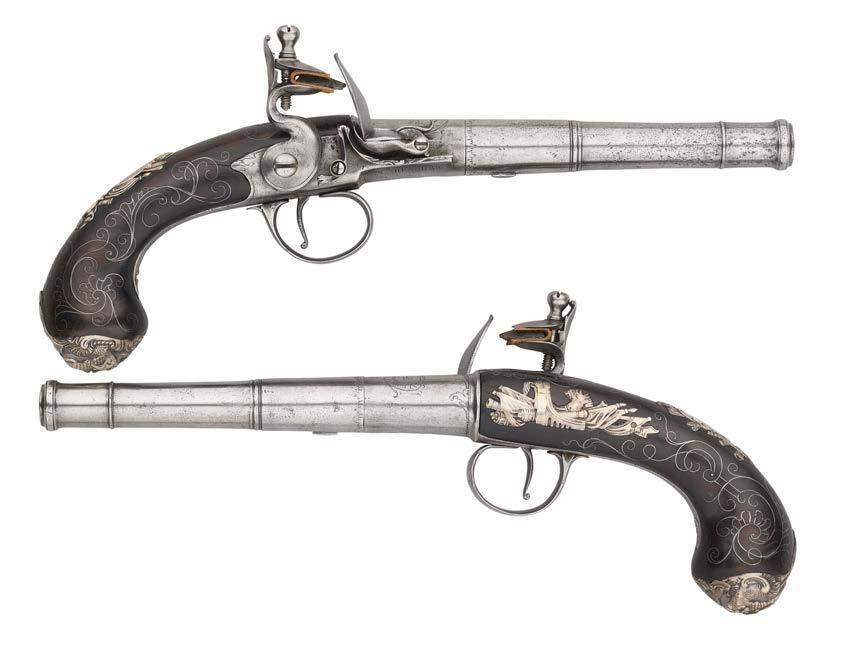
252
A PAIR OF 28 BORE FLINTLOCK TURN-OFF PISTOLS BY WM. HENSHAW, STRAND, LONDON, CIRCA 1765, SILVER MAKER’S MARK OF JOHN ALLEN with three-stage cannon barrels each with faint traces of Irish registration mark and engraved with a band of foliage at the breech, the latter each engraved with maker’s address on a foliated scroll, signed beneath the steel-spring, decorated with a further band of foliage at the rear, and struck with London proof marks and Foreigner’s mark, engraved tangs and actions, sliding trigger-guard safety-catches with traces of engraved decoration, figured swelling rounded butts each inlaid with fine silver wire scrollwork and rocailles, cast and chased mounts comprising trophy-of-arms side -plates and vacant escutcheons, and lion and rampar t butt-caps each with a border of rocailles (wear and pitting overall), 13.0 cm barrels (2)
William 2 Henshaw is recorded at 181 Strand, London in 1763, and at the same address with warehouse at Stable Yard, Vine Street, Minories between 1778 and 1789.
£600-800
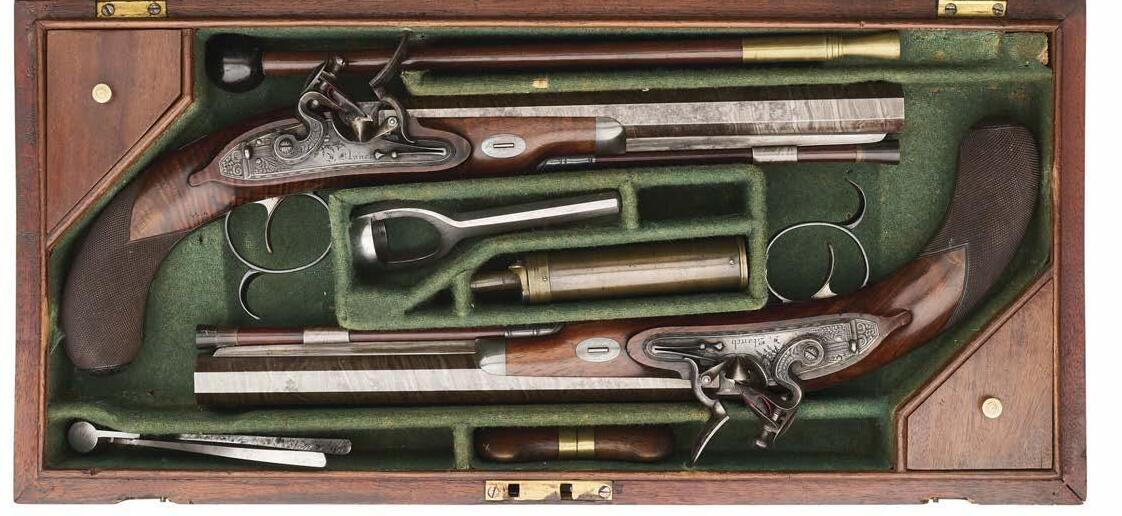
A
FINE CASED PAIR OF 35 BORE FLINTLOCK
DUELLING PISTOLS
BY J. BLANCH, LONDON, CIRCA 1820 with browned twist octagonal sighted barrels (minor old patination), case-hardened patent recessed breeches each with platinumlined touch-hole, rectangular maker’s mark and line, case-hardened tangs each with back-sight and engraved with symmetrical foliage, border engraved case-hardened flat detented locks each signed in gothic script and decorated with foliage at the stepped tail and behind the rainproof pan, foliate engraved cocks and steels , the former each with engraved safety-catch behind, the latter each with roller bearing on a ramp on the blued steel-spring, the internal working parts retaining their burnished finish, figured half-stocks (one side flat with old bruising) each with silver fore-end cap and finely chequered rounded butt, border engraved blued steel mounts comprising butt-caps each engraved with a flower-head centred on the retaining screw, spur trigger-guards each with a martial trophy on the bow, trigger-plates each with pineapple finial, turned rear ramrod-pipes, silver escutcheons and barrel-bolt escutcheons, the former each engraved with owner’s crest and initials within a garter belt, original horn-tipped ramrods, one with threaded cap over the worm, and in fine condition retaining most of their original finish: in original lined and fitted mahogany case with some accessories including unusual three-way powder-flask with copper alloy body of oval section, the interior of the lid with maker’s trade label, the exterior with circular copper alloy escutcheon centred on a circular flush-fitting carrying handle, the former engraved ‘G. DENNE, ESQr.’ over ‘CANTERBURY’, 23.8 cm barrels
John 1 Blanch was born in 1784 and was apprenticed to Jackson Mortimer whose daughter he married in 1809, the same year he established his business. He worked first for John Manton and then in partnership with his father-in-law as Mortimer & Blanch between 1811 and 1812. He was at 39 Fish St. Hill between 1813 and 1825, and 29 Gracechurch Street between 1826 and 1848. The firm became John Blanch & Son in 1848.
£8,000-10,000
A RARE CASED PAIR OF 20 BORE FLINTLOCK SAW-HANDLED OFFICER’S PISTOLS WITH SHOULDER-STOCK BY BRANDER & POTTS, LONDON, CIRCA 1810
with long browned twist octagonal sighted barrels, breeches each with gold line, gold-lined maker’s stamp and gold-lined touchhole, border engraved tangs each with two lines of foliage and decorated with a martial trophy and foliage, border engraved flat bevelled detented locks each with gold-lined maker’s stamp, decorated with a starburst behind the rainproof pan and with martial trophies at the stepped tail, ‘French’ cocks en suite, engraved safety-catches and blued steel-springs each with roller, figured halfstocks each with bluntly-pointed spur and chequered rounded butt, the latter each with iron mount for the shoulder-stock and flat ovoidal pommel encircled by an engraved silver band and set with a silver escutcheon engraved with owner’s crest, engraved blued rear ramrod-pipes and spur trigger-guards, the latter each with engraved pineapple finial and decorated with a martial trophy and foliage on the bow, adjustable set triggers, silver barrel-bolt escutcheons and fore-end caps, original horn-tipped ramrods with iron worms, and some original finish: in original lined and fitted mahogany case with accessories including highly figured detachable iron-mounted shoulder-stock with cheek-piece, the pierced blued but t-plate engraved with a martial trophy on the heel tang, Sykes powder-flask retaining much of its lacquered finish, turnscrew, mainspring clamp and bullet mould, the interior of the lid with illustrated maker’s trade label, the exterior (minor old split) with large oval copper alloy plate incorporating a flushfitting carrying handle, 27.5 cm barrels
Provenance
The Dr. Robert Rabett Collection, Bonhams Knightsbridge, 30 November 2011, lot 553
Exhibited
The Guildhall Museum, Rochester-upon-Medway, Craft of the Gunmaker 1640-1870, A Special Exhibition Of A Notable Private Collection, August 1991January 1992, cat. no. 30 (back cover colour illustration)
Martin Brander and Thomas Potts are recorded at 70 Minories and Goodman’s Yard, London between 1802 and 1827.
£15,000-18,000
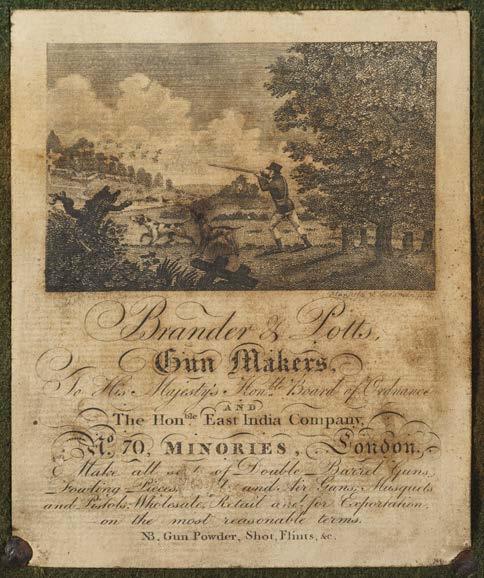
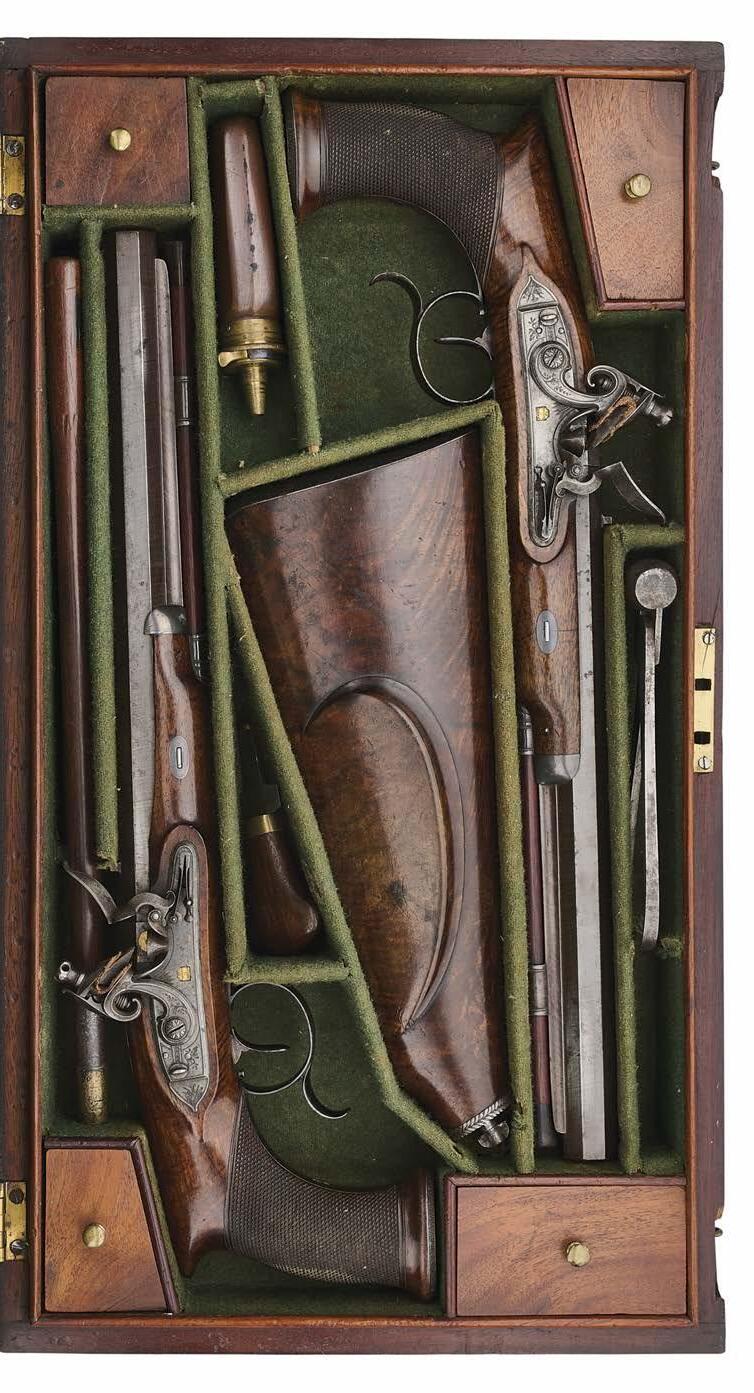
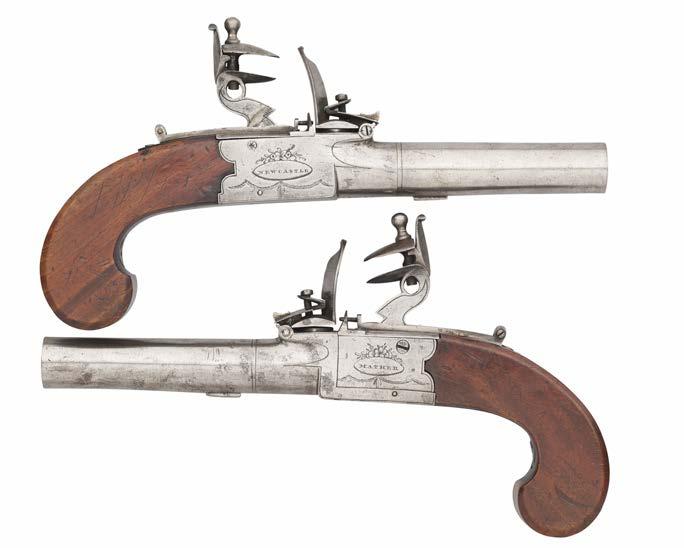
255
A RARE AND UNUSUALLY LARGE PAIR OF FLINTLOCK BOX-LOCK OVERCOAT PISTOLS BY MATHER, NEWCASTLE, EARLY 19TH CENTURY
with turn-off barrels each numbered ‘14’ behind the barrel-lug, Tower private proof marks, border engraved actions (top jaws and screws replaced) each signed within an oval between foliage and a swag over both sides, engraved thumbpiece safety-catches also locking the steels, folding triggers, and figured flat-sided butts (minor old bruising and some scattered pitting), 9.5 cm barrels (2)
Provenance
Bonhams Knightsbridge, 30 April 2014, lot 443
This maker appears to be unrecorded.
£1,500-2,000
256
A LIÈGE 120 BORE PERCUSSION D.B. KNIFE-PISTOL, MID-19TH CENTURY
with etched twist barrels each struck with Liège proof mark, folding double-edged knife blade of flattened diamond section, folding paddle-shaped triggers, and rounded border engraved white-metal side-plates decorated with scrolling arabesque foliage, 10.0 cm barrels, 12.0 cm blade
£800-1,000
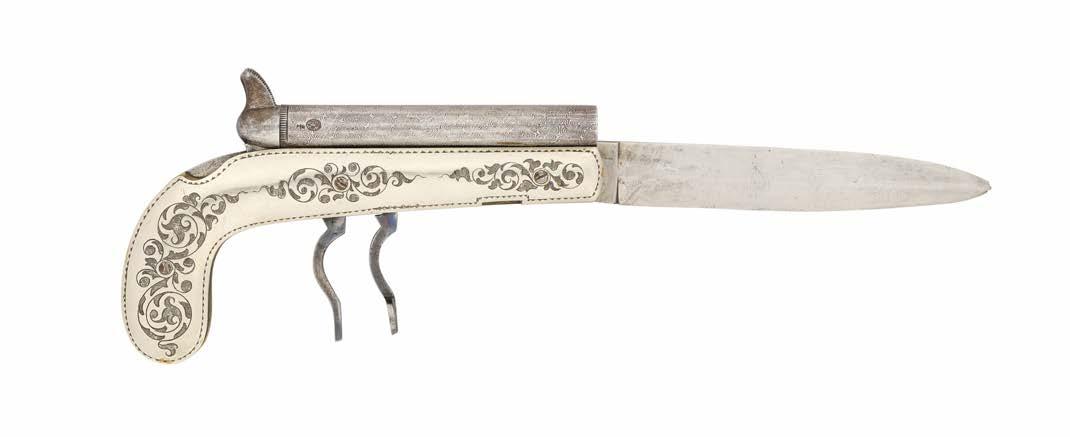
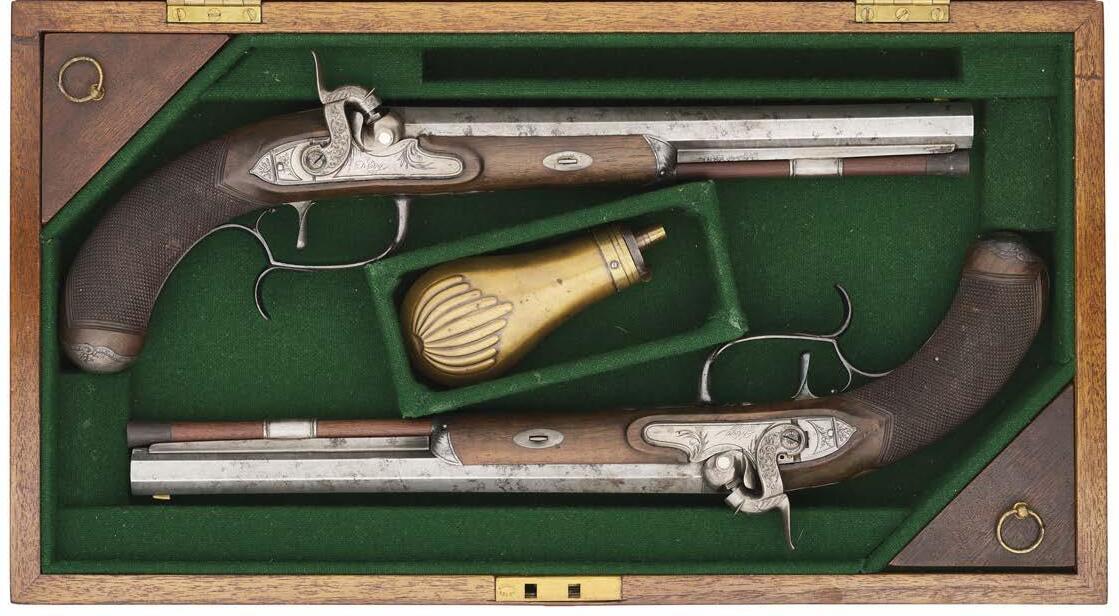
A CASED PAIR OF 40 BORE PERCUSSION DUELLING
PISTOLS
BY D. EGG, LONDON, CIRCA 1800
converted from flintlock, with slightly swamped twist octagonal sighted barrels (breeches with some old pitting and partly filed off) each signed in gold along the top flat, and struck with London proof mark s, foliate engraved breeches each with platinum plug, tangs each engraved with a martial trophy and foliage, signed engraved flat bevelled locks each with sliding safety-catch at the stepped tail, foliate scroll engraved hammers, figured half-stocks each with chequered rounded butt, gold escutcheons each engraved with owner’s crest, border engraved steel mounts retaining some blueing and decorated with martial trophies, foliage and starbursts, and comprising rounded butt-caps, spur trigger-guards in the French fashion, and fore-end caps also forming the ramrod-entry, blued adjustable set triggers, turned ramrod-pipes , and original horn-tipped ramrods, one with powder-measure, and the other with worm: in later relined and refitted wooden case, 23.5 cm barrels
For information regarding Durs Egg see Claude Blair, 'The Egg Family, Part I and Part II (contd.)' in Journal of the Arms and Armour Society, Volume VII, 1973, pp. 266-299 and 305-353.
£1,000-1,500
258
A FINE PAIR OF 38 BORE PERCUSSION DUELLING PISTOLS BY JOHN MANTON & SON, DOVER STREET, LONDON, NO. 9740 FOR 1825 with browned twist octagonal sighted multi-groove rifled barrels each signed along the top flat and with silver fore-sight, and struck with London proof marks and barrelsmith’s mark of William Fuller on the bottom flat, border engraved case-hardened breeches each decorated with a foliate scroll and with pierced platinum plug engraved as a flower-head, case-hardened foliate scroll engraved tangs each with back-sight, border engraved flat case-hardened detented locks each signed ‘JOHN MANTON & SON PATENT’ and decorated with scrolling foliage, hammers en suite and each with blued safety-catch behind, the internal working parts retaining their burnished finish, finely figured half-stocks each with dark horn fore-end cap and chequered rounded butt, border engraved blued steel mounts comprising butt-caps decorated with foliage, serial numbered trigger-guards each decorated with scrolling foliage on the bow, trigger-plates each with foliate engraved pineappleshaped finial, silver escutcheons and barrel-bolt escutcheons, the former each engraved ‘JBH III’, blued set triggers, original ramrods each with copper alloy tip, and in fine condition retaining virtually all their original finish: in original lined and fitted mahogany case with some accessories including copper alloy mounted three-way powder-flask covered in red leather (old scuffing), leather-faced combined mallet/loading rod, mainspring-clamp, and butt mould, the interior of the lid with maker’s trade label (minor damage), the exterior with circular vacant copper alloy escutcheon centred on a circular flush-fitting carry handle, 23.7 cm barrels
Literature
D.H.L. Back, The Mantons 1782-1878, 1993, p. 55
For a very similar pair of pistols in less fine condition see Bonhams Knightsbridge, 23 May 2019, lot 328.
£8,000-12,000
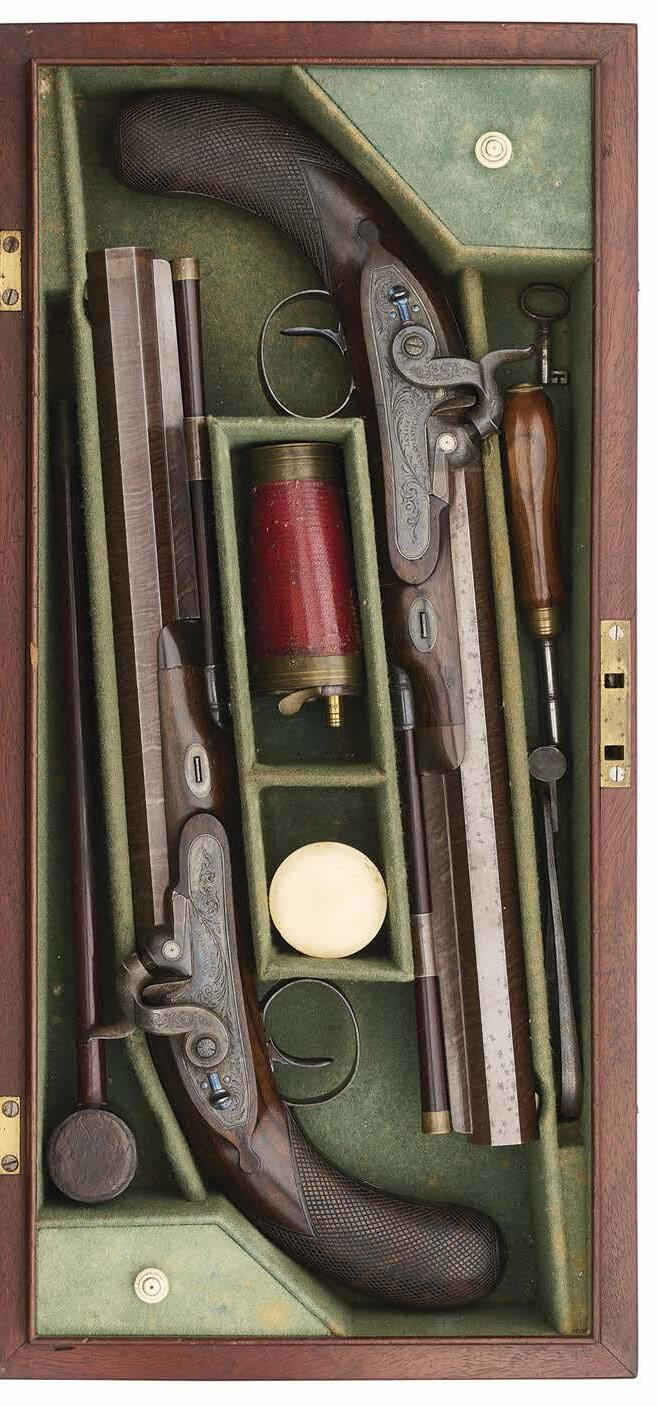
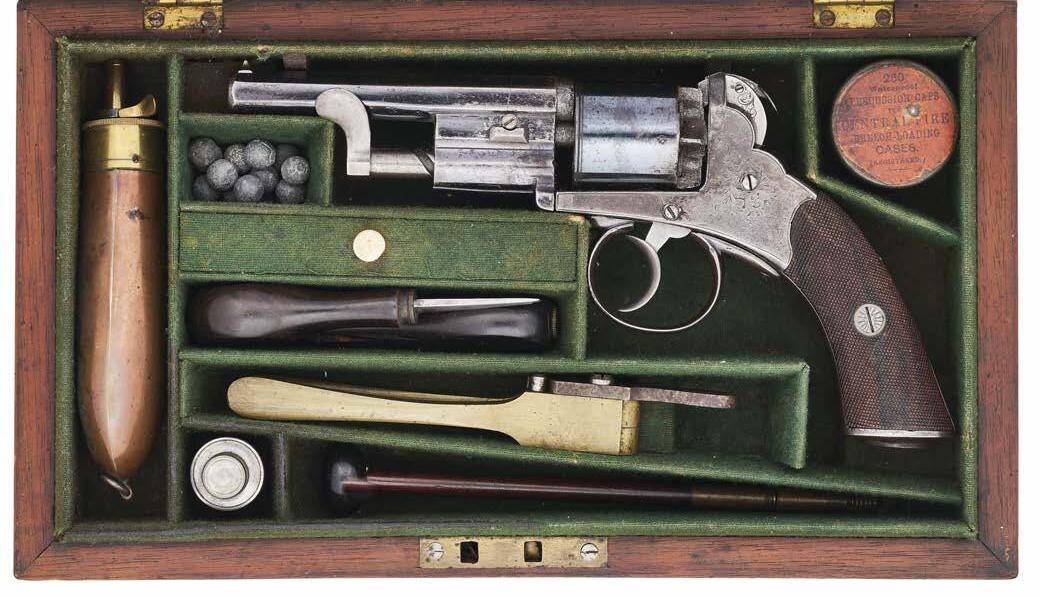
A RARE CASED 90 BORE PERCUSSION BENTLEY PATENT SELF-COCKING FIVE-SHOT REVOLVER RETAILED BY J. SMITH, 28
LOVEDAY ST., BIRMINGHAM, CIRCA 1855
with reblued octagonal sighted barrel signed along the top flat, and struck with Birmingham proof marks, blued cylinder numbered from ‘1’ to ‘5’, border engraved indistinctly numbered frame, trigger-guard, butt and hammer all decorated with foliate scrolls , the last with patent safety, patent sprung screw-rammer, finely chequered rounded grips, and much of its old reblued finish: in original lined and fitted case with accessories including copper alloy bullet mould, the exterior of the lid with vacant copper alloy escutcheon, 10.5 cm barrel
This revolver incorporates Joseph Bentley’s British Patent No. 960 of 1852 for his hammer-safety, and No. 768 of 1854 for his screw-rammer. See J.B. Bell and J. Philpott, ‘Brief Notes on Bentley Percussion Revolvers’ in Black Powder, December 1959, pp. 5-9.
J. Smith is recorded at 28 Loveday Street, Birmingham between 1851 and 1859.
£500-700
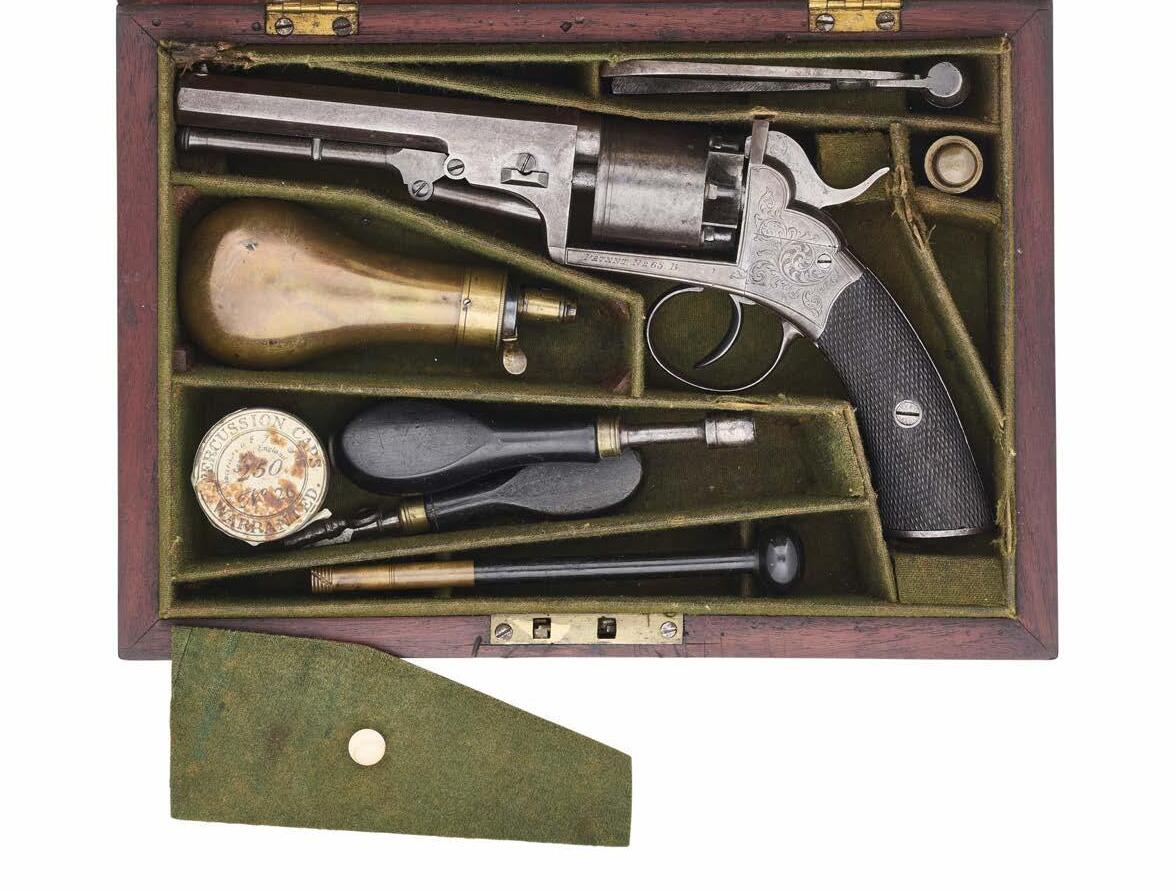
A CASED 80 BORE PERCUSSION SINGLE-ACTION FIVE-SHOT REVOLVER OF BENTLEY TYPE RETAILED BY M. MARTIN, EDINBURGH, NO. 263. B, CIRCA 1855
with octagonal sighted barrel signed along the top flat, retained by a wedge and struck with indistinct Birmingham proof marks, cylinder with turned forward edge, border engraved frame, trigger-guard and but t all decorated with foliate scrolls, the last incised ‘671’, rammer with knurled finial and retained by a clip, and chequered rounded grips (some old wear and rust patination particularly on one side at the muzzle): in original lined and fit ted mahogany case with some accessories, the interior of the lid with retailer’s trade label , the exterior with circular vacant copper alloy escutcheon, 13.0 cm barrel
Mitchell Martin is recorded at 28 South Hanover Street, Edinburgh.
£400-500
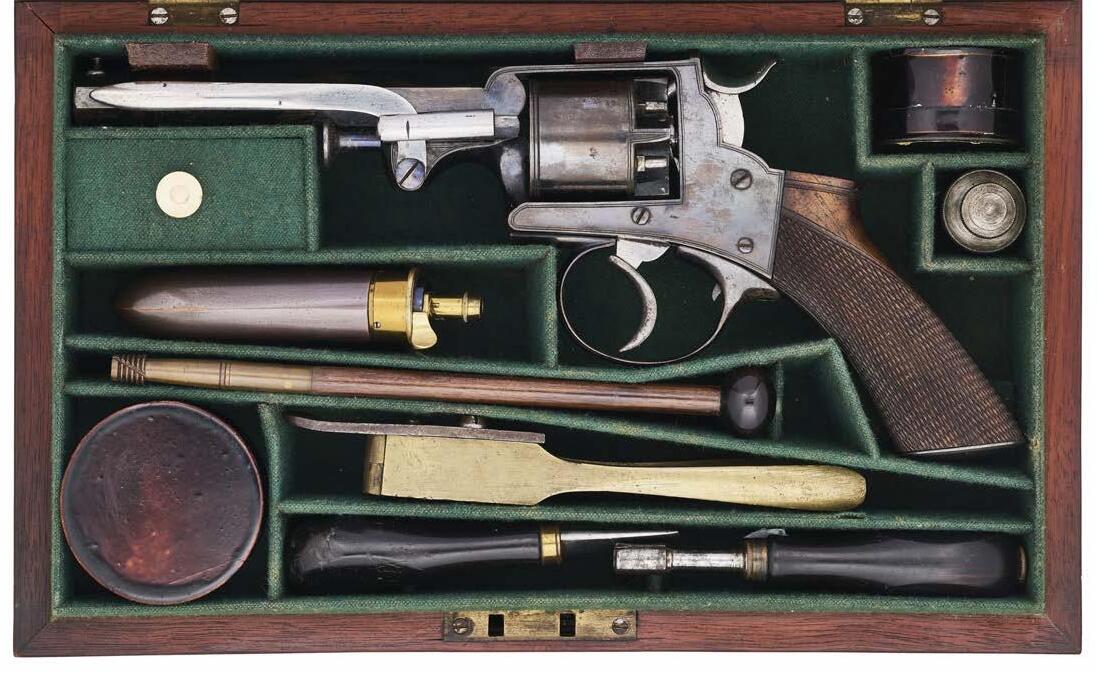
261
A RARE CASED 80 BORE PERCUSSION ‘BIRMINGHAM-MADE’ DOUBLE-ACTION FIVE-SHOT REVOLVER
RETAILED BY J.D. DOUGALL, GLASGOW, NO. 2139, CIRCA 1860 with blued octagonal sighted barrel struck with small Birmingham proof mark s, blued cylinder with knurled forward edge, blued border engraved frame, trigger-guard and case-hardened butt-cap, the first serial numbered on one side, blued arbor-pin and spring catch, bright rammer and hammer, chequered rounded butt, and retaining much of its finish: in original lined and fitted mahogany case with accessories including powder-flask in fine condition, and copper alloy bullet mould, the exterior of the lid with circular vacant copper alloy escutcheon, 13.0 cm barrel
This revolver appears to be based on Charles Reeves’ first British Patent No. 2690 of 22 October 1857. Examples of the double-ac tion lock-mechanism claimed in this patent are not often encountered, the patentee apparently preferring a mechanism covered by the later of his patents. See A. W. F. Taylersen, R. A. N. Andrews, & J. Frith, The Revolver 1818-1865, London 1968, p. 324.
£1,000-1,400
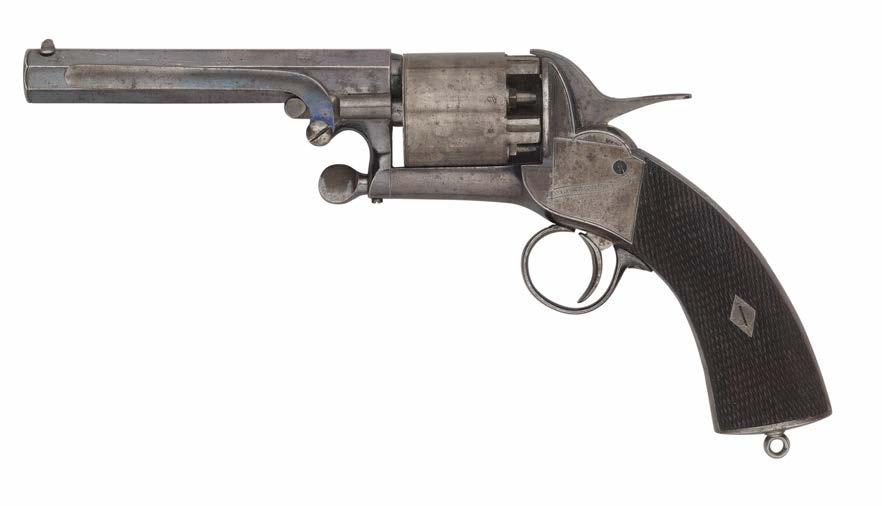
262
A RARE 54 BORE PERCUSSION WEBLEY PATENT
THIRD MODEL ‘LONGSPUR’ SINGLE-ACTION SIXSHOT REVOLVER, NO. 1332, CIRCA 1860 with blued octagonal sighted barrel threaded to engage with the cylinder arbor and secured by a blued flat headed screw beneath, and struck with Birmingham proof marks on the bottom flat, case-hardened cylinder numbered from ‘1’ to ‘5’, border engraved frame inscribed ‘WEBLEY’S PATENT’ on a scroll on one side, blued border engraved trigger-guard, blued rammer, border engraved serial numbered butt with suspension ring, stamped ‘3567’, and engraved ‘BY HER MAJESTY’S ROYAL LETTERS PATENT’ along the back, chequered rounded grips, and much original finish, 12.3 cm barrel
This revolver incorporates James Webley’s British Patent No. 743 of 1853. £800-1,000
263
AN 80 BORE PERCUSSION ‘WEDGE-FRAME’
DOUBLE-ACTION FIVE-SHOT REVOLVER OF WEBLEY TYPE, INDISTINCTLY SIGNED, NO. 1482, CIRCA 1860 of production specifications, rammer with spring side-catch, and chequered rounded grips, the metal surfaces overall decorated with gold koftgari foliage and flower-heads, the cylinder and rammer with scrolling arabesques (some old wear and rust patination), 11.3 cm barrel £600-800
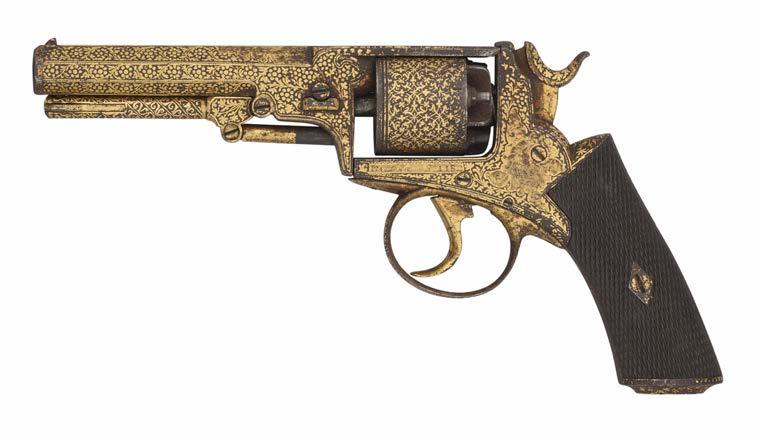
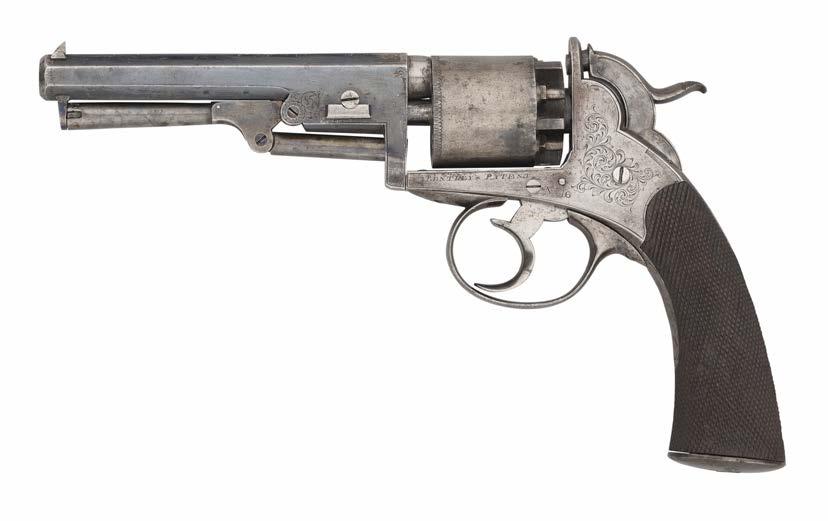
A RARE 80 BORE PERCUSSION BENTLEY PATENT DOUBLE-ACTION FIVE-SHOT REVOLVER BY J. BENTLEY & SON, LIVERPOOL, NO. 16, MID-19TH CENTURY
with blued octagonal sighted barrel signed along the top flat, retained by a wedge and sparsely engraved with foliate scrolls, case-hardened cylinder engraved around the forward edge, border engraved frame, trig ger-guard and butt-cap all decorated with foliate scrollwork, rammer numbered ‘13’ and with sprung side-catch, chequered rounded butt, and retaining some original finish, 13.0 cm barrel
£500-700
Fine Antique Arms, Armour & Militaria 2nd December 2026
SALE RESULTS FOR 3RD & 4TH DECEMBER 2025
The following prices are the hammer prices GBP/£. Unsold lots are not shown. Olympia Auctions is not responsible for typographical errors or omissions