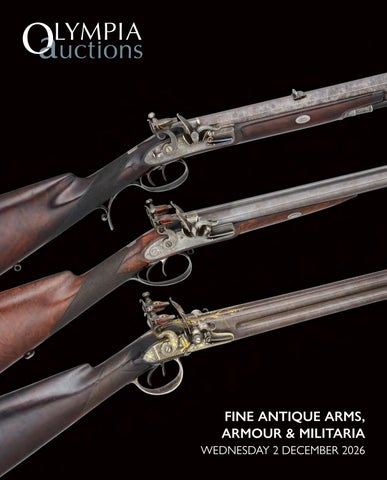
FINE ANTIQUE ARMS, ARMOUR & MILITARIA WEDNESDAY 2 DECEMBER 2026
TDM-054 listing.qxp_Layout 1 12/11/2026 16:06 Page i
FINE ANTIQUE ARMS, ARMOUR & MILITARIA THE PHILIPPE MISSILLIER COLLECTION PROPERTY FROM AN IMPORTANT MID-WEST AMERICAN COLLECTION THE PROPERTY OF A GENTLEMAN THE PER LINDSTRAND COLLECTION
TO BE SOLD BY AUCTION: 25 Blythe Road, London W14 0PD AUCTION: Wednesday 2nd December 2026, 11am, precisely PUBLIC EXHIBITION: Sunday 29th November 12pm to 4pm Monday 30th November 10am to 7pm Tuesday 1st December 10am to 5pm SALE NUMBER OA0193
FREE LIVE ONLINE BIDDING
www.OlympiaAuctions.com
ENQUIRIES: Thomas Del Mar David Williams Simeon Beever
CONSULTANTS: Ian Eaves Peter Smith Charles Webb Sachiko Hori Brijeshwari Gohil
ARCHIVIST: Ainslie Johnston
+44 (0) 207 806 5545 armsandarmour@olympiaauctions.com
ONLINE CATALOGUE AND LIVE INTERNET BIDDING AVAILABLE THROUGH: www.olympiaauctions.com www.the-saleroom.com www.invaluable.com www.drouotonline.com This auction is conducted by Olympia Auctions in accordance with our Conditions of Business printed in the back of this catalogue.
TDM-054 listing.qxp_Layout 1 12/11/2026 16:06 Page ii
ii
TDM-054 listing.qxp_Layout 1 12/11/2026 16:06 Page iii
iii
TDM-054 listing.qxp_Layout 1 12/11/2026 16:06 Page iv
iv
TDM-054 listing.qxp_Layout 1 12/11/2026 16:06 Page v
v
TDM-054 listing.qxp_Layout 1 12/11/2026 16:06 Page vi
vi
TDM-054 listing.qxp_Layout 1 12/11/2026 16:06 Page 1
EASTERN ARMS AND ARMOUR 1 A TIBETAN SWORD SCABBARD, AND ASSOCIATED SWORD, 18TH/19TH CENTURY the first of wood covered in reddened leather, iron mounts incised with Greek key-pattern along the sides and with chiselled and gilt running foliage on the outside framing a gilt panel over two-thirds of its length pierced and chiselled in low relief with symmetrical scrolling foliage from a Y-shaped bracket at the top; the second with broad single-edged blade of watered steel, and wooden grip of tapering circular section almost entirely bound in rattan, the first: 61.2 cm long, the second 77.0 cm blade (2) See Donald J. LaRocca, Warriors Of The Himalayas, 2006, pp. 159-161, nos. 63-65.
£500-800
1
1
TDM-054 listing.qxp_Layout 1 12/11/2026 16:06 Page 2
See page iii for Buyer’s Premium and other charges
2 A CHINESE QUIVER (JEBELE), QING DYNASTY, 19TH CENTURY of hardened black lacquered leather and of characteristic form, the front decorated in bone with a circular Shou character symbolising longevity and surmounted by three plants, the border inlaid with a gourd, fan, crossed swords and other utensils from everyday life between flower-head and writhing line borders, long side pocket (incomplete at the top) inlaid with a row of flower-heads en suite, the back with a ring and two mounts for suspension, 30.0 cm high
£3,000-5,000
2
2
TDM-054 listing.qxp_Layout 1 12/11/2026 16:06 Page 3
3 A CHINESE QUIVER (JEBELE), 19TH CENTURY of leather and of characteristic form, the front and back tooled with a diaper pattern and secured together by stitched leather straps and borders, the front with applied cast and chased copper alloy roundels and bats, the former pierced with dragons amid foliage, a central cartouche en suite and centred on a Shou character symbolising longevity, an applied vase of polearms and a lotus at the upper left-hand corner, all within borders of flower-heads, and with three rings for suspension, 31.0 cm high
£3,000-5,000
3
3
TDM-054 listing.qxp_Layout 1 12/11/2026 16:06 Page 4
See page iii for Buyer’s Premium and other charges
4
4 A FINE PAIR OF TIBETAN STIRRUPS, 16TH-18TH CENTURY of iron, each with silver-damascened faceted arch over the foot chiselled and gilt in low relief with foliage either side of the leather loop, flat foot-plate of diamond form with arched apron chiselled and gilt en suite with the top, 15.5 cm high (2) See Donald J. LaRocca, Warriors Of The Himalayas, 2006, pp. 244-245, nos. 128-131.
£8,000-10,000
4
TDM-054 listing.qxp_Layout 1 12/11/2026 16:06 Page 5
5 A CEYLONESE SILVER-MOUNTED PIHA-KAETTA, 17TH/18TH CENTURY of characteristic form, with single-edged blade beaked towards the point and with a fuller along the back on each side, the fullers, forte and back of the blade set with silver chased with foliate designs against finely punched grounds, hilt comprising basal mount cast and chased with foliage, ridged grip with dark horn grips carved with foliage, and pinned pommel-cap embossed and chased en suite with the blade, in its fluted wooden scabbard entirely covered in silver with a band filigree forming a locket, 18.5 cm blade
£1,200-1,500
5
5
TDM-054 listing.qxp_Layout 1 12/11/2026 16:06 Page 6
See page iii for Buyer’s Premium and other charges
6 AN INDIAN PATA HILT, 19TH CENTURY OR LATER of russet iron, embossed and chased over the hand and forearm, the former formed as an elephant being devoured by a Yali, the latter pierced with an elaborate design of scrolling foliage inhabited by a pair of Yali above a panel of pronounced beadwork, and flared at the rear and with embossed border en suite, the inside fitted with a tubular grip and slender arm bar, 56.0 cm A pata with very similar hilt was sold in this room, 2 March 2025, lot 608.
£800-1,200
6
6
TDM-054 listing.qxp_Layout 1 12/11/2026 16:06 Page 7
7 AN INDIAN KHANDA, 17TH/18TH CENTURY with broad blade widening to the rounded double-edge point and cut with narrow fullers along the back for much of its length on both sides (small drilled hole at the forte), characteristic russet hilt retaining some of its gold foliate decoration overall and comprising hooked quillons with shaped extension over both sides of the forte, waisted bent-up guard with integral triangular knuckle-guard tapering up to join the cup-shaped pommel, the latter with stalk-like finial on a domed mount, and slender grip bound with twisted silver wire (old pitting and loss of decoration), 81.8 cm blade
£300-500 8 AN INDIAN TULWAR, 18TH CENTURY with curved fullered single-edged blade incised with an inscription on both sides at the forte, and characteristic steel hilt including tapering knuckle-guard with stylised monster-head terminal, and discshaped pommel with bud-shaped finial on a domed mount, decorated overall with thickly damascened silver flowerheads between waved silver borders, 82.0 cm blade
‡ £500-700 9 AN INDIAN TULWAR, LATE 18TH CENTURY the curved blade of earlier form with false double-edge to the point and cut with a central fuller over most of its length on both sides, the forte on both sides cut with fullers, characteristic russet steel hilt including knuckle-guard with bud-shaped terminal decorated overall in gold koftgari with borders of foliage (worn, old surface rust patination), 82.0 cm blade
£600-800
7
8
9
7
TDM-054 listing.qxp_Layout 1 12/11/2026 16:06 Page 8
See page iii for Buyer’s Premium and other charges
10 FOUR INDIAN LOHANGI KATTI, 19TH CENTURY each of characteristic form, the heads with shaped flanges of mace form secured by iron bindings, the bindings on two formed as trellising, each on its long bamboo haft. 131.5 to 149.0 cm long (4) These are a traditional form of mace or bludgeon widely used in the Deccan, Satara and Central India by village watchmen, Kolis and Ramosees (Ramoshis) as a defensive weapon, and supposedly to drive tigers from their prey.
£400-600
10
8
TDM-054 listing.qxp_Layout 1 12/11/2026 16:06 Page 9
11 AN INDIAN SWORD CANE DECORATED WITH BUBRIS, LATE 18TH CENTURY, POSSIBLY RELATING TO TIPU SULTAN with tapering double-edged russet blade of flattened diamond section, the forte along both sides reinforced between two plates inlaid along both sides with pairs of copper alloy bubris, the petalled terminals each inlaid in copper alloy with a stylised tiger-head, turned wooden grip in imitation of bamboo and painted olive green and tiger red, and with flat silver cap (scabbard cane missing), 83.3 cm blade The bubris (tiger and tiger-stripe) motif recalls Tipu Sultan’s obsession with this animal which is found on his weapons, his furniture, in his wardrobe and on other objects in his possession. Of the weapons, swords, guns, pistols, cannon and mortars are recorded. The tiger was further incorporated into his name, as well as that of his father, and served as a kind of armorial bearing. Tipu Sultan, born in 1753, was the son of Haidar Ali, Sultan of Mysore. Instructed by French officers in his father’s employ, he commanded a corps of cavalry in the Carnatic War of 1767 and later distinguished himself in the Maratha War of 1775-79. In December 1782 he succeeded his father, and following the defeat of the British (1st Mysore War, 1780-84) made peace in 1784. Following territorial expansion, the British declared war on him in 1790, culminating in Tipu’s defeat near Seringapatam and the ceding of half his territories to Cornwallis in March 1799. On the renewal of hostilities, he was killed during the storming of Seringapatam on 4 May the same year. Throughout his rule Tipu showed great ability as a leader and innovator, introducing his own calendar and currency.
£1,000-1,500
11
9
TDM-054 listing.qxp_Layout 1 12/11/2026 16:06 Page 10
Public domain, via Wikimedia Commons
See page iii for Buyer’s Premium and other charges
Suleiman the Magnificent, Circle of Titian
12 A PERSIAN KILIJ WITH IMPORTANT BLADE RELATING TO SULTAN SULEYMAN THE MAGNIFICENT, THE BLADE REIGN OF SULEYMAN THE MAGNIFICENT (1520-1566), THE HILT AND SCABBARD QAJAR, 18TH/19TH CENTURY with curved blade gold-damascened with interlaced running arabesques bordering the double-edge to the point, the back edge over half its length on one side from the forte inlaid in gold nasta’liq ‘This esteemed sword is the protection for Sultan of the men, Sultan Suleyman ibn Salim. [May] God give him victory in the Dar al-fath of Constantinople the protected’, and with Qur’an surah LXV (al-Tafaq) along the other side (some losses of inlay), hilt comprising steel quillon-block with gold-damascened borders and pierced with a rectangular panel of symmetrical arabesques between four quatrefoils on both sides, pointed langets and tapering quillons each with button terminal, reeded copper alloy grip-strap, and rounded walrus-ivory grips secured by two transverse copper ally pins and pierced through the pommel for a tassel, in its wooden scabbard covered in black leather with copper alloy wire seam along one side, steel locket, chape and suspension mounts en suite with the hilt, 69 cm blade Provenance The Property Of A Prince Of The Egyptian Royal Family And An Ottoman Sultanzade This sabre is believed to have been offered to the Khedive of Egypt and Sudan, Abbas Hilmi II (1874-1944) by the Ottoman Sultan Hamid II (1842-1918). The inscription on the blade suggests that it belonged to Sultan Suleyman the Magnificent.
‡ £20,000-30,000
10
TDM-054 listing.qxp_Layout 1 12/11/2026 16:06 Page 11
11
TDM-054 listing.qxp_Layout 1 12/11/2026 16:06 Page 12
See page iii for Buyer’s Premium and other charges
13 A TURKISH SHAMSHIR, PROBABLY REIGN OF ABDULAZIZ (1277-93 AH CORRESPONDING TO 1861-76 AD) with curved blade (rust patinated and minor edge nicks) doubleedged at the point and fullered along the back over most of its length on both sides, the forte along both sides etched with martial trophies and stars, hilt comprising copper alloy quillonblock with pointed langets and swelling quillon terminals, grip-strap, and rounded rhinoceros horn grip-scales each pierced for a sword-knot (scabbard missing), 85.5 cm blade
£600-900
13
12
TDM-054 listing.qxp_Layout 1 12/11/2026 16:06 Page 13
14 A TURKISH JEWELLED AND SILVER-GILT MOUNTED SHAMSHIR, REIGN OF ABDULAZIZ (1277-93 AH CORRESPONDING TO 1861-76 AD) with curved single-edged blade of watered steel, hilt comprising quillon-block chased with acanthus borders against finely punched grounds and set with cut diamonds on the outside along the pointed langets and quillons, the former with a diamond set star and crescent at the centre, the latter each with bud-shaped terminal engraved with a flower-head, grip-strap with acanthus borders en suite, rounded rhinoceros horn grips, the pommel fluted at the front and pierced for a sword-knot, the piercing set with a mount on each side chased as a flower-head, in its wooden scabbard covered in black leather with silver-wire seam along the inner side and deep locket, chape and suspension mounts all with acanthus borders against finely punched grounds, two suspension rings, and retaining virtually all its gilding, 81.0 cm blade Provenance The Royal House of Hanover Schloss Cumberland, Gmunden, inv. no. 344 Schloss Marienburg, Hanover, Sotheby’s, 13 October 2005, lot 3607 Literature Dr. Onno Kloop et al, Schloss Seiner Konigl, hoheit des Herzogs von Cumberland, Herzogs zu Braunschweig und Luneburg, 1890, Gruppe XV, no. 344
£8,000-12,000
14
13
TDM-054 listing.qxp_Layout 1 12/11/2026 16:06 Page 14
See page iii for Buyer’s Premium and other charges
15 AN EAST EUROPEAN SILVER-MOUNTED DRESS SABRE AND BELT, 19TH CENTURY, THE BLADE 16TH/17TH CENTURY with curved blade (old wear and pitting) flat along the back and double-edged (one edge slightly ground off) towards the point in front of the yelman, the forte on one side incised with a symmetrical design of arabesque strapwork, hilt comprising beaked quillons engraved with foliage on both sides within wriggle work borders, the outer side with applied oval pierced and chased with foliage and set with pearls and foiled gems arranged around a polychrome enamelled rosette set with an imitation emerald, the inner side chased with central panel of trelliswork framed by flowering foliage against finely punched grounds, and grip of tapering octagonal section embossed and chased en suite, the pommel set with a polychrome floret originally set with a paste, in its wooden scabbard covered in burgundy velvet (worn) with mounts en suite with the hilt (three foiled gemstones missing), and retaining its original belt with mounts en suite, the roped links involving rows of flowerheads, all against a plum velvet backing (old wear), 76.7 cm blade (2) Provenance The Property of the late John Turner Blair, Esq. of Belfast, Christie’s London, 21 November 1984, lot 175
‡ £3,000-4,000
15
14
TDM-054 listing.qxp_Layout 1 12/11/2026 16:06 Page 15
16 A HUNGARIAN SILVER-GILT MOUNTED DRESS SABRE, 19TH CENTURY with bright curved blade (minor old spotted rust patination) fullered along the back over most of its length on both sides, the forte etched and gilt with scrolling foliage against gilt grounds on both sides, one side framing Mary and the Christ Child above the Hungarian inscription ‘Mother Mary, Patroness of Hungary’, and on the other with the crowned arms of Hungary between bound branches of laurel and palm, hilt embossed and chased in low relief with rocailles and foliage against finely punched grounds set on the outside with four Baroque pearls and numerous cabochon turquoises, comprising bluntly-pointed quillonblock with quillons widening towards the tips, and grip of flattened oval section tapering up to the rounded pommel (area of old damage beneath), in original scabbard covered in faded, light brown velvet with locket, chape and suspension mount en suite with the hilt, two suspension rings, and retaining most of its gilding, 76.5 cm blade
‡ £1,800-2,200
16
15
TDM-054 listing.qxp_Layout 1 12/11/2026 16:06 Page 16
See page iii for Buyer’s Premium and other charges
17 AN EAST EUROPEAN ORMOLU-MOUNTED DRESS SABRE, 19TH CENTURY with curved fullered blade (some old rust patination) doubleedged towards the point, hilt cast and chased in low relief overall with rocailles and foliage against finely pricked grounds and set on the outside with mother-of-pearl, cabochon turquoises and pastes, comprising bluntly-pointed quillon-block with bud-shaped quillon terminals, and grip tapering up to the slightly down-bent rounded pommel, in original copper alloy scabbard retaining some of its green velvet covering and with ormolu mounts en suite with the hilt (five stones missing), two suspension rings, and retaining most of its gilding, 83.5 cm blade
‡ £1,000-1,500
17
16
TDM-054 listing.qxp_Layout 1 12/11/2026 16:06 Page 17
18 A FINE CAUCASIAN KINDJAL, LATE 19TH CENTURY with tapering sharply pointed double-edged blade with central fuller over most of its length on both sides, the fuller on one side gold-damascened with a traditional Russian proverb reading in translation ‘What is spilled cannot be picked up, and what is beaten cannot be brought back’, between gold line borders involving arabesques at the forte and an oval of foliage at the point, hilt comprising iron basal mount and faceted grip studs damascened with gold foliage, and waisted walrus-ivory grip chased with gold-inlaid foliage along the outside, in its wood-lined black leather scabbard with iron mounts en suite with the hilt, the chape with faceted bud-shaped terminal, and the locket with suspension mount, 39.7 cm blade
£2,000-3,000
18
17
TDM-054 listing.qxp_Layout 1 12/11/2026 16:06 Page 18
See page iii for Buyer’s Premium and other charges
19
19 A LARGE INDONESIAN BRONZE LANTAKA, PROBABLY 18TH CENTURY of octagonal section in two stages, the forward stage encircled by two cast and chased bands of Greek key pattern between foliage and flared at the petalled muzzle, the top flat incised with a Rumi inscription, the rear section with double lines along the angles, and cast with a vacant foliate cartouche set in front of a block-shaped back-sight, touch-hole centred on a further band of Greek key pattern and foliage, petalled reinforce with cascabel of part octagonal section and turned moulding, the petalled terminal flanked by loops, naturalistic dolphin lifting handle joined by a bar, plain trunnions, and stirrup peg mount cast with foliage on both sides: mounted on a modern wooden stand painted white and fitted with a carved wooden coat-of-arms on one side, 150.0 cm barrel, 10.0 cm bore at the muzzle (2) The Rumi inscription was examined by the Singapore Museum on behalf of the vendor and apparently reads in translation: ‘Light the fuse and retire in haste’.
£2,000-3,000
18
TDM-054 listing.qxp_Layout 1 12/11/2026 16:06 Page 19
20
20 A RARE MUGHAL IVORY PRIMING-FLASK, 17TH CENTURY formed in two parts secured together by pins, the rear section carved and pierced with a buffalo head, an antelope head and two makara heads each with dark horn eyes, the first surmounted by a tiger flanked by elephants, at the rear on both sides with a further tiger above a monkey and forward of two tigers attacking their prey, the front section forming the nozzle and carved in relief with a further tiger (one eye missing) attacking an antelope, a pair of elephant heads beneath, the central joins carved with trellising and roping respectively, sprung silver tap (perhaps later) with ridged upper edge over most of its length, and later silver suspension chain, 27.0 cm long A closely related example is preserved in the Metropolitan Museum of Art, New York (Bequest of George Cameron Stone, 1935, inv.no. 39.25.2420). This lot is offered with UK Ivory Act 2018 certificate number ZC6LNC7K.
£7,000-10,000
19
TDM-054 listing.qxp_Layout 1 12/11/2026 16:06 Page 20
See page iii for Buyer’s Premium and other charges
21 AN INDIAN MAIL AND PLATE SHIRT, DECCANI, 17TH CENTURY composed of rows of rivetted rings of varying degrees of thickness, comprising a long-sleeved thigh-length shirt open up the front and with three rows of rectangular laminated plates along the back, and at the front two rectangular plates flanked by narrow plates under the armpits, each of the larger plates carrying three transverse riveted bars with pointed floretshaped finials and securing rings (four replaced), one plate incised on the inside with an inscription in Devangari (old rust patination throughout), 85.0 cm long This is one of a large group of similar shirts, of varying degrees of quality, that were captured by Anup Singh, Maharajah of Bikaner, in Rajasthan when, as a general in the army of Emperor Aurangze, he defeated the last defender of the Adil-Shah dynasty at Bijapur at the siege of the Adoni Fortress in 1689.
£600-900
21
reverse
20
TDM-054 listing.qxp_Layout 1 12/11/2026 16:06 Page 21
22
22 A RARE CENTRAL INDIAN CUIRASS, 17TH/18TH CENTURY of steel, formed as a male torso and hinged at the sides and shoulders (hinges working replacements, securing pins later), the front plate with low medial ridge and shaped over the pectorals, the left shoulder with incised inscription, the back plate (patched inner repair on the right side) shaped over the shoulder-blades and with separate vertically fluted neck-plate, the main edges (minor replacements at the shoulders) with riveted turned borders cusped around the outer edges and pierced with small holes (old pitting overall), 44.0 cm high Provenance Almost certainly from the armoury of the Nizams of Hyderabad For a very similar cuirass inscribed ‘Sarkar Mir Nizam Alikhan Bahadur 1192’ [1778-1779], see Christie’s London, Art Of The Islamic World, 25 April 2013, lot 162 (£25,000 including premium). For another bearing the same inscription, see David Alexander, The Nasser D. Khalili Collection Of Islamic Art, The Arts Of War, 1992, p. 175, no. 108. The inscriptions indicate that these cuirasses were in the armoury of the fifth Nizam of Hyderabad (ruled 17621803), however their actual date of manufacture is probably sometime in the 17th century.
£2,000-3,000
21
TDM-054 listing.qxp_Layout 1 12/11/2026 16:06 Page 22
See page iii for Buyer’s Premium and other charges
23
23 TWO INDIAN MAIL COIFS (KULAH ZIRAH), THE FIRST 19TH CENTURY, THE SECOND PROBABLY 18TH CENTURY the first of fine butted copper alloy and steel rings forming a diaper pattern and covering the entire head and suspended from a copper alloy disc fitted with a tubular plume-holder, vandyked around the bottom and with a triangular flap over the face; the second of riveted and solid russet iron rings (some replacements) forming a hood and suspended from a small circular iron disc, extending down the front and back and with a triangular flap over the face, the first: 52.5 cm (2)
£600-800 24 A PAIR OF INDIAN DASTANA RETAINING THEIR MITTENS, 18TH/19TH CENTURY of steel (old rust patination and some pitting), each comprising a main plate shaped to the fore-arm and with an oval at the wrist, the main edges reinforced by crenelated borders pierced with numerous small gilt-copper rivets over brocade and securing the padded burgundy velvet lining (some old damage), wrist-guards en suite, and each with three mounts and buckles for straps, both retaining its velvet-lined mitten faced in mail of small butted steel and copper alloy rings forming a trellis pattern (some losses), 47.5 cm long (2) 24
22
£600-800
TDM-054 listing.qxp_Layout 1 12/11/2026 16:06 Page 23
25 THREE INDIAN CIRCULAR HIDE DHALS, 18TH/19TH CENTURY, THE FIRST PROBABLY KUTCH the first of convex translucent leather (some old crazing), the outer surface with four gilt-copper alloy bosses chased with flowering foliage against a finely punched ground and centred on a foliate roundel painted in gilt and polychrome, the outer border en suite, the interior retaining its burgundy velvet-covered arm pad and four rings for enarmes (one replaced, the other missing); the second lacquered in black mottled with red on the outside, and with four silvered copper alloy bosses (one missing) each engraved with flowering foliage and with a border of pierced trefoils, the interior retaining its light green velvet-covered arm pad and four rings for enarmes (old damage); the last similar, the outer surface with four copper alloy bosses, a crescent with two small bosses above, the interior with four rings for enarmes (old damage), 58.5 cm, 55.5 cm and 48.5 cm diameter (3) For a very similar example to the first see Bonhams Knightsbridge, Eastern Arms & Armour From the Richard R. Wagner Jr. Collection, 29 April 2005, lot 187.
25
£400-500 26 THREE INDIAN DHALS, LATE 19TH CENTURY each of steel and of convex circular form, the first with applied crenelated steel rim and four bosses all decorated in silver koftgari with foliage, the outer surface decorated overall in gold and silver koftgari with symmetrical designs of repeated foliage, and bordered by applied copper alloy vines, the interior with fabric lining, pad and enarmes; the second russet, with applied crenelated inner and outer copper alloy borders and four domed bosses, the latter each with pierced border, the outer surfaces chased with repeated designs of flower-heads and foliage, the interior retaining its plum velvet liner with silver brocade borders and arm pad (one enarme ring missing); the last of similar form and design, the outer surface with four copper alloy bosses each with pierced border (the interior russet, liner, pad and enarmes missing), 35.5 cm to 40.4 cm diameter (3)
£500-700 26
23
TDM-054 listing.qxp_Layout 1 12/11/2026 16:06 Page 24
See page iii for Buyer’s Premium and other charges
27
27 A HIGHLY DECORATED PERSIAN KULAH KHUD AND DHAL, QAJAR, 19TH CENTURY of steel, the first with domed skull decorated overall with cartouche-shaped panels of chased encrusted silver flowering foliage, all within gold-damascened line borders, the larger panels flanked by monster-heads, all against a densely chiselled ground of flowering foliage, the rim bordered by ovoidal and circular panels, the former enclosing silver-damascened Persian verses in thulth script, the latter each with a brace of chased silver partridges, all between gold-damascened foliate borders, fitted with two plume-holders, central threaded spike of diamond section and adjustable nasal all decorated en suite with the skull, and vandyked camail of butted steel and copper alloy rings; the second of circular convex form with applied outer border, made in two pieces and with four domed bosses, the outer surface decorated en suite with the kulah khud, and both in fine condition: the dhal mounted on a metal stand,47.0 cm diameter and 28.0 cm high (not including camail) (3)
£8,000-10,000
24
TDM-054 listing.qxp_Layout 1 12/11/2026 16:06 Page 25
28
28 AN UNUSUAL PERSIAN KULAH KHUD, DHAL AND BAZU-BAND, QAJAR, LATE 19TH CENTURY the first with domed skull decorated overall with panels of pierced scrolls and symmetrical arabesques within gold-damascened borders against foiled backgrounds, the latter retained by numerous copper alloy nails, the rim bordered by ovoidal and circular panels containing Persian verses, fitted with threaded spike of diamond section on a circular mount, two plume-holders and adjustable nasal with chased cartouche- shaped terminals and retaining traces of gold-damascened borders, and vandyked camail of butted rings; the dhal and bazu-band each of characteristic form and decorated en suite with the kulah khud, the former with applied copper alloy outer border, and later fabric liner, pad and enarmes, the latter retaining two chased rectangular wrist-plate attached by butted mail (some old surface rust patination), 28.0 cm high, 48.3 cm diameter and 33.5 cm long (3) For a related set see Bonhams Knightsbridge, Eastern Arms & Armour From the Richard R. Wagner Jr. Collection, 29 April 2015, lot 202.
£1,500-1,800
25
TDM-054 listing.qxp_Layout 1 12/11/2026 16:06 Page 26
See page iii for Buyer’s Premium and other charges
29
29 A PERSIAN KULAH KHUD, DHAL AND ASSOCIATED BAZU BAND, QAJAR, 19TH CENTURY the first with domed skull embossed and chased with four gold-damascened sun-in-splendours against a ground of chiselled foliage inhabited by pairs of gold-damascened malak supporting crowns and each surmounted by a star and crescent, the rim bordered by ovoidal and circular panels containing Persian verses, fitted with threaded spike of diamond section on a circular golddamascened mount, two plume-holders, nasal with chased cartouche-shaped terminals, and vandyked camail of butted steel and copper alloy rings; the second of convex circular form, the outer surface decorated en suite with the kulah khud and including five sun-in-splendours, and with applied copper alloy outer border; the last shaped to the fore-arm and decorated with linked cartouches of gold-damascened symmetrical foliage against a ground of chiselled flowering foliage (linings missing, some old surface rust patination), 28.0 cm high, 46.3 cm diameter and 32.0 cm long (3) For a kulah khud and dhal with related decoration in the Stibbert Museum, Florence, see Henry Russell Robinson, Il Museo Stibbert a Firenze, Vol. 1, 1974, p. 197, no. 43, fig. 27a-c.
£1,000-1,500 26
TDM-054 listing.qxp_Layout 1 12/11/2026 16:06 Page 27
30 A PERSIAN STEEL KULAH KHUD AND DHAL, QAJAR, 19TH CENTURY the first with domed skull encircled by six cartouches each encrusted with chased silver foliage against a ground of chiselled flowering foliage, the rim bordered by long panels of Persian verses between quatrefoils each chiselled with a hare, all within borders retaining faint traces of gold-damascened decoration, fitted with two plume-holders, central spike of diamond section and adjustable nasal with shaped finials, and vandyked camail of butted and copper alloy rings (old wear and pitting overall); the second of convex form with four steel bosses and applied copper alloy rim, the outer surfaces loosely decorated en suite with the kulah khud, 27.5 cm high and 46.8 cm diameter (2)
£600-800 31 A PERSIAN CIRCULAR DHAL, QAJAR, LATE 19TH CENTURY of steel and of convex form, the outer surface decorated overall with silver-damascened demon’s face centred on a silver-damascened roundel linked to cartouches between further demon’s heads, all against a ground of densely etched foliage inhabited by birds and foxes, the rim with applied copper alloy border and etched with panels of Persian verses each with central demon’s head, the interior retaining the remains of its leather liner; together with an Indian whitemetal dhal, late 19th century, of circular convex form, the outer surface and bosses chased with black enamelled symmetrical scrolling foliage, the outer border finely chased with further scrolling foliage against a black enamelled ground, the interior retaining its burgundy velvet arm pad and for ring for enarmes (missing), 52.0 cm and 36.5 cm diameter (2)
30
£400-500
31
27
TDM-054 listing.qxp_Layout 1 12/11/2026 16:06 Page 28
See page iii for Buyer’s Premium and other charges
32 AN INDIAN 32 BORE MATCHLOCK SILVER-MOUNTED GUN (TOREDAR), 18TH CENTURY, PROBABLY LAHORE the twist sighted barrel (old pitting, pan-cover missing) with sighting flat and retained by four barrel bands, tang deeply struck with ovoidal barrelsmith’s mark, silver side-plates each retained by transverse pines with silver flower-head shaped washers, hardwood full stock set with two silver flower-heads on both sides, silver butt-cap, trigger-plate and sling loop, and trigger pierced with an arabesque (ramrod missing), 122.0 cm barrel
£1,000-1,500
32
33
33 AN INDIAN 20 BORE MATCHLOCK TORADAR, LATE 18TH/19TH CENTURY the finely twist three-stage sighted barrel with slender sighting rib along the top from the breech to the petalled muzzle of octagonal section, the breech and muzzle each with a silvercovered band between plaited copper alloy lines, and retained by five pierced copper alloy barrel bands, pan of shaped outline and with pivoting copper alloy cover, copper alloy sideplates retained by transverse iron pins on rosette-shaped copper alloy washers (two missing), hardwood full stock (minor old damage at the ramrod-entry), the butt with copper alloy terminal lightly punched with foliage, trigger pierced as an arabesque, sling loops, and original iron ramrod with baluster tip, 126.5 cm barrel
£600-800
28
TDM-054 listing.qxp_Layout 1 12/11/2026 16:06 Page 29
34 A VERY RARE INDIAN FLINTLOCK HOLSTER PISTOL IN THE ENGLISH MANNER, SIGNED L. COL. CLAUDE MARTIN, LATE 18TH CENTURY with two-stage barrel turned at the girdle and with a band of gold foliage around the muzzle, silver fore-sight centred on a gold starburst, octagonal breech signed along the left flat and chiselled with scallop shells and foliage against finely punched gold grounds along the top flats, back-sight and gold-lined touch-hole, tang chiselled with flowering foliage against a finely punched gold ground, detented flat bevelled lock (cock, mainspring and side-nails replaced) and steel decorated en suite with the tang, the former with sliding stepped tail forming a safety-catch, also locking the steel gold-lined pan and roller bearing on a ramp on the steel-spring, shisham full stock (butt with old splits, fire-end with minor repairs), steel mounts decorated en suite with the lock, and comprising bevelled side-plate, escutcheon, spurred pommel with ovoidal cap, trigger-guard with scallop shell finial, barrel bolt escutcheons (forward pair replaced), turned ramrodpipes, and ebony ramrod with copper alloy tip and iron worm (old wear and rust patination), 24.2 cm barrel
34
Probably produced at the Lucknow Arsenal under the direction of Claude Martin. See Robert Elgood, ‘General Claud Martin’s Armoury at Lucknow’ in Rosie Llewellyn-Jones (ed.), The Estate of Major Claude Martin at Lucknow: An Indian Inventory, 2021, pp. 48-64. Claude Martin was born in 1735 in Lyon, the son of a cooper. He served in the French army between 1752 and 1760, when he deserted in India and joined the East India Company forces. Commissioned Ensign in 1763, he was promoted Captain and appointed Superintendent of Artillery and Arsenals to the Nawab of Oudh. With the rank of Major, he established the Lucknow Arsenal in 1779. Under his supervision and training, a number of fine arms were produced by European and native armourers, examples of which are in the Royal Armouries, Leeds. He attained the rank of Major General and died in Lucknow in 1800. For further information on Claude Martin, patron of Zoffany and founder of the La Martiniere Collage, see Howard L. Blackmore, ‘General Claude Martin, Master Gunmaker’ in The Canadian Journal of Arms Collecting, Vol. 27, No.1, 1989.
£3,000-4,000
29
TDM-054 listing.qxp_Layout 1 12/11/2026 16:06 Page 30
See page iii for Buyer’s Premium and other charges
35 A SMALL CAUCASIAN MIQUELET-LOCK BLUNDERBUSS, 19TH CENTURY with twist barrel cut with shaped cartouches at the flared muzzle and breech linked together by double lines along the top, and retained by a pierced white-metal barrel band (old break) nielloed with foliage against a wriggle work ground, plain tang and characteristic lock, the latter with circular copper alloy lined mark, figured full stock profusely inlaid on the butt and partly along the fore-end with shaped pieces of bone against a ground of copper alloy nails and rosettes of copper alloy and dark horn, the butt-plate of wood and bone shims, the former inlaid en suite, a white-metal mount of cartouche shape on each side with symmetrical piercings and carrying a faceted suspension ring at the rear, white-metal side loop with suspension chains and rings, button trigger, and no provision for a ramrod, 18.9 cm barrel
‡ £600-900 36 A SMALL CAUCASIAN MIQUELET-LOCK BLUNDERBUSS, 19TH CENTURY with twist barrel cut with shaped cartouches at the flared muzzle and breech, both damascened in gold and silver with symmetrical foliage linked together by a slender silver-damascened line, and retained by a pierced silver barrel band nielloed against a wriggle work ground, tang and characteristic lock silver-damascened with arabesques, Circassian walnut full stock profusely inlaid on the butt and partly along the fore-end with shaped pieces of mother-of-pearl against a ground of copper alloy nails and rosettes of copper alloy and dark horn, the butt-plate of bone and dark horn shims, the latter inlaid with rosettes en suite with the stock, silver-damascened button trigger, and no provision for a ramrod, 24.0 cm barrel Provenance Christie’s London, Fine Antique Arms and Armour, 26 October 1994, lot 210
‡ £1,000-1,500 37 A SMALL CAUCASIAN MIQUELET-LOCK BLUNDERBUSS, 19TH CENTURY with finely twist barrel cut with gold-damascened trefoil-shaped panels at the muzzle and breech against grounds of golddamascened symmetrical foliage (worn at the breech), linked together along the top by a rectangular panel gold-damascened with Arabic calligraphy, and retained by a pierced silver barrel band nielloed with symmetrical intertwined arabesques against a finely punched gilt ground, tang and characteristic lock damascened with gold foliage, Circassian walnut full stock inlaid overall with numerous shaped pieces of mother-of-pearl (minor losses), the ones on the butt engraved with foliage, and all against a ground of copper alloy nails and rosettes of copper alloy and dark horn, butt-plate of shims of dark horn and walrus-ivory inlaid en suite, gold-damascened button-trigger, and no provision for a ramrod, 21.0 cm barrel For a similar example see Bonhams Knightsbridge, Eastern Arms & Armour From the Richard R. Wagner Jr. Collection, 19 April 2015, lot 280.
‡ £1,500-2,000
30
TDM-054 listing.qxp_Layout 1 12/11/2026 16:06 Page 31
35
36
37
31
TDM-054 listing.qxp_Layout 1 12/11/2026 16:06 Page 32
See page iii for Buyer’s Premium and other charges
38
39
38 A 16 BORE FLINTLOCK SILVER-MOUNTED PISTOL FOR THE EASTERN MARKET, SIGNED WILSON, LONDON, LATE 18TH CENTURY with slightly swamped russet barrel with silver fore-sight, the breech chiselled in relief with flowering foliage against a gold ground and inlaid ‘LONDON’ in gold beyond, border engraved grooved tang, signed rounded lock with gilt rainproof pan, cock chiselled with a martial trophy, moulded figured full stock carved with a shell motif behind the barrel tang, cast and chased mounts in the English fashion comprising trophy-ofarms side-plate, escutcheon, spurred pommel and trigger-guard all involving foliage, the last with scallop shell finial, ramrod-pipes each engraved with a flower-head, and later ramrod with bone tip, 24.1 cm barrel
£600-800
39 A FRENCH 18 BORE FLINTLOCK SILVER-MOUNTED PISTOL FOR THE EASTERN MARKET BY BERTHONBOURLIER & FILS AINE, ST. ETIENNE, INDISTINCT FRENCH PROVINCIAL SILVER MARKS, EARLY 19TH CENTURY with two-stage russet barrel turned at the girdle, the forward section punched and gilt with designs of foliage and with a starburst around the silver fore-sight, the breech chiselled in low relief with a trophy of Eastern arms and foliage against a finely punched granular gilt ground, gilt tang grooved for sighting, signed rounded lock with punched and gilt crescent centred on a starburst on the tail, cock chiselled with a martial trophy en suite with the breech, figured full stock inlaid with silver wire scrollwork, a silver star in splendour on the forestock and a moon in splendour behind the tang, mounts (escutcheon replaced) cast and chased in relief with trophiesof-arms and comprising side-plate, spurred pommel, trigger-guard struck with silver marks on the tang, turned ramrod-pipes, and later horn-tipped ramrod, 35.5 cm barrel Provenance Christie’s South Kensington, 15 July 1998, lot 245 Claude Berthon-Bourlier is recorded in St. Etienne between 1753 and his death in 1831.
£800-1,200 32
TDM-054 listing.qxp_Layout 1 12/11/2026 16:06 Page 33
40 A TURKISH 20 BORE FLINTLOCK SILVER-MOUNTED HOLSTER PISTOL WITH FRENCH EXPORT BARREL AND LOCK SIGNED LOUIS LAMOTTE, TURKISH SILVER AND TUGHRA MARKS, LATE 18TH/EARLY 19TH CENTURY with two-stage sighted barrel, the breech chiselled in relief with an elaborate martial trophy with drum picked-out in gold and against a finely punched granular gold ground, an arched flat behind with gold-lined maker’s stamp, gold-lined touch-hole, tang chiselled with foliage against finely pinched gold grounds, signed rounded lock and pierced cock including top jaw and screw decorated en suite with the breech, gold-lined pan and steel, the former with gilt water-drains, the latter chiselled with a smoking urn and linked to the steelspring, figured full stock profusely inlaid with silver wire scrollwork, pellets and dots within wriggle work borders en suite, mounts cast and chased with martial trophies and comprising side-plate, escutcheon, spurred pommel, trigger-guard struck with the silver marks on the tang, rear ramrod-pipe, and false ramrod inlaid en suite with the stock, 26.3 cm barrel The barrel and lock are almost certainly by (Jean)-Louis Lamotte, recorded in St. Etienne between 1747 and his death in 1791.
£1,500-1,800
40
33
TDM-054 listing.qxp_Layout 1 12/11/2026 16:06 Page 34
See page iii for Buyer’s Premium and other charges
41
41 A FINE PAIR OF BALKAN 18 BORE FLINTLOCK HOLSTER PISTOLS (ZLATKAS) WITH SILVER-GILT AND NIELLOED STOCKS, BOKA KOTORSKA, 19TH CENTURY with earlier mismatched barrels (old wear) each chiselled with foliage at the breeches, one barrel in three stages and incised with the sword of Zulfikar on the top flat of the breech, tangs each covered by a silver-gilt plate grooved for sighting and nielloed with a trellised design, border engraved flat bevelled locks each engraved with an inscription, perhaps a signature, border engraved cocks and rollers, heavy full stocks each with curved butt and bulbous pommel, cast and chased in low relief overall with flowering foliage bound with nielloed ribbon work, all against finely punched grounds, the fore-ends each with a nielloed panel centred on martial trophy, scroll trigger-guards and muzzle-sleeves decorated en suite, gilt triggers, false ramrods, and retaining nearly all their gilding, 31.3 cm barrels (2) For related pistols see Robert Elgood, The arms of Greece and her Balkan neighbours in the Ottoman period, London 2009, pp. 96 and 99, figs. 097 and 103,104.
£5,000-7,000
34
TDM-054 listing.qxp_Layout 1 12/11/2026 16:06 Page 35
42 A BALKAN (SOULIOT) 18 BORE FLINTLOCK PISTOL WITH SILVER-GILT STOCK, IOANNINA, 19TH CENTURY the plain barrel (old rust patination) with arched flute at the breech, tang covered with a mount cast and chased in low relief with a crowned double-headed eagle and foliage, rounded lock lightly engraved with a monster, heavy full stock with straight tapering butt cast and chased in low relief with scallop shells and flowering foliage highlighted with small nielloed panels, the fore-end involving a small trophy-of-arms, bulbous pommel, muzzle-sleeve and trigger-guard all en suite, the first with pierced foliate terminal, trigger cast as an Epirot with a pierced foliate scroll behind, false spirally twist ramrod, and retaining much of its gilding, 32.5 cm barrel For related pistols see Robert Elgood, The arms of Greece and her Balkan neighbours in the Ottoman period, London 2009, pp. 230-232, figs. 286-294.
£2,000-3,000
42
35
TDM-054 listing.qxp_Layout 1 12/11/2026 16:06 Page 36
PHILIPPE GILLES RENÉ MISSILLIER (1949–2022)
Over a period of half a century, Philippe became one of the leading connoisseurs and independent scholars in the field of antique arms and armour from Europe, India and the Islamic world. Consulted by the world’s leading museums and collectors, Philippe possessed a remarkable eye for quality and rarity which is reflected in the objects offered in this sale. His company was enjoyed at countless exhibitions and sales around the world, where he would greet colleagues with a hummed fanfare, invariably followed by a profound observation imbued with wit and scholarship in equal measure. Philippe belonged to a generation that truly mastered its subject, visiting every museum and attending as many auctions as he could while simultaneously assembling an important library. One of the pieces offered here (lot 60) was published in 'Splendeur des Armes Orientales', a landmark exhibition catalogue co-authored in collaboration with Howard Ricketts in 1988, and remains a standard reference today. Philippe wore his immense knowledge lightly, balancing academic rigour with good humour, listening generously to the opinions of colleagues, and invariably raising a smile.
36
TDM-054 listing.qxp_Layout 1 12/11/2026 16:06 Page 37
See page iii for Buyer’s Premium and other charges
THE PHILIPPE MISSILLIER COLLECTION 43 A FINE AND RARE SAWASA-HILTED SMALL-SWORD, JAPANESE FOR THE EUROPEAN MARKET, MID-LATE 18TH CENTURY with tapering blade of flattened hexagonal section bright over half its length to the point, the forte along both sides etched and gilt against a blue/black ground with a martial trophy, a Classical portrait bust and foliated strapwork, the latter framing an oval male portrait medallion on one side, and a female portrait medallion on the other, black lacquered hilt comprising double shell-guard with moulded border and decorated in low relief over both sides with pagodas and figures in a boat, surrounded by prunus and willows inhabited by birds, all against a finely punched gilt ground, lobed rear quillon, quillon-block with plain arms, knuckle-guard, globular pommel with button and swelling grip all decorated en suite, the pommel involving berries on one side, and on one side of the grip with a karashishi, and in fine condition, 74.0 cm blade Provenance Philippe Missillier Collection, no. 192C Exhibited Rijksmuseum Amsterdam, 28 November – 28 February 1991, A.16.1 Literature Bas Kist et al, Sawasa Japanese export art in black and gold 1650-1800, exhibition catalogue, Rijksmuseum Amsterdam, 28 November 1998 – 28 February 1999, p. 54, A.16.1
£6,000-8,000
43
37
TDM-054 listing.qxp_Layout 1 12/11/2026 16:06 Page 38
See page iii for Buyer’s Premium and other charges
44 A FINE CEYLONESE PHA-KAETTA MOUNTED IN GOLD AND SILVER, 17TH/18TH CENTURY of characteristic form, with single-edged blade beaked towards the point and cut with two fullers along the back over much of its length on both sides, iron hilt comprising silver basal mount cast and chased with foliage enriched with gold chased and engraved with foliage, grip-scales en suite and including gold pommel-cap embossed and chased with finely rendered symmetrical scrolling foliage, and surmounted by a small silver button, 14.0 cm blade, 23.5 cm overall Provenance Philippe Missillier Collection, no. 191C
£1,000-1,500
44
38
TDM-054 listing.qxp_Layout 1 12/11/2026 16:06 Page 39
45 A RARE EARLY INDIAN CHILANUM, 16TH CENTURY of russet iron, with waisted tapering leaf-shaped blade of slightly hollowed flattened diamond section, the hilt of curved X-form with swelling grip of diamond section, and decorated overall with gold-damascening and some incised scrollwork, the latter on the quillon and pommel terminals, 34.6 cm blade Provenance Philippe Missillier Collection, no. 50C The straight blade has a characteristic waisted form. A similar blade in the Victoria and Albert Museum (which has a variant hilt with straight arms) is erroneously called Nepalese by Egerton (inv. no. 3048 (IS); Egerton 1981, pl. IX, no. 344, p.102, no. 344).
£800-1,000
45
39
TDM-054 listing.qxp_Layout 1 12/11/2026 16:06 Page 40
See page iii for Buyer’s Premium and other charges
46 A NORTH INDIAN OR AFGHANI POULWAR, PROBABLY 17TH/19TH CENTURY with curved finely watered wootz steel blade double-edged at the point in front of the shallow yelman, the forte (expertly rejoined in the past) incised along both sides with a calligraphic cartouche inscribed in thuluth ‘Victory is from God and the conquest is close’ between links and against a ground of scrolls, two rectangular panels of calligraphy (worn) along the back of the blade beyond, finely watered wootz steel hilt of characteristic form comprising pointed langets each with central rivet on a petalled copper alloy washer (one replaced in gold), down bent quillons each formed as a stylised makara-head, spirally-twist globular twopiece pommel surmounted by a button terminal carrying a silver tassel mount pierced with arabesques, and faceted swelling two-piece grip, 78.0 cm blade Provenance Philippe Missillier Collection, no. 128C The hilt of this sword (poulwar) has characteristic downturned quillons terminating in dragon heads, ultimately derived from Timurid models. The spherical pommel is unusual, normally being in the form of a hemispherical cup. Other swords with similar quillons are in the Moser Collection (Moser-Charlottenfels 1912, pl. XXII, no. 76), the Stibbert Museum, Florence (inv. no. 5976; Civita 2014, p. 95, 135, no. 67) and the Royal Armouries (inv. no. XXVIS.180; Richardson 2015, p. 100 and 102, dated there to the 18th century). For a poulwar with a hilt of similar form see Hales 2013, p. 374, fig. 933.
£1,500-2,000
46
40
TDM-054 listing.qxp_Layout 1 12/11/2026 16:06 Page 41
47 A FINE INDIAN LANCE HEAD, 19TH CENTURY of steel, with ovoidal pointed head on flattened diamond section damascened in two-colour gold with flowering foliage at the base on each side and along both shoulders, integral socket of tapering circular section damascened in two-colour gold around the neck and base with bands of repeated foliage, wriggle work and lines (some old rust staining), 20.5 cm Provenance Philippe Missillier Collection, no. 91C The koftgari gold decoration of this lance head is Indian. However, the form differs from others in published royal treasuries: for spears in the Jaipur Royal Collection, see Elgood 2015, pp. 156-7, nos 107-109. The shape here may be strongly influenced by European forms or possibly be of European manufacture with Indian decoration.
£800-1,200
47
41
TDM-054 listing.qxp_Layout 1 12/11/2026 16:06 Page 42
See page iii for Buyer’s Premium and other charges
48 AN INDIAN KARD BLADE, AN INDIAN KHANJAR BLADE, AN INDIAN JADE QUILLON-BLOCK FOR A KHANJAR, AND OTHER ITEMS, 18TH/19TH CENTURY the first with tapering single-edged blade of finely watered wootz steel, the forte on both sides and the basal mount of octagonal section both gold-damascened with flowering foliage, the former including the date 1170 A.H. corresponding to 1756 A.D., and with tang of sharply tapering circular section; the second curved and double-edged with shallow double fuller over most of its length on each side, and with remains of its tang (old rust patination and some pitting); the third of pale greyish green jade and of rounded scrolled form with gold set cabochon ruby or garnet on each side; together with a gilt-metal barrel band (open along one side) engraved with a lion on a roundel on one side and an antelope in a roundel on the other, both against a finely punched ground; and Indian silver ring for a tassel; a steel ramrod tip of tapering circular section with integral worm; A German wooden patch-box cover with steel clip; and wooden dummy flint, the first: 19.5 cm blade (7) 48
Provenance Philippe Missillier Collection, no. 143C
£500-700 49 AN INDIAN AXE-HEAD MOUNTED WITH A YALI, 18TH/19TH CENTURY of russet iron, with single-edged recurved blade of moustache form centrally mounted on a petalled bracket made in one with the blockshaped socket, both inlaid over each side in silver with flower-heads and foliage within line borders, the latter retaining the original mounting spike and surmounted by a parcel-gilt figure of a yali cast and chased in the round, 27.2 cm blade Provenance Philippe Missillier Collection, no. 49C Photographs taken in the 1870s show tribesmen holding axes (bullova) of this form (Reddy 2018, pp. 172-3). Related axe heads from the tribal communities of Chota Nagpur, in eastern India, are published by Egerton (Egerton 1981, pp. 73, 78, nos 39-55, particularly no. 40).
£500-700 49
42
TDM-054 listing.qxp_Layout 1 12/11/2026 16:06 Page 43
50
50 AN INDIAN TOP, PROBABLY SIKH 18TH CENTURY of russet steel, the domed skull formed of individual triangular plates secured by rivets and embossed with elongated ovals between applied tapering straps (one missing) each tapering down to a trefoil-shaped terminal above a broad brim, the latter with remains of a mount for a nasal, and surmounted by two domed petalled mounts, the upper one fitted with an arrowhead-shaped spike (pitted overall), 17.5 cm high Provenance Philippe Missillier Collection, no. 71C For a related helmet from the same collection see giquello, Paris, Collection Philippe Missillier, 6 March 2025, lot 413.
£3,000-4,000
43
TDM-054 listing.qxp_Layout 1 12/11/2026 16:06 Page 44
See page iii for Buyer’s Premium and other charges
51 AN INDIAN SILVERED AND GILT DASTANA, PERHAPS RAJASTHAN, LATE 18TH/ EARLY 19TH CENTURY of silvered steel, comprising main plate shaped to the fore-arm and with an embossed gilt oval at the wrist, a gilt cartouche above lightly engraved with flowering foliage against a finely pricked ground and linked by a slender line to a further cartouche decorated en suite at the elbow, hinged wrist-guard secured by a staple and decorated with two linked cartouches en suite, the lower one inhabited by a pair of birds, the main edges reinforced by gilt crenelated borders, and with applied gilt ridges at the wrist (interior with some old surface rust, mitten missing), 32.5 cm long Provenance Philippe Missillier Collection, no. 69C Dastana (arm defences) are known with variations in form and decoration which have not been securely classified into discrete groups. On this example, the raised rib and the flange around the wrist are distinctive. A related pair with these characteristics is in the Wallace Collection, dated to the early 19th century from Rajasthan or Lahore (inv. no. OA 1841/OA 1842; Richardson and Turner 2026, p. 155). The decoration on this example however points suggests Rajasthan as its place of manufacture.
£1,000-1,500
51
44
TDM-054 listing.qxp_Layout 1 12/11/2026 16:06 Page 45
52 A TIMURID OR EARLY SAFAVID GILT BRONZE BELT BOSS, PERSIA, 15TH/16TH CENTURY of lobed circular form, with ring loop at the back, with scrolling floral design around a central floral medallion in low relief on gilt ground, 3.5 cm diameter, together with three Indian bronze henna stamps (chhapa), 19th century, 5.5 cm and smaller (4)
£700-1,000 53 AN OTTOMAN PARQUETRY SCRIBE’S BOX, WESTERN ANATOLIA, 17TH/18TH CENTURY on bracket feet, with bevelled lid, wood inlaid with tortoiseshell, mother of pearl, and bone, the sides with geometric designs, the top of the hinged lid with central arabesque medallion and palmettes, brass hinges and mounts, the interior lined with printed paper, lidded compartment on one side, 20.0 x 30.5 x 18.0 cm
£700-1,000
52
53
45
TDM-054 listing.qxp_Layout 1 12/11/2026 16:06 Page 46
See page iii for Buyer’s Premium and other charges
54 AN INDO-PERSIAN SHAMSHIR BLADE, DATED A.H. 1132 CORRESPONDING TO 1719 A.D. with slender curved blade of finely watered wootz steel (some old rust patination) and double-edged towards the point, the back at the forte with gold-inlaid date, the forte on one side incised with a circular panel centred on a symmetrical design of arabesques and lines of foliage (old wear), and with goldinlaid signature ‘Amal Muallim’ (work of Muallim) beyond, and with short tapering tang, 82.5 cm Provenance Philippe Missillier Collection, no. 129C
£1,000-1,500
54
46
TDM-054 listing.qxp_Layout 1 12/11/2026 16:06 Page 47
55 A RARE ALGERIAN (OTTOMAN PERIOD) SABRE OF NIMCHA FORM, 17TH/18TH CENTURY with broad blade with double fuller along the back for most of its length on both sides, one side towards the forte incised with a pair of eyelash marks, parcel-gilt hilt of characteristic form chased with symmetrical designs of scrolling arabesques and foliage and comprising downcurved quillons and knuckleguard each with line engraved bud-shaped terminal, stylised monster-head pommel, the extended back decorated en suite and involving carnations and a pair of birds flanking a vase at the top, and retaining much of its gilding, 35.4 cm blade Provenance Philippe Missillier, no. 30C For another example, with related hilt, see Thom Richardson and Paula Turner (eds.), The Wallace Collection, Catalogue Of Arms & Armour from Asia, Africa and the Ottoman World, 2026, pp.444 and 445, OA1787, illustrated.
£3,000-4,000
55
47
TDM-054 listing.qxp_Layout 1 12/11/2026 16:06 Page 48
See page iii for Buyer’s Premium and other charges
56 AN OTTOMAN KILIJ BLADE, TURKISH, 18TH/19TH CENTURY of watered steel, of curved form double-edged to the point in front of the yelman, the forte on one side encrusted in gold at a later date with a foliate cartouche framing the tughra of Mahmud I (r. 173054) over ‘Minted in Constantinople’ in Arabic, and with flat rectangular tang, 89.7 cm Provenance Philippe Missillier Collection, no. 29C Exhibited Splendour Des Armes Orientales, Acto-Expo: Galerie ART, Paris, 4 May-31 July 1988, pp. 40 and 163, no. 47
£2,500-3,500 57 A CAUCASIAN SILVER-MOUNTED RIDING CROP, 19TH CENTURY comprising a dark horn handle of octagonal section bound with six silver bands, the larger central band carrying a riveted long silver plate along both sides, one side securing a leather loop for the missing lash, chased silver finial between twisted wire borders, and incised with a mask on the top, knop-shaped terminal chased with foliage en suite, and suspension ring for a wrist thong, 32.0 cm long Provenance Philippe Missillier Collection, 94C The whip (nagajka/nagaika) used by the Cossacks is characterised by a short handle of round cross-section. Other examples are in the State Hermitage, St. Petersburg: Miller 2000, pp. 125, 142, 213. 57
£100-150
58
58 A CAUCASIAN RIDING CROP WITH NIELLOED SILVER MOUNTS, DATED 1360 AH CORRESPONDING TO 1941 AD comprising a wooden handle of circular section covered in woven brocade spirally bound with a chased nielloed band, the top and bottom mount nielloed with flower-heads and scrolling foliage against wriggle work grounds, the former nielloed in cursive script ‘Souvenir of Muhammad Hasan’ along one side and ‘Work of Ismail Ghazi’ along the other, plaited leather lash, and silver wrist-chain, 43.3 cm long Provenance Philippe Missillier Collection, no. ADTN4 See the note for lot 32. The craftsman Ismail Ghazi is not recorded.
£200-300
56
48
TDM-054 listing.qxp_Layout 1 12/11/2026 16:06 Page 49
59 AN OTTOMAN SHAMSHIR WITH NIELLOED SILVER-GILT MOUNTS, 19TH CENTURY, THE BLADE 17TH/18TH CENTURY with curved single-edged watered steel blade (old polishing and areas of pitting) fullered along the back on each side over most of its length, the forte on one side with gold-inlaid cartouche and circular panel of thulth, the latter between gold-inlaid inscriptions, the fuller along the back on the same side with a further gold-inlaid inscription in thulth (old wear and minor losses), hilt comprising quillonblock nielloed with foliage against a finely punched ground and pointed langets and quillons each with bud-shaped terminal, grip-strap chased with interwoven tendrils, and rounded rhinoceros horn grips (loose), the pommel with petalled silver mount for a missing sword-knot, in its wooden scabbard partly covered in black leather with wire seam along one side, deep locket and chape each nielloed along both sides with repeated designs of martial trophies, mosques, foliage and birds, all against finely punched grounds engraved with foliage, and shaped suspension mounts en suite and both with suspension ring, 86.0 cm blade Provenance Philippe Missillier Collection, no. 125C The inscriptions are the so-called Khuruf al-Muaqatta’ from the Qur’arn.
£4,000-6,000
59
49
TDM-054 listing.qxp_Layout 1 12/11/2026 16:06 Page 50
See page iii for Buyer’s Premium and other charges
60 A FINE FRENCH SILVER-MOUNTED SABRE IN THE OTTOMAN BALKAN MANNER BY MANCEAUX A PARIS, MID-19TH CENTURY with curved fullered blade finely etched overall with a fine damascus pattern, double-edged at the point and signed along the back at the forte, the hilt embossed and chased overall with elaborate flowering scrolling foliage against finely dotted grounds and comprising straight quillons each with bud-shaped terminal (one dented), and grip of circular section rising to an ‘eared’ pommel, the flat grip-strap with diamond-shaped studs against fine scrolls, in its wooden scabbard encased in silver embossed and chased en suite with the hilt and involving three martial trophies along both sides between simulated bands of plaiting and lines of pellets, the locket incised on one side with the date 1243 AH corresponding to 1827 AD, chape formed as the head of a marine monster, and two rings for suspension, 83.0 cm blade Provenance Philippe Missillier Collection, no. 122C Exhibited Splendeur Des Armes Orientales, Acte-Expo: Galerie ART, Paris, 4 May31 July 1988, pp. 52-53 and 168, no. 75 The maker is Joseph-Francois Manceaux or his son Francois Jules who were awarded various patents relating to arms and militaria. From 1806 they had a shop in Paris and operated a depot for the factory at Klingenthal. Between 1838 and 1872 Francois Jules worked at the Royal arms manufactory in Tulle. Various presentation pieces by Manceaux exist including a cased pair of pistols presented by King Louis-Philippe to the British naval hero Lord Thomas Cochrane in 1843, and another cased pair of flintlock pistols presented by Prince Napoleon to Mohammed bei Heidie on 16 May 1852 and exhibited in Splendeur Des Armes Orientales in 1988 (no. 73).
£4,000-5,000
60
50
TDM-054 listing.qxp_Layout 1 12/11/2026 16:06 Page 51
61 A LARGE OTTOMAN JAMBIYA WITH WALRUS-IVORY HILT, TURKEY, LATE 18TH/EARLY 19TH CENTURY the slightly curved tapering blade of finely watered wootz steel with slender medial ridge over nearly its entire length to the point of flattened diamond section, and robust hilt of ovoidal section slightly beaked on both sides at the pommel and at the base, in its wood-lined silver scabbard retaining traces of original gilding, the locket curved to accommodate the hilt and with a decorative band of simulated wire between beadwork and linked trefoils, shell-shaped terminal pierced with a scroll, and suspension loop, 32.5 cm blade Provenance Philippe Missillier, no. 165C A number of daggers are related to this piece by the forms of the grip and the scabbard. A particularly close parallel is with a dagger with a walrus-ivory hilt, in a silver scabbard with similar wire decoration, recently exhibited at the Veste Coburg Collection in Germany, with a suggested date of 1770-1790. (Augustin and Pilz 2024, p. 308, no. 102). A dagger in the Metropolitan Museum (inv. no. 36.25.757a,b; https://www.metmuseum.org/art/collection/search/31737; accessed 2 July 2026) has a walrus ivory hilt and a silver scabbard set with corals and turquoise. Another, in the same museum, has a silver scabbard and walrus ivory hilt, without the gem-set decoration of the previous example (inv. no 36.25.763a,b; https://www.metmuseum.org/art/collection/search/31743; accessed 2 July 2026). A third, in the Wallace Collection, has a silver scabbard bearing the tughra of Sultan Mahmud II (r. 1808-1839) (inv. no. OA 1910; Richardson and Turner 2026, p. 388). A notable feature of the scabbard on these examples as well as the present dagger is the crescent shape at the aperture which fits the shape of the hilt at the quillon. For two related examples see Hales 2013, pp. 49 and 97, figs. 105 and 233.
£1,800-2,200
61
51
TDM-054 listing.qxp_Layout 1 12/11/2026 16:06 Page 52
See page iii for Buyer’s Premium and other charges
62 A LARGE OTTOMAN JAMBIYA MOUNTED IN SILVERGILT, 19TH CENTURY the broad tapering double-edged blade of finely watered wootz steel and of slightly hollow ground flattened diamond section over its entire length to the slightly curved point, waisted hilt of ovoidal section with pronounced arches at the base and pommel, and with integral grip of circular section, in its woodlined scabbard with fluted locket mount, mango-shaped terminal, foliate loop for suspension, and in fine condition retaining nearly all its gilding (minor old dents), 27.5 cm blade Provenance Sotheby’s Paris, Collection du Baron de Redé provenant de l’Hôtel Lambert, 17 March 2005, lot 759 Philippe Missillier Collection, no. 88C The gilt silver of this large dagger is unusual, in place of the more common use of gilded copper or ‘tombak’, while the decoration is kept austerely simple. The hilt is shaped in the well-known ‘I” form which appears on Ottoman daggers between the 16th and 19th century. The form gradually evolved, and recent studies have shown that hilts developed pronounced arches at the base and pommel of the waisted grip by the 19th century (Augustin and Pilz 2024, pp. 337-349, note particularly pp. 341-348, cat. no. 128, dated to about 1820). The arches are absent on hilts datable to the 18th century (Augustin and Pilz 2024, pp. 310-311, cat. nos 104 and 105).
£3,000-4,000
62
52
TDM-054 listing.qxp_Layout 1 12/11/2026 16:06 Page 53
63
63 AN OTTOMAN OR MAMLUK SHOULDER GUARD, 15TH/16TH CENTURY of steel and shaped to the back of the neck and shoulders, the embossed triangular panel at the back of the neck incised with a symmetrical design of interlaced arabesques, the top of each shoulder en suite and above two rectangular panels on both sides chased respectively with interlaced cartouches and ovoidal panels containing inscriptions including Qur’an, surah 85 (al-Burj), verses 20-22, and ‘God is my Master (?), I put my (trust?) [in him]’, all against a finely pricked ground, the main edges pierced for the attachment of mail (some old pitting and areas of damage), 35.0 cm wide Provenance Philippe Missillier Collection, no. 21C Exhibited The High Commission for the Development of Arriyadh, Saudi Arabia, Islamic Military Heritage, Nine centuries of Islamic arms and armour, 1991 This component was part of an armour originally comprising plates joined by mail links and was probably placed above a backplate, protecting the shoulders and back of the neck. Comparison with surviving Ottoman and Mamluk armours reveals that fewer examples of the shoulder-guard component remain than arm and leg guards. A relatively complete Ottoman armour dating from the 16th century is in the Kunsthistorisches Museum, Vienna, (inv. no. C85, Alexander 2015, p. 41, fig. 20). The dense decoration of this shoulder-guard is similar to that on another in the Khalili Collection, decorated with inscriptions, floral scrolls and tulips with ribbon borders, also with an embossed triangular panel, dated to the 16th century (inv. no. MTW 1043; Alexander 1992, pp. 86, 218, 221, cat. no. 39). This decoration contrasts with a later Ottoman shoulder guard in the Metropolitan Museum of Art without ribbon borders and loose floral decoration (inv. no. 36.25.345, dating from the 16th or 17th century; Alexander 2015 pp. 40-42, cat. no. 11).
£2,000-3,000
53
TDM-054 listing.qxp_Layout 1 12/11/2026 16:06 Page 54
See page iii for Buyer’s Premium and other charges
64 AN OTTOMAN BAZU BAND, TURKEY, 17TH CENTURY OR PERHAPS EARLIER of steel, shaped to the forearm and fared out at the cuff, the outer surface incised in wiggle work lines with stylised flowers including tulips and carnations, the upper part with three central flutes and fluted border, the two wrist-plates en suite and attached by later S-shaped links (old rust patination), 33.5 cm long Provenance Philippe Missillier Collection, no. 200C This bazu band (armguard) may have formed part of the Türkenbeute taken after the second Siege of Vienna in 1683. The Türkische Cammer of the Margave Ludwig Wilhelm von Baden-Baden (1655-1707) includes a bazu band which also has a triple fluting, a double-wrist guard and engraved decoration (with gilding which is now absent from this example). The Baden-Baden bazu band appears in inventories for 1691 and 1721, forming part of the Turkish booty, and is now in the Badisches Landesmuseum, Karlsruhe (inv. no. D 14; Petrasch et al 1991, pp. 91-92, no. 26). For another example of this rare early type see Bonhams Knightsbridge, Fine Antique Arms and Armour, 27 November 2003, lot 53.
£1,800-2,200
64
54
TDM-054 listing.qxp_Layout 1 12/11/2026 16:06 Page 55
65
65 AN OTTOMAN STIRRUP, TURKEY, MID-18TH CENTURY of gilt-copper with arched footplate made and in one with the sides, the latter each cast and chased in relief with flowering foliage within scrolled borders and against finely punched grounds, arched bronze leather-loop above secured by a copper rivet on each side, and retaining some its gilding, 19.0 cm high Provenance Philippe Missillier Collection, no. 73C
£1,200-1,500
66 A PAIR OF OTTOMAN INFLUENCED EAST EUROPEAN STIRRUPS, 18TH CENTURY, POSSIBLY TRANSYLVANIAN of iron, each with rectangular footplate pierced with a geometric roundel, triangular sides surmounted by a leatherloop on a central bar and both set on either side with a gilt-copper panel cast, pierced and chased with symmetrical scrolling flowering foliage enriched with copper alloy ovoidal and triangular panels, all within roped borders and against a gilt ground, 15.5 cm high (2) Provenance Phillipe Missillier Collection, no. 72C
£1,200-1,800
66
55
TDM-054 listing.qxp_Layout 1 12/11/2026 16:06 Page 56
See page iii for Buyer’s Premium and other charges
67 A RARE ETRUSCAN OR EARLY ROMAN HANDLE, PROBABLY FOR A KNIFE, 9TH TO 1ST CENTURY BC OR LATER in excavated condition, of copper alloy cast and chased in the round as the top half of a man wearing a toga with his right arm across his chest, the left arm formed as a blunt projection, and retaining the remains of its iron blade (partly fragmentary), 11.5 cm Provenance Philippe Missillier Collection, no. 147C
£500-700
67
56
TDM-054 listing.qxp_Layout 1 12/11/2026 16:06 Page 57
68
68 SEVEN BRONZE ZOOMORPHIC BROOCHES, AND FOUR ROMAN CROSSBOW BROOCHES, THE FIRST GROUP CIRCA 7TH CENTURY B.C. TO 3RD CENTURY A.D., THE SECOND GROUP CIRCA 3RD TO 4TH CENTURY A.D. the first group comprising a Hallstatt Iron Age period hound, a ram, a stag, a running dog (some enamel and tail missing), a grazing horse, a bull’s head, and an openwork hunting scene, all retaining their pin; the second each of bronze and comprising one retaining much of its geometric gold decoration, two others each with onion-shaped terminals and with cast and incised decoration, and another, smaller; together with a fitting with blossom-shaped terminal, and an openwork fitting, the brooches each retaining its pin, 4.0 cm to 8.0 cm (13) Provenance Philippe Missillier Collection, no. 148C
£500-700
57
TDM-054 listing.qxp_Layout 1 12/11/2026 16:06 Page 58
See page iii for Buyer’s Premium and other charges
69 A VERY FINE AND RARE FRENCH 20 BORE FLINTLOCK D.B PRESENTATION FLINTLOCK SCREWLESS SPORTING GUN, BY DESSAINTES ARQUEBUSIER ORDRE. DU ROI A VERSAILLES, CIRCA 1775 the barrels (originally blued) each with a gold band and chased gold leaves around the muzzle, punched and gilt explosion around the silver fore-sight, and signed in gold between gold foliage along the rib and flanked by a martial trophy each suspended from a tasselled cord, the breeches each gilt, chased with neo-classical ornament and stamped with an unidentified barrelsmith’s mark, and both struck beneath with a fleur-de-lys mark, silvered touch-holes, tang chiselled with foliate scrolls against a finely punched gold ground and engraved with a starburst in the sighting groove, signed screwless rounded locks each with slender moulded border, engraved respectively ‘DONNE PAR LE ROI’ and ‘A JON MEDECIN’, and chiselled with foliage against a finely punched gold ground on the tail, enclosed ring-neck cocks and top-jaws en suite, highly figured moulded half-stock (minor old repairs at the locks) carved in relief with flowering foliage behind the rear ramrod-pipe and barrel tang, steel mounts chiselled in low relief against finely punched gold grounds and comprising butt-plate with swagged borders and a sportsman in a landscape along the heel tang, trigger-guard with swept tang and decorated with acanthus ahead of a sporting trophy on the bow, the forward finial with a sporting trophy involving a boar’s head, and the rear terminal with foliage, trigger-plate with sliding safety-catch, turned swelling ramrod-pipes, the rear one with a further sporting trophy involving hanging game, sling mounts, and original ramrod with ivory tip, 81.8 cm barrels Provenance Gerrit E. Slijkerman, Holland Philippe Missillier Collection, no. 189C Exhibited The International Arms and Armour Exposition, The Dorchester Hotel, London, 5-6 November 1982, p. 39 of the guidebook, illustrated Pierre de Sainte (1747-88) is recorded as Gunmaker to Louis XVI at Versaille. He was admitted as a master gunmaker, crossbow maker and pyrotechnician on 10 October 1747, and worked in Paris at Place Dauphine and in Versaille at Les Petit Ecuries. He was elected as a warder (jure) of the guild of Paris, and his daughter married the famous Nicolas-Noel Boutet. The presentation inscription suggests that the gun was presented by Louis XVI to one of his doctors, probably Joseph-Marie-Francois de Lassone who served as First Physician to the King for Louis XVI and Queen Marie-Antoinette from 1780 until his death in 1788. Together with Felix Vicq d’Azyr, he famously co-founded the Royal Society of Medicine in 1776. This gun is constructed without the use of external screws. The locks are released by pushing the front trigger forward. The mechanisms are also made without screws. This item has been registered under the UK Ivory Act 2018, registration number GRDJC2GN.
£6,000-8,000
58
TDM-054 listing.qxp_Layout 1 12/11/2026 16:06 Page 59
69
59
TDM-054 listing.qxp_Layout 1 12/11/2026 16:06 Page 60
See page iii for Buyer’s Premium and other charges
EUROPEAN EDGED WEAPONS VARIOUS OWNERS 70 A MEDIEVAL SWORD, LATE 12TH/14TH CENTURY in excavated condition, with broad tapering double-edged blade with shallow central fuller over its entire length on both sides, hilt comprising robust arched quillons angled at the tips, flat tapering tang, and disc-shaped pommel (one side expertly cleaned in the past), 72.5 cm blade, 88.5 cm overall Provenance Baron Henri André, sold Paris June 1947 A Danish private collector Steen Stromberg Ewart Oakeshott Collection David Oliver
£3,000-4,000
70
60
TDM-054 listing.qxp_Layout 1 12/11/2026 16:06 Page 61
71 A RARE GERMAN HAND-AND-A-HALF SWORD, LATE 15TH/EARLY 16TH CENTURY with broad slightly tapering blade (some old pitting, particularly at the slightly reshaped point) of flattened hexagonal section, the forte on both sides incised with a stylised spur mark, one side retaining traces of latten inlay, hilt of flattened bars with bevelled edges and comprising two large asymmetrical side rings each filled by a sprung-in plate, horizontal quillons each widening to a rounded terminal, short triangular ecussons, fig-shaped pommel of octagonal section with rounded tang button, and wooden grip of slightly swelling hexagonal section covered with blackened leather (some old losses), 100.7 cm blade Provenance Property of a European Prince, sold in this room, 24 June 2015, lot 388
‡ £6,000-8,000
71
61
TDM-054 listing.qxp_Layout 1 12/11/2026 16:06 Page 62
See page iii for Buyer’s Premium and other charges
72 A GERMAN SWORD, LATE 16TH CENTURY with tapering double-edged blade of flattened diamond section, rectangular ricasso with fluted border on both sides, hilt comprising outer ring-guard swelling at the centre and incised with an ‘X’ between double lines, down bent arm joined to a slender inner bar and made in one with a thumb-ring on the inside, tapering quillons each widening towards the button terminal and incised with double lines on the outside, earlier globular pommel chiselled with draped acanthus leaves and with tang button, and wooden grip-scales (old splits) now retained by a strand of wire (some old pitting overall), 94.0 cm blade Provenance Sir Edward Barry, Bt., D.K., J.P., former President of the Meyrick Society, Ockwells Manor, Bray, Berkshire The property of S.H. Barnett, Esq., Sotheby & Co., London, Catalogue Of Important Early Armour, 5 July 1965, lot 45, illustrated, to A. Miller. Literature F. Wilkinson, Swords & Daggers, 1967, pl. 30
£2,000-3,000
72
62
TDM-054 listing.qxp_Layout 1 12/11/2026 16:06 Page 63
73 A VERY FINE AND RARE AUSTRIAN TWO-HAND PROCESSIONAL SWORD FROM THE GUARD OF MARKUS SITTIKUS VON HOHENEMS, PRINCE ARCHBISHOP OF SALZBURG (REIGNED 1612-19) the broad blade of flattened hexagonal section with waves double-edged to the point, the forte on one side struck with a bladesmith’s mark and etched with the arms of Markus Sittikus von Hohenems between foliage, long ricasso retaining its leather covering, beaked side-lugs struck with armoury marks, hilt retaining most of its original blued finish and comprising oval side-rings, the larger outer rings each widening at the centre and incised with trefoils against a finely punched ground, downcurved quillons each widening towards the tip and decorated on both sides en suite with the side-rings, slender down bent arms each with lobed terminal, stoppershaped pommel also decorated en suite on top and with tang button, tapering grip in three stages with central double swelling and covered in black leather secured by dome-headed nails, the latter also retaining the remains of woollen tassels, and in exceptional condition, 125.8 cm blade, 114.8 cm overall Provenance Hohensalzburg Zeughaus, probably one of the 97 swords recorded in the Salzburg inventory of 1684 Bavarian Hauptzeughaus, Munich Bayerisches Armeemuseum, Munich Eight further swords from this distinctive group are in the Bavarian Army Museum at Ingolstadt. See Johannes Ramharter, ‘Der Waffenbesitz der Fursterbischofe von Salzburg und sein Verblieb’, 2009 and Othmar Baron Potier, ‘Die Paradewaffen der erzbischoflichen Trabantan am Hofe von Salzburg’, in Zeitschrift fur historiosche Waffenkunde, Vol. III (1902-1905), pp. 280-285.
£15,000-20,000
73
63
TDM-054 listing.qxp_Layout 1 12/11/2026 16:06 Page 64
See page iii for Buyer’s Premium and other charges
74 AN ITALIAN RAPIER, EARLY 17TH CENTURY with tapering blade of flattened hexagonal section, forte with central fuller on each side with traces of incised letters, a crucifix-shaped mark beyond, fluted rectangular ricasso stamped ‘CAINO’ on both sides, hilt of flattened ovoidal bars comprising recurved knuckle-guard and down-bent rear quillon both with swelling terminal, down-bent arms linked to an inner and outer ring, the former bent down, the latter between a pair of up-bent bars ensuite with the knuckle-guard, blockshaped pommel of flattened octagonal section, and wire-bound grip between copper alloy Turk’s heads (old wear and pitting ), 110.0 cm blade
‡ £800-1,000
74
64
TDM-054 listing.qxp_Layout 1 12/11/2026 16:06 Page 65
75 A COMPOSITE ENGLISH ‘MORTUARY’ HILTED BROADSWORD, MID-17TH CENTURY with tapering double-edged blade (some old rust patination, extreme tip reduced), the forte on both sides with central fuller flanked by three slender fullers, the former incised ‘ME FECIT SOLINGEN’ between cross marks and a central running wolf mark, the latter incised respectively ‘SVSVS’, ‘FECIT SOLINGEN’, ‘SOLI DEO GLORRIA’ and ‘SVSVS’, and struck with mermen and mermaid marks beyond, hilt retaining some of its old finish and comprising solid guard chiselled with small male masks between rows of beading and all within fluted borders and with short scrolled wrist-guard, knuckle-guard, diagonal side-bars and rear bars all linked to bifurcated side-bars and chiselled with foliage, the last each with central male mask, the knuckle-guard and sidebars screwed to the globular pommel (tang button replaced) chiselled with fruiting foliage, and grip bound with twisted and plain silver wire between Turk’s heads, 89.0 cm blade
‡ £2,000-3,000 76 AN ENGLISH BASKET-HILTED BACKSWORD, MID-17TH CENTURY with tapering russet blade cut with a series of narrow fullers along most of its length on both sides to the double-edged point, the forte on both sides incised with small double ‘X’ marks, ‘Irish’ russet guard of slender rounded bars involving a saltire on both sides formed as an oval, slender fore-guards, globular pommel, and replacement wooden grip (darkened old rust patination overall), 90.5 cm blade
‡ £1,000-1,500
75
76
65
TDM-054 listing.qxp_Layout 1 12/11/2026 16:06 Page 66
See page iii for Buyer’s Premium and other charges
77 A COMPOSITE ENGLISH ‘MORTUARY’ HILTED BACKSWORD, MID-17TH CENTURY with slender tapering blade cut with two narrow fullers along the back over nearly its entire length to the double-edged point (old pitting), the fullers on both sides at the forte incised ‘ANDRIA FARARA’ between cross marks, hilt comprising solid guard chiselled with four foliated profile heads and a moustachioed mask, all between foliate scrolls and against a finely punched ground, short scrolled wrist-guard, knuckle-guard flanked by two diagonal bars to bifurcated side-bars chiselled with foliage, the top of the knuckle-guard and side-bars screwed to the globular pommel, the latter with traces of chiselled decoration and flattened button, and replacement wire-bound wooden grip (old rust patination overall), 79.5 cm blade
‡ £1,000-1,500 78 AN ENGLISH CAVALRY BROADSWORD, MID-LATE 17TH CENTURY with tapering double-edged blade with central fuller on both sides of the forte incised with pellet marks and with a running wolf mark beyond, hilt comprising symmetrical shell-guard with double central moulding and enclosing a convex plate pierced with an ovoidal arrangement of small holes, lobed rear quillons, knuckle-guard with central double moulding, hooked into the globular pommel and joined on each side by a scrolled bar to the shell-guard, flattened tang button, and replacement ribbed wooden grip (some wear and old pitting), 80.2 cm blade
‡ £500-700
77
66
78
TDM-054 listing.qxp_Layout 1 12/11/2026 16:06 Page 67
79 A POLISH SABRE with broad curved blade double-edged towards the point, cut with a narrow central fuller over most of its length and incised with a line of serrated ovals along the back on both sides, hilt comprising iron quillons of tapering circular section, one with button tip, and integral slender double langets, cord-bound leather-covered grip with transverse iron rivet on copper-alloy washers, and line engraved copper-alloy pommel-cap (top missing), in original wooden scabbard covered in blacked leather (minor old damage) with copper-alloy mounts comprising locket, chape and suspension mounts with a series of slender bands secured by iron rivets, the suspension mounts (one fixed iron ring missing) each with rows of pierced hearts and circles, 83.0 cm blade Provenance Property of a Gentleman of Polish Descent
£1,000-1,500 80 A POLISH PALLASCH, PROBABLY 18TH CENTURY with earlier slightly curved blade (scattered old pitting) widening at the double-edged point and struck with a series of sun and dash marks within the slender double fullers along the back on each side, and with similar marks on both side at the forte, hilt with silver quillon block engraved with a pointed flower-head on the outside centred on a cabochon turquoise, bluntly-pointed langets, one struck with a indistinct silver mark, downcurved quillons each with foliate terminal set with a cabochon turquoise, slender grip-strap, and beaked walrus-ivory grips each carved with a row of chevrons and secured by three transverse rivets on silver floret-shaped washers, 68.5 cm blade Provenance Property of a Gentleman of Polish Descent
£1,000-1,500
80
79
67
TDM-054 listing.qxp_Layout 1 12/11/2026 16:06 Page 68
See page iii for Buyer’s Premium and other charges
81 A VERY RARE SAWASA-HILTED SMALL-SWORD, JAPANESE FOR THE EUROPEAN MARKET, FIRST HALF OF THE 18TH CENTURY with associated tapering blade of flattened hexagonal section stamped ‘KNECHT’ on the front side of the ricasso, characteristic black lacquered hilt decorated in relief with gilt pagodas and prunus inhabited by birds against a finely punched ground, the shell-guard centred on engraved and gilt foliage, replacement knuckle-guard mounted with a parcel-gilt menuki at the centre, rear quillon and faceted mushroom-shaped pommel decorated in relief with prunus, the latter inhabited by birds and between panels of flowering foliage, and associated fishskin-covered grip bound with twisted copper alloy wire (some blackened finish refreshed), 80.7 cm blade Provenance Gavin Todhunter Collection, Christie’s London, 16 July 2003, lot 129 Per T. Norheim Collection, Bonham’s London, 29 April 2010, lot 67 For information on Sawasa see Bas Kist et al, Sawasa Japanese export art in black and gold 1650-1800, exhibition catalogue, Rijksmuseum Amsterdam, 28 November 1998 - 28 February 1999, and especially, for small-swords, pp. 48-54, cat. nos. A.5.1 – A.16.1.
£4,000-5,000
81
68
TDM-054 listing.qxp_Layout 1 12/11/2026 16:06 Page 69
82 A FINE FRENCH SMALL-SWORD WITH CHISELLED AND GILT STEEL, CIRCA 1750-60 with sharply tapering blade of flattened hexagonal section bright over half its length to the point, the forte etched and gilt against a blued ground on each side with a panel inscribed ‘VIVE LE ROY’ within rocailles and foliage, bright-cut decoration framed by etched and gilt rocailles comprising recessed circles, a rosette and a cross, and with an etched and gilt crowned eagle of the Kingdom of Sardinia on one side, the russet hilt of characteristic form decorated in relief with Classical trophies-of-arms, of the chase, science and music, all framed by rocailles and foliage on minutely punched gilt grounds within gold beaded borders (some old wear and loss of gilding), 83.3 cm blade Provenance Christie’s South Kensington, Antique Arms And Armour, 27 April 1988, lot 38 Bonhams Knightsbridge, Antique Arms, Armour and Modern Sporting Guns, 29 July 2009, lot 414
£1,800-2,200
82
69
TDM-054 listing.qxp_Layout 1 12/11/2026 16:06 Page 70
See page iii for Buyer’s Premium and other charges
83 A CONTINENTAL PARCEL-GILT SILVER-HILTED SMALL-SWORD, LATE 18TH CENTURY, INDISTINCT SILVER MARKS, PROBABLY FRENCH with slender sharply tapering blade of hollow triangular section bright over two-thirds of its length to the point (some old rust staining), the forte over both sides etched and gilt with a martial trophy and foliage against a blued ground, one side beneath the hilt with bladesmith’s ‘S & K’ mark, hilt of characteristic form including dished ovoidal guard punched with festooned and foliate borders on the outside, the remaining surfaces cast and chased with designs of leaves and faceted pellets in imitation of brilliants, all set between borders of gilt ropework , and retaining much of its gilding, in its snakeskin-covered scabbard (tip including chape missing) with silver locket and suspension mount each with punched decoration and suspension ring, 78.5 cm blade
£600-900
83
70
TDM-054 listing.qxp_Layout 1 12/11/2026 16:06 Page 71
84 A SCOTTISH ‘RIBBON’-HILTED BROADSWORD, LAST QUARTER OF THE 17TH CENTURY with russet tapering double-edged blade incised with a running wolf mark on both sides, the forte with shallow fuller over both sides incised ‘ANDREA FERARA’ twice between comet and orb marks (more worn on one side than on the other), russet guard of broad flat bars involving shaped saltires each with keyhole piercing above and flanked on either side by an ‘S’, some of the bars retaining incised line decoration, rudimentary quillons, slender integral bar at the rear, flattened rivetted plate forming the pommel, and leather-covered wooden grip (old wear and rust patination overall), 86.5 cm blade For other examples of this distinctive type see Cyril Mazansky, BasketHilted Swords, 2005, pp. 70-73, and another sold in this room, 24 June 2026, lot 43.
‡ £1,800-2,200 85 A SCOTTISH ‘RIBBON’-HILTED BROADSWORD, LATE 17TH CENTURY with tapering double-edged blade cut with three fullers over nearly its entire length on both sides, the central fuller on each side of the forte incised ‘ANIRIA FERARA’, guard of broad flat bars involving two saltires each with keyhole piercing above and below, and flanked on either side by an ‘S’, some of the bars incised with double lines, rudimentary forward quillon, slender integral bar at the rear, bun-shaped pommel with flattened button, 18th century wooden grip covered in fishskin (minor old worming) bound with a strand of silver, and retaining part of its leather liner and red velvet washers beneath the hilt and pommel, the latter with remains of its silk tassel, in later wooden scabbard covered in black leather with pierced silvered locket and chape, the former with belt hook, 81.5 cm blade See footnote to lot 84.
‡ £2,000-3,000
84 85
71
TDM-054 listing.qxp_Layout 1 12/11/2026 16:06 Page 72
See page iii for Buyer’s Premium and other charges
86 A SCOTTISH BASKET-HILTED BACKSWORD, THE HILT INDISTINCTLY MARKED BUT PROBABLY BY JOHN SIMPSON THE YOUNGER OF GLASGOW, SECOND QUARTER OF THE 18TH CENTURY the tapering blade with central fuller over three-quarters of its length on both sides and with narrow fuller along the back on both sides to the double-edged point, plain forte, guard of fluted bars of rectangular section framing slender ovoidal fluted panels pierced with stylised hearts and circles, the main rectangular panel pierced en suite and centred on a trefoil, the side panels each with ‘ram’s horn’ terminal pierced with a stylised heart, one incised ‘2’, and with an oval aperture for reins on the inner side, fire-guards, scrolled wrist-guard incised ‘I’ over ‘G’ beneath, bun-shaped pommel fluted between incised lines and with tang button, and wooden grip bound with twisted copper alloy wire between a strip of fishskin and Turk’ heads (old rust patination overall), 86.2 cm blade John Simpson the Younger was admitted to the Incorporation of Hammermen in 1711 and was dead by 1749. For a very similar hilt in the National Museum of Scotland (inv. no. LA 139), see Cyril Mazansky, British Basket-Hilted Swords, 2005, p. 116, F16a (IS.G), illustrated. This sword appears to have been updated at some time during the late 18th century with a replacement blade and grip. The panels of the hilt appear to have had the fretting removed at the same time.
‡ £3,000-4,000
86
72
TDM-054 listing.qxp_Layout 1 12/11/2026 16:06 Page 73
87 A COMPOSITE SCOTTISH BASKET-HILTED BACKSWORD WITH HILT OF GLASGOW TYPE, SECOND QUARTER OF THE 18TH CENTURY with earlier tapering blade (minor old edge nicks) doubleedged towards the point, the shallow fuller on both sides at the forte indistinctly incised ‘ANDREA ERARA’, a running wolf between, guard of fluted rectangular bars framing fretted line engraved panels pierced with stylised hearts and circles, the main panels centred on saltires and each with pierced central quatrefoil, the side panels each with ‘ram’s horn’ pierced with a stylised heart, fore-guards, scrolled wrist-guard, bun-shaped pommel fluted between incised lines and with separate diamond-shaped tang button, and old leather-covered grip (some old wear and rust patination), 84.8 cm blade
‡ £2,000-3,000
87
73
TDM-054 listing.qxp_Layout 1 12/11/2026 16:06 Page 74
See page iii for Buyer’s Premium and other charges
88 A SCOTTISH BASKET-HILTED BACKSWORD, SECOND QUARTER OF THE 18TH CENTURY with tapering blade fullered along most of its length on both sides to the double-edged point, guard of rounded and flattened bars framing fretted panels incised with lines and pierced with stylised hearts and circles, the main panels centred on saltires, the side panels (one with old break) each with ‘ram’s horn’, one side with an oval for reins, ring beneath the partly fluted bun-shaped pommel with flattened button, and spirally-grooved fishskin-covered grip (wire binding missing), 94.8 cm blade
‡ £1,500-1,800 89 A SCOTTISH BASKET-HILTED BROADSWORD, SECOND QUARTER OF THE 18TH CENTURY with earlier tapering double-edged blade of slightly hollow flattened hexagonal section over its entire length on both sides, the shallow central fuller on both sides of the forte incised respectively ‘ANDREA’ and ‘FERARA’ between ‘eyelash’ and small cross marks , an incised crucifix beyond, guard (old wear) of slender bars framing fretted panels incised with lines and pierced with stylised hearts and circles, the main panels centred on saltires, the side panels each with ‘ram’s horn’ terminal, one side with an oval for reins, fore-guards, ring beneath the pommel (broken), bun-shaped pommel with prominent button, and replacement fabric-covered grip with twisted cord binding, 87.3 cm blade For another example, with very similar hilt, see Bonhams Knightsbridge, 11 & 12 May 2016, lot 94.
‡ £1,200-1,500
88
74
89
TDM-054 listing.qxp_Layout 1 12/11/2026 16:06 Page 75
90 A HIGHLAND BASKET-HILTED BROADSWORD, SECOND HALF OF THE 18TH CENTURY with tapering double-edged blade (extreme tip blunted) cut with three fullers over each side of the forte incised ‘ANDRIA FARARA’ between ‘IIX’ and eyelash marks, the ricasso struck on both sides with an unidentified bladesmith’s mark between short broad fullers, guard of slender rounded bars incorporating seven elongated ovals linked together and each filled with moulded double crosses arranged vertically, lower frontal guard and scrolled wrist-guard each secured by screws, the former pierced with a heart, bun-shaped pommel with small tang button, wire-bound fishskin-covered spirallygrooved grip, remains of leather liner, burgundy silk tassel, and in ‘untouched’ condition, 93.6 cm blade The form of the hilt is often referred to as the ‘Pinch of Snuff’, after a depiction of a hilt of this form in a portrait of an officer of the 42nd (Royal Highland) Regiment of Foot, circa 1760; it was however, very popular with officers of other Highland Scottish regiments in the third quarter of the 18th century. A related sword, formerly in the Colville Collection, is in The National Museums of Scotland (inv. no. SW128). See Cyril Mazansky, British Basket-hilted Swords, 2005, p. 171, no. G18c.
‡ £2,500-3,500
90
75
TDM-054 listing.qxp_Layout 1 12/11/2026 16:06 Page 76
See page iii for Buyer’s Premium and other charges
91 A SCOTTISH BASKET-HILTED BACKSWORD, SECOND HALF OF THE 18TH CENTURY with curved fullered blade double-edged towards the point and faint traces of etching along both sides at the forte, the back of the blade at the forte with traces of an inscription, guard of slender fluted bars of rectangular section framing fretted line engraved panels pierced with slipped trefoils and circles, the main panels centred on saltires, the side panels each with ‘ram’s horn’, fore-guards, fluted bun-shaped pommel flattened on top, spirally-grooved wire-bound grip, and retaining its buff-leather liner faced in red woollen cloth (old wear and moth damage), 81.8 cm blade Two swords with related hilts are in the national Museums of Scotland, Edinburgh (inv. nos. LA110 and LNA41). See Cyril Mazansky, British Basket-Hilted Swords, 2005, p. 126.
‡ £1,800-2,200
91
76
TDM-054 listing.qxp_Layout 1 12/11/2026 16:06 Page 77
92 A RARE HIGHLAND OFFICER’S BASKET-HILTED BACKSWORD, THIRD QUARTER OF THE 18TH CENTURY the tapering blade with central fuller over its entire length on both sides and narrow fuller along the back on both sides to the double-edged point, guard of flattened bars elaborately decorated with eccentric piercings incorporating an oval for the reins on one side, lower frontal guard secured by screws and pierced with what appears to be a monogram, bun-shaped pommel with turned tang button, fishskin-covered grip bound with twisted copper alloy wire between Turk’s heads, retaining its buff-leather liner, and in ‘untouched’ condition, 91.7 cm blade For a related example in Blair Castle, Perthshire, see Cyril Mazansky, British Basket-Hilted Swords, 2005, p. 163, G15.
‡ £3,000-4,000
92
77
TDM-054 listing.qxp_Layout 1 12/11/2026 16:06 Page 78
See page iii for Buyer’s Premium and other charges
93 A CAVALRY OFFICER’S BASKET-HILTED BROADSWORD, SECOND HALF OF THE 18TH CENTURY with earlier tapering double-edged blade, the forte incised ‘AN DR EA’ between four profile king’s head marks on one side, and ‘FA RA RA’ between four profile King’s head marks on the other, and struck with an indistinct crowned shield mark on the ricasso, guard of flattened bars framing saltires and side-panels, the former pierced with a quatrefoil of diamonds within incised line borders, the latter each pierced with a row of diamonds and with ‘ram’s horn’ terminal, fore-guards, scrolled wrist guard, bun-shaped pommels with flattened button, and spirallygrooved fishskin-covered grip (fishskin incomplete, wire binding and one Turk’s head missing); in its tooled black leather scabbard (incomplete and chape missing, loss of surface finish) with linear engraved steel locket and suspension mount, each with split-ring for suspension, the former with frog button (some old rust patination), 79.2 cm blade
‡ £1,000-1,500 94 A RARE BASKET-HILTED REGIMENTAL INFANTRY SWORD, CIRCA 1750 with curved single-edged blade with narrow fuller along the back edge for most of its length on both sides and indistinctly stamped ‘S. HARVEY’ on each side at the forte, half-basket guard of slender flattened bars framing diamond-shaped panels supported by tear-drop shaped bars, the slender side panel shaped and pierced with two pairs of ovals, made in one with a ring at the top beneath a bun-shaped pommel with flattened tang button, and spirally-grooved fishskin-covered grip bound with twisted copper alloy wire, 78.2 cm blade For a very similar example in the Royal Armouries, Leeds (IX. 2138), see Cyril Mazansky, British Basket-Hilted Swords, 2005, p. 230, V1116. Samuel (1) Harvey of Birmingham is recorded at Moor Street or Mole Street in about 1748, and later at 74 High Street between 1767 and 1778.
‡ £800-1,000
93
94
78
TDM-054 listing.qxp_Layout 1 12/11/2026 16:06 Page 79
95 A CAVALRY TROOPER’S BASKET-HILTED BACKSWORD, LATE 18TH CENTURY with tapering blade fullered along the back on both sides to the double-edged point, the fuller at the forte now pierced with four series of three holes, and lightly etched at a later date on one side ‘FERRARA ME FECIT’, and ‘VIVAT JACABUS REX’, both inscriptions between etched heart marks, guard of flattened bars and panels joined at the top by a ring beneath the bun-shaped pommel with flattened button, the side-panels each with rudimentary ‘ram’s horn’ terminal, one side with an oval for reins, fore-guards, and leather-covered grip bound with twisted copper alloy wire between Turk’s heads, 76.8 cm blade
‡ £350-450 96 A SCOTTISH OFFICER’S 1828 PATTERN BASKET-HILTED SWORD, REIGN OF VICTORIA (1837-1901) of regulation pattern, with fullered tapering blade retaining traces of retailer’s details on one side at the forte, guard of rounded bars framing cusped panels (one with minor old fractures) pierced with arrangements of hearts, fluted bun-shaped pommel with button and remains of silk tassel, spirally grooved wire-bound fishskin-covered grip, and retaining its buff leather liner faced in red woollen cloth (worn, old rust patination overall), 81.2 cm blade
‡ £300-400
95
96
79
TDM-054 listing.qxp_Layout 1 12/11/2026 16:06 Page 80
See page iii for Buyer’s Premium and other charges
97 A SCOTTISH REGIMENTAL DIRK OF THE ARGYLL & SUTHERLAND HIGHLANDERS, REIGN OF VICTORIA (1837-1901) with fullered blade notched along the back over most of its length to the point, brightly etched against a dull grey ground along one side with regimental badge and title within a wreath of laurel and palm, and with scrolling foliage, and along the other with crowned ‘VR’ cypher between scrolling foliage, ebonised grip with silver-plated mounts and carved with basketweave set with silver studs, the pommel carved with leaves and set with a piece of faceted glass in imitation of a cairngorm, in original scabbard covered in black patent leather (crazed) with silverplated locket, chape and mounts for the by-knife and fork cast and chased with entwined sea monsters, the locket with crowned monogram, the mounts each with crest and motto, the by-knife and fork en suite with the dirk, 28.5 cm blade
‡ £600-800 98 A SCOTTISH SILVER-MOUNTED DRESS DIRK, 19TH CENTURY, EDINBURGH SILVER MARKS, MAKER’S MARK PW with bright blade notched along the back, ebonised baluster grip carved with basketweave and leaves beneath the pommel, engraved basal mount, and pommel mount formed as a crown and set with a faceted imitation cairngorm, in its wood-lined black leather-covered scabbard with mounts pierced and engraved with symmetrical scrolling foliage against hatched grounds, locket with suspension bar on the inside, the by-knife and fork en suite with the dirk, 27.0 cm blade
£600-800
97
80
98
TDM-054 listing.qxp_Layout 1 12/11/2026 16:06 Page 81
99 A SCOTTISH OFFICER’S SILVER-MOUNTED REGIMENTAL DIRK OF THE 92ND (GORDON HIGHLANDERS) BY J.B. JOHNSTONE, BACKVILLE ST., LONDON & DAWSON STREET, DUBLIN, LATE 19TH CENTURY with fullered blade (old rust patination) notched and with a narrow fuller along the back, brightly etched along one side with crowned ‘VR’ cypher above the figure of St. Andrew between symmetrical foliage, the forte with a vacant shield-shaped escutcheon above the regimental badge, and along the other with maker’s details and battle honours on scrolls between Scottish thistles, ebonised baluster grip carved with basketweave set with silver studs, basal mount chased with thistles, and foliate openwork pommel (faceted glass missing), in original scabbard covered in black patent leather (crazed) with border engraved silver mounts set with thistles (partly missing), the locket with regimental badge for Egypt, the by-knife and fork en suite with the dirk, each retaining is faceted glass and retained by a clip on a silver chain, 26.5 cm blade
‡ £800-1,200
99
81
TDM-054 listing.qxp_Layout 1 12/11/2026 16:06 Page 82
See page iii for Buyer’s Premium and other charges
reverse
100 A VERY RARE SCOTTISH HIGHLAND CIRCULAR TARGET (TARGE), EARLY 18TH CENTURY of wooden planks laid across each other (the upper ones with old worming, old chip at one edge), retaining the remains of the deerskin covering and leather bracers, the latter secured by iron nails, the front covered in cowhide secured by iron tacks around the inner edge (losses), the outer surface decorated with four crowned thistles between stars in dome-headed copper alloy studs and bosses (some replacements, four studs and one boss missing) arranged around a central flat-topped boss secured by small copper alloy nails, an old punctured hole to one side, and against a ground of eight tooled slender rectangular bands of repeated foliate scrollwork radiating from the central boss, 49.0 cm diameter (3) Provenance Sir Frederick Edward Adair (1860-1915), 4th Bt. of Flixton Hall, Suffolk, direct descendant of William Robert Adair, captain in Lord Mark Kerr’s Regiment of Horse at the Battle of Culloden, 16 April 1746, and later served in General Honeywood’s Dragoons Probably acquired by the famous antique firearms collector W. Keith Neal from Major-General Sir Allan Henry Shafto Adair (1897-1988), 6th Bt., on 12 October 1950, or at the following month’s house sale, perhaps the ‘Wooden shield and sundries’ in the mansion’s ‘Museum’, sold 29 November 1950, lot 1019 Exhibited Scottish Exhibition of Natural History, Art, & Industry, Glasgow, 1911. A lender’s certificate (some old damage) of thanks is applied to the back of the targe Culloden, The Swords and the Sorrows, Drumossie Moore Visitor Centre, 16 April to 20 September 1996 Literature Scottish Exhibition of Natural History, Art, & Industry Glasgow (1911), 2 vols., gilt stamped blue cloth-covered boards, p. 344, no. 145 (offered with the lot) Culloden, The Swords and the Sorrows, 1996, p. 57, 4:3, illustrated Captain William Robert Adair (d. 1762) of Ballymena, County Antrim, was the eldest son of Colonel Sir Robert Adair (1659-1745) and his first wife, Penelope, daughter of Sir Robert Colville of Newtown, County Antrim. He was present at Culloden fighting against the Jacobite army of Charles Edward Stuart and it is interesting to speculate that this target was retrieved from the battlefield by him, and that the punctured hole to one side of the central boss was the result of an attack by bayonet or pike.
‡ £8,000-10,000
82
TDM-054 listing.qxp_Layout 1 12/11/2026 16:06 Page 83
100
83
TDM-054 listing.qxp_Layout 1 12/11/2026 16:06 Page 84
See page iii for Buyer’s Premium and other charges
101 A SCOTTISH 28 BORE FLINTLOCK ALL-METAL BELT PISTOL BY THO CADDELL OF DOUNE, THIRD QUARTER OF THE 18TH CENTURY with four-stage barrel engraved with foliage between foliate lines at the flared octagonal muzzle and with symmetrical foliage along the top at the mid-sections, fluted breech cut with a notched back-sight, signed border engraved flat bevelled lock decorated with scrolling foliage on the tail, cock en suite and with disc at the back of the comb pierced and engraved with a star, three-quarter stock engraved with silver-inlaid scrollwork and concentric circles, the underside and ‘ram’s horn’ butt engraved with silverinlaid symmetrical interlace and concentric circles en suite, the former with three foliate engraved silver panels (old wear), the latter with a vacant silver escutcheon on both sides, silver button trigger and threaded pricker both engraved with a flower-head, slender silver-inlaid belt hook engraved with diagonal lines and with terminal pierced with a star and foliage, slender line engraved ramrod-pipe, and original steel ramrod with pierced baluster tip, 20.7 cm barrel Provenance Property of a Gentleman The maker is either Thomas 3 or Thomas 4 Caddell. For more information see Charles E. Whitelaw, Scottish Arms Makers, 1977, p. 42.
£4,000-5,000
101
84
TDM-054 listing.qxp_Layout 1 12/11/2026 16:06 Page 85
102 A SCOTTISH 20 BORE FLINTLOCK ALL-METAL FLINTLOCK BELT PISTOL BY T. MURDOCH OF DOUNE, THIRD QUARTER OF THE 18TH CENTURY with three-stage barrel engraved at the flared octagonal muzzle and with symmetrical foliage along the mid-section, the breech with a waved central line flanked by repeated foliage between line ornament, signed flat bevelled lock decorated with foliage on the tail and bevelled cock, three-quarter stock engraved en suite including ‘ram’s horn’ butt with a vacant oval on each side (silver missing), button trigger and replaced threaded button pricker, diagonally grooved belt hook (probably replaced), and replacement ramrod with turned baluster tip (old wear and some pitting overall), 19.5 cm barrel Thomas Murdoch was baptised in Doune in 1735 and married there in 1766. He evidently left Doune when the pistol industry began to decline and moved to Edinburgh where he is recorded at various addresses in Leith between 1774 and 1790. For more information see Charles E. Whitelaw, Scottish Arms Makers, 1977, pp. 43 and 154.
‡ £3,000-4,000
102
85
TDM-054 listing.qxp_Layout 1 12/11/2026 16:06 Page 86
See page iii for Buyer’s Premium and other charges
103 A 25 BORE FLINTLOCK HIGHLAND REGIMENT ALL-STEEL BELT PISTOL BY BISSELL OF BRIMINGHAM, CIRCA 1780 with plain barrel engraved ‘RHR’ (for Royal Highland Regiment) and struck with Tower private proof marks at the breech, signed border engraved flat bevelled lock (forward retaining screw replaced), three-quarter stock engraved with a flower-head on an oval on both sides of the ‘ram’s horn’ butt, button trigger and threaded pricker, and belt hook (ramrod missing, some old wear and rust patination overall), 29.0 cm barrel For a very similar example see Anthony D. Darling, ‘Weapons of the Highland Regiments, 1740 to 1780’, The Canadian Journal of Arms Collecting, Vol. 8, No. 3, August, 1970, pp. 75-95. Isaac Bissell is recorded at King Street, Birmingham between 1776 and 1783.
‡ £1,000-1,500
103
86
TDM-054 listing.qxp_Layout 1 12/11/2026 16:06 Page 87
104 A FRENCH ORMOLU-HILTED ARTILLERY OFFICER’S SABRE, REIGN OF LOUIS XVI (1774-1792) with slightly curved fullered blade (old pitting and minor edge nicks), hilt pierced with petals and comprising two scrolled bars swept-up to join the knuckle-guard, and incorporating a Classical cuirass set against a cannon and surmounted by a bonnet on a Herculean club, branches of laurel to the sides, pommel formed as a plumed cuirassier’s helmet with a foliate mask at the front, grip bound with twisted gilt-copper wire, and retaining some of its gilding, in its black leather scabbard (upper third missing) with copper alloy mounts, the chape with steel shoe, 70.6 cm blade For a related sabre see Jean Lhoste and Patrick Resek, Les Sabres Portes Par l’Armee Francaise, 2001, p. 349, no. 654, illustrated.
‡ £500-700 105 A FRENCH INFANTRY OFFICER’S SABRE WITH ATTACK GUARD SIGNED MURCEAUX L’AINE A PARIS, REIGN OF LOUIS XVI (1774-1792) with slightly curved fullered blade (some old rust patination and pitting) signed along the back and etched ‘VAINCRE OU MOURIR’ along one side of the forte and ‘MORT AUX TIRANS’ along the other, copper alloy hilt comprising knuckle-guard slotted beneath and incorporating two line engraved hinged bars forming a half-basket and secured in the open position by a spring button catch, line engraved pommel and plain back-piece, the former with diamond-shaped tang button, and grip bound with plain and twisted copper wire, 69.0 cm blade See Jean Lhoste and Patrick Resek, Les Sabres Portes Par L’Armee Francaise, 2002, pp. 262-271, nos. 470-490, illustrated.
‡ £400-500
105 104
87
TDM-054 listing.qxp_Layout 1 12/11/2026 16:06 Page 88
See page iii for Buyer’s Premium and other charges
106 A FINE FRENCH OFFICER’S SWORD OF THE REGIMENT DE CUIRASSIERS DE LA REINE, REIGN OF LOUIS XVIII (1815-1824) the bright tapering blade with double fuller over both sides to the point and etched ‘Manufacture Royale du Klingenthal, Coulaux Frere’ along the back at the forte, cast and chased ormolu hilt comprising fluted circular guard with crowned arms of France and Savoy within a wreath, joined to the knuckle-guard by three side-bars swept-up to join the fluted knuckle-guard, the latter resting beneath the ovoidal pommelcap chased with a fleur-de-lys, down bent petalled rear quillon, and ribbed leather-covered grip bound with a strand of twisted gilt-copper wire, in its steel scabbard with two suspension rings, and in fine condition retaining virtually all its gilding, 97.5 cm blade See Jean Lhoste and Patrick Resek, Les Sabres Portes Par L’Armee Francaise, 2002, p. 427, no. 877, illustrated.
‡ £1,500-2,000 107 A FRENCH MODEL ANXI CAVALRY SWORD, INDISTINCTLY DATED 1810 of regulation pattern, with fullered blade (tip slightly reduced) polished bright and etched with Klingenthal manufactory details along the back, the forte struck with inspector’s marks on one side, copper alloy hilt of three bars swept-up to join the knuckle-guard, the latter struck with indistinct inspector’s marks and ‘16’, copper alloy pommel-cap and leather-covered grip bound with a strand of twisted copper wire, in its steel scabbard (very light old pitting) numbered ‘778’ and with two suspension rings, 95.7 cm blade
‡ £400-600
107
106
88
TDM-054 listing.qxp_Layout 1 12/11/2026 16:06 Page 89
108 AN IMPERIAL GERMAN PRUSSIAN MODEL 1889 OFFICER’S SWORD OF BARON BLOME FREIHERR VON HAMMERSTEIN BY WEYERSBERG, KIRSCHBAUM & CO., SOLINGEN, REIGN OF WILHELM II (1888-1918) with single-edged blade cut with a double fuller over its entire length on both sides, the forte on one side etched and gilt ‘Baron Blome s/l Freiherr von Hammerstein’ between of panels of foliage, the gilt ricasso etched ‘DEUTCHEN OFFIZIER VEREIN BERLIN’, and along the other with martial trophies and foliage, a scroll etched ‘EISENHAUSER DAMASTSTAHL’, the ricasso stamped with maker’s details, copper alloy hilt of regulation pattern including sideguard cast, pierced and chased with an imperial eagle and cypher, pommel cut with owner’s seal, and ribbed wire-bound fishskin-covered grip with Oder of the Black Eagle on one side, in its nickel-plated scabbard (minor dent and old patination) with two suspension rings, 75.8 cm blade
£1,000-1,500 109 A GERMAN ORMOLU-HILTED OFFICER’S SWORD, REIGN OF WILHELM II (1888-1919) with bright slightly curved fullered blade double-edged at the point of flattened diamond section, the forte etched along both sides with a differing martial trophy centred on designs of symmetrical scrolling foliage, cast and chased stirrup hilt comprising langets decorated respectively with a martial trophy and a vacant shield surmounted by a plumed helm, lion-head rear quillon, knuckle-guard with oak foliage against a finely punched ground, lion-head pommel with red glass eyes and with flowering foliage along the back-piece, leather and bullion sword-knot, and fishskin-covered grip bound with twisted silver wire (partly loose), in its nickelplated scabbard with copper alloy suspension mounts each with a ring, and retaining most of its finish, 79.5 cm blade
‡ £400-500
108
109
89
TDM-054 listing.qxp_Layout 1 12/11/2026 16:06 Page 90
See page iii for Buyer’s Premium and other charges
110 A FINE CASED ORMOLU- AND SILVER-MOUNTED PRESENTATION SABRE TO LIEUT. COL. JOHN STUART OF THE IXTH. REGIMENT AS A MEMORIAL OF THE RESPECT AND ESTEEM UNIVERSALLY ENTERTAINED FOR HIM BY HIS LATE BROTHER OFFICERS OF THE LIIND. INFANTRY BY TATHAM, SWORD CUTLER TO THE KING, NO. 37 CHARING CROSS, CIRCA 1800 with bright curved blade (patches of old rust patination) double-edged towards the point, both sides from the forte blued and gilt with branches of laurel extending to form a double scroll against a rectangular panel with slender tapering extension, the panel on one side brightly etched with the presentation inscription, and on the other with crowned martial trophies, the recipients coat-of-arms between, hilt comprising quillon-block with recipient’s coat-of-arms applied in cast and chased silver on both sides centred on a chain, scaled langets, tapering quillons entwined by a serpent and each with flower-head shaped terminal, silver grip-strap, and rounded ebony grip-scales each inlaid with engraved silver wire foliage (one flower-head missing), the pommel pierced for the original silver bullion sword-knot, in its fishskin-covered wood-lined ormolu scabbard cast, pierced and chased along both sides in silver with openwork branches of laurel and palm bound by ribbons to form wreaths against a Classical trophy and a martial trophy-of-arms, the locket and chape with acanthus in relief, the latter including branches of oak, suspension mounts both with a close helmet centred on a wreath on each side and carrying a ring formed as a serpent swallowing its tail, and in fair condition retaining virtually all is gilding: in its mahogany case fitted and lined in burgundy velvet, the exterior of the lid with circular copper alloy escutcheon engraved with recipient’s initials and centred on a flush-fitting carrying handle (missing), 75.0 cm blade The presentation inscription reads: ‘PRESENTED TO LIEUT. COL. JOHN STUART, OF THE IXth. REGIMENT, AS A MEMORIAL OF THE RESPECT AND ESTEEM UNIVERSALLY ENTERTAINED FOR HIM BY HIS LATE BROTHER OFFICERS OF THE LIInd. Lt. INFANTRY’ A memorial tablet is in Canterbury Cathedral and reads: ‘Sacred to the Memory of Lieut. Colonel JOHN STUART. who fell at the at the Head of the 9th Regiment of Infantry, in the 32nd Year of his Age. at the Battle of Rolera, on the 17th of August 1808: while the British Arms were successfully supporting the cause of Portugal against the usurpation of France. He was lost to his Country at a period of Life when his Attainments and natural Endowments might have secured to her Benefit the most important Advantages, but it is the private Loss that the Officers of his Regiment would Chiefly deplore. in paying this Tribute of Veneration to his beloved Memory He Lives revered in Recollection of all who ever knew him. but they are anxious to transmit to later Ages some Memorial of a distinguished Example of worth and Excellence.’ Henry Tatham I is recorded as ‘a prominent royal sword cutler and belt maker, also gunmaker, of 37 Charing Cross (corner of Buckingham Court, near the Admiralty, parish of St Martin-in-theFields, Westminster)’. For more information see Leslie Southwick, London Silver-Hilted Swords: Their Makers, Suppliers and Allied Traders, with Directory, Leeds 2001, pp. 237-238.
£10,000-15,000
110
90
TDM-054 listing.qxp_Layout 1 12/11/2026 16:06 Page 91
111 A SILVER-MOUNTED NAVAL OFFICER’S SABRE COMMEMORATING THE CONQUEST OF CAYENNE, CIRCA 1810-15, LONDON SILVER HALLMARKS, MAKER’S MARK, PROBABLY OF WILLIAM WILLIAMS II with curved blade bright over a third of its length to the double-edged point, etched, blued and gilt over the remainder of its length on both sides with a panel of foliage and ‘CAYENA’ in a rectangular panel between martial trophies, cast and chased hilt comprising side-guard with borders of roping also forming the rear quillon and enclosing a Classical trophy-of-arms, knuckle-guard with foliate terminal hooked into the mouth of the lion-head pommel, and fishskin-covered grip bound with two thicknesses of twisted silver wire, in its silvermounted fishskin-covered wood-lined scabbard cast, pierced and chased along both sides with openwork branches of laurel and palm bound by ribbon to form wreaths, locket with an applied ship within a wreath on both sides, chape with applied bullrushes on both sides, and scaled suspension mounts each with a ring formed as a serpent swallowing its tail, 63.5 cm blade The Portuguese conquest of French Guiana, also known as the Conquest of Cayenne, was the capture of the French colony of Cayenne by Anglo-Portuguese forces in January 1809. It formed part of the Caribbean Campaign of 18031810 led by the British against the colonies of France and its allies. Due to military commitments elsewhere Britain requested the Portuguese government, which had fled from Portugal to Brazil in November 1807, to launch an attack on the colony. The Portuguese authorities in Brazil agreed and mustered an invasion force of 700 regular soldiers and 550 marines of the Royal Marine Brigade under LieutenantColonel Manuel Marques. The British were only able to contribute the sloop-of-war HMS Confiance under Captain James Lucas Yeo who, as an experienced officer, was placed in command of the entire force. Weakened by years of British blockades, the inhabitants of Cayenne were demoralised and the defending troops proved unable to put up an effective resistance when Portuguese troops landed on 6 January, despite the colony’s extensive fortifications. By 14 January Cayenne had been captured and continued to be occupied by the Portuguese until its return to France in 1817. Sir James Lucas Yeo (1782-1818) joined the navy at the age of ten and served in the French Revolutionary and Napoleonic Wars and the War of 1812. He distinguished himself on multiple occasions, notably during the Portuguese conquest of French Guiana, for which he was awarded knighthoods in the Portuguese Order of Aviz and the British Order of the Bath. He died off the coast of Africa in 1818.
£2,500-3,500 111
91
TDM-054 listing.qxp_Layout 1 12/11/2026 16:06 Page 92
See page iii for Buyer’s Premium and other charges
112 A PRESENTATION SWORD OF MILITARY TYPE TO MR. CHARLES BALDWYN CHILDE PEMBERTON BY THE TENANTS ON THE MILLICHOPE ESTATE BY E. ROBINSON & CO., THE SQUARE, SHREWSBURY, DATED 1874 with slightly curved fullered blade double-edged at the point of flattened diamond section, brightly etched over most of its length on one side with the presentation inscription between symmetrical foliage involving a Classical trophy and a smoking urn, the ricasso with the maker’s details, and along the other with symmetrical foliage involving Classical trophies and the winged figure of Victory, the ricasso with circular metal-lined ‘PROOF’ mark, hilt comprising lightly gilt nickel-plated half-basket guard cast, pierced and chased in low relief on the outside with scrolling foliage inhabited by the Classical figures of Victory and Peace, pommel with a recumbent lion on both sides and with foliage along the back-piece, and ribbed wire-bound fishskin-covered grip, in its lightly gilt nickel scabbard engraved with symmetrical foliage against finely punched grounds over both sides within foliate borders, plain suspension mounts each with suspension ring, and retaining much of its gilding, 82.5 cm blade The presentation inscription reads: ‘PRESENTED TO MR. CHARLES BALDWIN CHILDE PEMBERTON ON HIS ATTAINING HIS MAORITY by the TENANTS on the MILLICHOPE ESTATE as a small TOKEN of their ESTEEM and REGARD 27th September 1874’ Millichope Park is a Greek-Revival building built in the mid-19th century by the Shropshire architect Edward Haycock for Reverend Norgrave Pemberton, Rector of Church Stretton. In 1544, the More family bought Lower Millichope and Thomas More, who inherited the estate, started the creation of the pleasure park. The estate descended to Norgrave Pemberton who left the ‘new’ house, gardens and estate to his cousin, Charles Orlando Childe. He passed it on to his son who sold the estate in 1896 to Captain Beckwith whose family thereafter descended.
£800-1,000
112
92
TDM-054 listing.qxp_Layout 1 12/11/2026 16:06 Page 93
113 A REGIMENTAL SILVER-MOUNTED PRESENTATION SWORD TO COL. COMMANDANT CHARLES MARK PALMER, M.P. 1ST NEWCASTLE ON THE TYNE AND DURHAM ENGINEER VOLUNTEERS BY THE OFFICERS OF THE REGIMENT IN COMMEMORATION OF THE ROYAL REVIEW AT EDINBURGH, AUGUST 25TH 1881, LONDON SILVER HALLMARKS FOR 1881, AND STAMPED ‘18’ FOR GILT with tapering blade (old rust patination) with false double-edge at the point, etched over most of its length along both sides with symmetrical designs of foliated strapwork involving on one side the presentation inscription between regimental badges and Scottish thistles, the forte with recipient’s crest and motto above circular proved mark (metal lining missing) centred on a star, and along the other with arms and motto of Newcastle-on-Tyne, crowned ‘VR’ cypher and monogram, silver-gilt hilt comprising half-basket guard cast, pierced and chased in relief on the outside (old tarnishing) with flowering foliage within beaded borders, the inside engraved with foliage above the scrolled rear quillon, back-piece with symmetrical foliage in relief, fluted pommel-cap, wire-bound ribbed ivory grip (minor chip on one side at the top) carved with foliate scrolls, and retaining its silver bullion sword-knot and most of its gilding, in its silver scabbard engraved over both sides with symmetrical designs of foliage against hatched grounds, the inner side involving a martial trophy, the outer side involving the arms and motto of Newcastle-on-Tyne, cast and chased foliate suspension mounts with respectively the recipient’s monogram and crest and motto, and both with a flower on the inner side, two suspension rings, shoe chased with foliage, and in fair condition, 83.0 cm blade Sir Charles Mark Palmer, 1st Baronet (1822-1907) was born in South Shields, County Durham. At the age of fifteen Palmer entered the shipping business in Newcastle-uponTyne where his father, the captain of a whaler, had moved to in 1828 where he was the proprietor of a ship owning and ship-broking business. Following two years’ experience in the shipping business in Marseille he joined his father’s business of which he became a partner in 1842. His business acumen brought him to the attention of a local colliery owner, and this led to his appointment as one of the managers of the associated collieries north and south of the Tyne owned by Lord Ravensworth, Lord Wharncliffe, the Marquess of Bute and Lord Strathmore. He built his business and greatly developed the coke trade including contracts to supply coke to several of the large English and continental railways. In about 1850 the question of coal transport to London became a serious question which Palmer answered by building, largely according to his own plans, the John Bowes, the first of several steam colliers, in a yard established by him in Jarrow. He went on to purchase iron mines and build large shipbuilding yards along the Tyne at Jarrow, including blast-furnaces, steelworks, rolling-mills and engine works. The firm built warships and merchant vessels, and its system of rolling armour plates, introduced in 1856, was generally adopted by other ship builders. In 1865, the same year he purchased the manor of Boulby including the stately home of Grinkle Park, he turned the business into Palmer’s Shipbuilding and Iron Company Limited. In 1868 Palmer raised the 1st Durham Engineer Volunteers and was commissioned Lieutenant-Colonel Commandant. Later the 1st Durham merged with the 1st Newcastle upon Tyne to become the 1st Newcastle upon Tyne and Durham Engineer Volunteers with Palmer as commanding officer. Palmer retired from the Volunteers in 1888 with the rank of Colonel. In 1874 he was elected Liberal MP for North Durham and sat for the constituency of Jarrow until his death in London in 1907. For his services in connection with the settlement of the costly dispute between British ship-owners and the Suez Canal Company of which he was a director, he was rewarded with a baronetcy, as Sir Charles Palmer, 1st Baron of Grinkle Park, County York.
£2,000-3,000 93 113
TDM-054 listing.qxp_Layout 1 12/11/2026 16:06 Page 94
See page iii for Buyer’s Premium and other charges
114 A CAVALRY OFFICER’S BACKSWORD, CIRCA 1750-80 with tapering blade fullered over its entire length on both sides to the double-edged point and with a narrow fuller along the back on both sides, the forte incised ‘ANDREA FERARA’ between pellet and orb and cross marks, hilt (loose and with old repairs including replaced rear quillon) comprising sideguard and smaller inner guard both pierced with a fan-shaped arrangement of slots, and joined to the knuckle-guard and side-bar (screw mount at the top incomplete) by slender scrolled bars, the former with central panel pierced en suite with the guards and now held by a screw beneath the chin of the lionhead pommel, and spirally-grooved fishskin-covered grip bound with twisted copper alloy wire (old patination overall), 84.5 cm blade For a related example see Leslie Southwick, The Price Guide to Antique Edged Weapons, 1982, p. 135, no. 360, illustrated.
‡ £600-800 115 A FINE CAVALRY OFFICER’S SWORD, THIRD QUARTER OF THE 18TH CENTURY with tapering double-edged blade of slightly hollow flattened diamond section, the forte of flattened hexagonal section and etched along both sides with a martial trophy and foliage above the royal arms and motto, and along then central flat with ‘FOR MY COUNTRY & KING’ between foliage, steel hilt decorated with spiral dragooning and comprising lobed rear quillon, side-ring swept-up to join the knuckle-guard, sideguard en suite and formed as two scrolled tapering bars, globular pommel with turned button, and grip bound with silver ribbon and twisted wire, in a tooled leather scabbard (chape missing), the silver locket with frog-button and suspension ring, 82.5 cm blade
‡ £800-1,200
114
115
116 A CAVALRY OFFICER’S SWORD, REIGN OF GEORGE III (1760-1820) with curved fullered blade (old pitting) double-edged towards the point, the forte along one side etched with crowned ‘GRIII’ cypher between two martial trophies and foliage, and on the other with full royal arms and motto en suite, the back at the forte etched ‘J.J. Runkel, Solingen’, steel hilt comprising sideguard of two scrolled bars swept-up to join the knuckle-guard and incorporating an incised crown in a circular garland, side-bar with lobed rear quillon, rounded pommel-cap and back-piece in one, and ribbed wooden grip (chipped beneath the pommel, blade and hilt polished bright), in associated leather scabbard (crazed and damaged, chape detached) with linear engraved copper alloy mounts retaining traces of gilding, the locket with frog-button, and two suspension rings, 82.5 cm blade
‡ £500-700
116
94
TDM-054 listing.qxp_Layout 1 12/11/2026 16:06 Page 95
117 A REGIMENTAL PRESENTATION SWORD TO MAJOR HUGH EWING BY HOBSON & SONS, LONDON & WOOLWICH, DATED 1876 with bright blade (some old rust patination) fullered along the back to the point of flattened diamond section, etched over most of its length along one side with the presentation inscription between foliage, and along the other with maker’s details, scrolling foliage, slung bugle horn and crowned ‘VR’ cypher, ormolu hilt cast, pierced and chased with flowering foliage incorporating a crowned regimental rose within a wreath of laurel, pommel and back-piece cast and chased with foliage, and wire-bound fishskin-covered grip, in its white-metal scabbard (old tarnishing) engraved with designs of symmetrical foliage and with two suspension rings, 82.0 cm blade The presentation inscription reads: ‘PRESENTED TO MAJOR HUGH 1ST ADME. BATTn. AYSHIRE RIFLE VOLTrs BY No.13 COMPy IN RECOGNITION OF HIS SERVICE AS THEIR CAPTAIN, JUNE 1876’.
£800-1,200 118 AN 1822 PATTERN INFANTRY OFFICER’S SWORD PRESENTED BY H.R.H THE DUCHESS OF GLOUCESTER TO CHARLES E. SEYMOUR BY PROSSER, MAKER TO THE KING & ROYAL FAMILY, CHARING CROSS, LONDON, REIGN OF WILLIAM IV (1830-37) of regulation pattern, with bright pipe-back blade double-edged at the point and etched on both sides with crowned regimental badge above ‘IV’ cypher and bound branches of oak and laurel, the forte on one side with worn maker’s details, and on the other with presentation inscription ‘H.R.H. DUTCHESS OF GLOUCESTER TO CHARLES E. SEYMOUR SCOTS…’ (worn), ormolu hilt incorporating crowned cypher, folding inner-guard, wire-bound fishskin-covered grip, retaining its red cord and gilt bullion sword-knot, and in refurbished condition, in its copper alloy scabbard (minor dents) with two suspension rings, 81.3 cm blade
‡ £350-450
118 117
95
TDM-054 listing.qxp_Layout 1 12/11/2026 16:06 Page 96
See page iii for Buyer’s Premium and other charges
119 A 1796 PATTERN INFANTRY OFFICER’S SWORD, BY FRAS. DEAKIN, BIRM.M, SWORD MANUFACTURER TO THE HON.BLE EAST INDIA COMPY, PATENT, REIGN OF GEORGE III (1760-1820) of regulation pattern, with tapering fullered blade bright over two thirds of its length to the double-edged point, etched and gilt against a blued ground over one side along the forte with crowned ‘GR’ cypher, a martial trophy and foliage, and along the other with royal arms and motto between foliage, ormolu hilt with double shell-guard, the inner one folding against a spring, rear quillon and faceted pommel cast and chased with foliage, the latter with large button, grip bound with twisted silver wire, retaining its red fabric and bullion sword-knot, and much of its gilding, in its black leather-covered (old crazing) steel scabbard with linear engraved ormolu mounts retaining traces of gilding, the locket engraved with maker’s details on one side and frogbutton, and two suspension rings, 81.0 cm blade
‡ £600-800 120 A HALF BASKET-HILTED CAVALRY SWORD, MID-LATE 18TH CENTURY with flamboyant tapering blade with waved double edge, the forte cut with three fullers over each side, the central fuller indistinctly incised ‘ANDREA FERARA’, copper alloy hilt comprising double shell-guard with lobed rear quillon and guard of four slender bars on both sides swept-up to join the knuckle-guard, the latter hooked into the globular pommel with tang button, and grip bound with three thicknesses of twisted copper wire between Turk’s heads, 79.5 cm blade For a sword with related hilt in the Royal Collection, Windsor Castle see Cyril Mazansky, British Basket-Hilted Swords, 2005, p. 206, IIC1, illustrated.
‡ £600-900
120 119
96
TDM-054 listing.qxp_Layout 1 12/11/2026 16:06 Page 97
121 AN OFFICER’S ORMOLU-MOUNTED SWORD OF 1796 PATTERN TYPE, BY R. JOHNSON LATE BLAND & FOSTER, SWORD CUTLER & BELT MAKER TO HIS MAJESTY, 68 ST. JAMES’S ST.T, LONDON, LATE 18TH CENTURY with tapering double-edged blade of flattened hexagonal section bright over half its length to the point (old light pitting), the forte over both sides etched and gilt against a blued ground (some old loss of finish) with royal arms and motto, a martial trophy and foliage, the central flat with ‘FOR MY COUNTRY & KING’, hilt engraved with flower-heads and foliage and comprising heart-shaped guard joined by two short side-bars to the knuckle-guard, lobed quillons, border engraved cushion-shaped pommel of octagonal section with button, swelling grip bound with twisted copper wire, and retaining most of its gilding, in its tooled leather scabbard (worn, lower section detached) with linear engraved ormolu mounts including locket engraved with maker’s details on one side and frog-button, and two suspension rings, 82.7 cm blade For more information regarding R. Johnson, Late Bland & Foster see Leslie Southwick, London Silver-hilted Swords, 2001, pp.153-154.
‡ £1,000-1,500 122 AN OFFICER’S ORMOLU-MOUNTED SPADROON, BY BLAND, ST. JAMES’S, LATE 18TH CENTURY with fullered tapering blade (some old rust patination) bright over half its length to the double-edged point, the forte along both sides etched and gilt against a blued ground with crowned ‘GR’ cypher and designs of rocailles and foliage, border engraved hilt comprising side-guard pierced with a diamond, lobed rear quillon engraved with a flower-head on each side, knuckle-guard with a ring at the top for a tassel, lion-head pommel formed in the round, grip bound with copper ribbon and two thicknesses of twisted copper wire, and retaining much of its gilding, in its black leather scabbard (old damage) with linear engraved ormolu mounts including locket pricked with maker’s details on one side and gadrooned frog-button, and two suspension rings, 82.5 cm blade For more information regarding John Bland see Leslie Southwick, London Silver-hilted Swords, 2001, pp.51-52.
‡ £500-800
121
122
97
TDM-054 listing.qxp_Layout 1 12/11/2026 16:06 Page 98
See page iii for Buyer’s Premium and other charges
123 AN 1803 PATTERN SABRE FOR AN OFFICER OF GRENADIER GUARDS BY R. JOHNSON LATE BLAND & FOSTER, SWORD CUTLERS & BELT MAKERS TO HIS MAJESTY, 68 ST. JAMES’S STR.T, LONDON, EARLY 19TH CENTURY of regulation pattern, with bright curved fullered blade (some old rust staining) etched over half its length along one side with Union foliage, crowned ‘GR’ cypher and ‘GRENADIER GUARDS’ framed by a garland, and along the other with foliage, crowned royal arms and motto, and ‘FOR MY COUNTRY and KING.’ in an octagonal frame, ormolu hilt comprising ovoidal guard pierced with scrolls along each side, fluted knuckle-guard cast and chased with crowned ‘GR’ cypher and retaining its red cord and bullion swordknot (tassel detached), lion head pommel in the round, wire-bound fishskin-covered grip and retaining most of its gilding, in its black leather scabbard (old crazing and some losses) with linear engraved mounts pierced with ovals, the locket engraved with maker’s details in a border of guilloche on one side and with frog-button cast as a flower-head, and two suspension rings, 79.0 cm blade For more information regarding R. Johnson, Late Bland & Foster see Leslie Southwick, London Silver-hilted Swords, 2001, pp.153-154.
‡ £1,000-1,500 124 AN 1803 PATTERN INFANTRY OFFICER’S SABRE, EARLY 19TH CENTURY of regulation pattern, with curved fullered blade (some scattered old rust patination) bright over a third of its length to the point, the forte etched and gilt against a blued ground along one side with crowned ‘GR’ cypher and a martial trophy between designs of foliage, and along the other with union foliage, crowned royal arms and motto, and a martial trophy, ormolu hilt (gilding worn) comprising ovoidal guard pierced with scrolls along each side, fluted knuckle-guard cast and chased with crowned ‘GR’ cypher, lion-head pommel, and ribbed wire-bound leather-covered grip, 72.7 cm blade
‡ £600-800
124
123
125 AN 1803 PATTERN INFANTRY OFFICER’S SABRE, EARLY 19TH CENTURY of regulation pattern, with bright curved fullered blade (light pitting overall) double-edged towards the point, the forte along one side etched with crowned ‘GR’ cypher between foliage, and with a martial trophy, and along the other with crowned royal arms and motto surmounted by foliage, the back of the blade etched ‘J.J. Runkel, Solingen’, ormolu hilt retaining sone gilding and comprising ovoidal guard pierced with scrolls along each side, fluted knuckle-guard cast and pierced with crowned ‘GR’ cypher, and with a ring at the top for a replacement bullion sword-knot, lion-head pommel in the round, and ribbed wire-bound fishskin-covered grip (minor losses), in its leather scabbard (damaged, lower half and chape missing) retaining its linear engraved ormolu suspension mount and locket, the latter with frog-button, and two suspension rings, 75.2 cm blade
‡ £500-700 125
98
TDM-054 listing.qxp_Layout 1 12/11/2026 16:06 Page 99
126 A 1ST LIFE GUARDS OFFICER’S SWORD BY PROSSER, MANUFACTURER TO THE KING, CHARING CROSS, LONDON, CIRCA 1835 of regulation pattern, with fullered blade (heavily corroded over most of its length on both sides), the forte bright and etched with maker’s details on both sides, the back engraved ‘Ld. U’ (for Lord Uxbridge), pierced steel hilt with characteristic applied copper alloy mounts on the guard including crowned foliate ‘1’ centred on a foliate ‘LG’, all within a border of twelve domed copper alloy studs, steel pommel and back-piece in one, the former with stepped copper alloy tang button, wire-bound fishskin-covered grip, and retaining its buff leather liner, in its steel scabbard with ovoidal copper alloy suspension mounts each with suspension ring, the throat on one side engraved ‘Ld U’ (hilt and scabbard with old rust patination), 94.0 cm blade Provenance Property of the Marquess of Anglesey, removed from Plas Newydd, Anglesey
£1,000-1,500
126
99
TDM-054 listing.qxp_Layout 1 12/11/2026 16:30 Page 100
Engraving by D J Pound after a photograph by John Watkins, Public domain, via Wikimedia Commons
See page iii for Buyer’s Premium and other charges
Background: Charge of the Light Brigade, Balaclava. Richard Caton Woodville Jr., Public domain, via Wikimedia Commons
George Charles Bingham (1800-1888), 3rd Earl of Lucan
127 A 1ST LIFE GUARDS OFFICER’S SWORD SUPPLIED TO GEORGE BINGHAM, 3RD EARL OF LUCAN, BY HENRY WILKINSON, PALL MALL, LONDON, NO. 13748 FOR 1865 of regulation pattern, with bright fullered blade, the ricasso etched on one side with maker’s details and ‘BY APPOINTMENT’ on a scroll beneath Prince of Wales feathers and foliage, and with circular gilt-lined maker’s stamp on the other, pierced nickel-plated hilt with characteristic applied copper alloy mounts on the guard including crowned foliate ‘1’ centred on a foliate ‘LG’, all within a border of twelve domed copper alloy studs, stepped copper ally pommel and nickel-plated back-piece, and wire-bound fishskin-covered grip, 99.0 cm blade The Wilkinson sword records state sword no. 13748, regulation 1st Life Guards pattern, was purchased by Lord Lucan, 10th April 1865. George Charles Bingham, 3rd Earl of Lucan, GCB (1800–1888) was an Anglo-Irish peer and military officer. He was one of three men, along with Louis Nolan and Lord Raglan, responsible for the order during the Battle of Balaclava in October 1854 that led to the Light Brigade commander, the Earl of Cardigan, leading the Charge of the Light Brigade. He was subsequently promoted to Field Marshal.
‡ £1,000-1,500
127
100
TDM-054 listing.qxp_Layout 1 12/11/2026 16:26 Page 101
128 THE 1848 PATTERN 1ST ROYAL DRAGOON OFFICER’S SWORD OF JOHN GLAS SANDEMAN BY HENRY WILKINSON, PALL MALL, LONDON, REIGN OF QUEEN VICTORIA (1837-1902) with bright slightly curved fullered blade double-edged towards the point of flattened diamond section, etched along one side with owner’s crest and motto, and regimental title and badge above battle honours, all between symmetrical foliage and against dull grey grounds, and along the other with crowned ‘VR’ cypher en suite, the ricasso on one side with circular giltlined maker’s mark centred on an etched star, and on the other with maker’s details, hilt (some surface rust and patination) pierced with pairs of characteristic scrolls and foliage, chequered pommel and back-piece, and wire-bound fishskin-covered grip, in its steel scabbard (rust patinated) with two suspension rings, 91.5 cm blade John Glas Sandeman was Cornet in the 1st Royal Dragoons, Heavy Brigade and was present at the Battle of Balaclava on 25 October 1854. He wrote ‘Daybreak of the morning of the memorable 25th October 1854, broke dull and lowering over the camps of the hostile forces. A greenish rift in the Eastern clouds was the first light that reached the distant peak of the Tchatr Dagh, visible some minutes before its surrounding ranges. The cavalry had been mounted for over an hour, expecting to return for breakfast… but instead of the expected ‘dismiss’ to a much deserved breakfast, the Heavy Brigade received the order ‘Draw Swords’ and the Word to ‘Advance’.’ He goes on to describe the action ‘Being now the leading regiment of the remains of the Brigade, and on a rising ground, we had an uninterrupted bird’s eye view of the whole Balaclava plain.’ He then describes the Russian cavalry approach on the Highlanders who came under their fire and turned towards the gap between them, and the Marines’ position whose guns opened fire with the result that the Russian cavalry retreated towards Canrobert’s Hill. Before the Light Brigade’s charge he describes the advance of the Heavy Brigade ‘The fist consisted of two regiments, the Greys on the right and the Royals on the left, and this line had already broken into a trot in the direction of the battery facing it, when Lord Lucan galloped up on the left rear of the Royals, his trumpeter sounding the halt’. Lucan shouted ‘Halt! Halt! The Heavy Brigade. They’ve done their duty. Let the Lights go’.
£1,000-1,500
128
101
TDM-054 listing.qxp_Layout 1 12/11/2026 16:06 Page 102
See page iii for Buyer’s Premium and other charges
129 AN OFFICER’S PATENT SOLID HILT SWORD OF THE IV QUEEN’S OWN HUSSARS, BY HENRY WILKINSON, PALL MALL, LONDON, NO. 38775 FOR 1901 of regulation pattern, with bright fullered blade double-edged towards the point of flattened diamond section and etched with designs of symmetrical foliated strapwork, one side including the maker’s details, owner’s ‘WN’ monogram and crowned ‘VR’ cypher, and the other with gilt-lined stamp centred on a star, crowned regimental badge and crowned royal arms, hilt pierced and chased with symmetrical foliage, and wire-bound chequered hard-rubber grips, in its brown leather-covered field service scabbard with suspension frog, 88.5 cm blade William Neilson, DSO joined the 4th (Queen’s Own) Hussars as a second lieutenant in 1901. He became lieutenant-colonel and commanding officer in 1918, and served as temporary brigadier-general in 1918. He was awarded the DSO for his First World War service in connection with military operations in Salonika.
£800-1,000 130 AN OFFICER’S PATENT SOLID HILT SWORD OF THE 5TH DRAGON GUARDS, BY HENRY WILKINSON, PALL MALL, LONDON, NO. 41939 FOR 1908 of regulation pattern, with silghtly curved fullered blade double-edged towards the point of flattened diamond section, etched along one side with maker’s details, owner’s initials ‘H.DE B.C.G.’ and crowned ‘ERVII’ cypher, all between scrolling foliage, and along the other with gilt-lined stamp centred on a star, regimental badge and crowned royal arms, all between scrolling foliage, nickel-plated hilt pierced and chased with symmetrical foliage and retaining its leather sword-knot, and wire-bound chequered hard-rubber grips, in its brown leather-covered field service scabbard (scuffed and damaged, seam partly open), 89.0 cm blade Henry de Bunsen Cheney Garfit was commissioned into the 5th (Princess Charlotte of Wales’s) Dragoon Guards as a second lieutenant in September 1908. He was seconded for service under the Colonial Office in June 1911, leading to service with the West African Frontier Force (WAFF) in Northern Nigeria.
£600-800
129
102
130
TDM-054 listing.qxp_Layout 1 12/11/2026 16:06 Page 103
131
ARMOUR 131 TWO NORTH ITALIAN ‘SPANISH’ CABASSETS OR MORIONS, LATE 16TH CENTURY each with one-piece almond-shaped skull rising to a short flattened stalk at the top, the base of each skull encircled by piercings for lining rivets (missing), the slightly downturned brims each with turned edge and struck with a crowned mark at the rear, 20.5 and 21.5 cm high (2)
132 TWO NORTH ITALIAN ‘SPANISH’ CABASSETS OR MORIONS, LATE 16TH CENTURY each with one-piece almond-shaped skull rising to a short flattened stalk at the top, the base of each skull encircled by piercings for lining rivets (missing), the slightly downturned brims with turned edges, 19.5 cm and 22.5 cm high (2)
£400-500
The mark, which represents the arms of the Barberini family under a crown, is found on a large group of ‘Spanish’ morions from the old Papal Armoury, now in the Museo Storico in the Lateran Palace, Rome.
£500-700
132
103
TDM-054 listing.qxp_Layout 1 12/11/2026 16:06 Page 104
See page iii for Buyer’s Premium and other charges
133
133 TWO NORTH ITALIAN ‘SPANISH’ CABASSETS OR MORIONS, LATE 16TH CENTURY each with one-piece almond-shaped skull rising to a short flattened stalk at the top, the base of each skull encircled by piercings for lining rivets (missing), the slightly downturned brims each with turned edge, 20.5 cm high (2)
£400-500 134 A NORTH ITALIAN ‘SPANISH’ CABASSET OR MORION, LATE 16TH CENTURY with one-piece almond-shaped skull rough from the hammer and rising up to form a flattened stalk at the top, the base of the skull encircled by lining rivets (one missing) on copper alloy rosette-shaped washers, and slightly downturned brim with recessed and turned roped edge, 24.5 cm high
£300-400 134
104
TDM-054 listing.qxp_Layout 1 12/11/2026 16:06 Page 105
135
135 A RARE NORTH GERMAN ETCHED BURGONET, BRUNSWICK, CIRCA 1540 of bright steel, with skull of pronounced rounded form rising to a low roped medial comb projecting forward to a pointed peak (old patched internal repair), flanged outwards to form a bluntly-pointed neck-guard at the nape, the latter with incised line decoration, fitted with a slender tubular plume-holder, hinged cheek-pieces (old patched repair at each hinge) flanged outwards at their lower edge as a continuation of the neck-guard, on a roundel embossed centrally with an etched trefoil against a ground of florets and encircled by recessed auditory holes, and each drawn-out under the chin and secured by leather straps and an iron buckle, the main edges etched with a band of continuous loops and dots between recessed, turned and roped borders, and decorated over the skull, peak and neck-guard with etched bands of scrolling foliage inhabited by a dove on both sides of the skull, 26.0 cm high The etched decoration closely relates to that occurring on the armour of Duke Heinrich the Younger of Brunswick, now preserved in Vienna (inv. no. 396), and thought to have been used by him in 1545 and the so-called 'Giant Armour' in the Royal Armouries (inventory number II.22). They are etched with the initials F.B and A.B which Dr Alheidis von Rohr has suggested may stand for Franz Bock and Bonaventura Abt respectively. The latter is recorded as a painter in Brunswick 1525-52, working for the town and for Prince Heinrich the Younger (1489-1568). He is documented in 1535, ‘painting' an armour. See Ortwin Gamber & Christian Beaufort, Kunsthistoriches Museum, Wien, Hofjagd- und Rüstkammer. Katalog der Liebrüstkammer, II. Teil-Der Zeitrum von 1530-1560, 1990, p. 88, pl. 34.
£8,000-10,000 105
TDM-054 listing.qxp_Layout 1 12/11/2026 16:06 Page 106
See page iii for Buyer’s Premium and other charges
136
136 A GERMAN CLOSE HELMET FOR FIELD USE, BRUNSWICK, CIRCA 1560-70 formed of a rounded one-piece skull, rising to a moderately high-roped comb (patched at the rear), fitted at the nape with a later plume-holder and pierced at each side with pairs of lace-holes to secure the rear ends of internal cross-straps, visor, upper bevor and bevor attached by common pivots (replaced), each secured at the right side by a spring-catch (that for the visor lacking its lifting-peg), the visor pierced beneath its stepped centrally-divided vision-slit with twenty-four circular ventilation-holes, the upper bevor pierced with thirty-six similar holes arranged in two circular groups at each side, and the bevor pierced with eighteen more such holes arranged as single circular groups at each side, and two gorget-plates front and rear, the lowest in each case decorated with a file-roped turn (the front one cracked), the helmet decorated with recessed bands in the ‘black and white’ fashion (the formerly blackened ground now bright, the helmet showing some pitting and wear overall) Provenance The Brunswick Ducal Arsenal, Wolfenbüttel Schloss Blankenburg The helmet is of a distinctive Brunswick type from a small field garniture. Others from the Brunswick Ducal Arsenal, Wolfenbüttel, are in the Landesmuseum, Brunswick (Rolf Hagen, ‘Einst Zeughause der Hanse: Historische Waffen im Landesmuseum’ in Braunschweig: Berichte aus dem kulturellen leben, 1973, p. 22) and the former collection of Walter Fanger, Brunswick (Walter Fanger, ‘Stilemerkmale Braunschweiger Plattnerarbeit’ in Brunswiek 1031-Braunschweig 1981, Städtishes Museum, Brunswick 1981, fig 15).
‡ £8,000-10,000
106
TDM-054 listing.qxp_Layout 1 12/11/2026 16:06 Page 107
137
138
137 A LARGE ENGLISH FOLDING LOCKBACK KNIFE, CIRCA 1720-40 with slender spear-point blade of diamond section with faint etched foliate panels, chased white-metal split down-swept quillons and bolster, chased and cut ‘crown’ pommel en suite, reed lined ivory scales each retained by three pins, 18.0 cm blade Provenance David Hayden-Wright (1936-2006) Literature David Hayden-Wright, The Heritage of English Knives, Atglen, Pennsylvania, 2008, p. 242 This lot is offered with UK Ivory Act 2018 certificate number 5E8VSFIQ
£500-700
138 A SPORTSMAN’S OFFICER’S COMPANION CAMPAIGN KNIFE, JOSEPH RODGERS & SONS, NO. 6, NORFOLK STREET, SHEFFIELD, 19TH CENTURY with rare large widened spear blade marked with makers name, the ricasso with address details, other blades including farrier’s hook, corkscrew, bolster screwdriver tip, gimlet, awl, buttonhook, nail file and pen blade, the ivory scales with vacant silver shield escutcheon, 12.3 cm closed Provenance David Hayden-Wright (1936-2006) Literature David Hayden-Wright, The Heritage of English Knives, Atglen, Pennsylvania, 2008, p. 84 In the nineteenth century, Rodgers had an unsurpassed reputation and history that was synonymous with the cutlery trade. The family’s first cutler, John Rodgers (1701-85), is recorded around 1724, with a workshop near the present cathedral. In the same year the Company of Cutlers ‘let’ him a mark, a Star and Maltese Cross, which became world famous in later years. The company began making exhibition knives and presented George IV with a minute specimen of cutlery with 57 blades, which occupied only an inch (25mm) when closed. In 1822, Rodgers’ was awarded its first Royal Warrant. The McKinley Tariff Act of 1890 halved their American business and consequently they sought to grow their business elsewhere. Their reputation as Sheffield’s foremost knife maker was well founded. This lot is offered with UK Ivory Act 2018 certificate number ROYYQNE5
£300-500 107
TDM-054 listing.qxp_Layout 1 12/11/2026 16:06 Page 108
See page iii for Buyer’s Premium and other charges
139 A RARE DISPLAY SAMPLE CASE OF SIXTEEN KNIVES, JOSEPH ELLIOT & SONS, SHEFFIELD, LATE 19TH/EARLY 20TH CENTURY including penknives of various sizes and types, mostly scaled in ivory but some knives with other materials, mounted on cardboard with a chamois protective lining, stock numbers and prices in ink, fold-over cover (worn) with stuck-on label reading ‘Card No 1, 2 Blades’ Provenance David Hayden-Wright (1936-2006) Literature David Hayden-Wright, The Heritage of English Knives, Atglen, Pennsylvania, 2008, p. 204
139
Joseph Elliot & Sons were based at Hollis Croft and produced a wide range of high-quality cutlery including pocket, hunting and table knives. The firm exhibited at the Great Exhibition of 1851 and the New York Exhibition of 1853, and remained an important Sheffield manufacturer into the 20th century. This lot is offered with UK Ivory Act 2018 certificate number PQOGYYLT
£400-500 140 A RARE DISPLAY SAMPLE CASE OF TWENTY-SIX SMALL KNIVES, LOCKWOOD BROTHERS, SHEFFIELD, LATE 19TH/EARLY 20TH CENTURY including light penknives, pocket knives and corn knives, mainly scaled in ivory and with five in motherof-pearl, mounted on board with stock numbers and prices in ink and the makers details in gilt letters, with stiff board cover (some damage to spine and corners) Provenance David Hayden-Wright (1936-2006) Literature David Hayden-Wright, The Heritage of English Knives, Atglen, Pennsylvania, 2008, p. 202 The apparent founder of Lockwood Brothers Ltd was John Lockwood of Ecclesfield, who was apprenticed to file maker John Burgin and became a Freeman in 1767, when he was assigned the mark ‘CX’. In 1861 Lockwoods employed 500 staff and in 1865 they expanded their premises at Arundel Street. The enterprise became more closely involved in cutlery and trade catalogues show a wide range of knives and pocket cutlery with an emphasis on complicated sportsman’s patterns, hunting and skinning knives. By 1862 German counterfeiting had forced the company to adopt another mark: a Pampas rhea with the words ‘REAL KNIFE’ and ‘PAMPA’. The firm’s main trade mark was ‘C:X’. Lockwood’s also acquired a Maltese cross ‘L’ mark. 140
This lot is offered with UK Ivory Act 2018 certificate number MDHKTCLZ
£400-500
108
TDM-054 listing.qxp_Layout 1 12/11/2026 16:06 Page 109
141 AN ENGLISH BOWIE KNIFE, THORNHILL, LONDON, MID-19TH CENTURY with single-edged spear-point blade stamped ‘VR THORNHILL LONDON’, false swage, iron oval and legged crossguard, and chequered ivory scales each with three holding pins (one with slight old split), in its original leather scabbard with buckled belt frog, 17.0 cm blade Provenance David Hayden-Wright (1936-2006) Literature David Hayden-Wright, The Heritage of English Knives, Atglen, Pennsylvania, 2008, p. 279 Thornhill & Co. are recorded 1820-1912. This well-known firm exhibited at the Great Exhibition of 1851, the Paris Exhibition in 1878, and the Sportsman’s Exhibition in Islington in 1882. For a full history see John Culme, The directory of gold and silversmiths jewellers and allied traders 1838-1914 : from the London assay office registers, 1987, pp. 448-9. This lot is offered with UK Ivory Act 2018 certificate number SCDZ9FRP
£400-600
141
109
TDM-054 listing.qxp_Layout 1 12/11/2026 16:06 Page 110
William Salter, Public domain, via Wikimedia Commons
See page iii for Buyer’s Premium and other charges
Henry William Paget, 1st Marquess of Anglesey
detail
142 A GENTLEMAN’S MALACCA WALKING CANE WITH EARLIER RAPIER BLADE OF HENRY, 1ST MARQUESS OF ANGLESEY, EARLY 19TH CENTURY the 17th century tapering blade of hollowed diamond section, the forte deeply fullered on both sides and pierced with a series of crosses between dots and rectangular slots, and incised ‘JOHANNIS’ and ‘MEIGEN’ respectively on each side beyond, Malacca grip with gold-mounted piercing for a dark silk knotted double tassel, gold cap engraved with owner’s crowned crest and motto, the cane also forming the scabbard and with copper alloy and steel terminal, 74 cm blade The crest and motto is that of Field Marshall Henry William Paget (1768-1854) KG, 1st Marquess of Anglesey (created 1815). Henry William Paget, later 1st Marquess of Anglesey (1768 – 1854), was a brilliant cavalry officer in the Peninsular War, who rose rapidly through the ranks to command the British cavalry in the Waterloo campaign and to serve as Wellington’s second-in-command. His appointment was not without irony as some years earlier he had caused a scandal by eloping with the wife of Wellington’s brother. Uxbridge’s more instinctive, even romantic, idea of how to use cavalry proved critical. In the early afternoon of 18 June 1815, as d’Erlon’s corps pressed hard against Wellington’s centre-left and threatened to break the Allied line, Uxbridge ordered the British heavy cavalry forward. The charge was magnificent, uncontrolled and costly; but it came at a key moment and helped shatter the French assault at a time when success seemed possible. He is also famously remembered near the close of the battle, when a cannon shot struck his leg. “By God, Sir, I’ve lost my leg,” he is said to have remarked to Wellington, who replied, with characteristic economy, “By God, so you have.” Anglesey returned from Waterloo a hero. He was created Marquess of Anglesey, appointed to the Order of the Garter, and fitted with an innovative articulated wooden leg. He lived for another thirty-two years, active in politics and public life, twice serving as Lord Lieutenant of Ireland and supporting Catholic emancipation. He lived in corresponding splendour, between Plas Newydd, Beaudesert, Uxbridge House, Burlington Gardens and his yacht Pearl. His gift to the Royal Yacht Squadron of the ‘Gold Mug’ became part of the early history of what is now the America’s Cup.
‡ £1,000-1,500 142
110
TDM-054 listing.qxp_Layout 1 12/11/2026 16:06 Page 111
143
143 A VERY RARE CHASTITY BELT, PROBABLY GERMAN, SECOND HALF OF THE 17TH CENTURY of blackened iron, formed with a belt of nine narrow straps hinged together and from which two similar hinged straps descend front and rear, each securing a plate shaped around serrated apertures for the vulva and anus respectively, and widening over the mons where it is pierced and engraved with symmetrical foliage, the border pierced with small holes for a lining, the belt pierced with two rectangular securing slots engaging with a staple carrying a later small padlock, 25.5 cm high Provenance The Property of a European Prince, sold in this room, 2 December 2015, lot 342 The style of engraved decoration suggests a date for the belt of the latter part of the 17th century. Authentic chastity belts of an early period are of the greatest rarity. A closely related example is in the armoury of the Doges Palace, Venice and is described in an inventory of 1548 as the ‘braga de fero della moier del Signor de Padoa’ (iron panties of the wife of the prince of Padua). See Franzoi, 1966, p. 82. Other examples include two in the collections at Schloss Erback, Oldenwald. See Dingwall, pp. 76-81; and another in Schloss Ambras, near Innsbruck. See Blackmore, 1965, p.86.
‡ £10,000-15,000
111
TDM-054 listing.qxp_Layout 1 12/11/2026 16:06 Page 112
See page iii for Buyer’s Premium and other charges
MILITARIA 144 A RARE MODEL 1814 HELMET OF THE FRENCH GARDE DU CORPS DU ROI, BOURBON RESTITUTION PERIOD (CIRCA 1814-1820) possibly for a trooper, with black leather skull and peaks, the former mounted on both sides with silvered copper alloy thistles, silvered copper alloy crest embossed with graduated feathers along both sides and mounted with a stiff cropped black hair, frontal peak edged in silvered metal and lined in green, rayed frontal plate of silvered copper alloy embossed with a medusa head centred on crowned double cypher of Louis XVIII above a scroll embossed ‘NEC PLURIBUS IMPAR’, bud-shaped plume-holder on the left with white over red feather plume, rayed silvered bosses each with central Medusa head and carrying the tapered silvered chin-scales both lined in black velvet, black leather sweat-band (loss of finish) and black silk liner, and in fair condition (some old wear to silvering) See also another example sold in this room, 25 June 2025, lot 220.
£3,000-4,000 112
TDM-054 listing.qxp_Layout 1 12/11/2026 16:06 Page 113
145 AN IMPERIAL GERMAN (PRUSSIAN) WWI PERIOD LEIB-HUSAREN (LIFE HUSSAR) OFFICER’S BUSBY (PELZMUTZE), REIGN OF WILHELM II (1888-1919) of brown sable fur with red woollen bag (kolpak) over the left side, leather sweatband and adjustable silk liner, silvered embossed skull over crossed bones frontal plate surmounted by a silvered scroll embossed ‘MIT . GOTT . FUR . KONIG . UND. VATERLAND’, leather-backed copper alloy chin-scales with buckle, a red and black cockade on the right, gilt bullion knotted cap-lines, black velvet and gilt bullion cockade (feather plume missing), and in fair condition: in English circular japanned storage tin, the lid with copper alloy plate inscribed ‘J.E.R. ALLEN 16TH THE QUEEN’S LANCERS’ in blackened letters
£1,000-1,500
113
TDM-054 listing.qxp_Layout 1 12/11/2026 16:07 Page 114
See page iii for Buyer’s Premium and other charges
146 AN OFFICER’S CHAPKA OF THE 17TH LIGHT DRAGOONS (LANCERS), REIGN OF GEORGE IV (1820-1830) with black patent leather skull and peak (some old crazing) decorated with borders of gold French braid, fine rayed gilt frontal plate mounted in silvered metal with royal arms and motto, skull and crossed bones above ‘OR GLORY’ on a scroll, whitened cloth top with waisted pleated sides and gold cord borders, gold bullion rosette (plume missing) on one side with ‘GR’ cypher against burgundy velvet, medial band of gold lace with central red stripe, leather sweat-band with silk liner, lion-mask supporters for the leather and black velvet-lined chin-chain, and in fine condition (cap-lines missing) The 17th Lancers (Duke of Cambridge’s Own) was raised in 1759 and is famous for its participation in the Charge of the Light Brigade on 25 October 1854 during the Crimean War (1853-1856).
£3,500-4,500
114
TDM-054 listing.qxp_Layout 1 12/11/2026 16:07 Page 115
147 A CHAPKA OF THE 9TH (QUEEN’S ROYAL) LANCERS, REIGN OF VICTORIA (1837-1901) with black patent leather skull and peak (old crazing over restoration) and full gilt fittings, the latter comprising rayed frontal plate with applied royal arms, regimental title and battle honours centred on a silvered monogram, black cloth top with waisted pleated sides and gilt borders and foliate corner terminals, medial gilt band embossed with repeated braiding, gilt rosette in imitation of a coil of braiding and with central regimental button, hooked lionmask supporters for the black velvet-lined chin-chain of roped links, leather sweat-band and burgundy silk liner (minor damage) with gilt Hawkes & Co. maker’s details, and retaining nearly all its gilding; together with a set of bullion cap-lines and a linen storage cover (3) The 9th Queen’s Royal Lancers was raised in 1715. The regiment served for three centuries taking part in major global conflicts before merging with the 12th Royal Lancers in 1960 to form the 9th/12th Royal Lancers before becoming part of The Royal Lancers (Queen Elizabeth’s Own).
£2,000-3,000
115
TDM-054 listing.qxp_Layout 1 12/11/2026 16:07 Page 116
See page iii for Buyer’s Premium and other charges
148 A VERY FINE 1834 PATTERN FULL DRESS HELMET OF THE 3RD OR THE PRINCE OF WALES’S DRAGOON GUARDS, CIRCA 1834-43 the gilt copper alloy skull (some old shallow denting and loss of finish) with full fittings comprising comb embossed with oak foliage against a finely stippled ground and with detachable lion’s head, mane and front paws, rayed frontal plate with applied full royal arms and motto above battle honours, encircled by a band embossed with regimental details and oak foliage between beaded borders, rear peak with applied embossed foliage, rose pattern supporters carrying the tapered overlapping foliate chin-scales lined in dark blue velvet and joined together by a lion paw hinge, and retaining much of its gilding (crest and linings missing) The 3rd (Prince of Wales’s) Dragoon Guards was raised in 1685 as the Earl of Plymouth’s Regiment of Horse. It was renamed the 3rd Regiment of Dragoon Guards in 1751 and the 3rd (Prince of Wales’s) Dragoon Guards in 1765. The regiment saw service over two centuries before being amalgamated into the 3rd/6th Dragoon Guards in 1922.
£2,500-3,500 116
TDM-054 listing.qxp_Layout 1 12/11/2026 16:07 Page 117
149 A VERY FINE 1847 PATTERN QUEEN’S DRAGOON GUARDS OFFICER’S HELMET, REIGN OF VICTORIA (1837-1901) with gilt skull and fittings, the latter comprising mounts embossed with foliage including bound branches of laurel at the rear and central band of oak foliage, crowned frontal plate embossed with central ‘VR’ cypher centred on a regimental title belt against a silvered bright cut star and above bound branches of oak and laurel, foliate plume-holder with falling black horsehair plume and rosette retainer, chin-chain lined in red leather and on rose pattern supporters, green leather peak linings, black silk liner, and in fine condition retaining virtually all its gilding; together with a japanned tubular storage tin for the plume, and a quilted linen helmet liner (3)
£2,000-3,000
117
TDM-054 listing.qxp_Layout 1 12/11/2026 16:07 Page 118
See page iii for Buyer’s Premium and other charges
150 AN OFFICER’S SHAKO OF THE EARL OF CHESTER’S YEOMANRY the cylindrical body with black fur felt covering and black leather sunken top, the upper part edged with wide ‘bias and stand’ silver lace, massive silvered Prince of Wales’s plumes with scroll inscribed ‘THE EARL OF CHESTER’S YEOMANRY’ within an oak leaf wreath, beneath a crown, white-metal chinscales on black velvet with rose pattern supporters, black square cord cap-lines with acorn finials, drooping peak with metal edging (lining and plume absent and a dent in the leather top, otherwise in fair condition)
£1,500-2,000
118
TDM-054 listing.qxp_Layout 1 12/11/2026 16:07 Page 119
151 AN OFFICER’S HELMET OF THE SHROPSHIRE YEOMANRY with silvered skull, Queen’s crown above a foliate-edged shield mounted with a diamond-cut star bearing the regimental title and ‘loggerheads’ on a gilt strap, the whole edged with gilt bayleaf sprays, gilt oak and bay leaf bands to the rear, white horsehair plume in a foliate gilt socket, wide chin-chain with black leather backing and rose pattern supporters, brown leather sweatband and part lining of crimson silk (minimal dents and marks to skull, overall wear to gilt fittings, otherwise near very good condition)
£1,000-1,500
119
TDM-054 listing.qxp_Layout 1 12/11/2026 16:07 Page 120
See page iii for Buyer’s Premium and other charges
152 A CAVALRY OFFICER’S HELMET OF THE DENBIGHSHIRE YEOMANRY, LATE 19TH CENTURY with black japanned skull and peaks, full silvered fittings comprising a laurel branch and foliage on both sides at the back of the skull, central band of oak foliage, rayed frontal plate with applied plate embossed with Prince of Wales feathers, motto and regimental title, foliate plume-holder with red falling horsehair plume, lion-mask supporters carrying the velvet-lined chin-chain, leather sweatband and black silk liner, and in generally good condition
£1,000-1,500
120
TDM-054 listing.qxp_Layout 1 12/11/2026 16:07 Page 121
153 A VERY RARE GENERAL’S AIDE-DE-CAMP’S TAILCOAT, CIRCA 1787 of red woollen cloth lined in buff-coloured silk twill with a pocket in each tail, the collar, cuffs and epaulettes of dark blue woollen cloth embroidered with tassels in gilt bullion threads, the latter each with foliate bullion borders and twisted bullion tassels, the front along both sides, the back and sleeves embroidered with gilt bullion tassels en suite, full complement of gilt copper buttons each stamped ‘EXTRA STRONG GILT’ on the back, and with hook and eye fastenings (minor moth damage in places) Offered with a typed letter from the Imperial War Museum dated 22 January 1959 giving details of uniforms including this tailcoat.
£2,000-3,000
153
121
TDM-054 listing.qxp_Layout 1 12/11/2026 16:07 Page 122
See page iii for Buyer’s Premium and other charges
154
154 AN OFFICER’S DOLMAN OF THE 60TH REGIMENT OF FOOT, EARLY 19TH CENTURY of black woollen cloth embellished overall in black braiding, the interior lined in black silk (some old damage) with leather trim at the waist, the collar and cuffs backed in red woollen cloth, the front with lines of black braiding on either side and full complement of regimental buttons, and with hook and eye fastenings (minor moth damage, one sleeve with old repair) The King’s Royal Rifle Corps was an infantry regiment raised in the Thirteen Colonies in 1756 as the 62nd (Royal American) Regiment of Foot for service in the French and Indian War. The regiment consisted in large part of Swiss, German and Dutch Protestants along with American Colonists. A special Act of Parliament allowed the recruitment of foreigners. In 1757 the regiment was renumbered the 60th (Royal American) Regiment of Foot and served in the American War of Independence and the French Revolutionary and Napoleonic Wars. In 1815 the regiment was renamed the Duke of York’s Rifle Corps before being renamed the King’s Royal Rifle Corps in 1830.
£500-700
122
TDM-054 listing.qxp_Layout 1 12/11/2026 16:07 Page 123
155
156
155 A GERMAN POWDER-FLASK, LATE 16TH CENTURY with cow horn body (minor insect damage) of curved flattened triangular form, the front engraved with a scene of the Temptation in the Garden of Eden inhabited by a hound, a hound pursuing a hare, and a snail, the sides with stylised ropework, the back with concentric circles, russet iron basal mount and top, the latter with tapering nozzle with sprung tap and scrolled cut-off lever, and two suspension rings, 31.0 cm
£400-600
156 A COMPOSITE GERMAN POWDER-FLASK, LATE 16TH CENTURY with fruitwood body of curved triangular form, the front covered in white horn engraved with an execution scene and a chalice of flowers within a border of guilloche, the back and sides with white staghorn line borders, white horn base-plate engraved with conjoined initials ‘LD’ on a shield, a plumed helm and further ‘LD’ above, and iron top mount with tubular nozzle and spring cut-off lever with scallop-shell cap, 18.0 cm high
£300-400
123
TDM-054 listing.qxp_Layout 1 12/11/2026 16:07 Page 124
See page iii for Buyer’s Premium and other charges
157 A CONTINENTAL ORMOLU-MOUNTED POWDER-FLASK, MID-LATE 19TH CENTURY with dark horn body of curved flattened triangular form tapering to the nozzle, one side with applied mount cast, pierced and chased with a trophy-of-arms and oak foliage, the basal mount and nozzle cast and chased with alternate bands of roses and C-scrolls, the latter of baluster form and with serpent headed pricker also forming the stopper and retailed by a chain, two suspension rings, retaining its green suspension cords and tassels, and most of its gilding, 27.5 cm
£350-450 158 A MAHOGANY REVOLVER CASE, MID-19TH CENTURY lined and fitted for a percussion revolver and accessories, the latter comprising a rare W. Tranter patent detachable rammer retaining its bright and case-hardened finish, a James Dixon & Sons powder-flask retaining much of its finish, a copper alloy bullet mould for casting conical bullets, and a palisander wood ramrod with copper alloy tip, the exterior of the lid with circular vacant escutcheon, 35.8 cm X 19.3 cm
£200-300 157
158
124
TDM-054 listing.qxp_Layout 1 12/11/2026 16:07 Page 125
159 A SPIKED 4PDR. CAST-IRON CANNON BARREL in heavily corroded condition, of tapering multi-stage form with bands of raised mouldings, bell-shaped muzzle, plain trunnions, and with old patinated black painted finish over rust patination overall (cascabel missing); together with a slatted stepped wooden carriage of naval type (in poor condition and without trucks), 80.0 cm barrel, 7.8 cm bore (2) Please note that this lot can only be viewed by appointment.
£1,000-1,500
159
125
TDM-054 listing.qxp_Layout 1 12/11/2026 16:07 Page 126
See page iii for Buyer’s Premium and other charges
EUROPEAN AND AMERICAN FIREARMS PROPERTY FROM AN IMPORTANT MID-WEST AMERICAN COLLECTION 160 A VERY RARE 15 BORE FLINTLOCK D.B. SPORTING GUN BY JAMES PURDEY, PRINCES STREET, LEICESTER SQUARE, LONDON, NO. 839 FOR 1825 with rebrowned twist sighted barrels signed in capital letters along the rib and struck with London proof marks and Charles Lancaster’s barrelsmith’s mark, silver fore-sight, case-hardened recessed patent breeches engraved with a starburst between and each with platinum-lined maker’s stamp, two platinum lines and platinum-lined touch-hole, border engraved case-hardened tang decorated with symmetrical foliate scrolls, signed border engraved case-hardened serial numbered locks (the left lock from gun no. 687) each decorated with a foliated marine monster on the tail and with rainproof pan and blued steel-springs, the latter each with roller, pierced foliate engraved cocks each with starburst engraved top jaw, highly figured half-stock (minor old bruising and chipped pinned repair above the tail of the left lock) with chequered grip, the butt with high comb and spare side-nail in the underside, border engraved blued steel mounts decorated with foliage and comprising butt-plate and trigger-guard, the latter inhabited by two pheasants on the bow, trigger-plate with scallop shell on the finial, vacant silver escutcheon, sling mounts, the one at the butt engraved with foliage on the knurled head, original copper alloy mounted ramrod, and some original finish, 76.3 cm barrels Provenance Anon. sale (from the Faure-Lepage Collection), Etude Couturier -Nicolay, Palais Galleria, Paris, 3 June 1976, lot 32 (FF 12,000 plus premium, to W. Keith Neal) W. Keith Neal Collection, G257 Christie’s London, Fine Antique Firearms from the W. Keith Neal Collection, 25 October 2001, lot 95 Exhibited The Game Fair, Shuttleworth Old Warden Park, Bedfordshire, 27-29 July 2001 Literature L. Patrick Unsworth, The Early Purdeys, 1996, pp.112-113 and 190, pl. 24 Purdey double flintlock guns nos. 687 and 839 were originally purchased by the same person, J. Sellright, and both were returned to Purdey for cleaning in 1828 and 1830. One of them was again returned in 1831 for an overhaul. No. 839 was subsequently owned by a French General, a fact that probably explains the sling mounts. This is one of only ten unconverted Purdey flintlock guns known to have survived, of which W. Keith Neal owned four, all double-barrelled, including the only one in its original case, sold from his collection at Christie’s London on 9 November 2000, lot 113 (£39,950 including premium).
‡ £15,000-20,000
126
TDM-054 listing.qxp_Layout 1 12/11/2026 16:07 Page 127
160
127
TDM-054 listing.qxp_Layout 1 12/11/2026 16:32 Page 128
See page iii for Buyer’s Premium and other charges
161 A VERY RARE 28 BORE FLINTLOCK FOUR-BARREL TAP-ACTION SPORTING GUN BY JOVER & SON, LONDON, LONDON SILVER HALLMARKS FOR 1795, MAKER’S MARK OF MICHAEL BARNETT with rebrowned twist barrels signed in gold along the rib, the bottom right barrel struck with London proof marks and incised with an Indian arsenal mark at the breech, gold fore-sight centred on gold-inlaid foliage and with gold foliage band (minor losses) around each muzzle, the upper two breeches inlaid in gold with trophies suspended from swags, simulated breeched and grooved tang with gold-inlaid decoration en suite and involving starbursts, gold-lined double touch-holes, signed flat bevelled locks, cocks, top-jaws and steels all inlaid en suite, the first with swivelling semi-rainproof pans, the top pan lined in gold, the last each with roller, figured butt (replaced during the gun’s working life) with chequered grip, mounts engraved in a similar fashion to the locks and comprising butt-plate (tang replaced) and trigger-guard, and no provision for a ramrod, 76.5 cm barrels
Provenance The Maharaja of Jaipur, Rajasthan W. Keith Neal Collection, G28 Christie’s London, Fine Antique Firearms from the W. Keith Neal Collection, 9 November 2000, lot 100 For a related four-barrel pistol by the same maker, formerly the property of the Nizam of Hyderabad, see Christie’s London, Fine Antique Firearms from the W. Keith Neal Collection, 8 November 1995, lot 268.
‡ £10,000-15,000
128
TDM-054 listing.qxp_Layout 1 12/11/2026 16:07 Page 129
162 A FINE AND VERY RARE 16 BORE FLINTLOCK SPORTING RIFLE WITH SPARE LOCK, BY JOHN MANTON & SON, DOVER STREET, LONDON, NO. 11703 FOR 1845 with heavy browned twist octagonal barrel (some old rust patination) signed in full along the top, leaf-sighted from ‘100’ to ‘200’ yards, rifled with ten wide shallow grooves and struck with London proof marks, foliate scroll engraved case-hardened patent breech with two platinum lines and platinum-lined touch-hole, border engraved case-hardened tang decorated with a stag’s head and scrollwork, signed border engraved case-hardened serial numbered detented flat lock decorated with foliate scrollwork and with engraved V-shaped rainproof pan, blued safety-catch and steel-spring, the latter with roller, the steel engraved ‘Jn.o Manton & Son Patent’, ‘French’ cock en suite with the lock, highly figured half-stock (minor chips and bruises, foreend repaired) with raised cheek-piece and chequered grip, border engraved blued steel mounts (minor areas of pitting) engraved with foliate scrollwork and comprising butt-plate decorated with a leopard in a landscape on the heel-tang, serial numbered trigger-guard with chequered spur and a tiger in a landscape on the bow, case-hardened trigger-plate with pineapple finial, circular case-hardened hinged patch-box cover engraved with two stags in a landscape and signed ‘Shorman Sculp.’, vacant silver escutcheon, blued adjustable set trigger, replaced horn fore-end cap, original horn-tipped ramrod, and most of its finish; together with a spare serial numbered lock in fine condition, a ramrod with threaded head, cleaning head Provenance and worm, a leather-faced The Nizam of Hyderabad mallet/ball starter, and a W. Keith Neal Collection, G272 and A8 steel patch-cutter, Christie’s London, Fine Antique Firearms from the W. Keith Neal Collection, 9 November 2000, lot 68 76.8 cm barrel (4) Literature W. Keith Neal and D.H.L. Back, The Manton Supplement, 1978, p. 89 D.H.L. Back, The Mantons 1782-1878, 1993, p. 67 Apart from the system of ignition, this rifle is built as a percussion weapon and is probably the last John Manton flintlock ever made. It has had practically no use. The spare lock is stamped with the initials of Joseph Brazier.
‡ £10,000-15,000
129
TDM-054 listing.qxp_Layout 1 12/11/2026 16:07 Page 130
See page iii for Buyer’s Premium and other charges
163 A VERY RARE 26 BORE FLINTLOCK SPORTING RIFLE MADE FOR PRESENTATION TO CANADIAN INDIAN CHIEFS BY HENRY TATHAM OF LONDON, CIRCA 1816 with browned twist octagonal leaf-sighted barrel cut with ten grooves and struck with London proof marks and William Fullerd’s barrelsmith’s mark, the breech with platinum royal arms (perhaps replaced) in a raised rectangle between platinum lines, stamped War Department marks beyond, platinum-lined touch-hole, border engraved tang decorated with a trophy and foliage, signed border engraved detented lock decorated with foliage at the stepped tail and with engraved safety-catch, raised pan, foliate engraved pierced cock (replaced and steel refaced) and blued steel-spring with roller, figured full stock (old bruising) with horn fore-end cap and chequered grip, the butt with cheek-piece, stamped with War Department marks and numbers ‘82’ and ‘16’, border engraved steel mounts retaining some blueing and comprising butt-plate and hinged rectangular patch-box cover both decorated with martial trophies, scroll trigger-guard with a musical trophy and foliage on the bow, trigger-plate with pineapple finial, vacant silver escutcheon, horn-tipped ramrod, possibly original, with threaded cap over the worm, and retaining much of its original finish, 78.8 cm barrel
Provenance W. Keith Neal Collection, G271 Christie’s London, Fine Antique Firearms from the W. Keith Neal Collection, 25 October 2001, lot 74 Henry Tatham Sr. (1770-1835) was appointed Sword Cutler and Beltmaker-in-Ordinary to King George III in 1798, and Gunmaker to the Prince of Wales in 1799. This rifle is one of a series commissioned by the British Government for presentation to Canadian Indian Chiefs to foster their loyalty to the Crown. The largest surviving group of these rifles is in the Royal Armouries, Leeds, where two full-stocked examples are preserved. An example of the more expensive half-stocked rifle was sold from the Keith Neal Collection at Christie’s London on 9 November 2000, lot 65 (£10,575 including premium). For more information see Robert W. Band, ‘Tatham’s Indian Guns, A Gift for Mohawk Warriors’, The Canadian Journal of Arms Collecting, vol.37, no. 1 (February 1999), pp.3-7.
‡ £8,000-10,000
130
TDM-054 listing.qxp_Layout 1 12/11/2026 16:07 Page 131
164 A RARE 16 BORE FLINTLOCK SPORTING GUN RE-STOCKED AS AN OFFICER’S FUSIL BY JOHN WILLOWES, LONDON, LONDON BRITANNIA STANDARD SILVER HALLMARKS FOR 1711, MAKER’S MARK OF JOHN HUMPHREY with three-stage sighted barrel (old light pitting overall) with turned mouldings and a raised panel at the breech chiselled and engraved with scrolling foliage (worn), and struck with London proof marks and maker’s barrelsmith’s mark, gold-lined touch-hole, lightly engraved grooved tang, border engraved rounded lock with slender moulded border, signed on the body of a winged monster, engraved and chiselled with foliage on the tail, and struck on the inside with locksmith’s mark, border engraved cock chiselled with foliage, moulded figured three-quarter stock (small repair at the forward ramrod-pipe) carved in relief with a shell behind the barrel tang, cast and chased mounts comprising side-plate pierced with scrolling foliage with monster-head terminal, buttplate with bulbous heel engraved with a bacchanal amid scrolling foliage, the slender tapering foliate tang engraved with graduated spheres, escutcheon with a marks above and below and engraved with the crest of Egerton, trigger-guard with pierced foliate finial (sling mount missing) and decorated with foliate scrollwork on the border engraved bow, baluster ramrod-pipes, fore-end cap, and silver-tipped ramrod, 96.2 cm barrel
Provenance W. Keith Neal Collection, G348 Christie’s London, Fine Antique Firearms from the W. Keith Neal Collection, 9 November 2000, lot 47 Literature W. Keith Neal and D.H.L. Back, Great British Gunmakers 1740-1790, 1975, pp. 377-379, pls. 156 a-d
‡ £4,000-6,000
131
TDM-054 listing.qxp_Layout 1 12/11/2026 16:07 Page 132
See page iii for Buyer’s Premium and other charges
165 A 15 BORE PERCUSSION DAY’S PATENT BREECH-LOADING WALKING-STICK GUN, CIRCA 1830 with tapering turn-off sighted barrel retaining its copper alloy-tipped muzzle cap, rounded enclosed action stamped ‘DAY’S PATENT’ and retaining the remains of copper alloy maker’s plate, underhammer numbered ‘38’, and with folding trigger, painted throughout in imitation of wood (paint chipped), and rounded wooden handle threaded for the finely figured butt with chequered grip and border engraved blued steel mounts decorated with foliate scrollwork, and vacant white-metal escutcheon, 72.0 cm barrel Provenance W. Keith Neal Collection, G533 Christie’s London, Fine Antique Firearms from the W. Keith Neal Collection, 25 October 2001, lot 7 John Day’s patent is No. 4861 of 13 November 1823.
‡ £800-1,200
132
TDM-054 listing.qxp_Layout 1 12/11/2026 16:07 Page 133
166
167
166 A 20 BORE FLINTLOCK SILVER-MOUNTED TURNOFF PISTOL, BY HEASLER, LONDON, CIRCA 1720 with two-stage cannon barrel engraved with a band of foliage at the breech, breech engraved with a line of beading at the rear, border engraved action signed beneath the steel-spring, and struck with London proof marks and Healer’s barrelsmith’s mark beneath the trigger-guard finial, border engraved cock and steel, tang engraved with a border of foliage and secured by a screw behind the trefoil over the breech, moulded figured rounded butt (old split behind the action and minor chips) carved with foliage around the barrel tang, cast and chased mounts comprising foliate side-plate with monster-head terminal, escutcheon engraved with owner’s initials and with grotesque mask above and below, and lion-mask and acanthus butt-cap (some old wear and rust patination overall), 13.2 cm barrel William Heasler was apprenticed to Robert Silke and turned over to Michael Richardson in 1682. He was elected Master of the Gunmakers’ Company in 1717, Contractor to Ordnance between 1693 and 1718, and died in 1722. His estate ‘all the Shop Goods as Guns & Pistols & working Materials Val at £288:10:10’ in 1723.
‡ £400-500
167 A 32 BORE FLINTLOCK DUELLING PISTOL, BY JOVER & SON, LONDON, CIRCA 1785 with rebrowned twist slightly swamped sighted barrel signed along the top flat, breech with border engraved gold line and gold-lined touch-hole, border engraved tang with back-sight and decorated with a martial trophy and foliage, bright border engraved flat bevelled lock signed on a gold oval amid engraved foliage and with further foliage on the stepped tail, engraved cock (top jaw and screw missing) and safety-catch, and large roller, figured full stock (some old bruising) with chequered rounded slightly flat-sided butt with a dot in the centre of each diamond, border engraved steel mounts comprising butt-cap decorated with a flower-head centred on the retaining screw, trigger-guard with large pineapple finial and later spur on the border engraved bow decorated with a martial trophy, turned ramrod-pipes, adjustable set trigger, and horn-tipped ramrod, possibly original, with iron worm (some old wear and rust patination overall), 27.0 cm barrel William 2 Jover & Son were in partnership between 1784 and 1796.
‡ £800-1,200
133
TDM-054 listing.qxp_Layout 1 12/11/2026 16:07 Page 134
See page iii for Buyer’s Premium and other charges
168 A FLINTLOCK OVER-AND-UNDER PISTOL OF CARBINE BORE, BY E. BAKER, LONDON, EARLY 19TH CENTURY with rebrowned twist octagonal sighted barrels signed along the top flat and struck with London proof marks on the bottom flats, breech with gold line and platinum-lined touch-holes, tang chiselled with foliage involving a leopard’s mask at the top, signed border engraved flat bevelled locks each engraved with foliage and a trophy on the stepped tail, engraved cocks (one an old replacement) and safety-catches, semi-rainproof pans and rollers, chequered rounded butt (small old chip behind the tang), the side-flats left plain, border engraved steel butt-cap and trigger-guard, the former with flower-head centred on the retaining screw, the latter with a martial trophy on the border engraved bow, shield-shaped vacant silver escutcheon, and stirrup ramrod (some old wear and rust patination overall), 22.8 cm barrels Ezekiel Baker (1758-1836) inventor of the Baker rifle and author of Remarks on Rifle Guns (1801), was Gunmaker-in-Ordinary to King George IV. For a very similar pair of pistols by the same maker see Bonhams Knightsbridge, 23 July 2015, lot 486.
‡ £1,800-2,200
168
134
TDM-054 listing.qxp_Layout 1 12/11/2026 16:07 Page 135
169
169 A FINE CASED IRISH 80 BORE PERCUSSION PEPPERBOX REVOLVER, BY WM. & JN. RIGBY, 24 SUFFOLK STREET, DUBLIN, NO. 10390 FOR 1852 with hand-detachable case-hardened fluted barrel-block engraved with a foliate scroll forward of each nipple and with foliage on the rib between each muzzle, the spindle also forming the ramrod with tip engraved with a flower-head, border engraved blued rounded action and serial numbered butt, the former signed in gothic script on a scroll against a ground of scrolling foliage over both sides, blued sprung barrel-release studs, nipple-shields on both sides secured by screws and engraved en suite with the action, foliate engraved case-hardened bar-hammer also forming the sight, blued safety-catch chequered for the thumb, border engraved blued trigger-guard decorated with foliate scrollwork, finely chequered highly figured rounded grips, and retaining most of its finish: in original lined and fitted mahogany case with accessories including rare copper alloy charger, Dixon & Sons threeway powder-flask retaining nearly all of its finish, steel bullet mould and bright steel oil bottle, the interior of the lid with maker’s trade label (minor damage), the exterior with circular vacant escutcheon, 8.0 cm barrels Provenance W. Keith Neal Collection, C127 Christie’s London, Fine Antique Firearms from the W. Keith Neal Collection, 9 November 2000, lot 159 Literature D.H.L. Back, Great Irish Gunmakers Messrs Rigby 1760-1869, 1992, p.133, pls. 24, 49a and b. Recorded as sold to T. Goff for £12.12.0 Offered with a page from The Shooting Times & Country Magazine dated 2 February 1962 with a short article by Major Noel Corry about a similar revolver.
‡ £5,000-7,000
135
TDM-054 listing.qxp_Layout 1 12/11/2026 16:07 Page 136
See page iii for Buyer’s Premium and other charges
170
170 AN UNUSUAL CASED PAIR OF 13 BORE PERCUSSION OFFICER’S BELT PISTOLS, SIGNED ARM.R SERG.T MARES, 16TH LANCERS, MID-19TH CENTURY with browned twist sighted barrels (some old surface patination) each signed along the top flat and struck with London proof marks, case-hardened breeches each with pierced platinum plug and decorated with a foliate scroll on border engraved flat, border engraved case-hardened tangs, signed flat locks and hammers all decorated en suite, engraved safety-catches, figured full stocks each with dark horn fore-end cap and chequered rounded butt, blued steel trigger-guards and belt hooks, the former (one with some loss of finish) each decorated with foliate scrollwork on the border engraved bow, case-hardened trigger-plates and ovoidal stepped butt-caps, the former each with pineapple-shaped finial engraved with scrollwork, the latter each with hinged circular butt-trap cover engraved with a flower-head, silver escutcheons each engraved with owner’s crest and initial ‘WJD’, stirrup ramrods, and retaining most of their finish: in original lined and fitted copper alloy mounted mahogany case with accessories including Dixon & Sons powder-flask, the bag-shaped body embossed with a scallop shell on both sides and retaining most of its finish, the interior of the lid with contemporary handmade label part inscribed in ink ‘Armourer Serjeant Mores, Manufacturer of Guns, Pistols & Rifles, XVI Lancers’, the exterior (slender old splits) with circular escutcheon engraved ‘CAPTn. W.T. Dickson 16th Queen’s Lancers’, 20.3 cm barrels William Thomas Dickson (1830-1909) was the son of Major-General William Dickson, CB (c.1779-1848) who was an officer with the East India Company and colonel of the 6th Madras Light Infantry. William Thomas entered the 16th Lancers as cornet in 1847, becoming lieutenant in 1848, captain in 1851, major in 1854, and eventually colonel of the 16th Lancers from 1896 until his death in 1909.
‡ £2,000-3,000
136
TDM-054 listing.qxp_Layout 1 12/11/2026 16:07 Page 137
171 A FLINTLOCK PISTOL OF CARBINE BORE FOR THE NIZAM OF HYDERABAD, BY J. BLISSETT, LONDON, MID-19TH CENTURY with octagonal sighted rifled barrel (some old rust patination) inlaid with entwined gold foliage at the muzzle and breech, the latter inlaid in gold ‘H.H. the Nizam.’ along the top flat, and struck with London proof marks, gold-lined touch-hole, the tang, lock, cock, steel and mounts all decorated in gold en suite, within gold lined borders, the first with goldlined rainproof pan, safety-catch and roller bearing on a ramp on the steel-spring, the last comprising trigger-guard, trigger-plate with pineapple finial and rear ramrod-pipe, figured full stock (possibly replaced) with chequered rounded butt and flat ovoidal pommel, and gold-inlaid stirrup ramrod, 18.5 cm barrel H.H. the Nizam probably refers to Asaf Jah IV or Asaf Jah V who ruled Hyderabad respectively between 1829 and 1857 and between 1857 and 1869.
‡ £1,000-1,500
171
137
TDM-054 listing.qxp_Layout 1 12/11/2026 16:07 Page 138
See page iii for Buyer’s Premium and other charges
THE PROPERTY OF A GENTLEMAN: AN IMPORTANT COLLECTION OF ANTIQUE FIREARMS 172 A CASED 32 BORE (.500) PERCUSSION D.B. SPORTING RIFLE, BY GEORGE H. DAW, 57 THREADNEEDLE ST., LONDON, NO. 3333, CIRCA 1865 with heavy browned twist barrels signed on the rib at the breeches, engraved with the address along the matted rib, each rifled with four bright spiral grooves, and struck with London proof marks beneath each serial numbered breech, blued folding adjustable back-sight calibrated from ‘100’ to ‘1000’ yards, border engraved casehardened breeches, tang, signed flat locks with rounded hammers and mounts, the last comprising spur trigger-guard and butt-plate, the latter stamped ‘L83’ above ‘K2097’, serial numbered figured halfstock with chequered grip, vacant silver escutcheon, sling mounts, original ramrod with knurled copper alloy tip and threaded cover over the worm, and retaining virtually all its finish: in original lined and fitted oak case with some accessories including copper alloy bullet mould on turned swelling mahogany handle, the head stamped ‘G.H. DAW’S IMPROVED MOULD G 32’, the interior of the lid with maker’s trade label, the exterior with circular vacant escutcheon, 60.0 cm barrels George Henry Daw is recorded at 57 Threadneedle street, London, between 1861 and 1868.
£1,500-2,000
172
138
TDM-054 listing.qxp_Layout 1 12/11/2026 16:33 Page 139
173
173 A 60 BORE FLINTLOCK TURN-OFF POCKET PISTOL, BY W. HEASLER OF LONDON, LATE 17TH/EARLY 18TH CENTURY with two-stage cannon barrel engraved with a band of foliage at the breech, breech retaining traces of engraved symmetrical strawberry foliage and struck on one side with London proof marks and indistinct barrelsmith’s mark, signed border engraved rounded lock (cock and retaining screw replaced) lightly decorated with foliate scrolls, moulded lightly figured rootwood stock (repaired beneath the lock, minor chip at the apron) with globose butt, iron mounts comprising expertly replaced side-plate pierced and engraved as a monster, buttcap chiselled with a grotesque mask and engraved with a monster on the tang, foliage scrolling from its mouth, fore-end plate extending back to form the trigger-plate, and button trigger, 5.7 cm barrel
174 A 20 BORE FLINTLOCK BOX-LOCK PISTOL, BY HEYLIN, CORNHILL, LONDON, CIRCA 1765 with copper alloy cannon barrel and border engraved action in one piece, the former lightly engraved with foliage on both sides at the breech, stamped with later Indian arsenal markings on one side, and struck with London proof marks and Heylin’s barrelsmith’s mark, the latter signed on a foliated scroll over both sides, border engraved ring-neck cock (top jaw chipped), safety-catch, steel pan and steel, copper alloy trigger-guard engraved with a flower-head on the bow, figured swelling rounded butt, cast and chased silver vacant trophy-of-arms escutcheon, and long-nosed open-mouthed grotesque mask butt-cap with a border of shells and foliage, and stamped with a standard silver mark, 17.0 cm barrel Joseph Heylin, gunmaker and bulletbow maker, was free of the London Gunmakers’ Company by redemption in 1757, was elected Assistant in 1773, Upper Warden in 1776, and Master in 1777. He was Contractor to the East India Company 1773 to 1777, to the Hudson’s Bay Company 1775 to 1777, and to the African Merchants Company in 1760. Also on the livery of the Worshipful Company of Vintners, his career was interrupted by bankruptcy in 1779 and he died in 1801. See Norman Dixon, ‘A Georgian Gunmaker 1730-1801’ in Journal of the Arms & Armour Society, Vol. XVII, No. 3 (March 2002), pp. 155-189.
William Heasler was free of the Gunmakers’ Company in 1689 and was elected Master in 1717. He was Contractor to Ordnance between 1693 and 1718, and died in 1722. For a related example see Bonhams Knightsbridge, The Richard Garrett Collection of Antique Firearms & Related Items, 28 November 2018, lot 299.
£600-800
£1,000-1,500
174
139
TDM-054 listing.qxp_Layout 1 12/11/2026 16:07 Page 140
See page iii for Buyer’s Premium and other charges
175
175 A FINE AND RARE PAIR OF 50 BORE FLINTLOCK ALL-STEEL BOX-LOCK PISTOLS, BY REYNOLDS, LEEDS, LATE 18TH CENTURY with turn-off cannon barrels, border engraved breeches and actions, the former each of octagonal section and struck on the bottom flat with Tower private proof marks and barrelsmith’s mark ’RW’, a star above, the latter each signed on a scroll amid rocailles and foliage over both sides, ring-neck cocks, sliding trigger-guard safety-catches also locking the steels and each engraved with a flower-head on the bow, border engraved rounded butts each swelling at the pommel and decorated with foliage on both sides behind the action and with a flower-head on the back, and retaining much of their burnished finish, 9.9 cm barrels (2) Reynolds, Leeds, appears to be unrecorded.
£1,500-2,000
140
TDM-054 listing.qxp_Layout 1 12/11/2026 16:07 Page 141
176
176 A VERY RARE AND UNUSUAL PAIR OF 38 BORE FLINTLOCK TURN-OVER PISTOLS WITH TUTENAG BARRELS, ACTIONS AND LOCKS, SIGNED BENSTED, LONDON, CIRCA 1770 with slender turn-off cannon barrels numbered respectively from ‘0’ to ‘3’ at the breeches, border engraved octagonal breeches numbered to correspond, engraved with rocailles and foliage, and each struck with private Birmingham and Tower proof marks, border engraved tangs decorated en suite and both retained by two screws, border engraved bevelled back-action locks each signed on a scroll amid rocailles and foliage, engraved tutenag cocks (one top jaw and both jaw screws replaced), iron steels and steelsprings, rollers, moulded figured butts (minor old bruising, minor chips) each carved in relief with a shell behind the barrel tang, flat border engraved bevelled side-plates each decorated with rocailles and flowering foliage, sprung trigger-guards each engraved with flower-heads and forming the barrel-release, long trigger-plates, engraved pommels each with graduated spheres along the spurs, the caps each cast and chased with foliage centred on a crescent, and vacant trophy of arms escutcheons, 13.7 cm barrels (2) Provenance Bonhams Knightsbridge, Fine Antique Arms and Armour from the Henk L. Visser Collection, 28 November 2007, lot 366 Literature G. de Vries and B.J. Martins, The Visser Collection: Arms of the Netherlands in the Collection of H.L. Visser; Catalogue of Firearms, Swords and Related Objects, vol. 1, part 4, 2007, cat. no. 929, pp. 562-563 Bensted appears to be unrecorded.
£8,000-12,000
141
TDM-054 listing.qxp_Layout 1 12/11/2026 16:07 Page 142
See page iii for Buyer’s Premium and other charges
177
177 A CASED PAIR OF 32 BORE FLINTLOCK DUELLING PISTOLS, BY ROBERT WOGDON, LONDON, CIRCA 1780 with rebrowned slightly swamped sighted barrels each signed along the top flat, engraved with a transverse line of beadwork at the rear of the breech, and struck with London proof marks and Wogdon’s barrelsmith’s mark, foliate engraved tangs each decorated with a band of beadwork en suite in front of the back-sight, signed flat bevelled detented locks and cocks, the latter each with safety-catch behind, figured full stocks (minor old bruising) with swelling flat-sided butts, border engraved steel mounts comprising butt-caps each engraved with foliage on the tang and with a flower-head centred on the retaining screw, blued triggerguards each with acorn finial and decorated with a flower-head on the bow, turned ramrod-pipes, set triggers, later horn-tipped ramrods, and retaining some of their blueing: in contemporary relined and refitted mahogany case with some accessories including turnscrew, small flint wallet and steel bullet mould, the exterior of the lid (old split in one corner) with carrying handle of Chippendale form, 25.3 cm barrels For a similar pair of pistols see John O’Sullivan & DeWitt Bailey, Robert Wogdon, Wogdon & Barton, John Bartin, London Gunmakers 1764-1819, 2019, p. 145.
£3,500-4,500
142
TDM-054 listing.qxp_Layout 1 12/11/2026 16:07 Page 143
178 A 22 BORE FLINTLOCK DUELLING PISTOL, BY H. NOCK, LONDON, CIRCA 1800 with rebrowned twist slightly swamped sighted barrel, patent breech with gold line, gold-lined touchhole and gold-lined crowned maker’s stamp, border engraved tang decorated with a martial trophy and foliage, signed border engraved detented flat bevelled lock decorated with foliage and a small martial trophy at the stepped tail, foliate engraved cock (retaining screw replaced) with safety-catch behind, blued steel-spring with roller (top of steel chipped), highly figured full stock (splits and repairs including a large oval side-nail plate secured by four screws, fore-end partly replaced), swelling chequered butt with a plain flat along both sides, steel spur trigger-guard decorated with a martial trophy on the border engraved bow, trigger-plate (one retaining screw missing) with pineapple finial, turned ramrod-pipes (forward one loose), adjustable set trigger, the adjustment screw unusually set to one side, and copper alloy mounted ramrod with threaded cap over the worm (some old rust patination), 23.7 cm barrel Henry Nock took livery in 1790, was elected Master of the Gunmakers’ Company in 1802, and was appointed Gunsmithin-Ordinary to King George III in 1789. He was the principal maker of seven-barrelled volley guns and rifles, and died in 1804. For a similar pistol sold in this room, see The Professor David S. Weaver Collection Of Fine Antique Firearms, 24 September 2025, lot 114.
£500-700
178
143
TDM-054 listing.qxp_Layout 1 12/11/2026 16:07 Page 144
See page iii for Buyer’s Premium and other charges
179 AN EXTREMELY RARE 32 BORE FLINTLOCK BREECH-LOADING REPEATING MAGAZINE PISTOL ON THE LORENZONI PRINCIPLE, BY T. MORTIMER & SON, LONDON, GUN-MAKER TO HIS MAJESTY, 44 LUDGATE HILL, CIRCA 1810 with slightly swamped octagonal turn-off barrel (pivoting fore-sight incomplete) signed along the top flat and engraved with a slender band of repeated foliage at the breech, border engraved rounded action and bevelled back-action lock, the former finely decorated with a starburst around the upper gas-escape and with a flower-head around the other suspended from a garland entwined around the trigger-guard, the latter signed on a scroll against an elaborate martial trophy, engraved cock automatically cocked via a flat bar on the inside engaging with a circular breech-block and operated by a curved side-lever of tapering circular section with button terminal, its head engraved with a flower-head, hinged primer magazine cover with spring catch, border engraved tang plate decorated with a martial trophy, hinged spring magazine cover for balls on the left engraved with a flower-head and a garland suspended from ribbons, the tail behind and the trigger-guard both engraved with a martial trophy, chequered figured rounded butt carved with spirallyfluted pommel and flower-head shaped cap, and vacant silver escutcheon (some old wear and rust patination overall), 20.5 cm barrel Provenance Bernard and Edna Braverman Collection, Pittsburgh, Pennsylvania, USA Exhibited Medal Winner, National Rifle Association, Washington, D.C., 1982 Literature H. Lee Munson, The Mortimer Gunmakers 1753-1923, 1992, pp. 232 and 236, pl. 385 Thomas Jackson Mortimer was apprenticed to his father, Thomas Elsworth, in 1795. He joined his father as T. Mortimer & Son at 44 Ludgate Hill, London, between 1807 and 1824. He was in business on his own account at 21 St. James’s Street, London between 1818 and 1821; 38 St. James’s Street between 1822 and 1824; and 34 St. James’s Street between 1824 and his death in 1833. Following his death his widow Elizabeth continued to reside at the same address until 1838. Another example, by H.W. Mortimer, was sold in this room 4 December 2019, lot 394.
£10,000-15,000
144
TDM-054 listing.qxp_Layout 1 12/11/2026 16:07 Page 145
179
145
TDM-054 listing.qxp_Layout 1 12/11/2026 16:07 Page 146
See page iii for Buyer’s Premium and other charges
180 A FINE AND RARE 120 BORE FLINTLOCK SEVEN-BARREL BOX-LOCK PEPPERBOX REVOLVER, SIGNED H. NOCK, LONDON, CIRCA 1815-20 with hand-rotated bright turn-off barrels numbered from ‘1’ to ‘6’, breech-block numbered to correspond, fluted between the barrels and struck with Birmingham proof marks, rounded blued border engraved breech-housing engraved with a central garland, border engraved blued ovoidal pan, bright steel acting against a blued spring with rollers, bright border engraved action signed within an oval against a differing martial trophy over both sides, bright border engraved ring-neck cock, foliate engraved blued and bright steel thumbpiece safety-catch also locking the steel, bright spring trigger-guard forming the barrel-release and engraved with a flower-head on the bow, highly figured flat-sided butt chequered along the back, diamond-shaped vacant silver escutcheon, and in remarkable ‘untouched’ condition, 6.0 cm barrels For another example, by Henry Nock, see Bonhams Knightsbridge, 1 December 2009, lot 604. This pistol fires the first five barrels individually and the last two together, giving an impressive finale.
£8,000-10,000
146
TDM-054 listing.qxp_Layout 1 12/11/2026 16:07 Page 147
147
TDM-054 listing.qxp_Layout 1 12/11/2026 16:07 Page 148
See page iii for Buyer’s Premium and other charges
181
181 AN 80 BORE FLINTLOCK FOUR-BARREL BOX-LOCK TAP-ACTION PISTOL, BY NICHOLSON, LONDON, LATE 18TH/EARLY 19TH CENTURY with copper alloy turn-off barrels numbered from ‘4’ to ‘7’, border engraved copper alloy breeches and action in one piece, the former engraved ‘LONDON’ along one side and struck with London proof marks on the bottom flats, the latter signed in an oval against a martial trophy on one side and with a part martial trophy and a garland on the other, an engraved sliding steel pan-cover lever (some old pitting) between, engraved thumbpiece safety-catch also locking the steel (top of steel chipped off), ring-neck cock (top jaw and screw replaced), steel trigger-guard engraved with a flowerhead on the bow, and figured flat-sided rounded butt (some old bruising), 8.7 cm barrels
182 A FINE AND RARE 32 BORE FLINTLOCK BOX-LOCK D.B. TRAVELLING PISTOL, BY S. NOCK, LONDON, EARLY 19TH CENTURY with turn-off barrels each engraved with a band of repeated foliage at the breech, border engraved action signed on a scroll against a differing martial trophy over both sides, tang-plate engraved with foliage at the rear, engraved thumbpiece safetycatches each locking the steel over a rectangular pan, ring-neck cocks, trigger-guard engraved with a further martial trophy on the bow, and figured rounded flat-sided butt, 10.4 cm barrels Samuel Nock was free of the Gunmakers’ Company in 1800 and took Livery in 1820. He was elected Master of the Gunmakers’ Company in 1836 and was appointed Gunmaker-in-Ordinary successively to George III in 1805, Geroge IV in 1822, William IV in 1830 and Queen Victoria in 1837. He died in 1851.
£1,500-1,800
£1,000-1,500
182
148
TDM-054 listing.qxp_Layout 1 12/11/2026 16:07 Page 149
183
183 A RARE 120 BORE FLINTLOCK SILVER-MOUNTED SINGLE-TRIGGER OVER-AND-UNDER POCKET PISTOL, BY JOSEPH EGG, NO. 1 PICCADILLY, LONDON, NO. 2179, INDISTINCT SILVER MARKS, CIRCA 1815-20 with octagonal barrels, the upper one signed in gold and with silver fore-sight, the breech with gold and platinum lines, the lower one engraved in script with the address and with gold and platinum lines, platinum-lined touch-holes, tang engraved with foliage, border engraved flat bevelled locks each engraved ‘JOSH. EGG PATENT’ and decorated with foliage at the tail and with a starburst behind the rainproof pan, foliate engraved ‘French’ cocks each linked to the external mainspring ramped for the steel, safety-catches (one incomplete), chequered figured rounded butt (old chip on one side), border engraved silver mounts decorated with foliage and comprising D-shaped trigger-guard and spurred pommel, the latter with vacant silver pommel-cap, gold escutcheon engraved with owner’s crest and initial ‘H’, and original steel ramrod with characteristically chequered tip (some old light rust patination), 7.5 cm barrels
184 A RARE 28 BORE FLINTLOCK RIFLED OVER-ANDUNDER TRAVELLING PISTOL, SIGNED W. JONES, LONDON, CIRCA 1815-20 with sighted barrel-block retaining some blueing and engraved around the muzzles and ‘London’ along the top, struck with Birmingham proof marks and each barrel rifled with fourteen grooves, one side of the block signed in an oval against an elaborate martial trophy, and with a coiled foliated monster on the other, gold line and gold-lined touch-holes, foliate engraved tang, border engraved locks each decorated with a martial trophy on the tail, foliate engraved safety-catches and pierced cocks (one possibly an old replacement) each operating against a blued external mainspring (some loss of finish) also forming the steel-spring, rainproof pans, chequered figured rounded butt, foliate engraved trigger-guard, vacant silver escutcheon, stirrup ramrod, and retaining some of its finish, 11.5 cm barrels Provenance Bonhams Knightsbridge, 6 April 2006, lot 378
For Joseph Egg, see footnote to Lot 272
Almost certainly by William 4 Jones (d. 1828) who worked in Birmingham and marked his firearms ‘London’.
£3,500-4,500
£2,000-3,000
184
149
TDM-054 listing.qxp_Layout 1 12/11/2026 16:07 Page 150
See page iii for Buyer’s Premium and other charges
185
185 A VERY RARE PAIR OF 80 BORE FLINTLOCK TUTENAG OVER-AND-UNDER BOX-LOCK TAP-ACTION PISTOLS, BY VERNCOMB, BRISTOL, CIRCA 1780 with turn-off cannon barrels numbered from nothing to ‘3’, breeches numbered to correspond and struck with private Birmingham proof marks, border engraved actions each signed on a rococo scroll against a martial trophy on one side and engraved ‘BRISTOL’ within a rocaille and flowering foliage on the other, tutenag taps each engraved with a flower-head on one side, border engraved ring-neck cocks and steels, sliding trigger-guard safety-catches each engraved with a flower-head on the bow, figured flat-sided butts each inlaid with silver wire scrollwork, a rocaille and two small silver flower-heads on both sides, silver lion and rampart butt-caps, and in fine condition, 3.7 cm barrels (2) Hugh Verncomb is recorded at Stephen Street, Bristol, in 1784. For a related pair of pocket pistols by the same maker see Bonhams Knightsbridge, 28 July 2010, lot 588.
£2,000-3,000
150
TDM-054 listing.qxp_Layout 1 12/11/2026 16:07 Page 151
186
186 A VERY RARE 50 BORE FLINTLOCK SUPERIMPOSED LOAD BOX-LOCK TAP-ACTION PISTOL, SIGNED WEBB & RIGGS, LONDON, CIRCA 1780 with turn-off barrel and breech-section (seized), border engraved breech and action, the former struck with private Birmingham proof marks, the latter signed on foliate scrolls on one side and within an oval against foliage on the other, tap engraved with a scallop shell on one side, border engraved ring-neck cock (top jaw and screw replaced) and safety-catch, trigger-guard engraved with a diamond-shaped motif on the bow, figured flat-sided butt with silver wire and dot inlaid borders, and vacant border engraved oval silver escutcheon between silver wire inlay along the back (some old rust patination and minor pitting), 8.0 cm barrel
187 A FINE AND RARE 55 BORE FLINTLOCK D.B. BOX-LOCK OVERCOAT PISTOL, BY TWIGG & BASS, LONDON, CIRCA 1788-90 with plain browned barrels struck with London proof marks beneath each breech and with turned ramrod-pipes, shaped border engraved action signed on a scroll against a lion and a part martial trophy on one side, and engraved ‘LONDON’ on a scroll against a prone lion and part martial trophy on the other, tang plate engraved with foliage at the retaining screw, engraved thumbpiece safety-catches each locking the steel over an ovoidal pan, border ring-neck cocks, blued steel-springs, blued trigger-guard (minor nick on each side) decorated with a flower-head and foliage on the border engraved bow, figured rounded flat-sided butt, and steel ramrod, 8.0 cm barrels
See D.R. Baxter, Superimposed Load Firearms 1360-1860, 1966, p. 171, pl. 100.
John Fox Twigg & John Bass were in partnership between 1788 and Twigg’s death in 1790. For more information see W. Keth Neal & D.H.L. Back, Great British Gunmakers 1740-1790, 1975, pp. 61-82.
Webb & Riggs are only recorded in Heer Der Neue Stockel, p. 1358.
£500-700
£1,000-1,500
187
151
TDM-054 listing.qxp_Layout 1 12/11/2026 16:07 Page 152
See page iii for Buyer’s Premium and other charges
188
188 A RARE 100 BORE FLINTLOCK SILVER-MOUNTED FOUR-BARREL BOX-LOCK TAP-ACTION PISTOL, BY D. GOFF, LONDON, BIRMINGHAM SILVER HALLMARKS FOR 1787, MAKER’S MARK OF CHARLES FREETH with turn-off barrels numbered from ‘5’ to ‘8’, border engraved part octagonal breeches, and action in one piece, the former numbered to correspond and each struck with London proof marks, the latter signed in an oval against a martial trophy on one side, and engraved ‘LONDON’ on a foliated scroll on the other, tap (grip missing) engraved with a flower-head on one side, engraved sliding pan-cover lever, engraved thumbpiece safety-catch also locking the steel over separate square pans, border engraved ring-neck cock (top jaw and screw expertly replaced), figured swelling rounded butt inlaid with silver wire rocailles and scrollwork enriched with engraved silver flower-heads and pins, border engraved butt-cap struck with hall-marks, vacant escutcheon, and trigger-guard decorated with a flower-head on the border engraved bow, 7.8 cm barrels Daniel Goff is recorded at 119 Leadenhall Street, London, between 1785 and 1787. He was apprenticed to William Brander in 1768, free of the Gunmakers’ Company in 1775, and died in 1840.
£2,000-3,000
152
TDM-054 listing.qxp_Layout 1 12/11/2026 16:07 Page 153
189
189 A HIGHLY UNUSUAL 32 BORE FLINTLOCK BOX-LOCK POCKET PISTOL WITH OFFSET COCK, PAN AND STEEL, BY D. EGG, LONDON, LATE 18TH CENTURY with replacement turn-off barrel, breech struck with London proof marks, border engraved action signed on an oval against a differing martial trophy on both sides, tang-plate engraved with a starburst at the front, foliage on the tang and with a small trophy to the left of the ring-neck cock (top jaw, screw and steel all expertly replaced), engraved thumbpiece safetycatch also locking the steel, border engraved trigger-guard decorated with three fleur-de-lys in an oval between foliage on the bow, and figured bevelled flat-sided butt, 5.2 cm barrel
190 A SMALL 60 BORE FLINTLOCK BOX-LOCK POCKET PISTOL, BY D. EGG, LONDON, CIRCA 1805 with turn-off barrel engraved with a foliate band at the rear and numbered ‘1’ at the lug, rounded breech numbered to correspond, signed beneath the rectangular pan, engraved with characteristic branch on both sides and struck with London proof marks, border engraved action decorated with a differing trophy above a line of guilloche on both sides, foliate engraved thumbpiece safety-catch also locking the steel, ringneck cock with a serpent on both sides, folding trigger (loose) bordered by an engraved garland, and figured flat-sided butt (old wear and rust patination), 3.3 cm barrel
For Durs Egg, see footnote to Lot 196.
For Durs Egg, see footnote to Lot 196.
£500-700
For what might be the pair to this pistol see Bonhams Montpelier Street, 26 May 2021, lot 282.
£300-400
190
153
TDM-054 listing.qxp_Layout 1 12/11/2026 16:07 Page 154
See page iii for Buyer’s Premium and other charges
191
191 A PAIR OF 50 BORE FLINTLOCK BOX-LOCK POCKET PISTOLS, SIGNED HOLMES, LIVERPOOL, CIRCA 1815-20 with turn-off barrels (old rust patination) each engraved with a band of foliage around the muzzle and struck with a Birmingham proof mark, rounded copper alloy breeches and border engraved actions, the former signed beneath the waisted ovoidal rainproof pan over both sides and struck with a Birmingham proof mark, the latter decorated with scrolling foliage over both sides, engraved thumbpiece safety-catches also locking the steels, folding triggers (one lightly pitted), figured rounded butts each inlaid with silver wire scrollwork and engraved silver foliage, and silver lion-mask butt-caps, 4.3 cm barrels (2) Henry Holmes is recorded in Liverpool, Lancashire, between 1804 and 1837.
£1,000-1,500
154
TDM-054 listing.qxp_Layout 1 12/11/2026 16:07 Page 155
192
192 A RARE PAIR OF 80 BORE FLINTLOCK BOX-LOCK D.B. POCKET PISTOLS, SIGNED SMITH, LONDON, CIRCA 1815-20 with turn-off barrels numbered ‘1’, ‘2’, ‘3’ and nothing, and engraved with a broad band of foliage around each muzzle, border engraved breeches numbered to correspond and struck with Brimingham proof marks, border engraved actions each signed within an oval against a martial trophy over both sides, engraved thumb-piece safety-catches also locking the steels, folding triggers retaining some blueing, figured flat-sided butts each chequered along the back, and vacant silver escutcheons, 4.0 cm barrels (2) Provenance E.J. Churchill Collection, Orange Street Gunworks, London W.C.2 Christie’s London, 27 October 1993, lot 306
£1,000-1,500
155
TDM-054 listing.qxp_Layout 1 12/11/2026 16:07 Page 156
See page iii for Buyer’s Premium and other charges
193
193 A PAIR OF 50 BORE FLINTLOCK BOX-LOCK POCKET PISTOLS, SIGNED GOODWIN, LONDON, CIRCA 1815 with reblued turn-off barrels each engraved with a broad band of foliage around the muzzle and numbered ‘1’ at the breech, breeches numbered to correspond and struck with Birmingham proof marks, bright border engraved actions each signed within an oval over both sides against a differing martial trophy, rectangular pans, engraved thumbpiece safety-catches also locking the steels, folding triggers, figured flat-sided butts each chequered along the back, and vacant silver escutcheons, 3.0 cm barrels (2) The maker is almost certainly George Goodwin & Co. recorded in Birmingham between 1807 and 1818. They are known to have marked their firearms ‘London’.
£600-800
156
TDM-054 listing.qxp_Layout 1 12/11/2026 16:07 Page 157
194
194 A RARE FLINTLOCK POWDER-TESTER, SIGNED JOSEPH MANTON, LONDON, EARLY 19TH CENTURY of box-lock pistol form, with border engraved action signed on a scroll against foliage over both sides, large indicator wheel between foliate engraved arms, the former with sprung release lever and internal return spring, numbered from ‘1’ to ‘6’ and made in one with a shaped anvil engraved with a starburst and fitting against the muzzle, exposed trigger, chequered figured rounded butt, and diamond-shaped vacant silver escutcheon (some old rust patination overall), 15.0 cm
£600-900
157
TDM-054 listing.qxp_Layout 1 12/11/2026 16:07 Page 158
See page iii for Buyer’s Premium and other charges
195
195 A PAIR OF 40 BORE FLINTLOCK BOX-LOCK POCKET PISTOLS, BY GAMBLE JUNR., WISBEACH, CIRCA 1825 with turn-off barrels, rounded breeches and actions (defective), the former each engraved with private Birmingham proof marks and decorated with a starburst beneath the foliate engraved pan on both sides, the latter each signed within an oval against a differing martial trophy over both sides, ovoidal pans, engraved thumbpiece safety-catches also locking the steels (top jaws and screws replaced), folding triggers each retaining some blueing and bordered by an engraved garland, chequered figured rounded butts, and silver escutcheons each engraved with owner’s monogram, 4.5 cm barrels (2) William Gamble Junior is recorded in Wisbeach, Cambridgeshire between 1821 and 1829.
£500-700
158
TDM-054 listing.qxp_Layout 1 12/11/2026 16:07 Page 159
196
196 AN UNUSUAL CASED PAIR OF 40 BORE FLINTLOCK BOX-LOCK PISTOLS WITH SPRING BAYONETS, BY D. EGG, LONDON, CIRCA 1800 with barrels and actions in one piece, the former engraved on both sides with a characteristic branch, one side above the signature, struck with London proof mark on the other, and each fitted with a folding bayonet beneath released by a foliate engraved spring-loaded catch within the trigger-guard, border engraved actions decorated with a differing martial trophy on both sides, ring-neck cocks each decorated with a dolphin on both sides and with blued top jaws and screws, engraved safetycatches also locking the steels, the latter each with blued spring with rollers, trigger-guards each decorated with a martial trophy on the border engraved bow, figured flat-sided butts, and side-mounted ramrods (one replaced), one with iron worm (some old rust patination): in lined and fitted mahogany case with accessories including three-way powder-flask covered in black leather, the interior of the lid with maker’s illustrated trade label, the exterior with flush-fitting carrying handle, 9.0 cm barrels Provenance Christie’s London, The Wilfrid Ward Collection of Antique Firearms, 27 October 1993, lot 80. Durs Egg, son of Leonz Egg of Oberbuchsiten, Switzerland, was born in 1748 (d.1831) and following a short stay in Paris, came to London and worked for John Twigg in 1772. He was granted denization in 1791 and is recognised as one of the greatest London gunmakers. He was gunmaker to George IV and to the Duke of York, and was granted various patents during the course of his long and distinguished career. Examples of his work are preserved in the Royal Collection at Windsor Castle, and many other public and private collections. For full details see Claude Blair, 'The Egg Family, Part I and Part II (contd.)' in Journal of the Arms and Armour Society, Vol. VII, 1973, pp. 266-299 and 305-353.
£1,800-2,200
159
TDM-054 listing.qxp_Layout 1 12/11/2026 16:07 Page 160
See page iii for Buyer’s Premium and other charges
197
197 A CASED PERCUSSION RIFLED OFFICER’S BELT PISTOL OF CARBINE BORE, BY E. BAKER, LONDON, GUN MAKER TO H.R.H. THE PRINCE REGENT, EARLY 19TH CENTURY converted from flintlock, with browned twist octagonal sighted barrels signed along the top flat, each rifled with seven spiral grooves and struck with London proof marks on the bottom flats, nipple-bolsters each with pierced platinum plug centred on a starburst, tang engraved with flowering foliage, signed border engraved case-hardened flat bevelled locks each decorated with foliage and starbursts, foliate engraved dolphin hammers, engraved safety-catches, chequered highly figured rounded butt apart from a plain flat strip along both sides, border engraved blued steel mounts comprising butt-cap decorated with a flower-head centred on the retaining screw, and trigger-guard with a martial trophy on the bow, blued triggers and curved belt hook, engraved stirrup ramrod with retaining spring, and retaining some of its finish from the time of conversion (some old light wear and rust patination): in its lined and fitted oak case (keyhole escutcheon missing) with copper alloy mounts and some accessories including powder-flask with bag-shaped body, steel bullet mould and loading rod, the interior of the lid (baize slightly incomplete) with maker’s trade label for 24 Whitechapel Road, London for 1832-46, the exterior with circular vacant escutcheon centred on a circular flush-fitting carrying handle, 22.6 cm barrels Ezekiel Baker (1758-1836), apprenticed to and workman of Henry Nock, was the inventor of the Baker rifle and author of Remarks on Rifle Guns (1801). He was Gunmaker-in-Ordinary to King George IV and was influential in the King’s shooting and collecting, and thus played an important role in the formation of the Carlton House Armoury.
£1,500-2,000
160
TDM-054 listing.qxp_Layout 1 12/11/2026 16:07 Page 161
198
198 A CASED 32 BORE PERCUSSION D.B. TRAVELLING PISTOL, BY WESTLEY RICHARDS OF BIRMINGHAM, MID-19TH CENTURY with browned twist sighted barrels signed along the rib and struck with Birmingham proof marks, case-hardened breeches engraved with foliage between and each with pierced platinum plug, border engraved case-hardened tang, signed flat locks and dolphin hammers all decorated with scrolling foliage, engraved safety-catches, figured full stock with chequered rounded butt, border engraved blued steel trigger-guard decorated with scrolling foliage on the bow, silver escutcheon and barrel-bolt escutcheons, the former engraved with owner’s crest and motto, and retaining most of its finish: in original lined and fitted mahogany case with accessories including powder-flask with bag-shaped body with bevelled edge, hinged steel combination tool, double-ended turnscrew, copper alloy mounted wooden mallet with leather-faced head, the interior of the lid with William Bishop, Agent to Westley Richards Gun Manufacturer, the exterior (old split and old bruise) with circular flush-fitting carrying handle centred on a circular escutcheon engraved with owner’s crest and motto, 11.8 cm barrels William 2 Bishop ‘The Far-famed Bishop of Bond Street’ was agent for Westley Richards at 170 New Bond Street, London, between 1826 and 1871. He is recorded as ‘Jeweller, Goldsmith & Sword Cutler; also Gun & Pistol Warehouse’. He was Gunmaker to Prince Albert in 1840, and in 1845 originated an Act of Parliament for the control of dog thieves. Peter Hawker in his Instructions to Young Sportsmen of 1844 recommended ‘some monument to perpetuate his victory with a statue of his Reverence in his apron, supported by his dog Tiny, and a brace of Westley Richards best double detonators’. The crest and motto is that of William Henry Drummond (1810-1886) 9th Viscount Stathallan, Baron Drummond of Cromlix and Baron Maderty all in the Peerage of Scotland. From 1824, until he inherited the Viscountcy in 1851, he was recognised by the title of ‘Master of Strathalan’. He was the son of James Andrew John Laurence Charles Drummond (1767-1851), who held the title 8th Viscount Strathallan after the reversal of 1745 attainder by Parliament in 1824, by Lady Amelia Sophia Murray daughter of John Murray (1755-1830) 4th Duke of Atholl.
Henry Barraud, Public domain, via Wikimedia Commons
£2,000-3,000
The Bishop of Bond Street
161
TDM-054 listing.qxp_Layout 1 12/11/2026 16:07 Page 162
See page iii for Buyer’s Premium and other charges
199
199 A FINE CASED PAIR OF IRISH 50 BORE PERCUSSION BOX-LOCK TRAVELLING OR OVERCOAT PISTOLS, BY WM. & JN. RIGBY, DUBLIN, CIRCA 1845 with etched twist octagonal sighted barrels each engraved ‘Dublin’ along the top flat and with recessed muzzle, foliate engraved breeches each with pierced platinum plug, actions each with three bents and retaining traces of case-hardening, signed on a scroll on one side and with characteristic foliate engraving, foliate engraved dolphin hammers (one spur repaired), blued safety-catches, folding triggers, chequered figured rounded butts each with border engraved hinged cover along the back decorated with foliage and opening to reveal cavities for caps and balls, vacant silver escutcheons, stirrup ramrods each with blued spring catch, and retaining some of their finish: in original lined and fitted mahogany case with lift-out pistol tray and some accessories including three-way powder-flask, the interior of the lid with maker’s trade label for 24 Suffolk Street, Dublin, the exterior (minor old split) with circular escutcheon engraved ‘G.D. Stuart, Quebec’, 4.7 cm barrels Provenance The Paul Murray Collection Bonhams Knightsbridge, Antique Arms & Armour Including the Paul Murray Collection, 30 November 2017, lot 605 For a very similar pistol, formerly in the W. Keith Neal Collection (sold Christie’s London, 9 November 2000, lot 152), see D.H.L. Back, Great Irish Gunmakers Messrs Rigby 1760-1869, 1992, p.99, pl. 35.
£5,000-7,000
162
TDM-054 listing.qxp_Layout 1 12/11/2026 16:07 Page 163
200 AN EXTREMELY RARE PAIR OF IRISH 60 BORE PERCUSSION ALL-STEEL BOX-LOCK PISTOLS CONSTRUCTED TO FORM A SINGLE D.B. PISTOL, BY WM. & JN. RIGBY,DUBLIN, BUILT IN 1824 with etched twist octagonal sighted barrels each engraved ‘Dublin’ along the top flat and struck respectively with Dublin registration mark ‘DU-2965’ and ‘DU-2966’ on each side flat, large pierced platinum plugs, nipples each with cap-retaining spring, border engraved signed case-hardened actions each decorated with characteristic cornucopia and foliage, hammers, blued flatsided butts and trigger-guards all decorated en suite, the first each operating on three bents, held together by an interlocking catch on the actions and by a spung wing-headed screw through the butts, stirrup ramrods each retained by a spring, and retaining much of their finish, 7.5 cm barrels (2) Provenance W. Keith Neal Collection Christie’s London, Fine Antique Firearms from the W. Keith Neal Collection, 9 November 2000, lot 154 Exhibited The British Sporting Exhibition at the Imperial Institute, South Kensington, 14-30 January 1938, cat. no. 103 The Game Fair, Longleat House, 1962 Literature D.H.L. Back, Great Irish Gunmakers Messrs Rigby 1760-1869, 1992, pp. 36-37, pls. 12a-d. Originally supplied as one of ‘Two pairs of pistols to answer as double or single with steel handles etc Best mahogany case brassed & furnished complete’ on 22 September 1824 to James O.G. Mahon of New York, Ennis at a total cost of £25.8.3. The only other example of this type of pistol was supplied to E. Bligh on 2 May 1826 at a cost of £21.0.0. Charles James Patrick Mahon (1803–1891) was a politician and adventurer born at Ennis, County Clare. The son of a merchant and a local heiress, he was educated at Trinity College, Dublin where he assumed the title ‘The O’Gorman Mahon’. He was called to the bar in 1834 but never practised and instead travelled, spending some time at the court of Louis-Philippe where he was appointed a colonel in the French army. He apparently fought the Arabs in Africa in 1846 before returning to Ireland where he stood for parliament and was elected for Ennis in 1847 for five years. His extravagant 200 lifestyle led to financial difficulties and he was defeated at the next election. A further period of travel took him to Russia, where he reputedly became an officer in the tsar’s army and fought the Tartars; proceeded to China, India, and Turkey; then on to Austria, where he received another military rank; before crossing the Atlantic circa 1860 to fight for Costa Rica, Chile, Bolivia, Uruguay, and Brazil, sometimes in the navy, more often in the army. Moving north he allegedly fought on the union side in the American civil war. In 1866 he returned to Paris and then visited Prussia, where he later claimed to have befriended the chancellor, Otto von Bismarck. He returned to Ireland and became MP for Clare in 1879, being re-elected the following year (1880– 85). An old-style adventurer, Mahon fought ‘between thirteen and eighteen duels’ in his life, his maxim being that it was ‘less trouble to fight a blackguard than to argue with him’. It is believed that he once sent a challenge to Parnell, although the two men were soon reconciled. William Makepeace Thackeray knew him in London, and caricatured him mercilessly in some of his works, notably as ‘The Mulligan’ in The Irish sketch book (1843).
£6,000-8,000 163
TDM-054 listing.qxp_Layout 1 12/11/2026 16:07 Page 164
164
TDM-054 listing.qxp_Layout 1 12/11/2026 16:07 Page 165
PER LINDSTRAND
Swedish-born, Per Lindstrand is a remarkable aeronautical engineer, pilot and adventurer with world-wide recognition for his achievements in breaking through the boundaries of lighter-than-air technology. He has held every absolute world record for hot air balloon flights in terms of distance, duration and altitude, and is particularly known for his series of record-breaking trans-oceanic hot air balloon flights and for his attempts to be the first to fly a Rozière balloon around the Earth with Sir Richard Branson and Steve Fossett. Per has received numerous awards for achievement and his outstanding contribution to the aeronautical industry including the Royal Aero Club’s Gold Medal presented by Prince Andrew in both 1989 and 1991. The Royal Aeronautical Club’s Britannica Trophy was presented to Per by Lord Brabazon in 1988 and America’s most prestigious flying award, the Harmon Trophy, was given to Per in the White House by Vice-President Dan Quayle. Per also features in the Guinness Hall of Fame. Per not only flies balloons, but all other aircraft as well. He holds an airline transport pilot licence for airplanes and helicopters and a commercial licence for auto-gyros, airships and gliders. This is the highest denomination of all published FAA flying licenses. Only 7 such licenses have ever been issued. Per’s numerous world record attempts have been crucial to the continuous innovation of his company.
165
TDM-054 listing.qxp_Layout 1 12/11/2026 16:07 Page 166
See page iii for Buyer’s Premium and other charges
THE PER LINDSTRAND COLLECTION 201 A FRENCH 13 BORE FLINTLOCK MODEL 1777 MILITARY MUSKET, DATED 1815 of regulation pattern, the barrel dated at the breech and retained by three spring-held barrel bands, the forward one carrying the fore-sight and forming the ramrod-entry, tang stamped ‘M1777’, lock with copper alloy pan and etched ‘Manuf. Imp. De S, Etienne’, three-quarter stock, the butt hollowed for the cheek and with circular dated arsenal mark on one side, steel mounts, sling loops, and steel ramrod, probably original (steel parts with some old pitting), 113.5 cm barrel
£600-800
201
202
202 A 10 BORE FLINTLOCK INDIA PATTERN SERVICE MUSKET, BY W. KETLAND OF BIRMINGHAM, NO. 1761, CIRCA 1805 of regulation pattern, with serial numbered barrel (old rust patination), plain tang, border engraved rounded lock with ‘GR’ crowned and signed across the tail, figured three-quarter stock (some old bruising and chips) struck with small obsolete mark on the side-flat, the butt serial numbered on one side above ‘27’ over ‘9’, copper alloy mounts including butt-plate and trigger-guard both engraved ‘A’ over ‘9’, ramrod-pipes, sling loops, and replacement steel ramrod, 99.0 cm barrel
£1,000-1,500 166
TDM-054 listing.qxp_Layout 1 12/11/2026 16:07 Page 167
203 A NORTH GERMAN 18 BORE FLINTLOCK RIFLED CARBINE FOR BOAR, BY PETER SALTER, LEMGO, CIRCA 1680-90 with heavy three-stage sighted barrel octagonal to the muzzle, the latter engraved with a line of wriggle work, and rifled with seven spiral grooves, octagonal breech becoming polygonal and engraved with a line of wriggle work and beading at the rear, plain tang, signed rounded lock with slender moulded border and chiselled with a foliate scroll, cock chiselled with scrolls en suite (top jaw and screw replaced), moulded highly figured full stock carved with foliate scrolls along the fore-end (chipped and repaired), around the barrel tang and forward of the cheek-piece, the latter with copper alloy inlaid ‘i’, the underside of the butt with sliding patch-box cover and inventory tag numbered ‘HL’ over ‘122’, iron mounts comprising side-plate pierced and chiselled as a foliate scroll with monster-head terminal, escutcheon pierced and engraved with crowned owner’s monogram within a garland and set against an oval plate originally blued, butt-plate, the comb with moulded border emerging from the mouth of a chiselled serpent, trigger-guard with rounded spur and chiselled foliate finial, turned baluster ramrod-pipes, fore-end cap rounded at the rear, adjustable set trigger, sling loops, and original iron-tipped ramrod (incomplete), 55.5 cm barrel Provenance The Armory of the Princely House of Hohenlohe-Langenburg, removed from Schloss Langenburg, sold in this room, 3 December 2014, lot 272
£1,500-1,800 203
167
TDM-054 listing.qxp_Layout 1 12/11/2026 16:07 Page 168
See page iii for Buyer’s Premium and other charges
204 A GERMAN .600 FLINTLOCK SPORTING RIFLE, UNSIGNED, CIRCA 1740 with heavy swamped octagonal sighted barrel (rear sight missing) rifled with seven spiral grooves, the right breech flat at the breech engraved ‘H: S: No:110’, plain tang, border engraved robust flat lock decorated with foliage, bevelled cock and bridle over the steel-spring decorated en suite, figured moulded full stock (old splits and chips, fore-end cap missing) carved in relief with scrolls and foliage particularly around the barrel tang and cheek-piece, the latter (some old worming) inlaid with a star in white and dark horn, carved sliding patch-box cover en suite and mounted fore and aft in white staghorn engraved with symmetrical scrolls and foliage, copper alloy mounts comprising side-plate cast, pierced and chased with foliage, border engraved buttplate and trigger-guard lightly decorated with foliage, the latter pierced with a hole and with rounded spur, engraved faceted ramrod-pipes (one missing), and adjustable set trigger, and iron-tipped ramrod, 93.0 cm barrel Provenance The Property Of A European Prince, sold in this room, 2 December 2015, lot 391
£600-800
204
205 A SOUTH GERMAN 25 BORE FLINTLOCK SPORTING GUN, BY JOH. LAUTERER, WICKERSHEIM with bright two-stage sighted barrel turned at the girdle and with silver fore-sight, octagonal breech becoming polygonal and signed along the top flat in copper alloy inlaid capitals, the flats behind with strapwork and foliage, bright tang, signed bright rounded lock and cock, figured moulded full stock with fluted fore-end and carved with relief with flowering foliage behind the rear ramrod-pipe, barrel tang and on either side of the cheek-piece, the latter set with a shaped flat copper alloy mount, a star in dark and white horn above, the comb of the butt carved with foliate scrolls on one side, copper alloy mounts comprising flat side-plate of shaped outline, buttplate with tang and extension beneath en suite, spur trigger-guard with shaped finial, slotted ramrod-pipes, fore-end cap, partly blued trigger, sling loop (rear sling mount missing), and later wooden ramrod, 81.8 cm barrel Provenance The Property of a German Princely Family, sold in this room, 24 June 2015, lot 514 The carving on the stock is comparable with the relief carving found on some of the foremost Pennsylvania flintlock ‘Kentucky’ rifles of the latter part of the 18th century, stocked by German immigrant craftsmen, or by their descendants working in the inherited German rococo tradition. 205
168
£600-900
TDM-054 listing.qxp_Layout 1 12/11/2026 16:07 Page 169
206
207
208
206 A RARE LONDON TO BATH MAIL COACH FLINTLOCK BLUNDERBUSS, BY H. NOCK, LONDON, CIRCA 1800 with two-stage brass barrel turned and belled at the muzzle, octagonal breech engraved ‘H. NOCK LONDON’ along the top flat and struck with London proof marks, plain tang, signed flat bevelled lock, figured full stock stamped with indistinct mark above ‘JN’ on the side-flat, copper alloy mounts comprising flat scroll side-plate, buttplate engraved ‘H.M. MAIL COACHES’ along the heel tang, trigger-guard with pineapple-shaped finial and engraved ‘BATH LONDON’ on the bow, turned ramrod-pipes, and steel ramrod, possibly the original, 35.8 cm barrel See Frederick Wilkinson, Those Entrusted with Arms, 2002, pp. 120-127 and Appendix 4, p. 258.
£1,000-1,500
207 A BRASS-BARRELLED FLINTLOCK BLUNDERBUSS, BY THOMAS, LATE 18TH CENTURY with three-stage barrel turned and belled at the muzzle, octagonal breech becoming polygonal, punched with a line of circles at the rear and struck with Tower private proof marks, plain tang, signed border engraved flat bevelled lock with roller, figured full stock with chequered grip, border engraved copper alloy mounts comprising oval side-nail plate, trigger-guard with acorn finial and turned ramrod-pipes, and later wooden ramrod, 39.4 cm barrel The maker is possibly John 2 Thomas, gunmaker ‘at Mr. Goff’s’, Fore Street, Edmonton.
£500-700
208 A BRASS-BARRELLED FLINTLOCK BLUNDERBUSS OF SLENDER PROPORTIONS, LATE 18TH CENTURY, THE LOCK BY W. BURNETT, SOUTHAMPTON, CIRCA 1825 with two-stage barrel turned and belled at the muzzle, octagonal breech engraved with rocailles and ‘London’ along the top flat, and struck with Tower private proof marks, tang with traces of engraving, signed flat bevelled lock with roller, figured full stock (fore-end with old splits toward the muzzle on one side, slightly incomplete along the top on the other), border engraved copper alloy mounts comprising pierced ribbon side-plate, butt-plate decorated with foliage on the heel tang, vacant escutcheon, triggerguard with acorn finial and decorated with a flower-head on the bow, turned ramrod-pipes, and horn-tipped ramrod with iron worm, 30.5 cm barrel William Burnett is recorded in Southampton, Hampshire between 1823 and 1851.
£400-600 169
TDM-054 listing.qxp_Layout 1 12/11/2026 16:07 Page 170
See page iii for Buyer’s Premium and other charges
209
209 A PAIR OF FRENCH 25 BORE FLINTLOCK PISTOLS, BY LABORDE A PARIS, MID-18TH CENTURY with slightly swamped two-stage barrels each retaining some of their blueing, the muzzles each with gilt band around the muzzle and gilt foliage around the silver fore-sight, octagonal breeches both with a gilt panel at the rear and punched and gilt flowering foliage beyond, border engraved tangs lightly decorated with foliage, signed border engraved bright flat bevelled locks each decorated with scrolls and foliage on the tail, cocks en suite (one top jaw and screw replaced), moulded figured full stocks each carved in relief with flowering foliage behind the barrel tang and inlaid with silver wire scrollwork on the back of each butt, border engraved copper alloy mounts comprising side-plates decorated with rocailles and foliage, spurred pommels each decorated with a garland around the cap, the latter each engraved with a rocaille, trigger-guards both with foliage finial and decorated with rocailles and foliage on the bow, turned ramrod-pipes, original steel-capped ramrods, and in fair condition, 19.3 cm barrels (2)
210 A LIÈGE FLINTLOCK BLUNDERBUSS-PISTOL WITH SPRING BAYONET, BY RONGE AU PALAIS, EARLY 19TH CENTURY the two-stage barrel with elliptical muzzle, turned girdle, octagonal breech and fitted with a folding bayonet, tang with bayonet-catch, signed border engraved rounded lock, figured moulded full stock with rounded butt and carved with a flowerhead behind the barrel tang, plain steel mounts comprising shaped flat side-plate, beaked pommel-cap, trigger-guard with rounded finial, turned ramrod-pipes, and original steel ramrod (steel parts with some old rust patination), 17.7 cm barrel
Provenance Sold in this room, 2 December 2015, lot 245 Laborde (le jeune) is recorded in Paris between 1745 and 1760.
Antoine Ronge is recorded in Liege between 1764 and 1813.
£600-800
£1,000-1,500
210
170
TDM-054 listing.qxp_Layout 1 12/11/2026 16:07 Page 171
211
211 A PAIR OF FRENCH 14 BORE FLINTLOCK PISTOLS, BY MAGUIN PERE, LATE 18TH/EARLY 19TH CENTURY with barrels each lightly punched and gilt ‘CANNON TORDU’ between flower-heads and a dotted border along the top, muzzles each with moulded copper alloy band, plain tangs, signed rounded copper alloy locks, figured full stocks with rounded bird’s head butts, copper alloy mounts comprising rounded side-plates, beaked pommel-caps, trigger-guards each with urn-shaped finial, and turned ramrod-pipes (one missing), vacant garland-shaped silver escutcheons, and original steel ramrods, 14.5 cm barrels (2) Provenance Sold in this room 2 December 2015, lot 251 The maker is probably Michel Maguin, father of Jean-Baptiste and Jacques Maguin, recorded in Strasbourg in 1793.
£1,000-1,500
171
TDM-054 listing.qxp_Layout 1 12/11/2026 16:07 Page 172
See page iii for Buyer’s Premium and other charges
212
212 A PAIR OF GERMAN 28 BORE FLINTLOCK HOLSTER PISTOLS, EARLY 18TH CENTURY with swamped two-stage barrels each turned at the girdle and with copper alloy fore-sight, the breeches each inlaid in silver with an heraldic lion, sejant contourne, above symmetrical foliage, grooved tangs, border engraved bevelled locks and cocks all decorated with foliate scrollwork, moulded highly figured fruitwood full stocks (some old bruising, one pistol chipped in several places) each carved with acanthus around the barrel tang, rounded bird’s head butts (one split through) each with tacked inventory tab numbered ‘HL452’ and HL 453’ respectively, cast and chased copper alloy mounts comprising pierced foliate side-plates (one incomplete at the forward side-nail), grotesque mask butt caps, bevelled trigger-guards each with pointed finial and decorated with a flower-head on the border engraved bow, faceted ramrod-pipes, dark horn fore-end caps, and wooden ramrods, one with horn tip, 32.3 cm barrels (2) Provenance The Property of a German Princely Family, sold in this room, 24 June 2015, lot 596
£1,500-1,800
172
TDM-054 listing.qxp_Layout 1 12/11/2026 16:07 Page 173
213
213 A PAIR OF BOHEMIAN 32 BORE FLINTLOCK HOLSTER PISTOLS, BY PAUL BREITENFELDER OF CARLSBAD, MID-18TH CENTURY reconverted to flintlock, with bright tapering sighted barrels each with sighting flat, copper alloy fore-sight and copper alloy lined maker’s stamp on the sighting flat at the breech (Neue Støckel 7148), plain tangs, rounded locks each engraved with a stag hunting scene in a landscape, later figured full stocks, cast and chased gilt mounts comprising shaped bevelled side-plates each decorated with a military encampment involving cavalrymen and a trophy-of-arms, crowned escutcheons and trigger-guards (one repaired) en suite, hollow eagle-head pommels cast in the round, horn fore-end caps, and ramrods each with turned gilt tip (one ramrod-pipe loose), 26.8 cm barrels (2) Paul Breitenfelder is recorded working in Carlsbad between 1720 and 1750.
£1,000-1,500
173
TDM-054 listing.qxp_Layout 1 12/11/2026 16:07 Page 174
See page iii for Buyer’s Premium and other charges
214
214 A 16 BORE FLINTLOCK HOLSTER PISTOL, SIGNED BECKWITH, LONDON, LATE 18TH CENTURY with three-stage sighted barrel, border engraved octagonal breech becoming polygonal, engraved ‘LONDON’ along the top flat, numbered ‘17’ and struck with London proof marks, grooved foliate engraved tang, signed border engraved rounded lock with roller, figured moulded full stock (fore-end with old chip and minor splits on one side at the muzzle) carved with a shell behind the barrel tang, cast and chased copper alloy mounts comprising pierced trophy-of-arms side-plate (small piece missing at the rear) centred on a tower, vacant trophyof-arms escutcheon, border engraved spurred pommel with grotesque mask cap centred on strapwork, trigger-guard with acorn finial and engraved with a flower-head on the bow, baluster ramrod-pipes, and later horn-tipped ramrod (some old wear overall), 30.5 cm barrel
215 A FLINTLOCK HOLSTER PISTOL OF CARBINE BORE, BY KETLAND & CO., LONDON, LATE 18TH CENTURY the barrel engraved ‘London’ at the breech and struck with Tower private proof marks ahead of an engraved band at the rear, engraved tang, signed border engraved flat bevelled lock (cock repaired), figured full stock, border engraved copper alloy mounts comprising shaped side-plate decorated with a part martial trophy, escutcheon indistinctly engraved with owner’s initials and a date, spurred pommel decorated with a scallop shell on both sides and with ovoidal cap, trigger-guard with acorn finial and engraved with a flower-head on the bow, turned ramrod-pipes, and later ramrod with copper alloy tip (barrel and lock lightly rust patinated), 23.5 cm barrel
£400-500
£400-600
215
174
TDM-054 listing.qxp_Layout 1 12/11/2026 16:07 Page 175
216
216 A CASED PAIR OF 22 BORE FLINTLOCK PISTOLS WITH COPPER ALLOY BARRELS AND MOUNTS, SIGNED KETLAND & CO., LONDON, CIRCA 1815 with slightly swamped two-stage barrels each turned at the girdle, octagonal breeches each engraved ‘LONDON’ along the top flat and struck with Birmingham proof marks and an unidentified mark, foliate engraved tangs, signed border engraved flat bevelled locks (one top jaw and screw replaced) each engraved with a line of foliage at the tail and with roller, figured full stocks (some old bruising) with rounded flat-sided butts, mounts comprising trigger-guards each with pineapple finial and engraved with a flower-head on the bow, vacant shield-shaped escutcheons, turned ramrod-pipes, and ramrods each with threaded cap over the worm: in later relined and refitted mahogany case with powder-flask, the body embossed with a pinecone design, and steel bullet mould, the exterior of the lid with circular vacant escutcheon, 20.6 cm barrels
217 A FLINTLOCK OFFICER’S PISTOL OF MUSKET BORE, BY PROSSER, CHARING CROSS, LONDON, NO. 94, EARLY 19TH CENTURY with octagonal sighted barrel engraved ‘CHARING-CROSSLONDON’ along the top flat, and struck with London proof mark beneath, gold line and gold-lined touch-hole, border engraved tang with back-sight and decorated with a Britannia shield and foliage, signed border engraved flat detented lock (cock replaced) with engraved safety-catch and roller, figured full stock (minor old split in front of the lock) with flattened butt cut with characteristic chequering with a small cross in the centre of each diamond, border engraved steel mounts comprising pommel-cap decorated with a flower-head centred on the retaining screw, trigger-guard with pineapple finial and decorated with a Britannia shield and foliage on the border engraved bow, set trigger, turned ramrod-pipe, vacant silver escutcheon and barrel-bolt escutcheons (one wedge broken), and stirrup ramrod (some old rust patination), 25.2 cm barrel
£800-1,000
John Prosser was appointed Sword Cutler & Beltmaker to George III in 1795 and to George IV in 1827. He was at 9 Charing Cross between 1796 and 1853.
£600-900
217
175
TDM-054 listing.qxp_Layout 1 12/11/2026 16:07 Page 176
See page iii for Buyer’s Premium and other charges
VARIOUS OWNERS 218 A RARE .650 FLINTLOCK BAKER PATTERN SERVICE RIFLE, EARLY 19TH CENTURY of regulation pattern, with twist sighted barrel rifled with seven grooves and struck with King’s proof marks at the breech (old bruising at the breech), flat bevelled lock with ‘GR’ crowned and ‘TOWER’ across the foliate engraved tail, border engraved ring-neck cock (slightly loose and possibly replaced), figured full stock (repairs at the fore-end towards the muzzle and at the lock), butt with cheek-piece and stamped with indistinct Ordnance Storekeeper’s mark on one side, copper alloy mounts including butt-plate incised ‘B’ over ‘16’ on the heel tang, hinged rectangular patch-box cover, spur triggerguard and vacant escutcheon, replacement sling loops, and later steel ramrod, 75.0 cm barrel See Howard L. Blackmore, British Military Firearms 1650-1850, 1961, p. 125, pl.33 (4).
‡ £3,000-4,000
218
176
TDM-054 listing.qxp_Layout 1 12/11/2026 16:07 Page 177
219 A RARE .650 FLINTLOCK ENCLOSED LOCK VOLUNTEER CARBINE, BY HENRY NOCK, LONDON, CIRCA 1800 with sighted twist barrel cut with seven-groove rifling of Baker type making three-quarters of a turn, and with bayonet-bar mounted on the right side at the muzzle, octagonal breech struck with London proof marks and engraved ‘NOCK PATENT’ on the rear part ahead of a line of repeated foliage, plain tang, signed Nock patent flat bevelled screwless lock engraved with a starburst over the front retaining hook, figured full stock (some old bruising, leather-covered cheekpiece replaced) open along the ramrod-channel, copper alloy mounts including butt-plate engraved ‘36’ on the heel tang, hinged rectangular patch-box cover, trigger-guard and ramrodpipes, sling loops, and steel ramrod of correct pattern (probably replaced, barrel and lock with some old rust patination), 67.0 cm barrel Rifled carbines of this pattern were produced by Henry Nock on a commercial basis and supplied to Volunteer Companies, including The Light Horse Volunteers. See Jeff Paine, ‘The Light Horse Volunteers’ Rifled Carbine’, The Canadian Journal of Arms Collecting, Vol. 34, No. 4, November 1996, pp.111-115.
‡ £2,000-3,000
219
177
TDM-054 listing.qxp_Layout 1 12/11/2026 16:07 Page 178
See page iii for Buyer’s Premium and other charges
220 A 10 BORE FLINTLOCK COMMERCIAL INDIA PATTERN SERVICE MUSKET, BY D. EGG OF LONDON, LATE 18TH CENTURY of regulation pattern, the barrel retaining some old browning and struck with London proof marks at the breech, signed border engraved rounded lock (cock repaired, top jaw and screw replaced), figured full stock (slender old split behind the tail of the lock) carved ‘AB’ on the side-flat, copper alloy mounts, sling loops with old buff leather sling, and steel ramrod, possibly original, 99.2 cm barrel For Durs Egg, see footnote to Lot 196. For a very similar example see Bonhams Knightsbridge, The Daniel Williams Collection of Antique Firearms & Edged Weapons, 28 November 2018, lot 72.
‡ £800-1,000
220
221
221 A 10 BORE FLINTLOCK INDIA PATTERN SERVICE MUSKET, EARLY 19TH CENTURY of regulation pattern, the barrel struck with King’s proof marks at the breech, border engraved rounded lock with ‘GR’ crowned and ‘TOWER’ across the tail, figured three-quarter stock, copper alloy mounts, sling loops, and replacement ramrod (barrel and lock with old light pitting overall), 100.0 cm barrel
‡ £600-800
178
TDM-054 listing.qxp_Layout 1 12/11/2026 16:07 Page 179
222 A .577/.450 ZAR CONTRACT MARTINI HENRY SERVICE RIFLE, BY WESTLEY RICHARDS & CO., NO. 16242, DATED 1897 of contract pattern and retaining some of its finish, the bore with defined ‘Henry Rifleing’ and struck with Birmingham proof marks at the breech, the action stamped ‘WESTLEY RICHARDS & Co’ on one side and ‘MADE SPECIALLY ZAP’ on the other, figured butt and fore-stock (some old bruising), the former carved with owner’s name ‘C.A. CRONJE.’ on one side, sling loops, and steel ramrod, 84.5 cm barrel At the time this rifle was supplied the South African Republic (ZAR) comprised only the Transvaal. The Republic and the Orange Free State joined forces against the British in the Second Boar War fought between October 1899 and June 1902.
‡ £500-700
223 A .577 PERCUSSION 1853 PATTERN SECOND MODEL RIFLE MUSKET, DATED 1857 of regulation pattern, the barrel struck with Ordnance proof marks and obsolete mark at the breech, border engraved lock dated over ‘TOWER’ and with ‘VR’ crowned on the tail, figured full stock (some old bruising) stamped with obsolete mark on one side, sling loops, and steel ramrod, probably original (steel parts with old rust patination), 99.2 cm barrel
‡ £400-600
222
224
223
224 A .577 PERCUSSION FOURTH MODEL 1853 PATTERN RIFLE MUSKET, BY THE LONDON ARMOURY COMPANY, DATED 1865 of regulation pattern, the blued barrel stamped with London Armoury mark and Ordnance proof marks, dated flat lock stamped with London Armoury mark and with crowned ‘V.R’ on the tail, figured stock with chequered grip and fore-end, the butt stamped with dated circular London Armoury mark on one side above ’33 KING Wm STREET E.C.’, copper alloy mounts, sling loops, bright steel ramrod, probably original, and in fair condition retaining some of its finish (some old rust patination in places), 99.0 cm barrel
£800-1,000
179
TDM-054 listing.qxp_Layout 1 12/11/2026 16:07 Page 180
See page iii for Buyer’s Premium and other charges
225
226
227
225 A 14 BORE FLINTLOCK DUBLIN CASTLE LIGHT DRAGOON SERVICE PISTOL OF SECOND TYPE, LATE 18TH CENTURY of regulation pattern, the lock with ‘GR’ crowned and ‘DUBLIN CASTLE’ across the tail, side-plate stamped with letters at a later date (worn overall, stock with old split beneath the tail of the lock and between the trigger-guard finial and ramrod-entry, barrel and lock with old pitting, cock and ramrod replaced, steel refaced), 23.2 cm barrel See Brooker, British Military Pistols 1603-1888, 1978, pp. 45 and 50, fig. 41.
‡ £400-600
180
226 AN 18 BORE FLINTLOCK LIGHT DRAGOON SERVICE PISTOL, REIGN OF GEORGE III (1760-1820) of regulation pattern, with plain barrel (some light pitting mostly at the muzzle) struck with King’s proof marks, tang struck with a crowned ‘4’, border engraved flat lock with ‘GR’ crowned and ‘TOWER’ across the tail, refurbished stock (some old bruising) and minor chip on the right at the muzzle) with apron around the tang, copper alloy mounts including side-pate engraved ‘503’, and iron ramrod, 23.0 cm barrel
£300-400
227 A 16 BORE FLINTLOCK COMMERCIAL SERVICE PISTOL OF NEW LAND PATTERN TYPE, BY H. NOCK OF LONDON, CIRCA 1800 with plain barrel struck with Tower private proof marks and barrelsmith’s mark of Henry Nock, border engraved signed flat bevelled lock (top jaw missing, screw replaced), figured stock (fore-end replaced including mount and cap) with rounded flat-sided butt, copper alloy mounts of regulation type, and later ramrod with copper alloy tip (barrel and lock now bright over old pitting), 21.3 cm barrel
£200-300
TDM-054 listing.qxp_Layout 1 12/11/2026 16:07 Page 181
228
229
228 A 28 BORE FLINTLOCK SHORT SEA SERVICE BELT PISTOL, REIGN OF WILLIAM IV (1830-37) of regulation pattern, with blackened barrel struck with King’s proof marks at the breech, border engraved flat bevelled lock and ring-neck cock (top jaw and screw replaced), the latter with crowned ‘WR’ cypher, figured stock (some old bruising) struck with inspector’s marks on one side of the butt and with Board of Ordnance broad arrow mark on the other, the sideflat stamped with ‘WG’ over ‘P’, a trefoil above, copper alloy mounts, steel belt hook, and stirrup ramrod, 23.0 cm barrel Provenance Bonhams Knightsbridge, 24 July 2002, lot 276
229 A FINE 28 BORE FLINTLOCK 1801 PATTERN LONG SEA SERVICE PISTOL, DATED 1806 of regulation pattern, with bright barrel (patch of old rust patination at the muzzle) struck with small King’s proof marks, border engraved ring-neck cock and flat lock, the latter with ‘GR’ crowned and ‘TOWER’ across the tail, figured stock with apron around the tang and stamped with inspector’s marks including those in the ramrod channel, dated Board of Ordnance ownership mark behind the tail of the lock, and side-flat with ‘K.23’ and crowned ‘P’ markings, copper alloy mounts, belt hook, and ramrod, probably original, with copper alloy tip, 31.0 cm barrel
£800-1,200
£1,000-1,500
181
TDM-054 listing.qxp_Layout 1 12/11/2026 16:07 Page 182
See page iii for Buyer’s Premium and other charges
230
231
232
230 AN 18 BORE FLINTLOCK LATE NEW LAND PATTERN SERVICE PISTOL, CIRCA 1820 of regulation pattern, with russet barrel struck with Birmingham proof marks, border engraved flat bevelled lock and ring-neck cock, the former engraved with ‘VR’ crowned, full stock (old bruising), tarnished copper alloy mounts including trigger-guard engraved ‘Q.O.R’ over ‘R.C 14’ on the bow, and stirrup ramrod, 22.5 cm barrel
231 A 16 BORE FLINTLOCK NEW LAND PATTERN SERVICE PISTOL, REIGN OF GEORGE IV (1820-30) of regulation pattern, with russet barrel struck with Birmingham proof marks, border engraved tang and flat bevelled lock retaining traces of case-hardening, the latter with crowned ‘GR’ cypher, ‘TOWER’ across the tail, semi-rainproof pan and roller, figured stock, copper alloy mounts, stirrup ramrod, and retaining some of its finish, 22.7 cm barrel
£400-500
Provenance Bonhams Knightsbridge, 29 July 2004, lot 408
£400-600 182
232 AN 18 BORE FLINTLOCK NEW LAND PATTERN SERVICE PISTOL, DATED 1806 of regulation pattern, with shortened barrel (stirrup ramrod removed), bevelled lock (top jaw and screw replaced) with ‘GR’ crowned and ‘TOWER’ across the lightly engraved tail, the stock stamped with dated Ordnance Storekeeper’s mark behind the apron, and copper alloy mounts including fore-end cap (ramrod missing), 20.3 cm barrel
‡ £300-450
TDM-054 listing.qxp_Layout 1 12/11/2026 16:07 Page 183
233
234
233 A 10 BORE FLINTLOCK NEW LAND PATTERN SERVICE PISTOL, REIGN OF GEORGE IV (1820-30) of regulation pattern, with bright barrel struck with Birmingham proof marks, bright border engraved lock with crowned ‘GR’ cypher, and ‘TOWER’ across the tail, figured stock (cleaned off, two repaired splits at the ramrod-entry), copper alloy mounts, and stirrup ramrod (steel parts polished bright), 24.0 cm barrel
£300-400
234 A 16 BORE FLINTLOCK NEW LAND PATTERN SERVICE PISTOL, REIGN OF WILLIAM IV (1830-37) of regulation pattern, with plain barrel (light rust patination) struck with a crowned ‘B’ and another mark at the breech, border engraved flat bevelled lock with crowned ‘WR’ cypher, safety-catch and semi-rainproof pan, figured stock stamped with Board of Ordnance broad arrow mark and inspector’s marks on the butt, and with supplier’s name ‘E.I. BAKER’ on the side-flat, copper alloy mounts including trigger-guard engraved ‘D.Y.C’ over ‘69’ on the bow, and stirrup ramrod, 22.7 cm barrel
£600-800
183
TDM-054 listing.qxp_Layout 1 12/11/2026 16:07 Page 184
See page iii for Buyer’s Premium and other charges
235
236
237
235 A 25 BORE PERCUSSION COASTGUARD BELT PISTOL, DATED 1849 of regulation pattern, the blackened barrel struck with Ordnance view and proof marks, dated border engraved case-hardened lock with ‘V-R’ crowned over ‘TOWER’, figured stock stamped with Board of Ordnance broad arrow mark on the butt and with supplier’s names ‘BROWN’ and ‘BOND’ on the side-flat, copper alloy mounts, steel lanyard ring, belt hook and stirrup ramrod, and retaining much of its finish, 15.2 cm barrel
£400-500
184
236 A 25 BORE PERCUSSION RIFLED SERVICE PISTOL OF 1856 PATTERN TYPE, RETAILED BY T. BLISSETT, LIVERPOOL, MID-19TH CENTURY of regulation pattern, with blackened barrel struck with Ordnance mark and rifled with four grooves, signed flat lock with crown on the tail, figured full stock (some old bruising), copper alloy mounts, steel lanyard ring, and stirrup ramrod (barrel and lock with very light rust patination), 25.7 cm barrel
£400-500
237 A 12 BORE PERCUSSION EAST INDIA GOVERNMENT SERVICE PISTOL, DATED 1867 of regulation pattern, with plain barrel, flat dated lock stamped ‘BIRMINGHAM’ and with crowned ‘EIG’ mark on the tail, figured full stock, copper alloy mounts, steel lanyard ring (probably replaced), and stirrup ramrod (barrel and lock with some old rust patination), 20.8 cm barrel
£300-400
TDM-054 listing.qxp_Layout 1 12/11/2026 16:07 Page 185
238
238 A .451 PERCUSSION BREECH-LOADING WESTLEY RICHARDS PATENT ‘MONKEY-TAIL’ SERVICE PISTOL, BY WESTLEY RICHARDS & CO., NO. 768, DATED 1867 of regulation pattern, with sighted barrel indistinctly stamped ‘WHITWORTH PATENT’ along the top in front of the serial numbered breech-block struck with Birmingham proof marks, hinged breech-lever stamped ‘WESTLEY RICHARDS PATENT’, signed flat lock dated within a triangle on the tail, figured full stock (bruised), copper alloy mounts, steel lanyard ring, chequered trigger, and no provision for a ramrod (steel parts bright and with old rust patination), 22.9 cm barrel For another example, without provision for a ramrod and formerly in the Howard L. Blackmore Collection, see Claude Blair, Pistols of the World, 1968, pp. 119-120, no. 461.
£800-1,200
185
TDM-054 listing.qxp_Layout 1 12/11/2026 16:07 Page 186
See page iii for Buyer’s Premium and other charges
239
240
241
239 A FINE 18 BORE PERCUSSION EAST INDIA GOVERNMENT SERVICE PISTOL, NO. 20, DATED 1873 of regulation pattern, with blackened barrel struck with Ordnance proof marks, case-hardened dated flat lock stamped ‘BIRMINGHAM’ and with crowned ‘EIG’ mark on the tail, figured full stock stamped with circular ‘FEROZ EXPOR’ mark and inspector’s marks on one side of the butt, and ‘FA 3 1885’ on the other, side-flat stamped with circular ‘BIRMINGHAM EIG’ arsenal mark and supplier’s name ‘BENTLEY & PLAYFAIR’, copper alloy mounts, steel lanyard ring, stirrup ramrod, and retaining nearly all its finish, 20.3 cm barrel
240 AN 18 BORE PERCUSSION EAST INDIA GOVERNMENT SERVICE PISTOL, DATED 1869 of regulation pattern, with blackened barrel struck with Ordnance proof marks, case-hardened dated flat lock (some old rust patination) stamped ‘BIRMINGHAM’ and with crowned ‘EIG’ mark on the tail, figured full stock (some old bruising) stamped with inspector’s marks on one side of the butt, and ‘FA 3 1885’ on the other, side-flat stamped with circular ‘BIRMINGHAM EIG’ arsenal mark and supplier’s name ‘PRYSE & REDMAN’, copper alloy mounts, steel lanyard ring, stirrup ramrod, and retaining much of its finish, 20.3 cm barrel
£500-700
£400-550
186
241 AN 18 BORE PERCUSSION EAST INDIA GOVERNMENT SERVICE PISTOL, DATED 1871 of regulation pattern, with blackened barrel struck with Ordnance proof marks, case-hardened dated flat lock stamped ‘BIRMINGHAM’ and with crowned ‘EIG’ mark on the tail, figured full stock stamped with inspector’s marks on one side of the butt, side-flat stamped with circular BIRMINGHAM EIG’ arsenal mark and supplier’s name ‘JOSEPH SMITH’, copper alloy mounts, steel lanyard ring, stirrup ramrod, and retaining much of its finish, 20.3 cm barrel
£450-550
TDM-054 listing.qxp_Layout 1 12/11/2026 16:07 Page 187
242 A GERMAN 28 BORE WHEEL-LOCK SPORTING RIFLE FROM THE SCHLOSS DYCK ARMOURY, CIRCA 1650 with slightly swamped octagonal sighted barrel rifled with nine grooves, flat lock with moulded wheel-retaining bracket, the exposed wheel lightly engraved with scrolls, sliding pan-cover, and chiselled cock-spring, figured full stock (some old worming) carved with raised beading within horn-inlaid lines along both sides of the fore-end, and with overlapping scales within horn-inlaid lines on the butt, the latter enriched with mother-of-pearl insets, the cheek-piece and flat in front of the trigger-guard inlaid with dark horn and mother-of-pearl shield-shaped plaques centred on horn scrollwork, sideflat with scrollwork en suite, dark horn side-nail washers, sliding patch-box cover en suite (base-plate missing), horn butt-plate, iron trigger-guard indented for the fingers, foliate engraved horn ramrod-pipes (ramrod missing) and fore-end cap, set trigger, and branded with addorsed Salmon from the Salm arms over the inventory number ‘28’, 78.5 cm barrel Provenance Christie’s London, The Armoury of Their Serene Highnesses the Princes zu Salm-Reiffersheidt-Dyck (Part I), 15 April 1992, lot 148 Literature Max von Ehrenthal, Die Waffensammlung des Fursten Salm-Reiffersheidt zu Schloss Dyck, 1906, E.123, S.28
£2,000-3,000
242
187
TDM-054 listing.qxp_Layout 1 12/11/2026 16:07 Page 188
See page iii for Buyer’s Premium and other charges
243
243 A LIÈGE 20 BORE PIN-FIRE D.B. SPORTING GUN, UNSIGNED, NO. 1042, CIRCA 1860-80 with Liège browned twist sighted barrels (sling mount removed, some old shallow external denting) struck with a shield mark and ‘366’ on the top rib, the bottom rib numbered ‘2214’, ‘1042’ and ‘871’, and struck on the flats with a Liège proof mark and maker’s marks of Auguste Francotte, casehardened border engraved tang decorated with foliate scrolls, back-action locks, hammers, action and under-lever all en suite, the last with terminal chequered on both sides, figured butt (some old bruising) with chequered grip and stamped ’93.4273’ along the bottom, hinged chequered fore-end (one edge with minor chips), border engraved blued steel mounts decorated with scrolling foliage and comprising butt-plate (some loss of finish at the heel and toe) and trigger-guard, and retaining some original finish, 76.0 cm barrels
244 A LIÈGE 10 BORE PIN-FIRE D.B. SPORTING GUN, BY AUGUSTE FRANCOTTE A LIÈGE, NO. 2524, CIRCA 1860-80 with browned Damascus twist sighted barrels (some old shallow external denting) signed along the rib, struck with a shield mark and numbered ‘467’, the bottom rib numbered ‘3903’, ‘10’ and ‘1288’, and struck on the flats with maker’s mark of Auguste Francotte, case-hardened border engraved tang decorated with foliate scrolls, back-action locks, hammers, action and under-lever all en suite, the last with terminal chequered on both sides, figured butt (some old bruising) with chequered grip and stamped ‘93/1262’ along the bottom, hinged chequered fore-end (old chips along the edges), engraved blued steel mounts including border engraved triggerguard decorated with scrolling foliage, and retaining some original finish, 76.2 cm barrels
£300-500
£300-500
244
188
TDM-054 listing.qxp_Layout 1 12/11/2026 16:07 Page 189
245
245 A BOHEMIAN 28 BORE FLINTLOCK ORMOLUMOUNTED PISTOL, MID-18TH CENTURY, PROBABLY CARLSBAD with shortened finely twist barrel with silver fore-sight and decorated over half its length from the breech in encrusted silver with symmetrical designs of foliage and dotted borders, grooved tang engraved with rocailles, bevelled lock (cock an old replacement) chiselled in bas-relief with trophies-of-arms, moulded figured full stock with dark horn cap and carved behind the barrel tang (old splits and repairs), cast and chased mounts retaining some of their gilding and comprising sideplate with hounds amid rocailles and foliage, escutcheon with portrait bust framed by rocailles, butt-cap with Diana in a landscape framed by rocailles, trigger-guard (tang with old repair) en suite and with a stag and hind on the bow, faceted ramrod-pipe with a scallop shell on the terminal, and later ramrod, 20.3 cm barrel
246 AN ITALIAN 32 BORE FLINTLOCK BELT PISTOL, LATE 18TH CENTURY reconverted from percussion, with two-stage barrel indistinctly signed along the top of the octagonal breech, rounded lock chiselled with foliage on the tail, figured three-quarter stock reduced from full (old splits on the side-flat) and carved in relief with symmetrical designs of foliage, mounts comprising copper alloy side-plate (belt hook missing) cast and chased with foliage, pierced silver escutcheon, spurred trigger-guard with stepped cap, trigger-guard, trigger-plate and rear ramrodpipe all cast and chased with foliage, later white-metal barrel band and ramrod-pipe, and horn-topped wooden ramrod (old wear and rust patination), 28.5 cm barrel
£300-400
£400-500
246
189
TDM-054 listing.qxp_Layout 1 12/11/2026 16:07 Page 190
See page iii for Buyer’s Premium and other charges
247
247 A CASED PAIR OF CONTINENTAL 20 BORE PERCUSSION TARGET PISTOLS, MID-19TH CENTURY, PROBABLY LIÈGE with browned twist octagonal sighted barrels (minor areas of rust patination) each rifled with twelve grooves, breeches, tangs, locks, hammers and mounts all engraved with rocailles and foliage and retaining their dull grey case-hardened finish, the last comprising pommel-caps each drawn-out to blunt diamond with baluster terminal, spur trigger-guards and fore-end caps also forming ramrodentries, highly figured half-stocks each with fluted butt and fore-end carved in low relief with symmetrical foliage, adjustable set triggers, blued steel ramrods, and in apparently unfired condition: in original figured case lined and fitted in dark green velvet with original case-hardened bullet mould (two accessories replaced, the others missing), the exterior of the lid with copper alloy mounts (minor damage, stringing incomplete at one corner) including escutcheon scratched ‘E F 1872’, 23.7 cm barrels
£2,000-3,000
190
TDM-054 listing.qxp_Layout 1 12/11/2026 16:07 Page 191
248
248 A CASED PAIR OF LIÈGE 32 BORE PERCUSSION TARGET PISTOLS, UNSIGNED, MID-19TH CENTURY with sighted barrels of alternately twist and damascus steel retaining traces of browning (some old rust patination, one fore-sight missing, the other incomplete), each rifled with fourteen grooves, stamped respectively ‘1’ and ‘2’ forward of the breech, and struck with Liège proof mark, case-hardened foliate scroll engraved tangs, locks, hammers and mounts, the latter comprising buttcaps each with hinged butt-trap cover also forming a ‘skull-crusher’, and spur trigger-guards, highly figured half-stocks each with chequered butt and carved in relief with symmetrical scrolling foliage on the fore-end, shield-shaped vacant white-metal escutcheons, adjustable set triggers, and retaining most of their finish: in their mahogany case refitted and relined in blue velvet with some accessories, the exterior of the lid with oval vacant copper alloy escutcheon, 21.6 cm barrels
£1,000-1,500
191
TDM-054 listing.qxp_Layout 1 12/11/2026 16:07 Page 192
See page iii for Buyer’s Premium and other charges
249
249 TWO RARE SWISS 50 BORE PERCUSSION MODEL 1851 DOUBLE HAMMER BOX-LOCK POLICE PISTOLS, NOS. 25 AND 74, MID-19TH CENTURY with turn-off barrels each deeply chequered at the breech, one struck with Swiss proof marks, actions each numbered on one side and engraved ‘Ct. Neuchatel’ on the other, double hammers formed in one, trigger-guards, and figured rounded butts, 9.0 cm barrels (2)
250 A BRASS-BARRELLED FLINTLOCK BLUNDERBUSS, INDISTINCTLY SIGNED, CIRCA 1815-20 with two-stage barrel turned and belled at the muzzle and originally fitted with a spring bayonet, octagonal breech engraved ‘LONDON’ and stamped with Irish registration number ‘L-H 647’ for County Louth along the top, and struck with Birmingham proof marks, russet tang retaining the bayonet catch, border engraved flat bevelled russet lock (cock, safety-catch and one side nail missing, mainspring loose) with roller, figured full stock (incomplete along the upper-edge on one side towards the muzzle) with chequered grip, border engraved copper alloy mounts comprising butt-plate decorated with a martial trophy on the heel tang and trigger-guard with acorn finial and a Britannia shield and foliage on the bow, and turned ramrod-pipes (ramrod missing), 35.5 cm barrel
Provenance Robert Brooker Collection, inv. nos. 897 and 1422 For another example (No. 16) see Christie’s London, 27 March 1996, lot 268. Originally supplied with longer interchangeable barrels to form a baton. The double-hammers act together on firing, presumably to ensure ignition.
£800-1,200
£500-800
250
192
TDM-054 listing.qxp_Layout 1 12/11/2026 16:07 Page 193
251 A .650 (18 BORE) FLINTLOCK SPORTING RIFLE, BY THEOP.S RICHARDS OF BIRMINGHAM, EARLY 19TH CENTURY with octagonal leaf-sighted barrel engraved ‘LATE-PROBIN’ behind the back-sight and rifled with seven grooves, retaining some original browning on the flats beneath, stamped ‘FINE TWISTED STUBBS’ and struck with Tower private proof marks, case-hardened breech signed in an oval, gold line and gold-lined touch-hole, border engraved tang decorated with a basket and foliage, signed border engraved flat detented lock decorated with a bird in flight on the tail, foliate engraved ‘French’ cock with safety-catch behind, rainproof pan and roller, figured half-stock with dark horn cap, chequered grip and cheek-piece, border engraved steel mounts comprising butt-plate decorated with a pheasant perched in a tree on the heel tang, trigger-guard retaining traces of blueing, decorated with a prone gundog in a landscape on the bow, a starburst on the tang scroll, and with pineapple finial, shield-shaped vacant silver escutcheon and barrel-bolt escutcheons, sling mounts, and copper-alloy mounted ramrod with threaded cap over the worm, 75.8 cm barrel Theophilus Richards is recorded in Birmingham at 26 High Street between 1799 and 1801, 47 John Street (Probin’s late manufactory) and 33 High Street between 1802 and 1817. Two Theophilus Richards’s appear to be recorded. One may have been Westley Richards’ father, and the other was apparently his elder brother.
£1,500-2,000
251
193
TDM-054 listing.qxp_Layout 1 12/11/2026 16:07 Page 194
See page iii for Buyer’s Premium and other charges
252 A RARE 8 BORE CHARLES JONES’S PATENT ‘WATER-PROOF’ PERCUSSION WILDFOWLING GUN, BY CHARLES JONES, 26 ST. JAMES’S STREET, LONDON, GUN MAKER TO H.R.H. PRINCE ALBERT, NO. 123, CIRCA 1840 with rebrowned twist two-stage sighted barrel turned at the girdle, octagonal breech becoming polygonal and signed in full along the top flat, short border engraved case-hardened patent breech with two platinum lines and engraved with a double foliate scroll on the top, the nipple threaded into the centre of the hook at the rear, foliate scroll engraved case-hardened action with circular gas-escape on each side, enclosed hammer and partly chequered sliding cover, the tang engraved ‘PATENT 123’, foliate scroll engraved cocking-lever, figured half-stock (some old bruising, minor spilt and small expert repairs along the top of the fore-end on one side) with dark horn fore-end cap and chequered grip, border engraved steel mounts comprising butt-plate retaining some blueing and decorated with foliate scrollwork on the heel-tang, trigger-guard decorated with a spaniel flushing a partridge on the bow, the forward extension of the trigger-plate engraved ‘CHARLES JONES’S PATENT Water-Proof LOCKS with CONCENTRIC sears and triggers’, vacant silver escutcheon and barrel-bolt escutcheons, original copper alloy mounted ramrod with threaded cap over the worm, and traces of original finish, 80.3 cm barrel
Provenance W. Keith Neal Collection, G604 Christie’s London, Fine Antique Firearms from the W. Keith Neal Collection, 8 November 1995, lot 25 Charles Frederick Jones is recorded at the address above between 1838 and 1842. He was granted English Patent Nos. 6394 and 6436 (for the enclosed waterproof percussion lock) in 1833. For a cased example (no. 91) see Christie’s London, Fine Antique Firearms from the W. Keith Neal Collection, 9 November 2000, lot 17.
£1,800-2,200
194
TDM-054 listing.qxp_Layout 1 12/11/2026 16:07 Page 195
253
253 A FINE CASED 16 BORE PERCUSSION D.B. SPORTING GUN WITH ECCENTRIC TWIST BARRELS, BY PRITCHARD OF BIRMINGHAM, NO. 1098, CIRCA 1835 with browned sighted barrels of alternate eccentrically twist pattern, twist sunken ribs, and struck with Birmingham proof marks on each breech, case-hardened breeches engraved with a scallop shell between double gold lines, long case-hardened tang engraved with scrolling foliage, signed border engraved flat locks each engraved with scrolling foliage, dolphin hammers en suite, the internal working parts retaining their burnished finish, highly figured lacquered half-stock (minor old bruising) with chequered grip, border engraved blued steel mounts decorated with foliate scrollwork and comprising butt-plate, trigger-guard, trigger-plate with pineapple-shaped finial, and rear ramrod-pipe, blued triggers, silver barrel-bolt escutcheons, original steel-tipped ramrod with threaded cap over the worm, and in fine condition retaining virtually all its original finish: in original lined and fitted copper ally mounted mahogany case with accessories including powder-flask with reeded bag-shaped body and retaining its lacquered finish, G. & J.W. Hawksley black leather shot-flask, tubular copper ally powder and shot measure, steel shot-dispenser, nipple-key and turnscrew, patch-cutter and glass oil bottle, the interior of the lid with illustrated trade label of R. Watmough, 13 Blackfriars Street, Manchester, the exterior with circular vacant copper alloy escutcheon, 71.8 cm barrels Provenance W. Keith Neal Collection Christie’s South Kensington, 12 December 1997, lot 87 Bonhams Knightsbridge, 1 December 2009, lot 558 Literature Richard Akehurst, Game Guns And Rifles: Percussion to Hammerless Ejector in Britain, 2004, pls. 9 and 10 A handwritten note in the case reads: ‘Gun & Case Property of Charles G. Down 1890 J. de Peyster Down April 20/90 Purch.d in Manchester England July 1835’.
£2,000-3,000
195
TDM-054 listing.qxp_Layout 1 12/11/2026 16:07 Page 196
See page iii for Buyer’s Premium and other charges
254
254 A 54 BORE FLINTLOCK BOX-LOCK POCKET PISTOL, BY H.W. MORTIMER & CO., LONDON, GUN MAKERS TO HIS MAJESTY, CIRCA 1800 with turn-off barrel engraved with a band of repeated foliage around the breech, breech signed within ovals between starbursts and differing martial trophies, and struck beneath with London proof marks, pointed foliate engraved tang, border engraved action, cock and steel, the first with safety-catch also locking the steel and swept steel-spring with roller, folding trigger, and chequered figured rounded butt (minor damage on one side) fluted barrels with spirally-fluted pommel centred on a flower-head (old pitting overall), 5.1 cm barrel Harvey Walklate 2 Mortimer was apprenticed to his father in 1791. He was in partnership with his father and uncle as H.W. Mortimer, Son & T. Mortimer between 1800 and 1806, with his father as H.W. Mortimer & Son from 1806 to 1813, and on his own account as a gunmaker at 89 Fleet Street, London, from 1814 to 1816, the year of his retirement to Algar House, Fersfield, Norfolk.
£500-700
196
TDM-054 listing.qxp_Layout 1 12/11/2026 16:07 Page 197
255
255 A RARE 40 BORE FLINTLOCK BOX-LOCK POCKET PISTOL WITH GOLD-INLAID DECORATION, BY KNUBLEY, BRUNN & CO., CHARING CROSS, LONDON, CIRCA 1800, INDISTINCT LONDON SILVER MARKS, MAKER’S MARK OF MICHAEL BARNETT with turn-off barrel inlaid with engraved gold swags and martial trophies, the latter each suspended from a ribbon, the breech encircled by a band of engraved repeated husks between bands of hatched gold triangles, the breech, action, ring-neck cock (top jaw and screw replaced) and steel all decorated en suite, the first struck with London proof marks, the action signed in an oval over both sides, gold-lined pan, gold-inlaid thumbpiece safety-catch also locking the steel, replacement folding trigger, rounded butt inlaid with engraved scrolling foliage and a Classical trophy in silver sheet, and silver butt-cap cast and chased with a castellated fortification against a Classical trophy framed by rocailles and foliage (some old wear and rust patination), 6.0 cm barrel John Knubley and Samuel Brunn were both sword cutlers and gunmakers. Samuel Brunn took over Knubley’s business at 7 Charing Cross on his death in 1795 and continued the business in his name at 55 Charing Cross between 1798 and 1804 and was at 56 Charing Cross between 1805 and 1820. He was appointed Sword Cutler and Gunmaker to the Prince of Wales, 1805-11; the Prince Regent, 1812-1820; and was Contractor to Ordnance between 1797 and 1809. For more information see Leslie Southwick, London Silver-Hilted Swords: Their Makers, Suppliers and Allied Traders, with Directory, Leeds 2001, pp. 58-59. See Christie’s London, 26 October 1994, lot 236 for a pair of flintlock pocket pistols by the same maker, with almost identical decoration, and formerly in the collection of A.R. Dufty, formerly Master of the Armouries, H.M. Tower of London.
£2,000-3,000 197
TDM-054 listing.qxp_Layout 1 12/11/2026 16:07 Page 198
See page iii for Buyer’s Premium and other charges
256
256 A PAIR OF 16 BORE FLINTLOCK TRAVELLING PISTOLS, BY SYKES, OXFORD, CIRCA 1815 with rebrowned twist octagonal sighted barrels each engraved ‘OXFORD’ along the top flat, engraved with a line of beadwork at the rear, and struck with London proof marks and ‘TWISTED’ on the bottom flat, case-hardened tangs each with back-sight and engraved with a starburst and foliage, signed case-hardened border engraved flat bevelled locks each with safety-catch and roller, figured full stocks each with chequered rounded butt, blued steel trigger-guards each with pineapple finial and engraved with a flower-head and foliage on the bow, slitted turned ramrod-pipes, vacant silver escutcheons, horn-tipped ramrods, one, probably original, with iron worm, and retaining some of their finish, 16.0 cm barrels (2) A Samuel Sykes is recorded in Oxford in 1804. A James Sykes between 1810 and 1816 (probably the maker of these pistols) and James & Son between 1823 and 1830.
£800-1,200
198
TDM-054 listing.qxp_Layout 1 12/11/2026 16:07 Page 199
257
257 A FINE PAIR OF HIGHLY DECORATED 20 BORE FLINTLOCK SILVER-MOUNTED HOLSTER PISTOLS OF PRESENTATION QUALITY, BY I.G. LACY, LONDON, BIRMINGHAM SILVER HALLMARKS FOR 1810 with three-stage barrels each with turned and beaded girdles and silver fore-sight, the forward sections each inlaid in silver with diagonal bands engraved with alternate repeated foliage, mid-sections each with an engraved silver trophy-of-arms, and octagonal breeches each stamped ‘STUBS’ and with Tower private proof marks beneath, becoming polygonal, inlaid en suite and each engraved ‘LONDON’ within an oval against a trophy-of-arms, foliate engraved tangs each with back-sight, border engraved flat bevelled locks each retaining some blueing and inlaid with a silver martial trophy signed within an oval and engraved with starbursts, the internal working parts retaining some blued and burnished finish, safety-catches, foliate engraved cocks, semirainproof pans and rollers, figured full stocks (one fore-end split) profusely inlaid overall with silver wire scrollwork and engraved silver cornucopia, a star in splendour, foliage and martial and musical trophies, the back of each butt including a plumed turban and a draped vase of flowers above a swag centred on a bunch of grapes, cast and chased mounts comprising pierced trophy-of-arms side-plates, spurred pommels each with cast and chased cap centred on an engraved border of starbursts, trigger-guards with a diamond-shaped foliate panel between starbursts and each with trophy-of-arms finial, turned ramrod-pipes, and later silvermounted ramrods, 34.5 cm barrels (2) Provenance Bonhams Knightsbridge, 25 July 2007, lot 478 John George Lacy was apprenticed to Jackson Mortimer in 1799 and is recorded at 67 Threadneedle Street, London between 1810 and 1814. He was elected Master of the Gunmakers’ Company in 1829. For a similar pair of pistols with almost identical silver inlaid decoration on the stocks see Sotheby & Co., London, 16 December 1968, lot 244.
£10,000-15,000
199
TDM-054 listing.qxp_Layout 1 12/11/2026 16:07 Page 200
See page iii for Buyer’s Premium and other charges
258
259
260
258 A 32 BORE FLINTLOCK OVERCOAT PISTOL, UNSIGNED, CIRCA 1815-20 with russet twist octagonal sighted barrel struck with Birmingham proof marks, breech with two gold lines (one incomplete) and platinum-lined touchhole, tang with back-sight and engraved with a martial trophy and foliage, border engraved flat bevelled lock (cock replaced) decorated with a small martial trophy at the stepped tail and with a starburst behind the platinum-lined rainproof pan, engraved safety-catch and roller, figured full stock with chequered rounded butt, steel trigger-guard with pineapple finial and decorated with a martial trophy between foliage on the border engraved bow, vacant silver escutcheon and barrel bolt escutcheons, and original ramrod with copper alloy mounts (threaded worm cap missing), 8.7 cm barrel
£250-350 200
259 A FLINTLOCK OFFICER’S PISTOL OF MUSKET BORE, SIGNED MORTIMER, LONDON, CIRCA 1820 with heavy browned twist octagonal sighted barrel engraved with foliage and ‘LONDON’ along the top flat, and struck with Birmingham proof marks, foliate engraved case-hardened breech with platinum lines and platinum touchhole, foliate engraved case-hardened tang and signed border engraved flat bevelled lock and cock, the former with safety-catch, semi-rainproof pan and roller, figured full stock with chequered rounded butt, blued mounts comprising trigger-guard engraved with foliage on the bow and pineapple-shaped finial, turned ramrod-pipes, vacant white-metal escutcheon and barrel-bolt escutcheons, stirrup ramrod, and retaining much of its finish, 23.0 cm barrel
£600-900
260 A FLINTLOCK PISTOL OF CARBINE BORE, SIGNED BINGHAM, LONDON, EARLY 19TH CENTURY with slightly swamped russet sighted barrel engraved ‘LONDON’ along the sighting flat, foliate engraved tang, signed flat bevelled lock lightly engraved with foliage at the stepped tail, engraved cock with safety-catch, semi-rainproof pan and roller, figured full stock (some old bruising) with chequered rounded butt, russet trigger-guard with pineapple finial and decorated with a Britannia shield and foliage on the border engraved bow, turned ramrod-pipes, and replacement wooden ramrod, 23.8 cm barrel The maker is almost certainly John Bingham recorded at various addresses in Birmingham between 1800 and 1831.
£300-400
TDM-054 listing.qxp_Layout 1 12/11/2026 16:07 Page 201
261
261 A PAIR OF 25 BORE FLINTLOCK DUELLING PISTOLS, BY DRURY & WILD, LIVERPOOL, CIRCA 1815-20 with rebrowned twist octagonal sighted barrels each engraved ‘LIVERPOOL’ along the top flat and with a line of repeated foliage at the rear of the breech, and struck with Birmingham proof marks, foliate engraved tangs each with back-sight, figured half-stocks (some old bruising) each with dark horn fore-end cap and chequered rounded butt, russet steel trigger-guards each with pineapple finial, decorated with a martial trophy and foliage on the border engraved bow and retaining some blueing on the inside, turned ramrod-pipes, vacant silver escutcheons, and copper alloy mounted ramrods each with threaded cap over the worm, 23.5 cm barrels (2)
£1,200-1,500
201
TDM-054 listing.qxp_Layout 1 12/11/2026 16:07 Page 202
See page iii for Buyer’s Premium and other charges
262
262 A CASED PAIR OF 28 BORE FLINTLOCK D.B. CARRIAGE PISTOLS, BY TWIGG, LONDON, LATE 18TH CENTURY with rebrowned sighted barrels (some old pitting on each left barrel towards the muzzle) each signed along the rib and struck with London proof marks, grooved foliate engraved tangs, signed flat bevelled locks and cocks (two cocks repaired) each with safetycatch and roller, figured half-stocks each with chequered rounded butt and segmented pommel, blued steel trigger-guards each with pineapple finial and engraved with a Britannia shield and foliage on the bow, rear ramrod-pipes each with pineapple finial, and horntipped ramrods (one incomplete): in relined and refitted oak case with accessories including three-way powder-flask with red leathercovered body, steel bullet mould, loading and cleaning rods, and a bone brush, the exterior of the lid inscribed in ink ‘Edbert Hewett’ and ‘Major Hewett 32d. Reg’, 22.8 cm barrels Offered with a an old undated hand-written note reading ‘These pistols were owned by Col. Sir Geoge H. Hewett Bt. of the 22nd. Regt. He served in the Peninsular War. He was the eldest son of Genl. Sir George Hewett Bt. 1750-1840.’ John Fox Twigg was born in Grantham, Lincolnshire in 1732. He is recorded at various addresses in London between 1755 and his death in 1790. Durs Egg worked for him on his arrival in London in 1772 and John Manton served as his foreman. He is considered one of the founding fathers of the English gun making trade.
‡ £2,000-3,000
202
TDM-054 listing.qxp_Layout 1 12/11/2026 16:07 Page 203
263
263 A PAIR OF SMALL PERCUSSION BOX-LOCK POCKET PISTOLS OF SMALL BORE, SIGNED VENABLES, OXFORD, MID-19TH CENTURY with turn-off barrels each engraved around the muzzle and struck with Birmingham proof marks, foliate scroll engraved rounded actions each signed along the tang, dolphin hammers, folding triggers, finely chequered rounded butts, and silver escutcheons each engraved with owner’s crest and initials, 4.0 cm barrels (2)
264 A PAIR OF 20 BORE PERCUSSION OFFICER’S PISTOLS, SIGNED W. J. KING, MID-19TH CENTURY with browned twist octagonal sighted barrels each signed on the top flat and struck with Birmingham proof marks, border engraved case-hardened breeches and tangs, the former each with whitemetal plug, the latter each with back-sight and decorated with foliate scrolls, signed flat locks and dolphin hammers decorated en suite, figured full stocks each with chequered butt, blued steel trigger-guards each decorated with foliate scrolls on the bow and pineapple-shaped finial, vacant white-metal escutcheons, stirrup ramrods, and retaining much of their finish, 16.3 cm barrels (2)
John Venables is recorded in Oxford between 1846 and 1863.
£400-600
A William James King is recorded at various addresses in Birmingham between 1824 and 1868.
£800-1,000
264
203
TDM-054 listing.qxp_Layout 1 12/11/2026 16:07 Page 204
See page iii for Buyer’s Premium and other charges
265
265 A PAIR OF IRISH 16 BORE PERCUSSION TRAVELLING PISTOLS, BY W. & J. RIGBY, DUBLIN, NOS. 9358 AND 9359 FOR 1844 with etched twist sighted barrels each engraved ‘DUBLIN’ in the sighting groove along the top, lightly engraved breeches each with two platinum lines and pierced platinum plug, foliate engraved tangs, signed border engraved flat locks and dolphin hammers decorated with foliate scrollwork, the latter each operating on three bents, figured full stocks (minor old bruising, side-flats each with minor split) with chequered rounded butts, the latter each with hinged border engraved back-strap opening to reveal three cavities for balls, silver butt-caps, steel trigger-guards each with pineapple finial and decorated with foliage on the border engraved bow, and stirrup ramrods, 11.0 cm barrels (2) Literature D.H.L. Back, Great Irish Gunmakers Messrs Rigby 1760-1869, 1992, p. 101. Recorded as sold to Seymour
£1,000-1,500
204
TDM-054 listing.qxp_Layout 1 12/11/2026 16:07 Page 205
266
266 A CASED PAIR OF 15 BORE PERCUSSION RIFLED OFFICER’S BELT PISTOLS, BY BEATTIE, LONDON, CIRCA 1845 with rebrowned twist octagonal sighted barrels each engraved ‘LONDON’ along the top flat, rifled with ten grooves and struck with Birmingham proof marks, case-hardened breeches each engraved with foliate scrolls and with two platinum lines, foliate scroll engraved tangs, signed border engraved back-action locks, dolphin hammers and blued trigger-guards (old rust patination and loss of finish), figured full stocks each with chequered rounded butt, vacant white-metal escutcheons, belt hooks originally blued (rust patinated), and stirrup ramrods: in original mahogany case fitted and lined in green velvet with accessories including powder-flask with bevelled edges, case-hardened bullet mould, and loading rod, the interior of the lid with maker’s trade label (minor damage), the exterior with circular copper alloy escutcheon centred on a circular flush-fitting carrying handle, 17.5 cm barrels James Beattie, Gunmaker & percussion-cap manufacturer is recorded at 223 Regent Street between 1848 and 1863.
£1,000-1,500
205
TDM-054 listing.qxp_Layout 1 12/11/2026 16:07 Page 206
See page iii for Buyer’s Premium and other charges
267
267 A CASED PAIR OF 40 BORE PERCUSSION D.B. BOXLOCK TRAVELING PISTOLS, SIGNED J. & W. WOOD, MANCHESTER, CIRCA 1850 with case-hardened sighted barrels engraved around the muzzles and struck with Birmingham proof marks, border engraved case-hardened actions, dolphin hammers, signed tang plates and mounts all decorated with foliate scrollwork, the last comprising trigger-guards and ovoidal butt-caps, the latter each with hinged circular butt-trap cover engraved with a flower-head, finely chequered figured rounded butts, vacant white-metal escutcheons, blued triggers and under-ribs, stirrup ramrods each engraved with a flower-head on the tip, and retaining some of their finish: in modern lined and fitted mahogany case with accessories including James Dixon & Sons powder-flask, the exterior of the lid with circular copper alloy escutcheon, 9.0 cm barrels John and William Wood are recorded in Manchester between 1821 and 1851.
268 A CASED PAIR OF PERCUSSION BOX-LOCK BELT PISTOLS OF CARBINE BORE, BY LACY & CO., LONDON, MID-19TH CENTURY with browned twist sighted barrels (some old rust patination) each engraved around the muzzle and signed along the top flat, case-hardened breeches, border engraved actions each with safety-catch, dolphin hammers and mounts all decorated with foliate scrollwork, the last comprising trigger-guards and ovoidal butt-caps, the latter each with hinged circular butt-trap cover, finely chequered figured rounded butts, vacant whitemetal escutcheons, blued belt hooks and under-ribs (some loss of finish), stirrup ramrods each engraved with a flower-head on the tip, and retaining some of their finish: in their fitted relined oak case with some accessories, the interior of the lid with trade label of Lacy & Reynolds (stained, minor damage), the exterior of the lid with copper alloy escutcheon with flushfitting carrying handle, 12.0 cm barrels J.G. Lacy & D.W. Witton, also known as Lacy & Co., are recorded as Hardwaremen, Gunmakers & Sword Cutlers at various addresses between 1815 and 1835. They became Lacy & Reynolds in in 1836.
£600-800
£600-800
268
206
TDM-054 listing.qxp_Layout 1 12/11/2026 16:07 Page 207
269
269 A CASED PAIR OF IRISH 50 BORE PERCUSSION TRAVELING PISTOLS, BY TRULOCK & SON, DUBLIN, MID-19TH CENTURY with etched twist octagonal sighted barrels each engraved ‘DUBLIN’ along the top flat beneath stamped Irish registration numbers ‘ME-958’ AND ‘ME-959’ for Co. Meath, blued breeches each engraved with a foliate scroll on top, blued foliate engraved tangs, signed back-action locks and dolphin hammers, figured full stocks (one fore-end repaired) each with chequered grip and flat ovoidal pommel, the latter with shieldshaped silver escutcheon engraved with owner’s crest, blued steel trigger-guards each with pineapple finial and decorated with foliate scrollwork on the border engraved bow, whitemetal escutcheons each engraved with owner’s initials ‘WK’, and stirrup ramrods: in relined and refitted oak case with accessories including powder-flask (dented), the exterior of the lid with circular copper alloy escutcheon, 13.0 cm barrels
270 A CASED PERCUSSION THREE-BARREL BOX-LOCK PISTOL OF SMALL BORE, SIGNED H.W. MORTIMER, LONDON, MID-19TH CENTURY with turn-off barrels each engraved around the muzzle and struck with Birmingham proof marks, case-hardened border engraved action signed on one side and decorated with foliate scrollwork, hammer engraved en suite and with rotating nose, engraved safety-catch, folding trigger, finely chequered figured rounded butt, and diamond-shaped vacant silver escutcheon: in a mahogany case with copper alloy mounts fitted and lined in blue baize with accessories including reproduction powderflask, the exterior of the lid (sender old split) with shaped copper alloy escutcheon engraved ‘William P. Holmes BELFAST’, 6.3 cm barrels
£500-700
£600-800
270
207
TDM-054 listing.qxp_Layout 1 12/11/2026 16:07 Page 208
See page iii for Buyer’s Premium and other charges
271
271 A CASED PAIR OF 32 BORE PERCUSSION OVER-AND-UNDER BOX-LOCK TRAVELLING PISTOLS, SIGNED WILKINSON, LONDON, MID-19TH CENTURY with sighted barrels each signed along the top flat, engraved around the muzzles and struck with London proof marks, border engraved actions, hammers each with safety-catch and mounts all decorated with foliate scrollwork, the last comprising triggerguards and ovoidal butt-caps each with hinged circular butt-trap cover engraved with a flower-head, finely chequered rounded butts (one with some old bruising), vacant silver escutcheons, and stirrup ramrods each engraved with a flower-head on the tip: in a mahogany case with copper alloy mounts fitted and lined in green cloth with accessories including powder-flask with wedgeshaped bevelled body (minor dents), the exterior of the lid with vacant copper alloy escutcheon, 6.0 cm barrels
£500-700
208
TDM-054 listing.qxp_Layout 1 12/11/2026 16:07 Page 209
272
272 A RARE CASED PAIR OF 40 BORE PERCUSSION DUELING OR TARGET PISTOLS, BY JOSEPH EGG, LONDON, NO. 2821, CIRCA 1830 with browned twist octagonal sighted barrels each signed in gold along the top flat and struck with London proof marks, casehardened breeches each with two gold lines and pierced platinum plug, case-hardened tangs each with back-sight and engraved with symmetrical foliage, signed border engraved detented back-action locks and dolphin hammers, the former each decorated with foliate scrollwork and inscribed ‘PATENT’, figured half-stocks with chequered rounded butts, border engraved blued steel mounts decorated with foliate scrollwork and comprising butt-caps each centred on an oval engraved with a flower-head, Dshaped trigger-guards en suite, trigger-plates each with pineapple finial, vacant silver escutcheons, barrel-bolt escutcheons and fore-end caps, set triggers, original copper alloy mounted ramrods each with powder-measure, and retaining most of their finish: in original lined and fitted mahogany case (one corner compartment lid missing) with accessories including three-way powder-flask covered in red leather (tarnished, leather scuffed), the interior of the lid with maker’s trade label (old damage), the exterior (old splits) with circular copper alloy escutcheon centred on a circular flush-fitting carrying handle, 23.8 cm barrels Joseph Egg, son of Johann Jakob Egg (brother of Durs Egg) was born in 1775 and is recorded as trading as Egg & Walker, Gunmaker & Patent Spring Truss Maker at 59 Frith Street, Soho in 1801. He was in partnership with Henry Tatham between 1801 and 1814, and in his own right at 1 Piccadilly (Corner of Piccadilly and Haymarket) between 1814 and 1834. He was Contractor (setting-up) to Ordnance between 1823 and 1835. He died in 1837. For more information see Claude Blair, ‘The Egg Family, Part 1 and Part 1 (contd.), The Journal of the Arms and Armour Society, Vol. VII, 1973, pp. 266-299 and 305-353.
£3,000-4,000
209
TDM-054 listing.qxp_Layout 1 12/11/2026 16:07 Page 210
See page iii for Buyer’s Premium and other charges
273
REVOLVERS 273 A FRENCH 6MM RIM-FIRE SYSTEME TURBIAUX 10-SHOT LE PROTECTOR REVOLVING PALM PISTOL, NO. A1213 AND 6527, LATE 19TH CENTURY the short two-stage turn-off barrel with octagonal breech, round frame with finger extensions and sliding safety-catch, circular partly chequered detachable side-plates, one stamped ‘SYSTEME ETURBIAUX . LE PROTECTOR .’ in the centre within a ring of hard rubber, the other en suite and stamped ‘Bte SDGD EN FRANCE ET AL’ETRANGER PARIS’, circular magazine, and sprung palm-operated trigger (pad missing): in its rare black leather purse, 3.5 cm barrel
274 A RARE FRENCH 9MM (PERRIN THICK-RIM) RIM-FIRE SELF-COCKING POCKET REVOLVER, NO. 696, CIRCA 1860 with sighted barrel, octagonal breech engraved with foliage, serial numbered cylinder and frame decorated en suite, the latter stamped ‘PERRIN & CIE BTE’ on one side and ‘PARIS’ on the other, hinged loading-gate and sprung flush-fitting trigger, spring-held arbor pin with knurled head, spring safety-stop, figured rounded butt, and some original blueing, 9.7cm barrel
Jacques-Edmond Turbiaux was a gunmaker and inventor recorded in Paris between 1880 and 1895. He invented the ‘Le Protector’ in 1883.
Louis Perrin & Cie is recorded as a gunmaker and inventor in Paris from 1845. The company was awarded medals at the Great Exhibition in London of 1851 and at the Paris Exhibition of 1855.
Provenance Bonhams, 27 July 2006, lot 355
£500-750
£400-600
274
210
TDM-054 listing.qxp_Layout 1 12/11/2026 16:07 Page 211
275
275 A LIÈGE MARIETTE PATENT 100 BORE PERCUSSION SIX-SHOT PEPPERBOX REVOLVER, NO. 915, MID19TH CENTURY with etched twist barrels numbered from ‘1’ to ‘6’, one barrel stamped with inventory number, breeches numbered ‘1’ to ‘6’ to correspond, one struck with crowned ‘AF’ mark of Auguste Francotte and another with Liège proof, rounded action and butt engraved with scrolling foliage, the inner side of the latter stamped ‘Mariette Brevette’, foliate engraved butt-cap drawn out to a blunt diamond, foliate engraved ring-trigger, and ebony grips carved in low relief with foliate scrolls against a finely punched ground, 6.5 cm barrels
£250-350
276 A LIÈGE MARIETTE PATENT 100 BORE PERCUSSION SIXSHOT PEPPERBOX REVOLVER, AND A PAIR OF LIÈGE 50 BORE PERCUSSION BOX-LOCK POCKET PISTOLS, THE SECOND NO. 912, ALL MID-19TH CENTURY the first with twist turn-off barrels numbered from ‘1’ to ‘6’, nipple-bolsters numbered to correspond and struck with Liège proof mark, rounded action and butt engraved with scrolling foliage, the latter stamped ‘MARIETTE PATENT’ and with fluted rounded figured grips, and engraved ring-trigger; the second each with turn-off octagonal etched twist polygroove rifled barrel, border engraved actions each decorated with foliate scrolls, and struck with Liège proof mark, and folding triggers en suite (butts missing, one mainspring, both butt-caps and retaining screws detached), 6.7 cm and 7.8 cm barrels (3)
£350-450
276
211
TDM-054 listing.qxp_Layout 1 12/11/2026 16:07 Page 212
See page iii for Buyer’s Premium and other charges
277
278
277 A COLT MODEL 1860 ARMY PERCUSSION REVOLVER, NO. 83822 FOR 1862 of production specifications and with some old refinish (barrel markings and cylinder scene worn), frame cut for a shoulder-stock, copper alloy triggerguard originally silvered, rammer, figured rounded grips, and matching numbers, 20.3 cm barrel
278 A .44 PERCUSSION REMINGTON NEW MODEL ARMY SIX-SHOT REVOLVER, NO. 46885, CIRCA 1863-75 of production specifications and retaining most of its old blued finish, the barrel with clear patent and model markings, rammer, copper alloy triggerguard, and figured rounded grips, 20.3 cm barrel
£1,000-1,500
£600-800
279 A .36 PERCUSSION J.M. COOPER SECOND MODEL NAVY REVOLVER, NO. 1278, CIRCA 1864-69 of production specifications, the barrel with clear manufacturer and patent markings, rebated cylinder retaining much of its blueing, frame and rammer with traces of case-hardening, copper alloy trigger-guard and back-strap, rounded figured grips (some old wear on the bottom edges), and matching numbers, 10.2 cm barrel
£400-500
279
212
TDM-054 listing.qxp_Layout 1 12/11/2026 16:07 Page 213
280
281
282
280 A 54 BORE PERCUSSION BAKER’S PATENT TRANSITIONAL SINGLEACTION SIX-SHOT REVOLVER, NO. 1859, MID-19TH CENTURY with blued two-stage sighted rifled barrel octagonal over half its length and struck with Birmingham proof marks, blued cylinder with recessed nipples, border engraved rounded white-metal action and butt in one piece and decorated with foliate scrollwork, the former with nipple-shield, the latter with serial number on the back, blued spur hammer stamped ‘BAKERS PATENT’, blued safety-catch and foliate scroll engraved trigger-guard, figured rounded grips, and retaining much of its blueing, 14.0 cm barrel
281 AN 80 BORE PERCUSSION TRANSITIONAL SINGLE-ACTION SIX-SHOT REVOLVER, MID-19TH CENTURY with blued octagonal sighted barrel rifled with seven grooves and struck with Birmingham proof marks, case-hardened cylinder engraved around the forward edge and with recessed nipples, border engraved rounded action and butt in one piece, decorated with foliate scrollwork and retaining some case-hardening, trigger-guard en suite, bar-hammer engraved with guilloche along the top, chequered rounded grips, and retaining much of its finish, 12.3 cm barrel
282 A 60 BORE PERCUSSION TRANSITIONAL SINGLE-ACTION SIX-SHOT REVOLVER, UNSIGNED, MID-19TH CENTURY with octagonal sighted barrel engraved around the muzzle and struck with Birmingham proof marks, cylinder turned around the forward edge and with recessed nipples, border engraved rounded action and butt in one piece and decorated with foliate scrollwork, the former with nipple-shield, bright foliate engraved bar-hammer, trigger-guard en suite with the action, chequered rounded grips, and retaining most of its old dark blued finish, 15.2 cm barrel
£300-450
£300-400
Thomas Kerslake Baker was granted British Registered Design No. 3230 of 24 April 1852 for his ‘long-spur hammer’. See A.W.R. Taylorson, A.R.N. Andrews and J. Frith, The Revolver 18181865, 1968, p. 46, pl. 6 and pp. 68-69, fig. 8.
£400-500
213
TDM-054 listing.qxp_Layout 1 12/11/2026 16:07 Page 214
See page iii for Buyer’s Premium and other charges
283
284
283 A 50 BORE PERCUSSION PEPPERBOX SINGLEACTION SIX-SHOT REVOLVER, BY WILLM. LING, 61 JERYMN ST., ST. JAMES’S, LONDON, MID-19TH CENTURY with fluted barrels engraved around the muzzles, numbered from ‘1’ to ‘6’ and struck with London proof marks at and between the breeches, border engraved action signed on scrolls amid scrolling foliage, and engraved ‘IMPROVED REVOLVING PISTOL’ amid scrolling foliage on the other, nipple-shield, bar-hammer and trigger-guard decorated en suite, the last with thumbpiece safety-catch, ovoidal butt-cap with hinged circular butt-trap cover engraved with a flowerhead, finely chequered figured rounded butt, and silver escutcheon engraved with owner’s initials ‘RF’, 8.5 cm barrels William Ling, former workman of Forsyth & Co., is recorded at 61 Jerymn Street, London between 1840 and 1863.
£400-500
214
284 A PERCUSSION PEPPERBOX SINGLE-ACTION SIX-SHOT REVOLVER OF SMALL BORE, RETAILED BY CHARLES JONES, 26 ST. JAMES’S STREET, LONDON, CIRCA 1840 with fluted barrels struck with Birmingham proof marks, the rear of the breeches and front of the rounded action knurled, the latter border engraved signed in full on one side, engraved ‘IMPROVED SELF-ACTING REVOLVING PISTOL’, and decorated with foliage, rounded butt and trigger-guard engraved en suite, and figured rounded grips (minor old pitting and rust patination, two nipples chipped), 6.5 cm barrels Charles Frederick Jones is recorded at 26 St. James’s Street, London between 1838 and 1842.
£200-300
TDM-054 listing.qxp_Layout 1 12/11/2026 16:07 Page 215
285
285 AN EXCEPTIONALLY RARE 54 BORE PERCUSSION WESTLEY RICHARDS PATENT SIDE-HAMMER SINGLEACTION SIX-SHOT REVOLVER, BY WESTLEY RICHARDS, 170 NEW BOND ST., LONDON (PATENTEE), NO. 20, CIRCA 1855 of production specifications, with hinged tip-up sighted barrel (signature refreshed) fitted with patent rack and pinion rammer on one side, and struck with Birmingham proof marks, serial numbered cylinder struck with Birmingham proof marks, foliate engraved frame with simple lock mechanism mounted on a plate formed in the frame, plain trigger-guard and butt, the latter with lanyard ring, and chequered rounded grips (in refurbished condition, some old pitting), 15.3 cm barrel This revolver incorporates British Patent No. 933 of 3 May 1854 and No. 911 of 24 April 1855 for the rammer. See A.W.F. Taylerson, R.A.N. Andrews and J. Frith, The Revolver 1818-1865, 1968, pp. 303 and 307. For another example (no. 27) see Bonhams Knightsbridge, The Bell Collection of Antique British Revolvers and Accessories, 11 November 1998, lot 124.
£1,200-1,500
215
TDM-054 listing.qxp_Layout 1 12/11/2026 16:07 Page 216
See page iii for Buyer’s Premium and other charges
286
286 A FINE 54 BORE PERCUSSION BENTLEY PATENT SELF-COCKING FIVE-SHOT REVOLVER, RETAILED BY WILLIAM WESTON, BRIGHTON, NO. 875, MID-19TH CENTURY of production specifications, with blued octagonal barrel (fore-sight missing) signed along the top flat and struck with small Birmingham proof marks, case-hardened cylinder numbered from ‘1’ to ‘5’ and struck with small Birmingham proof marks, border engraved frame, butt and trigger-guard all decorated with foliate scrollwork, case-hardened hammer and rammer, the former engraved with foliage and with sprung safety-stud, the latter with knurled finial and retained by a clip, chequered figured rounded grips, and retaining much original finish, 17.7 cm barrel
287 AN 80 BORE PERCUSSION SELF-COCKING SIX-SHOT REVOLVER OF BENTLEY TYPE, RETAILED BY S. BOOTH & CO., LONDON, MID-19TH CENTURY with blued octagonal sighted barrel signed along the top flat engraved around the muzzle and struck with Birmingham proof marks, barrel-wedge of Colt type, case-hardened cylinder numbered from ‘1’ to ‘6’ and engraved around the forward edge, blued border engraved frame, butt and triggerguard all decorated with scrolling foliage (some old loss of finish), foliate engraved case-hardened hammer with blued safety-stop to one side, bright and case-hardened rammer with knurled tip and secured by a split-spring, bright trigger, finely chequered rounded grips, and retaining much of its finish, 12.0 cm barrel
William Weston is recorded in Brighton, Sussex between 1825 and 1866.
S. Booth & Co. appear to be unrecorded.
£800-1,000
A related example was sold in this room 24 June 2026, lot 264.
£600-800
287
216
TDM-054 listing.qxp_Layout 1 12/11/2026 16:07 Page 217
288
288 AN UNUSUAL .32 RIM-FIRE EIGHT-SHOT POCKET REVOLVER OF SMALL BORE, LATE 19TH CENTURY with blued fluted barrels struck with Birmingham proof marks and retained by a bright threaded bracket in front of the muzzles, frame retaining traces of blueing and rounded butt, the latter with threaded cartridge-extractor and chequered rounded grips, bright loading-gate and folding trigger, and retaining some of its finish, 5.0 cm barrels
289 A PIN-FIRE SIX-SHOT POCKET REVOLVER OF SMALL BORE, LATE 19TH CENTURY with blued fluted cylinder also forming the barrels and struck with Birmingham proof marks, blued frame and rounded butt, the latter with threaded cartridge-extractor and chequered figured rounded grips, bright loading-gate and folding trigger, and retaining some of its finish (now turned russet in places), 4.8 cm barrels
£350-450
£250-350
289
217
TDM-054 listing.qxp_Layout 1 12/11/2026 16:07 Page 218
See page iii for Buyer’s Premium and other charges
290 A CASED 54 BORE PERCUSSION TRANSITIONAL GAS-SEALED SINGLE-ACTION SIX-SHOT REVOLVER, BY W.A. BECKWITH, LONDON, CIRCA 1840 with blued octagonal sighted rifled barrel engraved around the muzzle, signed along the top flat, struck with London proof marks and secured by a screw-held wedge, fluted cylinder numbered from ‘1’ to ‘6’ and engraved with foliage around the forward edges, border engraved action and nipple-shield decorated with foliate scrollwork, blued trigger-guard en suite, dolphin hammer with chequered spur, ovoidal case-hardened butt-cap with hinged circular butt-trap cover engraved with scrollwork, finely chequered figured rounded butt, vacant silver escutcheon, and retaining some of its finish: in modern lined and fitted mahogany case with accessories including powderflask and steel bullet mould, the exterior of the lid with circular vacant escutcheon, 12.0 cm barrel William Andrew Beckwith was apprenticed to Wattell Clarke in 1785 and free of the Gunmakers’ Company in 1801 of which he was elected Master in 1808, 1814, 1825 and 1840, the year before his death. The business was continued by his widow, Elizabeth.
292 A CASED 90 BORE PERCUSSION TRANSITIONAL GAS-SEALED SINGLE-ACTION SIX-SHOT REVOLVER, SIGNED W. MATTHEWS, MID-19TH CENTURY with octagonal sighted rifled barrel retaining some blueing, signed along the top flat, struck with London proof marks and secured by a screw-held wedge, case-hardened cylinder numbered from ‘1’ to ‘6’ and engraved with foliage around the forward edge, border engraved case-hardened action and nipple-shield decorated with foliate scrollwork, trigger-guard and ovoidal buttcap en suite, the latter with hinged circular butt-trap cover, dolphin hammer with chequered spur, linked and sprung patent rammer numbered ‘510’, finely chequered figured rounded butt, vacant silver escutcheon, and retaining some of its finish: in relined and refitted mahogany case with accessories including James Dixon & Sons powder-flask with split-ring for suspension and retaining most of its lacquered finish, the exterior of the lid with circular vacant escutcheon, 12.0 cm barrel This revolver incorporates J. Blisset’s British Patent No. 2069 of 13 September 1855. W. Matthews was almost certainly a retailer.
£500-700
£500-700
291 A CASED 50 BORE PERCUSSION TRANSITIONAL GAS-SEALED SINGLE-ACTION SIX-SHOT REVOLVER, BY PARKER, FIELD & SONS, 233 HIGH HOLBORN, LONDON, NO. 1294, MID-19TH CENTURY with blued octagonal sighted rifled barrel signed along the top flat, engraved around the muzzle, struck with indistinct London proof marks and secured by a screw-held wedge, fluted cylinder, border engraved action and nipple-shield retaining some case-hardening and decorated with foliate scrollwork, dolphin-shaped hammer and trigger-guard en suite, the former with chequered spur, stepped ovoidal case-hardened butt-cap with hinged circular butttrap cover engraved with a flower-head, sprung rammer mounted on the right (one retaining screw missing) and engraved ‘Registered By Parker, Field & Sons’, the pivoting finger-plate engraved with foliate scrollwork, finely chequered figured rounded butt, vacant silver escutcheon, and retaining some of its finish (some old rust patination and areas of light pitting): in modern lined and fitted mahogany case with small G.& J.W. Hawksley powder-flask with split-ring for suspension (patinated overall), the exterior of the lid with circular vacant escutcheon, 6.2 cm barrel
293 A CASED 60 BORE PERCUSSION TRANSITIONAL SIX-SHOT REVOLVER, BY BENTLEY & SON, LIVERPOOL, MID-19TH CENTURY with blued octagonal sighted barrel signed along the top flat, rifled with seven grooves and struck with Birmingham proof marks, cylinder with turned forward edge and recessed nipples, border engraved rounded action, butt and triggerguard decorated with foliate scrollwork, foliate engraved bar-hammer, and chequered rounded grips (some old rust patination and loss of finish): in original lined and fitted mahogany case with accessories including powder-flask with bevelled rounded body, bullet mould and cleaning rod with copper alloy tip, the exterior of the lid with shaped vacant copper alloy escutcheon, 14.8 cm barrel
The rammer was registered by Parker, Field & Sons under Registered Design No. 3300 of 14 June 1852 and is illustrated (as no. 4) in John Bell and John Philpott, ‘Brief Notes on Transition and Transitional-type Revolvers – Baker, Lang and Witton & Daw’ in Black Powder, June 1961, pp. 2-4.
£600-800
218
Joseph Bentley is recorded at 12 South Castle-Street, Liverpool between 1840 and 1863.
£350-450
292
293
290
291
TDM-054 listing.qxp_Layout 1 12/11/2026 16:07 Page 219
219
TDM-054 listing.qxp_Layout 1 12/11/2026 16:07 Page 220
See page iii for Buyer’s Premium and other charges
294 A CASED 54 BORE PERCUSSION TRANSITIONAL GAS-SEALED SINGLE-ACTION SIX-SHOT REVOLVER WITH RARE PRYSE & CASHMORE PATENT RAMMER, BY JAMES BEATTIE, 205 REGENT STREET, LONDON, CIRCA 1860 with octagonal sighted rifled barrel signed along the top flat, retaining traces of blueing and fitted with hinged rammer beneath, the latter operating against a spring at the barrel wedge on one side though a tubular mount secured by screws and with sprung lever catch beneath the muzzle, cylinder with rebated nipples and struck with London proof marks, border engraved action retaining traces of case-hardening and decorated with foliate scrollwork, trigger-guard en suite, dolphin hammer with chequered spur, ovoidal foliate engraved butt-cap with hinged circular butt-trap cover, finely chequered figured rounded butt (small inlet repair below the vacant silver escutcheon), and retaining traces of its finish (some old wear and light pitting in places): in associated mahogany case refitted and lined in blue velvet with accessories including powder-flask with bevelled bagshaped body, bullet mould and cleaning rod, the exterior of the lid with circular vacant escutcheon, 15.2 cm barrel The rammer is Pryse & Cashmore’s British Patent No. 2018 of 6 September 1855. James Beattie is recorded at 205 Regent Street, London, between 1848 and 1863.
£600-900 295 A CASED 60 BORE PERCUSSION SIX-SHOT PERCUSSION REVOLVER, RETAILED BY WILKINSON & SON, LONDON, NO. 164, CIRCA 1850 with fluted barrels struck with Birmingham proof marks, border engraved rounded white-metal action and butt decorated with foliate scrollwork, the former signed on one side and with knurled forward edge, bar-hammer engraved with ribbon work along the top, trigger-guard decorated en suite with the action (old rust patination), and figured rounded grips: in its mahogany case fitted and lined in dark blue velvet with accessories including Sykes patent powder-flask with bevelled body, bullet mould and earlier pan brush, the exterior of the lid with circular vacant copper alloy escutcheon, 9.0 cm barrels James Wilkinson & Son, Gunmakers to His Majesty, the Hon. East India Company & the King & Prince Royal of Persia, are recorded at various addresses in London between 1818 and 1852. The business became Wilkinson Sword.
£350-450
220
296 A CASED 55 BORE PERCUSSION SIX-SHOT PEPPERBOX REVOLVER, BY WOODWARD & CO., DONCASTER, MID-19TH CENTURY with fluted barrels (some old rust patination) engraved at the muzzles and struck with Birmingham proof marks, border engraved white-metal action decorated with scrolling foliage against hatched grounds and signed on a scroll on the left side, nipple-shield decorated en suite and with roped forward edge, foliate scroll engraved bar-hammer and thumbpiece safetycatch, border engraved trigger-guard and ovoidal pommel-cap both engraved with foliate scrollwork, the latter with hinged circular butt-trap cover engraved with a flower-head, very finely chequered figured butt ribbed around the pommel-cap, and vacant silver escutcheon: in modern lined and fitted wooden case, the exterior of the lid with circular copper alloy escutcheon, 9.0 cm barrels Provenance The Danny Wing Collection, Bonhams Knightsbridge, 25 July 2007, lot 283 A George Woodward is recorded in Doncaster in 1847.
£500-700 297 A CASED 60 BORE PERCUSSION SIX-SHOT PEPPERBOX REVOLVER, MID-19TH CENTURY with fluted barrels engraved at the muzzles and struck with Birmingham proof marks, rounded border engraved whitemetal action and butt decorated with foliate scrollwork, the former with nipple-shield, foliate scroll engraved bar-hammer and trigger-guard, and chequered rounded grips: in modern lined and fitted wooden case with powder-flask with bevelled rounded body and retaining much of its lacquered finish, and a box of Joyce Co. F4 No.12 percussion caps, 7.3 cm barrels
£350-450
295
294
297
296
TDM-054 listing.qxp_Layout 1 12/11/2026 16:07 Page 221
221
TDM-054 listing.qxp_Layout 1 12/11/2026 16:07 Page 222
See page iii for Buyer’s Premium and other charges
298 A CASED 120 BORE PERCUSSION SIX-SHOT PEPPERBOX REVOLVER, SIGNED D. BENTLEY, MAKER, MID-19TH CENTURY with fluted barrels struck with Birmingham proof marks, border engraved action, trigger-guard and butt decorated with foliate scrollwork, the first signed on one side and with nippleshield, foliate engraved bar-hammer with safety-catch, and chequered rounded grips (some old light pitting overall): in its lined and fitted mahogany case with accessories comprising powder-flask retaining most of its lacquered finish, bullet mould, one arm forming a ramrod, and cleaning rod with copper alloy tip, the exterior of the lid with circular vacant copper alloy escutcheon, 6.0 cm barrels
300 A CASED 80 BORE PERCUSSION TRANTER PATENT FOURTH MODEL DOUBLE-ACTION FIVE-SHOT REVOLVER, RETAILED BY WILKINSON & SON, PALL MALL, LONDON, NO. 22785. T., CIRCA 1850 of production specifications and retaining some old re-blueing, the barrel and cylinder struck with small Birmingham proof marks, breech, signed top-strap (signature worn), serial numbered action, trigger-guard, ovoidal butt-cap and bright rammer all decorated with foliate scrollwork, and chequered figured rounded butt (some old rust patination and loss of finish): in its lined and fitted mahogany case with accessories including Dixon & Sons powder-flask, copper alloy bullet mould and cleaning rod, the interior of the lid with trade label (damaged) of J.H. Crane, the exterior with circular escutcheon engraved with owner’s name ‘O.J. Cavanagh’, 11.5 cm barrel
A David Bentley is recorded at various addresses in Birmingham between 1845 and 1883. He was also a maker of implements.
£300-400
John H. Crane is recorded at 145 Steelhouse Lane, Birmingham and in London.
299 A CASED 54 BORE PERCUSSION TRANTER PATENT FOURTH MODEL DOUBLE-ACTION FIVE-SHOT REVOLVER, RETAILED BY WILKINSON & SON, PALL MALL, LONDON, NO. 21756 T., CIRCA 1850 of production specifications and retaining traces of its blueing, the barrel and cylinder struck with London proof marks, signed border engraved top-strap, serial numbered action, trigger-guard, ovoidal butt-cap and rammer, and chequered figured rounded butt stamped ‘1718’ (old rust patination and loss of finish): in original lined and fitted mahogany case with accessories including G. & J.W. Hawksley powder-flask with split-ring for suspension and retaining much of its finish, and copper alloy bullet mould, the interior of the lid with retailer’s trade label, the exterior with circular vacant escutcheon, 15.2 cm barrel
£800-1,200 301 A CASED 120 BORE PERCUSSION TRANTER PATENT THIRD MODEL SELF-COCKING FIVE-SHOT REVOLVER, RETAILED BY B. COGSWELL, 224 STRAND, LONDON, NO. 9133. T., CIRCA 1850 of production specifications and retaining much of its blued and bright finish, the barrel and cylinder struck with London proof marks, the breech, signed top-strap, serial numbered action, trigger-guard, ovoidal butt-cap and patent rammer all decorated with foliate scrollwork, and chequered figured rounded butt (some old rust patination and loss of finish, spring safety-stop replaced): in modern lined and fitted mahogany case with small powder-flask (the body now painted brown), the exterior of the lid with circular vacant escutcheon, 9.5 cm barrel
James Wilkinson & Son are recorded are recorded at 27 Pall Mall, London, between 1829 and 1852.
Bejamin Cogswell recorded as ‘Gun & Pistol Warehouse (Successor to Edward Benton)’ was at 224, Strand, London, between 1842 and 1856.
£1,000-1,500
£400-500
299
222
298
299
300
301
TDM-054 listing.qxp_Layout 1 12/11/2026 16:07 Page 223
223
TDM-054 listing.qxp_Layout 1 12/11/2026 16:07 Page 224
See page iii for Buyer’s Premium and other charges
302 A CASED 54 BORE PERCUSSION TRANTER PATENT SECOND MODEL SELF-COCKING FIVE-SHOT REVOLVER WITH DETACHABLE RAMMER, RETAILED BY W. & J. KAVANAGH, DAME ST., DUBLIN, NO. 3917. T., MID-19TH CENTURY of production specifications and retaining much of its blued finish, the barrel and cylinder struck with London proof marks, the breech, signed border engraved top-strap, serial numbered action, trigger-guard and stepped ovoidal butt-cap all decorated with foliate scrollwork, and chequered figured rounded butt (some old loss of finish and rust patination): in associated oak case refitted and relined in blue velvet with accessories including James Dixon & Sons powder-flask (dented) with split-ring for suspension, and copper alloy bullet mould, the exterior of the lid with circular vacant escutcheon, 16.5 cm barrel
£600-800 303 A CASED 120 BORE PERCUSSION TRANTER PATENT SECOND MODEL SELF-COCKING FIVE-SHOT REVOLVER WITH DETACHABLE RAMMER, RETAILED BY HOLLIS & SHEATH, MAKERS TO H.M.H BOARD OF ORDNANCE, NO. 6156. T., MID-19TH CENTURY of production specifications and retaining some of its blued and bright finish, the barrel and cylinder struck with small Birmingham proof marks, the breech, signed border engraved top-strap, serial numbered action, trigger-guard and stepped ovoidal butt-cap all decorated with foliate scrollwork, and chequered figured rounded butt (some loss of finish and minor areas of pitting): in modern fitted wooden case lined in blue velvet with some accessories including G.& J.W. Hawksley powder-flask with splitring for suspension and retaining some of its finish, the exterior of the lid with circular vacant escutcheon, 11.5 cm barrel Hollis & Sheath of Birmingham were the makers of the rare Sheath patent self-cocking revolver.
£450-550
224
304 A CASED 54 BORE PERCUSSION TRANTER PATENT THIRD MODEL SELF-COCKING FIVE-SHOT REVOLVER, SOLD BY WHISTLER, 11 STRAND, LONDON, NO. 7421 T., MID-19TH CENTURY of production specifications, the breech and signed top-strap engraved with foliate scrolls, cylinder (minor old bruising) struck with London proof marks, serial numbered action, trigger-guard and ovoidal butt-cap and patent rammer all decorated with foliate scrollwork, patent double-trigger, and chequered figured rounded butt (some old wear and pitting): in its relined and refitted mahogany case with accessories including powder-flask (dented), copper alloy bullet mould and cleaning rod, the exterior of the lid (slender old split along the back) with circular escutcheon engraved with owner’s initial ‘F.C.M.G.’ over ‘2nd. Reg.’, 15.2 cm barrel
£400-500 305 A FINE CASED 120 BORE PERCUSSION TRANTER PATENT THIRD MODEL SELF-COCKING FIVE-SHOT REVOLVER, UNSIGNED, NO. 15906. T., CIRCA 1860 of production specifications and retaining nearly all its blued, case-hardened and bright finish, the barrel and cylinder struck with small Birmingham proof marks, the breech, border engraved serial numbered action, trigger-guard, ovoidal buttcap and patent rammer all decorated with foliate scrollwork, and chequered figured rounded butt: in original lined and fitted mahogany case with full accessories including Dixon & Sons powder-flask retaining much of its finish, copper alloy bullet mould, cleaning rod and tins of W. Tranter’s ‘Lubricating Composition and ‘Lubricating Bullets’, the exterior of the lid with circular vacant escutcheon, 9.5 cm barrel
£1,200-1,500
303
302
304
305
TDM-054 listing.qxp_Layout 1 12/11/2026 16:07 Page 225
225
TDM-054 listing.qxp_Layout 1 12/11/2026 16:07 Page 226
See page iii for Buyer’s Premium and other charges
306 A VERY RARE CASED 50 BORE PERCUSSION ADAMS PATENT SELF-COCKING FIVE-SHOT REVOLVER WITH TRANTER PATENT DOUBLE-TRIGGER, UNSIGNED, NO. 20. 434. Y, CIRCA 1855 of production specifications and retaining much of its blued and bright finish, the barrel and cylinder struck with London proof marks, the breech, border engraved top-strap, serial numbered frame, trigger-guard and stepped ovoidal butt-cap all decorated with foliate scrollwork, rare patent detachable rammer (some old pitting), and chequered figured rounded butt (some old loss of finish and rust patination): in original lined and fitted mahogany case with accessories including James Dixon & Sons powder-flask retaining much of its finish, Tranter patent copper bullet mould, and cleaning rod, the exterior of the lid with circular vacant escutcheon, 17.0 cm barrel
308 A CASED 50 BORE PERCUSSION EARLY ADAMS PATENT MODEL 1851 SELF-COCKING FIVE-SHOT REVOLVER, BY DEANE, ADAMS & DEANE (MAKERS TO H.R.H. PRINCE ALBERT), 30 KING WILLIAM ST.T, LONDON BRIDGE, NO. 860, CIRCA 1855 of production specifications and retaining some of its blueing, the barrel signed along the top, plain cylinder struck with London proof marks, border engraved frame and trigger-guard decorated with foliate scrollwork, the former engraved ‘ADAMS’S PATENT No. 860’, ovoidal butt-cap with hinged butt-trap cover, and chequered figured rounded butt (old wear and light pitting): in later relined and refitted oak case with accessories including copper alloy bullet mould, reproduction powder-flask, and cleaning rod, the exterior of the lid with circular vacant escutcheon, 16.2 cm barrel
See Ron Stewart, The Firearms of William Tranter, 2007.
£500-700
£1,200-1,500
309 A CASED 54 BORE PERCUSSION BEAUMONT-ADAMS PATENT DOUBLE-ACTION FIVE-SHOT REVOLVER, RETAILED BY EDW.D WHISTLER, 11 STRAND, LONDON, NO. 41078, MID-19TH CENTURY of production specifications and retaining much of its blueing, the barrel and cylinder struck with small Birmingham proof marks, signed border engraved top-strap and action, the latter engraved ‘ADAMS PATENT No. 41078’, plain trigger-guard and butt-cap, bright hammer and blued rammer, and chequered figured rounded butt (some old loss of finish): in its lined and fitted mahogany case with accessories including copper alloy bullet mould, reproduction powder-flask, and cleaning rod, the exterior of the lid with circular vacant escutcheon, 14.5 cm barrel
307 A RARE CASED 38 BORE PERCUSSION DEANE-ADAMS PATENT 1851 MODEL ‘DRAGOON’ SELF-COCKING FIVE-SHOT REVOLVER, BY DEANE, ADAMS & DEANE (MAKERS TO H.R.H. PRINCE ALBERT), 30 KING WILLIAM ST.T, LONDON BRIDGE, NO. 389, CIRCA 1855 of production specifications, the barrel signed in full along the top flat (fore-sight missing), plain cylinder struck with London proof marks, border engraved frame, trigger-guard and ovoidal butt-cap all decorated with foliate scrollwork, the last with circular hinged butt-trap cover engraved with a scallop shell, chequered figured rounded butt, and retaining traces of blueing (old pitting): in its lined and fitted oak case with accessories including Bartram & Co. powder-flask (suspension ring missing), bullet mould, turnscrews and loading rod, the interior of the lid with maker’s trade label, the exterior with circular vacant escutcheon, 19.2 cm barrel
Edward Whistler is recorder as ‘Silversmith, Pawnbroker & Dealer in Guns & Pistols‘ at 11 Strand, London, between 1844 and 1875. For a similar example see Bonhams Knightsbridge, 30 November 2016, lot 286.
£600-800
£800-1,200
307
226
307
306
309
308
TDM-054 listing.qxp_Layout 1 12/11/2026 16:07 Page 227
227
TDM-054 listing.qxp_Layout 1 12/11/2026 16:07 Page 228
See page iii for Buyer’s Premium and other charges
310
310 A CASED 54 BORE PERCUSSION HARVEY’S PATENT SECOND MODEL 1854 SELF-COCKING ‘HAMMERLESS’ SIX-SHOT REVOLVER, RETAILED BY J. LANG OF LONDON, NO. 39689, MID-19TH CENTURY with blued octagonal sighted rifled barrel engraved around the muzzle, serial numbered and engraved ‘HARVEY’S PATENT BREECH LOADING REVOLVING PISTOL’ along the top flat, and struck with Brimingham proof marks, serial numbered cylinder numbered from ‘1’ to ‘6’, engraved ‘HARVEY’S PATENT’ and decorated around the forward edge, border engraved action and nipple-shield decorated with foliate scrollwork, the tang plate engraved with retailer’s name, enclosed action, hammer and engraved safety-stud on the left, detachable combination tool and rammer, trigger-guard and ovoidal butt-cap decorated en suite with the action, the latter with hinged circular butt-trap cover, chequered figured rounded butt, vacant silver escutcheon (minor old rust patination): in original lined and fitted oak case with accessories including W. Bartram powder-flask (old dents) with splitring for suspension and retaining much of its finish, bullet mould and loading rod, the interior of the lid with retailer’s trade label, the exterior (old split) with circular vacant escutcheon, 13.5 cm barrel This revolver incorporates Harvey’s British Patent No. 2602 of 1834. For more information see A.W.F. Taylerson, R.A.N. Andrews and J. Frith, The Revolver 1818-1865, 1968, p. 305, pl. 34 (lower).
£800-1,200
228
TDM-054 listing.qxp_Layout 1 12/11/2026 16:07 Page 229
311
311 A CASED 54 BORE PERCUSSION PRYSE & CASHMORE (DAW) PATENT DOUBLE-ACTION FIVE-SHOT REVOLVER, BY GEORGE H. DAW, 57 THREADNEEDLE ST.T, LONDON, PATENT NO. 547, CIRCA 1861-68 of production specifications and retaining some of its blued finish, the barrel and cylinder struck with London proof marks, the former signed in full along the top, the latter engraved ‘PATENT No. 547’, border engraved action, trigger-guard and ovoidal buttcap with lanyard ring, rammer with sprung side-catch, and chequered figured rounded butt (some old rust patination): in original lined and fitted oak case with accessories including G. & J.W. Hawksley powder-flask with split-ring for suspension and retaining much of its finish (scratched marks on both sides), copper alloy bullet mould, and loading rod, the interior of the lid with maker’s trade label (some black marks), the exterior with circular vacant escutcheon, 15.8 cm barrel This revolver incorporates C. Pryse and P. Cashmore’s British Patent No. 2018 of 6 December 1855, and the rammer appears to be based on J. Blisset’s British Patent No. 2069 of 13 December 1855. George Henry Daw is recorded at 57 Threadneedle Street, London, between 1861 and 1868. Another example was sold in this room, 26 June 2025, lot 446.
£1,500-1,800
229
TDM-054 listing.qxp_Layout 1 12/11/2026 16:07 Page 230
See page iii for Buyer’s Premium and other charges
312
312 A CASED 120 BORE PERCUSSION DEANE-HARDING PATENT SECOND MODEL DOUBLE-ACTION FIVE-SHOT REVOLVER, BY DEANE & SON, LONDON BRIDGE, NO. 15040 P., CIRCA 1865 of production specifications and retaining most of its blued and bright finish, the barrel and serial numbered cylinder struck with London proof marks, signed top-strap, action engraved ‘DEANE HARDING PATENT No. 15040 P.’ on one side, plain triggerguard and ovoidal butt-cap (some loss of finish), bright hammer and rammer, and chequered figured rounded butt: in original lined and fitted oak case with accessories including Dixon & Sons powder-flask with split-ring for suspension and retaining much of its finish, copper alloy bullet mould, and chamois-leather bullet bag wth label printed ‘Made expressly for DEANE, ADAMS & DEANE’S PATENT REVOLVER’, the interior of the lid with maker’s trade label, the exterior with circular vacant escutcheon, 12.0 cm barrel John Deane & Son, successors to Deane, Adams & Deane, were manufacturers of revolvers under William Harding’s British Patent Nos. 669 and 1159 of 1858. See Bell & Philpott, ‘Brief Notes on Kerr’s Percussion Revolvers’ in Black Powder, December 1960, pp. 10-12. A similar example in 54 bore was sold in this room, 5 December 2025, lot 391.
£1,200-1,500
230
TDM-054 listing.qxp_Layout 1 12/11/2026 16:07 Page 231
313
313 A CASED 120 BORE PERCUSSION WEBLEY PATENT FIRST MODEL ‘LONGSPUR’ SINGLE-ACTION SIX-SHOT REVOLVER, RETAILED BY EDWIN LADMORE, HEREFORD, NO. 222, CIRCA 1855 of production specifications, with hinged octagonal sighted barrel signed along the top flat, retaining some blueing and struck with Brimingham proof marks, cylinder engraved around the forward edge and struck with Birmingham proof marks, border engraved action and trigger-guard engraved with foliate scrolls framing ‘JAMES WEBLEY PATENT’ on one side, hammer with chequered spur, ovoidal butt-cap with hinged foliate engraved circular butt-trap cover, and figured chequered rounded butt (some old rust patination): in its lined and fitted mahogany case with accessories including small powder-flask with bevelled bag-shaped body, bullet mould, turnscrews and loading rod, the exterior of the lid with shaped vacant escutcheon, 9.5 cm barrel Literature A.W.F Taylerson, R.A.N. Andrews and J. Frith, The Revolver 1818-1865, 1968, p. 253, pl. 23 This revolver incorporates James Webley’s British Patent No. 743 of 1853. Edwin Ladmore is recorded at Hereford, Herefordshire between 1841 and 1870.
£1,000-1,500
231
TDM-054 listing.qxp_Layout 1 12/11/2026 16:07 Page 232
See page iii for Buyer’s Premium and other charges
314
314 A CASED 50 BORE PERCUSSION KERR PATENT SINGLEACTION FIVE-SHOT REVOLVER, BY THE LONDON ARMOURY COMPANY, NO. 11115, CIRCA 1865 of production specifications and retaining some of its blued finish, the barrel and serial numbered cylinder struck with London proof marks, border engraved action and back-action lock, the former engraved ‘KERR’S PATENT 11115.’, the latter stamped with London Armoury mark, plain trigger-guard and ovoidal butt-cap (rust patinated), the latter with lanyard swivel, rammer with sprung side-catch, and chequered rounded butt: in its mahogany case fitted and lined in blue baize with accessories including wedge-shaped powder-flask, copper alloy bullet mould, and reproduction cleaning rod, 14.3 cm barrel
315 A CASED 80 BORE PIN-FIRE DOUBLE-ACTION SIX-SHOT REVOLVER, LATE 19TH CENTURY of characteristic form and retaining some of its blueing, the barrel and cylinder struck with Birmingham proof marks, the border engraved action butt and trigger-guard decorated with foliate scrollwork, chequered figured rounded grips, and lanyard ring: in its mahogany case (lid escutcheon missing) fitted and lined in blue baize, with ammunition tray, oil bottle and steel cleaning rod, 16.0 cm barrel
£350-450
The London Armoury Company moved to 36 King William Street, London, in 1863 and was later resold to James Kerr in 1875. Another example was sold in this room, 26 June 2025, lot 445.
£800-1,000
315
232
TDM-054 listing.qxp_Layout 1 12/11/2026 16:07 Page 233
316
316 A CASED 120 BORE PERCUSSION ‘BIRMINGHAM-MADE’ DOUBLE-ACTION FIVE-SHOT REVOLVER, RETAILED BY ALEXR. HENRY, EDINBURGH, NO. 2160, CIRCA 1860 of production specifications and retaining some of its blueing, the barrel and cylinder struck with small Birmingham proof marks, signed border engraved top-strap, action engraved ‘PATENT No. 2160’, trigger-guard and butt-cap, bright hammer and rammer, and chequered figured rounded butt: in original lined and fitted mahogany case with full accessories including powder-flask retaining most of its finish, copper alloy bullet mould and cleaning rod, the exterior of the lid with circular vacant escutcheon, 9.5 cm barrel This revolver appears to be based on Charles Reeves’ first British Patent No. 2690 of 22 October 1857. Examples of the double-action claimed in this patent are rarely encountered, the patentee apparently preferring a mechanism covered by his later patents, see A.W.F. Taylerson, R.A.N. Andrews & J. Frith, The Revolver 1818-1865, 1968, p. 324. Another example in 80 bore was sold in this room, 24 June 2026, lot 261.
£800-1,200
END OF SALE
233
TDM-054 listing.qxp_Layout 1 12/11/2026 16:07 Page 234
Olympia Timed: Antique Arms, Armour & Militaria Ends: 6 December 2026 Antique Arms, Armour & Militaria 30 June 2027
TDM-054 listing.qxp_Layout 1 12/11/2026 16:07 Page 235
SALE RESULTS FOR 24 JUNE 2026 The following prices are the hammer prices GBP/£. Unsold lots are not shown. Olympia Auctions is not responsible for typographical errors or omissions 1
£7,000
40
£37,000
76
£1,100
113
£900
153
£3,000
187
£3,500
224
£480
2
£6,000
41
£11,000
77
£800
116
£2,600
154
£6,000
188
£3,200
225
£600
3
£1,300
42
£13,000
78
£3,500
117
£1,500
155
£900
189
£3,500
226
£800
4
£800
43
£3,200
79
£5,500
118
£1,500
156
£1,700
190
£3,200
228
£1,800
5
£420
44
£6,000
80
£1,300
119
£1,300
157
£2,200
191
£1,800
229
£3,200
6
£400
45
£4,200
81
£550
121
£550
158
£2,600
192
£950
7
£1,200
46
£52,000
82
£2,000
122
£500
159
£3,000
192
£2,400
230
£4,200
231
£3,200
232
£800
8
£1,800
47
£2,400
84
£1,500
124
£1,600
160
£1,000
193
£2,000
9
£700
48
£1,200
87
£600
125
£1,600
161
£2,600
194
£2,800
10
£950
49
£700
88
£450
126
£2,000
162
£1,200
195
£2,600
234
£650 £1,100
11
£380
50
£800
89
£300
127
£3,000
163
£480
196
£2,800
235
12
£1,800
51
£700
90
£1,200
128
£7,000
164
£5,800
197
£1,800
236
£1,000
13
£800
52
£650
91
£1,500
129
£4,800
165
£2,200
198
£2,200
237
£600
14
£2,600
54
£1,000
92
£850
130
£4,000
166
£500
199
£2,800
238
£600
15
£1,500
55
£400
93
£1,200
131
£3,200
167
£600
200
£1,900
239
£2,200
16
£500
56
£650
94
£320
132
£300
168
£2,600
201
£1,600
242
£2,200
17
£420
57
£1,100
95
£80
133
£280
169
£1,600
202
£800
18
£3,500
58
£350
96
£260
133
£500
170
£1,100
203
£700
243
£3,500
19
£500
59
£550
97
£700
134
£2,400
171
£1,200
204
£4,500
244
£2,400
20
£420
60
£380
98
£2,200
135
£340
172
£1,500
206
£1,900
245
£800 £750
21
£400
61
£600
99
£550
135
£6,000
173
£950
207
£1,500
247
23
£3,800
62
£480
100
£500
136
£400
174
£2,200
208
£550
248
£650
£600
137
£12,000
175
£700
209
£650
249
£1,900
24
£1,700
63
£7,500
101
25
£2,400
64
£2,400
102
£600
138
£1,600
176
£600
210
£1,300
251
£6,000
26
£2,600
65
£12,000
103
£650
139
£5,000
177
£750
211
£1,900
252
£1,300
27
£420
66
£3,000
104
£5,500
141
£3,500
178
£500
212
£1,200
256
£1,300
28
£1,400
68
£800
105
£2,800
142
£6,500
179
£550
213
£1,200
257
£1,800
29
£1,800
69
£650
106
£1,400
143
£340
180
£600
214
£800
32
£650
70
£550
107
£11,000
144
£850
181
£700
215
£850
259
£1,300
260
£800
261
£1,600
34
£1,900
71
£500
108
£950
146
£2,000
182
£380
216
£550
35
£850
72
£450
109
£32,000
147
£2,000
183
£360
217
£500
36
£1,050
73
£32,000
110
£6,000
149
£2,200
184
£240
218
£420
262
£1,100 £2,400
38
£5,000
74
£30,000
111
£850
150
£1,200
185
£6,500
220
£2,400
263
39
£32,000
75
£2,800
112
£1,100
151
£500
186
£2,000
221
£600
264
£800
SALE RESULTS FOR 9 SEPTEMBER 2026 The following prices are the hammer prices GBP/£. Unsold lots are not shown. Olympia Auctions is not responsible for typographical errors or omissions Lot
Sold price
9
£2,600
18
£2,308
26
£800
34
£3,500
42
£1,900
51
£400
1
£13,000
10
£1,500
19
£2,000
27
£2,800
35
£500
44
£4,500
52
£950
2
£4,500
12
£3,000
20
£2,500
28
£2,000
36
£900
45
£3,500
53
£80,000
3
£3,000
14
£3,077
23
£3,000
29
£1,500
38
£7,000
48
£35,000
54
£10,000
5
£6,000
15
£1,600
24
£900
30
£1,600
40
£3,200
49
£40,000
55
£700
8
£3,000
16
£5,000
25
£16,000
33
£8,000
41
£3,000
50
£20,000
57
£46,000
235
TDM-054 listing.qxp_Layout 1 12/11/2026 16:07 Page 236
CATALOGUE SUBSCRIPTION FORM In order to avoid missing a sale why not subscribe and receive the catalogue directly from the printer’s mailing house. Subscribers receive at least two Arms, Armour & Militaria catalogues per annum and are kept up-to-date to sale-related events at Olympia Auctions. Name [Block Capitals]......................................................................................................................................................................................................................................... Address ..................................................................................................................................................................................................................................................................... ....................................................................................................................................................................................................................................................................................... ....................................................................................................................................................................................................................................................................................... Post/Zip Code ...................................................................................................... Telephone Number ............................................................................................ Signature .................................................................................................................. Date ........................................................................................................................... E-mail ........................................................................................................................ SUBSCRIPTION COSTS FOR TWO CATALOGUES AND POSTAGE UK
£60
Europe
£70
Rest of the world
£80
Please make cheques payable to OLYMPIA AUCTIONS and send to Olympia Auctions, 25 Blythe Road, London W14 0PD, United Kingdom, or alternatively fax your details to us on +44 (0) 207 6025973 Credit/Debit Card Information Mastercard Visa Debit/Switch Card Number ........................................................................................................ Expiry Date ............................................................................................................ 3-Digit Security Code ........................................................................................ Please debit my card for the amount shown above SIGNED ...................................................................................................................
236
TDM-054 listing.qxp_Layout 1 12/11/2026 16:07 Page 237
ABSENTEE BID FORM OLYMPIA AUCTIONS FINE ANTIQUE ARMS, ARMOUR & MILITARIA DATE: 2 DECEMBER 2026 Please mail, fax or scan and email to: Olympia Auctions, 25 Blythe Road, London W14 0PD
Please print or type Name Address
Fax +44 (0)20 7806 5546 Email: armsandarmour@olympiaauctions.com Important Please bid on my behalf at the above sale for the following Lot(s) up to the hammer price(s) mentioned below. These bids are to be executed as cheaply as is permitted by other bids or reserves and in an amount up to but not exceeding the specified amount. The auctioneer may open the bidding on any lot by placing a bid on behalf of the seller. The auctioneer may further bid on behalf of the seller up to the amount of the reserve by placing responsive or consecutive bids for a lot. I agree to be bound by Olympia Auctions Conditions of Business. If any bid is successful, I agree to pay a buyer’s premium on the hammer price at the rate stated in the front of the catalogue and any VAT, or amounts in lieu of VAT, which may be due on the buyer’s premium and the hammer price. Methods of Payment Olympia Auctions welcomes the following methods of payment, most of which will facilitate immediate release of your purchases. Online: www.OlympiaAuctions.com/payments Bank Transfer: Payments must be received from a bank account held in the name of the person or entity named on the invoice for the Lot.
Postcode Telephone Alternative telephone Email Signed Date Please note that if you have not dealt with us before, you will need to supply us with a copy of photographic ID and proof of address
Lot no.
Lot description
£ Cover bid
HSBC Bank Plc, 38 High Street, Dartford, Kent, DA1 1DG IBAN No: GB39HBUK40190422033119 BIC Code: HBUKGB4B Sort Code: 401904 Account No: 22033119 Account Name: Olympia Auctions Sterling Bankers Draft: Drawn on a recognised UK bank. Cheque: Usually any cheques will need to be cleared before you can take the goods away. We require seven days to clear sterling cheques unless special arrangements have been made in advance of the sale. Cash: £6,000 and “card holder not present” payments above £2,000 cannot be accepted. Credit Card payments in person: Payments above £6,000 cannot be accepted. Debit card payments in person: Payments are without limit.
237
TDM-054 listing.qxp_Layout 1 12/11/2026 16:07 Page 238
Lot
238
Description
£ Bid Price
Lot
Description
£ Bid Price
Auction Calendar: Winter 2026 Indian, Islamic, Himalayan and South-East Asian Art Live sale: Wednesday 25th November Viewing: Sunday 22nd November, Monday 23rd November, Tuesday 24th November
Antique Arms, Armour and Militaria Live sale: Wednesday 2nd December Viewing: Sunday 29th November, Monday 30th November, Tuesday 1st December
Olympia Timed: Antique Ams, Armour and Militaria Ends: Sunday 6th December Viewing: Sunday 29th November, Monday 30th November, Tuesday 1st December
Fine Paintings, Works on Paper and Sculpture Live sale: Wednesday 9th December Viewing: Sunday 6th December, Monday 7th December, Tuesday 8th December
Olympia Timed: One Hundred Watercolours from the Collection of Chris Beetles Ends: Sunday 13th December Viewing: Sunday 6th December, Monday 7th December, Tuesday 8th December
enquiries@olympiaauctions.com www.olympiaauctions.com 25 Blythe Road, London WI4 0PD
Please note sale dates are subject to change Please see our website for up-to-date information
25 Blythe Road, London, W14 0PD +44 (0) 207 806 5545 | armsandarmour@olympiaauctions.com | www.olympiaauctions.com