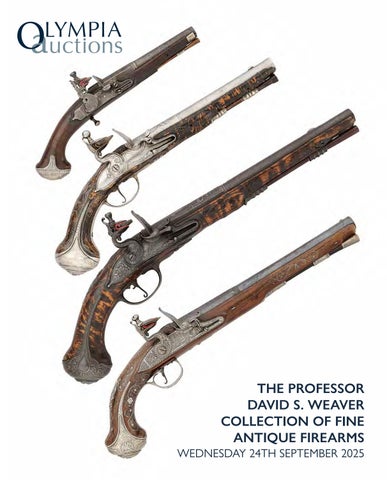
THE PROFESSOR DAVID S. WEAVER COLLECTION OF FINE ANTIQUE FIREARMS WEDNESDAY 24TH SEPTEMBER 2025
THE PROFESSOR DAVID S. WEAVER COLLECTION OF FINE ANTIQUE FIREARMS TO BE SOLD BY AUCTION: 25 Blythe Road, London W14 0PD AUCTION: Wednesday 24th September 2025, 11am, precisely PUBLIC EXHIBITION: Sunday 21st September 12pm to 4pm Monday 22nd September 10am to 7pm Tuesday 23rd September 10am to 5pm SALE NUMBER OA0165
ENQUIRIES: Thomas Del Mar David Williams Simeon Beever
CONSULTANTS: Ian Eaves Peter Smith
ARCHIVIST: Ainslie Johnston
+44 (0) 207 806 5545 armsandarmour@olympiaauctions.com FREE LIVE ONLINE BIDDING
www.OlympiaAuctions.com
ONLINE CATALOGUE AND LIVE INTERNET BIDDING AVAILABLE THROUGH: www.olympiaauctions.com www.the-saleroom.com www.invaluable.com www.drouotonline.com Front cover Lots 41, 57, 54, 108 Inside front cover Lots 76, 25 Page ii Lots 28, 31, 25, 30 This auction is conducted by Olympia Auctions in accordance with our Conditions of Business printed in the back of this catalogue.
ii
iii
iv
v
PROFESSOR DAVID S. WEAVER (1940-2023) Olympia Auctions is proud to be offering one of the most important collections of early English firearms to come onto the market since the sales of the collection of the late W. Keith Neal. The collection is the lifetime achievement of the Canadian collector Professor David S. Weaver, whose connoisseurship and dedication amassed a distinguished group of weapons. Many of the items to be offered have not been seen for decades and form the nucleus of one of the most extensive private collections of its type. Throughout his collecting life, Dave’s interests were diverse, encompassing most major groups within the field. The sale presents a unique opportunity to acquire some of the finest English firearms extant outside public collections and fulfils his wish that those interested in the subject will have the opportunity to add to their collections. Dave Weaver died on 24th September 2023, having been diagnosed with a rare cancer twenty years earlier and being advised that he had only two years to live. He considered the last eighteen years a gift and lived accordingly. Shortly after his diagnosis Dave retired from a distinguished academic career as a professor of mechanical engineering at McMaster University in Ontario; he was also Associate Dean of the Engineering School. However, he continued mentoring and consulting as Professor Emeritus. He was a man of diverse interests and multiple skills. As a young man he was a motorcycle enthusiast and travelled extensively throughout North America on a Vincent Black Shadow which, when purchased in 1957, was the fastest bike on the road. He was a sailor, a carpenter and a skilled wood turner, and he played the French horn. It was, however, in the field of early English firearms where his greatest passion lay and over the course of six decades he assembled the important collection of early 17th and 18th century firearms offered here. He acquired some of the finest and rarest 17th century pistols, forming what is possibly the most important private group extant. He researched and wrote extensively on this subject. His publications were mostly in the United Kingdom, and he was fittingly honoured in 2021 with the Research Medal from the Arms and Armour Society in England, the journal of which is considered the leading English language academic publication on the subject. His writing was enhanced by his professional background that allowed informed advice on metallurgy and ballistics, sometimes challenging accepted notions on efficacy and the usage of weapons. In particular, he took issue with the accepted wisdom associated with blunderbusses and duelling pistols. He contributed a chapter in the Wogdon book after employing his university’s resources (a neutron spectrometer) to measure Wogdon’s infamous barrel bending. His enthusiasm never diminished, and he purchased his last pair of pistols only three weeks before his death. Dave’s life was a commitment to learning and dissemination of knowledge. He was a Past President of the Canadian Guild of Arms Historians and a member of the American Society of Arms Collectors for the last twelve years. He was learned and willingly shared his knowledge; he was thoughtful, of even temper and kind. He had a sense of humour and wore his considerable academic stature lightly. Above all, Dave Weaver extolled those most cherished virtues of any person in any age; he was a gentleman and scholar, and generous friend who enriched the lives of many. He is sorely missed.
John Burgoyne
vi
In addition to several dozen highly specialist academic papers, his bibliography for antique firearms is set out below: Weaver, D.S. and Godwin, B., ‘Thomas Green, Gunmaker and Persecuted Popish Recusant’, Arms and Armour, Journal of the Royal Armouries, Vol. 20, No. 1, 2023 Weaver, D.S., ‘The Origin of the English Duelling Pistol – a Re-Examination’, Journal of the Arms and Armour Society, Vol. XXIV, No. 1, March 2022, pp. 42-75 Weaver, D.S. and Godwin, B., ‘John Cookson, Gunmaker’, Arms and Armour, Journal of the Royal Armouries, Vol. 19, No. 1, April 2022, pp. 43-63 Weaver, D.S., ‘Did Wogdon Bend his Barrels Crooked to Make Them Shoot Straight’, ASAC Bulletin No. 124, pp. 5-14 Weaver, D.S., ‘The English Blunderbuss and its Ballistics’, Arms and Armour, Journal of the Royal Armouries, Vol 17 (2), 2020 Weaver, D, S. and Godwin B., ‘Silver Butt Caps on English Pistols 1650 – 1715’, Sixth Antique Arms Fair Guide, incorporating the Park Lane Arms Fair, 2020, pp. 81-88 Weaver, D, S., ‘Did Wogdon Bend his Barrels’, Ch. 7, pp. 62-73, in J. O’Sullivan and De Witt Bailey, Robert Wogdon, London Gunmakers, 1764 – 1819, Bonhams, London, 2019 Weaver, D.S. and Godwin, B., ‘Godfrey Taylor, Gunmaker’, London Park Lane Arms Fair Guide, 2018, pp 114-125 Weaver, D.S. and Godwin, B., ‘George Edward Dolep and a Pair of his Pistols’, London Park Lane Arms Fair Guide, 2017, pp. 159-170 Weaver, D.S. and Godwin, B.,’ Henry Ellis of Doncaster, the Man and his Work’, London Park Lane Arms Fair Guide, 2016, pp. 75-99 Weaver, D.S. and Godwin, B., ‘A Fine Gun from a Mysterious Source’, London Park Lane Arms Fair Guide, 2013, pp. 95-105 Weaver, D.S. and Godwin, B., ‘William Townson and his Turn-Off Pistol Dated 1683’, London Park Lane Arms Fair Guide, 2012, pp. 75-91 Weaver, D.S. and Godwin, B.C., ‘Some Notes on Type 2 English Locks and Two Pistols in Particular’, Park Lane Arms Fair Guide, 2011, pp. 84-96 Weaver, D.S. and Godwin, B.C., ‘A Transformation in English Gunmaking 1670 – 1770’, London Park Lane Arms Fair Guide, 2010, pp. 68-85 Weaver, D.S. and Godwin, B.C., ‘A Remarkable Group of Late 17th Century English Pistols and Their Genesis’, London Park Lane Arms Fair Guide, 2009, pp. 87-97
vii
SELECT BIBLIOGRAPHY Atkinson 1978
John Atkinson, The British Duelling Pistol, London 1978
Back 1988
David Back, ‘The Use of Double Barrel Guns in the Eighteenth Century’ in The Fifth Park Lane Arms Fair Catalogue, 1988
Back 1992
D.H.L. Back, Great Irish Gunmakers: Messrs Rigby 1760-1869, Norwich 1992
Back 1993
D.H.L. Back, Great British Gunmakers: The Mantons 1782-1878, Norwich 1993
Bedford & Grancsay 1971
Clay P. Bedford and Stephen Grancsay, Early Firearms of Great Britain and Ireland from the Collection of Clay P. Bedford, exhibition catalogue, The Metropolitan Museum of Art, New York, 1971
Bennett & Johnston 1996
Jim Bennett & Stephen Johnston, The Geometry of War 1500-1750, Oxford 1996
Blackmore 1965
Howard L. Blackmore, Guns And Rifles Of The World, New York 1965
Blackmore 1971
Howard L. Blackmore, The Arms & Armor Series: Hunting Weapons, London 1971
Blair 1973
Claude Blair, ‘The Egg Family, Part 1 and Part 1 (contd.) in J.A.A.S., Vol. VII (1973)
Cooper & Westwood 1989
John S. Cooper & Kenneth J. Westwood, John Dafte – Gunsmith and the Horrid Conspiracy of 1683, 1989
Cooper 1985
J.S. Cooper, ‘An early English Flintlock Pocket Pistol’ in Guns Review, 1985
Cooper 1999
John Cooper, ‘John Cosins, Gunmaker of London’ in The Sixteenth Park Lane Arms Fair Guide, February 1999
Cooper 2008
John Cooper, ‘The Uptons of Oxford - Gunmakers’ in London Park Lane Arms Fair Guide, Spring 2008
Credland 1978
A.G. Credland, ‘Wallis of Hull’ in J.A.A.S., Vol. IX, No. 4 (December 1978)
Dixon 2002
Norman Dixon, ‘A Georgian Gunmaker 1730-1801’ in J.A.A.S., Vol. XVII, No. 3 (March 2002)
Godwin et al 2016
Brian Godwin, John Evans and David Williams, ‘The Probin Gunmakers of 18th Century Birmingham’ in Man At Arms, February 2016
Griffin 1993
Eric Griffin, Griffin of Bond Street, Dorset 1993
Hawkins 1973
Peter Hawkins, The Price Guide to Antique Guns and Pistols, Suffolk 1973
Hayward 1948
J.F. Hayward, ‘English Pistols of the XVII Century, Part II’ in Apollo, January 1948
Hayward 1963
John F Hayward, The Art of the Gunmaker Volume II 1660-1830, Chatham 1963
Hayward 1968
John Hayward, ‘The Huguenot Gunmakers Of London’ in J.A.A.S., Vol. VI, No. 4 (December 1968)
Munson 1992
H. Lee Munson, The Mortimer Gunmakers 1753-1923, Rhode Island 1992
viii
Murchoch 1992
Tessa Murchoch (ed.), Boughton House, The English Versailles, London 1992
Neal & Back 1975
W. Keith Neal and D.H.L. Back, Great British Gunmakers 1740-1790, Norwich 1975
Neal & Back 1984
William Keith Neal and David H. L. Back, Great British Gunmakers 1540-1740, Norwich 1984
Neal & Back 1989
W. Keith Neal and D.H.L. Back, British Gunmakers Messrs Griffin & Tow And W. Bailes 1740-1790, Norwich 1989
O’Sullivan & Bailey 2019
John O’Sullivan and De Witt Bailey, Robert Wodgon, Wodgon & Barton London Gunmakers 1764-1819, London 2019
Southwick 2001
Leslie Southwick, London Silver-Hilted Swords: Their Makers, Suppliers and Allied Traders, with Directory, Leeds 2001
Southwick 2022
Leslie Southwick, ‘The Makers’ Marks, ‘I.K’, ‘JA’ and ‘MB’, Struck On London 18th Century Georgian Silver Gun Furniture…’ in J.A.A.S., Vol XXIV, No. 2 (September 2022)
Southwick 2023
Leslie Southwick, ‘The Maker’s Mark Of Michael Barnett Struck On The Georgian Silver Gun Furniture And Silver Hilts And His London Workshop’ in J.A.A.S., Vol. XXIV, No. 4 (September 2023)
Stroud 2023
David J. W. Stroud, A Dictionary of the Early Irish Gunmakers, Scarborough 2023
Unsworth 1996
L. Patrick Unsworth, The Early Purdeys, London 1996
Weaver & Godwin 2010
David S. Weaver and Brian Godwin, ‘A Transformation in English Gunmaking 1670-1770’ in London Park Lane Arms Fair Guide, Spring 2010
Weaver & Godwin 2011
David S. Weaver and Brian C. Godwin, ‘Some Notes on Type 2 English Locks and two Pistols in particular’ in London Park Lane Arms Fair Guide, Spring 2011
Weaver & Godwin 2012
David S. Weaver and Brian Godwin, ‘William Townson and his Turn-off Pistol Dated 1683’ in London Park Lane Arms Fair Guide, Spring 2012
Weaver & Godwin 2016
David S Weaver and Brian Godwin, ‘Henry Ellis of Doncaster, the Man and his Work’ in London Park Lane Arms Fair Guide, Spring 2016
Weaver & Godwin 2017
David S. Weaver and Brian Godwin, ‘George Edward Dolep and a Pair of his Pistols’ in London Park Lane Arms Fair Guide, Spring 2017
Weaver 2019
D.S. Weaver, ‘Did Wogdon Bend his Barrels’, Ch. 7, pp. 62-73, in J. O’Sullivan and De Witt Bailey, Robert Wogdon, London Gunmakers, 1764 – 1819, Bonhams, London, 2019
Williams 2016
David Williams, ‘Henry Nock, Walter Dick and Charles Lennox, The Duke of Richmond, and the Journey to the Final Designs of the Nock screwless lock’ in Arms & Armour, Vol.13, No.1, Spring 2016
Wimsey 2000
Tom Wimsey, ‘Newton of Grantham’ in J.A.A.S., No. 5 (September 2000)
ix
1 AN ENGLISH SILVER-HILTED SMALL-SWORD, LONDON SILVER HALLMARKS FOR 1768, MAKER’S MARK OF WILLIAM KINMAN with bright sharply tapering blade of hollow triangular section etched on both sides of the forte with a panel of foliated strapwork enclosing a trophy within an oval (some old wear), hilt cast, pierced and chased with scrolling foliated tendrils on the slightly upturned shaped ovoidal shell-guard, quillon-block and globular pommel, the first within a border of foliate scrollwork and fluting, knuckle-guard and lobed quillons all en suite, the last with prominent button, and grip bound with silver ribbon and two thicknesses of twisted silver wire, 81.2 cm blade
3 AN ENGLISH SILVER-HILTED SMALL-SWORD, CIRCA 1755, INDISTINCT LONDON SILVER HALLMARKS, MAKER’S MARK PROBABLY OF GEORGE FAYLE with colichemarde blade of sharply tapering hollow triangular section etched on both sides of the forte with foliated strapwork, one side enclosing a martial trophy in an oval, and on the other enclosing an arrangement of symmetrical foliage, characteristic hilt cast and chased with gadrooning and comprising boat-shell guard with raised borders, quillon-block, arms, recurved lobed quillons, knuckle-guard, globular pommel with button, and grip bound with silver ribbon and two thicknesses of twisted silver wire, 80.2 cm blade
Provenance Bonhams Knightsbridge, Antique Arms, Armour & Modern Sporting Guns, 11 May 2016, lot 321
‡ £600-900
For more details of this maker see Southwick 2001, pp. 159-160.
‡ £1,000-1,500 2 AN ENGLISH SILVER-HILTED SMALL-SWORD, LONDON SILVER HALLMARKS FOR 1762 with colichemarde blade (old light rust patination) of tapering hollow triangular section etched along both sides of the forte with a panel of strapwork on a hatched ground enclosing a differing design of foliage and surmounted by symmetrical foliate scrolls, hilt cast, chased and pierced with musical trophies centred on scrolling foliage issuing from bird’s heads on the boat-shell guard, quillon-block with foliate arms, recurved quillons issuing from bird’s heads en suite, knuckleguard, globular pommel with button, and grip bound with silver ribbon and two thicknesses of silver wire, 84.5 cm blade
For details of this maker see Southwick 2001, pp. 105-106.
4 AN ENGLISH SILVER-HILTED SMALL-SWORD, CIRCA 1725, MAKER’S MARK PROBABLY OF GEORGE WILLCOCKS with colichemarde blade of sharply tapering hollow triangular section inlaid with two copper-alloy flowers on one side at the forte, plain hilt comprising double shell-guard with raised moulded borders, waisted quillon-block with slender downcurved arms, lobed rear quillon, knuckle-guard with central swelling, globular pommel with button, and swelling flattened grip bound with twisted silver wire between silver Turk’s heads, 80.6 cm blade For information regarding George Willcocks, ‘gifted silver-hilt maker and sword cutler’, see Southwick 2001, p. 279, pl. 29 and colour plate I for other examples of his work.
‡ £500-700
‡ £800-1,200 1
2
3
4
1
See page iii for Buyer’s Premium and other charges
5 AN ENGLISH SILVER-HILTED HUNTING SWORD, CIRCA 1745, INDISTINCT SILVER HALLMARKS AND MAKER’S MARK with tapering fullered blade (scattered minor rust patination) doubleedged towards the point, hilt cast and chased in relief with scallop shells and foliage against finely punched grounds, centred on a ‘Green Man’s’ mask on the downbent shell-guard and on the back of the pommel, the latter with button and fluted extension down the back of the grip, lobed rear quillon with foliage, quillon-block with a lion-mask on each side, knuckle-guard with central scallop shell between foliage, and vertically fluted tapering dark horn grip, 63.9 cm blade Provenance Olympia Auctions, London, Antique Arms, Armour & Militaria, 8 December 2021, lot 168 For a similar example in the Victoria and Albert Museum, see Blackmore 1971, pl. 26.
‡ £1,000-1,500 6 AN ENGLISH SILVER-HILTED HUNTING SWORD, CIRCA 1745, INDISTINCT LONDON SILVER HALLMARKS AND MAKER’S MARK with tapering fullered blade (some old wear and light rust patination) double-edged towards the point and cut with a narrow fuller along the back on each side, the forte etched with a panel of strapwork surmounted by a foliate motif on both sides, hilt cast and chased in relief with scallop shells centred on a ‘Green Man’s’ mask on the downbent shell-guard, quillon-block with a lion-mask on each side, replacement rear quillon with scallop shell terminal, knuckle-guard with central scallop shell between foliage, domed pommel-cap with button and chased with a ‘Green Man’s’ mask between foliage on both sides, and vertically fluted tapering dark horn grip, 60.0 cm blade
‡ £800-1,000
5
2
6
5 detail
7 AN UNUSUAL ENGLISH SILVER-MOUNTED HUNTING SWORD, BRITANNIA SILVER STANDARD HALLMARKS FOR 1697, MAKER’S MARK OF JAMES HUGHES with associated slightly curved fullered blade (some old pitting) double-edged towards the point, sparsely engraved hilt comprising downbent rounded rear quillon, knuckle-guard, pommel-cap and basal ferrule each set with a filigree floret on both sides against a finely punched ground, the pommel-cap and ferrule between embossed florets en suite, and natural buckhorn grip, 50.5 cm blade Provenance Bonhams Knightsbridge, Fine Antique Arms and Armour, 23 September 2020, lot 91
‡ £600-800 8 AN ENGLISH HUNTING HANGER, MID-17TH CENTURY with curved blade double-edged towards the point and cut with two narrow fullers along the back on each side, the lower fuller extending to the point, the fuller at the forte on one side indistinctly etched ‘Louis Oldfieldt, Dundlek…’, iron hilt comprising downbent shell-guard chiselled in low relief with a male profile portrait medallion amid scrolling foliage, lobed rear quillon and knuckle-guard chiselled with scrolling foliage, the latter with monster-head terminal, bun-shaped pommel chiselled with a floret on top centred on the button, and natural buckhorn grip with iron basal mount chased with a border of foliage and a male profile bust within an arch on the outside (some old rust patination overall), 49.0 cm blade Provenance Bonhams Knightsbridge, Antique Arms, Armour & Modern Sporting Guns, 17 May 2027, lot 107
‡ £800-1,000
7
8
3
See page iii for Buyer’s Premium and other charges
9
9 A BOOK-PLATE FROM CHAMBER’S CYCLOPAEDIA OR UNIVERSAL DICTIONARY OF ARTS AND SCIENCES, FIRST PUBLISHED LONDON, 1778 depicting a ‘GUN’, a ‘BOMB’, ‘CALIBER COMPASS’ , ‘POINTING OF A GUN’, GUNNERY’ and ‘BORING OF CANNON’, signed by the engraver ‘I. Taylor’ 23.0 cm x 39.0 cm (framed and glazed)
‡ £200-300
10
10 A RARE LARGE GUNNER’S CALIPER BY TROUGHTON & SIMMS, LONDON, MID-19TH CENTURY comprising two symmetrical halves hinged together and each of curved tapering form to an iron tip, engraved over one side with maker’s names and number ‘2244’ above a Board of Ordnance mark and a scale marked and labelled ‘Diameter of Shot or Shell’ above ’13 In. M. 12.84’, ’10 In. M. 10 In. G.} 9.84’, ‘8 In. M. 7.86’, ‘68 Pr. 8 in. G.} 7.93,’ ‘56 Pr. G. 7.48’, ‘42 Pr. G. 6.77’, ‘32 Pr. G. 6.18’, ‘24 Pr. G. 5.61’, ‘18 Pr. G. 5.10’, ‘12 Pr. H & C 4.52’, ‘9 Pr. G. 4.08’, ‘6 Pr. 3.55’ and ‘3 Pr. G. 2.82’, and over the other with ‘3 Pr. G.’, 6 Pr. G.’, 9 Pr. G.’, ‘12 Pr. H. & C.’, 18 Pr. C.’, ‘18 Pr. H.’, ’24 Pr. H.’, ‘32 Pr. Gun’, ‘42 Pr. Gun’, ’56 Pr. Gun’, 8 In. Mortar & Gun’, 68 Pr. Gun’, ’10 In. Mortar & Gun’ and ’13 In. Mortar’, and in fair condition, 100 cm (extended) Troughton & Simms were in partnership between 1826 and 1922.
‡ £800-1,200 4
11
12
13
11 A GUNNER’S FOLDING CALIPER, 18TH CENTURY comprising two symmetrical halves hinged together, one side engraved with scales and stamped ‘INCHES’, ‘GUNS’ and ‘SHOT’, hinged from ‘0’ to ‘180’ degrees and ‘1’ to ‘8’ inches, 12in. rule, iron tips, and in fine condition retaining nearly all its lacquered finish, 30.5 cm (extended)
‡ £400-500 12 A GUNNER’S FOLDING CALIPER BY CRICHTON, LONDON, 18TH CENTURY of heavy gauge and comprising two symmetrical halves hinged together (minor old bruising on one edge), one side with the mark of the East India Company and engraved scales in ‘Ins.’ and for ‘Guns’, hinged from ‘0’ to ‘180’ degrees, 12in. rule on the other, and with iron tips, 30.5 cm (extended)
‡ £450-550 13 A GUNNER’S FOLDING CALIPER BY THOS. HEATH FECIT, MID-18TH CENTURY comprising two symmetrical halves hinged together and finely engraved on one side with scales for ‘Cubic Feet of Metals &c. in Pounds & Decim l Averdupoire & Inches of the same in Ounces & Decimal’, the scales engraved for ‘Gold’, ‘Quick’, ‘Silver’, ‘Copper’, ‘Brass’, ‘ca Brass’, ‘Steel’, ‘Iron’, ‘Tin’, ‘Marble’, ‘Glass’, ‘Alabla’, ‘Ivory’, ‘Se Water’ ‘Co Water’, ‘Dry Oak’, ‘Ol Oyl’ and including repetitions, and on the other with scales for ‘IRON GUNS’ over ‘Proof ‘ and ‘Service’ and ‘BRASS GUNS’ over ‘Proof’ and ‘Service’, hinged from ‘0’ to ‘180’ degrees and from ‘1’ to ‘10 Inches’, the latter with engraved hand indicator, one side with 12 ‘Inches’ rule, and with iron tips, 30.5 cm (extended) Thomas Heath is recorded as a maker of quality instruments ‘under the sign of Hercules & Globe, Strand, London’ between 1720 and 1753. For a similar example by Watkins & Smith, London, see Bennett Johnston 1996, pp. 26-27, figs. 21 & 22.
‡ £800-1,000
14
15
16
14 A GUNNER’S FOLDING CALIPER BY RAMSDEN, LONDON, LATE 18TH CENTURY comprising two symmetrical halves hinged together and finely engraved with scales for ‘The Weight of Powder that will Fill the Chamber of Brass Mortars’ and marked out in inches for ‘Mortars’, ‘Royal’ and ‘Cohorn’, to the left ‘D of Shell’ over ‘Land’, ‘Sea’ on one side, and ‘Brass Guns’ over ‘Proof Service’ and ‘Iron Guns’ over ‘Proof Service’ on the other, hinged from ‘01’ to ‘180’ degrees and from ‘0’ to ’10 Inches’, the latter with engraved hand indicator, one side with 12in. rule, and with steel tips, 30.5 cm (extended) Jesse Ramsden is recorded from 1697 until his death in 1800. He was a leading mathematical instrument maker of his day and invented the dividing engine for accurately making scales on instruments.
‡ £600-800 15 A GUNNER’S FOLDING CALIPER BY WATKINS, CHARING CROSS, LONDON, LATE 18TH CENTURY comprising two symmetrical halves hinged together and finely engraved with scales for ‘Quantity of Powder for Filling the Chambers of Brass Mortars & Howitzers’ and marked out in inches for ‘Sea’ and ‘Land’ on one side, and for ‘Brass Guns’ over ‘Proof Service’ and ‘Iron Guns’ over ‘Proof Service’ on the other, hinged from ‘0’ to ‘180’ degrees and from ‘0’ to 8 Inches’, one side with 12 ‘Inches’ rule, and with steel tips, 30.5 cm (extended)
‡ £600-800 16 A GUNNER’S FOLDING CALIPER BY J. ROWLEY FECIT, EARLY 18TH CENTURY comprising two symmetrical halves hinged together on an iron ringheaded threaded adjuster, finely engraved on one side with scales for ‘Weight of … Foot in.’, and for ‘Gold’, ‘Quick’, ‘Lead’, ‘Silver’, ‘Coppr’, ‘Iron’, ‘Tin’, ‘Purb’, ‘Cris’, ‘Brim’, ‘Water’, ‘Wax’, ‘Oyle’, ‘D:Woo’, ‘Lo:Sto’ and ‘Mar’, and on the other with scales and ‘Names of Guns’, ‘Proof Service’, a hand indicating ‘Shot’, and ‘Foot English’, hinged from ‘10’ to ‘180 Degrees’ and ‘1’ to ‘10’ inches, 12 in. rule, and with iron tips (some old wear), 30.5 cm (extended) The maker is probably John Rowley, recorded between 1697 and his death in 1728. He was Master of Mechanics to George I.
‡ £600-900 5
See page iii for Buyer’s Premium and other charges
17 A FINE CONTINENTAL SPORTSMAN’S COMBINATION TOOL, LATE 17TH/ 18TH CENTURY of bright steel, comprising a pair of pliers turned with concentric circles on each side of the hinge, threaded over the nose of the turned baluster hammer with triangular flint-knapping blade incised on both sides with a dog’s head and foliage, one side struck with maker’s mark ‘OR’, the handles incorporating a grip or nut-cracker and terminating respectively in a pricker and corkscrew (incomplete) within tapering tubular covers, one threaded for a charge-drawer, and the other with terminal cut with a seal, 14.5 cm 17
Provenance The Paul Murray Collection Bonhams Knightsbridge, Antique Arms & Armour Including the Paul Murray Collection, 29 & 30 November 2017, lot 443 For another example see Blackmore 1965, p. 103, no. 827 (illustrated)
‡ £1,500-1,800 18 A FINE BRESCIAN WHEEL-LOCK MECHANISM FOR A LONGARM, CIRCA 1640 with flat bevelled plate struck with ovoidal maker’s mark (Neue Støckel 427) on the inside and with chiselled foliate terminal, wheel retaining bracket, cock and cock-spring all chiselled with foliage, and sliding pan-cover operating against an internal spring; together with a modern wheel-lock spanner of steel, the head of octagonal section for spindles of two sizes, ring-shaped terminal with integral turnscrew, and stamped ‘JEH’, the first: 22.0 cm (2) The maker's mark is that of Giovanni Antonio Gavacciolo recorded in Brescia between circa 1635 and 1650. 18
‡ £500-700 19 AN ENGLISH FLINTLOCK MECHANISM FOR A MILITARY PISTOL, CIRCA 1640 of russet iron, the flat plate with drop-shaped tail, flat cock engaging with a sear through the lockplate, buffer secured by a screw, rectangular pan and steel, and bridle over the steel-spring secured by screws, 16.0 cm For a related example formerly in the Keith Neal Collection, see Christie’s London, Antique Arms and Armour…, 18 July 2002, lot 125 (part)
19
6
‡ £300-400
20 AN ITALIAN (TUSCO-EMILIAN) SNAPHAUNCE MECHANISM FOR A LONGARM, INITIALS ‘F.A’ AND THE DATE 1837 ON THE INSIDE, PROBABLY SECOND HALF OF THE 18TH CENTURY with flat bevelled plate engraved with foliage involving a monster-head beneath the bolster, the latter, pan with sliding cover and cock all decorated with foliage en suite, flat cock engraved with foliage involving a sea-monster and with a monster-head on the comb, the mechanism partly engraved with foliage, 17.0 cm
20
‡ £250-350 21 A VERY RARE PROTOTYPE FLINTLOCK ENCLOSED SCREWLESS MECHANISM FOR A DUKE OF RICHMOND’S PATTERN MUSKET BY HENRY NOCK, LATE 18TH CENTURY with detachable flat bevelled plate engraved with crowned ‘GR’ cypher on the detachable pan-shield and secured by a large headed slotted screw with knurled edge, copper alloy plate over the mechanism stamped with maker’s mark ‘NH’, a star above, struck on the inside with the same mark, and in unfired condition, 16.0 cm
21
Literature David Williams, ‘Henry Nock, Walter Dick and Charles Lennox, The Duke of Richmond, and the Journey to the Final Designs of the Nock screwless lock’, Arms & Armour, Vol.13, No.1, Spring 2016, pp. 28-47, footnote 10 Henry Nock took livery in 1790, was elected Master of the Gunmakers’ Company in 1802 and was appointed Gunsmith-inOrdinary to King George III in 1789.
‡ £800-1,000 22 A FLINTLOCK ENCLOSED SCREWLESS MECHANISM FOR A CARBINE BY HENRY NOCK, LATE 18TH CENTURY with flat bevelled plate signed in capitals and struck with broad arrow mark, and detachable pan-shield engraved with crowned ‘GR’ cypher (some old rust patination), 14.2 cm
22
‡ £250-350 23 AN EAST INDIA COMPANY FLINTLOCK MECHANISM FOR A WALL-PIECE BY TOW, DATED 1793 with signed border engraved flat bevelled plate, ring-neck cock and steel, the first dated and engraved with East India Company mark on the tail: mounted on a wooden stand, 23.5 cm (2) For details of John Tow, who took over the Griffin & Tow business in 1783, see Neal & Back 1989, pp. 28-29, and Griffin 1993, pp. 67, 71, 73, 85 and 87.
23
‡ £400-600 7
See page iii for Buyer’s Premium and other charges
24 AN AUSTRIAN 25 BORE WHEEL-LOCK ORMOLUMOUNTED SPORTING RIFLE BY ELIAS MAURER IN WEITRA, CIRCA 1720 with swamped octagonal barrel rifled with seven spiral grooves and retaining old blued finish along the bottom flats (barrel retaining pins missing), copper-alloy fore-sight, back-sight with engraved foliate finial, breech signed in gold capitals and decorated with gold-inlaid strapwork above a gilt-lined barrelsmith’s mark at the rear, a galloping horse, tang engraved with strapwork, flat lock engraved ‘IN WEIRA’ beneath the sprung sliding pan-cover and decorated with a huntsman presenting a dead hind to an Empress, a stag shooting scene in a landscape beyond, enclosed wheel, dog engraved with a figure and foliage, and the bridle to the chiselled dog-spring with a bear beset by hounds, figured full stock carved in low relief with foliated strapwork at the rear ramrod-pipe, around the barrel tang, behind the side-plate and around the triggerguard, butt (old splits) hollowed for the cheek and set with a panel of dark horn along the bottom, mounts retaining much of their gilding and cast, chased and engraved with foliated strapwork on the comb mounts, butt-plate (button missing), trigger-plate and trigger-guard, the last indented for the fingers, large side-plate pierced with a stag hunting scene in a wooded landscape, sliding patch-box cover with further scenes of the chase, engraved faceted ramrod-pipes, horn fore-end cap set with a foliate ormolu mount on each side, threaded peep-sight, adjustable set trigger, and original horn-tipped ramrod (some wear overall), 82.3 cm barrel Elias Maurer is recorded in Weitra, Lower Austria, circa 1710-1730.
‡ £3,000-4,000
8
9
See page iii for Buyer’s Premium and other charges
25 A VERY FINE 16 BORE FLINTLOCK SILVER-MOUNTED SPORTING GUN BY GRIFFIN & TOW, LONDON, LONDON SILVER HALLMARKS FOR 1771, MAKER’S MARK OF JOHN KING with blued swamped two-stage barrel with silver spider fore-sight and turned girdle, octagonal breech signed in capitals within a border engraved panel with foliate sprays at either end, engraved with a line of beadwork at the rear, and struck with London proof marks and barrelsmith’s mark of Joseph Griffin, gold-lined touch-hole, tang grooved for sighting and finely engraved with rocailles and flowering foliage, border engraved flat bevelled lock signed in capitals within a foliated rococo cartouche and decorated with flowering foliage on the tail, bevelled cock and safety-catch decorated en suite, the latter engaging with the tumbler on the inside, the internal working parts retaining their burnished finish and some blueing, gold-lined pan and border engraved steel, chiselled steel-spring with small acorn finial, finely figured full stock with take-down fore-end (minor repairs) carved in low relief with a scallop shell and motifs at the barrel tang, elaborately cast and chased mounts comprising pierced side-plate with a reclining sportsman and his gundogs amid hanging game and with a winged female demi-figure at the rear, escutcheon with crest flanked by a bow and quiver, a spread eagle above and flowers below and engraved with owner’s crest and monogram, ‘RG’, butt-plate with hanging game suspended on a ribbon from a moustachioed grotesque mask, all against a finely stippled ground, the retaining screws each centred on an engraved flower-head, trigger-guard with foliate terminal, a running hare in a landscape on the border engraved bow and finial formed as a bird perched on a foliated urn, turned ramrod-pipes, original horn-tipped ramrod with iron worm, and in fine condition, 95.0 cm barrel Provenance Anonymous sale, Christie’s London, Antique Arms and Armour, 18 July 2002, lot 314 Literature David S. Weaver and Brian Godwin, ‘A Transformation in English Gunmaking 16701770’, London Park Lane Arms Fair Guide, Spring 2010, p. 80, fig. 17 Built in the first year of the partnership of Joseph Griffin and John Tow who are recorded at 10 Bond Street, London until 1782. The crest is used by a number of families including Gower, Greenwood and Griffiths. Of these the most likely appears to be Gower of Brixham, Devon. For an almost identical side-plate on a pair of Benjamin Griffin flintlock pistols, see Neal & Back 1989, pp. 92 and 93, pls. 35a-c.
‡ £8,000-10,000
10
11
See page iii for Buyer’s Premium and other charges
26 A RARE 15 BORE FLINTLOCK SILVER-MOUNTED D.B. FLINTLOCK SPORTING GUN BY W. BAILES OF LONDON, LONDON SILVER HALLMARKS FOR 1758, MAKER’S MARKS OF JOHN ALLEN with bright two-stage barrels each with turned and chiselled girdle and joined on the upper side only by a flat tapering rib engraved with running foliate scrolls between the breech sections and either side of the silver fore-sight, octagonal breech sections signed in gold script, each engraved at the front with scrolls and stamped at the rear with the maker’s two gold-lined marks in the Spanish style within engraved rocailles and scrollwork, and struck with London proof marks and Foreigner’s mark, border engraved tang with cross-hatched sighting groove and finely decorated with rocailles and foliage, gold-lined touch-holes, flat bevelled locks each retained by two side-nails, signed in script, and with stepped tail (one cock associated, left steel reduced), finely figured half-stock carved in low relief with a scallop shell and motifs around the barrel tang, the butt with acute fall and cast-off (filled split at the toe), border engraved mounts comprising butt-plate cast and chased with a scallop shell and foliage on the tang and engraved with a trophy involving a cornucopia and a bird, trigger-guard with foliate finial and decorated with rocailles and foliage on the bow, the grip inlaid with a basket of flowers in silver sheet and wire instead of an escutcheon, foliate engraved broad fore-end cap also forming the ramrod entry, turned ramrod-pipes, and later horn-tipped ramrod, 84.4 cm barrels Provenance Probably from the gunroom of the Earls of Eglington, Eglington Castle, Ayrshire, and sold by Dowell’s of Edinburgh, 1-5 December 1925 Anon. sale Christie’s London, Antique Arms and Armour, 20 October 1982, lot 154 (£2,592 including premium) D.H.L. Back Collection Bonhams Knightsbridge, Fine Antique Arms and Armour Including the D.H.L. Back Collection, 24 November 2010, lot 422 Literature David Back, ‘The Use of Double Barrel Guns in the Eighteenth Century’, The Fifth Park Lane Arms Fair Catalogue, 1988, p. 8, pl. 4 W. Keith Neal and D.H.L. Back, Messrs Griffin & Tow and W. Bailes, 1989, pp. 136-137, pls. 74 a-d For William Bailes (circa 1700-1766) see lot 99. For John Allen see footnote to lot 100.
‡ £5,000-7,000
12
13
See page iii for Buyer’s Premium and other charges
27 A VERY RARE 36 BORE FLINTLOCK SPORTING RIFLE BY TWIGG, LONDON, CIRCA 1776-80 with slightly swamped rebrowned twist octagonal sighted barrel rifled with seven spiral grooves, gold fore-sight and steel folding leaf back-sight, the latter with small acorn finial, the breech signed in gold capitals, a row of engraved gold beadwork between gold lines at the rear, and struck with London proof marks beneath, gold-lined touch-hole, tang engraved with rocailles and foliage, flat bevelled lock and cock, the former with second form of signature and engraved blued safety-catch, moulded figured half-stock (perhaps reduced from full) carved in low relief in the German fashion with rocailles and scrolling foliage, raised cheek-piece carved en suite at either end, copper-alloy mounts engraved with rococo ornament and foliage, comprising shaped flat bevelled sideplate, butt-plate involving a sun-in-splendour centred on a martial trophy along the heel tang, wooden trigger-guard with engraved copper-alloy strap with pineapple finial, sliding patchbox cover with engraved brass mounts, adjustable set trigger, horn fore-end cap, faceted ramrod-pipes, and later horntipped ramrod, 71.7 cm barrel Provenance A. Chamberlain, Salisbury: acquired by W. Keith Neal in 1948 W. Keith Neal Collection Christie’s London, Fine Antique Firearms from the W. Keith Neal Collection, 9 November 2000, lot 64 Literature W. Keith Neal and D.H.L. Back, Great British Gunmakers 1740-1790, 1989, pp. 57 and 185, pls. 172-176 Neal and Back (op. cit.) list only eight known Twigg sporting rifles (including a pair, and a converted single), of which this is the most Continental in style. For Twigg see footnote to lot 103. Offered with a note handwritten and signed by W. Keith Neal giving details of the rifle’s acquisition, its performance when shot by Dick Cooper and giving comments regarding lead ammunition.
‡ £4,000-5,000
14
15
See page iii for Buyer’s Premium and other charges
28 A RARE 15 BORE FLINTLOCK SILVER-MOUNTED SPORTING GUN BY W. SMITH, PRINCES STREET, LONDON, NO. 3072 FOR 1822, LONDON SILVER HALLMARKS FOR 1747, MAKER’S MARK OF JOHN ALLEN with rebrowned damascus twist three-stage sighted barrel, octagonal breech becoming polygonal, signed in full along the top flat and struck with London proof marks and serial number beneath (bottom flat with some old pitting), recessed patent breech with two pairs of platinum lines and platinum-lined touch-hole, border engraved tang decorated with a starburst and foliage, border engraved flat lock signed in full in capitals, engraved ‘PATENT 2786’ behind the pan-shield and decorated with foliage terminating in a serpent on the tail, characteristic foliate engraved cock and swept pan, the former engraved with a lion-mask on the top jaw, and roller, blackened bird’s eye maple half-stock with silver fore-end cap and chequered grip, earlier cast and chased mounts comprising butt-plate engraved with the full armorial of Sir Francis Fust Bt. above the owner’s mirror monogram against a ground of cross hatching and foliage, foliate escutcheon with a grotesque mask above, a scallop shell below and engraved with the same armorial surmounted by Fust’s crest, trigger-guard engraved with the full armorial on the bow and the crest above the motto ‘Swift And True’ on the tang and terminal, the latter with scallop shell and foliage finial, all against a ground of cross hatching, ramrod-pipe engraved en suite, and copperalloy mounted ramrod, probably original, with threaded cap over the worm, 79.2 cm barrel William 9 Smith was at 64 Princes Street, London between 1821 and 1824. He was appointed Gunmaker-in-Ordinary to the Prince Regent in 1817, and to George IV in 1820. He probably started his serial numbers at 1000 and no serial numbers below this number have been found. For John Allen see footnote to lot 100.
‡ £3,000-4,000
16
17
See page iii for Buyer’s Premium and other charges
29 A VERY RARE 19 BORE FLINTLOCK FOWLING GUN BY G. TRULOCK OF LONDON, LATE 17TH CENTURY with long tapering barrel in three stages retaining some blueing beneath and with fore-sight on the turned and moulded muzzle, turned girdles, signed in capitals along the breech, and struck with London proof marks, the moulding at the rear cut to form a back-sight, border engraved tang decorated with a devil’s head with scaled and foliate body, border engraved rounded lock signed in capitals and decorated with scrolling foliage involving a profile head above the signature and a Devil’s mask on the tail, pan with water-drains, cock and steel both chiselled with foliage, the internal working part retaining their burnished finish, moulded figured full stock (fore-end mostly replaced) sparsely carved with foliage and with raised apron around the barrel tang, steel mounts comprising side-plate pierced and chiselled with scrolling foliage involving two beaked monster-head terminals, vacant escutcheon (probably expertly replaced) pierced and chiselled with foliage a surmounted by a ‘Green Man’s’ head, butt-plate engraved with a large ‘X’ and with pronounced border engraved heel, the latter finely decorated with scrolling foliage terminating in a monster-head and inhabited by a putti, the tang chiselled and engraved as a scaled monster, border engraved trigger-guard with chiselled foliate finial fore and aft and engraved with a foliated profile mask on the bow, baluster ramrod-pipes, and later iron-capped ramrod, 129.0 cm barrel Provenance The Barons Suffield, Gunton Park, Norfolk, house sale, Irelands, 17 September 1980 Presumably made for the first owner of Gunton Park, John Harbord (fourth son of Sir Charles Harbord, d.1679), who died in 1710 at the age of eighty-four as a result of a fall from his horse on the way back from shooting. George 1 Trulock was apprenticed to Harward Darke and turned over to his father William 1 (mentioned in Pepy’s Diary 29 March 1667 ‘One Trulocke the famous gunsmith, that is a mighty ingenious man and he did take my gun to pieces and made me understand the secrets thereof’) in 1680. He was allowed to prove guns under his father’s mark in 1687 and was free of the London Gunmakers’ Company the following year. He was Gunmaker to Ordnance between 1695 and 1708, and supplied gun barrels and Barbary locks ‘finely wrought for presents to the emperor of Morocco’ in 1704. For two other fowling guns, one by Henry Ellis of Doncaster and the other by John 2 Shaw of London and both late 17th century, see Bonhams Knightsbridge, The Penrose Collection of Antique Firearms, 23 November 2023, lots 87 and 88.
‡ £2,500-3,500 18
19
See page iii for Buyer’s Premium and other charges
30
30 A RARE 15 BORE FLINTLOCK FOWLINGPIECE BY DOLEP OF LONDON, CIRCA 1710 with tapering sighted barrel (repaired towards the muzzle) in three stages divided by mouldings and with traces of signature at the breech, the latter with moulding grooved for sighting at the rear, brass-lined touch-hole, border engraved tang decorated with foliage, border engraved rounded lock (cock probably an early working replacement) signed in capitals, moulded figured full stock (minor old bruises and repairs) with raised moulding around the barrel tang and pronounced swelling at the rear ramrod-pipe, shaped border engraved moulded steel mounts comprising butt-plate and trigger-guard, scroll side-plate chiselled with foliage and grotesque head terminal, silver wire inlay issuing from his open mouth, vacant escutcheon chiselled with a scroll above and acanthus below, baluster ramrod-pipes, and horn-tipped ramrod (some old wear and minor rust patination), 112.4 cm barrel Provenance The armoury of the Earls of Dunmore, Dunmore Park, Stirlingshire W. Keith Neal Collection Christie’s London, Fine Antique Firearms from the W. Keith Neal Collection, 25 October 2001, lot 69 Literature W. Keith Neal and D.H.L. Back, Great British Gunmakers 15401740, pp. 247-248, pls. 91 a-c For Dolep see footnote to lot 62. A number of pieces from the Dunmore armoury are on display at Colonial Williamsburg in Virginia, as John Murray (17321809), 4th Earl of Dunmore, appointed the last British Governor of the colony of Virginia, resided in the Governor’s Palace until he fled from it in June 1775. The present gun was made for either the 1st Earl (Lord Charles Murray, 1661-1710) or one of the six of his seven sons until after circa 1710, two of whom became respectively the 2nd and 3rd Earls.
‡ £2,000-3,000
31
31 A RARE 16 BORE FLINTLOCK GUN FOR BALL BY E. NEWTON, GRANTHAM, CIRCA 1760 with bright two-stage barrel turned at the girdle and with silver fore-sight at the muzzle, the latter with bayonet lug beneath, octagonal breech signed in capitals along the top flat and engraved with florets at the rear, and struck on the left flat with rectangular maker’s mark, a Tudor rose mark and a proof mark, border engraved tang grooved for sighting and decorated with a scallop shell and foliage, border engraved flat bevelled lock signed in capitals within a foliate rococo cartouche, the stepped tail engraved with a rabbit in a landscape, border engraved bevelled cock decorated with foliage, border engraved swing-out safety-steel, figured full stock with steel fore-end band at the bayonet lug and carved in low relief with a scallop shell behind the barrel tang, border engraved steel mounts comprising flat bevelled side-plate decorated with rocailles and foliage, butt-plate with border around the heel tang en suite and incorporating a sprung button releasing a hinged cover to the bayonet compartment numbered ‘6’, trigger-guard with foliate finial, vacant escutcheon chiselled with flowering foliage, turned ramrod-pipes, and later horn-tipped ramrod (some old light surface rust patination), 96.5 cm barrel Provenance Charles Watson Wentworth, 2nd Marquis of Rockingham (1730-1782), Whig politician and twice Prime Minister. All the more important guns in the Gun Closet at Wentworth Woodhouse were numbered on the butt-plate. An inventory of 1782 lists the present gun as ‘Newtons smooth barrel’d Gun’ (W. Keith Neal & D.H.L. Back, Great British Gunmakers 17401790, 1989, pl. 323.) A.N. Kennard Collection (1911-1995) former assistant Master, The Royal Armouries, H.M. Tower of London Christie’s London, Fine Antique Arms and Armour including the A.N. Kennard Collection, 27 March 1996, lot 107 Literature W. Keith Neal & D.H.L. Back, ibid, p.101. An account of the Gun Closet is given on pp. 99-101 David S. Weaver and Brian Godwin, ‘A Transformation in English Gunmaking 1670-1770’, London Park Lane Arms Fair Guide, Spring 2010, pp. 82-83, figs. 19 & 20 For Edward Newton see footnote to lot 90.
‡ £2,000-3,000 20
31
Sir Joshua Reynolds, John Murray, 4th Earl of Dunmore, National Galleries of Scotland, Purchased 1992 with contributions from Art Fund and the National Heritage Memorial Fund
30
31
21
See page iii for Buyer’s Premium and other charges
32 A 16 BORE FLINTLOCK FOWLING-PIECE BY JAMES LOW OF LONDON, CIRCA 1750 with two-stage Spanish barrel retaining some of its blued finish and with silver spider fore-sight at the slightly belled muzzle, turned girdle chiselled with acanthus and inlaid with engraved symmetrical silver foliage behind, octagonal breech decorated with inlaid silver en suite and involving a crucifix, and with two punzones of Rovira (gold linings incomplete) on the top flat, an engraved silver line at the rear, large gold-lined touch-hole, border engraved tang grooved for sighting and decorated with a scallop shell and foliage, border engraved flat bevelled lock signed in capitals, cusped behind the pan-shield and decorated with foliage on the stepped tail, cock engraved en suite, figured full stock (old insets in the butt) carved in low relief with a scallop shell behind the barrel tang, border engraved steel mounts finely decorated with rocailles and foliage and comprising flat bevelled side-plate, butt-plate engraved along the heel tang, trigger-guard with a flower-head on the bow and chiselled foliate finial, turned ramrodpipes, and later horn-tipped ramrod, 110.6 cm barrel Provenance Christie’s South Kensington, Fine Antique Arms and Armour, 12 December 1997, lot 140 James Low was apprenticed to John Brooke is 1717 and free of the London Gunmakers’ Company in 1724. He is recorded as ‘Gunsmith, Cannon Row, Westminster’ in 1749 and the last reference to him is in 1753.
‡ £1,800-2,200
32
33 A 10 BORE FLINTLOCK SILVER-MOUNTED SPORTING GUN BY ROB.T BOGLE OF LONDON, CIRCA 1760 with swamped barrel with silver fore-sight formed as a bearded mask (worn), tapering breech flat engraved with an elongated loop and with a band of foliage at the rear, and struck with London proof marks, gold-lined touch-hole, border engraved tang grooved for sighting and decorated with a scallop shell, a rocaille and foliage, border engraved rounded lock signed in capitals within a foliated rococo cartouche and decorated with foliage on the tail, foliate engraved cock with engraved safety-catch behind, figured half-stock (reduced from full, some old bruising) with dark horn fore-end cap, and inlaid with silver wire scrollwork on the fore-end including a scallop shell, and at the tang with a martial trophy flanked by foliage, unmarked cast and chased mounts comprising pierced side-plate with a shell and foliage on a draped pedestal between flower-heads and foliage, vacant escutcheon with border en suite, butt-plate with a trophy of arms and foliage within engraved borders along the heel tang, border engraved trigger-guard with scallop shell and foliage finial and decorated with a flower-head on the bow, steel under-rib and ramrod-pipes, and horntipped ramrod with iron worm (some wear and old rust patination), 96.0 cm barrel Little is known about this maker.
£600-800
32
22
33
33
32
33
23
See page iii for Buyer’s Premium and other charges
34 A FLINTLOCK BLUNBERBUSS WITH EARLIER BARREL BY W. TURVEY OF LONDON, CIRCA 1730, THE BARREL WITH BARRELSMITH’S MARK OF EDWARD 1 NICHOLSON, LATE 17TH CENTURY with copper-alloy barrel in three stages engraved with acanthus at the flared muzzle, at the girdle and mid-section, border engraved octagonal breech ramped at the rear, engraved with foliage and struck with London proof marks and barrelsmith’s mark, plain tang, border engraved rounded lock signed in capitals, border engraved rounded cock with foliate engraved dog-catch for the half-cock position, figured full stock (some old repairs at the muzzle, minor splits below the front of the lock and on one side of the butt) carved with raised apron around the barrel tang, border engraved copper-alloy mounts comprising flat scroll side-plate, butt-plate with rounded heel, trigger-guard with undulating tang and finial, border engraved escutcheon with owner’s crest, a Pelican in her Piety vulning her young, baluster ramrod-pipes, and later ramrod, 41.0 cm barrel William 1 Turvey was apprenticed to Edward 1 Turvey in 1703. He was elected Master of the London Gunmakers’ Company in 1733 and died by 1744. Following his death the business was carried on by his widow Sara. Edward 1 Nicholson was apprenticed to Robert Silke, free of the London Gunmakers’ Company in 1675, and elected Master in 1697. He was Contractor to Ordnance between 1680 and 1711, the East India Company in 1700, and to the Hudson’s Bay Company from 1687 until 1712. For a flintlock pistol with the same crest see lot 71.
‡ £1,500-1,800 35 A FLINTLOCK BLUNDERBUSS WITH EARLIER BARREL, UNSIGNED, CIRCA 1760, THE BARREL BY LE MAIRE OF LONDON, CIRCA 1720 with straight copper-alloy barrel in two stages and turned at the girdle, breech signed in capitals along the top flat on a raised panel cast and chased with acanthus, engraved with a line of foliage at the rear in front of an engraved ramp grooved for sighting, and struck with London proof marks, plain tang, flat bevelled lock and cock (top expertly replaced), the tail of the lock forming a sliding safety-catch, gold-lined pan with water drain fore and aft, and steel-spring with acorn finial, figured full stock (some old worming, minor damage, and split in the ramrod-channel at the muzzle), border engraved copper-alloy mounts comprising shaped flat bevelled side-plate decorated with a foliate rocaille, butt-plate decorated en suite on the heel tang and inhabited by a bird perched above, trigger-guard with acorn finial and a small flower-head on the bow, draped vacant escutcheon surmounted by a scallop shell, turned ramrod-pipes, sling loops, and later ramrod, 36.5 cm barrel For Le Maire see footnote to lot 63.
‡ £1,000-1,500
36 A FLINTLOCK BLUNDERBUSS BY J. PROBIN OF BIRMINGHAM, CIRCA 1770 with copper-alloy barrel in three stages, octagonal breech engraved with a line of beadwork at the rear and struck with private Birmingham proof marks, border engraved tang decorated with a garland and a scallop shell, border engraved flat bevelled lock signed in script and decorated with foliage at the tail, cock decorated en suite, figured full stock, border engraved copperalloy mounts comprising shaped flat bevelled side-plate decorated with a flower-head and a scallop shell, butt-plate with a design of foliage on the heel tang, trigger-guard with acorn finial and a flower-head in a diamond-shape panel on the bow, escutcheon engraved with owner’s monogram ‘CP’, turned ramrod-pipes, horn-tipped ramrod, and in fine condition, 37.0 cm barrel John Probin is recorded at 17 St. John’s Street, Birmingham between 1796 and the year of his death in 1800. He was Gunmaker to H.R.H. The Prince of Wales.
‡ £1,500-2,000 37 A FLINTLOCK BLUNDERBUSS WITH SPRING BAYONET BY JOHN RICHARDS, STRAND, LONDON, CIRCA 1790 with copper-alloy barrel in three stages turned and belled at the muzzle, and fitted with folding bayonet beneath, octagonal breech signed in full in capitals along the top flat, engraved with florets on the flats behind the girdle and with a line of foliage at the rear, and struck with London proof marks and barrelsmith’s mark of John 1 Richards, border engraved tang decorated with a starburst and foliage, border engraved flat bevelled copper-alloy lock signed in capitals and decorated with a part-martial trophy and foliage at the stepped tail, cock engraved with a part-martial trophy en suite, figured half-stock (minor old bruising, small split at the tail of the lock-plate and on one side at the barrel-bolt), border engraved copper-alloy butt-plate and trigger-guard, the former decorated with a martial trophy on the heel tang, the latter with a martial trophy and foliage on the bow and incorporating the bayonetrelease lever on the pineapple finial, fore-end mount engraved en suite, and no provision for a ramrod, 36.7 cm barrel John 1 Richards was made free of the London Gunmakers’ Company in 1781 and is recorded working at 114 Strand (corner of the Savoy Steps) between 1775 and 1777; 25 Strand between 1778 and 1780; 4 Ball Alley, Lombard Street between 1781 and 1783; 54 Strand (near Adelphi) between 1752 and 1805; and at 55 Strand between 1809 until the year of his death in 1821.
‡ £1,500-1,800 38 A FLINTLOCK BLUNDERBUSS WITH SPRING BAYONET SIGNED BUSBY & FOX, LONDON, CIRCA 1820 with copper-alloy barrel flared at the muzzle, engraved ‘LONDON’ within an elongated loop along the short top flat at the breech, struck with Birmingham proof marks and fitted with a folding bayonet above, border engraved tang with bayonet catch, border engraved flat bevelled lock signed in capitals and fitted with roller, figured full stock (fore-end with old chips and a split at muzzle, minor worming at the side-flat) with chequered grip, border engraved copper-alloy mounts comprising butt-plate with foliage on the tang, trigger-guard with pineapple finial and decorated with a flower-head on the bow, vacant escutcheon, ramrod-pipe, and later horn-tipped ramrod, 30.5 cm barrel Busby & Fox are recorded at 26 New Street, Birmingham between 1820 and 1821.
24
‡ £1,000-1,500
34
35
36
37
38
25
See page iii for Buyer’s Premium and other charges
39 A .600 (20 BORE) PERCUSSION SPORTING RIFLE BY GREEN, MID-19TH CENTURY with rebrowned octagonal leaf-sighted barrel with silver fore-sight and rifled with seven spiral grooves, case-hardened breech with gold line and platinum plug, border engraved tang decorated with scrolling foliage, case-hardened border engraved detented lock signed in capitals and decorated with folate scrollwork, dolphin hammer decorated en suite and with safety-catch behind, figured half-stock (some old bruising) with dark horn fore-end cap (old split in the channel) and chequered grip, steel mounts retaining some blueing and comprising butt-plate (some old pitting on the heel) decorated with a stag in a landscape and foliage along the border engraved tang, trigger-guard with pineapple finial and decorated with a boar in a landscape on the border engraved bow, and with foliage on the scrolled tang, vacant silver escutcheon and barrel-bolt escutcheons, adjustable set trigger, and later ramrod with steel tip (sling mounts missing), 71.3 cm barrel The maker might be William 7 Green recorded at 22 Little Newport Street, Soho, London between 1832 and 1837, 4 & 6 Leicester Square between 1838 and 1855, and at 138 New Bond Street between 1861 and 1864. In 1860 he was granted English Patent No. 2714 for a ‘Tip-up chamber breechloader’. It is unclear whether he or his elder brother William was partner with Dudley Alleley. No. 4 Leicester Square was a Gun Repository and No. 6 (Savile House) was a shooting Gallery ‘brilliantly illuminated with gas’, available also for fencing, archery, gymnastics and pool as reported in Bell’s Life in London, 1839. It was here that Edward Oxford practised before attempting to assassinate Queen Victoria in 1840.
‡ £600-800
26
40 A CASED 8 BORE PERCUSSION WILDFOWLING GUN BY WILKINSON & SON, PALL MALL, LONDON, NO. 5507, CIRCA 1845 with rebrowned twist sighted barrel signed in full in capitals along the top at the breech between line engraved borders terminating in foliate scrollwork, and struck with London proof marks beneath, border engraved case-hardened patent breech with pierced platinum plug, tang engraved with symmetrical foliate scrollwork, border engraved flat lock decorated with foliate scrollwork, dolphin hammer en suite, highly figured maple half-stock (some old bruising) with dark horn fore-end cap and chequered grip, border engraved steel mounts comprising butt-plate decorated with a gundog pursuing a running cock pheasant in a landscape on the heel tang, D-shaped trigger-guard retaining much of its blueing on the inside and decorated with a pointer in a landscape between borders of repeated flowering foliage on the bow, triggerplate with pineapple-shaped foliate engraved finial, vacant silver escutcheon and barrel-bolt escutcheons, and copper-alloy mounted ramrod with threaded cap over the worm: in original lined and fitted oak case with accessories including powder-flask with leather-covered body (minor damage) and leather shot-flask, nipple-wrench, cleaning rod and associated bullet mould, the interior of the lid with maker’s trade label, the exterior with vacant circular escutcheon centred on a circular flush-fitting carrying handle, 85.0 cm barrel Provenance W. Keith Neal Collection Christie’s London, Fine Antique Firearms from the W. Keith Neal Collection, 8 November 1995, lot 31 An old type-written note signed by W. Keith Neal and offered with the lot reads: ‘Wildfowl Gun by Wilkinson. Originally the property of Sir Shafto Adair of Flixton Hall, Suffolk.’, and in his own hand ‘I purchased this directly from Sir Allan Adair. It was in his gun cabinet at Flixton Hall. c. 1950,’ and ‘shot a wood-pigeon in narrow wood facing Bishopstrow House c. 1970’. James Wilkinson & Son are recorded at 27 Pall Mall, London between 1829 and 1852.
‡ £1,500-2,000
40
27
See page iii for Buyer’s Premium and other charges
41
41 A VERY RARE AND EARLY FLINTLOCK (TYPE 2) POCKET PISTOL BY NICHOLAS EDENS, CIRCA 1650 with two-stage barrel with engraved line around the muzzle and turned girdle, octagonal breech signed along the top flat and engraved with a flower on the flat either side, plain tang (back half and retaining screw missing), flat bevelled lock cusped behind the separate pan, engraved with foliage and with a flower on the shaped stepped tail, horizontally acting sear and engraved safety-catch engaging with the rear of the flat cock, the latter pierced, engraved with flowering foliage and with characteristic ‘pip’ on the back of the comb, moulded figured full stock shaped along the fore-end forming a rear ramrod-pipe, side-flat, and carved with foliage at the rear of the barrel tang apron, silver ovoidal pommel with spurs each engraved with a flowering plant, encircled by a band of repeated foliage, and with a large flower-head within a double line border forming a cap (some old bruising), drop-shaped iron trigger, foliate engraved silver fore-end cap, single diagonally engraved silver ramrod-pipe, and later wooden ramrod, 13.7 cm barrel Provenance Mark Dineley Collection Literature J.F. Hayward, ‘English Pistols of the XVII Century, Part II’, Apollo, January 1948, pp.5-8 J.S. Cooper, ‘An early English Flintlock Pocket Pistol’, Guns Review, 1985, pp. 314-318 David S. Weaver and Brian C. Godwin, ‘Some Notes on Type 2 English Locks and two Pistols in particular’, London Park Lane Arms Fair Guide, Spring 2011, pp. 90-93, figs. 11-16 Little is known about Nicholas Edens. For a related pair of pistols, formerly in the W. Keith Neal Collection (P575/6) see Bonhams Knightsbridge, The Richard Garrett Collection of Antique Firearms & Related Items, 28 November 2018, lot 293. See also a somewhat similar pistol formerly in the Clap P. Bedford Collection, exhibited at the Metropolitan Museum of Art, New York, in 1971 (cat. no. 3) The safety-catch on this pistol holds the trigger clear of the sear so that no damage can be done if the trigger is pulled, however violently.
‡ £3,000-5,000
30
42
42 A VERY RARE 20 BORE ENGLISH-LOCK (TYPE 2) FLINTLOCK MILITARY HOLSTER PISTOL BY R. SILKE OF LONDON, CIRCA 1670 with three-stage barrel turned at the girdle, octagonal breech with a row of recessed ovals at the mid-section, and struck with London proof marks, plain tang threaded for the retaining screw, border engraved flat lock retained by three side-nails, signed in capitals below strawberry foliage and decorated with further foliage on the stepped tail and flat ring-neck cock, the latter with dog-catch behind engraved with a bird’s head, separate pan secured by two external screws, one also securing the steel, and horizontally acting sear, moulded figured full stock (minor old damage) with side-flat, apron around the barrel tang stamped ‘24’ and with a nail above the tail of the lock securing the trigger, iron mounts comprising large rounded pommel-cap, trigger-guard secured by a screw and with trefoil-shaped finial fore and aft, single baluster ramrod-pipe (old chips), later iron-tipped ramrod with iron worm, and in fine condition, 31.8 cm barrel Provenance William Wellington Greener Collection Sotheby & Co. London, The Greener Collection Of Important Firearms (Part I), 9 May 1960, lot 166. Acquired by W. Keith Neal on behalf of Colonial Williamsburg, USA De-accessioned by Colonial Williamsburg in November 1980 apparently because it was considered too early to be part of the original Earl of Dunmore, Governor of Virginia, armoury Michael Tashman Collection Literature David S. Weaver and Brian C. Godwin, ‘Some Notes on Type 2 English Locks and two Pistols in particular’, London Park Lane Arms Fair Guide, Spring 2011, pp. 93-95, figs. 17a-20 Robert 1 Silke was apprenticed to his father John 4 Silke in 1659 and was free of the London Gunmakers’ in 1666. He was elected Master in 1689, 1696 and 1700. He was contractor to Ordnance between 1667 and 1701, the Hudson’s Bay Company between 1684 and 1701, and the Royal African Company between 1683 and 1701. Appointed Chief Gunmaker, Tower of London in 1689, he died in 1701.
‡ £4,000-5,000
41
41
42
42
31
See page iii for Buyer’s Premium and other charges
43
43 A RARE EARLY 25 BORE FLINTLOCK HOLSTER PISTOL BY L. SANDERSN (SIC) OF LONDON, CIRCA 1670 with tapering three-stage barrel with turned ring around the muzzle and turned girdle, border engraved octagonal breech becoming polygonal and retaining traces of engraved foliate decoration, struck with London proof marks and beneath with an unidentified horseshoe mark in a shield, plain tang, border engraved rounded lock (mainspring replaced) of early form, signed in capitals and decorated with strawberry foliage with monster-head terminal beneath the pan, naively engraved rounded cock and plain steel (probably early working life replacements), moulded darkly figured full stock (fore-end partly replaced towards the muzzle) with raised scroll on either side at the rear ramrod-pipe and apron around the barrel tang, the back of the butt inlaid with silver wire scrollwork (some restoration) around the tang and escutcheon, iron mounts comprising flat side-plate pierced and engraved with scrolling foliage terminating in two monsterheads, pierced foliate engraved escutcheon surmounted a small eared grotesque mask, pommel with engraved spurs, sparsely decorated on both sides with foliage and with small domed cap, slender trigger-guard with foliate finial and decorated with a flower-head on a raised oval on the bow, slotted baluster ramrod-pipes (forward one replaced), and later expertly made ramrod with turned iron tip (iron parts with some old wear, light pitting and rust patination), 31.2 cm barrel Literature David S. Weaver and Brian Godwin, ‘A Transformation in English Gunmaking 1670-1770’, London Park Lane Arms Fair Guide, Spring 2010, pp. 73 & 75, fig. 7(A) & fig. 8(A) David S. Weaver and Brian C. Godwin, ‘Some Notes on Type 2 English Locks and two Pistols in particular’, London Park Lane Arms Fair Guide, Spring 2011, p. 88, fig. 6a-c David S. Weaver and Brian Godwin, ‘William Townson and his Turn-off Pistol Dated 1683’, London Park Lane Arms Fair Guide, Spring 2012, pp. 846, fig. 12a-f
44
44 AN 18 BORE FLINTLOCK HOLSTER PISTOL BY J. COSENS OF LONDON, CIRCA 1680 with shortened three-stage barrel turned at the girdle, octagonal breech becoming polygonal engraved with symmetrical foliage at the rear and signed ‘SHARPE’ along the top flat, border engraved tang finely decorated with scrolling foliage, border engraved lock with slender raised border, signed in capitals (refreshed) and decorated with strawberry foliage inhabited by a bird on the tail, cock (perhaps replaced) and steel engraved with foliage en suite, moulded artificially figured full stock (wormed and repaired, fore-end and ramrod-pipes expertly replaced) with apron around the barrel tang, steel mounts comprising side-plate pierced and chiselled with a grotesque mask centred on scrolling foliage, escutcheon pierced and chiselled with a foliate border, a demi-grotesque mask above and below, border engraved pommel finely decorated on both sides with a winged grotesque amid foliage, and chiselled grotesque mask cap centred on a border of acanthus, trigger-guard with chiselled foliate finial and engraved with strawberry foliage on the bow, scroll trigger, and ironcapped ramrod (some old wear and pitting), 30.8 cm barrel Provenance Christie’s South Kensington, The J.C.L. Knapton Collection of Antique Firearms, 28 February 1990, lot 93 Literature John Cooper, ‘John Cosins, Gunmaker of London’, The Sixteenth Park Lane Arms Fair Guide, February 1999, pp. 39-40, figs. 12-15 David S. Weaver and Brian Godwin, ‘A Transformation in English Gunmaking 1670-1770’, London Park Lane Arms Fair Guide, Spring 2010, p. 72, fig. 6(A) John Cosens (also Cosnes, Cosins, Cozens and Cussens) was free of the Gunmakers’ Company in 1662 and was Gunmaker-in-Ordinary to Charles II. In 1670 he was fined for filing barrels after proof, and was Contractor to Ordnance between 1667 and 1680.
‡ £1,000-1,500
Lawrence Sanderson (also Saunderson) was free of the Blacksmiths’ Company circa 1657 (see unidentified horseshoe mark above) the same year he was free of the London Gunmakers’ Company of which he was elected Master in 1680. He was Contractor to Ordnance from 1662 to 1680, to the Hudson’s Bay Company from 1680 to 1682, and to the Royal African Company from 1674 to 1680. He died in 1682. For a related pair of flintlock turn-off pistols by the same maker see Christie’s London, Fine Antique Firearms from the W. Keith Neal Collection, 9 November 2000, lot 210.
‡ £1,400-1,600
44
32
44
43
44
33
See page iii for Buyer’s Premium and other charges
45
46
45 A RARE 28 BORE FLINTLOCK HOLSTER PISTOL BY R. BOOWLES OF LONDON, CIRCA 1680 with three-stage sighted barrel (some old light wear and rust patination) turned at the girdle, border engraved octagonal breech becoming polygonal, signed in capitals along the top flat, decorated with flowering foliage, and struck with London proof marks and barrelsmith’s mark of Roger Boowles, foliate engraved tang, border engraved rounded lock signed in capitals and decorated with scrolling foliage, rounded cock and steel decorated en suite, figured moulded rootwood full stock (some old cracks, repairs and filled worming) with characteristic swelling at the rear ramrod-pipe, and a scroll flanking the raised apron around the barrel tang, iron mounts comprising foliate scroll side-plate, escutcheon slightly raised at the centre and engraved with a male profile head wearing a helmet and against a minutely dotted ground, pommel with engraved spurs and finely decorated on both sides with symmetrical flowering foliage, the ovoidal cap centred on a border on beadwork, trigger-guard with foliate engraved finial and decorated with a perched bird on the bow, scroll trigger, baluster ramrod-pipes, and iron-capped ramrod, probably original, 23.0 cm barrel Robert Boowles (also Bowels and Bould) is recorded as working in London in 1664, and as being ‘at John Bicknell’s’ in 1666. He was threatened with prosecution by the London Gunmakers’ Company in 1672, but as a former apprentice of John Bowles was made free in 1682. He was at Hop Gardens, London between 1675 and his retirement in 1680. The barrel does not appear to have been shortened.
£1,000-1,500
46 A RARE 18 BORE FLINTLOCK SILVER-MOUNTED HOLSTER PISTOL BY T. GREEN FECIT OF LONDON, BRITANNIA SILVER HALLMARKS FOR 1699, INDISTINCT MAKER’S MARK BELIEVED TO BE THAT OF WILLIAM BULL with shortened two-stage barrel (some old wear and light pitting) engraved with foliage in front of the turned girdle, border engraved breech signed in capitals along the top of a raised panel with chiselled trefoil terminal and decorated with foliate scrolls, a chiselled band of acanthus at the rear, and struck with London proof marks and barrelsmith’s mark of Thomas 1 Green, tang (pitted), border engraved rounded lock signed in capitals and finely decorated with scrolling foliage, the foliage on the tail with male profile head terminal wearing a winged cap, rounded cock (top of comb missing) and steel decorated en suite, figured moulded rootwood full stock (minor old splits) inlaid with silver wire scrollwork on either side of the characteristic swelling at the rear ramrod-pipe and along the back of the butt, the latter highlighted with two engraved silver flower-heads and silver dots, cast and chased mounts comprising pierced foliate scroll side-plate (rear part expertly replaced) with monster-head terminal, vacant foliate escutcheon surmounted by a demi-lion mask, pommel with engraved spurs and decorated with a design of symmetrical foliage on both sides (worn) within double lined borders, and satyr mask cap centred on a border of acanthus, trigger-guard with pierced foliate finial and decorated with a hound’s head and foliage on the border engraved bow, baluster ramrodpipes, and later silver-capped wooden ramrod, 23.0 cm barrel Provenance Clay P. Bedford Collection, 1250 Exhibited The Metropolitan Museum of Art, New York, 1971, cat. no. 13 Literature Clay P. Bedford and Stephen V. Grancsay, Early Firearms of Great Britain and Ireland from the Collection of Clay P. Bedford, exhibition catalogue, The Metropolitan Museum of Art, New York, 1971, p. 22, no. 13 (illustrated) Thomas Green was apprenticed to Edward Nicholson in 1686 and was free of the London Gunmakers’ Company in 1693. He was elected Master of the Company in 1720 and is recorded ‘att ye Fowler’ Minories between 1697 and 1714. He was gunmaker to Ordnance from 1697 to 1715, the Royal Africa Company in 1721 and was Viewer and Proof Master to the Hudson’s Bay Company in 1712. He died in 1728. The silver date letter for 1699 is believed to be the earliest recorded on an English firearm.
45
34
46
‡ £1,800-2,200
45
46
35
See page iii for Buyer’s Premium and other charges
47
47 A VERY RARE DATED 50 BORE FLINTLOCK RIFLED PISTOL BY W. TOWNSON OF LONDON, DATED 1683 with three-stage turn-off barrel turned at the girdle and muzzle-ring, the former engraved with strawberry foliage, border engraved octagonal breech becoming polygonal, signed in capitals and dated along the top flat, engraved with acanthus at the rear, and struck with London proof marks and barrelsmith’s mark of William 1 Townson, border engraved tang decorated en suite with the breech, border engraved rounded lock signed in capitals and decorated with strawberry foliage incorporating a monster beneath the pan, and with symmetrical strawberry foliage on the tail, cock en suite (steel replaced), moulded figured half-stock (chip above the front of the lock, pommel with old chips and minor repair), iron mounts comprising side-plate pierced as a foliated scroll engraved with a line of beadwork, pierced foliate escutcheon engraved with a profile male bust wearing a cap, pommel with engraved spurs, decorated with symmetrical strawberry foliage on both sides and with a flower-head centred on the retaining screw, foliate scroll engraved trigger-guard with pointed finial, scroll trigger, and no provision for a ramrod, 16.0 cm barrel Provenance By repute ex Mark Dineley Collection Literature David S. Weaver and Brian Godwin, ‘William Townson and his Turn-off Pistol Dated 1683’, London Park Lane Arms Fair Guide, Spring 2012, pp. 75-91, figs. 1, 2 a-b and 4-8 William 1 Townson (d.1684) was apprenticed to William Foxcroft and free of the London Gunmakers’ Company in 1670. He was Contractor to Ordnance between 1676 and 1680. On 4 June 1681 he advertised for sale in The Loyal Protestant ‘Musquets, Birding-Pieces, Blunderbusses, Musquetoons, Pistols for Horse-men or Pocket, with several other several things belonging to Gunmaking…’. The side-plate is inspired by the French pattern books of Thuraine et le Hollandois.
‡ £3,000-4,000
36
48
48 A VERY RARE 25 BORE FLINTLOCK HOLSTER PISTOL BY G. TAYLOR OF LONDON, CIRCA 1680-90 with three-stage barrel engraved with acanthus at the muzzle and turned girdles, the breech and mid-section engraved with symmetrical strawberry foliage, the former with monster-head terminal, signed in capitals above and struck with London proof marks, foliate engraved tang, border engraved rounded lock and expertly replaced cock both decorated with strawberry foliage, the former signed in capitals, moulded highly figured rootwood full stock (minor old cracks and repairs) with apron around the barrel tang, iron mounts comprising serpentine side-plate pierced and chiselled with foliage, foliate engraved trigger-guard with trefoil finial, shaped border engraved escutcheon decorated with a Classical profile bust wearing a laurel wreath, turned baluster ramrod-pipes, silver pommel embossed and chased with a grotesque mask centred on borders of repeated cherub’s masks, strawberry plants and small female portrait busts all below a frieze of acanthus, partly against punched grounds, and iron-capped ramrod, 30.5 cm barrel Provenance Christie’s London, Antique Arms and Armour, 16 June 1993, lot 254 Literature David S. Weaver and Brian Godwin, ‘A Transformation in English Gunmaking 1670-1770’, London Park Lane Arms Fair Guide, Spring 2010, pp. 73, 75 & 76, figs. 7(c), 8(b) & 9 David S. Weaver and Brian Godwin, ‘William Townson and his Turn-off Pistol Dated 1683’, London Park Lane Arms Fair Guide, Spring 2012, pp. 88 and 90, figs. 16a-f David S. Weaver and Brian Godwin, ‘Godfrey Taylor, Gunmaker’, London Park Lane Arms Fair, Spring 2018, pp. 115-116, figs. 2a-f Godfrey Taylor was apprenticed to John Silk in 1658 and was made free of the London Gunmakers’ Company in 1666. Elected Master in 1690 and 1699, he died in 1700. Edward Turvey, John Sibley, Humphrey Pickfatt (Junior), Francis Smart, Charles Fisher and John Hall were all apprenticed to him.
‡ £4,000-5,000
48
47
48
37
See page iii for Buyer’s Premium and other charges
49
49
49 A RARE 22 BORE FLINTLOCK SILVERMOUNTED FLINTLOCK HOLSTER PISTOL BY I. COSINS OF LONDON, CIRCA 1680 with three-stage barrel (pitted) turned at the midsection, octagonal breech cut with a row of slender slots in front, and struck with London proof marks, tang engraved with a bird perched on a foliate scroll with monster-head terminal, border engraved rounded lock signed in capitals and with a shield-of-arms below the pan, the latter with a border of beadwork beneath, the tail (tip repaired) decorated with a winged foliated demi-figure, foliate engraved cock (probably replaced), steel chiselled with foliage, figured moulded rootwood full stock (old wear, fore-end partly replaced, repaired above the tail and front of the lock) carved in low relief with foliate scrolls either side at the rear ramrod-pipe and flanking the raised apron around the barrel tang, cast and chased mounts comprising pierced side-plate with bearded grotesque mask centred on scrolling symmetrical foliage with monster-head terminals, escutcheon en suite and engraved with owner’s crest, pommel with engraved spurs, traces of foliate decoration on both sides, stepped ovoidal cap with button and centred on a border of beadwork, iron trigger-guard (old pitting) with chiselled trefoil finial and engraved with foliage on the bow, baluster ramrod-pipes, and later wooden ramrod, 33.0 cm barrel Literature David S. Weaver and Brian Godwin, ‘A Transformation in English Gunmaking 1670-1770’, London Park Lane Arms Fair Guide, Spring 2010, pp. 68-70, figs. 1(d) & 2 John Cosins (also Cosens, Cozens and Cussens) is said to have learnt ‘ye Arte in ye Citty of Winchester’. He was free of the London Gunmakers’ Company in 1662 and was Gunmaker-in-Ordinary to Charles II. Contractor to Ordnance between 1667 and 1680, the last reference to him is in 1697.
50
The arms and the crest are of the Thompson family, later of Escrick, Yorkshire. Sir Henry Thompson (1630-1683) was a wine merchant and Mayor of York in 1663 and 1672, and several times MP for York. He established and later moved to the country estate of Escrick and before his death to another estate at Long Marston, Yorkshire. His eldest son and heir by his second marriage was Henry Thompson (1659-1700) who inherited the estate at Escrick and was MP for York between 1690 and 1695, and Lord Mayor of York in 1699.
‡ £1,000-1,500 38
50
50 A 25 BORE FLINTLOCK HOLSTER PISTOL BY EDMUND GIFFARD OF LONDON, CIRCA 1685 with three-stage barrel turned at the mid-section, octagonal breech becoming polygonal and cut with a row of slender slots, border engraved tang finely engraved with strawberry foliage with monster-head terminal, border engraved rounded lock signed in capitals and decorated with strawberry foliage, the foliage on the tail issuing from the mouth of a horned grotesque head, rounded cock and steel (the latter with an area of pitting) engraved with foliage en suite, moulded figured rootwood full stock (some old repairs, fore-end replaced) with raised pointed apron around the barrel tang, mounts comprising silver side-plate cast, pierced and chased with symmetrical scrolling foliage issuing from the mouths of two monster-heads, pierced foliate escutcheon with small grotesque mask above and engraved with owner’s initial ‘M’, a coronet above, iron pommel with engraved spurs and decorated on both sides with symmetrical strawberry foliage supported by a figure with outstretched arms (some old wear), ovoidal cap with engraved button and centred on a border of beadwork, trigger-guard with pointed finial and decorated with strawberry foliage with monster-head terminal on the border engraved bow, baluster ramrod-pipes, and later wooden ramrod (some old wear and scattered pitting), 35.0 cm barrel Provenance Christie’s London, Antique Arms and Militaria, 16 December 2003, lot 197 Literature David S. Weaver and Brian Godwin, ‘A Transformation in English Gunmaking 1670-1770’, London Park Lane Arms Fair Guide, Spring 2010, p. 69, fig. 1(B) David S. Weaver and Brian Godwin, ‘William Townson and his Turn-off Pistol Date 1683’, London Park Lane Arms Fair Guide, Spring 2012, pp. 87-89, figs. 15a-f Edmund Giffard was apprenticed to John Bicknell and free of the London Gunmakers’ Company in 1667. He was Gunsmith-in-Ordinary to King Charles II in 1670 and, in partnership with John Shaw, to Prince Rupert at Whitehall between 1675 and 1680. The last reference to him is in 1704. Giffard is represented by a fine pair of double-lock twoshot superimposed-load holster pistols in the armoury of the Duke of Buccleuch at Boughton House. See Murchoch 1992, p. 167, fig. 174.
‡ £1,200-1,500
49
50
39
See page iii for Buyer’s Premium and other charges
51 A RARE PAIR OF ENGLISH 22-BORE FLINTLOCK HOLSTER PISTOLS BY THOMAS (1) BANISTER OF LONDON, CIRCA 1690 with four-stage barrels (old wear and light rust patination) each indistinctly signed behind the turned girdle and cut with slots in front of the octagonal breech, the latter struck with London proof marks and each retaining traces of engraved scrolling foliage, tangs en suite, border engraved rounded locks each signed in capitals and decorated with scrolling strawberry foliage, rounded cocks (one probably a working life replacement), moulded highly figured rootwood full stocks (expertly refurbished including partly replaced fore-ends), copper-alloy mounts possibly originally gilt and comprising scrolled side-plates cast, pierced and chased with foliage, heart-shaped vacant escutcheons with a differing mask above and below, engraved spurred pommels each finely engraved on both sides with strawberry foliage incorporating a differing grotesque head in profile with further foliage issuing from their mouths, the spurs engraved with overlapping acanthus leaves, cast lion-mask caps each with an engraved border of beadwork, trigger-guards (one tang replaced) each with engraved pointed finial and decorated en suite with the pommels on the bow, turned baluster ramrod-pipes (one expertly replaced), scroll triggers, and later brass-capped wooden ramrods, 31.7 cm barrels (2) Provenance Bonhams & Brooks Knightsbridge, Antique Arms, Modern Firearms & Accessories, 19 July 2001, lot 232 Thomas (1) Banister was apprenticed to Robert Silke in 1668 and was later turned over to Robert Brooke. He was Contractor to Ordnance between 1680 and 1707, and to the Hudson’s Bay Company between 1684 and 1701. For further information see Neal & Back 1984, pp. 181-183.
‡ £4,000-5,000 40
52 A 28 BORE FLINTLOCK HOLSTER PISTOL BY W. UPTON, OXON, CIRCA 1680 with tapering three-stage barrel turned at the girdle and forward of the breech, the latter part octagonal becoming polygonal and struck with a fleur-de-lys mark beneath, tang with traces of foliate engraving, border engraved rounded lock (mainspring with old fracture) with narrow raised edge, signed in capitals and decorated with scrolling foliage inhabited by a bird beneath the pan and with a monster-head terminal on the tail, foliate engraved cock, moulded figured rootwood full stock (minor old bruising) carved in low relief with foliage around the barrel tang, mounts comprising iron side-plate pierced and chiselled with symmetrical foliage with monster-head terminals, border engraved spurred silver pommel (possibly replaced) decorated with a bird amid foliage on both sides and retained by a screw with fluted head centred on an engraved flower-head, iron trigger-guard with shaped finial, scrolled trigger, turned silver ramrod-pipes, and later horn-tipped ramrod, 29.8 cm barrel Literature John Cooper, ‘The Uptons of Oxford - Gunmakers’, London Park Lane Arms Fair Guide, Spring 2008, pp. 72, 73 & 78, figs. 15-20 William Upton was granted the freedom of Oxford in 1647 and became a constable in 1681. A payment of £25 was made to him by Sir Thomas White on 17 January 1698 and a second payment of the same amount on 4 April 1708 when he is described as a locksmith.
‡ £1,000-1,500
41
See page iii for Buyer’s Premium and other charges
53 A PAIR OF 25 BORE FLINTLOCK HOLSTER PISTOLS BY I. SHAW, LONDINI, LATE 17TH CENTURY AND LATER reconverted and rebuilt from percussion, with three-stage barrels each turned at the girdles, octagonal breeches becoming polygonal, inscribed ‘I. Shaw - Londini’, now decorated with line engraved borders and foliage, and struck with spurious London and Birmingham proof parks, and indistinct barrelsmith’s mark, tangs each engraved with a foliate scroll, border engraved rounded locks (one entirely re-engraved) each signed in capitals and decorated with scrolling foliage terminating in a monster’ s head beneath the pan, and with a bird perched on a foliate scroll on the tail, rounded cocks each decorated with a foliate scroll en suite, moulded full stocks, one of figured rootwood and the other artificially figured (fore-ends with expert repairs, one mostly replaced) each with slight swelling at the rear ramrod-pipe and raised apron around the barrel tang, iron mounts comprising side-plates each pierced and chiselled with scrolling foliage with monster-head terminal, vacant escutcheons each pierced with foliage and surmounted by a grotesque mask, border engraved pommels each finely decorated with graduated beadwork along the spurs and with a beaked foliated grotesque figure blowing a trumpet on one side and a foliated winged insect on the other, and variant grotesque mask caps each within a border on beadwork and on a stepped oval, border engraved trigger-guards each with foliate finial and decorated with a monster-headed foliate scroll en suite on the bow, baluster ramrod-pipes (forward ones replaced), and later iron-capped ramrods each with iron worm, 33.5 cm barrels (2) Literature David S. Weaver and Brian Godwin, ‘A Transformation in English Gunmaking 16701770’, London Park Lane Arms Fair Guide, Spring 2010, p. 72, fig. 6(b) John 2 Shaw was one of the most distinguished English gunmakers of the late 17th and early 18th centuries. He was apprenticed in Bristol, but already working in London between 1665 and 1668. Free of the London Gunmakers’ Company in 1673, he was successively Gunsmith-in-Ordinary to Kings Charles II, James II, William III and George I. He died in 1720. For a flintlock gun by him and probably made for John Harbord, fourth son of Sir Charles Harbord of Gunton Park, Norfolk, see lot 29.
‡ £1,500-2,000 42
54 A FINE AND VERY RARE 18 BORE FLINTLOCK HOLSTER PISTOL BY H. ELLIS IN DONCASTER, CIRCA 1690-1700 with tapering two-stage barrel, the forward section with border engraved raised flat inscribed ‘IN DONCASTER’ chiselled with a floret terminal behind the muzzle and with silver fore-sight, breech with turned girdle and moulded ramp at the rear, and with moulded panel signed in capitals along the top flat and chiselled with a symmetrical spray of foliage beyond, border engraved tang decorated with scrolling foliage with monster-head terminal, rounded lock with slender raised border signed ‘ELLIS’ in a chiselled foliate cartouche on the tail and ‘IN DONCASTER’ below the pan, rounded lock chiselled with foliage and with a grotesque mask on the back of the comb, steel chiselled with a symmetrical spray of foliage, moulded figured rootwood full stock (fore-end with some old repairs, butt with some filled old worming) carved in low relief with foliage at the rear ramrod-pipe and around the barrel tang, iron mounts comprising side-plate finely pierced and chiselled with a foliate scroll terminating in a bearded profile head, escutcheon chiselled with the owner’s crest, a grotesque mask above and below, pommel with engraved spurs and chiselled on both sides with a vacant oval centred on symmetrical scrolling foliage, and variant grotesque mask cap within a border of moulding, trigger-guard with finial pierced and chiselled with foliage, scroll trigger, baluster ramrod-pipes, and later ramrod (iron parts with some areas of old light pitting), 30.0 cm barrel Literature David S. Weaver and Brian Godwin, ‘A Transformation in English Gunmaking 1670-1770’, London Park Lane Arms Fair Guide, Spring 2010, pp. 78 & 85, figs. 3, 6(c) & 13 (top) David S Weaver and Brian Godwin, ‘Henry Ellis of Doncaster, the Man and his Work’, London Park Lane Arms Fair Guide, Spring 2016, p. 81, fig. HE 4 (b) Henry Ellis was one of the most distinguished of the English 17th century provincial gunmakers, and his production seems to date from about 1690, and to last to at least 1712, when he appears as ‘Gunsmith’ in the records of the Borough of Doncaster. He was admitted to the Freedom of Doncaster on 15 November 1698, and he died in 1722 or 1723. The crest appears to be associated with the arms of the Ramsden family of Yorkshire. In 1689 a John Ramsden was created Baronet for his services during the Glorious Revolution of 1688-1689. The Ramsden estate included the Manor of Huddersfield. The decoration on this pistol is very comparable to that on an extremely rare pair of flintlock silver-mounted breech-loading pistols by the same maker and sold at Christie’s London, Fine Antique Firearms from the W. Keith Neal Collection, 8 November 1995, lot 295 (£23,000 hammer).
‡ £6,000-8,000
43
See page iii for Buyer’s Premium and other charges
55
56
55 A RARE 22 BORE FLINTLOCK SILVER-MOUNTED HOLSTER PISTOL BY JA. SPENCER OF LONDON, LATE 17TH CENTURY with re-lengthened barrel in three stages, the mid-section with traces of signature in capitals, the breech chiselled and engraved with symmetrical foliage and struck with London proof marks and indistinct barrelsmith’s mark, probably of James Spencer, plain tang originally engraved, rounded lock engraved with a border of beadwork, signed in capitals and decorated with scrolling foliage, rounded cock decorated en suite, moulded finely figured rootwood full stock (fore-end expertly replaced) with characteristic swelling at the rear ramrod-pipe and apron (expertly repaired on both sides behind the breech) around the barrel tang, mounts comprising flat side-plate (worn and probably replaced) pierced and engraved with foliage inhabited by a boar’s head and a monster, butt with escutcheon and side panels secured by pins, the former engraved with foliage framing a helmeted male profile bust of a warrior against a minutely dotted ground, the latter each forming an engraved spur issuing from foliage below a winged demi-figure, domed pommel engraved with borders of repeated foliage framing winged demi-figures between addorsed monsters issuing from foliage, and a grotesque mask cap, iron trigger-guard with trefoil finial and retaining faint traces of engraved decoration, turned silver ramrod-pipes (probably later), and later horn-tipped ramrod (iron parts with some old wear and rust patination), 30.5 cm barrel The maker is James Spencer who was apprenticed to Thomas Towle and turned over to John Tarles in 1678. He was Gunmaker to Ordnance between 1689 and the year before his death in 1698.
56 A 22 BORE FLINTLOCK HOLSTER PISTOL BY I. DAFTE OF LONDON, LATE 17TH CENTURY with slightly swamped three-stage barrel with turned girdle at the mid-section, octagonal breech cut with alternately recessed panels and slots and retaining faint traces of engraving, and struck with London proof marks and indistinct barrelsmith’s mark, engraved tang (worn), border engraved rounded lock signed in capitals and decorated with foliated demi-figures above the signature and on the tail, border engraved rounded cock and steel both decorated with strawberry foliage, early 18th century figured full stock (butt with minor old crack and small area of bruising) carved in low relief with a shell behind the barrel tang, steel mounts comprising side-plate pierced and chiselled with scrolling foliage issuing from the mouth of a scaled foliated monster, vacant escutcheon with pierced foliate border surmounted by a moustachioed grotesque mask, border engraved spurred pommel decorated on both sides with a foliated winged demifigure blowing a trumpet, a winged insect above, and stepped ovoidal cap engraved as a flower-head, engraved trigger-guard (worn), baluster ramrod-pipes (minor damage), scroll trigger, and later steel-capped ramrod, 31.3 cm barrel John Dafte was apprenticed to Henry Phipps in the Blacksmiths’ Company in 1660 and free of the London Gunmakers’ Company in 1668. He supplied blunderbusses and pistols to the Rye House Conspirators in 1683, and was appointed Master of the Gunmakers’ Company in 1694. See Cooper & Westwood 1989. For what may be the pair to this pistol see Bonhams Knightsbridge, The Penrose Collection of Antique Firearms, 23 November 2023, lot 223.
‡ £600-900
‡ £1,000-1,500
55
44
56
57 A FINE AND RARE PAIR OF 28 BORE FLINTLOCK SILVER-MOUNTED HOLSTER PISTOLS BY DOLEP OF LONDON, CIRCA 1710 with two-stage barrels each turned at the girdle and with silver fore-sight, breeches each signed in capitals along a chiselled raised panel with foliate finial and engraved foliate details, a moulded band at the rear, struck with London proof marks and engraved with initials ‘AD’, almost certainly for Andreas Dolep, border engraved tangs each decorated with foliage, border engraved rounded locks, cocks and steels all with slender raised edges, the first each signed in capitals forward on a small foliate scroll, the cocks and steels engraved en suite, moulded figured rootwood full stocks (fore-ends with old splits, small piece missing below one lock) each with characteristic swelling at the rear ramrod-pipe and carved in low relief with foliage forward of the trigger-guard finials, locks and around the barrel tangs, the butts inlaid with fine silver wire scrollwork, cast and chased mounts comprising pierced foliate scroll side-plates, foliate escutcheons each engraved with owner’s crest, border engraved pommels each decorated with graduated spheres along the spurs, and variant grotesque mask caps within borders of beadwork and fruiting foliage, border engraved trigger-guards each with foliate finial and lightly engraved with foliate scrolls, baluster ramrod-pipes, iron-capped ramrods, one with rootwood tip and iron worm, and in fine condition, 21.0 cm barrels (2) Provenance W. Keith Neal Collection Literature W. Keith Neal and D.H.L. Back, Great British Gunmakers 1540-1750, 1984, pl. XVIII, 90 For a very similar pair of pistols see Christie’s London, Fine Antique Firearms from the W. Keith Neal Collection, 9 November 2000, lot 236 For Dolep see footnote to lot 62. The crest is associated with the arms of the Davison family of Lanton and later Swarland, Northumberland, where they owned estates and fine houses that include Lanton House and Swarland Hall. They were mercantile traders whose business was based in Newcastle upon Tyne. A sibling brother owned Coupland Castle during the 18th century. In the period circa 1710 three generations of the family were mature adults and these include James Davison (1666-1767) of Lanton, his son Alexander Davison (1680-1743) and grandson Ralph Davison (d.1748).
‡ £6,000-8,000 45
See page iii for Buyer’s Premium and other charges
58 A RARE PAIR OF 16 BORE FLINTLOCK HOLSTER PISTOLS BY DOLEP, LONDINI, CIRCA 1700 with two-stage barrels (some scattered old pitting) each with medial rounded silver band grooved for sighting and silver foliate fore-sight, breeches each signed within a foliate cartouche flanked by acanthus and struck with London proof marks, gold-lined touch-holes, foliate engraved tangs grooved for sighting, rounded locks (one tail expertly repaired) each signed in capitals and with waved raised borders followed by engraved double lines, border engraved cocks (combs expertly repaired) and chiselled steels, figured moulded full stocks (one fore-end broken through at the forward ramrod-pipe) carved with foliage in low relief on each fore-end and around both barrel tangs, and inlaid with fine silver wire scrollwork on each butt and on both side of the fore-end, cast and chased copper-alloy mounts retaining faint traces of gilding and comprising pierced foliate scroll sideplates each incorporating a profile grotesque mask, pierced foliate escutcheons each surmounted by a demi-grotesque mask and engraved with rubbed owner’s crest, border engraved spurred pommels each decorated with a floret on both sides and with grotesque mask cap, trigger-guards each with moulded border on the bow and with foliate finial (the forward finial replaced on one pistol), baluster forward ramrod-pipes (the rear pipes probably early working life replacements), and later horn-tipped ramrods, one with iron worm, 25.5 cm barrels (2) Provenance Christie’s South Kensington, Sporting Guns and Arms and Armour, 23 November 2004, lot 28 For Dolep see footnote to lot 62.
‡ £3,500-4,500
46
59 A VERY RARE PAIR OF 50 BORE FLINTLOCK RIFLED TURN-OFF PISTOLS BY DOLEP OF LONDON, LATE 17TH CENTURY with two-stage barrels each with turned girdle and muzzle-ring, and rifled with eight grooves, border engraved octagonal breeches becoming polygonal, each signed in capitals along the top flat, decorated with a design of symmetrical foliage, a line of foliage at the rear, and struck with London proof marks, the initials ‘RB’(?) engraved beyond, border engraved tangs each finely decorated with foliage terminating in a monster-head, border engraved rounded locks each decorated en suite and signed in capitals, foliate scroll engraved rounded cocks and chiselled steels, moulded figured rootwood half-stocks (one fore-end with minor repairs) each with swelling butt finely inlaid in silver wire along the back with a conjoined ‘SS’ monogram, an Earl’s coronet above in engraved silver and silver wire, later copper-alloy grotesque mask cap, iron side-plate pierced and chiselled as a foliated marine monster, trigger-guards lightly engraved with foliate sprays, and trigger-plates en suite and each with off-set scroll trigger (some old rust patination), 14.0 cm barrels (2) Provenance Mark Dineley Collection For Dolep see footnote to following lot. The crowned monogram is either for John Gordon (1609-1679) who succeeded in 1615, or George Gordon (1633-1703), 15th Earl of Sutherland, son of the 14th Earl.
‡ £3,000-5,000
47
See page iii for Buyer’s Premium and other charges
60 A FINE AND RARE PAIR OF 20 BORE FLINTLOCK HOLSTER PISTOLS BY DOLEP OF LONDON, CIRCA 1710-15 with blued slightly swamped three-stage sighted barrels turned at the girdles, the breeches each signed in capitals along the top, grooved for sighting through the moulding at the rear, and struck with London proof marks and barrelsmith’s mark of George Dolep, bright tangs grooved for sighting, bright border engraved rounded locks and cocks, the former each signed in capitals, refaced steels, moulded figured full stocks (butts split through) each with rounded swelling at the rear ramrod-pipe (one with old split between the rear ramrod-pipe and trigger-guard finial, the other worn through in the same area) and with raised borders along the fore-end and around each barrel tang, cast and chased copper-alloy mounts comprising elaborately scrolled foliate side-plate, escutcheon engraved with owner’s crest and motto ‘DISCO ET DEDISCO’, pommels with engraved spurs, decorated with a floret on both sides and linked by double line borders, and with variant grotesque mask caps each centred on a rounded border, trigger-guards each with early form of foliate finial and decorated with a foliate spray on the border engraved bow, baluster ramrod-pipes, 19th century ramrods each with copper-alloy tip and threaded cap over the worm, and in little used condition, 26.0 cm barrels (2) Literature David S. Weaver and Brian Godwin, ‘George Edward Dolep and a Pair of his Pistols’, London Park Lane Arms Fair Guide, Spring 2017, pp. 159-170, figs. 1-4a and b, 5 and 6a-e George Edward William Dolep (1688-1717) is recorded ‘over against the Plow & Harrow in St. Martin’s Lane’ in 1713 and was free of the London Gunmakers’ Company the same year. He was appointed Gentleman Armourer to George I in 1715 and died in 1717. The crest was used by several families including Gordon, MacKintosh, McKnight and Shenton.
‡ £2,000-3,000
48
61
62
61 A 22 BORE FLINTLOCK HOLSTER PISTOL BY DOLEP OF LONDON, CIRCA 1700 with re-lengthened three-stage barrel with turned mouldings, signed in capitals along the top of the breech, and struck with London proof marks and unidentified barrelsmith’s mark, border engraved tang grooved for sighting, border engraved rounded lock (cock expertly replaced) signed in capitals, moulded figured full stock (expertly repaired) with characteristic swelling at the rear ramrod-pipe, foliate carving in front of the lock-plate and drop-shaped apron around the barrel tang, cast and chased copper-alloy mounts comprising foliate scroll side-plate incorporating a profile grotesque mask, vacant foliate escutcheon, pommel with engraved spurs, decorated with a foliate scroll on both sides and with variant grotesque mask cap, trigger-guard engraved with a line of three spheres behind the foliate finial and with foliate scrolls on the bow, baluster ramrod-pipes (one replaced), and ramrod with capped rootwood tip (some wear overall), 29.2 cm barrel
‡ £600-900
62 A 22 BORE FLINTLOCK HOLSTER PISTOL BY DOLEP, LONDINI, FECIT, LATE 17TH CENTURY with slightly shortened barrel signed in capitals along a raised rib to the muzzle and carrying the fore-sight, breech chiselled with a double scroll enclosing a floret and terminating in monster-heads, tang retaining traces of engraved decoration, border engraved rounded lock with slender raised outer edge, signed in capitals and decorated with a bird perched on a foliate scroll beneath the pan, and with foliate scrollwork on the tail terminating in a demi-figure, cock chiselled and engraved with foliage, chiselled steel, moulded figured full stock (some repairs, fore-end mostly replaced) lightly carved with foliage behind the rear ramrod-pipe and barrel tang, iron mounts comprising side-plate pierced and chiselled with scrolling foliage centred on a drop-shaped panel, escutcheon pierced and chiselled with foliage, grotesque masks and a female demi-figure on each side, and engraved with indistinct owners arms, an earl’s coronet above, pommel with engraved spurs and decorated on both sides with scrolling foliage, and satyr mask cap centred on a border of beadwork, triggerguard with pierced and chiselled foliate finial, baluster ramrod-pipes, and iron-capped wooden ramrod (old wear and pitting overall), 25.5 cm barrel Provenance Bonhams Knightsbridge, Antique Arms and Armour, 23 April 2008, lot 45
61
Literature David S. Weaver and Brian Godwin, ‘A Transformation in English Gunmaking 1670-1770’, London Park Lane Arms Fair Guide, Spring 2010, pp. 72, 73 & 75, figs. 6(D), 7(D) & 8(D) Andreas Rheinhold Dolep, ‘Dutchman’, was one of the most important London gunmakers of the late 17th and early 18th centuries. He was born in about 1648. In 1681 he worked for Sir Philip Howard, Commander of the Queen’s Troop of Horseguards, and was fined in 1686 for unproved guns, but made free of the Gunmakers’ Company by redemption in the same year at the request of Lord Dartmouth. He was granted denization in 1691, married in 1687 and died in 1713. Dolep made fine and ingenious firearms, many of them multi-shot. For a description of further examples see Neal & Back 1984, pp. 228, 242 and 246-248, pls. 83-88 and 90-91.
62
‡ £600-900
49
See page iii for Buyer’s Premium and other charges
63 A RARE PAIR OF 18 BORE FLINTLOCK SILVER-MOUNTED HOLSTER PISTOLS BY LE MAIRE OF LONDON, CIRCA 1720-30 with minor differences, slightly swamped two-stage barrels (one with some scattered old pitting) each turned at the girdle and engraved with a line of beadwork at the rear of the breech, and struck with London proof marks, one pistol also with Tower private proof marks and barrelsmith’s mark of Joseph Griffin, border engraved tangs each with a line of repeated foliage, border engraved flat bevelled locks (one side-nail with incomplete thread) each signed in capitals and decorated with a small monster-head emerging from foliage beneath the faceted pan, and with a design of symmetrical foliage on the tail, rounded cocks (one expertly replaced) chiselled with foliage emerging from a monster’s head, steels chiselled with foliage, moulded figured full stocks each with characteristic swelling at the rear ramrod-pipe and carved in low relief with stylised foliage along both foreends (one with small chip and repair at the forward ramrod-pipe) fore and aft of the locks and around the barrel tangs, cast and chased mounts comprising elaborately scrolled foliate side-plates, vacant foliate escutcheons each with a satyr’s mask below, border engraved pommels each decorated with graduated spheres along the spurs, decorated with unusually stylised grotesque mask between flowering foliage on both sides, and with foliate cap centred on border engraved drapery, scroll triggers, turned and unusually moulded ramrod-pipes (one replaced), and later ramrods, one with horn tip and iron worm, 27.0 cm barrels (2) John (Jean) Lemaire (also Lemar, Lemere and LaMarre) was a Huguenot gunmaker, naturalised in 1710, he was appointed Gunmaker to King George I in 1719. In 1728 he was allowed to prove guns by the London Gunmakers’ Company as a ‘foreigner’. See Hayward 1968, pp. 124 & 126. The barrels appear to have been replaced by Joseph Griffin at some point in the pistol’s working life.
‡ £2,000-3,000
50
reverse
64 A 22 BORE FLINTLOCK HOLSTER PISTOL, THE LOCK INSCRIBED I. LE MAIRE, PREDOMINATELY LATE 17TH CENTURY with tapering sighted barrel (touch-hole pitted) chiselled in low relief at the breech with a Classical trophy-of-arms flanked below by expertly reengraved addorsed foliated profile monster-heads, and struck with London proof marks, border engraved tang chiselled with a moustachioed mask above foliage, border engraved rounded lock now engraved ‘I. LE MAIRE’ and with foliate scrollwork terminating in a differing monster-head, rounded cock chiselled with foliage issuing from a profile grotesque head, pan chiselled with a small mask, and steel chiselled with foliage, moulded figured rootwood full stock inlaid with silver wire scrollwork on the carved fore-end (forward part expertly replaced) and on the back of the butt behind the raised apron, the former issuing from a silver-inlaid foliated term head, mounts comprising side-plate pierced and chiselled with scrolling foliage inhabited by a demi-figure reaching out to a bearded grotesque mask, vacant escutcheon pierced and chiselled with foliage involving grotesque mask above and below, pommel with engraved spurs and finely engraved on both sides with a differing satyr’s mask centred on symmetrical foliage, and cap finely chiselled with a satyr’s mask within a border of beadwork, trigger-guard with chiselled foliate finial and now engraved with a foliated monster-head, baluster ramrod-pipes, and artificially figured iron-capped ramrod with iron worm, 30.8 cm barrel Provenance Acquired from Ron Fairchild in 2006 Literature David S. Weaver and Brian Godwin, ‘A Transformation in English Gunmaking 1670-1770’, London Park Lane Arms Fair Guide, Spring 2010, pp. 72-74, 75 & 85, figs. 6(g), 7(f) & 8(e)
‡ £2,000-3,000
51
See page iii for Buyer’s Premium and other charges
65
66
65 AN 18 BORE FLINTLOCK HOLSTER PISTOL BY GREGORY OF LONDON, CIRCA 1700 with three-stage sighted barrel struck with London proof marks and barrelsmith’s mark of Nathan Gregory, tang and moulding at the rear of the breech grooved for sighting, rounded lock engraved with a border of beadwork, signed in capitals and decorated with a foliate scroll on the tail, cock decorated en suite, moulded rootwood full stock (minor old repaired cracks towards the muzzle) with characteristic swelling at the rear ramrod-pipe and drop-shaped apron around the barrel tang, cast and chased copper-alloy mounts comprising pierced foliate scroll side-plate with monster-head terminal spewing further foliage, vacant foliate escutcheon surmounted by a moustachioed mask, spurred pommel with satyr’s mask cap, triggerguard with tang extending back to the pommel and with foliate finial, baluster ramrod-pipes, and later horn-tipped ramrod with iron worm (iron parts with some old light pitting), 27.5 cm barrel The maker is Nathan Gregory who was apprenticed to Godfrey Taylor and turned over to Thomas West in 1670. He was made free of the London Gunmakers’ Company in 1677, proved arms for Ordnance at Birmingham between 1695 and 1699, and was Gunmaker to the East India Company between 1708 and 1712.
66
‡ £1,500-1,800
66 A 22 BORE SILVER-MOUNTED FLINTLOCK HOLSTER PISTOL BY N. PARIS, WARWICK, CIRCA 1700 with slightly swamped three-stage sighted barrel (old rust patination) turned at the girdle and signed in capitals in two lines along the mid-section, breech chiselled with a foliate trefoil and engraved with foliate scrolls, engraved with a line of beadwork at the rear in front of a ramp grooved for sighting, border engraved tang finely decorated with a foliate scroll, border engraved rounded lock signed in capitals and decorated with scrolling foliage terminating in a monster-head beneath the pan, chiselled replacement cock, engraved safety-catch, later figured full stock, cast and chased mounts comprising side-plate pierced with foliage terminating in a foliated monster-head, vacant foliate escutcheon, pommel with engraved spurs, decorated with a floret on both sides, and grotesque mask cap on a border engraved oval centred on a border of acanthus, border engraved trigger-guard with foliate finial and lightly decorated with strawberry foliage, one plain and one baluster ramrod-pipe, and horn-tipped ramrod, probably from the time the pistol was restocked, 24.5 cm barrel Provenance Geoffrey Jenkinson, London, 1979 Nicholas Paris set up his business in Jury Street, Warwick in 1669, and was buried in Warwick on 5 October 1716. His most important patron was Thomas Leigh, 2nd Baron of Stoneleigh. As well as being a gunmaker he also worked as a blacksmith, watch-maker, gilder and enameller, and carried out various works within the city of Warwick. For further information on the Paris family, the most inventive and adaptable provincial gunmakers of the late 17th and early 18th centuries, see Neal & Back 1984, pp. 265-270 and 273-275, and Hayward 1962, pp. 83-84.
‡ £1,200-1,600
66
65
52
66
67 A RARE PAIR OF 18 BORE FLINTLOCK SILVER-MOUNTED HOLSTER PISTOLS BY ROB.T HARVEY OF LONDON, CIRCA 1710 with two-stage barrels each slightly flared at the muzzle, turned at the girdle and with silver fore-sight, breeches each originally signed in capitals (worn) along the top flat and engraved with a line of beadwork in front of moulding at the rear, and struck with London proof marks and barrelsmith’s mark, border engraved tangs decorated with foliate scrollwork, rounded locks signed in capitals and each with slender border, rounded cocks en suite (one comb expertly repaired, one top jaw replaced), moulded figured full stocks (one fore-end replaced during the pistol’s working life), cast and chased mounts comprising pierced dragonesque and serpent side-plate with foliate tail, pierced vacant foliate escutcheon surmounted by a demi-mask, border engraved pommels each with engraved spurs and stepped cap, trigger-guards each with foliate finial, baluster ramrod-pipes, and iron-capped ramrods, one with iron worm, 22.3 cm. barrels (2) Provenance Christie’s South Kensington, Antique Arms and Armour, 27 April 1988, lot 287 Robert Harvey was apprenticed to Henry Anthonison and turned over to John Dafte in 1691. He was made free of the London Gunmakers’ Company in 1701, and was elected Master in 1725. He is recorded as a ‘Maker of fine silver-mounted pistols and crossbows’, and died in 1737.
‡ £3,000-4,000
53
See page iii for Buyer’s Premium and other charges
68 A FINE 18 BORE FLINTLOCK SILVER-MOUNTED HOLSTER PISTOL BY I. SCAMADINE, LONDON, CIRCA 1715 with three-stage barrel with silver foliate fore-sight at the slightly belled muzzle, the breech signed in capitals between turned mouldings and struck with London proof marks and barrelsmith’s mark, ‘G’ crowned, border engraved tang decorated with foliage and grooved for sighting, rounded lock with slender moulded border and signed within a foliate cartouche, moulded figured full stock (old split in the ramrod channel at the muzzle, minor chip beneath the front of the lock) carved in low relief with foliage at the fore-end swelling and around the barrel tang, cast and chased mounts comprising pierced swept foliate side-plate, foliate escutcheon engraved with owner’s crest, a stag passant, pommel with engraved spurs and grotesque mask cap, trigger-guard with foliate finial, unusually moulded ramrod-pipes, and later iron-capped ramrod, 25.4 cm barrel Provenance W. Keith Neal Collection Christie’s London, Fine Antique Firearms from the W. Keith Neal Collection, 9 November 2000, lot 218 Literature W. Keith Neal and D.H.L. Back, Great British Gunmakers 1540-1740, 1984, pp. 391-392, pls. 163a and b For Scamadine see footnote to following lot.
‡ £2,000-3,000
54
69 A PAIR OF 22 BORE FLINTLOCK PISTOLS BY I. SCAMADINE OF LONDON, CIRCA 1725 with two-stage cannon barrels each turned at the girdle and at the ramp at the rear of the breech, signed beneath each steel-spring and chiselled with a foliate finial forward of the tapering bottom flat, plain tangs each secured by a screw behind the trefoil over the breech and engraved with a further foliate finial beyond, rounded cocks (one an old replacement, the other with replaced top jaw and screw) chiselled and engraved with foliage, trigger-guards both also forming the rear ramrod-pipe, moulded figured swelling butts each carved in low relief with foliage around the barrel tang, cast and chased silver mounts comprising side-plates each pierced with scrolling foliage terminating in a monster-head, and lion-mask and acanthus butt-caps, swelling forward ramrod-pipes, and later horn-topped ramrods (some wear and light pitting overall), 16.5 cm barrels (2) I. Scamadine (also Skamaden) is recorded as ‘Foreign’ gunmaker allowed to prove guns by the London Gunmakers’ Company between 1721 and 1728.
‡ £2,000-3,000
55
See page iii for Buyer’s Premium and other charges
70 AN 18 BORE FLINTLOCK HOLSTER PISTOL BY J. WHITE, LONDON, CIRCA 1720-30 with tapering three-stage sighted barrel with traces of signature along the top of the breech and band of acanthus at the rear, and struck with London proof marks and barrelsmith’s mark of John 3 White, border engraved tang decorated with foliage and grooved for sighting, rounded lock with slender raised border, signed in capitals and engraved with a floret on the tail, cock chiselled with foliage, and steel-spring with large foliate terminal, moulded figured full stock (old slender chip above the tail of the lock) lightly carved with foliage on the fore-end and around the barrel tang, steel mounts comprising side-plate pierced and chiselled with swept foliage, escutcheon with chiselled foliate border and engraved with owner’s crest, border engraved pommel decorated with three spheres between symmetrical foliage on both sides, spurs decorated with ribbonwork, and unusually chiselled grotesque mask cap, trigger-guard with first pattern acorn finial, baluster ramrod-pipes, and ironcapped ramrod (some old wear and scattered light pitting), 30.4 cm barrel Provenance Albert Littler Collection Christie’s London, Antique Arms and Armour Including property from the W. Keith Neal and Albert Littler Collections, 18 July 2002, lot 242 Literature David S. Weaver and Brian Godwin, ‘A Transformation in English Gunmaking 1670-1770’, London Park Lane Arms Fair Guide, Spring 2010, pp. 72 & 75, fig. 6(h) & 8(f) John 3 White was apprenticed to Henry Cripps in 1698, and free of the London Gunmakers’ Company in 1705. He worked in Wapping and the last reference to him is in 1742. The crest appears to be that of the of the Burton family of Hotham Hall, Yorkshire.
‡ £1,800-2,200
56
71
72
71 AN 18 BORE FLINTLOCK HOLSTER OR LIVERY PISTOL BY W. TURVEY OF LONDON, EARLY TO MID-18TH CENTURY with two-stage barrel (minor scattered pitting) slightly flared towards the muzzle, the breech struck with London proof marks and barrelsmith’s mark of William 1 Turvey, foliate engraved tang, rounded lock signed in capitals, figured full stock carved in low relief with draped foliage around the barrel tang, copper-alloy mounts comprising border engraved flat scroll side-plate, border engraved escutcheon with owner’s crest, a Pelican in her Piety vulning her young, pommel with engraved spurs and decorated with a flower-head centred on the retaining screw, trigger-guard with shaped finial, baluster ramrod-pipes, and later ramrod with copper-alloy tip, 22.2 cm barrel William 1 Turvey was apprenticed to Edward Turvey in 1703. He was elected Master of the Gunmakers’ Company in 1733 and died in 1744. Following his death the business was carried on by his widow Sara. For a blunderbuss with the same crest see lot 34.
71
‡ £800-1,200 72 A RARE 18 BORE FLINTLOCK HOLSTER PISTOL BY JOHN SHAW, LONDINI, EARLY 18TH CENTURY with tapering barrel in three stages with foliate copper-alloy fore-sight and three moulded copper-alloy bands along the breech, and struck with London proof marks and barrelsmith’s mark of John 2 Shaw, border engraved tang decoated with foliage, rounded lock (cock repaired) with moulded foliate borders and signed in capitals across the tail and below the pan, steel with border en suite, moulded figured full stock (some old repaired splits) carved in low relief with foliage around the rear ramrod-pipe and barrel tang, cast and chased copper-alloy mounts comprising flamboyant foliate scroll side-plate, vacant foliate escutcheon, spurred pommel chased with fronds and variant grotesque mask cap, trigger-guard (tang repaired and with old painted inventory number) with foliate finial and bow formed as a foliate cartouche, unusually moulded ramrod-pipes, and later ramrod with iron worm (barrel and lock with light rust patination), 33.2 cm barrel Provenance Sotheby’s Billingshurst, Orders, Decorations, Medal and Militaria, Antique Weapons, Pistols and Rifles, 9 May 1994, lot 412 Literature David S. Weaver and Brian Godwin, ‘A Transformation in English Gunmaking 1670-1770’, London Park Lane Arms Fair Guide, Spring 2010, p. 78, fig. 14(b) John 2 Shaw was one of the most distinguished London gunmakers of the late 17th and early 18th centuries and was responsible for making a number of fine guns from the gun-cabinet of the Barons Suffield at Gunton Park, Norfolk (see lot 29), sold at the house sale conducted by Irelands on 17 September 1980. He was apprenticed in Bristol, but already working in London between 1665 and 1668, Free of the London Gunmakers’ Company in 1673, he was appointed Gunmaker-in-Ordinary successively to Kings Charles II, William III and George I. He maintained the King’s Closet of Private Arms at Whitehall 1688 to 1702 and, with Edmund Gifford, was gunmaker to Prince Rupert circa 1675 to 1680. He died in 1720.
‡ £2,000-3,000
71
72
57
See page iii for Buyer’s Premium and other charges
73 A PAIR OF 18 BORE FLINTLOCK SILVER-MOUNTED HOLSTER PISTOLS BY TURVEY, HOLBORN, LONDON, MID-18TH CENTURY with swamped copper-alloy barrels each turned and engraved with acanthus at the girdle, engraved ‘HOLBORN LONDON’ along the top flat in front of scrolling foliage, and struck with London proof marks and unidentified barrelsmith’s mark, ‘IB’ crowned, border engraved tangs (one worn) each decorated with foliate scrolls, border engraved flat bevelled copper-alloy locks each signed in capitals within rocailles and foliage, and with a scallop shell and foliage on each tail, cocks (one retaining screw an old replacement) engraved with foliage en suite, moulded figured full stocks (one with old inset repair on one side at the girdle) each with rounded flared butt and inlaid with a silver wire scallop shell and scrollwork around the barrel tang, cast and chased mounts comprising side-plates each pierced with foliage centred on a scallop shell resting on a draped pedestal, vacant trophy-of-arms escutcheons, grotesque mask caps, trigger-guards each with acorn finial and engraved with a flowerhead on the bow, triggers each with a scroll at the back, turned ramrod-pipes, and horn-tipped ramrods, probably original, one with iron worm, 21.0 cm barrels (2) Probably by William 2 Turvey who was apprenticed to George Turvey in 1742, and was free of the London Gunmakers’ Company in 1750.
‡ £2,000-3,000
58
74
75
74 A 14 BORE FLINTLOCK SILVER-MOUNTED HOLSTER PISTOL BY WILLMORE, LONDON, CIRCA 1735-45 with two-stage barrel slightly belled at the muzzle and engraved ‘LONDON’ within an elongated loop along the breech flat, a band of engraved acanthus at the rear, and struck with London proof mark (later small inventory number on the left), border engraved tang decorated with foliage and grooved for sighting, rounded lock signed in capitals and with slender raised border, cock en suite, moulded figured full stock (fore-end repaired) carved in low relief with a scallop shell behind the barrel tang, cast and chased mounts comprising side-plate pierced with swept foliage centred on a cartouche, vacant escutcheon with a scallop shell above and foliage below, pommel with engraved spurs and grotesque mask cap centred on a border of strapwork, trigger-guard with foliate finial and engraved with a flower-head on the bow, turned ramrod-pipe, and horntopped ramrod with iron worn (barrel and lock with old staining), 28.0 cm barrel
75 A FINE 18 BORE FLINTLOCK HOLSTER PISTOL BY BARBAR OF LONDON, CIRCA 1745 with swamped slighted barrel signed in capitals on a border engraved rectangular panel at the breech centred on elaborate finely chiselled symmetrical foliage involving a pair of flowerheads and rococo shell motifs, all against a finely punched and trellised gold ground, and struck with London proof marks and barrelsmith’s mark of James 1 Barbar, border engraved tang decorated with a scallop shell and entwined foliage, rounded lock with slender raised border and signed in capitals, rounded cock and steel with borders en suite, moulded figured full stock carved in low relief with a scallop shell behind the rear ramrodpipe, on either side in front of the trigger-guard finial and with a scallop shell and tassels against a punched ground at the barrel tang, iron mounts comprising side-plate pierced and chiselled with scrolling foliage and with central cartouche, vacant escutcheon with a scallop shell above and foliage below, pommel with engraved spurs, decorated with a border of acanthus and pairs of spheres, and ovoidal cap chiselled with a flower-head against a finely stippled ground, trigger-guard with foliate finial and engraved with a small trophy-of-arms on the bow, baluster ramrod-pipes, and original iron-capped ramrod with iron worm, 25.5 cm barrel
Literature David S. Weaver and Brian Godwin, ‘A Transformation in English Gunmaking 1670-1770’, London Park Lane Arms Fair Guide, Spring 2010, p. 80, fig. 16(a)
Provenance Clay P. Beford Collection, 24 David Cooley, Baltimore, USA, 2012
James Willmore is recorded as ‘Allowed to prove guns as a ‘foreigner’ between 1721 and 1731’. He was challenged to produce proof of apprenticeship and his premises searched by the Gunmakers’ Company. He was appointed Gunmaker-in-Ordinary to George II in 1740, and to George III in 1761. The last reference to him is in 1764.
‡ £1,200-1,500
Exhibited The Metropolitan Museum of Art, 1971, cat. no. 24 Literature Clay P. Bedford and Stephen V. Granscay, Early Firearms of Great Britain and Ireland, from the Collection of Clay P. Bedford, exhibition catalogue, The Metropolitan of Art, New York, 1971, pp. 34-35, no. 24 (illustrated) For James 1 Barbar see footnote to following lot.
‡ £3,000-4,000
75
74
75
59
See page iii for Buyer’s Premium and other charges
76 A LONG PAIR OF 22 BORE FLINTLOCK SILVER-MOUNTED HOLSTER PISTOLS BY BARBAR OF LONDON, LONDON SILVER HALLMARKS FOR 1748, MARKER’S MARK IB with slightly swamped sighted barrels each signed in capitals on the tapering top flat at the breech with drop-shaped finial, engraved with acanthus at the rear, and struck with London proof marks and barrelsmith’s mark of James 1 Barbar, border engraved tangs each decorated with foliage, rounded locks and cocks each with slender raised edges, the former each signed in capitals, moulded figured full stocks each carved in low relief with a scallop shell behind the barrel tang, cast and chased mounts comprising large side-plates each pierced with an elaborate trophy-of-arms, vacant trophy-of-arms escutcheons, pommels each with engraved spurs, decorated with a floret within engraved borders on both sides, and satyr mask caps each on a stepped oval, trigger-guards each with elaborate foliate finial and engraved with a trophy on the bow, turned ramrod-pipes, and iron-capped wooden ramrods each with iron worm, 33.0 cm barrels (2) James 1 Barbar was apprenticed to his father Lewis or Louis 1 in 1714 and was free of the London Gunmakers’ Company in 1722. Elected Master in 1742, he was appointed Gentleman Armourer to King George II in 1741, and died in 1773.
‡ £3,500-4,500
60
77 A RARE PAIR OF 16 BORE FLINTLOCK SILVER-MOUNTED HOLSTER PISTOLS BY BARBAR OF LONDON, EARLY 18TH CENTURY with slightly swamped three-stage sighted barrels each turned at the girdles, damascened with gold foliage at the muzzle (worn) and with moulded ramp at the rear of the breech, the latter each damascened in gold with scrolling foliage framing the owner’s crest (more worn on one than on the other), and struck with London proof marks, border engraved tangs each decorated with a foliate scroll, rounded locks, cocks and steels all with slender raised edge, the first signed in capitals, moulded figured full stocks (fore-ends with minor old splits, one butt split through) each with foliate swelling at the rear ramrod-pipe and raised apron lightly carved with foliage around the barrel tang, cast and chased mounts comprising elaborately scrolled foliate side-plates, vacant foliate escutcheons, border engraved spurred pommels each with variant grotesque mask cap each on a raised oval, trigger-guards each with foliate finial and border engraved bow with scroll borders, baluster ramrod-pipes, and wooden ramrods each with iron worm (barrels and locks with old light rust patination), 30.5 cm barrels (2) Provenance By repute ex William Goodwin Renwick Collection and exhibited at the Smithsonian, Washington, USA Sotheby’s New York, European Works of Art, Arms and Armour, 24 May 1993, lot 316 Literature David S. Weaver and Brian Godwin, ‘A Transformation in English Gunmaking 1670-1770’, London Park Lane Arms Fair Guide, Spring 2010, p. 78, fig. 14(a) Louis (Lewis) Barbar (d.1741), a French Protestant born in Essendun, Poitou, came to London in circa 1688 to avoid persecution, and was naturalised in 1700. In 1704 he was made free of the London Gunmakers’ Company, and his proof piece (‘a very fine piece’) was passed. He was appointed Gentleman Armourer to King George I in 1717, and to George II in 1727. He died in 1741. Today the largest group of firearms by Lewis Barbar is in the Armoury of the Duke of Buccleuth at Boughton House. They were made to the order of John, 2nd Duke of Montagu (1709-1779) who was Master General of Ordnance from 1740 to 1749. The accounts at Boughton record payments to Barbar which include ‘£150 for 200 Muskets’, and a letter of 7 June 1718 to the 2nd Duke of Montagu from his vicar mentions that Barbar was responsible for the display of firearms in the house at that date.
‡ £4,000-5,000 61
See page iii for Buyer’s Premium and other charges
78 AN 18 BORE PERCUSSION OVER-AND-UNDER HOLSTER PISTOL BY JAMES BARBAR OF LONDON, CIRCA 1765 converted from flintlock, with rebrowned sighted barrels, border engraved breeches each struck with London proof marks and barrelsmith’s mark of James 1 Barbar, the upper one signed in capitals and engraved with foliage at the rear, border engraved tang (both retaining screws replaced), drum and nipple conversions, recoloured locks each signed in capitals across the rounded tail, hammers each working on external mainsprings from the time of conversion, moulded figured rounded butt (old slender split to the right of the barrel tang) carved in low relief with a scallop shell behind the barrel tang, steel mounts comprising pommel with engraved spurs, decorated with three spheres on both sides and with silver grotesque mask cap, triggerguard with small baluster terminal and engraved with a flower-head centred on rococo ornament, silver escutcheon cast and chased with reeding above and a flower-head below, and engraved with owner’s crest, a baron’s coronet above, and original iron-capped ramrod with slender threaded terminal, 22.8 cm barrel James 1 Barbar was apprenticed to his father Lewis in 1714, free of the Gunmakers’ Company in 1722, and elected Master in 1742. Appointed Gentleman Armourer to King George II in 1741, he died in 1773. For two similar unconverted pairs sold from the W. Keith Neal Collection see Christie’s London, Fine Antique Firearms from the W. Keith Neal Collection, 8 November 1995, lot 272, and 9 November 2000, lot 242.
‡ £1,000-1,500
62
79 A RARE PAIR OF 16 BORE FLINTLOCK HOLSTER PISTOLS BY FREEMAN, LONDON, CIRCA 1740-50 with swamped two-stage barrels each turned at the girdle, breeches each retaining some blueing, signed in capitals along the border engraved top flat with chiselled foliate finial against a finely punched gold ground, engraved with acanthus at the rear, and struck with London proof marks and barrelsmith’s mark of James Freeman, gold-lined touch-holes, border engraved tangs grooved for sighting and each decorated with rocailles and foliage, rounded locks and cocks all with slender raised edges, the former each signed in capitals, steels each recessed to fit over the edge of the pan, the latter each with water-drain, moulded figured full stocks (one fore-end tip repaired, the other with minor chips and butt split through) each carved in low relief with a scallop shell and foliate motifs around the barrel tang, iron mounts comprising side-plates finely pierced and chiselled with scrolling foliage, the butts each set with a panel down the back pierced and engraved with symmetrical foliated strapwork and incorporating a vacant escutcheon, and with a further foliate engraved panel flanking the triggerguard tang on either side, pommels each with engraved spurs, decorated with a border of acanthus and pairs of small spheres, and with border engraved ovoidal cap chiselled with a flower-head, trigger-guards each with scallop shell finial and engraved with a trophy on the bow, turned ramrodpipes, and ramrods, one, probably original, with iron cap and worm, the other with horn tip (some old wear), 22.8 cm barrels (2) James Freeman was apprenticed to his father, James Paul Freeman, in 1730. He was free of the London Gunmakers’ Company in 1738 and was elected Master in 1754. He died in 1756.
‡ £2,000-3,000
63
See page iii for Buyer’s Premium and other charges
George Wallis of Hull (1731-1803)
80 A RARE PAIR OF 20 BORE FLINTLOCK SILVER-MOUNTED HOLSTER PISTOLS BY G. WALLIS, HULL, BIRMINGHAM SILVER HALLMARKS FOR 1778, MAKER’S MARK OF CHARLES FREETH with slightly swamped two-stage barrels each turned at the girdle and with silver spider fore-sight, octagonal breeches each signed in capitals along the top flat, engraved with a line of beadwork at the rear, and struck with private Birmingham proof marks, gold-lined touch-holes, tangs grooved for sighting and engraved with rocailles and flowering foliage, flat bevelled locks each signed in capitals, bevelled cocks (one retaining screw replaced), steels each with small roller bearing on the steel-spring, figured full stocks (one replaced during the pistol’s working life, one fore-end with minor old split at the muzzle) each carved in low relief with a scallop shell behind the barrel tang, cast and chased mounts comprising side-plates each pierced with an elaborate Classical trophy-of-arms centred on a bust of Victory, escutcheons en suite and each engraved with owner’s crest, pommels each with engraved spurs, decorated with a trophy-of-arms on both sides, and with variant satyr’s mask cap within a border of strapwork, triggerguards each with finial formed as a bust of Victory and with an urn of flowers involving an eagle on the bow, turned ramrod-pipes, and original horn ramrods, one with iron worm, 23.0 cm barrels (2) Literature David S. Weaver and Brian Godwin, ‘A Transformation in English Gunmaking 1670-1770’, London Park Lane Arms Fair Guide, Spring 2010, p. 80, fig. 16(e) George Wallis, “Celebrated Antiquity & Gunsmith”, established a museum at his Mytongate premises by 1794, displaying not only weapons but also ‘medals, coins, ores, petrefactions etc.’. The weapons included a Brunswick all-steel wheel-lock pistol and a sixteenth-century hunting sword which belonged to King Henry VIII. Wallis is also well-known for the work he carried out for William Constable of Burton Constable Hall. For further information see Credland 1978, pp. 131-181. The crest is that associated with the arms of Humphrey Stuart (1724-1786) of More Crichell, Dorset and Lord of the Manor of Horton. He was a landowner, architect and MP for Dorset between 1754 and 1784. The family owed its considerable fortune to Humprey’s grandfather Sir Anthony Sturt (1624-1693) of Horton who was an Alderman of the City of London and victualler to the Navy.
‡ £3,000-4,000 64
65
See page iii for Buyer’s Premium and other charges
81 A PAIR OF 20 BORE FLINTLOCK SILVER-MOUNTED HOLSTER PISTOLS BY COLLUMBELL, LONDON, MID-18TH CENTURY with slightly swamped three-stage barrels each turned at the girdles, signed along the top at the breech in front of a band of acanthus, and struck with London proof marks and Foreigner’s mark, border engraved tangs each decorated with a scallop shell and foliage, rounded locks each with slender raised edge and signed in capitals, expertly replaced rounded cocks each chiselled with foliage, engraved safety-catches, steels each recessed to fit over the pan, the latter each with water-drain fore and aft, steel-springs each with pierced foliate terminal, moulded figured full stocks each carved in low relief with a scallop shell behind the barrel tang, cast and chased mounts comprising trophy-of-arms side-plates and escutcheons, the latter each engraved with owner’s crest and motto ‘TRUE TO THE END’, later spurred pommels and trigger-guards decorated in relief with Classical and Eastern trophies-of-arms and bearing Birmingham silver hallmarks for 1818 and maker’s mark of Anne and Elizabeth Fleet and William Jennings, scroll triggers, baluster ramrod-pipes, and horn-tipped ramrods each with iron worm, 22.0 cm barrels (2) David Collumbell was apprenticed to Gerrett Johnson in 1712. He is recorded as Gunmaker, King Street, Westminster between 1734 and 1756, and at Parliament Street, Westminster in 1763.
‡ £1,800-2,000
66
82 A PAIR OF 40-BORE FLINTLOCK SILVER-MOUNTED HOLSTER PISTOLS BY STANTON OF LONDON, LONDON SILVER HALLMARKS FOR 1757, MAKER’S MARK OF JOHN ALLEN with tapering three-stage sighted barrels each in the Italian fashion with polygonal mid-section between turned girdles, octagonal breech cut with pairs of lines along the upper sideflats, gold-lined touch-holes, border engraved tangs decorated with scallop shells and foliage, border engraved flat bevelled locks each signed in capitals and decorated with a martial trophy on the tail, gold-lined pans, border engraved cocks (probably replaced), moulded figured full stocks (fore-ends partly replaced) each carved in low relief with a scallop shell behind the rear ramrod-pipe and barrel tang, cast and chased mounts comprising pierced trophy-of-arms side-plates, pommels each with engraved spurs and with a flower-head within a border of strapwork centred on the retaining screw with square recess in the head, trigger-guards each with scallop shell and flower-head finial and decorated with scallop shells and flower-heads on the border engraved bow, baluster ramrod-pipes, and horn-tipped ramrods, 21.2 cm barrels (2) Johnathan Stanton was apprenticed to his uncle William Turvey in 1739, and free of the London Gunmakers’ Company in 1747, of which he was elected Master in 1765. He died in 1766. For John Allen see footnote to lot 100.
‡ £1,500-1,800
67
See page iii for Buyer’s Premium and other charges
83 AN 18 BORE FLINTLOCK SILVER-MOUNTED HOLSTER PISTOL BY H. DELANY, LONDINI, CIRCA 1725-30 with swamped two-stage barrel turned at the girdle, breech with raised top flat signed in capitals, engraved with acanthus at the rear and struck with London proof marks, gold-lined touch-hole, border engraved tang decorated with foliage and grooved for sighting, rounded lock with narrow raised edge and signed in capitals on a foliate scroll, the tail decorated with a winged insect on a foliate scroll, rounded cock and steel (the latter with old chip at the top), moulded figured full stock (fore-end at the muzzle replaced) lightly carved in relief with foliage behind the rear ramrod-pipes and around the barrel tang, cast and chased mounts comprising side-plate pierced with scrolling foliage centred on a draped ledge, vacant escutcheon flanked by scrolls and with a grotesque mask above and a Devil’s head below, pommel with engraved spurs, decorated with symmetrical foliage on both side and with satyr’s mask cap centred on a border of scrolls, trigger-guard with foliate finial, baluster ramrod-pipes, and horn-tipped ramrod, 22.8 cm barrel Henry Delany (or Delaney), a Huguenot, was admitted to the freedom of the Gunmakers’ Company in 1715. He is recorded as a maker of fine breech-loading sporting guns and silver-mounted pistols, and was the maker of a large crossbow with built-in cranequin in the Marquis of Bath’s collection, Longleat. See Hayward 1968, pp. 124-125.
‡ £1,000-1,500
68
84 A 60 BORE SCOTTISH FLINTLOCK BELT PISTOL WITH EARLIER BARREL, 18TH CENTURY, THE BARREL EARLY 17TH CENTURY with slender multi-stage copper-alloy barrel with raised mouldings, engraved slightly flared muzzle with three foliate panels behind the iron fore-sight, the forward section with a half flower-head at each end, mid-section engraved with the arms of Bruce, a mullet for cadency between the initials ‘A’ and ‘B’, the letter ‘C’ on the moulding above, and pronounced ramp at the rear slotted to form a back-sight, russet flat lock (cock replaced, steel refaced) with engraved border at the tail, russet three-quarter stock with ‘ram’s horn’ butt, brass button trigger and replacement threaded pricker, and later steel ramrod (belt hook missing), 16.0 cm barrel The arms appear to be for the Bruce family, who held the feudal barony of Clackmannan from the fourteenth century. They are likely to have been descended from Robert de Bruce and were considered by the Scottish crown to be the second most senior branch of the family. Sir Robert Bruce, 9th Baron of Clackmannan (1627-1642) whose daughter Helen Bruce in 1664 married a distant cousin Alexander Bruce (1627-1711), 4th Lord Kinnard of Gaskenhall, Perthshire. It is possible that the initials ‘AB’ may refer to him and that the ‘C’ to Clackmannan. Alexander Bruce was involved in a serious insurrection involving arms, after which his home at Gaskenhall was destroyed and the contents looted.
‡ £1,000-1,500
69
See page iii for Buyer’s Premium and other charges
85
85
85 A FLINTLOCK BLUNDERBUSS-PISTOL BY I. BLANCKLE OF LONDON, LATE 17TH CENTURY with two-stage copper-alloy barrel engraved with acanthus at the flared muzzle and in front of the turned girdle, border engraved octagonal breech becoming polygonal, signed in capitals along the top flat and decorated with strawberry foliage, a line of wrigglework at the rear, and struck with London proof marks and barrelsmith’s mark, probably of John Blanckle, foliate engraved tang (worn), border engraved rounded lock (mainspring replaced) signed in capitals and decorated with strawberry foliage issuing from the mouth of a male profile head, engraved cock (old wear), replacement moulded figured full stock with drop-shaped apron around the barrel tang, copper-alloy mounts comprising replacement pierced foliate scroll side-plate engraved with beadwork, escutcheon engraved with a male portrait bust wearing a cap against a finely dotted ground, rounded pommel-cap engraved with a flower-head centred on the retaining screw and with a border of repeated foliage, trigger-guard with pointed finial and engraved with scrolling foliage issuing from the mouth of a monster-head, baluster ramrod-pipe, and later capped wooden ramrod, 19.0 cm barrel John Blanckle (also Blanckley, Blanckly and Blankley) was apprenticed to Thomas Towle and turned over to Thomas Cox in 1699. He was free of the London Gunmakers’ Company in 1677. He was Contractor to Ordnance between 1682 and 1700, the year of his death.
‡ £1,800-2,200
86 A FLINTLOCK BLUNDERBUSS-PISTOL BY WALKER, LONDON, CIRCA 1730 with two-stage barrel flared at the muzzle and with turned girdle, breech signed in capitals along the top, engraved with a line of beadwork at the rear and struck with London proof mark and barrelsmith’s mark of John 1 Walker, gold-lined touch-hole, border engraved tang decorated with foliate, border engraved rounded lock signed in capitals, moulded figured full stock carved in low relief with a foliate trefoil behind the ramrod-entry and barrel tang, cast and chased copper-alloy mounts comprising sideplate with a sash and two bearded severed heads, each wearing a nightcap and resting on the blade of a falchion, foliate escutcheon surmounted by a scallop shell and engraved with owner’s crest, pommel with engraved spurs and a scrolled frond on each side, and variant grotesque mask cap centred on a border of scrolled strapwork, trigger-guard with border engraved foliate finial and decorated with a further frond on the bow, baluster ramrod-pipe, and capped wooden ramrod, possibly original, 15.7 cm barrel John 1 Walker was apprenticed to Joseph Shorley in 1717 and free of the London Gunmakers’ Company by redemption (his master having died) and his proof piece approved in 1722. He was elected Master of the Gunmakers’ Company in 1744 and was Gunmaker to the East India Company between 1736 and 1747, the year before his death. The crest is that of the Beachcroft family, being granted first in 1700 to Sir Robert Beachcroft (1649-1721) who was Mayor of the City of London between 1711 and 1712. Following his death in 1721 it is likely that the arms were assumed by the son of his brother Joseph, who was Samuel Beachcroft (16781758).
‡ £800-1,200
86
85
70
86
86
87 A FINE PAIR OF FLINTLOCK BLUNDERBUSS-PISTOLS WITH ORMOLU MOUNTS BY HEYLIN, CORN HILL, LONDON, CIRCA 1760 with barrels each turned and belled at the muzzle and engraved ‘CORNHILL LONDON’ within an elongated loop along the top flat at the breech, engraved with a band of ornament at the rear, and struck with Tower private proof marks and barrelsmith’s mark of Joseph Heylin, border engraved tangs each decorated with foliage, border engraved flat bevelled locks (old light rust patination) each signed in capitals, cusped behind the pan and decorated with a martial trophy on the tail, bevelled cocks engraved en suite and each with safety-catch behind, the mainsprings each finely chiselled with foliage, figured three-quarter stocks each carved in low relief with a scallop shell behind the barrel tang, cast and chased mounts (some old wear to gilding) comprising pierced trophy-of-arms side-plates each centred on a tower, large vacant trophy-of-arms escutcheons, border engraved spurred pommels each with grotesque mask cap centred on a border of strapwork interrupted by a scallop shell, trigger-guards each with first pattern acorn finial and engraved with a trophy on the bow, single baluster ramrod-pipes, scroll triggers (one rear scroll incomplete), horn-tipped ramrods, possibly original, one with iron worm, and retaining most of their original gilding, 20.0 cm barrels (2) Joseph Heylin, gunmaker and bulletbow maker, was free of the London Gunmakers’ Company by redemption in 1757, was elected Assistant in 1773, Upper Warden in 1776, and Master in 1777. He was Contractor to the East India Company, 1773 to 1777, to the Hudson’s Bay Company, 1775 to 1777, and to the African Merchants Company in 1760. Also on the livery of the Worshipful Company of Vintners, his career was interrupted by bankruptcy in 1779 and he died in 1801. See Dixon 2002, pp. 155-189.
‡ £5,000-7,000
71
See page iii for Buyer’s Premium and other charges
88 A FINE AND RARE 80 BORE FLINTLOCK TUTENAG FOUR-SHOT VOLLEY PISTOL BY I. PROBIN OF BIRMINGHAM, CIRCA 1770 with turn-off barrel-cluster turned at the threaded breech, numbered ‘1’ and engraved with a foliate border at the rear, border engraved box-lock action and octagonal breech both engraved with foliate rocailles and flower-heads, the former signed in capitals on a scroll on one side, the latter numbered ‘1’ between stamped ‘PRO’ and ‘VED’ on the bottom flat, border engraved ring-neck cock and steel, sliding trigger-guard safety-catch engraved with a flower-head on the bow, figured swelling rounded butt with grotesque mask butt-cap, vacant foliate escutcheon, and in fine condition, 9.0 cm barrels Literature Brian Godwin, John Evans and David Williams, ‘The Probin Gunmakers of 18th Century Birmingham’, Man At Arms, February 2016, pp.14-23, illustrated on p. 18 The maker is John (2) Probin of Birmingham.
‡ £4,000-5,000
72
73
See page iii for Buyer’s Premium and other charges
89
90
89 AN IRISH 25 BORE FLINTLOCK BOX-LOCK PISTOL BY RANSFORD, DUBLIN, BIRMINGHAM HALLMARKS FOR 1781 with three-stage turn-off cannon barrel, border engraved action signed in capitals against foliate scrolls over each side, tang-plate engraved with a rocaille and reeds, border engraved ring-neck cock and steel, sliding trigger-guard safety-catch engraved with a star in a diamondshaped panel on the bow, figured swelling butt (some old bruising), border engraved oval silver escutcheon with ‘GD to RJ’, and grotesque mask cap (old rust patination), 13.3 cm barrel James Ransford (also Rainsford) is recorded in Dublin between 1757 and the year of his death in 1790.
‡ £400-500
90
90 A 25 BORE FLINTLOCK TURN-OFF PISTOL BY E. NEWTON, GRANTHAM, CIRCA 1760, LONDON SILVER HALLMARK AND MAKER’S MARK OF JOHN ALLEN with three-stage turn-off cannon barrel engraved with a band of foliage forward of the breech, the latter border engraved, signed in capitals beneath the steel-spring, engraved ‘GRANTHAM’ forward of a line of acanthus along the top, and struck with London proof marks and a Foreigner’s mark, border engraved rounded cock and steel, border engraved tang decorated with foliage, trigger-guard engraved with a flower-head, figured swelling rounded butt (some old bruising), cast and chased silver mounts comprising trophy-of-arms side-plate, foliate escutcheon surmounted by a scallop shell and engraved with owner’s crest, and grotesque mask cap, 13.5 cm barrel For more information on Edward Newton (1692? -1764) who appears to have trained both Robert Wogdon and John Twigg, see Wimsey 2000, pp. 281-289. For John Allen see footnote to lot 100.
‡ £600-800
89
90
74
91
92
91 A 20 BORE FLINTLOCK TURN-OFF PISTOL BY PICKFATT, LONDON, CIRCA 1750 with three-stage turn-off cannon barrel (seized) engraved with a band of foliage forward of the breech, the latter border engraved, signed in capitals beneath the steel-spring, engraved ‘LONDON’ along the top, decorated with a line of acanthus at the rear, and struck with London proof marks and barrelsmith’s mark of Charles Pickfatt, border engraved rounded cock and steel, tang decorated with foliage, triggerguard engraved with a flower-head in an oval on the bow, figured swelling rounded butt, cast and chased silver mounts comprising trophy-of-arms side-plate, vacant foliate escutcheon surmounted by a scallop shell, and grotesque mask cap, 13.5 cm barrel Provenance Sotheby’s Billingshurst, Edged Weapons, Militaria, Antique Firearms, Arms, Armour…, 24 July 1995, lot 437 Charles Pickfatt, son of Humphrey 2, was free of the London Gunmakers’ Company by patrimony in 1719 and his proof piece submitted in 1724. He is recorded at ‘Holborn (by Beaufort Bldgs. Corner)’ and was Contractor to Ordnance between 1727 and 1756, and to the Hudson’s Bay Company between 1737 and 1756, the year before his retirement.
92 A 25 BORE FLINTLOCK TURN-OFF PISTOL BY W. BRAZIER, LONDON, CIRCA 1740-50 with three-stage cannon barrel, breech signed in capitals beneath the steel-spring, engraved ‘LONDON’ along the top, engraved with a line of beadwork at the rear, and struck with London proof marks and barrelsmith’s mark, probably of John 2 Brazier, border engraved rounded cock and steel, the former lightly decorated with foliage, border engraved tang decorated with foliage, figured swelling butt (slender old inset on one side) carved in low relief with a scallop shell behind the barrel tang, cast and chased silver mounts comprising pierced foliate side-plate, vacant foliate escutcheon, grotesque mask cap, and in fine condition, 11.2 cm barrel William Brazier was free of the London Gunmakers’ Company in 1711. In 1721 he was reprimanded for selling ‘Two Pattern Guns to Mr Farmer in Birmingham to ye great prejudice of the trade’. Elected Assistant in 1723, he was Master in 1730 and in 1740. Between 1721 and 1731 he had 28,844 guns proved at the London Proof House. The last reference to him is in 1753. His son, John 2, was apprenticed to him in 1734, and was elected Master of the Gunmakers’ Company in 1750 and 1755. He died in 1769.
‡ £500-700
‡ £600-800
91
92
75
See page iii for Buyer’s Premium and other charges
93 A FINE PAIR OF 24 BORE FLINTLOCK SILVERMOUNTED TURN-OFF PISTOLS BY CLARKSON, LONDON, CIRCA 1765, SILVER MAKER’S MARK OF JOHN ALLEN with three-stage cannon barrels, the breeches each engraved with rococo foliage, signed beneath the chiselled steel-spring, and struck with private Birmingham proof marks and unidentified barrelsmith’s mark ‘RH’, border engraved tangs each decorated with foliage, border engraved actions, cocks and steels, the cocks decorated en suite with the breeches, sliding trigger-guard safety-catches each engraved with scallop shell in an oval on the bow, figured swelling rounded butts each carved in low relief with rococo foliage around the barrel tang and inlaid with silver wire scrollwork, cast and chased mounts comprising trophy of arms side-plates and vacant escutcheons, grotesque mask caps, and in fine condition, 12.8 cm barrels (2) Provenance W. Keith Neal Collection Christie’s London, Fine Antique Firearms from the W. Keith Neal Collection, 9 November 2000, lot 213 Joseph Clarkson received his freedom of the Gunmakers’ Company by redemption in 1715. A maker of crossbows as well as firearms, his last recorded payment of rent appears to be in 1749. For John Allen see footnote to lot 100.
‡ £2,500-3,500
76
94
95
94 AN IRISH 13 BORE FLINTLOCK SILVER-MOUNTED HOLSTER PISTOL SIGNED GOVERS, DUBLIN, DATED 1756, THE LOCK SIGNED COLLINS, MID-18TH CENTURY, INDISTINCT SILVER MARKS with slightly swamped two-stage barrel with turned girdle and fore-sight, the forward section stamped with Irish registration number ‘WA 1253’ for County Waterford, octagonal breech signed in capitals along the top flat, and struck with Irish proof marks, a crowned harp and a crowned ‘P’, and with barrelsmith’s mark ‘FL’ crowned, probably of Francis Lord, gold-lined touch-hole, border engraved tang grooved for sighting and decorated with a devil’s mask and foliage, rounded lock and cock each with slender raised edge, the former signed in capitals, pan with water-drain fore and aft, figured full stock inlaid with silver wire scrollwork and a rocaille highlighted with silver pins in front of the trigger-guard finial and on the butt, the latter carved in low relief with foliage around the barrel tang, cast and chased mounts comprising side-plate pierced with a rocaille, scrolls and foliage, foliate escutcheon engraved with owner’s initials ‘I.M’ above the date, pommel with engraved spurs, decorated with foliage on both sides, and variant grotesque mask cap against a finely stippled ground centred on a border of linked shells, trigger-guard with scallop shell and foliage finial, and engraved with a flower-head on the bow, turned ramrod-pipes, and later iron-capped ramrod (barrel and lock with old light rust patination), 25.7 cm barrel
95 A FINE 18 BORE FLINTLOCK HOLSTER PISTOL BY E. NORTH, LONDON, MID-18TH CENTURY with swamped two-stage barrel (some scattered old pitting) turned at the girdle, the breech signed in capitals along the border engraved top flat and chiselled with a scallop shell and flowering foliage finial, the rear of the breech engraved with acanthus, and struck with London proof marks and barrelsmith’s mark, almost certainly of Edward 1 North, tang grooved for sighting and finely engraved with foliage, rounded lock with slender raised edge and signed in capitals on gathered drapery, rounded cock (top expertly replaced) and steel with edges en suite, the former with engraved safetycatch behind, the inside of the lock-plate stamped ‘RE’ and the springs with chiselled details, figured full stock carved in relief with a scallop shell and foliage around the rear ramrod-pipe, a scallop shell behind the tail of the lock and side-flat, and with a flower-head suspended on a garland around each side of the barrel tang, steel mounts finely chiselled in relief and comprising side-plate pierced with flowering foliage centred on a cartouche, vacant escutcheon en suite and surmounted by a scallop shell, pommel with engraved spurs and decorated with swept foliage incorporating a flower-head on both sides, and border engraved cap with a large flower-head, trigger-guard with scallop shell finial and engraved with a rocaille and foliage on the bow, turned ramrod-pipes, and later horn-tipped ramrod, 23.0 cm barrel
John Gover is recorded working in Dame Street, Dublin between 1745 and the year of his death in 1774.
Provenance Clay P. Beford Collection, 28
Matthew Collins is recorded in Dame Street, Dublin between 1748 and his death in 1770. He was succeeded by Michael Hutchinson.
Exhibited The Metropolitan Museum of Art, New York, 1971, cat. no. 28
Francis Lord is recorded in Dame Street, Dublin between 1771 and 1774, and was in business with Michael Hutchinson at 40 Dame Street, Dublin between 1771 and 1774, the year of his death.
Literature Clay P. Bedford and Stephen V. Granscay, Early Firearms of Great Britain and Ireland from the Collection of Clay P. Bedford, exhibition catalogue, The Metropolitan Museum of Art, New York, 1971, pp. 38-40, no. 30 (illustrated) Peter Hawkins, The Price Guide To Antique Guns & Pistols, 1973, p. 74 David S. Weaver and Brian Godwin, ‘A Transformation in English Gunmaking 1670-1770’, London Park Lane Arms Fair Guide, Spring 2010, p. 79, fig. 15
‡ £1,000-1,500
94
Edward 1 North was apprenticed to George Halfhide in 1722, and free of the London Gunmakers’ Company in 1729. He was elected Master in 1753 and 1758. He is recorded as ‘Gunmaker, Behind the Royal Exchange, Threadneedle St.’ and was a member and Armourer of the Honourable Artillery Company from 1733, and was a furbisher of arms to Bankers, John Martin & Co. and Martin Stevens & Blackwell between 1748 and 1760, the year before his death. The chiselled decoration on this pistol is of exceptional quality.
£2,000-3,000 95
77
See page iii for Buyer’s Premium and other charges
96
96 AN IRISH 18 BORE PERCUSSION SILVER-MOUNTED HOLSTER PISTOL BY BYRNE, DUBLIN, DUBLIN SILVER HALLMARKS FOR 1769 converted from flintlock, with rebrowned swamped two-stage barrel (old surface rust patination beneath) turned at the girdle and signed in capitals along the top flat of the part octagonal breech, case-hardened breech engraved with a foliate scroll on the top flat, foliate engraved tang grooved for sighting, border engraved case-hardened flat bevelled lock signed on a foliate scroll and decorated with foliage, dolphin hammer decorated en suite, figured full stock (slender old chip on one side at the muzzle) with swelling rounded butt and carved in low relief with a scallop shell behind the barrel tang, cast and chased mounts comprising pierced side-plate with flowering foliage centred on a vacant cartouche, vacant escutcheon en suite, grotesque mask buttcap, trigger-guard engraved with a flower-head on the bow and with foliate and scallop shell finial, plain ramrod-pipes, trigger finely pierced with scrolls at the rear, and horn-tipped ramrod, probably original, with iron worm, 19.5 cm barrel Several makers with the surname Byrne are recorded working in Dublin. See Stroud 2023, p.128.
‡ £400-500 97
97
97 A RARE PAIR OF IRISH 22 BORE FLINTLOCK RIFLED HOLSTER PISTOLS BY F. LORD OF DUBLIN, CIRCA 1770 with two-stage swamped sighted barrels each turned at the girdle and rifled with seven grooves, octagonal breeches each stamped with Irish registration mark ‘ME 56’ and ‘ME 57’ for County Meath on the top flat, plain tangs each incorporating a back-sight, border engraved flat bevelled locks each cusped behind the pan, signed in capitals within rocailles, stepped tails each engraved with a flower-head, cocks decorated en suite (one top jaw and screw replaced), steels each distinctively scrolled at the top and with roller acting against the steelspring, moulded figured full stocks (minor old bruising, one fore-end repaired at the muzzle) each carved in low relief with foliage behind the barrel tang, cast and chased copper-alloy mounts comprising sideplates each pierced with foliage centred on a vacant cartouche, foliate escutcheons each with a shell above and a bearded grotesque mask below, both engraved with owner’s crest, an earl’s coronet above, border engraved spurred pommels each with an oval cap with a martial trophy against a stippled ground, trigger-guards with first pattern acorn finial and each engraved with a flower-head on the bow, turned ramrod-pipes, and original ramrods with capped wooden tips, one with iron worm, 29.0 cm barrels (2) Provenance Bonhams Knightsbridge, Antique Arms & Armour…, 24 April 2013, lot 461 Francis Lord is recorded working in Dame Street, Dublin in 1745, 1752 and from 1760 until the year of his death in 1774. He also worked for the Irish Board of Ordnance. The crest is that of Sir Thomas Taylor (20 October 1724 - 14 February 1795) who was MP for Kells, Co. Meath from 1747 to 1760, as was his father before him. He was created an Irish peer as Baron Headfort in 1760, and Viscount Headfort in 1762. He was raised to an earldom as Earl of Bective Castle in 1766. In 1783 he was installed Knight of St. Patrick and made a Privy Councillor in Ireland.
‡ £4,000-5,000 78
98 A RARE PAIR OF IRISH 16 BORE FLINTLOCK SILVER-MOUNTED FLINTLOCK HOLSTER PISTOLS BY L.S ALLEY OF DUBLIN, CIRCA 1775 with two-stage swamped barrels each turned at the girdle, octagonal breeches each with maker’s marks along the top flat, both retaining remains of gilding, and stamped with Irish registration mark ‘D-N 1667’ and ‘D-N 1668’ for County Down beyond, border engraved tangs each decorated with foliage, border engraved flat bevelled locks each signed in capitals on a rococo scroll, a flower-head above, and with foliage at the stepped tail, cocks decorated en suite, both retaining screws with fluted head, steels each with roller acting against the steel-spring, figured full stocks (one with old split on one side at the muzzle and the other with old repair on one side at the muzzle) each carved in low relief with a scallop shell and motifs around the barrel tang, cast and chased mounts comprising pierced side-plates with flowering foliage and ribbons centred on a vacant cartouche, vacant foliate escutcheons en suite, each surmounted by a scallop shell, border engraved spurred pommels each with grotesque mask cap centred on a border of linked scallop shells and decorated with a flower-head on both sides, trigger-guards with first pattern acorn finial and each engraved with flower-heads on the bow, turned ramrod-pipes, and silver-tipped ramrods, possibly original (barrel and locks with some old scattered pitting), 25.5 cm barrels (2) Lewis Alley is recorded in Dublin between 1769 and 1783. See Stroud 2023, pp 118-119.
‡ £3,000-4,000
79
See page iii for Buyer’s Premium and other charges
99 A PAIR OF 25 BORE PERCUSSION SILVER-MOUNTED HOLSTER PISTOLS BY W. BAILES, LONDON, LONDON SILVER HALLMARKS FOR 1761, MAKER’S MARK OF JOHN ALLEN converted from flintlock, with swamped two-stage barrels (one forward barrel-lug missing) turned at the girdle, signed along the top flat and with gold-lined lion rampant barrelsmith’s mark on the part octagonal breech, the top flats engraved with florets behind the girdle and with a line of beadwork at the rear, and struck with London proof marks and Foreigner’s mark, drum and nipple conversions, foliate engraved tangs (one broken) each grooved for sighting, signed flat bevelled locks each cusped behind the pan-shield and engraved with foliage on the tail, the latter carried out at the time of conversion, foliate scroll engraved dolphin hammers, figured full stocks (one butt split through and repaired, the other with old repair beneath the lock) each carved in low relief with a scallop shell behind the barrel tang, cast and chased mounts comprising pierced foliate side-plates each centred on a cartouche and with scallop shell terminal, escutcheons en suite and each engraved with owner’s crest (old wear), pommels each with engraved spurs, decorated with foliated strapwork and with grotesque mask cap, trigger-guards each with foliate and flowerhead finial and decorated with rococo and foliage on the border engraved bow, turned ramrod-pipes, and horn-tipped ramrods, 21.0 cm barrels (2) Literature David S. Weaver and Brian Godwin, ‘A Transformation in English Gunmaking 1670-1770’, London Park Lane Arms Fair Guide, Spring 2010, p. 80, fig. 16(b) William Bailes (circa 1700-1766) worked at Great Russell Street, Bloomsbury from 1748 till his death. He was one of the first makers to place an anti-friction roller on the tail of the steel and is credited by Sir Thomas Frankland (in Cautions to Young Sportsmen of 1801) with the invention of soldered double-barrel guns, and the iron under-rib. His business was carried on by his widow, Mary, and his son, George. For other examples of his work see Neal & Back 1989, pp. 145-180, and lot 26. For John Allen see footnote to following lot.
‡ £1,800-2,200 80
100 A 20 BORE FLINTLOCK SILVER-MOUNTED HOLSTER PISTOL BY GRIFFIN, LONDON, LONDON SILVER HALLMARKS FOR 1761, MAKER’S MARK OF JOHN ALLEN with swamped barrel (very light even surface pitting) slightly belled at the muzzle and signed in capitals within an elongated loop along the top flat at the breech, and struck with London proof marks and barrelsmith’s mark of Joseph Griffin, border engraved tang decorated with foliage, border engraved flat bevelled lock with stepped tail and signed in capitals on a foliated scroll, figured full stock carved in low relief with a scallop shell and motifs around the barrel tang, cast and chased mounts comprising pierced side-plate with a shell on a draped pedestal between flowering foliage and reeds, foliate escutcheon engraved with owner’s name ‘D. Irving’, pommel with engraved spurs and rayed star-shaped cap in double scroll border, the latter framed by linked foliate scrolls and scallop shells, border engraved trigger-guard with foliate finial and decorated with a flower-head on the bow, turned and engraved ramrod-pipes, and later iron-capped ramrod, 23.0 cm barrel Provenance W. Keith Neal Collection Christie’s London, Fine Antique Firearms from the W. Keith Neal Collection, 8 November 1995, lot 256 Joseph Griffin was turned over to his father in 1741 and was free of the Gunmakers’ Company in 1750. He was appointed Gentleman Armourer to His Majesty’s Stables-in-Ordinary in 1760 and was elected Master of the Gunmakers’ Company in 1761 and 1763. He was in partnership with his father until 1770 and with John Tow between 1771 and 1782. He died in 1784. For a full account of John Allen (1698-1769) see Southwick 2022, pp. 136-185.
‡ £1,000-1,500
81
See page iii for Buyer’s Premium and other charges
101 A FINE 20 BORE FLINTLOCK SILVER-MOUNTED HOLSTER PISTOL BY H. HADLEY, LONDON, LONDON SILVER HALLMARKS FOR 1766, MAKER’S MARK OF JOSEPH KEAYS with two-stage barrel in the Spanish manner slightly flared towards the muzzle, retaining some blueing beneath, turned at the girdle and with silver spider fore-sight, the octagonal breech inlaid with repeated groups of gold marks with three gold lines at the rear, and gold-lined touch-hole, the top flat with Hadley’s two gold lined maker’s stamps in the Spanish fashion, the bottom flat struck with London proof marks, Foreigner’s mark and numbered ‘004927’, tang grooved for sighting and finely engraved with flowering foliage and a rocaille, flat bevelled lock signed in capitals within a rococo cartouche and engraved with flowering foliage at the stepped tail, cock (retaining screw expertly replaced) and safety-catch decorated en suite, gold-lined pan, figured halfstock (minor old bruising) carved in relief with a scallop shell and motifs around the barrel tang, cast and chased mounts comprising pierced side-plate with foliage involving a scallop shell above a scroll and vacant cartouche involving a grotesque mask, vacant trophy-of-arms escutcheon, pommel with engraved spurs, designs of symmetrical foliage involving a grotesque mask on both sides, and grotesque mask cap, trigger-guard with scallop shell and foliage finial, and engraved with a rocaille and foliage on the bow, turned and engraved ramrod-pipes, and original silver-tipped ramrod with iron worm (one barrel-bolt replaced), 18.8 cm barrel Provenance Christie’s South Kensington, Fine Antique Arms and Armour, 12 December 1997, lot 235 Literature David S. Weaver and Brian Godwin, ‘A Transformation in English Gunmaking 1670-1770’, London Park Lane Arms Fair Guide, Spring 2010, p. 81, fig. 18 For Henry Hadley see footnote to following lot. The engraving on the iron parts may be the work of William Sharpe ‘of the little Minories London Ingraver (sic)’, who is mentioned in Hadley’s will, and who engraved the Great Seal of the Master General of Ordnance in 1762. For a double-barrelled pistol by the same maker and with mounts of the same design as the present pistol see Neal & Back 1975, pls. 507-510.
‡ £5,000-7,000
82
102 A RARE 28 BORE FLINTLOCK D.B. CARRIAGE PISTOL BY HENRY HADLEY, LONDON, CIRCA 1765 with two-stage barrels each signed in capitals along the top flat of the octagonal breech and unusually retained by double transverse barrel-bolts, retaining some browning beneath and struck with unidentified barrelsmith’s mark ‘IB’ crowned beneath each breech, silver fore-sight, and struck with Tower private proof marks, tang grooved for sighting and engraved with rocailles and foliage, border engraved flat bevelled locks each retained by two screws and signed in capitals on a foliated scroll, stepped tails and cocks (one expertly replaced) each engraved with foliage, safety-catches (one incomplete), figured full stock (minor old chip on one side at the muzzle) with swelling rounded butt and carved in low relief with a scallop shell and motifs around the barrel tang, border engraved steel mounts comprising spurred pommel decorated with a flower-head on both sides and with cast and chased silver trophy-of-arms cap, trigger-guard with acorn finial and engraved with a flower-head in a diamond-shaped panel on the bow, turned ramrod-pipes, later silver escutcheon engraved with owner’s crest, and horn-tipped ramrod, probably original, with iron worm, 24.8 cm barrels Provenance W. Keith Neal Collection, P21 Christie’s London, Fine Antique Firearms from the W. Keith Neal Collection, 8 November 1995, lot 269 Henry Hadley is first recorded in the minutes of the Gunmakers’ Company in 1735, and died in 1773. He moved from the Minories to the more fashionable West End of London in 1749, where he worked for an exalted clientele. Although he was never free of the Gunmakers’ Company, he is recognised as one of the most important English 18th Century gunmakers, especially noted for a series of silver-mounted pistols with Spanish-style barrels, the finest pair of which were sold by Christie’s on 27 March 1996 for £166,500. The barrelsmith’s mark might be that of John 2 Brazier.
‡ £3,000-4,000
83
See page iii for Buyer’s Premium and other charges
103 A FINE PAIR OF 32 BORE FLINTLOCK SILVER-MOUNTED DUELLING PISTOLS BY TWIGG, LONDON, LONDON SILVER HALLMARKS FOR 1774, MAKER’S MARK OF JOSEPH KEAYS with slightly swamped octagonal sighted barrels retaining some browned finish (minor old rust patination), signed with second form of signature along the top flat, engraved with a line of beadwork at the rear of the breech, and struck with London proof marks, gold-lined touch-holes, tangs engraved with foliage against a matted ground, case-hardened detented locks each retained by two side-nails and with moulded border, second form of signature, stepped tail, and two rollers working on a blued divided steelspring, the border engraved steels each with pan safety-cover released by a sprung stud (top of one cock expertly replaced), finely figured full stocks (some old bruising) each carved in relief with a shell behind the barrel tang, rounded flat-sided butts, triggerguards each with second pattern acorn finial and decorated with a flower-head in a diamond-shaped panel on the border engraved bow, turned ramrod-pipes, blued trigger-plates and adjustable set triggers, original horn-tipped ramrods, and some original finish, 26.0 cm barrels (2) Provenance Sotheby & Co., London, 20 July 1970, lot 325 (£950 to Neal) W. Keith Neal Collection, P506 Christie’s London, Fine Antique Firearms from the W. Keith Neal Collection, 25 October 2001, lot 236 Bonhams Knightsbridge, Fine Antique Arms & Armour…, 23 September 2020, lot 351 Literature Peter Hawkins, The Price Guide to Antique Guns and Pistols, 1973, p. 83 W. Keith Neal and D.H.L. Back, Great British Gunmakers 1740-1790, 1975, pp. 51 and 140-141, pls. 105, 115 and 117-118 John Fox Twigg was born in Grantham, Lincolnshire in 1732. He is recorded at various addresses in London between 1755 and the year of his death in 1790. Durs Egg worked for him on his arrival in London in 1772 and John Manton served as his foreman. He is considered to be one of the founding fathers of the English gun making trade. For Joseph Keays see lot 107.
‡ £8,000-12,000
84
85
See page iii for Buyer’s Premium and other charges
104 A 20 BORE FLINTLOCK HOLSTER PISTOL BY T. RICHARDS OF BIRMINGHAM, CIRCA 1775 with browned two-stage barrel slightly flared toward the muzzle and turned at the girdle, octagonal breech engraved with flower-heads on the flats behind the girdle and with a rocaille and foliage at the rear of the breech, and struck with private Birmingham proof marks and barrelsmith’s mark of Thomas Richards, border engraved bright tang decorated with rocailles and grooved for sighting, bright border engraved flat bevelled lock signed in capitals and decorated with a flower-head on the tail, foliate engraved cock en suite, border engraved steel bearing on a large blued roller, figured full stock with swelling rounded burr and carved in low relief with a scallop shell behind the barrel tang, border engraved steel mounts comprising shaped flat bevelled side-plate decorated with a foliated rocaille, pommel decorated en suite and with stepped ovoidal cap decorated with a flower-head, vacant escutcheon chiselled with a scallop shell above and with foliage below, trigger-guard with acorn finial and engraved with a flower-head in a diamond-shaped panel on the bow, turned ramrod-pipes, original horn-tipped ramrod with iron worn, and in fine condition, 23.2 cm barrel Thomas Richards is recorded in Birmingham at 53 High Street from circa 1747 until his death in 1779.
‡ £1,000-1,500
86
105 A RARE 22 BORE FLINTLOCK SILVER-MOUNTED DUELLING PISTOL BY TWIGG, LONDON, LONDON SILVER HALLMARKS FOR 1776, MAKER’S MARK OF JOSEPH KEAYS with very slightly swamped rebrowned twist octagonal sighted barrel with second form of signature along the top flat and engraved with a line of beadwork behind the backsight, gold-lined touch-hole and struck with London proof marks and barrelsmith’s mark of John Twigg, tang finely engraved with a flower-head and foliage, flat bevelled detented lock retained by two side-nails and engraved with second form of signature, stepped tail and characteristic cusp behind the pan, border engraved steel with roller working on a ramp on the steel-spring, figured full stock (minor old bruising and small repaired split in the ramrod-channel) carved in low relief with a scallop shell behind the barrel tang, cast and chased mounts comprising pierced foliate side-plate with central cartouche, escutcheon framed by flowering foliage, a scallop shell above and engraved with owner’s monogram ‘PH’ above ‘1’, pommel with engraved spurs, decorated with a flower-head and foliage on both sides and grotesque mask centred on a border of foliated strapwork, trigger-guard with flowering finial and decorated with a flower-head in a diamond-shaped panel on the border engraved bow, turned ramrod-pipes, adjustable set trigger, and horntipped ramrod, 26.2 cm barrel Literature David S. Weaver and Brian Godwin, ‘A Transformation in English Gunmaking 1670-1770’, London Park Lane Arms Fair Guide, Spring 2010, p. 80, fig. 16(D) For John Twigg see footnote to lot 103. For Joseph Keays see lot 107.
‡ £2,500-3,000
87
See page iii for Buyer’s Premium and other charges
106 A 16 BORE FLINTLOCK SILVER-MOUNTED HOLSTER PISTOL BY PROCTOR OF LONDON, LONDON SILVER HALLMARKS FOR 1776, MAKER’S MARK OF JOSEPH KEAYS with swamped two-stage Spanish barrel polygonal to the muzzle, turned and chiselled with a band of acanthus at the girdle and with silver fore-sight, octagonal breech stamped with two gold-lined marks of J. Pedro Esteva of Barcelona (Neue Støckel 7368, 7369) with other smaller silver inlaid decorative marks including a crucifix above, gold-lined touch-hole, and retaining much browned finish along the bottom flats (some old rust patination at the muzzle), tang engraved with scallop shells and symmetrical foliage, border engraved flat bevelled lock signed within a cartouche of rocailles and foliage, and decorated with a flower-head on the stepped tail, expertly replaced cock decorated en suite, gold-lined pan, safetycatch, and border engraved steel with hinged link to the steel, moulded figured full stock (old repaired split in the ramrod-channel) with swelling rounded butt and carved in low relief with a scallop shell and motifs around the barrel tang, cast and chased mounts comprising pierced variant side-plate incorporating a trophy-ofarms, scallop shell and cartouche, the latter with a bearded profile head to one side and flowers beneath, vacant trophy-of-arms escutcheon, trophy-of-arms buttcap framed by foliage, border engraved trigger-guard with scallop shell, and flower-head finial and rococo ornament on the bow, turned ramrod-pipes, and original horn-tipped ramrod with iron worm, 26.0 cm barrel A William Proctor is recorded as ‘Gunmaker’ in the Strand, London in 1774, in Maiden Lane, Covent Garden in 1778, and in Knightsbridge in 1780. For Joseph Keays see footnote to following lot.
‡ £1,500-1,800
88
107 A PAIR OF 22 BORE FLINTLOCK SILVER-MOUNTED HOLSTER PISTOLS BY GRIFFIN & TOW, LONDON, LATE 18TH CENTURY, LONDON SILVER HALLMARK AND INDISTINCT MAKER’S MARK, PROBABLY OF JOSEPH KEAYS with long tapering sighted barrels each signed in capitals within an engraved border along the top flat at the breech, a line of beadwork at the rear, and struck with London proof marks and barrelsmith’s mark of Joseph Griffin, border engraved tangs each decorated with rocailles and foliage, border engraved flat bevelled locks each signed in capitals and decorated with a flower-head and a scallop shell at the stepped tail, foliate engraved bevelled cocks (one and its retaining screw expertly replaced), border engraved steels each with roller acting on a ramp on the steelspring, figured full stocks (some old bruising, one fore-end with small repair) each carved in low relief with a scallop shell and motifs around the barrel tang, cast and chased mounts comprising pierced foliate side-plates each incorporating a Classical helmet and a falchion, vacant trophy-of-arms escutcheons, grotesque mask caps, steel trigger-guards each with acorn finial and engraved with a flower-head on the bow, turned ramrod-pipes, and later wooden ramrods, one with horn tip (old light rust patination), 28.3 cm barrels (2) Literature David S. Weaver and Brian Godwin, ‘William Townson and his Turn-off Pistol Dated 1683’, London Park Lane Arms Fair Guide, Spring 2012, pp. 84-87, figs. 12a-f Joseph Griffin & John Tow are recorded at 10 New Bond Street, London, between 1772 and 1782. For a full account of Joseph Keays (1715-1794) see Southwick 2022.
‡ £1,500-1,800
89
See page iii for Buyer’s Premium and other charges
108 A VERY FINE PAIR OF 20 BORE FLINTLOCK SILVER-MOUNTED HOLSTER PISTOLS BY GRICE, LONDON, LONDON SILVER HALLMARKS FOR 1781, MAKER’S MARK OF MICHAEL BARNETT with blued two-stage barrels each slightly flared towards the muzzle, turned at the girdle and with silver spider fore-sight, border engraved octagonal breeches each inscribed ‘LONDON’ within a rectangle flanked by a garland on the flat either side and decorated with flowering foliage ahead of a line of beadwork at the rear, and struck with Tower private proof marks, gold-lined touch-holes, blued foliate engraved tangs each with sighting groove, bright border engraved flat bevelled locks each signed in capitals in an oval against a martial trophy and decorated with a flower-head and foliage at the stepped tail, cocks (one cock and retaining screw expertly replaced, the other cock expertly repaired) and steels decorated en suite, the latter each with a link to the steel-spring, figured full stocks each inlaid with fine silver wire scrollwork and engraved silver flower-heads and including a scallop shell behind each barrel tang en suite, cast and chased mounts comprising pierced trophy-of-arms side-plates, vacant trophy-of-arms escutcheons, border engraved pommels each with spurs decorated with repeated foliage, pommel-caps each with a Classical trophy above branches of palm and laurel and centred on a border of linked scallop shells against a ground of foliage, trigger-guards each with scallop shell and flower-head finial and a design of rocailles on the bow, turned ramrod-pipes, original ramrods each with border engraved replacement silver tip and iron worm, and in fine condition retaining much of their blued and burnished finish, 26.0 cm barrels (2) Provenance The Property of Mrs R.C. Menzies, Christie’s London, Antique and Modern Firearms..., 3 November 1970, lot 187 Clay P. Bedford Collection, 1574 Exhibited The Metropolitan Museum of Art, New York, 1971, at. No. 32 Literature Clay P. Bedford and Stephen Grancsay, Early Firearms of Great Britain and Ireland from the Collection of Clay P. Bedford, exhibition catalogue, The Metropolitan Museum of Art, New York, 1971, pp. 43 and 44, no. 32 (illustrated) For Michael Barnett see Southwick 2023, pp. 241-242, fig. 20a.
‡ £10,000-15,000
90
91
See page iii for Buyer’s Premium and other charges
109
109 A 28 BORE FLINTLOCK DUELLING PISTOL BY WOGDON, LONDON, CIRCA 1780 with rebrowned swamped octagonal barrel with bent bore and silver fore-sight, signed along the top flat at the breech and engraved with a line of beadwork at the rear, gold-lined touch-hole, and struck with London proof mark and barrelsmith’s mark of Robert Wogdon, foliate engraved tang with further line of beadwork in front of the back-sight, border engraved flat bevelled detented lock signed in script and with safety-catch, figured full stock (minor old bruising, slender split on one side of the fore-end) with swelling flat-sided butt, border engraved steel mounts comprising butt-cap decorated with a flower-head centred on the retaining screw, trigger-guard with acorn finial and decorated with a flower-head on the bow, turned ramrod-pipes, set trigger, and original ramrod with threaded steel tip also forming a powder-measure, 28.2 cm barrel Robert Wodgon was apprenticed to Edward Newton, gunmaker of Grantham in Lincolnshire. He is recorded as ‘Gunmaker at Mr. Maw’s, haberdasher, Cockspur Street Charring Cross’ in 1764, and at Haymarket between 1774 and 1802. He was in partnership with John Barton at 14 Haymarket from 1794 until 1803, and died in 1813. A poem of 1783 by an Irish Volunteer, subtitled Stanzas on Duelling, begins ‘Hail Wodgon! Patron of that Leadon death…’ For further information see O’Sullivan & Bailey 2019.
‡ £800-1,200 110 A FINE PAIR OF 22 BORE FLINTLOCK SILVER-MOUNTED HOLSTER PISTOLS IN EXCEPTIONAL CONDITION BY JS. BAILEY, LONDON, LONDON SILVER HALLMARKS FOR 1785, MAKER’S MARK OF MICHAEL BARNETT with slightly swamped tutenag barrels each with silver fore-sight and signed in capitals on the tapering border engraved top flat at the breech terminating in a starburst, and struck with London proof marks and barrelsmith’s mark, perhaps of Thomas 3 Saunders, gold-lined touch-holes, tangs finely engraved with flowering foliage, flat bevelled case-hardened detented locks each signed in small capitals, case-hardened cocks and steel, the latter each with roller bearing on a blued steel-spring, the internal working parts retaining all their blued and burnished finish, figured full stocks each with chequered rounded butt, mounts comprising pommels each with engraved spurs and stepped ovoidal caps, the latter each engraved with a small flower-head, trigger-guards each with finial engraved as a pineapple in an urn on a pedestal, and decorated with a flowerhead on the bow, vacant border engraved escutcheons, ramrod-pipes, the forward ones border engraved and the rear ones of baluster form, blued triggers, original horn-tipped ramrods each with iron worm, 19.5 cm barrels (2) 110
James 2 Bailey is recorded working at Masell Street, Goodman’s Fields, London between 1790 and 1791, and at 17 Beer Lane, Thames Street between 1804 and 1808.
‡ £4,000-5,000
92
110
93
See page iii for Buyer’s Premium and other charges
111 A FINE CASED PAIR OF 32 BORE FLINTLOCK DUELLING PISTOLS BY H. W. MORTIMER, LONDON, GUN MAKER TO HIS MAJESTY, CIRCA 1785-90 with rebrowned twist octagonal sighted barrels each recessed at the muzzle and signed in full in capitals along the top flat at the breech, the latter each with gold line and large gold-lined touch-hole, and struck with London proof marks beneath, foliate engraved tang with short gold line in front of the back-sight, border engraved flat bevelled case-hardened locks each signed in capitals on an inlaid gold oval, bevelled cocks, border engraved steels each with roller bearing on a ramp on a blued steel-spring, figured full stocks each with characteristically curved chequered rounded butt, rounded pommels each carved in low relief with a flower-head against a punched ground, blued steel mounts comprising trigger-guard with pineapple finial and decorated with a flower-head and foliage on the border engraved bow, turned ramrod-pipes, original ramrods, one with horn tip, the other with iron worm and threaded iron tip also forming a powder-measure: in original lined and fitted oak case with accessories comprising cleaning rod and later brass-mounted powder-flask, bullet mould and turnscrew, the interior of the lid with maker’s illustrated trade label, the exterior with folding carrying handle of Chippendale form, 25.3 cm barrels Provenance Sotheby’s London, Arms, Armour and Militaria…, 5 November 1986, lot 131 For Mortimer see footnote to following lot. For a very similar pistol in the collection of the City and County of Kingston Upon Hull Museums, see Munson 1992, p. 181, pl. 278. A handwritten note offered with the pistols reads: ‘Pair of H.W. Mortimer duelling pistols descended in the Draper family of Rhode Island. These were owned in the early 20th C by Benjamin Draper who left them in his will to C.W. Morrison in 1948. They were then left to Al Morrison of Smithfield, Rhode Island’.
‡ £6,000-8,000
94
95
See page iii for Buyer’s Premium and other charges
112 A VERY RARE PAIR OF 20 BORE FLINTLOCK SILVER-MOUNTED PISTOLS BY H.W. MORTIMER, MAKER TO THE KING, LONDON, LONDON SILVER HALLMARKS FOR 1783, MAKER’S MARK OF MICHAEL BARNETT with slightly swamped two-stage copper-alloy barrels each turned and beaded at the girdle and with silver spider fore-sight, capital breeches each signed in part octagonal letters along the top flat, engraved with starbursts on the flats behind the girdle and with a line of beadwork at the rear, and struck with London proof marks and barrelsmith’s mark of H.W. Mortimer, tangs each with back-sight and finely engraved with flowering foliage, border engraved flat bevelled copper-alloy locks each signed in capitals and decorated with a starburst on the stepped tail, bevelled cocks each engraved with foliage and with safety-catch behind, engraved steels each with roller bearing on a ramp on the steel-spring, figured full stocks (one with old split in the ramrod-channel, the other partly replaced at the muzzle) each with chequered butt and carved in low relief with a scallop shell behind the barrel tang, border engraved mounts comprising shaped flat bevelled side-plates each decorated with a martial trophy and foliage, escutcheons each engraved with owner’s crest and initials ‘CM’, pommels each with engraved spurs, decorated with foliage on both sides and with a flower-head on the stepped ovoidal cap, trigger-guards each with acorn finial and decorated with foliage on the border engraved bow, turned ramrod-pipes, silvertipped ramrods, perhaps original, and in fine condition, 25.8 cm barrels (2) Literature H. Lee Munson, The Mortimer Gunmakers 1753-1923, 1992, pp.33-34, pls. 47 and 48 Harvey Walklate 2 Mortimer was apprenticed to his father in 1791. He was in partnership with his father and uncle as H.W. Mortimer, Son & T. Mortimer between 1800 and 1806, with his father as H.W. Mortimer & Son from 1806 to 1813 and on his own account as a gunmaker at 89 Fleet Street from 1814 to 1816, the year of his retirement to Algar House, Fersfield, Norfolk. The crest is associated with the Merry family. The monogram ‘CM’ allows us to associate the pistols to either Charles Merry (d.1791) of Camden Row, Bethnal Green, Middlesex or Charles Merry (d. 1805) of Marylebone, Middlesex.
‡ £5,000-7,000
96
113 A RARE IRISH 20 BORE FLINTLOCK SILVER-MOUNTED DUELLING PISTOL BY WALLACE, DUBLIN, DUBLIN SILVER HALLMARKS FOR 1787, MAKER’S MARK OF THOMAS JONES with rebrowned twist swamped octagonal sighted barrel signed in capitals amid scrolls along the top flat and engraved with a line of beadwork behind the crescent-shaped back-sight at the rear, large Irish proof mark, a crowned ‘P’, tang finely engraved with flowering foliage within partly beaded borders, flat bevelled lock signed in capitals amid scrolls and engraved en suite with the barrel tang on the stepped tail and cock, plain steel bearing on a large roller on the steel-spring, the interior of the lock stamped with small ‘W.H’ in a rectangle, and the working parts retaining some blueing, figured full stock (fore-end with minor old repairs) with chequered flat-sided butt, the pommel left plain and with silver escutcheon engraved with owner’s crest, mounts comprising escutcheon engraved with owner’s monogram ‘JB’, trigger-guard with acorn finial and engraved with roses on the bow, turned ramrod-pipes (the rear one slightly reduced), set trigger, and ramrod with threaded iron worm and tip also forming a powder-measure, 23.0 cm barrel Provenance D.B. ‘Bunny’ Tubbs Collection Literature John Atkinson, The British Duelling Pistol, 1978, pp. 89 and 90, fig. 69 See also a similar pair of pistols, Bonhams Knightsbridge, Antique Arms and Armour, 6 April 2006, lot 358.
‡ £1,200-1,500
97
See page iii for Buyer’s Premium and other charges
114 A 28 BORE FLINTLOCK DUELLING PISTOL BY H. NOCK, LONDON, CIRCA 1800 with slightly swamped browned twist octagonal sighted barrel (old corrosion in the bore) stamped ‘H.N’ and with London proof marks along the bottom flat at the breech, casehardened patent breech with gold-lined touch-hole, gold line, crowned gold-lined maker’s stamp, and stamped ‘HN’ over ‘PATENT’ on one of the flats beneath, border engraved tang finely decorated with a martial trophy and foliage, border engraved flat bevelled lock (cock probably replaced) signed in capitals, decorated with palm leaves behind the semi-rainproof pan and with a trophy and foliage at the stepped tail, engraved safety-catch, steel with roller bearing on a ramp on the steelspring, the interior of the lock-plate stamped ‘P’ and the working parts retaining much of their blued and burnished finish, highly figured full stock (old split beneath the lock) with chequered rounded butt, the side-flats and pommel left plain, steel trigger-guard retaining traces of blueing on the inside, with pineapple finial and engraved with a martial trophy and foliage on the bow, adjustable set trigger, turned ramrod-pipes, and horn-tipped ramrod with iron worm, 24.2 cm barrel For Henry Nock see footnote to lot 118.
‡ £1,500-1,800
98
115 A FINE 28 BORE FLINTLOCK DUELLING PISTOL BY D. EGG, LONDON, CIRCA 1800 with very slightly swamped browned twist octagonal sighted barrel (minor old rust staining) with silver fore-sight and signed in gold capitals along the top flat, two gold lines and gold-lined touch-hole, border engraved tang decorated with a martial trophy and foliage, signed border engraved flat bevelled detented lock decorated with a starburst behind the pan (some old pitting) and with a martial trophy and foliage at the stepped tail, engraved cock and steel bearing on a roller on the blued steel-spring, engraved safety-catch, and the internal working parts retaining most of their blued and burnished finish, figured full stock with dark horn fore-end cap and chequered rounded butt, gold escutcheon engraved with owner’s initial ‘GL’, border engraved blued steel mounts decorated with martial trophies, foliage and starbursts, and comprising rounded butt-cap, spur trigger-guard in the French fashion with bud-shaped finial, turned ramrod-pipes, adjustable set trigger, horn-tipped ramrod, probably original, and retaining most of its original finish, 26.0 cm barrel Durs Egg, son of Leonz Egg of Oberbuchsiten, Switzerland, was born in 1748 (d.1831) and following a short stay in Paris, came to London and worked for John Twigg in 1772. He was granted denization in 1791 and is recognised as one of the greatest London gunmakers. He was gunmaker to George IV and to the Duke of York, and was granted various patents during the course of his long and distinguished career. Examples of his work are preserved in the Royal Collection at Windsor Castle, and many other public and private collections. For full details see Blair 1973, pp. 266-299 and 305-353.
‡ £3,000-4,000
99
See page iii for Buyer’s Premium and other charges
116
117
116 A RARE 32 BORE FLINTLOCK DUELLING PISTOL BY JOHN MANTON, LONDON, NO. 2296 FOR 1795 with rebrowned twist octagonal scratch-rifled sighted barrel with silver fore-sight and signed in gold capitals along the top flat, gold-lined touch-hole and gold line at the rear of the breech, and struck with London proof marks, the serial number between, border engraved tang (old light pitting) decorated with a martial trophy and foliage, case-hardened flat bevelled lock signed in capitals and with gold-lined semi-rainproof pan, blued safety-catch also locking the steel, the latter bearing on a ramp on the blued steel-spring, the internal working parts retaining nearly all their blued and burnished finish, figured full stock (expertly repaired split behind the barrel tang and in the ramrod-channel at the muzzle) with chequered flat-sided butt and characteristically carved behind the tail of the lock-plate, steel trigger-guard decorated with a martial trophy and foliage on the border engraved bow and with large pineapple finial, turned ramrod-pipes, and original horn-tipped ramrod, 25.8 cm barrel Previously unrecorded. For a pair of similar pistols, no. 2297, see Back 1993, p. 22.
‡ £2,000-3,000 117 A RARE 34 BORE FLINTLOCK DUELLING PISTOL BY JN. MANTON & SON, DOVER STREET, NO. 9739 FOR 1825 with rebrowned twist octagonal scratch-rifled barrel with silver fore-sight and signed in capitals along the top flat, case-hardened recessed patent breech with platinum-lined touch-hole and engraved with foliate motifs between slender platinum lines on the top flats, and struck with London proof mark and barrelsmith’s mark of William Fullered, tang with back-sight and engraved with symmetrical foliage, border engraved flat detented lock (retaining screw with incomplete thread) engraved ‘Jn. Manton & Son, Patent’ in capitals and decorated with scrolling foliage, engraved V-shaped rainproof pan and steel, the latter with the same inscription as the lock and bearing on the roller on a blued steel-spring, foliate engraved cock (a working life replacement) with blued safety-catch behind, and the internal working parts retaining their burnished finish, highly figured half-stock with dark horn fore-end cap and chequered rounded butt, border engraved steel mounts (some pitting) comprising butt-cap and trigger-guard, the latter serial numbered on the tang, engraved with foliage on the bow and retaining some blueing on the inside, trigger-plate with foliate engraved pineapple-shaped finial, vacant silver escutcheon and barrel-bolt escutcheons, and brass-tipped ramrod, perhaps original, 23.5 cm barrel 116
Literature D.H.L. Back, Great British Gunmakers: The Mantons, 1993, p. 55 This pistol incorporates John Manton’s Patent Specification No. 3942 of 21 July 1815.
‡ £1,500-1,800 100
118 A FINE 28 BORE FLINTLOCK D.B. SINGLE-TRIGGER CARRIAGE PISTOL BY H. NOCK, LONDON, LATE 18TH CENTURY with rebrowned twist barrels with silver fore-sight and signed over each breech, the latter with a line of beadwork at the rear and each struck beneath with London and Tower private proof marks together with Henry Nock’s barrelsmith’s mark, case-hardened tang finely engraved with flowering foliage and grooved for sighting, flat bevelled locks (minor old internal rust patination) each signed in script, foliate engraved cocks (one an old replacement), border engraved steels each with roller bearing on a ramp on the blued steel-spring, the internal working parts retaining virtually all their blued and burnished finish, figured half-stock with swelling flat-sided butt, blued steel trigger-guard and rear ramrod-pipe, the former with acorn finial and decorated with a trophy and foliage on the border engraved bow, the latter with foliate terminal engraved with a flower-head, original horntipped ramrod with iron worm, and retaining much of its original finish, 25.2 cm barrels Henry Nock took livery in 1795, was elected Master of the Gunmakers’ Company in 1802 and was appointed Gunmaker-in-Ordinary to King George III in 1789. He is famous for his sevenbarrelled rifles and examples of his work are preserved in the Royal Collection at Windsor Castle including a silver-mounted sporting rifle for the Prince of Wales. He died in 1804.
‡ £3,000-4,000
101
See page iii for Buyer’s Premium and other charges
119 A PAIR OF 28 BORE FLINTLOCK DUELLING PISTOLS BY J. BLANCH, LONDON, CIRCA 1820 with heavy rebrowned twist octagonal sighted barrels each stamped with barrelsmith’s mark of William Fullered and respectively with Irish registration mark ‘AR 2715’ and ‘AR 2716’ for County Armagh on the bottom flat, border engraved patent recessed breeches each with platinum-lined touch-hole, rectangular maker’s mark and line, tangs each with back-sight and engraved with a martial trophy and foliage, border engraved flat detented locks each signed in gothic script and decorated with a starburst behind the rainproof pan and with fronds on the tail, ring-neck cocks en suite and each with engraved safety-catch behind, steels each with roller bearing on a ramp on the steelspring, the internal working parts retaining much of their burnished finish, figured half-stocks (old light bruising, mainly on the side-flats) each with silver fore-end cap and chequered rounded butt, border engraved steel mounts comprising butt-caps decorated with foliage, trigger-guards each with a martial trophy on the bow, trigger-plates each with pineapple finial, turned ramrodpipes, gold escutcheons each engraved with owner’s crest, silver barrel-bolt escutcheons, and original copper-alloy mounted ramrods each with a threaded cap over the worm, 23.5 cm barrels (2) John 1 Blanch was born in 1784 and was apprenticed to Jackson Mortimer whose daughter he married in 1809, the same year he established his business. He worked first for John Manton and then in partnership with his father-in-law as Mortimer & Blanch between 1811 and 1812. He was at 39 Fish St. Hill between 1813 and 1825, and 29 Gracechurch Street between 1826 and 1848. The firm became John Blanch & Son.
‡ £2,500-3,500
102
120
121
120 A 28 BORE PERCUSSION DUELLING PISTOL BY SYKES, OXFORD, CIRCA 1815 converted from flintlock, with rebrowned twist octagonal sighted barrel (some old pitting on the bottom flats) signed in capitals on the top flat and rifled with twelve spiral grooves, and struck with Birmingham proof marks, case-hardened breech with slender platinum line, case-hardened tang with back-sight and engraved with a martial trophy and foliage, case-hardened border engraved flat bevelled detented lock signed in capitals and decorated with musical trophies and foliage (interior with some old surface rust, working parts polished bright), figured half-stock (small bruise at the front of the side-flat) with chequered rounded butt and fluted pommel, blued spur trigger-guard decorated with a martial trophy on the border engraved bow and with pineapple finial, adjustable set trigger, vacant silver escutcheon, barrel-bolt escutcheons and fore-end cap, original horn-tipped ramrod, and much finish from the time of conversion, 21.7 cm barrel James Sykes is recorded in Oxford between 1810 and 1816.
‡ £500-650 121 A 20 BORE PERCUSSION D.B. TRAVELLING PISTOL BY WM. PIPE, 8 MARKET ST., MANCHESTER, NO. 803, MID-19TH CENTURY with rebrowned damascus twist sighted barrels signed in full along the rib, stamped ‘P&S’ on the bottom rib, and struck with Birmingham proof marks, border engraved case-hardened breeches each with pierced platinum plug, the foliate scroll engraved flat between with two gold lines, border engraved casehardened tang decorated with foliate scrollwork, signed border engraved back-action locks and dolphin hammers (one spur repaired) en suite, the latter each with blued safety-catch behind, figured half-stock with chequered rounded butt, blued serial numbered trigger-guard decorated with foliate scrollwork on the border engraved bow, trigger-plate with foliate scroll engraved finial, rear ramrod-pipe en suite, vacant white-metal escutcheon, and original copper-alloy mounted ramrod with threaded cap over the worm, 22.6 cm barrels
121
This maker or retailer appears to be unrecorded.
‡ £600-900 103
See page iii for Buyer’s Premium and other charges
122 A 50 BORE PERCUSSION RIFLED DUELLING OR TARGET PISTOL BY JAMES PURDEY, 314 1/2 OXFORD STREET, LONDON, NO. 2629 FOR 1835 with browned twist octagonal sighted barrel (one angle at the breech slightly bruised) rifled with six spiral grooves, signed in full in capitals along the top flat, and struck with London proof marks, case-hardened patent breech with engraved borders, platinum line and pierced platinum plug, case-hardened foliate scroll engraved tang, border engraved dolphin hammer and detented flat lock signed in capitals, the last with engraved safety-catch, ebonised half-stock (minor old bruising on the side-flat) with chequered rounded butt, border engraved steel mounts comprising case-hardened ovoidal butt-cap decorated with a feathered design centred on the retaining screw engraved with a flower-head, serial numbered trigger-guard retaining some blueing and decorated with scrolling foliage on the bow, trigger-plate with foliate scroll engraved pineapple-shaped finial, border engraved case-hardened fore-end cap decorated en suite, adjustable set trigger, vacant silver escutcheon and barrel-bolt escutcheons, and retaining some original finish, 25.4 cm barrel Literature L. Patrick Unsworth, The Early Purdeys, 1996, p. 134. Recorded as one of a pair sold on 7 October 1835 for £52.10.0 with an additional pair of barrels for £8.8s, indicating that they were smooth-bored.
‡ £1,500-1,800
104
123 A CASED PAIR OF IRISH 36 BORE PERCUSSION RIFLED DUELLING OR TARGET PISTOLS BY WM. & JN. RIGBY, DUBLIN, NOS. 7666/7 FOR 1835 with browned twist octagonal sighted polygroove rifled barrels (some minor areas of pitting mostly at the muzzles, one barrelwedge broken) each signed in gothic script along the top flat and stamped with registration numbers ‘T-Y 5937’ and ‘T-Y 5938’ along the bottom flats, case-hardened breeches engraved with foliage on the top flat and each with three platinum lines and pierced platinum lined plug, foliate scroll engraved tangs each with blued back-sight, border engraved detented back-action locks each signed in gothic script on a scroll amid scrolling foliage, dolphin hammers en suite, figured half-stocks each with chequered rounded butt with flattened ovoidal pommel, border engraved blued steel mounts comprising slightly spurred pommel-caps each with retaining screw centred on foliage, spur trigger-guards each decorated with foliate scrolls on the border engraved bow, trigger-plates each with engraved pineapple-shaped finial, fore-end caps en suite with the pommels, vacant silver escutcheons and barrel-bolt escutcheons, blued set triggers, no provision for ramrods, and retaining most of their original finish: in original lined and fitted brass-mounted mahogany case with accessories (bullet mould rust patinated) including brass-mounted three-way powder-flask retaining most of its lacquered finish, and mallet with leather-faced head, the interior of the lid with maker’s trade label (old damage and staining), the exterior (old repaired split) with circular vacant escutcheon centred on a circular flush-fitting carrying handle, 24.3 cm barrels Literature D.H.L. Back, Great Irish Gunmakers: Messrs Rigby 1760-1869, 1992, p. 74. Described as ‘Pair of round-handled duelling pistols Cased’, and sold to Lord Alexander Lord Alexander is probably Viscount James Dupre Alexander, 3rd Earl of Caledon who succeeded to the title in 1835. He was Member of Parliament for the County of Tyrone in the same year.
‡ £5,000-7,000
105
See page iii for Buyer’s Premium and other charges
124 A FINE CASED PAIR OF 50 BORE PERCUSSION RIFLED DUELLING OR TARGET PISTOLS BY C. MOORE, 77 ST. JAMES’S STREET, LONDON, NO. 1726, CIRCA 1830 with browned twist octagonal sighted polygroove rifled barrels each engraved with the maker’s address along the top flat, and struck with London proof marks, border engraved case-hardened breeches each with platinum line and plug, case-hardened tangs each with blued back-sight, shaped rounded border engraved case-hardened detented locks each signed ‘C. Moore’s PATENT’ and decorated with foliate scrolls, the internal working parts retaining their burnished finish, hammers en suite with the locks and each with blued safety-catch behind, lacquered highly figured half-stocks each with dark horn fore-end cap and chequered rounded butt, the latter with fluted ovoidal pommel with circular silver cap, brightly blued trigger-guards each serial numbered on the tang (one with minor loss of finish) and decorated with an elaborate foliate scroll on the border engraved bow, blued trigger-plates each with pineapple finial, shield-shaped vacant silver escutcheons and barrel-bolt escutcheons, no provision for ramrods, and in exceptional condition retaining virtually all their original finish: in original lined and fitted mahogany case with accessories including Sykes Patent three-way powder-flask with enclosed cut-off spring and retaining most of its lacquered finish, bright steel oil bottle with body of oval section, and turned bone brush, the interior of the lid with maker’s illustrated trade label, the exterior (old slender splits, minor damage at the lock area) with circular vacant escutcheon centred on a circular flush-fitting carrying handle, 24.4 cm barrels Charles Moore is recorded at 77 St. James’s Street, Pall Mall, London between 1825 and 1842. He was appointed Furbisher to St. James’s Palace and Hampton Court in 1829, and Gunmaker-in-Ordinary to King William IV in 1836. See also a related pair of pistols by the same maker (no. 1821 and sold with their bill of sale dated 1835) sold in this room, Antique Arms, Armour & Militaria, 24 June 2009, lot 398.
‡ £6,000-8,000 END OF SALE
106
107
INDEX OF MAKERS AND SILVERSMITHS Allen, John 26, 28, 82, 90, 93, 99, 100 Alley, Lewis 98 Bailes, William 26, 99 Bailey, James 2 110 Banister, Thomas 1 51 Barbar, James 1 75, 76, 78 Barbar, Lewis (Louis) 77 Barnett, Michael 108, 110, 112 Blanch, John 1 119 Blanckle, John 85 Bogle, Robert 33 Boowles, Robert 45 Brazier, William 92 Bull, William 46 Busby & Fox 38 Byrne 96 Clarkson, Joseph 93 Collins, Matthew 94 Collumbell, David 81 Cosens, John 44, 49” Crichton 12 Dafte, John 56 Delany, Henry 83 Dolep, Andreas Rheinhold 30, 57, 58, 61, 62 Dolep, George Edward William 59, 60 Edens, Nicholas 41 Egg, Durs 115 Ellis, Henry 54 Fayle, George 3 Freeman, James 79 Freeth, Charles 80 Giffard, Edmund 50 Gover, John 94 Green, Thomas 46 Green, William 7 39 Gregory, Nathan 65 Grice 108 Griffin, John 25, 100, 107 Hadley, Henry 101, 102 Harvey, Robert 67 Heath, Thomas 13 Heylin, Joseph 87 Hughes, James 7 Jones, Thomas 113 Keays, Joseph 101, 103, 105, 106, 107 King, John 25 Kinman, William 1 Le Maire, John (Jean) 35, 63, 64 Lord, Francis 97 Low, James 32
108
Manton, John Maura, Elias Moore, Charles Mortimer, Harvery Walklate 2 Newton, Edward Nicholson, Edward 1 Nock, Henry North, Edward 1 Paris, Nicholas Pickfatt, Charles Pipe, Wm Probin, John Probin, John 2 Proctor, William Purdey, James Ramsden Ransford, James Richards, John 1 Richards, Thomas Rigby, William & John Rowley, J. Sanderson, Lawrence Scamadine, I Shaw, John 2 Silke, Robert 1 Smith, William 9 Spencer, James Stanton, Johnathan Sykes, James Taylor, Godfrey Tow, John Townson, William 1 Troughton & Simms Trulock, George 1 Turvey, William 1 Turvey, William 2 Twigg, John Fox Upton, William Walker, John 1 Wallace Wallis, George Watkins White, John 3 Wilkinson, James Willcocks, George Willmore, James Wogdon, Robert
116, 117 24 124 111, 112 31, 90 34 21, 22, 114, 118 95 66 91 121 36 88 106 122 14 89 37 104 123 16 43 68, 69 53, 72 42 28 55 82 120 49 23, 25, 107 47 10 29 34, 71 73 27, 103, 105 52 86 113 80 15 70 40 4 74 109
Fine Antique Arms, Armour & Militaria 3rd December 2025
CATALOGUE SUBSCRIPTION FORM In order to avoid missing a sale why not subscribe and receive the catalogue directly from the printer’s mailing house. Subscribers receive at least two Arms, Armour & Militaria catalogues per annum and are kept up-to-date to sale-related events at Olympia Auctions. Name [Block Capitals]......................................................................................................................................................................................................................................... Address ..................................................................................................................................................................................................................................................................... ....................................................................................................................................................................................................................................................................................... ....................................................................................................................................................................................................................................................................................... Post/Zip Code ...................................................................................................... Telephone Number ............................................................................................ Signature .................................................................................................................. Date ........................................................................................................................... E-mail ........................................................................................................................ SUBSCRIPTION COSTS FOR TWO CATALOGUES AND POSTAGE UK
£60
Europe
£70
Rest of the world
£80
Please make cheques payable to OLYMPIA AUCTIONS and send to Olympia Auctions, 25 Blythe Road, London W14 0PD, United Kingdom, or alternatively fax your details to us on +44 (0) 207 6025973 Credit/Debit Card Information Mastercard Visa Debit/Switch Card Number ........................................................................................................ Expiry Date ............................................................................................................ 3-Digit Security Code ........................................................................................ Please debit my card for the amount shown above SIGNED ...................................................................................................................
SALE RESULTS FOR 25TH & 26TH JUNE 2025 The following prices are the hammer prices GBP/£. Unsold lots are not shown. Olympia Auctions is not responsible for typographical errors or omissions 1 2 3 4 5 6 7 8 9 10 11 12 13 14 15 16 17 18 19 20 21 23 24 25 26 27 28 29 30 31 32 33 34 35 36 37 38 39 40 41 42 43 44 45 46 47 48 49 50 51 52 53 54 55 56 57 58 59 60
2600 2400 2200 1500 550 950 400 500 1200 5500 800 500 500 2400 7000 550 400 6500 3000 600 450 4500 2600 4200 3800 3000 2400 3000 1100 1300 1800 1900 3000 2200 1100 1000 1200 900 1200 1700 2000 1300 2200 2500 1300 2000 1700 2800 2600 5000 6000 950 800 1100 600 900 900 700 700
61 62 63 64 65 66 67 68 69 70 71 72 73 74 75 76 77 79 81 82 83 84 85 86 87 88 89 90 91 92 93 94 95 96 97 99 100 101 102 103 104 105 107 108 109 110 111 112 113 114 115 116 117 118 119 120 121 122 123
650 550 850 700 1400 1100 1100 2600 1500 1300 2000 700 650 850 700 18000 750 850 480 450 700 300 420 260 400 450 240 220 240 220 300 200 220 380 24000 5000 6000 6000 2400 2000 2800 2000 2000 2400 2200 1900 2000 2800 1900 5500 1800 2000 1700 1900 12000 7000 4000 3000 1600
124 125 127 128 129 130 131 132 133 134 135 136 137 138 140 141 142 143 144 145 146 147 148 149 150 151 152 153 154 155 156 157 158 159 160 161 162 163 164 165 166 167 168 169 170 171 172 173 174 175 176 177 179 180 181 182 183 186 187
2600 2000 550 4000 11000 46000 8000 5000 2500 60000 4000 20000 750 480 550 650 450 700 650 450 600 850 240 500 650 450 400 380 500 420 380 350 420 400 300 4200 1300 1000 1300 1000 900 950 1400 1400 1500 800 800 1300 900 480 900 800 1800 3000 1000 700 1500 850 750
188 189 190 191 192 193 194 195 196 198 199 200 201 202 203 205 206 207 208 209 210 211 213 214 215 216 217 218 219 220 221 222 223 224 226 227 228 229 230 231 232 233 234 235 236 237 238 239 240 241 242 243 244 245 246 247 248 249 252
800 2000 2000 2200 1600 1600 1500 1100 800 8000 1300 1300 500 400 20000 1100 800 750 600 500 1000 800 1300 2600 5300 5500 650 1500 850 5000 1400 2600 5500 4200 1000 1200 750 550 550 3500 4200 1400 4200 8000 3800 8000 750 3800 2400 4200 3800 12000 11000 2800 2200 800 1700 600 2600
253 254 255 257 258 259 260 261 262 263 264 265 266 267 270 271 272 273 274 275 276 277 279 281 282 287 288 289 292 293 294 297 299 300 301 302 303 304 305 306 307 308 309 310 311 312 313 314 315 316 317 318 319 320 321 322 323 324 325
2200 4000 630 4500 1700 700 420 900 950 4200 3800 1600 1500 700 14000 3500 2000 1400 400 6000 3000 3200 3800 2100 2200 220 550 800 1200 800 600 550 1200 1200 650 600 950 2600 600 550 2000 900 750 1300 450 400 900 600 1300 1500 1100 1500 900 750 850 1200 950 480 1100
328 329 331 332 334 335 337 340 341 342 343 344 345 346 347 348 349 350 351 352 354 356 358 359 360 362 363 364 365 366 367 368 369 370 371 372 373 374 375 376 377 378 379 380 381 382 383 384 385 386 387 388 389 390 391 392 393 394 396
1100 1000 1000 950 1500 2000 400 480 350 900 2800 3200 1375 800 800 1200 480 750 800 800 900 900 650 400 600 1800 2200 800 1600 480 850 480 1600 500 3000 400 500 900 700 950 1700 1300 1200 500 800 2800 700 550 350 500 1200 450 480 3000 19000 2600 1100 850 1500
399
1000
400
2800
401
2500
402
1600
403
1300
404
2200
405
350
406
420
407
850
410
500
411
850
412
400
413
350
414
800
415
850
416
2800
417
2200
418
2400
419
1900
420
480
423
1500
424
1200
425
750
426
1800
427
1800
428
1400
429
850
430
500
433
750
434
950
435
1200
436
750
437
900
438
2000
439
9000
440
1200
441
950
442
2000
443
950
444
550
445
1100
446
2400
447
2000
448
1600
449
750
450
1800
451
850
111
KEY TO POMMEL CAP ILLUSTRATIONS
112
ABSENTEE BID FORM OLYMPIA AUCTIONS THE PROFESSOR DAVID S. WEAVER COLLECTION OF FINE ANTIQUE FIREARMS DATE: OA0165
Please print or type Name Address
Please mail, fax or scan and email to: Olympia Auctions, 25 Blythe Road, London W14 0PD Fax +44 (0)20 7806 5546 Email: armsandarmour@olympiaauctions.com Important Please bid on my behalf at the above sale for the following Lot(s) up to the hammer price(s) mentioned below. These bids are to be executed as cheaply as is permitted by other bids or reserves and in an amount up to but not exceeding the specified amount. The auctioneer may open the bidding on any lot by placing a bid on behalf of the seller. The auctioneer may further bid on behalf of the seller up to the amount of the reserve by placing responsive or consecutive bids for a lot.
Postcode
I agree to be bound by Olympia Auctions Conditions of Business. If any bid is successful, I agree to pay a buyer’s premium on the hammer price at the rate stated in the front of the catalogue and any VAT, or amounts in lieu of VAT, which may be due on the buyer’s premium and the hammer price.
Signed
Methods of Payment Olympia Auctions welcomes the following methods of payment, most of which will facilitate immediate release of your purchases.
Telephone Alternative telephone Email
Date Please note that if you have not dealt with us before, you will need to supply us with a copy of photographic ID and proof of address
Lot no. Online: www.OlympiaAuctions.com/payments
Lot description
£ Cover bid
Bank Transfer: Payments must be received from a bank account held in the name of the person or entity named on the invoice for the Lot. HSBC Bank Plc, 38 High Street, Dartford, Kent, DA1 1DG IBAN No: GB39HBUK40190422033119 BIC Code: HBUKGB4B Sort Code: 401904 Account No: 22033119 Account Name: Olympia Auctions Sterling Bankers Draft: Drawn on a recognised UK bank. Cheque: Usually any cheques will need to be cleared before you can take the goods away. We require seven days to clear sterling cheques unless special arrangements have been made in advance of the sale. Cash: £6,000 and “card holder not present” payments above £2,000 cannot be accepted. Credit Card payments in person: Payments above £6,000 cannot be accepted. Debit card payments in person: Payments are without limit.
113
Lot
114
Description
£ Bid Price
Lot
Description
£ Bid Price
25 Blythe Road, London, W14 0PD +44 (0) 207 806 5545 | armsandarmour@olympiaauctions.com | www.olympiaauctions.com