MACKINNON FINE FURNITURE
MACKINNON FINE FURNITURE
Mackinnon Fine Furniture 5 Ryder Street St James's London SW1Y 6PY Telephone: +44 (0)20 7839 5671 | Mobile: +44 (0)7725 332 665 | Email: charlie@mackinnonfineart.com
www.mackinnonfineart.com
INTRODUCTION Welcome to our catalogue for 2026. This is our twelfth publication. We are delighted to be able to share with you this selection of wonderful antique furniture from our current collection. Highlights include the magnificent set of eight giltwood armchairs attributed to Linnell – the drawing for which is in the collections of the Victoria & Albert Museum in London and the exceptional pair of gilt gesso wall lights from the great Wyatt library at Heveningham Hall. We have acquired a superb mahogany Carlton House desk from the collections of the Dukes of Norfolk, Norfolk House – it is rather fitting that the desk is back here in St. James’s just a few hundred yards from Norfolk House after all these years, having in the meantime circumnavigated the globe with time spent in collections in New York and Sydney! Other notable provenances include Sutton Scarsdale, Campsea Ashe, Mentmore, Hackwood, Crichel, St. Giles, Percival Griffiths, and the Metropolitan Museum of Art in New York. The two mirrors from Hampton Court in Herefordshire, along with the magnificent verre églomisé mirror, are particularly rare survivors and exceptional pieces from the very early 18th century. The pair of gilt chairs from Hamilton Palace, shown in situ in a wonderful early photograph, is also noteworthy. The small walnut chest of drawers from the Parry collection exhibits the most exceptional colour and patination. I would like to once again thank Isabelle Vaudrey for her help in the gallery and also Christopher Coles for his help with our research. Please let us know if you find something of interest in the catalogue. Do come and visit us in St. James’s if you happen to be in the area.
Charlie Mackinnon Mackinnon Fine Furniture
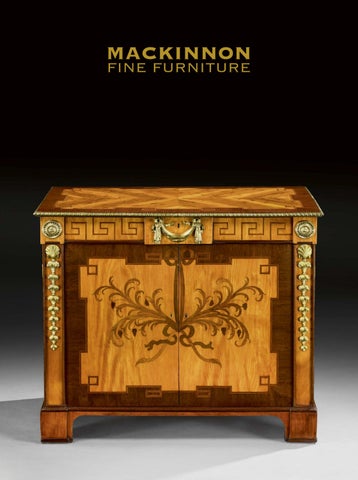
Left: Detail from a George II Giltwood Overmantel Mirror, pp. 88-89. Cover: George III Neo-Classical Cabinet, pp. 72-73. Inside Covers: Detail of George I Burr Walnut Chest of Drawers, pp. 6-7.
3
MACKINNON FINE FURNITURE
A PAIR OF GEORGE II JAPANNED SIDE CHAIRS
In the manner of Giles Grendey England, circa 1730 A very fine and rare pair of early 18th century George II period dark green japanned side chairs in the manner of Giles Grendey. Beautifully decorated throughout with gilt chinoiserie decoration on a japanned background, the splat backs each with an impressive central figure dressed in elaborate flowing robes, above a caned seat supported by similarly decorated cabriole legs ending in pad feet and joined by shaped stretchers. Height: 41¼ in (105 cm) Width: 21½ in (55 cm) Depth: 21½ in (54 cm)
Giles Grendey (1693-1780), a leading London cabinetmaker, was born in Wotton-under-Edge in Gloucestershire. He was the apprentice to the London joiner William Sherborne before becoming a freeman in 1716. Taking his own apprentices by 1726, Grendey was elected to the Livery of the Joiners’ Company in 1729. His first workshop was at St. Paul’s, Covent Garden, and he subsequently moved to St. John’s Square, Clerkenwell in 1772. He developed a thriving export trade. Grendey’s chairmakers are known to have often stamped pieces with their initials and japanned furniture was a particular speciality of his workshops. Grendey’s most important recorded commission was the celebrated Lazcano Palace scarlet japanned furniture from the collections of the Dukes of Infantado – arguably the most elaborate suite of English furniture made during the 18th century. Commissioned specifically for export to Spain, the ensemble comprised at least seventy-seven pieces including tables, chairs, daybeds, looking glasses, tripod stands, and several desks and bookcases. Pieces from this suite can be seen in leading institutions including the Victoria & Albert Museum in London and the Metropolitan Museum of Art in New York.
4
5
MACKINNON FINE FURNITURE
THE PARRY COLLECTION
A GEORGE I BURR WALNUT CHEST OF DRAWERS
England, circa 1720 An exceptionally fine and rare early 18th century George I period burr walnut caddy top chest of drawers. Of small scale, and with superb colour and patina. The veneered top with moulded edge over a brushing slide and a combination of two short drawers over three long graduated drawers and all with original brass handles and escutcheons and standing on bracket feet. Height: 31½ in (80 cm) Width: 28 in (71 cm) Depth: 15¾ in (40 cm) Provenance Christie’s London, The Parry Collection, 24 April 1997, lot 261 Private Collection, England
6
This exceptional chest was part of the celebrated Parry Collection, noted for its emphasis on fine craftsmanship and proportion, unusual detail and in particular magnificent colour and patina. A similar chest of drawers with identical metalwork, a veneered brushing slide and feather banding is illustrated in The Somerset House Art Treasures Exhibition Catalogue, November - December 1979, no. 71, described as ‘having the original and most unusual brasses’.
7
MACKINNON FINE FURNITURE
A PAIR OF GEORGE II ARMCHAIRS
England, circa 1755 A very fine pair of mid 18th century George II period mahogany armchairs in the rococo taste. The cabriole legs and knurled feet with foliate carved cabochons, the rear cabrioles of bold form, with curvilinear channelled seat rails styled with rococo scrolls, incised lines and gadrooning centred on acanthus scrolls, the twisted scrolled elbows with further foliate carving, the feet with concealed castors. The shaped backs, seats and armrests upholstered. Height: 40½ in (103 cm) Width: 26 in (66 cm) Depth: 29 in (74 cm) Provenance Stair & Company, New York, 1956 Private Collection, USA Literature Magazine Antiques, April 1956, p. 284 (Stair & Co, New York advertisement) C. Gilbert, Furniture at Temple Newsam House and Lotherton Hall, 1978, vol. I, p. 90, fig. 77 A pair of armchairs from this suite is in the collections at Temple Newsam, Leeds and illustrated in C. Gilbert, Furniture at Temple Newsam House and Lotherton Hall, 1978, p. 90, fig. 77.
8
9
MACKINNON FINE FURNITURE
CRICHEL, DORSET
A JAPANESE LACQUER TRUNK ON STAND
The trunk Japanese, 17th century. The stand English, circa 1730 A magnificent 17th century Japanese gilt metal mounted lacquer trunk, of rectilinear form, the panels decorated throughout with mountainous lakeside landscapes with stylised trees, houses, pagodas, horses and exotic birds in various tones of gold. The hinged top opening to reveal a speckled gold nashiji decorated interior. The gilt metal mounts and escutcheon plate beautifully engraved. Supported on an exceptional early 18th century English acanthus carved gilt gesso stand with stylised central shell and lions paw feet. Height: 38¾ in (98.5 cm) Width: 61 in (155 cm) Depth: 28 in (71 cm) Provenance The collection of Mary Anna Marten née Sturt (1929–2010), Crichel House, Dorset Crichel House is a magnificent Grade I listed building in Dorset. The original Tudor house was largely destroyed by a fire in 1742 and was subsequently rebuilt for Sir William Napier in the English Baroque style. Extensively remodelling took place between 1771 and 1773, in the neoclassical taste, with interiors by James Wyatt, painted decoration by Biagio Rebecca, chimney pieces by John Devall and furniture supplied by John Linnell and Ince and Mayhew. Crichel, its extensive estate and wonderful collection of decorative arts passed through the generations of Napiers, Sturts and Martens until its sale in 2013.
10
11
MACKINNON FINE FURNITURE
A SET OF EIGHT GILTWOOD ARMCHAIRS
Attributed to John Linnell England, circa 1775 An exceptional set of eight George III giltwood armchairs attributed to John Linnell, each magnificently carved in the finest detail, with a gilt imbricated framed upholstered back surmounted by a wreathed cabochon cresting, with padded arms with foliate and ball carved giltwood terminals, above an outstanding guilloche carved seat frame, the tapered front legs also magnificently carved with imbricated detailing, the rear legs elegantly splayed. All upholstered à chassis. Height: 37¼ in (95 cm) Width: 24 in (61 cm) Depth: 22 in (56 cm) Literature P. Ward-Jackson, English Furniture Designs of the Eighteenth Century, 1958, pp. 54-55, 59, pl. 241 H. Hayward, ‘The Drawings of John Linnell in the Victoria & Albert Museum’, Furniture History, 1969 H. Hayward and P. Kirkham, William and John Linnell, 1980, p. 45, fig. 87
There is a watercolour chair-pattern design by Linnell, dated circa 1770-75, which bears almost identical comparison to the present chairs (Victoria and Albert Museum, no. E82-1929). The drawing shows the carved medallions on both the top of the back and the centre of the front seat rail, the same imbricated tapered front legs and plain splayed back legs, as well as the magnificent guilloche carving to seat frame and the acanthus carved back supports, and possibly even upholstery à chassis. The most definitive signature feature of Linnell’s work is the carved ball or ‘pearl’ clasped by acanthus leaves that form the terminals of the armrests of these chairs. The same feature appears in the drawing and can clearly be seen on a number of suites of chairs known to have been supplied by the firm. In particular, reference can be made to the six giltwood chairs supplied to the Lascelles family for Harewood House, Yorkshire (Helena Hayward and Pat Kirkham, William and John Linnell, 1980, fig. 88) and the suite supplied to the Dukes of Argyll at Inverary Castle (ibid., p. 46, fig. 89), both of which are almost identical to the present chairs. A further suite can be seen in the Turquoise Drawing Room at Castle Howard, Yorkshire. The same clasped ball or ‘pearl’ can be seen on a suite of mahogany armchairs supplied to Robert Child for Osterley Park (ibid., p. 39, fig. 72). John Linnell was the son of the furniture maker William Linnell and one of the first English furniture makers to be educated in design, studying at the St. Martin’s Lane Academy that had been founded by William Hogarth. In 1762 he started working closely with Robert Adam and in 1763, after the death of his father, he took over the running of the family firm. His work, as we can see with the present chairs, in line with contemporary Louis XVI fashion and taste of the day, became increasingly classical in output, and the business grew to rival many of the other leading furniture makers including Thomas Chippendale, Ince & Mayhew and John Cobb. The Linnell firm was one of the most prominent firms of cabinetmakers of the second half of the 18th century, with significant commissions from, amongst others, the Duke of Beaufort for Badminton House, Sir Robert Child for Osterley Park, the Duke of Northumberland at Syon Park and Alnwick Castle, William Drake for Shardeloes, the Marquess of Lansdowne for Bowood House and Lansdowne House and the Duke of Argyll at Inverary Castle.
© Victoria and Albert Museum, London
12
13
MACKINNON FINE FURNITURE
14
15
MACKINNON FINE FURNITURE
A GEORGE III MAHOGANY COMMODE
Attributed to Henry Hill of Marlborough England, circa 1770 An exceptional George III period mahogany commode attributed to Henry Hill of Marlborough. In the French taste with magnificent colour and patination throughout, and of serpentine form, with three graduated drawers with gilt bronze handles and corner mounts. The top drawer fitted with a retractable dressing mirror and compartments. Height: 33½ in (85 cm) Width: 50¼ in (128 cm) Depth: 25¾ in (65 cm)
Henry Hill of Marlborough Henry Hill was a Georgian cabinetmaker working in Marlborough, Wiltshire from the 1740s until his death in 1778. Throughout his career he was prolific in the art trade as a cabinetmaker, decorator, auctioneer and estate agent. Benefitting from his location in Marlborough as a stopping point on the Great West Road between London and the fashionable town of Bath, Hill advertised his services to include delivery to London at more attractive rates than the London cabinetmakers. His major clients included Lord Delaval, as well as the 9th Duke of Somerset at Maiden Bradley, Paul Methuen at Corsham Court, and Henry Hoare at Stourhead.
16
17
MACKINNON FINE FURNITURE
A PAIR OF GEORGE III MAHOGANY ARMCHAIRS
In the manner of Gillows of Lancaster & London England, circa 1790 – 1800 A magnificent pair of late 18th century George III period carved neo-classical mahogany armchairs in the Hepplewhite taste. The pierced shield back splat carved at the top with a wheatsheaf motif, the lower back carved with a paterae and a leaf motif, the extravagantly moulded arms on scroll supports, with square tapering legs and spade feet. Height: 38 in (96.5 cm) Width: 31½ in (80 cm) Depth: 20 in (51 cm) Provenance With Mallett of New Bond Street, London Private Collection, New York
18
Literature Mallett advertisement, Connoisseur, March 1957 L. Synge, Great English Furniture, 1991, p. 126, fig. 143 C. Claxton Stevens, ‘A Group of Seat Furniture Stamped RE,’ The Journal of the Regional Furniture Society, vol. XII, 1998, pp. 156-159 L. Boynton, Gillow Furniture Designs 1760-1800, 1995, ill. pl. 272-275 These chairs feature a superbly fluid design and exceptional craftsmanship with excellent carved detail and fine colour throughout. They contain elements from a series of drawings from Gillows’ Estimate Sketch Books, which suggest that they may be made by that firm.
19
MACKINNON FINE FURNITURE
A LACQUER WRITING TABLE
In the manner of John McLean England, circa 1810 A very fine and rare Regency period gilt-brass mounted lacquered writing table. The rectangular top with a pierced brass gallery and inset leather top above two frieze drawers, on splayed legs ending in brass box castors. The surfaces of the writing table veneered with lacquer panels depicting chinoiserie lakeside landscapes. Height: 30¼ in (77 cm) Width: 42 in (107 cm) Depth: 24¼ in (62 cm) Provenance With Mallett, New Bond Street, 1997
John McLean John McLean (1770 – 1825), of Upper Marylebone High Street, was one of the pre-eminent cabinetmakers at the end of the eighteenth century and into the Regency period. His firm secured commissions from some of the greatest patrons of their day, including the 5th Earl of Jersey for Middleton Park, Oxfordshire and his London residence in Berkeley Square, as well as Edward Lascelles for Harewood House, Yorkshire. Thomas Sheraton featured one of McLean’s designs for a table in his The Cabinet-Maker and Upholsterer’s Drawing Book (1803) and noted, ‘The design on the left hand was taken from one executed by Mr. M’Lean in Mary-le-bone street, near Tottenham court road, who finishes these small articles in the neatest manner’. Several pieces of furniture made by McLean retain the firm’s original trade label affixed to the inside of drawers. The fascination with chinoiserie decoration, and the East, in early 19th century England was a continuation of the mid 18th century rococo enthusiasm for the whimsical and the exotic. The most ardent supporter of this taste had to have been the Prince Regent with his decoration of the Brighton Pavilion in 1802. Lacquer panels were luxuriously used to embellish walls, cabinets and chair backs – however, the use of curved lacquer veneer, as seen on this table, is exceptionally rare in English furniture of the time. A very closely related table was sold Sotheby’s New York, Tom Devenish: The Collection, Highly Important English Furniture, 24 April 2008, lot 17 and reference can also be made to a pair of lacquer veneered side tables previously in the collections of the Earls of Warwick, Warwick Castle.
20
21
MACKINNON FINE FURNITURE
METROPOLITAN MUSEUM OF ART, NEW YORK
A PAIR OF WALNUT SIDE CHAIRS
England, circa 1740 An exceptional pair of George II walnut side chairs. Dating to the first half of the 18th century with upholstered seats and backs, supported on superb quality cabriole legs intricately carved to the knees with delicate trelliswork and to the toes with foliate detailing. The carved detail of extremely fine quality. Height: 38¾ in (98.5 cm) Width: 22 in (56 cm) Depth: 26 in (66 cm)
22
Provenance Richard George Penn Curzon, 4th Earl Howe (d. 1929), Penn House, Buckinghamshire. With A. Chester Beatty, Dublin With Frank Partridge & Sons Ltd., London Acquired by the Metropolitan Museum of Art, New York, January 1954 The Metropolitan Museum of Art, New York
23
MACKINNON FINE FURNITURE
HEVENINGHAM HALL, SUFFOLK
A PAIR OF GEORGE III GILTWOOD WALL LIGHTS
England, circa 1790 An important pair of late 18th century George III period carved giltwood and gilt gesso neo-classical wall lights. The carved detail of exceptionally fine quality throughout, the lights each adorned with ebonized winged eagles over elegant giltwood frames with laurel wreath collars, draped swags, scrolled arms, brass bobeches, a central ribbon topped tablet with a lion mask, eagle heads on the scrolls and a leaf decorated lower stem. An outstanding pair of neo-classical wall lights, with a superb provenance. Height: 35½ in (90 cm) Width: 12 in (30.5 cm) Depth: 8 in (20 cm)
Provenance Likely supplied to Sir Gerard Vanneck (1743 – 1791) for Heveningham Hall, Suffolk By descent until sold by the Australian Trustees of the Heveningham Hall Settlement, Sotheby’s, London, 10 July 1970, lot 26 With Jeremy Ltd., Belgravia Private Collection, Canada Sotheby’s New York, 17 October 1997, lot 237 With Devenish, New York Private Collection, USA Literature H. A. Tipping, English Homes, Period VI, vol. I, 1926, pp. 371, 373, pl. 567, 570-571 (shown in situ in the Library at Heveningham Hall) C. Hussey, English Country Houses: Mid Georgian 1760-1800, 1955, pp. 174-175, pl. 350-351 Grosvenor House Handbook, 1998, p. 83 (with Devenish)
The Library, Heveningham, Suffolk, showing the wall lights in situ. Illustration for English Decoration and Furniture of the Later XVIIIth Century, 1760-1820, by M. Jourdain (Scribner’s, Batsford, 1922) (Credit: Look and Learn) 24
25
MACKINNON FINE FURNITURE
A MAHOGANY CENTRE TABLE
Attributed to William Trotter of Edinburgh Scotland, circa 1815 A superb large Regency period mahogany centre or dining table. Of impressive scale, the top with carved edge and of magnificent colour is supported on a bold turned central pedestal supported by four outswept reeded legs that terminate in bold brass box castors. Diameter: 61¾ in (157 cm)
26
William Trotter (1772 – 1833) was a highly respected maker of Regency furniture. He is often regarded as Scotland’s greatest cabinetmaker. The Trotter family had been part of the Merchant Company of Edinburgh from 1691. William Trotter established himself in his sole right in 1805 in Princes Street, Edinburgh. He had a distinctive style and was renowned for using particularly high quality timbers and finishes. Celebrated commissions included the apartments of the Comte d’Artois at the Palace of Holyrood House, Paxton House in 1814 for John Holme Robertson, the historic visit of George IV to Edinburgh in 1822 and the Signet Library circa 1822. He became a member of the Edinburgh Merchant Company and subsequently master of the Company in 1819, as well as Lord Provost of the City of Edinburgh.
27
MACKINNON FINE FURNITURE
A PAIR OF LOUIS XV GILTWOOD BERGERES
By Jean-Jaques Pothier French, circa 1750 A very fine pair of large scale Louis XV giltwood bergères. The frames carved with fluting and of a generously curvaceous scrolled shape. Each with a horse-shoe back terminating in scroll arms and with a serpentine seat rail, standing on stylized shell carved cabriole legs. One stamped Pothier. Now upholstered in green velvet. Height: 40 in (102 cm) Width: 31 in (79 cm) Depth: 35¼ in (90 cm) Provenance With Mallett, London Private Collection, London With Mackinnon Fine Furniture, London (2017) Private Collection, USA Jean-Jaques Pothier was working in France throughout the reign of both Louis XV and Louis XVI, and his work reflects the characteristics of the rococo and neoclassical tastes during each period. He became maître-menuisier in 1750 and from 1775 1776 was established in a workshop in the rue de Bourbon-Villeneuve in Paris. Although very little is known about his clientele, his work shows an extremely high level of craftsmanship with great attention to detail.
28
29
MACKINNON FINE FURNITURE
A QUEEN ANNE JAPANNED CHEST OF DRAWERS
England, circa 1710 A very fine Queen Anne period black japanned and gilt chinoiserie decorated chest of drawers. The top with moulded edge over two short drawers and three graduated long drawers, standing on turned bun feet. The top, sides and drawer fronts wonderfully decorated with chinoiserie scenes on a black japanned background. The decoration, in the manner of Stalker and Parker, includes warriors on horseback, garden scenes, pagodas, exotic birds and flowering trees all typical of japanned decoration of this period. Japanned throughout with particularly fine detailing. Height: 33¾ in (86 cm) Width: 41¾ in (106 cm) Depth: 21¾ in (55 cm)
The various elements of the chinoiserie decoration are derived from A Treatise of Japanning and Varnishing, published by Stalker and Parker in 1688. In their introduction, ‘The Epistle to the Reader and Practitioner’, they declare that ‘We have laid before you an Art very much admired, and all those who hold any commerce with the Inhabitants of Japan’. The following chapters include ‘How to Make Varnishes’, ‘To make raised work in imitation of Japan, and of the Paste’, and instructions ‘To take off any Japanpatterns in this Book, upon any piece of work whatever’. The treatise contains some twenty-three plates showing illustrations of flowers, birds, figures and pavilions, all in the oriental manner which relate closely to the decoration found on this chest.
J. Stalker and G. Parker, A Treatise of Japanning and Varnishing, 1688, pl. 18
30
31
MACKINNON FINE FURNITURE
A PAIR OF LOUIS XVI ARMCHAIRS
Attributed to George Jacob England, circa 1780 A very fine pair of Louis XVI giltwood armchairs attributed to George Jacob. The square show frames carved with guilloche decoration, with curved arms carved with fluting and acanthus leaves, standing above a shaped seat rail similarly decorated with guilloche carving, on fluted tapered turned legs. Height: 38¾ in (98 cm) Width: 27 in (69 cm) Depth: 27 in (69 cm) Provenance With Mackinnon Fine Furniture, London (2017) Private Collection, USA These chairs feature the refined neo-classical style and delicate carving associated with the workshop of George Jacob, maître in 1765. Jacob was one of the most successful menuisiers of the Louis XVI period supplying furniture to esteemed clients including the Comte d’Artois, the Prince de Condé, and Louis David. Jacob also had a number of prominent patrons outside France, including George IV in England, Gustavus III of Sweden, and a number of German nobles.
32
33
MACKINNON FINE FURNITURE
A GEORGE III FRETWORK SILVER TABLE
England, circa 1760 A superb George III Chippendale period mahogany silver table retaining excellent colour and patina. The well figured rectangular top with pierced fretwork gallery over a carved blind fretwork frieze bordered to the top and bottom by an applied moulding. The table is supported by square section straight fluted legs, with intricate fretwork spandrels flanked by moulded collars at the hip and terminating in block feet with castors. Height: 29¾ in (76 cm) Width: 22¾ in (58 cm) Depth: 35¾ in (91 cm)
34
35
MACKINNON FINE FURNITURE
A SET OF FOUR GEORGE III GILTWOOD ARMCHAIRS
Attributed to Ince & Mayhew England, circa 1785 An exceptional set of four George III giltwood open armchairs attributed to Ince & Mayhew. In the French taste, and of neoclassical form, each square back with an arched top cresting surmounted by a carved anthemion, the scrolled foliate carved arms with downcurved supports above a serpentine seat, the front rail adorned with carved drapery swags and a central patera. On turned tapering carved and fluted legs. The backs and seats upholstered in green neo-classical silk. Height: 39¼ in (100 cm) Width: 26¼ in (67cm) Depth: 27½ in (70 cm) Provenance Possibly the set of four armchairs advertised by John Bell of Aberdeen, Country Life, 16 July 1938 Private Collection, USA
36
Literature H. Roberts and C. Cator, Industry and Ingenuity - The Partnership of William Ince and John Mayhew, London, 2022, p. 178 and p. 365, fig. 330 These chairs relate closely to a set of twelve supplied in 1785 by the prestigious London furniture-makers Ince & Mayhew to James Alexander, 1st Earl of Caledon, for the Oval Drawing Room at Caledon Castle, Co. Tyrone. Described as ‘12 very neat Cabriolet Chairs with Elbows, richly Carved and Ornamented’, the arched seat rail with honeysuckle cresting, swagged paterae on the seat rails and the leg pattern are common to both, only differing in the shape of the back and the arms that join into the tops of the legs rather than to the seat rails. A pair of chairs of the Caledon model was sold from the Tritton collection, Godmersham Park, Kent, Christie’s, June 1983.
37
MACKINNON FINE FURNITURE
A GEORGE II BURR WALNUT TRUNK
England, circa 1740 A rare George II burr walnut and cross-banded blanket chest. Of good scale - the figured veneers of exceptional colour and patination throughout. The hinged top opening to reveal an oak lined interior. With brass escutcheon plate and carrying handles to the sides, supported on bracket feet A superb piece of early 18th century Georgian furniture. Height: 29¾ in (75.5 cm) Width: 49¼ in (125 cm) Depth: 24¼ in (62 cm)
38
39
MACKINNON FINE FURNITURE
THE HAGUE COLLECTION
A WILLIAM AND MARY WALNUT BUREAU BOOKCASE ON STAND
England, circa 1695 An exceptionally rare William and Mary period walnut desk and bookcase of diminutive proportions. The moulded cornice above two hinged doors, inset with their original mirror plates, opening to reveal adjustable bookshelves, with candle-slides, above an overhung bureau top above two short and one long drawer. The fall opens, supported by concealed lopers, to reveal tiered drawers, pigeon-holes and a velvet-lined writing surface. The whole supported on faceted pillar legs, joined by an elaborate flat stretcher and standing on bun feet. In wonderful original condition throughout. Height: 67¾ in (172 cm) Width: 24½ in (62 cm) Depth: 19¾ in (48 cm) Provenance With Frank Partridge, 1930s The collection of Sir Harry and Lady Lily Hague Sotheby’s London, Catalogue of Highly Important English Furniture......including The Property of Lady Hague...., 23 June 1961, lot 117 Literature Country Life, 30 August 1930, p. 274 with Frank Partridge (illustrated) M. Jourdain, ‘The Collection of Sir Harry and Lady Hague’, Apollo, no. 45, 1947, pp. 38-40, 75-8, 82 Country Life - 11th Northern Antique Dealers Fair, 17 August 1961 with Quinneys Ltd. (illustrated) The Connoisseur, October 1961, p. XCIV with Quinneys Ltd. (illustrated)
40
Sir Harry Hague (1881 - 1960) was the managing director of A. Wander Ltd., the company that manufactured the malt drink Ovaltine. At the time of World War II, Ovaltine was one of the most popular brands in Britain, the official drink of the 1948 Olympics, and was taken up Everest by Sir Edmund Hilary in 1953. Sir Harry invested the fortune he amassed in his art collection and employed the renowned furniture historian and connoisseur R.W. Symonds to advise him.
41
MACKINNON FINE FURNITURE
MENTMORE: THE EARLS OF ROSEBERY
A PAIR OF PARCEL GILT ARMCHAIRS
England, circa 1835 A fine pair of early 19th century armchairs from the collections of the Earls of Rosebery, Mentmore Towers. The upholstered seats and coved backs held within painted frames, with stylised parcel gilt decoration in the gothic taste, with scrolled arm supports and spandrels to the turned tapering legs, with castors. Height: 35¾ in (91 cm) Width: 23 in (58.5 cm) Depth: 22¾ in (58 cm) Provenance The Earls of Rosebery, Mentmore Towers, Buckinghamshire Sotheby’s, Mentmore, 18-27 May 1977
Mentmore Towers was built between 1852 and 1854 for Baron Mayer Amschel de Rothschild (1818 - 1874). Sir Joseph Paxton and his son-in-law, George Henry Stokes, designed the building in the 19th century revival of late 16th and early 17th century Elizabethan and Jacobean styles, a prime example of Jacobethan architecture. The magnificent stately home was inherited by his daughter Hannah, who married the Earl of Rosebery. On the death of the 6th Earl of Rosebery, discussions were held with the government attempting to sell the house and contents to the nation in lieu of inheritance tax whilst simultaneously trying to preserve Mentmore as a heritage property. This and a subsequent attempt to sell the property and its contents to the nation for £2million was refused. Sotheby’s was then instructed by the executors to sell the contents. The legendary landmark auction ran for ten days in 1977 and realised more than £6million pounds.
Mentmore Towers, Buckinghamshire. The Illustrated London News, 24 March 1894 (Credit: Look and Learn).
42
43
MACKINNON FINE FURNITURE
A GEORGE III MAHOGANY SERPENTINE SERVING TABLE
In the manner of Thomas Chippendale England, circa 1780 A very fine George III Chippendale period mahogany serpentine serving table in the neoclassical manner. Inspired by the designs of Robert Adam, the well figured serpentine top over a fluted frieze with central tablet incorporating an oval patera flanked by bell flower swags, and a moulding lower edge. The table is supported on four square section tapering fluted legs, each with floral paterae to the top and terminating in block feet. The table has excellent colour and patina throughout. Height: 35 in (89 cm) Width: 54 in (137 cm) Depth: 25¾ in (65 cm)
44
This elegant sideboard-table, with tablet-centred and fluted frieze and flute-enriched, hermed and block foot legs, epitomises the restrained antique or Roman fashion introduced at Thomas Chippendale’s St. Martin’s Lane workshops in the 1770s by his son Thomas Chippendale Junior (d. 1822), author of Sketches of Ornament, 1779. This table relates to one supplied by the Chippendale firm in circa 1776 to Ninian Home for Paxton House, Berwickshire (illustrated in C. Gilbert, The Life and Works of Thomas Chippendale, London, 1978, vol. II, p.193, fig. 351). Both Thomas Chippendale and his son worked extensively at Paxton over many years as supported by documentation dating from 1774 until 1791. Ninian Home sought to furnish Paxton in a ‘neat and substantially good’ manner and the table was a more refined and less ornamented version of the table supplied by Chippendale to Harewood House, Yorkshire (C. Gilbert, ibid., p. 192, fig 350). A similar table, also likely to have been at Paxton, was sold Christie’s London 14 June 2001, lot 130. A further comparable suite comprising two pairs of demi-lunes and a pair of rectangular tables was sold by the late Margaret, Countess of Suffolk and Berkshire, Sotheby’s London, 25 July 1969, lot 125.
45
MACKINNON FINE FURNITURE
A GEORGE II CHAIRBACK SETTEE
England, circa 1755 A superb George II early Chippendale period carved mahogany chair back settee. The top rail with scrolled acanthus and rocaille carved detail and bordered by shell ears. The two vase shaped splats pierced with interlaced lozenges and frets, and with scrolled arm supports. The seat frame with geometric blind fretwork and silk upholstered drop in seat, supported by splayed rear legs and three square section front legs terminating in guttae feet. The legs joined by a blind fret detailed cross stretcher. Height: 28¾ in (73 cm) Width: 44 in (112 cm) Depth: 22¾ in (58 cm)
The bold overall design of this superb settee is reminiscent of a number of drawings by Thomas Chippendale which feature across all three editions of his celebrated publication, The Gentleman and Cabinet-Maker’s Director, 1753-62. As with much of Chippendale’s output during this period, the settee represents a highly imaginative combination of the three most influential ‘styles’ then at the height of fashion in England; the ‘French’ or Rococo; the Chinese; and the ‘Gothick’. The scroll, floral, shell and acanthus carved toprail, along with the sweeping scrolled arm supports, are all typical elements of the Rococo style founded in France. The geometric pierced back splat and blind fretwork are indicative of a ‘Chinoiserie’ influence while the blind quatrefoils to the legs, seat frame and stretchers are strong gothic features. The carved guttae feet on this settee are a signature detail often associated with the firm of Royal cabinetmakers Vile and Cobb. Inspired by classical architecture, these feet feature small, droplike or cone-shaped carvings mimicking the ‘guttae’ found under the triglyphs of a Doric entablature. Documented examples include those on a set of stools supplied by Vile and Cobb in 1753 for the Vyne, Hampshire and on the celebrated suite of carved mahogany seat furniture supplied to the Earls of Shaftesbury for St. Giles, Dorset around 1760.
46
47
MACKINNON FINE FURNITURE
A WILLIAM AND MARY WALNUT WORK TABLE
England, circa 1690 – 1710 A very rare late 17th century William and Mary, early 18th century Queen Anne period walnut work table. The hinged top quarter veneered with superbly figured walnut panels, with herringbone inlay, crossbanding and a moulded edge. With pull out slides to each side, presumably for candlesticks. With a rare arrangement of drawers with brass escutcheons and pull handles. Supported on six superbly modelled faceted walnut legs ending in ‘Spanish’ scroll toes, all joined by a shaped stretcher. Exceptional colour and patina throughout. Height: 29 in (74 cm) Width: 36¼ in (92 cm) Depth: 20½ in (52 cm) Provenance Harrods Antiques Department, 1921 Christie’s London, the collection of Mrs. A. M. Shannon Munn, 30 June 1966, lot 118 Acquired from the above by Mallett, New Bond Street (1966) Private Collection, UK
48
An almost identical table was included in the celebrated Parry Collection, sold Christie’s London, 24 April 1997, lot 260 (price achieved £69,700). The Parry Collection included some of the finest examples of late 17th century and early 18th century walnut furniture, and was noted for its emphasis on fine craftsmanship and proportion, unusual detail and in particular on magnificent colour and patina. The Parry table shares many features with our table not only, the overall design, shape and size, but also details such as the double beading around the drawers, the brass key escutcheons, the waved stretcher and the candle-slides. The main difference being the arguably more sophisticated, scrolled feet on our table which have turned patera to each of the sides and are splayed outwards, rather than straight ahead.
49
MACKINNON FINE FURNITURE
THE PERCIVAL GRIFFITHS COLLECTION
A GEORGE II MAHOGANY POLE SCREEN
England, circa 1740 An exceptional and very rare George II period carved mahogany pole screen from the celebrated Percival Griffiths collection. With fluted tapering stem, feather carved legs and superb claw feet clasping blocks. The mid 18th century needlepoint panel reframed in a glazed and ribbon carved mahogany frame with silk damask backing. Height: 60¾ in (154.5 cm) Width: 20½ in (52 cm) Depth: 20½ in (52 cm) Provenance The Percival Griffiths Collection, 1923 The collection of Joseph S. Sykes Partridge Fine Arts, London Private Collection, USA
Literature Country Life Picture Library, Sandridgebury, 9441_01, 1923 R. Symonds, English Furniture from Charles II to George II, 1929, p. 237, fig. 201 R. Symonds, Masterpieces of English Furniture, 1940, pp. 23, 26, fig. 15 C. Jussel and W. deGregorio, English Furniture 1680 - 1760 The Percival D. Griffiths Collection, 2023, vol. I, p. 261, F327 (marked as ‘whereabouts unknown’), and illustrated in the drawing room at Sandridgebury, Appendix I, p. 300-301, fig. l.59 and also on the endpapers of the binding. This magnificent and recently rediscovered pole screen features prominently in a period photograph of the drawing room at Percival Griffiths’ Sandridgebury home.
‘with the very unusual design of an eagle’s claw grasping a block’ (R. Symonds, 1929, p. 237)
‘wherabouts unknown’ (C. Jussel and W. deGregorio, 2023, p. 261)
50
51
MACKINNON FINE FURNITURE
AN AMBOYNA LIBRARY TABLE
In the manner of Marsh & Tatham England, circa 1810 A superb quality late Georgian Regency period amboyna and ormolu mounted library table. The rectangular quarter-veneered top with gadrooned gilt brass edge, with a plain frieze fitted with a hidden mahogany lined drawer. Standing on four reeded and tapered columnar legs topped with gilt bronze Ionic capitals and toupie feet. The burr amboyna veneer of fabulous colour and patination throughout. The metalwork of the highest quality. Height: 29¼ in (74.5 cm) Width: 50¾ in (129 cm) Depth: 28¾ in (73 cm) Marsh & Tatham was a prominent London firm of Regency cabinetmakers and upholsterers based in Mount Street, Mayfair. The partnership was led by William Marsh and Thomas Tatham, the brother of the classical architect Charles Heathcote Tatham. Their clientele included the leading aristocracy of the day and very importantly they were major suppliers to George, Prince of Wales (later George IV), supplying furnishings for Carlton House and the Royal Pavilion in Brighton. Their style, predominantly neo-classical in taste, was heavily influenced by the Greek Revival and the classical architectural drawings brought from Italy by Charles Heathcote Tatham who had been sent to Rome by the architect Henry Holland (1745 – 1806) in 1794 to collect classical fragments. Tatham’s drawings of these fragments were published as Etchings of Ancient Ornamental Architecture in 1799-1800.
52
53
MACKINNON FINE FURNITURE
A GEORGE I BURR WALNUT KNEEHOLE DESK
England, circa 1720 A superb and rare George I burr walnut kneehole secretaire desk of exceptional colour. The top with moulded edge and quarter veneer book matched panels, cross banded and inlaid with feather banding. The top drawer opening to reveal an extendable writing surface with pigeonholes and small drawers, above two columns of small drawers surrounding a recessed kneehole cupboard. The drawer fronts similarly veneered and neatly edged with a half round cockbeading. Above the deep kneehole recess, the shaped apron pulls out as a further drawer. Standing on its original bracket feet. The brass handles and escutcheons are typical of the period. Height: 31 in (79 cm) Width: 30¼ in (77 cm) Depth: 18¾ in (48 cm
54
Provenance The collection of Marjorie Wiggins Prescott, USA Christie’s New York, The Prescott Collection – Objects of Art, English and Continental Furniture, 31 January 1981, lot 337 With Norman Adams Ltd., Knightsbridge Private Collection, USA With Mackinnon Fine Furniture, 2019 Private Collection, England Literature C. Claxton Stevens and S. Whittington, 18th Century English Furniture – The Norman Adams Collection, p. 96 (illustrated)
55
MACKINNON FINE FURNITURE
A GEORGE II MAHOGANY TABLE
England, circa 1750 An outstanding and very rare mid 18th century George II carved mahogany side table. Of magnificent proportions, the frieze carved with a central acanthus framed shell flanked by gadrooning on the lower edge, the cabriole legs carved with further stylised acanthus leaves and beading terminating in bold and fabulously carved claw and ball feet. With a wonderful Breccia marble top. Height: 35¼ in (90 cm) Width: 56½ in (143.5 cm) Depth: 27 in (68.5 cm) Provenance With Moss Harris (ref: F21431) Moss Harris (1858 – 1941) was a highly prominent British antique dealer and the driving force behind M. Harris & Sons, which became one of the most celebrated names in antique English furniture during the first half of the 20th century. The dealership originally traded as D. L. Isaacs before Moss Harris took complete control in 1918. With huge showrooms at 44-52 New Oxford Street in London, the firm specialised in particularly high quality late 17th to early 19th century English antique furniture and catered to the world’s most elite collectors, including the famous industrialist, Lord Leverhulme.
56
57
MACKINNON FINE FURNITURE
A SATINWOOD CONSOLE
England, circa 1790 A very rare late 18th century George III satinwood and tulipwood crossbanded side table, of particularly small, elegant proportions. The rectangular top with rounded front corners veneered with a superb panel of figured satinwood - with great colour and patination. The plain frieze with a hidden drawer similarly veneered in satinwood with fine tulipwood crossbanding. Standing on elegant plain round tapering legs, each with a carved collar detail at the top and a toupie foot. Height: 31¾ in (81 cm) Width: 35 in (89 cm) Depth: 14¼ in (36.5 cm)
58
59
MACKINNON FINE FURNITURE
ST. GILES, DORSET
A PAIR OF WINDOW BENCHES
England, circa 1780 An important pair of late 18th century George III period window benches. In the neoclassical taste, of impressive scale, and with an elegant serpentine outline, the moulded scrolling sides above a fluted and leaf-carved front seat rail, on fluted bulbous tapering legs. Decorated with refined parcel gilded detailing on an off-white ground. Height: 27 in (68.5 cm) Width: 58¼ in (148 cm) Depth: 24¼ in (61.5 cm) Provenance From the collections of the Earls of Shaftesbury, St Giles, Dorset Christie’s London, Highly Important English Furniture and Sculpture from St. Giles’s House, Dorset, 26 June 1980, lot 40 Partridge Fine Arts, London These window benches formed part of the magnificent collection of English 18th century furniture at St. Giles, Dorset, the ancestral home of the Ashley-Cooper family, the Earls of Shaftesbury. Constructed in 1651, the house is Grade I listed and is renowned for the superlative furnishings that were commissioned for it during the 18th century but sadly now mostly dispersed. The house lay empty and all but abandoned for many years but has in recent years has undergone a wonderful award-winning restoration with the family now living there once again.
60
61
MACKINNON FINE FURNITURE
A GEORGE III MAHOGANY SERVING TABLE
England, circa 1760 A very fine and impressive large George III Chippendale period side or serving table in the manner of Vile and Cobb. The rectangular top with moulded edge above a sophisticated chinoiserie blind fret frieze and pierced corner brackets, supported on eight square legs carved to the fronts with blind fret work and to the backs with double ringed columns, terminating in guttae feet. The mahogany top later. Retaining the 1930s Christie’s catalogue label affixed to the underside. Height: 36¾ in (93 cm) Width: 106¼ in (270 cm) Depth: 30¼ in (77 cm) Provenance Christie’s London, 18 December 1930, lot 130 (the property of Mrs H. Minette Cramp, Newbury, Berkshire) - sold to ‘Clifford’ for 89 gns 5s The collection of the Mrs. Kersey Coates Reed, Lake Forest, Chicago, USA The Kersey Coats Reed House, Lake Forest, Chicago, the interior designed by Frances Elkins between 1929 and 1931 Literature This table features in many publications on the work of Frances Elkins and David Adler including: A. O. Patterson, ‘On the High Bluffs of Lake Forest near Chicago’, Town and Country, 15 January 1934, pp. 24 S. M. Salny, ‘Historic Interiors: Frances Elkins. A Surviving Example of the Noted Designers Work’, Architectural Digest, July 1980, p. 89 S. M. Salny, ‘Frances Elkins: A Forward-Looking Icon of European Chic and American Style’, Architectural Digest (Interior Design Legends), January 2000, p. 167 This impressive table design is derived from patterns for ‘SideBoard Tables’ published by Thomas Chippendale in his The Gentleman and Cabinet-Maker’s Director, such as pl. LVIII in the 3rd edition of 1762. A table of similarly impressive size and format but uncarved was almost certainly supplied to Thomas Parker (d. 1795), 3rd Earl of Macclesfield for Shirburn Castle, Oxfordshire. The combination of blind fretwork carving and guttae feet is often associated with the work of Royal cabinetmakers William Vile and John Cobb.
62
63
MACKINNON FINE FURNITURE
A WILLIAM III JAPANNED PIER MIRROR
England, circa 1690 A William III period silvered and japanned pier mirror, the divided plates bevelled, the upper arched and engraved with stylised stars and a scalloped edge, the conforming frame with an inner silvered gadroon carved border, the moulded black and gold japanned cushion border with raised chinoiserie decoration with figures, birds, flowers and pavilions, all within a silvered foliate and strapwork carved outer edge. An exceptionally rare mirror. Height: 52¼ in (133 cm) Width: 24¾ in (63 cm)
64
Provenance Christie’s New York, Important English Furniture, Clocks & Objects, The Property of a Lady of Title, 9 October 1993, lot 358 Sotheby’s New York, Tom Devenish: The Collection – Highly Important English Furniture, 24 April 2008, lot 14 With Godson & Coles, London Private Collection, UK
65
MACKINNON FINE FURNITURE
THE DUKE OF NORFOLK’S CARLTON HOUSE DESK
Attributed to Gillows of Lancaster & London England, circa 1780 – 1800 An important late 18th century George III period mahogany Carlton House Writing Table. Of impressive bold scale and exceptional quality throughout. The upper tiered curved section with a pierced brass gallery above a collection of brass handled drawers, false drawers, curved doors, a secret compartment and a leather lined writing surface with a ratcheted reading slide, and one long and two short drawers in the frieze, all standing on square tapering legs ending in brass box castors. The whole veneered in the finest mahogany, the drawers with ebonised stringing. The reverse with magnificent panels of fielded mahogany. Height: 42 in (107 cm) Width: 63 in (160 cm) Depth: 32¾ in (83 cm) Provenance Probably commissioned by Charles Howard, 11th Duke of Norfolk By descent to Bernard Marmaduke, 16th Duke of Norfolk, Norfolk House, St. James’s Square, Christie’s London, The Contents of Norfolk House, 7 February 1938, lot 162
Literature Country Life, Norfolk House, St James’s Square - The Town House of the Duke of Norfolk, 25th December 1937, pp. 654 – 660 Auction Catalogue of Norfolk House, in the State Dressing Room, 7 February 1938, p. 38, lot 162 Partridge London, Annual Catalogue, 1992, pp. 34-35 Susan E. Stuart, Gillows of Lancaster & London 1730 - 1840, vol. I, 2008, pp. 286 – 287 Norfolk House In the newspaper review of the sale of the furnishings of Norfolk House in 1938, the author wrote: ‘There was exceptionally keen bidding for an old English mahogany Carlton House writing table, which after a modest opening bid finally fell at 260 guineas’. Norfolk House was rebuilt for Edward, 9th Duke of Norfolk, between 1748 and 1756. It was designed by the architect Matthew Brettingham. The exterior of the house was of simple Palladian design, but the interior was remarkable for containing the first extensive display of fashionable French inspired rococo decoration. Arthur Oswald, writing in Country Life in 1937, described the interior as ‘one of considerable grandeur, with a suite of rooms decorated with a lavishness that suggests comparisons with the departed glories of Chesterfield House’. The celebrated painted and gilded Music Room, with it carved monkey adornments, has been reassembled in the Victoria & Albert Museum, London.
“All the earth was there....you never saw such a scene of magnificence and taste’ (Horace Walpole discussing the grand reception at Norfolk House, 1756)
66
67
MACKINNON FINE FURNITURE
HORNBY CASTLE – THE DUKES OF LEEDS
A GEORGE III PARCEL GILT SIDE CHAIR
Attributed to Paul Saunders England, circa 1765 A mid 18th century George III Chippendale period mahogany and parcel gilt side chair, attributed to Paul Saunders. In the French taste, of extremely elegant design with serpentine shaped upholstered back and seat, standing on refined cabriole legs to front and rear, carved with stylised shells, acanthus leaves and Cscrolls, and with scroll toes. The mahogany of fine colour and retaining the original parcelgilt decoration to the legs. Height: 37 in (94 cm) Width: 24¼ in (62 cm) Depth: 23¼ in (59 cm) Provenance From the collections of the Dukes of Leeds, Hornby Castle
68
Literature C. Claxton Stevens and S. Whittington, 18th Century English Furniture - The Norman Adams Collection, 1987, p. 41 and p. 45 - for armchairs from the same suite. Paul Saunders was a leading cabinetmaker in London in the 1750s and 1760s. He held the title of Tapestry Maker to His Majesty George III and also received a number of important commissions from notable patrons of the day. Saunders’ workshop was based around Carlisle House, Soho Square and latterly at 59 Greek Street, when he partnered with the cabinetmaker and upholsterer, William Bradshaw. Saunders in particular supplied furniture to Thomas Coke, 1st Earl of Leicester (1697 – 1759) for Holkham Hall, Norfolk – including a suite of parcel-gilt side chairs, with similarly carved front legs.
69
MACKINNON FINE FURNITURE
THE CHIRK CASTLE MIRRORS
A PAIR OF CHARLES II KINGWOOD MIRRORS
Possibly by Thomas Pistor England, circa 1675-1685 An exceptional and highly important pair of Charles II kingwood oyster-veneered mirrors. Of magnificent and extremely rare large scale, each with their original bevelled Vauxhall mirror plates within bolection cushion-moulded kingwood frames superbly parquetried in wave-scrolling ‘oyster’ shell scalloped veneer, and ‘oyster’ mosaic roundels. Height: 51 in (129.5 cm) Width: 39 in (99 cm) Provenance Presumably supplied to Sir Thomas Myddelton (d.1684) for Chirk Castle, Wrexham Thence by descent at Chirk Castle Private Collection UK Literature Illustrated in situ in the Long Gallery, Chirk in a watercolour of 1861 by the Hon. Mrs. Mary Wombwell C. Hussey, ‘Chirk Castle’, Country Life, 5 October 1951, fig. 8 (illustrated) Illustrated in a late 19th century photograph published in the Chirk Castle National Trust Guidebook, 1983, p. 25 Thomas Pistor These outstanding mirrors were possibly made by Thomas Pistor - an ‘oyster-veneered princeswood’ bureau with very similar veneer work was illustrated in Country Life, ‘Buxted Park’, 11 August 1950, p. 44. This bureau was inscribed to the interior ‘Mr. Thomas Pistor, Ludgate Hill, London’, (ref: C. Gilbert, The Dictionary of Marked London Furniture, Leeds, 1996, p. 44). Comparative features include the rare use of exotic kingwood or ‘princeswood’ veneers, the wavy decoration produced in the way that the ‘oyster’ veneers have been laid, the same geometric patterns and the inclusion of circular oyster veneered mosaic roundels.
70
71
MACKINNON FINE FURNITURE
INCE & MAYHEW A GEORGE III NEOCLASSICAL CABINET Attributed to Ince and Mayhew England, circa 1765 An important and very rare George III neo-classical satinwood, yew, rosewood and marquetry cabinet. The quarter-veneered top outlined with a purpleheart Greek key border, rosewood crossbanding and gilt brass gadrooned moulding, the frieze inlaid with Greek key pattern and with a drawer with central raised tablet applied with gilt-bronze swag and with each end with a smaller tablet applied with a roundel, the pair of doors veneered with satinwood and inlaid with ribbon-tied crossed boughs and crossbanding similar to the top and enclosing three trays, flanked by pilasters applied with ormolu scallop shells and pendant leaves, on shaped bracket feet. Height: 37 in (94 cm) Width: 42 in (107 cm) Depth: 22¾ in (58 cm) Provenance With M. Comer of London With Frank Partridge, New York (1958) Literature The Magazine Antiques, 1958, p. 418 F. Lewis Hinkley, Hepplewhite, Sheraton and Regency Furniture, 1990, p. 209, pl.175, fig. 349 Hugh Roberts and Charles Cator, Industry and Ingenuity - The Partnership of William Ince and John Mayhew, 2022, p. 318, fig. 184 This outstanding commode can be confidently attributed to the leading London cabinetmakers, William Ince and John Mayhew. The firm was first established in London in 1759, at premises on Broad Street in Soho, and produced work of exceptional quality
72
and a highly influential pattern book, The Universal System of Household Furniture, published in 1762. Always at the forefront of fashionable taste, Ince & Mayhew received commissions from the most influential patrons of the day, including Queen Charlotte and the Prince of Wales, as well as the Dukes of Beaufort, Bedford, Devonshire and Marlborough. This commode is typical of Ince and Mayhew’s work and clearly relates to other pieces with which the firm is associated. The bold, rectilinear form is strikingly similar to that of a pair of commodes supplied to the 6th Earl of Coventry at Croome Court in 1764 and another related pair produced for the 9th Earl of Exeter at Burghley in 1767. The use of yew-wood is a characteristic feature of their work and one not generally found in furniture by other makers of the period. The marquetry too is consistent with Ince & Mayhew’s work. The firm specialised in decoration of this kind, and the crossed palm branches to the doors of the cabinet are of similar style and quality to the inlaid ornaments on other pieces with which they are associated. A commode of very close design, probably made for the Duke of Buccleuch, is in the family collections at Bowhill in the Scottish Borders. Identical ormolu corner mounts can be seen on another commode also in the Buccleuch collections. The design of the commode epitomises the neo-classical style as it became fashionable in England in the third quarter of the 18th century. The bold rectilinear form reflecting the movement away from the serpentine lines of the rococo and is complemented by the wealth of classical decoration, including such characteristic elements as the Greek key and the magnificent overlapping palm branches to the doors, traditional symbol of peace and fertility.
73
MACKINNON FINE FURNITURE
THE HAMILTON PALACE CHAIRS
A PAIR OF GEORGE II GILTWOOD SIDE CHAIRS
England, circa 1720-1730 A magnificent and important pair of early 18th century carved giltwood and gilt gesso side chairs from the collections of the Dukes of Hamilton, Hamilton Palace. The green velvet upholstered backs and seats above shell carved cabriole legs with claw and ball feet, the back legs similarly detailed and elegantly outswept. Height: 37 in (94 cm) Width: 25¼ in (66 cm) Depth: 28 in (71 cm) Provenance Likely commissioned by James, 5th Duke of Hamilton (d. 1743) for Hamilton Palace, Lanarkshire, Scotland Thence by descent Until sold by The Trustees of His Grace the Late Duke of Hamilton [12th Duke] Christie, Manson & Woods, London, 5 November 1919, lot 25 Literature The Hamilton Palace Inventories of 1876 and 1915 H. A. Tipping, ‘Hamilton Palace – II, Lanarkshire’, Country Life, 14 June 1919, p. 721, fig. 8 J. Cornforth, The Search For a Style: Country Life and Architecture 1897-1935, London, 1988, p. 174, fig. 156 I. Gow, Scottish Houses and Gardens from the Archives of Country Life, London, 1997, pp. 134-135 G. Evans, Hamilton Palace: The Dukes of Hamilton and their Collections, vol. I, Edinburgh, 2025, pp. 66, 132, 225, figs. 2.14, 3.26, 7.8
74
These chairs, once part of a larger suite of seat furniture, were likely commissioned by James, 5th Duke of Hamilton and 2nd Duke of Brandon (1703-1743) for Hamilton Palace. James inherited the dukedom in 1712 at the age of nine, following the death of his father, and became a prominent patron who engaged the architect William Adam (1689-1748) to update Hamilton Palace. The chairs feature prominently in a Country Life photograph of the Long Gallery at Hamilton Palace in 1919. Hamilton Palace, the seat of the Dukes of Hamilton, is widely accepted as having been one of the grandest houses ever built in the British Isles. The original palace dated from the 14th century, rebuilt in the Baroque style between 1694 and 1701, and was subsequently much enlarged in the neoclassical taste between 1824 and 1832. The magnificent collections of the Dukes of Hamilton, including two libraries, and masterpieces of fine and decorative arts inherited from William Beckford, were held in extremely high regard and were dispersed over two landmark auctions in 1882 and 1919. Hamilton Palace itself was demolished between 1921 and 1932 after coal mining beneath the building was discovered to have threatened its structural integrity.
75
MACKINNON FINE FURNITURE
The Long Gallery, Hamilton Palace, 1919 showing the chairs in situ (Credit: Country Life/ Future Publishing Ltd)
Hamilton Palace, circa 1905 (Credit: Look and Learn)
76
77
MACKINNON FINE FURNITURE
A REGENCY CONSOLE TABLE
England, circa 1820 A very fine Regency period neo-classical ebonised and parcel gilt console table. Of rectilinear form, with an inset marble top and a mirrored back, supported on bold scroll legs standing on a moulded plinth base. The profusely decorated frieze with gilt detailing, the legs with stylised acanthus and animal paw feet. Height: 39 in (99 cm) Width: 57½ in (146 cm) Depth: 22¾ in (58 cm)
78
79
MACKINNON FINE FURNITURE
TWO IMPORTANT MIRRORS FROM HAMPTON COURT HEREFORDSHIRE Below:
A QUEEN ANNE MIRROR England, circa 1705 A very rare early 18th century Queen Anne period pier glass, retaining its original bevelled Vauxhall glass plate framed with etched and scalloped glass border plates with cut glass foliate detailing. Height: 34¼ in (87 cm) Width: 42 in (107 cm)
Right:
A QUEEN ANNE MIRROR England, circa 1705 A very rare early 18th century Queen Anne pier glass, retaining its original bevelled Vauxhall glass plate within scalloped border glasses mounted with blue glass foliate detailing. Height: 52 in (132 cm) Width: 29¾ in (76 cm)
80
These mirrors were part of an incredibly sophisticated and significant early 18th century commission including pier glasses, tables and state beds supplied to Hampton Court Castle, Herefordshire circa 1700. The original castle dates back to 1427 and was built by Sir Rowland Lenthall on land that had come to him on his marriage to the King’s cousin Margaret Fitzalan, daughter of the 4th Earl of Arundel. From 1510 until 1781, it was owned by the noble Coningsby family before being inherited through marriage by Viscount Malden, son of the 4th Earl of Essex. The house was altered in the early 18th century by Colen Campbell and then restored in the early 19th century by Sir Jeffrey Wyatville. In 1810, the estate was purchased by John Arkwright, the grandson of the great industrialist Richard Arkwright. The Arkwright family owned the property for one hundred years.
81
MACKINNON FINE FURNITURE
AN ORMOLU MOUNTED BUREAU PLAT
France, circa 1880 A magnificent and very elegant late 19th century French ormolu mounted amaranth and bois citronnier bureau plat in the neoclassical taste of Louis XVI, the top inset with a black gilt tooled leather writing surface, the frieze with three ormolumounted drawers opposed by three matching dummy drawers, each end with a leather-lined slide, on tapering square legs mounted with ormolu foliate detailing and oak festoons and terminating in foliate feet. Stamped ‘JME J.H.RIESENER’. Height: 30 in (76.5 cm) Width: 65¼ in (166 cm) Depth: 33¼ in (84.5 cm) Provenance The collection of Irma N. Straus, New York (1874-1970); ParkeBernet Galleries, New York, 24 October 1970, lot 165 Private Collection, New York
82
83
MACKINNON FINE FURNITURE
A GEORGE II CARVED MAHOGANY TEA TABLE
England, circa 1745 An exceptional mid 18th century George II period carved mahogany tea table. The rectangular solid mahogany top carved with ribbon and flowers over a convex frieze, itself finely carved with interlaced strap work over a gadrooned moulding. The four cabriole legs carved with scrolling acanthas and terminating in hairy paw feet. Outstanding colour, carving and patination. Height: 28¾ in (73 cm) Width: 31 in (79 cm) Depth: 15¼ in (39 cm)
84
Literature R. W. Symonds, Present State of Old English Furniture, 1921, fig. 93 C. Jussel and W. deGregorio, English Furniture 1680 - 1760 The Percival Griffiths Collection, 2023, vol. 1, p. 167, fig. F172 An extremely closely related table of almost identical form except with ball and claw feet was in the celebrated Percival Griffiths collection and subsequently sold to Francis P. Garvan. Interestingly, another similar is in the collections of the Philadelphia Museum of Art, and this was gifted by Mrs Francis P. Garvan, 1952 (accession number 1952-92-5).
85
MACKINNON FINE FURNITURE
TWO WALNUT STOOLS Below:
Right:
England, circa 1720
England, circa 1730
A fine early 18th century George I period walnut stool, of rectangular form, the cut velvet upholstered drop-in seat above a plain frieze on elegant, curved cabriole with scrolls to the underside of the knees and pad feet.
A very fine large early 18th century George II period oval walnut stool. With fine detailing to the cabriole legs which end in claw and ball feet. The drop-in seat upholstered with magnificent mid 18th century floral and foliate needlepoint retaining strong colours.
A GEORGE I WALNUT STOOL
Height: 15¾ in (40 cm) Width: 19¾ in (50 cm) Depth: 15¾ in (40 cm)
86
A GEORGE II WALNUT STOOL
Height: 17¼ in (44 cm) Width: 24 in (61 cm) Depth: 16 in (41 cm)
87
MACKINNON FINE FURNITURE
A GEORGE II OVERMANTEL MIRROR
England, circa 1755 A magnificent mid 18th century George II period carved giltwood overmantel mirror. Conceived in the rococo chinoiserie taste, and of impressive scale, the tripartite divided rectangular mirror plate elaborately framed in carved giltwood and gilt gesso embellished with scrolling acanthus leaves, elongated C-scrolls, stylised icicles and waterfalls, architectural columns and all surmounted with a chinoiserie figure seated on a rocky outcrop with a fishing road and fish on the line. Height: 31 in (79 cm) Width: 67 in (170 cm)
88
89
MACKINNON FINE FURNITURE
A GEORGE I PARCEL-GILT WALNUT SECRETAIRE CABINET
In the manner of Samuel Bennett England, circa 1720 A very fine George I parcel-gilt walnut secretaire cabinet in the manner of Samuel Bennett. The upper section with a giltwood swan-neck cresting centred with a foliate carved giltwood cartouche above a mirrored door flanked by fluted pilasters, one of which conceals the keyhole, the door opening to reveal two adjustable bookshelves above three short drawers, the lower bombé section fitted with a pull-out secretaire drawer above three graduated drawers, standing on bracket feet. Each drawer fitted with its original finely chased elaborate ormolu escutcheons and handles. Height: 96 in (244 cm) Width: 40 in (101.5 cm) Depth: 21 in (51 cm) Provenance James Lowther, 1st Viscount Ullswater (1855-1949), Campsea Ashe High House, Campsea Ashe, Suffolk With Mallett, New Bond Street, London, 1950 Sir James Horlick, 4th Baronet (1886-1972), Achamore House, Isle of Gigha Thence by descent Literature L.G.G. Ramsay, ‘Chinoiserie in the Western Isles, The Collection of Sir James and Lady Horlick,’ The Connoisseur, June 1958, p. 4, fig. 6
90
The Form & Decoration This exceptional cabinet bears close resemblance to the work of Samuel Bennett (c. 1700-1741) in its form and decorative features. A cabinet at the Victoria & Albert Museum by Bennett features elaborate parcel gilt decoration and a finial with a broken swan neck pediment to the top. The cabinet also features fluted pilasters in the Doric order, while the present cabinet features gilded Corinthian tops. A second cabinet illustrated in R. Edwards, The Dictionary of English Furniture similarly features the bombé form of this cabinet (vol. I, p. 136, fig. 30). A further cabinet is illustrated in H. Cescinsky and E. Gribble, Early English Furniture and Woodwork, London, 1992, vol. II, pp. 284-285, figs. 387 and 388. Campsea Ashe High House Campsea Ashe High House was rebuilt in the 19th century for the Hon. William Lowther, younger brother of the 3rd Earl of Lonsdale. The design by Anthony Salvin sought to retain the original Georgian features of the house. Lowther’s son, James William, served as speaker of the House of Commons between 1905 and 1921 at which point he became Viscount Ullswater. When he retired, he moved to High House and revived the interiors and the garden. The contents of the house were sold in 1949. Sir James Horlick The cabinet was presumably purchased by Sir James Horlick, 4th Baronet from Mallett, circa 1950, after the sale of the Campsea Ashe collection. Horlick was a renowned collector and noted connoisseur who acquired exceptional pieces for his home, Achamore House on the Isle of Gigha in the Scottish Western Isles, including wonderful Chinese reverse painted mirror pictures and the superlative lacquer commode supplied to Harewood House by Thomas Chippendale. Horlick’s collection of English japanned furniture from the 18th century was particularly notable and became the subject of an article in the Connoisseur by the editor L.G.G. Ramsay entitled, ‘Chinoiserie in the Western Isles, the Collection of Sir James and Lady Horlick,’ in June 1958. In addition to the chinoiserie collection, Horlick also amassed an impressive collection of 18th century walnut furniture, including this bureau cabinet.
91
MACKINNON FINE FURNITURE
SUTTON SCARSDALE
A PAIR OF ARMORIAL HALL CHAIRS
England, circa 1730 A highly important pair of George II armorial painted hall chairs from the collections of the Earls of Scarsdale, Sutton Scarsdale. Of sgabello form, painted moss green throughout with architectural detail picked out with polychrome highlights, the backs painted with the crest of Nicholas Leke, 4th Earl of Scarsdale, the seats with re-entrant corners and a gently hollowed circle to the centre. Height: 42½ in (108 cm) Width: 16½ in (42 cm) Depth: 21¼ in (54 cm)
92
Provenance The collections of the Earls of Scarsdale, Sutton Scarsdale Nicholas Leke, 4th Earl of Scarsdale, Sutton Scarsdale, Derbyshire; By family descent to Nicholas Leke, Yaxley Hall, Suffolk Private Collection, USA With Ronald Phillips, London Literature Four chairs from this suite were advertised in the Magazine Antiques in April 1960, p. 319, with J. J. Wolff Antiques Ltd., of Madison Avenue, New York C. Coles, ‘Some discoveries regarding the Sutton Scarsdale églomisé chairs and the ‘forgotten’ hall chairs from the same house’, Furniture History Society Newsletter, issue 226, May 2022, p. 27, fig. 4 Ronald Phillips, Important English Furniture, London, 2023, pp. 172-175
93
MACKINNON FINE FURNITURE
A LOUIS XIV GILTWOOD AND VERRE EGLOMISE MIRROR
France, circa 1700 An exceptional and rare early 18th century Louis XIV verre eglomisé mirror. The whole frame detailed with acanthus scrolls, strapwork and foliate motifs. The cresting surmounted by a gilded mask of Apollo with shells to the angles, and above the principal rectangular central plate. The crest and marginal plates all magnificently decorated throughout with black, gilt and red eglomisé glass detailed with interlacing scrolls, patterns, drapery, flower baskets and chinoiserie scenes. The plain corner plates surmounted by carved acanthus detailing and scrolls. The panelled reverse with the back with pen inscription ‘Joannes… gardien/à paris’. Height: 70½ in (179 cm) Width: 38 in (96.5 cm) The term verre églomisé derives from the name of the 18th century Parisian dealer, framer and restorer Jean-Baptiste Glomy (1711-1786). The technique involves applying gold or silver leaf to the reverse of a glass plate into which designs are then engraved with subsequent applications of coloured foils and pigments providing the background colour. Reds or blacks were popular colours, and shades of blue and green were also used but rarer. The technique existed in ancient Rome – and enjoyed a revival in France and Europe during the reign of Louis XIV. Eglomisé border glasses were often engraved with figural and arabesque motifs in the manner of Jean Bérain (1640 – 1711) and Daniel Marot (1661 – 1752) and certainly the arrival of Marot in England in 1694 would have likely promoted this stunning decorative technique there.
94
An interesting historical note refers to ‘A large old fashioned Glass Sconce, in a Glass Frame, with Gold Flowers painted on the Glass Frame, and a Green Ground’ that was stolen in 1727 from the Long Acre premises of Benjamin Goodison. Goodison’s former ‘Master’ James Moore (d. 1726), in partnership with John Gumley, had provided looking glasses for the Royal residences from 1707. In 1707, the Pelletier brothers, René and Thomas (active c. 1680 -1720) are recorded as supplying a pair of eglomisé overmantel mirrors to Ralph, 1st Duke of Montagu for Ditton House, Buckinghamshire. Sometimes of massive proportions, other were supplied to Penshurst Place, Hatfield House, Kedleston Hall and Chatsworth – and examples are housed at the Victoria & Albert Museum, London and the Metropolitan Museum, New York. Verre églomisé mirrors represented some of the most technically demanding and costly luxury furnishings of their day. Their manufacture required the collaboration of highly skilled glassmakers, gilders, engravers and decorators, while their inherent fragility ensured that relatively few examples have survived. As a result, they remain among the rarest expressions of decorative art from the period and known surviving examples are exceptionally scarce.
95
MACKINNON FINE FURNITURE
HACKWOOD PARK
A GEORGE I WALNUT ARMCHAIR
England, circa 1725 A rare George I walnut open armchair of impressive proportions. The solid cartouche-shaped back with moulded edge and serpentine cresting, the curved arms with scroll terminals and bow fronted seat upholstered in antique needlepoint, on cabriole legs and pointed pad feet.
This superb chair comes from the celebrated collections of Hackwood Park, Hampshire, the seat of the Dukes of Bolton and subsequently the Viscounts Camrose. Christie’s held a landmark sale of much of the contents on 20 - 22 April 1998. This armchair was lot 124 and it realised £29,900.
The early 18th century French foliate and floral needlework retaining superb fresh colours., and finished with antique brass button detailing.
Hackwood Park was built in the late 17th century after the destruction of Basing House, the Marquess of Winchester’s former seat, in 1645. The 6th Marquess was created Duke of Bolton in 1689 and in addition to Hackwood, he built Bolton Hall in Yorkshire. The 5th Duke substantially rebuilt Hackwood in the early 1760s to the designs of John Vardy, which included the commission of magnificent furnishings, in particular an outstanding series of giltwood mirrors and pier tables. Robert Adam drew up designs for Hackwood that were never executed. On the death of 6th Duke in 1794, the dukedom became extinct and the marquessate passed to another branch of the family. In 1797, Thomas Orde, who had married Mary Browne-Powlett, the daughter of the 6th Duke, was created Baron Bolton. In 1805, he engaged Samuel Wyatt to remodel Hackwood. Between 1850 and 1935, Hackwood was let, with only short periods of family occupation, including to Lord Curzon when he retired as Viceroy of India. The positive to this period of letting was little if any Victorian intervention and alteration took place at the house and it retained a significant part of its original 18th century contents.
Height: 39½ in (100 cm) Width: 28 in (71 cm) Depth: 20¾ in (53 cm) Provenance The collections of Viscount Camrose, Hackwood Park Christie’s London, Hackwood Park, 20-22 April 1998, lot 124 Private Collection, England
In 1935, the house was sold to William Berry, 1st Baron (and subsequently 1st Viscount) Camrose whose fortune, taste and interests brought about a revival in the fortunes of this great house. Lord Camrose was a true collector in every sense of the word with an eclectic taste. Hackwood Park provided Camrose with a home for his rapidly expanding collection, which he added to a high proportion of the original contents which had been included with the purchase of the estate.
96
97
MACKINNON FINE FURNITURE
A GEORGE III MAHOGANY CORNER CABINET
In the manner of John Cobb England, circa 1770 An extremely fine George III mahogany corner cabinet. In the French taste, the part galleried serpentine top with bookmatched flame veneers of the finest mahogany, above a pair of serpentine cupboard doors, standing on elegant yet bold shell carved scroll-toed cabriole legs joined by a floral and harebell carved shaped frieze. Of exceptional colour and patination. Height: 33¾ in (86 cm) Width: 25¾ in (65 cm) Depth: 16½ in (42 cm)
98
99
MACKINNON FINE FURNITURE
A GEORGE III YEW WOOD COMMODE
Attributed to William Gomm England, circa 1760 A very rare George III yew-wood commode. The serpentine top with bold gadrooning, above two short drawers over three long graduated drawers each cross-banded and with fine brass swan neck handles, all above an elaborately carved lower frieze of elongated horizontal C-scrolls and foliate decoration. The canted corners similarly decorated with carving of outstanding quality, with impressive scrolls, acanthus leaves, harebells and further foliate detailing. Standing on carved short cabriole legs with scroll toes.
William Gomm William Gomm was born around 1698, the son of Richard Gomm, a yeoman farmer from Chinnor in Oxfordshire. He served as an apprentice to Hugh Maskall, a leather trader in London, starting in 1713. In the 1730s, Gomm moved his workshop to Newcastle House in Clerkenwell Close, nearby to Giles Grendey’s business in Clerkenwell Square. During this period, Gomm is known to have worked in collaboration with Abraham Roentgen.
The yew-wood of exceptional colour and patination throughout.
Three Gomm manuscript books survive at the Winterthur Library in Delaware, including designs for furniture which draw inspiration from Thomas Chippendale’s Director with the incorporation of gothic, rococo and chinoiserie elements. Of particular note is a serpentine fronted commode whose design features rococo carving on the apron and bold scrolls to the canted corners, similar to our example.
Height: 33 in (84 cm) Width: 44 in (112 cm) Depth: 21¼ in (54 cm) Provenance Stair & Company, The Grosvenor House Art & Antiques Fair, 1999
Gomm’s earliest recorded commission was from Richard Hoare of Barn Elms between 1731-33. He also supplied a ‘fine Mahogany Compass Cutwork Tea Table on Castors’ and a ‘mahogany BedChair Stuff’d and finish’d’ to Richard Wedell for his Pall Mall residence. One of Gomm’s most prominent clients was the 5th Lord Leigh for the furnishings of Stoneleigh Park, Warwickshire, beginning in 1763 and totalling over £800, which included a number of serpentine commodes.
100
101
MACKINNON FINE FURNITURE
A GEORGE II WALNUT CHEST ON CHEST
England, circa 1740 A George II period walnut chest on chest. The upper section with a bold concave moulded cornice over an unusual arrangement of a row of three short drawers over three long graduated drawers. The lower section with a further three long graduated drawers, standing on shaped bracket feet. Retaining the original brasswork throughout. The walnut with superb colour and patination. Height: 74¼ in (189 cm) Width: 46 in (117 cm) Depth: 21¾ in (55.5 cm)
102
103
MACKINNON FINE FURNITURE
A CHIPPENDALE PERIOD SIDE TABLE
England, circa 1760 An exceptional George III Chippendale period mahogany side table, the figured serpentine fronted top with boldly carved egg and dart detailed edge above a conforming frieze, raised on four moulded diamond profile legs with egg and dart edges and carved foliate brackets. Of outstanding colour and patination throughout. Height: 31¾ in (81 cm) Width: 43¼ in (110 cm) Depth: 20¼ in (51.5 cm) Provenance With Norman Adams, Knightsbridge (1997) Private Collection, England
104
105
MACKINNON FINE FURNITURE
A SCARLET JAPANNED BUREAU
England, circa 1680-1700 A magnificent late 17th century William and Mary period bureau, decorated throughout with superb gilt chinoiseries on a scarlet japanned background. The fold over top opening to reveal a silk velvet writing surface, paper well, pigeon-holes and drawers, above three long graduated drawers with brass ring pull handles and escutcheons. Standing on turned bun feet typical of the period. Height: 40 in (101.5 cm) Width: 38 in (96.5 cm) Depth: 22 in (56 cm) Provenance With Mallett, New Bond Street Private Collection
106
The various elements of the chinoiserie decoration are derived from A Treatise of Japanning and Varnishing, published by Stalker and Parker in 1688, in which they declared in the introduction 'The Epistle to the Reader and Practitioner', that 'We have laid before you an Art very much admired, and all those who hold any commerce with the Inhabitants of Japan'. The following chapters include 'How to Make Varnishes', 'To make raised work in imitation of Japan, and of the Paste', and instructions 'To take off any Japan-patterns in this Book, upon any piece of work whatever'. The treatise contains some twenty-three plates showing illustrations of flowers, birds, figures and pavilions, all in the oriental manner which relate closely to the decoration found on this bureau.
107
MACKINNON FINE FURNITURE
A WILLIAM & MARY MARQUETRY MIRROR
In the manner of Gerrit Jensen England, circa 1690 An exceptional large scale William & Mary walnut and fruitwood marquetry mirror in the manner of Gerrit Jensen. The rectangular mirror plate within a cushion-moulded border elaborately inlaid with trailing flowerheads, foliage, and scrolling arabesques, with bone-inlaid floral details. Of magnificent proportions. Height: 64½ in (164 cm) Width: 41 in (104 cm) Provenance Asprey & Co., London, 1977 Literature Apollo, vol. CVI, no. 189, November 1977
This outstanding mirror bears close resemblance to one with similar floral marquetry and of virtually identical dimensions from the collection of the 1st Duke and Duchess of Lauderdale, at Ham House, Surrey. The Ham House mirror has recently been attributed to Gerrit Jensen (d. 1715), who was Dutch by birth but established his workshop in London’s St. Martin’s Lane as a ‘Cabbinet-maker and Glasse seller’ for notable patrons. Jensen was one of the principal cabinetmakers for the Royal family and supplied a number of pieces for William & Mary and subsequently Queen Anne. The accounts indicate that his mirrors were the most expensive pieces he produced, including a set of four for the ‘Painted Gardain Roome’ at Hampton Court for £320. He supplied a magnificent marquetry mirror of similar form and decoration to the present mirror that remains in the Royal Collection, which may correspond to a record in the accounts for ‘att Windsor Castle Queenes Side/In ye Gallery/For a Table, Stands a glasse Inlayd in wallnuttree the glasse 39 inches £40.’ Jensen’s output reflects the influence of both his Dutch heritage and the French styles of his contemporaries Pierre Gole, a master of marquetry, and Daniel Marot. Historian Gervase JacksonStops writes that Jensen’s marquetry work ‘is of such high quality that it deserves, like that of Thomas Chippendale, to stand for the work of a whole generation of English cabinet-makers.’
108
109
MACKINNON FINE FURNITURE
DESIGNED BY ROBERT ADAM, MADE BY JOHN LINNELL
THE SHARDELOES URNS AND PEDESTALS
By John Linnell - The urns designed by Robert Adam England, 1767 A highly important pair of George III gilt bronze mounted carved urns and pedestals by John Linnell, supplied in 1767 to William Drake (d. 1796) for Shardeloes, Buckinghamshire. Each urn with a removeable tapering lid carved with stop-fluting, foliate details and a guilloche rim, the gilt bronze mounts with a conforming guilloche collar between scrolled handles on satyr masks, the wrythen fluted bodies with acanthus and foliate carved socle. The pedestals with a fluted frieze to three sides within acanthus and guilloche mouldings and centred with paterae. The doors decorated with laurel swags and paterae, all on square plinth bases. Height: 60½ in (154 cm) Width: 17½ in (44.5 cm) Depth: 17½ in (44.5 cm) Provenance Supplied by John Linnell to William Drake (d. 1767) for Shardeloes, Buckinghamshire in 1767 Thence by descent to Capt. Thomas Tyrwhitt-Drake (1893 – 1956) The collection of Dr. Campbell Golding, Upper Wimpole Street Thence by descent until sold Christie’s, Important English Furniture, 27 November 2003, lot 88 (£240,500) Private Collection, UK
Selected Literature A.T. Bolton, ‘Shardeloes – Buckinghamshire’, Country Life, 5 July 1913, p. 22 (shown in situ in the Dining-Room) Arthur Bolton, The Architecture of Robert & James Adam, 1922, vol. I, p. 151 G. Eland, Shardeloes Papers of the 17th and 18th Centuries, 1947, pp. 19-20 M. Jourdain, ‘A Chimney-Glass by John Linnell’, Country Life, 9 December 1949, p. 1736 Country Life, 30 December 1949, p. 1959 Robert Osresko, The Works in Architecture of Robert & James Adam, 1975, p. 89 H. Hayward and P. Kirkham, William and John Linnell Eighteenth Century Furniture Makers, 1980, vol. I, pp. 96 - 102 and vol. II, pp. 154-155, figs. 299-300 E. Harris, The Genius of Robert Adam - His Interiors, 2001, pp. 160-161 and fig. 231 David King, The Complete Works of Robert & James Adam, 2001, p. 197 John Harris, ‘Shardeloes: A lasting tribute to a remarkable restoration’, The Connoisseur, July - December 2006, p. 269, p. 275 J. Musson, Robert Adam - Country House Design, Decoration & the Art of Elegance, 2017, pp. 86-87
The Works in Architecture of Robert and James Adam (1779), showing the exact design of the urns on the right
110
111
MACKINNON FINE FURNITURE
A GEORGE III SERPENTINE CHEST OF DRAWERS
Probably by Thomas Chippendale England, circa 1765 An exceptional George III Chippendale period mahogany serpentine-fronted chest of drawers, with quarter-veneered top, canted corners carved with entwined laurel leaves, four crossbanded graduated long drawers, a baize-lined brushing slide to the top drawer, with original gilt brass handles and shaped bracket feet. Outstanding colour and patina throughout. Height: 33½ in (85 cm) Width: 41¼ in (105 cm) Depth: 22¼ in (56.5cm) Provenance With Jeremy Ltd., Belgravia Private Collection, UK
112
This exceptional serpentine chest of drawers relates very closely to one from the celebrated Blackwell collection, which was most recently sold at Christie’s London, Thomas Chippendale – 300 Years, 5 July 2018, lot 13 (£137,500), and a further example in the collections at Dumfries House. The pattern of the handle and escutcheon is typical of Chippendale’s documented furniture, as seen on a mahogany serpentine chest of drawers supplied to Ninian Home at Paxton in 1774, and another in the dressing room of Lady St. Oswald’s bedroom at Nostell Priory, Yorkshire.
113
MACKINNON FINE FURNITURE
A LOUIS XVI CONSOLE DESSERTE
Attributed to Claude-Charles Saunier France, circa 1780 An exceptional French late 18th century Louis XVI period ormolu mounted console desserte in the neo-classical taste. With sycamore, holly and mahogany. With a shaped marble top with moulded edge, above an ormolu mounted frieze drawer, on tapered fluted legs joined lower down with a marble inset shelf. With a mirrored back and standing on ormolu mounted toupie feet. Height: 36 in (91.5 cm) Width: 38 in (96.5 cm) Depth: 17 in (43 cm) Literature P. Kjellberg, Le Mobilier Français du XVIIIe siècle, Paris, 1989, p. 780
114
115
MACKINNON FINE FURNITURE
A GILTWOOD FOLDING SCREEN
France, mid 18th century A superb mid 18th century French giltwood six panel folding screen. Each panel carved overall with rocaille ornament, the channelled frame embellished with foliate and floral motifs. Each panel surmounted by a foliate carved cartouche and upholstered in deep red velvet with spaced brass button and braid border. Height: 78 in (198 cm) Width: 168 in (426 cm) Each panel: 28 in (71 cm) A closely related Louis XV five -fold screen was in the collections of Baron James de Rothschild (1792 - 1868) in the Salon des tapisseries in the Château de Ferrières, Seine-et-Marne, and subsequently sold Christies, 13 October 2023 (US$60,480).
116
117
MACKINNON FINE FURNITURE
ANTIQUE TABLE LAMPS Below:
Right:
The vases China, late 19th early 20th century
The vases France, circa 1900
A magnificent pair of large Chinese famille rose baluster vases, decorated with exotic birds amongst trees and foliage and rocky outcrops with furthers stylised foliate detailing, now mounted as lamps with hand gilded turned bases.
An exceptional pair of large Paris porcelain vases decorated with floral panels on one side and a stylised floral motif to the other side. Each body with gilded seaweed decoration to the neck and a dark blue ground. Now mounted as lamps gilded bases.
Height of vases: 19¼ in (49 cm) including giltwood base, excluding electrical fitment and lampshade
Height of vases: 21 in (53.5 cm) including base, excluding electrical fitment and lampshade
A PAIR OF FAMILLE ROSE LAMPS
118
A PAIR OF PARIS PORCELAIN LAMPS
119
MACKINNON FINE FURNITURE
OUR SERVICES We offer a comprehensive service around all aspects of your collection of fine antique furniture. We are particularly well placed in the market to offer advice on matters including sourcing, de-acquisitioning, cataloguing, shipping, restoration, and conservation, as well as interior consultation.
SOURCING We are often asked to source specific pieces on behalf of our clients. Whether this is at auction, or from our extensive access to private collections not readily available on the market, we are ideally placed to facilitate these requirements. An 18th century Chinese Export lacquer bureau on stand sourced for a client.
RESTORATION We provide a comprehensive restoration and conservation service. Our extensive contacts with a wide range of highly skilled and specialist restorers both in the UK and the USA allow us to carry out restoration on behalf of our clients to meet their specific needs, including polishing and waxing, japanning and lacquer work, gilding, decorative painting, framing, and upholstery. Please contact us for a quote. Detail of the George II walnut shepherds crook armchair.
Copyright All rights reserved. No part of this publication may be reproduced, stored in any retrieval system or transmitted in any form or by any means electronic, mechanical, photocopying, recording or otherwise, without the prior permission of the publishers. Terms and Conditions All business transactions are subject to our standard terms and conditions of sale, copies of which are available upon request. Trading as Mackinnon Fine Art Consultancy Limited, Registered in England & Wales, No. 5747760. 120