
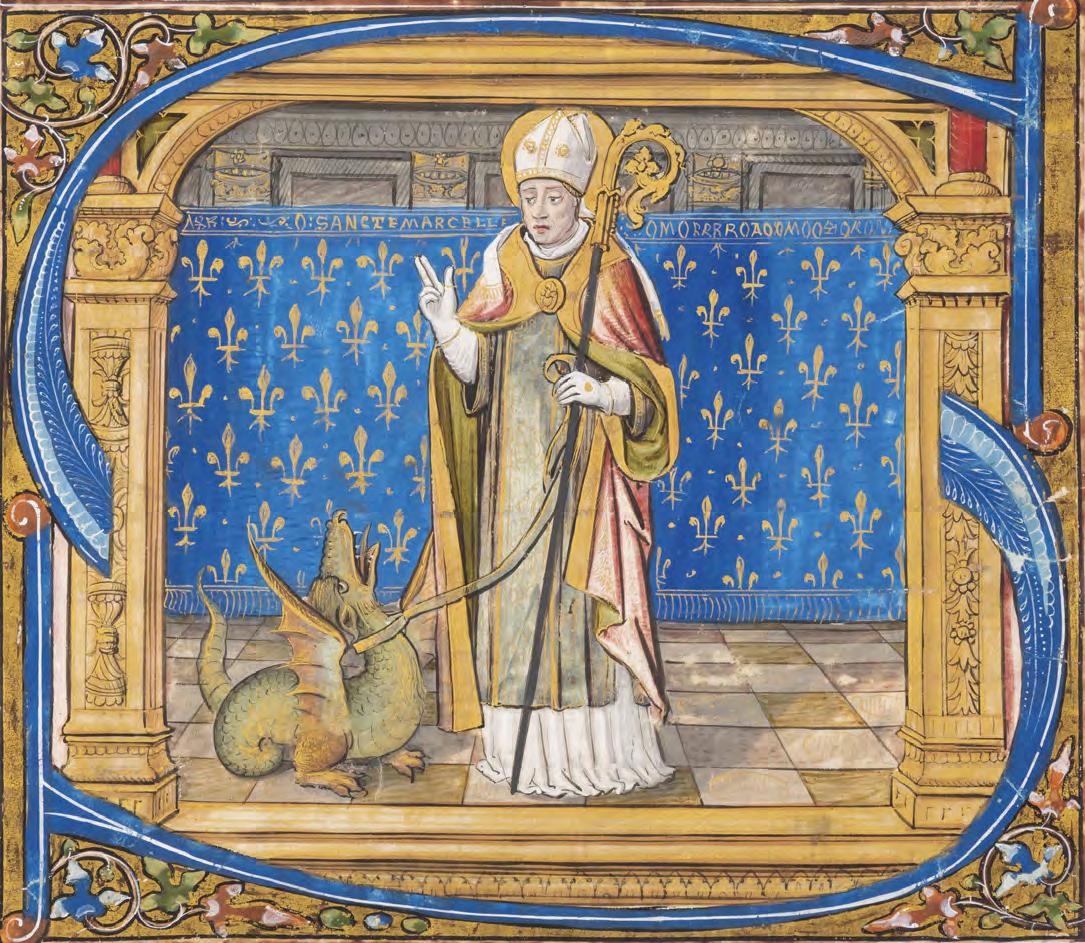
FINE BOOKS, MANUSCRIPTS AND WORKS ON PAPER
Thursday 16th July 2026

AUCTION NO. 119
Thursday 16th July 2026, 1.00pm
Forum Auctions, 4 Ingate Place, Battersea, London SW8 3NS
CONTENTS
Continental Literature and History 1-17
English and Continental Manuscripts 8-78
English Literature and History 79-133
Modern First Editions 134-167
Fine Bindings
Private Press and Limited editions
Art and Architecture
Natural History
and Medicine
British Topography 315-319
Rupert Powell, International Head of Books and Works on Paper
Dido Arthur, Book Specialist
Justin Phillips, Book Specialist
Max Hasler, Book Specialist
Simon Luterbacher, Consultant
Richard Carroll – 16th-19th Century Works on Paper Specialist
Rhiannon Spence, Book Specialist
Deniz Kortach, Junior Cataloguer
Becca Maguire, Junior Cataloguer
Holly Murphy, Junior Cataloguer
BUYER'S PREMIUM (plus VAT)
27% of hammer price up to and including £5,000
26% of hammer price from £5,001 to £500,000 20% of hammer price in excess of £500,001
Catalogue price: £15 (£17 including postage)
BIDDING AND INFORMATION
+44 (0) 20 7871 2640 info@forumauctions.co.uk www.forumauctions.co.uk
BidFORUM LIVE ONLINE BIDDING
All of our auctions have free live online bidding via: forumauctions.co.uk
Collection Arrangements
Paid for items will be available to collect from Forum Auctions’ premises at Ingate Works, 4 Ingate Place, Battersea, London SW8 3NS BY PRIOR APPOINTMENT. Collection appointments can be made with info@forumauctions.co.uk. Please note that parking is available and we do not fall into the London congestion zone. We can help arrange packing and shipping of purchased lots, or clients may use their own carrier. We respectfully ask all buyers to settle invoices promptly.
1. Introduction. The following notices are intended to assist buyers, particularly those that are new to our saleroom and internet bidding platforms. Our auctions are governed by our Terms and Conditions of Business incorporating the Terms of Consignment, the Terms of Sale supplemented by any notices that are displayed in our saleroom, the online catalogue listing or announced by the auctioneer at the auction. Our Terms and Conditions of Business are available for inspection at our saleroom and online at www.forumauctions.co.uk. Our staff will be happy to help you with any questions you may have regarding our Terms and Conditions of Business. Please make sure that you read our Terms of Sale set out in this catalogue and on our website carefully before bidding in the auction. In registering to bid with us you are committing to be bound by our Terms of Sale.
2. Agency. As auctioneers we usually act on behalf of the seller whose identity, for reasons of confidentiality, is not normally disclosed. If you buy at auction your contract for the goods is with the seller, not with us as auctioneer.
3. Estimates. Estimates are intended to indicate the hammer price that a particular lot may achieve. The lower estimate may represent the reserve price (the minimum price for which a lot may be sold) and cannot be below the reserve price. Estimates do not include the buyer’s premium, VAT or other taxes and fees (where chargeable). Estimates may be altered by a saleroom notice.
4. Buyer's Premium. The Terms of Sale oblige you to pay a buyer's premium on the hammer price of each lot purchased. All lots are offered under the Auctioneer’s Margin Scheme and VAT (at 20%) is included within the buyer’s premium. Buyer’s premium is charged per lot at 27% of the hammer price (32.4% including VAT) up to and including £5,000, 26% (31.2% including VAT) of the hammer price from £5,001 up to and including £500,000, and 20% (24% including VAT) of the hammer price in excess of £500,001. Buyers wishing to purchase outside of the margin scheme must notify us and will be subject to VAT (at 20%) on the hammer price in addition to buyer's premium and any other applicable charges. This may be reclaimed as input tax or in the event of export outside of the UK.
5. Items with zero rated VAT. Please note that no VAT is added to the buyers’ premium on certain zero rated goods, such as qualifying books.
6. Inspection of goods by the buyer. You will have ample opportunity to inspect the goods and must do so for any lots that you might wish to bid for. Please note carefully the exclusion of liability for the condition of lots set out in Clauses 5 and 8 of our Terms of Sale.
7. Export of goods. If you intend to export goods you must find out in advance if
a. there is a prohibition on exporting goods of that charactere e.g. if the goods contain prohibited materials such as ivory
b. they require an Export Licence on the grounds of exceeding a specific age and/or monetary value threshold as set by the Export Licensing unit. We are happy to make the submission of necessary applications on behalf of our buyers but we will charge for this service only to cover the costs of our time.
8. Bidding. Bidders will be required to register with us before bidding. Purchases will be invoiced to the buyer’s registered name and address only. When first registering for an account with us you will need to provide us with proof of your identity in a form acceptable to us. IN REGISTERING TO BID YOU AGREE TO BE BOUND BY OUR TERMS OF SALE REGARDLESS OF YOUR METHOD OF BIDDING AND IN PLACING A BID YOU ARE MAKING AN IRREVOCABLE AND ENFORCEABLE COMMITMENT TO PURCHASE THE LOT.
9. Commission bidding. You may leave commission bids with us indicating the maximum amount (excluding the buyer’s premium and/or any applicable VAT, fees or other taxes) you authorise us to bid on your behalf for a lot. We will execute commission bids at the lowest price possible having regard only to the reserve and other competing bids on the lot. Please note that we accept commission bids at standard bidding increments and reserve the right to reduce an off-increment bid down to the next lowest bidding increment or otherwise at our sole discretion.
10. Live online bidding. When using our BidFORUM platform to participate in the auction through your account on our website there will be no additional charges. If you are using a third party live bidding platform then additional fees may be applicable. We will invoice these to you as an additional service and any applicable VAT will be separated out.
11. Methods of Payment. We accept payments only in the currency in which the invoice is issued and payment is due within 3 working days of the auction. We process card payments securely over our website and accept and all major debit and credit cards issued by a UK or EU bank free of charge from personally issued cards only. If paying with a corporate card, or from outside the EU, an additional 3% charge will be levied on the invoice total. We also accept bank transfers, cash payments up to an equivalent of €10,000, and cheques issued by a UK bank. All funds need to have cleared into our account before items are collected. For bank transfers, please quote the Invoice Number as the payee reference:
Our bank details for electronic transfers are:
HSBC, 16 King St, London WC2E 8JF
Account Name: Forum Auctions Limited
Account Number: 12213079
Sort Code: 40-04-09
IBAN: GB44HBUK40040912213079
BIC: HBUKGB4106D
12. Collection and storage. Please note what the Terms of Sale say about collection and storage. It is important that you pay for and collect your goods promptly. Any delay may result in you having to pay storage charges of at least £1.50 per Lot per day as set out in Clause 7 of our Terms of Sale and interest charges of 1.5% per month on the Total Amount Due as set out in Clause 15 of our Terms of Sale.
13. Loss and Damage to Goods. We are not authorised by the FCA to provide insurance services. Liability for a lot passes to the buyer on the fall of the hammer or conclusion of an online auction (as applicable). In the event that you wish for us to continue to accept liability for your purchased lots this must be agreed with us in writing in advance of the sale and any agreed charges are payable before collection of the goods.
14. Symbols within the catalogue

a. denotes a lot where Artist’s Resale Right royalty charges may be applicable on the lot. Presently these charges are levied on a sliding scale at
4% up to £50,000
3% between £50,000.01 and £200,000
1% between £200,000.01 and £350,000
0.5% between £350,000.01 and £500,000
0.25% in excess of £500,000
We will collect and pay royalty charges on your behalf.

b. denotes that Import VAT at 5% is payable on the hammer price of the Lot.

c. denotes that VAT at 20% is payable on the hammer price, which may be reclaimable as input VAT.
15. Shipping. We can assist with the packing and shipping of your purchases by arrangement with our shipping department. Please contact shipping@forumauctions.co.uk for a list of shippers we regularly use together with indicative pricing for packing and shipping.

1
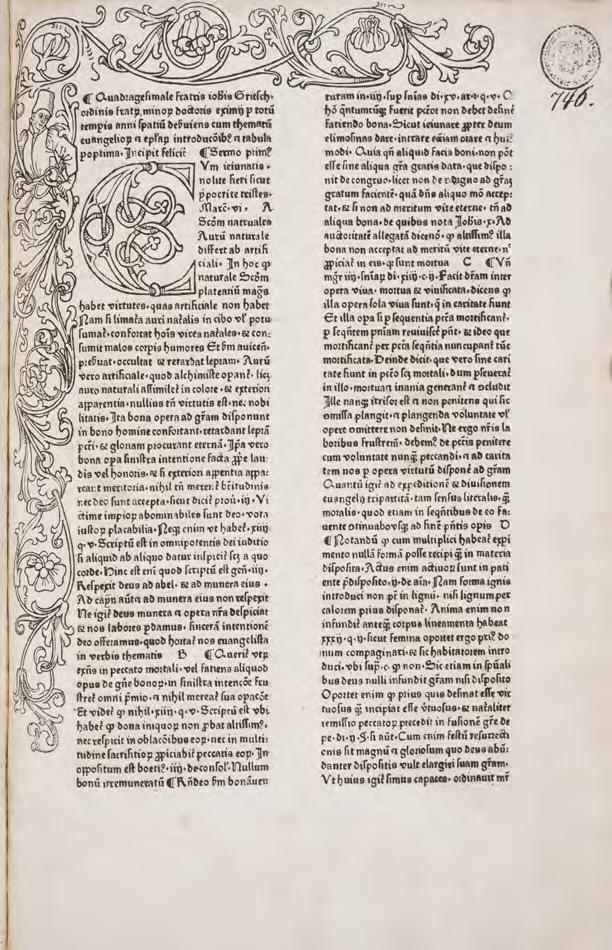
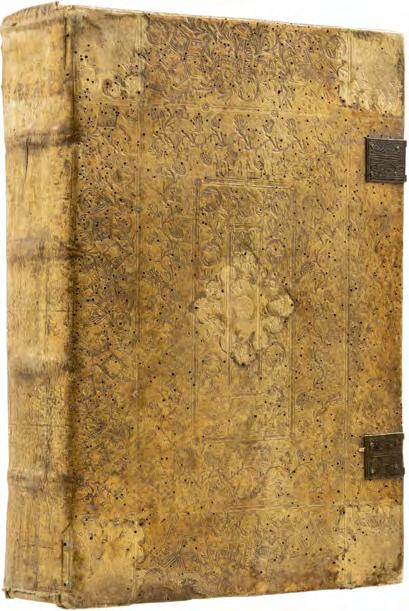
Gritsch (Johannes) QUADRAGESIMALE, collation: [a9 bc8 d-h10 i6 k-l8 m10 n8 o10 p-q8 r10 s8 t10 v8 x7 y-z10 A8 B10 C8 D-G9], 269 ff. (of 271 only, lacking first and final blank), double columns of 50 lines, Gothic type, 52 large (10 lines) woodcut initials, and numerous smaller (3 lines) woodcut initials, decorative woodcut border to 1f., 1f. with marginal loss to lower corner, light marginal damp-staining, light worming mostly light, but touching a few letters to first and last few ff., few instances of early ink marginalia or markings, manuscript inscription on fore-edge, contemporary Landshut blind-stamped pigskin over wooden boards, lacking clasps, foot of spine chipped, light soiling, wormed, a little rubbed, folio (approx. 400 x 280 mm), [Ulm], Johann Zainer, [14]76.
⁂ A CLEAN, WIDE-MARGINED COPY OF THE RARE THIRD OF TWENTY-FOUR KNOWN INCUNABLE EDITIONS OF THIS POPULAR COLLECTION OF 50 LENTEN SERMONS This was published just one year after the first edition, and is mostly a reprint; the contents of the pages are nearly the same in both editions, which highlights the popularity of this work, from an early stage.
Provenance: early manuscript inscriptions on pastedown about the tidal effects of the moon and zodiacal signs, and ink-stamp and shelf-mark ‘746’ to upper corner of first leaf and first leaf of text (?German).
References: BMC II 524; Goff G491; GW 11540; Bod-inc G-252; BSB-Ink G-392; ISTC ig00491000
£6,000 - 8,000
2
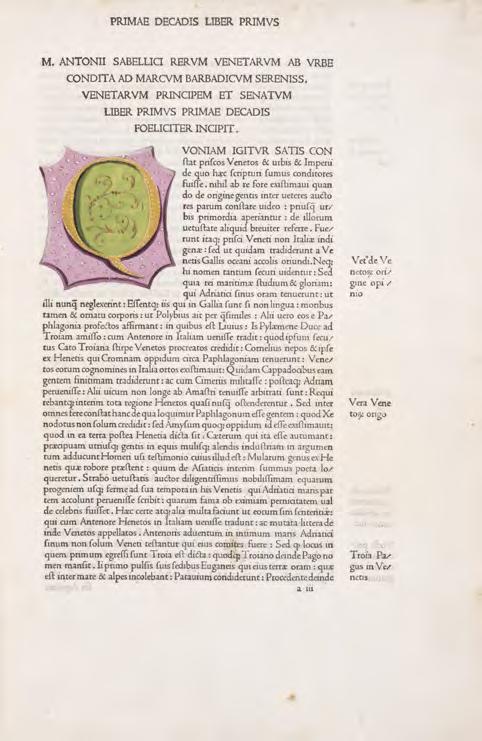
Venice.- Sabellicus (Marcus Antonius) DECADES RERUM VENETARUM, FIRST EDITION, collation: (iiiii)6, a8, b-h6, i-k8, l-y6, A-H6, I-M8, N10, O4, [ ✽2], 240 ff., 48 lines plus headline, roman type (final 2 ff. in gothic type), a1,2&3 with large (probably later) hand-coloured initials in pink, blue and green heightened in gilt, i1 with small loss to corners and blank recto laid down (with small unidetifiable ink-stamp), a few instances of early ink marginalia, small marginal worming to i1-3 & O4-end, final 2 errata ff. with few short tears/holes within text, some scattered spotting and staining, else good, later calf, spine gilt with raised bands and double morocco labels, few small repairs to spine ends and corners, rubbed with some wear, upper joint splitting at head, folio (390 x 270 mm.), Venice, Andreas Torresanus de Asula, 21 May, 1487.
⁂ One of the earliest humanist attempts to systematically present the history of Venice in a structured, classical form.
References: BMC V 308, Goff S-5; HC 14053*; GW M39264; Bodinc S-001; BSB-Ink S-4; ISTC is00005000
£5,000 - 7,000
3
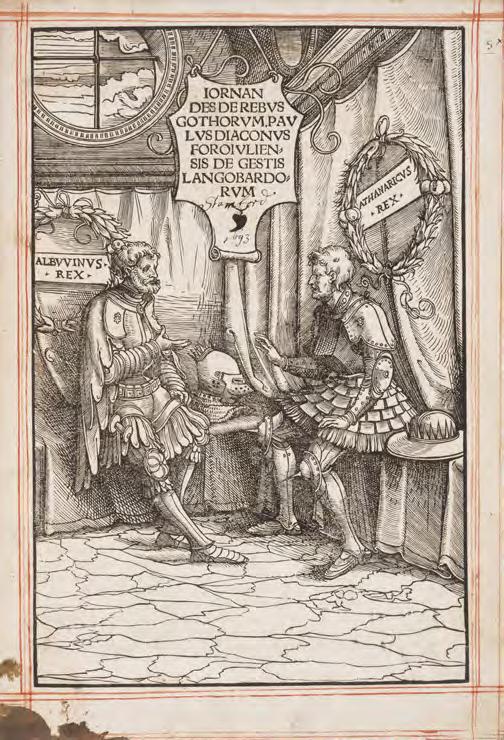
Jordanes (Bishop of Ravenna) IORNANDES DE REBUS GOTHORUM PAULUS DIACONUS FOROIULIENSIS DE GESTIS LANGOBARDORUM, 2 parts in 1, FIRST EDITION, A8, B-D6, AA-FF6, GG-HH4, pictorial woodcut title by Hans Burgkmair, woodcut device at end and initials throughout, last blank leaf of part 1, bookplates of Maurice Johnson and Arthur and Charlotte Vershbow on front pastedown, title with “Stamford 1693” in ink and staining to foot, 3pp. manuscript notes by Maurice Johnson on front free endpapers, marginalia and underlining in red to a few pp., eighteenth-century calf, gilt ornaments on spine, backstrip lightly rubbed and detaching, foot repaired, extremities slightly rubbed, 4to, (290 x 205 mm). Augsburg, Johann Miller, 1515.
⁂ The sixth-century bureaucrat and historian Jordanes wrote this book as a summary of a multi-volume history of the Goths (now lost) by the statesman Cassiodorus. It is the only extant ancient work dealing with the early history of the Goths. The second part is an exemplary edition of Paulus Diaconus’ (d. 797) important history of the Langobards, first printed in 1471. The editor of both historical sources is the Augsburg town scribe Conrad Peutinger (1465-1547), with his privilege issued by Emperor Maximilian I, dated 1511, printed on title verso.
Provenance: Maurice Johnson of Spalding (1688-1755), librarian of the Society of Antiquaires and a great collector of early English books - his sale at at Sothebys on 23rd March 1970, lot 81; Arthur and Charlotte Vershbow (bookplate) - their sale at Christie’s on 10th April 2013, lot 240.
Literature: Adams J320; VD 16 J 932.
£2,000 - 3,000
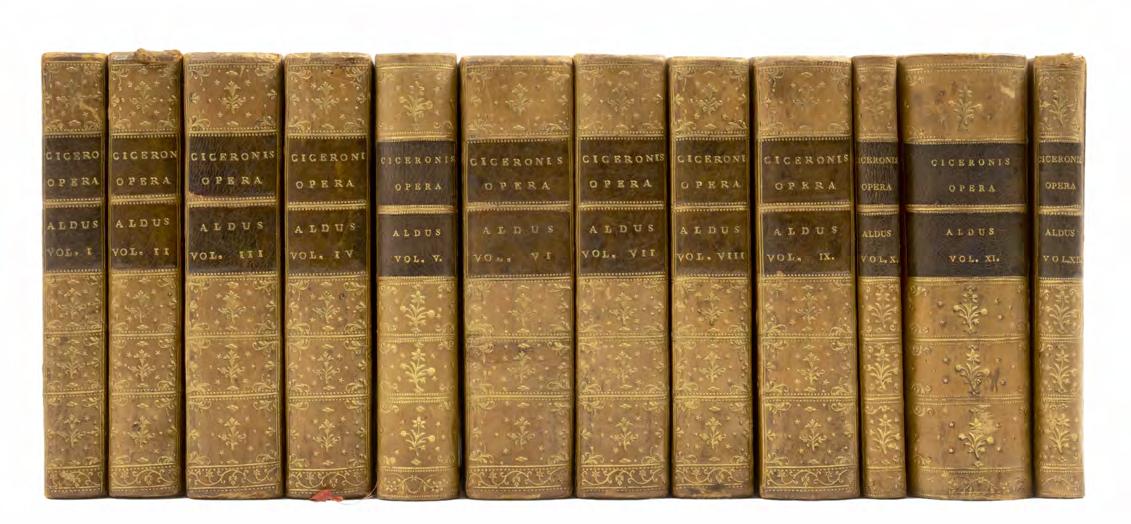
Aldine Press.- Cicero (Marcus Tullius) [OPERA], 12 vol. of which vol. 11 FIRST EDITION, printer’s device to title pages and some final ff., later ink note to vol. 1 front endpaper, early ink ownership inscription to vol. 7 title, some underlining and a couple of marginal notes to vol. 5 and 12, book labels to front pastedowns, paper repair at upper margin vol. 11 title, final few ff. vol. 12 with small marginal defect at upper corner and the final f. chipped also along fore-edge, generally clean with only scattered instances of faint spots, minor stains or light browning, most vol. in uniform 18th century calf, attractively gilt and spines with double morocco labels, vol. 5, 10 & 11 in near matching early 19th century calf, while vol.12 in calf-backed marbled boards, a few minor signs of wear, overall a handsome set, 8vo (c.150 x 94mm.), Venice, Paolo Manuzio; heirs of Aldus Manutius and Andrea Torresano, 1519; 1547-63.
⁂ A lovely set, rarely found together, of the massive corpus of Cicero’s judicial, political, rhetorical, philosophical and epistolary works (including two commentaries by Paolo Manuzio)
£2,000 - 3,000
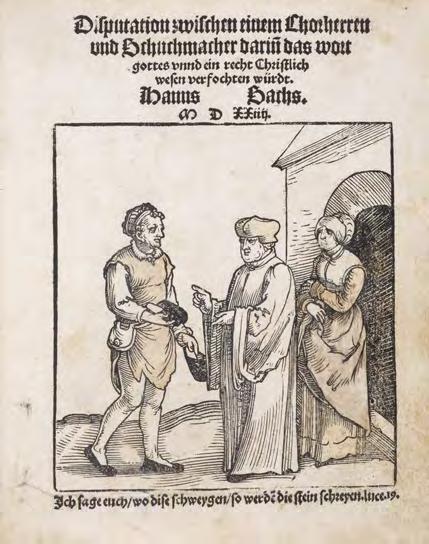
5 Reformation.- Sachs (Hans) DISPUTATION ZWISCHEN EINEM CHORHERREN UND SCHUCHMACHER DARIN DAS WORT GOTTES UNND EIN RECHT CHRISTLICH WESEN VERFOCHT WUERDT, FIRST EDITION, collation: A-C4, complete with final blank leaf, Gothic type, large woodcut of the shoemaker, canon and a female cook on title with some early wash colouring, some foxing and soiling, title laid down, good margins, modern blind-tooled calf, small 4to (182 x 143mm.), Bamberg, Georg Erlinger, 1524.
⁂ An excellent copy of the rare first edition of this important Reformation dialogue with the content enhanced by the woodcut in appealing to Sachs’ target audience, common people without knowledge of Latin who were eager to embrace the new message of the Reformation. This dialogue was printed eleven times in 1524 alone (see VD 16 S 213-223). Nonetheless, the survival rate of popular pamphlets, which were issued unbound, is understandably low. The present printing, distinguished by small typological differences in its printed title, is recorded by Keller and Goetze as being the first.
Hans Sachs (1494-1576) was born in Nuremburg. A cobbler by trade, he was multi-talented – a skilled Meistersinger (master singer) and a prolific writer of topical poetry, plays, comedies and music. He was an ardent supporter of the Reformation; one of his most famous poems Die Wittenbergisch Nachtigall (The Wittenberg Nightingale), speaks of Luther as a nightingale. His modern fame owes much to Wagner’s depiction of him in Die Meistersinger von Nürnberg.
Erlinger (c.1485-1541) was born in Augsburg but worked as a printer in Bamberg from 1522, printing numerous works by Martin Luther and his followers.
Literature: VD 16 S 221 (lists 2 copies only of this editioin); USTC 638630
£1,500 - 2,000
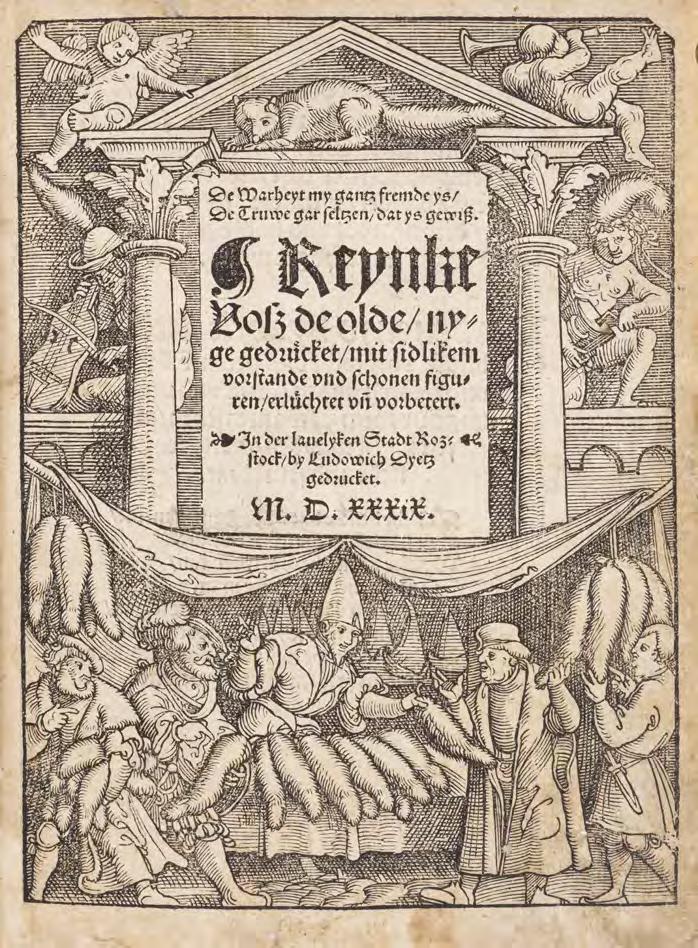
Reynard the Fox.- REYNKE VOSS DE OLDE, THIRD LOW GERMAN EDITION EXTANT, FIRST EDITION WITH THESE ILLUSTRATIONS, collation: A-Ll8, Gothic letter, title within fine woodcut border, 44 large woodcuts by Erhard Altdorfer (2 full-page, 8 repeats), 57 small woodcut figures by the Master MP, metalcut printer’s device at end, calligraphic woodcut initials, occasional finger-soiling, title margins with small repairs, paper flaw to lower margin of T7, lower corner of Y8 repaired, lower corner of Kk3 repaired slightly affecting two words of text, later ink annotations to endpapers, contemporary blind-tooled calf over wooden boards, covers with two panel stamps, each 83 x 50 mm: a portrait of Elector John Frederick I with inscription “Nomina Ioannes princeps Fridericus...” on upper cover and a portrait of Martin Luther with inscription “Nec tum idam metui frendentis principis iram...” on lower cover, remains of two metal clasps, rebacked, corners repaired, some wear to leather at edges, preserved in modern cloth slip-case, 4to (201 x 145mm.), Rostock, Ludwig Dietz, 1539.
⁂ RARE EDITION WITH MENKE RECORDING ONLY 11 COPIES. The beast epic of Reynard the Fox is one of the oldest and most popular themes of world literature. The figure of the cunning fox is already known from the fables of Aesop, often combined with the wolf and lion. By the middle of the 12th century several tales and episodes were composed to form a continuous narrative. Latin, Old French and Middle High German poems used the stories as biting satires against the clergy as well as the aristocracy. Although there were several earlier printed editions, it was not until the present edition of 1539 that the immense success of Reineke Fuchs began, at first mainly in Germanspeaking areas. Thereafter, through many subsequent translations, the story was very widely disseminated across Europe. Ludwig Dietz provided the satiric epic with a new, Protestant gloss including fierce polemics against the old-established church, and he had the printing illustrated with new woodcuts by the court painter of Schwerin, Erhard Altdorfer (after 1480-after 1561). As well as the wonderfully expressive woodcuts illustrating the story, the small woodcuts illustrating the glosses show medieval estates and professions such as the nobility, clergy, merchants, lawyers, soldiers, peasants and beggars.
Provenance: A. Wilke (ink inscription to front pastedown); Thore Virgin (1886-1957) [Bibliotheca Qvarnforsiana], important Swedish bibliophile (ink inscription on front pastedown, dated 15 June 1937).
Literature: H. Menke, Bibliotheca Reinardiana, Stuttgart 1992, VI, no. 9
£10,000 - 15,000
7
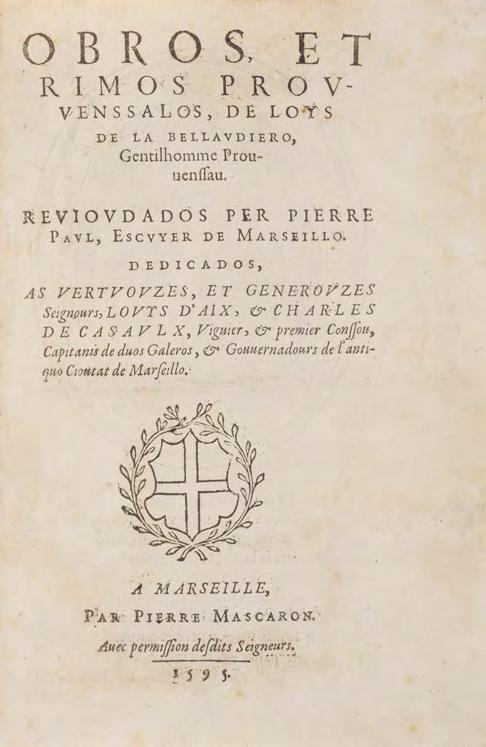
Bellaudiere (Louis Bellaud de la) OBROS ET RIMOS PROVENSSALOS, 4 parts in 1, FIRST EDITION, collation: A-Y4 Z2; Aa-Rr4 Ss2; A-H4 I2, first 3 part-titles with woodcut device, part 4 with woodcut arms of author on title, woodcut portrait on verso of first title, repeated on verso of Table des Sonnets (at end of part 3), woodcut decorations, washed, some leaves browned, old marginal restorations to several leaves, many of which have been re-margined, later red morocco, gilt, by Duru et Chambolle, inner gilt dentelles, morocco-edged marbled paper jacket and slip-case, slight restoration to lower cover, g.e., 4to (235 x 158mm.), Marseille, Pierre Mascaron, 1595.
⁂ BEAUTIFUL COPY OF THE FIRST EDITION OF THE FIRST BOOK PRINTED IN MARSEILLE
Written in Provençal during his imprisonment in Moulins, this collection comprises three parts: the first, Obros et Rimos, and the third, Lous Passatens, in the original; the second, Le Don-don, was published in 1583 in Aix. These works by Louis Bellaud , a soldierpoet sometimes described as a “rogue,” were published posthumously by his uncle by marriage and friend, Pierre Pau, author of La Barbouillado, which forms the final part of this work. The book was first published in Marseille during the brief reign of First Consul Charles de Casaulx. The civil war that led to Casaulx’s downfall and assassination, to whom the opening epistle is dedicated, caused the publisher Mascaron to flee. His workshop was taken over by one of his employees, who put the unsold copies back on sale after purging them.
Bound in at the end is a manuscript poem on a single leaf, entitled “Ruffi A Pau, odo,” composed of seven stanzas, which is believed to be an ode by the Marseille poet and scholar Claude Ruffi to Pierre Pau.
Provenance: Horace de Landau (1824-1903) was a representative of the Rothschild Bank in Turin and formed a magnificent library in the Villa Normandy in Florence, (bookplate); Henri Bonnasse (bookplate); Jean Paul Barbier (bookplate)
£4,000 - 6,000
8
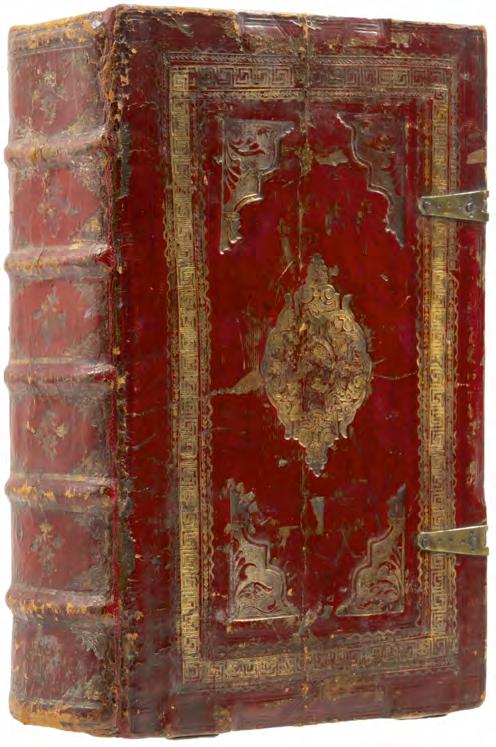
Russia.- KIRILLOVA KNIGA [КИРИЛЛОВА
], printed in red and black, cyrillic lettering, woodcut head-pieces, contemporary ink ownership inscription to f.5, lacking 5 blanks, single gathering towards end stained, one or two tiny paper repairs to lower fore-edge corners, finger soiling and spotting, light dampstains at upper margins, ink library stamps, handsome in contemporary red morocco over boards, richly gilt, covers with panel design of Greek key pattern and roll-tool borders, the upper cover surrounding a central lozenge and corner pieces while the lower with four foliate motifs and decorative brass bosses, spine with motifs in compartments although gilt faded, red morocco repairs to hinges, lower cover with a few small holes exposing boards, minor scuffs and wear to extremities, ornate gilt gauffered edges, remains of brass clasps and ties, folio, Moscow, 1644.
⁂ First edition in contemporary binding of this seminal defence of the Orthodox Church, one of the most important Russian publications of the 17th century and printed by order of the first Tsar of the Roamnov dynasty, Mikhail Fedorovich. The impetus of this work stemmed from the failed efforts to convert the Lutheran Danish Prince Waldemar as part of marriage negotiations with the Tsar’s daughter, ultimately leading to their breakdown. Contemporary rumours blamed this rupture, and the consequent failure of an anti Swedish Russian-Danish alliance, for the Tsar’s death in 1645
£2,000 - 3,000
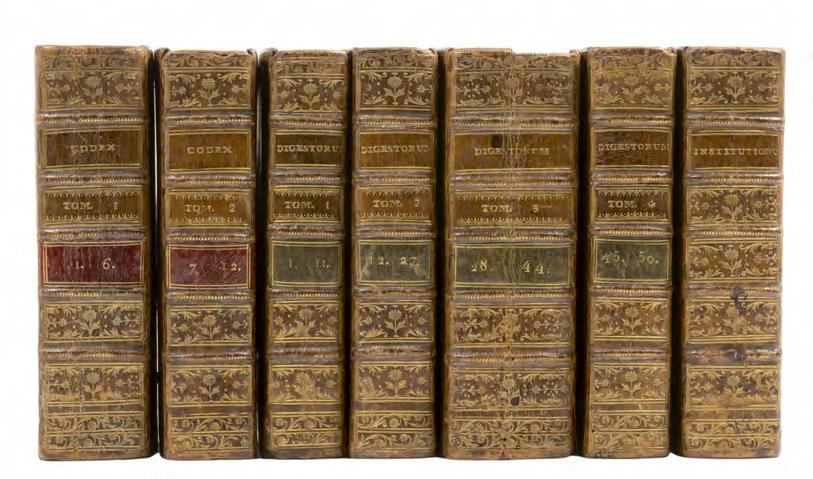
Woman Printer.- Justinianus I. DIGESTORUM SEU PANDECTARUM PARS SEPTIMA, 4 vol., woodcut printer’s device to titles, 1552; Institutionum, sive elementorum, libri quatuor, inital 31ff. with small worm-hole affecting blank outer margin, 1552; Codicis ex repetita praelectione libri duodecim, 2 vol., 1553, together 7 vol., ?18th-century ink ownership inscription to titles, woodcut initials and ornaments, uniformly bound in 18th century mottled cat’s-paw calf, spines richly gilt with morocco labels in brown, green and red, 8vo (c.166 x 101mm.), Paris, Charlotte Guillard and Guillaume Desboy (7)
⁂ A handsome set of the complete ‘Corpus iuris civilis’ patronised by Emperor Justinian I, printed by the first major female printer of France. Charlotte Guillard (b.1480s-1557) was active in Paris in the first quarter of the 16th century; widow of Berthold Rembolt and Claude Chevallon after whose death her name reappeared in imprints. From 1537 until her death she printed or published approximately 158 different titles. The Corpus Iuris Civilis was a fundamental reference instrument of Roman law for early modern lawyers, and a milestone of feudal and imperial law, pointing to the necessity of women printers being possessed of scholarly training as well as managerial and business skills. Sets are rarely found uniform and complete, as purchasers selected or mixed parts and editions.
Literature: Adams J573, J574, J575; J511 and J679.
£2,000 - 3,000
10
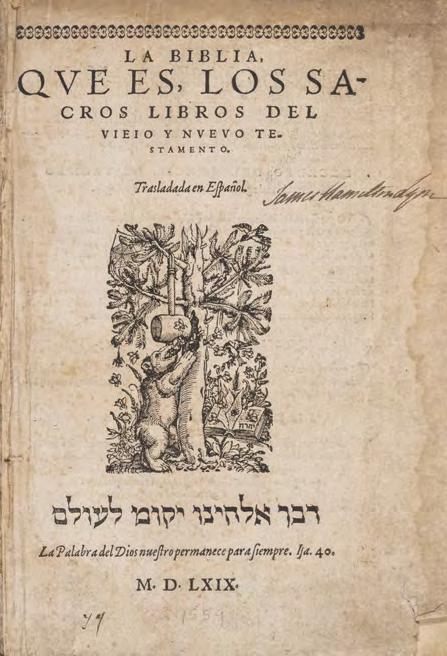
Bible, Spanish LA BIBLIA, QUE ES, LOS SACROS LIBROS DEL VIEIO Y NUEUO TESTAMENTO, collation: π¹, †⁸ ,***⁶ , A-2Y⁸, ²2A-2R⁸, a-q⁸ α⁴, lacking blank f. after title, woodcut printer’s device to title, 2 woodcut illustrations, ink ownership inscription to title, printed note in Spanish tipped on to front endpaper, V3 with tear to fore-margin (affecting text), front endpapers loose and title becoming so, title browned with small tear and loss to lower corner, water-staining, mostly marginal, some scattered spotting to final few ff., later calf, covers detached and lacking backstrip, 8vo (c. 240 x 170 mm), [Basel], [Samuel Apiarius for Thomas Guarin], 1569.
⁂ The first complete Spanish translation of the Bible from the original Hebrew and Greek texts, prepared by the Protestant reformer Casiodoro de Reina during his exile from Spain. Printed in Basel, it became known as the Bear Bible (Biblia del Oso) from the distinctive title-page illustration of a bear seeking honey. This influential edition played a foundational role in the development of Spanish Protestant biblical literature.
Literature: Adams B1206; VD16 B2869.
£6,000 - 8,000
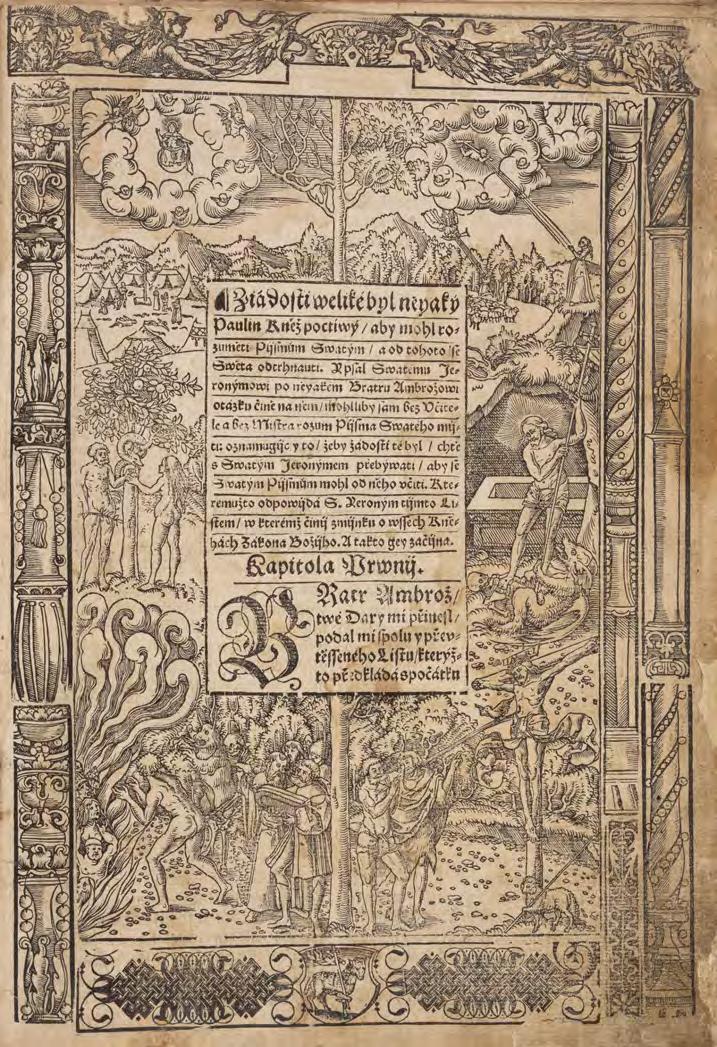
Bible, Czech. BIBLIJ CZESKÁ, double column, gothic type, lacking general title and prelims as well as several other ff. (being *1-6, 3C5, 3E6, V8, Z1 and *10), title and 6 preliminary ff. supplied from Kozmograffia Czeska (1554) bound before A1 although A6 mis-bound to follow supplied title, A1 with wide border of woodcut biblical scenes, A6 with large woodcut arms of Prague (recto) and full-page woodcut with six scenes from the Creation within roundels (verso), woodcut illustrations within text throughout, second V2-3 supplied from a different edition, first 3ff. trimmed with some loss and mounted, a handful of initial ff. with silked repairs while elsewhere scattered older paper repairs, some browning, marginal finger-soiling, ink marks, and light damp-stains, later Czech calf stamped and tooled in blind, covers with IHS Jesuit device, joints cracked but holding, upper brass clasp intact, lower partial only, folio (316 x 218mm.), Prague, Jiří Melantrich, 1577.
⁂ A monumental illustrated Czech bible, the fourth edition from the Melantrich press. An Utraquist (Hussite) version of the Vulgate, with the addition of the third book of the Maccabees, this bible testifies to scholarly recognition of Melantich’s important role in disseminating scripture in the vernacular to wide circles within Czech society. As implementation of post-Tridentine reforms strengthened in Bohemia, such non-conformist texts would have come under greater scrutiny and it is not surprising perhaps that this copy found its way into Jesuit hands. Illustrations by German Florian Abel and the Italian Francesco Terzio, after the Benátská Bible, the first Czech bible printed abroad.
Literature: Knihopis, 1105; Jungmann, 1849; Vašica, 2001; Kyas, 1997; D&M 2182; V. Kyas, Česka bible (Vyšehrad, 1993); The Interpretation of the Bible, ed. J. Krasovec (London, 1999); E. Ryznar and M. Croucher, Books in Czechoslovakia (Wiesbaden, 1989); R. Dittmann et al., Biblical Humanism in Bohemia and Moravia in the 16th Century (2017); G. Wainwright, The Oxford History of Christian Worship (2006).
£3,000 - 4,000
12
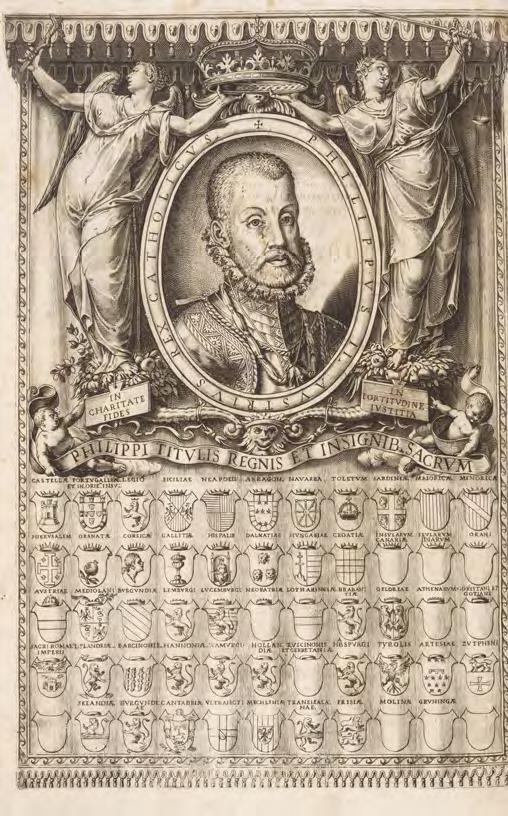
Campo (Antonio) CREMONA FEDELISSIMA CITTA, FIRST EDITION, collation: []4 A-L4 *-10*4, M-S4 pi2 (lacking 10*4, probably blank), engraved allegorical title with portrait of Philip II and coats-of-arms to verso, dedication leaf withh full-page engraved allegorical illustration to verso, engraved map of the city on three conjoined sheets by David da Lodi (dated 1582), double-page map of the region around Cremona, dated 1583, double-page plate of the Duomo of Cremona with views and plans of the baptistery and tower to versos, engraved portrait of the author and 33 further portraits engraved by Agostino Carracci, half-page engraving of a carroccio train exiting the city, large woodcut initials, text within ornamental woodcut borders, woodcut device to colophon, a few tears and repairs with folding plates laid down, some light foxing and soiling but overall in very good condition throughout, ink notes in Italian to front endpapers, early 19th century green straight-grain morocco, blind-stamped border and gilt arms to covers, extremities a little rubbed, spine slightly darkened, inner gilt dentelles, g.e., folio (400 x 253mm.), Cremona, Hippolito Tromba & Hercoliano Battoli, 1585.
⁂ A HANDSOME COPY OF THIS IMPORTANT HISTORY OF THE CITY OF Cremona
The portraits depict the dukes of Cremona, and the dukes and duchesses of Milan, including the now lost portrait of Maximilian Sforza of Milan by Leonardo da Vinci on page 104, formerly owned by Francesco Melcio. The title was originally engraved in 1582, but the manuscript attempt to correct it to 1585 has resulted in the last number being obscured.
Literature: Adams C489; Brunet I, 1526; Cicognara 3977; Mortimer Italian 100; EDIT 16 CNCE 8843
£2,000 - 3,000
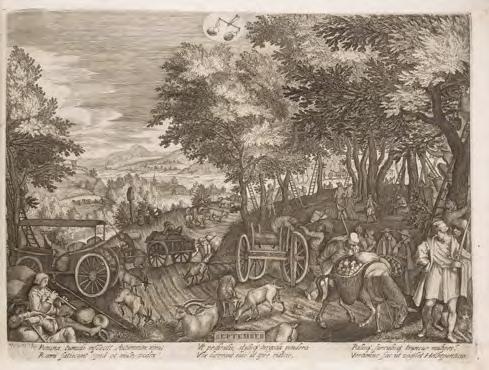
13
Sadeler II (Aegidius) THE TWELVE MONTHS OF THE YEAR, OR ‘MENSES XII
ANNI SOLARIS’, after Pieter Stevens II (c.1567-1624), engraved dedication with title, 12 engravings on laid paper, some with watermark of bunch of grapes, platemarks approx. 222 x 287 mm (8¾ x 11¼ in), small margins, some minor toning, spotting and surface dirt, limp vellum, ink inscription to upper cover dated ‘1607’, oblong 4to, [circa 1600-1610]
£600 - 800
14
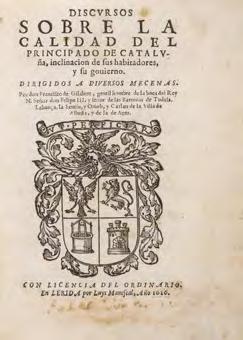
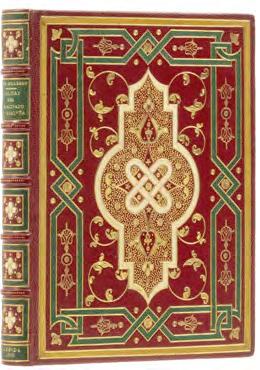
Gilabert (Francisco de) DISCURSOS SOBRE LA CALIDAD DEL PRINCIPADO DE CATALUÑA, inclinacion de sus habitadores, y su govierno, 5 parts in 1, FIRST COLLECTED EDITION, title with large woodcut coat-of-arms, woodcut initials, traces of ink inscription to foot of title, 4pp. errata crossed through in ink with corrections made to text in contemporary manuscript, errata stained and one leaf repaired at upper outer corner, Cc2 of part 3 with small tear to inner margin repaired, a few other stains, small gilt-stamped roan book-labels of Isidoro Fernandez, handsomely bound in early 20th century red morocco inlaid with strapwork in tan, cream & green morocco and elaborately tooled in gilt with various ornaments, the central panel with gilt pointillé background, spine with green morocco label titled in gilt and compartments of onlaid cream quatrefoils & gilt circles framed in green morocco and five raised bands, inner gilt dentelles, crimson silk linings, g.e., [Palau 10271; USTC 5011074], small 4to (c.195 x 140mm.), Lerida, Luis Menescal, 1616
£1,000 - 1,500
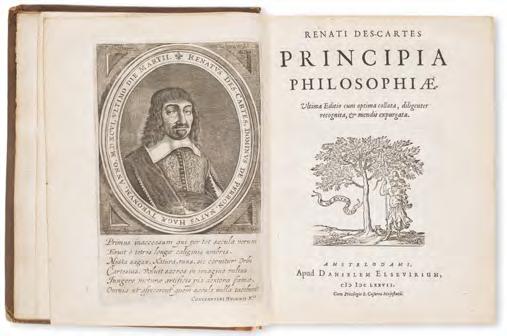
Descartes (René) OPERA PHILOSOPHICA, 4 works in 1 vol., of which one in 3 parts (Meditationes), half-title, engraved portrait to π2v, titles with woodcut printer’s device, numerous woodcut diagrams, first work lacking blank 2E4, Meditationes Y-2A4 present but bound between second & third parts of the same work (after x2), some light browning, but overall a good copy, contemporary panelled calf, upper cover stained, rather rubbed with wear to corners, joints split at ends but holding firm, [STCN 851385990], small 4to, Amsterdam, Daniel Elzevir, 1677-78.
⁂ A collected edition of Descartes’ major philosophical works by Elzevir. In this copy, the works are bound in the order: Principia Philosophiae, Meditationes de Prima Philosophia, Specimina Philosophiae & Passiones Animae.
£600 - 800
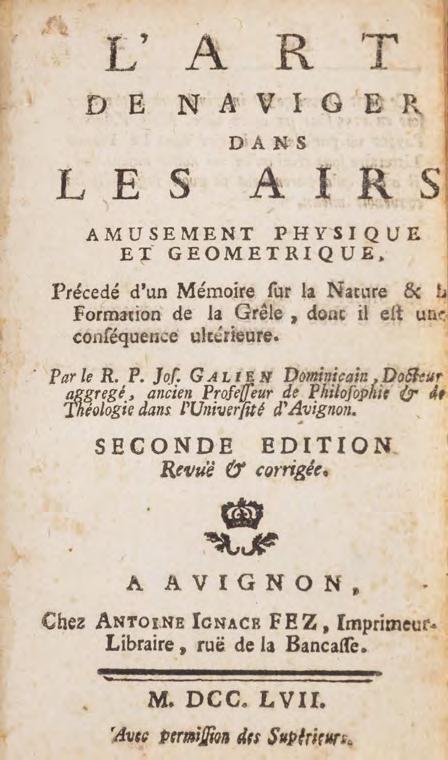
16
Fantastical early aviation.- Galien (Joseph) L’ART DE NAVIGER DANS LES AIRS. AMUSEMENT PHYSIQUE ET GEOMETRIQUE. PRÉCEDÉ S’UN MÉMOIRE SUR LA NATURE & LA FORMATION DE LA GRÊLE, DONT IL EST UNE CONSÉQUENCE ULTÉRIEURE, 2 parts in 1, second edition, revised and corrected, title with small woodcut crown ornament, woodcut head- and tail-pieces, errata to final verso, title outer margin trimmed, just touching a couple of letters, occasional spotting, lightly browned, contemporary speckled calf, flat spine richly gilt and with red morocco label, spine skilfully repaired, [Tissandier p.8; Genesis of flight p.66], 12mo, Avignon, Antoine Ignace Fez, 1757.
⁂ Rare, with no copy at the BnF. The first part deals with the formation and nature of hail. The second part proposes a gigantic airship (longer and wider than the city of Avignon and capable of carrying 4 million passengers and their luggage!) which could be navigated above the altitude at which hail is formed. Galien provides scientific calculations, details of materials and a method of construction for this fantastical behemoth. The work was first published anonymously in 1755 under a different title.
£800 - 1,200
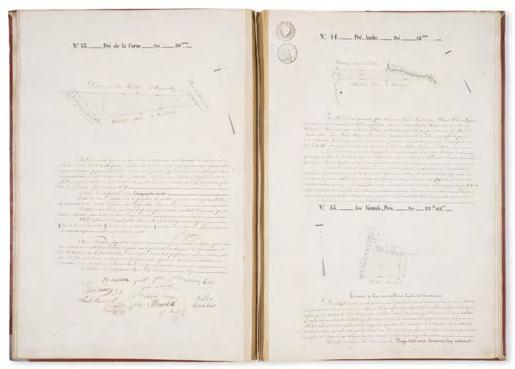
17
Land Surveying.- Guyon (Claude Étienne) ATLAS DES PROPRIÉTÉS QUE POSSEDENT MM. M[A]RIE J[OSE]FINE GOYARD, manuscript atlas, 33 hand-coloured plans (1 full-page), ink stamps to some ff., a few ff working loose at gutter, scattered light spotting and surface soiling, some cracking at upper hinge, contemporary red morocco-backed diced boards, a few repairs, joints splitting, rubbed and bumped, folio, Relans, 1843-7.
⁂ Relating to precise boundary descriptions recorded and confirmed by neighbouring landowners, this atlas was compiled by Guyon (1811–1868), a land surveyor from Relans in the Jura. It was produced to define the estates of Marie Joséphine Goyard, inherited from her late husband. Guyon was commissioned in 1847 to formally record the boundaries of the property, including the house, courtyard, garden, orchard, fields, meadow, and vineyard. His meticulous survey combines exact measurements with scaled drawings of each plot and its features. The estates are located in neighbouring communes in the Jura, around 50 miles south-east of Dijon, near the Swiss border
£1,000 - 1,500
18
P.MICHAEL 4, THE ‘INUNDATION PAPYRUS’, A GEOGRAPHICAL ACCOUNT OF THE NILE NEAR CANOPUS, ITS FLOODING AND THE BENEFITS OF THIS ACTIVITY, in Greek, remains of two columns from a manuscript scroll on papyrus, Egypt (perhaps western bank of the Nile Delta, near Alexandria), second century CE, two large pieces and two small fragments from a papyrus scroll (overall approximately 250 by 110mm.), with almost all of a single column (column width: 65 mm.) and the edge of its neighbouring column on the right surviving, remains of 35 lines in a fine Greek uncial, one annotation of a small cross between the columns, reverse blank, small losses to edges and a few holes, the whole set in glass on both sides, and a fitted carrying case in green leather.
⁂ An enigmatic Ancient text detailing the geography of the Nile, which has defied simple indentification, now thought to be a fragment of a long-lost geographical account of Egypt or part of an otherwise unrecorded Greek novel.
Provenance:
1. Georges Anastase Michaelides (1900-73), Greek-Egyptian collector, who built up a large collection of papyri and related items in the 1930s and 1940s while in Egypt, then exported these to Europe. This his ‘K3011’, and published while in his possession by Drescher and then Crawford (see below). His collection widely dispersed in the last decade of his life and the years immediately after his death, with other papyrus fragments and related artefacts now in the British Library (Pap 3084, 3100-3103, 3105-3115), the Brugsch collection of Berlin, Cambridge University Library (Michaelides 858-859, 1085 and 1263, as well as a vast collection of Arabic papyri, all bought from Michaelides’ heirs in 1977), the Los Angeles County Museum (M. 80.202.185 and 187) and the Boston Museum of Fine Arts (item 61.102, acquired in 1961) among others.
2. Bruce Ferrini (1950-2010), obtained from a private collector in Frankfurt.
3. The Schøyen Collection of Oslo and London, their MS. 2931; sold in their sale in Bloomsbury Auctions, 10 July 2018, lot 3, to the current owner.
Text:
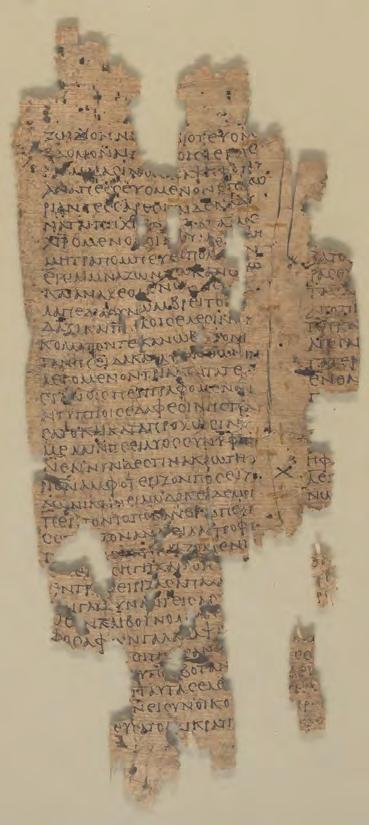
In the seventy years since its discovery, the unique and enigmatic text of this papyrus has defied simple identification. It opens with a reference to a method of calculation involving “the seventh in the system of Egyptian hieroglyphs, which in the local method of calculation marks fourteen cubits” before going on to describe the promontory on which Canopus lies, between the sea and the Nile, and the lifegiving properties of the flood, as this “weaves together [the area between Canopus and Thomis] with a piling up of black mud”, bringing nourishment to the dried out land, which produces tender shoots and a sweet odor, that in turn feeds milking cattle. It was last edited separately by Santoni and Stramaglia, with the latter giving a full translation into Italian (see below).
Merkelbach in 1958 identified it as a previously unrecorded section of the geographies of Hecataeus of Miletus (c. 550-c. 476 BC.), the first recorded Greek geographer, but the style of the language and structural complexity suggested to Murray and West that it may be part of an otherwise unknown literary work. Santoni focussed on its literary style and put it in the allegorising tradition of Stoic philosophy, possibly attributed to the Chairemon of Alexandria, the Graeco-Roman tutor to Nero. Recently, Stephens and Winkler looked at the address of the narrator in the first person, and returned to an older idea that it may be part of a long-lost Ancient Greek novel. They assigned it the title ‘Inundation’.
Published:
J. Drescher, ‘Topographical Notes for Alexandria and District’, Bulletin de la Société Royale d’Archéologie d’ Alexandrie, 38 (1949), pp. 13-20 and illustrated (pls. 16-20).
D.S. Crawford, Papyri Michaelidae, being a catalogue of the Greek and Latin papyri, tablets and ostraca in the library of Mr. G.A. Michaïlidis of Cairo, 1955, no 4.
R. Merkelbach, ‘Geographisches Fragment’, Arkiv für Papyrusforschung, xvi (1958), pp. 112-114.
O. Murray, ‘Hectaeus of Abdera and Pharaonic Kingship’, Journal of Egyptian Archaeology lvi (1970), 148, n. 3.
A. Bernand, Le Delta Égyptian d’après les textes grecs, 1970, pp. 225-28.
S. West, ‘P. Michael.4: Fact of Fiction?’, Zeitschrift für Papyrologie und Epigraphik, 10 (1973), pp. 75-77.
A. Santoni, ‘Una decrizione di Canopoin P.Michael. 4’, Auctori Vari, Varia Papyrologica, 1991, pp. 101-120.
A. Stramaglia, ‘Sul Frammento Di Romanzo (?) PMichael 4’, in Zeitschrift für Papyrologie und Epigraphik, 97 (1993), pp. 7-15.
S.A. Stephens and J.A. Winkler, Ancient Greek Novels, 1995, pp. 453-460.
M.P. Lopez Martinez, Fragmentos papiráceos de novela griega 25, 1998.
J.R. Morgan, ‘On the Fringes of the Canon: Work on the Fragments of Ancient Greek Fiction 1936-1994’, Aufsteig undNiedergang der römischen Welt, 34.4, 1998, pp. 3378-80.
As well as in the online Leuven Database of Ancient Books, as LDAB 4612
£12,000 - 18,000
THE BRUCE FRAGMENT OF MELITO OF SARDIS, PERI PASCHA (A HOMILY ON THE PASCHAL MYSTERY, QUOTING EXODUS 12:5-11), in Akhmimic dialect of Coptic, manuscript on papyrus, Upper Egypt, fourth century, fragment of a single sheet, with remains of up to 19 lines from a single column (140 by 50mm.) in Coptic half-uncials (with chs. 10-13 and 15-17 of the text), largest losses from upper right-hand corner, some scuffs and stains, but overall in good and legible condition, overall 170 by 70mm.; set in glass on both sides and in fitted blue case.
⁂ A REMARKABLY EARLY BIBLICAL WITNESS, CONTEMPORARY WITH THE CROSBYSCHØYEN CODEX, THE OLDEST CODEX IN PRIVATE HANDS FAMOUSLY SOLD BY CHRISTIES IN JUNE 2024 FOR OVER £3,000,000, AS WELL AS CODEX SINAITICUS AND CODEX VATICANUS
Provenance:
1. Most probably written for a Coptic monastic community in Upper Egypt, perhaps in Wadi Natrun or Dishna.
2. Acquired in Amsterdam in early 1970s by Dawson’s Book Shop of Los Angeles, perhaps from the residue of the collection of the Dutch dealer Eric von Scherling (1907-1956), and if so most probably acquired by the latter while in Egypt in the 1930s.
4. Robert X. Bruce, of Newport Beach and Balboa, CA, and from him to Bruce Ferrini (1950-2010).
5. The Schøyen Collection of Oslo and London, their MS. 2337, acquired from Ferrini in 1996; and offered in their sale in Bloomsbury Auctions, 10 July 2018, lot 4, acquired immediately post sale by the present owner.
Text:
Melito of Sardis was the bishop of Sardis (near Smyrna/Izmir, in modern Turkey) until his death c. 180 CE., and was perhaps the foremost theologian in the second century. Jerome commends his Old Testament canon, and repeats Tertullian’s assertion that many thought him a prophet because of it. Due perhaps to the great antiquity of his works and the fact that they were written during the period in which Christianity was an illegal sect, few now survive, and until the discovery of a fragmentary Greek papyrus in 1940 this text was only known from a fourth-century reference to it by Eusebius (see C. Bonner, The Homily on the Passover by Melito Bishop of Sardis, 1940). The subsequent decades saw a growing scholarly interest in the text and a handful of other witnesses have been discovered. No complete manuscript of the text is known, and it must be reconstructed from nine extant fragments in Greek, Coptic, Syriac, Georgian and a Latin epitome. This fragment is the only one in the ancient Coptic dialect of Akhmimic (which flourished in the fourth and fifth centuries in the region around Akhmim/Panopolis). In addition, it was copied within almost a century of the date of the composition of the text, and no other manuscript witness to its text has ever appeared on the open market.
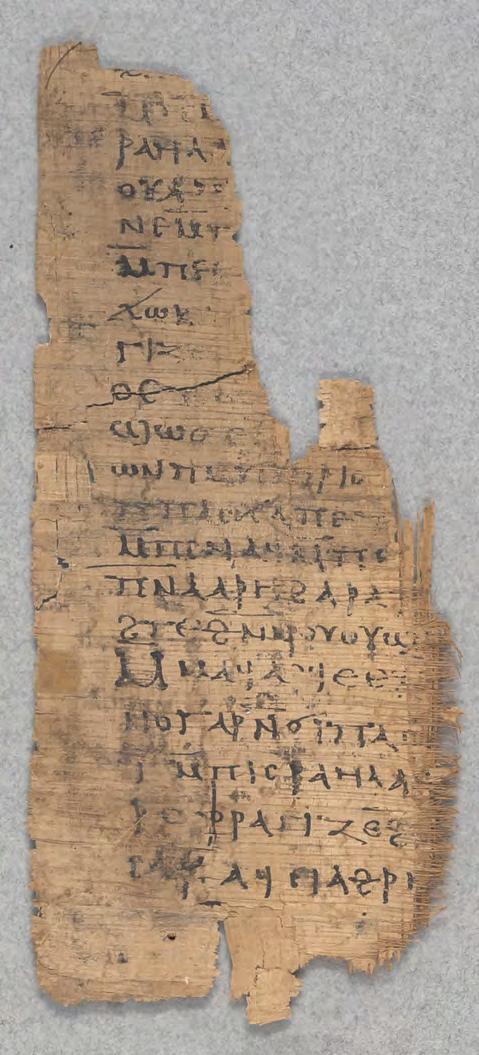
The text was probably pronounced during Easter, and revealed the meaning of Christ’s Paschal mystery. It has been argued by some that it provides evidence of an exceptionally rare point of direct contact between the rites of the Jews and early Christians, in that it seems to be based on the Jewish Haggadah of Pesach, and Melito himself appears to be trying to equate the two traditions. S.G. Hall published an English translation of it: his Melito of Sardis, On Pasha and Fragments (1979).
Published:
J.E. Goehring, ‘A New Coptic Fragment of Melito’s Homily on the Passion’, Le Museon 97 (1984), pp. 255-60 (in which the present manuscript is given the siglum ‘Br’ for Bruce).
W.P. Funk, ‘Die Zeugen der Koptischen Literaturdialekts 17’, Zeitschrift für ägyptische Sprache und Altertumskunde, 114 (1987), pp. 11733.
J.E. Goehring and W.H. Willis, ‘Melito of Sardis on the Passover’, in Goehring, ed., The Crosby-Schøyen Codex, 1990, p. 3.
D. Powell, Guide to Christian Apologetics, 2006, p. 157 (illustrated)
£15,000 - 20,000
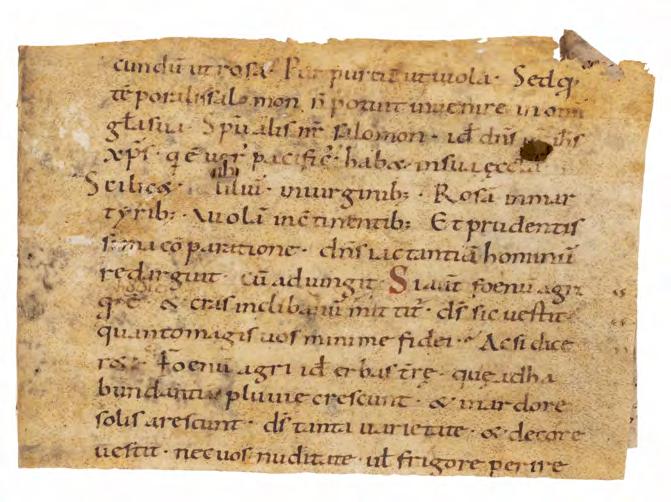
CUTTINGS FROM A CAROLINGIAN HOMILIARY ATTRIBUTED TO EITHER HAIMO OF HALBERSTADT OR HAIMO OF AUXERRE, in Latin, cuttings from a manuscript on vellum, probably Italy, tenth century, 10 bifoliate cuttings from leaves originally with text in single columns, with up to 15 lines remaining here, written in a late Carolingian hand with a pronounced et-ligature used integrally at the end of words, punctus elevatus punctuation marks used for lesser pauses and a high punctus for the final pause, 2-line capitals in red set off in margin, rubrics in simple red capitals, recovered from later reuse in a book binding and hence with stains, spots and areas of damage, a few wormholes, overall fair and presentable condition, the largest 155 x 400mm., the smallest 150 x 205mm.; in 10 individual modern cloth-backed board folders and together housed in modern calfbacked cloth drop-back box.
Text:
From a once fine late-Carolingian codex, almost certainly written within a century of the death of the author. The text here was one of the fundamental collections of preaching materials known to the Carolingian world. However, while the manuscripts agree that it was the work of a Haimo, this could be either Haimo of Halberstadt (d. 853), who was a monk at Fulda alongside Hrabanus Maurus, Hrabanus’ fellow student at Tours under Alcuin of York, and then the bishop of Halberstadt; or Haimo of Auxerre (fl. 840-75), who appears to have studied with the Irish grammarian Murethach and was for a time the abbot of the monastery of Sasceium (Cessy-les-Bois), and taught at the school of Saint-Germain Abbey in Auxerre and certainly was the author of many sermons and commentaries on the Song of Songs, Revelations, and the Minor Prophets (see E. Jeauneau, ‘Les écoles de Laon et d’Auxerre au IXe siècle’, in La scuola nell’Occidente latino dell’alto medio evo, 1972, II:495-522). By the time that the parent manuscript of these cuttings was written, it appears that their identities had been conflated by copyists and theologians. In 1907, E. Riggenbach demonstrated that the commentaries attributed in the Patrologia Latina to Haimo of Halberstadt were actually the work of Haimo of Auxerre (Die ältesten lateinischen Kommentare zum Hebräerbrief), and since then many of the homilies also there have been tentatively reattributed to him.
⁂ Provenance: Acquired by the current owner from Quaritch.
£8,000 - 12,000
21
LEAF FROM GREGORY THE GREAT, MORALIA IN JOB, IN PRE-CAROLINGIAN GERMANIC MINUSCULE, in Latin, manuscript on parchment, southern Germany (perhaps Reichenau), most probably last decades of the eighth century, single large leaf, with single column of 30 lines (with parts of book 33, ch. 15) in a large and bold pre-Carolingian Germanic minuscule (see below), tears and darkening to edges, small losses at head, and section of blank margin at foot missing through natural flaw in parchment, recto more darkened than verso, and slightly scuffed on inner vertical side of column, slight cockling, some small later scrawls (see below), but in good and fresh condition, 257 by 156mm.
⁂ A LEAF FROM A FUNDAMENTAL EARLY MEDIEVAL TEXT, IN A RARE AND OFTEN OVERLOOKED PRE-CAROLINGIAN SCRIPT, PERHAPS FROM THE FOUNDING LIBRARY ONE OF THE MOST IMPORTANT MONASTERIES IN MEDIEVAL EUROPE
Provenance:
1. Written in southern Germany, most probably in a region bordering Switzerland (probably vicinity of Lake Constance) in the last decades of the eighth century (see below). If, as seems quite likely, this was in Reichenau (founded 724 on an island in Lake Constance), then it must have been part of that monastery’s earliest book collection, significantly predating the grand expansion of the library there under Abbot Reginbert in the decades up to his death in 846, and used by the Carolingian scholarly luminary Walafrid Strabo (c. 80849, abbot of Reichenau from 842). Reichenau was closed during the Secularisation initially in 1757, then permanently in 1803, with only a small part of the library passing to the Landsbibliothek at Karlsruhe.
2. Reused at the close of the Middle Ages as a pastedown in the binding of a large book, and that book in French ownership in the seventeenth-century: scrawled French inscriptions of a ‘Catherine de …’ interlineally and in outer upright margin of recto, and a single inscription in same hand at foot of verso: ‘Constitué …’ (the remainder lost due to a missing section of parchment at foot).
3. Mr de Coligny, a twentieth-century Parisian collector.
4. Roger Martin (1939-2020) of Grimsby, acquired by him in 2016; and sold in his posthumous sale in Bloomsbury Auctions, 6 July 2021, lot 1. A sister-leaf (most probably once forming the other half of a bifolium with this leaf) emerging after that sale.
The script and its rarity:
When we think of pre-Carolingian local hands, we begin with the most distinctive, such as Insular, Luxeuil, Corbie, Rhaetian and Alemannic, as well as those that persisted well after Carolingian minuscule swept away all others, such as Visigothic and Beneventan. However, there are a few others, not quite so clearly defined from their neighbours or perhaps not so numerous in surviving examples, and as a result often forgotten or lumped in with those neighbours. The Germanic pre-Carolingian hands fit into this group. They are far from numerous, with only twenty-three examples in the vast survey Codices Latini Antiquiores (1934-66; about ten of these probably from Freising, see K. Bierbrauer, Die vorkarolingischen und karolingischen Handschriften der Bayerischen Staatsbibliothek, 1990, pp. 15-24, for these) and its Supplement (1971), and surviving examples come from a wide geographic range, reducing how conclusive any findings can be, and perhaps deterring the same levels of scholarly study seen with other early scripts.
The script here is a bold and fine pre-Carolingian Germanic minuscule most probably of the last decades of the eighth century, with strong Swiss influence suggesting an origin in Reichenau. The numerous ligatures here are overwhelmingly preCarolingian and point strongly to the eighth century, with that in the ‘rp’ in ‘serpens’ (recto, line 16) producing a strange letterform in which the arch of the pen downwards from the preceding ‘r’ almost leaves the back of the ‘p’ undefined and produces a wedge-like tongue under its bowl jutting out towards the next letter. There is also a ‘li’-ligature in which the second letter is mostly subscript and is joined to the first at its midpoint (this also reported for a binding fragment dated to 776-800 and located to south east Germany, now BSB, Clm. 29300/3, but rest of hand quite different: CLA Supplement 1799). These, as well as the clusters of compacted abbreviations (such as the first part of ‘tergiversationis’ in line 4 of the recto, the ‘serpens’ noted above, and ‘rerum’ in line 2 of the verso), point to the eighth century.
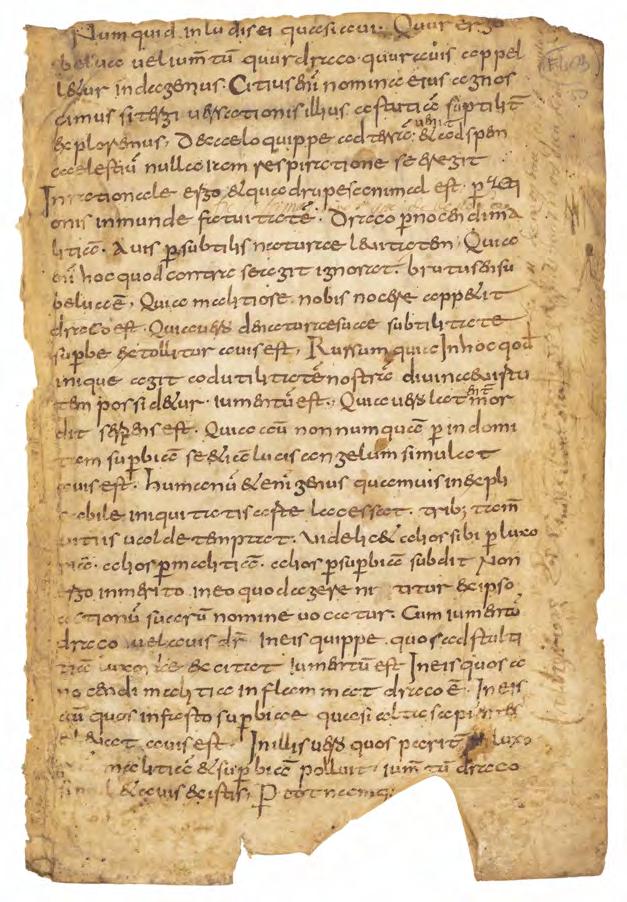
For Swiss influence, there are apparent Rhaetian minuscule features in the open ‘a’ both like ‘cc’ and ‘oc’ (but the hand here favours the first of these), the use of ‘r ’ with a slashed line through its tail for ‘-rum’, and particularly the ‘t’ with its left-hand crossbar curving down and around to close the loop with the main ascender (as here in line 22 of the verso: ‘Et’) and the open ‘g’ with a bowed top so it is shaped like a ‘3’ distinctive to Rhaetian and Alemannic minuscule and sometimes used as a key identifying feature of Swiss hands. However, the closed ‘t’ is not employed consistently, and half-curled (without closing the loop, and flat-topped examples can be found here. Examples of these are found in Alemannic minuscule, centred on St. Gallen, as in Cod. Sang. 6 (last quarter eighth century, Alemannic minuscule), Cod. Sang. 44 (Bible c. 780, Alemannic minuscule), and Cod. Sang. 125 (Jerome, Gregory, Cassiodorus and other authors, c. 770-780, in a small Alemannic minuscule in which again all three forms of ‘t’ are found together, as well as the ‘o’ formed like a ‘u’ with its two upwards strokes crossing, as here in ‘vero’ in line 28 of the recto: see pp. 7 and 22 of Cod. Sang. 125 for examples) and Cod. Sang. 567 (Vitae Patrum, second half of codex from last quarter of eighth century, in Alemannic-Rhaetian minuscule, and with same distinctive ‘o’: see p. 145 for example; all these manuscripts reproduced in full on the ecodices website). However, the hand here manages to avoid having the elongations and flows of Rhaetian as well as the heavy rotundity and wide spacing of Alemannic, and compares most closely to hands from Germany, and in particular those traced to or linked to Reichenau (see CLA. I:7, Vatican, Lat. 583, a Moralia in Iob, 11-16 of the late eighth century or opening years of ninth century [this reproduced in full online]; I:89, Vatican, Lat. 245, another Moralia in Iob, 1-5 of the late eighth century or opening years of ninth century, and in Lorsch by the eleventh century [this also Michelle Brown’s example, and reproduced in full online]; II:222, as well as those from the Lake Constance Germanic region and probably Murbach: II:222, a Cyprian of 776-800; and VI:751, an Isidore of the late eighth century or opening years of ninth century). It has the Reichenau-type mix of open ‘a’ and uncial ‘a’ (here see ‘maliciam’, lines 8-9 of recto), and common ligatures for ‘ri’, ‘ti’ as well as rarer features such as a ‘te’-ligature and a ‘nt’-ligature used even midword and that characteristic of the region. Moreover, the open ‘g’ here with its bowed top finds its near-exact match in both CLA. I:7 and I:89.
It is interesting that the earliest books surviving that are most probably from Reichenau are both copies of parts of the Moralia in Iob (CLA. I:7, I:89, books 1-5; and books 11-16), and they may well have been volumes of a single set of codices recorded in the early ninthcentury library catalogue of that house as “97-102. moralia in Iob lib. XXXV in codicibus VI” (G. Becker, Catalogi bibliothecarum antiqui, 1885, p. 6). If those codices are also eighth century, rather than of the very early ninth, then the present leaf may be the last surviving part of the otherwise lost sixth and final volume of this set
£18,000 - 25,000
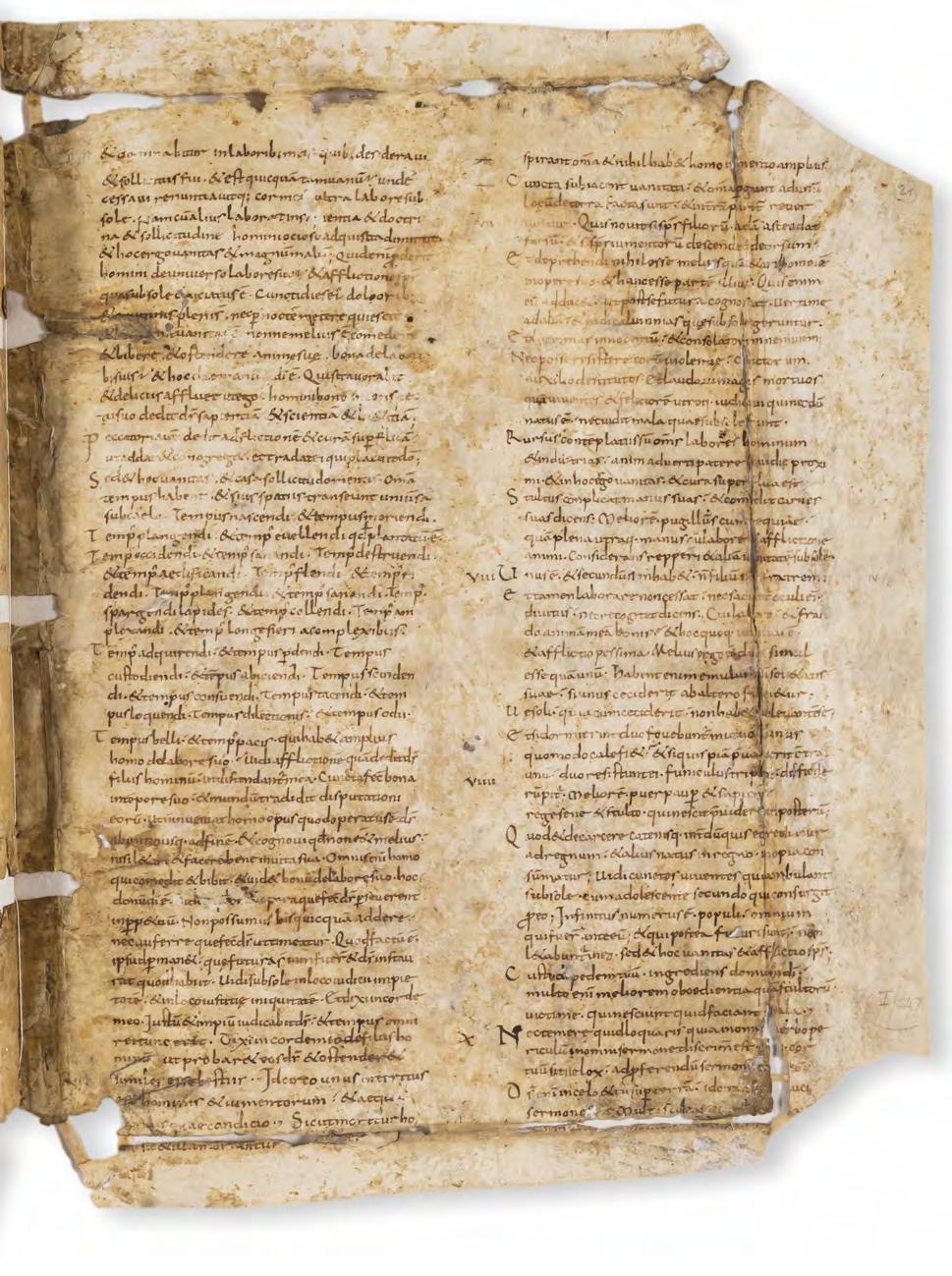
BIFOLIUM FROM A BIBLE, MOST PROBABLY A GRAND PANDECT, WITH PROVERBS 30:23-31:31 AND ECCLESIASTES 1:1-7:20, in Latin, in early Carolingian minuscule, in a close derivative of Tours script, manuscript on vellum, western France, second half of the ninth century, two conjoined leaves, each leaf with double column of 50 lines in Carolingian minuscule showing Tours influence, with a ‘t’ whose topline curves back towards the baseline when this character opens words, and a ‘g’ with a closed bowl and a lean towards the left, an ampersand used for ‘et’ integrally within words, the hand somewhat cramped and provincial in execution with inelegant letterforms in which the scribe falls back onto cursive forms, the letters of “Verba” following its initial apparently forgotten and squeezed into space between words, simple brown initials set off in margins, versal numbers in Roman numerals in margins, important words such as “Aleph” and opening lines of major text sections in ornamental capitals, elegant 3-line initial in red, recovered from a binding and so with holes, tears to edges, folds and stains, legible on inside of bifolium, somewhat scuffed on outer side (but mostly legible), overall fair and presentable condition, each leaf 402 by 320mm.; in cloth-covered card binding, with letter of Prof. Bernard Bischoff concerning this fragment as well as Bernard Rosenthal’s cataloguing
⁂ A BIFOLIUM FROM A GRAND CAROLINGIAN BIBLE, MOST PROBABLY COPYING A TOURS BIBLE IN A WEST FANKISH SCRIPTORIUM
Provenance:
1. Most probably written in a provincial West Frankish centre under the influence of Tours and the Carolingian script reforms there. The format of the leaves strongly suggests that our scribe was copying from a grand Tours Bible, but his frequent lapses into cursive letterforms (see the ‘e’ in “operient” on fol. 1r, col. 2, line 42), suggest that they were more accustomed to writing charters rather than Biblical texts such as this. The parent manuscript was apparently then discarded at the close of Middle Ages, and this bifolium reused on the binding of a copy of Serlio’s Architettura (inscription on outer side).
2. Lawrence Witten (1926-1995) of New Haven, CT, USA.
3. Bernard Rosenthal (1920-2017), San Francisco, CA, his I/247, purchased in August 1981.
4. Quaritch cat. 1147, Bookhands of the Middle Ages V, 1991, no. 6.
5. The Schøyen Collection of London and Oslo, their MS 619, acquired from Quaritch; and in their sale in Bloomsbury Auctions, 8 July 2020, lot 27, sold immediately after the sale to the present owner.
Text and script: A corrected version of the Bible, the central book of Christianity, sat at the centre of Charlemagne’s vision for a new European ‘empire’, and after coming to power in the 780s in Germany, France and Italy, he called for the protection of surviving manuscripts of the Bible and ordered that only trusted and mature scribes be allowed to copy them. Following this, he seems to have engaged a number of his court scholars to produce carefully corrected copies of the Bible. The copy produced by Alcuin (739804, from 796 abbot of St. Martin’s, Tours) had the advantage of being copied in an entirely new form of script: Carolingian minuscule, created for ease of reading. As Alcuin himself records in a letter to his eventual successor, Fridugisius, the final copy was delivered to Charlemagne on Christmas Day in 800, the same day as his imperial coronation in Rome (F.L. Ganshof, in Bibliothèque d’Humanisme et Renaissance, 9, 1947, pp. 7-20). These Bibles were then mass-copied in Tours (perhaps as many as several a year for at least half a century) and distributed as apparent imperial gifts across Europe. As shown by David Ganz, the classic Tours pandects were produced according to a rigid template, and were consistently written on approximately 450 leaves, with an overall leaf size of c. 480-375mm. with text in double columns with a solidly consistent 50-52 lines per column (‘Mass Production of Early Medieval Manuscripts, The Carolingian Bible from Tours’, in R. Gameson, ed., The Early Medieval Bible, Its Production, Decoration and Use, 1994, p. 61). Our bifolium is slightly smaller in format and was written by a provincial hand, but has the correct number of lines and a comparably grand layout to Tours Bibles. In 1990, Rosamund McKitterick deduced that the present fragment was an “interesting example of the continuing response to the need for a correct text of the Bible”, suggesting that its “relatively late date and the independent production may indicate … that the dominance of Tours of the market was by this time waning” (‘Carolingian Book Production’, p. 31).
Published: R. McKitterick, ‘Carolingian Book Production: Some Problems’, The Library, 6th series, XII (1990)
£15,000 - 20,000
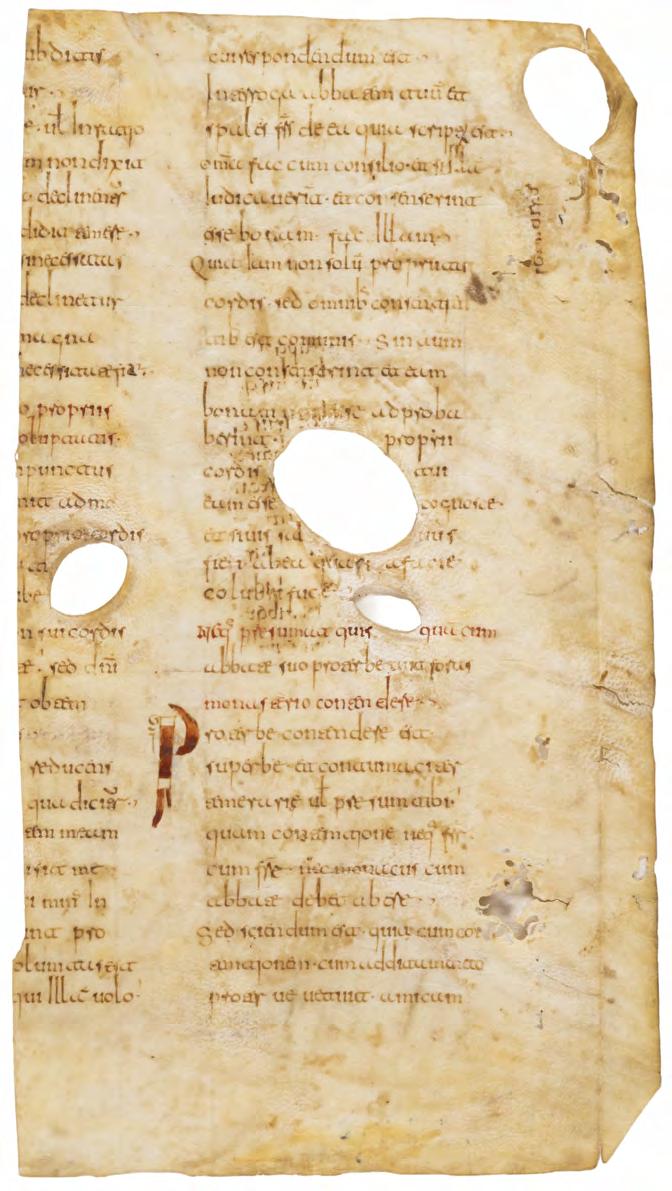
Smaragdus of St-Mihiel. COMMENTARY ON THE RULE OF ST. BENEDICT, in Visigothic minuscule, in Latin, decorated manuscript on vellum, northern Spain (perhaps Silos), first half of the tenth century, near-complete leaf, with remains of two columns of 29 lines (with parts of ch. III:6-10 of text, with occasional scribal errors and some eye skip omissions by the scribe), written in an outstanding early example of Visigothic minuscule, rubrics in alternate lines of burgundyred and normal brown pen, two large initials with penwork compartments infilled with burgundy, one initial terminating in a downward facing spiky foliate tip, some natural flaws in vellum (these written around by the original scribe), a few erasures, some small offset in places from another leaf from same parent manuscript, a scrawled column of numbers (apparently accounts of some form) on one side from reuse as later binding material, slightly scuffed, a few wormholes, and trimmed on one side (removing outer half of one column), 274 by 150mm.; in cloth-covered card binding
⁂ THIS IS A GRAND AND IMPRESSIVE EARLY FRAGMENT CONTAINING AN EXTREMELY EARLY AND IMPORTANT WITNESS TO A KEY CAROLINGIAN TEXT, IN ONE OF THE RAREST OBTAINABLE PRE-CAROLINGIAN SCRIPTS: VISIGOTHIC MINUSCULE
Provenance:
1. Written and decorated in the first half of the tenth century in Visigothic Spain, perhaps in the abbey of Silos, Burgos province in northeastern Castile and Léon. A bifolium from the prologue of the same parent codex is Beinecke Library, MS. 447 (once in the collection of Mark Lansburgh, and acquired by the Beinecke in 1964), and that has inscriptions suggesting that the original manuscript was cut up for reuse as binding material around 1612 (B. Shailor, Catalogue of Medieval and Renaissance Manuscripts, 1987, II, p. 398). That agrees with the scrawled numbers added to one side of the present leaf in an apparent seventeenth-century hand.
2. Bernard Rosenthal (1920-2017), of San Francisco, CA; his ‘I/162’ (this in his hand in pencil at the foot of the recto here), and acquired by him in October 1963. With Bernard Bischoff’s typed letter to Rosenthal about this fragment, dated 10 May 1964, and an undated note by Rosenthal (that erroneously claiming it is not from the same parent manuscript as the Lansburgh fragment, that now Beinecke, MS. 447).
3. Bernard Quaritch, their cat. 1088, Bookhands of the Middle Ages, III (1988), no. 12.
4. The Schøyen Collection of London and Oslo, their MS. 73, acquired from Quaritch; then sold in their sale in Bloomsbury Auctions, 7 December 2021, lot 6, to the present owner.
Text:
Smaragdus (fl. 809-26) was a Benedictine monk and scholar, and one of the handful of theological luminaries who helped shape the earliest phases of the Carolingian renaissance. He was once thought to be Irish, but this was questioned by Bernhard Bischoff (‘Muridac doctissimus plebis, ein irischer Grammatiker des IX. Jahrhunderts’, Celtica, 5, 1960, pp. 40-44), and other scholars noted Smaragdus’ use of Visigothic examples in his writing on patronyms (L. Holtz, ‘(Nouveaux) prolégomènes à l’édition du Liber in partibus Donati de Smaragde de SaintMihiel’, Bulletin de la Société nationale des antiquaires de France, 1983, pp. 157-170), as well as his knowledge of obscure Spanish texts such as the Sententiae of Taio of Saragossa (F. Rädle, Studien zu Smaragd, 1974, pp. 7577). It now seems certain that Smaragdus came from Visigothic Spain, and may have held office as the abbot of Silos. He served as the master of the school of Castillio, a monastery dedicated to St. Michael (‘Mihiel’) in the diocese of Verdun in southern France, and his presence there was perhaps due to the advance of Islamic control over Spain through the late eighth century.
This is one of the earliest witnesses to the oldest known commentary on the Rule of St. Benedict. Alongside Charlemagne’s push for literacy and the production of carefully corrected Biblical and liturgical books, the Benedictine Rule, and the correct understanding of it, was a key foundation stone for the re-establishment of a single and unifying European Christian culture. Benedict’s text was the starting point of all Western monasticism, and was adopted in 816 at a council called by Emperor Louis the Pious at Aachen, as the rule to be followed in all monasteries throughout the Empire. An eye-witness to this imperial council, Benedict of Aniane, records that the entire text of the rule was discussed there, with debate clarifying obscure or vague passages and removing errors from the text. As L. Traube has noted, it is clear that the scholars of the Carolingian court used a copy made at Charlemagne’s request from an old manuscript in use at Montecassino, believing that to be St. Benedict’s original (Textgeschichte der “Regula S. Benedicti”, 1898). Incidentally, this same lost court copy was seen by the scribe of St. Gallen, MS. 914, which has a letter at its beginning stating that the authorative court copy was its exemplar. Smaragdus must also have used that key witness to the text, and it is notable that when quoting the rule, he often favours the original sixth-century Latin forms over those updated in the ninth century. Thus, in Smaragdus’ text we see both the oldest known commentary on the Benedictine Rule, as well as brief snippets of an ancient copy selected under Charlemagne’s guidance as the model for all others that would follow. This leaf and its sister-leaf in Yale are among the very earliest witnesses to the text. A. Spannagel lists fifty-five extant manuscripts, of which only five certainly predate the present example (British Library, Addit. 16961, from Stavelot, late ninth century; Orléans, Bibliothèque municipale 230 (201), from France, mid ninth century; BnF. lat. 4213, from France, late ninth century; Valenciennes, Bibliotheque municipale 285 (275), from France, late ninth century; John Rylands, MS. lat. 104 (116), from Spain, probably Cardeña, late ninth century; and Silos, Archivo del Monasterio 1 and 5-16, from Spain and probably from the monastery itself, late ninth century + Madrid, Archivio Historico National, Clero. Capeta 1030, num. 24, most probably from the same parent codex) as well as two examples of c. 900 (Paris, BnF. lat. 4212, from France; and Vienna, ÖNB, Ser. nov. 4267; for these see Smaragdi Abbatis Expositio in Regulam S. Benedicti, 1974, pp. xv-xx). Spannagel notes only eight from any part of the tenth century, and thus contemporary with this leaf (Berlin, Staatsbibl., theol. lat. fol. 339, from Cologne; Cambridge University Library, Ee.2.4, from England; Poland, Kórnik, Biblioteca Kórnicka, from France; BnF. lat. 4210, France; British Library, Addit. 16961, from Cardeña; Madrid, Biblioteca de la Real Academia, 26, from Spain; Montserrat, Biblioteca del Monestir 793-I, from Spain; and Valvanera, Archivo del Monasterio, s.n., from Spain, dated 954), all perhaps part of a boom of interest in the text in Spain in that century.
Script:
Visigothic script had its origins in the late Roman system of scripts, but unlike so many others managed to survive the Carolingian script reforms, and thrive in Spain long enough to form hybrid forms in the twelfth and thirteenth centuries. That here is a particularly appealing example, with the characteristic tall and thin aspect to its characters and profusion of pre-Carolingian letterforms and ligatures, with the distinctive use of the letter ‘g’ in q-form, the tall ‘i’, the ‘ti’ ligature and the conjunction ‘quum’ (for cum).
It is rare on the market, and apart from the present leaf, the last to appear are a large leaf from an Acta Sanctorum, written about c. 1080, sold in Bloomsbury Auctions, 6 July 2016, lot 4; a leaf from the Pasionario hispánico in a transitional Visigothic minuscule of the eleventh century, sold in Bloomsbury Auctions, 6 December 2017, lot 12; and three small strips from a eleventh-century liturgical volume with Vetus Latina readings, sold in the Schøyen sale at Sotheby’s, 10 July 2012, lot 22. To these, we might add a mid-twelfth-century charter in Visigothic script from the collection of the late Marvin Colker, sold by Christie’s, 12 December 2022, lot 39, and perhaps also another charter, of the eleventh century, in transitional Visigothic minuscule, offered by the same house on 20 November 2013, lot 15. None of those had any decoration, and all were significantly later than the present leaf
£20,000 - 30,000
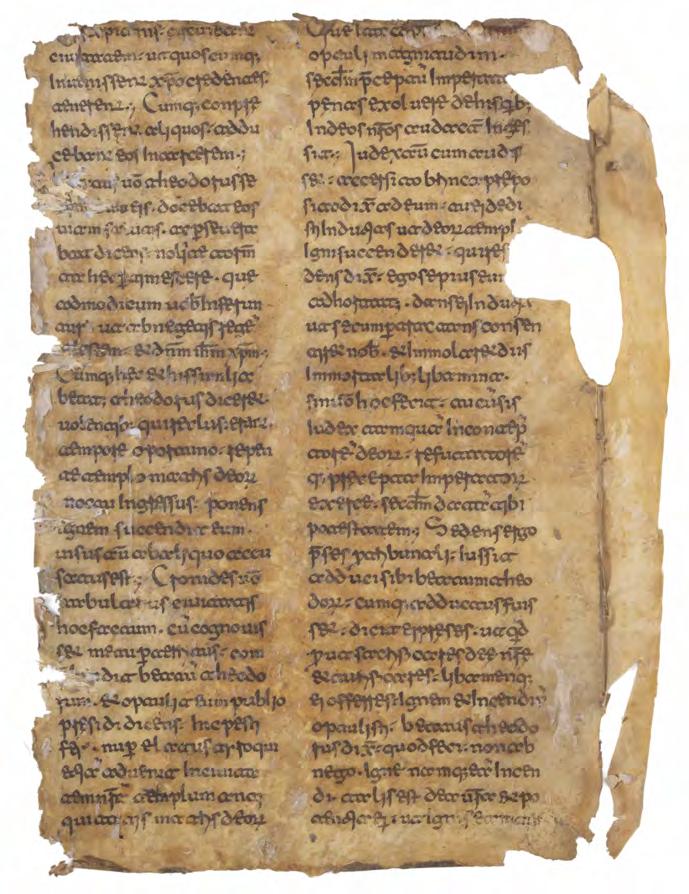
LEAF FROM A VERY LARGE COPY OF THE ACTA SANCTORUM, WITH PARTS OF THE PASSION OF ST. THEODORE THE MARTYR, IN BENEVENTAN MINUSCULE, manuscript in Latin on vellum, Italy (probably Monte Cassino), eleventh century, single large leaf, with remains of double column of 33 lines in a good and regular Beneventan hand with notably large letters (cf. the eleventh-century Homiliae Capitulares leaf in Quaritch, Bookhands of the Middle Ages IV: Beneventan Script, 1990, no. 3, and perhaps also no. 8, for similar monumentally large examples of Beneventan script), ‘et ’-ligature used integrally within words and ‘ri’-ligature present, recovered from reuse as a pastedown in a later binding and so with holes, tears and damage to edges, slightly cockled and discoloured, scuffed on reverse reducing legibility there, trimmed at edges but without losses of lines of text, overall fair and presentable condition, 430 by 315mm.
Provenance:
⁂
The appearance of the present leaf in Bloomsbury Auctions, 2 July 2019, as lot 1 there, brought another leaf from the same parent manuscript to light (that sold Bloomsbury Auctions, 3 December 2019, lot 5). Both had been used together as coverings for a pasteboard bookbinding sometime after the early sixteenth century, and the second leaf to emerge was still on its pasteboard in 2019, with a paper pastedown there with a watermark of an anchor in a circle flattened on its lower left hand side and surmounted by a six-pointed star, recorded in the Bloomsbury catalogue as “almost certainly Briquet, no. 478 (recorded Bergamo in 1502, Gurk, Austria in c. 1500 and Graz, Austria, 1502)”. That catalogue surmised, probably quite rightly, that “the parent manuscript had left Montecassino and travelled to Bergamo on the northernmost border of Italy or one of its neighbour-towns on the other side of the Alps, either Gurk or Gratz, by 1500/1502 when it was reused on a binding”. This leaf acquired by the present owner in the Bloomsbury auction of July 2019.
The script:
The script here is a notably large and handsome example of early Beneventan minuscule. Beneventan script stands quite apart from almost all modern Western scripts, and in its strangeness both confounds and delights the eye of the modern reader. While the Carolingian script reforms swept away the handful of remaining local bookhands at the end of the Dark Ages and replaced them with Carolingian minuscule, the local script of Monte Cassino stood firm, and in fact spread to dependent areas in southern Italy and adjacent Dalmatia. In time the simple and elegant Carolingian minuscule passed to humanist script and to printing, while Beneventan minuscule carried on alone of the Dark Age scripts to the sixteenth century. To look at its strange curling letterforms, broken lines and reliance on early medieval abbreviations is to stare across a gulf at a paleographical fossil, on another evolutionary branch of development from our own
£4,000 - 6,000
CHARTER RECORDING THE GIFT OF WILLIAM II ‘LE BRETON’ D’AUBIGNY, LORD OF BELVOIR OF ALL THE LAND THAT PAYN THE BUTLER (‘PINCERNA’) HAD HELD OF HIM IN KIRKBY UNDERWOOD, LINCOLNSHIRE, AND CONFIRMATION OF THE GIFT OF THE THICKET (‘BRUSERA’) OF ‘FRETHEGESTAHAE’ ALREADY MADE BY WILLIAM DE REIMES, TO THE GILBERTINE NUNS OF SEMPRINGHAM PRIORY, INCLUDING THE APPARENT WITNESS OF THE FOUNDER OF THEIR ORDER, GILBERT OF SEMPRINGHAM, in Latin, single-sheet manuscript on vellum, with a large pendant wax seal showing the Virgin and Child enthroned, England (Lincolnshire, probably Sempringham), 1153×1160, large single-sheet document, written in 13 long lines of a fine English Romanesque bookhand, contemporary endorsements on reverse, wax oval seal depicting the Virgin and Child, with damaged and mostly illegible inscription (some slight restoration to reverse of seal, during which it was moved to present position on left-hand side of foot of document, with original seal slit present in centre of foot), some slight cockling, stains and folds from use, overall in excellent and fresh condition, 170 by 189mm., in fitted green carrying case
⁂ Provenance:
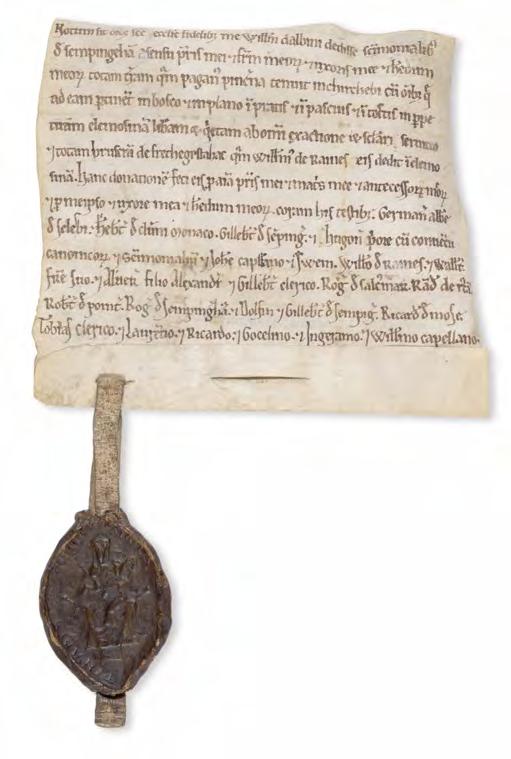
1. Almost certainly from the archive of Sempringham Priory, founded in 1131 by Gilbert of Sempringham when he became the priest of Sempringham, and discovered seven holy women there, who wished to live a religious life. He used his family’s wealth to construct buildings and a cloister for them against the north wall of the church, and he composed a rule for them focussing on chastity, humility, obedience and charity. The community prospered and Gilbert approached the Cistercians for aid, but was refused as his community included women. Following this, he appointed male canons (who followed an adapted form of the Augustinian Rule) to serve the female prioresses. The Order was the only one founded by an Englishman. Gilbert died on 4 February 1189, was entombed in the priory church, and canonised in 1202. Despite the influence of the master of the order with Cromwell, which allowed the Order to escape suppression in 1536, Sempringham and all its daughter houses were surrendered two years later, and their goods, archive and library scattered (the online version of Ker’s Medieval Libraries of Great Britain, records only six manuscripts from the community, all in the British Library, apart from single volumes in Lincoln College, Oxford, and the Vatican). The cartulary of the house was destroyed by a fire at Staples Inn, London, in the eighteenth century (G.R.C. Davis, Medieval Cartularies of Great Britain, 1958, p. 100), and now only a handful of scattered charters from the archive remain, mostly in the British Library.
2. Forum Auctions, 6 December 2017, lot 21, sold to the present owner.
Text:
This document can be dated by the inclusion of German, abbot of Selby, who held office between 1153 and 1160, among the witnesses. That date is confirmed by British Library, Add. Ch. 20731 and 21137 which is dated 1150 and records the original grant by William de Reimes of the thicket of ‘Fredegestehae’ to Sempringham as made with the consent of his lord, William I d’Aubigny.
What is most sensational here is the appearance of Gilbert of Sempringham, the founder of the Order and future saint, among the chief witnesses. He would probably have been in his 70s when this document was written, but would live to be over a hundred and retired from his role as master of the Order only in his last years due to blindness. Few other early charters for Sempringham survive and to the best of our knowledge this is the only surviving document which bears his witness (the vast majority edited by E.M. Poynton, ‘Charters Relating to the Priory of Sempringham’, in The Genealogist, new series 15, 1899, pp. 158-61, 221-27; new series 16, 1900, pp. 30-35, 76-83, 153-58, 223-228; new series 17, 1901, pp. 29-35, 164-68, 232-39, principally from the charters in the British Library).
The seal:
The seal here, while damaged and with a rubbed and almost illegible inscription, may well be of some significant importance. It is just possible, as it has been conserved and remounted through a new site at the foot of the document, that it was not always with this charter, but that is highly unlikely. Its oval shape identifies it as a vesica seal, the form used in medieval England by high-ranking English clergy and monasteries, and it prominently shows the Virgin, the main dedicatee of the church and priory of Sempringham. In addition, the seal of the daughter Gilbertine priory of Bullington has the same iconography of “the Virgin seated, wearing a flat cap and dress with long sleeves, and holding the Child on her lap with her left hand, and in her right hand she has a flower” (Victoria County History, History of the County of Lincoln, II, citing Birch, Catalogue of Seals, I, 1887, p. 468).
Yet, the seal attached here, does not agree with those recorded for the master of the Gilbertine Order or the abbot of Selby Abbey (see the Victoria County History, History of the County of Lincoln, II for the former; the latter had a standing portrait of St. Germanus). The seal of the prior of Sempringham is not recorded, and so this here may well be that of Prior Hugh of Sempringham, who appears among the witnesses. However, there is one other possibility, as the recorded example of the seal of the master of the Gilbertine Order shows Gilbert as a saint with a halo, standing and holding a book, and so must date to after his canonisation in 1202. According to the rule established by Gilbert himself, the consent of the master was necessary for all sales and purchases of lands, woods, and everything above the value of three marks, and this had to be shown by his seal affixed to all charters. Thus, it is possible that the seal here is that of Gilbert himself, acting as master of the Order, in the form used during his lifetime. If so, then this is the only recorded example of this seal to survive
£7,000 - 9,000
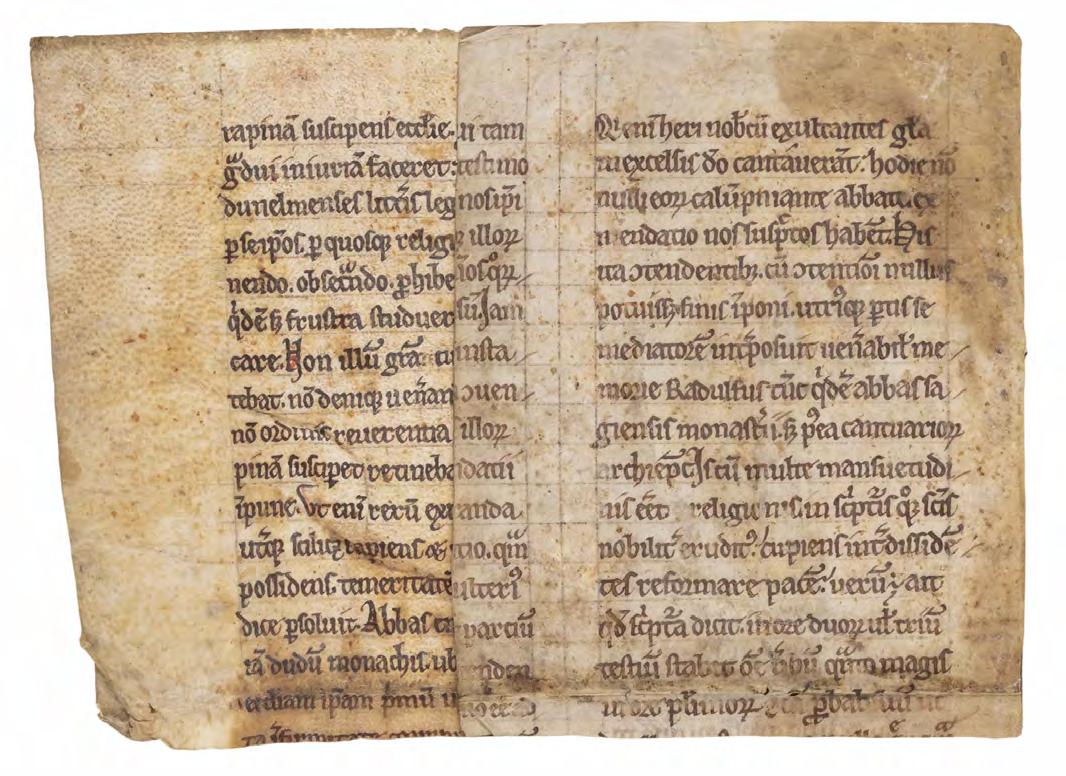
CAPITULA DE MIRACULIS ET TRANSLATIONIBUS SANCTI CUTHBERTI (‘ACCOUNT OF THE MIRACLES AT THE TOMB OF ST. CUTHBERT’), in Latin, fragment from a manuscript on vellum, northern England (probably Durham), late twelfth century. A large rectangular fragment cut from the upper part of a bifolium, showing three of four original columns, these with 17 remaining lines in a good English early gothic bookhand, rubric and initial ‘D’ in red, recovered from reuse in a later binding and hence cockled and stained in places with some text illegible, overall fair and presentable condition, 255mm. by 115mm.; in modern cloth-covered card binding
⁂ Provenance:
This fragment is the principal surviving witness to a long-lost manuscript of the posthumous miracles recorded at the tomb of St. Cuthbert in Durham. It came to light first when it was sold by Ampleforth Abbey at Sotheby’s, 7 December 2010, lot 13, alongside a tiny scrap from the same parent book of only a line or so (realising £11,250 together). Both fragments were subsequently Quaritch, catalogue 1422, Continental Books and Manuscripts: Medieval Manuscript Leaves (2013), no. 66, offered for £15,000. The tiny sister-fragment is now in a private collection.
Text:
The text was composed between 1083 and 1124, at the same time as the celebrated northern English historian, Symeon of Durham, was writing his history of the see, and in some form it was used by him as one of his sources. It survives in a handful of manuscripts, usually appended to Bede’s prose Vita sancti Cuthberti, and it seems very likely that its dissemination alongside other texts was intended to promote the blossoming cult of Cuthbert. It seems to have been created from a set of seven miracle stories, the majority of which were embellished versions of events recorded in the Historia de Sancto Cuthberto, that appear to have been written in the period c.10831104 (see B. Colgrave, ‘The Post-Bedan Miracles and Translations of St Cuthbert’, in The Early Cultures of North-West Europe, Cambridge, 1950). To these, hagiographers at Durham added other miracle stories from oral testimony, apparently in the period c. 1100-1115, and a lengthy account of the translatio of the saint in 1104, to form the compilation witnessed in this fragment.
This fragment contains part of the thirteenth account, recording the abstraction in 1095 of the church of Tynemouth from Durham by Earl Robert Mowbray of Northumberland “animo vehemens et armis strenuus”, and ending with his punishment by the saint and his life-long imprisonment (edited Symeonis Dunelmensis Opera, Surtees Soc. 51, 1868, p.180; Symeonis monachi opera, Rolls Series, 1882, II, p. 345)
£6,000 - 8,000
LEAF FROM A SERMON COLLECTION, WITH PARTS OF A TRACTATE AND A SERMON BY ST. AUGUSTINE AND AN ANONYMOUS SERMON PROBABLY COMPOSED BY A FIFTH-CENTURY AFRICAN BISHOP, IN BENEVENTAN MINUSCULE AND WITH TWO FINE PENWORK INITIALS, manuscript in Latin on vellum, Italy (almost certainly Abruzzo, or just perhaps in Montecassino by an Abruzzi scribe), late twelfth century, most of a large leaf, trimmed at top and bottom with losses of a few lines of text there, double columns of 35 lines remaining in a short and left-leaning Beneventan minuscule (the swing of the descenders of the letters ‘p’, ‘q’ and ‘s’ to the left strongly suggesting the Abruzzi origin), capitals touched in red and earthy-yellow wash, opening words of each section in ornamental capitals touched in red, bright red rubrics, two large penwork initials formed of parallel bands and ornate interlace with geometric knots at their terminals, corners and midpoints, as well as some simple acanthus leaf-shoots at their extremities, recovered from reuse in a later bookbinding and hence with folds, small stains, thumbed areas and darkened edges, overall good condition, 314 by 306mm.; in cloth-covered card binding
⁂
Provenance:
1. From a once handsome sermon collection, written in the late twelfth century in either the Abruzzo (which as F. Newton has shown had a regular flow and exchange of monastic personnel and books with the Beneventan mother house of Montecassino: The Scriptorium and Library at Monte Cassino Under the Abbots Desiderius and Oderisius I, 1999, pp. 240-241 and 246-247), or in Montecassino by a scribe trained in the Abruzzo. From the eleventh century onwards, a large number of the abbots of Montecassino came from the Abruzzo, and numerous members of the community came from the nobility of that region. A sister leaf to this one was sold by Bernard Rosenthal to the University of Kansas in Lawrence, and is their Spencer Research Library J6:3:A2.
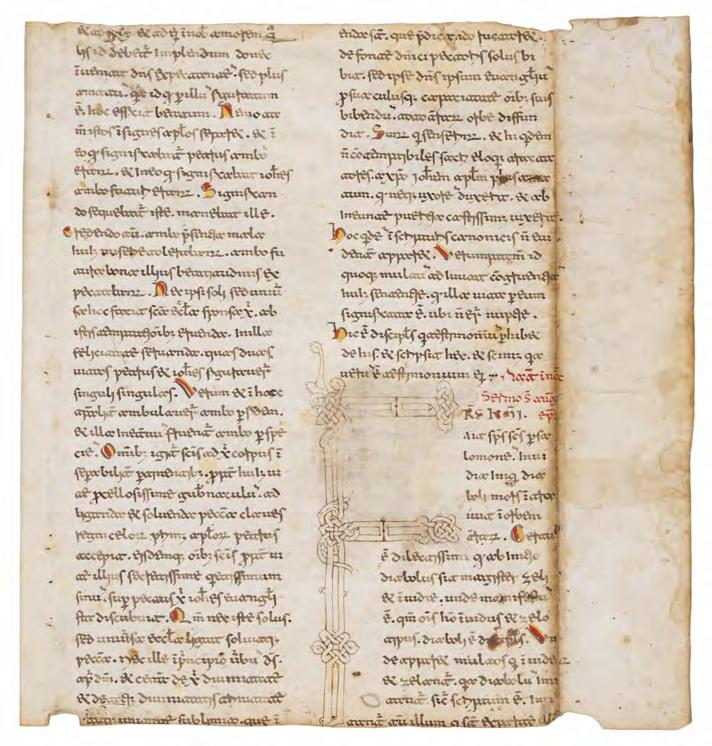
2. Bernard Rosenthal (1920-2017), of San Francisco, CA, this his ‘I/237’, acquired by him in May 1975.
3. Bernard Quaritch, their cat. 1128, Bookhands of the Middle Ages IV: Beneventan Script (1990), no. 18.
4. The Schøyen Collection of London and Oslo, their MS. 53, acquired from Quaritch; sold by them in their sale in Bloomsbury Auctions, 7 December 2021, lot 8, to the present owner.
Text:
The text here is composed of three sermons by, or usually associated with, St. Augustine of Hippo. The first is his Tractatus in Iohannem 124:7-8, followed by a sermon opening “Fratres Karissimi, ait spiritus sanctus per salamonem ...”. The last, a sermon in honour of the Holy Innocents, opening “David propheta sanctissimus loquitur ...”, is ascribed here to John Chrysostom, but is usually erroneously included among Augustine’s works. It is thought by modern scholarship to be Roman North African in origin, and the work of a Donatist bishop of that region from the opening years of the fifth century, who cited Vetus Latina readings for Matthew 2:19-23 (see E. Dekkers, Clavis Patrum Latinorum, 1961, p. 204, no. 920, also cited as pseudo-Chrysostom there; and R. Gryson, Vetus Latina: die Reste der altlateinischen Bibel, I, 2007, p. 145, citing B. Löfstedt, Sedulius Scottus: Kommentar zum Evangelium nach Matthäum, 1989; however, the sole Biblical quotation here is from Psalm 8:3, and that consistent with the Vulgate).
Decoration:
The initials here are of a rare type for twelfth-century Italy, evidently inspired by the complex strapwork initials of Tours Bibles, with more exaggerated geometric interlace forms. Similar examples for Beneventan manuscripts can be found in a copy of the works of Virgil in Beneventan minuscule, produced in Naples in the eleventh century (now BnF, Latin 10308: F. Avril and Y. Zaluska, Manuscrits enluminés d’origine Italienne, 1980, no. 30; note in particular the bulging domed buds with a dot at their centre in pl. VI), but they can also be found in isolated examples further afield in Italy. A notably similar initial with geometric knots at the head of its ascender appears in a copy of the works of Horace, made in Central Italy in the second quarter of the twelfth century (ibid., no. 44: now BnF., Latin 10401).
Published:
V. Brown, ‘A Second New List of Beneventan Manuscripts (I)’, Mediaeval Studies, 40 (1978), p. 272.
F. Mottolo, ‘I frammenti in beneventana e Carolina nell’archivio di Corfinio’, in Scrittura e produzione documentaria el Mezzogiorno,1991, p. 115.
BMB. Bibliografia dei manuscritti in scrittura beneventana,1993-1995, 2000, 2013, no. SPS 53
£12,000 - 18,000
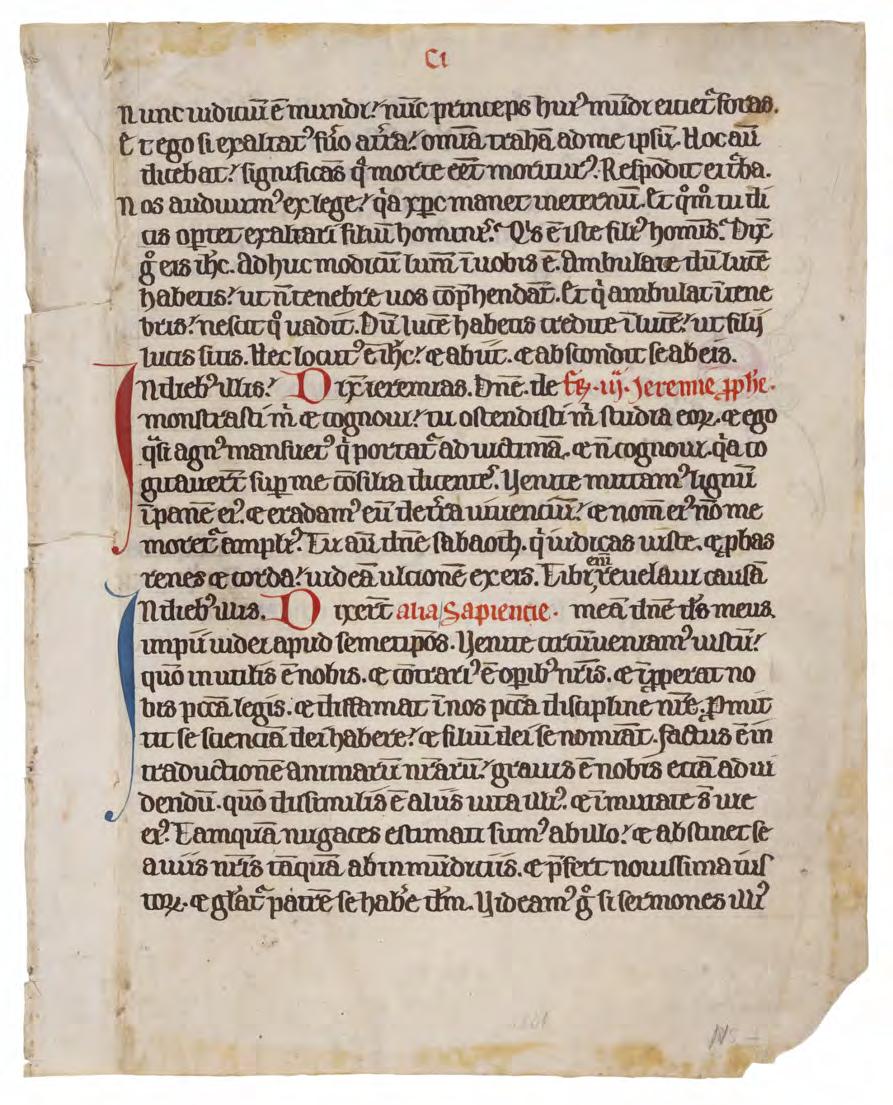
LEAF FROM A LECTIONARY, IN LATIN, IN STRANGE AND ARCHAISING SCRIPT, decorated manuscript on vellum, Germany, early thirteenth century, single leaf, with single column of 26 lines in an awkward and often confusing bookhand (see below), red rubrics and one-line initials, three large initials in red or blue, the third with scrolling dark blue penwork, contemporary folio no. ‘CI’, recovered from reuse in a binding and hence with spots, stains and small holes (none affecting text), overall good condition, 284 by 226mm.
⁂ Provenance: From the collection of Roger Martin (1939-2020); his posthumous sale in Bloomsbury Auctions, 6 July 2021, lot 28, and acquired there by the present owner.
The Script: On initial inspection this leaf is baffling, but it must be an attempt by a thirteenth-century scribe, perhaps a student-scribe, to laboriously copy outdated letterforms he found in a Romanesque exemplar (perhaps eleventh-or twelfth-century). The aspect is square and heavy, as one might expect from German script, but the initials are characteristically thirteenth century, as are the use of tiny decorative penstrokes inside some capitals. However, the use of tongued ‘e’ in capitals and at the end of words, among other forms, fits better in a Romanesque setting. The ductus throughout has a ponderous quality, and lacks the rapidity one expects with normal script (as in the awkward forms of some letters, especially ‘r’), and has errors (such as the fishtailing added in error to the first ‘i’ in “munditiis” in the last but one line of the recto, among others – this would have been correct if this was an ascender of a consonant, but not an ‘i’) that consolidate the impression that the scribe was working slowly, carefully copying letterforms that were strange to him. This lack of familiarity with older letterforms probably rules out an elderly scribe who had trained at the end of the twelfth century, and our scribe was more likely a youth in training, given an older exemplar to copy
£2,000 - 3,000
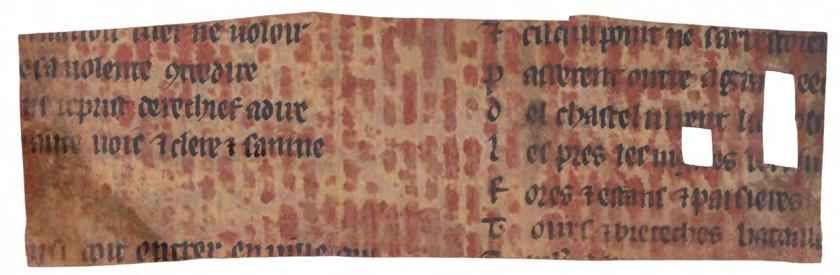
EARLY AND IMPORTANT FRAGMENT OF GIRART D’AMIENS, MELIACIN OU LE CHEVAL DE FUST, IN OLD FRENCH VERSE, manuscript on vellum, later reused as a frisket in an Early Modern print-shop, France, last decades of the thirteenth century (probably 1280s), rectangular cutting, with remains of double columns of 7 lines of good vernacular French hand (these allowing us to calculate the original manuscript had 30 lines in each column), space left in one column for music that was never added, the cutting from a leaf reused as a printing frisket after the close of the Middle Ages and hence stained with red ink and with small rectangular holes cut into it from that reuse (see below), then reused as a binding fragment, the original ink slightly obscured by later red ink in places, else in good condition, 42 by 138 mm.
⁂ AN APPARENTLY UNASSUMING FRAGMENT, DISCARDED AND CUT UP AT THE END OF THE MIDDLE AGES FOR USE IN A PRINTSHOP AND THEN A BOOKBINDERY, BUT FROM A PARENT MANUSCRIPT PRODUCED AS ONE OF THE FIRST COPIES OF THE TEXT, WITHIN THE AUTHOR’S LIFETIME AND MOST PROBABLY FOR A PATRON WITHIN THE FRENCH ROYAL CIRCLE
Provenance:
1. From an important long-lost manuscript of the text, and as noted by T. Bolton the dimensions of the lines here, the layout of the original page and peculiarities such as the space left empty for music allows us to identify the parent manuscript as part of a close-knit and small group of manuscripts of the text defined by Richard and Mary Rouse as nearly identical in respect of their text, iconography, size, and layout, indicating that they all were copied from the same exemplar or workshop maquette, most probably at the same time (the other manuscripts being Paris, BnF. MS. fr. 1633, BnF. fr. 1589 and Florence, Riccardiana 2757, the last of which is very slightly smaller; Manuscripts and Their Makers, 2000, I, ch. 4). The same team of scribes and artists would appear to have produced these multiple copies together at the same time, and it is thus of interest that the only manuscript in this group with its original frontispiece miniature: BnF. MS. fr. 1633, shows seven members of the royal family of France (Blanche de France in centre, as she embraces her nephew, the young king Philip the Fair, with Philip’s step-mother, Marie de Brabant, and his wife, Jeanne de Navarre, to the left, and to the right, Jeanne de Châtillon, Beatrix de Bourbon and Blanche d’Artois, herself the mother of Jeanne de Navarre), flanked by two high royal servants (Raoul de Clermont, seigneur of Nesle, and Gaucher de Châtillon), all identifiable from their arms. The Rouses followed the author’s allusions to an anonymous knight and concluded that the original commissioner of the text and probable owner of at least one of the surviving codices was Gaucher de Châtillon. However, Aurélie Houdebert has argued from a study of the origins of the text that the poem was produced alongside Adenet le Roi’s Cleomadès as part of a literary contest initiated by Queen Marie de Brabant, in the years 1280-85, and suggests she may instead have been the commissioner of the codices (Aurélie Houdebert and Dáibhí Ó Cróinín, ‘A New Manuscript Fragment of the Old French Romance Meliacin’, in Felici curiositate. Studies in Latin Literature and Textual Criticism from Antiquity to the Twentieth Century. In Honour of Rita Beyers, 2017, pp. 595-609). Whomsoever we identify as the patron, the codices and the fragment sit firmly in the French royal court, and were presumably produced as multiples in order that they could be presented by a member of that court to others. Another small fragment from the same parent manuscript, still in situ in the binding of a copy of Job, traduit en François avec une explication … (third edition, Paris: Guillaume Desprez, 1699), is now in a private collection (see Houdebert and Ó Cróinín, op. cit.).
2. Erik von Scherling (1907-56) of Leiden, manuscript and occasional antiquities and modern autograph dealer; after his death, the bulk of his stock was split between the book dealers Laurence C. Witten II (1926-95) of New Haven and then Southport, CT, and the London book dealership Maggs Bros., with this fragment passing to the latter.
3. Sold by Maggs Bros. in 2009 to a private collector; and acquired by the current owner from them in 2021.
Text:
The Meliacin ou le Cheval du Fust by Girart d’Amiens (fl. end of the thirteenth century and at the opening of the fourteenth) is a lengthy work, with 19,159 lines of octosyllabic couplets interspersed with songs, rondeaux and motets. Its plot is something of a wild ride, and is the entry point into Western literature of the flying horse tale, adapted from an episode in the Arabian Nights. It narrates the story of the wizard Clamazart who shows a flying horse fashioned from wood to the Nubian king of ‘Greater Armenia’, who then offers anything in return for this prize. Clamazart claims the king’s daughter Gloriande, and abducts her. She is rescued by her brother, Meliacin, but in revenge Clamazart then sends Meliacin on a flight on the horse, without knowledge of how to control it. Meliacin succeeds in mastering it, and finds his love Celinde in a faraway country, before she is imprisoned in a harem by Clamazart. Meliacin and Celinde then go through various trials before escaping on the horse. The fragment here contains parts of lines 4420-4425 and 4438-4444, and 4472-4477 and 4502-4507 of Saly’s edition (Meliacin ou le Cheval de Fust, 1990).
The Reuse as a Printer’s Frisket:
The heavy red-ink staining here was caused by the reuse of the manuscript leaf this fragment was cut from as a frisket-sheet in the early printing of red rubrics (and the shapes of letters struck by the print-face partially visible in this red ink residue when rotated 90 degrees to the left to print an unidentified liturgical text in Latin, most probably in the sixteenth century. The subject has been studied by Elizabeth Savage (see below), see also lot 36 in this sale.
Publications:
Elizabeth Savage (Upper), ‘Red Frisket Sheets, c. 1490–1700. The Earliest Artefacts of Colour Printing in the West’, Papers of the
Bibliographical Society of America, 108 (2014), pp. 477–522, with the present fragment as no. 22, 522.
T. Bolton, ‘Another Fragment of the Old French Romance Meliacin, and Some Observations on Its Place Among the Other Earliest Witnesses to the Text’, Florilegium, 35 (2018), pp. 92-104
£5,000 - 7,000
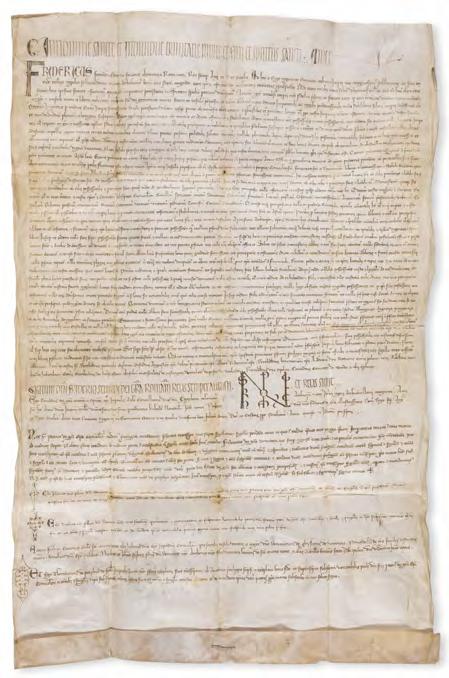
30
VIDIMUS OF AN IMPERIAL PRIVILEGE OF 1220 GRANTED BY EMPEROR FREDERICK II OF HOHENSTAUFEN, IN FAVOUR OF THE ABBEY OF SANTA MARIA OF POMPOSA, in Latin, illuminated manuscript on vellum, Italy (Ferrara, probably Pomposa), dated 11 May 1306, vast single sheet document, 58 long lines in total, main document in a bold and professional hand apparently imitating that of the original Imperial diploma, opening lines of key sections in enlarged script, one large initial ‘F’ (for “Fredericus”), opening text with the other characters of that name in ornamental capitals, large penwork Imperial monogram included among the witness-list entries, five endorsements at foot, reverse with various endorsements, brown cord at foot from seal attachment (seal wanting), the document with folds, small stains and spots, some cockling to edges, else in excellent condition, 730 by 470 mm.
Provenance:
⁂
1. Copied from the long-lost original Imperial diploma once in the archives of Pomposa, with this copy made for, or with the assent of, Peter, bishop of Comacchio, who leaves us a long additional endorsement (apparently in his own hand) at the foot, in which he states that he has seen ‘the authentic privilege from which this transcription has been taken, complete with its pendant wax seal’ and describing that seal as with ‘the impression of an image of the emperor holding a sceptre in one hand and a round apple in the other, and around the seal are the following words: Frederick, king of the Romans and king of Sicily’. Pomposa was founded on the island created by the confluence of the Adriatic Sea and two branches of the Po River sometime in the ninth century, and the first mention of it dates to 874. It proved to be a popular pilgrimage stop on the path to Rome, and through that the community saw its measure of success, reaching its heights in the early eleventh century. However, floods in the twelfth century diverted the course of the Po and changed the landscape around the house to marshland. Guido of Arezzo, one of the principal figures in the history of musical notation in the West, was among its residents, and the abbey church contains frescoes by Giotto. Again the vicissitudes of the Po decided the fate of the house, and after numerous floods it was abandoned in the seventeenth century.
2. Rediscovered in France in 2013 and granted permanent export from that country.
Text:
This is a complex and multi-layered document. At its heart sits an Imperial grant by Emperor Henry VI, made on 23 May 1195, and specifying all the lands and wide-ranging privileges of Pomposa Abbey. That was then reissued by Emperor Frederick II, on 18 October 1220. The resulting document (the long-lost original) was then seen by Peter, bishop of Comacchio (under whose authority Pomposa lay), in 1302, and an exact copy of it produced by the notary Tommasino de Parpha, even reproducing the Imperial monogram. That copy is the document here, and to that Bishop Peter added his detailed eyewitness account of the seal on the original. The present document was produced during a period of great uncertainty, during the same year that Pope Clement V transferred his seat to Avignon, centralising papal functions and powers there, including the management of privileges such as those granted here. In addition, this copy was produced, as it records, at the request of the monk Gerard and Abbot Henry of Pomposa, most probably in an attempt to get this record of all their lands and privileges underwritten by the local bishop.
The text was edited by Walter Koch, as part of the monumental Die Urkunden Freidrichs II for the MGH series in 2014 (vol. II, no. 693, pp. 94-99). There Koch traced three other manuscripts (he was not aware of the present one), only the first of which is medieval. The other manuscripts are: (i) a late thirteenth-century one in the State Archives of Modena; (ii) a sixteenth-century witness in the archives of Pomposa Church; and (iii) a final witness dated 1602 in the Vatican. The present document is a rare survival of an Imperial diploma, and the only recorded copy of this text outside of Italian institutional ownership
£6,000 - 8,000
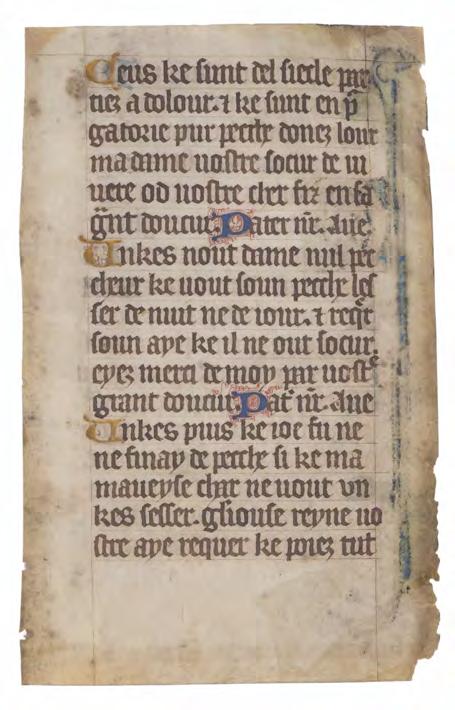
31
LEAF FROM THE HUNGERFORD HOURS, WITH PRAYERS IN ANGLO-NORMAN FRENCH, illuminated manuscript on vellum, England (East Anglia or Lincolnshire), middle third of fourteenth century (c. 1325-1335, or most recently redated to c. 1348), single leaf, text in 17 lines of a tall and angular English bookhand, one-line initials in gold or blue with penwork in faded pink and bright red penwork, this penwork spilling out into outer vertical border on the verso, offset on recto from a decorated initial once on facing page (and that once with a border extension in blue, soft pink and probably gold), some spots and stains, outer upper and vertical edges slightly trimmed, overall in good condition, c. 165 by 100mm.
⁂ Provenance:
1. The parent volume, an impressively early illuminated English Book of Hours, was dated by Janet Backhouse to c. 1330 (‘An English Calendar circa 1330’, in Fine Books and Book Collecting: Books and Manuscripts Acquired from Alan G. Thomas and Described by His Customers on the Occasion of his Seventieth Birthday,1981, pp.8-10), and by M.A. Michael to c. 1325-35 based on the similarity of the illumination to that in the Tiptoft Missal (datable to 1311-32) and the Stowe Breviary (datable to 1322-25; see ‘Destruction, Reconstruction and Invention: The Hungerford Hours and English Manuscript Illumination of the Early Fourteenth Century’, English Manuscript Studies 1100–1700, II, 1990, pp. 33-108). The links to those two volumes, as well as to the All Souls College Psalter (not precisely datable, but used in Norwich) suggest an origin in East Anglia. The identification of coats-of-arms on some leaves as those of the Patteshull family led to the conclusion that it was made for a member of that family. However, recently C. de Hamel and S. Cooper have proposed a new date of c. 1348 and an origin in nearby Lincolnshire on the basis of the coats-of-arms in the manuscript and the “festive in holandia” in the Calendar (‘Holland’ was a local medieval name for a low-lying area of south-east Lincolnshire), and suggested that it may have been made for Sir John Pateshull’s daughter, Alice, who in approximately 1348 appears to have married Sir Thomas Wake, of Blisworth and Deeping, Lincolnshire (‘The Hungerford Hours’, in Tributes to Adelaide Bennett Hagens, 2017, pp. 355-69, where they also give a list of all leaves known at that date; see also P. Kidd, McCarthy Collection, II, 2019, no 16). Peter Kidd has pushed back against this new identification in his Medieval Manuscripts Provenance blog on 13 January 2019, and Cooper has since responded there in the comments section. The matter is likely to continue to be debated as new leaves emerge.
2. Owned by a family member or close associate of Robert Hungerford, 2nd Baron Hungerford (d. 1459) and his wife Margaret née Botreaux (d. 1478), with their deaths commemorated in the calendar.
3. Alan Thomas and Charles Ede, acquired by the end of 1969, and dismembered by them.
4. This leaf re-emerging in Cheffin’s of Cambridge, 27 April 2023, lot 324.
Text:
The Hungerford Hours was an important member of a small group of early English Books of Hours. Few such manuscripts exist with a production date before the second half of the fourteenth century, and the group includes such glorious examples as the De Brailes Hours, the Harley Hours, the Egerton Hours and the Taymouth Hours. However, the Hungerford Hours stood out from its peers in its use of Anglo-Norman French, and was unusual in its wealth of texts in that language, often switching languages even within the main components of the Book of Hours. This most probably was an adaptation for use by noble lay-people who were more at home in their own spoken tongue than in Latin. As such, it is a valuable and rare witness to the use of this language in medieval England. The present leaf comes from the opening section of the parent book, with prayers in Anglo-Norman French (see de Hamel and Cooper, p. 367, where they list only three similar leaves: their leaves 7-9).
£2,000 - 3,000
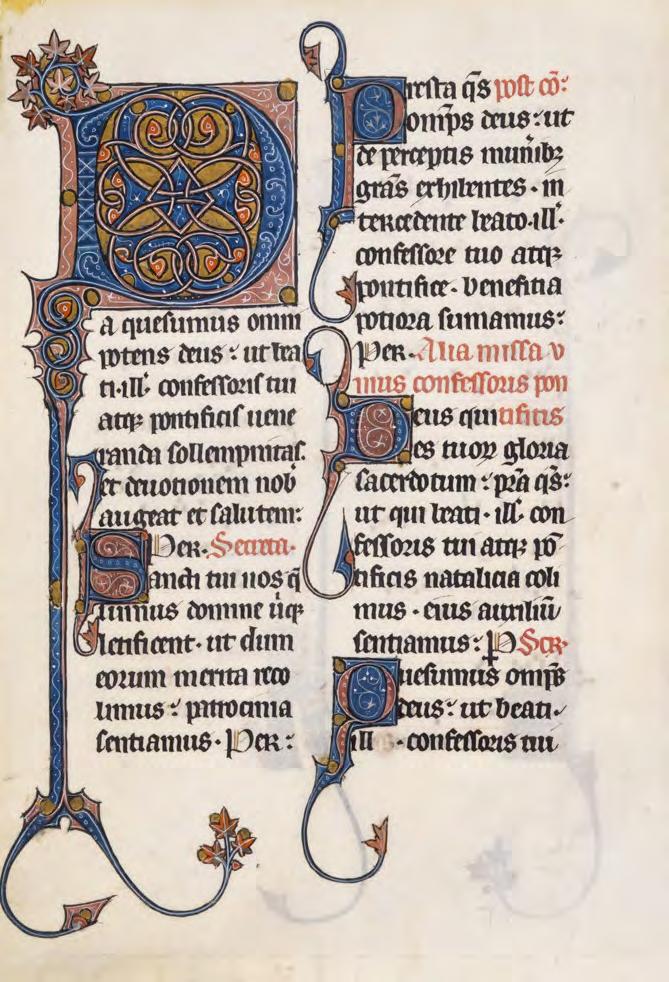
LEAF FROM THE BEAUVAIS MISSAL, WITH AN EXCEPTIONALLY LARGE INITIAL, in Latin, illuminated manuscript on vellum, northern France (perhaps Beauvais or Amiens), early fourteenth century (probably c. 1310), single leaf, with one large initial ‘D’ (opening the Oratio “Da quesumus omnipotens deus …”, 67 by 75mm.) in blue with swirling intricate white penwork, on pink grounds, enclosing curling vinework forming a geometric interlace of circles and a central diamond shape in blue and burnished gold grounds, five 2-line initials in blue or dark pink with delicate white penwork, on coloured grounds with gold baubels set at their corners, each initial with long curving foliate extensions into borders (one initial on reverse formed from the body of a long necked bird, whose head reaches up from the lower corner of the initial to snap at a gold bauble with his beak, floral extensions from corners of initials, that at lower forming a coloured and gold bar border running the vertical length of the whole column, pale red rubrics (some with ornamental penwork), capitals with hairline penstrokes and touched with pale yellow, text in double column of 21 lines of a high grade of early gothic bookhand, reverse with 10 lines of text with music on a 4-line red stave (rastrum: 11mm.), pencil folio no. 71 in lower outer corner, crackles to gold in large initial, small mark from tape in corner, two areas of tape adhesive in margin on reverse from mounting, else fresh and bright condition, 290 by 199mm.
⁂
Provenance:
Of all the manuscript books dispersed by the biblioclast Otto Ege (1888-1951), the Beauvais Missal is perhaps the most famous as well as the most visually striking. It was owned by Robert de Hangest, canon of Beauvais Cathedral. He gifted the book to the Cathedral in 1356, and it was still there in the seventeenth century. By the nineteenth century it had passed to Didier Petit de Meurville (1793-1873) of Lyon; his sale in 1843, lot 354. It passed to Henri Auguste Brölemann (1775-1854) of Lyon, and by descent to his great-grand daughter, who sold it in Sotheby’s, 4 May 1926, lot 161, to William Randolph Hearst (1863-1951). It was then sold by the Gimbel Bros., New York, to Philip C. Duschnes (1897-1970), who presumably broke the volume and sold a number of leaves to Otto Ege in 1942 or 1943 (see S. Gwara, Otto Ege s Manuscripts, 2013, p. 45) . It was no. 15 of Ege s Handlist, and the known leaves are now widely dispersed (see Gwara, 2013, pp. 122-3 for a list of these).
£4,000 - 6,000
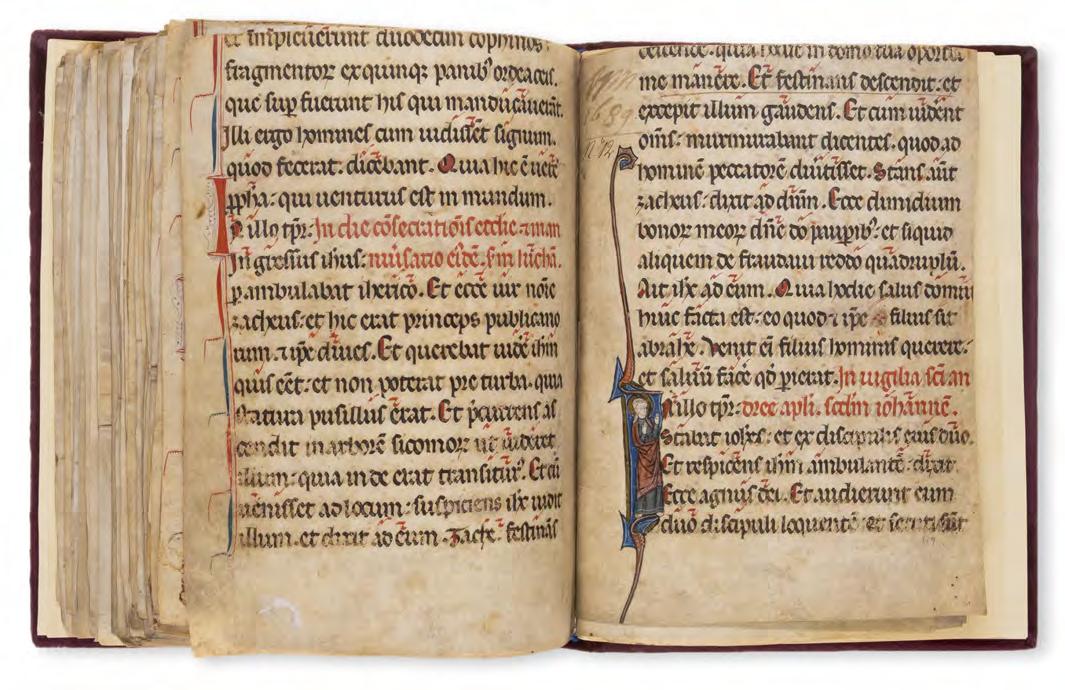
33
SUBSTANTIAL FRAGMENT FROM A NOTED BREVIARY, in Latin, illuminated manuscript on vellum, France (probably south west, perhaps Bordeaux region), last quarter of the thirteenth century, 123 leaves (including 60 bifolia and 3 singletons), text in single columns of 17 lines in an excellent gothic bookhand, capitals touched in red, red rubrics and punctuation marks, music in square notation on 4-line red staves, small initials in calligraphic penstrokes touched in yellow, numerous larger red or blue initials with red, blue or purple penwork often filling the length of the adjacent margin, four historiated initials (see below) in orange, red, blue and burnished gold, with simple trailing foliate tendrils filling the margins, all recovered from reuse as archival wrappers and hence with stains, spots, trimmed edges (one affecting the edge of the last historiated initial), flaking to ink and other concomitant damage, approximately 275 by 200mm.; bound in modern red velvet over pasteboards
Provenance:
⁂
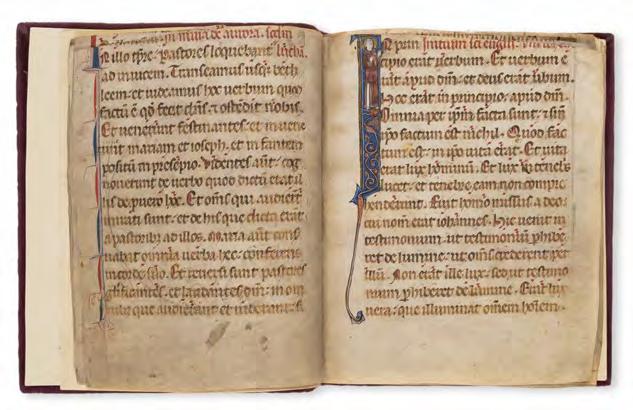
1. The parent manuscript was probably produced in south-west France, and the presence of a tonsured Franciscan friar in the last historiated initial indicates that the parent volume was made for a community of that Order. The added archival inscriptions bearing dates from 1664-1791 show that its leaves were reused in the last years of the eighteenth century or the opening of the nineteenth century. One leaf bears a partly legible inkstamp of a ‘Mairie’ from the Gironde. It seems most likely that the parent manuscript left the library in which it survived from the Middle Ages onwards through the Early Modern period during the French Revolution and the Secularisation, and was then repurposed as account book covers by a secular owner local to the suppressed convent. There was a Franciscan convent in Bordeaux from c. 1227, and others in nearby Libourne and Saint-Émilion from the thirteenth century.
2. Acquired by the present owner in Quaritch, cat. 1434 (2016), no. 33, and sensitively rebound for them.
Illumination:
The historiated initials here are charming examples of regional French gothic painting, and show: (i) a youthful saint dressed in the robes of a Franciscan (but without the cordeliere belt; this perhaps St. Francis), and standing on the head of a lacertine beast whose body trails down the remainder of the initial; (ii) a bearded saint, who gazes at the text of John 3:1 in the adjacent column (and thus probably John the Evangelist), standing on the head of a lacertine beast; (iii) another bearded saint, also probably John the Evangelist, who gazes at the extract of his Gospel in the adjacent column; and (iv) a tonsured Franciscan friar and attendant standing and singing from a large manuscript (perhaps meant to be the parent manuscript of these leaves) open on a lectern before them
£10,000 - 15,000
BOOK OF HOURS, USE OF SARUM, in Latin with two Middle English inscriptions, the first an anathema threatening any book-thief with being hanged on a hook behind the owner’s kitchen door, and the second humorously commanding the reader to kiss the owner’s bottom, illuminated manuscript on vellum, Southern Netherlands (presumably Bruges) for English use, c. 1430 and late fifteenth or early sixteenth century, 134 leaves (plus one original endleaf at front and back), wanting a leaf or two from the added texts at end, else apparently complete, single column of 17 lines in a late gothic bookhand, capitals touched in red, rubrics in red, one-line initials in blue and liquid gold with contrasting penwork, larger initials in gold on blue and pink grounds with white penwork (six of these with coloured and gold text frames on three sides), one large initial in blue enclosing a spray of foliage on burnished gold grounds, with full border of coloured flowers and gold foliage and ivy-leaves, six full-page miniatures in rectangular gold frames (i. p. 23, the martyrdom of St. Thomas Becket; ii. p. 27, St. George killing the dragon; iii. p. 31, St. John the Baptist; iv. p. 37, the Virgin and Child; v. p. 115, Judgement Day; vi. p. 151, a funeral service), pp. 226-69 an addition of the late fifteenth century with prayers on Christ and his Passion, the miniatures on pp. 31 and 37 rubbed and the latter partly cut away, somewhat scuffed and rubbed throughout with small losses to edges of a few leaves and one or two rubbed to point of becoming thin and with small holes, overall fair condition, 120 by 82mm; in limp vellum binding with cloth ties
⁂ Provenance:
1. Produced in the Southern Netherlands for English use c. 1430, and by the late fifteenth or early sixteenth century in the ownership of Bennett Nellson, who signed the famous inscription on the front endleaf of this codex (p. 1: “pro me Bennet nell son”), and who most probably also wrote the second Middle English inscription on another front endleaf (p. 5, this ending with a similar formula “Pro me” but without his name). His use of ‘k’ in “hanked” (‘hanged’) and ‘es’ in “stelles” (not ‘stelleth’) suggests a north west Midlands origin for him.
2. Owned by William Parker later in the sixteenth century, identified by P. Raes as the namesake who held office as the last abbot of St. Peter’s, Gloucester, before his death in 1540 (1995, p. 184).
3. Freeman Clarke Samuel Roper (1819-96), botanist; his sale in Sotheby’s, 31 March 1887, lot 71.
4. Captain William Alfred Cragg (1859-1950), of Threekingham, Norfolk, Lincolnshire antiquarian and manuscript collector; by descent to his son, William Gilliat Cragg (1883-1956; High Sheriff of Lincolnshire) and thence to his grandson, Major William John Rollo, ADC to the governor of Hong Kong; his sale in Sotheby’s, 10 December 1962, lot 145.
5. Alan Thomas, London bookdealer; his cat. 11 (1963), no. 115.
6. June O’Donnell (1898-1979) of Guildford (who also owned the Calendar of the Hungerford Hours and the two Orcadian charters last publicly sold in the Schøyen sale at Bloomsbury Auctions, 8 July 2017, lot 79, among other manuscripts), and by descent to her son, Peter E. Raes (1924-2010).
7. Sotheby’s,10 July 2012, lot 36, to an American collector; and re-appearing in Bloomsbury Auctions, 7 December 2020, lot 66.
Text:
The late fifteenth- or early sixteenth-century inscription at the front of this volume “he that stelles thes boke he shal be hanked [ie. hanged] apon on hoke behend the kechen dor” is among the most well-known anathemas in any book from late medieval England, appearing in Ker’s Parochial Libraries, de Hamel’s History of Illuminated Manuscripts, and in the Alan Thomas festschrift. It is loaded with dark menace and as Raes stated it contains a sentiment “any collector can sympathize with”. As noted in earlier cataloguing, Bennett Nellson, who wrote and signed this inscription, saw this as “the most awful threat imaginable”, and the severity of the threat here shows that this codex “was a very precious possession in that household. It was probably their only book”. However, there is perhaps a deeper meaning as well, in a common Middle English allusion to Hell as a kitchen where carcasses were butchered. The hook here is doubtless a meat-hook secured on the door for the suspension of an animal carcass, and recalls the devilish kitchen threatened by one of Chaucer’s unscrupulous friars on the sinner: “Ful hard it is with flesshook or with oules [spiked irons] / To be yclawed, or to brenne or bake”, and depicted in a copy of Walter Hilton’s mystical works in an illustration of two devils using meat hooks to drag a soul from a corpse suspended above a roaring fire (sold at Sotheby’s, 6 December 2011, lot 45, and now Princeton, Taylor MS. 22: D.C. Skemer, Medieval & Renaissance Manuscripts in the Princeton University Library, 2013, I).
However, that is not all that Bennett Nellson appears to have written in his book, and a second, usually overlooked, inscription in what is most probably the same hand can be found two endleaves later. This hides a humorously vulgar Middle English order within an upbeat common Latin phrase, interweaving the parts of the Latin: “Dum sumus in mundo, vivamus corde yocundo” (‘while we are in the world, let us live with a joyful heart’), with the more vulgar Middle English: “ta yt to no gref / mi nars com kys you ar telt” (‘take no offense, but you are commanded to kiss my arse’; so the entire inscription runs thus: “Dum sumus in mundo ta yt / to no gref vivamus corde / yocundo mi nars com kys you ar telt” – bold added by us to mark off the Middle English). The softening of the insult with the instruction that we must “ta yt to no gref” shows that this is bawdy humour, rather than the growled threat of the first inscription, and such an expression is in keeping with numerous other medieval examples of mild obscenity painted in the margins of otherwise sacred books, and carved into the pews and walls of churches and cathedrals across Europe (see M. Camille, Image on the Edge: The Margins of Medieval Art, 1992, for an excellent study of this), as well as the bottom-kissing scene in Chaucer’s Miller’s Tale and the French fablieu that stand behind that text.
However, the appearance of this bawdy command here has its own importance, in that some uncouth words and phrases in Middle and Early Modern English seem to have been frequently used in speech, but were taboo to write down, and thus our actual references to them are very few. The phrase ‘kiss my arse’ in English is otherwise known from only one pre-Reformation occurrence, when in the ‘Killing of Abel’ in the Towneley plays, Cain exclaims “Com kis myne ars! Me list not ban” (‘Come kiss my arse! I do not want to curse’). While the mystery plays in the Townley manuscript (now Huntington Library, MS. HM 1) do date to the fifteenth century or earlier, the manuscript and thus the final form of the text known to us dates to the sixteenth century, and probably even the midsixteenth century. Thus, the use of this bawdy command here is the earliest known witness to its use in English, or if we accept an earlier date for the Townley manuscript, then a joint holder of that honour.
In detail this volume comprises: a Calendar (p. 10), with SS. Wulfstan, Cuthbert, Aldhelm, Edmund, the translation of Swithun and Oswald; followed by Suffrages to a number of saints, including SS. Thomas Becket (p. 24) and George (p.28); the Hours of the Virgin, with Matins (p. 38), Lauds (p. 52, incorporating further suffrages as common in English use), Prime (p. 78), Terce (p. 86), Sext (p. 90), None (p.94), Vespers (p. 98), and Compline (p. 102); the Seven Penitential Psalms (p. 110) with a Litany; the Office of the Dead (p. 152) and the Commendatio animarum (p. 200). The book ends with additions of late fifteenth-century prayers.
Published:
J. Varley, Lincolnshire Archives Committee, Archivist’s Report, no. 9 (1957-58), pp.17-18.
N.R. Ker, The Parochial Libraries of the Church of England (1959), p. 2 (quoting the first inscription as text facing the titlepage).
Fine Books and Book Collecting, A.G. Thomas festschrift (1981), p. 1.
C. de Hamel, A History of Illuminated Manuscripts (1986), p. 185.
C. Donovan, The de Brailes Hours, 1991, p. 167, n. 136.
P.E. Raes, ‘He That Stelles ThesBoke’, På sporet af Gamle Bibler (1995), pp.180-88.
C. de Hamel, review of Duffy, Marking the Hours, in New York Review of Books, LIV, 15 February 2007, p.44.
B.A. Henisch, The Medieval Cook, 2009, p. 20
£30,000 - 50,000
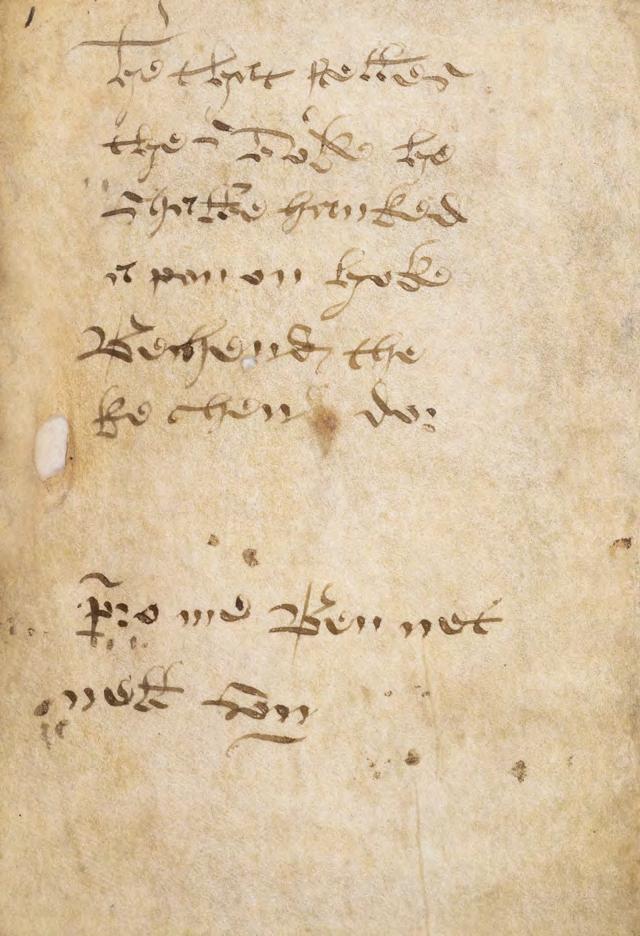
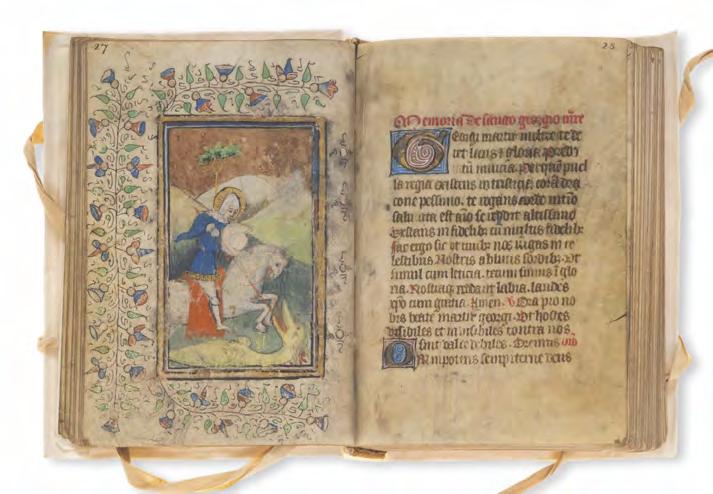
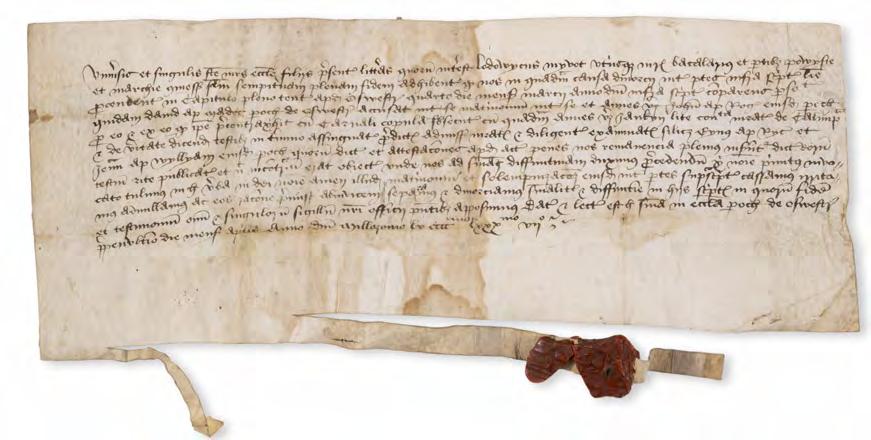
35
RECORD OF INFIDELITY AND SUBSEQUENT ‘DIVORCE’ IN MEDIEVAL WALES, A DOCUMENT CONTAINING THE DETAILS OF A LEGAL CASE HEARD IN POWYS REGARDING DAVID AP MADOC OF OSWESTRY’S CARNAL AFFAIR WITH ANNE, THE WIFE OF JANKYN LITE, AND THE SUBSEQUENT LEGAL SEPARATION OF DAVID AP MADOC FROM HIS WIFE, in Latin, manuscript on vellum, Wales (Oswestry, in medieval Powys), dated last day of April 1487, single-sheet document, with text in 12 long lines of a Welsh secretarial hand (scribe naming himself as Lewis Myvot: see below), remains of two red wax seals attached to tag cut horizontally from foot of document, folds, stains and small spots, else in excellent condition, 104 by 282mm.; framed in glass on both sides, in a fitted carrying case.
⁂ Provenance: Acquired by the present owner from Forum Auctions, 25 September 2020, lot 43, and granted permanent export permission from the UK following that sale.
Text: This is an exceptionally rare record of infidelity and divorce in medieval Wales, made as part of the proceedings of an ecclesiastical court held on the penultimate day of April 1487 to hear the case against David ap Madoc of Oswestry. In that, David ap Madoc was convicted of having had carnal intercourse with Anne, the wife of Jankyn Lite, and this act brought about his legal separation from his wife. This record was then made by Lewis Myvot, Bachelor of Canon & Civil Law and commissary in Powys (he recorded in Emden, Biog. Reg.Univ. Oxford, II, p. 1335).
Divorce was impossible during the Middle Ages as married couples were seen by the Church as indivisible. However, ecclesiastical courts could, very occasionally, grant annulments or legal separations (the latter a divorce a mensa et thoro, as here, after which the parties could live apart, but were not permitted to marry anyone else). Records of these from any part of the United Kingdom in the Middle Ages are rare, and those from medieval Wales are greatly more so. Despite being just inside the English border now, Oswestry in the Middle Ages was part of the diocese of St. Asaph in Wales, and that diocese would have convened the court in question here. The name of the plaintiff and the court recorder are both Welsh, and the court itself may have been conducted, at least partly, in the Welsh language. In addition, one of the problems facing any student of medieval Welsh law is that most of the surviving records are lawbooks, and many of the practises detailed in those appear to have slid further and further away from the reality of the law over the course of the Middle Ages, with those records becoming progressively more idealised and outdated (see R. Chapman Stacey, ‘Divorce, Medieval Welsh Style’, Speculum 77:4, 2002, pp. 1107-1127). Thus records of the actual workings of the law courts such as this, are of the utmost historical importance
£2,500 - 3,500
36
TWO FRAGMENTS FROM A MANUSCRIPT BREVIARY, IN LATIN, ON VELLUM, REUSED AS A FRISKET-MASK IN THE PRINTING OF A LATE SIXTEENTH-CENTURY MISSALE ROMANUM, AND THEN REUSED AGAIN AS BINDING MATERIAL, France, fifteenth century, two fragments, which fit together to show that the parent manuscript was written in double columns of 17 lines, with music on 4-line red staves; these then reused in the late sixteenth-century as a frisket (see below) during the printing of Pope Pius IV’s bull: Iniunctum nobis containing the Professio fidei Tridentina as part of a Missale Romanum ex decreto sacrosancti Concilij Tridentini restitutum; then their final use once discarded from previous use, in the binding of a later book, and hence with cuts to edges, spots, stains and illegible areas, overall in fair and presentable condition on heavy and supple vellum, 215 by 48 and 212 by 43mm.
⁂ Provenance:
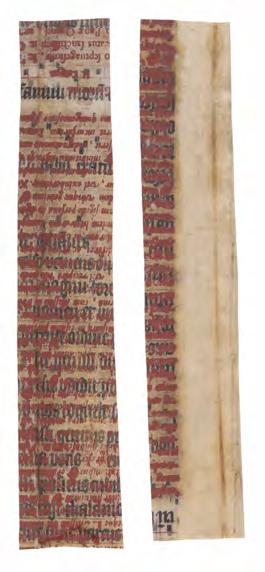
These fragments were discovered in a folio sized, three-volume copy of Vetus Testamentum published in Paris by Nicolaum Buon in 1628 (Darlow & Moule 4674), when that later volume was undergoing restoration in the 1990s. Then appearing on the market in Dominic Winter, 9 November 2016, lot 540.
Frisket fragments:
Friskets – sections of medieval manuscript leaves reused in early printing to mask off the print face from all but the rubrics to be printed in red – are important witnesses to early printing practices, and the earliest artefact of any colour printing in the West. However, as quite ephemeral objects, the vast majority of them were discarded after use (doubtless soaked with red ink), and only those which were dried out again by the most frugally minded binderies and reused as scrap vellum in bookbindings survive.
Elizabeth Upper listed 21 extant examples in 2014 (‘Red Frisket Sheets, c.1490 – 1630’, Papers of the Bibliographical Society of America, 108:4), and then extended that in her online survey to 59 (including the present cuttings). Others have appeared at auction in Bloomsbury Auctions, 8 July 2015, lot 27 (there to the Beinecke Library in Yale), 9 December 2015, lot 36, 6 July 2016, lot 42 and Bassenge, 16 April 2019, lot 807, with another large example donated a few years ago to the University of South Carolina.
£2,000 - 3,000
ST. MARCEL OF PARIS IN A HISTORIATED INITIAL ON A CUTTING FROM THE CELEBRATED GRADUAL OF KING LOUIS XII OF FRANCE AND HIS WIFE ANNE OF BRITTANY, ILLUMINATED BY A PARISIAN ARTIST FROM THE CIRCLE OF JEAN PICHORE, illuminated manuscript on vellum, northern France (Paris), c. 1499-1500, large rectangular cutting, with a large initial ‘S’ in blue with white penwork, the arms of the letter emerging from the outer edges of a detailed architectural frame, and sprays of coloured ivy-leaf foliage on burnished gold grounds at the corners, that containing a standing portrait of the saint wearing a bishop’s mitre and holding a crosier, one hand raised in blessing and the other holding a tethered dragon, all before a blue cloth marked with gold fleur-de-lys whose border bears the inscription “Sancte Marcelle” just above the saint’s right shoulder, reverse with two lines of text in an extremely high grade liturgical script with music on a 4-line red stave (rastrum: 42 mm.), modern notes in French in pencil also there, a few traces of paper adhering to edges of reverse from last mounting, traces of very slight folds at edges, occasional chipping to gold, else in outstandingly fresh condition, 160 x 186 mm.
⁂ A REMARKABLE HISTORIATED INITIAL FROM A LAVISHLY PRODUCED BOOK WITH A SECURE ROYAL PROVENANCE; THIS ONE OF ONLY TWO KNOWN INITIALS FROM THE VOLUME DEMONSTRATING THE STRONG LINKS OF THE PARENT CODEX TO MEDIEVAL PARIS
Provenance:
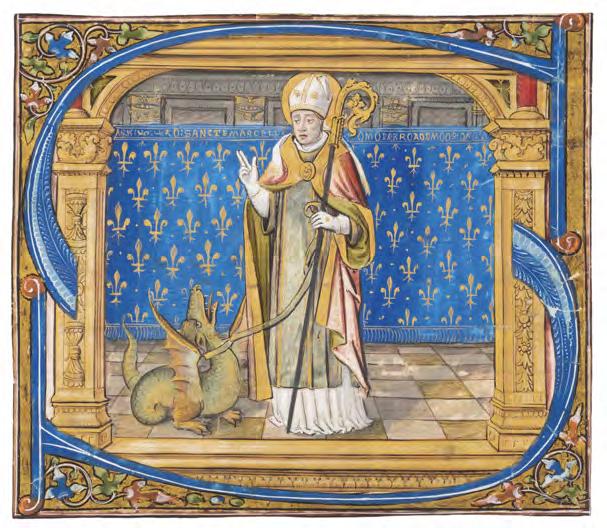
1. The parent codex, a grand and opulent choirbook, was commissioned by King Louis XII of France (reigned 1498-1515) and his wife Anne of Brittany (d. 1514; duchess of Brittany, betrothed to Edward, the elder of the Princes in the Tower, then married to Maximilian of Austria, later renounced and married Charles VIII of France, and again after his death to his successor Louis), with other surviving cuttings showing the couple praying before the Crown of Thorns (the chief relic of the Sainte-Chapelle), their arms, initials and other emblems. It was almost certainly made for use in their royal chapel in the Sainte-Chapelle in Paris.
2. Antoine Leroux de Lincy wrote in 1860 that the parent Gradual manuscript had been broken up some twenty years earlier, with cuttings then dispersed into the collections of Ambroise Firmin-Didot (1790-1876), Léon Curmer (1801-1870), Charles Sauvageot (17811860) and others. The peregrinations of the recorded fragments are traced by C. de Hamel, Gilding the Lilly, 2010, no. 83, p.183. Complete leaves survive in Massachusetts, Wellesley College, MS.6 (de Ricci, Census, p.1068), and New York, Morgan Library & Museum, M.1199, preserving the original outer dimensions of approximately 685 by 515mm.
3. The present cutting then reappearing in the collection of Anton Philips (1874-1951), Dutch industrialist.
The Saint:
St. Marcel was thought to have been the ninth bishop of Paris, and alongside St. Geneviève he was one of the two patron saints of the city of Paris – setting this illumination up alongside the initial enclosing the Communion of St. Denis (see below) as the only ones visually recording the strong links of the parent volume to that city.
Like many saints, the known details of his life are few. Venantius Fortunatus states that he was an extraordinarily pious youth who lived a priestly life even before ordination, and miracles are recorded of him holding a hot iron without being burnt, turning the water in the Seine to wine, and (as here) banishing a dragon that had been the scourge of Paris by striking it over the head with his crozier, after which it became docile and could be led away by him.
Illumination:
Some seventeen historiated initials (including the present one) from this glorious book have now come to light, and these show that a number of artists, including the Master of Phillippa of Guelders, Jean Coene IV and Jean Pichore, were engaged on its illumination.
The known initials are: (1) Adoration of the Child in an initial ‘O’, in the sale of Georges Hoentschel in Paris, 14 April 1910; (2) Adoration of the Magi in an initial ‘E’, now Cambridge, Fitzwilliam Museum, Marlay Cutting fr. 15; (3) All Confessors in an initial ‘S’, Maggs Bros., 2015; (4) Anne teaches her daughter Mary in an initial ‘G’, now Philadelphia, Free Library, Lewis E M 43:13; (5) Annunciation in an initial ‘R’, Sotheby’s, 1 December 2020, lot 75; (6) Communion of St. Denis in an initial ‘C’, Christie’s, 9 December 2020, lot 7; (7) Creation of Eve in an initial ‘G’, Sotheby’s, 8 July 1974, lot 26; (8) dedication of a church in an initial ‘T’, Les Enluminures; (9) Last Supper, initial ‘S’, Ambroise Firmin-Didot sale in Paris, 13 June 1884, lot 78, then Christie’s, 15 November 2006, lot 9; (10) Louis XII and Anne of Brittany in prayer before the Crown of Thorns in an initial ‘G’, now Nantes, Musée Dobrée, inv. 994.3.1; (11) Louis XII healing the sick in an initial ‘S’, now Cambridge, Fitzwilliam Museum, Marlay Cutting fr. 16a; (12) Mary Magdalen in penitence in an initial ‘C’, Sotheby’s, 8 July 1974, lot 28; (13) Noli me Tangere in an initial ‘S’, Sotheby’s, 10 December 1996, lot 25; (14) Pentecost in an initial ‘S’, Ambroise Firmin-Didot sale in Paris, 13 June 1884, lot 78, then the Lehmann Collection, MS. 71, and later still Jörn Günther, Brochure 9, 2006, no. 55; (15) Presentation in the Temple in an initial ‘S’, now Evreux, Musée d’Art, inv. 8100; (16) St. Marcel of Paris with the dragon in an initial ‘S’ (the present miniature); (17) Trinity in an initial ‘B’, Sotheby’s, 8 July 1974, lot 29.
The present miniature’s style recalls that of the large and prolific workshop of Jean Pichore, who was active as a manuscript illuminator while he was also significantly engaged in the printing business. Pichore himself was responsible for the initials in the parent volume enclosing St. Anne teaching Mary, the Annunciation, the Creation of Eve, the Last Supper and the Pentecost, and our artist may have been a member of his immediate workshop. His style is characterised by decisive, yet delicate, contours that outline garments, draperies and facial features, and the modelling of objects and figures with tiny, densely set brushstrokes in different shades of the base colour. He may well also have been the artist behind the initial showing the Dedication of a church
£10,000 - 15,000
38
LEAF FROM THE CELEBRATED LLANGATTOCK BREVIARY, in Latin, illuminated manuscript on vellum, Italy (Ferrara), c. 1445, single leaf, with double column of 30 lines of a rounded late gothic bookhand, catchword at foot of verso, capitals touched in yellow wash, red rubrics, one-line initials in blue or liquid gold with contrasting penwork, 2-line initials in burnished gold on blue or burgundy grounds, these grounds with fine white penwork tracery, two vertical bar-borders on the outer sides of both columns on each side of the leaf, these in gold, blue and burgundy with fine rinceaux foliage sprays with fleshy coloured leaves and gold bezants at midpoint of outermost example on the verso, and about a quarter and threequarters of the way up the outside of that on the recto, riotous explosions of the same foliage at head and foot from bottom of bar borders, the foliage at the midpoint of the outer margin of the verso enclosing a finely painted winged putti, some slight cockling, and a few spots and stains, else in outstandingly fresh condition, approximately 270 by 200mm.
⁂ Provenance:
1. From a grand and glorious book redolent of the heights of the Italian Renaissance. The parent breviary was produced for the use of Leonello d’Este (1407-50), marquis and then duke of Ferrara, by a team of artists led by Giorgio d’Alemagna (see F. Toniolo, La miniatura a Ferrara dal tempo di Cosmè Tura all’eredità di Ercole de’ Roberti, 1998, pp. 19, 20, 76-77; and D.T. Cashion in The Burke Collection of Italian Manuscript Paintings, 2021, no. 32, where a handlist records 108 leaves from the parent manuscript).
2. John Rolls (1870-1916), 2nd Baron Llangattock, with inscriptions in the parent volume recording his family’s acquisition of it, already imperfect, after the Peninsular War in the early nineteenth century; sold in his sale at Christie’s, 8 December 1958, lot 190.
3. Goodspeeds book shop, Boston, and dispersed by them.
4. This leaf then Bonham’s New York, 11 December 2013, lot 1376.
£2,500 - 3,500
39
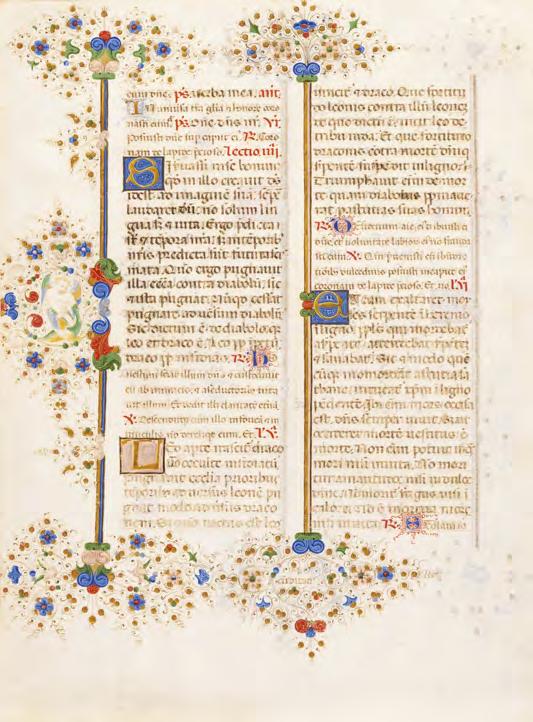
CALENDAR, MOST PROBABLY FROM A PSALTER-HOURS, in Latin, illuminated manuscript on parchment north east France (most probably Metz), first half of thirteenth century, 6 leaves (a single gathering), 33 lines in an angular early gothic bookhand, initials touched in red, small initials in blue or liquid gold with penwork in contrasting colour, large ‘KL’ initials in liquid gold on blue and pink grounds heightened with white penwork, some near-contemporary additions to columns and later scribbles in margins and blank spaces, early twentiethcentury pencil ‘267’ in circle at foot of last leaf, first and last pages discoloured in places and small holes in first leaf, else fair and presentable condition, 130 by 90mm; nineteenth-century card binding with parchment spine, and labels with ‘No 120’ and ‘1778/447’ on front cover
⁂ Acquired by the present owner in Bloomsbury Auctions, 6 December 2017, lot 111. The appearance of SS. Arnulf (18 July), Gondulf (6 September) and Goericus (19 September), all named as “metum episcopus” (bishop of Metz) point towards that city for the origin of the parent manuscript
£800 - 1,200
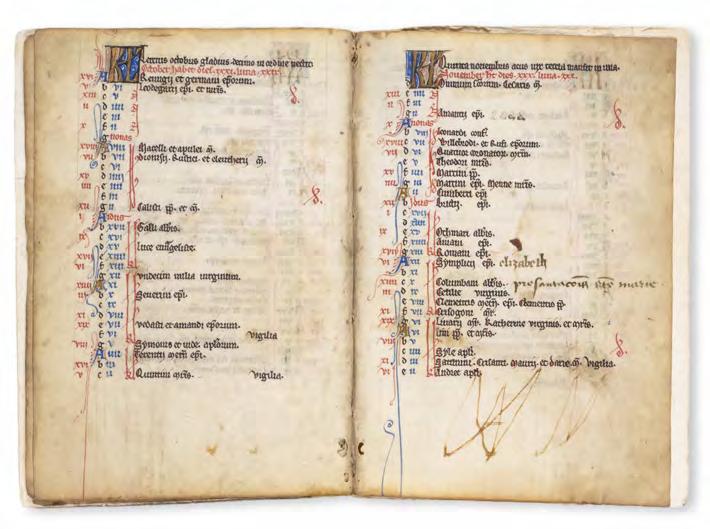
LEAF FROM A LITURGICAL VOLUME, PROBABLY A MISSAL, in Glagolitic script, decorated manuscript on vellum, Croatia, late fourteenth or early fifteenth century, single leaf, with text in double columns of 30 lines of an elongated and angular Glagolitic square bookhand, elaborate paragraph marks, capitals and rubrics in bright red, four large decorated initials in red penwork designs (2- to 5lines high), recovered from later reuse in a binding and hence with stains, scuffed areas, numerous holes and tears, overall fair and presentable condition, c.265 x 173mm.
⁂ Provenance:
1. This leaf, along with a sister leaf now in a private collection, survived as the pastedowns or endleaves of a later printed book, and came to light together in an auction by Hartung & Hartung of Munich, 19 November 2012, lot 39.
2. This leaf then acquired by the present owner in 2015.
Script:
Glagolitic script survives in relatively small numbers of manuscript witnesses, and thus is one of the rarest to come to the market. The name is a later invention and comes from the verb glagoljati (‘to speak’). It was reportedly created by SS. Cyril and Methodius, brothers from Thessaloniki, when they were sent on missionary work in 862 by the Byzantine emperor to Greater Moravia (modern Czech Republic and Slovakia). In 886, the East Frankish bishop of Nitra banned the script and jailed and then sold into slavery 200 of Methodius’ followers. Refugees reached Bulgaria and were instructed by Boris I to instruct his clergy there in Slavic language worship. From there, refugees spread to Croatia and that nation in time became the heartland of the script. Finally, in 1248, Pope Innocent IV granted the Croats of southern Dalmatia the privilege of using a translation of the Roman Rite in their own script.
Even outside of Croatia, Glagolitic has fascinated those interested in paleography and script since the sixteenth century, perhaps as a native European ‘curiosity script’ unrelated to Roman or Cyrillic scripts. The encyclopedist Guillaume Postel included a table of its letters (named “Alphabetum Hieronymianum seu Dalmaticum, aut Illiricum”) in his Linguarum duodecim characteribus differentium alphabetum (1538), and Giovanni Batista Palatino included the same in his Libro Nouvo (1545), where he claimed it was invented by no less than St. Jerome, and stating it is “different from all other existing scripts”. In 1596, it was included by the linguists, Johann Theodor and Johann Israel de Bry, among their lists of scripts in Alphabeta et Characteres (published Frankfurt), and in 1619 it was included by Claude Duret in his Thresor de l’histoire des langues de cest Univer. It reached an English readership as early as 1664 in Richard Daniel, Daniels Copy-Book: or, a Compendium of the most usual hands. Indeed, it continues to captivate the attention of those interested in European medieval scripts, and in 2001, Trinity College, Dublin, held an exhibition dedicated solely to it: ‘Discovering the Glagolitic script of Croatia’.
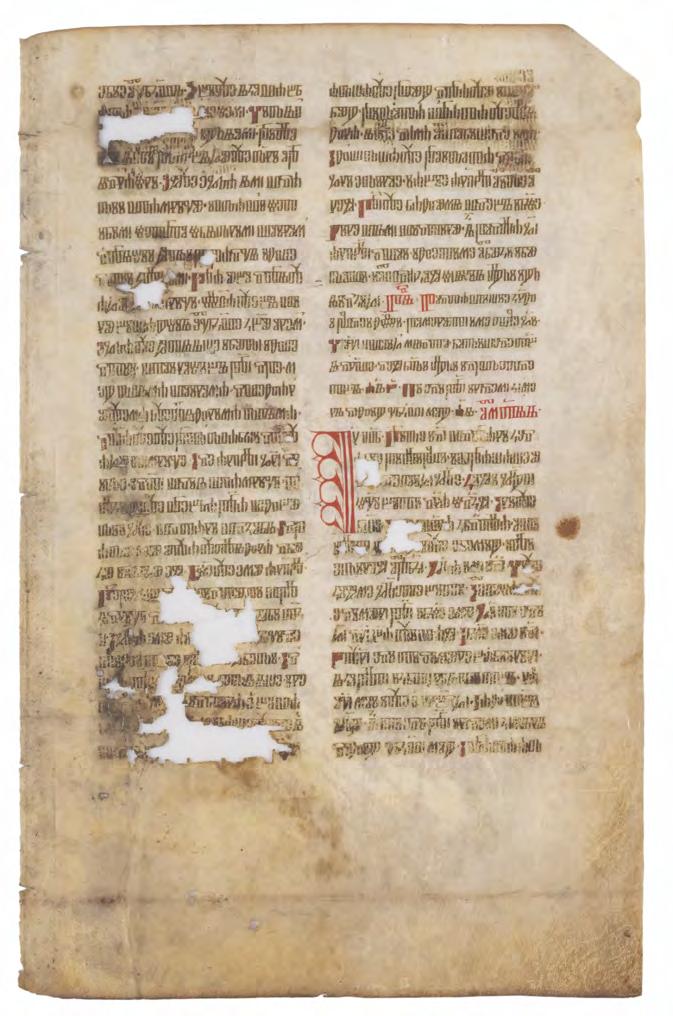
It is of significant rarity on the market, and only three codices (all from the collection of Sir Thomas Phillipps) and five fragments, or sets of fragments (excluding the present leaf and its sister-leaf), have been offered for public sale in the last two hundred years. The codices are: (1) a Missal of c.1400-10, bought in the Guildford sale at Evans, 8 December 1830, lot 460, for the enormous price of £168, and thereafter among Phillipps proudest possessions, later sold Sotheby’s 29 November 1966, lot 162, and now in the Pierpont Morgan Library; (2) a fifteenth-century priest’s manual, sold Sotheby’s, 28-29 June 1976, lot 4040; (3) a copy of patristic texts dated 1602, lot 1240 in same sale. The fragments are: (i) two leaves from a fifteenth-century illuminated Missal, sold Sotheby’s, 16 December 1970, lot 5; (ii) the small fragments in the binding of a Glagolitic printed book offered by Christies in July 2015; (iii) a bifolium reused as the limp vellum binding of a seventeenth-century Croatian book, sold in Bloomsbury Auctions, 8 July 2015, lot 35, where it realised £28,520; (iv) a single large leaf from a monumental Glagolitic Breviary, with part of the reading for the Feast of St. Apollonia, sold by Bloomsbury Auctions, 6 July 2017, lot 91, for £20,720; and (v) two fifteenth-century leaves from the statutes or rules of a lay fraternity, probably from the island of Krk, formerly Schøyen Collection, MS. 1391, and sold in their sale in Christies, 10 July 2019, lot 423, and realising £12,500.
£10,000 - 15,000
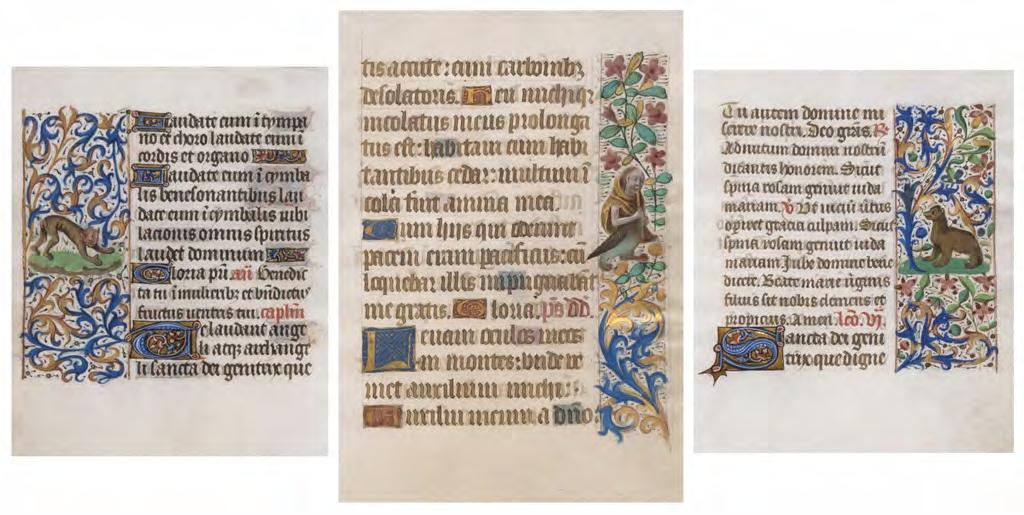
3 LEAVES FROM TWO BOOK OF HOURS, EACH WITH DROLLERIES, FANTASTIC CREATURE OR ANIMALS IN THE BORDER, in Latin, illuminated manuscripts on vellum, France, c. 1460 and c. 1470, (i and ii) 2 single leaves, each side with panel of decorated border of coloured acanthus leaf sprays and hairlinethin stemmed foliage terminating in coloured flowers on blank vellum grounds scattered with gold bezants, these enclosing at their midpoints a detailed painting of a half-human wildman covered in hair apart from its human face, and with tufted ears and a bare bottom, walking on its hands and feet on a cut out section of grass, or paintings of bears standing on a grassy mound (the leaf with bears with one on each side, that with the Wildman only on one side, and the reverse with a spray of green foliage in the same place), one and 2-line initials in blue enclosing coloured ivy-leaf foliage on gold grounds, line-fillers in the same, red rubrics, text in single column of 14 lines, excellent condition, set in card mount, but approximately c.100 x 83 mm; (iii) another leaf, each side with panel of decorated border of coloured acanthus leaf sprays and hairline-thin stemmed foliage terminating in realistic coloured flowers on blank vellum grounds scattered with gold bezants, these enclosing a half-human drolleries (one of whom plays a medieval ‘whistle flute’ and the other who wears a monastic cowl) at their midpoints, one- and 2line initials in gold on blue or faded burgundy grounds, faded red rubrics, text in single column of 14 lines, excellent condition, set in card mount, but approximately c.125 x 90 mm; framed together
⁂ The wildman (or ‘woodewose’) was a supernatural creature attested in European art and literature from the twelfth century onwards. They were said to be half-human, uncivilised forest dwellers, with bodies covered in hair, who acted as protectors of wild creatures
£2,000 - 3,000
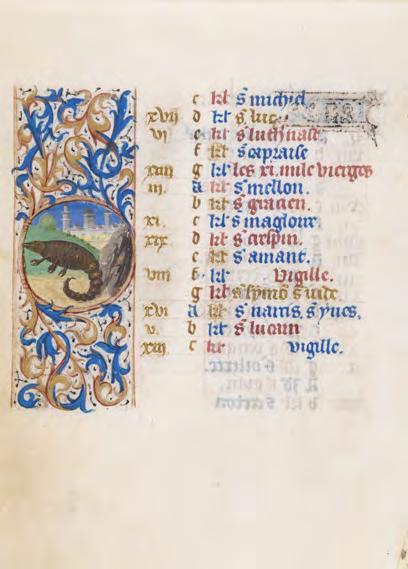
42
LEAF FROM A CALENDAR, FOR OCTOBER, FROM A BOOK OF HOURS, in French, illuminated manuscript on vellum, France, c. 1460, single leaf, with entries in gold, blue and faded red, one ‘KL’ initial in blue enclosing coloured foliage on gold grounds, each page with a decorated border panel of coloured acanthus leaves enclosing a roundel at its midpoint (these with a man in a ploughed field sowing seeds, and a long-tailed scorpion for Scorpio in a grassy landscape before a medieval walled city), some small scuffs and stains, else in good condition, c130 x 95 mm.
£600 - 800
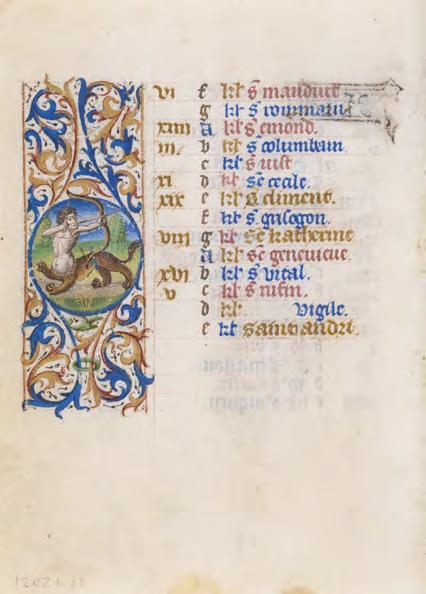
43
LEAF FROM A CALENDAR, FOR NOVEMBER, FROM A BOOK OF HOURS, in French, illuminated manuscript on vellum, France, c. 1460, single leaf, with entries in gold, blue and faded red, , one ‘KL’ initial in blue enclosing coloured foliage on gold grounds, each page with a decorated border panel of coloured acanthus leaves enclosing a roundel at its midpoint (these with a man with a long stick driving pigs towards a forest: to knock down acorns to fatten them, and a centaur with a drawn bow for Sagittarius in a tree-lined landscape), some small scuffs and stains, else in good condition, c 130 x 95 mm.
⁂ From the same parent volume as the previous lot.
£600 - 800
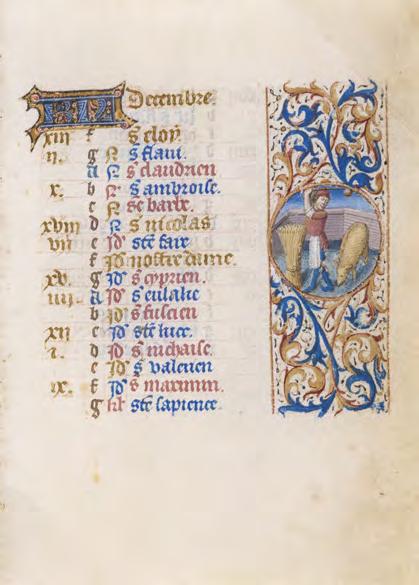
44
LEAF FROM A CALENDAR, FOR DECEMBER, FROM A BOOK OF HOURS, in French, illuminated manuscript on vellum, France, c. 1460, single leaf, with entries in gold, blue and faded red, , one ‘KL’ initial in blue enclosing coloured foliage on gold grounds, each page with a decorated border panel of coloured acanthus leaves enclosing a roundel at its midpoint (these with a man raising an axe high above his head about to strike dead the pig standing to his side; and a stylised Classical horned goat for Sagittarius in a grassy landscape before a medieval town), some small scuffs and stains, else in good condition, c.130 x 98 mm.
⁂ From the same parent volume as the previous lot.
£600 - 800
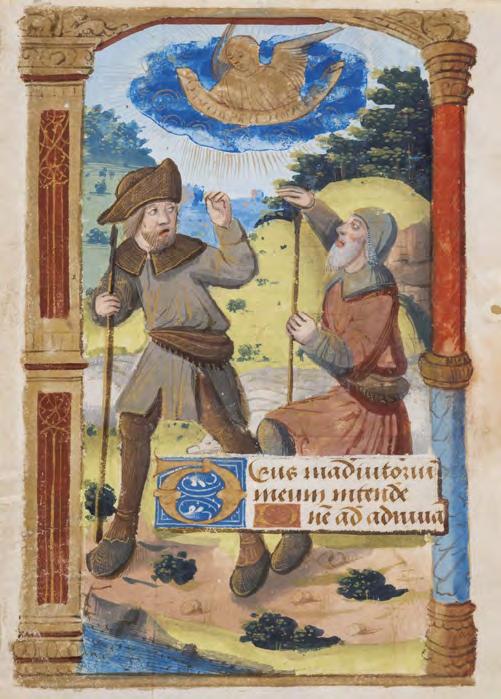
45
THE ANNUNCIATION TO THE SHEPHERDS, FULL-PAGE MINIATURE FROM AN ILLUMINATED BOOK OF HOURS, in Latin, manuscript on vellum, northern France (probably Rouen), c. 1480, single leaf, with a full-page miniature of a golden angel appearing to two shepherds in a grassy and hilly landscape, within coloured architectural columns, and with 3 lines of text suspended in the foreground, reverse with a decorated border panel of coloured acanthus leaf sprays and more realistic foliage with coloured flowers set on blank vellum and dull gold grounds (the latter in trefoil shapes), one- to 3-line initials in gold on blue grounds, red rubrics, text in single column of 19 lines of lettre bâtarde, modern folio number ‘49’ in blue crayon, slightly cockled, some chipping to paint in places, small spots and stains, else good condition, c.150 x 104 mm.
£1,200 - 1,800
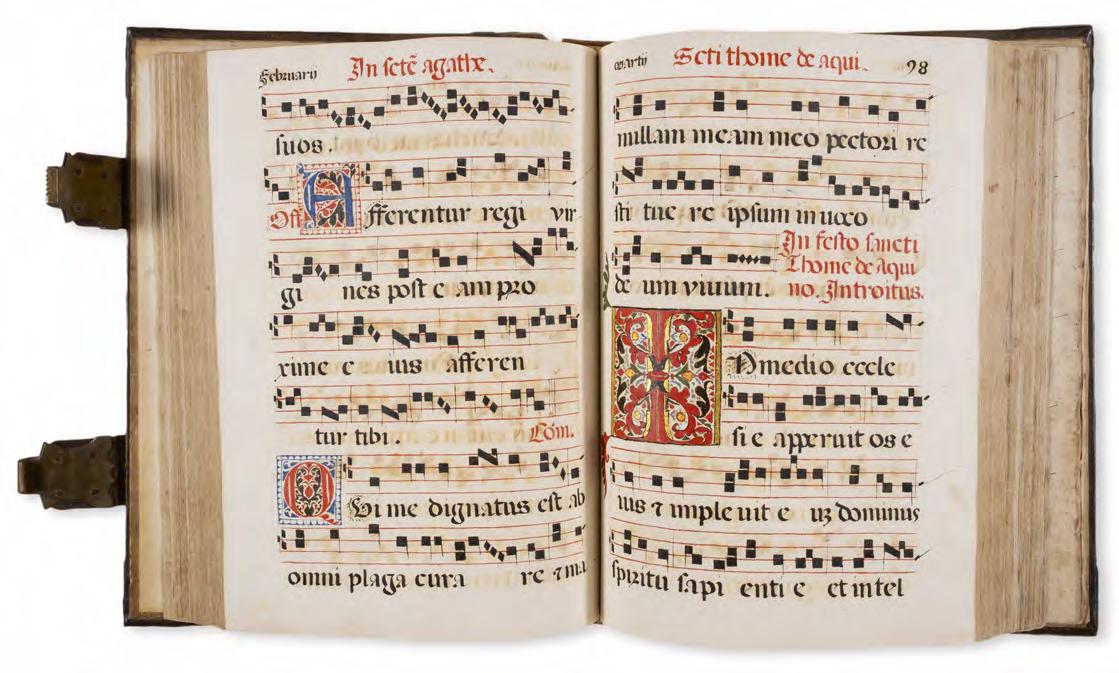
46
Gradual, in Latin, illuminated manuscript on paper, in its contemporary binding, Italy (Florence), dated January 1584, 243 leaves (including a contemporary endleaf at front, and plus one modern paper endleaf at each end), the main body of the text with contemporary foliation 1-226 (excluding the initial leaf with the large painted Cross, and 15 leaves at the end), text mostly in single column of 7 lines with music in square notation on a 4-line red stave, red rubrics, initials decorated in red, green, blue and gold (the largest containing complex foliage and on gold grounds), one large full-page red Cross within a frame of coloured foliage edged in gold, similar smaller cross on fol. 214v, two final leaves somewhat smaller than main text block and with additions in another nearcontemporary hand added at end of volume, a few early revisions to the text on pasted-in paper slips, slight shine-through in places, small spots and stains, slight worm damage to first few leaves, restoration to lower margins of several leaves, c.420 x 305 mm.; contemporary Italian brown leather over wooden boards, tooled with floral rollstamps and flowerheads, modern rebacking and restoration, brass cornerpieces, centrepieces and clasps, some small splits to edges in places
⁂ Provenance:
Written for the Dominican Convent of La Crocetta in Florence, by a Sister Catherine, almost certainly a member of the community, and with a lengthy colophon in red on fol. 214v recording its creation: “Iste liber scriptus fuit manu propria mee catherine monialis monasterii Sancte crucis de florentia. Et expletus fuit kal. Janu. MDLXXXVIII”. She also copied a another liturgical codex for La Crocetta (that now Bib. Domenicana, CR028) in 1582 (see L. Breckon, Agency through Plainchant: Nuns of Florence, 1550–1650, PhD. thesis submitted to Goldsmiths, University of London in 2022, pp. 140-139 for a study of the other manuscript)
£15,000 - 20,000
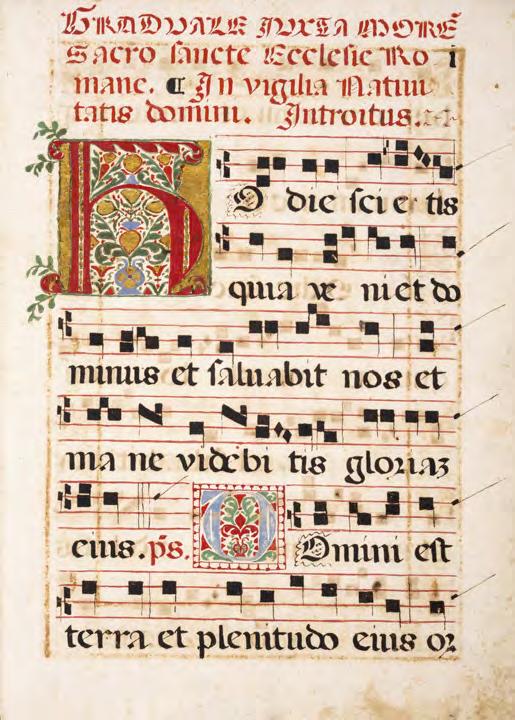
47
Croatia.- POLJICA STATUTE, manuscript copy of the 15th century Dalmatian legal code in Bosnian Cyrillic script, 43ff., all repaired with loss of text to a greater or lesser degree, modern calf, Dalmatia, Croatia near Omis, late 17th or early 18th century; together with Statuta Lingua Croatica Conscripta. Hrvatski psani zakoni: vinodolski, poljički, vrbanski a donekle i svegakrčkoga otoka, kastavski, veprinački i trsatski, modern half calf over marbled boards, Zagreb, 1890, 4to and 8vo (2)
⁂ Manuscript copy of the Poljica Statute, a legal document regulating nearly all aspects of criminal, civil, and procedural law of the eponymous state, which was located in present-day Dalmatia, Croatia.
The Statute stands beside comparable Slavic legal codes, such as the Russkaia Pravda (the first East Slavic legal code), the Pskov Charter, or the Vinodol Statute (13th and 14th centuries), as a major record of Slavic medieval law. It is also one of the earliest written constitutions in Europe.
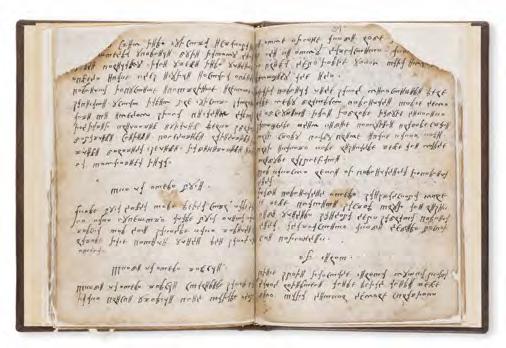
It is a key source for our knowledge about the economic, political, and social relations in the Poljica region during the late middle ages.The Republic of Poljica (Poljička republika, from polje, or field; also known as Poglizza in Italian) arose during the late Middle Ages near modern Omiš, Croatia. It was largely populated by peasants, who were organised into a state comprising twelve villages, each selfruled, and overseen by a supreme council of noblemen.
The Statute was written in part to signal Poljica’s struggle for political and cultural independence from both Venice and Croatia. It was accepted as a free sovereign entity first by the Hungarian kings and later by the Republic of Venice. During Venetian rule, the Poljica troops in fact played a key role in defending the border with the Ottoman Empire, which ran along the Cetina. In concert with Venetian troops, the Poljica regiment beat the Turkish attackers twice in open battle, in 1530 and 1686. Ultimately, Poljica was invaded by French troops under Napoleon and eventually absorbed into the Austrian province of Dalmatia, despite its attempts to gain independence. By 1806 it numbered fewer than 7.000 inhabitants.
Manuscripts from the period of the Statute’s legal application (until the early nineteenth century) are particularly interesting, as they reflect a living legal code that continued to develop with each revision.The earliest existing manuscript of the Statute, now housed at the museum in Omiš, dates to 1322, and important early revisions took place in 1387, 1444, 1485, 1515, and 1665.
Included here is the second publication of the Statute (1890) in Cyrillic and the first with scholarly annotations, edited by the Croatian philologist Vatroslav Jagić (1838-1923), which is based on the analysis and comparison of four of the earliest known manuscripts of the text. Our comparison with this source shows that our manuscript begins with paragraph seven of the full text (Od tradituri), evidently lacking a few preceding leaves, and ends with the paragraph “Od umicaena divoeaksilom,” which is also the last paragraph listed on the holograph table of contents bound with the manuscript.
£1,500 - 2,000
48
Islamic manuscript.- QUR’AN LEAF, large Kufic Qur ’an folio leaf, Qur’an VIII, sura al-anfal, v.10 (part) - v.19 (part), Arabic manuscript on vellum, 16 lines of black kufic script, one ‘ashr marker in the shape of a polychrome rosette formed by interlocking bands in red and green, with red and green roundel vocalisation marks and black diacritics, hair side rubbed off, numerous creases, some holes and losses, folio (320 x 388mm.), Near East or North Africa, [late 8th century].
⁂ This leaf comes from a dispersed Qur’an manuscript which has previously been attributed to the 9th or 10th century. Francois Déroche however has argued convincingly, due to the striking use of mashq or horizontally extended letters, for the attribution of this Qur’an to the late 8th century. The illumination, consisting of abstract geometric motifs and vegetal shapes in earthy colours with the absence of gold, also suggests an early date of production for this Qur’an folio.
Two further folios from this same Qur’an were sold at Christie’s, 15th October 1996, lot 47, and at Sotheby’s, 29 April 1998, lot 2.
Other folios are in various collections including: the David Collection; the al-Sabah Collection; and ten leaves in the Los Angeles County Museum of Art.
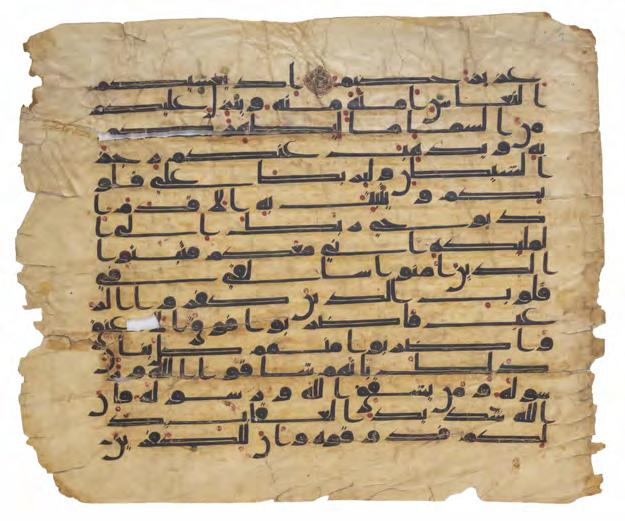
Provenance: Christies: The Saeed Motamed Collection - Part I, London, South Kensington, 22 April 2013, lot 38.
Literature: François Déroche, The Abbasid Tradition, London 1992
£10,000 - 15,000
49
[QU’RAN], ARABIC MANUSCRIPT ON BURNISHED, STENCILLED, AND GOLD-FLECKED PAPER, 447ff., body text with 13 lines per per page, fully vocalised, with the first, middle, and last lines written in thuluth, and the other ten lines in naskh, illuminated gilt verse markers of orange, red, and pale blue; sura headings in calligraphic cartouches illuminated in green, orange, pale blue, and white, with white thuluth outlined in black, on gold ground; text within three frames, gilt, and illuminated in pale blue, orange, and black, outlining panels of stencilled and gilt decoration, containing three registers of marginal notes, with evidence of a further register, lost when the manuscript was trimmed, on f.146b and elsewhere in the text; textual divisions marked by a mixture of marginal medallions illuminated in the same scheme, with penwork frames, a handful in a distinct, deep blue; Preface, ff.1b-3a, with 50 lines per page of minuscule black naskh, important words in red; followed by Sura I, ff.3b-4a, with five lines per page of white muhaqqaq outlined in black on a gilt and floreated ground, divided by blue and white frames,, with an upper and lower cartouche of pink thuluth, outlined in black, on the same illuminated and gilt ground, the while set within floreated frames of deep and pale blue, green, pink, orange, and white on gilt grounds, within triple frames of gold and black and four registers of marginal notes in black naskh, headings in red; f.4b with 7 lines, first and last in thuluth, and the other five in naskh, and an elaborate illuminated headpiece in the same scheme as the other illumination, extending into blue penwork, surmounting a calligraphic cartouche with the sura title in white thuluth outlined in black, and the second of four registers of marginal notes with a miniature illuminated headpiece mirroring that of the body text, and f.5a with mise-en-page identical to body text but with gilt and illuminated decoration in place of the stencilled panels, bound tightly in late 20th-century European red morocco, with flap, imitating an Islamic binding, with gilt-stamped roundels on upper and lower boards, and the flap’s tongue, all within outer gilt-ruled frames; with pastedowns and fly-leaves of modern laid paper, and four leaves of a dark paper at beginning and end, remnants of a previous binding, perhaps circa 1900, very closely trimmed, with the outermost register of marginal notes almost entirely lost, margins with evidence of rodent damage, opening and closing leaves with areas of abrasion and tears, several different programmes of paper repair and reinforcement evident throughout the manuscript, affecting text and illumination, outline of a square seal visible on f.1a, obscured entirely by a large and early paper reinforcement, the remnant of a waqf (endowment) inscription on the outer margin of f.1b, and an undated Persian ownership note on the verso of the fly-leaf following f.447, Sultanate Gujarat, most likely Ahmadabad, [after 1411 and no later than 1442 CE].
⁂ A MONUMENTAL AND EARLY SULTANATE QUR’AN, APPARENTLY COPIED DURING THE REIGN OF AHMED SHAH I OF GUJARAT (R.1411-1442), MOST LIKELY IN HIS EPONYMOUS CITY OF AHMADABAD, LAVISHLY ILLUMINATED AND WRITTEN THROUGHOUT ON STENCILLED PAPER This is perhaps among the earliest examples of stencilling used in Indo-Islamic manuscript production, a lavish manuscript with extensive scholarly apparatus, exquisitely decorated, and written in a refined and confident hand throughout.
Complete Qur’an manuscripts of the Sultanate period are rare on the market, still less examples as well-preserved as the present copy. With its lavishly decorated paper, extensive programme of illumination, and elaborate marginal critical texts, encompassing the classical qira’at and commentaries, with the text of the Qur’an itself repeated in a fine red majuscule, all copied by the same controlled but anonymous hand, this was a refined and educated work of Islamic devotion, most likely produced for use in a madrasa or mosque in Ahmed Shah’s new city. His munificent patronage brought scholars from across the region to this new capital throughout his reign, and his interest in Arabic and Persian literature alike was a byword.
For such a richly decorated and expensively produced work this manuscript is remarkably anonymous. There are no opening or closing illuminated roundels blaring the name of a patron, no contemporary presentation inscriptions, not even a colophon to acknowledge its completion, still less announce the names of the calligrapher and illuminator responsible. The densely but legibly written preface, with its fifty lines of text per page, begins plainly with the bismillah, without even an illuminated headpiece. But that plain opening includes, halfway down, an invocation of Abu al-Fath (Father of Victory) Ahmed Shah bin Muhammad Shah bin Muzaffar Shah al-Sultan, exactly as the sultan was invoked on foundation inscriptions for the mosques of his new city.
Though there have been other Muslim rulers known as Ahmed Shah, the combination of a patronymic ending with Muzaffar Shah, founder of the eponymous Muzaffarid Dynasty in Gujarat, and the evidently Indian production of the present manuscript eliminates these other contenders.
The study of Sultanate manuscripts has advanced in recent decades, but the focus to date has been on Qur’ans written in Bihari, the distinctive Indian script especially associated with Sultanate manuscripts, and on illustrated manuscripts, through the work of Eloïse Brac de la Perrière and Emily Shovelton, among others. The corpus of securely dateable material remains comparatively small and the broader corpus of Sultanate manuscripts displays intense stylistic variety, which the startling doubling of illuminated opening-pages in the present work reflects, coupled with distinctive colour palettes, clearly not those of Timurid Iran, though the calligraphic mise-enpage of alternating majuscule and minuscule sections suggests an influence from Timurid manuscript production. Either way, this manuscript, as a complete production of Muzaffarid Gujarat, is an astonishing rarity.
Produced no later than 1442, this manuscript is also an early witness to the transmission of decorated paper techniques, from China, by way of Iran, into northern India. All bar a handful of leaves have been decorated with soft pink or red stencils, flecked with gold, and then completed by hand with gilt floral patterns elaborating the areas of pattern masked by the stencil, to create bands of decoration which underpin the entire, ambitious scheme of this Qur’an. The pinkish stencilling and gold-flecking preceded both the illumination programme and the calligrapher’s work, with both marginal and body texts written over areas of stencilling. This is no later programme of decoration, as often found in Islamic manuscripts, but part of the original production of this manuscript.
Sultanate manuscripts have sometimes been characterised as provincial productions, falling between the pinnacles of Timurid and Safavid Iran on the one side, and Mughal India on the other. But the calligraphy of the present manuscript, ranging across scripts and scales, from minuscule naskh to majuscule thuluth, across marginal registers, is an exquisite and extensive rebuttal to that assessment. The dense and careful presentation of the Qur’anic textual-critical apparatus across multiple marginal registers is an unusually extensive example of the type, but apparently corresponds with the tendency of early Sultanate Qur’an manuscripts in Bihari script, as identified by Eloïse Brac de la Perrière, to eschew interlinear Persian translations and include substantial marginal Arabic notes. [One example of this marginal tendency, albeit less ambitious in scale and execution, would be the notes written for Walters MS W.563.]
The monumental scale of the present copy is substantial but when first completed, before its margin and outermost register of commentary were trimmed centuries later, this would have been a still larger book - fit for the newly-founded establishments of Ahmed Shah’s capital, Ahmadabad, and the sultan’s ambitious milieu of cultural and architectural patronage.
THIS IS A SUPERB EXAMPLE OF SULTANATE MANUSCRIPT PRODUCTION. We have traced no comparable manuscript of Sultanate Gujarat on the market
£15,000 - 20,000
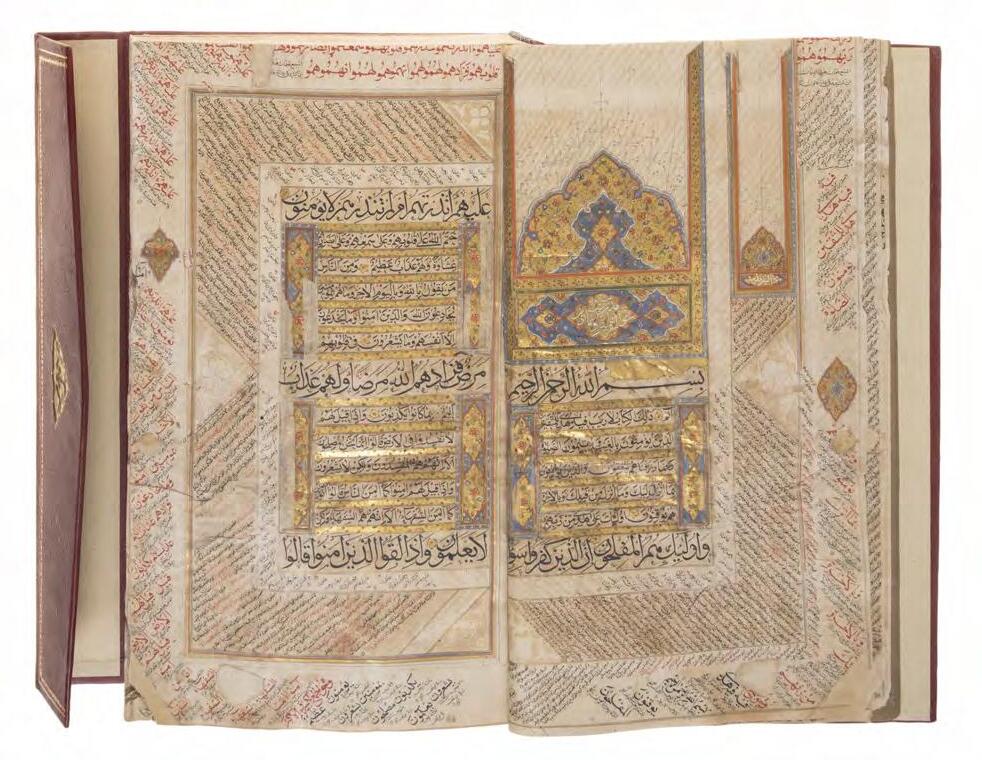
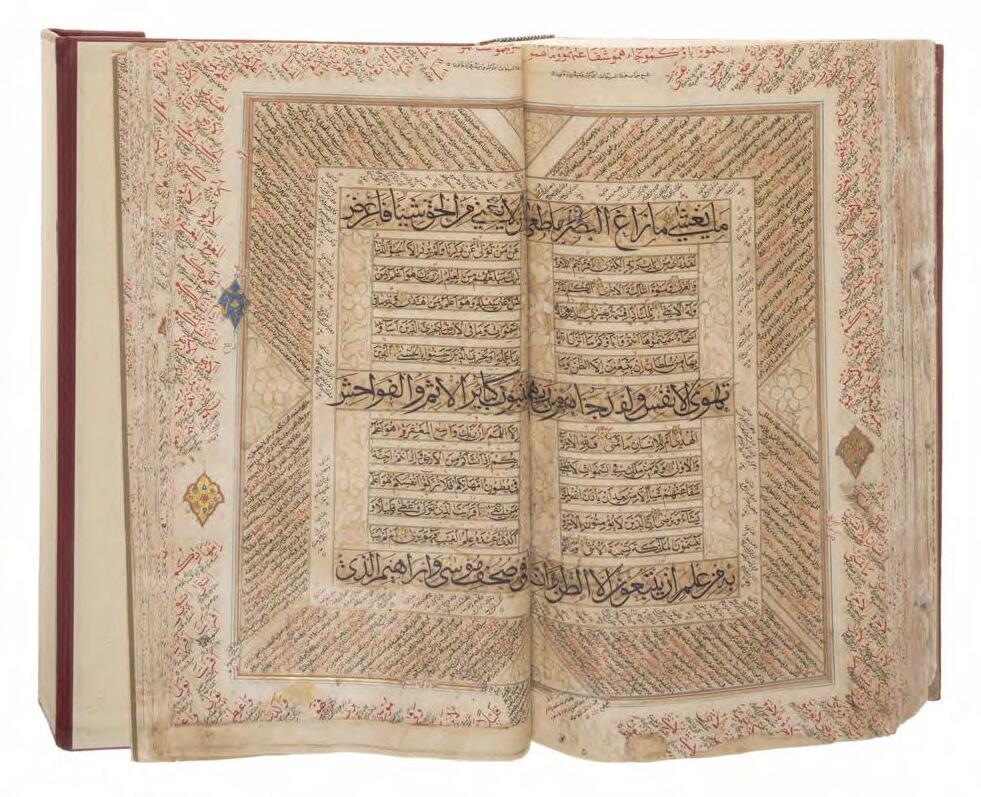
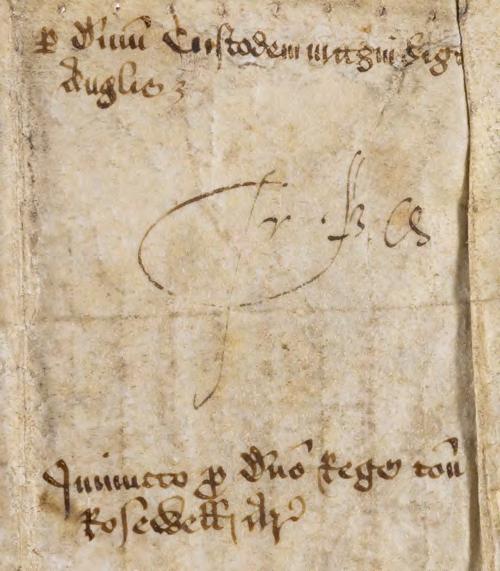
50 Bacon (Sir Francis: Viscount St Alban, Lord Chancellor, politician and philosopher, 1561-1626) INJUNCTION GRANTED IN THE COURT OF CHANCERY in the case of Henry Rosewell Esq. (defendant) and William Every Esq. (plaintiff), SIGNED BY FRANCIS BACON “FR. B. C.S” on verso, f., manuscript on parchment, in Latin, 21 lines, written in a small gothic court hand, ornate initial, slightly creased and stained, edges slightly rubbed, folds, amber wax seal of the Court of Chancery, chipped, (210x332mm), housed in custom red morocco drop-backed box, gilt, bookplate of Donald and Mary Hyde on upper cover verso, spine lightly sunned, [c.1617].
⁂ SIGNED BY FRANCIS BACON AS KEEPER OF THE GREAT SEAL OF ENGLAND
An unusual form of Bacon’s signature, rare in any form, in a fine cursive hand with the initials “C.S” (Custos sigilli), denoting his office. Bacon had been appointed Keeper of the Great Seal only 11 days previously, succeeding Lord Ellesmere on 7 March. Nine months later, on 7 January 1617/18, he was named Lord Chancellor.
The document records a dispute between Henry Rosewell and William Every over the Somerset manor of Stapleton, which had belonged to the Rosewell family since Henry’s grandfather acquired it after the dissolution of the monasteries. The conflict arose after Henry’s father mortgaged the estate to William Every, whose son later claimed ownership
£6,000 - 8,000
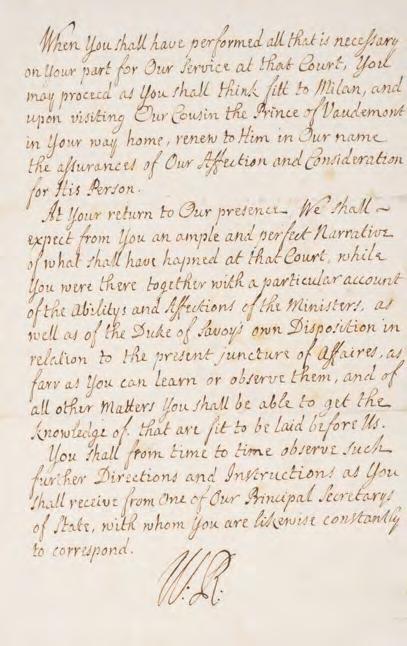
51
William III (King of England, Scotland, and Ireland, and Prince of Orange,1650-1702) INSTRUCTIONS FOR... RICHARD HILL ESQR WHOM WE HAVE APPOINTED TO BE OUR ENVOY EXTRAORDINARY TO THE DUKE OF SAVOY..., manuscript signed William R” and initialled “WR” at beginning and end, 3pp., folds, browned, folio, Kensington, 31st May 1699.
⁂ Diplomatic instructions to Victor Amadeus II, Duke of Savoy and his duchess, congratulating them on the birth of their son and to give “best assistance to the Vaudois, and other Proterstants yet remaining within the dominions of the Duke, and let them know your readiness to intercede for them.”
£1,000 - 1,500
52
Burns (Robert, poet, 1759-96) CUT AUTOGRAPH EXCISE NOTE SIGNED “ROBT. BURNS”, autograph manuscript, laid down on card, 40 x 195mm., n.d. [c. 1788].
⁂ “Compeat. I Robert Burns Officer of Excise and being solemn by sworn and interrogate depones to the truth of the above Execution, and this is truth as he shall answer to God. Robt. Burns.”
It was while employed as an exciseman in 1792 that Burns wrote his popular song, “The Deil’s Awa Wi’ the Exciseman”
£2,000 - 3,000

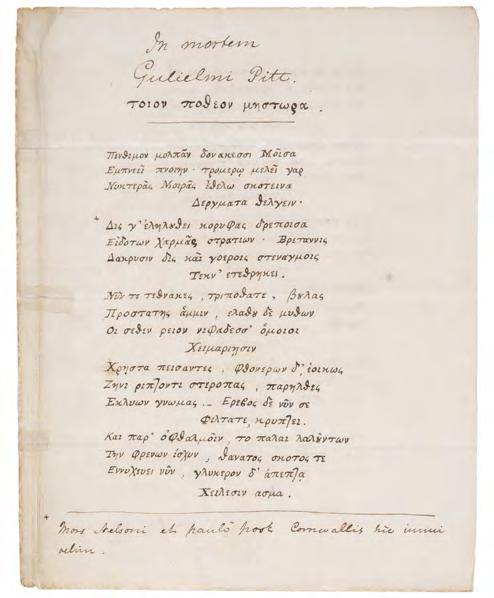
53
White (Henry Kirke, poet and hymn-writer, 1785-1806) IN MORTEM GULIELM PITT, autograph epitaph on the death of William Pitt, in Greek, 2pp., n.d. [c. 1805]; and a cut autograph manuscript of notes relating to his work with Coldham and Enfield, town clerk and attorneys of Nottingham, where he learned Latin and Greek, v.s., v.d. (2 pieces).
⁂ Following Henry Kirke White’s early death from tuberculosis, Lord Byron’s eulogy immortalised the young poet’s memory: ‘Oh! what a noble heart was here undone, When science self destroy’d her favourite son!’
£800 - 1,200
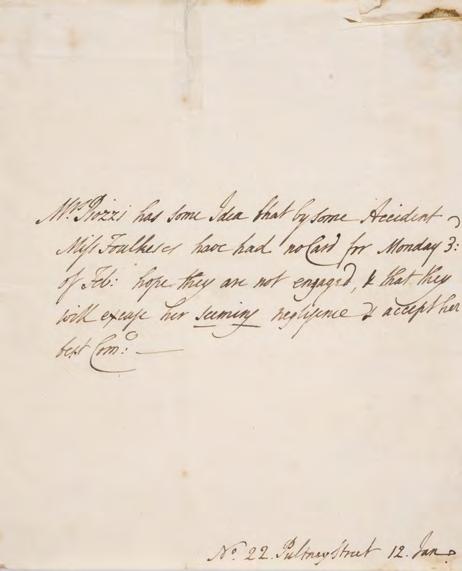
54
Women writers.- Piozzi [née Salusbury; other married name Thrale] (Hester, writer, 1741-1821) AUTOGRAPH LETTER SIGNED THIRD PERSON TO “MISS FOULKESAT MR KING’S HARINGTON PLACE”, 1p. with conjugate blank and address panel, sm. 4to, 22 Pultney Street, [Bath], 12th January [c. 1815], “Mrs. Piozzi has some Idea that by some Accident Miss Foulkes have had no Card for Monday... hope they are not engaged, & that they will excuse her seeming negligence & accept her best Com:o”, folds, brown marks, removed from an album leaf; and 24 others, women writers, including: C.M. Young, Isabel Burton (autograph signed card); Joanna Baillie, Mrs Oliphant, Lady Constance Gordon Cumming, Elizabeth Gaskell, Harriet Martineau, Jane Porter, Georgina Hogarth (Dickens sister-in-law); Felicia Hemans (cut signature), Anne Wickham in an old document in German (“In a tour round the Lake of Geneva I went to see the Chateau de Chillon in the room formerly the Torture room there were 2 soldiers ransacking a trunk full of papers, as they were all to be thrown away I took one - the nearly ilegible, ‘tis german Anne Wickham”), together 24 letters etc., folds, v.s., v.d. (24)
£1,000 - 1,500
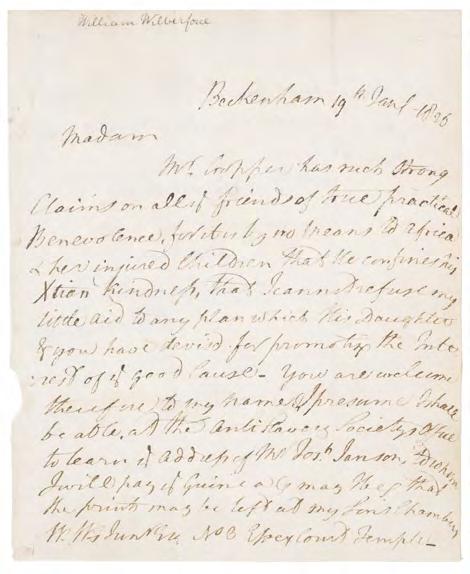
55
Wilberforce (William, politician, philanthropist, and slavery abolitionist, 1759-1833) AUTOGRAPH LETTER SIGNED TO “MISS ATKINS”, 2pp., sm. 4to, Beckenham, 19th January 1825, “Madam, Mr. Cropper has such strong claims on all the friends of true practical Benevolence, for it is by no means to Africa & her injured Children that he confines his Christian kindness, that I cannot refuse my little aid to any plan which his daughter & you have devised for promoting the interest of the good cause - you are welcome therefore to my name, & I presume I shall be able, at the AntiSlavery Society Office, to learn the address of Mr. Joseph Janson, to whom I will pay the Guinea & may I beg that the prints may be left at my son’s Chambers”; and an ALs from Thomas Clarkson, slavery abolitionist, to Joseph Taylor, London, 1st March 1792, instructing him on how best to organise anti-slavery petitions from Scarborough and Pickering and urging him to remonstrate with his local MP, Colondel Phipps on his pro slavery conduct, 2½pp., sm. 4to, both folds, browned (2).
⁂ First mentioned James Cropper (1773-1840), abolitionist and friend of Wilberforce and Clarkson.
£1,000 - 1,500
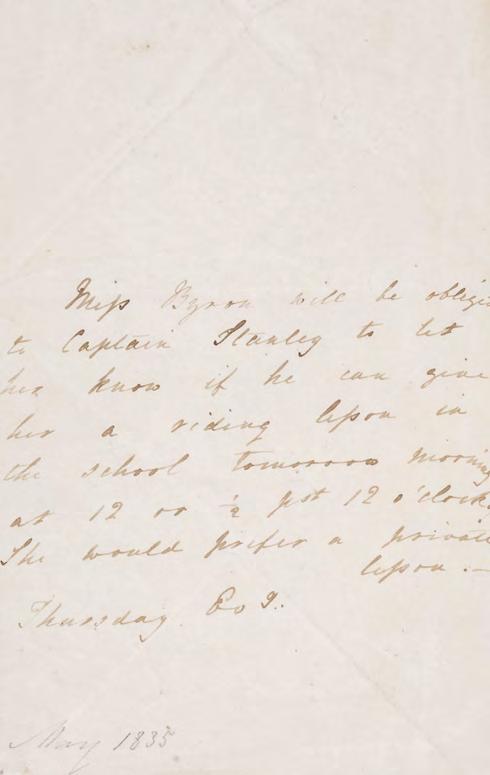
56
Byron (Augusta Ada [married name (Augusta Ada King, Countess of Lovelace], mathematician and computer pioneer, daughter of Lord Byron, 1815-52) AUTOGRAPH NOTE TO CAPTAIN STANLEY, King’s Street, Baker Street, London, 1p., n.p., May 1835, “Miss Byron will be obliged to Captain Stanley to let her know if he can give her a riding lesson in the school tomorrow morning...;”, folds, browned.
⁂ Ada Lovelace developed an addiction to gambling in the 1840s, believing she could use her computing skills to predict the outcome of horse races. It proved ruinous and at one time she was forced to pawn the family diamonds. She supposedly lost over £3000 in one bet on a horse in The Derby - over £300k in today’s money.
Whilst it was very much the norm for young ladies to ride, this note, requesting a riding lesson, is rather prescient, given her later relationship with equine beasts
£2,000 - 3,000
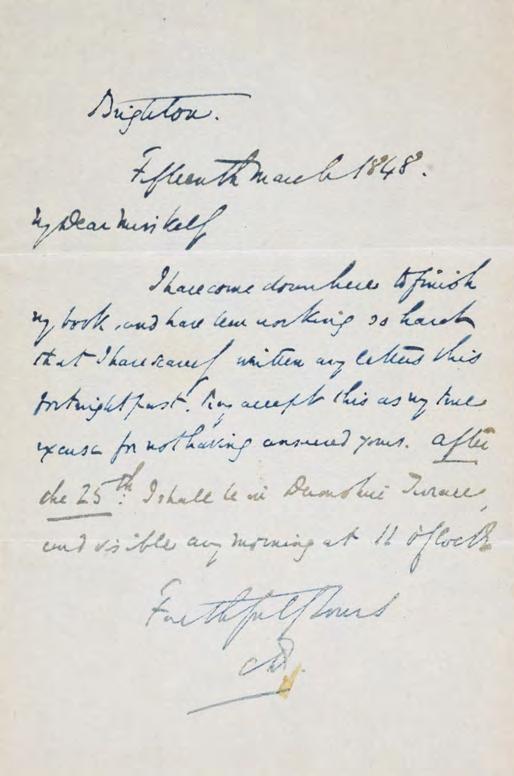
57
Dickens (Charles, novelist, 1812-70) 2 AUTOGRAPH LETTERS SIGNED, THE FIRST TO MISS KELF, THE SECOND TO JOSEPH MARSH, together 3pp. & 1 envelope, 8vo, Brighton & Devonshire Terrace, [London], 15th March 1848 & 4th March 1851, the first to Miss Kelf, explaining that the pressure of finishing a book has prevented him replying to her letter, [the final monthly instalment of Dombey and Son] and informing her of the date of his return to London, the second, to Joseph Marsh, seeking financial advice regarding the launch of his guild of Literature and Art, “I send you the Private Proof incidentally mentioned in our conversation yesterday...”; and 2 others, comprising: an autograph signed envelope to Prime Minister W.E. Gladstone at 10, Downing Street, and a photograph portrait of Dickens, Mason & Co., folds (5 pieces)
£2,000 - 3,000
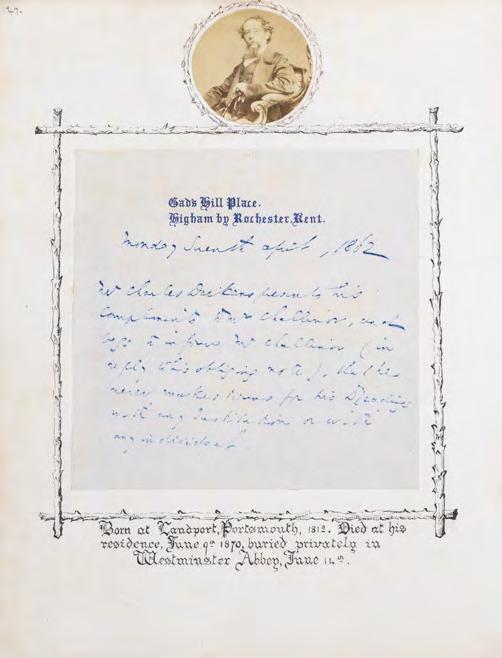
58
Dickens, Wellington, Robert Browning etc.- Bull (Mary, great grandaughter of Rev William Bull, Independent Minister in Newport Pagnell, 1738-1814, compiler) FINE AUTOGRAPH ALBUM, letters, including: Charles Dickens, Duke of Wellington, Robert Browning (autograph & signed envelope to William Gladstone’s daughter Mary); Cardinal Wiseman, Joseph Paxton, Robert Peel, Queen Victoria (envelope unsigned); Captain Frederick Marryat (autograph signed order to pay £5); Daniel O’Connell (autograph signed address panel); James Russell Lowell (ALs re: Gladstone); Captain Matthew Webb (re: swimming, first person to swim the English Channel); Frederick Duke of York, Samuel Rogers (autograph banking receipt); Cardinal Newman, Albert Richard Smith etc., cut signatures, including: D.G. Rosetti, Palmerston, Disraeli, William IV, Queen Alexandra, Jenny Lind, Henry Irving, Lord Cardigan (signed free frank); Joseph Mazzini, George Cruikshank, James Montgomery, Thomas Campbell, George III etc., pen and ink title and 104pp., tissue guards, all laid down, some foxing and browning, original morocco, gilt, slightly rubbed, items v.s., v.d., album sm. 4to, 1865.
⁂ Dickens (Charles novelist, 1812-70) Autograph Letter third person to William Challinor, 1p. cut down at tail, Gads Hill Place, near Rochester, Monday, 7th April 1862, Mr. Charles Dickens presents his compliments to Mr. Challinor, and begs to inform Mr Challinor (in reply to his obliging note), that he never makes terms for his Readings with any Institution or with any individual”.
William Challinor (1821-80), solicitor; of Pickwood, Leek, Staffordshire; wrote a pamphlet on inequities of the legal system and is quoted by Dickens in chapter 15 of Bleak House
£2,000 - 3,000
59
Babbage (Charles, mathematician and computer pioneer, 1791-1871) SIGNATURE AND CALCULATIONS IN BABBAGE’S HAND, on a cut portion of a printed document with manuscript insertions signed by George Biddle Airy, Astronomer Royal, folds, browned, 95 x 1245mm., n.d. [c. 1857].
⁂ These calculations were only recently discovered after the printed notice, on the verso of which they are written, was removed from an album. They reveal the errors of published astronomical tables by three of the leading mathematicians and astronomers of the day: Delaunay, Pontecoulant and Plana. The figures show numerical coefficients relative to the Longitude, Latitude and Radius vector of the Moon. Babbage published these inconsistent tables along with the above calculations in his Life of a Philosopher, 1864, to argue again for the essential need for a machine - an analytical engine - that would remove human error. It can be argued therefore that these very calculations were ultimately at least partially instrumental in Babbage winning his bitter argument with Airy, the Astronomer Royal, and signalling the coming age of computing science and technology
£2,000 - 3,000
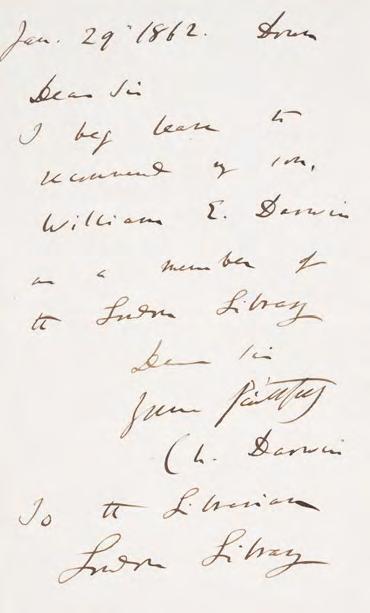
60
Darwin (Charles, naturalist, geologist, and originator of the theory of natural selection, 1809-82) AUTOGRAPH LETTER SIGNED TO THE LIBRARIAN OF THE LONDON LIBRARY, 1p., 8vo, Down, [Kent], 29th January 1862, “I beg leave to recommend my son, William E[rasmus] Darwin as a member of the London Library”, folds; and a photograph of Darwin, v.s., v.d. (2).
⁂ William Erasmus Darwin (1839-1914), eldest child of Charles and Emma Darwin, and the subject of child development studies by his father. Darwin published his findings in the journal Mind in June 1877, in an article titled “A biographical sketch of an infant”
£1,500 - 2,000
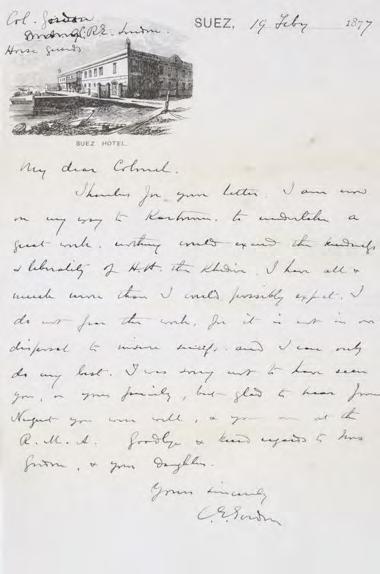
61
Gordon (Charles George, army officer, 1833-85) AUTOGRAPH LETTER SIGNED TO COLONEL GORDON, R.E., 1p., 8vo, Suez Hotel, Suez, 19th February 1877, informing him that he is on his way to Khartoum “to undertake a great work... I do not fear the work, for it is not in our disposal to insure success, and I can only do my best”, engraving of the Suez Hotel at head, left edge slightly chipped, folds.
⁂ Gordon on his way to Khartoum. Gordon’s somewhat ambiguous instructions from the government of William Gladstone was to go to Khartoum and evacuate the garrison and other interested parties from the city. Subsequently while organising its defence, Khartoum was surrounded, the city was stormed and Gordon was killed.
Gordon’s final journal entry, written in January 1885, shortly before the city fell, read: “I have done my best for the honour of my country. Good-bye.” - words which echo those written in this short letter, penned some 7 years earlier
£1,000 - 1,500
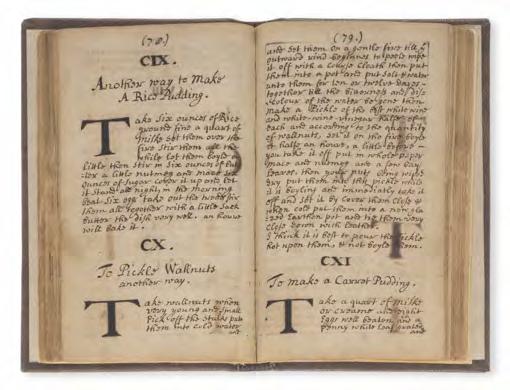
62
Cookery.- SOME USEFULL RECEIPTS IN COOKERY, AS CAKES, COLLOPS, FRICASSEES FORCE-MEATS, FLORENTINES, JELLY’S, PAST-ROYAL, PUFF-PAST, PIES, PUDDINGS, POTAGE, PRESERVES, PICKLES, RAGOO’S, SOOPS, SAUCES, WESTFALIAHAMS, &C., manuscript, in black and red ink, title and 144pp. & 13pp index at end, some offsetting of initials, browned, new endpapers, modern calf, 8vo (160 x 100mm.), 1719.
Receipts, including: “To make Sugar Past”; “To make Custards”; “To make Umbles or Calves ffeet Pies”; “A Rice or Almond Florentine”; “To Stew a Hare”; “To make a Sack Posit”; “A rare Receipt for fitts”; “To make past royal of Spices”; “To make Straberrie Tarts after the best fashion as a Griffen”; “To Preserve Rasberries”; “An Excellent Medicine for the Stone” etc.
Unpublished, no work with this title in ESTC
£600 - 800
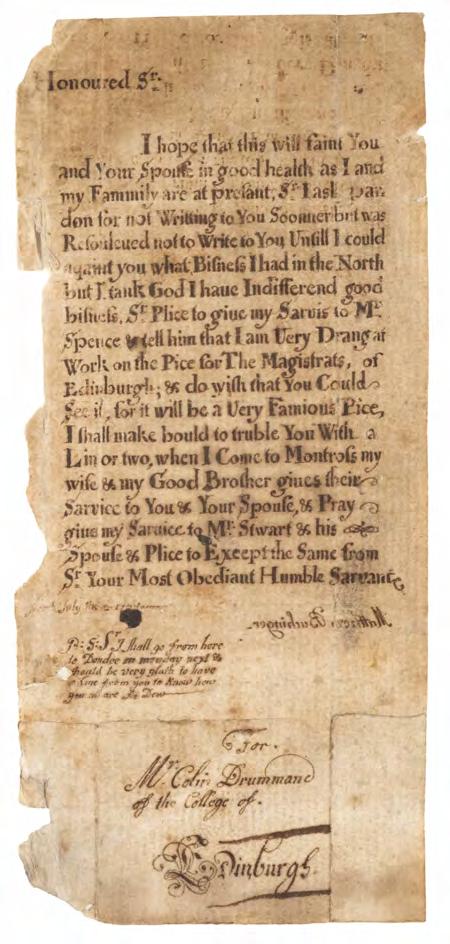
63
Buchinger (Matthew) LETTER FROM BUCHINGER TO COLIN DRUMMOND, COLLEGE OF EDINBURGH, MENTIONING A FORTHCOMING MAJOR WORK FOR THE ‘THE MAGISTRATS, OF EDINBURGH’, manuscript on paper, 19 lines, signed with mirrored signature, dated ‘July the 2nd 1727’, with calligraphic addressee details affixed to lower edge, total sheet 135 x 61 mm (5¼ x 2⅜ in), under glass, some minor offsetting to the upper section, one small ink spot partially obscuring date, minor browning and spotting, light surface dirt, old folds and marginal nicks and losses, framed, 1727
Provenance:
Private collection, London
Literature:
Ricky Jay, Matthias Buchinger: “The Greatest German Living”, 2016, p. 83
⁂ In Matthias Buchinger: “The Greatest German Living”, Ricky Jay writes how Buchinger’s short letters allow an insight into how he conducted his business affairs, as well as revealing expressions of friendship. The present letter was for Colin Drummond, a regent of Edinburgh University who taught logic and metaphysics. In the letter Buchinger references a forthcoming work: ‘... I am Very Drang [hard] at Work on the Pice [piece] for the Magistrats, of Edinburgh; & do with that you Could See it, for it will be a Very Famious Pice...’
£2,000 - 3,000
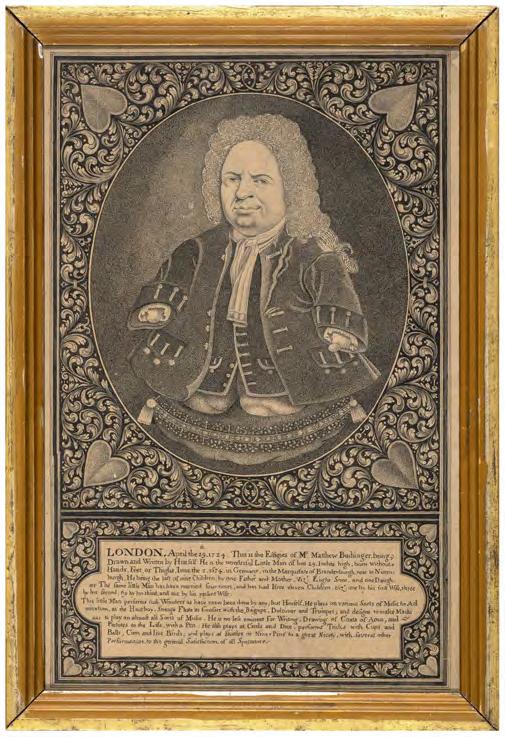
64
Buchinger (Matthew), After. THIS IS THE EFFIGIES OF MR. MATTHEW BUCHINGER, BEING DRAWN AND WRITTEN BY HIMSELF, engraving and stipple on very fine paper, an excellent well inked impression, probably printed chine collé, affixed onto card support, 305 x 200 mm (12 x 7⅞ in), very small loss in the upper right corner, very fine split through image repaired in the upper left quadrant, small restored loss within image to left of head, wooden slip frame affixed on top, under glass, framed, 1724
⁂ “[THE] MOST ICONIC OF ALL Buchinger IMAGES” [Ricky Jay, Matthias Buchinger, 2016, p. 53]. Incredible in its fine detail, with the curls of Buchinger’s patrician wig being composed of micrographic texts of the Lord’s Prayer and seven complete Psalms.
‘He is the wonderful Little Man of but 29. Inches high, born without Hands, Feet, or Thighs, June the 2. 1674. in Germany, … the same little Man has been married four times, and has had Issue eleven Children, vizt. one by his first Wife, three by his second, six by his third, and one by his present Wife.’
‘This little Man performs such Wonders as have never been done by any; but Himself. He plays on various Sorts of Music to Admiration, as the Hautboy, Strange Flute in Consort with the Bagpipe, Dulcimer and Trumpet; and designs to make Machines to play on almost all Sorts of Music. He is no less eminent for Writing, Drawing of Coats of Arms, and Pictures to the Life, with a Pen: He also plays at Cards and Dice, performs Tricks with Cups and Balls, Corn and live Birds; and plays at Skittles or Nine-Pins to a great Nicety, with several other Performances, to the great Satisfaction of all Spectators.’
£2,000 - 3,000
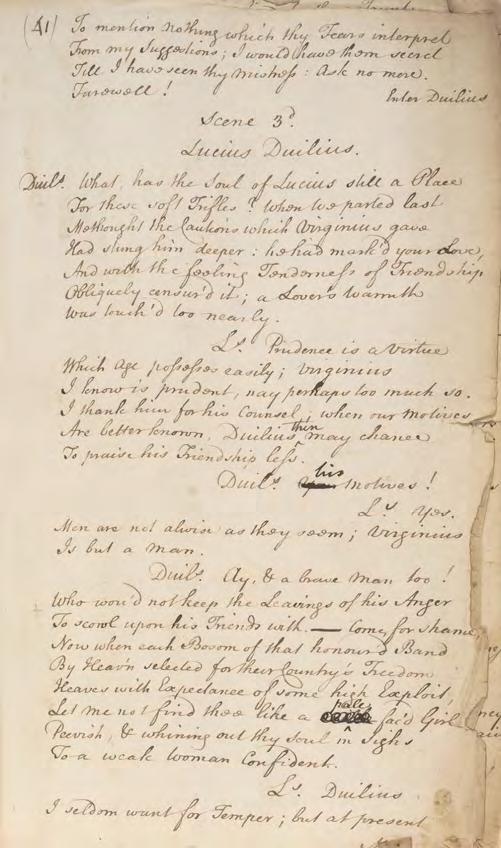
65
Unpublished play.- VIRGINIA. A TRAGEDY, manuscript draft in ink on paper (crowned GR watermark), 57 ff. (including initial advertisement f. and title / character list), plus a final blank, 310 x 190mm., advertisement f. and title torn with some loss of text, mostly short tears / chipping to outer edges, sometimes touching text, rolled in a scroll, stitched in contemporary drab wrappers, ?contemporary ink inscription ‘Virginia Original M.S.’, a few short tears / creasing at edges, soiled, housed in a modern dark green textured buckram drop-back box, black leather label to spine, [England], [c.1750-1760].
⁂ Original manuscript draft with numerous corrections of a mideighteenth century unpublished play on the theme of resistance to tyranny. The plot revolves around the attempted judicial seizure and rape of Virginia [Verginia], the plebian daughter of Roman Centurion Lucius Verginius, at the end of the tyrannical second decemvirate of Rome. In order to save his daughter from being declared a slave Lucius is forced to kill her. This scandal triggers army mutinies and civil unrest, which ultimately leads to the downfall of the decemvirs.
£4,000 - 6,000
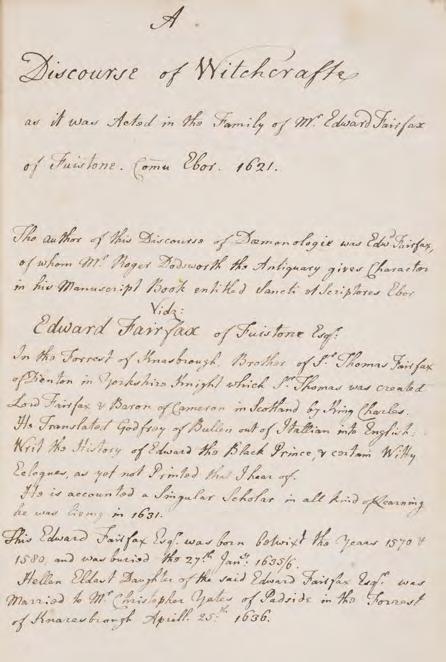
66
Witchcraft.- Fairfax (Edward, translator and antiquary, brought a case of witchcraft to law in 1622, 1568?-1632x5?) & Beckwith (Thomas, herald painter and antiquary, of York, 1731-86)
[DAEMONOLOGIA] A DISCOURSE OF WITCHCRAFTE AS IT WAS ACTED IN THE FAMILY OF MR. EDWARD FAIRFAX OF FUISTONE. COMU. EBOR. 1621, autograph manuscript by Thomas Beckwith, title and 118pp., in a neat and legible hand, p. 46/7 smal tear repaired wthout loss, engraved armorial bookplate of “Thos. Beckwith, of York Painter & FAS” on front pastedown, original half calf, marbled boards, calf slightly rubbed, spine with manuscript paper label “67” at tail of spine, slightly chipped at head, watermark Royal coat of arms of George’s I & II, folio (320 x 195mm.), [c. 1760].
⁂ An account of witchcraft in the Jacobean era.
“Item for some days following the Children had Divers trances, & in them great pain in the Eyes, & gripings at the Hearts, & some Aparitions, the Elder felt two little Hands, imbrace her Straitly & pull her heart, & the 25th of Jan.y being fryday a Woman Apeared to her whom she knew not, & said that she was her Aunt Mary, Vidz: Mrs. Pannet come from York to see her, & that she had brought her Spice, & offered to put something into her Mouth: but she would not Suffer her & she said get thee away, thou Art a Witch, & not My Aunt… .” - Edward Fairfax, Daemonologia, p. 43/44.
Daemonologia. ”After the death of Fairfax’s youngest daughter, Anne, in October 1621, his eldest daughter, Ellen, reported seeing visions, and she, her sister Elizabeth, and a friend finally accused some local women of witchcraft. Edward took the matter to the assizes in August 1622. His case collapsed when the girls’ friend confessed that the whole thing had been a hoax devised by her father and agreed to by the Fairfax girls who treated it as a bid for their father’s attention. The friend’s father was sent to prison, and the judges roundly criticized Fairfax’s common sense. Fairfax recorded the whole affair in his Daemonologia, which never casts doubt on his daughter’s story and ascribes Anne’s death to witchcraft.” - Oxford DNB.
Daemonologia circulated in various manuscripts in the seventeenth and eighteenth centuries but was not published until 1858-9 in Miscellanies of the Philobiblon Society.
£5,000 - 7,000
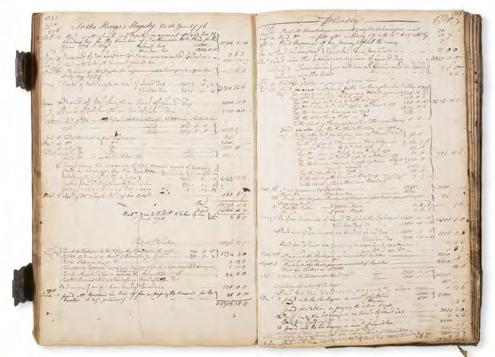
18 century solicitor acting as agent for George III and several aristocratic families.- [Partington (Thomas Walley, solicitor, agent for George III, Grosvenor, Berkeley & Sackville families, of Offham, Sussex, 1729-91)] CASHING BOOK NO 4, (title from upper cover), manuscript account book, in two hands (mostly one hand), 354pp. (numbered 1-177 double page numbers), index at front, ruled in red, a few ff. loose, others working loose, browned, original vellum, original velloum, soiled, stained and yellowed, two metal clasps, spine torn at head and tail, folio, 1761-79.
⁂ An account book detailing a large amount of social information of life in the 18 century. INCLUDED ARE SEVERAL REFERENCES TO ONE OF THE SCANDALS OF THE AGE, THE ADULTEROUS AFFAIR OF LADY HENRIETTA GROSVENOR AND KING GEORGE III’S BROTHER, THE DUKE OF CUMBERLAND, RECORDED HERE IN TERMS OF FINANCIAL PAYMENTS Henrietta Grosvenor had an affair with George III’s brother, Henry Frederick, Duke of Cumberland, which was brought to an end by their discovery in flagrante delicto in November 1769. Richard Grosvenor sued Cumberland for criminal conversation and was awarded damages of £10,000. Also known to be guilty of adultery, Grosvenor could not sue for divorce, but he separated from his wife, upon whom he settled £1200 a year. “Novr 23 1770 To Lord Grosvenor... Recd. the sevl. sums charged in my last accot. settled wth. your Lordship as Articles of payment on accot. of the Causes ags. the Duke of Cumberland & Lady Grosvenor - amounting to... 404 1 7.”
Thomas Walley Partington was born in 1729, the eldest son of Edward Partington, Chester attorney. He subsequently practised as a solicitor in London, acting as agent for George III (specifically for the land & window tax for Northamptonshire & Rutland), the business affairs, rents and receipts of the Sackville family (Lord George Germain, first Viscount Sackville and the Duke of Dorset), the Earl of Berkeley, Lady Elizabeth Compton, Earl of Northampton, Lord Grosvenor and the management of the Grosvenor estate in Mayfair. The accounts also records payments to shoemakers, hatters, silversmiths, coachmakers, butchers and other tradesmen serving several aristocratic families. Other roles of Partington included as a lottery commissioner, a witness at the trial of William Byron, fifth Baron Byron, before the House of Lords Apr 1765 (Howell, State Trials, xix, col. 1219), Deputy Receiver-Gen., Jamaica 24 Aug 1776 (to hold post during lifetime of Viscount Sackville. He married first, 11 Jul 1754 Elizabeth, sister of Robert Andrews and secondly, 11 Dec 1756 Sarah, sister of James Trebeck. He died 8 March 1791
£2,000 - 3,000
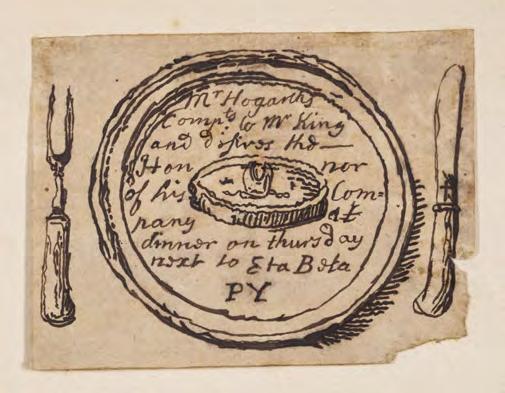
68
Hogarth (William), Traditionally attributed to INVITATION TO DINNER, FROM HOGARTH TO DR. ARNOLD KING, pen and brownish-black ink, on buff paper, sheet 70 x 90 mm (2¾ x 3½ in), tipped at corners onto support, some surface dirt and browning, small loss to the lower right corner, inscribed verso of mount ‘by W. Hogarth unframed, 18th century
Provenance:
[inscribed in pencil verso] bought of Mr [Frederick] Gye/ 16 July 1859;
Indistinct name in pencil; Dobells of Tunbridge Wells; Private collection, London
Literature:
cf. Oppé, A.P., The Drawings of William Hogarth, Appendix, no. 107 [describes Cary’s etching]
⁂ Primarily known through an etched copy by J. Cary, Hogarth’s invitation featured as the vignette on the title-page of the 1785 publication Biographical Anecdotes of William Hogarth. Cary’s etching was said to have been based on a pen drawing that was at the time in the possession of Dr. Wright. As far as we are aware, the original drawing has not been located in recent literature.
Arguably more well known than Cary’s etching, Hogarth’s invitation was, and still is, used on the late Andrew Edmund’s eponymous Lexington Street restaurant menus.
Another drawing attributed to Hogarth with supposed Frederick Gye provenance is held in the British Museum.
£800 - 1,200
69
Irish heraldry.- George III (King of the United Kingdom of Great Britain and Ireland, and King of Hanover, 1738-1820)
DOCUMENT ELEVATING THOMAS EARL OF BECTIVE TO MARQUIS OF HEADFORT IN THE COUNTY OF MEATH, Ds., initial “G” enclosing a fine oval watercolour portrait of George III and 2 coats of arms in left hand corner and 3 painted emblems depicting the harp of Ireland, the Royal coat of arms and the rose of England above text, manuscript on vellum, the first line of text in large gothic letters in gold, capitals with scrolling decoration in red, Great Seal of Ireland in metal skippet, folds, slightly creased and browned, preserved in the original red morocco box decorated with a powdering of gold stars of the knights of St Patrick, box lined with marbled paper, extensively rubbed and slightly dulled, by E. Barnes, Trunkmaker of Fishamble Street [Dublin] with their printed label on inside of box, c. 700 x 720mm., Dublin, 30th December 1800.
⁂ Provenance: By descent in the family
£2,000 - 3,000
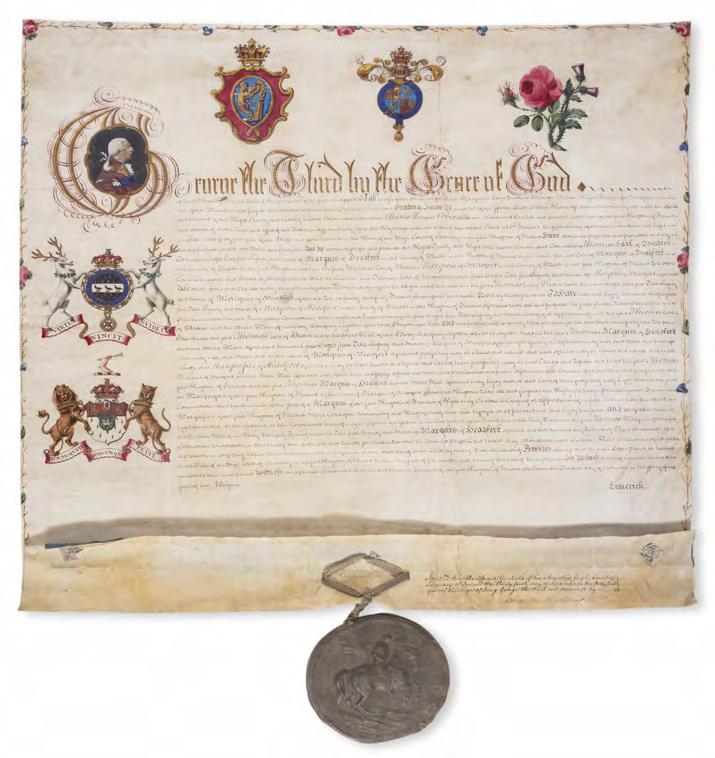
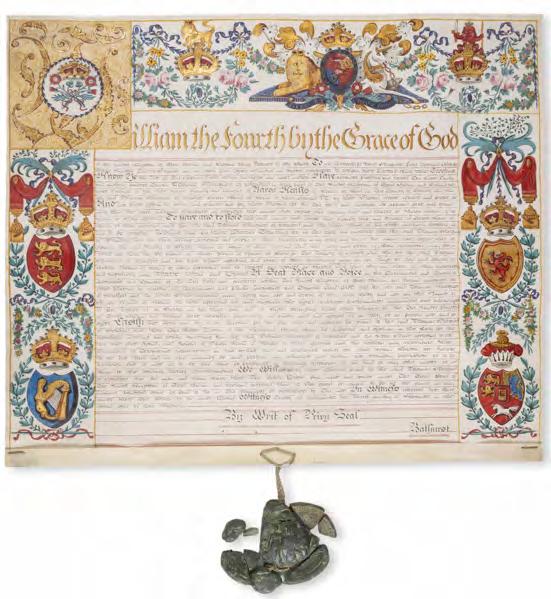
70
Heraldry.- William IV (King of the United Kingdom of Great Britain and Ireland, and King of Hanover, 1765-1837)
DOCUMENT ELEVATING THOMAS MARQUESS OF HEADFORT TO BARON KENLIS, Ds., large initial “W”, hand-painted coats of arms and emblems in margins, manuscript on vellum, the first line of text in large gothic letters in gold, ruled in red, broken remains of the Great Seal, lower part of metal skippet only, preserved in the original fawn morocco box, gilt floral decoration, box lined with marbled paper, extensively rubbed, c. 720 x 870mm., Westminster, 10th December 1831.
⁂ The Marquess of Headfort was granted the title of Baron Kenlis in the Peerage of the United Kingdom so he could take a seat in the House of Lords.
Provenance: By descent in the family
£600 - 800
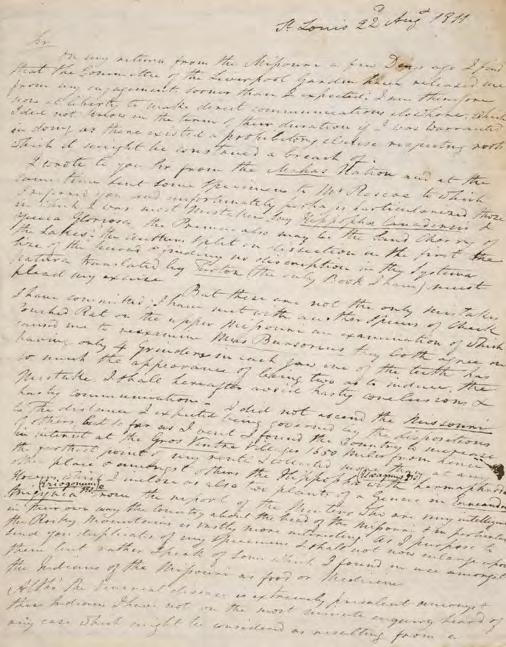
71 Explorer of America.- Bradbury (John, botanist and explorer of America, of Stalybridge, Tameside, Greater Manchester, 17681825) AUTOGRAPH LETTER SIGNED TO SIR JAMES SMITH, 3pp. & address panel, 4to, St Louis, [Missouri], 22nd August 1811, giving a detailed account of his activities during his celebrated travels into the interior of America, his dealings with Indians, sending botanical specimens, announcing a future excursion with the Indians etc., “... It is much my wish to collect the materials for the natural History of this country... as I am now known to the Indians, am seasoned to the woods and purpose to reside for some years here or on the Arkansas River I shall have a good opportunity. I shall trust the arrangements of those materials to some abler hand in the choice of which my own country shall have the preference. I have made arrangements with the Osage Indians to accompany them next spring in their annual excursion for Salt betwixt the Arkansas & Red River should I be able...”, folds, slightly browned.
⁂ Letters by Bradbury are rare.
Sir James Smith (1759-1828), founder of the Linnean Society
£600 - 800
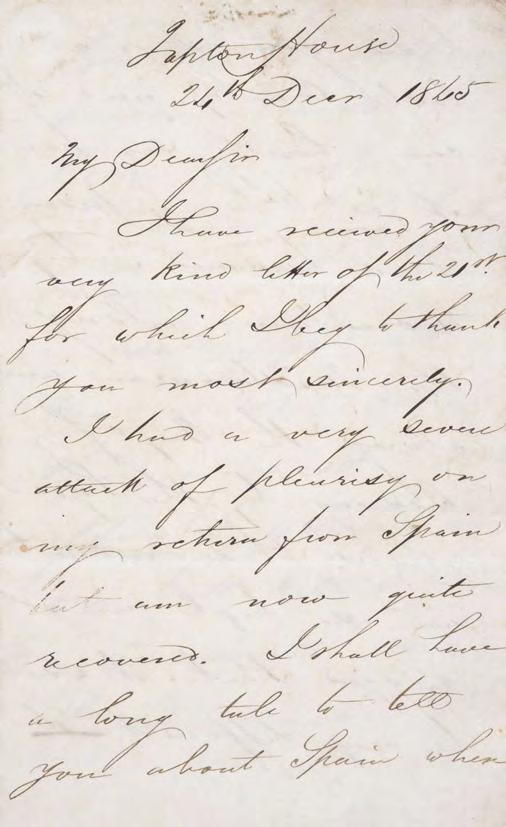
72
Stephenson (George, colliery and railway engineer, 1781-1848) LETTER SIGNED TO MR INGE, 10pp., 8vo, Tapton House, [Tapton, Derbyshire], 24th December 1865, describing his visit to Spain to survey the route of a new railway, and describing a bullfight, “... it is a lost Country, and I can hardly see how it is to be improved: it is hemmed in by mountains along by the Midteranean [sic] and along the Bay of Biscay by the Pyrenees; these mountains are so high and rugged that it would be very difficult to make good roads over them”, folds.
⁂ Stephenson had been invited to Spain to examine the proposed line of the Royal North of Spain Railway
£600 - 800
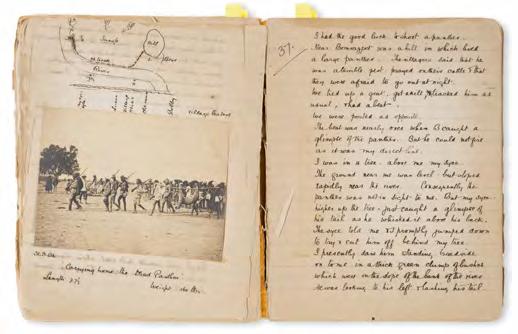
73
India.- [Wardrop (Sir Alexander Ernest, British Army general and author, GCB, CMG, 1872-1961)] HOT WEATHER SHOOT, manuscript, 83pp. excluding blanks, 7 photographs, several ff. loose, others working loose, a few repairs with tape, browned, original cloth, author and title lettered direct on upper cover, slightly stained and rubbed, rebacked in paper tape, sm. 4to (225 x 174mm.), 15th March - 15th June 1894.
⁂ An unpublished account of “three months failure shoot in the jungles of the Deccan [southern India]”. Their first camp was at Kondapoor where they spent ten days, “we bagged three panthers [leopards] before we left.” Next they moved to Bomrazpet before spending a week at Kothoor “without getting a kill from a tiger.” Whilst at the camp they punish a local patel [policeman] who has beaten a villager, “As a rule police and village patel run hand in hand & stick at no conceivable crime down to murder itself... the villagers are practically slaves.” Wardrop killed a tiger near Ippapully, the only one of the entire shoot. The expedition marched six miles south to Nuncherla where they met the Rajah, “not a bad chap & very civil to us”. Wardrop concluded that though the expedition was a failure, consoled himself that no one was injured, and that though “The Sport was very poor... I certainly enjoyed myself.”
£600 - 800
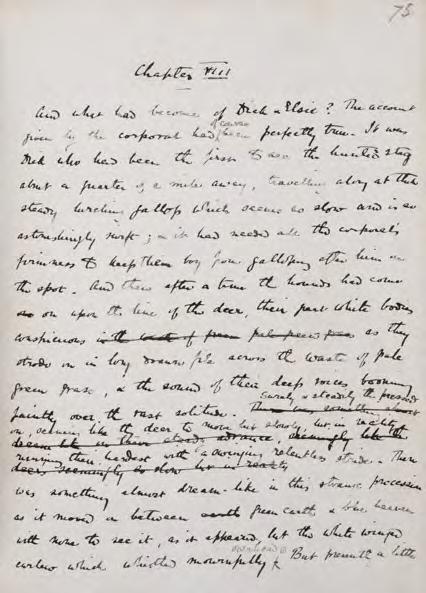
74
Fortescue (Sir John, military historian, librarian at Windsor Castle, 1859-1933) THE DRUMMER’S COAT, PRESENTATION INSCRIPTION FROM THE AUTHOR TO HIS SISTER MARY and further inscriptions on front free endpaper, AUTOGRAPH MANUSCRIPT, title and 176pp., written on rectos only, numerous corrections, a few brown marks, bookplate of Winifred Fortescue on front pastedown, bound in original red gilt panelled crushed and polished morocco, corners and edges a little rubbed, gilt panelled spine, by Bumpus, Oxford, sm. 4to (236 x 185mm.), 1899.
⁂ The Drummer’s Coat is a story set in a Devon village, and two children, Dick and Elsie Bracefort. The village is rife with whispers of witchcraft and superstition, particularly surrounding the mute child Tommy Fry, and the allure of a magical drummer’s coat on display at the Hall.
Fortescue was a military historian, writing on various military exploits, culminating in his 13 volume History of the British Army Fortescue also wrote several children’s books including The Story of a Red Deer (1897) and The Drummer’s Coat, published in 1899 by Macmillan, and illustrated by H.M. Brock.
Provenance: “Mary from the writer Feb. 1900. Given to Mary Bridgeman, his sister, by the author John Fortescue. She gave it to his wife, Winifred Fortescue as a wedding present on April 30th. 1914, who, in her turn presents it to John’s great-nephew, Arthur Fortescue, for his on April 30th. 1946.” Thence by descent in the family
£1,000 - 1,500
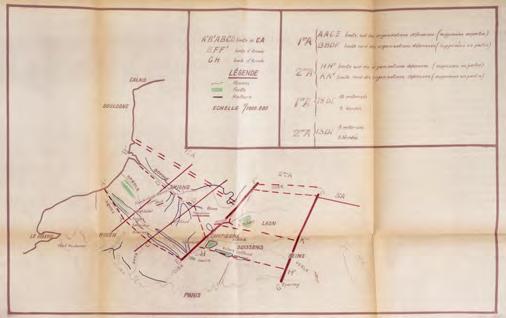
75
French Resistance.- FORCES FRANÇAIS DE L’INTÉRIEUR. ETAT MAJOR NATIONAL. 2E BUREAU. BULLETINS DE RENSEIGNEMENTS. EXEMPLAIRE NO. 2, 2 vol., typescripts, c. 400pp., 5 folding maps, 5 folding tables (one table loose, all with some tears), vol. I one page and a front free endpaper loose, browned throughout, original buckram-backed boards, rubbed, joints splitting, vol. I upper cover loose, spines faded, some edges chipped, sm 4to (273 x 215mm.), November 1943 - March 1944 & May - August 1944.
⁂ Classi fi ed documents detailing the activities of the French Resistance at a critical period of the Second World War. Includes secret reports on German troop movements, execution of collaborators, operations of the Gestapo, “Le Gestap de Nice ayant terminé sa mission contre les juifs, demande des instructions pour ceux séjournant à Monaco”, pursuit of the Milice etc
£600 - 800
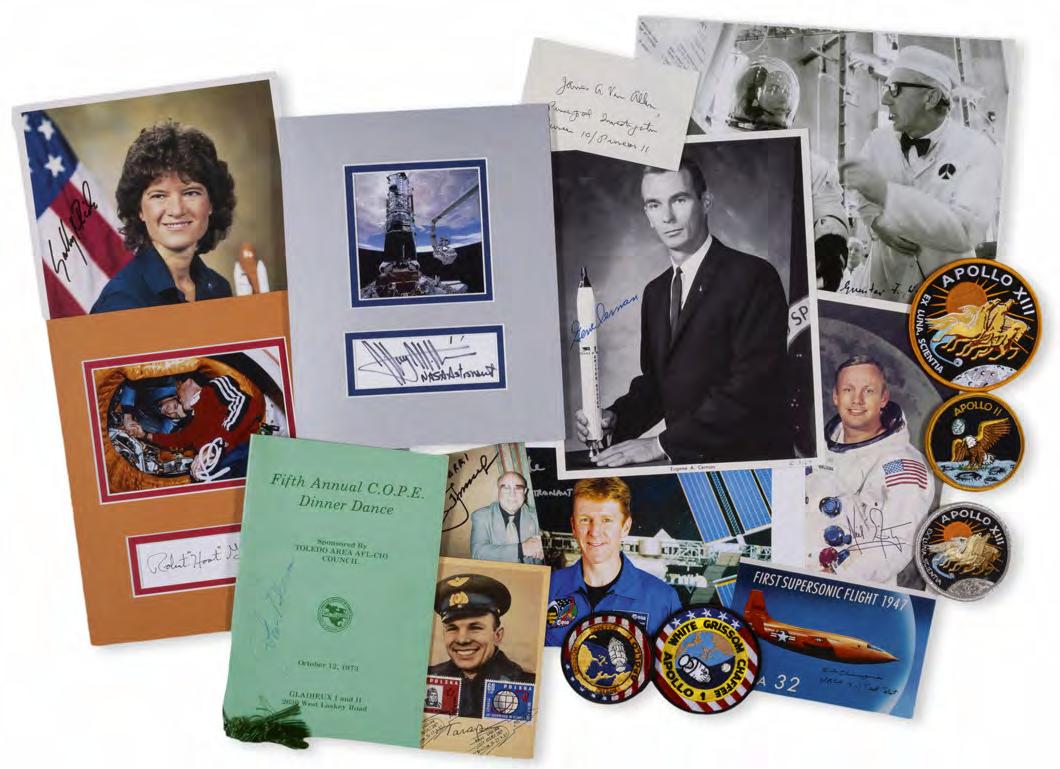
Cosmonauts & Space.- COLLECTION OF SIGNED PHOTOS AND EPHEMERA RELATING TO SPACE AND ASTRONAUTS, including c.100 cut signatures, signed photos, letters/envelopes (including duplicates), c.60 space badges (including duplicates), commemoration coin of the Apollo-Soyuz Mission, and numerous newspaper clippings, 10 folders, [20th-century].
⁂ A vast collection of signatures by renowned astronauts and members of important space missions. Of particular note is the emphasis on Russian cosmonauts, women and NASA scientists and staff
People of note in this collection include: Yuri Gagarin (the first human in outer space, and the first to orbit Earth); Oleg Makarov (who was the survivor of the crash landing in the mountains of Siberia, after the launch failure of the Soviet spacecraft, “Soyuz 18”); Alexey Leonov (the first human to walk in space); Valeri Polyakov (who had the longest spaceflight, having stayed aboard the Mir space station for 437 days and 18 hours); Sally R. Ride (first American woman in space); Georgi Ivanov (first Bulgarian cosmonaut); and Tim Peake (the first British astronaut to visit the International Space Station); James van Allen (pioneer astrophysicist, who helped develop proximity fuses for weapons used in war, especially for anti-aircraft projectiles used by the U.S. Navy); Robert Champine (pioneer supersonic text pilot, sixth man - third civilian - to break the mysterious sound barrier); John Herschel Glenn (piloted the first manned orbital mission of the United States); Gunter Wendt; Scott Carpenter (first human to penetrate both inner and outer space, acquiring the dual title: Astronaut/Aquanaut); Oscar Holderer (last of the German rocketeers); and Werner Kurt Gengelbach (German rocket engineer, expert in guided missiles during World War Two). Missions of note and those involved include: Apollo 11: Neil Armstrong, Michael Collins, Steve Bales, Jack King ‘Voice of Apollo; Apollo 8: Frank Borman, Apollo 13 Fred Haise, Christopher Kranz, Gerald Griffin; and Apollo 17: Eugene Cernan.
£6,000 - 8,000
77
Robinson (Ray Charles, American singer, songwriter, and pianist, 1930-2004) RAY CHARLES, PROGRAMME SIGNED BY RAY CHARLES, illustrations (many full-page), letter of provenance by the vendor loosely inserted, original stiff paper wrappers, light creasing, folio, New York, Program Publishing Company, 1965.
⁂ Provenance: Purchased at a Ray Charles concert in San Francisco during the 1960s where the vendor, a young British woman working in the USA, was able to meet Ray Charles and ask him to sign her programme.
“When we entered the room, Ray greeted us like old friends. He was utterly lovely, made us feel so welcome and at ease, he had a really lively, vibrant energy about him too ... He asked whereabouts in England I was from and when I told him Liverpool he was eager to chat about the great Liverpool music scene ... I cheekily invited Ray to my family home for afternoon tea with us all next time he was in Liverpool and he was quite excited about that.”
£800 - 1,200
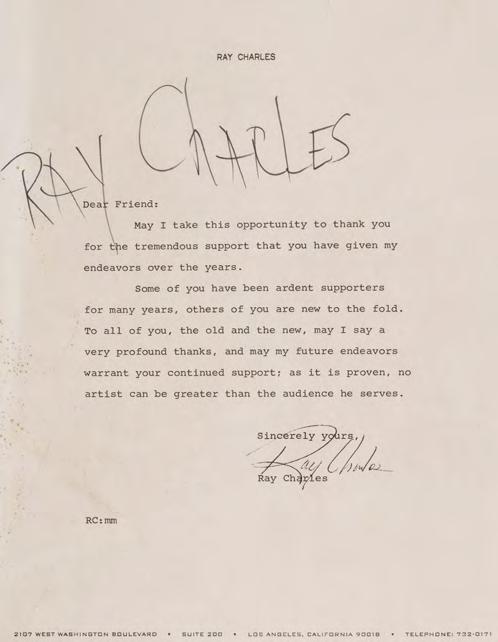
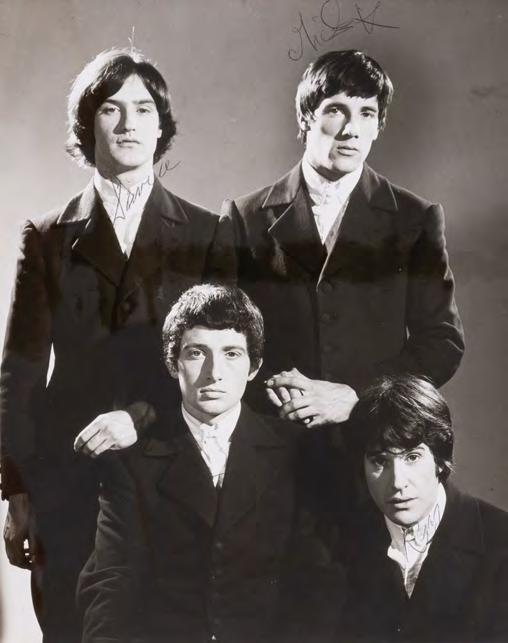
78
The Beatles, The Rolling Stones, The Kinks.- ALBUM OF 18 PHOTOGRAPHS OF BRITISH ROCK AND POP MUSICIANS CAPTURED BY MONTE FRESCO, SIGNED BY all THE SUBJECTS, comprising: The Beatles, The Rolling Stones, The Moody Blues, Rockin’ Berries, Mark Winter, Marianne Faithful, The Zombies, Long John Baldry, Billy J. Kramer, The Honeycombs, Cilla Black, Gerry and the Pacemakers, Ivy League, Julie Grant, P. J. Proby, Gene Pitney, Donovan, and The Kinks, and an unsigned photograph of Paul McCartney, a few spots or surface stains, preserved in original red morocco album, 4to, c.1960s.
⁂ COLLECTION OF PHOTOGRAPHS SIGNED AT THE TIME BY PIONEERS OF ROCK AND POP FROM THE REVOLUTIONARY PERIOD OF MUSIC IN BRITAIN DURING THE 1960S, INCLUDING ALL MEMBERS OF THE BEATLES, THE ROLLING STONES (WITH BRIAN JONES), AND THE KINKS
Monte Fresco was a celebrated Fleet Street photographer famed for capturing remarkable shots in wars, revolutions, sporting moments, royal occasions, and the famed and infamous. Along with Ethan Russell, FRESCO TOOK THE LAST PROFESSIONAL PHOTOS OF THE BEATLES, JUST AFTER THEIR FINAL RECORDING SESSION IN 1969. He was later honoured with an MBE for his services to photographic journalism in 1996.
Fresco had the talent of knowing which photographs certain picture editors would be eager to buy and was rewarded for this acumen.
Provenance: Monte had been commissioned to take a series of photographs of well-known singers and groups. This collection of signed photographs was given as a gift in the early 1960s by Monte Fresco to a very good family friend.
£8,000 - 12,000
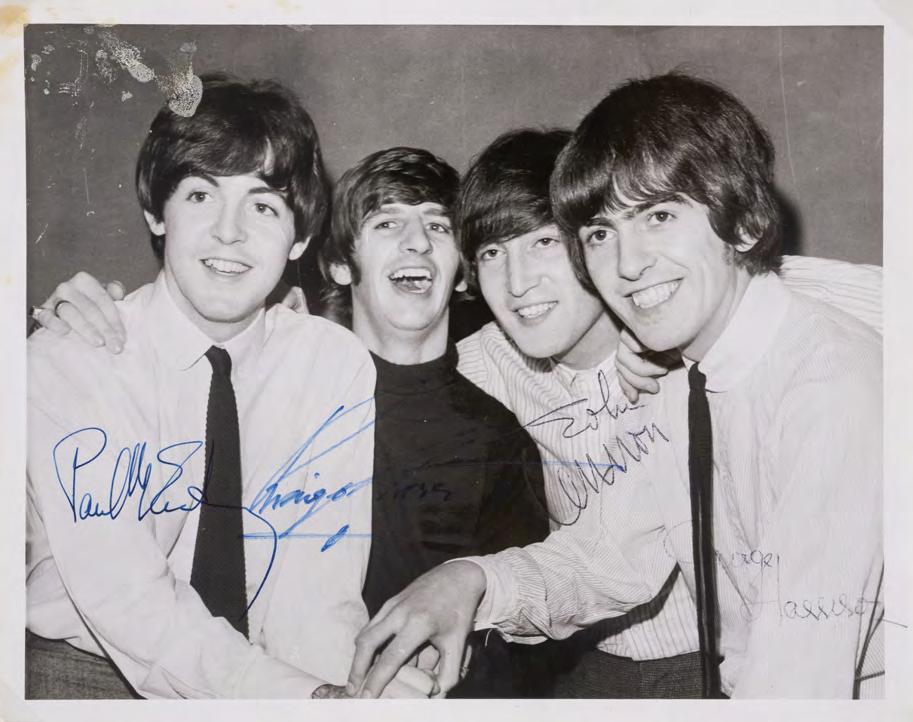
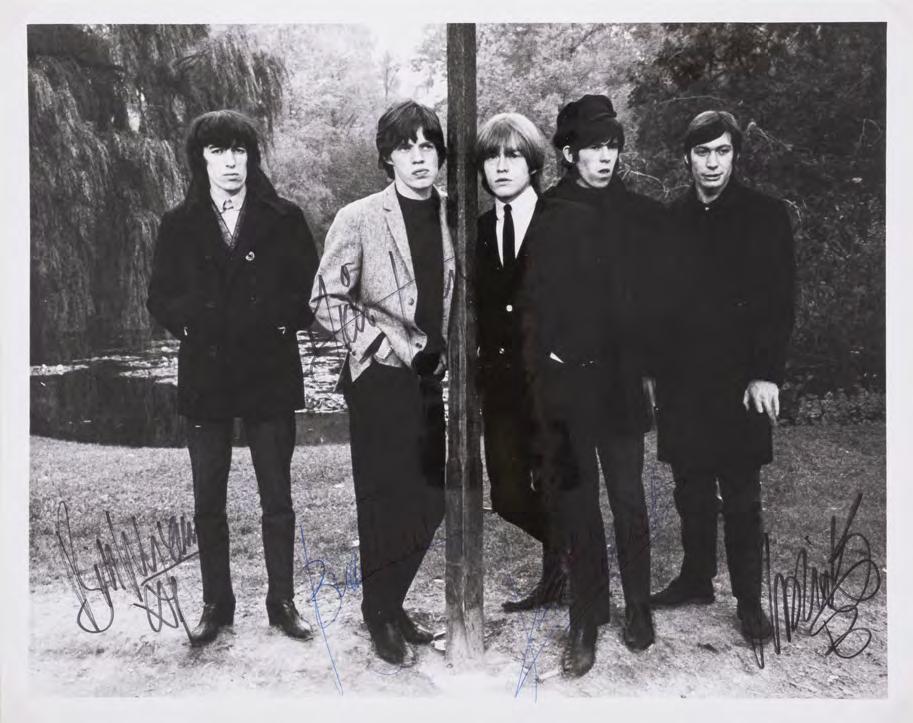
79
Turner (William) A NEW BOKE OF THE NATURES AND PROPERTIES OF ALL WINES THAT ARE COMMONLY VSED HERE IN ENGLAND, with a confutation of an errour of some men, that holde, that Rhennish and other small white wines ought not to be drunken of them that either haue, or are in daunger of the stone, the revine, and diuers other diseases, 2 parts in 1, FIRST EDITION, black letter, woodcut head- and tailpieces and decorative initials, trimmed at outer margin, just touching some printed sidenotes, water-stained, some spotting or staining, lightly browned, later blind-ruled reversed calf, sympathetically rebacked, spine in compartments, rubbed, housed in a 20th century burgundy morocco-backed buckram drop-back box, spine titled in gilt, [Gabler G39750; Simon BB 644; Simon BG 1487; Simon Vinaria opposite p.6; STC 24360; ESTC S103034], small 8vo, By William Seres, 1568.
⁂ RARE COPY OF THE FIRST ENGLISH BOOK ON WINE
We trace only two copies at auction since 1917 (one of which defective). The last copy to appear was the Heber-Huth-Simon copy in 1981 (The Property of Mrs. J. D. Simon from the Library of the late André L. Simon, Sotheby’s, 18th May, 1981, lot 192, bought by Quaritch for £3500). Simon considered his copy to be one of the most important books in his collection ‘Among the sixteenthcentury books there is none that I value more than William Turner’s A new Boke of Wynes (1568), not only because it is a very rare little book, the first to be published in the vernacular on the subject of wines, but because it was given to me by a dear friend, Hugh Cecil Lea’ (preface to Bibliotheca Gastronomica). William Turner (c.1509-1568), English divine, physician and natural historian. He suffered from painful stones in his bladder and in this little treatise he warns his contemporaries to avoid the sweet and strong wines of the Mediterranean and instead to drink the Rhenish or light wines of France. Shakespeare is thought to have been familiar with the work, from which he drew wine references for his plays (cf. G. C. Williamson, ‘Shakespeare’s Wine-Book’, 1923).
Provenance: Bought from W.H. Robinson Ltd., Pall Mall, 13th November, 1950 for £150; exhibited at ‘Food and wine. An exhibition of rare printed books assembled and annotated by André Simon. 12 April-12 May, 1961’
£20,000 - 30,000
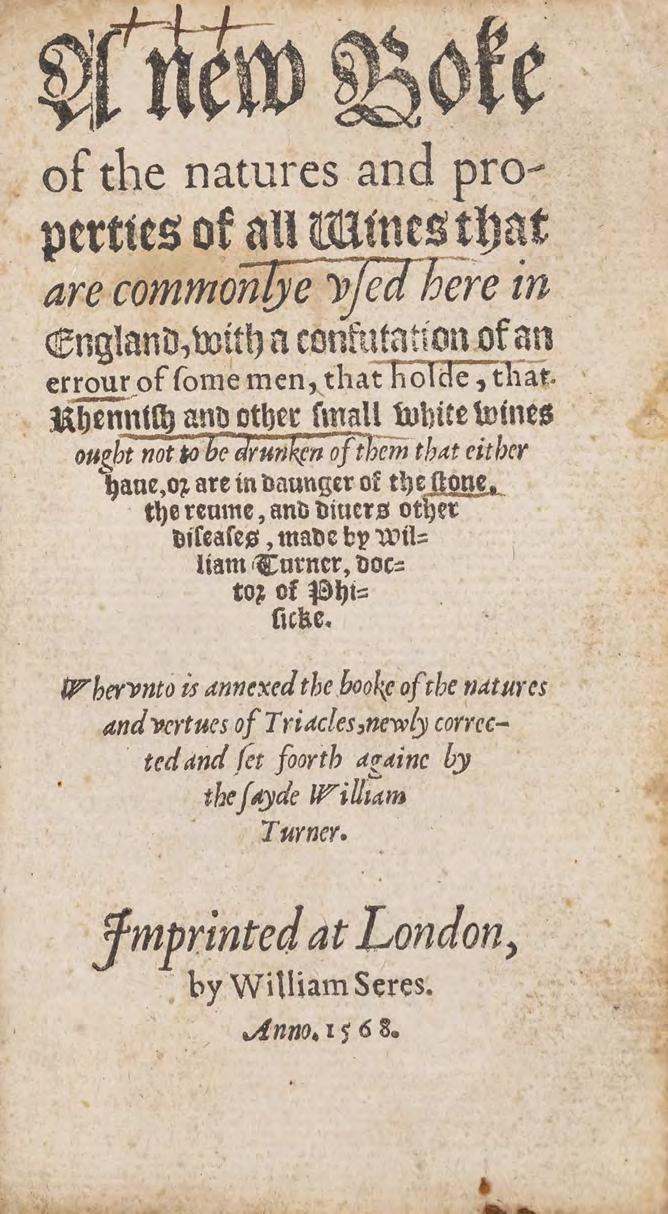
80
Student survival manual.- Cogan (Thomas) THE HAUEN OF HEALTH, CHIEFLY MADE FOR THE COMFORT OF STUDENTS, AND CONSEQUENTLY FOR ALL THOSE THAT HAUE A CARE OF THEIR HEALTH, AMPLIFIED VPON FIUE WORDS OF HIPPOCRATES, WRITTEN EPID. 6. LABOUR, MEAT, DRINKE, SLEEPE, VENUS, black letter, woodcut headand tail-pieces and decorative initials, lacking title (facsimile of 1588 edition bound in), a couple of tears within text with very minor loss, spotting and staining, mostly lightly browned, contemporary blind-ruled vellum, rebacked, preserving original worn backstrip, some staining, marked, [Cagle 622; Gabler G16620 (erroneously dated 1606); Simon BG 360; STC 5482; ESTC S108448], small 4to in 8s, [Printed by Melch. Bradvvood for Iohn Norton], [1605].
⁂ All early editions of this work are rare at auction (the first was 1584). ‘Cogan advised students to breakfast on light digestible foods, to avoid overloading the stomach with a variety of meats at one meal, to cut down on salt and to drink milk as a conteractant to melancholy. He recognized that excessive study made students prone to mental breakdown and recommended that they take regular breaks from study to avoid exhausting their mental energy...’ (Norman 493 (first edition)).
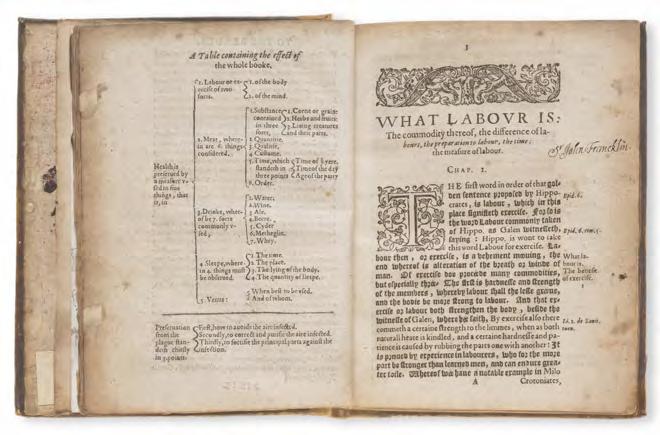
Provenance: Sir John Francklin (contemporary ink inscription to A1); ‘Robert Howarth his book’ (18th / 19th century ink inscription to front endpapers); Broughton (book label to front pastedown).
£500 - 700
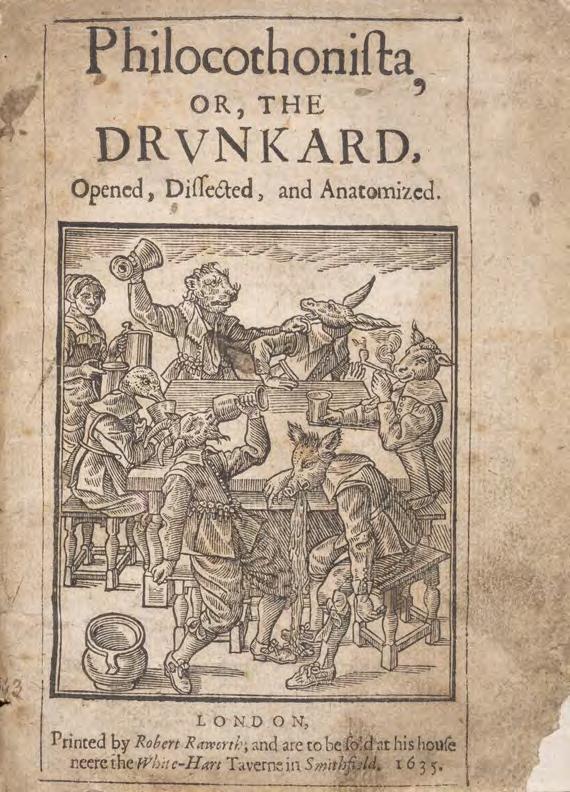
81
Drunkards.- [Heywood (Thomas)] PHILOCOTHONISTA, OR, THE DRUNKARD, OPENED, DISSECTED, AND ANATOMIZED, FIRST EDITION, title with large woodcut vignette of inebriated animals in human garb, woodcut head-piece and decorative initials, lacking [superscript pi]A1 (with signature-mark ‘A’ recto and ‘Vpon the frontispice’ verso), title soiled, trimmed, affecting some signature-marks and catchwords and final line of text on A1 (without loss of sense), little worming in text of sigs. K-M, a few marginal repairs (including lower corner of title), some spotting or light staining, lightly browned, early 20th century dark green straight-grain morocco, gilt, rebacked, preserving original backstrip, rubbed, housed in a modern green crushed morocco-backed cloth drop-back box, spine gilt, [Simon BG 842 ‘A very rare book’; Simon Vinaria p.196; STC 13356; ESTC S104068], small 4to, Printed by Robert Raworth; and are to be sold at his house neere the White-Hart Taverne in Smithfield, 1635.
⁂ Rare. The last copy recorded by RBH was offered by Maggs Bros. in 1957 (calling it ‘very rare’). This satire on drunkards includes an allusion to Shakespeare’s great drinker Sir John Falstaff on pp.10-11.
£3,000 - 4,000
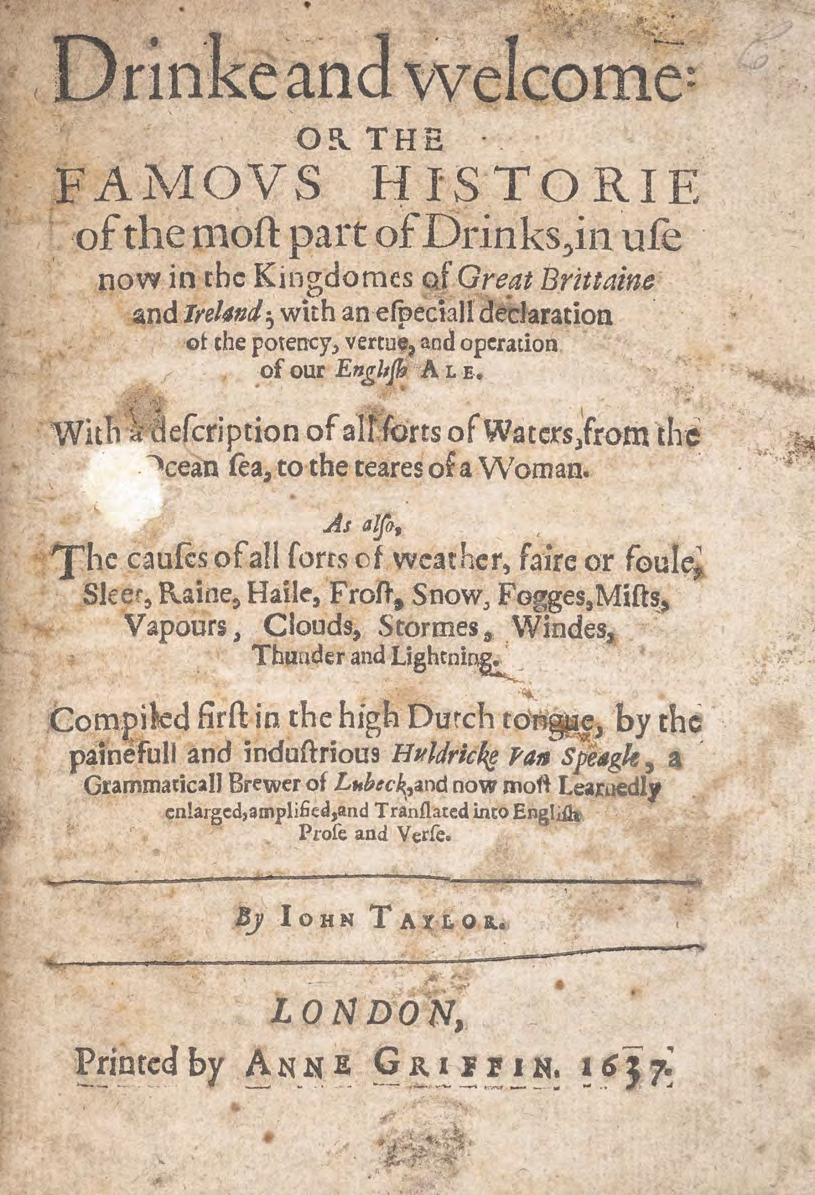
‘Water Poet’, printed by a woman.- Taylor (John) DRINKE AND VVELCOME: OR THE FAMOUS HISTORIE OF THE MOST PART OF DRINKS, IN USE NOW IN THE KINGDOMES OF GREAT BRITTAINE AND IRELAND; WITH AN ESPECIALL DECLARATION OF THE POTENCY, VERTUE, AND OPERATION OF OUR ENGLISH ALE, FIRST EDITION, woodcut head-pieces and large historiated initial, lacking final blank, title with small repair (affecting part of one letter) and stained / soiled, A2 small repair to hole in outer margin, D1v ink staining (text still perfectly legible), some spotting or staining, lightly browned, antique style calf, gilt, spine in compartments, some staining and marking, little rubbed, [Gabler G38660; Simon Vinaria p.206; STC 23749; ESTC S118210], small 4to, Printed by Anne Griffin, 1637.
⁂ Rare. The last copy recorded by RBH was that offered by Maggs Bros. in their 1922 catalogue 423 (‘Separate pieces by John Taylor, the Water Poet, are extremely rare’). Includes ale, beer, cider, perry, mead, and waters. Taylor later ran The Crown tavern in Phoenix Alley, Long Acre. The printer Anne Griffin took over her husband’s business after his death in 1621. She formed a commercial partnership with John Haviland, becoming the first woman to do so with a man who was not a husband or son. She was later stripped of her status as a ‘master printer’ for printing seditious works, and the business was taken over by her son Edward.
£10,000 - 15,000
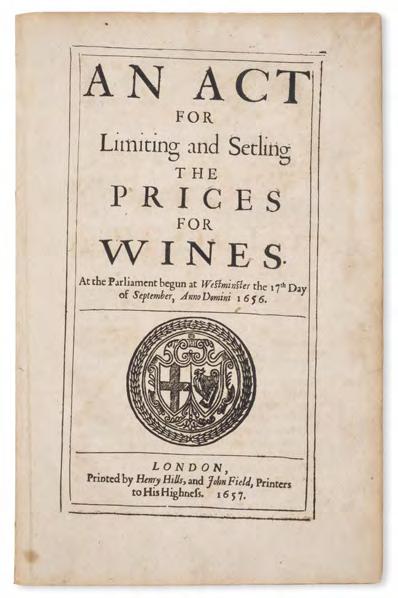
83
Cromwellian regulation of wine prices.- AN ACT FOR LIMITING AND SETLING THE PRICES FOR VVINES· AT THE PARLIAMENT BEGUN AT WESTMINSTER THE 17TH DAY OF SEPTEMBER, ANNO DOMINI 1656, bifolium, text black letter, title with woodcut arms of the Commonwealth of England, woodcut initial to *2r, little spotting, lightly browned, housed in a modern red buckram portfolio, spine titled in gilt, [Simon BG 31; Wing E1046; ESTC R210910], small folio, Printed by Henry Hills, and John Field, printers to His Highness, 1657 £600 - 800
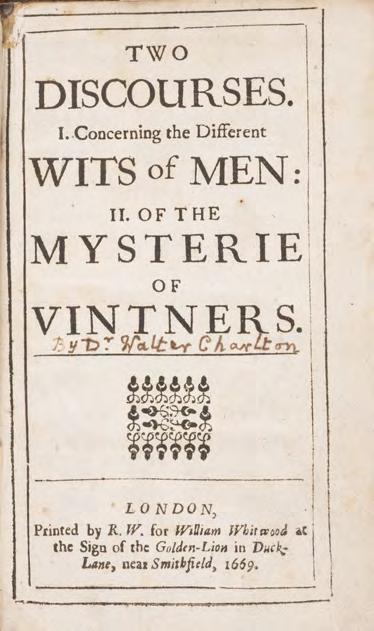
84
Sir Thomas Phillipps copy.- [Charleton (Walter)] TWO DISCOURSES I. CONCERNING THE DIFFERENT WITS OF MEN: II. OF THE MYSTERIE OF VINTNERS, 2 parts in 1, FIRST EDITION, reissue with cancel title, initial f. blank, general title and woodcut typographic ornament within double rule border, woodcut typographic head-pieces and decorative initials, lacking A3 (divisional title for first part) and final blank, later ink author attribution to title, H2 small stab hole to outer margin, waterstaining to some lower inner gutters, little worming to lower margins of sigs. L-N, occasional spotting, lightly browned, contemporary blindruled sheep, spine chipped, rubbed and marked, [Cagle 597 (first issue); Gabler G16010; Simon BG 335; Wing C3694; ESTC R7401], Printed by R.W. for William Whitwood at the sign of the Golden-Lion in Duck-Lane, near Smithfield, 1669; and a defective copy of the second edition, 1675 (2)
⁂ Walter Charleton (1620-1707) English physician, Harveian Librarian, early fellow of the Royal Society and friend of Thomas Hobbes.
Provenance: ‘Wm. Chase pret 1s.-6d.’ (ink inscription to recto of initial blank); ‘With E.H Barker’s best wishes to The Rev. Joseph Hunter, April 9, 1831’, Edmund Henry Barker (1788-1839), English classical scholar, Rev. Joseph Hunter (1783-1861), Unitarian minister and antiquarian (ink inscription to front pastedown); Sir Thomas Phillipps (1792-1872), English antiquary and book & manuscript collector; bought by booksellers William H. Robinson Ltd., Pall Mall (Bibliotheca Phillippica bookplate to front pastedown and typed letter from them to Templer sending the book, 17th February, 1950).
£600 - 800
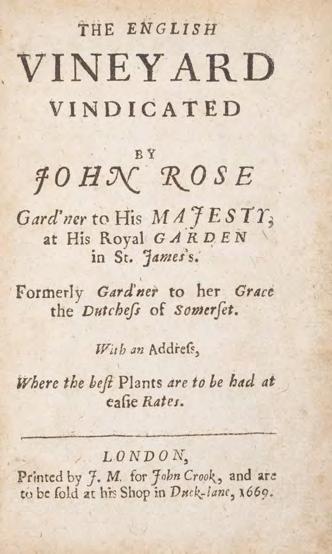
85
Rose (John) THE ENGLISH VINEYARD VINDICATED [i.e. part 2 only of Bonnefons’ The French Gardiner, 1669, translated & edited by John Evelyn], 1 folding engraved plate of vines, some soiling, lightly browned, 18th century calf, gilt, rebacked, preserving original backstrip, rubbed, g.e., [cf. ESTC R12515], small 8vo, Printed by J.M. for John Crooke, and are to be sold at his shop in Duck-Lane, 1669. sold not subject to return.
⁂ The rare first edition of this work was published in 1666 and is one of the earliest works on English viticulture. Rose, gardener to Charles II, provided the technical information, which was edited by John Evelyn.
£400 - 600
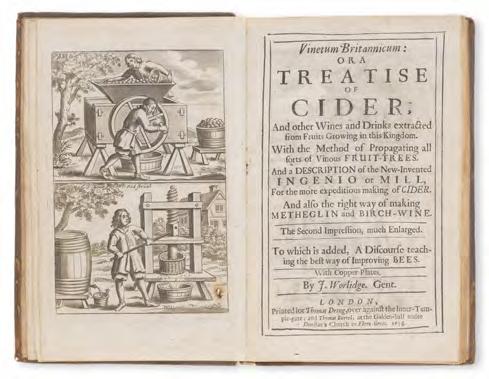
Cider & bees.- Worlidge (John) VINETUM BRITANNICUM: OR A TREATISE OF CIDER, AND OTHER WINES AND DRINKS EXTRACTED FROM FRUITS GROWING IN THIS KINGDOM...TO WHICH IS ADDED, A DISCOURSE TEACHING THE BEST WAY OF IMPROVING BEES, 2 parts in 1, second edition, engraved frontispiece, 2 plates and 2 full-page illustrations, tiny scorch mark to foot of frontispiece, B7 very small paper flaw at head, affecting a few letters, but without loss of sense, occasional spotting, lightly browned, contemporary speckled calf, spine ends and corners worn, upper joint just starting at foot, rubbed at extremities, [Bitting p.504 (note); British Bee Books 54; Cagle 1070; Fussell I, p.70; Gabler G43130 (note); Simon BG 1632 (note); Simon Vinaria p.86 (ms. note); Wing W3609 & W3595; ESTC R34758], Printed for Thomas Dring, over against the Inner-Temple-gate; and Thomas Burrel, at the Golden-ball under St. Dunstan’s Church in Fleet-street, 1678.
⁂ The second part is ‘Apiarium; or A discourse of the government and ordering of bees’. As well as cider it includes fruit trees (with ‘A catalogue of fruits’), vines & wines and perry.
£600 - 800
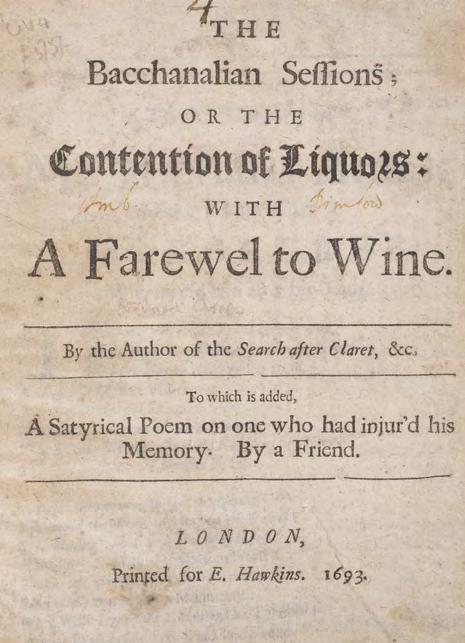
87
Drinking.- [Ames (Richard)] THE BACCHANALIAN SESSIONS; OR THE CONTENTION OF LIQUORS: WITH A FAREWEL TO WINE. BY THE AUTHOR OF THE SEARCH AFTER CLARET, &C , FIRST AND ONLY EDITION, trimmed, occasionally just touching pagination, stained, occasional spotting, lightly browned, 20th century calf-backed marbled boards, spine gilt, [Gabler G11170; Simon BG 112; Simon Vinaria p.208; Wing A2975; ESTC R6247], small 4to, Printed for E. Hawkins, 1693.
⁂ Wines, spirits and ales compete for Bacchus’ favour; followed by ‘A Farewel to Wine’, in which Ames warns against drinking inferior wines in taverns
£2,000 - 3,000
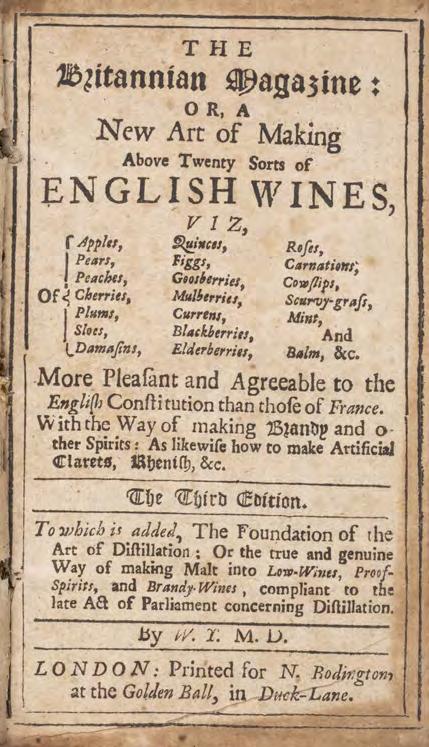
88
English wines.- Y-Worth (William) THE BRITANNIAN MAGAZINE: OR, A NEW ART OF MAKING ABOVE TWENTY SORTS OF ENGLISH WINES...MORE PLEASANT AND AGREEABLE TO THE ENGLISH CONSTITUTION THAN THOSE OF FRANCE. WITH THE WAY OF MAKING BRANDY AND OTHER SPIRITS , third edition, title within double rule border, 2 advertisement ff. at end, title working loose, A2 small chip to lower margin, F1 repaired tear within text, but without loss of sense, water-stained, occasional spotting, lightly browned, closely trimmed at head, just touching the odd headline, contemporary blind-ruled sheep, sympathetically rebacked, spine in blind-ruled compartments and with gilt title, covers edges chipped, rubbed and marked, [Gabler G43170; Simon BG 1639; Simon Vinaria p.87 (erroneously dated in both works); British Bee Books 65; Ferguson II, p.559 (note); Wing Y215; ESTC R217439; cf. Krivatsy 13171], 12mo, Printed for N. Bodington, at the Golden Ball, in DuckLane, [1700].
⁂ Rare edition at auction, with the last copy we can trace being offered in 2005. The author (d.1715) was an Anglo-Dutch distiller, alchemist and physician, who collaborated with Sir Isaac Newton. £2,000 - 3,000
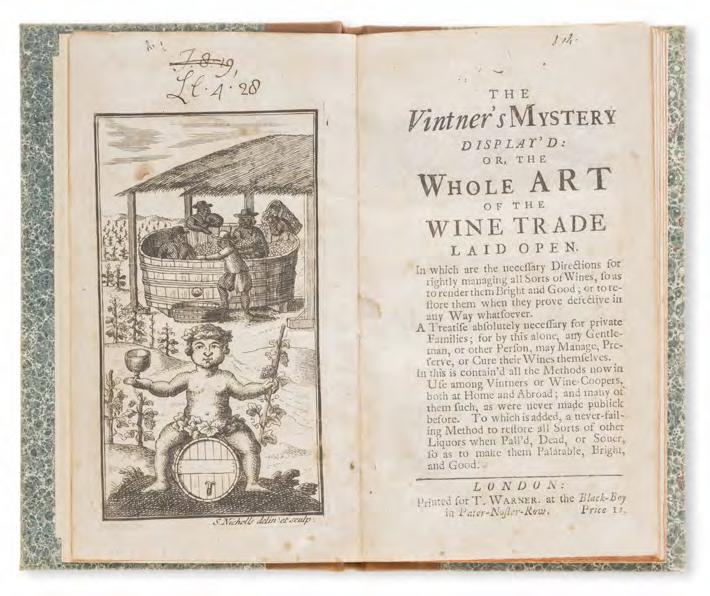
89
Wine trade secrets.- THE VINTNER’S MYSTERY DISPLAY’D: OR, THE WHOLE ART OF THE WINE TRADE LAID OPEN. IN WHICH ARE THE NECESSARY DIRECTIONS FOR RIGHTLY MANAGING ALL SORTS OF WINES, SO AS TO RENDER THEM BRIGHT AND GOOD, FIRST EDITION, engraved frontispiece by Sutton Nicholls, H1&2 stained, occasional spotting, or light staining, lightly browned, modern calf-backed marbled boards, black morocco label to spine, [Gabler G16020; Simon BG 1582 (erroneously dated); ESTC T50915], 12mo, Printed for T. Warner. at the Black-Boy in Pater-Noster-Row, [?1717-1733].
⁂ Rare, with only three copies recorded by ESTC. Aside from our copy we trace only two other copies at auction, one of which the André Simon copy, which was the most recently offered in 2006. The other copy had a facsimile frontispiece (sold Sotheby’s, 1985 for £440).
Provenance: Bought Hodgson & Co., Thursday, 18th January, 1951, lot 189, £6-1-0 (loosely inserted slip).
£1,500 - 2,000
90
Drinking.- [Ward (Edward)] THE DELIGHTS OF THE BOTTLE; OR, THE COMPLETE VINTNER...A MERRY POEM...BY THE AUTHOR OF THE CAVALCADE, ‘third edition’, woodcut head- and tail-pieces and a decorative initial, some spotting and light staining, lightly browned, modern calf-backed marbled boards, spine gilt, [Foxon W62; ESTC T25515], 8vo in 4s, Printed and sold by R. Baldwin and J. Jefferys, at the Bible and Crown, near Stationers-Hall, Ludgate Street, 1743.
⁂ A comical depiction of the regulars of The Bacchus Tavern in Moorfields, London, run by Ned Ward. Rare edition, with only two copies recorded by ESTC (BL and All Souls, Oxford) and no copies traced at auction.
£400 - 600
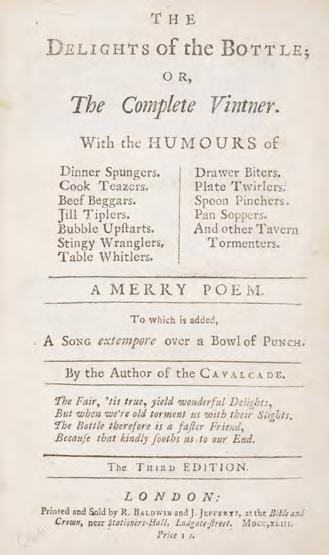
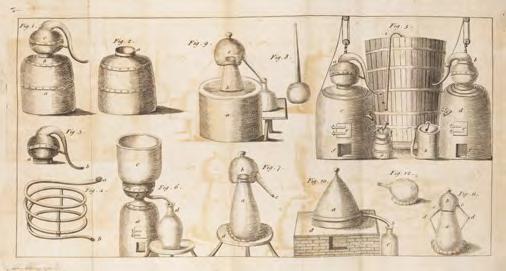
91
Distilling.- Cooper (Ambrose) THE COMPLETE DISTILLER, FIRST EDITION, half-title, folding engraved plate of apparatus, woodcut head- and tail-pieces, offsetting to plate, half-title and endpapers foxed, last couple of ff. browned, some spotting or light staining, mostly lightly browned, contemporary sheep, rebacked, spine in compartments and with red morocco label, covers worn, but solid, [Cagle 631; Gabler G16940; Maclean pp.35-36; Simon BG 388; Simon Vinaria p.152; ESTC T135611], 8vo, Printed for P. Vaillant in the Strand; and R. Griffiths in Pater-Noster-Row, 1757.
⁂ Includes spirits, flavoured waters and cordials.
Provenance: ‘H.M. Bartlett ?Queen Hotel, ?Teignmouth, 1870’ (large ink inscription to half-title).
£600 - 800
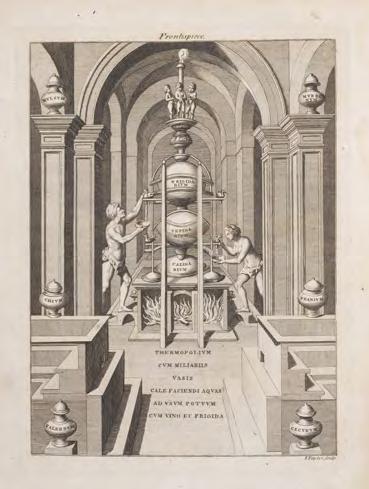
Barry (Sir Edward) OBSERVATIONS HISTORICAL, CRITICAL, AND MEDICAL, ON THE WINES OF THE ANCIENTS. AND THE ANALOGY BETWEEN THEM AND MODERN WINES, FIRST EDITION, engraved frontispiece of a ‘Thermopolium’ (a place to purchase hot food and wine), title with two engraved circular vignettes of ancient figures with wine jars, errata to final verso, small wormholes to lower margins, occasional spotting, lightly browned, contemporary calf, gilt ruled spine in compartments and with red morocco label, spine ends and corners worn, upper joint split, but holding firm, rubbed and marked (including some scuffing to lower cover), [Cagle 556; Gabler G12120; Maclean p.8; Simon BG 168; Simon Vinaria p.4; Vicaire 66-67; ESTC T86996], 4to, Printed for T. Cadell, in the Strand, 1775.
⁂ ‘This is the earliest major work in English on the wines of the Ancients, and the first book in English that discusses modern wines’ (Gabler). The work also discusses the waters of Bath.
£200 - 300
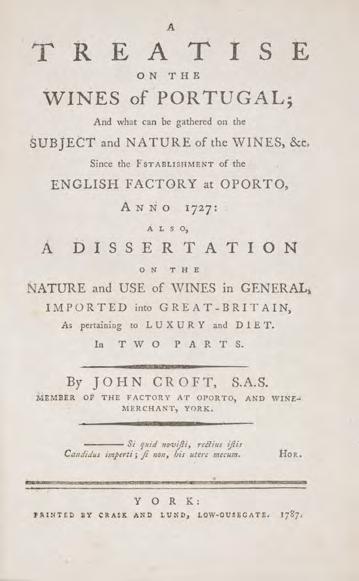
93
Portugal.- Croft (John) A TREATISE ON THE WINES OF PORTUGAL; AND WHAT CAN BE GATHERED ON THE SUBJECT AND NATURE OF THE WINES, &C SINCE THE ESTABLISHMENT OF THE ENGLISH FACTORY AT OPORTO, ANNO 1727: also, a Dissertation on the nature and use of Wines in general, imported into Great-Britain, as pertaining to Luxury and Diet, 2 parts in 1, FIRST EDITION, occasional spotting, lightly browned, original grey wrappers, stitched as issued, split at spine ends, but solid, preserved in a modern burgundy crushed morocco-backed cloth drop-back box, gilt, [Gabler G17360; Maclean p.37; ESTC T51659], a very good unsophisticated copy, 8vo in 4s, Printed by Crask and Lund, 1787.
⁂ Rare at auction, with the last copy we can trace being offered in 2005 (Hroar Dege copy, sold Sotheby’s, 9th June, part of lot 428). Croft was a member of the English Factory at Oporto and a wine merchant in York
£1,000 - 1,500
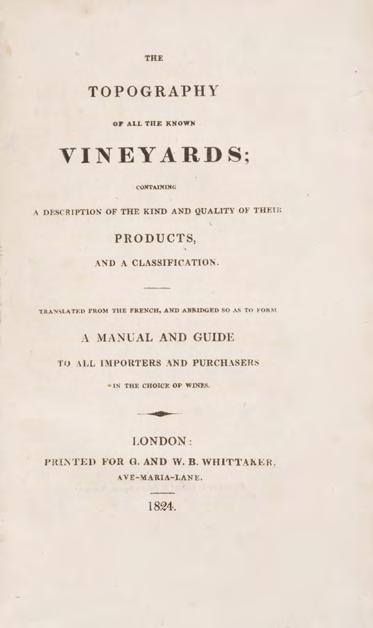
94
Sir Thomas Phillipps copy.- [Jullien (André)] THE TOPOGRAPHY OF ALL THE KNOWN VINEYARDS; CONTAINING A DESCRIPTION OF THE KIND AND QUALITY OF THEIR PRODUCTS, AND A CLASSIFICATION, FIRST EDITION IN ENGLISH, occasional spotting, lightly browned, original printed label to spine (little chipped), spine faded and soiled, upper joint starting at head, but holding firm, edges worn, rubbed, largely unopened and uncut, [Gabler G25870; Simon BG 896; Simon Vinaria p.6], large 12mo, Printed for G. and W.B. Whittaker, Ave-Maria-Lane, 1824.
⁂ ‘the foundation-stone of modern writing about wine’ (Hugh Johnson). First edition in English of his Topographie de tous les vignobles connus, 1816. Includes a 6pp. vocabulary of French terms with English explanations used to express the different qualities of wines.
Provenance: Jacob Hebard (contemporary ink inscription to front pastedown); ‘Sir Thomas Phillipps (1792-1872), English antiquary and book & manuscript collector, his books bought by booksellers William H. Robinson Ltd., Pall Mall (their Bibliotheca Phillippica bookplate to front pastedown)
£400 - 600
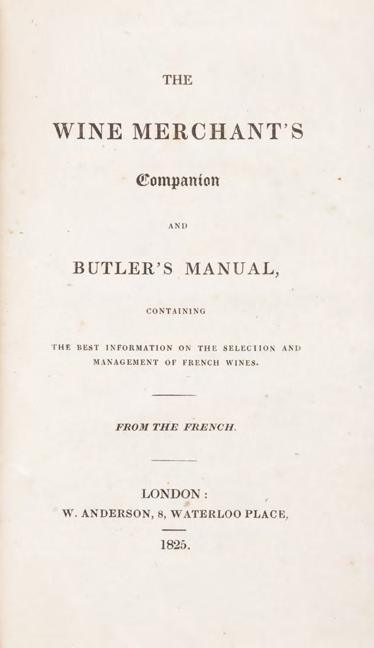
95
Sir Thomas Phillipps copy.- French wines.- [Jullien (André)] THE WINE MERCHANT’S COMPANION AND BUTLER’S MANUAL, CONTAINING THE BEST INFORMATION ON THE SELECTION AND MANAGEMENT OF FRENCH WINES, [translated by W.H. Hilton], FIRST EDITION IN ENGLISH, occasional spotting, lightly browned, original pink boards, original printed label to spine, little chipping / splitting to spine, but solid, corners worn, some light staining, rubbed, uncut, [Gabler G25880; Simon BG 895], 8vo, W. Anderson, 8, Waterloo Place, 1825.
⁂ Rare at auction, and offered here with an impeccable provenance. Jullien (1766-1832), French vintner and pioneering wine writer.
Provenance: Sir Thomas Phillipps (1792-1872), English antiquary and book & manuscript collector, his books bought by booksellers William H. Robinson Ltd., Pall Mall (their Bibliotheca Phillippica bookplate to front pastedown).
£800 - 1,200
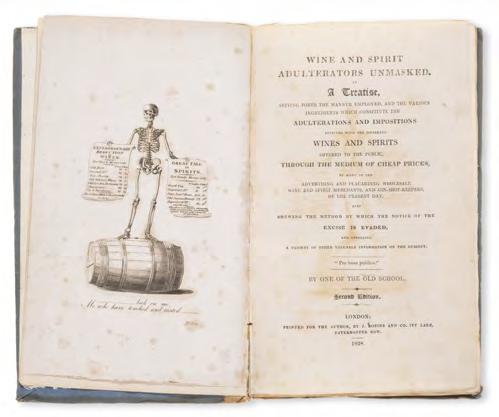
96
Sir Thomas Phillipps copy.- Adulteration.- [West (William)], “One of the Old School”. WINE AND SPIRIT ADULTERATORS UNMASKED, IN A TREATISE SETTING FORTH THE MANNER EMPLOYED, AND THE VARIOUS INGREDIENTS WHICH CONSTITUTE THE ADULTERATIONS AND IMPOSITIONS EFFECTED WITH THE DIFFERENT WINES AND SPIRITS OFFERED TO THE PUBLIC, second edition, initial ‘To the Reader’ leaf, engraved frontispiece of a human skeleton standing on top of a barrel holding price lists of wines and spirits in each hand, 4 publisher’s advertisement ff. at end, frontispiece spotted and offsetting on to title, occasional spotting, lightly browned, original boards, rebacked in parchment (near contemporary), ink title to spine, short split to foot of lower joint, corners worn, foxing to parchment, little staining, rubbed and scuffed, [cf. Gabler G41110 & G41120 (first & third editions) and Simon BG 1624 & Vinaria p.91 (third edition), 8vo, Printed for the Author, by J. Robins and Co. Ivy Lane, Paternoster Row, 1828.
⁂ Rare edition at auction.
Provenance: Sir Thomas Phillipps (1792-1872), English antiquary and book & manuscript collector, his books bought by booksellers William H. Robinson Ltd., Pall Mall (their Bibliotheca Phillippica bookplate to front pastedown).
£300 - 400
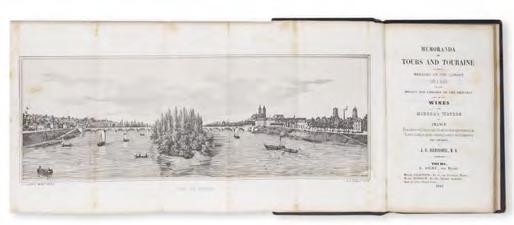
97
Touraine.- Holdsworth (J.H.) MEMORANDA ON TOURS AND TOURAINE INCLUDING REMARKS ON THE CLIMATE WITH A SKETCH OF THE BOTANY AND GEOLOGY OF THE PROVINCE, ALSO ON THE WINE AND MINERAL WATERS OF FRANCE, half-title, folding lithographed frontispiece view, errata f. at end, final f. blank, sig. 5 foxed and lightly browned, some spotting or light foxing elsewhere, rear hinge split, original black blind-stamped and gilt decorative boards, some chipping to spine, corners worn, rubbed, [Gabler G24230; Simon BG 854], large 12mo, Tours, A. Aigre, 1842.
⁂ Rare. We trace no copies at auction, or in commerce at the time of writing. Touraine has been a winegrowing region since Roman times. At the end of the 19th century it experienced a phylloxera outbreak, which led to the discovery that sandy soil areas such as Oisly were more resistant. Consequently, there was a shift to traditional grape varieties such as Chenin Blanc and Sauvignon Blanc.
£300 - 400
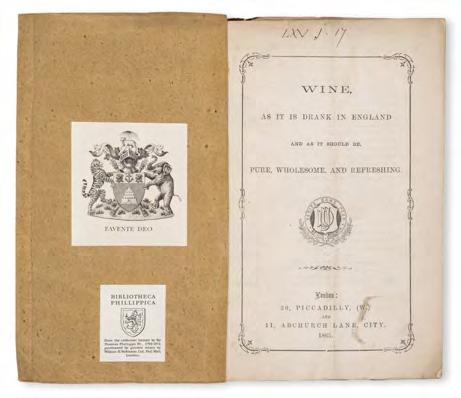
98
Sir Thomas Phillipps copy.- [Denman (James L.)] WINE, AS IT IS DRANK IN ENGLAND, AND AS IT SHOULD BE, PURE, WHOLESOME AND REFRESHING, vertical fold, occasional spotting or light staining, lightly browned, later wrappers, soiled, [Gabler G18200], 8vo, [F. Chifferiel], 1865.
⁂ Rare.
Provenance: Sir Thomas Phillipps (1792-1872), English antiquary and book & manuscript collector, his books bought by booksellers William H. Robinson Ltd., Pall Mall (their Bibliotheca Phillippica bookplate to inner front wrapper).
£300 - 400
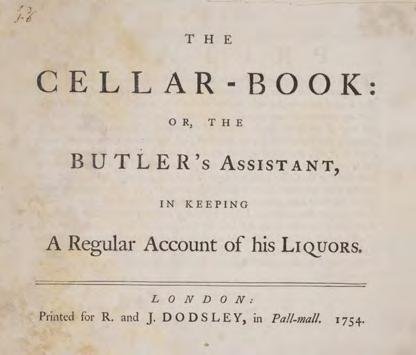
99
Wines, spirits, ales and ciders.- THE CELLAR-BOOK: OR, THE BUTLER’S ASSISTANT, IN KEEPING A REGULAR ACCOUNT OF HIS LIQUORS, title (with preface verso) and 27 ff. (printed recto and verso) of tables to be filled in (the first page giving an example), damp-stained (occasionally with a purple hue), some holes, lightly browned, original drab wrappers, stitched as issued, lightly soiled, [Maclean pp.24-25], small oblong 4to, Printed for R. and J. Dodsley, in Pall-mall, 1754.
⁂ Unrecorded by ESTC. The only other editions we locate are that of 1763 in the André Simon collection and that of 1794 in one copy (NYU). ‘The usefulness of such a book as this to any Gentleman, who has a stock of liquors in his cellar, and is willing to know how it is expended, is so obvious that it need not be insisted on. And the method here propos’d is so clear and easy, that any common Servant may keep the Account.’ (from the Preface).
£1,500 - 2,000
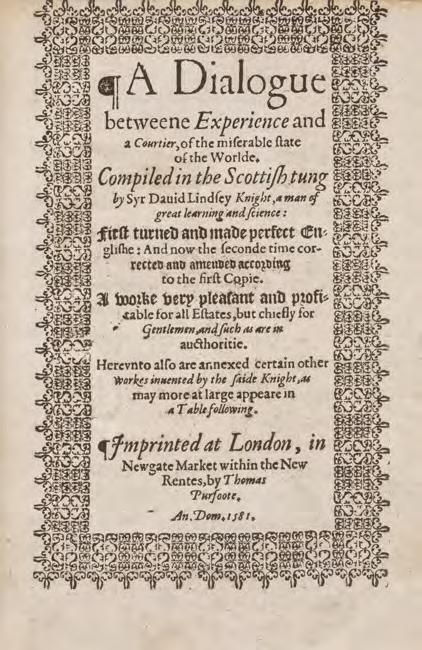
100
Lindsay (David) A DIALOGUE BETWEENE EXPERIENCE AND A COURTIER, OF THE MISERABLE STATE OF THE WORLDE, title with woodcut border, text in black letter, front free endpaper detaching, bookplate of Sir Richard Newdigate dated 1709 on front free endpaper and Robert S. Pirie on front pastedown, near contemporary marginalia to a few ff., later navy crushed morocco, by Rivière & Son, g.e., [STC 15678; ESTC S108560], 8vo, Thomas Purfoote, 1581
£4,000 - 6,000
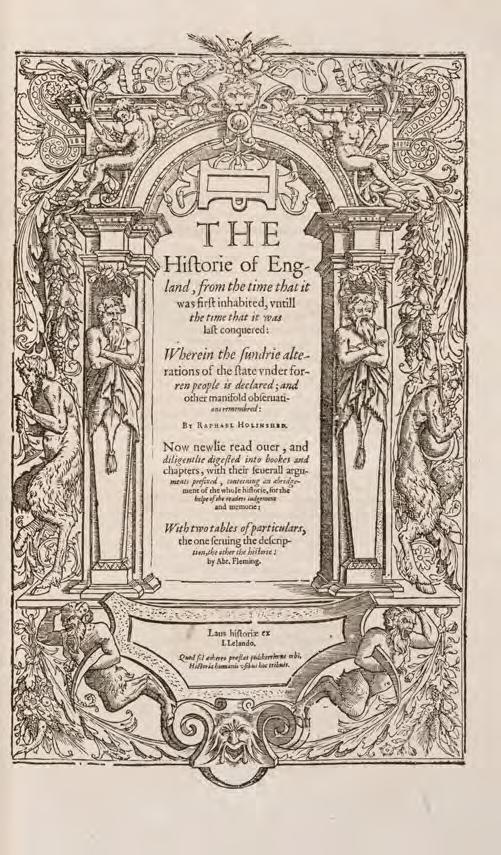
101
Holinshed (Raphael) THE FIRST AND SECOND VOLUMES OF CHRONICLES, 3 vol., second edition, black letter, divisional titles in woodcut architectural or decorative borders, woodcut head- and tail-pieces and decorative initials, with all cancels as per ESTC, lacking titles and blanks in vol.1&2, loss to text at foot on G1 in vol.2, marginalia in an early hand to a few ff. in vol.2, a few marginal paper repairs in vol.3, occasional light browning and marginal water-staining, mostly in vol.3, small marginal rust holes, chipping and short tears to one or two ff., handsome modern half calf over marbled boards, by Lester Capon (President of the Designer Bookbinders), over marbled boards, red morocco spine labels, g.e., [ESTC: S122178; STC 13569], folio, [At London printed [by Henry Denham] in Aldersgate street at the signe of the Starre], 1587.
⁂ The second edition of the Chronicles, used by Shakespeare as a source for his Richard II, Richard III, Macbeth, Henry IV, Henry V, Henry VI, Henry VIII and Cymbeline. The publication of this edition was brought to the attention of Queen Elizabeth by the Privy Council, and certain sections which she considered harmful were ordered to be removed (passages dealing with Anglo-Scottish relations, the Babington plot and Leicester’s campaign in the Low Countries). On 1st February, 1587, the Archbishop of Canterbury was ordered to recall the work and reform it; the result being numerous cancels in the second and third volumes. In the 18th century three reprints of these so-called ‘castrated’ leaves were published, and many copies are found with these reprints inserted for the cancelled sections. Copies vary as to the cancelled and substituted leaves, accordingly we offer ours sold not subject to return
£3,000 - 4,000
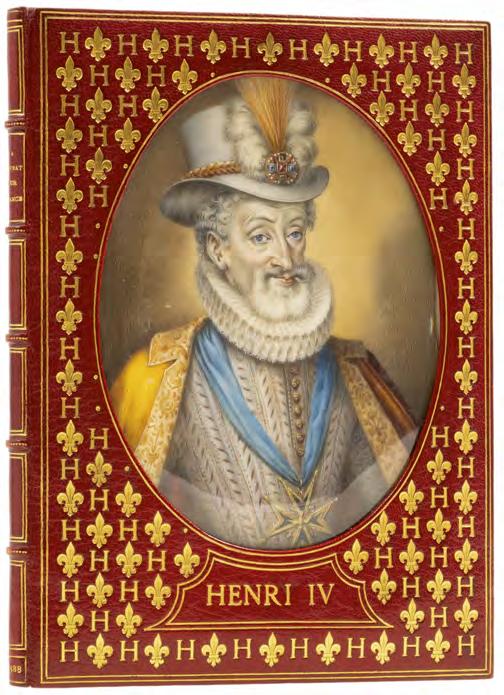
102
Aggas (E., translator) A CAVEAT FOR FRANCE, UPON THE PRESENT EVILS THAT IT NOW SUFFERETH, FIRST ENGLISH EDITION, woodcut device on title and at foot of final leaf of text, lacking final blank leaf, title a little soiled, a few minor marginal repairs, in a superb Cosway-style binding of red morocco by Riviere & Son from designs by J.H. Stonehouse, elaborately decorated in gilt with alternating fleur de lys and intial H to upper cover and captioned Henry IV in gilt beneath large oval portrait miniature of Henry IV by Miss C. B. Currie, spine in compartments with raised bands, inner gilt dentelles with blue watered silk doublures and endpapers, t.e.g,, in olive green morocco suede-lined slip-case, [ESTC STC11259], 4to, Imprinted by John Wolfe, 1588.
⁂ STUNNING COPY OF THIS RARE WORK whose original French author is unknown. It was written in the midst of the War of the Three Henrys, a conflict for the throne of France with three main protagonists - Henri III of France (supported by the royalists); Henri of Navarre (heir presumptive to the French throne and leader of the Huguenots, supported by Elizabeth I of England, and the Protestant princes of Germany); and Henri I of Lorraine (leader of the Catholic League and supported by Philip II of Spain). Known as le Bon Roi Henri, he ruled Navarre from 1572 and was King of France from 1589-1610.
This is a much larger than usual portrait by Caroline Billin Currie (1849-1940), the pre-eminent miniaturist of her day who is closely associated with Cosway-style bindings.
We have been unable to trace any copy of this work at auction. ESTC S122364 records 10 copies (7 in the UK and 3 in N. America)
Provenance: John L. Clawson (round red morocco book label); Alfred Henry Huth (oval cream morocco book label)
£6,000 - 8,000
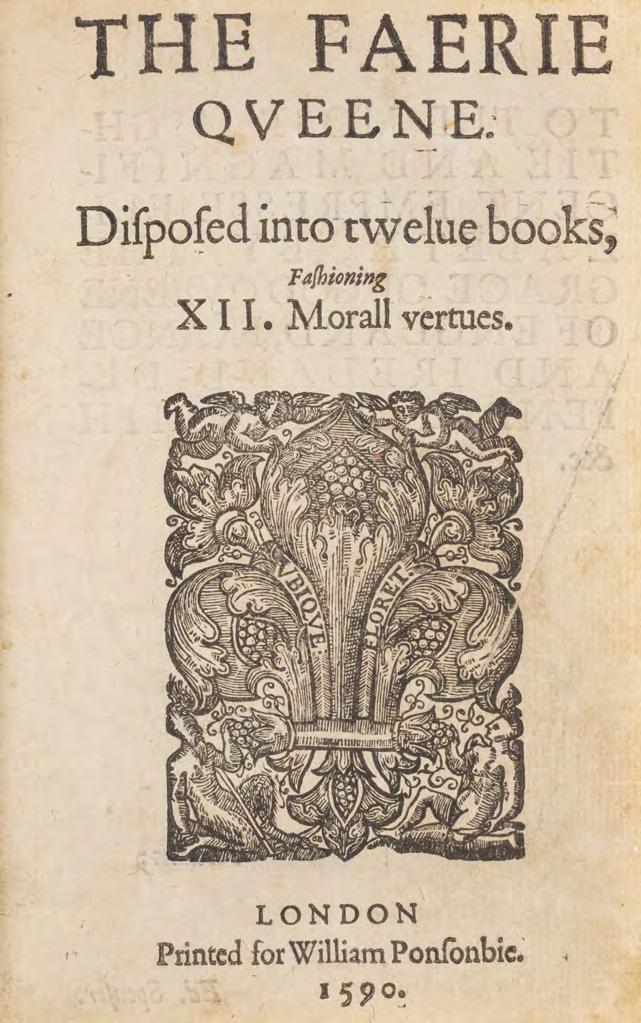
103
Spenser (Edmund) THE FAERIE QUEENE. DISPOSED INTO TWELUE BOOKES, FASHIONING XII. MORALL VERTUES, 2 vol., FIRST EDITION, first digit of imprint date under the first “i” of “William” on title, dedication on title verso, spaces left for the Welsh words in lines 4 and 5 on X7 verso, full-page woodcut illustration of Saint George, woodcut initials and head- and tail-pieces, bookplates of Marianne Ford and Kenneth Rapoport on front pastedowns, ink ownership signatures of James Ford, Fanny Hughes and B. Booth on front free endpapers, vol.1 T1 cut through horizontally affecting text with small marginal paper repair, duplicate T1 f. supplied from another copy tipped in after S8, “Ingentes curae silendo cresceunt” in ink and below (in different ink) “quae cu[m] loquendo partem amittunt suam” with other notes on vol.2 title, early marginalia to one or two ff. and some verses numbered in ink in vol.1, a few ff. lightly soiled and darkened, headlines, catchwords, and some signature marks occasionally cropped, cracking to gutter in vol.1, occasional small rust-holes and worming, scattered spotting, eighteenth-century roan, rebacked, housed in blue half morocco slip-case by Macdonald, [STC 23083; ESTC S1728], 4to, Printed [by John Wolfe] for William Ponsonbie, 1590-96.
⁂ THE FIRST EDITION OF BOTH PARTS OF SPENSER’S GREAT TUDOR EPIC Dedicated to Queen Elizabeth and written in a new poetic form now known as the Spenserian stanza, The Faerie Queene is a sprawling and surreal allegorical poem borrowing themes and figures from both Classical mythology and English legend.
Provenance: Ink ownership signatures of Benjamin Booth (1732-1806) and his grandson James Ford, translator of Dante (1797-1877); bookplate of Booth’s daughter (and James Ford’s mother) Marianne Ford, also bearing the signature of James Ford’s daughter Anne Frances (“Fanny”) Hughes (c.1826-1910), wife of Thomas Hughes, author of Tom Brown’s School Days); bookplate of Kenneth Rapoport.
Sold by Swann Galleries in the “Early Printed Books” sale on 13th October 2022
£30,000 - 40,000
Spenser (Edmund) THE FAERIE QUEENE, DISPOSED INTO XII. BOOKES, FASHIONING TWELVE MORALL VERTUES, FIRST FOLIO EDITION, woodcut printers device on title and final f., woodcut head- and tail-pieces, lacking final blank, Sir Charles Tennant’s bookplate on front pastedown, margins of title and final leaf repaired, a few leaves of gathering F repaired at gutter, new endpapers, attractive nineteenth-century red morocco gilt by Bedford, upper board starting with minor marks, spine fractionally darkened, extremities slightly rubbed, g.e., [Pforzheimer 971; [STC 23083; ESTC S1728], folio (260 x 170mm), H. L. for Mathew Lownes, 1609.
⁂ The first folio edition of Spenser ’s masterpiece, also the first to include the two cantos of Mutabilitie. An excellent example.
Provenance: Bookplate of Industrialist and Liberal politician, Sir Charles Tennant (1823-1906) of The Glen, Scotland. Lot 18, “Valuable and Important Books and Manuscripts” at Christie’s on 6th October 2022
£6,000 - 8,000
105
Shakespeare (William) THE COMEDIE OF ERRORS, extracted from the first folio, pp.85-100, (ie 8ff., sig H6 I1-2, woodcut headand tail-piece, H4 supplied from another copy and with outer edge repaired with some loss of text, modern calf, gilt, by Bernard Middleton, spine slightly faded, [Greg III, p. 1109-1113; STC 22273], folio, [Isaac Jaggard and Edward Blount, 1623].
⁂ FIRST APPEARANCE IN PRINT OF THE COMEDY OF Errors, THE SOURCE FOR ALL SUBSEQUENT EDITIONS No earlier version, manuscript or printed, is known. It is among Shakespeare’s early plays and may have been written for Christmas revels at Gray’s Inn in 1594, where it was first performed by Shakespeare’s acting company, The Lord Chamberlain’s Men. Its next recorded performance was before King James I on 29 December 1604.
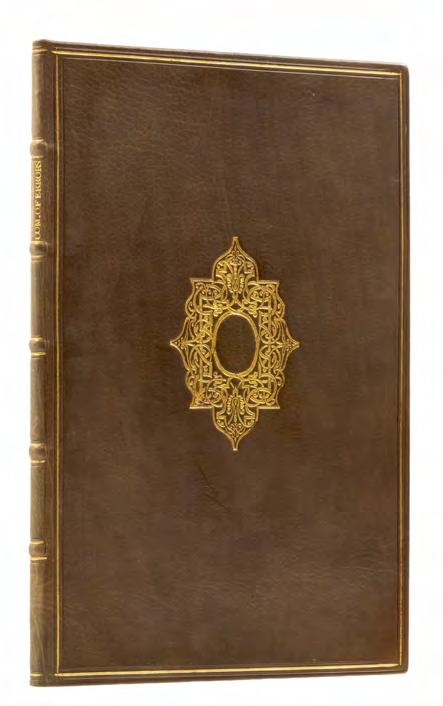
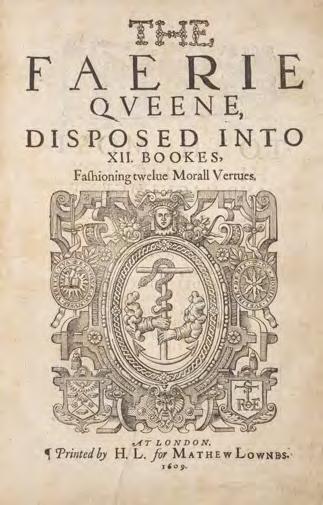
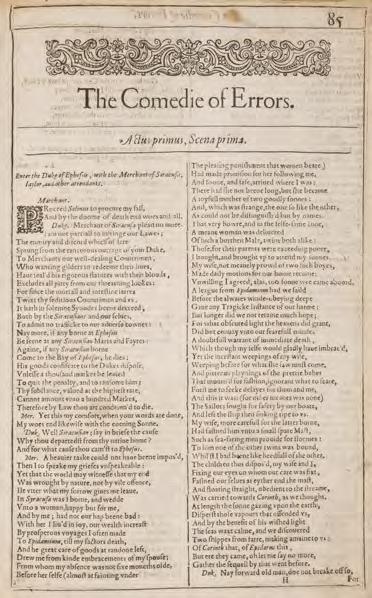
In his collation of the Folger copies Hinman found three variants, all on p.94 (H5 verso), which clearly was presscorrected. The readings here, all in the second state, are ‘lands’ (line a21), ‘Siracusia’ (a59), and ‘Delay’ (b33).
Rare on the market as an individual play, with only one copy (appearing twice, in 2014 and 2019) traced at auction. Loosely inserted printed note from William H. Robinson Ltd. certifying this copy
£15,000 - 20,000
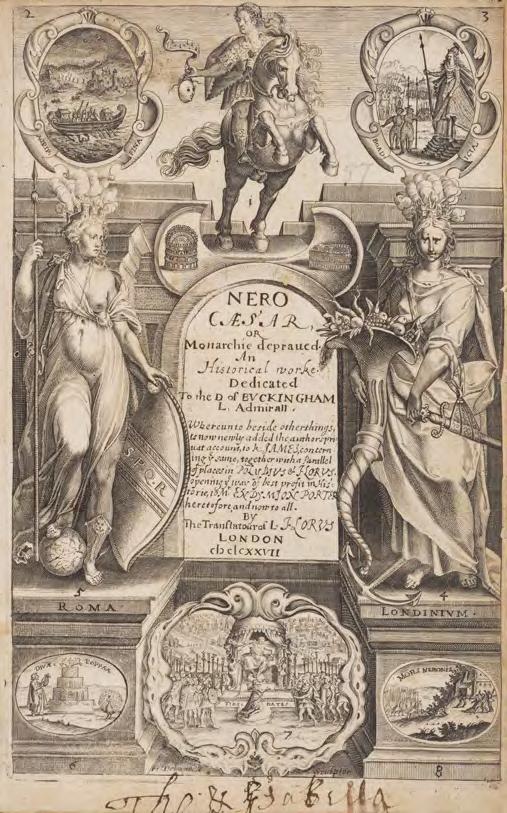
106
Thomas & Isabella Hervey’s copy.- [Bolton (Edmund)] NERO CÆSAR, OR MONARCHIE DEPRAUED, 2 parts in 1, initial ‘The arguments of the severall pictures in the frontispice’ f., fine engraved pictorial title by Francis Delaram, engraved medallions in text, woodcut head-pieces and decorative initials, water-stained, occasional spotting or staining, later endpapers, 19th century diced calf, gilt, rebacked in antique style brown calf, black morocco label, corners worn, covers rubbed and marked, [STC 3222; ESTC S107107], small folio, [Printed by Thomas Snodham and Bernard Alsop], 1627.
⁂ A RARE 17TH CENTURY SPOUSAL PROVENANCE. Sir Thomas (1625-1694) & Lady Isabella (1625-1686) Hervey, of Ickworth Hall in Suffolk. The books were handed down to their son John Hervey, 1st Earl of Bristol (ink inscription to foot of title and head of A2 and list of Roman names to verso of initial f.); ?William Henry Smith (18251891), bookseller, newsagent and politician (ink signature and notes relating to the volume to front free endpaper, dated 6th March, 1869).
Literature: Emma Smith ‘Marital marginalia. The SeventeenthCentury Library of Thomas and Isabella Hervey’, in Early Modern English Marginalia, ed. Katherine Acheson, Abingdon, Routledge, 2019, pp.155-172.
£800 - 1,200
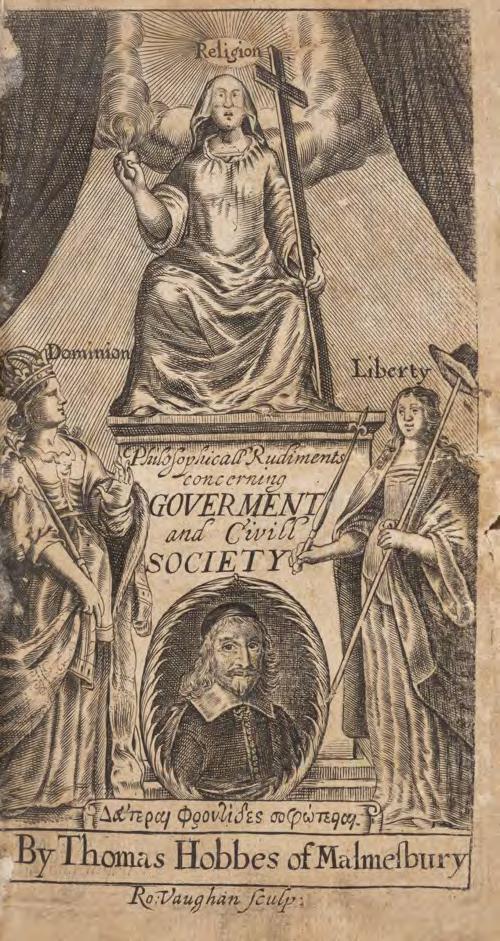
107
Hobbes (Thomas) PHILOSOPHICALL RUDIMENTS CONCERNING GOVERNMENT AND SOCIETY, FIRST EDITION, additional engraved title by Robert Vaughan and 3 plates, 2 with ink annotations, one supplied from another copy, occasional foxing, edges of engraved title slightly chipped, modern calf, [ESTC R202404; Wing H2253], 12mo, Printed by J. G. for R. Royston, 1651.
⁂ First edition in English of Elementa philosophica de cive, the precursor to (and much rarer than) Hobbes’ Leviathan
£3,000 - 4,000
108
Occult Philosophy.- Dee (John) A TRUE & FAITHFUL RELATION OF WHAT PASSED BETWEEN DR. JOHN DEE AND SOME SPIRITS, edited by Meric Casaubon, FIRST EDITION, title in red and black, engraved frontispiece with 6 portraits, 3 engraved plates (1 double-page), woodcut initials and illustrations, occasional ink marginalia (including to front pastedown), frontispiece laid down, title with neat repairs, scattered spotting and some surface soiling, a few rust marks and a couple of small marginal tears, toned with the odd stain, cracking at hinges, else a rather clean and bright copy, contemporary panelled calf, old skillful repairs, some small loss to spine ends, joints starting to split, a little rubbed and bumped, [ESTC R11048; Wing D811], folio, D. Maxwell for T. Garthwait, 1659.
⁂ The frontispiece depicts portraits of Mahomet, Apollonius of Tyana, Edward Kelley, Roger Bacon, Paracelsus, and Dr. John Dee. The work records John Dee’s and Edward Kelley’s claimed angelic communications, including a supposed celestial language and spiritual revelations. It is regarded as a key early modern text in the history of occult philosophy
£3,000 - 4,000
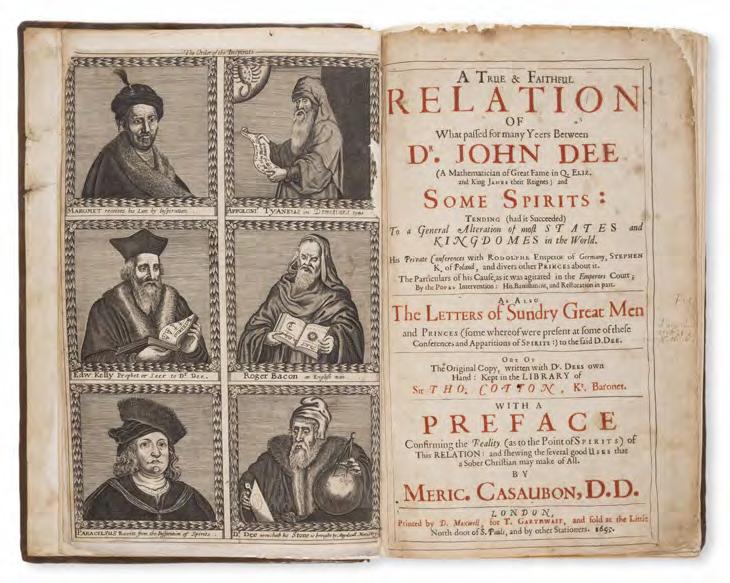
109
Milton (John) PARADISE LOST. A POEM IN TEN BOOKS, title in Pforzheimer’s fifth state (‘Angel’ in imprint in roman), our copy with ‘The Printer to the Reader’ before ‘The Argument’ and with five lines excluding headline, woodcut head-pieces and decorative initials, occasional ink annotations or corrections, small hole to foot of title (not affecting text), 2R4 with loss to lower corner (affecting text), many ff. trimmed close at head and foot, shaving or cutting a few catchwords and headings, browned throughout with some scattered staining and spotting, a few marginal nicks with small loss, modern antique-style panelled calf, minor wear to joints, a few marks, [Pforzheimer 718; Grolier, Wither to Prior 603], Printed by S. Simmons, and are to be sold by T. Helder at the Angel in Little Brittain, 1669; Paradise Regain’d. A Poem in IV Books to which is added Samson Agonistes, second state with “loah” corrected to “loth” p. 67, license to print f. at beginning & errata f. at end, bookplates to front pastedown and endpaper (one being that of George Goyder), contemporary ink ownership inscriptions to front endpaper, title trimmed close at inner margin, cutting a few letters, C4 with small closed tear slightly affecting text, a few other small tears elsewhere, offsetting to license to print f., some finger-soiling and toning, mostly marginal, a few spots, hinges reinforced, else a bright copy, contemporary speckled calf, sympathetically rebacked, rubbed and bumped, printed by J. M[acock]. for John Starkey, 1671, FIRST EDITIONS, [ESTC R13406; R299, Wing M2142; M2152], 4to & 8vo (2)
£6,000 - 8,000
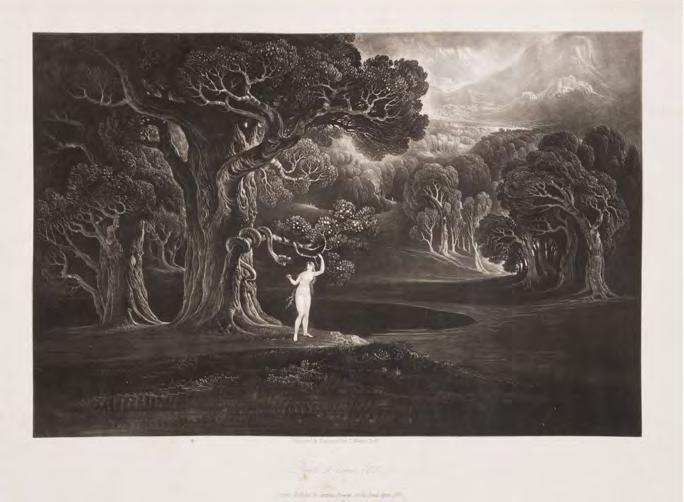
Martin (John, illustrator.) THE PARADISE LOST OF MILTON, 2 vol. in 1, FIRST EDITION, FIRST ISSUE, half-title and title for each vol., 24 mezzotint plates with touches of drypoint, each plate lettered with caption “Proof”, excellent impressions on cream laid paper, platemarks each c. 255 x 355 mm. (10 x 14 in), or the reverse, sheets c. 565 x 375 mm. (22¼ x 14¾), tissue-guards, ‘Eve at the Fountain’ browned in blank margins, some loss, splits and handling creases to endpapers, scattered spotting or foxing and some surface soiling, occasional damp-staining to edges, contemporary half morocco by J. Wright, spine gilt in compartments, some splitting at joint ends, rubbed and bumped with some marks, g.e., Imperial folio, published in parts by Septimus Prowett, [circa 1824-1827].
⁂ Rare Imperial Folio edition, the largest and most luxurious format of the publication, limited to only 50 copies. This copy is the only known example with the two volumes bound together as one. Nineteen copies of the Imperial Folio edition containing the large plates have now been located, including the present example. One of these copies is in the Royal Library at Windsor Castle.
When first released, these engravings were greeted with outstanding critical acclaim - the critic for The Literary Gazette proclaimed: “we know no artist, whose genius so perfectly fitted him being the illustrator of the mighty Milton; and in what we have seen of his conceptions he has more than realised the highest of our hopes. There is a wildness, a grandeur, and a mystery about his designs which are indescribably fine:- the painter is also a poet. ... we look upon these engravings to belong to the foremost order of true genius: beyond this there is no praise.” [The Literary Gazette, April 2nd 1825].
‘The illustrations that made Martin’s name as an engraver”. “They are without doubt one of the most significant series of British book illustrations ever to have been produced.’ [Campbell, John Martin, Visionary Printmaker, p. 41]
Provenance: Michael J. Campbell (author of John Martin, Visionary Printmaker) [signature and stamp to inside upper cover]
Literature: Campbell & Wees, 1992, nos. 26-49
£12,000 - 16,000
111
Judaica.- [Abendana (Isaac)] AN ALMANACK FOR THE YEAR OF CHRIST, 1699...THE JEWISH KALENDAR: CONTAINING AN ACCOUNT OF THEIR FEASTS AND FASTS WITH THEIR SABBATHS AND PROPER LESSONS, interleaved with some blanks, lacking A3 (dedication) & C2, but with an additional Sig. D (6ff Roman calendar, not called for in ESTC) bound between Sig. C&D, C35 tear into text at inner-edge without loss and working loose at head, D6 of additional Sig. with loss to fore-edge affecting some text, some very light browning, small damp-stain to lower corner throughout, contemporary ink notes to preserved front free endpapers and one blank, including records of the sale of “2 fat cows” and “my 4 oxen”, modern antique-style panelled calf, leather spine label, [ESTC R36724; Wing A1237], 12mo, Oxford, printed at the Theater, [1699].
⁂ Scarce. ESTC records only 7 copies in the UK, and 4 in North America.
Isaac Abendana (c.1640-99) was the son of Spanish-Jews and younger brother of Rabbi Jacob Abendana of London. Having lived in Hamburg and Leyden, where he studied medicine, he settled in England and became Professor of Hebrew at Oxford University. Previous to this he had also been at Cambridge University. It was after he took a position at Magdalen College, Oxford, that he began publishing his annual Jewish almanacks. These were published between 1692 and 1699. This almanack contains “A Discourse Concerning the Jewish Fasts”, as well as lists of the colleges, halls and professors of the Universities of Oxford & Cambridge
£600 - 800
Gay (John) THE WHAT D’YE CALL IT: A TRAGI-COMI-PASTORAL FARCE, FIRST EDITION, LARGE PAPER COPY, SIGNED BY THE AUTHOR’S NEPHEW “JOSEPH BALLER HIS BOOK 1722” on frontispiece recto, early upper wrapper bound in at front with bookplate and signed initialled inscription of Harry Buxton Forman on verso, the odd spot, later calf, gilt dentelles, [ESTC T13939], 8vo, for Bernard Lintott, [1715].
⁂ First edition of Gay’s scarce first theatrical venture, and after The Beggar’s Opera his greatest success.
Provenance: Lot 75, “English Literature, History, Children’s Books & Illustrations” at Sotheby’s on 17th July 2008
£1,000 - 1,500
Sheppard (Jack) SHEPPARD IN AEGYPT OR NEWS FROM THE DEAD. BEING A LETTER FROM JOHN SHEPPARD TO FRISKY MOLL AND HIS EXECUTOR..., FIRST EDITION, woodcut head-piece, new endpapers, “Los Angeles County Law Library” bookplate on front pastedown, short tear on title, not affecting text, ink note at C4 foot in an early hand, occasional spotting, mostly marginal, later half calf, “Los Angeles County Law Library” ink stamp on covers and edges, extremities slightly rubbed, t.e.g., edges a little toned, [ESTC T90533], 8vo, for A.Dodd and W.Bristowe, 1725.
⁂ Scarce fictional account of the infamous thief and prisonbreaker Jack Sheppard (1702-1724), whose exploits inspired numerous pamphlets, ballads, engravings, and plays. “For two centuries he remained a type or symbol of those who elude the practices of oppression with effrontery and bravery as well as skill” (Peter Ackroyd, London, p.242). ESTC locates only three copies: the British Library, Yale and a private collection in Scotland.
Provenance: Lot 414, “Law Books: Property of LA Law Library, Part One” at Bonhams on 5th March 2014
£1,000 - 1,500
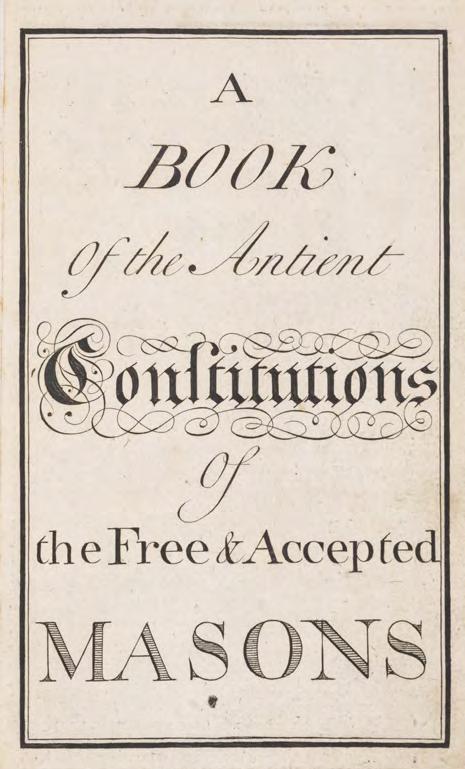
114
Freemasonry.- Cole (Benjamin, engraver) A BOOK OF THE ANTIENT CONSTITUTIONS OF THE FREE & ACCEPTED MASONS, 56pp., engraved throughout, (3 leaves misbound after the Drake item following),[not in ESTC], [c.1730]; BOUND WITH [Drake (Francis)] A Speech Deliver’d to the Worshipful and Antient Society of Free and Accepted Masons..., 22 [ie 40]pp., [ESTC T118319, York Minster only], 1729; BOUND WITH New Fairies: or, the Fellow-Craft’s Song (The), As sung at the Lodge in Carmarthen South-Wales, 17, [3]pp advertisements for ‘Books printed for C. Creake’, lacking title (text starts on A3), [not located in ESTC], n.p. [1731], together 3 works in 1, contemporary panelled calf, rebacked and corners repaired, 8vo
⁂ A SAMMELBAND OF RARE MASONIC WORKS. Loosely inserted are pages of typed notes relating to correspondence of E.H. Dring of Quaritch R.H. Baxter inter alia concerning the first mentioned and its issue. In addition a T.L.s. from Lionel Vibert on the same subject.
Literature: : The Rare Books of Freemasonry, by Lionel Vibert. P.M. Lodge Quatuor Coronati, ‘The Bookman’s Journal’ Office, 1923.
£1,000 - 1,500
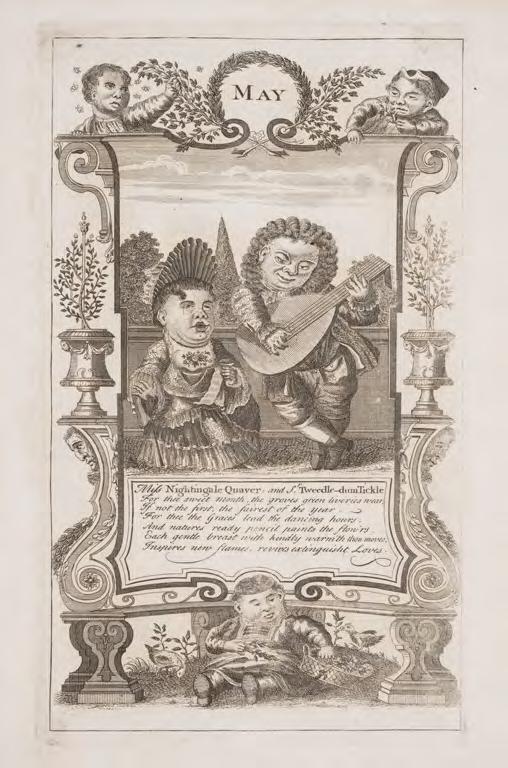
115
THE TWELVE MONTHS OF THE YEAR REPRESENTED BY LILLIPUTIAN FIGURES, 12 plates, bound with string, a few loose, light browning, more so to first and final ff. marginal paper repairs to final f., housed in modern box, [not located in ESTC], 4to, John Bowles, [c.1770].
⁂ A rare series of twelve prints depicting dwarf-like figures representing a variety of social types, occupations and seasonal activities. Complete sets are very scarce
£2,000 - 3,000
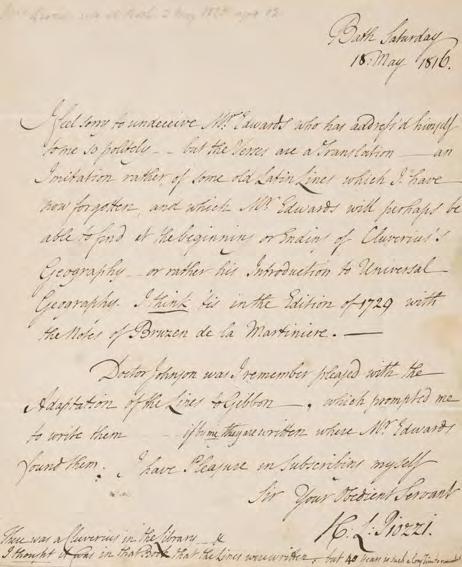
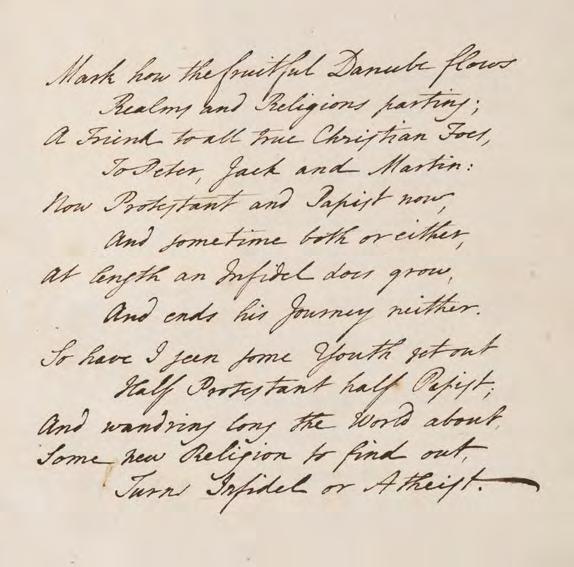
116
Piozzi (Hester Lynch).- Gibbon (Edward) THE HISTORY OF THE DECLINE AND FALL OF THE ROMAN EMPIRE, 6 vol., FIRST EDITIONS, HESTER LYNCH PIOZZI’S COPIES WITH A MANUSCRIPT POEM IN HER HAND, 13 lines, adapting lines from Cluverius to Gibbon on front free endpaper (repaired at gutter), AUTOGRAPH LETTER SIGNED FROM PIOZZI TO THOMAS EDWARDS, 1f., 4to, Bath, 18th May 1816, explaining that the poem was adapted by her from a Latin source and admired by Dr. Johnson, address f. with postmarks and seal, folds, tipped in vol.1, manuscript note of provenance by Sir Frank MacKinnon (descendent of Thomas Edwards) dated 1938 laid down on front pastedown, vol 1. first state with errata uncorrected, lacking half-titles in vol.1&2, engraved portrait frontispiece in vol.2, engraved folding maps in vol.2&3, vol.4 lacking final blank, errata for vol.4-6 at end of vol.6, vol.2 without ‘Contents of the First Volume’ f., for W.Strahan and T.Cadell, 1776-88; Miscellaneous Works of Edward Gibbon, 2 vol., frontispiece in vol.1, A.Strahan and W.Davies, 1794, scattered spotting, light off-setting, uniformly bound in contemporary tree calf, red morocco spine labels, spines gilt, skillfully and sympathetically rebacked, 4to (8)
⁂ AN EXTRAORDINARY ASSOCIATION COPY OF ONE OF THE WORLD’S GREAT HISTORICAL WORKS, LINKING EDWARD GIBBON, SAMUEL JOHNSON AND HESTER LYNCH PIOZZI “Doctor Johnson was I remember pleased with the Adaptation of the Lines to Gibbon, which prompted me to write them”. Volumes 1-3 were bought by Thomas Edwards in the Streatham Library sale in April 1816. His great grandson, Sir Frank MacKinnon, purchased the remaining volumes and the 2 volumes of the Miscellaneous Works in 1896.
Intrigued by a manuscript poem in the volumes, Edwards wrote to the then seventy-five-year-old Piozzi, whose autograph reply remains with the set. In it, she explained that the verses were “an Imitation” of “some old Latin Lines which I have now forgotten”, adding that their source might be found in Cluverius’s Introduction to Universal Geography. Her further recollection that “Doctor Johnson was, I remember, pleased with the adaptation of the lines to Gibbon” provides a remarkable direct link between three of the most important literary and intellectual figures of the eighteenth century
£10,000 - 15,000
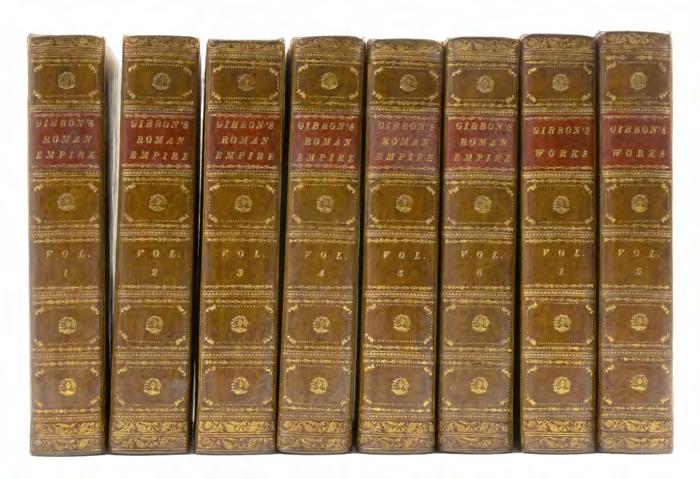
117
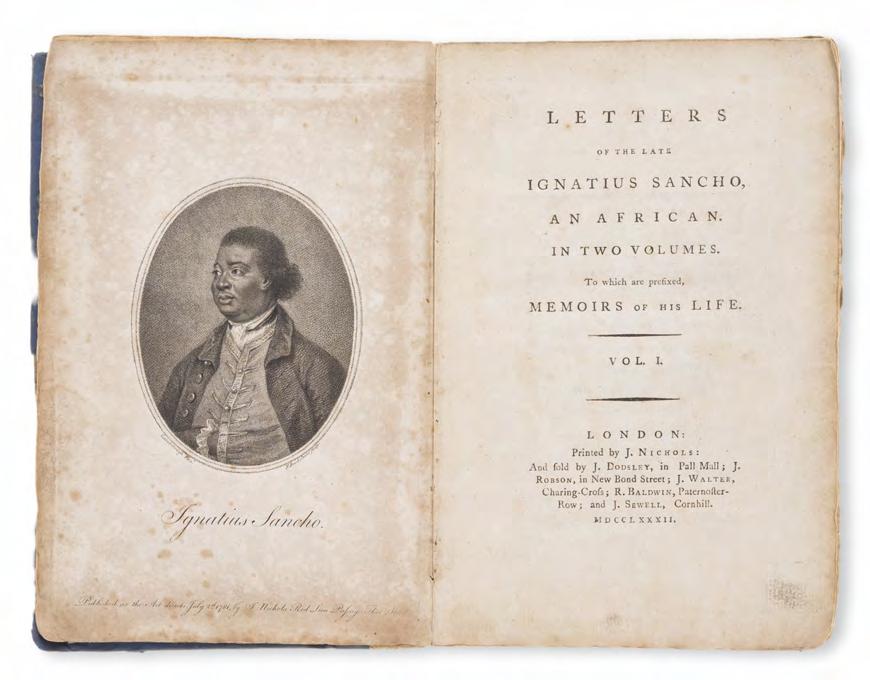
Sancho (Ignatius) LETTERS OF THE LATE IGNATIUS SANCHO. AN AFRICAN, 2 vol., FIRST EDITION, edited by Lady Frances Crewe, half-titles, engraved frontispieces by F. Bartolozzi, the first a portrait after Gainsborough, list of subscribers, vol. 2 frontispiece mounted on stub, vol. 1 G4 tear into text at fore-edge without loss, the occasional light stain or patch of finger-soiling, foxing and some light browning scattered throughout, uncut in contemporary ?original boards, early reback in leather, vol. 1 manuscript title to spine, soiled and quite worn, later endpapers, 8vo, J. Nichols, 1782.
⁂ Rare first edition of the posthumously published letters of Ignatius Sancho. Born aboard a slave ship, Sancho was brought from the West Indies to England when only two years old. He became a butler to the Duke of Montagu, as well as a prominent author, abolitionist, and composer. Following his death in 1780, his various letters were collected and edited by his former correspondent, Lady Frances Crewe. Seldom seen at auction; we can trace only six first edition copies in the last 30 years.
£2,000 - 3,000
118
[Darwin (Erasmus)] THE BOTANIC GARDEN; A POEM, IN TWO PARTS, 2 parts in 1, FIRST EDITIONS, general title & title to each part, part 2 only with half-title (as issued), engraved frontispieces & 16 plates, of which one folding, part 2 with Preface bound before Proem & errata trimmed and laid down to final f., part 1 frontispiece with neatly repaired tear without loss, one Portland Vase plate trimmed just into image, occasional spotting, some light browning, some offsetting, including to folding plate (this also with short marginal tears at fold without loss), contemporary calf, neatly rebacked, spine gilt and preserving red morocco label, covers rubbed with wear to extremities, [ESTC T82160 & T82159; Henrey 468 & 469], 4to, London & Lichfield, for J. Johnson, 1791-89.
⁂ Including 5 plates by William Blake (one after Fuseli and 4 of the Portland Vase). The Loves of the Plants, although designated part 2, was published first in 1789; The Economy of Vegetation followed in 1791, completing The Botanic Garden. The work is often found in a mixed edition set.
Provenance: Holland House (bookplate with red pencil shelf-mark); “PG” (booklabel)
£750 - 1,000
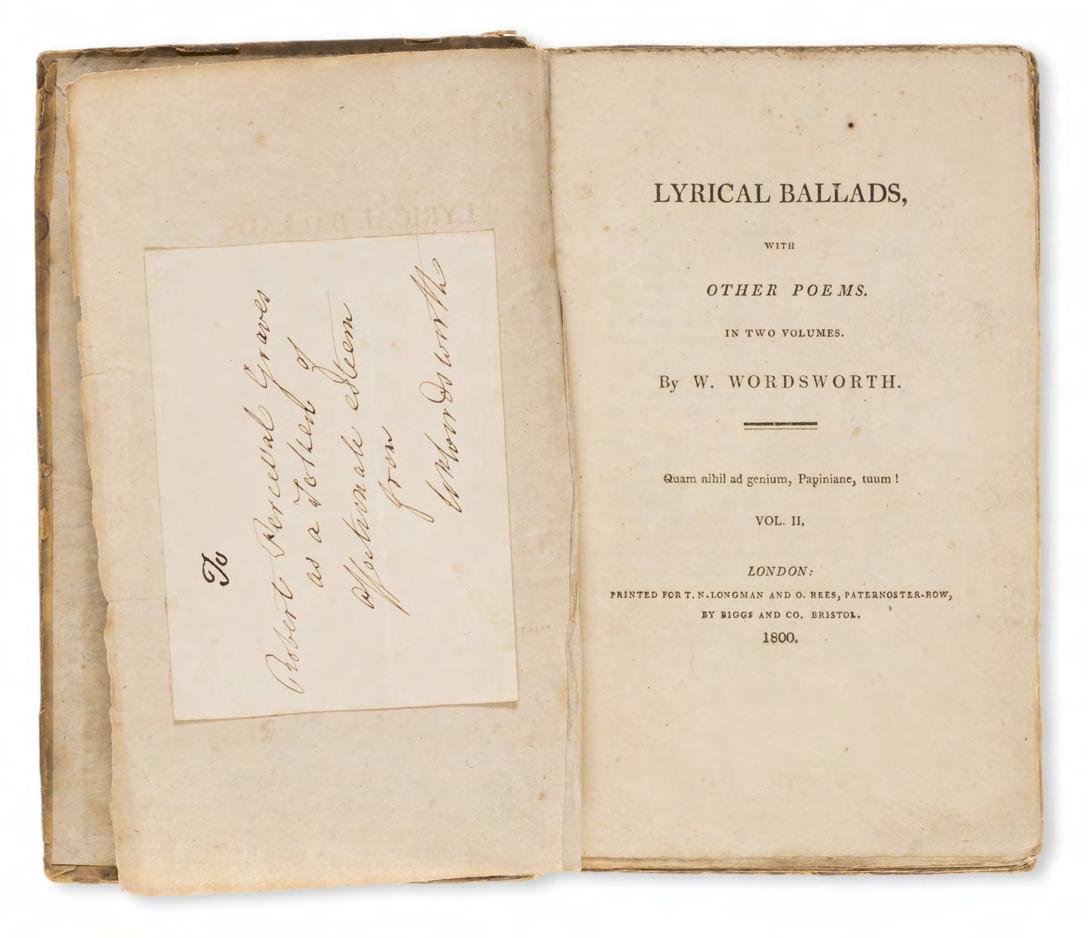
119
Manifesto for the Romantic movement.- Wordsworth (William) Samuel Taylor Coleridge LYRICAL BALLADS, 2 vol., SECOND EDITION OF VOL.1, FIRST EDITION, FIRST ISSUE OF VOL.2, PRESENTATION COPY, one additional poem to volume 1, and 41 new poems to volume 2, and the first edition with Wordsworth’s famous preface, minor marginal soiling, uncut in original (non-uniform) boards, rubbed and soiled, repairs to joints, modern cloth chemise and slip-case, [ESTC T146537], 8vo, Printed for T. N. Longman and O. Rees, 1800.
⁂ THE FIRST APPEARANCE OF WORDSWORTH’S FAMOUS PREFACE WHICH CAN BE SEEN AS A MANIFESTO FOR THE ROMANTIC MOVEMENT: “Poetry is the spontaneous overflow of powerful feelings: it takes its origin from emotion recollected in tranquility.”
Presentation copy of vol.2, inscribed by Wordsworth on paper slip mounted on front flyleaf facing title: “To / Robert Perceval Graves / as a Token of / affectionate esteem / from / Wm. Wordsworth.” Graves was the author of Recollections of Wordsworth, 1869.
Provenance: Vol. I with ink notation on cover in an early hand (“the odd Vol. we will have this bound when we can find the other vol.”); T. B. Greaves (early ink signature on front flyleaf verso); Eleanor Elizabeth Emily Greaves (ink signature and inscription on flyleaf recto): Vol. II: Robert Perceval Graves (presentation inscription on mounted slip to flyleaf opposite title; and his signature in pencil on flyleaf recto); William Brookes (deleted signature on front pastedown); S. A. Brunning (signature on pastedown, dated “2/3/81”). The set was purchased from Howard S. Mott, Inc. Rare Books, Sheffield Mass. From the William A. Strutz Library, 2024 Heritage Auctions
£4,000 - 6,000
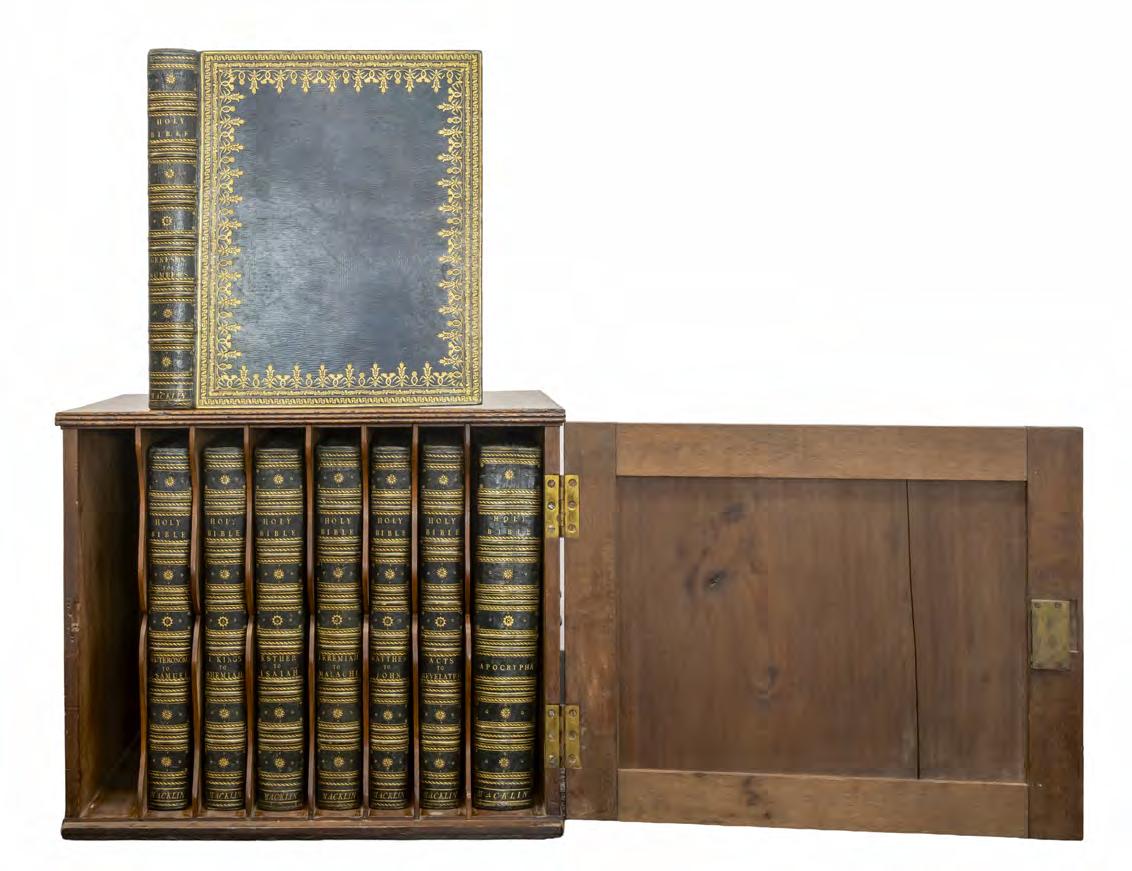
120
Bible, English.- THE HOLY BIBLE, 8 vol., engraved dedication, list of subscribers, 2 engraved frontispieces and 73 plates after Henry Fuseli, Sir Joshua Reynolds, Benjamin West, Richard Cosway, Angelica Kauffman, Thomas Stothard, William Hamilton and others, and numerous head-& tail-pieces, some foxing, margin of one leaf expertly repaired, contemporary blue morocco, gilt, by Lovejoy, covers with decorative borders of a series of gilt rolls, spines gilt in compartments with six pairs of raised bands, sewn gilt-decorated blue leather joints, gilt dentelles and edges, minor scuffing and scratches, a few patches of slight fading, [Herbert 1442], housed in a mahogany box with individual separation slats and brass handles, [ESTC 123175; Darlow & Moule 1442], folio, Printed for Thomas Macklin [& T.Cadell and W.Davies], by Thomas Bensley, 1800-16.
⁂ AN EXCEPTIONAL AND MAGNIFICENT SET OF THIS REMARKABLE Bible, “the most ambitious edition produced in Britain, often pirated but never rivalled.” -DNB.
The list of subscribers includes the King, the Queen and the Prince of Wales. Macklin first announced his plan to publish this lavishly illustrated work in 1789 and devoted the next 11 years of his life to bringing his plans to fruition. He sadly died 5 days after the completion of the final engraving so never lived to see the completed work. It was originally intended to be published in 3 volumes but was actually published in 6, with the Apocrypha appearing in 1816 to complete the set. It is very occasionally found, as here, with the New Testament bound in 2 volumes, each with a separate title-page, thus making a spectacular 8 volumes. The mahogany box, specially made for this set, dates from around the time of publication and undoubtedly accounts for the exceptional condition in which it remains
£8,000 - 12,000
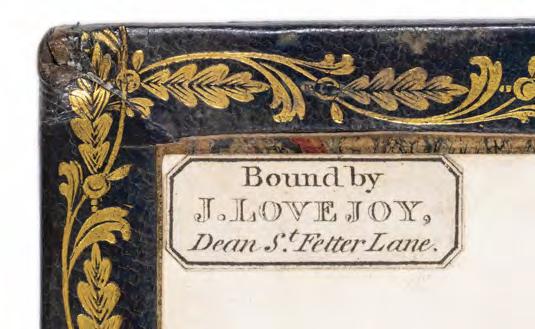
Maritime.- Jenkins (James) THE NAVAL ACHIEVEMENTS OF GREAT BRITAIN, engraved title with hand-coloured vignette by W. Bartlett, 55 hand-coloured aquatint plates by S. Rawle, Sutherland and others after T. Whitcombe, engraved double key-plate, lacking list of subscribers f. and 2 additional portraits of Nelson and St. Vincent, old book label to front pastedown, scattered spotting and cracking at hinges, else a bright and clean copy, contemporary red half morocco, spine gilt, some wear to joints, rubbed and bumped, [Abbey, Life 337; Tooley 282], 4to, 1817.
⁂ Abbey notes that the uncoloured engraved title vignette indicates an early issue, as colouring was added in later states. Tooley adds that the two portraits were supplementary plates and that “the work is complete without them”
£2,000 - 3,000
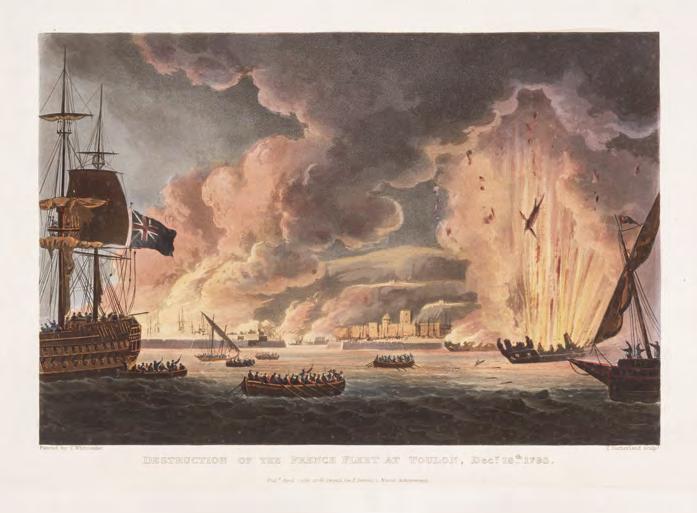
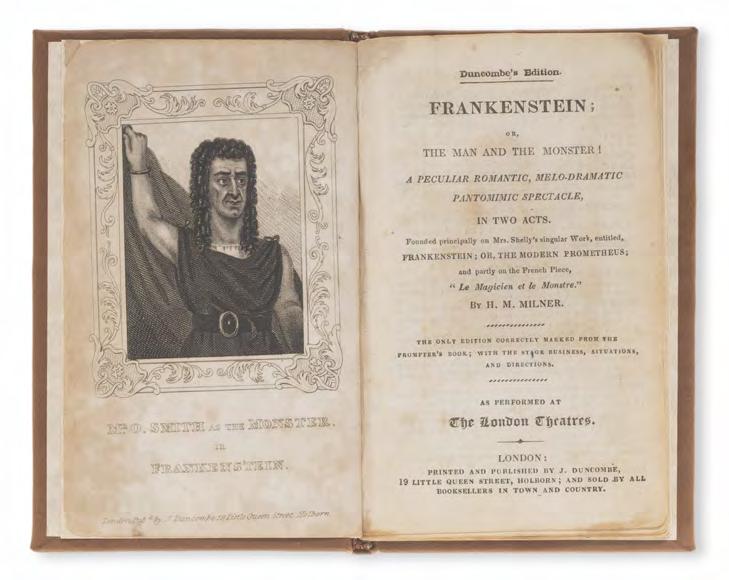
123
Dickens (Charles).- Halliwell (James Orchard), editor. THE FIRST SKETCH OF SHAKESPEARE’S MERRY WIVES OF WINDSOR, half-title, CHARLES DICKENS’ COPY WITH BOOK-LABEL “FROM THE LIBRARY OF CHARLES DICKENS, GADSHILL PLACE, JUNE, 1870” to foot of pastedown, pencil ownership
inscription “?PJM Davies. 1938. King’s College Cantab.” to front free endpaper, some foxing at beginning and end, very light marginal toning, rear free endpaper with small loss to head of gutter, old linen repair to hinges, original blind-stamped cloth, neatly rebacked in modern cloth, light soiling to foot of upper cover, rubbed and worn at extremities, 8vo, Printed for the Shakespeare Society, 1842.
⁂ Charles Dickens’ copy of an important early Victorian scholarly edition of Shakespeare. As Paul Schlicke notes in his essay Dickens and Shakespeare, “Dickens’s engagement with Shakespeare was lifelong”
£600 - 800
122
Shelley (Mary).- Milner (Henry M.) FRANKENSTEIN; OR, THE MAN AND THE MONSTER! A PECULIAR ROMANTIC MELO-DRAMATIC PANTOMIMIC SPECTACLE, IN TWO ACTS. FOUNDED PRINCIPALLY ON MRS. SHELLEY’S SINGULAR WORK, FIRST EDITION, engraved frontispiece of ‘Mr. O. Smith as the Monster in Frankenstein’, woodengraved diagram at end showing ‘Disposition of the Characters when the Curtain falls’, frontispiece with some foxing and offsetting on to title, occasional spotting, lightly browned, modern calf, large 12mo, Printed and published by J. Duncombe, 1826.
⁂ THE FIRST PICTORIAL REPRESENTATION OF ‘THE MONSTER’ IN PRINT It is preceded only by the first two editions of Shelley’s work, and appears five years before her third edition
£3,000 - 4,000
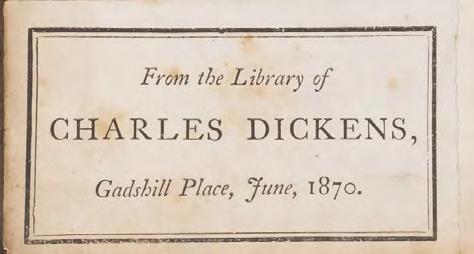
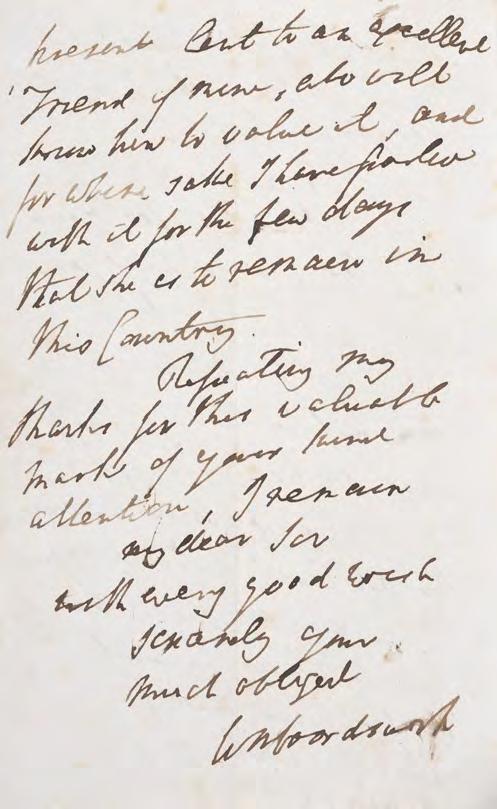
124
Wordsworth (William) THE POETICAL WORKS, frontispiece, additional engraved title, light spotting at beginning and end, ink signature of Wilmot Marsh dated 1846, previous owner’s ink inscription to front pastedown, ALS FROM WORDSWORTH SIGNED TO “MY DEAR SIR” tipped-in on front free endpaper, near contemporary morocco, gilt inner dentelles, wide gilt border, raised spine bands with richly gilt compartments, g.e., contemporary diced calf slipcase, Wilmot Marsh in gilt to edge, remains of brass clasp, rubbed, 1845 § Marsh (Wilmot) Biblical Versions of Divine Hymns with Annotations, very faint spotting to title, contemporary morocco, gilt inner dentelles, g.e., lightly sunned spine, fractional rubbing to corners and spine extremities, 1845, 8vo (2)
⁂ Wordsworth letter, February 4th 1846 reads: “My Dear Sir. Pray accept my sincere thanks for your valuable present of your book entitled Biblical versions. I am happy to say that being so beautifully bound the careful packing secured its arrival without injury. I have read a good deal of it with pleasure and instruction, and found the extracts curious for many reasons ...”
£1,000 - 1,500
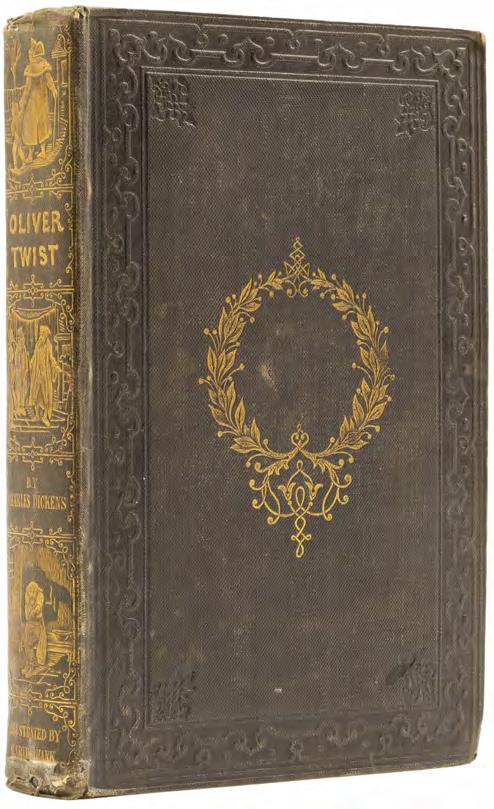
125
Dickens (Charles) THE ADVENTURES OF OLIVER TWIST, FIRST ONE-VOLUME EDITION, 24 engraved plates by Cruikshank, half-title, faint ink ownership signature on title head, plates lightly browned, slight cracking at hinges, original patterned cloth, gilt, spine slightly faded, spine ends and corner tips lightly rubbed and bumped, overall excellent, 8vo, 1846.
⁂ Uncommon in original cloth
£800 - 1,200
Rossetti (Dante Gabriel, illustrator).- Rossetti (Christina) THE PRINCE’S PROGRESS, AND OTHER POEMS, FIRST EDITION, SIGNED PRESENTATION COPY FROM THE ILLUSTRATOR AND POET’S BROTHER TO CHARLES AUGUSTUS HOWELL, half-title, wood-engraved frontispiece and additional vignette title after Dante Gabriel Rossetti, free endpapers and half-title foxed, occasional spotting elsewhere, lightly browned, brown endpapers, original green decorative cloth, gilt, by Burn (ticket to rear pastedown), little fraying to head of upper joint, little rubbed at extremities, some marking, house in a dark green cloth slip-case, [Ashley Library IV, pp.100-101; Colbeck p.689; Fredeman 44.4; Tinker 1786], 8vo, Macmillan and Co., 1866.
⁂ An excellent association copy. The inscription to the half-title reads ‘To Charles A Howell, From his affectionate friend, D.G. Rossetti, 1866’. It dates from the time when Howell was amongst the most intimate of the artist’s circle.
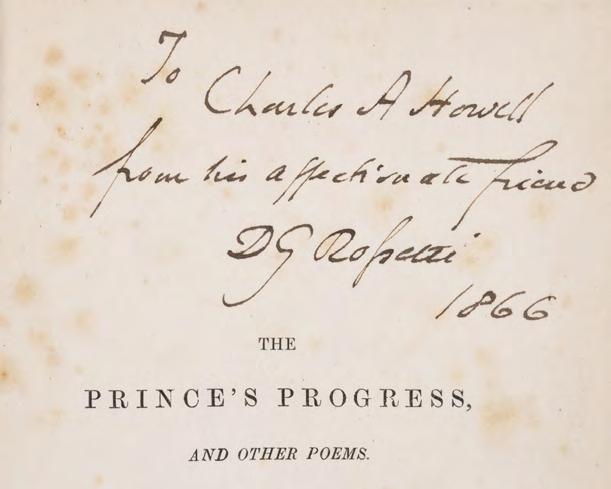
Charles Augustus Howell (1840-1890), art dealer and alleged blackmailer was one of the most notorious fi gures of his day. A thinly veiled fi ctionalisation of him was written by Arthur Conan Doyle in his story ‘The Adventure of Charles Augustus Milverton’, where he was labelled ‘the worst man in London’. Burne-Jones called him ‘a base, treacherous, unscrupulous and malignant fellow’, and Swinburne ‘the vilest wretch I ever came across’. Swinburne, like Ruskin, was one of those who had for a time been seduced by the charm of Howell (he represented them both). Whistler too had fallen under his spell for a while. However, no-one came under his sway, or suffered as a result of machinations more than Dante Gabriel Rossetti. A few years after this presentation copy Howell would provide the means of exhuming from Lizzie Siddal’s grave the poems that Rossetti had buried with her; the act upon which a large part of his notoriety rests. Howell was to die in mysterious circumstances. He was found in Chelsea with his throat slit and a coin in his mouth. Letters from prominent persons were found in his home, which lead to increased speculation that he had been engaged in widespread blackmail £4,000 - 6,000
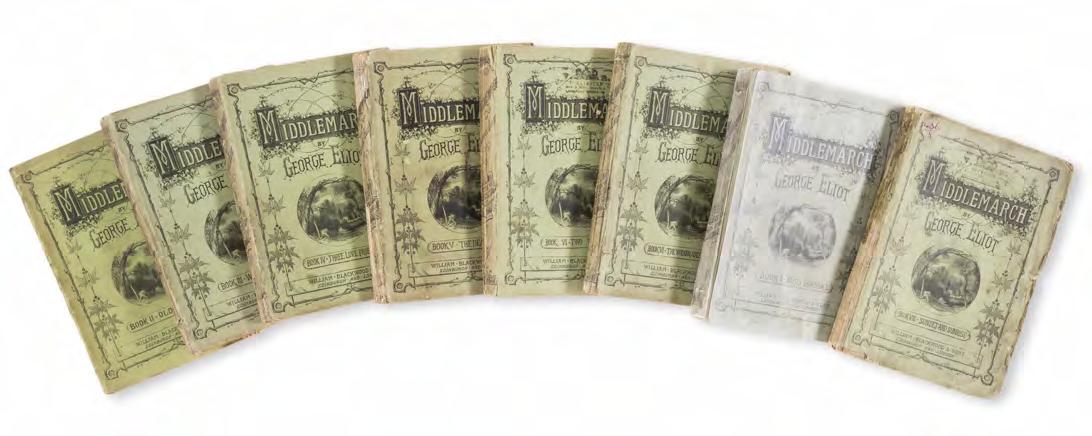
127
[Evans (Mary Ann)], “George Eliot”. MIDDLEMARCH, FIRST EDITION, FIRST ISSUE IN ORIGINAL 8 PARTS, title in vol.1, half-titles in vol.1-8, slips announcing next volumes in vol.1-7, errata slip in vol.4 only as called for, advertisements in vol.1-7, lacking some advertisements and rear catalogue in vol.8, loss to head at half titles to vol.1&3, W.H.Smith blind-stamp to a few pp. in vol.2, pencil ownership signature in each vol., light toning to vol.8 pp.214-215, a few corner creases, some margins darkened, occasional surface-soiling, original printed wrappers, vol.1 covers and vol.8 lower cover supplied in facsimile and laid down onto contemporary paper, small sticker on vol.8 upper cover, some creasing and chipping to spines and extremities, spines sunned, light toning and staining, particularly to vol.5, overall remaining bright, some pp. unopened, edges lightly toned, [Baker & Ross A10.1.a], 8vo, 1871-72.
⁂ First edition in original wrappers of Eliot’s most famous work, often hailed as one of the greatest novels in the English language. Extremely rare to find in wrappers
£10,000 - 15,000
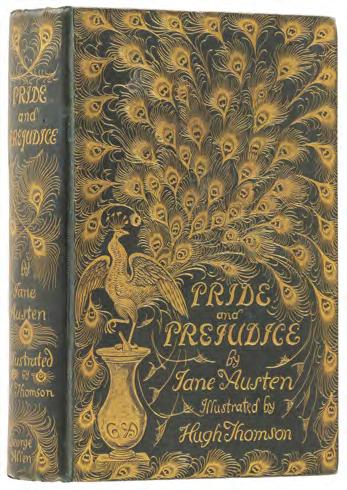
128
Austen (Jane) PRIDE AND PREJUDICE, FIRST ‘PEACOCK’ EDITION, half-title with contemporary ink inscription, illustrations by Hugh Thomson, occasional spotting, mostly at beginning and end, lower hinge weak, original pictorial cloth, gilt, g.e., minor marking to lower cover, 8vo, George Allen, 1894.
⁂ A bright copy of this hugely popular edition of Jane Austen’s beloved novel
£1,200 - 1,800
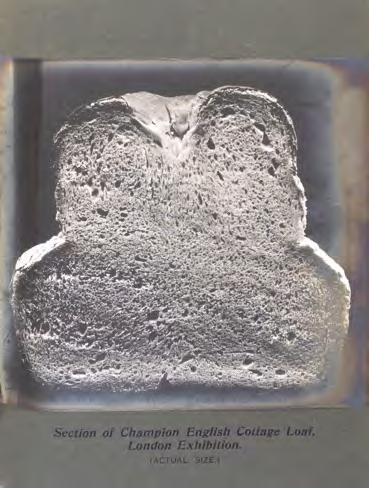
129
Photobook.- Simmons (Owen) THE BOOK OF BREAD, FIRST EDITION, ONE OF 350 DELUXE COPIES (with list of subscribers at end), half-title, 10 tipped-in silver bromide prints, 12 chromolithographed plates, advertisements at end, silver bromide prints with silvering (as often) and some a little creased at lower inner corner (as often), ink ownership inscription to front free endpaper, occasional spotting or light staining, endpapers foxed, original red crushed morocco, gilt, rebacked, preserving original backstrip in compartments (faded), corners worn, rubbed and scuffed, [Bitting p. 435; Parr & Badger The Photobook, I, 56], 4to, Maclaren & Sons, [1903].
⁂ ‘one of the humblest, yet most essential of objects is catalogued as precisely, rigorously and objectively as any work by a 1980s Conceptual artist’ (Martin Parr in The Photobook).
£1,000 - 1,500
130
Hardy (Thomas) TESS OF THE D’URBERVILLES, pocket edition, Christine Silver’s copy with two ownership inscriptions, and with signed inscription “A charming impersonator of “Tess”. Thomas Hardy” and pasted-in note on Max Gate headed paper from the author “Photograph returned. Good luck to you & the play. T.H. 26.1.1926”, with loosely inserted photograph of Hardy with Christine Silver and Gwen Ffrangcon-Davies at Max Gate, a postcard and 2 typed summaries of press reviews of Silver’s performance as Tess, Macmillan & Co, 1925; The Life and Death of the Mayor of Casterbridge, pocket edition, Christine Silver’s copy with her ownership inscription and an inscription in the author’s hand “(“Susan Henchard”) Thomas Hardy” and beneath the signature of John Drinkwater plus 2 loosely inserted postcards, one a bust of Hardy with signed presentation inscription from him to Silver, Macmillan & Co., 1923, both in original maroon cloth, small 8vo (2)
⁂ A LOVELY PAIR OF ASSOCIATION COPIES of two of Hardy’s most celebrated novels, belonging to the actress Christine Isie Silver (18831960) who starred as the eponymous tragic heroine, Tess, and as Susan Henchard in another production of The Mayor of Casterbridge, both in 1926. Hardy, who was 86 at the time and only lived for another 2 years, was clearly delighted with Silver’s portrayal and the reviews are also very effusive in their praise: “Miss Silver’s exquisite art was in itself a contribution of the highest poetic worth...the acting of this Tess was perfect in its simplicity, its tenderness, and pathos and had a startled tremulous beauty that was all Miss Silver’s own” (Daily Telegraph).
£600 - 800
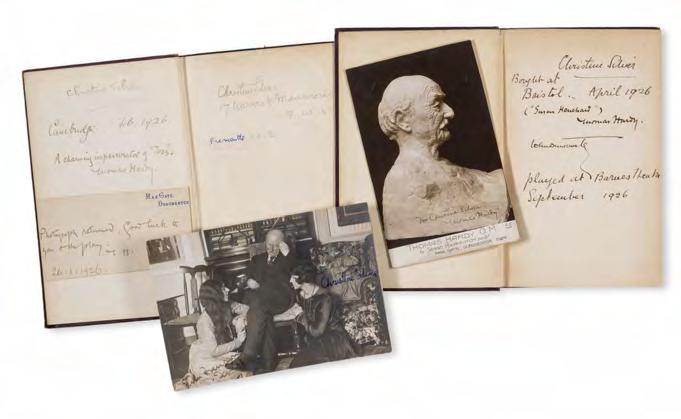
131
Economics.- Keynes (John Maynard) THE GENERAL THEORY OF EMPLOYMENT, INTEREST AND MONEY, FIRST EDITION, light scattered spotting, some toning to endpapers, original cloth, spine slightly darkened, spine ends lightly bumped, the odd small mark, dust-jacket, spine browned and chipped with some loss to ends, a few small nicks, else an excellent copy, [PMM 423], 8vo, 1936.
⁂ One of the defining texts in the evolution of economic thought, by one of the foremost economists of his era
£3,500 - 5,000
132
Churchill (Sir Winston Spencer) THE SECOND WORLD WAR, 6 vol., FIRST EDITION, half-titles, folding maps, modern black half morocco, spines gilt, 8vo, 1948-54
£700 - 1,000
133
Churchill (Sir Winston Spencer) THE COLLECTED ESSAYS, 4 vol., ‘Centenary Edition’, limitation bookplates laid down to front free endpapers, original blue morocco-backed cloth, gilt, t.e.g., 8vo, Library of Imperial History, 1976
£750 - 1,000
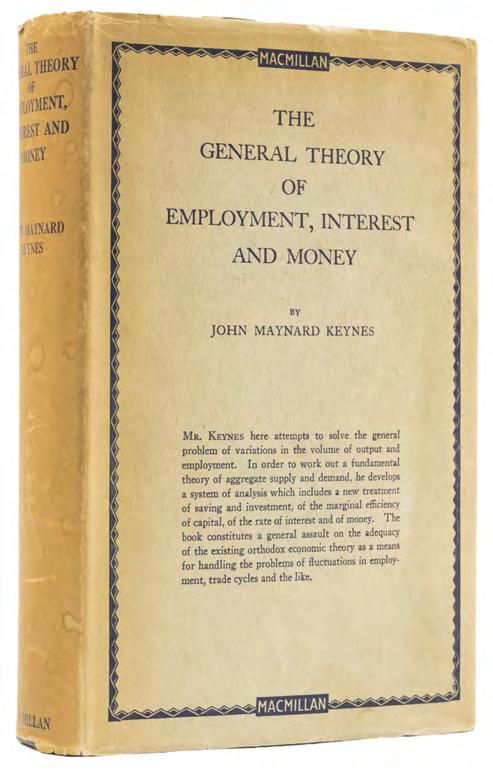
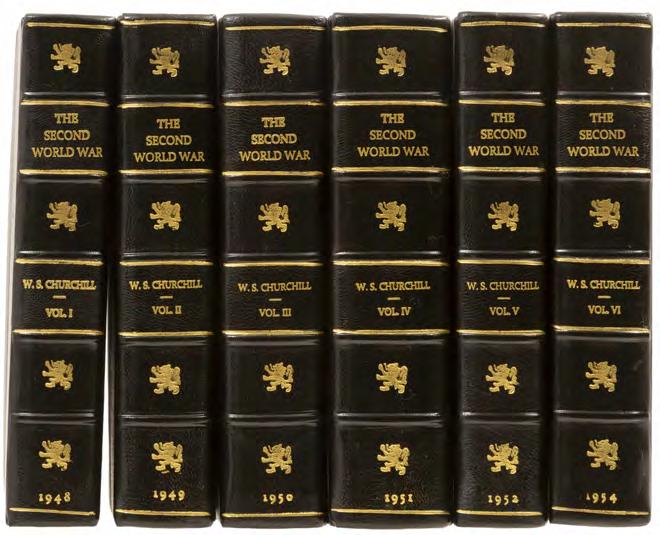
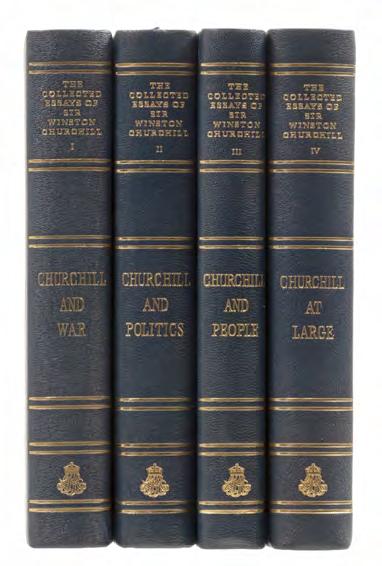
134
Adams (Richard) WATERSHIP DOWN, FIRST EDITION, PRESENTATION INSCRIPTION SIGNED BY THE AUTHOR “To Russell Hoban with very good wish from Richard Adams. May 1973” on front free endpaper, folding map, light toning to endpapers, original boards, slight vertical crease to spine, spine ends and corner tips fractionally bumped, edges slightly toned, faint spots to top edge, dust-jacket, short tear at spine ends, not affecting text, spine and lower panel slightly faded, extremities lightly creased, overall excellent, 8vo, 1972.
⁂ Russell Hoban (1925-2011), American novelist
£1,500 - 2,000
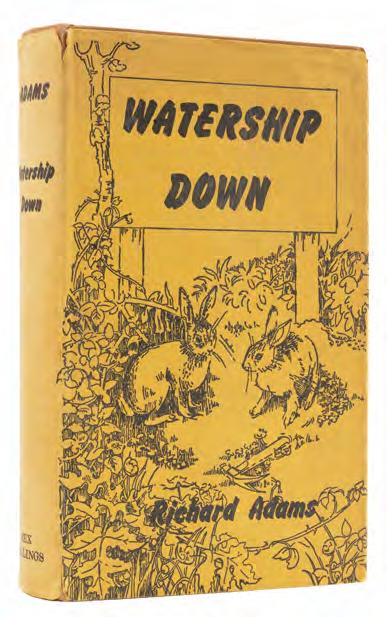

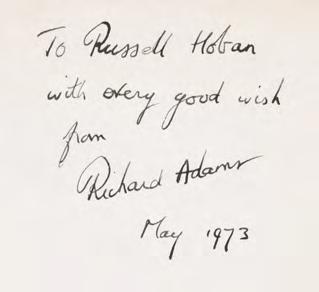

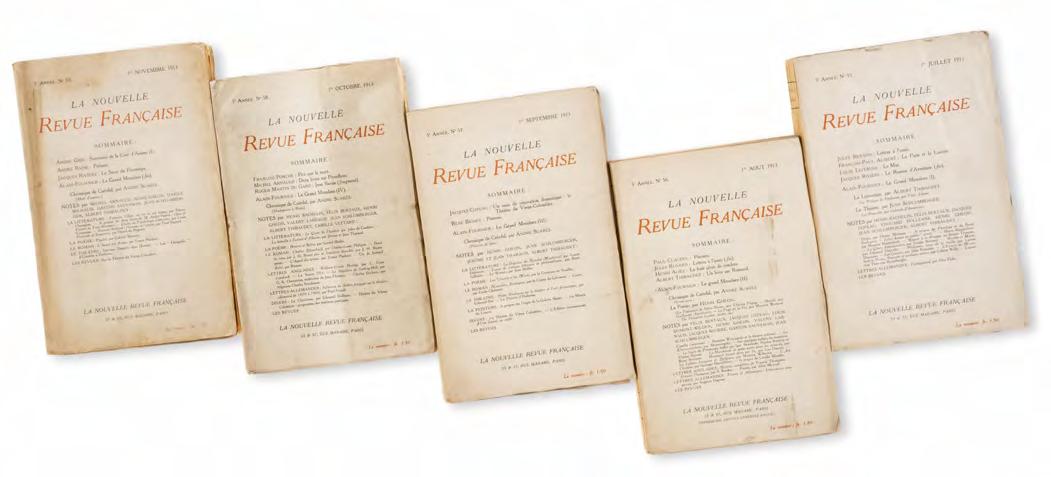
135
Alain-Fournier (Henri) LE GRAND MEAULNES, FIRST EDITION IN THE ORIGINAL 5 PARTS, in La Nouvelle Revue Française, No. 55-59, No. 58 with publisher’s printed slip torn out at start, a little light creasing and dust-soiling, very occasional light browning or spotting, uncut in original wrappers printed in orange and black, browning to spines & No. 59 upper cover, some surface soiling, little rubbed, 8vo, Paris, July - November 1913.
⁂ First edition of Alan-Fournier’s only completed novel, one of the great novels of adolescence, which has attained an elevated position in the French literary cannon. It was first published in book form at the end of the same year by Emile-Paul Frères. The author died on the front less than a year later
£600 - 800
136
Christie (Agatha) POIROT INVESTIGATES, FIRST EDITION, 12pp. advertisements only (of 14), “Royal Naval War Libraries” ink stamp on front pastedown, closed tear in text and vertical crease on p.203, marginal loss to foot at a few pp., some surface-soiling and staining, the odd corner crease, endpapers lightly browned, original orange cloth lettered in dark blue, marks in biro to upper cover, light staining and toning, spine faded and creased, spine ends and corners rubbed and bumped, [Cooper & Pike pp.82-9; Queen’s Quorum 71], 8vo, John Lane the Bodley Head, 1924.
⁂ The author’s first short story collection
£1,000 - 1,500
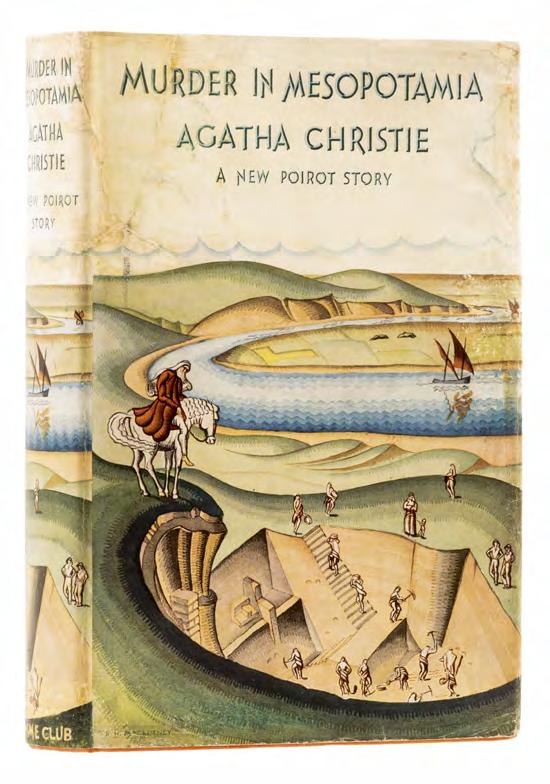
138
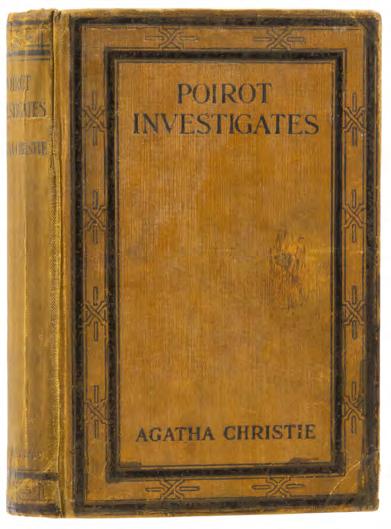
137
Christie (Agatha) MURDER IN MESOPOTAMIA, FIRST EDITION, 4pp. advertisements, light browning to endpapers, more so at end, minor nick at foot to pp.243-255, overall a clean copy, original orange cloth lettered in black, fading to covers, light dust-soiling to edges, dustjacket priced at 7/6 by Robin Macartney, repairs and restorations to extremities, particularly at upper panel and spine, light toning, [Cooper & Pike pp.82-9], 8vo, The Crime Club, 1936.
⁂ Scarce in the superb Macartney dust-jacket. One of a few Christie titles that resulted from her time spent on archaeological digs with her second husband, Max Mallowan
£5,000 - 7,000
Cunard (Nancy), W.H. Auden, Samuel Beckett, T.S. Eliot, Evelyn Waugh, etc... AUTHORS TAKE SIDES ON THE SPANISH WAR, FIRST EDITION, marginal spotting to a few pp., original wrappers, light spotting and toning to upper cover, original printed wraparound band, neat tape repair to upper flap verso, small nick to upper flap joint, edges lightly toned, tall 8vo, 1937.
⁂ Extremely scarce with wraparound band
£1,000 - 1,500
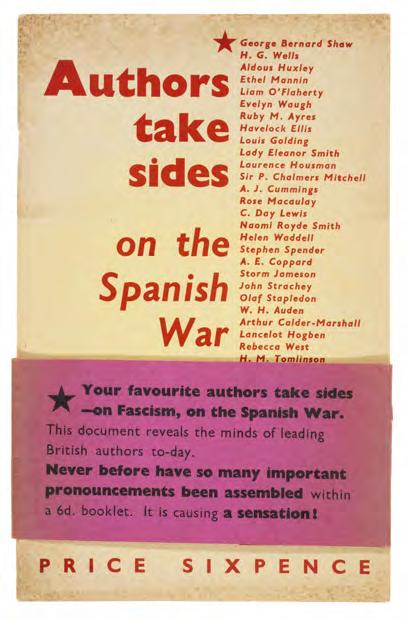
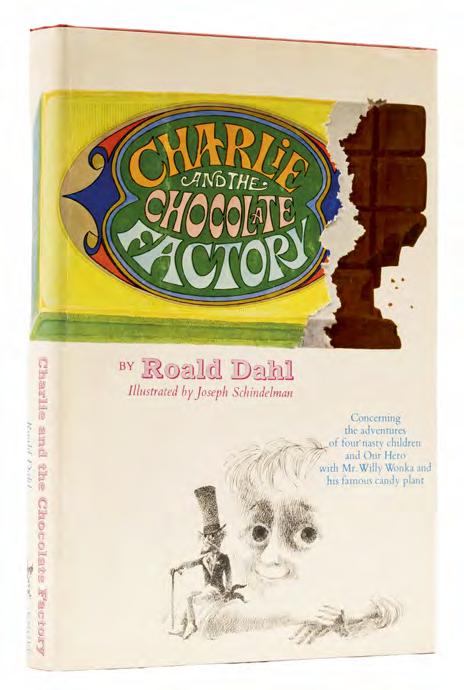
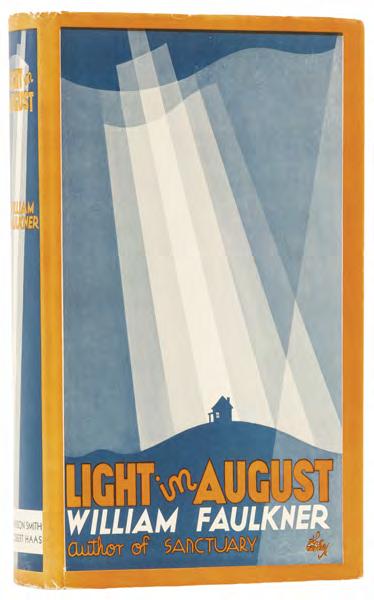

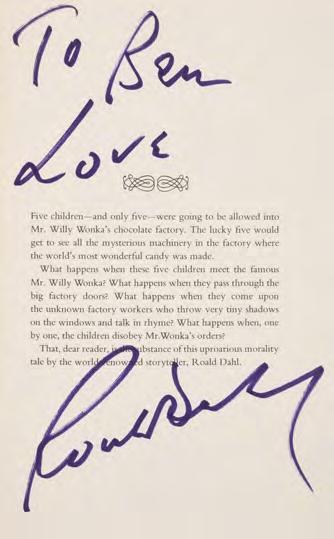

139
Dahl (Roald) CHARLIE AND THE CHOCOLATE FACTORY, FIRST EDITION, FIRST ISSUE with the six line colophon, fifth line reading “Paper manufactured by S. D. Warren and Co.”, illustrations by Joseph Schindelman, SIGNED PRESENTATION INSCRIPTION FROM THE AUTHOR on front free endpaper, final free endpaper lightly toned, original blind-stamped cloth, minor spot to upper cover, edges lightly toned, first issue dust-jacket priced at $3.95 without ISBN, neat restorations to extremities, housed in custom pictorial slip-case, light finger-soiling, overall excellent, 8vo, New York, 1964
£4,000 - 6,000
140
Faulkner (William) LIGHT IN AUGUST, FIRST EDITION, FIRST ISSUE with ‘Jefferson’ for ‘Mottstown’ on p.340, slight browning to endpapers, bookseller ticket on rear pastedown, original first state coarse tan cloth, minor bumping to spine ends, edges slightly toned, dust-jacket, a few minor nicks to extremities, spine fractionally faded, spine ends and corners very slightly rubbed, overall an excellent copy, 8vo, New York, 1932.
⁂ Published a year after his controversial Sanctuary, Faulkner’s tale of Joe Christmas and Lena Grove is now hailed as ranking among his best and a major work of 20th century literature
£1,500 - 1,800
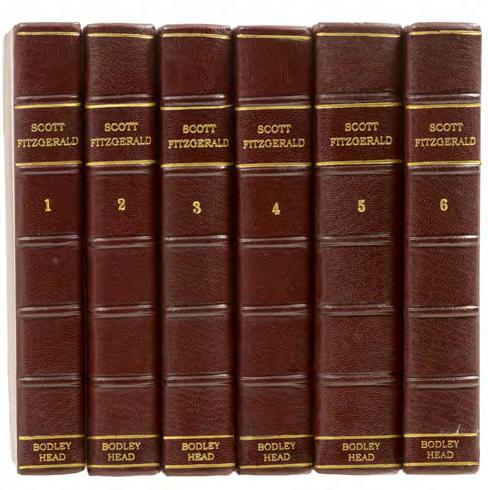
141
Fitzgerald (F. Scott) [WORKS], 6 vol., reprints, modern burgundy half morocco, spines gilt, 8vo, The Bodley Head, 1971-75
£750 - 1,000
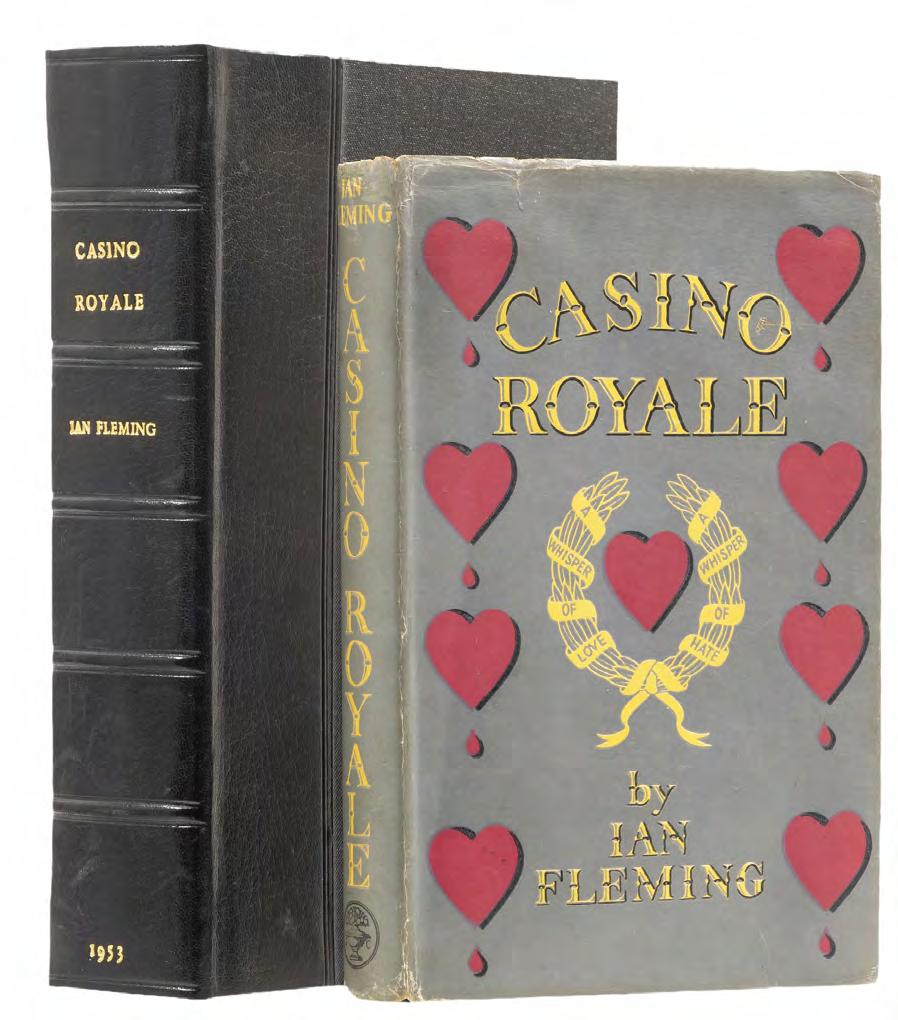
Fleming (Ian) CASINO ROYALE, FIRST EDITION, SIGNED PRESENTATION
INSCRIPTION FROM THE AUTHOR “JACKIE, TO READ IN THE TRAIN FROM THE AUTHOR” on front free endpaper, lightly spotted, original black boards with heart motif in red to upper cover, spine lettered in red, first issue dust-jacket without Sunday Times review, some very light expert repairs and retouching to upper edge, housed in half morocco drop back box, overall in effect an excellent copy, 8vo, 1953.
⁂ AN EXCEEDINGLY RARE SIGNED COPY OF FLEMING’S DEBUT NOVEL AND FIRST JAMES BOND BOOK
Especially scarce in the original, unclipped first-issue dust-jacket in such excellent condition
£40,000 - 60,000


143
Fleming (Ian) YOU ONLY LIVE TWICE, FIRST EDITION, FIRST IMPRESSION, FIRST STATE, SIGNED PRESENTATION INSCRIPTION BY THE AUTHOR TO ROBERT HARLING, “TO ROBERT BUT NOT TO READ! FROM IAN” to front free endpaper, ‘Harling’ in a different hand in ink to front free endpaper, slight browning to free endpapers, original cloth, a few white marks to lower cover, light bumping to extremities, dust-jacket, small nick to head of lower panel, slight creasing to panels, minor rubbing to spine ends, but overall a near-fine copy, housed in modern morocco-backed drop-back box, 8vo, 1964.
⁂ Robert Harling was a close friend of Fleming’s, following their service together in the naval intelligence in the Second World War.
Harling is known for creating the “Tea Chest” font used on 10 dustjackets for the Bond books and POSSIBLY BEING THE MODEL UPON WHICH FLEMING BASED THE CHARACTER OF JAMES BOND. He featured as a character in two books (as a police inspector in Thunderball and as a typographer in The Spy Who Loved Me). In You Only Live Twice, Commander Bond’s obituary on pages 240-241 matches Harling’s own account of his own childhood, where he was orphaned as a child and raised in Kent, again showing the ample inspiration Fleming took from his friend.
£8,000 - 12,000

144
Grahame (Kenneth) THE WIND IN THE WILLOWS, FIRST EDITION, half-title, frontispiece by Graham Robertson, bookseller’s ticket to front pastedown, very light offsetting to title, the odd spot or mark elsewhere, browning and spotting to pastedowns and endpapers, some light cracking to upper hinge, original pictorial cloth, gilt, spine very slightly dulled, spine ends and corners a little bumped, the odd mark to covers, t.e.g., others uncut, generally a very bright copy, 8vo, Methuen, 1908.
⁂ A very good example of one of the most celebrated and influential children’s books in the English language
£2,000 - 3,000
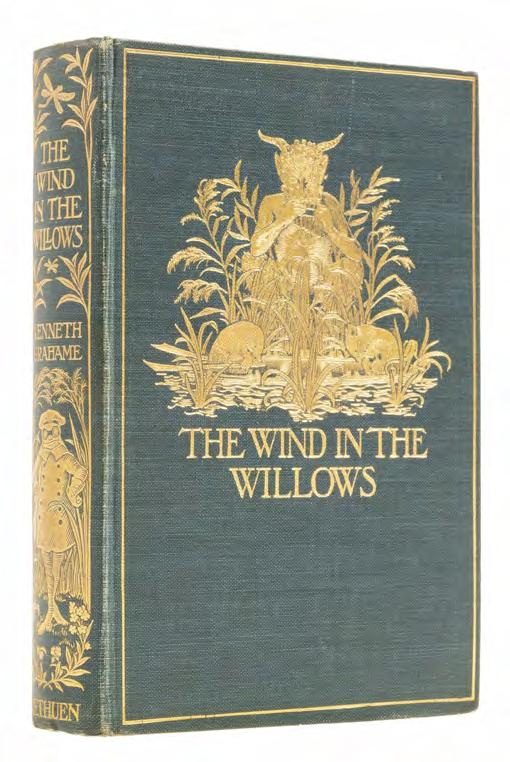
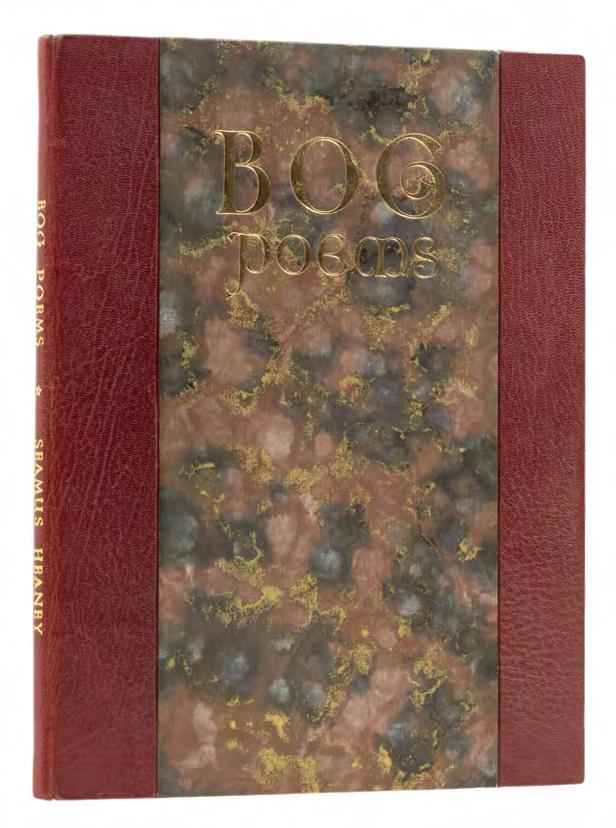

145
Heaney (Seamus) BOG POEMS, ONE OF 150 COPIES SIGNED BY THE AUTHOR, illustrated by Barrie Cooke, original half morocco, gilt, spine fractionally faded, margins slightly toned, slip-case, 4to,The Rainbow Press, 1975
£3,000 - 4,000
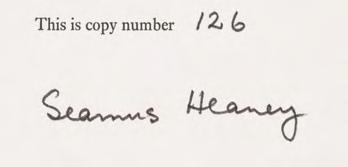

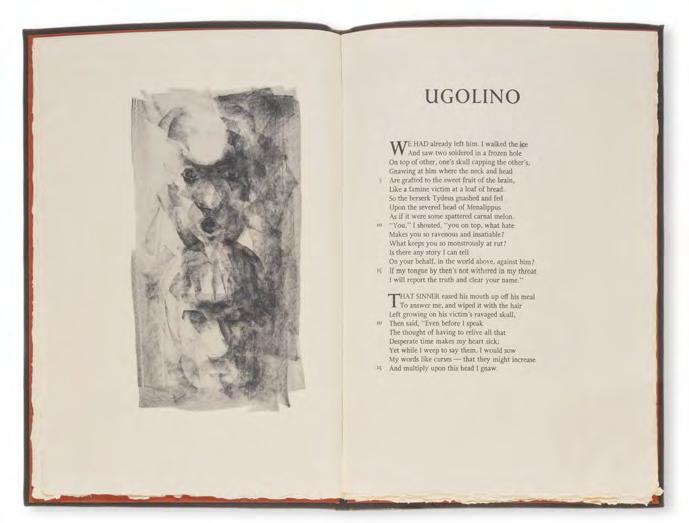
146
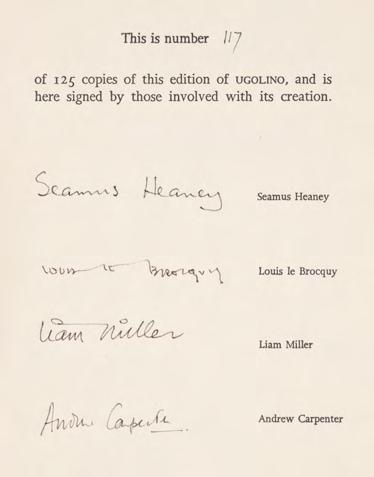

Heaney (Seamus) UGOLINO, ONE OF 125 COPIES SIGNED BY THE AUTHOR, ARTIST, DESIGNER AND PUBLISHER, 2 lithograph plates by Louis le Brocquy, designed by Liam Browne, published by Andrew Carpenter, small ink correction to colophon, original limp black goatskin, head of spine slightly sunned, minor nick to spine foot, uncut, cloth & board slip-case with printed spine label, slightly faded, a few light scuff marks, small folio, Dublin, Dolmen Press, 1979
£2,000 - 3,000
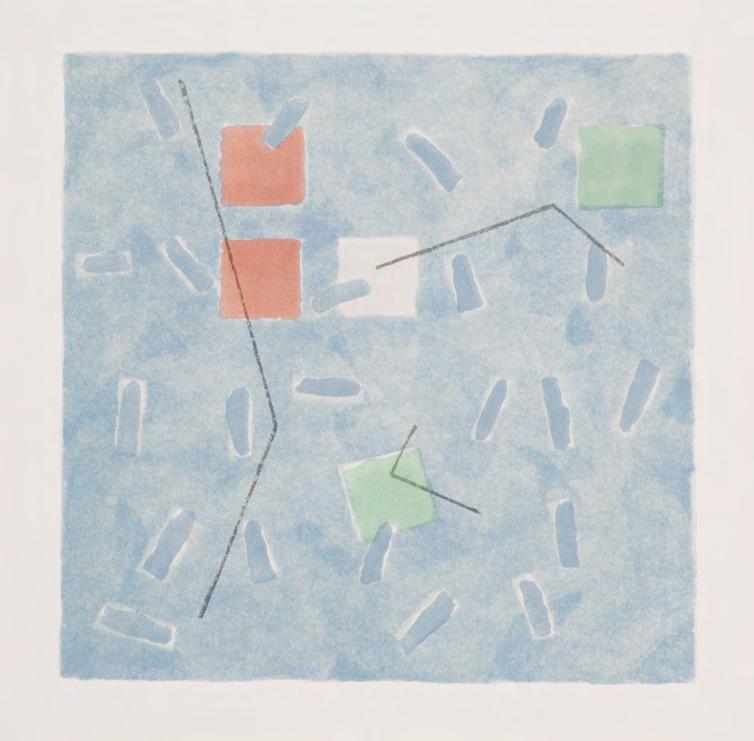
147
Heaney (Seamus) SQUARINGS, ONE OF 100 COPIES SIGNED BY THE AUTHOR AND ARTIST, 4 colour lithographs by Felim Egan, original pale calf with title in blind on upper cover, uncut, original cloth solander box, spine lettered in silver, large 4to, Dublin, Hieroglyph Editions, 1991
£2,000 - 3,000

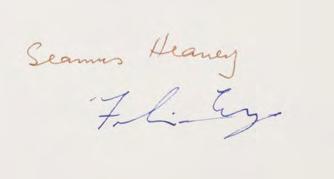

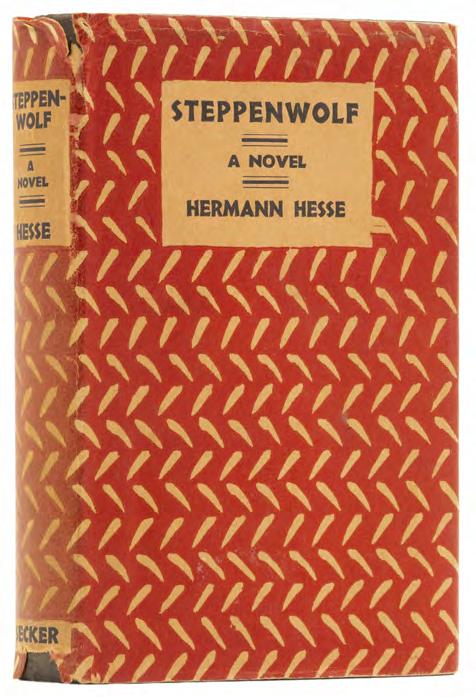
148
Hesse (Hermann) STEPPENWOLF, FIRST ENGLISH EDITION, translated by Basil Creighton, 4pp. advertisements, light spotting to front and end, slight cracking to upper hinge, bookseller ticket on rear pastedown, original cloth, spine slightly sunned, a few light spots to covers, light spotting and toning to edges, dust-jacket, upper flap price-clipped, small paper repairs to spine ends at verso, spine lightly toned, minor loss to spine foot, extremities lightly creased, overall excellent, 8vo, 1929
£1,200 - 1,500
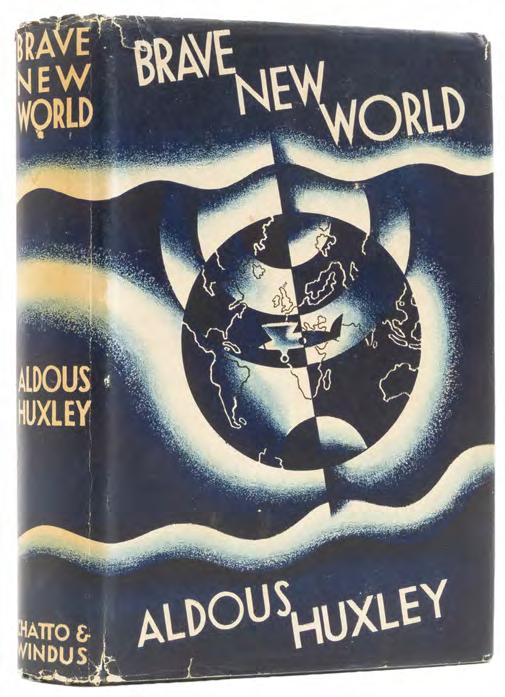
149
Huxley (Aldous) BRAVE NEW WORLD, FIRST EDITION, AUTOGRAPH LETTER SIGNED BY THE AUTHOR on letterhead paper, 1p., 1932, responding to an admirer, margins lightly sunned, fold, loosely inserted, occasional marginal spotting, original boards, spine lettered in gilt, spine slightly sunned, a few scuff marks, more so at upper cover, spine ends and corners slightly rubbed, light spotting and toning to edges, dust-jacket, spine lightly sunned, spine ends slightly chipped, some minor nicking to extremities, particularly at spine head, light spotting to verso, 8vo, 1932.
⁂ With all good wishes for Posterity & in the hope that it will not inhabit a Brave New World. Aldous Huxley. 1932”
£2,000 - 3,000
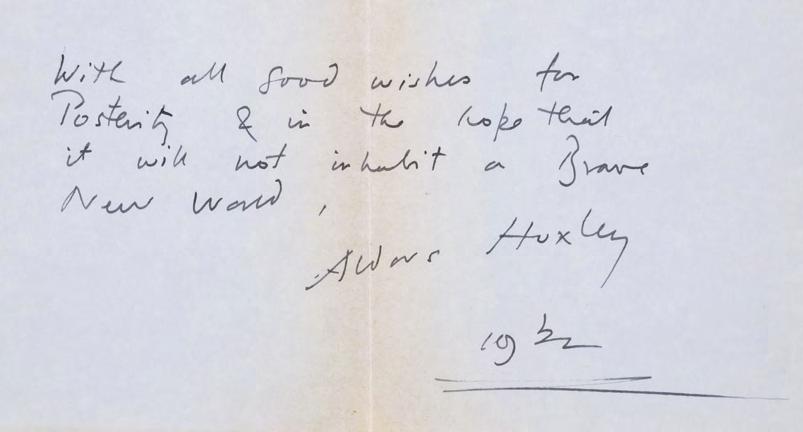

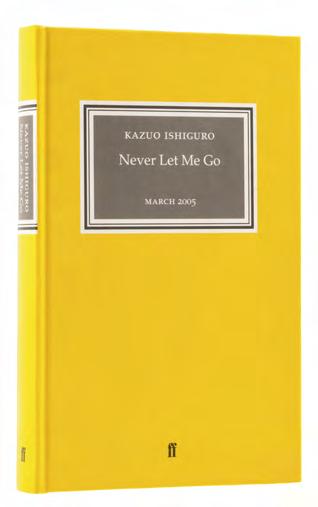



Ishiguro (Kazuo) NEVER LET ME GO, UNCORRECTED PROOF, ONE OF 130 COPIES SIGNED BY THE AUTHOR on title, original boards, spine fractionally faded, near-fine, 8vo, 2005.
⁂ Uncorrected proof copy of Kazuo Ishiguro’s 2005 dystopian sci-
fi classic, published a month before the publication of the Faber first edition trade hardback
£600 - 800
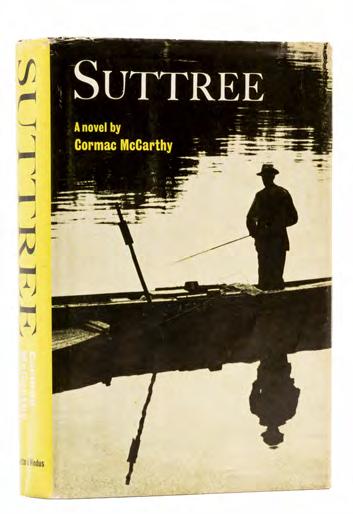
McCarthy (Cormac) SUTTREE, FIRST ENGLISH EDITION, faint toning to endpapers, original cloth-backed boards, gilt, light spotting to edges, dust-jacket, light spotting, more so to lower panel and verso, slight creasing to spine foot, spine ends and corners lightly nicked and creased, overall an excellent copy, 8vo, 1980
£1,200 - 1,500
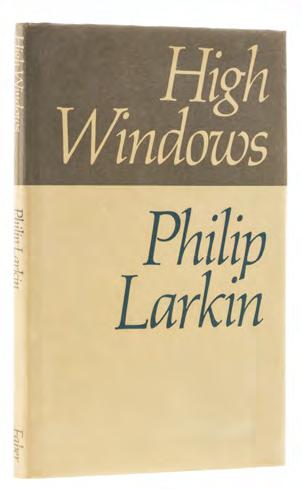

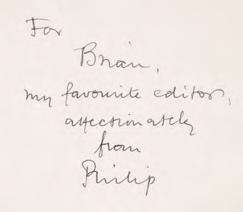


Larkin (Philip) HIGH WINDOWS, FIRST EDITION, SIGNED PRESENTATION
INSCRIPTION FROM THE AUTHOR “For Brian, my favourite editor, affectionately from Philip” on front free endpaper, original cloth, dustjacket, lightly toned, upper panel and spine ends fractionally creased, 8vo, 1974.
⁂ A very good association copy of Larkin’s final published collection before his death in 1985.
Brian Cox (1928-2008), co-founder and editor of the Critical Quarterly, a journal which promoted contemporary poetry and included works by the likes of Philip Larkin and Sylvia Plath
£1,500 - 2,000
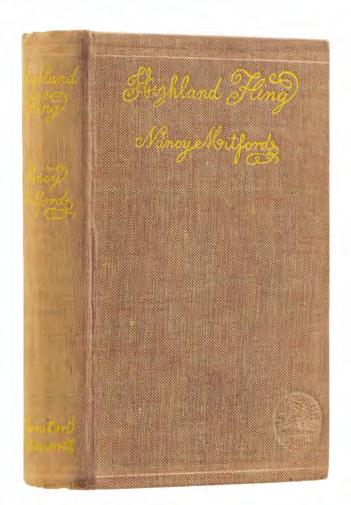
153

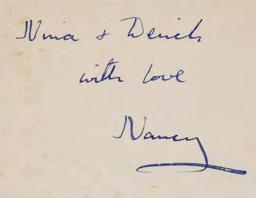

Mitford (Nancy) HIGHLAND FLING, FIRST EDITION, SIGNED PRESENTATION INSCRIPTION FROM THE AUTHOR to “Nina [Ogilvie-Grant] & Derek [StudleyHerbert] with love. Nancy” on half-title, Edward Wasserman’s bookplate tipped onto front pastedown (lightly stained at head), halftitle detaching, light spotting to a few pp. at front and rear, overall clean, original cloth, spine fractionally sunned, slight stain to foot, edges lightly toned, 8vo, 1931.
⁂ The author’s first novel, especially scarce inscribed.
A nice association inscribed to Nina Ogilvie-Grant, Countess of Seafield (1906-1969), Scottish peeress and friend of Nancy Mitford, and her first husband, Derek Studley-Herbert.
Edward Wassermann (c.1904-?), American banker, art collector and literary critic
£800 - 1,200
154
O’Brien (Flann) AT SWIM-TWO-BIRDS, FIRST EDITION, light toning to endpapers, a few marginal spots, second issue cloth, spine slightly sunned, fractional shelf-lean, edges light spotting and toning to edges, 8vo, 1939.
⁂ The author’s exceedingly rare first novel
£1,500 - 2,000
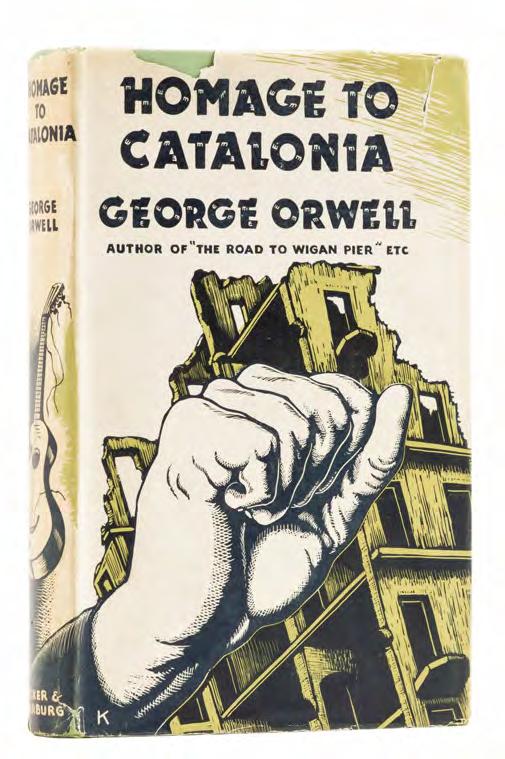
155
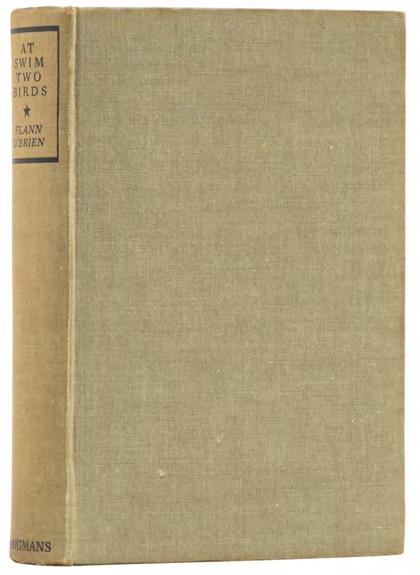
Orwell (George) HOMAGE TO CATALONIA, FIRST EDITION, toning strips to endpapers, original cloth, spine ends fractionally bumped, minor stains and sunning to edges, dust-jacket, upper flap price-clipped, spine and flaps lightly toned, surface-abrasion to spine and verso, light chipping to upper panel head, spine ends and corners tips, slight surface-soiling to lower panel, short tear to upper panel, 8vo, 1938.
⁂ Orwell’s personal account of his experiences and observations during the Spanish Civil War. The war was one of the defining turning points of his political outlook and a significant impulse for what led him to write in 1946 “Every line of serious work that I have written since 1936 has been written, directly or indirectly, against totalitarianism and for Democratic Socialism, as I understand it”
£4,000 - 6,000
156
Owen (Wilfred) POEMS, FIRST EDITION, portrait frontispiece, tissue guard, light toning strips to title and endpapers, minor spotting to a few pp. including frontispiece head, original cloth, paper label to spine, fading to covers, very light sunning to spine, slight bumping to spine tips and corners, dust-jacket, tape repairs at verso, loss at spine ends (affecting text) and upper panel foot, light spotting, more so at verso, spine slightly darkened and rubbed, light creasing to extremities, light spotting to top edge, an excellent copy, sm. 4to, 1920.
⁂ The most important book of poetry from the first world war. The power of Owen’s poetry is as significant today as it was when first written, under the encouragement of Siegfried Sassoon (who wrote the introduction to this posthumously published collection), in the trenches of Flanders, mostly in 1917 and 1918. Owen was killed one week before the armistice was signed in 1918. Very rare in the dust-jacket
£3,000 - 4,000
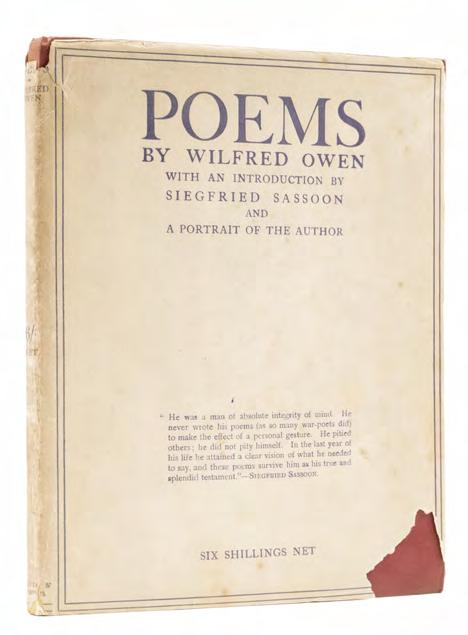
157
Rowling (J.K.) HARRY POTTER AND THE PHILOSOPHER’S STONE, FIRST EDITION, FIRST IMPRESSION, slight marginal dent to pp.45-48, a few stains to one or two pp., margins lightly toned, original wrappers, minor biro markings to upper cover on Harry’s hand, a few small excisions to lower panel illustration, spine very slightly creased, spine ends and corner tips lightly rubbed, minor chip to upper cover fore-edge, generally a very good copy, 8vo, 1997
£3,000 - 4,000
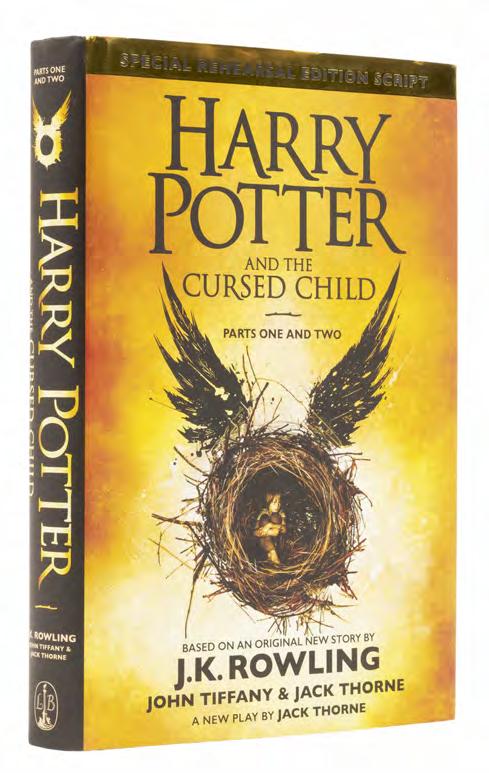
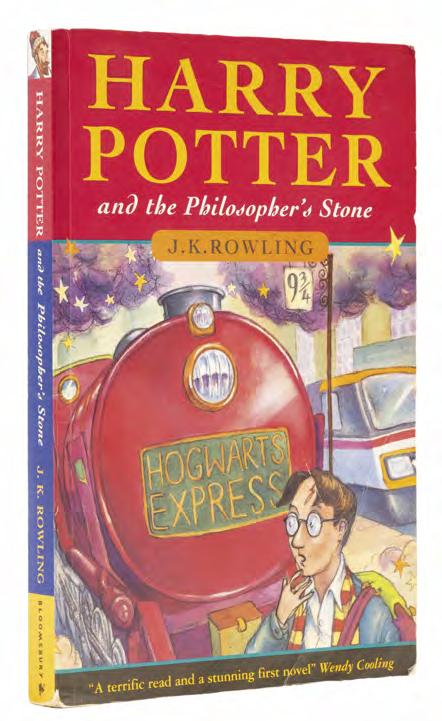
158
Rowling (J.K.).- Tiffany ( John) and Jack Thorne. HARRY POTTER AND THE CURSED CHILD, FIRST EDITION, sixteenth impression, SIGNED BY J.K. ROWLING, TIFFANY AND THORNE on title, Rowling’s holographic sticker on half-title verso, original boards, gilt, spine head slightly bumped, dust-jacket, upper and lower panels fractionally creased at head, overall near-fine, [Errington B22(a)], 8vo, 2016
£2,000 - 3,000

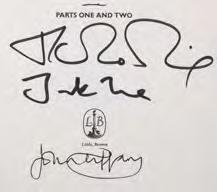

159
Selvon (Samuel) THE LONELY LONDONERS, FIRST EDITION, light spotting and toning strips to endpapers, otherwise a clean copy, original cloth, spine foot slightly bumped and toned, dust-jacket, minor tear at spine foot, small nick to lower panel foot, spine ends and corners lightly rubbed, faint surface-soiling to lower panel and spine, light spotting to verso, overall a bright copy, 8vo, 1956.
⁂ Scarce in the dust-jacket
£1,000 - 1,500
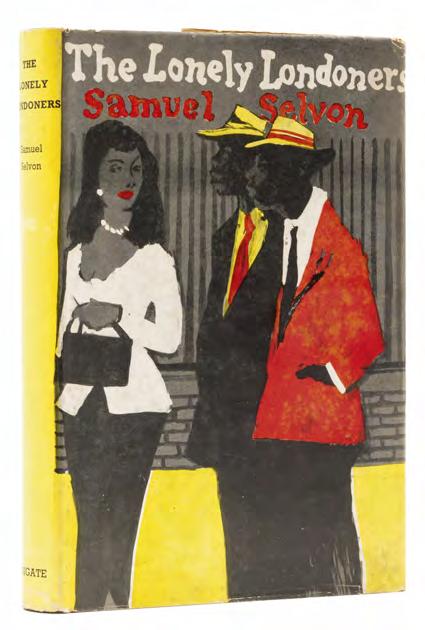
Tolkien (J.R.R.) THE HOBBIT, FIRST EDITION, FIRST IMPRESSION, frontispiece, one plate and 8 illustrations, including 7 full-page, map endpapers printed in red & black, all by the author, short nick to pp.191-193 head, occasional marginal spotting, more so at endpapers, faint finger-soiling to one or two pp., cracking to gutter, overall holding firm, original cloth, slight spotting and toning to spine, some staining to lower board, light bumping and fraying to spine ends, margins slightly darkened, edges foxed, [Hammond & Anderson A3a], 8vo, 1937
£8,000 - 12,000
Tolkien (J.R.R.) THE LORD OF THE RINGS, 3 vol., comprising The Fellowship of the Ring, light toning strips to endpapers, one or two minor marginal spots, spine ends fractionally rubbed, 1954; The Two Towers, p.352 slightly creased, cloth joints lightly marked, ink ownership signature and notes to dust-jacket lower panel, 1954; The Return of the King, state with signature mark “4” and aligned text on p.49, dust-jacket without review after The Return of the King on lower flap, light surface-soiling on rear pastedown, a few light marks to covers, some minor nicking to dust-jacket upper panel foot, short tear at spine foot lower joint, 1955, FIRST EDITIONS, FIRST IMPRESSIONS, maps at end, original cloth, dust-jackets, spines browned and stained, creasing and chipping to spine ends, a few light spots to front and rear panels, overall very good copies, [Hammond & Anderson A5], 8vo
£8,000 - 12,000
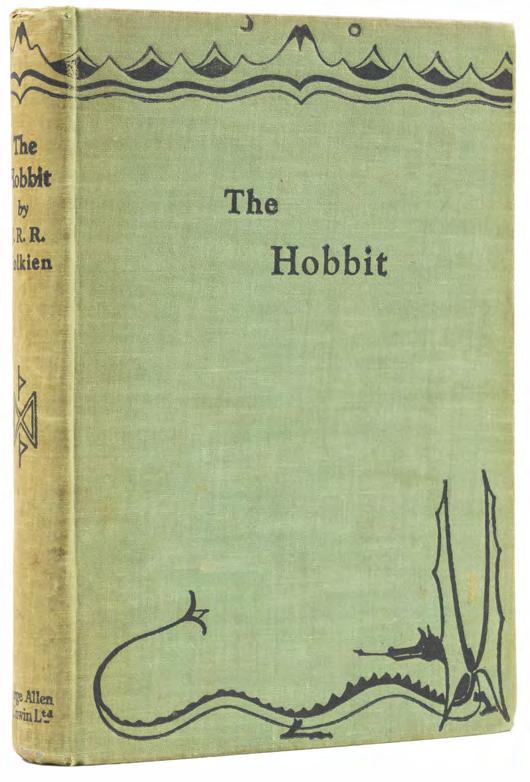
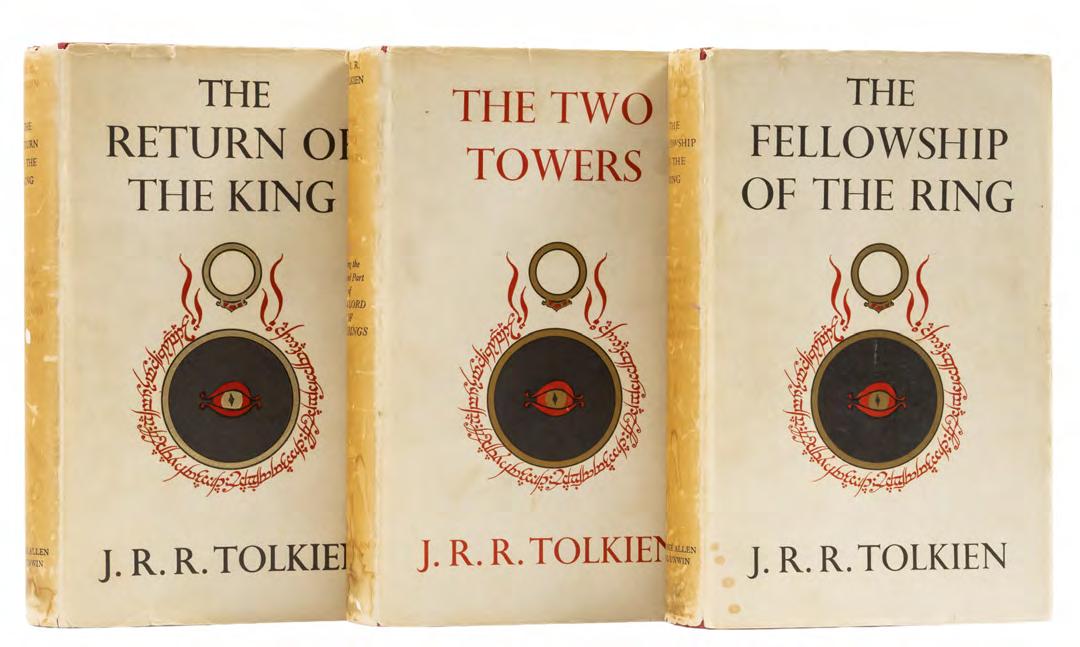
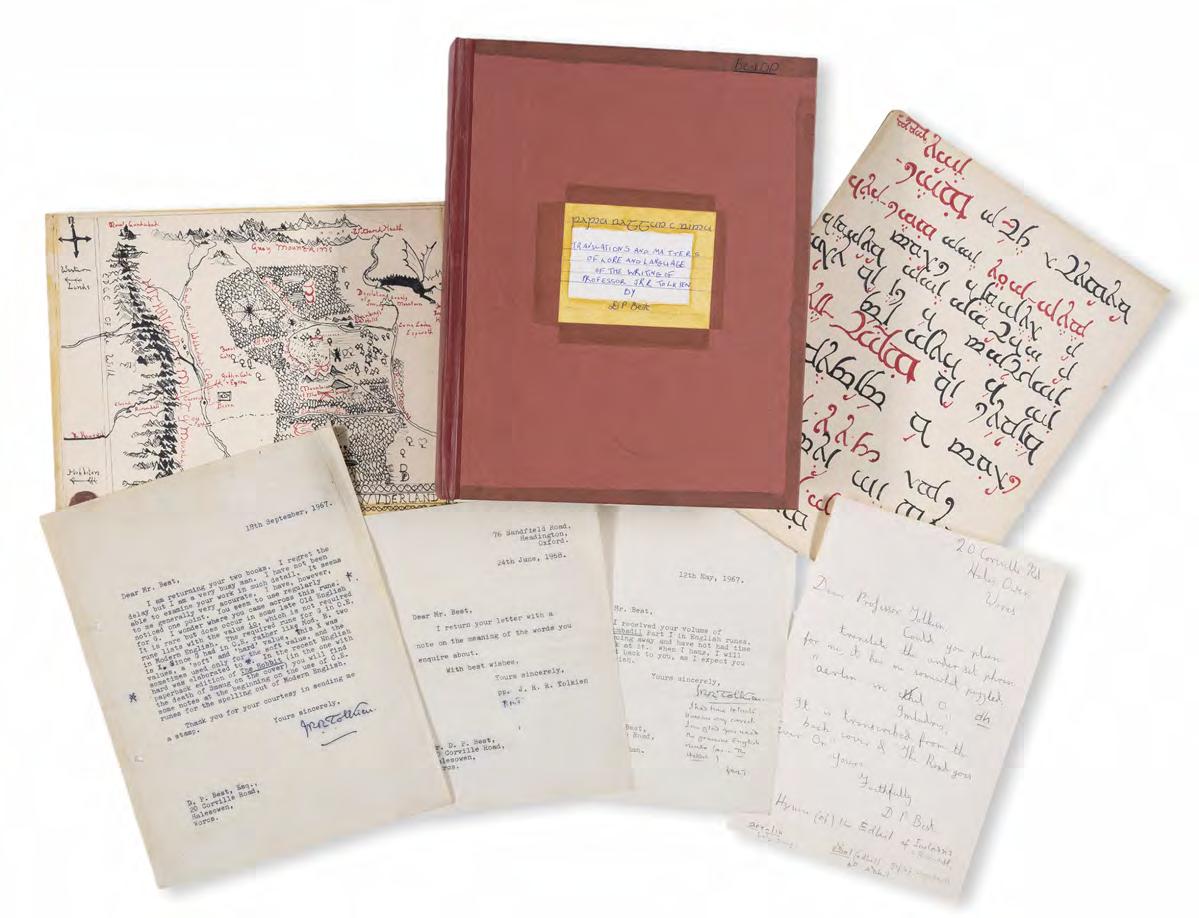
162
162
Tolkien (J.R.R.).- Best (David) THE ADVENTURES OF TOM BOMBADIL AND OTHER POEMS FROM THE LORD OF THE RINGS TRANSLATED INTO RUNES, 4 vol. notebooks bound in 1, manuscript in pencil and ink, 2 AUTOGRAPH LETTERS SIGNED FROM TOLKIEN thanking Best for sending the translations and praises his work “IT SEEMS VERY CORRECT. I AM GLAD YOU USED THE GENUINE ENGLISH RUNES (AS IN THE HOBBIT)”, May 1967 (folds), Autograph Note signed in a secretarial hand “With best wishes from Professor Tolkien”, Autograph Letter signed by Best to Tolkien with Tolkien’s translation of a line from the back cover of The Road Goes Ever On in pencil, loosely inserted, maps and illustrations copied from Tolkien’s works (some loosely inserted), tape repairs, light soiling and rubbing, original card wrappers bound in, modern cloth-backed boards, manuscript label laid down on upper board, custom pictorial slip-case, [c.1967]; and very good copies of Tolkien’s The Adventures of Tom Bombadil, with David Best’s ownership signature in English and Elvish, and The Road Goes Ever On, v.s. (small bundle)
⁂ A unique and personal archive of notebooks, illustrations and correspondence relating to J. R. R. Tolkien compiled by David Best, a dedicated fan, in school exercise books as a teenager in the late 1960s.
After reading Tolkien’s works, Best became captivated by the tales of fantasy and adventure, in particular with the runes in which the secret message was written on Thorin Oakenshield’s map. He then mastered the elven systems as well as Runes and there are various writings in the notebooks including transcriptions of Tolkien’s English poems into runic script, as well as maps at varying scales and illustrations copied by hand. Best sent off these notebooks to Tolkien who wrote back thanking him for his efforts and supplied corrections. Featured on the BBC’s The Repair Shop in 2022, the collection was subsequently restored and rebound by Chris Shaw in a bespoke binding and slipcase.
A letter of provenance available upon request
£10,000 - 15,000
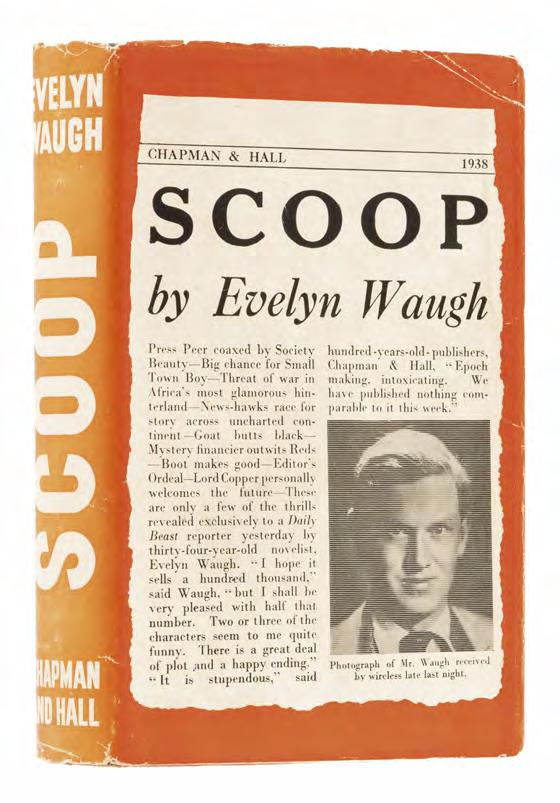
163
Waugh (Evelyn) SCOOP, FIRST EDITION, SIGNED PRESENTATION
INSCRIPTION FROM THE AUTHOR TO “PANSY WITH LOVE FROM EVELYN” on front free endpaper, faint browning to endpapers, original cloth, spine slightly sunned, light rubbing and one or two stains to covers, spine ends and top corner tips slightly rubbed, light spotting to edges, married second issue dust-jacket without the Daily Beast headline on upper panel, spine fractionally sunned, slight creasing and rubbing to extremities, particularly to spine ends, lower panel lightly dust-soiled, overall excellent, 8vo, 1933.
⁂ A very good association copy inscribed to the author’s close friend and novelist Lady Pansy Lamb (1904-1999). Lamb was a close friend of Evelyn Gardner, the two lived at the same shared lodgings on Ebury Street before the latter’s marriage to Waugh. She supported the marriage, later helped Waugh obtain an annulment after its breakdown, and remained on friendly terms with him for many years. She married Australian-born artist Henry Lamb in 1928, who painted a portrait of Waugh in 1930.
Among the more difficult Waugh titles to find signed
£2,000 - 3,000

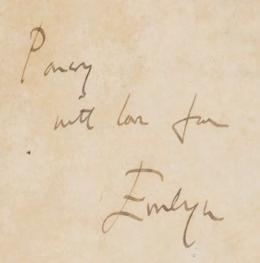


164
Waugh (Evelyn) SCOOP, FIRST EDITION, issue with raised indistinct ‘8’ in publication date but ‘a’ to last line of p.88’, minor chipping at foot to dedication and contents pp., faint toning to endpapers, original cloth, fractional sunning to spine, spine ends and corner tips lightly rubbed, faint spotting and toning to edges, first issue dust-jacket with “Daily Beast” masthead, neat repairs and restorations to spine ends and corners at verso, light rubbing and creasing to extremities, generally a very good example, 8vo, 1938
£2,000 - 3,000
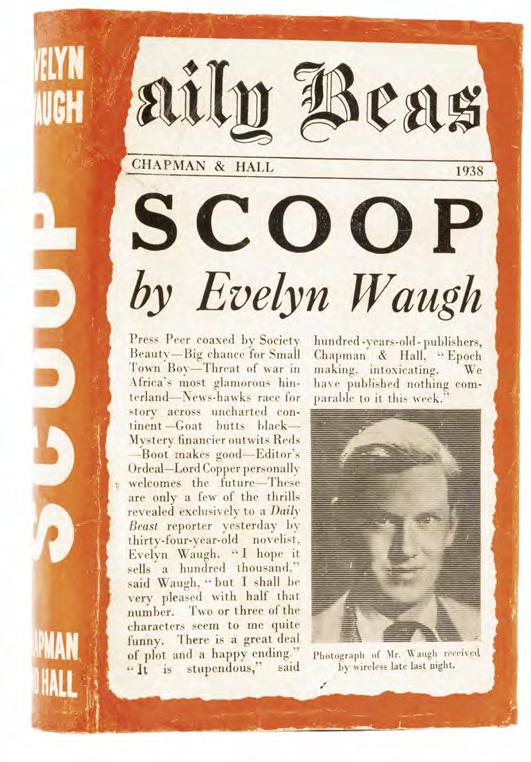
165
Waugh (Evelyn) WORK SUSPENDED one of 500 copies, SIGNED PRESENTATION
INSCRIPTION FROM THE AUTHOR “Douglas & Mia with love from Evelyn. Xmas 1942” on front free endpaper, light cracking to gutter, overall clean, original cloth, slight shelf-lean, spine ends rubbed, a few white stains to upper cover foot, light spotting and toning to edges, dust-jacket, loss to spine, upper panel detached, toning, particularly to spine, light water-staining and surfacesoiling, chipping and creasing to extremities, 8vo, 1942.

⁂ A very good association copy inscribed to Douglas and Mia Woodruff, influential and close friends of Waugh.
Donald Woodruff (1897-1978), the editor of important Catholic publication The Tablet and later chairman of the Catholic publishers Burns & Oates. Mia Woodruff (1905–1994), prominent British Catholic philanthropist who played a major role in refugee relief during and after the Second World War
£800 - 1,200
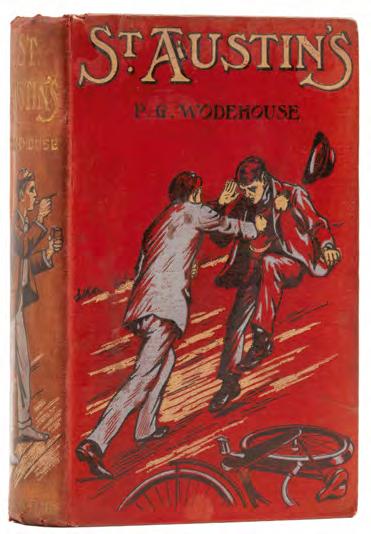
166
Wodehouse (P. G.) TALES OF ST AUSTINS, FIRST EDITION, half-title, frontispiece and 11 plates, 2pp. advertisements at end, some cracking to gutter, very light toning to endpapers, original pictorial cloth, light browning to spine, slight bumping to corners and spine extremities, 8vo, 1903
£750 - 1,000
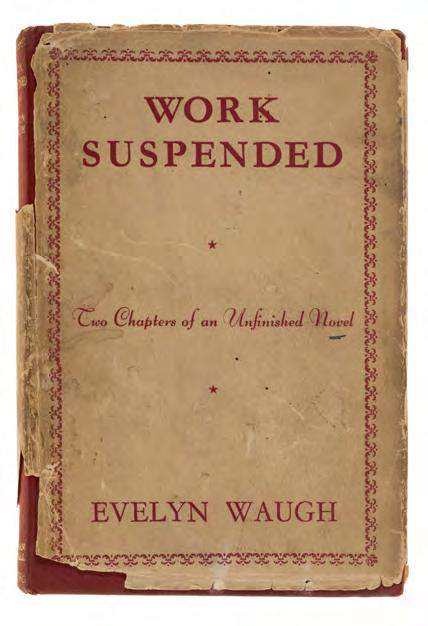
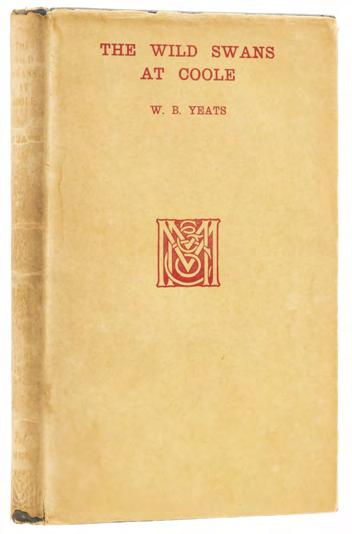
167
Yeats (William Butler) THE WILD SWANS AT COOLE, FIRST ENGLISH EDITION, small bookseller ticket on front pastedown, short marginal tear on p.3, light cracking to gutter, original cloth, gilt design by Thomas Sturge Moore, spine slightly darkened, spine ends and corner tips lightly rubbed, top corners slightly bumped, dust-jacket, toning and staining to spine, extremities a little chipped and creased, splitting at joints, still an excellent example, [Wade 124], 8vo, 1919.
⁂ The first English edition, very scarce in the dust-jacket. The earlier Cuala Press version had notably different contents, and some 17 new poems were added here. The London printing includes, for example, the first book appearance of An Irish Airman Foresees His Death, which remains one of the poet’s crowning achievements
£1,000 - 1,500
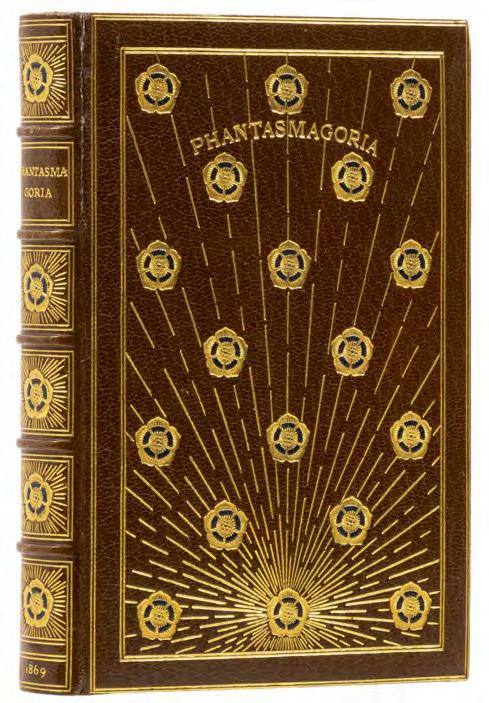
168
de Sauty (Alfred, binder).- [Dodgson (Charles Lutwidge)], “Lewis Carroll”. PHANTASMAGORIA AND OTHER POEMS, FIRST EDITION, second issue, FROM THE LIBRARY OF WILLIAM RANDOLPH HEARST with letter of authentication from Hammer Galleries in New York dated 1941 loosely inserted, bookplate of Loren Griswold du Bois, BOUND IN CRUSHED BROWN MOROCCO WITH STRIKING DESIGN TOOLED IN GILT, BY ALFRED DE SAUTY, with overall design of a gilt-tooled semé of onlaid Tudor roses in black morocco radiating from starburst of broken gilt lines at foot and titled in gilt at head, all within border of two pairs of gilt fillets, spine titled in gilt with Tudor rose in starburst in compartments and five raised bands, turn-ins ruled in gilt, signed “de Sauty” at foot of front turn-in, g.e., tiny bump to upper edge of boards, preserved in cloth folder and red morocco-backed cloth slip-case (spine slightly rubbed and faded), 8vo (c.170 x 110mm.), 1869.
⁂ William Randolph Hearst (1863-1951), American newspaperman and politician, manic art collector, and model for Orson Welles’s Citizen Kane. He lost money heavily during the Great Depression and was forced to sell many of his artworks and books, selling 20,000 items at auction in 1941. This appears to have been lot 750
£750 - 1,000
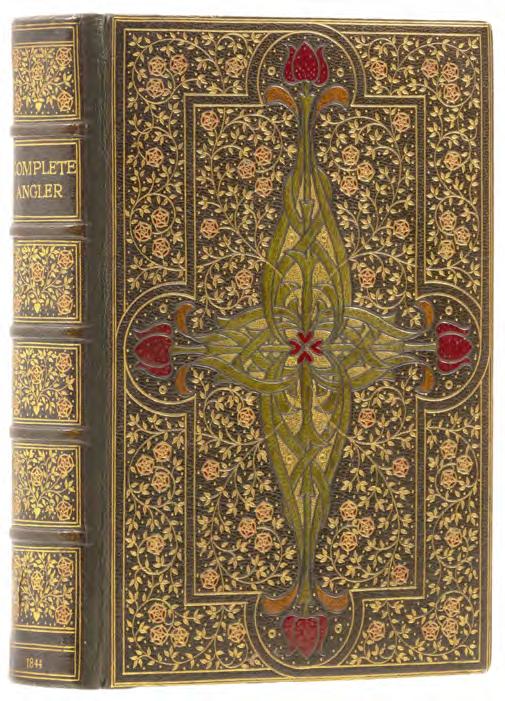
169
-. Walton (Izaak) & Charles Cotton. THE COMPLETE ANGLER, OR THE CONTEMPLATIVE MAN’S RECREATION, edited by John Major, fourth edition, engraved portrait and plates, wood-engraved title-vignette and illustrations, BOUND IN DARK GREEN MOROCCO WITH INLAID ART NOUVEAU FLORAL DESIGN AND INTRICATELY TOOLED IN GILT, BY ALFRED DE SAUTY, with cruciform of tulips inlaid in red, tan and olive green morocco filled with gilt pointillé, all against a background of swirling floral tendrils tooled in gilt with small red morocco flowerheads within double gilt ruled borders, spine titled in gilt with compartments of similar floral tooling and five raised bands, apple green morocco doublures and linings, doublures with large inlaid flower in red morocco and outlined in blind, turn-ins with double gilt fillets, signed “de Sauty ” at foot of front turn-in, gilt gauffered edges, corners very slightly bumped, 8vo (c.195 x 225mm.), D.Bogue & H.Wix, 1844.
⁂ Alfred de Sauty (1870-1949), previously an engineer, became an accomplished binder and worked for Rivière for a while as a finisher and as a designer for the Hampstead Bindery. He then taught at the Central School of Arts and Crafts before emigrating to America, where he managed the bindery at R.R.Donnelly in Chicago
£1,000 - 1,500
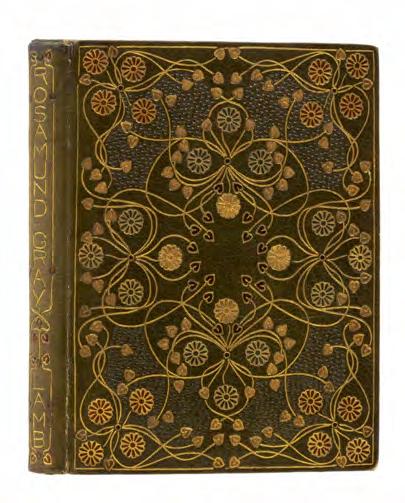
170
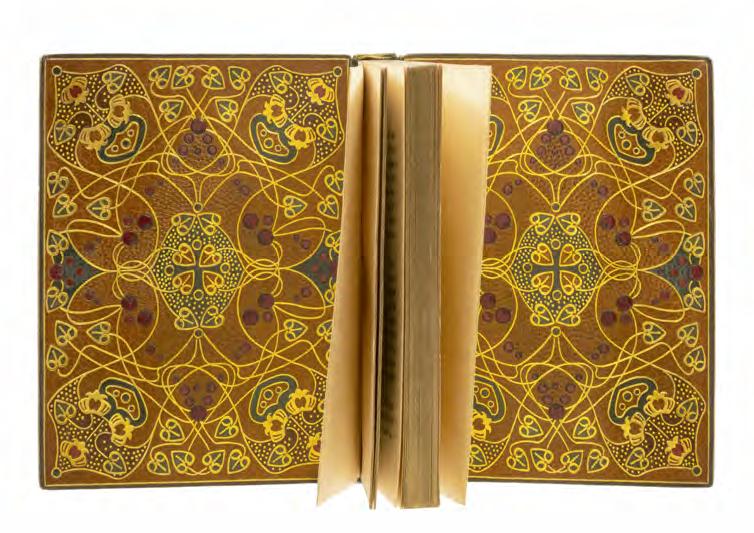
Guild of Women-Binders.- Lamb (Charles) ROSAMUND GRAY AND BARBARA S., NUMBER 5 OF 25 COPIES ON JAPANESE VELLUM, title in green & black, bound in crushed olive morocco with all-over design of gilt tendrils with inlaid flower heads in red, blue & pink and small pink & brown heartshaped leaves, the background partly filled with dots in blind, spine titled in gilt with inlaid small red dots and hearts, tan morocco doublures with rich design of inlaid red circles and green hearts tooled in gilt with swirling tendrils & small dots and some dots in blind, vellum linings with small gilt dots to corners, signed in gilt at foot of front lining, g.e., spine slightly rubbed & faded, cracks to upper joint, preserved in modern cloth drop-back box, small 8vo (c.140 x 105mm.), R.Brimley Johnson, York Library, [c.1900].
⁂ The Guild of Women-Binders was founded in 1898 by the London bookseller and founder of The Hampstead Bindery Frank Karslake to teach the craft to women and market their bindings. Karslake hosted the Guild’s first ‘Exhibition of Artistic Bookbinding by Women’ at his shop, which ran from November 1897 to February 1898. The Guild was dissolved in 1904.
A pencil note to the front free endpaper states that the binding was “designed & worked by Miss Bedell” who is listed as part of the Guild but nothing more is known about her £800 - 1,200
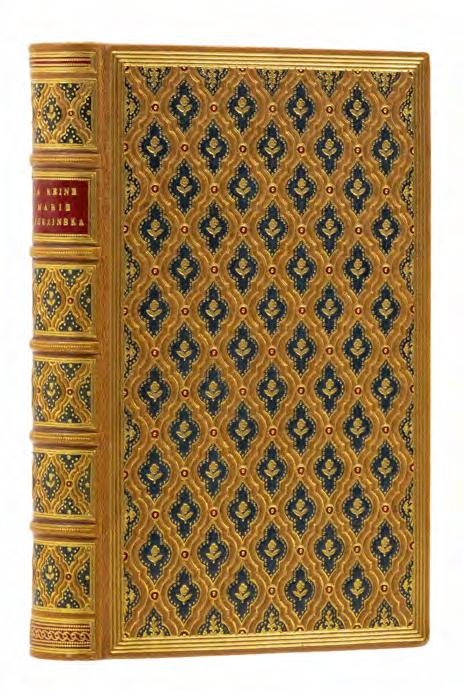
171
Joly (Robert, binder).- Armaillé (Marie-Célestine Amélie, née de Ségur, Comtesse de) LA REINE MARIE LECKZINSKA, later bookplate, BOUND IN SUPERB TAN MOROCCO INLAID WITH INTRICATE MOSAIC PATTERN TOOLED IN GILT, BY Joly FILS, with quadruple gilt fillet border surrounding panel of all-over diaper pattern of small inlaid shaped blue morocco lozenges tooled with small flowers in gilt, all within gilt lattice with small red morocco circles & gilt dots at intersections, spine with gilt-stamped red morocco label and inlaid compartments in similar style and five raised bands, dark blue morocco doublures with fine rococo ornamental frame tooled in gilt, signed “Joly R.D.” at foot of front turn-in, marbled endpapers, edges stained red and tooled with semé of small fleurs-de-lys in gilt, marbled board slipcase, small 8vo (c.180 x 110mm.), Paris, 1864.
⁂ An exquisite binding, very similar to one by the same binder previously sold in these rooms (30th November 2023, lot 257).
Robert Joly (c.1870-1924) succeeded his father Antoine (1838-1917) in the family business established by Antoine after he left the employment of Leon Gruel. Both Antoine and Robert were excellent gilders
£1,200 - 1,800
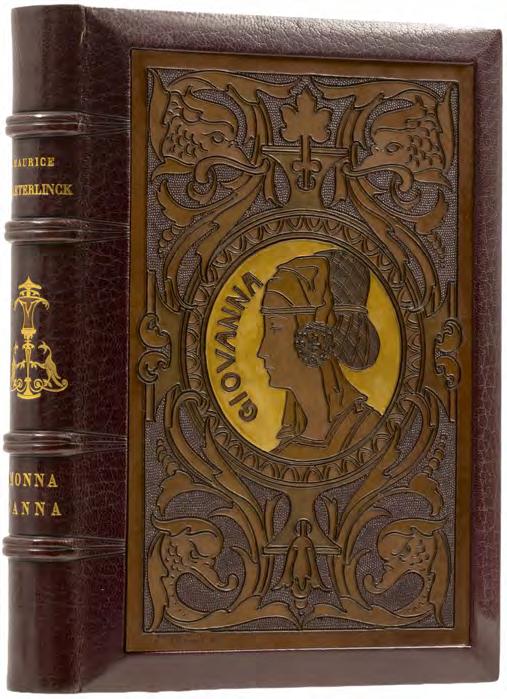
172
Meunier (Charles, binder).- Maeterlinck (Maurice) MONNA VANNA, NUMBER 5 OF 100 COPIES FOR MEMBERS OF THE SOCIETY, from an edition of 130, THIS FOR M.CHARLES MEUNIER, printed in red, blue & black, colour illustrations by P.-Albert Laurens, heavily foxed & offset, BOUND IN CRUSHED CLARET MOROCCO OVER BEVELLED BOARDS INSET WITH CUIRCISELÉ & STIPPLED CALF PANELS containing medallion of Giovanna on upper cover and oval with dolphin on lower against a gold ground, UPPER COVER PANEL WITH INCISED SIGNATURE “CH.MEUNIER 08 AT FOOT”, spine titled in gilt with large ornament of urn and four raised bands, rich tan morocco doublures of thistles inlaid in purple & green morocco framed by drawer-handle tools & other ornaments in gilt, signed at foot of front turn-in “Ch. Meunier 1909”, silk moiré linings stained in red, yellow & green, marbled flyleaves, bookplate of Prospero J.Bavrin, original wrappers bound in, g.e., with half claret morocco chemise and slip-case (spine of chemise split, slip-case with top edge detached), large 8vo (c.245 x 175mm.), Paris, Société du Livre d’Art, 1907.
⁂ Charles Meunier (1965-1940) was a prolific binder in a variety of styles but he produced many such cuir-cisilé designs
£1,000 - 1,500
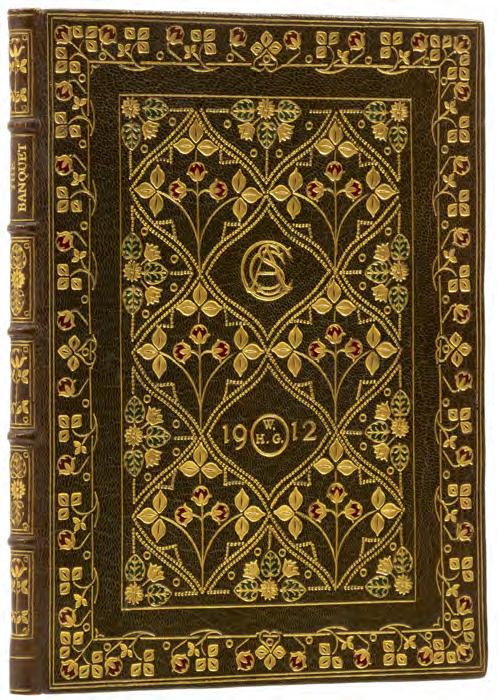
173
Plato. THE BANQUET, translated by P.B.Shelley, title in red & black, lightly browned, inscribed “To Leonard Jay with all good wishes on his new appointment in Birmingham from Peter McLeish 17.3.25” on front free endpaper, bound in elaborately tooled crushed brown morocco, gilt, [?by McLeish], with central panel of lattice in pointillé filled with onlaid red flowers & leaves and gilt trefoils around initials CSAC (Central School of Arts & Crafts) and 19W.H.G.12 to centre, all within similar rich gilt floral & foliate border, spine titled in gilt with compartments of gilt flowers & leaves with onlays and five raised bands, turn-ins ruled in gilt with small flowers to corners, signed “The Central School of Arts and Crafts Day Technical School of Book Production” to foot of rear turn-in, g.e., spine very slightly rubbed & faded, small 4to (c.220 x 160mm.), L.C.C. Central School of Arts and Crafts, 1909[-12].
⁂ Leonard Jay (1888-1963), printer and teacher, trained at the L.C.C. Central School of Arts & Crafts becoming an assistant to the teacher J.H.Mason. In 1925 he was appointed the first Head of the City of Birmingham School of Printing where he developed a small department into a major school of printing.
Peter McLeish, son of Charles McLeish the finisher at the Doves Bindery, was a bookbinder who taught at the Central School, and the binding was presumably executed by him
£1,000 - 1,500
174
Ruban (Petrus, binder).- Adam (Paul) BASILE ET SOPHIA, NUMBER 3 OF 10 COPIES ON JAPON ANCIEN WITH AN ORIGINAL DRAWING AND ADDITIONAL SUITES OF THE PLATES ON JAPON AND CHINE, from an edition limited to 65, illustrations by Dufau engraved on wood by Lemoine, original pencil drawing mounted on card, FINE MOSAIC BINDING OF CRUSHED INLAID BLUE MOROCCO, BY P[ETRUS] RUBAN, with ornamental frame of inlaid wavy beige morocco and flowers in tan, pink, purple, orange & green morocco all tooled in gilt, spine titled in gilt with similar inlays in compartments and five raised bands, turnins tooled in gilt with red & tan floral inlays, cream & gold silk brocade linings, signed “P.Ruban 1901” at foot of front turn-in, floral patterned-paper flyleaves, original wrappers bound in, g.e., gilt-tooled morocco-backed chemise and slip-case, 8vo (c.255 x 160mm.), Paris, 1900.
⁂ Petrus Ruban (1851-1929) was influenced by Marius-Michel, producing striking and technically-excellent mosaic bindings but later veering towards a more neoclassical style
£2,000 - 3,000
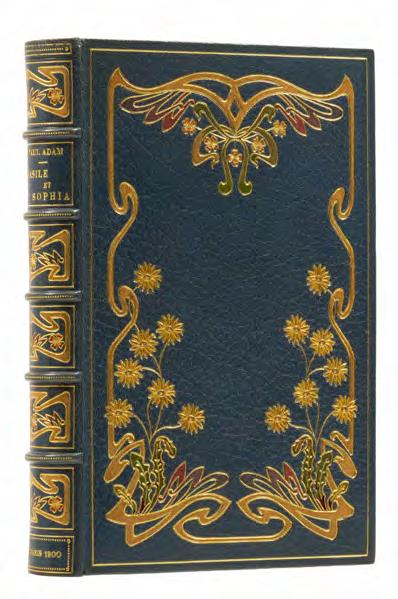
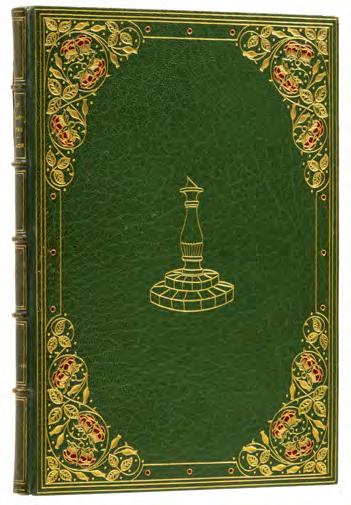
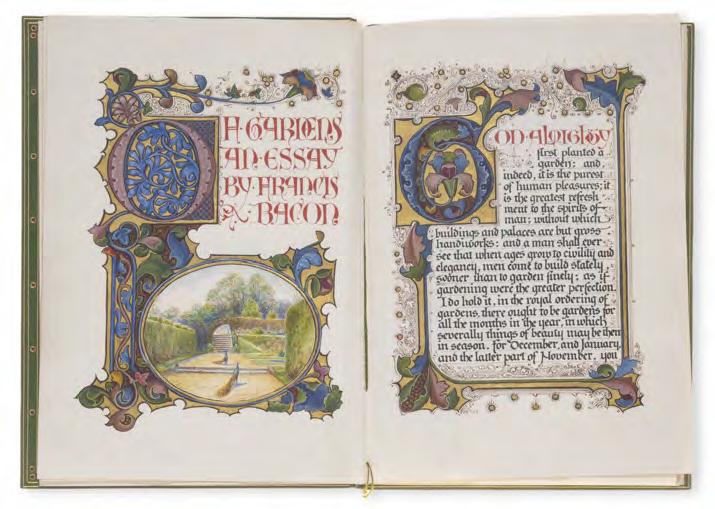
175
Sangorski (Alberto, illuminator).- Bacon (Sir Francis) OF GARDENS, illuminated manuscript in red, black & colours on vellum, 10ff. including 2 blank pages, written in black ink, title in red with large illuminated initial & oval watercolour of peacocks in a garden within illuminated floral frame in gold & colours, facing leaf and final two leaves with large illuminated initials and frames in gold & colours, final leaf with small oval watercolour of garden, 6 decorative initials in red, green & blue, HANDSOMELY BOUND IN CRUSHED GREEN MOROCCO TOOLED IN GILT, BY SANGORSKI & SUTCLIFFE, with triple gilt fillet and corner-pieces of roses tooled in gilt with red onlays, upper cover with central device of sundial outlined in gilt, spine titled and ruled in gilt in compartments with five raised bands, tan silk linings, turn-ins elaborately ruled in gilt with floral border cornerpieces and small red circular onlays along edges, signed “Illuminated and bound by Sangorski & Sutcliffe London” at foot of front turn-in, small leather monogrammed book-label, g.e., some wear to edges of silk linings, spine very slightly rubbed and faded, joints repaired, cloth slip-case (rubbed, small splits to joints), 8vo (c.220 x 160mm.), [c.1905].
⁂ Alberto Sangorksi was the elder brother of Francis Sangorksi who established the famous bookbinding firm with partner George Sutcliffe. He worked for Sangorksi & Sutcliffe, who became known for their jewelled bindings, and also for Rivière & Son from 1910, producing for both many such highly-decorated illuminated manuscripts
£4,000 - 6,000
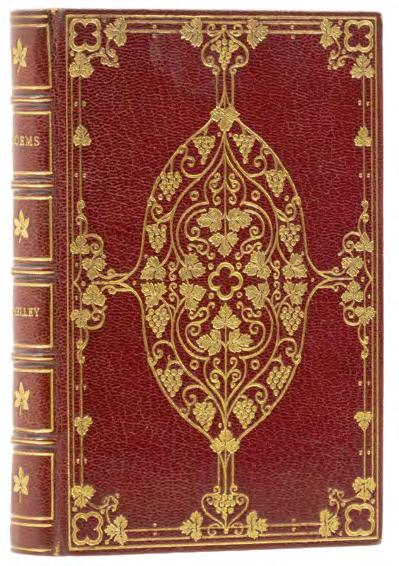
Shelley (Percy Bysshe) POEMS, edited by Stopford A.Brooke, bound in pretty crushed red morocco tooled with vines in gilt, by Rivière & Son for Brentano’s of New York, with oval of vine leaves and bunches of grapes around central quatrefoil within outer border of rules, vineleaves and dots with quatrefoils to corners all tooled in gilt, spine titled in gilt with compartments ruled in gilt enclosing leaf motifs and five raised bands, inner gilt dentelles of vineleaves, patternedpaper endpapers, g.e., very slight rubbing to edges, small 8vo (c.160 x 100mm.), 1935
£500 - 700
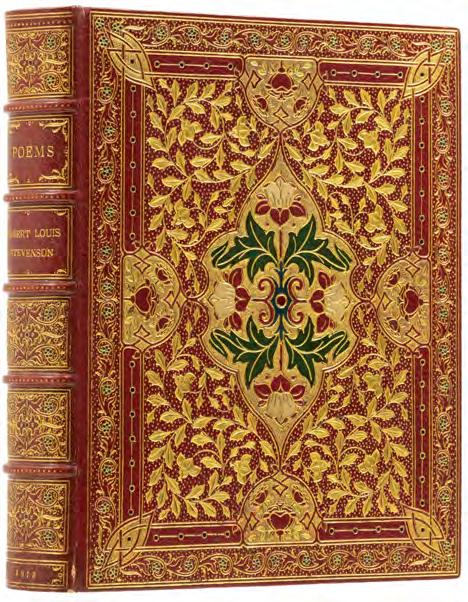
Stevenson (Robert Louis) POEMS, number 472 of 500 copies on handmade paper, BOUND IN ATTRACTIVE INLAID CRUSHED RED MOROCCO ELABORATELY TOOLED IN GILT, BY RIVIÈRE & SON, with central lozenge containing cruciform of flowers of cream calf and green & blue morocco onlays against a stippled gilt ground, all within a gilt floral border with small onlaid green flowerheads and the intervening space tooled with tendrils of flowers and leaves with pointillé background all in gilt, spine titled in gilt with compartments of small onlaid flowerheads and gilt tooling and five raised bands, cream morocco doublures with ornate floral corner-pieces in gilt and floral gilt dentelles, green silk moiré linings, gilt-stamped monogrammed booklabel to front doublure and bookplate of Mrs. A.H.Ely to front lining, t.e.g., others uncut, very slight rubbing to joints at foot, 4to (c.225 x 185mm.), printed by the Florence Press, 1913
£1,000 - 1,500
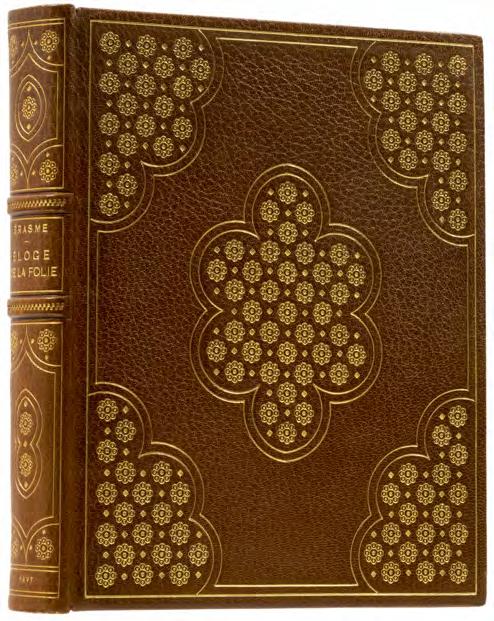
178
Yseux (Louis, binder).- Erasmus (Desiderius) ELOGE DE LA FOLIE, translated by Pierre de Nolhac, NUMBER 39 OF 109 COPIES WITH A SUITE OF ETCHINGS WITH REMARQUES, from an edition limited to 130, etched plates and illustrations by Chas-Laborde, SPLENDID CRUSHED BROWN MOROCCO TOOLED IN GILT, BY LOUIS YSEUX, with central scallop-edged shape and corners outlined in double gilt lines and filled with semé of gilt rosettes interspersed with small gilt squares, spine titled in gilt between two raised bands and compartments with similar gilt rules and ornaments, turn-ins with rosettes at intervals connected by lines of small gilt dots, signed “Yseux sr. de Simier” at foot of front turn-in, yellow silk crepe linings, marbled endpapers, original pink wrappers bound in, t.e.g., others uncut, spine very slightly faded, marbled board slip-case (a little rubbed at edges), 4to (c.280 x 25mm.), Paris, 1927. ⁂ Louis Yseux (d.1951) trained under Durvand and in 1916 took over the workshop of Thierry, the successor of Petit-Simier, thereafter signing his bindings as successor to Simier
£1,000 - 1,500
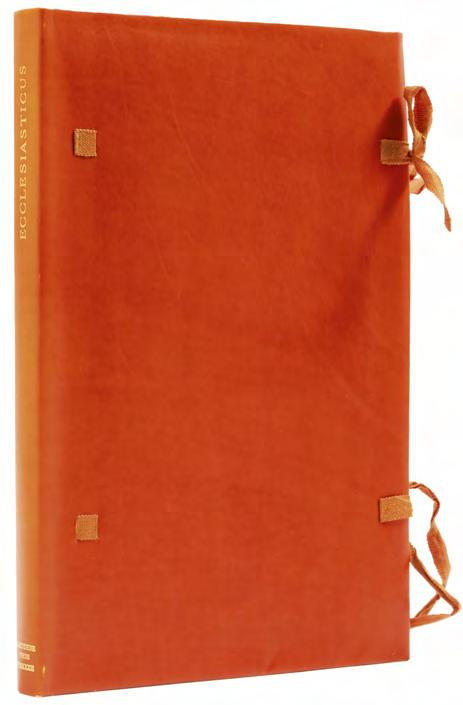
179
Ashendene Press.- WISDOM OF JESUS THE SON OF SIRACH (THE) COMMONLY CALLED ECCLESIASTICUS, ONE OF 328 COPIES ON PAPER, Subiaco type, printed in red and black with initials supplied by hand in blue or green by Graily Hewitt and assistants, original orange-stained limp vellum with ties, [by Douglas Cockerell] at the W.H.Smith bindery, uncut, an excellent copy with only very slight fading to the spine, fading, [Franklin p.242; Hornby XXXVIII], 4to, Ashendene Press, 1932.
⁂ Hornby thought this one of the most satisfactory of his books while Franklin notes, “Subiaco in the irregular verse lines, with drawn letters, red shoulder-notes and such a text cause this to be regarded often and justly as a favourite among all Ashendene books”
£1,500 - 2,000
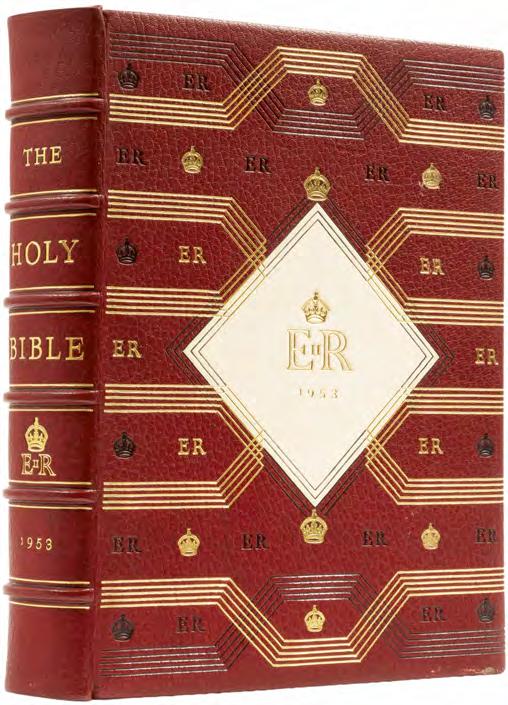
180
Binding.- Bible, English HOLY BIBLE (THE) CONTAINING THE OLD AND NEW TESTAMENTS, NO.24 OF 25 COPIES ON OXFORD INDIA PAPER, BOUND BY SANGORSKI & SUTCLIFFE AFTER DESIGN BY LYNTON LAMB, original red morocco, spine in seven compartments with six raised bands, covers with interlacing horizontal banding of gilt and blind fillets with the initials “ER” and a crown motif, upper cover with in-laid white lozenge with Queen Elizabeth II’s royal cypher dated ‘1953’, lower cover with gilt-stamped arms of Oxford University Press dated ‘1953’, signed at lower cover verso in gilt, g.e., slight worming to edges and minor abrasions, housed in original blue cloth drop-back box (faint sunning to spine, minor rubbing to extremities), large 4to, Oxford, 1953.
⁂ Printed note at the front of the states that ‘This Bible is a replica of that presented to Her Majesty Queen Elizabeth II at her coronation except that it bears a royal cipher in the inlaid lozenge on the front cover in place of the royal arms’. On the first copy of this edition, Queen Elizabeth II make her oath at her coronation on 2 June, 1953.
£4,000 - 6,000
181
Buckland Wright (John).- Swinburne (Algernon Charles) DOLORES, FIRST EDITION, [ONE OF 50 COPIES ON JAPON ANCIEN], SIGNED BY BUCKLAND WRIGHT AND DATED 1932 to verso of final f. of text, 11 wood-engraved illustrations by Buckland Wright, 9 full-page, additional suite of the 11 plates printed on Japon loosely inserted, a few very light marks, original blue wrappers bound in, contemporary calf with purple morocco label to upper cover, lightly rubbed and bumped with some wear to spine, t.e.g., uncut, housed in modern drop-back box, some bumping, [Reid A12i], 8vo, [Maastricht, privately printed for Baron Emile van der Borch van Verwolde by A.A.M. Stols], 1933.
⁂ This is likely a presentation copy, with the illustrator’s signature and date in pencil at the end of the book.
One of Buckland Wright’s most collected works, and on which he continued to work after publication. In this first edition, the illustrations appear as white line engravings, as opposed to those in the second edition which he had reworked as silhouettes with additional white line hatching. The final illustration of a female nude with three ravens refers to the coat-of-arms of Emile, Baron van der Borch van Verwolde who commissioned the book from Stols. It also served as his bookplate
£3,000 - 4,000
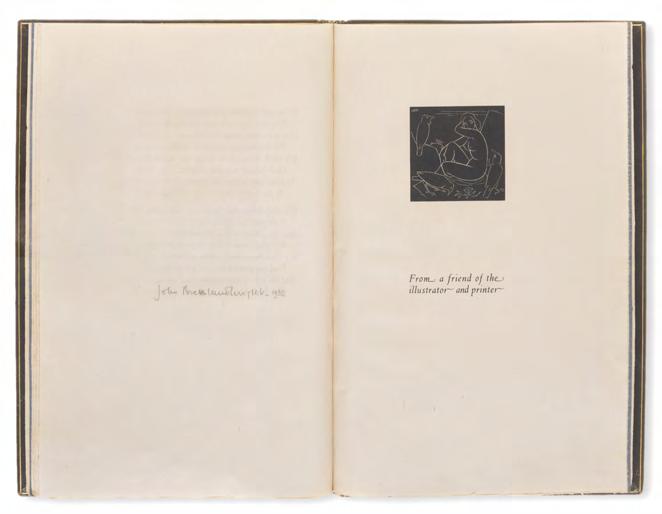
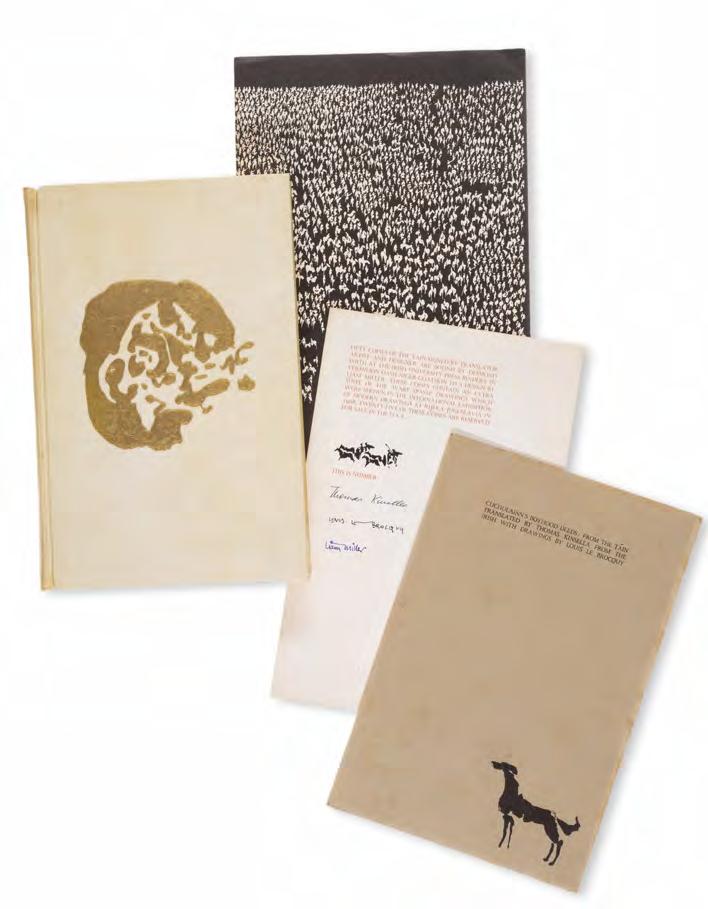
182
Dolmen Press.- le Brocquy (Louis).Kinsella (Thomas)THE TAIN, one of 1,750 copies, THIS NUMBER 2 OF 6 SPECIALLY-BOUND COPIES SIGNED BY LIAM MILLER, LOUIS LE BROCQUY AND THOMAS KINSELLA, printed in red and black, map (slightly offset), illustrations by Louis le Brocquy, with pencil notes “Liam Miller’s copy” to front free endpaper, specimen setting sheet loosely inserted, original decorative vellum after designs by le Brocquy, light discolouration to spine, slip-case, preserved in custom calf-backed drop-back box, [Dolmen XXV 154], Dublin, Dolmen Editions, 1969, TOGETHER WITH Cuchulainn’s Boyhood Deeds: From the Táin, one of 50 copies for private circulation, illustrations by Louis le Brocquy, original printed wrappers, lightly spotted, 1968; Proof Lithograph (black on grey) for the cover of “The Tain”, folds, Dolmen Editions, 1969 AND 2 others including the limitation sheet from The Tain, one of 50 signed by Kinsella, le Brocquy and Liam Miller, these final four all housed together within custom marbled slip-case, v.s. (5)
£6,000 - 8,000
183
Dominique Fouqueray (Charles).- Farrère (Claude) ESCALES D’ASIE, LIMITED EDITION, SIGNED PRESENTATION INSCRIPTIONS BY FARRÈRE AND FOUQUERAY TO PIERRE BRICAGE to half-title, original watercolour of “Guffas ou Guppan sur le Tigre” dated 1921 by Charles Dominique Fouqueray, 2 watercolour pictorial initial letters “E” and “F” each signed by Fouqueray, 10 watercolour plates (1 double-page) and numerous watercolour illustrations, light offsetting to title, very occasional surface soiling and staining, else an excellent copy, loose in original pictorial wrappers as issued, glassine dust-jacket, the odd crease or small nick, housed in original blue marbled paper-covered chemise and slipcase, spines faded, rubbed and bumped, 4to, Paris, Laborey, 1947.
⁂ A fine association copy, inscribed to Pierre Bricage, who was responsible for the typography and design of Escales d’Asie, overseeing its production and visual presentation.
Charles Fouqueray (1869–1956) was a French painter and illustrator who became Official Painter to the Navy in 1908. During the interwar years he travelled widely through the Red Sea, Gulf of Aden, Oman and the Persian Gulf, producing sketches that later informed many of his paintings. In Escales d’Asie, these illustrations accompany the travel writings of Claude Farrère (pseudonym of FrédéricCharles Bargone).
£3,000 - 4,000
184
Kelmscott Press.- Ruskin (John)
THE NATURE OF GOTHIC: A CHAPTER OF THE STONES OF VENICE, FIRST EDITION, one of 500 copies on Flower paper, printed in Golden type, woodengraved border and initials designed by William Morris, illustrations, light scattered surface soiling and some marginal staining, else a very bright and clean copy, original vellum with silk ties (a little frayed), yapp edges, spine gilt, lightly soiled, covers slightly warped, uncut, [Peterson A4], small 4to, Kelmscott Press, 1892.
£1,000 - 1,500
185
-. Shelley (Percy Bysshe) THE POETICAL WORKS, 3 vol., one of 250 copies on Flower paper, printed in Golden type, vol.1 in black, vol.2 & 3 red & black, wood-engraved title, borders and initials designed by William Morris, bookplate of Veryl Preston on front pastedowns (slightly toned), attractive later green morocco, gilt, by The Knickerbocker Press, spines fractionally darkened, t.e.g., the rest uncut, cloth-backed suede dustjackets, slight spotting and sunning to spines, extremities slightly rubbed, more so at vol.1 spine head, housed in modern slip-case, lightly rubbed, [Peterson A29], 8vo, Kelmscott Press, 1894-95
£6,000 - 8,000
186
Piper (John) & others.- Cunard (Nancy) SALVO FOR RUSSIA, [ONE OF 100 COPIES], 4pp. letterpress poems, 10 etched/engraved plates by John Piper, John Banting, Julian Trevelyan, John Buckland Wright, Buckland Wright after Roger Penrose, Mary Wykeham, Ithell Colquhoun, Dolf Reiser, C.Salisbury and Geza Szobel, the Piper also with aquatint, on laid paper with “Hand Made” watermark, sheets c.230 x 160mm., all signed in pencil by the artist, most numbered HS or AP/14, some also titled, occasional marginal spotting, tissue guards, text a little spotted and soiled at upper edge, loose as issued in original cloth-backed board folder with ties, blue printed paper label on upper cover (lightly spotted), spine a little rubbed and faded, housed in drop back box, small 4to, [1942].
⁂ Scarce and important British Surrealist portfolio produced in aid of the Comforts Fund for Women and Children of Soviet Russia. It includes John Piper’s first published etching and John Banting’s only etching
£2,500 - 3,500
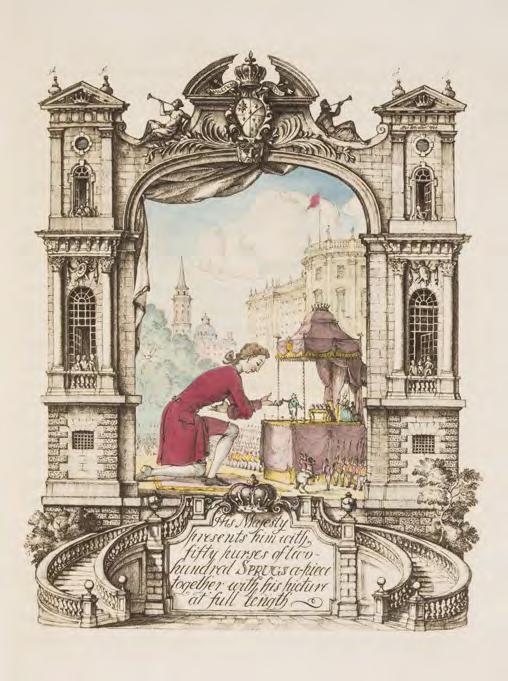
187
Whistler (Rex).- Swift (Jonathan) GULLIVER’S TRAVELS, 2 vol., ONE OF 195 COPIES ON HAND-MADE PAPER FROM AN EDITION LIMITED TO 205, titlevignettes, 12 engraved plates, 5 maps, 4 head- and 4 tail-pieces by Rex Whistler, the 12 plates hand-coloured under the artist’s supervision, light offsetting, light marginal toning and staining to endpapers, original half viridian niger with vellum boards, by Wood, t.e.g., others uncut, toning, more so at spines, some marking and staining to covers, some scuffing to extremities, housed in custom drop back box, [Whistler & Fuller 426], large 4to, Cresset Press, 1930.
⁂ Whistler’s magnum opus of illustration. Apparently inspired by Richard Bentley’s Designs for Six Poems by Mr T.Gray of 1753 he drew the illustrations within elaborate rococo frames, each one different, many reflecting his love of Baroque architecture. He spent months on the detailed pen and ink drawings; according to his brother Laurence he sat up all night drawing one wheatsheaf
£2,000 - 2,500
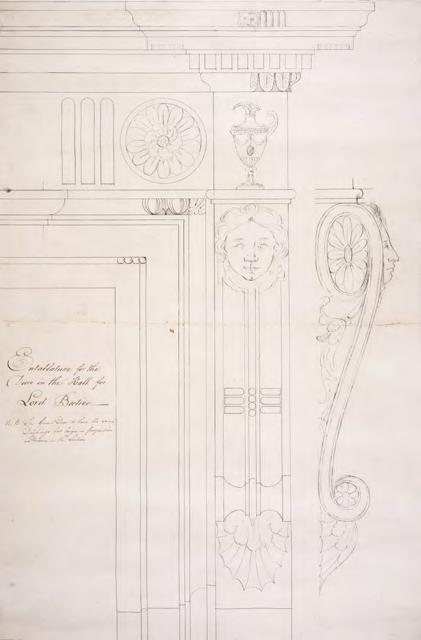
188
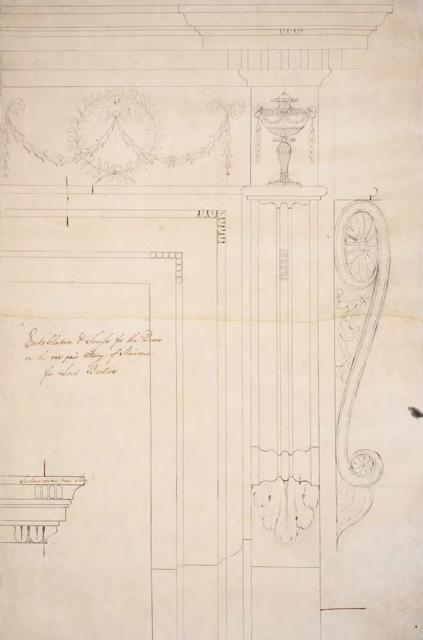
189
188
Adam (Robert, 1728-1772) HEADFORT HOUSE, AN ORIGINAL DRAWING: ENTABLATURE FOR THE DOORS IN THE HALL FOR LORD BECTIVE, pen and black ink, black chalk, on two conjoined sheets of laid paper, inscribed in ink ‘N.B. The Great Door to have the same Dressings but larger in Proportion as drawn in the Section’, total size approx. 1030 x 655 mm (40½ x 25¾ in), mounted on linen, handling creases and old folds, slightly rough edges, unframed, [circa 1772]
Provenance:
Thomas Taylour, 1st Earl of Bective (1724 -1795);
Thomas Taylour, 1st Marquess of Headfort (1757-1829); Thence by descent to the present owners
Literature:
cf. Harris, John, Headfort House & Robert Adam : drawings from the collection of Mr. and Mrs. Paul Mellon, Royal Institute of British Architects, London, 1973
cf. Ireland, Richard, Headfort, a Robert Adam designed house interior rediscovered, Journal of Architectural Conservation, vol. 17, no. 1, March, 2011
⁂ Sir Thomas Taylour became Earl of Bective in 1766, following which he began to imagine a transformation of his family seat, Headfort House in County Meath, Ireland. Initially he intended to work to plans devised in 1765 by Sir William Chambers, but it was Chambers’ rival, Robert Adam, whom Taylour eventually commissioned to decorate the interior in 1771. Adam completed designs for the hall, staircase, eating parlour, saloon, and Lady’s room, including furniture and structural fittings.
The Yale Centre for British Art hold a group of over 30 original drawings and designs by Adam for Headfort House, and the present collection offered for sale, directly correlate to the 14 large-scale working drawings in their collection.
Architectural drawings by Robert Adam rarely appear on the open market, despite having produced a significant number, this being due to the vast majority (nearly 9,000) having been purchased directly from the Adam family by Sir John Soane in 1833; which now forms one of the principal treasures of the Soane museum
£6,000 - 8,000
189
Adam (Robert, 1728-1772) HEADFORT HOUSE, AN ORIGINAL DRAWING: ENTABLATURE & TRUSS FOR THE DOORS ON THE ONE PAIR STORY OF STAIRCASE FOR LORD BECTIVE, pen and black ink, black chalk, on two conjoined sheets of laid paper, total size approx. 1020 x 650 mm (40⅛ x 25⅝ in), mounted on linen, handling creases and old folds, slightly rough edges, unframed, [circa 1772]
Provenance:
Thomas Taylour, 1st Earl of Bective (1724 -1795);
Thomas Taylour, 1st Marquess of Headfort (1757-1829); Thence by descent to the present owners
£6,000 - 8,000
190
Adam (Robert, 1728-1772) HEADFORT HOUSE, AN ORIGINAL DRAWING: ENTABLATURE & TRUSS FOR THE DOORS IN THE GREAT ROOM AT LORD BECTIVE’S, pen and black ink, black chalk, on two conjoined sheets of laid paper, total size approx. 1085 x 495 mm (42¾ x 19½ in), mounted on linen, handling creases and old folds, slightly rough edges, unframed, [circa 1772]
Provenance:
Thomas Taylour, 1st Earl of Bective (1724 -1795); Thomas Taylour, 1st Marquess of Headfort (1757-1829); Thence by descent to the present owners
£4,000 - 6,000
191
Adam (Robert, 1728-1772) HEADFORT HOUSE, AN ORIGINAL DRAWING: ORNAMENT FOR THE CEILING OF THE LADY’S ROOM OVER SALOON FOR THE EARL OF BECTIVE, pen and black ink, black chalk, on two conjoined sheets of laid paper, inscribed and dated ‘Adelphi Novr. 19 1772’, total size approx. 725 x 820 mm (28½ x 32¼ in), mounted on linen, handling creases and old folds, slightly rough edges, unframed, 1772
Provenance:
Thomas Taylour, 1st Earl of Bective (1724 -1795); Thomas Taylour, 1st Marquess of Headfort (1757-1829); Thence by descent to the present owners
£2,000 - 3,000
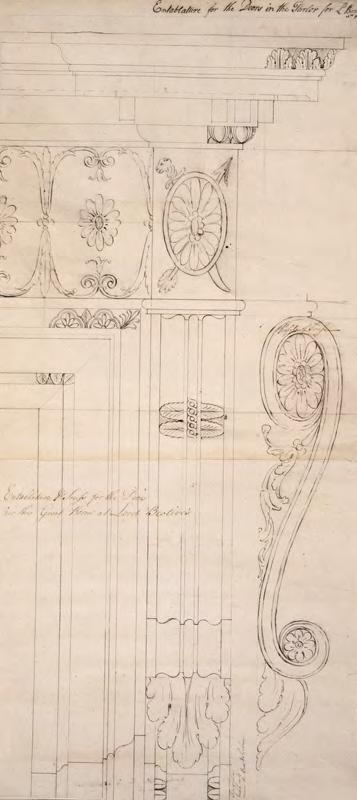
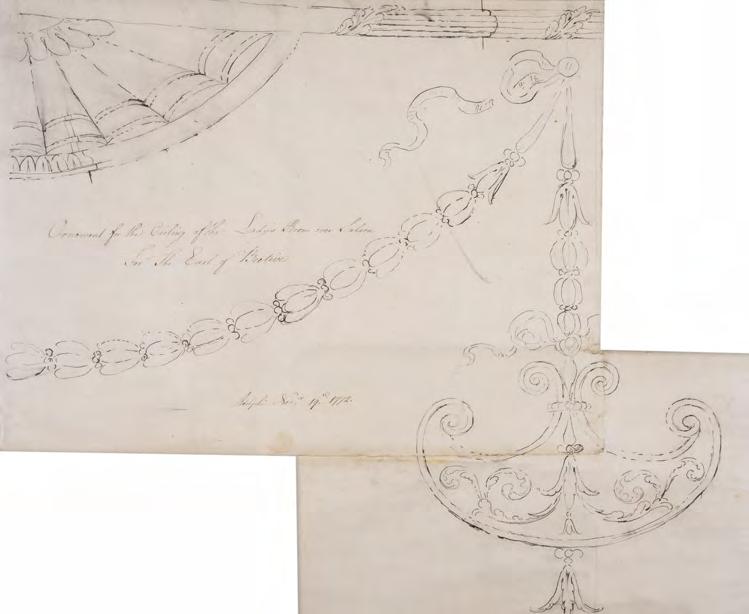
192
Adam (Robert, 1728-1772) HEADFORT HOUSE, AN ORIGINAL DRAWING: FROM BALLUSTERS FOR THE STAIRCASE FOR LORD BECTIVE, pen and black ink, black chalk, on four conjoined sheets of laid paper, total size approx. 1050 x 870 mm (41¼ x 34¼ in), mounted on linen, handling creases and old folds, slightly rough edges, unframed, 1772
Provenance:
Thomas Taylour, 1st Earl of Bective (1724 -1795);
Thomas Taylour, 1st Marquess of Headfort (1757-1829);
Thence by descent to the present owners
£2,000 - 3,000
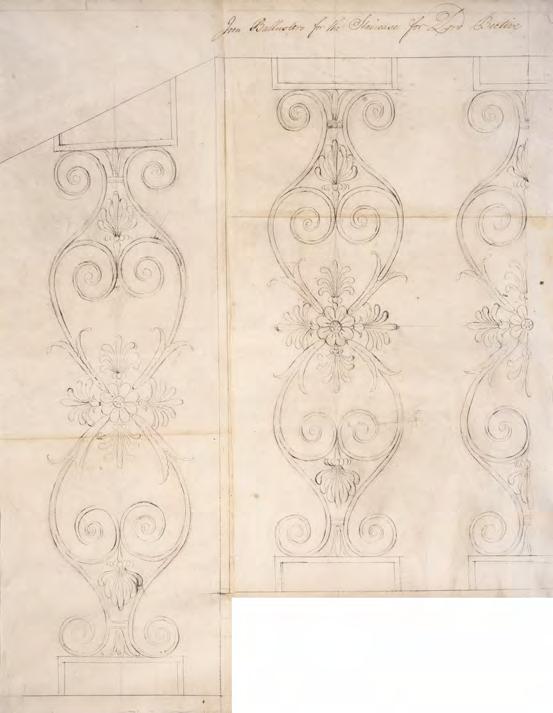
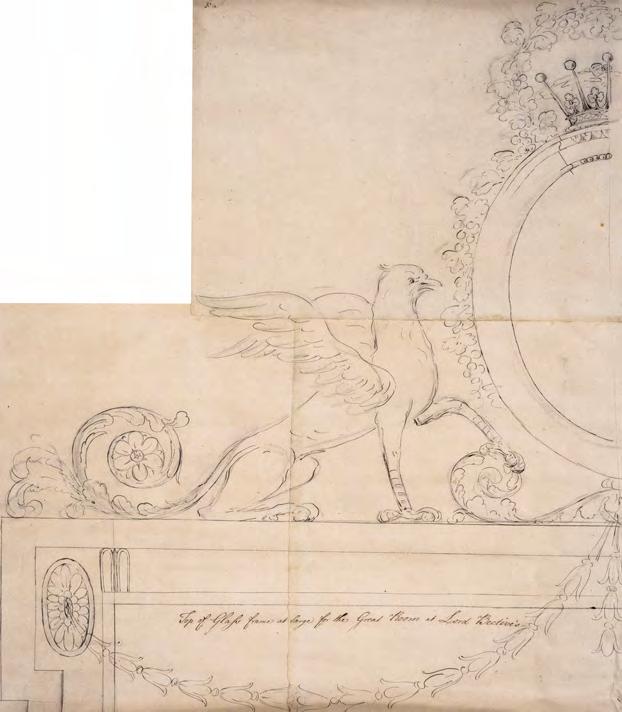
193
Adam (Robert, 1728-1772) HEADFORT HOUSE, AN ORIGINAL DRAWING: TOP OF GLASS FRAME AT LARGE FOR THE GREAT ROOM AT LORD BECTIVE’S, pen and black ink, black chalk, on three conjoined sheets of laid paper, inscribed ‘No. 14’ in the upper left corner, total size approx. 1090 x 905 mm (42⅞ x 35⅜ in), mounted on linen, handling creases and old folds, slightly rough edges, unframed, [circa 1772]
Provenance:
Thomas Taylour, 1st Earl of Bective (1724 -1795); Thomas Taylour, 1st Marquess of Headfort (17571829);
Thence by descent to the present owners
£4,000 - 6,000
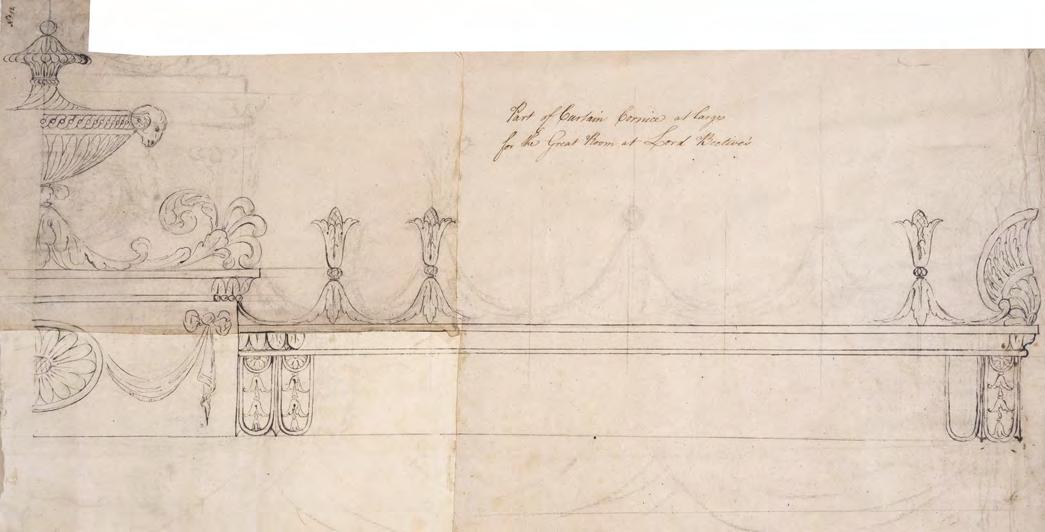
194
Adam (Robert, 1728-1772) HEADFORT HOUSE, AN ORIGINAL DRAWING: PART OF CURTAIN CORNICE AT LARGE FOR THE GREAT ROOM AT LORD BECTIVE’S, pen and black ink, black chalk, on three conjoined sheets of laid paper, inscribed ‘No. 12’ in the upper left corner, total size approx. 485 x 1060 mm (19 x 41¾ in), mounted on linen, handling creases and old folds, slightly rough edges, unframed, [circa 1772]
Provenance:
Thomas Taylour, 1st Earl of Bective (1724 -1795);
Thomas Taylour, 1st Marquess of Headfort (1757-1829);
Thence by descent to the present owners
£5,000 - 7,000
195
Adam (Robert, 1728-1772) HEADFORT HOUSE, TWO ORIGINAL DRAWINGS: ORNAMENT FOR THE BOTTOM [AND] TOP OF THE LARGE PICTURE FRAMES IN THE GREAT ROOM AT LORD BECTIVE’S, two drawings, pen and black inks, black chalk, both drawings comprising three conjoined sheets of laid paper, the ‘Bottom’ inscribed ‘No. 15’ in the upper left corner, each sheet approx. 510 x 1180 mm (20 x 42½ in) and 955 x 1220 mm (37⅝ x 48 in), respectively, both mounted on linen, handling creases and old folds, slightly rough edges, unframed, [circa 1772] (2)
Provenance:
Thomas Taylour, 1st Earl of Bective (1724 -1795);
Thomas Taylour, 1st Marquess of Headfort (1757-1829);
Thence by descent to the present owners
£4,000 - 6,000
196
Adam (Robert, 1728-1772) HEADFORT HOUSE, AN ORIGINAL
DRAWING: PART OF CHIMNEY PIECE AT LARGE FOR THE HALL FOR LORD BECTIVE, pen and black ink, black chalk, on three conjoined sheets of laid paper, irregular, total size approx. 950 x 1150 mm (37½45¼ in), mounted on linen, handling creases and old folds, slightly rough edges, unframed, [circa 1772]
Provenance:
Thomas Taylour, 1st Earl of Bective (1724 -1795); Thomas Taylour, 1st Marquess of Headfort (1757-1829); Thence by descent to the present owners
£3,000 - 4,000
197
Adam (Robert), Office of. ORIGINAL CEILING DESIGN, PRESUMABLY FOR HEADFORT HOUSE, pen and grey ink, watercolours, ruled borderlines, on laid paper without watermark, sheet 360 x 535 mm (14¼ x 21 in), faint inscription verso of [?] office hand ‘Carloni [?]ogne’, marginal nicks and small losses, marginal repaired tears, soft creases visible with associated surface dirt, some light spotting and browning, unframed, [circa 1775]
Provenance:
Thomas Taylour, 1st Earl of Bective (1724 -1795);
Thomas Taylour, 1st Marquess of Headfort (1757-1829);
Thence by descent to the present owners
£500 - 700
198
Richardson (George) A BOOK OF CEILINGS, COMPOSED IN THE STYLE OF THE ANTIQUE GROTESQUE, FIRST EDITION, title and text in English and French, 2 pp. list of subscribers, 48 engraved plates, 1 double-page, hand-coloured in watercolour, probably contemporary, a few with Richardson’s name and dimensions supplied in ink within plate-mark, lacking engraved dedication, ink ownership inscription to head of title, marginal worming to rear endpaper and final double-page plate, a few small marginal holes elsewhere, scattered spotting and surface soiling or staining, cracking at hinges, last few ff. working a little loose, contemporary boards, rebacked, rubbed and bumped, [ESTC T90834], folio, for the Author, 1776.
⁂ Richardson was employed by the Adam Brothers for eighteen years and this work was his unsuccessful attempt to launch his own architectural practice. The list of subscribers includes Joseph Banks, William Chambers, John Carr of York, George Dance, Joseph Pickford at Derby, Thomas Sandby and many country house owners such as the Marquis of Rockingham
£2,500 - 3,500
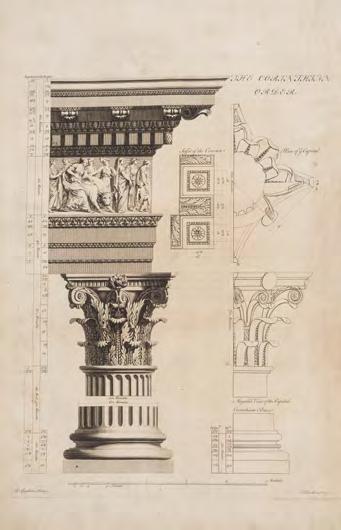
199
Chambers (William) A TREATISE ON CIVIL ARCHITECTURE, second edition, 50 engraved plates, bookplate to front endpaper, ink ownership inscription to head of title, soiling and toning, damp-staining and a few small holes, mostly marginal, scattered spotting and a few marginal tears, most with neat repairs, later antique-style half calf, spine gilt in compartments with red morocco label, lightly rubbed and bumped, [Berlin Kat. 2286; ESTC T176681], folio, J. Dixwell, 1768.
⁂ Provenance: Ink inscription on title page reads “H. S. Foyster, 1809; given to me by the Rev. H. S. Foyster. Geo. Gilbert Scott, 1826 or 7.” Possibly Sir George Gilbert Scott (1811–1878), the renowned architect and one of the leading figures of the Victorian Gothic Revival, best known for designs including the Albert Memorial and the Midland Grand Hotel at St Pancras Station.
Bookplate of Haddonstone Ltd., The Forge House, East Haddon, Northamptonshire
£600 - 800
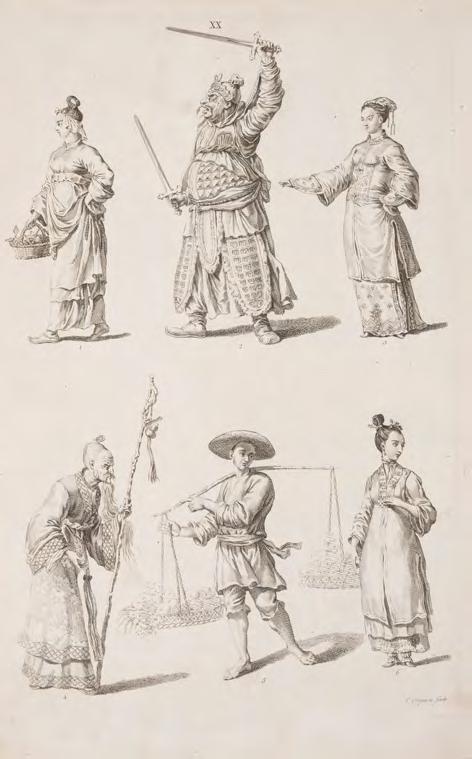
200
China.- Chambers (William) DESIGNS OF CHINESE BUILDINGS, FURNITURE, DRESSES, MACHINES AND UTENSILS, FIRST EDITION, text in English and French, 21 engraved plates and plans by Fourdrinier, Sandby and Grignion, lacking 1 p. list of subscribers, bookplate to front pastedown, some staining to Sig. b & A, light marginal water-staining and a few small marginal tears to plates, most with neat repairs, endpapers and pastedowns foxed, scattered spotting and surface soiling, cracking at hinges, 19th century half calf with modern morocco spine labels, skillful repairs to spine, rubbed and bumped, [ESTC T31726], folio, for the Author, 1757.
⁂
Provenance: Bookplate of Haddonstone Ltd., The Forge House, East Haddon, Northamptonshire
£1,500 - 2,000
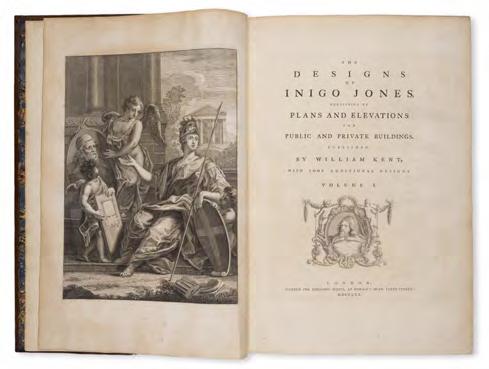
201
DESIGNS (THE) OF INIGO JONES, CONSISTING OF PLANS AND ELEVATIONS FOR PUBLIC AND PRIVATE BUILDINGS, 2 vol. in 1, second edition, text in English and French, engraved frontispiece, titles with engraved portraits, headand tail-pieces, 138 engraved plates, many folding, bookplate to front endpaper, a few tears, most with neat repairs, toning and soiling, scattered spotting or foxing, contemporary red diced morocco with tooled borders in gilt, rebacked preserving old backstrip, slight splitting at upper joint, rubbed and bumped, [ESTC T116215], folio, by William Kent, printed for Benjamin White, 1770.
Provenance: With bookplate of Haddonstone Ltd., The Forge House, East Haddon, Northamptonshire, and Royal Institution crowned gilt stamp to foot of spine
£1,000 - 1,500
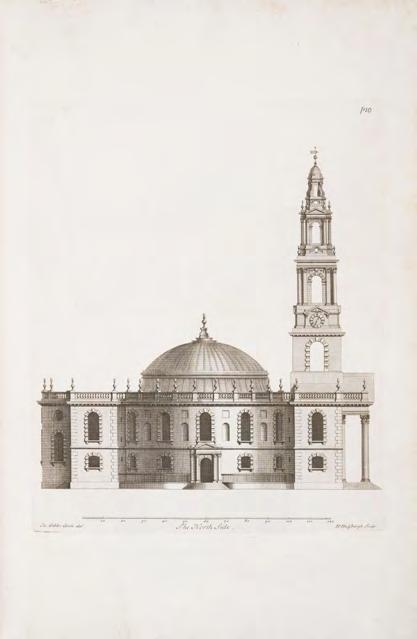
202
Gibbs (James) A BOOK OF ARCHITECTURE CONTAINING DESIGNS OF BUILDINGS AND ORNAMENTS, FIRST EDITION, [ONE OF 550 COPIES], 150 engraved plates and plans by H. Hulsbergh and others after Gibbs, some double-page, 3 pp. list of subscribers, bookplates to front endpaper and pastedown, large tear and repair to dedication f., a few small marginal tears elsewhere, surface soiling and scattered spotting, hinges reinforced, later brown half morocco, rubbed and bumped, t.e.g., [ESTC T22978; Fowler 138; Harris 257], folio, [William Bowyer], 1728.
⁂ “The first book by a British architect consisting entirely of his own designs, executed and projected”. (Harris). An enormously influential pattern book, reaching far beyond the country gentlemen at whom it was aimed, to India, South Africa, the West Indies, and America, where it was a primary source for the builders of the White House. There was also a copy in Thomas Jefferson’s library.
Provenance: Royal Academy of Arts bookplate and bookplate of Haddonstone Ltd., The Forge House, East Haddon, Northamptonshire
£1,500 - 2,000
203
Tipping (H. Avray) ENGLISH HOMES, 10 vol. (including duplicate of period IV, vol. 1), FIRST AND SECOND EDITIONS, illustrations and plates, bookplates to front endpapers, bookseller’s tickets to rear pastedowns, period IV vol. 2 with cracking at hinges, some endpapers browned, some with marginal toning and the odd mark or small nick, scattered surface soiling and light spotting, else good, original cloth, gilt, spines faded and some browned with mottling, staining to a few, some spine ends fraying, rubbed and bumped, g.e., folio, 1920-37.
Provenance: Bookplate of Haddonstone Ltd., The Forge House, East Haddon, Northamptonshire
£1,500 - 2,000
204
Vulliamy (Lewis) and Henry Moses. EXAMPLES OF ORNAMENTAL SCULPTURE IN ARCHITECTURE, 8 parts, engraved title and 40 plates by Moses, 8 “Notice of the Contents” ff. bound in or tipped on to verso of wrappers, 7 original pictorial wrappers bound in, privately printed [c. 1823] BOUND WITH Ornamental from the Antique, original wrapper title excised and laid down to new sheet (rubbed), lithographed title and 20 engraved plates, J. Taylor, 1820, together 2 works in 1 vol., 4 pp. advertisements at end, bookplate to front pastedown, scattered spotting or foxing and some staining, cracking at hinges, near contemporary half calf, rebacked preserving old spine, rubbed and bumped, t.e.g., folio
Provenance: Bookplate of Haddonstone Ltd., The Forge House, East Haddon, Northamptonshire
£800 - 1,200
Antiquities.- Piranesi (Giovanni Battista) VASI, CANDELABRI, CIPPI SARCOFAGI, TRIPODI LUCERNE ED ORNAMENTI ANTICHI, 2 vol., vol. 1 folding engraved title & vol. 2 double-page engraved title, 117 engraved and etched plates, excellent well inked early impressions, printing before numbers added, many double-page and folding, bookplates to front endpapers, the odd folding plate with small neat repair, some pp. lightly toned, soiling and scattered light spotting, some cracking at hinges, else a bright and clean copy, contemporary brown morocco by Derome le Jeune (book binder’s tickets pasted down to title margins), gilt, rebacked, rubbed and bumped, g.e., folio, [Rome], Piranesi, 1778.
⁂ The plates depict a wide range of Roman antiquities, many derived from excavations at Pantanello near Hadrian’s Villa in collaboration with Thomas Jenkins and Gavin Hamilton, with some contributions by Francesco Piranesi. The work was widely circulated and played a significant role in the reception of classical ornament in Europe.
The plates from the current volumes were originally circulated singly and published in small groups between around 1767 and 1778. Hind calls for 114 plates, however the RIBA copy calls for 106; the present example contains 117.
Provenance: Bookplate of Haddonstone Ltd., The Forge House, East Haddon, Northamptonshire
£10,000 - 15,000
206 Opera.- Sanquirico (Alessandro) SCENE
ESEGUITE PEL MELODRAMMA
SERIO L’ULTIMO GIORNO DI POMPEI, engraved title, 1 tinted plate with view enclosed inside decorative cartouche and 8 aquatint plates, finely handcoloured, tissue-guards, neat tear and repair to plate depicting the eruption of Vesuvius, scattered light spotting, mostly to title, some light toning or surface soiling, else a bright copy, later green cloth with gilt borders, rubbed and bumped with the odd mark, oblong folio, Milan, [ n.d. but c. 1827].
⁂ A suite of plates illustrating the set designs and costumes for the 1827 La Scala production of L’ultimo giorno di Pompei by Giovanni Pacini. The series includes a dramatic depiction of the eruption of Mount Vesuvius.
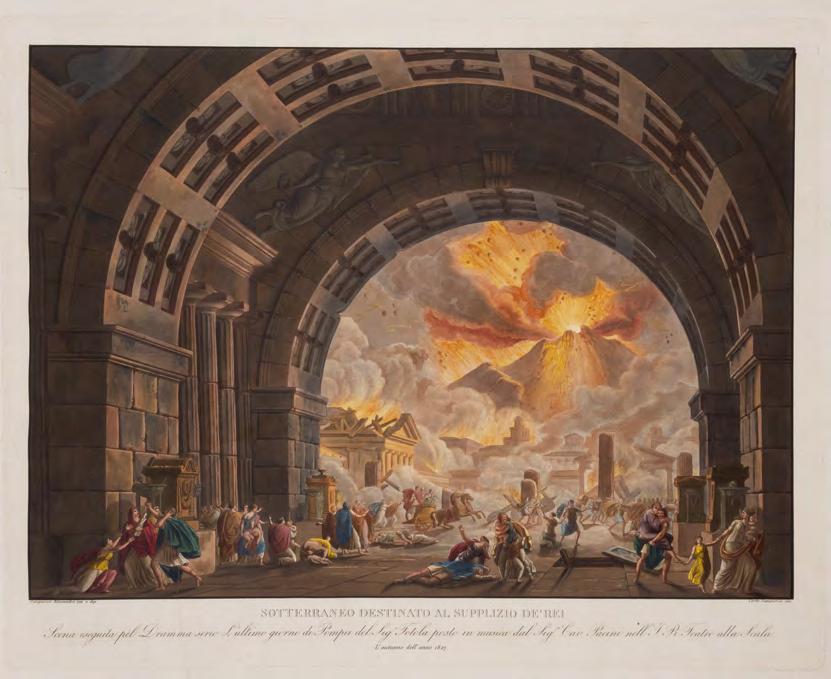
From 1817 to 1832, Sanquirico served as La Scala’s chief scenic artist. Celebrated for his exotic settings and neo-classical architecture, he elevated operatic scenography to a level unmatched elsewhere in Europe. As La Scala’s sole set designer during this period, he created sets for operas by Gaetano Donizetti, Gioachino Rossini, Vincenzo Bellini, Wolfgang Amadeus Mozart, Giacomo Meyerbeer, and Pacini
£3,000 - 4,000
207
[Ware (Isaac)] THE PLANS, ELEVATIONS, AND SECTIONS; CHIMNEY-PIECES, AND CIELINGS OF HOUGHTON IN NORFOLK; THE SEAT OF THE RT. HONOURABLE SR ROBERT WALPOLE, FIRST EDITION, engraved title, letterpress dedication, 28 engraved plates and plans, most by Fourdrinier after Ware (to designs by Ripley and Kent), 9 double-page, all ff. mounted on stubs, pencil annotation to first unnumbered plan and plates¾ & 5 (the latter two identifying rooms within ground plan), first plan little creased, plate 11/12 with tear along central fold repaired to verso, some other short and mostly marginal tears and repairs without loss, some staining, generally light, and foxing and browning, contemporary mottled calf, rebacked and repaired, upper cover with modern black morocco label lettered in gilt, [Berlin Kat. 2231; Harris 911; cf.Millard British 88, third edition], folio, I. Ware, 1735.
⁂ The first monograph devoted to the architecture of a British country house. Houghton Hall was built between 1720 and 1735 for Sir Robert Walpole (1676-1745, later 1st Earl of Orford) with the proceeds from his sale of South Sea Company shares. It is the greatest extant example of Palladian domestic architecture in England; the simplicity and rationality of Palladianism appealed to Whig politicians like Walpole who were then in power. Colen Campbell, James Gibbs, William Kent, Thomas Ripley and Isaac Ware were all involved in the project at one point or another
£1,000 - 1,500
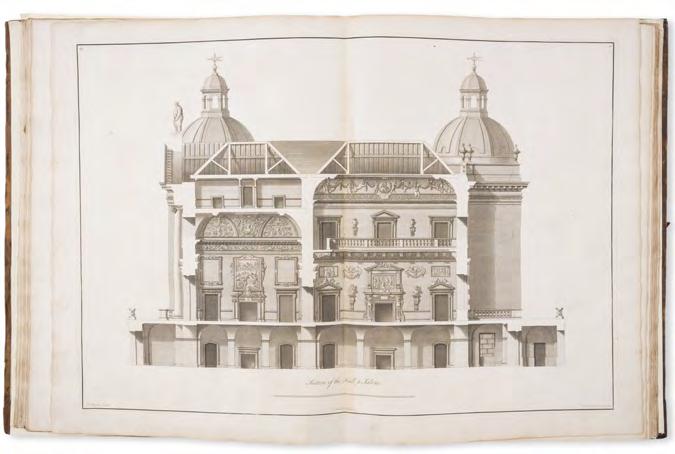
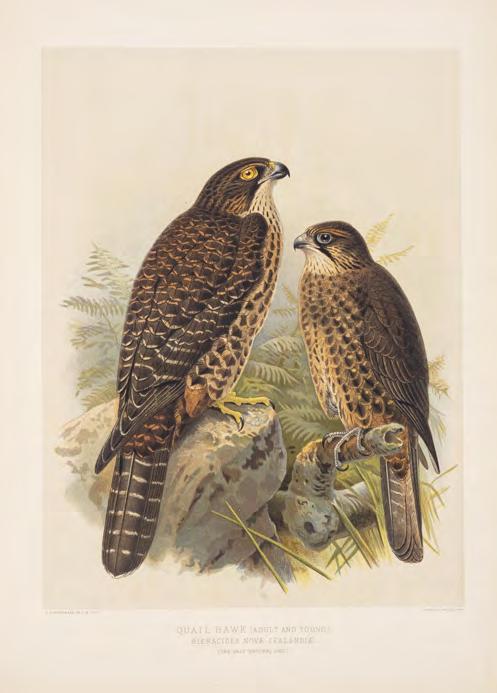
208
Birds.- Buller (Sir Walter Lawry) A HISTORY OF THE BIRDS OF NEW ZEALAND, 2 vol., second edition, 48 chromo-lithographed plates after J.G. Keulemans, 2 lithographed plates, tissue-guards, wood-engraved illustrations, list of subscribers, book binder’s ticket to rear pastedowns, the occasional small marginal tear, most with neat repairs, scattered spotting or foxing and marginal toning, hinges reinforced, original green cloth, richly gilt, rebacked and recornered preserving original backstrips, rubbed and bumped, g.e., [Nissen IVB 163; Zimmer p.115116], folio, for the subscribers, by the author, 1888.
£1,000 - 1,500
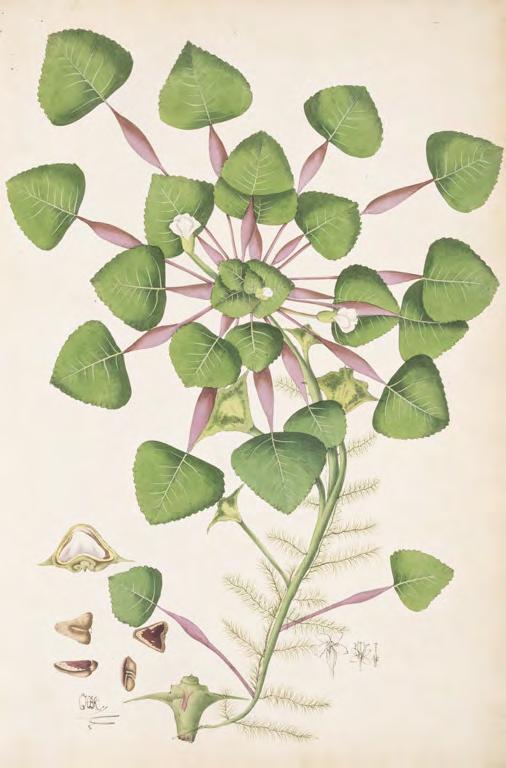
209
Banks (Joseph).- Ker (Charles Henry Bellenden) ICONES PICTAE
INDO-ASIATICAE PLANTARUM EXCERPTAE E CODICIBUS DOM. CATTLEY, FIRST EDITION, lithograph title and 30 hand-coloured lithograph and engraved plates, title and last plate laid down and with repaired tears, occasional minor soiling but plates protected by tissue guards and generally clean and bright, lacks rear free lilac endpaper, contemporary green half roan over cloth, rubbed and soiled, [Nissen BBI 1030; Dunthorne 163; Great Flower Books, p.62; Stafleu & Cowan TL2 3583 “...extremely rare. We have seen no copy of this edition.”], folio, Moser, 1818 [some plates watermarked J. Whatman 1816 and 1817].
⁂ EXTREMELY RARE ON THE MARKET AND NO COMPLETE COPIES OF THIS FIRST EDITION IN AUCTION RECORDS. Ker’s fine plates were based on a group of drawings by Chinese artists collected by Andreas Everard van Braam-Houckgeest whilst working for the Dutch East-India Company, and later in the collection of the horticulturalist William Cattley. The work is dedicated to Joseph Banks.
Provenance: Thomas Hay, CVO, VMH, who was superintendant of the Central Royal Parks, which included Buckingham Palace and 10 Downing Street, from 1922 to 1942. His collection of botanical books passed by descent to his son Roy Hay, a horticultural journalist and broadcaster, who is probably best remembered for having started the Britain in Bloom campaign. The book collection was sold after his death in 1989, his family retaining a few books
£10,000 - 15,000
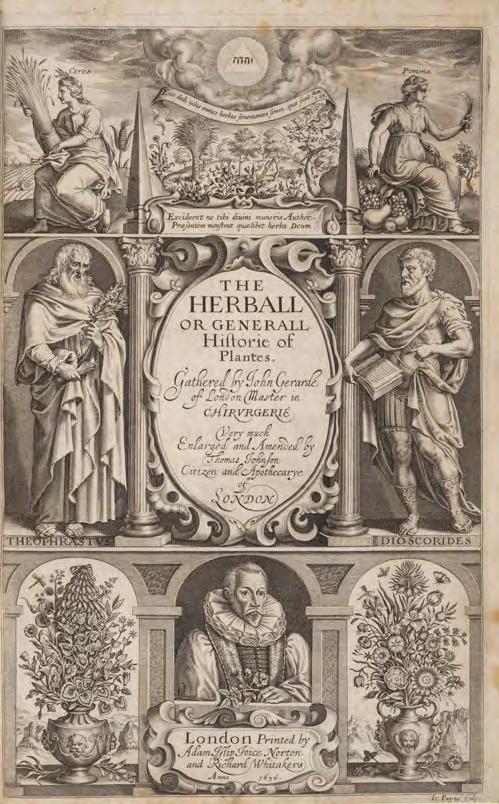
210
Beckford-Rosebery copy.- Gerard (John) THE HERBALL OR GENERALL HISTORIE OF PLANTES, edited by Thomas Johnson, third edition, armorial bookplate of Archibald Philip Earl of Rosebery and Sotheby’s catalogue entry laid down on front pastedown, “R. Beckford Sale Lot 115” in Rosebery’s hand on front free endpaper, engraved architectural title by Jo. Payne, numerous woodcut illustrations throughout, lacking initial and final blanks, very occasional light staining or browning, more so on G2 verso, russia by C. Kalthoeber (with ticket on front free endpaper), Beckford and Rosebery crests to corners, border of drawer-handle design in blind, gilt, rebacked, preserving original backstrip, joints and corners strengthened and repaired, slight bumping and rubbing to corners, a few light scuff marks to lower cover, g.e., inner gilt dentelles, [Henrey 156; Hunt 230; Nissen BBI 698; ESTC S122175], folio, by Adam Islip, Joice Norton and Richard Whitakers, 1636.
⁂ The Beckford-Rosebery copy of the second Johnson edition, corrected and greatly expanded from the first.
Provenance: Lot 115 in the William Beckford sale at Sotheby’s on 11th December 1882
£4,000 - 6,000
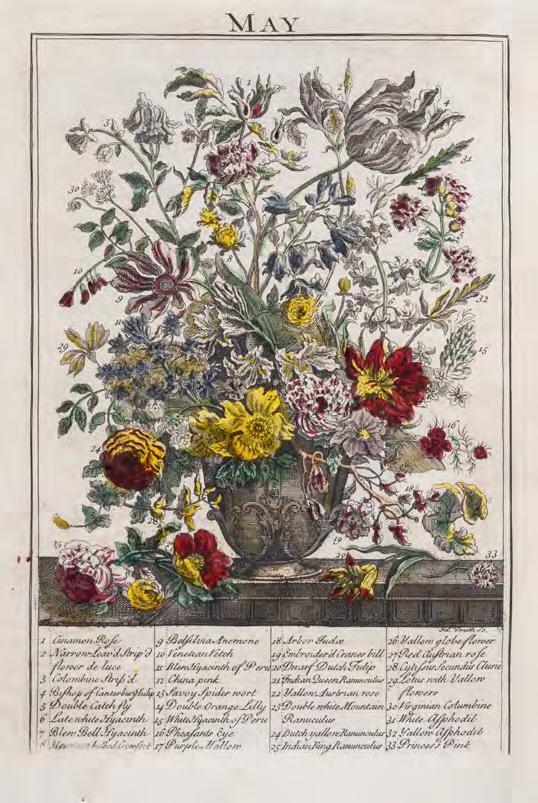
Furber (Robert) THE FLOWER-GARDEN DISPLAY’D IN ABOVE FOUR HUNDRED CURIOUS REPRESENTATIONS OF THE MOST BEAUTIFUL FLOWERS, title printed in red and black, hand-coloured engraved title-page, 12 handcoloured engraved plates, engraved title-page with splitting to platemark and with associated tear, the plates with surface dirt and signs of [?]restorers brushstrokes of translucent pigment slightly discoloured, speckled calf, spine gilt, edged bumped and scuffed, slightly worn, [ESTC T66093], 4to, printed for J. Hazard; R. Montagu; W. Bickerton; R. Chandler; and Caesar Ward, 1732
£1,000 - 1,500
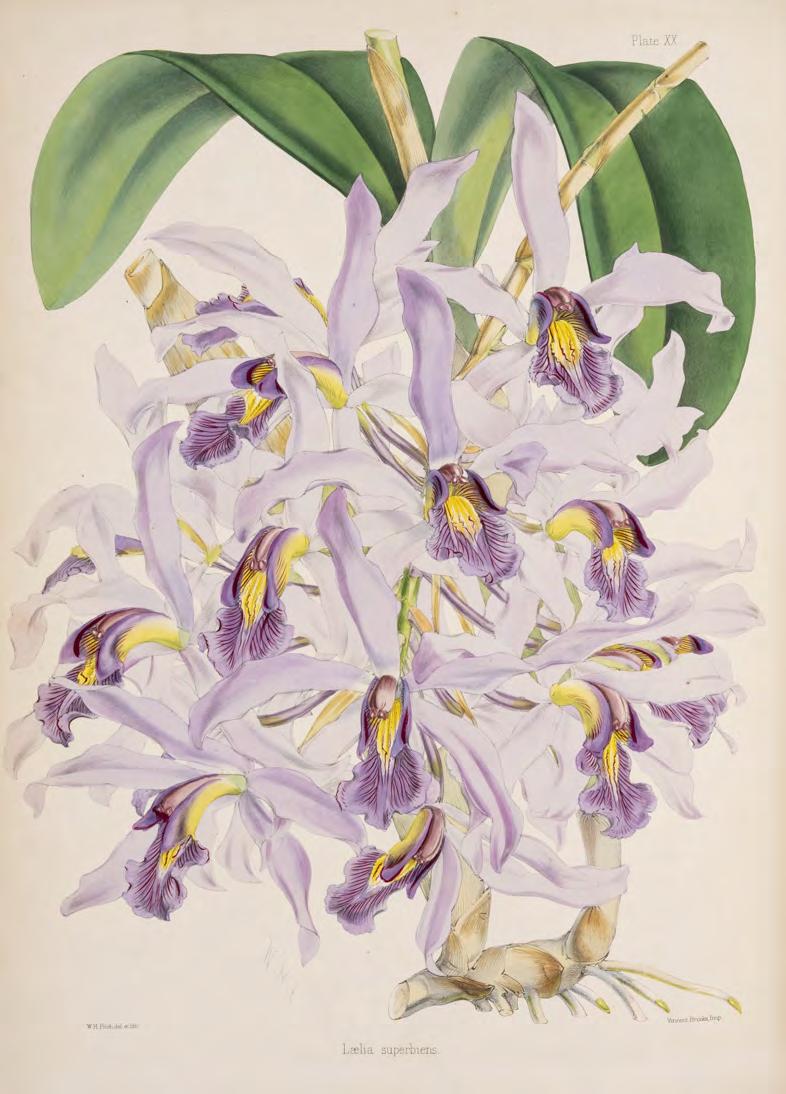
Orchids.- Warner (Robert) and Benjamin S. Williams. SELECT ORCHIDACEOUS PLANTS, 3 vol., [FIRST-THIRD SERIES], FIRST EDITION, 118 hand-coloured lithographed plates by and after W.H. Fitch, J.N. Fitch, James Andrew, and J.L. Macfarlane, a few with touches of thick pigment with craquelure, a few small wormholes to vol.1 first few ff. with repair to vol.1 first few ff. and plate 1 verso, abrasion and repair to vol.1 plate 40 text description affecting a little text, vol.3 half-title loose, large tear to vol.2 and 3 half-titles (touching vol.3 text), light offsetting, some light browning and foxing, contemporary half morocco, gilt spines, slight chipping to spine ends, some light rubbing to extremities, t.e.g., [Great Flower Books, p.149; Nissen BBI 2108; Stafleu & Cowan 16.742], folio, 1862-[91].
⁂ RARE AS A COMPLETE SET WITH ALL THREE OF THE SERIES TOGETHER. A celebration of the orchid family, which had gained quite a lot of popularity among Victorian British gardeners. The first series, published between 1862 and 1865, contained forty plates, and was so successful that the author immediately undertook a second series, appearing between 1865 and 1875, with thirty-nine plates. The third series was published from 1877, is quite rare and seldom appears at auction.
£12,000 - 16,000

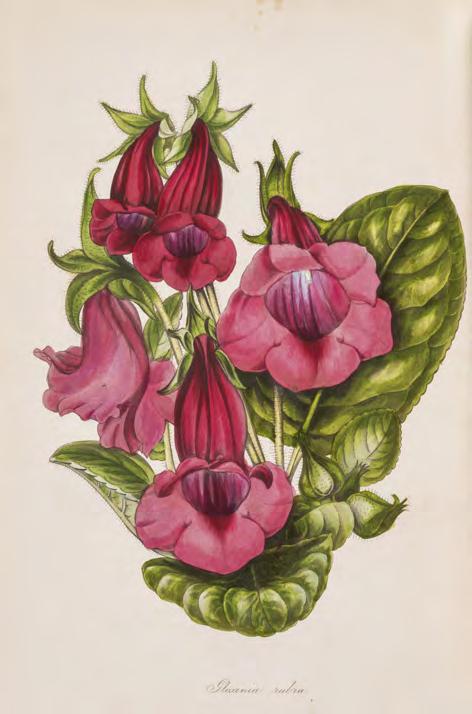
213
Paxton (Joseph) MAGAZINE OF BOTANY AND REGISTER OF FLOWERING PLANTS, 16 vol., FIRST EDITION, 719 hand-coloured engraved by F.W. Smith or lithographed S. Holden plates, some folding or double page, 6 engraved plates of garden designs (most hand-coloured), woodengraved illustrations, lacking half-titles, occasional offsetting and scattered foxing, Frederick DuCane Godman bookplates, contemporary green half calf, gilt spines with red morocco labels a little sunned, very minor rubbing to extremities, [Great Flower Books p.161; Nissen BBI 2351; Stafleu & Cowan 7554], 8vo, 1834-49; sold as a periodical, not subject to return.
⁂ Rare 16 volume set of Paxton’s long-running botanical periodical. During the publication of this work, Paxton carried out most of his important work as superintendent of the gardens at Chatsworth, the principal residence of Duke of Devonshire. This work engaged with the contemporary fascination of orchid, especially in the later volumes with the large number of lithographs from the family.
The bibliographies vary in the number of plates that determine a complete set, Stafleu & Cowan note 723 plates, whereas Nissen calls for 768.
£3,000 - 4,000

214
Insects.- Séguy (E.A.) INSECTES, FIRST EDITION, 20 superb pochoir coloured phototype plates, loose as issued, 4 pp. letterpress including title, preface & list of plates, lacking original portfolio, marginal stain to plate 4, a few other marginal stains and small nicks or tears, light marginal toning, folio, Paris, Editions Duchartre et Van Buggenhoudt, [1928].
⁂ Seguy (1889-1985), working in Paris in the early 1920s, spanned the Art Nouveau and Art Deco periods, producing a series of magnificent portfolios of images based on the natural world. In his book on the period Ray says: ‘In comparison with their variety and brilliance, much Art Deco illustration seems pallid and constrained.” (Ray, The Art Deco Book in France). The first 16 plates depict large format insects with 5 examples crowded onto each plate; the final 4 plates show decorative patterns incorporating insect motifs and designs
£7,000 - 10,000
215
Amputations.- Gamgee (Joseph Sampson) HISTORY OF A SUCCESSFUL CASE OF AMPUTATION AT THE HIP-JOINT, FIRST EDITION, halftitle, 8 pp. list of subscribers, 4 albumen prints by Sarony and Pierre-Petit laid down, 2 by Sarony signed in the negative, 1 engraved plate, bookbinder’s ticket to rear pastedown, half-title and last p. verso (blank with imprint) foxed, scattered spotting and cracking at gutter, original boards, gilt, spine darkened, rubbed and bumped, g.e., 4to, 1865.
⁂ A historically significant medical work, this 1865 publication records one of the earliest successful hip-joint amputations, then considered among the most dangerous surgical procedures of the Victorian era. The volume stands as an important testament to nineteenth-century surgical innovation and medical progress
£750 - 1,000
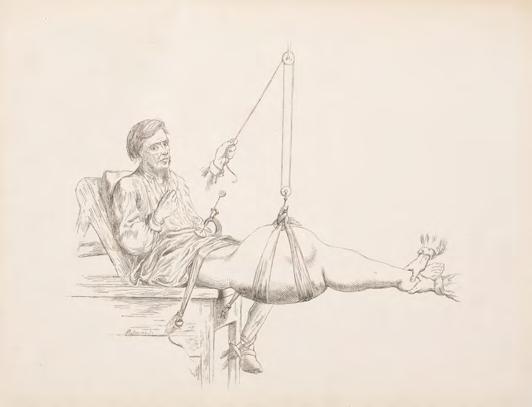
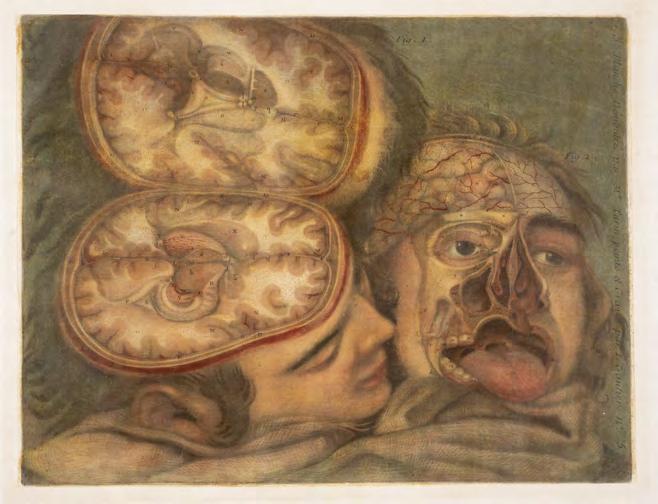
216
d’Agoty (Jacques-Fabien Gautier) ANATOMIE DE LA TÊTE, FIRST EDITION, title in red and black, 8 mezzotints printed in colour and heightened with varnish, all plates and text trimmed to plate marks and window-mounted, bound without privilege and advertisement, faint scattered spotting to mounts, not affecting text or plates, modern calf-backed boards, light rubbing, [Choulant-Frank, p.271; Wellcome III, p.97; NLM, 18thC, p.169 (without privilege and advert.); Heirs of Hippocrates 940. C. Salter, The Anatomists’ Library (2023).], elephant folio, Paris, chez le Sieur Gautier, 1748.
⁂ Jacques Gautier d’Agoty (1711-86) trained as an engraver under Le Blon, learning from him the basis of colour engraving and printing techniques, using three colour plates (yellow, red and blue). After leaving Le Blon, Gautier honed a technique for multi-colour printing by adding another plate painted black, as L’Admiral had already attempted. Gautier eventually obtained the royal privilege as the sole inventor of this technique, publishing numerous illustrated books, especially on medicine and natural science. ‘The colour illustrations must have been a sensation in their day and they combine anatomical images with an artistic flair for presentation. As a result, however, they look more like still life compositions than anatomy diagrams and lack the detail which would have been truly useful for students’ (Salter, p.198). As with Gautier’s other books, the intended readers were thus likely to be the educated middle classes, with an interest in book illustrations and medicine
£10,000 - 15,000
217
Hypnosis.- Surgery.- Elliotson (John) NUMEROUS CASES OF SURGICAL OPERATIONS WITHOUT PAIN IN THE MESMERIC STATE, with errata, lacking 16 pp. advertisements & 1 p. list of Elliotson’s other works, H. Baillière, BOUND WITH The Mesmerist: A Journal of Vital Magnetism, 20 parts, part 8 loosely inserted, W. Strange, together 2 works in 1 vol., FIRST EDITIONS, CUT SIGNATURE OF THE AUTHOR laid down to front pastedown, bookplate and cataloguing note tipped on to front pastedown, scattered spotting and light toning to a few pp., some cracking at hinges, contemporary cloth, spine browned, rubbed and bumped, 1843; and another disbound copy of “The Mesmerist: A Journal of Vital Magnetism” (1843) parts 1-19 only (of 20), 8vo (2)
⁂ John Elliotson (1791–1868) was among the earliest British physicians to advocate the use of hypnotism (then termed mesmerism) as a form of surgical anaesthesia. Despite reported clinical successes, his work was strongly opposed by the medical establishment, leading to his resignation from several professional positions, including his professorship at the University of London. This publication presents case reports—most notably a widely discussed leg amputation performed under mesmerism—and outlines the controversy that followed its presentation to the Royal Medical and Chirurgical Society.
Provenance: Bookplate of Sir Thomas Willshire (1789-1862), a highly distinguished Peninsular War officer who served in major campaigns against Napoleonic forces in the Iberian Peninsula, including Salamanca, Vittoria, and San Sebastián, where he was twice wounded. Rising through the ranks from a childhood commission, he became a senior figure in the British Army and was later created a baronet and Knight Grand Cross of the Bath (GCB)
£500 - 700
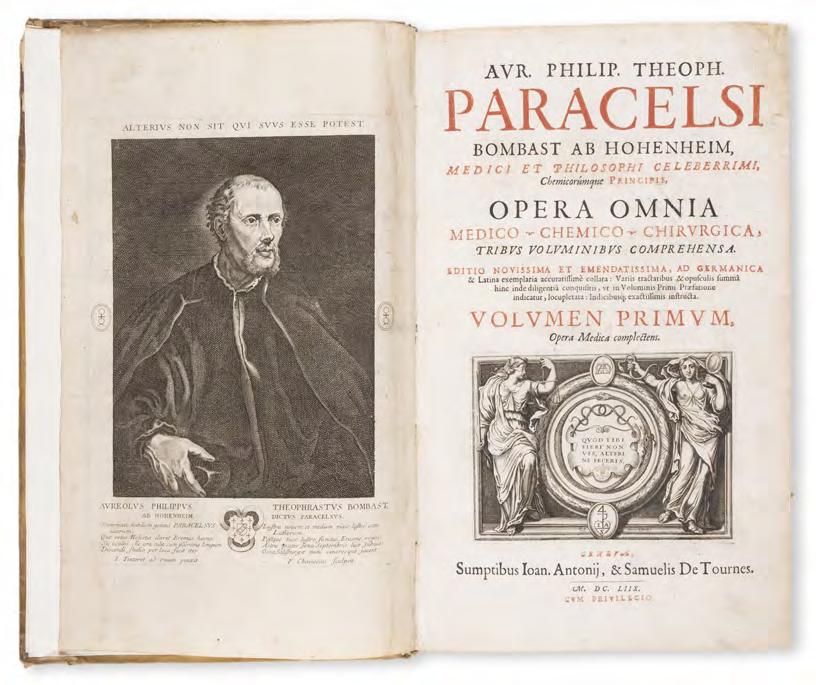
218
Paracelsus (Theophrastus Bombastus) OPERA OMNIA MEDICO-CHEMICO-CHIRURGICA, 3 vol. in 1, vol. 1 half-title with engraved portrait after Tintoretto to verso, titles in red and black with engraved or woodcut printer’s device, some woodcut diagrams, vol. 1 & 2 with blank at end of prelims, vol. 2 & 3 with final blank, half-title/portrait repaired at inner-edge but not affecting image, vol. 1 title & following few ff. neat repair to blank upper corner/fore-edge, vol. 2 & 3 some generally very light damp-staining to foot, few minor marginal defects, lightly foxed and browned, contemporary vellum, covers with central blind-stamped ornament, spine with raised bands and titled in manuscript, lacking ties, upper cover upper corner with some wear and repair, lightly soiled, few short tears to spine ends and joints starting, later endpapers, [Wellcome IV, 293], folio, Geneva, Joan. Antonii & Samuelis De Tournes, 1658.
⁂ Important edition of the medical, chemical and surgical works of Paracelsus, the most comprehensive of those editions in Latin. “It is difficult to overrate the effect of Paracelsus’ achievement on the development of medicine and chemistry” (DSB X, p.311).
Provenance: E. Malan de Merindol (bookplate)
£2,000 - 3,000
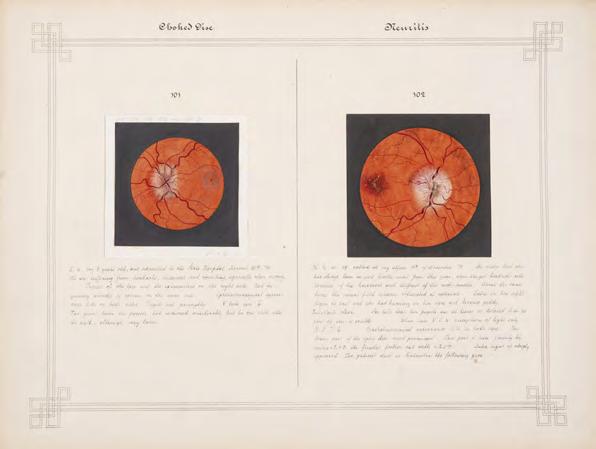
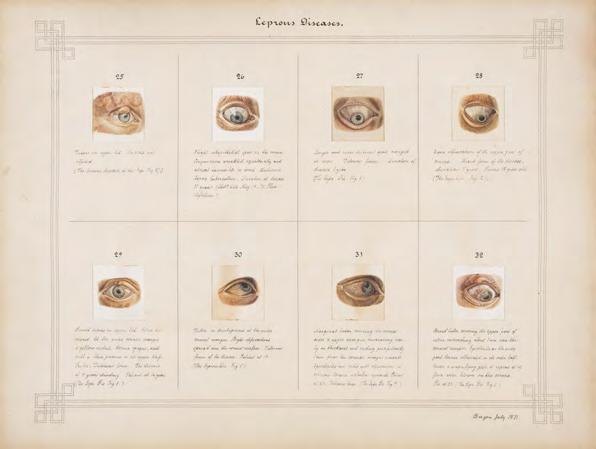
219
Ophthalmology.- Bull (Ole Bornemann, Private ophthalmologist, Oslo, 1842-1916) TWO PORTFOLIOS CONTAINING 369 ORIGINAL DRAWINGS OF EYES, including one portfolio with 132 ‘Ophthalmological Drawings’ on 54 sheets, the second portfolio with 240 ‘Otological Drawings’ on 30 sheets, the first portfolio with manuscript preface and index sheet, all drawings watercolour, bodycolour, pencil, black overlays, some eyes inscribed in pencil below identifying patient and date drawn, the sheets with mounts decorated with ornate pen and ink borders, numbered, and inscriptions giving additional information on patient, various sizes between 20 x 20 mm (3/4 x¾ in) and 100 x 100 mm (3⅞ x 3⅞ in), the sheets each approx. 365 x 480 mm (14¼ x 18⅞ in), sections for 3 eye drawings in numbered spaces left blank, some scattered spotting, minor browning and surface dirt, all loose, modern black portfolios, circa 1868-1904
⁂ MONUMENTAL STUDY OF DISEASES OF THE EYE, A PRODUCT OF 36 YEARS WORK. Bull was was co-author with G. A. Hansen of The leprous diseases of the eye : with six colored plates, 1873; The ophthalmoscope and lues, 1884; Perimetrie ... Mit 174 Figuren, 1895; The Application of Hydrochloric Acid in Affections of the Bony Walls of the Tympanic Cavity, 1899; Klinische Studien über die Krankheiten der Retinalgefässe ... Mit 41 Sehfeldschemata und 30 Tafeln, 1904.
“The present collection has been compiled during the last 36 years. The wish for acquiring dexterity in the use of the ophthalmoscope and otoscope gave me the first impetus to draw. Later on, when I had practised for some time as an oculist and aurist, I became aware that to draw was in itself an excellent means to learn to observe minutely, and drawings better than anything else would permit me to follow up the pathological changes the affected parts may undergo in the lapse of time.” [Bull, manuscript preface, 1904]
£2,000 - 3,000
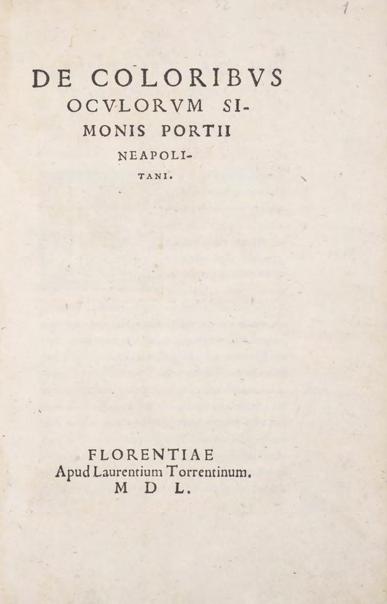
220
-. Porzio (Simone) DE COLORIBUS OCULORUM, FIRST EDITION, 2 large woodcut initials, with final blank, a few very neat and subtle repairs at gutter, some very light foxing, but overall a good and wide-margined copy, later (?early 20th century) vellum-backed boards, manuscript title to spine, dust-soiling to vellum, housed in a modern velvet lined drop-back box, [Adams P1959; Becker 303; EDIT 16 CNCE 34577], 8vo, Florence, L. Torrentino, 1550.
⁂ “One of the earliest monographs on ophthalmology in which the author attempts to explain the cause of the variety of colors of eyes. The position of the eyes and the opinions of Aristotle and Galen on the structure of the eye are also discussed” (Becker)
£750 - 1,000
221
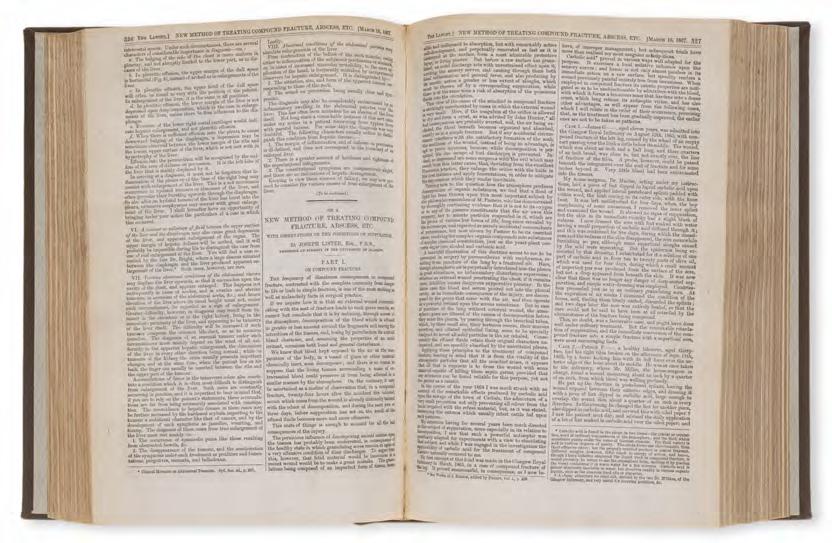
Surgery.- Lister (Joseph) ON A NEW METHOD OF TREATING COMPOUND FRACTURE, ABSCESS, ETC. WITH OBSERVATIONS ON THE CONDITIONS OF SUPPURATION, in The Lancet for 1867, vol. 1, pp.326-29, 357-59, 387-89, 507-09, & vol. 2, pp. 95-96 [with] On the Antiseptic Principle in the Practice of Surgery, vol. 2, pp.353-56 & 668-69, occasional light dust-soiling or corner creasing, very slight marginal toning, ex-library with cancelled ink stamp and small mark in red pen to vol. titles, later buckram, spines lettered in gilt, very lightly rubbed, [Garrison-Morton 5634 & 5635], 4to, 1867.
⁂ Published in the two volumes of The Lancet for 1867, these articles “represent two of the most epoch-making contributions to surgery” (Garrison-Morton). The first paper comprises Lister ’s work on the antiseptic principle in surgery. He believed that it was necessary to kill the bacteria already in wounds and hit on carbolic acid for this purpose. In the second paper he evolved the idea of the antiseptic prevention of wound infection.
Provenance: Mary Imogene Bassett Hospital in Cooperstown, NY (bookplate); Boston Athenaeum (ink-stamp to titles).
£1,500 - 2,000
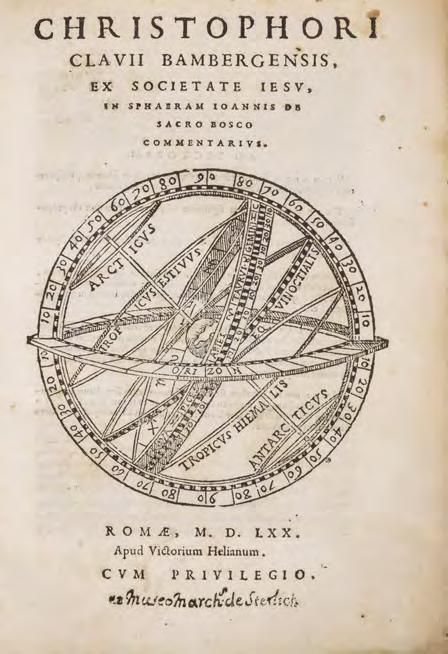
222
Clavius (Christophorus) IN SPHAERAM IOANNIS DE SACRO BOSCO COMMENTARIUS, FIRST EDITION, woodcut armillary sphere to title, woodcut diagrams, woodcut printer’s device to colophon, with final blank, title with few very small holes to head just touching one letter, first few Sig. with tiny puncture hole to upper-margin, SOME MANUSCRIPT ADDITIONS AND CORRECTIONS IN A CONTEMPORARY HAND, 3N1 tear repaired without text loss, 3Q3&4 loose, final few ff. of Index with single small wormhole within text, some foxing and browning to varying degrees, newly bound in an old vellum choral leaf, earlier spine labels and endpapers (with manuscript diagrams) preserved, [EDIT 16 CNCE 12670], small 4to, Rome, Vittorio Eliano, 1570.
⁂ First edition of Clavius’s commentary on Sacrobosco’s classic astronomical text, in which he sought to update traditional Ptolemaic astronomy with sixteenth-century knowledge. Despite being a friend of Galileo, Clavius’s update to astronomy stopped short of Heliocentrism. The similarity between the annotations/hand in this copy and those found in other copies (see Christie’s, Lot 18, Printed and Manuscript Americana & Science, 13-27 Jan 2023), suggests that the corrections were probably carried out in the printer’s shop at Clavius’s behest.
Provenance: “Ex Museo March. de Sterlich” (ownership inscription to foot of title)
£1,500 - 2,000
223
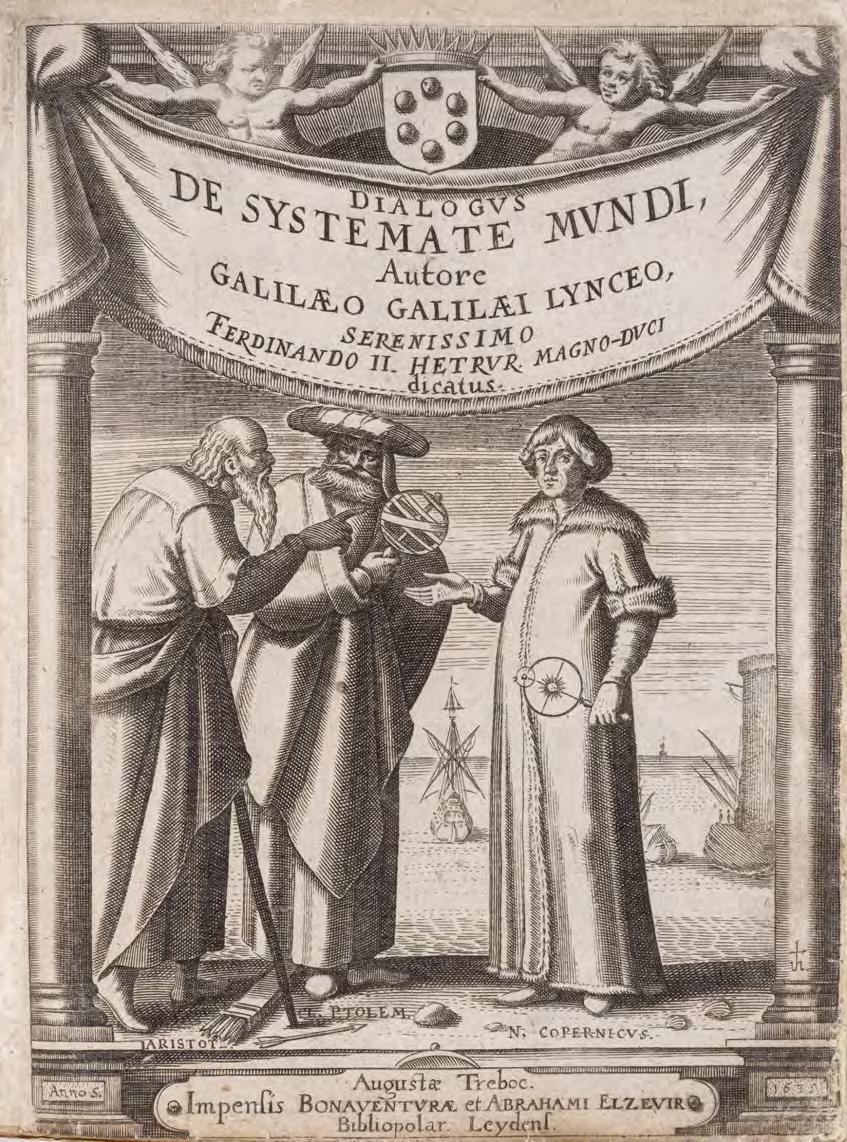
Galilei (Galileo) SYSTEMA COSMICUM IN QUO QUATUOR DIALOGIS, DE DOUBUS MAXIMIS MUNDI SYSTEMATIBUS, FIRST LATIN EDITION, complete with engraved additional title (trimmed, a little frayed, and restored at gutter), and full-page portrait illustration of Galileo, Zz2-3 transposed, the odd ink marginalia or underlining, Strasbourg, David Hautt for the Elzevis, 1635 BOUND WITH Tractatus de Proportionum Instrumento quod merito Compendium universæ Geometriæ dixeris, second Latin edition, lacking engraved plate, Strasbourg, David Hautt, 1635, TOGETHER 2 WORKS IN 1 VOL , woodcut initials, diagrams, and head-pieces, occasional light spotting or surface staining, light browning, later pastedowns, contemporary vellum, faded manuscript title to spine, stained, joints starting, light rubbing to extremities, small 4to.
⁂ Galileo’s Systema Cosmicum was first published in Florence in 1632, but was banned by the Catholic Church. Shortly after its publication, Galileo was condemned for heresy by Urban VIII. A surviving copy was smuggled out of Italy to Strasbourg where it was published in Latin; 600 copies were produced in its first run. The work explains how Copernicus’s idea of heliocentric cosmology would work, but he frames it within a hypothetical context to try to avoid the Catholic Church’s ban on heliocentrism which had come into place in 1616.
The second work, Tractatus de Proportionum Instrumento, describes Galileo’s “portion compass”, which was the first device to perform arithmetic calculations by mechanical means.
£8,000 - 12,000
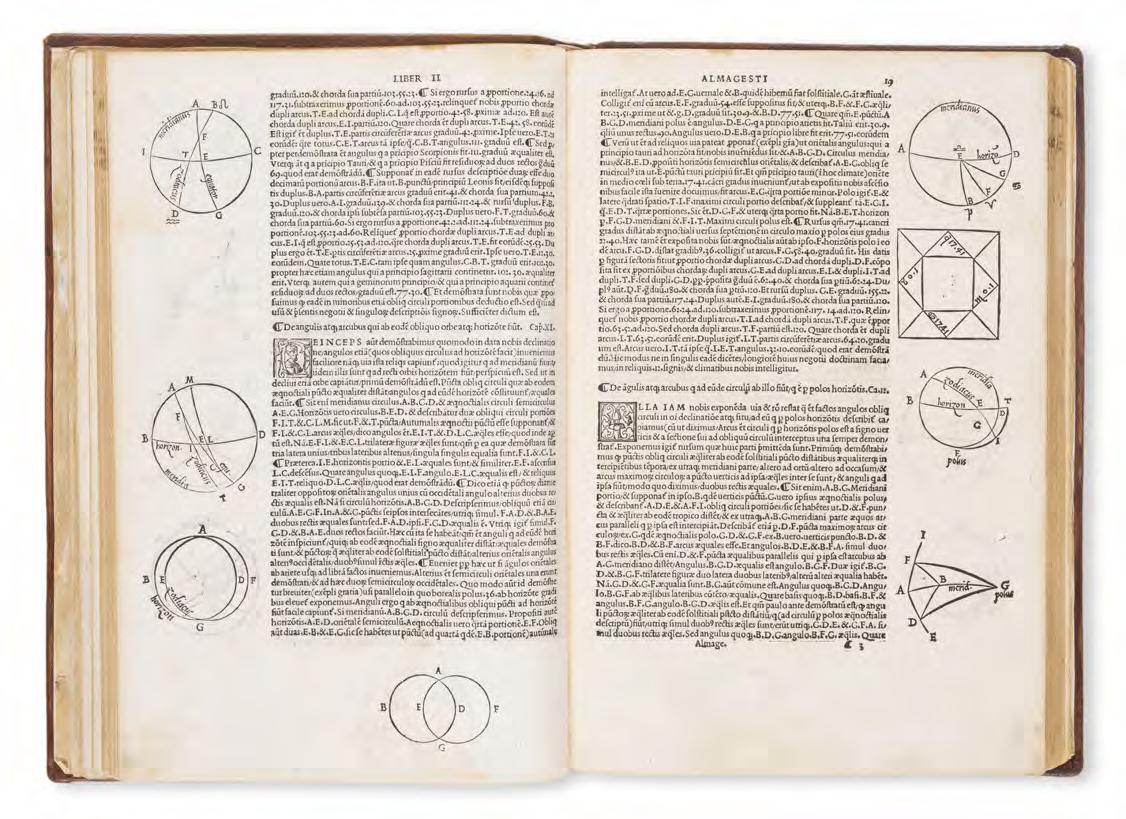
224
Ptolemaeus (Claudius) ALMAGESTUM SEU MAGNAE CONSTRUCTIONIS MATHEMATICAE OPUS, translated into Latin by Georgius Trapezuntius, edited by Luca Gaurico, title printed in red and black and with woodcut printer’s device in red, numerous woodcut diagrams and initials, with final blank (upper corner creased), title with very small chip to fore-margin and repaired at gutter, a1 & a8 small paper repair to inner-edge of lowermargin, c3v diagram with single letter shaved at foot, sometimes trimmed close elsewhere but no loss, some light foxing and browning, but overall a good copy, old blind-stamped paneled calf, lacking ties, restored, some very small insect damage to joints and few small wormholes to covers, new endpapers, [Adams P2214; EDIT 16 CNCE 29477], folio, Venice, Lucantonio Giunta, 1528.
⁂ THE FIRST PUBLISHED LATIN TRANSLATION MADE FROM THE ORIGINAL GREEK TEXT Ptolemy’s most influential astronomical and mathematical work, the Almagest formed the foundation of advanced astronomy for more than a millennium, and played a crucial role in shaping Renaissance scientific thought. It had previously been translated into Arabic, and was known in a Latin translation from the Arabic by Gerard of Cremona, first published in Venice in 1515.
Provenance: J.N. Lewis of Mt. Vernon, Ohio, Sept. 23 1872 (ownership inscription to head of title)
£10,000 - 15,000
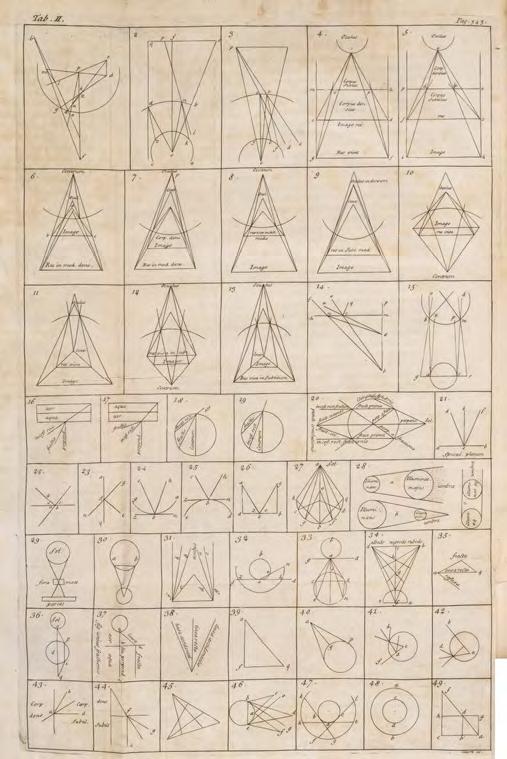
225
225
Bacon (Roger) OPUS MAJUS AD CLEMENTEM QUARTUM PONTIFICEM ROMANUM, edited by Samuel Jebb, title in red and black, 2 folding engraved plates and 1 folding letterpress table, 3 pp. list of subscribers, bookplates, ink stamps to blank title verso, 4H2 with marginal tear (not affecting text), plates with small tears, 1 with tape repair, light offsetting from plates, scattered spotting or foxing, later half morocco, rubbed and bumped, [ESTC T128058], folio, Gulielmi Bowyer, 1733.
⁂ Provenance: Bookplates including the later Harvard College Library bookplate of Charles Minto (Class of 1828), together with the Harvard University Library gilt-stamped mark at the foot of the spine and ink stamps on the verso of the title.
Also present is the armorial bookplate of William Gordon of Fyvie (1736–1816), likely the British army officer and courtier, son of William Gordon, 2nd Earl of Aberdeen. Educated at the University of Edinburgh, he embarked on a military career in 1756 and rose through the ranks, serving in several regiments during the Seven Years’ War period, before later also sitting in Parliament through the influence of the Duke of Marlborough.
£1,500 - 2,000
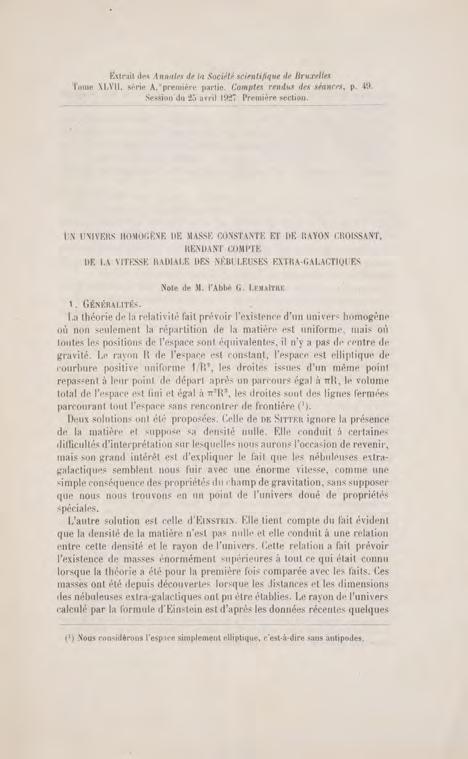
226
226
Big Bang theory.- Lemaitre (Abbe Georges) UN UNIVERS HOMOGENE DE MASSE CONSTANTE ET DE RAYON CROISSANT, RENDANT COMPTE DE LA VITESSE RADIALE DES NEBLEUSES EXTRA-GALACTIQUES, FIRST EDITION, offprint from Annales de la Societe scientifique de Bruxelles, vol.XLVII, serie A, 12pp., (the last blank), a couple of ink corrections and some orange pencil crossings-out and marks, central crease from fold with 2 small holes slightly affecting text on final leaf, final blank page with ink “4098 G.Lemaitre (translation)”, stapled, 8vo, Louvain, Etablissements F. Geuterick, 1927.
⁂ THE BIRTH OF THE BIG BANG THEORY AND FIRST PROOF OF AN EXPANDING UNIVERSE
Extremely rare offprint issue of Lemaitre’s breakthrough discovery in which he determined that the universe is expanding rather than static, and proposed a direct relationship between a galaxy’s distance and its velocity of recession. This in turn led to his proposal in 1931 that the entire cosmos began as a single, extremely dense quantum - the “primeval atom” or Big Bang theory as it is now more commonly known - which decayed and exploded to give rise to space, time, and the ongoing expansion of the universe. He successfully incorporated Einstein’s cosmological constant (which Einstein himself temporarily abandoned) to formulate models that accounted for the expansion, beautifully anticipating modern concepts like dark energy.
Lemaître (1894-1966) studied mathematics and physics, and later theology, at the University of Louvain. He was ordained a priest in 1923, and in the same year he was awarded a traveling postdoctoral fellowship. “He went to Cambridge and studied under Eddington, under whose influence he specialised in general relativity. In 1924 and 1925 he continued his post-graduate studies in the United States, at Harvard and MIT. During his stay in the United States, he attended the American Astronomical Society conference in Washington, at which Hubble’s discovery of the Cepheid variables in the Andromeda nebula was announced. He became increasingly occupied with cosmology and, while at MIT in 1925, suggested a modification of de Sitter ’s cosmological theory. Lemaître’s model was non-static and included a red shift caused by the Doppler effect. After his return to Louvain, he developed his theory further, and in 1927 he published a new cosmological theory that combined the advantages of the earlier theories of Einstein and de Sitter.” (DSB)
No copy traced at auction
£2,000 - 3,000
227
Evolution.- [Chambers (Robert)] VESTIGES OF THE NATURAL HISTORY OF CREATION, FIRST EDITION, half-title, the odd spot or surface stain, light toning, original red cloth, rebacked preserving most of original spine, a little stained, extremities lightly rubbed, [Garrison-Morton 218; Origins of Cyberspace 5], 1844; and a first American edition of Chambers’s ‘Explanations. A Sequel to “Vestiges of the Natural History of Creation”, 1846, 8vo (2)
⁂ First edition of the first full-length exposition of an evolutionary theory in English. The text was published anonymously to protect Robert Chambers’s reputation; authorship was not revealed until the twelfth edition, 13 year’s after Chambers’s death.
£1,000 - 1,500
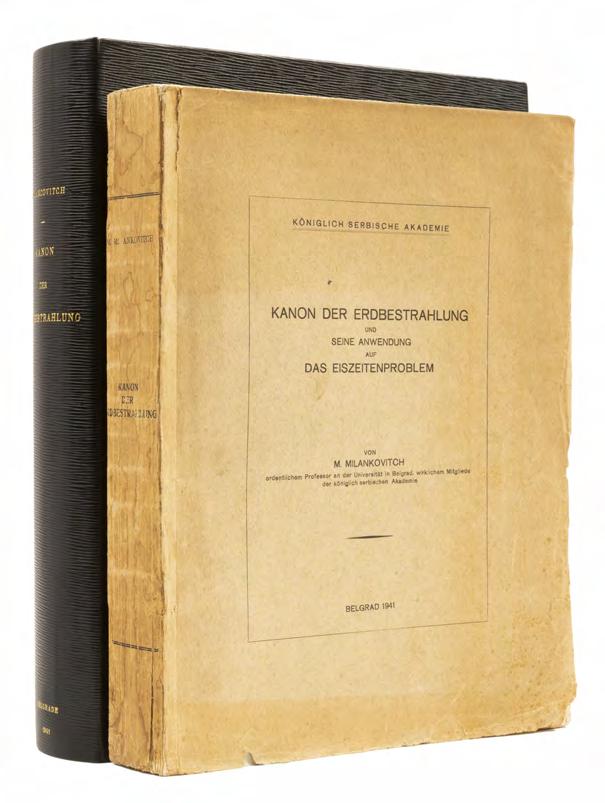
228
Climate Science.- Milanković (Milutin) KANON DER ERDBESTRAHLUNG UND SEINE ANWENDUNG AUF DAS EISZEITENPROBLEM, FIRST EDITION, original printed wrappers, ink ownership inscription front wrapper verso, spine with browining and damp-stains, some minor chipping and fraying to edges, housed within fine custom clam-shell wraparound and black morocco drop-back box by and house Atelier Moura of Lyon, folio, Belgrade, Royal Serbian Academy, 1941.
⁂ First edition of Milanković’s masterwork on his astronomical theory of climate. This brought together all the mathematical elements underlying the theory of “Milanković cycles” - cyclical changes in a planet’s climate caused by the variations in its orbit in turn affecting the amount of solar radiation (insolation) the planet receives. On Earth, Milanković demonstrated that these variations have played a decisive role in initiating the growth of glaciers, leading to at least five major ice ages.
Ink inscription “A. Brouwer” possibly Dutch geologist Hendrik Albertus Brouwer (1886-1973).
£1,500 - 2,000
229
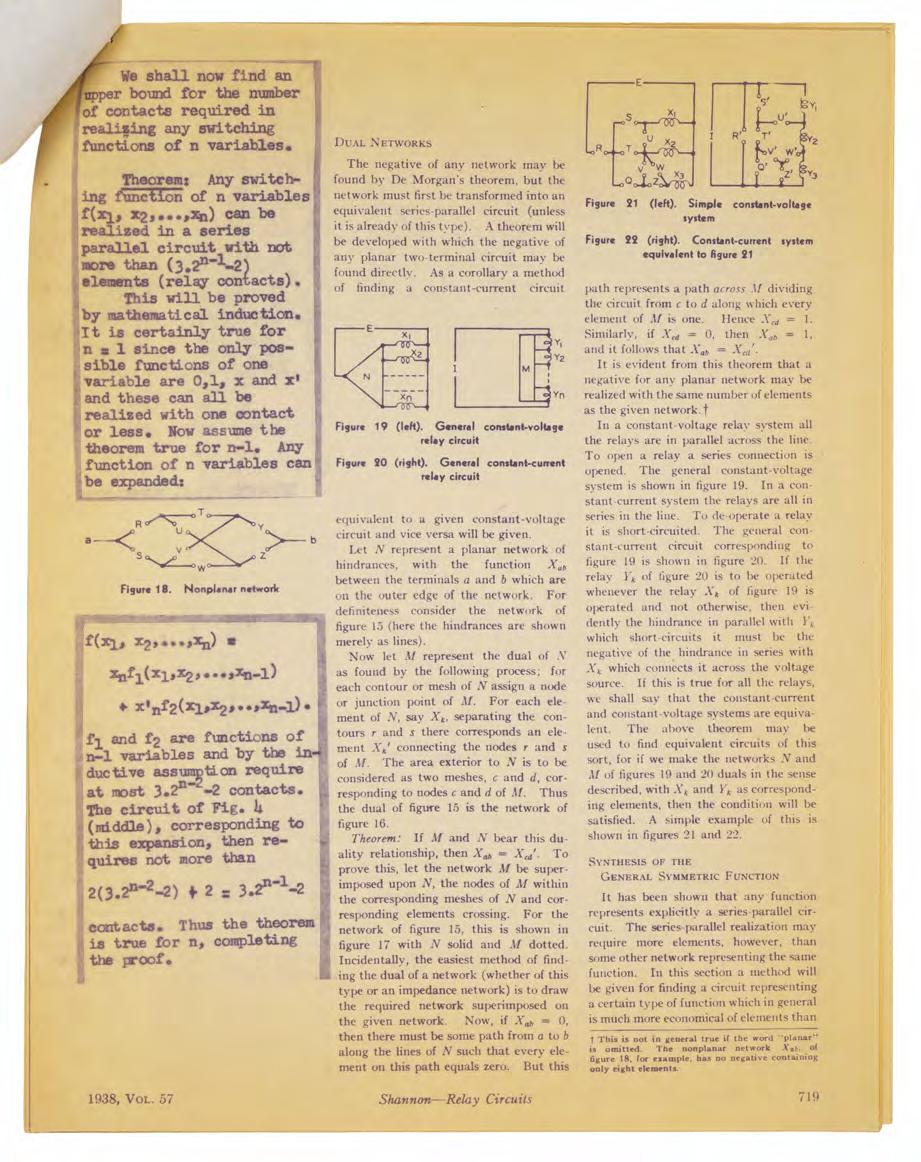
Computing, Father of information theory.- Shannon (Claude Elwood) SYMBOLIC ANALYSIS OF RELAY AND SWITCHING CIRCUITS, pp.713-723, ozalid print, 11 ff. printed recto only, THIS ONE OF A FEW COPIES* PRODUCED BY SHANNON HIMSELF, REPRODUCING HIS CORRECTIONS FOR THE FIRST TIME, stapled upper left corner, margins yellowed, preserved in a modern green cloth drop-back box, 4to (280 x 217mm.), New York, American Institute of Electrical Engineers [AIEE], 1938 [but c.1955].
⁂ THE DEFINITIVE EDITION OF THIS FOUNDATION DOCUMENT OF THE INFORMATION AGE, WHICH REPRODUCES SHANNON’S CORRECTIONS FOR THE FIRST TIME IN THE MARGINS OF PP.718-719. THESE WERE NOT PUBLISHED ELSEWHERE. This version is not recorded in Nelson H. F. Beebe’s A Complete Bibliography of Publications of Claude Elwood Shannon, Utah, December, 2025 AND COMES FROM THE PERSONAL PAPERS OF SHANNON
The article (often referred to as Shannon’s ‘Master’s Thesis’) demonstrates how to combine the mathematics of Boolean logic with the engineering practice of building circuits. IT PROVIDED THE FOUNDATION FOR TODAY’S COMPUTER CIRCUIT DESIGN. In 1940 it was awarded the 1939 Alfred Noble Prize of the combined engineering societies of the United States of America.
*Provenance: There were five examples of this corrected paper in Shannon’s personal files. Four ozalid prints (as here) and one later dual spectrum print
£10,000 - 15,000
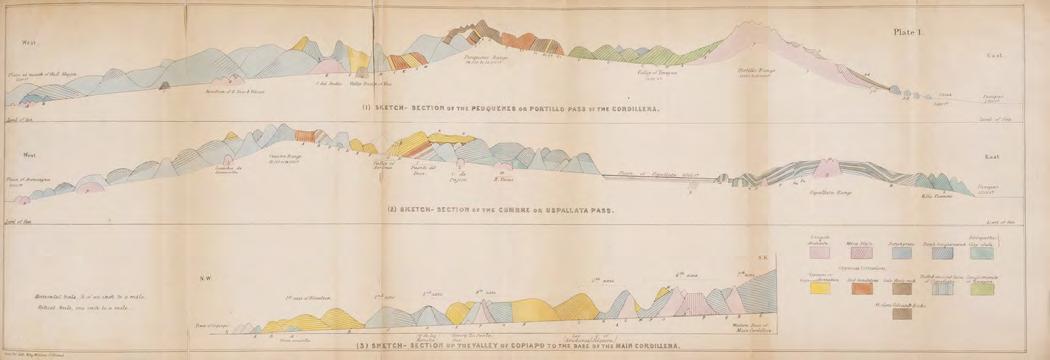
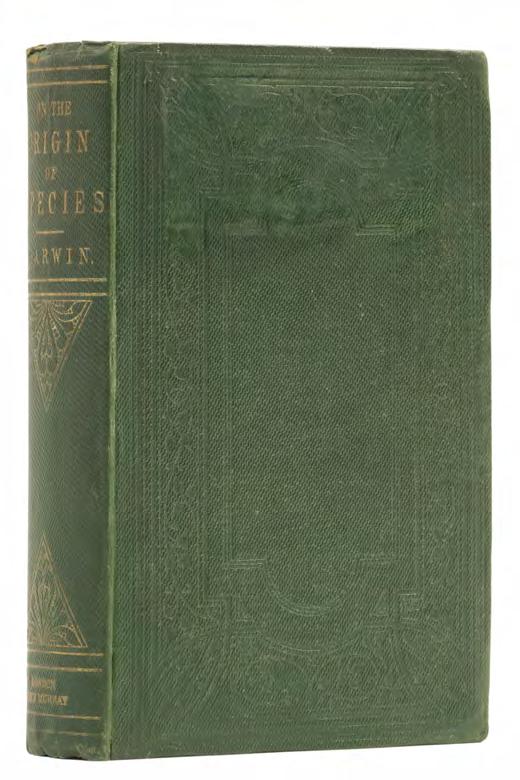
230
Darwin (Charles) ON THE ORIGIN OF SPECIES BY MEANS OF NATURAL SELECTION, second edition, second issue, with ‘fifth thousand’ to title, folding lithographed diagram, 32pp. publisher’s catalogue dated ‘January 1860’, ‘Rev. Paul Cox’ ink-stamp to half-title, contemporary ink ownership inscription to head of title, original green blind-stamped cloth, recased with neat and expert repairs to spine ends, neat retouching to upper cover and extremities, [Freeman 376], 8vo, 1860.
£3,000 - 4,000
231
Darwin (Charles) GEOLOGICAL OBSERVATIONS ON SOUTH AMERICA. BEING THE THIRD PART OF THE GEOLOGY OF THE VOYAGE OF THE BEAGLE, UNDER THE COMMAND OF CAPT. FITZROY, R. N. DURING THE YEARS 1832 TO 1836, FIRST EDITION, folding map (repaired), 5 folding plates and map (repairs to versos, 1 plate hand-coloured), without publisher’s 32pp. advertisement, light browning, but overall a clean copy, contemporary half calf, rebacked, a little rubbed, [Freeman 273; Norman 857; Sabin 18646], 8vo, 1846.
⁂ The third and final part of Darwin’s geological results of the Beagle voyage. The first, The Structure and Distribution of Coral Reefs, was first published in 1842; it was soon followed by Geological Observations on the Volcanic Islands Visited in 1844. It was not until 1851 that an edition of all three geological works was first published.
£4,000 - 6,000
232
Fermentation.- Pasteur (Louis) MEMOIRE SUR LES CORPUSCULES ORGANISES QUI
EXISTENT DANS L’ATMOSPHERE, FIRST EDITION, in Annales des Sciences Naturelles (Partie Zoologique), 4th series, vol. 16, pp.5-98, vol. lacking half-title, 10 plates at end, of which 3 folding, occasional light spotting or soiling, light marginal toning, attractive modern red moroccobacked boards, spine gilt and with double olive morocco labels, [GarrisonMorton 2475; PMM 336c], 8vo, Paris, Victor Masson & Fils, 1861.
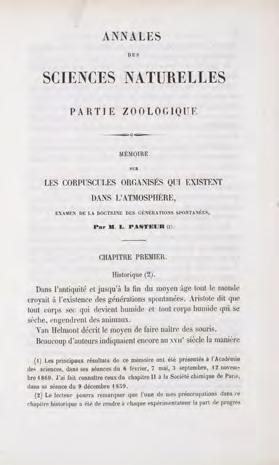
⁂ First edition of Pasteur’s famous refutation of the theory of spontaneous generation and introduction of the new science of bacteriology, complete in the original volume of Annales des Sciences Naturelles Pasteur used a heating process, the earliest form of pasteurisation, in “further experiments which demonstrated beyond dispute that fermentation is caused by the action of minute living organisms and that if these organisms are excluded or killed fermentation does not occur” (PMM).
£1,000 - 1,500
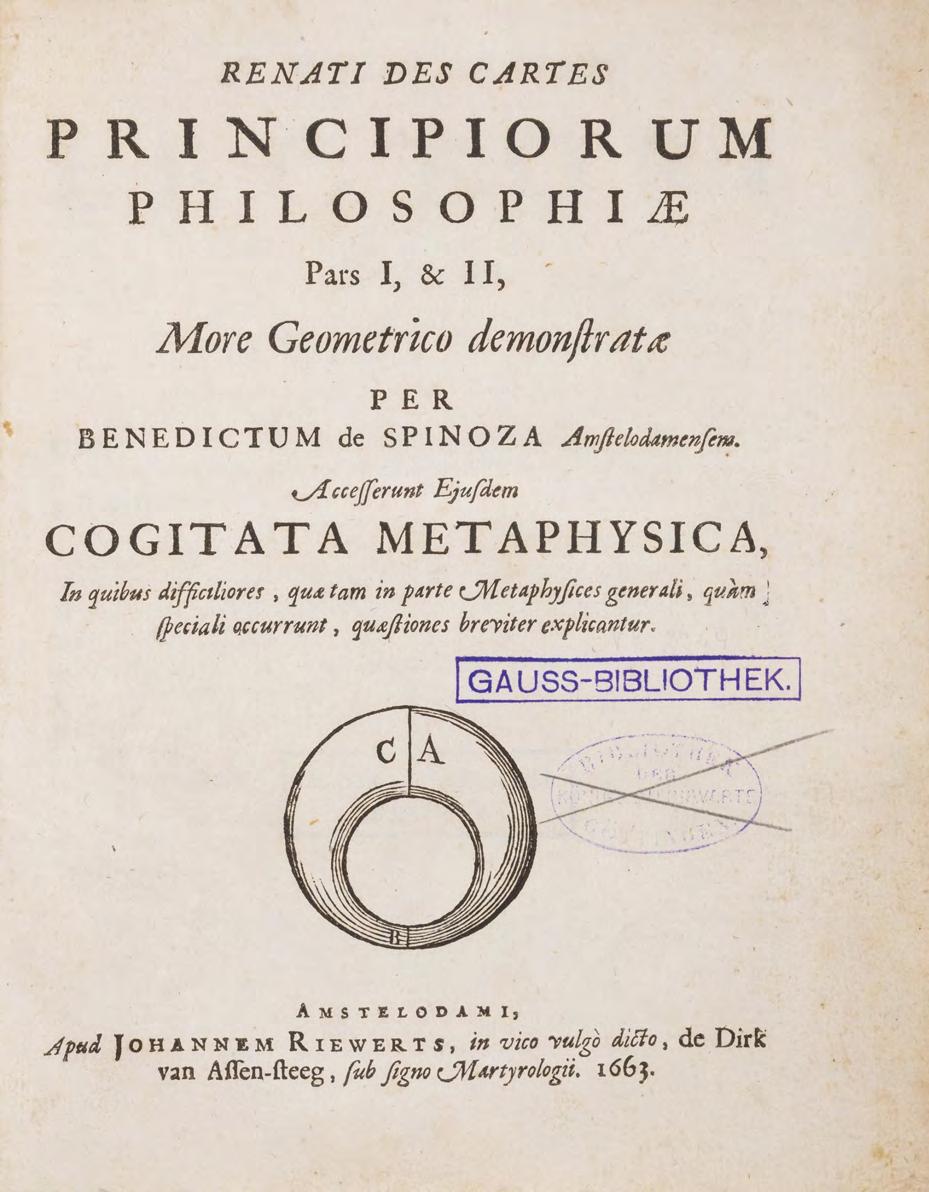
Gauss (Carl Friedrich).- Spinoza (Baruch) RENATI DES CARTES PRINCIPIORUM PHILOSOPHIAE, FIRST EDITION, GAUSS’S COPY, light marginal water-staining towards end, untrimmed with deckle edges in contemporary vellum, a little rubbed and soiled, 4to, Amsterdam, Johannes Riewerts, 1663.
⁂ A SUPERB ASSOCIATION COPY OF SPINOZA’S FIRST BOOK. With “Gauss 1794” in ink on front free endpaper, “Gauss-Bibliothek 83” paper label on front cover, and ink stamp on title. Also with a few earlier and later ownership markings.
Carl Friedrich Gauss (1777-1855), one of the greatest mathematicians of all time, made important and lasting contributions to number theory, algebra, analysis, geometry, statistics, and probability. He was also renowned as an astonomer, physicist and geodesist. He studied philosophy throughout his lifetime and evidently acquired this book when he was just 17, before he went to university.
This is Spinoza’s first work and the only one published in his lifetime which identifies him as the author. He presents an exposition of the first and second parts of Descartes’ Principia philosophiae of 1644 and the appendix contains his exposition of Cartesian metaphysics. RARE IN SUCH UNTRIMMED CONDITION. A REMARKABLE CONFLUENCE OF THREE OF THE GREATEST GEOMETRICAL MINDS
£20,000 - 30,000
234
Geology.- Lyell (Charles) PRINCIPLES OF GEOLOGY, 3 vol., FIRST EDITION, half-titles to vol. 1 & 3 only (as called for), 3 frontispieces, of which 2 hand-coloured aquatints, 2 hand-coloured maps, of which one folding, one plain folding map and 5 plain plates, wood-engraved illustrations, 1p. advertisements at end vol. 1 & 3, vol. 3 with 2 manuscript leaves in a 19th century hand tipped-in within Preface, including a rough handcolored geological map of London-Litchfield, vol. 3 preliminary ff working loose, one map with paper repair to fore-margin, some offsetting, some foxing, mainly to plates, and very light browning, attractively bound in modern red half morocco, spines with double black morocco labels and lettered in gilt, [PMM 344], 8vo, John Murray, 1830-32-33.
⁂ One of the most important works in the field of geology, which would influence Charles Darwin. “Lyell had established once and for all the uniformitarian theory of geology, which dispensed the with the notion of supernatural intervention” (PMM).
Provenance: Francis Sneyd-Kynnersley (ink gift inscription from another family member to preserved front free endpaper vol. 1, dated July 9 1889).
£3,000 - 4,000
235
Hertz (Heinrich) UNTERSUCHUNGEN UEBER DIE AUSBREITUNG DER ELEKTRISCHEN KRAFT, FIRST COLLECTED EDITION, diagrams, light browning, near contemporary half cloth, printed paper label to spine, slight wear to extremities, [PMM 377], 8vo, Leipzig, J.A. Barth, 1892.
⁂ First collected edition of Hertz’s important series of papers on electromagnetic waves, including “experimental proof by Hertz of the Faraday-Maxwell hypothesis that electromagnetic waves can be projected through space” (PMM). This discovery laid the foundation for the development of radio communication, television and radar. The papers first appeared in the Annalen der Physik und Chemie from 1887 onwards.
Provenance: Dr. Karl Stöckl, Prof. der Physik am kgl. Lyceum in Passau (ink-stamp to head of title, first few ff. & front free endpaper).
£500 - 700
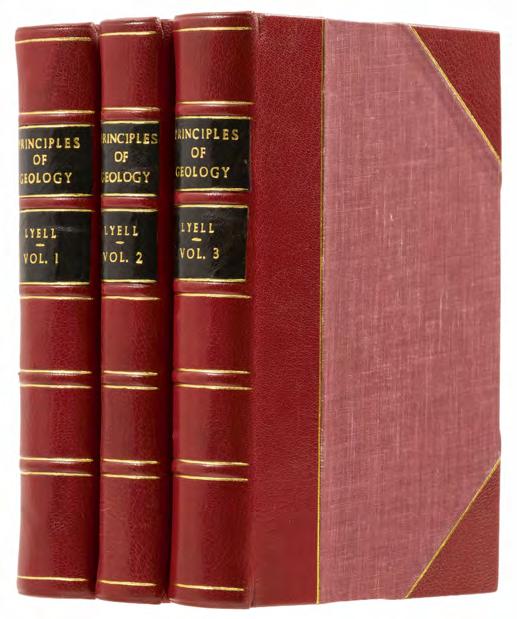
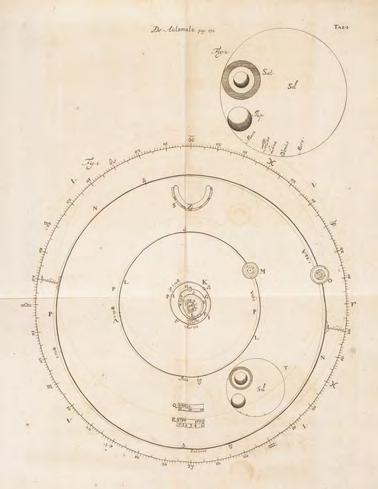
236
Huygens (Christiaan) OPUSCULA POSTHUMA, 2 vol. in 1, titles printed in red and black and with woodcut ornament, 43 folding engraved plates, vol. 1 few plates with damp-stain to lower corner, foxing and browning (as often), more to text than plates, small portion torn from pastedown, contemporary limp boards, spine with manuscript title affected by horizontal tear, light damp-staining to upper cover and spine, rubbed with some fraying to spine head & upper corner, housed in an attractive calf-backed drop-back box, 4to, Amsterdam, Janssonio-Waesbergios, 1728.
⁂ Sections include the Dioptrica, Huygens’ extensive investigations into the theory and construction of telescopes and lenses, De motu corporum ex percussione, on the laws of collision and the conservation of motion, De vi centrifuga, one of the foundational texts in dynamics, and the description of his celebrated mechanical planetarium (Automati Planetarii).
£750 - 1,000
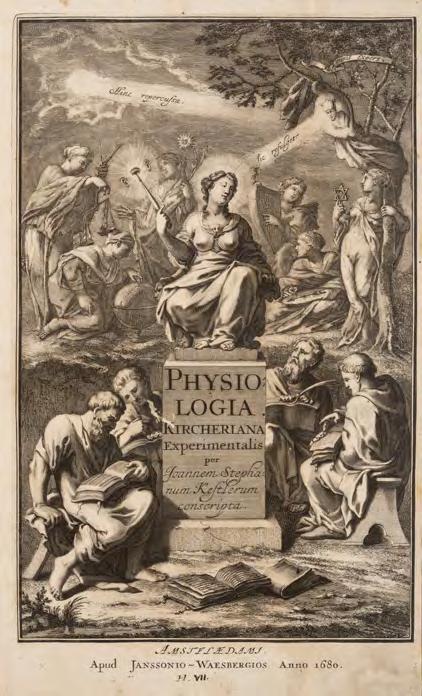
237
Kircher (Athanasius) PHYSIOLOGIA KIRCHERIANA EXPERIMENTALIS, text in double column, engraved allegorical additional title, letterpress title with woodcut device, engraved and woodcut illustrations, bookplate, a few small marginal tears and neat repairs to engraved title, scattered spotting or foxing, some light water-staining to a few ff., largely marginal, modern vellum, the odd mark, [STCN 055469558], folio, Amsterdam, Johannes Janssonius van Waesberge, 1680.
⁂ A significant early scientific work within the tradition of natural philosophy, it reflects Kircher’s wide-ranging efforts to explain the workings of the natural world through experiment and observation.
Provenance: Bookplate of The Janus Foundation, San Francisco
£2,000 - 3,000
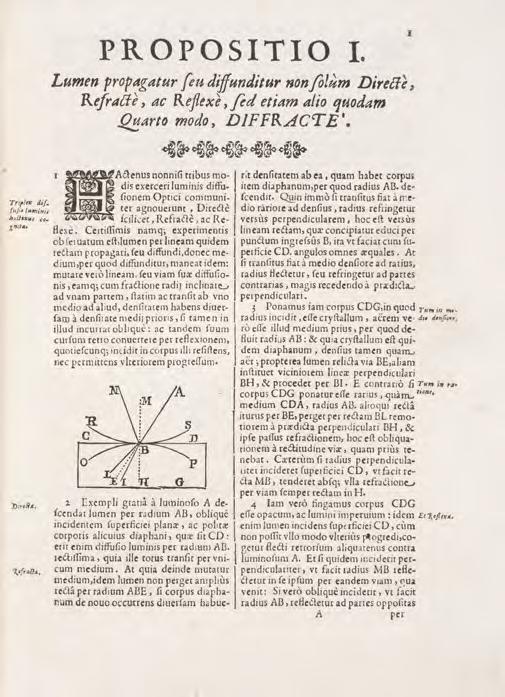
238
Light & Diffraction.- Optics.- Grimaldi (Francesco Maria) PHYSICO-MATHESIS DE LUMINE, COLORIBUS, ET IRIDE, FIRST EDITION, titles in red and black, first with large engraved vignette, letterpress title with repairs (slightly touching imprint), woodcut diagrams, occasional browning, some light damp- or water-staining, mostly to gutter, into text from Ccc3 to end, few wormholes to pastedowns and endpapers, contemporary vellum, rebacked preserving head of original spine with partial title in manuscript and small wormhole, light soiling, preserved in modern burgundy morocco-backed drop back box, [Honeyman 1559; Riccardi I, 631; OPAC SCN UFIE001417], 4to, Bologna, heirs of Vittorio Benacci, 1665.
⁂ GRIMALDI’S ONLY BOOK, WHICH UNVEILS HIS DISCOVERY OF THE OPTICAL PHENOMENON OF DIFFRACTION In this work, Grimaldi outlines how diffusion of light was instantaneous. He was the first to make this declaration, and defied the notion of an exclusively rectilinear passage and evidenced that light was of a fluid nature. De Lumine was the first scientific attempt to establish a comprehensive wave theory of light, influencing others, such as Hooke and Newton.
Grimaldi’s diffraction experiments revealed ‘that a new mode of transmission of light had been discovered and that this mode contradicts the notion of an exclusively rectilinear passage of light. Diffraction thus gave prima facie evidence for a fluid nature of light. The name “diffraction” comes from the loss of uniformity observed in the flow of a stream of water as it “splits apart” around a slender obstacle placed in its path.’ (DSB)
£7,000 - 10,000
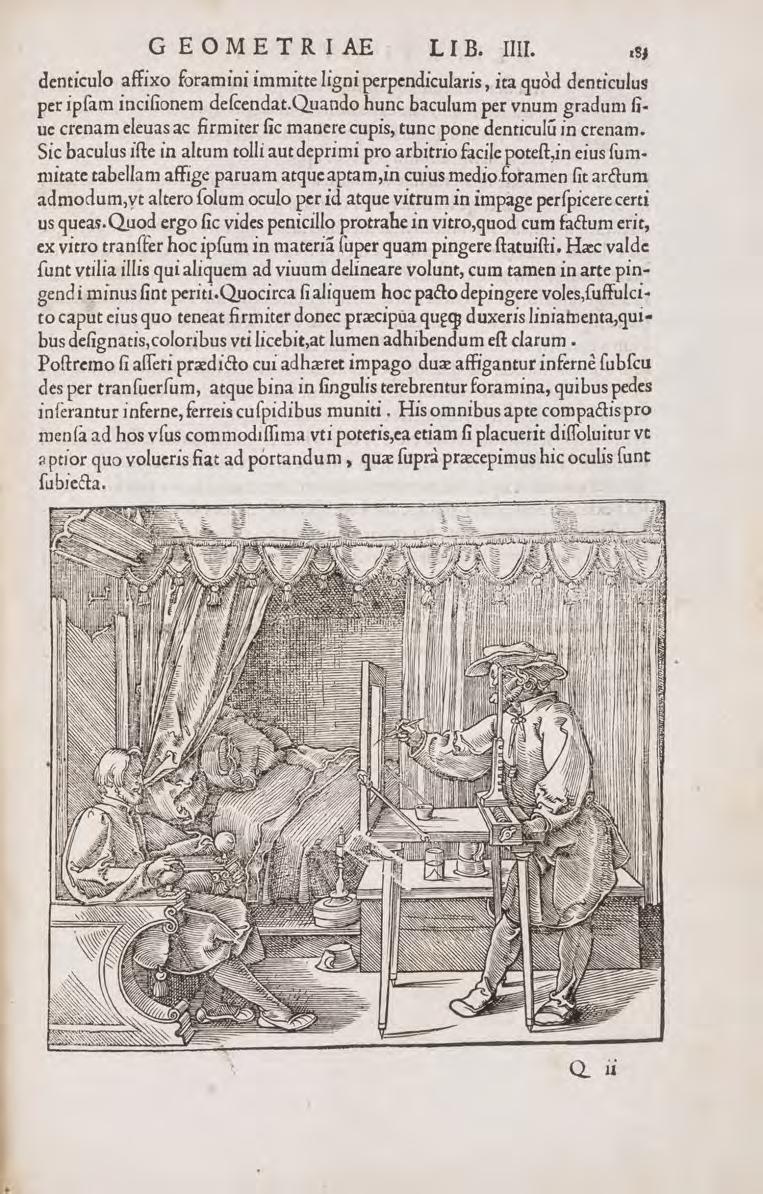
239
Dürer (Albrecht) INSTITUTIONUM GEOMETRICARUM, FIRST LATIN EDITION, Wechel’s tree device on title and verso of final leaf, 9 full-page and 3 halfpage woodcut illustrations, numerous diagrams, P6 and Q1 illustrations with pasted extensions, H4 folding, repair to title and N1-P4, light staining, ‘Signum Alberti Dureri’ inscribed above a4 illustration, a few wormholes, remboitage in contemporary blind-stamped vellum over wooden boards, with 2 metal clasps, stained, [Brunet, II, col. 912-913; Graesse, II, p. 452; Pettegree 66246; cf.PMM 54], folio (approx. 315 x 225mm), [Paris], Christian Wechel, 1532.
⁂ The first edition of Joachim Camerarius’ translation of Dürer’s landmark treatise on perspective and its possible applications. This text allowed new principles to spread for: artists, sculptors, painters, but also stonemasons, bricklayers, goldsmiths, and typographers. £10,000 - 15,000
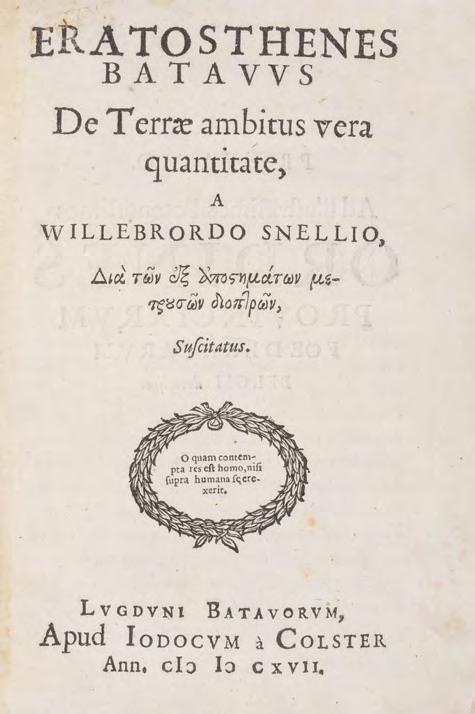
240
Navigation.- Snellius (Willebrord) ERATOSTHENES BATAVUS DE TERRÆ AMBITUS VERA QUANTITATE, FIRST EDITION, full-page engraved illustration, a few wormholes, occasional light scattered spotting or surface staining, occasional browning, some repairs, mostly to margins, the odd ink marginalia or underlining, contemporary vellum, repairs to spine, traces of manuscript title to spine, a few wormholes, soiled, rubbed, [Norman 1963; STCVN 832516813], small 4to, Leiden, Joost van Colster, 1617.
⁂ FIRST EDITION OF SNELL’S WORK ON THE LENGTH OF THE MERIDIAN
Snell outlines the principles of a new method to determine the length of the arc of the meridian by triangulation. “He used the spires of town churches as points of reference. Thus, through a net of triangles, he computed the distance from Alkmaar to Bergen-op-Zoom (around 130 kilometers). The two towns lie on approximately the same meridian. Snell used the distance from Leiden to Zoeterwoude (about 5 kilometers) as a baseline. His instruments were made by Blaeu” (DSB).
£4,000 - 6,000
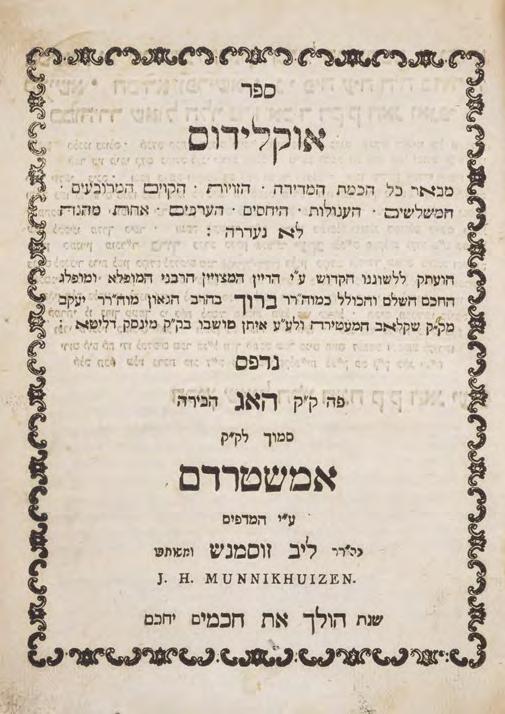
241
Hebraica.- Euclid. SEPHER EUCLIDES [EUCLID’S THE ELEMENTS], translated by Baruch Szyk of Schklow, FIRST EDITION IN HEBREW, title within typographical border, 3 folding engraved geometrical plates at end, few very small nicks to plate edges without loss, some light soiling, but overall a good copy, early 20th century vellum, spine with raised bands, manuscript title in Hebrew to upper cover and date to lower cover, light spotting, slight wear to extremities, small 4to, [The Hague], Leib Soesman & J.H. Munnikhuizen, [1780].
⁂ The first six books of The Elements, translated into Hebrew by Barukh Schick of Shklov, a rabbinic scholar of mathematics and natural sciences, on the advice of Elijah Ben Salman, the Gaon of Vilna. Provenance: Helmut N. Friedlaender (book-label).
£1,000 - 1,500
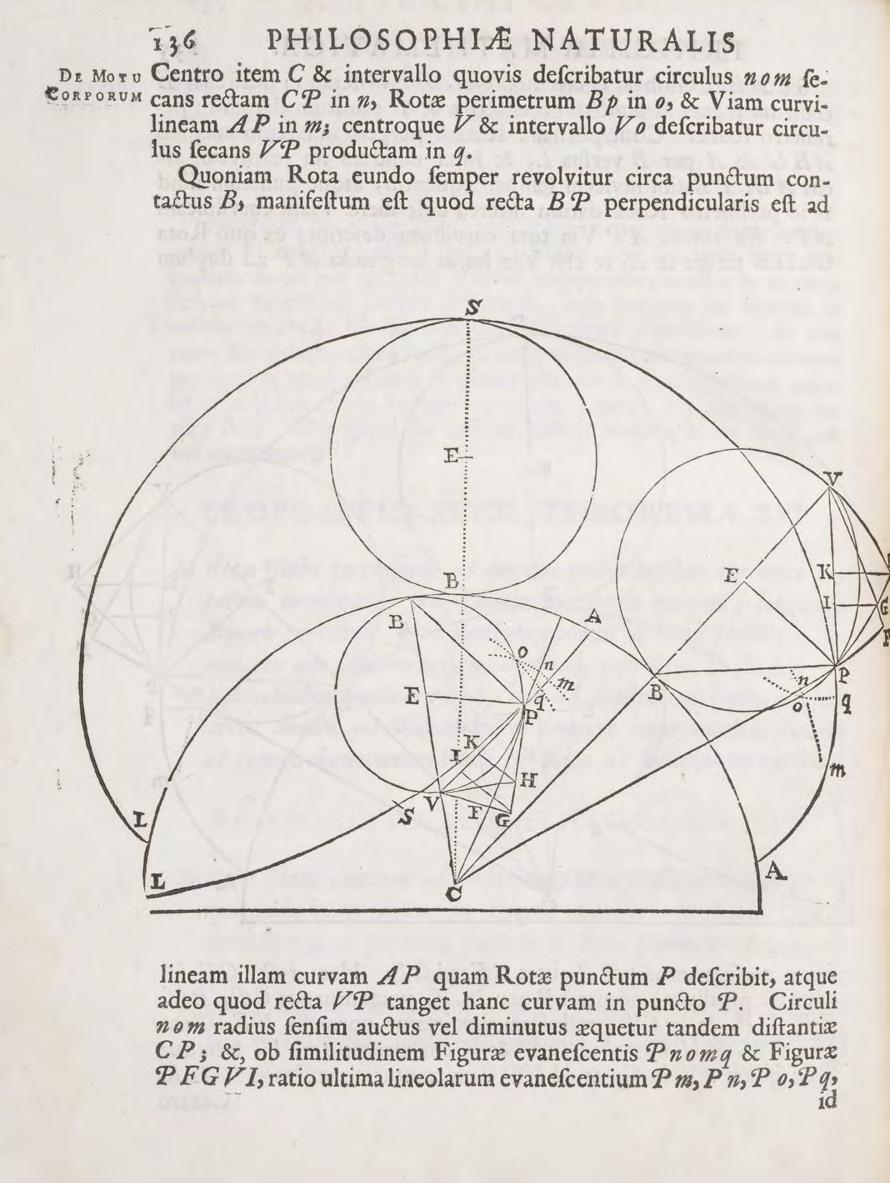
Newton (Sir Isaac) PHILOSOPHIÆ NATURALIS PRINCIPIA MATHEMATICA, SECOND EDITION, engraved title vignette and folding plate, title early ink owner inscriptions on title page: “Andw. Bryson 1780” and “Robert Duk[e?]” and Torok Janos Konyvtar bookplate, hole at foot of leaf b1, 1 or 2 ink or pencil marginalia, occasional water- and damp-staining, light surface staining, later half calf, few wormholes at joints, rubbing, [Babson 12; Wallis II, 8; ESTC T93210], 4to, Cambridge, 1713.
⁂ THE SECOND EDITION OF NEWTON’S GREAT MATHEMATICAL WORK. The work was revised and enlarged, and included the first appearance of Newton’s General Scholium, in which he ‘sums up the purpose and accomplishment of the work’ (Babson). This edition also contains the editor, Roger Cotes’s attack on the Cartesian philosophy included in the preface. Cotes also greatly expanded chapters on lunar theory and the theory of comets. About 750 copies were printed of this edition.
This edition was the basis of the first edition to be printed abroad, which first appeared a year later in Amsterdam.
£25,000 - 30,000
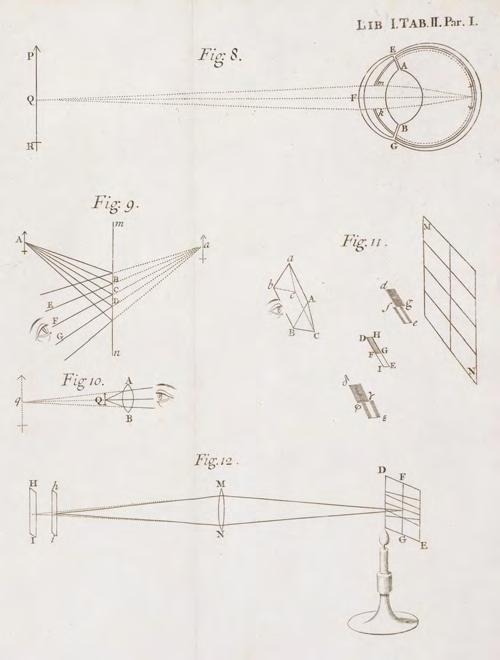
243
Newton (Sir Isaac) OPTICE SIVE DE REFLEXIONIBUS, REFRACTIONIBUS, INFLEXIONIBUS, ET COLORIBUS LUCIS LIBRIS TRES, translated by Samuel Clarke, FIRST LATIN EDITION, 19 folding engraved plates, first few ff. with damp-staining to inner-margin and very small repair to head of gutter, numerical ink-stamp to lower-margin A2, occasional soiling or very slight browning, else good, leaf with manuscript “Tabula Continuatiorum” in a 19th century hand tipped in at end, modern morocco-backed boards, preserving old red morocco spine label, [Babson 137; ESTC T149601], 4to, Sam. Smith & Benj. Walford, 1706.
⁂ First Latin edition of Newton’s great work on optics and light, first published in English in 1704.
Provenance: “Presented to Henry Lefavour by Mrs. Elizabeth K. Hopkins from the library of Professor Albert Hopkins. June 22, 1885” (inscription to preserved front free endpaper); Simmons College, From the Library of Henry Lefavour, President (bookplate loosely inserted, pencil inscription to A2),
£2,000 - 3,000
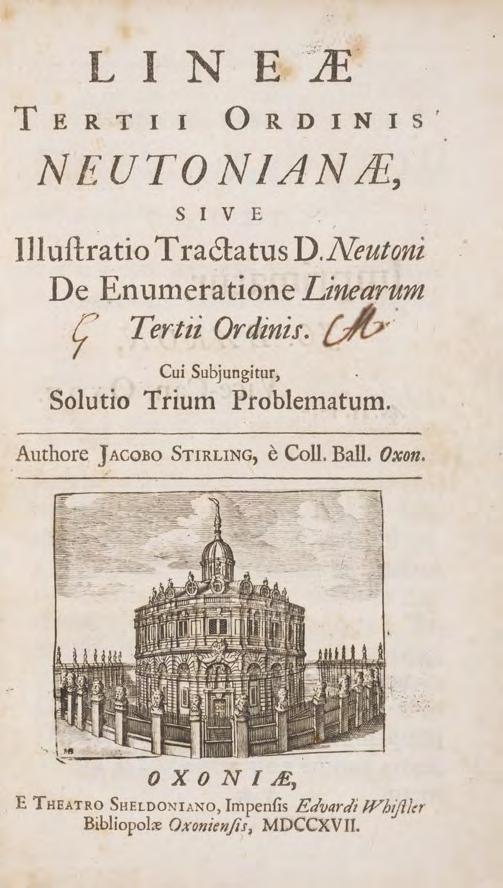
244
Stirling (James) LINEAE TERTII ORDINIS NEWTONIAE, FIRST EDITION, 6pp. list of subscribers at end, occasional worming and some light browning, ink initials “G. M.” to title, bookplate of Sir William StirlingMaxwell to front pastedown, 19th century morocco, gilt arms and motto of Sir William Stirling-Maxwell to covers, light rubbing to joints, g.e., [ESTC T100920], 8vo, Oxford, At the Sheldonian Theatre, 1717.
⁂ The Stirling family copy of this rare addition to Newtonian mathematics. Newton had identified 72 cubic curves to which Stirling here (in his first published work) adds 3. Born in 1692, Stirling was to become one of the leading mathematicians in Europe in the early 18th century, cultivating relationships with Newton, Colin Maclaurin, Gabriel Cramer and Leonhard Euler among others. He made a valuable contribution to the fields of infinitesimal calculus and infinite series, and gives his name to the Stirling numbers and to Stirling's formula.
Born in 1692, Stirling was to become one of the leading mathematicians in Europe in the early 18th century, cultivating relationships with Newton, Colin Maclaurin, Gabriel Cramer and Leonhard Euler among others. He made a valuable contribution to the fields of infinitesimal calculus and infinite series, and gives his name to the Stirling numbers and to Stirling's formula.
No copy of this title was in the 2025 sale of Stirling's library in Edinburgh. We think it very probable that the present copy is in fact James Stirling's personal copy.
£4,000 - 6,000
245
Newton (Sir Isaac) A TREATISE OF THE SYSTEM OF THE WORLD, FIRST EDITION IN ENGLISH, 2 engraved plates, woodcut diagrams, final errata f., a little light foxing and finger-soiling, but overall good, contemporary panelled calf, rebacked in modern calf, spine gilt and with red morocco label, some wear to covers, corners repaired, [Babson 18; ESTC T14938], 8vo, for F. Fayram, 1728.
⁂ The first English edition of De Mundi Systemate, first published in the same year and originally intended to form the third part of the Principia. The work reflects Newton’s typically ahead-of-histime outlook, speculating on, among other things, the possibility of Terrestrial Tidal Effects (which would be discovered by Michaelson in 1919), and the existence of the planet Uranus (first seen by Herschel in 1781). This copy is in the setting with the catchword “portional” on p.vii.
£3,000 - 4,000
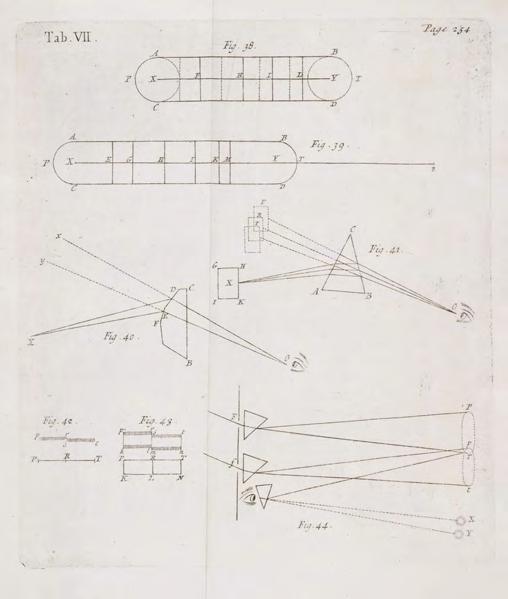
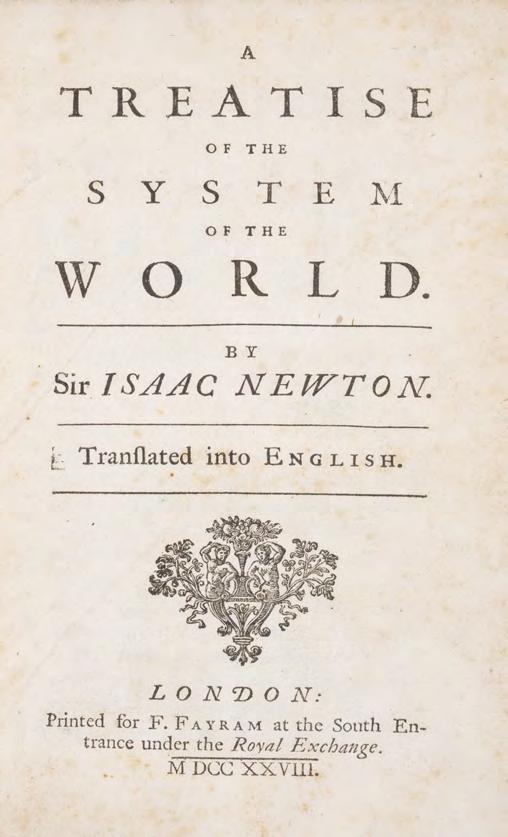
246
Newton (Sir Isaac) LECTIONES OPTICAE, ANNIS MDCLXIX, MDCLXX & MDCLXXI, FIRST LATIN EDITION, half-title, 24 folding engraved plates, some very faint signs of damp-staining and associated cockling, neat and skilfull repairs to some fore-edges, including first few ff. & plate XI, contemporary vellum, leather spine label, lightly toned, neat repairs to spine ends, very short tear to foot of upper joint, housed in a custom green morocco-backed drop-back box, [Babson 155; ESTC T18664], small 4to, William Innys, 1729.
⁂ First Latin edition of Newton’s Lucasian lectures in optics. Although the English edition preceded the Latin, this was the first to publish the complete lectures (including the second part on colours). “This valuable work contains many beautiful propositions and interesting and instructive experiments, which are not to be met with in any modern treatise on optics” (Brewster, as quoted in Babson)
£2,000 - 3,000
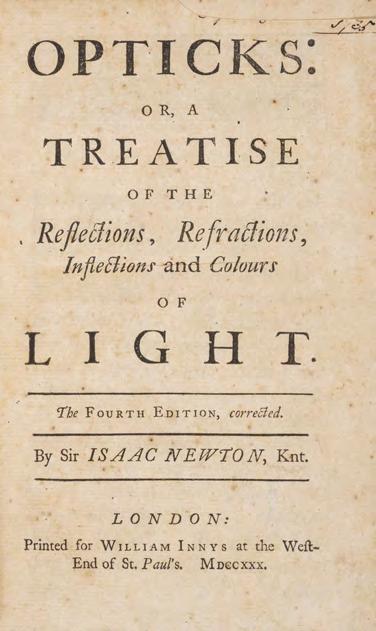
247
Newton (Sir Isaac) OPTICKS: OR, A TREATISE OF THE REFLECTIONS, REFRACTIONS, INFLECTIONS AND COLOURS OF LIGHT, fourth edition, 12 folding engraved plates, woodcut head- & tail-pieces and initials, final advertisement f., title upper-margin with ownership inscription cut away, some spotting or light foxing, lightly browned, contemporary calf, lacking spine label, rubbed with some wear to spine ends and corners, upper joint cracked and quite weak but holding, [Babson 136; ESTC T69138], 8vo, for William Innys, 1730.
⁂ Fourth edition, “carefully printed” from the third edition of 1721 and incorporating Newton’s revisions.
Provenance: Samuel Orne 1740 (ownership inscription to front free endpaper); Burton William Pearl (leather book-label); Essex Institute (bookplate, with released stamp dated 1967)
£1,500 - 2,000
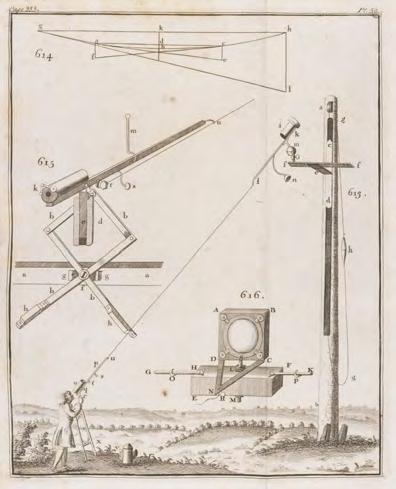
248
Smith (Robert) A COMPLEAT SYSTEM OF OPTICKS IN FOUR BOOKS, 2 vol., FIRST EDITION, with title to vol. 2 (sometimes lacking), list of subscribers, 83 folding engraved plates, errata & advertisement ff. at end, plate 39 bound upside-down, some light offsetting and foxing and light browning, but overall a good set, contemporary polished calf, spines with red and blue morocco labels, rubbed with some wear to extremities, joints cracked but holding firm, [Babson 161; ESTC T100004], 4to, Cambridge, Printed for the Author, 1738.
⁂ “Largely based on [the work] of Newton. It greatly stimulated the construction of optical apparatus and is the most helpful historical treatise on light of its time” (Babson).
Provenance: Matthew Boulton (1728–1809), James Watt’s partner in Boulton & Watt at the Soho Manufactory (“M. Boulton Library Soho” bookplate).
£1,200 - 1,800
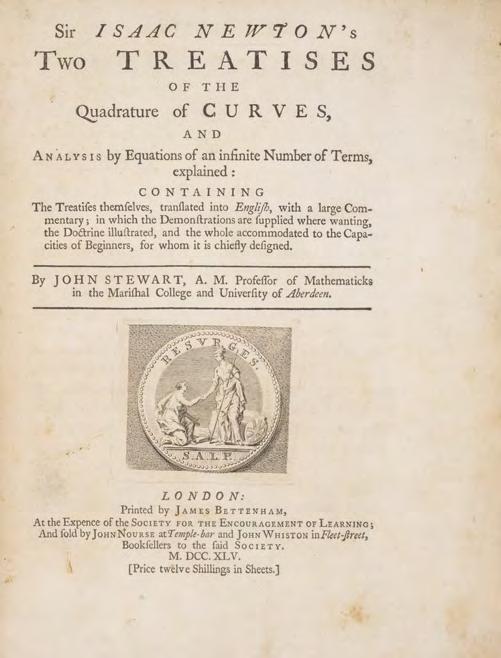
249
Stewart (John) SIR ISAAC NEWTON’S TWO TREATISES OF THE QUADRATURE OF CURVES, AND ANALYSIS BY EQUATIONS OF AN INFINITE NUMBER OF TERMS..., FIRST EDITION, engraved title-vignette & tail-piece at end, woodcut diagrams, with 2 final errata ff., occasional soiling, some light browning, contemporary mottled calf, ?later red morocco spine label, spine gilt but quite worn with a couple chips and loss to gilding, old repair to spine head, rubbed with some wear to corners, [Babson 210; ESTC T18643], 4to, James Bettenham, At the Expence of the Society for the Encouragement of Learning, 1745.
⁂ “The only English translation of these tracts, which were first published as a supplement to the Opticks. It contains a valuable commentary, beginning on p.344” (Babson).
Provenance: “Uppsala d. 9. Junii 1767 - Erik Prosperin. Uppsala den 22 Febr. 1804. Koster 4 Rb 4 sk. R.G./ J.E. Af Wetterstedt” (price paid by Wetterstedt at the auction of Prosperin’s books on 22 Feb 1804, crossed-through ownership inscription to front free endpaper); another inscription partially erased beneath.
£3,000 - 4,000
250
Newton (Sir Isaac) PHILOSOPHIAE NATURALIS PRINCIPIA MATHEMATICA, edited by Thomas Le Seur & Franciscus Jacquier, 3 vol., second Jesuit edition, vol. 1 only with half-title (as issued) & title printed in red and black, titles with woodcut decorations, woodcut head- & tailpieces, numerous diagrams, vol. 3 Sig. 4T misbound after 4Q, vol. 1 faint residue to gutter of title/half-title verso (where seemingly once repair), vol. 1 3X1 very small tape repair to fore-margin, a few instances of contemporary ink annotation, vol. 2 & 3 some small worming to blank lower- or fore-margins, some light browning, vol. 2 front free endpaper loose, contemporary mottled calf, spines gilt and with double morocco labels, some shallow chipping or wear to spine ends and corners, vol. 1 & 3 upper joint (and hinge) repaired, other joints cracked but holding firm, [Babson 31], 4to, Geneva, C. & A. Philibert, 1760.
⁂ A wide-margined set of the second Jesuit edition, “valued for its copious commentary” (Babson).
Provenance: G.W.F. Gregor (bookplate)
£800 - 1,200
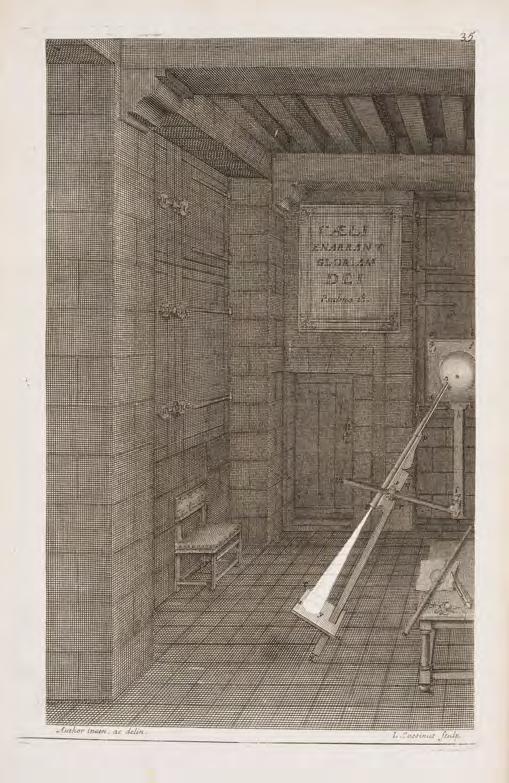
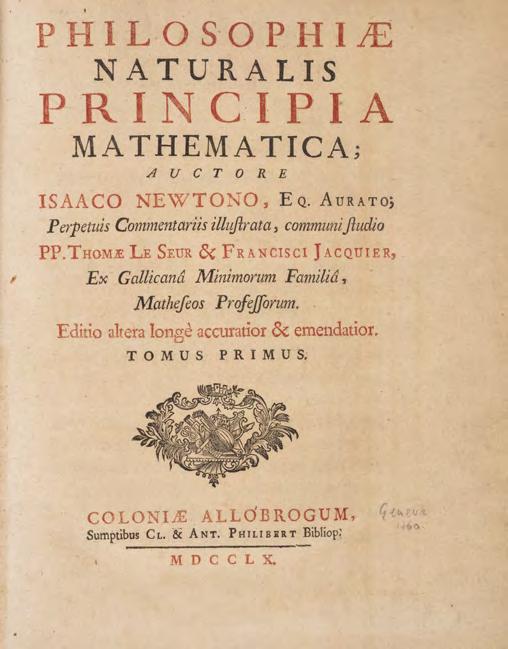
251 Chérubin d’Orléans (Père) LA DIOPTRIQUE OCULAIRE, OU LA THEORIQUE, LA POSITIVE ET LA MECHANIQUE, DE L’OCULAIRE DIOPTRIQUE EN TOUTES SES ESPECES, FIRST EDITION, additional engraved title, 57 engraved plates, of which 6 folding or double-page, 2 in-text engravings, vignette initals, head- and tail-pieces, some minor worming at foot of Hh1 to end, not affecting plates, light browning, contemporary calf, rebacked, old repairs to extremities, very minor rubbing, folio, Paris, Thomas Jolly & Simon Bernard, 1671 [1670].
⁂ A first edition of an early and extensive work on optics and optical instruments. The work explores the difference lenses on the eye, with descriptions of glasses, telescopes, and microscopes. D’Orléans also discusses the observation of the stars through telescopes.
£2,000 - 3,000
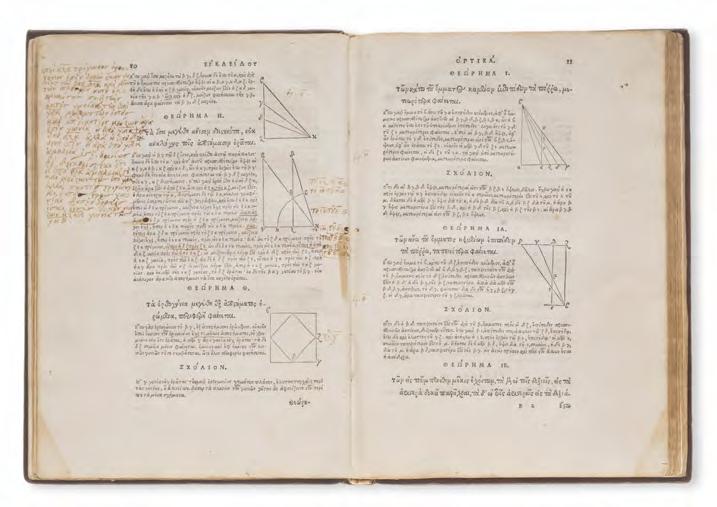
252
Euclid. EUCLIDIS OPTICA & CATOPTRICA, NUNQUAM ANTEHAC GRÆCE ÆDITA, translated by Jean Pena, 2 parts in 1, text to the first in Greek and the second in Latin, titles with woodcut device, woodcut head-pieces, initials and diagrams, neat repairs to part 1 title, some light worming and staining, ink inscription to title and some ink marginalia in Greek to part 1, with inscriptions and diagrams to rear free endpaper, handsome later panelled calf, tooled in blind and gilt, small traces of cloth ties, [Adams E1020], 4to, Paris, Andreas Wechel, 1557.
⁂ The Optica is the earliest surviving systemic treatment of vision using geometry in the Western tradition. An edition of the Catoptrica was published in Strasbourg in 1557, with minor differences in the Greek text. The Strasbourg edition is sometimes given priority but this is uncertain.
£1,500 - 2,000
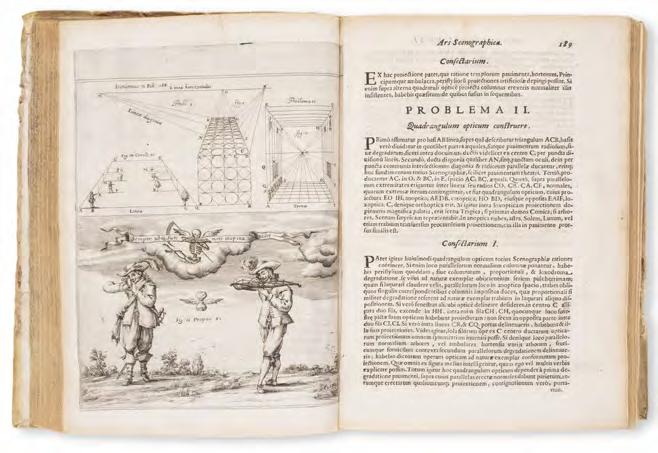
253
Kircher (Athanasius) ARS MAGNA LUCIS ET VMBRAE, 2 parts in 1, FIRST EDITION, 38 engraved plates on 36 leaves (lacking XX and XXX, but with bis plate VI and 1 unnumbered ‘Folio 494’), two titles (second title bound after Tt2), woodcut diagrams, with errata f., lacking additional engraved title, portion of first title excised and repaired at foot, ink-stamp to 4D1 outer margin and 6D4, occasional light water-staining, some light spotting and browning, ink inscription to rear pastedown, hinges cracked but firm, contemporary half vellum, manuscript title to spine, ink numbering to upper cover lower corner, bit worn, [Krivatsky 6396; Norman 1216; Wellcome III 394], folio, Rome, Ludovici Grignani for Hermanni Scheus, 1645 [but colophon 1646].
⁂ FIRST EDITION OF KIRCHER’S PRINCIPAL CONTRIBUTION TO OPTICS, DISCUSSING THE TREATMENT OF LIGHT, SHADOW, AND COLOUR, while seeking parallels between the action of light and that of magnetism. Among the optical topics discussed and investigated by Kircher in this work are bioluminescence, the projection of sun or candlelight onto mirrors painted in colours or through painted glass spheres, and the military use of mirrors by Archimedes to set fire to Roman ships (a phenomenon that Kircher thought probable). The first published account of the illumination and projection of images appeared in this first edition. The work also includes some of the earliest observations with a microscope, preceding those of Hooke and van Leeuwenhoek by two decades.
£1,500 - 2,000
254
Molyneux (William) DIOPTRICA NOVA. A TREATISE OF DIOPTRICKS, in 2 parts, FIRST EDITION, 43 engraved folding plates, imprimatur f. at start, advertisement f. at end, patch of staining to outer margin of last few ff., a few small rust holes, occasional light scattered spots or surface marks, some browning, ‘g’ in ink to title in imprint, bookplate, later calf, rebacked, repairs to corners, preserved in antique-style modern half calf drop-back box, [ESTC R3440; Wing M2405], 4to, for Benj. Tooke, 1692.
⁂ The first treatise on optics published in English and including Halley’s famous theorem for finding the foci of lenses as an appendix.
£6,000 - 8,000
255
Statics.- Monte (Guidobaldo del) IN DUOS ARCHIMEDIS
AEQUEPONDERANTIUM LIBROS, woodcut vignette to title, woodcut diagrams, errata f. at end, repair to A3, pasted text correction to B1 (over first word), ink correction to H3 verso, small hole touching Y2 diagrams, occasional underlining in ink, few light spots or surface marks, remboitage in old vellum, a few wormholes, yellowed, Pesaro, Hieronymum Concordiam, [Adams U6; EDIT16 CNCE 16715; OPAC SBN BVEE002905], small folio (approx. 305 x 215mm), 1588 [but colophon 1587].
⁂ Guidobaldo del Monte’s commentary on Archimedes’s work on the equilibrium of planes, with his own influential treatise. Del Monte was an Italian mathematician, astronomer and philosopher. He served in the army during the conflicts between the Hapsburg and Ottoman Empires in Hungary, later writing two works on military architecture. He was a friend of the great Italian poet Torquato Tasso, and Galileo, with whom he corresponded closely on mechanics. Del Monte personally recommended Galileo for the chair at Pisa in 1589 and at Padua in 1592.
£2,000 - 3,000
256
Archery.- [Markham (Gervase)] THE ART OF ARCHERIE, FIRST EDITION, woodcut frontispiece with printer’s device to recto, woodcut initials and decorations, armorial bookplate and binder’s stamp to front pastedown, title and many ff. trimmed close at fore-margins, touching a few letters and cutting a few page numbers and side notes, L4 with closed tear cutting into text (no loss but text somewhat affected), neat repair to M4 verso foremargin, small worm trail H6-L1 (slightly affecting text), lessening to singular worm hole L2-end, a few spots and stains, else a rather clean and bright copy, 19th century calf by J. Mackenzie, gilt, skillful repairs to spine, rubbed and bumped, [ESTC S111944], small 8vo, B.A. and T.F. for Ben Fisher, 1634.
⁂ An early English treatise on archery, reflecting the continued use of the longbow in 17th-century England.
Rare. ESTC records only 6 copies in institutional collections in the British Isles
£1,500 - 2,000
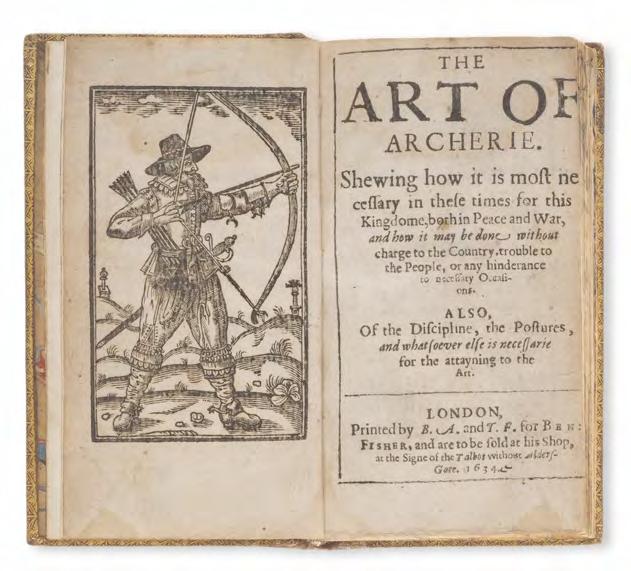
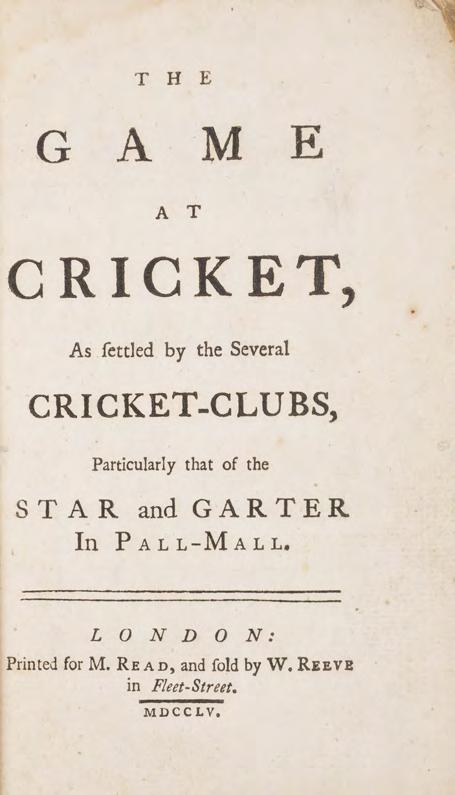
257 GAME AT CRICKET (THE), AS SETTLED BY THE SEVERAL CRICKET-CLUBS, PARTICULARLY THAT OF THE STAR AND GARTER IN PALL-MALL, FIRST EDITION, 20pp., half-title, some light foxing and soiling, original plain blue wrappers bound in, modern blue calf, lettered in gilt on upper cover and spine, spine sunned, 8vo, Printed for M. Read, and sold by W. Reeve in Fleet-Street, 1755.
⁂ THE EXTREMELY RARE FIRST PUBLICATION OF THE LAWS OF CRICKET IN PAMPHLET FORM. NO COPY IN THE BRITISH LIBRARY The on-line English Short Title Catalogue records no holdings at all in contributing libraries in the British Isles or North America. The Marshall-MCC copy has been reproduced in R.S. Rait Kerr’s Laws of Cricket (1950) but lacks the halftitle (present here). Taylor and Padwick err in listing the title as “The Game of” rather than “The Game at Cricket”, and are probably wrong in calling for a frontispiece since careful examination of the Julian Marshall copy shows the frontispiece to be tipped-in and almost certainly supplied from a later edition.
This copy last at auction in 2005 when it made £31,200
Provenance: J.W. Goldman (bookplate); E.D.R. Eagar (bookplate).
Literature: Padwick 151
£15,000 - 20,000
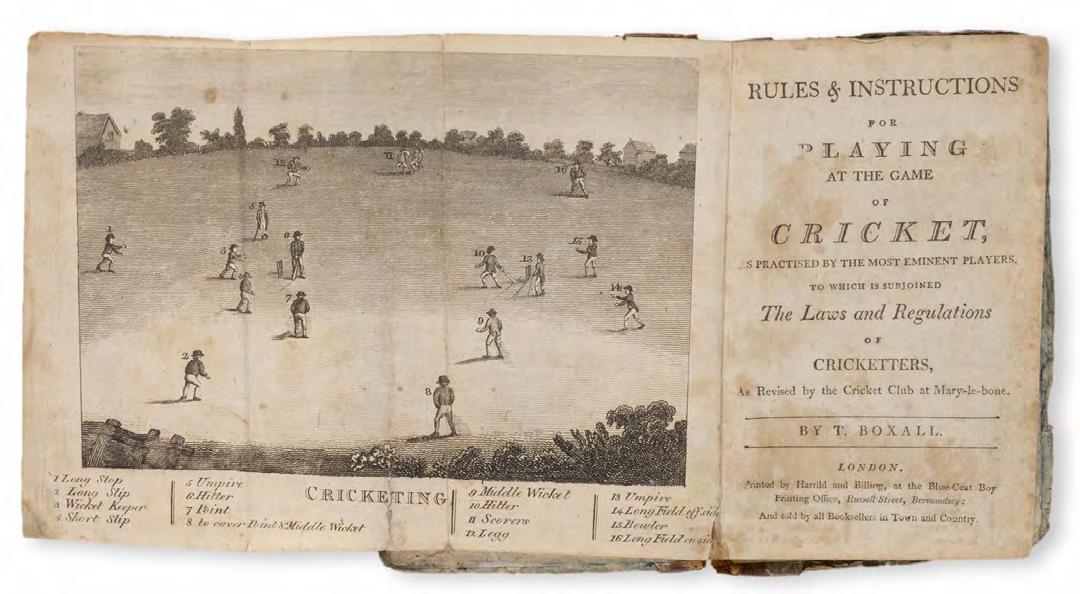
258
Boxall (Thomas) Rules & Instructions for Playing at the Game of Cricket, 2 parts in 1, second edition, second issue, 92pp., folding engraved frontispiece, without the list of subscribers before p. 7, frontispiece frail and with closed tear touching image, slight nicks to folds, first leaf of instructions holed at margin, occasional spotting, second part with marginal water-staining, contemporary sheep-backed marbled boards, spine rebacked but worn, lower cover detached, 12mo, Printed by Harrild and Billing, [c.1802, watermark 1801 on 4 leaves].
⁂ THE FIRST PRACTICAL TREATISE ON THE GAME, containing the laws in the second part. According to Padwick, there were three editions, the first, c. 1801, omitting the frontispiece. There were at least two issues of the second edition, both c. 1802, while the third edition of 1804, of which three issues are known, was the first to be dated on the title-page. Taylor called Boxall’s pocket-book “perhaps the most rare and coveted of the very few contributions to the literature of cricket in the early days”.
Provenance: D. Bowen, 1805 (ownership inscription on front pastedown) ; E.D.R. Eagar (bookplate)
Literature: Padwick 373
£15,000 - 20,000
259
Britcher (Samuel) A COMPLETE LIST OF ALL THE GRAND MATCHES OF CRICKET THAT HAS BEEN PLAYED IN THE YEAR 1792, WITH A CORRECT STATE OF EACH INNINGS, FIRST EDITION, 28pp., title with oval woodcut vignette, some light foxing and soiling, outer edges of pp.5-8 trimmed close and slightly frayed with some loss to a few words, original blue wrappers (frayed and torn) bound in, 20th century boards, sunned, 8vo, Printed by Cane and Glindon, Earl’s Court, Leicester Fields, [1792].
⁂ THIS WAS THE THIRD YEAR OF ISSUE, AND THIS COPY IS ONE OF ONLY 3 COPIES RECORDED IN DAVID RAYVERN ALLEN’S CENSUS (Britcher’s Scores, 2003, p. 135). Lords retains the Hammond copy, and Leicestershire Record Office hold the other. Many of the matches feature the ‘Mary-le-Bone’ side. Britcher was official scorer to the Club, and since he even titles himself ‘scorer’ on the title-page, it can be assumed that he recorded many, if not all, of these matches himself. His decision to print the scores, beginning with the 1790 season, was fortunate for posterity. As MCC’s early records were destroyed by fire in 1825, the survival of the printed scorebooks, however few in number, has been crucial to cricket history. His chosen printers or publishers were themselves obscure. The only other contemporary works known with the imprint of Cane and Glindon are The Everlasting Misery of the Wicked (1793), a sermon, and a broadsheet summoning the parishioners of the Parish of St. Anne Westminster to a meeting (1793). However, the print is of ample size and generously spaced with 26 matches on the 28 pages; the title-page vignette is a charming decorative touch to an otherwise factually-oriented book. A remarkable, unsophisticated copy, uncut and preserving the original wrappers. This is the only copy traced at auction and the last time it appeared (2010) it brought £46,850.
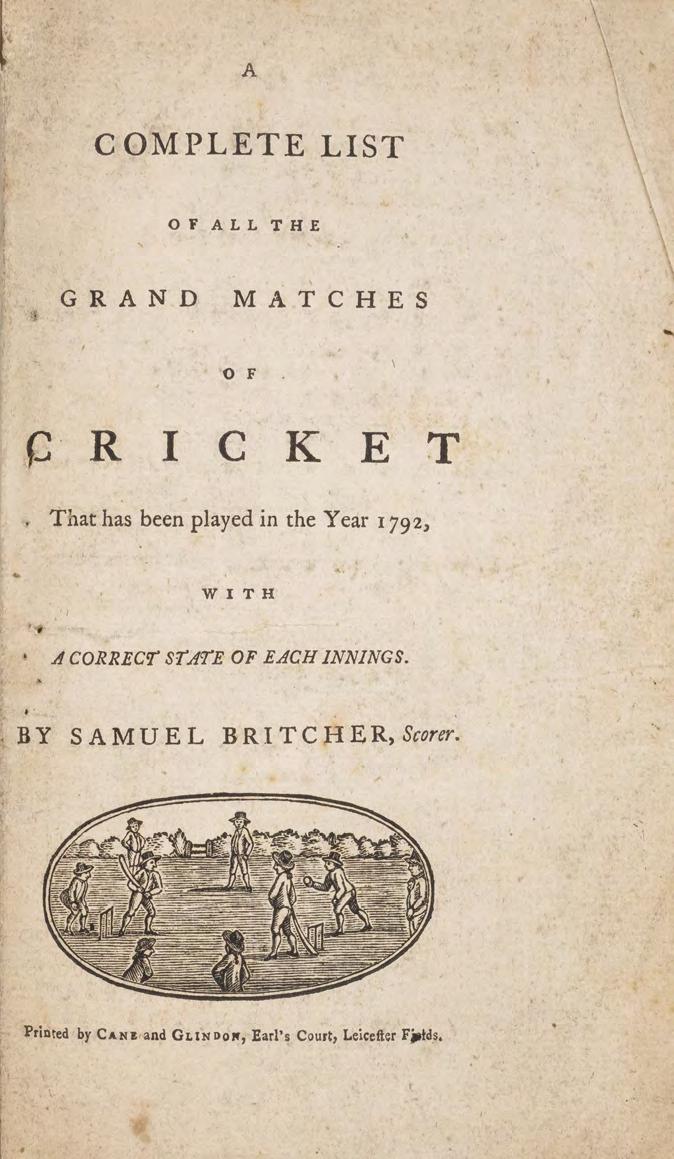
Provenance: MCC (bookplates); F.S. AshleyCooper (1877-1932, bookplate; two inserted letters to him from E.G. Hammond, dated Stratford/Avon, 15 January and 18 March, 1922, and another letter from J. Britcher, Tonbridge, 11 November, 1928). The two letters from Hammond suggest that Ashley-Cooper tried but failed to acquire the family’s collection of Britchers. The first letter, 2 1/4p., mentions the death of his father, Ernest Hammond, to whom A.L. Ford had recently paid a visit (Ford ‘would doubtless remember what volumes my father had in his library of cricket books’). He apologises for having ‘had no opportunity of going properly into the things left by my father, although I remember seeing what is probably the volume you refer to’. Hammond’s second letter gives particulars of the Brighton v Middlesex match, 20-23 September 1792, in which his great grandfather, John Hammond, played: ‘Britcher ... gives the scores in his book and I am pleased to be able to give you the particulars overleaf’. But he adds the unwelcome news that he is ‘not at present thinking of disposing of any of the items’. J. Britcher has no knowledge of an ancestor called Samuel: ‘I do not remember having heard of a Samuel Britcher in our family at all, but I will try and find out from some of the older members .... If you care to let me know exactly what it is you are hoping to find’.
Literature: Padwick 869
£30,000 - 40,000
260
Epps (William) CRICKET. A COLLECTION OF ALL THE GRAND MATCHES OF CRICKET, PLAYED IN ENGLAND, WITHIN TWENTY YEARS; VIZ FROM 1771, TO 1791, NEVER BEFORE PUBLISHED, FIRST EDITION, [5] 6-104pp., some foxing and toning, bottom corner of pp.13/14 torn away but not affecting text, one later pencil correction to p.31, ink annotations to front endpaper, original blue wrappers bound in, uncut, later half morocco, a little rubbed, upper joint repaired, lower joint split at head, head of spine chipped, preserved in a suede-lined black cloth drop-back box, 8vo, Troy-Town, Rochester, Arranged, and Printed, by W. Epps, 1799.
⁂ THE ‘BLACK TULIP’ OF CRICKET BOOKS WITH LESS THAN A HANDFUL OF COPIES SOLD AT AUCTION SINCE 1958. This copy last sold at auction in 2010 when it brought £151,250. The Eager copy made £90,000 in 2005. The BL did not have a copy until 2024.
William Epps (d.1833) was a cricketer and a printer from Troy-Town (named after the wine merchant John Cazeneuve Troy), near Rochester in Kent. The ‘Apology’, prefacing the scores themselves, explains that he saw no need to take his work beyond 1791 because of the “regular annual publication, by Mr. Britcher, the Scorer to the Mary-le-bone Club, which, of course, obviates the necessity of continuing this publication to a subsequent period.” Whereas Britcher’s scorebooks were annual publications covering the seasons 1790-1805 as they occurred, Epps covered the 20 year period antecedent to Britcher in this single volume.
Provenance: Thomas Lord, MCC (2 bookplates on front pastedown and endpaper)
Literature: Padwick 877
£100,000 - 150,000
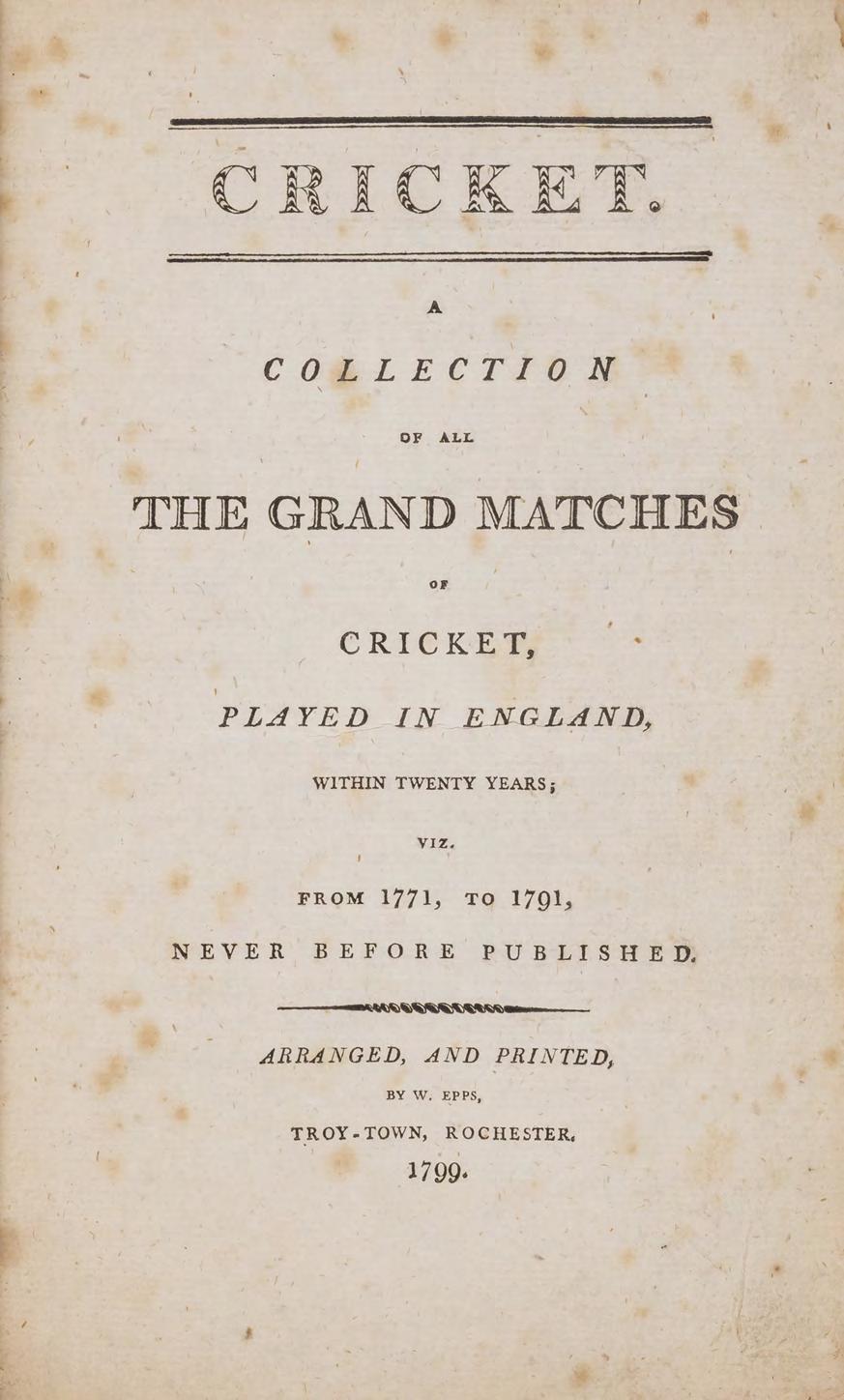
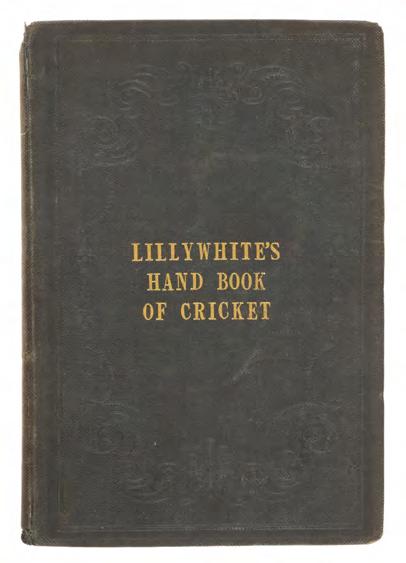
261
Lillywhite (Frederick) LILLYWHITE’S ILLUSTRATED HAND-BOOK OF CRICKET, 8 etchings with aquatint (4 folding), wide-ball errata slip tipped-in, very faint spotting to plates, advertisements at end, original cloth, slight bumping to corners and extremities, 8vo, London & Brighton, [1844].
⁂ Rare to find complete with all 8 plates
£2,000 - 3,000
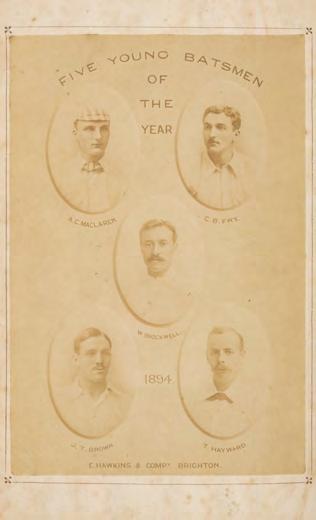
262
Wisden (John) CRICKETERS’ ALMANACK FOR 1895, edited by Sydney H. Pardon, advertisements at beginning and end, vintage photograph of ‘Five Young Batsmen of the Year’, light spotting and toning to edges, first 2ff. with chipping to fore-edges, modern endpapers, modern cloth, [Padwick 1052], 8vo, 1895
£600 - 800
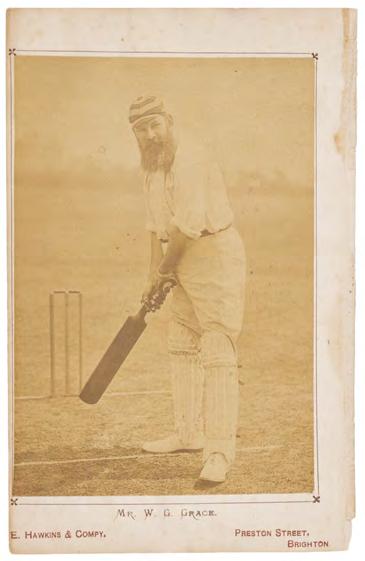
263
Wisden (John) CRICKETERS’ ALMANACK FOR 1896, edited by Sydney H. Pardon, mounted vintage photograph of W. G. Grace from another copy loosely inserted, advertisements at beginning and end, original wrappers bound in, twentieth century cloth, slight rubbing to joints, [Padwick 1052], 8vo, 1896.
⁂ One of the most collectable of all Wisdens
£1,000 - 1,500
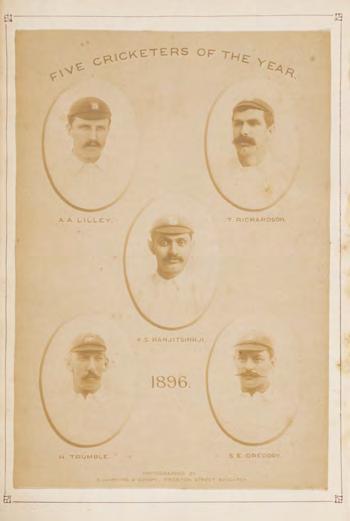
264
Wisden (John) CRICKETERS’ ALMANACK FOR 1897, edited by Sydney H. Pardon, mounted vintage photograph (detached and loosely inserted), advertisements, twentieth-century cloth, slight rubbing to joints and corners, [Padwick 1052], 8vo, 1897
£600 - 800
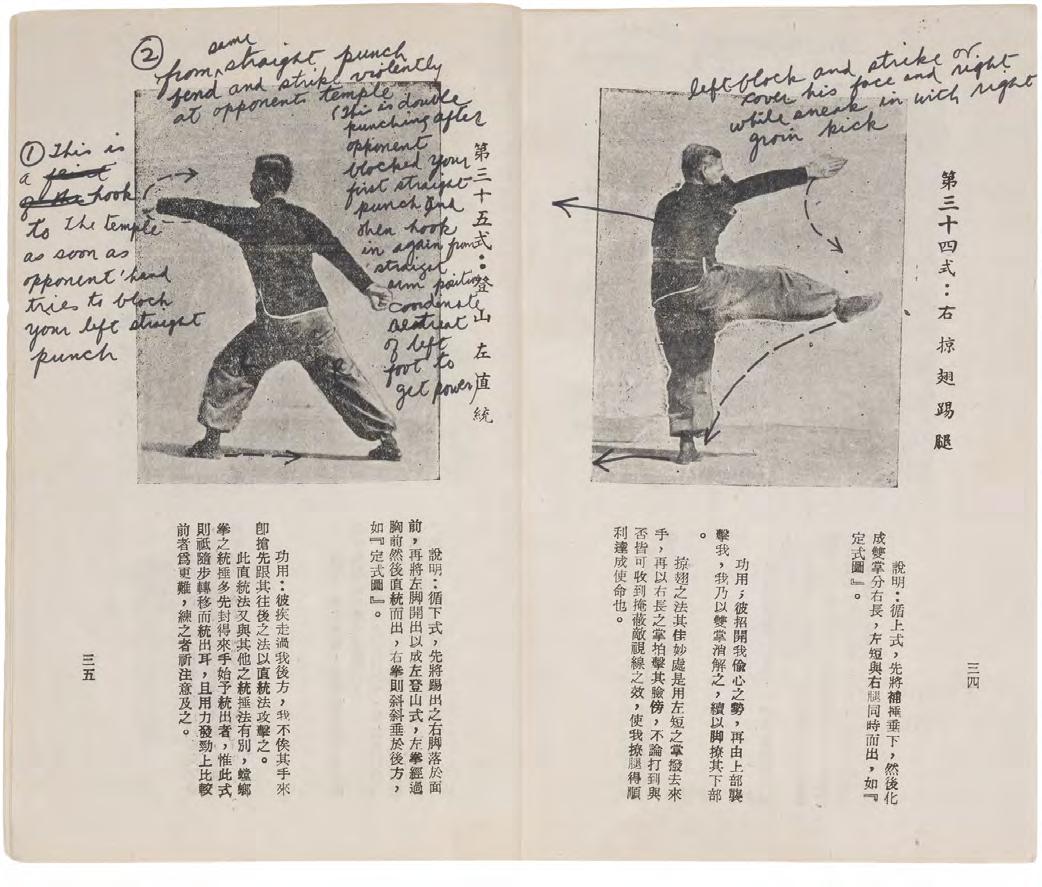
265
Martial Arts.- Lee (Bruce) ‘PRAYING MANTIS STYLE’ KUNG FU BOOK, CONTAINING NUMEROUS ANNOTATIONS, DIAGRAMS AND GRAPHS IN BRUCE LEE’S HAND, ink stamp to front endpaper with Lee’s Seattle Washington address, light surface soiling and a few small nicks to fore-margins, else clean and bright, original wrappers, lacking lower cover, repairs to spine, a few stains and creases, 8vo, c. 1960.
⁂ After returning from Hong Kong to Seattle in 1959, Lee began teaching martial arts and developed his distinctive Jun Fan Gung Fu (“Bruce Lee’s Kung Fu”). Widely regarded as the most influential martial artist of the twentieth century, he later became a global cultural icon whose impact extended far beyond martial arts.
One of the instructional notes in the book reads: “Right-hand block; left goes over right, and the right pulls back immediately; then punch out, or deliver a backfist after the swing.”
Accompanied by a certificate of authenticity from Taky Kimura, Lee’s friend and assistant instructor.
Takauki "Taky" Kimura (1924-2021), an American martial artist, was one of Bruce Lee's top students and closest friends. He became an instructor in Kung Fu, one of only three people who were personally certified by Lee himself to teach his martial art. Kimura was also the best man at Lee's wedding, and one of six pallbearers at his funeral, the others including Steve McQueen and James Coburn.
£50,000 - 70,000
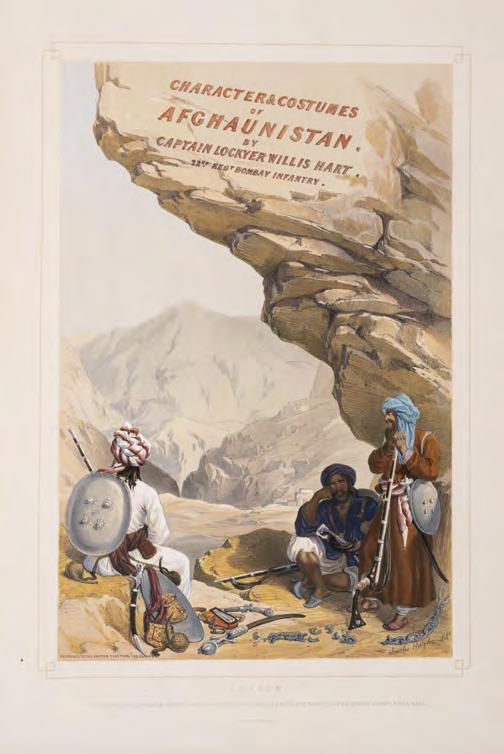
266
Afghanistan.- Hart (Captain Lockyer Willis) CHARACTER & COSTUMES OF AFGHAUNISTAN, lithographed title and 26 plates handcoloured by Charles Haghe after Hart, tissue-guards (a few tears), hand-coloured map of Sinde and Afghanistan with engraved dedication to recto, list of plates and 2 pp. advertisements at end printed in blue, a few marginal tears and neat repairs to some plates, light damp-staining and scattered spotting, some cracking at gutter, else a rather clean and bright copy, original green morocco-backed moiré cloth, gilt, wear to joints and chips to spine ends, rubbed and bumped with a few marks, [Abbey Travel 511], folio, Henry Graves and Company, 1843.
⁂ Widely regarded as one of the rarest illustrated works on Afghanistan, this work was produced by Captain Hart, an officer in the 22nd Regiment of the Bombay Infantry, as a companion and continuation to James Atkinson’s “Sketches of Afghaunistan”
£4,000 - 6,000
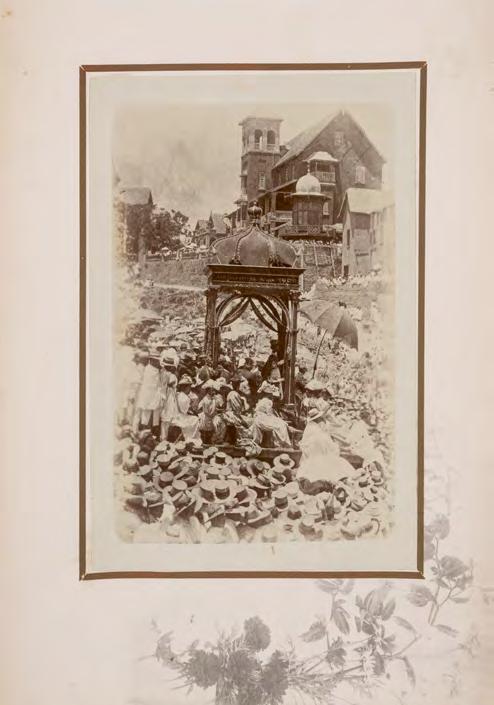
267
Africa.- MADAGASCAR, 77 silver gelatin prints (3 folding), v.s., each mounted on thick card leaves with printed marginal floral designs, contemporary manuscript captions in French either to verso or tipped-in paper slips, one photograph with slight creasing, one or two leaves with slight chipping to edges, original cloth label loosely inserted, modern half morocco, oblong folio, c.1895-1900s
⁂ Presumably put together by a French government official or military administrator this album depicts Madagascar at an important moment in its history, with images depicting various areas of the country immediately after French military intervention of 1894, and the exile of Queen Ranavalona III, the last sovereign of the Kingdom of Madagascar.
Images include: Queen Ranavalona III, Prime Minister Rainlaiarivony, General Gallieni and his staff in Tamatave, Andohalo Square, the inauguration ceremony of the statue to Jean Laborde, as well as various Madagascans, including warriors, weavers, women dancing and musicians
£750 - 1,000
268
-. Stanley (Henry Morton) IN DARKEST AFRICA OR THE QUEST, RESCUE, AND RETREAT OF EMIN, GOVENOR OF EQUATORIA, 2 vol., edition de luxe, NUMBER 92 OF 250 COPIES SIGNED BY THE AUTHOR, 4 coloured maps, of which 3 folding and 2 linen-backed (as issued), photogravure frontispieces, 6 etchings by M.G. Montbard, and 36 plates, one leaf of autograph facsimile, illustrations, the odd spot or stain, original brown half morocco over vellum boards, light markings to vol. 2 lower cover, very minor rubbing to extremities, t.e.g., others uncut, 4to, 1890.
£2,500 - 3,500
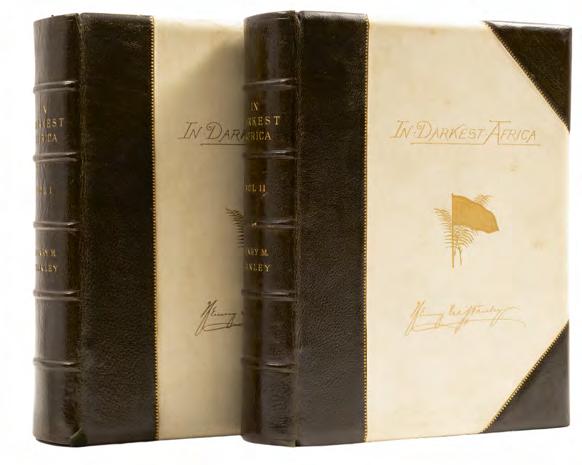
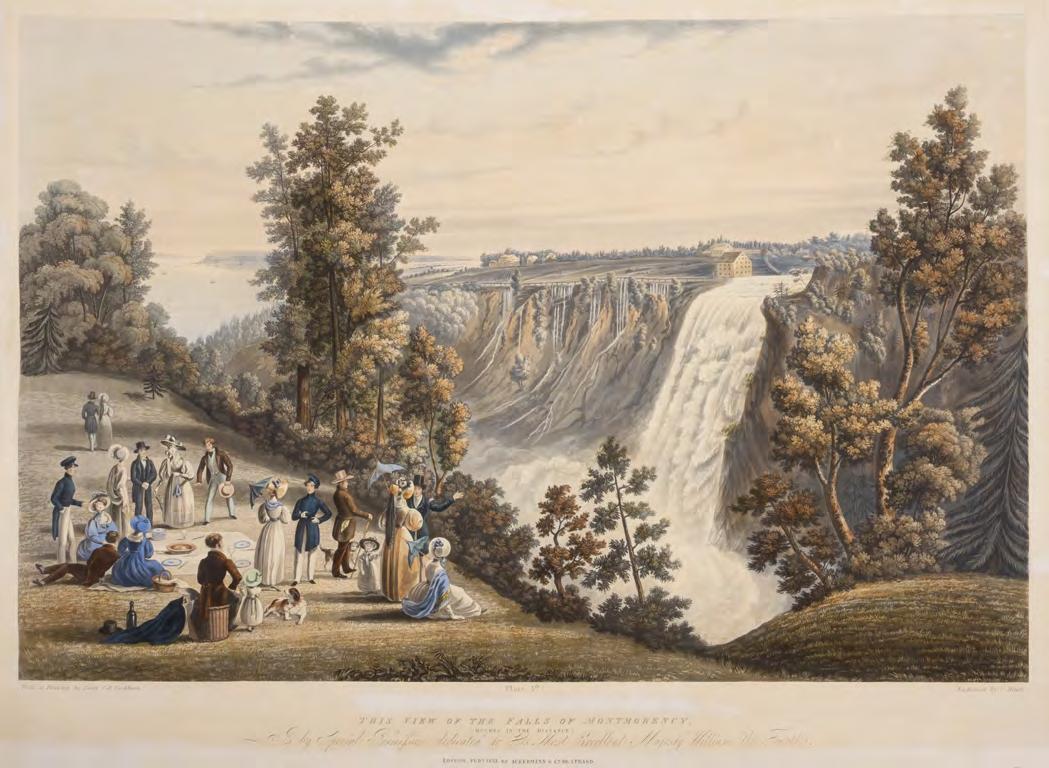
269
America.- Canada.- Cockburn (Maj. Gen. James Pattison) [VIEWS OF QUEBEC], FIRST EDITION, 6 hand-coloured aquatint plates by C. Hunt after Cockburn on Whatman paper, mounted on stubs, watermarked J. Whatman, some partial watermarks dated 1831, the odd neat repair, light toning and a few nicks or small marginal tears, later handsome straight-grain navy morocco, Greek key borders in gilt, spine gilt in compartments, spine ends and corners a little rubbed and bumped, the odd mark, oblong folio, Ackermann & Co., 1833.
⁂ James Pattison Cockburn (1779-1847) was a British military officer and prolific topographical artist who served in Europe during the Napoleonic Wars and in Canada from 1822 to 1832. He is best known for his travel views of Canada, especially Quebec and Niagara Falls, which helped define the picturesque image of the country.
£35,000 - 45,000

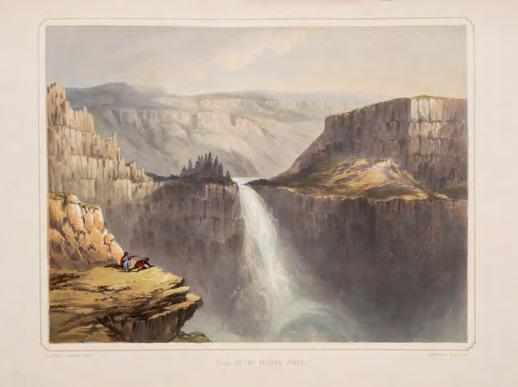
270
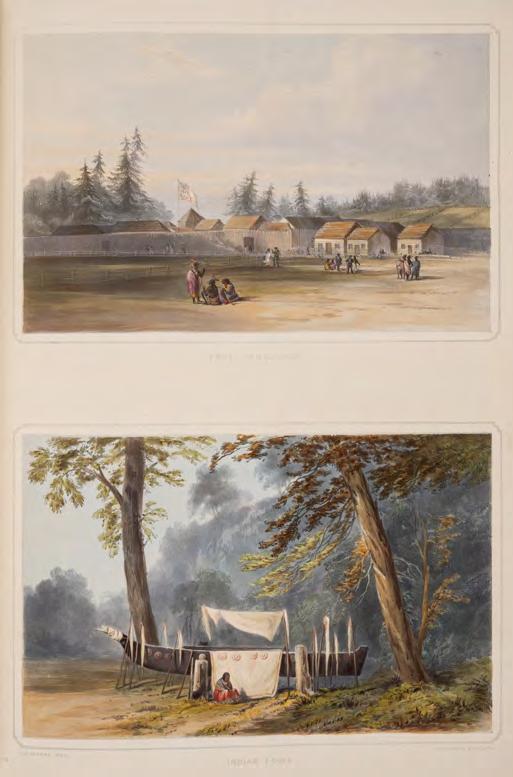
-. Warre (Capt. Henry James) SKETCHES IN NORTH AMERICA AND THE OREGON TERRITORY, FIRST EDITION, 20 FINELY HAND-COLOURED LITHOGRAPHS ON 16 SHEETS heightened with touches of gum arabic, lithographed map, with dedication to Hudson’s Bay Company, one plate with marginal repair to corner, Norman R. Bobins and Francis Mathewson bookplates, contemporary red half morocco, rebacked preserving original spine, upper cover lettered in gilt, [Abbey, Travel 656; Graff 4542; Hill 1827; Howes W114; Sabin 101455; Wagner-Camp 157], folio, Dickinson & Co., 1848.
⁂ A HANDSOME COPY OF THE RARE HAND-COLOURED ISSUE OF THE FIRST EDITION OF THIS MAGNIFICENT SERIES OF PACIFIC NORTHWEST VIEWS, WITH PARTICULARLY VIBRANT COLOURING
“One of the rarest and handsomest of Western books. In 1845 Captain Warre was sent by the British government to the Oregon Territory, at the height of the dispute with the United States over its ownership, to scout out the country in case British troops were brought into Oregon. He travelled overland across Canada to the Pacific Northwest, visiting present-day Oregon, Washington, and British Columbia. By the time he returned the political crisis had been resolved. Warre, an accomplished artist, executed these illustrations on the spot, and published them upon his return to London.” (Best of the West, 105)
Warre depicted the scenery, situations, and incidents for this work, a remarkable record of the American west before it was touched by western civilization. “The only western color-plates comparable in beauty to those by Bodmer.” - Howes.
Copies with plates in such good, clean condition are rare on the market; the Bill Reese copy made $107,100 in 2022 and the Streeter copy $192,000 in 2007.
£30,000 - 40,000
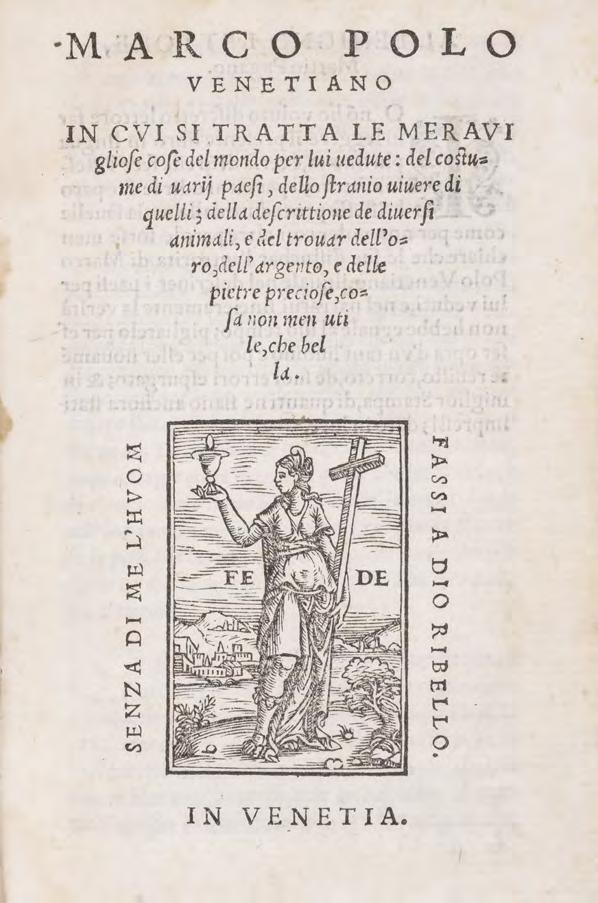
271
Asia.- Polo (Marco) IN CUI SI TRATTA LE MERAVIGLIOSE COSE DEL MONDO PER LUI VEDUTE, collation: A-G8, woodcut device to title, a few minor marginal brown crayon markings, some light marginal staining, modern vellum, yapp edges, preserved in fleece-lined blue calf drop-back box, box a little scratched, 8vo (149 x 96mm), Venice, [Matteo Pagan], 1555.
⁂ RARE EDITION OF MARCO POLO’S GREAT TRAVEL ACCOUNT, ONE OF SURPRISINGLY FEW EARLY VERSIONS PUBLISHED IN HIS NATIVE TONGUE AND IN HIS NATIVE CITY
Marco Polo’s book is undoubtedly the single greatest travel account of the medieval world. Its descriptions governed the majority of the Western world’s perceptions of the Middle East and Asia until quite modern times.
Marco Polo (c.1254-1324) joined his father and uncle on a journey to China, travelling along the Silk Road and reaching the court of Kublai Khan c.1274. The Polos remained in China for about 17 years, and the Mongol emperor sent Marco on several fact-finding missions to distant lands. Marco may also have governed the city of Yangzhou (1282-87). The Polos returned to Venice in 1295 after sailing from eastern China to Persia and then journeying overland through Turkey. Captured by the Genoese soon after his return, Marco Polo was imprisoned along with a writer, Rusticiano (or Rustichello) da Pisa, to whom he dictated the story of his travels, describing places he had visited and heard of and recounting the local customs. He covers much of Asia, including the Arab world, Persia, Japan, Sumatra, and the Andaman Islands, and also East Africa as far south as Zanzibar. He describes paper currency, asbestos, coal, and other phenomena virtually unknown in Europe as well as the precious stones of Asia. “The travels of Marco Polo in the East claim a place in an American collection in consequence of the remarks of distinguished geographers that they were perused by Columbus, and that the revelations made by him of the wonders of Cathay and Zipanga stimulated the great navigator to accomplish through the sea, what the Venetian traveller had by land” (Sabin).
This is one of two issues or editions printed by Matteo Pagano, this containing the imprint with date in the colophon: ‘In Venetia per Matthio Pagan, in Frezaria, al segno della Fede, 1555’. This is the fifth edition in the Italian (Venetian) vernacular, preceding editions appeared 1496, 1500, 1508 and 1533. All these editions, including the present and the undated edition by Matteo Pagano, are extremely rare, each surviving in only a few copies and seldom appearing on the antiquarian market.
Literature: Adams P1792; Sabin 44498; Cordier, Bibliotheca Sinica, online, Second edition, vol. III, col. 1970; Yule-Cordier, 18; PMM 39. EDIT 16 CNCE 66667
£30,000 - 40,000
Atlas.- Norie (John William) THE MARINE ATLAS, OR SEAMAN’S COMPLETE PILOT FOR ALL THE PRINCIPAL PLACES IN THE KNOWN WORLD , SEVENTH EDITION, title, contents, 38 maps only (of 40) on 66 sheets, the majority folding, sheets of various sizes between approx. 650 x 800 mm (25½ x 31½ in) and 595 x 1610 mm (23½ x 63⅜ in), scattered surface dirt and offsetting throughout, some maps with repairs to loss and splitting to folds, several maps sheets with damp-stains to lower edges, some other signs of heavy use, particularly to first half dozen charts, title and contents with toning, surface dirt, heavy dampstaining and vertical creasing, otherwise most with small nicks and rough edges [see individual sheet condition notes below], contemporary half calf, covered in sail cloth, lifting off in places, partial remains of string ties, boards detached, lacking spine, worn, printed for and published by J.W. Norie & Co., 1826
⁂ Extremely rare sea atlas.
Charts include:
1. ‘A Chart of the World, on Mercator’s Projection’, 1833, on two double-page folding sheets
2. ‘A Chart of The North Sea...’, c. 1818, on two double-page folding sheets
3. ‘A New Chart of the Coasts of England and Holland’, 1819, on two double-page sheets
4. ‘The East Coast of England from Dungeness to Flamborough Head and Scarborough...’, c.1812, on one double-page sheet
5. ‘The Coast of England and Scotland, from Flamborough Head to Cape Wrath...’, 1825, on three double-page sheets
6. ‘The Cattegat from the Scaw to Gothenburg and Elsineur...’, 1824, on one double-page sheet
7. ‘The Cattegat and Baltic, or East Sea...’, 1823, on two doublepage folding sheets
8. ‘The Gulf of Finland’, n.d. but c.1814, on one large double-page folding sheet, with extensive restored loss
9. ‘The Gulf of Bothia...’, n.d. but c.1814, on one large double-page folding sheet, [with extensive restored losses, some not repaired]
10. ‘The Coasts of Norway and Lapland, including the White Sea’, 1825, on two double-page sheets
11. ‘The Hebrides, or Lewis Islands’, 1824, on two double-page sheets
12. ‘A New Chart of the North Coast of Ireland’, 1818, on one double-page sheet
13. ‘A New Chart of the West Coast of Ireland’, 1822, on one double-page sheet
14. ‘A New Chart of the South Coast of Ireland’, 1822, on one large double-page folding sheet
15. ‘Steel’s New and Improved Chart of the St. George’s and Bristol Channel’, 1825, on three double-page folding sheets
16. ‘...Chart of the English Channel...’, 1825, on three double-page sheets [central sheet with large repaired tear]
17. ‘A New Chart of the Atlantic or Western Ocean’, 1826, on two double-page folding sheets
18. ‘Heather’s Chart of the Bay of Biscay’, 1823, on two doublepage sheets
19. ‘A New Chart of the Coast of Portugal...’, 1823, on one doublepage folding sheet
20. ‘A Chart of the Mediterranean Sea...’, 1824, on three doublepage sheets, one with fold-out flap [browning to corners]
21. ‘A New Chart of the Azores, or Western Isles’, 1822, on one double-page sheet
22. ‘A New and Correct Chart of the Madeira & Canary Islands’, 1821, on one double-page sheet
23. ‘A New Chart of the Cape Verde Islands’, 1824, on one doublepage folding sheet
24. * Missing the chart as called for in the contents, “Bermuda” *
25. ‘Steel’s New & Accurate Chart of the Coast of North America from the Straits of Belle Isle to Boston...’, 1821, on two large double-page folding sheets [the lower sheet with marginal loss to lower left corner]
26. ‘A New Chart of the Coast of North America from Boston Bay to Chesapeake’, 1815, a large double-page folding sheet [repaired losses within the map, old folds strengthened verso]
27. ‘A New Chart of the Coast of North America from Hatteras to Florida’, 1815, [even toning, with repaired tears running into map at right hand side]
28. ‘Steel’s New and Complete General Chart of the West Indies, including the Gulf of Mexico’, 1824, on two large double-page folding sheets
29. ‘A New Chart of the Carribbean Isles’, 1815, on one doublepage sheet
30. ‘A New Chart of the Coast of Guayana’, 1823, on one doublepage sheet
31. ‘A General Chart of the South Atlantic Ocean’, 1844, on two double-page folding sheets
32. ‘A New Chart of the Coast of Brazil’, 1819, on one large doublepage folding sheet [some loss to the lower right corner]
33. ‘A New Chart of the Coast of Brazil, from Port Santos to The River Plate’, 1825, on one double-page sheet
34. ‘...Chart of the Indian and Pacific Oceans...’, 1824, on three double-page folding sheets
35. ‘A New Chart from the Cape of Good Hope to the Islands...’, 1818, on one large double-page folding sheet [many folds and handling creases, some repaired verso, rough edges]
36. ‘A New Chart of the Indian Ocean’, 1817, on three double-page folding sheets
37. ‘A New Chart of The China Sea, and East India Archipelago’, 1821, on three double-page folding sheets
38. ‘A New Chart of The Pacific Ocean, Exhibiting the Western Coast of America, 1825, on three large double-page folding sheets [first sheet with repairs to splitting at lower fold; second sheet with substantial sheet loss to lower section; third sheet with heavy repairs to upper section]
39. * Missing the chart as called for in the contents, “North Polar Regions” *
40. ‘...The Royal Standard of Great Britain and Ireland with 234 maritime flags’, 1824, hand-coloured, double-page sheet [heavy toning, rough edges, repaired tears, handling creases]
£30,000 - 50,000
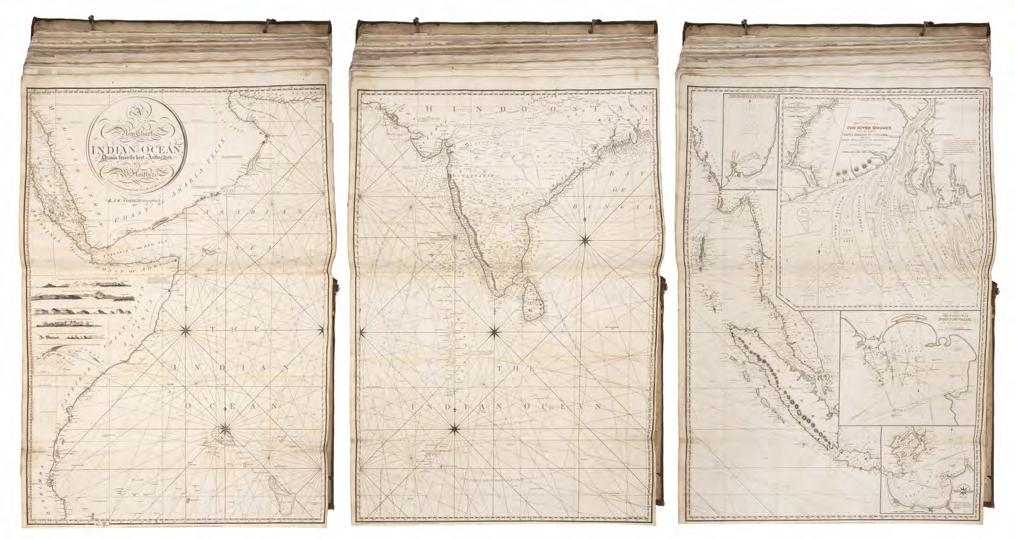
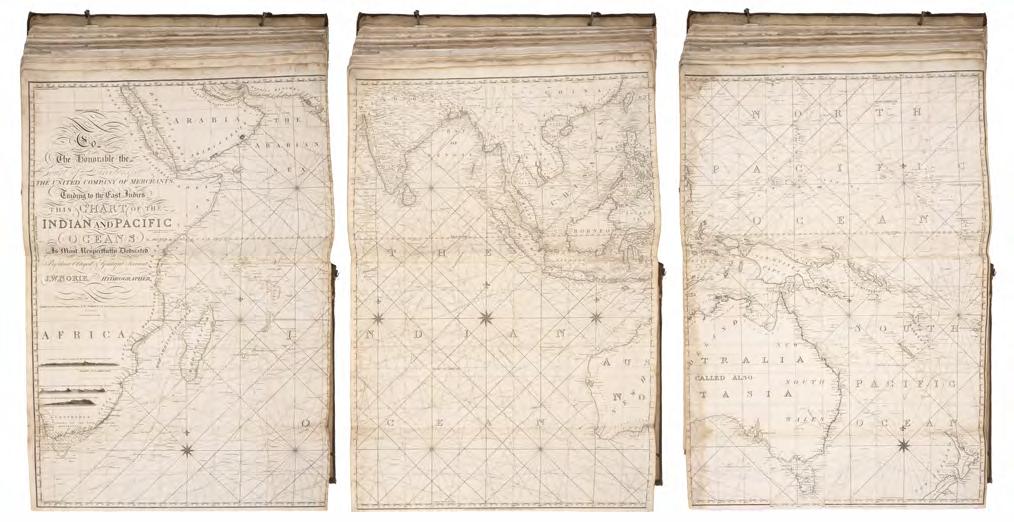
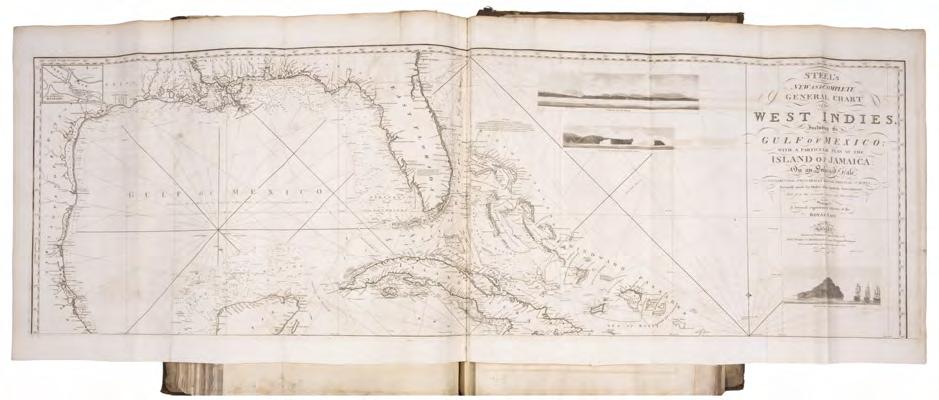
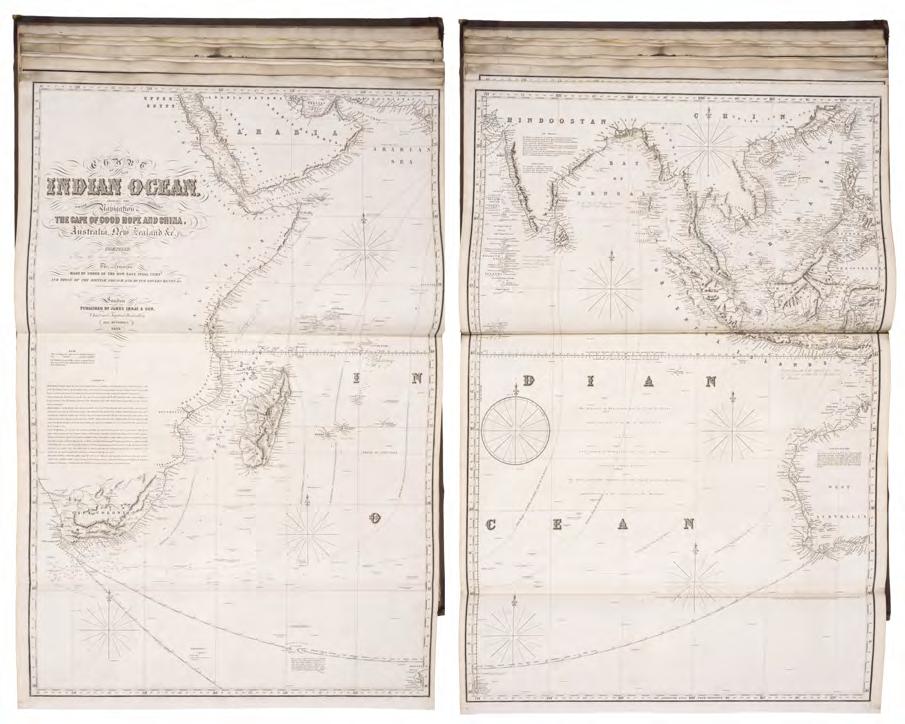
273
-. Imray & Son (James) THE NEW AND COMPLETE EAST-INDIA PILOT BEING A COLLECTION OF CHARTS FROM ENGLAND TO THE EAST INDIES, TOGETHER WITH THE CHINA SEAS , title, manuscript contents page, 15 charts, across 21 engraved sheets, all but two sheets double-page or folding, sheets from approx. 380 x 270 mm (15 x 10⅝ in) to 680 x 1020 mm (26¾ x 40¼ in), [circa 1855]
⁂ Exceptionally scarce, with no recorded copies offered at auction that we can trace. This New and Complete East-India Pilot was likely derived from the slightly earlier Laurie & Whittle East-India Pilot of 1799, and would similarly have been intended to provide accurate charts for navigating all the coasts which might be encountered between England and the East Indies. Charts include:
1. ‘General Chart of North Atlantic or Western Ocean’, 1855, on two double-page folding sheets
2. ‘General Chart of the South Atlantic Ocean’, 1857, on two double-page folding sheets
3. ‘Chart of Southern Africa and the Islands of Madagascar, Bourbon and Mauritius’, 1856, on three double-page folding sheets
4. ‘Chart of the Indian Ocean showing the whole navigation between The Cape of Good Hope and China’, 1855, on two double-page folding sheets
5. ‘Chart of the Maldeeve, or Maldiva Islands’, 1841, on a single-page sheet
6. ‘Chart of the Islands and Reefs of the Laccadive Group’, 1848, on a double-page sheet
7. ‘...Chart for Navigating to, from, and in the East Indies...’, 1853, on a double-page folding sheet
8. ‘A Plan of Bombay Harbour’, 1844, on a double-page folding sheet
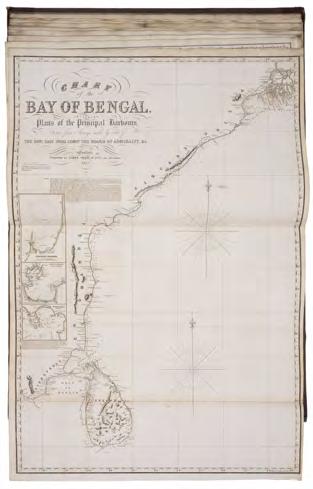
9. ‘The Several Bays near Cape Aden, on the Arabian Coast Surevyed Trigonometrically’, 1839, on a double-page folding sheet
10. ‘Red Sea, surveyed by Capt. Elwon [and others...] Indian Navy’, 1857, on a double-page folding sheet
11. ‘Chart of the Bay of Bengal, including Plans of the Principal Harbours...’, 1853, on two double-page folding sheets
12. ‘General Chart of the River Hoogly and the approaches to it from False Point to Calcutta’, n.d., on a double-page folding sheet
13. ‘Coast of the Arracan and Port of Akyab...’, 1854, on a single-page folding sheet
14. ‘Maulmain River...’, 1849, on a single-page folding sheet
15. ‘Rangoun River...’, 1835, trimmed and pasted onto the verso of chart 14
£10,000 - 15,000
274
Caribbean Islands.- Turner (Captain Henry A., Royal Artillery, active 18491853) TWO FINE PANORAMIC VIEWS OF GRENADA: “ST. GEORGES, GRENADA FROM HOSPITAL HILL”; AND “VIEW OF THE HARBOUR, ST GEORGES, GRENADA, FROM BELMONT HILL”, watercolour, charcoal or black chalk, some white heightening, locations and dates inscribed in pencil, each view approx. 183 x 542 mm (7¼ x 21⅜ in), each dissected into four sections and joined with linen strips verso allowing views to fold down concertina-style, some minor off-setting, surface dirt and light browning, a few small pin holes and slightly rough edges, unframed, 1851-1852 (2)
⁂ Produced at the same time as two other views in Grenada, which were subsequently published as hand coloured lithographs by Ackermann & Co., London in 1852
£800 - 1,200
275
China.- Amiot (Jean-JosephMarie) et al. MÉMOIRES CONCERNANT L’HISTOIRE, LES SCIENCES, LES ARTS, LES MŒURS, LES USAGES, &C DES CHINOIS: PAR LES MISSIONAIRES DE PEKIN, FIRST EDITION, 17 vol. in 16, 3 engraved frontispiece portraits, 165 plates and maps (some folding), 27 tables to vol.2, water- and damp-staining to vol.2, occasional light staining and browning, light foxing, bookplates, uniformly bound in early 19thcentury calf, gilt with ‘The Society of Writers to the Signet’ device to covers, neatly rebacked, covers a little marked, minor rubbing to extremities, some repairs to corners, [Lust 96; Cordier 54-56; Catalogue: China Illustrata 93], 4to, Paris, Nyon/Treuttel & Würtz, 1776-1814.
⁂ A BEAUTIFUL AND VERY RARE COMPLETE SET, WITH THE TWO SUPPLEMENTARY VOLUMES, OF THE MOST COMPREHENSIVE SURVEY OF ALL ASPECT OF CHINESE LIFE IN THE EIGHTEENTH-CENTURY. AN INVALUABLE FOUNDATION OF FRENCH SINOLOGY
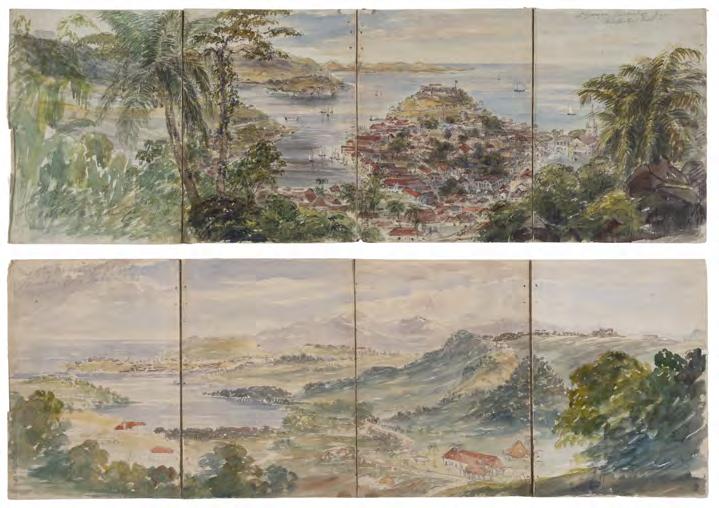
The Mémoires were published over 38 years with much of the cost being carried by Henri Bertin or - ultimately - the French crown. The main contributor to the Memoires was Joseph Amiot, who arrived in Peking in August 1751, and remained there for the rest of his life; others include Gaubil, Prémare, Cibot, and Poirot.
This remarkable series was an important source for the perception, by Europeans, of the Chinese world empire, its culture, science, religion, customs, and regional studies (including music, food, astronomy, tael currency, horses, the life of Confucius, life at court and in country). It brought together important accounts of French and Chinese missionaries in Beijing. The engraved illustrations play a prominent role in this impressive compendium of Chinese knowledge. Almost all of them are based on contemporary Chinese illustrations which would clearly show the reality of China to the French reader in a way that went beyond the descriptive quality of words. The two supplementary volumes include a continuation of the ‘Abridged History of the Tang Dynasty’ by Antoine Gaubil (16891759), and a Chinese chronology from the beginning of time to the year 206 B.C. (shortly after the end of the first Qin dynasty).
Provenance: From the prestigious Signet library, which formed part of the Society of Writers to Her Majesty’s Signet, a private society of Scottish solicitors dating back to 1594.
£10,000 - 15,000

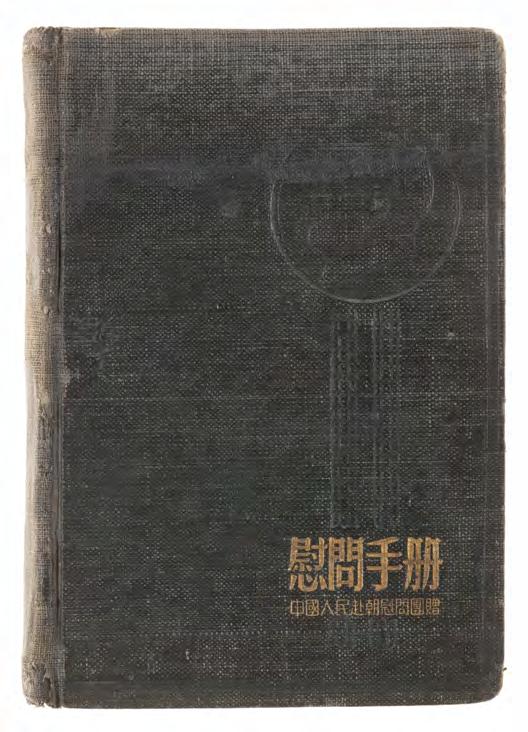
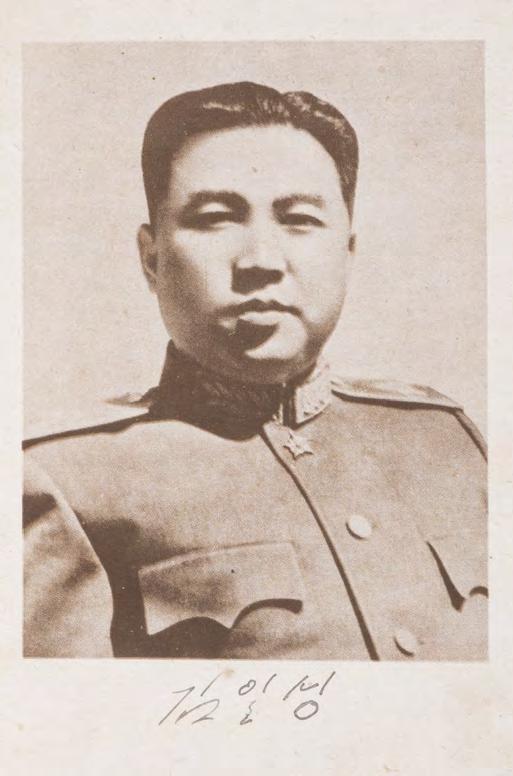
276
-. Mao Tse-tung.- Kim Il-sung.- [NOTE BOOK FOR VISITORS FROM CHINA TO KOREA], 2 PHOTOGRAPHIC PORTRAIT PLATES SIGNED BY MAO TSETUNG AND KIM IL-SUNG, 5 colour illustrations, calendar in Chinese to final free endpaper, original cloth, title in gilt to upper cover, a little rubbed, slight bumping to corners and extremities, housed in modern cloth dropback box, 12mo, [Beijing, 1954].
⁂ Rare to find something signed by both Mao and Kim. Presumably this note book was produced as a propaganda tool to promote travel and tourism between China and Korea in the wake of the Korean War.
Provenance: by gift to the previous owner from Rewi Alley (18971987), New Zealand writer and political activist who arrived in Shanghai in 1927. Becoming a member of the Communist Party, he was instrumental in setting up the industrial cooperatives and schools, remaining a revered name in China. The three-story Rewi Alley Memorial Hall in the grounds of Lanzhou City University is a museum devoted to his memory
£10,000 - 15,000
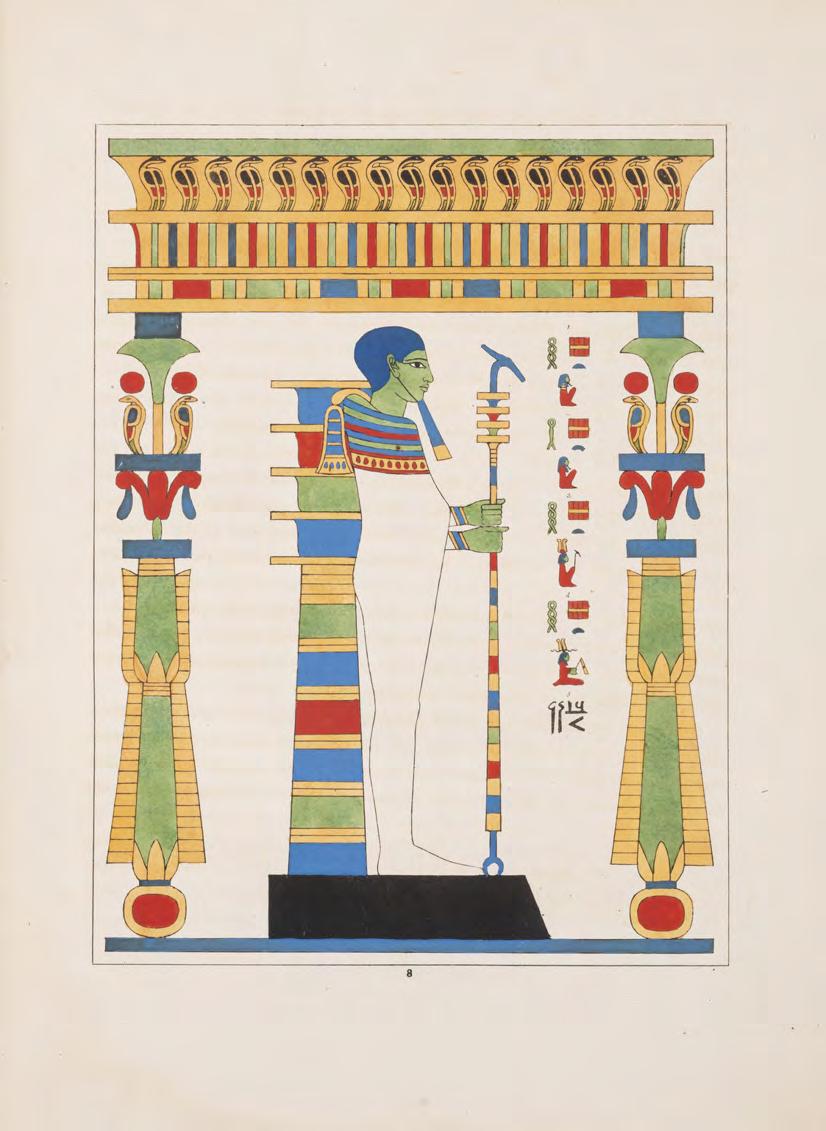
277
Champollion (Jean Francois) PANTHEON EGYPTIEN, FIRST EDITION, 84 lithograph plates after L.J.J. Dubois, all but 2 hand-coloured, minor scattered foxing throughout, some offsetting from plates, first text leaf professionally repaired to outer margin, not affecting text, some water-staining, mostly marginal, one text leaf with library stamp to bottom margin, not affecting text or plates, one original green upper wrapper bound in, later brown half morocco over contemporary marbled boards, edges worn, corners bumped and rubbed, 4to, Paris, Firmin Didot, 1825.
⁂ Originally intended to have 200 plates, this rare and important work was issued in 15 fascicules, each with 6 plates, giving a total of 90 for a complete copy. Very few complete copies aurvive, and this copy, with 14 of the 15 fascicules present, comes with a very distinguished Imperial Russian provenance.
Provenance: Tsar Nicholas II and Count Alexis Borisovitch Loganov-Rostovsky (bookplates to front pastedown); two Russian library stamps to recto of wrapper
£8,000 - 12,000
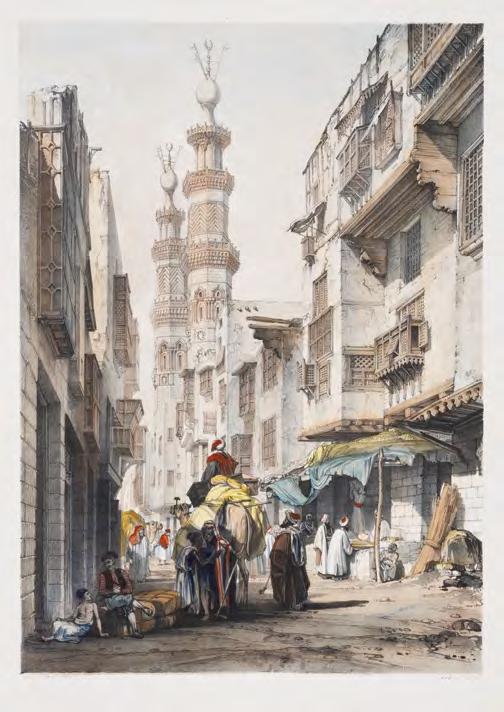
278
Hay (Robert) ILLUSTRATIONS OF CAIRO, FIRST EDITION, additional lithographed title and dedication, 29 hand-coloured tinted lithographed plates, bookplate of John Kitching loosely inserted, plates 11 & 12 working a little loose at gutter, occasional water-staining and toning, mostly marginal, surface soiling and scattered light spotting, contemporary boards, gilt, rebacked in buckram preserving old spine label, stained and soiled, rubbed and bumped, housed in modern cloth drop-back box, [Abbey Travel 270], folio, 1840.
£2,000 - 3,000
279
ROYAL AIR FORCE ALBUMS, 3 vol., c.200 silver gelatin photographs, mounted on thin card leaves, most captioned by hand, one album with leaves loose or becoming so, all but 1 vol. original cloth, 1 vol. original cloth-backed boards, each with cord bindings, one mostly detached, a little rubbed, slight bumping to corners and extremities, oblong 4to & oblong folio, c.1920s-30s
⁂ An interesting collection of albums put together by a pilot during his service in the 208th (Army Cooperation) RAF Squadron which was stationed on the Ismailia Air Base near Cairo.
Put together between the World Wars when the RAF was still relatively new, these albums show images of pilots and their planes, including the aftermath of crashes. They also show images of Khartoum, early aerial views of Cairo and the Sphinx whilst partially excavated
£750 - 1,000
280
Europe.- Prussia.- Adam (Albert) VOYAGE PITTORESQUE ET MILITAIRE DE WILLENBERG EN PRUSSE JUSQU’A MOSCOU, FAIT EN 1812, additional engraved title, 101 tinted lithographed plates, 3 pp. list of subscribers, large closed tear to “Le Matin de 5 Septembre” plate (affecting image), scattered foxing and damp-staining, some fraying and a few nicks to fore-edges of later pp., contemporary half calf, spine gilt in compartments, joints starting to split, rubbed and bumped with a few stains, folio, Munich, Hermann & Barth, 1827.
£1,500 - 2,000
281
-. Reilly (Franz Johann Joseph von) SCHAUPLATZ DER FUNF THEILE DER WELT , 5 vols. only (numbered 1, 5-8), containing 438 engraved maps only (of c.830), most with outline hand-colouring, vol. 1 with engraved title, dedication, some loose and partially detached, scattered spotting, surface dirt and handling creases throughout, some browning and offsetting, uniformly bound, 19th century calf, spines with labels missing, gilt, very worn, with losses and abrasion, oblong folio, Vienna, [circa 1789-1806]
⁂ A large collection of bound maps, part of von Reilly’s grand atlas of Europe, which was said to have been published at the rate of one map per week for seventeen years, from 1789 to 1806. When completed, Reilly had produced a total of approximately 830 maps of Europe, forming the first two parts of the atlas; the third, which was to be devoted to the rest of the world, was never published
£1,500 - 2,000
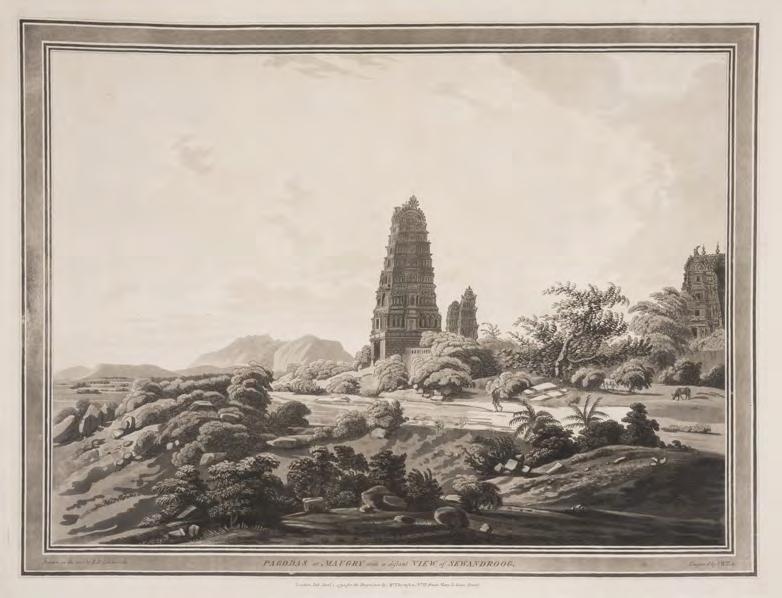
282
Colebrooke (Lt. Robert Hyde) TWELVE VIEWS OF PLACES IN THE KINGDOM OF MYSORE, THE COUNTRY OF THE TIPPOO SULTAN, FIRST EDITION, second issue, 12 aquatint plates on J. Whatman wove paper, engraved by J.W. Edy, lacking list of subscribers, title and last plate “N. W. View of Seringapatam”
rebacked and with repairs, scattered spotting, mostly to title and last plate, some light staining and soiling elsewhere, half dark green morocco by Sangorski & Sutcliffe, gilt, spine gilt, a few marks and discolouration generally, rubbed and bumped, [Abbey Travel 419], oblong folio, 1794.
⁂ Robert Hyde Colebrooke (1762?–1808) was a British army officer and surveyor in India.
£3,000 - 4,000
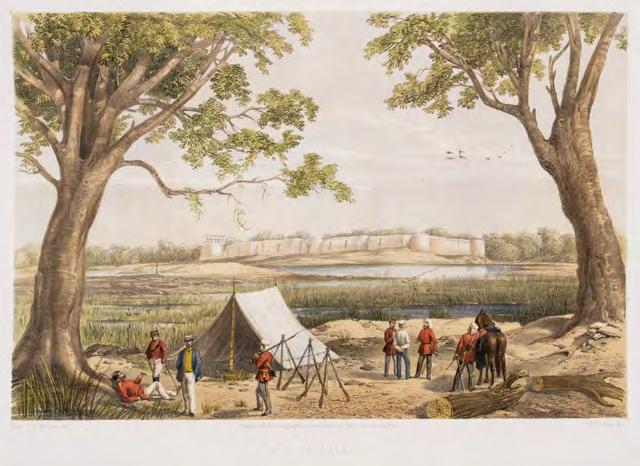
283
Mecham (Clifford Henry) SKETCHES & INCIDENTS OF THE SIEGE OF LUCKNOW, FIRST EDITION, hand-coloured lithographed title with vignette and 26 plates on 17 sheets, tissue-guards, many tears and neat repairs (some to plates), some surface soiling and light scattered spotting, original red half morocco, gilt, rebacked preserving old spine, rubbed and bumped with staining, folio, 1858.
⁂ A firsthand illustrated account of the brutal 1857 Siege of Lucknow during the Indian Rebellion, one of the most pivotal events in British rule in India
£1,500 - 2,000
284
PHOTOGRAPH ALBUM, 18 albumen prints laid down on card leaves, captioned by hand, several seemingly taken from William Johnson’s Photographs of Western India, each with leaf of manuscript explanatory text, some other photographic prints & one pen and ink drawing of an animal-powered oil press loosely inserted, some light spotting and surface soiling, some fraying to leaf edges and splitting at gutter, but holding, manuscript title “Stray leaves from the Photographic Album of Western India, 1862” to front free endpaper, contemporary red morocco album, gilt, very worn with loss to spine ends, [c.1862]; and 3 other photograph and scrap albums on various subjects, some India related photographs including Naini Tal & others of the Egyptian pyramids, 4to & oblong folio (4)
⁂ Photographs in the first mentioned include: Persians, Parsee lady and child, Hoozoor patteewallas, Parwáree women, Knifegrinders, Banian ladies, Native accountants, Dhárwár brahmans, Márwárees, Cotton merchants, Brahman ladies, Ruined temple of Ammarnath, Elephanta cave, Kanheri caves with native musicians, Karlé caves &c
£750 - 1,000
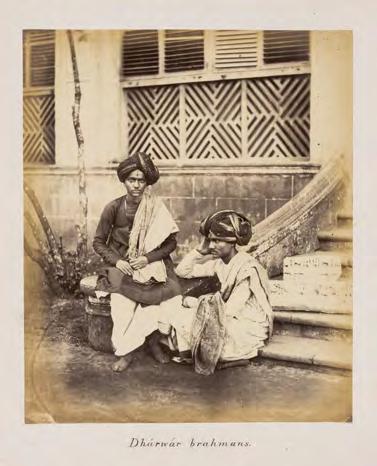
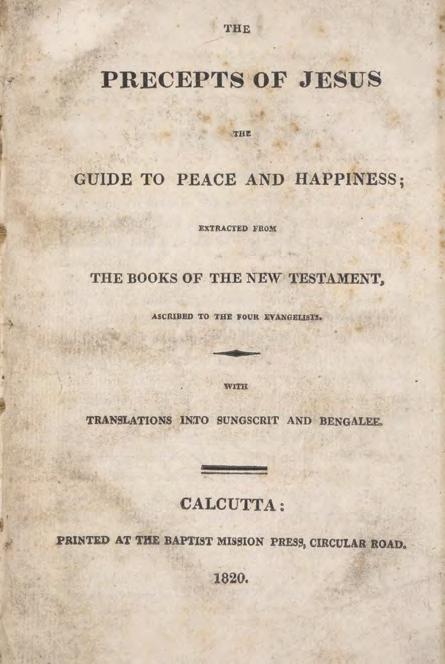
285
Social reformer.- [Raja Ram Mohan Roy]. THE PRECEPTS OF JESUS, THE GUIDE TO PEACE AND HAPPINESS; EXTRACTED FROM THE BOOKS OF THE NEW TESTAMENT ASCRIBED TO THE FOUR EVANGELISTS, FIRST EDITION, title soiled, occasional spotting or light foxing, lightly browned, bound with an unidentified Bengali work, disbound, 8vo, Calcutta, Printed at the Baptist Mission Press, Circular Road, 1820.
⁂ Rare pioneering work by this social reformer, who was one of the founders of Brahmo Samaj. It was written to promote universal morality and rational theism. He is known for his efforts to abolish the practices of Sati and child marriage. The translations promised on the title page were never published.
£1,000 - 1,500
286
Tayler (William) SKETCHES ILLUSTRATING THE MANNERS & CUSTOMS OF THE INDIANS AND ANGLO INDIANS, FIRST EDITION, engraved title, 6 handcoloured lithographed plates by J. Bouvier after Tayler, each with letterpress description, plate 6 with large repair to fore-margin, a few other tears, mostly marginal and with neat repairs, scattered spotting and a few stains, some plates toned, cracking at gutter, contemporary half roan, gilt, lower joint starting to split, rubbed and bumped with a few chips, [Abbey Travel 465], folio, Thomas McLean, 1842.
⁂ William Tayler (1808–1892) served with the East India Company in Bengal
£2,000 - 3,000
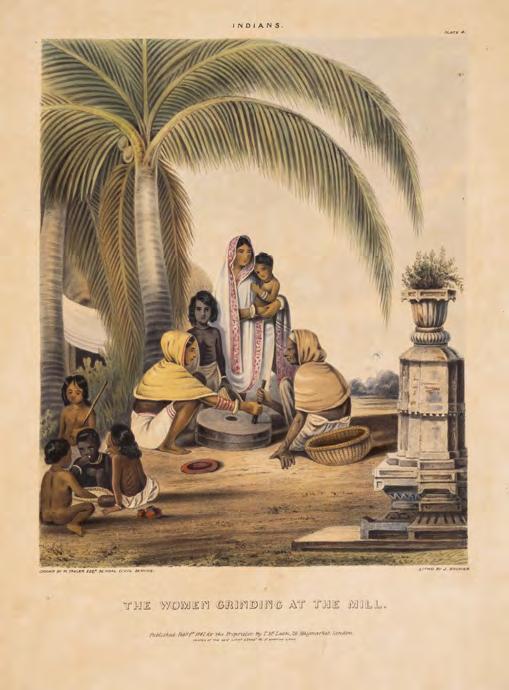
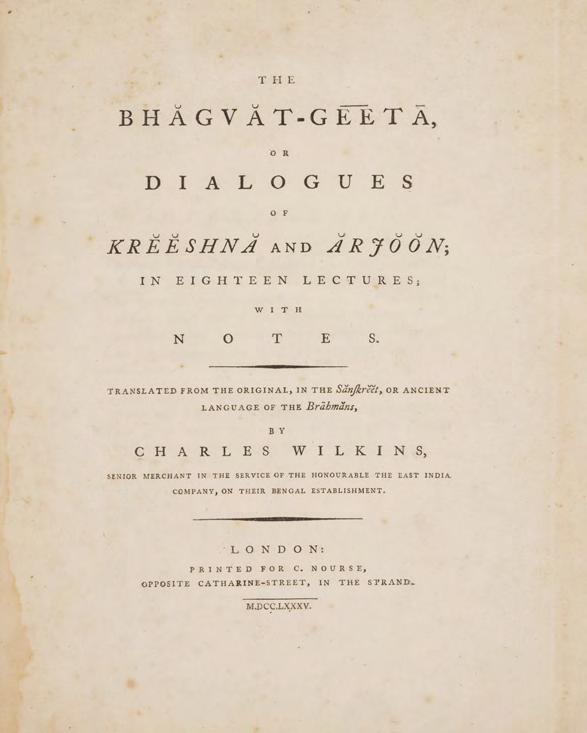
287
Wilkins (Charles) THE BHAGVAT-GEETA, OR DIALOGUES OF KREESHNA AND ARJOON, FIRST EDITION, large paper copy, occasional spotting, contemporary calf, worn and charred, upper cover and front endpapers detached but internally generally clean, [ESTC T99378], 4to, Printed for C. Nourse, 1785.
⁂ The first direct translation of the Gita, the most revered text in Hinduism, into any Western language. Wilkins (1739-1846) was a pioneering Sanskrit scholar and co-founder of the Asiatic Society of Bengal. A printer by trade, he was instrumental in creating the first typeface for the Bengali language. The prefatory letter is written by Warren Hastings to Nathaniel Smith. Provenance: John Utterson of Milland Place, Sussex (bookplate). John Utterson was secretary to Sir Edward Vernon. His son Edward Vernon Utterson (1775-1856), lawyer, antiquary, Fellow of the Society of Antiquaries (elected 1807), founder member of the Roxburgh Club (1812) and noted collector and printer (Beldornie Press). The Utterson library was sold by Sotheby & Wilkinson 19 April 1852 - 20 March 1857
£7,000 - 10,000
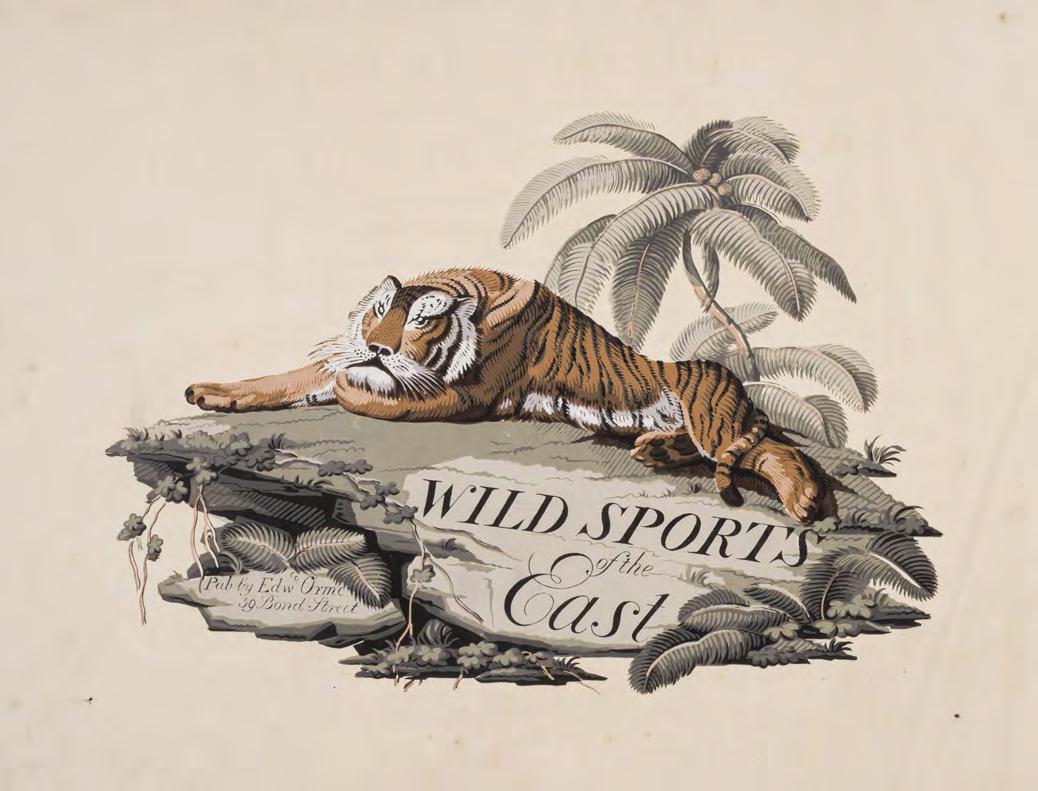
288
Williamson (Capt. Thomas) ORIENTAL FIELD SPORTS, FIRST EDITION, additional engraved pictorial title finely hand-coloured and 40 superb handcoloured aquatint plates after Samuel Howett (from sketches by Williamson) by H.Merke, J.Hamble and Vivares, plate XXXI ‘Hunting Jackalls’ in first state, occasional marginal tears, some light creasing, later half calf, a little rubbed, [Abbey, Travel, 427; Nissen ZBI 4416; Schwerdt II p.297; Tooley 508], oblong folio, Printed by William Bulmer...for Edward Orme, 1807.
⁂ “The most beautiful book on Indian sport in existence.” (Schwerdt) with some of the earliest aquatints of the wild elephant
£4,000 - 6,000
289
Italy.- Middleton (John) GRECIAN REMAINS IN ITALY, A DESCRIPTION OF CYCLOPIAN WALLS, AND OF ROMAN ANTIQUITIES, 24 aquatints plates, 22 handcoloured, 3 double-page, 2 black and white, later half red morocco, red morocco label to upper cover, a few light scuff marks, overall a superb copy, [Abbey, Travel 165], folio, for Edward Orme, by W. Bulmer and Co., 1812[-1819].
⁂ Published over eight years, this is Middleton’s masterwork of aquatints, notable for his accurate and picturesque depictions of ancient Greek and Roman ruins in Italy
£8,000 - 12,000
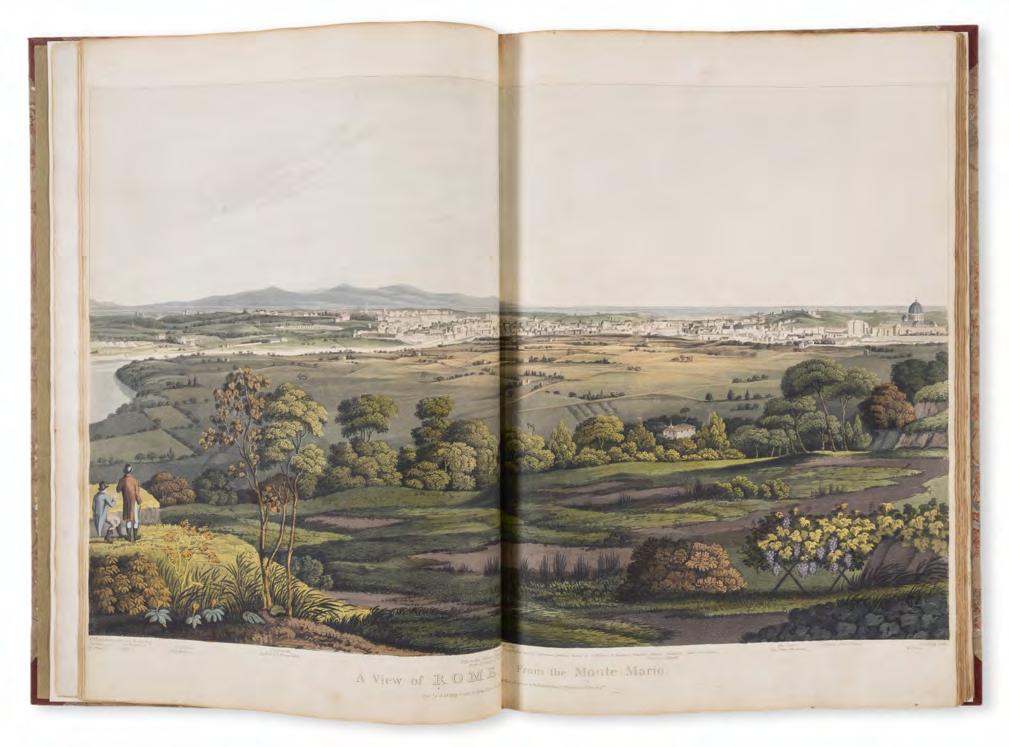
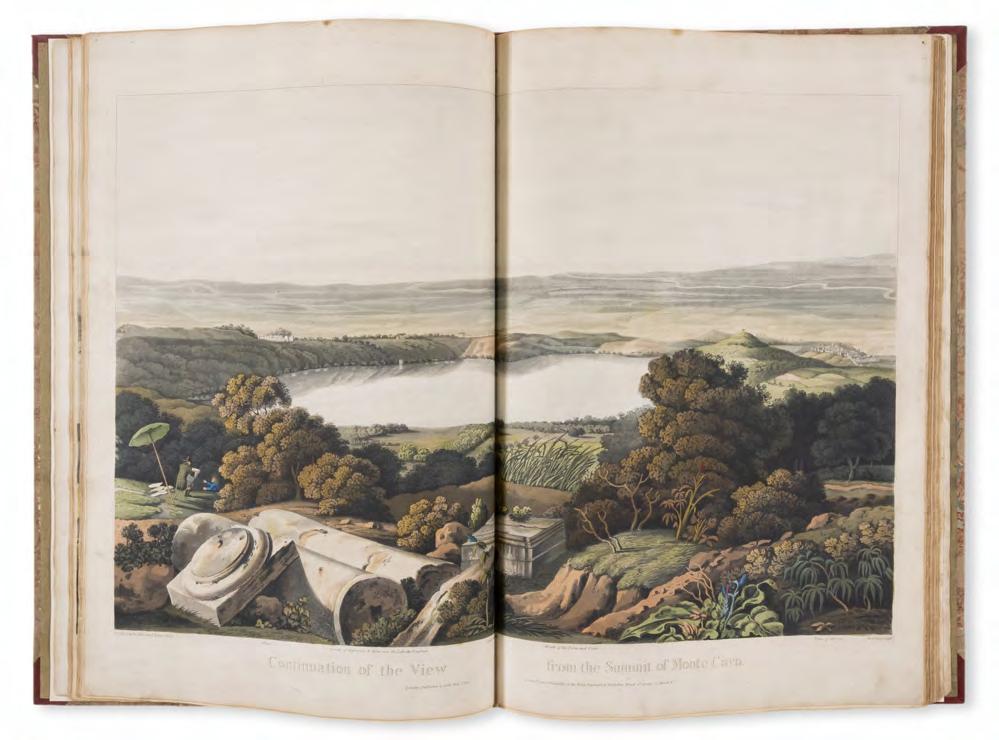
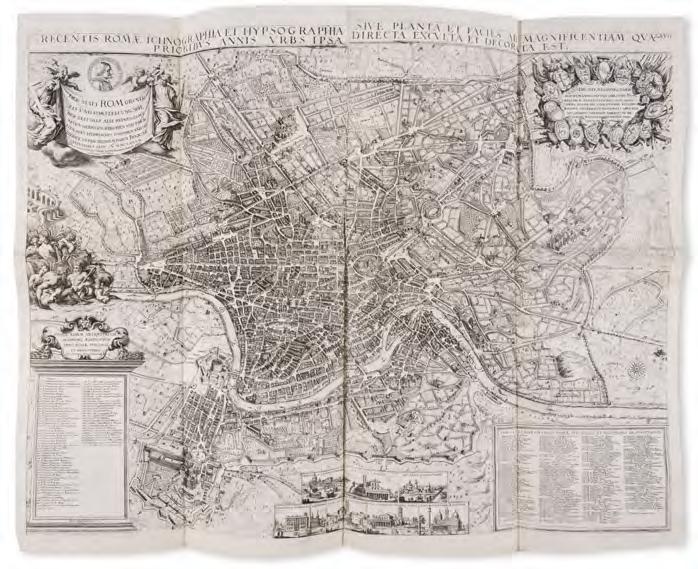
290
-. Sandrart (Joachim von) ROMAE ANTIQUAE ET NOVAE THEATRUM, FIRST EDITION, Nuremberg, Christian Sigismund Froberg, 1684; BOUND WITH Falda (Giovanni Battista) Romanorum Fontinalia, Nuremberg, Froberg for Sandrart, 1685, together 2 works in 1, first with double-page engraved additional title and 71 plates including double-page plan of ancient Rome and fine large folding plan of modern Rome, second with 42 double-page engraved plates, plate 21 torn at fold, some very light foxing and a few minor stains, contemporary calf, spine gilt in compartments with raised bands, slightly rubbed, and some wear to lower corners, [BAL RIBA 2894 & 1016; Rossetti 9144 & 9146], folio
⁂ Excellent copy of these attractive works on the ancient and modern buildings of Rome, often bound together. Sandrart (1606-1688) was an artist and printmaker from Frankfurt who travelled widely in Italy and settled in Nuremberg in 1674
£6,000 - 8,000
291
Mauritius.- Bradshaw (Thomas) VIEWS IN THE MAURITIUS, OR ISLE OF FRANCE, FIRST EDITION, wood-engraved title vignette of the Royal Arms, list of subscribers, 40 fine lithographed plates by William Rider after T.Bradshaw, occasional light spotting, later red half morocco, gilt, t.e.g., joints and corners a little rubbed, [Abbey, Travel, 295], folio, Published for the Proprietor, by James Carpenter and Son, 1832.
⁂ Bradshaw made his original drawings whilst Auditor-General of the island
£4,000 - 6,000
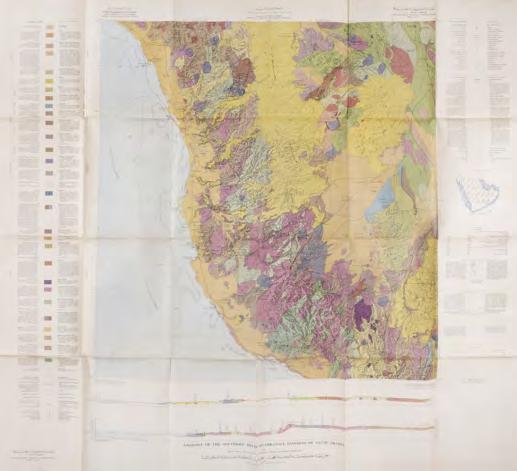
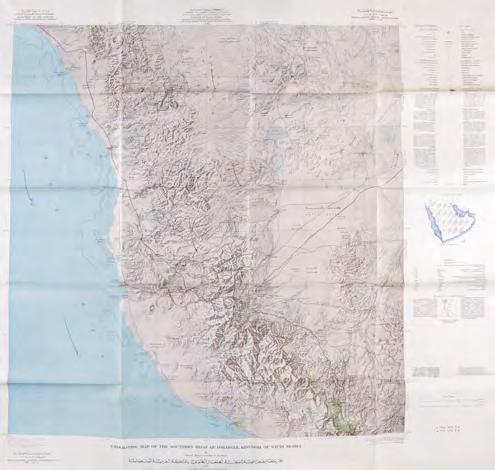
292
Brown (Glen F.) & Roy O. Jackson, et al GEOLOGY OF THE SOUTHERN HIJAZ
QUADRANGLE, KINGDOM OF SAUDI ARABIA. I-210A, folding colour map, 1170 x 1265 mm, original printed paper envelope, ‘Jeddah’ in ink to upper corner, a little rubbed, light spotting to edges, 4to, Washington DC, US Geological Survey (USGS), 1963.
⁂ A map sheet from the landmark series that enabled Saudi Arabia to identify and exploit its oil reserves. This sheet covers the southern portion of the Hejaz (or Hijaz) region, a historically significant mountainous area in western Saudi Arabia running along the Red Sea coast.
£600 - 800
293
Brown (Glen F.) & Roy O. Jackson GEOGRAPHIC MAP OF THE SOUTHERN HIJAZ
QUADRANGLE, KINGDOM OF SAUDI ARABIA. I-210B, revised edition, folding colour map, c.1020 x 1060 mm, very faint spotting, original printed envelope, ‘Jeddah, etc ...’ in ink to upper corner, light spotting, 4to, Washington DC, US Geological Survey (USGS), 1968.
⁂ This sheet covers the Red Sea Coast from north of Rayyis to Al Lith, including Jeddah and Rabigh. Among the more significant locations on this map are: Mecca (also labelled Makkah a Mukarramah) and its environs relating to Hajj including Arafat and Muna (Mina). You can see the ancient water tunnel of Jeddah, and to its north the Desert Locust Control Camp
£600 - 800
294
Iran.- Butler (Rohan) BRITISH POLICY IN THE RELINQUISHMENT OF ABADAN IN 1951, no. 41 of an unknown limitation, marked ‘secret’, original cloth-backed paper wrappers, fractional creasing to corners, folio, September 1962.
⁂ One of the original limited distribution run intended solely for senior Whitehall officials and ministers before the material was finally declassified several decades later.
This, the highly critical internal investigation into The Abadan Crisis. It focuses on the diplomatic and economic showdown which was triggered when the Iranian Prime Minister Mohammad Mossadegh nationalised Iran’s oil industry. Rather than launching a military intervention, Clement Attlee’s Labour government ultimately evacuated all British personnel from the facility in late 1951.
£800 - 1,200
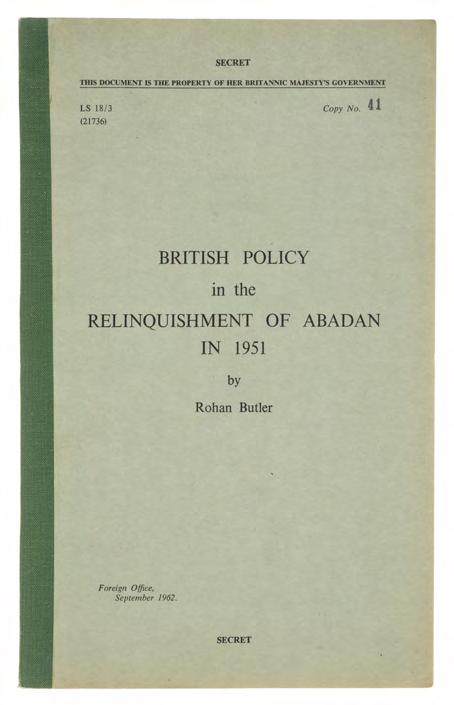
295
Mustafa (Ezzedin Ibrahim) & Abdullah Muhammad Morsi DAWLAT AL-IMARAT AL-’ARAABIYAH ALMUTTAHIDAH [UNITED ARAB EMIRATES], FIRST ARABIC EDITION, folding colour map c.790 x 1180 mm, original blue stiff paper wrappers, text in Arabic, ink-stamp in Arabic to upper cover mentioning that the border amendments with the KSA from 1974 “do not appear on this map, which was prepared in 1973”, very slight rubbing to edges, 8vo, [Maidenhead &] Abu Dhabi, 1973.
⁂ The first official and most detailed map of the newly formed UAE, forming a landmark of cartography of the region. It was published simultaneously with the English edition. This map shows the undefined border with Saudi Arabia and the early border with Oman, both of which were later contested. It also features the earliest motorway system as well as the oil fields and pipelines.
£3,000 - 5,000
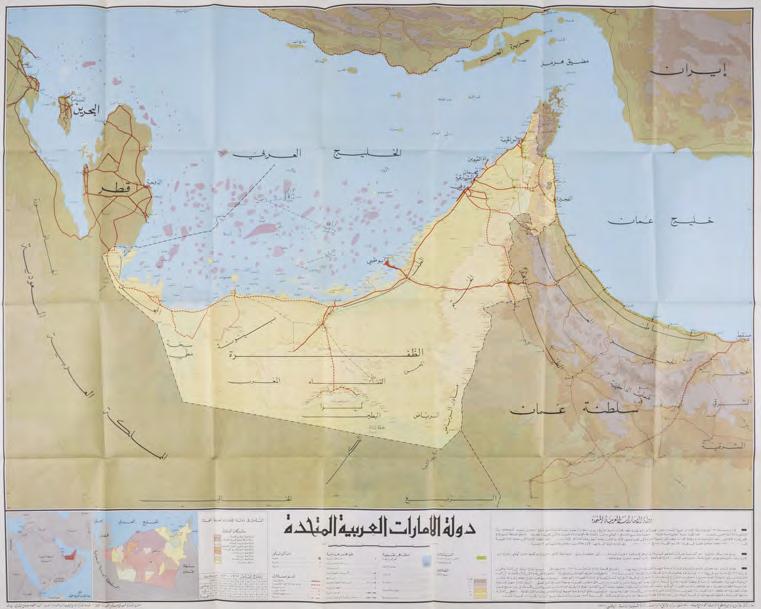
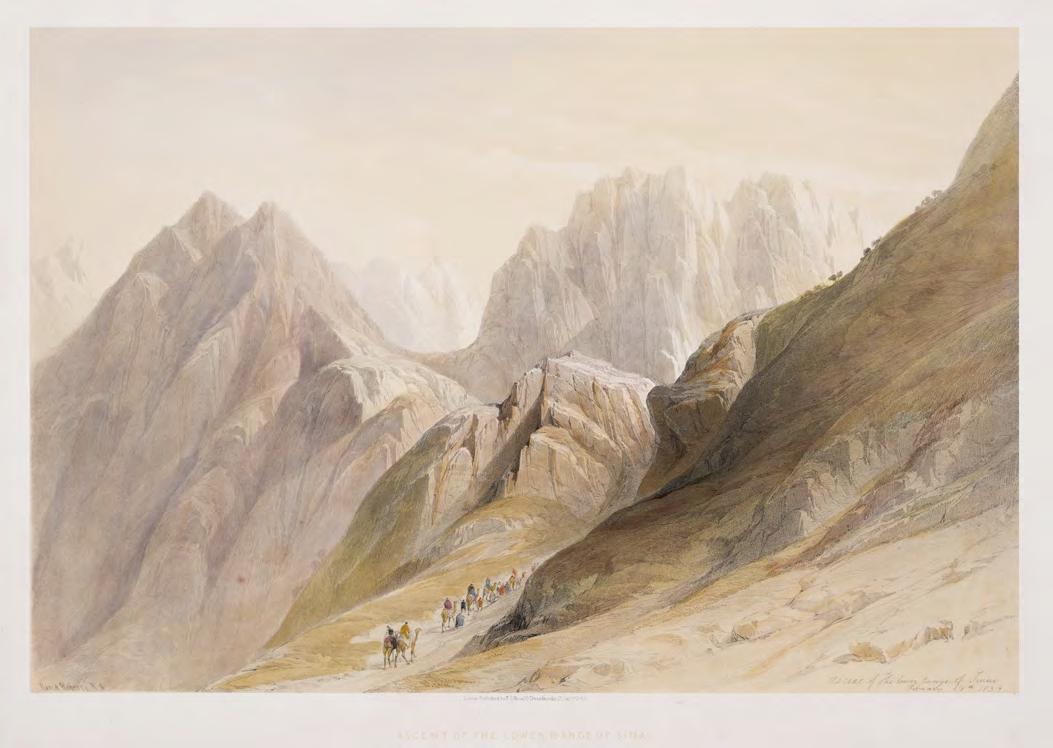
296
Roberts (David) THE HOLY LAND, SYRIA, IDUMEA, ARABIA, EGYPT, & NUBIA, 3 vol. in 2, FIRST EDITION, engraved portrait frontispiece in vol. 1, 3 engraved titles, 61 full page lithographed plates by Louis Haghe after David Roberts, with extensive fine hand-colouring, 1 map, several half page illustrations, tissue-guards (some with tears), vol. 1 & 2 titles, c. 16 plates & most of illustrations with wash staining to sheets, 2 pp. excised and laid down to new sheets vol. 2, the odd plate trimmed close at foot, touching a few letters, vol. 3 a few plates working loose at gutter, the odd small marginal tear, some with neat repairs, scattered spotting and water-staining, handsome contemporary red morocco, gilt, spines gilt in compartments, some wear to joints, rubbed and bumped, g.e., [Abbey 385], folio, 1842-9.
⁂ “ONE OF THE MOST IMPORTANT AND ELABORATE [PUBLISHING] VENTURES OF THE NINETEENTH CENTURY” (ABBEY)
£10,000 - 15,000
297
Roberts (David) THE HOLY LAND, SYRIA, IDUMEA, ARABIA, EGYPT & NUBIA, 6 VOL IN 3, FIRST QUARTO EDITION, 248 tinted lithograph plates finished with hand-colouring, including portrait frontispiece and 6 pictorial titles, 2 uncoloured maps, tissue-guards, closed marginal tear to portrait near gutter, some foxing to plates, mostly marginal, original deluxe binding of gilt-stamped navy morocco, covers with central gilt arms of Jerusalem, neat and expert restoration to spine ends, joints and corners, g.e., [Abbey, Travel 388; Blackmer 1432], 4to, 1855-56.
⁂ THE FIRST QUARTO EDITION OF ROBERTS’ MASTERPIECE, VERY RARE WITH CONTEMPORARY HAND-COLOURING. In this set, the normally tinted plates have been finished by hand, closely imitating the deluxe colouring of the original folio edition (1842-49). Howard Radclyffe, former director of Bernard Quaritch Ltd., who handled this copy in the previous century, explains in a loosely inserted typed description that “coloured copies of the “small” edition of this celebrated work are extremely rare and this is the first copy to have passed through our hands. They were commissioned at the express wishes of subscribers who preferred the smaller format to the huge folio edition”
£12,000 - 18,000
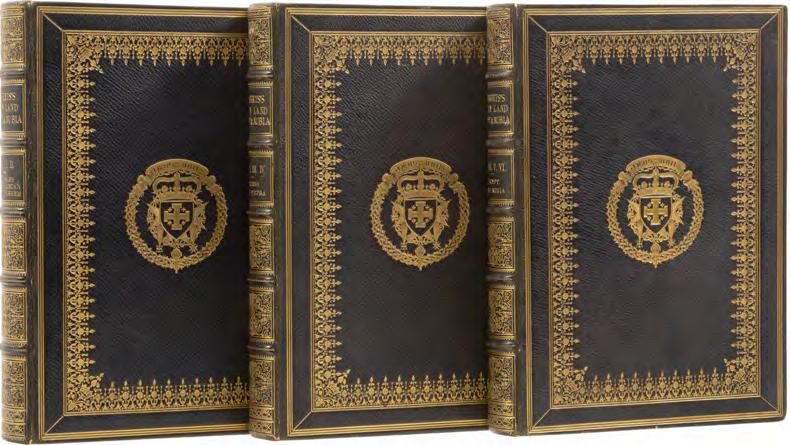
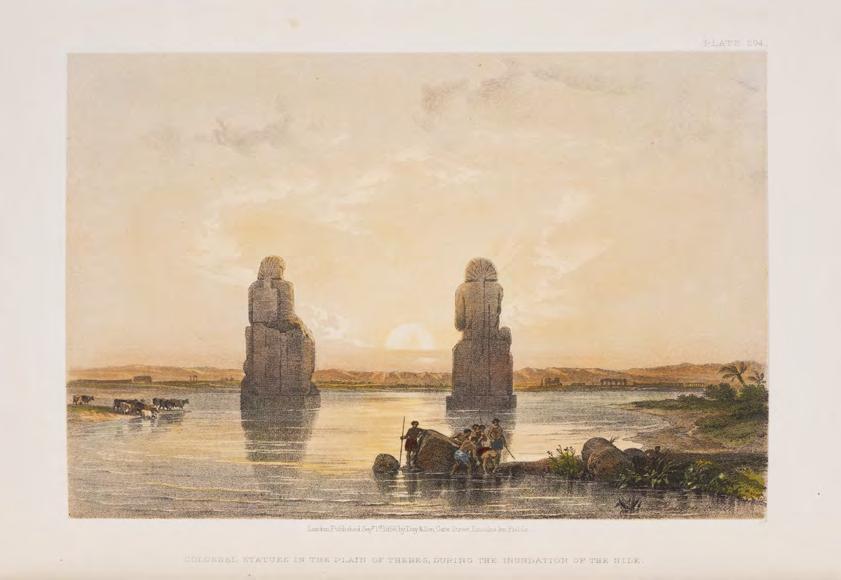
298
Souhby (Dr. Saleh) PÈLERINAGE A LA MECQUE ET A MÉDINE, FIRST EDITION, PRESENTATION INSCRIPTION FROM AUTHOR TO AHMAD MAZLUM, half-title, 19 photographic plates, evenly toned throughout, occasional light off-setting and spotting, later calfbacked boards, fractional rubbing to corners, 8vo, Cairo, Imprimerie Nationale, 1894.
⁂ Presentation inscription to Ahmad Mazlum (1858-1949), and Egyptian judge, cabinet minister (Minster of Justice and then Minister of Finance) and Parliamentary Leader.
Souhby was an Egyptian public health official who was commissioned by Khedive ‘Abbas II to write a report on the sanitary conditions experienced by pilgrims travelling to Mecca. He performed the hajj twice, once in 1888 and again in 1891, producing this detailed account, to which are affixed a response to European criticisms of Islam and an appendix making several suggestions with regard to improving hygiene practices en route
£3,000 - 4,000
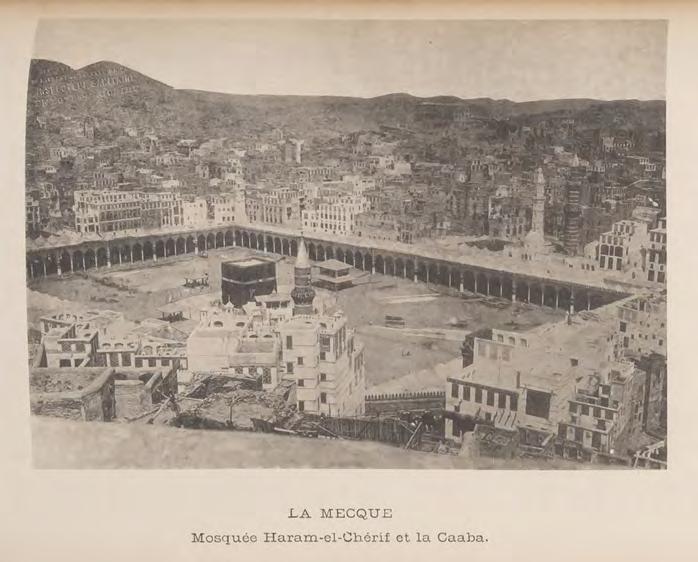
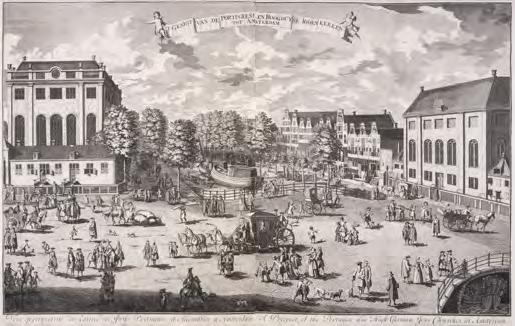
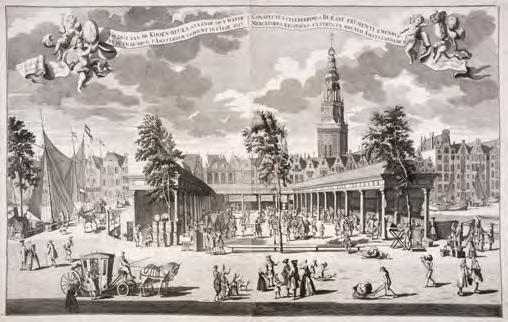
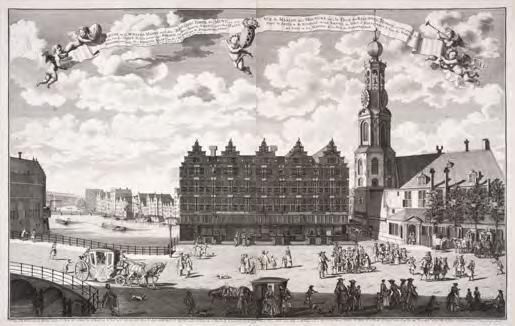
Amsterdam.- Gunst (Pieter van) and others. COLLECTION OF 14 FINE PANORAMIC VIEWS OF 18TH CENTURY AMSTERDAM, etchings and engravings, including two duplicate impressions, all on two sheets of laid paper conjoined, various sizes between approx. 580 x 970 mm (22¾ x 38¼ in) and 630 x 1050 mm (24¾ x 41¼ in), most mounted on thin conservation support, or with sections of support verso, some minor repaired splitting and marginal nicks and tears, all unframed, [circa 1700 or slightly later] (14)
⁂ Views include Amsterdam’s Jewish Quarter; a view of Amsterdam from the South; view outside the Haringpakkerstoren looking towards the Koepelkirk; a view of the Kolveniersburgwal; a view of the Amstel from the Hogesluis towards the Zuiderkerk; view of the Zeemagazijn, or Naval Arsenal of Amsterdam; a view of the Muntplien with Munttoren and the Englese Huizen; a view of the Korenbeurs or Corn Exchange; a view of the Schreiershoekstorem; and others. Engravers and artists include Bsatiaen Stoopendaal, Daniel Stoopendaal, Adolph van der Laan, and others similar. For a full list of images of views, please contact us
£6,000 - 8,000
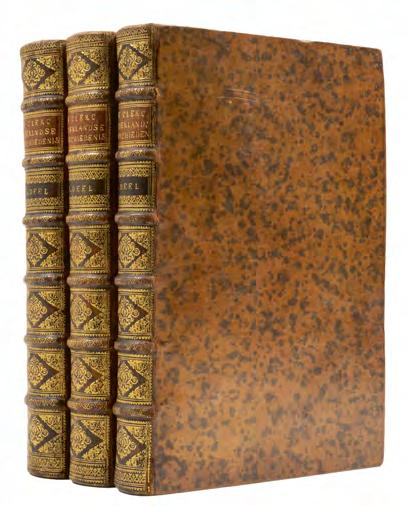
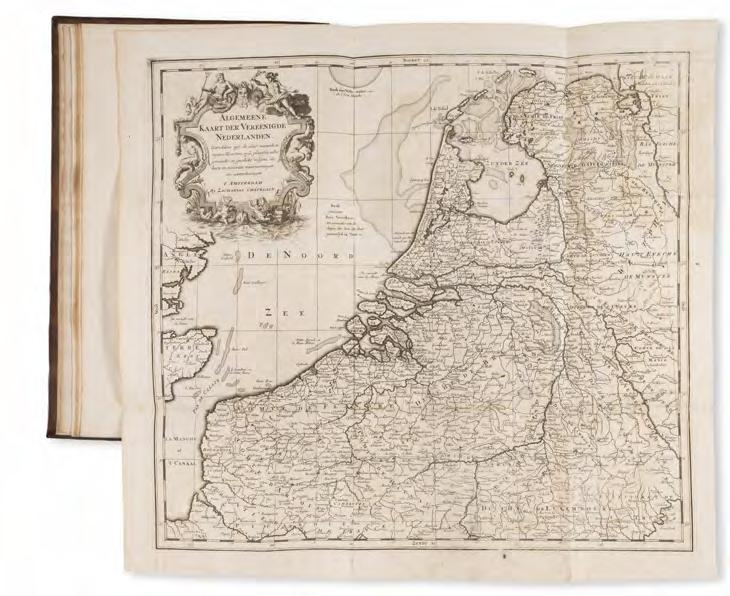
300
-. Le Clerc (Jean) GESCHIEDENISSEN DER VEREENIGDE NEDERLANDEN, 3 vol., FIRST DUTCH EDITION, half-title to vol. 1 only, titles in red and black, 110 engraved plates (49 double-page), 2 folding engraved maps, occasional light spotting, bookplate, contemporary mottled calf, richly gilt spine in compartments, fractional rubbing to corners and extremities, folio, Amsterdam, Zacharias Chaterlain, 1730.
⁂ A comprehensive history of the United Provinces from the Dutch Revolt to 1715, including fine engraved portraits of key historical figures and with large folding plates showing various battles and other significant events in Dutch history.
£1,800 - 2,200
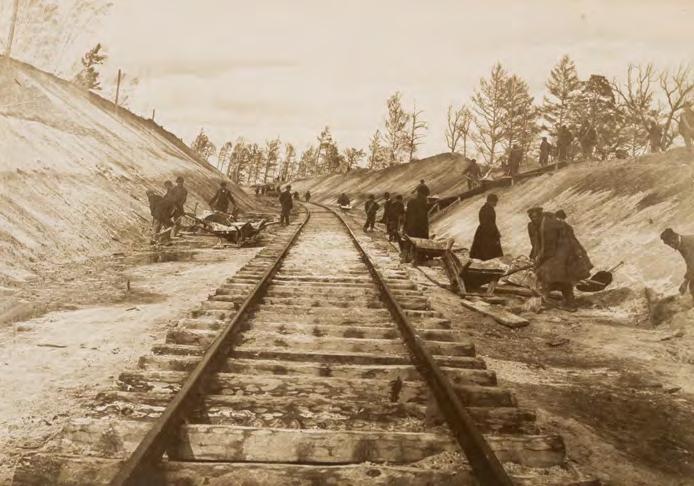
301
Russia.- [AMUR RAILWAY], 202 phototype prints, loose as printed, each c.182 x 253 mm., 32 with captions in manuscript to verso, several with slight creasing or chipping to edges, housed in contemporary portfolio, lacking one flap, lacking backstrip but holding firm, rubbed, bumping to corners and extremities, folio, c.1910-14.
⁂ An important collection of early photographs depicting the construction of the central section of the Amur Railways, and showing the newly built railway stations, convict workers, penal infrastructure and emerging railway towns along the route.
The Amur Railway is a 2144 kilometer stretch of the famous Trans-Siberian railway, which was initiated under the reign of Tsar Nicholas II in order to link the Russian Far East with the rest of the Russian Empire. This was an incredibly important piece of transport infrastructure which is still in use today.
£1,500 - 2,000
302
-. Architecture.- Chernikov (Yakov Georgievich)
FANTAZII [ARCHITECTURAL FANTASIES], FIRST EDITION, 4 title pages (Russian, German, French and English), 101 colour plates, monochrome illustrations, some full-page, text ff. lightly browned, occasional spotting or finger-marking, ?later black endpapers, original blindstamped cloth, spine faded and with ends little frayed, corners worn, some marking, rubbed, 4to, Leningrad, Leningrad ‘International Book’ Association, 1933.
⁂ ‘an amazing compendium of one hundred and one coloured inventions which still excite the imagination today’ (S. Compton, Russian Avant-Garde Books 1917-34, 1992, p. 142). One of the most influential architectural works of the 20th century. The designs proved to be far too radical and impractical for the Soviet authorities. They needed to produce maximum living space at minimum cost in order to accommodate the workers flocking to the cities under Stalin’s ‘Five Year Plans’.
£3,000 - 4,000

303
South America.- Ouseley (Sir William) VIEWS IN SOUTH AMERICA, FROM ORIGINAL DRAWINGS MADE IN BRAZIL THE RIVER PLATE, THE PARANA, &C.,lithographed title and 26 tinted plates, 1 plan, tissue-guards (a few small tears), bookplate of B. F. Sulivan, additional oblong watercolour landscape laid down to upper margin of Obligado map by C. G. Fegan, title bound after dedication p. and first plate, a few other plates bound out of order, small worming to inner margin of endpapers and dedication p. (repair to inner margin dedication p.), “The Waterfall of Itamaraty” trimmed close at fore-margin, touching or cutting plate slightly, scattered spotting and a few small tears, some marginal staining and a couple of plates browned, cracking at gutter, some plates and hinges reinforced at inner margin, contemporary half morocco, spine a little chipped, rubbed and bumped with a few marks, folio, [Sabin 57947], Thomas McLean, [1852].
⁂ Among the rarest lithographed view books on South America, notably unrecorded by Abbey.
Sir William Ouseley served in Rio de Janeiro from 1823, becoming chargé d’affaires in 1838. Following a diplomatic mission to Uruguay and Argentina in 1844, he returned to England in 1850 and published this selection of drawings and watercolours from Brazil and the Río de la Plata
£4,000 - 6,000
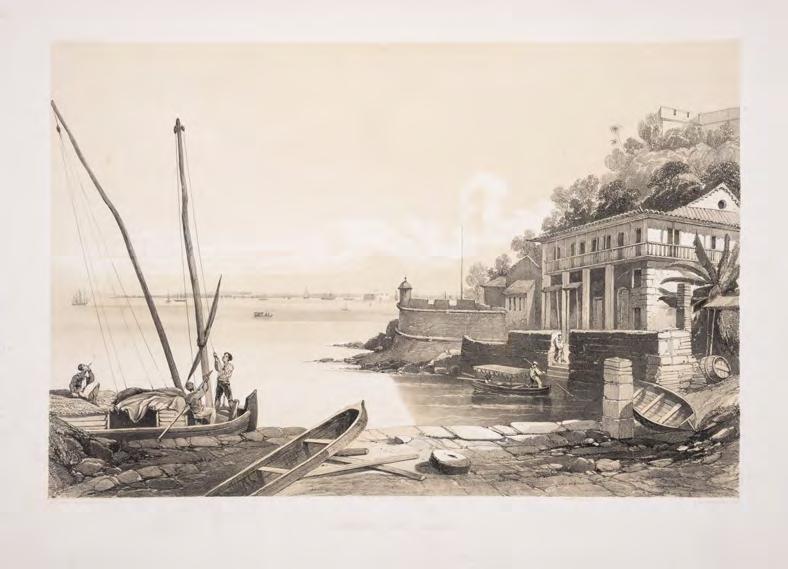

304
Turkey.- Schranz (Joseph) [LE BOSPHORE ET CONSTANTINOPLE, DESSINÉS D’APRÈS NATURE], 2 folding four-section lithographic panoramas of the Bosporus, 10 lithograph plates by Léon Sabatier and A. Bayot after drawings by Schranz, 7 with full-hand-colouring, some heightened with gum arabic, the panoramas each measure approx. 237 x 1255 mm (9¼ x 49⅜ in), the folding panoramas with splitting to folds, crudely restored folds to some, scattered spotting and surface dirt throughout, original cloth, gilt title to upper cover, the cover detached, lacking spine, worn, oblong 4to, [circa 1850]
⁂ Scarce. Two fine panoramas and ten scenes of everyday life in Istanbul
£1,200 - 1,800
305
Around the world.- India (Edward VII), China, Japan, America (Joseph Pulitzer).- Clifford (Lewis H[enry], ninth Baron Clifford of Chudleigh, of Ugbrooke Park, Devon, 1851-1916). “GLOBE TROTTER.” Diary, manuscript, 748pp., 4pp. printed pamphlet at end: “Inman Line. List of Saloon Passengers Per Mail Steamer ‘City of Berlin’ From New York to Liverpool, Sailing April 28, 1877” with Clifford’s name marked with ink in passenger list, later ink inscription on front free endpaper, occasional ink staining and off-setting, a few margins rubbed and toned, original half morocco, 8vo, 21st November 1875 - 6th May 1877.
⁂ A detailed account of a journey to India, China, Japan and America and around the world. Lewis Henry Clifford (1851-1916) travelled on the steam ship Assam through the Bay of Biscay, past Gibraltar, Malta (stopping in the harbour), Port Said, through the Suez Canal, “about 30 feet deep” and into the Red Sea, Aden, Ceylon, landing in Madras. In India he submits a letter of introduction at Government House, meets some friends, visits a tea auction, goes to the opera and sees some rajah’s sitting in the viceroy’s box. In India he is introduced to Edward, Prince of Wales (the future Edward VII) on his tour of the subcontinent and joins him on numerous formal and informal occasions: “Wednesday Dec 15th [1875] Arriving at Calcutta the Viceroy asked me to come up & see the reception in private durbar of Sindia Jeypore & Puttiala. ...The Prince [Edward] was looking remarkably well & as stout as ever. The cheering was not enthusiastic owing I fancy to the scattered position of the Europeans, the natives of course never cheering... . In the evening Courtenay and myself went to G[overnment] House to dine...”. Also while in India Clifford details an expedition with Viscount Ebrington to Kashmir (Gilgit, Baramulla etc.), shooting Ibex, a bear and a musk deer and describes camping life with “coolies” serving them.
After India Clifford travelled back to Ceylon (Hambantota and Galle), and then by ship to the Far East, one of his travelling companions being William Palgrave (1826-88), Arabist and traveller on his way to Manila to take up a diplomatic posting, “Palgrave’s Nubian servant ‘the man Friday’ as he is called on board was very nearly left behind. He only reached the steamer just as she was moving out of harbour. His state of alarm at the prospect of being left among a race he had not seen before with no one who spoke his native tongue was very absurd.” From Ceylon Clifford sailed to Penang, Singapore, Hong Kong, Canton, Shanghai, Nagasaki, Kyoto, Tokyo, and in Japan Clifford met Sir Harry Parkes (182885), diplomatist. From Yokohama Clifford sailed across the Pacific and landed at San Francisco and then by train and coach to Santa Barbara (with a piece discussing the California gold rush), Los Angeles, Yosemite Falls and by Pacific Railroad to Cheyenne, St. Paul, Kansas City, Jefferson City, St. Louis (staying with General Daniel Frost, meeting Joseph Pulitzer and enquiring after Bishop Ryan and Archbishop Kenrick), New York and by ship on the ‘City of Berlin’ to Liverpool and by train back to Ugbrooke Park
£2,000 - 3,000
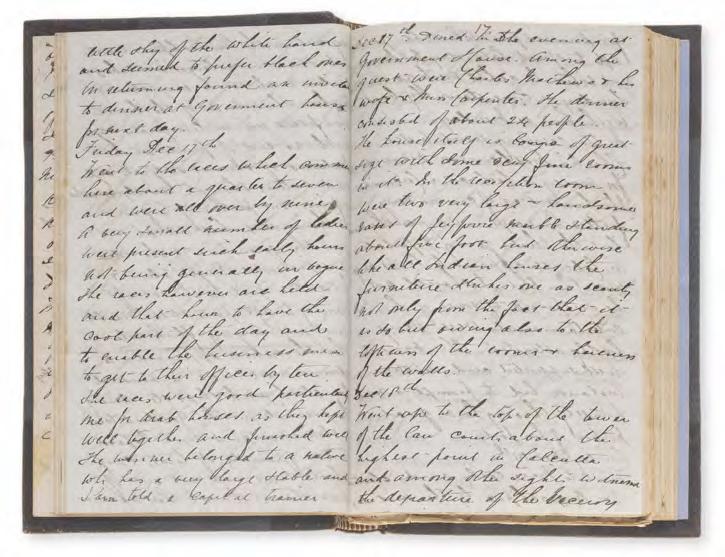
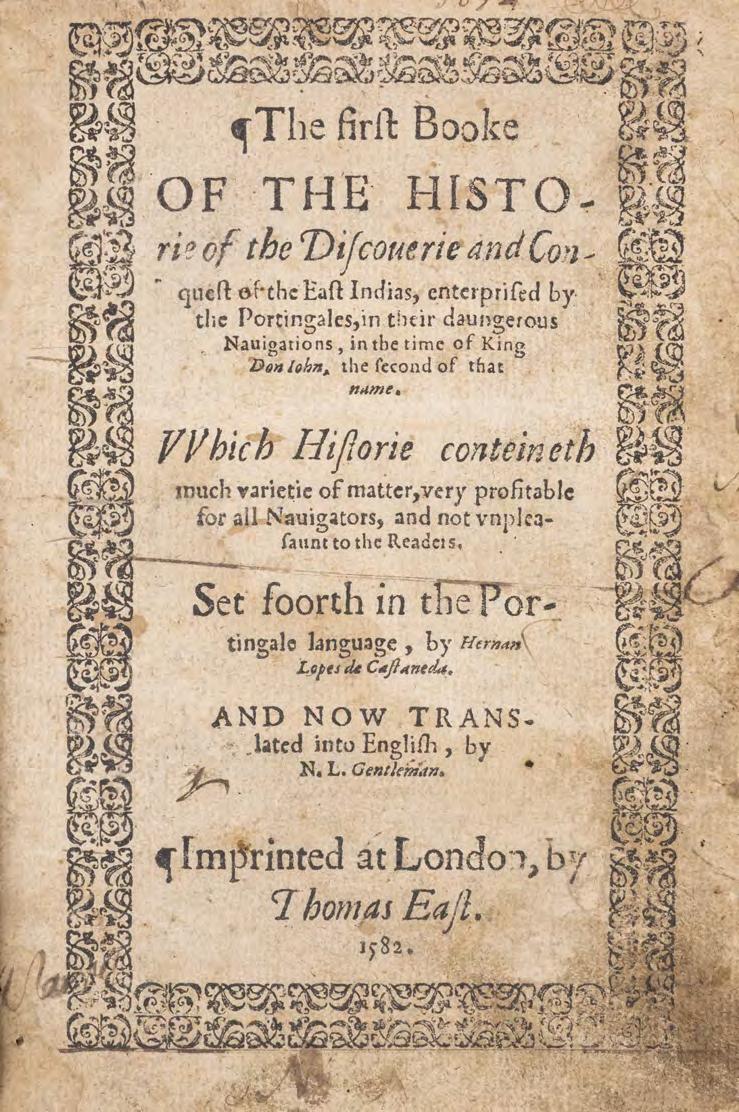
Castanheda (Fernão Lopes de) THE FIRST BOOKE OF THE HISTOIRE OF THE DISCOVERIE AND CONQUEST OF THE EAST INDIAS, ENTERPRISED BY THE PORTINGALES, translated by Nicholas Lichfield, FIRST ENGLISH EDITION, large tear to Hh1 into text, later ink inscriptions to title and A4, light worming to gutter touching a few letters, staining, trimming to edges with occasional loss to printed side-notes, later calf, expertly rebacked preserving original backstrip and recornered, tooled in gilt, [Borba de Moraes 166-67; ESTC S108825; Hill 1035; Penrose Sabin 11391 (“A most interesting and rare book”); STC 16806; not in Church], small 4to (approx. 180 x 130mm), by Thomas East, 1582.
⁂ ONE OF THE EARLIEST AND MOST IMPORTANT WORKS ON WORLD EXPLORATION IN ENGLISH FROM THE GREAT AGE OF DISCOVERY
Most of the work explores the Portuguese expansion into Asia in the early sixteenth century, chronicling their epic expansion into India, the East Indies, and China between the years 1497-1525. THE WORK IS ALSO THE FIRST TO DESCRIBE IN DETAIL THE VOYAGE OF CABRAL AND HIS DISCOVERY OF BRAZIL IN 1500, on his way to the East Indies, recounted in chapters 29-31.
Nothing more was ever printed in English or Spanish, as ‘the first booke’ was all that was published; Nicholas Lichfield, the translator, dedicated the book to Sir Francis Drake.
£15,000 - 20,000
307
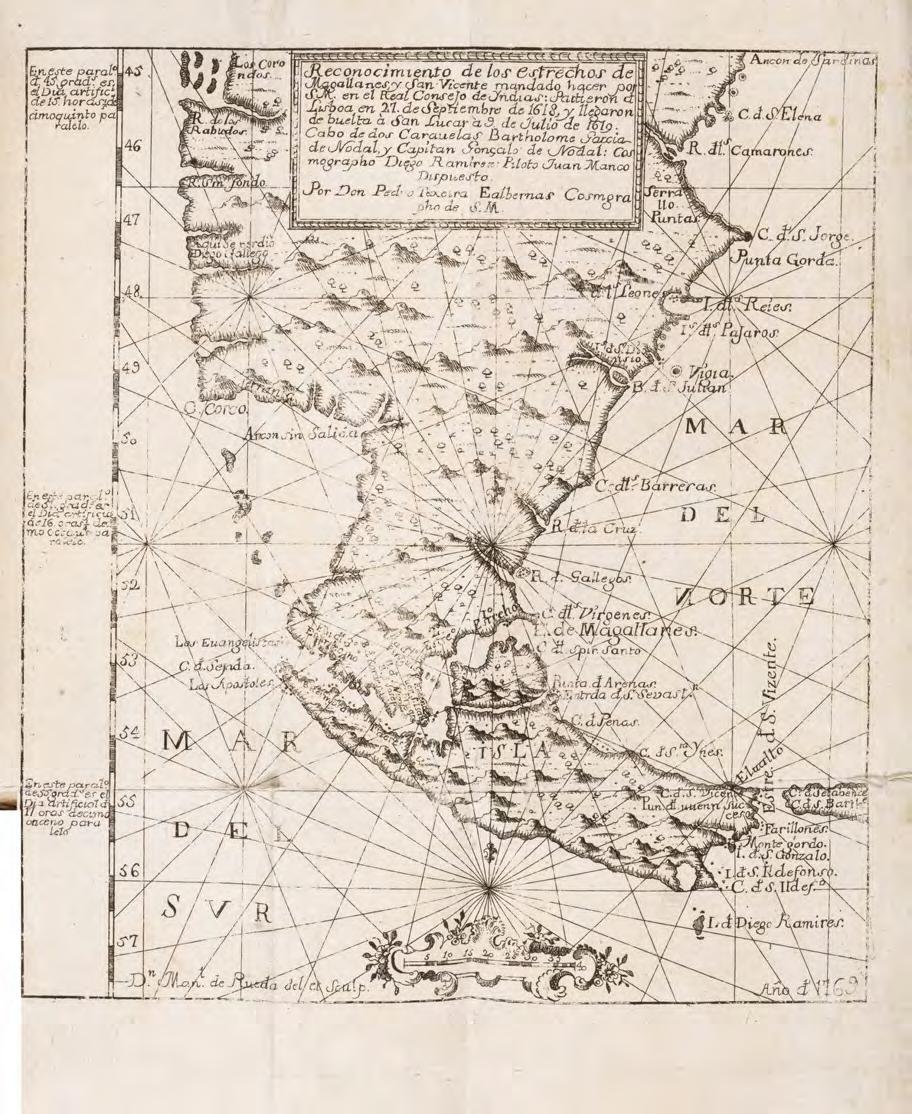
Nodal (Bartolomé Garcia de) & Goncalo Nodal RELACION DEL VIAJE QUE POR ORDEN DE SU MAGD Y ACUERDO DEL REAL CONSEJO DE INDIAS, FIRST EDITION, second edition engraved folding map, engraved title (ink ownership inscription at foot), woodcut illustrations, lacking b8 (?final blank), few ff. with very skilful repairs to outer margin, light surface staining, 18th-century calf, sympathetically rebacked, gilt, gilt Lyre device to covers, covers a little scuffed, [Alden & Landis 621/90; Borba de Moraes II 616; Church 386; Hill 1231; JCB (3) II 156; Palau 99485; Sabin 55394], small 4to, Madrid, for Fernando Correa de Montenegro, 1621.
⁂ ONE OF THE RAREST VOYAGE ACCOUNTS OF THE SEVENTEENTH CENTURY (Hill).
The map from the first edition is so scarce that it is believed to have been withdrawn, in accordance with the official Spanish policy of secrecy. The Nodal expedition was meant to provide the Spanish with vital geographic information about the crucial, yet little known, area around the Straits of Magellan.
This voyage includes the first circumnavigation of Tierra del Fuego and was a reconnaissance mission sponsored by King Philip III of Spain in 1619. The Spanish authorities were alarmed by the news of recent discoveries of Jacob le Maire and Willem Schouten during their voyage if 1616 in search of the Southern Continent, and wanted the Nodal brothers to confirm their discoveries from the Atlantic to the Pacific to the south of Tierra del Fuego.
£12,000 - 18,000
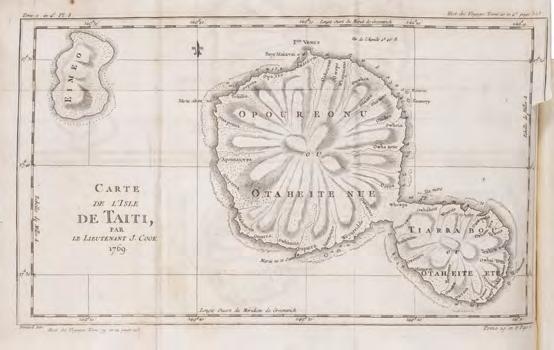
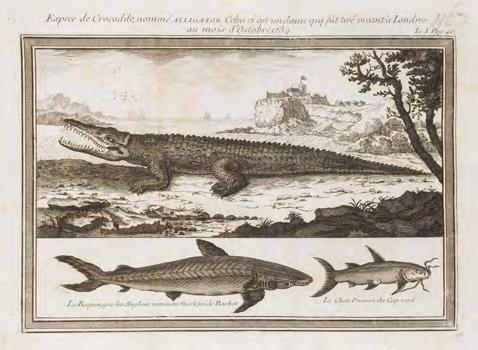
308
Prévost (Antoine François, Abbé) HISTOIRE GÉNÉRALE DES VOYAGES, OU NOUVELLE COLLECTION DE TOUTES LES RELATIONS DE VOYAGES, 20 vol., halftitles (9 vol. only), engraved portrait frontispiece, titles in red and black, 350 plates (103 folding or double-page), 310 maps and plans (241 folding), engraved initials, head- and tail-pieces, occasional light spotting and staining, bookplate, contemporary half-calf, vol. 20 rebacked, very slight rubbing to corners, [Brunet IV 868; Hill 1391; Sabin 65402], 4to, Paris, Chez Didot, 1746-89.
⁂ Complete in 20 vol., with volume 16 being an index published by Didot’s widow, and volume 17 being a supplement relating to new voyages in the East Indies drawn from the Dutch edition which was printed at The Hague. The final 3 volumes are a continuation concentrating on voyages to the Arctic as well as the Pacific Voyages of Cook, Wallis, Byron and Bougainville
£4,000 - 6,000
309
Scurvy.- Cook (Captain James).- Pringle (Sir John) A DISCOURSE UPON SOME LATE IMPROVEMENTS OF THE MEANS FOR PRESERVING THE HEALTH OF MARINERS, FIRST EDITION, half-title, light spotting to last few ff., a few spots elsewhere, light browning, tipped in bookseller’s description to front free endpaper, 20th-century green morocco-backed cloth, spine lettered in gilt, [ESTC T32010; Garrison-Morton 2156 & 3714; Norman 508], small 4to, for the Royal Society, 1776.
⁂ Pringle’s treatise on preserving the health of mariners which includes THE FIRST APPEARANCE OF COOK’S PAPER ON THE METHOD TAKEN FOR PRESERVING THE HEALTH OF THE CREW OF THE RESOLUTION THE PAPER EARNED COOK HIS COPLEY MEDAL
In this paper, Cook describes the supplies carried on the voyage and his maintenance of the cleanliness of his ship and crew. “Following the scurvy-preventing suggestions of James Lind, Cook lost only one man to disease on his second voyage from 1768-1771” (Garrison-Morton).
During Pringle’s presentation of Cook’s Copley Medal, Pringle publicized MacBride’s “ingenious theory” which stated that “wort, or infusion of malt, as a substitute for fresh vegetables” was a cure for scurvy, using Cook as his authority. Cook had written to Pringle from Plymouth Sound on July 7: “I entirely agree with you that the dearness of the rob of lemon and oranges will hinder them from being furnished in large quantities. But I do not think this so necessary; for though they may assist other things, I have not great opinion of the alone. Nor have I a higher opinion of vinegar”. Interestingly, neither lemon juice not malt were tried on Cook’s third and last voyage. (Lloyd and Coulter, Medicine and the Navy, III)
£10,000 - 15,000
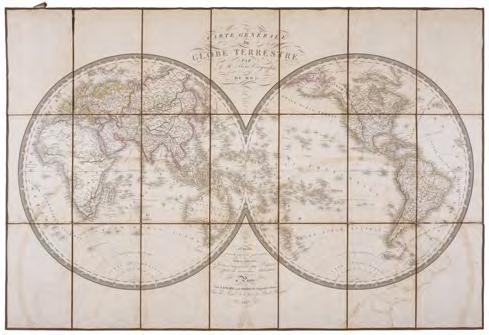
310
Brué (Adrien Hubert) BOXED SET OF SIX FOLDING MAPS OF THE WORLD AND CONTINENTS, engraved maps with outline hand-colouring, each sheet approx. 615 x 920 mm (24¼ x 36¼ in), dissected and mounted on linen, some off-setting, surface dirt and minor browning, each folding with publisher’s printed label to end panel, presented in contemporary marbled slip-case with red gilt label to spine, very worn, some splitting to slip-case, 8vo, Paris, Andriveau and Goujon, 1827
⁂ Maps include: Carte Generale du Globe Terrestre; Carte Physique et Politique de l’Amerique Septentrionale; Carte Physique et Politique de l’Amerique Meridionale; Carte Physique et Politique de l’Europe; Carte Physique et Politique de l’Asie; Carte Physique et Politique de l’Afrique
£600 - 800
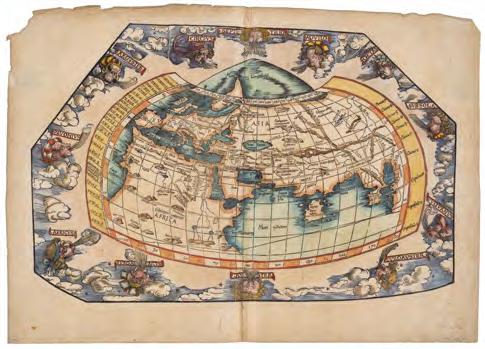
311
Fries (Laurent) THE PTOLEMAIC WORLD MAP, FROM ‘GEOGRAPHIA’, doublepage woodcut map of the world, with the decorative border illustrating wind-heads and clouds, with full hand-colouring, on laid paper without watermark, sheet 365 x 505 mm (14⅜ x 19⅞ in), blank verso except for page number ‘27’, central vertical fold with parallel creaing, other soft creases to sheet, marginal sheet loss to upper left corner, rough edges, three small repairs to splitting and marginal loss visible verso, some minor toning and surface dirt, unframed, [circa 1525, or slightly later]
⁂ A reduced version of the old map of the world first published by Waldseemuller in 1513
£1,500 - 2,000
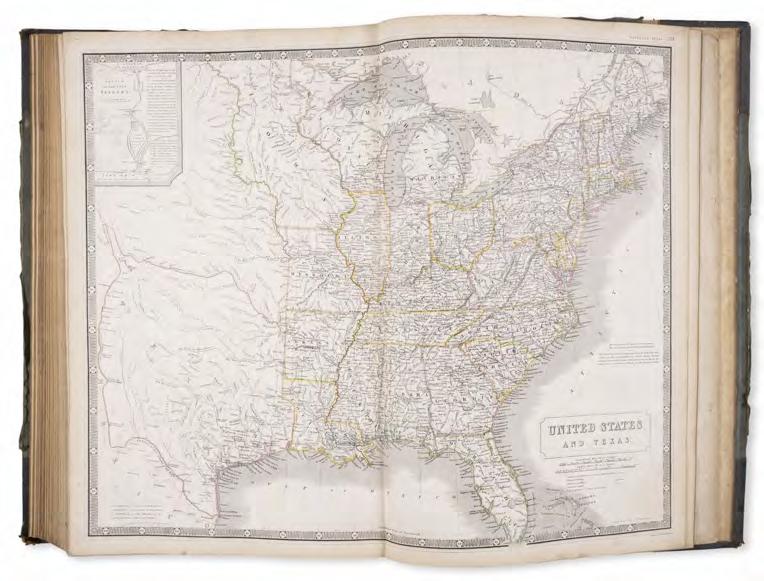
312
Independence of Texas.- Johnston (Alexander Keith) THE NATIONAL ATLAS OF HISTORICAL, COMMERCIAL AND POLITICAL GEOGRAPHY, title, dedication, 41 double-page maps with outline hand-colouring, each sheet approx. 535 x 650 mm (21 x 25½ in), the map of South American detached but present, spotting and surface dirt throughout, original half morocco, green cloth, gilt title to upper cover, rubbed and scuffed, worn, lower cover with loose cloth, folio, Edinburgh, Cowan & Co., [c.1842]
⁂ Including the map of United States and Texas, which bears the note “The Independence of Texas was formally declared in March 1836. It was recognized by Great Britain in Novr. 1840; and has been acknowledged by the United States, France, Holland and Belgium.”
£700 - 1,000
313
Mela (Pomponius) DE ORBIS SITUM LIBRI TRES, ACCURATISSIME EMENDATI..., 2 parts in 1 vol., second edition, titles within richly decorated woodcut borders by Hans Franck, woodcut initials, woodcut printer’s device to verso of final f., very occasional ink marginalia, repair to title inner margin, scattered light staining and surface soiling, some occasional spotting or rust marks, modern antique-style speckled calf, spine gilt in compartments, [VD16 M2314], folio (c. 300 x 210 mm), Basel, apud Andreas Cratander (from colophon), 1522.
⁂ A significant work of classical geography, presenting the Roman conception of the known world divided into Europe, Africa, and Asia. It influenced Renaissance scholars and early cartographers in their understanding of global space
£1,800 - 2,200
314
S.D.U.K MAPS OF THE SOCIETY FOR THE DIFFUSION OF USEFUL KNOWLEDGE, 2 VOL , including 215 single-page engraved maps (of 218), missing ‘Geological England’, and both East and West Plans of Paris, a handful of the maps with original outline hand-colouring, the vast majority uncoloured, some single-page maps form double-page maps, surface dirt and browning throughout, a handful of folding maps with splits to folds, one or two repaired tears, one repaired tear visible verso of ‘North America Sheet VI’, titles and endpapers with heavy creases and old folds visible, 19th century half calf, very scuffed and worn, some losses, folio, Chapman and Hall, 1844
⁂ The two volumes contain 12 maps of the world, 6 star charts, 21 maps of North America, 15 maps of Indian interest, 4 maps of Australia and New Zealand, a chart of the principal rivers of the world; the atlas also includes numerous plans of cities around the world
£1,500 - 2,000
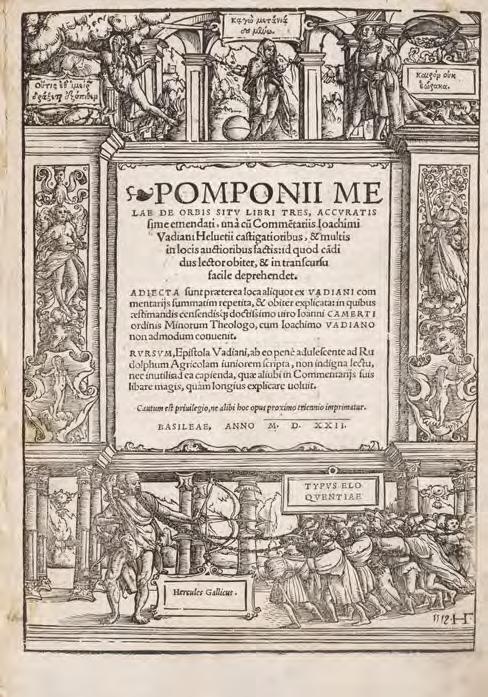
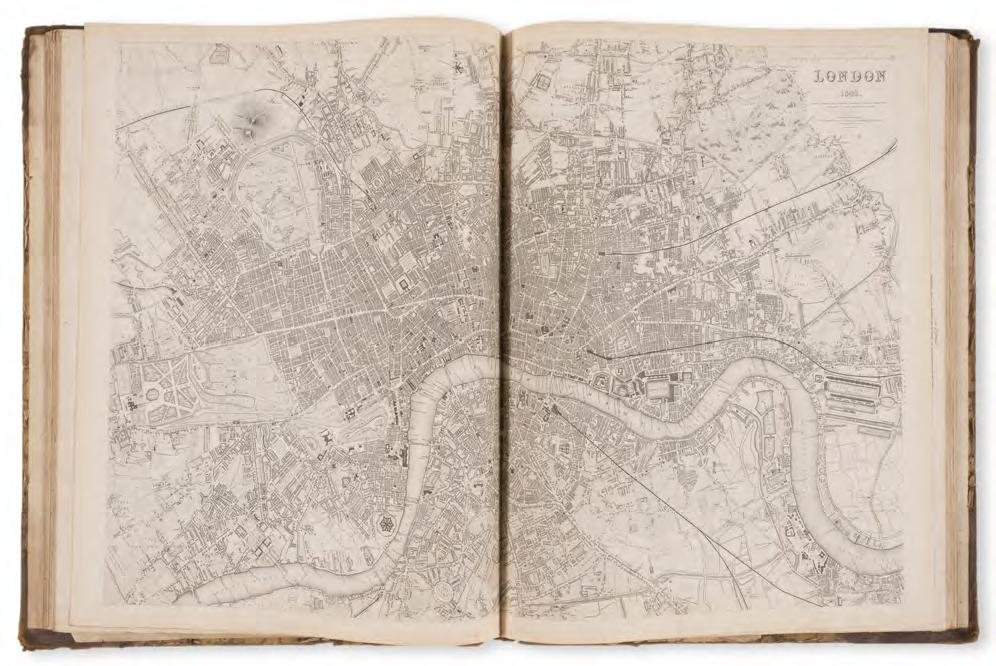
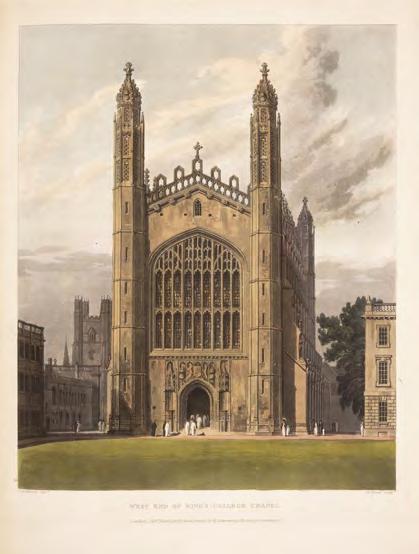
315
Cambridge.- Ackermann (Rudolph, publisher) A HISTORY OF THE UNIVERSITY OF CAMBRIDGE, 2 vol., FIRST EDITION, half-titles, engraved portrait of the Duke of Gloucester, 79 plates, lacking 16 portraits of Founders, as often, all fine hand-coloured aquatints or stippleengravings by Stadler, Havell, Agar, Bluck, Hill and Reeve after Pugin, Westall, Mackenzie, Uwins and Pyne, list of subscribers, Sir Alfred Seale Haslam bookplates on front pastedowns, light off-setting, overall a bright and clean set, contemporary half morocco, spines gilt in compartments, spines faded, covers and joints lightly rubbed, t.e.g., [Abbey Scenery 80; Tooley 4], 4to, 1815
£1,500 - 2,000
317
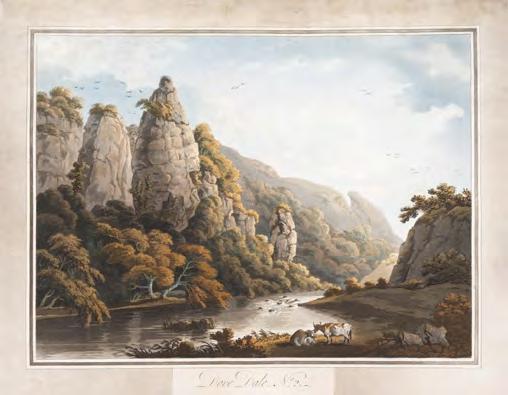
316
Derbyshire.- Hofland (T.) and T. Barber SIX VIEWS IN DERBYSHIRE, FIRST EDITION, 6 hand-coloured aquatint plates by J. Bluck, tissueguards, contemporary ink ownership inscription to title, soiled with a few stains, a few small marginal tears and nicks, some with neat repairs, loose in later half calf protective case, gilt, a few marks, Nottingham, [Abbey Scenery 109], oblong folio, E. B. Robinson, 1805.
⁂ Thomas Christopher Hofland (1777–1843) was an English artist who developed a strong affection for Derby after moving there in 1805. The second husband of the writer Barbara Hofland, he spent much of his life painting and fishing, while relying largely on her literary earnings. He exhibited 72 paintings at the Royal Academy and over 100 as a founding member of the Society of British Artists
£1,000 - 1,500
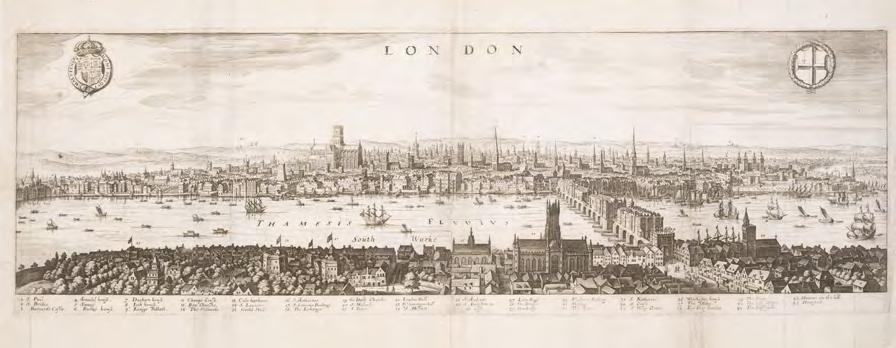
Before the Great Fire of 1666.- Merian (Matthaeus) LONDON, a bird’s eye view from Whitehall to beyond the Tower, with Southwark in the foreground, engraved panorama on two sheets, conjoined, total platemark 229 x 700 mm (9 x 27½ in), old folds as issued, some sympathetic and expert restoration to splits to folds and minor marginal nicks, some slight surface dirt, minor soft creases, unframed, [circa 1638 or slightly later]
⁂ Fine example of Merian’s panoramic view of London before the Great Fire of 1666, made during the reign of James I
£1,000 - 1,500
318
Lemprière (Clement) Follower of PLAN OF THE TOWER OF LONDON AND PARTS ADJACENT 1726, manuscript plan with pen and ink, watercolour, traces of pencil, on 18th century laid paper with watermark of a Strasbourg lily and countermark of Jean Villedary, sheet 475 x 660 mm (18¾ x 26 in), old folds and handling creases, some splitting but reinforced verso, other small repairs to marginal nicks and splits, particularly the corners, unframed, [after 1726]
⁂ A finely executed plan by an anonymous, as yet unidentified hand, but presumably based on Lemprière’s manuscript plan from 1726 that was later published by the Society of Antiquaries of London in ‘Vetusta Monumenta’, circa 1815
£800 - 1,200
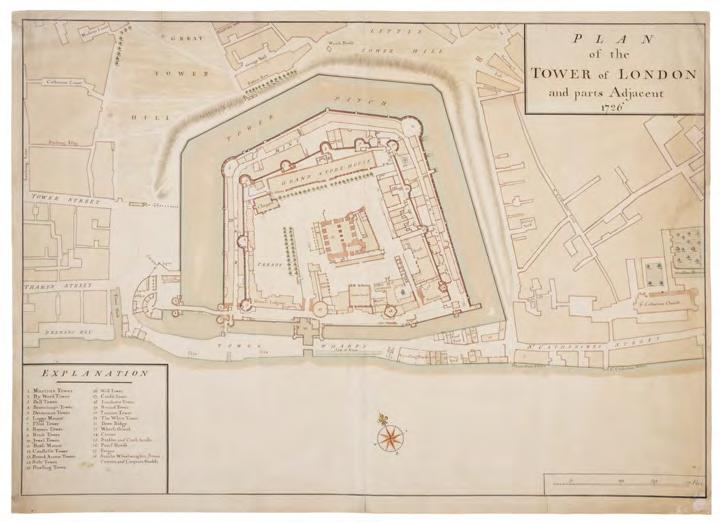
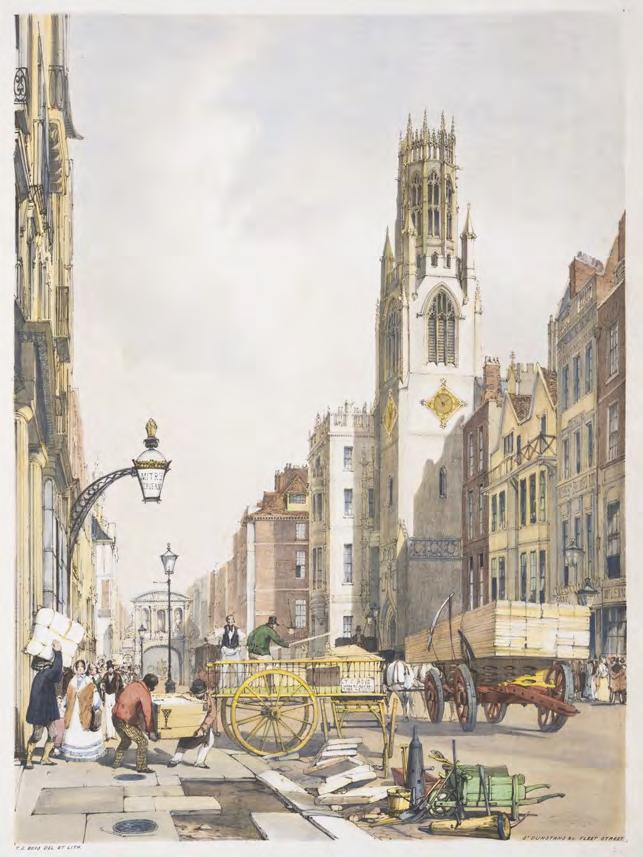
319
Boys (Thomas Shotter) ORIGINAL VIEWS OF LONDON AS IT IS, text in English and French, additional lithographed title and 25 plates, finished with hand-colouring, original upper wrapper remounted and bound at end (rather torn and browned), a few marginal repairs, scattered spotting and finger-soiling, else a bright copy, modern half morocco, spine gilt in compartments, spine ends and corners lightly bumped, a few marks, [Abbey Scenery 240], folio, 1842.
⁂ Thomas Shotter Boys (1803–1874), who studied lithography in Paris alongside Prout and Bonington, produced this key pictorial record of 1840s London and one of the last major illustrated books of the city in the tradition of Malton and Ackermann. The work is notable for Boys’s playful self-insertion throughout the plates, including subtle selfportraits and hidden signatures embedded within the scenes
£4,000 - 6,000
The sale of goods at our Live Auctions and your legal relationship, as Bidder and/or Buyer, with us and the Seller are governed by our Conditions of Business.
Please read our Conditions of Business carefully before bidding and contact us if you have any questions. Please note that if you register to bid and/or bid at auction you will be deemed to have agreed to be bound by and will comply with our Conditions of Business. If registering to buy over a live online Bidding Platform, including our own BidFORUM platform, you will be asked prior to every auction to confirm your agreement to our Conditions of Business before you are able to place a bid. You may also be asked to accept any third party terms and conditions when bidding via a third party Bidding Platform. We may change our Conditions of Business from time to time, without notice to you.
We can be contacted in the following ways: Telephone: +44 (0)20 7871 2640
Email: info@forumauctions.co.uk
Post: FAO Head of Operations, Forum Auctions Limited, Ingate Works, 4 Ingate Place, Battersea, London SW8 3NS
Definitions and interpretation
In these Terms of Sale, the words ‘you’, ‘yours’, etc. refer to you as the Bidder or Buyer as the context requires. The words “we”, “us”, etc. refer to the Auctioneer. Any reference to a ‘Clause’ is to a clause of these Terms of Sale unless stated otherwise.
To make these Terms of Sale easier to read, we have given the following words a specific meaning:
“Auctioneer” means Forum Auctions Limited, a company registered in England and Wales with registration number 10048705 and VAT number 236 0168 28 and whose registered office is located at Ingate Works, 4 Ingate Place, Battersea, London SW8 3NS and/or its individual authorised auctioneer, as appropriate;
“Bidder” means a person participating or planning to participate in bidding at our auction;
“Bidding Platform” means any online bidding platform over which an auction is conducted allowing bidders to place bids. Bidding Platforms may be operated by the Auctioneer or by a third party service provider on the Auctioneer’s behalf;
"Business Day" means any day that is not a weekend or public holiday in England and the Auctioneer is open for business;
“Buyer” means the Bidder who makes the highest bid for a Lot accepted by the Auctioneer by the fall of the hammer;
"Conditions of Business" means:
(a) these Terms of Sale (bidding in Online Auctions is governed by our separate Online Terms of Sale);
(b) the General Information for Buyers at Auction available in our catalogue and on our Website;
(c) the listing of the Lot in our catalogue and on our Website including any special terms or symbols (please note that the most up-to-date listing will be on our Website);
(d) any additional notice in relation to a Lot, whether in the saleroom, announced during an auction, on any Bidding Platform or our Website (in the event of any doubt about whether additional notices apply to the sale of a Lot, the information listed on our Website at the time of the auction will be deemed conclusive); and
(e) our Website Terms of Use;
“Deliberate Forgery” means:
(a) a copy or imitation made in our reasonable opinion with the intention of deceiving as to authorship, attribution, authenticity, origin, date, age, period, culture, provenance, source or material;
(b) described in the catalogue entry (as amended by any saleroom or Website notice) without qualification or any indication that there may be any uncertainty or conflict of opinion in relation to the work being such a copy or imitation; and
(c) (c) which at the date of the auction or sale had a value materially less than it would have had if it had been as described;
"Estimate" means the price range within which, in our opinion, a Lot may reasonably be expected to sell. A reference to the "low Estimate" means the lower figure in such price range;
“Hammer Price” means the level of the highest bid accepted by the Auctioneer for a Lot by the fall of the hammer;
"Live Auction" means a live public auction where members of the public are given the possibility of attending the sale in person.
“Lot(s)” means an item offered for sale or a group of items offered together;
"Online Auction" means an auction held over the Website or any Bidding Platform where members of the public are not given the possibility of attending the sale in person;
“Premium” means the fee that we will charge you on your purchase of a Lot to be calculated as set out in Clause 9.1.2 of these Terms of Sale;
"Pledge" means any security or charge over a Lot in favour of ourselves or any third party;
“Reserve” means the minimum Hammer Price at which a Lot may be sold;
“Seller” means the person(s) who consign Lots for sale at our auctions;
“Terms of Sale” means these standard terms of the contract of sale that a Bidder enters into when registering to bid in any Live Auction, as amended or updated from time to time;
“VAT” means Value Added Tax or any equivalent sales tax at the rate from time to time applicable;
“Website” means our website available at www.forumauctions.co.uk; and
"Website Terms of Use" means the terms of use of our Website as amended from time to time.
1. The contract between you, us and the Seller
1.1 Unless the Auctioneer is selling on its own behalf, the Auctioneer acts as agent for and on behalf of the Seller and the contract for sale is between the Buyer and the Seller.
1.2 Subject to the Auctioneer's discretion at Clause 3.2, the contract for sale of a Lot is formed on the fall of the hammer.
1.3 The contractual relationship between Bidders or Buyers, the Auctioneer and the Seller in relation to any Live Auction is governed by our Conditions of Business.
1.4 If you breach these Terms of Sale, you may be responsible for damages and/or losses suffered by a Seller or us. If we are contacted by a Seller who wishes to bring a claim against you, we may at our discretion provide the Seller with information or assistance in relation to that claim.
1.5 As agent for the Seller, we will not have any responsibility for any default or breach of obligations by you or the Seller (unless we are the Seller of the Lot).
1.6 If you purchase an unsold Lot after an auction, the contract for sale is formed when the sale is agreed in writing and the Price of the Lot shall be as set out at clause 9 except that any reference to Hammer Price shall be read as the agreed sale price. So far as appropriate, the remainder of these Terms of Sale shall apply to the sale as they would to an auction sale.
2. Bidder registration
2.1 You must register your details with us before bidding and provide us with any requested proof of identity, billing information and any further client due diligence information and documentation that we require, in a form acceptable to us.
2.2 We may at our complete discretion refuse to register any Bidder or delay registration if we are not satisfied with the information or documentation provided or the Bidder's creditworthiness, including if the Bidder has previously defaulted in paying for or collecting purchases.
2.3 If you are a returning Bidder, we may at our discretion require that you provide updated identity and other documentation before permitting you to bid in an auction.
2.4 We do not undertake to register any Bidder in time for any specific auction.
2.5 If you are bidding on behalf of another person, you will need to disclose such information in advance of the auction and that person may also need to complete our registration and client due diligence process and provide us with written authority to accept bids from you on his/her/its behalf. If we are not informed of these arrangements in advance of an auction or do not have clear written authority in place, you will be deemed to be bidding as principal for your own account.
2.6 If you intend to bid on a Lot using pre-approved financing by a third party lender, you must notify us at the time of registration or at the time of securing financing, obtain our agreement to the arrangements and provide any further information or documentation that we may require.
2.7 You may de-register at any time on request. This will leave any accrued rights and obligations unaffected.
3. Bidding procedures
3.1 You may bid in any of the following ways following successful registration to bid:
3.1.1 in person;
3.1.2 by telephone, in which case you must make such arrangements at least 24 hours before the start of the auction;
3.1.3 by leaving a commission bid at least 1 hour before the start of the auction, which we may execute on your behalf. Commission bids will be accepted with reference to our standard bidding increments and any off-increment bids may be reduced to the next increment immediately below at the Auctioneer's sole discretion. Neither we nor our employees or agents will be responsible for any failure to execute your commission bid. Where two or more commission bids at the same level are recorded we have the right, at our
sole discretion, to prefer one over any others, without providing any reasons; or
3.1.4 online bidding via our BidFORUM platform or via another Bidding Platform. In the case of bids via BidFORUM our Website Terms of Use and for bids via another Bidding Platform, any additional terms of use or conditions imposed by the third party provider including any additional charges will also apply.
3.2 The Bidder placing the highest bid for a Lot accepted by the Auctioneer on the fall of the hammer is the successful Buyer and bound by the contract formed pursuant to Clause 1.2 and governed by the Conditions of Business pursuant to Clause 1.3, unless the Auctioneer has for any reason at its/his/her option refused the bid, reopened the bidding or cancelled the sale and reoffered the Lot. Any dispute about a bid will be settled at our sole discretion, giving due consideration to any circumstances and acting reasonably. We may settle disputes at our discretion in any way we think fit including by re-offering the Lot and our decision will be final. If there is any discrepancy between our record of an auction and the information provided in any communication to you, our record will prevail.
3.3 We may withdraw a Lot at any time prior to or during the sale of the Lot. We will not be liable to you for our decision to withdraw a Lot.
3.4 We may bid on Lots on behalf of the Seller up to one bidding increment below the Reserve.
3.5 We may at our sole discretion refuse to accept any bid.
3.6 We do not accept responsibility for any bids missed by the Auctioneer.
3.7 Bidding increments will be set at the Auctioneer's sole discretion.
4. Technical issues
We are not responsible for any technical problems that you may experience while connecting to and using our Website and/or BidFORUM or participating in any auctions, including but not limited to any loss of internet connection, problems with using our bidding software or any hardware faults. We do not accept any liability for any delay or failure in placing a bid, any failure to execute bids or any errors or omissions owing to technical failings, whether on our part or yours.
5.1 The Auctioneer provides descriptions, Estimates, illustrations and condition reports (on request) to assist Bidders in deciding whether to bid on a Lot but subject to Clause 8 accepts no responsibility for their accuracy.
5.2 Each Lot offered for sale is available for inspection. We strongly recommend that you inspect any Lots that you are interested in prior to bidding at the auction. You are responsible for your decision to bid for a particular Lot and for undertaking your own due diligence in relation to the Lot. If you bid on a Lot, you will be deemed to have carefully inspected the Lot and satisfied yourself regarding its quality and condition.
Estimates are provided as a guide to what, in our opinion, the sale price of a Lot is reasonably likely to be. The Estimate is not a guarantee of what the actual selling price or value may be and cannot be relied on as such. The estimate does not take into account Premium, VAT or any other applicable charges.
7. Seller's warranties
7.1 The Seller warrants to us and to you in relation to each Lot that:
7.1.1 the Seller is the owner of the Lot for sale or a joint owner of the Lot acting with the co-owner's consent or, if acting on the owner's behalf, is authorised by the owner to offer and sell the Lot at auction;
7.1.2 the Seller is able to transfer clear legal title to the Lot, subject to any restrictions set out in the Lot description, to you free from any third party rights or claims; and
7.1.3 as far as the Seller is aware, the main characteristics of the Lot set out in the auction catalogue (as amended by any notice displayed in the saleroom, on our Website or any Bidding Platform or announced by the Auctioneer at the auction) are correct.
7.2 If any of the Seller's warranties above are found not to be true, neither we nor the Seller will be liable, under any circumstances, to pay you any sums over and above the Price.
7.3 Save as expressly set out above, all other warranties, conditions or other terms which might have effect between the Seller and you or be implied or incorporated by statute, common law or otherwise are excluded to the fullest extent that they can be lawfully excluded.
8.1 Our descriptions of the Lot will be based on: (a) information provided to us by the Seller of the Lot (for which we are not liable); and (b) our opinion (as set out in Clause 8.3).
8.2 We will give you a number of opportunities to view and inspect the Lots before the auction. You (including any agents or consultants acting on your behalf) must satisfy yourself about the accuracy of any description of a Lot and of any other characteristics of a Lot relevant to your decision to place a bid. We shall not be responsible for your failure to properly inspect a Lot.
8.3 Any statements by us about any Lot, including but not limited to its authorship, attribution, authenticity, origin, date, age, period, culture, provenance, source, material, condition or estimated selling price, whether oral or in writing, are matters of our opinion genuinely held but are not to be relied on as a statement of fact or contractual representation. We do not warrant that we have carried out a detailed inspection of each Lot. Any references to dimensions or weight are approximate only.
8.4 Any photographs that we provide are for identification purposes only and may not reveal a Lot's condition or be accurate in colour or other features.
8.5 Please note that the majority of Lots sold by the Auctioneer are second-hand and will not be in perfect condition. Lots are sold “as is” at the time of the auction. Neither we nor the Seller accept any liability for the condition of any Lot.
8.6 Condition reports are provided by us free of charge (on request) as a guide for the Bidder/Buyer but are not intended to be exhaustive assessments of an item's condition and may not refer to all flaws or defects in an item. Furthermore, the Auctioneer and its employees are not trained conservators and can only offer their opinion on condition. You must rely on your own assessment or independent professional advice in relation to the condition of any Lot.
9. Our charges
9.1 As Buyer, you will pay us:
9.1.1 the Hammer Price;
9.1.2 Premium of 27% of the Hammer Price up to a Hammer Price of £5,000, plus 26% of the Hammer Price from £5,001 to £500,000, plus 20% of the Hammer Price in excess of £500,001, plus VAT thereon (as set out in Clause 11);
9.1.3 any VAT, Import VAT or other duties, fees or taxes applicable to the Lot (as set out at Clause 11);
9.1.4 any artist’s resale right royalty payable on the sale of the Lot (as set out at Clause 12);
9.1.5 any additional charges payable by a late paying or defaulting Buyer under these Terms of Sale; and
9.1.6 in respect of bids placed through certain Bidding Platforms operated by third party service providers, a charge of 5% of the Hammer Price plus VAT if applicable, together the "Price".
10. Buyer's warranties
10.1 You warrant to us that:
10.1.1 any client due diligence information or documentation provided to us in accordance with Clause 2.1 is and continues to be true and accurate.
10.1.2 the funds used to purchase the Lot are not the proceeds of any criminal activity, including tax evasion;
10.1.3 you are not engaged in, or under investigation for, and have not been previously charged for or convicted of any offences in relation to money laundering, terrorist financing, tax evasion, fraud or other criminal behaviour;
10.1.4 you are not subject to trade sanctions, embargoes or any other restrictions prohibiting you from doing business in the United Kingdom;
10.1.5 if you are purchasing a Lot on behalf of a third party, you have:
a. complied with any applicable anti-money laundering and terrorist financing laws and regulations and conducted appropriate client due diligence on the third party ultimate buyer, have obtained and kept a record of documents required to establish that person's identity, and have no reason to suspect or believe that he/she/it is engaged in money laundering, terrorist financing, tax evasion, fraud or other criminal behaviour or subject to trade sanctions, embargoes or other restrictions prohibiting that person from doing business in the United Kingdom or that the funds provided by the third party are the proceeds of any criminal activity, including tax evasion;
b. you have authority to bid on that Lot on behalf of your principal; and
c. you have been placed in funds by your principal to cover the Price and any additional fees and charges
11.1 You shall be solely responsible for ascertaining the overall cost of your bid and paying any applicable VAT and other fees, taxes or duties payable in addition to the Hammer Price and Premium for a Lot.
11.2 We will charge VAT and other duties, fees and taxes at the current rate at the date of the auction. Please see the symbols used in the auction catalogue and our General Information for Buyers at Auction for an explanation of what those symbols mean.
11.4 It is your responsibility to establish whether a Lot may be subject to export restrictions, duties, taxes or fees.
11.5 Please note that Lots (in particular second-hand Lots) are unlikely to be in perfect condition. Lots are sold “as is” (i.e. as you see them at the time of the auction). Neither we nor the Seller accept any liability for the condition of second-hand Lots which the inspection of a Lot by the Buyer ought to have revealed.
12.1 Works by certain artists sold in the EU are subject to royalty fees accruing to the artist or their estate. The fees are levied in Euros on a sliding scale relative to Hammer Price and capped at €12,500 per item. We will collect these fees from you on behalf of the artist and add the GBP Sterling equivalent amount to your invoice calculated at the date of the auction by reference to the closing rate of exchange of the Bank of England.
12.2 Lots that may be subject to artist's resale right are marked in the catalogue and on our Website with the symbol: ARR.
12.3 If applicable, artist resale right royalty is charged at:
4% up to £50,000
3% between £50,000.01 and £200,000
1% between £200,000.01 and £350,000
0.5% between £350,000.01 and £500,000
0.25% in excess of £500,000
13. Payment
13.1 Following your successful bid on a Lot you will: 13.1.1 immediately give to us, if not already provided to our satisfaction, any further proof of identity or other information that we may require; and 13.1.2 unless we have agreed otherwise and subject to the terms of any Pledge, pay to us the Price within 3 Business Days of the date of the auction in cleared funds in GBP Sterling any way that we agree to accept payment including in cash (for which there is an aggregate upper limit of £8,000 for all purchases made in any auction). Please see our 'Make a Payment' page at https://www.forumauctions.co.uk/makepayment?Itemid =363 for further information about how to make a payment. A 3% fee is applied to payments made by all company credit cards and personal cards issued by banks outside the EU.
13.2 If payment is late, we reserve the right to charge interest on the Price or any part thereof in accordance with Clause 15.1.5.
13.3 If you owe us any money, we may use any payment made by you to repay prior debts before applying such monies towards your purchase of the Lot(s).
13.4 All Lots sold will be invoiced in the name of the registered Bidder at the address given to us at the time of registration and cannot be transferred to other names or addresses.
14. Ownership and collection of Lots
14.1 Ownership of a Lot will transfer to you only on receipt by us of the Price in full and in cleared funds provided your continuing compliance with Clause 10.
14.2 Risk of loss or damage to the Lot will pass to you at the fall of the Hammer or when you have otherwise purchased the Lot.
14.3 You may not claim or collect a Lot until you have paid for it and we are satisfied with the client due diligence information and documentation that you have provided. We may refuse to accept payment or release the Lot to you if we require further information or verification.
14.4 If you have purchased a Lot using third party pre-approved financing, with our knowledge and agreement, and the Lot remains subject to a Pledge, we will hold the Lot until we receive confirmation from the beneficiary of the Pledge that we are authorised to release the Lot. In such cases, time starts to run under Clauses 14.5 to 14.7 below from the date that we inform you that the Lot can be released, rather than the date of the auction.
14.5 You must (at your own expense) collect any Lots that you have purchased and paid for no later than 10 Business Days following the date of the auction.
14.6 If you do not collect the Lot within the time period at Clause 14.5, you will be responsible for removal, storage and insurance charges in relation to that Lot which will be no less than £1.50 per Lot per day.
14.7 If you do not collect a Lot that you have paid for within 45 days of the date of the auction, we may resell the Lot by auction or private treaty with the Estimate and Reserve set at our discretion. We will pay the proceeds of any such sale to you, but will deduct any storage charges or other sums that we have incurred in the storage and sale of the Lot. We reserve the right to charge you a selling commission at our standard rates on any such resale of the Lot.
15. Remedies for non-payment
15.1 If you fail to comply with these Terms of Sale, we may (acting on behalf of the Seller and ourselves) pursue one or more of the following measures:
15.1.1 take action against you to recover the Price and/or pursue damages for breach of contract, including any fees, legal expenses or other costs that we incur;
15.1.2 reverse the sale of the Lot to you and/or any other Lots sold to you (in which case we may charge you an administration fee of £150 plus VAT per Lot or, if lower, the Price of the Lot);
15.1.3 resell the Lot by auction or private treaty (in which case you will have to pay any deficit between the Price for the Lot and the Hammer Price we sell it for as well as the charges outlined in Clauses 14.6 and 15.1.5 and any other costs and expenses or legal fees incurred by us in reselling the Lot or any loss to us of Seller's commission). Please note that if we resell the Lot for a higher amount than the Hammer Price on the sale of the Lot to you, the additional sale proceeds will be paid to the Seller and we will retain any increase in Premium;
15.1.4 remove, store and insure the Lot at your expense until you pay the Price together with any removal, storage and insurance fees as set out in Clause 14.6 or we agree alternative arrangements;
15.1.5 charge interest at a rate of 1.5% per month on the Price or any part remaining unpaid after 10 Business Days have elapsed from the day of the auction;
15.1.6 assist the Seller in pursuing you for payment and/or damages including by revealing your identity and contact details;
15.1.7 keep the Lot, any other Lot sold to you or any item(s) consigned for sale by you as security for payment until you pay the Price;
15.1.8 apply any payments or part payments made by you towards part settlement of the Price due for the Lot or any other Lot purchased by you, or to any shortfall on the resale of any Lot pursuant to Clause 15.1.3 or to any outstanding removal, storage or insurance charges owed by you to us in relation to any Lot that you have purchased or to any loss or damage suffered by us as a result of your failure to comply with these Terms of Sale;
15.1.9 refuse to allow you to register to bid, reject or ignore bids from you or your agent at future auctions or impose conditions before we accept bids from you;
15.1.10 offset any amounts due from you against any amounts that we may owe you, including if we sell any Lots for you; and/or
15.1.11 take any other action we consider necessary.
Although we take reasonable precautions regarding health and safety, you are on our premises at your own risk. Please note the lay-out of the premises and security arrangements. Neither we nor our employees or agents are responsible for the safety of you or your property when you visit our premises, unless you suffer any injury to your person or damage to your property as a result of our, our employees’ or our agents’ negligence or wilful default.
17.1 Exporting a Lot out of the United Kingdom or importing it into another country may be subject to legal requirements and restrictions depending on factors such as the type of goods, their age and monetary value and destination. It is your responsibility to ascertain what the requirements are in relation to any Lot and obtain the necessary export or import licence where applicable.
17.2 Lots made of restricted organic matter or endangered species are identified in the catalogue. These may be subject to prohibitions on export or import and otherwise may require licences. You are solely responsible for identifying and obtaining any necessary licence. The information provided in our catalogue reflects our reasonable opinion at the date of publication but is intended as guidance only and neither the Auctioneer nor the Seller make any representation or give any warranty as to whether any Lot is subject to a prohibition or restriction on export or import.
17.3 You acknowledge that your purchase of the Lot and fulfilment of your obligations under our Conditions of Business is not conditional on successfully obtaining an export, import or other licence or permit for any Lot and that you will pay for and collect the Lot regardless of whether a licence has been or is likely to be granted. We will not cancel your purchase of a Lot
if for any reason it is refused a licence or is seized or confiscated by government authorities.
17.4 We may on request assist you with applying for a licence to export your Lot(s) out of the United Kingdom and will charge a fee for doing so to cover the costs of our time and out of pocket expenses.
18.1 You may return any Lot which is found to be a Deliberate Forgery to us within twelve months of the date of the auction provided that you return the Lot to us at your expense in the same condition as when it was released to you, accompanied by a written report by a recognised expert on the subject matter identifying the Lot as a Deliberate Forgery with reference to the catalogue description and fully explaining the reasoning behind any conclusions drawn in the report.
18.2 If we are reasonably satisfied that the Lot is a Deliberate Forgery, we will cancel the sale of the Lot and refund the Price to you save that if any of the following circumstances apply:
18.2.1 the catalogue description reflected the accepted view of experts as at the date of the auction;
18.2.2 the Lot can only be shown to be a Deliberate Forgery on the basis of scientific examination which was not available at the time of the auction or in the circumstances was not practicable or reasonable to expect;
18.2.3 you were not the original Buyer of the Lot named on the invoice for the Lot issued at the time of the sale; or
18.2.4 you personally are not able to transfer clear legal title in and right to possession of the Lot to us, free of any claim, interest or restriction by anyone else, on the date of the return of the Lot to us, you will have no right to cancel the sale or receive a refund.
18.3 Should you successfully exercise your right under this Clause 18, we will not refund to you more than the Price for any Lot and will not in any circumstances be liable to you for any loss, damage, expense, costs, loss of profit, loss of business or loss of opportunity.
19. Limitation of our liability to you
19.1 We give no warranties in relation to any statements or representations made or information given in relation to any Lot by us or our employees or agents whether oral or in writing and accept no liability in connection therewith, including in relation to any errors or omissions unless Clause 18 applies.
19.2 We accept no liability in relation to any of the Seller's warranties at Clause 7 or any breach by the Seller of their obligations under our Conditions of Business.
19.3 We do not accept any responsibility to any Bidders for any failure to register a Bidder or any acts or omissions in relation to the sale of Lots and the conduct of our auctions and will not be liable for any loss, damage, expense, costs, loss of profit, loss of business or loss of opportunity as a result of participating in our auctions.
19.4 If we are found to be liable to you for any reason, our liability will be limited to the Price as paid by you to us for any Lot.
19.5 Notwithstanding the above, nothing in these Terms of Sale shall limit our liability (or that of our employees or agents) for:
19.5.1 death or personal injury resulting from negligence;
19.5.2 fraudulent misrepresentation; or
19.5.3 any liability which cannot be excluded by law.
20. Notices
20.1 All notices or other communications between you and us regarding our Conditions of Business must be in writing and may be given:
20.1.1 by delivering it by hand or sending by first class pre-paid post or Recorded Delivery or pre-paid airmail (to us at our registered office address at Ingate Works, 4 Ingate Place, Battersea, London SW8 3NS or to you at the address you provided to us at the time of registration unless we are advised otherwise in writing); or
20.1.2 by email (to us at office@forumauctions.co.uk or to you at the email address provided by you at the time of registration unless we are advised otherwise in writing).
20.2 Notices will be deemed to have been received:
20.2.1 if delivered by hand, on the day of delivery;
20.2.2 if sent by first class pre-paid post or Recorded Delivery, 2 Business Days after posting, exclusive of the day of posting;
20.2.3 if sent by pre-paid airmail, 5 Business Days after posting, exclusive of the day of posting; or
20.2.4 if sent by email, at the time of transmission unless sent on a day which is not a Business Day or after 17.00 in the place of receipt in which case they will be deemed to have been received on the next Business Day.
21. Data Protection
We will hold and process any personal data in relation to you in accordance with our Privacy Policy which can be accessed at: www.forumauctions.co.uk/privacy-policy.
22. General
22.1 We may at our sole discretion, though acting reasonably, refuse any person admission to our premises or attendance at our auctions.
22.2 Any rights we have to claim against you for breach of our Conditions of Business may be used by either us, our employees or agents, or the Seller, their employees or agents, as appropriate. Other than as set out in this Clause, no other person will have any rights to enforce the terms of our Conditions of Business.
22.3 Each of the Clauses of these Terms of Sale operates separately. If any court or relevant authority decides that any of them are unlawful, the remaining Clauses will remain in full force and effect.
22.4 Except as otherwise stated in these Terms of Sale, each of our rights and remedies: (a) are in addition to and not exclusive of any other rights or remedies under these Terms of Sale or general law; and (b) may be waived only in writing and specifically. Our delay in exercising or non-exercise of any right under these Terms of Sale is not a waiver of that or any other right. Our partial exercise of any right under these Terms of Sale will not preclude any further or other exercise of that right or any other right under these Terms of Sale. Our waiver of a breach of any term of these Terms of Sale will not operate as a waiver of breach of any other term or any subsequent breach of that term.
22.5 Our Conditions of Business and any dispute or claim arising out of or in connection with them (including any noncontractual claims or disputes) shall be governed by and construed in accordance with the laws of England and Wales and the parties irrevocably submit to the exclusive jurisdiction of the English courts.

ABSENTEE/PHONE BID FORM
AUCTION NO.: 119
TITLE: 10TH ANNIVERSARY FINE BOOKS
DATE: 16TH JULY 2026
Please note you can submit bids securely through our website at forumauctions.co.uk
Mr/Mrs/Ms (please circle) PRIVATE BUYER DEALER
Forename
Surname
Company VAT No.
Address
Post Code/Zip
Tel.
Fax.
County/State
Country
Mobile/Cell
Notice to new bidders: Please attach a copy of identification - Passport/Driving Licence and proof of address in the form of a utility bill or bank statement issued within the last six months. Failure to comply may result in your bids not being processed.
IDENTITY DOCUMENT (PLEASE ATTACH COPY): PASSPORT DRIVER’S LICENSE OTHER (specify)
For companies: please attach a copy of legal representative
I authorise Forum Auctions to bid on my behalf up to the maximum price indicated plus the buyer’s premium plus VAT.
Successful bids will be subject to Buyer’s Premium plus VAT (premium is 27% of hammer price up to and including £5,000; 26% of hammer price from £5,001 to £500,000; and 20% of hammer price in excess of £500,001 and all other charges indicated in the catalogue description and saleroom notices including VAT as applicable.
NB: we reserve the right to reduce off-increment bids down to the next lowest standard bidding increment or otherwise at our sole discretion.
To allow time for the processing of bids, they should be received at least 24 hours prior to the sale. If you have not received confirmation by email within one working day please contact info@forumauctions.co.uk. I understand that by submitting these bids I have entered into a binding contract to purchase the individual lots if my bids are successful. I will comply with the Terms of Sale listed in printed catalogues and Forum Auctions’ website.
Shipping and export: In the event that an item requires an export license we would be pleased to assist you with the application. We can help you arrange packing and shipping of your purchased lots or you can use your own carrier. For more information, please contact shipping@forumauctions.co.uk.
Ingate Works, 4 Ingate Place, Battersea, London SW8 3NS
Tel +44 (0) 20 7871 2640 | info@forumauctions.co.uk www.forumauctions.co.uk