16 JULY 2026

16 JULY 2026
2/3 SEPTEMBER 2026
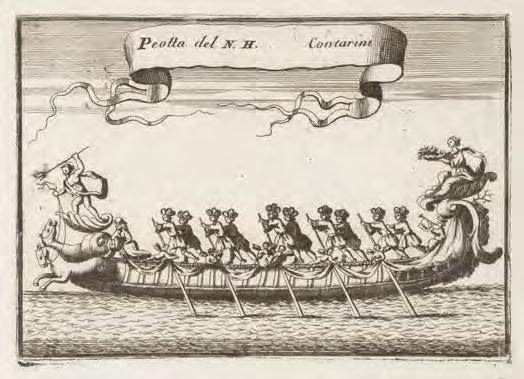
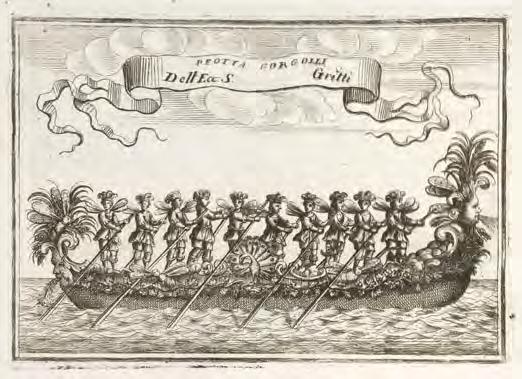
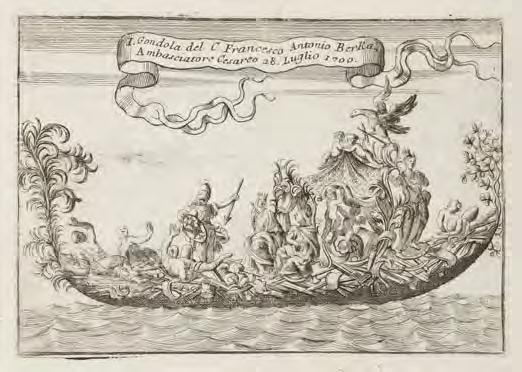
Vincenzo Coronelli (1650-1718), publisher. Regatte di Venezia [so titled on spine], [Venice], c. 1688-1710, a rare bound collection of 68 engraved plates by Alessadnro dalla Via and others, 7 divisional or part-titles (one dated 1688 and another 1709), arranged in five sections, the majority of plates featuring manned peottas, gondolas and other Italian maritime vessels, some plates proofs before letters, plate impressions 13 x 18.5 cm and similar sizes, modern armorial bookplate of Linley Thomas Messel, recent calf-backed marbled boards with gilt-titled leather spine label, oblong folio (19 x 27 cm)
Estimate: £1,000-1,500
For further information or to consign please contact Colin Meays or Paul Rasti
colin@dominicwinter.co.uk paul@dominicwinter.co.uk
16 July 2026 at 10am
VIEWING
AUCTIONEERS
Henry Headows
Monday & Tuesday 13/14 July 9.30am-5.30pm Sale mornings from 9am (other times by appointment)
Light refreshments available on view days with extra lunch options on sale days

Mallard House, Broadway Lane, South Cerney, Cirencester, Gloucestershire, GL7 5UQ
T: +44 (0) 1285 860006
E: info@dominicwinter.co.uk www.dominicwinter.co.uk


Condition reports now including video conferencing can be requested in the following ways:
T: +44 (0)1285 860006 | E: info@dominicwinter.co.uk
Via the relevant lot page on our website www.dominicwinter.co.uk
Lots marked with AR next to the lot number may be subject to Droit de Suite. Droit de Suite is payable on the hammer price of any artwork sold in the lifetime of the artist, or within 70 years of the artist's death. The buyer agrees to pay Dominic Winter Auctioneers Ltd. an amount equal to the resale royalty and we will pay such amount to the artist's collecting agent. Resale royalty applies where the Hammer price is 1,000 Euros or more and the amount cannot be more than 12,500 Euros per lot.
The amount is calculated as follows: Royalty For the Portion of the Hammer Price (in Euros)
4.00% up to 50,000
3.00% between 50,000.01 and 200,000
1.00% between 200,000.01 and 350,000
0.50% between 350,000.01 and 500,000
Invoices will, as usual, be issued in Pounds Sterling. For the purposes of calculating the resale royalty the Pounds Sterling/Euro rate of exchange will be the European Central Bank reference rate on the day of the sale.
Please refer to the DACS website www.dacs.org.uk and the Artists’ Collecting Society website www.artistscollectingsociety.org for further details.
For payment arrangements please refer to information for buyers at rear of this catalogue. We would kindly request that commission bids are submitted by 9.30am on the morning of sale.
Customers may submit commission bids or request to bid by telephone in the following ways:
T: +44 (0)1285 860006
E: info@dominicwinter.co.uk
Via the relevant lot page on our website www.dominicwinter.co.uk
Live online bidding is available on our website www.dominicwinter.co.uk (surcharge of 3% + vat): a live bidding button will appear 60 minutes before the sale commences. Bidding is also available at the-saleroom.com (surcharge of 4.95% + VAT) and invaluable.com (surcharge of 3% + VAT, and subject to a minimum charge of the UK equivalent of $10 per lot).

For payment information see our Information for Buyers page at the rear of this catalogue.
For details regarding storage, collection, and delivery please see our Information for Buyers page or contact our office for advice. Successful bidders will not incur storage fees while current government restrictions remain in place.
If you intend to export goods you must find out in advance if:
a. there is a prohibition on exporting goods of that character e.g. if the goods contain prohibited materials such as ivory.
b. if they require an Export Licence on the grounds of exceeding a specific age and/or monetary value threshold as set by the Export Licensing Unit. We are happy to offer the submission of necessary applications on behalf of our buyers, but we will charge for this service to cover the cost of our time. The typical cost of an application is £10, but it may be increased if additional work is required.
c. CITES permits: These documents may be required to ship some lots (e.g. ivory) out of the UK. Your shipper (DHL Express or other) can advise and apply for these on your behalf. It is the buyer's responsibility to ensure that the shipment is lawfully exported from the selling location and can be lawfully imported into the country of destination.exported out of the selling location and can be lawfully imported to the country of destination.
All lots are offered subject to the Conditions of Sale and Business printed at the back of this catalogue. For full terms and conditions of sale please see our website or contact the auction office. A buyer’s premium of 22% of the hammer price is payable by the buyers of all lots, except those marked with an asterisk, in which case the buyer’s premium is 26.4%.



Antiques & Historic Textiles
Henry Meadows BA Hons, MRICS
MA (History of Art)

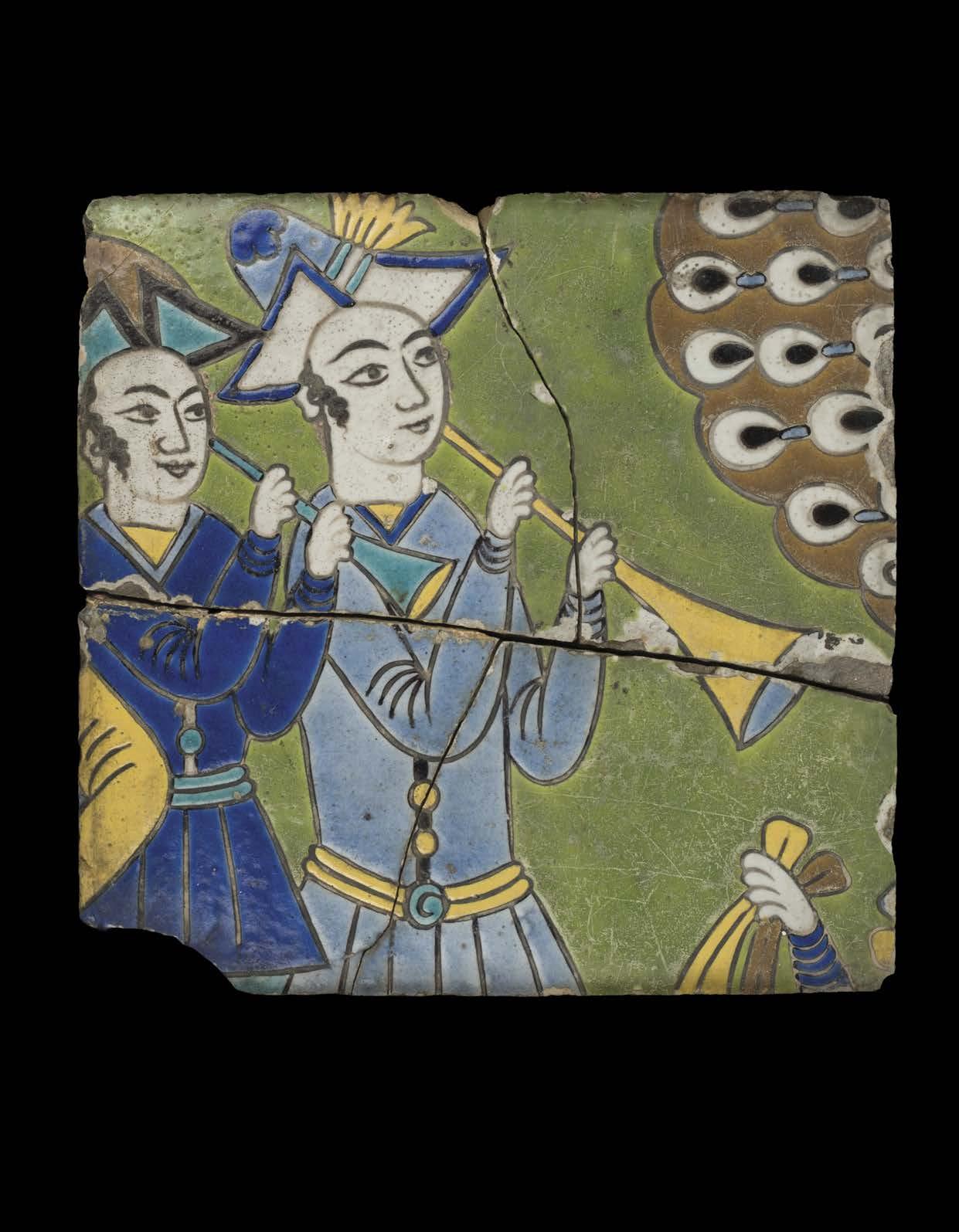
Cover illustrations: Front cover: lot 593 | Back cover: lot 479
Catalogue Produced by Jamm Design Ltd. - 020 7459 4749 info@jammdesign.co.uk
Photography by Darren Ball - 07593 024858 darrenball1989@gmail.com
To commence at 10am
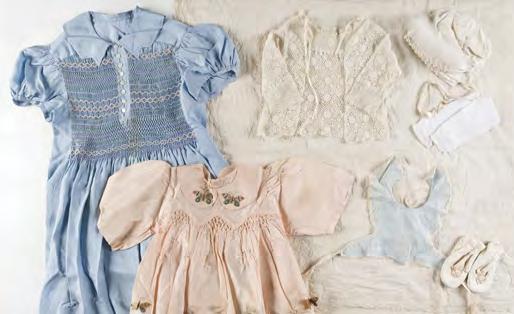
291* Children’s Clothing. A collection of 19th and 20th century children’s clothes and accessories, including: 7 christening gowns, including an Edwardian cream lace and silk satin gown with accompanying under dress, worn by Miss Mabel Gwendoline Lemay Larcombe in 1910; a bonnet trimmed with swansdown and matching short and long stole; 3 fine quality smocked silk dresses, one with appliquéd hand-painted butterflies, and a smocked silk tunic with matching pair of knickerbockers; several bibs; 2 matching whitework pillowcases; a yellow dress stitched with floral sprigs labelled ‘designed and embroidered by Ada E. McLeod. A.R.C.A.’; a pair of kid leather baby shoes (one lacking button); a jacket of Irish crochet; a Dresden work cot cover; a number of undergarments and items of nightwear; and a group of approximately 30 children’s printed handkerchiefs, 19th and 20th century, including Noddy, Disney, spacecraft, fairies, Mabel Lucie Attwell, Cock Robin, 2 with calendar for 1888, multiplication tables, a cotton panel of 6 uncut handkerchiefs, and a booklet of hankies titled ‘Happy Hour Handkerchiefs’ by Cora E. Paterson, with 8 mounted handkerchiefs illustrated with children in the style of Kate Greenaway, various sizes and condition (2 cartons)
£200 - £300
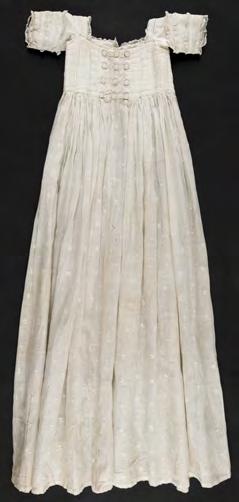
292* Children’s Clothing. A rare early infant’s dress, 18th century, hand-stitched high-waisted frock of white muslin, handembroidered overall in white thread using tambour work, with foliate sprigs and roundels, the bodice very finely tucked, and with a latticework motif in centre formed by thread wrapped around 12 Dorset wheel buttons, the square drawstring neck and short sleeves trimmed with narrow lace, bodice and sleeves lined with linen, rear fastening tapes (one lacking), toned and with scattered foxing, some small holes, early manuscript label sewn to rear of bodice ‘Baby’s Frock - Old English Work - 18th century’, length 86 cm (34 ins), together with 3 18th century fine cotton lawn infant bonnets (foxed), one labelled in the same hand as before ‘Babies’ Caps - Old English Work - 18th century’ (4)
£150 - £200
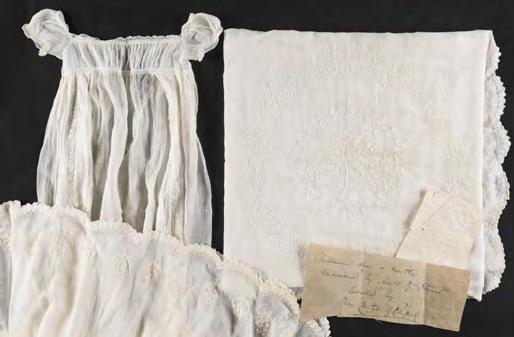
293* Children’s Clothing. A Regency christening gown and mantle, circa 1815, handworked cream muslin high-waisted long gown, the bodice and puffed sleeves gathered and edged with a border of buttonhole stitch ovals and handmade narrow lace trim, front with tambour work border of lily-of-the-valley flowers and leaves in cream thread down both sides and edged with lace as before, scalloped hem edged with tambour work picot and leaf border, with sprigs of lily-of-the-valley above, length 104 cm (41 ins), together with a matching mantle, also embroidered in tambour work in cream threads, with a large circular motif in centre composed of a rose tree within a frame of shamrocks, enclosed by a border of thistles, scalloped hem with picot and leaf edging and sprigs of lily-of-the-valley as before, 142 x 140 cm (55 x 56 ins), plus two notes in ink pertaining to provenance, one dated 1848
The two manuscript notes read: ‘The long frock and mantle were worked by my dear Mother for a christening just for my children & most of them were christened in it ... M J Ranfurly Novr. 4th. 1848’ and ‘Christening dress & mantle embroidered by Honble Mrs. Stuart labelled by Mary Countess of Ranfurly’.
Sophia Margaretta Julianna Stuart (1764-1847) married Reverend William Bane Stuart, Archbishop of Armagh (1755-1822), on 3rd May 1796, in Ireland. She worked the gown and mantle for the offspring of her first child, Mary Juliana Knox, Countess of Ranfurly (1797-1866), who married Thomas Knox, 2nd Earl of Ranfurly (1786-1840), in 1815 and had 11 children born between 1815 and 1839. The two pieces survive in almost pristine condition, which is all the more remarkable considering that, acccording to the accompanying note, they were used at the christenings of most of the Countess’s 11 children.
(2) £300 - £500
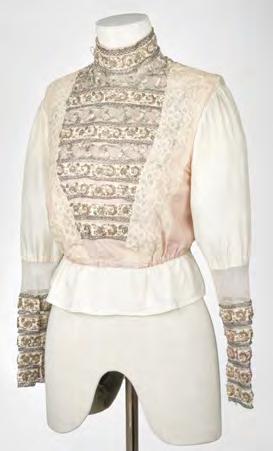
294* Clothing & Accessories. An Edwardian beaded blouse, circa 1905, handmade blouse of oyster crepe and cream silk with standing collar, peplum waist, and long sleeves, the bodice and deep sleeve cuffs with heavy beading and metalwork (occasional loose threads/beads and minor losses), that to the bodice between borders of wide cream lace, rear fastening with metal closures (some lacking) and drawstring waist, lining soiled, and some fraying to inside neck, bust 94 cm (37 ins), sleeves 58.5 cm (23 ins), length 54 cm (21.25 ins), together with A silver-spangled and beaded black chiffon peplum evening blouse by Thea Porter, circa 1960s/70s, 'Thea Porter Couture' label at nape, size 8, bust 90 cm (35.5 ins), waist 56 cm (22 ins), sleeves 69 cm (27 ins), length 62 cm (24.5 ins), plus A Chinoiserie evening bag, early 20th century, handworked in polychrome silk threads on a ground of ivory silk, with Oriental figures, pagodas, bridges, butterflies, and vegetation, white metal filigree mount set with turquoise cabochons, 12.5 x 17 cm (5 x 6.75 ins), and another Chinoiserie evening bag, French, early 20th century, embroidered in polychrome silk threads and metallised gold threads on a gold fabric ground, with a pattern of flowers and leaves, and with an Oriental figure worked in petit point to one side (some threads lacking), beaded enamelled clasp (most beads missing), 17 x 19 cm (6.75 x 7.5 ins), plus 8 small beaded purses, mostly miser's purses, and other early 20th century ladies' accessories and clothing, including some nightwear, a lace collar, and a pair of green silk heeled shoes with pointed toe (a small carton) £100 - £200
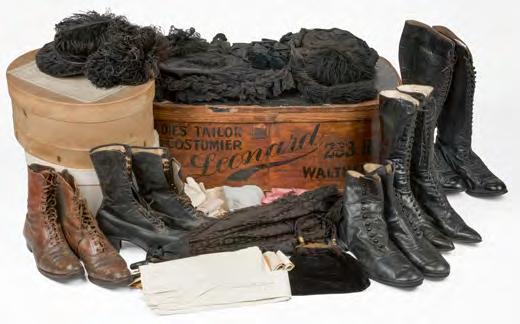
295* Clothing. A group of Victorian & Edwardian hats, shoes, and other accessories, the hats comprising: 6 ladies’ black hats or headpieces; a ladies’ brown velvet hat with ostrich feather, with woven label ‘Cavendish House, Cheltenham’; and 2 cardboard hatboxes, one labelled ‘Henry Heath Ltd. Hat Manufacturers To His Majesty The King’, the hats and hatboxes contained in a large wooden oval box with pull-off lid, black lettering to side ‘Ladies’ Tailor & Costumier Leonard, 233, Hoe St., Walthamstow’, the remaining items including: 2 crinoline cages, one with manufacturer’s stamp at waistband ‘Horrockses Miller & Co’; 4 pairs of ladies’ leather boots, one pair labelled ‘Russell & Son Manufacturers’, and one pair of men’s leather boots, labelled ‘Daniel Neal, Neal Son’; a black lace parasol; a brown furry muff; a black lace shawl; a beaded black lace bag; a black velvet bag; some linen buttons on cards; a pair of pink and a pair of pale blue stockings; and 11 pairs of ladies’ kid leather gloves (6 long, 5 short), various condition and sizes
(a quantity)
£200 - £400
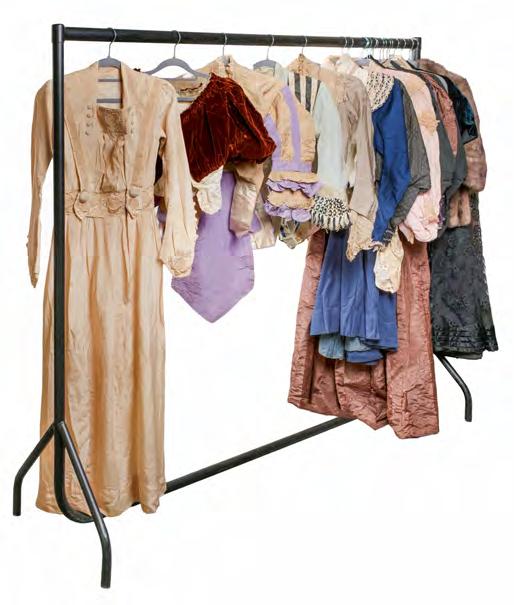
296* Clothing. A long silk dress, circa 1910, cream silk dress with gathered bodice and long sleeves, sailor collar with long ends terminating at waist with a large self button to each side, lace embellishment to neckline, edges of collar, waist, and pointed cuffs, smaller decorative self buttons to either side of neckline and to sleeves, hidden metal hook and stitched loop closures to left-hand side of bodice and skirt, some small brown marks to skirt, and one tiny threadbare area, bust 84 cm (33 ins), waist 62 cm (24 ins), sleeves 59.5 cm (23.25 ins), length 132 cm (52 ins), together with 20 other late 19th/early 20th century ladies’ garments, including a russet velvet bodice with puffed sleeves, a brown silk gown with grey silk details (including 4 large bows to rear of skirt), a blue wool two-piece gown, a number of elaborately embellished bodices, a blue velvet short cape labelled ‘Mon Cretien, Paris’, 3 waistcoats, and a short fur cape labelled ‘Rabin-Traegerm Chicago’, some items with wear (21)
£300 - £500
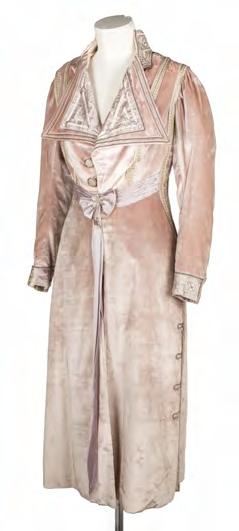
297* Clothing. An Edwardian velvet coat, Jean Burgér, New York, circa 1910, ankle-length oyster pink silk velvet coat, with long sleeves and large pointed collar, the collar and cuffs with handembroidered detail on lilac silk, front of waist with fixed tucked sash and bow of lilac silk, appliquéd tasselled flower motifs in stiff silver ribbon to centre of bow and its tail ends (2 to each tail end front and back, one lacking), 2 large decorative buttons and corresponding loops to front of bodice, woven braid details to bodice front and back, sides (including to slits either side), and to sleeves, incorporating small matching buttons to side slits, back, and sleeves, lined with cream silk satin, woven label at nape ‘Jean Burgér, New York’, hanging loop above broken, some wear to the lilac silk details, but otherwise in good condition, bust 84 cm (33 ins), waist 76 cm (30 ins), sleeves (60 cm (23.5 ins), length 130 cm (51 ins)
A very beautifully embellished velvet coat, evidently aimed at the higher, and therefore monied, echelons of American society of the early 20th century.
(1) £100 - £150
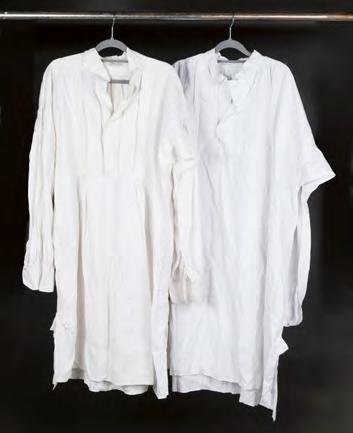
298* Clothing. Two gentlemen’s linen shirts, mid 19th century, each finely hand-stitched in white linen, with tucked yoke, standing colar, wide closely-gathered sleeves, and side slits, one initialled in sepia ink ‘J G 3 = 63’ to left of right-hand side slit, some buttons missing to each, one shirt with inside of cuffs lightly soiled, but overall both in good condition, chest 118 cm (46.5 ins), sleeves 59.5 cm (23.5 ins), length 100 cm (39.26 ins), and chest 150 cm (59 ins), sleeves 59 cm (23.25 ins), length 103 cm (40.5 ins), together with 10 Victorian or Edwardian ladies’ white cotton garments, comprising: 5 nightdresses, variously embellished with tucks, lace, broderie anglais, etc., 4 with long sleeves (one inked indistinctly with a name, and the date 1869), the other one sleeveless; 2 pairs of drawers (including a pair of split drawers); a combination garment with split drawers; and 2 under skirts (12)
£300 - £500
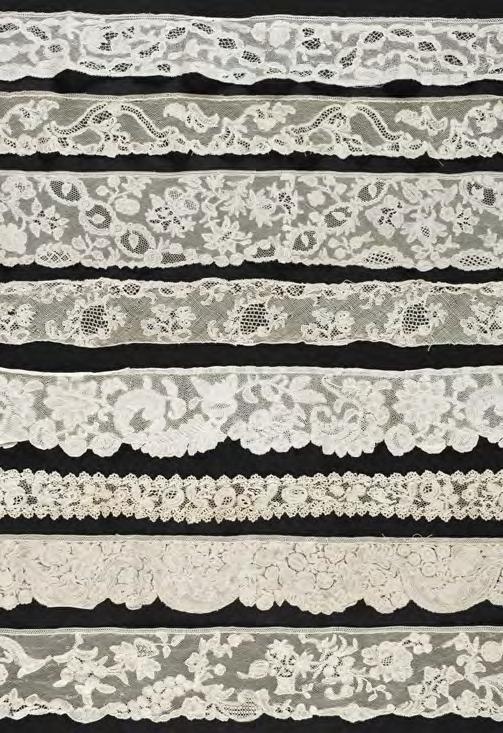
299* Devonshire Lace. A lace engageante, 1760-1780, a fine cream bobbin lace sleeve frill, worked with a variety of floral and foliate motifs, 1 or 2 faint fox spots, a small (almost imperceptible) repair, widest point 8 cm (3 ins), length 109.5 cm (43 ins), together with: Two matching lengths, 18th century, 2 lace borders, with latticework and floral decoration, occasional small breaks, one length lightly toned at one end, width 5.5 cm (2 ins), length 155 cm (61 ins) and 111 cm (43.75 ins), plus 2 other matching lace borders, Honiton, late 18th century, lightly toned, width 5 cm (2 ins), length 115 cm (45.25 ins) and 65 cm (25.5 ins), 5 other lengths of Devonshire lace, 18th/19th century, longest (labelled 1760s) 11 cm (43.75 ins), shortest 53 cm (24.75 ins), and 2 matching Brussels lace half cap backs with a design of flowers in pots (12)
£300 - £500
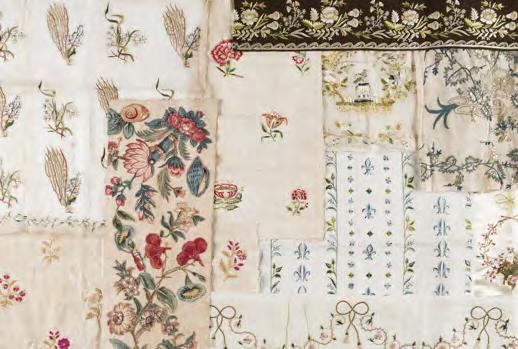
300* Embroidered. A group of needlework items, 18th & 19th century, including: a portion of white muslin (probably from the skirt of a Regency dress) finely embroidered in silks in shades of pink, gold, and green, with a scrolling border of rose and heart’s ease stems caught up at intervals with tasselled bows, above a border of floral posies, and a wavy border of fronds to hem, some scattered tiny holes, and lightly foxed in places, 63.5 x 78 cm (25 x 30.75 ins); a fragment of cream gauze finely worked with two different seaweed and flower motifs alternating, toned and a little foxed, 50 x 41 cm (19.75 x 16 ins); a cream silk panel handworked in coloured silks with a floral wreath suspended from a yellow ribbon bow, above a swag of forget-me-nots, selvedges to sides, top and bottom raw (but previously stitched), a few small marks, 29 x 49 cm (11.5 x 19.25 ins); a piece of white linen worked in silks with a repeating linear pattern of fleur-de-lys motifs and flowers in blue and white, and leaves and quatrefoils in shades of green, 94 x 38 cm (37 x 15 ins); and 3 borders of appliqués, 18 x 98 cm (7 x 38.5 ins) and slightly smaller, all contained in a cardboard box covered with part of a hand-blocked mezzaro or similar, inside of pull-off lid lined with watermarked laid paper bearing early manuscript in French, height 10 cm (4 ins), width 38 cm (15 ins), depth 27 cm (10.5 ins) (1) £200 - £400
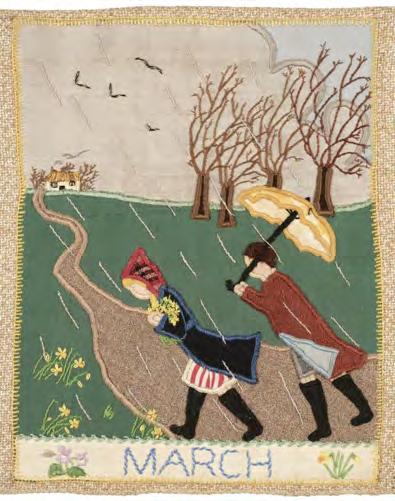
301* Educational Needlework. Frieze Designed for an Infant’s Classroom, by Patricia Hunter, circa 1940s, part of an unfinished frieze, carefully worked in appliqué and polychrome embroidery, comprising 5 panels, with scenes for January-May depicting children in the countryside involved in various pursuits (building a snowman, watching a horse-drawn plough, walking on a blustery rainy day, picking primroses, and playing with gamboling lambs), scene for January toned, mounted on a coarse-woven fabric ground, rufflette tape to verso of top edges, each panel approximately 27 x 25 cm (10.5 x 10 ins), together with the 12 original pencil designs for the frieze, each annotated in black ink with the stitches to be used (‘Rumanian Stitch’; ‘Knitting-Stocking Stitch’; ‘Fancy Dog Tooth Blanket Stitch’; ‘Run and Thread Stitch’; ‘Wheat-ear Stitch’; ‘Pekinese Stitch’; ‘Plaited Edge Stitch’; ‘Single Coral’, etc.), with black ink title leaf ‘Paper VI Craft-Work Index No: 337/4 Patricia Hunter, Frieze Designed for an Infant’s Classroom’, some marginal edge-fraying and marks, sheet size 27.5 x 38 cm (10.75 x 15 ins), together with:
A book of needlework specimens by Martha Matthews, November 1839, 11 samples stitch-mounted to rectos of 8 blue paper leaves, including hemming, gathers and tucks, herringbone stitch, Dorset wheel buttons and buttonholes, and darning, with a cross-stitch sampler on the final leaf stitched to lower edge ‘British School’, leaf size 21.5 x 13.5 cm (8.5 x 5.25 ins), buff paper wrappers, stained and edge-frayed, lettered in contemporary manuscript to upper cover ‘Martha Matthews November 1839’, slim 8vo, plus 2 other books of needlework samples, one belonging to Jessie Campbell of Edgbaston School dated 1888-1895 (leaves brittle and mostly detached) (4)
£150 - £200
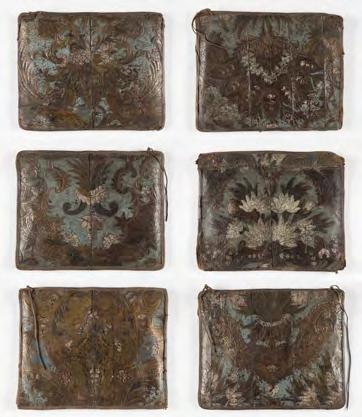
302* Embossed Leather. A set of 6 embossed leather seat pads, Continental, late 17th/early 18th century, the upper sides pieced from 17/18th century embossed leather, put together as cushions in the 19th century, with black morocco backing, and machinestitched calf binding to edges, the embossed leather richly worked in relief with large floral and foliate motifs, scrolls and plumes, and latticework, the pattern painted in white and gilt on a soft blue ground, rubbed, and with overall craquelure, minor wear (some small losses, especially at edges), 2 leather thong ties to one side of each (7 lacking), 33 x 40 cm (13 x 15.75 ins)
Early embossed leather was used as luxurious wall coverings in the 17th and 18th centuries by those who could afford this costly material. It was particularly popular in Spain and Italy, but the trend spread throughout Europe. Highly prized as these panels were, it is not surprising that fragments have been repurposed down the centuries, as here. Despite this - or maybe because of it - even small pieces rarely come onto the market. (6)
£400 - £600
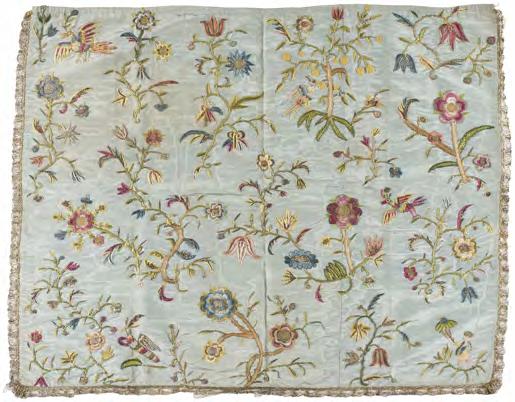
304* Embroidered Panel. A needlework panel, English, 18th century, hand-worked in polychrome silk threads and metallised silver and gold threads, incorporating metal strips, on a pale turquoise silk ground (a little toned and dusty), with an all-over pattern of meandering flower stems, including tulips and roses, with several exotic birds perching or in flight, and the figure of a man to lower right corner, 2 vertical joins (pattern continuous), occasional loose or lost threads, but needlework mostly intact, hand-stitched hem all round, sides and lower hem edged with metallic gold lace (broken in places), 52 x 66.5 cm (20.5 x 26.25 ins)
See the V&A accession number CIRC.1109-1924 for an 18th century dress panel with similar embroidery. (1)
£300 - £500
£200 - £300
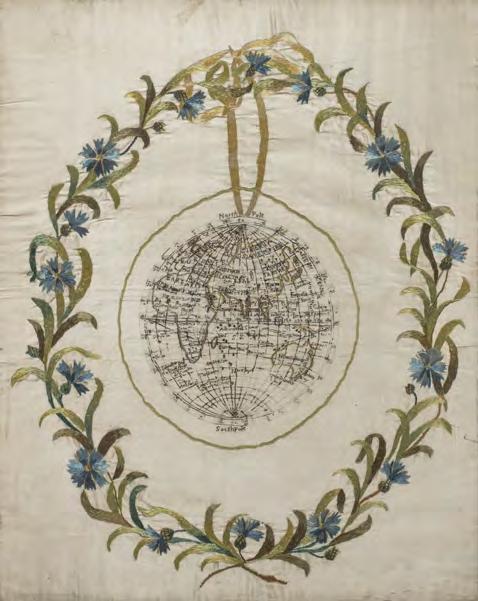
303* Embroidered Map. A Georgian needlework globe sampler, late 18th century, hand-stitched with a globe in black silk thread using back stitch, and coloured silk thread outlines in stem stitch, showing Australia as New Holland, within a pale green chenille line border, the globe suspended from a yellow ribbon and enclosed within a wreath of cornflowers, worked in long and short stitch, the wreath in shades of blue, green, and brown, on a cream silk ground, some of the black threads missing (revealing pencil outlines beneath), ground a little dusty and lightly marked in places, 38 x 30 cm (15 x 11.75 ins), framed and glazed (39 x 31.5 cm) (1)
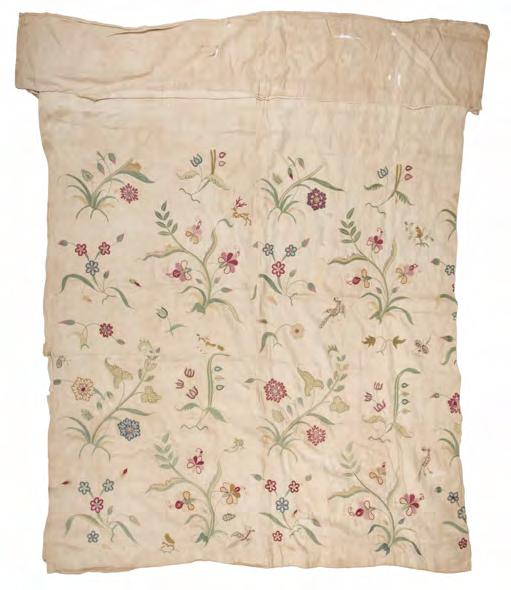

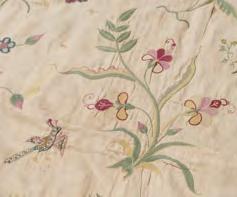


305* Embroidered Panel. An 18th century needlework panel, finely embroidered in polychrome silks on a fine dark cream linen ground backed with coarse linen, using mainly tambour work, but with some details in satin, lazy daisy, and buttonhole stitch, depicting scattered large flower and leaf stems, animals, insects and exotic birds, including a stag, dog, and squirrels, upper left portion joined and pattern not matching, toned, a few stains and marks, occasional losses to stitching, but embroidery mostly intact, embroidered area 86 x 90 cm (33.75 x 35.5 ins), overall size 120 x 90 cm (47.25 x 35.5 ins) (1)
£400 - £600
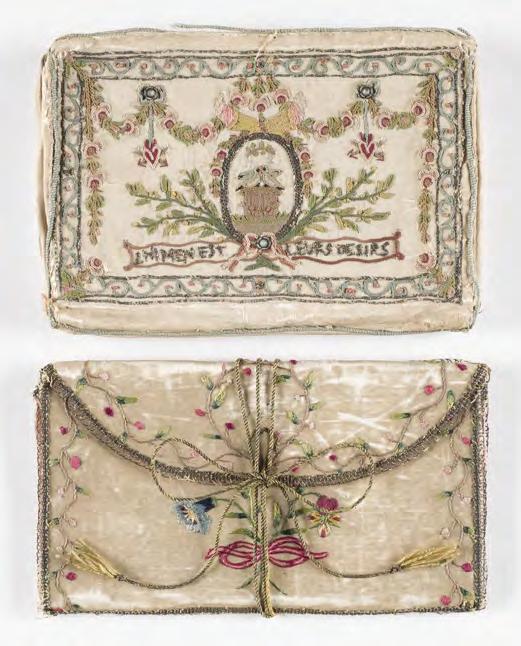
306* Embroidered Pocket Book. A French love token wallet or purse, circa 1780s, hand-stitched cream silk wallet, elaborately embroidered in tambour work using polychrome silk threads and metallised threads, the exterior covers with a central oval resting on leafy boughs amongst garlands of flowers within a blue scroll border, the oval to one side enclosing flaming hearts and above a scroll ‘Ils Brulent Du Meme Feu’, that to the other side enclosing a pair of love birds and above a scroll ‘L Himen Est Leurs Desirs’, the interior with similar panels, the ovals containing the monograms ‘JF’ and ‘AF’ and with inscriptions ‘L’Union Les Assembles’ and L’Amour Les Enchaine’, some minor wear to extremities (stitching largely intact), the 2 pockets lined with pale pink figured silk (foxed and partially faded), dimensions when closed 10 x 15 cm (4 x 6 ins), together with:
An English silk wallet or purse, circa 1780-1800, of envelope form, hand-stitched cream silk wallet, worked in polychrome silk threads with a beribboned posy to front and a rose stem on the back, with wavy foliate and bud borders to sides of both and to flap, extremities beginning to become threadbare in places, signs of initials once on flap (apparently removed?), edged with metallised braid, gilt twisted braid tie attached to flap, lined with pink silk (torn at flap hinge), 8.5 x 15 cms (3.5 x 6 ins) (2) £200 - £300
307* Embroidered Pocket Book. A hand-painted silk wallet or purse given by French royalty, 1803, hand-stitched cream silk wallet, the exterior painted with volutes and foliage stems, with a foliate border, latter repeated on the 2 pocket edges inside, some minor surface rubbing to paint in places, each pocket containing a smaller cream silk-covered card wallet: the first painted to one cover with a crest consisting of a knight in armour above the motto ‘Furth Fortune & Fill the Fetters’, and to the other cover with an initial ‘A’, opening to reveal an ink inscription to one pocket ‘Pour le jour de l’an 1803’ and to the other pocket ‘Honorez moi d’accepter cet petit don’, with manuscript note tucked into one pocket reading: ‘This dainty little case was given to Lord Charles Murray Aynsley by Louis XVIII or by his brother the Count d`Artois afterwards Charles X when they were exiled living at Gosfield Hall Essex in 1803 - & were entertained at the Deanery Bocking’; the second painted with the initials ‘AA’ to one cover and the initials ‘GB’ to the other, opening to reveal an ink inscription to one pocket ‘Pour le jour de l’an 1803’ as before, and to the other pocket ‘’Acceptez cette Bagatelle’, with manuscript note tucked into the pocket as before, but stating ‘given to Lady Charles Murray Aynsley ... ‘, dimensions when closed 9.5 x 14 cm (3.75 x 5.5 ins)
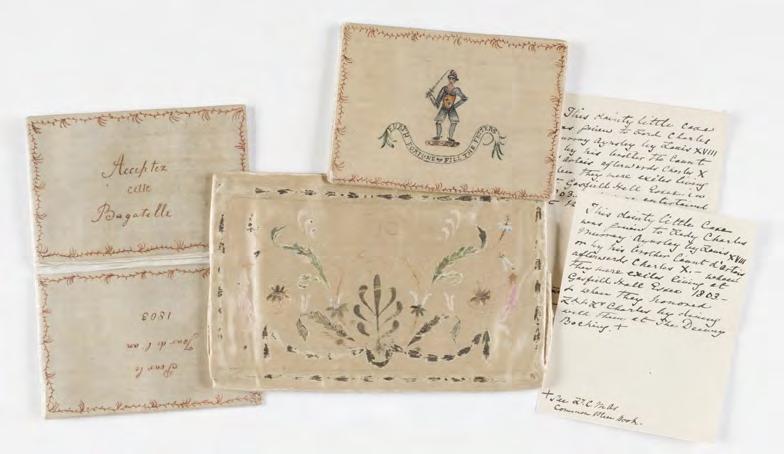
Provenance: Apparently at one time in the possession of Viscount Strathallan, Stobhall, Perthshire.
Lord Charles Murray-Aynsley (1771-1808) was the youngest of nine children of John Murray, 3rd Duke of Atholl, and his wife Charlotte. In 1793, on his marriage to Alicia Mitford (1768-1813), daughter of George Mitford and heiress of her greatuncle, Gawen Aynsley, he changed his surname to Murray-Aynsley. He was made Dean of Bocking in Essex in 1803. (1) £100 - £200
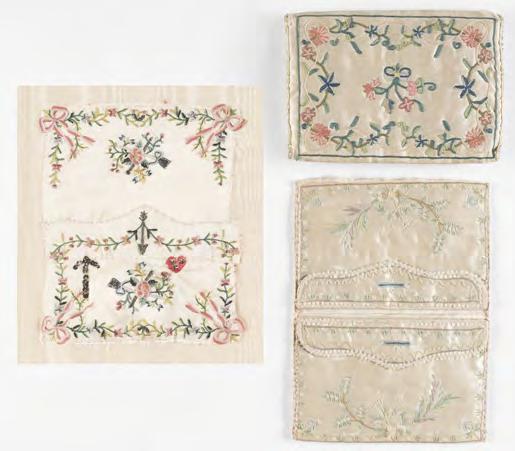
308* Embroidered Pocket Book. A silk wallet or purse, circa 17801800, hand-stitched cream silk wallet, the exterior and interior elaborately embroidered in tambour work using silk threads in shades of pink, blue, green, and yellow, with central beribboned posy to each panel and meandering floral and foliate border, the interior pocket flaps similarly decorated, some minor wear to extremities, lined with cream silk, 3 cm split at gutter where manuscript card label stitched ‘Mary Rogers, Lamorna, Falmouth’, dimensions when closed 10 x 15 cm (4 x 6 ins), together with another tambour work pocket book, depicting a dog, birds, gardening implements, and floral decoration, some wear and marks, 9 x 13.5 cm (3.5 x 5.25 ins), and a portion of fine tambour work embroidery similar, in polychrome silks incorporating metallised threads and spangles, on a cream silk ground, stitched to a piece of cream moiré silk, worked for a love token wallet, but uncut and unused, depicting flower posies and sprays, a heart, an arrow, and ribbon bows at each corner, embroidered area 16 x 13 cm (6.25 x 5 ins), overall size 21.5 x 34 cm (8.25 x 13.5 ins)
Provenance (first item): The Penrose Estate, Porthleven, Cornwall. (3) £200 - £300
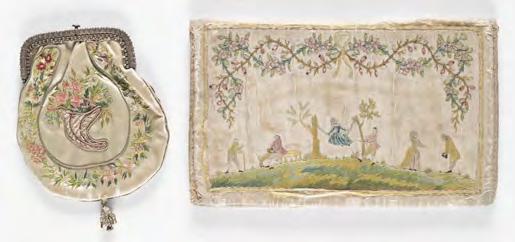
309* Embroidered Pocket Book. A silk wallet or purse, circa 1780s, hand-stitched cream silk wallet, the exterior and interior elaborately embroidered in polychrome silk threads, the exterior covers both with a beribboned floral garland to top and sides, one cover depicting a lady seated on a rope strung between two trees, a gentleman standing beside holding a rope with which to swing her, a courting couple to the right, and two gentlemen and a dog to the left, the other cover depicting a horse-drawn cart of flowers, a man mounted on the horse, and a woman seated in the cart offering a flower to a gentleman following behind, the interior panels with floral border, enclosing a musical trophy on one side, and a similar device with flaming torch and quiver of arrows on the other side, lined with quilted cream silk, generally toned and edge-worn, with occasional small marks, dimensions when closed 10.5 x 17.5 cm (4.25 x 7 ins), together with:
An embroidered purse, 1825, hand-stitched cream silk, embroidered in polychrome silks, one side with a flower cornucopia within a horseshoe-shaped floral border, the other side with dense repeating pattern of foliage and buds, silver mount with Birmingham hallmark, dated 1825, and with initials ‘B&S’, small silver thistle ‘tassel’ to lower edge, lined with cream silk, 11.5 x 8.5 cm (4.5 x 3.25 ins), plus 4 other embroidered items (2 pocket books, one cover from a pocket book, and a document wallet) (6)
£200 - £300
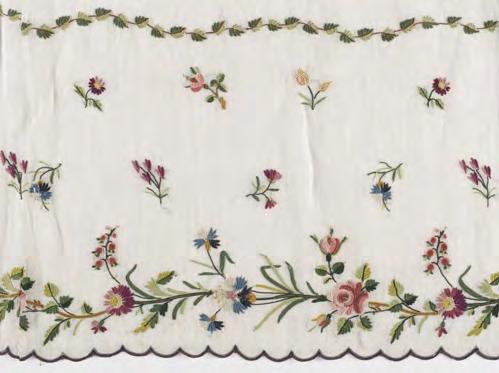
310* Embroidered Skirt. A Regency needlework muslin skirt, circa 1810, finely stitched in tambour work using polychrome silks, on a white muslin ground, with 28 cm border of floral sprigs between a wavy leaf border above and a wide border of flower stems below, tambour work scalloped edge, linen waistband and ties, skirt closely gathered at rear, 2 hand-stitched vertical seams, 2 very small holes above the embroidery, a few unexceptionable tiny holes to one part of border, and a couple of stitches lost from scalloped edge, but otherwise in excellent condition, waist 68 x 113 cm (26.75 x 44.5 ins), together with the lower portion of a white muslin skirt worked with an identical border, 2 vertical seams, one hand-stitched and one later machine-stitched, length 72 cm (28.25 ins), entire width of hem (i.e. if side seam was unstitched) 185 cm (72.75 ins), plus an embroidered white muslin skirt front or apron similar, with drawstring waist, 39.5 cm tambour work border depicting rose stems, heart’s ease, and other floral motifs, lightly toned in places, 1.5 x 1.5 cm hole above the embroidery, 2 holes side-by-side (the largest 1 x 1 cm) within the border (but not affecting needlework), and 2 cm length of scalloped edge detached, 110 x 84 cm (43.25 x 33 ins)
Notwithstanding the issues mentioned, these three pieces of Regency tambour work are beautifully preserved, in crisp and bright condition. (3)
£300 - £500
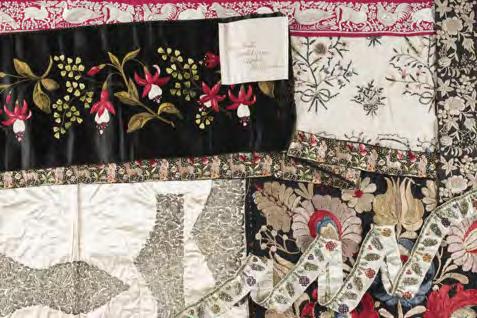
311* Embroidered. A group of needlework items, 19th & 20th century, including: a pair of embroidered coverlets, early 20th century, hand-embroidered in polychrome silk threads (lightly faded), with all-over pattern of meandering flower and leaf stems, worked in satin and long and short stitch, on a cream rayon ground, within a border of drawn threadwork incorporating large flower sprays, occasional loose threads, but overall in very good condition, each approximately 231 x 152.5 cm (91 x 60 ins); an embroidered picture entitled Gloria in Excelsis Deo, early 20th century, appliquéd and embroidered, using coloured threads and metallised gold threads, on a ground of blue linen (faded), depicting the Virgin Mary holding the Christ Child, standing amongst flowers, within a frame of metallised gold threads incorporating the words ‘Gloria in Excelsis Deo’ to lower margin, some border threads loose, laid down onto board, 42 x 29 cm (16.5 x 11.5 ins); 3 handworked Chinese borders, longest 6.5 x 458 cm (2.5 x 180 ins); a piece of uncut Ottoman metalwork embroidery on cream silk comprising a pair of cuffs, a collar, and a bodice front, overall size of ground 54 x 29 cm (21.25 x 11.5 ins); portion of a silk and metalwork border from a Turkish towel, 25.5 x 34 cm (10 x 13.5 ins); 2 matching borders similar 3.5 x 119 cm (1.5 x 46.75 ins); and a long unused frieze of fuchsias and maiden hair fern, worked in silks on a black silk satin ground, 22 x 229 cm (8.25 x 90 ins), with manuscript note in a late 19th or early 20th century hand pinned to top left-hand corner ‘B[lanche].H. Heelis. Silk embroidery, Class IV’, and an envelope stitched to top right corner, addressed ‘Miss Heelis, Battlebarrow, Appleby, Westmorland’, together with a group of ecclesiastical items, 19th and 20th century, some embroidered or appliquéd, comprising: 3 chasubles; one panel from a chasuble; 2 stoles; a maniple; 2 burses; and a chalice cover, various condition and sizes
Blanche Heelis was the sister of Beatrix Potter’s husband William Heelis, and therefore the famous author’s sister-in-law. (a carton) £150 - £200
£200 - £400
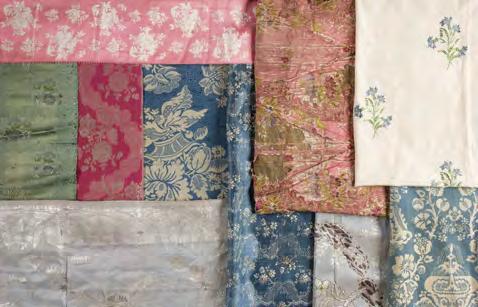
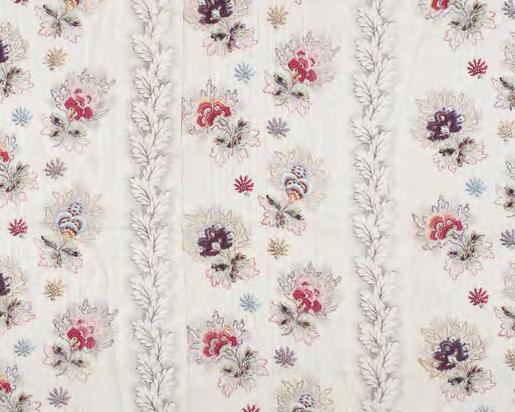
312* Fabric. A group of brocade and damask fragments, mostly French, 19th century, comprising: a large pieced panel of blue silk brocade, with linear pattern of small flower sprays in yellow, pink, and white, amongst white lace ribbons, hand-stitched hems all round, worn, 202.5 x 156 cm (79.75 x 61.5 ins); an irregularly-shaped silk brocade fragment, woven with a floral linear pattern, in shades of dark pink, blue, green, and white, incorporating silver metallic threads, on a pink ground, creased at intervals from previous decorative gathers (at one time part of a skirt?), some surface losses, approximately 91 x 94 cm (36 x 37 ins); a panel of blue and white damask with large flower basket pattern, verso with 2 large purple ink manufacturing stamps ‘4600’, scattered surface wear, 106 x 54.5 cm (41.75 x 21.4 ins), and another piece of blue and white damask similar, with a design of fountains and grottoes, stamped as before, with ‘3934’ twice, length of left side 35.5 cm (14 ins) and of right side 61 cm (14 ins), width 56 cm (22 ins); a panel of brocade with a sinuous pattern of lace ribbon and flower stems in white on a bright pink ground, selvedges to sides, raw edges top and bottom, 94 x 49.5 cm (37 x 19.5 ins); a piece of cream silk woven with stems of blue and green cornflowers, some scattered marks, selvedges to sides, raw edges top and bottom, 99.5 x 119.5 cm (39.25 x 47 ins); and 9 other pieces of woven fabric similar, some matching, a couple woven with metallic threads, together with a wide silk picotedged ribbon woven with flowers in white on a pink ground, 12.5 x 218 cm (5 x 85.75 ins), and a length of ribbon woven with holly leaves and berries, 4.5 x 119 cm (1.75 x 45.75 ins) (18)
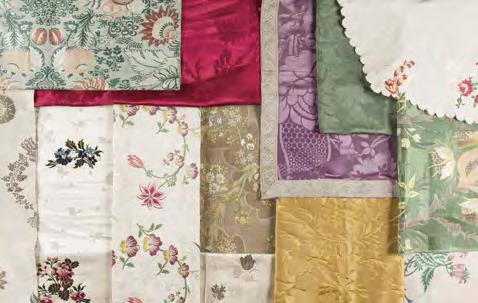
313* Fabric. A group of damask and brocade fragments, including possibly Spitalfields, 18th-early 19th century, comprising: two floral panels of silk brocade (non-matching), possibly Spitalfields, a few light marks, but both in robust condition, 98 x 51 cm (38.5 x 20 ins) and 86.5 x 49.5 cm (34 x 19.5 ins); a small pieced fragment of bizarre silk, circa 1710, with 3 handsewn joins, woven with pomegranates in orange and yellow and gold metallic threads (tarnished), on a green figured ground, 38 x 48 cm (15 x 19 ins); a lilac damask runner with large ribbon and rose pattern, machine-pieced from 3 sections, mottled fading, some small marks, and one or two holes, metallic silver braid machine-stitched to edge, 54 x 196.5 cm (21.25 x 77.25 ins); another floral brocade panel in robust condition, in shades of yellow, green, and beige, 132 x 53 cm (52 x 21 ins); a small piece of cream figured brocade woven with a pattern of heart’s ease stems, 63.5 x 53 cm (25 x 21 ins); various pieces of crimson, green, and cream damask, some matching, and other fragments similar, some woven with metallic thread (26)
£400 - £600
315* Fabric. A large pieced fragment of seaweed muslin fabric, circa 1830s, fine ivory cotton, with self stripes, blocked with a linear design of polychrome seaweed and coral motifs between leaves in black and purple, 3 vertical joins stitched by hand (selvedge to selvedge measuring 88 cm), selvedge to left-hand side, remainer raw (top edge previously sewn), some holes and tears (mainly to top and bottom edges), one or two period darns, and a few small fox spots, overall size 105 x 320 cm (41.25 x 126 ins), together with a heavily pieced fragment of floral printed cotton, toned and worn, late 18th/early 19th century, 87 x 58 cm (34.25 x 22.75 ins), 3 matching fragments of floral chintz lined with a printed cotton, largest 27 x 133.5 cm (10.5 x 52.5 ins), and a floral cotton curtain tie back and bell pull with rosette similar
Probably originally forming the skirt of a dress.
(7)
£150 - £250
£200 - £400
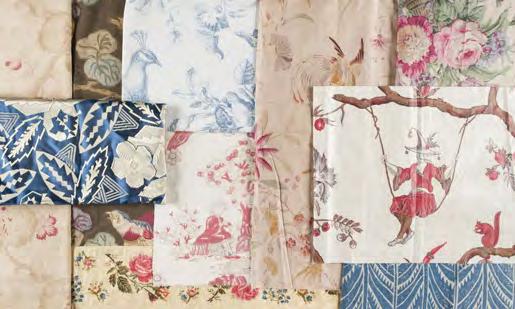
314* Fabric. A group of printed 19th & 20th century lengths and fragments, comprising: a block printed polychrome panel depicting birds amongst leafy branches with large fruit, selvedges to sides (that to left side machine-stitched under), top and bottom edges raw, 6 and 9 cm tears to right-hand edge towards top, 131 x 70 cm (51.5 x 27.5 ins); a large linen panel printed in blue on a white ground with 2 pattern repeats of a flambuoyant design of peacocks, poppies, roses, fruit, and vegetables, selvedge to left-hand side, remainder with handsewn hems, upper half faded, some scattered small holes (mainly to faded area), 216 x 96 cm (85 x 37.75 ins); a panel of thick cotton, French, circa 1910, roller printed and hand blocked with a painterly Art Nouveau design of stylised flowers in pink, pale olive green, and light brown, on a beige ground, machine-stitched central vertical join, selvedges to sides, top and bottom edges hemmed, the former incorporating a drawstring, 127 x 160.5 cm (50 x 63.25 ins); a large machine-stitched silk bedcover printed with floral baskets, flowering branches, and birds, in shades of pink, green, yellow, grey, and brown, 2 vertical joins, occasional tiny holes, 225 x 202 cm (88.5 x 79.5 ins); and 9 other pieces of printed fabric, some large panels, others small pieces, the latter including some toile de jouy fragments (2 mounted), plus a length of satin woven in blue and gold with an Art Deco pattern of stylised flowers and leaves, selvedges to sides, top and bottom edges raw, 147 x 128.5 cm (58 x 50.5 ins), and a length of wide dark cream moiré silk ribbon printed with roses and harebells in pink, blue, and green, 12 x 157 cm (4.75 x 62 ins) (15)
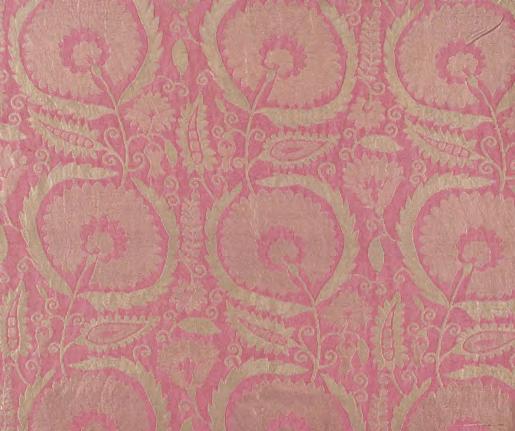
316* Fabric. A length of silk damask, Lyon: Bianchini-Férier, 1930s, woven with metallic gold threads on a pink ground, with a repeating pattern of large stylised flower heads, amongst smaller floral and foliate motifs, selvedges to sides, remaining edges raw, ‘Bianchini’ and stock numbers on old paper label pinned to one end, metal press stud fastener to extreme edge of one corner, 221 x 108 cm (87 x 42.5 ins)
A striking length of fabric from the famous French silk weaving manufacturer Bianchini-Ferier, in excellent condition (apparently unused). Founded in Lyon in 1888 by Francois Atuyer, Charles Bianchini and Francois Ferier, the firm won a silver medal at the Paris Exposition Universelle of 1889, and went on to prosper after this early success, producing luxury silk damasks for the great fashion houses as well as high quality furnishing fabrics.
(1)
£200 - £300
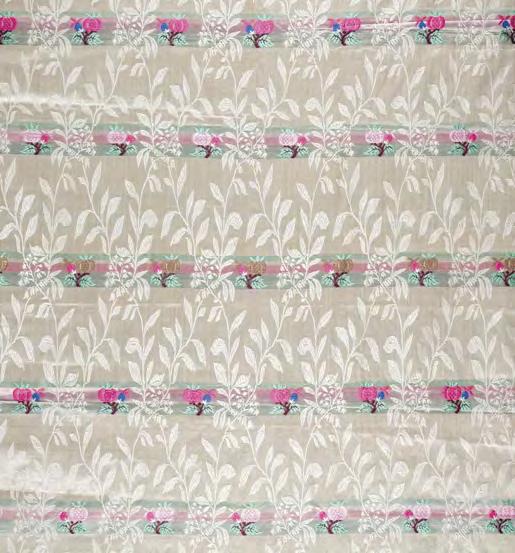
317* Fabric. A long length of pomegranate-patterned silk, possibly Chinese, mid 19th century, cream silk, figured all over with vertical leafy branches, and woven with horizontal bands of pomegranates alternating in colour: metallic gold, bright pink (with touches of blue), and pale pink, with green and brown leaves and stems, selvedges to sides, raw edges top and bottom, some minor wear towards lower edge, a few very small holes, but overall in very good condition (unused?), 406.5 x 72 cm (160 x 28.5 ins), together with a long length of (unused?) 19th century Chinese cream silk, with purple ink stamp to lower left corner comprising an oval with lettering ‘Kiu Cheng & Co Deer Chop’, a star, and 3 Chinese characters, ‘SSS’ stamped in red ink below, blue-edged selvedges to sides, top edge raw, bottom edge fringed and with blue triple line border, small piece exised from lower right corner, one or two tiny holes, 433 x 86 cm (170.5 x 33.75 ins), plus a large yellow silk bedcover, machine-stitched, with picot-edged valance to 3 sides, evidence of a line of previous stitching to left and right sides of main panel, some faint staining and small marks, 159 x 242.5 cm (62.5 x 95.5 ins), and a puce pink silk cloth backed with cream silk, some wear and marks, 136 x 115.5 cm (53.5 x 45.5 ins), plus 11 lengths of wide silk ribbon, one length pale pink, the others cream (2 moiré silk), largest (the pink one) 22 x 134 cm (8.5 x 52.75 ins) (15) £200 - £300
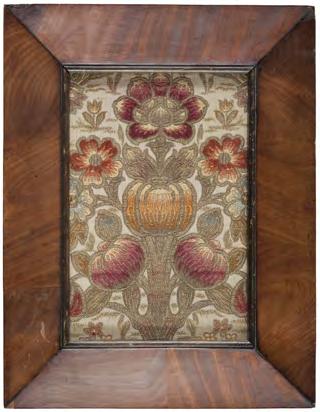
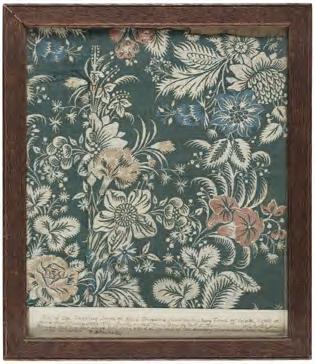
318* Fabric. A framed two-piece fragment of silk brocade, midlate 18th century, woven with a floral pattern in white, orange, and blue, on a dark green ground, 29 x 28 cm (11.5 x 11 ins), with manuscript label to lower edge ‘Part of the Wedding Dress of Alfred Lord Tennyson’s Grandmother, Mary Turner of Caistor, c.1780 - or his great-grandmother, Eliz: Clayton, c.1750. Given to me by Revd. E. Jesse, July 1914. His mother, Emilia Tennyson, told him that strips of it were placed on the wall of Somersby Dining-room, below the pictures by her father. W. F. Rawnsley’, framed and glazed (38 x 33 cm), together with:
A small framed fragment of silk brocade, mid 18th century, floral silk brocade, woven in shades of pink, orange, blue, and brown, incorporating metallic gold threads, 22.5 x 15 cm (9 x 6 ins), framed and glazed (32.5 x 25 cm), with typed label on verso dated August 1st 1995 and signed in ink by Iain R. Dumbell, indicating that family tradition had it that the fabric was part of a gown worn to a ball or reception held by Bonnie Prince Charlie at The King’s Arms Hotel in Dumfries, plus 6 other framed textiles, comprising 5 pieces of hand-embroidery, and a piece of (French?) brocade, 18th-19th century, various sizes
The rambling old rectory at Somersby was the birthplace of Alfred Lord Tennyson, who was born there on the 6th of August 1809. Its large gothic dining room with tall gables was added in 1819. It was designed by the poet’s father, and built by his coachman, Mr Howlings. Emilia Tennyson (1811-1887), known as Emily, was one of Tennyson’s younger sisters and the fiancée of Arthur Henry Hallam, for whom Tennyson’s poem ‘In Memoriam A.H.H.’ was written.
(8)
£100 - £200
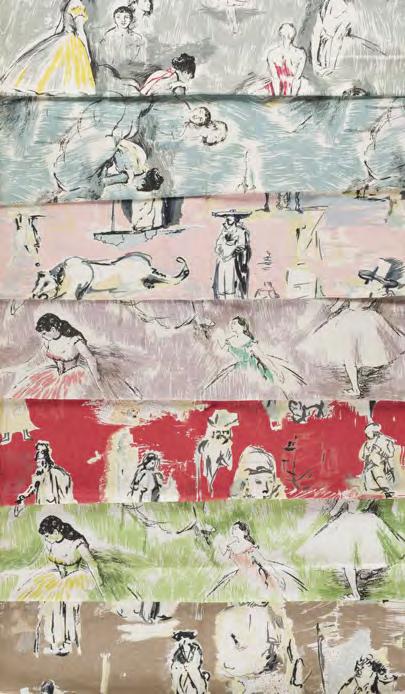
319* Fabric. Seven unused sample pieces of bark cloth, 1950s, 4 printed with an identical design of ballet dancers, each in a different colourways, and 3 with an identical design (also in different colourways) depicting various Continental-style figures, including one on horseback, and a lion, each with a punch hole to top corners, some minor edge-toning, each approximately 62 x 61 cm (24.5 x 24 ins)
(7)
£100 - £200
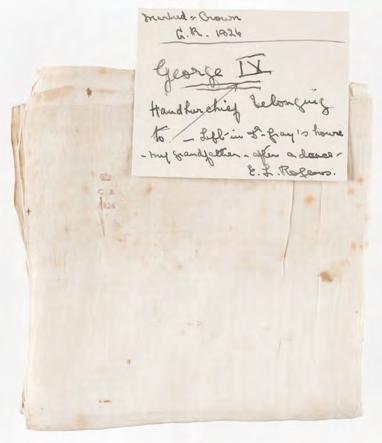
320* George IV (1762-1830), King of the United Kingdom 18201830. A handkerchief, dated 1826, white silk, finely embroidered to one corner with King George IV’s cypher in cross-stitch in pink thread ‘G R’ with a crown above and the date 1826 below, worn, toned, and foxed, 76.5 x 76.5 cm (30 x 30 ins), together with a manuscript note of provenance written in ink in a late 19th century hand on a small envelope
The accompanying note reads: Handkerchief belonging to George IV - Left in Dr. Gray’s house - my grandfather - after a dance - E.L. Rogers.’, possibly referring to the family of physician Henry Gray (1827-1861) whose father, Thomas Gray, was a private messenger to King George IV and King William IV.
(1)
£100 - £150
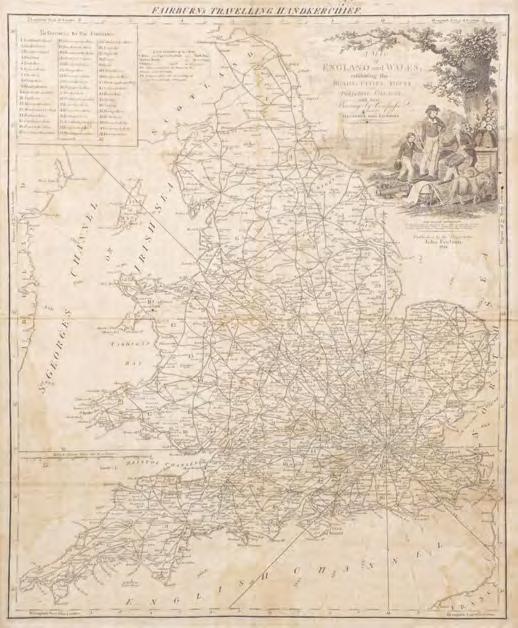
321* Handkerchief Map. Fairburn’s Travelling Handkerchief. A Map of England and Wales, exhibiting the Roads, Cities, Towns and Principal Villages, with their Bearing by Compass and Distance from London, Engraved by E. Bourne, Andersons Buildings, City Road, Published by the Proprietor John Fairburn, 1831, map of England and Wales printed in black and white on calico, with title vignette to upper right corner, and ‘References to the Counties’ and ‘Explanation of the Map’ upper left, toned and some light damp-staining, 57 x 47.5 cm (22.5 x 18.75 ins), framed and glazed (59.2 x 49.8 cm)
Rare. The attractive vignette was designed and engraved by W. Grainger, and a note below reads: “This design represents A Merchant giving an unprovided Boy a Ticket to admit him on board one of his Ships, the Sailor waiting to conduct him. -The other Emblems are Strength, Navigation, Commerce, Manufacture, Trade, Fertility and Industry.”
(1)
£200 - £300
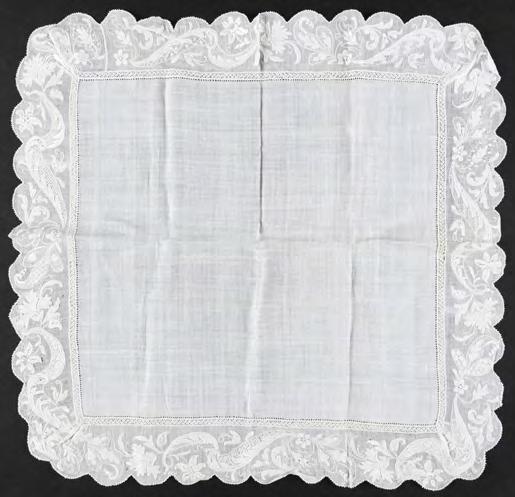
322* Handkerchief. A Dresden lace handkerchief, early-mid 19th century, white fine cotton lawn handkerchief, with 5.5 cm border of Dresden lace, with a pattern of scrolling tendrils, volutes, and flower sprays, several fine period darns, 45 x 46.5 cm (17.75 x 18.25 ins), together with:
A Honiton lace hanky, circa 1890, fine cotton lawn handkerchief, a few small marks to centre, appliquéd monogram ‘EM’ to one corner, wide border of lace, featuring butterflies, and floral and foliate motifs, including tulips, roses, and trefoil leaves, 34 x 34 cm (13.5 x 13.5 ins), mounted, framed and glazed (62 x 61 cm), together with 24 other 19th and 20th century handkerchiefs, one with a woven pattern, another with a printed pattern, a third with a hand-painted border of insects, and the remainder embroidered and/or lace-edged, some with initials or monograms, including several early 19th century large whitework hankies, one embroidered with a dog and a sheep (26) £200 - £400
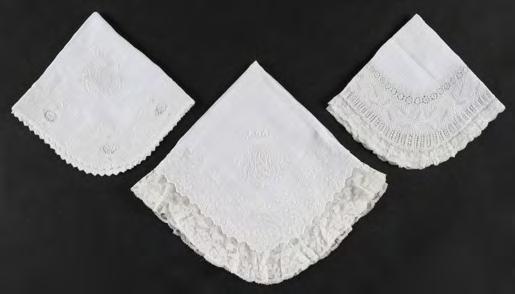
323* Handkerchief. A fine whitework hanky, 2nd half of the 19th century, fine cotton lawn, expertly hand-embroidered in white thread using satin and seed stitch, with monogram ‘DAG’ to one corner, a border (incorporating openwork) depicting grapevine roundels between quatrefoils, and an edging of trefoil leaves, 31.5 x 32 cm (12.25 x 12.5 ins), together with:
A fine whitework and lace hanky, 2nd half of the 19th century, fine cotton lawn, expertly hand-embroidered in white thread, using satin and seed stitch, with a large monogram ‘SMSM’ topped with a coronet to one corner, and a scalloped border of branches entwined with floral tendrils, edged with Valenciennes bobbin lace, 42 x 43 cm (16.5 x 17 ins), plus
A fine whitework and lace hanky, 2nd half of the 19th century, fine cotton lawn, expertly hand-embroidered in white thread, using satin and seed stitch, with a monogram ‘AMS’ in centre, and a wide multi-banded border (incorporating openwork) of flowers, foliage, medallions, etc., 2 very small holes (one just touching edge of embroidered border), edged with Valenciennes bobbin lace, 30.5 x 30.5 cm (12 x 12 ins), and a smaller whitework and lace handkerchief, monogrammed ‘PP’, some scattered small holes and a closed tear, 26 x 25 cm (10.25 x 9.75 ins) (4)
£200 - £300
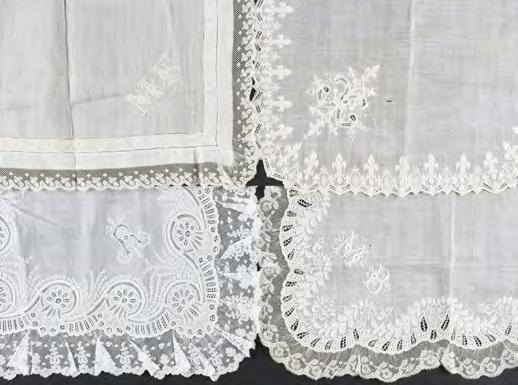
324* Handkerchief. A fine whitework lace hanky, 2nd half of the 19th century, fine cotton lawn, expertly hand-embroidered in white thread using satin and seed stitch, incorporating openwork, with initial ‘R’ to one corner, and an elaborate border depicting large ribbon bow motifs surrounded by dainty flower sprays, a couple of tiny fox spots, edged with Valenciennes bobbin lace, 38.5 x 36.5 cm (15.25 x 12.75 ins), together with:
A fine whitework lace hanky, 2nd half of the 19th century, fine cotton lawn, expertly hand-embroidered in white thread using satin and seed stitch, with initials ‘MB’ to one corner, and a foliate border (incorporating openwork), a few tiny holes, edged with Valenciennes bobbin lace, scattered light foxing, 40.5 x 41.5 cm (16 x 16.25 ins), plus
A fine whitework hanky, 2nd half of the 19th century, fine cotton lawn, expertly hand-embroidered in white thread using satin and seed stitch, incorporating openwork, with initials ‘CC’ to one corner, and a border of fleur-de-lys, a few tiny holes, and a very small period darn, some toning and faint stains, 33 x 34 cm (13 x 13.25 ins), and another hand-embroidered whitework handkerchief similar, with initials ‘MF’ to one corner, and a border of daisies, one small area of light toning, edged with Valenciennes bobbin lace, 44.5 x 44.5 cm (17.5 x 17.5 ins)
(4)
£200 - £300
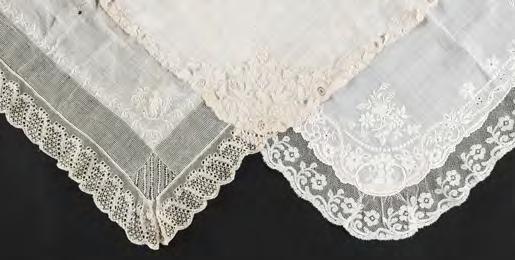
325* Handkerchief. A whitework lace handkerchief, late 18th century, fine cotton lawn, finely hand-embroidered in white thread using satin and seed stitch, with initials ‘MCH’ to one corner (incorporating openwork), vignettes to the other 3 corners (a Turkish gentleman, a dog sitting beside a tree, and a stag under a tree), and a dainty floral border, edged with lace, lightly toned, scattered tiny holes, 53 x 53 cm (21 x 21 ins), together with: A whitework lace handkerchief, early 19th century, fine cotton lawn, finely hand-embroidered in white thread using satin and seed stitch, incorporating openwork, with a large flower spray to each corner, and a border of flowers and other motifs, the border with cornerpieces of a dog lying down, a large sailing ship, a rural homestead, and sprays of heart’s ease, edged with Valenciennes bobbin lace, 49 x 52 cm (19.25 x 20.5 ins), plus A whitework handkerchief, early 19th century, fine cotton lawn, finely hand-embroidered in white thread using satin, seed, and stem stitch, incorporating openwork and raised appliqués, with a narrow border and large cornerpieces of flowers, birds, and butterflies, toned and a few fox spots, 41 x 41 cm (16 x 16 ins) (3) £200 - £300
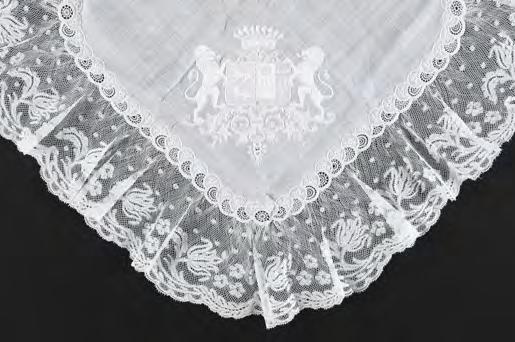
326* Handkerchief. Lace armorial wedding hanky belonging to Clémentine de Granal (1850-1947), 1872, fine cotton lawn, expertly hand embroidered to one corner in white thread, using satin, long and short, and seed stitch, with large coat of arms of Alphonse de Sarrieu and Clémentine de Granal, showing 2 adjacent shields above a large floral and volute device, flanked by rampant lions, and topped by a coronet, finely stitched scalloped border of embroidered flowers and openwork, and a wide edging of fine Valenciennes bobbin lace, depicting tulips, and scattered smaller flowers and dots, 46 x 46 cm (18 x 18 ins)
A beautifully stitched whitework lace handkerchief, in excellent condition, made for the wedding of Alphonse de Sarrieu (1842-1908) and Clémentine de Granal (1850-1947), which took place in Toulouse on July 8th, 1872. (1) £200 - £300
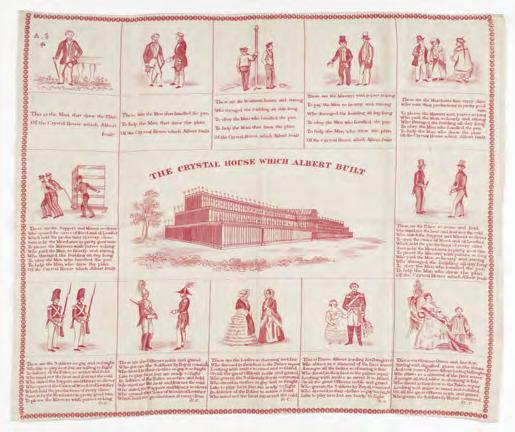
327* Handkerchief. The Crystal Palace Which Albert Built, circa 1851, printed in raspberry red on cream cotton, depicting the Crystal Palace in the centre, with title above, surrounded by 12 compartments, each with a verse and accompanying vignette above, owner’s initials ‘A.S’ and the number ‘4’ in cross-stitch to upper left corner, selvedges to sides, upper and lower edges with hand-stitched hems, some faint toning, 3 tiny holes (2 just touching a few letters), 42 x 51 cm (16.5 x 20 ins), together with a Royal Opera Covent Garden printed silk programme, titled ‘State Performance to Commemorate the Sixtieth Anniversary of Her Majesty’s Accession to the Throne’, dated Wednesday June 23, 1897, edged with metallised silver fringe, 40.5 x 30.5 cm (16 x 12 ins)
A rare commemorative handkerchief, in bright and robust condition, celebrating the building of the Crystal Palace in Hyde Park, erected to house the Great Exhibition of 1851. The twelve verses follow the format of the nursery rhyme ‘This Is the House That Jack Built’, the first verse beginning ‘This is the Man that drew the Plan/Of the Crystal House which Albert built’, and the last beginning ‘This is our Glorious Queen and her Son,/Sitting with dignified grace on the throne ... ‘. (2)
£200 - £300 Lot 328
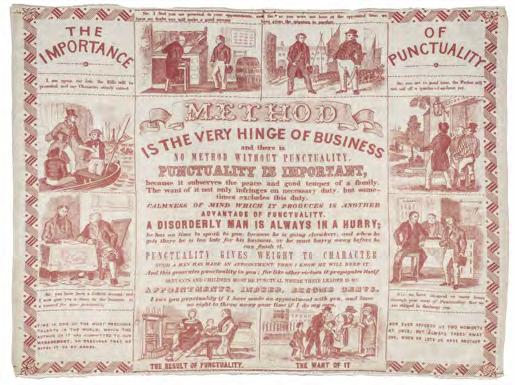
328* Handkerchief. The Importance of Punctuality, mid 19th century, printed in raspberry red ink on a cream cotton ground, titled to upper left and upper right corners, and with 8 scenes of figures demonstrating the result of punctuality and the want of it surrounding the central text: ‘Method is the Very Hinge of Business and there is No Method Without Punctuality … ’, selvedges to sides, raw edges (previously hemmed) top and bottom, a few small light marks, but overall in good condition, 41 x 54.5 cm (16.25 x 21.5 ins)
A rare printed handkerchief, extolling the virtues of precise time-keeping, which ‘subserves the peace and good temper of a family’, producing ‘calmness of mind’ and ‘weight of character’. We have been unable to trace another sold at auction. (1) £150 - £200
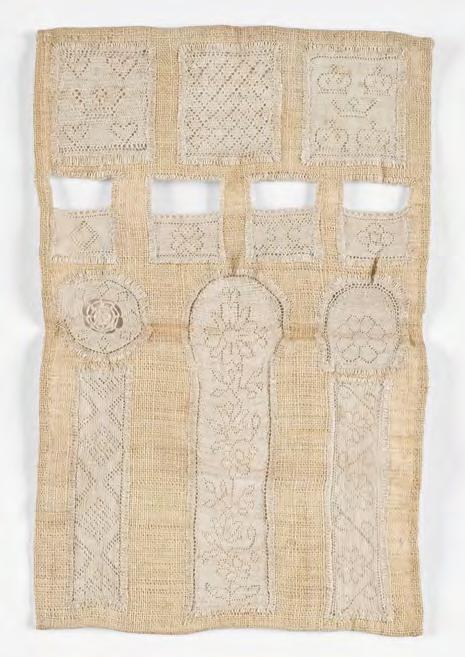
329* Hollie Point Lace. A small Hollie Point needle lace sampler, late 18th century, dark cream linen panel with various shaped insertions of finely-worked Hollie Point lace depicting crowns, latticework, flowers, chevrons, etc., and incorporating the initials ‘SC’, 17 x 11 cm (6.75 x 4.25 ins), together with:
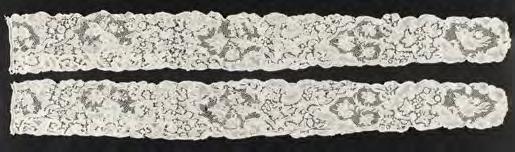
330* Honiton Lace. A pair of long lappets, circa 1725-1730, two finely-worked cream lace lappets, with pillow made floral and foliate motifs, latticework, and scrollwork, on a ground of delicate picot brides, square ends to top, a few small faint fox spots and occasional minor breaks (including a 5 x 12 mm hole), but overall in good condition, each 10 x 82.5 cm (4 x 32.5 ins)
A particularly fine pair of early Honiton lace lappets, exceptionally long, and surviving in unusually good condition.
(a pair)
£400 - £600
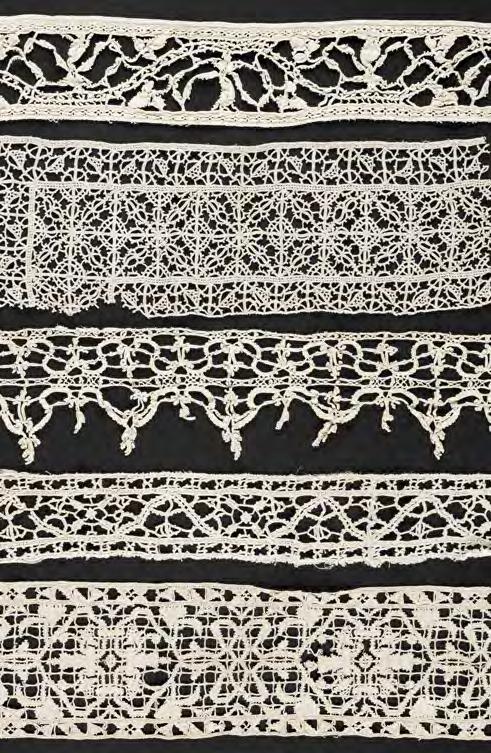
331* Italian Lace. A wide cutwork border, late 16th/early 17th century, wide cream linen lace border, with strapwork pattern on a square grid, some breaks, 11 x 94 cm (4.25 x 37 ins), together with 3 other pieces of late 16th/early 17th century Italian cutwork, comprising the corner of a panel, 12 x 35 cm (4.75 x 13.75 ins), and two borders, 7 x 69 cm (2.75 x 27 ins) and 6 x 47 cm (2.5 x 18.5 ins), plus a bobbin lace border or collar trim, also Italian, late 16th/early 17th century, 9.5 x 78 cm (3.75 x 30.75 ins)
An interesting group of rare early Italian lace, showing something of the skill of lacemakers at the time and the variety of techniques used.
(5)
£200 - £300
An infant’s shirt with Hollie Point lace dated May 3 1768, handmade of fine white cotton lawn, with inserts of Hollie Point lace incorporating the words ‘Fear God and keep’ / ‘his laws May 3 1768’ on left and right shoulder respectively, inserts flanked by eyelet embroidery and buttonhole stitch loops, round neck and short gathered sleeves, length 23.2 cm (9.25 ins), plus another infant’s shirt with inserts of Hollie Point lace, and A pair of fine white cotton lawn cuffs, mid 18th century, each with insert of Hollie Point lace depicting an urn with branching flower stem, trimmed with lace and buttonhole stitch loops, edged with lace, 8.5 x 9.5 cm (3.5 x 3.75 ins), plus 3 bonnets with Hollie Point lace inserts, and a small quantity of other lace, 18th-19th century, mostly lengths or flounces (e.g. 2 lengths of Dresden lace), but also including a stole and a lappet (a small carton)
£400 - £600
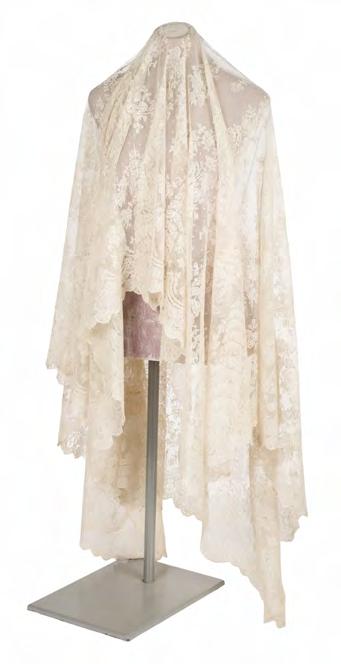
332 Lace Veil. A needlelace wedding veil, late 19th/early 20th century, large cream veil, elaborately hand embroidered on machine net with copious flower sprays and garlands, on a semé dot ground, with floral sprigs to centre, scalloped edge, occasional fox spots, 181 x 170 cm (71.25 x 67 ins), together with 7 other lace items, including an elaborate and finely-worked whitework panel with a variety of lace inserts, a few small holes and a little edgefraying, 49 x 131 cm (19 x 51.5 ins), 2 lace collars, one Honiton, and a white cotton bedcover, early 20th century, with various lace borders and inserts, including a border to three sides of figurative filet lace depicting scenes from the Bayeux Tapestry
(8)
£200 - £300
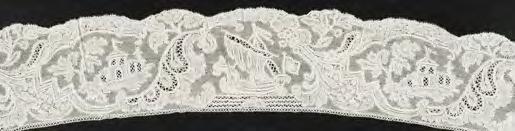
333* Mechlin Lace. A length of lace depicting ships and castles, Flanders, circa 1730-1740, cream bobbin lace border, finely worked with alternating motifs of sailing ships and castles, within a border of volutes and flourishes, scalloped edge, lightly foxed in a few places, 1 or 2 tiny holes, 6.5 x 114.5 cm (2.5 x 45 ins), together with: A lace lappet, Flanders, circa 1780, a cream bobbin lace lappet, with repeated rosehip and leaf motif on a net ground, and scrolling flower border, top edge raw, 8 x 61 cm (3 x 24 ins), plus a small length of dark cream bobbin lace depicting peacocks on a net ground, probably early 19th century, 8.5 x 26 cm (3 x 10.25 ins) It is highly unusual to find Mechlin lace with pictorial images, and therefore it is likely that the imagery held some significance to the maker or owner of the piece.
(3)
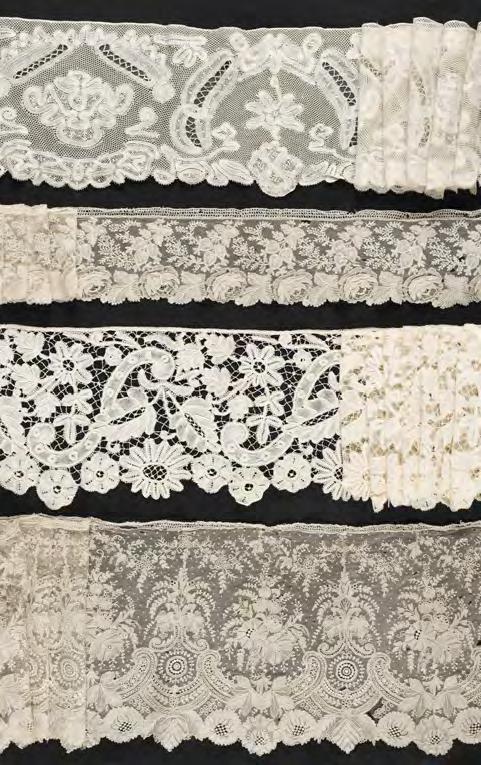
£300 - £400
334* Milanese Lace. A length of lace, Italy, 19th century, worked with sinuous scrolling pattern in cream linen thread, 22.5 x 167 cm (8.75 x 65.75 ins), together with another length of Milanese lace, largely stitched to a new net ground, 14 x 76 cm (5.5 x 30 ins), and another length similar, 19.5 x 209 cm (7.75 x 82.25 ins), plus 8 further lengths or fragments of lace, including 3 edgings of Point De Gaze, all with some small holes, 2 matching (with raised details), width 11 cm (4.5 ins), length (1 join) 262 cm (103 ins) and 154 cm (60.5 ins), the other 26 x 112.5 cm (10 x 44.25 ins) (11)
£200 - £300
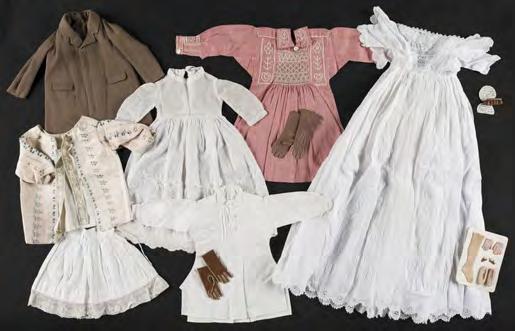
335* Miniature Clothes. A collection of miniature clothing finely knitted by Mrs Coward of Roundway, Devizes, 1820, comprising: a knee-high sock, top to heel 8 cm (3 ins); a pair of gloves, length 2.5 (1 in); a pair of bootees, length 1 cm (.5 in); and a pair of slippers, length 3.5 cm (1.5 ins), mounted with thread on a piece of card, annotated on the verso in ink in a later (early 20th century?) hand ‘Knitted by Mrs Coward of Roundway, Devizes in 1820’, 11.5 x 8.5 cm (4.5 x 3.5 ins), together with a miniature clothes brush, made for one of the 4 Coward sisters using her hair by their cousin George Sims, circa 1830, length 3 cm (1.25 ins), with accompanying manuscript note, contained in a small round cardboard box, plus A collection of miniature and dolls’ clothes, 19th-20th century, including: a doll’s whitework christening gown, bodice worn and with some stitched consolidation, length 60 cm (23.5 ins); a smocked red and white gingham dress with long sleeves, length 30 cm (11.75 ins); a white cotton shirt with tucked bib and grandad collar, length 26 cm (10.25 ins); a gentleman’s brown gabardine mackintosh, hanging loop at neck torn, three metal press stud fasteners, two pockets with flaps, length 28.5 cm (11.25 ins); a closegathered and lace-trimmed white cotton cape, length 35 cm (13.75 ins); and 3 pairs of miniature gloves, various condition and sizes
The note accompanying the beautifully made tiny clothes brush reads: ‘The 4 Conrad sisters of Roundway, Devizes. Elizabeth, Mary (Cunnington), Ann (Waylan) & Jane, had a London cousin, George Sims, who from the hair of each made each of the 4 sisters a tiny hat-brush. About the year 1830.’ (37) £200 - £300
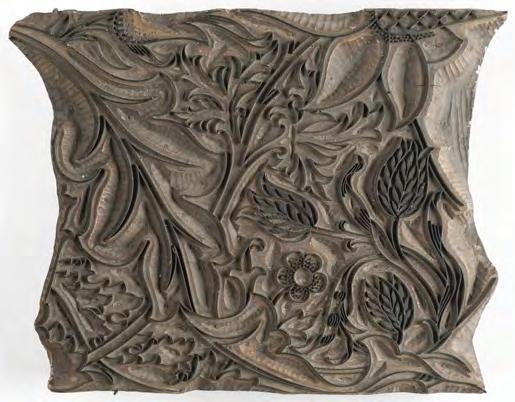
336* Morris & Co.. A printing block for ‘Severn’ velveteen or cotton fabric designed by John Henry Dearle (1859-1932), circa 1890, large and heavy carved wooden printing block for a pattern of tulips, daisies, and acanthus leaves, entitled ‘Severn’, set with thin metal strips to define the pattern, 2 deep handle grooves on verso, 46 x 35 cm (18 x 13.75 ins)
Examples of Morris & Co. cotton block-printed with this ‘Severn’ pattern are held by: William Morris Gallery, catalogue number F48; Art Institute Chicago, Reference Number 1972.392.
See Linday Parry, William Morris Textiles, 2nd edition, 2013, p.247. Textile and stained glass window designer John Henry Dearle began as a shop assistant at the firm of Morris & Co., but such were his artistic talents that he was promoted to chief textile designer in 1890. The Art Institute Chicago notes: ‘Both Morris and Dearle were deeply influenced by historical textiles, especially those of Persia, Turkey, and Italy. Persian influence in particular can be seen in this fabric, in the way the elements are organized into two separate vine systems, one overlaid on the other.’
(1)
£300 - £500
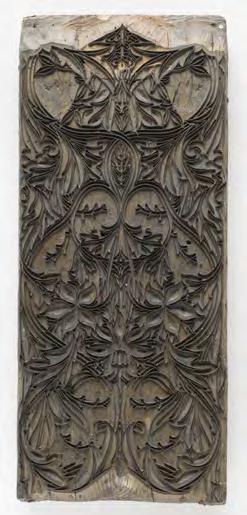
337* Morris & Co.. A printing block for fabric, circa 1890, large and heavy carved wooden printing block, set with thin metal strips to define the pattern (some missing), 2 deep handle grooves on verso, 56 x 24 cm (22 x 9.5 ins) (1)
£300 - £500
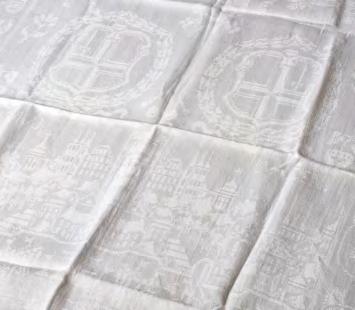
338* Queen Victoria. A napkin from the Banquet held at the Guildhall, London, 9th November 1837, white damask linen, woven with a view of London and sailing ships on the Thames, with armorial shields of the City of London, and mounted knights above, selvedges to sides, top and bottom edges with hand-rolled hem, a few minor marks (including a couple of tiny rust spots to lower edge), 91 x 66 cm (35.75 x 26 ins), together with 3 manuscript notes pertaining to provenance
On 9th November 1837, Queen Victoria attended her first Lord Mayor’s Banquet at London’s Guildhall. Since she had ascended the throne only a few months before, on 20th June, this was one of her first major public appearances. The Queen was seated under a velvet canopy, and the hall was illuminated by gas lighting. The evening, which included a grand banquet and toasts, was a significant civic celebration of the new reign of the young Queen, prior to her coronation the following year.
The three manuscript notes by three different members of the family who owned the napkin, state that it belonged to a Mrs Bradford, née Domville, who ‘was permitted to dress up as a waitress & so obtained a sight of the show & got one of the napkins as a souvenir’.
(1)
£100 - £200
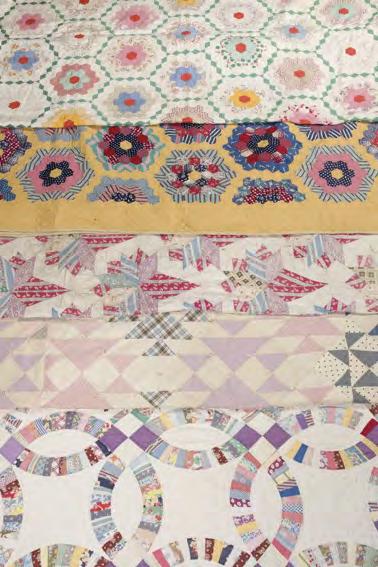
339* Quilt. A double wedding ring coverlet, American, 1930s, hand-stitched with printed and plain cotton patchwork on a quilted white cotton ground, scalloped edge, some light stains and marks, occasional minor wear, 209 x 177 cm (82.25 x 69.75 ins), together with 4 other American patchwork quilts (2 hexagon, 1 star, 1 triangle) (5) £100 - £200
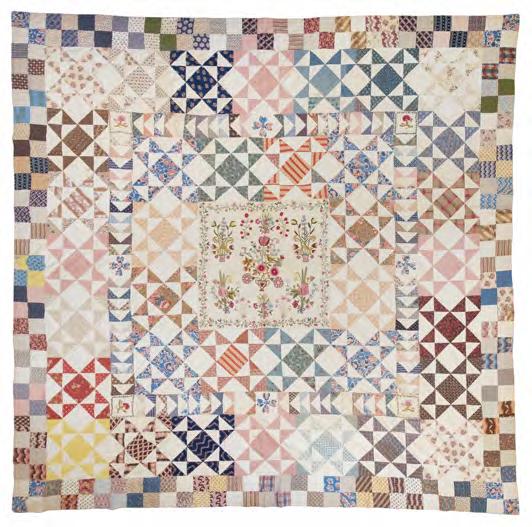
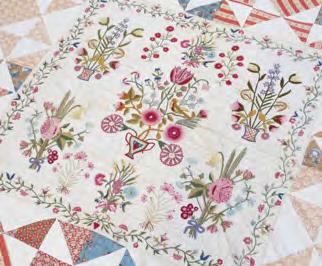
340* Quilt. A large embroidered patchwork coverlet, early 19th century, with a large hand-stitched central square, worked in polychrome wool, with a flower urn containing a tulip, moss rose buds, heart’s ease, lilies, and carnations, a bird perched on one stem, flanked by 2 further flower urns and 2 beribboned flower posies, with 3 floral motifs above and 3 below, 70 x 73 cm (27.5 x 28.75 ins), surrounded by: a frame of patchwork stars formed by printed cotton triangles emanating from a central square, with white cotton patches between; a narrow chevron border of printed and plain cotton triangles, with an embroidered floral square patch at the corners; another star border as before; and an outer border of printed (and a few plain) squares, lightly toned and foxed in places, backed with white cotton (toned and marked, and with a 6 cm square tear), butted hem, quilted overall in pale thread, 279.5 x 279.5 cm (110 x 110 ins)
A rather beautiful early quilt, the fabrics unusually uniformly robust. (1)
£700 - £1,000
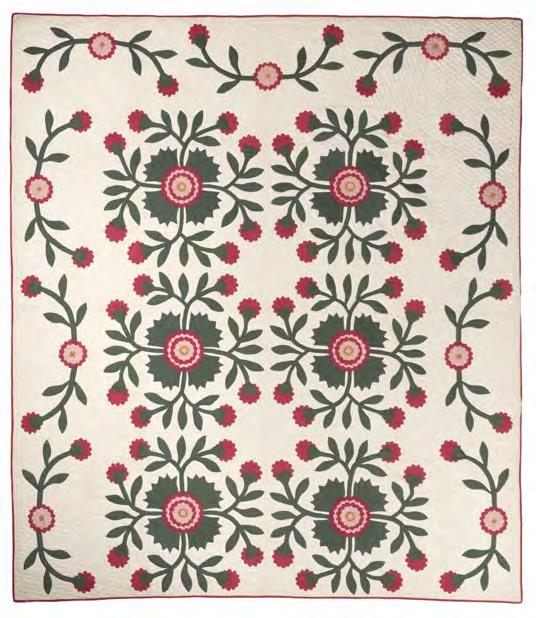
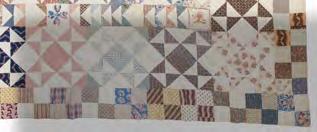

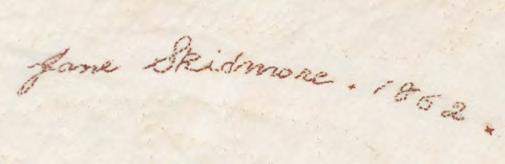
341* Quilt. A large Whig Rose pattern quilt made by Jane Skidmore, American, 1862, hand-stitched bedcover with appliquéd and quilted red, pink, green, and yellow floral spray design, on a quilted ivory cotton ground, edges bound with matching red fabric (slightly worn in 1 or 2 small areas), one corner of verso neatly stitched with maker’s name and date in brown thread ‘Jane Skidmore 1862’, some marks to verso, 224 x 197 cm (88 x 77.5 ins), together with 4 other appliqué quilts (another Whig Rose; red and blue star design; lovebird, fan, and tulip design; and a floral pattern) (5)
£200 - £300
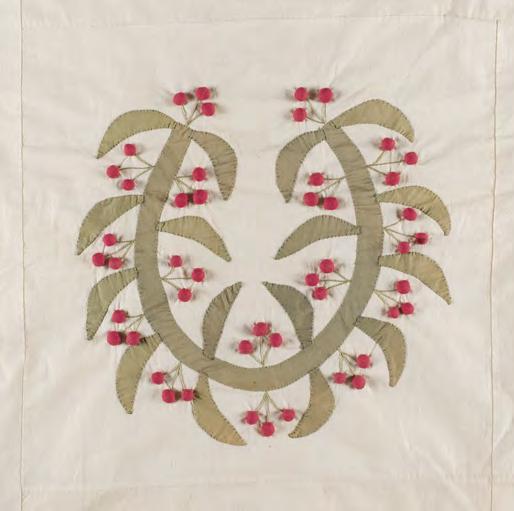
343* Quilt. An appliquéd bedcover, American, possibly Baltimore, early 20th century, hand-stitched coverlet, comprising 9 large repeated green and red leaf and berry horseshoe-shaped motifs, each appliquéd to a cream cotton square panel, the 9 panels arranged in a square, the berries padded and on embroidered stem stitch stems, each square 43 x 43 cm (17 x 17 ins), with plain cream cotton border, the edges left (intentionally?) unfinished, some staining and marks, mostly to plain border, 198 x 198 cm (78 x 78 ins), together with:
An appliquéd eagle quilt, American, late 19th/early 20th century, hand-stitched with 4 large appliquéd perched eagles in green, yellow, and red, around a central red and green quatrefoil, and within a red border, on an ivory cotton ground, toned and marked, backed with ivory cotton, and quilted overall in pale thread, edges bound in red cotton (worn), 208.25 x 193 cm (82 x 76 ins), plus
£150 - £200
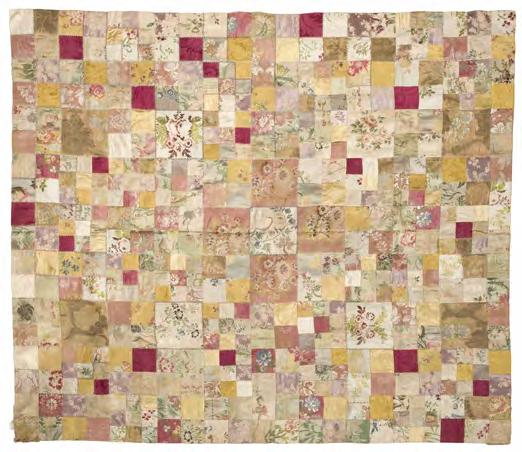
342* Quilt. A piece of early Victorian patchwork, composed of various different silk damask and brocade squares, the squares of varying sizes, some outlined in herringbone stitch, occasional wear (particularly to 2 squares at one corner), and some early period darns, remains of some of the original manuscript and blank paper piecings on verso, 136 x 115.5 cm (53.5 x 45.5 ins), together with: A large floral quilt, possibly French, early 20th century, handstitched cotton of alternating floral and plain white cotton stripes, occasional small marks, backed with white cotton (toned and marked in places, 4 x 3 cm hole), turned over hem, quilted diagonally overall in pale thread, 251.5 x 247.5 cm (99 x 97.5 ins), plus A large peacock quilt, possibly French, early 20th century, handstitched cotton printed with repeated pattern of peacocks and meandering rose stems, in shades of pink and green, on a white ground, some fading and wear, backed in white cotton, butted edges, quilted overall in pale thread, 261.5 x 232.5 cm (103 x 91.5 ins), and 2 other quilted items (a large patchwork bedcover with raw edges, and a table mat of pineapple quilting, worn) (5)
A Whig Rose pattern quilt, American, late 19th century, handstitched bedcover with bold appliquéd pattern in pink and green, depicting 4 large flower stems alternating with 4 large feathers and emanating from a central flower, with a large grapevine border, and floral cornerpieces, on a quilted ivory cotton ground, toned and some small marks, scattered small holes to red appliqués, backed with ivory cotton (incorporated in the quilting), backing toned and stained (and with a few small holes), edges worn, 223.5 x 212 cm (88 x 83.5 ins), and another Whig Rose pattern quilt, American, late 19th century, hand-stitched bedcover with appliquéd and quilted pink and green floral spray design, on a quilted ivory cotton ground, the green appliqués uniformly worn with numerous tiny holes (not detracting from the overall appearance), edges bound with matching pink fabric, latter worn with losses (one corner with associated loss to edge of quilt, not quite touching motif), a few small marks, 228 x 261 cm (90 x 102.75 ins), plus another American quilt, early 20th century, appliquéd with white snowflakes on a pale blue ground, border of pale blue fleur-de-lys on a white ground, backed with white cotton (stain to one edge), turned over to front at edge, hand-quilted overall in white thread with interlocking circles to central panel, and with lattice design to border, lightly faded at edges in places, a few small dark spots near one corner, 194 x 218.5 cm (76.5 x 86 ins) (5) £150 - £200
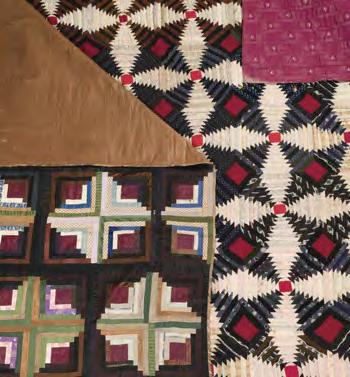
344* Quilt. Log cabin patchwork coverlet, American, mid 19th century, hand-stitched silk patchwork, including plain, moiré, printed, and brocade fabrics, in polychrome colours, each square 31 x 31 cm (12.5 x 12.5 ins) composed of 4 smaller squares, backed with tan glazed cotton, some wear, especially to bound edges, backing with some light water-staining, 159 x 162 cm (62.5 x 63.75 ins), together with: A large pineapple coverlet, American, mid-late 19th century, hand-stitched cotton patchwork, composed of printed and plain fabrics, occasional wear, backed with deep pink cotton patterned with white floral stripes (partially faded), backing turned over to front to bind edge, 189 x 218 cm (74.5 x 85.75 ins) (2) £150 - £200
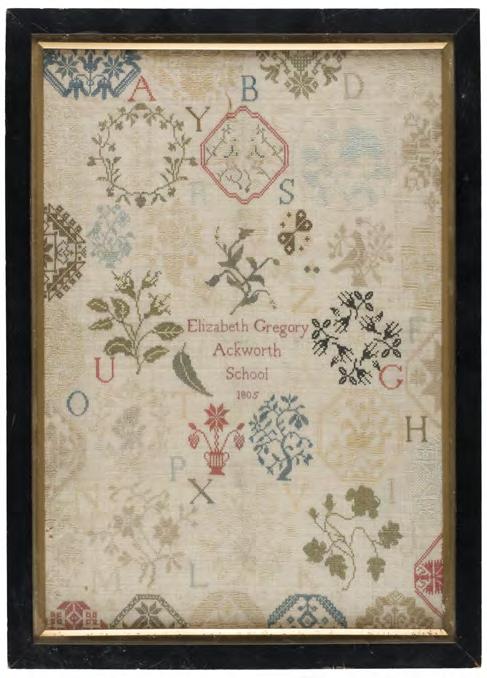
345* Sampler. A medallion needlework sampler by Elizabeth Gregory, Ackworth School, 1805, worked in fine cross-stitch on a cream linen ground, in varying colours, including blue, red, pink, yellow, green, and brown, with a variety of different pictorial medallions, wreaths, and flower sprays, incorporating birds (including a swan), roses, stars, a floral urn, a tree, etc., and with the letters of the alphabet scattered around, with stitched lettering in centre in red ‘Elizabeth Gregory Ackworth School 1805’, and in one of the wreaths ‘EG to MW 1805’, 2 very small holes to lower left corner (one affecting a few stitches at extreme edge), 41.5 x 28.5 cm (16.25 x 11.25 ins), framed and glazed (47 x 34 cm)
A very good example of a rare Ackworth medallion sampler. Such samplers are distinctive in motif and quite different from the more commonly seen samplers stitched with alphabets and moral verse. It is not known how the form came about, but it appears to be unique to the Quaker school of Ackworth, near Pontefract, West Yorkshire. (1)
£2,000 - £3,000
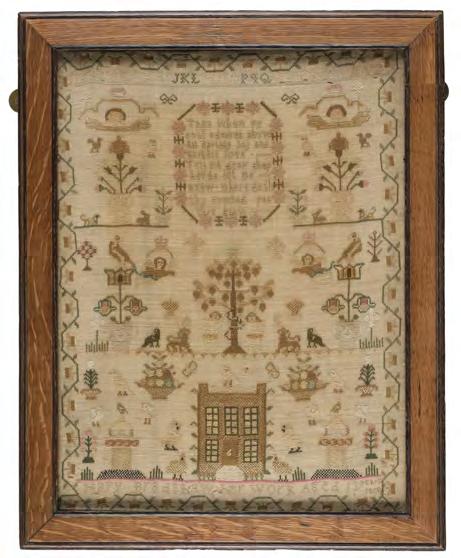
346* Sampler. A needlework by Mary Bradshaw, 1819, worked in neat cross-stitch in polychrome silks on a beige linen ground, with a depiction of Adam and Eve, the Tree of Life, and the serpent, in the centre, with a didactic verse within a decorative frame above, and a large symmetrical town house below, the three central features flanked by numerous motifs, including cherubs, dogs, birds, rabbits, lions, stylised floral urns and trees, and crowns, upper margin with an alphabet, lower margin with the lettering ‘Mary Bradshaw her Work Aged 13 years 1819’, generally lightly toned and faded, occasional small holes, but stitching largely intact, 41.5 x 31.5 cm (16.5 x 12.5 ins), framed and glazed (49 x 38.5 cm)
The imposing town house pictured on this sampler, with a bold number ‘6’ on the front door, was undoubtedly the dwelling of Mary Bradshaw, the young stitcher of this attractive piece. (1)
£100 - £200
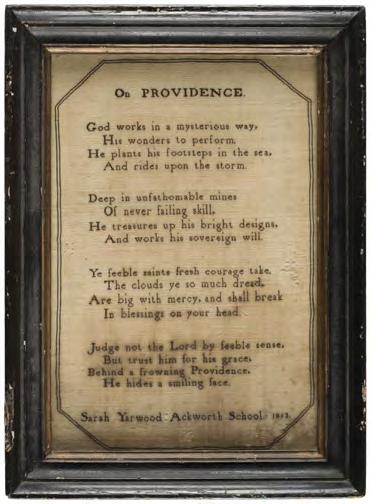
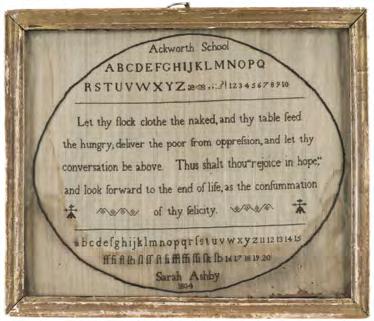
347* Sampler. A needlework sampler by Sarah Yarwood, Ackworth School, 1813, neatly worked in cross-stitch in black thread on a cream linen ground, with four verses entitled ‘On Providence’ taken from William Cowper’s 1774 hymn: ‘God works in a mysterious way,/His wonders to perform ... ‘, and with ‘Sarah Yarwood Ackworth School 1813’ to lower margin, the whole within a double line border, toned, several small holes (one causing a break in the border to lower right corner, but all other stitching unaffected), 30 x 20 cm (11.75 x 8 ins), framed and glazed (36 x 26 ins), together with: A needlework sampler by Sarah Ashby, Ackworth School, 1804, neatly worked in cross-stitch in black thread on a cream linen ground, with didactic verse ‘Let thy flock clothe the naked, and thy table feed the hungry, deliver the poor from oppression, and let thy conversation be above. Thus shalt thou “rejoice in hope,” and look forward to the end of life, as the consummation of thy felicity.’, with alphabets and numerals above and below, maker’s name ‘Sarah Ashby’ and date 1804 to lower margin, enclosed in an oval single line border, damp-stained to edges, some minor damage to lower blank margin, 25 x 31 cm (10 x 12.25 ins), framed and glazed (29.5 x 35 cm), one side of frame detached
Sarah Yarwood and Sarah Ashby are recorded as having entered the Quaker school of Ackworth near Pontefract, West Yorkshire, in 1811 and 1796 respectively, inventory numbers 3222 and 1425 (see the listing of Ackworth scholars 1779-1879 held by the Library of Congress). (2) £200 - £400
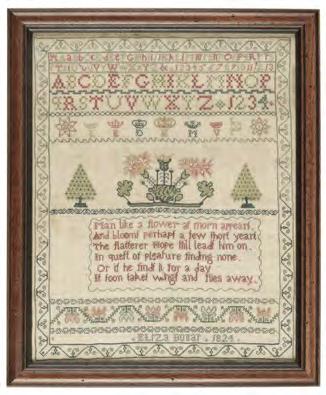
348* Sampler. An early 19th century needlework, by Eliza Bonar, 1824, neatly worked in cross-stitch, back-stitch, and Algerian eye stitch, predominantly in shades of red, blue, green, and gold, on a beige linen ground, with carnations in a bowl in centre flanked by fir trees, above a 6-line moral verse, and below the alphabet and Arabic numerals, and a line of coronets, each with an initial beneath denoting the rank (King, Marquis, Duke, Earl, etc.), stylised floral border to lower edge above maker’s name and date, some loss affecting 5 letters of verse (with some consolidating stitches), small hole to blank area on left of verse, 38.5 x 30.5 cm (15.25 x 12 ins), framed and glazed (44.3 x 36.7 cm), together with:
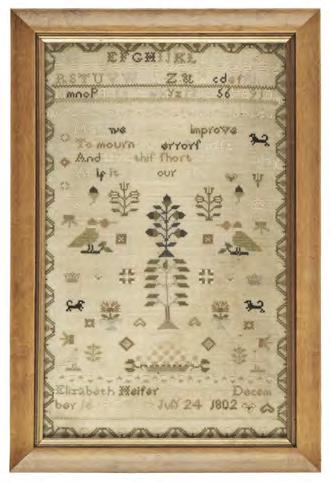
An early 19th century needlework, by Elizabeth Heifer of Dennington, 1813, neatly worked in cross-stitch, predominantly in shades of green, brown, gold, and cream, on a dark cream linen ground, with alphabets above a 4-line moral verse, the centre with a variety of small stylised motifs, including dogs, branching plants, birds, flower urns, crowns, acorns, etc., and reading at foot: ‘Elizabeth Heifer, Dennington, December 16 1813. Born July 24 1802’, 31 x 19 cm (12.25 x 7.5 ins), maple wood frame, glazed (36.5 x 24.3 cm), plus 5 unframed samplers, including a sampler by Florence Christy dated 1787 (some wear), a sampler by Jane Thompson of Errol House dated March 1826, and a darning sampler dated 1817 (7) £200 - £300
349* Shawl. A Spitalfields silk stole, circa 1810-20, dusky blue silk stole, the deep end borders woven in shades of pink, green, and yellow, with two rows of large rose stems, a flower border and a heart and scallop border above, and a row of leaves between heart and scallop border below, striped long edges, fringed at short ends, a few unexceptionable faint marks (including one horizontally at fold), 1 x 1 cm hole (just touching one of the heart and scallops), and slight fraying to one leaf nearby, 44 x 230 cm (17.25 x 90.5 ins), together with:
A Spitalfields silk stole, circa 1810-20, orange silk stole, the deep end borders woven in shades of lilac, blue, green, yellow, and white, with repeated pattern of large flower stems, between floral borders, mottled discolouration, long edges hemmed by machine, knotted fringe at short ends, 39.5 x 264 cm (15.5 x 10⁴ ins), plus 2 other Spitalfields stoles, cream silk, with deep end borders woven in colours, both somewhat marked, one with a little wear (4)
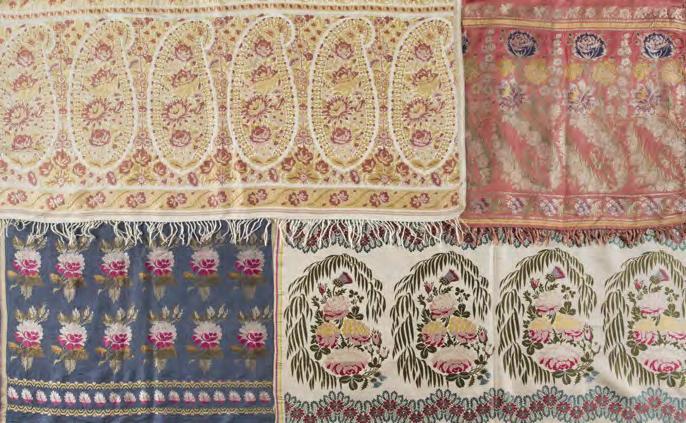
£300 - £500
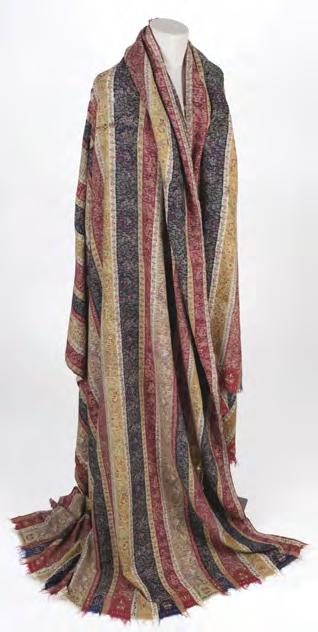
350* Shawl. A striped long shawl, Indian or European, early-mid 19th century, woven wool shawl, with alternating wide and narrow patterned stripes in dark blue, red, yellow, and pale green, handembroidered harlequin gates to short ends (with remains of short fringe), worn, with scattered holes and darns, including a long crudely-stitched repair horizontally across centre, long sides sometime edged on verso with hand-stitched fabric tape, 305 x 134.5 cm (120 x 53 ins)
(1)
£300 - £500
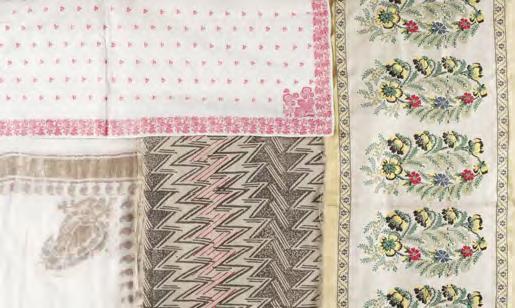
351* Shawl. A woven silk stole, circa 1830, pale yellow twilled silk, with wide borders at short ends, featuring 6 large palmettes woven in green, yellow, black, red, and blue, narrow scrolling floral border all round (that to long edges rubbed), short ends fringed, yellow uniformly faded (darker on reverse), some staining and marks, 267 x 76 cm (105 x 30 ins), together with:
An Indian goldwork stole, circa 1900, fine muslin ivory stole, woven with goldwork border of small botehs, with large boteh at each corner, 114 x 233.5 cm (45 x 92 ins), plus a large and unusual fine wool shawl printed with a red and black chevron design on a cream ground, some scattered small holes, 137.5 x 305 cm (54 x 120 ins), and a small shawl of fine white cotton, with an all-over pattern of flower sprigs, floral cornerpieces, and a border of flowers, all woven in pink, hand-stitched hem, 72.5 x 70 cm (28.5 x 27.5 ins) (4)
£150 - £250
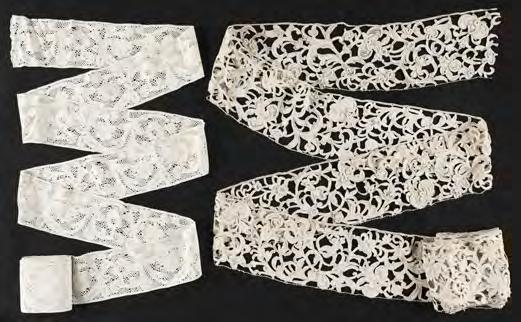
352* Venetian Lace. A long length of Venetian Gros Point lace, Italy, circa 1625-1675, dark cream needlelace flounce, deeply padded, and with occasional plain brides, the design forming large stylised floral motifs, volutes, and flourishes, occasional breaks, 12 x 403 cm (4.75 x 158.5 ins), together with: Flemish Lace. A long length of Flemish lace, late 17th century, cream bobbin lace, worked in linen thread with meandering stems terminating in flowers, 8.5 x 506 cm (3.5 x 199 ins)
Provenance: Anne Swift Collection (first item); The Pamela Fontana Antique Lace Collection (both items).
Mrs Pamela Fontana (1932-2023) began collecting antique lace, costume and associated accessories some fifty years ago. What started out as a small hobby turned into a passion and very generous sharing of all things lace, resulting in a website entitled ‘Lace For Study’ (no longer running), with visitors from around the world. Her abiding wish was to share with and educate the lace community, by whom she was greatly respected, not just in the UK but more widely, particularly in Germany, Sweden and further afield. Her wide-ranging collection, offered here, consists of some several thousand individual items, and includes a number of rare and early pieces. (2)
£300 - £500
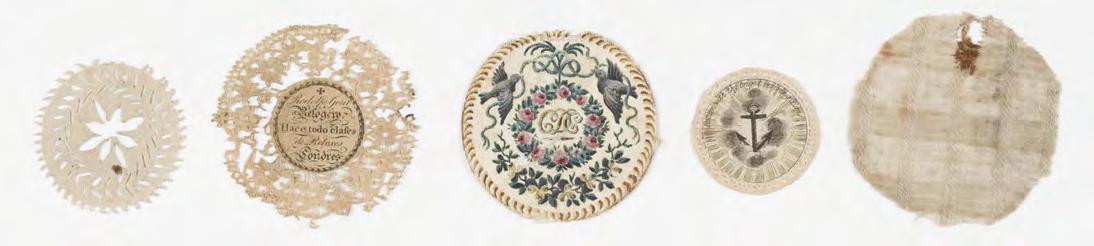
353* Watch Sampler. A hand-painted pocket watch roundel, 1801, finely painted in colours on a cream silk ground, with monogram ‘CDC’ in the centre within a wreath of pink roses, the wreath suspended from a ribbon bow, the ribbon ends held by a pair of songbirds, a garland of heart’s ease below the wreath, a little rubbed and ground slightly threadbare in places (including at edge), top edge of verso with remains of contemporary sepia ink inscription ‘E.B. pinxit. Febr. 1801’, diameter 5 cm (2 ins), together with 4 other watch roundels: an 18th century engraved paper roundel with paper lace border, lettered ‘Rodolfo Gout Relogero, Hace todo clases de Reloxes, Londres’, some breaks in border, diameter 5 cm (2 ins); a card roundel engraved with an anchor before sunburst clouds, captioned above ‘Return with thy bright reviving Rays’, with a pierced chevron border, diameter 3 cm (1.25 ins); a paper roundel with scissorcut pattern, diameter 4 cm (1.5 ins); and a woven cloth example, diameter 5 cm (2 ins) (5)
£150 - £200
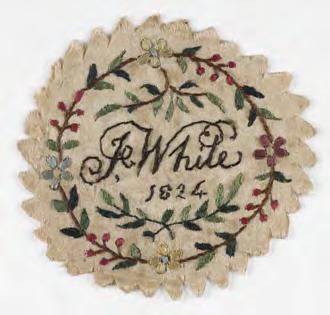
354* Watch Sampler. Embroidered pocket watch roundel stitched by J. White, 1824, hand-stitched in black thread in the centre with the name ‘J. White’ and date 1824, and in coloured threads with a leaf flourish above and below, and a floral wreath border, on a circular cream silk ground, with pinked edges (a little frayed), diameter 6 cm (2.25 ins) (1)
£300 - £500
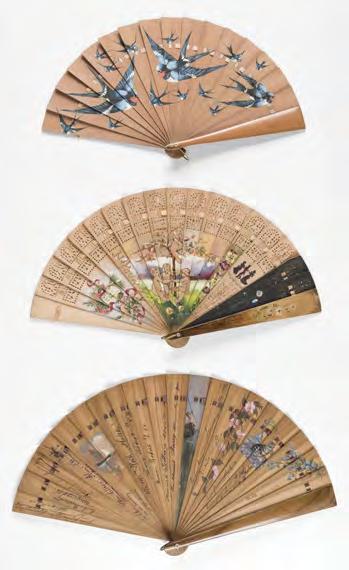
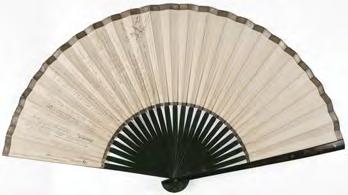
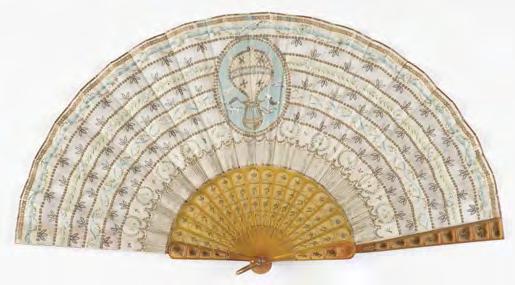
356* Ballooning Fan. A hand-painted blond tortoiseshell fan, circa 1890, folding gauze and silk leaf, with central oval hand-painted with an early hot air balloon surrounded by doves, on a ground of horizontal bands hand-painted with various ribbon, flower, and leaf borders, highlighted in gilt, the leaf elaborately adorned with gold spangles of various shapes, blond tortoiseshell monture, with applied foliate decoration in gilt, leaf beginning to split where joined to upper guard, and small area of wear to upper guard, 25.5 cm (10 ins), contained in a Duvelleroy box
Overseas buyers should note the information on our shipping page regarding the import/export of CITES regulated items. CITES licence applications and any exportation/importation requirements are the responsibility of the buyer.
(1)
£150 - £200
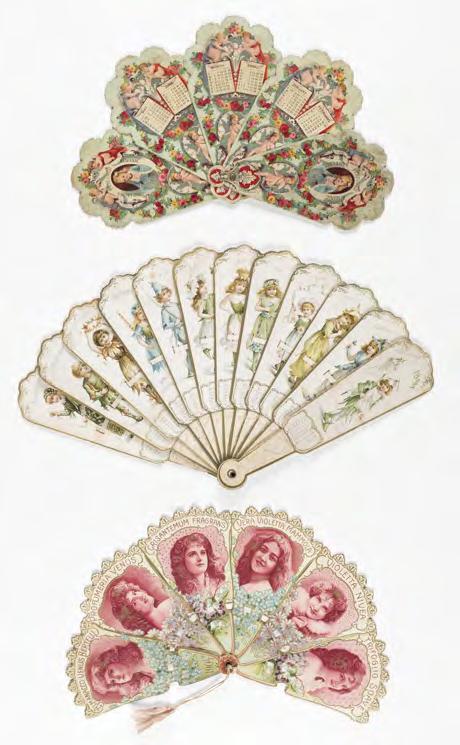
£100 - £200
355* Autograph Fan. A hand-painted autograph fan, German, 1887-1889, pierced wooden brisé fan, with a variety of ink inscriptions and signatures, some dated, with accompanying vignettes of children, flowers, silhouettes, a clown, etc., 3 sticks with neat wooden repairs, 2 sticks with slight loss to upper left corner, guard sticks hand-painted with daisies and butterflies respectively (slightly rubbed), 26 cm (10.25 ins), together with two other autograph fans with hand-painted decoration similar, one Czechoslovakian, with painting of swallows to recto, and autographs to verso, the other Croatian, mentioning Abbazia (Opatija), with various signatures and vignettes to recto mainly, including Vice Admiral Barry, presumably Sir Henry Deacon Barry (1849-1908), 3 sticks splitting and strengthened with adhesive tape on verso, plus: two large folding paper autograph fans, late 19th century, one fan approximately half full of ink inscriptions and signatures, some dated, including W.E. Gladstone (dated 1886), Theodore Martin, Lord Lytton, Duc de Noailles, and Leopold Prince of Hohenzollern, the other with just 6 compartments filled; another late 19th century wooden brisé autograph fan (inscriptions largely indistinct); a manuscript programme fan for a Junior Concert held at Fishponds Diocesan Training College, 1919; and The Dramatic Celebrity Fan, London Stereoscopic and Photographic Company, late 19th century, the recto with numerous monochrome mezzotype images of actors and actresses, including Ellen Terry and Henry Irving, in original box (defective) (8)
357* Calendar Fan. A calendar for 1894 in the form of a brisé fan, [London: Ernest Nister, 1893], 12 card sections, each with a chromolithographed illustration of a child dressed to represent a flower appropriate for the month, e.g. snowdrops for January, forget-me-nots for May, cornflowers for September, connecting silk ribbon renewed, slightly toned and dust-soiled, a few small areas of surface rubbing (and some larger areas on blank verso where previously adherred to an album or mount), 19 cm (7.5 ins), together with 4 other card fans similar (The Ladies Perfumed Almanac, 1875; a calendar fan for 1904 depicting Italian beauties; a Christmas fan; and an alphabet fan, London: S.H. Rawlings)
See the Philadelphia Museum of Art, accession number 1997-132-26, for the first item.
(5)
£100 - £150
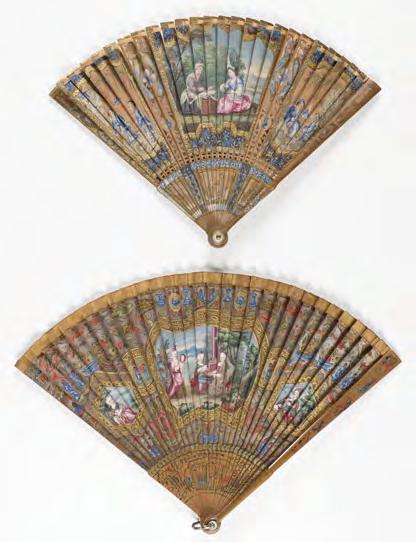
358* Chinese Fan. A hand-painted brisé fan, 18th century, doublesided wooden brisé fan, elaborately painted in gouache highlighted in gilt, the recto with central illustration of 3 ladies in a garden, 2 seated at a table next to a pillar, flanked by illustrations of a lady and dog, and a boy piper with dog, the vignettes within decorative borders on a ground of floral sprays, birds, moths, flower urns, and Oriental figures, verso with central illustration of a young lady seated on a chair beside trees in a landscape, flanked by vignettes of vases and Oriental figures, within decorative borders on a ground of flower urns, birds, animals, and floral sprays, ribbon renewed, slightly rubbed in places (especially to painted decoration on guards), 23 cm (9 ins), together with:
A hand-painted brisé fan, 18th century, double-sided partly pierced wooden brisé fan, elaborately painted in gouache highlighted in gilt, the recto with central illustration of an Ottoman gentleman holding a compass divider and seated at a cabinet in a garden, a lady with elaborate headdress seated on the ground before him, flanked by Oriental figures, verso with central vignette of an urn filled with lilac, chrysanthemums, and honeysuckle, flanked by an urn on each side containing a tree with fruit and perching birds, ribbon renewed (but split at junction to upper guard), sticks slightly bowed, rubbed in places (especially to painted decoration on guards), some losses and repairs, 20 cm (8 ins) (2) £200 - £300
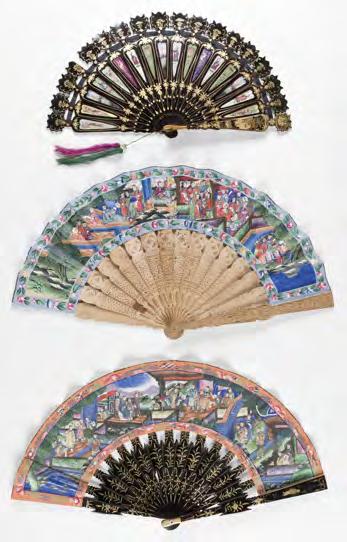
359* Chinese Fan. A lacquered and painted bamboo brisé fan, circa 1840, double-sided folding fan, the shaped sticks handpainted in gilt, and each inset with a panel of translucent fabric hand-painted with an oriental figure, scene, or motif, the five figures each with applied silk clothes and ivory face on each side, one stick with portion missing to upper shaped end, silk ribbon possibly renewed, 22 cm (8.75 ins), together with two folding paper Chinese fans with applied clothes and ivory faces similar, the first with gilt decorated lacquered sticks, and a painted landscape scene on the verso, some splitting to folds and 1 or 2 discreet repairs, 28 cm (11 ins), the second with carved sandalwood sticks, 2 sticks with slight damage (and repairs on verso), 28.5 cm (11.25 ins)
Ivory Act UK registration submission reference: VVISBKPW. Overseas buyers should note the information on our shipping page regarding the import/export of ivory and other CITES regulated items. CITES licence applications and any exportation/importation requirements are the responsibility of the buyer. (3)
£300 - £400
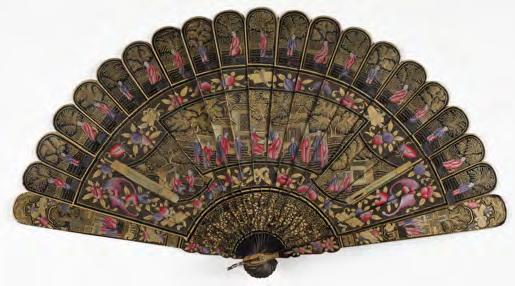
360* Chinese Fan. A lacquered and painted bamboo brisé fan, Macao, circa 1850, double-sided folding fan, lavishly hand-painted in colours and gilt on each side (almost identical) with figures, pagodas, trees, flowers, and other oriental motifs, ribbon possibly replaced, 22 cm (8.75 ins) (1)
£400 - £600
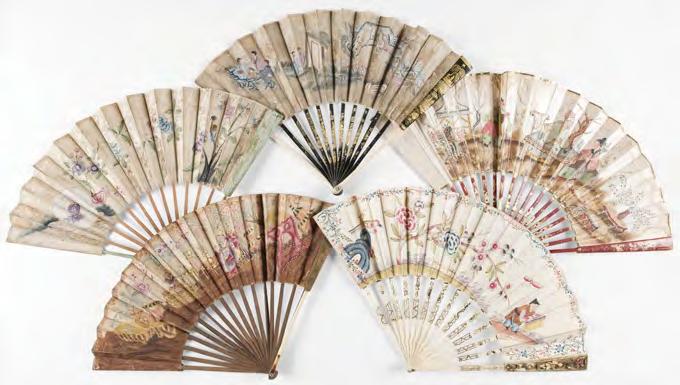
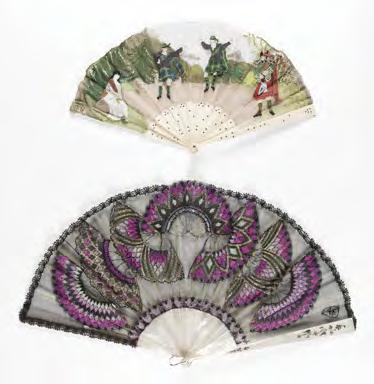
361* Chinese Fans. A group of painted Chinese fans, 18th-19th century, 9 folding paper fans, variously hand-painted with oriental figures, scenes, and objects, including two with a lace paper leaf, wooden or bone sticks, including some lacquered, gilded, or with pierced decoration, generally with some rubbing or wear, together with a 19th century colour-printed palmette Chinoiserie fan on pictorial lacquered and gilded sticks, also with some wear, and a 20th century hand-painted oriental fan (11)
£150 - £200
362* Collier (Ann, 20th/21st century). A lace fan with Scottish scene, hand-made folding lace leaf, worked in various coloured threads, with appliquéd lace figures of two male Scottish dancers in kilts against a landscape, flanked by a seated lady wearing a white dress and a tartan scarf to the left, and a kilted gentleman playing the bagpipes to the right, Ann Collier’s stitched monogram to upper left, earlier bone monture, engraved and inlaid with steel dots, 25 cm (10 ins), contained in a silk-covered fan box, with label to base ‘Leon Yeves, Madrid’, together with:
A lace fan depicting fans, 2018, hand-made folding lace leaf, worked in various coloured threads and metallic gold threads, incorporating beads, with appliquéd fans, and a border of hearts to lower edge, on a black net ground, Ann Collier’s stitched monogram to upper right, earlier mother of pearl monture with bone ribs, the guards with inlaid gilt floral and foliate decoration, 33 cm (13 ins), contained in a silk-covered Duvelleroy box, accompanied by a manuscript letter written by Ann Collier to the current owner: ‘First of all let me wish you both a very happy diamond wedding. As you collect fans I thought I would do many fans within a fan and the colours are Scottish heather colours. A bit different to my usual scenes but I do hope you like it’, plus a small group of other ephemeral items relating to Ann Collier, including a photocopy of an original design for the Scottish fan, various letters from Collier, and a number of Christmas cards reproducing photographs of her fans
Ann Collier has been making lace since 1976, specialising in designing and making lace fans, and particularly known for her experimentation with three-dimensional effects. She has written a number of books on various aspects of lace. She was one of the first assessors of City and Guilds Lace in 1988, and has taught the subject in most parts of the world. During the 1980s and 1990s Ann Collier was chairman of the Lace Guild and President of the Organisation Internationale de la Dentelle au Fuseau et à l’Aiguille. (2) £200 - £300
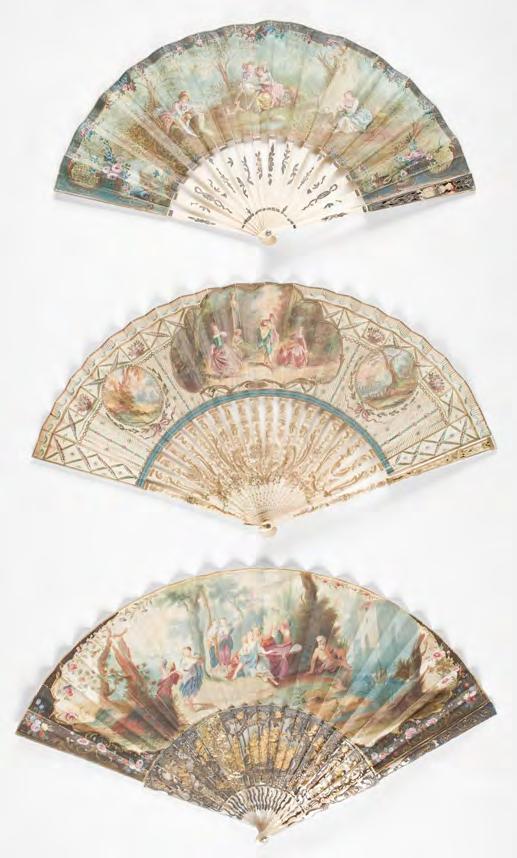
363* Decorative Fan. A hand-painted fan, circa 1850, doublesided folding paper fan, the recto finely painted with a scene of classical figures feasting and bathing in a picturesque landscape, within a border of flowers highlighted with gilt, the verso depicting a shepherdess crowning a companion with a floral wreath, in a bucolic landscape with a fountain and stream, floral border as before, gilded carved and pierced mother of pearl sticks (gilt partially dulled), diamanté rivet, slight loss to one card rib, 2 others with small repair at foot, one fold split and expertly strengthened with archival tissue, 29 cm (11.5 ins), together with 7 other folding paper or chicken-skin fans, 19th or early 20th century, 3 with handpainted scenes, the other 4 with hand-coloured engraved scenes (one defective), each with a decorative monture of bone or mother of pearl, all with gilding, 4 housed in fan boxes (one lacking lid), one with Duvelleroy label (8)
£300 - £500
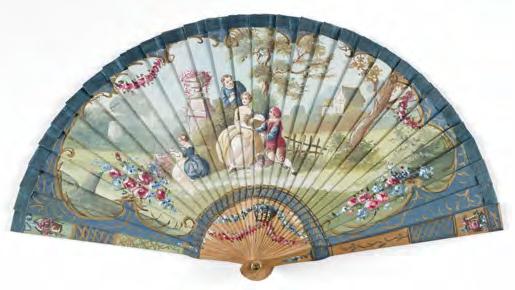
364* Decorative Fan. A hand-painted fan, late 19th century, double-sided wooden brisé fan, the recto depicting a family in a garden, with a floral urn, trees, flower garlands, and a country dwelling, the verso with flower garlands within and without a scrollwork frame, 17 cm (6.75 ins), together with 12 other wooden brisé fans comprising: 5 pierced fans; a fan with oval engravings of 18th century beauties; 2 pierced fans with applied crests and monograms; a fan decorated with Victorian scraps; a fan with transfer pictures of Swiss women wearing national costume, with name of each region written in ink below; a hand-painted and gilt Japanese fan; and a fan hand-painted with an image of a prophet, plus a folding paper fan onlaid with monograms and badges (worn) (14)
£150 - £200
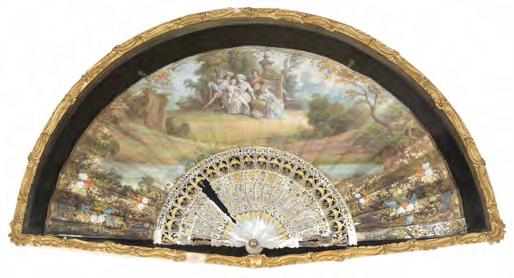
365* Decorative Fan. A hand-painted mother of pearl fan, circa 1860s, folding paper leaf, painted with a pastoral scene of figures in a landscape, comprising 2 gentlemen, 2 ladies, and a small child seated beside a stone urn on a plinth with fountain, with trees, rocks, and a goat, border and reserves with elaborate gilt floral decoration, lightly rubbed, mainly to extremities, carved and pierced mother of pearl monture, highlighted in gilt, portion of one stick missing, 27 cm (10.5 ins), mounted in a rococo style gilt moulded fan case (33.5 x 60 cm), 2 small portions of moulding missing (1)
£100 - £200
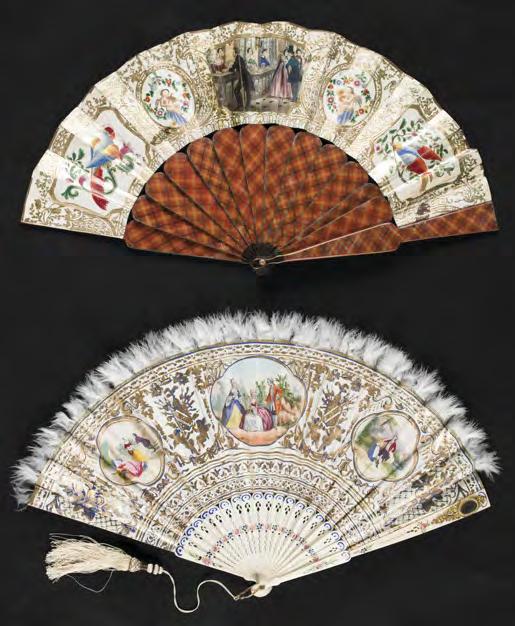
366* Decorative Fan. A late 19th century Continental fan, doublesided folding paper fan, the recto with 3 hand-coloured lithographed vignettes depicting figures in a landscape, including a harpist, a lute player, and a courting couple, remainder of the leaf decorated in gilt and blue with armorials, putti, flowers, and swags, etc., verso similarly decorated, with a hand-coloured engraving of a group including a flautist, flanked by oval gilt vignettes and borders, ostrich feather trim to upper edge, pierced bone sticks, the front and guards hand-painted with flowers, upper guard with applied oval mirror within a gilt filigree border, cream silk tassel to loop, 30 cm (11.75 ins), together with:
A mid 19th century Scottish fan, double-sided folding paper fan, the recto with hand-coloured lithograph of the interior of a confectionary shop, depicting shop assistants and customers beside a counter, flanked by hand-painted vignettes of musical putti and exotic birds, within gilt embossed borders, the verso printed in gilt with a pattern of portrait roundels within decorative borders, rubbed and soiled in places, some repaired tears and splitting to folds, upper edge with losses to gilt paper trim, tartan paper-covered wooden sticks, 27 cm (10.5 ins) (2)
£150 - £200
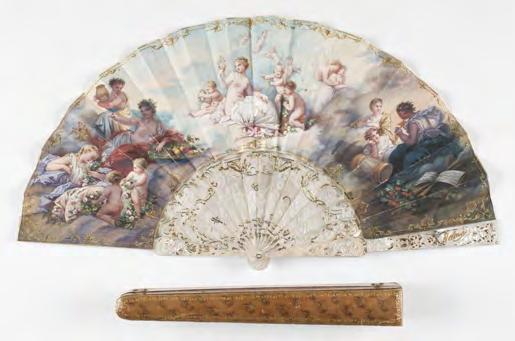
367* Duvelleroy. A painted allegorical fan, circa 1860s, doublesided folding canepin leaf, hand-painted on recto with a semi-clad depiction of Aphrodite gazing into a hand mirror in the centre, surrounded by chubby infants cavorting with flower garlands and jewels, flanked by a further scene on either side of the goddesses of wine and music (Euterpe with flute) respectively, accompanied by further figures and flower garlands etc., the whole within a finely giltpainted scrollwork border with mask and lattice motif at intervals, the verso also hand-painted, depicting two classical maidens, each holding one end of a long arching flower garland, similarly bordered in gilt, mounted on elaborately carved and pierced mother of pearl sticks, highlighted in gilt, depicting various young musicians, dancers, and courting couples, one rib with horizontal break at foot, owner’s name in gilt ‘Helena’ applied to upper guard stick, 29 cm (11.5 ins), contained in original cat’s paw calf fan case, with Duvelleroy’s gilt stamp on base, borders of gilt flower roll, single fillet, and hound’s tooth roll, lined with pink satin, metal hook closures With accompanying (photocopied) documentation from The Fan Museum stating: ‘The painting is almost identical to that on a fan in the possession of the Worshipful Company of Fan Makers which is by the fan-maker Alexandre’. This is an interesting point since the celebrated fan-making firms of Alexandre and Duvelleroy were direct rivals in 19th-century Paris. The House of Duvelleroy - foremost supplier of fans to royalty, including Queen Victoria - was founded by Jean-Pierre Duvelleroy in 1827, whilst competitor, Félix Alexandre, set up his business in 1849. Both companies were vying for the same aristocratic patronage for their high-quality, opulent fans, so it stands to reason that a certain amount of imitation might occur. The documentation also states: ‘the painting is similar to one of the museum’s collection which is signed by Calamata [sic]’ (Helene Alexander Collection). This refers to Joséphine Calamatta (1817-1893), an accomplished artist who painted decorative fan scenes in the mid-late 1800s. (1)
368* Francis II and I (1768-1835). Commemorative fan, circa 1792, engraved hand-coloured folding fan, the paper leaf with central circular design depicting Francis, King of Hungary, Croatia and Bohemia, and his wife Maria Theresa, standing on a terrace overlooking Buda castle and the royal palace, the Holy Crown of Hungary on a table nearby, printed caption ‘Franciscus I Rex Hung: et Maria Theresia’, two smaller circular designs, one to each side, depicting on the left an allegorical female figure, on the right the arms of Hungary with another female figure (possibly the national personification of Hungary), the remainder of the leaf filled with ornamental designs and figures, within a decorative border, spangles sewn around the borders of the three circular designs and outer border (some missing), printed signature ‘Buckazy’, some areas of discolouration to figures (mainly affecting white areas of costumes), one fold browned, stain to leftmost two panels, few short edge tears, rightmost two panels missing (torn away) with associated 7 cm closed tear, wooden monture, each guard with bone thumb guard and simple bone and wood onlay decoration to upper half, upper half of right guard missing, upper half of left guard with small loss of onlays at top, 27 cm (10 5/8 ins)
The only other example of this rare fan we have found is in the collection of the Museum of Applied Arts, Budapest.
Archduke Francis was crowned king of Hungary on 6th June 1792 and Maria Theresa was crowned as his queen 4 days later. Later that year he was also named Holy Roman Emperor as Francis II, and in 1804 he became Francis I, Emperor of Austria. Finally, in 1806 Francis abdicated as the last Holy Roman Emperor.
(1)
£100 - £200
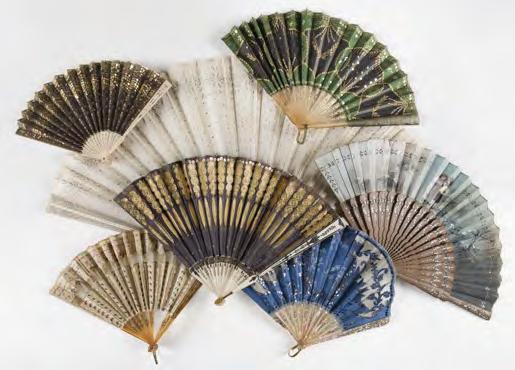
£300 - £400
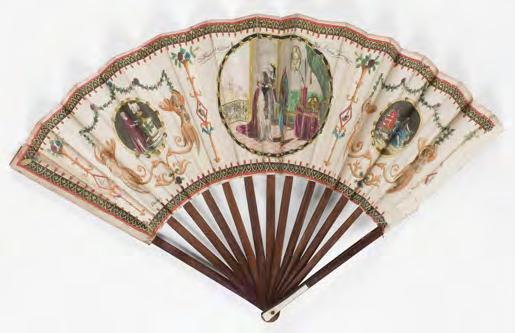
369* Greek Revival Fan. A decorative fan, circa 1790-1810, folding leaf of indigo silk, with onlaid and stitched embossed gold motifs and spangles, some splitting to folds, mounted on bone sticks (slightly bowed), with pierced leaf spray and gilt pineapple skin pattern, 24 cm (9.5 ins), together with 5 other 19th or early 20th century decorative fans embellished with spangles, one with ribbon embroidery (3 sticks broken), and 2 with hand-painted scenes (one of fontange form)
An unusual Regency fan echoing the vogue for classicism in the late 18th and early 19th century.
(6)
£150 - £200
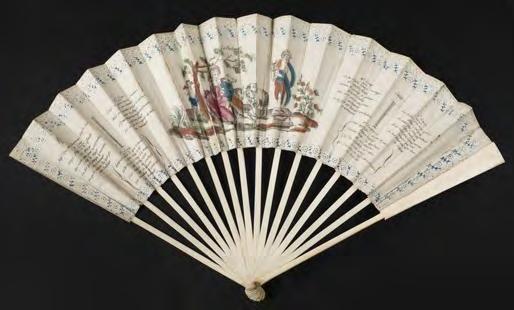
370* Le Badinage. A late 18th century French fan, folding paper leaf with central hand-coloured engraved scene, depicting a seated woman being courted by a shepherd, with two sheep nearby and a cherub watching, a statue of a male figure playing a lyre (Orpheus?) to the right, the reserves containing 6 printed verses of an amusing air entitled ‘Le Badinage’, with 3 verses to each side, the whole surrounded by a hand-painted border of blue dots and foliage, leaf with small areas of toning and a few minor marks, several repairs (especially to central fold) and a few very small losses, bone monture, 28 cm (11 ins)
(1)
£200 - £300
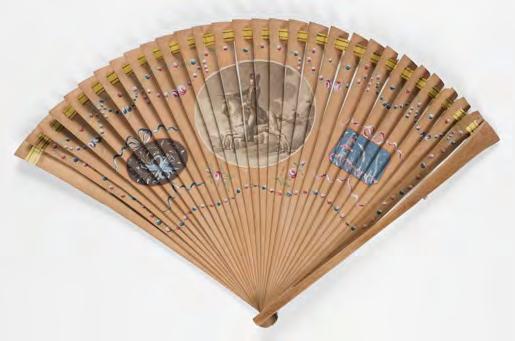

371* Military Fan. A wooden brisé fan, French, circa 1790, the recto with applied oval sepia stipple engraving in centre depicting a mounted senior military officer, hand-painted with a military trophy on the left and a pagoda on the right, each within a beribboned frame, and with a border of floral garlands, sticks slightly bowed, 4 sticks a little chipped to upper edge, 1 stick splitting and repaired, latter and adjacent stick with neat archival tape repair to top edge, original ribbon with small section at each side replaced, guard sticks shaped and carved to resemble a musket, 27.5 cm (10.75 ins)
A most unusual fan, with the guard sticks carved and shaped to resemble a musket; we have not seen or traced another like this. It was presumably made for the wife of a military officer, and likely intended to give a subtle message about the woman’s social standing by means of an allusion to her husband’s occupation.
(1)
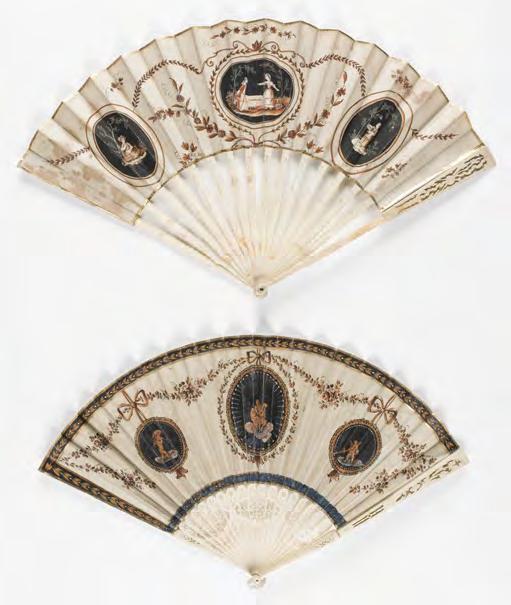
372* Neo-classical Fan. A hand-painted fan, circa 1780, doublesided folding paper fan, the recto hand-painted with 3 ovals: in the centre a courting couple; on the left a girl with a birdcage; and on the right a figure with a basket, the ovals surrounded by floral and foliate swags and tendrils, the verso hand-painted with 3 flower sprays, left hand edge on verso with short repaired tear, carved bone sticks (some minor breaks), leaf and sticks somewhat discoloured, 27 cm (10.5 ins), together with:
A hand-painted fan, circa 1800, double-sided folding paper fan, the recto hand-painted with an oval in the centre depicting a figure playing a lyre, flanked on the left by a putto in a helmet, and on the right by a putto with a sword, each surrounded by a frame of spangles suspended from a painted beribboned bow amongst floral swags, the verso with 3 flower sprays, the leaf toned, and with some retouching, carved bone sticks, 1 or 2 minor breaks, 24.5 cm (9.75 ins), together with a small folding paper fan with engraved vignette of Cardiff Castle within a border of spangles (a few missing), bone sticks, 17.5 cm (6.75 ins)
(3)
£150 - £200
£200 - £300
373* Surprise Fan. A four-way wooden brisé fan, circa 1790, opening 4 ways, with pierced guards and sticks, the sticks with 3 monochrome stipple engravings applied to each of the 4 openings, one showing contemporary figures in a garden, the remainder scenes of classical figures, a few fox spots to engravings, upper edges of sticks chipped, a few splits repaired with archival tape, one guard stick with horizontal break neatly strengthened with wood on verso, ribbon replaced (split at one guard stick), faint ink initials at head of 2 sticks and one guard, 27.5 cm (10.75 ins), together with 4 other similar (but one-way) late 18th century pierced wood brisé fans, each with 3 stipple engravings to recto, one additionally with hand-painted floral decoration (and with bone and ebony inlays to guards), 2 with breakages to ribbon (one with loss to a stick and guard stick), the other 2 with ribbons replaced
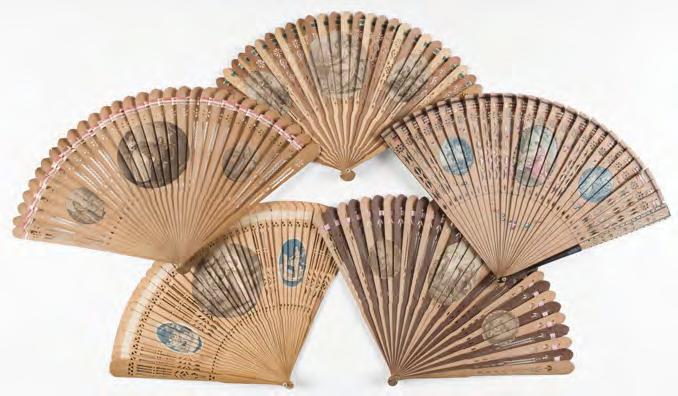
Provenance: The first fan belonged to Lord Cranmore, according to the owner. (5)
£200 - £400
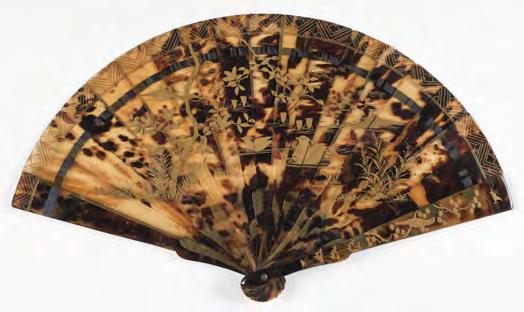
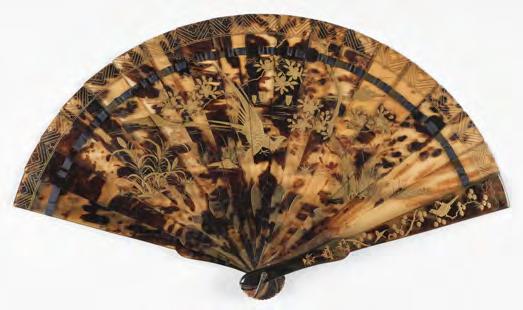
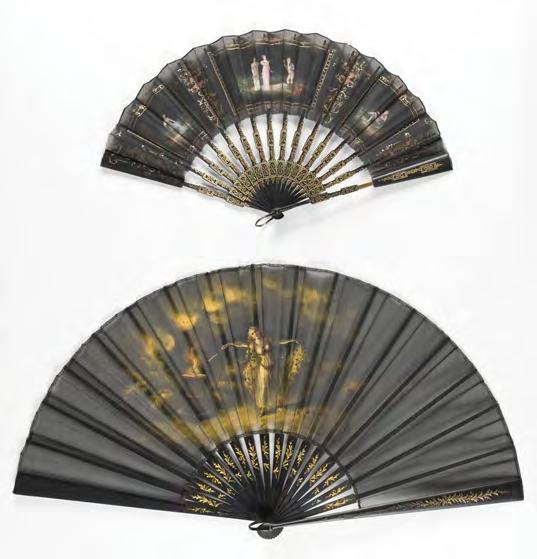
374* Tortoiseshell Fan. A gilt lacquered fan, circa 1900, double-sided brisé tortoiseshell fan, each side with a scene of birds, blossom trees, and other vegetation, applied in gilt, 25.5 cm (10 ins), together with 5 other fans, including 3 brisé tortoiseshell fans: a fan of fontange form; a fan with inlaid mother of pearl dots and pierced dot decoration, including stars; and a large and unusual fan embellished with iridescent green, purple, and brown feathers, ribbon to guards broken (6)
Each lot is subject to a Buyer’s Premium of 22% (Lots marked * 26.4% inclusive of VAT @ 20%)
£300 - £500
375* Verdevoye (Eugène, 1856-1926). A painted folding fan, the leaf of black gauze, painted in gouache and incorporating tiny spangles (circular, stars, and pointed ovals), depicting an ethereal fairy figure dressed in a bejewelled gown with diaphanous train, wearing a necklace, bracelets, and earrings, pointing a wand at a fire on a plinth, surrounded by bursts of light, signed to right-hand side, 1 or 2 small faint marks, picot border to upper edge beginning to come away in places (and with some re-sewing just visible), mounted on ebonised wood sticks embellished with gold flower and berry sprays, upper guard stick with some inconspicuous (fabric?) residue, 35 cm (12.75 ins), together with another fan hand-painted with figural scenes on a black gauze leaf, embellished with tiny gold spangles, slight loss of upper edging, gilt painted shaped wood monture, 24.5 cm (9.75 ins)
We have been unable to trace another painted fan by Eugène Verdevoye, an apparently little-known but evidently highly skilled French artist. (2) £150 - £200
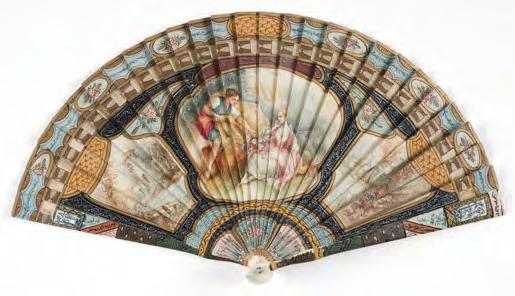
376* Vernis Martin. A hand-painted Vernis Martin style fan, French, circa 1850, a double-sided bone brisé fan, the recto handpainted with a vignette of a courting couple in classical dress, signed lower right Luac(?) flanked by vignettes of picturesque dwellings, within elaborate decorative borders of flowers, fish scale motifs, and various other patterns, verso hand-painted with flower sprays on a ground of small flourishes, surrounded by decorative borders as before, diamanté rivet, 14.5 cm (5.75 ins), contained in an earlier pink paper-covered cardboard fan case with pull-off lid (19.5 cm), together with a wooden hand-painted fan similar, with a scene of figures in a garden on the recto, and a landscape with floral urn and Greek temple on the verso, red stone rivet, 16 cm (6.25 ins), contained in original(?) pink paper-covered cardboard fan box with pull-off lid (rubbed, top of lid missing), with circular engraved label ‘Alamere de Famille aucoin du Boulevard et de la rue du Helder a Paris’, plus 2 hand-painted bone brisé fans, one in original(?) Ernest Kees box, and 6 pierced bone brisé fans, 3 handpainted, one circa 1850, with scenes of contemporary figures (defective)
(10)
377 No Lot
£200 - £400
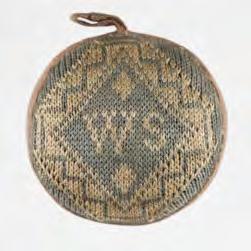
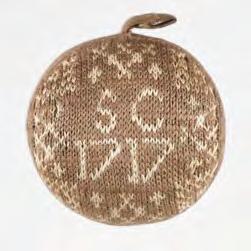
378* Pincushion. A knitted girdle pin ball, 1717, spherical pincushion, finely knitted in cream thread on a ground of tan thread on one side, with the initials ‘SC’ and date 1717, and in cream thread on a grey ground on the other side, with the initials WS, each within a decorative border, latter side a trifle dusty, tan linen tape girdle forming a small hanging loop to top edge, width approximately 40 mm (1.5 ins)
A rare early pin ball, surviving in very good condition. (1)
£500 - £800
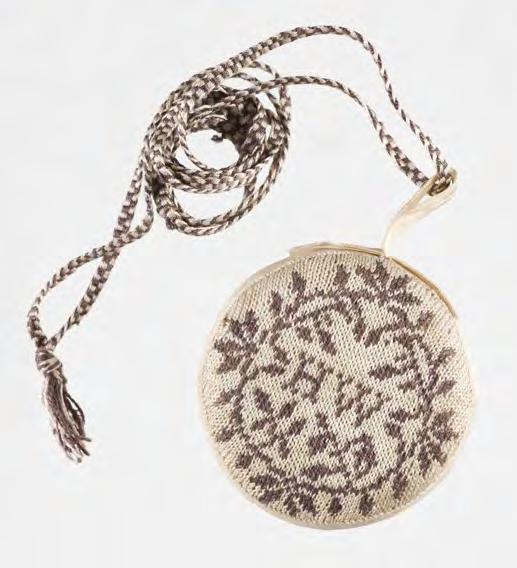
379* Pincushion. A knitted girdle pin ball, early 19th century, flat circular pincushion, finely knitted in brown thread on a ground of cream thread, one side with the initials ‘HW’ within a foliate border, the other side with a geometric quatrefoil motif within a border, cream silk ribbon girdle forming a loop with woven suspension cord, ribbon slightly toned and beginning to perish in one or two places, width approximately 40 mm (1.5 ins)
(1)
£200 - £400
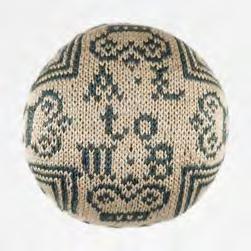
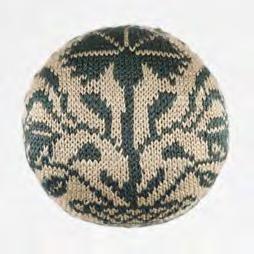
380 Pincushion. A knitted pin ball, late 18th/early 19th century, spherical pincushion, finely knitted in dark green thread on a ground of cream thread, one side with the inscription ‘AL to MB’ with border of alternating crowns and chevron device, the other side with a stylised carnation plant in an urn, cream ribbon girdle with a herringbone stitch border in green thread to match, width approximately 40 mm (1.5 ins)
A good early pin ball in unusually good condition. (1)
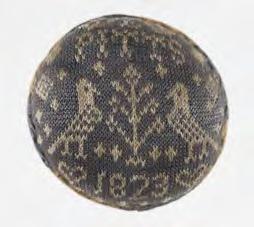
£400 - £600
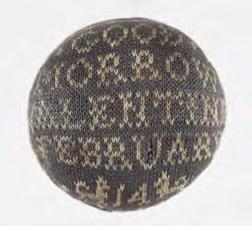
381* Pincushion. A rare Valentine knitted pin ball, 1823, spherical pincushion, finely knitted in tan thread on a ground of dark brown thread, one side with the name ‘E. Pitts’ above a pair of birds flanking a stylised tree, dated 1823 between heart motifs below, the other side with the legend ‘Good Morrow Valentine February 14’, the numerals flanked by dogs, one tiny hole, width approximately 35 mm (1.25 ins)
382* Pincushion. An 18th century spider’s web silk pin ball, spherical pincushion, of silk threads in terracotta, pale blue, tan, and cream, arranged in a spider’s web design, cerise silk ribbon girdle with remains of suspension loop and herringbone stitch border in pale blue thread (latter deficient in places), width approximately 40 mm (1.5 ins), together with:
A soldier needle case, 19th century, of booklet form, with 2 cream felt leaves hand-painted with a row of 13 soldiers, each with a needle ‘bayonet’, the leaves edged with blanket stitch in terracotta silk thread, original cream card covers, tied with silk ribbon and painted with a chevron border in blue within triple red lines, 46 x 56 mm (1.75 x 2.25 ins), plus
A Virtues and Vices needle case, early 19th century, comprising 2 octagonal covers of cream silk over card, the front handembroidered with monogram ‘ES’ within a foliate border, worked in metallised thread (part of that to monogram lacking) and with the leaves in two-tone green silk thread, opening up to reveal a twisted gold paper star, itself opening to reveal a compartment for needles, lined with pale pink silk, each ray with a virtue or a vice written in ink, e.g. ‘Benevolent’, ‘Stingy’, ‘Affectionate’, ‘Frightful’, ‘Gentle’, ‘Quarrelsome’, etc., several splits and tears, dimensions when closed 7 x 7 cm (2.75 x 2.75 ins), and 5 other items related: 2 sets of 19th century miniature heart pincushions, the first set probably Regency, comprising 3 hearts made of cream silk, with painted and embroidered flower spray to each side, handmade pins around the edges, buttonhole stitch loop at top of each, and remains of cream silk ribbon which held them together, each heart 40 x 35 mm (1.5 x 1.25 ins), the other set similar, but consisting of 9 miniature hearts, each of a different coloured silk fabric, with handmade pins to edges, and a cream silk hanging ribbon tied with a bow at the end, secured in a bunch, each heart 30 x 30 mm (1.25 x 1.25 ins); and 3 small strawberry-shaped pincushions (8)
£300 - £500
Particularly rare early Valentine knitted pin ball surviving in very good condition; we have not seen or traced another such. (1)
£500 - £800
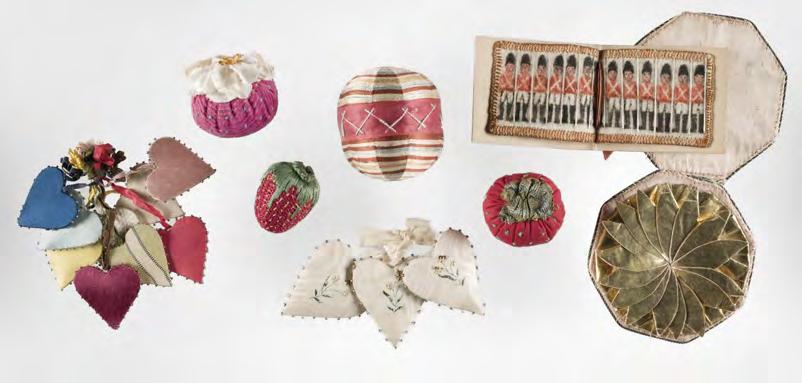
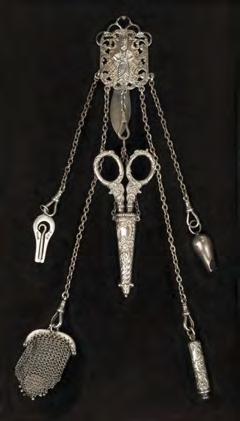
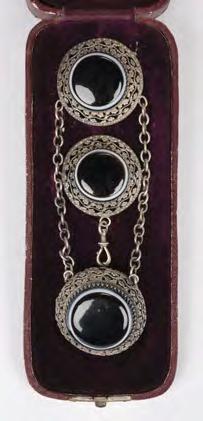
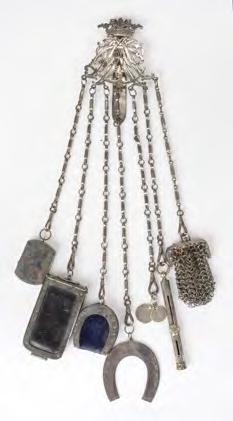
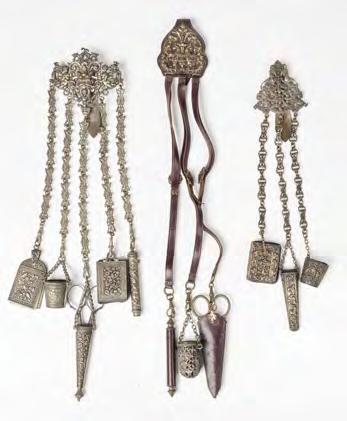
383* Chatelaine. A 19th century silver chatelaine by R&W, the hinged hook pierced and chased with scrolling foliate ornament centred by a standing female figure in classical dress, hallmarked on verso, 5 link chains, each holding an accessory: the central drop fitted with a pair of ornate scissors housed within a richly engraved tapering sheath; flanking chains supporting a chain-mail coin purse with bead-fringed lower edge, and a whistle-form accessory; the remaining chains suspending a flat hook-form implement and a cylindrical engraved pencil, overall length 28 cm, total weight approximately 110g, presented in gilt framed case, 35 cm x 22.5 cm (1)
£200 - £300
384* Chatelaine. A chatelaine clip, circa 1870s, large white metal clip set with 3 agate stones each within a foliate filigree mount and linked vertically by chains on either side, the middle mount with clip attached for the suspension of household accessories, the lower mount forming the hinged lid of a case for a small fob watch (glass on verso with superficial crack), overall size 14.5 x 4.5 cm (5.75 x 1.75 ins), set into original plum velvet-lined morocco-grained papercovered box, with early manuscript ownership label on base, extremities rubbed (1)
386* Chatelaine. An Edwardian chatelaine, white metal, the hinged hook with elaborate pierced mount centred by the head of a satyr, flanked by female figures, on a ground of strapwork and other Renaissance-style decoration, 5 pierced link chains, each holding an embossed accessory: a swivel aide-memoire with 3 ivory leaves, a thimble case bucket (without thimble), a scissorcase (scissors replaced?), a bookform pincushion, and a pencil holder (with pencil), overall length 33 cm (13 ins), together with 2 other chatelaines similar, one with leather mountings, plus 6 other items related: a silver-plated chatelaine clip with watch case, late Victorian; an elephant brooch chatelaine of white metal (probably Indian silverwork), with 3 hanging chains (lacking 2 accessories); a Middle Eastern brass chatelaine with inset turquoise stones (one lacking); an elaborate pierced chatelaine clip; and a pair of scissors and a pair of knitting needle guards (one lacking the tip), each on a chain and with Continental hallmark
Ivory Act UK registration submission reference: Z5E6PJLL. Overseas buyers should note the information on our shipping page regarding the import/export of ivory and other CITES regulated items. CITES licence applications and any exportation/importation requirements are the responsibility of the buyer.
(9)
£200 - £300
£150 - £200
385* Chatelaine. A Georgian cut steel chatelaine, the pierced mount with elaborate initial ‘C’ surmounted by a coronet, the 7 chains holding a vesta case, an aide memoire holder with blue silklined black morocco wallets inside, a blue velvet horseshoe-shaped pincushion, a horseshoe charm, 2 small coins, a pencil holder, and a mesh purse, tarnished in places, length 32 cm (12.5 ins), together with 6 other Georgian cut steel chatelaines similar, each with various accoutrements (a few chains with no accessory) (7)
£300 - £500
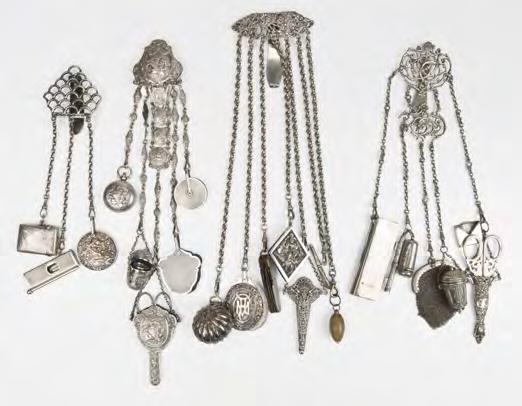
387* Chatelaine. An Edwardian silver chatelaine, Samuel Jacob, London, 1903, the hinged hook with filigree mount in a fishscale design, hallmarked on verso, 3 link chains, each holding an accessory: an engraved vesta case, hallmarked ‘MB’, Birmingham, 1902; a cigar cutter, hallmarked S.J. Rose & Son, Birmingham, 1981; and a circular swivel aide-memoire (without the ivory leaves), hallmarked Cornelius Desormeaux Saunders & James Francis Hollings (Frank) Shepherd, London, 1895, overall length 23.5 cm (9.25 ins), total weight approximately 94g, together with 3 other chatelaines: a chatelaine with Continental hallmark, probably French, the hinged clip and accessories all elaborately embossed to match with a gardening trophy, the embossed chains holding a fob watch case (chain detached from mount), a thimble holder with thimble (lid detached), a scissor case with scissors, a swivel aide memoire with 3 ivory leaves, and a pin cushion; a chatelaine with hinged clip hallmarked English standard silver with the lion passant and date letter ‘a’, mount partially broken with loss, with 5 link chains each holding an accessory, including a notebook case with indistinct English hallmark (without notebook and pencil) and an envelope (lacking flap), scissor case without scissors; and another with 7 accessories, including a monogrammed swivel aide memoire (without the ivory leaves), with indistinct hallmark
Ivory Act UK registration submission reference: 6CMRT6DF. Overseas buyers should note the information on our shipping page regarding the import/export of ivory and other CITES regulated items. CITES licence applications and any exportation/importation requirements are the responsibility of the buyer.
(4)
£200 - £300
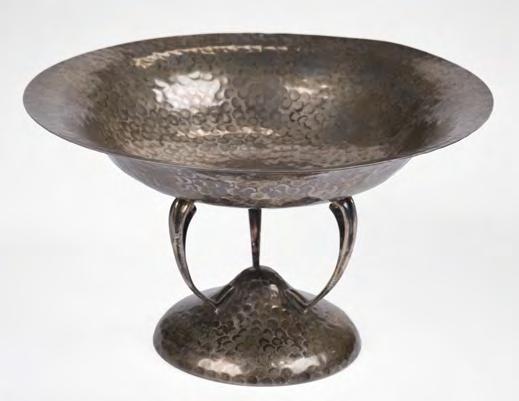
388* Bowl. A George V silver Arts and Crafts bowl by Walker & Hall, Sheffield, 1915, three shaped legs supporting a wide shallow bowl with planished finish on a matching domed base, 9.5 cm high, 202g (1)
£200 - £300
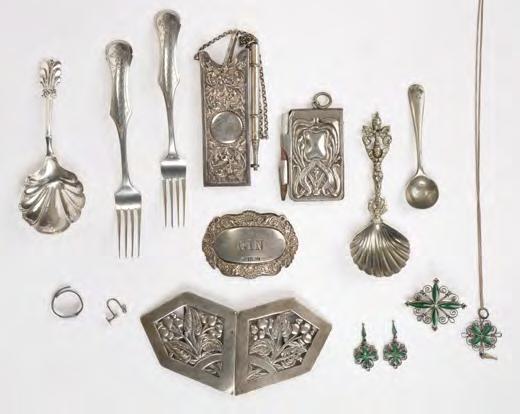
389* Buckle. A silver buckle, Charles Horner, Birmingham, 1911, geometric buckle with pierced decoration depicting leaves and berries, hallmark to verso, 6 x 11 cm, together with 5 other items of hallmarked silverware (an empty notebook case, a jam spoon, a pair of cake forks, and a gin label), combined weight approximately 135g, plus 3 silver-plated items (an art nouveau notebook cover with pencil, a salt spoon, and a jam spoon) (9)
£100 - £150
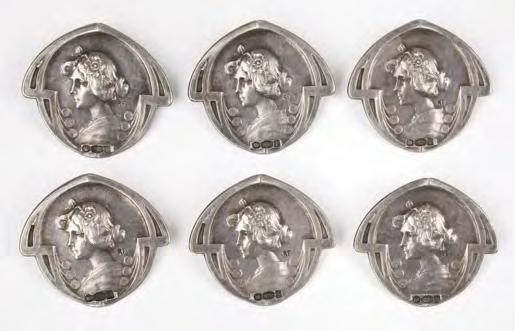
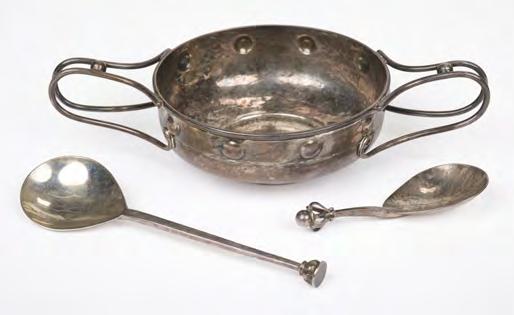
390* Buttons. A set of six Arts and Crafts silver buttons, each depicting a classical maiden in profile, within geometric boarder, shaped edge, sterling import marks for 1904 and further marked with the initials RF for the importing agent Robert Friederich (6)
£100 - £150
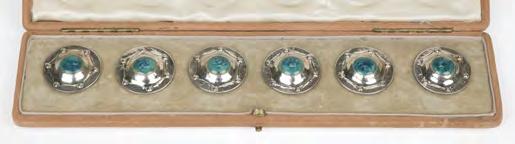
391* Buttons. A set of six Arts and Crafts silver buttons by Albert Edward Jones, Birmingham, 1902, the silver buttons with Ruskin style centres, cased (1)
£150 - £200
392* Buttons. A set of six silver buttons, each button with a relief scene of a well dressed couple walking outdoors, marked to the front, makers mark Berthold Müller, London import mark for 1901 (6)
£100 - £150
393* Caddy Spoon. An Arts and Crafts silver caddy spoon by Albert Edward Jones, Birmingham, 1908, with planished finish and crown style finial on short handle, 9cm long,19g together with a silver seal top spoon by Guild of Handicraft, London, 1991, 36g plus one other item unmarked (3)
£200 - £300
394* Charles Robert Ashbee (1863-1942). A Silver mustard pot and spoon, for the Guild of Handicraft designed by Charles Robert Ashbee, London, 1905, in the classic arts and crafts style with hammered texture and pedestal base, wirework loop handle the interior with glass liner, spoon and thumb piece set with chrysoprase cabochon gems, 7.7 cm high, 96g
Charles Robert Ashbee was a pivotal figure in the English Arts and Crafts movement. He founded the Guild of Handicraft in 1888, which aimed to revitalize traditional hand-working techniques and improve the lives of workers (2)
£2,000 - £3,000
395* Christening Cup. Arts and Crafts silver christening cup by Albert Edward Jones, Birmingham, 1912, of cylindrical form with planished body and flared rim, the base applied with ball decoration, wirework loop handle, 8.5 cm high, 100g (1) £100 - £150
396* Columbian Silver. A silver milk jug and lidded sugar bowl by T. A. N of Bogota Colombian circa 1980, made of 925 silver, both with rounded body and curved handle, 10cm high, 298g (2)
£200 - £300
397* Continental Silver. A mixed collection including a threebranch candleabra, cast with rococo scrolls, stamped ‘835’, 20 cm wide, 237g, a pierced bonbon dish, with rococo scroll and lattice work, 18 cm long, 110g, a small milk jug and sugar bowl, both stamped ‘835’, a conical beaker, 7.5 cm high and other items, weighable silver gross weight approximately 735g (a small box)
£400 - £600
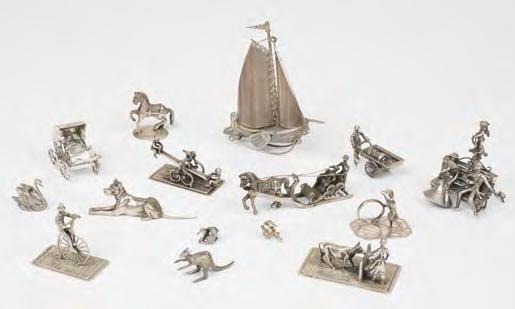
398* Continental Silver. A mixed collection of small silver items, mostly figures and animals, including a courting couple sitting on a bench with cupid behind, stamped ‘silver 910’, 6 cm high, 39.6g, a milkmaid and cow, stamped ‘835’, 5.5 cm long, a man riding a penny farthing or ordinary, stamped ‘835’, 4 cm long and other items, combined gross weight 288g (15)
£150 - £200
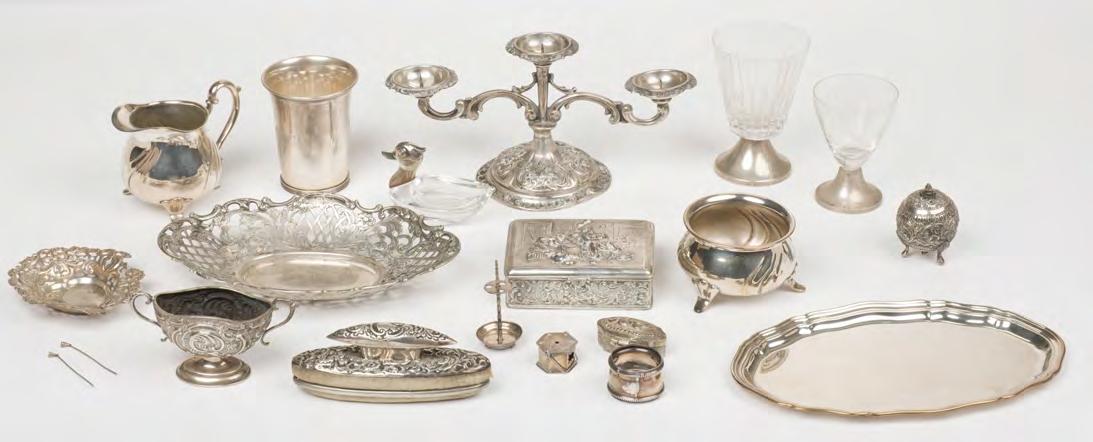
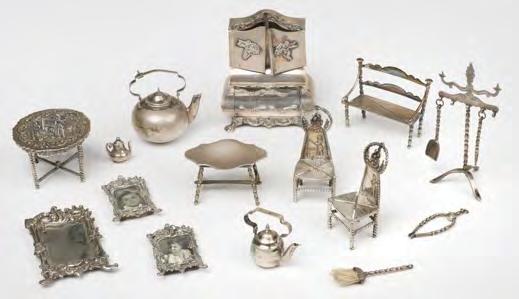
399* Continental Silver. A mixed collection of small silver items, mostly dollshouse furniture, including a bureau bookcase of bombe form, decorated with cherubs, 8.5 cm high, 105g, a circular table, the top cast with figures within rococo c scrolls, on four spiral twist legs united by stretchers, 5 cm diameter, 18g, a similar chair, bench and other items, weighable silver approximately 216g (13)
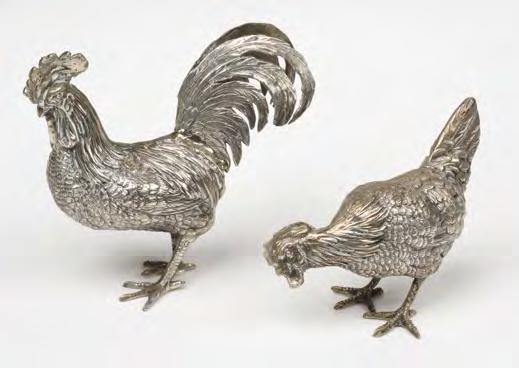
£150 - £200
400* Continental Silver. A mixed collection of spoons, forks and servers, gross weight approximately 610g (a small box)
£300 - £500
401* Continental Silver. A pair of silver cockerels, hollow construction, one stamped ‘835’, the larger one 11 cm long, combined weight approximately 187g (2)
£150 - £200
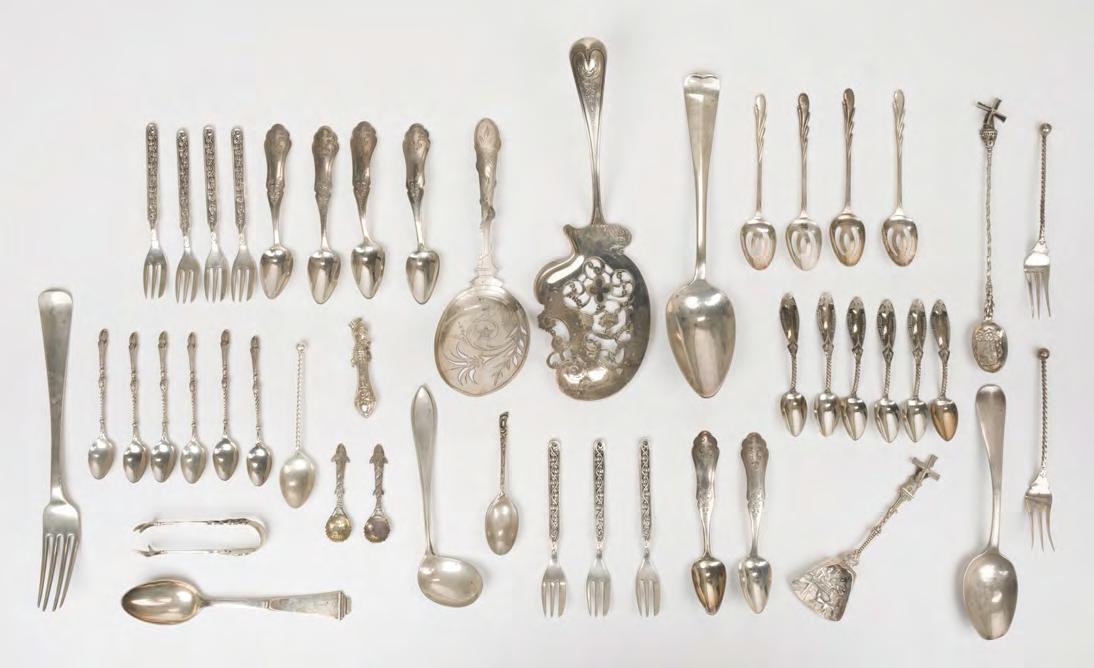
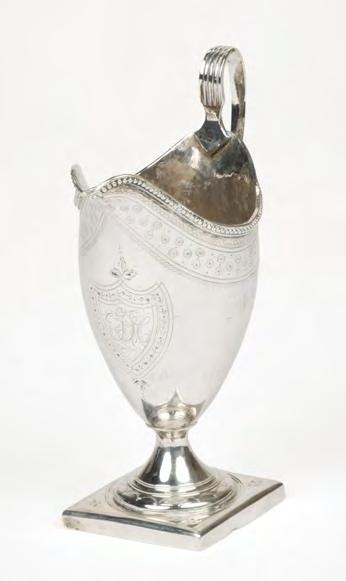
402* Cream jug. A George III silver helmet shape cream jug by Peter and Ann Bateman, London 1791, engraved with initials within a shield, long slender handle leading to a square foot, 15 cm high, 105g
(1)
£100 - £150
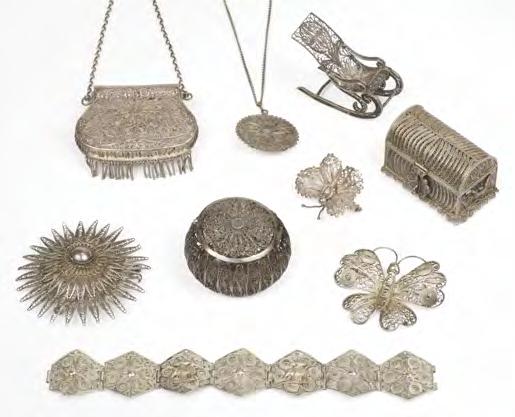
403* Filigree. A collection of silver filigree ornaments, including a miniature dome top chest, with carrying handles and lock, 5.5 cm long, a miniature purse with hinged cover and carrying chain, 6.5 cm long, a miniature rocking chair and other items, gross weight 170g
(9)
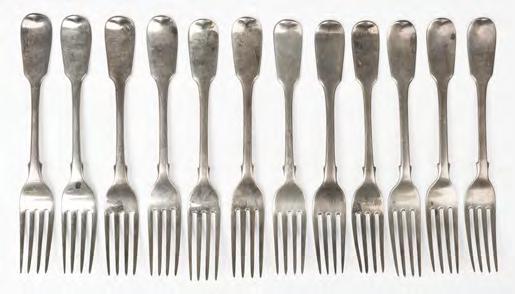
£200 - £300
404* Forks. A collection of 12 silver dessert forks, including 6 Victorian forks by Chawner & Co (George William Adams), London, 1851, all of fiddle pattern form, 17 cm long, a set of 6 Victorian forks by Mary Chawner, London, 1839, all of fiddle pattern form, 17 cm long, total approximate weight 527g (12)
£500 - £600
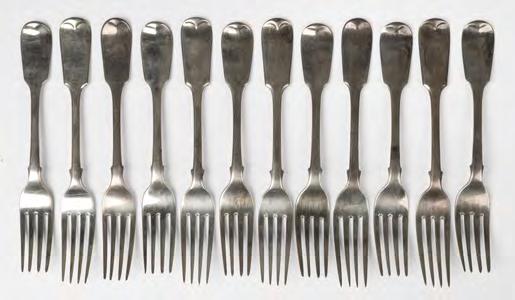
405* Forks. A collection of 12 silver dinner forks, including 6 Victorian forks by William Theobalds & Robert Metcalfe Atkinson, London, 1838, all of fiddle pattern form, 20 cm long, a set of 4 Victorian forks by Josiah Williams & Co (George Maudsley Jackson), London, 1895, all of fiddle pattern form, 20 cm long plus 2 others, total approximate weight 876g (12)
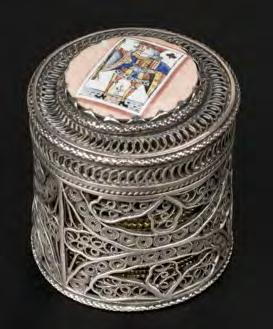
£800 - £1,000
406* Gaming Token Box. A George III silver filigree box, of cylindrical form, the cover inset with a panel finely decorated with a playing card, enclosing 15 gilt metal George III Spade Guinea gaming tokens, chip to the enamel, 30 mm high (1)
£150 - £200
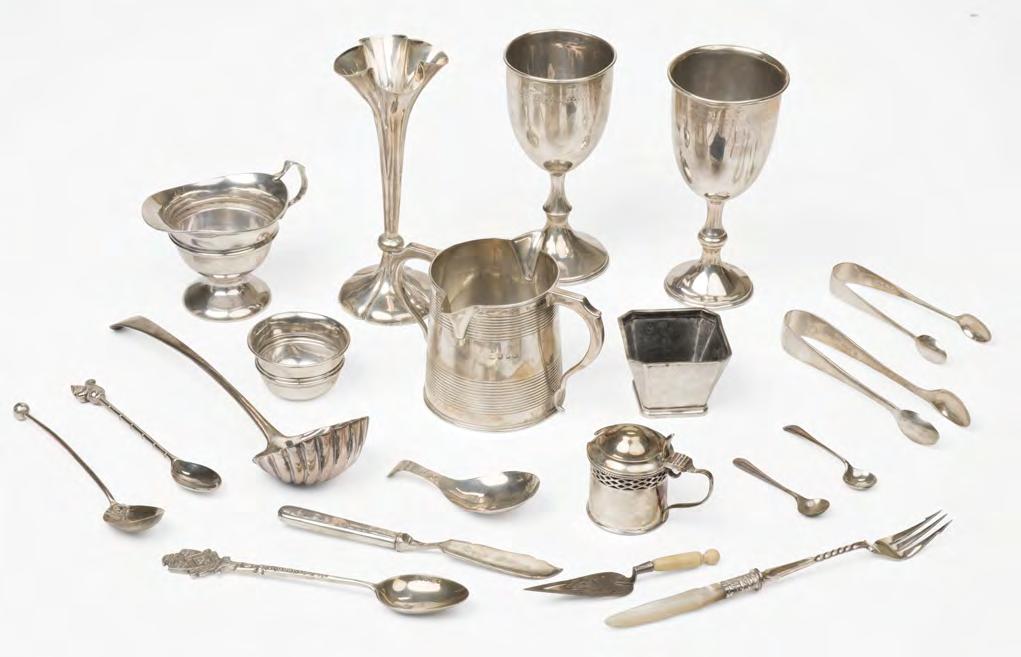
407* Mixed Silver. A George V silver cream jug by S Blanckensee & Son Ltd, Chester, 1911, on pedestal foot with wide spout and scroll handle, 6cm high, 43g, a George V silver Goblet by Sigmund Zyto, London, 1926, of plain form body engraved with floral wreath,12 cm high, 60g, a pair of sugar tongs by Cooper Brothers & Sons Ltd, Sheffield, 1940 and other items, approximate total weight 528g (a small carton)
£400 - £600
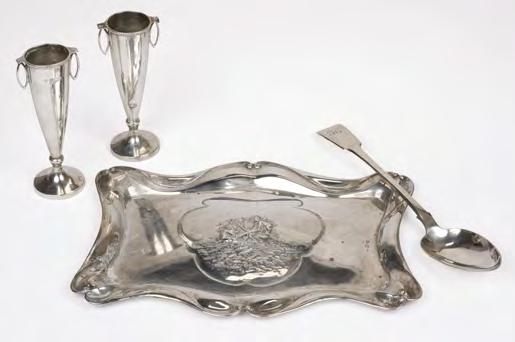
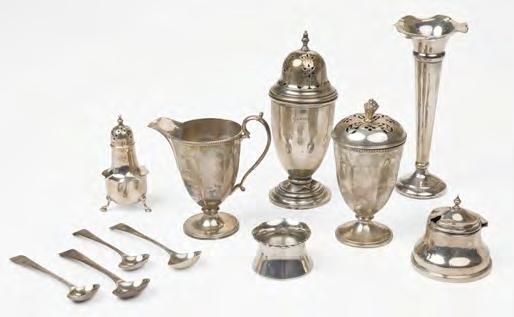
409* Mixed Silver. A George V silver sugar caster by Percy James Finch, Birmingham, 1925, of urn form with pierced domed cover and finial, 15cm high, 100g, a George V silver strawberry set by Brook & Son, Sheffield, 1923, comprising of sugar sifter and cream jug, each of faceted tapering form on a circular foot, 11cm high, 162g and other items, approximate total weight 369g (a small carton)
£300 - £400
408* Mixed Silver. A George V silver dressing table tray by Colen Hewer Cheshire, Chester 1913, of shaped form embossed with playful cherubs on a seesaw, 23 x 31 cm, 377g, together with a pair of two-handle spill vases, 15 cm high, weighted, plus a fiddle pattern basting spoon, 29.5 cm, 119g, combined weight approximately 600g (4)
£400 - £600
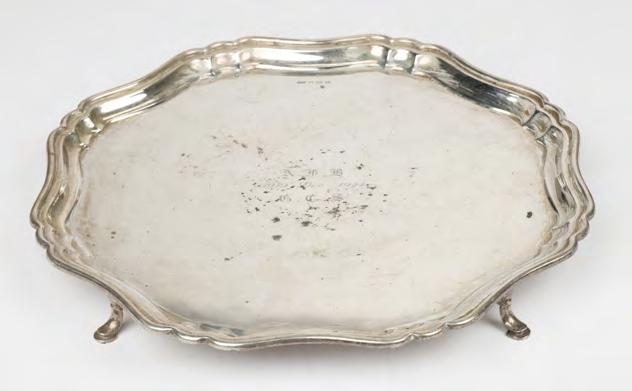
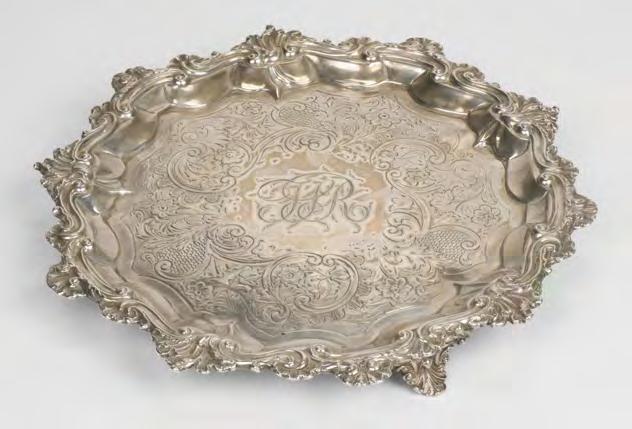
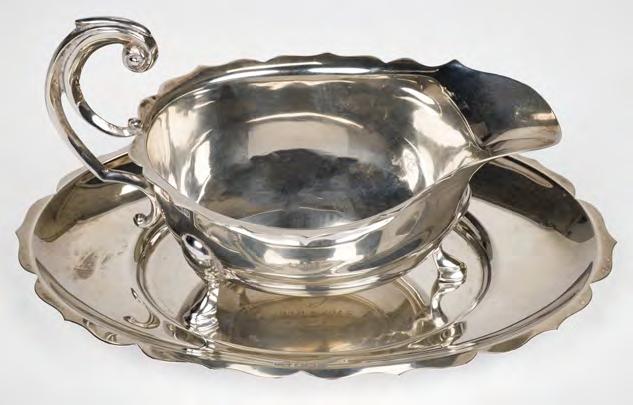
410* Salver. A George VI silver salver by CFS, Sheffield 1941, of circular form with shaped rim, engraved with a presentation inscription, on four cabriole supports, 31 cm diameter, 888g (1)
£600 - £800
411* Salver. A William IV Silver salver by John Wellby [?], London, 1834, circular salver engraved with flowers, scrollwork and foliage decoration, monogram to centre, with rococo-style scrollwork, acanthus leaves, and floral curve edge, raised on three curved acanthus supports, 27 cm diameter, 629g (1)
£600 - £800
412* Sauceboat. A George V silver sauceboat by Viner’s Ltd, Sheffield, 1931, of plain form with shaped rim and flying scroll handle, on three cabriole supports, 17.5 cm long, together with conforming tray, the latter engraved with a presentation inscription, 21 cm long, combined weight 473g (2)
£300 - £500
413* Scent Flask. A Victorian silver scent flask or perfume vinaigrette by Sampson Mordan & Co, London, 1882, of cylindrical form with hinged domed cover and gilt mount, the exterior richly engraved throughout with foliate ornament and a figural scene depicting a climber ascending a wall, opening to reveal a fitted glass liner or reservoir, the base further engraved with foliate, double ended screw caps, monograms to both lids, 11cm long (1)
£150 - £200
414* Silver Award. What The Papers Say Award presented to Paul Foot, hallmarks for T.F., Birmingham 1990, the rectangular plaque engraved and gilded ‘Awarded by What The Papers Say to Paul Foot Journalist of the Year 1989 Granada Television’, 11 x 8.5 cm, 302g, presented in a fitted leather and gold embossed box Paul Foot (1937-2004) was an investigative journalist, political campaigner, author and long-term member of the Socialist Workers Party (SWP). He was named journalist of the year in the What The Papers Say Awards in 1972 and 1989. (1)
£200 - £300
415* Silver Cafe Au Lait Set. A George V two part silver Cafe Au Lait set, probably by Mappin & Webb (hallmarks rubbed), Birmingham, 1934, comprising of a coffee pot (slightly dented) and milk jug, restoration to both hinges, each of tapered panelled form with bakelite handles and finals, 16cm high, total gross weight 550g (2)
£500 - £700
416* Spoons. A collection of 12 silver dessert spoons, including 6 Victorian spoons by Samuel Hayne & Dudley Cater, London, 1856, all of fiddle pattern form, 17.5 cm long, a set of 4 William IV spoons by Metcalf Hopgood, London, 1836, all of fiddle pattern form, 17.5 cm long plus 2 others, total approximate weight 491g (12)
£400 - £600
417* Spoons. A collection of 9 silver serving spoons, including 5 Victorian spoons by William Theobalds & Robert Metcalfe Atkinson, London, 1838, all of fiddle pattern form, 22.5 cm long, plus 4 others, total approximate weight 603g (9)
£500 - £700
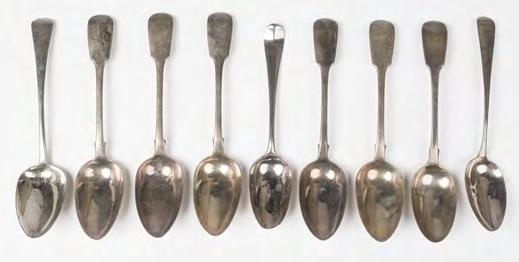
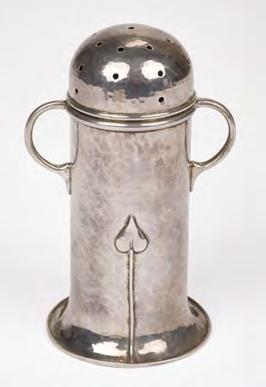
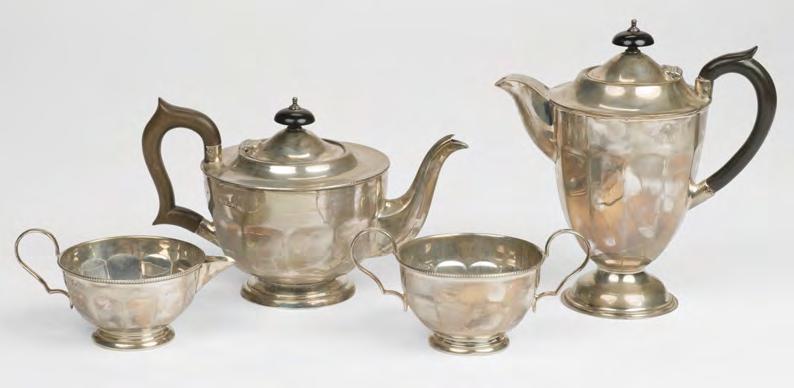
418* Sugar Caster. An Edwardian Arts and Craft silver sugar caster by G L Connell Ltd, Birmingham, 1907, lighthouse form with removable pierced cover, plain C handles, a spreading foot, 12cm high, 96g (1)
£200 - £300
419* Tea Service. A George V four piece tea service by Emile Viner, Sheffield, 1931, of panelled circular form, tea and coffee pot with fruitwood handles and finials, on pedestal foot, tallest 20cm high, smallest 8cm high, total gross weight 1041g (4)
£1,000 - £1,200
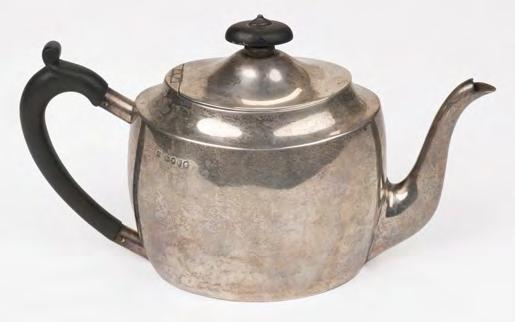
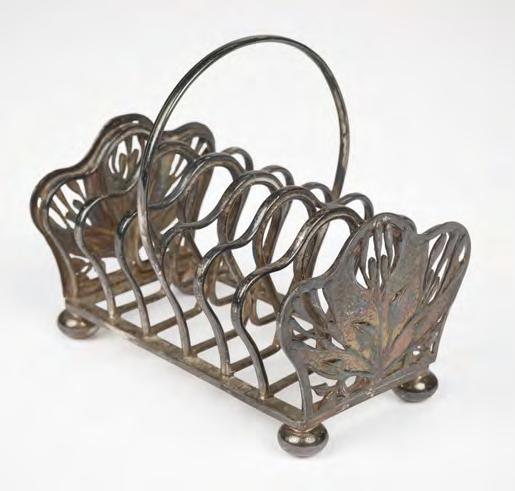
420* Teapot. A Victorian silver bachelor’s teapot by Holland, Son and Slater, London 1879, of plain oblong form with ebonised finial and handle, 23 cm long, gross weight 356g (1)
£200 - £300
421* Toast Rack. An Arts and Crafts style silver toast rack by the Guild of Handicraft currently known as Hart Gold & Silversmiths, London, 1995, based on a design by Charles Robert Ashbee, the 6 slice toast rack features end panels decorated with repoussé leaf and tulip silver work, with central loop handle, 314g, 12 cm long (1)
£300 - £500
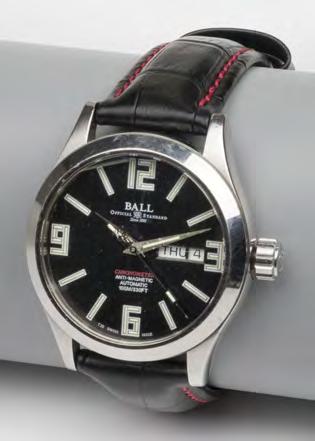
422* Ball Watch Company Automatic Watch. A Ball Watch Company Arabic Chronometer II NM 1022c Men’s Automatic Watch, 2019, 40 mm case, steel case with black dial, fitted on original strap, with full set of inner and outer box, serial card, tag, instructions, with very minor marks and signs of wear and use (1) £500 - £700
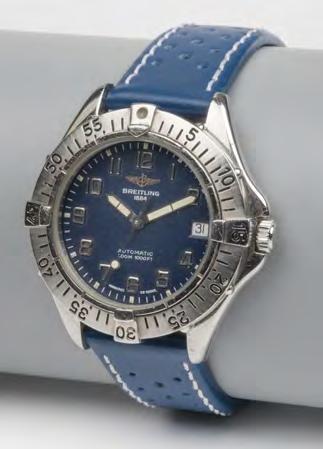
423* Breitling Colt. A Breitling Colt automatic wristwatch, circa 1990s, A17035, 38 mm steel case, blue dial, fitted on a new blue leather strap, original strap retained, age related marks to the case, crystal appears unmarked, dial, hands and crown all original (1) £700 - £1,000
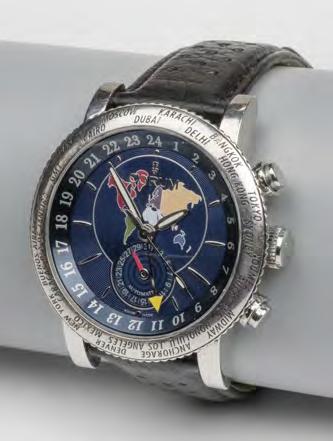
424* Corum Classical GMT. A stainless steel Corum Classical GMT wristwatch with dual time zone, ref 983.201.20, circa 2010, with blue and multicoloured world map dial, 2 piece leather strap, self winding Swiss movement, Arabic numerals and 24 hour dial, with fixed silver bezel and exhibition caseback, age related marks to case and bezel, glass in unmarked condition (1)
£1,000 - £1,500
425* Limit Chronograph Watch. A Limit mens chronograph watch, 1971, 35 mm case stamped 31548, fitted on new black leather strap, mechanical manual wind movement ‘Landeron cal. 248’, original box and papers (1)
£200 - £300
426* Longines Flagship Quartz wristwatch. A Longines Flagship Quartz wristwatch, L4.716.4.72.6, 36 mm case, white dial, stainless steel case and bracelet, polished finish, original box and papers, as new condition (1)
£200 - £300
427* Military Pocket Watch. A WWI military pocket watch by H. Williamson Ltd, London, numbered 97689F, black dial with arabic numerals, the seconds dial unusually placed on the right-hand side as opposed to the traditional lower section, nickel case engraved with a war department broad arrow and corresponding number 97689F, top wind movement, lacking lume but appears to be in good working order, the case 6 cm diameter (1)
£100 - £150
428* Military Pocket Watch. An RAF open face pocket watch circa 1950, the white dial with Arabic numerals with blued steel hands and subsidiary seconds dial, the nickel case engraved ‘A.M. 6E/50 AII46’, Swiss top wind movement, appears to be in good working condition, the case approximately 5.2 cm diameter (1)
£100 - £150
429* Military wristwatch. A WWII German Luftwaffe pilot’s watch, the 51 mm black dial with illuminated hour and minute hands, arabic numerals and a subsidiary dial, stainless steel case numbered FL 23883 and 116186, large winding crown, the movement stamped ‘Laco 22 Steine’, the backplate stamped Beobachtungsuhr Bauart: Laco-Durowe’, 63 mm across, lacking strap, working (1)
£1,500 - £2,000
430* Omega Constellation. An Omega Constellation, circa 1980, case size 29mm, steel bracelet and gold dial, usually with quartz movement this one with replacement Omega movement manual wind, bracelet stamped 1310/277 (1)
£150 - £200
431* Omega Seamaster Cosmic. An Omega Seamaster Cosmic, circa 1967, 136017, 35mm case, cal. 613 manual wind movement, silver cross hair dial, some age related marks (1)
£200 - £300
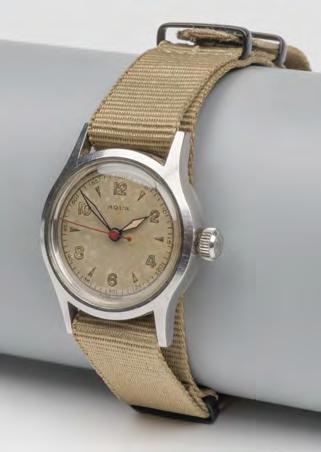
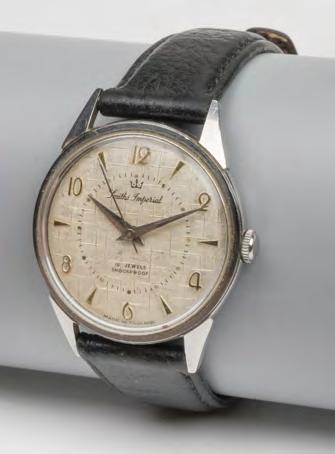
432* Omega Seamaster Cosmic. An Omega Seamaster Cosmic, circa 1967, 166026, 35mm case, cal. 565 automatic movement, fitted on original Omega no.12 1068 bracelet with 523 stamped end pieces, silver cross hair dial (marked), watch case in good order, glass has been replaced, previous owner initials engraved to clasp with some scratches and age related marks associated with use (1)
£200 - £300
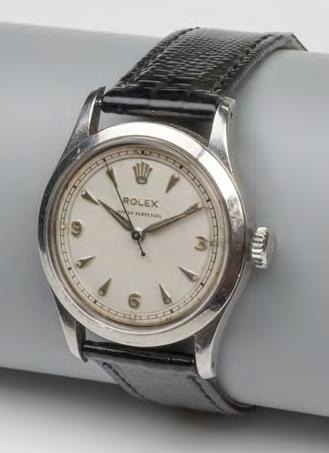
433* Rolex Oyster Perpetual. A Rolex Oyster Perpetual, ‘big bubbleback’ 1953, stainless steel case and a two-piece black leather strap, the white dial features arrow markers and Arabic numerals, with a fixed silver bezel and a polished case finish, automatic movement, 33mm case (1)
£1,200 - £1,800
434* Rolex/Tudor Lund And Blockley Aqua watch. An Aqua watch, circa 1940s, 28mm case, stamped 47101 10000, movement signed Lund and Blockley who were jewellers in London and Bombay, manual wind Cal.65, the case has an oyster patent crown and tube, fitted on nato strap Movements were shipped by Rolex to Lund and Blockley in wartime in order to avoid the high taxes on luxury goods. The watch was assembled by Rolex technicians (1)
£300 - £400
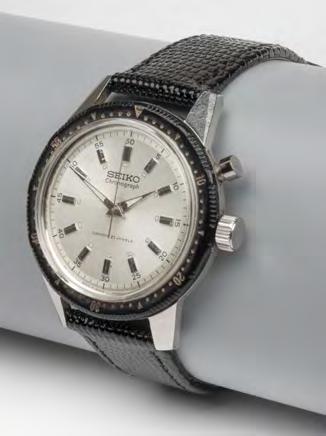
435* Seiko Monopusher. A Seiko Monopusher Chronograph produced for the 1964 Tokyo Olympic Games, 1964, silver dial and black bezel, case stamped 4903222, 37 mm case, fitted on new strap, Cal. 5718A, some small age related marks (1)
£400 - £600
436* Smiths Imperial Watch. A Smiths Imperial menswear Watch, circa 1950s, 35mm steel case with textured dial, cal 104 manual wind movement, fitted on black leather strap, age related marks to the case (1)
£200 - £300
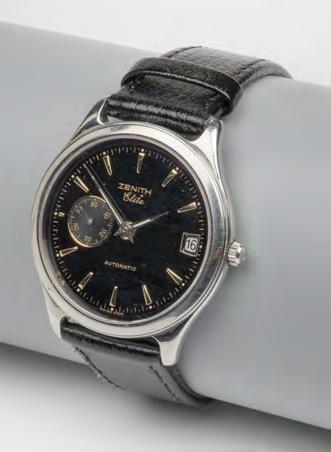
437* Zenith Elite Automatic Men’s Watch. A Zenith Elite Automatic Men’s Watch, circa 1990s, 90/010040, Cal. 680, automatic movement 26 jewels, fitted on black leather strap with original buckle, replacement dial, original white dial included (damaged), inner and outer boxes, papers and original receipt of purchase (1)
£600 - £800
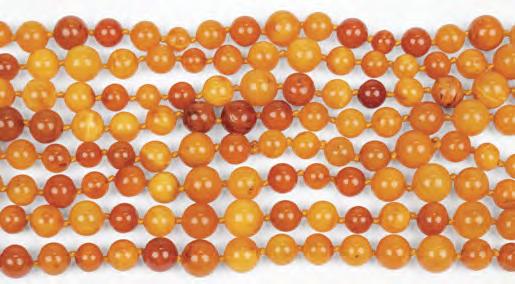
438* Amber. A string of butterscotch amber beads, 160 cm drop, 140g (1)
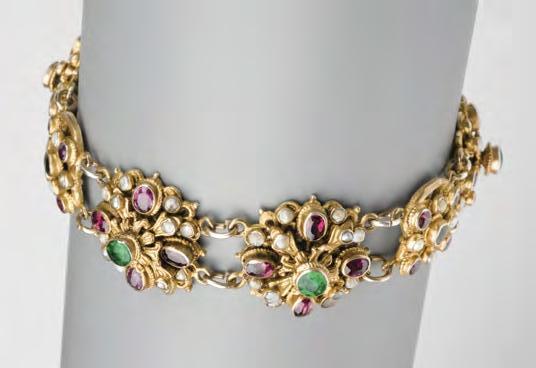
£200 - £300
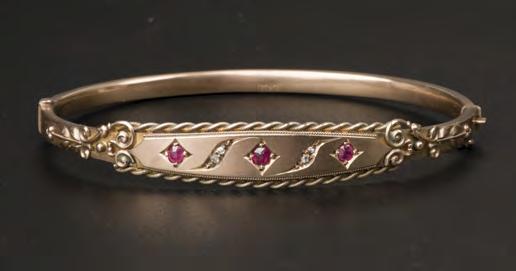
439* Bangle. An Edwardian 9ct gold garnet and diamond bangle, hollow rose gold set with cut stones within a foliate and ornate border, stamped ‘375 9’, 6.2 cm across, gross weight 7g (1)
£150 - £200
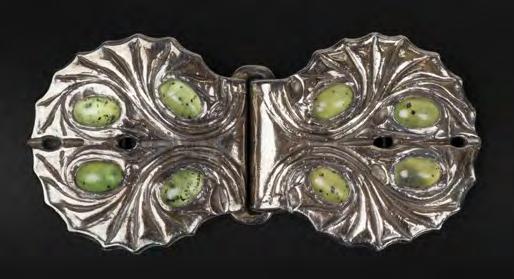
440* Birmingham Guild of Handicraft. An art nouveau silver waist belt buckle, Birmingham Guild of Handicraft, Birmingham 1901, two parts inlaid with 8 green cabochons (opals?), clearly hallmarked on the opposite side, 7 cm long, 26g (1)
£200 - £300
emeralds, garnets and pearls, the clasp stamped with hallmarks, with safety chain, gross weight 37g (1)
£200 - £300
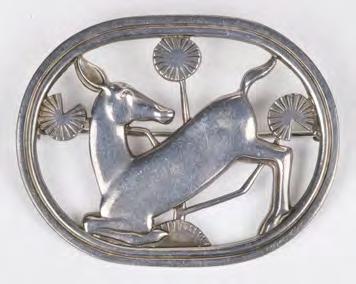
442* Brooch. A Georg Jensen Danish oval pierced silver brooch, with a deer kneeling amongst foliage, designed by Arno Malinowski, pattern No. 256, marked to reverse with ‘STERLING DENMARK’ and dotted oval George Jensen mark, 4.5 cm long (1)
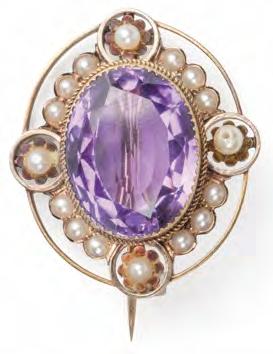
£100 - £150
443* Brooch. A Victorian amethyst and pearl brooch, set in yellow metal with a large facet cut stone, surrounded by pearls, pawnbroker or repair marks to the back, 3.5 x 3.2 cm, gross weight 11g (1)
£150 - £200
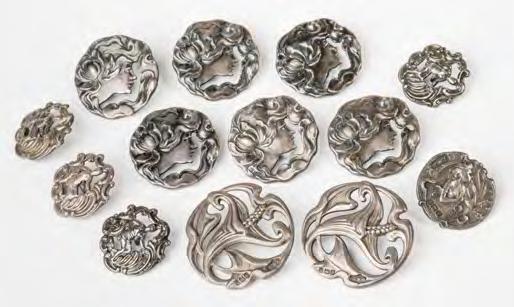
444* Buttons. A set of six art nouveau silver buttons by Crisford & Norris, Birmingham 1902, each cast with a stylised female head, 25 mm diameter, together with a pair of art nouveau silver buttons by Marples & Co, Birmingham 1901, openwork organic decoration, 3 cm diameter and other similar silver buttons, gross weight 39g (13)
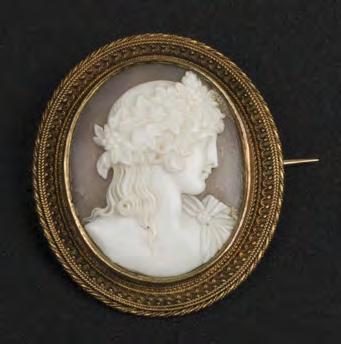
£100 - £150
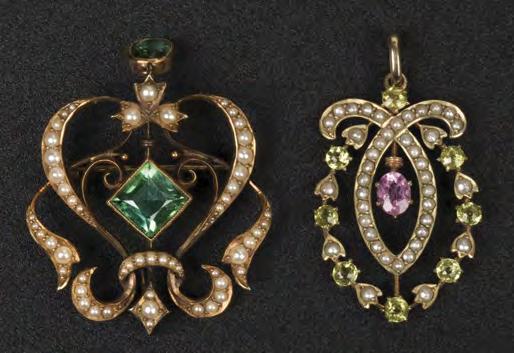
447* Edwardian Jewellery. A 15ct gold openwork peridot and pearl brooch, set with a square cut peridot and strands of pearls and a peridot drop, marked 15ct, 40 mm long, gross weight 6g, together with a similar style 9ct gold tourmaline, peridot and pearl pendant, marked 9ct, 35 mm, 2g (2)
£200 - £300
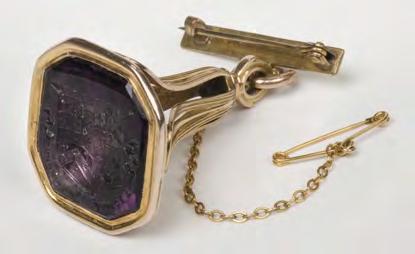
445* Cameo Brooch. A Victorian cameo, carved with the profile of Antinous, presented in an ornate yellow metal mount, 4 cm long (1)
£200 - £300
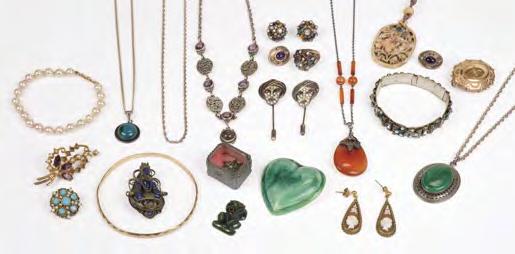
448* Fob Seal. A gold and amethyst fob seal mid 19th century, the amethyst engraved with the arms of the Rouse Boughton Baronets, of octagonal form, the tapering gold mount suspending a short later chain attachment, set with a polished amethyst engraved with an heraldic achievement, the shield appears to represent the arms of the Rouse Boughton baronets, with an escutcheon of pretence denoting marriage to an heraldic heiress, the engraving beneath a coronet and above a motto scroll, the details now partially softened through wear, tests as 15 ct, approx total gross weight 20.8g
The arms are attributable to the baronetcy of Rouse Boughton, though the indistinct escutcheon of pretence presently prevents secure attribution to a specific baronet. Two likely candidates are:
Sir Edward Rouse Boughton, 10th Baronet (d. 1808), who married Catherine Hall, daughter and heiress of William Pearce Hall; or Sir Charles Henry Rouse Boughton, 11th Baronet (d. 1856), who married Charlotte Knight, daughter and co-heiress of Thomas Andrew Knight. (1)
£600 - £800
446* Costume Jewellery. A mixed collection including a 17K gold dress ring, set with semi-precious stones, engraved ‘17K’, size O/P, together with matching earrings (unmarked), art deco style tie pins in the form of heads wearing turbans, set with coloured glass stones, 6 cm long, Miracle bracelet and other items (a small box)
£100 - £150
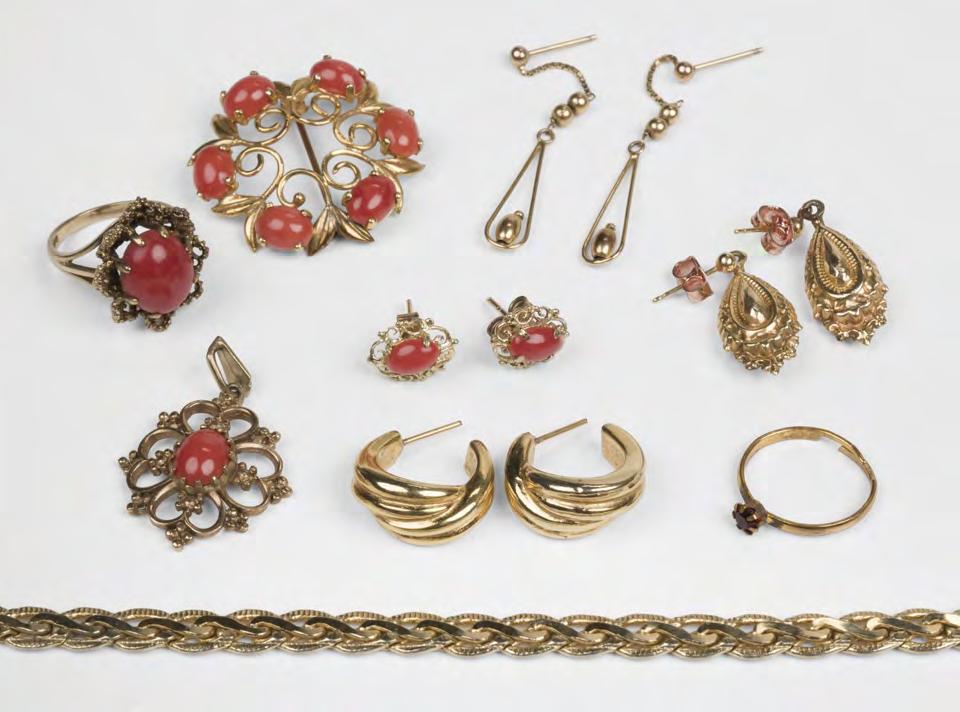
449* Gold Necklace. A modern continental 14K gold necklace, flat twist links, the catch stamped ‘14KG’, 62 cm long, 39g, together with a pair of modern yellow metal earrings, 9ct gold and coral dress ring, brooch, pendant and earstuds and other items (12)
£1,500 - £2,000
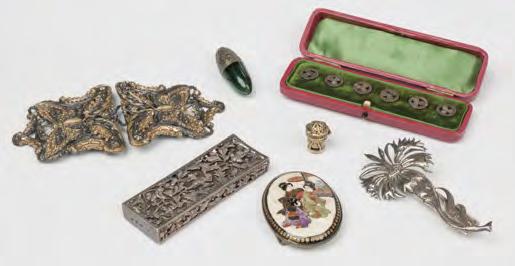
450* Mixed Silver. A Victorian silver diary holder, maker’s mark worn but probably William Comyns, Birmingham 1890, pierced with cherubs and putto, engraved ‘Thornhill New Bond St W’, 8 cm long, encompassing an 1891 De La Rue’s Improved Condensed Diary, together with a set of six white metal shamrock buttons, each inset with green stone leaves, 11 mm diameter, presented in a red leather box with green felt and silk interior, 11 cm long, an art nouveau gilt and pressed metal waist belt buckle, 12.5 cm long, silver posy holder and other items (7) £100 - £150
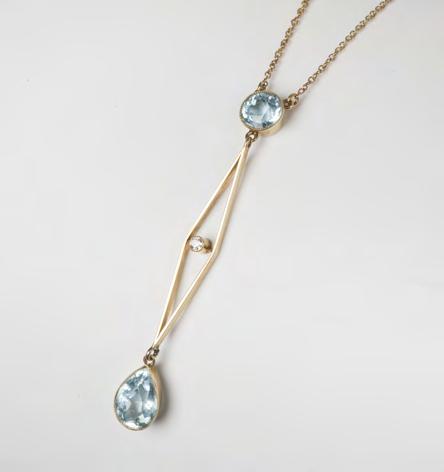
451* Pendant. An art deco style 15ct gold openwork pendant, set with a large aquamarine stone, 6 mm diameter, a small diamond and an aquamarine cut pear stone drop, 6 mm wide, on a fine gold chain, the catch stamped ‘15 c’, the chain is knotted, pendant 6 cm long, chain length 38 cm, gross weight 5g (1)
£200 - £300
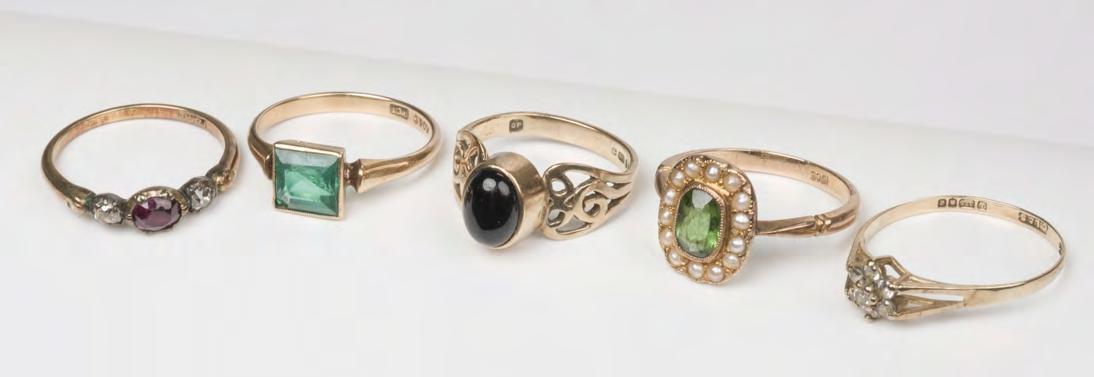
452* Rings. An Edwardian 15ct gold ring, set with an emerald surrounded by pearls, open back mount, stamped ‘15ct’, size N/O, together with four 9ct gold dress rings (5)
£200 - £300
453* Scent Bottle. A George III glass scent bottle, circa 1795, of flat circular form, one side with a black glass or enamel panel showing two hearts on a column, within a white metal border, the opposite side with cut decoration, a white metal screw cap enclosing a glass stopper (dings and dents), 6.5 cm high (1)
£100 - £150
454* Silver. A silver ingot by Carr’s of Sheffield, 1977, 4 cm long, 31g, together with two silver necklaces, an ‘800’ silver pill box engraved with foliate scrolls, plus a 1970s ring set with a facet cut pink stone, size L, weighable silver approximately 130g (5)
£100 - £150
455* Tiffany & Co. Tahitian pearl pendant, set in 18K white gold stamped ‘750’, 25 mm long, suspended from a black cord with 18K mounts, presented in an original suede wallet with Tiffany & Co card box, in excellent unworn condition (1)
£400 - £600
456* Violin. School of Benjamin Banks, English, full size, 18th century, two-piece lightly flamed maple back with matching ribs and scroll, the table of even-grained spruce, reddish-brown varnish, now worn in places, ebony fingerboard, internally blocked and lined, ebony crown to button area, remains of a removed name stamp visible beneath the button
Back length: 355 mm | Body stop: 195 mm | Neck length: 130 mm
Condition: The table is currently removed and displays numerous cracks including a soundpost crack. Has a historical through patch to the lower bass side. Replacement bass bar. Evidence of historical inactive woodworm. Back with soundpost crack, historically internally patched. Centre joint open to upper bouts. Approx. 15 mm crack descending from ebony crown. Historical wooden pin to button. Scraping visible beneath button area. Ribs with faded varnish and evidence of two small historical worm tracks, no visible rib cracks. Two nail holes visible to upper block. Scroll grafted and previously bushed, with evidence of external cheek repairs and historical inactive woodworm.
(1)
£500 - £800
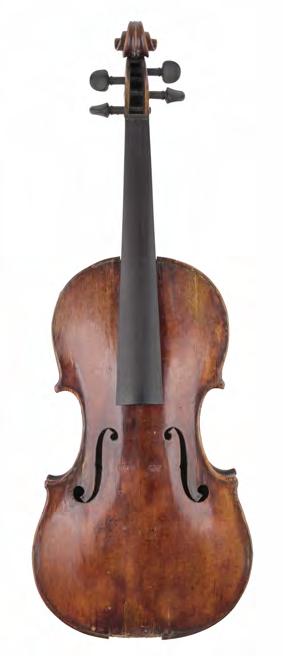
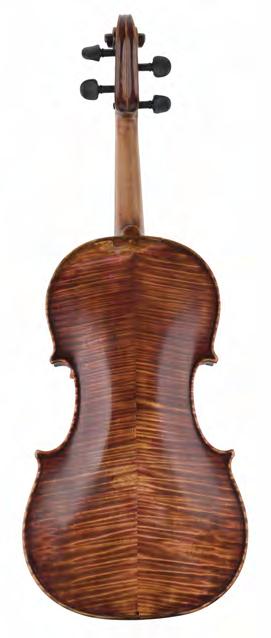
457* Violin. Labelled Hipolitus Fratres Silvestre, French, full size, label dated 18— (final two digits indistinct), mid-19th century, highly flamed two-piece maple back, matching ribs and scroll, and medium-grained spruce table, finished in a strong yellow ground beneath a deep red-brown varnish, now worn in places and possibly over-polished historically, ebony fingerboard, fitted with mechanical tuning pegs
Back length: 356 mm | Body stop: 195 mm | Neck length: 128 mm
Condition: The table is currently removed. Bass bar removed with evidence of crack cleaning having commenced. Numerous table cracks present together with a small historical soundpost patch. Damage visible beneath button area. Ribs blocked and lined, with one apparent small crack to lower bass side rib. Three areas of internal rib veneer reinforcement visible. Scroll with neck graft and cracks to A and D pegbox areas.
(1)
£300 - £500
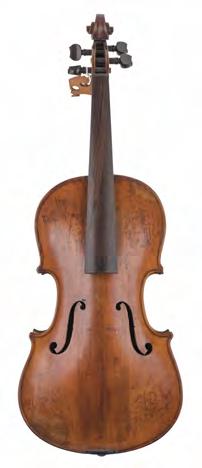
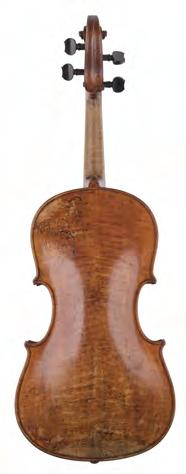
458* Violin. Labelled Matthew Hardie, probably German, full size, late 19th century, medium flamed two-piece maple back, matching ribs and scroll, and slightly wide-grained two-piece spruce table, finished in a light orange-brown varnish with visible antiquing, ebony fingerboard, fitted with pegs, bridge and soundpost
Back length: 361 mm | Body stop: 204 mm | Neck length: 134 mm
Condition: Overall good condition with no visible cracks or evidence of worm.
(1) £200 - £300
459* Violin. Labelled M. Neuner & Hornsteiner, Mittenwald, German, full size, (date indistinct), c. 1900, two-piece very lightly flamed maple back, matching ribs and scroll, and broad-grained two-piece spruce table, finished in a deep dark brown varnish, fitted with reddish stained beech fingerboard, pegs and tailpiece
Back length: 361 mm | Body stop: 197 mm | Neck length: 130 mm
Condition: No visible cracks or evidence of worm. (1) £150 - £200
460* Violin. Hugues Emile Blondelet, French, full size, early 20th century, highly flamed two-piece maple back, matching ribs and scroll, and two-piece spruce table, finished in a warm orange varnish over a golden-yellow ground, original maker’s stamp to the inside back, visible through the treble f-hole, additionally stamped beneath the button and to the ribs; the violin retains its original neck and appears to retain the original bass bar, internally blocked and lined, professionally set up and ready to play, fitted with ebony crown, rosewood pegs with silver collars, rosewood endpin, ebony saddle, ebony chinrest and Wittner tailpiece with integrated adjusters, strung with a full set of Larsen strings
Back length: 356 mm | Body stop: 192 mm | Neck length: 130 mm
Condition: Presented in excellent condition with only minor edge wear and small varnish chips.
Hugues Emile Blondelet worked for Thibouville-Lamy from 1890 and became co-director of Acoulon in 1908. In 1923 he was appointed Chevalier of the Legion of Honour. (1)
£1,000 - £1,500
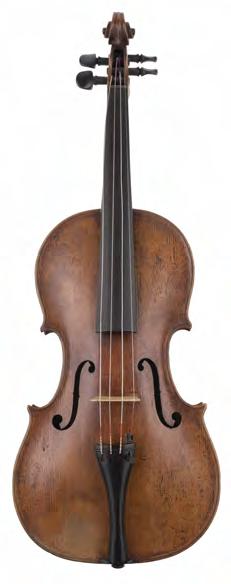
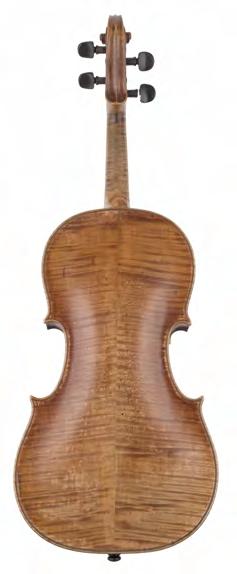
461* Violin. French, bearing an erroneous label, full size, late 19th century, highly flamed two-piece maple back, matching ribs and scroll, and two-piece spruce table, finished in a golden honeybrown varnish with light wear in places, professionally set up and ready to play, fitted with ebony fingerboard, pegs, nut, saddle and tailpiece, together with a W.E. Hill & Sons bridge
Back length: 357 mm | Body stop: 195 mm | Neck length: 131 mm
Condition: No visible cracks or evidence of worm. Minor varnish wears consistent with age and use.
(1)
£500 - £800
462* Violin. Possibly English, full size, c. mid-19th century, onepiece medium flamed maple back, matching ribs and scroll, and two-piece medium-grained spruce table, professionally set up and ready to play, fitted with rosewood pegs, ebony fingerboard, nut, saddle and endpin together with a Wittner tailpiece with integrated adjusters, strung with Larsen A, D and G strings and a gold Pirastro Olive E string
Back length: 358 mm | Body stop: 196 mm | Neck length: 132 mm
Condition: Overall good condition. Neck grafted and pegbox bushed. Ebony crown and ebony pin to button area. No visible cracks.
(1)
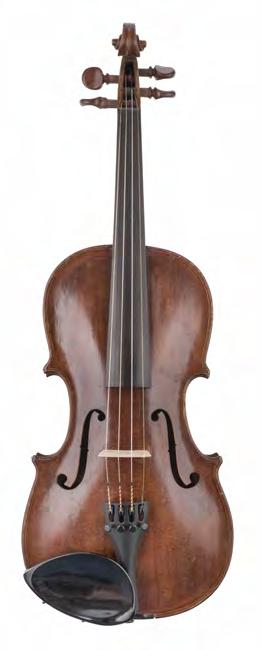
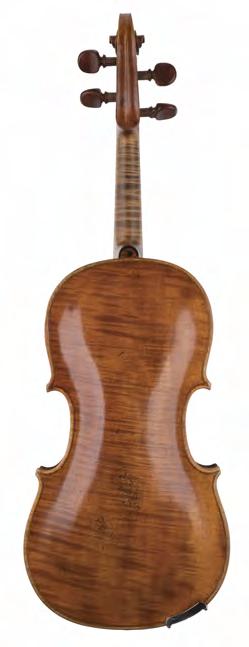
£700 - £1,000
463* Violin. Labelled George W. Wald, English, full size, 1998, onepiece maple back, matching ribs and scroll, and two-piece medium-grained spruce table, labelled ‘A Georgius Custo’s violin hand crafted by George W. Wald, Hailsham, E. Sussex’, additionally hand-signed by the maker, finished in a deep red-golden antiqued varnish, professionally set up with boxwood pegs, ebony fingerboard and chinrest, and strung with a full set of Pirastro Evah Pirazzi strings
Back length: 356 mm | Body stop: 195 mm | Neck length: 130 mm
Condition: Overall good condition.
(1)
£600 - £800
464* Violin. Labelled George W. Wald, English, full size, 1998, onepiece maple back with matching ribs and scroll, and medium-grained spruce table, labelled ‘A. Georgius Custos violin hand crafted by George W. Wald, Hailsham, England’, additionally signed by the maker, finished in a warm reddish-orange varnish, professionally set up with boxwood pegs and endpin, ebony fingerboard, nut and saddle, together with a Wittner tailpiece with integrated adjusters
Back length: 356 mm | Body stop: 195 mm | Neck length: 130 mm
Condition: Overall good condition.
(1)
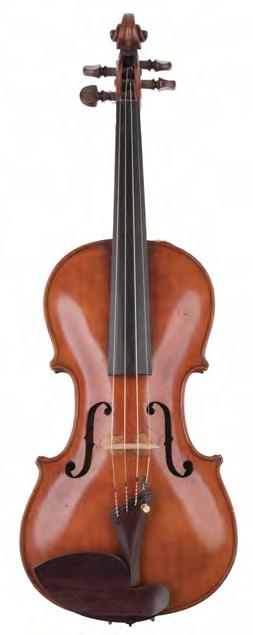
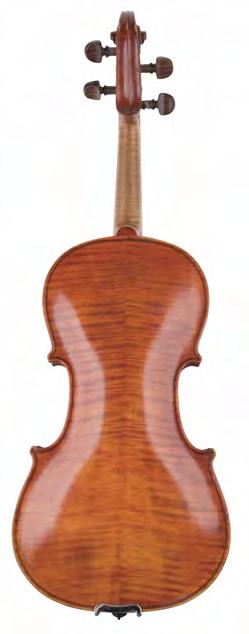
£600 - £800
465* Violin. Possibly modern Italian, full size, early 20th century, two-piece medium curled maple back, broader flamed ribs and highly flamed scroll, two-piece medium-grained spruce table, finished in a deep orange oil varnish over a golden ground, professionally set up and ready to play, fitted with ebony fingerboard, nut, saddle and endpin, strung with Larsen strings and additionally fitted with an Mberg titanium E adjuster
Back length: 354 mm | Body stop: 193.5 mm | Neck length: 130 mm
Condition: Overall good condition. Wear to varnish beneath bridge feet. Two well repaired f-hole wing cracks. (1)
£1,200 - £1,500
466* Violin. Collin-Mézin workshop, Mirecourt, French, full size, early 20th century, highly flamed two-piece maple back, matching ribs and scroll, and even-grained spruce table, finished in a deep brown-amber varnish over a yellow ground, ebony fingerboard, soundpost inside
Back length: 361 mm | Body stop: 196 mm | Neck length: 130 mm
Condition: One professionally repaired crack running approximately 93 mm from the saddle on the treble side. Minor scuffs and wear to varnish on the back.
(1)
£800 - £1,200
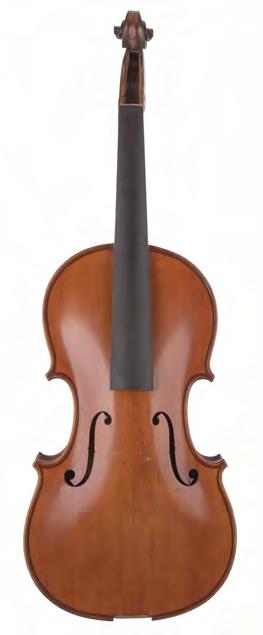
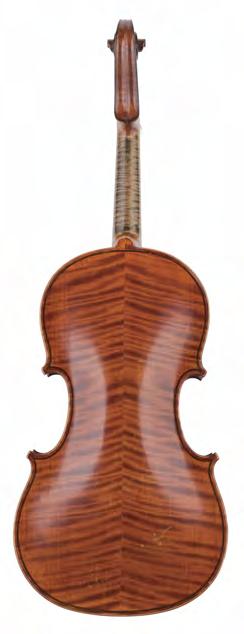
467* Violin. German trade violin, full size, late 19th / early 20th century, two-piece lightly flamed maple back, matching ribs and scroll, medium-grained spruce table, finished in a deep brown-reddish varnish
Back length: 361 mm | Body stop: 200 mm | Neck length: 132 mm
Condition: Overall good condition. Someone has commenced fitting pegs. No visible cracks.
(1)
£100 - £150
468* Violin. Labelled ‘The Apollo’, full size, late 19th century, two-piece narrow flamed maple back, lightly flamed ribs and matching scroll, labelled ‘The Apollo’, imported and sold by Rushworth & Dreaper, Liverpool, additionally marked Style 9, finished in a deep orange varnish, fully set up and ready to play, fitted with ebony pegs, fingerboard, nut, saddle and endpin together with ebony chinrest and a Wittner tailpiece with integrated adjusters, strung with Larsen strings
Back length: 366 mm | Body stop: 203 mm | Neck length: 131 mm
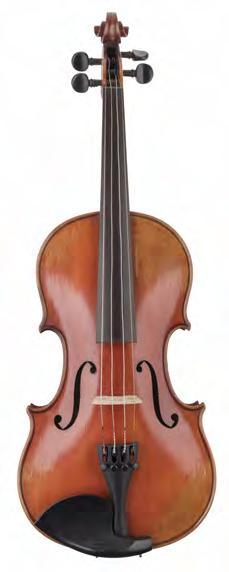
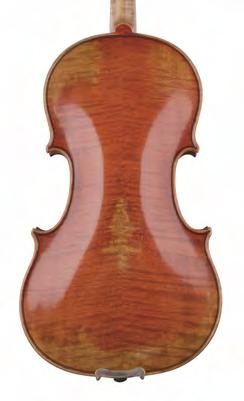
469* Violin. German trade violin, full size, c. 1910, two-piece medium flamed maple back, matching ribs and scroll, and medium-grained spruce table, finished in an attractive orange varnish, fully set up and ready to play, fitted with ebony fingerboard, pegs, nut, saddle, endpin and chinrest, together with a Wittner tailpiece with integrated adjusters
Back length: 354 mm | Body stop: 194 mm | Neck length: 130 mm
Condition: Overall good condition with no visible cracks or evidence of worm.
(1)
£200 - £300
£200 - £300
Condition: Overall good condition with no visible cracks or evidence of worm. (1)
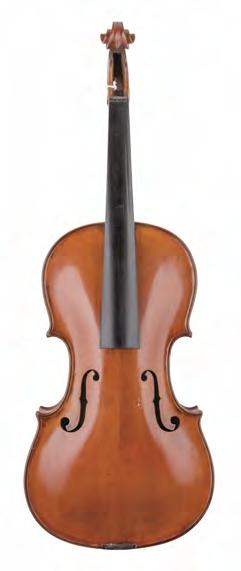
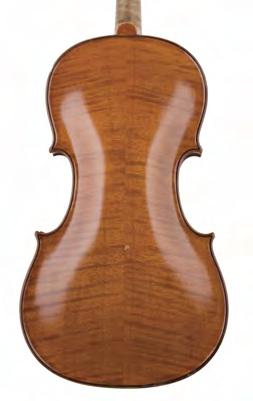
470* Violin. German trade violin, full size, 1920s/1930s, two-piece medium flamed maple back, matching ribs and scroll, and even-grained spruce table, finished in a light brown-orange varnish, fitted with ebony fingerboard, nut and saddle, soundpost inside
Back length: 356 mm | Body stop: 194 mm
| Neck length: 130 mm
471* Violin. French trade violin, full size, early 20th century, two-piece medium flamed maple back, matching ribs and lightly figured scroll, together with a medium-grained spruce table, finished in a warm brown-orange varnish, fitted with well-fitted ebony pegs, ebony fingerboard, saddle and endpin, nut partially fitted, ebony crown to button area
472* Violin. German trade violin, full size, early 20th century, well flamed two-piece maple back, matching ribs and scroll, and fine medium-grained spruce table, finished in an orange varnish, internally blocked and lined, fitted with ebony fingerboard and saddle, the saddle taped internally to the table
Back length: 355 mm | Body stop: 195 mm
| Neck length: 131 mm
Condition: Approx. 32 mm crack extending from the saddle area. Some damage to lower rib adjacent to saddle. (1)
Back length: 359 mm | Body stop: 197 mm | Neck length: 130 mm
£100 - £150
Condition: Overall good condition with no visible cracks or evidence of worm. (1)
£250 - £350
Condition: Wing crack and saddle crack approximately 84 mm in length with internal studs present; repair work commenced. Apart from these issues, no further visible damage noted.
(1)
£100 - £150
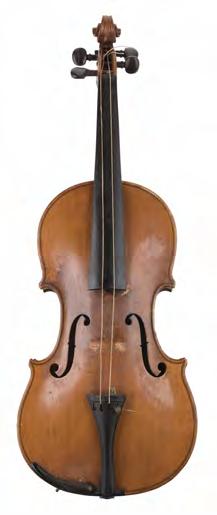
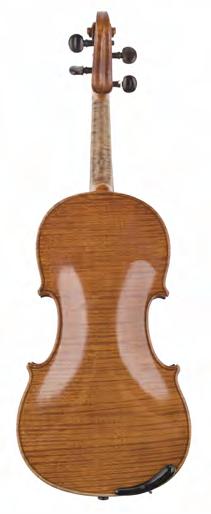
473* Violin. German trade violin, full size, early 20th century, well flamed one-piece maple back, matching ribs and scroll, and medium-grained spruce table, finished in a brown varnish over a golden ground, fitted with rosewood pegs and endpin, ebony fingerboard, nut, saddle and tailpiece, accompanied by an old chinrest
Back length: 362 mm | Body stop: 195 mm | Neck length: 130 mm
Condition: Overall good condition with no visible cracks or evidence of worm.
(1)
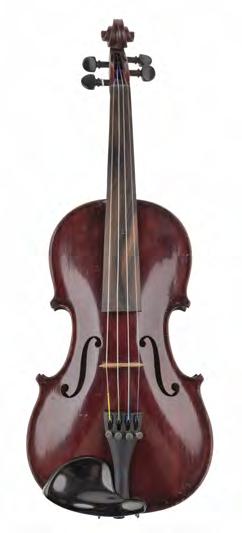
474* Violin. German trade violin, three-quarter size, early 20th century, well flamed two-piece maple back, matching ribs and plain scroll, finished in a deep brown-red varnish, fully set up and ready to play
Condition: Peg crack present, otherwise in good condition. (1)
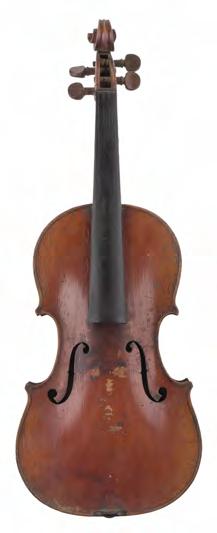
£200 - £300
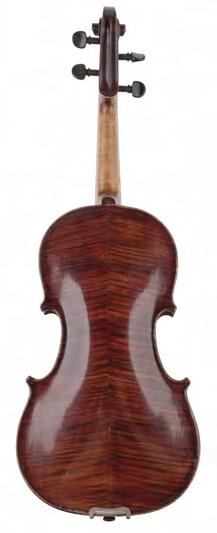
£100 - £150
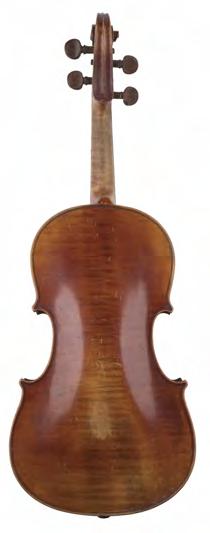
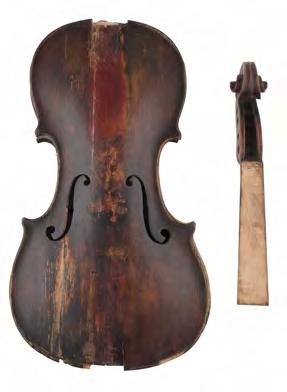
474* Violin. Mittenwald, German, three-quarter size, dated 1769, well flamed maple back, lightly flamed ribs and scroll, and broadgrained spruce table, finished in a deep amber-red varnish, together with:
Violin. Labelled ‘L.E.J.T. L’Incomparable, Mirecourt 1894’, threequarter size, late 19th century, one-piece lightly flamed maple back, matching ribs and scroll, and broad-grained spruce table
Condition: 1) Numerous cracks to the table, though no soundpost crack present. Some loss to edge work. Back with soundpost crack. A peg crack present to scroll. 2) No visible cracks or evidence of worm. Loss to final turn of scroll eye.
(2)
£200 - £300
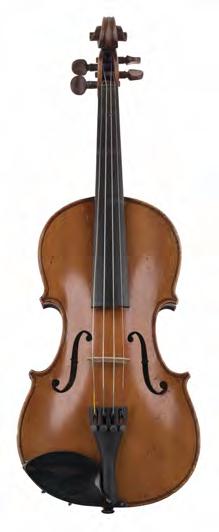
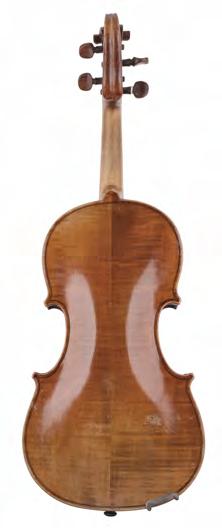
476* Violin. German trade violin, three-quarter size, two-piece medium flamed maple back, matching ribs and scroll, labelled ‘Sold by Thomas Craig, 369 George Street, Aberdeen’, finished in a soft, amber-coloured varnish, fully set up and ready to play
Condition: Overall good condition.
(1)
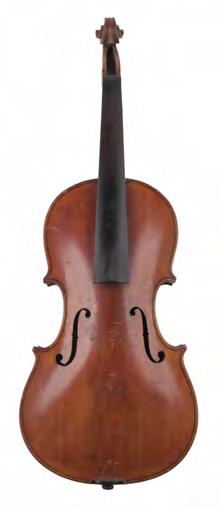
£100 - £150
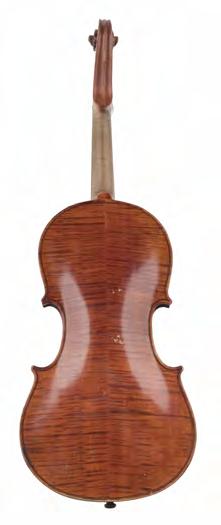
477* Violin. German trade violin, three-quarter size, late 19th century, narrow flamed two-piece maple back, matching ribs and scroll, labelled ‘The Maidstone’, finished in a honey-orange varnish
Condition: Excess glue visible around button area. Two small worm flight holes and a wear patch to ribs.
(1)
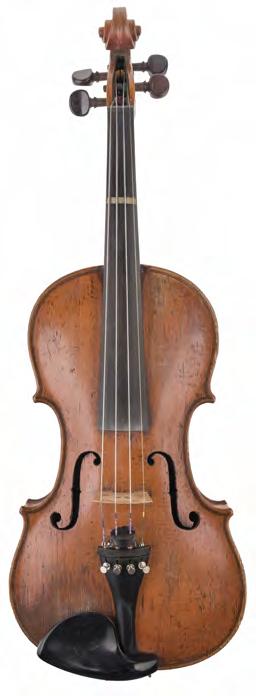
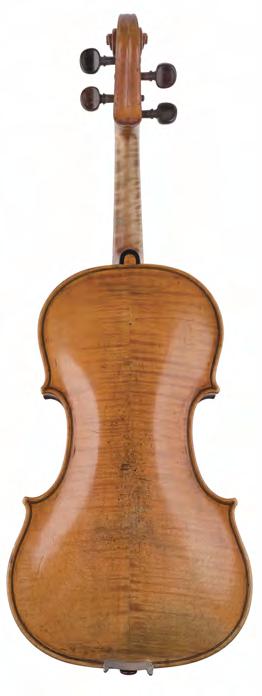
478* Violin. Labelled J.H. Ruppert, German, full size, c. 1720, lightly flamed two-piece maple back, matching ribs and scroll, medium-grained spruce table, finished in an orange-brown varnish on ochre ground, fitted with a new bridge and in good, playable order, accompanied by two bows and a modern case
Back length: 345 mm | Body stop: 191 mm | Neck length: 130 mm
Condition: Two f-hole wing cracks, together with other repaired cracks to the front. No cracks visible in the soundpost area. All repairs appear to have been carried out professionally. Ebony crown. Rosewood pegs. In good playing order.
Johann Heinrich Ruppert was a notable 18th-century German luthier who worked in Erfurt around 1720.
£70 - £100
The violin is accompanied by an insurance valuation letter for £3,000, from Cheltenham Violins, 7 November 2006. (1)
£1,000 - £1,500
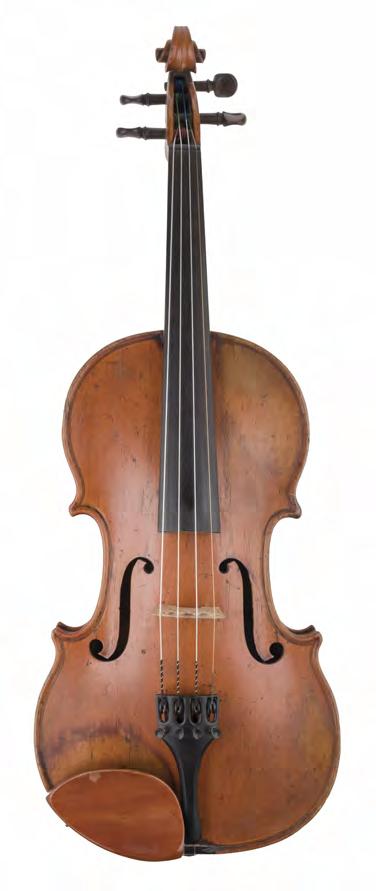
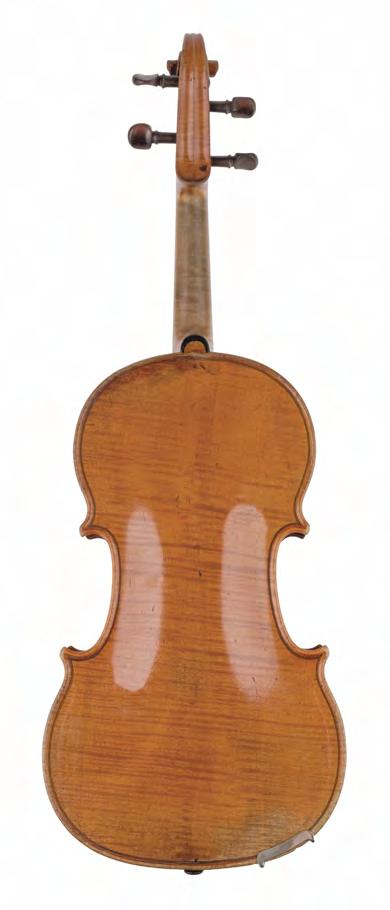
479* Yeats Family Violin. A fine early French Mirecourt Violin bearing the stamp ‘A la Ville de Cremonne / Nicolas Aîné, full size, circa 181020, of Stradivari model with highly flamed one-piece maple back, matching ribs and scroll, and evenly grained one-piece spruce table, internally stamped and additionally bearing handwritten inscriptions reading ‘D. Nicolas Ainé Mirecourt’, displaying finely fluted f-holes, elegant extended bee stings and deeply carved scroll volutes extending fully beneath the pegbox, the plates retain locating pins to both table and back, while the one-piece lower rib follows the Cremonese manner, the edge work throughout is particularly refined, finished in a deep honey-golden varnish, the violin has been historically restored with neck graft, ebony crown and extensive half-edging to the table perimeter, fully set up and playable
Back length: 360 mm | Body stop: 195 mm | Neck length: 125 mm
Condition: Historical restoration and repairs present, stable and consistent with age and use, including two wing cracks, crack from treble f-hole and repaired saddle area cracks. Front extensively half-edged. Fully set up and playable, though the instrument may benefit from a fresh setup and new strings.
Provenance: Acquired from the Yeats Family Collection sale, Fonsie Mealy Auctioneers, Kilkenny, Ireland, 14 November 2017, part lot 190A, described without any note of maker’s marks. The first portion of the Collection was offered by Sotheby’s, London, 27 September 2017. The Collection came from Cliff House, Coliemore Road, Dalkey, Co Dublin, the former home of poet W. B. Yeats’s son Michael Yeats, the late Fianna Fáil senator and MEP, who died in 2007, and his wife Gráinne, a harpist, who died in 2013.
Since its purchase from the Yeats Family sale in 2017, the instrument has remained part of the private display collection of Chapel Violins, prominently displayed within the workshop due to its Yeats family association. In the opinion of Chapel Violins, the instrument likely dates from circa 1810-1820 and from the working lifetime of Didier Nicolas l’aîné (1757-1833), rather than from the later commercial continuation of the Nicolas workshop tradition. (1)
£6,000 - £8,000
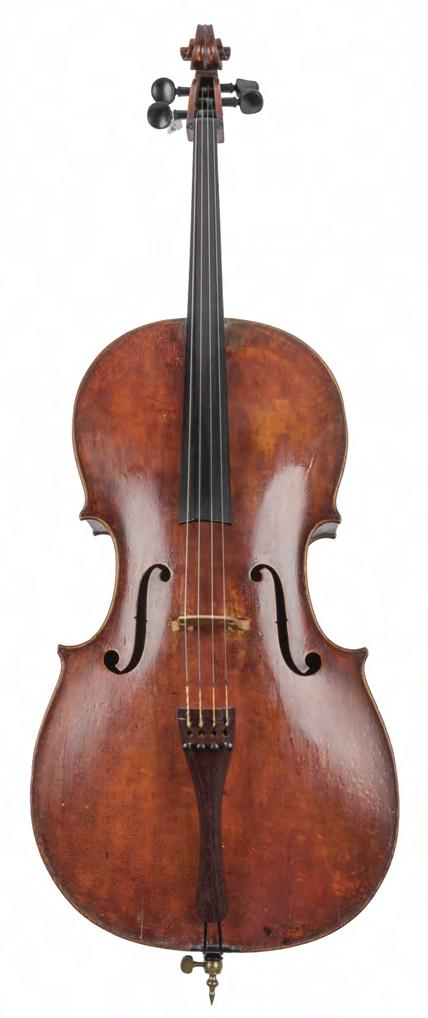
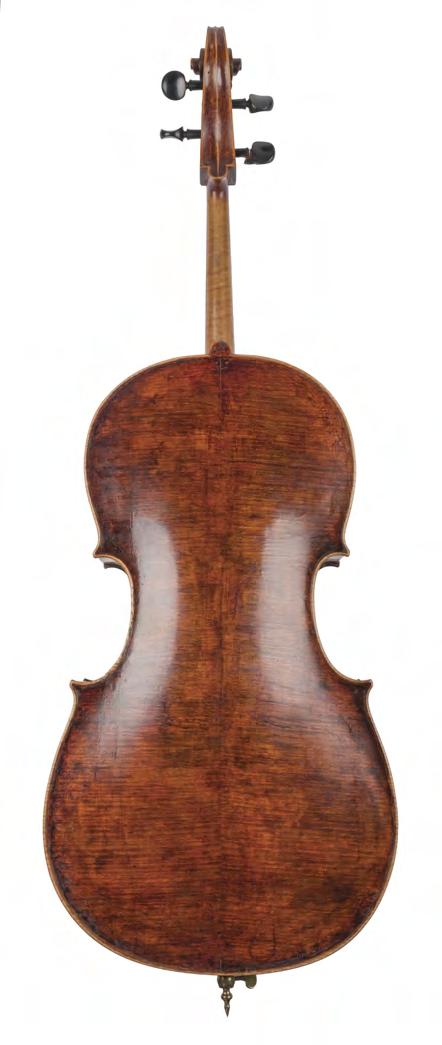
480* Cello. Labelled Johann Knilling, full size, 1825, two-piece medium to well flamed maple back, matching ribs and scroll, and finegrained spruce table, bearing original label, finished in a deep reddish-brown varnish with craquelure consistent with the region and period, fully set up and ready to play with a full set of Larsen strings, ebony fingerboard, saddle and nut, fitted with mechanical pegs with ebony heads, rosewood tailpiece with built in adjustors and original endpin upgraded with titanium and tungsten spike
Back length: 750 mm | Body stop: 390 mm | Neck length: 270 mm
Condition: No soundpost cracks. Older cracks historically repaired and internally fitted with permanent studs. Piece added to heel of neck. Traces of historical worm, now inactive. The cello is structurally stable. The back appears to have received historical sur face over polish or varnish enhancement, not uncommon on instruments of this age and type.
Johann Knilling worked in Mittenwald during the late 18th and early 19th century within the long-established Bavarian violin making tradition. Instruments bearing the Knilling name, particularly cellos, are comparatively uncommon. Mittenwald instruments of this period are noted for their construction and often influenced by classical Cremonese models.
(1)
£5,000 - £8,000
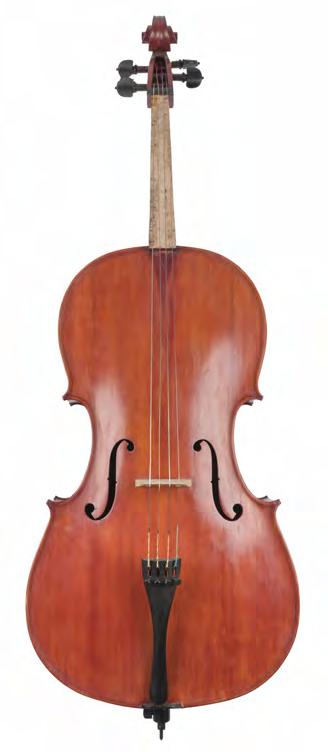
481* Cello. Labelled Johan Stofs, full size, 1898, lightly flamed two-piece maple back, matching ribs and scroll, labelled ‘Johan Stofs me fecit Pragoe ano 1898’, finished in a golden-orange varnish, fitted with ebony pegs, fully set up, though currently lacking a fingerboard, strung predominantly with Larsen strings
Back length: 760 mm | Body stop: 400 mm | Neck length: 280 mm
Condition: Various old repairs present, all internally studded. (1) £800 - £1,200
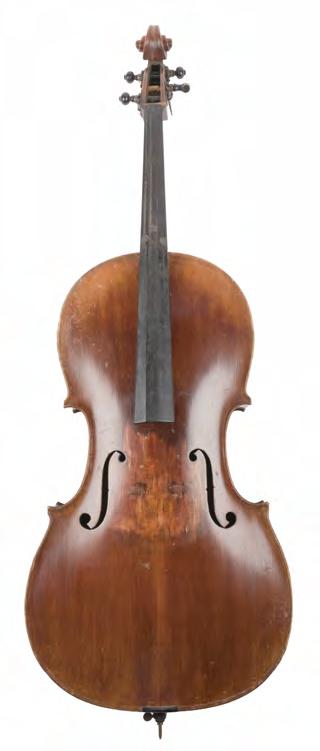
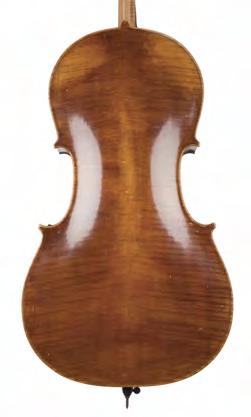
482* Cello. German, full size, late 19th century, medium to well flamed two-piece maple back, matching ribs and scroll, and medium-grained spruce table, finished in a shaded golden-brown varnish, fitted with machine heads to scroll
Back length: 760 mm | Body stop: 406mm | Neck length: 280mm
Condition: Two cracks present to lower table area adjacent to saddle. Crack to lower rib corner area and crack to neck root. (1) £800 - £1,200
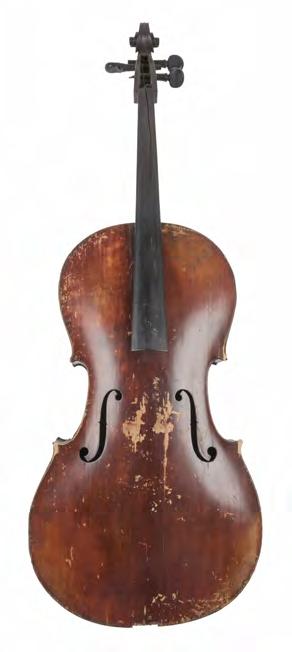
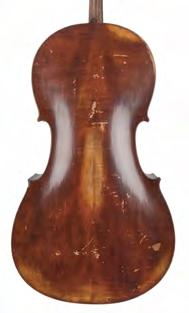
483* Cello. Neuner & Hornsteiner, full size, early to mid-19th century, lightly flamed two-piece maple back, matching ribs and plainer scroll, finished in a reddish-brown varnish over a golden ground, fingerboard with veneered surface, now cracked and lifting, purfling painted
Back length: approx. 760 mm | Body stop: 382mm | Neck length: 274mm
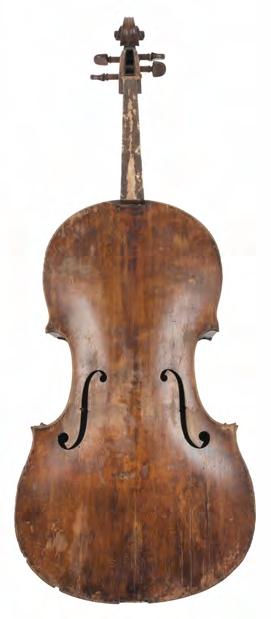
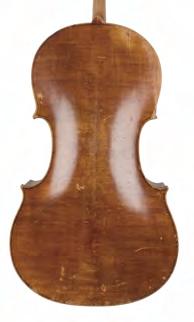
484* Cello. German, full size, c.1880, medium flamed two-piece maple back, lightly flamed ribs and scroll, finished in a warm brown varnish over a golden ground, fitted with rosewood pegs, purfling painted
Back length: 745 mm | Body stop: 409mm | Neck length: 283mm
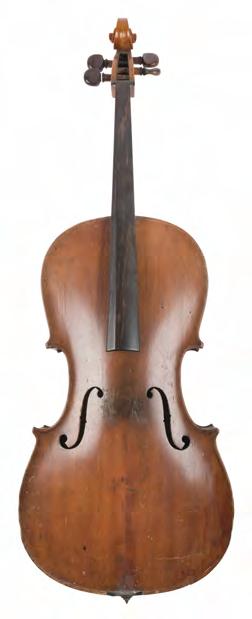
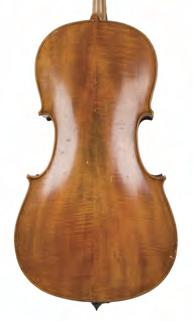
485* Cello. German, half size, late 19th century, lightly flamed two-piece maple back, matching ribs and scroll, finished in an attractive orange-brown varnish
Condition: Overall good condition. (1) £250 - £350
Condition: Heavy concentration of historical woodworm to neck with further historical worm evidence to scroll and occasional historical flight holes elsewhere to body. Three corners to table replaced but unfinished. Soundpost crack repaired, patched and internally studded. Ribs loose from upper block area. Veneer to fingerboard cracked and lifting. (1)
£600 - £800
Condition: Table currently removed. Numerous cracks to table, together with some small losses to edge work. Three corners to table require replacement. No soundpost crack visible to back. Small number of cracks present to back and ribs. Upper bouts loose from upper block area. (1)
£500 - £800
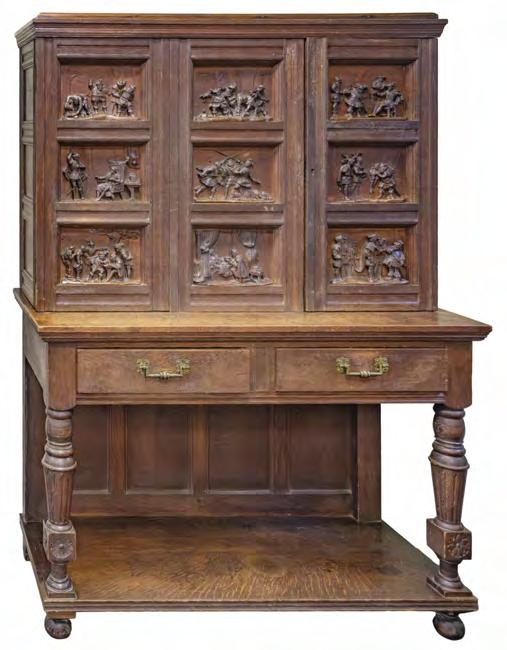
486* Cabinet. An oak cabinet with panels depicting scenes from Shakespeare’s Henry IV carved by Rhoda Bather (1824-1893), circa 1880, front with hinged cabinet doors to left & right and central sliding door section, doors incorporating 9 finely carved panels in relief depicting scenes from Henry IV, parts 1 & 2, back panel of cabinet with furnture remover’s paper label of ‘J. & B. Blower Ltd., Removal & Storage Contractors, Shrewsbury’ and property paper label ‘Property of [Mr.] E. J. Bather’, on Jacobean style oak court cupboard stand base with two drawers, decorative turned columns, and panelled back, cabinet dimensions: width 115 x depth 32.5 x height 85.5 cm (45 1/4 x 13 x 33 1/2 ins), stand base: width 125.5 x depth 47.5 x height 87 cm (47 1/2 x 18 3/4 x 34 1/4 ins), total height (cabinet & base) 172 cm (67 3/4 ins)
Provenance: Rhoda Bather (1824-1893), of Brome Cottage, Meole Brace, Shropshire.
Christopher Edwards, 19th Century Furniture and Works of Art, London. Benjamin Bather, thence by descent.
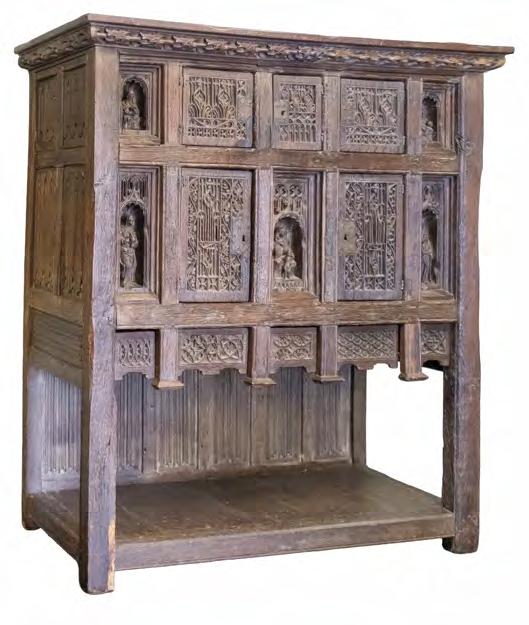

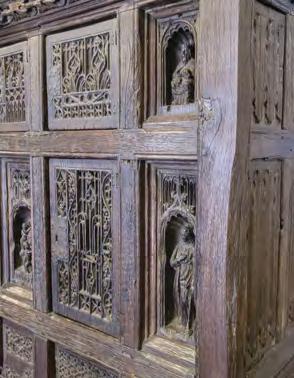
487* Court Cupboard. A Gothic carved oak court cupboard, 16th century, of substantial construction, the upper section with five cupboard doors, with five panels of bas-relief carved religious figures, an arrangement of five drawers below and open undertier, on stile supports, later refurbished probably in the 19th century, 182 cm high x 167 cm wide x 59.5 cm deep (1)
£2,000 - £3,000
Rhoda Bather was the daughter of John Bather, Recorder of Shrewsbury (1781-1839) and Elizabeth Bather (née Gipps, 1787-1880). In Rhoda Bather’s will, she refers to the cabinet, ‘the carved cabinet with the Shakespeare carvings done by me...’ which was bequeathed to her nephew Edward William Bather (1854-1930). The 9 panels in the cabinet show depictions from Henry IV, comprising Part 1, Act II, scene 2 (2 panels); Part 1, Act II, scene 4; Part 1, Act 5, scene 4 (2 panels), Part 1, Act 3, scene 3; Part 2, Act 2, scene 2; Part 2, Act 4, scene 4; and Part 2, Act 5, scene 5. (1)
£1,500 - £2,000
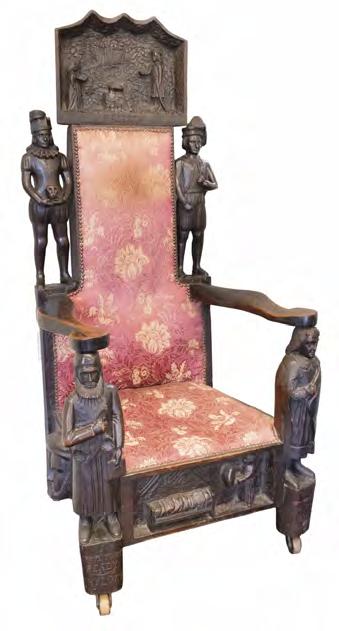
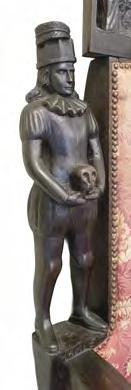
488* Hall Chair. An interesting carved wood ‘Shakespearean’ hall chair, circa 1890, carved with a scene from Macbeth and figures representing Hamlet and Shylock, red foliate upholstery, on metal casters, 158 cm high (1)
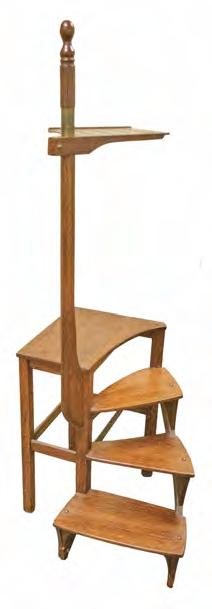
£300 - £500
489* Library Steps. A set of modern mahogany library steps, spiral form with brass top, 174 cm high (1)
£150 - £200
490* Mirror. A substantial Victorian wall mirror, of rectangular form with a deep moulded gilt gesso frame, the gilding recent, bevelled edge glass, 140 cm high x 203 cm wide (1)
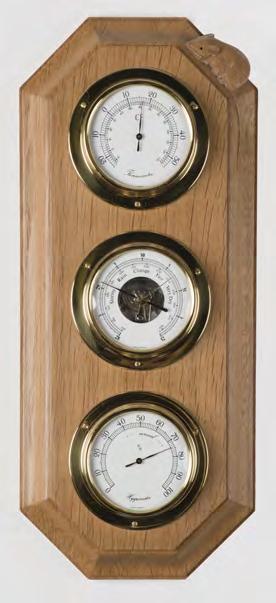
£300 - £500
491* Mouseman. Workshop of Robert Mouseman Thompson (Kilburn), barometer, thermometer and hydrometer each in brass case and mounted on a carved oak base with the distinctive mouse trademark, 44 cm long (1)
£400 - £600
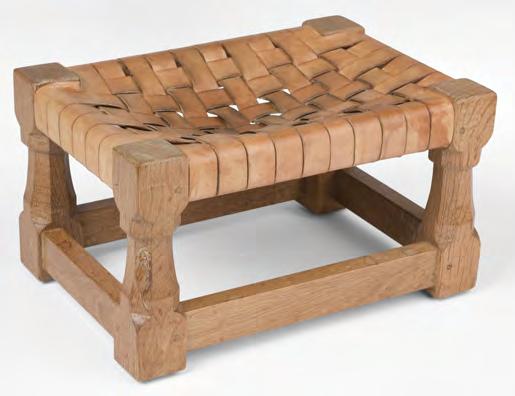
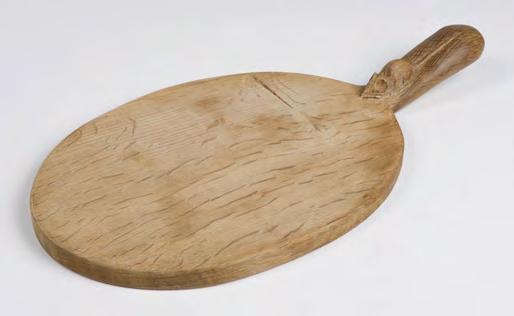
493* Mouseman. Workshop of Robert Mouseman Thompson (Kilburn), a carved oak cheese board, the handle carved with the distinctive mouse trademark, 39.5 cm long (1)
£200 - £300
492* Mouseman. Workshop of Robert Mouseman Thompson (Kilburn), an oak and tanned leather footstool, the oak frame carved with the distinctive mouse trademark, 19.5 cm high x 34 cm wide x 24 cm deep (1)
£200 - £300
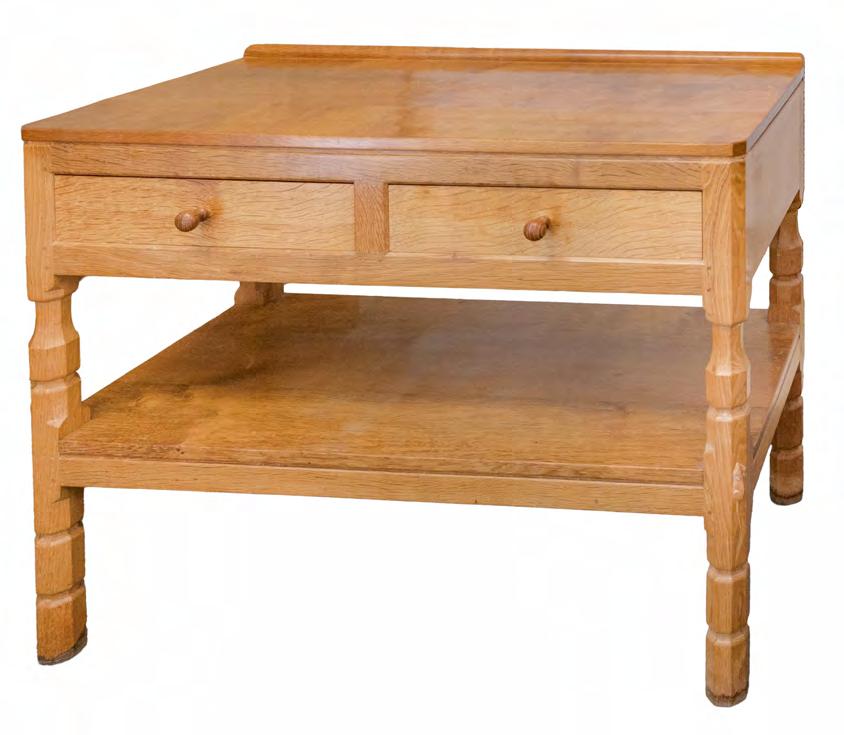
£2,000 - £3,000
494* Mouseman. Workshop of Robert Mouseman Thompson (Kilburn), a carved oak side table, the rectangular adzed top over two drawers each with a turned handle, over four carved supports, one carved with the distinctive mouse trademark, united by stretchers, 86 cm high x 106 cm wide x 50.5 cm deep (1)
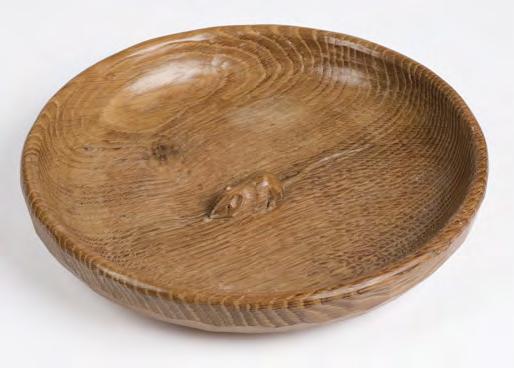
495* Mouseman. Workshop of Robert Mouseman Thompson (Kilburn), a circular carved oak fruit bowl, with adzed exterior and plain interior carved with the distinctive mouse trademark, 29 cm long (1) £200 - £300
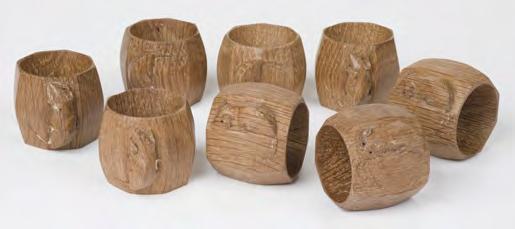
496* Mouseman. Workshop of Robert Mouseman Thompson (Kilburn), a set of 8 carved oak napkin rings, each octagonal and carved with the distinctive mouse trademark, 5 cm long (8) £400 - £600
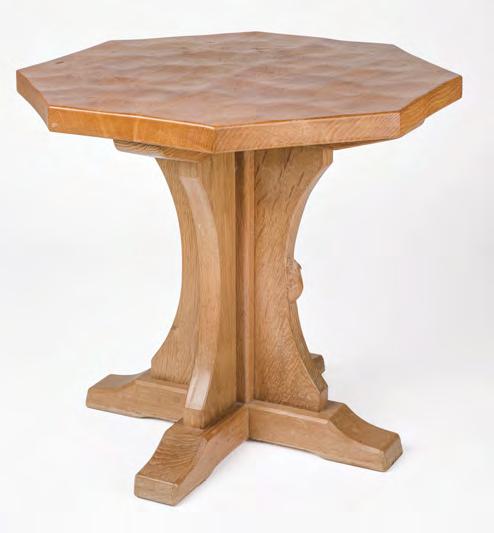
497* Mouseman. Workshop of Robert Mouseman Thompson (Kilburn), an oak octagonal coffee table, the adzed top over a cruciform base carved with the distinctive mouse trademark, the top 50 x 49 cm, height 49 cm (1)
£1,000 - £1,500
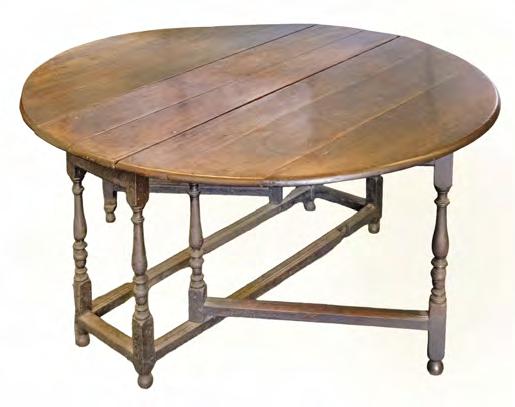
498* Table. A George III oak gateleg table, the oval drop flap top over turned baluster supports united by stretchers, 162 cm fully extended, 72 cm high (1)
£200 - £300
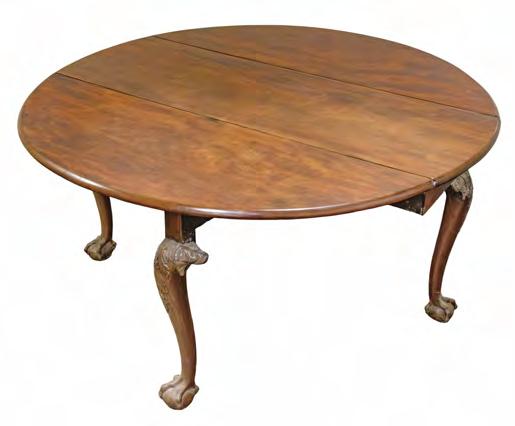
499* Table. George III style mahogany drop leaf table, the oval top over carved cabriole supports each with claw and ball feet, the top fully extended 141 cm x 70 cm high (1)
£200 - £300
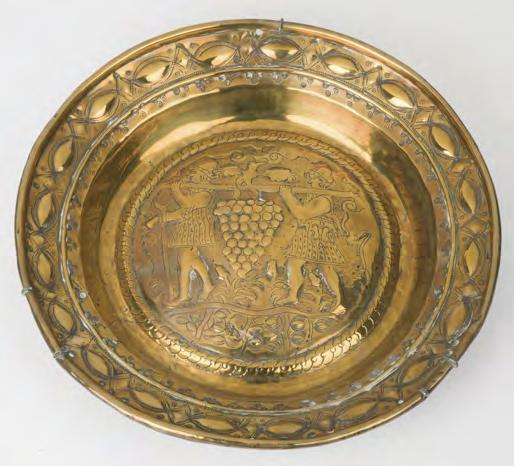
500* Alms dish. A Nuremberg brass repoussé alms dish, 16th century, of circular form decorated to the centre with Joshua and Caleb carrying a large bunch of grapes within a guilloche border and repeating geometric border, 38 cm diameter
Provenance: The Jack Webb Collection, London. (1)
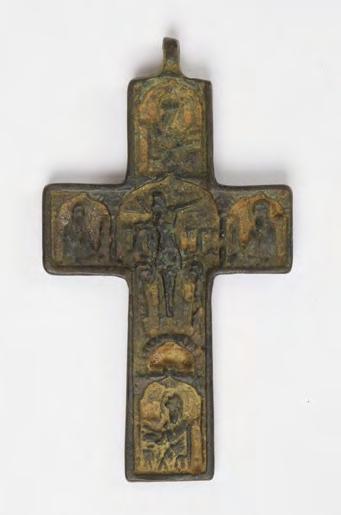
£200 - £300
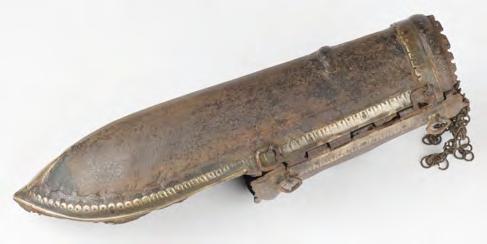
502* Armour. Indo-Persian vambrace, 19th century, steel tapered gutter with brass edges, 35 cm long
The vambrace was designed to protect the forearm. (1)
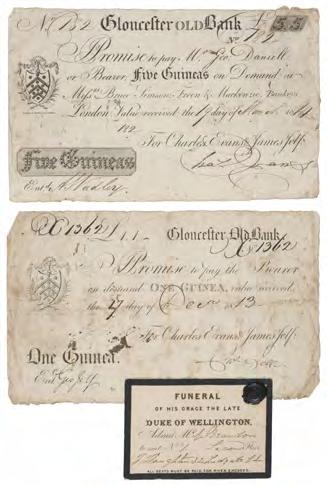
£70 - £100
501* Antiquity. A Medieval bronze pendant cross, circa 15th century, cast with a figure of Christ on the cross and Virgin Mary and disciples, 8.5 x 5 cm, 58g
Provenance: Purchased from Stephen P. Leech, Cheltenham, Gloucestershire. With a guarantee of authenticity paper slip. (1)
£100 - £150
503* Banknotes. Gloucester Old Bank, for Charles Evans and Sir James Jelf, 5 Guineas, 19 March 1814, serial 182, Evans signature, embossed revenue stamp, together with Gloucester Old Bank, for Charles Evans and Sir James Jelf, 1 Guinea, 27 December 1813, serial 1362, Jelf signature, embossed with revenue stamp, both inscribed in ink verso ‘Kingshead Inn Gloucester’, plus a Duke of Wellington funeral invitation card inscribed to Mr Brandon (3)
£70 - £100
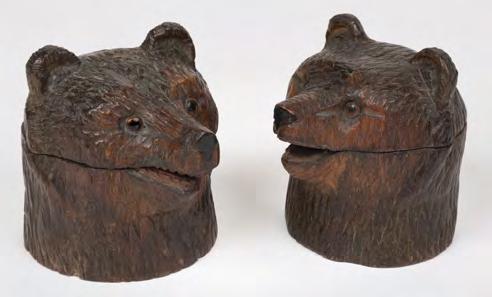
504* Black Forest. A pair of German Black Forest bear inkwells, well carved with glass eyes, each with a hinged lid enclosing a ceramic ink pot, 7.5 cm high (2)
£100 - £150
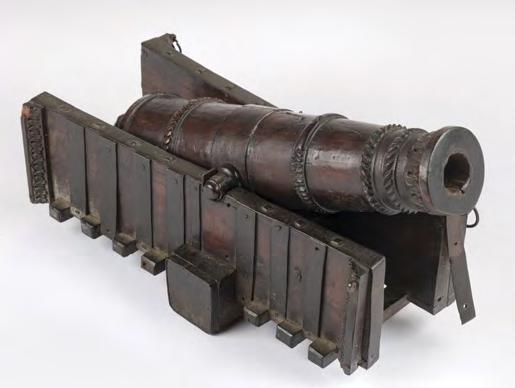
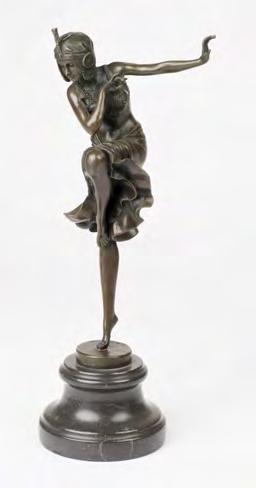
505* Cannon. An Indian hardwood desktop cannon, 19th century, the tapered barrel with two trunnions and an elephant head terminal, mounted on a carved and iron mounted wooden carriage, old loss and chips, barrel length 29 cm, the carriage (1)
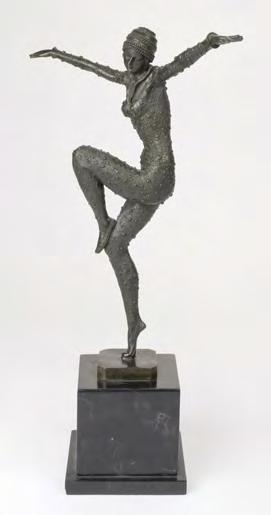
£200 - £300
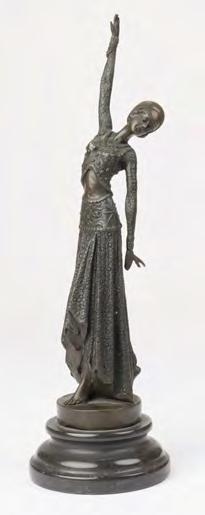
506* Chiparus (Demétre Haralamb, 1886-1947). A large art deco style bronze in the style of Chiparus, modelled as a female dancer or flapper, unsigned, on a black composite marble base, 54 cm high, together with a smaller bronze after the same sculptor, modelled as a female dancer, the base signed ‘Chiparus’, on a black composite marble base, 35 cm high (2)
£200 - £300
507* Chiparus (Demétre Haralamb, 1886-1947). An art deco style bronze after Chiparus, modelled as a dancing girl or flapper, the base signed ‘D.H. Chiparus’, on a black composite marble socle, 39 cm high (1)
£150 - £200
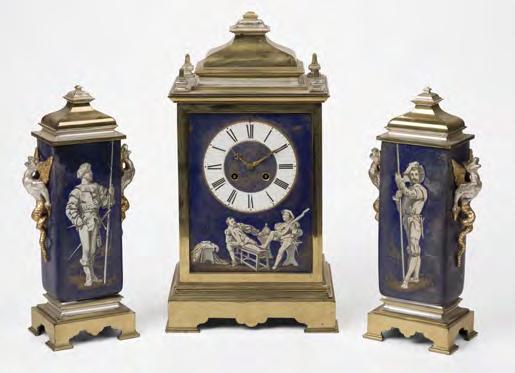
508* Clock Garniture. A French porcelain clock garniture, circa 1890, the brass clock with porcelain panels depicting Elizabethan musicians and courtiers on a dark blue ground, with chapter dial with black Roman numerals and two winding holes, the brass and steel strike and chiming movement enclosed by a circular brass cover, 43 cm high, the garniture, silmilarly decorated with dragon figural handles, 34.5 cm, general wear commensurate with age (3)
£200 - £300
509* Coin collection. A mixed collection from Roman to 20th century, including Henry VIII Groat, the obverse showing the king wearing a crown, the reverse with a long cross intersecting the royal quartered shield of arms and the Latin motto Posvi Devm Adivtorem Mevm (I have made god my helper), 25 mm diameter, 2g, a Medieval jetton, Mexican Charles III 1762 silver 8 Real, 40 mm diameter, 27g, trading tokens, a folder of 18th/19th century British and American coins, all low denominations, condition variable (a carton)
£200 - £300
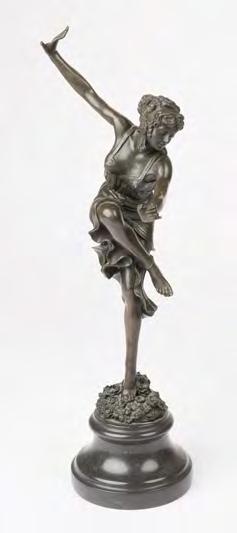
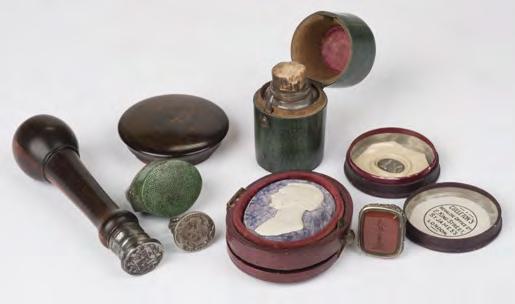
513* Desk Seals. A George III silver fob seal, with family armorial for representing the arms of Grey impaling those of Rawston, 2.5 cm high, contained in a fine green shagreen case, together with another desk seal, steel with a family armorial, lignum vitae [?] handle, 9.8 cm long, a George III medicine bottle with stopper, contained in green shagreen case, 5.5 cm high, a Victorian plaster cameo of a young man facing left, in original red leather case (hinge detached), 6 x 5 cm, and other items (6)
£200 - £300
510* Colinet (Claire Jeanne Roberte, 1885-1972). An art deco style bronze after Colinet, modelled as a dancing girl, the floral encrusted base signed ‘C.L.R. Colinet’, on a black composite marble socle, 45.5 cm high (1)
£150 - £200
511* Curios. A chest containing a collection of curios acquired in the 1940s/50s, including a boot crook with a manuscript label inscribed ‘boot crook from Somerton, Som’, 11 cm long, another with label inscribed ‘boot crook, Huish Episcopi, Rev Copestake 244-52’, 21 cm long, a schist hone (sharpening tool) from Long Sutton dated 17 April 1921, 9 cm long, horses top knot, button and other items, all contained in a wooden chest, 10 cm high x 49.5 cm wide x 18 cm deep (1)
512* Dagger. An Indo-Persian dagger, 19th century, the 29.5 cm curved steel blade with horn grips, overall length 43.5 cm, in its tooled leather scabbard (1) £100 - £150
£70 - £100
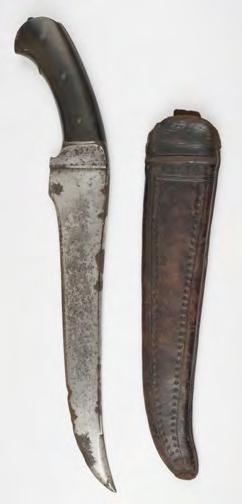
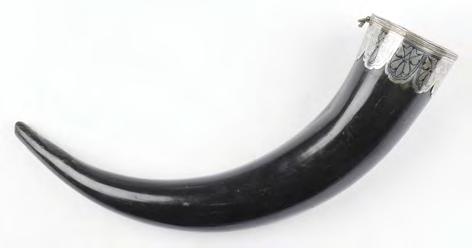
514* Drinking Horn. A Russian drinking horn, 19th century, with silver and niello mount, 38 cm long (1)
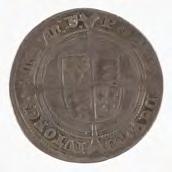
£100 - £150
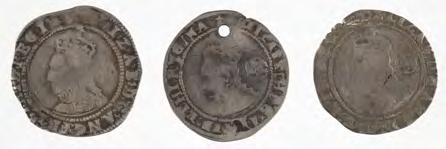
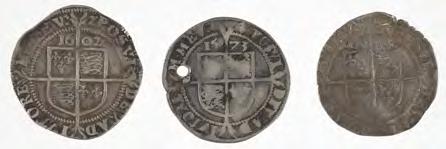
515* Edward VI (1547-53), Shilling, silver, obverse with facing bust and rose to the left and XII to the right, reverse with shield of arms, worn, together with: Elizabeth I (1558-1603), Seventh issue, Sixpence, 1602, plus two others, one dated 1573, all worn and one drilled (4)
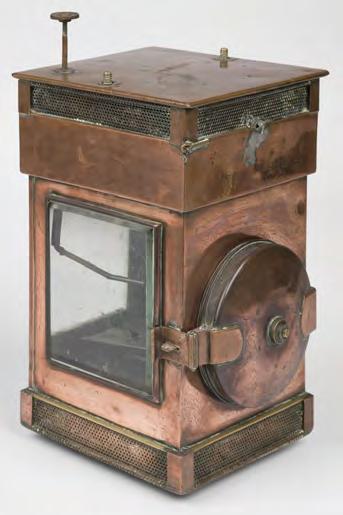
£100 - £150
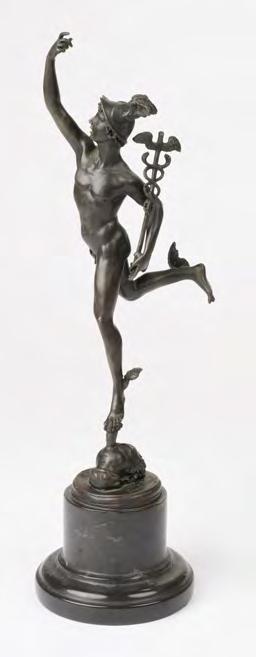
516* Fortress Lamp. A Second Boer War-period copper fortress lamp, circa 1900, the square oil lamp with bevel edge glass, the top stamped with a War Department arrow, the back panel with a large hinged circular door, 32.5 cm high x 19 cm square Fortress oil lamps are quite rare, with only a few lamps in existence. They first originated in 1896 and were used until they became obsolete in 1956. They were designed to cope when a fortress gun was fired. This was achieved through the use of baffles that automatically closed and quickly reopened after the blast, to ensure that the flame had enough air to feed it. Typically, two lamps would be fitted to each gun. (1)
£150 - £200
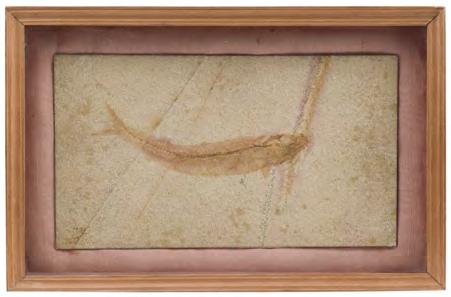
517* Fossil. Allothrissops mesogaster (Agassiz), Jurassic period, Bavaria, a fossilised fish set in a rectangular matrix, 13.5 x 24 cm, presented in a glazed display frame, frame size 20 x 30.5 cm (1)
£70 - £100
518* After Giovanni da Bologna Giambologna (1529-1608). A decorative bronze modelled as Hermes, the base signed ‘Giambologna’, on a black composite marble base, 43 cm high (1)
£150 - £200
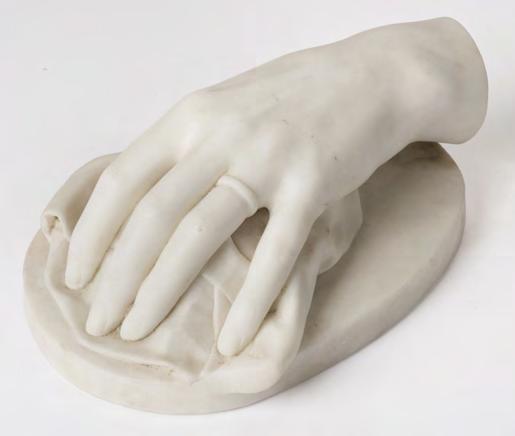
519* Italian School. A fine Italian white marble momento mori sculpture, circa 1850, exquisitely carved as a lady’s hand resting on a cloth with integral oval base, 21 cm long
Provenance: The Jack Webb Collection, London. (1)
£300 - £500
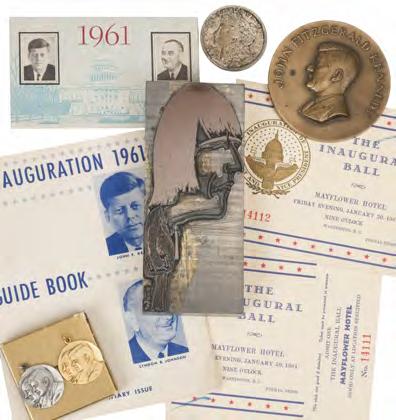
520* Kennedy (John Fitzgerald, 1917-1963). Kennedy Inauguration Medal, 1961, bronze, by Paul Manship, 1961, stamped around edge ‘Medallic Art Co, N.Y. Bronze’, 7 cm diameter, together with a Kennedy Inaugural Ball charm medal, gilt metal plus a pewter example, contained in original card box stamped ‘Inaugural Ball January 20, 1961’, ticket stubs for the inauguration, stubs for the Inaugural Ball, Inauguration guide book and other related items (10)
£150 - £200
521* Laurel (Pierre, 1882-1962). An art deco style bronze after Laurel, modelled as a dancing girl or flapper, the base signed ‘P. Laurel’ with ‘Bronze Garanti Paris’ foundry medallion, on a black composite marble base, 40 cm high (1)
£150 - £200
522* Lorenzl (Josef, 1892-1950). An art deco style bronze after Lorenzl, modelled as a female nude holding a bow with three dogs by her side, the base signed ‘Lorenzl’, on a black composite marble base, 23 cm high (1)
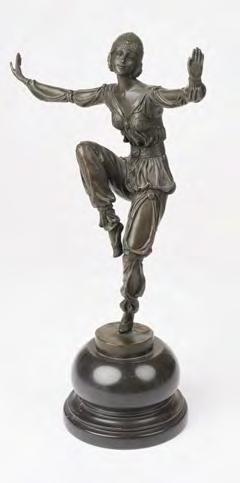
£100 - £150
523* After Josef Lorenzl (1892-1950). An art deco style bronze of a female nude, the figure holding a bow, with two dogs by her side, the base signed ‘Lorenzl’, with ‘Bronze Garanti Paris’ foundry medallion, on a black composite marble base, 30.5 cm high (1)
£100 - £150
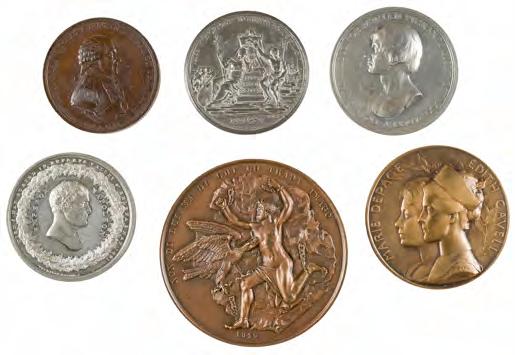
524* Historical medals. Admiral Lord Viscount Duncan, bronze medal by John Gregory Hancock, 1797, the obverse showing a uniformed bust of Admiral Duncan right, hair in pigtail and wearing the King's gold medal around his neck, the reverse showing a seaman nailing the Royal Standard to a ship's top gallant mast, 50 mm diameter, together with a medal for the death of Lord Nelson, 1805, white metal by P. Wyon, the obverse with seaman standing beside a tomb, the reverse showing Britannia and Neptune seated beside funerary urn on plinth, 52 mm diameter, a white metal medal for the death of Lord Nelson, 1805 by Thomas Wyon the Younger, the reverse showing Bellona, winged, laureate, holding lightning bolts and stepping over the sea, on whicg in the distance antique galleys are fighting, the legend ISE BELLI FVLMEBN (Himself the thunderbolt of war), 55 mm diameter, 44.8g, and other historical medals, contained in an old HMS Victory biscuit tin (9)
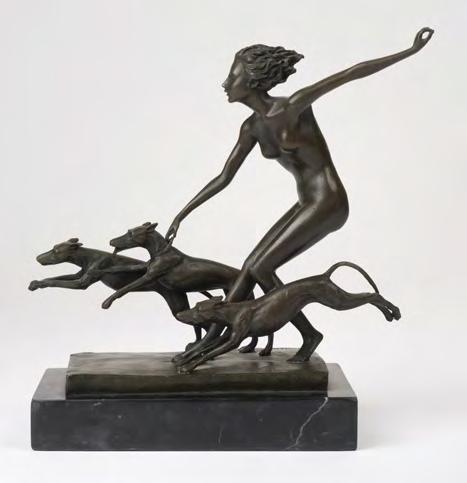
£200 - £300
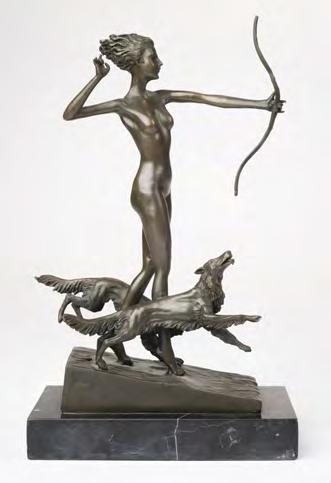
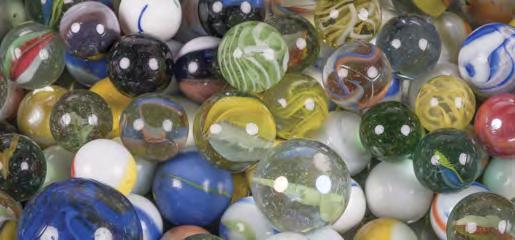
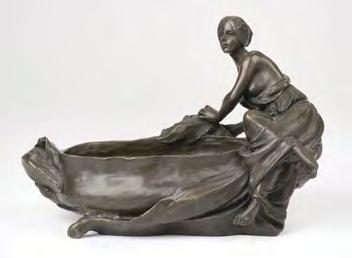
£200 - £300
525* Marbles. A large collection of glass marbles (several hundred), including Victorian divided core swirl marbles, 18 mm diameter, opaque and translucent glass marbles, various sizes and conditions (two cartons)
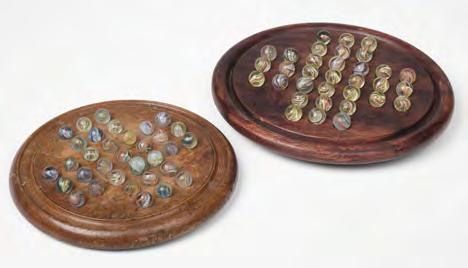
526* Marbles. A collection of 33 antique glass marbles, including swirl and lattcino examples, approximately 20 mm diameter, on a wooden solitaire board, 25.5 cm diameter, together with another collection of 33 antique glass marbles, mostly approximately 18 mm diameter, on a wooden solitaire board, 21 cm diameter
Provenance: The Jack Webb Collection, London. (2)
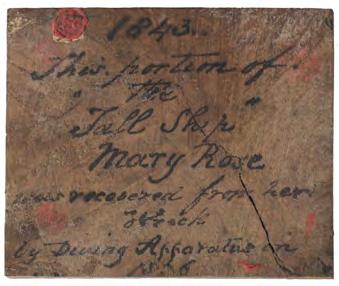
£100 - £150
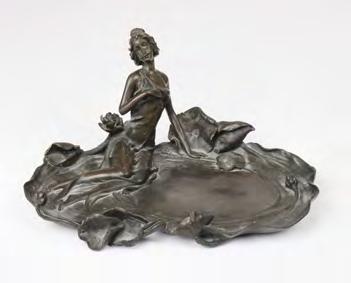
527* Mary Rose. Salvage attempt of the Mary Rose, 1836, a piece of wood recovered from the Mary Rose, inscribed ‘1843 This portion of the Tall Ship Mary Rose was recovered from the wreck by diving apparatus 1836’, with a red wax seal stamped with a family crest, approximately 8 x 10 cm
Provenance: The Jack Webb Collection, London.
In June 1836, fishermen from Gosport reported snagging their nets on something on the seabed of the Solent. Henry Abbinett, a pub owner, investigated their claims. John Deane and his brother Charles, along with Will Edwards, were deep-sea divers and had patented a helmet and had already raised timber and a bronze gun from another wreck, HMS Royal George. They started work on the Mary Rose site on 16 June 1836, and by 18 June, they had located the wreck and recovered several timbers and a bronze gun. (1)
£100 - £150
528* Milo (Miguel Ferdiand Lopez, 1955 -). An art nouveau style bronze after Milo, modelled as a female wearing drapery resting on a lily pad, signed ‘Milo’, numbered ‘A7515’, with ‘Bronze Garanti Paris’ foundry medallion, 22 cm long, together with another after the same sculptor, similarly modelled with a female resting on an organic bowl, signed ‘Milo’, 24 cm long (2)
£150 - £200
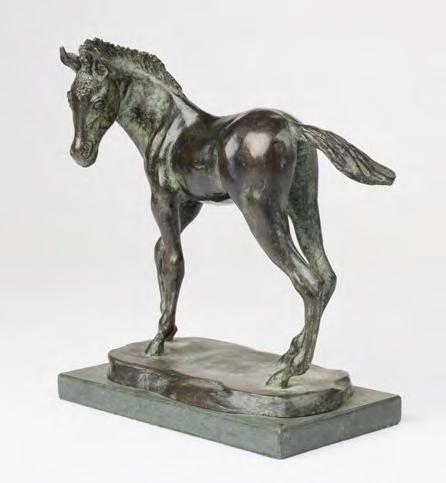
529* Mortimer (Percy). “Foal”, contemporary bronze, modelled as a young foal with its head turned to one side, the base signed ‘P . Mortimer 1991’, additionally numbered ‘10/2’, mounted on a slate base, 27 cm high
Provenance: The Barry M. Keane Gallery, Henley-on-Thames, Oxon, 1993. The receipt states number 2/10. (1)
£150 - £200
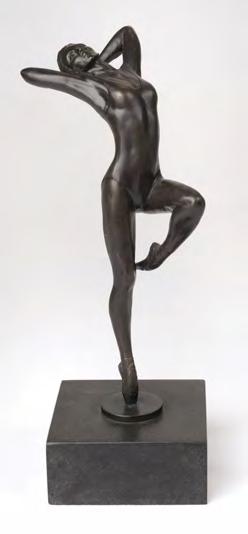
530* Norton (Susan). “Lucy”, contemporary bronze, modelled as a young ballerina, unsigned, mounted on a substantial black marble base, 32 cm high
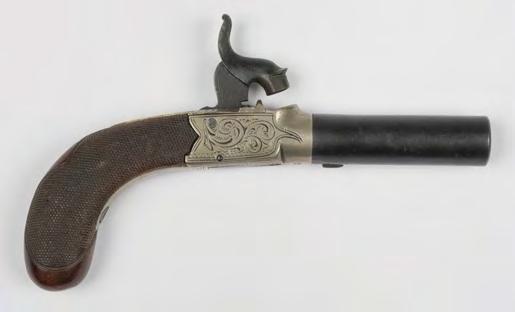
532* Pistol. A Victorian percussion travelling pistol, the 6 cm circular turnoff barrel, with German silver casing engraved with foliate scrolls, rounded chequered grip with concealed trigger, lacking nipple,17 cm long (1)
£70 - £100
Provenance: The Barry M. Keene Gallery, Henley-on-Thames, Oxon, 1993. The receipt states this bronze is 3/10. (1)
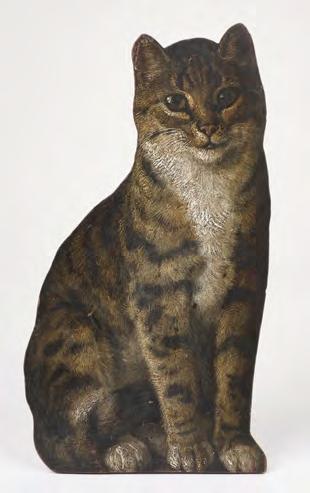
£200 - £300
531* Attributed to Paton (Frank, 1855-1909). A Victorian dummyboard in the form of a cat, oil on board, with a manuscript label to verso inscribed ‘Frank Paton 1884’, with an ornate curved easel stand, 37 cm high
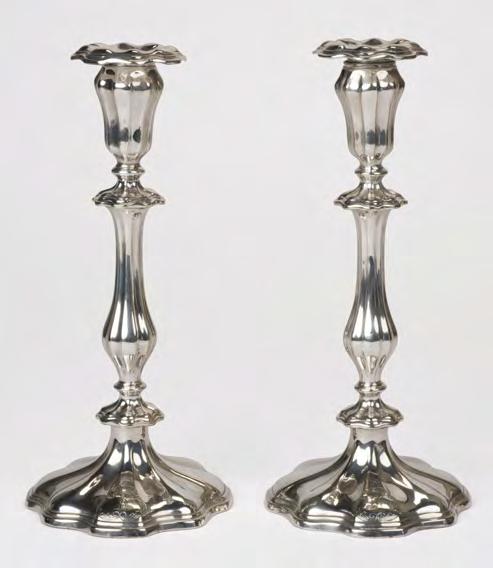
533* Pitt family. A pair of Victorian silver-plated candlesticks, each engraved with the Pitt family crest, weighted, 25 cm high, together with an original copper plate of the bust of William Pitt the Elder (1708-1778), circa 1770s, 17.5 x 11 cm, and a contemporary sepia engraving taken from the plate
£700 - £1,000
Provenance: The Jack Webb Collection, London. Frank Paton was a genre and animal painter whose work was often engraved. Paton exhibited several paintings at the Royal Academy and other principal London galleries from 1872. (1)
The crest is probably that of Colonel Thomas Henry Pitt (1833-1913) of Hayle Place, Maidstone. (4)
£200 - £300
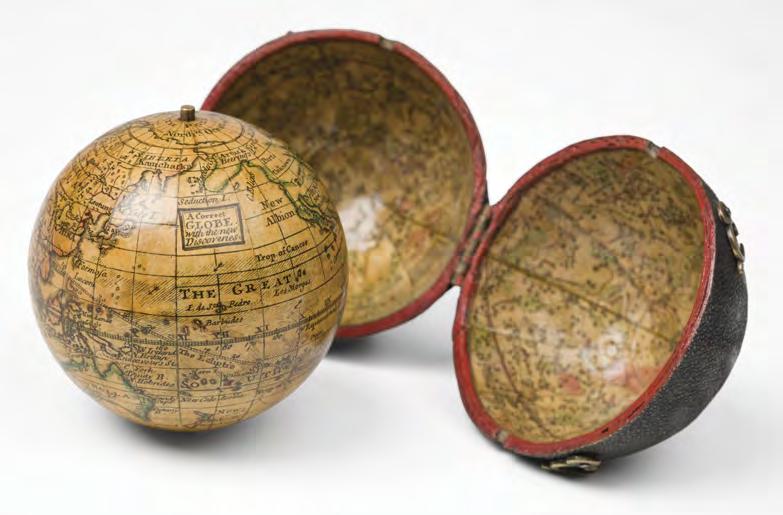
534 Pocket Globe. A Correct Globe with the new Discoveries/A Correct Globe with ye new Constelations of Dr Halley &c., London: circa 1775, a 2 3/4 inch paper-maché globe, 12 engraved and varnished gores with contemporary outline colouring and 2 polar calottes, ‘picture frame’ cartouche, marked with the track of Captain Cook’s voyage (1768 - 71) but incorrectly labelled 1760, the globe retains its polar axis pins, contained in a contemporary fishskin-covered case in two hemispheres with internal engraved varnished celestial gores, an additional cartouche inside the the case states ‘A Correct Globe with ye new Constelations of Dr Halley &c.’ the case with painted red rims and retaining two ‘hook and eye’ clasps, height of case 85 mm
This anonymous English pocket globe was formerly attributed to George Adams because a copy of the terrestrial globe was found mounted in one of his tellurians, but it is in fact an updated and adapted version of the pocket globe published by Herman Moll earlier in the 18th century. (1)
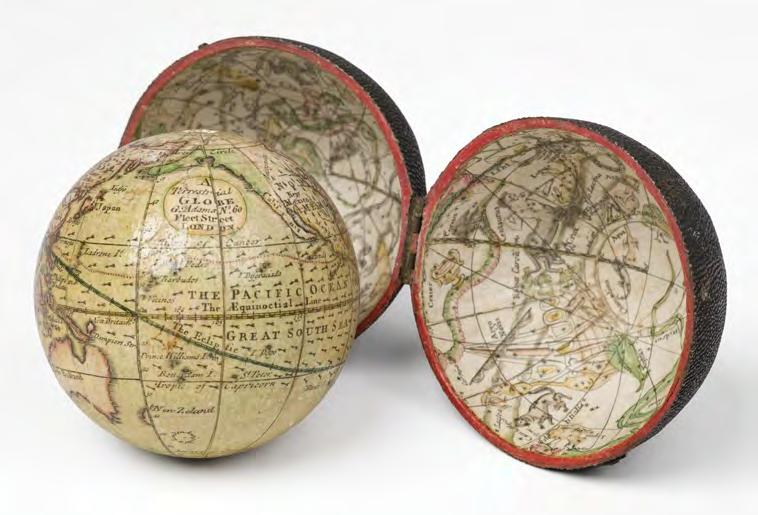
£3,000 - £5,000
535 Pocket Globe. Adams (George). A Terrestrial Globe, No. 60 Fleet Street, London: circa 1785, a 2 3/4 inch paper-maché pocket globe comprised of 12 engraved and varnished gores with contemporary outline colouring, oval cartouche, marked with Anson’s voyage, the globe lacks its polar axis pins, contained in a contemporary fishskin-covered case in two hemispheres with internal engraved unvarnished celestial gores, the case with painted red rims and retaining one (of two) contemporary ‘hook and eye’ fastenings, height of case 80 mm (1)
£2,000 - £3,000
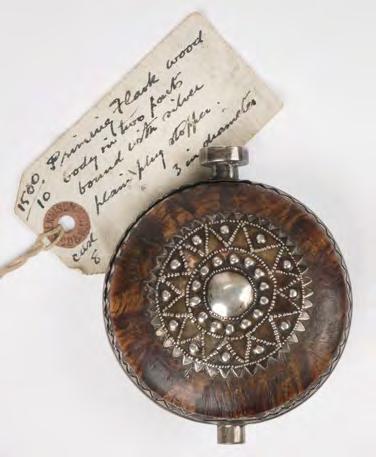
536* Powder flask. A continental Mulberry wood priming flask, 19th century [?], of circular form, applied with white metal decoration and plain plug stopper, 8 cm diameter, with an old manuscript label attached, inscribed ‘priming flask wood body in two parts bound with silver, plain plug stopper, 3 in diameter’ (1) £150 - £200
537* Republic of Congo. A Basuku carved wood helmet mask, carved as a male head with traces of white pigment to the eyes, mouth and ears, carved hair and remains of cloth to the neck, 27 cm high, presented on a wooden stand for display (1) £100 - £150
538* Rules. A collection of wooden rules, including a Rabone Braille No 1167 boxwood folding rule, boxwood and brass No 1206 rope gauge rule, another by E. Preston & Sons, Birmingham and other rules and gauges, contained in a mahogany box with brass plaque engraved ‘Stanley London 1918’, 5 cm high x 21.5 cm wide x 10.5 cm deep (16) £100 - £150
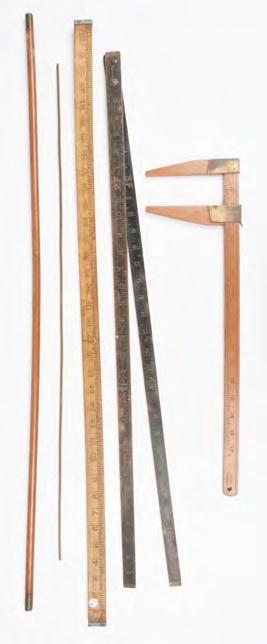
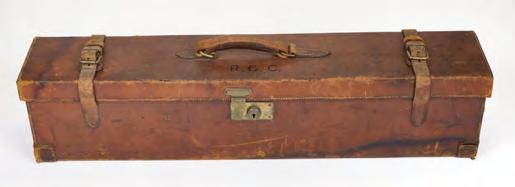
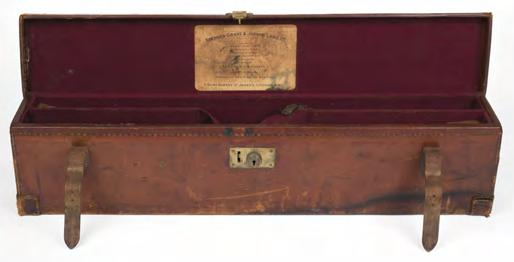
539* Shotgun Case. A brown leather shotgun case, circa 1920s, the lid with the initials ‘R.G.C.’, the inner lid with gunsmiths trade label for Stephen Grant & Joseph Lang Ltd, red felt lining, with various accessories including brass-tipped ramrod, 18 cm high x 80 cm long, 15.5 cm deep (1)
£100 - £150
540* Smoking Collectables. A Dunhill silver-plated gas lighter, with reeded design, the base stamped 'Dunhill Swiss Made', 6.5 cm, together with a Brummel gas lighter, plus another lighter, a silver vesta case by James Dixon & Sons, Sheffield 1897, a Dunhill cigar cutter and other related items (6)
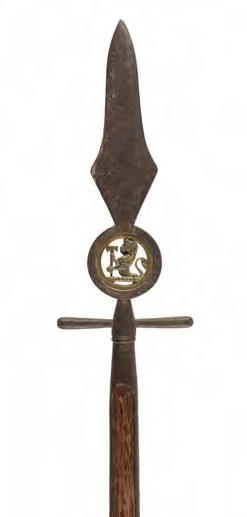
£70 - £100
541* Spontoon. A continental pole arm (spontoon), 19th century, with a steel spear head featuring a heraldic lion in gilt, mounted on a long oak haft, overall length 213 cm Possibly ‘javelin’ for a High Sheriff’s javelinman. (1)
£100 - £150
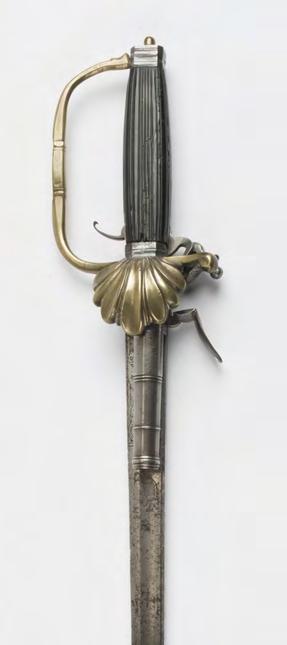
542* Sword. A Dutch combination hunting sword cum flintlock pistol by Van de Baize, 18th century, the 57 cm straight tapered steel blade with makers’ markings, the flintlock pistol with 8 cm cannon barrel, brass shell guard and knucklebow, wooden grip and steel pommel, overall length 72 cm
(1)
£700 - £1,000
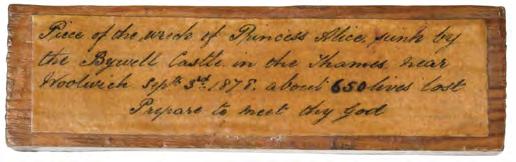
543* Thames Disaster. The Sinking of the SS Princess Alice, 1878, a fragment of wood recovered from the wreck, a manuscript label inscribed ‘Piece of the wreck of Princess Alice sunk by the Bywell Castle in the Thames near Woolwich Sept 5th 1878, about 650 lives lost, prepare to meet thy God’, 10 cm long
Provenance: The Jack Webb Collection, London.
On 3 September 1878, the paddle steamer, SS Princess Alice, was returning from a pleasure trip down the Thames, with nearly 900 men, women and children on board. On crossing the river from the south to the north side, to berth at North Woolwich pier, she was hit amidships on the port side by a large collier, the Bywell Castle, coming down river on the ebb tide. The Princess Alice was virtually sliced in half and sank in minutes. Many bodies and survivors were swept downstream on the strong tide. The authorities rewarded local inhabitants, downstream, five shillings for every body rescued or brought to shore.
This piece belonged to Charles Webb, who was employed at Lawe’s Chemical Works at Creekmouth, on the Thames at Barking. He and coworkers worked tirelessly throughout the night recovering bodies and survivors.
(1)
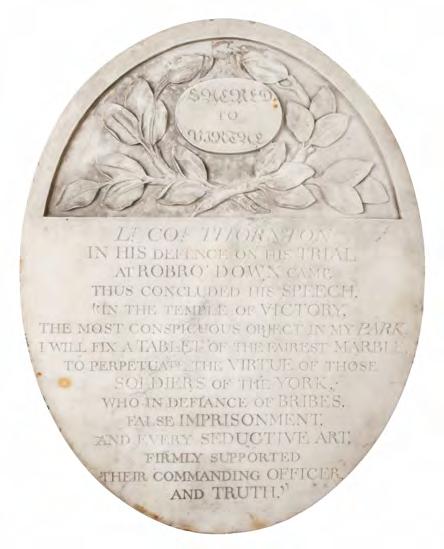
544* Thornton (Colonel Thomas, 1757-1823). A George III white marble tablet, possibly carved by the Fishers of York, to display in the Temple of Victory, Thornville Royal, near Knaresborough, the oval tablet carved with a small oval cartouche engraved 'Sacred to Virtue' within a wreath, the lower section engraved 'Lt Col. Thornton, in his Defence on his Trial at Robro' Down Camp, thus concluded his speech, "in the Temple of Victory, the most conspicuous object in my Park, I will fix a Tablet of the fairest Marble, to perpetuate the Virtue of those Soldiers of the York, who in Defiance of Bribes, False Imprisonment, and every Seductive Art, firmly Supported their Commanding Officer and Truth.", 71 x 55 cm, the tablet has a later glass top and brass base, having been used as an occasional table for many years
Provenance: The Jack Webb Collection, London.
A list of commissions is available to view online, and in 1805, Colonel Thornton instructed the Fishers of York to carve the chimney piece in the breakfast and billiard rooms at Thornville Royal. It is therefore possible that Thornton had previously commissioned Fishers of York to produce this tablet, although no evidence has been found thus far.
Colonel Thomas Thornton (1757-1823) of Thorville Royal near Knaresborough, Yorkshire, was an eccentric and famous sportsman and owner of a seven-barrelled gun, a leading light in the sports world. Thornton inherited a large fortune and, in 1789, purchased Allerton Mauleverer from the Duke of York for £110,000 and renamed it Thornville Royal. In 1754, his father, William Thornton, had raised a company of volunteers, the West Yorkshire Militia, which Thornton took over on his death. Unfortunately, there was a dispute over money and the property with the Duke of York, which led to Thornton falling foul of the man who was to be the commanding officer. When in 1794 Thornton ordered a triumphal carriage, the Duke set the wheels of army discipline in motion, and Thornton was sent to a courtmartial. In his speech in his defence, he mentioned the 'Temple of Victory' in his park on a "lofty eminence shaded with trees", an octagonal tower built by the Duke of York, the previous owner, where this tablet was placed. The building known as the Temple of Victory was so called to celebrate naval successes, including Trafalgar. The Duke’s association with the estate has become legend in the form of a nursery rhyme, and it is said that it was here that the Grand Old Duke of York marched his men to the top of the hill, and then marched them back down again.
In 1794, a mutiny occurred at the camp at Roborough Down, north of Plymouth, between Colonel Thornton and his officers, when the Devon militia was stationed there. The tablet commemorated this mutiny.
£100 - £150
(1)
£2,000 - £3,000
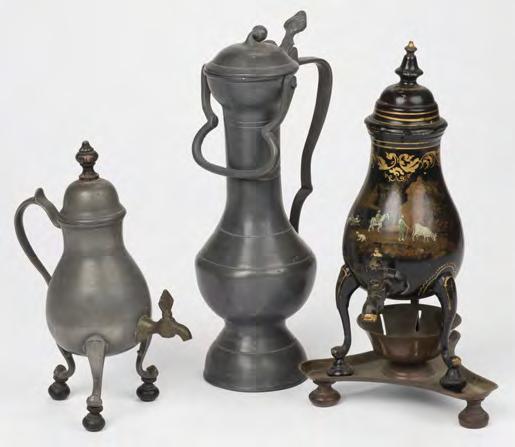
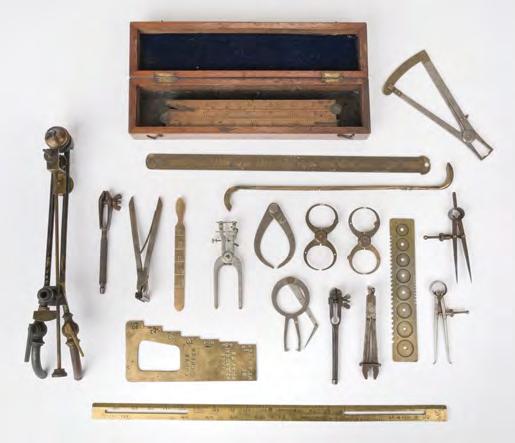
545* Toleware. A Dutch toleware pewter coffee pot circa 1850, of baluster form, painted with a country landscape showing figures, cows and a couple in a boat. heightened with gold painted scrolls, with domed cover and finial, raised on three cabriole supports, and with brass trefoil stand and burner, 28 cm high, together with a Dutch pewter coffee pot, 21 cm high and a lidded flagon with scroll handle, 27 cm high (3)
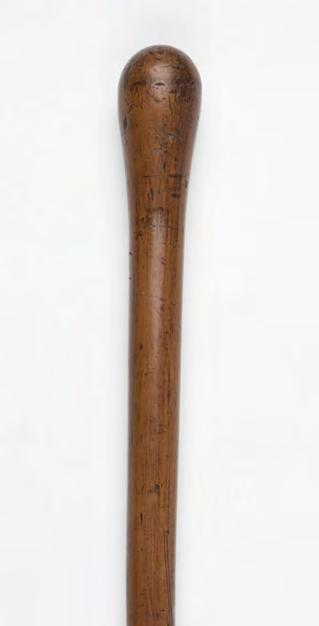
£100 - £150
547* Watchmaker's Tools. Two brass watchmakers poising callipers, together with watchmakers hand broaching tool, watchmakers open jaw hand vice, watchmakers main spring gauge, a Victorian brass magic lantern illuminant limelight projector gas burner lamp light, 28.5 cm long, brass and wooden rules and other related items (a small box)
£100 - £150
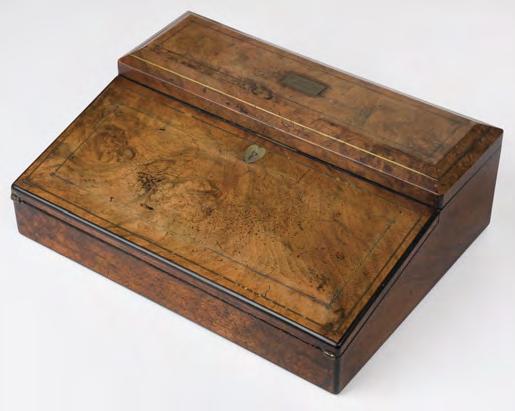
548* Writing slope. A Victorian walnut ladies writing slope, inlaid with a brass plaque engraved ‘Mrs Anthy Jones Liverpool’, heart shape key escutcheon, the hinged fall enclosing green velvet with leather gilt embossed border, multi compartments and with covers, stamped with makers mark for ‘E.L. Hausberg Maker Liverpool’, 11 cm high x 33 cm wide x 25 cm deep (1)
£100 - £150
546* Tribal Art. Austral Africa, Zulu [?] hardwood club, of plain form with a bulbous head, 97 cm long (1)
£70 - £100
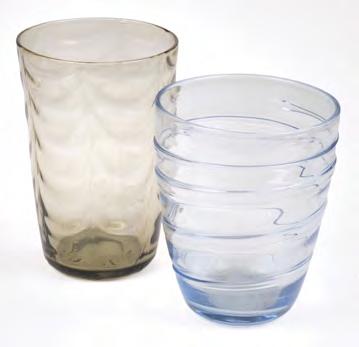
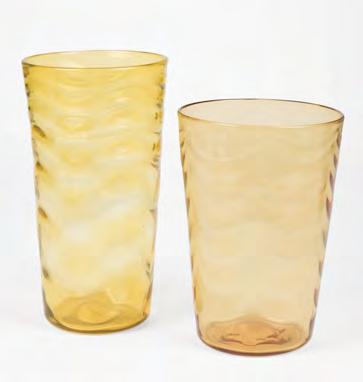
549* Art Glass. A Barnaby Powell for James Powell Whitefriars ‘sapphire’ glass vase, circa 1940, of bucket form with trail decoration, 17.5 cm high, together with a similar smoked glass vase, circa 1940, of bucket form with ribbed decoration, 20 cm high (2)
£100 - £150
550* Art Glass. A pair of Art Nouveau green glass vases, with trail decoration, 14 cm high, together with another pair of Art Nouveau green glass vases,19 cm high, plus a similar single vase, 17 cm high (5)
£100 - £150
551* Art Glass. A set of 8 Victorian hock glasses, circa 1880-90, probably by Harry Powell for Whitefriars, each with spiral rib body and twisted stem on a spread foot, 20 cm high (8)
£100 - £150
552* Art Glass. A substantial Webb amber glass vase, circa 1940, of bucket form with trail decoration, 35 cm high, together with a similar Whitefriars Powell glass vase, 29.5 cm high (2)
£100 - £150
553* Art Glass. A Whitefriars ruby glass vase, circa 1940, of bucket form with trail decoration, 20.5 cm high, together with a similar vase, 13 cm high (2)
£100 - £150
554* Art Glass. A Whitefriars ruby glass vase, circa 1940, of bucket form with wave decoration, 26 cm high, together with a similar vase, 20 cm high, plus a plain ruby glass vase, probably Whitefriars, 20.5 cm high (3)
£100 - £150
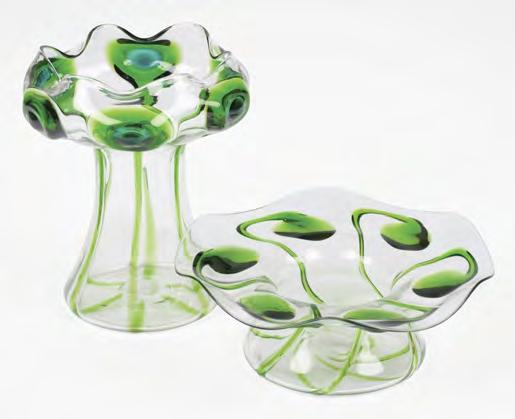
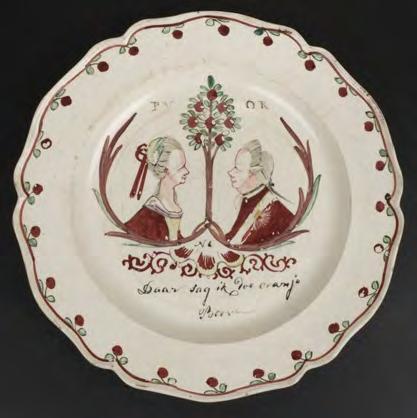
555* Art Glass. An Art Nouveau glass vase by Stuart & Sons, Stourbridge, circa 1900-1910, clear glass with green trails and peacock ‘eyes’, 18 cm high, together with another ‘tadpole’ pattern glass bowl, of square form with a wavy rim, 20 cm diameter (2)
£150 - £200
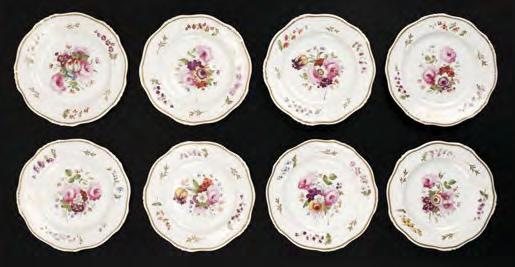
556* Botanical Plates. A set of 8 English porcelain plates, circa 1820, each finely painted with sprays of flowers, moulded and overpainted gilt shaped rim, 23 cm diameter (8)
£150 - £200
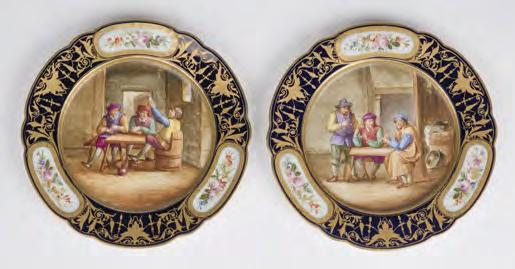
557* Cabinet Plates. A pair of Sevres porcelain cabinet plates, late 19th century, each painted with a tavern scene, the border edge in royal blue with floral cartouche and a gilt overlay, blue interlaced Sevres mark and King Louis Philippe printed mark to base, one with a chip to the underside rim, 24 cm diameter (1)
£200 - £300
558* Creamware. A Dutch decorated creamware plate, late 18th century, decorated with portraits of Prince William V of Orange and Princess Wilhelmina with an orange tree between, inscriptions below, shaped rim, general wear, 25 cm diameter (1)
£80 - £120
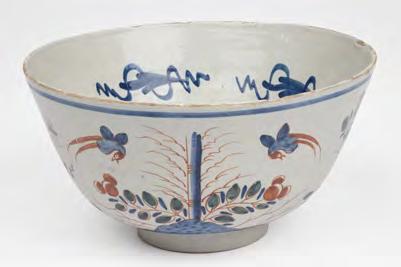
559* Delft. A Dutch Delft polychrome punch bowl, 18th century, decorated in the oriental style, painted with birds, insects and flowers, general loss of glaze and areas of wear, 26cm diameter, 13.5 cm high (1)
£70 - £100
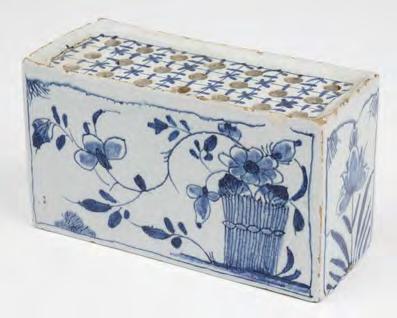
560 Delft. An English delft blue and white flower brick, circa 1750, of rectangular form, decorated with flowers, several chips, 9 cm high x 15.5 cm wide x 6.5 cm deep (1)
£300 - £500
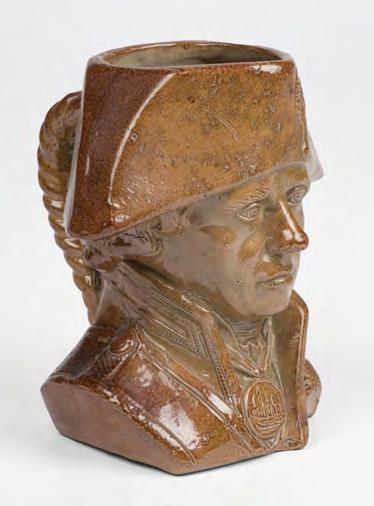
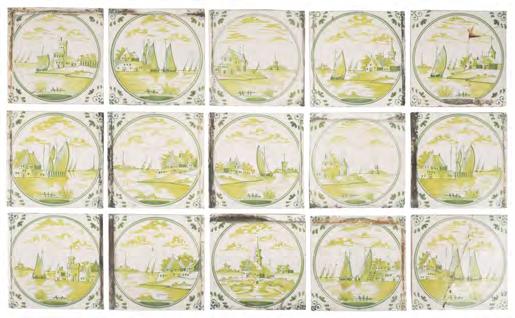
563* Dutch Tiles. A collection of 18th century Dutch Delft tiles, green glaze on white, showing boats and buildings, 15 x 15 cm, traces of concrete and general wear, one with several cracks and repairs (15) £200 - £300
561* Nelson (Horatio, 1758-1805). A Doulton & Watts stoneware jug, modelled as Nelson, circa 1820, impressed marks to base, 16 cm high (1)
£200 - £300
562* Dutch Tiles. A collection of 18th century Dutch Delft blue and white tiles, depicting boats, fishermen, windmills, landscapes and flowers, variable condition, some cracked in half, others with general crazing, 13 x 13 cm and smaller (25) £300 - £500
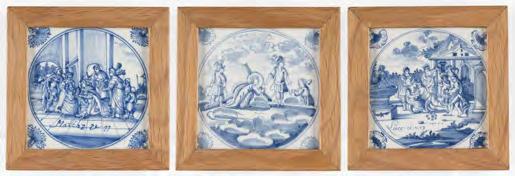
564* Dutch Tiles. Three 18th-century Dutch Delft tiles, depicting biblical scenes from Matthew 24:9 and Luke 15:4-13 and one other 13 x 13 cm, each in a modern wooden frame, frame size 16.5 x 16.5 cm (3)
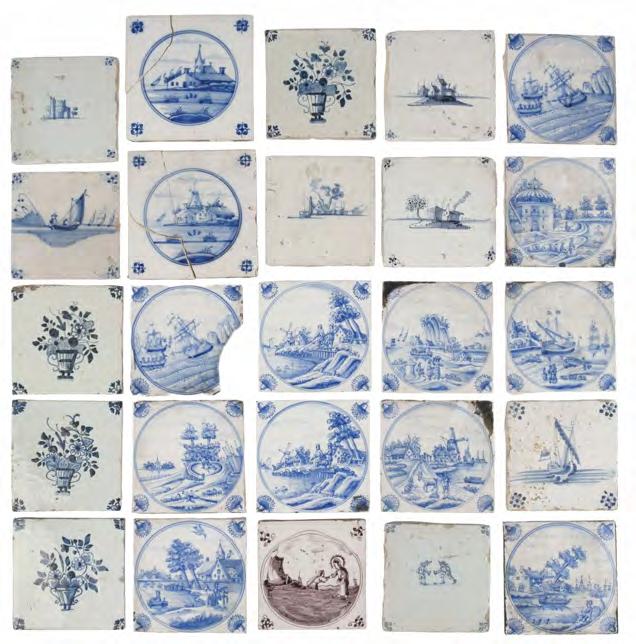
£150 - £200
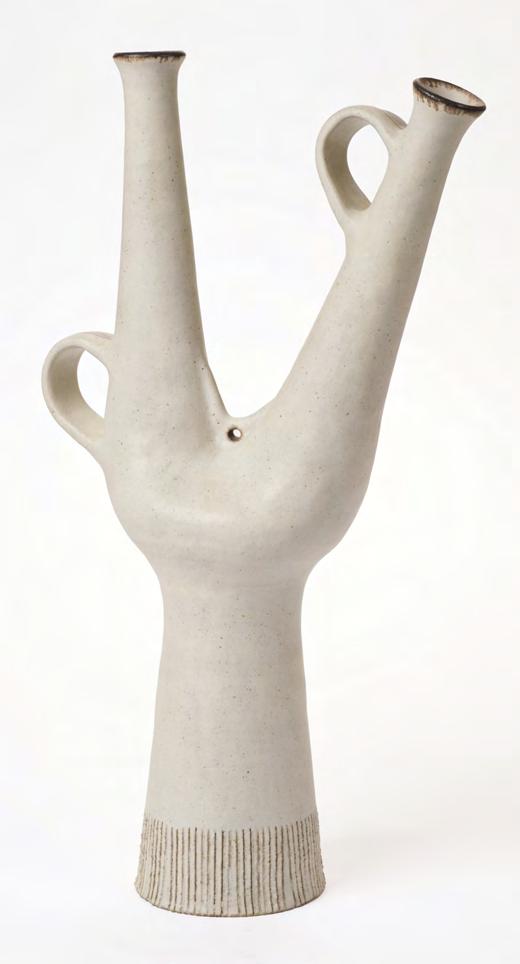
and incised stoneware, signed ‘Bruno Gambone Italy’ to the base, 50cm x 27cm x 11cm
£1,500 - £2,000
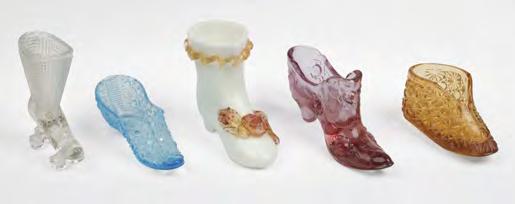
566* Glass Shoes. A large collection of 19th and 20th century glass shoes including a clear glass high shoe roller skate with diamond mesh pattern, shaped top edge, 10 cm high, A milk glass boot with coloured flower and leaves with vamp and rigaree around the top, 9.5 cm high, a bootee in colonial amber, Old Virginia Glass line, by Fenton, with associated mark to base, an 1886 Bryce daisy button glass slipper, in light blue glass, base embossed PAT’D OCT 19 1886, 4 cm high together with various other glass shoes, various makers, mostly in very good condition a few with minor chips (57)
£150 - £200
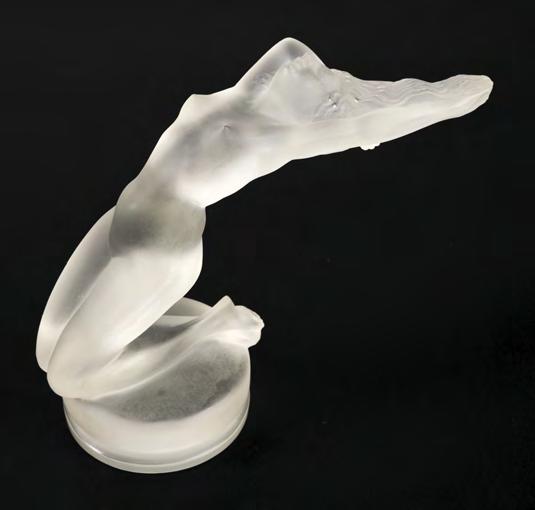
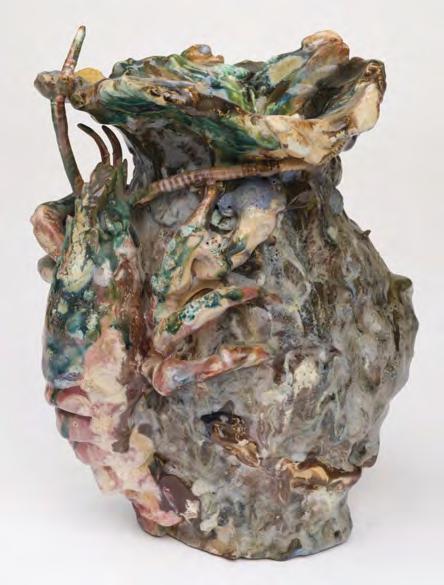
568AR* Malone (Kate). An abstract studio pottery vase, modelled with lobsters on the seabed, the base signed ‘K.M. 88’, minor repairs, 27 cm high
Provenance: Formerly in the collection of Holly Johnson, Frankie Goes to Hollywood. (1)
£300 - £500
569* Paperweight. A glass paperweight by Ken Rosenfeld, internally decorated ladybirds on flowers, signed ‘Ken Rosenfeld 1997’, 9 cm diameter (1)
£100 - £150
570* Paperweight. A glass paperweight by Mayauel Ward, internally decorated with a spray of flowers, signed ‘Mayauel Ward 1994’, 9 cm diameter (1)
£100 - £150
571* Paperweight. A Scottish glass paperweight by Peter Holmes for Selkirk, internally decorated with flowers and millefiori canes within wavy white strands, one cane with initials ‘PH’, trade label to the base, signed ‘Selkirk Scotland 18/100 1996’, 8 cm diameter, together with a smaller glass paperweight, dated 1996 and incised ‘202’, 5 cm diameter (2)
£100 - £150
572* Paperweight. A Victorian glass paperweight dated 1878, of domed form with millefiori canes, four dated 1878, a concave base, 8 cm diameter (1)
£100 - £150
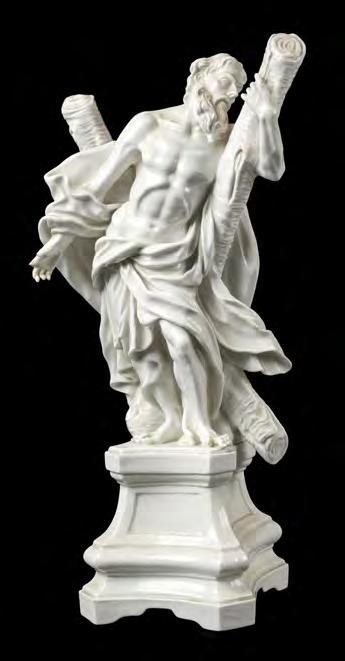
573* Porcelain Figure. A Meissen porcelain figure of Saint Andrew, after J.J. Kändler, white glaze porcelain, blue painted ‘A.R.’ mark to base, some damage, some damage, 48 cm high (1) £500 - £800
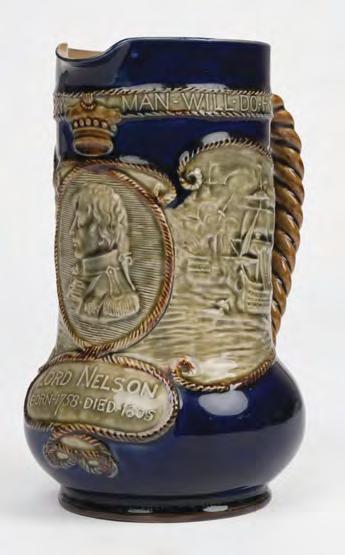
574* Royal Doulton. A Royal Doulton stoneware commemorative jug for the centenary of the battle of Trafalgar, circa 1905, moulded in relief with a central view of the battle and an oval panel of a bust profile of Admiral Lord Nelson within rope-twist borders above an oval panel inscribed ‘LORD NELSON BORN - 1758. DIED1805’, the neck bearing the legend ‘ENGLAND-EXPECTS-THATEVERY-MAN-WILL-DO-HIS-DUTY’ applied with a rope-twist handle, impressed marks to base, 20cm high (1)
£150 - £200
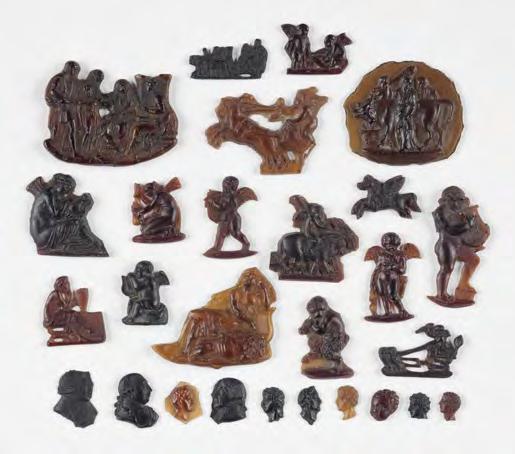
575* Style of John Flaxman (1755-1826). Bas-reliefs for sprigging, a large group of 117 amber glass miniature bas-reliefs, depicting busts and neo-classical figures, comprising 59 miniature busts and 58 miniature neo-classical figures, the busts include both male and female of various styles and eras as well as putti, the figures include mythological creatures, putti in various poses and holding items such as lyres or riding mythological creatures, figures riding chariots pulled by mythological creatures, owls etc., groups of neoclassical figures and small mythological scenes, few small losses to extremities, one piece (dove with olive branch) with central break, few pieces with old repair(s) to verso, the busts 10 x 8 mm and smaller, the mythological figures 20 x 25 mm and smaller, divided into groups of around 20 within modern plastic packets, each packet (except one) wrapped in contemporary folded paper wrappers, the wrappers with contemporary ink manuscript number, and with contemporary pencilled quantity, the three packets containing busts with pencilled 'very small heads' These glass bas-reliefs are believed to have been produced as templates for making plaster sprig moulds. Over time the plaster sprig moulds would have lost their detail, with some becoming damaged or broken. These glass templates would then have been used to create new, identical sprig moulds. John Flaxman worked for some years at the Wedgwood pottery, which was famous for its sprigged jasperware, where both he and his father (also John Flaxman) made designs and reliefs for various items of pottery. (117)
£100 - £150
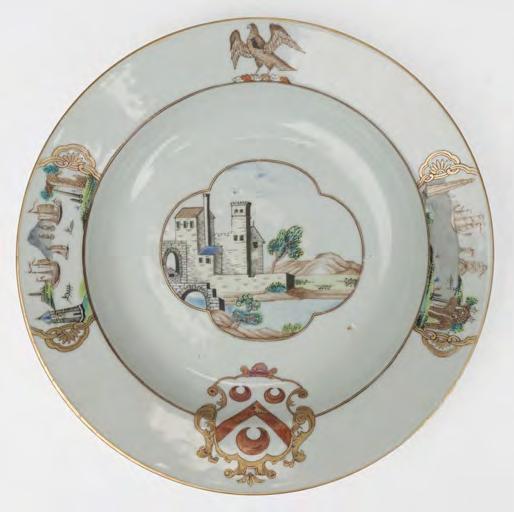
576* Armorial Plate. A Chinese export armorial porcelain plate, Qianlong period, of circular form, painted with a cloud-shape panel depicting Fort St. George, Madras, the border with views of Plymouth Sound and the Pearl River, additionally painted with the arms of the Pole family, P.B. Cooke Collection label to the base numbered ‘799’, and additional label inscribed ‘Pole of Radbourne’, minor rubbing to the gilding otherwise in good condition, 22.5 cm diameter
Provenance: Elstob Auctioneers, 30 July 2025, lot 126.
P.B. Cooke Collection
The collection was started in the 1920s by Phil’s father, who bought at that time from Sir Algernon Tudor-Craig, the eminent London dealer and first author of a book on armorial wares, from his gallery ‘The Century House’ in Knightsbridge, which closed around 1929. Phil continued collecting, buying much from the collector/dealer Cecil Bullivant, and by the 1960s, his collection had become the largest in the world. My late husband first met him in the late ’50s, and his first volume of Chinese Armorial Porcelain illustrates 220 examples from the Cooke Collection.
Angela Howard
The arms are those of Pole family of Radbourne, Derbyshire. The service was made for Charles Pole, fourth son of Samuel Pole of Radbourne who was born in 1695, and later served as Member of Parliament for Liverpool. (1) £300 - £500
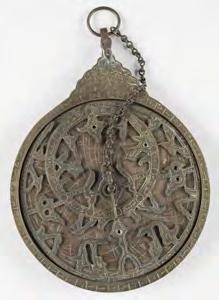
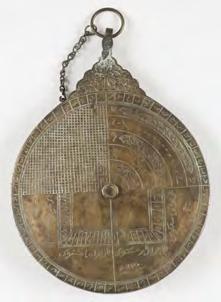
577* Astrolabe. A Persian brass astrolabe, Qajar dynasty, of typical circular form, the mater with foliate engraved throne or kursi, engraved with Arabic script throughout, 17.5 cm diameter (1)
£150 - £200
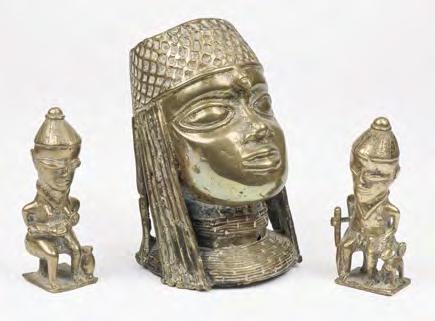
578* Benin Figures. An African Benin head of an Oba (king), 20th century, hollowed cast construction, 23 cm high, together with figures of seated male and female holding a baby, 15 cm high (3)
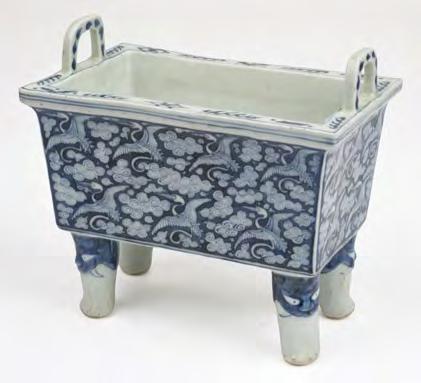
£100 - £150
579 Censer. A Chinese blue and white porcelain censer, of rectangular form with two handles and raised on four supports, each decorated with lion masks, the whole piece decorated with cranes, clouds and scrolls, the base with a six-character Wanli mark, 21 cm high x 22 cm wide x 14 cm deep (1)
£400 - £600
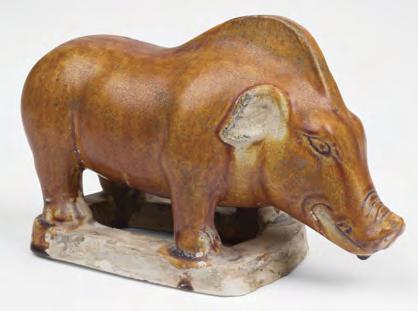
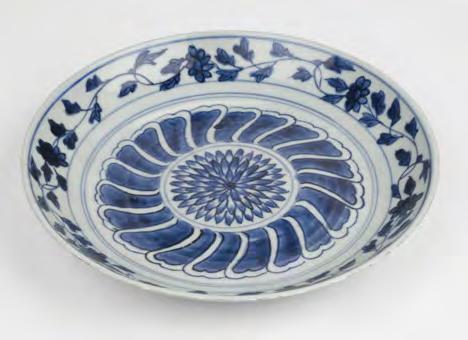
£300 - £500
580* Chinese Boar. A Chinese chestnut-glazed model of a boar, probably Tang dynasty (618-907), the glaze with a crackle finish throughout on an integral rectangular base, 18 cm long, 13 cm high (1)
581* Chinese Buckle. A Chinese gilt bronze waist belt buckle, Qing Dynasty, the two-part buckle appearing to be three panels, each finely cast with dragons, the opposite side with belt loops, one signed, 7.5 cm long (1)
£100 - £200
582* Chinese Dish. A Chinese blue and white porcelain dish, Ming dynasty, decorated with a foliate swirl within a leafy border, a sixcharacter mark to base, various old labels including R&G McPherson Antiques collection label and ‘transitional c.1620-40 Japanese market dish’, 21 cm diameter (1)
£150 - £200
583* Chinese Export. A pair of Chinese export porcelain models of spaniel pups, probably Qianlong period, modelled seated with their tails curled around a hind leg, white eyes, open mouth with tongue showing, each wearing a collar with a pendent bell, their fur naturalistically painted in orange, minor wear commensurate with age, 24.8 cm high (2)
£4,000 - £6,000
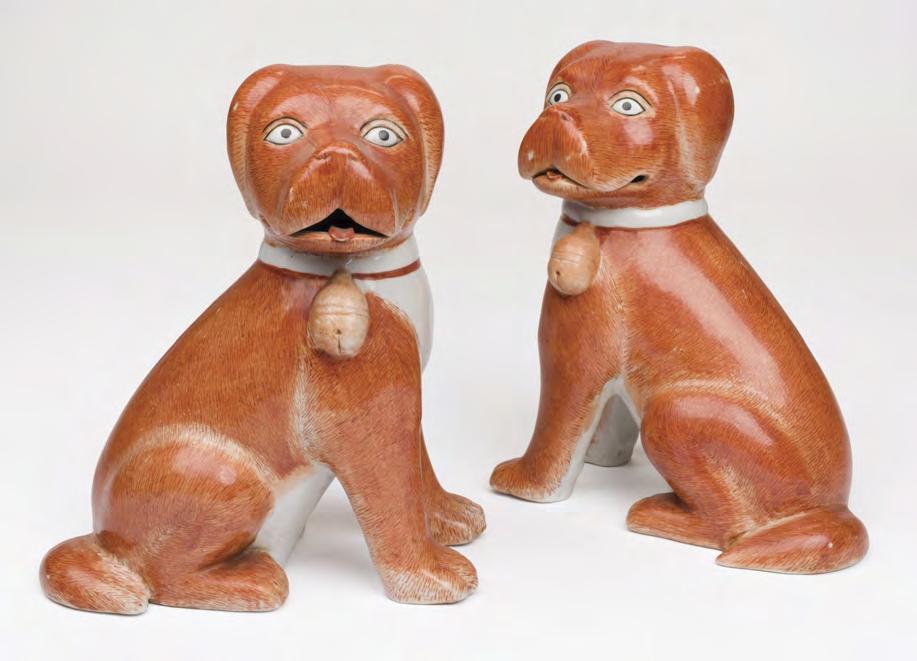
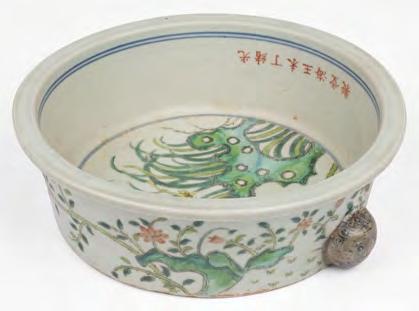
584* Chinese Stand. A Chinese porcelain famille verte stand, of circular form with two pronounced grotesque handles, foliate decoration, the interior with 8 character inscription in iron red, decorated with flowers, the base unglazed, teracotta colour, 7 cm high x 23 cm diameter (1)
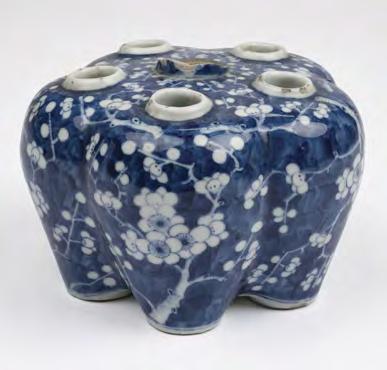
£200 - £300
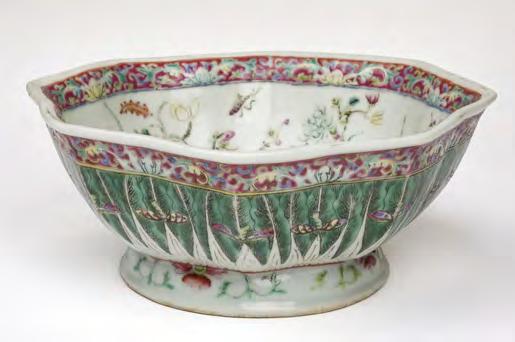
587* Flower Vase. A Chinese porcelain blue and white flower vase, Qing dynasty, formed as five vases merged into one, with six holes for flower arranging, decorated with a prunus design, the base with six footrings and in the centre with an underglaze blue mark for “Qianlong Nianzhi”, damaged, 12 cm high x 17 cm wide
Provenance: The David & Sarah Battie Collection. (1)
£200 - £300
585* Famille Rose. A Chinese famille rose porcelain bowl, Qianlong period, of octagonal form decorated with insects and cabbage leaves on a deep pedestal foot, iron red Qianlong seal mark to base, 20 cm across, 9 cm high (1)
£150 - £200
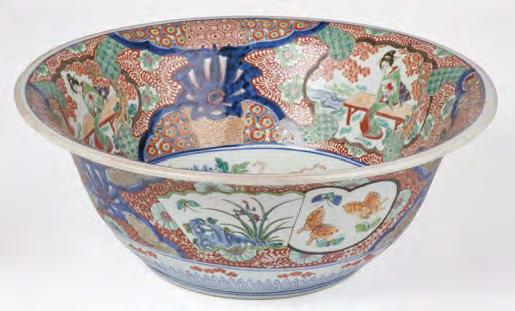
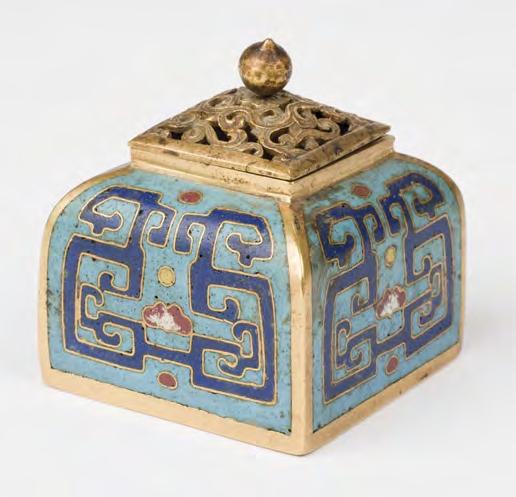
586* Famille Verte. A substantial Chinese famille verte porcelain bowl, mid to late 20th century, polychrome decorated with figures, insects and flowers, with everted rim and iron red six-character mark to base, 54 cm diameter, 21 cm high (1)
£200 - £300
588* Inkwell. A Chinese scholars inkwell, Qing dynasty, square form with pierced cover and ball finial (detached), lift out gilt metal liner, 6 cm high (1)
£300 - £500
589* Mahjong. A Chinese mahjong set, circa 1900, the wooden box finely carved with figures and landscapes, the sliding lid enclosing 5 drawers containing 144 bone tiles, the lower drawer with instructions, counters and dice, 22 cm high x 24 cm wide x 17 cm deep, with tile rests (1) £300 - £500
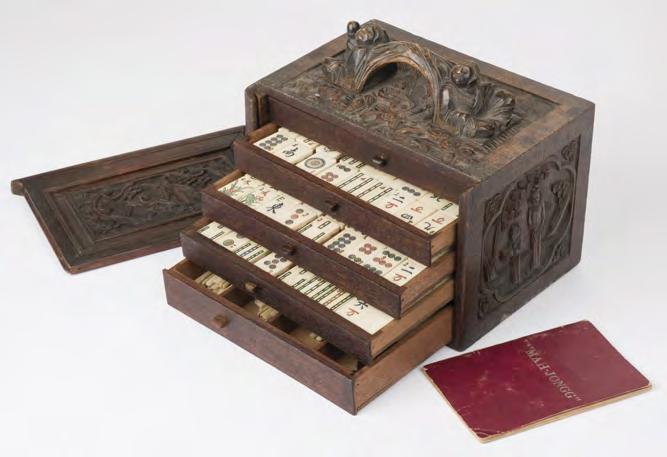
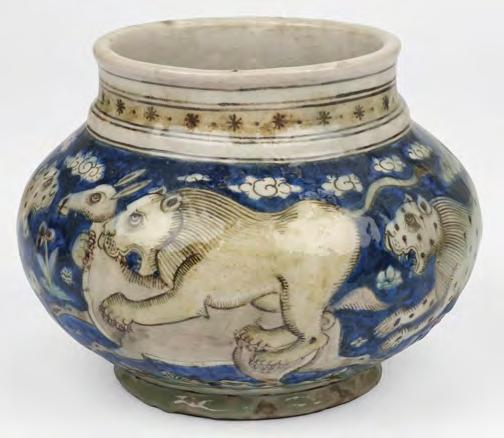
591* Scroll Weight. A Chinese porcelain rectangular scroll weight, Qing dynasty, late 18th century, decorated with a scene showing officials at work, probably Qianlong Period, underglazed blue decoration, reticulated ends, base unglazed, 20 cm long (1) £300 - £500
Each lot is subject to a Buyer’s Premium of 22% (Lots marked * 26.4% inclusive of VAT @ 20%)
590* Persian Vase. A Persian polychrome pottery vase, early 19th century, decorated with lions and leopards hunting deer and cattle, in shades of blue, turquoise and manganese, 18 cm high x 23 cm diameter (1)
£200 - £300
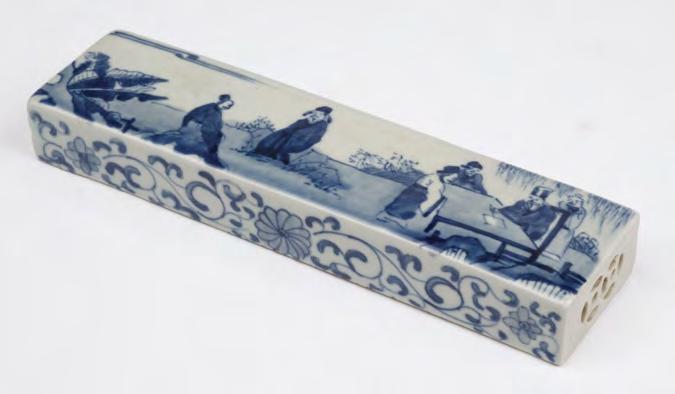
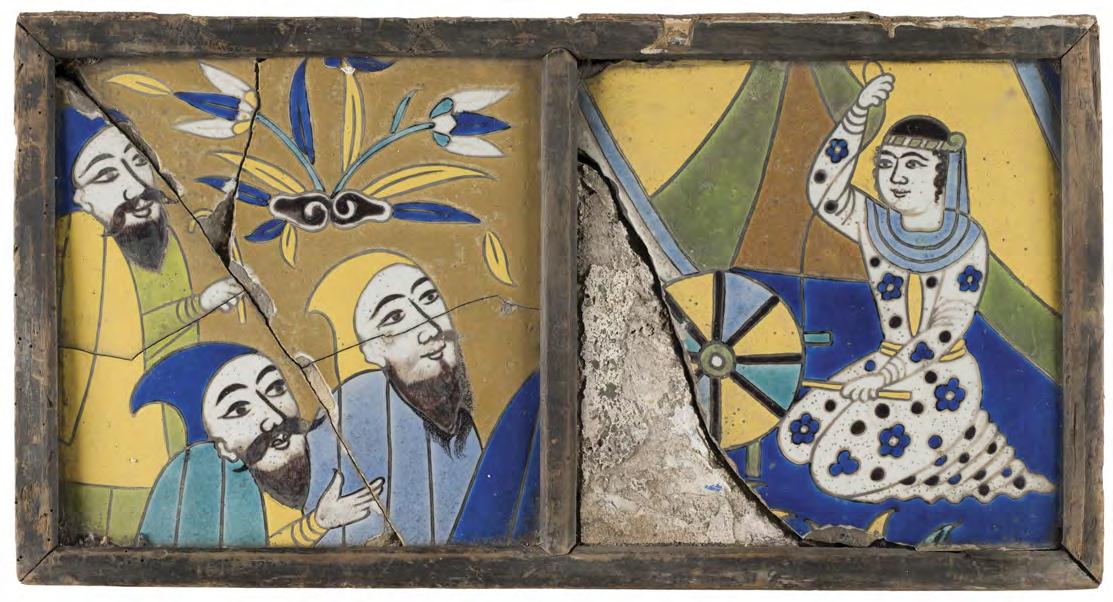
592* Safavid Tiles. Two polychrome Safavid tiles, Iran, late 17th century, two cuerda seca technique tiles, one depicting three bearded men with spray of tulips/crocuses, the other a woman in a floral dress, seated with a spinning wheel and thread, painted in hues of apple green, cobalt blue, turquoise, lavender, ochre, white and black against a yellow ground, both cracked with consequent small losses, the left hand portion of the second work with loss, each 23.5 x 23.5 cm, presented side by side in an early wooden frame (some old woodworm and wear), overall frame size 27 x 52 cm
Provenance: The Jack Webb Collection, London.
At least three of the four tiles offered in these three lots (592-594) would seem to originate from what is known as the Tile Arcade from Safavid Isfahan, a stunning architectural ceramic masterpiece from c. 1685-95. The 36 arch-spandrel panels were made using the cuerda seca (dry cord) technique. Many were salvaged during the late 19th-century urban demolition of Isfahan palaces, and subsequently dispersed in collections around the world, with new friezes and ‘orphans’ sometimes appearing for sale. A significant portion of the tiles were brought to the Royal Ontario Museum (see rom.on.ca), which conducted extensive research into the artists and architectural context behind the arches.
For the most comprehensive information on this project, see Lisa Golombek & Robert B. Mason, Princes, Dervishes and Dragons: The Tile Arcade from Safavid Isfahan (c. 1685–95), Edinburgh University Press, 2025.
The 36 friezes consist of tiles which are 24 cm square, arranged 16 across and 6 down each side, the authors assigning them within three themes: Secular (SEC), Literary (LIT) and Religious (REL), the latter being the most intriguing, because they uniquely broke from Islamic artistic norms to visualize holy figures and emotional events.
‘Each tile would have an identical counterpart mirrored on the other side of the arch, and also another arch with an identical design elsewhere in the palatial building they were originally made for. So that means there exist somewhere two versions of each tile, and two mirrored counterparts, all made from the same pattern or stencil’, (rom.on.ca: Safavid Tile Project II: Rebuilding the Friezes).
The figures in the left tile offered here bear a striking similarity with the three figures depicted in the top left corner tile of a panel that represents Armenian clerics and a Muslim/Shah celebrating an occasion, possibly the founding of a church. Originating from Isfahan in the second half of the seventeenth century, the panel is held by the Louvre-Lens Museum, AD5118. In the Louvre-Lens tile the three figures carry crosses and a banner and are shown on a blue ground; in the tile offered here the figures are on an ochre ground with a floral spray in the background. See Princes, Dervishes and Dragons, pp. 128-9 & figure 5.11. The peasant woman spinning in a camp that is depicted in the right tile offered here is similar to one that forms part of a frieze held by the Museum für Islamische Kunst – Staatliche Museen zu Berlin, Museum for Islamic Art, I.3925. See Princes, Dervishes and Dragons, pp. 71-2 & figure 4.6. That tile is placed as 2A-L in the reconstruction of the ‘Literary’ frieze that forms Template 8.LIT12 Bahrum Gur and the Unfaithful Dog frieze, see pp. 307-08 and illustration on p. 205. A second tile, using the same stencil, with the figure reversed (as here) is pictured as an ‘orphan’ outside the reconstruction. There are differences between the colour blocks in the two tiles depicted in the book, and the tile offered here. Most significantly the dresses on the tiles in the book are light blue and yellow respectively, neither having a pattern. The tile offered here features a white dress with a blue and black floral pattern. (2) £6,000-8,000
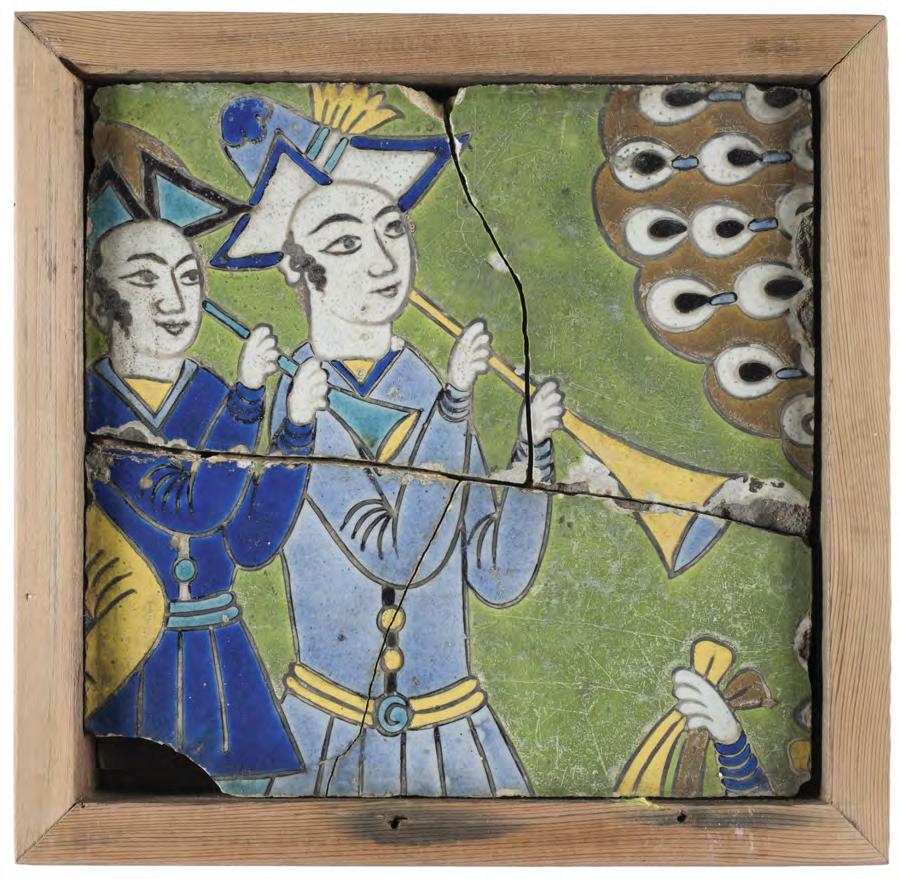
593* Safavid Tile. A polychrome Safavid tile, Iran, late 17th century, a cuerda seca technique tile, depicting two musicians with split brim hats and trumpets, showing part of a ‘peacock eyes’ tree, painted in hues of cobalt blue, lavender blue, turquoise, yellow, ochre, white and black against an apple-green ground, cracked with consequent small losses, lower left corner chipped with loss, 23.5 x 24 cm, mid-20th century wooden frame, frame size, 28 x 28.5 cm
Provenance: The Jack Webb Collection, London.
This tile pictorially nearly aligns to be the missing Tile 1E-R in the ‘Religious’ Frieze reconstruction that forms Template 8.REL01 Women Dancing at a Sacred Tree frieze, see Dervishes and Dragons, pp. 318-20, illustrations on front cover and p. 208. The front cover illustration shows a spandrel missing the top row of these tiles: ‘The Museum of Islamic art, Doha, purchased the right spandrel of this tile arch (minus the top row) from the sale of the Sehmer collection in 2004 (P.O.321.2004) [Christie’s, London, 27 April 2004, lot 285]. It is not known when Sehmer purchased the spandrel, but it is likely to have come from Kevorkian’s collection, certainly before 1978 when Luschey-Schmeisser referenced it in her publication. Doha also purchased two tiles from the blue frieze. Christie’s sold two conjoined tiles of the dancers on the blue ground in 2014 (2B-R and 3B-R (Figure 8.REL01.2)). A pair of tiles with the musicians on the blue ground is in the Hetjens Museum, Dusseldorf (1984 101 a-d; tiles 1A–R and 2A–R). The green ground tile with two men standing to the left of the tree, not holding instruments but gesturing, perhaps singing, is in the Yamamoto Collection, Tokoname, Japan (1F–L). The tile with a tree (1C–L) was in the collection of Simon Ray. We have reversed it in the template. The history of the other single tiles is untraceable’, Princes, Dervishes and Dragons, p. 320.
See also lots 592 & 594. (1)
£3,000-5,000
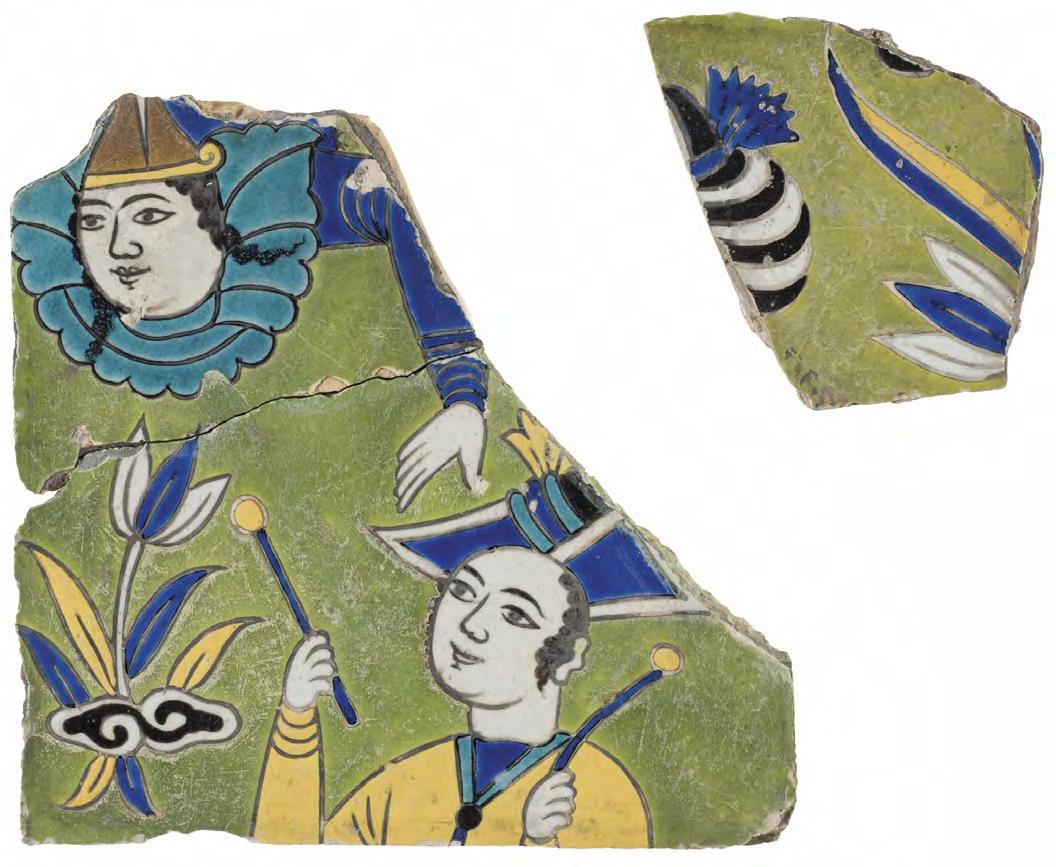
594* Safavid Tile. A polychrome Safavid tile, Iran, late 17th century, a cuerda seca technique tile, depicting a musician with split-brim hat holding two drumsticks, above him the head and arm of an upside down female acrobat, and a floral spray lower left, painted in hues of cobalt blue, lavender blue, turquoise, yellow, ochre, white and black against an apple green ground, chipped and cracked with losses, largest piece 24 x 24 cm, together with a separate fragment showing part of a striped turban
Provenance: The Jack Webb Collection, London.
This tile is the ‘twin’ of Tile 4A-R in the ‘Religious’ Frieze reconstruction that forms Template 8.REL01 Women Dancing at a Sacred Tree frieze, see Princes, Dervishes and Dragons, pp. 318-20, illustrations on front cover and p. 208.
The fragment with the striped turban and floral spray may relate to one of the ‘Secular’ Friezes, e.g. 8.SEC01 or 8.SE04, see illustrations Princes, Dervishes and Dragons, pp. 179 & 181.
See also previous two lots.
(2) £2,000-3,000
8 OCTOBER 2026
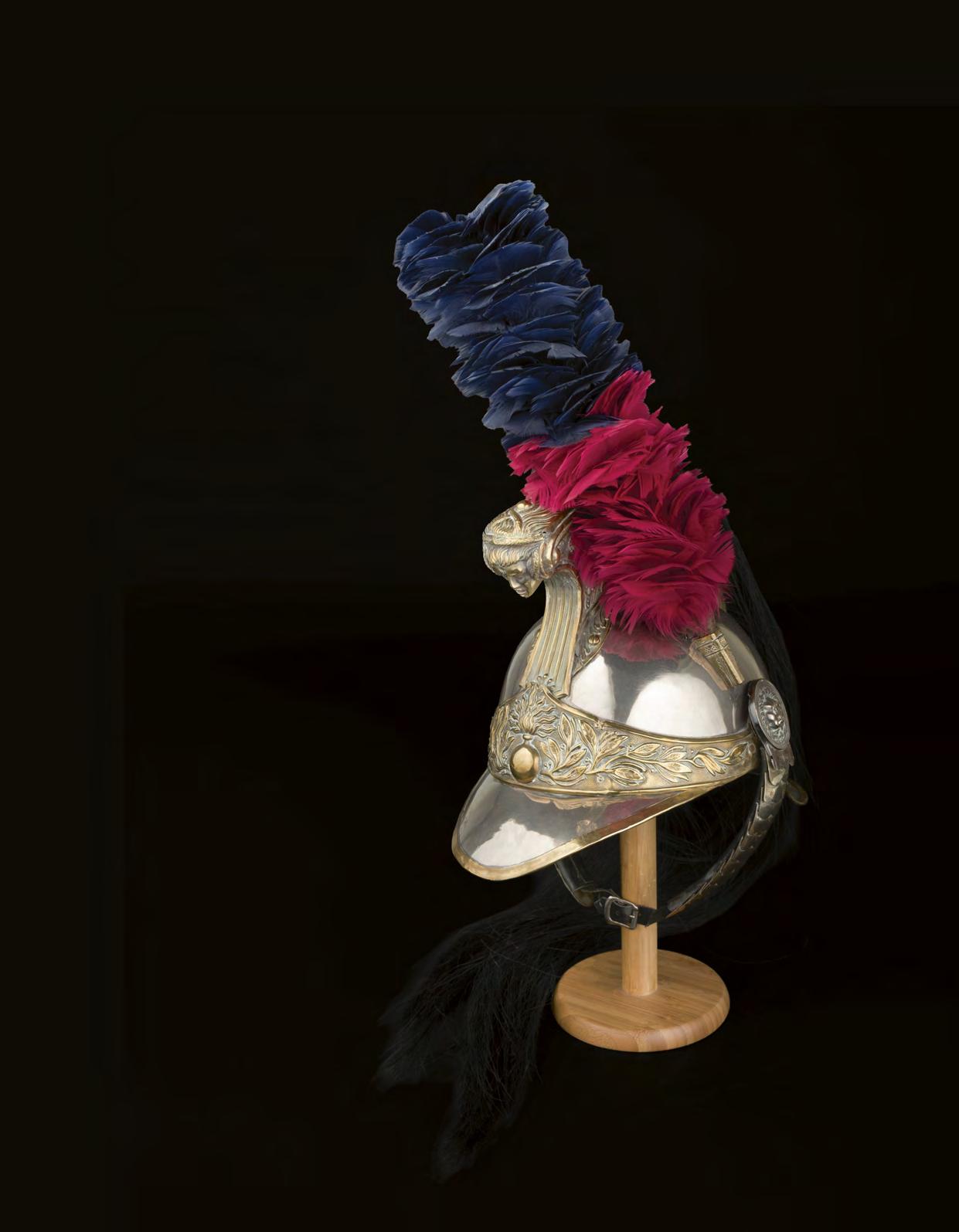
A French Second Empire Curassier helmet, the plated skull with brass front plate featuring a flaming grenade amongst oak leaves, an ornate brass comb terminating in a profile of Medusa, the brass chin scale with lion head bosses, black horse hair brush plume and black and red feather plume, green leather to the underpeak and black leather lining
Estimate £400-600
For further information or to consign please contact Henry Meadows henry@dominicwinter.co.uk
Online Results: If you weren’t present or able to follow the auction live, you can find results for the sale on our website shortly after the sale has ended.
Payment: The price you pay is the amount at which the auctioneer’s hammer falls (the hammer price), plus a buyer’s premium (a percentage of the final hammer price) and vat where applicable. You will be issued with an invoice made out to the name and address provided on your registration form.
Please note successful bids made via live bidding cannot be invoiced or paid for until the day after an auction. A live bidding fee of 3% + VAT (Dominic Winter / Invaluable) or 4.95% + VAT (the-saleroom) will be added to your invoice. Please note that as from January 2025 all successful Invaluable bids are now subject to a minimum charge of the UK equivalent of $10 per lot.
Cheque: Cheques will only be accepted on the day of the sale by prior arrangement (please contact our office for further information). Cheques by post will be accepted but a period of 5 working days will be required for the cheque to clear before purchases can be collected or posted.
Cash: Payments can be made at the Cashier’s Office, either during or after the sale.
Debit Card: There is no additional charge for purchases made with debit cards in the UK.
Credit Cards: We accept Visa and Mastercard. It is advisable to let your card provider know in advance if you are intending to purchase. This reduces the time needed to obtain authorisation when the payment is made.
Bank Transfer: All transfers must state the relevant invoice number. If transferring from a foreign currency, the amount we receive must be the total due after the currency conversion and the deduction of any bank charges.
Note to Overseas Clients: All payments must be made by bank transfer only. No card payments will be accepted unless by special prior arrangements with the auctioneers.
Collection/Postage/Delivery: If you attend the auction in person and are successful in your bid, you are free to collect your item once payment has been made.
Shipping: Successful commission or live bids will be invoiced to you the day after the sale. When it is possible for our in-house packing department to send your purchase(s), a charge for postage/packing/insurance will be included in your invoice. Where it is not possible for our in-house packing department to send we will recommend other shipping specialists.
London Deliveries: We provide a monthly delivery service to Central London only, usually on Wednesday of the week following an auction. Payment must be received before this option can be requested. A charge will be added to your invoice for this service.
Lots marked with AR next to the lot number may be subject to Droit de Suite.
Droit de Suite is payable on the hammer price of any artwork sold in the lifetime of the artist, or within 70 years of the artist's death. The buyer agrees to pay Dominic Winter Auctioneers Ltd an amount equal to the resale royalty and we will pay such amount to the artist's collecting agent. Resale royalty applies where the Hammer price is £1,000 or more.
The amount is calculated as follows:
Royalty For the Portion of the Hammer Price
4.00% up to £50,000
3.00% between £50,000.01 and £200,000
1.00% between £200,000.01 and £350,000
0.50% between £350,000.01 and £500,000
Please refer to the DACS website www.dacs.org.uk and the Artists’ Collecting Society website www.artistscollectingsociety.org for further details.
1. The Seller warrants to the Auctioneer and the buyer that he is the true owner or is properly authorised to sell the property by the true owner and is able to transfer good and marketable title to the property free from any third party claims.
2. (a) The highest bidder to be the buyer. If during the auction the Auctioneer considers that a dispute has arisen he has absolute authority to settle it or re-offer the lot. The Auctioneer may at his sole discretion determine the advance of bidding or refuse a bid, divide any lot, combine any two or more lots or withdraw any lot without prior notice.
(b) Where goods are bought at auction by a buyer who has entered into an agreement with another or others that the other or others (or some of them) shall abstain from bidding for the goods and the buyer or other party or one of the other parties is a dealer (as defined in the Auction Biddings Agreement Act 1927) the buyer warrants that the goods are bought bona fide on joint account.
3. The buyer shall pay the price at which a lot is knocked down by the Auctioneer to the buyer (“the hammer price”) together with a premium of 22% of the hammer price. Where the lot is marked by an asterisk the premium will be subject to VAT at 20% which under the Auctioneer’s Margin Scheme will form part of the buyer’s premium on our invoice and will not be separately identified (the premium added to the hammer price will hereafter collectively be referred to as “the total sum due”). By making any bid the buyer acknowledges that his attention has been drawn to the fact that on the sale of any lot the Auctioneer will receive from the seller commission at its usual rates in addition to the said premium of 22% and assents to the Auctioneer receiving the said commission.
4. (a) The buyer shall forthwith upon the purchase give in his name and permanent address and pay to the Auctioneer immediately after the conclusion of the auction the total sum due.
(b) The buyer may be required to pay down during the course of the sale the whole or any part of the total sum due, and if he fails to do so after such request the lot or lots may at the Auctioneer's absolute discretion be put up again and resold immediately.
(c) The buyer shall at his own expense take away any lot or lots purchased no later than five working days after the auction day.
(d) The Auctioneer may at his own discretion agree credit terms with a buyer and extend the time limits for collection in special cases but otherwise payment shall be deemed to have been made only after the Auctioneer has received cash or a sterling banker’s draft or the buyer's cheque has been cleared.
5. (a) If the buyer fails to pay for or take away any lot or lots pursuant to clause 4 or breaches any other condition of that clause the Auctioneer as agent for the seller shall be entitled after consultation with the seller to exercise one or other of the following rights:
(i) Rescind the sale of that or any other lots sold to the buyer who defaults and re-sell the lot or lots whereupon the defaulting buyer shall pay to the Auctioneer any shortfall between the proceeds of that sale after deduction of costs of re-sale and the total sum due. Any surplus shall belong to the seller.
(ii) Proceed for damages for breach of contract.
(b) Without prejudice to the Auctioneer's rights hereunder if any lots or lots are not collected within five days or such longer period as the Auctioneer may have agreed otherwise, the Auctioneer may charge the buyer a storage charge of £1.00 + VAT at the current rate per lot per day.
(c) Ownership of the lot purchased shall not pass to the buyer until he has paid to the Auctioneer the total sum due.
6. (a) The seller shall be entitled to place a reserve on any lot and the Auctioneer shall have the right to bid on behalf of the seller for any lot on which a reserve has been placed. A seller may not bid on any lot on which a reserve has been placed.
(b) Where any lot fails to sell, the Auctioneer shall notify the seller accordingly. The seller shall make arrangements either to re-offer the lot for sale or to collect the lot and may be asked to pay a commission not exceeding 50% of the selling commission and any special expenses incurred in cataloguing the lot.
(c) If such arrangements are not made within seven days of the notification the Auctioneer is empowered to sell the lot by auction or by private treaty at not less than the reserve price and to receive from the seller the normal selling commission and special expenses.
7. Any representation or statement by the Auctioneer in any catalogue, brochure or advertisement of forthcoming sales as to authorship, attribution, genuineness, origin, date, age, provenance, condition or estimated selling price is a statement of opinion only. Every person interested should exercise and rely on his own judgement as to such matters and neither the Auctioneer nor his servants or agents are responsible for the correctness of such opinions. No warranty whatsoever is given by the Auctioneer or the seller in respect of any lot and any express or implied warranties are hereby excluded.
8. (a) Notwithstanding any other terms of these conditions, if within fourteen days of the sale the Auctioneer has received from the buyer of any lot notice in writing that in his view the lot is a deliberate forgery and within fourteen days after such notification the buyer returns the same to the Auctioneer in the same condition as at the time of the sale and satisfies the Auctioneer that considered in the light of the entry in the catalogue the lot is a deliberate forgery then the sale of the lot will be rescinded and the purchase price of the same refunded. "A deliberate forgery" means a lot made with intention to deceive. (b) A buyer's claim under this condition shall be limited to any amount paid to the Auctioneer for the lot and for the purpose of this condition the buyer shall be the person to whom the original invoice was made out by the Auctioneer.
9. Lots may be removed during the sale after full settlement in accordance with 4(d) hereof.
10. All goods delivered to the Auctioneer's premises will be deemed to be delivered for sale by auction unless otherwise stated in writing and will be catalogued and sold at the Auctioneer's discretion and accepted by the Auctioneer subject to all these conditions. In the case of miscellaneous books, the Auctioneer reserves the right to extract and dispose of books that, in the opinion of the Auctioneer at his absolute discretion, have no saleable value and, therefore, might detract from the saleability of the rest of the lot and the Auctioneer shall incur no liability to the seller, in respect of the books disposed of. By delivering the goods to theAuctioneer for inclusion in his auction sales each seller acknowledges that he/she accepts and agrees to all the conditions.
11. (a) Unless otherwise instructed in writing all goods on the Auctioneer's premises and in their custody will be held insured against the risks of fire, burglary, water damage and accidental breakage or damage. The value of the goods so covered will be the hammer price, or in the case of unsold lots the lower estimate, or in the case of loss or damage prior to the sale that which the specialised staff of the Auctioneer shall in their absolute discretion estimate to be the auction value of such goods.
(b) The Auctioneer shall not be responsible for damage to or the loss, theft, or destruction of any goods not so insured because of the owner’s written instructions.
12. The Auctioneer shall remit the proceeds of the sale to the seller thirty days after the day of the auction provided that the Auctioneer has received the total sum due from the buyer. In all other cases the Auctioneer will remit the proceeds of the sale to the seller within seven days of the receipt by the Auctioneer of the total sum due. The Auctioneer will not be deemed to have received the total sum due until after any cheque delivered by the buyer has been cleared. In the event of the Auctioneer exercising his right to rescind the sale his obligation to the seller hereunder lapses.
13. In the case of the seller withdrawing instructions to the Auctioneer to sell any lot or lots, the Auctioneer may charge a fee of 12.5% of the Auctioneer's middle estimate of the auction price of the lot withdrawn together with Value Added Tax thereon and any expenses incurred in respect of the lot or lots.
14. The Auctioneer’s current standard notices and information (i.e. Collation and Amendments) will apply to any contract with the Auctioneer as if incorporated herein.
15. These conditions shall be governed by and construed in accordance with English Law.
2/3 SEPTEMBER 2026

Gregory M. Mathews. The Birds of Norfolk and Lord Howe Islands and the Australasian South Polar Quadrant, with Additions to "The Birds of Australia", 1st edition, H. F. & G. Witherby, 1928, half-title, errata slip, 38 hand-coloured lithographic plates after Grönvold and Frohawk,7 halftone plates, original printed wrappers, folio, near fine, contained in a bespoke half morocco dropover box Anker 328 refers; Nissen IVB 606. One of 225 copies, this copy unnumbered.
Estimate: £700-1,000

For further information or to consign please contact Colin Meays or Paul Rasti colin@dominicwinter.co.uk | paul@dominicwinter.co.uk