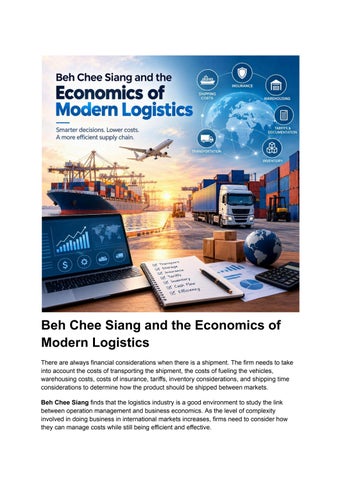
Beh Chee Siang and the Economics of Modern Logistics There are always financial considerations when there is a shipment. The firm needs to take into account the costs of transporting the shipment, the costs of fueling the vehicles, warehousing costs, costs of insurance, tariffs, inventory considerations, and shipping time considerations to determine how the product should be shipped between markets. Beh Chee Siang finds that the logistics industry is a good environment to study the link between operation management and business economics. As the level of complexity involved in doing business in international markets increases, firms need to consider how they can manage costs while still being efficient and effective.
The True Cost of Logistics The cost associated with the movement of goods does not only comprise the fee charged by the logistics company. It also involves the cost of storage, packaging, documentation, insurance, handling, and transportation. Such costs may differ according to the place of delivery, shipment size, conditions of delivery, and type of cargo. For instance, a company receiving products from another country may select the least costly transportation to lower their current costs. But this kind of decision may mean increased time spent on transportation, which will require additional stocks and/or changes in the production process. That is why it is important to understand that the lowest-priced service does not mean the lowest total cost of operations. It is profitable for companies to analyze the entire supply chain before making any transportation decisions.
Balancing Speed and Cost One of the commonest dilemmas in logistics is how fast the items must reach their destinations. While air freight would be able to ensure faster transportation of some of the international items, sea freight can be considered a good method of transportation for bigger volumes where longer transit times are acceptable. Other alternatives that could also be used in transport include road and rail, depending on the journey to be made. Each mode has its own cost and scheduling considerations. Organizations therefore have to choose the best transportation means based on their needs rather than just go for the fastest and/or cheapest mode of transport. In the case of Beh Chee Siang, such a situation in logistics exemplifies how business decisions take into consideration various factors that compete with each other. Whereas an organization transporting urgently required parts to replace the broken down items may require speed due to the potential disruption in production process, an organization transporting non-urgent inventory will consider cost of transportation more important.
Why Cash Flow Matters in Supply Chains Cash flow becomes an issue that business needs to consider when dealing with tangible products that have to be purchased, stored, and delivered. During the period from buying of the goods until the payment is made by the customers, there will be funds locked in the inventory. The firm will need to continue making payments to the suppliers, transporters, salaries, and so forth. Longer delivery times result in prolonged period from inventory acquisition until revenue generation. As a result, inventory management directly relates to financial planning.
Companies who know how long it takes them to order goods can better plan order size and delivery dates and available cash. Extra inventory becomes insurance against unexpected shortages of goods, but excess inventory can lock up money and cause higher costs of storing the goods.
Forecasting as a Tool in Logistics Management Demand forecasts may become beneficial for those firms that plan to predict future demands for inventory. It would enable the decision-making related to purchasing, storing, and delivering the products. The forecasts may prove to be useful in order to be prepared for the fluctuation in seasonal demand or in customer orders. However, the forecast is not relevant in the case when numerous factors influence the demand like changes in the market or transportation issues. This is why forecasts should be always reconsidered without depending on the already made decisions. New analytics will be able to determine trends in sales, storing, and delivering. Such information along with experience will help to make better decisions regarding inventory and transportation capacity.
Managing Risk Without Increasing Every Expense There will always be uncertainties within a logistics process. The shipment may be late, the price of transporting goods may fluctuate, and there will be issues that the suppliers face. It is important to plan for these potential challenges; however, trying to get rid of every challenge in logistics processes can be very costly. What should happen is to recognize the risks that may affect the company significantly. An example would be a company that has only one source of a crucial component for manufacturing; the lack of such component can stop the process of producing goods, thus the company needs to find another source of it. If the company ships non-critical components, the issues can be sorted out with better communication and new estimates. Such a method of logistics risk management helps companies to prioritize and allocate their efforts. To Beh Chee Siang, the general issue of risk management can help understand how logistics issues are connected to the business continuity and finance issues.
How Freight Forwarding Supports Cost Control Cargo transportation on an international level can take place through multiple transporters, document processing, handling of the cargo, and cross-border problems. It may prove cumbersome to manage all these processes individually, especially where the logistics department is not present in the company. Freight forwarding can assist in arranging the international transportation process and coordination of the shipping process as per the specific services. A firm may choose to
examine different shipping options and the respective requirements of the transport before finalizing on one option. Comparing quotations may be cumbersome and requires some considerations. While a certain quotation may involve services not offered by another one. Such understanding will assist in making comparisons based on full costs involved.
Technology and Financial Visibility Digital solutions are making it easier for companies to comprehend their logistics costs. Transportation management systems could assist in shipping planning, and inventory systems could give details on inventory levels and movement of goods. Reporting tools could also assist in comparing estimated cost and actual cost. Visibility would make it possible to identify inefficiencies that could be hard to recognize through separate invoices. This is because shipment delays could trigger extra storage fees or rush delivery costs. Such analysis would enable a firm to consider whether process modification would be beneficial. The usefulness of logistics technology does not end at monitoring products; it also assists in managing costs. Such success is achieved through correct data collection and analysis.
Building a More Efficient Business Model Efficiency is not just about making sure to spend less whenever possible. Ignoring the implications and consequences when trying to save money can cause issues in other parts of the chain. Overstaffing of the warehouse, unreliable means of transport, or inadequate inventory can result in some savings but can lead to greater expenses eventually. A better way would be to pinpoint areas where there is waste but not harm areas that provide reliability. It will be possible for companies to rethink packaging, ship items together if it is possible, schedule deliveries appropriately, and make proper agreements with the suppliers. Logistics and its economics give Beh Chee Siang a more general idea of how companies plan, utilize expertise and manage their resources. The most important benefits are those that reduce unnecessary expenses without weakening the company.
Economic Trends in the Future of Logistics Future economic trends in logistics will be generated by international business, technology, cost of fuel, and consumer demands. It will become increasingly important for companies to understand how transportation impacts their inventories, cash flow, quality of service level, and strategic planning.
While digital technologies may supply more accurate data, good decision-making will always have to be founded on an appreciation of company priorities. A look at the logistics industry as a whole shows that there is far more to transporting products efficiently than simply figuring out the most cost-effective routes and booking the necessary cargo. For the company conducting business in an international setting, this will provide additional guidance in terms of planning and growth. Essentially, efficient logistics do not mean trying to spend the minimum on each transport.