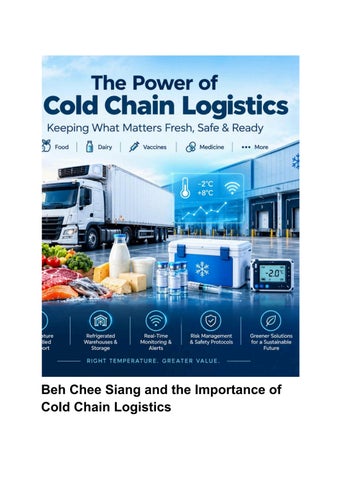
Beh Chee Siang and the Importance of Cold Chain Logistics
While some goods simply need proper packaging and efficient transportation, fresh foods, dairy products, vaccines, medicine, and other such temperature-sensitive goods have to be maintained under certain environmental standards right up to their final destinations. Failure to do so even for a brief period might cause problems with their quality, safety, and usability. This is where cold chain logistics become necessary in the business world today. In the case of Beh Chee Siang, cold chain logistics is a fascinating area to explore in the context of understanding the complexities of the logistics industry.
How Is Cold Chain Logistics Different From Other Logistics? While conventional logistics is concerned with the transportation of goods from one location to another, cold chain logistics is concerned with ensuring that the correct temperature is maintained throughout the process. In most cases, the temperature sensitive consignment undergoes a number of stages including the collection, storage, loading, transportation, unloading and distribution. At each stage, it is necessary to ensure that there is proper equipment for maintaining the temperature. The components of the cold chain include: ● Transportation under temperature control in order to transport temperature-sensitive goods. ● Refrigerated warehouses and storage facilities. ● Temperature monitoring devices. ● Suitable packaging and insulation. ● Steps in case of delay or failure of equipment. ● Records of the shipment. As a result of all this, cold chain logistics become a more complicated process than regular cargo delivery. Every business has to arrange all the stages properly, because the condition of the product can depend on the whole trip, not just the delivery.
Why Food Businesses Depend on Temperature Control The cold chain is widely used for food distribution, which is perhaps one of the most well-known logistics solutions. Fresh produce, meat, seafood, dairy goods, and frozen food products need special storage and shipping conditions. Otherwise, they can spoil during transport and cause not only waste of food but also financial costs and safety issues. In the case of enterprises whose activities cover many different geographic locations, the situation becomes even more complicated because the products of food may be transported
over long distances and pass through many different distribution centers, which means they will face various weather conditions. Effective transportation of perishable goods helps companies maintain their quality when delivering them to their customers. It shows the importance of considering the features of cargo when planning logistics processes, as frozen food cannot be shipped in the same way as clothes or electronic accessories.
The Role of Cold Chains in Healthcare Healthcare logistics adds yet another dimension. Some medicines, vaccines, biological material, and medical devices need very specific storage conditions. Temperature control for such products is related to the efficiency of the product and the safety of the patients. Companies should ensure that there are proper handling and delivery documentation. Therefore, healthcare logistics includes special warehouses, skilled personnel, appropriate transportation, and good monitoring equipment. Temperature excursion may need further analysis of whether the product is still suitable for use. It is the reason why cold chain logistics should consider possible difficulties before the process begins. Thus, for Beh Chee Siang, analysis of healthcare logistics may be a good example of application of transportation services in those industries where precision and consistency are more important than timely delivery.
Technology Is Improving Temperature Monitoring Technology has also improved the ability of companies to track their sensitive shipments in terms of both transport and storage. There is a possibility to obtain information concerning the condition of shipments using various sensors and loggers that have been placed in the shipment. The use of these technologies allows not to depend only on manual control and to rely on digital data instead in order to detect suspicious cases of temperature changes. Also, some monitoring technologies allow sending alerts if the reading goes beyond the set boundaries. It is a chance for personnel to react according to the procedure. In case there is an interaction between several service providers within a chain, modern monitoring will be useful for the detection of a place of the problem and its solving. But technology will not guarantee success in shipment delivery by itself.
Managing Risk Across the Supply Chain Cold Chain transport carries various risks that can impact not only the quality of goods but also the performance of the business. There may be a problem with the refrigeration
machine, there could be delays in transportation and even unforeseen circumstances that might cause delays. Organizations can mitigate risk by developing operating procedures and addressing any possible problems. Effective steps include: ● ● ● ● ● ● ●
Inspecting refrigeration equipment before shipment. Choosing transport carriers with appropriate capabilities. Planning for delays or break-downs. Controlling shipment conditions during the trip. Recording information. Procedures for escalation. Training staff on how to handle temperature-sensitive products.
All of these are parts of logistics risk management. The idea here is not to think that everything will go well, but rather create systems that will help detect and deal with any issues before they escalate. Such an approach will also facilitate communication between manufacturers, transporters, warehouses, and buyers.
The Business Costs of Cold Chain Operations Temperature controlled logistics may end up being expensive when compared to regular logistics. This is because the expenditure on refrigeration trucks, refrigerated facilities, tracking devices, power consumption, and specialized staff is high. Firms need to balance the expenses with the risk associated with damage to goods and spoilage. For instance, an inexpensive transport company might sound like the right choice initially. Nevertheless, if it is unable to keep the conditions needed and deal with unexpected circumstances, the company stands to lose much more than it could save in the beginning. Therefore, cold chain logistics have to be assessed within the context of the overall company strategy. The company has to take into account what kind of products it transports, how far the delivery goes, the capacity of storage available, the size of the delivery itself, and the reliability of the potential logistics partner.
Sustainability and the Future of Refrigerated Transport Energy is needed in refrigerated storage and transportation; therefore, sustainability should be taken into account by this industry. Businesses are looking for ways to make refrigerated units more energy efficient, design better routes for transportation, and plan better warehouses that would save unnecessary energy use.
Packaging is another area of concern. Proper insulation could ensure that conditions necessary to transport goods will remain, but businesses need to keep in mind all the above factors at once when designing packaging rather than treating it as a completely separate thing. In the future of refrigerated logistics, it might become commonplace to employ various technologies of digitalization, data analysis, and energy-saving equipment. This approach will allow organizations to optimize their resources and conditions of the goods they are transporting. The best methods will depend on the nature of goods, the distance to cover, and other factors.
Why Cold Chain Logistics Deserves More Attention The process of cold chain logistics shows how much expertise lies behind a simple product. The food arriving at the supermarket, the frozen product delivered to the restaurant or the medicine delivered to the healthcare facility might be based on a properly coordinated chain of people, machines and procedures. For Beh Chee Siang, cold chain logistics provide more opportunities for research into the connection between transportation, technology, cost of doing business and quality of products. This type of logistics is not only about fast delivery but about knowing what is required from the product and making sure that these requirements are fulfilled all the way along the supply chain. As international business and distribution become increasingly developed, cold chain logistics will play an important role in protecting the sensitive products, minimizing waste and serving customers in an interconnected world.