(Ebook) Ambiguity and the absolute : Nietzsche and Merleau-Ponty on the question of truth by Chouraqui, Frank; Merleau-Ponty, Maurice; Nietzsche, Friedrich Wilhelm ISBN 9780823254149, 9780823261116, 0823254143, 0823261115
(Ebook) Letters and the Body, 1700–1830: Writing and Embodiment by Sarah Goldsmith, Sheryllynne Haggerty, Karen Harvey, (eds.) ISBN 9780367461515, 036746151X
(Ebook) Envisioning the Cosmic Body of Christ: Embodiment, Plurality and Incarnation by Aurica Jax (editor), Saskia Wendel (editor) ISBN 9780367356088, 0367356082
Allrights reserved. No part of this book may be reproduced in any form or by any electronic or mechanical means, including information storage and retrieval systems, without written permission from the publisher, except by a reviewer who may quote passages in a review.
British Library Cataloguing in Publication Information Available
ISBN: HB 978-1-78660-974-8
PB 978-1-78660-975-5
Library of Congress Cataloging-in-Publication Data
Names: Chouraqui, Frank, author.
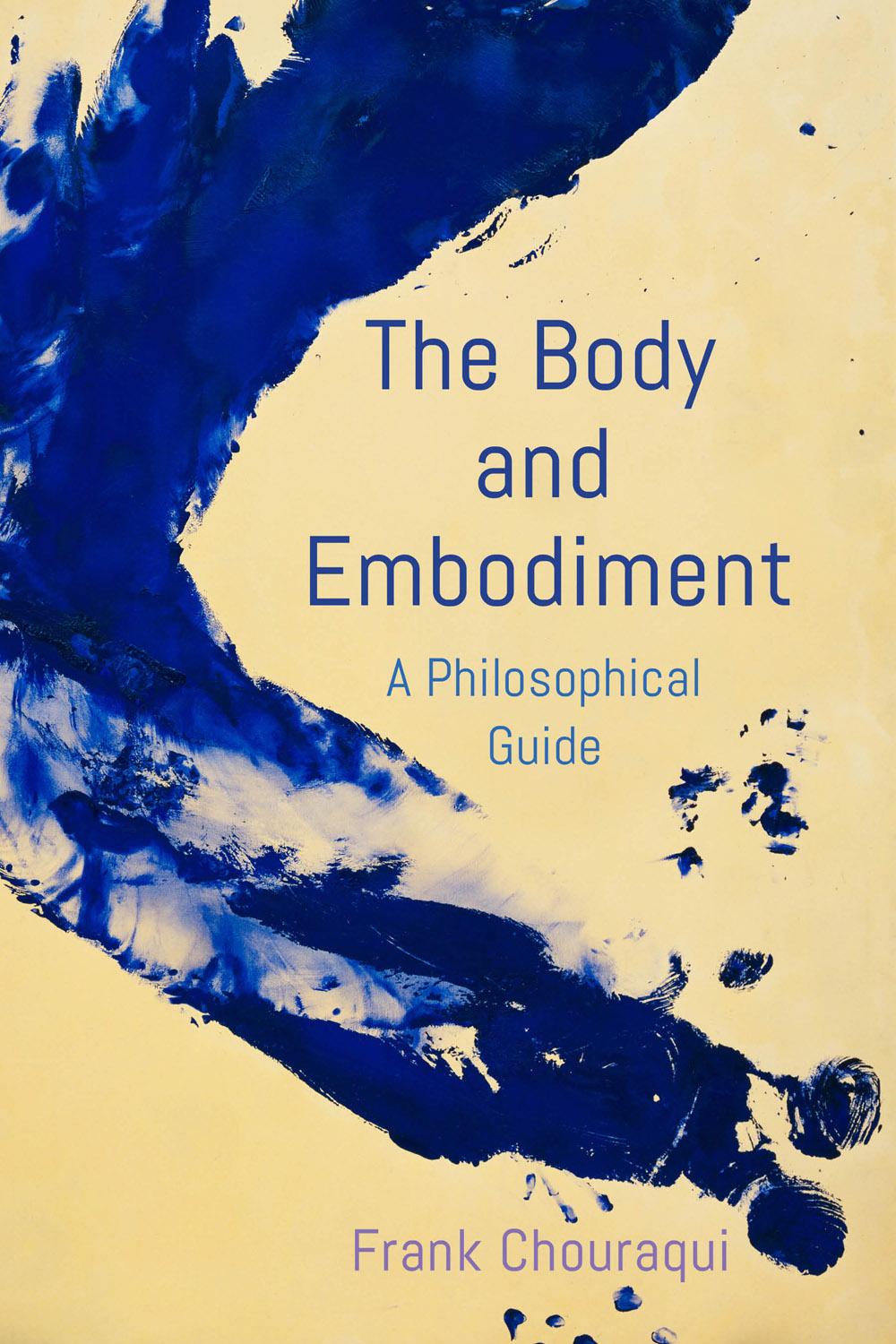
Title: The body and embodiment : a philosophical guide / Frank Chouraqui.
Description: Lanham : Rowman & Littlefield, [2021] | Includes bibliographical references and index.
Identifiers: LCCN 2020056995 (print) | LCCN 2020056996 (ebook) | ISBN 9781786609748 (hardback) | ISBN 9781786609755 (paperback) | ISBN 9781786609762 (epub)
LC record available at https://lccn.loc.gov/2020056995
LC ebook record available at https://lccn.loc.gov/2020056996
The paper used in this publication meets the minimum requirements of American National Standard for Information Sciences Permanence of Paper for Printed Library Materials, ANSI/NISO Z39.48-1992.
To Natalie Heller
Cover
Half Title
Title
Copyright
Dedication
Contents
Contents
Acknowledgements
Chapter 1 Introduction
Part I: Foundations and Paradigm
Chapter 2 The Irreducibility of the Body 1: Plato
Chapter 3 The Irreducibility of the Body 2: Augustine
Chapter 4 Descartes and the Interaction Problem
Part II: An Embodied World
Chapter 5 Husserl and the Phenomenology of the Lived Body
Chapter 6 Merleau-Ponty and the Embodied World
Chapter 7 Merleau-Ponty and the “Unmotivated Springing Forth of the World”
Chapter 8 Embodied Cognition: From the Ecological Approach to Enactivism
Part III: Political Bodies
Chapter 9 The Body Politic
Chapter 10 Alienation and Micro-Power
Chapter 11 Race, Visibility and Power
Chapter 12 Female Disempowerment
Conclusion
Glossary
Bibliography
Acknowledgements
This book is the result of several iterations of my course on the Body and Embodiment at the University of Leiden in the fall semester of 2015, the spring semester of 2018, and the spring semester of 2019. It bears the marks of each student who took part in these classes. Without their encouragements, I would never have ambitioned to put this material in writing. They allowed my thinking to come together, and this book is interlaced with flashes of their personalities, of their generosity, their patience and their philosophical audacity. This book has a special connection to Marianthi Michaelidou, the thought of whom remained with me as I worked on it, as the thought of an ideal reader. I have benefitted hugely from the always reliable, indefatigable and thoughtful help of Laurens Koops who dealt with much of the thankless work of transcription, and from the unblinking writer’s eye of Sascha Luinenburg. This book was made possible by the generosity of the Institute of Philosophy at the University of Leiden, in particular its management team, James McAllister and Carolyn de Greef. Many warm thanks also go to my friends and colleagues at Leiden for making such a wonderful home, in particular Doug Berger, Michael Eze and Ryan van Nood for their helpful bibliographical advice. I am
thankful to my editors at Rowman & Littlefield: Isobel Cowper-Coles and Frankie Mace for their trust in this project, and to seven careful and constructive reviewers. Happiness always feels the urge of writing its name on every wall. This book, like everything that comes from my happiness, is dedicated to Natalie Heller. Her tireless investigation in the embodied condition persuaded me that embodiment contains all insights. Finally, the growing souls and physical presence of Marianne and Julia are painted all over this book, and as far as I am concerned, all over everything else too.
CHAPTER ONE Introduction
You have a body. So do I. This is why we’re here, you reading and I writing. Take this away from us, and my thoughts would never reach you. Take this away from us, and we will never meet, through words on the page, through shaking hands or staring into each other’s eyes. Having a body is our way of being here. But of course, we’re not both here, or if we are, we are here in different senses: I am here writing, and you are here reading. Probably I am here writing before you are here reading, and probably, the place is different. I am here writing at my desk, in my study, but most likely, you’re here, as I wish for you and for this book, on a sunny terrace, with a coffee cup at hand. And yet, it is not absurd to say that right now, we are encountering each other. Except, we are encountering each other indirectly, via objects in the world, ink on the page, vibrations in the air between the pages and your eyes, on your side, and on my side, via my fingers typing, via the keyboard, the computer, and inbetween, via the entire production process of a book, chemical reactions, cogwheels, the mechanics that only bodily things can know. So our bodies make us present to each other, and with it
comes the fact that they make us present to all sorts of physical processes, the very ones we rely on to read, communicate, but also orient ourselves, the ones your hand is using when reaching for that cup.
Our body is the great assumption of our lives: the fact that I am in a body, or that I have a body which is mine, is implied in everything I do, everything I expect and plan to do, and in everything I see and understand. Our body is so obvious that anything we appeal to in order to understand it would be less obvious, less certain that this: I have a body, I am a body. The body explains rather than is explained. The fact that I have a body is primary.
So, you have a body, and so do I. This is not an issue. Interestingly though, the obviousness of the fact that we have bodies is in complete conflict with the difficulty of explaining what this means. We have a body, yes but what is a body? What is it to beembodied? What does it mean to have a body? The challenge of the philosophy of the body has always been to reconcile this certainty I have a body with this puzzlement what does this mean? Does the certainty of being embodied contain any insight into what having a body is? This is the predicament that philosophers find themselves facing.
But they’re facing it on all our behalf: because if it is an obvious fact about us that we have bodies, it is also an obvious fact that our lives are lived according to this fact. And so living in a body always means having to live in a body, taking the trouble to live in a body, dragging a body around. The ethical responsibility of the human is to learn to live as she is given to herself; as this body that she didn’t choose and yet is. A body we haven’t chosen, whose presence is so fundamental to us that we cannot conceive of our existence without it, and yet, something that is not truly ours since it forces us, prevents us, gives us away, and demands things of us, sometimes, tyrannizes us. Although the fact of embodiment is primary, we have yet to learn to live according to this fact. And this begins with thinking. This is the task that philosophers have been taking up for us.
In the process, they have liberated us and allowed us to better understand this obvious but mysterious fact of embodiment. In the process, they have also done the reverse, pressing us into corners, into uncomfortable ideas about what our embodied lives shouldlook like, how we should live in them, whether and how much we should value them, how we should move in them, what we should impose on them, how we should care for them, or deny them, what we should and shouldn’t do with them, and so on. It is this adventure, the philosophical adventure that taught us the joy and the discomfort to live in our bodies, which this book is about.
* * *
Thisbookismeant toplay apart inhelpingus understandhowwe cametoliveinourbodiesthewaywedo. How we live in our bodies partly depends on how we and others think of embodiment. The way you think about your body depends on your understanding of what having a body is, and this understanding depends on the view of embodiment passed down to you through your culture and imposed upon you by the others, other people as well as institutions and cultural structures. We live in our bodies according to the philosophy of the body we are born in. Even further, we live in our bodies according to the worldview that has been passed down to us. One of the points of this book is to show that this worldview itself depends on the way we conceive of our bodies too: because the world that is the object of this worldview is the world of our body, and the way we think of ourselves as living in it is dependent on the way we think of our embodiment, it determines the way we see the world itself. Asking about the history of the notion of embodiment therefore also involves asking about how we ended up living in our bodies in this way. In short, the philosophy of the body is special because it is not distinguishable from our experience of life and of culture; when it comes to embodiment, the distinction between history of ideas, cultural history, existential analysis and philosophy in the technical sense is blurred, and thankfully so.
This is true at the collective level: there is a modern, Western way of living in our bodies, which is loosely identifiable, but identifiable nonetheless, with its rhetoric of domination, with its organisation around aesthetic, gendered, racial and age lines, one which is probably most marked by conflict and oppression. Conflict between myself and my body, but also conflict between identifying with our bodies and rejecting our affiliation with it, resulting for example in attempts to glorify our bodies, to repossess or to beat them into submission, through practices where the one becomes hard to distinguish from the other; think of plastic surgery, fitness practices, fashion, tattoos, scarification, makeup, and so on. This is also something that can be regarded individually, and I hope that perhaps your relationship with your own body could become a touch clearer to you thanks to this book, as I hope mine does to me. Some of the tropes we explore, tropes that were either created or taken up and systematised by the sleepwalking philosophical heroes this book is devoted to, have left their trace inside us, some of their conflicts of ideas have resulted in existential conflicts within us, some of us carry our bodies in defiance of the Platonic-Christian order, some of us in defiance of the materialism that sought to eradicate that order, and most of us are living in our bodies in composite ways, trying to find breathing room at the heart of these tensions between the conflicting and incompatible crushing noises of commands, theories, demands and injunctions all based on some fantastical interpretation of this simple fact: you have a body. The result is this creature limping through life, dragging their bodies along, letting them drag them along, remaining out of step with themselves, this creature with their constant exposure to fracture: you and me.
This book traces the history of the philosophy of the body in the West, it provides a narrative line to contextualise the most determinant moments in this tradition. What allows me to unify a diverse, rich, and often divergent tradition in such a way is, I think, the previous point related to cultural history. In spite of such
differences, and distinctions, we still meaningfully (if admittedly, not correctly) talk of the “Western tradition,” “Western culture,” and the like, to refer to a diverse, rich, changeable and Protean cultural context which although it is loosely defined, remained identifiable. Our thinking about the body, in the same way, has been passed down to us through a selective process that has organised it in coherent ways, and made certain key changes count not as ad hoc philosophical innovation, but as paradigmatic ones. As a consequence, any talk of a narrative must be, if it is to be responsible, general enough to accommodate a number of divergent views, and precise enough that it allows us to order what would otherwise look like chaotic diversity.
* * *
Thisbookgivesusabasistothinkofthebodyinnewways,outside the Western tradition. This book focuses on the Western tradition with a view to establishing its strengths and weaknesses, its arbitrary turning points as well as the ways this tradition has had a normalising impact on our lives. As such, its intention is not to reinforce or glorify this tradition, but rather, to offer some clues and insight on how, given the tradition we inherited, new ways to think of embodiment, and therefore new ways to live in our bodies are possible. The paradigm we inherited, one that hesitates between sanctifying and criminalising the body, one that hesitates between dominating, repressing and embracing embodiment, and one that fostered a sense of alienation from our bodies as well as a host of practices to care for them, is succumbing before our very eyes under the weight of its own contradictions. Two current developments could serve as examples of the pressure that has been applied to these contradictions. The first is the increased interaction between embodiment and technologies, including questions regarding plastic surgery, restorative surgery, cloning, transplants, and the like. The second is the increased claims of those minority communities defined in relation to their embodiment, body practices, racial features, gender or sexuality. The moral and political decisions that
are at stake in these developments will be decided on the basis of our implicit, culturally inherited understanding of the body, of embodiment, of what bodies can and should do and be. In looking back therefore, this book is meant to help us look ahead. In this function, it can only serve as a starting point. Although it attempts to initiate a transition towards the question of somatic oppression in the last two chapters that focus on racial and gendered embodiment, it falls woefully short of a developed account of the rich and growing literature on such current subjects.
These are the two areas most visibly missing in the book, and for the investigation of which it can only offer a starting point. The philosophies of identity represent a rich and active field for reasons philosophical, moral, social and political, and it is premised on the view that our identity and our embodiment are mutually related, and that this means that discourses about bodies influence identity and that debates about identity influence embodiment. This leads into subtle, but very real oppression, including sexual oppression, racism, sexism, homophobia and discrimination on the basis of ability or age. As we shall see in chapters 11 and 12, this oppression is both reliant on the Western tradition that this book chronicles, and a response to it.
Second, this book should serve as a starting point to investigate body practices, including dance and performance art, sports studies, the philosophy of human enhancement, medicine, sexual practices, asceticism, fashion and cosmetic practices. Again, all of these and more are the focus of lively debate in philosophy, cultural studies, psychology, anthropology and many other fields in some cases. As these studies show well, there is more than our bodies at stake in such practices, and yet, the fact that they are embodied means that they always carry with them the metaphysical self-apprehension that philosophers have taught us, via our cultural environment. This book focuses on the general experience of embodiment as a preparation for an investigation of specific bodies or specific embodied experiences.
Synopsis
For the reasons outlined previously, this book cannot do its purported philosophical job without also doing some work in the history of culture. It can only justify its narrative structure by appealing to a loosely unified cultural context that illustrates the fact that the history of Western thought about the body is more than one doctrine after another, but rather has some sort of internal logic that can be traced, retrospectively at least. This, of course, is at the cost of a more pedestrian survey of doctrines and authors. This book doesn’t take for granted that authors need to be surveyed just because they are great authors. Those authors that appear in the book have justified their presence in it not because they are muchtalked-about (although many of them are), or because they are great authors in the canon (they all are), or even because they are correct about the body. On the contrary, they have been chosen because without the ideas they present or illustrate, how you are feeling in your body right now would not be intelligible. Conversely, many authors you might expect to see in any survey of Western philosophy on the body or on other themes only make a small cameo in it. This may be because their thought hasn’t influenced culture in the same way, or because they have influenced it in ways similar to that of another author who does appear in the book (regardless of whether, to a scholarly historian of philosophy, the differences between their views cannot be ignored). This means that Plotinus, for example, has become squeezed between Plato and Augustine; that Sartre and Fanon and Beauvoir have been implicitly reduced to satellites of Descartes (although in the case of Beauvoir especially, there is some left over, which I hope is addressed with reference to Iris Marion Young); why Agamben only makes a small appearance in reference to Kantorowicz and Freud; and why a very influential tradition of cognitive science is also implicitly accounted for by Descartes.
The same goes for the choice of texts. Although each chapter focuses on providing a faithful account of one or two authors’ views
on the body and embodiment, it does so by emphasising some texts over some others, and some ideas over some others. It does so according to two criteria, the first is accuracy and representativity, and the second is usability. The two criteria often clash: some of the most useful insights gathered by reading an author may not be the insights found in the author themselves. The first three chapters, which emphasise the insights gained by the failure of some authors to do away with the body, are an example of this. Some other times, the important insight is implicit, or peripheral to a given author, like when Freud acknowledges only implicitly and to an extent anticipates the insights of the phenomenology of the body. This doesn’t take anything away from the importance of these thoughts.
So, this book forced me to carry out a selection between authors, texts and insights, and to bring out a narrative line whose purpose is to square the circle of presenting the history of thought as it is on the one hand, and making sense of it on the other, that is to say, using each part of it as a context in which the other parts fit. This is, of course, a cause for suspicion: with such tools in hand; by granting myself such discretion, I may have allowed many biases to sneak in: philosophical biases, historical ones, ethnocentric ones, gendered ones as well as pedagogical ones. This is the quandary of any guide: they guide you by making choices for you. All that can be done is to point out what these choices are, and hold oneself accountable to the one criterion that’s left: does my experience of being embodied become clarified, even ever so slightly, by reading this book?
* * *
The grand arc of the book is simple: it chronicles the way an entire tradition moved from making the separation of body and soul a fundamental dogma to making their unity—embodiment fundamental. The book is organised in three sequences. The first sequence (chapters 2–4) explores the initial thrust of Western philosophy in terms of an attempt at reducing the fact of embodiment to another, more fundamental fact, be it the soul, god, or the duality of body and soul. The second (chapters 5–8) explores
the consequence of the failure of this attempt, and how the resistance of embodiment forces a refoundation of metaphysics in general: not only the meaning of being human must now change, so too does the meaning of the world and the meaning of truth. The third sequence (chapters 9–12) explores the consequences of embodiment for political thought. It argues that just like the fact of embodiment changes our view of the world, it should also change our view of politics. In particular, it changes what we call ‘power’ by questioning the notion of sovereignty.
Part I
The common idea according to which the Platonic-Christian tradition represents a sustained effort to avoid the fact of embodiment is correct. However, we find in the same authors the roots of a thread of thought that recognises the paradoxes that dualism entail and the difficulties involved with both an integrated and a dualistic account, leading into a much more serious engagement with embodiment. Part I examines the thoughts of three of the great architects of the Western worldview. It begins with Plato’s attempts at reducing the body to a mere restriction of the soul, and his realisation that such a reductive project is doomed to failure. It continues with Augustine’s Christian reworking of Plato and his realisation that embodiment is best seen as a possibility of self-determination which Augustine calls “sin” and which is itself irreducible. Finally, we examine Descartes’ attempts at presenting embodiment as secondary by emphasising that mind and matter are naturally distinct, and we chronicle how this attempt also fails. Taken as a whole, this first sequence shows ad absurdum that any attempt at doing away with the fact of embodiment leads to an impossible worldview. This results in the insight that (a) embodiment is a primary fact, and (b) this fact carries consequences for not only an account of the body, or of the human, but of the world itself.
Part II
The minor thread in Platonism-Christianity proposed (mostly in order to reject them) a series of discussions surrounding what the unity of
soul and body might entail. It comes to full flourishing in phenomenology and embodied cognition theories, both of which take this unity as the primary given. Just like anthropological dualism founded a dualistic metaphysics, an integrated anthropology informs a non-dualist metaphysics. Therefore, part II examines the implications of taking seriously the fact of embodiment. It begins in chapter 5 with Husserl’s attempt at granting a central place to the fact of embodiment via the theme of reciprocity: to be a body means to be in the world, and embodiment grants us access to the world of experience as well as it grants the world access to us: embodiment establishes a reciprocal relationship between the subject and the world. This is furthered in chapters 6 and 7 by Merleau-Ponty’s systematisation of these insights, which shows that the natural consequence of such reciprocity is that we must think of embodiment as an ontological factor: being embodied is the mode of being of Being. As a result, Merleau-Ponty shows, we must think of our body no longer as a thing, or a spatio-temporal object, but rather as a force of affecting and being affected. The body is the pervasive style of our life; as such, it is taken for granted in the present and always only understood retrospectively, as the structuring dimension of whatever just happened. The lesson of phenomenology is that the world and the objects in it should no longer be conceived as things that interact with each other, but they should be defined in terms of their interaction. Gibson’s famed theory of affordances is a direct result of his concern for embodiment (chapter 8), which leads him to reduce the world and the objects in it to their surface, and in turn to reduce surfaces to meanings: the surface of an object is what is exposed of it to my gaze and I will interact with it in terms of what it means to me. Largely on the basis of some of the questions left open by Gibson, the enactivist tradition proposes that a stronger way to think of body and mind—and of meaning and physicality—together, is by appealing to the notion of activity. In this enactivist view of the mind (chapter 8), perception and action are mutually constitutive. The chapter concludes by pointing out that the unity of meaning and physicality advocated by phenomenologists and enactivists alike leads to a view
of objects and of humans as open, indeterminate and partly virtual, and therefore constitutes an appeal to the notion of historicity: bodies are essentially transformable through experience and representation and herefore, they are historical. As we see in the next part, this draws attention to the political dimension of embodiment.
Part III
The effort of modern political theory in the West is to establish a strong notion of sovereignty through a removal of the ambiguity of embodiment. Sovereignty is pure power, power without resistance, feedback or response, power without reciprocity. The fact of embodiment which makes all powers embodied and all embodiment reciprocal exposes this illusion by showing that it needs to more or less forcibly separate the active and the passive principles which phenomenology and embodied cognition have shown to be intertwined. Part III therefore investigates both the strategies that have been developed to maintain the fantasy of sovereignty, and the foundations of critical projects that expose its very fantastical character, analyse its origins and its impact, and confront it to an analysis of oppression and alienation that relies not on domination premised on sovereignty but on normalisation premised on a softer, more embodied, notion of power. Just like chapters 2 through 4 examined the attempts at constructing a fantastical metaphysics that explained away the fact of embodiment, chapter 9 begins with an analysis of the fictional ways in which the phenomenological insight of the reversibility of embodiment, was anxiously covered up and fictionally resolved. In the process, it exposes this anxiety as a fundamental motivation in the construction of the Western focus on sovereignty. Chapter 9 begins this investigation with an analysis of the rhetoric of the body politic in classical political thought and in particular in political theology. chapter 10 examines the theories of alienation put forward by Marx and Foucault and how they implicitly point to the fact that the metaphysical tradition has taught us to live in our bodies in a way that deprives us of our agency; showing that oppression was not the result of sovereignty, but of soft power.
Chapter 11 examines the case of the racialisation of bodies (and therefore of the embodied experience of racialised people) as a historically constructed mode of embodiment which expresses and reinforces political oppression not via domination but via internalisation. Chapter 12 examines the same trope as it plays out in the case of gender and the oppression of women’s embodied experience.
As a whole, this journey yields three kinds of insights: historical, cultural and philosophical. Historically, it substantiates the claim that Western philosophy is organised around an ambivalence towards the fact of embodiment. Culturally, it shows that this theoretical ambivalence in turn has become embodied, leading to a certain discomfort of the Western subject, caught in the crosshairs of the supposed rivalry between body and mind, subjectivity and objectivity, passivity and activity. Philosophically speaking it shows that:
• Embodiment is best understood as localisation and commensurability.
• The body changes everything: the self and the world are coembodied.
• The body is best understood as a force rather than a thing, and therefore that the body is a theme that has the potential to dissolve the traditional oppositions of subject and the object, the self and the other, the active and the passive.
• As a result, the body problematises the idea of power as sovereignty.
Using This Book
This book is designed to be useful to students and anyone with an interest in asking the question of embodiment from a theoretical point of view. It is also designed to be used as a course companion. Indeed, this is how I’ve used this material over the years. As such, it covers a typical thirteen sessions semester, and each chapter is
organised around a series of readings. The readings have been chosen for representativity, readability and length. They are quoted in the most reliable and most widely accessible editions (please see the bibliography for more details). I have tried to make the primary readings manageable, and they usually number ten to twenty pages (with some rare exceptions). These are mentioned in the first text box of each chapter. Unless otherwise noted, the quotations used in the body of each chapter refer to the primary readings announced in the first textbox of the chapter. Other boxes provide some additional readings, which students or convenors can use for further context or as sources for their essays, and that the reader in general can find interesting. Indeed, they contain many truly exciting texts. In the spirit of succinctness, each chapter is meant to be readable in one hour, although in spite of my best efforts, many of them certainly bear re-reading. Additionally, the contents of the chapters are meant to constitute an organic unity with the texts themselves, and they presuppose some familiarity with the readings. For the sake of succinctness, I focus on commenting, not outlining or rehearsing the contents of the readings. This allows me to bring out the implications and presuppositions of the text, and thereby, to bring out the connections between texts that sometimes may not appear at first sight to be related. To make the match between primary texts and chapters easier, I have placed the important passages in text boxes alongside the relevant commentary. These are designed to give context to the core claims of each chapter by showing how these claims are laid out by each author, and hopefully, the primary text and the commentary are mutually illuminating. Finally, the reader will notice that I have striven to break up each chapter into bite-size paragraphs, often numbered, to help the reader follow the argument step-by-step. Finally, the book also offers some help for those who wish to dig further, with a list of further primary readings in the final text box of each chapter and secondary readings at the end of the book. The closing apparatus contains an index, a short glossary and a list of further readings especially geared towards helping you make the next move: to zero in on your specific areas of interest, hopefully beyond the Western classical canon.
I began by suggesting that this book aims to propose a few lines to help us think and live according to the fact of embodiment. We would be wrong to think that our well-being alone is at play in this refoundation of the world. More is at stake. Earlier, I described sovereignty as pure power and suggested that as such, the fact of embodiment exposes the fantastical nature of any notion of sovereignty. This is not so much to do with the nature of power; it is to do with the nature of purity. As Descartes saw clearly, any emphasis on embodiment threatens any notion of purity, it threatens any possibility to match our ideas with reality: for our ideas are categorically distinct from each other and categorically self-identical, pure. From this perspective, experience is an inacceptable mixture. After Descartes, whose nuanced experiments with thoughts were transformed into doxaby a culture desperate for simple answers, the disease of modernity, and perhaps the original sin of Western JudeoChristian thought in general has lain in a fetish for purity. Pure races, the essence of the nation, the essence of your gender, pure morality, territorial integrity and all the fiction-based institutions put into place not for the sake of protecting such fantastical purity but in order to desperately breathe life into it, and keep up the illusion of its existence, have coalesced into violence, abuse and self-abuse on the grand and the microscopic scale, resulting in an amputation of the Western soul’s ability to respond to experience. A nasty, brutish and short-sighted ideal, “purity” is nowadays rearing its ugly head again. Embodiment has always been the pebble in the shoe of purism: it affirms the admixture of the pure soul and the pure body, of the self and the other, of thinking and feeling. Taking the fact of embodiment as a starting point is the necessary first step towards curing ourselves from the disease of purity and towards learning to live impure and honest lives. And we must begin at the beginning.
PART I FOUNDATIONS AND PARADIGM
CHAPTER TWO
The Irreducibility of the Body 1: Plato
Readings
Plato, Cratylus, 399a–400d.
Plato, Phaedo, 69e–72d and 95a–104c.
Plato, Phaedrus, 246a–250d.
Beginning with Plato: A Disclaimer
We begin with Plato. Although it remains the right place to start, it requires a few explanations. Beginning with Plato has been a tradition in Western philosophy, ever since Plato himself. But of course, it contains its share of philosophical and cultural assumptions, several of which are relevant to the way philosophy has treated the body. The first problem when beginning with Plato is that this presumes that the beginning of philosophy is the beginning of Western philosophy in Greece. This de facto places any non-
Western philosophy in a derivative position, one which, it goes without saying, is incorrect, both philosophically and historically, and nefarious culturally and politically. The second problem is that it ignores earlier philosophers even in the Western tradition. Even assuming that philosophy indeed began in Greece at sunrise around 6:30 a.m., Plato came along for breakfast a bit after 8 a.m. This means that beginning with him is ignoring all that took place in between, especially all the cooking that made breakfast with him possible at all. Finally, there is a problem that combines both problems, namely, that the ethnocentrism of beginning in the West is combined with the historical error of beginning so late in the day, when we consider non-Western philosophies which are, themselves, more ancient than Greek philosophy. It’s good to remember that the Buddha is about one century older than Plato, so was Confucius, and that the Hebrews, the Persians, the Assyrians and the Egyptians all had elaborate systems of natural philosophy well before Plato came along. Indeed, he may have been influenced by them.
Yet, we still begin with him. One reason is pedagogical: part of what this book does is take the history of philosophy as it has become enshrined into a canon, try to make it accessible, and hopefully, make you want to read more, including read more about how this canon came to be constituted. And because Plato has always been used as the start, Plato has influenced the way philosophy has been done in the West in structural ways. Beginning with Plato therefore allows us to clarify some views that will later become common habits of thought. Ironically, it is this millenary yet arbitrary habit of beginning with Plato that has made beginning with Plato indispensable. Second, and correlatedly, Plato was a major formative intellectual influence on Christianity which in turn, is the single most important intellectual influence in the way we in the West have come to think about our bodies and live in them. As you remember, understanding how this thinking and this mode of being came about is crucial for us, and it takes us back to Plato. This is all the more ironic as we will see that Plato himself has a view of the body which is much more complex and ambiguous than its
treatment by way of Christianity filtered through everyday culture would suggest.
Introduction
This chapter discusses three Platonic themes that are seminal for subsequent developments:
1. The first is the introduction of the dualism of mind (or soul) and body. Plato believes that body and soul are made of different stuff. This means that they have different essential properties, in particular, that the body is subjected to mortality and the soul isn’t, that they have different relations to becoming and transformation (the soul only changes through recollection, while the body changes entirely through time, by way of aging, disease, amputation, growth, etc.), and finally, and importantly, that they are in a hierarchical relation with each other (they are engaged in a rivalry for dominance) as well as a normative relation (the soul is superior to the body and therefore it should dominate it).
2. The second is the theme of the Fall. If our body and our soul are distinct and have different origins: how did they come together? Plato says that this is because the soul “fell” into a body at the moment of birth. As we shall see, this Fall, which will be crucial for the Christian worldview (replete with mentions of the Fall of man and Fallen angels) involves in fact two “falls”: first, our soul falls from the spiritual realm to the physical realm, it becomes involved with physical things. Second, it falls into individuation, from the general (Plato says the soul-world) to the particular: the soul doesn’t only become involved with body in general, it becomes involved with a certainbody, this or that body, your body, or my body. In the process, it becomes one soul, the soul of this body, your soul, my soul.
3. The third insight we can gather from examining Plato’s struggles with the notion of embodiment is Plato’s failure to maintain the first two positions, and how as a consequence, Plato’s doctrine of the body is ambiguous, expressed less through arguments than through examples, myths and stories, and in the end, how the body cannot be fully explained if we maintain its inferiority to and dependence on the soul. In the same way as Augustine and Descartes later, Plato turned out to be unable to overcome the fact that the body needs a separate account and that this account changes everything: we can no longer account for the soul, for the truth, for the world or for human nature without referring to the body.
As you can already see, the first two of these claims (the dualist claim and the account of the Fall) offer a clear and familiar view of the relations between body and soul, one that fits the now widespread complaint that Western thought throws a stigma on the body. The last one makes things more complicated and goes against much of what Platonism has come to mean for us.
Plato’s Ambivalence
As discussed in the introduction to this book, a commonplace idea is that we live in our bodies in a Judeo-Christian way, but one can only say this if we begin Christianity with Plato. Indeed, this has become a common view. A lot of philosophers, starting in ancient times, thought that Plato had Christian revelations before the fact. That’s how closely Platonism and Christianity are weaved together—from a cultural perspective at least. In fact, we should say that the link between Platonism and Christianity concerns only one strand of Platonism, the one that emphasises the first point: the soul and the body are naturally distinct, the body threatens the purity of the soul, and the soul should dominate the body. However, there is another strand of Platonism, which doesn’t settle for such a division, but emphasises the problems involved with the relation of body and soul. That strand hasn’t been taken up by Christianity. Yet, it needs to be done justice to as well. For Plato
begins with a paradox, as a way to build intellectual energy, by arousing our curiosity. Before proposing the hierarchical account that will be taken up by Christianity, Plato’s initial concern is about the body and the soul as different yet related entities. There are two things, body and soul, that need to be put together (because we encounter them together in our everyday life), but whose union at the same time cannot be understood. So, Plato’s first contribution is to raise a problem. Here already, we move from the sort of dogmatic reading of Plato that says Plato is about repressing the body, to a more generous reading, that says, Plato is confronted with a problem, for which he does not have a simple solution.
In order to take a broad view of Plato’s contribution therefore, we must understand the three views outlined previously and investigate how (and to what extent) they belong together. To see this, we will focus on three texts (with some help from others): The early Cratylus, the middle Phaedoand the later Phaedrus. We will also use context from the Symposium, the Menoand the Republic.1
Many people are most familiar with the Republic, so let’s begin there. In the famous myth of the Cave and related passages, the Republicinformed us that there are ways to move from the visible to the invisible, from illusion to truth. In the myth of the cave, the philosopher is seen goingup towards the light. There seems to be a difficult, but linear and unbroken path between the world of illusion and the world of truth. Indeed, Plato claims that the cave dwellers are not plagued with ignorance, but with partial knowledge. They contemplate shadows of imitations of the real things. This is lowlevel knowledge to be sure, but the difference between this low-level knowledge and the knowledge acquired through the philosopher’s ascent towards the light is a difference of degrees. In other words, there is a linearity between the shadows, the imitations, and the real things, between illusion and truth. This is important because it already means that Plato will have to work to show how the body which is the seat of illusion, is not disconnected from the soul, which is the seat of theoria, truthful contemplation. Alongside Meno and even Phaedo, therefore, the Republic establishes a linearity which
allows us to go up, which contains the promise of the achievement of progress. This linearity gives us the opportunity to transcend our state into the next one. Similarly, in the Symposium, lust (the love for bodies) leads to love (for a person), love leads to understanding of the other, which leads to understanding of the world, which in turn leads to wisdom. Here, the body is understood both as object and as subject. As an object, the body is understood as an object of interest in the sense that loving someone’s body leads you to love the soul of the person, and later, it leads you to love souls in general. As a subject, the body loves other bodies and then teaches our soul to love spiritual things. Here, it is the body which is doing the loving, not just the soul of the body. There too, although in the context of love rather than perception, the linearity between error and knowledge suggests a continuity between body and soul. One can therefore see that even in the most well-known Platonic allegories, the entire stress is placed on continuity. Plato puts the continuity of body and soul at the centre of his metaphysics.
And yet, we know from other texts that he also put the discontinuity between body and soul at the centre of its metaphysics. These are the texts that argue that the soul existed before the body and will exist after it, that the body and the soul are in a struggle to the death, etc. From this tension, one might conclude that Plato simply did not finish his work or that he was a bad philosopher. But this, of course, is not the case. His ambivalence is the sign of a problem whose seriousness cannot be avoided. We should understand this contradiction as an energetic concentration, the energetic concentration that has created the explosion of Western philosophy. It is this very problem, the impossibility to think of the body and the soul together or apart, that has been the fuel for Western philosophy from the start.
Cratylus:
The Superiority of the Soul and the Necessity of the Body
This basic problem already appears in the earlier dialogue Cratylus. There, Plato recognises that body and soul should be taken as distinct and that the soul should be given axiological priority over the body. Yet, the body is a hindrance to the fulfilment of the soul at the same time as it is indispensable to it. He asks: how can we square the view that the body is inferior to the soul with the view that the body is an indispensable instrument for the well-being of the soul?
Analogies
To come closer to a clarification of this paradox, Plato, characteristically, uses a series of three analogies. One could argue that the body is to the soul what the word is to the meaning, what the deceased is to their grave and what the prisoner is to their “cage.” All three analogies betray Plato’s discomfort with the fact of embodiment.
“Thus some people say that the body is the tomb of the soul, on the grounds that it is entombed in its present life, while others say that it is correctly called ‘a sign’ because the soul signifies whatever it wants to signify by means of the body. I think it is most likely the followers of Orpheus who gave the body its name, with the idea that the soul is being punished for something, and that the body is an enclosure or prison in which the soul is securely kept—as the name itself suggests—until the penalty is paid.” —Plato, Cratylus, 400b–c
The Word Analogy
Plato begins by suggesting that the body could be conceived as a natural meaning (or a “natural fit” 399d). That is to say, that the relations of body and soul could be understood in terms of the relationships of word and meaning. The word, he says, is the body of the meaning, and the meaning is the soul of the word.2 What might this mean? First, let’s examine how the word can be construed as the body of the meaning. I think we can get an idea of that fairly
easily. Just like bodies, words seem to be subjected to the laws of physics. They can be seen, heard, written, they can be erased, they can be misheard. They are dependent on the vibrations in the air when we’re talking. They are dependent on light when we are reading them. They are dependent on your pen when you are writing. In short, they are spatio-temporal. But of course, the word is not the meaning, because if you had a little ant walking on a manuscript by Plato, the little ant would not learn what Plato thought or said, and will not understand the meanings of the words. It will see the words but not read them, let alone understand them. Socrates declares: “the other animals do not investigate or reason about anything they see . . . , but a human being no sooner sees something, than he observes it closely and reasons about it” (399c). In short, man sees andunderstands, but animals only see. Already, we see some sort of hierarchy: the words are less important than the meanings for it is our interaction with meaning that makes us more than mere animals. Additionally, it seems the dependence of meaning on words is rather loose. For example, most meanings can be conveyed in fairly satisfactory ways even when using different words. Similarly, their physical characteristics are usually seen as secondary: writing a sentence or saying it amounts to similar meanings (although they have nothing in common physically). Likewise, the meaning of a sentence is unaffected by saying it with a high-pitched or deep voice. The same goes for variations in fonts, even spelling in some cases, etc. Words, like bodies, are subjected to change and variation, in ways that meanings, like souls, aren’t. Plato concludes that the meaning is more important than the word, and that it is the standard for the choice and use of the word, for it is stable throughout all variations. This seems to establish the priority of the soul. Yet, the analogy also emphasises that just like the word is indispensable to the meaning, so is the body indispensable for the soul.
For the body is necessary to the soul in three ways. First, the body expresses the soul just like the word expresses the meaning: it is there to make the soul visible (facial expressions, but also physical acts such as speaking, writing etc. involve the body).
Second, the proper use of our body is determined by our soul (just like the meaning is the standard for the word-choice): for example, we shouldn’t allow our body to hurt another or to engage in debauchery because this is damaging to the moral nature and purpose of our soul; and there are ways to use our bodies that foster the moral progress of our soul (this includes ascetic exercises but also appreciating the arts, even reading and studying).
Third, the body is there to allow us to access the soul of others, through reading or listening. Understanding therefore, seems to involve an influx of life (meaning) into a text (words). Your text, your book, is dead until you open it and read it yet, it only has a chance of coming alive thanks to the presence of the words on the page.
The Grave Analogy
This is why Plato encounters the analogy of life and death (399d–399e). It looks like, for Plato, we should think of the body as something that is dead until the soul comes into it. He will later call this “ensoulment,” an influx of life. At this stage, Plato uses the analogy of the grave. The word is the gravestone of the meaning, the body is the gravestone of the soul. What is a grave? Why do people have gravestones? People have gravestones, it seems, to remember. The grave is always the sign of a presence. It’s the sign of the presence of something that cannot manifest itself on its own. The dead cannot present themselves, something else needs to do it for them. And so, in this sense the grave evidences the presence of the dead. In other words, it bridges the divide between life and death: It makes the dead continue to live, at the level of meaning, as something we think about, something we remember. And that’s why we read graves. Almost all graves have signs that are codified to be read (most of the time it’s the alphabet, but not always). And those signs are there to allow the reader to restore the dead to life for a moment. In a sense therefore, the body as grave makes the soul separate from other souls. On the other hand, it immediately compensates by offering itself as an interface through which souls can communicate.
The Cage Analogy
The next analogy is that of the body as a cage: the soul, Plato suggests, is locked up in the body and serving time. This means that the body controls or restricts the soul. So, if the soul is in the body just like the person is in the prison cell, this suggests that the body represents an interference and a disruption to the expression of the soul. The body, just like the word and the grave, is now censured as an obstacle to the life of the soul.
Yet, this third analogy is richer than the first two, for it introduces a legal undertone to Plato’s discussion. Not only do we have a distinction between body and soul, we also have an account of their relation as a relation of oppression (confinement) and of punishment (imprisonment), suggesting a hierarchical and penal connection between body and soul (this is developed in the Phaedo and throughout Christianity: we live in our body as penalty for the Fall). This seems to place added emphasis on the negative valence of embodiment, but in fact, it also reproduces the movement of the two previous analogies, for punishment, Plato says in Cratylusand in many other places, offers the chance of redemption. In the Gorgias, for example, Socrates famously demands punishment for his mistakes, a punishment he calls education, and regards as redemptive.
So it seems that Plato plays on the notion of punishment: having a body means being punished, but does this make having a body undesirable (punishments are undesirable) or desirable (punishments are redemptive)? Thanks to this ambivalent notion of punishment, Plato seems to come to a first approach of the ambivalence of embodiment. It is not clear if our embodiment is simply the sign of a crime we committed before being embodied (therefore, it is the soul that committed the crime, not the body, which is sinful); or if the evil of our life comes from our being caged up in our bodies. This is a tension he will return to in much more explicit terms in the Phaedrus.
Finally, Plato brings out a third dimension of imprisonment. Incarceration can also mean keeping safe. Plato says: “The body is
an enclosure in which the soul is securely kept” (400d).The prison of the soul protectsthe soul in three ways.
First, it prevents it from doing further harm (as one would perhaps incarcerate a drunk for the night).
Second, it protects it from external aggression (as one would incarcerate a key witness before a trial, or as we shall see with Freud, a King who is under threat). If you’re going to have to be in this world, to be taken away from the spiritual world, then you’re going to need protection.
Third, it allows it the time to learn. And that’s what the body does too. Later (in the Gorgias, Meno and the Republic), this theme of rehabilitation through punishment is worked out in terms of a kind of education where bodily perception is instrumental in regaining knowledge. The body reeducates the soul by allowing it to learn about virtue again. This shall be achieved by moving from sensual perception to higher understanding. In short, the body will provide the soul with access to the true world, and only the body can do this, because for those who, as a result of their fall, have forgotten about the higher intelligible objects called the forms, the only way to be reminded is to observe objects of the physical world, which are imitations of the higher forms and remind us of them. In short, for the fallen, embodied soul, the only access to the intelligible is via the sensible, and our only access to the sensible is by being sensible ourselves.
This series of analogies can therefore serve to help us set the scene of Plato’s problem of embodiment, just like it set the scene for Plato himself. In the Cratylus, we have a confused picture that shows the lines according to which Plato will have to clarify his thinking:
First, the analogies suggest that the soul is better than the body but cannot do away with it.
Second, it looks like the body has a rehabilitative relationship to the soul. The punishment for the soul is necessary for its restoration and the body is entrusted with carrying out this job. As a cage, the