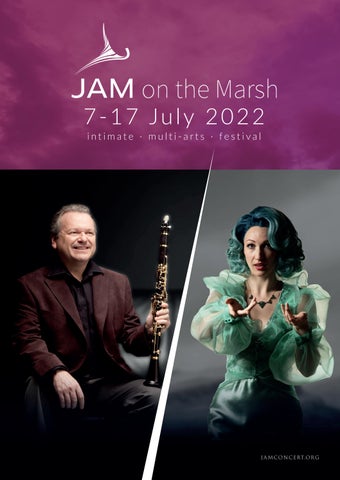
7-17 July 2022 intimate · multi-arts · festival
j a m co n cert.or g
Thank you to our Partners
JAM has been enabling, promoting and supporting multi-arts in the UK for over 20 years with the help from these important partners.
JAM is a Registered Charity: 1096150
Thank you to our Supporters JAM is exceedingly grateful to the following individuals whose generosity enables our work.
Commissioning Patrons Nicola Armitage Marah Dickson-Wright Richard & Angie Fry Malcolm & Charlotte Watkinson John Parke Wright IV
Patrons
Benefactors
Charles Cochrane Robert Colvill Mark & Jenny Dumenil Richard & Celia Duncan Iris Imbert Graham & Marion Jackson Alex & Jill Mackay Dan & Marianna Wiener Martin & Sarah Young
Louise Barton Jane Burnet Douglas Chapman Michael & Angela Crow Richard Goodall John Gordon Alex Gordon-Shute Ann Guest Penelope Hamiliton & Andrew Parker Isabel Henniger Lyn Lauffer
Marion Lovell Marianne More-Gordon Charles Morris Robert Phillips Robert Myers & Robert Plowman Paul & Pauline Reynolds Wendy Richley Victoria Salem & R Turvey Jeremy & Valerie Shaw Mike Sharpe & Tricia Spain David & Jenny Tate Imogen & Roger Taylor
Friends of JAM Richard Alderton Pearl Anderson Dennis Andrews Teresa Baker Derek & Carole Collins-Biggs Kenneth & Margaret Bird Stuart & Ann Bilsland Peter Bristowe Virginia Brown John Busby Brian Bussey Hazel Butcher Joe & Rita Butterworth Peter Callery Chris & Diana Castle Jean Chippindale Gaynor Cobb Jayne Cohen Jeremy Coltart Willie Cooper Geraldine Curtis
Sue Danby Nicholas Davey Mark & Carol Dennis Gawain & Nicolette Douglas Sian Edwards Jim Eustace David Firminger William Fittall Michael Foad Richard Fosbery Richard & Carolyn Frewer Moira Gaines Michael Gamble Diana Garnham Steve Gasson Adrian & Pat Goodsell Ian Gordon David Harman Jeanette Harris
Anna Hazelden David Hill Tom Hoffman Elizabeth Hopkin Antony Hughes Brin Hughes Regina Jaschke Barbara Kempston Ian Mella Gary & Edith McCarthy Linda McCubbin Paul McIntyre Tina Metcalfe Michael & Susannah Miller Valerie Miller Dimity Morgan Ivan & Mary Moseley Kirsten Offer Andrea Ottermayer Ann Paddick
Roxanna Panufnik Wendy Parsons Philip Raymont Ray & Jane Rivers Christopher & Jocelyn Rowe Josephine Rowling Peter & Marianne Sander Helen Severs Reece & Jane Shearsmith Ingrid Slaughter Georgia Small Nigel & Jane Spencer Judith Statt Raman Subba-Row Nick Thomas Richard & Catherine Thomas Sheila & Nigel Turley Eve Wilson Elizabeth & Nathan Winters
Please consider supporting us to help JAM continue our mission. To join this vital group of supporters and make a real difference to our work as a charity, please visit: jamconcert.org/support
Welcome It gives me huge pleasure to welcome you to JAM on the Marsh 2022. Let us celebrate the arts! This season features composers who were oppressed by war, silenced by prejudice, inspired by revolution, liberated by change and plagued by controversy - but all of whom expressed their experiences through their music, resulting in works full of drama, love, beauty, melancholy, excitement, energy and hope. Prepare to be amazed over the next ten days by many incredible international artists alongside emerging stars of the future, across diverse styles and genres. Your experience will be further enhanced by the charm and history of Romney Marsh and the beautiful mediaeval churches in which the events take place. I am delighted to be welcoming back festival regulars such as the London Mozart Players with clarinetist Michael Collins, Changeling Theatre, Onyx Brass, Ashford Youth Jazz Orchestra, VOCES8, singers James Gilchrist and Rebecca Afonwy-Jones and the young Fibonacci quartet, who wowed the festival audience with their concert last year. In addition, I am incredibly excited to introduce some dear friends and colleagues to the festival. The sensational soprano Lucy Crowe, this year alone has sung a principal role at the Metropolitan Opera, New York, has given concerts with the Berlin Philharmonic Orchestra, Los Angeles Philharmonic and the London Symphony Orchestra. Norwegian violinist Elise Båtnes and British cellist Louisa Tuck are the Leader and Principal Cellist of the Oslo Philharmonic Orchestra, and join us for three chamber concerts covering a huge range of repertoire. JAM on the Marsh festival would not be complete without an exciting world premiere. We celebrate Judith Bingham’s 70th and Michael Collins 60th birthdays with her new Concerto for Clarinet. The Holst Singers join us for the first time to celebrate Paul Patterson’s 75th birthday with a performance of his The Fifth Continent. The festival closes with the fabulous, fun London Tango Quintet. We hear poetry from the Tang Dynasty to the present day, delight in Oscar Wilde’s farcical comedy, The Importance of Being Earnest and celebrate Edith Sitwell’s wonderfully eccentric verse in a performance of William Walton’s Façade, in the centenary year of the first performance. JAM’s remains steadfastly committed to its mission of bringing world class performances to this unique area and uniting artists and audiences in these medieval venues, whilst providing hands-on music education to school children and students. Vital to the ethos of JAM are education projects. This summer there are composition workshops, school events and student masterclasses - opportunities for those of any age to join in and take part. The musicians and artists are thrilled to perform again and to make that wonderful connection through words and music with their audience. I am so looking forward to seeing old friends and making some new ones over the next ten days! I hope you enjoy all this festival has to offer.
Anna Tilbrook Festival Curator 2021 & 2022
2022 FESTIVAL EVENTS 7 JULY · THURSDAY
Page
2:00pm
The Temple Lecture & Poetry Recital by Gawain Douglas
St Mary in the Marsh
8
3:00pm
Open Rehearsal with the Fibonacci Quartet
St Leonard · Hythe
9
4:00pm
Still Further C.J. Driver, poet
St Mary in the Marsh
10
7:00pm
The Importance of Being Earnest Changeling Theatre
Old School · New Romney
11
Cinemarsh Marsh Academy Leisure Centre
13
8 JULY · FRIDAY 2:45pm
Short Film Competition Finalists Free Public Screening
7:00pm
Mendelssohn & Shostakovich Fibonacci Quartet with Elise Båtnes, Ellie Fagg, Louisa Tuck, Rachel Roberts & Anna Tilbrook
St Leonard · Hythe
14
St Nicholas · New Romney
17
9 JULY · SATURDAY 1:00pm
Clara & Clarke Elise Båtnes, Louisa Tuck & Anna Tilbrook
Meet the Artists (2:30pm, following Clara & Clarke) Maureen Jordan, artist John Ballard, painter
61 55
2:00pm
Choral Composition Workshop with VOCES8 & Paul Mealor
St Leonard · Hythe
19
6:00pm
Meet the Artist Angela C Smith, sculptor
St Leonard · Hythe
59
7:00pm
VOCES8 Stardust
St Leonard · Hythe
21
St Clement · Old Romney
23
10 JULY · SUNDAY 3:00pm
Duo for Violin & Cello Elise Båtnes & Louisa Tuck
Meet the Artists (3:00pm, following Duo for Violin & Cello) Penny Graham, ceramist 4 New Mosaics with Yolanda Houston & Didier Rochard
57 65
11 JULY · MONDAY 7:00pm
Ashford Youth Jazz Orchestra
St Leonard · Hythe
25
2:00pm
Opening Night St Nicholas · New Romney Brookland & St Nicholas Primary Schools with Onyx Brass
26
7:00pm
Czech Mate Fibonacci Quartet with Anna Tilbrook
29
13 JULY · WEDNESDAY
St Dunstan · Snargate
14 JULY · THURSDAY 7:00pm
Façade St Leonard · Hythe Lucy Crowe, James Gilchrist, JAM Sinfonia & Anna Tilbrook
31
15 JULY · FRIDAY 7:00pm
St Nicholas · New Romney
42
St Leonard · Hythe The Fifth Continent with The Holst Singers, Onyx Brass & Nicholas Cleobury
45
London Mozart Players with Michael Collins
16 JULY · SATURDAY 7:00pm
17 JULY · SUNDAY St Nicholas · New Romney
50
f_off_cancer Clare Cosson
Marsh Academy Leisure Centre
53
Abstract John Ballard
St George · Ivychurch
55
St Clement · Old Romney
57
Sculpture Angela C Smith
St Leonard · Hythe
59
Voix Celestes Maureen Jordan
St Nicholas · New Romney
61
Retrospective Series Carsten Birkebaek, Tristan Fewings, Amos Miller, Susan Pilcher, Justin Sutcliffe
Carriages of the Romney Hythe & Dymchurch Railway
63
The Marsh Churches’ Mosaics Trail
14 Churches of the Romney Marsh
65
3:00pm
London Tango Quintet
EXHIBITIONS 7-17 July, Daily 10-5pm
Earth from Space Penny Graham
How to book ONLINE:
jamconcert.org BY PHONE:
0800 988 7984 FOLLOW the FESTIVAL @jamonthemarsh_uk @JAMontheMarsh @JAMontheMarsh
Festival Shuttle Bus Take the high-speed train from London St Pancras to Ashford International, then jump on JAM’s shuttle bus to the mediaeval church venues - only one hour from London. Enhanced Tickets including shuttle & programme for: 8 July: Mendelssohn Octet & Shostakovich Piano Quintet 9 July: VOCES8 14 July: Façade with Lucy Crowe & James Gilchrist 15 July: London Mozart Players & Michael Collins 16 July: The Holst Singers & Nicholas Cleobury 17 July: London Tango Quintet
The Temple
with Lord Gawain Douglas 7 July · Thu · 2:00pm St Mary the Virgin
St Mary in the Marsh TN29 0BX
£10 · STANDARD
under 18s free
(approximately 60 min)
Lord Gawain Douglas returns to JAM on the Marsh with a fascinating first event to open the festival. He delivers a talk and recital on The Tang Dynasty Chinese poet Po Chu-i, and his remarkable 20th century translator/re-creator, the polymath Arthur Waley. The talk is interspersed with the recitation of various short poems and concludes with the masterpiece The Temple, an account of Po Chui’s ‘s ascent with friends to a temple at the top of a perilous mountain, ‘Wang Shun’s Hill’. Po Chu-i was many things: a Buddhist, a poet, a musician, a mountaineer, a naturalist, a lover of wine, a humorist, and a serious depressive. He had a lifelong conflict between the demands of the world and officialdom and his poetry, and the deeper call to transcendence; and to find this transcendence in the freedom of hills and streams. He finds his illumination in The Temple, a work of radiant joy, but as is usually the case, it fades, as he probably knew it would. He falls back into the world’s mire. Buddhist or Christian, we are imperfect beings. The talk highlights the remarkable commonality of thought and feeling between the modern English mind and a Chinese government official and poet 1200 years ago; also the extraordinary feat of recreation by Arthur Waley in the transmission of that duality in one stream of thought and language. Lord Gawain Douglas is a teacher, performing poet and musician. His recitations include the Sonnets of Shakespeare, T.S. Eliot’s Four Quartets and The Waste Land.
8
Poetry
Open Rehearsal
with the Fibonacci Quartet
7 July · Thu · 3:00pm St Leonard Hythe CT21 5DL
Free Event
(approximately 60 min)
Elise Båtnes, violin Ellie Fagg, violin Rachel Roberts, Viola Louisa Tuck, cello Fibonacci Quartet Luna De Mol, violin Kryštof Kohout, violin Ami-Louise Johnsson, viola Kosta Popović, cello
The Fibonacci Quartet made its festival debut last year with a sold-out concert at St George’s Church, Ivychurch. This year, JAM on the Marsh is giving this vibrant, young quartet the opportunity of being mentored by and performing with guest artists of the Oslo Philharmonic. In this open rehearsal, the Fibonacci Quartet will work on Mendelssohn’s Octet in E-flat Major, Op.20 with: Elise Batnes (violin), Ellie Fagg (violin), Rachel Roberts (viola) and Louisa Tuck (cello). The full concert will take place on Friday, 8 July. On Wednesday 13 July, the Fibonacci Quartet will perform a Czechoslovakian programme with pianist and Festival Curator, Anna Tilbrook. JAM on the Marsh believes passionately in supporting and enabling the future of the arts. This education project is one of four that are happening during this year’s festival, working with primary school children through to emerging talented composers and performers.
Education
9
Still Further with C.J. Driver
7 July · Thu · 4:00pm St Mary the Virgin
St Mary in the Marsh TN29 0BX
£10 · STANDARD
under 18s free Proceeds go to the Hantam Community Education Trust in the Karoo, South Africa
(approximately 60 min)
C.J. Driver, also known as Jonty, returns to the festival giving a poetry recital of his own works. A firm favourite of festival audiences, Jonty performs in the intimate space of St Mary the Virgin, St Mary in the Marsh. Still Further Imbued with a sense of history – not to mention an ample wit and sharp eye for irony – C.J. Driver’s first full collection of poems since 2005 is cause for celebration. Selected from the many poems Driver has written and published in magazines, booklets and anthologies since his professional retirement in 2000, Still Further manages to take in the international scope of his many careers: as anti-apartheid activist, teacher, headmaster, writer and poet. While showing an impressive range of formal poetics, weighty philosophy, and Driver’s trademark political forthrightness, this is a recital bound by love, replete with reflections on family, companionship, and old friends remembered. As such, these poems do not just portray one of South Africa’s great living poets: Still Further is a testament to the value of people – no matter how great or humble – whose shared lives and histories make one’s own life worth living. Jonty Driver was born in Cape Town in 1939. He was President of the antiapartheid National Union of South African Students in 1963-4, and during that time was detained in solitary confinement by the security police. The renewal of his passport was refused when he was at Oxford in 1967. He became stateless for five years. His first two novels were banned in South Africa and, even after becoming a British citizen, he was refused permission to visit his home country until after the end of apartheid. Driver has been a productive and increasingly celebrated writer, publishing five novels, two biographies, two memoirs and twelve collections or booklets of poems. For more information, please visit: jontydriver.co.uk
10
Poetry
Oscar Wilde’s
The Importance of Being Earnest 7 July · Thu · 7:00pm Old School Garden
New Romney TN28 8ER
£20 · STANDARD
under 18s free
(approximately 155 min)
Changeling Theatre returns on the opening night of the festival, bringing its brilliant, irreverent and fun new production of Oscar Wilde’s classic play, The Importance of Being Earnest. This Kent-based theatre company is a professional touring theatre company serving community audiences across the South East. The truth is rarely pure and never simple. To be successful in love is to be called Ernest. Or so it is in Oscar Wilde’s satirical masterpiece following the story of two eligible bachelors, Jack and Algy. In love with two women who conveniently claim to only love men named Ernest, Jack and Algy create alter egos called Ernest to win their hearts. But it is a struggle to keep up with their own stories and they quickly become tangled in a tale of deception, disguise and misadventure. The frankly bonkers plot of this play mocks Victorian sensibilities with some of the best loved and ludicrous characters to be found on the modern stage. And if that has not sold it to you, there is always that line about the handbag.
Theatre
11
Changeling Theatre
Cast
Changeling Theatre was founded in 1997 to produce high-quality, entertaining theatre
Algernon Moncrieff
in non-traditional locations for underserved community audiences across South East England. Over the years, Changeling has taken theatre beyond the stage, creating sitespecific performances in public locations such as Chatham Dockyard, Dover Castle, Maidstone Football Ground and Boughton Monchelsea Place, as well as community parks, private homes and gardens. Changeling is a talent lab, providing a critical springboard for emerging talent from all disciplines and backgrounds. “Changeling offers something rarely found in contemporary theatre. They offer audiences a chance to become part of the atmosphere.” - Dame Janet Suzman DBE.
Noah Marullo
Lane/Merriman Tom Mahy
John (Jack) Worthing J.P Enzo Benvenuti
Lady Bracknell
Kathryn Perkins
Gwendolen Fairfax Stephanie Lyse
Miss Prism
Phoebe Elliott
Cecily
Annabelle Blake
Dr Chasuble Tre Medley
Company Director
Robert Forknall
Production Stage Manager James Keill
General Manager Dawn Archer
Casting Director Sarah Harkins
Costume
Alice McNicholas
Set
Ethan Cheek
Music
Lydia Barton Lovett
Choreography Julia Cave
Marketing Colley Raine
Graphic Design Dan Bull Vanessa Brown
Photography Nic Dawkes
Branding
Jill Hogan
Tour Photographer Susan Pilcher
Company Stage Manager Emily Davies
12
Theatre
Short Film Competition 8 July · Fri · 2:45pm Cinemarsh
Marsh Academy Leisure Centre TN28 8BB
Free Public Screening Booking required
(approximately 60 min)
JAM on the Marsh, in collaboration with Screen South, held its second Short Film Competition 2022. Over the past six months, this has involved six free masterclasses on different aspects of filmmaking and two days in the field, giving practical experience to the participants. Following these masterclasses, a Short Film Competition opened, giving the opportunity for anyone to submit films, judged and critiqued by industry professionals. Today is the culmination of the project, with the first public screening of films made by the finalists of the Short Film Competition. Films contain footage from the Romney Marsh and are a maximum of 10 minutes in duration. For the duration of JAM on the Marsh, the top three films will precede the feature film at Cinemarsh, giving the public the opportunity to see films made by emerging talent.
Film Participants I Heard the South Sing
Amateur
by Anthony Powell
by Helen Walling-Richards
A Bird’s Eye View
A Quest of Thomas Edgar’s Headstone and Grave at All Saints’ Church, Lydd by Andrew Diack
by The Guyll Team
The Romney Marsh Fairy by Susan Maxwell-Stewart
Wrecks of Romney Marsh by Dominic Rees-Roberts
Time by James Pearce Forever Sail the Stars by Mike Hardy
Film
13
Mendelssohn & Shostakovich 8 July · Fri · 7:00pm St Leonard Hythe CT21 5DL
£20 · STANDARD £25 · ENHANCED
under 18s free
(approximately 60 min)
Elise Båtnes, violin Ellie Fagg, violin Rachel Roberts, Viola Louisa Tuck, cello Anna Tilbrook, piano Fibonacci Quartet Luna De Mol, violin Kryštof Kohout, violin Ami-Louise Johnsson, viola Kosta Popović, cello 14
Music
Yesterday, the hugely talented, young Fibonacci Quartet had the privilege of being mentored and inspired by four of the most exceptional, internationally renowned string players. Tonight, they will come together to perform the innovative and exhilarating Octet in E-flat Major, Op.20 by Felix Mendelssohn. Felix Mendelssohn (1809-1847) Octet in E-flat Major, Op.20 I. Allegro moderato ma con fuoco II. Andante III. Scherzo: Allegro leggierissimo IV. Presto Dimitri Shostakovich (1906-1975) Piano Quintet in G minor, Op.5 I. Prelude II. Fugue III. Scherzo IV. Intermezzo V. Finale
The opening Allegro is exhilarating with its soaring first violin line. The Andante in a modified sonata form provides with its ethereal beauty, a soothing reprise from the opening movement. Mendelssohn took inspiration from Goethe’s Faust in the Scherzo with the music representing Walpurgis Night’s Dream. It is marked to be played fast, and as light as possible. In the final movement, the eight-part fugue quotes Handel’s Messiah with the melody of “And he shall reign forever and ever” from the Hallelujah Chorus. For the second part of this programme, Festival Curator Anna Tilbrook joins Elise, Ellie, Rachel and Louisa for a performance of Shostakovich’s Piano Quintet in G minor, Op.5. Written in 1940, it has become one of his best-known and loved works. He wrote it for the Beethoven Quartet who premiered it with Shostakovich himself at the piano at the Moscow Conservatory on 23 November 1940. The work is packed full of intense emotion - passion, pain, melancholy, darkness, sarcasm, beauty and irony. But we journey through all this to arrive in a more cheerful, happier state in the last movement.
Composed in 1825 when he was just 16 years old, Mendelssohn’s Octet in E-flat Major, Op.20 created a new genre of chamber music. Conrad Wilson (writer and music critic) describing the work said, “it’s youthful verve, brilliance and perfection makes it one of the miracles of nineteenth-century music”. This thrilling and exciting work in four movements is full of interplay between eight performers making it a visual as well as aural delight to experience. In the manuscript Mendelssohn wrote: “The octet must be played by all instruments in symphonic orchestral style. Pianos and fortes must be strictly observed and more strongly emphasized than is usual in pieces of this character.”
The opening Prelude suggests a Bach organ toccata with a solemn, dramatic flourish for the piano. The strings join in and provide a counterweight. A slightly faster, more playful section based on a related theme ensues, but the opening solemnity returns. The Fugue follows with its theme presented by the muted first violin, a traditional Russian song. Gradually each of the other strings enters and then the piano, and the music unfolds slowly in an unbroken line. The Scherzo is modeled after Beethoven, though the piano tune against the aggressive strings is pure Shostakovich, as is the middle section, a folk-dance-like tune for the first violin. The Intermezzo has an extended theme played by the first violin, initially accompanied by cello pizzicato and then by the other instruments in an interweaving of voices. A steadily repeated quarter-note pattern in the accompaniment adds to the dignity. The main theme of the Finale has two elements – one introduced by the piano and one by the strings. The latter strain is derived from a tune traditionally played at the entrance of the clowns in the Russian circus, and its familiarity may account for the quintet’s immediate public popularity.
JAM on the Marsh
15
Elise Båtnes
Ellie Fagg
Rachel Roberts
Elise Båtnes comes from Trondheim in Norway and started playing the violin when she was four years old. She appeared as a soloist with the Oslo Philharmonic Orchestra for the first time when she was ten and has since performed as a soloist with all the Norwegian and many international symphony orchestras. Elise has studied with a number of influential violinists. The greatest influence on her development as a musician she attributes equally to the Oslo Philharmonic and its long-standing chief conductor Mariss Jansons. Elise is the Concertmaster (leader) of the Oslo Philharmonic. For more information, please visit: ofo.no/en/musicians/1-violin/elise-batnes
Described by the Strad magazine as playing ‘with a sense of enchantment’, Ellie Fagg enjoys a varied career performing around the world as a soloist, chamber musician and orchestral player. Her love of chamber music began at the age of seven at Pro Corda and she went on to lead the National Youth Orchestra in 2001. Ellie has toured extensively with the London Symphony Orchestra. With the Puertas Quartet she made three tours of New Zealand and recorded two CDs on Atoll records to critical acclaim. She plays on a 1715 Daniel Parker violin which once belonged to Fritz Kreisler. For more information, please visit: EnSEmble26.com
Violist Rachel Roberts performs as a soloist and chamber musician in the world’s leading venues and is a regular guest at international chamber music festivals. Prizes and accolades for her chamber music recordings include twice being awarded the coveted Diapason d’Or, BBC Chamber Choice in BBC Music Magazine and CD of the month in Fonoforum magazine, Germany. Rachel is the violist with award-winning chamber group Ensemble 360, and as such appears regularly at Wigmore Hall and the Crucible, Sheffield. She is Professor of Viola at the
Louisa Tuck
Anna Tilbrook
Fibonacci Quartet
Louisa Tuck grew up with a mother who was a professional clarinetist, but at seven years old, she decided she would rather play the cello. Her teacher at the Royal Academy in London, Paul Watkins, has had the greatest influence on her as a musician. After eight years as principal cellist of Royal Northern Sinfonia, she joined the Oslo Philharmonic as principal cellist in 2015. “I’m British and I really love Elgar, Finzi and many of the early 20th century British composers. However, I’m really enjoying exploring the great canvas of Norwegian music I’m getting to know now.” For more information, please visit: ofo.no/en/musicians/cello/louisa-tuck
Anna Tilbrook is one of the UK’s leading pianists, specialising in chamber music and song. Since her debut at the Wigmore Hall in 1999, she has become a regular visitor to all the major concert halls and festivals working with a huge variety of internationally-renowned musicians. In 2022 Anna is celebrating a 25-year performing collaboration with tenor James Gilchrist and 22 years with soprano Lucy Crowe. Anna’s prolific discography is regularly heard on BBC Radio 3, whilst also giving frequent live broadcasts and curating series of concerts for them. This is her second year as curator of JAM on the Marsh. For more information, please visit: annatilbrook.co.uk
Violin
Cello
16
JAM on the Marsh
Violin
Piano
Viola
Guildhall School of Music & Drama, and a fellow of the Higher Education Academy. For more information, please visit: rachelrobertsviola.co.uk
Founded in London in 2019, the Fibonacci Quartet brings together Czech, Belgian, Swedish and Montenegrin nationalities. The quartet is coached by Krysia Osostowicz at the Guildhall School of Music & Drama and is a part of the Dutch String Quartet Academy (NSKA). Competition successes include first prizes and special awards in the Beethoven Competition in London, Saint James Chamber Music Prize as well as the international “Triomphe de l’Art“ Chamber Music Competition in Brussels. The Fibonacci Quartet is supported by the Adami grants for artistic development as well as the British charity, Talent Unlimited. Since 2021, the quartet is a part of the “Le Dimore del Quartetto” network.
Clara & Clarke 9 July · Sat · 1:00pm St Nicholas
New Romney TN28 8AR
£15 · STANDARD
under 18s free
(approximately 60 min)
Elise Båtnes violin
Louisa Tuck
Two phenomenally talented, inspiring women, Clara Schumann (1819-1896) and Rebecca Clarke (1886-1979) are featured in this lunchtime concert. As is the case with so many women composers, it is only relatively recently that their music has been regularly heard in the concert hall and, as you will hear this afternoon, that is a huge shame and very unjust. Rebecca Clarke (1886-1979) Piano Trio I. Moderato ma appassionato II. Poco lento e molto semplice III. Allegro vigoroso
cello
Anna Tilbrook
piano
Clara Schumann (1819-1896) Piano Trio I. Allegro moderato II. Scherzo and Trio III. Andante IV. Allegretto
Music
17
Rebecca Clarke was a wonderful viola player and one of the first professional female orchestral musicians, invited by Sir Henry Wood to play in the Queen’s Hall orchestra in 1912. In 1916 she moved to New York to pursue her performing and composing career. Due to the prejudice facing women, as an experiment, she wrote some works under the pseudonym Anthony Trent, and found reviewers praised the “Trent” but largely ignored the works credited to Clarke. In fact, two of her finest works, the Viola Sonata (1919) and the Piano Trio (1921), were entered into a composition competition - one of 72 entries. Both pieces, submitted under the name Trent, were awarded second place and both times the judges and press were incredulous to discover that such beautiful works had actually been composed by a woman. It was speculated to be more likely that “Anthony Trent” was in fact a pseudonym for either Maurice Ravel or Ernest Bloch, both an insult and a compliment to Clarke. The works are now regarded as some of the finest of their genre in the repertory, but it is only since the Rebecca Clarke Society was established in 2000 that much of what she wrote has been published. The Piano Trio is a wonderful work, the music displaying outstanding craft, originality, drama and character, full of contrasting moods, likely to be a reflection on WWI with its utter devastation and trauma and the aftermath of sorrow but also hope. One wonders what Rebecca Clarke might have become in a more modern age. Clara Schumann was a pianist, championed by her father who was very keen to show off the prodigious talent his daughter possessed. He arranged European concert tours for her from a very young age and she continued to perform at the highest level for half a century. Her compositions, however, were never played by anyone other than herself and were largely forgotten until a resurgence of interest in the 1970s. The Piano Trio in G Minor, a complex and beautifully written work that shows her mastery both of counterpoint and of the long melodic line. The sonata-form first movement is filled with Romantic ardour, from its urgent lyrical themes tinged with longing, to its vigorous contrapuntal development section, to its brief, driving coda. The Scherzo – “in the tempo of a minuet” – is a surprisingly gentle movement, marked by playful dotted rhythms and a more lyrical trio. The Andante is a Romantic Song without Words with an agitated middle section and some lovely writing for all three instruments. Clara puts her study of counterpoint to impressive use in the animated last movement, which opens quietly, develops dramatically in a fugal central section, and ends elegantly on an uplifting major chord.
See page 16 for performer’s biographies
18
JAM on the Marsh
Choral Composition Workshop
with VOCES8 & Paul Mealor 9 July · Sat · 2:00pm St Leonard Hythe CT21 5DL
Free Event
no booking required
(approximately 180 min)
For the second year, JAM is presenting its Masterclass Series in Composition in collaboration with one of the great vocal groups, VOCES8. This follows the success of JAM’s first Masterclass Series in Composition for brass quintet and organ, led by Onyx Brass, Francesca Massey and Paul Mealor in 2021. Earlier this year JAM and VOCES8 created a series of videos highlighting good and bad compositional techniques with practical solutions. This free resource is available on jamconcert.org where the videos will remain, alongside the ones for brass and organ writing, for any budding composer to use. In May, JAM’s call for choral sketches closed, following a large number of submissions. From this call, six emerging composers have been chosen to have their sketches workshopped by VOCES8 under the guidance of Paul Mealor, one of the UK’s most performed composers. Each of these composers will then be asked to finish their compositions for a performance in October, at St. Bride’s Church, Fleet Street. Following this performance, one of the composers will be awarded the President’s Commission by Paul Mealor. Education
19
Masterclass Series Welcome Paul Mealor
JAM PRESIDENT
Welcome to JAM’s second, annual workshop day, part of JAM’s Masterclass Series. In 2002, I successfully submitted to JAM’s annual Call for Music leading to my first performance with JAM. Following another successful submission in 2004, I received a commission from JAM in 2010 for the choral cycle, Now Sleeps the Crimson Petal, dedicated to Ed and Sarah Armitage. It was this cycle that Their Royal Highnesses The Duke and Duchess of Cambridge heard which prompted them to invite me to adapt the first movement into Ubi caritas, which was subsequently performed at their wedding in 2011. Over the next decade, I have received several JAM commissions: The Farthest Shore (2013), Shadows of War (2015), To Seek Where Shadows Are (2016) and Piano Concerto (2020). I was absolutely thrilled to become President of JAM in 2020, and as such, to set up the President’s Commission, offering an annual commission to emerging composers. Last year I was delighted to ‘lead’ JAM’s first Masterclass Series, working alongside Onyx Brass and Francesca Massey. We had a wonderful day working with six composers on sketches written for brass or organ, here at St Leonard’s Church. The completed pieces were performed by Onyx and Francesca in October at St Bride’s Church, Fleet Street. Janet Wheeler, one of these six composers was then offered the first President’s Commission, leading to a new piece premiered by Onyx Brass during JAM’s Music of Our Time concert in March. 2022’s Masterclass series covers writing for voices, and what better group could we collaborate with than VOCES8. Today VOCES8 and I will work with six composers on their sketches that were chosen from a submission process earlier this year. Following last year’s blueprint, the final six completed pieces will be premiered in London later this year, and one of the composers will be offered the second President’s Commission. The resulting piece will again be premiered at JAM’s Music of Our Time concert in March next year. I am thrilled to be involved with this dynamic composition project, set up to enable composers in the UK.
2022 Masterclass Participants
20
Christopher Churcher
Tara Creme
Henrik Dahlgren
Christopher Churcher is a Birminghambased composer, whose music has recently been performed at the Ludlow English Song Weekend 2022, the Cadogan Hall and Royal Holloway Chapel. In 2022 he won the NCEM Composer’s Competition; the winning piece – Arborescent – will be broadcast on Radio 3 in November.
Tara Creme has worked in a number of genres and is especially known for her music for film. Her concert work has been performed at St Magnus International Festival, Leicester International Concert Series and Borough New Music, with collaborators including Hebrides Ensemble, Charles Owen, John Anderson, Kamilla Arku and COMA.
Henrik Dahlgren is an award-winning Swedish composer who studied at the Malmö Academy of Music, London’s Royal College of Music as well as University of Aberdeen where he is currently pursuing a PhD in Music. Henrik is working with various ensembles all over the world and his music is published by Gehrmans Musikförlag as well as Bo Ejeby Förlag.
Jack Ledger-Dowse
George Parris
Chris Williams
Jack Ledger-Dowse DipABRSM is a composer based in London, UK. He is a Humphrey Searle scholar of the Royal College of Music, London, studying Composition and Composition for Screen, and was formerly a composer with the National Youth Orchestra of Great Britain.
George Parris is a prize-winning composer from Nottingham. His music has seen performances in London and by Ad Solem chamber choir in Manchester. Having graduated from the University of Manchester in 2021, George is looking forward to studying at the Royal Academy of Music in September.
Chris Williams is a graduate of the Sydney Conservatorium and the University of Oxford, he has been commissioned by Carnegie Hall, and was one of only six composers worldwide to be selected by Sir Peter Maxwell Davies to attend his Advanced Composition course at the Dartington International Summer School.
Education
VOCES8 Stardust
9 July · Sat · 7:00pm St Leonard Hythe CT21 5DL
£20 · STANDARD £25 · ENHANCED
under 18s free
(approximately 90 min)
It is an absolute pleasure to welcome VOCES8 back to JAM on the Marsh. The group needs little introduction, as it is one of the most popular vocal ensembles in the world. With an on-going programme of recordings, videos and live broadcasts, VOCES8 is heard regularly on albums, international television and radio, as well as maintaining a vibrant web performance presence with its Live from London series. The ensemble is a Decca Classics artist and alongside releases on its own label, VOCES8 Records, has released acclaimed recordings that have all reached the top of the classical charts. This wide-ranging recital connects natural and spiritual regeneration, recognising loss, beauty, love and joy. Music from the Renaissance to the present day comes from England (Byrd, Britten, Parry and Dove), Germany (Schütz, Schubert and Rheinberger), Scandinavia and Iceland (Alfvén and Sigurbjörnsson). Jazz standard arrangements come from the USA and Taylor Scott Davis’ 2021 commission that gives us the programme’s title. VOCES8 will announce the programme for this evening.
Music
21
William Byrd (1543-1623) Laudibus in Sanctis
Sir Charles Hubert Hastings Parry (1848-1918) My Soul there is a Country Jonathan Dove (b.1959) Vertue (Commissioned for VOCES8)
Nat ‘King’ Cole arr. Jim Clements Straighten Up and Fly Right arr. Alexander L’Estrange Come Fly with Me (to the Moon) Paul Mealor (b.1975) Locus iste Taylor Scott Davis (b.1980) Stardust (Commissioned for VOCES8) Giovanni Pierluigi da Palestrina (1525-1594) Magnificat Primi Toni
- INTERVAL -
Heinrich Schütz (1585-1672) Selig sind die Toten Josef Rheinberger (1839-1901) Kyrie from the Mass in E-Flat
Benjamin Britten (1913-1976) The Evening Primrose Hugo Alfvén (1872-1960) Aftonen Þorkell Sigurbjörnsson (1938-2013) Heyr, hymn smi∂ur Mumford & Sons arr. Jim Clements Timshel Jerome Kern arr. Jim Clements I Won’t Dance Al Jolson arr. Jim Clements Me and My Shadow
VOCES8 The British vocal ensemble VOCES8 is proud to inspire people through music and share the joy of singing. Touring globally, the group performs an extensive repertoire both in its a cappella concerts and in collaborations with leading orchestras, conductors and soloists. Versatility and a celebration of diverse musical expression are central to the ensemble’s performance and education ethos. VOCES8 has performed at many notable venues in its 15-year career, including Wigmore Hall, Elbphilharmonie Hamburg, Cité de la Musique Paris, Vienna Konzerthaus, Tokyo Opera City, NCPA Beijing, Sydney Opera House, Mariinsky Theatre Concert Hall, Victoria Concert Hall Singapore, Palacio de Bellas Artes Mexico City amongst many others. For more information, please visit: voces8.com
22
JAM on the Marsh
Andrea Haines · soprano Molly Noon · soprano Katie Jeffries-Harris · alto Barnaby Smith · artistic director & countertenor Blake Morgan · tenor Euan Williamson · tenor Christopher Moore · baritone Jonathan Pacey · bass
Duo for Violin & Cello 10 July · Sun · 3:00pm St Clement
Old Romney TN29 0HP
For the final chamber concert of this first weekend, Elise Båtnes (Leader of the Oslo Philharmonic) and Louisa Tuck (Principal Cellist of the Oslo Philharmonic) bring
an eclectic recital to one of the Marsh’s most intimate churches, St Clements’ Church, Old Romney.
£15 · STANDARD
under 18s free
(approximately 60 min)
Spare Olsen (1903-1984) Folkstone fra Lom
Elise Båtnes violin
Louisa Tuck
Howard Skempton (b.1947) Six Figures for Solo Cello
cello
Reinhold Glière (1875-1956) Selected Morceaux (Duos) pour Violon et Violoncelle, Op,39 Zoltán Kodály (1882-1967) Duo for Violin and Cello, Op.7 Johan Halvorsen (1864-1935) Passacaglia for Violin and Cello Music
23
Today’s programme takes a musical postcard trip around Europe. From the snowcapped mountains of Norway to the more familiar sounds of a bustling London street in 1750, via Paris and Budapest. We begin in Lom, deep in the mountain range in central Norway, where the music of Norwegian composer Spare Olsen opens the concert in peaceful tranquility. Moving to modern day, Howard Skempton delights us with Six Figures of Solo Cello. These are six different temperaments in short musical bursts, including a quick soirée into a jazz pizzicato. The Ukrainian born Reinhold Ernest Glière composed this selection of French inspired duos for violin and cello in 1909. Highly emotional and romantically charged, each one flows with colour and love. The centrepiece of the concert is Kodály’s Duo for Violin and Cello. This magnificent piece models perfectly the cross-pollination of Hungarian folk materials and formal structures of art music. It is red blooded and packed full of folk styles and captivating rhythms. Both musicians are constantly playing a game of cat and mouse, ducking and diving to find a musical way to triumph at the end of this ecstatic 3-movement work. The final work is by Norwegian composer, Johan Halvorsen (one of the first principal conductors of the Oslo Philharmonic). His famous Passacaglia for Violin and Cello is inspired by a theme of Handel. This set of variations, equally virtuosic for both instruments, is a firm favourite for all string players. Please note that there are no facilities at this church. The performance will last 1 hour.
Elise Båtnes
Louisa Tuck
Elise Båtnes comes from Trondheim in Norway and started playing the violin when she was four years old. She appeared as a soloist with the Oslo Philharmonic Orchestra for the first time when she was ten and has since performed as a soloist with all the Norwegian and many international symphony orchestras. Elise has studied with a number of influential violinists. The greatest influence on her development as a musician she attributes equally to the Oslo Philharmonic and its long-standing chief conductor Mariss Jansons. Elise is the Concertmaster (leader) of the Oslo Philharmonic. For more information, please visit: ofo.no/en/musicians/1-violin/elise-batnes
Louisa Tuck grew up with a mother who was a professional clarinetist, but at seven years old, she decided she would rather play the cello. Her teacher at the Royal Academy in London, Paul Watkins, has had the greatest influence on her as a musician. After eight years as principal cellist of Royal Northern Sinfonia, she joined the Oslo Philharmonic as principal cellist in 2015. “I’m British and I really love Elgar, Finzi and many of the early 20th century British composers. However, I’m really enjoying exploring the great canvas of Norwegian music I’m getting to know now.” For more information, please visit: ofo.no/en/musicians/cello/louisa-tuck
Violin
24
JAM on the Marsh
Cello
Ashford Jazz Youth Orchestra 11 July · Mon · 7:00pm St Leonard Hythe CT21 5DL
£15 · STANDARD
under 18s free
(approximately 60 min)
Ashford Youth Jazz Orchestra Tom Vafidis conductor
It is a joy to welcome the Ashford Youth Jazz Orchestra (AYJO) back to the festival. Devised by the band leader, Tom Vafidis, the orchestra plays a range of big-band swing and blues numbers, ballads and film themes. Their concert programme is flexible – reflecting the nature of jazz. Principal members of the band will feature in improvised solos. Expect Earth Wind and Fire, Chick Corea, Wes Montgomery, Dizzie Gillespie, Miles Davis, Duke Ellington, Stevie Wonder and more, all announced from the stage. As part of JAM on the Marsh’s education programme, JAM feels that giving young musicians – the future of music – the opportunity to perform in front of a festival audience is incredibly important. In tonight’s concert, and on Wednesday afternoon, we turn the spotlight on young musicians, giving them the chance to revel in performance.
Ashford Youth JAzz Orchestra The Ashford Youth Jazz Orchestra (known to its friends as AYJO) is well known to music lovers in East Kent. Founded in 1984, the orchestra comprises young jazz musicians aged 12 to 18 from the secondary schools in and around Ashford. The orchestra plays regularly at venues throughout the county as well as on summer tours in Europe. Their highest profile appearance to date was in the Music for Youth Schools Prom Concert in the Royal Albert Hall in 2010. Tom Vafidis, the director of music, teaches at Ashford School and took over from John Hall in September of 2017. Tom is a saxophone player and singer, having played in a number of Jazz ensembles throughout his career. The key element in the running of the band remains enthusiasm and enjoyment for playing Jazz music, coupled with the rigour of playing and performing advanced repertoire. Music
25
Timothy Jackson’s
Opening Night
Brookland & St Nicholas Primary Schools with Onyx Brass 13 July · Wed · 2:00pm St Nicholas
New Romney TN28 8AR
Free event
no booking required
(approximately 40 min)
St Nicholas Primary School Brookland Primary School Onyx Brass
Niall Keatley, trumpet Ryan Linham, trumpet Andy Sutton, horn Amos Miller, trombone david gordon-shute, tuba
Rebecca Lodge Birkebaek
Conductor
26
Music
JAM strongly believes in giving children the opportunity to enjoy and perform in the arts. Over the years it has enabled many primary school children to work with some of the UK’s finest musicians and composers. With singing being one of the linchpins in this education work, JAM and Onyx Brass co-commissioned Timothy Jackson’s Opening Night in 2015. This vibrant piece sets six different poems, focusing on performance. It received its first performance in July 2015 in the Marsh Academy Leisure Centre. Since the beginning of 2022, JAM and Rebecca Lodge Birkebaek have been delivering a singing programme into St Nicholas and Brookland Primary Schools. Today’s concert is the end of the first year of the project. This is a two-year project which will culminate in the world premiere of a community oratorio by Richard Peat in July 2023. The performance will include the London Mozart Players, Rebecca Afonwy-Jones (mezzo), Julian Close (bass) and Kudzanayi Chiwawa (actor), conducted by JAM’s Principal Conductor, Michael Bawtree. Timothy Jackson (b.1972) Opening Night 1. Our Teacher Sings the Beatles 2. Conjouring Kevin 3. Circus Clown 4. Trombone Ninja 5. Ballerina 6. Rockstar
1. Our teacher sings The Beatles
3. The Circus Clown
5. Ballerina
Our teacher sings The Beatles. She must know every song. We ask her please to STOP! but she just sings, “It Won’t Be Long.”
The day the circus came to town, my favorite was the circus clown with his great big shoes and funny clothes, a painted face, and a big red nose.
Arched feet Slender legs Perfect posture Softly rounded arms Long elegant neck A Ballerina
A giant smile was painted there, with children laughing, everywhere. I wondered, as I looked at him, was he frowning ‘neath his painted grin?
Flowing fabric Showering roses Bright lights Loud applause Opening Night!
Kenn Nesbitt
And then she croons like Elvis. She clearly thinks it’s cool. And if we beg her not to she just belts out, “Don’t be Cruel.” She then does Michael Jackson. It drives us nearly mad. We have to cover up our ears because she’s singing, “Bad.” It’s all my fault she does this. I feel like such a fool. I wish I’d never brought my karaoke box to school.
2. Conjuring Kevin Gareth Lancaster
The world-renowned Conjuring Kevin, Amazed children from three through eleven. With his rabbits from hats, Or a badger or rat, He would wow and astound half of Devon! But for Kevin things got out of hand, As the creatures he plucked got more grand. An otter, a cow, A horse, then a sow, It was not turning out as he’d planned! Whilst delighting the crowd with his tricks, His hat produced tigers and chicks. A giraffe and a goat, A most displeased stoat, And a mule that gave Kevin a kick! But the hat had not finished, no way. Next a moose, a gnu, birds of prey. A whale and a sloth, And a flurry of moths, Kept coming, to Kevin’s dismay! Kevin stood, muttered words, waved his hands, Whilst surrounded by beasts from all lands. The kids were aghast, At the creatures he’d massed, As the hat just ignored his commands! The WAS-renowned Conjuring Kevin, Still amazes from three to eleven. But no longer with tricks, Does he wish to transfix, As he owns a big zoo down in Devon.
C. J. Heck
Now when I am feeling down, I think about that circus clown with his great big shoes and funny clothes, a painted face, and big red nose. I put a smile on, anyway and soon, my frown just fades away like the day the circus came to town and I learned it watching the circus clown.
4. Trombone Ninja P. M. Rocha
The Trombone Ninja prepares to strike Playing the music he knows you like. The jazzy sounds that escape his barrel Are as cool as an old Christmas carol! The Trombone Ninja! (repeat) The Trombone Ninja prepares to strike Playing the music he knows you like. Beware of his shiny gold trombone Growling as it slides in a radical tone! The Trombone Ninja prepares to strike Playing the music he knows you like. He plays for the entire world to hear That a trombone can be splendid and revered! The Trombone Ninja! (repeat) The Trombone Ninja prepares to strike Playing the music he knows you like. So listen close for the sound my friend: The Trombone Ninja will strike again!
Khauri Teverbaugh
Dance of beauty tired and sore audience yelling ENCORE! ENCORE! Graceful bow Curtains close All go home except A Ballerina Arched feet Slender legs Perfect posture Softly rounded arms Long elegant neck Sleek face tired and sore. Dancing alone All for the beauty of Dance
6. Rockstar
Valerie Garcia Beat out a rhythm With my finger tips, Feel the lyrics Flow from my lips. I do it just for fun When I’m all alone. I’m a Rockstar in my mirror With my hairbrush microphone. And maybe I’ll be a Rockstar, a Rockstar, Maybe, maybe, someday, someday. Or just here in my bedroom I have stage fright anyway. Maybe I’ll be a Rockstar, a Rockstar, Maybe, maybe, someday, someday. I’m a Rockstar in my mirror With my hairbrush microphone. Pump up the volume, No shirt and no pants. Jamming in my socks, My own private dance. I do it just for fun When I’m all alone. I’m a Rockstar in my mirror With my hairbrush microphone. And maybe I’ll be a Rockstar, a Rockstar Maybe, maybe, someday, someday. Or just here in my bedroom I have stage fright anyway. Maybe I’ll be a Rockstar, a Rockstar Maybe, maybe, someday, someday. I’m a Rockstar in my mirror With my hairbrush microphone. JAM on the Marsh
27
Onyx Brass
Rebecca Lodge Birkebaek Conductor
Celebrating its 30th anniversary in 2023, Onyx Brass continues to be the leading light in establishing the brass quintet as a medium for serious chamber music, combining “staggering virtuosity” (Sarah Walker, BBC Radio 3) with the entertaining and articulate style that has become the group’s trademark. The group’s extensive discography has received huge critical acclaim, Gramophone hail “some of the most thrilling chamber brass-playing of its kind” and Record Review (R3) describing the group as a “wonderful, virtuosic brass quintet”. Education has always been central of the remit of Onyx Brass: workshops and masterclasses from Primary School to the Juilliard School, and the group has held several residencies, including 15 years at Imperial College, London. For more information, please visit: onyxbrass.co.uk
28
JAM on the Marsh
Rebecca is a graduate of the Royal Academy of Music, where she studied singing and piano. Her career over the last 25 years has seen her perform in many different venues and styles, from the recital platform to the operatic stage. A former member of the BBC Singers, she broadcast extensively on radio and television, and was most recently a staff member of the Chorus of the Royal Opera House, Covent Garden. Rebecca has a great passion for music education, encouraging and inspiring people of all ages and abilities to improve their singing. She leads several community choirs, and is the conductor of the Intermediate Choir at Finchley Children’s Music Group, London’s leading children’s choir. For more information, please visit: rebeccalodgebirkebaek.co.uk
Czech Mate
Fibonacci Quartet with Anna Tilbrook
13 July · Wed · 7:00pm St Dunstan
We are delighted to welcome the Fibonacci Quartet back for its second concert of the festival, performing with Anna Tilbrook in this wonderful celebration of Czech composers.
£15 · STANDARD
Josef Suk (1874-1935) Meditation on the Old Czech Chorale ‘St. Wenceslas’
Snargate TN29 0EW
under 18s free
(approximately 60 min)
Fibonacci Quartet Luna De Mol, violin Kryštof Kohout, violin Ami-Louise Johnsson, viola Kosta Popović, cello Anna Tilbrook, piano
Leoš Janáček (1854-1928) String Quartet No.1 ‘The Kreutzer Sonata’ Karel Janovický (b. 1930) Piano Quartet Bohuslav Martinů (1890-1959) Selections from The Puppets, H.92 Gustav Mahler (1860-1911) Piano Quartet in A minor
Music
29
The programme features a heartfelt and nostalgic work, written by Josef Suk in 1914, inspired by a 12th century hymn which pleads to their patron saint St Wenceslas for the well-being of the Czech people. Leoš Janáček’s first string quartet was inspired by Leo Tolstoy’s controversial novella “The Kreutzer Sonata”. The psychological drama is depicted by Janáček in music full of conflict, passion and emotion. This is followed by a work written just seven years ago by prolific composer, broadcaster and BBC producer Karel Janovický (b.1930). He grew up in his hometown of Plzeň during World War II. Oppressed and persecuted by the Nazi’s, he was rejected by the then Communist controlled Prague Academy because of his class. In 1949 he fled with his future wife, Sylva Maiwaldová - first to Nuremberg where they were married and then to North London where they have lived since 1950. A selection of Bohuslav Martinu’s delightful and charming “Loutky” (Puppets), which take their characters from the Italian commedia dell’arte, will lead us into the final work of the programme. Bohemian born Gustav Mahler was just 16 years old when he composed what became his only surviving piece of chamber music, the single movement Piano Quartet in A minor. After two or three performances in its year of composition (1876) the manuscript appears to have been lost. Rediscovered in the 1960s by Mahler’s widow, Alma, this melancholic, brooding work is now regularly programmed in chamber music concerts.
Fibonacci Quartet
Founded in London in 2019, the Fibonacci Quartet brings together Czech, Belgian, Swedish and Montenegrin nationalities. The quartet is coached by Krysia Osostowicz at the Guildhall School of Music & Drama and is a part of the Dutch String Quartet Academy (NSKA). Competition successes include first prizes and special awards in the Beethoven Competition in London, Saint James Chamber Music Prize as well as the international “Triomphe de l’Art“ Chamber Music Competition in Brussels. The Fibonacci Quartet is supported by the Adami grants for artistic development as well as the British charity, Talent Unlimited. Since 2021, the quartet is a part of the “Le Dimore del Quartetto” network.
30
JAM on the Marsh
Anna Tilbrook Piano
Anna Tilbrook is one of the UK’s leading pianists, specialising in chamber music and song. Since her debut at the Wigmore Hall in 1999, she has become a regular visitor to all the major concert halls and festivals working with a huge variety of internationally-renowned musicians. In 2022 Anna is celebrating a 25-year performing collaboration with tenor James Gilchrist and 22 years with soprano Lucy Crowe. Anna’s prolific discography is regularly heard on BBC Radio 3, whilst also giving frequent live broadcasts and curating series of concerts for them. This is her second year as curator of JAM on the Marsh. For more information, please visit: annatilbrook.co.uk
Façade 14 July · Thu · 7:00pm St Leonard Hythe CT21 5DL
£20 · STANDARD £25 · ENHANCED
under 18s free
(approximately 70 min)
Lucy Crowe soprano
James Gilchrist Tenor
JAM Sinfonia Anna Tilbrook
Conductor
Music
31
Lucy Crowe makes her JAM on the Marsh debut alongside James Gilchrist, returning after last year’s triumphant performance of Britten’s Serenade for Tenor, Horn and Strings. This concert features two classic works by William Walton: A Song for the Lord Mayor’s Table, marking its 60th anniversary, and Façade, 100 years after its first performance.
Sir William Walton (1902-1983) A Song for the Lord Mayor’s Table 1. The Lord Mayor’s Table 2. Glide Gently 3. Wapping Old Stairs 4. Holy Thursday 5. The Contrast 6. Rhyme
Sir William Walton Façade Fanfare 1. Hornpipe 2. En Famille 3. Mariner Man 4. Long Steel Grass 5. Through Gilded Trellises 6. Tango-Pasodoble 7. Lullaby for Jumbo 8. Black Mrs. Behemoth 9. Tarantella 10. A Man from a Far Countree 11. By the Lake 12. Country Dance 13. Polka 14. Four in the Morning 15. Something Lies Beyond the Scene 16. Valse 17. Jodelling Song 18. Scotch Rhapsody 19. Popular Song 20. Fox-Trot ‘Old Sir Faulk’ 21. Sir Beelzebub
32
JAM on the Marsh
A Song for the Lord Mayor’s Table is a cycle of six songs, first performed in 1962. The words, chosen by the librettist Christopher Hassall, are by six different British poets, two of them anonymous. The work was premiered at Goldsmiths’ Hall, London on 18 July 1962 by Elisabeth Schwarzkopf and Gerald Moore, during the City of London Festival. Façade William Walton was just 16 years old when his first composition, a piano quartet, caught the attention of Sacheverell (Sachie) Sitwell. The Sitwell brothers invited Walton to stay with them in London for a short while. ‘I went for a few weeks,’ wrote Walton, ‘...and stayed fifteen years.’ In London, Walton devoted all his time to composition, thanks to the generous support from benefactors including Siegfried Sassoon and the composer Lord Berners. The Sitwells introduced Walton to many distinguished composers such as Stravinsky and Gershwin, and of course to their sister, Edith. Edith, an eccentric and courageous poet, was a pioneer of the avant-garde. A friend of the Sitwells wrote that Edith was ‘very clever no doubt – but what is she but a façade!’. Edith was thrilled by this comment, which influenced the title for a new volume of poems, which Walton set to music. Entitled Facade, An Entertainment, Walton’s music was scored for six instruments with sixteen of Edith’s poems recited over the top. The first performance in 1922 was a private event in the Sitwell’s London home. The first public performance in 1923, at the Aolian Hall in London, had an unorthodox presentation: Edith recited her verses through a megaphone, jutting through a painted screen, while Walton conducted the ensemble. Walton continued to revise the work into many different versions, and it was finally published in 1951. Façade is witty and comical, and much of it is heavily jazz influenced. Dame Edith Sitwell
Music
33
1. The Lord Mayor’s Table Thomas Jordan
Let all the Nine Muses lay by their abuses, Their railing and drolling on tricks of the Strand, To pen us a ditty in praise of the City, Their treasure, and pleasure, their pow’r and command. Their feast, and guest, so temptingly Drest, Their kitchens all kingdoms replenish; In bountiful bowls they do succour their souls, With claret, Canary and Rhenish: Their lives and wives in plenitude thrives, They want not for meat nor money; The Promised Land’s in a Londoner’s hand, They wallow in milk and honey. Let all the Nine Muses lay by their abuses, Their railing and drolling on tricks of the Strand To pen us a ditty in praise of the City, Their treasure, and pleasure, their pow’r and command.
2. Glide Gently
William Wordsworth Glide gently, thus for ever, ever glide, O Thames! that other bards may see As lovely visions by thy side As now, fair river! come to me. O glide, fair stream, for ever so, Thy quiet soul on all bestowing, Till all our minds for ever flow As thy deep waters now are flowing.
5. The Contrast Charles Morris
In London I never know what I’d be at, Enraptured with this, and enchanted by that, I’m wild with the sweets of variety’s plan, And life seems a blessing too happy for man. But the country, Lord help me!, sets all matters right, So calm and composing from morning to night; Oh! it settles the spirit when nothing is seen But an ass on a common, a goose on a green. Your magpies and stockdoves may flirt among trees, And chatter their transports in groves, if they please: But a house is much more to my taste than a tree, And for groves, o! a good grove of chimneys for me. In the country, if Cupid should find a man out, The poor tortured victim mopes hopeless about, But in London, thank Heaven! our peace is secure, Where for one eye to kill, there’s a thousand to cure. I know love’s a devil, too subtle to spy, That shoots through the soul, from the beam of an eye; But in London these devils so quick fly about, That a new devil shill drives an old devil out.
6. Rhyme
Anonymous
3. Wapping Old Stairs
Gay go up and gay go down, To ring the bells of London Town.
My Molly has never been false, she declares, Since last time we parted at Wapping Old Stairs, When I swore that I still would continue the same, And gave you the ‘bacco box, marked with your name.
Oranges and lemons Say the bells of St. Clement’s. Bull’s eyes and targets, Say the bells of St. Margaret’s. Brickbats and tiles, Say the bells of St. Giles’. Half-pence and farthings, Say the bells of St. Martin’s. Pancakes and fritter’s, Say the bells of St. Peter’s. Two sticks and an apple, Say the bells of Whitechapel. Pokers and tongs, Say the bells of St. John’s. Kettles and pans, Say the bells of St. Ann’s. Old father baldpate, Say the slow bells of Aldgate. You owe me ten shillings, Say the bells of St. Helen’s. When will you pay me? Say the bells of Old Bailey. When I grow rich, Say the bells of Shoreditch. Pray when will that be? Say the bells of Stepney. I do not know, Says the great bell of Bow.
Anonymous
When I pass’d a whole fortnight between decks with you, Did I e’er give a kiss, Tom, to one of the crew? To be useful and kind, with my Thomas I stay’d, For his trousers I wash’d, and his grog too I made. Though you threaten’d, last Sunday, to walk in the Mall With Susan from Deptford, and likewise with Sal, In silence I stoof your unkindness to hear, And only upbraided my Tom, with a tear. Why should Sal, or should Susan, that me be more priz’d? For the heart that is true, Tom, should ne’er
4. Holy Thursday William Blake
‘Twas on a holy Thursday, their innocent faces clean, The children walking two and two, in red and blue and green: Gray-headed beadles walked before, with wands as white as snow, Till into the high dome of St Paul’s they like Thames waters flow. O what a multitude they seemed, these flowers of London town! Seated in companies they sit, with radiance all their own. The hum of multitudes was there, but multitudes of lambs, Thousands of little boys and girls raising their innocent hands.
34
(Holy Thursday continued) Now like a mighty wind they raise to heaven the voice of song, Or like harmonious thunderings the seats of heaven among; Beneath them sit the aged men, wise guardians of the poor: Then cherish, cherish pity, lest you drive an angel from your door.
JAM on the Marsh
Gay go up and gay go down, To ring the bells of London Town.
Façade Edith Sitwell
1. Hornpipe Sailors come To the drum Out of Babylon; Hobby-horses Foam, the dumb Sky rhinoceros-glum. Watched the courses of the breakers’ rocking horses and with Glaucis, Lady Venus on the settee of the horsehair sea! Where Lord Tennyson in laurels wrote a Gloria free, In a borealic iceberg came Victoria; she Knew Prince Albert’s tall memorial took the colours of the floreal And the borealic iceberg; floating on they see New-arisen Madam Venus for whose sake from far Came the fat zebra’d emperor from Zanzibar Where like golden bouquets lay far Asia, Africa, Cathay, All laid before that shady lady by the fibroid Shah. Captain Fracasse stout as any water-butt came, stood With Sir Bacchus both a-drinking the black tarr’d grapes’ blood Plucked among the tartan leafage By the furry wind whose grief age Could not wither – like a squirrel with a gold star-nut. Queen Victoria sitting shocked upon the rocking horse Of a wave said to the Laureate, ‘This minx of course Is as sharp as any lynx and blacker-deeper than the drinks and Quite as Hot as any hottentot, without remorse! For the minx’ Said she, ‘And the drinks, You can see Are hot as any hottentot and not the goods for me!’
2. En Famille In the early spring-time, after their tea, Through the young fields of the springing Bohea, Jemima, Jocasta, Dinah and Deb Walked with their father Sir Joshua Jebb – An admiral red, whose only notion (A butterfly poised on a pigtailed ocean) Is of the peruked sea whose swell Breaks on the flowerless rocks of Hell. Under the thin trees, Deb and Dinah, Jemima, Jocasta, walked, and finer Their black hair seemed (flat-sleek to see) Than the young leaves of the springing Bohea; Their cheeks were like nutmeg-flowers when swells The rain into foolish silver bells. They said, ‘If the door you would only slam, Or if, Papa, you would once say “Damn” – Instead of merely roaring “Avast” Or boldly invoking the nautical Blast – We should now stand in the street of Hell Watching siesta shutters that fell With a noise like amber softly sliding; Our moon-like glances through these gliding Would see at her table preened and set Myrrhina sitting at her toilette With eyelids closed as soft as the breeze That flows from gold flowers on the incense-trees.’
(En Famille continued) With whom we should sip our black Bohea, Would stretch out her simian fingers thin To scratch you, my dears, like a mandoline; For Hell is just as properly proper As Greenwich, or as Bath, or Joppa!’
3. Mariner Man ‘What are you staring at, mariner man Wrinkled as sea-sand and old as the sea?’ ‘Those trains will run over their trails, if they can, Snorting and sporting like porpoises. Flee The burly, the whirligig wheels of the train, As round as the world and as large again, Running half the way over to Babylon, down Through fields of clover to gay Troy town – A-puffing their smoke as grey as the curl On my forehead as wrinkled as sands of the sea! – But what can that matter to you, my girl? (And what can that matter to me?)’
4. Long Steel Grass Long steel grass – The white soldiers pass – The light is braying like an ass, See The tall Spanish jade With hair black as nightshade Worn as a cockade! Flee Her eyes’ gasconade And her gown’s parade (As stiff as a brigade). Tee-hee! The hard and braying light Is zebra’d black and white It will take away the slight And free. Tinge of the mouth-organ sound, (Oyster-stall notes) oozing round Her flounces as they sweep the ground The Trumpet and the drum And the martial cornet come To make the people dumb – But we Won’t wait for sly-foot night (Moonlight, watered milk-white, bright) To make clear the declaration Of our Paphian vocation, Beside the castanetted sea, Where stalks Il Capitaneo Swaggart braggadocio Sword and moustachio – He Is green as a cassada And his hair is an armada. To the jade ‘Come kiss me harder’ He called across the battlements as she Heard our voices thin and shrill As the steely grasses’ thrill, Or the sound of the onycha When the phoca has the pica In the palace of the Queen Chinee!
The Admiral said, ‘You could never call – I assure you it would not do at all! She gets down from the table without saying “Please”, Forgets her prayers and to cross her T’s. In short, her scandalous reputation Has shocked the whole of the Hellish nation; And every turbaned Chinoiserie, Music
35
5. Through Gilded Trellises
7. Lullaby for Jumbo
‘Through gilded trellises, Of the heat, Dolores, Inez, Manuccia, Isabel, Lucia, Mock Time that flies. “Lovely bird, will you stay and sing, Flirting your sheenèd wing, – Peck with your beak, and cling To our balconies?” They flirt their fans, flaunting – “O silence enchanting As music!” then slanting Their eyes. Like gilded or emerald grapes, They take mantillas, capes, Hiding their simian shapes. Sighs Each lady, “Our spadille Is done,”… “Dance the quadrille From Hell’s towers to Seville; Surprise Their siesta”, Dolores Said. Through gilded trellises Of the heat, spangles Pelt down through the tangles Of bell-flowers; each dangles Her castanets, shutters Fall while the heat mutters, With sounds like a mandoline Or tinkled tambourine… Ladies, Time dies!
Jumbo asleep! Grey leaves thick-furred As his ear, keep Conversations blurred. Thicker than hide Is the trumpeting water; Don Pasquito’s bride And his youngest daughter Watch the leaves Elephantine grey: What is it grieves In the torrid day? Is it the animal World that snores Harsh and inimical In sleepy pores? – And why should the spined flowers Red as a soldier Make Don Pasquito Seem still mouldier?
6. Tango-Pasodoble When Don Pasquito arrived at the seaside Where the donkey’s hide tide brayed, he Saw the banditto Jo in a black cape Whose slack shape waved like the sea – Thetis wrote a treatise nothing wheat is silver like the sea; The lovely cheat is sweet as foam; Erotis notices that she Will Steal The Wheat-king’s luggage, like Babel Before the League of Nations grew – So Jo put the luggage and the label In the pocket of Flo the Kangaroo. Through trees like rich hotels that bode Of dreamless ease fled she, Carrying the load and goading the road Through the marine scene to the sea. ‘Don Pasquito, the road is eloping With your luggage, though heavy and large; You must follow and leave your moping Bride to my guidance and charge!’ When Don Pasquito returned from the road’s end, Where vanilla-coloured ladies ride From Sevilla, his mantilla’d bride and young friend Were forgetting their mentor and guide. For the lady and her friend from Le Touquet In the very shady trees upon the sand Were plucking a white satin bouquet Of foam, while the sand’s brassy band Blared in the wind. Don Pasquito Hid where the leaves drip with sweet… But a word stung him like a mosquito… For what they hear, they repeat!
36
JAM on the Marsh
8. Black Mrs Behemoth In a room of the palace Black Mrs Behemoth Gave way to wroth And the wildest malice. Cried Mrs Behemoth ‘Come, come, Come, court lady, Doomed like a moth, Through palace rooms shady!’ The candle flame Seemed a yellow pompion, Sharp as a scorpion, Nobody came… Only a bugbear Air unkind, The bud-furred papoose, The young spring wind, Blew out the candle. Where is it gone? To flat Coromandel Rolling on!
9. Tarantella Where the satyrs are chattering, nymphs in their flattering Glimpse of the forest enhance All the beauty of marrow and cucumber narrow And Ceres will join in the dance. Where the satyrs can flatter the flat-leaved fruit And the gherkin green and the marrow, Said Queen Venus, ‘Silenus, we’ll settle between us The gourd and the cucumber narrow.’ See, like palaces hid in the lake, they shake – Those greenhouses shot by her arrow narrow! The gardener seizes the pieces like Croesus for gilding the pot-tingshed barrow. There the radish roots And the strawberry fruits Feel the nymphs’ high boots in the glade. Trampling and sampling mazurkas, cachucas and turkas, Cracoviaks hid in the shade. Where, in the haycocks, the country nymphs’ gay flocks Wear gowns that are looped over bright yellow petticoats, Gaiters of leather and pheasants’ tail feathers In straw hats bewildering many a leathern bat. There they haymake Cowers and whines in showers The dew in the dogskin bright flowers;
(Tarantella continued) Pumpkin and marrow And cucumber narrow Have grown through the spangled June hours. Melons as dark as caves have for their fountain waves Thickest gold honey. And wrinkled as dark as Pan, Or old Silenus, yet youthful as Venus Are gourds and the wrinkled figs Whence all the jewels ran. Said Queen Venus, ‘Silenus We’ll settle between us The nymphs’ disobedience, forestall With my bow and my quiver Each fresh evil liver: For I don’t understand it at all!’
(Country Dance continued) As it neighed, I said, ‘Don’t touch me sir, don’t touch me, I say, You’ll tumble my strawberries into the hay. Those snow-mounds of silver that bee, the spring, Has sucked his sweetness from, I will bring With fair-haired plants and with apples chill For the great god Pan’s high altar…I’ll spill Not one!’ So, in fun, We rolled on the grass and began to run Chasing that gaudy satyr the Sun; Over the haycocks, away we ran Crying, ‘Here be berries as sunburnt as Pan!’ But Silenus Has seen us… He runs like the rough satyr Sun. Come away!
10. A Man from a Far Countree Rose and Alice, Oh, the pretty lassies, With their mouths like calice And their hair a golden palace – Through my heart like a lovely wind they blow. Though I am black and not comely, Though I am black as the darkest trees, I have swarms of gold that will fly like honey-bees, By the rivers of the sun I will feed my words Until they skip like those fleecèd lambs The waterfalls, and the rivers (horned rams), Then for all my darkness I shall be The peacefulness of a lovely tree – A tree wherein the golden birds Are singing in the darkest branches, oh!
11. By the Lake Across the thick and the pastel snow Two people go… ‘And do you remember When last we wandered this shore?’… ‘Ah, no! For it is cold-hearted December.’ ‘Dead, the leaves that like asses’ ears hung on the trees When last we wandered and squandered joy here; Now Midas your husband will listen for these Whispers – these tears for joy’s bier.’ As they walk, they seem tall pagodas; And all the ropes let down from the cloud Ring the hard cold bell-buds upon the trees – codas Of overtones, ecstasies, grown for love’s shroud.
12. Country Dance That hobnailed goblin, the bob-tailed Hob, Said, ‘It is time I began to rob.’ For strawberries bob, hob-nob with the pearls Of cream (like the curls of the dairy girls), And flushed with the heat and fruitish-ripe Are the gowns of the maids who dance to the pipe. Chase a maid? She’s afraid! ‘Go gather a bob-cherry kiss from a tree, But don’t, I prithee, come bothering me!’ She said – As she fled. ‘The snouted satyrs drink clouted cream ‘Neath the chestnut-trees as thick as a dream; So I went, And leant, Where none but the doltish coltish wind Nuzzled my hand for what it could find.
13. Polka “Tra la la la la la la la La! See me dance the polka”, Said Mr Wagg like a bear, “With my top hat And my whiskers that – (Tra la la la) trap the Fair. Where the waves seem chiming haycocks I dance the polka: there Stand Venus’ children in their gay frocks, – Maroon and marine, – and stare To see me fire my pistol Through the distance blue as my coat; Like Wellington, Byron, the Marquis of Bristol, Busbied great trees float. While the wheezing hurdy-gurdy Of the marine wind blows me To the tune of Annie Rooney, sturdy, Over the sheafs of the sea; And bright as a seedsman’s packet With zinnias, candytufts chill, Is Mrs Marigold’s jacket As she gapes at the inn door still, Where at dawn in the box of the sailor, Blue as the decks of the sea, Nelson awoke, crowed like the cocks, Then back to the dusk sank he. And Robinson Crusoe Rues so The bright and foxy beer, – But he finds fresh isles in a negress’ smiles, – The poxy doxy dear. As they watch me dance the polka”, Said Mr Wagg like a bear, “In my top hat and my whiskers that, – Tra la la la, trap the Fair, Tra la la la la la – Tra la la la la la – Tra la la la la la la la La La La!”’
Music
37
14. Four in the Morning
16. Valse
Cried the navy-blue ghost Of Mr Belaker The allegro negro cocktail-shaker: ‘Why did the cock crow, Why am I lost Down the endless road to Infinity toss’d?’ The tropical leaves are whispering white as water: I race the wind in my flight down the promenade, – Edging the far-off sand Is the foam of the sirens’ Metropole and Grand, – As I raced through the leaves as white as water My ghost flowed over a nursemaid, caught her And there I saw the long grass weep, Where the guinea-fowl plumaged houses sleep And the sweet ring-doves of curded milk Watch the Infanta’s gown of silk In the ghost-room tall where the governante Whispers slyly fading andante. In at the window then looked he, The navy-blue ghost of Mr Belaker, The allegro negro cocktail-shaker, – And his flattened face like the moon saw she, – Rhinoceros-black yet flowing like the sea.
‘Daisy and Lily, Lazy and silly, Walk by the shore of the wan grassy sea, – Talking once more ‘neath a swan-bosomed tree. Rose castles, Tourelles, Those bustles Where swells Each foam-bell of ermine, They roam and determine What fashions have been and what fashions will be, – What tartan leaves born, What crinolines worn, By Queen Thetis, Pelisses Of tarlatine blue, Like the thin plaided leaves that the castle crags grew, Or velours d’Afrande: On the water-gods’ land Her hair seemed gold trees on the honey-cell sand When the thickest gold spangles, on deep water seen, Were like twanging guitar and like cold mandoline, And the nymphs of great caves, With hair like gold waves, Of Venus, wore tarlatine. Louise and Charlottine (Boreas’ daughters) And the nymphs of deep waters, The nymph Taglioni, Grisi the ondine, Wear plaided Victoria and thin Clementine Like the crinolined waterfalls; Wood-nymphs wear bonnets, shawls, Elegant parasols Floating are seen. The Amazons wear balzarine of jonquille Beside the blond lace of a deep-falling rill; Through glades like a nun They run from and shun The enormous and gold-rayed rustling sun; And the nymphs of the fountains Descend from the mountains Like elegant willows On their deep barouche pillows, In cashmere Alvandar, barège Isabelle, Like bells of bright water clearest wood-well. Our élégantes favouring bonnets of blond, The stars in their apiaries, Sylphs in their aviaries, Seeing them, spangle these, and the sylphs fond From their aviaries fanned With each long fluid hand The manteaux espagnoles, Mimic the waterfalls Over the long and the light summer land.
15. Something Lies Beyond the Scene Something lies beyond the scene, the encre de chine, marine, obscene Horizon In Hell Black as a bison See the tall black Aga on the sofa in the alga mope, his Bell-rope Moustache (clear as a great bell!) Waves in eighteen-eighty Bustles Come Late with tambourines of Rustling Foam. They answer to the names Of ancient dames and shames, and Only call horizons their home. Coldly wheeze (Chinese as these black-armoured fleas that dance) the breezes Seeking for horizons Wide; from her orisons In her wide Vermilion Pavilion By the seaside The doors clang open and hide Where the wind died Nothing but the Princess Cockatrice Lean Dancing a caprice To the wind’s tambourine.
38
JAM on the Marsh
So Daisy and Lily, Lazy and silly, Walk by the shore of the wan grassy sea, Talking once more ‘neath a swan-bosomed tree. Rose castles, Tourelles, Those bustles! Mourelles Of the shade in their train follow. Ladies, how vain, – hollow, – Gone is the sweet swallow, – Gone, Philomel!’
17. Jodelling Song ‘We bear velvet cream. Green and babyish Small leaves seem: each stream Horses’ tails that swish. And the chimes remind Us of sweet birds singing, Like the jangling bells On rose trees ringing. Man must say farewell To parents now, And to William Tell And Mrs Cow. Man must say farewells To storks and Bettes, And to roses’ bells, And statuettes. Forests white and black In spring are blue With forget-me-nots, And to lovers true Still the sweet bird begs And tries to cozen Them: “Buy angels’ eggs Sold by the dozen.” Gone are clouds, like inns On the gardens’ brinks. And the mountain djinns, – Ganymede sells drinks; While the days seem grey, And his heart of ice, Grey as chamois, or The edelweiss. And the mountain streams Like cowbells sound – Tirra lira, drowned In the waiter’s dreams Who has gone beyond The forest waves, While his true and fond Ones seek their graves.’
18. Scotch Rhapsody ‘Do not take a bath in Jordan, Gordon, On the holy Sabbath, on the peaceful day!’ Said the huntsman, playing on his old bagpipe, Boring to death the pheasant and the snipe – Boring the ptarmigan and grouse for fun – Boring them worse than a nine-bore gun. Till the flaxen leaves where the prunes are ripe, Heard the tartan wind a-droning through the pipe. And they heard Macpherson say: ‘Where do the waves go? What hotels Hide their bustles and their gay ombrelles? And would there be room? – Would there be room? Would there be room for me?’
(Scotch Rhapsody continued) There is a hotel at Ostend Cold as the wind, without an end. Haunted by ghostly poor relations Of Bostonian conversations (Like bagpipes rotting through the walls.) And there the pearl-ropes fall like shawls With a noise like marine waterfalls. And ‘Another little drink wouldn’t do us any harm’ Pierces through the sabbatical calm. And that is the place for me! So do not take a bath in Jordan, Gordon, On the holy Sabbath on the peaceful day – Or you’ll never go to heaven, Gordon Macpherson, And speaking purely as a private person That is the place – that is the place – that is the place for me!
19. Popular Song Lily O’Grady, Silly and shady, Longing to be A lazy lady, Walked by the cupolas, gables in the Lake’s Georgian stables. In a fairy tale like the heat intense, And the mist in the woods when across the fence The children gathering strawberries Are changed by the heat into negresses, Though their fair hair Shines there Like gold-haired planets, Calliope, lo, Pomona, Antiope, Echo, and Clio. Then Lily O’Grady, Silly and shady, Sauntered along like a Lazy lady; Beside the waves’ haycocks her gown with tucks Was of satin the colour of shining green ducks, And her fol-de-rol Parasol Was a great gold sun o’er the haycocks shining. But she was a negress black as the shade That time on the brightest lady laid. That a satyr, dog-haired as trunks of trees, Began to flatter, began to tease. And she ran like the nymphs with golden foot That trampled the strawberry, buttercup root. In the thick gold dew as bright as the mesh Of dead Panope’s golden flesh. Made from the music whence were born Memphis and Thebes in the first hot morn, – And ran, to wake In the lake, Where the water-ripples seem hay to rake. And Charlottine, Adeline, Round rose-bubbling Victorine, And the other fish Express a wish For mastic mantles and gowns with a swish; And bright and slight as the posies Of buttercups and of roses, And buds of the wild wood-lilies They chase her, as frisky as fillies. The red retriever-haired satyr Can whine and tease her and flatter. But Lily O’Grady, Silly and shady, In the deep shade is a lazy lady; Now Pompey’s dead, Homer’s read, Heliogabalus lost his head. And shade is on the brightest wing, And dust forbids the bird to sing.
Music
39
20. Fox-Trot ‘Old Sir Faulk’ Old Sir Faulk, Tall as a stork, Before the honeyed fruits of dawn were ripe, would walk, And stalk with a gun The Reynard-coloured sun, Among the pheasant-feathered corn the unicorn has torn, forlorn The Smock-faced sheep Sit And Sleep; Periwigged as William and Mary, weep… ‘Sally, Mary, Mattie, what’s the matter, why cry?’ The huntsman and the Reynard-coloured sun and I sigh; ‘Oh, the nursery-maid Meg With a leg like a peg Chased the feathered dreams like hens, and when they laid an egg In the sheepskin Meadows Where The serene King James would steer Horse and hounds, then he From the shade of a tree Picked it up as spoil to boil for nursery tea’, said the mourners. In the Corn, towers strain, Feathered tall as a crane, And whistling down the feathered rain, old Noah goes again – An old dull mome With a head like a pome Seeing the world as a bare egg, Laid by the feathered air; Meg Would beg three of these For the nursery teas Of Japhet, Shem, and Ham; she gave it Underneath the trees, Where the boiling Water Hissed, Like the goose-king’s feathered daughter – kissed, Pot and pan and copper kettle Put upon their proper mettle, Lest the Flood – the Flood – the Flood begin again through these!
21. Sir Beelzebub When Sir Beelzebub called for his syllabub in the hotel in Hell Where Propserine first fell, Blue as the gendarmerie were the waves of the sea, (Rocking and shocking the bar-maid). Nobody comes to give him his rum but the Rim of the sky hippopotamus-glum Enhances the chances to bless with a benison Alfred Lord Tennyson crossing the bar laid With cold vegetation from pale deputations Of temperance workers (all signed in Memoriam) Hoping with glory to trip up the Laureate’s feet. (Moving in classical metres)… Like Balaclava, the lava came down from the Roof, and the sea’s blue wooden gendarmerie Took them in charge while Beelzebub roared for his rum. …None of them come!
40
JAM on the Marsh
Lucy Crowe Soprano
Lucy Crowe studied at the Royal Academy of Music, where she is a Fellow. She has sung with opera companies throughout the world, including the Royal Opera House, Glyndebourne Festival, English National Opera, Teatro Real Madrid, Deutsche Oper Berlin, Bavarian State Opera and the Metropolitan Opera, New York. In concert, she has performed with the world’s finest orchestras including City of Birmingham Symphony Orchestra, the Berlin Philharmonic, Vienna Philharmonic and the London Symphony Orchestra. In recital she has appeared at the Concertgebouw, Carnegie Hall, Edinburgh, and the BBC Proms. For more information, please visit: askonasholt.com/artists/lucy-crowe
James Gilchrist Tenor
James Gilchrist began his working life as a doctor, turning to a full-time career in music in 1996. His musical interest was fired at a young age, singing first as a chorister in the choir of New College, Oxford, and later as a choral scholar at King’s College, Cambridge. James’ extensive concert repertoire has seen him perform in major concert halls throughout the world with conductors including Sir John Eliot Gardiner, Sir Roger Norrington, Bernard Labadie, Harry Christophers, Harry Bicket and the late Richard Hickox. James and Anna Tilbrook have recently released a new disc of Schumann song cycles for Linn Records. For more information, please visit: jamesgilchrist.co.uk
Anna Tilbrook Piano
Anna Tilbrook is one of the UK’s leading pianists, specialising in chamber music and song. Since her debut at the Wigmore Hall in 1999, she has become a regular visitor to all the major concert halls and festivals working with a huge variety of internationally-renowned musicians. In 2022 Anna is celebrating a 25-year performing collaboration with tenor James Gilchrist and 22 years with soprano Lucy Crowe. Anna’s prolific discography is regularly heard on BBC Radio 3, whilst also giving frequent live broadcasts and curating series of concerts for them. This is her second year as curator of JAM on the Marsh. For more information, please visit: annatilbrook.co.uk
JAM Sinfonia JAM has enabled composition and performance in the UK for over 20 years. As part of this it has supported and worked with many emerging players and singers who have gone on to have significant careers. The JAM Sinfonia is a next step for JAM: a flexible group that is hand-picked for performances at JAM on the Marsh and beyond, and that shares JAM’s vision and desire to try new things and perform at the highest level. We very much hope that the JAM Sinfonia will become a much-loved performance group for festival audiences. It is thrilling that this new group will make its debut with some of the highest musical stars: Lucy Crowe, James Gilchrist and Anna Tilbrook.
Daniel Shao: flute Jessie Grimes: clarinet Jonathan Radford: saxophone Louise McMonagle: cello Ryan Linham: trumpet Owen Gunnell: percussion
Music
41
London Mozart Players 15 July · Fri · 7:00pm St Nicholas
New Romney TN28 8AR
£20 · STANDARD £25 · ENHANCED
The London Mozart Players has been a regular highlight of JAM on the Marsh for many years. Its ability to deal equally happily with repertoire pieces and new works is second to none, and tonight’s programme is an example of this, with Grieg and Debussy being examples of the former, the world premiere by Judith Bingham an example of the latter and the Copland somewhere between the two.
Ruth Rogers
The pairing of the Copland and Bingham concertos came about during a conversation at St Leonard’s, Hythe after last year’s magnificent performance of Messiaen’s Quartet for the End of Time, which included one of the UK’s finest musicians, Michael Collins. It emerged that both Michael and Judith Bingham, one of the UK’s finest composers, have significant birthdays in 2022. To mark these birthdays, JAM commissioned Judith to write a concerto for clarinet, to be performed alongside Copland’s irresistible one. This year’s Festival Commission is Judith Bingham’s Concerto for Clarinet, written for Michael Collins, receiving its world premiere tonight. Happy Birthday Judith and Michael!
Elizabeth Bass
This event has been achieved in partnership with Orchestras Live and the Leche Trust.
under 18s free
(approximately 70 min)
London Mozart Players Michael Collins
Clarinet & Conductor Leader
Harp
Claude Debussy (1862-1918) Danse sacrée et danse profane, L113 Judith Bingham OBE (b.1952) Concerto for Clarinet (world premiere, Festival Commission) Edvard Grieg (1843-1907) Holberg Suite, Op.40 Aaron Copland (1900-1990) Clarinet Concerto
42
Music
Debussy’s Danse sacrée et danse profane, L113, featuring the harp as a solo instrument, has two sections: Danse Sacree and Danse Profane, without a break. Danse Sacree is written in a more traditional style with chordal progressions in the solo harp while Danse Profane is a 3/4 dance and is more contrapuntal. In this movement the French impressionistic style is evident. “Concerto for Clarinet was written after I had read Dickens’ Barnaby Rudge, and is very much influenced by the character of Barnaby Rudge. It was only after a while, that I wondered whether the character of the innocent, simple Rudge, a child of Nature, was in some ways a symbol of the Fall of Man. It is his unhappy awareness of how he is judged by others, in particular his mother, that draws him into violence, the violence of the 1780 Gordon Riots, and he only narrowly escapes the gallows. Finally, he returns to the love of family and friends, and his own boundless love for Nature, but his character has been changed by what he’s seen and done. His companion is a flightless raven called Grip, named after Dickens’ own pet raven. The bird is both a comic character and a mirror in which we sense the often unfair world around him. This isn’t a particularly programmatic piece, but more about the sequence of emotions. The first movement sets Barnaby against the background of nature, in the book’s case, Epping Forest. He and Grip are blown hither and thither, they are at one with nature. In the second movement there is an internal sadness: Barnaby is set against the forest and leaves it. The third movement reveals the folk tune on which the work is based – Epping Forest, as found in Playford’s Dancing Master. Barnaby has been enticed into a world that is dissonant, jangling and drunken. In the last movement he returns to the world of nature that he loves, but finds himself changed by his experiences, his innocence gone.” - Judith Bingham The Holberg Suite was commissioned for the celebration of the bicentennial of the birth of the Norwegian writer Ludvig Baron Holberg (1684-1754). Since Holberg was a contemporary of Bach and Handel, Grieg chose to compose his tribute in the form of a French Baroque period suite. A lively, optimistic Praeludium is followed by a series of dances: A Sarabande, Gavotte, Air and Rigaudon, make up the suite. Grieg called this work “my powdered-wig piece”; it is one of strength, gentility, playfulness and meditation. Commissioned by the jazz clarinetist Benny Goodman, Copland’s brilliant Clarinet Concerto is in two-movements: the first section one of his most lyrical and melodious creations; the second is in an all-out jazzy style replete with a glissando at the end. The movements are connected by a cadenza for the soloist. Fans of Leonard Bernstein might hear hints of his style in this cadenza, as the soloist leaves the wistfulness of the first movement behind and transitions to Latin-jazz influenced second (marked “Rather fast”). Scored for clarinet, strings, harp and piano Copland explained “I did not have a large battery of percussion to achieve jazzy effects, so I used slapping basses and whacking harp sounds to simulate them.” The Clarinet Concerto ends with a fairly elaborate coda in C major that finishes off with a clarinet glissando – or “smear” in jazz lingo. The piece has been recorded many times, including a recording by Goodman himself. JAM on the Marsh
43
Michael Collins
Ruth Rogers
Elizabeth Bass
Michael Collins’ dazzling virtuosity and sensitive musicianship have earned him recognition as one of today’s most distinguished artists and a leading exponent of his instrument. At 16 he won the woodwind prize in the first BBC Young Musician of the Year Competition, going on to make his US debut at New York’s Carnegie Hall at the age of 22. He has since performed as soloist with many of the world’s most significant orchestras and formed strong links with leading conductors. Collins also has the distinction of being the most frequently invited wind soloist to the BBC Proms, including several appearances at the renowned Last Night of the Proms. For more information, please visit: michael-collins.co.uk
In 1997 Ruth was awarded a Foundation Scholarship to the Royal College of Music to study with Itzhak Rashkovsky. She gave her London debut recitals at the Wigmore Hall and the Purcell Room in 2003 and has also appeared as a soloist at the Royal Albert Hall and St John’s Smith Square. From 2008 until 2012 Ruth was the co-leader of the Bournemouth Symphony Orchestra. In March 2015 Ruth was appointed as one of the Leaders of the London Mozart Players. She regularly guest leads the Scottish Chamber Orchestra, City of Birmingham Symphony Orchestra, BBC Philharmonic Orchestra, Royal Scottish National Orchestra and Aurora Chamber Orchestra. For more information, please visit: ruthrogers.net
Elizabeth is an international prizewinning harpist based in the UK, and has recently been appointed joint Principal Harp with the BBC Concert Orchestra. She won the Silver Medal at the 2016 USA International Harp Competition whilst studying at the Royal Academy of Music with Skaila Kanga, and later studied at the Conservatoire Nationale Supérieur de Musique et de Danse de Paris in the world-renowned harp class of Isabelle Moretti. From classical concerts at the Royal Albert Hall to recording pop tracks at Abbey Road Studios, she loves the variation that working in London brings. For more information, please visit: elizabethbassharp.com
Violin 1 Ruth Rogers Victoria Sayles Nicoline Kraamwinkel Anna de Bruin Harriet Haynes
Chief Executive Flynn Le Brocq
Clarinet & Conductor
Leader
Harp
London Mozart Players Founded in 1949 by Harry Blech to delight audiences with the works of Mozart and Haydn, the London Mozart Players one of the world’s finest chamber ensembles, dedicated to harnessing the passion and talent of our musicians so our audiences can revel in the joy of world-class live performance. The LMP has a unique musical pedigree; its rich history connects it to the greatest names in classical music, while its pioneering approach to music-making marks the orchestra as a leader in terms of outreach, education and diversity. The LMP is a versatile chamber orchestra of the 21st Century, dedicated to reaching new audiences with classical music. For more information, please visit: londonmozartplayers.com
44
JAM on the Marsh
Violin 2 Gemma Sharples Jessica Coleman Jeremy Metcalfe Lucy Waterhouse Viola Fiona Bonds Abby Bowen Christopher Beckett Cello Sebastian Comberti Joy Lisney
Head Of Artistic Planning Tegan Eldridge Orchestra Manager Jessica Cooling Library & Operations Manager Alex Mackinder Senior Marketing & PR Manager Anna Bennett Digital Marketing Manager Charles Lewis Business Development Manager Ceri Sunu Fundraising & Operations Peter Wright
Double Bass Benjamin Russell
Fundraising Consultant Paul Hudson
Piano Sophia Rahman
Partnerships Director Trudy Wright
Harp Elizabeth Bass
Bookkeeper Debbie Charles
Paul Patterson’s
The Fifth Continent 16 July · Sat · 7:00pm St Leonard Hythe CT21 5DL
£20 · STANDARD £25 · ENHANCED
under 18s free
We are delighted to welcome Paul Patterson to JAM on the Marsh, and to celebrate his 75th birthday with him. Paul has been a champion of JAM for nearly 20 years, since he wrote one of our most-performed commissions, the Romney Marsh-inspired The Fifth Continent in 2005. A highlight of tonight’s concert will be Paul Patterson introducing The Fifth Continent, giving us an insight into the piece, what inspired him and how he wrote it, as well as an opportunity for us all to wish him Happy Birthday!
(approximately 70 min)
The Holst Singers Onyx Brass
Imogen Hancock, trumpet Ryan Linham, trumpet Andy Sutton, horn Amos Miller, trombone david gordon-shute, tuba
Nicholas Cleobury
Conductor
This concert is one of celebration, for Paul’s birthday, but also for Her Majesty Queen Elizabeth II in her Platinum Jubilee year. Either side of two pieces by Paul are works by William Walton and Michael Tippett, composed for Elizabeth II’s Coronation. Tonight the Holst Singers, one of the UK’s finest choirs, makes its festival debut alongside JAM on the Marsh favourites, Onyx Brass, Simon Hogan and Rebecca Afonwy-Jones. It is also a real joy to welcome back to the festival Nicholas Cleobury, conductor, who takes over from Anna Tilbrook as Festival Curator next year.
Rebecca Afonwy-Jones
Mezzo
Simon Hogan Organ
Music
45
Sir William Walton (1902-1983) Coronation Te Deum Imogen Holst (1907-1984) Leiston Suite Tim Jackson (b.1972) Fantasia on a theme of Thomas Tallis Paul Patterson (b.1947) Salvum fac populum Sir Michael Tippett (1905-1998) Dance, clarion air Paul Patterson The Fifth Continent I. The Marsh II: Dawn Light III: Storm IV: Spiritual Haven
Walton’s Te Deum, written in 1952 is unlike his other small-scale choral works to date; it has a boldness and grandeur that borrows easily from Belshazzar’s Feast. It is a choral incarnation of Walton in ‘pomp and circumstance’ mode, and with its episodic sections of contrasting tuttis and semi-choruses, it set the pattern that the composer would follow in his subsequent choral settings, such as The Twelve, the Jubilate and the Magnificat. The Leiston Suite by Imogen Holst was conceived for the young musicians of Leiston Modern School near Aldeburgh (where Holst was for many years Benjamin Britten’s assistant). It was premiered at the Aldeburgh Festival in June 1967. The five tiny movements – ‘Entry Music’, ‘Jig’, ‘Interlude’, ‘Slow Air’, and ‘March, to the tune of KettleDrum’ – are effectively an extended series of fanfares in their own right. Tim Jackson has been a great friend and collaborator with Onyx Brass since the group’s inception in 1993. Fantasia on a Theme of Thomas Tallis, however, was written prior to their meeting and represents the output of a younger composer. Onyx has always loved this piece and it has been performed over 200 times by various groups across the world. Jackson takes the same Tallis tune as Ralph Vaughan-Williams had and recreates his own harmonic language whilst also paying homage to the celebrated English “pastoralist”. Salvum fac papulum by Paul Patterson is taken from a larger work, Te Deum, which was commissioned by the Three Choirs Festival in 1988. This gentle setting of “O Lord, save thy people and bless thine heritage” begins with a quiet, understated opening and remains in four vocal parts throughout. This work nicely contrasts Patterson’s style from the exuberant The Fifth Continent which will be heard later in this concert. Dance, clarion air is Michael Tippett’s contribution to A Garland for the Queen, a collection of songs commissioned to honour the Coronation of Elizabeth II. It was first performed on Coronation Eve, 1 June 1953, at the Royal Festival Hall by the Golden Age Singers and the Cambridge Madrigal Singers, under Boris Ord. Tippett’s setting of words by Christopher Fry is for 5-part choir, semi-chorus and solo soprano.
46
JAM on the Marsh
Set to a specially written text by Ben Kaye, The Fifth Continent derives its inspiration from Kent’s Romney Marsh. It has mused the minds of artists since the 1500’s when William Camden’s “Britannia” labelled it as “A Gift from the Sea”. Consisting of four continuous movements, the work is essentially about the Marsh’s sense of timelessness with its many different moods. Space and physical movement are used as an integral part of the musical structure. A sense of boundless mystery prevails, encompassing a huge range of extremes of ambience, from the dark and austere, to the serene and tranquil via storms of violent winds and high seas. It starts in a bleak limbo. As the movement unfolds a creeping mist descends where colours are bleached out, the stars can no longer be a point of reference and “horizons are meaningless”. In contrast, the second movement explores the genesis of a new day, as angular spiky offbeat utterances emerge in a continuous outpouring of ascending phrases that surge upwards to a spiralling triumphal climax as the sun’s rays burn and reveal the magnificent landscape. Out of this splendour the brass takes over in an extended toccata that depicts through cascading scales the relentless surge of the sea. It climaxes in a dramatic storm setting full of sudden twists, as man battles with the harshness of the environment and becomes nature’s plaything! The finale, an inverted Passacaglia, is a moment of reflection as the sensual harmony in a calm chorale-like setting brings reassurance and spiritual peace. A flowing 6/8 descant line weaves its way through the accompaniment until the material of the first movement is recalled as the performers disperse to far off locations. The choir finally settles on a chord of F major, the music turning full circle back to the work’s opening. But with a crucial difference: the desolation that had permeated the beginning does so no longer. - Paul Patterson Paul Patterson in rehearsal for his The Fifth Continent
Music
47
Cornation Te Deum We praise thee, O God: we acknowledge thee to be the Lord. All the earth doth worship thee: the Father everlasting. To thee all angels cry aloud: the heavens, and all the powers therein. To thee cherubin and seraphin continually do cry, Holy, Holy, Holy, Lord God of Sabaoth; Heaven and earth are full of the Majesty of thy glory. The glorious company of the apostles praise thee. The goodly fellowship of the prophets praise thee. The noble army of martyrs praise thee. The holy Church throughout all the world doth acknowledge thee; The Father of an infinite majesty; Thine honourable, true and only Son; Also the Holy Ghost, the comforter. Thou art the King of glory, O Christ. Thou art the everlasting Son of the Father. When thou tookest upon thee to deliver man: Thou didst not abhor the Virgin’s womb. When thou hadst overcome the sharpness of death, thou didst open the kingdom of heaven to all believers. Thou sittest at the right hand of God: in the glory of the Father. We believe that thou shalt come to be our Judge. We therefore pray thee, help thy servants, whom thou hast redeemed with thy precious blood. Make them to be numbered with thy saints in glory everlasting. O Lord, save thy people, and bless thine heritage. Govern them and lift them up forever. Day by day we magnify thee; And we worship thy Name, ever world without end. Vouchsafe, O Lord, to keep us this day without sin. O Lord, have mercy upon us, have mercy upon us. O Lord, let thy mercy lighten upon us as our trust is in thee. O Lord, in thee have I trusted: let me never be confounded.
Salvum fac populum Text taken from Te Deum
Salvum fac populum tuum et benedic hereditati tuae, Domine Et rege eos, et extolle illos usque in aeternum Per singulos dies benedicimus, et laudamus nomen tuum in saeculum et in saeculorum saeculi.
O Lord, save thy people and bless thine heritage. Govern them and lift them up for ever. Day by day we magnify thee; And we worship thy Name ever world without end.
Dance, clarion air Christopher Fry
Dance, Clarion air. Shine, stones on the shore Swept in music by the ocean, Shine, till all this island has a crown, This island and the realms and territories, Remem’bring all that human is, Sound with love and honour for a Queen. O morning light enfold a morning throne.
The Fifth Continent Ben Kaye
1. The Marsh Soft silence overwhelms the light, As desolated grey slips smothering to rest, To rise and fall amongst the shrouded stars, To rise and fall amongst its emptiness.
Light leaches slow as dying blood, And flows remorseless to the ebb. All words are swept aside like weed, Lost within the sea’s caress. Swallowed by a boundless sky, Struggling from the grip of mist, Here where nature’s borders fail; Horizons all are meaningless.
2. Dawn Light First faint rays stir souls and stock, Incandescent breath ascends. First false warmth burns loose the mist; Steams the dew from woollen back. Golden light so low and kind Illuminates the world from underneath, Burns transcendently, transforming, All in its sweeping path to life. Then sunlight blinds the ripples to the eyes Old reeds are whispering a shadow and a sigh. Silhouettes of purpose wheel and take to flight, Disappear to dawnbreak, the vastness of the light. Tarred clinker burbles waves aside, As screaming seabirds squabble to survive. Glistening like jewels, pebbles wet with spray, Bestowed as gifts from the retreating tide.
3. Storm “Insignificant” it murmurs “Magnificent” we sing “Insignificant” it cries “Mercurial” we mouth “Insignificant” it howls “Merciful” we pray We know we are its plaything It knows we are its plaything It has always known We have always known.
4. Spiritual Haven This is not hell, It is the end, The tip of farthest windswept shore, Out there is nothing for a thousand miles, Where lodestones spin amongst the clouds’ furore How clear the churches thrust their towers from gloom, How bright the angled sun illuminates the Marsh, How hope is daily promised to this unique shore, As carriage-houses cling suckled to their past. Reclaimed with elemental arrogance; The soil sucked screaming from the sea. What thought possessed pipe-comfort minds, Deluded us there would be no penalty? We know we are its plaything It knows we are its plaything It has always known We have always known. Bleakest in beauty, exposed in burnished autumn light, Only those that stay will glean, Only those that pause will see, A foretaste of my paradise; The warmest blanket, The coldest night. Familiar stars wheel Home
48
JAM on the Marsh
Nicholas Cleobury Conductor
Nicholas Cleobury has conducted all the major UK orchestras, opera companies and choirs, at many leading Festivals, the Proms, for the BBC and Classic FM and has a wide recording catalogue. He has conducted across Europe, notably at Zurich Opera, in Australia, Hong Kong, Scandinavia, Singapore, South Africa and the USA. He has been Conductor/ Schola Cantorum of Oxford, Assistant Director/BBC Singers, Chief RAM Opera Conductor, Founder Conductor/Britten Sinfonia, Founder Director/Sounds New, Principal Conductor/JAM, Music Director/Mid Wales Opera and Head of Opera/Queensland Conservatorium. He has worked with countless composers, notably Harrison Birtwistle, Peter Maxwell Davies, Paul Patterson and Michael Tippett, conducted countless premieres and championed many younger composers. For more information, please visit: nicholascleobury.net
Simon Hogan Organ
A graduate of the Royal College of Music, Simon Hogan combines a busy freelance career with organist posts at St Bartholomew the Great, London and Christ Church Cathedral, Oxford. Following organ scholarships at Bristol and Salisbury Cathedrals, he moved to London in 2008 to study organ performance at the Royal College of Music. In his final year he held the Organ Scholarship at St Paul’s Cathedral, before becoming Assistant Director of Music at Southwell Minster, a post he held for seven years. As a soloist Simon has given recitals in venues across the UK, including the cathedrals of Durham, Hereford and Westminster, The Albert Hall and Nottingham. He is the principal organist for JAM. For more information, please visit: simonhogan.co.uk
Onyx Brass
Celebrating its 30th anniversary in 2023, Onyx Brass continues to be the leading light in establishing the brass quintet as a medium for serious chamber music, combining “staggering virtuosity” (Sarah Walker, BBC Radio 3) with the entertaining and articulate style that has become the group’s trademark. The group’s extensive discography has received huge critical acclaim, Gramophone hail “some of the most thrilling chamber brass-playing of its kind” and Record Review (R3) describing the group as a “wonderful, virtuosic brass quintet”. Education has always been central of the remit of Onyx Brass: workshops and masterclasses from Primary School to the Juilliard School, and the group has held several residencies, including 15 years at Imperial College, London. For more information, please visit: onyxbrass.co.uk
Rebecca Afonwy-Jones Mezzo
Rebecca began her career at Scottish Opera as Carmen and made her company and role debut with Welsh National Opera as Countess Geschwitz Lulu, later returning as Associate Artist. Her concert engagements have included performances with The BBC SSO, The Philharmonia Orchestra, The Royal Philharmonic Orchestra, The Norwegian Kringkastingsorkestret and The RTÉ Orchestra, Dublin. Engagements this season include Julian Philips’ première Looking West at the Ryedale Festival, Vaughan Williams Five Tudor Portraits with Britten Sinfonia, Helm / Mari in Laura Bowler’s version of The Flying Dutchman with Manchester Camerata on tour and Messiah with the Norwegian Wind Ensemble. For more information, please visit: rebeccaafonwyjones.com
The Holst Singers Holst Singers is one of Britain’s foremost choirs, described by the BBC as “a leading chorus on the international stage”. With the support of their Music Director, Stephen Layton, the choir has developed its interest in exploring new and neglected works as well as core choral repertoire. In concert the choir is renowned for dramatic and engaging performances, described by The Times as “interactive concert-going at its most revelatory”. For more information, please visit: holstsingers.com
Soprano Fran Kelly Catherine Shaw Louisa Unwin Hannah Wight Helen Garrison Polly Jackman Imogen Welch Alto Chrissy Kinsella Alice Webster Georgina Wilson Lucy Elwell Rachel Hewitt Eva Leggatt
Tenor Charlie Hibbert Charlie Ogilvie Jasper Gold Hugh Salimbeni Bass Nick Handel David Hayton Philip Scard Nick Gilbert Will Neville-Towle Graham Roberts
Music
49
london Tango Quintet 17 July · Sun · 3:00pm St Nicholas
New Romney TN28 8AR
£20 · STANDARD £25 · ENHANCED
under 18s free
(approximately 60 min)
Craig Ogden Guitar
Miloš Milivojević Accordion
David Gordon
Pianist & Composer
Richard Pryce Double Bass
David Juritz Violin
50
Music
London Tango Quintet brings together five outstanding musicians to play the music of Piazzolla, Troilo and other giants of Argentinian tango. Formed in 2007 by violinist, David Juritz, the quintet has made numerous appearances in music festivals and concert halls around the UK. If supergroups exist, this surely is one: chart topping guitar virtuoso, Craig Ogden, is joined by the extraordinary accordionist, Miloš Milivojević, pianist and composer David Gordon, who regularly tours as a jazz musician or harpsichordist to internationally renowned ensembles, double bassist, Richard Pryce, who works with major orchestras and the likes of Jamie Cullum and Shirley Bassey and violinist and founder of the London Tango Quintet, David Juritz. What a way to end a vibrant, multi-arts festival! With five acclaimed soloists as its members, the London Tango Quintet does not limit itself to tango but includes a wide range of music, from the baroque to contemporary in its programmes. This afternoon’s pieces will be announced by the performers. For more information about the ensemble, please visit: londontangoquintet.com
Astor Piazzolla (1921-1992) Michelangelo 70
Horacio Salgan (1916-2016) Don Augustin Bardi
Astor Piazzolla Milonga del Angel
Enrique Delfino (1895-1967) Belgica
Pintin Castellanos (1905-1983) La Punalada
David Gordon Bebop Tango
Anibal Troilo (1914-1975) Quejas de Bandoneon
Astor Piazzolla Muerte del Angel
David Gordon (b.1965) Milonga de mis amigos virtuales
Astor Piazzolla Oblivion
Astor Piazzolla Mumuki
Astor Piazzolla Adios Nonino
JAM on the Marsh
51
f_off_cancer
Clare Cosson
7-17 July · Daily 10-5pm Marsh Academy Leisure Centre TN28 8BB
Free Exhibition Virtual Gallery
Clare Cosson was a vibrant Rye-based photographer, who embraced life with a unique joie de vivre. Over 10 years she battled three different types of cancer – non-Hodgkins lymphoma, Hodgkins lymphoma and a very rare leukemia (chronic neutrophilic). She fought these with grit, determination, laughter and friendship. Sadly, Clare lost her battle with Cancer in September 2021, aged just 49. For the last years of her life Clare had a popular, effervescent Instagram account, f_off_cancer, detailing her ongoing fight, which is filled with wonderful photographs and a poignant, chronological commentary of her life and treatment. Her account remains triumphantly alive on Instagram, inspiring people following a similar path to Clare’s. Curating this exhibition of images and words was a long, joyous, and arduous process, due to the sheer number of Clare’s posts. It was decided that her images, printed at A2, should be the first thing to grab a visitor’s eye. The words, taken exactly from her posts, are a stream of consciousness in a line below the large A2 images, providing an insight into the last six months of her life. Working from left to right, the first post, from 1 January 2021, displays Clare’s hope and optimism about a new year; the last post is her final one, as she battles the hideous nature of her treatment. This extraordinary and powerful exhibition, inspired by Clare’s Instagram account, is her first one-woman show. It clearly records both Clare’s unique eye (in the images) and her way of writing, which inspired and continues to inspire so many. To view Clare’s instagram, please visit: @f_off_cancer
Exhibition
53
Meet the Artist: John Ballard 9 July · Sat · 2:30pm St Nicholas New Romney TN28 8AR
Free event
Abstract John Ballard
7-17 July · Daily 10-5pm St George
Ivychurch TN29 0AL
Free Exhibition
Virtual Gallery
Having painted for over 60 years, John Ballard creates extra-large abstracts using a wide range of colours and textures including scraping, scarring and etching the surface of the canvas – a major feature of his work. John takes up the story: “I have gone through many phases of development. In the 60’s there was a big demand for “chocolate box” type paintings, Mediterranean scenes, wood scenes, Parisian street scenes and the like. I was able to earn sufficient money from these styles to finance my hippy lifestyle, by hanging paintings on the railings in Hyde Park. I travelled throughout Europe, Africa, and beyond, chalking on pavements; it was a precarious existence. By the late 60’s I started to prefer a more conventional lifestyle with a regular income, so became involved in the architectural glass industry, making glass facades and entrances. Painting has become a hobby/pastime, and I now produce extra-large abstracts. My current paintings are inspired by my love of pen and ink drawings (lots of dots and fine lines), and my interest in plant forms with tendrils, roots, burrs and twisted shapes. I produce paintings in two to three days, driven by the fact that I need the oil paint to be malleable so that it allows for scraping, scarring and etching the surface. I very rarely sketch an outline and prefer the free flow of painting large basic forms which I then build on with highlights, shadows and etched lines. These large abstracts are in high demand as people are living in large open plan living spaces, which lend themselves to this style of art.” For more information, please visit: johnballardartist.co.uk
Exhibition
55
Meet the Artist: Penny Graham 10 July · Sun · 4:30pm St Clement
Old Romney TN29 0HP
Free event
Earth from Space Penny Graham
7-17 July · Daily 10-5pm St Clement
Old Romney TN29 0HP
Free Exhibition Virtual Gallery
Some years ago, Penny Graham came upon the remarkable programme, Planet Earth, on television. This showed our planet photographed by satellites in space. The images showed Earth in its wondrous beauty and majesty; and the ravaged spoil and pity of the desecration wrought on it by humans: destruction of rain forests and scars wrought by the mining of the tar sands in Canada, as well as the expansion of deserts due to climate change. It evoked almost unbearable emotions in Penny: wonder, anger, despair and hopelessness, which became almost paralysing. From these emotions came Earth from Space, Raku- fired pottery inspired by the tv programme; a form of work driven by organic pattern and colour, and a new and intense flame of love for our planet. Raku firing is an absolute passion for Penny: it is exciting, dangerous, totally unpredictable and wondrously combines earth, fire, water and air in a magical, alchemical process to produce stunning results. Penny started to work with clay later in life, about twelve years ago at the Cube in Folkestone. This adventure started with a basic skills course in ceramics, supplemented by Raku workshops with master potters in the UK and also in Croatia. She loves the feel of clay and enjoys allowing it to have its wicked way when making pots. Penny remarks that: “…making a vessel is almost a meditative experience and the piece emerges with its organic form, really not dictated by me. Always, it is a one off.” Recent work includes a series of Raku Goddess pots, gourds and her current stoneware platters and bowls inspired by photos of Earth from space. Please note: there are no facilities at St Clement, Old Romney
Exhibition
57
Meet the Artist: Angela C Smith 9 July · Sat · 6:00pm St Leonard Hythe CT21 5DL
Free event
Sculpture
Angela C Smith
7-17 July · Daily 10-5pm St Leonard Hythe CT21 5DL
Free Exhibition Virtual Gallery
Angela C Smith returns to this year’s festival with her gorgeous stone sculptures. Last year, access to Angela’s exhibition was very limited due to Covid restrictions, especially at concerts. In 2021, disappointed audience members had to return to their prescribed seats when they were wanting to view Angela’s carvings. Angela’s return to the festival will give those who missed out a chance to get ‘up close and personal’ with these wonderful pieces. This exhibition brings a select number of stone sculptures to the radiant transept of St Leonard’s Church, Hythe; a perfect space to display their beauty, vitality and poetic forms. Angela writes: “My interest in stone carving began when I was very small. I thought that rocks, cliffs and rocky landscapes were wonderful and then I discovered that people made things from the stone by carving it. I spent a lot of time gazing into funeral directors’ windows at gravestones and the stone artefacts made for graves, marveling at the beauty of the stone and the idea of being able to carve it. I was also fascinated by shape itself and by abstract art. The sculptures you see are where those early preoccupations led me. The images come from the ideas formed in my imagination from looking at the shapes of things and the space around them and appreciating their beauty, vitality and poetic qualities. I carve the works by hand and my love of the natural materials I use is especially important. It is an honour to have my work on show in the ancient and sacred architecture of St Leonard’s Church. It gives my spirits a lift to see the light from the stainedglass windows dancing across the sculptures.” For more information, please visit: angelasmithsculpture.co.uk
Exhibition
59
Meet the Artist: Maureen Jordan 9 July · Sat · 2:30pm St Nicholas New Romney TN28 8AR
Free event
Voix Celestes
Maureen Jordan
7-17 July · Daily 10-5pm St Nicholas New Romney TN28 8AR
Free Exhibition Virtual Gallery
‘Voix Celeste’ (Heavenly Voices) is an organ stop consisting of either one or two ranks of pipes slightly out of tune, to produce a beating effect when combined with a normally tuned rank. “I love this description and first learned of it when I was working with a deconstructed church organ during a residency in Johnson, Vermont. Then, during the on/off lockdowns, it struck me that our fate felt a bit like the child’s game of musical chairs where you must land on a seat when the music stops in order to be safe”. In this installation landing on a seat will not provide safety but sounds of nature and music related to birdsong. An uplifting sound for us all, we became more acutely aware of birdsong and the sounds of nature when everything else quietened down. Birdsong has featured in the work of composers such as Ralph Vaughan Williams and Oliver Messiaen. All of these elements are included in this installation. Maureen Jordan is an award-winning artist from Northern Ireland, currently based in Folkestone. Her career in the arts included working with touring theatre companies; in artist development and at Arts Council England supporting many and diverse artists and performers. In 2009 she began developing her own artistic practice, inspired by Liverpool’s European Capital of Culture in 2008. Reclaimed materials and found objects used in her work include vintage furniture and ‘found sound’. For more information about the artist, please visit: mvjordan.com
Exhibition
61
Retrospective Series Carsten Birkebaek Tristan Fewings Amos Miller Susan Pilcher Justin Sutcliffe
7-17 July · Daily Carriages of the Romney Hythe & Dymchurch Railway Free Exhibition Virtual Gallery
Bringing the arts to the community of Romney Marsh is a key remit of JAM on the Marsh. As such we have worked with primary schools across the Marsh for many years, offering singing courses and giving children performance opportunities in the festival. We have also run photographic courses at the Marsh Academy and the Romney Resource Centre, leading to exhibitions for their students. JAM has commissioned many photography exhibitions, from some very established photographers, and have also enabled first shows for some less experienced, emerging photographers. For the last year we have collaborated with the Marsh Academy Leisure Centre, revisiting these previous shows, bringing a Retrospective Series to the Centre’s foyer. For this Retrospective Series exhibition covering the length of the Romney Hythe & Dymchurch Railway, we bring shots from five photographers who have thrilled us over the years. This exhibition is also available on JAM’s website: jamconcert.org
Top: Carsten Birkebaek Bottom: Susan Pilcher
Exhibition
63
Meet the Artists: Yolanda Houston & Didier Rochard 10 July · Sun · 4:30pm St Clement
Old Romney TN29 0HP
Free event
The Marsh Churches’
Mosaics Trail
7-17 July · Daily 10-5pm 14 Churches of Romney Marsh Free Exhibition Virtual Gallery
In 2021, a series of 10 mosaics were created for the mediaeval churches of Romney Marsh, which were displayed in St Nicholas Church, New Romney in August. Each mosaic, unique to a specific Romney Marsh church, was designed by Yolanda Houston and made by the community of Romney Marsh. Workshop days were coordinated for the public to make the mosaics by Yolanda and Didier Rochard, and the project was financially supported by The Fifth Continent. As Romney Marsh has 14 mediaeval churches, JAM felt that it would like to encourage mosaics to be made for the remaining four churches. Following discussions with Yolanda and Didier, the Romney Marsh Historic Churches Trust agreed to financially support the four final mosaics. Over the Easter period of 2022, a series of further workshops took place, and the final four mosaics were completed. Over two years, this inspirational project has encouraged the public to create large-scale mosaics, capturing the heritage, wildlife and character of each church, drawing people of all ages into art. The Marsh Churches’ Mosaics Trail is the first time that JAM on the Marsh has visited all 14 of the wonderful mediaeval Romney Marsh churches. The mosaics will be on display daily at each church. The 14 mediaeval churches of Romney Marsh: Mosaics created in 2021 St Eanswith · Brenzett · TN29 0BL St Augustine · Brookland · TN29 9QP All Saints · Burmarsh · TN29 OJJ St Peter & St Paul · Dymchurch · TN29 0LD St Mary · East Guldeford · TN31 7PA St George · Ivychurch · TN29 0AL All Saints · Lydd · TN29 9AS St Peter & St Paul · Newchurch · TN29 0DP St Nicholas · New Romney · TN28 8AR St Mary the Virgin · St Mary in the Marsh · TN29 0BX
Top: East Guldeford Middle: Ivychurch Bottom: Newchurch
Mosaics created in 2022 St Thomas Becket · Fairfield · TN29 9RY St Clement · Old Romney · TN29 0HP St Dunstan · Snargate · TN29 0EW St Augustine · Snave · TN26 2QJ Exhibition
65
Venue Guide
Romney Marsh’s Mediaeval Churches Romney Marsh, once known as a smuggler’s paradise between 1600-1800 and currently as an important use of sheep pastures, is also renowned for its rural historic churches.There are fourteen churches scattered across the Marsh, with St Thomas à Becket at Fairfield the most iconic. Marooned amid the landscape without a graveyard or fence to keep the sheep from grazing up to its door, it is all that is left of a mediaeval village. The mediaeval churches of Romney Marsh were built by the lords of the manor on the Marsh to serve the communities. Although the population of the area was never high, the churches were often on a large scale to reflect the importance of the parish or the importance of the patron. Nearly all of the churches were in existence by 1100, likely as wooden buildings being built later in stone. Snargate and Snave churches were built in the early 13th century. In the 15th century, many of the churches had great towers added, at Ivychurch, Lydd, Newchurch and Snargate. One does not have to be religious, or interested in history to enjoy these stunning churches. They are beautiful, historic buildings in picturesque settings. 66
JAM on the Marsh
The team at JAM shares a passion for creativity and diversity in the arts. Paul Mealor · OStJ CLJ OSS FRSA
President of JAM
Board of Trustees Edward Armitage, Chairman Charles Cochrane
Edward Armitage · BEM Chairman
Sarah Armitage
Marah Dickson-Wright Timothy Jackson Patricia Rolfe
Head of Marketing & Fundraising
John Frederick Hudson · PhD
Festival Volunteers
Claudia Ott
Susan Pilcher Georgia Small Sian Edwards
Head of Operations
Communications Manager
James Aburn
Festival Stage Manager
History of JAM on the Marsh JAM (John Armitage Memorial) was founded in 2000 in memory John Armitage, the father of Edward Armitage, Chariman of JAM. JAM began as a memorial project to John Armitage. It has grown beyond the wildest dreams of its ‘founding fathers’ over its first 20 years. In 2004, JAM commissioned The Fifth Continent from Paul Patterson, with words by Ben Kaye. The text describes the wonderful, unique place that is Kent’s Romney Marsh (also known as ‘the fifth continent’). In 2008 we decided to bring The Fifth Continent to ‘the fifth continent’, and we were amazed when we filled the vast All Saints, Lydd for the performance. This concert began the idea of a JAM festival on Romney Marsh. In 2013, we ran a long weekend of concerts and in July 2014 we launched JAM on the Marsh, a multi-arts festival that spans the Marsh for two weeks every July. Over eight years this festival has grown in so many ways, embracing more art forms and welcoming audiences from around the UK, Europe and beyond. The local community was initially wary of our idea; over time this has changed and last year 66% of our tickets were bought by local people, with many more visiting our free events. For some, they were trying new art forms for the first time. Previous Festival Curators include: Judith Bingham, Paul Mealor, Daniel Cook and Michael Bawtree.
Thank you to photographers: Susan Pilcher, Tristan Fewings, Justin Sutcliffe, Casten Birkebaek Programme layout & design: John Frederick Hudson JAMCONCERT.ORG
67
Enabling · Promoting · Supporting multi-arts in the UK