PUBLISHED BY TAUCHEN
#12 – DECEMBER 2026
BCDs Review: Six BCDs – six distinct styles Scubapro Hydros Pro 2 A comparison of 5 TUSA models
Baja California Sea of Cortez: mobula rays, dolphins, sea lions – and sometimes even orcas
Asia's
diving paradises
+++ Raja Ampat on a luxury sailing yacht +++ Macro photography
galore on Mabul +++ Critter & Boutique Hotels in the Philippines
· Bahamas · Belize · Kaimaninseln · Kokos-Insel, Costa Rica · Dominikanische Republik · Galapagos · Komodo, Indonesien · · Nil, Ägypten · Malediven · Palau · Philippinen · Raja Ampat, Indonesien · Rotes Meer, Ägypten · Roatán, Islas de la Bahía, Honduras · · Sri Lanka · Thailand-Andamanensee · Thailand-Chiang Mai · Turks- und Caicosinseln ·
An den Abenteuern mit Aggressor ist rein gar nichts „künstlich“. Aggressor Adventures verspricht: Wir verwenden niemals KI-generierte Bilder in unseren Anzeigen, Broschüren oder anderen Werbematerialien. Warum auch? Die großartigen Aufnahmen, die Sie bei uns sehen, stammen von genau den Orten, die Sie auf einer unserer handverlesenen Tauchreisen selbst erleben können. Und weil für uns nicht nur das Erlebnis unter Wasser zählt, erwarten Sie an Bord selbstverständlich FünfSterne-Service und Komfort – für eine Tauchreise, die aus einem Urlaub ein ganz besonderes Abenteuer macht.
Echte Bilder. Echte Erlebnisse. Entdecken Sie Aggressor.
Sichern Sie sich jetzt Ihr nächstes Abenteuer mit Aggressor und profitieren Sie von unseren weltweiten Sonderangeboten.
QR-Code scannen und aktuelle Angebote entdecken.
Persönliche Tauchsafari-Erlebnisse in kleinen Gruppen – seit 1984.
+ 1 7 0 6 - 9 9 3 - 2 531 w w w. aggressor. com
Celebrating 30 years of excellence For three decades, Wakatobi has offered privileged access to one of the most pristine and biodiverse marine environments on Earth, made possible through our expanding private marine sanctuary and private guest flight direct to the resort. Our dive team, private guides, culinary staff, and management team craft your experience with love and care, ensuring that you leave with memories to last a lifetime. You need only ask, and our team will happily take care of any request you may have. This unmatched combination of worldrenowned reefs and elevated comforts put Wakatobi in a category all its own— still an experience without equal.
Are (diving) trade fairs still relevant today?
Photos: Kaßler
Meeting like-minded people in person is just one of the many advantages of attending a trade fair.
Background to the topic: The 14th InterDive is behind us and boot27 lies ahead. We could fill an entire issue here with the pros and cons. I’ll therefore try to set out my viewpoint on the debate briefly and concisely, and pass this question straight on to you – do let me know what you think! My thoughts on the matter: ‘Relevant today in terms of ‘sustainability’: No. In keeping with the times in the sense of ‘bargain hunting’: Those days are over. In keeping with the times in the sense of ‘discovering new products’: New products can be discovered online at the latest after the official ‘release’ and viewed in the comfort of your own sofa. In keeping with the times in the sense of ‘reaching as many interested people as possible’: No. You reach the masses through other channels. In keeping with the times in the sense of ‘costeffectiveness’: Only a very small number of exhibitors end up with a positive cost-benefit balance. In keeping with the times in the sense of ‘spending an eventful day’: We’re getting closer and closer to that. In keeping with the times in the sense of ‘meeting other people and exchanging ideas’: There has never been, and there is still no other event that makes it so easy for visitors to find out first-hand about equipment, practical topics and travel destinations.
Conversely, there are very few event formats that enable manufacturers and suppliers to establish a direct line of communication with customers. But is that enough? Even though, as someone born in ’79, I tend to question the very concept of a trade fair; even though, from the perspective of the editor-in-chief of TAUCHEN, I can’t see any economic benefit in them; and even though trade fair periods always involve a disprportionate amount of work – in my view, trade fairs still have their place. Meeting face to face, exchanging ideas, handling products, ‘getting to grips’ in various ways with all the latest innovations, and even coming across destinations or products you hadn’t even considered – all of this is simply only possible at trade fairs. Precisely because there are fewer and fewer dive shops where you can come into contact with divers and diving equipment, such events are more important than ever. And, of course, the trade fair organisers deserve praise for their efforts to make these events ‘appealing to young and old alike’ – which, in my view, is certainly true of boot and InterDive. We aren’t exhibiting at other trade fairs, so we can’t comment on them. So perhaps the future of diving trade fairs lies precisely where, for me, their greatest value already lies today: in meeting people. Whether that justifies the effort is something everyone must decide for themselves. In any case, I hope to see you there in future – and I’m curious to know: what does a trade fair need to offer to make you want to make the trip?
Alexander Kaßler Editor-in-Chief of TAUCHEN alexander.kassler@tauchen.de
NIGHT DIVE AT DAY TIME
Verbinde eine unvergessliche Tauchsafari im Roten Meer mit der totalen Sonnenfinsternis am 2. August 2027 in Ägypten.
MEHR INFOS
ALL YOU CAN DIVE ...
Telefon 0551 63451340 www.belugareisen.de info@belugareisen.de
CONTENTS #12 – DECEMBER 2026
20 RED SEA
34 MABUL
72 BAJA CALIFORNIA
26 PHILIPPINES
OUR DESTINATIONS IN THIS ISSUE
Baja California 72 Mabul 34
Curaçao 40
Philippines 26
Omneia Tour 20
Raja Ampat 44
Across all channels
78 DIVEVOLK
RAJA AMPAT 44 56 SCUBAPRO
MAGAZINE Gallery: Underwater Awards Australasia 2026 8 Scene and Online News 14 Advent calendar: Win a prize every day! 17
Photos: Heinz Toperczer (1); Wolfgang Pölzer (1); Claudia Weber-Gebert (1); David Benz (1); Franco Banfi (1); Benjamin Schulze (1); manufacturer (1)
TRAVEL News from the travel industry 18 Omneia Tour: Photo safari in the Red Sea 20 The Philippines: Two exclusive boutique resorts 26 Mabul: A paradise for macro photographers 34 Advertorial: Sun Reef on Curaçao 40 Raja Ampat: Casting off in the Coral Triangle 44
GEAR New products on the equipment market Review: Scubapro Review: TUSA
54 56 60
EXPERTS News from Science & Research Medicine: Hypothyroidism How to: Why do your legs sink? Apnoea: The journey is the destination Feature: The Wild Blue of Baja California
64 66 68 70 72
FOCUS DiveVolk: Smartphone on a diving expedition Student project:
Submerged in the photo tank Photography School: Natural Light in the Cenotes Readers’ Photo Competition
78
Cover No. 12.26
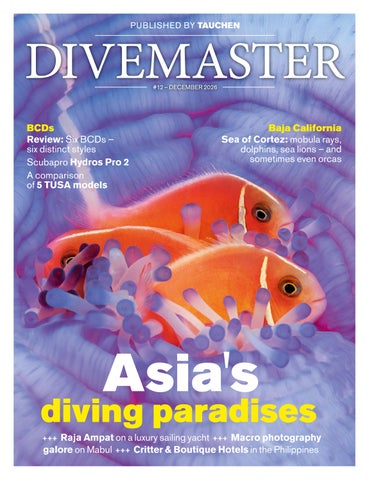
The cover photograph by Tobias Friedrich shows a pink skunk anemonefish (Amphiprion perideraion), also known as the pink anemonefish, with two juveniles inside their closed magnificent anemone (Heteractis magnifica), also known as the Ritteri anemone.
Did you know that TAUCHEN is also available digitally? This includes our social media channels Facebook and Instagram as well as our website and our YouTube channel. You can also listen to our podcast channel. Just drop by and listen. Follow the links below. Do you want to read TAUCHEN digitally? Download our TAUCHEN app for iOS and Android. We look forward to hearing from you.
JETZT BEI
CONTACT & MORE TAUCHEN EDITORIAL TEAM
JAHR Artopé Media GmbH & Co. KG Bajuwarenring 19, 82041 Oberhaching Tel. 089/5 52 41-0, Fax 089/5 52 41-244 Email: redaktion@tauchen.de ADVERTISING
82
089/5 52 41-225 Email: sales@tauchen.de
86 88
Tel. 040 5555 7991, email: jam@dpv.de
TAUCHEN SUBSCRIPTIONS + ADDRESS CHANGES TAUCHEN DIGITAL
www.tauchen.de/epaper
• Website: tauchen.de • Facebook: facebook.com/ tauchenmagazin • Instagram: instagram.com/ tauchen.magazin/ • Podcast: podcaster.de/podcasts#/ podcast/tauchen-talks • YouTube: TAUCHENDASMAGAZIN • TAUCHEN app: Android & iOS
GALLERY °
1. | ONLY WATER Tom Healy, Australia
TOP SHOTS FROM DOWN UNDER The ‘Underwater Awards Australasia 2026’ showcase the underwater world from award-winning perspectives. We present the winning images from the competition. underwaterawards.com
GALLERY °
1. | International Waters Simone Caprodossi, Australia
1. | Australian Jake Wilton, Australia
1. | Tough TG Qian Kun, China
GALLERY °
1. | Conservation Annika Dahlberg, Australia
1. | Sydney Talia Greis, Australia
1. | Smartphone Enrico Somogyi, Germany
MAGAZINE ON THE TRAIL OF METHANE
What role does oxygen depletion play in methane formation in the Baltic Sea? Lena Dreeßen and Emilia Schreiber from the Louisenlund Foundation explored this question as part of the 2026 Marine Competition. On board the ALDEBARAN, the schoolgirls spent four days investigating ten stations in Eckernförde Bay. They were accompanied by Dr Mona Norbisrath from GEOMAR. Using a multi-probe, they measured oxygen levels, temperature and salinity; at four stations, they found areas that were virtually oxygen-free. Water samples will now be analysed for methane in the laboratory. This potent greenhouse gas can be produced during the decomposition of organic matter under oxygen-free condi tions. Whether it is broken down in the water or reaches the atmosphere remains an open question for research. www.meeresstiftung.de
SATELLITE EMERGENCY CALL SERVICE MEETS DIVING MEDICINE
KNOWING ABOUT SHARKS MAKES YOU (MORE) CLEVER …
Quiz question: Odours spread very unevenly in water. How do sharks manage to follow a scent trail with such precision?
A) Their sense of smell is extremely sensitive. They can detect odours at a dilution of 1:10 billion. B) They can detect the time it takes for the scent molecules to travel from one nostril to the other.
Garmin and the Divers Alert Network (DAN) are joining forces to provide support in the event of diving accidents. Active DAN members can add their membership number to the emergency contact details in their inReach account. If they trigger an SOS emergency call via an inReach device, Garmin Response coordinates the assistance and passes on relevant information to DAN. The DAN team contributes its expertise in diving medicine and provides support, for example, in finding suitable treatment facilities. An active DAN membership and an active inReach satellite subscription are required. The satellite emergency call is triggered whilst on the surface of the water. www.dan.org · www.garmin.com
EVEN MORE CONTENT FROM IN THE TAUCHEN APP
JETZT BEI
App Store
Google Play Store
All stories marked with this button are available in the app version of TAUCHEN, along with additional content. There, readers will find further images and videos, as well as longer articles that could not be included in the print edition. The digital edition of TAUCHEN is available in the app at – available from the Apple App Store and on Google Play.
You can find out more about the artist Michel Ley at: Facebook/michels.imbaerium, Instagram (‘michels.imbaerium’) and www.michels-imbaerium.de
Photos: Ocean Heroes, German Ocean Foundation, GARMIN, Michael Ley
Answer: B ) In a study, researchers found that the sharks they were studying could measure the time it took for a scent to travel from one nostril to the other. During the experiments, the animals turned in a flash towards the side from which the scent was introduced into the test tank. You can find these and more facts and figures about sharks in the new shark quiz from Ocean Heroes. It’s both entertaining and educational, and available at a charity price (100 per cent goes to charity) of 25 euros. Buy it here: www.ocean-heroes.shop
DER NEUE PROTEC AIR
MADE IN AUSTRIA
THE NEW GENERATION OF DRY DIVING Der PROTEC AIR überzeugt durch seine technisch orientierten Features, extrem robuste Verarbeitung und besonders hohe Atmungsaktivität. Mit über 50 Ausstattungs-Optionen kannst Du Deinen brandneuen Trockentauchanzug perfekt auf Deine Bedürfnisse abstimmen. Sein geringes Packmaß macht ihn zudem zum idealen Begleiter auf Deinem nächsten Tauchtrip. Und das gibt‘s nur bei CAMARO: Gratis Teilmaß-Service und 3-Jahre-Reparaturservice. Weitere Informationen? Besuche uns auf CAMARO.AT
CAMARO. AT
magazin °
INTERDIVE 2026: FOUR DAYS OF DIVING PASSION For four days, Hall B5 at the Friedrichshafen Exhibition Centre was all about diving. The 14th InterDive brought together exhibitors, industry experts and diving enthusiasts from Germany and abroad from 24 to 27 September 2026. Once again this year, InterDive provided a space for direct discussion and personalised advice. Visitors were able to find out about new destinations, discover equipment, plan diving trips and speak directly with tour operators, dive centres, hotels, manufacturers and associations. A varied stage programme complemented the activities on offer in the hall. Commitment to marine conservation The traditional charity auction was once again a key feature of InterDive. Exhibitors donated prizes, travel vouchers and diving trips, which were auctioned off during the fair in aid of charitable organisations. The auction was a resounding success: around 7,000 euros were raised and donated to six marine conservation organisations. In this way, InterDive is setting an example for the protection of the oceans and the underwater world even beyond the exhibition hall. Looking forward to 2027 “InterDive thrives on the people who bring it to life every year. We would therefore like to extend our heartfelt thanks to all the exhibitors, partners and visitors who made these four days in Friedrichshafen so special,” said exhibition director Walter Harscher. After four intense days at the trade fair, attention is already turning to next year. The next edition will be a special one: the 15th InterDive will take place in Friedrichshafen from 23 to 26 September 2027. Save the date! www.inter-dive.de You can find more highlights from the trade fair on our YouTube channel
Photos: InterDive
The hustle and bustle of the trade fair, just as it should be: the 14th InterDive offered plenty of variety and entertainment for a fantastic day at the fair.
24 little doors. A new chance to win every day! Join in with the big TAUCHEN Advent calendar: From 1 to 24 December, a new door opens every day revealing an attractive prize.
THE TAUCHENAvailable from 1 December at www.tauchen.de
Photo: shutterstock.com
Here’s how to get involved: 1. Visit www.tauchen.de and open the Advent calendar. 2. Click on the door for the relevant day. 3. Complete the entry form in full and submit it. You may enter once per day using one email address. Multiple entries are not permitted. The winners will be drawn the following day and announced in the calendar window. You must be aged 18 or over to take part. JavaScript and cookies must be enabled to participate. Existing newsletter subscribers may also take part. Employees of JAHR Artopé Media GmbH & Co. KG and their relatives are excluded. No cash alternative. The decision is final. Full terms and conditions: jahr-artope.media/teilnahmebedingungen/
tourmare.de
mares.com
orca-diveclubs.com
polaris-diving.com
euro-divers.com
wakatobi.com
wirodive.de
as-tauchreisen.de
cressi.com
tourmare.de
polaris-diving.com
blue-bay-divers.de
aqualung.com
as-tauchreisen.de
euro-divers.com
omneia.de
aquaventure – tauchreisen.de
apeksdiving.com
wirodive.de
monte-mare.de/ rheinbach
tourmare.de
Click here for the online calendar: www.tauchen.de/ adventskalender2026/
mares.com
as-tauchreisen.de
wirodive.de
TRAVEL OCEAN SAFARI ON SOUTH AFRICA’S WEST COAST
THE PACIFIC AT ITS BEST Palau is one of the most diverse diving destinations in the world. Spectacular drop-offs, colourful corals and mysterious wrecks make every dive an unforgettable experience. Encounter sharks, barracudas, manta rays and a fascinating variety of tropical fish. An extraordinary diving holiday for anyone looking for something special underwater. pacific-travel-house.com
Tropical Seas is expanding its programme to include an ocean safari from Cape Town to Langebaan. In partnership with the local operator Expert Tours, the trip follows the South African west coast and combines boat trips with dives in the kelp forests off Cape Town. With a bit of luck, you may spot humpback whales, dolphins, fur seals and sunfish. Trips are subject to weather conditions, sea state and current sightings. The small groups are led by Rainer Schimpf. The tour is aimed at both divers and snorkellers who wish to explore South Africa’s marine wildlife from the sea. Several dates are planned for 2027. Specific travel dates and prices are available from the tour operator. tropical-seas.at
TWO BIG-FISH SPOTS, A TRIP TO MEXICO From 7 to 25 May 2027, Wirodive is combining the Sea of Cortez with the Socorro Archipelago. This special trip begins aboard the M/V Nautilus Gallant Lady during the mobula migration. Large schools of mobula rays are a highlight of this leg of the journey, and with a bit of luck, orcas may also be spotted. Guests then transfer to the M/V Nautilus UnderSea and continue on to Socorro. There, the safari coincides with ‘bait ball season’, when fish gather in dense schools. Possible encounters include manta rays, dolphins and various species of shark. The trip thus combines two major Mexican destinations for encounters with large marine animals and two safari vessels. Price starts at 7,780 euros per person. wirodive.de
AGGRESSOR ADVENTURES HAS WON 118 READERS’ AWARDS
A diver’s paradise is back! Aqua Active Agency is reintroducing Fiji to its travel programme and whisking diving enthusiasts away to the fascinating underwater world of the South Pacific. Colourful coral reefs, spectacular drop-offs and an impressive array of marine life make Fiji a dream destination. As the ‘soft coral capital of the world’, this island nation delights visitors with sharks, manta rays and colourful schools of fish. Above the water, too, tropical rainforests, waterfalls and idyllic beaches beckon. Diving in Fiji is possible all year round. The drier months from May to October are considered the best time to visit aquaactive.de
CLEVER & BRAND NEW: THRESHER SHARK SAFARIS IN THE PHILIPPINES Christian Reinwald of Easy Diving, a pioneer in the Philippines, is expanding his programme from February 2027 to include exceptional eight-day thresher shark safaris between Dauin and Malapascua. The route combines first-class muck diving with the famous thresher shark spots of the Visayas. A particular highlight is a little-known cleaner station off Sipaway. With a bit of luck, up to six species of shark can be spotted, including tiger sharks and whale sharks. Diving takes place from the traditional Filipino bangka boats Gaudi, Goya and Royo, which are deliberately equipped to be simple, robust and practical. Accommodation is provided in resorts along the route. The safaris are aimed at experienced and ambitious divers, as well as underwater photographers, who wish to discover the diversity of the Visayas and experience extraordinary macro and large-fish encounters away from the usual luxury safaris. Dates and prices are available on request from Beluga Reisen. belugareisen.de & info@belugareisen.de
Photos: Organisers
AQUA ACTIVE AGENCY: FIJI IS BACK ON THE PROGRAMME!
Aggressor Adventures has received a total of 118 awards at the US magazine Scuba Diving’s Readers’ Choice Awards. This means the operator has surpassed its result from the previous year, when it received 100 awards. More than 11,000 divers took part in the readers’ poll, which assessed criteria including service, safety, catering, cabins and value for money. The award-winning vessels operate in the Caribbean, the Red Sea, the Indian Ocean and the Pacific. The Red Sea Aggressor IV was particularly successful, securing nine second places. The Philippines Aggressor II took first place in the ‘Quality of Safari Vessel’ category. The family weeks were also recognised. The results will be published in the November 2026 issue of Scuba Diving. aggressor.com
HEAD TO THE RED SEA WITH SHARKSCHOOL VILAMENDHOO IS REOPENING Following its refurbishment, the Vilamendhoo Maldives Resort in South Ari Atoll is set to reopen on 15 November 2026. Among other things, the buffet restaurant has been modernised. The Euro Divers dive centre offers access to an house reef with ten entry and exit points, as well as to more than 60 dive sites in the surrounding area. Certified divers can explore the house reef independently in buddy teams. Boat trips take divers to destinations such as Kuda Rah Thila or the Dhigurah Channel. The programme also includes fullday excursions and night dives. In this region, there are opportunities to encounter whale sharks and manta rays all year round. Diving courses and guided snorkelling trips are also on offer. Stays from the reopening date onwards can already be booked. Dives can be reserved in advance. euro-divers.com
BIG FISH & LAND SAFARI sun+fun, in partnership with Safari Drive & Dive, combines dive sites in Mozambique and at South Africa’s Aliwal Shoal with wildlife viewing on land. The guided tours take place in small groups with dedicated guides and drivers. As well as encounters with large fish underwater, the programme includes game drives in national parks. Depending on the season, encounters with humpback whales are also possible. Price example: ‘The Big Five Above and Below’ from Vilanculos to Johannesburg: 14 nights, 16 dives, breakfast and two full days of game drives, for example in Kruger National Park, from 3,600 euros per person in a twin room. sunandfun.com
READERS’ TOURS 2026/2027
Extra Divers is offering two SharkSchool tours on the M/Y Red Sea Explorer in 2027. From 21 to 28 October and from 28 October to 4 November, the safaris will depart from and return to Port Ghalib, visiting Brothers, Daedalus and Elphinstone. They will be led by Heike Schönthal, who will teach participants about shark behaviour through talks and interactive sessions. The focus is on body language, social behaviour and the individual behavioural characteristics of the animals. The trip costs from 1,400 euros per person in a lowerdeck cabin. In addition, there are 290 euros in local fees and 189 euros in course fees. Bookings can be made directly with Extra Divers or as a package holiday, for example through the Federsee Travel Centre. extradivers-worldwide.com
DRIVE & DIVE BONAIRE
Family diving cruise in the Maldives
From 1 to 8 August 2027, the TAUCHEN readers’ holiday ‘Cruise, Dive and Chill’ will take families on a tour of the North Malé and Ari Atolls. On board the ‘EcoPro Seascape’, certified divers can look forward to two dives a day. The programme also includes snorkelling trips, children’s diving courses, island visits, as well as stand-up paddleboarding and kayaking tours. With a bit of luck, guests may spot manta rays and whale sharks. Non-divers and children aged six and over are also welcome to join, provided they can swim confidently. The trip costs 1,799 euros for adults. Children travel from 899 euros. The price includes a twin cabin, full board, diving, airport transfers, island visits and a beach barbecue. Flights and the green tax are extra. Enquiries: redaktion@tauchen.de, keyword ‘Family holiday in the Maldives’.
Your Buddies
RESERVIERUNGEN: +599 717 5080 WWW.BUDDYDIVE.COM INFO@BUDDYDIVE.COM
Tauchen Sie Bonaire auf Ihre Weise.
Entdecken Sie Bonaire mit dem Drive & Dive Paket von Buddy Dive Resort: über 60 Tauchplätze, eigener Pick-up, unbegrenzte Luft und Nitrox, Unterkunft, Transfers, Frühstück und Versicherung inklusive.
TRAVEL °OMNEIA
JETZT BEI
PILOT T & F Heinz Toperczer
YOUR OWN CAMERA
On a photo safari in the Red Sea, Heinz Toperczer explains why good underwater photos begin not with gear, but with an understanding of camera, lighting and subject.
TRAVEL °OMNEIA
S
trobe power, exposure and finding the right subject: on his first one-to-one dive with Heinz Toperczer, one workshop participant felt so overwhelmed that he simply said a quick “Servus” as he went underwater. Instead of taking in further instructions, he focused on a pipefish in front of him. Today, after three workshops, his photos are much THE HOST AND better. Yet he’s still got a long THE WORKSHOP way to go. LEADER HAVE BEEN This combination of chalA CLOSE-KNIT TEAM FOR YEARS – lenge, learning curve and the SOMETHING THEIR joy of photography characteriGUESTS NOTICE AND ses the workshop safari on the APPRECIATE. Omneia Spirit. On 12 May 2026, the ship set sail from port with 24 underwater photographers on board. Following the check dive, the route takes the group to the Brother Islands and Daedalus, before continuing south to Rocky Island and Zabargad.
The route provides the inspiration The subjects vary depending on the dive sites. At the Brother Islands, the overgrown wrecks Numidia and Aida provide great scenes for wide-angle photography. A thresher shark on the southern plateau proves to be a special highlight of the trip. On Zabargad, by contrast, the play of light in the shallow cave passages dictates the photographic concepts. Rather than large fish and steel, the focus there is on shapes, contrasts and a controlled use of the available light.
>
TRAVEL °OMNEIA
SHIP
Omneia Spirit
SPECIAL
Ten days of wreck photography coaching with Heinz Toperczer
ROUTE
Brother Islands, Ras Mohammed, Thistlegorm and two newly discovered wrecks
DEPARTURE AND ARRIVAL
Hurghada
NEXT DATE
17 to 27 June 2027
CABIN
Twin Lower Deck
PRICE
from 2,249 euros per person, including coaching
ORGANISER
Omneia Tauchen & Reisen
CONTACT
Moni Hofbauer, info@omneia.de
Photography and sharing go hand in hand: new ideas for photos emerge amongst the corals (top), whilst the results are discussed in the salon (centre left). The motorbikes inside the wreckprovide subjects where perspective, light and a diver in the background determine the visual impact of the image (bottom).
Between dives, the Omneia Spirit’s outdoor deck offers space for shared meals, conversations and a break whilst enjoying the view of the Red Sea.
From automatic mode to conscious photography Toperczer begins with the basics of photography. His approach is that anyone who can master the camera above water can also use it effectively underwater. ‘Be the pilot, not the co-pilot’ is his motto. What he means is the shift from automatic mode to conscious manual control. As well as composition, lighting and camera settings, the workshop addresses typical challenges in underwater photography: how do you position strobes without illuminating suspended particles? How do you approach an animal without disturbing it? And how can you incorporate a buddy or model into the composition in such a way that proportions and sense of depth are clearly visible? Underwater tasks Theory and practice are directly intertwined. Participants are given tasks tailored to their experience and camera equipment. In addition, Toperczer goes into the water with each of them individually. There, he works directly with them on settings, subjects and techniques. After the dives, the images are discussed together. The workshop is not a substitute for a buoyancy control course. Safe diving is a prerequisite, as only those who can control their position and distance from the reef can concentrate on their camera and subject. Toperczer explains the technical aspects in a clear and practical way, accompanied by dry Austrian humour. Frustration is part of the learning process Patric Giger, who has taken part in the workshop three times and appears in the opening scene, describes what this learning process feels like. After buying some more advanced photographic equipment, he quickly realised that it was no longer
the camera but his own skill that was the limiting factor. At times, the frustration was so great that he wanted to sell everything and switch to a simple ‘point-andshoot camera’, as Toperczer jokingly calls smartphones. “At the first workshop, I quickly realised that I was still right at the beginning of my photographic journey. At the second, I thought I’d finally got the hang of it. After the third, I know this: things are improving, but there’s still plenty to learn,” says Patric Giger. The group plays a part in this too. Ambitious beginners meet experienced underwater photographers, with different camera systems and varying working methods. The participants compare their results, discuss mistakes and realise that others don’t always return with perfect pictures after every dive either.
Workstation for large camera systems The Omneia Spirit provides a suitable working environment for this. The spacious camera area can accommodate even large-scale systems, which can be stored and set up there. An air-gun and two separate freshwater tanks are available for the camera equipment. Between dives, outdoor areas with both sunny and shaded spots, as well as a jacuzzi, provide space for relaxation and conversation. Practice remains essential After a week of numerous dives, photo reviews and new techniques, one simple realisation remains: a good camera alone does not make for a good underwater photograph. If you want to take better pictures, you need to understand your equipment, learn to interpret your subjects and apply what you’ve learnt time and time again. <<
Franz. Polynesien · Fiji Inseln · Palau Papua Neuguinea · Yap · Salomonen Vanuatu · Tonga · Neukaledonien
… mit Pacific Travel House – dem Spezialisten seit über 35 Jahren! 21 Tage Französisch Polynesien Tahiti, Rangiroa und Fakarava
Fantastisches Großfischtauchen an den Riffen und in den Passagen der Atolle · Inkl. 21 Tauchgängen, Flügen, Übernachtungen/Frühstück/Transfer
ab 7.550 € p.P. / DZ
21 Tage Fiji Inseln Viti Levu, Taveuni, und Beqa Lagune
Aufregendes Tauchen zwischen farbig leuchtenden Korallen, bunten Rifffischschwärmen und beeindruckenden Großfischen · Inkl. 22 Tauchgängen, Flügen, Übernachtungen/Frühstück/Transfers
ab 6.945 € p.P. / DZ
17 Tage Mikronesien Palau und Yap
Faszinierendes Tauchen an steilen Außenriffen, in Strömungen und Lagunen mit zahlreichen Großfischen · Inkl. 20 Tauchgängen, Flügen, Übernachtungen/Frühstück/Transfers
ab 5.475 € p.P. / DZ
18 Tage Papua Neuguinea Lissenung Island und Tufi Resort
Reiche Artenvielfalt, Sichtweiten bis zu 30 Meter, unberührte Korallenriffe und große Fischschwärme · Inkl. 20 Tauchgängen, Flügen, Übernachtungen/Mahlzeiten/Transfers
ab 6.550 € p.P. / DZ
Weitere Vorschläge, ausführliche Beschreibungen und kostenlose individuelle Ausarbeitung unter:
pacific.travel.house Pacific Travel House Reiseveranstaltungs GmbH Schwanthalerstraße 100, D-80336 München info@pth-muc.de, 089-543 21-80
www.pacific-travel-house.com
TRAVEL °PHILIPPINES
SMALL BUT MIGHTY TWO SMALL RESORTS
BIG ON LUXURY
If you’re going to go for luxury, go all out! Even the most spoilt diver will find something to their liking at these two exclusive boutique resorts in the Philippines. A visit to the Salaya Beach Houses in Dauin and the Amun Ini Beach Resort & Spa on Bohol. T & F Barbara & Wolfgang Pölzer
JETZT BEI
TRAVEL °PHILIPPINES
Above: The Amun Ini captivates with its exclusive location in a picture-perfect bay with a sandy beach, an infinity pool and tropical woodland. And all this with just 16 spacious rooms.
D
iving resorts with tropical gardens and a touch of luxury are a dime a dozen. However, it’s rare to find one where everything – from the rooms to the food to the diving – is just right. At the Salaya Beach Houses, situated on the outskirts of Dauin, they seem to have achieved just that: amongst palm trees, flowering shrubs, orchids and well-tended lawns perfect for walking barefoot, around a dozen buildings are so skilfully arranged that there’s never a sense of being cramped. The pool, diving centre, restaurant and spa facilities blend in harmoniously. Our Ocean View Suite is spacious, elegant and functional – a rare combination. We could easily stay here longer, were it not for the fact that we’d come here to dive.
Critter Paradise On the south-east coast of Negros lies one of the best macro diving spots in the Philippines. The ‘critter capital’, a ‘critter paradise’ – superlatives are in no short supply when it comes to the area around Dauin. The region first became famous for the nearby Apo Island. This small volcanic island is considered one of the country’s oldest marine reserves and delights visitors with its coral
From large to small: as well as wall diving amongst stunning coral, there’s also plenty of ‘small stuff’ and all sorts of critters off the Anda Peninsula.
The best of Dauin: As one of the most luxurious destinations in Dauin, the Salaya Beach Houses delight guests with their comfort and excellent diving opportunities right on their doorstep or by boat.
Big eyes, quirky faces: amongst the sand and seaweed off Anda, there are some fascinating photo opportunities. If you look closely, you’ll spot the little stars of the underwater world.
reefs, abundance of fish and sea turtles. First of all, we want to go diving off Dauin. We make our way across the black volcanic beach to the spacious bangka, a traditional outrigger boat offering plenty of comfort: large camera-washing basins, padded storage compartments and a wind-sheltered interior. The American owners, who are passionate underwater photographers themselves, know exactly what their customers love. After a few minutes along the coast, the boat stops. One step forward and off we go! We follow our guide, Joel, down the slope across a bright green seagrass meadow. Blue water, visibility of just under 20 metres – it’s a real joy. Barely ten fin strokes later, a bright yellow seahorse is waiting for us. Then it’s one after another: nudibranchs, garden eels, clownfish with orange egg masses, dragonets, watchman gobies. At a depth of about 15 metres, the slope levels off. Seagrass gives way to black volcanic sand dotted with Caulerpa algae. Scattered amongst it are small coral boulders teeming with damselfish, juvenile fish, prawns and crabs. A yellow dwarf goby peeks out from a half-buried sea urchin shell. This looks promising, as these little fish, barely two centimetres long, live in pairs. Sure enough, the second one ap- >
TRAVEL °PHILIPPINES TRAVEL INFORMATION: DAUIN & BOHOL / PHILIPPINES THE DIVING CENTRES The following applies to both centres: you must present your
diving certificate, logbook and medical certificate. Dives are conducted with a guide, including on the house reef. Up to four dives per day are possible, with a maximum depth of 30 metres. DIN/INT connectors are available; according to the centre’s information, an adapter is not required. SALAYA BEACH HOUSES Website:
www.salayabeachhouses.com Established in: 2015 Location: Northern end of Dauin Center Manager: Tata Cabaron, an English-speaking Filipino Team: two diving instructors and six guides Training: SSI from OWD to Divemaster, as well as standard speciality courses. Additionally, courses using full-face masks and the AVELO system. Nitrox 32 is free of charge. Diving programme: A boat trip in the morning with two dives, followed by another trip in the afternoon. The house reef can be explored from the shore with a guide, even at night. Over 30 dive sites, mostly between five and 30 minutes away. Day trips with three dives and lunch take you to Apo Island, Siquijor Island, Sumilon Island and to see the whale sharks in Oslob. Boats: A covered speedboat for four and a spacious bangka for up to 20 divers. Equipment hire: ten complete sets; 31 euros
per day, including a computer. 10- and 12-litre aluminium tanks; 15-litre tanks available on request at no extra charge. Prices: Two boat dives, including a tank and weights, cost 108 euros; 52 euros per dive when purchased as a pack of 10. Apo Island day trip with three dives, lunch and marine park entry fee: 236 euros. OWD course, including certification: 440 euros. Season: Open all year round. Dry season and peak season from February to June; rainy season from July to December. Visibility averages 15 metres, reaching up to 30 metres from May to July. Snorkelling: Particularly worthwhile on day trips. AMUN INI BEACH RESORT & SPA Website: www.amunini.com Established in: 2013 Location: South coast of the Anda
Peninsula on Bohol Centre Manager: Jossie Jasmin, an English-speaking Filipina Team: five diving instructors and five guides, including four marine biologists Diving courses: SSI and PADI, from Open Water Diver (OWD) to Divemaster, as well as popular speciality courses. Children’s diving from the age of eight. Diving programme: Two dives in the morning, a single trip in the afternoon, followed by a choice of a Mandarin dive or a night dive. 32 spots at sites between two and 40 minutes’ boat ride away. Boats: a covered speedboat for six people, as well as two bangkas, each carrying 16 divers.
Equipment hire: 20 complete sets; 17 euros per day. 12-litre aluminium cylinders, 15-litre cylinders available on request at no extra charge, and 8- and 10-litre cylinders for children. Prices: A boat dive, including a tank and weights, costs 51 euros; 47 euros as part of a 10-dive package. Unlimited diving for three days or more: 170 euros per day. Nitrox 32: 4.40 euros per dive or 39 euros for ten dives. OWD course including certification: 523 euros. Season: open all year round. Peak season runs from January to June and from October to December. In between, the Habagat can bring rain and waves, which can be quite strong at times. Visibility ranges from five to 25 metres, depending on the current. Snorkelling: The shallow reef tops are home to hard and soft corals, fish and turtles. Separate snorkelling trips are available on request. HOUSING AND SUSTAINABILITY Both resorts offer spacious rooms with air conditioning, a television, a minibar, a safe, tea and coffee-making facilities, a balcony or terrace, and a bathroom with toilet. Drinking water can be topped up free of charge at the resort and on the boats; disposable bottles are avoided. SALAYA BEACH HOUSES: Following the expansion, a total of 20 rooms accommodating up to 46 guests are planned from early 2027. There are five room categories, ranging from the Deluxe Garden Room to the two-bedroom penthouse for four people. The
Tata leads by example: the Salaya base manager often enjoys the benefits of the full face mask and the AVELO system himself.
resort features a 24-metre-long freshwater swimming pool, a pool bar, an air-conditioned restaurant and pavilions for private dining by the sea. There is also a spa, a gym and yoga and wellness programmes led by in-house instructors. The expansion includes a larger diving centre, a 200-square-metre camera room, a larger and deeper training pool and a new pool bar. Regular beach clean-ups are organised. A solar power system is planned. AMUN INI: 16 rooms across four buildings, accommodating up to 35 guests. One room category featuring double or single beds. A foldout sofa allows the room to be used as a family room. All rooms have sea views, a balcony and a Nespresso machine. The panoramic window in the bathroom offers a view through the room to the sea. An open-air restaurant, infinity pool, airy spa and 300-metre sandy beach complete the offering. A solar panel system supplies the resort, including the diving centre, with power during the day. GENERAL INFORMATION Getting there: Fly via Manila with a
connecting flight to Dumaguete; the flight takes about an hour. This is followed by a 35-minute car transfer to the Salaya Beach Houses. To reach Amun Ini, fly from Manila to
Dive centre manager Jossie welcomes the divers to Amun Ini. They are taken to the dive sites by outrigger boat. The camera equipment is prepared in the camera room at (Salaya Beach Houses). Comfortable rooms offer a chance to relax after diving (Amun Ini).
RCF-guided small group tour
Cabo Verde
PHILIPPINES
Salaya Beach Houses
Amun Ini Beach Resort & Spa
Panglao (about one and a half hours) and then continue by car to Anda (just over two hours). The journey between the resorts involves a car journey, the Dumaguete– Tagbilaran passenger ferry, and a subsequent car transfer. Entry: A passport valid for at least a further six months. Check the conditions for a tourist visit and the requirement to register via e-Travel before departure: https://etravel.gov.ph Language: English is spoken in the resorts and diving centres. Wetsuit advice and water temperature: 3–5 mm wetsuit. Around 26 degrees Celsius in February to 31 degrees in August. Currency: Philippine peso (PHP). According to the information provided, both resorts accept euros, pesos, US dollars and credit cards. Electricity: 220 V; according to the resort, Euro plugs can be used without an adapter. Communications: Mobile phone coverage and free Wi-Fi at both resorts. Medical advice: Discuss vaccinations and any necessary malaria prophylaxis with your doctor. Information: www.dtg.org. Dauin, Cebu City and Manila are listed with hyperbaric chambers. Check current availability with the base. Time difference: CET plus seven hours; during German summer time, plus six hours. Tourist Information: www.morefunphilippines.de Organiser: Beluga Reisen Telephone 0551 - 6345 1340 www.belugareisen.de PRICE EXAMPLE FOR A COMBINED HOLIDAY: 14 days/12 nights including
flights from/to Frankfurt or Munich with Cathay Pacific to Manila, domestic flights and all transfers. Six nights’ accommodation with breakfast in a Deluxe Garden Room at Salaya Beach Houses and six nights in a double room at Amun Ini. Ten boat dives at each resort, including tank, weights and guide. Price per person: from 3,565 euros.
pears shortly afterwards. Head to head, they stare at my camera with their disproportionately large eyes. I press the shutter button – another great shot in the bag! It’s been a long time since we’ve seen so much with so few fin strokes. Finally, we make our way up the slope, across a field of garden eels and past a green turtle feeding, back to the boat. On board, there are nothing but happy faces. We chat about diving over fresh cake, tropical fruit and coffee. That’s what makes diving twice as much fun.
Diversity in the details At first glance, the dive sites in Dauin all look quite similar. Yet the slope, current, seabed and vegetation vary: from fine sediment to gravel, from sections with lush vegetation to bare patches. Apart from turtles and the pipefish – which often protrude from the seabed by an arm’s length – most of the action takes place right under our noses. Anglerfish in a wide variety of colours lie in wait, snap or yawn. There’s even a rare hairy anglerfish among them. On another dive, after spotting ten ghost pipefish of three different species, we stop counting and turn our attention to the tiny ‘Shaun the Sheep’ snails. However, the highlight is provided by five blue-ringed octopuses, a Wonderpus and a coconut octopus – topped off by a brief blue-ringed octopus mating! Three long dives a day are enough for us. After all, the data on the memory cards needs to be processed, and the resort deserves our attention too. Even in the evenings, we can’t stop marvelling at it all: exquisite à la carte cuisine is followed by a cosy evening at the pool bar. Beer lovers will find an unexpected selection of various IPA craft beers from local microbreweries waiting for them there. Although we hardly notice it, construction and modernisation work is taking place behind the scenes. The extension is due to be completed by early 2027. The highlight for photographers: a 200-square-metre camera room with well-lit workstations for charging, maintenance and downloading, as well as a lounge for talking shop. This puts the Salaya right up there with the very best resorts specialising in underwater photography. >
Join us on unforgettable dive trips to the world's most spectacular and remote spots! • Top dive spots & locations • Professional guidance & small groups • Perfectly organized trips – you dive, we take care of the rest!
Whale Watching & Diving on São Nicolau
17 – 24 Feb 2027 with Cathrin
27 Feb – 6 Mar 2027 with Peter Departing from / returning to São Nicolau
From €1,579 per person
in a double room, single room supplement + €125 Included:
• Domestic flights from/to Sal, incl. 30 kg baggage allowance
• 7 nights at Cacimba Lodge, breakfast included • 5 days of diving, incl. an Explorer Dive at a brand-new dive site • Whale Watching excursion
• Guided half-day island tour to Fragata and the Groque distillery • Guided full-day island excursion • BBQ at Praia Grande beach
• Optional on site: further Whale Watching trips depending on sightings, fishing, hikes up Monte Gordo, and more… All details and information on this trip on our website.
WELTWEIT MEER ERLEBEN
reisen@reisecenter-federsee.de www.rcf-tauchreisen.de
rcftauchreisen
tauchreisen_rcf
TRAVEL °PHILIPPINES
Off to Bohol We continue our journey by car, ferry and then car again to Anda in the east of Bohol. The last few hundred metres along a bumpy gravel track give us a hint that tranquillity awaits us. Indeed, the Amun Ini is nestled in the heart of the tropical forest, on a 300-metre-long bay with a powder-white beach. Just 16 stylishly furnished rooms, all with sea views, promise exclusivity. Through the panoramic window in the bathroom, we can see the sunrise whilst brushing our teeth; we drink our first Nespresso on the balcony to the sound of a chorus of birdsong. Passing jackfruit trees, blooming orchids and the infinity pool, we walk to the diving centre on the beach. One of the two bangkas is already waiting. Walls, drift dives and turtles A few minutes’ boat ride later, we jump into the water at ‘Coral Garden’. The name says it all: a steep wall covered in soft corals,
Oases of well-being: It’s not just underwater – but also on land that you can enjoy yourself here. Salaya: Ocean View Suite (bottom left) and additional outdoor bath (bottom right). Amun Ini: Huge infinity pool with a view across the bay and a briefing (below).
sponges and gorgonians draws us down into the depths. A gentle current carries us through swarms of fusiliers, surgeonfish and anthias. Regs, the head dive guide and marine biologist, leads us to a small fan of gorgonians at a depth of 26 metres. We spot four pygmy seahorses amongst the pinkish-white tangle! The largest male has a distinctly rounded belly – as is well known, with seahorses, caring for the young is the male’s job. We content ourselves with a handful of photos so as not to disturb the father – who is barely the length of a fingernail – unnecessarily. Regs is already gesturing towards the next highlight: three dragon shrimp are perched on a fork in the branch of a small black coral. With their pointed dorsal humps, these tiny creatures really do resemble fairy-tale dragons. But our guide is already pointing out into the open water, where young barracudas are braving the strengthening current. Time for the wide-
angle lens! At a depth of just under 30 metres, colourful tree-like soft corals sprout from the sand like giant broccoli. A blackand-white-ringed sea snake also needs to be captured in the shot. On our way back up, a bright yellow wobber stops us in our tracks: perched amongst the branches of an antler coral, this ambush predator – a member of the scorpionfish family – sits surrounded by feather stars catching plankton. Above the reef edge, we drift amongst leather corals, stony corals, sponges and clumps of stinging hydrozoans. Dotted amongst them are green turtles: resting in the lee of the current, paddling leisurely or making their way to the surface.
Colourful and tasty For a surface interval, we head into the sheltered resort bay. Anyone who only wants to do one dive gets off the boat. We stay on board, enjoying fruit, coffee and
It’s precisely this mix that makes Anda so special.
water – without a grain of sand between our toes. The next spot is a ten-minute boat ride in the other direction. Another lush drop-off between about ten and 30 metres, and plenty of fish again. The current has picked up, but remains manageable. It’s strongest around the full moon, but otherwise usually moderate, explains centre manager Jossie. The friendly Filipina has known the region for years. Many sites are also suitable for beginners; the diversity delights experienced divers and photographers alike. We realise this, if nothing else, as we constantly switch between macro and wide-angle. Amongst barrel sponges, colourful soft corals and man-sized fan and broom gorgonians, we spot nudibranchs, prawns, anglerfish and ghost pipefish. Even a wonder octopus appears in front of the lens! My highlight: a zebra-striped parasitic anemone on a wire coral, with a tiny prawn hiding amongst its polyps.
Mandarins instead of oranges Anyone who loves night dives should get in the water half an hour earlier to experience the changing of the guard underwater. At Amun Ini, a ‘Mandarin Dive’ is offered daily on request. The mandarin lyrefish, for which the dive is named, gather at fixed spots at dusk to mate. Four minutes by boat from the resort, we take up our positions on a slope of finely branched stony corals and coral rubble at a depth of around ten metres. Soon, the first fish dart through the branches with jerky movements: turquoise-blue, orange and yellow-green. The larger males can also be recognised by their long, extended dorsal fin. Now the courtship begins: the most enchanting displays of courtship take place, and every rival is driven away. But the females have a say in the matter. Only when the chosen one consents does the pair, belly to belly, leave the coral thicket, rise about 20 centimetres into the open water, freeze for one or two seconds in trembling ecstasy – and vanish again in a flash. Anyone who misses the moment can try their luck again the following day. The photographic challenge: the mating takes place just before nightfall, and the fish do not like light. A dim red light helps with observation, for example using a suitable torch or red foil in front of the light source. Afterwards, there are around 30 minutes left for a classic night dive featuring prawns, crabs, cephalopods, sleeping parrotfish and the other usual suspects of this region. A fitting finale! Conclusion Two small, exclusive oases of well-being for divers who want to treat themselves both above and below the water. Dauin and Anda complement each other perfectly: first, a wealth of small marine creatures on black sand, then colourful dropoffs, reefs teeming with fish and other rare sights to marvel at. <<
AUF GEHTS AUF DIE ALIA SOUL!
ODER BIST DU EHER EINE
LANDRATTE? Dann schau auf unserer Website vorbei: WWW.ORCA-DIVECLUBS.COM
SCANN MICH
TRAVEL °MABUL
The lush vegetation dominates the scenery around the water bungalows, which are built over the lagoon. Here, the many turtles can continue to come into the lagoon to feed, undisturbed.
MABUL JETZT BEI
T & F Claudia Weber-Gebert
THE ELDORADO FOR MACRO PHOTOGRAPHERS From overwater bungalows to turtles and tiny photo models: on Mabul in Malaysia, a relaxing island holiday is combined with a variety of underwater experiences off the coast of Borneo.
Living above the lagoon The resort’s history began with chalets nestled amongst the island’s trees. Later, water bungalows were added, connected by jetties. Today, accommodation ranges from double rooms to family-friendly options. Long connecting bridges stretch between the island and the water resort. Along the way, ever-changing views of the lagoon unfold. Our bungalow offers plenty of space and has a unique feature in the floor: through a recessed glass panel, we can look straight down into the water. In the evenings, the area below is illuminated for a few hours. Time and again, turtles swim right up to the base of the bungalow. Whether they’re drawn by the light remains to be seen – but for us, their visits are certainly a highlight. Outside, there’s a seating area and two sun loungers. A jetty leads to a pavilion from which we can enjoy the view across the lagoon. Plants create a barrier from the neighbours and ensure privacy. At night, we can hear the water gurgling beneath the bungalow. Above us stretches the starry sky: we don’t need much more than that right now.
E
venthe journey here gets you in the holiday mood. The water taxi takes us from Semporna to the Sipadan-Mabul Resort. Lush greenery and flowers in shades of yellow, orange and pink frame the overwater bungalows. The lagoon shimmers with shades of turquoise and pale green, whilst small schools of fish swim through the shallow water. Turtles pop up here and there. No wonder the resort also attracts day-trippers who want to take their holiday snaps here. Mabul is situated in the Celebes Sea off the coast of the Malaysian state of Sabah. The small island is surrounded by extensive, sandy shallow waters. The villages of Kampung Mabul and Kampung Musu are home to members of the Bajau Laut and Suluk communities, amongst others. Many families have links to the southern Philippines. As is common in many parts of the region, the houses stand on stilts by the water, extending the living space beyond the shoreline.
The level of biodiversity in Mabul’s natural and artificial reefs is incredibly high. It’s well worth keeping your eyes peeled or asking the dive guides to show you all the tiny underwater creatures.
Small animals, big motifs But we’re here primarily to dive. Around Mabul, natural reefs, sandy patches and artificial structures alternate. Fish of many colours and sizes swim over the corals. For underwater photographers, the appeal also lies in the small details: amongst the marine growth, sand and hiding places, >
TRAVEL °MABUL
those unassuming creatures lie in wait – creatures that can keep you occupied for an entire dive. A popular spot is the ‘Lobster Wall’. On the sheer drop-off, it’s worth slowing down and carefully scanning the crevices and ledges. The guides choose the dive sites based on the tides and conditions. Currents may occur. When they do, the scene on the reef changes, and schools of fish swim past. Which site is suitable therefore depends not only on the desired subject but also on the guests’ experience.
There are a particularly large number of sharks to be seen around Sipadan. It is the only island in the open sea – which is precisely why there is such an abundance of fish.
Right in front of the diving centre, the owner, Robert, has begun erecting structures made of wood, concrete and ropes. Over the years, further structures have been added. An artificial reef landscape has now developed here, with frameworks rising several metres high in places. Batfish swim amongst the struts, whilst smaller creatures find hiding places. Corals, sponges and algae have colonised the surfaces. For us photographers, this area is particularly rewarding. Where marine growth and cavities meet, there is always something new to discover. Nevertheless, it’s also worth taking a look at the sand in between: a seabed that initially appears empty can harbour a surprising number of inhabi-
tants. Especially when muck diving, patience is often more important than covering a long distance. The house reef lies right in front of the steps leading down to the dive centre. This makes it easy to fit in extra dives during the day, by arrangement. A familiar spot is by no means boring. With every visit, we discover new details and learn where it’s worth taking a closer look. Sometimes a school of fish catches our attention; other times, a tiny creature keeps us in the same spot for minutes on end.
On our way to the neighbouring islands Popular destinations include Kapalai and Siamil. There, too, an astonishing variety of snails, prawns and crabs await. Particularly sought-after are the small sea snails known as ‘Shaun the Sheep’, blue-ringed octopuses and flamboyant cuttlefish. Of course, there’s no guarantee of such encounters. This makes it all the more delightful when the guide points out a creature that we would easily have missed on our own. At the base, everyone pitches in: the team prepares the kit, takes it out to the boat and helps us get on board. Assistance with getting in and out of the water is also available at the house reef. Nitrox is available on request. The organisers take care of a lot for us, without taking away our own responsibility for checking our kit. Before each dive, there is time to discuss the conditions and the plan with the guides. Sipadan: A world of contrasts in the blue A trip to Sipadan adds another underwater world to your holiday. Whilst the focus around Mabul is often on the smaller marine life, Sipadan offers striking reef edges, larger fish and sweeping views into the blue. Diving permits are limited and must be arranged in advance. If you’re planning to visit Sipadan, you should therefore confirm before booking which excursions are included in your stay and what additi- >
MABUL / MALAYSIA TRAVEL PLANNING
In general, macro subjects can be found all year round around Mabul. However, rain, wind and visibility can vary and affect the diving trips. Anyone planning to visit Sipadan in particular should check the conditions for their desired travel dates with the dive centre. Checking the latest travel and safety advice is also part of your preparations. The journey involves travelling via Kuala Lumpur to Tawau, for example. From there, you travel by road to Semporna and then by boat to Mabul. Depending on your flight arrival time and the boat transfer, you may need to stay overnight in Semporna. The resort can help with planning. You should check the entry requirements and digital registration obligations before departure, taking into account your own nationality. FURTHER INFORMATION & CONTACT DETAILS:
sales.sipadanmabulresort@gmail.com www.sipadanmabulresort.com www.mabulwaterbungalows.com
The artificial reefs, made of wood, concrete and stone, provide shelter and a habitat for numerous reef-dwelling creatures. Where there used to be nothing but a large sandy area, there now a magnificent reef has formed.
Below: The turtle sanctuary on Sipadan is guarded by rangers. Nests in the high-water zone are relocated, and the newly hatched turtle hatchlings are later released into the sea from the beach.
TRAVEL °MABUL
Top and centre: The vibrant colours and shapes of the underwater world are reflected in the well-tended vegetation at the dive resort on the island of Mabul.
Below: The enormous buffaloheaded parrotfish off the coast of Borneo are by no means camerashy, but allow the divers to get close to them. This makes them an ideal subject for photographs.
onal costs may apply. The buffalo-head parrotfish are particularly impressive. Early in the day, we come across these mighty creatures in the shallower waters. As they slowly approach, there are those moments when even photographers momentarily forget to press the shutter button. We give them space and savour the encounter. Sharks patrol the reef edges, whilst shoals of trevally hang in the current. The biodiversity is impressive. At times we focus on life on the reef; at others, a movement out in the blue catches our eye. The alternation between close-up and wide-angle views provides a delightful contrast to the exploration dives around Mabul. A front-row seat off Mabul: a sea turtle rests amongst densely overgrown wreck structures – a subject well worth capturing, even beyond the realm of macro photography.
Relax while others get to work Back on Mabul, the buffet awaits. Meals are served three times a day in the restaurant, with a selection to suit different tastes. Special requests can be discussed with the team. At the jetties, local fishermen also sell fish and seafood, which can be prepared in the kitchen by arrangement. Cold and hot drinks are available in the restaurant. Whilst we are underwater, the bungalows are cleaned. Elsewhere, too, the team usually works behind the scenes: the gardeners tend to the plants, whilst washed-up rubbish is collected from the beach. On the island, diving tanks are filled, furniture is refurbished and repairs are carried out. Added to this is the planning of transfers and the allocation of boats, guides and divers.
Anyone looking for even more relaxation between dives can visit the spa or unwind in the jacuzzi. The resort’s small shop sells T-shirts and various souvenirs. Books, magazines and reading areas invite you to take a break. Families and non-diving companions will also find lovely spots to linger. There are play areas available for children. And there’s always plenty of time for a break by the water. In the end, though, it’s the simple moments that stay with you: a glimpse through the glass floor, a turtle beneath the jetty, the water beneath the terrace. The Malaysian island of Mabul offers us a blend of close observation underwater and relaxed idleness against a dreamlike backdrop above. We’d come back – and we’d definitely pack the macro lens again. <<
TRAVEL °SUN REEF
Why Sun Reef Curaçao time and time again? Six regular visitors explain what keeps bringing them back to Curaçao.
Advertorial
N
inestays, trips twice a year and three diving school groups, each with 20 to 30 participants: the guests featured in this article are no strangers to Sun Reef – they’ve been there more than once. Their experiences show why they keep coming back – and who would find the combination of accommodation, the house reef and independently planned dives a good fit.
Freedom as a reason to return Thomas and Silke Schmedding have stayed at Sun Reef nine times since 2021 – often as many as twice a year. After getting up, they
“Grab your tanks, get your kit ready and off you go. Always in pairs, without a guide or a group.”
Photos: SunReef
Britta and Jürgen Gößling, six stays
decide on the spur of the moment: a dive at the house reef, another spot along the coast, a day at the beach or some time at the resort. “The freedom to do as we please offers pure relaxation,” they say. When friends come along, they appreciate the layout of the rooms and bathrooms. Everyone has their own space. They meet up again for diving, barbecues and sunsets. Angelina Guenter Terheurne is also a regular visitor. Since her first stay in 2016, she has been there nine times with friends. When asked what sets it apart from other diving holidays, she answers
TRAVEL °SUN REEF with a single word: “Freedom.” She says she cannot single out one particular moment as the best, because for her every moment is a gift. Her personal verdict is: “Sun Reef is balm for the soul.”
Diving without a fixed group schedule Britta and Jürgen Gößling have stayed here six times since 2019. For them, the main attraction is the freedom they enjoy whilst diving. According to them, both the sea and the dive centre are less than 15 metres from their accommodation. This means they can get their kit ready and set off as a well-coordinated buddy team, without having to stick to a fixed group schedule for every dive. Their ideal day begins with a dip in the sea and breakfast al fresco. Afterwards, they head to the house reef or another dive site on the island. In the evening, they enjoy the sunset and a meal at a nearby restaurant. They also find the central location convenient for supermarkets and Willemstad.
Three trips with large groups Petra Schwartz from the EASY DIVE Enkenbach Dive Centre has visited Sun Reef three times since 2019 – each time with between 20 and 30 participants. She highlights the interconnected bungalows, the on-site logistics and the dives that start directly from the resort. This provides a shared starting point, particularly for large groups, without forcing all participants into the same daily routine.
"For us, Sun Reef is one of the few places that we visit time and again." The Kaul family, who have visited the resort twice
Being independent means being well prepared Anyone wishing to dive without a guide must have the appropriate training and experience. Before booking, guests should clarify how briefings, tank supply and equipment hire are organised, what rules apply at the house reef, and for which dive sites it is advisable to be accompanied. Weather, currents, entry points, navigation and gas planning should also be included in your own dive planning.
Travelling together while retaining a sense of freedom The Kaul family have stayed at Sun Reef twice since 2024. There, parents and children combine self-organised dives with days on the beach and time to themselves. The family appreciate being able to avoid the tourist crowds whilst still being able to reach Willemstad, the beaches and other dive sites. For the children, having places to retreat to and a fast internet connection are also important. One particularly memorable moment was a birthday dinner on their
Advertorial
WHO THE SUN REEF CONCEPT IS SUITABLE FOR
‘When we walk through the gate and see the sea , we feel at home straight away.’ Rainer and Victoria Strobel-Schmidt, seven stays
own terrace overlooking the sea, followed by the sunset. The family sums up their experience as follows: “Sun Reef is the perfect blend of pure Caribbean flair and a diver’s paradise.” Rainer and Victoria Strobel-Schmidt have been visiting Sun Reef regularly since 2016 and have now been there seven times. They travel as a couple or with their adult sons and their partners. Even as a group of four, they say, everyone has plenty of space and privacy. There’s no need to plan excursions far in advance: the family only decides on the day itself who’s going out and who’s staying at the accommodation. The six testimonials reveal a clear pattern: guests do not return because of a fixed
entertainment programme. They appreciate the short distances, the freedom to plan their own diving days and the opportunity to get away from it all.
→ Buddy teams who like to organise their own diving day. → Groups of friends who wish to combine community and retreat. → Diving schools looking for a shared meeting point for larger groups. → Families with members who dive and those who don’t. → Returning visitors looking for a familiar base from which to explore various island programmes.
INFORMATION FOR PLANNING YOUR TRIP → The house reef and the diving centre are both less than 15 metres from the accommodation. → Dives can be undertaken directly from the resort and independently in buddy teams. → Adjoining bungalows are also suitable for diving school groups of 20 to 30 participants. → When travelling with friends, bedrooms and bathrooms can be arranged in such a way that everyone retains their own personal space. → Terraces with barbecues provide space for evenings spent together. According to guests, there are restaurants nearby. → From 29 March 2027, TUI Fly will be offering direct flights from Düsseldorf.
CHECK BEFORE BOOKING
INFORMATION & BOOKING: www.sun-reef.com www.curacao-divers.com SUN REEF at boot27 Hall 13/B43
→ What qualifications and experience are required for independent dives? → How do briefings, tank refills, equipment hire and access to the house reef work? → What sort of accommodation suits the size and room layout of the tour group? → When is it advisable to use a guide or hire a car for the planned dive sites? → What are the applicable prices, availability, insurance and cancellation terms?
TRAVEL °RAJA AMPAT
On the Coralia liveaboard from South Halmahera to Raja Ampat. T & F Melanie & David Benz
CAST OFF
IN THE CORAL TRIANGLE
JETZT BEI
TRAVEL °RAJA AMPAT
TRAVEL °RAJA AMPAT
G
racefully and almost silently, the silhouette of the Coralia liveaboard glides through the vast expanses of Raja Ampat, somewhere along the mighty Pacific Ring of Fire. Above us, the sky glows a deep orange, whilst below us a mighty storm of endless colours is brewing. Yet our liveaboard trip does not begin in Raja Ampat. It begins much earlier. In the remote waters of South Halmahera, far to the north of this later picturepostcard setting. There, where coral gardens lie in the blue expanse and there is hardly any indication of what still awaits us on this journey.
Between tradition and modernity Upon arriving in Ternate, we encounter the Coralia liveaboard once again after many years. No longer just a ship, but a home. A 48-metre-long Phinisi sailing vessel, built by the Konjo tribe, embodying both tradition and state-of-the-art technology. Not a contradiction, but a balance. Tradition carved in wood and modernised, without losing its soul. Two engines carry the ship across the vast expanses of Indonesia, yet its heart remains a sail steeped in
FAR OUT ON OUR TOUR FROM SOUTH HALMAHERA TO RAJA AMPAT LIE REEFS THAT HARDLY ANYONE DIVES ON: FULL OF COLOUR, TEEMING WITH LIFE AND GIVING YOU THE FEELING THAT YOU’RE DISCOVERING SOMETHING SPECIAL. history. The main deck is the heart of the ship: an air-conditioned saloon where the day’s diving and the evening blend seamlessly. Dive briefings, fine cuisine, wine in a glass, conversations that slow to a gentle pace. In between, dive operations organised almost seamlessly. Small groups, Nitrox, two boats. Everything follows a rhythm that, after just a short time, feels entirely natural: dive, eat, sleep, repeat. Without haste. Without disruption.
Briefing, briefing! Amanda and Jacob’s calls echo across the upper and lower decks. Our cruise directors are on the lookout for their divers. What follows is far more than just an ordinary dive briefing. When Amanda and Jacob describe a dive site, our imaginations start running wild long before we actually take the plunge. We hang on their every word, spellbound, as they prepare us – with a mix of facts, experience and infectious enthusiasm – for what awaits us just below the surface. Then the moment finally arrives: tank on our backs, fins on our feet, a bold backward roll, and with a splash, the world above the water disappears behind us.
A scorpionfish with an accidental eye patch: Arborek Jetty at night has more than a few surprises in store. A diver’s delight: in South Halmahera, the batfish provide a great photo opportunity right at the start of the trip .
Tauchreisen & Tauchsafaris weltweit
Magic Resort Special Philippinen Halmahera’s Colour Overload Makian Wall, Tamotamo and Bonsai Rock mark our introduction to Halmahera’s unspoilt underwater world. There, reef sharks patrol like silent shadows. Pinnacles rise from the depths, their tips covered in schools of fish that move through the current like living veils. Batfish eye us curiously, providing a perfect photo opportunity, almost as if they were deliberately setting the scene for the start of this journey. At Batu Jabu and Batu Manga, the reef finally transforms into an impenetrable coral garden: sponges, gorgonians, hard and soft corals stand shoulder to shoulder, immersed in schools of fish like a colourful shower of fish confetti. Green meets yellow, red blazes alongside blue, whilst pink and violet blend into one another. It is as though someone had taken nature’s entire colour palette and spread it across Halmahera’s coral landscape with generous brushstrokes.
A luxury beyond price: rounding off a successful day’s diving with a good glass of wine. The liveaboard moored in a stunning bay, the table laid. What more could you ask for? Batu Manga and Batu Jabu in South Halmahera offer an absolute riot of colour and an extraordinary variety of corals. Their darker counterpart: a night dive over a sandy wasteland teeming with obscure creatures and bizarre critters.
Sinister figures Yet when the sun sets and darkness envelops the reef, Halmahera’s dive sites are transformed. It becomes quieter, more mysterious and, at first glance, almost colourless. The iridescent splendour of the day seems to have been swallowed up. Only the narrow beams of our torches repeatedly reveal what cannot escape the night. A tiny long-armed octopus slithers across the sandy seabed, whilst the mimic octopus tries to avoid the glare of our torches. Here a nudibranch, there a bizarre shrimp – these are the shadowy creatures we encounter this night. Back on board, we are greeted by a ritual of warmth and relaxation. Hot ginger tea and hot chocolate warm us from within, whilst the images of our last dives still swirl through our minds. For us, Halmahera was like a wild journey through Alice in Wonderland. But even the most wonderful high must come to an end at some point. When the remote Pisang Islands emerge from the blue the next morning, we know: this is where Halmahera ends. And ahead of us lies the legendary realm of the Four Kings.
>
Moalboal, Cebu
Jetzt kombinieren & bis zu 20 % sparen
12 Nächte 2 Inseln – 2 Resorts je 6 Nächte Superior-Deluxe-Zimmer Halbpension & alle Transfers Fähre in der Business Class Top-Spots fürs Makro-Tauchen
15 Tauchgänge inklusive
Hier geht‘s zum exklusiven Angebot
www.aquaactive.de info@aquaactive.de +49 5507 - 919 818-0
TRAVEL °RAJA AMPAT TRAVEL INFORMATION: CORALIA LIVEABOARD GETTING THERE:
The easiest way to travel to Indonesia is via Singapore to Jakarta and then on to your final destination by domestic flight. Depending on the tour you have booked and the flight connections, the route may also include a stopover. ACCOMMODATION:
The Coralia liveaboard, measuring 48 metres in length and nine metres in width, was built in 2019 by the Konjo tribe in Bira, Sulawesi. This luxurious safari boat, crafted entirely by hand, is fitted with two engines and is one of the few phinisi vessels to combine ancient techniques, traditions and wisdom with modern design and the highest safety standards. There is space for 16 guests in eight exceptionally spacious and high-quality cabins. Comfortable bathrooms, fitted with warm rain showers and reef-friendly toiletries, take the sense of well-being to the next level. The air-conditioned saloon, which includes a restaurant and lounge, is located on the main deck and forms the heart of the vessel. The main and upper decks are equipped with plenty of comfortable, shaded seating areas. The perfect spot to relax and round off a day’s diving with a good glass of wine and a spectacular sunset. CATERING:
On board the Coralia, great importance is attached to providing varied, high-quality catering, comprising five meals a day. The culinary concept offers a blend of international cuisine and traditional Indonesian specialities. Coffee, tea, water and soft drinks are served free of charge on the Coralia. Depending on your preference, meals can be enjoyed in the spacious outdoor area or in the air-conditioned indoor area. DIVING:
Diving on the Coralia liveaboard is designed above all for comfort and safety. The Coralia, which has been named the world’s best liveaboard on multiple occasions, impresses with its first-class facilities and a seamless diving experience. The tours are as varied as the underwater dive sites themselves. The crew are thoroughly familiar with the dive areas on offer and conduct up to four dives per day. Small diving groups of a maximum of four guests per guide and two fibreglass boats thus guarantee unforgettable diving experiences. On top of that, certified divers get free nitrox. For underwater photographers, there is an air-conditioned camera room with ample space and charging facilities. TIME TO VISIT:
The liveaboard and its cruise directors follow the Indonesian monsoon seasons to ensure the best possible diving experience at all times. The ideal time to visit Raja Ampat is from November to March. Particularly in July and August, when strong winds and rough seas can occur in Raja Ampat, tours to other regions of Indonesia are offered. From September to November, as well as in April and May, the classic Phinisi can be found in the waters of the Banda Sea, the Forgotten Islands or Halmahera. The perfect time for a trip to Komodo and Alor is from June to August. You’re spoilt for choice… FURTHER INFORMATION:
www.coralia-liveaboard.com
TOUR OPERATORS & BOOKINGS:
Scuba Native Tauchreisen www.scuba-native.de
Plenty of space – the space available both in the cabins and in the interior and exterior areas of the Coralia liveaboard is unrivalled. Fine woods and high-quality fittings transform this Phinisi sailing vessel into a temporary luxury retreat for guests. A home away from home. To top it all off, there are the finest local dishes and international cuisine. Please put your diet on hold!
PRICE EXAMPLE FOR SCUBA NATIVE TAUCHREISEN:
*based on prices at the time of going to press for the 2027–2029 season* 7 nights / 8 days from 4,111 euros per person (based on two people sharing a double or twin cabin on the lower deck) or 10 nights / 11 days from 5,873 euros per person (based on two people sharing a lower deck cabin): accommodation in a twin or double cabin with en-suite bathroom (shower, WC); Full board including drinking water, soft drinks, coffee and tea; shore excursions included in the programme; up to four dives per day (excluding the days of arrival and departure) including Nitrox; Airport transfers on arrival and departure, plus port and diving fees as well as fuel surcharges depending on the tour booked (e.g. Raja Ampat US$385, Komodo US$315) Flight prices vary considerably, depending on the baggage allowance, destination and airline booked. Turkish Airlines often offers affordable flights from Germany to Sorong from around 1,350 euros per person, including a 30 kg baggage allowance. TIP:
A stay on the Coralia liveaboard can be combined perfectly with a few days at the Papua Explorers Dive Resort, particularly on the Raja Ampat safaris. LINKS TO THE CORALIA LIVEABOARD WEBSITE AND SOCIAL MEDIA:
→ https://www.coralia-liveaboard.com/ Tour itinerary → https://www.coralia-liveaboard. com/itinerary
Coralia Liveaboard, Raja Ampat coralia_liveaboards ( https://www.instagram. com/coralia_liveaboards/ ) Click here to watch the video interview with Amanda and Jacob, the cruise-directors
A truly special crew: on board the Coralia, guests can enjoy a comprehensive programme designed for their well-being, thanks to the crew and the many hard-working hands on board. Small diving groups and experienced dive guides ensure that every dive is a memorable experience.
A Kingdom for Kings Morning breaks and the blue all around grows deeper. Raja Ampat begins. So Amanda and Jacob prepare us for an extraordinary maritime experience. Melissa’s Garden, Mayhem or Citrus Ridge: names that sound almost mythical to us. And then there’s Cape Kri. A name that has gone down in the history of diving statistics. Cape Kri is where the world’s highest fish biodiversity has been documented. A total of 374 fish species were counted during a single dive. And indeed! As soon as we begin our descent, it all suddenly feels overwhelming – and that is precisely why it feels absolutely right. Schools of fish coalesce into moving walls of silver and gold. Barracudas, trevally, sweetlips, tuna. All at once, all carried by a gentle current. It’s no longer just about observing. It’s about being part of it. A blacktip reef shark here, a turtle there. In the distance, a group of grey reef sharks. Two fin strokes later, an eagle ray vanishes into the deep blue. The richness of species is almost impossible to put into words. Cape Kri is definitely not a place you simply visit. It’s a state of being that overwhelms you. Sharks on the move Back on board, the final leg of our journey begins. We’re sitting on deck, coffee in hand, the salt in the air. The sun sinks below the distant horizon and one last night dive awaits us. We descend, marvelling at the walking sharks – the Raja Ampat epaulette shark. Also known as the walking shark, this small, endemic species lives exclusively in the shallow coastal waters of Raja Ampat. We spot stonefish, juvenile batfish and fish that are both predators and prey. >
TRAVEL °RAJA AMPAT South Halmahera and Raja Ampat are guaranteed to offer pristine and colourful reef landscapes. Dives through a dense coral labyrinth that will leave you in awe.
Moments like these define not just a dive; they define a journey. And that, for us, is the true luxury. What links this liveaboard from South Halmahera to Raja Ampat is far more than geography. It is the boundless diversity. From the secluded coral gardens of Halmahera to the teeming Dampier Strait. From tranquil islands to gigantic schools of fish. And time and again, that ship, the Coralia Liveaboard. Our temporary home, our sanctuary between dives, and the common thread that runs through this extraordinary journey across endless nautical miles. In the end, what remains for us is not so much a single moment as a feeling: the dive sites, the boat and its crew do not fade into the background of the journey – they are what carry it. A feeling that lingers long afterwards. Even when the boat has long since vanished over the horizon. <<
IN THE END, IT’S NOT JUST THE ONE DIVE THAT REMAINS. WHAT REMAINS IS THE FEELING OF HAVING BEEN PART OF A JOURNEY THAT LEAVES BEHIND FAR MORE THAN JUST MEMORIES.
Gedruckt. Oder digital! Oder beides zusammen. Suchen Sie sich einfach das zu Ihnen passende Modell aus!
JETZT BEI
JETZT BEI
Abo! Ab 23,80 Euro*
*Preisbeispiel für das Test- bzw. Probeabo. Im Jahres-Abonnement erhalten Sie zum Beispiel 12 Ausgaben TAUCHEN für zzt. 142,80 € (DE) / 154,80 € (AT) / 226,80 CHF (CH) (inkl. MwSt. und Versand). Zahlungsziel: 14 Tage nach Rechnungserhalt. Es besteht ein 14-tägiges Widerrufsrecht. Anbieter des Abonnements ist JAHR Artopé Media GmbH & Co. KG. Belieferung, Betreuung und Abrechnung erfolgen durch DPV Deutscher Pressevertrieb GmbH als leistenden Unternehmer.
GEAR
SHEARWATER PERDIX 3
A SMALL FLASH, A BIG IMPACT With the YS-D12S CUBee has unveiled a compact underwater flash for OM System’s popular TG cameras. It supports the cameras’ automatic flash control and, conveniently, uses the same type of battery. With up to 400 flashes per charge, a colour display and virtually neutral buoyancy, the new flash is particularly appealing to amateur photographers who travel. The unit, which is waterproof to 60 metres, is due to be available from early December. Price: 399 euros. seaandsea.jp
With the Perdix 3, Shearwater is updating its dive computer for recreational and technical divers. New features include a brilliant 2.4-inch AMOLED display with four times the resolution, a titanium bezel and piezo control buttons made of titanium. The robust device supports air integration with up to four transmitters, different gas mixtures, as well as rebreather and freediving modes. Power is still supplied by a user-replaceable AA battery. Price: 1,395 euros. shearwater.com
FREI’S PHOTO CORNER SIZE MATTERS centrally onto the light-sensitive surface. Thanks to this design feature, the MFT system can still hold its own in terms of image quality – at least up to ISO 400 – even against good full-frame cameras. Manufacturers of full-frame mirrorless system cameras have now also been forced to adjust their bayonet diameters. However, it is not possible to achieve a bayonet diameter that is twice the size of the fullframe sensor diagonal (86.4 mm). The lenses would become disproportionately bulky and heavy. No one would go on a hike with such lenses. Consequently, the mount diameters must be smaller, and algorithms must compensate for this physical limitation. Yet, across the board, the mount diameters of all camera manufacturers with full-frame mirrorless cameras in their range have become consistently larger than those of analogue
SLRs. This has led to noticeable improvements in edge sharpness. And to lenses with faster apertures. The flange focal distance (the distance between the bayonet mount and the image sensor) also plays a significant role. The shorter it is, the better it is for fast lenses. For example, the Sony bayonet has a diameter of 46.1 mm and a flange focal distance of 18 mm. Ideally, however, the bayonet diameter should be 56.1 mm. Apparently, Sony cannot direct telecentric rays onto the image sensor with this configuration. Yet Sony apparently designs its lenses so cleverly that the rays are deflected, resulting in no loss of image quality. The rest is handled by electronics and AI. The largest mount diameter, at 55 mm, is found on Nikon cameras. Together with a flange focal distance of 16 mm, this offers enormous freedom in lens design and ensures extremely fast lenses. The diameter of the Canon
mount is only slightly smaller at 54 mm, with a flange focal distance of 20 mm. Leica and the L-System (Panasonic and Sigma) sit firmly in the middle with 51.6 mm and a flange focal distance of 19 mm. Anyone who opts for an APS-C camera from a manufacturer with a full-frame mount diameter is making good progress, as it brings them closer to the telecentric ideal. Sometimes less is more, even if it doesn’t seem that way. It is questionable, however, whether underwater photographers will follow this logic, as the full-frame format, given its large sensor area, dispels most concerns. That’s what happens when objective reality is linked to subjective perception. Herbert Frei Photos: Manufacturer
Mount diameter and flange focal distance are important parameters for any camera. Yet hardly any underwater photographer knows what they actually mean. Mount diameter came to the fore in 2008, when Panasonic unveiled the first mirrorless system camera to astonished visitors at Photokina in Cologne. It was a joint project with Olympus. Until then, this dimension had simply been accepted as standard on D-SLRs, with noticeable limitations in edge and corner sharpness. The MFT camera system launched by Olympus and Panasonic, in which the image sensor measures 13 mm x 17.3 mm, can have a bayonet diameter that is approximately twice the size of the sensor’s diagonal. This ensures that the light rays passing through the bayonet mount produce a telecentric effect on the image sensor. This is because pixels react rather unfavourably when light at the edge of the image does not fall
CE MARKING FOR AVELO The buoyancy control system developed by Avelo has taken a significant step into the European market: the jetpack, now manufactured by Shearwater, bears the CE mark in accordance with the European PPE Regulation and complies with the EN 250 standard. This fulfils the requirements for sale within the EU. The system regulates buoyancy by taking on water into a special hydrotank. Compatible Shearwater dive computers offer a dedicated Avelo mode for this purpose, available at an additional cost. Price of the device: 5,499 euros. shearwater.com
NEW HIGHPERFORMANCE STROBE The Apollo III 3.0 from Marelux combines a powerful underwater flash with an integrated video light. With a guide number of 44, a beam angle of 120 degrees and a flash recycle time of 0.6 seconds (manufacturer’s specifications) at full power, it is aimed at discerning underwater photographers. In MTL mode, up to 20 flashes per second are possible. The additional continuous light delivers 3,000 lumens with a colour rendering index of 95. Features include TTL, HSS and replaceable 18650 rechargeable batteries. Price: 1,080 euros. marelux.com
DIVEVOLK SEATOUCH 6 PRO DiveVolk is launching the sixth generation of its smartphone underwater case. The SeaTouch 6 Pro features an improved touchscreen membrane designed to withstand 150,000 swipes. It also offers greater smartphone compatibility, a redesigned dome mount and space for desiccant. The housing allows for almost full smartphone operation underwater and is certified to a depth of 60 metres. You’ll find an overview of further new features on pages 78 to 80. Price: 278 euros. divevolkdiving.com
5
Jetzt ab
€ 2.760,00 Lieferzeit 48 Stunden
5 Jahre Garantie
BAVARIA FUN Der Atemluftkompressor für Taucher und Yachten. www.ide.de
IDE-COMPRESSORS e.K. 83098 Brannenburg, Deutschland
GEAR ° SCUBAPRO JACKET
A FIT THAT STICKS It fits well, dries quickly and brings some noticeable changes, which you can feel underwater. The practical test at Cap de Creus shows just how much better Scubapro’s Hydros Pro 2 has really become. T & F Benjamin Schulze
#12.2026
S
ometimes a jacket has to prove its worth even before the dive. In Oliguera Bay at Cap de Creus, for example. Anyone climbing down to the water via the Lluís Trenca Memorial Trail – insiders will know what’s meant – has their hands full with a full set of kit and a camera. Fins in the chest strap, camera in one hand, holding onto the rock with the other. With a tank on your back, the Hydros Pro 2 handles this climb surprisingly well. Nothing shifts about on your back, nothing slips. The jacket fits – or rather: it sticks to the diver.
First impression: lots of plastic? The workmanship, back panel and harness system all look high-quality. Only the new air bladder is a bit of a let-down at first: the material looks almost a bit like a plastic bag – especially when you hold the previous model next to it for a direct comparison. In practice, however, this quickly becomes a non-issue. After a week of boating, rock climbing and frequent donning and doffing, there were hardly any signs of wear. In the Spanish sun, the jacket was practically dry after about half an hour in some cases. The pack size is impressive. Scubapro states a weight of 3.8 kilograms for size M – which I was able to confirm. With the weight pockets and carry rucksack, my luggage scales showed 4.45 kilograms. Despite its robust construction, the Hydros Pro 2 packs down to a surprisingly small size. It’s precisely this compact pack size that makes it so convenient when travelling, even though Scubapro does offer lighter models for divers who are particularly weight-conscious. I see the rucksack more as a nice-tohave, as most people transport their kit in suitcases anyway. In, out, done The Hydros really comes into its own when you’re getting in and out of the water frequently. The Kit-Up Assist system keeps the shoulder straps in place, so the harness doesn’t collapse. This saves you a lot of hassle when you’re out on the boat, trans-
porting it frequently or wading through the water. Super Cinch 2 is also a clear improvement on the first Hydros Pro. The buckle operates more smoothly, and the annoying problem of fingers getting caught is largely a thing of the past. You do need to readjust it when switching between tanks of > Close-fitting: The Monprene padding and harness keep the bottle and jacket snug against the back. The bungee cords hold the bladder close to the body, so that even when full it doesn’t stick out like a parachute.
GEAR ° SCUBAPRO JACKET
different diameters, but this was quick to do. Everything held securely, from 10-litre bottles right up to 15-litre ones.
Lead on the rail The Monorail lead pockets slide onto a rail and click firmly into place. The standard pockets hold up to 4.5 kilograms per side. Slide them in, click them into place, and you’re done. To release them, simply pull on the handle – more intuitive than some buckle systems. There are also mini Monorail pouches for warm water diving and travel. They hold 2.25 kilograms per side and, like the larger pouches, cost 129 euros per set. Both are available in eight colours: black, white, blue, turquoise, orange, yellow, pink and green. For owners of the first Hydros Pro, however, there is a catch: the new monorail system is not compatible with the old lead pockets. Whilst the standard pockets are included with the Hydros Pro 2, any additional pockets you already own or have purchased as replacements for the previous model cannot be reused. The old colour sets are also incompatible. This is frustrating for existing customers.
The monorail system makes use of quite a lot of plastic. However, many parts can be replaced during servicing. After around 15 dives, the rails and locking mechanisms were still working perfectly. A long-term test will have to show just how robust the system remains after many tough days on the boat and in transit. The rear weight pockets are narrow and hold around one and a half kilograms per side. Small or elongated weights fit best. A handy feature: an integrated strap pulls the weight out with it when it is removed.
Underwater: forgotten The Scubapro inflator takes a bit of getting used to. The buttons are positioned differently to those on most competitors’ inflators. After a short while, I really came to like it: your hand rests on the inflator, and the inflator and deflator can be operated comfortably with the palm of your hand. Whilst diving, the best thing that can happen to a jacket happens: I forget it’s there. The horizontal stability in the water is excellent. The cylinder sits close to your back, doesn’t roll to the side, and the Monprene prevents the jacket from sliding up over the
wetsuit. You can lift your legs and hips smoothly, whilst other positions remain easily accessible. You don’t miss having a crotch strap. There were no complaints about buoyancy control either. The air distributes evenly throughout the wing, and the inflator and dump valves remain easily accessible. Even with a 15-litre tank and additional weights, the jacket remained easy to control. At the water’s surface, a typical wing characteristic becomes apparent. When fully inflated, the Hydros pushes you slightly forwards. For half-and-half photography, I still prefer a good ADV jacket. Weights in the rear trim pockets help. Julia Bräutigam from the Ulla & Paul diving centre in Cadaqués also took the Hydros out into the water. Her verdict: “An amazing jacket. I would have loved to keep it straight away.” She was impressed by the fit, the weight pockets and how easy it was to put on and take off.
Highly modular – limited storage Your arms and shoulders remain free. There are eight D-rings – I didn’t need that many. The camera and torch could be secured easily. There are no traditional pockets.
Scubapro relies on modular accessories, such as leg pockets or Monorail pockets. For those who wish to continue using their weight pockets, the leg pocket is the logical addition. I’d like to see a standard octopus mount included. At 928 euros, something like that should be included. During testing, it helped to tuck the pressure gauge and the octopus under the Monprene waist belt. Rubber hoses stick there surprisingly securely.
PRACTICAL CHECK Test location: Cap de Creus, Spain Duration of the test: seven days of diving, 15 dives Depth: approx. 10 to 38 metres Water: 17 to 22 °C Wetsuit: 7 mm semi-dry Bottles: 10 l, 12 l (short), 12 l (long) and 15 l Lead: standard 4 kg, plus a test with 8 kg Points of entry: inflatable boat and land Plus: excellent fit and trim, very good monorail lead system, improved Super Cinch 2, easy donning and doffing, extremely short drying time, compact pack size
Expensive – but well thought out A recommended retail price of 928 euros is quite a statement. The large standard monorail lead pockets are included in the package. If you also want the more compact mini pockets, you’ll pay an additional 129 euros. Pockets and other modular accessories also cost extra. The system is versatile, but can quickly make an already expensive jacket even more expensive. In return, you don’t get an ultra-light travel jacket, but an ultra-sturdy wing that can still be packed down very small and is therefore considered travel-friendly. Generation two primarily improves the features that matter in everyday use: Super Cinch 2, monorail weight pockets, a quick-drying bladder and easier donning. In terms of buoyancy, the second generation is virtually identical to its predecessor. For twin tanks or consistently technical diving, there are more suitable systems. Its best feature is simple to describe: it fits like a dream.
Cons: high price, no standard bags, no octopus mount
<<
TECHNICAL SPECIFICATIONS: SCUBAPRO HYDROS PRO 2 Type / Area of application Five sizes (unisex) Weight, size M Test weight including lead pockets and rucksack Buoyancy, size M / Displacement of the bladder Lead pockets: Standard included / Mini optional Additional trim-weight pockets Cylinder attachment system D-rings Colour kits for the Monorail system (optional) Packed dimensions as stated by the manufacturer Material: Bladder Material of the back panel/backrest Price in euros Web
Wing BCD / Recreational diving XS, S, M, L, XL/2XL 3.8 kg 4.45 kg 180 N / equivalent to approx. 18 litres 2 × max. 4.5 kg / 2 × max. 2.25 kg 2 × max. 1.5 kg Super Cinch 2 eight, made of stainless steel or plastic eight colours 59 × 29 × 14 cm double PU-coated fabric Monprene Dual Compound 928,scubapro.com
In detail: The Monorail weight pockets, the Super-Cinch-2 system and the close-fitting harness are among the most significant changes to the Hydros Pro 2. Much has been redesigned compared with its predecessor – from the weight system to the shoulder straps.
TECHNOLOGY ° TUSA
FIVE BCDs, FIVE CHARACTERS
#12.2026
From a sturdy leisure BCD to a back-inflation BCD: with five models, TUSA caters to a wide range of needs. What matters most is not so much the price or the list of features, but rather the fit, comfort, weight distribution and buoyancy. T Harro Cats and Benjamin Schulze
Soverin Alpha: the all-rounder The Soverin Alpha is a classic jacket-style BCD with a wraparound air bladder. What is particularly striking is how securely the tank sits against the back. TUSA keeps the harness and the air bladder largely separate from one another. Combined with the tank stabilisation, this results in a secure, comfortable fit. The integrated weight system also performs well in practice. The pockets slide in neatly and click firmly into place, whilst additional trim weights are located at the back next to the tank. This allows the weight to be distributed effectively. The back padding and shoulder straps make the Soverin a comfortable all-rounder that per-
forms well even when carrying heavier weights. Weighing around 3.4 kilograms in size XL, it is no lightweight, but is still perfectly acceptable for air travel.
Liberator: straightforward The Liberator is the most affordable model in this comparison and does without some of the Soverin’s comfort features. The back padding and harness are simpler in design, which is particularly noticeable on land and when walking longer distances with a cylinder attached. Underwater, the difference is less pronounced. The cylinder sits securely, operation is straightforward, and the integrated weight system works on the same basic principle as in the more expensive models. Two rear trim weight pockets offer greater flexibility in weight distribution. This makes the Liberator a practical choice for recreational divers, diving centres and anyone looking for a robust jacket of their own without unnecessary extras. Tina: Fits female divers The Tina incorporates many of the Soverin’s technical features, but its cut and strap configuration are specifically tailored to female divers. The key difference lies not in the design, but in the ergonomics: the shoulder straps and hip area are positioned in such a way that the chest and upper body are subjected to less strain than with many unisex jackets. Soft padding on the shoul-
ders and back, integrated weights, trim weight pockets and large zipped pockets make the Tina version a fully equipped recreational jacket. Anyone who struggles with the fit of standard vests should therefore definitely try it on.
Conquest II: plenty of comfort The Conquest II is the most sophisticated classic jacket in this comparison. Its robust material, large back panel and comprehensive carrying system mean that, at around 3.8 kilograms in size XL, it is also one of the heaviest models. Underwater, the Conquest lies very still and helps maintain a clean horizontal position more effectively than the more classic jacket models. The Active Purge Assist inflator also allows the shoulder valve to be opened by pulling on the corrugated inflator hose. This works precisely and comfortably. For divers who value a lot of gear and a stable position in the water, the Conquest is very impressive. However, its weight and pack size make it less suitable as a travel jacket. BB React: back inflation The BB React stands out most clearly from the other four models. Its air bladder is situated entirely on the back, leaving the front comparatively unobstructed. At the same time, the integrated weight pockets are positioned higher up and at a slight angle. Underwater, this combination >
Photo: AI-generated
A
bove all, a buoyancy compensator must be suited to the diver and the intended use. That is why comparing the five TUSA models is more interesting than searching for a single ‘test winner’. The Soverin Alpha, Liberator, Tina, Conquest II and BB React share some typical design features, but differ significantly underwater in terms of comfort, trim and handling. The vests were tested in a variety of situations – from holiday dives to local cold-water dives and tests in the diving tower. The focus was therefore not on laboratory data, but on the aspects that stand out in practice: fit, cylinder stability, weight distribution, accessibility and buoyancy.
Liberator
Tina
BB React Conquest II
Soverin Alpha
TECHNOLOGY ° TUSA Conquest II
Tina BB React
Liberator
Characteristic
BB React
Conquest II
Tina
Soverin Alpha
Liberator
Design type
Back-inflation
Hybrid Jacket
Jacket
Jacket
Jacket
Integrated weight system
3rd generation
2nd generation
3rd generation
3rd generation
3rd generation
Carrying system
Tank stabilisation
independent, with bottle and back stabilisation
independent, with bottle and back stabilisation
independent, with bottle stabilisation
Bottle stabilisation
Material
420-denier nylon, double-laminated
840/420 denier nylon
500-denier Cordura / 420-denier nylon
500-denier Cordura
500-denier Cordura / 420-denier nylon
Dump valves
3
4
3
3
3
D-rings
2 Stainless steel / 2 Plastic
4 stainless steel / 1 plastic
2 Stainless steel / 4 Plastic
1 Stainless steel / 5 Plastic
1 Stainless steel / 4 Plastic
Pneumaticallyassisted inflator
no
as standard
can be retrofitted
can be retrofitted
can be retrofitted
Weight: Size XL
approx. 3.8 kg
approx. 3.8 kg
not specified
approx. 3.4 kg
approx. 3.2 kg
Price in euros
749,-
699,-
599,-
549,-
379,-
Web
tusa.com/europe/de
tusa.com/europe/de
tusa.com/europe/de
tusa.com/europe/de
tusa.com/europe/de
Who is it suitable for?
trim-oriented divers
Comfort-oriented
Female divers
All-rounder
Price-conscious
Plus point
horizontal trim
Comfort
women’s fit
Balance
Robustness
Photos: Manufacturer
Soverin Alpha
ensures a very stable, horizontal position. The BB React trims itself neatly almost of its own accord and remains stable even when moving slowly. The arms and chest area remain unobstructed, and the tank valve is easily accessible. During the test, no uncomfortable forward pressure was felt on the surface. The double-laminated material also absorbs very little water and dries quickly. Not everything was equally impressive: the RiteTite buckle tested was more fiddly to fasten than the older system. The high-set weight pockets also require a little more flexibility when inserting the weights. According to the manufacturer, each pocket is designed to hold four kilograms. However, with the lead blocks used, the pocket could be locked much more easily at three kilograms. The shape and size of the lead therefore play a
role here. Weighing around 3.8 kilograms in size XL, the BB React is also not exactly a travel jacket.
Which model is right for whom? The five vests each have different key features. The Liberator is the affordable, robust entry-level option. The Soverin Alpha offers greater comfort without straying from the classic jacket design. The Tina combines features with a specific women’s fit. The Conquest II is the most comfortable and sophisticated vest in the comparison. The BB React appeals to divers who prefer an open front and the stable horizontal position in the water provided by a back-inflation system. The range thus extends from a straightforward recreational jacket to a design that is clearly trimoriented.
Conclusion There is no clear winner in this article – the design, fit and characteristics of the five vests differ too greatly for that. That is precisely why it is worth trying them on with your own diving kit before buying. Even slight differences in your wetsuit, weight load, cylinder and body shape can determine how well a jacket fits and how easily you can neutralise your buoyancy underwater. The best vest is therefore the one that suits your own diving style. If you’re unsure, you should therefore try on the different jacket models in a specialist shop with your own kit. When it comes to fit, weight distribution and adjustment in particular, small details can make all the difference to how well a jacket actually performs later on. After all, it has to fit properly underwater. <<
ERX I BT ENOS Receiver | Portable mit Indoor-GPS-Option
ENOS BT SYSTEM
Rettung. Ortung. Sofort einsatzbereit. Das autonome GPS-Marine-Rescue-System mit Bluetooth und App-Steuerung - für schnelle Ortung und klare Navigation an Bord.
Karten- & Radaransicht
Erkennt kompatible ENOS-Sender anderer Schiffe.
Bluetooth 3.0 mit BT3-Chip USB-C & LiFePO4-Akku Indoor-GPS-Option mit externer Antenne Unabhängig von Mobilfunk & Internet
Mehr erfahren auf
nrc-international.com
Your safety our priority.
EXPERTS
Elevated concentrations of methane have been repeatedly measured in the Wadden Sea. A research team comprising six German institutions is currently investigating, in Meldorf Bay, where this methane comes from and how much of it is released into the atmosphere. Possible sources include, amongst others, methaneforming processes in the sediment, groundwater inflows and inflows from land. To distinguish between these pathways, the researchers are taking simultaneous measurements in water, sediment and the atmosphere. In addition to methane, they are analysing carbon dioxide, nitrous oxide, nutrients, salinity and other environmental parameters. The naturally occurring noble gas radon serves, amongst other things, as an indicator of groundwater inflow. The measurement campaign is part of the ‘ElbeXtreme’ research project. The aim is to gain a better understanding of the material flows between land, mudflats, coastal waters and the atmosphere, and to be able to monitor changes in sensitive coastal ecosystems more accurately.
Final adjustments to a lander taking part in the measurement campaign.
A HISTORIC HERRING COLLAPSE HIGHLIGHTS THE RISKS FACING TODAY’S FISHERIES
Scenes from a dying fishing industry. At present, many fishingbusinesses on the Baltic Sea are ceasing operations.
For centuries, herring from the Öresund strait between Denmark and Sweden was one of Northern Europe’s most important commodities. Around 1570, the previously thriving fishery collapsed within a short space of time – with significant consequences for the economy and society. An international research team led by the University of Kiel has now investigated which factors led to this historic collapse. To this end, the researchers reconstructed a time series spanning around 450 years from historical catch, trade and price data, and combined this with climate and economic data as well as bioeconomic and ecological models. The results show that no single cause was responsible for the decline. Overfishing had already weakened the herring stock, whilst climatic changes during the ‘Little Ice Age’ further worsened conditions. At the same time, the fishing industry came under increasing pressure as a result of social and economic changes. Fishing grounds were lost, there was a shortage of labour, and cheaper herring from the North Sea became a growing source of competition. It was only the combination of these factors that ultimately led to the collapse of a fishing industry that had been successful for centuries. The researchers see clear parallels with the challenges currently facing the Baltic Sea. Today, too, overfishing, climate change, changing environmental conditions and economic pressures are all exerting simultaneous effects on fish stocks and fishing businesses. The study therefore emphasises the importance of ecosystem-based fisheries management, which takes into account not only individual stocks but also the climate, the environment and social and economic factors.
Photos: Matthias Koschorrek; Dr Heike Schwermer, CeOS/University of Kiel; Florian Huber (2); State Office for the Preservation of Historical Monuments and Archaeology of Saxony-Anhalt, Juraj Lipták (2)
WHERE DOES THE METHANE IN THE WADDEN SEA COME FROM?
RESEARCH DIVE AT A TIDAL RANGE OF 15 METRES
Research divers from SUBMARIS have investigated the extensive seagrass beds around the French Îles Chausey as part of the European COASTS research project. Together with project partners Fugro and EOMAP, they collected scientific data and samples directly from the seabed. The archipelago off the coast of Normandy poses particular challenges for underwater research. With a tidal range of up to around 15 metres, the waters around Chausey are among the regions in Europe with particularly large tidal variations. Consequently, the scientific dives had to be carefully coordinated with the current and tidal conditions. The work centred on the extraction of twelve sediment cores from the seagrass beds. The research diver team had already carried out similar investigations during COASTS missions in the Maldives and the Baltic Sea. The European research project COASTS combines satellite data, modelling and on-site investigations. The aim is to better map and understand coastal ecosystems. Seagrass beds play a particularly important role in this: they provide a habitat for numerous animal and plant species, stabilise the seabed and, as natural ‘blue carbon’ sinks, can sequester carbon in the sediment. The seabed surveys provide important reference data for remote sensing. Only by combining large-scale satellite observations with measurements and samples taken from the water and the seabed can the distribution and characteristics of seagrass beds be studied in detail.
The Chausey Islands are a small group of islands belonging to Francein the English Channel, 15 kilometres west of the Normandy coast near the Pointe du Roc headland in the town of Granville. A research diver is extracting a sediment core, which will later be analysed in the laboratory.
Recovery of Mesolithic timber by staff from the Saxony-Anhalt State Office for the Preservation of Historical Monuments and Archaeology. According to researchers, a stake from Arendsee, approximately 1.6 metres high and bearing marks of felling and working, may have been a load-bearing element of a Mesolithic structure.
10,500-YEAR-OLD WOODEN STRUCTURES DISCOVERED AT ARENDSEE
Underwater archaeologists from the Saxony-Anhalt State Office for the Preservation of Historical Monuments and Archaeology have discovered exceptionally well-preserved pieces of worked timber, dating back up to 10,500 years, in Lake Arendsee. They date from the Mesolithic period, when people in the region were still living as hunters, gatherers and fishermen. The finds include a post approximately 1.6 metres high, bearing marks from felling and working, as well as split planks up to 1.3 metres long. These may be parts of huts or other wooden structures – though a definitive interpretation has yet to be established. The finds have been preserved thanks to a geological feature of Lake Arendsee: the lake bed is gradually subsiding above a a salt dome. As a result, the former shoreline areas now lie at a depth of around 20 metres beneath protective sediments. In addition to diving surveys, the researchers are also using an ROV equipped with high-resolution sonar to precisely document the former shoreline landscape and the sites where the finds were made. Should it be confirmed that permanent structures or intensively designed living spaces existed here as early as 10,500 years ago, this could significantly expand our current understanding of Mesolithic hunter-gatherer societies.
OUR EXPERT DR FLORIAN HUBER reports here every month on the latest news from the world of underwater science. He himself is an underwater archaeologist and a research diver (florian-huber.info).
TAUCHEN.DE
EXPERTS ° MEDICINE | CONSULTATION HOURS
HEY DOC, AM I FIT TO DIVE WITH THIS? In this column, we answer readers’ questions about fitness to dive. This instalment focuses on diving with an underactive thyroid.
Dear Dr Philipp! I was diagnosed with an underactive thyroid a few years ago, which caused me significant discomfort at first. I take L-thyroxine every day, and my blood test results are now normal, following some initial fluctuations. Do I have to give up diving because of my thyroid condition?
Thyroid disorder – An automatic ban on diving? The thyroid is a hormone-producing gland located in the neck, below the larynx and in front of the trachea. Its hormone production is controlled by higherlevel centres in the brain, primarily the pituitary gland and the hypothalamus.Thy-
roid hormones are important for energy metabolism. Thyroid disorders can be associated with an enlargement of the gland (goitre) as well as with overactivity (hyperthyroidism) or underactivity (hypothyroidism). A treated and well-managed thyroid condition is generally no reason to refrain from diving. The key factor is that
Photos: AI-generated
T Dr Dr Philipp Stahl, Deputy Medical Director, MHW/aqua med Medical Board
thyroid function is stable, and that the condition or its treatment does not impair physical or mental performance whilst diving. The recommendations issued by specialist diving medicine organisations list both hypothyroidism and hyperthyroidism as conditions in which diving may be possible provided symptoms and labora tory results are well controlled.
Hypothyroidism: Usually not a problem with L-thyroxine The most common thyroid disorder is hypothyroidism, for example in the form of Hashimoto’s thyroiditis (autoimmune thyroiditis), following thyroid surgery, or in cases of a congenitally small thyroid gland (thyroid hypoplasia). If, whilst on stable hormone replacement therapy with levothyroxine (L-thyroxine), laboratory test results show that the condition is within the target range (euthyroid) and there are no significant symptoms, there is, in principle, no reason why the person should not dive from a diving medicine perspective. The situation is different in the case of untreated or inadequately managed hypothyroidism. Fatigue, muscle weakness, reduced physical performance, difficulty concentrating or a marked sensitivity to the cold can pose a safety risk whilst underwater. The clinical picture is therefore crucial, rather than a single laboratory result alone. A goitre (thyroid enlargement, colloquially known as a ‘goitre’) refers to an enlargement of the thyroid gland. It can oc-
cur with or without nodules and may be present regardless of metabolic status. Thyroid nodules do not, in themselves, constitute a reason for a diving ban. The decisive factors are the size and location of the goitre: a pronounced goitre, particularly a retrosternal one, can displace or compress the windpipe or blood vessels and thereby impair breathing during physical exertion. In such cases, there is an absolute contraindication to diving. If relevant symptoms are present, an ENT or endocrinological assessment, including an evaluation of the airways, should be carried out before a diving clearance is granted.
Take extra care with hyperthyroidism Hyperthyroidism is characterised by an excess of thyroid hormones, for example in Graves’ disease, autonomous hormoneproducing nodules, in the course of Hashimoto’s thyroiditis, or as a result of an overdose of thyroid hormones. Possible symptoms such as palpitations, cardiac arrhythmias, muscle weakness, tremors, reduced exercise tolerance, heat intolerance and increased psychological excitability can compromise safety whilst underwater. Overt, untreated hyperthyroidism is therefore incompatible with diving. Only once treatment has been successful and a stable, euthyroid metabolic state has been achieved can fitness for diving be reassessed. Even following radioiodine therapy or surgery, it is not the treatment itself that is decisive, but whether stable, normal thyroid function has subsequently been achieved.
OUR EXPERT DR DR PHILIPP STAHL, DEPUTY MEDICAL DIRECTOR, MHW/AQUA MED MEDICAL BOARD is a specialist in internal medicine, emergency medicine, diving medicine and travel medicine aqua med has been the medical emergency helpline for divers for 20 years. Behind the brand is the dedicated team at Medical Helpline Worldwide (MHW) in Bremen. The team of medical assistants and doctors is on hand for you round the clock. www.aqua-med.eu Do you have any questions for our Doc? Email us at: redaktion@tauchen.de, using the subject line ‘Hey Doc’.
Following thyroid surgery, potential complications should be taken into account, such as bilateral recurrent laryngeal nerve palsy affecting the airways; this is incompatible with diving. In cases of merely latent hypothyroidism or hyperthyroidism, where there are no symptoms and physical fitness is good, an individual clearance to dive may be granted, subject to close monitoring through regular laboratory tests.
What role do medicines play? As a long-term medication, L-thyroxine does not, in principle, prevent a person from diving, provided that their metabolic status is stable. Nor are other medicines used to treat thyroid disorders automatically a contraindication. The decisive factors are potential side effects and the stability of the condition. Following any change in treatment, fitness for diving should only be assessed once the patient’s metabolic status has stabilised sufficiently. For the fitness-for-diving assessment, up-to-date thyroid test results – in particular TSH and, where necessary, fT4/fT3 – as well as details of the diagnosis, treatment and clinical course should be available. In cases of hyperthyroidism, pronounced goitre, relevant symptoms, or following surgery or radioiodine therapy, further endocrinological investigation is required. Conclusion Hypothyroidism that is well-controlled with L-thyroxine is generally compatible with diving. Manifest hyperthyroidism, on the other hand, should first be treated, and the patient should be monitored until a stable euthyroid metabolic state is achieved. Key factors include a normal thyroid function, adequate physical fitness, the absence of relevant symptoms, and a stable respiratory and cardiovascular status. <<
EXPERTS ° HOW TO?
FOOT-HEAVY Legs sink Upper body rises greater water resistance higher air consumption Constant corrections are needed
The centre of gravity (red) and the centre of buoyancy (blue) are poorly aligned with one another. This creates a torque that pulls the legs downwards.
WHY DO MY LEGS KEEP SINKING?
Are you neutrally buoyant, floating, but with your legs dangling down? This is rarely down to just one factor. Weight, tank, wetsuit, fins and your physique all combine to determine how stable you are in the water. body sits in the water. What matters here is the relationship between the centre of gravity and the centre of buoyancy. If they are poorly aligned, a torque is created: the legs sink, whilst the upper body rises. Putting more air in the jacket does not solve the problem. The position and shape of the buoyancy bladder also influence the position in the water. Anyone who is significantly over-weighted needs extra air to compen-
sate – and in doing so, exacerbates an important influencing factor.
Where is the centre of gravity? A weight belt that hangs low over the buttocks can exacerbate a foot-heavy position. Integrated weight pockets and higher-set trim pockets distribute the weight differently. It often helps to redistribute the existing weights. The position of the tanks
Photos: AI-generated; shutterstock.com
Y
ouhover above the seabed, stop swimming – and your legs start to sink. Your upper body straightens up and suddenly you have to start kicking again. Some people compensate for this for years by constantly kicking their fins. Yet small changes can often help. Neutral buoyancy means that the force of gravity and buoyancy cancel each other out overall. This says little about how the
T Benjamin Schulze
PERFECTLY TRIMMED horizontal position in water lower water resistance a more relaxed diving experience more efficient use of air greater control
THE KEY LEVERS Many factors influence a diver‘s trim. It is usually the interplay of these factors that makes the difference. Cylinder position The distribution of mass and buoyancy changes depending on the bottle’s position. Weight distribution A weight belt that sits too low encourages a foot-heavy position. Trim-weight pockets or V-weights allow for more effective weight distribution. Wetsuit and boots Thicker neoprene provides more buoyancy. Neoprene socks and booties can also make your legs more buoyant. Body build Muscle tissue is denser than fat tissue. Legs with a high muscle mass may therefore have less buoyancy. Fins Depending on the model, they can be strongly negative, neutral or positive. Heavy fins can make some divers more foot heavy – but sometimes they are also part of the solution. Breathing and posture Calm, steady breathing and a relaxed, stretched posture help you to lie flat.
A balanced trim can be maintained without constantly kicking your fins.
Training tip: Test only one change at a time. Carry out exercises at a safe distance from the bottom and under controlled conditions.
also matters: if the tank is moved along the back, the distribution of mass and buoyancy changes. Whether a higher or lower position is more favourable depends on the configuration. Access to the valve, headroom and secure attachment take priority. Twin tanks can promote a very stable position thanks to two tanks arranged in parallel and a centrally placed V-shaped weight. However, this is not guaranteed: the type of tank, the distance between them and the distribution of ballast also play a part.
the model. Heavy fins can make some divers feel foot-heavy, but they can help counteract this if the legs have positive buoyancy. When diving in a drysuit, air distribution, boots and, where necessary, foot weights come into play. The latter may be useful in certain set-ups, but is not a onesize-fits-all solution. Body build also matters: muscle tissue is denser than fat tissue. Strong, muscular legs may therefore have less natural buoyancy than legs with a higher fat content. Identical equipment does not mean identical trim.
Wetsuit, fins and physique Thicker neoprene contains more buoyancy-providing material than a thin tropical wetsuit. It is compressed under pressure: buoyancy changes with depth. Neoprene socks and booties can provide additional buoyancy around the feet. Fins can be negative, neutral or positive, depending on
Breathing and posture The lungs act as a variable buoyancy source in the upper body. Calm, steady breathing makes it easier to maintain control; consciously holding your breath or forcing an exhalation are not the answer. Posture also plays a part: holding your head up, arching your back excessively or stretching your
legs stiffly downwards can worsen your position in the water. Therefore, observe your body first before adjusting your equipment. Video analysis can help.
Less resistance, less work Divers who swim with their legs lowered often increase their drag. The fins have to work harder. A stable, streamlined position can reduce the amount of effort required and, consequently, gas consumption. Good trim is the position that can be maintained without constant adjustments – suited to the diver, their equipment and the dive. Conclusion Don’t try to fin your way out of poor trim. First check the amount of weight, then systematically check the position of the tanks, buoyancy and body position. Change only one variable at a time and test again.
<<
EXPERTS ° APNOEA
QUO VADIS? “The journey is the destination.” But I do sometimes think it’s quite nice to arrive or reach a destination. Yet even those who aren’t pursuing a specific goal can do a lot of things right. Just like “Team Holiday” in our freediving professional’s training group.
F
or more than 20 years, I have been leading a training group in Freiburg that meets twice a week at the indoor swimming pool. Some of us also arrange to meet at the lake – in summer and winter alike – to practise deep-water diving. Some take part in competitions and compete against other athletes, whilst others work on achieving personal bests. Whether old or young, male or female (incidentally, the women are currently in the majority): everyone trains to improve their freediving, hold their breath for longer and dive further or deeper. Only one pair of divers regularly turned down my training suggestions: ‘Nah, we’ll just do our own thing.’ So, as a joke, I called them ‘Team Holiday’. They had absolutely no ambition to improve, achieve more or dive further. When beginners overtook them after a while, it didn’t upset or disappoint them in the slightest. It didn’t seem to affect them in the
slightest. They carried on snorkelling at a moderate – some would say slow – pace. During the long breaks between swimming sessions, they joked around and chatted amongst themselves. Sometimes these conversations apparently lasted longer than the actual training session. I couldn’t understand it. After all, I was constantly competing against the best athletes in our training group – or, when they weren’t there, against myself. “You train to get better, don’t you?” I thought, and couldn’t fathom this waste of time. I ran the Freiburg Diving Centre, had a family and young children, and had to struggle to carve out every minute for training. And Team Holiday organised a coffee party during our training session at the Westbad. Team Holiday remained loyal to my training group for many years, until the coronavirus pandemic drove us apart. After the swimming pool had been closed for months, the two
Photos: Nik Linder
T Nik Linder
of them – like so many others – simply didn’t turn up anymore. Team Holiday no longer exists. But over time, we’ve all become a bit like Team Holiday. Anyone who, as they get older or after many years of training, no longer possesses the same ambition and the unwavering determination to push themselves to the limit in training will no longer achieve personal bests. Nevertheless, we carry on training and enjoy our time in the water and with the others. These days, we even incorporate playful elements into our sessions just for fun. That would have been unthinkable back then. If anyone had suggested to me back then that we should play games during training, I would have recommended a board game evening or joining a less ambitious diving club.
"I wasn’t looking for enlightenment" Relaxation and breathing techniques weren’t part of my programme at the start either. At some point, however, I realised that willpower and discipline alone weren’t getting me anywhere. “Why not give yoga a go?” my training mates advised me. After all, really good freedivers do yoga. I gave it a go, but didn’t enjoy it at all. Using the simplest of methods, my yoga teacher pushed me to the limits of my physical endurance. Even gentle exercises made my whole body shake because of my weak muscles. Added to this was my lack of flexibility. As a result, out of the whole group, only two people had to do the exercises sitting on a chair: a woman in the late stages of pregnancy – and me. I didn’t like having my physical shortcomings thrust in my face so unmistakably. That’s why I gave up on yoga again.
However, I continued to explore the breathing techniques from yoga and soon noticed a change. I wasn’t seeking enlightenment, nor did I consider myself unbalanced. I simply wanted to dive deeper and for longer. Gradually, I improved and reached greater depths. At the same time, I lost some of my doggedness and found it easier to accept when things didn’t work out – an important quality for a freediver. Even more important, however, was a change outside the sport: I was no longer as impulsive, but more balanced. I slept better and felt generally more at ease. <<
EXPERTS °BAJA CALIFORNIA
IN THE WILD BLUE
OF BAJA
CALIFORNIA
T
his sea is not the sort you can simply tick off your list. You could sail out into the Sea of Cortez a hundred times and still return with a different story each time. Anyone who slips into the water here encounters not a staged attraction, but wilderness: immediate, headstrong and of a beauty that defies any schedule. In May, the water off the coast was unusually warm. El Niño had disrupted the usual patterns: some species turned up in places where you’d hardly expect to find them. Others took longer to appear or altered their routes. That is precisely what makes this area so fascinating. The Sea of Cortez never offers a set programme. Every day, it decides anew what it is willing to reveal.
Off La Ventana, the desert meets the Sea of Cortez. Amidst huge schools of mobula rays, sea lions and dolphins, this is a sea where every encounter remains unpredictable. And sometimes orcas pass through this vast expanse. T Sabrina Belloni & F Franco Banfi
JETZT BEI
Where the desert meets the sea Jacques Cousteau once called the Gulf of California the ‘Aquarium of the World’. The image is apt – though not because a colourful coral reef awaits around every corner. The Sea of Cortez is more like a vast primordial soup of life. Nutrient-rich currents fuel a food chain that links seabirds, shoals of fish, rays, sharks, dolphins and whales. Hardly any other sea appears so barren and yet so bountiful at the same time. Underwater, the peninsula’s landscape continues: bare rock, patches of light-coloured sand, deep channels and sharply carved canyons. If you’re looking for delicate coral gardens and endless macro subjects, this isn’t your typical tropical reef. Instead, the abundance and diversity here are overwhelming. The sea is constantly in motion – and with it, its inhabitants. La Ventana and neighbouring El Sargento nestle against the coast. Dusty tracks wind their way between low-rise houses. Behind them, arid mountains rise up; deep blue water lies just outside the doors. From here, small pangas set off on marine safaris. The promise is great, yet deliberately open-ended: perhaps thousands of mobula rays await out there, or perhaps dolphins, pilot whales, whale sharks, sunfish, turtles or sea lions. Perhaps the most striking image will be nothing more than a single breath on the horizon. The search for a black back In recent years, orcas in particular have taken centre stage. Orcas are regularly spotted in the region, drawn by an abundance of food. However, encounters with them cannot be planned. A ten-second clip on social media tells nothing of the hours spent by a boat scanning the waves, the spray and the shimmering horizon. It fails to mention just how vast this area is – and how quickly an orca can vanish within it.
>
EXPERTS °BAJA CALIFORNIA
Top: Where brown pelicans dive into the water, schools of fish are never far away. Bottom: Leaping Munk’s mobula rays – the thud of their landing earned them the name ‘popcorn rays’.
The skippers and fishermen along the coast therefore form a dynamic information network. Sightings are passed on, courses are compared, and movements are assessed. Some operators use authorised drones, and in some cases the animals are searched for from the air. Yet no technology can replace patience. A shadow beneath the water’s surface may turn out to be a dolphin; a white spray may be nothing more than a breaking wave. And when a high dorsal fin finally appears, it is still the animals’ behaviour that determines how close an encounter may come. For the 2025/26 season, a management plan drawn up by the Mexican environmental agency SEMARNAT regulated, for the first time, the observation of and swimming with orcas in a designated area off La Ventana. Only authorised operators and boats were permitted to take part; time slots, duration and procedures were restricted. The permits were valid until 31 July 2026 and had to be reapplied for each season. Anyone planning a trip should therefore check which rules and permits currently apply before booking. Different restrictions apply to large whales anyway. Blue whales, fin whales, Bryde’s whales and sperm whales migrate through the Gulf. Every now and then, one of these massive creatures breaks the surface. You’re not allowed to go into the water during such encounters. But that doesn’t make the experience any less impressive. On the contrary: from the boat, you really get a sense of the sheer scale of this ocean.
Rays stretch across the horizon The most reliable large-scale spectacle in spring is provided by the mobula rays. Between April and July, they migrate through the region in vast schools. The best chances of spotting the largest schools are often from late April to early June. Nutrient-rich currents then encourage plankton blooms – a feast for countless Munk’s mobula rays. You can spot them even from the boat. One after the other, they shoot out of the water, slap the surface and disappear back into the blue. The rapid popping sounds are
reminiscent of bursting sweetcorn kernels; that is why these little devil rays are often called ‘popcorn rays’. Why they jump is not entirely clear. The spectacle could serve as a means of communication, a way of shaking off parasites, or part of their courtship behaviour. Underwater, the sound gives way to silence. The creatures glide past us in long chains, wing to wing, sometimes so close together that there is no end in sight to the shoal. Individual groups seem to change direction in unison. Others break away from the formation, only to rejoin it shortly afterwards. Floating amongst them is more than mere observation. For a few minutes, you become part of a movement that is far greater than your own field of vision. As well as Munk’s mobulas, we also come across larger sickle-fin devil rays and, occasionally, oceanic manta rays. Which species appears and when depends on the current, temperature and food supply. That is precisely why it is worth planning to stay for several days. Every morning begins with the same question – and almost never with the same answer.
Beyond the chase for the big encounter In May, La Ventana feels like a harbour in a state of emergency. Many fishing boats have been converted for tourists, and usually carry no more than six people. Out on the water, however, the downside of this newfound popularity becomes apparent: reports of orcas or large schools of mobula rays attract several boats. Anyone who simply chases after the supposed highlight can easily overlook just how much life awaits away from the convoy. So, on one of these days, we decide against continuing the search – and opt instead for La Reina, a rocky island inhabited by sea lions. Even from above the water, you can hear who’s in charge here. The male California sea lions bark, snort and blow bubbles as they defend their small territories. In the water, these massive animals look even more impressive, but their threatening gestures are clear: keep your distance, give
them space, and don’t get caught between a male and his harem. The young animals are hardly familiar with such formality. They dart towards you, swerve at the last moment and curiously tug at the tips of your fins or loose strands of hair. All around the colony, intimate and rough scenes alternate: mothers nurse their young, a juvenile plays with a starfish, two males clash. For photographers, La Reina offers everything that cannot be staged – speed, closeness, chaos and, in between, surprisingly tender moments.
Dolphins and fire in the water Then comes the day when we’re surprised by pantropical spotted dolphins. A large group like this is not an everyday sight in these parts. The animals are fast, sociable and visibly curious. They ride the bow wave of the panga, break away from the pod and swim in tight circles around the snorkellers. No sooner are we back on board than they turn up on the other side. So, adjust the mask, put on the fins, and back in we go. Bottlenose dolphins and pilot whales also make an appearance, though they remain more reserved. Getting in and out of the water repeatedly is tiring, but every encounter has its own rhythm. Sometimes the dolphins rush past like arrows; at other times, they hold eye contact for the blink of an eye. The sea, however, also holds a painful memory. In May, countless tiny Portuguese man-of-war drift on the water’s surface. Their tentacles are almost invisible, yet their touch burns the skin like a hot blade. A full-body wetsuit with a hood is then not a matter of comfort, but of sensible protection. The safest course is to spot the blue bubbles early and give them a wide berth. On the reef, pufferfish, moray eels, barracudas, colourful reef fish and diamond stingrays complete the picture. Above us, frigatebirds, ospreys and pelicans circle. Amidst all this, it is impossible to overlook just how much the heat is taking its toll on the ecosystem. Hard corals show signs of bleaching – a silent contrast to all the visible abundance. >
EXPERTS °BAJA CALIFORNIA
BAJA CALIFORNIA MEXICO La Paz Los Cabos
TRAVEL INFORMATION: LA VENTANA AND EL SARGENTO / MEXICO An orca glides beneath the panga. Encounters like these are a gift. You can’t plan for them.
GETTING THERE: From Germany, fly first to Mexico City, then take a domestic flight to La
Paz (LAP). From there, the route heads south along Road 286 and the Corredor Isla Cerralvo to La Ventana. The journey takes about an hour in clear traffic. Transfers are available from tour operators. Alternatively, hiring a car is a good option. ACCOMMODATION: The options on offer consist mainly of privately let houses and small
guesthouses. The town is not characterised by traditional luxury hotels.
Protecting what we see The Sea of Cortez needs people who understand what is at stake here. For what we have never seen, never heard and never experienced in all its vibrancy remains abstract. In La Ventana, just a few minutes in the water are enough to bridge that gap. Thousands of mobula rays glide beneath you, dolphins emerge from the deep blue, and sea lions transform a rock into a spectacular stage. Perhaps orcas will appear. Perhaps not. That is precisely what makes this journey authentic. Wilderness is not a promise of sightings, but the freedom of the animals to choose their own path. Anyone who enters the water here returns with more than just photographs. You gain an appreciation of just how rich the sea can be – and how carefully we must move within it. <<
FOOD AND DRINK: In La Ventana and El Sargento there are a number of good restaurants
serving mainly Mexican cuisine. Tacos and fresh fish are often on the menu. Small cafés serve brewed coffee and pastries. BEST TIME TO VISIT: The period from late April to early June is considered particularly
good for seeing especially large schools of mobula rays and for an increased chance of orca activity. Sightings are, however, always uncertain. WEATHER: In spring, the sea is usually calm, with often just a light breeze. El Niño events
can significantly alter the usual conditions and animal movements.
TEMPERATURE: Air temperature during the day around 30 to 35 degrees Celsius, at night
around 25 degrees Celsius. Water temperature around 27 to 28 degrees Celsius.
EQUIPMENT: For longer snorkelling sessions, we recommend a mask, snorkel, fins and a
well-fitting full-body wetsuit. A hood provides additional protection for the skin against Portuguese man-of-war jellyfish. ORGANISER: Wildlife Photo Tours · tour@banfi.ch
NOTE REGARDING ORCA TOURS: Before booking, travellers should check whether the
operator is authorised for the planned period and what rules apply to orca watching and swimming. Last checked: September 2026.
FOCUS °DIVEVOLK
YOUR SMARTPHONE IS GOING UNDERWATER
T Alexander Kaßler
The camera has been part of the experience for some time now. With the SeaTouch 6 Pro, DiveVolk brings the familiar smartphone user experience underwater. An advanced touch screen and specially designed accessories open up a whole range of possibilities, from snorkelling snaps to carefully composed underwater shots.
A
turtle swims across the reef, rays of sunlight pierce the surface, and a clownfish glows amongst the corals. These are the moments you want to capture. The camera for the job is often already in your pocket. Modern smartphones combine photo and video capabilities with a large display and instant image editing. Underwater, however, they need more than just a simple protective cover: they need a case that protects them and gives you access to their camera functions. This is where the new SeaTouch 6 Pro comes in.
Tap, swipe, take a photo At the heart of the system is DiveVolk’s flexible, sixth-generation underwater touch membrane. It allows the smartphone dis-
play to be operated at depths of up to 60 metres. You can continue to use your usual camera app. No special case app is required for basic operation. Setting the focus point, adjusting the exposure or switching between photo and video modes: all controls are operated via the screen. The recording functions available depend on the smartphone used and the respective app. DiveVolk has also redesigned the touch panel for the new generation. The larger active area is intended, in particular, to make swipe gestures at the bottom of the screen easier. This is particularly useful on large displays, for example when such a gesture is used to return to the home screen. The benefit lies in the familiar workflow: anyone familiar with their camera app can utilise its creativ options within the housing as well.
One case, many smartphones The SeaTouch 6 Pro is compatible with selected iPhone and Android models. According to DiveVolk, the maximum smartphone dimensions are 180 × 82.5 × 11.2 millimetres. The camera module area is designed to accommodate up to 17 millimetres. It is also essential to use the correct SeaTouch 6 Pro phone adapter. DiveVolk expressly warns against using adapters from other SeaTouch generations. Before changing your smartphone, you should therefore check that the model is compatible and that you have the correct adapter. According to the manufacturer, the button-free housing features a three-stage seal with IPX8 protection. Its strength as a camera system lies in its expandability: rather than putting toge-
ther the entire kit in one go, the setup can be expanded to suit the subject and intended use. A compact configuration is sufficient to get started. For specialised shots, additional components can be added as required.
More colour in shallow water The single housing comes with a snorkel red filter. It attaches directly to the SeaTouch 6 Pro – no additional extension clamp is required. DiveVolk specifies a recommended operating depth of zero to ten metres. For photos and videos taken in natural daylight, this is a straightforward way to adjust the colour rendering without significantly increasing the size of the setup. A red filter does not produce any additional red light. It attenuates other spectral components, thereby altering the ratio of colours reaching the sensor. Whether the image benefits from this also depends on the position of the sun, the colour of the water, the distance to the subject and the white balance. A quick comparison on the display helps you decide. In low light or under artificial lighting, the filter’s effect should be reassessed.
Suitable for wide-angle lenses The Internal Red Filter for the DiveVolk wide-angle attachment serves a different purpose. It is housed inside the attachment and therefore does not increase the distance between the attachment and the smartphone camera. This design is intended to prevent shadowing in the corners of the image, which can occur when additional spacer rings are used. The filter is specifically designed for use with the DiveVolk wide-angle attachment and cannot be fitted to the housing on its own. A suitable 67-millimetre mount is required to attach the attachment. The Filter Hood , on the other hand, is designed for the 67-millimetre filter system. The flower-shaped shade is intended to keep light entering from the sides or from above away from the filter and reduce unwanted reflections. It complements suitable filter configurations. The filters fulfil different functions. Their specific roles must be taken into account when putting together a system.
MANUFACTURER'S SPECIFICATIONS SeaTouch 6 Pro: IPX8 / up to 60 m
239 × 123 × 42 mm 475 g without smartphone. Mobile phone: maximum 180 × 82.5 × 11.2 mm, camera module up to 17 mm, a compatible 6-Pro adapter is required. Dome DLW-04D: up to 3 m. Further information: divevolkdiving.com Note: A detailed hands-on review will follow in one of the forthcoming issues.
SeaTouch 6 Pro, single case, black, 278 euros
Two worlds in one picture The island with its palm trees above, the reef below: split-level shots provide a particularly vivid picture of where a diving holiday is taking place. To capture this perspective, DiveVolk offers a new dome port designed specifically for the SeaTouch 6 Pro. Its curved front shifts the waterline away from the small camera window, thereby creating better conditions for split-screen shots. The second generation features a structure known as DiveVolk AquaLock, which is designed to trap water between the dome and the housing window. The design is intended to llow both the main and wide-angle cameras to be used without having to re-align the dome in between. A steady composition, a clean dome surface and favourable sunlight are all helpful for achieving the best results. The depth rating of this accessory is particularly important: according to the manufacturer, the dome is only rated to three metres. The housing’s 60-metre rating therefore does not apply to this combination. A screen magnifier instead of a close-up lens The Screen Macro Magnifier attaches to the opposite side of the camera: the +6 dioptre optical magnifier enlarges the view of the smartphone screen. A silicone cover blocks out ambient light. The unit can be adjusted sideways and folded up when not in use. It makes it easier to see small details when reviewing images. It does not alter the reproduction ratio – a suitable lens would be required to achieve a different minimum focusing distance. >
FOCUS °DIVEVOLK
Protective glass for the back of the case, (2 pieces), 19 euros
Red filter for the SeaTouch 6 Pro (snorkeldepth), 27 euros
Anti-fog dry pads, 19 euros (first pad included)
Internal red filter for wideangle lenses, 19 euros
Neoprene protective cover, camouflage grey, 22 euros
67 mm filter lens hood, 32 euros
Quick-Switch Mount for portrait/ landscape orienta tion, 99 euros
Carry bag, 49 euros Dome port for SeaTouch 6 Pro, 99 euros
Bluetooth underwater shutter release, 76 euros
Little helpers with a big job to do The desiccant pads are designed to prevent condensation in the housing. The cut-to-size desiccant strips are housed in the phone adapter and absorb moisture from the case. DiveVolk recommends replacing them daily for optimum effectiveness. It is still advisable to ensure the environment is dry when placing the smartphone inside; the pads complement this careful preparation. The Glass Protective Film protects the housing window from scratches with a precisely fitting, replaceable protective glass. It should not be confused with a screen protector on the smartphone display. The Protective Cover provides additional protection during transport: the neoprene sleeve features a rigid protective insert on the membrane side. There is also a cover over the glass window. A D-ring allows it to be attached. The Travel Case is also included for transport and storage. The EVA shell has a main compartment for the housing and a zipped pocket for accessories. Measuring 27 × 16 × 11.5 centimetres, it remains compact. Which attachments you take with you on your travels depends on how you intend to use the equipment. With filters, a dome, macro accessories and an external shutter release, the smartphone housing transforms into a versatile underwater camera. Available immediately The SeaTouch 6 Pro combines a familiar camera with an expandable underwater system. The appeal lies in the choice: compact with a snorkel filter, on the surface with a dome, or with additional shutter release and alignment aids. This allows you to tailor the kit to your own photographic style. Protective and transport accessories round off the range. And once you’ve surfaced, the photos remain where they’re to be processed: on your smartphone. You can share them and use your mobile phone whilst on the surface, provided there’s a connection. As you can continue to use your phone, provided there’s sufficient network coverage, you can even send your location to the dive boat or share your latest whale shark photo with the skipper straight away. <<
Photos: Manufacturer
Macro display magnifier +6, 109 euros
Shutter button with feedback Those who prefer a tactile trigger point can add the Underwater External Shutter. The separate shutter button connects to the smartphone via Bluetooth and, according to DiveVolk, is rated for depths of up to 60 metres. Depending on the app, you can take photos or control video recording. The new mounting option also allows for inverted mounting for left-handers. The touchscreen remains available for selecting focus and adjusting settings. With the Vertical QuickSwitch Mount, an aluminium bracket, the housing can be rotated between landscape and portrait orientation. Locking points at 90-degree intervals aid alignment. A locking screw secures the selected position. This is handy when you want to create both a standard film and a portrait-oriented reel from the same scene.
SICHERHEIT NEU GEDACHT B-DETECTION PLUS Die neue Generation der Atemluftüberwachung für Taucher
PFLICHT ERFÜLLT 24/7 Überwachung & Dokumentation gemäß DIN EN 12021:2014
MESSBEREICH BIS 450 BAR Messung von Umgebungs- und Ansauglu sowie bereits gefüllten Atemlu zylindern
DIGITAL VERNETZT B-CLOUD kompatibel: Alle Messwerte online live einsehbar
ECHTZEIT ÜBERWACHUNG Lückenlose Messung der Atemlu qualität rund um die Uhr
ERWEITERTE SICHERHEIT Optimiertes Kalibrierungskonzept und automatischer Prüfgastest
b-detection.de
Icarus, who flew too close to the sun.
Photos: R. Angerer, S. Bauer, A. Burger, R. Caballero, T. Gabelsberger, S. Grbic, G. Hajrullahu, A. Kleemann , I. Kru, I. Kru, H. Moehring, L. Nappenbach, S. Richinger, A. Richter, P. Rohrmeier, S. Saur, S. Scharf, J. Scharl, M. Schleburg, F. Stojkovic
FOCUS °STUDENT PROJECT
T Annika Burger and Paula Rohrmeier
SUBMERGED IN THE PHOTO TANK
Students at the Landshut University of Applied Sciences are staging imaginative underwater scenes.
JETZT BEI
A
dark warehouse, up a rickety staircase, a skirt gathered in her hands, the lukewarm water in an oversized aquarium before her eyes. Coloured spotlights and countless pairs of eyes fixed on Paula, and then the first step into the water – all for the camera. Alongside Paula Rohrmeier, 15 students from Landshut University of Applied Sciences took on this challenge, gaining first-hand experience of staged underwater photography as part of a project. This opportunity was provided by the glass diving tank at Manfred Zentsch’s Indigo photo studio in Heidelberg. The shoot took place here in mid-January with the support of lecturers Prof. Dr Maja Tabea Jerrentrup, Dr Ursula Teichmann and Dr Jan Wienands.
The concepts Which subjects lend themselves well to being depicted using water as a medium? And what unusual worlds does this open up for us? Each of the four groups asked themselves these and other questions before the shoot and ultimately brought two ideas to life on the theme of ‘Water as a Living
Space’. On the one hand, the focus is on subjects directly related to water: a seductive siren pulling an unsuspecting sailor underwater, the Greek god of the sea Poseidon with his trident, and Icarus, who has fallen into the water. The fairy tale of The Frog Prince is also re-enacted, in which the princess dives into the depths in pursuit of her golden ball, which had fallen into a well. Other subjects move away from a direct connection to water: the ballerina ‘Black Swan’ dances the lead role in Swan Lake. Here, the lightness, weightlessness and elegance, but also the silence and oppressive rigour of the ballet, are transferred to the water. There is also a mystical fortune-teller with a glowing crystal ball, whose flowing magical powers become visible through the medium of water. Another group freezes the moment, re-enacting a shootout from the film Fallen Angels (1995). Similarly, a businessman plunges into the depths of a modern-day Atlantis – complete with suit and briefcase.
Behind the scenes In the set design, each scene is brought to life using a special backdrop: colourful >
Behind the Scenes: Just a quick breather before diving in.
FOCUS °STUDENT PROJECT
Underwater elegance: Black Swan. With a projector screen and spotlights the diving tank becomes a photo backdrop.
lights and organza fabrics are used, which reflect off the water. A projector is used to project landscapes such as a sky with flashes of lightning. The models’ outfits, too, consist of fabrics that float in the water – some weighted with lead – and accessories secured in the pool with transparent threads. Yet despite extensive planning, the students face many challenges: “For me, underwater modelling was completely new territory,” says Paula, the ballerina model for the ‘Black Swan’ theme. “Although I’m physically confident thanks to regular exercise, I first had to get used to the ballet poses and movements underwater. The hardest part was that I could barely see in the water and often didn’t know how my body was positioned in space. At the same time, I had to watch my breathing, hold the pose, adjust the outfit and respond to the photographers’ instructions. But despite all that, it was fun. In the end, it was less about controlling every movement perfectly and more
A businessman in modern-day Atlantis.
The portal to another world / Trapped underwater.
Photos: R. Angerer, S. Bauer, A. Burger, R. Caballero, T. Gabelsberger, S. Grbic, G. Hajrullahu, A. Kleemann, I. Kru, I. Kru, H. Moehring, L. Nappenbach, S. Richinger, A. Richter, P. Rohrmeier, S. Saur, S. Scharf, J. Scharl, M. Schleburg, F. Stojkovic
The mystical fortune-teller and her crystal ball.
The princess from the fairy tale The Frog Prince.
Poseidon, the ruler of the seas.
NRC
INTERNATIONAL
BLEIFREI. DIE NEUE GENERATION.
Sauerstoffsensoren für dein Tauchequipment.
about trusting the water and bringing the ‘Black Swan’ to life through my posture and expression.” The students also found photography a very special experience: there is less control, instructions must be given with particular clarity, and one has to adapt to the possibilities and limitations of the medium. As a result, for example, after some experimentation, the ‘Black Swan’ is exposed very darkly to highlight the model’s contours in stark contrast to the background – combined with poses that take up as much space as possible. Poseidon is also deliberately surrounded by beams of light, air bubbles and the movement of fabric to bring the scene to life. “We are very proud to be perhaps the only university offering regularly courses in staged underwater photgraphy – and it fits perfectly with our degree programme, because ‘underwater’ means, for almost all students, diving into a ‘new medium’,” says Maja Jerrentrup, Head of the New Media and Intercultural Communication degree programme. Further examples of work by the team at Landshut University of Applied Sciences can be found here: https://www. zentrum-medienkultur.de/de-profundis/ <<
Your safety our priority.
KLEINES FORMAT. GROSSER DRUCK.
Ölfreie Hochdrucktechnik. Jetzt auch für Trimix.
NEU: LEAD-FREE
Bleifreie Bauweise • RoHS-konform 24 Monate garantierte Lebensdauer ab Kauf 6 Monate Lagerfähigkeit unter Standardbedingungen
NANO HP15
Kompakt Luft füllen.
DO1N-LF
DO5-LF
D40-LF
Für Gasanalysatoren
D05R-LF Für Rebreather
Passendes Modell und Anschluss online prüfen.
FINDE DEINEN BLEIFREIEN SENSOR. nrc-international.com
• 15l/min • bis 200 bar • Ölfrei & wassergekühlt • Nur 65 dBA • 15 kg • 110 V / 220 V / 12 V • Automatische Endabschaltung • Austauschbarer Atemluftfilter • Atemluftaufbereitung integriert • Druckhalteventil in Serienausstattung • Nur 350 Watt
NANO HP15 TRIMIX
NEU
Mehr aus Restgas machen.
• 15l/min • bis 200 bar • Ölfrei & wassergekühlt • Vorgemischtes Trimix nutzen • Bis zu 40% Sauerstoff • Luft / externe Gaszufuhr wählbar • Inflatorport & Flowwächter • Atemluftaufbereitung integriert • Druckhalteventil in Serienausstattung • Nur 350 Watt
ENTDECKE DIE NANO-FAMILIE. nrc-international.com
FOCUS °SERIES: PHOTOGRAPHY SCHOOL
PHOTOGRAPHING IN CENOTES USING NATURAL LIGHT Sunbeams pierce the water; a dark cave ceiling frames the scene; a diver brings the dimensions into view. This episode of our photography course shows how to take a shot like this: T & F Martin Strmiska
M
exico’s cenotes offer ideal conditions for photography using natural light. Their clear water allows sunlight to penetrate deeply, making details visible from a great distance. The rays of light are the central compositional element. To bring out their effect, you need the right location and angle. For images in which the rays of light define the subject, the flash should be switched off. Composition is achieved through positioning, perspective and timing.
Choosing the right moment Whether the desired rays of light appear is determined as early as the planning stage. The season and time of day determine the position of the sun and thus the angle at which the light falls through the opening into the water. Bright sunshine and a calm water surface are further important conditions for clearly visible rays. The photographic plan should therefore be based on the light: without distinct rays of light, the photograph lacks its strongest compositional element. Creating depth with multiple layers A compelling image of a cenote thrives on the interplay of several levels. The dark cave ceiling provides a contrast to the bright rays of light. A diver adds a sense of scale to the scene and gives it a story. The composition should combine these elements in such a way that the viewer’s gaze is guided through the image whilst preserving the sense of space.
SHOOTING DATA Location: Cenote Pit near Tulum, Mexico Date taken: July 2019 Camera: Nikon D800 Underwater housing: Seacam Lens: Sigma 15 mm fisheye Dome port: Seacam, 9-inch diameter Lighting: natural light only Shooting details: f/8, 1/25, ISO 3200
Position the diver precisely The diver should complement the lighting composition. Their position helps to convey the scale of the space, enhances the sense of depth and can balance the composition. At the same time, they must stand out sufficiently from their surroundings so that their outline remains recognisable. An unfavourable position can obscure the light paths or diminish their effect. Therefore, plan your position and sequence of movements in advance and, if necessary, retake the shot until the light, the diver and the composition all come together.
Photographing from the shadows In open water, having the sun behind you often ensures even lighting of the subject. In a cenote, however, a spot in the shade can be particularly effective. From there, you can capture the rays of light against a dark background. The key is to adjust your position so that the bright streaks stand out clearly and distracting light reflections are avoided as much as possible. Depending on the scene, the shooting angle can range from a horizontal view to a camera pointing straight downwards. The angle affects how the light paths run through the image and how much light the camera captures. Small changes in position can therefore make the difference between clearly defined rays and overexposed areas. Look for a perspective that allows you to capture both the structure of the light and a controllable exposure.
Exposing the rays correctly The greatest technical challenge is the dynamic range of the scene. Very bright rays meet deep shadows and subtle transitions in the mid-tones. Priority must be given to the highlights: if the bright areas are completely blown out, their detail cannot be recovered afterwards. The exposure must therefore be set so that detail is still preserved in the rays. Without a flash, the main settings available for adjustment are shutter speed, aperture and ISO. Longer exposure times allow more light to reach the sensor, but increase the risk of camera shake and motion blur. Higher ISO settings can enable shorter exposure times, but are accompanied by more image noise and a reduced usable dynamic range. You should therefore only adjust the sensitivity once the shutter speed and aperture have been set for the desired effect, and increase it only as much as necessary.
Finding the right settings For still scenes, 1/100 of a second is a possible starting point; for moving subjects, around 1/250 of a second. In low light, longer exposure times down to 1/25 of a second may also be appropriate. This requires a very steady camera hold and excellent buoyancy control. The movement of the diver being photographed must also be taken into account. These starting values must be appropriate for the scene in question. Possible starting ranges for the aperture are f/7.1 to f/13 for full-frame cameras and f/5.6 to f/11 for cameras with a crop sensor. The specific choice depends on the lens and the required depth of field. Then set the ISO value so that the desired exposure time remains achievable and the light rays retain their definition. The key factor is the balance between sharpness, movement and the range of brightness. Choosing the right wide-angle lens A fisheye lens captures a wide angle of view and emphasises spatial depth. It can deliver good sharpness even at moderate aperture settings, but renders light paths as curved, depending on their position in the image. This distortion can be influenced by the composition. A rectilinear wide-angle lens with straight-line projection maintains the geometry of the light rays more accurately. If a smaller aperture is required to achieve the desired sharpness, shooting in low light becomes more challenging. The choice is therefore also a creative decision. A fisheye lens was used for the sample photograph described here. <<
OUR EXPERT MARTIN STRMISKA He has been photographing the wonders of the underwater world for years and shares his experience with others. His photographs have already won him several prizes and awards (aquasphere.sk).
FOCUS ° READERS’ PHOTO COMPETITION
YOUR FAVOURITE PHOTOS IN NOVEMBER Every month, TAUCHEN.DE hosts a new photography competition, which is open to all underwater photographers. You decide who wins.
1ST PLACE
JURY
2ND PLACE
FOCUS ° READERS’ PHOTO COMPETITION
PHOTO VOTE
HERE’S WHAT YOU CAN WIN
4TH PLACE
The three new bag designs from Camaro. The jury’s winner will choose one of them for themselves.
3RD PLACE 1ST PLACE ROLF PFÄNDER
‘PARTNER’ Taken with an Olympus E-510 in the Red Sea. ISO 200, f/18, 1/100 sec. TAUCHEN says: White on white – and right in the middle, the clownfish shines. By deliberately using a bright exposure, the photographer transforms the tentacles into a delicate, almost floating background. Every detail is spot on. A well-deserved victory!
THE PRIZES! CAMARO presents a new collection of bags and rucksacks for divers and adventurers. Sturdy materials, reinforced seams, corrosion-resistant zips, padded straps and functional internal and external compartments ensure optimum protection and comfort. Choose from the versatile Messenger Bag (rucksack/shoulder bag), the spacious 2-Part Cargo Duffle Bag with wheels for diving trips, and the convertible Travel Bag with three carrying options. Ideal for everyday use, travel and diving holidays.
JURY CHRISTOPH DÖRNEMANN
‘IKEA SHEEP’ Photographed with an Olympus EM1-MKII in Abu Dabbab, Egypt. ISO 250, f/7.1, 1/200 sec. @100 mm TAUCHEN says: A riot of yellow and blue! The snail stands out in razor-sharp relief against the black background, whilst the shallow depth of field draws the eye straight to its pattern. Perfectly composed lighting, not a single distracting detail. Brilliant!
The WINNER OF THE READERS’ VOTE will receive the handy ‘Smarty Multi Tool’ from Mares (mares.com). This small, useful tool combines a bottle opener, an Allen key, various hex keys and a screwdriver in a single tool (10 cm). Value: 29 euros.
2ND PLACE EVA SCHÜBEL
“A WONDER OF NATURE” Taken with an Olympus TG7 off Lembeh, Sulawesi, Indonesia. ISO 100, f/6.3, 1/800 sec, @18 mm TAUCHEN says: In the spotlight: a narrowly focused beam of light separates the animal from the dark background, whilst the green glow on the ground adds a lovely splash of colour. The scene looks like a small stage – minimalist, calm and very striking.
3RD PLACE JAN PATRICK HENSEL
“TAKE A RIDE” Taken with a Canon EOS (no further details) off Lembeh/Indonesia. ISO 400, f/10, 1/100 sec, @60 mm TAUCHEN says: A rare spectacle, perfectly staged! Congratulations!
GET INVOLVED! Our readers’ photo vote is open to all underwater photographers – regardless of camera model or subject! You have a full month to upload your photo to www.tauchen.de (www.tauchen.de/ foto-voting/teilnehmen). Voting will then take place the following month, and all users are invited to take part. In addition, a jury – which includes editor-in-chief Alexander Kaßler – will select a photo of the month. As a prize, the jury’s winner will receive one of the three bag models (of their choice, see above). Why not pop over and have a look?
° DIVE MARKET
Ihre Tauchbasis oder Ihr Hotel bestens präsentiert im
DIVE MARKET Breite x Höhe 56 x 105 mm nur € 300,- pro Anzeige Ihre Ansprechpartnerin für Anzeigen: Tanja Karg dispo@tauchen.de +49 (0) 89 55 241-222
DIVE MARKET ° GRUPPEN MEGA DEAL FRÜHBUCHER FÜR CLUBS & VEREINE
Tauchbasis Riesenstein
Tauchschule Hochrhein
… ein Erlebnis über und
unter Wasser
• Schwimm-, Schnorchelund Tauchzubehör • Tauchausbildung vom Anfänger bis zum Profi • Service, Verleih und Verkauf von Tauchausrüstung
Hol Dir den TOP Deal bis zu 25% für deine Gruppenreise 2025 ! April - Juni, September - Oktober Schiff für 25 TaucherInnen
• Verleih von StandUp Boards
gültig bei Reservierung inkl. Anzahlung bis 31.12.2024
Baron Gautsch Coriolanus Banjol selbst ausbilden Hausbucht Seepferdchen
ÄGYPTEN, Safaga, Rotes Meer
DEUTSCHE TAUCHBASIS familiäre Atmosphäre traumhafte Riffe wie Panorama, Abu Kafen & Tobia Arba täglich Bootstauchen á 2 TG Hausriff mit Schildkröten SSI Tauchkurse seit über 40 Jahren in Safaga deutschsprachiges Team
BESUCHE UNS UNTER www.safaga-paradise.de
Tauchschule Hochrhein im „Gasthaus zum Loewen“
Niederauer Str.39, 01662 Meißen
Tel.: 0172-3725914 tauchbasis-riesenstein.com.
Hauptstraße 36 D-79801 Hohentengen a. H. +49 77 42 / 92 16 20 info@tauchschule-hochrhein.de www.tauchschule-hochrhein.de
° DIVE MARKET
Einfach mal abtauchen! Tauchen, Camping, Campinghütten, Mietwohnwagen, Leihequipment
Jetzt
online
buchen!
Attraktive
Angebote für Gruppen
Die dicken Tekkies Tauchausbildung • •
OC-Tec (BM & SM) bis Full Trimix CCR (rEvo-SF2-JJ) bis Full Trimix
•
SCR (Horizon)
Füllstation •
Luft – Nitrox - Trimix
Service •
Beratung – Verkauf – Revision (Apeks Atemregler / CCR Geräte)
Wir tauchen ab •
in Berlin/Brandenburg, bundesweit,
Taucher beraten Taucher
TAUCHEN mit Freunden gegründet 1998
Wir veranstalten Tauch-Safaris & -Reisen Ägypten & Malediven sowie andere Tauchgebiete
Charly Reisen GmbH
www.die-dicken.tekkies.com lars@die-dicken-tekkies.com
DEINE deutschsprachige
Tauchschule
SSI Tauchkurse Bootstouren Hausriff Wrack Lina Nachttauchen Gruppenangebote
Web: www.tauch-safari.de E-Mail: info@tauch-safari.de Telefon: +49 (0) 9129 - 38 37
Ägypten, Kroatien, Sardinien Sperbersloherstr 60 90530 Wendelstein Hintergrund © Konstiantyn - Fotolia
DIVING CRES
JETZT BUCHEN office@diving-cres.de
www.diving-cres.de +385 51 571 706 +43 676 777 666 1
IN KROATIEN
DIVE MARKET °
Flug, Hotel, Transfer & Tauchen
TAUCHREISEN WELTWEIT ÄGYPTEN Safaga, Marsa Alam, El Quseir, Sinai, Tauchsafari Süd-Tour 26 MEXIKO Socorro, Cabo San Lucas, San José del Cabo SRI LANKA Bentota, Passikudah KENIA Watamu
Safaga Tauchreise inkl. Flug, 4*Hotel HP, Transfer & Tauchen
ab 680 €
ZU DEN TAUCHREISEN www.volkert-touristik.de 09357/97490
Entdecken Sie die Welt unter Wasser mit uns an Ihrer Seite.
Atemregler Service OWL Weststraße 51 – 32657 Lemgo Telefon 05261/6251 info@atemreglerservice-owl.de www.atemreglerservice-owl.de Öffnungszeiten: Mo.–Fr. 14.00–18.00 Uhr
Mehr als Tauchen – ein Erlebnis unter Wasser. Persönliche Betreuung, professionelle Ausbildung und unvergessliche Taucherlebnisse für jedes Level.
Atemregler-Revision Instandhaltung Flaschenventile Flaschen-TÜV
Ihr Partner für anspruchsvolles Tauchen. www.darkdiving.de
° DIVE MARKET Tauchmasken individuell optisch verglast !
EinstärkenZweistärken -
Stand-Nr. Halle 13 E 65
Gleitsichtgläser 23. bis 31. Januar 2027
Inh.Sabine Gellermann e.K. staatl. geprüfter Augenoptiker & Augenoptikermeisterin Handelsregister: Hamburg HRA 899223 Tauchlehrer: VDST *
16
Tauchmasken in Ihrer Sehstärke www.brillenladen.de T. 069 - 89 90 63 26
www.driveanddivecuracao.com
Tauchen - Unterkünfte Mietwagen
72 Std. Service f. Automatenwartung
www.hilpertsport.de
Meeresbiologie Workshops & Reef Check
www.greencorals.de/meeresbiologie · info@marinebiologyworkshops.de
... der S er um‘s T vicepartner r u aucheq uipmen nd t!
TRITON-Tauchsport-Studio
info@triton-tauchsport.de Triton_Tauchsport_Studio.indd 1
02.01.12 12:28
Werde Tauchlehrer im www.vit.info Tauchreisen Indonesien www.dive-and-dream.de
www.tauchen.de taucher-schmuck.de
eva baumgartner
Zakynthos/Griechenland 35 Jahre Nero Sport In gemütlicher Atmosphäre familienfreundliches Tauchen im Ionischen Meer erleben. • Kostenlose Kinderbetreuung • Eigene Appartements • Taverne „Dive Inn“ • Direktflüge • Einzel-/Doppel-/Tagesfahrten
www.nero-sport.de Telefon: 02361-32041 Mobil: 0173-8931673 Email: info@nero-sport.de
PREVIEW ° #01/2027
DOLPHIN SAFARI
RAJA AMPAT
AUSTRALIA
AZORES
LEGAL NOTICE
READ ABOUT THAT AND MORE IN THE NEXT ISSUE TRAVEL
• On a dolphin safari with Dolphin Watch Alliance • A visit to the depths: a dive to U-455 • The East Australian Current • The protected areas around the Azores
FEATURE
• Raja Ampat: Staying with Raja4Divers and at the Papua Explorers Dive Resort • Maldives: Euro-Divers on Eri, Kuda Rah Resort & more
GEAR
Review: Ratio dive computer, new products from Cressi and Mares
Photos: Ben Schulze (1), Shutterstock (1), Axel Becker (1), Martin Strmiska (1), Patrick Kranenbroek (1)
NO. 1.2027 WILL BE AVAILABLE AT YOUR NEWSAGENT’S FROM TUESDAY, 8 DECEMBER 2026.
Editorial office & publisher TAUCHEN JAHR Artopé Media GmbH & Co. KG Management: Alexandra Jahr, Philip-A. Artopé Bajuwarenring 19, 82041 Oberhaching Telephone: 089/5 52 41-0, Fax: 089/5 52 41-2 44 Publisher: Alexandra Jahr Editor-in-chief: Alexander Kassler (responsible for the content) Art Director: Achim Matschiner Editors: Lars Brinkmann, Benjamin Schulze Freelancers: Tobias Friedrich, Heike Gehrmann, Rose & Udo Kefrig, Dr Florian Huber, Barbara & Wolfgang Pölzer, Martin Strmiska Marketing/Partnerships: Kathrin Stapelfeld, Tel. 040/38 906 269, kathrin.stapelfeld@jahr-tsv.de Advertising: JAHR Artopé Media GmbH & Co. KG Bajuwarenring 19, 82041 Oberhaching Advert sales: Tel. 089/5 52 41-225, sales@tauchen.de Advertising Co-ordination: Tanja Karg, Tel. 089/5 52 41-222, dispo@tauchen.de Current advertising rate card: 2026 rate card dated 1 November 2025 Production management: Ilja Badekow, Sybille Hagen, Andreas Meyer Graphics: JAHR Artopé Media GmbH & Co. KG; Conny Anders, Kerstin Meister Printed by: Walstead Central Europe, ul. Obr. Modlina 11, 30-733 Kraków Prices: Subscription price: 12 issues, within Germany: 142.80 euros including postage, Austria: 154.80 euros, Switzerland: 226.80 Swiss francs, other European countries (surface mail): 168.00 euros, other European countries (by air): 210 euros, non-European countries: 235.20 euros. Ordering individual issues: By bank direct debit or credit card only (total price: number of issues multiplied by the issue price of 11.90 euros plus postage) via the Tauchen subscription service or by email: abo@tauchen.de, website: www.tauchen.de Sales: Retail distribution: DMV Der Medienvertrieb GmbH & Co. KG, Meßberg 1, 20086 Hamburg, www.dermedienvertrieb.de Subscription sales: DPV Deutscher Pressevertrieb GmbH, PO Box, 20080 Hamburg, www.dpv.de Price per issue: 11.90 euros Copyright: © TAUCHEN, unless otherwise stated. TAUCHEN is a joint venture between TAUCHEN and UNTERWASSER, published by JAHR Artopé Media GmbH & Co. KG since September 2020. TAUCHEN may only be used in commercial magazine rental services with the publisher’s permission. The export of Tauchen and its distribution abroad are permitted only with the publisher’s authorisation. The magazine and all articles and illustrations contained therein are protected by copyright. Any use without thepublisher’s permission is a criminal offence. The editorial team reserves the right to abridge and edit articles. The publisher and the editorial team accept no liability for unsolicited manuscripts, CD-ROMs, photographs and illustrations. There is no entitlement to compensation for non-delivery or archive fees. In cases of force majeure, there is no entitlement to delivery or a refund of the subscription price. The place of performance and jurisdiction is Munich. ISSN 0170-4001
U-455
SUBSCRIPTIONS AND READER SERVICES: TAUCHEN SUBSCRIPTION SERVICE, PO Box 10 40 40, 20027 Hamburg, Tel. 040/5555 7991, Email: jam@dpv.de Reordering individual issues: Tel. 089/5 52 41-0, Fax 089/5 52 41-2 44, Email: ausgabe@tauchen.de Enquiries to the editorial team: redaktion@tauchen.de
Für alle, die Tauchen lieben. Tauchausrüstung, Reisen, Unterwasserfotografie, Vorträge und eine Community, die Tauchen wirklich lebt. Finde Beratung und Tipps aus der Szene, entdecke attraktive Angebote zum Kaufen und Buchen und probiere unseren Tauchturm selbst aus. Das und viel mehr erlebst du auf der weltgrößten Wassersportmesse.
i: Sei live dabe027 23 – 31 JAN 2