PUBLISHED BY TAUCHEN
#11 – NOVEMBER 2026
Egypt House reef or liveaboard? Both! Antarctica Uli Kunz: Under the Ice – full of life
Dugongs Why the sea needs them
\ Stroke \ Freediving \ Photography school \ Dive computers
Celebrating 30 years of excellence For three decades, Wakatobi has offered privileged access to one of the most pristine and biodiverse marine environments on Earth, made possible through our expanding private marine sanctuary and private guest flight direct to the resort. Our dive team, private guides, culinary staff, and management team craft your experience with love and care, ensuring that you leave with memories to last a lifetime. You need only ask, and our team will happily take care of any request you may have. This unmatched combination of worldrenowned reefs and elevated comforts put Wakatobi in a category all its own— still an experience without equal.
Co-Pilot für Flug ins Paradies gesucht.
With or against nature? Fortunately, we always have a choice.
Photos: Kaßler (1); Shutterstock (1)
So apolitical … … I’d also like to stay here in the magazine: I cannot remain silent on the current situation. Blue is the colour of my favourite element. On election maps, it also represents a party whose environmental policy alarms me. I accept democratic election results. Nevertheless, the policies behind them must be open to criticism. Here, one reads about the withdrawal from the Paris Climate Agreement, the abolition of CO₂ levies and the continuation of lignite-fired power generation. One also reads that plans for further expansion of wind energy, a ban on fixed fishing nets in the Baltic Sea and additional core nature conservation areas have been rejected. The environmental consequences would extend far beyond a single parliamentary term. A protest vote is not a bad thing, and it is understandable at the moment: because promises are not being kept and so much in the country is not working properly. I recognise this dissatisfaction. But a protest vote also gives people power. That is why we must ask: what are we actually voting for? For us divers, environmental protection is not just an abstract debate. We see fading reefs, rubbish amongst the corals, and creatures
dying in fishing nets. Anyone who loves this world should take a close look when decisions are being made about its protection. Of course, we need to debate how climate protection can remain affordable and how fishermen can earn a living without catching endangered species as by-catch. But problems do not simply disappear if we scrap protective measures or brush scientific findings aside. We, too, have a part to play: through our travel and consumption habits, as well as through our political decisions. It would sometimes be easier to stay out of politics. But writing about the beauty of the seas and remaining silent when their protection is under threat just doesn’t sit right with me. End of politics. Enjoy the new issue.
Alexander Kaßler Editor-in-Chief of TAUCHEN alexander.kassler@tauchen.de
Cagayan Island, Philippinen
Mehr Infos dazu: www.belugareisen.de
ALL YOU CAN DIVE ...
Telefon 0551 63451340 www.belugareisen.de info@belugareisen.de
CONTENTS #11 – NOVEMBER 2026
44 ANAMBAS 18 EGYPT
66 ANTARCTICA
28 CAGAYAN OUR DESTINATIONS IN THIS ISSUE
Italy 40 Honduras 34
Philippines 28
Egypt 18 / 82
Antarctica 66
Indonesia 44
Across all channels
34 HONDURAS
DUGONGS 82 40 SICILY
MAGAZINE Gallery: Winners of Portugal’s underwater photography cup Local and online news
6 12
Photos: Gerald Wacker (1); Uli Kunz (1); Harald Hois (1); Timo Dersch (1); Wolfgang Pölzer (1); Jenny Stock (1); Bawah Reserve (1)
TRAVEL News from the travel industry Egypt: Ducks Diving & Emperor Elite Philippines: Cagayan Archipelago Honduras: Aggressor Fleet liveaboard Italy: Sicily Indonesia: Anambas Islands
14 18 28 34 40 44
GEAR New products on the equipment market Review: A comparison of four dive computers Advertorial: Camaro Review: Apeks RK4
Cover No. 11.26
50 52 58 60
Did you know that TAUCHEN is also available digitally? This includes our social media channels Facebook and Instagram as well as our website and our YouTube channel. You can also listen to our podcast channel. Just drop by and listen. Follow the links below. Do you want to read TAUCHEN digitally? Download our TAUCHEN app for iOS and Android. We look forward to hearing from you.
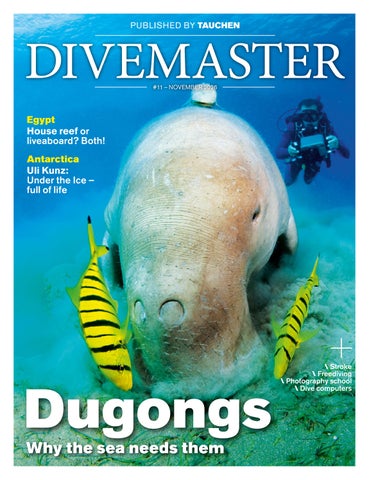
The photograph is by Martin Strmiska and was taken in the Red Sea at the Abu Dabbab dive site. It shows a dugong (Dugong dugon).
EXPERTS News from Science & Research Antarctica: Research diver Uli Kunz How to: Multitasking underwater Apnoea: Swimming relaxed through shallow water Medicine: Diving after a stroke Feature: In the footsteps of the last dugongs
64 66 74 76 80 82
makes a big impression Readers’ Photo Competition
JAHR Artopé Media GmbH & Co. KG Bajuwarenring 19, 82041 Oberhaching Tel. 089/5 52 41-0, Fax 089/5 52 41-244 Email: redaktion@tauchen.de ADVERTISING
089/5 52 41-225 Email: sales@tauchen.de
FOCUS Photography School: A tiny prawn
CONTACT & MORE TAUCHEN EDITORIAL TEAM
86 88
TAUCHEN SUBSCRIPTIONS + ADDRESS CHANGES
Tel. 040 5555 7991, email: jam@dpv.de TAUCHEN DIGITAL
www.tauchen.de/epaper
• Website: tauchen.de • Facebook: facebook.com/ tauchenmagazin • Instagram: instagram.com/ tauchen.magazin/ • Podcast: podcaster.de/podcasts#/ podcast/tauchen-talks • YouTube: TAUCHENDASMAGAZIN • TAUCHEN app: Android & iOS
GALLERY °
PORTUGAL’S BEST …
… Underwater photographers gathered in Madeira in June. We present the winning entries from the national competition. (madeiraunderwater.com)
CAMERA: CREATIVE
Luís Campos and Sofia Pereira
GALLERY °
SMARTPHONE: FISH
Maria da Paz and Danilo Borges
CAMERA: FISh Luís Campos and Sofia Pereira
CAMERA: WIDE-ANGLE
Filomena Sá Pinto and Carla Siopa
SMARTPHONE: WIDE-ANGLE
Rui Bernardo and Joana Narciso
GALLERY °
at. Nus. Sed unto consersped ut ipic tem lam int, es seque con nusdam quas is sum et pe ma quia custotatet officiur minctaspicia dit quos non consent incipsunt arumquidunt alicitius de porepel ectati dolorepudae voloresciis e
CAMERA: CLOSE-UP
Rui Bernardo and Joana Narciso
SMARTPHONE: CLOSE-UP
Filomena Sá Pinto and Carla Siopa
SMARTPHONE: CREATIVE
Rui Bernardo and Joana Narciso
MAGAZINE ULI KUNZ IS GOING ON TOUR WITH ‘PLANET MEER’
MARINE CONSERVATION FOR THE DESK
Marine biologist, research diver and photographer Uli Kunz is bringing his new live show, ‘Planet Meer – Terra X live’, to the stage. With stunning images and stories, the Terra X presenter guides the audience through the deep sea, underwater forests and remote marine regions. Along the way, he encounters unusual creatures and endangered species, accompanies marine conservationists and shows why the preservation of the oceans affects us all. The dates confirmed so far are 14 November 2026 at 8 pm in Erlangen, 15 November at 2 pm in Bad Tölz – where he will be joined by Florian Huber – as well as 16 November 2026 at 7 pm in Ludwigsburg and 7 December 2026 in Munich at the Tollwood Festival.
The “Big Moments 2027” desk calendar from Ocean Heroes brings together 13 underwater photographs and the stories behind them. The images are by well-known underwater photographers who have made their work available free of charge. Seacam contributed towards the production costs. All proceeds will go towards marine conservation. The DIN A5-sized calendar is printed on high-quality paper, features a sturdy stand and costs 20 euros. Available from the Ocean Heroes charity shop at ocean-heroes.shop/
one in front of each gill cover to the left and right of the eye On the side, just below the snout
Answer: C. To the side, just below the snout. A flap separates the incoming and outgoing water flow through each olfactory organ. You can find these and more facts and figures about sharks in Ocean Heroes’ new shark quiz. It’s both entertaining and educational, and available at a charity price (100 per cent of the proceeds go to charity) of 25 euros. Available to buy at: ocean-heroes.shop
! PP
A B C
JETZT BEI
IN THE A ES
Quiz question: Where are a shark’s nostrils?
LUS – M EP
E PICTUR OR
SHARK KNOWLEDGE MAKES YOU SMARTER...
DIV
Further dates and information are available at www.uli-kunz.com.
EVEN MORE CONTENT IN THE TAUCHEN APP
All stories marked with this button are available in the app version of TAUCHEN, complete with additional content. There, readers will find further images and videos, as well as longer articles that could not be included in the print edition due to space constraints. The digital edition of TAUCHEN is available via the app – download it from the Apple App Store and Google Play.
A NEW GENERATION TAKES OVER AT LAKE COSPUDEN
Christian Schmidt is taking over the Lutz Kamski Diving School in Markkleeberg on 1 January 2027. He will continue to run the centre under the new name ‘Tauchbasis Cospudener See’. After 26 years, Andrea and Lutz Kamski are handing over their diving school on Lake Cospuden to Christian. The new owner intends to preserve the family-friendly atmosphere whilst also introducing his own ideas. The range of services on offer will continue to include diving training, equipment hire and tank refills. The start of the season is planned for May 2027. “I’m really looking forward to carrying on the legacy.” The diving centre is located at Hafenstraße 21 in Markkleeberg. Further information is available at www.tauchbasis-cospudener-see.de.
UNDERWATER FESTIVAL BRINGS THE WORLD OF THE OCEANS TO ZURICH
Photos: Ocean Heroes, L. Kamski, U. Kunz, Zurich Underwater Festival
From 19 to 29 November 2026, the 16th Unterwasserfestival.ch will transform the Photobastei in Zurich into an immersive experience centred on underwater photography, diving and the protection of aquatic habitats. Over a length of around 150 metres, more than 50 photographers from Switzerland, Germany, Austria and other countries will showcase their work. The exhibition takes visitors from Swiss mountain lakes to tropical seas. On display are colourful coral reefs, mysterious shipwrecks, delicate micro-organisms and encounters with sharks, whales, manta rays and large schools of fish. Artistically staged photo series complement documentary shots. At the same time, the exhibition conveys the technical expertise required for underwater photography: changing light conditions, currents and fleeting encounters with shy creatures demand experience, patience and precise buoyancy control. The exhibition is accompanied by talks, photo features and personal accounts. Underwater photographers, researchers and divers talk about expeditions, rare species and their work in lakes, caves and oceans. The protection of endangered habitats also plays a central role. Organisations such as Sharkproject, Sharkschool and Sea Shepherd Switzerland provide information on climate change, pollution, overfishing and the loss of natural habitats. The festival will open on Thursday 19 November 2026 at 6 pm with an opening reception. After that, the exhibition will be open on Wednesdays and Sundays from 12 noon to 6 pm, and on Thursdays to Saturdays from 12 noon to 9 pm. The venue is the Photobastei at Sihlquai 125 in Zurich. Admission to the exhibition and the supporting programme is free. Up-to-date information is available at www.unterwasserfestival.ch
HOSTS WANTED FOR THE LECTURE TOUR ON THE GREAT WHITE SHARK!
Following the success of the 2025 tour, Ocean Heroes and TAUCHEN are planning a new series of talks for spring 2027. The approximately 90-minute multimedia talk centres on the great white shark. Personal encounters, scientific facts, as well as myths and fears surrounding the species, aim to convey a nuanced picture of this predatory fish. At the same time, the talk presents a campaign to protect endangered sharks. Diving clubs, diving schools and other organisers are being sought to host the tour. The requirements are a minimum of 60 participants and an admission fee of 15 euros or a comparable donation. Ocean Heroes provides the necessary equipment and operates on a voluntary basis. After tax deductions, all ticket proceeds and donations go entirely towards the conservation campaign. Organisers interested in taking part can contact Ocean Heroes or the TAUCHEN editorial team.
LONG-LOST PAINTING RETURNS AS AN ART PRINT
At the boot trade fair in Düsseldorf in 2013, a painting measuring six by 2.2 metres was created by the comic artist Oliver von Feistmantl. The work was subsequently due to be displayed on an international exhibition tour promoting marine conservation, but it disappeared during transport and has not been found to this day. Thanks to high-resolution photographs, the image has nevertheless been preserved: in collaboration with the artist, a limited edition of 200 hand-signed art prints has been produced. The print, measuring 150 by 43 centimetres, costs 50 euros. According to the seller, all proceeds, net of tax, will go towards marine conservation. Available from the Ocean Heroes Charity Shop ocean-heroes.shop/
You can find out more about the artist Michel Ley at: Facebook/michels.imbaerium, Instagram (‘michels.imbaerium’) and www.michels-imbaerium.de
TRAVEL
NEW AT RED SEA MARINE, SHARM EL-SHEIKH
SOLAR ENERGY FOR PARADISE
Nicole Wingartz has taken over as partner and general manager of the Red Sea Marine Diving Centre. The experienced dive centre manager previously worked for Subex in Sharm El-Sheikh for more than 15 years. The modernised centre is located at the Ghazala Beach Hotel on Naama Bay. It offers daily boat trips to Ras Mohammed and the Strait of Tiran, short safaris, shore dives and unlimited diving on the house reef. Nitrox is available free of charge to divers with the appropriate certification. Red Sea Marine is also certified as an SSI Diving Centre and an SSI Mermaid Centre. redseamarinesharm.com
From October, the Nunukan Island Resort in the Maratua Atoll (Extra Divers Management) will meet a large proportion of its energy needs using solar power. A new photovoltaic system (79 kWp) is set to supply around 110,000 kWh of solar power annually, whilst a battery storage system (128 kWh) will ensure that the energy generated during the day can also be used at night. The use of diesel generators will be significantly reduced, with annual CO₂ savings of around 88 tonnes – making the resort the first in the Maratua Atoll to be powered by solar energy. This commitment is complemented by an on-site vegetable and herb garden, which has been in operation for over two years. Information & bookings: nunukan@extradivers.org or info@reisecenter-federsee.de.
NEW YEAR’S EVE SAFARI IN THE RED SEA
Coral gardens, steep walls and historic wrecks make Lissenung Island, near Kavieng, a diverse diving destination. At the house reef and in the current-swept passages of the Bismarck Sea, divers encounter sharks, barracudas, tuna and numerous macro creatures. Lush soft corals, large gorgonians, visibility often ranging from 20 to 40 metres and water temperatures of around 29 degrees round off the experience. pacific-travel-house. com QR code: – go straight to the offer
GALAPAGOS 2027: LIVEABOARD WITH AMELIE From 14 to 27 November 2027, a guided liveaboard trip aboard the ‘Galaxy Diver III’ will take you to the legendary dive sites around Wolf and Darwin. With 19 dives, there’s a chance to encounter hammerhead and Galápagos sharks, whale sharks and manta rays. The supporting programme includes visits to Quito, Cotopaxi National Park and the Galápagos island of Bartolomé. The German-speaking guided tour costs from 6,550 euros per person, with the supporting programme costing an additional 1,150 euros. reisecenter-federsee.de
Photos: Organiser/Provider
DIVING ADVENTURES OFF LISSENUNG ISLAND
Ring in the New Year amongst big fish, wrecks and steep walls: from 28 December 2026 to 4 January 2027, Omneia is offering a one-week New Year’s Eve safari in the Red Sea. The M/Y Omneia Soul will set sail from Hurghada to the Brother Islands, Elphinstone and Sataya. The route thus combines some of the Red Sea’s most famous dive sites, offering a mix of spectacular drop-offs, wrecks and good chances of encountering large pelagics. The New Year will also be celebrated on board: a special menu and a party are planned for New Year’s Eve. The safari starts and ends in Hurghada and can be booked from 1,499 euros per person. omneia.de
READERS’ TOURS 2026/2027 Orcas & Northern Lights
For readers of TAUCHEN magazine, Wirodive is offering an exclusive readers’ trip to Orca Camp in Northern Norway in November 2026: in the fjord landscape around Hamneidet, participants have the chance to encounter orcas and humpback whales in the wild and – on clear nights – spectacular Northern Lights. The week includes up to six boat trips and nature programmes, including an introduction to Northern Lights photography. Travel dates: 15–22 November 2026. Price per person: 3,590 euros (excluding travel to the destination and any stopovers). Information: www.tauchen.de/leserreisen & email: redaktion@tauchen.de
Family diving cruise in the Maldives
From 1 to 8 August 2027, the TAUCHEN readers’ holiday ‘Cruise, Dive and Chill’ will take families on a tour of the North Malé and Ari Atolls. On board the ‘EcoPro Seascape’, certified divers can look forward to two dives a day. The programme also includes snorkelling excursions, children’s diving courses, island visits, and stand-up paddleboarding and kayaking tours. With a bit of luck, guests may encounter manta rays and whale sharks. Non-divers and children aged six and over are also welcome to join, provided they can swim confidently. The trip costs 1,799 euros for adults. Children travel from 899 euros. The price includes a twin cabin, full board, diving, airport transfers, island visits and a beach barbecue. Flights and the green tax are extra. Enquiries: redaktion@tauchen.de, keyword ‘Family holiday in the Maldives’.
RCF begleitete Kleingruppenreise
Socorro
Begleite uns auf unvergessliche Tauchreisen zu den spektakulärsten und entlegenen Spots weltweit! • Top-Tauchspots & exklusive Locations • Professionelle Begleitung & kleine Gruppen • Perfekt organisierte Reisen – du tauchst, wir kümmern uns um den Rest!
NEW: SAVU SOUTH Coral gardens, sheer drop-offs and a wealth of macro life, set against a backdrop of lush natural surroundings and seven villas right by the sea: Savu South Alor, in the south of the Indonesian island of Alor, is a hidden gem. From the resort, experienced divers can reach the rarely visited reefs of the south coast, where encounters with sunfish, thresher sharks and hammerhead sharks are possible. Above water, too, the experience is exceptional: an infinity pool overlooking the Savu Sea, cuisine sourced from the resort’s own permaculture farm, and whale and dolphin-watching tours. A dream destination for couples and those seeking peace and quiet. Scan the QR code and discover Savu. aquaactive.de
Geführte Kleingruppenreise Baja California und Tauchsafari auf der M/V Nautilus Explorer 17.03.2028 – 31.03.2028
ab /bis San José del Cabo mit Peter aus dem Sales Team
STAY LONGER, DIVE MORE, AND SPEND LESS! Still got time for a holiday this year? How about a private villa in Bali, with tropical gardens, a 20-metre-long swimming pool and a range of diving spots right on your doorstep? The Campo Beluga in Pemuteran is the perfect place for anyone looking to experience peace and quiet, nature and authentic Bali. Three bedrooms, spacious living areas and a daily breakfast make the Beluga Villa the ideal home for families, friends and diving enthusiasts. Just a few minutes away lie the reefs surrounding Menjangan National Park. And now your diving holiday is even more attractive: pay for six nights, stay for seven, or pay for 12 nights and stay for 14. On top of that, you’ll receive one free house reef dive per person for every night of your stay. So, for example, if you stay for ten nights, you’ll receive ten free house reef dives per person. www.belugareisen.de | info@belugareisen.de
ab 5.999 € pro Person Highlights:
• 19.03 – 22.03.2028 San Ignacio Glamping mit Vollpension und Whale Watching • 22.03. – 30.03.2028 8-tägige Socorro Tauchsafari: Halbcharter auf der M/V Nautilus Explorer mit bis zu 4 Tauchgängen täglich
• Anschlussaufenthalt in San José del Cabo Alle Details & Infos zu dieser Reise und weitere Gruppenreisen auf unserer Website.
WELTWEIT MEER ERLEBEN
reisen@reisecenter-federsee.de www.rcf-tauchreisen.de
rcftauchreisen
tauchreisen_rcf
TRAVEL °DIVE CENTRE PROFILE T Alexander Kassler
A LOOK AT DIVING CENTRES:
DIVING IN CRES DIVING IN THE ADRIATIC RIGHT ON YOUR DOORSTEP Here we showcase, amongst other things, diving centres and diving clubs. This time, we’re featuring the Diving Cres centre.
CONTACT: DIVING CRES, Kovačine Campsite Cres, Croatia, www.diving-cres.de
PROFILE: → Boat trips → Training and guided dives
Short distances and personalised service: the well-equipped centre, the dedicated team and the cosy meeting place at the campsite form the heart of Diving Cres. But this also includes the warmth and hospitality of the centre’s owners (and their family): Mario and Jutta Hofer, who have owned the centre since 2016.
Photos: Jürgen Gangoly; Diving Cres
→ SSI Dive Centre → House reef
I
f you’re holidaying on Cres, you won’t have to travel far for your first dive: Diving Cres is situated right by the sea at the Kovačine campsite. It’s just a short walk away, and the house reef is right in front of the centre – ideal for a check-dive after you arrive, training dives or a relaxed introduction to the underwater world of the northern Adriatic. The centre has been based on the Croatian island since 1994. As an SSI Dive Centre, it offers a wide range of activities, from taster dives and beginner’s courses to specialist training. Experienced divers can dive independently with a buddy or be accompanied by guides who know the area well. Those wishing to venture further out can reach numerous dive sites around Cres by boat, usually in around 20 to 25 minutes. The area is typical of the northern Adriatic: rocky cliffs drop away into the blue, whilst overhangs and crevices provide hiding places for octopuses and conger eels. Schools of fish swim above the reefs, and depending on the site, steep formations, cave structures and the clear light characterise the dive. A highlight for advanced divers is the wreck of the Lina. The historic hull combines the special atmosphere of a wreck dive with marine growth and marine life. At the same time, Cres offers more than just this one destination: it is precisely the interplay of house reefs, rocky landscapes and boat dive sites that makes the island appealing to divers of all experience levels. One thing always remains the same: the personal atmosphere. No rush. No mass diving. No feeling of being just a number. Instead, people who love diving themselves and know why they fill their tanks every morning, prepare the boats and keep an eye on the weather. Because they know, love and live for that feeling. <<
Typical of Cres: rock faces covered in colourful marine life drop steeply into the clear blue waters of the Adriatic. Octopuses, conger eels and numerous other marine creatures find shelter in crevices and overhangs.
TRAVEL °EGYPT
Would you prefer a liveaboard trip or shorebased diving? Would you prefer the central Red Sea or the far south? We visited Ducks Diving in El Quseir and Emperor Divers in Marsa Alam, including their liveaboard ‘Emperor Elite’. Which did we like best?
T & F Timo Dersch
UPINAND DOWN THE
DESERT STATE
TRAVEL °EGYPT
The ‘Wadi Sabarah’ hotel impresses with its minimalist architecture and scientific concept. The lads at the ‘Emperor Divers Wadi Sabarah’ dive centre know exactly where to find the dugongs (picture below).
The tunnel system and the overhangs at Ducks Diving’s house reef, ‘Zerib Kebir’, create a unique play of light.
The best way to experience the splendour of the soft corals at St John’s Reef is aboard the safari vessel ‘Emperor Elite’ (bottom right). Centre: the Museum of Egyptian Culture and women’s garments at the Wadi Sabarah Hotel. Below: the jetty leading from the hotel to the entry point for the house reef at the Rohanou Beach Resort Ecolodge.
>
TRAVEL °EGYPT
B
lue-grey and utterly serene, there lies the bay of Zerib Kebir. As the sun slowly rises above the horizon, the play of colours begins. At first, the small waves dance in shades ranging from cobalt blue to azure. Then, the colour of the water shifts to a rich turquoise over the edge of the house reef. Right at the far end of the bay, this pale, almost translucent green glows, through which you can see the sand glistening on the seabed. Anyone stepping out onto the jetty at Ducks Diving for the first time will understand why the centre is located right here – on the edge of a bay that seems to have remained hidden from the mass of Egyptian tourism. Unlike Hurghada or Sharm el-Sheikh, the nearby town of El
“I GREW UP AT A DIVING CENTRE AND THE RED SEA IS MY HOME. DIVING IS THE JOB I LOVE.”
Quseir has never quite lost its historic character: no noise, no endless hotel chains – just the coastal road, a few scattered coves and, right in the middle of it all, the charming little Rohanou resort. Here, you can find peace and quiet and enjoy the sea to the full. And that, after all, is why you’re here.
Freedom rather than a timetable Ducks Diving Quseir, run by the German-Egyptian Hassan-Eid family, aims not only to train divers, but also to awaken a longing – for the freedom beneath the water and the tranquillity of the depths, and for curiosity about the unknown, fascinating marine life. “I grew up at the dive centre – the Red Sea is my home, and diving is the job I love,” says Karim, the son and centre manager. “I want to share this
passion with every one of our guests.” And to fully indulge in this passion for freedom, a certain degree of freedom is, of course, a prerequisite. “You’re on holiday – so you’re free to dive however you please,” smiles Karim, having finished his detailed centre briefing. After all, there’s no tightly scheduled, profit-driven excursion programme here, but rather a leisurely pace that the guests themselves help to set.
Canyons right on your doorstep At the heart of the concept is the house reef. From 8 am to 5 pm, you can dive freely from the jetty – in pairs, without a guide and without a fixed timetable. Anyone who wants to can go into the water three times a day – or even four times if time allows – independently with their buddy: heading north or south directly from the jetty, taking the Zodiac to nearby Zerib Soraya or the Nemo-City dive site, or following the outer edge of the bay to dive back to the jetty. Here, you don’t dive because the timetable demands it, but simply because it suits you at that moment. Underwater, the house reef slopes down in terraces, covered with dense gardens of hard coral. A particular highlight is the gigantic lettuce coral. Schools of humbug damselfish dart about amongst the coral trees, blue-spotted stingrays lie in wait in the sand, and moray eels watch it all from their crevices with their characteristic blend of indifference and vigilance. On good days, bottlenose dolphins swim along the edge of the reef. And then there are the canyons. They are, so to speak, the hallmark of Zerib Kebir. It is a system of passages, overhangs and small caves directly beneath the reef top, where the rays of light dance like >
Ducks Diving Quseir in a nutshell: macro surprises such as frogfish and giant lettuce corals on the house reef. Plus independent nitrox diving straight from the jetty and a brilliant, friendly team.
If you like Nemo, you’ll love St John’s: On the southern outer reef, there are numerous colonies of clownfish.
TRAVEL °EGYPT laser beams in a village disco. A spectacular sight.
From the bay to Elphinstone There are over 20 dive sites within easy reach on the outer reefs. Many of these can be reached directly by Zodiac from the jetty. However, you do need to stick to the departure times here. For trips to the legendary Elphinstone Reef, where sheer walls plunge into the magical blue and, with a bit of luck, hammerhead sharks make an appearance, a second, faster Zodiac is on hand – following a bus journey of about an hour southwards. The equipment is in excellent condition: 12-litre aluminium cylinders with DIN connectors, yoke adaptors available on request, Nitrox for certified divers at no extra charge, plus our own workshop. Diving courses follow SSI standards and are taught in German, English, French or Arabic. The dive centre is nestled within the Rohanou Beach Resort. Anyone expecting large swimming pool complexes and entertainment programmes here will be disappointed, because that is precisely the point: traditional local architecture, muted colours and cosy rooms that feel like a retreat. Private sandy beaches, protected access to the house reef, and no access for mass tourism that damages the reef: the centre and the resort share the same goal of preserving the reef just as it is. And it’s paying off: here, the reefs still look exactly as they should. On safari in the Deep South If you’re keen to venture further south on an exploration tour, you’ll be in good hands with Emperor Divers. A southern safari to St John’s Reef combines the top spots off the coast of Marsa Alam with a vast outer reef boasting countless dive sites off the beaten track. The big names on the outward and return journeys don’t disappoint: whilst snorkelling at Shaab Sataya, you feel as though you’re part of the dolphin family. Elphinstone delights with a lush soft-coral paradise and shark sightings, whilst Shaab Marsa Alam offers a thrilling slalom dive through the impressive landscape of coral columns.
At the Wadi Sabarah Hotel, there is a great deal to learn: about life in the desert, life on the reef and the history of the country’s cultures.
St John’s Reef: Diving with a spirit of discovery At St John’s Reef, two spots in particular stand out: on the one hand, Erg Abu Diab, a slender pillar where, on its northern edge at a depth of around 30 metres, soft corals flourish in the current whilst trevallies hunt schooling fish. And secondly, St John’s Caves – a long, shallow tunnel system where you can spend virtually the entire dive and which exudes an air of adventure. What was particularly striking during the tour was just how important the safety protocol is: the briefings are thorough, and there are fire and lifejacket drills. Everyone is shown how to use the oxygen supply and how the emergency response procedures work. And in any case, no one goes into the water without the ENOS GPS emergency rescue system and a surface marker buoy. >
On a southern safari aboard the ‘Emperor Elite’, you won’t want to miss the classic dive sites such as ‘Sataya Dolphin House’ for dolphins or ‘Elphinstone’ for shark sightings. Refreshments are always provided.
TRAVEL INFORMATION: EGYPT DUCKS DIVING IN EL QUSEIR Where: 10 km south of the town of El Quseir,
southern Red Sea, Egypt When: all year round Getting there: To Marsa Alam Airport (40minute shuttle transfer) or to Hurghada Airport (90-minute shuttle transfer). Hotel: Rohanou Beach Resort Ecolodge, double room with sea view and full board, rohanou.com. Dive centre: Ducks Diving Quseir, 1 dive: 34 euros (may be cheaper depending on the package booked), Open Water Diver course: 395 euros. Nitrox free of charge. ducks-quseir. com Price example: one week in a double room at the Rohanou, including flights and a five-day diving package with two dives each day: 1,128 euros per person.
EMPEROR DIVERS WADI SABARAH AND EMPEROR ELITE LIVE ABOARD Where: 27 km north of the town of Marsa
Alam, 43 km south of Marsa Alam Airport, Egypt When: all year round Getting there: From many German airports to Marsa Alam Airport (shuttle transfer of under 45 minutes) or to Hurghada Airport (three-hour shuttle transfer). Hotel: Wadi Sabarah Eco Lodge and Botanical Gardens, in a double room with sea views and full board, wadisabarah.com Dive centre: Emperor Divers Wadi Sabarah, 1 dive: 34 euros (may be cheaper depending on the package booked), OWD: 395 euros. Free nitrox. emperordivers.com Price example: one week in a double room at Wadi Sabarah, including flights, transfers and five days’ diving comprising 15 dives: 1,535 euros per person; a one-week liveaboard on the southern tour aboard the ‘Emperor Elite’ from 1,627 euros. Information and bookings for both: www.sunandfun.com
Rotes Meer
Ducks Diving Port Ghalib Wadi Sabarah
EGYPT
Safari South Tour St John’s
TRAVEL °EGYPT
‘READ THE TRACKS AND FOLLOW THE WATER.’
Between a seagrass meadow and a desert As well as their safari boats, Emperor Divers also run three land-based dive centres, including the one in Wadi Sabarah. Every visitor is encouraged to take a moment to relax here before or after their tour. The hotel features minimalist architecture and is decorated in pleasant shades of beige. It was built from coral stone that is thousands of years old – not your typical Red Sea resort. And there’s plenty to learn here too: a botanical garden showcases the local flora, an on-site museum displays the traditional costumes of Egyptian women, and there’s also a library where lectures organised by the in-house marine biology research station take place in the evenings. Diving is usually done as a day trip. One of the highlights is the trip to Marsa Mubarak Bay, home to the dugongs. Because after a dive in the seagrass meadow amongst the grazing green sea turtles, you’ll suddenly hear someone excit-
WHO WOULD HAVE THOUGHT THAT THERE’S SO MUCH TO LEARN IN THE DESERT? edly exclaim: ‘He’s here now’ – so quickly grab your snorkel and fins to watch the dugong grazing peacefully. What an impressive animal! An absolute bucket-list moment for every diver. Another must-do for guests at the Sabarah is a desert trek with guide Youhanna. This walking encyclopaedia guides you through the world of the Bedouins. “You have to read the tracks,” he says, “and follow the water.” Who would have thought there was so much to learn in the desert? The evening draws to a close on the hotel terrace, accompanied by elegant music and traditional cuisine. Here, you can sit high above the bay whilst the whitetailed eagle, Egypt’s national bird, soars through the twilight. So which of the stops on the trip was the best? It’s impossible to say. If you have the chance, it’s best to visit all three! <<
TAUCHEN.DE
DER NEUE PROTEC AIR
MADE IN AUSTRIA
THE NEW GENERATION OF DRY DIVING Der PROTEC AIR überzeugt durch seine technisch orientierten Features, extrem robuste Verarbeitung und besonders hohe Atmungsaktivität. Mit über 50 Ausstattungs-Optionen kannst Du Deinen brandneuen Trockentauchanzug perfekt auf Deine Bedürfnisse abstimmen. Sein geringes Packmaß macht ihn zudem zum idealen Begleiter auf Deinem nächsten Tauchtrip. Und das gibt‘s nur bei CAMARO: Gratis Teilmaß-Service und 3-Jahre-Reparaturservice. Weitere Informationen? Besuche uns auf CAMARO.AT
CAMARO. AT
A
TRAVEL °CAGAYAN ARCHIPELAGO
CAGAYAN Tubbataha, the Philippine diving paradise and a UNESCO World Natural Heritage Site, is known to almost everyone. Not far away lie the Cagayan Islands, a small archipelago with similarly impressive reefs. T & F Barbara & Wolfgang Pölzer
T
he Sulu Sea lies in the west of the Philippines, between Palawan and Mindanao. From its basin, which is several thousand metres deep, rises a submerged mountain range that breaks the surface of the water in only a few places as coral atolls or tiny islands. The best-known example is the Tubbataha Reefs. Hardly anyone, however, is familiar with the Cagayancillo archipelago surrounding the main island of Cagayan, about 120 kilometres west of Sipalay. Tubbataha falls under the administrative jurisdiction of this municipality. Around 7,200 inhabitants live in its twelve barangays – many of whom make a living from fishing, subsistence farming and seaweed cultivation. Tourism has
so far played hardly any role. One of the few exceptions is the Easy Diving Eco Resort. During the season, the Swiss operator opens his camp, which features six glamping tents and five air-conditioned bungalows. Guests arrive by a sixseater Cessna.
A stop in Sipalay before heading to camp The operator is former Swiss professional footballer Christian Reinwald. He has been living in the Philippines for a quarter of a century, runs several diving centres and organises liveaboard trips. The headquarters is the Easy Diving & Beach Resort in Sipalay, around 25 minutes’ flight from Cagayan. It’s worth spending a few days here >
ARCHIPELAGO
>
TRAVEL °CAGAYAN ARCHIPELAGO getting acclimatised before continuing your journey. This cosy resort is ideal for acclimatising and relaxing, and serves excellent food. Underwater, the coast off Negros is particularly notable for its biodiversity and rare macro life: colourful nudibranchs, bizarre shrimps and crabs, frogfish, coral catfish, scorpionfish and stingrays. Before the island expedition, it’s time to repack. In the basic camp and on the dive boat, only the bare essentials are needed. Evening dresses, make-up cases and lots of different outfits can stay at home. Sun cream and mosquito repellent are more important. A rucksack rather than a hard-shell suitcase – otherwise Christian and his pilots will have a headache. And so we set off. From the runway of a disused gold mine behind Sipalay, the Cessna flies to the southern tip of the main island of Cagayan in around 25 minutes. We reach the nearby camp by moped taxi. The large glamping tents offer proper beds, electricity, bedside tables and a fan. Showers and toilets are located in the communal washhouse beneath tropical trees. Just a few steps from the beach is the communal area with tables, benches, snacks and drinks. Those who prefer air conditioning and an en-suite bathroom at night can opt for one of the bungalows.
Delicious fish soup A quick unpack and off we go onto the dive bangka! We can still manage two dives on the first day. We follow dive guide Fred into the blue of the sea, down to a depth of just under 30 metres. Where the steep slope gives way to a sandy plateau, orange soft corals glow on scattered reef blocks. Above them, a school of young barracudas swims by. Silvery fish against colourful corals – what a striking contrast! Fighting the barely perceptible current, we follow the plateau and, a short while later, come across a huge feathertail stingray in its sandy bed. Along the reef slope, we see barrel sponges, man-high broom gorgonians, sprawling table and plate corals, as well as countless fan gorgonians. Amongst them are anthias, fusiliers, pennantfish, triggerfish, surgeonfish and butterflyfish. We also spot pufferfish in the shade and well-camouflaged scorpionfish on sponges. As the current picks up and we’re about to let ourselves drift, Fred points upwards. A massive school of bigeye trevally is waiting at the reef edge. We kick our fins hard, making the most of bit of shelter from the current, and reach them at a depth of five metres. Countless silvery fish glide past us, almost within reach. At first, we can only see their tail fins. But after what feels like an eternity, I manage to overtake the shoal from the side – passing a hawksbill turtle gnawing on a sponge, which, with the trevallies in the background, makes for a perfect photo opportunity. I switch the camera to video
mode, turn round and, breathing calmly, let myself drift towards the fish from the front. Just as the sea once parted for Moses, the shoal splits, forming a narrow passage – almost a tunnel – and lets me glide through its centre without touching it. A few seconds later, I’m back with the dive group, and we finish the dive together.
All of this goes in the logbook: colourful creatures, impressive schools of fish, gigantic gorgonians and a 130metre wreck that has been dived only a few times.
Steep cliffs, overhangs, gorgonian forests Dives like this are not uncommon off the coast of Cagayan. Many dive sites are at moderate depths of up to around 30 metres. This leaves plenty of time to observe the gigantic gorgonians, passing schools of fish and small reef dwellers at your leisure. Particularly impressive are the densely overgrown drop-offs and overhangs with unusually large gorgonian fans. Schools of mackerel and barracuda, fusiliers and groupers swim past, whilst snails and prawns can be found close by. Off the neighbouring island of Calusa, we come across colourful stony and soft corals and gorgonians nearly five metres high. Eagle rays and reef sharks can be seen in the distance. Encounters with
A rare beauty: an unusual encounter during a safety stop with the rarely seen pink cigar jellyfish (Thysanostoma loriferum), which is about an ell long but only slightly stinging.
whale sharks or manta rays are unpredictable but possible. Dugongs have also been spotted in the region.
Magic Moment A few days later, something unexpected happens. On the way to the dive site, numerous obstacles in the mirror-smooth water initially look like tree trunks. As we get closer, we make out around 50 whales resting almost motionless on the water’s surface. Engine off. Whilst the guests on board and the crew film from a distance, I glide carefully into the water and cover the remaining metres to the animals as quietly as possible whilst snorkelling. In the deep blue, five whales finally come into view, one a good five metres long and with a strikingly round head. They
Glamping: Accommodation is in spacious tents (bottom left) with electricity and proper beds – or, alternatively, in simple but air-conditioned rooms.
are probably short-finned pilot whales, which live mainly far from the coast and are therefore rarely sighted. I paddle gently on and get as close as just under ten metres. Then the group starts to move. The smaller whales swim away, whilst the larger male keeps his distance, but swims past and beneath me several times, turning sideways and appearing to scrutinise me closely. Even as I remain motionless, he remains curious. After about five minutes, the pod slowly moves on. With a handful of photos to prove it and plenty of endorphins, I return to the boat.
Happily ever after After three dives along the north-west coast of Cagayan, we set off eastwards early the following day. About an >
TRAVEL °CAGAYAN ARCHIPELAGO
TRAVEL INFORMATION: EASY DIVING & CAGAYAN CAMP Established in: 2000, under the leadership of Christian Reinwald. Location: on the west coast of Negros in the Philippines, near Sipalay, on a hillside with a sandy beach, approximately 180 kilometres south of Bacolod Airport. DIVING: Up to four guided dives a
day in small groups. Dives are conducted from covered outrigger boats (bangkas). Except on day trips with two to three dives, or at the customer’s request, divers return to base after each dive. Around 40 dive sites can be reached in two to 60 minutes. Water temperature: around 27 degrees Celsius in December and January, rising to around 30 degrees Celsius in June. Recommended wetsuit thickness: three to five millimetres. BOATS: three covered wooden
outrigger boats, each accommodating six to eight divers, and two speedboats, each accommodating six divers. PRICES: A guided dive, including a
guide, tank and weights, costs 2,150 PHP; a package of ten dives costs 19,780 PHP. There is a 400 PHP surcharge for a night dive. A PADI Open Water Diver course with e-learning costs 27,000 PHP. As of August 2026 (subject to change). BEST TIME TO VISIT:
open all year round. Best time for diving: according to the operator, from early October to late July. Visibility is usually between ten and 25 metres. Contact and further information: www.sipalay.com ACCOMMODATION: The diving
resort is situated on a long sandy beach and is built in terraces within the tropical forest. It offers several
categories of rooms and bungalows. The air-conditioned categories are equipped with a fan, a safe, tea and coffee-making facilities, a bathroom with toilet, and a terrace. Some standard bungalows are equipped with a fan only. Current room categories and availability should be checked directly with the resort. MEALS: A generous breakfast is
included in the room rates. Guests who have not booked half-board or full-board will find a wide selection of à la carte dishes from Filipino and European cuisines in the restaurant. CAGAYAN CAMP / EASY DIVING ECO RESORT
On the Cagayan diving safari, you fly from Sipalay to the island of Cagayan – some 130 kilometres away – in around 25 minutes in a six-seater Cessna. Accommodation: a choice of one of the six spacious glamping tents with round-the-clock electricity, a fan and a communal washhouse, or one of the five brick bungalows with air conditioning and an en-suite bathroom. There is space for a maximum of twelve guests in total. Drinking water, coffee, tea, soft drinks and snacks are provided. Dinner is served at the camp. Surcharge for an air-conditioned bungalow: 3,000 PHP per person per safari. Single occupancy: 9,500 PHP surcharge. As of August 2026 (subject to change). Diving: Early in the morning, you’ll board a large catamaran, which also serves as a floating dive centre with a compressor. The programme usually includes three dives using compressed air. Coffee and snacks are provided on the way to the first dive site. Breakfast and lunch are served on board. You’ll return to
camp in the late afternoon. You must bring your own dive computer, underwater torch and surface marker buoy (SMB). Marine park fees are not included in the safari price and will be charged on site at the applicable rates. Season: The Cagayan safaris run from December to July. Weekly departures are planned for 2026/27. Tip: Bring mosquito repellent for the camp and plenty of sun cream for the dive boat. Organiser: Scuba Native, www.scuba-native.de Holiday package: Scuba Native combines stays at the Easy Diving & Beach Resort in Sipalay with the Cagayan Safari, full board, diving packages, the flight to Cagayan and transfers. Please check with the tour operator for up-to-date prices and specific inclusions for your desired travel dates. International and domestic flights within the Philippines are not included in every holiday package. Flight prices and schedules are subject to change at short notice and should be checked. GENERAL INFORMATION Arrival: for example, via Manila,
followed by a domestic flight to Bacolod or Dumaguete on Negros. From there, the road transfer to the resort near Sipalay takes around four hours. You should check the latest flight connections before booking. German nationals can enter the country visa-free for tourist stays of up to 30 days. You will need a passport that is valid for at least six months beyond your planned departure date, as well as an onward or return flight ticket within the permitted period of stay. In addition, you must register free of charge at https://etravel.gov.ph within the 72 hours before arrival.
Entry requirements may change at short notice and should be checked before departure. Money: The official currency is the Philippine peso (PHP). Exchange rates fluctuate. According to the resort in Sipalay, it accepts pesos and credit cards. For Cagayan, you should carry sufficient cash and clarify the payment method in advance. Electricity: At the resort and in Cagayan – According to the camp operators, 220-volt power and European sockets are available. A universal adaptor is recommended for other accommodation in the Philippines. Mobile phone and internet: Roaming depends on your mobile phone contract and local network coverage. Free Wi-Fi is available at the resort and at the camp on Cagayan. Health: Discuss vaccinations, mosquito repellent and possible malaria prophylaxis with a travel medicine specialist well in advance of your departure. Up-to-date information on this topic is available from, amongst others, the Federal Foreign Office and the German Society for Tropical Medicine and Global Health at www.dtg.org. Recompression chamber: According to the organiser’s latest information, the nearest decompression chamber is in Cebu. For the remote region featured in this article, valid diving accident insurance and a pre-arranged evacuation route in the event of an emergency are particularly important.
A brilliant duo: To settle in and get started with the diving, you’ll begin at the comfortable Easy Diving & Beach Resort in Sipalay (photo on the left and room photo top left next to it), before flying by Cessna to the camp in Cagayan (remaining photos).
towards the stern. After a glance at the large rope winches, we float over the outer edge. There, three intact propellers, colourfully overgrown with marine life, rise towards the water’s surface.
hour and a half ’s boat ride away lies a real treat for wreck enthusiasts: the M/V Forever Lucky, which sank in 2019. The former cargo and passenger ship, some 130 metres long, now lies at a depth of between ten and 30 metres. It has certainly not lived up to its English name. Due to the strong current, we follow our guide Fred swiftly down into the depths. Soon we make out the outline of the wreck, lying keel-up, and reach the lee of the current beneath the bow at a depth of 30 metres. Deformed metal parts blend into the seabed, whilst dark openings pierce the hull. A large batfish swims towards us and disappears again almost immediately. Soft corals grow out of former windows, red sponges cover the railing, and white hydrozoans warn against touching them. Through a side opening, we enter an upside-down world: beneath us lies the freighter’s former ceiling, with cables, pipes and steel struts; above us, the floor. In an adjoining compartment, a toilet hangs from the ceiling. A narrow steel staircase leads further into the wreck – too dangerous for us. We stay by the large openings, examining the details covered in colourful growth and taking great care not to get caught on anything. Wreck penetration is strictly reserved for suitably trained divers and requires appropriate equipment and planning. Finally, we leave the dim light behind, glide past encrusted portholes and follow the hull – partly overgrown with stony corals –
Conclusion Fascinating sheer walls, coral-rich reefs, a huge shipwreck and endless surprises in one of the most remote regions of the Philippines: Cagayan’s special appeal lies in its exclusivity. Interested guests are expected to have an expeditionary spirit and be prepared to do without some luxuries and Nitrox for a week. <<
Franz. Polynesien · Fiji Inseln · Palau Papua Neuguinea · Yap · Salomonen Vanuatu · Tonga · Neukaledonien
… mit Pacific Travel House – dem Spezialisten seit über 35 Jahren! 21 Tage Französisch Polynesien Tahiti, Rangiroa und Fakarava
Fantastisches Großfischtauchen an den Riffen und in den Passagen der Atolle · Inkl. 21 Tauchgängen, Flügen, Übernachtungen/Frühstück/Transfer
ab 7.550 € p.P. / DZ
21 Tage Fiji Inseln Viti Levu, Taveuni, und Beqa Lagune
PHILIPPINES
Aufregendes Tauchen zwischen farbig leuchtenden Korallen, bunten Rifffischschwärmen und beeindruckenden Großfischen · Inkl. 22 Tauchgängen, Flügen, Übernachtungen/Frühstück/Transfers
ab 6.945 € p.P. / DZ
17 Tage Mikronesien Palau und Yap
Manila
Faszinierendes Tauchen an steilen Außenriffen, in Strömungen und Lagunen mit zahlreichen Großfischen · Inkl. 20 Tauchgängen, Flügen, Übernachtungen/Frühstück/Transfers Bacolod Cagayan Archipelago
Easy Diving Sipalay
SULU SEA
ab 5.475 € p.P. / DZ
18 Tage Papua Neuguinea Lissenung Island und Tufi Resort
Reiche Artenvielfalt, Sichtweiten bis zu 30 Meter, unberührte Korallenriffe und große Fischschwärme · Inkl. 20 Tauchgängen, Flügen, Übernachtungen/Mahlzeiten/Transfers
ab 6.550 € p.P. / DZ
Weitere Vorschläge, ausführliche Beschreibungen und kostenlose individuelle Ausarbeitung unter:
WATCH THE TRAVEL VIDEO: https://youtu.be/ YTFLXInz2cc
pacific.travel.house Pacific Travel House Reiseveranstaltungs GmbH Schwanthalerstraße 100, D-80336 München info@pth-muc.de, 089-543 21-80
www.pacific-travel-house.com
TRAVEL °HONDURAS
T & F Jenny Stock
Steep reef walls, shipwrecks and encounters with Caribbean reef sharks: a week-long liveaboard trip between Roatán, Utila and the Cayos Cochinos showcases the underwater diversity of the Honduran Bay Islands.
AMONG THE BAY ISLANDS
A
mesmerising swarm of thousands of glistening silversides pulses and swirls at the entrance to the dark cave. Every fin stroke sends a ripple through the shimmering mass. In perfect synchrony, the fish close ranks and then spread out again, blocking my path. My buddy has already disappeared behind the sparkling curtain. So there’s only one option: straight through. Never before have I been surrounded by so many fish. As the shoal engulfs me, I find myself in the midst of one of the most impressive underwater spectacles I have ever experienced. Experiences like this in Spooky Channel are what give Roatán its reputation as one of the best diving destinations in the Caribbean. The largest of the Honduran Bay Islands lies on the southern edge of the Mesoamerican Barrier Reef, the second-largest barrier reef system on Earth. The island, which is around 60 kilometres long, is situated some 57 kilometres off the Caribbean coast of Honduras and forms part of an archipelago that also includes Utila and the Cayos Cochinos.
Roatán Roatán is a coral island formed from an ancient reef, rising to around 270 metres above sea level. This geological history has shaped an underwater landscape of steep walls, reef channels, caves and coral gardens – much of which begins just a few fin strokes from the shore. The island is culturally diverse, too: indigenous groups, Garifuna communities, descendants of British settlers and people from the Honduran mainland all shape Roatán’s identity. Spanish is the official language, but English is spoken just as naturally in many places, particularly in tourism and the diving industry – a legacy of British colonial history. For divers, Roatán is best explored from a liveaboard. More remote reefs lie beyond the reach of day boats. When conditions are right, routes take divers along the north and south coasts, to Utila and into the protected marine area of the Cayos Cochinos. >
TRAVEL °HONDURAS
Masters of Camouflage: A white seahorse measuring just a few centimetres and a Carib bean reef octopus are among the most sought-after macro subjects in the Bay Islands.
Roatán’s reefs offer subjects of every size: from dense shoals of silversides and delicate scale structures to the colourful flamingo tongue on a gorgonian.
Here we go Six of the eight permanent crew members on the 36-metre-long Roatán Aggressor are from the island. Their local knowledge will guide us through the Bay Islands over the coming week. As the engines start up early on Saturday morning, I lay out my camera equipment on the spacious camera table and begin setting it up. We’re kicking off on the south-east coast: Mary’s Place, one of Roatán’s legendary dive sites. It’s only easily accessible when the trade winds die down. It becomes clear that something special awaits us when a regular visitor, even before taking the first dip in the water, asks that we make sure to return later. Amidst the warm Caribbean blue, the reef suddenly opens up into a dramatic crevice that cuts across the seabed like a scar. Inside, the walls rise steeply. Beams of light stream through the narrow opening, illuminating huge barrel sponges, gorgonians and hard corals. The cones of light tempt you to dive swiftly through the channel. However, my divemaster, Alan Roberts, deliberately slows down to a gentle fin stroke. This leaves time to take in the details: orange-striped arrow crabs, perfectly camouflaged filefish and spotted flamingo tongue snails on soft corals. After around 30 minutes in the winding passages, we reach a deep, steep wall. On a shallower plateau, a free-swimming green moray eel surprises us with its speed. In the evening, we enjoy the golden twilight sky on the upper deck, along with ‘Island-style’ ribs prepared by head chef Jana Waterhouse. Whilst I’m still licking the sauce off my fingers, Alan tells us about his journey to the Bay Islands. In 1984, he met Wayne Hasson and Anne Hasson, the original co-owners of the Aggressor Fleet, and obtained his skipper’s licence on one of the first Aggressor tours. After that, he transferred vessels across the Caribbean, developed new dive sites, fitted out boats, planned catering logistics and put together crews. In 2016, he was offered the chance to buy his own vessel and run it as an Aggressor franchise. Was he afraid to take the plunge? “No,” he laughs. “I’d been doing it
“FOR A MOMENT, I NO LONGER FELT LIKE A VISITOR BUT PART OF THE LIVING REEF.”
for 20 years and was on the verge of retirement. If I ever wanted to be the boss of my own show, it was now.” He liked Roatán because of its “old Caribbean” feel. Back then, he says, you could get a beer for a dollar and a hotel room for 29 dollars on a deserted beach. Almost ten years later, the island is an established diving destination – yet it has retained much of its laid-back atmosphere. Our conversation ends abruptly: the night dive starts in an hour. I still need to fit the macro lens and hurry over to the camera table. Many boats schedule night dives at dusk. Here, however, a night dive really means diving after dark. After dinner, we slip back into our wetsuits, switch on our torches beneath a starry sky and descend into the black water.
Off into the darkness At this late hour, the nocturnal creatures have long since been out and about. Anyone diving with Divemaster German Granuel stands a good chance of spotting octopuses: on one dive, the ‘Octopus Whisperer’ found ten Caribbean reef octopuses in 45 minutes. At Taviana’s Wall, we come across a particularly beautiful specimen,
>
TRAVEL INFORMATION: ROATÁN AGGRESSOR THE BOAT: The Roatán Aggressor can accommodate 18 guests. All cabins feature air conditioning,
an en-suite bathroom and a shower. On board there is an air-conditioned saloon with a dining area, a sun deck with a hot tub, sun loungers and seating, a shaded cocktail lounge with a barbecue, and a spacious diving area. The vessel is diesel-powered and travels at around ten knots. Starlink internet is available; Wi-Fi can be booked as an extra on board. DIVING: Many dives are shallower than 25 metres, and strong currents are the exception rather
than the rule. Visibility ranges from 18 to over 30 metres all year round. Depending on the route, 24 to 27 dives are possible. The tropical climate is warm all year round; average air temperatures are 27 degrees Celsius. The drier season is from February to July. With a water temperature of 29 degrees Celsius, the author – who feels the cold easily – wore a five-millimetre wetsuit. GETTING THERE: Roatán (RTB) is served by direct flights from several US cities, operated by
American Airlines, Delta and United. Connecting flights are available via Miami, Atlanta, Houston and Dallas, for example. From Germany, the journey usually involves a stopover in the US or in Central America. Entry requirements may change at short notice; travellers should check the latest guidelines from the Federal Foreign Office and the Honduran authorities before booking. BOOKING & PRICE EXAMPLE: Seven nights in Roatán, Utila & the Cayos Cochinos – from/to
French Harbour (Valid from 3 January 2026 to 1 January 2028): from 3,295 US dollars per person (plus additional costs for harbour fees, marine park fees, airport transfers, tips and international flights.) www.aggressor.com
TRAVEL °HONDURAS
shimmering in iridescent shades of violet, white and turquoise. Then a bright beam of light hits the octopus’s eye. In a flash, it vanishes like a liquid into a crevice in the rock. Its lack of a rigid skeleton makes it extremely flexible: if its beak-like mouth, about one centimetre in size, fits through an opening, the rest of its body follows. Our team reacts calmly. Buddy Alexis Kyman leaves her torch on, whilst everyone else turns theirs off. We wait. In the dim light, the octopus grows bolder, first cautiously poking its head out from the reef and eventually emerging completely. For half an hour, we watch the hunt: using its long arms, it probes crevices, drives crabs out and catches them beneath its pulsating body. Chromatophores enable octopuses to change colour in milliseconds; the iridophores beneath them can reflect light and enhance the iridescent effect. Back on deck, there’s hot chocolate – with rum if you like – and, for some, a dip in the hot tub.
The floating home Anyone moving about on board between
One week, three island worlds: the liveaboard route connects Roatán with Utila and the sheltered reefs of the Cayos Cochinos. The exact route depends on the wind, weather and diving conditions.
the saloon, the snack bar and the hot tub is likely to hear the infectious laughter of Captain Eddy Anderson. He first came into contact with marine life at the age of nine, when his sister lent him her snorkelling kit. A year later, he went on his first dive at his local beach, Sandy Bay. Back then, he recalls, there were countless lobsters and snappers just a few metres from the shore. He has now been working for Aggressor for 32 years – and is still almost impossible to get out of the water. Twenty-five years ago, Eddy pioneered the trademarked ‘Fintastic Service’,
which began on the Roatán Aggressor: at the end of a dive, a crew member removes your fins while you are still in the water and passes them up to deck. This makes climbing the ladder easier – particularly welcome for divers with slightly weary knees.
Wreck diving Eddy has a photography tip for the upcoming wreck dive: “Trust me, you’ll love it.” The El Aguila (“The Eagle”) was a cargo ship around 70 metres long, built in Germany. After several salvages and an eventful
A Caribbean reef shark swims close above the coral reef. At the Cara a Cara dive site, these sharks regularly come surprisingly close to the divers.
history, it was sunk as a wreck off the north coast of Roatán by Anthony’s Key Resort in 1997. Hurricane Mitch broke the sunken ship into three pieces in 1998. In the middle section, a piece of metal with a porthole protrudes – just right for a tongue-in-cheek portrait. Eddy and I take turns behind the coral-covered opening. His laughter underwater is almost impossible to miss.
Highlights Heavy metal has its appeal, but my highlight is Cara a Cara. On sandy ground, amongst coral-covered structures, 14 Caribbean reef sharks circle. Divemaster Willie Waterhouse points to one of them: the paired claspers on its belly give it away as a male. After about 20 minutes of swimming close by, the group disperses again. Whilst searching in the sand, Willie finds a shark’s tooth – the perfect souvenir for a diver who is celebrating her 100th dive.
El Aguila, which is around 70 metres long, was sunk off Roatán in 1997 to create an artificial reef. Hurricane Mitch broke the wreck into three pieces just one year later.
In the marine protected area and off the coast of Utila After a two-hour boat trip to the more unspoilt reefs of the Cayos Cochinos, we dive at Coco Grande over extensive, healthy coral beds: grey angelfish nibble at the reef, whilst trumpetfish disappear into their camouflage. After a long lunch and a further three-hour journey, four dive sites with varied topography await us off Utila.
On the final dive at the Pinnacle, despite the impressive wide-angle scenery, I take a chance with the macro lens – and am rewarded with a photo of an exceptionally pretty white seahorse. The route between Roatán, Utila and the Cayos Cochinos offers far more than just a collection of good dive sites. Each island has its own unique underwater character: labyrinthine crevices, coral gardens, historic wrecks and encounters with sharks. Yet when I look back on that week, it is neither the walls nor the wrecks nor the sharks that spring to mind first. It’s the shimmering curtain of silverside fish in Spooky Channel. The moment when, for a brief instant, I no longer felt like just a visitor, but part of the living reef. <<
SICHERHEIT AUF SEE. JETZT NOCH SMARTER. Wenn Taucher abtreiben, zählt jede Sekunde. Das neue ENOS BT-System ERX-BT verbindet die bewährte autonome ENOS-Rettungstechnologie mit moderner Bluetooth-Konnektivität, einer komplett neuen App und noch mehr Flexibilität an Bord. • Neue ENOS-App mit moderner Benutzeroberfläche • Karten- & Radaransicht für eine schnelle Orientierung
• Aktive Sender & Notfallverlauf jederzeit übersichtlich im Blick
• Bluetooth 3.0 mit neuem BT3-Chip für eine stabile Verbindung zwischen Empfänger und Tablet
• USB-C-Ladung und langlebige LiFePO4-Akkutechnologie
• Smart Connect: automatische Empfängererkennung ohne manuelles Bluetooth-Pairing
• Akkustatus, GPS-Daten, Kurs und Geschwindigkeit in Echtzeit
• Individuelle Sendernamen zur schnellen Identifikation von Tauchern und Teams
• Tragbares Box-System ohne feste Installation auf dem Schiff
• Mehrere Notrufe gleichzeitig empfangen, auswerten und anzeigen
• Autonome Rettung: Empfang von ENOS-Notsignalen weder Mobilfunk noch Internet erforderlich.
• Direkte Anzeige von Entfernung, Richtung und GPS-Position
ENOS BT ERX-BT | Tragbar. Autark. Präzise. NRC International GmbH Karlstrasse 21a 51702 Bergneustadt
Tel: +49 22 61 / 500 414 WhatsApp: +49 151 41834317 info@nrc-international.com
nrc-international.com
TRAVEL °SICILY
Sicily is volcanic, passionate, full of contrasts and brimming with surprises – both above and below the water.
THE LAVA T & F Harald Hois
KISSES
THE SEA
smile, where we’ve ended up. Not just in Italy, but in Sicily. Full stop. Stazzo is a small coastal village near Acireale. Taormina is around 30 kilometres away, Catania about 20 kilometres. Over the centuries, lava flows from Mount Etna have shaped the coastline around Stazzo. The village itself lies on a lava flow which, according to local records, dates back to 1334. This gave rise to a landscape of dark volcanic rock, rugged cliffs and small coves, which today delights visitors both above and below the water. Stazzo itself developed relatively late. In the 19th century, the village grew up around the boat landing stage and the kilns used for processing clay. The Sicilian word ‘stazzuni’ – meaning ‘kiln’ – eventually became ‘o’ stazzu’, or Stazzo.
Where else can you find that? A view of a volcano, both above and below the water. And all within a genuine harbour complex built by the Romans.
T
hey still exist, these places where tourism takes a back seat and real life takes centre stage. Small coastal villages, warm-hearted people, magnificent landscapes and dive sites that aren’t featured in every travel guide. Stazzo, on the east coast of Sicily, is one such place. Here, the mighty force of Mount Etna meets the Ionian Sea – and underwater, this encounter turns into a spectacular adventure. “Sicilia – non Italia!” Mario, a friendly, tanned Sicilian and owner of Il Faro Diving, makes it clear right from the start, with a mischievous
Where the lava plunges into the blue What Mount Etna once created with tremendous force now offers divers a wealth of opportunities. Mario’s programme features more than 26 different dive sites. His seven- and ten-metre-long boats head out onto the Ionian Sea, carrying up to 20 divers on board, depending on the boat. Two-tank dives, Nitrox and, on the larger boat, even lunch are available. Up to five guides look after the guests – in a personal, straightforward manner and with that Sicilian ease that instantly puts you in a holiday mood. One of the classics is the Canyon. The dive begins at Pearl Cliff, amongst densely overgrown rock formations. The crevices and overhangs teem with life, whilst the sandy seabed between the rocks slopes down to a depth of around 38 metres. A small cave is covered in colourful sponges and bright yellow encrusting anemones. Meanwhile, sea bream swim calmly in circles – a surprisingly diverse underwater world just a few minutes off the Sicilian coast. ‘The Pools’, affectionately dubbed ‘the amphitheatre’ by Mario, also offers a wealth of variety. The circular structure of the volcanic formation is already visible from above. The dive begins at a depth of five metres. The water here can be surprisingly cold, as cold fresh water flows into the sea from the direction of Mount Etna. Shoals of salema swim past in the crater before the dive continues >
TRAVEL °SICILY
Arches, canyons, steep drop-offs, caves and grottos characterise the topography of the dive sites off the Sicilian town of Stazzo.
along an ancient lava flow. The rock face is teeming with life and ends in a crevice. Then the scenery changes abruptly: large saddled seabream swim in circles around a massive ‘Panettone’ – a formation created by an underwater lava explosion. Octopuses, groupers and barracudas find shelter in this bizarre lava formation. Above them, shoals of Mediterranean damselfish make the water shimmer silver. Kike Point, Timpa Wall, Headlight Wall, Double Jump, Basaltic Mountain and Gorgonias are further dive sites on the programme.
Wreck diving that gives you goosebumps The Terni is a special dive site. The boat trip takes just five minutes, after which the dive begins a mere 50 metres off the coast. The wreck, around 50 metres long, lies on a sandy seabed at the foot of an underwater cliff. At a depth of 38 to 42 metres, a striking feature awaits: the bow thruster, with a diameter of around four metres. The wreck is broken into three sections, with the middle section looking almost like a tunnel. Along the outer hull, there are crevices and cracks – hiding places for the typical wreck fauna. With a bit of luck, you might even spot a massive moray eel here. Those wishing to dive deeper will find further fascinating wrecks in the Strait of Messina, such as the Rigoletto, Valfiorita, Cannitello, Arturo Volpe and Faro Ship. However, many of these lie well beyond the standard recreational diving limits and are therefore quite challenging. Mario also organises full-day excursions around Taormina. The Blue Grotto, the diving spots on the north and south sides of Isola Bella with their grottoes and caves, and the Roman Columns are all on the itinerary. With a bit of luck, you might even spot an impressive grouper here. Sicily for all the senses After a busy day’s diving, the B&B Palazzo Giovanni offers a cosy retreat. This lovingly restored stately home is situated near the diving centre on the Riviera dei Limoni. Silvio and Alessandra look
Mario, the boss of Il Faro Diving, doing what he loves best: giving diving and snorkelling briefings to his guests.
TRAVEL INFORMATION: SICILY PLACES WORTH VISITING: Accommodation:
Palazzo Giovanni B&B in Stazzo Via XXI Aprile, 103 Stazzo, 95024 Acireale, CT info@palazzogiovanni.it www.palazzogiovanni.it
La Contea (winery and restaurant with sea views) 25 Via Santa Venera Superiore 95016 Mascali, CT experience@cantinelacontea.it Wine tasting, also in German: Tel: +39 338 821 4850 www.cantinalacontea.it Diving centre Il Faro Diving Mario Licciardello Via Ragogna 104 95024 Acireale, CT www.ilfarodiving.it Opening hours: Mon to Sun, 8 am to 7 pm
This is where the lava meets the sea – pure passion. Just as with Alessandra and Silvio at Palazzo Giovanni (below) or at the La Contea winery and restaurant: this is where Sicily becomes what it truly is: a little more than ‘just’ Italy.
The little village of Stazzo is anything but a tourist hotspot. Rather, it is an insider’s tip on the east coast of Sicily.
after their guests with great warmth and serve up a taste of Sicily right from breakfast: on the roof terrace, with unobstructed views of both Mount Etna and the Ionian Sea. You couldn’t ask for more of Sicily. And then there’s the cuisine. At La Contea, on the eastern slopes of Mount Etna, wine, landscape and cuisine blend to create a truly memorable experience. A guided tour of the vineyard is followed by a tasting, before head chef Mirko Pappalardo serves a menu featuring regional produce that puts Sicilian cuisine centre stage. No over-the-top spectacle, just the finest ingredients, locally sourced, and a cuisine that impresses with both simplicity and sophistication. Sicily is volcanic, passionate, contradictory and full of surprises. Above, Mount Etna smoulders; below, the Ionian Sea glistens – and in between lie people, stories, wine, pasta and diving spots that you won’t forget in a hurry. Sicily doesn’t just feel like Italy; it feels like something more. <<
TRAVEL °ANAMBAS
ISLANDS FOR
ADVENTURERS T Win Schumacher
One of Indonesia’s most remote archipelagos lies in the South China Sea. On the Anambas, divers and nature lovers still have the spectacular reefs almost entirely to themselves.
Photos: Bawah Reserve
O
nly those who explore the Anambas underwater can experience the islands’ full natural diversity,’ says Abdul Azis. The local diving instructor has just set off by boat from the island of Bawah with a group of holidaymakers. Even on the very first dive, he wants to prove that his archipelago can captivate even the most well-travelled Indonesia enthusiasts. The dive boat stops off the tiny island of Lidi. The very first glimpse underwater proves Azis right. Vagabond butterflyfish, spotted parrotfish and blueface angelfish blend neon yellow, pink and cobalt blue into the turquoise waters. Blacktip reef sharks keep watch over the fish ‘motorways’ between the corals. The first sea turtle glides past with weightless elegance. A batfish emerges from the depths. With their oversized frontal bulges and bizarrely protruding rabbit teeth, the bumphead parrotfish look like aliens from a science-fiction series. It is only when another sea turtle appears that the divers’ attention is diverted from them. Full of euphoria, they return to the boat. >
S
TRAVEL °ANAMBAS
Clownfish and sea turtles are a common sight on dives here. But there’s plenty to experience above water too, such as the fascinating culture of the islanders. Only a few hotels, such as the Bawah Reserve, offer diving trips to several sites.
A young tourism industry It was not until 2017 that the Bawah Reserve, the first luxury resort on the archipelago of the same name to offer diving excursions, opened. Since then, the archipelago has been accessible to holidaymakers in around 75 minutes by seaplane from the Indonesian island of Batam, off the coast of Singapore. Arriving in the dazzling turquoise waters of the lagoon, which reminds some people of a miniature Bora Bora, is truly a mesmerising experience. Sightings of sea turtles, rays and reef sharks are a daily occurrence around Bawah. Added to this is an overwhelming variety of coral fish. Macro photography enthusiasts will also find countless colourful subjects here, such as sea snails and innumerable deep-blue starfish. With a bit of luck, whale sharks can also be spotted, particularly from September to November – often with not a single other tourist boat in sight. Under scientific care The following day, marine biologist Corina Ruswanti accompanies the holidaymakers. At dawn, the flying foxes have returned from their night-time foray into the mangroves. The 29-year-old Indonesian has set off to visit two islands she currently visits regularly. “The season when the turtles hatch on the Anambas is just beginning,” says Ruswanti. “Then we head out almost every day to monitor the eggs of the critically endangered hawksbill turtle and the green sea turtle.” Through her binoculars, she observes the beach of the uninhabited islet of Sanggah: a white strip of sand set against the lush green of the primeval forest and a few coconut palms. There are no people about this morning, but there is a hungry monitor lizard. Like Ruswanti, it is clearly up early because of the turtles. “Sometimes we can chase the monitor lizards away and escort the hatching turtles all the way to the safety of the sea,” says Ruswanti. “But humans are far more dangerous to them. Many animals are still poached in Indonesia. To prevent this, we sometimes camp on the beaches during the main hatch>
Photos: Win Schumacher, Bawah Reserve (underwater)
Close, yet far away Just over 250 kilometres from the metropolis of Singapore, yet seemingly completely cut off from the rest of the world, lie the Anambas Islands in the South China Sea. Far removed from Raja Ampat and other well-known diving destinations in Indonesia, they astonish visitors with their surprisingly diverse marine life and extraordinary colours. Anyone accompanying Azis and his team on their diving excursions through the archipelago between the Malay Peninsula and Borneo feels as though they are on a journey into an undiscovered island world. Secluded beaches, coral reefs bursting with colour and dense tropical forest set against the dazzling azure of the ocean – in many parts of South-East Asia, such descriptions from travel brochures bear little resemblance to reality. Many a supposed island paradise turns out, upon arrival, to be an overcrowded destination for mass tourism. Here in the Anambas, however, the clichés of a secluded Garden of Eden actually seem to hold true. Only 26 of the archipelago’s 255 mostly tiny islands are inhabited. Of the approximately 50,000 inhabitants, most live on the three main islands of Siantan, Palmatak and Jemaja. Around 97 per cent of the administrative district’s area consists of sea. Some islets lie more than seven hours by fishing boat from the archipelago’s capital, Tarempa, on Siantan. Many are still covered in dense jungle. Despite their unique beauty, the islands attract few tourists due to their remoteness. It is only in recent years that adventurous divers, in particular, have discovered the archipelago for themselves. Some travel there on small diving boats from Singapore. However, the Anambas have remained a niche destination to this day.
Even the tiniest islets, such as Pulau Sanggah and Pulau Elang (above), impress divers with their rich biodiversity and surprising details. The archipelago’s underwater world amazes even the most well-travelled divers. The number of sponges and sea anemones is particularly impressive – as is the variety of coral fish.
TRAVEL °ANAMBAS
Beneath the aerial roots lie the remains of ship’s ropes and rice sacks washed up by the sea. “You find rubbish even on the most remote islands,” says Ruswanti. “From the labels, you can tell that it mostly comes from China, Thailand and Vietnam.” The Anambas Islands may be among the most isolated archipelagos in South-East Asia, but they lie
not far from major shipping routes in the South China Sea. On her way back from her turtle patrol, Ruswanti passes a bay where a few colourful fishing boats are bobbing on the water. “The Suku Laut are among the peoples who have been visiting the most remote islands for centuries,” she explains. “Many still fish
Photos: Win Schumacher, Bawah Reserve
ing season.’ Only at second or third glance does the newcomer, who has just escaped his world in turmoil, realise that even the Anambas Islands are inevitably part of an ailing planet. Occasionally, holidaymakers come across torn fishing nets hanging from the mangroves like beard lichen. A plastic bottle with a Chinese label floats past.
It is not only underwater that the splendour of these Indonesian reefs is impressive: from a number of vantage points, you can also admire them from a bird’s-eye view. Jungle trekkers can also discover exotic flowers and unusual animal species such as Asian water monitors here.
TAUCHEN.DE
ANAMBAS ISLANDS MALAYSIA Anambas Islands
Kuala Lumpur
Singapore
INDONESIA
ANAMBAS ISLANDS GETTING THERE:
For example, fly non-stop to Singapore with Lufthansa (www.lufthansa.de) or Singapore Airlines (www.singaporeair. com). From Batam, Wings Air (www. lionair.co.id) flies to Letung on the Anambas island of Jemaja. Susi Air (www. susiair.com) operates flights to Letung from Tanjungpinang. Flight timetables are subject to change at short notice. ORGANISER:
Local diving tour operators such as Gill Divers (www.gilldivers.com) and Sunny Cove (www.sunnycovedivers.com) offer multi-day liveaboard trips to the Anambas, departing from Singapore or via Batam respectively. Tischler Reisen (www.tischler-reisen.de), a specialist in Asian travel, organises bespoke trips to various islands in Indonesia. Please enquire directly regarding the current availability of trips to the Anambas Islands. ACCOMMODATION:
The Bawah Reserve comprises its own small archipelago at the very southern tip of the archipelago and is one of Indonesia’s most exclusive resorts. Some villas have private beach access or are built on stilts over the lagoon. For many divers, the archipelago is one of the highlights of the Anambas. www. bawahreserve.com FURTHER INFORMATION ON TRAVELLING TO INDONESIA:
www.indonesia.travel
with spears, just like their ancestors.” The term ‘sea nomads’ encompasses various peoples who traditionally travelled on fishing expeditions through the coastal and island regions of South-East Asia. Here on the Anambas, members of the Suku Laut continue to practise parts of their traditional way of life.
Exploring the island “The Suku Laut have learnt over generations how to survive for weeks on end, even on tiny uninhabited islands,” says Halim Darma Putra. Anyone who accompanies the 25-year-old into the dense rainforest of Bawah Island will learn a great deal about the versatile uses of plants in Anamban cuisine and their medicinal properties. The nature guide from Siantan learnt traditional fishing techniques and how to use various medicinal plants from his grandparents. Today, he guides holidaymakers through his home archipelago. From a hilltop, the walkers have a sweeping view of the surrounding coral reefs. An elongated mangrove islet protects the lagoon. Behind it, the rocky islet of Tokong rises steeply like a pyramid. “Many holidaymakers are completely overwhelmed by this beauty,” says Darma Putra. “And they’re particularly amazed that so few people still find their way here.” <<
AUF GEHTS AUF DIE ALIA SOUL!
ODER BIST DU EHER EINE
LANDRATTE? Dann schau auf unserer Website vorbei: WWW.ORCA-DIVECLUBS.COM
SCANN MICH
GEAR
FREI’S PHOTO CORNER THE CRITICAL APERTURE The critical aperture is a compromise between optical aberrations, maximum contrast and resolving power (maximum sharpness). It is reached when the diffraction blur is as great as the inevitable blur caused by the optical aberrations of the lens. In a do-it-yourself setup, the critical aperture is therefore difficult to determine. Experience shows that it lies close to the optimal aperture (maximum image sharpness with optimum depth of field). By definition, it is the compromise between diffraction blur and aberration blur. The latter is also greater at the edges of the image sensor than in the centre. Aberration = deviation = optical error. Aberration-induced blurring is caused by spherical aberration and chromatic aberration. In the case of spherical aberration, parallel rays of light entering the lens deviate from the point of intersection on the optical axis at the edges of the image due to the spherical shape of the lens. It is a monochromatic aberration that causes the image to be out of focus. In other words, it is essentially an aperture error that causes light rays close to the optical axis to have a different focal length to those further from it.
With the combination of the MK17 EVO2 and G260, Scubapro offers a regulator designed for demanding and cold diving conditions. The balanced diaphragm first stage is sealed off from the environment and has a more compact design than its predecessor. The G260 second stage offers adjustable breathing resistance and flexible hose routing. This makes the combination suitable for technical configurations as well. Price: 649 euros. scubapro.com
ONLINE TRAINING FOR COMPRESSOR OPERATORS IDE-KOMPPLAN High Pressure Solutions offers online operator training courses for high-pressure and breathing air compressor systems. These manufacturer-neutral training courses provide the necessary operational knowledge in a concise and practical manner over a period of approximately 1.5 to two hours. As participants can take part directly from their workplace, there is no need for long journeys, overnight stays or full-day attendance. This reduces both the time required and the overall costs. Upon successful completion, participants receive a certificate that is valid for three years. For further information and enquiries about the seminars, please contact IDE-KOMPPLAN High Pressure Solutions directly. ide.de
Very few underwater photographers give much thought to the critical aperture. Which aperture value should you choose? Even back in the analogue days, the advice was always to stop down by two or three stops to achieve the best image quality. In principle, this still applies today, but underwater – unlike in above-water photography – it has the disadvantage that we’re shooting through dome ports or using wide-angle converters. The light paths are slightly different in these cases. Nevertheless, the general rule remains that f/5.6 should be considered the widest aperture. And it pays off to invest in really good lenses, whose design minimises the main optical aberrations. AI may iron out the rest. But don’t rely on it entirely, because every good underwater photographer is the sum of their mistakes. Herbert Frei
Photos: Manufacturer
TRIED-AND-TESTED COLD-WATER MECHANICS
General chromatic aberration, on the other hand, is a longitudinal chromatic aberration, because light of different colours has different wavelengths and therefore different indices of refraction. Consequently, the individual colours do not intersect the optical axis at the same point. Expensive apochromatic lenses eliminate this optical aberration. In doing so, such lenses also prevent lateral chromatic aberration, which manifests itself as colour fringes along non-radial edges.
A VALUE-FOCUSED OPTION GO DEEPER WITH THE OM SYSTEM TOUGH The new Weefine WFH-TG Pro2 is an aluminium underwater housing for the OM System TG-5, TG-6 and TG-7. It is rated to a depth of 80 metres and features an automatic vacuum control system. An additional port allows, amongst other things, an external underwater monitor to be connected. An integrated power supply can also extend the operating time of the camera. Price: 799 euros. weefine.com
The DiveSystem Solo N is a technical drysuit made from 2-millimetre-thick, high-density neoprene with significantly reduced compression. This reduces changes in buoyancy at depth. The Supratex outer coating and Kevlar reinforcements on the shoulders and knees significantly increase abrasion resistance and service life. Aquasure-sealed seams minimise water ingress. The suit features a telescopic torso with an integrated crotch strap for optimum freedom of movement and a secure fit. A rotatable inflator and automatic exhaust valve allow for precise air control. The integrated boots are reinforced with Kevlar and are non-slip. Price: 2,499 euros. divesystem.com & abyssmarine.eu
FASTER HELP IN AN EMERGENCY NOW ALSO AVAILABLE FOR REBREATHER DIVERS With a free software update, Suunto is adding a dedicated mode for rebreather diving to the Nautic. The update supports diluent and bailout gases, automatic or manual setpoints, and corresponding alarms. At the same time, the number of breathable gases that can be stored increases from five to eight. Trimix containing less than 18 per cent oxygen can now also be used. The Nautic does not have a Fischer connector or a comparable port for oxygen sensors. Price: 699 euros. suunto.com
Garmin and Divers Alert Network (DAN) are linking their emergency response systems. Divers with an active inReach subscription and DAN membership can save their membership number in their inReach account. If an emergency alert is triggered via the satellite device, Garmin Response can forward the relevant information directly to DAN, thereby integrating diving medical support into the rescue chain. Price: no extra charge; inReach subscription and DAN membership required. garmin.com
5
Jetzt ab
€ 7.290,00
Lieferzeit 48 Stunden
5 Jahre Garantie
BAVARIA PROFI Der Atemluftkompressor für Taucher und Yachten. www.ide.de
IDE-COMPRESSORS e.K. 83098 Brannenburg, Deutschland
Photo: Generated by AI
GEAR ° COMPUTER COMPARISON
COMPARISON TEST LARGE-SCREEN DIVING COMPUTERS –
T & F Tessen von Glasow
I
The market for dive computers is growing steadily. Alongside traditional watch-style devices, there is an increasing number of models with large displays that have been specifically designed for use underwater.
n recent years, it has become increasingly difficult to keep track of developments in the field of dive computers, as more and more manufacturers have entered the market. Generally speaking, there are two distinct categories: watch-style computers, often with smartwatch functions, and devices with large displays that are designed, at least primarily – and usually exclusively – for diving. We have selected four models from the second group. All were used for diving over several months – in some cases for up to one and a half years – under various conditions – warm and cold waters, fresh and salt water – in order to gain as comprehensive a picture as possible of their advantages and disadvantages. This selection is expressly not a ranking. Our assessments are, of course, based on our own experiences and are subjective. There is therefore no ‘test winner’ or ‘recommended purchase’. Instead, we aim to highlight the strengths and weaknesses of the individual models, thereby making the purchasing decision easier. Each reader must and should decide for themselves which factors are relevant to them. Dive computers from Garmin, Halcyon and Suunto are charged via a USB-cable with a device-specific plug. The Shearwater Peregrine TX supports
inductive charging – an elegant solution, as it does not require a specialised connector on the device. We noticed a peculiarity with the Halcyon Symbios: although the charging cable features a USB-C connector, during our test, charging only worked with genuine USB-C power adaptors or compatible laptop ports. Adapter solutions apparently did not provide sufficient power.
Decompression models All four devices operate using the Bühlmann ZHL-16C and freely adjustable gradient factors. Operation and mounting Garmin X50i: The X50i features four buttons, which are located at the top or bottom depending on the display orientation. They are easy to operate even when wearing thick dry-suit gloves; the respective function is clearly indicated by soft keys. Two elastic wrist straps are supplied as standard, or bungee cords can be fitted instead. We had no problems with either option. Halcyon Symbios: The Symbios has two buttons on one side that are easy to feel and operates using short and long press durations. However, the duration for a ‘long’ press is a little too short underwater. This means that when changing the display, you can easily end up in the settings menu by
THE MANUFACTURERS
Suunto has been developing dive computers since the late 1980s. With the Nautic, the Finnish manufacturer is opening a new chapter, relying consistently on modern AMOLED technology and the Bühlmann decompression model with freely adjustable gradient factors. Garmin is best known for its GPS, outdoor and navigation devices. The company has also been offering dive computers since 2018. Following the success of its watch models, the range has now been expanded to include a series with a large display that is entirely dedicated to diving. Shearwater Research: This Canadian manufacturer enjoys an excellent reputation, particularly in the field of technical diving. Its products are characterised by ease of use, high reliability and firmware that has been continuously refined over the years. Halcyon Dive Systems develops equipment for technical diving, as well as cave and wreck diving. The dive computers were originally designed as control units for rebreathers and are still primarily aimed at discerning recreational and technical divers.
accident. A firmware update would be useful here. The standard double-bungee mounting works well. Shearwater Peregrine TX: The Peregrine
has one button on each side. Their size and position are very well chosen; you can >
GEAR ° COMPUTER COMPARISON find them easily even when wearing thick gloves. Despite having only two buttons, operation is clear and intuitive thanks to unambiguous soft-key labelling. However, you shouldn’t press them too quickly: depending on the menu, the buttons act as selection or confirmation buttons. So: read first, then press. A plastic wrist strap is provided for securing the device, and an extralong version is also available. Bungee cords can also be used. Suunto Nautic: The Nautic has four buttons, two at the top and two at the bottom. A little care is needed when wearing thick gloves: the buttons are close together and offer little resistance, making it easy to press the wrong one. Greater resistance to pressure would be helpful. The menus are generally easy to understand thanks to the soft keys. However, the grey symbols on a black background are difficult to make out whilst diving; larger, higher-contrast displays would be preferable. Suunto offers two fastening options: an adjustable bungee cord and a wide elastic strap with a Velcro fastening. We found both a bit fiddly. With the bungee cord, there was a risk of it not being secured properly; with the Velcro strap, the fastening really does need to be secure. A standard bungee cord can be fitted, but one is not included.
Data download options All the devices under test can be read via Bluetooth using their respective smartphone apps. However, the apps differ significantly. Whilst Garmin, Shearwater and Suunto work both online and offline, the Halcyon app only works online. There are still plenty of areas without mobile coverage, particularly when diving – so, in our view, a purely online solution is a shortcoming. It would also be useful if the app allowed not only dives to be downloaded but also settings to be adjusted. This is usually much more convenient on a smartphone. None of the models make sufficient use of this capability.
From practical diving experience Garmin Descent X50i: With GPS, a torch and other features, the X50i offers an exceptional range of functions and a very large, easy-to-read display. The display can be extensively customised to suit personal requirements. At the surface, the X50i can be operated using its touchscreen and buttons. Communication between divers is particularly interesting. The X50i, Mk2i and Mk3i can form a diving network using the T2 transmitter: the X50i and Mk3i can send and receive messages, whereas the Mk2i can only receive them. This requires a line of sight between the devices. Transmission can take up to 45 seconds, and the range is a maximum of 30 metres. Pre-set messages include ‘OK’, ‘Help’, ‘Ascending’, ‘Check pressure’, ‘Change direction’ or ‘Animal spotted’. User-defined messages via the app would be a useful addition.
The Garmin Descent X50i (from top to bottom): the four control buttons, the charging port and the underwater display during a dive.
Using the ‘Emergency Assistance’ function, a diver can send a request for help to members of the network in an emergency. After a countdown, the request is repeated every two minutes and can be stopped once the situation has calmed down. However, the sonar transmission may be audible. When diving in warm waters, a ‘bss’ sound could be heard every few seconds at maximum transmission power. With thick neoprene hoods, this was practically inaudible. The Descent S1 buoy also enables communication with surface personnel and the tracking of divers. The biggest weakness is the battery life. During the test, which lasted around a year, Garmin managed to increase it from an initial 3 to 4 dives to 10 to 12 dives through firmware improvements. The problem appears to lie less in power consumption during dives than in background processes whilst in standby mode. Halcyon Symbios: The Symbios is clearly designed for technical diving. It is compact, robust and, despite its size, features an easyto-read display. Originally designed as a control unit for Halcyon’s rebreather, its use in open-circuit diving is a ‘by-product’ – albeit an exceptionally successful one. The Symbios is the only device capable of connecting to a transmitter, including an O₂ sensor, from a rebreather. It is generally easy to use. However, adjusting the gas set-
Halcyon Symbios: (from left to right): the underwater display, including the compass readings; the two control buttons; and the charging port.
tings directly on the device and in the app is unnecessarily complicated. The duration of a long press should be extended here, which would prevent accidental menu changes. Only one display field can be customised. This limits the options for optimisation. For example, the ascent rate is a permanent field, whilst the cylinder pressure only appears in the alternating field. It is not possible to combine cylinder pressure, current gas consumption and remaining gas time – even though these values are interrelated. The battery life is decent, but could be improved through firmware optimisation. It also takes some getting used to when pairing a transmitter: once pairing is successful, you can only tell whether the connection is working by checking the pressure displayed when you switch back to the dive display.
Shearwater Peregrine TX: Shearwater
adopts a consistent, intuitive operating philosophy across its devices. The two function buttons are clearly labelled, making navigation through the menus exceptionally straightforward. Despite having the smallest display in the test, readability is very good. The Peregrine has a battery with excellent battery life. This makes it ideal for most recreational and beginner technical divers. For trimix diving, a trimix-capable model such as the Perdix is required. The display settings can be customised; additional information can be accessed via the bottom display line. All in all, the PerShearwater Peregrine TX: the underwater display and (top right) the two control buttons. Below: Charging is carried out using an inductive charger, which is included in the accessories.
egrine TX is a very well-rounded, sophisticated device. Suunto Nautic: The Nautic is the only dive computer in the test to feature an AMOLED display, offering excellent readability as a result. The options for customising the display are also very extensive. Unlike with most of the other models in the test, the maximum brightness setting was not necessary; the medium setting was perfectly adequate. Suunto is clearly seeking to compete with Garmin, much as it did previously with the Ocean compared to the MK series. Apart from the touchscreen and communication functions, the range of features is largely on a par with the X50i. The Auto-On function only works when the device is in sleep mode. If the Nautic is switched off completely, it remains off even underwater and must be activated manually. Of course, one could argue that a computer should be switched on and checked before every dive. The reality is not always like that.
Conclusion Allow me to make a personal, deliberately subjective comment: we have tested dive computers in the premium segment. In our view, expectations regarding sophistication and ease of use are therefore entitled to be correspondingly high. Nevertheless, after just one or two dives and a few tests on the surface, we have already >
GEAR ° COMPUTER COMPARISON
Suunto Nautic: the control buttons and the charging cable with connector. Below that, the ‘comprehensive’ underwater display during the dive.
observed various issues. These include excessively short response times when pressing buttons, which can lead to unintended menu changes, and background processes that unnecessarily drain the battery. In our view, such issues should be identified during development and field testing and rectified before the product is launched. The Shearwater Peregrine TX stands out as a positive example here. It clearly benefits
BACKGROUND
Why do we test at maximum brightness? Many manufacturers state battery life figures based on reduced display brightness. We always test at the brightness level required to be able to read the display clearly, even in shallow water in direct sunlight. This leads to more realistic results than laboratory figures.
EDITOR'S TIP
Air integration: All four models under test support transmitters for tank pressure monitoring. However, the maximum number varies significantly: Garmin: up to 8 // Halcyon: up to 7 // Suunto: up to 5 // Shearwater: up to 4. For most recreational divers, this difference is of little consequence. However, anyone using multiple stage cylinders or diving in the technical diving sector should bear this point in mind.
KNOWLEDGE
Gradient factors: All four computers use the Bühlmann ZHL-16C decompression model with freely adjustable gradient factors. This allows the devices to be individually tailored to personal safety philosophies or training standards. You can find out more about gradient factors in the 09/2026 issue of TAUCHEN.
from Shearwater’s firmware, which has been refined and proven over many years. Firmware updates as a means of further developing products after they have been launched are a familiar concept in the world of PCs. However, in the case of safety-critical equipment such as a dive computer, this approach should be adopted with particular caution. Despite all the criticism, all four models tested are well to very well suited to diving. The differences lie primarily in their individual areas of specialisation. Unfortunately, none of the devices offers a continuous calculation of the remaining air time (see TAUCHEN 03/2026). In our view, this should be a standard feature, particularly in this price range. And despite all the technology, the same still holds true: the most important ‘dive computer’ is always with you on every dive – it’s the one between your ears. <<
WHY IS THERE NO TEST WINNER?
Dive computers are now more specialised than ever before. The ideal computer for a technical diver is not necessarily the best choice for a recreational diver. That is why this comparison deliberately avoids giving an overall rating. Instead, we highlight the respective strengths and weaknesses of each model, so that every diver can find the computer that best suits their personal requirements.
NOTE ON THE TOPIC OF ALTITUDE RANGE
• Even if a computer specifies ‘unlimited’, decompression programmes have only been tested or designed for altitudes of up to around 3,000 metres. Above that, it becomes a matter of experimentation. • The Nautic is the only model in the test without automatic altitude adjustment. It operates within the ranges 0–300, 300–1,500 and 1,500–3,000 metres. During our tests on Lake Constance, the other three computers automatically adjusted to 395 metres above sea level. With the Nautic, we selected 300–1,500 metres. This means that calculations for this entire range are based on a pressure of 1,500 metres. During a dive to 35 metres with a bottom time of around 15 minutes, the Nautic still indicated 18 minutes of decompression time at 3 metres, whilst the other devices were already displaying ‘decompression time complete’.
WHICH COMPUTER IS RIGHT FOR WHOM? Dimensions (L × H × W) Weight Display Glass Resolution Depth range Air integration Battery, manufac turer’s specifications Battery, Test Altimeter/barometer Warnings Communication Specialfeatures
Garmin Descent X50i
Halcyon Symbios
Shearwater Peregrine TX
Suunto Nautic
98.3 × 62.4 × 24.5 mm approx. 280 g 3.0" colour LCD, touchscreen (above water) Sapphire 640 × 360 200 m up to 8 channels 16–20 hours
94.4 × 63 × 19.8 mm approx. 140 g 2.4-inch colour LCD
77 × 68 × 25 mm approx. 125 g 2.2-inch colour LCD
Mineral glass 320 × 240 120 m up to 7 channels approx. 30 hours
Mineral glass 320 × 240 120 m up to 4 channels approx. 30 hours
101.34 × 65.8 × 26.2 mm approx. 280 g 3.26" AMOLED, touchscreen (above water) Panda glass 720 × 382 200 m up to 8 channels approx. 120 hours
up to 11 dives yes visual/auditory/vibration Bluetooth/App Communication, Touch, torch
approx. 15 to 20 hours yes visual/auditory/vibration Bluetooth/App CCR-O₂ sensor
30 hours or more yes visual/auditory/vibration Bluetooth/App Compact, clear display
50-60 h yes visual/auditory/vibration Bluetooth/App Communication, Touch, torch
Ideal for: • Tech enthusiasts • Frequent travellers • Recreational and technical divers • Users of the Garmin ecosystem
Ideal for:
Ideal for: • Photographers • Recreational divers • Tec beginners
Ideal for:
Strengths: • a vast range of features • Communication between divers • can be customised to suit individual needs • 3-inch display Weaknesses: • Battery life • high price What stood out in particular in the test? The only computer capable of actively communicating between divers. At the same time, it is the model with the shortest battery life.
• GUE divers • Tec divers • CCR users
• Recreational divers • Frequent divers • Users focusing on display quality
Strengths: • extremely easy to use • excellent battery life • inductive charging • excellent value for money
Strengths: • very robust • excellent display • CCR connection Weaknesses: • complicated menus • few display options What stood out in particular in the test? Very much geared towards technical diving. Some menu options could be more intuitive to access.
Strengths: • AMOLED display • long battery life • extensive configuration options
Weaknesses: • a slightly smaller display • fewer Tec features than Perdix
Weaknesses: • Strap/mounting system • Auto-On could be improved
What stood out in particular in the test? The simplest computer in the whole test. Switch it on, dive in, and you’re done.
What stood out in particular in the test? The brightest display in the comparison. Excellent readability even in bright sunlight.
A note on battery life: We always carry out our tests using the brightness level required to read the display clearly even in shallow water in sunlight – which usually means maximum brightness. Many manufacturers base some of their battery life figures on a dimmed display. We consider this problematic: a dive computer must be readable underwater at all times without needing to be activated first. In our view, dimming the display is a safety hazard.
AT A GLANCE Model Garmin X50i Halcyon Symbios Shearwater Peregrine TX Suunto Nautic
Operation ★★★★★ ★★★★★ ★★★★★ ★★★★★
Display ★★★★★ ★★★★★ ★★★★★ ★★★★★
Battery ★★★★★ ★★★★★ ★★★★★ ★★★★★
Customisation ★★★★★ ★★★★★ ★★★★★ ★★★★★
Price approx. 1300 euros approx. 830 euros approx. 840 euros from 699 euros
GEAR °CAMARO
The music plays in the background
Photos: XXXXXXX
Anyone heading underwater in a drysuit needs one thing above all else: the right ‘base layer’. Camaro not only has the experience here, but also the right products.
Advertorial
Two layers of warmth: the BC-Flex trousers and shirt (left) form the base layer, worn directly against the skin. Over these, the XA-10 thermal base layer provides insulation – available either as a jacket and trousers set or as a one-piece suit. This ensures that moisture-wicking and thermal protection work in tandem beneath the drysuit.
A
nyone who dives in a drysuit, knows this: the drysuit keeps the water out – but it doesn’t keep you warm on its own. The key is the layer of air directly against the body, and this is only created by wearing the right base layer. It insulates, wicks away moisture and prevents the cold from creeping in via so-called ‘cold bridges’ at the throat, nape of the neck or kidney area. Particularly on longer or cooler dives, your base layer determines whether a dive is remembered as an enjoyable experience or as a shivering ordeal. CAMARO relies on a two-layer system comprising BC-Flex functional base layers as the first layer and the XA-10 thermal base layer on top.
Heat source The XA-10 is the real source of warmth: a three-layer construction comprising an abrasion-resistant stretch fabric on the outside, elastic thermal insulation in the middle – which keeps you warm even under the pressure of a drysuit – and soft XA-1 thermal fleece on the inside, which immediately wicks moisture away from the body and neutralises odours. A cosy, high collar seals off the cold at the nape of the neck. The close-fitting cut still allows full freedom of movement, and there are side pockets and an inside chest pocket. Available as a one-piece suit (Thermosuit, RRP €399.95) or a practical two-piece set comprising a jacket (€249.95) and trousers
(€199.95), which can be zipped together at the back – so nothing slips out of place, even when putting it on or taking it off.
Skin contact The BC-Flex functional underwear is designed to be worn directly against the skin: the shirt (129.95 euros) and trousers (99.95 euros), featuring flatlock seams and a Rapid-Dry function, fit snugly against the body and quickly wick moisture away. The shirt’s high collar protects the throat and neck, whilst the trousers’ high waistband provides targeted warmth to the kidney area – two places where the cold would otherwise penetrate particularly quickly. Working together, the system forms a well-designed insulation chain from the skin right through to the drysuit: BC-Flex wicks moisture away. XA-10 retains heat and maintains it even under pressure. For divers, this means staying in the water for longer without feeling cold.
Further information: camaro-watersports.com
Go directly to the information page: https://www.camarowatersports.com/de/ tauchen/trockentauchen/
Versatile combinations: The XA-10 jacket and matching trousers can be joined at the back with a zip. The high collar protects the neck, whilst the soft thermal fleece ensures comfort.
GEAR °APEKS RK4
The Apeks RK4 is a technical fin featuring direct power transmission and high control. It really comes into its own with the frog kick and back kick, and in testing it proved to be the perfect match for a drysuit.
T Benjamin Schulze
A POWERHOUSE FOR PRECISE MANOEUVRES
W
ide blade, plenty of rubber, substantial weight: from the very first time you pick it up, the Apeks RK4 makes no secret of what it’s all about. This technical fin is designed for powerful propulsion, precise control and an exceptionally robust construction. TAUCHEN editor Benjamin Schulze tested the RK4 on four cold-water dives, using a drysuit on three dives and a 7 mm wetsuit on one dive.
A technical fin with a clear purpose With the RK4, Apeks is launching a new model in its RK fin range. The design is clearly geared towards technical diving: a compact, wide blade, open heel, stainless steel spring straps and a solid rubber construction. Apeks promises high manoeuvrability and explicitly recommends the frog kick and back finning as the preferred finning techniques. Rather than maximising stroke length, the focus is on controlled power transfer and precise manoeuvres. Flow channels ensure optimal channelling of the displaced water. You can tell straight away on land: the RK4 is no lightweight travel fin. Using a standard luggage scale, we measured around 1.4 kilograms per fin – meaning the pair weighs in at around 2.8 kilograms. That’s quite a statement when it comes to air travel. For use with a drysuit, however, this very weight is an advantage. The fin consists largely of a one-piece rubber construction. It feels correspondingly solid. Nothing feels flimsy or fragile. The foot pocket also gives a very sturdy impression. On the underside, a clearly textured surface provides grip when standing on wet, slippery ground whilst wearing the fins. A small hole at the end of the fin is an inconspicuous but practical detail: the fins can be hung up by it or secured temporarily to a carabiner. For longer journeys, however, we would still prefer to use the fabric bag in which the fins are supplied, due to their considerable weight.
Photos: Alexander Kassler (1), manufacturer (1)
SUITABLE FOR Diver's profile
Advanced divers, dry-suit divers, technical divers
Leg strength
Strong, well-trained legs recommended
Fin techniques
All of them are possible, especially the frog kick and the back kick
Test conditions Dives
four
Water bodies
Fühlinger See near Cologne, Hemmoor
Type of water
Freshwater
Max. depth (m)
20
Temperature (°C)
10 to 20
Suit
3× dry suits, 1× 7 mm wetsuit
Spring straps with sturdy fittings On the stainless steel heel straps, the solid rubber grip at the rear end is particularly striking and sets them apart from their predecessor, the RK3. It is easy to feel and grip, even when wearing thick gloves. This is an advantage when putting them on and taking them off. Furthermore, the grip is easy to locate and position over the heel, even without looking. The size adjustment is an interesting feature. The spring-strap system has two adjustment points and can be adapted to different booties or boots. The fittings are made of stainless steel and inspire a great deal of confidence. In normal diving conditions, it’s unlikely that much will go wrong here. However, this robustness comes at the cost of less convenience when adjusting the fit: the length cannot simply be changed using a clip or quick-release fastener. A tool is required to make adjustments. Anyone who regularly switches between wetsuit boots and drysuit boots won’t be able to adjust the RK4 on the spot at the lakeside. In practice, this is unlikely to be an issue for many users. Once adjusted to your own dry suit, the system remains in that position. With a technical fin in particular, a stable construction is more important than adjustable sizing. Tough, direct and efficient Underwater, the RK4 quickly reveals its character. Subjectively, we found the blade to be comparatively stiff. The resistance is clearly noticeable, and the fin consequently demands a fair bit of legwork. Anyone coming from a very soft leisure fin will notice the strain on their calves and thighs at first. The upside is direct power transfer. Whatever effort your legs put in translates directly into propulsion. The RK4 doesn’t give the impression that a soft blade first deforms before anything happens. It responds instantly. In our view, this means it is less suited to casual divers looking for a fin for two holiday dives a day. It is of greater interest to experienced divers, drysuit divers and any>
GEAR °APEKS RK4
MANUFACTURER
APEKS
Model
RK4
Sizes
S / M / L / XL
Colours
Black / White / Orange
Length (cm)
47.5 / 49 / 54.5 / 57 (S / M / L / XL)
Weight
1.4 kg per fin / 2.8 kg per pair (size L)
Design
one-piece rubber construction
Heel strap
Stainless steel spring strap, 2 adjustment points
Price (RRP)
199 euros
Web
apeksdiving.com
one with well-trained legs who consciously use different finning techniques.
Where it excels In the classic frog kick, the combination of a wide blade, stiffness and a relatively compact design works very well together. The fin builds up strong resistance during the push phase and can then be brought back together in a controlled manner. It allows for both small corrections and powerful propulsion. The technical nature of the fin becomes even more apparent with the back kick. Swimming backwards works exceptionally well with the RK4. The blade provides sufficient resistance to initiate the momentum cleanly, without feeling spongy. Those who have mastered the back kick can use it to gain distance from a wall, a buddy or an
object in a controlled manner, without having to reposition their upper body. The other finning techniques used in the test were also easy to execute. When manoeuvring slowly, the RK4 impresses above all with its precisely controllable thrust. This makes it particularly suitable for diving close to the bottom, wrecks and confined spaces.
Well balanced with a drysuit As well as propulsion, buoyancy plays an important role with heavy rubber fins. Three of the four test dives were carried out in a drysuit and a 200-weight undersuit. We found the RK4 to be an excellent fit in these conditions. The weight on the feet did not cause any problems for our tester; rather, it blended in very well with the overall trim.
Drysuits in particular can cause the legs to rise, depending on the equipment configuration – due to the buoyancy of the boots and the way air is distributed inside the suit. A heavy fin can help to counteract this to some extent. However, one must not generalise. On the fourth dive in a seven-millimetre wetsuit, the situation was different. In this instance, the RK4 felt noticeably heavier on the feet when worn by the same person. The fin’s own weight is clearly noticeable underwater and was more pronounced without the additional buoyancy provided by the drysuit. Whether this is a problem depends on your physique, wetsuit, boots, tank configuration and weight distribution. The RK4 is therefore not a fin whose trim effect should be assessed in isolation. It must be compatible with the entire system.
Photos: Benjamin Schulze (6)
The rubber grips on the spring straps are large and provide a firm grip. The mountings for the stainless-steel springs are solid and further reinforced with metal fittings. The length of the sturdy heel straps can only be adjusted using a tool – the design does not allow for frequent adjustment. The RK4 can be hung up using the hole in the foot pocket. It is ‘Made in Italy’.
A dedicated tool rather than a lightweight all-rounder After four cold-water dives, the Apeks RK4 makes a very clear impression. It is heavy, comparatively stiff and demands a little more physically from the user than a softer, recreational fin. Yet this is precisely where its strengths lie. Propulsion and power transfer are excellent; technical fin strokes are executed with great precision, and the frog kick and back kick in particular suit it well. Added to this is a construction that appears exceptionally durable, featuring solid stainless-steel fittings, spring straps and a sturdy rubber grip. The tool-operated size adjustment is less convenient than a quick-adjust system, but it is in keeping with the overall uncompromisingly robust design.
For drysuit divers, the high weight can actually be an advantage. In our set-up, the RK4 worked very well with a drysuit and a 200-weight undersuit. With a seven-millimetre wetsuit, however, it was already noticeably foot-heavy. This means that the RK4 isn’t automatically the right fin for every diver. Anyone looking for a lightweight, flexible travel fin will be better off with a different design. Advanced divers with good finning technique and sufficient strength, on the other hand, will find this to be an exceptionally precise and efficient piece of kit.
Conclusion The Apeks RK4 is a heavy, rather stiff technical fin with very direct power transfer. It performs excellently with both the frog kick and the back kick, and also impresses
during precise manoeuvres. In our test, it worked particularly well with a drysuit. With a seven-millimetre wetsuit, however, its considerable weight made it feel slightly foot-heavy. The spring straps and stainless-steel fittings appear extremely robust, though a tool is required to adjust the size. A fin for experienced divers with welltrained legs – less so for those who prefer something as soft and light as possible. With a recommended retail price of 199 euros, the RK4 is not a cheap entry into the world of technical fins. It is therefore 20 euros more expensive than its predecessor, which is also a very good fin. In return, the RK4 offers a very stiff, solidly built branded fin, whose design – featuring a one-piece rubber body, stainless steel fittings and spring straps – is clearly geared towards durability. <<
EXPERTS
Microbiologist Dr Vivien Hotter has documented massive CO₂ gas emissions at Bottaro, a small rock formation east of Panarea.
IN SEARCH OF UNKNOWN LIFE
the brine is denser as a result, it was able to remain within the depression, aided by the shape of the basin.
OUR EXPERT DR FLORIAN HUBER reports here every month on the latest news from the world of underwater science. He himself is an underwater archaeologist and a research diver (florian-huber.info).
Photos: Florian Huber (2), Esther Leuffen/SWR, Huw Groucutt, Rene Boulay, Alfred Wegener Institute, Helmholtz Centre for Polar and Marine Research
R
esearch divers from Friedrich Schiller University in Jena have been metabolic pathways and produce unusual natural compounds. Bacteria are searching for previously unknown marine bacteria around the Aeoliindispensable to marine ecosystems: they break down organic matter, drive an Islands. The focus was on the volcanically active waters off Pananutrient cycles and live in close interaction with plants and animals. At the rea, north of Sicily. There, the scientists took water and sediment same time, their natural compounds may in future enable new applications, samples and deployed bacterial traps – known as passive samplers – on the for example in medicine, biotechnology or environmental technology. seabed. The Aeolian Islands are among the most volcanically active regions The samples from Panarea are now being analysed at the University of Jena. in the Mediterranean. Around Panarea, hot, mineral-rich fluids and volcanic The aim is to gain a more precise understanding of the microbial diversity of gases emerge from the seabed at numerous points. Dive sites such as Black the volcanic underwater world – and possibly to discover previously unPoint, where hot and acidic fluids emerge from between dark mineral deknown bacterial species. posits, and Hot Lake, a hydrothermally influenced depression with sulphur-rich sediments and striTemperature measurement king bacterial mats, are particularly impressive. at Hot Lake. In the past, hot Such extreme habitats are of particular interest to hydrothermal water seeped diffusely through the ground researchers. Microorganisms that live under high from underground. This fluid temperatures, in highly acidic conditions or in sulwas considerably saltier than phur-rich environments often possess specialised normal seawater. Because
TWO MILLION NAUTICAL MILES THROUGH ICE AND OCEAN
The researchers take photographs of the ceiling and use the images and a computer programme to create a 3D model.
MEDIEVAL SHIP FOUND IN A CELLAR CEILING
In Konstanz, numerous pieces of timber from an old ship were discovered in the ceiling of a medieval cellar. The cellar dates from 1244; the ship’s timbers were apparently reused as building material at that time. In total, at least 19 former ship’s planks have been preserved across an area of more than 25 square metres. Wooden nails, rows of nails and the shape of the planks clearly indicate that they originally belonged to a vessel. It was probably a flat-bottomed cargo sailing ship, of the type used on Lake Constance in the Middle Ages. Of particular interest are several repair sites on the hull. Damaged sections were cut out and replaced with precisely fitting pieces of wood. In some cases, the planks still lie in their original arrangement; even remnants of the old caulking material have been preserved. In August 2026, the find was documented in three dimensions using hundreds of photographs. The find is particularly significant because medieval shipwrecks from Lake Constance can very rarely be examined in such detail.
MALTA: AS FAR BACK AS 8,000 YEARS AGO, ACROSS THE OPEN MEDITERRANEAN
New research shows that hunter-gatherers were already regularly travelling long distances across the Mediterranean more than 8,000 years ago. Evidence of such communities on Malta spans at least 1,000 years. At that time, the island was only accessible by boat and lay around 100 kilometres from Sicily. Scientists therefore investigated whether a small population could have survived there in complete isolation for such a long period. Their calculations show that Malta was probably only capable of sustaining a very small number of people in the long term. Such an isolated group would have faced longterm problems due to inbreeding and an excessively small population size.
The Polarstern is the German research icebreaker operated by the Alfred Wegener Institute (AWI) and has been one of the most important vessels for polar and marine research since 1982. On 26 August 2026, it reached a special milestone: since entering service, it has covered a total of two million nautical miles. This equates to around 3.7 million kilometres – roughly 92 circumnavigations of the Earth at the equator, or approximately ten times the distance between the Earth and the Moon. The Polarstern operates primarily in the Arctic and Antarctic and is in service for an average of around 305 days a year. On board are just over 40 crew members and up to 55 scientists. Among other things, they study the seabed, the water column, sea ice and the atmosphere, thereby gathering important data for climate and environmental research. As a powerful icebreaker, the Polarstern can also operate in dense pack ice, thereby enabling research in regions that are virtually inaccessible to ordinary ships. In addition to scientific expeditions, it also supplies the German Neumayer Station III in Antarctica with equipment and provisions.
The Polarstern in the Arctic
Researchers therefore assume that there must have been regular contact with other communities. Such contact could only have been maintained through repeated sea voyages. It is thought that a maritime network existed for centuries between Malta, Sicily and possibly other regions of the Mediterranean. It is particularly noteworthy that these long-distance voyages took place long before the introduction of agriculture. It is also thought that sails were not yet available to these people. Europe’s last hunter-gatherers were thus evidently far more experienced seafarers than previously thought. For them, the Mediterranean was therefore not merely a barrier, but an important connecting space from very early on. The Latnija cave site in the north of the Mellieħa region on Malta provides evidence of more than 1,000 years of settlement by hunter-gatherers.
EXPERTS ° ANTARCTICA
MY ANTARCTIC
T Uli Kunz & F Uli Kunz/Franck Gazzola
C LOGBOOK ‘RESEARCH AT THE LIMIT’
EXPERTS ° ANTARCTICA Log_01 Just how difficult travelling to remote regions can be becomes apparent shortly after our departure on the sailing research vessel ‘Malizia Explorer’ in the Beagle Channel, which stretches from Ushuaia to the Atlantic Ocean. The initially mild symptoms of illness in one of our crew members worsen. Early in the morning, after consulting two doctors by telephone, our captain, Jonathan, decides to turn back. A serious illness in Antarctica can be life-threatening, so it is important that we take our patient back to a hospital in Ushuaia. The decision is the right one, even if it naturally dampens our spirits a little at first. Our captain checks the latest wind forecasts and suggests that we can make another attempt next Friday the 13th. What could possibly go wrong?
The wild world of the ice is breathtakingly beautiful. But when the weather takes a turn for the worse here, conditions quickly become unpleasant. Carrying out research from a sailing boat therefore requires particularly thorough planning and preparation.
Log_02 On our way to Antarctica, we have now passed through what is known as the ‘Ant-
arctic Convergence’. This is where the waters of the Pacific, Indian and Atlantic Oceans meet the cold waters of Antarctica. Over a relatively short distance of 40 to 60 kilometres, the water temperature drops by five to six degrees. For many species, this sharp change in temperature is insurmountable, meaning that, over the course of evolution, a specially adapted fauna has developed around Antarctica. Unfortunately, this change in temperature does nothing to reduce the high swell, so some of us will be suffering from seasickness for another day or two before we even catch sight of land!
Log_03 We’re actually here. Passing the Melchior Islands, we head into the channel between the islands of Brabant and Anvers. Some of the mountains around us are over 2,700 metres high and completely covered in snow and ice. A gigantic backdrop that appears both fascinatingly alluring and, at the same time, hostile and forbidding. For us, Antarctica is not home. People have never really ‘lived’ here. The first expeditions and the exploration of Antarctica began around 200 years ago. Before that, the legendary southern continent was unknown and was known as ‘Terra incognita’. Log_04 We’re able to speak via radio to the crew of the sailing ship ‘Why’, who are really looking forward to our arrival! After all, the ‘Malizia Explorer’ is supporting the research project by transporting oxygen for the divers, fuel for the generators and compressors, and fresh provisions for the galley! Our captain, Jonathan , carefully manoeuvres the ‘Malizia Explorer ’ alongside the ‘Why’, then the mooring lines are secured to the cleats. What follows is a joyful reunion with good friends and acquaintances. I know Emmanuelle and Ghislain, the two founders of ‘Under The Pole’, from a joint talk we gave at the Elbphilharmonie in Hamburg. It’s quite crazy that we’re meeting here in such a hard-to-reach place!
>
EXPERTS ° ANTARCTICA
‘Under the Pole’ with their rebreather systems, who have found species-rich aggregations of sessile animals there. These ‘forests of animals’ form the focus of the DEEPLIFE research programme. My diving partner Hans Oestmann and I, however, can delight in other forests that are emerging here in the shallower waters. Huge brown algae, among the largest on Earth, grow on the seabed. Presumably ten to 12 metres long, the algae form leaf-like lobes that are almost two metres wide.
Log_05 In the middle of the fjord off Port Lockroy, the water is over 250 metres deep, but with
our equipment we can only go down to a depth of about 25 metres. We leave the area below that to the research divers from
Log_06 After a 100-metre dive, Franck Gazzola, the photographer for ‘Under The Pole’, shows me his pictures from the depths on his laptop. I am speechless and fascinated by this glimpse into an unknown habitat. The pictures look as though they were taken in a tropical coral reef. Every square centimetre of the sheer wall is teeming with life. Orange sponges glow in the darkness, spiny sea cucumbers stretch their tentacles into the current, fragile tube worms resem-
ble miniature umbrellas. Feather stars spread their finely branched arms. Small sea urchins crawl through the brightly coloured crevices, and the slender arms of brittle stars feel their way cautiously in search of food. The animals in the Antarctic darkness are well adapted to the low water temperatures. Over millions of years, they have adapted to the icy conditions and form vast underwater forests.
Log_07 In the galley of a sailing ship, the same sort of problems arise as at home. When the leftovers from the vegetable soup end up in the sink along with the potato peelings and coffee grounds, the drain eventually gets blocked. But fortunately, every member of this expedition has different skills. Hans and Blaise quickly turn into plumbers, lift up the floorboards, crawl into the hull, loosen the hose clamps, clean the hoses and rinse them out several times with hot water. The galley is suddenly transformed into a
steam room, and after half an hour the drain is clear again. Nothing now stands in the way of doing the washing-up.
Log_08 The team of French research divers has now been in Antarctica continuously for over two months. In addition to the discovery of these ‘animal forests’, the DEEPLIFE research programme is interested in the interrelationships between the various species: How many of these unknown reefs are there around Antarctica? Are there rare species that live only here? How quickly do these animal communities grow? Such questions are of crucial importance when it comes to the continued protection of these forests. Log_09 As we launch our small dinghy after breakfast to head for the ‘Why’, a large leopard seal surfaces right next to our gangway and snorts as it takes a breath. This species of
seal is one of the largest predators in the Southern Ocean; they are elegant and fearless animals. And very curious. The animal stays nearby for over half an hour, so I’m able to repeatedly hold my underwater camera over the side of the dinghy to photograph and film it. Leopard seals regularly hunt penguins and seals, but a large part of their diet consists of krill. With their threepart molars, they can filter the tiny shrimp out of the water and eat them. This is yet another example of the enormous importance of krill, which forms the staple diet for almost all animals around Antarctica.
Log_10 Travelling to wild places is always a wonderful experience for me, but it usually means very little sleep. I get up at 05:30 and wait for the first rays of sunshine. The sky in Antarctica is often overcast. But as soon as the sun breaks through the cloud cover, I can take aerial photographs of this unique region. In order to be allowed to fly a drone in >
EXPERTS ° ANTARCTICA
Antarctica at all, I obtained a permit from the Federal Environment Agency. I also had to attend a special training course to learn about the rules of conduct and guidelines that apply in Antarctica. Human impact in this remote wilderness should continue to be kept to a minimum.
Log_11 With the sea calm, the ‘Malizia Explorer’ and the ‘Why’ sail past an iceberg over 50 metres high. It is probably the remnant of a so-called tabular iceberg that has broken off from the ice shelf. These enormous masses of ice break away from the ice shelf, drift with the currents around the Antarctic continent and slowly melt as they do so. These islands of ice can be over 100 kilometres long! A-23 A, for many years one of the world’s largest icebergs, broke away from Antarctica in 1986, lay grounded on the seabed for decades and only began its longer drift in 2020. Log_12 With the sea as smooth as glass, we leave Paradise Bay and set sail on the ‘Malizia Explorer’ towards the Melchior Islands. Ahead of us, we spot humpback whales, easily recognisable by their bushy blow and small dorsal fin. These animals are in the middle of enjoying their breakfast. With their mouths wide open, they shoot up through the surface of the water, taking in several tonnes of water and forcing it back out with their tongues. Their food – krill – gets caught on the long baleen plates hanging from their upper jaws. These small, shrimp-like crustaceans are the main food source for many Antarctic animals, including penguins, seals, seabirds and, indeed, giant marine mammals such as fin, blue, minke and humpback whales. I’m out flying the drone for over two hours until the third battery is also flat. My footage shows the ingenious methods some whales use to optimise their feeding: by creating a cur-
Specialised measuring instruments enable us to gain a better understanding of the interrelationships within Antarctica’s complex ecosystem. The diversity is no less fascinating.
tain of bubbles, the humpback whales prevent the krill from escaping, herding the swarm together before devouring it.
Log_13 After four days of rocking about, we arrive back in the town of Ushuaia , meet up with our friends from the ‘Why’ , and are able to sort through our footage and summarise the scientific findings. The work carried out by the ‘Malizia Explorer ’ and ‘Under The Pole’ will help ensure that even larger areas of Antarctica are finally placed under protection. This is because some countries are already fishing for krill in the Southern Ocean in order to sell krill oil, amongst other things, as a dietary supplement. However, we humans can obtain the muchtouted omega-3 fatty acids from plantbased foods. We do not need to take the krill away from the animals in Antarctica to do so. The deep-sea regions surrounding Antarctica remain a largely unex- << plored area. A kind of outer space, only filled with life and located on Earth. Such valuable and fragile underwater habitats must be protected in the long term.
EXPERTS °HOW-TO?
TO WHAT EXTENT DOES DIVING INVOLVE MULTITASKING? Quick answer: Diving involves a great deal of multitasking. The more tasks you have to manage, the more important it is to have a clear equipment set-up, proper training and a realistic assessment of your own abilities.
Things are different underwater Our psychomotor performance is altered whilst underwater. This was investigated at the German Sport University Cologne. Both on land and at a depth of five metres, divers were required to perform a fine-motor task using a joystick whilst simultaneously carrying out reaction tasks. Performance was significantly poorer underwater than on land; additional tasks exacerbated these limitations. Nitrogen narcosis was deliberately excluded as an explanation at this shallow
depth. Simply being underwater therefore alters perception and performance. At greater depths, additional stresses such as the effects of nitrogen, increased respiratory effort, cold or stress come into play.
When tasks compete Tasks carried out simultaneously compete for attention and cognitive capacity. Anyone deploying a surface marker buoy must continue to adjust their buoyancy. Anyone taking photographs must not forget their
Photos: Generated by AI
Y
ou think you’re just diving. In fact, you’re controlling your buoyancy, checking your gauges, keeping in touch with your buddy, orienting yourself and taking in your surroundings. Then something beeps. Safety stop. You need to deploy your DSMB. Which task demands your attention? A well-organised setup takes the pressure off. Poorly organised or unfamiliar kit creates new difficulties.
T Benjamin Schulze
Limited resources: Additional tasks demand attention. When several demands arise at the same time, their effects do not simply add up – they can reinforce one another.
The Christmas tree A computer, camera, torch, buoy and backups can all be useful. However, every additional item brings its own set of requirements: where is it, and how do I reach and use it? Yet the saying ‘less is more’ doesn’t quite cut it. What really matters is purpose, configuration and handling. Everything should have a fixed place, be stowed close to the body and be intuitively accessible. The DIR concept (‘Doing It Right’), which has its origins in technical diving, consistently follows this principle: standardised positions, clear hose routing and defined procedures. Recreational divers do not need to adopt the technical configuration. The principle is transferable: tailor your equipment to the dive, arrange it sensibly and practise using it. Redundancy needs a purpose. Backup equipment that you have not practised using provides only a false sense of security. Master it first, then expand on it Some recreational diving training organisations adopt the approach of introducing no more than one new piece of equipment or task per dive. Divers are first introduced to the new dive computer during a familiar dive, and the camera is only taken on the
Generated by AI
buddy or breathing gas. Performance deteriorated during such dual tasks, particularly when movement planning was also requi red. The question is: how many tasks can I reliably manage under the given conditions?
dive once buoyancy control and basic procedures have been mastered. A dive centre where I recently went diving in Thailand only allowed action cameras once divers had logged 50 dives. This isn’t a scientifically based threshold. However, the idea makes sense: gain experience first, then take on more challenges. This also helps to protect the reef. Anyone who is overwhelmed by handling a camera and managing their buoyancy is not only putting themselves at risk. As a general rule, gaps in education and training cannot be addressed by increasing technical resources, but only through practice. Experience does not remove performance limitations, but it does help to automate processes and to assess one’s own abilities more realistically. For recreational and holiday divers, this doesn’t mean leaving your camera or backup equipment at home. The key question is: do I need
it today – and can I handle it in the conditions I’m likely to encounter? There’s no need for a new drysuit and a new camera to make their underwater debut at the same time. In strong currents or poor visibility, it’s fine to leave the camera on board.
The take-home message Take only what you need for the dive. Give each piece its own designated place. Add new items step by step. Practise until your kit takes up less of your attention rather than demanding it. Discuss this with your buddy: make sure you’re familiar with your dive partner’s kit too. <<
BOOK RECOMMENDATION Gareth Lock: Under Pressure Gareth Lock applies human factors to diving and discusses attention, workload, decision-making, communication and a culture of learning from mistakes.
EXPERTS °APNOEA T Nik Linder
IN THE FLOW: GLIDING EFFORTLESSLY THROUGH THE SHALLOW WATER
The most beautiful freediving experiences aren’t always to be found in the depths. When you dive near the surface, you’ll discover the reef in a relaxed, colourful way and from new perspectives.
descent is often slow and feet-first before switching to a horizontal position. Those diving in shallow water without a line, on the other hand, can descend horizontally. Depth and pressure then increase more slowly – which makes equalising easier.
Everything at a glance From the surface, you can see the reef below quite clearly. This makes it easier to find your way around: if you spot something interesting, you can dive down straight to it. At the same time, you can keep an eye on other water sports enthusiasts and boat traffic. The deeper you dive, the less light penetrates the water, and the more the colours fade. In shallow water, on the other hand, life is teeming: you feel as though you’re in a brightly lit aquarium full of colourful fish. Relax with a single breath Anyone who has ever been 20 or 30 metres deep on a single breath will be familiar with the increasing pressure. At a > Anyone exploring the reef at a leisurely pace rarely moves straight down, but rather forwards. In deep diving, the diver pulls on the rope whilst at depth. This way, the diver’s buddy knows – even in poor visibility – that their partner is now ascending.
T Photos: Ivana OK, Nik Linder
he most fulfilling diving experience isn’t always found at depth. The play of sunlight, the colours of the corals and fish – often, the full splendour of the sea is revealed just below the surface. Shallow-water diving offers a whole host of advantages. In freediving, regardless of depth, the ‘one up, one down’ rule applies: partners do not descend together, but one after the other. In shallow water, the buddy remains on the surface and monitors the dive whilst the other explores the reef. When deep diving on a line, the safety diver meets the ascending partner at the agreed depth. In shallow water, however, it is sufficient to observe the dive from the surface – provided the buddy maintains constant visual contact, is ready to intervene immediately and keeps watching the partner after they resurface. As the buddy does not descend themselves, they use up less energy and oxygen. They also spare their ears, as they need to equalise pressure less frequently.
Pressure equalisation without the hassle In deep diving, the descent usually begins with a duck dive. This involves a combination of bending the upper body forwards and taking a strong kick with the fins to create a dynamic downward movement that overcomes the buoyancy at the surface. The head-first position, combined with the high descent speed, can cause problems with pressure equalisation that many scuba divers are unfamiliar with. No wonder: when scuba diving, the
EXPERTS °APNOEA
In shallow water, you need less effort to descend and ascend. You also need less air to equalise the pressure in your mask. This can reduce oxygen consumption.
depth of 20 metres, lung volume is only about a third of what it is at the surface. You have to get used to this sensation gradually. At first, it can feel as though your chest has been ‘vacuum-sealed’. The sensation subsides again as you ascend. In shallow water, on the other hand, you stay closer to the surface – simply knowing that you can surface quickly at any time is reassuring.
A 360-degree experience In freediving, the rope serves as a guide. It allows you to gauge your descent speed. You can also stop your descent by grabbing hold of it if you are unable to equalise the pressure. Without a rope or scuba equipment, you can move more freely. Your view takes in the reef, sometimes the open blue water and the water’s surface. It doesn’t always have to be fish or turtles: even the sun shining through the surface offers an unusual and usually beautiful sight. Those who playfully spin round their
Proper weighting In freediving, buoyancy is often adjusted so that the diver is neutrally buoyant at a depth of around ten metres. This means that the increasing buoyancy during the final metres of the ascent contributes to safety. Anyone who is too heavy must exert more effort to return to the surface; this increases the risk of hypoxia. Even at the surface, one should be able to drift relaxed without kicking one’s fins. In shallow water, however, you are constantly fighting against buoyancy. The amount of lead must
Freediving in shallow water opens up extraordinary perspectives.
Photos: Ivana OK
own axis, ascend and descend, or attempt a somersault learn to use their fins, arms and body tension in a controlled manner. When deep diving, a clean fin stroke and a streamlined posture with the chin tilted slightly towards the chest are particularly important. Freediving on the reef, on the other hand, opens up entirely different possibilities for movement, which can be practised in a playful way.
Proper buoyancy control saves energy. The deliberate interplay between body tension, movement and lung volume creates a feeling of weightlessness.
therefore only be adjusted with caution and under expert guidance. It is crucial to remain positively buoyant at the surface and to be able to jettison the weights quickly in an emergency. With experience, depth can also be finely controlled via lung volume without unnecessarily expelling air whilst underwater. Tip: Try to consciously relax your muscles whilst in weightlessness. Start by focusing on your neck, shoulders and face – these are the areas that often become tense when you’re feeling nervous or stressed. Once you’ve managed to relax those areas, turn your attention to larger muscle groups such as your thighs and buttocks. A relaxed body uses less oxygen. Calming thoughts also help: during the dive, tell yourself things like ‘Stay relaxed’, ‘You’re doing well’, ‘Everything’s fine’ or ‘I feel good’.
A relaxed descent into the depths Those who do not immediately set their sights on greater depths can build a foundation of positive experiences through fulfilling dives free from the pressure to perform. Many movements and techniques can be practised in a playful way. These are aspects that are often neglected in performance-oriented freediving. As your confidence grows, your depth increases almost as an afterthought: if you initially feel relaxed and safe at a depth of five metres, over time you’ll be able to experience that same feeling at ten metres too. <<
EXPERTS ° MEDICINE | CONSULTATION HOURS
HEY DOC, AM I FIT TO DIVE WITH THIS? In this column, we answer readers’ questions about fitness to dive. This instalment focuses on diving after a stroke or TIA.
Dear Dr Stahl! I suffered a stroke in the spring of this year. It appears to have been caused by previously undiagnosed atrial fibrillation. I was lucky – I’m feeling fine again now, and following a course of rehabilitation, I only have minor limitations in the movement of my right arm. When will I be able to return to diving?
A stroke (apoplexy) is caused by an acute disruption of blood flow to the brain or, less commonly, by a brain haemorrhage. Around 80 to 85 per cent of cases are ischaemic strokes, in which a blood vessel in the brain is blocked by a thrombus or embolus. Common causes include atrial fibrillation and other cardiac sources of embolism, atherosclerotic vascular changes
or coagulation disorders. A transient ischaemic attack (TIA) is also caused by a disruption to the blood supply to the brain. Although the neurological deficits resolve completely, a TIA is by no means harmless, but rather an important warning sign of an increased risk of stroke. Divers are then often faced with the question of whether and when they can return to diving. The
Photos: AI-generated
T Dr Dr Philipp Stahl, Deputy Medical Director, MHW/aqua med Medical Board
recommendations from GTÜM, SPUMS, UHMS, UKDMC and EUBS lead to a common principle: it is not the diagnosis alone that determines this, but the individual risk profile.
Firstly: identifying the cause In the acute phase, the cause of the stroke or TIA must first be fully investigated. In addition to the causes already mentioned above, other vascular risk factors such as arterial hypertension, diabetes mellitus, hypercholesterolaemia, obesity or tobacco use are frequently present. Cryptogenic stroke, where no clear cause can initially be identified despite diagnostic investigations, warrants particular attention. In such cases, a patent foramen ovale (PFO) or other right-to-left shunts – for example, in the lungs – may play a role. However, the detection of a PFO alone does not mean that it caused the stroke, nor does it automatically result in a ban on diving. When will it be possible to return underwater? Following a recent stroke or TIA, a strict break from diving of at least one year is initially required. However, this period alone does not determine fitness to dive. Depending on the extent of the neurological impairment, the course of rehabilitation and the individual’s risk of vascular recurrence, the time until diving can potentially be resumed may be significantly longer. Neurological rehabilitation plays a key role. It is not merely a question of whether the individual can once again manage their daily life independently. For diving, sufficient motor and cognitive abilities must be restored to enable the diver to act safely even under stress and in an emergency situation. In addition to strength, coordination, balance and stamina, attention, orientation, responsiveness, decision-making ability and situation-appropriate problem-solving are therefore also relevant. Before returning to the water, the diver should be able to swim confidently and move independently on the surface. They must have a reliable command of their
mask, regulator and buoyancy control, remain capable of performing under stress, carry out a controlled ascent and be able to cope with unexpected stressful or emergency situations. Depending on the diving profile, this also includes the ability to assist a buddy. If there are relevant limitations in strength, coordination, balance, sensation, vision or cognitive ability, medical clearance to dive must be assessed critically and is generally not possible.
Consistently reducing the risk of recurrence Even a diver with no residual neurological symptoms may still be at increased risk of a recurrence. It is therefore essential that blood pressure, heart rhythm and other vascular risk factors are consistently managed and kept under control. The necessary secondary prevention using antiplatelet agents such as ASA or – for example, in the case of atrial fibrillation – anticoagulants does not automatically mean a lifelong ban on diving. The decisive factors are the underlying condition, the individual’s risk of bleeding and the conditions of the planned dive. (See also TAUCHEN 05/26: Diving with atrial fibrillation and TAUCHEN 03/26: Diving after deep vein thrombosis, pulmonary embolism and whilst taking blood thinners.) Stroke or DCI? A particular challenge is distinguishing between a stroke or a TIA and diving-related neurological symptoms arising from a decompression illness (DCI). Not every neurological event following a dive is a DCI – and vice versa. A careful differential diagnosis by a diving medicine specialist is therefore required. In an emergency, it may be advisable to seek advice from a diving medicine helpline.
Getting back into it If the individual diving medical assessment is favourable, a return to diving should be approached conservatively. It is advisable to start with a pool session as an intensive refresher. Afterwards, shallow, straightforward dives with good visibility, little current and short surface distances are recommended, ideally with an experienced buddy who is aware of your medical history. Decompression dives, cave diving, strong currents or remote dive sites should not be included in the programme initially. Conclusion Following a stroke or a TIA, the first step is to stop diving and investigate the cause. This is followed by an assessment of the individual’s risk of recurrence, neurological rehabilitation, an evaluation of physical and cognitive performance, and a review of medication. Only once the neurological condition is stable, the skills required for diving have been sufficiently restored, and the risk of recurrence is under control can a return to diving be considered – at the earliest after one year and as an individual decision based on diving medicine. <<
OUR EXPERT DR DR PHILIPP STAHL, DEPUTY MEDICAL DIRECTOR, MHW/AQUA MED MEDICAL BOARD is a specialist in internal medicine, emergency medicine, diving medicine and travel medicine aqua med has been the medical emergency helpline for divers for 20 years. Behind the brand is the dedicated team at Medical Helpline Worldwide (MHW) in Bremen. The team of medical assistants and doctors is on hand for you round the clock. www.aqua-med.eu Do you have any questions for our Doc? Email us at: redaktion@tauchen.de, using the subject line ‘Hey Doc’.
EXPERTS ° DUGONGS
T Ralph O. Schill
IN THE FOOTSTEPS OF THE LAST DUGONGS
Photo: Gerald Wacker
An encounter with the mysterious gardeners of the seagrass meadows
I WHERE DO YOU STAND THE BEST CHANCE? The best chance of spotting a dugong is in the extensive seagrass beds around Marsa Alam. Abu Dabbab and Marsa Mubarak are particularly well known. Nevertheless, as the saying goes: You can never plan an encounter – and that is precisely what makes it so special.
HOW TO DO IT RIGHT • Never chase dugongs. • Drift calmly on the surface. • Keep a distance of at least a few metres. • No frantic fin strokes. • Always leave the animals a clear escape route. • Never get caught between a dugong and the surface.
tis still early in the morning. The sun has just risen above the horizon over the Red Sea. The water lies almost as smooth as glass before me, with only a slight swell lapping over the edge of the reef. Above me, an osprey circles silently. Wearing a mask, snorkel and fins, I glide out from the beach over the light-coloured sandy seabed. Amidst the first clumps of seagrass, I’m searching for an animal that, despite decades of diving in the Red Sea, I’ve never seen before: a dugong. Anyone who encounters one of these marine mammals here is among a small group of lucky people. It is thought that only 20 to 70 animals remain along the Egyptian coast – one of the smallest dugong populations in the world. Suddenly, a cloud of sand rises a few metres in front of me. Moments later, a massive, light-grey form appears. The animal slowly pushes its way across the seabed, digging up the seagrass with its powerful snout. It leaves behind a wide feeding trench – as if someone had just ploughed the sand. I remain motionless. The dugong doesn’t seem bothered by my presence. Centimetre by centimetre, it makes its way through the seagrass meadow and finally surfaces right next to me to take a breath. Only now does its size become apparent. Around three metres long, weighing several hundred kilograms – and yet this herbivore moves through the water almost weightlessly. A few seconds later, it disappears silently once more amongst the seagrass beds.
The gardeners of the seagrass meadows Dugongs feed almost exclusively on seagrass. They do not just eat the leaves, but also use their powerful snouts to pull roots and rhizomes out of the sediment. What at first glance looks like destruction is, in reality, landscape management. Through their regular grazing, they stimulate the growth of seagrass beds and create habitats for numerous other species. It is not only the ecosystem that benefits from this. > TAUCHEN.DE
EXPERTS ° DUGONGS
A life in the fast lane? Quite the opposite. Dugongs are among the slowest-reproducing marine mammals. After a gestation period of over a year, females usually give birth to just a single calf. The calf remains with its mother for up to two years. There are often several years between births. Consequently, populations are slow to recover from losses. To make matters worse, significantly more males than females have been recorded along the Egyptian coast. The long-term consequences of this imbalance remain unclear.
Photos: Gerald Wacker (5), Ralph O. Schill (3)
Chance encounters with dugongs are rare. Excursion boats bring hordes of tourists into the bays, who, wearing life jackets, want to take a look beneath the surface of the water. In doing so, they often get too close to the animals and behave inappropriately.
Healthy seagrass beds are among the Earth’s most important natural carbon sinks. Modelling for Bahrain suggests that dugongs could enhance carbon storage in seagrass ecosystems. Protecting dugongs therefore contributes to both climate and marine conservation.
DUGONGS IN FIGURES • Population in the Red Sea: 20 to 70 individuals • Body length: up to about 3 metres, with some exceptions exceeding this • Weight: several hundred kilograms; large individuals can reach around 500 kg • Diet: mainly seagrass • Life expectancy: up to 70 years
GET INVOLVED: DUGONGWATCH
As the dugong reappears in the distance and swims leisurely through the seagrass meadow, I realise just how extraordinary this encounter was. Not only because dugongs have become so rare, but also because every single one is crucial to the
SEAGRASS: MORE THAN JUST FOOD FOR DUGONGS Seagrass beds are among the most valuable habitats in the Red Sea. Unlike algae, seagrasses are flowering plants with roots and seeds. In shallow coastal areas, their beds provide food and shelter for fish, crabs and snails. They are important feeding grounds for sea turtles and dugongs. At the same time, the plants slow down currents, stabilise the seabed and trap suspended matter. They also play a role in the climate: seagrass absorbs carbon dioxide and stores organic carbon in the sediment over the long term – so-called ‘blue carbon’. Anchors, coastal development, pollution and rising water temperatures can damage these sensitive meadows. Protecting them therefore safeguards not only individual species, but an entire network of marine life.
survival of its species in the Red Sea. Anyone who encounters a dugong underwater will immediately understand why sailors once believed these peaceful creatures to be mermaids. These are encounters you will never forget.
Your donation and your photos can help to protect the last remaining dugongs in the Red Sea. The new citizen science project ‘DugongWatch’ collects sightings and photographic evidence to identify individual animals based on their unique characteristics. Even older photographs are valuable, as they can help us to trace the dugongs’ migrations and life histories. For more information, visit www.dugongwatch.org <<
FOCUS ° SERIES: PHOTOGRAPHY SCHOOL
SMALL PRAWN
REALLY BIG Our professional photographer reveals how to make the smallest details stand out.
A
t a magnification ratio of 1:1, a prawn one centimetre long will also appear one centimetre long on the sensor. At 2:1, it will be two centimetres long. This is precisely the realm of super-macro photography: it captures tiny subjects larger than life-size on the sensor. What matters is the optical magnification during shooting, not the subsequent size on the screen. As the magnification ratio increases, it becomes more difficult to capture the crucial detail in focus. Even a slight movement of the camera or the animal can be enough to cause the eye to fall outside the depth of field. Added to this are the limited space in front of the port and the
T & F Martin Strmiska
question of how to illuminate the subject there. A stronger close-up lens alone therefore does not necessarily result in a better image.
Sharpness requires a clear decision The greater the magnification, the shallower the depth of field becomes under comparable conditions. It can shrink to fractions of a millimetre. At 1:1, however, there is no physical limit at which the optics suddenly behave differently. The demands placed on the system increase continuously as the magnification ratio rises. Stopping down increases the usable depth of field, but it comes at a cost: at very
small apertures, diffraction reduces the level of detail. Therefore, the smallest available aperture is not automatically the best choice. The aperture of f/29 specified for this shot describes a specific setting, not a general ‘super-macro’ formula. Before taking the shot, there is always a creative decision to be made: which detail is the focal point of the image? With the prawn, it might be the eye; with another subject, it might be the structure of the shell. If several important details are, as far as possible, in the same plane of focus, they can be shown more clearly together. Anything in front of or behind them can be left out of focus.
SHOOTING DETAILS Camera: Nikon D850 with Nikon 105 mm Micro Housing: Seacam housing & SEACAM flat port Accessories: S Achromat 2.0 Flash: 2x Subtronic Pro160 at full power Shooting details: f/29, 1/160 s, ISO 100 Location: Sodwana Bay, South Africa
equipment achieves depends on the overall optical configuration and the focus setting. The close-up lens restricts the usable focus range; often, there is very little distance left to the subject.
Two ways to achieve greater magnification A suitable teleconverter fitted between the camera and the macro lens magnifies the image. If the lens alone achieves a 1:1 magnification ratio, a 1.5x teleconverter theoretically results in a ratio of approximately 1.5:1. The distance between the lens and the subject can largely be maintained. However, the teleconverter reduces light transmission and may impair image quality and autofocus performance. Furthermore, the lens, converter and housing assembly must be compatible. The combination remains firmly attached throughout the dive. ‘Wet’ close-up lenses offer greater flexibility. They are mounted in front of the port and, with a suitable mount, can be attached or swivelled into position whilst underwater. Seacam specifies a magnification ratio of 2:1 for the Achromat 2.0. What the actual
Hover steadily and focus precisely A well-balanced camera system helps to maintain focus. If the housing is as neutral as possible in the water and does not constantly tilt forwards, your hands will have to make fewer corrective adjustments. Equally important are steady buoyancy control and maintaining a sufficient distance from the anemone. Neither the photographer nor the equipment should touch the animal or its habitat. In low light, a focus lamp with adjustable brightness makes it easier to frame the shot and assists the autofocus. A video light can also be used for this purpose. Its brightness should be appropriate for the subject and the situation. Maximum output is not always necessary. A single, precisely positioned autofocus point helps you to focus on the eye rather than a tentacle. If you assign the autofocus function to a separate button, you can control focusing and shutter release independently of one another. With a stationary subject, you can focus first and then fine-tune the focus by making minimal camera movements. For moving subjects, continuous autofocus may be more suitable. The key factor is which method works reliably with your own camera. Bringing light into a cramped space When using a small aperture and a low ISO setting, the strobes usually provide the majority of the light for the subject. They are positioned so that the light reaches the area immediately in front of the attachment lens. Positioning them close to the port can
help, but this is not an end in itself: port shadows, reflections and the illumination of the subject determine the distance and angle. For the shot taken at Sodwana Bay, the shooting details specify two Subtronic Pro160 strobes set to full power. This does not apply to every super-macro situation. It is worth optimising the flash position first. If the light is still insufficient, a moderate increase in ISO may help – for example, to ISO 400. How far you go depends on the camera, the desired image quality and the output size. The shutter speed must be set to ensure synchronisation between the camera and the flash. The 1/160 second used here is a specific starting point. Within the synchronisable range, the shutter speed primarily affects the proportion of ambient light. Where flash light predominates, the flash duration also plays a role in the rendering of movement. Daylight is therefore not entirely irrelevant. In practice, the process begins by selecting the desired focus area. Next, the flash position and output are adjusted, the shutter speed is set to match the flash sync and ambient light, and the ISO is increased if necessary. Ultimately, when looking at the camera display, one thing matters above all else: is the detail intended to catch the eye in sharp focus? <<
OUR EXPERT MARTIN STRMISKA He has been photographing the wonders of the underwater world for years and shares his experience with others. His photographs have already won him several prizes and awards (aquasphere.sk).
FOCUS° READERS’ PHOTO COMPETITION
YOUR FAVOURITE PHOTOS IN NOVEMBER Every month, TAUCHEN.de hosts a new photography competition open to all underwater photographers. You decide who wins.
1ST PLACE
2ND PLACE
3RD PLACE
PHOTO VOTE
FOCUS° READERS’ PHOTO COMPETITION
HERE’S WHAT YOU CAN WIN
JURY
4TH PLACE
The three new bag designs from Camaro. The jury’s winner will choose one of them for themselves.
1ST PLACE PHILIPP EILERS
“IN THE DARK” Taken with a Sony α7C II off the coast of Anilao, Philippines. No shooting details TAUCHEN says: Blackwater photographs never cease to fascinate. What makes this one special is the perfect moment. It’s very rare to see the delicate tentacle ‘skins’ like this. A masterful shot, even without detailed post-processing.
2ND PLACE CHRISTOPH DÖRNEMANN
“OUT OF THE DARK” Taken with an Olympus OM-D E-M1 Mark II at the Grevelingenmeer, Netherlands. 1/200 sec, f/8, ISO 200, @43mm TAUCHEN says: Art in its purest form. A brilliant moment, superb post-processing – particularly the crop. The focus and exposure make this a thoroughly successful photograph. Congratulations!
3RD PLACE MALTE MERTEN
‘ELECTRIC BLUE’ Photographed with an Olympus TG-5 off the coast of Lembeh, Indonesia. 1/80 sec., f/13, ISO 800, @15.4 mm TAUCHEN says: Thanks to the voters’ favour, the blue-ringed octopus made it into the top three with its clever presentation. A brilliant idea and execution.
WINNER AS CHOSEN BY THE JURY MATTHIAS RUEGER
‘ON STAGE’ Taken with a Canon R6MKIII near Dauin, Philippines. 1/160 sec, f/13, ISO 200, @100mm TAUCHEN says: Understated beauty captured to perfection and superbly edited. One of my favourite photos this year. Thank you for that!
THE PRIZES! CAMARO presents a new collection of bags and rucksacks for divers and adventurers. Sturdy materials, reinforced seams, corrosion-resistant zips, padded carrying straps and functional internal and external compartments ensure optimum protection and comfort. Choose from the versatile Messenger Bag (rucksack/shoulder bag), the spacious 2-Part Cargo Duffle Bag with wheels for diving trips, and the convertible Travel Bag with three carrying options. Ideal for everyday use, travel and diving holidays.
The WINNER OF THE READERS’ VOTE will receive the handy ‘Smarty Multi Tool’ from Mares (mares.com). This small, useful tool combines a bottle opener, an Allen key, various hex keys and a screwdriver in a single tool (10 cm). Value: 29 euros.
GET INVOLVED! Our readers’ photo vote is open to all underwater photographers – regardless of camera model or subject! You have a full month to upload your photo to www.tauchen.de (tauchen.de/foto-voting/ teilnehmen). Voting will then take place the following month, and all users are invited to take part. In addition, a jury – which includes editor-in-chief Alexander Kassler – will select a photo of the month. As a prize, the jury’s winner will receive one of the three bag models (of their choice, see above). Why not pop over and have a look?
° DIVE MARKET
Ihre Tauchbasis oder Ihr Hotel bestens präsentiert im
DIVE MARKET Breite x Höhe 56 x 105 mm nur € 300,- pro Anzeige Ihre Ansprechpartnerin für Anzeigen: Tanja Karg dispo@tauchen.de +49 (0) 89 55 241-222
DIVE MARKET ° GRUPPEN MEGA DEAL FRÜHBUCHER FÜR CLUBS & VEREINE
Tauchbasis Riesenstein
Tauchschule Hochrhein
… ein Erlebnis über und
unter Wasser
• Schwimm-, Schnorchelund Tauchzubehör • Tauchausbildung vom Anfänger bis zum Profi • Service, Verleih und Verkauf von Tauchausrüstung
Hol Dir den TOP Deal bis zu 25% für deine Gruppenreise 2025 ! April - Juni, September - Oktober Schiff für 25 TaucherInnen
• Verleih von StandUp Boards
gültig bei Reservierung inkl. Anzahlung bis 31.12.2024
Baron Gautsch Coriolanus Banjol selbst ausbilden Hausbucht Seepferdchen
ÄGYPTEN, Safaga, Rotes Meer
DEUTSCHE TAUCHBASIS familiäre Atmosphäre traumhafte Riffe wie Panorama, Abu Kafen & Tobia Arba täglich Bootstauchen á 2 TG Hausriff mit Schildkröten SSI Tauchkurse seit über 40 Jahren in Safaga deutschsprachiges Team
BESUCHE UNS UNTER www.safaga-paradise.de
Tauchschule Hochrhein im „Gasthaus zum Loewen“
Niederauer Str.39, 01662 Meißen
Tel.: 0172-3725914 tauchbasis-riesenstein.com.
Hauptstraße 36 D-79801 Hohentengen a. H. +49 77 42 / 92 16 20 info@tauchschule-hochrhein.de www.tauchschule-hochrhein.de
° DIVE MARKET
Einfach mal abtauchen! Tauchen, Camping, Campinghütten, Mietwohnwagen, Leihequipment
Jetzt
online
buchen!
Attraktive
Angebote für Gruppen
Die dicken Tekkies Tauchausbildung • •
OC-Tec (BM & SM) bis Full Trimix CCR (rEvo-SF2-JJ) bis Full Trimix
•
SCR (Horizon)
Füllstation •
Luft – Nitrox - Trimix
Service •
Beratung – Verkauf – Revision (Apeks Atemregler / CCR Geräte)
Wir tauchen ab •
in Berlin/Brandenburg, bundesweit,
Taucher beraten Taucher
TAUCHEN mit Freunden gegründet 1998
Wir veranstalten Tauch-Safaris & -Reisen Ägypten & Malediven sowie andere Tauchgebiete
Charly Reisen GmbH
www.die-dicken.tekkies.com lars@die-dicken-tekkies.com
DEINE deutschsprachige
Tauchschule
SSI Tauchkurse Bootstouren Hausriff Wrack Lina Nachttauchen Gruppenangebote
Web: www.tauch-safari.de E-Mail: info@tauch-safari.de Telefon: +49 (0) 9129 - 38 37
Ägypten, Kroatien, Sardinien Sperbersloherstr 60 90530 Wendelstein Hintergrund © Konstiantyn - Fotolia
DIVING CRES
JETZT BUCHEN office@diving-cres.de
www.diving-cres.de +385 51 571 706 +43 676 777 666 1
IN KROATIEN
DIVE MARKET °
Flug, Hotel, Transfer & Tauchen
TAUCHREISEN WELTWEIT ÄGYPTEN Safaga, Marsa Alam, El Quseir, Sinai, Tauchsafari Süd-Tour 26 MEXIKO Socorro, Cabo San Lucas, San José del Cabo SRI LANKA Bentota, Passikudah KENIA Watamu
Safaga Tauchreise inkl. Flug, 4*Hotel HP, Transfer & Tauchen
ab 680 €
ZU DEN TAUCHREISEN www.volkert-touristik.de 09357/97490
Entdecken Sie die Welt unter Wasser mit uns an Ihrer Seite.
Atemregler Service OWL Weststraße 51 – 32657 Lemgo Telefon 05261/6251 info@atemreglerservice-owl.de www.atemreglerservice-owl.de Öffnungszeiten: Mo.–Fr. 14.00–18.00 Uhr
Mehr als Tauchen – ein Erlebnis unter Wasser. Persönliche Betreuung, professionelle Ausbildung und unvergessliche Taucherlebnisse für jedes Level.
Atemregler-Revision Instandhaltung Flaschenventile Flaschen-TÜV
Ihr Partner für anspruchsvolles Tauchen. www.darkdiving.de
° DIVE MARKET
DIE ZEIT DRÄNGT Wale und Meere schützen: Jetzt eine Walpatenschaft übernehmen! whales.org/patenschaft Tauchmasken in Ihrer Sehstärke www.brillenladen.de T. 069 - 89 90 63 26
www.driveanddivecuracao.com
Tauchen - Unterkünfte Mietwagen
72 Std. Service f. Automatenwartung
www.hilpertsport.de
Meeresbiologie Workshops & Reef Check
www.greencorals.de/meeresbiologie · info@marinebiologyworkshops.de
... der S er um‘s T vicepartner r u aucheq uipmen nd t!
TRITON-Tauchsport-Studio
info@triton-tauchsport.de Triton_Tauchsport_Studio.indd 1
02.01.12 12:28
Werde Tauchlehrer im www.vit.info Tauchreisen Indonesien www.dive-and-dream.de
www.tauchen.de taucher-schmuck.de
eva baumgartner
Zakynthos/Griechenland 35 Jahre Nero Sport In gemütlicher Atmosphäre familienfreundliches Tauchen im Ionischen Meer erleben. • Kostenlose Kinderbetreuung • Eigene Appartements • Taverne „Dive Inn“ • Direktflüge • Einzel-/Doppel-/Tagesfahrten
www.nero-sport.de Telefon: 02361-32041 Mobil: 0173-8931673 Email: info@nero-sport.de
PREVIEW ° #12/2026
BAJA CALIFORNIA
PHILIPPINES
PHOTOGRAPHY WORKSHOP
MABUL
LEGAL NOTICE
READ ABOUT THAT AND MORE IN THE NEXT ISSUE TRAVEL
From Halmahera to Raja Ampat: coral gardens, schools of fish and little discoveries at night: a liveaboard trip on the Coralia through two fascinating regions of Indonesia. Photography workshop: The photography workshop with Heinz Toperczer on board the Omneia Spirit is all about how to take a great underwater photograph. Mabul: We visit Mabul, off the coast of Borneo in Malaysia, and explore life both above and below the water.
FEATURE
Franco Banfi: A report from Mexico’s Baja California on encounters in the sea and the view through the camera lens.
TECHNOLOGY TUSA and Scubapro products put through their paces
Photos: Franco Banfi (1); Moni Hofbauer (1); Claudia Weber Gebert (2); Wolfgang Pölzer (1); David Benz (1)
NO. 12.2026 WILL BE AVAILABLE AT YOUR NEWSAGENT’S FROM TUESDAY, 10 NOVEMBER 2026.
Editorial office & publisher TAUCHEN JAHR Artopé Media GmbH & Co. KG Management: Alexandra Jahr, Philip-A. Artopé Bajuwarenring 19, 82041 Oberhaching Telephone: 089/5 52 41-0, Fax: 089/5 52 41-2 44 Publisher: Alexandra Jahr Editor-in-chief: Alexander Kassler (responsible for the content) Art Director: Achim Matschiner Editors: Lars Brinkmann, Benjamin Schulze Freelancers: Tobias Friedrich, Heike Gehrmann, Rose & Udo Kefrig, Dr Florian Huber, Barbara & Wolfgang Pölzer, Martin Strmiska Marketing/Partnerships: Kathrin Stapelfeld, Tel. 040/38 906 269, kathrin.stapelfeld@jahr-tsv.de Advertising: JAHR Artopé Media GmbH & Co. KG Bajuwarenring 19, 82041 Oberhaching Advert sales: Tel. 089/5 52 41-225, sales@tauchen.de Advertising Co-ordination: Tanja Karg, Tel. 089/5 52 41-222, dispo@tauchen.de Current advertising rate card: 2026 rate card dated 1 November 2025 Production management: Ilja Badekow, Sybille Hagen, Andreas Meyer Graphics: JAHR Artopé Media GmbH & Co. KG; Conny Anders, Kerstin Meister Printed by: Walstead Central Europe, ul. Obr. Modlina 11, 30-733 Kraków Prices: Subscription price: 12 issues, within Germany: 142.80 euros including postage, Austria: 154.80 euros, Switzerland: 226.80 Swiss francs, other European countries (surface mail): 168.00 euros, other European countries (by air): 210 euros, non-European countries: 235.20 euros. Ordering individual issues: By bank direct debit or credit card only (total price: number of issues multiplied by the issue price of 11.90 euros plus postage) via the Tauchen subscription service or by email: abo@tauchen.de, website: www.tauchen.de Sales: Retail distribution: DMV Der Medienvertrieb GmbH & Co. KG, Meßberg 1, 20086 Hamburg, www.dermedienvertrieb.de Subscription sales: DPV Deutscher Pressevertrieb GmbH, PO Box, 20080 Hamburg, www.dpv.de Price per issue: 11.90 euros Copyright: © TAUCHEN, unless otherwise stated. TAUCHEN is a joint venture between TAUCHEN and UNTERWASSER, published by JAHR Artopé Media GmbH & Co. KG since September 2020. TAUCHEN may only be used in commercial magazine rental services with the publisher’s permission. The export of Tauchen and its distribution abroad are permitted only with the publisher’s authorisation. The magazine and all articles and illustrations contained therein are protected by copyright. Any use without thepublisher’s permission is a criminal offence. The editorial team reserves the right to abridge and edit articles. The publisher and the editorial team accept no liability for unsolicited manuscripts, CD-ROMs, photographs and illustrations. There is no entitlement to compensation for non-delivery or archive fees. In cases of force majeure, there is no entitlement to delivery or a refund of the subscription price. The place of performance and jurisdiction is Munich. ISSN 0170-4001
CORALIA
SUBSCRIPTIONS AND READER SERVICES: TAUCHEN SUBSCRIPTION SERVICE, PO Box 10 40 40, 20027 Hamburg, Tel. 040/5555 7991, Email: jam@dpv.de Reordering individual issues: Tel. 089/5 52 41-0, Fax 089/5 52 41-2 44, Email: ausgabe@tauchen.de Enquiries to the editorial team: redaktion@tauchen.de
SICHERHEIT NEU GEDACHT B-DETECTION PLUS Die neue Generation der Atemluftüberwachung für Taucher
PFLICHT ERFÜLLT 24/7 Überwachung & Dokumentation gemäß DIN EN 12021:2014
MESSBEREICH BIS 450 BAR Messung von Umgebungs- und Ansauglu sowie bereits gefüllten Atemlu zylindern
DIGITAL VERNETZT B-CLOUD kompatibel: Alle Messwerte online live einsehbar
ECHTZEIT ÜBERWACHUNG Lückenlose Messung der Atemlu qualität rund um die Uhr
ERWEITERTE SICHERHEIT Optimiertes Kalibrierungskonzept und automatischer Prüfgastest
b-detection.de