PUBLISHED BY TAUCHEN
#10 – OCTOBER 2026
In a nutshell hyperbaric chambers in Germany, Austria and Switzerland Five lakes for diving and camping
Journey Philippines: The critter world of Dauin Egypt: Liveaboard trip on the Red Sea Explorer
Australia Great white sharks off the Neptune Islands
Critter In focus
Review: SeaLife Micro 3.0 in the Color Boost Set +++ Cressi: The Gara System Elite drysuit from Divesystem +++ Aqualung: Pro HD BCD +++ Sea&Sea strobes: YS-D130R PRO +++ DiveVolk: Underwater filming with a mobile phone
An den Abenteuern mit Aggressor ist rein gar nichts „künstlich“.
· Bahamas · Belize · Kaimaninseln · Kokos-Insel, Costa Rica · Dominikanische Republik · Galapagos · Komodo, Indonesien · · Nil, Ägypten · Malediven · Palau · Philippinen · Raja Ampat, Indonesien · Rotes Meer, Ägypten · Roatán, Islas de la Bahía, Honduras · · Sri Lanka · Thailand-Andamanensee · Thailand-Chiang Mai · Turks- und Caicosinseln ·
Aggressor Adventures verspricht: Wir verwenden niemals KI-generierte Bilder in unseren Anzeigen, Broschüren oder anderen Werbematerialien. Warum auch? Die großartigen Aufnahmen, die Sie bei uns sehen, stammen von genau den Orten, die Sie auf einer unserer handverlesenen Tauchreisen selbst erleben können. Und weil für uns nicht nur das Erlebnis unter Wasser zählt, erwarten Sie an Bord selbstverständlich Fünf-SterneSterne-Service und Komfort – für eine Tauchreise, die aus einem Urlaub ein ganz besonderes Abenteuer macht.
Echte Bilder. Echte Erlebnisse. Entdecken Sie Aggressor.
Sichern Sie sich jetzt Ihr nächstes Abenteuer mit Aggressor und profitieren Sie von unseren weltweiten Sonderangeboten.
QR-Code scannen und aktuelle Angebote entdecken.
Persönliche Tauchsafari-Erlebnisse in kleinen Gruppen – seit 1984.
+1 706- 993- 2531 www. ag g r es s or. com
Celebrating 30 years of excellence For three decades, Wakatobi has offered privileged access to one of the most pristine and biodiverse marine environments on Earth, made possible through our expanding private marine sanctuary and private guest flight direct to the resort. Our dive team, private guides, culinary staff, and management team craft your experience with love and care, ensuring that you leave with memories to last a lifetime. You need only ask, and our team will happily take care of any request you may have. This unmatched combination of worldrenowned reefs and elevated comforts put Wakatobi in a category all its own— still an experience without equal.
PEMUTERAN, PEMUTERAN, BALI BALI
CAMPO CAMPO BELUGA BELUGA
Photos: Kaßler (2)
I (didn’t) do it Imagine travelling to an island where you simply have to go diving at least once – and then just not doing it. To die-hard divers, that sounds completely absurd. That’s exactly what happened to me. We’d planned our family holiday on Madeira. However, once we arrived on this beautiful Atlantic island, all three of us fell ill, one after the other. That’s how the first week slipped by, and the window of opportunity for diving was slowly closing. Instead of going diving, we spent hours driving around the island, admiring the mountains, forests, flowers, villages and beaches, and went for a swim and a spot of snorkelling. And it was whilst snorkelling that it happened: suddenly, I couldn’t face the thought of squeezing into a wetsuit, lugging gear about and having to resurface after an hour with an almost empty tank. Instead, I stayed in the water for as long as I wanted, snorkelling amongst the rocks, diving through small schools of fish and watching an octopus that probably thought it was about to end up on the barbecue and hid as a precaution. I also watched my son as he tried to dive. So I told myself: ‘You wouldn’t have seen any more if you’d gone diving.’ That eased my conscience – even though it was, of course, a lie. Looking back, I’m still annoyed, though. Deep down, I’m convinced that, of all the dives, the one I didn’t do would have been the most
amazing and spectacular of them all. Do you know that feeling? The result of this missed opportunity: we’ll have to go back to Madeira. Everyone should visit it at least once anyway. This island made a deep impression on me – and I’ve seen quite a few places. An extraordinary variety of landscapes and wildlife. Okay, in the end my conscience didn’t really gnaw at me. After all, I’d already done two dives there last year. And once again: the snorkelling was absolutely brilliant. Have you ever had a similar experience on holiday? Where were you? Which places would you recommend? Which ones would you advise against? Let me know. You can also tell me about it in person: we’ll be waiting for you at the upcoming InterDive in Friedrichshafen and look forward to some lovely chats. Well then, enjoy this year’s tenth issue. This time, you’ll find a few more equipment reviews in the magazine. After all, it’s review season – and test dives in the lake are always an option, or so I tell myself.
Alexander Kaßler Editor-in-Chief of TAUCHEN alexander.kassler@tauchen.de
20% 20%
SPECIAL SPECIAL 2026 2026
Buche Buche noch noch einen einen Aufenthalt Aufenthalt fürfür 2026 & erhalte 20% auf 2026 & erhalte 20% auf deinen deinen Aufenthalt! Aufenthalt! Campo Campo Beluga Beluga Website Website
Telefon Telefon 0551 0551 63451340 63451340 www.belugareisen.de www.belugareisen.de info@belugareisen.de info@belugareisen.de
CONTENTS #10 – OCTOBER 2026
66 NEPTUNE ISLANDS 20 RED SEA LIVEABOARD
72 DIVEVOLK
48 GARA FINS OUR DESTINATIONS IN THIS ISSUE
Camping & diving: Central Europe 36 Egypt 20 Maldives/Indonesia 34
Bonaire 32
Philippines 26
Neptune Islands 66
Across all channels
8 GALLERY PHILIPPINES 26 MAGAZINE Gallery: A Glimpse into the Life of research diver Uli Kunz Scene and Online News Advertorial: InterDive 2026
8 14 16
44 DRYSUIT REVIEW
TRAVEL News from the travel industry Egypt: Liveaboard trip on the Red Sea Explorer The Philippines: The critters of Dauin Advertorial: Buddy Dive Bonaire Advertorial: Scubaspa Maldives & Indonesia Overview: Five diving and camping spots Introduction: ADTO Award
18
Did you know that TAUCHEN is also available digitally? This includes our social media channels Facebook and Instagram as well as our website and our YouTube channel. You can also listen to our podcast channel. Just drop by and listen. Follow the links below. Do you want to read TAUCHEN digitally? Download our TAUCHEN app for iOS and Android. We look forward to hearing from you.
20 26 32 34 36 40
Photos: Martin Strmiska (1); Lars von Ritter Zahony (1); Wolfgang Pölzer (1); Benjamin Schulze (2); Uli Kunz (1)
GEAR New products on the equipment market 42 Drysuit review: Divesystem Solo N Dyneema 44 Product overview: Gara fins by Cressi 48 Review: Aqualung Pro HD BCD 52
EXPERTS News from Science & Research Medicine: Diving with Migraines How to: Underwater navigation Apnoea: Making wishes come true Overview: Pressure chambers in Germany, Austria and Switzerland Feature: Great White Sharks off Neptune Islands
56 58 60 62 64 66
FOCUS Review: Divevolk underwater filming system 72 Review: SeaLife Micro 3.0 Color Boost Set 78 Review: Sea&Sea YS-D130R Pro flash 82 Photography masterclass:
Shooting into the Sun Readers’ Photo Competition
86 88
Cover No. 10.26
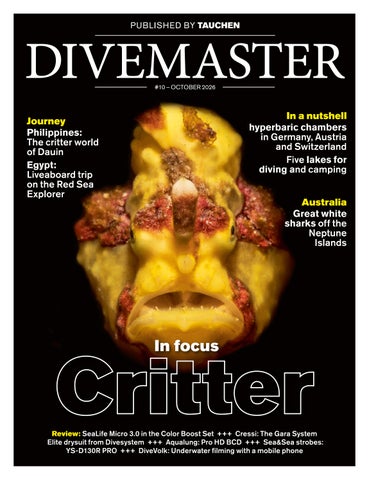
The cover photo is by Tobias Friedrich and shows a painted frogfish (Antennarius pictus), photographed off Lembeh, North Sulawesi, Indonesia.
CONTACT & MORE EDITORIAL TEAM
Jahr Artopé Media GmbH & Co. KG Bajuwarenring 19, 82041 Oberhaching Tel. 089/5 52 41-0, Fax 089/5 52 41-244 E-mail: redaktion@tauchen.de ADVERTISING
089/5 52 41-225 Email: sales@tauchen.de TAUCHEN SUBSCRIPTION + ADDRESS CHANGES
Tel. 040/5555 7991, email: jam@dpv.de EPAPER TAUCHEN
www.tauchen.de/epaper
• Website: tauchen.de • Facebook: facebook.com/ tauchenmagazin • Instagram: instagram.com/ tauchen.magazin/ • Podcast: podcaster.de/podcasts#/ podcast/tauchen-talks • YouTube: TAUCHENDASMAGAZIN • TAUCHEN app: Android & iOS
gallery °
Off the coast of the Cape Verdean island of Santo Antão, the research submersible JAGO begins its dive. In the background, the research vessel POSEIDON can be seen, whose crane was used to lower the submersible into the water. The scientists are investigating the connections between the surface and deep-sea habitats. JAGO can dive to a depth of 400 metres and carries the pilot and a scientific crew. The submersible was deployed on various missions for 32 years; it was operated for a long period by the GEOMAR Helmholtz Centre for Ocean Research and was decommissioned in 2021.
Marine biologist Uli Kunz always takes his camera with him on his missions with the Submaris research diving team, and he also takes photographs and films on behalf of universities, institutes and environmental agencies. In this year’s ‘Scientist at Work’ photography competition organised by the renowned science magazine ‘Nature’, his photograph of two coral researchers diving was recognised alongside four other images. In the photo gallery, DIVEMASTER showcases further images from Uli Kunz’s work.
PHOTOS FOR RESEARCH
gallery °
In a water-filled cavern in the jungle of the Mexican Yucatán Peninsula, underwater archaeologist Dr Florian Huber and his team are investigating the remains of the lost Maya civilisation. In the cenote, the scientists have found over 100 skeletons. Dating of the remains shows that the bones have been lying in the cave for approximately 1,800 years. Amazing discoveries are regularly made in Mexico’s water-filled caves, including significantly older skeletal remains. These show that, well over 10,000 years ago, people were already walking and climbing into the caves, presumably in search of water. At that time, the sea level was several dozen metres lower and the caves were dry.
Off the coast of the Mopelia Atoll in the Pacific Ocean, the wreck of a ship with an eventful history has lain for over 100 years. During the First World War, the SMS Seeadler was one of the last sailing ships to be deployed by the Imperial German Navy. After the crew had sunk several enemy merchant ships, the ship ran aground on a reef in Polynesia in 1917. Underwater archaeologist Dr Florian Huber and his team have examined the wreck of the SMS Seeadler and documented it. Having been exposed to the waves for so long, only large and heavy parts of the engine and the hull now lie scattered across the reef.
In a remote fjord in western Greenland, huge columns rise from the seabed. These striking geological structures, which can reach heights of up to 20 metres, have so far only been found at this location. They are columns formed from the mineral ikaite, which forms under very specific physical and chemical conditions from water seeping up from the seabed. A research team from Denmark and Sweden has been investigating the phenomenon for 25 years. This work could soon have practical applications: ikaite forms in cold water and consumes very little energy. At a pilot plant in Denmark, ikaite is first produced from carbon dioxide captured from industry. The ikaite is then converted into solid limestone. This would allow large quantities of the greenhouse gas CO₂ to be rendered ‘harmless’ in a cost-effective manner.
gallery °
Researchers Nauras Daraghmeh (left) and Yusuf El-Khaled at King Abdullah University of Science and Technology (KAUST) are studying coral reef communities. Using the incubation chamber they have installed in the Red Sea off the coast of Saudi Arabia, they aim to investigate how the corals function and assess their health. Water samples can be taken from the lid at regular intervals; these show, for example, how much oxygen the corals and their associated organisms produce and consume.
In order to study biological and chemical processes in the ocean in detail, scientists at the GEOMAR Helmholtz Centre for Ocean Research have suspended huge plastic bags in the North Atlantic off the Norwegian city of Bergen. These so-called ‘mesocosms’ serve as large test tubes for the research group, in which they can cre ate controlled conditions whilst subjecting them to natural environmental influences. Special pumps and additives are used to control parameters such as salinity, nutrients and alkalinity. In this way, the scientists involved are researching climate change and can simulate expected changes.
A team of research divers is searching during a so-called ‘blackwater’ dive for tiny planktonic organisms that migrate to the surface at night from greater depths. The divers are taking part in an expedition aboard a research vessel off the coast of Madeira, where the seabed drops away very steeply. Just a few kilometres from the coast, the water is already thousands of metres deep. Such expeditions continue to bring new species to light and demonstrate the impact that the dark regions of the ocean can have on our lives on land.
MAGAZINE
GREY WHALES ARE SHOWING CLEAR SIGNS OF RECOVERY
Recent NOAA surveys show that the population of East Pacific grey whales along the Pacific coast between Alaska and Mexico has shown a measurable recovery following years of decline. Source: NOAA
CONGRATULATIONS, BERNI!
At the age of just ten, Bernhard ‘Berni’ Steineder completed his first two dives in Rhodes. He caught the diving bug a few years ago – not least because he regularly reads our magazine alongside his diving-mad parents. His family is incredibly proud of the young budding diver. And for Berni, it would of course be the best thing ever to see his face in our magazine one day. We’re happy to do him that favour. Happy diving, Berni!
CORAL CILIA GENERATE CURRENTS
Researchers at the Max Planck Institute for Marine Microbiology and the IOW have used state-of-the-art imaging techniques to uncover how the cilia on the surface of black corals generate targeted water currents. In doing so, they optimise oxygen supply and nutrient uptake directly at the tissue level. Source: Leibniz Institute for Baltic Sea Research
WE’RE LOOKING FORWARD TO SEEING YOU!
You can find out more about the artist Michel Ley at: Facebook/michels.imbaerium, Instagram (‘michels.imbaerium’) and www.michels-imbaerium.de
From 24 to 27 September 2026, TAUCHEN magazine will be at InterDive in Friedrichshafen. You’ll find us in Hall B5, Stand 312. Look forward to great prizes, attractive trade fair offers and, of course, plenty of diving chat. Above all, we’re looking forward to having a natter with you: what topics would you like to see in the magazine? Do you have any ideas, suggestions or exciting stories that TAUCHEN should cover? Pop by, say hello and help shape TAUCHEN a little bit. See you in Friedrichshafen!
Franz. Polynesien · Fiji Inseln · Palau Papua Neuguinea · Yap · Salomonen Vanuatu · Tonga · Neukaledonien
… mit Pacific Travel House – dem Spezialisten seit über 35 Jahren! 21 Tage Französisch Polynesien Tahiti, Rangiroa und Fakarava
Fantastisches Großfischtauchen an den Riffen und in den Passagen der Atolle · Inkl. 21 Tauchgängen, Flügen, Übernachtungen/Frühstück/Transfer
ab 7.550 € p.P. / DZ
21 Tage Fiji Inseln Viti Levu, Taveuni, und Beqa Lagune
Aufregendes Tauchen zwischen farbig leuchtenden Korallen, bunten Rifffischschwärmen und beeindruckenden Großfischen · Inkl. 22 Tauchgängen, Flügen, Übernachtungen/Frühstück/Transfers
ab 6.945 € p.P. / DZ
MICROBIOME TRANSPLANTS TO COMBAT CORAL BLEACHING
The latest research findings show success in protecting corals from extreme heatwaves. By transferring heat-resistant microbiomes (bacterial communities), the thermal collapse of cnidarians can be prevented or significantly delayed. Source: German Foundation for Marine Conservation
Photos: Shutterstock (4); Tauchen archive (1); the Steineder family (1)
Quiz question: In which of these major rivers are bull sharks found?
Mississippi Amazon Ganges
B D F
Faszinierendes Tauchen an steilen Außenriffen, in Strömungen und Lagunen mit zahlreichen Großfischen · Inkl. 20 Tauchgängen, Flügen, Übernachtungen/Frühstück/Transfers
ab 5.475 € p.P. / DZ
SHARK SMARTS
A C E
17 Tage Mikronesien Palau und Yap
Zambezi Limpopo In all the rivers mentioned
Answer: F. In all the rivers mentioned. The presenceof bull sharks has been recorded in all five rivers. They are particularly well known for venturing far into freshwater. Via the San Juan River, for example, bull sharks have even reached Lake Nicaragua. You can find these and more facts and figures about sharks in Ocean Heroes’ new shark quiz. It’s both entertaining and educational, and available at a charity price (100 per cent goes to charity) of 25 euros. Available to buy at: ocean-heroes.shop
18 Tage Papua Neuguinea Lissenung Island und Tufi Resort
Reiche Artenvielfalt, Sichtweiten bis zu 30 Meter, unberührte Korallenriffe und große Fischschwärme · Inkl. 20 Tauchgängen, Flügen, Übernachtungen/Mahlzeiten/Transfers
ab 6.550 € p.P. / DZ
Weitere Vorschläge, ausführliche Beschreibungen und kostenlose individuelle Ausarbeitung unter:
pacific.travel.house Pacific Travel House Reiseveranstaltungs GmbH Schwanthalerstraße 100, D-80336 München info@pth-muc.de, 089-543 21-80
www.pacific-travel-house.com
MAGAZINE °
A hub for the diving community: InterDive brings together manufacturers, retailers, experts and diving enthusiasts – featuring new kit, exciting technology and plenty of inspiration for your next underwater adventure.
Advertorial
InterDive 2026
Four days that show why diving is more than just a hobby
P
Photos: InterDive
ersonal. Friendly. Inspiring. Anyone visiting Friedrichshafen at the end of September isn’t just attending a trade fair. For years, InterDive has been one of the few places where the diving industry, in all its diversity, comes together. From 24 to 27 September 2026, the event will open its doors for the 14th time, bringing together manufacturers, tour operators, dive centres, training organisations and marine conservationists under one roof. Whilst many trade fairs are becoming ever larger and more impersonal, InterDive has retained its personal touch. This is precisely what visitors have come to appreciate over the years. Here, there is time to chat with developers of new equipment, with dive centre managers from the world’s most beautiful diving destinations, or with travel experts who offer advice based on their own experience. Rather than rushed sales pitches, the focus is on discussion and interaction.
The whole world of diving Anyone looking for new kit can look forward to a wide range of manufacturers and specialist retailers. Brands such as Mares, Kallweit, Camaro and Atlantis are showcasing their latest products and innovations. Whether it’s regulators, dry suits or accessories – there’s plenty to compare side by side, and expert advice is on hand to help you make the right choice. It is precisely this personalised advice that is one of the biggest advantages over online shopping. The theme of travel is equally well represented. From Egypt to Indonesia and the South Seas, tour operators such as Beluga Reisen, RCF and Waterworld are
showcasing new destinations and exclusive trade fair offers. Many of these offers are valid only during the trade fair and provide an opportunity to plan your next diving holiday right there and then.
Learn, experience, develop Training organisations will also be represented once again. Beginners can find out about entry-level diving certification. Experienced divers will find inspiration for specialist courses, technical training or a move into the professional sector. The fair will be accompanied by a varied stage programme featuring travel talks, specialist presentations and discussions. A special event awaits visitors on Saturday 26 September. On that day, experts will join DIVEMASTER’s editor-in-chief Alexander Kassler to discuss the topic of ‘Diving and Sustainability’ – an issue that is of greater concern to the industry today than ever before. Marine conservation is part of it Diving is not just about the experience; it’s also about responsibility. That’s why numerous marine conservation organisations are represented at InterDive. Greenpeace, Sharkvoice, the Captain Paul Watson Foundation and Ocean Heroes provide information on current projects and show how every diver can play their part in protecting the oceans. This commitment is complemented by the popular charity auctions, where high-quality diving equipment, holidays and hotel stays are put up for auction. The proceeds go directly to marine conservation projects. More than just a trade fair Another bonus: a single ticket grants visitors access to Interboot as well. This brings
EVERYTHING AT A GLANCE InterDive Friedrichshafen 2026 Dates: 24 to 27 September 2026 Venue: Friedrichshafen Exhibition Centre/ Hall B5 Opening hours Thursday: 12:00 to 18:00 Friday: 10:00 to 18:00 Saturday: 10:00 to 18:00 Sunday: 10:00 to 17:00 Here’s what you can expect → the latest diving equipment and innovations → Dream holidays and exclusive trade fair offers → Over 30 talks and live discussions → Training organisations and diving schools → Marine conservation organisations → Charity auctions with attractive prizes → DIVING panel discussion: Diving & Sustainability on Saturday 26 September Tickets, list of exhibitors and floor plan: friedrichshafen.inter-dive.de
together the world of diving with water sports, boats and maritime leisure activities. New this year: free parking is available for visitors to the fair in the immediate vicinity of Hall B5.
A meeting place for the diving community Whether you’re a seasoned diver, a beginner or a keen underwater photographer, InterDive offers the chance to make new contacts, catch up with old friends and gather fresh ideas for future adventures. It is precisely this blend of a friendly atmosphere, high-quality exhibitors and genuine passion that gives the fair its unique character.
TRAVEL BALI: 20 PER CENT DISCOUNT
SPEYSIDE INN RESORT ON TOBAGO
The Speyside Inn Resort on Tobago is embarking on a new chapter with a fresh management team. Lisa Schmidtke and Nick Jergl, two dedicated hosts, are taking over the running of the resort and the adjoining Extra Divers dive centre. “We’re really looking forward to this new adventure and, above all, to welcoming our guests to Tobago from November onwards,” say Lisa and Nick. “Whether it’s exciting dives, relaxing holidays or simply the Caribbean zest for life – we want every guest to feel at home with us from the very first moment.” The Speyside Inn Resort is situated in the peaceful north-east of Tobago, just a stone’s throw from the sea. This family-run resort is the ideal base for divers, nature lovers and those seeking relaxation. The Extra Divers dive centre is directly attached to the Speyside Inn and offers boat trips to the most beautiful spots in the area. extradivers-worldwide.com; speyside@extradivers.org
Still got time for a holiday this year? How about a private villa in Bali, with tropical gardens, a 20-metre-long swimming pool and a range of diving spots right on your doorstep? The Campo Beluga in Pemuteran is the perfect place for anyone looking to experience peace and quiet, nature and authentic Bali. With three bedrooms, spacious living areas and daily breakfast, the Beluga Villa is the ideal home away from home for families, friends or diving enthusiasts. Just a few minutes away lie the reefs surrounding Menjangan National Park. And because dreams sometimes need a little nudge: anyone travelling this year will receive a 20 per cent discount on their stay. Beluga Reisen can provide a no-obligation quote for your personalised Bali getaway. belugareisen.de
BALI VILLA DIVE RESORT IS BECOMING BREEZE
FORGOTTEN ISLANDS & ALOR
In autumn 2026, Wirodive will take you aboard the MSV Amira to one of Indonesia’s most unspoilt diving destinations. The expedition route, from the remote ‘Forgotten Islands’ to Alor, offers breathtaking intact coral gardens, colourful soft corals, spectacular drop-offs, dives with strong currents and the chance to encounter large fish. The trip also offers unforgettable experiences above water: with a bit of luck, whales and dolphins may make an appearance, whilst fascinating insights into the culture and traditional way of life of these remote island worlds await. An extraordinary liveaboard trip for anyone wishing to experience unspoilt nature and a genuine expedition atmosphere. Price: from 6,130 euros per person (plus flights and additional costs). wirodive.de
Photos: Organisers
Owners Alexander Rausch (left) and Christian Wendt with resort manager Kathrin Schweigler
A well-known diving resort in northern Bali is embarking on a new chapter: the long-established Bali Villa Dive Resort is becoming the Breeze – North Bali Ocean Resort. The takeover in early 2026 brought more than just a new name. Step by step, the resort is being modernised and developed with a refreshed concept. This is a careful evolution of what many regular guests have come to appreciate at the Bali Villa Dive Resort over the years: showcasing the authentic and relaxed character of North Bali. At the same time, comfort, service and facilities are being further enhanced. Diving remains an essential part of the resort’s offering. The on-site dive centre is operated by EcoPro Divers. In addition to the house reef, the programme includes the well-known dive sites around Tulamben as well as a variety of macro and muck diving spots in northern Bali. Blackwater diving and personalised diving excursions are also on offer. At the same time, Breeze is deliberately designed to be more than just a diving resort: a spa, Balinese culture, excursions, local cuisine and plenty of tranquillity right by the sea make the resort appealing even to non-diving partners and families. breeze-northbali.com
RCF-Special
Group Trip Maratua Atoll Experience a unique combination of Borneo's nature and world-class diving in the Maratua Atoll. Accompanied by underwater photographer Gerald Nowak, you'll explore some of East Borneo's most beautiful dive sites.
RED SEA: DECOMPRESSION WORKSHOP
Theory meets liveaboard: From 19 to 26 November 2026, technical diving instructor and author Veronika Sievers from the Punkfish Academy will be leading a workshop liveaboard on the ‘Omneia Spirit’. The itinerary – Brothers – Tiran – Rosalie Moller – includes up to three dives a day, alongside workshops on decompression, dive planning, ascent procedures and safe diving practices. The content will be tailored to the participants’ individual experience levels. For technical dives, the vessel provides, amongst other things, oxygen, boosters and custom gas mixes; twinsets, sidemount and rebreathers are also supported on request. The safari starts and ends in Hurghada and costs from 1,499 euros per person in a twin cabin on the lower deck. Dates: 19 to 26 November 2026. omneia.de
RCF AT INTERDIVE
From 24 to 27 September 2026, Reisecenter Federsee (RCF) will be exhibiting at InterDive in Friedrichshafen – as usual in Hall B5, Stand 220. Visitors can look forward to personalised advice, travel bargains and trade fair specials on the latest diving destinations. Among others, Divepoint Maldives, Mövenpick Resort El Quseir, Sao Nicolau Diving, Sea Explorers Philippines, Silhouette Cruises Seychelles, Temple Point Resort Kenya and Extra Divers will be at the stand. rcf-tauchreisen.de
AAA DIVING CALENDAR
Where can I see manta rays? When is the best time to visit Raja Ampat? Which diving destination is best for my holiday in January? Instead of spending ages researching, you can now find the answers in just a few clicks. It’s as simple as this: open the diving calendar and filter by region, travel month or your personal highlights, such as manta rays, whales or sharks. In no time at all, you’ll get a personalised overview of suitable destinations and the best times to travel, tailored to your preferences. You’ll also find the key highlights for each destination, as well as useful information about the respective country. This makes planning your next diving trip easier, clearer and more inspiring. aquaactive.de
• Meet orangutans & sun bears in Borneo • Dive at two top resorts in the Maratua Atoll • Learn from photo pro Gerald NowakNowak
Group Trip Maratua Atoll May 15 – 30, 2027
16-day adventure through East Borneo and the Maratua Atoll
from €3,998 per person Itinerary:
TREASURE HUNT IN THE LILLEBÆLT
Rum and whisky with an unusual ageing location: to mark its 75th anniversary, Gl. Ålbo Camping, in collaboration with the Danish distillery Trolden Destilleri, has sunk 100 bottles of rum and 100 bottles of whisky in the Little Belt. They are set to lie on the seabed there for a year. The highlight for divers: anyone who reserves a bottle will be able to recover their own personal ‘treasure’ from the seabed on 26 June 2027. Depending on conditions, snorkellers should also be able to take part. This anniversary project thus combines diving, the Danish coast and the art of spirits production into a rather extraordinary underwater experience. Information & reservations: gl-aalbo.dk
• Samboja Lodge: meet orangutans & sun bears up close
• Nabucco Island Resort: dive the legendary Big Fish Country • Virgin Cocoa: stylish island resort with house reef & spa
• Excursion to Kakaban: jellyfish lake & Barracuda Point
• Photo tips and workshops with Gerald Nowak Find all details on this trip on our website.
WELTWEIT MEER ERLEBEN
reisen@reisecenter-federsee.de www.rcf-tauchreisen.de
rcftauchreisen
tauchreisen_rcf
TRAVEL °RED SEA EXPLORER
ADVENTURE
WITHIN EASY REACH
T & F Martin Strmiska
I Egypt remains the destination to which European divers keep returning. Hardly any other destination makes spectacular encounters with large marine animals so quick, straightforward and affordable. We were on board the Red Sea Explorer, Extra Divers’ liveaboard, off the coast of the Brother Islands and Daedalus.
f you pack your suitcase in Europe in the morning, you could be on a liveaboard in the Red Sea by the evening. No jet lag, no domestic flights, no days spent travelling – just a few hours separate everyday life from adventure. That is precisely what makes Egypt one of Europe’s most attractive diving destinations to this day. Whilst trips to faraway destinations such as Indonesia, the Maldives or Mexico require lengthy planning, the Red Sea is accessible at any time. That is precisely why many divers keep returning there. Not out of convenience, but because here you can have encounters that elsewhere would require travelling halfway round the world: with thresher sharks, hammerhead sharks, oceanic whitetip sharks or dugongs. There are no guarantees. Yet there is hardly anywhere else where you can get so close to them so easily. On board the Red Sea Explorer, your holiday begins straight away. The crew take care of your luggage and equipment. Twelve cabins ensure a pleasant, friendly atmosphere. With just 15 divers on board, there’s plenty of space for a relaxing week at sea. The first day of diving is simply to settle in. A check dive, followed by another dive – that’s all it takes. The real destination is still many nautical miles away: the Brother Islands.
The Lighthouse The night-time crossing quickly makes it clear that, despite its proximity to Europe, the Red Sea is a proper sea. Wind and waves make for a restless night. This makes a sturdy ship and a quiet cabin all the more welcome. In the morning, Big Brother appears on the horizon – a rugged rock with its distinctive lighthouse. Memories come flooding back immediately: thresher sharks on the southern plateau, curious oceanic whitetip sharks, hammerhead sharks by the drop-off, manta rays above the reef and, of course, the legendary Numidia. This morning, there are far fewer boats off the is- >
TRAVEL °RED SEA EXPLORER
Amidst sheer walls, colourful coral gardens and encounters in the deep blue, the Red Sea reveals its full diversity. At the Brother Islands, it is often the current that determines what the next dive has in store.
land than usual. Everything seems calmer, more unspoilt. No sooner has the water’s surface closed over me than the sea begins to write new stories.
In search of the thresher shark Even as I descend, the current determines the course of the dive. Normally, I head straight for the narrow southern plateau, where thresher sharks regularly patrol. Today, I stay at a depth of around 20 metres to assess the conditions – a decision I come to regret shortly afterwards. Suddenly, a manta ray glides towards me out of the blue. Had I descended deeper as usual, our paths would probably have crossed perfectly. Instead, I try to catch up with it. In vain. The moment is over before it has really begun. The further I follow the ridge, the stronger the current becomes. Bannerfish seek shelter amongst the corals, my remaining no-stop time is running out – there’s no sign of the thresher shark. It’s only on the way back that I catch a glimpse of its distinctive tail fin out of the corner of my eye. Too late. The shark vanishes into the blue; I have to surface. Back on board, other divers recount their encounter. I’d been too ambitious – and that’s exactly why I was in the wrong place. The Garden of Numidia The second dive takes us to the Numidia, one of the Red Sea’s most famous wrecks. The British freighter ran aground on the reef in 1901 and now lies almost vertically against the sheer wall. After more than a hundred years, the sea has completely reclaimed the wreck. Soft corals in shades of red, pink and purple cover the steel, whilst thousands upon thousands of bannerfish float amongst them. Seeing this, one understands why the Red Sea bears its name. The current supplies the corals with nutrients and causes the soft corals to sway to the rhythm of the waves, like a vast underwater garden. Whilst the fish seem to hover effortlessly in the water, I seek shelter behind steel girders. Every metre takes effort. Out in the open water, bluefin trevally dart past; a grey reef >
Tauchreisen & Tauchsafaris weltweit
Resort & Liveaboard Special Indonesien Eco Pro Duyung Baru Komodo
Breeze North Bali Ocean Resort
Bali - Komodo
Jetzt kombinieren & 20 % sparen Breeze Ocean Resort & Duyung Baru Nachhaltig & verantwortungsvoll Tauchresort & modernes Schiff Persönlich, flexibel & erfahren Deutsche Leitung
Gratis Nitrox inklusive
Hier geht‘s zum exklusiven Angebot
www.aquaactive.de info@aquaactive.de +49 5507 - 919 818-0
TRAVEL °RED SEA EXPLORER
INFORMATION: RED SEA EXPLORER HOME PORT: Port Ghalib, Egypt VESSEL: The Red Sea Explorer is a comfortable,
upper-mid-range liveaboard managed by Extra Divers. Thanks to its manageable size, it combines ample space on board with a personal atmosphere. Thanks to its sturdy steel hull, it remains pleasantly stable on the water even during longer crossings. CABINS: 12 air-conditioned double cabins, lower and upper decks, en-suite bathroom with shower/WC DIVING OPERATIONS: spacious dive deck, separate camera stations, two dinghies (Zodiacs) for the dives, Nitrox available, up to four dives a day, depending on the route and weather. Nitrox is available free of charge on board. FACILITIES: Sun deck with sun loungers, air-conditioned saloon, restaurant, spacious outdoor decks, Wi-Fi in the harbour (limited). Comprehensive safety equipment, including ENOS, fire alarm system, CO detectors and CCTV monitoring CUISINE: international and Egyptian dishes served buffet-style. Snacks, fruit, and hot and cold drinks are available between dives. ROUTES: → B rothers – Daedalus – Elphinstone → Daedalus – Zabargad – Rocky → St John’s → Fury Shoals → N orthern Tour: Strait of Tiran, shipwrecks
and reefs
SUITABLE FOR: advanced divers and experi-
enced drift divers. Many of the dive sites visited require confident open-water diving and experience of diving in currents. FURTHER INFORMATION: www.extradivers-worldwide.com/ tauchsafari/aegypten PRICE EXAMPLE: one week per person from
E
JETZT BEI
ORE P IC –M
P! DIVE AP
S
TER PL U AS M
RES IN TH TU
1,400 euros, lower-deck cabin including diving, Nitrox, Wi-Fi, full board, snacks, water, tea, coffee and soft drinks, transfers to the nearest airport, ENOS for every diver. Extras: flights, visa, equipment hire, alcoholic drinks, local fees: 280 euros. Bookable via: Reisecenter Federsee, www.rcf-tauchreisen.de
From life on board to quiet encounters on the reef: on a liveaboard, intense drift dives alternate with moments of relaxation. It is precisely this contrast that makes the trip so appealing.
shark makes a brief appearance. On other days, hammerhead sharks or oceanic whitetip sharks patrol these waters. Today, I’m reduced to the role of a spectator. I can see the life out there, but I cannot reach it.
No second chance For several years now, liveaboard vessels have been banned from anchoring at the Brother Islands. Every dive is therefore a one-off experience. The manta ray doesn’t return because I stayed at too shallow a depth. The thresher shark won’t wait until I have more remaining no-stop time. And the current at Numidia won’t ease off just because I’d have liked to stay a few minutes longer. The Brother Islands offer no second chances. As the lighthouse slowly disappears behind the stern in the evening, we have a ten-hour crossing to Daedalus Reef ahead of us. Going with the flow The following morning, we reach Daedalus Reef. The striking lighthouse there heralds one of the Red Sea’s most famous offshore reefs. Yet our first impression is sobering. The unusually warm summers of recent years have visibly taken their toll, particularly on the eastern side. Where dense coral gardens once thrived, in many places there are now only a few isolated intact areas remaining. The first dive is uneventful. Barely any current, crystal-clear water – but no sign of hammerhead sharks. A few
hours later, Daedalus shows its other side. The current picks up significantly, forcing us to keep moving constantly. Once again, we search the open water, and once again the sharks fail to appear. It is only on the last dive that I change my strategy. I stop searching. I let the current carry me along, stay close to the seabed and use coral blocks for cover. Suddenly, the whole dive changes. Schools of snappers hover above the plateau, unicornfish glide leisurely past, and barracudas remain motionless in the water. Once again, no hammerhead sharks appear. Nevertheless, this very dive turns out to be the most beautiful of the entire trip. Sometimes the greatest moments arise precisely when you stop trying to force them.
Slow and steady wins the race After a week full of drift dives, Marsa Shouna feels almost unreal. The water there is calm, almost as smooth as glass. For the first time in days, the subjects aren’t out there somewhere in the blue, but right in front of me. Several green sea turtles float weightlessly above the reef. Another is resting in the sand at a depth of ten metres and, out of curiosity, lets me get within a few centimetres of it. No current, no time pressure, no rush. As I look into its eyes, I realise what this liveaboard trip has really been all about. Not every dive ends with hammerhead sharks or thresher sharks. Not every hope is fulfilled. But that is precisely what makes the Red Sea so appealing. Every time you dive in, it’s a new opportunity. Sometimes you’re richly rewarded; sometimes you take nothing but memories home with you. Perhaps that is precisely the secret of Egypt. The Red Sea is just a few hours’ flight away – and continues to surprise even those divers who think they’ve known it for ages. <<
TRAVEL °DAUIN / PHILIPPINES
T & F Barbara & Wolfgang Pölzer
CRITTER STRONGHOLD
DAUIN In the south-east of the Philippine island of Negros, Dauin has become one of the top destinations for lovers of rare critters.
26
DIVE 10°2026
TRAVEL °DAUIN / PHILIPPINES
G
liding past a green sea turtle grazing on the seabed, we descend the slope of black volcanic sand. What at first appears to be a desolate desert quickly turns out to be a paradise for perfectly camouflaged fish, bizarre small marine creatures and rare critters. Spotting them requires patience – and a guide like Jun-Jun. No sooner have we reached a depth of 20 metres than he points out three dragon shrimp on a delicate wire coral. Next come ghost pipefish, tiny frogfish in various colour variations, a magnificently patterned cuttlefish on the hunt, and finally a lionfish almost completely hidden in the sand. One highlight follows another. On the way back to the shallows, scattered coral colonies rise like little oases from the black sand. They provide shelter for juvenile fish, prawns and cleaner fish. A few metres further on, we spot clownfish during their mating season. We watch patiently as they attach bright orange eggs to the base of their carpet anemone. It’s a fascinating spectacle that even experienced divers rarely get to witness. But Jun-Jun is already beckoning us on. Three different nudibranchs and a juvenile batfish are still waiting for us.
Biodiversity hotspot During a surface interval on the traditional bangka, we ask centre manager Manuel why Dauin, of all places, enjoys such a good reputation worldwide. “We’re right in the middle of the Coral Triangle. The combination of enormous biodiversity, short boat journeys and a wide variety of dive sites is virtually unique,” he explains. The region first became famous thanks to Apo Island. The volcanic island has been a protected area for more than 30 years and is regarded as a prime example of successful marine conservation. It was only later that people realised that the black volcanic sand slopes off Dauin also harbour an extraordinary variety of rare creatures. Just a few minutes’ boat ride later, we dive down again over black sand. Nestled amongst small soft corals are numerous candy crabs, whose bright shades of pink and red immediately catch the eye. The star of the dive, however, is a hairy frogfish barely as long as a finger. With its thread-like skin appendages, it is one of the most sought-after subjects in underwater photography. We spend almost 20 minutes with it until it yawns heartily twice, revealing its enormous mouth. What looks
Creatures ‘galore’. Dotted amongst them are small coral colonies, huge anemones, sponges and seagrass beds. Even frogfish have to start small (below). This one measures just three millimetres.
28
DIVE 10°2026
TAUCHEN.DE
PHILIPPINES
NE
GR
OS
Philippine Sea
DAUIN APO ISLAND Sulu Sea
like boredom is actually a way of exercising its jaw muscles. After all, its lightning-fast capture of prey is one of the quickest movements in the animal kingdom. Only a few milliseconds pass between opening its mouth, sucking in its prey and closing its mouth.
Monsters of the Night We’ve deliberately decided to skip the afternoon trip this time. Instead, a night dive on the house reef is on the agenda. Shortly after descending, we spot two seahorses on a line covered in seaweed. It leads to an artificial reef structure, which is now completely overgrown with hard and soft corals, sponges and other sessile organisms. The former metal framework now looks just like a natural reef block. Our real goal, however, is the legendary Bobbit worm. Up to three metres long, as thick as a thumb and equipped with razor-sharp jaws, it is one of the most bizarre inhabitants of the sandy soil. Jun-Jun knows its hiding places inside out. After just a short search, he shows us the iridescent bristle worm, whose head protrudes from the sand with five sensitive tentacles. As soon as it spots prey, it snaps it up in a flash and disappears back into the ground along with its victim. Barely two minutes later, it reappears in the same spot, lying in wait for the next fish. The dive has more surprises in store: an orange frogfish, dwarf butterflyfish, several ghost pipefish and numerous nocturnal snails. To round off the dive, we spot no fewer than three bobtail squids. Barely the size of a fingernail, these tiny squids impress with their iridescent colours and vanish into the sand in a flash at the slightest disturbance. Apo Island The next morning, a day trip to Apo Island with three dives is on the programme. After just over TAUCHEN.DE
half an hour, we reach the lush, green volcanic island. Today, we’re swapping mud substrates for coral reefs. Massive stony corals, sprawling leather corals, colourful soft corals and huge sponges drift leisurely past us. Schools of fusiliers plough through the reef, angelfish search for food, and beneath an overhang a pufferfish rests in the lee of the current. Out in the blue water, surgeonfish, bannerfish and triggerfish patrol the waters. We stop briefly beneath a massive basalt boulder. Its underside glows a vivid orange – densely covered in soft corals. But we don’t stay long. According to the briefing, a huge school of mackerel is said to gather here regularly. Suddenly, Jun-Jun points excitedly out into the blue. At first, we can only make out a dark shadow. With every fin stroke, the silhouette becomes clearer, until finally hundreds of bigeyed mackerel appear before us. To reach the school, we have to work hard against the current. The fish, on the other hand, seem to be hovering motionless in the water. For a few unforgettable seconds, we drift alongside a silvery, shimmering wall of bigeye mackerel. Each fish measures a good half a metre and exudes enormous power. Moments like these are the sort of experiences you never forget. Eventually, the current forces us to turn back. Whilst the mackerel seem to hold their position effortlessly, we set the buoy and, during our safety stop, enjoy one last look back at the impressive spectacle. The next two dives are equally thrilling, with colourful coral landscapes, numerous green sea turtles and an impressive abundance of fish.
Blue-ringed octopuses mating As spectacular as Apo Island is, the muck diving off Dauin quickly draws us back in. And indeed, further extraordinary encounters await us there. On a single dive, we spot five blue- > 10°2026 DIVING
29
TRAVEL °DAUIN / PHILIPPINES TRAVEL INFORMATION: DAUIN / NEGROS / PHILIPPINES
GETTING THERE: Fly with Cathay Pacific from
Frankfurt or Munich to Manila. From there, take a domestic flight to Dumaguete, which takes about an hour. The transfer to the resort then takes about 30 minutes.
20 metres, and is often even greater during the summer months. www.sea-dream-resorts.com TOUR OPERATOR: Scuba Native Diving Holidays, www.scuba-native.de
ACCOMMODATION: The Sea Dream Dive Resort
PRICE EXAMPLE: 14 days, including a scheduled
has 32 rooms in seven categories, accommodating up to 70 guests. All rooms are equipped with air conditioning, a TV, a minibar, a safe, a kettle and a balcony or terrace. A 20-metre freshwater swimming pool and a beach bar provide the perfect setting for relaxation between dives. TRAVEL MEDICINE: Vaccination recommenda-
flight, domestic flights, transfers, twelve nights’ accommodation with half-board, and 20 guided boat dives (including tank, weights and guide), cost from 3,087 euros per person in a standard twin room.
DIVE CENTRE: EASY DIVING
Dive sites: Over 40 sites, most of which are just 10 to 20 minutes away by boat and easily accessible. Boats: Two fast catamarans, each carrying eight divers, and a 22-metre-long bangka for up to 24 guests. Diving equipment: A three- to five-millimetre wetsuit is sufficient all year round. Water temperatures range between 25 and 31 degrees Celsius, depending on the season. Prices: Two boat dives, including a tank and weights, from 55 euros.
tions and, where applicable, malaria prophylaxis should be discussed with a tropical medicine specialist before travelling. There is a modern hyperbaric chamber in Dauin, and others in Cebu City and Manila.
www.easydiving.ph
Ten-dive boat package: 249 euros. The day trip to Apo Island is included at no extra cost.
Under current management since: The former centre was taken over by Easy Diving in 2025.
Nitrox: 4.25 euros per dive. Marine park fee: around 2 euros per dive.
BEST TIME TO VISIT: All year round. The peak
Diving: All dives are supervised by experienced guides. Up to four boat dives per day are available, as well as guided night dives on the house reef. Full-day trips to Apo Island and Turtle Island, featuring three dives, are offered regularly. Other excursions take you to Siquijor, Sumilon Island or to see the whale sharks in Oslob.
season runs from December to July. Between January and June, there are particularly many species of frogfish to be seen, and from March to May there are numerous nudibranchs. The octopus season runs from September to December. Visibility is usually between 15 and
E
JETZT BEI
ORE P IC –M
P! DIVE AP
S
TER PL U AS M
Led by: Manuel Müller (Centre Manager and Co-owner)
Sustainability: A photovoltaic system provides the majority of the electricity supply; there are also drinking water stations, artificial reefs on the house reef, and a partnership with the University of Dumaguete. Snorkelling: There are plenty of great spots on the house reef and on the day trips. Sea turtles and seahorses are regularly seen.
RES IN TH TU
All well and good: cosy accommodation, a ‘topnotch’ dive centre and excellent diving. If you’ve had enough of the little critters by the end of the dive, you’ll often find yourself accompanied by turtles in the shallows.
ringed octopuses, a long-armed octopus, a coconut octopus, a wunderpus and two different species of cuttlefish. Six different species of cephalopods at a single dive site – something that’s by no means a given, even for experienced guides. However, we experience the emotional highlight a few days later. Right before our very eyes, two blue-ringed octopuses begin to mate. What at first appears to be a cautious test of strength turns out to be a fascinating act of reproduction. For around two minutes, their 16 arms entwine until the male successfully transfers a spermatophore. An impressive natural spectacle that even experienced underwater photographers rarely get to witness. Dauin impressively demonstrates that extraordinary diving experiences do not necessarily depend solely on large fish. Anyone prepared to look a little more closely will discover a fascinating world full of masters of camouflage, bizarre rarities and intriguing behaviour. Together with the colourful coral reefs of Apo Island, the numerous sea turtles and the chance to spot whale sharks if you wish, we personally consider this region to be one of the most diverse diving destinations in the Philippines. <<
AUF GEHTS AUF DIE ALIA SOUL!
ODER BIST DU EHER EINE
LANDRATTE? Dann schau auf unserer Website vorbei: WWW.ORCA-DIVECLUBS.COM
SCANN MICH
TRAVEL °BUDDY DIVE
Buddy Dive Bonaire Shore diving at its very best
Advertorial
DRIVE & DIVE – HERE’S HOW IT WORKS → Rental pick-up included → Unlimited air or nitrox fills → Drive-through tank exchange station → More than 90 marked shore dive sites → Diving without fixed timetables → Daily boat dives available as an optional extra
C
rystal-clear water, more than 90 marked dive sites and a sense of freedom that is second to none: Bonaire has been one of the Caribbean’s most popular diving destinations for decades. For those who want to experience the island in all its diversity, the Buddy Dive Resort is the ideal base – right by the sea and right at the heart of shore diving. Few diving destinations enjoy such an excellent reputation as Bonaire. Surrounded by warm, crystal-clear waters all year round and home to some of the Caribbean’s most beautiful coral reefs, the island is regarded as one of the world’s best spots for shore diving. With more than 90 officially marked dive sites, an impressive variety of marine life and excellent visibility, divers keep coming back to this small Caribbean island time and time again. But Bonaire isn’t just impressive underwater. The relaxed atmosphere, short distances and the exceptional freedom to plan your day’s diving exactly as you wish make the island a destination that stands out from many other diving destinations. If you want to experience all this as hassle-free as possible, Buddy Dive Resort is the perfect place for you. For more than 40 years, the resort has been one of the island’s best-known destinations and has played a key role in shaping shore diving on Bonaire.
Photos: BuddyDive
BUDDY DIVE AT A GLANCE → Right on the house reef → Drive-&-Dive concept → Unlimited air and nitrox fills → Rental pick-up included → Daily boat dives → Our own tank exchange station → Two restaurants → Two swimming pools
Everything in one place Situated right on the waterfront and just a few minutes from the lively centre of Kralendijk, the Buddy Dive Resort combines a relaxed Caribbean atmosphere with a superbly equipped diving centre. Spacious studios and apartments are set amongst tropical gardens, two swimming pools and two restaurants overlooking the Caribbean Sea. Whether as a couple, with the family or as part of a diving group – the spacious accommodation offers plenty of room and flexibility. After your final dive, the pool, restaurant or beach bar are the perfect places to wind down and relax as the sun slowly disappears behind the horizon. Dive at your own pace One of the biggest advantages of a holiday at Buddy Dive Resort is its legendary ‘Drive & Dive’ concept. Instead of having to stick to fixed dive times, you decide for yourself when and where you want to get in the water. It is precisely this freedom that makes Bonaire one of the most relaxed diving destinations in the world. The diving packages combine accommodation with breakfast, unlimited air or Nitrox fills, a hire pick-up truck including insurance, airport transfers and unrestricted use of the dive centre. Load up the pickup in the morning, drive to your chosen entry point and plan your day exactly as you like – shore diving hardly gets any easier than this. A real bonus is the drivethrough tank station. Here, empty tanks are swapped for full ones in just a few minutes, without having to leave your vehicle. This leaves more time for what really matters: the diving.
Those who prefer to dive from a boat or wish to improve their skills will also find ideal conditions here. Daily boat trips, experienced diving instructors and a wide range of courses are available for beginners as well as experienced recreational and technical divers.
The house reef – Diving right on your doorstep You don’t even need the pick-up truck for every dive. The resort’s own reef starts right in front of the resort and is one of the island’s most popular entry points. The apartment is just a few steps from the water. Colourful coral formations, schools of tropical reef fish, sea turtles and an impressive macro world make the house reef a destination well worth visiting – whether for the first dive of the morning, a relaxing afternoon dive or an atmospheric night dive. Many regulars start and end their day’s diving right here. After all, the most wonderful experiences are often closer than you think.
INFORMATION & BOOKING: www.buddydive.com
TRAVEL °SCUBASPA
One fleet. Two oceans.
G
rey reef sharks in the current-swept channel, manta rays at a cleaning station, hammerhead sharks in the Banda Sea – and a perfectly camouflaged Rhinopias on a reef off Alor: many divers travel the world for years to experience this diversity. With Scubaspa, the journey takes
you to two of the most fascinating diving regions on earth: the Maldives and Indonesia.
Big encounters and small wonders The sister ships Scubaspa Yin and Scubaspa Yang explore the Maldives via three differ-
ent itineraries: from the Deep South, through the ‘Best of the Maldives’, to the new ‘Far Far North’. The itinerary and season determine the experience – featuring manta rays, whale sharks and reef sharks, channels with strong currents, colourful thilas, wrecks and vibrant reefs. Those wishing to delve deeper into the world of these
Photos: Scubaspa
Endless possibilities.
Advertorial
gentle giants will find knowledgeable experts on board during the ‘Love Mantas’ and ‘Love Whale Sharks’ weeks. Selected ‘Solo Traveller Weeks’ are aimed at solo travellers who wish to share their passion for diving with like-minded people. Indonesia reveals another, equally spectacular side to diving. The Scubaspa Zen alternates between more than eight itineraries – including Raja Ampat, Komodo, Alor, Triton Bay, the Banda Sea and Halmahera. At times, vast schools of fish and sharks swim past expansive coral landscapes. At other times, the focus is on the finer details: anglerfish, nudibranchs, Rhinopias and other extraordinary macro subjects. The journey of discovery continues above the waterline too. Walks, viewpoints, remote villages and regional ex-
DISCOVER MORE Website: www.scubaspa.com Email: hello@scubaspa.com Telephone: +971 58 549 6555
Experience SCUBASPA ... Maldives YouTube: Scubaspa Fleet Maldives
Indonesia YouTube: Scubaspa Fleet Indonesia
cursions turn every itinerary into a comprehensive and unforgettable experience of nature and travel.
Built for diving. Designed for the time in between. The day can begin with yoga at sunrise – or with a coffee before the first briefing. On week-long trips from Saturday to Saturday, up to 17 dives are possible in the Maldives; in Indonesia, there can be up to four a day. Dedicated dive boats ensure that everything runs smoothly. The main ships remain places to relax, unwind and recharge. Spacious cabins, generous decks, attentive service, fine cuisine and dedicated spa areas combine high-calibre diving with genuine comfort. This makes Scubaspa an attractive option even for cou-
ples with different holiday preferences: whilst one dives, the other can enjoy spa treatments, snorkelling, yoga or shore excursions. Between dives and activities, the couple regularly come together to share meals, special moments on board and many of the experiences that make such a trip so special. Scubaspa doesn’t make you choose between diving, exploring and relaxing. Here, it’s all part of the same journey. And the next route is already waiting. “We will certainly be back on a Scubaspa vessel and can wholeheartedly recommend it to anyone who wants to combine firstclass diving with outstanding service.” Joakim | TripAdvisor, February 2026
TRAVEL °CAMPING & DIVING
WAKE UP & DIVE IN
BEFORE YOU SET OFF Seven things to check before you set off:
CAN I REALLY STAY OVERNIGHT THERE?
A divers’ car park and a motorhome site are two different things. Overnight stays in the wild at the entry point may be prohibited. WHERE CAN I GET MY CYLINDERS FILLED?
Check the filling station’s opening hours – especially if you’re arriving on Friday evening.
Five great diving spots for campers in Germany, Austria and Switzerland.
T
he diving kit has long since been stowed away, the tanks are secured, and the next adventure awaits right outside the sliding door: for divers, travelling by motorhome is pretty much the perfect combination. Instead of committing to a fixed location, you simply take all your kit with you. If the conditions or weather aren’t right, you simply move on to the next dive site. And sometimes, there are only a few metres between your first coffee in the morning and your first breath underwater. But a good dive site is by no means necessarily a good spot for a campervan. Where are you allowed to stay overnight? How far is it to the dive site? Where can you fill your tanks? Is there electricity for torches and cameras? And where do you put all your wet gear? That’s why you won’t find an endless list of beautiful lakes here. We’ve selected five areas that represent very different types of dive-and-drive trips – and we’ll show you what you need to know before you set off in your campervan.
WHERE SHOULD YOU PUT WET KIT? A rear storage compartment, a plastic tray and a drying area help to keep the living area much drier. DO I HAVE ELECTRICITY? Computers, lamps, heated vests, scooters and cameras can quickly turn a diving camper into a mini charging station. HOW FAR DO I HAVE TO CARRY IT? 100 metres feels surprisingly long when you’re carrying two sets of diving equipment, weights and a camera. Pack the fold-away trolley. HOW MUCH DO I ACTUALLY WEIGH? Cylinders, weights, water and diving equipment can quickly use up a camper van’s remaining load capacity. Keep an eye on the total weight and axle loads.
Photos: Shutterstock
T Alexander Kassler
IS NITROX AVAILABLE? If you plan to dive on nitrox, check availability and, if necessary, pre-order.
GEISELTALSEE: FROM OPEN-CAST MINE TO DIVING SPOT Diving: Geiseltalsee & Diving Centre, Geiseltalsee Diving Base Base camp: Geiseltalsee Camp WHY GO THERE?
The former opencast lignite mine is an example of a man-made landscape that has developed into a new diving spot. The existing diving infrastructure makes it particularly interesting for the ‘dive-anddrive’ approach. This is a practical destination for a diving weekend rather than a romantic Alpine retreat.
Type: former opencast mine
Camper rating:
★★★★★
Characteristics: large, deep, unusual underwater landscape
Diving rating:
★★★★★
Camping: available by the lake
DIVING TIP:
Diving centre: available (adventure-dive-light. com & tauchbasis-geiseltalsee.de) Filling: available Technical diving potential: high Strengths: Diving facilities + sense of discovery
DIVE & DRIVE CHECK
KREIDESEE HEMMOOR: EVERYTHING YOU NEED, ALL CLOSE BY Diving: Diving with the Kreidesee Hemmoor Diving Centre
DIVE & DRIVE CHECK Type: former chalk opencast mine
WHY GO THERE?
Camping: right next to the diving centre (kreideseetaucher.de)
Anyone wishing to spend as little time as possible on diving logistics will find almost ideal conditions in Hemmoor. The campsite is part of the diving centre and is situated right by Lake Kreidesee. According to the operator, depending on your pitch, it is only about 100 to 250 metres from the campsite to entry points E0 and E1. Most of the other entry points can be reached by car. Underwater, the former chalk quarry is particularly impressive thanks to its extraordinary scenery and numerous sunken objects. At the same time, the centre offers facilities that make it particularly appealing for a full weekend of diving: tank fills up to 300 bar, as well as oxygen, helium and argon, are available.
Distance from pitch to water entry: approx. 100 to 250 m to E0/E1 Filling: on site, up to 300 bar Gases: air, O₂, helium, argon Camper rating:
★★★★★
Diving rating:
★★★★★
DIVING TIP
A handcart instead of lugging things around: if you want to use an entry point further away, you can even hire a handcart from the base. It currently costs four euros.
Don’t just think about the maximum depth. It is precisely the remnants of the former opencast mining landscape and the shallower areas (woodland, water inlets, etc.) that make the Geiseltalsee such an interesting experience. The Geiseltalsee Camp (geiseltalseecamp.de) in Mücheln is a particularly good option for camping here.
TRAVEL °CAMPING & DIVING Kreidesee, Hemmoor
Lake Geiseltal
GERMANY
PLANSEE: WAKE UP AND DIVE IN Diving: Planseecamp Diving Centre Base camp: Planseecamp & Camping Sennalpe
Attersee
WHY GO THERE?
DIVE & DRIVE CHECK Type: Alpine lake
Altitude: approx. 1,000 m Camping: right by the lake Diving centre: available, planseecamp.de Filling: at the diving centre Equipment drying facilities: available Sanitary facilities: Campsite Strength: extremely short distances Camper rating:
★★★★★
Diving rating:
★★★★★
Warning: Diving at high altitudes Lake Plansee lies at an altitude of around 980 metres and is therefore classed as a mountain lake. The lower air pressure must be taken into account when planning a dive, as this can affect decompression calculations and ascent procedures compared to a dive at sea level. Modern dive computers usually detect altitude automatically or offer appropriate settings – be sure to check these before the dive. Altitude should be factored into your planning, particularly for repetitive dives, challenging profiles and when travelling to or from higher-altitude Alpine passes. GOOD TO KNOW
According to a recent announcement by a diving club for 2026, anyone staying at the campsite in a motorhome can book a day-trip diving package at Planseecamp. The package includes a diving permit and tank fills. DIVING TIP:
Make sure you stock up on supplies beforehand. Shopping options are more limited right by the lake.
Plansee Lake Walen
AUSTRIA
SWITZERLAND
CONTACTS: CAMPSITES & CAMPING GROUNDS DIVING CENTRE – CAMPSITE/PITCH Geiseltalsee Geiseltalsee Diving Centre – tauchbasis-geiseltalsee.de Accommodation right next to the centre – tauchbasis-geiseltalsee.de Geiseltal Diving Centre – adventure-dive-light.com Geiseltalsee Camp – geiseltalseecamp.de
Hemmoor
Kreidesee Diving Centre – kreideseetaucher.de Camping right next to the diving centre – kreideseetaucher.de
Plansee
Planseecamp Diving Centre – planseecamp.de Camping Sennalpe – camping-plansee.com
Attersee
Under Pressure Dive Centre – up-divecenter.at Camping Grabner in Steinbach – camping-grabner.at
Walensee
H2O – THE Diving School – tauchschule-h2o.ch See-Camping Walenstadt – see-camping.ch
PACKING LIKE A CAMPING DIVER → Plastic tray for wet equipment → sturdy hangers/clothes line → Changing mat → Folding trolley for cylinders and weights → Multi-socket power strip for lamps/cameras/computers → plenty of towels → Spare batteries → Bottle holder for the journey PLEASE NOTE: WATCH YOUR PAYLOAD
It is not just motorhome owners who often leave it too late to think about the payload. Two full sets of diving kit, several tanks, weights, photographic equipment, fresh water and bicycles can quickly add up. Check the actual vehicle weight and the maximum authorised mass before setting off. Stow heavy diving equipment low down and secure it to prevent it from sliding. CHECK BEFOREHAND
Diving permit | Current diving regulations | Visibility | Water temperature | Filling-station opening hours | Nitrox | Camping bookings | Parking regulations at the entry point | Weather TAUCHEN.DE
Photos: XXXXXXX
Plansee is the perfect spot for van life. I’d really make the most of the atmosphere here: opening the sliding door in the morning, breathing in the mountain air, having a coffee – then putting on your drysuit. The diving centre specifically advertises diving and overnight stays right by the lake. There are facilities for filling tanks and drying your kit. The campsite is right next door. Of interest to motorhome owners: Camping Sennalpe (camping-sennalpe.com)
ATTERSEE: THE DIVING ROAD TRIP Diving: Under Pressure Dive Centre, Attersee Base camp: Camping Grabner WHY GO THERE?
Because you don’t have to dive from the same entry point for several days running. Depending on your experience, the conditions and how you feel, you can plan your day’s diving in different ways. DIVE & DRIVE CHECK Type: large alpine lake
Characteristics: a variety of dive sites Camping: a range of options around the lake Diving centre: Weyregg, up-divecenter.at Strength: Variety of spots Camper rating:
★★★★★
Diving rating:
★★★★★
Road trip factor:
★★★★★
Possible camping options include, for example, Camping Grabner or various other sites around the lake. DIVING TIP
Don’t just pick any spot on the spur of the moment in the morning. Check with the local centre beforehand about conditions, experience requirements and parking facilities.
WALENSEE: A FJORD-LIKE ATMOSPHERE WITH DEPTH Diving: H2O Diving School Base camp: See-Camping Walenstadt WHY GO THERE?
Steep mountains, a narrow valley and deep water: of the five destinations, Lake Walen probably offers the most dramatic backdrop. However, this does mean you have to make some compromises when it comes to the convenience of ‘dive-anddrive’.
DIVE & DRIVE CHECK Type: Alpine lake
Terrain: Rock, scree, depth Camping base: Walenstadt Dive sites: scattered Logistics: more challenging Strengths: Scenery and challenging freshwater diving
Camper rating:
★★★★★
Diving rating:
★★★★★
Panorama:
★★★★★
See-Camping Walenstadt is situated right by the lake. For divers, however, this does not automatically mean that their chosen dive site is right on the doorstep of their motorhome. THE MAIN DRAWBACK
Carrying cylinders. Not every access point is right next to the car park.
TRAVEL °ADTO AWARD
GUIDANCE FOR YOUR NEXT DIVING TRIP: THE SCUBAADVISOR AWARDS HIGHLIGHT THE BEST DIVING CENTRES
A
nyone planning a diving holiday is often faced with the question: which operator really delivers on its promises? The new Scubaadvisor Awards offer a reliable guide. The awards are presented exclusively to dive centres, hotels and liveaboards that have received particularly high ratings from genuine travellers – specifically, only from guests who can prove they booked their trip through a tour operator based in Germany, Austria or Switzerland that is a member of the ADTO diving travel association. This means the awards are based on verified experiences rather than random online reviews. The basis for the first awards is impressive: in the 2025 travel year, 723 products – dive centres, hotels and liveaboards – were reviewed at least once on Scubaadvisor. A total of 3,164 guest reviews were received, averaging 4.4 reviews per product. However, to be considered for an award at all, a provider had to receive at least eight reviews. Only 120 products met this criterion. The awards are presented in three tiers: Bronze for an average rating of 5.5 stars or above, Silver for 5.7 stars or above, and Gold for at least 5.8 stars. A total of 55 awards were presented for the 2025 travel year – 31 Bronze, 11 Silver and 13 Gold. This means that just under eight per cent of all products reviewed received an award. Of the 120 providers that reached the minimum number of reviews, 65 fell short of the required rating for a Bronze Award. Gold went to providers in Egypt and Indonesia, as well as one each in the Maldives and the Philippines. For divers, these figures make one thing clear: the Scubaadvisor Awards are not handed out lightly. They recognise only those providers who have consistently received excellent reviews from verified guests during the assessed travel year. Anyone planning their next diving holiday will find reliable guidance on choosing high-quality providers at scuba-advisor.com/adto-award. Further information: scuba-advisor.com/
The gold winners of the ADTO Scubaadvisor Awards 2025 are: • Omneia Soul (Egypt) • Orca Dive Club Coral Garden (Egypt) • Blue (Indonesia) • Siladen Dive Centre (Indonesia) • Alam Batu Diving Centre (Indonesia) • Critters@Lembeh (Indonesia) • Lembeh Resort (Indonesia) • Sea Souls Dive Centre (Indonesia) • Amira (Indonesia) • Siladen Resort & Spa (Indonesia) • Alam Batu Beach Bungalow Resort (Indonesia) • Keana (Maldives) • Gypsy (Philippines)
ScubaAdvisor
About the Awards
DER JUNIOR FEIERT JUBILÄUM
Auf unseren JUNIOR II können wir uns zu 100 Prozent verlassen. Uli Kunz (links) und Dr. Florian Huber Forschungstaucher der Kieler Firma Submaris ▸ submaris.com
bauer-kompressoren.de
GEAR
360° UNDERWATER Insta360 is launching the X6, a new 8K 360° camera. Two 1.1-inch sensors are designed to deliver improved image quality, particularly in low-light conditions, whilst recording in 8K at up to 50 frames per second. Of particular interest to divers: the X6 is waterproof to 20 metres without a housing; with the new ‘Invisible Dive Housing Pro’, depths of up to 60 metres are possible. The housing sits outside the stitching line and is therefore not expected to be visible in the final 360° shots. Other new features include interchangeable lenses, 10-bit colour depth and AI-powered functions for the automatic selection and editing of footage. The Insta360 X6 (Midnight Black or Polar White) is available now, with prices starting at 699 euros (942 euros in the diving bundle with housing). insta360.com
RASHGUARD RANGE EXPANDED
NEW DOME PORT
In 2026, Scubapro is expanding its T-Flex collection with new rashguards and leggings for men and women. The lightweight four-way stretch fabric is partly made from recycled plastic bottles, dries quickly and is chlorineresistant. According to the manufacturer, the UPF 50 rating blocks 98 per cent of UV radiation. Prices range from 59 to 89 euros. scubapro.com
Here is the second generation of the ‘Dome Lens’ for the SeaTouch 6 Pro from DiveVolk: the dome port utilises the new AquaLock technology, which traps water between the dome and the rear housing glass, thereby creating a stable waterline for split-level shots. Handy: when switching between the main and ultra-wide-angle cameras, there’s no need to realign the dome. Underwater, the Dome Lens widens the angle of view, compensates for the loss of wide-angle effect and corrects distortion. According to the manufacturer, this results in wider, sharper and more natural-looking photos and videos. Price: 99 euros (RRP). divevolkdiving.com
NEW RK4 FIN
Apeks is expanding its range of fins with the RK4. This compact, technical fin with a wide blade has been designed to offer high manoeuvrability and an energy-efficient kick. It is suitable for dives in open water as well as in confined spaces and overhead environments. Thanks to two adjustment points, the fin can be quickly adapted to different types of wetsuit boots and drysuit boots. The RK4 features a one-piece rubber construction designed for durability and is easily recyclable. It is available in black, orange and white. The recommended retail price is 199 euros.
de.apeksdiving.com
FREI’S PHOTO CORNER
IS THE SMARTPHONE REVOLUTIONISING UNDERWATER PHOTOGRAPHY?
CASE FEATURING THE NEW TOUCHSCREEN FROM DiveVolk has revamped its underwater housing and is launching the SeaTouch 6 PRO. At its heart is the sixth-generation touchscreen membrane, which is designed to enable more precise operation underwater and, according to the manufacturer, has been tested for more than 150,000 touches. Other new features include a directly mountable red filter for shooting at depths of up to ten metres, as well as an integrated slot for desiccant to prevent fogging. The enlarged housing accommodates smartphones up to 18 millimetres thick. The dome port has also been redesigned: its larger viewing window covers all smartphone lenses, meaning the camera can be changed without having to re-align the dome. The maximum operating depth remains at 60 metres. RRP €279. divevolkdiving.com
WARM FEET WITH BOOTS AND SOCKS
Camaro is expanding its range of diving boots and thermal socks. The latest addition is the Diving Boot Thermo Zipless, made from 5-millimetre neoprene and featuring a zipless design. Ankle straps ensure a secure fit and watertight seal, whilst a ribbed rubber sole provides grip. It is available in sizes 36 to 48 for 99.95 euros. Also in the range: the X-Pedition Boot with zip (€129.95) and the Diving Boot Thermo TI with zip (€89.95). The collection is complemented by waterproof Titanium thermal socks and thin inner socks made from highly elastic SCS Titanium Open Cell neoprene. Prices: €44.95 to €59.95. camaro-watersports.at
Photos: Manufacturer
A DRYSUIT FOR DISCERNING DIVERS
‘Solo Expedition’: Divesystem’s dry suit combines maximum freedom of movement with high durability. Pre-shaped knees and diamond-shaped underarm panels offer optimum freedom of movement, whilst Kevlar reinforcements protect highstress areas. The Aquasure seal guarantees watertightness, and the diagonal front zip makes it easy to put on and take off. Perfect for technical dives, cave diving and wreck diving (price: from 2,699.99 euros). divesystem.com; abyssmarine.eu
Fears or hopes – whichever way you look at it – are gradually becoming a certainty. The smartphone is on the march underwater. Fighting against this trend would be about as successful as trying to win a war with firecrackers. Basically, there’s no point in resisting the mobile phone; it’s better to make the most of its advantages. Its greatest advantage is that almost everyone already owns one: the smartphone is as commonplace in almost every household as a knife, fork and spoon. This is what makes smartphone photography so effective in practice. The right underwater housing is neither a financial obstacle nor a deterrent. Almost everyone has an LED torch lying about in a cupboard too. All that’s missing is a camera tray and a light arm. You can also do without the flash cable, as no underwater flash unit works with a mobile phone – this is, after all, an oxymoron. Mobile phones and underwater strobes are mutually exclusive. The smartphone, on the other hand, is a serial killer. Waterproof compact cameras, once the go-to Christmas present for beginners, have been all but wiped out, with the exception of the highly recommended OM TG-7. They face the fate of the Tasmanian wolf or the flightless dodo (as dead as a dodo) on Mauritius. Only Ricoh, with its subsidiary Pentax, is still putting up a fight. It’s a desperate last gasp in the camera hospice. Even the above-water compact cameras, which have been universally popular to date and caused quite a stir when housed in high-quality underwater cases, have long been looking for a suitable resting place. Sony hasn’t quite buried the RX-100 series, but there’s certainly no sense of optimism about its future. Nikon threw in the towel some time ago, whilst Canon is still putting up a fight. But the battle is almost impossible to win if buyers aren’t on board. And they’re more likely to carry a mobile phone, even though its image quality can’t compare with that of a high-quality compact camera with a one-inch image sensor. It’s an unequal battle that camera manufacturers are waging against the mobile phone, because most smartphone users don’t really care about the image quality of their phones. The main thing is being able to flood the internet with their blurry snaps straight after a dive. Given their fingernail-sized image sensors and Lilliputian lenses, the idea that smartphones will one day match the quality of mirrorless interchangeable-lens cameras is as unlikely as skydiving from the Moon to Earth. Underwater photography courses for mobile phone divers can probably only be run if participants are paid to attend. You don’t need to explain either the mobile phone or the underwater housing to smartphone users, because the AI-based workflow handles most of the photography process. There’s just one thing it doesn’t do, however, and that’s composing the shot. And that’s where genuine underwater photography comes into play. No matter which automatic mode is in control: it’s the person who creates the image. Photography workshops for smartphone users must therefore focus primarily on composition and image editing. The latter is, in a sense, the gateway to ‘unnatural naturalness’. Herbert Frei
GEAR °DIVESYSTEM
ONE OF A KIND
THE WORLD’S ‘TOUGHEST’ DRYSUIT T Alexander Kaßler F Heiko Günzel
Divesystem’s ‘Solo N Dyneema’ drysuit is one of the most unconventional suits to hit the market in recent years. Our verdict.
A
n outside temperature of 30 degrees, a water temperature of 23 degrees at the surface and 12 degrees at a depth of 15 metres – these were the environmental conditions on the first day of our test in early August. Location: Geiseltalsee. A body of water that offers ideal test conditions thanks to its thermocline, with its temperature gradients and good visibility. As with any equipment test, the assessment begins even before the first dive. With a drysuit, it’s only natural to lay out the suit and slip into your base layers. In our case, this consisted of lightweight long base-layer trousers and a long-sleeved top from Camaro. Over these, we wore an ‘Arctic’ base layer from Fourth Element. With an outside temperature of 30 degrees Celsius, both layers were just about bearable, before we had to slip into the Dyneema suit we were testing.
At first glance Great material, with a slight silvery sheen. At first glance, it’s definitely impossible to tell whether you’re looking at a neoprene drysuit or a membrane suit. Nor does that change when you first touch it. The material is so thin that it could easily pass for a membrane suit made from a particularly thick trilaminate. In fact, however, it is a one-millimetre neoprene suit, laminated on both the inside and outside. And it is precisely this outer lamination that makes the suit so special and unique. The suit doesn’t bear its name without good reason. The world’s strongest fibre Wikipedia defines the term ‘Dyneema’ as follows: “Dyneema is a registered trademark for an extremely tear-resistant synthetic fibre made from ultra-high-molecular-weight polyethylene (UHMW-PE). On a strength-to-weight basis, it is considered the strongest fibre in the world: for the same weight, it is several times stronger than
steel, floats on water and is resistant to moisture and UV radiation.” And it now also forms the outer layer of the new drysuit from Divesystem. Thanks to its properties, it protects the one-millimetre-thick neoprene and gives the suit a ‘robustness that far exceeds that of Kevlar’ (according to the manufacturer). Standard nylon is used for the inner lining. Between the linings and the neoprene lies yet another wafer-thin layer of titanium. With such robustness and insulation, the ‘Solo N’ represents an absolute innovation. Here we are happy to echo the manufacturer’s marketing language and highlight its ‘lightweight nature, like a membrane suit’, combined with the insulating properties of a neoprene drysuit. One advantage of using just a one-millimetre layer of neoprene here is that the material is virtually compression-free. This means that the suit’s buoyancy remains virtually the same at depth. In fact, you could even leave out that ‘virtually’ – because the difference is negligible.
>
TECHNICAL SPECIFICATIONS – DIVESYSTEM SOLO N DYNEEMA CHARACTERISTIC
DATA
Manufacturer
DiveSystem, www.divesystem.com
Model
Solo N Dyneema
Design type
Hybrid dry suit with front zip
Material
1 mm high-density neoprene with a Dyneema® outer laminate and a double Alpha Titanium inner coating
Materials Concept
A combination of neoprene insulation, trilaminate-like flexibility and Dyneema® abrasion protection
Cut
Telescopic torso with crotch strap
zip
MasterSeal front zip (technopolymer), positioned diagonally; optional bronze zip
valves
SI Tech: rotary inlet valve and automatic high-profile exhaust valve
seals
Neck and wrists: choice of latex, neoprene or silicone Socks: 1 mm Dyneema® neoprene socks with Speleo overboots (included) or integrated FlexBoots
pockets
two cargo pockets with a Wetnotes compartment, bungee cords and an additional zipped pocket on the right
Reinforcements
Internal double Dyneema® knee reinforcements
sewing technique
Ergonomically moulded knees and elbows
Warranty
Patented DiveSystem military-grade hybrid seal with thermal tape and triple Aquasure® sealing
Contents of the package
Lifetime guarantee on the seam seal (for domestic use)
Options
Hood, carry bag, inflator hose, elasticated braces, maintenance kit for cuffs and zip
Manufacturing
Pee Valve, interchangeable ring system, MOLLE system, bronze zip, FlexBoots – Made in Italy
Testing
Each suit is pressure-tested individually
Test weight
approx. 3.7 kg (test suit, size XL, weighed by myself)
Price
3,199 euros (RRP)
#10.2026
GEAR °DIVESYSTEM
Pockets with all the trimmings, valves, cuffs, braces, neck collars and the option for bespoke tailoring – the list of features is long. Add to that the ease of movement when putting the suit on and taking it off, and whilst diving. Brilliant!
Solid details: This special material is complemented by accessory details that show Divesystem has really done its homework. And we’re delighted with the result.
Dressed When you pick up the suit, you immediately notice how light it is. In a direct comparison with the other models, this is primarily down to the neoprene socks, which are not as heavy as attached footies or boots. Our XL model weighed in at just under four kilograms, which is a real standout feature for a drysuit made from this combination of materials. It features not only SITech valves (rotatable, high-profile), but also a harness system, two leg pockets with various bungee cords, latex wrist and neck seals, the aforementioned one-millimetre neoprene socks and, last but not least, a Tizip dry zip. The seams certainly play a part in the weight as well. These are not only heat-sealed but also coated several times with Aquasure. And they’ve really gone all out here. Ultimately, the seams are so robust that Divesystem refers to a ‘very long’ warranty on the watertightness. But how does the suit actually fit? Depending on the thickness of your base layer, it’s either easy
or even easier to get into. The torso system offers enough freedom to slip into the suit without any trouble. As is well known, it gets tight at the cuffs. As someone who hates latex – because it’s always too tight – I was surprised that I didn’t have to cut anything away and, above all, that I remained conscious – too much pressure on the carotid artery can be very uncomfortable. One final adjustment to the crotch strap, which then holds the torso system snugly in place. And that’s it – you’re all dressed. With the front zip, I noticed that you can easily reach both ends and check for yourself whether it’s properly fastened. What’s more, instead of an additional protective zip cover, it has two protective flaps that lie over the zip and protect it. A small but clever detail that’s very pleasing. Once the air is squeezed out of the suit, it immediately moulds itself to the body. This sensation will last right until you take it off and will remain a thoroughly positive memory. A quick check to see if you can reach
the valves on the diving cylinder without feeling cramped in the crotch area or reaching the limits of stretch in the shoulder area. Everything works perfectly. Then it’s time to slip into the boots. To be honest, my first thought was that there was no way this could work, or that they’d simply be far too tight. I’ve seen XL shoes that looked twice the size of these. But here too: thanks to the extreme flexibility, my foot fits perfectly inside the sock, without any pressure, and feels great. All that’s left is the hood. This slightly spoils the otherwise perfect picture. It’s a thin thing without a particularly wide collar. But it doesn’t need one anyway. Because the collar – with plenty of room for another collar – is built into the suit and encases the neck and shoulder area in one-millimetre neoprene, just without the Dyneema coating. It also conceals the interchangeable ring for the different types of cuffs (latex, neoprene, silicone). You start sweating as soon as you put the drysuit on. So off into the water. And before
getting all worked up, time to cool down properly first. No sooner said than done. Now it’s time to dive in!
Underwater performance At a depth of five metres, you need to inflate the suit for the first time. This is where the SI-Tech valve does its job: the pressure point is easy to locate, air enters the suit quickly and is distributed according to the diving position. But even without air in the suit, I never felt a real chill at any point. The suit material and base layer are top-notch. Next up is the mobility test. Another attempt to reach the tank valves: doable. All kinds of fin strokes: no problem, it works. Stretching, turning, overhead movements – all no problem at all. The close-fitting socks helped minimise gas migration into the feet during our test. Access to the pockets –
perfect. The only slight issue is rummaging around in them and wondering whether you’ve actually got hold of what you’re looking for – a bit of a faff, just like in any other drysuit. No complaints whatsoever at depth. The suit easily handles temperatures down to twelve degrees (always down to the base layer, too). Compared to the membrane model, however, I noticed that it felt as though less cold reached or lingered around the front of the thighs. Brilliant! Cold test passed! After 38 minutes, it was time to resurface. The response of the exhaust valve in the ‘fully open’ position was perfect. It’s just that the travel from + to – is very long (many turns).
Conclusion So what’s left? Our test wasn’t quite over after the dive. How quickly does the drysuit
Maldives reimagined be a part of it
dry out again? It didn’t take a moment longer than a membrane suit – but that’s purely a matter of perception. Nobody actually timed it. That just leaves the price to consider. At 3,199 euros, it’s (not) exactly a bargain. The Dyneema isn’t an off-the-peg suit. Neither in terms of its bespoke fit, nor the special material, and certainly not its robustness and the durability that comes with it. And where else can you get a tenyear guarantee on the seams and the material? And, on top of that, a free replacement of the zip and the wrist and neck seals. Even though the suit was actually developed for the military, it’s bound to find its fans in the private sector too. We were impressed by the material, the design and the price. <<
GEAR °CRESSI
T & F Benjamin Schulze
LEISURE, TRAINING, DEPTH
From compact leisure fins to long carbon blades: behind Cressi’s Gara models lies an astonishingly versatile system. If you understand the options available, you can tailor the foot pocket, blade and accessories specifically to your intended use.
Photos: Manufacturer
THE GARA SYSTEM IN DETAIL
A
t Cressi, ‘Gara’ has long been more than just the name of individual fin models. Behind the current Modular and Turbo variants lies a modular system whose possibilities are hardly apparent at first glance: the foot pocket and fin blade can be separated, and different blades can be combined. Insoles and neoprene socks are used to fine-tune the fit. The benefits therefore go far beyond simply replacing a damaged blade. Depending on the intended use, the character of the fin can be significantly altered – from a long plastic fin to a more compact travel and training solution, right through to a high-end carbon blade. First and foremost, it is important to make a distinction: not every Gara fin is modular. The Gara 2000 HF, Gara 3000 LD and Gara Professional LD are classic fullfoot fins with a fixed blade. The modular range begins with the Gara Modular and Gara Turbo.
The basis: the Full Contact foot pocket A common feature of the modular versions is the anatomically shaped foot pocket made from thermoplastic rubber. Cressi reThe ‘Self-Adjusting’ system on the Gara foot pocket adapts to the foot laterally. The flexible sections are designed to envelop the foot over a wide area, thereby improving fit and power transfer.
MODULAR OR TURBO? The difference lies in the way the fin blade is guided. GARA MODULAR
The classic modular foot pocket features longer side guides that extend further into the fin blade. It is used in the Modular Impulse, Modular Sprint and Modular Boost models, amongst others. GARA TURBO
On the Turbo foot pocket, the side guide ribs are significantly shorter. This allows the blade to flex more freely closer to the foot. Additional clips at the ends of the guides provide extra support. This design feature is found on the Turbo Impulse, Turbo Boost, Turbo Flex and Turbo Carbon models. Both have the following in common: The foot pocket and blade can be separated from one another. They are secured using two screws and plastic plates. This allows components to be replaced and the fins to be dismantled for transport.
The various Gara foot pockets form the basis of the modular system. Depending on the model, the main differences lie in the length and alignment of the side struts, and consequently in the range of movement of the fin blade used.
fers to this design as ‘Full Contact’: the foot should sit within the shoe over as large an area as possible, so that the fin stroke is transferred to the blade without any unnecessary movement in the foot pocket. The blade is set at an angle of 29 degrees to the foot pocket. This angle reduces the amount of extension required in the ankle joint and brings the blade into a more favourable working position whilst swimming. The blade is inserted into the side guides and secured further with two screws and plastic plates. Foot pockets, >>
GEAR °CRESSI blades and the assembly kit are also available separately. A damaged blade therefore does not automatically mean the end of the entire fin.
Modular or Turbo? This is where the most common source of misunderstanding lies. ‘Turbo’ refers neither to a specific blade nor to a class of material. The key factor is the foot pocket. On the original Gara Modular foot pocket, the side guides run relatively far along the blade. The Turbo foot pocket was developed to give carbon blades, in particular, greater freedom of movement. Its guide ribs are significantly shorter; additional clips are fitted at their ends. The mounting system, comprising two screws and plastic plates, remains the same. Less lateral support means that the blade can deform freely over a larger area. Cressi therefore uses this foot pocket not only in the Turbo Carbon, but also in the Turbo Impulse, Turbo Boost and Turbo Flex. Alongside these are the Modular Impulse, Modular Boost and Modular Sprint,
which feature the longer Modular foot pocket. ‘Turbo’ and ‘Modular’ thus describe different configurations of the foot pocket, lateral support and blade – not separate systems.
Impulse: the long-blade option The Gara Modular Impulse is the classic long technopolymer model. The relatively thin blade is guided by lateral stabilisers and is designed for the typical long freediving kick. In the Turbo Impulse version, this design is combined with the shorter Turbo guides. This allows the blade to move more freely in the area close to the foot. Sprint: deliberately shorter The Gara Modular Sprint applies the Impulse principle to a significantly shorter blade. Cressi developed it for freedivers and spearfishers who do not need the full length of a classic freediving fin in every situation. Different sections of the technopolymer blade are designed to absorb elastic energy and release it again upon recoil. The practical benefit is considerable: the Sprint
is more manageable on land, when entering the water and whilst travelling. According to the manufacturer, when dismantled, the blade and foot pocket of this model take up roughly the same space as a standard snorkelling fin. Our experience shows just how wide its range of use can be. Four training sessions at Fühlinger See – involving scuba diving and finning training – several filming sessions of swimming techniques at the German Sport University Cologne, as well as nine dives and three longer freediving sessions in the Red Sea, all painted a very consistent picture: The balance between blade stiffness, speed and controllable effort makes the Sprint an exceptionally versatile all-rounder. Size 42/43 fitted very well with two-millimetre neoprene socks. Other positive aspects included how quick they were to put on and take off, and their suitability for travel. In large diving bags, it isn’t even necessary to take them apart. If you do need to, a simple set of tools is all that’s required.
Photos: Manufacturer
The full range of the Gara system at a glance: depending on the model, the fins differ significantly in blade length, material, flexibility and design. The range extends from compact, versatile models to long technopolymer and carbon blades for serious freediving and spearfishing.
Boost and Flex: Deformation rather than just stiffness With Boost and Flex, Cressi takes a different approach to that of simply increasing blade length or stiffness. The Boost blades are made from very thin elastomerised technopolymers. Their geometry is designed so that the blade can deform into an S-shape during the fin stroke. This stores elastic energy, which is then released during the return movement. Cressi offers this concept as the Gara Modular Boost and Gara Turbo Boost – a good example of why the blade and foot pocket must be considered separately. The Turbo Flex is more compact and designed to require minimal effort. The thin elastomer-technopolymer blade works in conjunction with semi-rigid stringers, which are also designed to return energy. The Flex is therefore aimed at freedivers looking for an agile fin for longer sessions or frequent changes of direction. Carbon: same system, different material At the top end of the range are the Turbo Carbon models. Cressi currently supplies carbon blades in at least the XLD and MD versions. XLD is particularly flexible and designed for long sessions or longer distances. MD offers medium flexibility. The blades are manufactured using an industrial high-vacuum process. More important than the term ‘carbon’ is the ability to precisely tailor the flex and rebound of a lami-
Jetztabab Jetzt Jetzt Jetzt ab€ 4.775, ab 0000
4.775, 00 00 €€ 4.775, €Lieferzeit 4.775, Lieferzeit Stunden 4848 Stunden
Lieferzeit Lieferzeit 48 Stunden 48 Stunden
WHICH BLADE FOR WHOM? MODULAR IMPULSE
A long technopolymer blade for the classic freediving kick. A versatile starting point for freediving. MODULAR SPRINT
Shorter and more compact than the Impulse. Ideal for training, travelling, scuba diving and freediving when a very long blade isn’t required. BOOST
A thin, elastomerised technopolymer blade with pronounced S-shaped flex. Designed for efficient energy return and reduced muscular strain. Available in Modular and Turbo versions. TURBO FLEX
A flexible, relatively compact technopolymer blade. Designed for low effort, agility and extended freediving sessions. TURBO CARBON XLD
A highly flexible carbon blade. Designed for long sessions and longer swimming distances, as well as for divers who prefer to use less effort. TURBO CARBON MD
Carbon blade with medium flexibility. The stiffer alternative to the XLD for divers who want a more direct power transfer. Important: Body weight, leg strength, technique and intended use influence the choice of fin model at least as much as the material. ‘Stiffer’ or ‘carbon’ does not therefore automatically mean ‘better’.
nate. It is precisely here that the Turbo foot pocket, with its short guides, really comes into its own.
Insoles and socks: Getting the fit right One feature that is often overlooked is the removable insole. It is made from semi-rigid recycled material and can be cut to three different sizes along pre-printed lines. Cressi particularly recommends using it with thin neoprene socks. It reduces the internal volume and can therefore improve the fit and power transfer. Neoprene socks are therefore not just for keeping your feet warm. Their thickness directly affects how snugly your foot fits inside the shoe. Cressi generally recommends wearing socks with the Modular models. Those who prefer to swim barefoot should choose a smaller size if necessary. When buying, it is therefore a good idea to consider the fins, sock thickness and insole as a single unit. It is advisable to seek advice from a specialist shop – especially if you have little experience with freediving fins. The real advantage of the Gara system does not lie in any single top-of-the-range model. It lies in the fact that several parameters can be adjusted independently: length, blade material, flex characteristics, lateral guidance and fit. Anyone familiar with these interrelationships can make a more informed choice and will also understand why two Gara fins that look similar on the outside can have very different characteristics in the water. <<
5 55 5 5 Jahre 5 Jahre Garantie Garantie 5 Jahre 5 Jahre GarantieGarantie
BAVARIASPORT SPORT BAVARIA BAVARIA BAVARIA SPORT SPORT Der Atemluftkompressor
Der Atemluftkompressor Der Atemluftkompressor Der Atemluftkompressor Taucher undYachten. Yachten. fürfürTaucher und für Taucher für Taucher und Yachten. und Yachten. www.ide.de www.ide.de www.ide.de www.ide.de
IDE-COMPRESSORS IDE-COMPRESSORS e.K.e.K. 83098 Brannenburg, Deutschland IDE-COMPRESSORS IDE-COMPRESSORS e.K. e.K. 83098 Brannenburg, Deutschland 83098 Brannenburg, 83098 Brannenburg, Deutschland Deutschland
GEAR °AQUALUNG
A TRIED-ANDTESTED CLASSIC T & F Alexander Kaßler
Aqualung Pro HD – A long-standing favourite put to the test
F
or many years, the Aqualung Pro HD has been one of the best-selling buoyancy compensators worldwide. It can be found both at diving centres and amongst many keen recreational divers. The reasons: a robust design, excellent suitability for everyday use and a range of features that leaves little to be desired. The Pro HD makes a high-quality impression from the moment
you put it on. The generous padding on the back and shoulder straps ensures a high level of comfort, whilst the harness keeps the cylinder securely against your back. Underwater, the classic jacket-style-design impresses with its even air distribution. Unlike with some simpler buoyancy compensators, the air bubble shifts very little, allowing you to maintain a stable position in the water. Recreational divers in particu-
lar, who prefer a classic jacket to a wing system, benefit from the balanced buoyancy.
Features Its extensive range of features includes the tried-and-tested SureLock II Integrated Weight System, two trim-weight pockets in the shoulder area, several stainless steel D-rings, large zipped pockets and retainers for an alternate second stage and >
Integrated weight system: ‘SureLock’ is an easy-to-use weight-pocket system. Important: You must be able to feel and hear the ‘click’ when it locks into place!
Our verdict: A stylish design, comfortable padding and all the essential features down to the last detail: the Pro HD has the potential to become a long-term favourite. An angled D-ring, an easy-to-grip quick-release buckle and a flexible chest strap – all these features are easy to reach and simple to ‘operate’. Women's model in pink
TECHNICAL SPECIFICATIONS – AQUALUNG PRO HD A total of five D-rings would also make it possible to carry a stage cylinder on the right (!) side. If necessary.
(Top) Fastex buckles: one click – and the shoulder straps are undone. (Bottom): Octopus and SPG storage compartments and large pockets.
CHARACTERISTIC
DATA
Manufacturer
Aqualung
Model
Pro HD (Men’s review)
Design type
ADV/Jacket buoyancy compensator with all-round bladder
Scope of application
Recreational diving, holiday diving, cold-water diving
Men's sizes
XS, S, M, ML, L, XL
Women's sizes
XS, S, M, ML
Buoyancy volume
XS: 10.2 l • S/M: 12.2 l • ML: 14.3 l • L: 19.4 l • XL: 24.5 l
Material
ResisteK™ (UV- and abrasion-resistant)
Weights system
SureLock™ II, integrated lead pockets
Maximum ditchable weight
XS–ML: up to 9 kg • L–XL: up to 13.5 kg
Ballast weights
Two trim-weight pockets, each holding up to 2.25 kg
D-rings
5 stainless steel D-rings
Pockets
2 large zipped pockets
Inflator
Power inflator and quick-dump valves
Back cushion
ergonomic EVA back pad
Cylinder band
GripLock™ bottle strap system
Colours
Black and Grey & Black and Teal & Black and Pink
Warranty
in accordance with the Aqualung warranty terms and conditions
Weight
8 kg (test jacket, size LG)
Price
479 euros (RRP)
More information
www.aqualung.de
GEAR °AQUALUNG
#10.20 26
OUR TIME TOGETHER: good jacket-style BCD is and always will be a good jackA et-style BCD. It fits well, has good buoyancy and is comfortable. During testing, it had to prove itself alongside various drysuits. This meant it needed to carry a little more weight. Ten kilograms had to be accommodated. This worked without any problems in the LG size tested. The weight pockets comfortably hold eight kilograms, whilst the trim pockets easily accommodate one- and two-kilogram weights. Anyone needing more weight will simply have to use a weight belt or attach weights to the cylinder. Attaching the jacket to the tank, adjusting the harness, access to the pockets, fitting the jacket with the octopus and inflator, access to the D-rings as well as their number and positioning, access to the dump valves and operation of the inflator, the jacket’s stability both underwater and on the surface, the buoyancy volume and also the overall weight of the jacket: no significant weaknesses or negative experiences whatsoever. If one were to nit-pick, the only thing is that the zip pull tabs could be slightly larger, so that they can be found more quickly even when wearing thicker neoprene gloves. That’s about it. If you factor the price into this conclusion, I can only recommend buying it at the end of this test – the ProHD proves here that you don’t always need yet another model update when you’ve already built a rock-solid, well-designed and therefore very good jacket. PLUS + + EXCELLENT comfort + VERY sturdy harness + PLENTY OF storage space + RELIABLE SureLock II system + EXCELLENT value for money + a concept that has stood the test of time FOR over ten years + SUITABLE FOR EVERYONE from beginners to cold-water
divers
MINUS - small zip pull tabs - Tighter fit when fully inflated - relatively high dry weight due to the
equipment features
WHO IS THIS JACKET SUITABLE FOR? Beginners Recreational divers (subject to weight restrictions) Club divers Cold-water divers Drysuit divers No: technical divers using twin tanks
SPG. The Pro HD also makes an excellent impression in terms of build quality. The material used appears extremely durable and is suitable for both regular holidays and intensive use in diving centres. User reviews – the Pro HD has now been on the market for over ten years – report several thousand dives without any significant signs of wear and tear.
In action The padded shoulder straps distribute the weight of the equipment comfortably. At the same time, the jacket remains relatively slim and is less bulky underwater than many classic ADV models. Of course, if you inflate the jacket to its maximum capacity (19 litres in size L), it becomes tighter, which is due to the design principle of the ADV and the ‘all-round bladder’. The SureLock II integrated weight system is generally regarded as easy to use and safe. There are occasional reports on forums of lost weight pockets, usually due to the locks not engaging fully. Overall, however, positive experiences regarding its ease of use predominate. In our test, the pockets always remained attached to the diver, accompanied by the characteristic clicking sound as they locked into place. In comparison When compared directly with modern wing or hybrid BCDs, the Pro HD appears slightly bulkier. However, it scores highly for its excellent stability, generous storage space and intuitive operation, which are particularly appreciated by beginners and traditional recreational divers. Even experienced divers attest to the jacket’s excellent value for money and exceptionally high reliability.The Aqualung Pro HD is not just a trendy novelty, but a well-engineered piece of kit. It combines a high level of comfort, a comprehensive range of features and robust construction to create a buoyancy compensator that appeals to everyone from beginners to frequent divers. Anyone looking for a classic buoyancy compensator and with no plans to switch to a wing system will find the Pro HD to be one of the most well-balanced options in its class. <<
Foto: iStock - Michael Zeigler
TAUCH- ,SCHNORCHEL,- & REISEMESSE 24.– 27. SEPT. 2026 Messe Friedrichshafen, Halle B5
Die legendäre Tauchsportmesse am Bodensee: • • • •
Attraktive Angebote und Reiseschnäppchen Günstige Eintrittspreise Interessante Bühnenvorträge Parallel zur Interboot: 2 Messen – 1 Ticket!
Alle aktuellen Infos zu Ausstellern, Programm, Anfahrt & Tickets:
inter-dive.de
MesseInterDive
interdive-tauchmesse
THE HEAT IS ON –
EUROPE’S RIVERS REVEAL THEIR HIDDEN STORIES
T
he summer heat had Europe’s rivers firmly in its grip. As water levels continued to fall, things came to light that would otherwise have remained hidden beneath the water and sediment: mammoth bones, Roman bridges, historic shipwrecks and relics from the Second World War. From the Danube to the Rhine and from the Tiber to Bulgaria, the dried-up riverbanks were transformed into windows onto the past. Some of the finds are new, whilst others have long been known but are rarely visible. Together, they tell stories spanning many millennia of European history.
MAMMOTH REMAINS IN THE DANUBE NEAR RYAHOVO, BULGARIA
In July, a resident of the Bulgarian village of Ryahovo discovered large bones on the dry riverbed of the Danube. Experts from the Regional History Museum in Ruse identified a lower jaw, two tusks and possibly a rib from a mammoth. A precise species identification and dating are still pending. It has long been suspected that this area was once a marshy landscape where the animal may have perished. It was only when the Danube reached record low levels that its remains became visible again.
OUR EXPERT DR FLORIAN HUBER reports here every month on the latest news from the world of underwater science. He himself is an underwater archaeologist and a research diver (florian-huber.info).
EVIDENCE OF A ROMAN HARBOUR NEAR BONN-BEUEL
Near Bonn-Beuel, the low water level has exposed at least three wooden posts. The site is already known for its finds of Roman pottery and lead artefacts and is protected as an archaeological monument. One of the posts has been recovered and is to be dated using dendrochronology. Only then will it be possible to determine whether the structures actually date from Roman times and may have formed part of a harbour or riverside complex.
Photos: Karl Döhler, dpa/Arnulf Stoffel, Darko Vojinovic/The Associated Press, Volksbund Deutsche Kriegsgräberfürsorge e. V.; Lyuboslav Yordanov / Slivo Pole Municipality, WDR / Maike Krebber, Alessia Pierdomenico/Bloomberg, Pleven Regional History Museum
EXPERTS
THE WRECK OF THE ‘DE HOOP’ NEAR EMMERICH
Near Emmerich, the wooden wreck of the cargo ship De Hoop is once again visible. The ship sank at the end of the 19th century following a dynamite explosion. Normally, large parts of the wreck lie submerged beneath the water and sediment. The ship was already clearly visible during the extremely low river levels in 2018. The summer of 2026 has now once again exposed parts of the wooden hull.
THE SO-CALLED NERO BRIDGE OVER THE TIBER
With the water levels of the Tiber now low, remains of the so-called Pons Neronianus have once again become visible in Rome. The bridge once linked the ancient city centre with the right bank of the Tiber. Despite its name, it is thought to predate Emperor Nero: according to the Roman Monuments Authority, it already existed under Caligula around 39 AD.
GERMAN WARSHIP WRECKS NEAR PRAHOVO
Near Prahovo in Serbia, the wrecks of German warships from the Second World War have once again been exposed by low water levels in the Danube. The ships were scuttled by the Germans themselves during their retreat in September 1944. Numerous wrecks remain in the river to this day, and some may still contain ammunition or explosives. The low water levels have revealed hulls and superstructures that are normally largely submerged.
THE CONSTANTINE BRIDGE OVER THE DANUBE
Near Gigen in Bulgaria, low water levels have revealed the foundations of the Roman Constantine Bridge. The bridge, which originally extended for more than two kilometres, was built under Constantine I and inaugurated in 328 AD. It linked Ulpia Oescus with Sucidava on what is now the Romanian side of the Danube. Archaeologists took advantage of this rare opportunity to photograph and meticulously document the surviving structures.
WEHRMACHT MOTORBIKE & WAR DEAD IN BUDAPEST
A German military motorbike, a 1944 DKW NZ 350-1, was recovered from the Danube in Budapest at the beginning of August. Plate mines and the remains of two German soldiers were also found in the immediate vicinity. The Volksbund also recovered two well-preserved identification tags and military artefacts. The identities of the deceased and the circumstances of their deaths are being investigated.
AN OLD MILLSTONE IN THE RIVER RHINE
A millstone has been discovered in the dry riverbed of the Rhine near Düsseldorf-Kaiserswerth. It measures approximately 1.35 metres in diameter and weighs around 800 kilograms. It may be linked to the historic mill on the St Maximilian Bastion, which was in operation until at least 1814. However, this connection has not been confirmed. It is also conceivable that it fell into the Rhine whilst a ship was being unloaded.
AI-generated
EXPERTS ° DIVING MEDICINE
HEY DOC, AM I FIT TO DIVE WITH THIS? In this column, we answer readers’ questions about fitness to dive. Today’s topic is diving with migraine.
Dear Dr Philipp, I’ve suffered from migraines since I was a child. On my last holiday in Egypt, I had the chance to go on an introductory dive. I really enjoyed it, and now I’m thinking about taking a diving course. Is it even possible to dive if you have migraines? Migraine is one of the most common neurological conditions worldwide and affects around 10 to 15 per cent of the population, with women being affected significantly
more often than men. As many sufferers are also physically active and dive, the question regularly arises as to whether diving is safe for people with migraine. According to the recommendations of the German-speaking and international specialist societies for diving medicine (GTÜM, UHMS, SPUMS, EUBS and UKDMC), a nuanced assessment is required in this regard.
Migraine Migraine is a primary headache disorder characterised by recurrent attacks. Typically, it involves throbbing headaches, usually on one side of the head, which may be accompanied by nausea, vomiting and sensitivity to light and noise. Physical activity often exacerbates the symptoms.
Photos: Generated by AI
T Dr Dr Philipp Stahl, Deputy Medical Director, MHW/aqua med Medical Board
OUR EXPERT
Two main forms ■ Migraine without aura – the most common form. ■ Migraine with aura – neurological symptoms such as flickering vision, visual field defects, speech disturbances or sensory abnormalities precede or accompany the headache. Migraine with aura is of particular significance in diving medicine (see below). Can diving trigger a migraine? In principle, yes. Many factors that can trigger migraine attacks on land are more common whilst diving: ■ physical exertion ■ dehydration, cold, stress and anxiety ■ lack of sleep ■ intense sunlight before or after a dive ■ long journeys or jet lag ■ irregular meals Changes in pressure, however, are not considered a confirmed trigger for migraines. Although an underwater migraine attack is rare, it can have safety implications. Severe pain, visual disturbances or nausea can make a controlled ascent considerably more difficult. Migraine or decompression sickness? A particular challenge is that the neurological symptoms of a migraine aura can resemble those of decompression sickness (DCS). Visual disturbances, sensory disturbances or speech difficulties cannot always be clearly attributed to one condition or the other immediately after a dive. International guidelines therefore recommend that new neurological symptoms following a dive should always be treated initially as a possible case of decompression sickness until this has been definitively ruled out. The significance of a patent foramen ovale (PFO) For many years, there has been a scientifically debated link between migraine with aura and a patent foramen ovale (PFO). People with migraine with aura are more
likely to have a PFO than the general population. This is relevant for divers because a PFO can allow venous gas bubbles to enter the arterial circulation. This increases the risk of decompression illness (DCI). Nevertheless, none of the diving medicine societies mentioned recommends routine PFO screening solely on the basis of migraine. Further diagnostic investigation should only be considered if there have been repeated, unexplained cases of decompression sickness (DCS).
Medicines for prevention Many migraine sufferers can dive safely whilst on a well-adjusted prophylactic treatment, such as beta-blockers, topiramate, amitriptyline or CGRP antibodies. However, new medicines should never be taken for the first time immediately before a dive. Particular attention should be paid to possible side effects such as ■ fatigue ■ dizziness ■ vision problems ■ difficulties concentrating ■ slowed reaction time If such side effects occur, you should temporarily refrain from diving. During an acute migraine attack – with or without an aura – you should never dive. This also applies if the symptoms are being treated with prescribed acute medication, such as NSAIDs or triptans. When is a person fit to dive? According to the recommendations of the aforementioned international professional bodies, migraine does not, in principle, constitute a general contraindication for recreational diving. As a general rule, a person can be considered fit to dive if ■ the diagnosis has been conclusively confirmed ■ the attacks occur rarely ■ there are no persistent neurological deficits
DR DR PHILIPP STAHL, DEPUTY MEDICAL DIRECTOR, MHW/AQUA MED MEDICAL BOARD is a specialist in internal medicine, emergency medicine, diving medicine and travel medicine aqua med has been the medical emergency helpline for divers for 20 years. Behind the brand is the dedicated team at Medical Helpline Worldwide (MHW) in Bremen. The team of medical assistants and doctors is on hand for you round the clock. www.aqua-med.eu Do you have any questions for our Doc? Email us at: redaktion@tauchen.de, using the subject line ‘Hey Doc’.
■ no safety-related side effects occur during
treatment and ■ diving takes place exclusively during
symptom-free periods. However, before every dive, divers should check for any warning signs of a migraine attack. Divers should consistently avoid their individual triggers. Even mild aura symptoms or the onset of a headache should be reason enough to refrain from diving. If migraine symptoms occur during or immediately after a dive, a diving medical assessment should be carried out, regardless of whether the diver has a known history of migraine. Adequate fluid intake, sufficient sleep and conservative dive profiles with slow ascents and safety stops further contribute to safety.
Conclusion Migraine does not, in principle, preclude recreational diving. Anyone who suffers from well-controlled migraine, is symptom-free between attacks and does not experience any safety-related side effects from their medication can, as a rule, dive safely. This is subject to a thorough diving medical assessment and an individual risk assessment. Particular attention should be paid to forms of migraine with aura, as well as to new neurological symptoms arising after a dive. In such cases, decompression sickness must always be ruled out before assuming it is a migraine. <<
EXPERTS ° NAVIGATION
T Benjamin Schulze
Finding your way underwater U
nderwater, many of the landmarks we take for granted on land are absent. Visibility is limited. Currents can carry divers away without them realising, and a landscape of rocks, sand or coral can quickly come to look monotonous. On the way back, many distinctive landmarks look different from how they did on the way out. This often leads to confusion and, consequently, a loss of bearings. Navigation is therefore more than just compass navigation. In practice, your position is determined by a combination of factors: direction, depth, distance travelled and distinctive features of the dive site. The more of these clues that match up, the more reliable your orientation will be.
1. Briefing and dive site map Good navigation begins before you enter the water. If you’re diving with a guide, you should pay particular attention during the briefing to the description of the dive site and the planned route. Where are the entry and exit points? In which direction does the reef run? Where are the sandy areas, drop-offs or other distinctive features?
How do the depths vary and where are the possible turning points? The dive site map helps to visualise this information spatially. Anyone diving independently without a guide should study it particularly thoroughly before the dive and commit its basic layout to memory. The aim is not to remember every detail, but to create a simple mental map: starting point, main direction, distinctive terrain features and the planned return route. The starting depth should also be determined before the dive, if possible. For boat dives, the anchor line, the edge of the reef and the direction of the current should also be taken into account.
2. Reading the environment Many dive sites provide excellent landmarks. A reef edge may be on the left on the way out and on the right on the way back. Transitions from sand to rock or distinctive coral boulders help with orientation. Depth is particularly useful. If a dive follows a route parallel to the shore or the edge of a reef, a depth zone can be used as
an imaginary line. The direction of the sunlight can also provide an additional reference point. When visibility is good, you can tell the direction from which the light is coming; shadows can also provide clues. However, this method of orientation may be unreliable in overcast conditions, at greater depths, when visibility is poor, or in diffuse light. It should therefore never be relied upon on its own. It is crucial to look back. On the way there, you should turn round regularly and consciously take in how the surroundings you have just passed look from the opposite direction. This is because you will need this perspective on the way back. A striking rock, a coral formation or a fork in the path can look completely different from the other side.
3. Combining compass and natural navigation Natural navigation and compass navigation complement one another. The compass indicates the general direction, whilst the surroundings show whether you are actually following the planned route. To swim in a straight line, first set the desired direction. Whilst swimming, the compass should be held steady and as horizontally as possible. Instead of constantly looking at the dial, find a clearly visible landmark in the direction you are heading – such as a rock – and swim towards it first.
Photos: Benjamin Schulze (2); Shutterstock (4)
How do you find your way back to the entry point or to the boat whilst underwater? If you combine direction, depth, time and distinctive landmarks, you can maintain your bearings even in poor visibility.
2
Then check your course and choose the next landmark. This makes it easier to stay on a straight course whilst still paying sufficient attention to your surroundings and your buddy.
1 4
4. Not just direction, but distance too The correct course alone does not tell you where you are. Navigation therefore requires an idea of the distance travelled. One simple method is to use time. If you have a rough idea of how long it takes you to cover a particular distance, this gives you a useful guide. Alternatively, you can count your fin strokes. To do this, you first need to work out approximately how many strokes at a normal pace correspond to a particular distance. Both methods provide only approximate values. Currents, changes in pace or stops can affect the result. However, when combined with compass bearing, depth and landmarks, time and fin strokes become valuable navigational aids.
that the starting point is actually where one would expect it to be.
5. Plan the return journey A common mistake is only to start thinking about the return journey once you’ve reached the turning point. In fact, this begins immediately after you start your dive. You should make a conscious note of any distinctive landmarks: a crevice, the transition from sand to reef, a coral block or a change in the terrain. Where possible, this should also include the depth and approximate dive time. Turning round regularly adds to this information by giving you a perspective on the return journey. In the case of a simple out-and-back course, the reciprocal bearing differs by 180 degrees from the original course. For example, 70 degrees becomes 250 degrees. However, the compass only indicates the direction, not the position. Only when the course, time, depth and known terrain features all tally up is there strong evidence
6. Taking the current into account Currents make navigation more challenging. A diver may be facing exactly in the direction indicated by the compass and yet still be moving sideways relative to the seabed. A cross-current causes a drift, which increases with the duration and strength of the current. It is precisely in such situations that combining different navigational aids is important. Landmarks indicate whether the actual movement is still in line with the planned route. When visibility is poor, such landmarks become increasingly unreliable. In such circumstances, a well-maintained compass, a controlled pace and a clear division of roles within the buddy team become all the more important. Frequent, spontaneous changes of direction should be avoided, as they make it even more difficult to maintain one’s bearings.
3 1. Good navigation starts with the briefing: you should be familiar with the dive site map, the planned route, the depth profile, the current and any prominent landmarks before entering the water. 2. If the compass is tilted, this can result in an incorrect course. Posture and compass navigation can be practised both on land and underwater.
5
3. Distinctive reef features act as natural landmarks. If you pay close attention to prominent coral blocks, sandy areas and changes in the terrain, you can use them later to find your way back. 4. Don’t just look ahead: during the dive, turn round regularly and look at your surroundings from the opposite direction. It is precisely this perspective that you will need later on the way back. 5. Sandy areas also provide a sense of direction. Reef edges, depth contours and transitions between different types of seabed help you to gauge your position underwater.
Exercise: Back to the start A square is a simple navigation exercise: four legs of equal length are swum, each with a 90-degree change of course. If the direction and distance are correct, the final leg ends back at the starting point. Any deviations immediately reveal how errors in course and distance estimation accumulate. <<
Five questions for when you’re on the go Anyone who can answer these questions is not simply navigating using an instrument. They are developing a mental picture of the dive site – and that is the aim of good underwater navigation. 1. Which way am I heading? 2. How deep am I? 3. How long have I been swimming, and how far have I travelled? 4. What does the route look like? 5. How do I get back from here to the starting point?
EXPERTS ° APNOEA
T Nik Linder
ONCE IN A LIFETIME
B
ack in the first instalment in January, I described how there are all sorts of different reasons for learning to freedive. Some are primarily seeking intense experiences of nature. Others want to test their own limits. For many, relaxation is the main focus. Still others are fascinated by the chance to discover the underwater world in a straightforward way with minimal kit. The people who practise this sport are as diverse as their motivations. You don’t have to be young or particularly fit to enjoy freediving.
… look a whale in the eye More than 70 per cent of the Earth’s surface is covered by water – and yet we know only a small part of this world. New species are discovered all the time. Sometimes, animals that were thought to be extinct even reappear. Anyone who dives into the water – whether with or without scuba equipment – enters a world that has very little in
common with everyday life. Even just a few minutes underwater can help you find peace and clear your mind. As a freediver, you make no breathing sounds. As a result, many marine creatures seem less disturbed, often allowing for calmer and more intense encounters. Encounters with the ocean’s large inhabitants – such as whales, sharks, manta rays, orcas, dolphins or manatees – are particularly impressive. Admittedly, as they are limited to a single breath, these encounters are usually shorter than when scuba diving. But perhaps they seem so intense precisely because you know how fleeting the moment is. Not everyone is fortunate enough to undertake an expensive journey to one of the few places in the world where underwater whale encounters are possible. Yet dolphins, too, leave a lasting impression. Even large freshwater fish such as catfish, sturgeon or pike can provide unforgettable encounters. The idea of perhaps even being able to experience such moments in your own local waters – without the
Photos: shutterstock.com, Ivana Ok
Our series began with a declaration of love for freediving by our writer Nik Linder and comes to an end in this issue – naturally with an equally enthusiastic and grateful look at this special sport.
need for elaborate equipment – is particularly appealing. Breathing, movement in the water and being close to nature also contribute to your well-being and fitness.
… become one with the ocean When you are surrounded by nothing but the blue ocean, gliding weightlessly through the water and enjoying the view through the water’s surface, you might begin to grasp what some cultures describe as samadhi or ‘oceanic self-transcendence’: that moment when the boundary between humankind and nature seems to blur. Boundary-pushing experiences such as sea trekking, where you spend several days at sea with minimal equipment, can convey a particularly intense sense of connection with nature and with oneself. … really unwind Chronic stress can increase the risk of numerous illnesses. A balanced lifestyle and a healthy work-life balance are therefore regarded as key prerequisites for long-term health. Recommendations on breathing techniques, mindfulness and relaxation can be found everywhere these days – in books, podcasts and on social media. But sometimes this creates new pressure. When every spare minute is supposed to be used as efficiently as possible, even relaxation becomes a compulsory exercise. Let’s be honest: who wants to do breathing exercises or eye exercises whilst waiting at a red traffic light? We all know, deep down, what’s good for us. We just rarely take the time to do it. When snorkelling or freediving, a lot of things happen quite naturally. Breathing and relaxation phases are a natural part of the experience, and the body’s own diving reflex lowers the heart rate and leads many people into a state of deep calm. At the same time, the underwater world reduces external stimuli to a minimum. This can help us become more aware of our own bodily sensations and recognise stress earlier on. If you like, you can go forest bathing. I prefer to swim in a lake or the sea. … rise to the occasion “What? That was three minutes?” I hear this reaction almost every time after a taster freediving session at the swimming pool. At the start, many say they can barely hold their breath for more than a few seconds. Some even talk about negative experiences in the water during their childhood and come to the course with correspondingly low expectations. I don’t reveal the time straight away. It’s only at the end that everyone finds out how long they actually stayed underwater. The surprise is almost always huge. "I never would have thought that holding my breath for three minutes could feel so relaxing." We are often capable of more than we give ourselves credit
for. A freediving course therefore does more than just teach new techniques; above all, it helps us to discover abilities that we already possess. Particularly at the start, progress is often made surprisingly quickly. Whether it’s dynamic, static or depth disciplines: some people develop a genuine passion for it. Even people who consider themselves unathletic or believe their best years are long behind them experience a sense of achievement here. Because in freediving, it’s not just strength, discipline or ambition that matter. Relaxation, body awareness and a love of the water are at least as impor tant.
… try something new As we come to the end of our freediving series, there’s one thing above all that I’d like to share with you: give it a go. A beginners’ course teaches you the basics of safe freediving, how to use the equipment correctly, and breathing and relaxation techniques. Much of this can also be put to good use later on in scuba diving or even in everyday life. It doesn’t matter whether you go on to train ambitiously or simply want to watch the perch in your local lake. What matters is the experience you gain in the process. Perhaps you’ll discover not only a new sport, but also a new way of experiencing the water. Above all, this series aims to show that freediving is about much more than simply holding your breath for as long as possible. It opens up new perspectives on the underwater world and on your own abilities – and sometimes a single breath is all it takes to see the sea through different eyes. <<
EXPERTS °HYPERBARIC CHAMBERS
IN AN EMERGENCY:
HYPERBARIC CHAMBERS FOR DIVING T Alexander Kaßler
An overview for: Germany · Austria · Switzerland
I
DIVING ACCIDENT – WHAT NOW? n the event of a decompression accident, time is of the essence. That is why every diver’s emergency kit should include an up-to-date list of suitable hyperbaric chambers. The following selection is based on the hyperbaric chamber lists published by the Society for Diving and Hyperbaric Medicine (GTÜM).
GERMANY – EMERGENCY CENTRES LOCATION
FACILITY
EMERGENCY CONTACT ON-CALL SERVICE
Halle
Halle University Hospital – Hyperbaric oxygen therapy
+49 345 557 43 50 / 557 7501
Berlin – Friedrichshain
Vivantes – Centre for +49 30 130 23 15 02 hyperbaric oxygen therapy and diving medicine
Düsseldorf
A&E approx. 30 mins Emergency Centre approx. 30 mins
University Hospital Düsseldorf – HBO
+49 172 109 91 12 / +49 173 710 66 00
A&E approx. 30 mins; A&E immediately
Gelsenkirchen
Knappschafts-Kliniken – Check the Centre for Hyperbaric Oxygen therapy
current issue via GTÜM
Emergency Centre
Aachen
HBO Centre Euregio Check Aachen
current issue via GTÜM
Emergency Centre
Wiesbaden
Hyperbaric centres +49 611 192 22 Rhine-Main-Taunus
Murnau BG Klinikum Murnau +49 8841 48 26 62
Emergency centre approx. 30 mins. A&E Registration required
OTHER CENTRES OFFERING A 24-HOUR ON-CALL SERVICE Kronshagen/Kiel – Naval Institute of Maritime Medicine, Hydra 2000
Emergency contact: +49 431 5409 1441 Ulm – Bundeswehr Hospital, Ulm Emergency contact: +49 731 1710 2055 Regensburg – St Josef Caritas Hospital Emergency contact: +49 941 782 3666 / 19222
1. END THE DIVE IMMEDIATELY
Get the person out of the water and prevent any further danger. 2. CALL THE EMERGENCY SERVICES
If symptoms are severe, contact the local emergency services immediately. 3. ADMINISTER 100 PER CENT OXYGEN
Administer highly concentrated oxygen as early as possible. Provided there is sufficient oxygen available, administration should continue until the patient is handed over to medical care. 4. S EEK ADVICE ON DIVING MEDICINE
Further treatment and the selection of a suitable hyperbaric chamber should be coordinated with doctors qualified in diving medicine or the emergency services control centre. 5. C ONFIRM CHAMBER AVAILABILITY BEFORE TRANSPORT
Don’t simply head for the nearest hyperbaric chamber. A chamber may be in use or temporarily out of service. Arrangements should therefore be made before transport. 6. SAVE DIVE DATA
Take your dive computer with you and – where available – information on your dive profile, gas mix, repetitive dives and the onset of symptoms. IMPORTANT: The distance to the hy-
perbaric chamber is not the only criterion. The decisive factors are current operational readiness, medical equipment and the ability to provide the patient with appropriate care.
AUSTRIA
Up-to-date lists of pressure chambers from the GTÜM: www.gtuem.org
Graz – Medical University of Graz Clinical Department of Thoracic and Hyperbaric Surgery Emergency contact: +43 316 385 12803 Guaranteed 24-hour on-call service
Photo: Shutterstock
SWITZERLAND LOCATION
FACILITY
EMERGENCY CONTACT ON-CALL SERVICE
Geneva
HBO Centre, University Geneva (HUG)
+41 22 372 22 44
24/7
Basel
HBO Centre Basel
+41 61 631 30 13
approx. 30 mins’ notice
Mendrisio
Mobile HBOT Emergency Chamber
+41 91 800 18 32
24/7
Source: Society for Diving and Hyperbaric Medicine (GTÜM), Lists of hyperbaric chambers in Germany, Austria and Switzerland
NOTE
The GTÜM lists on which this information is based are current as of 2025. Opening hours, telephone numbers and operational status are subject to change at short notice. The GTÜM recommends contacting a hyperbaric chamber by telephone before travelling there and/or arranging transport.
EXPERTS ° NEPTUNE ISLANDS
A WEEK ON THE EDGE OF THE CONTINENT The Neptune Islands – Australia’s realm of the great white sharks
T & F Lars von Ritter Zahony
EXPERTS ° NEPTUNE ISLANDS
Day trips to the offshore islands are part of the programme, particularly when the wind and weather make diving impossible. Picture on the left: The endemic kangaroo, found only on this island, is a zoological curiosity of the region. Picture on the right: Time and again, dolphins accompany the crossing and make for unforgettable encounters at sea. Picture below: In the glistening sunlight, the curious Australian sea lions dance through the water. Playfully, they seek out divers and snorkellers, turning every encounter into a special experience.
A
t first glance, the Neptune Islands appear unspectacular: bare granite cliffs, weathered by the wind, surrounded by the deep blue waters of the Great Australian Bight on the edge of the Southern Ocean. Yet beneath the surface lies one of Australia’s most fascinating marine protected areas. Here, great white sharks, large seal colonies and an exceptionally diverse underwater world come together – a place where nature, research and tourism exist in a delicate balance. It becomes clear as soon as you arrive that this protected area is subject to special rules. The islands form part of the Neptune Islands Conservation Park, whilst the surrounding waters form part of the Neptune Islands Group (Ron and Valerie Taylor) Marine Park. Access is strictly regulated, and cage diving with great white sharks is also subject to an official authorisation and monitoring system.
A nature reserve steeped in history The Neptune Islands were placed under protection in 1967. The main aim was to preserve the significant colonies of long-nosed fur seals and other protected species. The pro-
tection was later extended to the surrounding marine areas – an important step towards ensuring the long-term conservation of this sensitive habitat. The marine park is named after Ron and Valerie Taylor. Over the course of several decades, this Australian couple – both divers and filmmakers – shaped the public perception of the great white shark. Their footage portrayed the predator not as a bloodthirsty monster, but as a highly specialised hunter and an indispensable part of the marine ecosystem.
An Encounter with the Great White Shark The Neptune Islands are regarded worldwide as one of the most reliable places to observe great white sharks (Carcharodon carcharias). One of the main reasons for this is the large seal colonies, which provide the sharks with a natural food source. The first dive in the cage remains, nonetheless, a moment full of excitement. Slowly, the cage sinks into the green-blue water. With every metre, the light fades and the seabed disappears into the twilight. Then a shadow emerges from the depths. Almost silently, the shark glides to- >
EXPERTS ° NEPTUNE ISLANDS
Top left: One of the absolute highlights is cage diving at a depth of around 30 metres, directly above the seabed. Picture on the right: The camera settings are checked one last time before the show begins. Picture bottom left: Just a few moments later, the main attraction appears: a great white shark glides majestically towards the cage. When it appears directly in front of us and flashes its characteristic ‘smile’, time stands still for a moment.
wards us, circling calmly and in a controlled manner. It is only at close quarters that its sheer size becomes apparent. Power and elegance merge to create an impressive presence. There is nothing to suggest the cliché of the aggressive killer. Rather, one encounters an apex predator perfectly adapted to its environment. During our tour, the cages were lowered to a depth of around 30 metres. At times, the current and swell caused them to sway considerably, making it difficult to take photographs. The cold water and the depth also limited the duration of the dives.
A complex ecosystem As apex predators, great white sharks fulfil an important ecological role. They influence the behaviour of their prey and form part of a complex food web. However, the extent of their actual impact on individual seal colonies is still being investigated by scientists. Just as fascinating as the sharks are the inhabitants of the rocky coasts. The long-nosed fur seals, in particular, characterise the landscape of the islands. Hundreds of animals lie huddled together on the rocks, their calls echoing across the water. In the sea, they are playful and curious. Time and again, individual animals approach the snorkellers, perform
pirouettes and vanish just as quickly back into the blue. Behind these encounters, however, lies the constant cycle of life: young animals, in particular, are natural prey for great white sharks. AUSTRALIA
Cage diving: fascination and responsibility Hardly any other topic is as hotly debated as cage diving. Critics fear that baiting methods could influence the sharks’ behaviour. In fact, operations at the Neptune Islands are subject to strict regulations. The type and quantity of attractants used are regulated, and targeted feeding of the animals is prohibited. At the same time, controlled ecotourism helps to change the public perception of great white sharks. For many visitors, this is their first experience of realising that these animals are neither indiscriminate attackers nor bloodthirsty monsters, but highly specialised hunters with an important role to play in the marine ecosystem. Even after a week on board, the question remains as to how experiencing nature and nature conservation can be reconciled in the long term. Perhaps that is precisely where the strength of this place lies: it does not provide easy answers, but encourages visitors to question their own views on these fascinating animals. A landscape of extremes The Neptune Islands are impressive not only underwater. Wind-swept granite cliffs, circling white-bellied sea eagles and the vastness of the ocean lend the archipelago an almost archaic atmosphere. With a bit of luck, the crossings will be accompanied by dolphins. The archipelago’s remoteness has played a key role in preserving this extraordinary habitat. At the same time, it remains closely linked to changes in the world’s oceans. Climate change, fishing and shifts in food webs do not spare the Neptune Islands either. More than just an adventure After a week, you leave the Neptune Islands with a deep respect for a habitat that cannot be reduced to mere spectacular shark encounters. The archipelago impressively demonstrates how closely fascination, research and nature conservation are intertwined. An encounter with a great white shark changes one’s perspective on one of the most misunderstood animals on Earth. Those willing to look more closely will discover far more here than just an extraordinary diving destination – namely, a place where the dynamics of marine life can be experienced in all their natural splendour.
<<
Neptune Islands
QUICK FACTS Location: Great Australian Bight, South Australia, approx. 70 km south of Port Lincoln Best time to visit: May–October Water temperature: approx. 14–18 °C Visibility: usually 8–25 m, depending on the weather Highlights: Great white sharks, long-nosed fur seals, white-bellied sea eagles, dolphins Diving: Cage diving with great white sharks, strictly regulated by the authorities
Sydney
Adelaide Melbourne
Tasmania
FOCUS °DIVEVOLK
FROM MOBILE PHONE TO CAMERA RIG T & F Benjamin Schulze
S
Prices start at 249 euros for a basic smartphone housing. But DiveVolk turns this into a complete modular system: with wet lenses, a tray, a shutter release, a light, filters and buoyancy arms. We show what’s possible – and how much a fully-fledged smartphone rig costs.
martphones now feature astonishingly powerful cameras. Underwater, however, their use is often hampered not so much by image quality as by usability. This is precisely where DiveVolk takes a different approach to many of its competitors: with the SeaTouch 4 Max Plus, the phone’s touchscreen remains operable underwater. The case requires no mechanical buttons, electronic transmission or a specific camera app. The smartphone retains its normal user interface and, in principle, its apps as well. Its light weight of 375 grams without accessories and the absence of any electronics are among the system’s most striking features. However, the system does not work entirely without limitations. With thick drysuit gloves, the touchscreen controls only work if neoprene sleeves are used, which is a bit fiddly. Furthermore, usability naturally depends on the smartphone used and its software. Anything that works straight away on land should therefore be tested in a swimming pool or a local lake before an expensive diving holiday. The SeaTouch is not tied to a specific phone model. Inside, the smartphone sits in a model-specific cradle. If you change your mobile, you do not automatically need to buy a new un-
derwater case. As long as the new device fits inside, you simply need to swap the adapter. DiveVolk offers such mounts for numerous iPhone and Android models. If a suitable adapter isn’t available, it can be produced using 3D printing. Of course, this is no guarantee of eternal compatibility. The dimensions and camera positions of future smartphones will still need to fit the case. However, compared with a case designed specifically for a single phone, the replaceable phone cradle significantly extends the potential lifespan of the case.
Touch instead of buttons The touch controls also make it possible to use a range of different camera apps. In our long-term test of the external DiveVolk shutter release, Filmic Pro, Blackmagic Camera, ProCam and UWACAM, amongst others, worked alongside the iPhone’s native camera app. UWACAM deserves special mention here. The app comes from the Swiss developer Bumbayaya and was developed in collaboration with underwater filmmaker Matthias Lebo specifically for use underwater and in DiveVolk SeaTouch housings. Large controls make it easy to use via touchscreen. Additional features include
“DIVEVOLK ISN’T A JACK-OFALL-TRADES, BUT A SYSTEM THAT HAS BEEN REFINED OVER THE YEARS TO MEET THE NEEDS OF ITS USERS.” manual exposure and white balance, a histogram, focus peaking, zebra exposure warnings, LOG recording, LUTs and the app’s own UWACOLOR colour processing. It even features an AI fish identification function. UWACAM is now available for iOS and Android. The app is regularly updated. It is currently available to download free of charge. However, a subscription is required for advanced features and to use the app without a permanent watermark. Anyone who only uses their smartphone underwater occasionally should therefore carefully consider whether the ongoing costs are actually worth it for them. UWACAM is not absolutely essential for the SeaTouch.
The modular system is expanding You can already take photos and film using just the housing. However, it is the accessories that make DiveVolk particularly interesting. A 67-millimetre mount makes the
FOCUS °DIVEVOLK Converting to a portrait-orientation rig is simple and can be done with just two screws. One of the appealing features is that you end up with a compact housing that can be expanded using modular components. Many add-ons can be used with or without the heavy tray – such as the external shutter release shown here.
Versatile: With the right accessories, the DiveVolk can even be used as a monitor for large camera rigs. However, the same applies here: functionality must always be assessed in relation to the capabilities of the specific phone and camera model.
Macro and wide-angle lenses, which can be changed whilst underwater, round off the range. There are even coiled cables, carry cases and protective covers available for the lights, the housing and all the accessories. The housing is easy to maintain. Instructions are available in written form or as short video clips online.
SeaTouch compatible with wet lenses and filters. DiveVolk itself offers, for example, a 0.6x wide-angle converter, a +8 close-up lens, a dome and filters. The wide-angle converter has an M67 thread and can be changed whilst underwater. If you film frequently, you can mount the housing onto the Dual Handle Tray. The aluminium tray features two handles and ball mounts for arms and lights. The distance between the handles is adjustable. This transforms the compact mobile phone housing into a classic underwater rig, both visually and ergonomically. The mounting tray is robust and sits comfortably in the hands, whether you’re wearing thick gloves or not. However, this means that one of the smartphone’s advantages is increasingly being lost: its compactness. With the tray, arms, lenses and, later, two lights, the small casing becomes a comparatively bulky sys-
TECHNICAL SPECIFICATIONS
DIVEVOLK
Model
SeaTouch 4 Max Plus
Price
249 euros
Maximum diving depth
60 metres
Weight on land
375 grams
Dimensions
226 × 120 × 44 mm
Housing material
Polycarbonate and touchscreen membrane
Front material
Polycarbonate
Electronics inside the housing
none
Operation
Touchscreen
Smartphone compatibility
iOS and Android, model-specific phone cradle
Maximum smartphone size
180 × 82.5 × 11.2 mm
Lens/filter mount
optional M67
Apps
native camera apps and third-party apps
Web
divevolkdiving.com
tem. Anyone who simply wants to bring back a few souvenir photos from their dive is likely to be better off with the basic SeaTouch. Whether with or without the tray and lights, the external Bluetooth trigger is a perfect fit. It can be mounted directly onto the body or onto the right-hand grip of
the tray, and in our tests it sat comfortably beneath the index finger. Its benefits were particularly evident when taking macro shots and whilst wearing thick gloves: instead of having to reach for the display, your hand stays on the grip. However, Bluetooth does have its >
FOCUS °DIVEVOLK
Versatile even underwater – so-called ‘wet lenses’ for wide-angle and macro photography can be fitted underwater. The dome port shown on the left allows you to take split-level shots. However, its maximum diving depth is only three metres.
FROM THE CASE TO THE COMPLETE RIG How much does a fully equipped DiveVolk system cost? As an example, we have put together a rig comprising a wide-angle and macro lens, a dual-handle tray, a shutter release, two video lights complete with remote control, and buoyancy arms. SeaTouch 4 Max Plus Bluetooth remote shutter release: Dual Handle Tray M67 lens holder 0.6x wide-angle +8 macro lens Two SL50 video lights (€429 each) Remote Control Two buoyancy arms, 872 g (€131 each when bought separately) Four ball clamps (sold individually at 34.90 euros each) TOTAL:
249 euros 79 euros 108 euros 87 euros 119 euros 139 euros €858 199 euros €262 139.60 euros €2,239.60
The smartphone and UWACAM subscription are not included. Depending on the specific setup, additional fitting accessories may be required. Prices: recommended retail prices in Germany. As at August 2026.
own limitations when used underwater. If the trigger is mounted on the tray too far away from the smartphone, it may take a while to reconnect after the automatic power-saving mode has been activated. In our long-term test, we were largely able to avoid this problem by keeping the trigger close at hand and establishing a connection before diving. The trigger costs 79 euros. The dome lens plays a special role. The large dome allows for the typical split-level shots, offering a view both above and below the water’s surface at the same time. For divers, however, its use is severely restricted: the dome is only approved for depths of up to three metres and is therefore primarily intended for snorkellers, swimmers and shots taken immediately at the water’s surface. It must be removed again for the actual dive.
Lights on – camera ready One or two video lights are the biggest step towards a fully-fledged camera system. The SL50 offers nine brightness settings ranging from 1,150 to 5,600 lumens with a 120-degree beam angle. In TAUCHEN’s practical test, the wide, even illumination and the neutral light colour were particularly impressive. Each lamp retails for 429 euros in German shops. However, the lamps’ compact design does take its toll: in our test, the SL50 lasted only around 34 minutes at maximum power. For longer dives, it is therefore advisable to use a lower power setting or spare batteries. With two SL50s, the rig also becomes quite heavy. Underwater, each torch has an apparent underwater weight of approximately 295 g. With a full setup, buoyancy arms are therefore not just for show, but a practical necessity. We’ve already dived with this exact combination: SeaTouch, tray, lens holder, two torches, remote control, Bluetooth trigger, coiled cable and buoyancy arms combine to form a system that’s more reminiscent of a large camera setup than a mobile phone case. The optional lighting control system is very practical. Using two optical cables, both SL50 units can be controlled simultaneously from a small controller fitted to the handle. This means you no longer need to take your hand off the rig whilst filming. The remote control
costs 199 euros. However, when combined with lamps, arms and clamps, the downside of the modular system becomes apparent: with every additional component, the price, weight and effort involved in transport and set-up increase.
A system that grows with you The appeal of the system lies less in the maximum possible configuration than in the freedom of choice. With the SeaTouch 4 Max Plus, you can initially take just your smartphone underwater. As your requirements grow, you can add a tray, a wide-angle or macro lens, and later perhaps a light, a shutter release and buoyancy arms. If you make full use of the modular system, you won’t end up with a smartphone solution that is particularly compact or exceptionally affordable. This is also shown
by the cost breakdown on the previous page. However, users will never need to reach that point: each configuration works well on its own. A large proportion of the investment can also be retained when upgrading to the next smartphone, provided the new device fits into the case and a suitable mount is available. This is where DiveVolk’s strength lies. The SeaTouch 4 Max Plus is less a standalone smartphone case than the basis of a modular camera system. The user already has the sensor, display and processor to hand – they’re in their pocket. <<
WIN A SEATOUCH 4 MAX PLUS! Fancy trying out the DiveVolk system for yourself? Together with DiveVolk, we’re giving away a SeaTouch 4 Max Plus worth 268 euros. To take part, you’ll need the two promotional codes from the TAUCHEN newsletter and our competition posts on Facebook or Instagram every month from August to October 2026. Scan the QR code, enter the codes and take part. Closing date for entries: 31 October 2026
TAUCHEN would like to thank Dive4Life and the BlueMarlin Cologne diving school for their logistical support during our tests.
SICHERHEIT ist kein Extra. Sie ist STANDARD. Mit ENOS® orten Sie vermisste Taucher in Echtzeit – direkt zur Crew, ohne monatliche Kosten, ohne Umwege. Wenn Strömung, Wind oder Distanz entscheiden, liefert ENOS® präzise GPS-Positionen genau dorthin, wo sie gebraucht werden: an Bord. ENOS® – weil Sekunden zählen.
NRC International GmbH Karlstrasse 21a 51702 Bergneustadt
Tel: +49 22 61 / 500 414 WhatsApp: +49 151 41834317 info@nrc-international.com
nrc-international.com
FOCUS °SEALIFE MICRO
GREAT COLOUR, LESS TECHNICAL HASSLE Review: SeaLife Micro 3.0 Pro 3000 Color Boost Set T & F Alexander Kaßler
C
apturing high-quality underwater photos and videos without complicated camera technology – that is SeaLife’s motto for the SeaLife Micro 3.0 Pro 3000 Color Boost Set. Instead of a separate underwater housing, the camera is designed to be permanently waterproof. There is no need to grease O-rings, check sealing surfaces or assemble the housing. The set also includes the Sea Dragon 3000F Color Boost, whose specially calibrated light is designed to visibly restore colours lost underwater. With a retail price of around 1,100 euros, the set is certainly not among the cheapest all-inone solutions, but with the camera, Flex-Connect system, hand grip and video light, it offers a complete package that is virtually ready for use straight away. A practical test was needed to see whether this concept actually offers advantages over traditional action cameras and rugged compact cameras.
Underwater practice The first dives took place at Geiseltalsee. With varying visibility at different depths and a wide range of light conditions, the conditions here are familiar to many divers from their local waters. Even during preparation, the Micro 3.0’s greatest advantage becomes apparent: the camera and video light are fitted, followed by a quick functional check – that’s all it takes. This saves time, particularly when doing several dives a day, and significantly reduces the risk of operating errors. Underwater, the kit impresses with its balanced handling. The Flex-Connect grip sits securely in the hand even when wearing thick gloves and ensures smooth camera movements. The three large control buttons are easy to locate by touch, the menu is logically structured, and switching between photo and video mode takes just a few seconds. After a brief period of familiarisation, the technology pleasantly fades into the background. Whilst ambient light washes out many colours after just a few metres, the Colour Boost mode brought out reddish algae, yellowish sponges and
the fine textures on mussel shells. Rust-coloured metal parts appeared more three-dimensional and gained significantly more depth. As expected, this effect is more subtle in tropical seas. Here, the lamp primarily ensures even illumination and more harmonious colour rendering. Corals and reef fish appear more natural, without looking artificially oversaturated. As with any underwater lighting, the lamp achieves the greatest effect at close shooting distances. As the distance increases, ambient light once again takes over the colour rendering.
Image quality SeaLife deliberately takes a different approach to traditional compact cameras. Instead of autofocus, the Micro 3.0 uses a fixed-focus system. From a distance of around 40 centimetres, practically everything remains in focus. This concept proves particularly practical underwater, as misfocusing is virtually impossible. Without a close-up lens, keep subjects at or beyond the specified minimum focusing distance. Passing fish or moving divers are reliably captured without the autofocus having to readjust. This principle works extremely well for wide-angle subjects such as wrecks, reefs or larger fish. However, when it comes to standard close-up and macro subjects, the camera reaches its limits. SeaLife offers optional close-up and super-macro lenses for this purpose; however, these were not available during our test and could therefore not be assessed. In good lighting conditions, the 16-megapixel sensor produces natural-looking photos with balanced colour reproduction and crisp detail. The images look pleasantly natural and do not suffer from excessive in-camera sharpening. Colours appear balanced, without looking artificially enhanced. However, as depth increases, the typical limitations of the small 1/2.3-inch sensor become apparent: image noise increases, fine details lose definition, and the dynamic range is narrower than with larger camera sensors. One positive feature is the ability to save photos simultaneously as JPEG
and DNG-RAW files. For those who edit their images later, this provides significantly more scope for adjusting white balance, exposure and colour correction. The 2.4-inch display serves its purpose when selecting subjects and reviewing images, but does not match the standard of current premium cameras in terms of resolution and detail. It is often only possible to reliably assess sharpness on a computer.
Video quality – its real strength Whilst the photo quality is solid, the Micro 3.0 really comes into its own when it comes to video recording. It records videos in 4K resolution (3840 × 2160 pixels) at 30 frames per second. For slow-motion footage, Full HD at up to 120 frames per second is available. In addition, 8-megapixel photos can be taken whilst a video is being recorded – handy when a subject is only at its best for a few seconds. In our tests, the 4K videos impressed with natural colour reproduction, crisp detail and a harmonious visual effect. The footage avoids the often artificial sharpness typical of many action cameras and therefore usually requires very little post-processing. It is only when ambi- >
FOCUS °SEALIFE MICRO ent light levels drop that image noise increases noticeably – a typical characteristic of the built-in 1/2.3-inch sensor. Electronic image stabilisation (EIS) is available for smooth camera movements. However, during fast pans or abrupt changes of direction, it does not quite match the performance of the latest premium action cameras from GoPro or DJI. Nevertheless, it performs convincingly for underwater use.
White balance A significant improvement on the previous model is the white balance. As well as an automatic setting, there are programmes for green water, shallow water and deep blue water, as well as a manual white balance option. This means that, particularly in local lakes, more natural colours are achieved even without a video light than with many action cameras. With the Sea Dragon switched on, the need for correction was significantly reduced once again. Data transfer and day-to-day use Due to its permanently sealed design, neither the battery nor the storage can be re-
placed. However, the built-in 64 GB storage proved sufficient in our tests for several days of diving with numerous photos and 4K videos. A USB connection via the supplied adapter and Wi-Fi are available for data transfer. Individual images or short clips can be easily transferred to a smartphone or tablet via the SeaLife Micro 3+ app. For larger video files, the significantly faster USB connection is recommended. The battery life also made a good impression. Several dives involving a mix of photos and video recordings were possible without any issues. In day-to-day use, it was sufficient to charge camera and video light overnight.
Sea Dragon 3000F in practical use The Sea Dragon 3000F Color Boost is the perfect complement to the camera. Its wide beam illuminates almost the entire field of view and ensures even lighting without any noticeable hotspots. The Colour Boost mode visibly restores red, orange and yellow tones in particular and improves colour reproduction both in local lakes and in the sea. It is physically impossible to completely avoid suspended particles underwater. However, the resulting backscatter remained within acceptable limits during testing, provided that shots were taken at close range – which is, in any case, the most
Press it three times (!) and it switches on on the fourth press. It’s worth knowing. Each subsequent press changes the lighting mode. Turn the dial to adjust the brightness. The maximum brightness is 3,000 lumens (3,300 lumens in Colour Boost mode). There are three modes in total: standard white, standard white with a red LED (Colour Boost) and pure red light (300 lumens).
important rule for successful underwater photography.
Value for money With a retail price of around 1,100 euros, the SeaLife Micro 3.0 Pro 3000 Color Boost Set is at the higher end of the compact underwater camera market. However, in addition to the permanently waterproof camera, the package also includes the Flex-Connect system with a hand grip and the powerful Sea Dragon 3000F Color Boost. Unlike many action cameras or rugged compact cameras, key components such as lighting or mounts do not need to be purchased separately. This puts the price of the complete system into perspective. In a direct comparison with a GoPro Hero or a DJI Osmo Action, the Micro 3.0 stands out above all for its controls, which are consistently tailored to divers. Large buttons, a clear menu and a permanently waterproof design make it considerably easier to use underwater. Whilst action cameras offer more powerful electronic image stabilisation and more advanced image processors, they usually require additional accessories and are more complicated to operate when used underwater. When compared with an OM System TG-7, a different picture emerges. The TG-7 offers greater photographic flexibility, better macro capabilities and more scope for creative composition. The SeaLife, on the other hand, stands out as a straightforward video system requiring significantly less maintenance. Whilst the TG-7 really comes into its own in photography, the Micro 3.0 is clearly aimed at divers who want to capture high-quality video and photos without too much technical hassle.From this perspective, the price of the SeaLife set seems reasonable. The system impresses not so much through individual technical highlights as through its well-balanced overall design. Who is this set suitable for? The Micro 3.0 is primarily aimed at recreational and holiday divers who want to take high-quality photos and videos to capture their memories without having to spend a
TECHNICAL SPECIFICATIONS SeaLife Micro 3.0 Pro 3000 Color Boost Set (SL555) Manufacturer: SeaLife Website: www.seaLife-camera.eu Available from specialist retailers and online, including www.marcotec-shop.de Price: €1,189 for the set, from €1,000 (online) Micro 3.0 price: 699 euros, from 600 euros (online) Price: Sea Dragon 3000F Color Boost: 589 euros, approx. 500 euros (online) Camera Maximum diving depth: 60 m Sensor: 16 MP Sony IMX083 CMOS, 1/2.3" Processor: iCatch V50 DSP Lens: 7-element, multi-coated, aspherical wide-angle lens Focal length: 3.37 mm (35 mm equivalent: 19 mm) Aperture: f/2.8 Field of view: 100° on land / 75° underwater Focus: Fixed focus (38 cm to ∞) Display: 2.4-inch TFT colour display File formats: JPEG, DNG-RAW, JPEG + RAW Max. photo resolution: 16 MP (4608 × 3456) Continuous shooting: 10 frames per second (JPEG) Video: 4K/30 fps, Full HD up to 120 fps, HD up to 120 fps Video format: MPEG-4 (H.264) Image stabilisation: Electronic (EIS)
Photographs taken with additional lighting (above) and a photograph taken in am bient light with the white balance set to ‘Underwater Green’.
great deal of time learning about camera technology. The advantage of a system that is ready for use with virtually no preparation and requires no labour-intensive maintenance, even after several dives, is particularly evident on diving trips. The kit is less suitable for ambitious underwater photographers who regularly take macro shots, use external flashes or interchangeable lenses, or expect the very best in dynamic range and image quality. For this target group, mirrorless system cameras or
White balance: Auto, manual, green water, shallow water, deep water Exposure: ±2 EV ISO: Auto, 100–3200 Storage: 64 GB internal storage Wi-Fi: 802.11 b/g/n, SeaLife Micro 3+ app Interface: USB connection via the supplied adapter Battery: 2000 mAh Li-ion (internal) Battery life: over 3 hours for photos/1080p, approx. 2 hours for 4K or RAW+JPEG Weight: 329 g Dimensions: 10.7 × 7.4 × 5.4 cm Sea Dragon 3000F Color Boost Light source: BridgeLux Gen8 COB LED + 2 red Cree XP-E LEDs Light output: 3,000 lumens white light / 3,300 lumens Colour Boost Red light: 300 lumens Brightness: continuously adjustable from 10–100 per cent Colour temperature: 5000 K / 3900 K Colour rendering: CRI 90+ Beam angle: 120° on land / 90° underwater Run time: 60 mins (100%), 120 mins (50%), 240 mins (25%) Battery: 7.4 V Li-ion, 3,400 mAh / 25 Wh Charging: approx. 170 minutes Depth rating: 100 m Material: aluminium, reinforced polycarbonate Weight: approx. 408 g (including battery)
high-quality compact cameras still offer significantly more possibilities – albeit at a considerably higher financial cost.
Conclusion The SeaLife Micro 3.0 Pro 3000 Color Boost is specifically designed for divers who want to take high-quality underwater photos and, above all, videos, without having to delve too deeply into camera technology. The system achieves this very objective convincingly. The combination with the Sea Dragon 3000F Color Boost is particularly impressive. The wide beam ensures even illumination, whilst the Colour Boost mode makes colours appear noticeably more natural. This difference is particularly noticeable in local lakes with greenish water. The video quality also makes a very good impression. 4K footage looks sharp, with well-balanced colours, and usually requires very little post-processing. The ability to take photos whilst recording video further enhances its prac-
Charging: Whilst the lamp’s battery is charged externally, the camera only requires a USB cable and adapter (included).
REVIEW & VERDICT performance Underwater operation Photo quality Video Colour reproduction image stabilisation Suitability for macro Value for money
★★★★★ ★★★★★ ★★★★★ ★★★★★ ★★★★★ ★★★★★ ★★★★★ ★★★★★
tical utility. Of course, the system is not without its weaknesses. The small 1/2.3-inch sensor cannot match the dynamic range or light sensitivity of larger cameras. The display is more for monitoring than for precise image assessment. And for serious macro photography, the optional close-up lenses are essential. The electronic image stabilisation also works reliably, but does not quite match the standard of the latest premium action cameras. With the Micro 3.0 Pro 3000 Color Boost, SeaLife offers a camera system designed specifically for divers. Whilst it is no substitute for a professional underwater camera, it makes getting started in underwater photography easier than almost any other all-in-one system currently available. Anyone looking for straightforward operation, robust technology and impressive video quality will find this a suitable solution.
<<
FOCUS °SEA&SEA STROBES
THE RINGS OF POWER With the Sea&Sea YS-D130R PRO, the Japanese manufacturer has heralded the return of circular flash-tube technology. What can this new professional underwater strobe do? T & F Timo Dersch
Whether it’s a swimming pool or the sea: professional photographers and those aspiring to join them are delighted with this new secret weapon from Japan.
A
t first glance, the new Sea&Sea YS-D130R PRO looks like just another modern, premium-segment underwater flash. It is only on closer inspection that you notice what sets it apart from almost all its current competitors: the circular flash tube. It’s a design that many experienced underwater photographers will still recognise from the legendary YS-250PRO or the good old Ikelites. With the YS-D130R PRO, Sea&Sea is now bringing this technology back – combined with modern electronics, high-speed synchronisation and a revolutionary power supply system. Reason enough for a detailed practical test.
First impressions The YS-D130R PRO makes a professional impression right from the moment you unpack it. The casing feels solid, all the controls are generously sized and easy to reach even when wearing dry-suit gloves. A new feature is the colour LCD display, which clearly shows all operating statuses and can also be used to navigate through the menu. Another thing that immediately stands out is that, weighing 715 grams on land, the strobe is not one of the lightest in its class. Underwater, however, this impression is quickly put into perspective. There, the strobe behaves almost neutrally and is easy to balance. Its depth rating of 100 metres makes it clear that the Japanese have not designed the strobe solely for tropical holiday dives. Circular flash tube with clear advantages At the heart of this stylish flash is the newly developed circular flash tube. Whilst most underwater flashes rely on linear flash tubes, the circular design distributes the light much more evenly across the reflector. In practice, this difference is particularly noticeable in wide-angle shots. Even at very wide angles of view, there are hardly any visible hotspots. The lighting appears softer and more natural than with many traditional flash systems. Photographers benefit from the even light distribution particular-
The new battery compartment cover is no longer screwed on; instead, it clicks into place with a half-turn of the locking mechanism.
The centrepiece: the circular design of the circular flash tube delivers concentrated power and uniform light distribution.
Top or bottom: the ball-head adapter can be fitted to the flash however you like.
Top-of-the-range LCD: All settings and a detailed menu are shown on the colour LCD display.
ly when shooting reefs, wrecks or large schools of fish. Even the reflective spots in the eyes of fish or other animals appear pleasantly round and natural. Furthermore, the flash tube has a light magenta-coloured coating, which produces warmer colour tones.
Performance galore With 130 watt-seconds, this new model is currently one of the most powerful production underwater strobes on the market. The beam angle of 80 × 82 degrees without a diffuser expands to an impressive 102 × 102 degrees with a diffuser, easily covering even modern fisheye and ultra-wide-angle lenses. The colour temperature of 5600 Kelvin delivers neutral and consistently reproducible colours. During our simulated field test, it was the quality of the light that impressed us most of all. The light appears less harsh than that produced by many rival models and creates pleasing shadow gradients. Ambitious wide-angle photographers in particular will appreciate this characteristic. Turbo powered by a lithium-ion battery One of the most interesting new features – and, for me personally, a major selling point – is the dual-power system. The flash can be powered either by the specially developed SB-L02 lithium-ion battery or by four standard AA batteries. The differences are clearly noticeable: with the lithium battery, the flash achieves a recycling time of just 0.8 seconds. This makes it one of the fastest units in its class. Anyone taking fast-action shots of moving animals or shooting in burst mode will benefit directly from this performance advantage. Sea&Sea even specifies burst rates of up to ten frames per second for several seconds. That is a remarkable figure. Underwater high-speed synchronisation With this new model, HSS technology is being introduced into the current gen- >
FOCUS °SEA&SEA STROBES
A lithium-ion rechargeable battery or four AA batteries: users can now choose for themselves how to power the flash. The battery is charged in an external charger and then clicked into place in the battery compartment. All functions are operated via two rotary controls and two buttons. This allows you to navigate through the menu, which is shown on the colour LCD display. The rotary controls themselves are also backlit by LEDs that change colour depending on the selected mode.
eration of Sea&Sea flashes for the first time. This allows shutter speeds above the usual flash synchronisation limit to be used. In practice, this opens up new creative possibilities: a shallow depth of field for macro shots, more controllable backgrounds in shallow water, or the ability to deliberately darken bright areas of water. However, a compatible camera system and a compatible HSS trigger/converter inside the underwater housing are still required. For casual photographers, this feature is likely to be more of a bonus. Ambitious photographers, on the other hand, will quickly come to appreciate it.
Operation The new colour display represents another major step forward compared with earlier Sea&Sea models. All operating modes are clearly displayed and colour-coded. Navigation is logical and intuitive, controlled via the two rotary controls and a button. A particularly welcome feature is the ability to save individual settings and adapt them to different camera systems. As well as traditional manual operation, DS-TTL II, RC mode for compatible
OM System cameras and HSS mode are available. Extensive customisation options allow the unit to be adapted to different camera systems and working methods. The brightness levels can be selected individually not only for the flash output but also for the focus light. That’s impressive. Another exciting feature on the menu: the strobe can be switched to cold-water mode. It then reduces its energy consumption and ensures a long battery life even at low water temperatures.
Design and mounting options What I particularly like about the design are the kink guards on both sides of the fibre-optic cable connection. I’m also delighted by the option to now attach the ball-head adapter to either the top or the bottom of the flash. That’s really handy. This is because, when using two flashes with arms, the previous models sometimes had to be fitted upside down in certain setups, meaning the displays and controls were upside down. Now I simply attach the ball head to the top of the flash and am delighted with the much more flexible mounting. It could be
optimised further, however, if the fibre-optic connector were also moved to the top or if a second connector were provided there. If you do decide to mount it upside down, the display can easily be rotated by 180 degrees. Anyone wishing to use this ‘wonder weapon’ as a slave flash can do so as well. There is an additional light sensor on the front.
Competitor analysis The YS-D130R PRO competes with established premium models such as the Retra Pro Max, the Inon Z-330 II and the Marelux Apollo III. A key feature is its circular flash tube. Whilst some competitors offer higher peak power outputs or more compact designs in some cases, the Sea&Sea flash impresses above all with its uniform light distribution and innovative features such as HSS and the Dual Power System. Conclusion With the YS-D130R PRO, Sea&Sea has made an impressive comeback in the premium segment. The flash combines high performance with exceptionally even light distribution and state-of-the-art features.
TECHNICAL SPECIFICATIONS
The new secret weapon, both when switched off and when switched on.
FLASH ENERGY: 130 Ws BEAM ANGLE: 80 × 82° (102 × 102° with diffuser) COLOUR TEMPERATURE: 5600 K MODES: manual, DS-TTL II, RC, HSS RECYCLING TIME: 0.8 s (Li-ion) FOCUS LIGHT: up to 300 lumens POWER SUPPLY: Li-ion SB-L02 or 4 × AA MAXIMUM NUMBER OF SHOTS AT FULL POWER: Li-ion: 230 4 × AA Eneloop: 180 MAXIMUM DIVING DEPTH: 100 m WEIGHT On land, excluding batteries: 715 g PRICE: 1,099 euros (Pro Package including battery
and charger) 899 euros (standard version without battery) PLUS + very uniform light distribution + high performance for wide-angle shots + extremely fast recycling time + HSS support + modern colour display
MINUS - relatively heavy on land - HSS can only be used with additional hardware
When photographing fast-moving animals, the flash’s fast recycling times really come into their own.
Wide-angle photographers in particular will benefit from the circular flash tube, which delivers visibly softer and more harmonious results. This strobe is clearly aimed at ambitious underwater photographers and professional users. Anyone who only occasionally takes macro shots whilst on holiday will struggle to make the most of its potential. For discerning photographers, however, the YS-D130R PRO could well be one of the most exciting new releases of recent years. <<
FOCUS °SERIES: PHOTOGRAPHY SCHOOL
THE SUN AS A DESIGN ELEMENT Our professional photographer reveals how to master extreme contrasts underwater. T & F Martin Strmiska
A
nyone who deliberately incorporates the sun into their underwater photograph opens up a whole new world of creative possibilities. Whilst above water it usually appears merely as a bright disc, underwater it transforms into a textured light source with striking rays. This is due to the diffraction of light at the lens aperture. When used correctly, the so-called ‘sunburst’ is far more than just a decorative element in a photograph – it guides the viewer’s gaze, creates depth and enhances the impact of the actual subject. However, for this visual effect to work, several factors must come together. Clear visibility, a calm water surface and a shallow diving depth form the basis. If these conditions are met, it is worth adapting your shooting strategy on the spot: stay close to the surface, point the camera upwards and deliberately incorporate the sun into the composition. These conditions are well suited to sunburst compositions.
When physics determines the composition of an image Hardly any other discipline within underwater photography is as heavily influenced by the laws of optics as sunburst photography. The challenge lies in capturing nature’s brightest light source alongside the often significantly darker areas underwater in a single exposure. At the same time, the design of the lens determines how the rays of light will appear in the final image. The characteristic sunbursts are created by the diffraction of light at the aperture blades. There is a simple rule here: an even number of aperture blades produces the same number of rays; an odd number produces twice as many. A lens with seven blades therefore produces 14 rays of light, whilst nine blades produce 18 rays. The aperture also has a decisive influence on the result. Small apertures between f/11 and f/16 significantly amplify the diffraction effect whilst also ensuring a large depth of field. Fisheye lenses in particular, with an odd number of aperture blades, often produce very striking sunbursts. In the practical example, a Canon EF 8–15 mm fisheye lens with seven aperture blades was used; its sunburst pattern offers a good balance between visual impact and optical quality.
Composition: The sun as a creative element A compelling sunburst is not achieved by technique alone, but above all through a well-thought-out composition. Ideally, the main subject should be positioned between the camera and the
SHOOTING DETAILS Camera: Nikon D800 with a Sigma 15 mm fisheye lens Underwater housing: Seacam housing with a 9-inch dome port Lighting: none Camera details: f/9, 1/200 sec., ISO 200 Location: Lake Samaranger, Austria
sun. Vertical structures such as submerged trees, kelp forests, wreck structures or divers are ideal for guiding the rays of light spatially through the frame and creating additional depth. It is particularly effective to partially hide the sun behind the subject. This reduces overexposure in the brightest areas of the image, balances the exposure and makes the sun’s rays stand out much more clearly. At the same time, the subject itself gains in definition and presence. The position of the sun also has a significant influence on the visual effect of a photograph. Shots taken in the early morning or outside the period when the sun is at its highest are particularly appealing. A low sun allows the horizon to be included in the frame and creates a diagonal light pattern that conveys a sense of depth. If, on the other hand, the sun is directly overhead, the rays of light fall almost vertically, and the visual effect loses its dynamism.
The right exposure strategy When taking sunburst photographs, exposure determines whether the shot is a success or a failure. The camera follows a clear hierarchy in this regard. The shutter speed has the greatest influence. It primarily controls the brightness of the sun whilst also preventing motion blur. A good starting point is 1/200 of a second or shorter. If you’re working exclusively with natural light, you can shorten the shutter speed to around 1/800 of a second if necessary. When using flash units, however, the camera’s sync speed – usually around 1/250 of a second – limits your options. Shutter speeds slower than 1/125 of a second
should be avoided where possible. The aperture then determines the shape and intensity of the sunbeams. For fisheye lenses, a range between f/8 and f/13 is recommended. With rectilinear wide-angle lenses, f/11 to f/16 usually yield the most impressive results. The final setting is the ISO. To achieve the widest possible dynamic range and smooth colour transitions, the ISO value should be kept as low as possible. ISO 200 is considered ideal, whilst ISO 400 can still be used without any problems on modern cameras. Higher values increase image noise and reduce the dynamic range – precisely where sunburst shots are particularly sensitive.
Dome port and post-processing One factor that is often underestimated is the dome port. Large dome ports ensure a more stable light path and reduce optical artefacts. Small dome ports bring scratches closer to the front lens. These cause further refraction of the light and can visibly impair the fine sunbeams. A carefully maintained port is therefore particularly worthwhile in sunburst photography. Restraint is also key when it comes to image editing. A RAW file with the cleanest possible exposure is essential for a convincing result. A slightly overexposed sun disc is entirely normal and cannot be completely avoided. Highlights should only be toned down with care. It is far more important to gently brighten the shadow areas, the extent of which depends directly on the sensor’s dynamic range. Tools such as Dehaze should be used sparingly, as they can quickly create distracting halos around the sun and detract from the natural look of the image. Professional sunburst shots are therefore characterised less by spectacular post-processing than by precise exposure achieved whilst still underwater.
<<
OUR EXPERT MARTIN STRMISKA He has been photographing the wonders of the underwater world for years and shares his experience with others. His photographs have already won him several prizes and awards (aquasphere.sk).
FOCUS° READERS’ PHOTO COMPETITION
YOUR FAVOURITE PHOTOS IN OCTOBER Every month, TAUCHEN.de hosts a new photography competition open to all underwater photographers. You decide who wins.
1ST PLACE
JURY’S CHOICE
2ND PLACE
PHOTO VOTE
FOCUS° READERS’ PHOTO COMPETITION
HERE’S WHAT YOU CAN WIN
4TH PLACE
The three new bag designs from Camaro. The jury’s winner will choose one of them for themselves.
E
JETZT BEI
ORE P IC –M
P! DIVE AP
S
TER PL U AS M
3RD PLACE
RES IN TH TU
1ST PLACE CHRIS WORTMANN
‘GIANT CUTTLEFISH’ Photographed with an OM SYSTEM OM-1 Mark II off the coast of Komodo, Indonesia. ISO 200, f/10, 1/160 sec, @14 mm TAUCHEN says: A strong sense of closeness to the subject, excellent use of light and a composition that immediately draws the eye to the cuttlefish. Impressive both technically and artistically.
JURY’S CHOICE MALTE MERTEN
‘DREAMWALKER’ Taken with an Olympus TG-5 off the coast of Safaga, Egypt. ISO 100, f/14, 1/100 sec. @ 18 mm TAUCHEN says: Creative use of blur and bokeh. The minimalist visual style creates an unusual, almost surreal atmosphere.
2ND PLACE MATTHIAS RÜGER
‘A FISH CALLED DONALD’ Taken with a Canon EOS R6 Mark III off the coast of Dauin, Philippines. ISO 200, f/10, 1/125 sec, @100 mm TAUCHEN says: Superb cropping and striking use of colour. The minimalist composition gives this distinctive subject exactly the space it needs.
3RD PLACE CHRISTOPH DÖRNEMANN
‘TINY-HAIRY-FROGGY’ Photographed with a Sony RX100 MK5a off the coast of Lembeh, Indonesia. ISO 80, f/11, 1/400 sec, @25.7 mm TAUCHEN says: A quirky subject with plenty of character. The frontal perspective, bold colours and dark surroundings really bring the anglerfish to life.
THE PRIZES! CAMARO presents a new collection of bags and rucksacks for divers and adventurers. Sturdy materials, reinforced seams, corrosion-resistant zips, padded carrying straps and functional internal and external compartments ensure optimum protection and comfort. Choose from the versatile Messenger Bag (rucksack/shoulder bag), the spacious 2-Part Cargo Duffle Bag with wheels for diving trips, and the convertible Travel Bag with three carrying options. Ideal for everyday use, travel and diving holidays.
The WINNER OF THE READERS’ VOTE will receive the handy ‘Smarty Multi Tool’ from Mares (mares.com). This small, useful tool combines a bottle opener, an Allen key, various hex keys and a screwdriver in a single tool (10 cm). Value: 29 euros.
GET INVOLVED! Our readers’ photo vote is open to all underwater photographers – regardless of camera model or subject! You have a full month to upload your photo to www.tauchen.de (www.tauchen.de/ foto-voting/teilnehmen). Voting will then take place the following month, and all users are invited to take part. In addition, a jury – which includes editor-in-chief Alexander Kaßler – will select a photo of the month. As a prize, the jury’s winner will receive one of the three bag models (of their choice, see above). Why not pop over and have a look?
° DIVE MARKET Entdecken Sie die Welt unter Wasser mit uns an Ihrer Seite.
Ihre Tauchbasis oder Ihr Hotel bestens präsentiert im
DIVE MARKET Breite x Höhe 56 x 105 mm nur € 300,- pro Anzeige Ihre Ansprechpartnerin für Anzeigen: Tanja Karg dispo@tauchen.de +49 (0) 89 55 241-222
Mehr als Tauchen – ein Erlebnis unter Wasser. Persönliche Betreuung, professionelle Ausbildung und unvergessliche Taucherlebnisse für jedes Level. Ihr Partner für anspruchsvolles Tauchen. www.darkdiving.de
Take the fun to the next level! technical diving Enjoy the tec dive side of life! Bei uns bist Du genau richtig – vom Anfänger bis zum TEC Instructor!
info@lagona-divers-technical.com
lagona-divers-technical.com
Einfach mal abtauchen! Tauchen, Camping, Campinghütten, Mietwohnwagen, Leihequipment
Jetzt
online
buchen!
DIVE MARKET ° GRUPPEN MEGA DEAL FRÜHBUCHER FÜR CLUBS & VEREINE
Tauchbasis Riesenstein
Tauchschule Hochrhein
… ein Erlebnis über und
unter Wasser
• Schwimm-, Schnorchelund Tauchzubehör • Tauchausbildung vom Anfänger bis zum Profi • Service, Verleih und Verkauf von Tauchausrüstung
Hol Dir den TOP Deal bis zu 25% für deine Gruppenreise 2025 ! April - Juni, September - Oktober Schiff für 25 TaucherInnen
• Verleih von StandUp Boards
gültig bei Reservierung inkl. Anzahlung bis 31.12.2024
Baron Gautsch Coriolanus Banjol selbst ausbilden Hausbucht Seepferdchen
Tauchschule Hochrhein im „Gasthaus zum Loewen“
Niederauer Str.39, 01662 Meißen
Tel.: 0172-3725914 tauchbasis-riesenstein.com.
Tauchausbildung ÄGYPTEN, Safaga, Rotes Meer
DEUTSCHE TAUCHBASIS familiäre Atmosphäre traumhafte Riffe wie Panorama, Abu Kafen & Tobia Arba täglich Bootstauchen á 2 TG Hausriff mit Schildkröten SSI Tauchkurse seit über 40 Jahren in Safaga deutschsprachiges Team
Ausflüge& Reisen Verkauf& Beratung Reparatur&Revision Verleih&Füllservice Tauchsport Gläßer
BESUCHE UNS UNTER www.safaga-paradise.de
Auweg 24 | 85464 Finsing 089 8563 1006 info@tauchsport-glaesser.de
Hauptstraße 36 D-79801 Hohentengen a. H. +49 77 42 / 92 16 20 info@tauchschule-hochrhein.de www.tauchschule-hochrhein.de
° DIVE MARKET
Attraktive
Angebote für Gruppen
Die dicken Tekkies Tauchausbildung • •
OC-Tec (BM & SM) bis Full Trimix CCR (rEvo-SF2-JJ) bis Full Trimix
•
SCR (Horizon)
Füllstation •
Luft – Nitrox - Trimix
Service •
Beratung – Verkauf – Revision (Apeks Atemregler / CCR Geräte)
Wir tauchen ab •
in Berlin/Brandenburg, bundesweit,
Taucher beraten Taucher
TAUCHEN mit Freunden gegründet 1998
Wir veranstalten Tauch-Safaris & -Reisen Ägypten & Malediven sowie andere Tauchgebiete
Charly Reisen GmbH
www.die-dicken.tekkies.com lars@die-dicken-tekkies.com
DEINE deutschsprachige
Tauchschule
SSI Tauchkurse Bootstouren Hausriff Wrack Lina Nachttauchen Gruppenangebote
Web: www.tauch-safari.de E-Mail: info@tauch-safari.de Telefon: +49 (0) 9129 - 38 37
Ägypten, Kroatien, Sardinien Sperbersloherstr 60 90530 Wendelstein Hintergrund © Konstiantyn - Fotolia
DIVING CRES
JETZT BUCHEN office@diving-cres.de
www.diving-cres.de +385 51 571 706 +43 676 777 666 1
IN KROATIEN
DIVE MARKET °
men
women
divers
Do you gender?
Flug, Hotel, Transfer & Tauchen
TAUCHREISEN WELTWEIT ÄGYPTEN Safaga, Marsa Alam, El Quseir, Sinai, Tauchsafari Süd-Tour 26 MEXIKO Socorro, Cabo San Lucas, San José del Cabo SRI LANKA Bentota, Passikudah KENIA Watamu
Enjoy the dive side of life!
Safaga Tauchreise inkl. Flug, 4*Hotel HP, Transfer & Tauchen
ab 680 €
info@lagona-divers.com
lagona-divers.com
Dolphin House Resort SPA Diving
*****
In Symbiosis with the Reef
Atemregler Service OWL
White Beach, Moalboal Cebu- island, PHILIPPINEN
Weststraße 51 – 32657 Lemgo Telefon 05261/6251 info@atemreglerservice-owl.de www.atemreglerservice-owl.de Öffnungszeiten: Mo.–Fr. 14.00–18.00 Uhr
Tripadvisor: “10% best in the world wide” “
100
%S
olar
pow e
red !
Deluxe Bungalow 4* DZ-ÜF, Sommerpreise! Jul .Aug. Sep. Oct. Inkl. Transfers, Mineral-Wasser. € 650,- p. P. 7 Nächte In HP + € 22 p. Nacht, Sterne Menu 10 Boots TG € 475 +4€ /Tg. Nitrox-32
Atemregler-Revision Instandhaltung Flaschenventile Flaschen-TÜV
www.dolphin-house.com dhinfo@dolphin-house.com WhatsApp Rudy: +639158249265
Tauchen.SPA.Wohlfühlen.Schlemmen
ZU DEN TAUCHREISEN www.volkert-touristik.de 09357/97490
° DIVE MARKET
16
Tauchmasken in Ihrer Sehstärke www.brillenladen.de T. 069 - 89 90 63 26
www.driveanddivecuracao.com
Tauchen - Unterkünfte Mietwagen
72 Std. Service f. Automatenwartung
www.hilpertsport.de
Meeresbiologie Workshops & Reef Check
www.greencorals.de/meeresbiologie · info@marinebiologyworkshops.de
... der S er um‘s T vicepartner r u aucheq uipmen nd t!
TRITON-Tauchsport-Studio
info@triton-tauchsport.de Triton_Tauchsport_Studio.indd 1
02.01.12 12:28
Werde Tauchlehrer im www.vit.info Tauchreisen Indonesien www.dive-and-dream.de
www.tauchen.de taucher-schmuck.de
eva baumgartner
Zakynthos/Griechenland 35 Jahre Nero Sport In gemütlicher Atmosphäre familienfreundliches Tauchen im Ionischen Meer erleben. • Kostenlose Kinderbetreuung • Eigene Appartements • Taverne „Dive Inn“ • Direktflüge • Einzel-/Doppel-/Tagesfahrten
www.nero-sport.de Telefon: 02361-32041 Mobil: 0173-8931673 Email: info@nero-sport.de
PREVIEW ° #11/2026
PHILIPPINES
ANAMBAS ISLANDS
EGYPT HONDURAS
LEGAL NOTICE Editorial office & publisher TAUCHEN JAHR Artopé Media GmbH & Co. KG Management: Alexandra Jahr, Philip-A. Artopé Bajuwarenring 19, 82041 Oberhaching Telephone: 089/5 52 41-0, Fax: 089/5 52 41-2 44 Editor: Alexandra Jahr Editor-in-chief: Alexander Kassler (responsible for the content) Art Director: Achim Matschiner Editors: Lars Brinkmann, Benjamin Schulze Freelancers: Tobias Friedrich, Heike Gehrmann, Rose & Udo Kefrig, Dr Florian Huber, Barbara & Wolfgang Pölzer, Martin Strmiska Marketing/Partnerships: Kathrin Stapelfeld, Tel. 040/38 906 269, kathrin.stapelfeld@jahr-tsv.de Advertising: JAHR Artopé Media GmbH & Co. KG Bajuwarenring 19, 82041 Oberhaching Advert sales: Tel. 089/5 52 41-225, sales@tauchen.de Advertising Co-ordination: Tanja Karg, Tel. 089/5 52 41-222, dispo@tauchen.de Current advertising rate card: 2026 rate card dated 1 November 2025 Production management: Ilja Badekow, Sybille Hagen, Andreas Meyer Graphics: JAHR Artopé Media GmbH & Co. KG; Conny Anders, Kerstin Meister Printed by: Walstead Central Europe, ul. Obr. Modlina 11, 30-733 Kraków Prices: Subscription price: 12 issues, within Germany: 142.80 euros including postage, Austria: 154.80 euros, Switzerland: 226.80 Swiss francs, other European countries (by land): 168.00 euros, other European countries (by air): 210 euros, non-European countries: 235.20 euros. Ordering individual issues: By bank direct debit or credit card only (total price: number of issues multiplied by the issue price of 11.90 euros plus postage) via the Tauchen subscription service or by email: abo@tauchen.de, website: www.tauchen.de Sales: Retail distribution: DMV Der Medienvertrieb GmbH & Co. KG, Meßberg 1, 20086 Hamburg, www.dermedienvertrieb.de Subscription sales: DPV Deutscher Pressevertrieb GmbH, PO Box, 20080 Hamburg, www.dpv.de Price per issue: 11.90 euros Copyright: © TAUCHEN, unless otherwise stated. TAUCHEN is a joint venture between TAUCHEN and UNTERWASSER, published by JAHR Artopé Media GmbH & Co. KG since September 2020. TAUCHEN may only be used in commercial magazine rental services with the publisher’s permission. The export of Tauchen and its distribution abroad are permitted only with the publisher’s authorisation. The magazine and all articles and illustrations contained therein are protected by copyright. Any use without thepublisher’s permission is a criminal offence. The editorial team reserves the right to abridge and edit articles. The publisher and the editorial team accept no liability for unsolicited manuscripts, CD-ROMs, photographs and illustrations. There is no entitlement to compensation for non-delivery or archive fees. In cases of force majeure, there is no entitlement to delivery or a refund of the subscription price. The place of performance and jurisdiction is Munich.
READ ABOUT THAT AND MORE IN THE NEXT ISSUE TRAVEL WORLDS
Egypt: One trip, two destinations – Emperor Divers and Ducks Diving The Philippines: Cagayan, the mini version of the Tubbataha Islands Honduras: Visiting the Bay Islands on the Roatan Aggressor IV
GEAR REVIEWS
Dive computer comparison: Halcyon, Suunto, Shearwater and Garmin Fins: Putting the new Apeks RK4 fins through their paces
FEATURE
Indonesia: The little-known Anambas Islands
NO. 11.2026 WILL BE AVAILABLE AT YOUR NEWSAGENT’S FROM TUESDAY, 6 OCTOBER 2026.
ISSN 0170-4001 AI-generated
Photos: Wolfgang Pölzer (1), Jenny Stock (1), Win Schumacher (1); Timo Dersch (1); manufacturer (4)
DIVE COMPUTER
SUBSCRIPTIONS AND READER SERVICES: TAUCHEN SUBSCRIPTION SERVICE, PO Box 10 40 40, 20027 Hamburg, Tel. 040/5555 7991, Email: jam@dpv.de Reordering individual issues: Tel. 089/5 52 41-0, Fax 089/5 52 41-2 44, Email: ausgabe@tauchen.de Enquiries to the editorial team: redaktion@tauchen.de
Unterwasserheizung Venture Heat Heizwesten sind 100% wasserdicht und daher sowohl unter einem Neoprenanzug als auch unter einem Trockentauchanzug bestens geeignet. Sie sind leicht und kompakt im Format. Einfach zu bedienen, solide und zuverlässig mit einem schönen Design. Salzwasserbeständig.
Rücken- und Bauchheizung.
F.I.R. Infrarot Heizsystem. Wärme dringt bis in den Kern Ihres Körpers vor.
Nachhaltig: Wiederaufladbare, kurzschlussgeschützte Lithium-Ionen-Akkus mit Ein-/Ausschalter und Betriebsanzeige.
Bis zu 6 Stunden Wärme.
Reißverschluss für einfaches An- und Ausziehen.
Kabellos: Keine Verkabelung hin zur Aussenseite Ihres Trocken- oder Neoprenanzuges.
In 3 Heizstufen umschaltbar.
Kann mit der aufladbaren drahtlosen Fernbedienung unter Wasser bedient werden.
www.ventureheat.eu
Venture Heat Europe / Powered by Sea & Sea Benelux BV Tel.: +31 (0)10 25 404 55 – info@ventureheat.eu