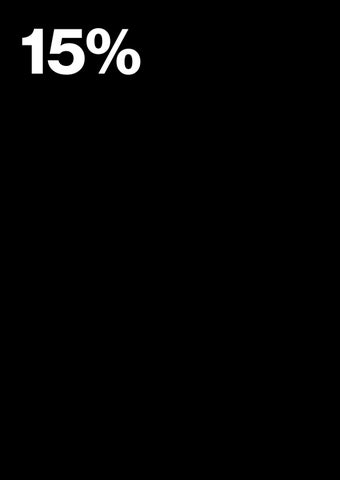
15%
WE ARE 15% OF THE WORLD’S POPULATION.
Jade Fisher
IMY
I AM DEAF. How does your disability affect you and your daily life? My disability effects me by not being able to have conversations in loud environment, especially throughout the pandemic with the introduction of masks. I struggled to lipread others during this time and this is my main way of communicating. If I can’t see you I won’t hear you so I have to be very observant with my surroundings. My disability has also effected my mental health as there has been a times where I thought wasn’t strong enough or good enough.
What barriers do you overcome ? Everyday is a barrier to overcome, the minute I put my hearing aids in it goes 0-100 in the space of seconds and it can be overwhelming and exhausting. Another major barrier I had to overcome especially when I was younger , was that I was different to a ‘normal’ person and therefore I had to realise it’s ok to be different and to embrace who I am because at the end of the end no one is the same and we should appreciate the finer moments in life as you never know what could happen next. Especially with my hearing deteriorating further.
“I’m proud to be me””
There are between 130 and 300 sign languages in the world.
GARETH
I AM SEVERELY DEPRESSED. How does your disability affect you and your daily life? I have a broken back which means I’m in chronic pain constantly. Severe depression which can lead to suicidal thoughts. Tennis and golfers elbow in both arms a bad knee and a blood clot in my chest. These effect me in different ways. My back and depression means it’s a struggle for me to get out of bed every day thinking whats the point. My meds for my back and mental health have pretty much stopped working.
What barriers do you overcome ? I have a number of barriers I have to overcome but the main one is over come is that I’m seen as faking these problems as I’m able to walk and I’m not in a wheelchair with my back issues which, can be really hard on a daily basis this then worsens my depression.
“I don’t look for sympathy just understanding that my struggles are real”
An estimated 386 million of the world’s working-age people have some kind of disability.
CHRISTINE
I HAVE CHRONIC KIDNEY DISEASE How does your disability affect you and your daily life? I would say fatigue mostly, as need lots of sleep and really have to pace myself. I also have to have checks every 6 months to maintian my health. I feel the cold alot, which I find really hard as in the summer I need to wear layers.
What barriers do you overcome ? That’s difficult as although I have a disability. I do not see myself as a disabled person. I like to focus on the things I can do which is a great deal , it’s just now there are some limitations. But there are coping strategies and different ways to approach life. Sometimes as an older woman with grey hair it feels as if I am invisible especially as the health challenges I am coping with are not obvious or visible.
“I dont consider myself disabled”
Estimated 1 billion people, live with disabilities. We are the world’s largest minority.
ANDREW
I AM NEURO-DIVERSE. What is your disability/disabilities do you have? I am neuro-diverse in that I have an Acquired Brain Injury resulting from a stroke in 2008. It left me with behavioural problems. I have a condition called Executive Dysfunction, which means I struggle to multi-task and prioritise. I can be impulsive and argumentative. I am also an amputee and have been one for sometime.
How does your disability affect you and your daily life? I can be difficult to live and work with; I find it hard to ‘read’ people and that makes me very insensitive – it’s almost a kind of Aspergers. As a result, I can alienate people who can see me as rude and overly critical. I have lost a lot of friends because of my condition.
What barriers do you overcome ? The main barrier has been adjusting to how people see me; I am very hard to warm to and that can be lonely. I am not as sociable as I used to be. I find human interaction tiring and try to avoid it. The lockdown has been good for me because I can work from home and not have to meet people face to face. Impulsivity causing money problems; particularly when I am depressed a spend freely on stuff I don’t really want or need. I also speak without thinking and that can upset people. Overall my brain injury has been very isolating. On balance I welcome the changes the brain injury has brought. The stroke made me more creative; it seemed to unlock parts of my brain I had previously untapped. I liken the stroke to an explosion in an advent calendar; it blew some doors closed, but it also blew some doors open.
“Having a stroke unlocked parts of my creative brain”
15% of people around the world live with a disability.
ALICE
I HAVE EHLERS DANLOS SYNDROME AND POSTURAL TACHYCARDIA SYNDROME. How does your disability affect you and your daily life? I’ve always tried to make sure it does not have too much of an impact on me, just because I know I have this for life to may as well live like I want too. But I do find I am more cautious with the places I go in case they cause a flare up, e.g. crowded areas incase my body gets knocked around, days out with lots of walking to avoid fatigue etc. I find it a bit silly being worried about that sort of thing at my age but I know the knock on effect is worse than I can justify.
What barriers do you overcome ? I think the predominant barrier I’ve faced is as a result of peoples perceptions. I’ve often faced a lot of judgement when I’ve said I have a disability and have either been told I’m ‘making something out of nothing, have ‘teenager-itus’ or simply ‘don’t look like I would have one’ and that’s made me question myself a lot. With my job, with some groups of people I work with it actually is beneficial to tell people I have a disability, but other times I feel like I am spoken down to when I declare it and am then not taken as seriously as I feel I should. It can be quite difficult. My job is based around supporting people with disabilities to access sport and physical activity. And this is something I think is one of my biggest interests also (very honoured that I have a job I love so much).
“I view my disability as such a positive and great thing to have, as opposed to viewing it as a hinderance to my life.”
“Ableism” is the term given to the discrimination of disabled people.
SIMON
I HAVE DYSEXECUTIVE SYNDROME. What disability/disabilities do you have? I have brain damage caused by bacterial meningitis. This has led to dysexecutive syndrome and very poor mental health. I have trouble concentrating for substainal periods, I find conflicting external stimuli difficult to deal with. (e.g. being in a room where more than one conversation is taking place) and I mentally fatigued extremely quickly. This greatly affects my daily life. I have to plan significant breaks in my day, and cannotdo as much as I would like. I also am unable to think clearly long enough to hold down a job.
What barriers do you overcome ? I guess the main barrier to overcome is the hard wall of mental fatigue. I have to try and pace myself and know when to stop. Unfortunately, one symptom of dysexecutive syndrome is the inability to plan well, so this can be a real challenge in my daily life.
WeThe15 is a global movement, which was founded by a coalition of organisations from sport, human rights, policy, communictions, business, arts and entertainment, uniting to change attitudes and create more opportunities for persons with disabilities, as well as improve mobility and accessibility.
BERNIE
I HAVE STAGE 2 ENDOMETRIOSIS. How does your disability affect you and your daily life? There is never a day where I am not in pain. It doesn’t matter whether I’m going on a walk, standing, sitting, lying down; I am always in pain. One of the things I find the most frustrating is that because I can go about my day-to-day life as best as possible, the pain that my invisible illness causes me seems to be dismissed. I detest feeling like I have to justify and over explain myself and how I feel.
What barriers do you overcome ? The main one that comes to mind is having to become such a huge advocate for yourself. To trust my gut and listen to my body. When a person suspect something is wrong with them, I firmly believe that pestering medical professionals is the only way you’ll get answers.
How do you think we should be educating people about disabilities? There needs to be more education and exposure to a wider range of disabilities and that there is not one ‘look’ of disability. People only seem to acknowledge disability if it has an obvious physical display of symptoms.
“I just wanted to be treated like a ‘normal’ person, whatever that really means.”
Disabilities may be physical, mental , or both. Most people will experience disability at some point in their life.
MARCUS
I AM A WHEELCHAIR USER. How does your disability affect you and your daily life? I have a brain stem infarct (basically a stroke), I’ve had this since I was 11 years old. I try and not let my disability hold me back in life, I am in pain everyday of my life though, in one way or another, not that I show it often. I live a normal life wiht my children doing school runs, whilst juggling my passion of being a coach, I am a football coach, and want to become the first person in a wheelchair, to manage an able bodied professional fotoball team.
What barriers do you overcome ? I overcome many barriers, my speech is a massive barrier, people must think, hey it’s the drunk lad in the wheelchair, I overcome my body on a daily basis, the one big barrier I have to overcome, are other peoples attitudes to disability. Personally, I think able bodied people should stop saying that they understand, in regards to a disability, they do not, we need actual disabled people to do jobs that have disability in the title eg disability officer......not just somebody that has ‘learnt’ about disability at university, there are so many things that could be changed. we need to have more disabled people in roles.
“I want the world to see me as a human, just a human that is a little bit broken.”
Globally, there are 75 million people who need a wheelchair BUT only 5% to 15% of those who need a wheelchair have access to one.
CATHY
I AM LIMB DIFFERENT. How does your disability affect you and your daily life? In the main not at all I live a full to the max life with work, family and my social life.
What barriers do you overcome? I have a strong sense that I can achieve anything physically and mentally. There are things that are harder to do because of my disability but m stubbornnessstops me from given in ! My new “Hero” bionic arm from Open Bionics has made my limb difference more visible, more talked about and has enabled me to do the tasks such as cutting food up at dinner, opening jars,
using a pepper grinder etc - more accessible. I can suddenly do all these taks and it’s so liberating. I love people asking me about my ‘cool robot’ arm. It has broken down barriers for me personally.
How do you think we should be educating people about disabilities ? Not just accepting differences but being more aware of others needs I say this more from the perspective of my job as a Speech Therapist working with the neuro divergent children and young people I work with who everyday are asked to be ‘neuro typical’expected by the ‘so called’ neuro typical world to conformto societal social rules. This creates frustration, anxiety, masking and long term mental health issues.
“I love my robot arm”
Disabled people make up just 6.5% of on-screen staff and 5.5% of off-screen staff in television, even though 18% of the national population have a disability.
SAM
I AM COLOUR BLIND How does your disability affect you and your daily life? I’m a Graphic Designer, so there have been a few issues when choosing the right colour etc. But I find ways around it and all colours have a reference number to them anyway. For Obsessive Compulsive Disorder, mine is thought based and I often find it super hard to switch off. It’s brought on a lot of the time with various stresses. This can cause sleepless nights, trouble concentrating and often a higher sense of social anxiety.
How do you think we should be educating people about disabilities? People aren’t necessarily disabled, the world just isn’t currently allowing these people to fit in fully. The world needs to be aware of these issues and adapt, just like adding a ramp to all public buildings for the use of wheelchairs fo example. There have been a few times when the choice of colours in advertising has caused visual discomfort and I feel there needs to be a little more leniency for people suffering with mental health issues.
There is still a stigma surrounding it and people still feel like it’s not a real issue; something the sufferer should just be able to get over or ‘pull themselves together’
What barriers do you overcome ? Whenever I start a new job within design, I feel like I am harbouring a guilt little secret. Being in a design role and being colour blind can often give me impostor syndrome. That said, once it’s out and people know about it, there tends not to be any issues or backlash. That said, I still don’t broadcast it across the company. A lot of people don’t understand it and actually think I see in black and white! I am fairly open about my mental health issues, but there have been times that I have had to explain things to employers when I’m really struggling and cannot work. That can be hard as I’m already having a hard time of it without needing to explain why I’m unde performing as well.
I AM COLOUR BLIN
“My social and employment circles are generally very good, but that’s because I have purposely fit myself into them.”
Persons with disabilities are more likely to experience adverse socioeconomic outcomes such as less education, poorer health outcomes, lower levels of employment, and higher poverty rates.
SAMMI
I HAVE PTSD. What disability/disabilities do you have? PTSD, Fibromyalgia, Myalgic Encephalomyelitis (M.E), Acute Migraine Syndrome. I list PTSD first as there is strong evidence to link PTSD with Fibromyalgia and M.E. The trauma causes your mental nerves to be constantly in overdrive, which can translate to your physical nerves doing the same, causing extreme pain and fatigue. The brain is an incredible and complex thing! I am also perimenopausal, while not being a disability really exacerbates all my condition except the migraine syndrome.
How does your disability effect you and your daily life? Chopping an onion is an extremely hard task, I need to rest for an hour or so afterwards! My fatigue levels are intense. It is exhaustion rather than fatigue. Imagine you have been awake for 4 days and 4 nights. You are at the deep end of the swimming pool, underwater, sitting on a chair. Imagine all the weight of the water pushing on you while you try to move. Now imagine that someone is taking a hammer to your knees, your hips and your shoulders at the same time. That is how it feels. That is without the PTSD and the hyper vigilance that goes along with that! I struggle to leave the house, I see a plane and I think it will crash on or close to us. I think the car will crash. I am terrified of being trapped, I can’t use public transport due to fear of contamination . I am prone to huge panic attacks.
What barriers do you overcome ? Judgement! Not sure I overcome that but I experience it. I dress in bright, happy colours to try and make people smile, my kids, strangers. I believe if you can make someone smile every day then that day is a success. This is to overcome fear of acceptance as well I think. The bright colours are because I feel invisible, it is a way of challenging those thought patterns while making people smile! Every time I manage to leave the house that is a win and a barrier overcome. I have managed to make Uni part of my safe space, so now my world has increased to home and my studio at Uni. Doors . I use a mobility scooter and doors are a pain. The streets of cheltenham are awful! (I don’t get out much so I can’t pass comment on elsewhere) I have a lot of pain, so a pitted pavement is an awful experience, and most of them are pitted! Dropped kerbs. Wow. People park on them, or they simply are not there. There are some dropped kerbs that are over an inch off the ground, you try ram a scooter up that especially ,when in a lot of pain! I think town planners and counsellors should ride a scooter around their local area once a year each. Listed buildings often mean no access, that is just how it is - but it is frustrating. I miss going for long walks, I adore nature and I can’t afford a proper off-road scooter. I haven’t overcome that one yet.
“My children are awesome, so want to take the chance to thank them for being who they are. I hope I manage to teach them to keep trying, no matter what life throws at you.”
WE ARE 15% OF THE WORLD’S POPULATION.
Thank you to all contributors who took part in this project especially for sharing their experiences as disabled people.