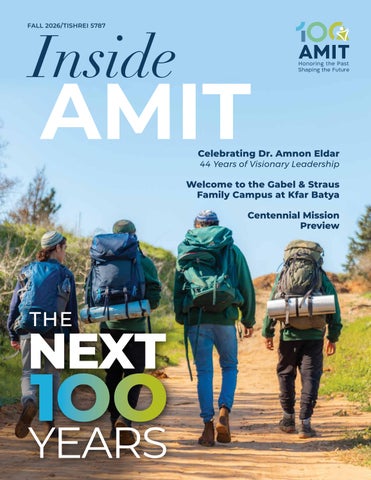
FALL 2026/TISHREI 5787
Celebrating Dr. Amnon Eldar
44 Years of Visionary Leadership
Welcome to the Gabel & Straus Family Campus at Kfar Batya Centennial Mission Preview
PRESIDENT AMIT Shari Safra EXECUTIVE VICE PRESIDENT Andrew Goldsmith DIRECTOR GENERAL Dr. Amnon Eldar
AMIT Offices Around the World New York City 212.477.4720 info@amitchildren.org www.amitchildren.org Kfar Batya Campus 1 Jerusalem Street Ra’anana Baltimore/Boston/D.C./Philadelphia 410.484.2223 robbiep@amitchildren.org
CONTENTS CENTENNIAL
CLASSROOM
03 Lessons from My Aunt Bessie
32 Med School Meets High
06 Inside the Centennial Mission
School
08 AMIT Milestone Moments
36 The Making of a Principal
COMMUNITY
CIRCLE
10 Celebrating Dr. Amnon
40 Chefitz Family
Eldar’s Leadership
42 Miller Family
Chicago 847.677.3800 amitchicago@amitchildren.org Cleveland 216.802.8618 amitcleveland@amitchildren.org Florida 954.922.5100 elanag@amitchildren.org Los Angeles amitla@amitchildren.org Designed by Bacio Design & Marketing Inc. Editor Michal Rosenberg
AMIT provides an innovative, Jewish, values-based education for over 42,000 children in Israel each year. AMIT welcomes every child and levels the playing field for the children of Israel through education.
14 When Values
44 New AMIT Leadership
Lead the Way
48 We Remember
18 Bridging Generations
50 Event Highlights
22 Alumni Spotlight:
58 Giving Societies
From Sderot to Service
CAMPUS 26 Welcome Home to Kfar Batya
Follow AMIT: AMITChildren AMIT.Children Signed articles do not necessarily represent the opinion of the organization. Reproduction of any material requires permission and attribution.
-D-
PLUS! 24 Israel’s New Knesset Museum 56 Recipe from Erin.Eats.Mtl
Inside AMIT / Fall 2026
President’s Message SHARI SAFRA
I
’ve been to a lot of lunches. This one was different. Seated around the tables were AMIT principals who had traveled from Israel to spend time visiting American schools. For some, it was their first time in New York. They had been scheduled to make this trip in June 2025, but the war with Iran had made that impossible. So, this gathering carried extra meaning for all of us. Looking around the table, I felt a surge of overwhelming gratitude. I was grateful for the opportunity to spend time with the people who carry AMIT’s educational mission forward every day. The stories they shared with me that afternoon only deepened that feeling. Miriam Coren, one of our incredible principals from AMIT Bellows Noga, offered words I haven’t been able to stop thinking about. She told us that there is not a single principal at any of our schools who did not experience loss in their community. Not one. Every leader sitting at the helm of an AMIT school has experienced personal grief while simultaneously showing up for their teachers and their students. And yet, these principals did not sound weary. They told stories describing teachers who refused to let trauma become the end of the story. Students who, despite everything, found their way back to the classroom. The resilience I heard described that afternoon wasn’t abstract. It lived in real schools, in real students who deserved so much better than what the world handed them, and who showed up for class anyway. This is what I am grateful for as we begin a new school year: the extraordinary humans who make up this organization. I am grateful for our educators who teach their students not only math and science, but how to keep moving forward when the world feels like it is falling
apart. I am grateful for our students, who humble me every time I meet with them. Young people living through circumstances I can only imagine yet still manage to dream. And I am profoundly grateful for the privilege of leading AMIT into its centennial year. One hundred years. A century of believing that education is the most powerful investment we can make in the Jewish people and in the State of Israel. This year, that belief is taking shape in ways that are truly exciting. We are inaugurating the new Gabel & Straus Family Campus in Ra’anana, a landmark moment for our network, and expanding our Learning Management System to personalize each student’s educational experience in ways that were unimaginable when AMIT was founded. One hundred years in, and we are just getting started. As Rosh Hashana approaches, bringing with it the promise of a fresh start and the sweetness we are all craving, I find myself returning to the image of those principals at my lunch table. They are my inspiration and the reason I do this work. I hope they become yours too. If you feel that pull, and want to see AMIT’s mission up close, I invite you to join us in Israel this November for AMIT’s 100th Anniversary Mission. We will be joined by extraordinary scholars in residence, and you will have the chance to meet our remarkable faculty and students face-to-face. You will tour our breathtaking new Gabel & Straus Family Campus in Ra’anana and visit our headquarters, where the cutting-edge research and development that drives our work happens every day. It will be a journey unlike any other: a chance to celebrate a century of impact. Come with us. I promise you won’t return the same. Wishing you and your families a Shana Tova. May this season bring renewal, hope, peace — and maybe a journey to Israel with us on November 8!
BUILDING EDUCATION NATION THE NEXT 100 YEARS
-1-1-
AMIT
I
EIGHTY YEARS LATER:
A Dream Fulfilled
t was — and remains — the most ambitious undertaking in AMIT’s century-long history.
Long before Israel declared independence, while the dream of a Jewish homeland was still being forged through determination and sacrifice, another quiet dream took root. Just 17 miles north of Tel Aviv, a rocky expanse in Ra’anana would become the foundation for a bold vision: a sanctuary where vulnerable children could find not only shelter, but hope, dignity, and the chance to rebuild their lives. The path was far from easy. Approved in 1939, the project faced years of delay amid war and uncertainty. Finally, in 1945, 32 privately acquired acres were joined by another 70, forming the land on which Kfar Yeladim Ra’anana — and later Kfar Batya — would rise.
This September, nearly 80 years later, history comes full circle. On that very same sacred ground where Bessie once stood, the Gabel & Straus Family Campus will open its doors. What began as a haven for children has blossomed into one of the most innovative educational campuses in the Jewish world — a beacon that will welcome thousands of students, educators, and visitors each year from Israel and around the globe. People of every background, faith, and culture will come to learn from a model rooted in Jewish values, educational excellence, innovation, and human dignity. At the same time, through the creation of Keren Batya from the sale of the remaining property, the legacy of that original land will continue to sustain and expand AMIT’s mission for generations to come. Few organizations have transformed a single philanthropic act into such enduring, multiplying impact.
Impressions
Fourteen-year-old Israel Friedman never forgot accompanying AMIT founder Bessie Gotsfeld on her first visit to the newly expanded property. Decades later, his memories remained vivid.
ANDY GOLDSMITH
“I remember it like it was today,” he recalled. “She was running toward it as though drawn by something greater than herself.” There was little to see: just rocky, barren ground covered in grass. Yet Bessie saw what others could not. Standing in the middle of that empty field, she described buildings, pathways, and boundless possibilities with the confidence of an architect and the faith of a true visionary. “‘Here,’ she said, ‘I will build not ordinary houses for children, but palaces. This will be the center for my children. They will come, and we will need more space, because there will be more children to serve.’” Those around her saw only open land. Bessie saw the future. Two years later, in 1947, that future began to unfold as Kfar Batya welcomed its first 80 children — young Holocaust survivors detained in Cyprus. Soon came another 70, the Children of Tehran, each bearing unimaginable loss yet finding safety, education, and family in AMIT’s embrace.
--22-- WELCOME
As the prophet Amos declared: “‘I will plant them in their own land, and they will never again be uprooted from the land I have given them,’ says the Lord your God.” (Amos 9:15) One who plants knowing they may never sit under the shade of those trees has begun to understand the meaning of true legacy. Bessie Gotsfeld planted seeds on rocky ground with unwavering faith. Eighty years later, we are privileged to witness the abundant harvest.
Executive Vice President
This November, we invite you to stand where she once stood. Join AMIT’s Centennial Mission to Israel and experience this historic moment firsthand. Celebrate the opening of the Gabel & Straus Family Campus, see Bessie’s extraordinary dream realized beyond what she could have imagined, honor those who made it possible, join together with thousands of educators and students, respond to our enemies with a meaningful act of affirmation, and claim your own place in this remarkable story. This is more than the opening of a campus. It is the fulfillment of a vision. It is the next chapter of AMIT’s history. And it is your moment — as a partner in AMIT — to be part of it.
Inside AMIT / Fall 2026
LESSONS
from My Aunt Bessie AND AMIT’S FOUNDING WOMEN
By Yaela Baine Honored at a recent AMIT Philadelphia Council/Shira Chapter Family-in-Israel event, Yaela Baine recounted her deep family connection to the organization, taking us back to its early days and the vision that continues to shape its mission a century later.
Yaela Baine
A
MIT has reached its 100th birthday. שהחיינו וקיימנו והגיענו לזמן הזה. As we mark this special milestone, I am both moved and humbled to honor my family’s legacy that was born out of love for the Jewish people, the Land of Israel, and the Torah. My great-aunt, Bessie Gotsfeld, was the founder of AMIT. She was born in 1888 in Poland and was 12 years old when she lost her mother. Her father married Adela Goldstein, my great-grandmother, a year later. Adela was a warm and loving woman, and she formed a close mother-daughter relationship with Bessie. The family came to America in 1905, where Bessie’s brother (my
grandfather) married my grandmother, Belle Goldstein. Grandma and Aunt Bessie quickly bonded and were more like sisters than sisters-in-law.
THE ORIGINS OF AMIT Aunt Bessie and Grandma were young women in the 1920s, which was a period when the ideas of Zionism were spreading globally and Jews were establishing settlements in pre-state Palestine. It was during this time that Adela, Bessie, and Belle helped found Mizrachi Women’s Organization of America (MWOA), now called AMIT, sharing the vision of a new generation of Jews thriving in their homeland and rooted in Jewish values. Aunt Bessie was arguably the architect of AMIT. It was her passion and her tireless driving force that transformed AMIT from its humble beginnings as an auxiliary of the Mizrachi Men’s organization to an independent national women’s organization in 1925. Bessie’s mother, my greatgrandmother Adela Goldstein, working alongside her, served as the first national president (from 1925 to 1934) and oversaw the opening of AMIT’s first school, the Beit Zeirot Mizrachi (BZM).
eld Bessie Gotsf aine) aB (Credit: Yael THE NEXT 100 YEARS
-3-
Aunt Bessie herself never accepted the role of president. She made aliyah in the 1930s and became the boots on the ground for all AMIT projects.
CARING FOR CHILDREN IN CRISIS
Bessie realized that the police patrolling the streets and making announcements over the loudspeaker would be traumatizing to the children at BZM who were refugees of the Holocaust. Aunt Bessie left her home, against British orders, and convinced a police officer to escort her to BZM, where the terrified children gathered around her as she consoled and reassured them.
To rehabilitate the child refugees and infuse them with Jewish values, Aunt Bessie meticulously yet lovingly planned every detail of the schools she founded.
EDUCATIONAL VISION AND INNOVATION
Of note, the schools were called homes, and every effort was made to create a warm environment. For example, students of varying ages were housed together to create a family-like atmosphere, with staff members living on-site. They ate their weekday meals in a small, cozy room rather than the large institutional dining hall. Religion was part of the daily rhythm of life, and in 1955 Kfar Batya became the first children’s village in all of Israel to have its own shul.
When it came to education, Aunt Bessie settled for no less than the best. Spotting a nascent talent, she hired the young Nechama Leibowitz as director and teacher of Jewish studies in BZM, a position she kept for 20 years.
Rehabilitating the children was not easy. They struggled with demons, having witnessed atrocities during the Holocaust and not knowing the fate of their loved ones. Some, having survived in the forest for years, climbed up a tree whenever they felt insecure. They hid food under their mattresses until it rotted, unsure of where their next meal was coming from. Gaining their trust was a long and difficult process. But Aunt Bessie was exquisitely sensitive to their needs. She knew every child by name, background, and interest, so they knew they were special and they mattered. Having no children of her own she “adopted” AMIT’s children, much as they adopted her as a savta. She counseled the older students as a mother would and was especially protective and loving with the little ones. The following story, one of many, captures this relationship. After the bombing of the King David Hotel in 1946, a curfew was imposed in Jerusalem. Aunt
Despite scarce funds, Aunt Bessie was determined that each student be afforded the opportunity to reach his full academic potential. So, when a group of academically minded students requested a college-prep track instead of the vocational and agricultural training the school provided, Aunt Bessie found a way. She could only afford to buy one book for each subject, so everyone in the group mastered one topic and then taught the others. In this way all the students passed the rigorous entrance exams to Hebrew University. Aunt Bessie’s contributions to the developing country gained her national recognition, and she had the honor of being one of the guests invited to the signing of Israel’s Declaration of Independence. Later, in 1955, Eleanor Roosevelt visited Kfar Batya to support its mission of providing a home and vocational training to orphaned and immigrant children.
LESSONS ACROSS GENERATIONS I met Aunt Bessie only once, when I was very young, but my oldest cousin, Ora, shared with me her personal memories. Ora was born in 1947 in Jerusalem. Her father, my Uncle Leon, was the first director of Kfar Batya, and her mother, my Aunt Raisel, taught English there, so Ora grew up in Kfar Batya. She described it as an idyllic place, where children romped in the open air, where they felt secure and loved, where immigrant children of Mizrachi and European (Ashkenazi) backgrounds lived together as family and formed lifelong friendships, a model for the society at large. And she remembers Aunt Bessie as one of the kindest people she knew, who always greeted her with hugs, juice, and cookies. My grandmother, Belle Goldstein, was Aunt Bessie’s soulmate and partner, and they traveled together nationally to fundraise for AMIT. She was an AMIT delegate
tein Adela Golds
- 4 - CENTENNIAL
Inside AMIT / Fall 2026 Children playing at Kfar Batya
(l-r) Belle Gol ds and Bessie G tein otsfeld (Credit: Yael a Baine)
at the WZO Actions Committee in 1947, an incredibly emotional meeting where they voted to declare the State of Israel after the British left. “You had to hold up your delegate’s card,” she wrote. “Every card was raised, and the resolution was passed. We all broke out into ‘Hatikvah’ … the tears were just running down our cheeks.” Grandma was AMIT’s third national president, during the wartime years of 1942 to 1946, and its activities expanded greatly during her tenure, including the establishment of three children’s homes for Holocaust refugees, one of which is now Beit Hayeled. Personally, I remember Grandma as a dignified, charming, and gracious woman, yet modest and unassuming. But to the outside world, she was a dynamic and compelling orator. She traveled and spoke across the country, rallying thousands of women to join AMIT and adopt the cause of religious Zionism. She mentored generations of volunteers as the organization grew. AMIT’s mission was so vital to her that it propelled her to step way out of her comfort zone. Grandma herself made aliyah at the age of 102, the oldest American to do so. Behind every great woman there is a man, and Uncle Mendel, Aunt Bessie’s husband, was that man. He willingly took on all the domestic responsibilities, in an age when this was unheard of, so that Aunt Bessie could devote herself to AMIT full time. My mother herself traveled to pre-state Palestine in 1947 and, as a newly trained teacher in early childhood education, worked with refugees from Youth Aliyah at the AMIT school in Tel Raanan.
A CONTINUING LEGACY Fast-forward 100 years, and AMIT has accomplished the unimaginable. With dedicated support, we have grown from a small group of visionary women into Israel’s leading educational network for eight consecutive years. Over the past century, we’ve transformed countless lives. Thousands of our children have escaped poverty to become part of Israel’s high-tech, health, and government sectors. We’ve educated generations who blend modern skills with eternal Jewish values and are the backbone of the Jewish state. But we are not stopping there. Aunt Bessie used to say that we must be future-ready. She would be amazed that at Kfar Batya, which is named for her, her legacy lives on through Gogya, our revolutionary approach to learning. She would scarcely recognize the new campus, with its modern labs and makerspace, set up to turn Israel into Education Nation, a paradigm for education in the 21st century. But at the same time, we are still reaching out to the child in the periphery, now via high-tech internships, AI, and Zoom classrooms — to level the playing field for all. What began as the dream of one remarkable woman has become the work of generations. As AMIT enters its second century, we remain guided by the same enduring belief that education is the greatest force for transforming lives, strengthening Israel, and securing the future of the Jewish people.
THE NEXT 100 YEARS
-5-
A
FRONT-ROW SEAT to the FUTURE
More than a mission, the historic celebration set for November 8-11, 2026 at Jerusalem’s Inbal Hotel, honors 100 years of achievement and impact. What began as a dream in the hearts of AMIT’s founders has become one of Israel’s greatest educational success stories, continually evolving while remaining true to its founding values. But AMIT’s story has never been about buildings and programs alone. It is about people: the students inspired to dream, the educators who guide them, and the generations of leaders and partners who believe in them.
Can’t-Miss Moments Gabel & Straus Family Campus at Kfar Batya VISIT President Isaac Herzog and First Lady Michal Herzog at the presidential residence.
HEAR an unforgettable opening-night welcome from U.S. Ambassador to Israel Mike Huckabee.
MISSION AT A GLANCE Sunday, November 8
Opening Dinner at Inbal Hotel, Jerusalem Welcome with U.S. Ambassador Mike Huckabee
- 6 - CENTENNIAL
After years of planning, AMIT comes home to the site where Bessie’s dream was born. This center for educational innovation in Ra’anana will fuel collaboration and creativity, advancing AMIT’s vision of transforming Israel into Education Nation. • Opening of new campus and ribbon cutting • Recognizing our extraordinary donors • Personalized campus tours • Campus Dedication Ceremony at the Evan & Layla Green Family Foundation Gogya Center
Monday, November 9
Ribbon Cutting at Gabel & Straus Family Campus at Kfar Batya Donor Recognition and International Education Conference
Students Take the Stage
Inside AMIT / Fall 2026
MAKE-A-THON:FIGHTING FOR WARRIORS Partnering with the IDF Disabled Veterans Organization, students work with injured soldiers to develop practical solutions that improve their quality of life. Explore a student showcase of these remarkable creations at the Evan & Layla Green Family Foundation Gogya Center and cast your vote for the winning project.
AMIT WORLD’S FAIR As you enter Binyanei Ha’Uma for our Centennial Gala, wander through creative student exhibits and interactive stations that demonstrate the ingenuity and spirit of AMIT’s next generation.
International Education Conference AMIT launches the inaugural “Human Renaissance Forum,” a three-part series exploring the defining educational questions of our time. This first gathering, at the Chella & Moise Safra Atheltic Complex, will examine the theme, “Humans Are Underrated: The Role of Education in the Age of AI.”
Hakarat HaTov
Behind every AMIT achievement are the dedicated partners who believed in the mission and helped bring it to life. As we mark this milestone, we will honor the donors, leaders, partners, and friends whose enduring partnership has impacted generations of students. • Campus dedications & donor recognition • “Legacy of Leadership” Dinner honoring AMIT leaders in the U.S. and Israel • Centennial Gala at Binyanei Ha’Uma • Tribute to AMIT’s fallen and dedication of Campus Memorial Park
Bringing together some of the world’s most influential voices in education, technology, leadership, and security, Ilana Dayan, Israeli journalist and attorney, will moderate a landmark discussion with:
Keren Yarhi-Milo General Michael Kurilla Dean, Columbia School Retired Four-Star of Intl. and Public Affairs Army General
Micah Goodman Israeli Philosopher and Author
• Yossi Cohen, former Head of Mossad • Scott Galloway, Professor, Author and Entrepreneur
• Nadav Zafrir, Check Point CEO
Join us in Israel this November as we celebrate a remarkable first century and begin the next 100 years together. Tuesday, November 10
Visit to the home of the president and first lady “Legacy of Leadership” Dinner at Olmaya
Wednesday, November 11
Visit to AMIT Beit Hayeled Centennial Gala at Binyanei Ha’Uma THE NEXT 100 YEARS
-7-
AMIT
AMIT’S LEGACY OF INNOVATION AND INVESTMENT IN ISRAEL’S FUTURE
A VISION TAKES ROOT
AMIT’s leadership remains dedicated to Bessie’s legacy, continuously innovating to empower every child in Israel.”
A
MIT’s story begins with founder Bessie Gotsfeld, whose vision transformed the lives of generations of Israeli children. After immigrating from Poland to America in 1905, Bessie was passionate about building the Jewish homeland. She founded the Mizrachi Women’s Organization of America to create opportunities for young people. She championed education for girls, establishing the first Beit Zeirot Mizrachi vocational school in Jerusalem in 1933. Following World War II, Bessie expanded her efforts to support immigrant and refugee children, opening schools and youth villages throughout Israel, including Kfar Batya in 1947. A practical visionary, Bessie believed education should provide both values and opportunity. Her commitment to empowering every child remains at the heart of AMIT’s mission today.
- 8 - CENTENNIAL
Inside AMIT / Fall Inside 2026 AMIT / Fall 2026
EDUCATING FOR SUCCESS
A
1973 inaugural conference
MIT’s early vocational schools had a simple goal: Provide young people with practical skills and a brighter future.
That mission remains as relevant today as it was a century ago. Among AMIT’s 92 schools are eight vocational schools serving students from Israel’s social periphery, many of whom face significant academic and personal challenges. Students pursue careers ranging from advanced transportation, engineering, and high-tech to graphic design, agriculture, culinary arts, and cosmetology. AMIT’s mentoring approach and values-based education help students build confidence, discover their strengths, and prepare for meaningful employment.
(Credit: Yaela Baine)
AMIT helps students actualize goals and gives them a future they never knew existed.” - SHARI SAFRA AMIT President
The results speak for themselves, with 82% of vocational school graduates enlisting in the IDF or National Service, and many continuing on to advanced training and careers — far higher than the national average.
EMBRACING IMMIGRANTS
F
or more than 100 years, AMIT schools and youth villages have welcomed immigrant children arriving in Israel with hope, uncertainty, and little else. Beginning in the 1930s, AMIT institutions provided refuge for children from Tehran, Holocaust survivors from Europe, and later immigrants from Ethiopia, Iran, Russia, and France. Beyond food and shelter, these young people found caring educators, strong Jewish values, and the foundation for successful futures. Many former students credit AMIT with changing the course of their lives, enabling them to build careers and families of their own while maintaining lifelong connections to the schools that nurtured them. That same spirit of inclusion and opportunity continues to guide AMIT a century later, ensuring every student has a chance to thrive.
EXPANDING THE TENT
A
t the turn of the century, AMIT faced a pivotal question: Could a network known for Religious Zionist education also serve secular students? The answer reshaped AMIT’s future. Beginning in Sderot, AMIT expanded its reach while remaining true to its values. Rather than focusing on religious observance, the network developed programs centered on Jewish identity, heritage, and connection to the State of Israel. Educational journeys to Jerusalem and curriculum exploring Jewish history help students develop a deeper understanding of who they are and where they come from. AMIT’s framework of shared identity and mutual respect strengthens and unites Israeli society.
Charlotte Kl ein (Credit: Sand at Mizrachi Women y Kline Smal l) THE NEXT 100 YEARS
-9-
AMIT
TEACH THEM to DREAM Dr. Amnon Eldar’s Visionary Leadership Has Shaped Generations
Dr. Amnon Eldar
BY A R N I E D R A I M A N
F
or more than four decades, Dr. Amnon Eldar has stood out as a widely respected leader across the Israeli educational landscape, helping shape not only schools, but generations of students and educators. After 25 years as director general of AMIT Israel and 44 years within the organization itself, Dr. Eldar is retiring — and leaving behind a legacy that extends far beyond classrooms and campuses. With sensitivity, innovation, and a deep belief in the individual student, he has helped revolutionize the educational landscape of Israel and the way students learn. “I’m privileged to have worked in AMIT for all these years, to make my dreams come true,” Dr. Eldar reflected. “AMIT gave us the tools to make this happen, from the top leadership to the students themselves.” Throughout his career, Dr. Eldar has consistently viewed education not merely as the transfer of information, but as the cultivation of human potential. Under his leadership, AMIT has become one of the most respected educational networks in Israel, known for academic excellence, technological innovation, values, and social responsibility. “At AMIT, the student is seen,” he explained. “Every student has an adult they can turn to, academically and personally. No one is left behind.” That philosophy became the heartbeat of his educational revolution.
- 10 - COMMUNITY
Gogya Is Born Perhaps Dr. Eldar’s greatest contribution to Israeli education is the creation of the Gogya method, an innovative educational philosophy developed within the AMIT Network. Derived in part from the Hebrew word for pedagogy, Gogya represents a complete rethinking of how students learn and how teachers teach. “I came from a pedagogic background, and I understood that the educational systems had to change,” Dr. Eldar said. The Gogya method replaces traditional frontal lectures with project-based and experiential learning. Students work collaboratively and independently, teachers serve as mentors rather than lecturers, and classrooms are transformed into dynamic learning environments with modular furniture, digital hubs, and flexible spaces designed to encourage creativity and interaction. “We traveled the world with our staff to see what the leading-edge schools were doing,” Dr. Eldar explained. “We turned thousands of teachers into mentors, changing the entire system.” That transformation was no small undertaking. Yet under Dr. Eldar’s leadership, the program expanded throughout Israel — from 20 to more than 70 schools now using this approach.
Inside AMIT / Fall 2026
Today, Gogya is one of the most influential educational models in Israel, drawing educators from across the country who are eager to learn from AMIT’s success. “Over 100,000 non-AMIT staff have come to see what we are doing,” Dr. Eldar noted. “They came to learn from us, to be trained by us. The Ministry of Education wants to adopt it.”
The Three Pillars At the core of Gogya are three pillars: identity, strengths, and individualized learning. Addressing the first pillar, Dr. Eldar explained that every student from seventh through 12th grade participates in programs about Jewish, Israeli, and Zionist identity — each according to their own understanding and background. In an era when Israeli society faces increasing polarization and internal tensions, Dr. Eldar believes education must help bridge divides rather than deepen them. “Gadi Eisenkot and Benny Gantz [former IDF chiefs of staff and current politicians] both believed that our greatest challenge is not Iran or Hamas, but the need for shared ethics and values within Israeli society,” he said. “We can’t continue this internal infighting. We have to bridge that gap.”
AMIT’s Learning Management System (LMS) became especially important during the pandemic and after October 7. “Despite COVID and the war, the LMS was always working,” Dr. Eldar said. All learning could continue online, from assignments to individual feedback to mentor outreach. “We were prepared for this, unlike simple Zoom schooling, which we saw was often not successful.”
Devoted to Education Long before Dr. Eldar entered the classroom professionally, education was deeply embedded in his life. His parents were both educators: His father created the first state religious high school in Beersheva, and his mother ran AMIT’s Beit Zeirot Mizrachi in Beersheva. “They were very influential in my life,” he shared. “I went into education because of them.” After yeshiva, Dr. Eldar served in the Hesder program in the IDF, always seeking to influence others through education. He then began his professional career in Jerusalem’s Gilo neighborhood, in an AMIT program. “My wife and I were a surrogate couple there,” he said with
That vision led AMIT to intentionally broaden its reach to share values together. “Crucially, the board approved that we expand into additional sectors of Israeli society, while remaining rooted in our religious Zionist identity,” he said. “That was very important.” The second pillar focuses on identifying each student’s unique strengths, such as cyber, engineering, robotics, AI, art, and even space exploration. “The school pushes the student in that direction so they can succeed and gain self-confidence in all areas of study,” Dr. Eldar said. The third pillar emphasizes individualized learning. “It is similar to the old-style Talmudic learning model, but adapted to each student — small groups, individual learning, personalized feedback,” he explained.
Dr. Eldar (center) with AMIT leadership and donors at the Gabel & Straus Family Campus groundbreaking
THE NEXT 100 YEARS
- 11 -
a smile. “That was the beginning.” Over the decades, he evolved not only as an educator but as a leader. “Who am I now versus 20 years ago?” he reflected. “Rabbi Eliyahu Eliezer Dessler taught that the highest spiritual form is giving. I have found great fulfillment in giving of myself through AMIT.” “I used to be very protective of my managerial authority,” he admitted. “But over the years I learned to give authority over to others.” That humility and willingness to empower others became one of the defining characteristics of his leadership style.
Impact on Students Perhaps no measure of Dr. Eldar’s success is greater than the stories of the students themselves. Among the many examples he proudly shares is the remarkable journey of Moshe Uziel.
- 12 - COMMUNITY
Born into a difficult family situation, Moshe entered AMIT Frisch Beit Hayeled and Kfar Blatt Youth Village at the age of 7 and later studied at AMIT Zeisel & Family Pre-Army Junior College. He graduated from an AMIT technological high school, earned multiple degrees at Bar-Ilan University, and eventually became a lieutenant colonel in the IDF technological corps. Moshe himself credits AMIT with changing the trajectory of his life. After 13 years in the IDF, including service in the elite Golani Brigade, Moshe returned to AMIT to help inspire the next generation. Today he directs the Center for Values, Technology, and Excellence at Kfar Blatt Youth Village, preparing young soldiers for military and technology careers. For Dr. Eldar, stories like Moshe’s represent the true mission of education. “Our graduates are in every part of Israeli society,” he said proudly. “We see them in medicine, law, high-tech, the IDF, public service, and more. In fact, under Dr. Eldar’s leadership, AMIT’s rates of IDF and national service participation stand at an extraordinary 98%. And bagrut success rate rose from 52% to an impressive 97%,
Inside AMIT / Fall 2026 dramatically expanding opportunities for students. “The students come to us from all over the country, including the periphery, and they succeed in society,” he explained.
AMIT President Shari Safra with Dr. Eldar
Emphasizing Humanity Of course, Dr. Eldar’s years as director general have not been without heartbreak. Since October 7, 2023, 65 AMIT graduates and three teachers have been killed in the war. “It is horrible,” he said. “When a family loses a child, we lose them too.” The war has taken an immense emotional toll on schools, staff, students, and families, and AMIT has worked tirelessly through it all. “We brought in many psychologists and worked to create hope despite the deep pain,” Dr. Eldar said. Even amid war and tragedy, he believes education must continue to provide stability, meaning, and resilience. That commitment reflects his larger belief that education is not merely academic, but nurtures the whole person. As he looks ahead, Dr. Eldar remains optimistic about the future of Israel and the role AMIT can continue to play. “I believe the State of Israel will become not only the Startup Nation, but also the Education Nation,” he declared. He envisions a future where technology and artificial intelligence enhance education while preserving personal connection and warmth. “We are implementing AI and technology in ways that make education more rooted in human connection,” he explained. “It will not be student and machine, but rather, mentors who stay in touch with students. The personal educational touch must remain.” He also believes systemic educational change must emerge from the ground up. “We take the initiative ourselves,” he said. “We can’t wait only for top-down solutions.” One of his final major initiatives before he retires is the new Gabel & Straus Family Campus at AMIT Kfar Batya, designed as a model for the future of education. “Everything is already in place — the buildings, the technology, the labs,” he said. “Now our focus is on continuing to develop and bring to life the vision, content, and programming that will make it a vibrant center for educational innovation.”
Success Through Partnership Despite his immense accomplishments, Dr. Eldar consistently redirects praise toward the AMIT Network itself and the people who have supported its mission over the decades. “I’m very aware that AMIT made all of this happen,” he emphasized. “The partnership with AMIT in the United States and the staff there is extremely important.” He spoke emotionally about the supporters, educators, donors, administrators, and partners who have believed in the mission for so many years. “To all those who stood with us over the years, I want to express my deepest gratitude,” he said. “The support we received allowed us to dream big, to innovate, and to truly change the lives of students throughout Israel.” “Everything we achieved came through partnership,” Dr. Eldar concluded. “Together we created schools where students feel valued, where teachers inspire rather than lecture, and where education prepares young people not only for careers, but for meaningful lives.” For Dr. Amnon Eldar, education has never been simply about schools. It is about people, identity, values, hope, and the future of the Jewish state itself. Through his vision and leadership, that future is already taking shape.
THE NEXT 100 YEARS
- 13 -
Eliran Cohen (center)
BY MICHAL ROSENBERG
T
here is a pervasive feeling among the Jewish people today that we are living in extraordinary times. These past few years have brought terrible tragedy to our nation, and also incredible miracles. We are in awe of our soldiers and reservists in the IDF who have gone far beyond the call of duty. And we have been inspired by those supporting their efforts — the families and communities who carry them — including school communities. Elroi Dadon
- 14 - COMMUNITY
Mekif Wasserman students with seniors Inside at the AMIT shelter/ Fall in Beersheva 2026
A generation of young people is learning that education does not end at the classroom door. They are stepping in during moments of crisis to help in remarkable Kiryat Shmona ways. From volunteering with students emergency response teams to supporting vulnerable populations, AMIT students are using their skills in service of others and putting their values into action when their communities need them most.
Running Toward Responsibility An 11th grader at AMIT Nordlicht Religious Technological High School in Jerusalem, Elroi Dadon has traveled to missile impact sites in Israeli cities like Arad and Dimona to lend a hand. “I saw that in the more complex areas there simply weren’t enough volunteers, and felt that was where I needed to be,” he explained. “I found a ride, packed a bag, and went to help however I could.” Elroi is also a volunteer firefighter in Beit Shemesh, where he enjoys the energy, focusing on those around him, and working as part of a coordinated team. “It’s about being there for people in the moments that matter most,” he said. Nordlicht is one of AMIT’s vocational schools serving students f rom Israel’s social periphery, many of whom face academic and social challenges. AMIT encourages students toward their strengths, inspiring them to turn their lives around while also imparting a strong foundation of values. This combination paves the way for success in their personal lives and also prioritizes their communal responsibilities within Israeli society. Elroi has a reputation for consistently taking initiative on his own. “Elroi is all heart,” said
Shira Malka, his teacher since ninth grade. “He has a strong inner compass.” Principal Moshe Gottesman added, “At AMIT we work to instill values like responsibility and resilience. In times of crisis, when students like Elroi step forward, you see that education come to life.”
Taking Tech to the Streets During the recent war with Iran, engineering students at AMIT Mekif Wasserman in Beersheva went out into their community to help the elderly who struggled to reach shelter during air raid sirens. Together with the network’s Innovation Unit, students visited the seniors at home to identify their challenges, then went to work in the engineering lab developing appropriate solutions. Students created a visual alert system to notify those with hearing loss of an incoming siren so they can seek shelter in time. To ensure pathways to the shelters are well lit, students installed autoactivated emergency lights so
seniors can safely navigate the route during a siren. Perhaps the most complex project students undertook was a stair-assist mechanism for walkers. This allows the walker to descend ahead of the user and wait at the bottom of the staircase. Students also made sure all access points have railings for safety. Once inside the shelter, seniors benefit from a special tool created by students that makes it easier to close the safe room door. These solutions demonstrate remarkable care and ingenuity on the students’ part during a frightening and uncertain time. “It is a privilege to support senior citizens during the war. We felt part of the national effort and hope our solutions will reach as many people as possible,” said Leehee Yeshayahu and Eden Sigati, 12th grade students at AMIT Mekif Wasserman.
Finding Purpose Through Chesed When war forced Eliran Cohen and his family to evacuate from their home in Shlomi in the north
THE NEXT 100 YEARS
- 15 -
There is a pervasive feeling among of Israel, he kept up — and even the Jewish people today that we are increased — his remarkable living in extraordinary times. These resume of chesed instead of past few years have brought terrible focusing on his own struggles. tragedy to our nation, and also incredible miracles. We have been Volunteering has become a way inspired by our soldiers and reservists of life for the 12th grader at AMIT in the IDF who have gone far beyond Kennedy High School in Acco, who the call of duty. And we are in awe this spring was given the prestigious of those supporting their efforts Elad Riven Award for Outstanding — the families and communities Youth Volunteer, one of Israel’s who carry them — including school highest honors for young leaders. communities. Eliran works as an emergency medical responder with Magen David Adom and visits hospitals through the Or Michael Association, using music to lift patients’ spirits. He launched a volunteer security patrol in Acco and works with friends to build sukkot for reservist families and elderly residents. He serves as the national treasurer of Israel’s Volunteer Youth Movement and works in Bnei Akiva in Shlomi with young teens. He does all this while juggling
a full courseload of physics and engineering classes and participating in Magshimim, the prestigious cybersecurity program of the Israel Ministry of Defense.
Oriya Gershi
“Volunteering has become a significant part of who I am,” he said. “It gives me real purpose and responsibility. Especially since the beginning of the war and our evacuation from home, I have realized how important it is.”
Growing in Leadership For the past three years, Oriya Gershi has volunteered with SACHI, Special Kindness Unit, an organization that mobilizes teens to support families in need. Every week, she helps collect and distribute food throughout Sderot, supporting struggling families in her community.
A 12th grader in the Adi Program for Girls at Ulpanat AMIT Beeri in Sderot, Oriya received the Outstanding Community Involvement Award from the Ministry of Education this year, one of the highest honors awarded to youth volunteers in Israel. Her dedication and leadership made her stand out, earning her a coveted spot in SACHI’s prestigious Young Leaders program and inspiring other teens to get involved.
3-
- 16 - COMMUNITY
Mekif Wasserman engineering students visiting seniors
It is a privilege to support senior citizens during the war.
Inside AMIT / Fall 2026
Oriya said, “When I arrived in Sderot in 10th grade, I discovered SACHI and found a community of friends that are a big part of my life. Volunteering helped me grow socially, as a leader, and in my values. Receiving this recognition was incredibly meaningful for me, and I am grateful to have been chosen.”
Am Yisrael at the Center A model volunteer, 11th grader Ziv Sagiv of Yeshivat AMIT Bruchin was named a Regional Outstanding Volunteer by Israel’s Ministry of Education. For the past two years, Ziv has volunteered with the Koby Mandell Foundation, which supports bereaved families throughout Israel. He also mentors children with special needs as a counselor in Bnei Akiva. Ziv and a friend developed a program in his community offering Torah study and discussions on Shabbatot and holidays. He gets hands-on working in construction, maintenance,
Ziv Sagiv
and shepherding at the Tzerida Agricultural Farm, and helps Israeli farmers through Hashomer HaChadash. During the Iran war, Ziv and his friends helped families with damaged homes and supported wounded and bereaved families. “It’s about putting yourself aside and placing Am Yisrael at the center. The Jewish people need each one of us. If we move from a mindset that focuses only on ourselves to asking, ‘How can I contribute to the country in my own way?’ our society will be much stronger,” said Ziv. Team sports
How does Ziv have time for all this volunteering along with school? “The real question is,” he explained, “Who stands at the center? Yourself or the collective? When your priorities are right, you find a way to combine everything.” Rav Avi Shayish, principal of AMIT Bruchin, said, “Ziv demonstrates that the values of Torah, chesed, and giving are inseparable. This is the path through which we seek to educate and inspire the next generation.”
Educating for Action AMIT also participates in the Make-a-Thon: Fighting for Warriors project in which students are tasked with developing technological solutions for disabled veterans’ unique challenges. This program is the very essence of AMIT. It gives students the cuttingedge skills to compete in today’s world and answers a need in Israeli society. Inspiring self-confidence and independence while caring for others — that’s an AMIT win-win.
Arts & crafts
AMIT students have shown repeatedly that when values are deeply rooted, young people rise to meet the needs around them with compassion, creativity, and a sense of duty.” are deeply rooted, young people rise to meet the needs around them with compassion, creativity, and a sense of duty,” said AMIT President Shari Safra. These are just some examples of AMIT students taking initiative to contribute in a meaningful way. Not waiting to be asked, they saw a need and stepped in to help, confident that they could make a difference. In a time when Israel has asked so much of its citizens, these students have shown that leadership is not defined by age or title. They are choosing not to stand on the sidelines, but to act on the lessons they learn at school and help shape the future they want to see.
“In moments of crisis, education becomes much more than academics. AMIT students have shown repeatedly that when values
THE NEXT 100 YEARS
- 17 -
Bridging
GENERATIONS SENIORS AND STUDENTS CONNECT BY AMIT STAFF
A
t the end of every school year, Rav Avi Shayish, head of school at AMIT Bruchin in the Shomron, asks his teachers what their dream is for next year.
Two years ago, teacher Michal Carmi shared her desire to integrate adults and retirees into the life of the school. “My mother had moved to Bruchin,” she said. “And I wrote to Rav Avi that I wanted to start a volunteer project of retirees in the yeshiva.” Then came October 7, and 50% of the yeshiva’s staff were called up to reserves at the same time. “At that moment we understood that we had to rely on our strengths,” said Rav Shayish. “We are a community school, and one of the solutions that arose was to turn to pensioners among us to reinforce the yeshiva. That’s how Michal’s dream became a reality.” Carmi was chosen to oversee the initiative, called “MiDor L’Dor, From Generation to Generation,” under the umbrella of AMIT’s senior education. Begun a decade ago in AMIT schools throughout the country, the program expanded to 12 schools last year. Once a week the seniors come from all over the Shomron to mentor students in grades seven through 10. They meet one-on-one with students — tutoring in school subjects, working on creative projects, or just talking and listening.
- 18 - COMMUNITY
Inside AMIT / Fall 2026 “From the moment we started the project, we saw how the volunteers and the children connected to one another,” said Carmi. “Students are already waiting outside at 8:30 a.m. for the volunteers who are set to arrive at 9 a.m. Beautiful bonds are being formed, and it is heartwarming to see.” Volunteers spend two hours working individually with students and then do some learning themselves. This year they received training in computers, design, and artificial intelligence, and will soon add a ceramics workshop. “We wanted the volunteers to both contribute and be enriched; to give but also to receive,” said Rav Shayish.
Pairing Partners
The volunteers don’t come just for intellectual stimulation, but for the time with the children. - MICHAL CARMI
Matching students with their volunteers is done very carefully, based on advice from staff. In one case, shared Carmi, “One of the volunteers had surgery. Students sent him messages and visited him often. When he returned to school with crutches, I told him he could stay home until he felt better. He answered, ‘What do you mean? They are waiting for me. I’m coming.’” According to Carmi, what motivates the volunteers is a sense of meaning. “After every volunteering session we meet to discuss how it went. The seniors truly feel that they are making a difference. One volunteer helped a child go up a level in English; one helped a student who was failing math pass the bagrut. You can see the bonds forming week by week. The volunteers don’t come just for intellectual stimulation, but for the time with the children.” It’s worth noting that not all the volunteers have a background in education. They come from the fields of economics, art, or academic research, but each one has something to give. “Everyone benefits,” said Rav Shayish. “The students and volunteers both gain from the personal connection.”
Like Grandma and Grandpa Three volunteers shared their experiences: Malka Guttman f rom Bruchin has a bachelor’s degree in social work and a master’s degree in economics; Chana Sherman from Bruchin worked in banking; and Michael Hellinger from Yakir has a Ph.D. in Talmud and worked in academia. They were asked: What happens in your sessions with students? Guttman: “I meet with students who have emotional difficulties. We talk about what happened during the week and about issues with their studies, while we work on a mosaic project. The creative work enables an open
THE NEXT 100 YEARS
- 19 -
discussion, and the children share things they Learning wouldn’t share with their teachers. A strong bond about the has developed with my student. I visited him at his land boarding school, and he visited me at home.” Sherman: “I come to help children in English. I am not a teacher, so there are no grades, no reports. We talk about life, family, sports, whatever interests him. The children are eager to meet and talk, and they know they are the main reason I am there. We’re a little like grandparents, just without a biological connection.” Hellinger: “As soon as I saw they were searching for volunteers, I immediately signed up. I help students with Gemara and I work with three students on their classwork. I try to develop skills related to the subject and broaden understanding in topics related to Gemara, like the history of the time. A child who feels that someone believes in him can flourish. And whoever gives is also given to. I prepare for the meetings, learn from them, and return home enriched.”
“The bond that formed between the volunteers is exceptional,” said Sherman. “Even those who came from outside Bruchin were naturally included. A shared language developed between us — the same way of thinking about the children, the same approach, the same open heart. For me, it is fantastic. It gives me a lot, and I am thrilled to be able to give something back,” said Hellinger. What’s the difference between what you contribute and a tutor? Sherman: “I provide a positive adult role model with no authority or judgment. The children are happy to share, especially those who have gone through hard times. They can rely on us, and we truly listen to them in a safe environment. We make them feel seen and believe in them. When a child who moved up a level spoke about how much progress he made and how it was thanks to our meetings, I teared up.”
That special bond is cultivated through joint activities, like hosting the child at the volunteer’s home, events at the yeshiva, barbecues, and trips. And relationships haven’t only developed between the students and the seniors.
Michal Carmi
I also enjoy the social aspect. It’s a fun day, at the end of which I return home full of joy. - MICHAEL HELLINGER
School program
- 20 - COMMUNITY
Bar mitzvah group hike
Inside AMIT / Fall 2026
Looking Back These past two years, war has always been in the background. Not only were staff members drafted, but also fathers and brothers, which affected the students. “Children today need warmth and encouragement more than ever,” said Sherman. “The child I worked with did not have a parent or sibling drafted, but there were alarms, there was the war with Iran, and there was great tension these last two years. These teenagers could be my great-grandchildren; I want to hug them whenever they are sad. They fill my heart with light.” All three volunteers agree they feel enriched by their time at Bruchin. “When I know I am meeting a child, I prepare for the meeting, which really benefits me as well,” said Hellinger. “I also enjoy the social aspect. It’s a fun day, at the end of which I return home full of joy.” Although the war seems behind us, Rav Shayish sees the initiative as continuing. “There are students here who rely on this as the highlight of their entire week,” he said. “When a child sees someone who could be their grandfather, there is a kind of reverence that enables them to open up, and it’s very special.” He shared one story: “At one tense period during the war, a student did something mischievous. When speaking to him about it he told me, ‘I only listen to my grandmother.’ I said: ‘Bring your grandmother.’ She came to the yeshiva for a meeting and has now taught here for the past six months.” The unique bond formed between children and seniors benefits both sides. Rav Shayish also sees a spiritual aspect to it. “In the Talmud it says, ‘The voice of my beloved is skipping over the mountains.’ What is that referring to? Skipping over the parents. There is not always a connection between a child and a grandparent, and here we have a wonderful intergenerational bridge.”
Investing in the Future School leadership would like to see this project expand even further. “This group is truly contributing to our students and school community,” said Rav Shayish. The volunteers agree. “This is a very important project,” said Hellinger. “We have the time, and the more volunteers there are, the better. I am approaching 80; I am not suited for physical volunteering like agriculture, but I can sit with children, talk, analyze topics, and solve problems. That is what I have done all my life, so here I contribute the most.” Sherman added, “We are all grateful to the yeshiva and to Michal Carmi, who is so dedicated to this project. This meaningful initiative should exist in every school. The children are the future of the Jewish people, and we must invest in them.”
THE NEXT 100 YEARS
- 21 -
From
SDEROT to SERVICE PAYING IT FORWARD BY MICHAL ROSENBERG
Responsibility has been a defining characteristic in the life of S, an AMIT alumnus who asked to remain anonymous for security reasons. Growing up in Sderot, S attended AMIT elementary and high schools where he found a nurturing religious environment and a strong sense of community.
- 22 - COMMUNITY
Inside AMIT / Fall 2026
T
he values instilled in him as a student led him to a career in the Israeli Defense Forces. Today, he serves as a captain in the Operations Division in the IDF. “I started in Nachal and rose to the role of squad commander and then officer in that unit,” said S. “After October 7, I switched to a senior position in the Northern Command, where my task was to learn from the war in Gaza to better prepare for a war in Lebanon before that conflict began. After a few months, I moved to the position I am in now.”
When S was in high school, there was a shortage of ketzinim (officers) from Sderot. It just had not been part of the culture of the city. But AMIT changed that.
S is modest when discussing his contributions to the war effort. It is just his way of life to give of himself, contribute to society, and stand up when he is needed. He shared that he internalized this mindset from the AMIT school community in which he grew up.
Another five officers came from AMIT’s other high school in the city, making 10 total that year. This was a significant cultural shift for the Sderot community, spurred by AMIT and its message of teruma (giving back to the country).
“In Sderot, the environment has been one of wartime and attacks for a long time. Even before this current war, the talk was always about the army. Especially in my school in Sderot, which was dati (religious), the culture was of contribution — to the State and to its people. AMIT’s message was very much centered around this,” said S.
STAYING CONNECTED
He clarified, “It wasn’t that everyone had to be a lochem (combat solider), but that your service to the country should be meaningful. Get up in the morning, have a structure and a direction. Don’t waste your time,” he explained. “My rav at AMIT specifically stressed this all the time. He encouraged us to go to mechinot, to prepare for meaningful service and to understand why it’s important. This is how to be the most prepared we could be for the army,” he continued. Mechina gets potential recruits ready both physically and mentally for their army service. The boys learn about Israeli geography, history, Zionism, and community service, truly creating future leaders for the country.
“Because AMIT placed such a strong emphasis on meaningful service, 90% of my class went on to be lochamim and five of us are ketzinim,” he said. “That is an extremely significant number considering where we came from and the change we were making within the Sderot community. Five officers from my class! That’s impossible to explain for Sderot.”
AMIT teacher Rav Amit Orenbuch has mentored S since high school, as he does all students who join Tzahal from Sderot. S said, “He is a listening ear from the religious and the friend perspective. Every Shabbat he invites boys to his house to talk, listen, advise. He speaks to them every week.” That relationship has not wavered despite the number of years S has been out of school. “Even now, he continues to mentor me. He just messaged me this morning,” he said. “In my work there are many ethical questions: I am constantly asking myself if I am I doing the right thing. I ask all my questions to Rav Orenbuch. He knows the halacha and he is my ‘rav l’chol davar,’ rav for everything in my life.” Rav Orenbuch still teaches at AMIT Sderot Religious High School. “I am in the army for six years and I don’t
think there is a month we have not spoken in all that time,” said S. His rav is part of how S has maintained his connection to his AMIT roots and to his hometown, despite his demanding job. Implementing the approach he heard throughout his school years, S and his fellow IDF officers from Sderot found a way to give back to the community that helped them find their professional path. “We wanted to encourage kids to reach for meaningful service, to increase the number of officers. Other officers from Sderot and I started mentoring kids throughout their army service. I had two ketzinim — one in Sayeret Golani, one in Egoz [two elite units]. Sadly, my officer in Egoz was killed in Lebanon in March. He was like my son. I experienced every moment of his service as his mentor. During those years, you become abba and ima (father and mother) to them.” As I expressed my condolences for his terrible loss, S said what really saddens him is that we have suffered so much loss since October 7, we’ve become numb to the pain. “I’ve lost 38 friends,” he said. “It’s not possible to feel it the same as the first time.” “I was speaking about this with my younger brother, who is also experiencing this,” S continued. “We can’t even fathom this type of loss and yet we are living it over and over.” After a quiet moment, S gathers his resolve. Drawing on the values instilled in him by his family, community, and school, he returns to the responsibility that has guided him throughout his life: serving his country and its people. “We have to slowly stand, remember the people we loved, and move forward,” he said. “It hurts, yes; it’s hard, yes, but we can’t stand in place. We must keep building the future they believed in.”
THE NEXT 100 YEARS
- 23 -
STEP INSIDE HISTORY AT ISRAEL’S NEW KNESSET MUSEUM BY LINDA GRADSTEIN
If you’ve ever considered a career in politics, visit the new Knesset Museum on King George Street in downtown Jerusalem and become a “member” of the Knesset for the day. Home to the original Knesset from 1950 to 1966, the museum tells the story of Israel’s democracy, journeying through historic artifacts and films. After receiving a Knesset “badge” upon entering, visitors enjoy a 90-minute immersive tour in Hebrew, English, or Arabic. The interactive exhibits take guests through major events that took place inside these walls and invite them to participate in Knesset business, such as electing the president and voting on legislation. For example, in 2010 the Knesset passed a law prohibiting the sale of alcohol to minors and banning the sale of alcohol between 11 p.m. and 6 a.m. except in bars or restaurants. Groups can vote whether to support that law by standing on one side or the other. A machine quickly calculates if the law would pass. “There are a lot of good museums in Israel where you push the button and you get information,” said Dr. Moshe Fuksman-Sha’al, director of the Knesset Museum. “Here everything is interactive, and you can really feel part of it.”
- 24 - CONNECTION
BRINGING HISTORY TO LIFE The museum opened last August and has since received 65,000 visitors, mostly in groups. The facade of the building and several galleries were reconstructed, giving visitors a real idea of what the first Knesset looked and felt like. It is exciting to walk the rooms where Israeli democracy was born and sit in the Knesset chamber alongside life-size sculptures of Israeli leaders like David Ben-Gurion, Golda Meir, and Menachem Begin. “The infrastructure of Israeli legislation was made here,” Fuksman-Sha’al said. “Take the Law of Return that says every Jew has the right to make aliyah and become a citizen in the new state — that law was decided and voted on here.” One of the galleries highlights Israel’s Declaration of Independence and its biblical roots. Fun fact: The Knesset has 120 members, a number that hasn’t changed since its founding, based on the 120 members of the Sanhedrin who legislated Jewish law in ancient times. Deliberately focusing only on members of the Knesset who have passed away, the museum brings history alive with
The Knesset Museum
Inside AMIT / Fall 2026 speeches by some of Israel’s founders, like David Ben-Gurion. Utilizing cutting-edge AI, visitors can chat with various Knesset members who are astonishingly lifelike. The politicians also chat with one another, which is highly entertaining. Visitors to the museum can tour the cabinet room, where many of the most important decisions were made. It was here that BenGurion announced that Israel had captured Nazi war criminal Adolf Eichmann, who was later tried and executed. It was also here that one of the worst acts of political violence in Israel’s history was committed. In 1957, a 24-year-old man named Moshe Dwek walked into the Knesset visitor’s gallery and tossed a hand grenade into the plenum, wounding several Knesset members, including Prime Minister David Ben-Gurion and Foreign Minister Golda Meir. Most seriously wounded was Minister of Religions Haim-Moshe Shapira, though all of them eventually recovered. In a twist of history, Shapira’s grandson Aner would become one of the heroes of October 7, throwing back grenades launched by Hamas into the shelter where he and his friend Hersh Goldberg-Polin were hiding with tens of others before being killed by an RPG.
AN AMIT CONNECTION Interestingly, the museum also has an AMIT connection. Arie Hahn, former secretary general of the Knesset, is the father of Ofer Hahn, AMIT’s deputy director of innovation, partnerships, and assessment. Arie started his career in the original Knesset building as a parliamentary aide to the National Religious Party. The building was painstakingly restored, and Arie enjoys seeing it as he remembers it: “It really wowed me the first time I saw it. I have a lot of memories here.” Among his memories is the Knesset cafeteria, which was completely reconstructed along with plastic replicas of Ashkenazi dishes like gefilte fish, chopped liver, and sweet “kiddush” wine. Arie recently took his entire extended family of 37 people to visit the museum. There is a special tour for young children, which his grandchildren really enjoyed. “The thing that most interested them was the rotary phones,” he said. “They kept asking where the buttons were and couldn’t imagine a phone without buttons.” Visitors of all ages can enjoy this authentic Knesset experience while learning about Israel’s early democratic roots.
TICKETS can be purchased at museum.knesset.gov.il. Admission is 10 shekels for adults and 5 shekels for seniors, students, and soldiers.
The Knesset cafeteria
Lifelike Israeli leaders in the Knesset chamber
THE NEXT 100 YEARS
- 25 -
THE GABEL & STRAUS FAMILY CAMPUS AT KFAR BATYA
The doors are open. The future begins now.
Entrance to Kfar Batya (rendering)
- 26 - CAMPUS
Inside AMIT / Fall 2026
GWEN STRAUS HIGH SCHOOL As the 2026–2027 school year gets underway, these classrooms and hallways are coming to life with students.
Classroom (rendering)
Kolatch Family Beit Midrash
THE NEXT 100 YEARS
- 27 -
EVAN & LAYLA GREEN FAMILY FOUNDATION GOGYA CENTER This exciting hub of creativity and collaboration houses the Audrey Lookstein Educators’ Innovation Center, Gogya Conference Center, Student Innovation Hub, Deborah & David Isaac Visitors’ Center, and AMIT headquarters.
Gogya boardroom (rendering)
Gogya rooftop
Gogya rooftop (rendering)
- 28 - CAMPUS
Inside AMIT / Fall 2026
Campus Cafe (rendering)
Campus Cafe area
Outdoor courts
THE NEXT 100 YEARS
- 29 -
THE CHELLA & MOISE SAFRA ATHLETIC COMPLEX Students from across the AMIT Network can enjoy the Elie Douer Family Foundation Sports Hall’s multipurpose courts and the complex’s indoor and outdoor exercise spaces.
Outdoor campus seating
Athletic Complex entrance and outdoor gym Elie Douer Family Foundation Sports Hall
- 30 - CAMPUS
Inside AMIT / Fall 2026
$20M
The Gabel & Straus Family Campus at AMIT Kfar Batya RESERVED
$10M
High School Building The Chella & Moise Safra Athletic Complex RESERVED
$10M
The Evan & Layla Green Family Foundation Gogya Center RESERVED
$5M $5M
Memorial Park for Fallen Soldiers
$3M $3M
A Campus for the Future
The Audrey Lookstein Educators’ Innovation Center RESERVED AMIT Headquarters
Campaign Goal $80M
We have raised $45M toward this bold educational vision and need your help to reach the finish line.
OPPORTUNITIES $1M
Gogya Rooftop Main Entrance Gate Gogya Multipurpose Auditorium
$500K
High School Lobby Gogya Dining Hall
$150K
Athletic Center Gym
$75K
Collaborative Learning Space
$25K
High School Classroom Multipurpose Learning Studio
Raised to Date $45M For more on naming opportunities at AMIT’s new campus, contact kfarbatya@amitchildren.org or call 212-477-4730.
Honoring the Past Shaping the Future
http://amitchildren.org/kfarbatya/
THE NEXT 100 YEARS
- 31 -
Honoring the Past
AMIT
Eco-Med students
MED SCHOOL Meets HIGH SCHOOL With Holograms, Healing, and New Horizons BY ARNIE DRAIMAN
S
tudents walk into a classroom and see a human heart pulsing gently. This is not science class as you remember it. The teenagers gather closely around the heart, watching as it materializes from what moments before seemed like empty space. In fact, the heart is a hologram that appears to float in midair, suspended in threedimensional space. One student reaches forward, rotating the image with her hands as classmates
- 32 -
CLASSROOM
lean in closer, tracing arteries and chambers with visible amazement. Nearby, a university researcher explains how surgeons use this same technology to prepare for highly complex procedures. This is not a glimpse into a distant future, but will soon become reality at AMIT’s new Gabel & Straus Family Campus at Kfar Batya. At a time when artificial intelligence, biotechnology, and medical innovation are reshaping healthcare worldwide, AMIT is
building something extraordinary: a new BioMed and Eco-Medicine initiative, part of the Chana & Yisrael Malek, z”l, Educational Ecosystems Program, that places high school students directly inside the worlds of advanced medicine, rehabilitation science, and technological innovation. “We looked for the most innovative companies in Israel and wanted to partner with them,” explained Shachar Ben Shalom, director of innovation at AMIT. “Biotech, robotics,
Inside AMIT / Fall 2026 physics — anything and everything in high tech and at the highest level.” The initiative is ambitious not only because of the technology involved, but because of the educational philosophy behind it. Rather than waiting until university to expose students to sophisticated scientific environments, the program invites teens into those spaces now, while their ambitions and identities are still taking shape.
Inspiring the Next Generation One of the initiative’s most groundbreaking partnerships is with RealView Imaging, an Israeli medical technology company internationally recognized for its revolutionary holographic imaging systems. The company has developed technology that allows doctors to interact with medical scans as fully three-dimensional holograms floating in open space, eliminating the limitations of flat screens and traditional imaging displays. Ben Shalom recalls that persuading RealView to work with high school students was not easy. “At first, they didn’t want to start with us because they thought it would distract them from their core goals,” she said.
“But we convinced them that our students operate at a very high level and can truly engage seriously with the technology.”
Reversing Traditional Hierarchies
In hospitals and surgical centers, this technology is already helping physicians better visualize anatomy, plan procedures, and navigate complex medical cases. At Kfar Batya, the same innovation is taking on a different role: inspiring the next generation of scientists, physicians, engineers, and problem-solvers.
Opening this fall, the campus is expected to become the only educational institution in the world where students can regularly engage with this kind of advanced medical technology. Yet the real story is not the equipment itself. It is what happens when young people are trusted with access to environments normally reserved for elite research institutions and medical professionals. Students are inspired by the responsibility and immerse themselves in intensive laboratory and scientific study to learn how to navigate these advanced systems.
“The students who come here thinking about medicine suddenly realize they are already capable of working in real scientific environments,” said Ben Shalom. “We relate to the high school students like full adults in the field. We give them responsibility for projects from A to Z, and they are expected to perform at the highest levels.” “There’s the general level of viewing holograms,” she explained, “and then there are much more patientspecific applications, including for wounded IDF soldiers and rehabilitation patients. Students will learn both the broad technological framework and the real human applications of this and many other technologies.”
The BioMed initiative is designed as a living collaborative ecosystem, bringing together high school students, university students, physicians, researchers, and healthcare innovators. Partnerships are developing with institutions including Tel Aviv University, BenGurion University of the Negev, and Reichman University, creating opportunities for students to learn as part of an active scientific community. In some cases, the collaboration is already reversing traditional academic hierarchies.
We give them responsibility for projects from A to Z, and they are expected to perform at the highest levels.” THE NEXT 100 YEARS
- 33 -
“Some medical programs are sending university students to work in our labs because we will have some of the most advanced equipment available,” said Ben Shalom. “We want to be the leading school, working with the best and brightest. This is the frontline of science and technology for the 21st century.” That atmosphere changes everything. Instead of approaching biology as a subject confined to textbooks and exams, students encounter medicine and other areas of STEM as dynamic fields driven by creativity, collaboration, and human need. Conversations that might once have felt abstract suddenly become immediate and tangible: How does technology help restore mobility after injury? What role can engineering play in helping wounded patients regain independence? These are not theoretical questions within the BioMed ecosystem. They are the starting point for exploration.
Cultivating Empathy Ben Shalom herself brings a uniquely interdisciplinary perspective to the project. “I wear two hats,” she said. “One comes from social work and health and well-being, and the other comes from business and innovation.” That combination helps shape a program focused not only on technological sophistication, but also on human impact. In one envisioned scenario, students may use advanced technology systems to study how customized adaptive devices are created for injured patients. In another, they may explore how 3D printing technologies can produce prototype solutions for rehabilitation challenges. The goal is not simply to teach technical skills, but to cultivate empathy alongside innovation. That combination — scientific excellence paired with social responsibility — lies at the heart of the program’s vision. For many students, especially those from Israel’s geographic and social periphery, opportunities like these are almost unimaginable within
traditional educational settings. Kfar Batya’s students come from every region of Israel. Access to advanced laboratories, university researchers, and medical innovation ecosystems is often limited to students already positioned within elite academic tracks or urban research centers. The Kfar Batya initiative seeks to change that equation. By opening doors to cutting-edge scientific environments at the high school level, the program is expanding what students believe is possible for themselves. Exposure creates aspiration, and aspiration changes trajectories. The scale of the initiative reflects that larger ambition. Once fully operational, the BioMed ecosystem is expected to serve approximately 2,250 students annually. Younger students will begin by exploring human anatomy, body systems, and foundational medical concepts, while older students will engage in advanced biotechnology, laboratory work, and interdisciplinary medical studies. Ben Shalom noted that Eco-Med functions as the broader AMIT
Eco-Med students
- 34 -
CLASSROOM
Inside AMIT / Fall 2026 and creativity right now. “The high school students here can become the innovators of the not-so-distant future,” said Ben Shalom.
framework, while the BioMed initiative at Kfar Batya serves as one of its flagship implementations. Together, they reflect a larger vision for science education throughout the network. But even those descriptions fail to fully capture the atmosphere being created. This is not a conventional science lab. It is an environment intentionally designed to blur the boundaries between classroom learning and real-world innovation. Students may move from studying anatomy on advanced digital visualization systems to collaborating on medical case studies, then continue into hands-on experimentation using simulation technologies and research-based problem-solving. Along the way, they will encounter mentors who stand at the forefront of Israeli medicine and science research. The developing teaching team includes leading physicians, researchers, and biotechnology specialists, offering students access not only to knowledge, but also to living examples of professional excellence and public service.
an investment in human capital at a moment when Israel — and the broader world — urgently needs innovative thinkers capable of navigating the intersection of healthcare, technology, and societal responsibility. It is also an investment in educational equity, ensuring that transformative opportunities reach students who might otherwise remain excluded f rom advanced scientific pathways. Most important, it reflects a belief in the enormous untapped potential of young people. Too often, education asks students to wait: Wait until university to conduct meaningful research, wait until adulthood to contribute ideas, wait until you are employed to encounter the “real world.” The Kfar Batya initiative rejects that model. It assumes that teens, when given access, mentorship, and trust, are capable of extraordinary insight
There is something deeply hopeful about that vision. In a world often dominated by anxiety about technology’s future impact, this initiative offers another perspective: technology as a tool for healing, learning, and human connection. Students are not being trained merely to consume innovation. They are being invited to participate in shaping it responsibly and compassionately. The partnership with RealView Imaging symbolizes that aspiration beautifully. A technology designed to help doctors see the human body more clearly is now helping students see their own futures more clearly as well. Years from now, some of the teens currently stepping into these labs may become physicians, biomedical engineers, rehabilitation specialists, or science researchers. Others may carry forward something equally valuable: the confidence that they are capable of engaging with the world’s most complex challenges and contributing meaningfully to solutions. That is the deeper promise of the BioMed ecosystem taking shape at AMIT Kfar Batya — not simply preparing students for future careers, but empowering them to imagine themselves as builders of a better future altogether.
Empowering Students as Innovators For AMIT supporters, the significance of this initiative extends far beyond STEM education alone. The BioMed and EcoMedicine ecosystem represents
THE NEXT 100 YEARS
- 35 -
Ofra Peer
AMIT
TH E
MAKING OF A PRINCIPAL Inside AMIT’s Leadership Training Program BY HOWARD BLAS
AMIT Director General Dr. Amnon Eldar with a group of principals
O
ne of the cornerstone initiatives of AMIT’s new educational campus at Kfar Batya will be its Leadership Training Center. The center reflects a guiding principle of the AMIT Network: Meaningful educational transformation is woven throughout the entire organization. By investing in teachers, principals, and educational leaders, AMIT fosters a culture of shared growth, ensuring that innovation and excellence reach every classroom. This initiative is already underway at the current Kfar Batya location in Ra’anana under the leadership of Ofra Peer, AMIT’s director of leadership development. With the opening of the new campus this September, the training center will move to its new home in the Evan & Layla Green Family Foundation Gogya Building. Gogya (from the Hebrew word for pedagogy) is AMIT’s flagship educational platform whose holistic approach to learning integrates academic excellence, Torah values, socialization, collaboration, creativity, emotional development, and real-life experiences.
- 36 -
CLASSROOM
Inside AMIT / Fall 2026
Teacher seminar in Modiin
Peer’s warm and engaging demeanor masks the scope of the many projects she oversees for the network. She is passionate about maximizing educators’ strengths and teaching the skills that take their job to the next level. “I remember when being a principal was just pedagogy,” said Peer. “Today, a principal is not only responsible for how teachers teach, but they are also a psychologist, a leader, and a source of inspiration — who also must know about budgets. Practice and tools are no longer enough. Now, we need people who inspire others and have vision.” But vision alone is inadequate if you don’t know how to implement it. Since the job has become increasingly complex, Peer firmly believes that principals need holistic training. That’s where the Leadership Training Center comes in.
Four Pillars of Leadership The center is based on four pillars of leadership: • Psychological confidence • Spiritual identification • Implementation • Awareness that leads to growth Psychological confidence is the belief that principals must take initiative, and it stresses the importance of making room for failure. “AMIT wants us to be creative and have vision,” said Peer. “If you don’t succeed, that is OK. It is OK to fail and try again; try something else. It is the same with the children we teach. We permit them to fail and try again.” Peer strongly believes in the value of investing in others. “Not many people
Practice and tools are no longer enough. Now, we need people who inspire others and have vision.” want to work in education,” she said. “We must demonstrate to them that at AMIT, we want them to constantly grow and learn. Organizations that study and adjust to the times and to the world are the most successful. If the principal is always learning, it models ongoing learning and motivation for the students.” Peer described this trickle-down effect: “If the principal models this, they pass it on to the teachers, and they then pass it along to the student.
THE NEXT 100 YEARS
- 37 -
AMIT Leadership meeting
In the Leadership Center, everything the principals learn they must share with their teachers.” The second pillar of leadership is spiritual identification, which reflects the goal of everyone sharing the same values. For example: “Take care of all students, and all students can succeed.” Peer is particularly committed to the value of opening doors to all students, recognizing that each one is someone’s child — and should therefore be cared for as if they were our own child. “If you succeed in bringing your whole community together, that is the highest level of leadership,” said Peer. Implementation, the third pillar, is crucial because, as Peer noted, “Being charismatic is not enough if your school is not working. Principals need both a big vision and a clear plan of how to carry it out.” The fourth pillar, awareness that leads to growth, tasks a leader to focus inward. “A principal must know their strengths and weaknesses so they can improve in the areas that are lacking,” said Peer. For example, if a principal is not an expert in budgeting, she suggests they build a
team of people to help them address that deficiency. Peer credited AMIT Director General Dr. Amnon Eldar for his visionary leadership in this area. “Ten years ago, he believed that to make a change in the educational network, you must invest in the principal — because to make a change in the world, you must have great leadership.”
Measurable Progress Peer described the incredible progress made in the Leadership Training Center within a few short years.
Principals’ training session
“When I came here three years ago, there were islands of leadership,” she said. “We realized we needed to build one home that would take us to the next stage.” Today, AMIT offers 13 different programs for principals: aspiring, single grade, junior high school, senior high school, and whole school. There is also an option for new principals who prefer private conferences. The center is designed to strengthen educational leadership at every level.
- 38 -
CLASSROOM
The Amir Program prepares aspiring principals through a combination of leadership seminars, shadowing experienced school leaders, and one-on-one professional mentoring. Current principals participate in specialized tracks which bring together educational leaders for monthly learning experiences from a variety of sectors, ranging from business and public service to Bedouin society, and encourages them to apply new insights to their schools. The center also provides ongoing training for middle leadership across the network, equipping department heads, coordinators, and other educational leaders with the tools to manage teams and implement strategic initiatives.
We believe every student has his own way to learn, and teachers have their own way to teach.”
Inside AMIT / Fall 2026 “The center now deals with leadership at all levels and focuses on both practice and inspiration. I am very happy with our progress,” shared Peer. “We started with almost nothing. Now, we have a leadership podcast, we are drafting new talent to be principals, and we are not compromising on who we take. Our principals are the best!” While Peer’s work is primarily centered on principals, she is aware that her programs affect students and teachers. “We believe every student has his own way to learn, and teachers have their own way to teach,” she said, understanding that every principal, teacher, and student will apply the lessons appropriately within their school communities.
A Revolution in Women’s Leadership Taking pride in the fact that all AMIT’s schools for girls are currently run by women, Peer stressed the importance of having women in those leadership positions. “A female leader is a role model of balance and shows students they can be anything they want,” she said. Yet she added that girls must be free to forge their own path. “The most important part is giving girls the option to choose — whether army or national service, medicine, law, or staying at home,” she said. “They must do something significant and meaningful in life, and my mission is to present their choices.” Peer is proud to be part of the revolution in women’s leadership and has found incredible fulfillment in her chosen career. “Being a principal is the most significant job,” she said. “You deal with children and the future of your country. It is the hardest work you can imagine, but it is very rewarding.”
EDUCATOR SPOTLIGHT: Talor Eitam A participant in the principal leadership training program, Talor Eitam has already gained a tremendous amount from the initiative. Eitam lives in Shokeda in the Gaza Envelope and serves as a menahelet (director) to 200 girls in grades seven to nine in Ulpanat AMIT Beeri in Sderot. She is just 33 years old and already presents like a master educator, with a depth of experience in the classroom and in administration. Through the program, Eitam said she is learning a great deal about leadership and “how to dream bigger.” She enjoys the range of presenters whose experiences can benefit her own work, including a director at Maccabi Dent, the dental program of one of Israel’s large healthcare providers, who spoke about how to make changes in big companies. She also appreciated hearing about an Ethiopian immigrant’s journey on foot to Israel. Eitam values the emphasis on self-reflection and on working as part of a group and has learned a great deal from her peers and her teachers. “They stress that we are the future and need to grow as principals,” she said. “By working in a group, we learn how to better give and receive feedback.” Eitam cherishes the training program as a “safe, open space” and aims to bring that concept to her school so that her team has a place “to dream and to think.” Peer had this to say about Eitam: “Talor is a true leader, a woman who brings great spirit and amazing talent to her work. She succeeds in implementing and making real change in education.”
Principals’ training session
Eitam has already shared tools and ideas from the program with her teachers: “It inspired me to bring them to other schools and learn from them. There is always something new to learn.”
THE NEXT 100 YEARS
- 39 -
FOUR GENERATIONS, ONE LEGACY A Family’s Fitting Tribute BY TOVA COHEN
Generosity has long been a defining value of the Chefitz family. Their recent establishment of the Kfar Blatt Holiday Celebration Fund at AMIT, in memory of their parents and grandparents Bernice, z”l, and Mel Chefitz, z”l, reflects a commitment to giving that has been passed on for generations.
T
he family’s connection to AMIT stretches back nearly a century to their grandmother, Sarah Kahn. After immigrating to America from Lithuania in the 1920s, Sarah witnessed the birth of the State of Israel and never forgot what its absence had cost her and her husband’s family.
“Most of my grandfather’s brothers, sisters, nieces, and nephews were murdered in Lithuania at the start of the Holocaust,” Harry Chefitz, Sarah’s grandson, recalled. “My grandmother grew up with a deep understanding that because there had been no Jewish state, an entire branch of her family was lost.” That conviction helped fuel Sarah’s lifelong commitment to Zionism and to Mizrachi Women, the organization that would eventually become AMIT. Harry grew up hearing
Bernice & Mel Chefitz, z”l stories about his grandmother collecting clothing and supplies to send overseas, helping support Jewish life in pre-state Israel. Her passion was so strong that the next three generations of her family, through her daughter Bernice, continued her legacy of devotion to the organization.
LIVING THEIR COMMITMENT Bernice married Melvin Chefitz and settled in their hometown of Boston with their six children, Harry the second from youngest. Following in her mother’s footsteps, Bernice was instrumental in expanding Mizrachi Women’s reach throughout New England. What began as volunteer work evolved into a leadership role as a field consultant — traveling to different communities, establishing chapters, and recruiting members. But her greatest success was closer to home.
Bernice and Mel (center) dedicating a Sefer Torah, with Bernice’s mother, Sarah Kahn (left), and some of their children (seated on floor)
- 40 - CIRCLE
“The most important people my mother recruited were her own family,” Harry said with a laugh. “She was so proud that her daughter, all of her daughters-in-law, and eventually granddaughters and great-granddaughters are all lifetime members. And she made the men in the family ‘Friends of Mizrachi’ since they weren’t eligible to be lifetime members at the time.”
Inside AMIT / Fall 2026 Growing up, Harry and his siblings understood that support for Israel and the Jewish people wasn’t simply something their parents believed. It was something they lived, the commitment woven into the fabric of their life. For example, Harry learned that his father had quietly played a role in supporting Israel during its earliest years. “I found out he was instrumental in arming Israel,” Harry recalled. “He would go out in a truck late at night around Boston, collecting rifles and pistols people had donated, then drive them to the port to be shipped to Israel. As a teenager, I had no idea.” His mother’s activism was no less constant. Together, Bernice and Mel devoted themselves to virtually every cause they encountered that strengthened Israel or supported the Jewish community. “One of the biggest lessons I learned from my mother was her sense of responsibility to other Jews,” Harry said. He remembers Bernice hosting speakers who shared the plight of Ethiopian Jewry, advocating for Soviet Jews, attending Israel rallies, and bringing her children and grandchildren to the Israel Day Parade year after year. “Even well into her 80s, she’d stand for hours waiting to see her grandchildren march,” he said. For decades, Bernice’s commitment never wavered. After moving to Highland Park, New Jersey, in 1994, she continued supporting AMIT however she could, collecting pushkas, selling greeting cards, and encouraging others to give. “Before every Rosh Hashana, she’d ask if I had set aside money for AMIT,” recalled Harry, who had taken on helping his mother with her finances. “It was always on her mind.” That commitment was perhaps most evident in the choices they made for their own family. At a time when few families in Boston chose Jewish day schools, Bernice and Mel enrolled their children at Maimonides and made the sacrifices that decision required. They understood that building a strong Jewish future begins at home, and they devoted themselves to passing on the values, traditions, and sense of responsibility that would shape future generations.
Young Harry modeling at an AMIT Mizrachi Women fashion show fundraiser at the Maimonides School in Brookline, MA
Bernice with her daughter and daughters-in-law, all lifetime members of AMIT
CREATING A MEANINGFUL LEGACY Following Bernice’s passing last year, the family looked for a significant way to honor their parents’ memory (Mel passed away in 2016). “We are blessed with a large family and when we all agreed to find a dedication opportunity together, the obvious choice was AMIT,” said Harry. “My mother lived and breathed the organization.” AMIT President Shari Safra said, “The Chefitz family exemplifies how a commitment to Jewish values, Israel, and AMIT can inspire generations. We are deeply grateful that Bernice and Mel’s legacy will continue to enrich the lives of our students.” The family’s gift will fund holiday programming at Kfar Blatt, AMIT’s youth village, helping children and teens experience the joy and warmth of Jewish holidays. The choice felt especially meaningful to the younger generation of the Chefitz family, many of whom fondly remember Bernice’s legendary holiday celebrations with elaborate decorations and tablescapes, welcoming family members by the dozens for Pesach, Shavuot, Yom Ha’atzmaut, and more. “When we learned about programming for children who don’t have homes where they can celebrate holidays with family, it really resonated,” Harry said. For Harry and his wife, Dalya, that connection between family, tradition, and Jewish pride is exactly what makes the gift so meaningful. “My in-laws were incredibly proud to be Jewish,” Dalya said. “The holidays were always central to how they expressed that pride and brought people together. We hope these children feel that same sense of joy, belonging, and connection that they did. I think that would have meant the world to them.”
THE NEXT 100 YEARS
- 41 -
HONORING A LIFETIME OF COMMITMENT The Miller Family Story BY TOVA COHEN
For as long as he can remember, Israel and AMIT have been woven into the fabric of Edward Miller’s life. On the Miller side, Edward’s grandparents, Andrew and Rose, z”l, were equally dedicated to Jewish community and philanthropy. A founder of Boys Town Jerusalem and the Albert Einstein College of Medicine, Andrew also served as director of Yeshiva Torah Vadaath and president of Beth Medrash Elyon. The family later established the Andrew N. and Rose Miller Chair in the History of Zionism and Modern Israel at Yeshiva University in their honor. Symma and Leon continued that distinguished legacy. They raised their children with a deep connection to Jewish life and Zionism, sending them to Camp Ramah, Jewish day schools, and yeshiva high schools. One particular experience proved transformative for Edward: a camp trip to Israel in the summer of 1968, just one year after the Six-Day War.
(l-r) Howard Miller, z”l, Sari Miller Steinberg, Edward Miller, Debbie Moed
G
rowing up in a Modern Orthodox home in Kew Gardens, Queens, Edward was raised by Symma and Leon Miller, z”l, whose connection to Israel was unwavering and stretched back generations.
“Zionism and love of Israel were simply part of our family. My parents were Zionists. Their parents were Zionists. It was a natural thing to love Israel,” said Edward. Edward’s maternal grandfather, Israel Berman, z”l, was president of Men’s Mizrachi and a founder of Bar-Ilan University. His grandmother, Ida, z”l, was active in Mizrachi Women. Together, Israel and Ida made multiple trips to Israel, including visits in the years shortly after the state was founded in 1948. They viewed support for Israel and Jewish education as central responsibilities of Diaspora Jews and instilled those values in their children and grandchildren.
- 42 - CIRCLE
“It was incredible to be there at that moment,” said Edward. “Israel was only 20 years old, and we were blown away by what had been accomplished in such a short time. There was a tremendous sense of both pride and possibility.” The family’s devotion to Israel was reinforced at home in a unique way. Edward’s parents belonged to a close-knit group of friends who gathered monthly for decades to discuss Israel, politics, and Jewish life — a kind of selffashioned salon where a shared love for Israel transcended all else. “People came from different backgrounds and different political stripes,” he recalled. “But they all shared a love for Israel and respected one another. It was fascinating to listen to those conversations as I got older.” Leon worked as an architect but devoted himself to numerous Jewish causes, including advocating for Soviet Jewry and establishing a yeshiva. Symma brought her own warmth, humor, and deep commitment to family and community. “My parents were very generous people,” Edward said. “Giving back was always part of what they did.”
Inside AMIT / Fall 2026
DEDICATION TO AMIT That spirit of service found a natural home in AMIT. The organization’s mission resonated deeply with Ida and Israel’s children, Herbert, Symma (Miller), and Marilyn (Moed): a belief in the transformative power of education, the importance of Jewish values, and the responsibility to help every child succeed. “Education has always been an important value in our family,” Edward said. “AMIT’s inclusiveness, its commitment to giving every child the tools to succeed, and its emphasis on a strong, Torah-based way of life spoke to all of us.” Over the decades, multiple family members assumed leadership roles within AMIT, further strengthening the family’s connection. Herbert’s wife, Daisy Berman, served as a national president of AMIT. Marilyn and her family became deeply involved as well: Her daughter Anne Golombeck is the current Yoshevet Rosh of AMIT Israel, and Marilyn’s daughter-in-law, Debbie Moed, served as a national president as well. Anne’s daughter-in-law, Caryn Golombeck, also served on the national board and remains active in her local chapter.
Symma & Leon Miller AMIT State Technological High School
HONORING THEIR IMPACT Years later, Edward found himself thinking about how he could honor his parents in his own lifetime. As he considered different opportunities, he kept returning to one cause. “AMIT spoke most powerfully to me,” he said. A conversation with AMIT leadership connected him to a Jerusalem school providing students with vocational training and pathways to meaningful careers and lives of purpose.
(l-r) Howard Miller, z”l; Sari Miller Steinberg; Leon Miller, z”l; Edward Miller The family’s philanthropy has been equally enduring. Numerous dedications to AMIT include the therapy wing at Beit Hayeled, the beit midrash at the Elaine Silver School, and the Minnie Lieberman apartments at Kfar Blatt. Edward’s great-aunt, Minnie (Miller) Lieberman, left a substantial portion of her estate to AMIT, and her generosity continues to support its work to this day. “The Miller family’s story is a remarkable example of how values are passed from one generation to the next,” said Andy Goldsmith, executive vice president of AMIT. “Their unwavering commitment to Zionism, Jewish education, and philanthropy has advanced AMIT’s mission for decades. We are deeply grateful for their partnership and honored that their legacy continues to transform the lives of our students.” That connection became especially meaningful after Symma’s untimely passing at the age of 54. In her memory, Leon dedicated two dormitory rooms at an AMIT educational campus in Jerusalem, creating a tribute that reflected both his wife’s values and the family’s enduring commitment to education.
“That was something I could really relate to,” Edward said. “AMIT was giving these students an opportunity to pursue an education, learn a craft, and create a future for themselves.” Inspired, Edward made a significant gift to rename it the Symma & Leon Miller AMIT State Technological High School and establish a lasting memorial to his parents. When he later visited the campus and met students whose lives were being transformed every day inside those classroom walls, he knew he had made the right decision. “I left that visit feeling that this was exactly the kind of place my parents would have wanted to support,” he said. “I’ve seen firsthand how AMIT’s approach to educating children within a nonjudgmental, supportive framework has aligned perfectly with Ed’s value system,” said Debbie Moed. For Edward, the gift is about more than honoring family members. It’s the continuation of a legacy — one built by grandparents who helped shape Zionist institutions, parents who modeled generosity and communal responsibility, relatives who helped lead AMIT for decades, and younger generations who continue to carry that commitment forward. Today, that legacy lives on in classrooms, dormitories, and campuses throughout Israel, where students are gaining the education and opportunities to build brighter futures. The Miller family is a powerful testament to the enduring impact of values rooted in faith, Israel, and responsibility to others.
THE NEXT 100 YEARS
- 43 -
An aerial view of the Gabel & Straus Family Campus at AMIT Kfar Batya
New
AMIT BOARD MEMBERS 2026
ELI FULD Eli C. Fuld lives in Bergenfield, NJ, with his wife, Chanee, and their four children. He runs an insurance brokerage firm specializing in real estate and serves on his shul’s executive board. Eli has been involved with AMIT since 2023, coordinating successful events and engaging the younger generation to connect to our mission. He sees investing in the future of Jewish education in Israel as a meaningful step to fulfilling his dream of moving his family to the Jewish homeland.
TANYA FISCHER
RAQUEL HERZ Raquel Smith Herz has long been a dedicated supporter of Israel and passionate advocate for Jewish communal causes such as AIPAC, Birthright, and the March of the Living. After attending AMIT’s September 2025 mission, she was inspired to strengthen her leadership within the pro-Israel community and join the AMIT Board. Raquel has over 20 years of experience managing special events and fundraising at Event Associates. She has a degree in psychology from Clark University and lives in New York City with her husband, Steve Herz, a sports media agent and author, and their two children.
- 44 - CIRCLE
Dr. Tanya Fischer, a neurologist, is the chief medical officer at Tenvie Therapeutics and has contributed extensively to the global neuroscience community. She has held senior leadership roles across biotech and pharma, bridging research and clinical development in neurology and rare diseases. Dr. Fischer served as an associate professor of neurology at Yale University and was the recipient of the Presidential Early Career Award for Scientists and Engineers for leadership and innovation. She has headed the Mishloach Manot fundraiser for AMIT for the past 13 years in Newton, MA, where she lives with her husband and five children.
Meet ANNE
Inside AMIT / Fall 2026
GOLOMBECK AMIT Israel’s New Yoshevet Rosh
A
MIT is more than an organization to Anne Golombeck — it is part of her family story. The new chair of AMIT in Israel has always been surrounded by AMIT leadership. Her aunt, Daisy Berman, and sister-in-law, Debbie Moed, both served as national presidents, while her mother, Marilyn Moed, helped launch AMIT’s NewGen initiative. Yet it was not family history alone that drew Anne into the organization. At her mother’s urging, she traveled to Israel to see AMIT’s work firsthand. “She told me, ‘You really need to go to Israel to see what AMIT is doing.’ She was right. I was wowed,” Anne said. Anne made aliyah three years ago and, while she lives in Israel, she visits New York often, a perspective she sees as an asset in her new role. Together with her co-Yoshevet Rosh last year, Tamar Benovitz, she worked to strengthen ties across the ocean. “We really wanted to see greater collaboration between Israel and the U.S. and create a more unified community,” she said. That vision extends to the growing Anglo population in Israel as well. Anne hopes to expand programming and
create more opportunities for English-speaking residents to engage with AMIT — like last year’s successful Thanksgiving Dinner in Israel. While this year’s Centennial Mission schedule may put that tradition on pause, Anne is already planning new opportunities for connection following Sukkot. An educator and literacy specialist by profession, Anne is especially inspired by AMIT’s commitment to educational excellence. Visiting schools remains one of her favorite parts of the role. “I so enjoy hearing from the students and principals, learning about the innovative programs, and photographing the posters on the walls with meaningful messages,” she said. Looking ahead, she hopes to bring others into AMIT schools so they can experience those messages, and the impact behind them, for themselves.
High holidays are the perfect time to join the AMIT Wine Club! Order Today
amitchildren.org/wineclub
THE NEXT 100 YEARS
- 45 -
The
PILLARS 1920s-1940s
of AMIT
THESE REMARKABLE WOMEN have proven to be passionate advocates for the State of Israel and its children, connected through joint heritage and history.
ADELA GOLDSTEIN
JRENA SHAPIRO
BELLE GOLDSTEIN
(1934–1942) Beit Zeirot Mizrachi Tel Aviv opens.
(1942–1947) Motza Children’s Home and Mosad Aliyah Children’s Village open.
DVORAH RABINOWITZ (1947–1949) Kfar Batya is founded.
1940s-1960s
1950s-1960s
Inaugural President (1925–1934) First vocational school, Beit Zeirot Mizrachi (BZM) Jerusalem, opens.
MOLLIE GOLUB
ELLA LEWIS
(1951–1954) Infirmary is dedicated at Kfar Batya.
S. DEBORAH EBIN (1954–1956) First Ethiopian Jews arrive in Kfar Batya.
DINA DYCKMAN
(1957–1962) Library is dedicated at Kfar Batya.
NATHALIE RESNIKOFF
AGATHA LEIFER
RUTH JACOBSON
EVELYN SCHREIBER
1960s-1970s
1960s-1970s 1950s-1960s
(1949–1951; 1956–1957) Beit Hayeled Children’s Home and Bar Ilan Memorial High School open.
(1962–1966) Beersheva Vocational High School opens.
- 46 - CIRCLE
(1966–1969) Science laboratories are added to BZM.
(1969–1973) Teacher Seminary opens in Beersheva.
(1973–1975) Mizrachi Women’s Organization of America (MWOA) becomes American Mizrachi Women (AMW).
1970s-1990s
Inside AMIT / Fall 2026
SARAH P. SHANE
ROSELLE SILBERSTEIN
FRIEDA C. KUFELD
DAISY BERMAN
(1979–1983) Frisch Beit Hayeled moves to Jerusalem.
(1983–1987) AMW becomes AMIT (Americans for Israel and Torah).
(1987–1991) Programming is developed for olim from the Soviet Union.
NORMA HOLZER
EVELYN BLACHOR
SONDRA SOKAL
JAN SCHECHTER
1990s-2000s
(1975–1979) Gush Dan Religious Technological High School opens on Bar-Ilan campus.
(1995–1999) AMIT assumes responsibility for all religious education in Beersheva and Sderot.
(1999–2003) Amnon Eldar becomes director general of the AMIT Network.
(2003–2007) New Generation Board of Directors is formed.
DR. FRANCINE STEIN (2007–2011) Midreshet AMIT opens; the network grows to 78 schools.
DEBBIE ISAAC
DEBBIE MOED
AUDREY AXELROD TRACHTMAN
2000s-2020s
(1991–1995) AMIT Hesder Yeshiva opens in Tzfat.
Present Day
(2011–2015) Gogya, AMIT’s groundbreaking educational philosophy, launches.
(2015–2019) AMIT is named Israel’s #1 educational network.
(2019–2023) Gabel & Straus Family Campus breaks ground at Kfar Batya.
AS WE MARK OUR 100-YEAR MILESTONE, we extend hakarat hatov to these dedicated leaders for their tireless efforts, love of Eretz Yisrael, and devotion to AMIT’s children.
SHARI SAFRA
(2023–present) Gabel & Straus Family Campus opens; AMIT celebrates 100 years.
THE NEXT 100 YEARS
- 47 -
In Memory MIMI MEHLMAN
We remember Rebbetzin Mimi Mehlman, a”h, a beloved leader, devoted friend, and passionate advocate for the children of Israel. For decades, Mimi served on AMIT’s Board of Governors, offering steadfast leadership and wisdom, connecting strongly with our mission. Her deep commitment to Torah, education, and Jewish continuity strengthened everyone around her, including the AMIT community.
Bessie Cohen’s Membership Certificate (Credit: Jeffrey Stiefel)
Tallis from Kfar Batya Tallis (Credit: Ed Greenberg)
Nearly 30 years ago, Mimi founded the AMIT Yom Iyun on Long Island, creating a cherished annual gathering that brought women together for meaningful learning and spiritual growth. Through her vision and leadership, she cultivated a legacy of faith, community, and service. May the values she embodied and the lives she touched continue to inspire for generations.
AMIT ARCHIVES Thank you to our dedicated members who shared these treasured pieces of AMIT history, offering a glimpse into the people, moments, and memories that have shaped the past century.
AUDREY WAGNER We mourn the loss of Audrey Wagner, a”h, a lifelong champion of AMIT. Inspired by her mother’s commitment to Mizrachi Women (now AMIT), Audrey was devoted to our mission, believing in the power of education and care to transform the lives of vulnerable children. As a longserving member of the Board of Governors and president of her local chapter, she made a meaningful difference through her compassion and leadership. Together with her beloved husband, Max, Audrey built a family rooted in responsibility and generosity. Longtime President’s Circle members, they have made an indelible imprint on our organization with a classroom donation at AMIT Hallel High School and the dedication of a new entryway to AMIT’s Beit Hayeled Youth Village in honor of Audrey’s 90th birthday. A role model for her family and all who knew her, she is greatly missed.
- 48 - CIRCLE
Mother in Israel pins (Credit: Toni Gordon)
Mother in Israel pins (Credit: Debbie Gage)
1974 Luncheon invite (Credit: Rona Kellman)
1966 Scholarship Dinner honoring Maxine Miller (Credit: Sarah Liron)
Inside AMIT / Fall 2026
SCHOOL VISITS
Rita Geller (right) & family visited the Gabel & Straus Family Campus at Kfar Batya.
Matt Schein (center) & family visited Kfar Blatt to dedicate the “Nursery for the South” in memory of his wife, Shirley, a”h.
Rona & Ira Kellman in front of the Gogya Mobile Makerspace in Ra’anana.
Janet Gevaryahu & Lisa Dardashti (center) visited AMIT Beeri in Sderot to mark the three-year yahrzeit of Lisa’s daughter, in whose memory the school’s music program is dedicated.
Janet & Gideon Gevaryahu stopped into the Makerspace at the Gogya Center in Ra’anana.
THE NEXT 100 YEARS
- 49 -
EVENT Highlights TRISTATE
Mother in Israel Events The Sabra-Massada Chapter on Long Island held its annual Mother in Israel event on June 10, with 70 women coming out to support AMIT’s work. AMIT alumna and current Israel development associate Leah Genie spoke about her journey from Ethiopia to Israel and how AMIT has shaped her professional path. Phyllis Goldberg led a discussion of Allegra Goodman’s newest book, “This Is Not About Us.”
Ilana Rena Mother in Israel Alisa-West Orange Mother in Israel: (l-r) Honoree Hattie Dubroff, Chair Andrea Bier, Honoree Dorene Richman
The Ilana Rena Chapter in Queens gathered for its annual Mother in Israel Superette on June 1 at the home of Lillian Kaufman. Robin Rothbort, AMIT’s national director of development, gave a 2026 update on AMIT schools. On Monday, June 8, the Alisa-West Orange Chapter recognized two outstanding leaders at its annual Mother in Israel event: Hattie Dubroff and Dorene Richman. Supporters also heard from Leah Genie about her life-changing journey with AMIT.
Sabra-Massada Mother in Israel: (l-r) Brenda Kalter, Sylvia Hammer, Phyllis Goldberg
Sabra-Massada Mother in Israel: (l-r) Brenda Kalter, Norma Holzer, Selma Dyckman
Cocktails and Conversations
Raquel Herz (center) with event attendees
Dan Senor with Steve Herz in conversation
(l-r) MC Paula OstroffHerz, and (l-r) Hosts Steve & Raquel volunteer Shelley Morgenstern Dan Senor, AMIT President Shari Safra
- 50 - CIRCLE
An engaging evening of “Cocktails and Conversations” took place on May 12 at the home of Raquel and Steve Herz in New York City. The evening was moderated by Steve, founder of IF Management, and featured a thoughtful and wide-ranging conversation with Dan Senor, acclaimed journalist and host of the podcast “Call Me Back.” More than 80 guests attended and learned about AMIT’s critical work and also heard Senor’s thoughts on the state of American Jewry and the growing challenge of global antisemitism. Senor underscored that the most powerful response to today’s challenges is to double down and embrace who we are as a Jewish community. We need to invest in the next generation of proud, strong Jews both here and in Israel.
Inside AMIT / Fall 2026
War Update With General Kurilla Over 65 President’s Circle and Ambassadors’ Club members joined retired four-star Army Gen. Michael “Erik” Kurilla at the home of Shari and Jacob M. Safra in New York City on April 27, to hear a behind-the-scenes analysis of the continued conflict with Iran.
(l-r) Gen. Kurilla, Barbara Rascoff, AMIT EVP Andy Goldsmith
AMIT President Shari Safra with Gen. Michael Kurilla
As a former U.S. Central Command head, Kurilla’s strategic perspective and hands-on experience offered a rare window into the complex geopolitical dynamics in the region.
(l-r) AMIT supporters Daniel and Joyce Straus with Gen. Kurilla
Teaneck Resin Making Teaneck’s NewGen Resin Cheeseboard event brought together a lively crowd for a fun evening creating beautiful platters to use on Shavuot. Committee members (l-r): Tali Jacobs, Avigayil Skidelsky, Jordana Kaplan, Tamar Aronoff, Carlie Chesner, Mandi Billig
The hardworking committee — Tamar Aronoff, Mandi Billig, Carlie Chesner, Jordana Kaplan, Tali Jacobs, and Avigayil Skidelsky — made sure every detail was perfect. The gathering introduced many new people to AMIT and its essential work in educating and uplifting children in Israel.
Event attendees
SOUTHEAST
Florida Wellness Series The women of Boca had a fantastic time participating in AMIT’s Wellness Series, a thoughtfully curated set of three unique fitness classes. Each session brought its own distinct style and energy. The series created a welcoming space that connected women who were already familiar with AMIT’s work as well as those discovering the organization for the first time. Together they built community, embraced movement, and celebrated wellness in an uplifting and fun environment.
(l-r) Shari Bloom, Leorah Marcus, Cara Harris, Tamara Meyer, Rachel Harow, Ira Berman, Stephanie Friedman, SE regional vice president Tami Wald, Rhyan Rackman, Maren Mayer, Elana Rackman, Naama Dickson
THE NEXT 100 YEARS
- 51 -
Florida Mother in Israel AMIT Southeast recently hosted its annual Mother in Israel event, featuring a screening of “Centered,” a compelling film about Senator Joe Lieberman. The program drew an outstanding turnout, with attendees gathering to celebrate Lieberman’s remarkable life and leadership. A highlight of the evening was the introductory remarks delivered by Rob Schwartz, the film’s executive producer and Lieberman’s former chief of staff, who shared personal insights and reflections on the senator’s character and impact. Following the screening, guests enjoyed an engaging Q&A session with the senator’s daughter, Rebecca Lieberman. The discussion was moderated by high school junior Talia Cole, whose insightful questions sparked a meaningful conversation about the life, values, and enduring legacy of the trailblazing Jewish senator.
(l-r) Helen Elovitch, Rebecca Lieberman, Talia Cole, AMIT SE President Karen Cole
The crowd at the screening
(l-r) Arlene Strauss, Roslyn Greenberg Haskell, Marsha Federbush
(l-r) Rebecca Lieberman, Saundra Rothenberg Lurie, Dr. Milton Lurie
Pickleball With Purpose The Southeast Pickleball Tournament brought together women from the Boca Raton and Hollywood communities for an evening of friendly competition, connection, and philanthropy.
Congrats to the winners!
While the event was filled with energy and fun, its true purpose was to support one of AMIT Beit Hayeled’s most vital initiatives — the August Program. When schools across Israel close for the final weeks of summer, many of the vulnerable children living at Beit Hayeled have nowhere safe to go due to severe family instability. Through the August Program, AMIT Southeast helped ensure these children continue to receive 24/7 care, nutritious meals, therapeutic support, enriching activities, and the structure and security they need until the new school year begins. Thank you to our amazing committee: Ricki Gelbart, Talia Litwin, Eliana Kurnick, and Devorah Pava. XXXXXXX
- 52 - CIRCLE
Inside AMIT / Fall 2026
NEW ENGLAND
Ra’anana Chapter Family in Israel AMIT’s New England Council/Ra’anana Chapter hosted a beautiful Family in Israel Lavender and Lilac Musical Champagne Tea in Waban, MA. The event brought together more than 60 friends, family members, and supporters in celebration of AMIT’s transformative work on behalf of Israel’s children. (l-r) Renée Shane, Laura Eisenberg, Lindy Lieberman
(l-r) Laura Eisenberg, Paul Shane
Garden Party guests
Guests enjoyed an inspiring afternoon of community while learning more about AMIT’s impact on students throughout Israel. Special thanks to our gracious hosts, Renée and Paul Shane, for opening their home and creating a lovely spring day setting. Lindy Lieberman’s artistic support and the hard work of chapter presidents Laura Eisenberg and Sarah Okon made the event shine. A highlight of the afternoon was the moving presentation by Ethlynne Brickman, who shared Leah Genie’s inspiring story. Guests were reminded of the difference that dedicated educators and supporters can make in the lives of young people. Special thanks to Sharon Abrahamson, who generously created and donated a beautiful painting for the raffle, helping raise additional support for AMIT’s vital programs. The gathering was a meaningful celebration of generosity, friendship, and commitment to Israel’s future.
Sharon Abrahamson
MIDWEST
Cleveland Happenings MISHLOACH MANOT
AMIT Cleveland’s annual Mishloach Manot program featured a delicious gift with a s’mores theme. The customized gift bag included a campfire mug, chocolate/vanilla marshmallows with chocolate chips, three chocolate bars, a s’mores-flavored soft-baked bar, and three bags of graham crackers — each with a different flavor. On hand to pack and deliver the bags were dozens of wonderful volunteers who helped make the program a great success.
LECTURE SERIES
In other news from AMIT Cleveland, the summer lecture series has been proudly renamed in memory of Dr. Miriam Muskin, z”l, rebbetzin, educator, scholar, community leader, and devoted advocate for Jewish education. A past president of AMIT Cleveland, Dr. Muskin led the summer lecture series for many years and received the AMIT International Lifetime Achievement Award in 2020. Her legacy of learning, leadership, and dedication continues to inspire our community. Dr. Miriam Muskin, z”l
THE NEXT 100 YEARS
- 53 -
Chicago Mother in Israel The Midwest Council of AMIT celebrated its 2026 Chicago Mother in Israel event on Monday, May 11, with a room full of dedicated supporters.
Committee members Myrna Buckman, Aviva Camras, Malke Goldberg, Maria Greenberg, Sherry Magid, Faye Meyers, Sandy Miretzky, Genny Rosenberg, Rachelle Rosenfeld
Tehillim was led by Aviva Camras, the prayer for the State of Israel was led by Faye Meyers, and Genny Rosenberg spoke inspiringly about AMIT and our children in Israel. Rachelle Rosenfeld introduced our guest speaker, Rebecca Wolf, author of “Alive and Beating.” The lecture was moderated by Marsha Arons, who led a meaningful discussion. Thank you to our committee who spent countless hours planning to ensure that every detail was attended to: Myrna Buckman, Aviva Camras, Malke Goldberg, Maria Greenberg, Sherry Magid, Faye Meyers, Sandy Miretzky, Genny Rosenberg, and Rachelle Rosenfeld.
Author Rebecca Wolf signing books for attendees
Sponsors provided fabulous refreshments and nosh and allowed all donations to go directly to our AMIT children. Sponsors included Georgia Nut Company, Grandma’s Cookies, Herring Man, Illinois Nut & Candy, Manna Bakehouse, Michael Kirshner, North Shore Kosher Bakery, Sourdō by Yael, Srulie’s, and Trader Joe’s.
MID-ATLANTIC
Philadelphia Fashion Night This spring, AMIT supporters gathered at Boyds department store in Wayne, Pennsylvania, for an evening that combined fashion, community, and philanthropy. Guests enjoyed an exclusive presentation by stylist Kaity Eisenberg while learning about AMIT’s mission. The event brought together women from across the Philadelphia community in support of AMIT students and their futures. Powerful words were shared and one of our favorite AMIT videos was played so guests understood the importance of the organization. We are deeply grateful to Boyds, Kaity Eisenberg, our dedicated event committee, our sponsors, and all who attended. Their generosity and partnership helped make this special evening a meaningful celebration of both style and impact.
- 54 - CIRCLE
Attendees with Kaity Eisenberg (center) and AMIT’s Molly Weinberg (left)
Inside AMIT / Fall 2026
Birah Chapter Family in Israel The AMIT Birah Chapter of Greater Washington, D.C. welcomed donors and friends to its Family in Israel event on Wednesday, May 27. The event honored chapter founder Norma Burdett, z”l, whose vision and dedication to Israel was the backbone of the chapter. Birah Chapter president Donna Lawrence opened the program by highlighting the rich history and enduring connection of the greater Washington community to AMIT’s mission. Samy & Stella Ymar with Leah Genie (center)
After Miriam Friedman’s inspiring Dvar Torah, guests heard from AMIT alumna Leah Genie. Leah spoke passionately about the profound influence her teachers had on her growth and success. Her story brought to life the life-changing opportunities an AMIT education creates for thousands of students across Israel. Stacy Burdett shared anecdotes about her mother, Norma, z”l, demonstrating the lasting impact one person can have on future generations.
(l-r) Ellen Singer, Sarah Stern
Committee members Felice Grunberger, Sharona Rozmaryn, Maris Liss, and Hope Taragin were hands-on, and their attention to every detail ensured the evening’s success. A special thank-you to our hostess, Penina Gershman, for opening her lovely home for this meaningful event.
Shira Chapter Family in Israel The Philadelphia Council/Shira Chapter’s Family in Israel event, graciously hosted by Rene and Seth Zwillenberg in their beautiful home in Merion, PA, was truly an evening to remember. Longtime supporters gathered to honor Yaela Baine and her family for 100 years of commitment, vision, generosity, and leadership on behalf of the children of Israel. Yaela shared the inspiring history, vision, and legacy of her great-aunt, Bessie Gotsfeld, whose dream led to the founding of Mizrachi Women, now AMIT. Her remarks brought to life a century of dedication and service that continues to impact generations of Israeli children and families.
(l-r) Janet Gevaryahu, Yaela Baine, Ann Holstein
We are deeply grateful to copresidents Janet Gevaryahu and Sarah Rosner, whose thoughtful planning and leadership ensured a truly memorable event. Celebrating an extraordinary family legacy while strengthening our commitment to AMIT’s mission made for an inspirational evening for all.
THE NEXT 100 YEARS
- 55 -
l!
t ts.m
a n.e i r e
ROASTED SIMANIM GRAZING BOARD By Erin Grunstein-Halpern
On Rosh Hashana, we begin the new year by enjoying simanim, foods that symbolize blessings for the year ahead. We dip our challah and apples in honey in the hope of a sweet new year and enjoy many other fruits and vegetables for the meaningful wishes they represent. This Simanim Board is a delicious way to celebrate this tradition and a beautiful centerpiece for your holiday table.
INGREDIENTS: • ½ butternut squash, peeled, halved, and sliced ¼” thin (or thinner) • 4 small beets, peeled and sliced • 1 leek, sliced in half lengthwise and then into 2 or 3 smaller sections • Colorful carrots (preferably skinny ones), peeled (if thicker, sliced lengthwise)
GL AZE: • ¼ cup extra-virgin olive oil • 2 tbsp honey • 1 tbsp pomegranate molasses/syrup • 1 tbsp Dijon mustard • Salt & pepper
GARNISH: Pomegranate seeds and thyme
- 56 - CIRCLE
INSTRUCTIONS: 1. Preheat oven to 375 F. 2. Drizzle a generous amount of oil on a baking sheet and use your hands to spread and fully coat. 3. Artfully place the veggies onto the sheet pan, in a single layer. 4. B rush with the glaze ingredients. 5. Bake for 50–60 minutes. 6. Serve on the tray, garnished with thyme and pomegranate seeds.
ERIN GRUNSTEIN-HALPERN is a recipe developer and food photographer whose Instagram brings people together through love of food and tradition. She lives in Montreal, Canada, with her husband and four children and is a pediatric physical therapist.
Inside AMIT / Fall 2026
DVAR TORAH
Voices BY RABBI ELAZAR R. MUSKIN Ever since October 7, we have heard the most terrible noise. Terror, trauma, tragedy, and evil triumphant have filled the air. In addition, Israel and Jews worldwide have been subjected to the vilest outburst of antisemitism since the Holocaust. After experiencing such violent explosions, where can we find a glimmer of hope for the year ahead? Perhaps an answer can be found in the laws for sounding the Shofar, the primary symbol of the New Year festival. The Talmud in Rosh Hashanah 27b states, “If one places a Shofar within a Shofar and blows, if the inner one is heard, he fulfills the Mitzvah, but if the outer one, he does not.” How should we understand this law? Is it simply a legal concept, or does it contain a moral lesson as well? In today’s climate, besieged by the voices of chaos, war, and hatred, transmitted to us by a biased media and ubiquitous social media, it is difficult to imagine that there can even be a soft inner voice of morality, honesty, and justice. The former Chief Rabbi of Israel, Rabbi Yisrael Meir Lau, a child survivor from Buchenwald, was only 8 years old when the camp was liberated. He maintains friendships with many survivors. One, a very wealthy man, is also the thinnest man the rabbi has ever seen. On one occasion this friend invited the rabbi to a delicious dinner, but the friend barely ate. He only nibbled at the food. Worrying that his friend might be ill, Rabbi Lau finally asked why he wasn’t eating. The man replied, “Every time I sit down to a beautiful meal, I hear a voice in my head. It is my 12-yearold daughter who died of starvation in Auschwitz. She comes to me and asks three words in Yiddish: “Father, please, bread.” In Auschwitz I couldn’t give her that bread, and now when I want to eat, I hear her voice and I can’t eat.”
We all hear voices. One comes from the harsh, cruel outside world. It is strong and powerful; it blasts our ears; it seems to conquer us. But then we hear a second voice, a quiet voice, an inner voice, urging us to have courage, to support our people, to stand by Israel, to obliterate terror. The Talmud, in discussing the Shofar, also makes another profound and telling observation. It states the principle, “Two voices cannot be heard simultaneously.” But then the Talmud includes an exception: “If it is beloved and dear, one concentrates and hears.” We are constantly subjected to two voices that compete for our attention. Which sounds shall we hear — the loud clamor of the evildoers, the terrorists and their supporters? Or the still small voice of the heroes — the rescue workers who came to the Gaza kibbutzim and the pain-filled voices of those slaughtered on October 7? At first, you might think that the loud voice will win and the soft voice will lose. The loud voice seems so powerful. It seems to conquer all. But if the soft voice is the voice of God, if it is beloved, it will be heard and ultimately will be victorious. Simon Wiesenthal relates that when he was imprisoned in the Mauthausen concentration camp, he once saw a fellow inmate risk his life to smuggle a Siddur into the camp. At first, Wiesenthal admired this man. But then, the next day, to his horror, he saw that man rent out the Siddur in exchange for pieces of bread. Wiesenthal recounts, “I was angry with this Jew. How could he take a holy Siddur and use it to take a person’s last piece of bread?” From that moment on, he vowed never to pray again. After the liberation, he explained his lack of faith to Rabbi Eliezer Silver, then serving as a U.S. Army chaplain, who had come to comfort survivors. In response, Rabbi Silver said, “Why do you look at the Jew who rented out his Siddur? Why don’t you look at the dozens who gave up their bread in order to use a Siddur? That’s faith! That’s the true power of the Siddur.” Wiesenthal concluded, “When he said that, I walked together with him to pray.” Which voice are we going to hear? The laws of the Shofar are there to guide us — to tell us if we listen to the inner voice of our conscience, we will find the right path for the coming year.
RABBI ELAZAR R. MUSKIN has been rabbi of Young Israel of Century City in Los Angeles since 1986 and is a past president of the Rabbinical Council of America.
THE NEXT 100 YEARS
- 57 -
2 0 2 5 -2 6
$50,000 - $74,999
AMIT’s Ambassadors’ Club members are an elite group of visionary leaders whose support of AMIT helps us build a stronger and more vibrant Israel.
$1,000,000 +
$100,000 - $249,999
Anonymous, CA Anonymous, NY The Elie Douer Family Foundation, NY/Brazil Trudy Elbaum Gottesman and Bob Gottesman, NY Evan and Layla Green Family Foundation, CA The Kolatch Family Foundation, NJ The Lewis and Wolkoff Family Legacy, CO Edward Miller, NY The Moise Y. Safra Foundation, NY Shari and Jacob M. Safra, NY Joyce and Daniel Straus, NJ Ellen and Stanley Wasserman, NY
Gary Alter, CA Marcia Baskin, FL Joan and Shael, z”l, Bellows, IL Joan and Norman Ciment, FL Bella and Milton Heching, IL Sarena and David Koschitzky, Mira and Saul Koschitzky, Tamar and Eric Goldstein, and Joel Koschitzky, U.S., Canada, and Israel Ellen and Emanuel Kronitz, Israel Benita Lack, z”l, NY Suzanne Levy, Israel Harold Neustadter and Family, Israel Rabbi Sacks Legacy Foundation, Israel Samis Foundation, WA Seed the Dream Foundation, PA Harry and Jeanette Weinberg Foundation, MD
$250,000 - $999,999 Bernice and Mel Chefitz, z”l, NJ Debbie and David Isaac, NY Barbara and Fred Kort Foundation, CA Jacqueline Sams, z”l, FL Harriet and Heshe Seif, NJ
$75,000 - $99,999 Anonymous, FL Phyllis Miller in honor of Rita Lowi, CA Keren Yerushalayim, Israel
2 0 2 5 -2 6
AMIT’s President’s Circle members help sustain AMIT’s programming to nurture Israel’s children, instill strong values, and promote academic excellence, ensuring Israel’s future.
PLATINUM
$36,000 - $49,999 Bess Abel, z”l, NJ Raquela and Avi Adelsberg, NY Rosa and Isaac Cohanzad, CA Keren DM (Glencor), Israel Ike, Molly and Steven Elias Foundation, NY Estate of Susan Goldman, Israel
- 58 - CIRCLE
Hanna Abrams, Israel Maxine Bernstein, FL Hadassah and Marvin Bienenfeld, NY The Family of Dassie Bienenfeld, NJ & NY Michael Cleeman, FL Jewel and Ted Edelman, NY Bluma Gross, z”l, NJ Laurie Kayden Foundation, NY Migdal Hevra LeBituach, Israel Ria and Tim Levart, NJ Norman and Sylvia Levine, z”l, FL Minnie Lieberman, z”l, NY Robert and Honey, z”l, Low, VA Elana and Daniel Miller, NY Frances and Stuart Miller, CA Michael Moore, TX Barbara and Jules, z”l, Nordlicht, NY Barbara Osband, FL Evelyn Reichenthal, z”l, TX Chana and Daniel Shields, NJ Robyn Price Stonehill and David Stonehill, NY Keren Shituf Tormim, Israel Audrey Axelrod Trachtman and Chaim Trachtman, NY Jessica Tuchinsky, NY Villar Group, Israel
Pearl and Martin Herskovitz, Israel Norma and Emanuel, z”l, Holzer, NY
DIAMOND $25,000 - $35,999 Anonymous, MA Anonymous, MA
Ann and Hyman, z”l, Arbesfeld, NY Joanne and Moshe Bane, NY Ann and Yale Baron, NJ Benjamin Family, FL Ellen and Morris Bienenfeld, NJ Evelyn, z”l, and Isaac Blachor, FL Aaron and Marie Blackman Foundation, CA Lisa and Ephraim Dardashti, Israel Suzanne and Jacob Doft, NY Adena and Ezra Dyckman in memory of Racheli Wiener, z”l, NY Harry and Hilda Eisen Family Foundation, CA Nealy and Seth Fischer, NJ Shari and Jeff Fishman, LA Gazit-Globe, Israel Harwit Charitable Trust, CA Mildred, z”l, and Alvin Hellerstein, NY
Inside AMIT / Fall 2026 Russell Jay Hendel, MD Max and Sunny Howard Memorial Foundation, NY Brenda and Albert, z”l, Kalter, NY Gitta and Richard Koppel, Israel Ruth Freeman Lewis and Robert Lewis, z”l, NY Lotte Low, z”l, NY Keren Magi, Israel Sharon and Solomon Merkin, NJ The Joan S. and Leon Meyers Foundation, NY Yitzchak Or, Israel Shirley, z”l, and Matthew Schein, Israel Diana Schiowitz Schwartz and Paul Schwartz, Israel Zahava and Moshael Straus, NJ Esther and Henry Swieca, NY Tower Company, Israel Sylvia and Morris Trachten, z”l, Family Foundation, Israel Zeldin Family, FL
GOLD $18,000 - $24,999 Anonymous, NY Trudy and Ted, z”l, Abramson, FL Nicole and Raanan Agus, Israel Grace, Shua & Jacob Ballas Charitable Trust CD Foundation, NY Michelle Chrein, NY Nancy and Asher Forst, NJ Chanee and Eli C. Fuld, NJ Chayah and Yoel Fuld, NJ Marvin Glyder, z”l, MS Eli Haddad, FL Audrey and Haskel Lookstein, NY Matan Community Investors, Israel Judy and Albert Milstein, IL Mizrahi Car Dealership, Israel Debbie and Samuel Moed, NJ Esther and Donald Press, z”l, NY Yosef Haim Roth Holdings, Israel Jennie and Avi Rothner, IL Lisa and Jonathan Schechter, NJ Debbie & Daniel Schwartz, NY Seligsohn Foundation, PA Naomi and Robert Spira, NJ Ina and David Tropper, NY
SILVER $10,000 - $17,999 Anonymous, CA Renee and Steve Adelsberg, NY
Tzahala Ben Asher, Israel Bader Philanthropies, Israel Brian Bank, CA Max & Anna Baran, Ben & Sarah Baran and Milton Baran Endowment Fund, CA Tamar and Ethan Benovitz, Israel Zelda and Solomon Berger, NY Debra Berman, NY Helen and Henry Bienenfeld Foundation, PA Andrea and Bryan Bier, NJ Family of Rita Blau, z”l, CA Ethlynne and Stephen, z”l, Brickman, MA Herman and Kate Caro Foundation, NY Vanessa and Raymond Chalme, NY Chance Israel Capital Network, Israel Trina and Paul, z”l, Cleeman, NY Sherry and Neil Cohen, NY Suri and Kenneth Cohen, NY Diane and Howard Cole, NY Karen and David Cole, FL Jone and Allen Dalezman, MA Audrey and Eliot Davidowitz, NY Selma and Jacob Dyckman, NY Joseph & Inez Eichenbaum Foundation, CA Rosalie Eisen, z”l, CA Sheila and Kenneth Fields, NJ Alisa Flatow Memorial Scholarship Fund, NJ Judith Flax, NY Rosalyn and Ira Friedman, NJ Eleanor and Jule Vaki Fung, Israel Marisa and Andrew Gadlin, NY Leah Garrick, CA Randi and Alan Gelman, Israel Robin and Marc Gelman, CA Ari and Abby Glass, NY Rachelle Gold, IL Anne and Sheldon Golombeck, NY Green Street Power Partners, CT Helen and James Haber, NY Haruach Halsraeli (The Israel Spirit), Israel Laura and Jonthan Heller, NY Racquel and Steven Herz, NY Chanie and Barry Holzer, NY Ithaca Area United Jewish Community, NY Edith and Herman Itzkowitz, PA Suzanne and Norman Javitt, NY Connie and Alan Kadish, NJ Robin and Simon Kahn, Israel Ruth and Jerome Kamerman, z”l, NY Aharon Katz, NY Elissa and Michael Katz, NJ Hillary Katz, NY Michelle Katz and Jeff Rappoport, NY Toba Kippen, GA Ruth and Daniel Krasner, NY
Rochelle and Seymour, z”l, Kraut, NJ Jason Kuflik, NY Arlene Kupietzky, CA William Lautenberger, FL Donna and Jeffrey Lawrence, MD Sharona and Michael Loeffler, FL Debra and David Magerman, PA Mandel Chesed Foundation, Israel Mantanel Foundation, Israel Judith Mantel, Luxembourg Zipporah and Rabbi Arnold, z”l, Marans, NY Etella and Haim Marcovici, NY Elana and Shami Minkove, NY Mischcon Family Charitable Trust, Israel Marilyn and Leon, z”l, Moed, NY Daniella Moffson Foundation, NY Thea and Bernard Monderer, CA Evan Charles Neuman, Israel Carol and Fred Nussbaum, NY Jennifer and Geoffrey Platt, NY Vicki and Gerald Platt, NY Lauren and Mitchell Presser, NY Judy and Jerry, z”l, Pressner, NY Shoshana Quint and Jonathan Melmed, NY Barbara and Joel, z”l, Rascoff, NY Norman and Bettina Roberts Foundation, NJ Lisa Rosenbaum and Ronald Fisher, MA Yosef Haim Roth Holdings, Israel Leah and Arnold Rotter, Israel George Roudanez, CA Paul Rubenstein Charitable Foundation Shirley and Milton Sabin, FL Amnon Segal, Israel Avital and Yair Segal, Israel Jamie and Scott Seligsohn, PA Anat Ramaty Shashua, Israel Shemesh Foundation, Israel Marilyn and Herbert, z”l, Smilowitz, NJ Sondra and Myron Sokal, NY Mahla and Hilton Soniker, NY Francine and Aaron Stein, NJ Naomi and Gary Stein, NY Adina Straus, NY Stanley Sussman, NJ Tishrei Transportation, Israel Keren Trachtman (Ruach Yisrael), Israel United Israel Appeal, Israel LLC Vision and Beyond, Israel Jenifer and Martin Wachs, PA Tami and Sam Wald, FL Elaine and Michael Weinberger, z”l, NY Judy and Morry Weiss/Sapirstein-StoneWeiss Foundation, OH Susan and Mark Wiesen, NJ Rebecca and Daniel Wolf, NJ Woodhill Real Estate, NY
THE NEXT 100 YEARS
- 59 -
Stella and Samy Ymar, MD Paula Yudenfriend and Arlin Green, PA Robin Zelkowitz, NJ Tamar and Benjamin Zeltser, NY Helene and Gerald, z”l, Zisholtz, NY
BRONZE $5,000 - $9,999 Anonymous, CO Anonymous, Israel Anonymous, MD Anonymous, TX Stephanie and David Abramowitz, VA Hannah Abrams, Israel Jocelyn and David Adelsberg, NY S. Adelsberg & Co, NY Leah and Jonathan Adler, NJ Marilyn and Greg Adler, NY Sarah and Maurice Aghion, MA Emanuel Alice, Israel Allie Alperovich and Jeremy Simon, NY Apex, Israel Roberta and Alan Aronoff, NY Keren Asor, Israel Ziv Aviram, Israel Rachel, z”l, and Martin Balsam, NY Diane and Noah Berkowitz, NY Phyllis and Edward, z”l, Berkowitz, NY Sarah Black, z”l, TX Beth and Reuben Blumenthal, NY Deborah Stern Blumenthal and Michael Blumenthal, NJ B’nai Israel of Linden Heights, NJ Freda and Elliot Braha, NJ Sari and Stuart Braunstein, NY Adrianne and Leon Brum, FL Ruth Burian, NY Emily Caslow, NY Vivian and Daniel Chill, NY Barbara and Melvyn Ciment, FL Carolyn Cohen and Reuben Namdar, NY Daniela and Ezra Cohen, NY Florence Cohen, z”l, NY Shevi and Milton Cohen, NY Dexel Factory, Israel Batsheva and Irah Donner, NY Renee and Harvey Douglen, Israel DSJ Management, NY Elaine and Lewis Dubroff, NY Hattie and Arthur Dubroff, NJ Sheera and Kenneth Eckstein, NY Linda and Barry Eichler, Israel Sherry and Aaron Eidelman, NY
- 60 - CIRCLE
Ruth Eisen, CA Fanny and Dov Elefant, NJ Evelyn Ellenbogen, FL Danielle and Ronald Ellis, Israel Ruth and Gene Fax, MA Elliot Feinerman, FL Kay Fialkoff, NJ Tanya and David Fischer, MA Amy Fisher, Israel Sharon and Jeffrey Fishman, CA Debra Jakubovitz Fletcher and Tim Fletcher, z”l, CA Etan Fraiman, NY Robbie and Adam Fried, NJ Sandy and Edward Fried, KS Marsha and Tom Friedman, NJ Renee and Avrohom Fruchthandler, NY Karen and Dror Futter, NJ Linda and Norman Garfield, PA Barbara and Steven Geller, IL Rita Geller, IL Caron and Steven Gelles, NY Eileen Glaser and Jay Schachner, TX Melissa and Josh Glaser, FL Shari and Maurice Gluckstadt, NY Ilana and Stuart Goldberg, NJ Paulette and Max, z”l, Goldberg, NY Esther and Jack, z”l, Goldman, NY Shira and Gadi Goldress, NY Nathan and Louise Goldsmith Foundation, NY The Gottesman Fund, NY Sara and Ronald Gottlieb, FL Jane and Joshua Grauer, NY Orit and Seth Gribetz, NJ Robert and Cindy, z”l, Grosberg, NJ Myrna Haas, NJ Yifat Haddid, Israel Phyllis Hammer, MA Barbara and George Hanus, IL Debra and Robert Hartman, IL Haves, Pine & Seligman, NY Ayala and Joseph Helft, NY Debbie and Eddie Herbst, CA Tiffany Herlands and Ronny Barnea, NY Sylvia Holder, z”l, NJ Ann Holstein and Edwin Altman, PA Nancy Isserman Horwitz and Joel Horwitz, Israel/PA Aviva Hoschander-Sulzberger and Vernon Sulzberger, NY Howard Hughes Corp., NY Peggy and Robert Insel, NY Judith Isaac and Walter Gadlin, NY Yael and Evan Jerome, NY Michal and David Kahan, NJ
Alexandra and Gavriel Kahane, NY Carol and Steven Kallet, NY Ruth and William, z”l, Kantrowitz, NY Harriet and Joel Kaplan, NY Sharon Penkower Kaplan and Joseph Kaplan, NJ Evelyn Katz and Shmuel Erno, FL Gail Katz and Mayer Bick, CA Laura and Daniel Kaufthal, NY Genene and Marc Kaye, NJ Gloria Kaylie, z”l, FL Joia and Josh Kazam, NY Keset, Israel Diane and Barry Kirschenbaum, FL Victoria and Arnold Kisch, Israel Sydelle and Robert Kleiman, NY Chani and Steven Klein, NY Liz and Ben Klibanoff, NJ Jane Klitsner, Israel Laurie and Robert Koppel, NY Ruth and Ethan Kra, NJ Evelyn and Lawrence Kraut, NJ Shelly and Stanley Kroll, IL Daniel Kuflik, NY Kim and Jonathan Kushner, NY Natasha and Kevin Lalezarian, NY Aharon Lanin, Israel Adama Pitronot Lehaklauyt, Israel Sara Leifer, NY Diane and David Lent, NY Arnold Lepelstat, NY Rami Levi, Israel Jennifer Stone Levine and Mark Levine, NY Kari and Joshua Levine, NY Mindy and Seymour Liebman, NY Kylie Eisman Lifschitz, Israel Rita Lourie-Galena, PA & NY Iris and Shalom Maidenbaum, NY Diana and David Makkahi, CA Caryn and Larry Malitzky, NY Pearl and Jerome Mann, NY Meira and Solomon, z”l, Max, NY Mayberg Foundation, MD Benay, z”l, and Ira Meisels, NY Caroline and Marcelo Messer, NY Lisa and Leon Meyers, NY Grace and Martin Miller, FL Galina and Mark Moerdler, NJ Miriam Muskin, z”l, OH Cheryl and Ronald Nagel, CA Gloria and Burton Nusbacher, NY Naava and Jeffrey Parker, NJ Anne and Herb Pasternak, NY Sherry and Bernard Perlowitz, FL Elisa and Alan Pines, NJ Precision Watches, PA
Inside AMIT / Fall 2026 Tzippi and Ira Press, NJ Gail and Ephraim Propp, NY Raam Technologies, Israel Joyce and Stanley Raskas, NY Daphne and Joshua Rawson, NY The Rechtschaffen Family, NY Ilana Ressler and Jared Dinkes, NY Reut Foundation, Israel Fritzie and Sheldon, z”l, Robinson, IL Vivian Rosen, z”l, FL Joyce Zinberg Rosenthal, NY Ellen and Erik Roskes, MD Sylvia and Chaim Rotblat, NJ Elizabeth and Gidon Rothstein, Israel Hannah Rothstein and Michael Borenstein, NY Hedda Rudoff, NY Jan and Sheldon Schechter, NY Elizabeth and Jonathan Schilowitz, NY Tunie and David Schorr, Israel Yonit and Raphi Schorr, MA Elaine and Saul Schreiber, Israel Keryn and David Schreiber, IL Esther and William Schulder, NJ
Erica and Robert Schwartz, NY Mali and Steven Schwartz, NJ Ruth Shane, MD Deanne and Leonard Shapiro, Israel Ruth and Irwin, z”l, Shapiro, NY Jane Shiff, NJ Mark Sibilia, Canada Mollie Siegel, z”l, NJ Carol Silverman and Eric Rothner, IL Karen and Roy Simon, NY Tamar and Eran Smilowitz, Israel Adam Sokol, NY David Sokol, NY Sara and Gabriel Solomon, MD Marsha and Jan Spector, GA Phyllis and Mark Speiser, NY Rena and Bruce Spinowitz, NY Stein, Adler, Dabah & Zelkowitz, LLP, NY Adam Stein, NY MA Stern, Israel Blimie and Joel Strauss, NJ Kevin Swieca, NY Nechama and Howard Taber, NY
Hope and David Taragin, MD Judy and Mark Teitelbaum, MA Marilee and Michael Tolwin, CA UJIA, Israel Audrey, z”l, and Max Wagner, NY Marilyn and Lee, z”l, Wallach, NJ Paula and Leslie Walter, NY Anne and Mark Wasserman, NY Shirley Weinstein, Israel Marion and William Weiss, NJ Tsipy and Menachem Weiss, NJ Linda and Stanley Weissbrot, IL Roselyn and Walter, z”l, Weitzner, NY Michael Wolf, CA Daniel Yarksy, NY Benco Zad Inc., CA Esther and Dov Zeidman, NY Eva Zilz, NY Adi Zirel, Israel Mindy and Barry Zisholtz, GA
*As of July 21, 2026
TEACH THEM TO DREAM 2026 NATIONAL EVENT HONORING
Dr. Amnon Eldar
Celebrating 44 Years of Visionary Leadership at AMIT Special Tribute to
Judith Alter Kallman
In recognition of her lifelong connection to AMIT & Kfar Batya
SAVE THE DATE
TUESDAY, DECEMBER 1 6:00PM
Museum of Jewish Heritage New York City
Contact Robin Rothbort at robinr@amitchildren.org or 212.477.4725. THE NEXT 100 YEARS
- 61 -
Non-Profit Org. US Postage Paid New York, NY Permit No. 2522
49 W. 37th Street, 5th Floor New York, NY 10018
AMIT
Join Us
Centennial Mission
November 8–11, 2026
A Front-Row Seat to the Future Participants Include
Mike Huckabee
United States Ambassador to Israel
Michael Kurilla
Retired U.S. Army Four-Star General, U.S. Central Command
President Isaac Herzog & First Lady Michal Herzog Chanan Ben Ari, Singer-Songwriter Yossi Cohen, Former Head of Mossad Ilana Dayan, Journalist, Anchorwoman, and Attorney Scott Galloway, Professor, Author, & Entrepreneur
Keren Yarhi-Milo
Dean of Columbia University School of International and Public Affairs
Micah Goodman, Philosopher & Author Yoav Kisch, Israel Minister of Education Moshe Lion, Mayor of Jerusalem Nadav Zafrir, CEO, Check Point Lt. General Eyal Zamir, IDF Chief of Staff
And more to come!
New Ca m pus. N ew Idea s . A New Centu r y for AMIT. D E D I CAT I ON OF T HE GA B E L & ST R AU S FA MILY CA M PU S AT K FA R B ATYA
“ T HE HU MAN REN AI SSAN CE FORUM ” I N T E R N AT I O N A L CO N F E R E N C E “ H U M A N S A R E U N D E R R AT E D : T H E R O L E O F E D U CAT I O N I N T H E AG E O F A I ”
SCAN THE QR CODE TO SIGN UP amitchildren.org/centennial
CEN TEN N IAL G AL A AT BI N YAN EI HA’UMA A M I T WO R L D’ S FA I R: B U I L D I NG TO M O R R OW ’ S L E A D E RS