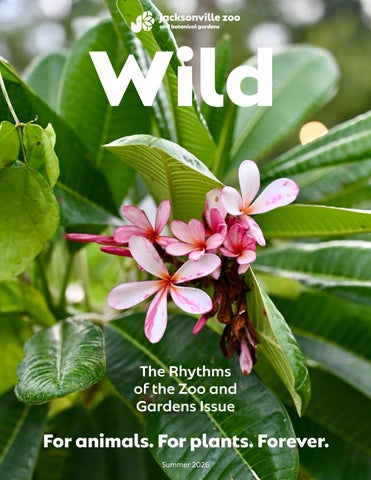
Wild
The Rhythms of the Zoo and Gardens Issue
For animals. For plants. Forever. Summer 2026
mme r Su
Contents
2026
2
Spring Has Sprung and Pollinators Are in Motion
4
Tunes and Blooms Wraps Another Memorable Season
6
The Rhythm of a Much Needed Rest
8
The Rhythm of the Rookery
16
Births, Hatchings and Acquisitions
20
A Look Back: A Visual Journey of Photos from 2009 to Today
p.17
Viper photo: Kate Rogers and Cayle Pearson © 2026 Jacksonville Zoo and Botanical Gardens. All rights reserved.
HORTICULTURE
Spring Has Sprung and Pollinators Are in Motion Story and photos by Alexis Welch, Horticulture Technician 2
What looks like an ordinary fruit is actually a hidden flower filled with hundreds of tiny blooms and home to one of nature’s most fascinating life cycles.
2 Wild
Tiny wasps primarily pollinate fig trees; however, not every variety of fig needs this relationship to produce fruit. The majority of common commercial fig varieties are self-pollinating, making them ideal for home gardens. Some popular self-pollinating varieties are Ficus carica ‘Brown Turkey’ and ‘Fignomenal,’ like the ones we have in Gardens at Trout River Plaza. ‘Smyrna’ and ‘San Pedro’ figs are varieties that rely on a specific pollinator, called the fig wasp (Blastophaga psenes), for pollination. These varieties have a unique botanical structure where what is normally perceived as a fruit is also the flower, known as syconium. Hundreds of tiny individual blooms line the inside of a fleshy shell forming an enclosed flower. The fig wasps are sexually dimorphic. The females have wings and the males don’t, making the females the only ones capable of pollinating the fig. The female fig wasp is just small enough to fit through a tiny opening, called ostiole, in the syconium of the fig, losing her
wings and antennae in the process. Once inside, the pregnant female, carrying pollen from her birth plant then crawls across majority of the flowers, laying her eggs and pollinating the fig at the same time. After the eggs are secured between the little flowers, the female fig wasp dies. Those eggs quickly hatch into larvae, feeding on the fleshy issue of the syconium. As the larvae are growing, the fig fruit undergoes some transformation as well, developing from bright green to a colorful ripened fruit. The now mature male wasps have an important job of mating with the females, dig a hole for the females to exit from, then dying inside the fruit. The newly emerged females exit from the hole, carrying pollen from her birth plant to pollinate another fig. At this stage of the common fig, the syconium would be consumed as a fruit and this intricate relationship between plant and pollinator repeats.
Summer 2026
3
HORTICULTURE
Tunes and Blooms Wraps Another Memorable Season
Brings Summer Nights to Life Tunes and Blooms returned for another season of unforgettable summer evenings at Jacksonville Zoo and Botanical Gardens. This annual concert series invited guests to enjoy live music, themed nights and after-hours Zoo adventures throughout the summer.
4 Wild
From performances across the gardens to exploring select animal habitats, attractions and seasonal food and beverages, Tunes and Blooms offered a unique way for guests to experience the Zoo after hours and create lasting memories with family and friends.
Thank you to Chewy VetCare of Jacksonville, Florida for supporting the 2026 Tunes and Blooms season and helping make these special summer experiences possible. The final night of the event was July 3rd.
Summer 2026
5
EDUCATION
The Rhythm of a Much Needed Rest By Sharon Spencer, Adult Education Specialist
Life at Jacksonville Zoo and Botanical Gardens is full of many changing seasons flowing with nature’s rhythms as inspiration for our communities to learn and grow towards a collective coexistence with wildlife’s neighbors. We have entered a new season at the Zoo with the opening of our new VyStar Skyscape entrance and the enchanting J. Wayne and Delores Barr Weaver Manatee River habitat. What an exciting Spring for us all to experience the rebirth of our efforts in manatee rescue, rehabilitation and return to their natural habitats! We leave behind the Main Camp entrance after more than three decades of welcoming guests. With this evolution, a new era of growth and community connectedness arises, welcoming new spaces to linger, contemplate, ponder, wonder and just rest in awe of these aquatic neighbors.
6 Wild
This season sprouts the opportunity for new perspectives as we are able to see and experience manatee life, growth and community in their natural habitat from a view rarely responsibly seen by humans. The learning manatee manners now guides us towards safe and protective ways to see manatees in the springs and waterways of Florida. Observe from a distance, listen quietly and slow down! While here at the Zoo, this new habitat allows us to better understand their needs, witness their jovial play and social interactions, and remind us to just pause and float every once in a while, surrounded by native plants and iconic Florida landscapes. Immerse ourselves in the moment. Pause intentionally. Without to-do lists and calendars and overloaded schedules, our manatee patients embody a promise of taking time to heal, time to graze and time to recover.
This new vibrant model of a Florida spring is more than just a manatee hospital and more than a zoo habitat. It is an evolution of the previous historic patterns of zoological exhibition and now transports us forward towards a season of rejuvenation through connection and insight into the cycles of healing for both manatees and ourselves. Our Horticulture team pours daily passion and care into the many plants who set the scene for us to learn even more about the true nature of wild Florida with an added reminder to grow tall and establish roots with one another. Our time in the cocoon of construction has ended and we emerge transformed
to embrace our role together as conservationists and as a community together. During your next visit, pause and absorb this inspiring and infectious rhythm—the rise and fall of the manatees surfacing for a deep breath, the cyclic motion of the aggregation (a group of manatees) traversing their aquatic habitat, the rolling, twisting and turning as they swim and explore, and the peace of their moments of rest, eyes closed in silence to the busy world. After all, this space is a happy place to heal for one and all. Feel the rhythm, witness the change in season, and embrace a moment to pause, reflect and just rest. .
Summer 2026
7
SNAPSHOT SOCIETY
The Rhythm of the Rookery Story and photos by John Reed
8 Wild
Each spring, wood storks return to the Zoo to nest, raise their young and begin the cycle anew. Follow their remarkable breeding season through a collection of photographs captured from March through June. Summer 2026
9
This issue is all about rhythms both at the Zoo and in nature. Regarding the nuts and bolts of photography, I came up blank with something appropriate for rhythm. So, after perusing the guidelines and suggestions, something came to me regarding migrations. Clearly the Zoo residents don’t migrate, but our Zoo has a feature for native denizens that is truly outstanding. Wood storks are native to Florida and are around all year long, but some do migrate. Early every spring they congregate to mate and raise offspring. One of the favorite places for them is right here in our own Zoo. They have created a rookery in the trees directly adjacent to the boardwalk on the Africa loop. As noted, they are here all year long, but this gathering usually begins in March, peaking in May and continuing roughly through July each year. The Zoo working with other agencies has been active in helping these birds and while once on the endangered species list, they have been delisted this past February. A great success story!
10
Wild
For bird lovers and bird photographers it is true bounty of opportunities. Early in the cycle the nest building and maintenance are taking place providing endless opportunities for flight shots. These large birds do not fly that fast and so it’s not too tough to get some amazing photos. Once the eggs hatch then you will have baby birds literally an arm’s length away providing opportunities for intimate shots almost impossible in the wild. Wood storks may not be considered as attractive as some other species. Some fans of the original Star Trek series say these guys remind them of Klingon warships. Don’t know about that but they do have a grace for their size that is fun to observe. Then when perched in the trees, looking down along that large, curved beak, they seem so stoic. I like ‘em! Throughout the spring the youngsters mature and grow providing opportunities to capture all stages of development. Finally, as spring passes to summer, the youngsters fledge and move on to wherever it is that adult wood storks go completing this cycle, but I’ll wager many will be back to these same trees the following year continuing the rhythm of wood stork migration! Here is a selection of photos of these amazing birds from the months of March through June.
Summer 2026
11
12 Wild
Summer 2026
13
14
Wild
ai17834360755_Education_Programs_2026_Kiosk_Poster_PTINT.pdf 1 7/7/2026 10:54:35 AM
EXPERIENCE BEHIND THE SCENES
C
M
Y
CM
MY
CY
CMY
K
• African Elephant Experience • American Black Bear Experience • Sloth Experience • Magellanic Penguin Experience • Greater Flamingo Experience • Visayan Warty Pig Experience • Animal Hospital Tour
WHAT’S NEW
Births, Hatchings and Acquisitions By Sharon Spencer, Adult Education Specialist October–December 2025 Births and Hatches Inca tern.....................................................................................................................................................................1.0 NORTH SULAWESI BABIRUSA ‡...................................................................................................................... 0.1 Philippine pit viper*........................................................................................................................................0.0.14 Striped newt.................................................................................................................................................... 0.0.461 Yellow-billed stork............................................................................................................................................ 0.0.1 Acquisitions COAHUILA BOX TURTLE.....................................................................................................................................1.0 Eastern bongo.........................................................................................................................................................1.0 FLORIDA MANATEE..............................................................................................................................................1.0 Marabou stork......................................................................................................................................................... 1.1 WEST INDIAN MANATEE................................................................................................................................... 3.0 First digit male Second digit female Third digit sex unknown Two digits only represent male and female CAPS = Endangered Species * (Asterisk) = First time at the Zoo †(Dagger) = To be released to the wild ‡ (Double dagger) = Stillbirth
16 Wild
Photos: Kate Rogers and Cayle Pearson.
Philippine pit viper
Trimeresurus flavomaculatus Earlier this year, 14 Philippine pit vipers hatched after a 44-day incubation period. A new first for the Zoo with this species. Philippine pit vipers are not common in human care, so the entire clutch will be going to other zoos throughout the country to hopefully start their own breeding programs. One female can lay between 10-20 eggs. Nocturnal, ambush predators, the Philippine pit viper lives and hunts mostly in trees in humid rainforests. Their natural coloring makes it almost impossible to see among the leaves and branches. While they can have different color phases like most snakes, in the wild, they are usually varying shades of green with either scattered dark-colored splotches or crossband markings. The perfect camouflage coiled up in a tree, waiting for prey, such as lizards, frogs, rodents and small birds. Their venom is hemotoxic. But aside from affecting the blood, hemotoxic venom can also cause severe tissue damage and organ degeneration. Although not always fatal, it can cause permanent damage so immediate medical assistance is necessary. While there is no species-specific anti-venom, anti-venom from other snakes of the region can be effective. But you can still enjoy the beauty of these vipers from a safe distance at the Amphibian Conservation Center near Lorikeet Landing.
Poison arrow frog Dendrobates tinctorius
Coahuila box turtle Terrapene coahuila
Also known as the aquatic box turtle, this species of turtle is endemic to the Mexican state of Coahuila de Zaragoza. In the wild, the Coahuila box turtle lives in seasonal and permanent ponds and wetlands. However, due to human activities, such as poaching and habitat manipulation for agriculture, the Coahuila box turtle is listed as endangered by USFWS and IUCN. The government of Mexico has declared 84,347 hectares of land where the turtle predominately lives as protected, and organizations like the Turtle Conservancy have participated in surveys, monitoring this species and many others to discover
18 Wild
what harms their survival and to hopefully find ways to help them. Fully grown, adults weigh a little over one pound and can live up to 18 years in human care. In the wild, they are not meticulous eaters, eating a variety of plants and insects. The Zoo is proud to welcome the newest arrival and to potentially contribute to the population of the Coahuila box turtle, an SSP species. You can see one of the adults on exhibit in the Lost Temple sharing space with a green-crested basilisk and two Utila spiny-tailed iguanas.
Marabou stork Leptoptilos crumenifer Their most notable feature however is the gular sac, the fleshy throat pouch that hangs from its neck that can reach up to eighteen inches. Their scientific name crumenifer comes from the Latin term “crumena,” meaning a “money bag or purse carried around the neck,” and their common name marabou comes from the Arabic “murābit,” meaning a holy or quiet man. This name was given to them due to their stoic posture seeming to mimic someone praying. But in other places, they are called the “undertaker” due to their hunched appearance and occasional diet on carrion food. In the wild, they
can be seen with lappet-faced vultures as they depend on the vultures to open the carcass so they can feed, too. Which might not seem pleasant at first, but it helps keep the environment naturally clean. No matter what the name, they most certainly have an interesting look. See the new pair on the veldt with the lappet-faced vultures in the Africa loop.
Summer 2026
19
ANIMAL AND BOTANICAL HIGHLIGHTS
A Look Back A visual journey through the years, revisiting Wild magazine photos from 2009 to today
SUMM
ER 202
3
Some of the animals and plants featured are no longer part of the Zoo today, reflecting the natural changes that come with time.
W IN TE
ild is
sg.indd
publis
hed q
uarter
ly for
the m
ember
s and
R 20 15
Wi nte r 20
–2 01 6
ZO OL igh ts #G ivi ng ZO OD ay De sti na tio n: Di no Fa ll Is Fo r Pla nt ing
friend
s of t
he Jac
ksonv
ille Zo
11 –2 01 2
Wild is
Wild
publish
ed qua
rterly
for the
membe
rs and
W WI D D L L IL I I LW W D D o and
Garde
ns
EW , THE N BANKS UB C R A U JAG
S ARENES KING AW S T CHOICE PE LE SIB RESPON VATION ER NS CHID CO CIGAR OR NMENT E ENVIRO S AND TH ANIMAL TRAFFIC
1
10/13/201
5 2:30:11 PM 9/16/15 10:34 AM
20 Wild
friends
of the
Winter 2
W
010
publishe Wild is
What's Ne
w at
Calendar
of Eve
Noon Yea
r's Eve
Jackso
nville
Zoo an
d Gar
Wild
ed
members y for the quarterl
nds and frie
Penguins!
Date
n Save the
ExZOOberatio What’s New
acksonv of the J
at the Zoo?
dens and Gar ille Zoo
Wild
SP RI NG
2021 the Zoo?
ents
rdens
ART & GARDENS
PLANTS WO WHY DO WE
Spr ing 201
RTH SAVING PLANT TREE
DISCOVER AR
S?
T IN THE ZO
LIVING ART
Wild is p
3
ublished
quarterly
for th
rs and f e membe
riends of
the Jacks
DinoTrek low Butterfly Hol er Adopt an Ott
onville Z
Wild i
s pub
lished
quarte
FUN FUN FUN
oo and G
ardens
Serious Zo is often o work very fun
O
SUMMER
SUMM
ZOO CA
ER FUN
MP
GUIDE
D D L L I I W W 1
WildMaga
zine_Sum
Wild is pu
blished qu
arterly fo
r the mem
bers and
friends of
the Jackso
nville Zoo
and Garde
mer2018.i
ndd 1
ns
3/14/2013
3:03:33 PM
raphy
d Photog to: John Ree
Pho
_template.indd
WildMagazine
1
Summer 2026
21
rly fo
r the
memb
ers a
2009
2009
22 Wild
Photos: Uncredited from Summer 2009 (top) and Fall 2009 (bottom).
2010
Photos: Uncredited from Fall 2010 (top). John Reed (bottom).
Summer 2026
23
2011
24 Wild
Photos: Sheryl Staaden (top). John Reed (bottom).
2012
Photo: Mark Sheppe
Summer 2026
25
2013
26 Wild
Photos: John Reed
2014
Photos: John Reed
Summer 2026
27
2015
28 Wild
Photos: John Reed
2015
Photo: John Reed
Summer 2026
29
2016
30 Wild
Photos: John Reed (top). Dee Anna Weisz (bottom).
2016
Photos: John Reed (top). Jeremy Breland (bottom).
Summer 2026
31
2017
32 Wild
Photos: John Reed
2018
Photos: Mark Sheppe (top). John Reed (bottom).
Summer 2026
33
2019
34 Wild
Photo: John Reed
019.indd 8
2019
11/16/2018 2:37:30 PM WildMagazine_Winter2018-2019.indd 9 11/16/2018 2:37:31 PM
Western Lowland Gorilla born on Friday, September 28, 2018 PHOTO: JOHN REED
Photo: John Reed
Summer 2026
35
2020
36 Wild
Photo: John Reed
Summer 2026
37
2021
38 Wild
Photos: John Reed
2021
Photos: John Reed (top). Morgan McClure (bottom).
Summer 2026
39
2021
40 Wild
Photos: John Reed (top). Mark Sheppe (bottom).
2022
Photos: Mark Sheppe
Summer 2026
41
2022
42
Photos: John Reed
Wild
2023
Photo: Tina Torres
Summer 2026
43
2024
44 Wild
Photos: Mark Sheppe (top). John Reed (bottom).
2024
Photos: Emily Long (top). Hannah Favorite (bottom).
Summer 2026
45
2025
46 Wild
Photos: Dr. Jeff Ettling, President and CEO (top). John Reed (bottom).
2025
Photo: Douglas Peacock
Wild Senior Membership Coordinator Sheila Campbell members@jacksonvillezoo.org Editors Emily Long, Marketing Manager Madi Sloan, Communications Specialist
Contributing Photographers Jeremy Breland, Dr. Jeff Ettling, Hannah Favorite, Emily Long, Morgan McClure, Amie Mercado, Douglas Peacock, Cayle Pearson, John Reed, Kate Rogers, Mark Sheppe, Sheryl Staaden, Tina Torres, DeeAnna Weisz and Alexis Welch
Design Mark Sheppe, Senior Graphic Designer Hannah Favorite, Graphic Designer
STRATEGIC OPERATIONS TEAM Jeff Ettling, Ph.D., President and CEO Paula Shields, Chief People and Culture Officer Nikki Smith, Chief Philanthropy & Marketing Officer David Hagan, Chief Life Sciences Officer Steve Henry, Chief Operating Officer Leanne White, Chief Impact Officer John Lukas, Curator of Wildlife Conservation
EXECUTIVE COMMITTEE Lucia Lindsey, Chair Chuck Ged, Immediate Past Chair Kerri Stewart, Chair-Elect/Vice Chair Salmaan Wahidi, Treasurer/Finance Committee Chair Jason Spencer, Secretary Matt McAfee, Governance Committee Chair John Hayt, Honorary Advisor Kelli O’Leary, Mayoral Appointee
FOLLOW US
48 Wild
GENERAL BOARD John Baker III Martha Frye Baker Matt Brockelman Tyrona Clark-Murray, City Council Appointee LeAnna Gutiérrez Cumber Kelly Coker-Daniel Mayor Donna Deegan Kenyonn Demps Fredrik Eliasson Pamela Phillips Mike Gay, City Council Appointee Steve Gormley Carolyn LaRose Sarah Longenecker Matt McAfee Missy Peters Hope Selevan Prober Paula Renfro Param Sahni Matt Woitz
HONORARY BOARD Danny Berenberg Ivan Clare Dano Davis Diane David Lenore McCullagh Elizabeth Petway Herbert Peyton
Clifford Schultz Frank Surface Janet Vaksdal Weaverr
HONORARY PAST CHAIRS COUNCIL Martha Baker J.F. Bryan Carl Cannon Howard Coker Charles Commander Jed Davis Matt Fairbairn Chuck Ged Joseph Hixon J. Michael Hughes Lewis Lee David Loeb Richard Martin Frank Miller John A. Mitchell Thomas Schmidt Bill Rowe Carl “Hap” Stewart James Stockton Penny Thompson Courtenay Wilson
Jacksonville Zoo And Botanical Gardens Membership 370 Zoo Parkway Jacksonville Florida 32215 (904) 757-4463 ext 114 · members@jacksonvillezoo.org
Summer 2026
49
Thanks for Reading Wild Magazine
Photo: Amie Mercado