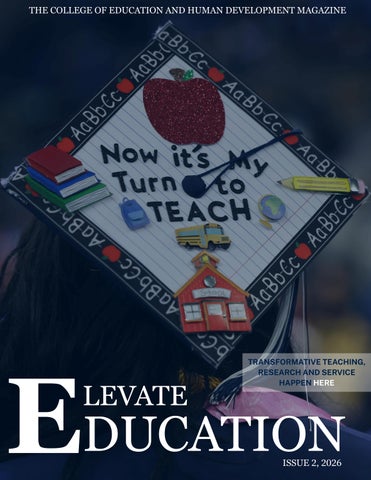
THE COLLEGE OF EDUCATION AND HUMAN DEVELOPMENT MAGAZINE
EDUCATION LEVATE
TRANSFORMATIVE TEACHING, RESEARCH AND SERVICE HAPPEN HERE
ISSUE 2, 2026
2
Featured
05 Dean’s Interview 08 Innovative Research 11 tITLE iii gRANT rECIPIENTS
15
14 sTUDENT & Alumni Spotlights 19 Faculty Spotlights 17
26
28
25 Education NEws
Transformative Teaching, Research, And Service Welcome to the second issue of Elevate Education, the official magazine of Jackson State University’s College of Education and Human Development. We’re so glad you’re here. This publication is a celebration of the people and stories that make JSU’s College of Education a powerful place to learn, grow and lead. Our theme for this issue—Transformative Teaching, Research, and Service Happen Here—reflects the incredible work happening across our college every day, and we’re proud to share those stories with you.
Thanks for being a part of the College of Education family where we’re showing the world that transformative education is happening HERE.
Departments Counseling, Rehabilitation, and Psychometric Services Educational Administration, Foundations, and Research Elementary and Early Childhood Education Executive Ph.D. in Urban Higher Education School of Lifelong Learning Educational, Multicultural, and Exceptional Studies Master of Arts in Teaching Social Science Education Special Education
Magazine Commitee Ms. Sheryl Bacon Dr. Gloria Dansby-Giles Dr. Stephanie Davidson-Herndon Coach Michelle Houston Dr. Jie Ke Dr. Karen Linstrum Dr. Doreen Myrie Dr. Amirah Nelson Ms. Ariana Sanders (Graphic Designer) Dr. Deidre Wheaton Dr. Alberta Yeboah-Ohwofasa
Centers Lottie Thornton Childcare Center Center for Teacher Quality Mississippi Urban Research Center Center for Professional Development Continuing Education Learning Center
Contact College of Education and Human Development 1400 John R. Lynch Street Jackson, MS 39217-0280 Dr. Marquita Cole (Administrative Assistant) Phone: 601.979.2433
Website
“The mission of the College of Education and Human Development is to employ teaching, research, and service within an urban learning community, to the preparation of practitioners from diverse backgrounds for outstanding professional service through the development of solutions to potential or existing challenges facing urban institutions.”
T
his year, the College of Education proudly welcomes Dr. Tony Latiker as its new dean. A lifelong learner with deep Mississippi roots and a steadfast commitment to educational equity, Dr. Latiker brings both vision and a wealth of experience to the role. From his early days as a work-study student in the education department at Tougaloo College to serving in roles at the Mississippi Department of Education and Jackson State University, Dr. Latiker’s journey has been shaped by family, faith, and a calling to serve. Elevate Education sat down with Dean Latiker to learn more about his professional journey, immediate priorities, and his vision for the College of Education’s future.
Elevate Education (EE): Can you share a bit about your professional journey and what inspired you to pursue a career in education? Dr. Tony Latiker (TL): I come from a family of educators. My grandmother and great aunt were teachers in Leake County, Mississippi, and both of my parents dedicated their careers to education. My mom taught in elementary schools for over 25 years, and my dad held several leadership roles in Kosciusko and Attala County Schools, including superintendent. Throughout my career, I’ve served in various roles—substitute teacher, GED instructor, director of student development, division director at the Mississippi Department of Education, and faculty member at JSU. I’ve always had a strong connection to assessment and accreditation, and that continues to guide my work today.
EE: As you step into the permanent dean role, what are your top priorities for the first year? TL: There are five key areas I’m focused on this year: Streamlining assessment and data processes—from collection and analysis to using data for continuous improvement. Increasing external funding and forming innovative partnerships. Enhancing student support and expanding student research opportunities. Conducting comprehensive curriculum audits and enhancements across all departments. Amplifying our story—utilizing social media and other platforms to showcase the impact of our College.
EE: What is your long-term vision for the College of Education? In 2035, what can alumni, stakeholders and students expect to see? TL: By 2035, I envision the College of Education as a hub for research-practice partnerships with school districts and educational organizations. This will be a space where stakeholders collaborate to create and implement the most effective educational initiatives. Faculty and students will have ample opportunities for professional development and funded research. We’ll offer high-quality online programs, taught by faculty trained and credentialed in best practices for online education. Our students will engage in research presentations and internships across diverse educational settings. We will provide robust student support from program entry through job placement, enabling them to excel in licensure exams and become award-winning educators in Mississippi and beyond. Most importantly, we’ll remain true to our mission.
“We must shift from simply keeping pace to leading innovation.” COEHD 5
Future Teachers of Math Education Partnership Convening, May 2025
EE: Education is evolving rapidly. How do you see the College adapting to incorporate new technologies and experiential learning? TL: We must shift from simply keeping pace to leading innovation. That means learning from both the past and present. We have faculty with expertise in AI, assistive technology, and data-driven instruction, and others deeply connected to impactful community-based programs like the Southern Initiative Algebra Project and Freedom Schools. Our goal is to merge the best of both worlds—to study, co-create, and innovate in ways that reflect stakeholder input and community wisdom. We want our students to not only learn and apply knowledge, but also become trailblazers in educational settings.
EE: In what ways can alumni and community stakeholders contribute to the College’s mission? TL: There’s a powerful African proverb: “If you want to go fast, go alone. If you want to go far, go together.” That’s how I view our work. To be the premier institution for preparing educators, counselors, and educational leaders, we must partner with our alumni and community stakeholders. Their expertise, energy, and insights are essential to helping us innovate and meet the evolving needs of our communities.
EE: Finally, what message would you like to share with students, faculty, staff, and the broader community as you begin this new chapter? TL: This is our College and our story. We will develop and implement our vision together. Every one of us—students, faculty, staff, alumni, and community partners—has a role in shaping the future of education in Mississippi. Together, we will continue to elevate the College of Education and the impact we have across the state and beyond. Dr. Tony Latiker brings a deep understanding of both the challenges and opportunities in education. As he begins his tenure as dean, the College of Education is poised for growth, innovation, and transformation—anchored by a clear vision and an unwavering commitment to student success and community engagement.
COEHD 6
INSIGHTS INTO WELL-BEING Among Student Athletes Synopsis: The researcher used a convergent mixed methods approach to study an understudied population, Historically Black College and Universities studentathletes, by integrating statistical modeling with qualitative narratives to capture both the prevalence and lived experiences of student-athletes mental health challenges. This study explored mental health needs and service access among 205 student-athletes from six southeastern HBCUs, using surveys. Interviews were conducted with 19 athletes for deeper insight.
Findings revealed high mental health risks, with 59% (n = 121) at risk for depression and 51% (n = 104) for mild to severe anxiety. Yet, 53% (n = 109) had never accessed mental health support. Mental health service use was linked to significantly lower depression and anxiety symptoms, with a 46% and 54% reduction in symptoms, respectively. Qualitative themes highlighted: 1) The critical role of social support, 2) Barriers to mental health access, and 3) Institutional and funding gaps. HBCU student-athletes face significant mental health disparities and service barriers. The study underscores the urgent need for tailored, athlete-specific mental health interventions to address resource disparities in under-resourced collegiate settings. This project also advances theoretical applications of the social-ecological model to athlete mental health by identifying interpersonal and institutional factors that influence well-being. Furthermore, this research supports inclusive practices in sport psychology by promoting context-sensitive approaches to improve mental health access within Colleges with constrained mental health resources.
Researcher: Dr. Joonyoung Lee, Ph.D., ACUE, Assistant Professor & Research Coordinator, Department of Health, Physical Education, & Recreation
COEHD 9
Essential Work of Rehabilitation Couselors Returning to Work Feeding Tube Use and Employment
Karen Sue Linstrum, Ph.D., LPC-S, CRC, Assistant Professor, Counseling, Rehabilitation, and Psychometric Services The research filled a gap in the literature by studying cancer patients who use feeding tubes and return to work. Most existing literature focused on the use of feeding tubes while patients were still in the hospital and receiving treatment. Using a narrative review, the researcher explored and critiqued the current literature on patients who used feeding tubes and then returned to work. The research offered more up-to-date solutions for focusing on returning to work with a feeding tube. Additionally, the researcher posed the question: Why cannot a rehabilitation counselor be part of the "return to work" process for people in remission? The study suggested the possible role of the rehabilitation counselor in supporting individuals using feeding tubes to return to work. The conclusion emphasized the need for more research supporting people in cancer remission who want to or have to return to work.
Collaborative STEM Education Research The Effect of Course-Based Undergraduate Research Experiences on African American Learners in a Geo-technical Lab Course The research examines the often-overlooked perspectives of K-12 district administrators regarding barriers to implementing online skill builders in mathematics education in both rural and urban areas. It employed a non-experimental, survey-based approach. The researchers utilized descriptive statistics and T-tests to compare perceptions between rural and urban administrators. The study identified key barriers, including limited access to technology, inadequate teacher training, curriculum misalignment, budget constraints, and challenges with student engagement. The findings informed policy recommendations, resource allocation, and training Comelia L. Walker, Ph.D., initiatives aimed at enhancing the effectiveness of online skill Student Success Coach at builders in improving student mathematics achievement. By Millsaps College; May 2025 concentrating on both rural and urban districts, the study offers a Doctoral Graduate, comparative analysis that can guide targeted policy changes and Department of Educational Administration, Foundations strategic resource allocation to improve digital learning equity. & Research (K-12)
Dr. Chandar Lewis, CoResearcher and Dissertation Advisor, Associate Professor, Department of Educational Administration, Foundations & Research
Online Math as a Skill Builder: Administrator Perspectives Barriers of Online Skill Builders on Mathematics Achievement from the Perspectives of Rural and Urban K-12 District Administrators The research, recently published in the British journal Futurum, provided innovative Dr. Kejun Wen: methods for African American STEM students conducting research in science labs Co-researcher, Assistant and gaining firsthand experiences that can be applied in real-world situations. It Professor, Department of specifically addressed the labor shortage in STEM-related occupations in the U.S. Civil and Environmental Engaging undergraduate STEM learners in authentic research experiences Engineering & Industrial integrated with advanced technology is an irreversible trend aimed at strengthening Systems and Technology, the quality of STEM education, especially for minority groups. College of Science, Engineering and To achieve this purpose, a course titled Engineering Survey (CIV 310) was offered in Technology the Engineering Department at a Historically Black University in Mississippi. This
Dr. Dr. Jianjun Yin: Co-Researcher, Professor, Department of Elementary and Early Childhood Education
COEHD 10
course conducted tentative research featuring course-based undergraduate research experiences (CUREs). It aims to broaden research experiences for a larger number of diverse groups who may have potential interest in STEM majors and may choose future careers in related industries. The results indicated that learners participating in the CURE model yielded more positive outcomes in authentic research experiences, increased self-efficacy and confidence in science tasks, and a stronger interest in future STEM-related careers compared with students in traditional lab courses. This research underscores the importance of embedding real-world science elements aimed into engineering lab courses.
GRANT RECIPIENTS The RISE Together Title III Mini-Grant competition at Jackson State University (JSU) represents a strategic investment in innovation, academic excellence, and institutional growth. Spearheaded by Dr. Denise Jones Gregory, this initiative was designed to empower faculty to develop creative, high-impact projects that directly strengthen student outcomes and bolster the University’s research footprint. By providing targeted funding, the RISE Together competition fosters a culture of “intentional excellence.” In the College of Education and Human Development (COEHD), these grants have been instrumental in bridging the gap between classroom theory and professional practice, ensuring that JSU students are not only degreed but also licensed, certified, and technologically proficient.
Project Pass Preparing and Supporting Scholars for Licensure
Dr. Kanesha Bennett, PI
Dr. Lakeshia Opara-Nadi, Co-PI
Dr. Keon Catchings-Shelby, Co-PI
Mississippi faces a critical need for certified elementary educators, particularly in high-need schools serving diverse and economically disadvantaged populations. Funds requested will address this challenge by providing comprehensive, sustained support to pre-service teacher candidates, ensuring they are well-prepared to meet licensure requirements and become certified teachers. This initiative, Project Pass, aligns with Title III priorities to strengthen academic programs, improve instructional quality, and build institutional capacity for long-term impact. Project PASS will strengthen academic programs, improve instructional quality, and build institutional capacity to support future educators. Providing sustained professional development, this initiative ensures long-term benefits for both teacher candidates and the schools they will serve.
Higher Education Leadership and Mentoring Building Administrative and Academic Leaders from within JSU: A RISE Leadership Program
Building Administrative and Academic Leaders from within Jackson State University: A R.I.S.E. Leadership Program is a focused leadership development initiative designed to cultivate administrative and academic talent from within JSU by pairing faculty and staff mentees with administrative or faculty mentors. The program prepares participants for three distinct career paths tenured faculty to University leadership, staff to tenure-track faculty, and staff to upper management. Dr. Chandar Lewis
COEHD 12
Strengthening Health and Physical Education Teacher Preparation Through Licensure, Certification, and Research Engagement Dr. Brieah Hudson This project will enhance Jackson State University’s Health and Physical Education Teacher Preparation Program by integrating comprehensive support for professional licensure, national certification, and applied research experiences. The project will incorporate structured preparation for the state teacher licensure examination directly into the curriculum through faculty led workshops and webinars, access to online test-prep platforms, and payment for a practice exams. Additionally, Title III funds will provide financial support for students to register for the Certified Health Education Specialist (CHES) exam, thereby increasing credential attainment and workforce readiness in the public health education field.
MoveWell@JSU A 24-Hour Movement and Wellness Program to Enhance Emotion Regulation, Mental Health, and Academic Success
Dr. Joon Young Lee MoveWell@JSU is a Title III–funded program in the HPER Health and Wellness Laboratory that examines how students’ 24-hour movement patterns relate to mental health and academic performance. Using research-grade accelerometers and EEG headsets, the program captures detailed movement and brain-activity data alongside measures of stress and emotion regulation. These findings will inform practical wellness strategies to better support Jackson State University students’ mental health and academic success.
JSU Praxis Success Initiative Strengthening Faculty, Curriculum, and Candidate Readiness for Paxis Core and Praxis II
Dr. Tameka Hyland The JSU Praxis Success Initiative is a comprehensive program designed to strengthen teacher preparation at Jackson State University (JSU) by aligning curriculum, faculty development, and student support with Praxis Core and Praxis II requirements. The initiative consists of four key strands: 1. Praxis Core Academy – Reading, Writing, Mathematics, and Test-Taking Strategies workshops. 2. Praxis II Bootcamps – Subject-specific preparation in Elementary Education, Secondary English Language Arts, Math, and Special Education. 3. Faculty Professional Development – 10 Faculty members complete practice Praxis exams, participate in calibration workshops, and align coursework with Praxis standards (stipends provided for faculty participants). 4. Curriculum Mapping & JSU Praxis Portal – Creation of an online Canvas-based portal linking all Praxis resources, practice tests, and workshop schedules.
Empowering Student Success and Institutional Growth Through Assistive Technology and Inclusive Education Dr. Sathiyaprakash Ramdoss
Dr. Doreen Myrie
Dr. Joon Lee
Title III funding will be utilized to establish a state-of-the-art Assistive Technology (AT) Laboratory within the College of Education and Human Development (COEHD) at Jackson State University (JSU). The proposed AT Laboratory will serve as a transformative teaching and research environment that integrates cutting-edge technology, hands-on learning, and evidence-based practice to prepare pre-service and inservice educators to meet the diverse learning needs of PreK–12 students. Through targeted workshops, integrated coursework, and interdisciplinary projects, the lab will provide experiential learning opportunities that strengthen teacher candidates’ competencies in identifying, selecting, and applying AT to support students with disabilities and other exceptionalities in inclusive classrooms.
COEHD 13
As we celebrate the Spring 2026 Commencement, the College of Education and Human Development is proud to shine a light on the exceptional scholars who embody the spirit of “Thee I Love.” This segment honors students who have not only achieved the highest levels of academic excellence, but have also demonstrated an unwavering commitment to leadership and professional growth. From those graduating with high honors to scholars who have already secured special admissions into prestigious graduate programs, these individuals represent the future of innovation and service. Leading this distinguished class are our Commencement Student Marshals—four exemplary students who were recommended by their department chairs. Join us in celebrating their achievements as they prepare to take their next bold steps into the professional world.
COEHD 16
The Heart Behind the Work By Coach Michelle Houston
The Lottie Thornton Early Childhood Center extends heartfelt congratulations to Pre-School Teacher, Mrs. VaLesha Carr, who completed her undergraduate degree in Childcare and Family Education. Mrs. Carr has over 15-years of experience in early childhood education, and she has been an invaluable asset to the Lottie Thornton scholars, staff, and the entire College of Education community, since joining the staff in June 2023. Mrs. Carr served as the PREK3 Teacher and Director Designee–two roles which allowed her to make a lasting impact on young learners. We are TIGER PROUD of Mrs. Carr and her educational accomplishments and congratulate her on her new endeavors!
VaLesha Carr
The College of Education and Human Development said farewell to Mr. Jermarcus M. Bounds, one of two new College Success Advisors assigned to support our students through a University-wide initiative to enhance academic advising and promote student achievement. Mr. Bounds brought 13 years of experience in education, including 10 years dedicated to student retention and academic advising. His diverse background includes serving as a Teacher of the Visually Impaired at the Mississippi School for the Blind, Academic Retention Coach and Adjunct Instructor of History at Tougaloo College, Adult Education and Workforce Instructor at Holmes Community College, and most recently, Lead Graduation and Retention Coordinator for the TRIO Student Support Services program at Jackson State University.
Jermarcus Bounds
He offers energy, creativity, and a strong commitment to student success, enriching our advising ecosystem with his dedication and innovative approach. Since stepping into his role, Mr. Bounds has gone above and beyond to ensure that both students and faculty advisors in the college feel supported, informed, and empowered. His approach is intentional and student-centered, with a strong focus on building community and access to resources. Mr. Bounds' leadership and innovative spirit made a meaningful impact on the College of Education. Whether he was walking a student through their degree plan, equipping faculty with advising tools, or creating spaces where students feel seen and supported, Mr. Bounds helped to transform what advising looks like at JSU.
COEHD 17
Shontrice N. Garnett’s Educational Experiences I chose Jackson State University based on the incredible things I heard about the school. Despite never visiting JSU beforehand, I took a leap of faith, moving eight hours away from home with determination and prayer. What drew me in was that JSU met my key criteria—it offered my major, provided internship opportunities, and was affordable. I knew I wanted to be a teacher ever since I was in second grade. That might sound unusual, but it’s true. My secondgrade teacher was a determined woman who set high expectations for all her students while building a strong sense of community with their families. I remember struggling to learn my multiplication tables, and instead of letting me fall behind, she created a structured plan that involved practice both at school and at home. Because she never wavered in her expectations, I not only memorized my multiplication facts but also understood them conceptually. I entered JSU as a mathematics education major, but during the second semester of my junior year, I encountered challenges that would have delayed my graduation. To stay on track, I adjusted my course of study and graduated with a pure mathematics degree instead. Determined to achieve my goal of becoming a certified teacher, I explored alternative pathways. That’s when I met Dr. Williams, who introduced me to the Master of Arts in Teaching (MAT) program. Through this program, I joined a supportive community of educators who encouraged and uplifted one another throughout our journey in the field. Today, I am proud to serve as a principal in the public school system. I am deeply grateful for the foundation that JSU provided for my professional career. Without my experiences in both undergraduate and graduate school, I would not be where I am today.
COEHD 18
“Without my experiences in both undergraduate and graduate school, I would not be where I am today.”
NEW FACULTY SPOTLIGHTS
TAMEKA D. HYLAND, Ed.D. Assistant Professor, Educational Administration, Foundations, and Research Doctor of Education (Ed.D.), Educational Leadership
Dr. Hyland is a transformational educational leader with more than 20 years of experience across K–12 and higher education. A former high school principal, she led historic gains at her campus, earning its first “B” accountability rating and raising the graduation rate to 91.3%. Her leadership expertise includes instructional reform, school turnaround, workforce development, and executive strategic planning. Her scholarship centers on intersectional leadership, Black women in educational leadership, culturally responsive practice, emotional intelligence, and leadership pipeline development. She examines how leadership shapes school climate, student success, and equitable access, with a strong commitment to cultivating leaders from marginalized communities and advancing the mission of HBCUs. At JSU, she teaches educational leadership and research courses that emphasize rigor, critical thinking, and real-world impact, mentoring aspiring superintendents, principals, researchers, and policy leaders. Beyond academia, she is dedicated to faith, family, and empowering women in leadership, and she founded initiatives focused on community-based education and workforce innovation.
COEHD 20
SATHIYAPRAKASH T. RAMDOSS, Ph.D. Associate Professor of Special Education Department of Educational, Multicultural, and Exceptional Studies
Dr. Sathiyaprakash T. Ramdoss is an Associate Professor in the Department of Educational, MultiCultural and Exceptional Studies at Jackson State University. He earned his Ph.D. in Special Education (Autism and Developmental Disabilities) from The University of Texas at Austin and previously served on the faculties of Ashland University and New Mexico State University, mentoring students across undergraduate and graduate programs. His research focuses on assistive technology, autism spectrum disorders, inclusive education, and preparing special educators to serve culturally and linguistically diverse learners. He has authored 16 peer-reviewed articles and five book chapters and currently leads and co-leads federally funded initiatives totaling more than $1.3 million to strengthen teacher preparation and expand assistive technology and inclusive practices. His scholarship advances scalable, evidence-based interventions that promote communication, social-emotional growth, and independence for individuals with disabilities. Dr. Ramdoss teaches courses in assistive technology, autism, behavior and social interventions, and assessment, emphasizing applied learning that bridges research and classroom practice. Committed to the mission of HBCUs, he works to build research capacity and prepare highly qualified special educators dedicated to equity and inclusion. Outside academia, he enjoys family life with his wife and two sons and finds renewal in playing Carnatic flute and listening to Indian classical and Western music. COEHD 21
Shyamal S. Pandya, Ph.D. Assistant Professor in the School of Lifelong Learning
Laura Garza, Ed.D.
Dr. Shyamal S. Pandya earned his Ph.D. in Human Resource Development from Texas A&M University, where his research explored physicians’ experiences integrating artificial intelligence into medical practice. With more than a decade of executive leadership and consulting experience, he brings a unique blend of industry expertise and academic scholarship to the classroom. His research focuses on the impact of artificial intelligence on workforce development, leadership, and decision-making, particularly in healthcare and highly regulated environments. Through his teaching and scholarship, Dr. Pandya prepares students to navigate technological change with confidence, ethics, and innovation. At Jackson State University, he is committed to advancing equity, responsible AI adoption, and preparing future leaders for success in an increasingly technology-driven world.
Laura Garza, Ed.D., joins Jackson State University with a strong focus on early literacy, equity, and effective instruction for diverse learners. She earned her doctorate in Educational Policy and Leadership from the University of Memphis and a master’s in the Science of Reading from Arkansas State University. Dr. Garza’s work emphasizes bridging decoding and language comprehension within classroom instruction while supporting sustainable, evidence-based literacy practices. Passionate about mentoring future educators, she is dedicated to preparing teachers who can confidently meet the needs of all students, particularly in historically underserved communities, and looks forward to advancing literacy as a matter of equity and justice across Mississippi and beyond.
Assistant Professor in the Department of Education
Micheal Welsch, Ph.D.
Michael Welsch joined Jackson State University in Spring 2026, bringing decades of experience in kinesiology, exercise science, and health research. He earned his B.S. and M.S. from University of North Texas and his Ph.D. from University of Florida, with a research focus on cardiovascular health, exercise physiology, and aging. Throughout his distinguished career—including faculty leadership at Louisiana State University, international work in the UK, and contributions to population health—Dr. Welsch has mentored graduate students, supported impactful research, and advanced understanding of chronic disease and healthy aging. A Fellow of the American College of Sports Medicine, he remains passionate about teaching, research, and promoting lifelong wellness.
Professor in the Department of Health, Physical Education, and Recreation
Da'Ja'Nay Askew, Ph.D. Assistant Professor of Educational Administration and Higher Education
COEHD 22
Dr. Da’Ja’Nay Jakia’ Askew is a tenure-track Assistant Professor of Educational Administration and Higher Education at Jackson State University. Her research explores how faculty relationships influence Black students’ sense of belonging, while also examining academic healing, student well-being, and equitable educational practices. With more than a decade of experience in teaching, curriculum development, and educational consulting, Dr. Askew is recognized for her work in anti-racist pedagogy and institutional equity. She is also the founder of The Healed Scholar, a platform dedicated to promoting academic well-being and belonging among historically marginalized communities. Through her scholarship, teaching, and public engagement, Dr. Askew advances data-informed, justice-centered approaches that foster inclusive excellence and transformative change in higher education.
LONGEST-SERVING FACULTY SCHOLAR
DR. FRANK GILES BY: DR. ALBERTA YEBOAH-OHWOFASA
“Keep hope alive. When someone shows you who they are, believe them the first time. Do what is good and right in your professional work and family life.” -Dr. Frank Giles Dr. Frank Giles is a Professor of Rehabilitation Counseling in the Department of Counseling, Rehabilitation, and Psychometric Services where he has served for 34 years. He is the longest-serving tenured faculty member in the College of Education and Human Development (COEHD). Dr. Giles is the Director of the Rehabilitation Counseling Program (RCP), a Project Director of the United States Department of Education’s Office of Special Education and Rehabilitation Services (OSERS), and a Rehabilitation Services Administration (RSA) Project Director for 34 years (since 1991 to present). Dr. Giles’ contributions to teaching, research, advising, and service excellence are encapsulated in his numerous publications and in the impact of the millions of dollars of external funding he has received from OSERS and the RSA on students, colleagues, the RCP, graduates from the RCP, the COEHD, Jackson State University, and the state of Mississippi at large.
Dr. Giles is a graduate faculty and is qualified to teach any course in the Rehabilitation Counseling Program. He taught Medical Information and Internship and Practicum in the past. He currently teaches Introduction to Rehabilitation Counseling, Ethics, Seminar in Rehabilitation Counseling, Psychological Assessment in Rehabilitation, Vocational Evaluation, Case Management, and Forensic Rehabilitation. Dr. Giles has held memberships and leadership positions in numerous professional associations including the American Counseling Association, American Rehabilitation Counseling Association, Accreditation Site Visitor Council on Rehabilitation Education (CORE), the National Council on Rehabilitation Education, and the International Association of Rehabilitation Professionals, to name a few. He holds several current national certifications, state licenses and state rehabilitation registration in the states of Mississippi, Louisiana, and Georgia.
COEHD 23
FACULTY SCHOLAR
24 COEHD 24
Lottie W. Thornton Early Childhood Center Celebrates Growth, Innovation, and Community Impact Under the dedicated leadership of Juanita E. Johnson, M.S., Ed., Director of the Lottie W. Thornton Early Childhood Center (LWTECC) and Adjunct Instructor in Elementary and Early Childhood Education, the Center has experienced a year marked by dynamic growth, impactful partnerships, and meaningful student and family engagement. Housed within the College of Education and Human Development (COEHD), the LWTECC continues to serve as a model of excellence in early childhood education and community collaboration. Among its key achievements are:
COEHD 26
Increased student enrollment from 15 scholars in the 2023–2024 school year to 20 for 2024–2025. Maximized enrollment in the Pre-K classroom, reaching capacity with 10 scholars and maintaining an optimal 1:10 teacher-to-child ratio. Opened a third classroom for K4 Transition to better serve three-year-olds turning four after the state's September 1st cutoff date. Launched two volunteer programs through COEHD partnerships: Jumpstart and the Student-Athlete Advisory Committee (SAAC), enhancing service-learning and student involvement. Fostered strategic partnerships with Tiger Transfers and Commuters, the Alice Harden Center for Service & Community Engaged Learning, and the JSU Business Office to support Fall 2024 family engagement events. Collaborated with the Gamma Rho Chapter of Alpha Kappa Alpha Sorority, Inc. to host Spring 2025 student and family engagement initiatives. Worked closely with JSU Student Affairs to recruit new families and successfully enrolled three children of current JSU students. Established and hosted two successful fundraisers—Mr. and Miss Lottie W. Thornton Early Childhood Center and a Sneaker Ball—raising over $8,000, with $2,198.30 in net proceeds supporting center programming. Partnered with the H.T. Sampson Library and the Division of Library and Information Resources to enrich programming during Week of the Young Child. Ensured that LWTECC staff met and exceeded professional development contact hour requirements, reinforcing the center’s commitment to quality teaching and care. Achieved an increase in State Kindergarten Readiness Assessment scores from the 2023–2024 school year, demonstrating academic growth and school readiness. Strengthened collaboration with the JPS Hinds Pre-K Collaborative, celebrating and supporting Pre-K educators during the 2024–2025 school year.
“It is an honor to serve the faculty this academic year. All faculty members are valuable, and I respect their work and areas of expertise. My agenda includes faculty inclusion, sustainability, and engagement,” declared Dr. Wallace. According to the JSU Faculty Senate Bylaws, the top four responsibilities of the Faculty Senate are to: (1) provide official representation for all faculty members of the University in matters which affect the general welfare of the University and its educational purposes and effectiveness; (2) consider proposals from students, alumni, teaching faculty, academic departments and administrative units; (3) provide consultative services to the President of the University by considering all matters referred to it by the President of the University; and (4) serve as an instrument by which information of University-wide interest and concern may be freely collected, disseminated and discussed by members of the faculty and students. Dr. Wallace asserts, “I will uphold the responsibilities with integrity and fidelity.” Two officers of the Senate Executive Committee are also from the College of Education: Dr. Regina McMurtery (Department of Counseling and Rehabilitation) Sargeant-at-Arms, and Dr. Chandar Lewis, (Department of Educational Administration, Foundations, and Research) Parliamentarian.
FALL 2025 HIGHLIGHTS Dr. Jennifer Young Wallace Associate Professor/Coordinator of the K-12 Ph.D. Program in the Department of Educational Administration, Foundation, and Research, and 2025-2026 Faculty Senate President.
Other Executive Committee Members are Dr. Etta Morgan, Vice-President; Mr. Don Spann, Treasurer; Dr. Candice Love-Jackson, Secretary; and Dr. Sophia Leggett, Immediate Past-President. “I am excited to work with the Faculty Senate Executive Committee to accomplish our goals for the year,” states Dr. Wallace. Dr. Wallace was recently recognized with a House Resolution (HR 44) from the Mississippi House of Representatives for her work in education. She was recognized as an honoree for Mississippi’s Connecting the Dots for Women’s History Month for being a trailblazer in education on a national level. In March 2025, she received the gavel to serve as 2025-2026 President of the Association of Teacher Educators where she became the first President from an HBCU and the fifth African American in the 105-year history of the organization.
“I am humbled by the opportunity to serve as President of the Faculty Senate. My servant leadership style reminds me that we can achieve anything together as long as we remember it is about all of us working harmoniously to have positive relationships and positive outcomes,” states Dr. Wallace. COEHD 27
Teaching Tuesdays: A Student-Centered Initiative Connecting Coursework to Career Readiness The newly implemented Teaching Tuesdays series saw impressive engagement from Fall 2024 to Fall 2025. Over 100 students participated in Teaching Tuesdays sessions, with 36 students attending three or more sessions, demonstrating a strong commitment to professional growth. A needs assessment was conducted with Department Chairs and Directors to ensure future sessions align with current student and faculty needs, and a satisfaction survey was administered through Google Forms, capturing valuable student feedback. Students shared thoughtful insights on how to enhance the experience–suggesting session topics including: How to network for jobs. Transferable skills for education majors and entry into corporate roles. Classroom management strategies. Guidance on licensure exams. Paid internship opportunities.
Teaching Tuesday: Fall 2025 and Spring 2026 Using data from student surveys and faculty feedback, Mr. Mozee has curated a new round of workshops for the upcoming academic year. These sessions are designed to reflect student interests, emerging trends in education, and the ongoing goal of linking coursework to career success. The sessions were facilitated by College of Education faculty as part of their professional service and external trainers were from the Mississippi Department of Education. Topics included: Praxis: Principles of Learning and Teaching (Introductory Session) Professionalism: How Future Educators Present Themselves In-person and Online Matters The Reading Rope: What every teacher needs to know about teaching students how to read Classroom Management Matters Resume Writing for Educators Artificial Intelligence in the K-12 Classroom: Using and Teaching AI Literacy
COEHD 28
MISSISSIPPI URBAN RESEARCH CENTER HIGHLIGHT A Series of ‘Uncomfortable Conversations’ Kicks off by Discussing STD Rates On Wednesday, November 19, 2025, the Mississippi Urban Research Center (MURC) hosted a research forum titled “Don’t Be #1 Mississippi: Open Conversation on Soaring Sexually Transmitted Disease Rates” – the first convening of a new event series entitled Uncomfortable Conversations. The forum was held at 10 a.m. in the JSU Student Center Ballroom, and was open to both campus and community members. The purpose of the event was to present data on the growing crisis of sexually transmitted diseases (STDs) in Mississippi and the City of Jackson, while also exploring the complex set of socioeconomic and systemic factors that are directly related to this educational, workforce, cultural, and public health issue. The forum’s structure was designed to move beyond traditional presentations by engaging a multidisciplinary panel and live audience in a vigorous discussion aimed at identifying viable, long-term solutions specific to the STD challenges faced in Mississippi, Hinds County, and the City of Jackson, with the intent of including clinical/medical, public health policy, community research, and social services perspectives. Overall, the event was successful in achieving its primary goals of facilitating an open, data-driven discussion about a serious socio-economic issue heavily impacting urban areas, and encouraging a solutions-based approach that embraces consideration of both traditional and innovative interventions. The forum was directly in line with the mission of the Mississippi Urban Research Centers (MURC), which is “to conduct basic and applied research into urban problems and public policy, and to make available the results of this research to private groups, public bodies, and public officials.”
COEHD 29
DUAL ENROLLMENT Thee Official Transition: Empowering the Next Generation of Educators The Jackson State University College of Education and Human Development is thrilled to share a milestone update on the Count Me In: Future Teachers of Mathematics Education initiative. This “Grow Your Own” program continues to redefine the pathway from high school to higher education, ensuring that JSU remains at the forefront of addressing critical teacher shortages in Mississippi. Celebrating Cohort II: A Historic Transition We are currently preparing to celebrate our Second Cohort of scholars as they graduate from high school and make THEE Official Transition to Jackson State University. These remarkable students are not just entering the college experience; they are arriving as first-time freshmen with an extraordinary head start, carrying over 60 hours of undergraduate credits in the Mathematics Education (Algebra/Geometry Track). This achievement is a testament to the rigor of our District of Innovation partnership. By accelerating their academic journey, these scholars are positioned to enter the workforce sooner, prepared to serve as highly skilled educators in geographically critical shortage areas and essential content fields. Looking Ahead: Expansion in Fall 2026 The momentum continues as we prepare to welcome Cohort 4 in Fall 2026. In a strategic expansion of the program’s scope, this upcoming cohort will include a diverse mixture of both Mathematics Education and Special Education majors. By diversifying the content areas, the College of Education further solidifies its role in placing specialized, high-quality teachers where they are needed most. The sustained success of “Count Me In” is made possible through the visionary support of our donors and sponsors. We extend our deepest gratitude to the following foundations for their significant financial commitments: Phil Hardin Foundation $150,000 (over 3 years) Chrysteen Winfrey Richard Scholarships $25,000 Your investments are more than financial contributions. They are a commitment to the future of Mississippi’s classrooms and the lifelong success of JSU students. We look forward to the continued progress of this vital initiative as we work together to empower the next generation of educators.
Partner With Us! Contact Dr. Deidre. L. Wheaton (deidre.l.wheaton@jsums.edu) or Dr. Shalita McCadney (sbrown@jackson.k12.ms.us) to learn more about the Count Me In (Jackson Middle College) Program.
COEHD 30
COEHD 31
Transform Education with Us. Get Connected! The work of elevating education requires a collaborative effort. From providing meaningful mentorship to current students, new teachers, and emerging school leaders to leveraging your professional networks to support key initiatives in the College, there is a place for you to contribute.
FOLLOW US ON SOCIAL MEDIA Get Education news and updates in real time by following the College of Education and Human Development. @JSUCOEHD
JSU COLLEGE OF EDUCATION AND HUMAN DEVELOPMENT
JSU COEHD
Share Feedback on Elevate Education Recommend a student or alumni to feature in the next issue. Let us know what you want to see in future issues of EE.
By joining the Elevate Ed Network, you'll gain access to: Exclusive job postings and career advancement opportunities Early notification of professional development events and workshops Networking opportunities with fellow JSU education professionals Mentorship connections between alumni and current students Recognition of your professional accomplishments in our publications
Donate
he Future of Educ t n ati st i on e v n I
Every dollar directly empowers the next generation of educators. When you give to the College of Education’s Development (Designated) Fund, 100% of your gift goes toward removing financial barriers for our undergraduate and graduate students. Your support directly funds: Licensure Exam Preparation & Fees: Helping students prep for and cover Praxis examination costs. Emergency Gap Funding: Ensuring continuous enrollment and helping students cross the finish line to graduation. Student Support Services: Sustaining vital academic and professional development programs.
Scan the QR Code to Make Your Impact Today “Every gift counts toward transforming classrooms and changing lives.”
Transformative Teaching,
Research, and Service TO OUR READERS Thank you for being part of a community that values knowledge, champions equity, and believes in the limitless potential of every learner. Together, we are building a brighter future—one student, one educator, one community at a time. Thank you for supporting JSU and the College of Education and Human Development.
That’s THEE JSU Experience.