Campaign for Jackson State Seeks to Raise $50 Million
pg. 28
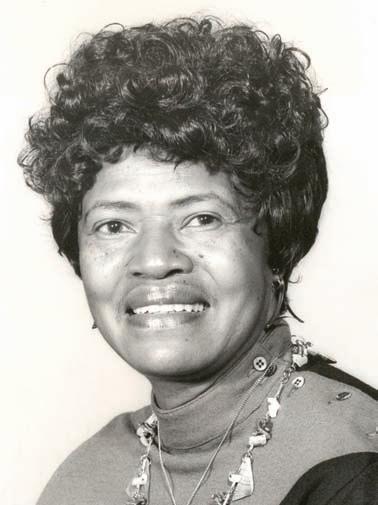
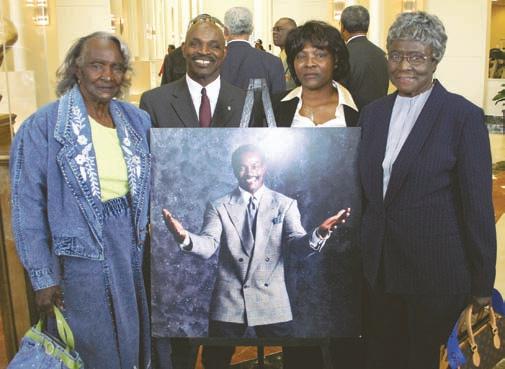
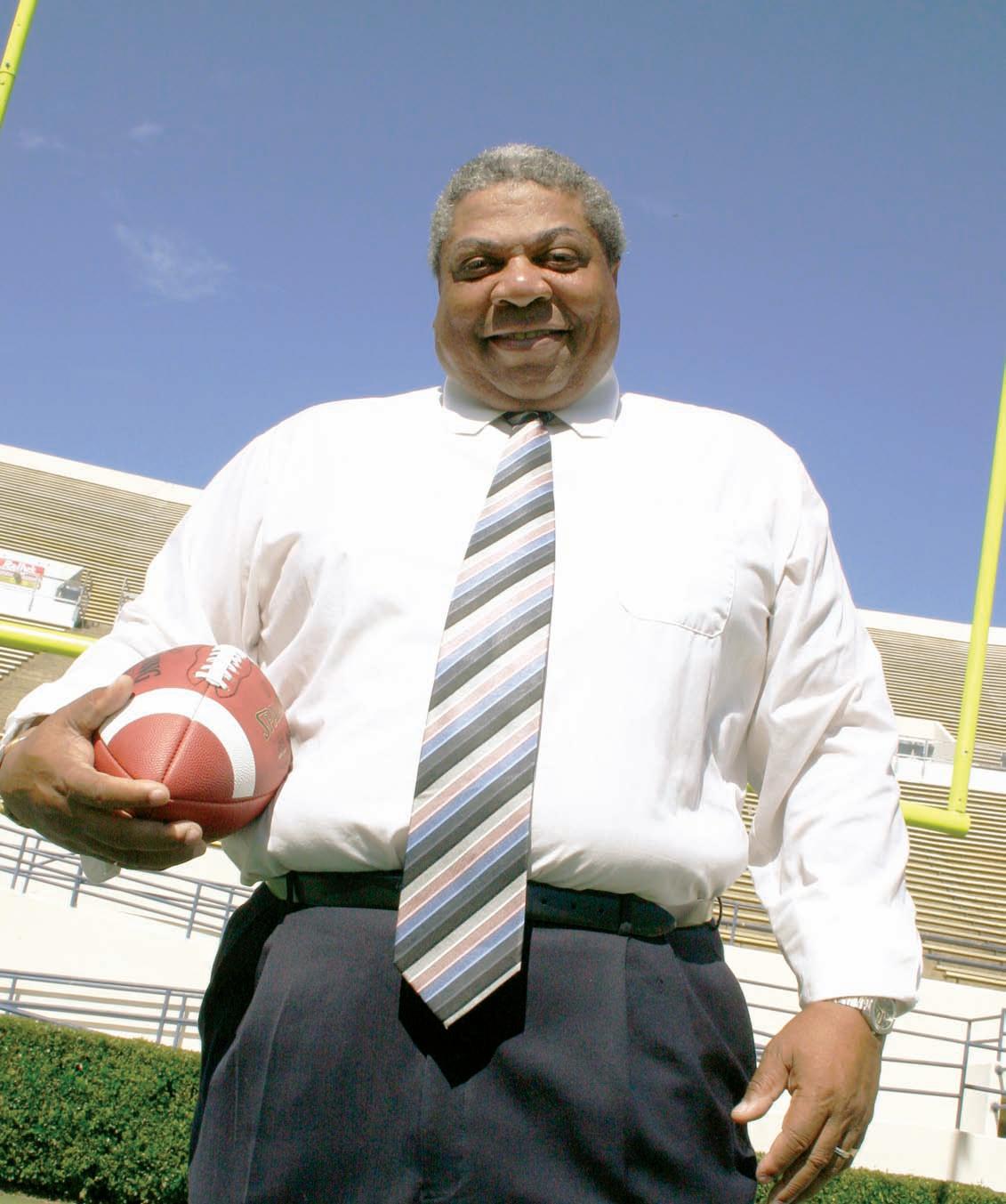
Robinson: 55 Years of Passion, Purpose
pg. 30
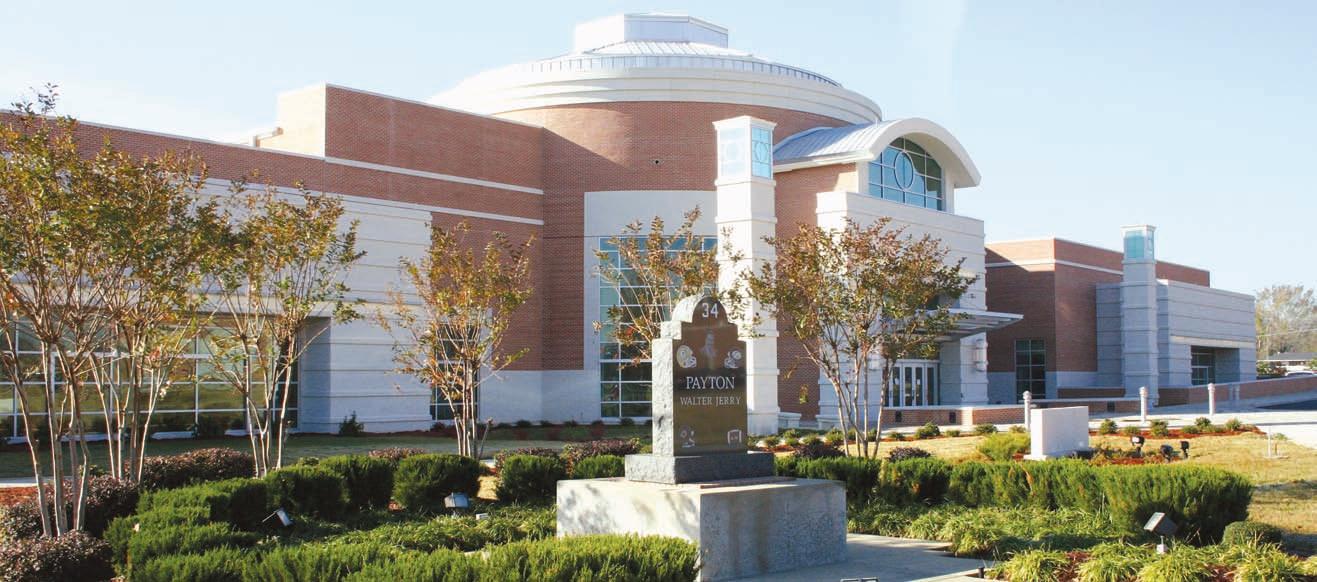
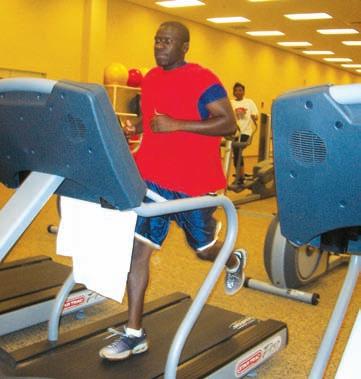
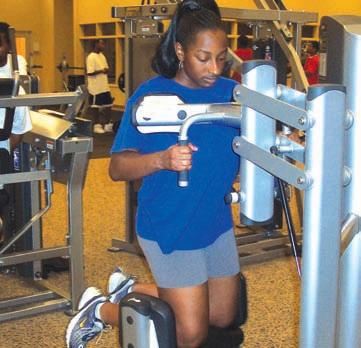
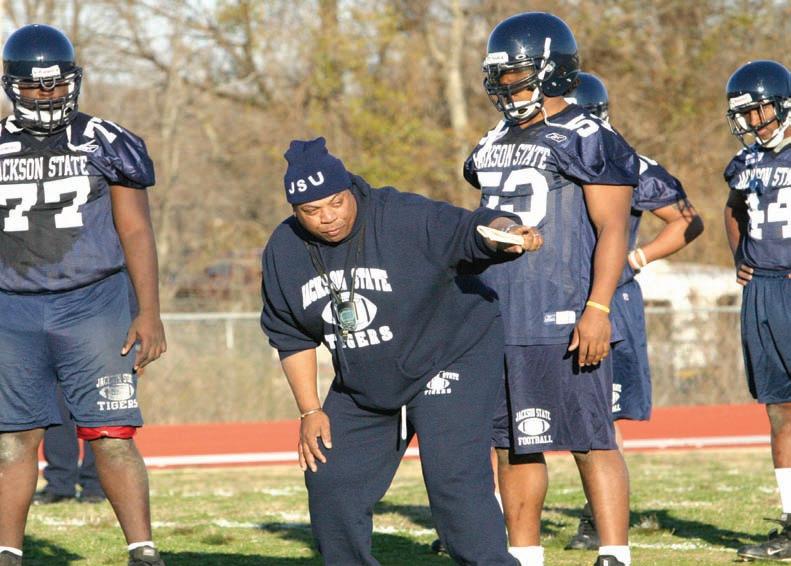
Live Well...Play Hard at the Payton Center
pg. 44
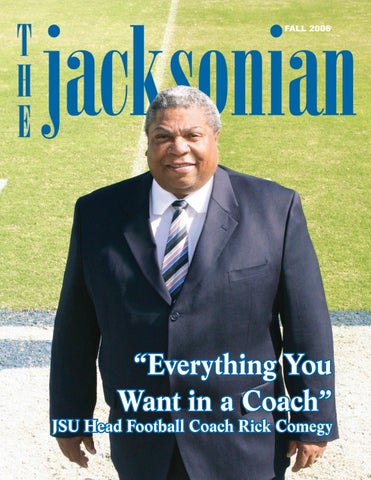
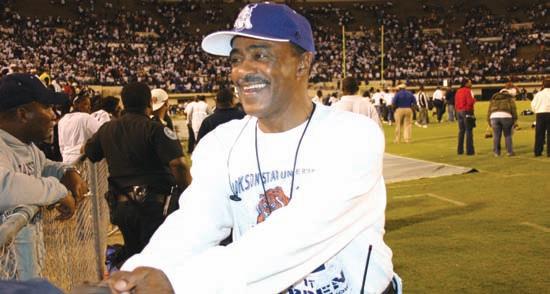
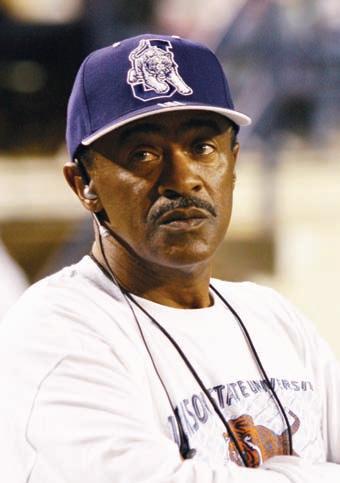
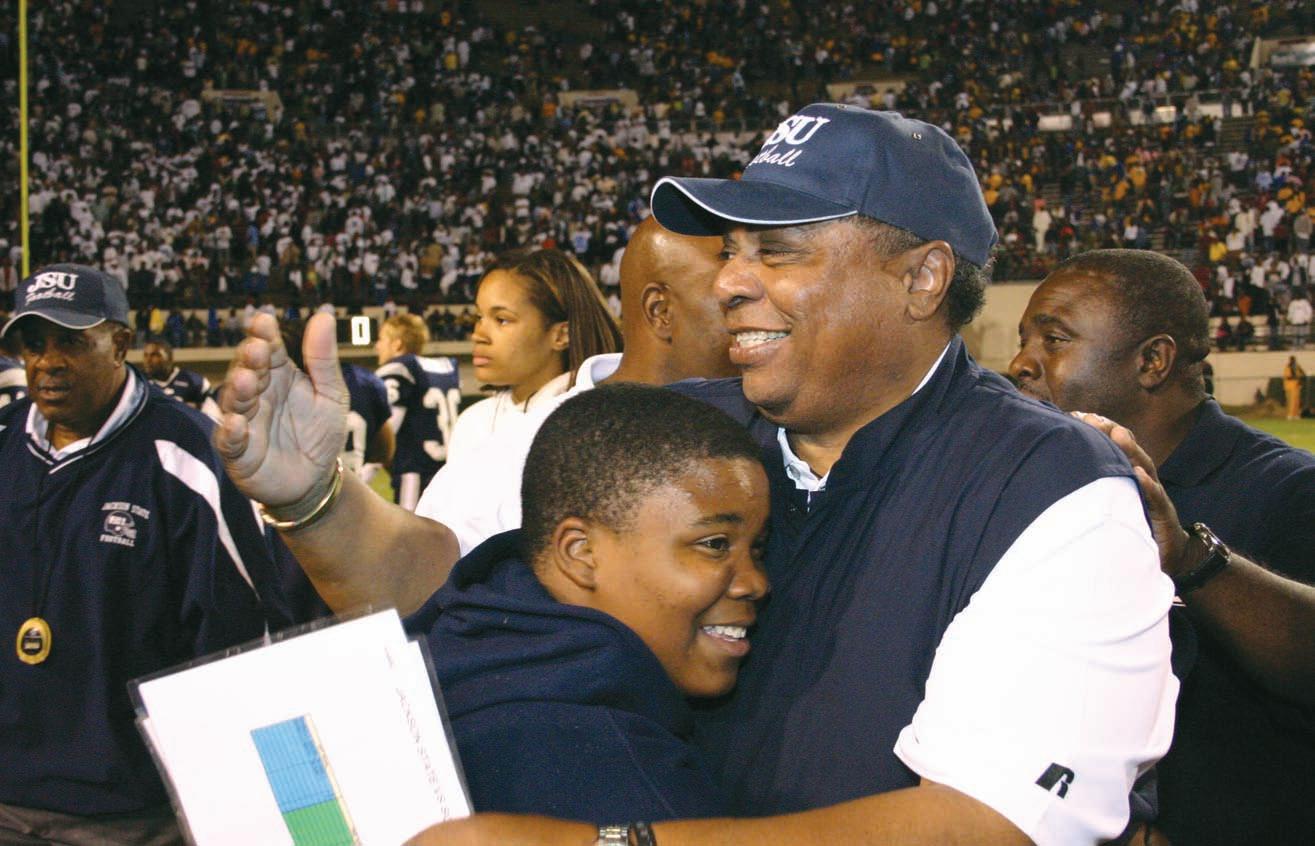
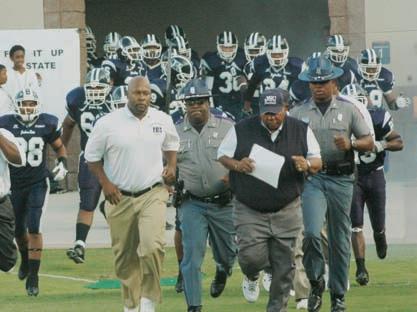
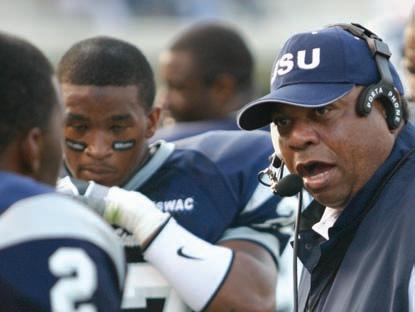
Rick Comegy: “Everything You Want in a Coach”
pg. 48
ACADEMICS
u JSU Graduates Largest Class of Ph.D.s 5
u JSU Reclaiming Civil Rights Movement 8
u High-Tech Counseling Lab Trains Students 10
u TV23 Enters Digital Era in its New Multimillion-Dollar Home 14
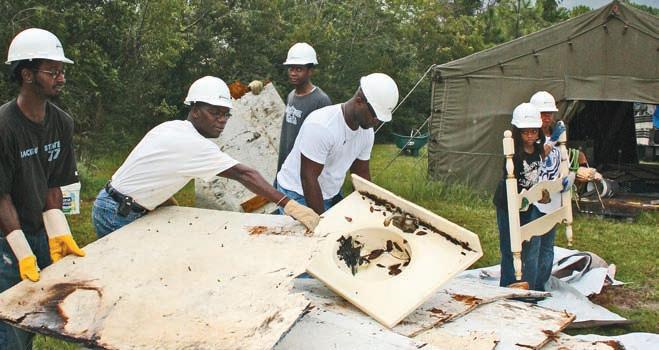
u JSU Students Spend Spring Break Helping Hurricane Survivors 20
u Residential Life Gets Upgrade 22
u Student’s Book Encourages Readers to Dream 27
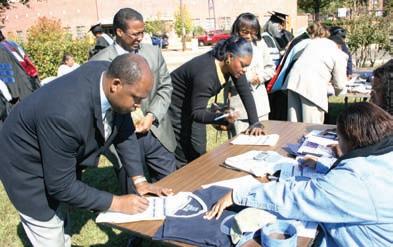
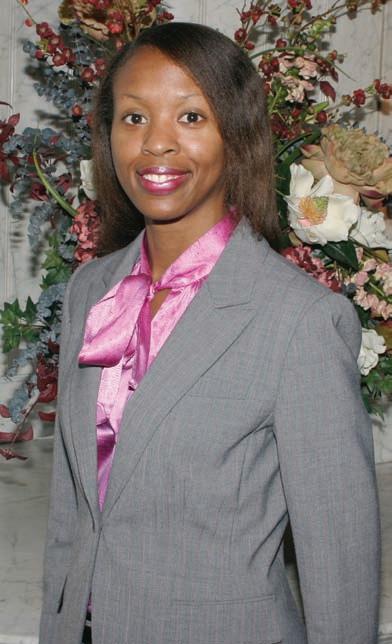
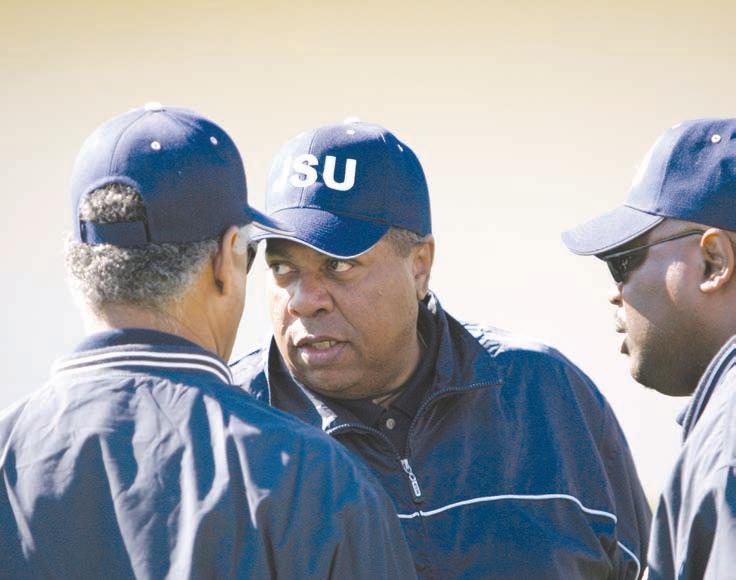
u Campaign for Jackson State Seeks to Raise $50 Million 28
STUDENT LIFE ALUMNI
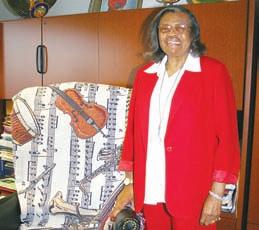
u Robinson: 55 Years of Passion, Purpose 30
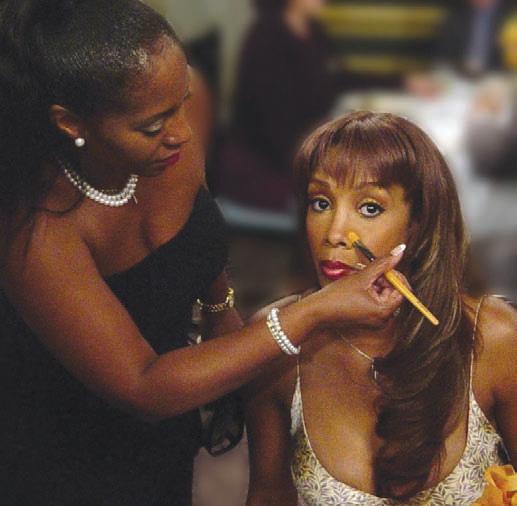
u Blackmon: Makeup Artist to the Stars 34
u Lackey Revels in Recruiting Role 36
u JSU: A Legacy, A Tradition, A Way of Life 42
ATHLETICS
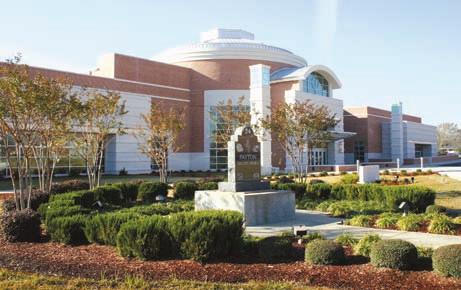
u Live Well...Play Hard at the Payton Center 44
u Track Star Tinsley Turns Pro 46
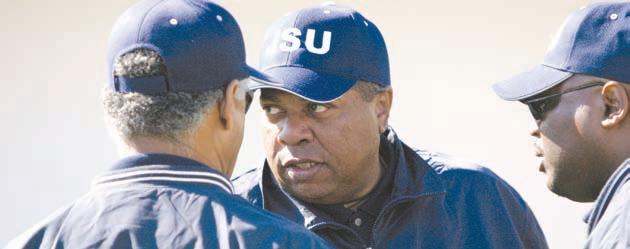
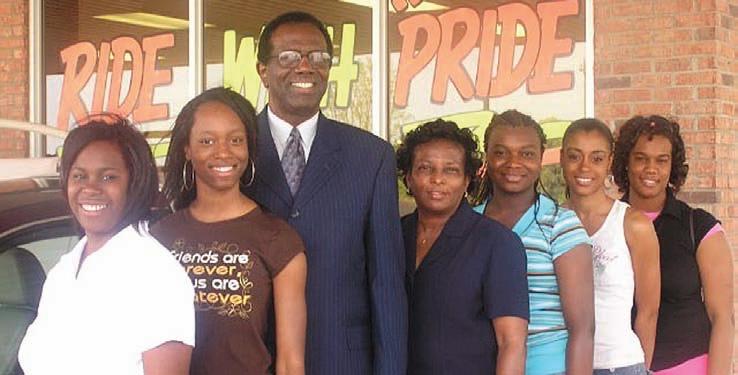
u Rick Comegy: “Everything You Want in a Coach” 48
u Averyhardt Appears Bound for Professional Golf Tour 49
RESEARCH
u Global HIV/AIDS Alliance 54
u JSU Seeks Long-Term Solutions to Hurricane Katrina Problems 59
u Report of Progress: President Mason’s First Five Years 60
u JSU Among Top Doctoral Research Universities in State 62
President’s Message
Dear Jacksonians:
As you will see after reading the pages of this edition of The Jacksonian, we are experiencing some very exciting times.
In 2006, we graduated our largest class of Ph.D.s. Among that class of 44 were 24 who earned the Executive Ph.D. in Urban Higher Education. This milestone surely will land us among the top producers of African Americans with Ph.D.s in the country. Previously, among historically black colleges and universities, we have trailed only Howard University in this category.
As a whole, crime is down, and the campus is growing by leaps and bounds. When you visit the campus, be sure to take a walk down Gibbs-Green Plaza. Named in honor of Phillip Gibbs and James Green, who lost their lives during racial protests in 1970, this space offers a safe place for our students, faculty, staff, alumni and friends to gather and enjoy life at Jackson State University.
At both ends of this walkway, we have begun some of our most significant capital projects in recent years. At the west end of the campus, we’ve begun construction on a new School of Engineering that will allow students to perform sophisticated experiments. At the east end of the campus, we’ve begun work on the new Campus Union Building. Among its exciting features, the new building will house the only movie theater in the city of Jackson. We also have gotten a new baseball field and soon will see a new full-service bank branch as BankPlus completes construction on Dalton Street.
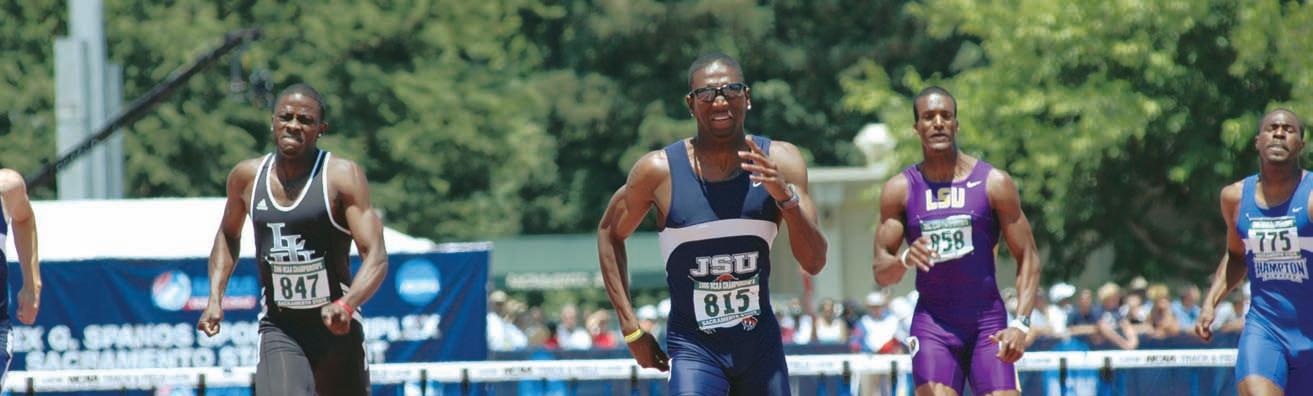
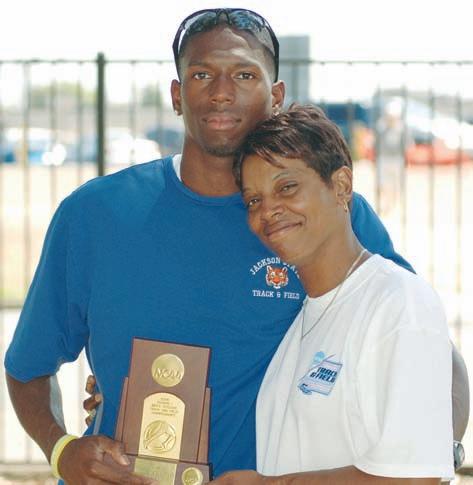
Our students are publishing books, committing selfless acts and winning national athletic championships. Notice the story about Michael Tinsley, who was a student in the spring of 2006, but now is a professional track star who hopes to be a part of the World Championship Team in 2007. Tinsley made history at Jackson State after winning the 400-meter hurdles in June at the 2006 NCAA Outdoor Track and Field Championships in Sacramento, Ca.
Our faculty and staff are aggressively recruiting students and leading by example. Dr. Dollye M. E. Robinson, who has molded young minds at Jackson State for almost 55 years, continues to teach music classes and pass on timeless lessons for success.
This once-small school founded nearly 130 years ago to educate African Americans in Mississippi now impacts the world through initiatives such as the Global HIV/AIDS Alliance to eliminate disparities. While we understand that this is no simple task, at Jackson State University, we remain committed to Challenging Minds, Changing Lives.
Respectfully,
Ronald Mason Jr. President, Jackson State University
jacksonian
is published for alumni, students, retirees and friends of Jackson State University by the Office of University Communications.
Please send all letters and inquiries for consideration of publication to: FROM OUR READERS
The Jacksonian Magazine
JSU Office of University Communications
P.O. Box 17490 • Jackson, MS 39217
Phone: (601) 979-2272 • Fax: (601) 979-2000
E-mail: publicrelations@jsums.edu
Please mail ALUMNI HEADLINERS, IN MEMORIAM and ADDRESS CHANGES to:
Gwen Caples, Director of Alumni Relations
JSU Office of Alumni Relations
P.O. Box 17280 • Jackson, MS 39217
Phone: (601) 979-6944 • Fax: (601) 979-3701
E-mail: gwen.caples@jsums.edu
Director of University Communications
Anthony Dean
Manager of Public Relations
Tommiea P. Jackson
Senior Editor/Writer Riva Brown
Contributors
Eddie L. Brown Jr.
Henrietta Buck
Gwen Caples
Gina P. Carter
Christine DeGrate
Dianne Everett
Henry Goolsby
Shirley Harrison
Antonio R. Harvey
Sam Jefferson
Erica Jordan
Constance Lawson
LaShonda D. Levy
Pamela McCoy
Eltease Moore
Jessica Murray
Cathy Patterson
Hubert Tate
Aaron Thompson III
Sylvia T. Watley
Photographers
Freddy Norman
J.D. Schwalm/The Clarion-Ledger
Jenny Anderson/Special to The Clarion-Ledger
Summer Commencement Makes History
By
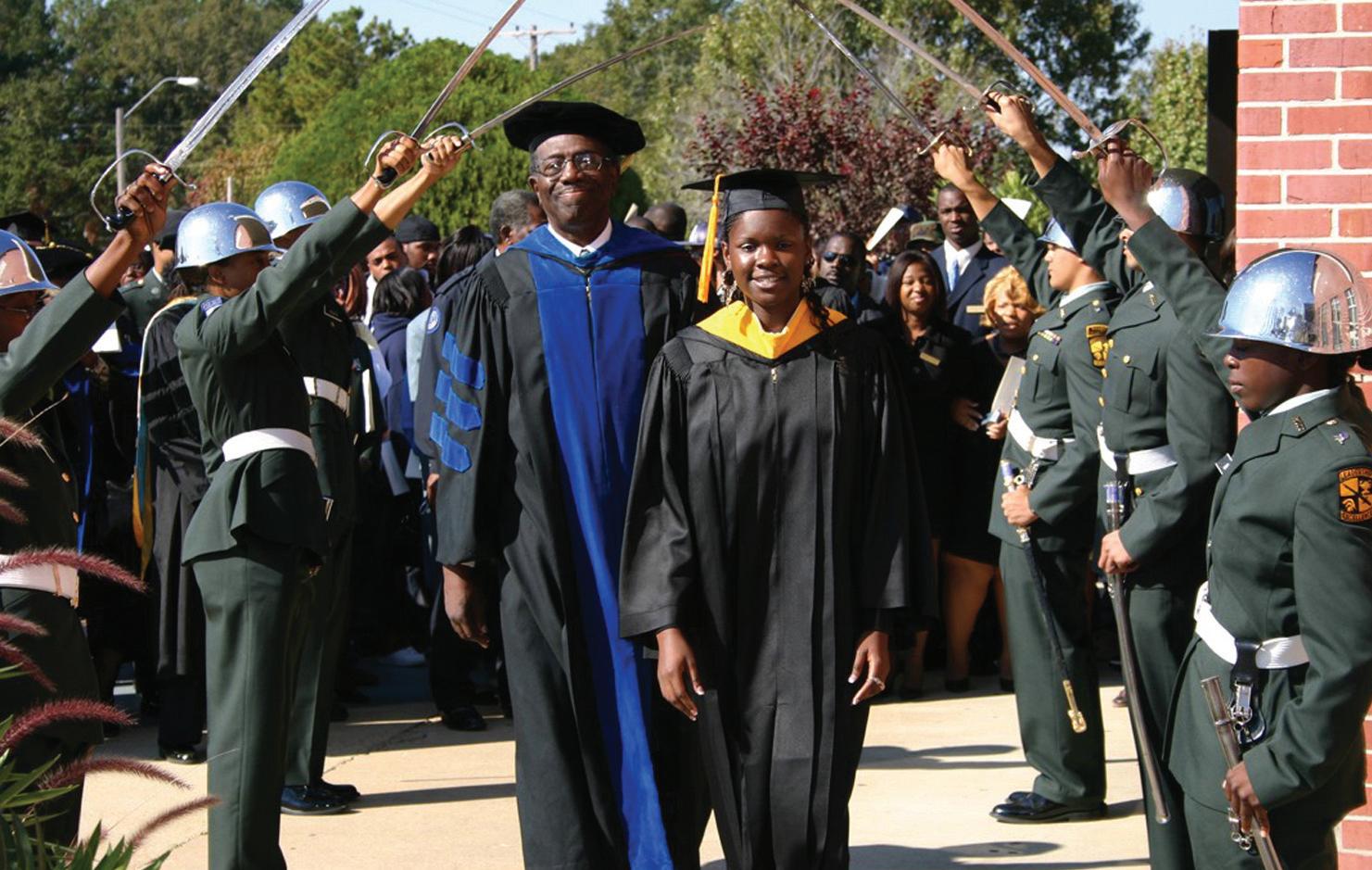
Jackson State University graduated the largest class of Ph.D.s in its history during the summer 2006 commencement exercises.
Of the 350 students who graduated Aug. 5, 2006, at the Lee E. Williams Athletics and Assembly Center on campus, 44 received doctorates, including 24 members of first class of the Executive Ph.D. Program in Urban Higher Education.
The milestone makes Jackson State University one of the fastest-growing producers of Ph.D.s in the nation.
“It helps to release this stigma of what is possible in Mississippi,” said Reeshemah Allen, the only graduate to earn a doctorate in chemistry. “Even though Howard University is known for producing African Americans with Ph.D.s, we are setting records here and producing top echelon graduates with terminal degrees.”
Dr. Dorris Robinson-Gardner, Dean of JSU’s Division of Graduate Studies, said this historic class helps JSU carry out its graduate mission to produce a cadre of professionals.
quently received approval to move ahead with the program,” Stevenson said. “Faculty members were brought together from four different disciplines to conceptualize the framework for the curriculum. We admitted our first class two years ago in 2004.
“We are exceedingly excited about graduating the inaugural cohort for the Executive Ph.D. Program,” Stevenson added. “This has been a very intense journey over the past two years, given the academic rigor, demands and strict requirements of the program.”
Dr. Jerry Watson, Assistant Vice President for Economic and Local Governmental Affairs at Jackson State, knows the rigors of the program well.
Balancing the responsibilities of work, family and study proved difficult at times, but the results were worth the hard work.
“This graduation is a partial fulfillment of a lifelong dream,” said Watson.
“I feel that it has equipped me with the knowledge and skills needed to make a difference, and allows me the opportunity to be a catalyst for change.”
“These professionals have been trained through quality programs and will help solve the problems of this global society,” she said.
This class holds particular significance for Dr. Joseph Martin Stevenson, Founding Executive Director of the Executive Ph.D. Program in Urban Higher Education and the Jake Ayers Institute for Research at the Mississippi e-Center @ JSU. Stevenson began the extensive planning stages for this program in 2002.
“After a comprehensive examination of the academic market, we were able to submit the program proposal to the Mississippi Institutions of Higher Learning and subse-
Hundreds of applications arrive each year, but Stevenson said only about 25 students will be admitted. After one year, Cohort II is half way through its journey in the intense two-year program. Twenty students have been admitted for Cohort III, which began in fall 2006.
“The future holds tremendous promise for this unique, accelerated Executive Ph.D. Program in Urban Higher Education,” Stevenson said. “The demands for new kinds of leadership and management skill sets will be met by graduating future cohorts and preparing them for the challenging academic enterprise on the horizon.”
Tommiea P. Jackson and Riva B R own
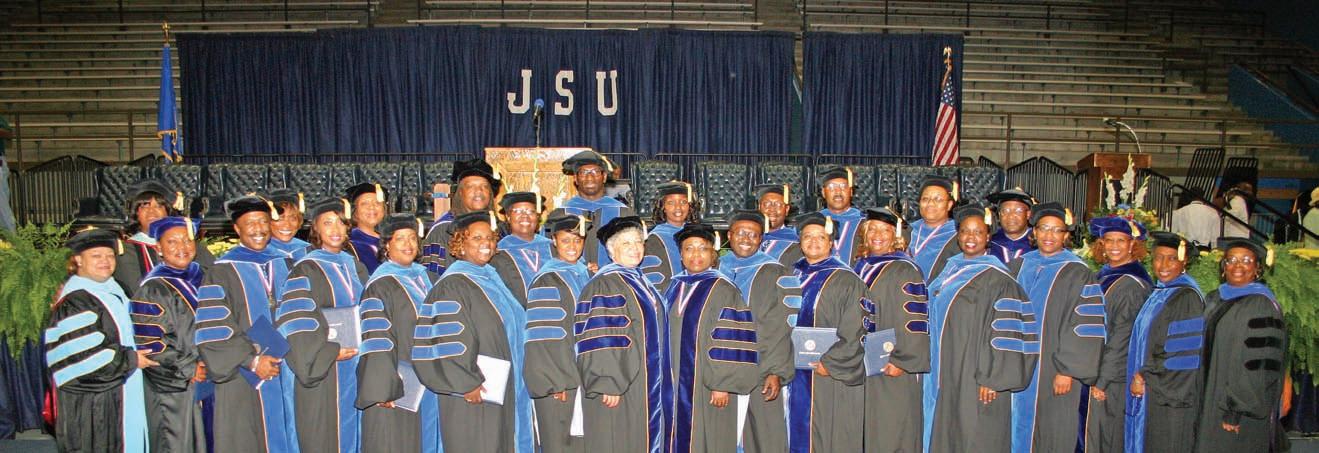
TOP: With 44 members, Jackson State University graduated its largest class of Ph.D.s in summer 2006.
ABOVE: Dr. Jerry Watson earned an Executive Ph.D. in Urban Higher Education.
Ayers Awarded Honorary Doctorate
By Riva B R own and d ianne e ve R e TT
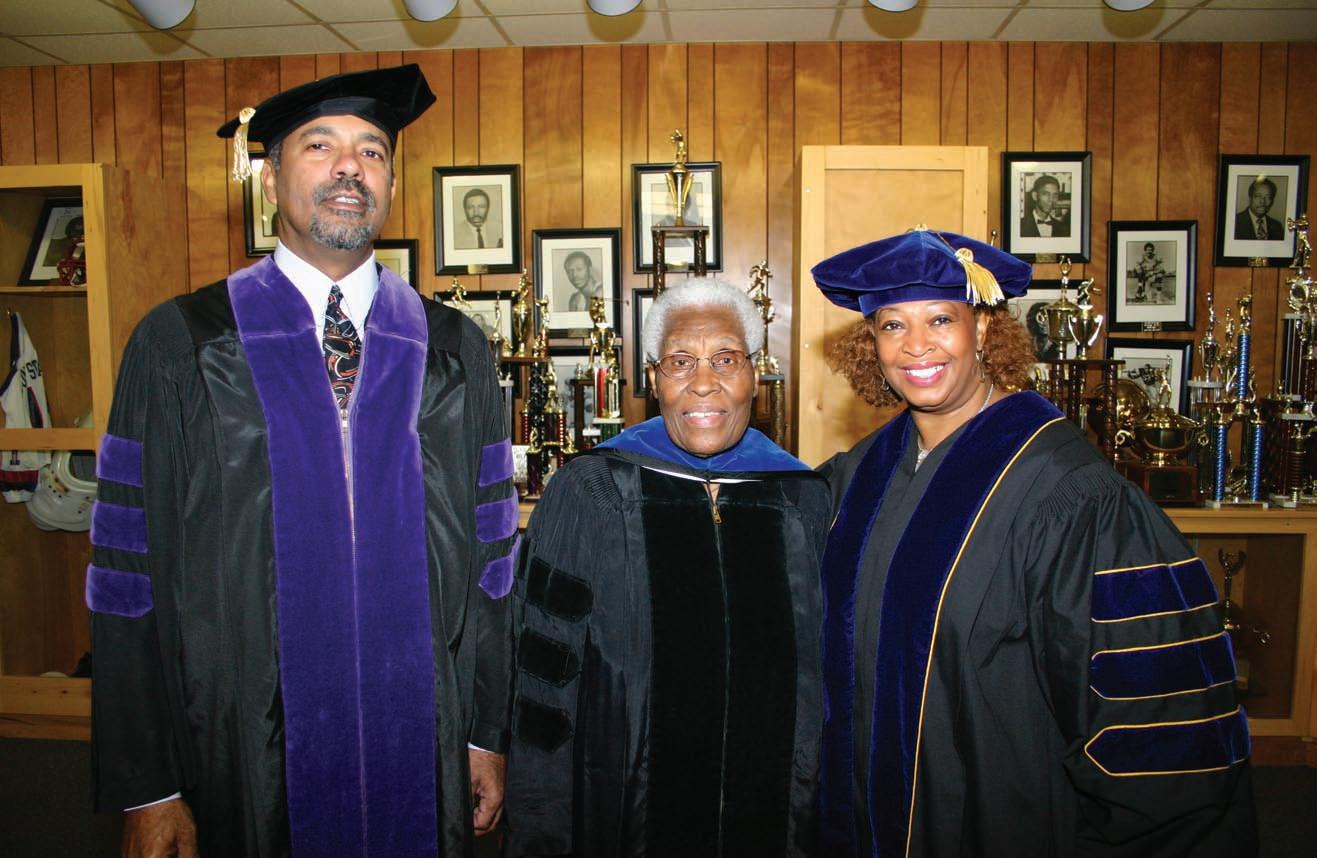
The late Jake Ayers Sr., a man whose name has been linked to higher education in Mississippi for more than 30 years, now has an honorary doctorate that bears his name.
Members of the Ayers family beamed with pride when Jackson State University President Ronald Mason Jr. awarded the degree during the summer commencement exercises on campus.
Lillie Ayers, Jake Ayers Sr.’s widow, graced the stage Aug. 5, 2006, at the Lee E. Williams Athletics and Assembly Center to accept the posthumous honor.
“It’s long overdue, long over-
due, but it’s appreciated whenever it’s done,” the Glen Allan, Miss., resident said later. “We don’t always get things when we think we should get them, but it was just an honor for me to still be around and able to accept it.”
In January 1975, Jake Ayers Sr. filed a lawsuit, claiming the state of Mississippi discriminated against its three historically black universities: Jackson State, Alcorn State and Mississippi Valley State. Jake Ayers Sr. died in 1986.
After numerous appeals that dragged on for decades, the U.S. Supreme Court finally settled the case in October 2004. Under the $503 million settlement agreement, the three universities will get the funds over a 17-year period.
Dr. Velvelyn Foster, JSU’s Vice President for Academic Affairs and Student Life, said Jake Ayers Sr. was instrumental in the successful desegregation of the state of Mississippi’s institutions of higher learning.
Jackson State University President Ronald Mason Jr. poses with Lillie Ayers, widow of the late Jake Ayers Sr., and Dr. Cindy Ayers-Elliott, a member of the inaugural cohort of the Executive Ph.D. Program in Urban Higher Education.
Jake Ayers Sr.
“His actions propelled the state to recognize the dual higher education system, which has had a phenomenal impact on the opportunities afforded all citizens of the state, especially those who historically had been denied equal access to the educational arena,” Foster said.
Students in the inaugural cohort of the Executive Ph.D. Program in Urban Higher Education approached JSU’s Honorary Degree Committee with the recommendation to award the honorary degree, Foster explained.
The committee approved the request and presented it to Mason, who accepted it and submitted it to the Mississippi Institutions of Higher Learning.
Dr. D.E. Magee Jr., President of the IHL Board of Trustees, said the members had no problem OK’ing the request.
“Because of his persistence in pursuing the Ayers case and the results of the case, it will have ramifications far into the future for Jackson State, Alcorn and Valley,” said Magee, who chaired IHL’s Ayers Committee before the case ended. “It reaches out over 17 years, so the effect of the pioneering effort will be long-lasting.”
The Ayers’ great niece, Dr. Cindy Ayers-Elliott, was part of the inaugural cohort that recommended the honor.
“We felt like, who would be more fitting to receive an honorary doctorate than a man who gave all his life for higher education in Mississippi,” she said.
Money from the Ayers settlement was used to create the first-of-its-kind Executive Ph.D. Program, which is located in the Jake Ayers Institute for Research at the Mississippi e-Center @ JSU.
“We think it was only fitting to give recognition to a man who got us to where we were able to do the Executive Ph.D. Program at Jackson State and in Mississippi,” said Ayers-Elliott, President and CEO of the Delta Foundation in Greenville, Miss.
“It’s almost like coming full circle from the suit being filed in 1975 to the graduation of the first class from this institute in 2006,” she added. “It was almost like the closure of one chapter but not the whole book.”
The Ayers’ son,
Henry Ayers, also of Greenville, said the family was happy and proud that one of the historically black universities bestowed such an honor on his father.
“I think Jackson State giving him such an honor really showed that the people and the faculty in higher education in Mississippi appreciate what he was trying to do for them,” he said.
“I think Jackson State giving him such an honor really showed that the people and the faculty in higher education in Mississippi appreciate what he was trying to do for them.”
- Henry Ayers, son of the late Jake Ayers Sr.
“My mother, she’s been grinning every since she got up on stage and received it,” said Henry Ayers, who sat in the audience while Lillie Ayers was lauded. “The president asked us several times to stand and be recognized. It was a good feeling for people who didn’t really know us and didn’t really know my daddy to include us in the festivities.”
Foster said, “As a community leader, a friend of higher education and an activist for equity,” it is apparent that Jake Ayers Sr. should receive accolades.
“Jackson State has greatly benefited from his courage and tenacity in his commitment to equality and justice.” J
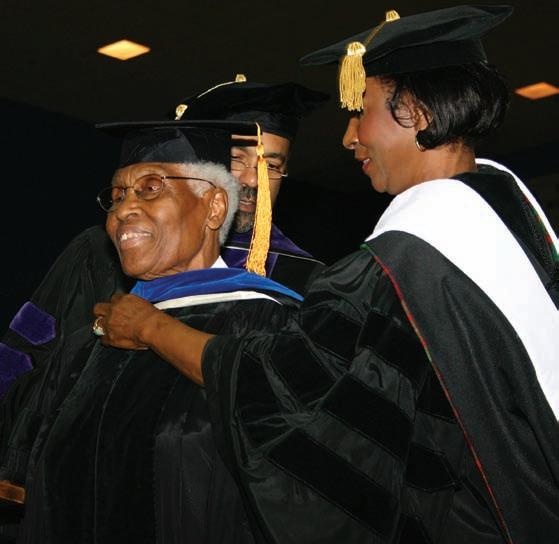
Lillie Ayers is hooded during the summer 2006 commencement exercises during which her husband, the late Jake Ayers Sr., was awarded an honorary doctorate.
Cindy Ayers-Elliott, the Ayers’ great niece, also was a member of JSU’s Executive Ph.D. Program in Urban Higher Education inaugural class.
JSU Reclaiming c ivil Right S m ovement
By Riva B R own
Before James Meredith could make civil rights history in Mississippi, he had to make sure his wife and son had a safe and secure place to live.
That’s when Jackson State University – cautiously and courageously – stepped in.
Then-President Dr. Jacob L. Reddix made special arrangements for Meredith’s family to live in faculty housing. Reddix also helped Meredith transfer to the University of Mississippi from Jackson State during his junior year.
“The powers that be tried to put every manner of pressure they could on him to do something or anything
to make me ineligible to go to Ole Miss, and he refused to do that,” recalls Meredith, who became the first African American to enroll at the university in 1962. “After he retired, he invited me to his house for dinner and told me he did it because he wanted change as much as, if not more, than I did.”
During the civil rights era, Jackson State and other state-funded historically black colleges and universities could not take the lead in supporting the movement for fear they could be shut down, or their administrations could be taken over, a historian says.
“We supported James Meredith,
but it was just not popular,” says Dr. Hilliard L. Lackey III, President of the Jackson State University National Alumni Association. “Now, Jackson State University, as well as black people who are college graduates, stand in a better position to lead Mississippi into one Mississippi.”
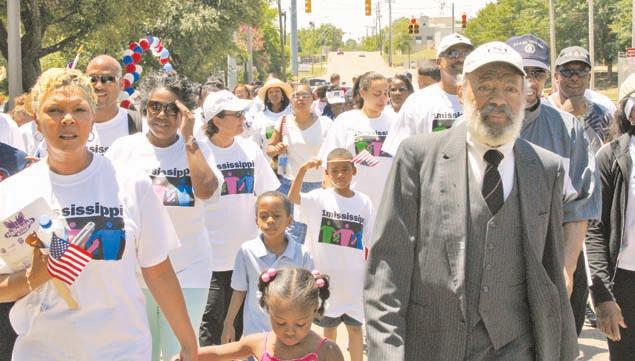
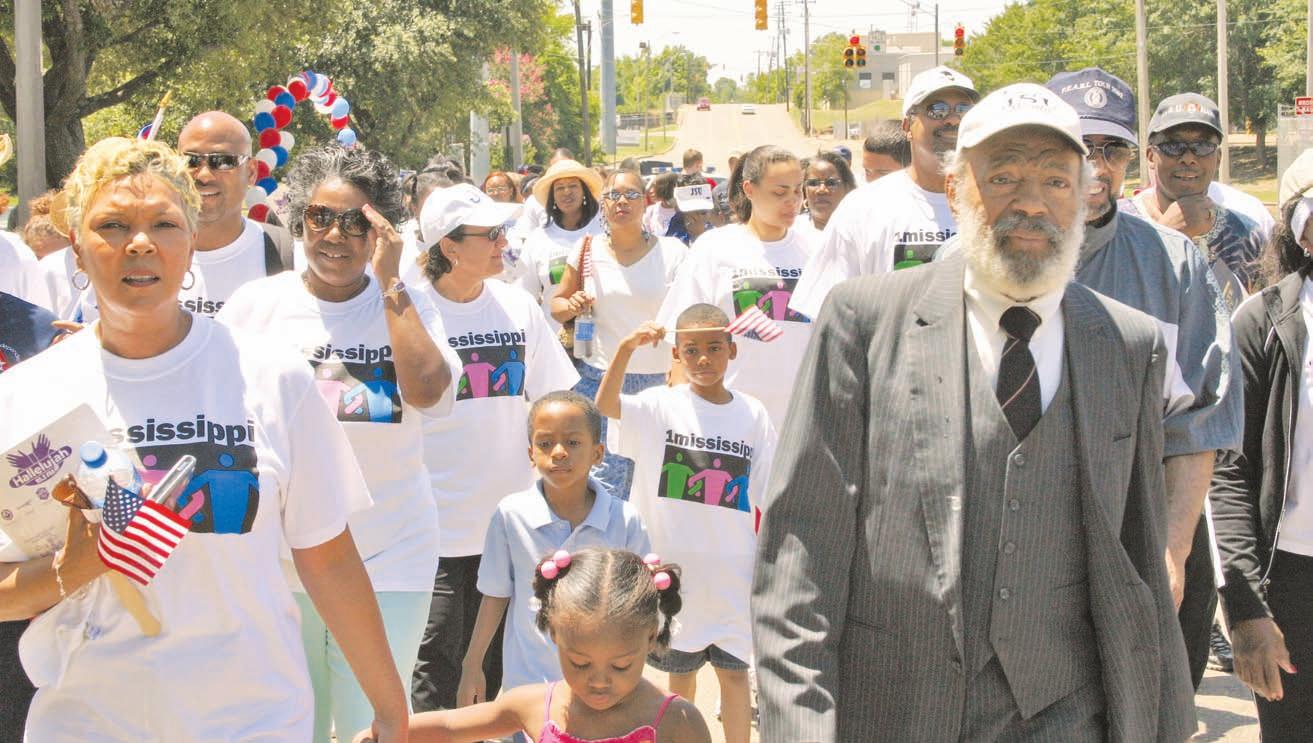
Some of Jackson State’s recent leadership efforts include collaborating with the Walk for “1 MISSISSIPPI” Project on June 3, 2006, to mark the 40th anniversary of Meredith’s “Walk Against Fear.” In 1966, Meredith walked from Memphis, Tenn., to Jackson, Miss., to shed light on the issues of citizenship, constitutional rights
James Meredith (right), who integrated the University of Mississippi, leads the Walk for “1 MISSISSIPPI” with his wife, Judy, and granddaughter, Jylah. The walk marked the 40th anniversary of Meredith’s “Walk Against Fear.”
and racial inequalities in the country.
Jackson State also hosted the First Annual Conference of the Veterans of the Mississippi Civil Rights Movement from March 2-5, 2006. The gathering, themed “The Pursuit of Quality Education in the Ongoing Movement for Human Rights,” refocused leadership on remedies for some issues affecting African Americans.
Lackey, Chairman of “1 MISSISSIPPI,” says the purpose was to demonstrate that the time has come for Mississippi citizens to recognize one citizenship without division.
“There is no first-class or second-class citizen. Either you are or you’re not a citizen,” Lackey says. “Jackson State is the one that should and will push the envelope for full citizenship for all the people in the state of Mississippi.”
Lackey says black college graduates in Mississippi also must provide leadership “because we know how to do it, we’ve been there and done that, and we have the passion and insight.”
“We readily understand that Mississippi cannot go forward in segments. We have to go forward in entirety,” he says. “In Mississippi, race matters.”
Cathy Ducksworth, a consultant who organized the “1 MISSISSIPPI” walk, says she hopes the efforts continue each year to help educate people about Mississippi’s African-American history.
“We need to start telling our stories. We need to start
bringing them to the forefront,” Ducksworth says. “There are so many people around the world who know so many stories that have never been told. There might be one untold story that could have been told that not only puts Mississippi on the map, but helps the world to better understand the things Mississippians have gone through and are still going through.”
Elizabeth Sharpe Overman, an Assistant Professor in Jackson State’s Department of History, says the university has begun collecting oral histories of civil rights activists.
Some of the activists invited to participate in the recent Veterans of the Mississippi Civil Rights Movement Conference include educator Bob Moses, creator of the Algebra Project, and attorney Constance Slaughter Harvey, the first African-American female to receive a law degree from Ole Miss.
“Just as they study George Washington, Abraham Lincoln, Frederick Douglass and W.E.B. DuBois,” Overman says, “every school child should know these people for what they did as high school students and college students, what they did in their youth and the courageous stands they took.”
Those stands include organizing sit-ins, bringing in lawyers and helping people raise money to get out of jail, she says.
Overman adds that Jackson State also should play a role in writing books such as biographies and getting the stories of civil rights activists worked into textbooks.
“JSU is not the only institution collecting these stories, but JSU is positioned – as Dr. Lackey said, the premier HBCU in Mississippi – to provide both a model and the direction,” Overman says.
Meredith says Jackson State’s recent efforts are significant. “Whether anybody likes it or not, that just like Ole Miss was the premier university for whites in the state of Mississippi, Jackson State was the premier university for blacks in Mississippi – and still is,” he says.
“Hopefully, Jackson State associating itself with the movement will give its alumni the security to know it’s all right to do whatever they think is right.”
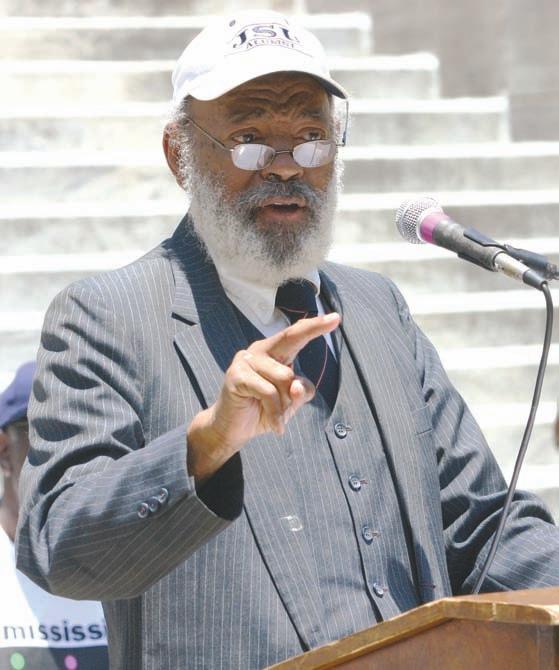
James Meredith, a former student at Jackson State University, speaks to the crowd following the Walk for “1 MISSISSIPPI.”
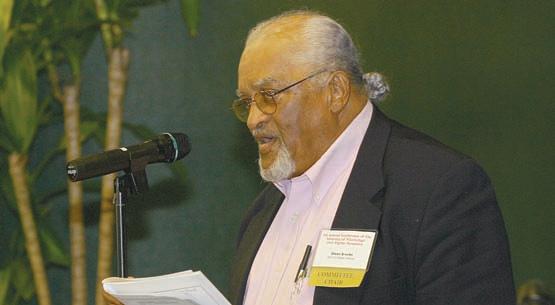
Mississippi civil rights veteran Owen Brooks served as the co-convener for the conference.
High-Tech Counseling Lab Trains Students
By
Cumbersome. Timeconsuming. Tiring. That’s how students and faculty in Jackson State University’s Department of School, Community and Rehabilitation Counseling describe the old process of recording and reviewing individual and group counseling sessions.
Reva Brooks, a graduate student in Community Counseling, remembers buying videotapes to record her mock sessions and transcribing them for her professors to review in class.
Now that the William H. Brooks Counseling Laboratory has opened in the College of Education and Human Development, students like Brooks can record sessions with a click of a button – while professors critique them on their computers from the comfort of their offices.
“With the new technology in the lab, you can do everything you need right there,” says Brooks, daughter of Dr. William H. Brooks. “You can go in the room with your pretend client, and the teacher can be in the other room observing and taking notes. She’ll be grading you, and you’ll be getting your grade quicker.”
The lab bears the name of Dr. William H. Brooks, a Licensed Professional Counselor and Psychologist who began working at Jackson State in 1970. He led the Counseling Department from 1981 to 1992 and retired in 2000. The state-of-the-art facility, under the direction of Associate Professor Dr. Rannie Lewis, was dedicated on March 9, 2006. It features videostreaming technology that allows professors and students to review sessions via the Internet, video broadcasts or video playback.
“When I was at Jackson State, we had tried for years to develop a first-class training center, and the counseling lab is what that is,” Dr. Brooks says. “It’s a very sophisticated training device, and I think it will have a great impact on the students who are coming through the program and are receiving training in that area.”
The lab also will help the School and Community Counseling Programs achieve accreditation from the Council for Accreditation of Counseling and Related Educational Programs, says Dr. Jean Farish-Jackson, Professor and Acting
Chairwoman of the department. The Commission on Rehabilitation Counseling already accredits the Rehabilitation Counseling Program.
“Getting the lab was a high point. We knew if we didn’t get the lab, we couldn’t even be in the game,” says Farish-Jackson, who expresses her appreciation to the university’s Information Technology staff and Dr. Velvelyn Foster, Vice Pesident for Academic Affairs and Student Life, for their support. “The counseling lab is pace setting in integrating technology in counseling education.”
The technology takes the place of live supervision and allows professors to teach students how to improve the verbal and nonverbal communication skills they use in counseling sessions, says Dr. Dion Porter, an Assistant Professor in the School and Rehabilitation Counseling Programs.
“Seventy-five percent of communication is nonverbal,” Porter says. “It’s not what we say; it’s what we don’t say. This technology allows us to capture all that. Technology is where everything is going.”
Dr. Nanolla Yazdani, an Assistant Professor in the School and Community Counseling Programs, says the lab helps students learn how to conduct themselves in real-life, therapeutic settings.
“We can go back and forth reviewing a small piece of body language to refine our students’ performance and bring up their professional conduct,” Yazdani says. “That will help them provide better service for clients.”
Farish-Jackson says the department’s goal is to get a grant to expand the lab so the community can come to the university for free counseling services. A grant also would allow students to remain on campus to do their internships and field training. In the aftermath of Hurricane Katrina, students went to the Jackson Medical Mall to provide free counseling to survivors of the August 2005 disaster.
“People who need counseling the most have access to it the least,” says Yazdani. Expanding the lab “will make students more marketable and serve the purpose of an urban university.”
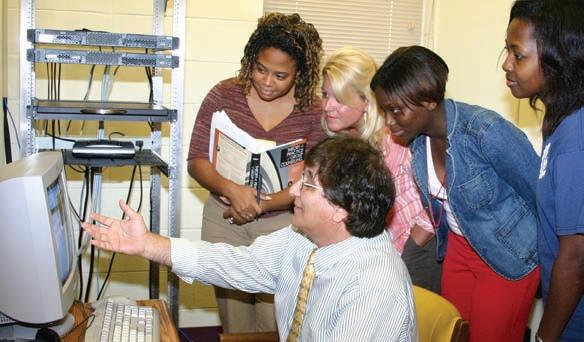
Counseling students look on as Dr. Nanolla Yazdani, an Assistant Professor in the School and Community Counseling Programs, reviews the possibilities of new equipment.
Dr. William H. Brooks
Dr. Jean Farish-Jackson
Riva B R own
Kids Kollege Opens Doors to Freedom School
By La s honda d . Levy
Jackson State University is now home to the first Freedom School in Mississippi in more than 30 years, thanks to Carolyn Coleman, Project Director of Kids Kollege.
In the days that followed Hurricanes Katrina and Rita, Coleman decided that the university’s afterschool program would help provide the youngest victims of the storms with a daily routine and a sense of normalcy.
In November 2005, Kids Kollege partnered with the Children’s Defense Fund and the Kellogg Foundation to open the Freedom School, which is located in the Joseph Jackson College of Education Building on the JSU campus.
The Freedom School program initially began in the summer of 1964 in Mississippi, where more than 40 schools opened. These schools were part of Freedom Summer, a project of the civil rights movement that sought to empower African Americans in Mississippi to become active citizens and agents of social change.
“I believe the success of the program comes because each child that comes in becomes ours,” said Coleman. “The school is family oriented, and the children feel welcomed and loved.”
The Freedom School’s enrollment has almost doubled, going from 60 to 115 since it began. Currently, the staff includes one full-time staff member, two teacher educators and 10 student interns.
JSU student Raashida El-Scari, a psychology major from Kansas City, Mo., has worked with the program since its inception. “I have learned patience, and being around the children has taught me a lot about myself,” she said.
Justin Moorehead, a JSU student who became an intern in January 2006, believes being a part of the school will help him in his field of study, elementary education.
“I have 14 enrolled and I have noticed an improvement in their grades at their regular schools,” he said.
The Freedom School is open to children ages 6 to 18 who are victims of Hurricanes Katrina and Rita. The participants are engaged in activities that nurture their minds, bodies and spirits.
To meet the requirements for the Children’s Defense Fund Freedom School, the program does not charge tuition and must rely solely on sponsorships and its partner, the Kellogg Foundation.
The program was slated to end on March 2, 2006, but a representative from the Kellogg Foundation came to JSU for a site visit and was impressed with the program. During that visit, the grant was extended.
Carolyn Coleman J
Moorehead works with Level 1 students, which consist of those in kindergarten through second grade.
“At this point, students must be a displaced student from the hurricane,” Coleman said. “If we get the funding to continue the Freedom School, next year, we hope to include every student interested.”
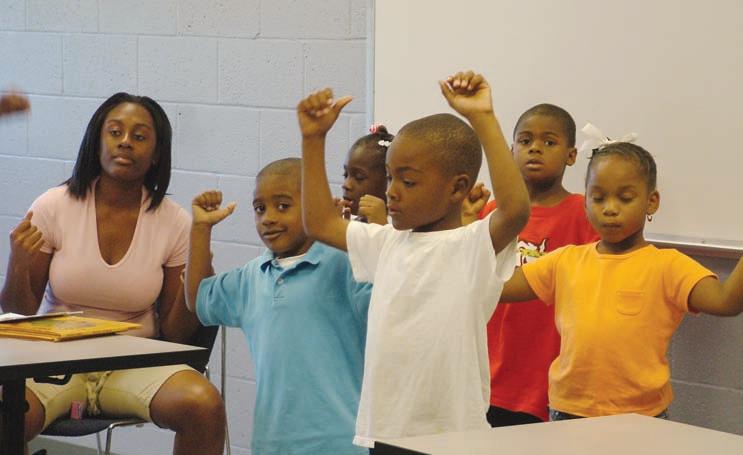
Freedom school students (left to right) Khamari Bogan, Renee Roberts, Jaden Blackmon, Donae Carpenter, and Onika Henderson perform the program’s theme song, “Something Inside So Strong” as biology major and Terry resident Keisha Brown (far left) watches.
Budding scientists seek solutions at Fair
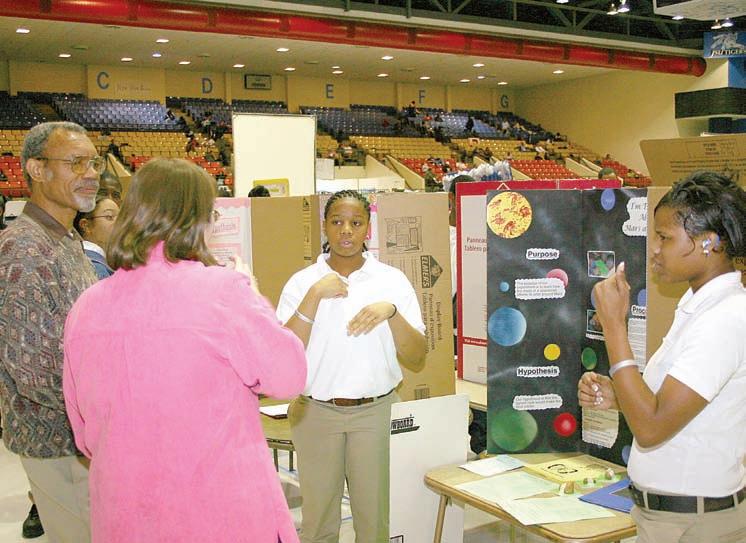
In March 2006, students presented more than 1,400 projects at the Region II Science and Engineering Fair held at the Jackson State University Lee E. Williams Athletics and Assembly Center.
Students in grades one through 12 showed off their research in the areas of behavioral and social sciences, biochemistry, chemistry, earth space and environmental sciences, engineering, computers, mathematics, medicine and health, microbiology, physics and zoology.
While some of the projects were complicated, others were simple and fun.
Second-grader Kaitlin Coleman sought to answer the question, “Which Brand of Wrigley’s Gum Lasts the Longest?”
The student from John Hopkins Elementary School in Jackson, Miss., spent an afternoon with her
siblings chewing the different varieties. “They told me when the flavor went out,” she said. Kaitlin found that Doublemint lasted the longest.
Finding an answer was the easy part, said Kaitlin’s mother, Juanita Coleman. The young scientist became nervous when it came time to answer the judges’ questions. “I just told her to relax,” Coleman said.
Since 1975, JSU has hosted students from Copiah, Hinds, Jefferson, Madison, Rankin and Warren counties to participate in the Region II Science and Engineering Fair. Students in grades one through six compete in the lower fair, and grades seven through 12 compete in the upper fair.
Dr. Abdul K. Mohamed, former Dean of the College of Science, Engineering and Technology, said the fair provides students with an opportunity to develop an appre -
ciation for the scientific method and to gain some understanding of the world. “Science projects teach students how to seek answers and solve problems,” said Mohamed, former Director of the science fair.
First- through third-place winners in grades seven through 12 of the regional competition competed in the 2006 Mississippi Science and Engineering Fair at Mississippi State University in Starkville, Miss. State winners as well as Regional Best of Fair, First Place Overall and the First Place Team advanced to the International Science and Engineering Fair in Indianapolis, Ind., in May 2006.
Deaf students use an interpreter to answer judges’ questions during the science fair.
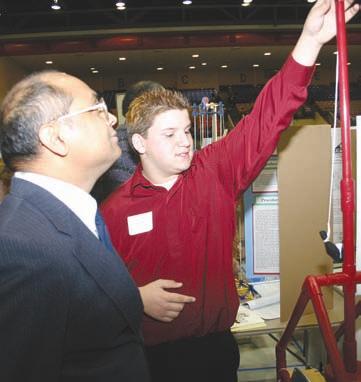
A student demonstrates his project for a judge during the 2006 science fair.
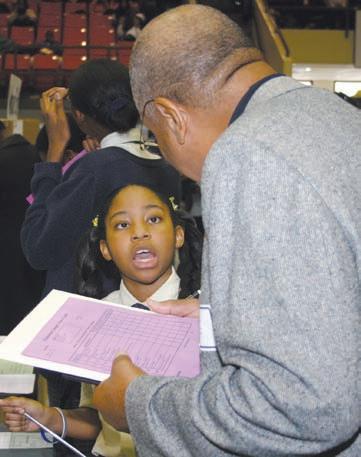
A student explains her research to a judge during JSU’s largest science fair.
By Jessica m u RR ay
New School to Offer Engineering Students a Home
In March 2006, Jackson State University officials broke ground on the School of Engineering building replacing the JSU Baseball Field at the west end of the John R. Lynch Street campus. Still under construction, the field is located on the east end campus.
“If there’s ever been a building near and dear to my heart, it is this School of Engineering building,” said JSU President Ronald Mason Jr. “We’ve had to choose from two or three sites and two or three designs, but now that we’ve gotten started, it’s going to be really hard to stop us.”
By Jessica m u RR ay
This is JSU’s first capital project using money from the Ayers higher education desegregation settlement, said Troy Stovall, Senior Vice President for Finance and Operations. At a cost of approximately $20 million, the project is expected to be completed for classes by fall 2007.
The modern, 90,000-square-foot facility will have wireless communications, tiered classrooms, faculty
and student lounges, a spacious auditorium and high bay laboratories with reinforced concrete floors that allow student to perform sophisticated experiments. An energy-efficient space, the building makes the best use of university resources, said architect Rob Farr of Cooke Douglass Farr Lemons LTD Architects and Engineers PA in Jackson, Miss.
The facility addresses one major concern of JSU engineering students, said Dr. Farshad Amini, Chairman of the Civil Engineering Department. “They’ve said over and over that they need to have access to engineering faculty,” he said. “This addresses their need to interact with professors.”
ciate Dean of Engineering, said the facility also will serve as a recruiting tool to attract potential students.
“This new building will be a catalyst for significant enhancements in the student enrollment of Jackson State University’s School of Engineering,” Whalin said. “This is a really historic occasion for the state of Mississippi.”
Tony Lewis, Vice President of CiVil Tech Inc., said preparing for the construction was more than just another project for his Jackson, Miss.based firm, which is responsible for site development.
Currently, engineering students take classes in the John A. Peoples Science Building and the E.E. Just Hall of Science.
In addition to satisfying current students, Dr. Robert Whalin, Asso -
“It’s like coming home,” said Lewis, a member of the university’s first class of engineering graduates in 2005. With his civil engineering degree in hand, Lewis said he was able to put his education to immediate use.
“It was a direct correlation to my education at Jackson State,” Lewis said. “It just shows the ability of a graduate to go into the workforce.”
Dr. Robert Whalin
Dr. Farshad Amini
Artist rendering of the School of Engineering
Jackson State University officials break ground on the new School of Engineering.
Enters Digital Era in its New Multimillion-Dollar Home
By an T hony dean
From its humble beginnings in the early 1990s as a low-power public television station spanning a mere 12-mile radius around Jackson State University, W23BC (TV23) morphed from a training laboratory into a state-of-the-art digital production center capable of reaching more than 100,000 households in 2006.
When it debuted October 1994 in the small confines of the Blackburn Language Arts Building, the initial goal of TV23 was to provide a practical learning environment for students. Student training began in 1996 with the production of a news segment. The production used the
talents of students from diverse disciplines including political science, biology, criminal justice, dramatic arts and meteorology, in addition to mass communications.
That same year, TV23 received its commercial license and was ready to expand its broadcast day, which began as one hour.
TV23’s first and current General Manager, Judy Alsobrooks Meredith, said a multimillion-dollar deal was only the beginning of the station’s string of successes.
“In 1998, we received a $3 million in-kind contribution from Time Warner Cable, which allowed TV23
to broadcast our signal on its system. This single event catapulted the station’s viewership potential from 29,000 to 90,000,” Meredith said. “We were the first low-power station in the Jackson market to secure a Time Warner channel.”
Currently, approximately 85,000 households in the greater Jackson, Miss., metropolitan area can view TV23’s programming on Comcast analog and digital Channel 61. An additional 29,000 households can view TV23 on UHF analog Channel 23.
In 2001, TV23 became a Major Broadcast Cable Co. affiliate. Today,
Assistant Production Manager Sherwin Johnson gets ready for TV23 special programming.
the company is known as the Black Family Channel. This partnership allows TV23 to maintain a daily 24-hour broadcast schedule. In addition to airing programming from BFC, TV23 also produces local shows of the same quality as a major television network.
They include Tiger Football, the Tevester Anderson Show, Community Focus, The Coach Rick Comegy Show and the critically acclaimed CBS Christmas Special with the Christian Methodist Episcopal Church, which aired nationally and internationally.
TV23’s other victories include state legislative appropriations of $2 million over the 2003-04 and 2004-05 fiscal years for digital equipment and the relocation to the Mississippi e-Center @ JSU. This multimillion-dollar facility is Jackson State’s technological nucleus. Presently, TV23 occupies more than 5,000 square feet of the e-Center.
Meredith said TV23’s new equipment is among the best in the region. The station’s all-digital production control area features a state-of-the-art video switcher complete with multiple 3-D effects, two-channel highresolution motion graphics hardware and software, audio mixer and direct connectivity to a versatile three-camera studio.
Sunny Smith, Mass Communications Instructor and Internship Coordinator at Jackson State, said TV23 has become a valuable teaching aid.
“Digital technology is continually changing in the field of broadcast journalism,” Smith remarked. “As an educator, I’m constantly looking for the best ways to prepare our students for a career in a converging media environment.
“Now that TV23 has made the transition from analog to digital, our students will be able to take what they are learning in the classroom and apply those skills to receive real-world training with the latest technology.”
Smith believes technology forces people to make modifications.
“One downside to learning the new technology is that when some of our students go to internships or first jobs at smallmarket stations, they sometimes find the stations are still shooting or editing with analog or antiquated equipment, so they have to make a few adjustments,” according to Smith.
Smith said the opportunity to train at TV23 allows students to be competitive in the workforce.
Meredith agreed with Smith, adding, “TV23 is poised to make an impact in the Jackson market and beyond.”
Production Manager Keith Collins prepares digital training sessions for students.
TV23 Programmer and Promotions Coordinator Laura Powell lines
By c h R is T ine
d
eG
R a T e
Jackson State University’s Department of Entrepreneurship and Students in Free Enterprise – in conjunction with the Minority Enterprise Development Week Committee and Forest Hill High School’s DECA Program –sponsored the Third Annual Business Plan Competition, “Excellence in Business,” in May 2006.
To enter the competition, undergraduate or graduate students were required to submit an original business venture or idea in existence before 2005. Individuals with financial backing from existing companies, venture capitalists or other investors were prohibited from entering the competition.
This year, 25 students submitted business plans to a panel of judges, which consisted of local entrepreneurs and community business leaders. Each student included in his or her business plan a company overview, a definition of product or services, and an analysis on market environment and competitive advantage.
“Many of our students are entrepreneurs who actually run small businesses without business plans,” said Dr. Mary M. White, Chair of the Department of Entrepreneurship.
Joecephus Martin, a graduate history major from Jackson, Miss., received the $1,500 first-place prize for
his business plan, “This Is Better Because It’s True” Music.
Martin said he plans to create and market a small, independent record label, which will seek to provide listeners with an alternative to the current offerings of hip-hop music.
“My experience presenting my business plan was great,” Martin said. “I met venture capitalist institutions and other local entrepreneurs with great business histories. I’m furthering the business part every day. I think we’re all pretty motivated to see where it goes.”
Martin and teammates intend to introduce their sound to the metro-Jackson area with hopes of generating brand awareness through free music downloads via the Internet.
J Business Students Compete, Cash in on Prizes
The second-place winner was junior entrepreneurship major Jarvis Robinson of Georgetown, Miss. Robinson’s business plan was “Magnolia Media,” a digital multimedia venture.
Charity Stamps, a business administration major of Jackson, won third place for “Elegant Beginnings,” a bridal and event-planning venture.
Robinson and Stamps both received $500 cash prizes. J
Pictured left to right are Dr. Mary White, Chair, Department of Entrepreneurship; Dr. Glenda Glover, Dean, College of Business; and Joecephus Martin and Charity Stamps, business plan competition winners.
College of Lifelong Learning Offers New Bachelor’s Degree Program
In fall 2006, more than 60 adult learners attended classes to receive a bachelor of science degree in Professional Interdisciplinary Studies that the College of Lifelong Learning offers.
Officially recognized by the university in spring 2006, the Professional Interdisciplinary Studies offering is a cohort-based program for adults seeking a nontraditional avenue in obtaining a bachelor’s degree. The degree program boasts flexibility and customized studies for adult learners who desire to earn a bachelor’s degree, or professionals continuing their education.
“This program is a milestone in our development,” said Dr. Johnnie Mills-Jones, Dean of the College of Lifelong Learning. People typically think of continuing education as quilting or flower arrangement courses, not a real degree program.”
The bachelor’s program offers area of study in these three areas:
General Interdisciplinary Studies – A broad range of coursework in communications, humanities and fine arts,
natural sciences, education, and behavioral and social science
Commercial Recreation and Resorts – A specialization preparing students for careers in the casino, convention center, cruise ship, hotel and electronic game room industries
Faith-Based Leadership – A specialization preparing students with skills necessary in leading nonprofit and social service agendas, churches, charities and community organizations.
Jones said the college aims to create a “world” for adult learners that is responsive and sensitive to their needs. According to the U.S. Census Bureau, only 17 percent of Mississippians have bachelor’s degrees. Many adults, who have started college and dropped out because of personal reasons, lack the self-esteem to return and complete coursework for degrees, Mills-Jones said.
Full-time freshman Jeffrey Hardy said he started classes in spring 2006. He enrolled in the program because it offers him options in pursuing a career in education.
“I figured if I ever decide to open a center or work in public schools, I need that degree to back me,” said the 39-year-old Jackson, Miss., resident.
A minister and volunteer at his church, Breath of Life in Jackson, Hardy said the flexible class schedules also were a draw. “Why not do it now while I have the time?”
Dr. Johnnie Mills-Jones (center) reviews dissertation plans with then-Executive Ph.D. candidates, Dr. Danny Hollins (far left) and Dr. Rosemary Watkins (far right). Also pictured are staff members Dr. Carolyn Mack (second from left) and Dr. Dyan Melton.
Dr. Johnnie Mills-Jones
By e ddie L. B R own J R .
Prater Leads by Example
By Tommiea P. Jackson
As head of Jackson State’s College of Public Service, Dr. Gwendolyn Spencer Prater constantly searches for profound ways to teach students, while searching for innovative ways to attract and retain top-notch faculty and staff.
Prater leads a team of more than 100 faculty and staff and about 700 students through challenging academic programs aimed at empowering people to improve their lives.
But she reaches outside of the boundaries of her cozy office and classroom setting to touch lives on a more personal level. Perhaps it is Prater’s personal story that serves as one of the most important lessons she’ll ever teach.
Once a professional social work-
“I cannot imagine my life without Djenaba. She’s definitely one of the greatest joys of my life.”
Dr. Gwendolyn Spencer Prater
er who aided foster parents and children in need of happy homes, Prater and her husband, Dr. Wesley Prater, decided to open their hearts and home to a child.
“My husband wanted a large family, and I certainly didn’t plan on doing it the regular way,” Prater said jokingly.
After nearly 10 years of marriage and busy educational pursuits, the Praters were ready to start their family.
In the spring of 1978, the couple became adoptive parents to an infant, Djenaba Ain Prater.
“Djenaba means ‘affectionate,’ ” the proud mother said with a smile. “Ain means ‘precious eyes.’ ”
It was one year before the adoption was final, but Gwendolyn Prater says the process was not as complicated as many may think. It has been a decision she never regretted.
“I cannot imagine my life without Djenaba,” Prater said. “She’s definitely one of the greatest joys of my life.”
While some adoptive parents choose not to disclose the details of their child’s parentage, the Praters told their daughter early. Professionally, this mom knew that was best.
“It was not something I wanted to keep as a family secret,” said Gwendolyn Prater, the mother of two, in-
cluding a biological son, Wesley Spencer Prater, who is a 2004 JSU graduate. “The child will find out some way that he or she is adopted. We wanted to be the ones to tell her. She had a right to know.”
Djenaba Prater doesn’t remember the first time her parents informed her about her own adoption. It’s something she’s always known.
“When I was about four or five, my mom would read to me a book about an adopted child,” said Djenaba Prater, 28. “I’ve really always known, and I’m glad they told me.
“I remember my parents would tell me that God made me for them, that they were destined to be my parents. They said they saw me and knew I was supposed to be their
Djenaba Prater poses with her mother, Dr. Gwendolyn Spencer Prater.
daughter.”
Not only did the Praters make sure their daughter knew about her adoption, they supported her efforts to find her biological mother. As a JSU freshman, Djenaba Prater
“If it weren’t for my parents, I wouldn’t have a family. I would be happy to take a child into my home.”
Djenaba Prater
became interested in her biological family’s health history. But she wasn’t ready to search for them.
At age 21, Djenaba Prater began communicating with her biological mother.
“To me, it was never about trying to find her to establish a relationship,
I just wanted to know who and where I came from,” said Djenaba Prater, a Research Assistant with JSU’s Office of Strategic Initiatives. “I thank God for making Wesley my dad and Gwen my mom. They are my parents!”
Gwendolyn Prater’s personal experience has helped her professionally. She can speak with a heightened sense of authority, having been involved in the system.
A professional social worker and adoptive mother, Prater knows first hand the struggles of families and children in need. These experiences also spurred her interest in child welfare, encouraged her to write several articles on the topic and apply for grants that help to prepare students for careers in child welfare.
The community needs well-informed professionals to teach families about the possibilities of adoption, said Linda Jones West, Founder of Mississippi Families for Kids.
“Traditionally, the adoption system was not for African Americans;
therefore, many African Americans were not familiar with the options,” said the adoptive mother and JSU alumna. “We did more relative adoption and simply took in children. But we have to work harder to let these families know that these children are available for them to adopt. Adoption could be a great opportunity for African-American families to offer a child a permanent home.”
Djenaba Prater needs no convincing. There is no question that she will consider adoption when she is ready to begin a family of her own.
“If it weren’t for my parents, I wouldn’t have a family,” she said. “I would be happy to take a child into my home.”
Again, Dr. Gwendolyn Prater leads by example.
“You love the child just like you would had you given birth to that child,” she said. “It’s like you give life through adoption. No matter how a child comes into your life, you love them.”
The Praters pose for a family photo in 1981. Pictured are (left to right) Djenaba Prater, Dr. Gwendolyn Spencer Prater, Wesley Spencer Prater and Dr. Wesley Prater.
JSU Students Spend Spring Break Helping Hurricane Survivors
During the 2005-06 academic year, students provided more than 30,234 hours of service to the community, including the alternative spring break efforts and individual and group service hours.
Instead of basking on warm sunny beaches and hanging out with friends during spring break 2006, a group of about 60 Jackson State University students headed to the Mississippi Gulf Coast to assist residents still recovering from Hurricane Katrina.
What they found and what they did changed their lives and made a profound impact on the people they helped.
“The most significant impact of this alternative spring break trip,” said Valerie Shelby, Director of JSU’s Community Service/Service Learning Center, “is that the students were able to address real and immediate needs, and we could actually see the difference we were making.
“We’ve addressed social issues before, but not like this time when people were so traumatized and displaced,” Shelby added.
Fentry Richards, a student on the weeklong trip, has given up her “regular” spring break for the last two years. She chooses the alternative break activities because she believes they are good things that combine volunteerism, education and cultural awareness.
“The experiences are very rich, something money cannot buy,” said the graphic design major from Canton, Miss. “The value we get is the joy of giving of ourselves to help make a difference for people who, at the time, are less fortunate than us.”
Richards was with the group that spent March 13-17, 2006, in Harrison County outside Biloxi doing light construction, replacing walls and sheetrock in various homes, helping restock a church-sponsored soup kitchen and assisting in a makeshift health clinic. They also raked yards, cleared debris that still littered many areas, and washed and sorted donated clothes.
Whatever tasks needed to be done, students were
willing to do them to help bring a sense of normalcy to people they would remember for a lifetime.
The students connected with the victims of the disaster so much that they returned for a week in late April 2006 to continue their community-service efforts, Shelby said.
The group felt more time was necessary to assist the church and community, she added. “They were so passionate about doing more, so we wanted to make it happen.”
The Prince of Peace Baptist Church housed the students during both visits, some in tents on the church grounds and others in the limited confines of the church.
“When I first got to the Prince of Peace Baptist Church,
By s y L via T. w a TL ey
Students from Jackson State University’s 2006 alternative spring break include (front row) Brittany Brewer, Crystal Jackson, Ashley Pearson and (back row) Marqueus Draper, Shayla Grimes and Calvin Tucker.
I was skeptical about sleeping in the tents,” said Ashley Pearson, a finance major from Milwaukee, Wis. “Then I realized people had been sleeping in tents for several months, so surely I could do it for a couple of days.”
Pearson was one of the students who crammed for exams and completed assignments to be able to make the return trip. “There is so much devastation on the Coast, and more students should go because you have to see it to understand the total devastation,” she said.
The pastor, the Rev. Darrell Taylor, coordinated the outreach efforts with Shelby and provided inspiration to the students and others on the trip. He also provided a first-hand experience of what residents still were facing more than six months after Katrina.
“I think it’s great that the students from Jackson State University came to help people who really have a need,” Taylor said, “instead of spending their break doing other things.”
Taylor also said the students’ return touched him.
“I believe some students might have come the first time because they felt it was the right thing to do, or maybe because of an academic requirement they had to fulfill,” the minister said. “But this time, they returned with a sense of mission.”
Taylor added that the JSU students were the first from a public university to come to assist in the church’s effort to help people in Ocean Springs, Wiggins, Gulfport, Biloxi, D’Iberville and St. Martin put their homes back in order.
During the March trip, one elderly woman, known to the group as “Miss Sadie,” called the Jackson State students her angels when they gutted the interior walls of her mildewed Biloxi home. The students heard the story of devastation this woman experienced, and were in-
spired by her joyful spirit.
For the Rev. Ray McIntyre and his wife, Sheila, of Biloxi, a couple of the people who painted the inside walls of their house were then-Student Government Association President Kimberly Hardy, along with her sister, Klarissa Hardy, then-Miss Jackson State.
“After having seen news reports during and immediately after the hurricane, I wanted to join my fellow students to do all that I could to lend our helping hands in service, and to provide some relief to the victims of the disaster,” said Klarissa Hardy.
Rev. McIntyre, so moved by the students’ presence, gathered the group in the street in front of his house, where they joined hands and participated in an impromptu singing, praise and prayer service before they departed.
Marqueus Draper, one of the students who assisted a Biloxi senior, said he was touched by her gratitude for the simple tasks they did, including cleaning debris from the yard.
“What struck me most was how grateful she was. She put emphasis on being thankful even though she was a Katrina victim,” said Draper, a graphic design major from Jackson, Miss. “I was there because I felt obligated to come. These are my neighbors on the Gulf Coast.”
In addition to serving the victims of the Aug. 29, 2005, storm, students also visited the Emergency Operations Center of the Federal Emergency Management Agency in Kiln. They also went on a guided tour of heavily damaged areas in Pearlington, Waveland and Bay St. Louis as an educational component of the trip. The Department of Homeland Security’s FEMA Mitigation Section in Biloxi made the tour possible.
Shelby said the trip touched the hearts of the students as well as group facilitators.
“This was good for our students, many who have not seen real devastation,” Shelby said. “They were able to help people whose lives won’t come together unless they receive some outside support.”
A JSU student volunteers on the Mississippi Gulf Coast to assist residents with debris cleanup after Hurricane Katrina.
Calvin Tucker, Dr. Zachariah Gaye, Jamaal Jackson, Marqueus Draper, Crystal Jackson and Brittany Brewer remove debris near Prince of Peace Baptist Church in D’Iberville.
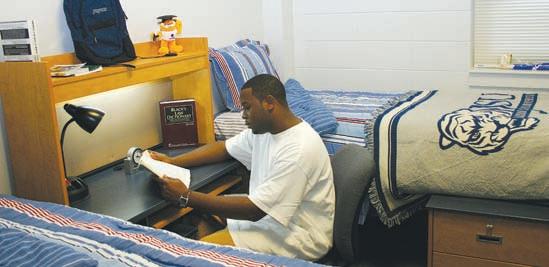
RESIDENTIAL LIfE G ETS Up GRADE
Residence halls at Jackson State University are going from the traditional two-person rooms to modern bedroom suites. One recently was constructed, another is being built, and one of the university’s oldest residence halls, was completely renovated. Approximately $25 million in bond and state-issued funds made the projects possible.
John W. Dixon Hall, located at John R. Lynch and Prentiss streets, received major upgrades when it opened in spring 2006. The renovations, designed by Dale and
Associates Architects PA and completed by Harrell Construction, both based in Jackson, Miss., were so impressive that the residence hall won the 2005 Mississippi Association Builders and Contractors Excellence in Construction Award as one of the state’s most significant construction projects of the year.
The exterior of the building has new landscaping, shrubbery and a brown two-tone brick pattern. When students enter the building, a glass-wall foyer stands as they pass the reception counter on the left, and a kitchenette with a small range is to the right. Four large washers and dryers are in the laundry room close to two stainlesssteel elevators.
“We took a residence hall that had seen very little renovations in the past 40 years and totally remodeled it,” said Wayne Goodwin, JSU’s Assistant Vice President for Facilities and Construction Management.
Prior to renovations, the residence hall had no cooking area, and students used the campus-wide laundry facility. Previously, students put garbage in a large trash can in the hallway. Now garbage chutes on every floor of Dixon Hall make garbage disposal easier.
As students enter the hallway and their rooms, blue carpet has replaced white tile. The residence hall has 151 rooms, and each level of the seven-floor building has suite-style living quarters. The suites have two rooms and
Newly renovated John W. Dixon Hall at John R. Lynch and Prentiss streets accomodates male students.
Campbell Suites
a shared bathroom.
The original Dixon Hall was not arranged suite-style and had two community showers on each floor. Four students are in each suite, which places two people in each room. Each room is outfitted with built-in closets and new furniture. Also, Dixon is no longer for freshman males. The building now houses junior, senior and graduate male students.
Darrien Billups, a mass communications major from Arlington, Texas, and one of the first occupants in the renovated Dixon Hall, said all the residence halls have greatly improved.
“Things have changed so much since I got here in 2004,” he said. “Once they open up the new apartment suites, things are going to be on another level.”
Billups referred to another residence hall, Campbell Suites, which is expected to open in fall 2007. The building is located next to the Dining Hall and is named for a former Jackson school called Campbell College. The residence hall will house up to 442 students and have the option of two-, three- or four-bedroom suites in up to four different color schemes. Also fully carpeted, each suite will include a bathroom, hotel-style locks/security system and a vanity area. The building will have fully furnished community kitchens, study rooms and a laundry facility.
Goodwin said students who make good use of their electricity allowance will be rewarded.
“They will get back (what they don’t use) as a refund for managing the use of electricity,” he said.
Housing Director Vera Jackson is pleased with the department’s new location in Campbell Suites and the overall changes in student housing. “It’s the wave of the future for residence life.”
Impressive as they are, Dixon Hall and Campbell Suites aren’t the only changes. New to residence life at JSU are Transitional Halls I and II. The building was completed in 2005 and also has suite-style living quarters. Both currently house upper-class female students.
Meanwhile, in addition to those residence hall changes, Jones-Sampson Hall, which houses male students, will be renovated to become office space. The hall is expected to be ready for use in spring 2007.
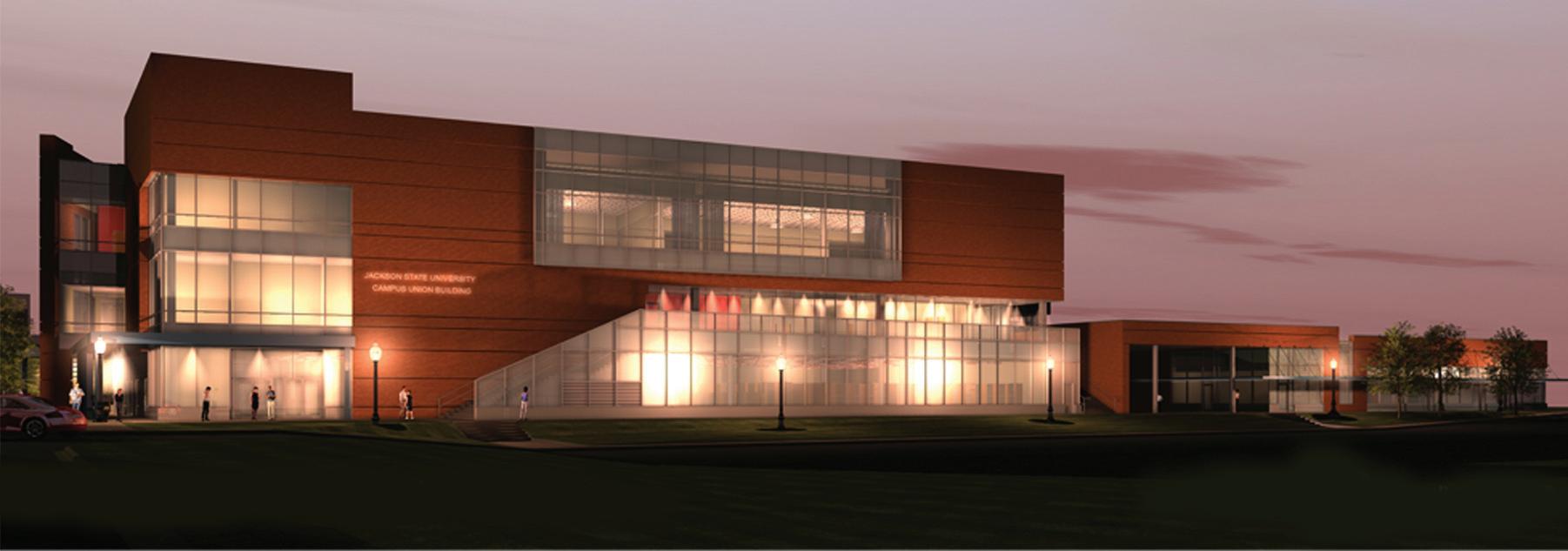
• dining hall
• bookstore
• study lounges
• computer/Internet stations
• student government and organization offices
• Jackson’s only 250-seat theater
• ballroom
• convenience store
• bank
• Subway restaurant
• barber and beauty shop
• meeting rooms and administrative offices
At 125,000 square feet, the $24.5 million facility at the corner of John R. Lynch and Dalton streets is set to open in February 2008.
Ronald Whaley, a finance major from Altanta, Ga., enjoys suitestyled rooms among other amenities.
Special offerings include:
JACKSON STATE UNIVERSITY’S PLANNED CAMPUS UNION BUILDING
Comfortable New Space Improves Campus Safety
Staff members of Jackson State University’s Department of Public Safety have the stressful task of keeping more than 10,000 students and employees safe.
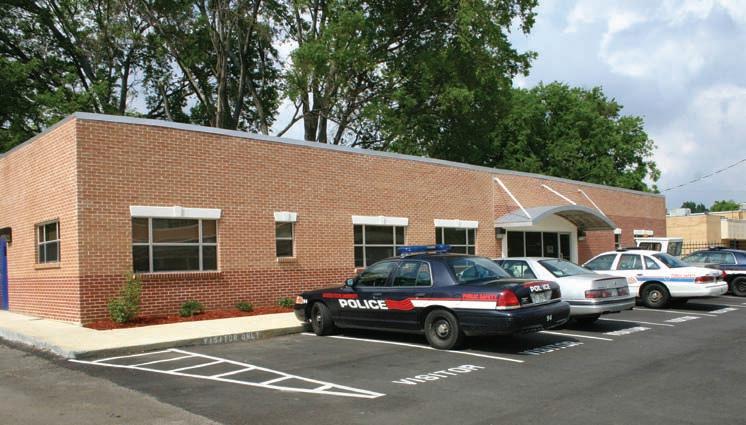
However, that job recently has become easier and aesthetically pleasing now that the department has relocated to a new facility near the Liberal Arts Building.
With nearly 1,000 additional square feet, the 2,656-square-foot headquarters on the east corridor of John R. Lynch Street has 12 rooms, including a lobby, conference room and separate evidence room.
“The space and location are improvements for us in comparison to the trailer we were in,” says Lt. Thomas Albright.
“Previously, operations for campus safety were centralized but cramped in a 1,733-square-foot trailer located behind the campus cafeteria.
“Our staff could barely fit in the room we held our meetings in, and
we had to maintain evidence and equipment in cabinets,” Albright says.
Patricia Stevens, a Dispatcher, says the new location takes the edge off the department’s normally stressful job of protecting the JSU community.
“We have more space to do the things we need to do and the atmosphere is a little more relaxed,” Stevens says. “This setting is simply better.”
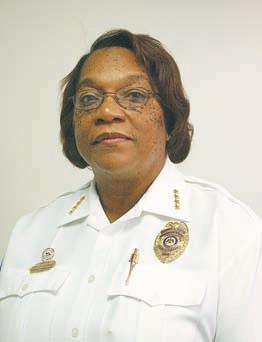
Under the leadership of Chief Rebecca Coleman, the Department of Public Safety has 70 staff members, which include 28 police officers, 22 security officers, two investigators, a command supervisor and several contractual security guards.
Despite public perception that urban areas are naturally crime-infested, Coleman and staff have reported a 12 percent decrease in all incidents reported on the campus, down from 1,323 in 2004 to 1,158 at the end of 2005.
Campus thefts and index crimes both have decreased by 7 percent, with theft down from 246 to 228, and index crimes down from 243 to 226. Index crimes are felonies
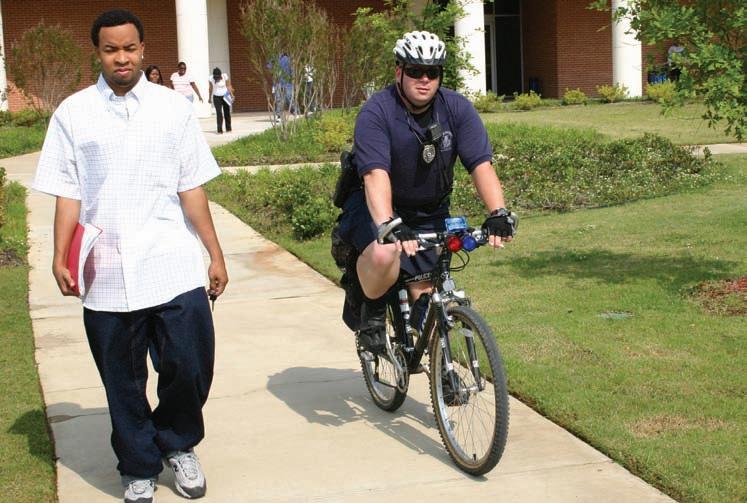
Bike Patrol Unit Officer James King (right) makes his campus “rounds.”
JSU’s new Department of Public Safety building is located on the corner of Dalton and John R. Lynch streets.
By e ddie L. B R own J R
including rape, sexual battery, robbery, aggravated assault, burglary, auto theft and arson.
This is not the only year Coleman has reported decreasing numbers in crime. In compliance with the Jeanne Cleary Act, JSU submits an annual report of illegal occurrences on campus to the U.S. Department of Education. The federal law requires colleges and universities to disclose certain timely information to members of the campus community about crime, and annual information about campus crime and security policies.
In 2003, JSU reported 42 incidents of burglary, a common crime on college campuses. In 2004, that number decreased to only 17 incidents – a 60 percent decrease in burglaries on all JSU campuses, including the Mississippi e-Center @ JSU, Jackson Medical Mall and the Universities Center on Ridgewood Road.
“Our staff is committed to the mission of the Public Safety Department,” Coleman says. “There is truly a heartfelt commitment by the employees in this department to the safety of our students and all who frequent our campuses.”
Coleman notes that students are beginning to take a more active role in campus security initiatives and using preventative measures in deterring crime.
“We have a partnership with our students,” Coleman says. “They want to be safe and we want them to be safe.”
Students majoring in criminal justice gain experience while helping to keep their campus safe by volunteering to serve as Tiger Patrol escorts. Sponsored by the department’s Crime Prevention Unit, Tiger Patrol escorts are available to walk with students from commuter parking lots, dormitories and buildings between the hours of 6 and 10 p.m.
“We are, in a way, extra eyes and manpower to
our campus police force,” says David Fletcher, a criminal justice major from Yazoo City, Miss.
With plans to pursue a career in law enforcement, Fletcher will use experience gained from Tiger Patrol to satisfy practicum studies, a requirement for graduation.
“We don’t get paid, but you can’t put a price on experience,” he says.
Joi Robinson, a student from West Point, Miss., also likes the idea of Tiger Patrol. She says her key to staying safe always has been to walk with someone when out at night.
“I’ve never had anything to happen to make me feel unsafe at Jackson State, even with the shooting (in fall 2005),” Robinson says. “I always tell myself that a crime can happen anywhere, even Northpark mall.”
It is important for students to take preventative measures, Coleman says.
“We partner with our students through crime prevention seminars and presentations,” she says.
“Because they know what to look for, they take more of an active role in making us aware of things that could potentially lead to a crime.”
Coleman also cited the close working relationship between the Department of Public Safety at JSU and the Jackson Police Department as reasons for the decrease in crime.
“We work very closely with JPD,” Coleman says. “If we have a problem with an area adjacent to or surrounding the campus, we let them know, and they increase visibility.”
Lee Vance says working with JSU’s Public Safety Department has been a good experience.
“Most of us here in command positions remember when Chief Coleman was a high-ranking official with JPD,” says the Precinct 2 Commander.
“Over the years, we have learned a lot from her and we know her well. The level of professionalism in JSU’s department has definitely elevated under her leadership.
“She has been a role model for many of us. We look forward to continuing our support of JSU from a public safety standpoint.”
Public Safety Dispatcher Andrea Latham enters shift data into a computer system.
Chief Rebecca Coleman
the Love of My Heart, Lest I Forget
“Education either functions as an instrument which is used to facilitate integration of the younger generation into the logic of the present system and bring about conformity, or it becomes the practice of freedom, the means by which men and women deal critically and creatively with reality and discover how to participate in the transformation of their world.”
This was the central philosophy of Paulo Freire, Brazilian educator and influential theorist of education.
As a member of this diverse intellectual community, I have learned that to cooperate with life, you must learn how to forgive, to pray, to give, to receive, to adjust – seeking nothing, giving everything, loving all people, trusting God, living each moment fully. On August 28, 2003, I became! On this day, I became what God called me out to be. On this day, I became a part of a legacy of greatness, entrenched in blue. On this day, I was introduced to Jackson State University, and JSU was welcoming in introducing itself to me. On this day, I found love that came unexpectedly. Jackson State University is indeed the love of my heart, lest I forget?
Faith, hope, dreams and firm beliefs were planted on these hollowed grounds. It was here that I sought freedom and found my way. On these grounds, proclamations of dignity, selfhood, freedom and equality were made. You see, there is an incessant stream that flows through this urban educational edifice. It’s love! The legacy of love permeated through this university is embodied in the young black minds whose hopes for higher education were realized as the seeds of Jackson State University, planted nearly 130 years ago and by all who came by JSU’s way. The legacy of love is evident in the travelers through this institution: Lottie Thornton, John Peoples, Walter Payton, Roderick Paige, Bennie Thompson, The Class of 1970. Lest I forget why I love JSU?
Lest I forget the influence of my education? The anxious tears I cried when I set foot on this foreign land? The life experience learned that gave me stories, testimonies, messages of hope to proclaim to all of my Tigers in blue and beyond? Lest I forget the unconditional love that anyone in love has to bear even when it gets tough? Lest I forget what this love has birthed? A complete human being that has been, as Dr. Janice K. Neal-Vincent states, “Educated for life, not for the moment.” I have grown into knowledge, wisdom, insight, choices, decisions, consequences, aspirations, circumstances and the favor of God: I now have a testimony! A revelation Jackson State Uni-
versity has been to me in the black college experience, a revelation of love!
One thing matriculation at Jackson State University is sure to teach is that love isn’t always easy. It requires patience, endurance, longsuffering and compassion. And like those ferocious Tigers of old have demonstrated, it most of all requires a commitment. At the core of this commitment stands a belief that the academy is only as good as the members within it. As a member of the Jackson State University academic community, I have been afforded the benefits of tradition, learning, nurturing, service, accountability and love. Becoming Miss Jackson State University now grants me the opportunity to give back to an academy that has significantly enriched my life, as well as continuing the legacy of service to ensure that those who follow may become benefactors of a rich society, a society that is representative of love.
You see, the roots are strong, but the history provides strength, respect and understanding. And we, students of Jackson State University, whose minds are being challenged and whose lives are being changed, are filled with passion and duty. We give strength to the roots, life to the tree and greatness to the world! We must remember the history of love that Tigers before us have demonstrated and strive to exhibit our own. We must love and never forget! J
Courtney S. V. Rutledge, Miss Jackson state University, 2006-07
Student’s Book Encourages Readers to Dream
By eR ica Jo R dan
Poised and modest, Zundra Bateaste thinks of herself as being good at many things, but not an expert at any.
The single mother of a 4-year-old son also is a singer, pianist and sports fan who lives by the motto: “I dream; therefore, I am.”
“I can sing, but I’m not a recording artist; I can play the piano, but I’m not a famed musician; I am intelligent, but never valedictorian,” says 26-year-old Bateaste.
Despite her qualities and skills, none of these things inspired her to write her first novel, Nothing Short of Amazing: Truly Awesome.
In spring 2004, when her English professor asked her to write about a downfall, Bateaste didn’t know how to tackle the assignment. So she went to her professor for guidance and told him that she thought of herself as being well-rounded in many areas. She also said she was good at many things, but not spectacular at anything, making this probably her biggest downfall.
The professor then advised her that it was impossible to be wellrounded in many things. He went on to name different areas, but Bateaste had succeeded in them all. He then asked her if she ever had written a book. She told him she had written a book mentally years ago, but she never put it on paper. The professor explained that without taking the necessary steps, her dream would never become a reality.
With determination and discipline, Bateaste met the challenge and went on to complete her book within six months. Nothing Short of Amazing: Truly Awesome, published on Feb. 9, 2006, by BookSurge LLC, is a book filled with fantasies and dreams, and details how a single mother finds
her place in life.
Bateaste not only inspired her readers, she also gave them hope to keep dreaming, says single mother Lakesia Watkins.
“The book encouraged me not to settle but to keep dreaming that anything is possible,” says Watkins, 26, a JSU alumna. “Fantasies are not silly and can lead you to much better things.”
When asked how she felt about her finished product, the word “ecstatic” was Bateaste’s description of joy.
“What was in my head flowed out perfectly. I believe it was Kanye West who said, ‘I feel like God wrote this; I’m just here to quote this.’ Some people have one good thing that they can do, and therefore they spend all of their time perfecting it and they become famous or rich or whatever. But I feel being well-rounded makes me more open,” explains Bateaste.
Bateaste is grateful for the many family members and friends who made positive contributions in her life, which led to this accomplishment. But her ultimate dedication was to her son, Jaidon.
“He has been my light in life as well as in my book. He gave me the courage to press on and the motivation to finish when I felt I couldn’t go any further. He has always been the light at the end of my tunnel.”
She also thanks her book’s main character, 33-year-old Merek Dubblin, for his personality, spirit and pleasant disposition.
Bateaste will receive her master’s degree in epidemiology from JSU’s School of Public Health in December 2006. She also is pursuing a medical degree in forensics pathology from the University of Mississippi Medical Center in Jackson.
Her next step in life is to attend at least four Philadelphia 76ers games as a VIP and to “just celebrate and enjoy life to the fullest.” But her ultimate goal is to be the best parent possible.
Bateaste’s grandfather always told her to “listen a hundred times, ponder a thousand times, speak once,” says Bateaste. Her grandfather’s words helped her to make wise decisions during difficult times. “Words are very powerful, so you have to make them count!”
Short of Amazing: Truly Awesome can be purchased online at Amazon.com or at the Jackson State University bookstore. J
Zundra Bateaste
By c ons T ance
With the cost of higher education increasing for both students and institutions, Jackson State University has embarked on its most ambitious fundraising campaign ever. The goal of “The Campaign for Jackson State” is to raise $50 million for student financial assistance, faculty and staff development, and program support.
“‘The Campaign for Jackson State: Challenging Minds, Changing Lives’ is an empowering campaign that will weave its way into the annals of JSU’s already rich history of change and evolution,” said President Ronald Mason Jr. “This is Jackson State’s single-most significant fundraising effort in the history of the institution.”
Before The Campaign for Jackson State, the Vision of Excellence Capital Campaign was the largest in the university’s history. It raised a total of $11.2 million, surpassing the campaign’s $10 million goal. That campaign began in 1984 and ended in November 1988.
The Campaign for Jackson State has been in its silent phase since summer 2004 and will end in 2010. So far, the university has secured a total of $16 million in gifts and pledges.
The university launched the strategic campaign to gain support for its students, prospective students, faculty, staff and programs.
Many students have the desire to attend Jackson State, but lack the
financial resources. In 2004, nearly 500 of the 8,000 registered students left the university because they could not afford to stay in school, and JSU could not afford to help them.
The three priority areas of the campaign are $20 million for student financial assistance that will support scholarships and book awards; $20 million for faculty and staff development initiatives, including endowed chairs, endowed professorships and support for professional development; and $10 million to support the various programs of the university.
“In five years, we will have programs that will benefit the 21st century. We will have endowed faculty positions and scholarships for our students,” said Barbara Blackmon,
co-chairwoman of the campaign. “We are in a technological world and a very competitive world. Our students have to compete not only in the state of Mississippi, but across this country and throughout the world.”
There are 40 cabinet members, including President Ronald Mason Jr.; Leland Speed, JSU Development Foundation Inc.; Barbara Blackmon, Blackmon and Blackmon PLLC; Dr. Wallace Conerly (retired), University of Mississippi Medical Center; James Barksdale, Barksdale Management Corp.; Mike Espy, Mike Espy PLLC; Dr. Roderick Paige, former U.S. Secretary of Education; and Dr. Tonea Stewart, Alabama State University.
LaToya Rembert is a 2006 graduate.
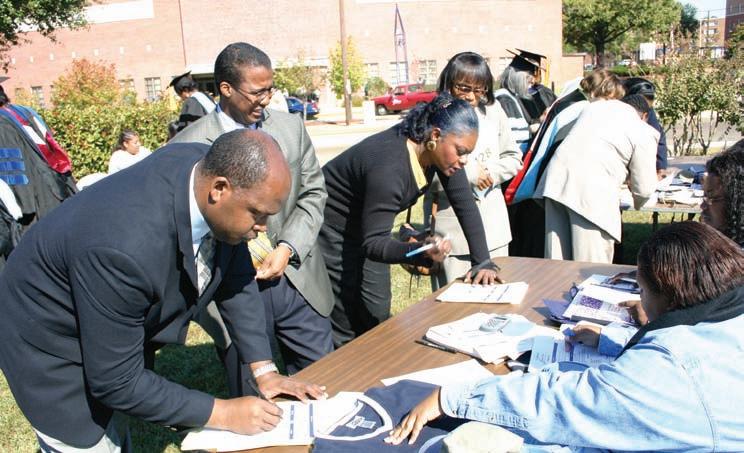
Christopher Reed, Alfred Carter, Elma Wade and Claudette Anderson make their commitments to the campaign.
Lawson
10? S
TEN Questions
Name: Keisha Stokes Age: 21
Keisha Stokes continued a long family tradition at JSU. Maternal grandfather Roy Cooper earned a bachelor’s (‘50), master’s (’74), specialist (’84) and golden diploma (’00). Paternal grandmother Josie Stokes earned a bachelor’s (’59) and master’s (’78). Her father, Jackson City Council member Kenneth Stokes, was born in the Hubert Health Center on campus and earned a bachelor’s (’78). Mother LaRita C. Stokes earned a bachelor’s (’80). Older brother Keith Stokes earned a bachelor’s (’98) and master’s (’00).
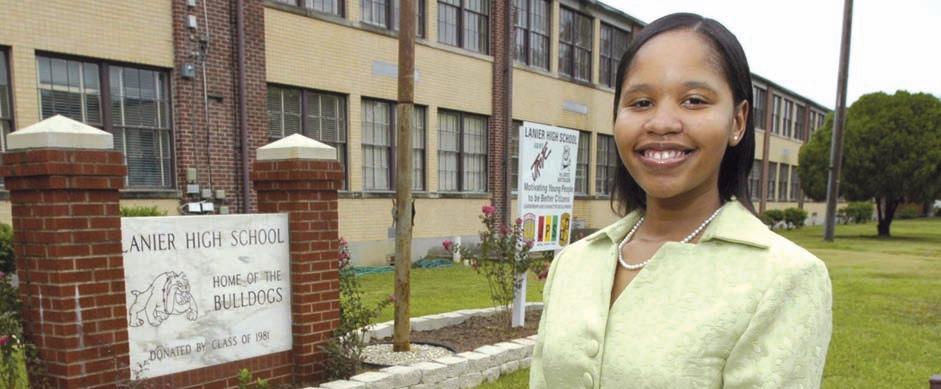
Keisha Stokes, the 2006 valedictorian at Jackson State University, also is a graduate of Lanier High School in Jackson, Miss.
1. Jacksonian: Were you always a top student?
Stokes: Throughout my educational progression from Christ Missionary and Industrial College High School, Brinkley Middle School and Lanier High School (all in Jackson, Miss.), I always have excelled academically. However, I never truly immersed myself in my own education until I came to JSU.
2. Jacksonian: Why did you choose Jackson State?
Stokes: I always knew I would go to JSU. As a child, I was a staple at Tiger football games throughout the country. Jackson State is truly my family university.
3. Jacksonian: You were only 20 when you graduated. Did you finish high school or college early?
Stokes: I completed my bachelor of science degree in history at JSU in three years.
4. Jacksonian: What stands out in your mind as your best moment at Jackson State?
Stokes: My favorite JSU moment was my Alpha Kappa Alpha Sorority Inc. probate in 2005, which was the last AKA probate on the original Gibbs-Green Plaza.
5. Jacksonian: What will you miss the most?
Stokes: I will miss learning, studying and socializing in such a nurturing environment.
6. Jacksonian: Why did you decide to go to Harvard Law School?
Stokes: Both of my parents are lawyers, so I always considered going to law school. After weighing my options, I chose Harvard because of the wealth of opportunities available to me during and after law school, its international reputation and the commitment of the administration, faculty and student body to public service.
7. Jacksonian: Why do you want to return home after college?
Stokes: I want to return to Mississippi so I can use the knowledge and experience that I gain in law school to improve the lives and conditions of the communities whose support paved the way for my success.
8. Jacksonian: What are your career goals?
Stokes: Although I am still figuring out the details, I will definitely commit my life to service and education in the black community, whether as a civil rights attorney, HBCU president or politician.
9. Jacksonian: What are the biggest challenges facing today’s black college students, and what can be done to overcome them?
Stokes: Many question the need for colleges that traditionally served African-American communities in a segregated past. To ensure our survival, HBCU students must not only excel in traditional subjects, but also experiment with innovative techniques and diverse educational disciplines, while remaining committed to the progress and development of the black community. Simply put, we cannot afford to be followers; we must rise to the challenge and lead.
10. Jacksonian: What is your advice to graduating seniors and freshmen at JSU?
Stokes: My advice to graduating seniors is to embrace our proud heritage at Jackson State and go forth into the adult world representing your hometowns, state and university in the best possible light. I encourage freshmen to strive for the best in every endeavor. Any dream can be realized. I am a testament to just that. J
Robinson: 55 Years of Passion, PurPose
By e ddie L. B R
When Dr. Dollye M.E. Robinson
escorted me into her office in a building that bears her name, I immediately noticed the passion in her eyes and could tell this is someone who is infatuated with her work.
The Dean of the College of Liberal Arts at Jackson State University welcomes me with a smile as if she were preparing to take me on a guided tour of the campus.
Robinson is a very guarded and careful individual who wisely chooses her words after adequate thought. Keen and poised, Robinson sits comfortably behind her desk, ready to offer her wisdom and insight. In 2007, Robinson will have served the university for 55 years in positions as Band Director, Professor of Music, Accreditation Chair and Dean.
She is aware of her accomplishments and extraordinary feats not only as an African American but as a woman.
ThE “BABY ChILD”
Robinson was born to Israel and Laura Elizabeth Robinson in Jackson, Miss. Her father died on his way to work at the city’s railroad yard when she was only a month old.
It has been said a lady never reveals her age, and Robinson clings to this belief. She quickly outwitted and foiled my efforts in calculating her age.
“Now what year again was it that your father died?” I ask.
“Now if I told you that, I would be revealing my age,” she says, laughing.
The youngest of four children, two deceased, she still refers to herself as the “baby child.”
“I wasn’t the best person in the world as the baby child,” Robinson
fondly recalls. “I figured out how to get things done, especially when it came to not getting whippings. I remember at one point when my mother thought she was about to chastise me with a switch, I just fell out! I remember holding my breath, and she was praying, ‘Lord, this is my baby child. Please don’t take her. I won’t ever do this again.’ I kept holding my breath, and mama never whipped me. I pretended the whole week I was sick.”
“FEMALE TRUMPET STAR”
Robinson says her primary responsibility as a child was to study hard and perfect her musical talents. After graduating as valedictorian of Lanier High School’s Class of 1944, she followed the footsteps of her brothers and sisters in accepting a scholarship to Jackson College to study what she knew best: music. Robinson majored in piano and eventually attended the Northwestern University School of Music in Evanston, Ill., where she received a master of music degree in trumpet and music education, and a doctorate in music history and music administration in 1959.
“I thought I was it,” Robinson says of her frequent late-night gigs and jam sessions around the city of Jackson while a student at Jackson College. “When I started school at Jackson State, I felt I knew everything there was to know. I was a female trumpet star. There wasn’t another female around playing the trumpet. I played in jazz bands, an all-women’s band, male bands.”
Robinson’s full extra-curricular schedule probably would have caused an average student to perform poorly or fail classes, but Robinson
managed to balance her academic and “night” life.
“I never missed class,” Robinson says. Dr. Jacob L. Reddix, the college’s fifth President, made sure Robinson, somewhat a favorite student, had the resources she needed to succeed.
“He gave me a room in Ayer Hall,” Robinson says. “When I finished my late-night gigs, I would come in, shower and go straight to class. I stayed on the Dean’s List. And while all the guys in the band were chasing skirt tails during semester
own J R .
Dr. Dollye M.E. Robinson
breaks, I was in my room studying.”
“ONE TO GET ThINGS DONE”
After Robinson received her bachelor of science degree in 1948, Reddix offered her a position at Jackson College as Band Director, but sensibility led Robinson in another direction. Robinson felt she would not be able to deal with her colleagues because all would be significantly older. “I needed to go somewhere to get some experience,” she says.
In the fall of 1948, Robinson accepted a position at Alexander High School in Brookhaven, Miss., as a Music Teacher for grades one through 12 and Assistant Band Director.
Robinson remained at Alexander until what she calls an embarrassing event motivated a return to her first love and home – Jackson College.
“It was the first time black bands from the state of Mississippi were allowed to march in a parade on Capitol Street,” Robinson says.
“I thought our band (Alexander High School) was the best band in the land. Jackson College had a good band, but consisted primarily of high school students from area schools, like Lanier, who would play with Jackson College’s band during games on the weekends.
“Alexander came to Jackson with 60 pieces and new uniforms. All the black people came from Brookhaven to see us march. When Jackson College came down the street, with only eight people in the band, I was so embarrassed.”
Robinson, the only teacher on the high school’s staff who did not attend Alcorn, always had bragged about Jackson College to her colleagues.
“I thought to myself, ‘Here we have come from Brookhaven with 60 people and Jackson College has only eight people,’ ” Robinson laughs in disbelief.
“Alcorn had 35 people in its band. Even Tougaloo had a band. And I had
to go back to Alexander, because that is where I was working.”
Upon her return to work on Monday morning, she faced “playful” heckling from colleagues. “They would ask sarcastically, ‘Oh yeah, Jackson College, tell me again how many people were in that band?”
Robinson, who later would be known by many as “one to get things done,” says she called Reddix the same night and told him she was ready to come to Jackson College to build a band.
LEADER IN ACCREDITATION
In September 1952, at what had then become Jackson State College, Robinson began her service as an Instructor of Music, Assistant Professor and Assistant Band Director. Dedicated to increasing her musical knowledge, Robinson returned to Northwestern to complete a doctorate of philosophy degree in music in 1966.
In 1969, Robinson who was serving as Professor and head of the Department of Music and the Chair for the Division of Fine Arts. She was appointed by Dr. John A. Peoples, the sixth President of what became Jackson State University in 1974, to lead a committee of her peers in seeking national accreditation for the college’s bachelor’s and master’s degree programs.
Though simultaneously full of pride and humility when asked about her accomplishments, Robinson carefully avoids the word “I,” using “we” instead.
“Our obstacle was that we had to be regionally accredited. Young people don’t understand, at one time, black institutions were not allowed in the regional accreditation process,” Robinson says, referring to the practices of the Southern Association of Colleges and Schools, or SACS, a regional accrediting body for all institutions of higher learning in the 11 Southern states.
“It was a matter of researching
Dr. Dollye M.E. Robinson addresses music majors in the 1960s.
what the requirements were. Once we found out from SACS what needed to be done, we reorganized our faculty members and implemented services for students.”
In 1971, Jackson State College was the first historically black college or university to become accredited by SACS. Robinson later led efforts in securing national accreditation.
“And we have never lost our accreditation,” Robinson adds, as if to make sure an unofficial record was straight.
Later, Robinson was appointed to lead accreditation efforts for each department in the Division of Fine Arts. Then, Robinson, who takes care to note she never has applied or asked for a position once employed at the university, was informed of her appointment as Dean of the School of Liberal Arts, now the College of Liberal Arts, which is in a building that was named for her in December 2001. Robinson says true educators who are dedicated to an institution of higher learning realize their purpose is to prepare students.
“A PERFECTIONIST”
Professionally, Robinson always has embraced her idea of what every educator ought to do. “If you are in higher education, you are supposed to do things a certain way,” Robinson says. “And that certain way is simply better than how everybody else does things.”
Pearl Beck, assistant to the dean,
says Robinson’s attitude and character encourage staff and students to conduct affairs in a professional manner.
“Dr. Robinson is a perfectionist, and I can appreciate that coming from corporate America,” Beck says. “She does not allow young men to wear caps when they come into the office. She definitely doesn’t tolerate loud or boisterous conversation from
students who come in for assistance. She requires everyone in her presence to uphold a certain standard and professionalism.”
When asked about the college under her leadership, Robinson always refers to the College of Liberal Arts as the “College of Culture.”
“We want to be sure we are developing students who are proficient in all the things they do,” she explains, “not just in a given profession, but in the way our students act and talk. Our students should even walk a certain way, being and doing all the things a ‘cultured’ person should. Most importantly, our job and gift to humanity is to put sense in our students’ minds and sensitivity in their souls.”
“STILL
GOING STRONG”
Currently, Robinson enjoys teaching music history, both primary and mandatory for students majoring in music.
“When I go to my classes, I go in thinking, ‘How can I help these students grow today?’ ”
Like most dedicated educators, Robinson says her purpose and fulfillment come from helping her students. “I have been in a professional position at JSU for 54 years now, and I am still going strong. And I will continue as long as I see what I am doing is of value to students.”
When people repeatedly ask her what she does at the university, Robinson simply replies, “I do what I do.”
“That entails helping students and being happy about it,” Robinson says. “I don’t need a lot of outside stuff to make me happy. Some people have to do a lot of other things, I guess, in order to fulfill themselves. I am fulfilled by helping students.” J
Self: I think young professionals in the workforce ought to know themselves. Everyday, I make sure I have done something to help someone – not myself.
Spirituality: I believe in one God; the rest is internal and falls below that or within. I’m not one of those “hallehalle” people. We (siblings) were taught to live in accordance with God’s word. Don’t lie, steal, cheat or mistreat your neighbor.
The modern woman: I don’t think one can give a collective answer on women. Women are women. I do think they need to do what is necessary to raise their families if they have them. Some women can handle the workforce and family. Some cannot. If a woman is able to work and raise a family in a reputable way, more power to her.
Dr. DollYe M.e. robinson on...
Dr. Dollye M.E. Robinson, early 1970s
Cockerham Blazes Trail to Mississippi Legislature
Jackson State University alumna Angela Cockerham made history on November 21, 2005, when she became the first African-American female elected to serve as a Mississippi state representative for District 96.
The district encompasses Wilkerson County along with portions of Adams, Pike and Amite counties in the southwest portion of the state.
“I know that I have been blessed with the talent and abilities to make positive contributions to my community, the state and even the world,” Cockerham says. “In executing my duties as a legislator, I think in terms of accountability and responsibility, and in the best interests of my constituency and Mississippians as a whole.”
David Green, her predecessor who retired, endorsed Cockerham in the special election. She collected 2,158 of the 5,060 votes, or 42.6 percent, defeating her opponent, Holmes Sturgis. She will seek re-election in 2007.
Cockerham’s decision to run came from her vast knowledge of the law and a desire to be involved in the state’s decision-making process.
Cockerham graduated from Jackson State in 1998 with a bachelor of arts degree in English. She also is a 2001 graduate of Loyola University’s School of Law in New Orleans. She is a member of the Louisiana and Mississippi Bar Associations and Alpha Kappa Alpha Sorority Inc.
and the way it affected people.
“Even at a young age, I wanted to know how decisions that others made affected me, whether directly or indirectly, and the impact these decisions may have on my life,” she says.
As a state lawmaker, Cockerham serves on the Fees and Salaries of Public Officers; Investigate State Offices; Judiciary B; Oil, Gas & Other Minerals; and Wildlife, Fisheries and Parks committees.
Cockerham says her experience as an elected official has been wonderful, and the support of her colleagues has been helpful. “I am fortunate to have wonderful constituents and talented colleagues who have made my first year in the Mississippi legislature a memorable experience.”
Rep. Erik Fleming says Cockerham has the respect of her counterparts.
“In the short time that I’ve worked with her, she’s proved to be one of the smartest, most capable legislators I’ve met,” says the 1983 JSU graduate and former Student Government Association President.
“She’s come in right from the start with a sense of professionalism.”
The Magnolia native also believes Jackson State played a vital role in preparing her for the future.
She says she is following the path set forth by her parents, who always were abreast of what was going on in the community, state and the world.
“My parents were always so involved and updated with current events, and they insisted that my brother and I do so as well,” she says.
Cockerham, an attorney at Dowdy & Cockerham in Magnolia, says she always has been curious about the law
“Collectively, the administration, professors and departmental staff at Jackson State University were very helpful,” says Cockerham. “I know that I made the right decision by attending Jackson State, and I received a great education.”
Cockerham hopes other JSU students will follow the path to success.
“Whatever a student’s future dreams may be, I would suggest and encourage that he/she devote time and attention into making those dreams a reality,” says Cockerham. “Even if you do not succeed on the first attempt, do not be dismayed! Stay the course!”
By La s honda d . Levy J
Angela Cockerham, Mississippi state representative
From JSU to Hollywood BLACKMON: Makeup Artist to the Stars
By Gwen c a PL es
“There is nothing more annoying to me than to see a beautiful woman wearing makeup that’s not blended, and you can see where the foundation stops.” This is a quote from Sheila Evers Blackmon, the owner of “Makeup by Sheila” and one of Hollywood’s most in-demand makeup artists.
Her experience in makeup artistry began in 1982 when she arrived in Los Angeles to work for Max Factor as a sales rep. She soon discovered that Max Factor had makeup in various colors, but there was no foundation for dark skin. “I requested that they work on two powders for darker skin tones,” says Sheila. “Eventually, they created a powder that I could wear. I was proud of that.”
After a three-year stint with Max Factor, she decided it was time to venture out on her own. “I remember watching a music special that aired on TV in 1986. It was called Sisters in the Name of Love featuring Patti LaBelle, Dionne Warwick and Gladys Knight,” says Sheila. “For the first time ever, I saw dark women who looked absolutely beautiful and radiant. Their skin was flawless and their makeup was perfect.
“I couldn’t wait to jot down the name of the makeup artist at the end of the show. His name was Rudy Calvo. He is a Costa Rican and one of the most sought-after makeup artists in show business. I called Rudy up after watching the music special. We met for lunch, he became my mentor, and the rest is history.”
According to Sheila, her education paved the way for her success in business. She graduated from Jackson State University in 1973 with a bachelor’s degree in sociology. “I enjoyed going to Jackson State,” she says. “I appreciate the time I spent with the faculty and students, and my activities outside of the classroom. I was one of the original J-Settes. I used to help make up the faces of all the dancers before the football games. We were proud of our dance troupe, and I made sure we looked beautiful when we stepped out on the field.”
In 1986, Sheila enrolled in the International Institute of Skin Care in Paris, France, where she completed six months in the classroom, six months of hands-on training, and became a licensed, certified esthetician.
“I trained on models and learned to develop my own technique for custom blending foundation, which is my specialty.” She received additional training at the Revlon Beauty School in New York City and the Institute of Studio Makeup in Los Angeles.
According to Sheila, she is not surprised that she chose a career as a makeup artist. As a young girl growing up in Chicago, Ill., she recalls a childhood experience. “I always had Barbie dolls, but they didn’t look like me. I remember how I used to use my mother’s makeup to rub on the dolls to make them look chocolate like me.”
At first, Sheila’s dad was skeptical of her decision to become a makeup artist. “I remember him asking me, ‘Can you make money with that?’ The rest of my family, including my four siblings, were fine with the idea, especially my mother. She knew just how much I enjoyed using her makeup to change the skin tones of my dolls. After I started my career, mother said to me, ‘Now, baby, you have human dolls to make up.’ ”
Today, Sheila works from her home in Los Ange-
Sheila Evers Blackmon prepares actress Vivica Fox for a performance.
les and serves as the department head of shows that provide makeup services to celebrities in television, feature films and commercials.
“I’ve done makeup for some of Hollywood’s most popular celebrities like Stevie Wonder, Whitney Houston, Jennifer Lopez, Pauletta and Denzel Washington, Tom Selleck, Mo’Nique and Vivica A. Fox. They know they can trust me to give them just the right touch from my specialized training.”
When asked which artists she enjoyed working with over the years, she replied, “I have many favorites, but I really enjoy working with Stevie Wonder, Pauletta Washington, Tavis Smiley and the cast of Family Matters. They’re like my family.”
In 1993 and 1994, Sheila was nominated for an Emmy for her work on the TV show, Roc Live. “That was an honor because the show was live, and the makeup had to be perfect and exact,” says Sheila. “I couldn’t go back and redo it. I was nominated by the Academy of Television Arts and Sciences because I created the look for Roc Live, she says.
Because of her adept skill in makeup artistry, Sheila is in demand for national print publications, including Ebony, Rolling Stone, Essence, Billboard and GQ. Her television movies include HBO’s The Medgar Evers Story, Introducing Dorothy Dandridge and Cherokee Kid.
“I’m constantly on the go, and although I make it look easy, makeup work is a challenging job because I strive to make non-perfect skin appear perfect,” says Sheila. “It’s all in the technique, but done properly, the results are fabulous.”
Her latest project is the Tavis Smiley Show that airs on PBS. She does makeup for the show twice a week in addition to completing various other makeup jobs worldwide. “I have had some remarkable opportunities in my career,” says Sheila. “I have worked with clients in Africa, Australia, Ghana, England, Switzerland, Morocco and Japan. I’ve also taught creative skin care and makeup techniques through seminars and workshops in Beverly Hills.”
The 54-year-old businesswoman firmly believes in using cosmetics that help complexions appear flawless. “I love Iman, M.A.C. and Fashion Fair Cosmetics,” says Sheila. “Iman and Fashion Fair products are excellent because their foundations are almost perfect color skin matches for African American women. I love the M.A.C. line of eye shadows, blushes and brushes, but there’s work to be done on the foundation.”
Sheila’s Makeup Tips:
1. Start with clean skin.
2. Moisturize.
After 21 years in the film and television industry, Sheila attributes her success to her strong belief in God and her family values. She is the daughter of Charles and Nan Evers, and the niece of renowned civil rights activist Medgar Evers.
3. Blend the foundation completely.
4. Use a powder closest to your own skin tone.
5. Blend the lip liner into the lipstick.
6. Avoid light-blue eye shadow unless you are a professional.
7. Go easy with the blush.
Blend! Blend! Blend!
She was born in Decatur, Miss., while her mother was on vacation visiting her mother-in-law. Following her birth, she and her mother returned to Chicago, Ill., where Sheila was reared until the age of 13. She moved to Jackson with her family in 1965 after her uncle, Medgar Evers, was killed in 1963. Sheila does not have children and is married to Gus Blackmon, an executive at Warner Bros. and the creator of the Judge Mathis show.
Sheila Evers Blackmon applies makeup to gospel artist Yolanda Adams.
Lackey Revels in Recruiting Role
By Tommiea P. Jackson
For years, students in Quitman County, Miss., knew him as the man who brought full scholarships from Jackson State University and always handed the class valedictorian a $100 bill.
“I remember thinking, ‘Now that’s somebody you need to know,’ ” said Robert McNutt Irons, valedictorian of Quitman County High School’s Class of 1995. “You hear those numbers (scholarship amounts) and you think ‘wow!’ ”
A credit officer who earned both a bachelor’s and master’s of business administration from JSU, Irons is one of more than 400 Quitman County students recruited to Jackson State by Dr. Hilliard Lackey III, President of JSU’s National Alumni Association.
Lackey’s long legacy of recruiting students, particularly from his hometown of Marks, Miss., began in 1967. Only weeks after taking his first job at Jackson State, and two years after graduating from JSU himself, Lackey recruited his first student, Sarah Benson Pride.
The third in a family of 17, this class valedictorian knew she wanted to go to college, but she considered attending the nearby Coahoma Junior College before venturing off to a four-year institution. But Lackey
intervened.
“I didn’t know him personally,” she said. “After he came to the school and talked with the counselor at that time, Mr. Rucker, I decided to go.”
As it would for several Jacksonians, Lackey’s Jackson, Miss., home quickly became familiar to Pride.
“Back then, I would wonder how I’d make it financially,” she said, “but I could go to his house, eat or whatever. If I needed anything, he would make it available, and I’ve had several students through the years say
that he did the same for them.”
Pride found the same support from the faculty and staff at Jackson State. “I had some great teachers in the business department. They gave me very good advice.”
After earning a business education degree in 1971, Pride turned that advice into a successful 25-year career as a business education teacher at Quitman County High School.
Like a proud father, and a natural historian, Lackey can repeat the names and life stories of many of
Dr. Hilliard Lackey III, President of the Jackson State University National Alumni Association, poses with his first recruit to JSU, Sarah Benson Pride.
Dr. Hilliard Lackey III’s recruitment efforts span nearly 40 years. Recruits include Tarya Harrell, ’06; Ashley White, ’10; Lackey, ’65; Sarah Benson Pride, ’71; Keonia Smith, ’10; Ashley Chornes, ’10; and Tonia Benson, ’10.
his recruits. But Pride, his first and among his most successful recruits, is one he loves to brag about.
“She was the first person from Quitman County for whom I brokered a scholarship to Jackson State. I always consider that a good thing,” he said.
“When she came back, she and her siblings did positive things in the community and gave scholarships. She helped me with other students over the years and slowly transitioned to the car dealership business. I’m very proud of her and the things she has done.”
As she taught, Pride’s husband, William, began operating a small used-car dealership in Batesville, Miss., with only 12 cars. The business started in 1985 with four employees, including the owners.
The business grew so much that Sarah Pride often spent her evenings keeping the records.
With a new Batesville location in
1996 and a Ford franchise that same year, Pride realized that she would have to leave the classroom for a permanent spot in the office.
“I had to make the decision to come on home,” Pride said, “but it was hard. Teaching was my heart.”
The hard work paid off. The Prides’ business savvy has landed them in the pages of Black Enterprise as one of the top 100 Automobile Dealers in the years 2001, 2002 and 2003.
Their Batesville location, now a Hyundai franchise, includes more than 300 units and employs 26 people.
Lackey looks for other bright students as he returns to Marks every year to speak with seniors. He recruited five from the Class of 2006, but he looks forward to recruiting at least 10 from the Class of 2007. That will mark the 40th anniversary of his first recruit.
Just back from a visit to Madison Shannon Palmer High School,
formerly Quitman County High School, Lackey is sure he will meet that goal.
“I saw some very bright students there,” he said. “I took three of my incoming freshmen and talked to those prospects about Jackson State. We go there to inspire, motivate and inform. It is rarely a hard sale. Jackson State has a lot to offer.”
It means a lot for Lackey to recruit from home, and he does that through actions and financial support. Since graduating from JSU 41 years ago, Lackey has contributed $41,000 to the university.
“I grew up wanting to make a difference,” he said. “I wanted to be something like a liberator. Not in the sense of civil rights, but I wanted to liberate people from poverty and picking cotton and being locked into hopelessness. I felt so good about myself having gone to Jackson State. I wanted to offer that same opportunity to others.” J
Dr. Hilliard Lackey III marches behind Ebony Brown, former JSU Freshman Class President, during the 2005 convocation ceremonies.
Jazz sensation Andre Delano
The time is 6 p.m. I make a call to California, where it is two hours behind. I’m not so sure this is a good time to call after the phone rings five times on my end. “Hello, hello, hello,” the voice answers. We seem to have a bad connection. Modern technology! Finally, he hears me reciprocate his greeting. Then, I introduce myself, even though I feel I already know him.
We’ve been corresponding through e-mails, and I’ve gotten a sense of his personality through listening to his debut CD, Full Circle, which is in heavy rotation on WJSU-FM 88.5 in the Jackson, Miss. metropolitan area and on the Web at www.wjsu.org. The “voice” belongs to sax man Andre Delano (Roberson). Former Billboard executive Darren Strothers calls Delano “the new face of smooth jazz.” Delano was preparing for his trip to Jackson, as the featured performer for the July 21, 2006, WJSU “Battle of the Saxes.”
I smiled as Delano fondly recalled his performance at Cabrini’s Jazz Alley in Los Angeles. His independently produced CD, which was released in June 2005, had been out only a few months prior to this performance. I could hear pride through his laughter when he said, “I stopped to take a breath, and they (the audience) finished singing the lyrics to the second verse of ‘Full Circle!’”
Delano could not have anticipated “they would
singer/songwriter/actor:
JSU Grad a Triple Threat in Entertainment Industry
By Gina P. c a RT e R
be that much into my music.” This was the first time he experienced his lyrics coming back at him while he “was in the process of delivering them.” On his Web site, www.andredelano.com, Delano acknowledges the Cabrini audience for embracing his talent and not asking him to “showcase the art of another.”
Delano expressed thanks to WJSU and Jackson State University for helping develop and promote him as an artist. He especially speaks highly of the Director of Jazz Education, Dr. Russell Thomas Jr., who in 1988 recruited Delano from the famed Lincoln High School in East St. Louis, Ill., also alma mater of renowned trumpeter Miles Davis. Though Delano attended JSU on a music scholarship, he graduated in 1994 from the School of Business with a 3.82, the highest grade-point average in the business school.
While in Jackson, Delano performed before an enthusiastic and energetic legion of fans screaming his name at the Rose E. McCoy Auditorium during the “Battle of the Saxes.” Delano continues to lead a busy life. He balances fatherhood with the promotion of his 2006 Christmas album released in October 2006, performances before sold-out crowds and acting in music videos, television commercials and B movies, without skipping a beat.
One of the times the happily married Delano spoke with me was while he was waiting to pick up his 4-
year-old son from day care. He is daddy’s inspiration and so is his daughter, Makenna, 2. Song No. 10 from the Full Circle CD, “When Jadon Smiles,” shows Delano’s delight in being a father. An ode to his daughter appears on his Christmas album. Delano revealed to me why he dropped his last name, that he has no favorite song on his debut CD, how he wants to be remembered and more.
Gina: You use your middle name as your last name. Why?
Delano: People knew Andre Roberson as a sideman. When I moved to L.A., this was a brand new step for me. I was launching a new CD. I was going to be out front. I believe that with new beginnings, everything should be new. This new title for me as an artist has helped me establish that.
Gina: You have a song on the Full Circle CD titled “Vocalistic.” How did you come up with that?
Delano: A lot of sax players have the yearning to be appreciated much like vocalists are appreciated. We tend to be on stage playing our hearts out, but oftentimes with minimum applause. What I wanted to do is recreate the vocal vibes on the saxophone.
Gina: Was there ever a job you took that didn’t turn out quite like you expected?
Gina: What is your favorite song on the Full Circle CD?
Delano: I don’t have one. They (the songs) are all a part of me. I wrote and produced every song on the album. To choose one song over the other is like saying, I prefer my arm over my leg.
Gina: You and Miles Davis graduated from the same high school, and I understand you performed in a Miles Davis tribute concert in 1989, which was attended by his brother, Vernon, at your alma mater. What do you think about Miles Davis as a musician?
Delano: Miles was an incredible artist. His music set the stage for all the music that was coming out of East St. Louis. Globally, he’s a revered jazz trumpeter. I hope that some point in my career, I can touch as many people with my music as he has.
Delano: (He pauses). When I first moved to L.A., I took a car salesman job at the Jeep dealership on LaBrea Avenue in Hollywood. When I took customers for their test drives, I would always play my demo for them. I may have sold only one Jeep. The payoff was recruiting potential buyers for my CD. This past May, I signed an agreement to have my song, “Funkborne,” featured in a Jeep commercial. (He laughs). Talk about irony!
Gina: Are there any musicians that you tried to model?
Delano: I am a big fan of Sunny Stitt (one of the first jazz musicians to experiment with
an electric saxophone). Early on, he was the guy for me, along with David Sanborn (veteran alto sax master) and Kirk Whalum (tenor saxophonist). I studied them, but didn’t allow myself to get too deep. I think it’s important to study others’ styles, but equally important is to create your own style. I’ve always had that (my own style).
Gina: What do you want people to take away from your music?
Delano: I find that most people can relate to the journey I have been on. Sometimes I felt I was on the journey alone, but the more I perform, the more I realize that people register with what I am doing. I hope people will take away that I am someone who they can relate to — a real person, a real artist with a heart and soul, and that’s where my music comes from. The lyrics of “Full Circle” are my testimony.
“Like no day without a night never wrong without a right in order to know what you’ve got gotta know who you’re not all things instructing thee to build me completely you’ll see and before you know you will go full circle.”
The above lyrics are Delano’s testimony. When Delano speaks about his musical journey, you experience it with him. His passion for his art makes you feel and understand every word and melody of each song on his CD. His success makes you proud he’s a JSU alumnus. Thank you, Delano, for the music. Congratulations on going “full circle.” J
JSU Alum Appointed 1st Black Brigadier General in Guard
By Gwen c a PL es
“I am humbled that the Lord would count me worthy of such an honor. The Mississippi National Guard has made great progress.”
- Brigadier General Augustus Collins
As a young boy growing up in Booneville, Miss., Augustus Collins never dreamed of becoming a soldier. His stepfather and mother, Leroy and Deborah Williams, encouraged him to seek a career that would help him use his talents wisely while giving back to the community.
Heeding his parents’ advice, Collins aspired to be a doctor or an accountant, but it never was meant to be. He was destined for another type of service — a career in the military.
Today, Collins has the distinct honor of being the first African-American Brigadier General in the Mississippi National Guard. The 48-year-old soldier was promoted to the prestigious position in 2005. “It is a great honor,” Collins says proudly, reflecting on his accomplishment. “I am humbled that the Lord would count me worthy of such an honor.”
Collins, who resides in Atlanta, Ga., with his fam ily, credits his promotion to his ability to work with and motivate people. “The Mississippi National Guard has made great progress,” he says. “The fact that (an African American) has risen to the position to be con sidered for the position speaks volumes. Many young African Americans are moving through the ranks and will challenge for these positions of responsibility. I see the promotion as an opportunity to serve more soldiers and the citizens of my country.”
Having joined the Mississippi National Guard in 1977 when he was 19, Collins drew inspiration from his high school football coach.
“After high school, my football coach, who was a member of the Mississippi National Guard, invited me to one of the training sessions to see if I would like it,” Col
“I think this is the path that the Lord laid out for me. As I look back on my career, it appears that He prepared me for each challenge and position well in advance. I am convinced this is where I should be.”
lins explains. “It was such an awesome experience that I ended up spending the entire weekend at the camp. And now I’ve been in the military for 29 years.”
The JSU alumnus is only three promotions away from becoming a four-star general, which is the highest rank a soldier can achieve. “I enjoy my work, and yes, it would be a blessing to be a four-star general,” says Collins, “but right now I’m content in doing whatever the Army wants me to do. I take it one day at a time.”
Collins also attributes his success in the Mississippi National Guard to the encouragement he received from his sixth-grade English teacher, Mrs. Williams. He remembers her saying, “Leon, you can do anything you want to do,” and he believed her. He pursued his quest for a better life by concentrating on his education. Collins graduated from Booneville High School and went to college at the University of Mississippi, where he received a bachelor’s degree in business administration in 1982.
Collins’ immediate supervisor is Major General Harold A. Cross in the Office of the Adjutant General, Mississippi Military Department in Jackson. Cross nominated Collins for the position of Brigadier General in 2004.
“Collins has accomplished so much because he is dedicated to his duties,” says Cross. “He’s risen to these ranks because of his own preparation and qualifications. I’m very proud of him and the job he’s doing. This is a critical time in our nation’s history, and Collins is the right man in the right place at the right time.”
Determined and highly motivated, Collins continued his education at Jackson State University and graduated in May 1993 with honors and a master’s degree in business administration. “I went to Jackson State because I’ve always been a JSU fan,” says Collins. “The university campus was not far from my home, so I was able to drive to my classes.”
When asked about his experience at JSU, he replies, “Overall, I had a good experience. I was married with a family and working for the National Guard, so I commuted back and forth from my home in Jackson every day, but I’m grateful that I had the experience of attending a historically black college/university. I was impressed
- Brigadier General Augustus Collins J
with the faculty and staff because I feel that they care about the students and want them to succeed.”
Collins’ military career has taken him to Panama, Bolivia, Barbados, Honduras, Germany, Bosnia, Kuwait, Amsterdam and Iraq.
He says, however, that his most memorable service was in Iraq because it was his first combat experience.
“I served in Iraq from January 2005 to January 2006,” Collins says. “I had 4,500 men in my command as the Commander of the 155th Brigade Combat Team, but there were more than 6,500 soldiers, sailors, airmen, marines and civilians in our area of operation.”
Collins’ combat team was instrumental in helping to rebuild schools, playgrounds and even soccer fields. “It was difficult being away from my family for a year, but we did a lot of good there. I feel that if the U.S. hadn’t taken action, the insurgents would have taken over. They still have a long way to go to stabilize the government, but the common people in Iraq really appreciate the work of the troops.”
Collins pointed out numerous obstacles that he dealt with in Iraq.
“The base was bombed 65 different times in one year. That was something,” he says, recalling the devastation. “And we didn’t have the freedom to go out like we wanted.”
At interview time, Collins reported that he lost 27 soldiers in action. “That’s the hardest part,” he says regrettably.
“Nothing that you do in training can adequately prepare you for combat. It is exactly like being a parent. I am responsible to every service member in the team. When we lose one, it hurts deeply.”
Although he has experienced trials and tribulations in the military, Collins firmly believes that he chose the right career. “I think this is the path that the Lord laid out for me. As I look back on my career, it appears that He prepared me for each challenge and position well in advance. I am convinced this is where I should be.”
He is married to his high school sweetheart, Debra Fitzgerald, and they have two boys, William, 20, and Benjamin, 14.
JSU: A Leg A
By eLT ease m oo R e
cy,
A Tr A di T ion A Way of Life
Members of the Ramsey, cunning and DuPree families share a common bond: They all have completed degrees at Jackson state university.
the JSU Sports Hall of Fame in 1977.
Three generations of Jacksonian blood flows through the family of Dr. Leroy Ramsey, a World War II veteran originally from Meridian, Miss. His son, Walter Ramsey, is a lawyer in New York who graduated in 1972. Walter’s daughter, Dominique Ramsey, graduated magna cum laude in 2006.
The Ramsey legacy dates back as far as 1952, when Dr. Ramsey, then a senior language arts student, obtained his bachelor’s degree. During his matriculation at then-Jackson State College, Dr. Jacob L. Reddix was the President and Willie Dobbs Blackburn was his Adviser. Buildings on campus bear their names.
Growing up, Dr. Ramsey knew he had to go to college to fulfill his lifelong dream of playing football. As a result of his tireless efforts on and off the field, Dr. Ramsey, who also lettered in track, was inducted into
Ramsey Family Cunning Family
Calvin Cunning met his wife, Yvonne, while they were undergraduates at Jackson State. They both graduated in 1975. Years later, their sons, Jermaine and Caramu, earned degrees from their alma mater.
One year following the historic May 15, 1970, shooting deaths on campus of Jackson State student Phillip Lafayette Gibbs, 21, and Jim Hill High School student James Earl
Dr. Ramsey says his most memorable experience at the college was during a Jackson State vs. Tennessee State football game.
“It was the first play of the game, and there it was, the kickoff. A Tennessee State player came through and threw a block. Man, this rang my bell! As a result of my condition after the block, instead of running to our bench, I ran over to the Tennessee State bench and took a seat,” Dr. Ramsey recalls.
Dr. Leroy Ramsey started a Jackson State University tradition in the early 1950s. His
and granddaughter also are JSU alumni.
“When my coach, Coach Ellis, saw what had taken place, he ran over to the other side and brought me back to our bench. After all that, I don’t even think we won the game.”
On May 26, 1952, Dr. Ramsey
Green, 17, Calvin Cunning enrolled as a freshman. Coming to Jackson State was among the “best times of my life,” he says.
“I was the first one in my family to go to college and obtain a degree,” he says. “Once I realized the importance of a college education, there was nowhere I would rather go or be but Jackson State.”
Calvin Cunning was not only a scholar, he also worked in the JSU bookstore and was
received his degree from Jackson State. While the other graduates were waiting to be called onto the stage, he was sitting in class in graduate school at Boston University, waiting for his name to be called on the class roll. After earning a master’s degree, Dr. Ramsey did not stop there. He also received a second master’s and a doctorate. While he was receiving his doctorate, his son, Walter Ramsey, was receiving his master’s degree. During the commencement exercises at Madison Square Garden in New York, Dr. Ramsey says, “I introduced the Ph.D. candidates and my son, Walter, introduced the master’s candidates for degrees.”
“The New York Times also did a story on us,” Ramsey recalls.
The Cunning family members completed their Jackson State University legacy in 2006. Pictured are Jermaine, ’06; his wife, Christie, ’98; Calvin and Yvonne, ’75; and (standing) Caramu, ’03.
son
a member of the karate team, the political science club and the Delta Phi Chapter of Alpha Phi Alpha Fraternity Inc.
The scene around JSU was much different during the ’70s than they are now, Calvin Cunning recalls.
“During this time, the Lynch Street area was kind of like Vegas. I remember places such as the Gold Bird and the Penguin, which were popular hangouts for students during that time,” he says. “Gold Bird was a chicken place, and the Penguin served everything from chicken to hotdogs. One of the most popular things to order from the Penguin was the hotdog special. This was an order of two hotdogs, and fries covered in barbecue sauce.”
Yvonne Cunning says one of her most memorable events while at Jackson State was the Dust & Dawn dance, which was held frequently on Gibbs-Green Plaza. “To commemorate the two students that were killed during the shooting, we sometimes had all-night vigils that also were held on the plaza,” she recalls.
The Winona, Miss., native also reminisces about then-JSU President Dr. John A. Peoples, who encouraged the students and made a lasting impression on her life.
Yvonne Cunning also says “compassion and love shown to me” through networking with various alumni chapters helped her get her first job after graduation at the Cuyahova County Welfare Department in Cleveland, Ohio.
When the Cunnings’ sons graduated from Jackson State, they considered it an honor to have their “circle complete.”
“I am truly thankful to God for allowing my sons to complete college,” says Yvonne Cunning.
Caramu Cunning, a former drum major for the Sonic Boom of the South, earned a degree in speech communication studies in 2003. JSU students know him as “DJ Unpredictable.”
His brother, Jermaine, obtained a bachelor’s in industrial technology in 2006. “The community inspired me. I grew up around Jackson State, and I believed strongly in supporting our HBCUs,” Jermaine Cunning says.
The nontraditional student went back to college after serving in the U.S. Army.
“I did try college right after high school but was not ready. The decision I made to return to school was tough. I had to walk away from good job offers in order to achieve my college degree. Though I made tough sacrifices, waiting until I was older, I was able to become more focused on my studies,” Jermaine Cunning says.
“JSU has given me options, whereas with a high school diploma I was limited. Now I have more confidence in applying for jobs and inspiring others to return to school,” he says. “I have the confidence that I can now advance my degree if I so choose, and now there is no cap on what I feel I can achieve.”
DuPree Family
Mayor Johnny DuPree (center) earned a doctorate while his wife, Johneice (left), and their daughter, Monica, earned master’s degrees.
To the DuPree family, Jackson State University is more than a tradition; it is a way of life.
Hattiesburg Mayor Johnny DuPree, his wife, Johneice, and their daughter, Monica, were among the more than 350 graduates who received degrees during the Aug. 5, 2006, commencement.
Johnny DuPree earned an Executive Ph.D. in Urban Higher Education. “Juggling classes and work was an experience, but it was an experience that drew the three of us closer. I think it’s amazing how much you can accomplish when you all have the same goal,” Johnny DuPree says. “It was stressful. It even taxed you to the point where there were times when I wanted to give up. But my cohorts really supported each other.”
Johneice DuPree, who earned a bachelor’s degree in early childhood education in 2003, received a master’s degree in the same field.
Monica DuPree, a 1997 graduate with a bachelor’s degree in mass communications, earned a master’s degree in elementary education.
“With the astounding education that I received as an undergraduate at Jackson State, I didn’t think twice about returning to receive my master’s,” says Monica DuPree, who serves as Work Study Coordinator at Jackson State.
Knowing what his job as mayor entails, and having the opportunity to visit other schools, Johnny DuPree always had an active interest in education. “I often tell people how important it is to get an education. I feel that I should be getting an education, too.” J
Calvin and Yvonne Cunning met while students at Jackson State University.
Members of the DuPree family cemented their Jackson State University tradition when they graduated on the same day. Hattiesburg
Live Well ... Play Hard at the Payton Center
Bad health, bulging waistlines, even broken spirits. Those are just some of the results of feasting on fried foods, frequenting buffets and failing to get our bodies moving.
The Walter Payton Recreation and Wellness Center at Jackson State University is charged with changing all that. The facility has stepped in to help students, faculty, staff and alumni step up their fitness plans and stick to healthy eating.
Payton’s mother, Alyne Payton of Jackson, Miss., says she is grateful for the center, and her son would be, too. “One thing that he believed in was fitness and staying physically fit,” she says.
“We need to exercise, but I think we need an eating program, too. Black folks don’t know how to eat. They’re eating too much of the wrong thing,” Alyne Payton says. “If people take advantage of the center, it will
be a great asset not only to the black community but to the whole state of Mississippi.”
The nearly $13 million complex is named for Walter “Sweetness” Payton, a 1975 Jackson State graduate who was a running back for the Chicago Bears from 1975 to 1987. The two-time NFL Player of the Year and Most Valuable Player died in 1999.
“Walter was an avid health nut, and his workout regimen and his physical conditioning regimen were legendary. He followed it long after he retired,” says his brother, Eddie Payton, Head Golf Coach at Jackson State. “Physical fitness and physical well-being were very high on his list of things he wanted to seek and be a part of.”
By Riva B R own
The Walter Payton Recreation and Wellness Center opened in February 2006.
Pictured (left to right) during the grand opening are Walter Payton’s aunt, Flora Herbert; brother, Eddie Payton; sister, Pamela Payton Curry, and mother, Alyne Payton.
Members of the Payton family gathered at the center for a ribbon-cutting ceremony on Feb. 16, 2006, a day after the nearly 100,000-squarefoot building opened. It features three aerobic studios, three racquetball courts, three courts for basketball and volleyball, a squash court and a 10,000-square-foot strength and conditioning center that includes 64 cardio pieces and about 40 weight pieces.
Members and guests can sip fruit drinks and snack on yogurt from the lounge/juice bar while watching joggers, relaxing in the rotunda or strolling the JSU Walk of Fame, which will display student artwork.
“When you walk into the rotunda and down the hall, it’s almost breathtaking. You can’t help but marvel at what a great job they did. Every time I walk into that rotunda, I get goose bumps,” says Eddie Payton, who works out in the center about three times a week.
“When you’re in there and you know it’s the best facility on campus funded by the university and the students, and it’s bearing one of your family member’s name, it’s just a good feeling.”
Jackson State is the first historically black college or university to have a stand-alone recreation department outside of a physical education department, says Chondra T. Johnson, Director of Recreation Services at the center.
The concept of recreation in a university setting started with 11 HBCUs that formed a group now known as the National Intramural Recreational Sports Association, or NIRSA, she notes.
Johnson, the youngest Director within NIRSA, left Vanderbilt University in Nashville, Tenn., to come to Jackson State because of the chance
to start a new department and help open a new facility.
“This is an opportunity to create history,” the 30-year-old says.
The Payton center offers Wellness Wednesdays once a month, which feature health seminars on topics such as breast and prostate cancer.
The facility’s three primary programs are JSU PHAT – Proud, Healthy and Trim, JSU’s Biggest Loser and the X-treme Fitness Program, she says.
PHAT provides wellness opportunities for students on a consistent basis, while X-treme is an eight-week program where participants must spend 30 minutes in activities such as fitness classes, workouts and playing ball.
In JSU’s Biggest Loser pilot program, select faculty and staff spent time learning about nutrition and working out with a personal trainer at least three times a week for two hours a day. They also competed against one another in sports challenges.
Anitra Mims, Events Coordinator for the Office of Accountability and Coordination, says she had lost 17 pounds by the 11th week of the 12-week program. She was almost half way to achieving her 40-pound weight-loss goal.
“I had worked out before but I stopped going. New city, new attitude, new body,” says Mims, who moved from Chicago, Ill., in spring 2006.
“Without the program, I wouldn’t be motivated to do it,” says Mims, dressed in workout gear as she headed to the treadmill. “I’m not a person who does well by myself. The trainers here really do well about pushing you.”
Patrick McGriggs of Raymond, Miss., a graduate student in public policy and administration, doesn’t
need much coaxing to work out. The convenience and closeness to his job allow him to leave work to exercise five days a week before going home.
With sweat beading on his forehead as he paddled a bike and watched TV, McGriggs says, “The individual services are here for students to utilize and stay healthy at a young age, keep your body in shape and help you lower the level of stress.”
For details on participating in fitness programs or renting meeting space at the Walter Payton Recreation and Wellness Center, call (601) 979-1368, e-mail recservices@jsums.edu or visit www.recservices.jsums.edu.
OPERATION HOURS
Monday through Friday / 6 a.m. – 10 p.m. Saturday and Sunday / 9 a.m. – 7 p.m. J
Chondra T. Johnson
Graduate student Bradnardo Turnquest keeps a steady pace on the treadmill.
Senior Ebony Miller makes good use of equipment in the center’s strength, aerobics and conditioning area.
TINSLEY Makes History, Turns Pro
By a
After winning a national track championship in summer 2006, Jackson State University’s Michael Tinsley has been trotting the globe, racing with the greats.
Tinsley made history in June when he became the first athlete from a historically black college or university to win the men’s 400-meter hurdles at the 2006 National Collegiate Athletic Association Outdoor Track and Field Championships.
On national television, Tinsley put on the afterburners to surpass his competitor and cross the finish line in first place with his fastest time ever in the event (48.25 seconds). He claimed the third-best time by an American this year, ultimately etching his name in the history books.
”It’s just a blessing to be the first athlete from a HBCU to ever bring home an individual national championship (in the 400-meter hurdles),” Tinsley said after the race. “It’s just wonderful going down in history. I did the best I could to represent all the HBCUs.”
The Little Rock, Ark., native went pro days after his victory and spent
the summer in Europe on the professional circuit. He also inked a six-figure deal with Adidas in July 2006.
Dr. Edmond Donald, JSU’s Track Coach, said he is not disappointed that Tinsley left JSU during the summer.
“I think this was the right fit for Mike to leave at this time,” Donald said. “To guide this guy for four years and to see him reap the fruits of his labor really speaks volumes of him as a young man and does an awful lot for this program.”
These days, Tinsley’s eyes are set on the World Championship Team in 2007. The 22-year-old is training in Hampton, Va., while taking online courses to complete his bachelor’s degree in criminal justice at JSU. He needs 18 more hours.
”I am training to be a part of the U.S. Team,” he said. “I’ve run about five or six meets. I ran in Greece and Rome. Now I’m back here resting before the next season. It’s going to be tough work, but that’s what it’s about.”
Along with the national championship, Tinsley received the HBCU National Track and Field Athlete of the Year Award in August 2006 for his achievements at the collegiate level.
”The list goes on and on,” Donald said. “It was a special year for Michael and this program. His accomplishments will be felt here for some time. If he stays focused and takes advantage of the opportunities in front of him, he’s going to be great.”
Tinsley plans to take a few breaks from his strict training regimen to visit JSU. “I’ll be there for Homecoming, the Capital City Classic and a few basketball games and track meets this year,” he said.
His words of advice for those friends and teammates still at JSU: “Stay focused in the classroom, give your best in everything you do and always put God first.”
Michael Tinsley (second from right) passes his opponents during the 2006 NCAA championship.
Billie Tinsley congratulates her son, Michael Tinsley, following the California track meet.
Braddy Gives up Retirement for Athletics Director Post
By sam J e FF e R son
A year ago, Jackson State University Athletics Director Robert “Bob” Braddy was living the American dream. He was in his fifth year of retirement and enjoying life.
He and his lovely wife, Diane, still were becoming acquainted with their beautiful new home in rural Florence , Miss. His biggest problems were deciding the next tee time and where to cast his reel. Braddy had earned a life of leisure.
After all, for the past 40 years, he has lived out his dreams. From a baseball scholarship to Jackson State in 1960, all-conference honors as a collegiate pitcher, a highly successful high school coaching career, a record-setting 29-year run as JSU’s Head Baseball Coach and a short stint as the Tigers’ Athletics Director in 2000, Braddy’s list of accomplishments reads like a Who’s Who among coaches.
So, after brilliant career in athletics as a player, coach and administrator, and a retirement of beckoning brim and bass and slick greens on the golf course, what could lure Braddy back into the hustle and bustle of athletics administration?
“This is a dream fulfilled for me,” says Braddy, who is the winningest baseball coach in Southwestern Athletic Conference history with an 823-555-3 career record. “The potential for growth is so great at Jackson State, and I have always wanted to be in position to make a positive impact on this program. When the opportunity came, I said go for it. I would like to thank President Ronald Mason Jr. for giving me the chance to help JSU become the best it can be. I also have a deep passion and love for this university.”
Back in February 2006, when Braddy accepted the
position, he spoke of returning the athletics program to national prominence, bringing back that family atmosphere among JSU alumni and fans, increasing season tickets sales to football and basketball games, and generating more financial support for the program.
“I know we can accomplish these goals,” says Braddy, who in 2003 became the first African American to be inducted into the American Baseball College Association Hall of Fame. “The key is our alumni, fans, friends and the business community. We have to reach out to them and solicit more financial support. We should average 20,000 to 25,000 season ticket sales to our home football games.
“Being from a large family (including 13 siblings) my parents always emphasized the importance of family,” continues Braddy. “Our supporters are like family. We have to come together and bring our ideaologies together as a family and work to reach our goals.”
Braddy pointed to the 2006 game against Southern University as an example of Tiger fans and supporters coming together. Mississippi Veterans Memorial Stadium was filled to near capacity.
“We asked our fans to wear white to the game to show their spirit and thousands of fans complied,” says Braddy. “You could just feel the energy and Tiger spirit at that game.”
Braddy is no stranger to hard work and success. Between 1973 and 2001, his baseball teams won 12 SWAC championships, more than any other coach in league history. He guided the Tigers to three National Collegiate Athletic Association tournament appearances, two NCAA play-in games and four National Association of Intercollegiate Athletics tournaments. Braddy was named SWAC Coach of the Year nine times.
Braddy and his wife have two children, Artimese Anita and Robert Jr., and two grandchildren, Jasmine and Marita.
Robert “Bob” Braddy, a former Baseball Coach at Jackson State, returns to lead university athletics.
Robert “Bob” Braddy celebrates Jackson State’s fall 2006 win over Southern University.
“Everything You Want in a Coach”
JSU Head Football Coach Rick Comegy
By sam
The alarm clock goes off before the sun rises at the Comegy home. Moments later, Rick Comegy’s feet are on the floor. Everyone else in the house is asleep. After a shave and a shower, he is out the door and off to work as the Head Football Coach at Jackson State University. A quick stop at a nearby convenience store provides him a breakfast of orange juice and a honey and oats bar.
He arrives on campus about 6:30 a.m. The sun still hasn’t risen. His day includes breaking down film, preparing scouting reports, handling media interviews, meeting with coaches, practice, watching more film, team meeting at 7:30 p.m., breaking down more film and yet another meeting with coaches. The day finally ends around midnight.
He gets back home between 12:30 and 1 a.m. Everyone else at home usually is asleep. In fact, he may go days without seeing a member of his family. He hardly ever gets home before midnight. That’s what a typical day is like in the life of Rick Comegy, JSU’s eleventh Head Football Coach since 1946.
Looking at Comegy’s schedule, it’s easy to see what he meant when he said at his initial press conference after accepting the JSU job back in December 2006 that he works from “can’t see to can’t see.”
It is that kind of work ethic that has helped make the 53year-old Comegy a very successful college Head Football Coach for the past 15 years. Football is his life. There is no doubt about his commitment to being the best possible coach he can be.
Comegy’s reputation as a program builder is underscored by what he has done in his first 10 months as the leader of the JSU team. He turned around a program that had almost hit rock bottom (only eight wins in three years) and had almost 30 new players. He even had fans thinking championship midway through the season. After seven games, the Tigers were 5-2 and 4-1 in the Southwestern Athletic Conference. It was the best start for the team since 1997.
Said Shelly Hart, a staunch Tiger fan: “I think he is God’s gift to us.”
“I am in a dream,” the JSU alum from Huntsville, Ala., said. “It’s unheard of for someone to come in and turn a program like ours around so fast.”
Take away his first two years as a Head Coach at Cheyney University of Pennsylvania (0-22), he has been an exceptional coach. The last 12 years, at Central State University and Tuskegee University in Alabama, he has compiled a 108-29 record. He was 20-3 at Central State and won a National Association of Intercollegiate Athletics national championship at the Ohio school in 1995. Ten years at Tuskegee produced four Southern Intercollegiate Athletic Conference titles, four Pioneer Bowl championships and one HBCU national crown.
“We knew he was a great coach, aggressive recruiter and a good person,” said Arnold Houston, Sports Information Director at Tuskegee. “We didn’t know if you knew what you were getting.”
B ASEBALL w AS h IS CALLING
Robert “Bob” Braddy, JSU Athletics Director, said Comegy is a great coach.
“He is more than what people say about him. His knowledge of football is impeccable,” Braddy said. “We have similar goals and ideas of where we want this program to go. He is a pleasure to work with.”
A closer look at Comegy the man reveals there is much more to him than football. Even though football has been the main reason for every career move he has made since college, it was not the driving force in his life back in his hometown of Chester, Pa., a suburb of Philadelphia. And from what others say about him, he is not the football “junkie” that most highly successful head football coaches are.
“When I was growing up in Chester, football was not my favorite sport,” said Comegy. “I was a baseball player. My best friend, Billy ‘White Shoes’ Johnson, was the foot-
Jackson State University Head Football Coach Rick Comegy leads players in a practice.
ball player.”
That’s the same “White Shoes” who went on to gain fame as the NFL’s premier return specialist for the Houston Oilers back in the 1970s.
“While Billy was running touchdowns, I was hitting home runs,” continued Comegy. “Baseball was my calling. I played center field and short stop. I played football because I could. I was a running back and defensive back.”
He played baseball well enough to be contacted by the Kansas City Royals when he graduated from high school. The Royals wanted to sign him to one of their farm teams.
“My mom was bent on me going to college. Billy, who was a year ahead of me, already had gone to Widener University (in Delaware) on a football scholarship. Someone contacted Rick Wise, the baseball coach at Millersville University in Lancaster, Pa. I went to Millersville to play baseball.
“They had a rule there that freshmen couldn’t play,” Comegy continued. “So I joined one of the flag football teams on campus. My team ended up winning the championship. Somebody told the football coach that they had a guy out there who can really run.
“I was asked to try out and I made the team. I started my first year at defensive back, but mentally I wasn’t in it. I could play football because I had the physical tools to play. My heart was in baseball because I felt my future was there.”
Ch ANGING h IS GOALS
One day the football team was playing Bloomsburg and Comegy’s life goal had to change, even though he didn’t know it at the time. Comegy still gets a bit emotional when he talks about the incident and the years that followed.
“I was playing defensive back and they called a running play,” said Com egy. “The right guard pulled and ran over me. The injury threw my rotator cup out. The injury healed, and I was able to finish the football season.
“When baseball came up, I dis covered I couldn’t make the throw (from the outfield),” continued Comegy. “Coach Wise had moved me to right field because of my (strong) arm. But I could not make that throw anymore. No one told me I couldn’t
play baseball anymore. I knew that if I could not make that throw, I couldn’t make money to move my mother out of the area where we lived and into a new house.”
Ironically, a football injury forced Comegy to concentrate more on football. He went on to make all-conference as a defensive back. When his collegiate playing career ended, he signed on with the Philadelphia Bells of the World Football League. He was in great shape, all 155 pounds of him.
“It came down to the last cut of the pre-season,” said Comegy. “It was between me and a guy from Grambling. I thought I had the edge because I had made a few interceptions in practice. But management brought in Leroy Keys from Purdue. They (management) explained to us that they needed a high-profile player to help sell tickets. They cut both of us.
“That was a low point in my life. I went back to Millersville and went into seclusion. I didn’t want to see or talk to anybody. One day, I was walking up to campus to get some food and a car passed me and stopped. It was my college coach, Gene Carpenter.
“Coach looked at me and said, ‘You quit, didn’t you? You didn’t make the team, so you quit on life.’ I said, ‘Coach, I never quit anything in my life.’ He said, ‘Yeah, you quit. Come on down to my office and we will pay for the hours you need to graduate.’” Comegy needed six hours to
Head Football Coach Rick Comegy consults assistant coaches.
graduate. Coach Carpenter put Comegy over the junior varsity team. He did so well that after his third year, he made Comegy a full assistant on the varsity team in charge of the wide receivers and the defensive backs. That year, he had three receivers to make all-conference.
In 1977, he took a job as the receivers’ coach at Colgate. After seven seasons at Colgate, he moved to Central State as Defensive Coordinator in 1985. In 1990, he landed his first head coaching appointment at Cheyney. He didn’t win a game in the two seasons at Cheyney.
“I thought I was ready. I was cocky,” said Comegy. “I got my butt kicked. I found out that you need staff and scholarships to build a program.”
I NFLUENCED BY FAMILY
If the 1990 and 1991 seasons at Cheyney served as an epiphany for Comegy, a close knit, strong family upbringing instilled in him a spiritual sense that helps keep the important things in life, such as family, friendships and humanitarianism, close to his heart.
“He is very spiritual,” said Connie, his wife of 21 years. “His spirituality is the most important thing to him. After God, he puts family first.”
Comegy’s love for his family shows. He moved his 85year-old father, Charles, in with him, his wife and 12-yearold son, Rick Jr. Comegy’s mother, Eleanor, passed in 2004.
“He and his mother were so close,” said Connie. “She was his heart. Her face used to light up so, especially after he would win a game. She was so proud of him. I think what he does now, he does for her.”
In addition to Rick Jr., the Comegy’s have four other children, Mary, of Xenia, Ohio; Connie, of Atlanta, Ga.; William, of Phenix City, Ala.; and Billie Joe, of Xenia, Ohio.
Connie, son Rick and father Charles are three of Comegy’s and the Tigers’ biggest fans. They sit in the same seats at every game. In fact, when the game is over, Connie always greets her husband on the field with a hug and a kiss.
Comegy and his staff have energized JSU fans like nothing before.
“He is everything you want in a coach,” added Calvin Younger, President of the Blue Bengal Athletic Association at Jackson State. “He looks out for the whole program, including the community, students, faculty and fans. He gets everybody involved. He has electrified and unified our fan base. You can just feel that old Tiger spirit in the air at our ball games now.”
Keeping true to their 2006 theme, “Makin’ it Happen, Right Here, Right Now,” the Tigers seem to be on to something special. If the second half of the season goes like the first, something special will happen – right now. J
Head Football Coach Rick Comegy embraces his son, Rick Jr., following a JSU win.
The Comegy File
YEAR-BY-YEAR RECORD
1990 Cheyney 0-11
1991 Cheyney 0-11
1994 Central State 8-2 NAIA Playoffs
1995 Central State 10-1 NAIA National Championship
1975-76, Defensive Back Coach, Millersville University (PA)
1977, Receiver Coach, Millersville University
1978, Receiver Coach/Assistant Track Coach, Colgate University
1979-80, Receiver Coach/Head Baseball Coach, Colgate University
1981-82, Defensive Coach/Head Baseball Coach, Colgate University
1983, Defensive Back Coach, Colgate University
1984, Quarterback and Receiver Coach, Colgate University
1985-88, Defensive Line/Coordinator, Central State University (OH)
1989, Defensive & Special Teams Coordinator, Central State U
1990-91, Head Football Coach, Cheyney University (PA)
1992-93, Defensive Line and Special Teams Coach, Central State U 1994-95, Head Football Coach, Central State University
1996-present, Head Football Coach, Tuskegee University (AL)
COACh OF ThE YEAR hONORS
2002 SBN/Eddie Robinson Coach of the Year
2002 Birmingham Grid Forecasters Coach of the Year
2002 Pigskin Club of Washington, D.C. (Charles B. Fisher Award for SIAC Coach of the Year)
2001 Eddie Robinson/Speedstick Coach of the Year
2001 Birmingham Grid Forecasters Coach of the Year
2000 Black College Sports Page Coach of the Year
2000 New York Amsterdam News Coach of the Year
2000 100% Wrong Club Coach of the Year
2000 Spirit Awards Coach of the Year
2000 Pigskin Club of Washington, D.C. (Coach of the Year)
2000 Sheridan Broadcasting Network Coach of the Year
1998 SIAC Coach of the Year
1998 Chicago Defender Coach of the Year
1998 Birmingham Gridforecasters Coach of the Year
1995 Rawlings/NAIA Division I National Coach of the Year
1994 Pigskin Club of Washington, D.C. (Independent Coach of the Year
Averyhardt
Appears Bound for Pro-Golf Tour
By h en R y Goo L s B y
If Shasta Averyhardt has her way, Jackson State University soon will have an alum on the women’s professional golf tour.
“If people are looking for the next young star to play on the LPGA Tour, they need to look no further than Jackson, Miss.,” said JSU Head Golf Coach Eddie Payton. “Shasta’s one of the best in the nation.
“I started telling people last year to get a lot of footage and tape on her because in three or four years, she’ll be the hottest thing coming out of college going on the LPGA Tour.”
Averyhardt took her game to an all-time high recently at the 2006 Southwestern Athletic Conference Women’s Golf Tournament. The Grand Blanc, Mich., native sizzled while posting a personal-best 69-69--138 to earn medalist honors during the two-day event, which concluded April 17, 2006, at Dancing Rabbit Golf Club in Choctaw, Miss.
In 2005, Averyhardt burst on to the college golf scene with a bang. She won SWAC Freshman of the Year honors after posting a 77.0 stroke average in the fall, and a 78.0 in the spring. Last summer, Averyhardt won a Michigan tournament for college players by shooting a 69-79--168 over 36 holes, winning by a stroke.
In 2006, she finished in the top five in three tournaments.
Averyhardt was introduced to golf at age 10 by her father, Greg Averyhardt, who played often until he realized he and Maria Espinoza Averyhardt had a talented daughter.
“My dad would always come home, and I would see that he had golf clubs with him,” Shasta remembered. “I said I wanted to go out there with him. He took me out and I just started hitting.
“I liked it. I guess it’s the challenge. It’s such a tough sport. I wanted something challenging. I thought, ‘Hey, let me try this and see what happens.’ ”
What happened was Shasta Averyhardt got better and better. By high school, she’d attracted the attention of several northern colleges. But a letter from Payton – combined with the warm golf weather in the South – made Averyhardt’s decision an easy one.
“I’m happy right now for everything that’s happened to me,” she said. “I couldn’t be any more thankful. I want to try to qualify for the LPGA Tour.
“I guess I’ll have to see where my game is. If it’s at the level where I can compete, yeah. Otherwise, I’m going to have to try to find a 9 to 5.”
Listen to University of Southern Mississippi Women’s Golf Coach Julie Gallup, and you get the impression the 9 to 5 may have to wait.
“She seems to have the drive to be competitive on that level,” said Gallup, who played on the LPGA Tour in 1997. “I think that Shasta has the length and the talent. She also has the right temperament for golf.
“She seems to rebound from poor shots pretty quickly, and that’s an asset when you’re competing at a high level. To top all that off, she’s a great person. She’s great for the game.”
Averyhardt’s growing list of accomplishments and the notoriety attached should prove to be great for Jackson State as well.
J
Jackson State University student Shasta Averyhardt practices her golf game.
Global HIV / a IDS a ll I ance
By Tommiea P. Jackson
It was about 25 years ago when HIV/AIDS began causing rumblings around the world. Since then, the virus has claimed the lives of an estimated 34 million people.
By 2006, some 44 million have been infected, with approximately 14,000 new infections each day.
While those numbers are staggering, Dr. James Maddirala, an Associate Vice President for the Office of Academic Affairs and Student Life, found it most shocking that almost 80 percent of those affected by HIV/AIDS are minorities.
“They are the neglected group,” said Maddirala. “Medical care and healthcare are not accessible to them. It is very expensive. And some people have to walk miles just to visit a hospital.”
The enormity of the problem, and the undeniable impact it has had on people of color, led Maddirala to believe that minorities must put an end to the crisis. In February 2006, Jackson State University launched the Global HIV/AIDS Alliance, or GHAA, in Hyderabad, India.
An international collaboration of minority institutions of higher learning, as well as community, health, faith-based and governmental agencies, GHAA aims to accelerate solu-
United States: Jackson State University, Charles Drew School of Medicine, University of Hawaii School of Medicine, University of Puerto Rico, Meharry Medical College
tions to the HIV/AIDS epidemic. The rationale for establishing the GHAA is based upon a need for research institutions that serve high-risk populations — including low-income, underserved communities, and racial and ethnic historically marginalized populations — to reduce and eliminate HIV/AIDS disparities.
“This battle can be won when diverse organizations across the world come together,” Maddirala said.
Cameroon, Mozambique, Bra-
zil, Romania, Nicaragua, Nigeria, South Africa, Ghana, India, China, Thailand, Zambia, Rwanda and Kenya are among the numerous countries actively participating. Groups such as UNAIDS, World Health Organization and World Councils of Churches also are active members.
By 2008, GHAA officials hope to have well-established clusters in each country. A cluster includes network groups from HIV/AIDS communities, civil organizations, industry,
Dr. James Maddirala, an Associate Vice President for the Office of Academic Affairs and Student Life at Jackson State University, and Professor Don Baridam of Nigeria attend the Global HIV/AIDS Alliance convening ceremony in India in February 2006.
governmental agencies and faith-based organizations. The groups would collaborate and join forces to find solutions.
Dr. Rachel Gumbi of South Africa did not waste time organizing clusters when she returned from the GHAA inaugural meeting. She immediately began linking with partners.
“We, as a university, cannot do it alone,” said Gumbi, Vice Chancellor of the University of Zululand. “We began to interact with national leaders, local leaders and traditional chiefs. We don’t only want to end up with HIV/AIDS awareness, but to identify strategies to prevent it and to make sure the people are able to lead fruitful lives.”
Having already established a relationship of trust with local leaders, Gumbi said the larger community in South Africa has been very willing to lend support. “They really feel a part of this,” she said.
Ironically, Maddirala said, technology may be as important to the partnership as the individual partners. Jackson State has collaborated with the software company ORACLE to help manage the masses of information being gathered from around the world.
The GHAA Social-Behavioral, Biomedical Informatics Grid, or GHAASBIG, will allow researchers, doctors or students to access information from across the globe. The GHAASBIG will model after the successful profile of the National Cancer Institute’s cancer Biomedical Informatics Grid, or caBIG. The caBIG initiative is a voluntary network or grid connecting individuals and institutions to enable the sharing of data and tools, creating a World Wide Web of cancer research.
“Ideally, a person in Ghana can access our grid and find important information from a partner in Chi-
na,” Maddirala said. “This would be an integrated platform of communication and exchange of global-world data first of its kind in the world.”
“For so long, HIV/AIDS has been the poor man’s disease,” Maddirala said. “It hasn’t impacted the majority communities as much, so the efforts to eradicate it haven’t been as strong. That’s why it is important that institutions like ours take the lead.”
Dr. Felix Okojie, Vice President for Research Development and Federal Relations at Jackson State, is working to secure support funding from a number of government and private sources.
“The university considers this initiative a strategic path of its mission,” Okojie said. “We want to explore all funding avenues to make this program successful.”
Before the 2007 Annual GHAA Conference will be held in Richards Bay, South Africa, several regional meetings will be held to solidify support from participating countries.
Invited guests for the 2007 annual conference include Nelson Mandela, former U.S. President Bill Clinton, Sonia Gandhi of India, Shirit Ebadi of Iran and 2004 Nobel Prize winner Wangari Maathai of Kenya.
GHAA partners from Europe and Asia discuss plans to organize regional clusters.
Agency Awards MURC $1.86 Million for National HIV/AIDS Program
By Pame L a m c c oy
The U.S. Centers for Disease Control and Prevention has awarded the Mississippi Urban Research Center at Jackson State University $1.86 million to implement a five-year capacity-building assistance program in HIV/AIDS prevention. The program will be implemented through the Youths, Adolescents and Young Adults Center of the African-American Prevention Intervention Network project.
“Because I didn’t want anything to happen to them or me, I knew that I needed to educate myself and others about the virus so that we can protect ourselves,” she said.
The YAYA project is in its first year of assisting community-based organizations and health departments that serve African Americans throughout the nation. The project will help them implement evidencebased interventions designed to reduce the incidence rate of HIV/AIDS in youths in non-school settings, including lesbian, gay, bisexual, transgender and questioning youths.
“This competitive award is indicative of the hard work accomplished on a daily basis at MURC and also speaks well of our track record in HIV/AIDS prevention training in the African-American community,” said Velesha P. Williams, Associate Director of Projects.
According to the most recent CDC data available, of the estimated 18,849 people under age 25 whose diagnoses of HIV/AIDS was made during 2001-2004 in the 33 states that report HIV, 11,554, or 61 percent, were African American. Studies show that young African-American women are at even greater risk through heterosexual contact, particularly if economically disadvantaged.
“Our youths are continuously at risk for HIV infection, which means there is a great need for organizations to be trained in prevention outreach and education tailored specifically for this population,” said Anthony Fox, Project Coordinator. “We have assembled a team of youthful, energetic prevention specialists and support staff with the expertise and dedication to make a significant difference in ensuring that prevention is evidence-based and put into practice.”
Prevention staff members pursue HIV/AIDS health education and promotion as a career choice for a variety of reasons.
“I chose to enter the field of HIV/ AIDS because I wanted to be a leader in the fight for HIV awareness, change the face of this field with hopes of encouraging other young males to pursue a career in HIV prevention,” said Vaughn Smith, a YAYA Prevention Specialist, “and thus remove the stigma of this disease on the prevention profession.”
Jessica Townsend, also a YAYA Prevention Specialist, said, “When I learned that the highest rate of HIV infection was among African-American women between the ages of 1524, I realized that this group included me and my friends.
The YAYA staff is charged with ensuring that communitybased organizations receive technical assistance that will allow them to work within their respective local communities to implement CDC-approved HIV/AIDS prevention measures.
Tracy Jones, who participated in a YAYA skills-building course said, “It was an amazing training.”
“The facilitators were well-prepared and well-versed on the subject matter,” said Jones, Associate Executive Director of The AIDS Taskforce of Greater Cleveland (Ohio). “They had a wonderful knack for making the constituents feel open and honest.”
MURC also receives CDC funds to provide HIV/AIDS prevention capacity-building assistance through its Southern Prevention Intervention Center of the African-American Prevention Intervention Network. Community-based organizations and health departments serving African Americans in the South receive the assistance. The project began in 2004 and will continue through 2009.
Following its first award in 1999, MURC established itself as a premier agency for African-American HIV/AIDS prevention training. It also has garnered more than $8.5 million, primarily from the CDC, to serve various populations on a local, regional and national basis.
JSU’s Reach Spanning the Globe JSU’s Reach Spanning the Globe
By Tommiea P. Jackson
Pamela Moore keeps her two cell phones with her at all times. Even when she’s sleeping, the phones rest on her nightstand, just close enough so she can answer that late-night ring.
“It is quite typical for me to place or receive calls between midnight and 6 a.m.,” said Moore, the Director of Linkages and Exchanges in Jackson State University’s Division of International Studies.
By the time she walks into her office each morning, she’s likely been in communication with counterparts in Africa or Asia who already are well into their daily work.
Such irregular hours are common for JSU employees in the division. Jackson State currently has relationships with approximately 50 countries in Africa, Europe, Asia
and North and South America. Any expectation of a normal 8 a.m. to 5 p.m. schedule simply is unrealistic.
The relationships on which these partnerships rely take time to develop, Moore said. One could spend more than two years communicating and clarifying objectives before officially entering into a formalized partnership.
After five years of working with JSU’s College of Science, Engineering and Technology, Jackson State formalized a partnership with China’s Shaanxi Normal University. The scholarships and faculty and staff exchanges are vital to expanding the university’s research possibilities, especially in the areas of minority health, telecommunications and computer engineering.
Jackson State’s reach spans the
globe. In Poland and China, current projects focus on science and technology. In Latin America, collaborations relate to capacity building in Afro-Latino communities. In Liberia, the focus is on higher education. In Nigeria, efforts are related to democracy building. JSU professors are working on a program now to write textbooks for students in Zambia.
The exposure from these partnerships prepares students and raises their career potential, according to Dr. Ally Mack, Dean of the division.
“It is critical that our students compete in the global market,” she said. “In order to do so, they must be exposed to different cultures and learn different languages so that they can effectively communicate with people from other countries. Those students will have a greater chance
Jackson State University officials pose after signing a Memorandum of Understanding with Shaanxi Normal University of China.
of being successful.”
Jason Morris knew the importance of learning another language. He intended to take Spanish, but those plans changed after he saw an announcement on the university’s Web site about Jackson State’s first Mandarin Chinese class. Morris took Mei-Chi Piletz’s class and was one of eight students who spent the summer of 2006 in China brushing up on their Chinese. Now with a very marketable skill, this mass communications/marketing major said the possibilities for his career have expanded.
“I wouldn’t mind working overseas,” said the Olathe, Kansas, native who would like to work for an international advertising company. “This has been a life-changing experience.”
By the end of his stay, Ulessiah Johnson Jr. was making plans to return to China.
“I want to go back to learn more and possibly teach English,” said Johnson, an elementary education major. “Before the trip, I’d never been on a plane. I was closeminded about where I wanted to teach. But knowing that I can go to China and do well tells me that I can go anywhere.”
Dr. Ally Mack, Dean of Jackson State’s Division of International Studies, enjoys a moment with university partners from China.
International partnerships do not have to start with foreign travel, Mack said. There are hundreds of international students, faculty and staff on the Jackson State campus.
“We need to take advantage of those who are here,” she said. “The learning experience should start right here.”
nigerian Staffers intern at JSU
By
Members of the University of Port Harcourt staff in southeastern Nigeria spent six weeks in spring 2006 as interns at Jackson State University.
Dr. Ally Mack, Dean of JSU’s Division of International Studies, agreed to host and organize an internship for Otami Akubom, Uduak A. Anam, Aniebiet Eduok and Lucy Oruene.
“We’ve been working with their institution to help build capacity in a number of specialty areas,” Mack says. “Particularly, they were interested in fundraising, so the first four worked in the Office of Development. Future interns may spend time in other areas of interest.”
The purpose of the internship was to provide hands-on learning in JSU’s Institutional Advancement and Alumni offices. The internship ran April 1 through May 31, 2006, and focused on capital campaign design, development and management.
The participants learned about developing alumni relationships, developing/advancing prospect research, managing cultivation activities, writing proposals, preparing and presenting progress reports and running effective meetings. They also gained knowledge about the solicitation process, gift planning, stewardship and donor recognition.
Oruene, a Development Officer, says her experience at JSU was wonderful.
“Within a space of six weeks, I was exposed to new ideas and experiences,” Oruene says. “Most notable was my assignment in Institutional Advancement, which increased my knowledge and will enhance my ability as a fundraiser at our university. I will forever cherish my visit to Jackson State and will keep the JSU flag flying high.”
Eduok says her internship was beneficial to her as a person and in her career, which will contribute to the growth of the University of Port Harcourt. She says she left with a warm perception of other cultures, people and life in general.
Says Eduok: “The entire internship was a worthwhile experience.”
s hi RL ey h a RR ison
Lucy Oruene (standing) and Aniebiet Eduok (seated) of Nigeria’s University of Port Harcourt spent their six-week internship with Jackson State University’s Office of Development.
JSU Seeks long-term Solutions to hurricane Katrina Problems
By Tommiea P. Jackson
Within days of Hurricane Katrina, Jackson State University opened its doors to displaced students and their families. Then the university focused on alleviating immediate needs for shelter, clothing and food. Today, JSU is part of a team charged with creating long-term solutions to the problems left after the August 2005 storm.
RAND Gulf States Policy Institute, established in December 2005, draws from the expertise and resources at seven regional universities to rebuild municipalities and better the lives of those affected by Hurricanes Katrina and Rita.
The other partnering institutions are the University of Southern Mississippi, Tulane University, the University of New Orleans, Xavier University, Tuskegee University and the University of South Alabama.
The RAND Corp., based in Santa Monica, Ca., is a nonprofit research organization that analyzes and seeks solutions to worldwide challenges related to business, health and law. In establishing this institute, it contributed initial funding in excess of $1 million to fund the research university students and faculty conduct about Katrina and Rita. Officials continue to seek additional funds from the federal government and private sources. Institutions can apply for money to fund additional research. RAND hopes to begin awarding money by spring.
university naturally is interested and influenced by the region.
Mississippi’s congressional delegation suggested that JSU participate in the RAND institute in the months following the storm. The first meeting RAND officials had at JSU convinced them that the university was in an ideal situation to support the efforts, says Rita Presley, JSU’s Associate Vice President for Research and Sponsored Programs.
“After they got here and discovered the kinds of things we were doing, they knew they had made the right choice,” Presley says. “JSU has a wealth of information to bring to the table.”
Jackson State has expertise in homeland security communications, public policy, civil justice, infrastructure development and health-care communications. Each of the areas prove to be key to the successful rebuilding of the Gulf Coast.
Institute for Epidemiology & Health Services Research.
Since 2002, the National Center for Biodefense Communications has used Internet-based technologies to detect significant human and animal health events particularly related to bioterror surveillance. JSU’s Institute for Epidemiology & Health Services Research considers health disparities and looks for ways to decrease the prevalence of health issues that disproportionately affect poor and minority communities. This institute focuses on health disparities that already have impacted the lives of minority and poor residents of the Gulf Coast region.
JSU, as the other six institutions, will share a wealth of past research and building on future projects with RAND.
“In sharing that, we will be expanding the knowledge base and helping RAND to develop policies,” says Presley.
Jackson State’s strong Geographic Information System programs and thorough understanding of housing and urban development issues are crucial to remedying problems these coastal communities now face, says George Penick, Director of RAND Gulf States Policy Institute.
“The RAND Gulf States Policy Institute will benefit the region by providing officials in government, nonprofits and the private sector with the highest quality of analysis to help them not just to rebuild what the hurricanes destroyed but to build a better and more prosperous future,” Penick says.
Logistically, it made sense to include JSU in this effort. Less than 200 miles from the Gulf Coast, the
Among current JSU projects that will add to RAND’s body of research include the National Center for Biodefense Communications and the
“Our region’s ability to deal with the most challenging public policy issues is strengthened by this new long-term partnership between our universities and RAND.”
J
Rita Presley
“When I think of Mississippi, I see the confluence of two great rivers of history. Each has traveled a long distance from its source and has currents that are formidable and deep. … The coming together of these two rivers, one black the other white, was an event filled with both peril and promise. … It is my belief that if we in this place, at this time, can discover a way to hear each other and help each other find the right course, then we can set an example for the rest of the country on how to make this experiment that we call America a success.”
– Ronald Mason Jr., Jackson State University President Excerpt taken from President Mason’s inaugural address, “River of History–River of Hope 2000”
M
A son’s FIR s T F I ve Ye AR s
2000
• A cooperative agreement was forged with the U.S. Centers for Disease Control and Prevention to establish a $9.5 million national HIV/AIDS capacity-building initiative. This was the largest award of its kind. In combination with the $15.4 million Jackson Heart Study funded by the National Institutes of Health, JSU has emerged as a major national resource for addressing global health challenges.
2001
• The Mississippi e-Center @ JSU was established. The $20 million facility serves as the university’s central hub for technological activities.
• JSU’s initial commitment to the Habitat for Humanity Project Build came April 23-30, 2001. University students, faculty, staff and administrators volunteered to work on a house as part of a partnership with Entergy Mississippi, which provided both funding and crews for construction.
2002
• The 125th Founders’ Day Celebration was an extraordinary observance for the Jackson State University family.
• JSU joined housing leaders and national radio personality Tom Joyner to celebrate the grand opening of Palisades @ e-City, the university’s first privatized affordable housing complex. Designed to serve more than 400 JSU faculty, staff and students, the Palisades development was the first component of a 10-year urban vision to transform the west Jackson area into a 21st century community that fosters technological and economic growth.
• Jackson State University received a $1.5 million grant from the U.S. Department of Housing and Urban Development and the U.S. Department of the Interior to restore historic Ayer Hall, home to the Margaret Walker Alexander National Research Center.
2003
• Jackson State University’s Sonic Boom of the South marching band opened the 34th Annual NAACP Image Awards in 2003 with its trademark rendition of the Temptations classic “Get Ready.”
• Groundbreaking began on the Walter Payton Recreation and Wellness Center. The nearly 100,000-squarefoot facility houses a strength and aerobic conditioning center, three basketball courts, three racquetball courts, a squash court, patios and spacious locker rooms for men and women.
2004
• Donations to the Jackson State University Development Foundation increased almost 14.7 percent, from $1,092,628.12 in fiscal 2003 to $1,253,044.29 in fiscal 2004. The number of donors increased from 1,160 to 1,171, and the average gift increased from $941.92 to $1,070.06.
• Nissan North America-Canton and Jackson State University joined forces to create the Nissan Internship/ Cooperative Education Program, replacing the Life Gets Better Program. Nissan Senior Vice President Dan Gaudette presented the endowment gift for the Nissan Scholarship/Co-op Program on Feb. 26 on the JSU Gibbs-Green Plaza. The initial endowment contribution was $230,000, which was given by Gaudette on behalf of Nissan North America. JSU also received $30,000 from Nissan under the Life Gets Better Program, bringing the total Nissan donations to $260,000.
• The Metro Parkway was completed.
• The exhibit, “Without Sanctuary: Photographic Lynchings in America,” opened at Jackson State University, the fourth stop on its national tour. It was billed as one of the most controversial and evidentiary documentaries of lynchings from America’s past.
• JSU established the e-City Housing Collaborative – including West Jackson Community Development Corp., Habitat for Humanity and several faith-based institutions – to develop plans for and begin building singlefamily housing units in west Jackson.
• JSU established an e-City Learning Academy for 50 elementary-school and middle-school students as part of the National Youth Sports Program. The academy now has 100 students.
2005
• Jackson State University received its largest gift from a private donor when former Netscape Communications President and Chief Executive Officer James Barksdale committed $5 million to the Mississippi Learning Institute in memory of his late wife, Sally McDonnell Barksdale, a former member of JSU’s Development Foundation Board. The institute is an initiative between JSU, the Mississippi Department of Education and Jackson Public Schools.
• The JSU-Tsunami Relief Initiative was dedicated toward building hospitals and clinics, refurbishing schools and funding scholarships for students. Faculty, staff and students from JSU planned to visit the areas of need in East Africa or South Asia to conduct human resource training and curriculum support reciprocal to the crosscultural student exchange program for students of the affected areas.
• Within days after Hurricane Katrina – arguably the worst natural disaster in American history – JSU was at the forefront in providing assistance to those who had been displaced. A plan was implemented to immediately enroll students from colleges closed by the hurricane.
Pictured from left: Dr. Roy DeBerry, Dr. Felix Okojie, Evola Bates, Dr. Velvelyn Foster, President Ronald Mason Jr., Regina Quinn, Lillian L. Frierson, Troy Stovall and Dr. Willie Brown.
The PResIdenT’s cABIneT
JSU Among Top Doctoral Research Universities in State
By Henrietta Buck
Jackson State is among Mississippi’s top four doctorate-granting universities in the same “high research activity” category, according to a new data and classification system introduced by the Carnegie Foundation recently and released March 3, 2006, in The Chronicle of Higher Education.
Among factors used in creating the categories were the conferral of at least 20 doctorates in 2003-04; research and development expenditures in science and engineering fields; expenditures in non-science and engineering fields; science and engineering staff; and doctoral conferrals in humanities and social science fields, science, technology, engineering and mathematics.
“Jackson State has the momentum, and our efforts are focused in the right direction,” said JSU President Ronald Mason Jr. “I believe the new classification reflects the hard work and diligence of our dedicated graduate faculty, staff and students.”
Division of Graduate Studies, agreed that the new classification reflects positively on JSU.
“This is very significant for us, and particularly our graduate division,” Robinson-Gardner said. “We’ve been gaining ground consistently, but the change in category levels the playing field somewhat in terms of where we stand.”
The new rating places JSU, the University of Mississippi (main campus), Mississippi State University and the University of Southern Mississippi in the same category. Jackson State and Howard University also are in the same category, leading historically black universities in research activity.
Dr. Dorris Robinson-Gardner, Dean of the
The Carnegie Foundation for the Advancement of Teaching overhauled its classifications to include three subcategories of doctorate-granting institutions instead of two. The three groups were determined using a complex plotting exercise where each institution’s research activity was compared from a common reference point.
Top categories in the previous classifications were Doctoral Extensive and Doctoral Intensive. The three new categories are Research Universities (very high activity), Research Universities (high activity) and Doctoral/Research Universities, which generally includes those institutions once considered Doctoral Intensive.
Jackson State, described previously as Doctoral
Intensive, now is under the classification of Research Universities (high research activity) as are the state’s other flagship universities. Ole Miss, Mississippi State and USM each were previously in the top designation, Doctoral Extensive.
JSU’s Office of Research and Federal Relations reported more than $56 million in research and other sponsored program awards for the fiscal 2005-06 year, up 14 percent from the previous year’s $49.1 million record. J
Dr. Dorris Robinson-Gardner
FACULTY
B R I E F S
Dr. Olga Osby, Assistant Professor for the School of Social Work, received the 2005 Alabama/Mississippi Social Work Education Conference Educator of the Year Award and the 2006 Service Award for Teaching (College of Public Service, Jackson State University).
Harvey Johnson Jr., former Mayor of Jackson, Miss., has joined Jackson State University as a Distinguished Research Fellow with the Mississippi Urban Research Center and a Visiting Professor teaching a seminar in urban economics.
Dr. Leonard Jack Jr. was appointed as Associate Dean and Full Professor of the School of Public Health in the College of Public Service. A magna cum laude graduate of Virgina State University, Jack has a master of science degree and a doctorate in health education from the Pennsylvania State University.
Dr. Michelle D. Deardorff and Dr. Leslie Burl McLemore were recognized by the American Political Science Association for their work in the Fannie Lou Hamer National Institute on Citizenship and Democracy, housed at Jackson State. Both were honored for Outstanding Work in Political Science Teaching at the August 2006 National Conference.
Dr. David n. Ware, Assistant Professor of Music and Assistant Director of Bands, had his new book, Flexibility Studies for Brass Instruments, published by Cimarron Music Press in June 2006.
Dr. Samuel Gontkovsky, Associate Professor, has begun his term as President of the Mississippi Psychological Association. His term marks the first time a member of Jackson State University’s Psychology Department has been a President.
Dr. Safiya R. Omari, Associate Professor of Social Work and Public Health and Director of the Southern Institute for Mental Health Advocacy, Research and Training, recently was approved for funding as a part of the National Institutes of Health’s Health Disparities Loan Repayment Program. The program repays grantees’ student loans based on their commitment to conducting research in specific areas.
Dr. Cynthia Ford-Hardy PROFESSOR OF PSYCHOLOGY
College of Liberal Arts
Dr. ruth rollins Searcy CHAIRWOMAN
Department of Elementary and Early Childhood Education, College of Education and Human Development
Tracy Cunningham CARPENTER Department of Facilities and Construction Management
Karolyn B. Harris ADMISSIONS COUNSELOR Office of Undergraduate Admissions
Dr. Elizabeth Semko PROFESSOR
Department of Health Policy and Management, School of Public Health