NOVEMBER 20, 2026
mississippicatholic.com
Generations of faith: St. Mary celebrates 175 years in Yazoo City BY JOANNA PUDDISTER KING AND TEREZA MA
YAZOO CITY – Sitting in St. Mary Church for its 175th anniversary celebration, Mary Havens could picture the faces of family members who had worshipped beside her through the years. “The celebration brought tears to my eyes,” she said. “I could just see everybody’s faces, and there’s been a lot of memories, good memories here over the years.” For Havens, those memories span generations of baptisms, first Communions, weddings and funerals. On Nov. 8, parishioners and former members gathered to celebrate that shared inheritance and the faith that continues to unite them. Bishop Joseph R. Kopacz celebrated the anniversary Mass, joined by parish administrator Father Joseph Golamari and visiting clergy. A luncheon and commemorative program followed in the parish hall, carrying the theme “Hon-
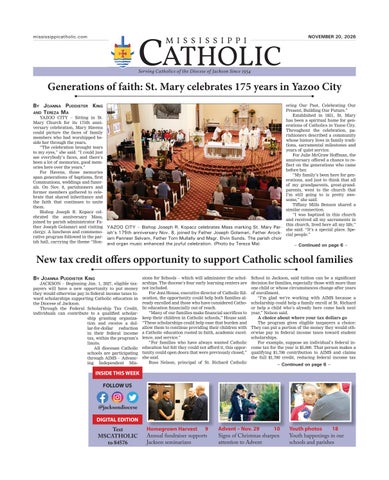
YAZOO CITY – Bishop Joseph R. Kopacz celebrates Mass marking St. Mary Parish’s 175th anniversary Nov. 8, joined by Father Joseph Golamari, Father Arockiam Panneer Selvam, Father Tom Mullally and Msgr. Elvin Sunds. The parish choir and organ music enhanced the joyful celebration. (Photo by Tereza Ma)
oring Our Past, Celebrating Our Present, Building Our Future.” Established in 1851, St. Mary has been a spiritual home for generations of Catholics in Yazoo City. Throughout the celebration, parishioners described a community whose history lives in family traditions, sacramental milestones and years of quiet service. For Julie McGraw Hoffman, the anniversary offered a chance to reflect on the generations who came before her. “My family’s been here for generations, and just to think that all of my grandparents, great-grandparents, went to the church that I’m still going to is pretty awesome,” she said. Tiffany Mills Benson shared a similar connection. “I was baptized in this church and received all my sacraments in this church, lived here all my life,” she said. “It’s a special place. Special people.”
– Continued on page 6 –
New tax credit offers opportunity to support Catholic school families BY JOANNA PUDDISTER KING
sions for Schools – which will administer the scholJACKSON – Beginning Jan. 1, 2027, eligible tax- arships. The diocese’s four early learning centers are payers will have a new opportunity to put money not included. For Joni House, executive director of Catholic Edthey would otherwise pay in federal income taxes toward scholarships supporting Catholic education in ucation, the opportunity could help both families already enrolled and those who have considered Cathothe Diocese of Jackson. Through the Federal Scholarship Tax Credit, lic education financially out of reach. “Many of our families make financial sacrifices to individuals can contribute to a qualified scholarship granting organiza- keep their children in Catholic schools,” House said. tion and receive a dol- “These scholarships could help ease that burden and lar-for-dollar reduction allow them to continue providing their children with in their federal income a Catholic education rooted in faith, academic exceltax, within the program’s lence, and service.” “For families who have always wanted Catholic limits. All diocesan Catholic education but felt they could not afford it, this opporschools are participating tunity could open doors that were previously closed,” through AIMS – Advanc- she said. Russ Nelson, principal of St. Richard Catholic ing Independent Mis-
School in Jackson, said tuition can be a significant decision for families, especially those with more than one child or whose circumstances change after years of enrollment. “I’m glad we’re working with AIMS because a scholarship could help a family enroll at St. Richard or help a child who’s already here come back next year,” Nelson said. A choice about where your tax dollars go The program gives eligible taxpayers a choice: They can put a portion of the money they would otherwise pay in federal income taxes toward student scholarships. For example, suppose an individual’s federal income tax for the year is $5,000. That person makes a qualifying $1,700 contribution to AIMS and claims the full $1,700 credit, reducing federal income tax
– Continued on page 6 –
INSIDE THIS WEEK FOLLOW US
@jacksondiocese DIGITAL EDITION Text MSCATHOLIC to 84576
Homegrown Harvest 9 Annual fundraiser supports Jackson seminarians
Advent – Nov. 29 10 Signs of Christmas sharpen attention to Advent
Youth photos 18 Youth happenings in our schools and parishes
NOVEMBER 20, 2026 MISSISSIPPI CATHOLIC
2 PARISH SPIRITUAL ENRICHMENT
GREENWOOD – Immaculate Heart of Mary, Parish Reconciliation Service, Thursday, Dec. 3 from 5:30-6:30 p.m. STARKVILLE – St. Joseph, Advent Penance Service, Tuesday, Dec. 1 at 6 p.m.
PARISH & YOUTH EVENTS
FLOWOOD – St. Paul, Mary’s Baby Shower, Saturday, Dec. 5 from 10 a.m. to 12 p.m. in the Family Life Center. Join us this Advent for a time of prayer, reflection and friendship. Bring a gift of diapers, hooded towns, wipes, new bottles, socks or onesies to donate to Birthright of Jackson. Details: RSVP by Nov. 29 – send a text to (601) 951-7097. MADISON – St. Anthony School, Starry Night Gala, Dec. 12 at the Velveteen Venue in the Town of Lost Rabbit. Live and silent auctions, food and fun, plus a grand prize raffle. Details: Megan (601) 3877371. MERIDIAN – St. Patrick, Candy Cane Dash 5k and Fun Run, Saturday, Dec. 5. Details: register at time2run.net. NATCHEZ – St. Mary Basilica, Breakfast with Santa, Saturday, Dec. 5 from 9-11 a.m. in the O’Connor Family Life Center. Tickets $20 for first child and $10 for each additional child. Details: purchase tickets from youth or church office or call (601) 807-0263. OLIVE BRANCH – Queen of Peace, Advent/ Christmas Concert, Sunday, Nov. 29 at 4 p.m. Come and experience an uplifting evening of music and fellowship. Free dinner. Sign up in gathering space to attend. Details: church office (662) 895-5007. Queen of Peace, A Night in Bethlehem – Parents’ Night Out, Friday, Dec. 4 from 6:30-8:30 p.m. Children in kindergarten through fifth grade are invited to come celebrate the joy of Jesus’ birth with crafts, games and food. Sign up in the commons. Cost is two canned food items. Details: church office (662) 8955007. STARKVILLE – St. Joseph, Garage Sale, Dec. 5 from 8 a.m. to 12 p.m. Details: deaconjeff@stjosephstarkville.org.
FEATURE PHOTO:
St. Joseph, Blood Drive, Saturday, Dec. 12 from 1204 p.m. in the church hall. Details: Mark at (662) 418-7750.
DIOCESE EVENTS
SEARCH RETREAT 2027 – Camp Wesley Pines, Gallman, Jan. 15-17. Search is for 1012th graders looking to go deeper in their faith. Cost: $125. Registration deadline is Dec. 1. Details: Apply to attend at https:// jacksondiocese.flocknote. com/signup/275730. CAMPUS MINISTRY WINTER RETREAT – “Hear His Voice,” Jan. 30, 2027 at St. Joseph Starkville from 10 a.m. to 5 p.m. Questions? Contact amelia.rizor@jacksondiocese.org or (601) 949-6931. THEOLOGY ON TAP – Dec. 1 Trivia on Tap, Dec. 17 Christmas Party. Meeting at Blaylock Photography in Ridgeland. Must be 21+. WORLD DAY MARRIAGE – Save the date for Diocesan World Marriage Day celebrations in 2027. The Jackson celebration will be at the Cathedral of St. Peter on Saturday, Feb. 6, and in Tupelo at St. James on Saturday, Feb. 13 at 5 p.m. This is a wonderful celebration of the sacrament of matrimony for those celebrating significant anniversaries 25th, 30th, 40th, 50th, 60th or longer anniversaries in 2027. Details: at your church office.
SAVE THE DATE
JACKSON – St. Richard School, Krewe de Cardinal, Jan. 30, 2027. MADISON – St. Joseph School, Draw Down, Feb. 27, 2027
... Rooted and Grounded ...
CAMDEN – Sacred Heart Ladies Auxiliary Ministry hosted its annual women’s retreat, “Rooted and Grounded in God’s Love,” on Oct. 17. Keynote speakers Virginia Brown, Peggy Craig and Myrtle Otto reflected on being rooted, grounded and held in God’s love. The retreat also included prayerful meditation, Scripture readings and roundtable discussions. (Photo by Tereza Ma) More photos: jacksondiocese.zenfoliosite.com
The Diocese of Jackson has launched a third-party reporting system that will enable all diocesan employees, volunteers and parishioners to anonymously (or named if preferred) make reports. Examples of this activity include fraud, misconduct, safety violations, harassment or substance abuse occurring at a Catholic parish, Catholic school or at the diocesan level. The system is operated by Lighthouse Services. To make a report visit www.lighthouse-services.com/jacksondiocese or call 888-830-0004 (English) or 800-216-1288 (Spanish). The Association of Priests of the Dioceses of Jackson and Biloxi provide a small pension to our retired priests. As you consider your estate plans, please remember these faithful servants by making a donation or leaving a bequest to the Association of Priests. Our parish priests dedicate their lives to caring for us, their flocks. Let us now care for them in their retirement. Donations can be made payable to the Association of Priests and can be mailed to: Diocese of Jackson, P.O. Box 22723, Jackson, MS 39225-2723
MISSISSIPPI CATHOLIC NOVEMBER 20, 2026
let there be light 3
Black Catholic witnesses enrich our Church and nation BY BISHOP JOSEPH R. KOPACZ, D.D.
1787 with the family of Pierre Berard, who had lost everything in Haiti. Toussaint apprenticed to a hairdresser, becoming the sole supporter of the household. He went on to become the most successful hairdresser of his day, a lucrative position. His profitable trade supported the household and bought the freedom of many slaves, including that of his wife, Juliette Noel. Toussaint was a devout Catholic who contributed to many Catholic schools and orphanages. He paid for the education of many Black youths as well as several impoverished white seminarians. He also cared for the many victims of yellow fever, which struck the city every August. The Toussaint papers consist largely of his correspondence with friends and relatives in the United States, the Caribbean and Portraits of six African Americans who are sainthood canFrance. (The New York Public Library) In didates are displayed in the lobby of the Catholic Center 1951, a petition was begun for his canonization, and his remains were reinterred in Baltimore in November 2023 for Black Catholic History in the crypt beneath St. Patrick’s Cathe- Month. (OSV News/Kevin J. Parks, Catholic Review) dral in 1990, making him the only layman just before noon. He was seen to reel and then he fell buried there among the archbishops and heavily to the sidewalk. Several pedestrians rushed bishops. to the assistance of the prostrate clergyman and reVenerable Father Augustus Tolton (1854moved him to a cool spot where everything possible 1897) was born into slavery on April 1, 1854, in was done to relieve his condition. Every attempt was Brush Creek, Missouri, and his family escaped to made to save his life at the hospital. The priest is one Illinois during the Civil War where he eventually reof the foremost colored clergyman of the catholic ceived his calling to the priesthood. Unable to study church in this part of the country and is remarkably in any seminary in the United States because he was popular.” a Black man, he was forced to receive his education Pope Francis declared him venerable in 2019. in Rome. After his ordination in 1886, he returned to Julia Greeley (birth year unknown; died serve at St. Joseph Church in Quincy, Illinois and af1918), known as “Denver’s Angel of Charity,” pulled terward at St. Monica’s on the South Side of Chicago a little red wagon around Denver collecting donated where he died tragically at 43 years of age. food, clothing and fuel for poor families. She often The Chicago Daily News published the followwent at night so that the recipients wouldn’t be eming account on July 9, 1897, describing his collapse barrassed to be seen accepting help. She was born during an extreme heat wave in Chicago: into slavery in Missouri and lost her sight in one “All through the scorching morning the sun eye as a child when a slaveholder’s whip struck her poured down its deadliest rays. The white pavewhile he was beating her mother. In her adult life, ments gave back the heat with she was a devout Catholic, a Secular Franciscan and redoubled fervor. All through the known for her devotion to the Sacred Heart. Every night the wretched inhabitants of month, she visited on foot every fire station in Denthe town tried to sleep as best they ver, delivering literature of the Sacred Heart League could. The doorsteps were dotto Catholic and non-Catholic firefighters alike. Her November 19 November 27 ted with them, every window was cause for sainthood was opened in 2016, and in 2017 populous, the roofs were crowdFather Jack Kurps, SCJ Father Tim Murphy her remains were moved to the Cathedral Basilica of ed. With the morning came more Sacred Heart Southern Missions St. James, Tupelo the Immaculate Conception in Denver. heat, more suffering. The Rev. AuToussaint, Tolton and Greeley personify the gustus Tolton was struck down at Thank you for answering the call! love of Jesus Christ in remarkably unique ways, 36th street and Ellis Avenue, but revealing the incredible resiliency and faithfulness a short distance from of many in the African American community. Our his home. He was about Volume 72 Church and nation are richer for their witness to the to make several calls in Number 13 Lord and their loving service of others. his parish, and it was (ISSN 1529-1693)
November is designated as Black Catholic History Month, which highlights the historical contributions of Black Catholics in the Church and in society, coinciding with the feast of All Saints on Nov. 1, All Souls on Nov. 2, St. Martin de Porres on Nov. 3 and the birth of St. Augustine on Nov. 13. The commemoration began in 1990 at the behest of the National Black Catholic Clergy Conference during its annual meeting. There are approximately 3 million Black Catholics in the United States, approximately 4% of the overall Catholic population, many of whom entered the Catholic Church by way of our Catholic schools and ministries throughout the 19th and 20th centuries. Sister Thea Bowman, our own Servant of God, personifies this journey to Catholicism for many in the Black communities. In addition, there are Black Catholics from Africa and the Caribbean, but this commemoration has featured the journey, struggle and accomplishments of African American Catholics. This month often highlights prominent Black American Catholics on the path to sainthood, frequently referred to as the “Saintly Six” – Venerable Pierre Toussaint, Venerable Mother Mary Elizabeth Lange, Venerable Henriette Delille, Venerable Augustus Tolton, the first recognized African American priest, Servant of God Julia Greeley and the Diocese of Jackson’s own Servant of God Sister Thea Bowman. This column will focus on the unique circumstances of three of the “Saintly Six,” recognizing that each has a marvelous story that is well documented and extensively studied in Rome. Venerable Pierre Toussaint (1766-1853) was born a slave in Haiti and came to New York City in
Happy Ordination Anniversary
PRESS DATE: NOV. 13, 2026
BISHOP’S SCHEDULE P.O. Box 2130 Jackson, MS 39225-2130 Phone: 601-969-3581 E-mail: editor@jacksondiocese.org Publisher ........................................................................................... Bishop Joseph R. Kopacz Communications Director ...................................................................... Joanna Puddister King Production Coordinator...............................................................................................Tereza Ma MISSISSIPPI CATHOLIC is an official publication of the Diocese of Jackson, 601-969-1880, 237 E. Amite St., Jackson, MS 39201. Published once per month, Mississippi Catholic mails 12 editions per year. For address changes, corrections or to join the email list for the digital edition, email: editor@ jacksondiocese.org. Subscription rate: $20 a year in Mississippi, $21 out-of-state. Periodical postage at Jackson, MS 39201 and additional entry offices. POSTMASTER: Send address changes to Mississippi Catholic, P.O. Box 2130, Jackson, MS 39225-2130. Website: www.mississippicatholic.com www.jacksondiocese.org
Tuesday, Nov. 24, 7:30 a.m. – Mass, Carmelite Monastery, Jackson Sunday, Nov. 29, 8:30 a.m. (Spanish) and 11 a.m. (English) – Mass, St. Francis of Assisi, New Albany Tuesday, Dec. 1, 9:30 a.m. – Re-dedication of the Sister Trinita Clinic to Celebrate the 30th Anniversary, 1100 W Capitol Street, Jackson Sunday, Dec. 6, 10 a.m. – Confirmation Mass, St. Joseph, Woodville Saturday, Dec. 12, 4:30 p.m./5 p.m. Mass – Our Lady of Guadalupe Celebration and Mass, St. Patrick, Meridian All events are subject to change. Check with parishes and schools for further details.
NOVEMBER 20, 2026 MISSISSIPPI CATHOLIC
4 VOCATIONs CALLED BY NAME Father Tristan Stovall and I spent a few days in southeastern Louisiana in early November visiting the two seminaries where we send men: St. Joseph Seminary College in St. Benedict and Notre Dame Seminary in New Orleans. We have four men at St. Joseph and eight at Notre Dame. St. Joseph is tucked away on more than 1,000 Father Nick Adam acres outside Covington. Founded and still run by Benedictine monks, the seminary reflects the prayer and work they model. I fondly remember exploring the trails winding through the grounds, often discovering something new. St. Joseph’s students tend to be younger than those at Notre Dame because the college offers general education courses for men who have not yet earned a bachelor’s degree. Walk past the classrooms on a weekday, and you might find biology in one room, Latin in another and philosophy
in a third. Our four men at St. Joseph are all 25 or younger. Thomas Taylor is a freshman, James Villasenor is a sophomore, and Henry Haley spent a couple of years at Ole Miss before entering seminary. Kevin Lopez, a little older than the other three, is studying English after beginning his seminary journey in Mexico. Notre Dame sits along busy Carrollton Avenue in New Orleans. Most of its priest faculty and formators come from the Archdiocese of New Orleans, though the rector, Father Josh Rodrigue, is a priest of the Diocese of Houma-Thibodaux. The pace is naturally faster in the city, but the routine remains rooted in prayer. I was reminded of this when I attended morning prayer and Mass. We began at 6:45 a.m., and nothing was rushed. We took our time with the most important thing in the world – the Mass. It reminded me to model that same care when celebrating Mass, even on weekdays. Two of our eight men at Notre Dame are approaching ordination as deacons. Grayson Foley and EJ Martin will be ordained to the transitional diaconate May 15, 2027, with priestly ordination expected in spring 2028. They are great leaders who have
helped cultivate a strong fraternity among our men. Father Tristan cooked a wonderful meal one evening during our recent trip, and it was great to spend time together. Thanksgiving is an exciting time at both seminaries. On the Friday before the holiday, the Notre Dame men travel to St. Joseph for an annual football game followed by a bonfire built by the St. Joseph men. These traditions are a great part of seminary life, and I am grateful to have shared in them as a seminarian and now as a vocations director. (Father Nick Adam is Director of Vocations for the Diocese of Jackson. He can be reached at nick.adam@jacksondiocese. org.)
Connect with Vocations Join the Vocations Supporters email list and receive updates from the Vocations Office. https://bit.ly/JoinVocationsSupporters
MISSISSIPPI CATHOLIC NOVEMBER 20, 2026
Spirituality 5
Don’t try to imagine God IN EXILE By Father Ron Rolheiser, OMI
more intelligent and compassionate than we are, whose heart isn’t larger than ours, and who is unworthy of Jesus and Christianity. For a dozen years I taught a course to seminarians entitled A Theology of God. The course looked at many things: how God is presented in scripture, the historical development of our dogmatic creeds about God, theological speculation about the nature of God, the salient critiques atheists have made about our Christian belief in God, and insights from the mystics and popular piety vis-à-vis how we might relate more affectively to God. But throughout the course and particularly at its end, I would say this to the seminarians: Whatever else you do in your teaching, preaching, and pastoral practice, try not to make God look stupid! In essence: try not to make God look tribal, racist, nationalistic, legalistic, denominational, sexist, rigid, petty, vengeful, angry, defensive, and anything less than unimaginable wisdom, unimaginable love, unimaginable embrace, and unimaginable forgiveness. Try not to make God just another imaginable human person with all our flaws. I know sincere, good-hearted atheists and agnostics who don’t believe in God because when they try to imagine a Person who is creating millions of universes, billions of people, and trillion upon trillions of minerals, plants, and animals, and who is knowing and loving each element in existence intimately as if it were the only thing in existence, they can’t imagine it. Neither can we. It’s not meant to be imagined. It’s meant to be known in a cloud of unknowing, to stretch our minds and hearts beyond their natural limits and bring us to an awe that bends our knees in genuflection.
If we try to imagine God, it’s easy to become an atheist. Why? Try imagining this: We believe that one Person, God, is the sole creator of all that exists. Now, all that exists, although itself finite, is already beyond what we can imagine – billions of galaxies, trillions of planets, and billions of people stretching back through thousands of years. As well, we believe that God knows every rock, insect, animal and plant not just on earth, but everywhere in the universe. How can we wrap our minds around that? We can’t. And there’s the further issue of trying to picture the scope of God’s love. Today there are more than eight billion people in the world, and our faith asks us to believe that God loves each one of those eight billion individually and intimately, as if he or she was the only person in the world. Moreover, through millions of years God has loved intimately every man, woman, and child on this earth, right back to our ancestors who lived in caves. How can one mind, one heart, one person do this? It’s beyond the mind. However, and this is the point, it’s not intended to be imagined or conceptual(Oblate Father Ron Rolheiser is a professor of spirituality at Oblate School of ized. Theology and award-winning author.) God is infinite. Infinity, by definition, is impossible to imagine. (For example, what’s the highest number it’s possible to count to?) Infinity takes us beyond The Pope’s Corner what can be conceptualized. To conceptualize something, the mind needs to start somewhere and God has no beginning. Indeed, to the extent that we do create for ourselves an imaginative picture of God, we always have something less than God, and often an idol. imitate St. Joseph. And the problem is that we are forBy Courtney Mares “Dear fathers and grandfathers, young people need to ever slimming down God to fit the size FLORIDA, Uruguay (OSV News) – Pope Leo XIV made of our imagination when, by its very a pilgrimage to Uruguay’s national Marian shrine Nov. 8, see that you pray, receive the sacraments, treat your wives essence and definition, God is ineffable, where he shared a message of hope for mothers who feel with respect, ask for forgiveness and live with integrity, unable to be pictured, imagined, or capthe grief of seeing their children fall away from practicing even when doing so requires sacrifice. Children learn a great deal by seeing that their father can kneel before God tured in a concept. This is a dogmatic the faith they were raised in. teaching in of all Christian Churches “I know that many of you carry a very specific sor- without feeling that he is any less of a man for doing it,” and in Judaism. As the prophet Isaiah row. You taught your children to pray, and today they no Pope Leo said, to loud applause from those gathered at says, God is holy, meaning, beyond all longer do so. You used to attend Mass together, and it has Mass. “Your children and grandchildren need to see that the visualization and all conceptualization, been years since they entered a church. You spoke to your beyond anything that can be imagined. grandchildren about God, and now you do not know if faith occupies a genuine place in the lives of the men in That’s why scripture asserts that in those words left a mark. Sometimes you wonder if you did your family,” the pope added. this life “no one can see the face God something wrong or if it was all futile,” Pope Leo said in (Courtney Mares is Vatican editor for OSV News. Foland live.” his homily. However, as Christians, we believe The pope pointed to the witness of St. Monica, who low her on X @catholicourtney.) that Jesus came to us and in his person “prayed for years for a son and teaching gave concrete expression who seemed to be drifting (incarnation) to God so that we can further and further from grasp, imagine, and speak truly about God, but she never stopped certain aspects of God. To know Jesus trusting in his grace.” is to know his “Father.” “Mothers and grandHowever, that’s not the same thing mothers: never tire of passas capturing God in a concept. Ining on the faith! Preach with deed, we can “know” God, but we can’t your lives as well as with “think” God. We can never create a your words. Insist on prayer, “picture” of God. love, and hope; insist on them Why is this important? Because in season and out of season whenever we do create a picture of (cf. 2 Tim 4:2). Do so with God, we always end up with something patience, without harshness less than God – and invariably someor discouragement. Even thing that works for our self-interest. if your loved ones seem far Critics of Christianity accuse us from God, continue to place of forever creating God in our own imthem before him. Do not stop age and likeness. There’s a lot of truth blessing them, accompanyin that. That’s why the God we create ing them, and simply remindfor ourselves invariably likes the same ing them of what they once people we do, hates the same people we received,” Pope Leo said. hate, makes the same judgments we “There are doors that you make, likes us better than other races, cannot open, but God can,” favors our country over others, and ashe added. sures us that our religion (and our own In his homily, the pon- Pope Leo XIV waves as he arrives to celebrate Mass at the Cathedral Basilica interpretation of it) is the true way to tiff also offered words of en- of Florida, National Shrine of Our Lady of the Thirty-Three, in Florida, Uruguay, heaven. couragement to fathers and Nov. 8, 2026, during his Nov. 6–17 apostolic journey to Uruguay, Argentina Whenever we capture God in a congrandfathers, urging them to and Peru. (OSV News photo/Martin Varela Umpierrez, Reuters) cept, we end up with a God who is no
At Uruguay’s national shrine, Pope Leo shares advice for Catholic parents whose children left the faith
6 DIOCESE
NOVEMBER 20, 2026
‘... 175 years later ...’ – Continued from page 1 –
MISSISSIPPI CATHOLIC
Reliquias said she told her husband they needed to attend the anniversary because it represented the faith in which they had raised their children. “We wouldn’t miss this for the world,” she said. Others remembered the parish through its educational ministries. Mike Davis, baptized at St. Mary, recalled attending its school and the sisters who taught him. Asked what the anniversary meant to him, he answered simply: “Emotional.” Mary Rutledge remembered years of teaching kindergarten and Sunday school, caring for children in the parish’s day care and serving as an extraordinary minister of holy Communion. Her recollections were filled with small moments: children learning the Lord’s Prayer, praying before meals and growing in confidence in a place where they were loved. For Vicki Fulcher, whose family moved to Yazoo City in 1998, the anniversary also recalled the sacrifices of the immigrants who helped establish the parish. “I just love the fact that those people that came here, with so little, have done so much,” she said. “And now we still have it 175 years later.” The commemorative program included a parish history presentation by Carolyn Shipp, recognition of anniversary volunteers and committee members, a commemorative plaque presentation and remarks from Bishop Kopacz. Parish pastoral council president Diane Melton offered the welcome and recognized those who helped prepare the celebration. As parishioners remembered the past, Father Golamari urged them to consider the legacy they will leave. “May the generations who come after us look back and say that we did not simply inherit a beautiful history; we strengthened our faith community and passed on a living legacy of faith.”
‘... Participation could help a child remain in Catholic school ...’ YAZOO CITY – Mary Rutledge receives an award from Father Joseph Golamari and Father Arockiam Panneer during St. Mary Parish’s 175th anniversary celebration Nov. 8. (Photos by Tereza Ma) More photos: jacksondiocese.zenfoliosite.com The anniversary, she added, was emotional. “It was a wonderful celebration.” In his homily, Bishop Kopacz connected the day’s Scripture readings with the parish’s long history and its place in the Mississippi Delta. Reflecting on the prophet Ezekiel, he spoke of the importance of the land to generations who cultivated and harvested it, and of God’s promise of clean water and a renewed heart. He also reflected on the image of living stones in the First Letter of Peter and on the Beatitudes proclaimed in the Gospel. Across changing circumstances and generations, he reminded the congregation, the call to mercy, peacemaking, humility and faithful discipleship endures. Father Golamari likewise encouraged parishioners to approach the anniversary with gratitude and a renewed sense of responsibility. “This 175th Anniversary is more than a celebration of our history; it is a celebration of God’s faithfulness to our parish throughout the generations,” he said in his closing remarks at Mass. He honored older parishioners as the parish’s “living treasures,” recognizing the faith, prayers and sacrifices upon which others continue to build. He also reminded young people that they have an important role in the church today. “We need your enthusiasm, participation, leadership, and talents to carry this mission forward,” he said. That connection between generations was evident in the families gathered for the celebration. Elizabeth “Bitsy” Alderman, the parish bookkeeper, said she has been at St. Mary since 1979. Her children and grandchildren grew up in the church. “We love being in this church,” she said. For Cynthia Reliquias, St. Mary became a spiritual home after a journey from the Philippines to Chicago and eventually to Yazoo City in 2004. Her three children received their first Communion and confirmation at the parish. Although they are now grown and have moved away, the family’s connection remains strong.
– Continued from page 1 – to $3,300. The combined amount remains $5,000, but $1,700 now supports scholarships. (See the accompanying graphic for an example of how payroll contributions and adjusted federal tax withholding could support scholarships while maintaining the same take-home pay.) The example assumes the taxpayer qualifies and can use the full credit. The annual credit is up to $1,700 per individual. Under current IRS guidance, married couples filing jointly may qualify for a combined credit of up to $3,400, with each spouse making qualifying contributions. This is different from a regular charitable deduction. A deduction reduces the income subject to tax. This credit reduces federal income tax dollar for dollar. Taxpayers make their contribution through AIMS and claim the credit when filing their federal income tax return. Qualifying contributions made in 2027 would generally be claimed on returns filed in 2028. Federal taxes already withheld from a paycheck count toward the year’s tax payments; receiving a refund does not automatically prevent someone from using the credit. The credit is nonrefundable, meaning the amount a taxpayer can use depends on their federal income tax liability. Federal law allows unused credit to be carried forward for up to five years. Taxpayers should consult their tax preparer about their individual circumstances. Congress established the program in legislation enacted July 4, 2025. Mississippi has elected to participate. Connecting families with assistance Families seeking scholarships will apply through SchoLehr, AIMS’ online platform, where they can follow their application’s progress. AIMS will review applications, verify eligibility and administer awards. Federal eligibility requirements include household income no greater than 300% of area median gross income and a student’s eligibility to enroll in public elementary or secondary school. Students attending Catholic schools can qualify.
Scholarship amounts will depend on the award process and available funding. The donor’s $1,700 tax credit limit does not establish the amount an individual student will receive. Mississippi Catholic will provide a closer look at scholarship eligibility and application procedures in a future article. House emphasized that the potential benefit extends beyond help with tuition. “Catholic education is about more than academics,” she said. “We focus on educating the whole child – spiritually, academically, socially, and emotionally.” “This opportunity could allow more children to experience the gift of Catholic education while strengthening our schools and the communities we serve,” she said. A shared mission Participation offers parishioners, grandparents, alumni and other supporters an opportunity to help students, whether or not they currently have a child in Catholic school. “Catholic education is a mission we all share as a Church,” House said. “Our schools help children grow in faith, build strong values, and develop a heart for serving others.” She encouraged supporters to consider the difference their involvement could make for a family. “Your participation could help a child remain in a Catholic school or give another child the opportunity to attend for the first time,” House said. Nelson sees the mission of Catholic education in students’ weekly worship and classroom conversations. “At St. Richard, I get to see that when our students go to Mass together on Wednesdays and when they talk about God in their classrooms during the week,” he said. “When parishioners and others support these scholarships, they can give a child right here in Jackson the chance to be part of that.” Readers can learn more and sign up for updates ahead of the January launch at aimssgo. org. Questions about participating through AIMS can be directed to info@aimssgo.org.
MISSISSIPPI CATHOLIC NOVEMBER 20, 2026
DIOCESE 7
Above, a sample monthly paycheck illustrates how qualifying taxpayers could combine adjusted federal tax withholding with payroll contributions to AIMS scholarships supporting Catholic school students in the Diocese of Jackson, while maintaining the same take-home pay. Individual tax circumstances vary; consult your tax preparer before adjusting withholding. (Graphic courtesy of AIMS)
8 NATION
NOVEMBER 20, 2026 MISSISSIPPI CATHOLIC
Washington Letter: Catholic voters moved toward Democrats in 2026 elections, early data shows
The U.S. Capitol Building is pictured in Washington Nov. 4, 2026, the morning after the U.S. midterm elections. (OSV News photo/Eric Lee, Reuters)
By Kate Scanlon
WASHINGTON (OSV News) – Catholic voters shifted toward Democrats in the 2026 midterm elections after supporting President Donald Trump by a wide margin just two years earlier, initial exit polls show. Initial exit polls of 2026 midterm voters conducted by NBC News in coordination with a group of other news organizations found 50% of respondents who described themselves as Catholic said they supported Democrats, and 49% said Republicans. Ryan Burge, author of the Substack newsletter “Graphs about Religion” and a professor of practice at the John C. Danforth Center on Religion and Politics at Washington University in St. Louis, told OSV News the early data shows “definitely a bit of reversal” among Catholic voters. “That’s notable because the trend has been toward the Republicans the last couple of election cycles. For instance, they were 55% for Trump in 2024,” he said. Previous election data shows most Catholic voters supported Trump in 2024, where he carried 55% of the Catholic vote, while former Vice President Kamala Harris carried just 43%. In previous elections, majorities of Catholic voters supported Al Gore in 2000, George W. Bush in 2004, Barack Obama in both 2008 and 2012, Trump in 2016 and Joe Biden in 2020 before supporting Trump again in 2024. Those shifts, Burge said, show that “Catholics aren’t a ‘locked in’ voting bloc.” “Some Catholics will vote for a Republican in one election, then a Democrat in the next. They are much more malleable than evangelicals, for instance,” he said. The shift in Catholic voters came amid a landslide election for Democrats, who were projected to win an 83-seat majority in the U.S. House, with estimates of 259 Democratic seats and 176 Republican seats as of Nov. 9. The party picked up Senate seats in typically Republican strongholds of Texas, South Carolina, Kansas, and Iowa. Democratic candidates also won a sweep of races that were seen as competitive in North Carolina, Ohio, Georgia, Michigan, and Maine. Senate races in Mississippi and Alaska were still too close to call as of Nov. 9.
In Texas, the scandal-plagued Attorney Gener“I do think that in some places you saw some woral Ken Paxton – whom Trump supported in his pri- ries about some of the perceived cruelty in immigramary challenge to incumbent Republican Sen. John tion enforcement,” Moreland said. “I think that was Cornyn – went on to lose the general election to his of concern in a lot of parts of the Catholic commuDemocratic rival, state Rep. James Talarico, marking nity.” the first Senate victory for Democrats in the Lone Those elected to the 120th U.S. Congress are Star State since 1994. scheduled to be sworn in on Jan. 3, 2027. Burge pointed to Texas as an example of a place where a shift in Catholic voters may have had a large (Kate Scanlon is a national reporter for OSV News impact. covering Washington. Follow her on X @kgscanlon.) “I think we will be doing a lot of analysis in Texas in the months to come,” Burge said. “Talarico won by 13 points, which is astonishing. And that couldn’t have happened without a whole lot of subgroups shifting to the left, including Catholics.” Michael Moreland, a professor of law and religion at Villanova University and director of its Eleanor H. McCulof St. Francis community MILWAUKEE, Wis. – Sislen Center for Law, Religion and Public ter Liana Mich, who lived her with whom she shared life for Policy, told OSV News that in addition religious vocation in educa54 years. to Texas, Catholic voters also likely had tion and pastoral care, died With the School Sisters an impact on House races in Ohio, Iowa, of St. Francis, Sister Liana at Our Lady of the Angels and Pennsylvania, among others. ministered in Mississippi, Convent in Greenfield, Wis“It’s not like the Catholic vote was, consin, on Oct. 21, 2026. Sister Wisconsin, Tennessee and I think, a determining factor in any of Liana was 86 years old. Oklahoma. In the Diocese of those places on its own, but as part of Sister Liana was born on Jackson, Sister Liana was a larger trend of some anger and disafprincipal at Holy Family Sept. 22, 1940, in Milwaukee. filiation of especially white voters away School in Jackson from 1978 She was formerly a member from the Republicans,” he said. to 1986. of the School Sisters of NoA Pew Research Center survey contre Dame, having entered In retirement, Sister minducted prior to the election found that that community in istered through her among all Catholics, Trump’s approvprayer and presence 1958. She was real rating had dropped from 47% at the ceived into the at Our Lady of the beginning of his second term to 30% in Angels from 2022 School Sisters of October 2026. until her death. St. Francis on Prior to the election, analysts who Sept. 16, 1973, A funeral spoke with OSV News about the Pew and made her liturgy was survey previously pointed to two unique celebrated on perpetual factors – in addition to the broader genvows on Oct. Nov. 4 in St. Joeral trends – that may have pushed seph Chapel in 10, 1974. Catholic voters away from Trump: some Sister is Milwaukee, folof the immigration policies Trump has survived by lowed by interimplemented that Catholic leaders have cousins, many ment at Mount objected to, and Trump’s social media Olivet Cemetery friends, and by and verbal attacks on Pope Leo earlier in Milwaukee. the School Sisters this year.
In memoriam: Sister Liana Mich, School Sister of St. Francis
MISSISSIPPI CATHOLIC NOVEMBER 20, 2026
DIOCESE 9
Homegrown Harvest raises more than $195,000 for vocations By Joanna Puddister King
PEARL – More than 250 guests gathered for the Diocese of Jackson’s seventh annual Homegrown Harvest on Oct. 24 at the Clyde Muse Center, raising more than $195,000 to support vocations and the education and formation of the diocese’s 12 seminarians. The evening featured fellowship with seminarians, a silent auction and a paddle raise. Proceeds support the Office of Vocations’ annual operating expenses, including seminarian tuition, books, housing and health care, along with programs for men discerning the priesthood. Father Nick Adam, diocesan vocations director, emphasized the continuing importance of Homegrown Harvest as the United in Mission capital campaign builds long-term support for seminarian education. “The year-to-year needs are not going away,” he said. “And so we’re going to continue to try to build this event.” Seminarian Joe Pearson shared how prayer, supportive priests and Catholic communities helped nurture his vocation. Now in his fourth year of formation and second year of theological studies, Pearson described the opportunities for prayer, study and brotherhood that have deepened his relationship with Christ. “I’m just beyond grateful for all the formation that I’ve received in seminary,” Pearson said. He reminded guests that their generosity makes that formation possible and helps prepare seminari-
PEARL – Diocese of Jackson seminarians enjoy an evening of fellowship at Homegrown Harvest on Oct. 24 at the Clyde Muse Center. The annual event raised more than $195,000 to support vocations and seminarian education and formation. (Photos by Joanna King)
ans to serve others. “You all enable us to receive this formation, which is, in essence, to encounter our Lord and then prepare ourselves to be able to share that with others,” Pearson said. Father Adam also encouraged continued prayer for vocations, sharing the simple petition printed on the diocese’s new seminarian prayer cards: “Lord, send us priests. Lord, send us holy priests. Lord, send us many holy priests.”
Catholic Foundation reports growth, record grants at annual meeting By Joanna Puddister King
that the Foundation awarded 30 grants totaling apJACKSON – The Catholic Foundation is distribut- proximately $93,700, with 75% of those funds going to ing $2.3 million to beneficiaries and adding $3 million parishes and schools. Projects included youth retreats, participation in to the principal of its trusts, board president Joe Rice reported during the organization’s annual member- World Youth Day and efforts to help Catholic school ship meeting and dinner Nov. 10 at the Country Club students build habits of daily prayer. “We want to make sure that they can fund their of Jackson. Members from across the Diocese of Jackson projects,” Harris said. Harris also highlighted the 44th annual Bishop’s gathered to hear updates on the Foundation’s investments, grant awards and support for the United in Cup golf tournament, which raised $23,000 with 99 players in September. Half of the proceeds will supMission capital campaign. Rice reported total assets of approximately $80.1 port the diocesan youth ministry endowment, while million and an investment portfolio return of 17.45% the other half will help fund additional grants. With the Foundation’s office operations now enfor the fiscal year ending in June 2026. He credited donors’ generosity and the guidance of the Holy Spir- dowed, Harris said proceeds from the tournament and membership contributions can help expand supit for the Foundation’s strength in its 53rd year. “Our wealth is not really measured in dollars,” port for ministries throughout the diocese. The evening also included an update on United in Rice said, “but in your generous spirit.” That generosity supported a record year of grant Mission, the diocesan campaign seeking $21.5 million awards. Executive director Rebecca Harris reported for parish needs, seminarian education and the 2027 Catholic Service Appeal. Harris reported $3.081 million in pledges, approximately 14.3% of the campaign goal, before counting a $1 million gift received that day. Thirty-nine parishes are participating in the first campaign block, with the second block scheduled to begin in January. The campaign’s priorities include $10 million for a permanent seminarian education endowment, $10 million for parish growth and development, and $1.5 million for the 2027 Catholic Service Appeal.
Harris emphasized that participation will look different for each household. Alongside the seven-figure gift, she shared the example of a 101-year-old donor committed to giving what she can for as long as she can. “It’s every person in every parish being asked to take part in a sacrificial gift,” Harris said. She encouraged parishioners to attend campaign receptions to learn about the effort, ask questions and take time afterward to pray about their participation. “These receptions are not about asking anybody for any gift that evening,” she said. “It’s really about understanding what we’re trying to accomplish.” Rice explained that the Foundation’s board approved using unrestricted funds to advance the cost of campaign consulting services through an arrangement structured as an interest-free loan. The Foundation plans to recover those funds during the campaign’s collection phase. Members also elected Tim Walsh of St. John the Evangelist Parish in Oxford to the board of directors and reelected the slate of returning directors. Rice said maintaining continuity in leadership was important during the campaign’s early stages. In closing remarks, Bishop Joseph R. Kopacz thanked the Foundation’s leadership, staff and donors for supporting the church’s mission throughout the diocese. He reflected on the Foundation’s more than five decades of service and the network of parishes, schools and ministries benefiting from its work. “It’s really amazing to see what all that can do, how that can be applied to the ministries and JACKSON – Rebecca Harris, executive director of our mission as a diocese,” Bishop Kopacz said. The Catholic Foundation, highlights grant awards The bishop closed the evening with a reflecand diocesan fundraising efforts during the Foun- tion on the unity of the body of Christ and a dation’s annual membership meeting and dinner prayer, thanking those gathered for the “generNov. 10 at the Country Club of Jackson. (Photo osity and faith that you give one generation to the next in family and in our diocese.” by Joanna Puddister King)
NOVEMBER 20, 2026 MISSISSIPPI CATHOLIC
10 NATION
Signs of Christmas can sharpen our attention to Advent By Msgr. Owen Campion
(OSV News) – Every December, we priests try to guide our people toward an observance of Advent. The liturgical season has a certain starkness about it, and this is fitting. It is the time when the Church calls us to prayer and penance in preparation, not simply for the coming of Dec. 25 on the calendar, but for the feast of Christmas as a moment when truly the Lord Jesus comes into our hearts with the wonder and promise of newborn life. Such most worthy spiritual themes, with all their sobriety and solemnity, do not play well in our culture. In the circumstance in which we live, the weeks preceding Christmas usually are not at all accommodating for what should be the mood of Advent – but it is possible to identify and recall spiritual values in the busy time of buying presents and having parties. Look at the Christmas decorations and use them to tell a religious story. – The Christmas tree. Queen Victoria’s husband, Prince Albert, was from a minor German principality, but he had an impact on his wife’s country. He placed in Windsor Castle at Christmas a Christmas tree, remembering Christmas trees back home in Germany. A Christmas tree is no ordinary tree. It is evergreen. Its foliage is bright and alive. Unlike trees that shed their leaves in the cold season, its leaves do not die with the coming of winter. Its leaves live in the cold as well as in the warm. It bears fruit, not apples or pears, but fruit of gold and color that sparkle. It bears the most precious of fruit. The Christmas tree shines in the dark with lights of many colors. These colors suggest the spectrum of the aurora borealis, visible in the sky in Northern Europe. The lights have a heavenly quality. They suggest Jesus, the Light of the World. Each Christmas tree stands alone in a family living room, but picture the tree in a forest. The Christmas tree gleams with light. Of all the trees, it is unique and beckoning. Of all humanity, Jesus stands supreme, calling us to salvation, and guiding us to our goals. – Christmas gifts. Here we go overboard, and merchants have us under their spell. Extravagance is
an issue. The gifts can teach a lesson, however. The Magi brought the choicest gifts to the Infant. We select gifts with care. We try to give those whom we love gifts that will be appreciated and that will signal our love. When gifts are given at Christmas, they can reflect our belief that each of us is God’s precious creation, and that through the Incarnation Jesus lives in each of us. And, we should care for them so much that we select for them the best. Finally, our gifts at Christmas come in brilliantly wrapped containers. They are special, not just other ordinary boxes. – Holly. Of all plants, holly has most often been associated with Christmas in our culture. It has a Christian message. Evergreen, it is alive and brilliant on the coldest winter day. It reminds us of the Lord, alive and forthcoming in love and mercy on the bleakest of days. The Lord fulfilled His divine mission of redemption on Calvary. He died on the cross, wearing a crown of thorns, pressed upon his brow by unbelieving, cruel people as mockery. The sharp points on the holly leaves represent this crown of thorns. The red berries symbolize the drops of the precious blood that flowed as the crown pierced the Lord’s forehead. Jesus wore the crown, and in the kingdom of heaven, he lives forever. – Carols. No holy day, or any holiday, in Western society is more accompanied by its particular music than is Christmas. The hymns are sung everywhere, “Silent Night,” “O Little Town of Bethlehem,” “O Holy Night,” and so on. Inspiring the tradition of the carols was Luke 2:13-14, that tells of the angels proclaiming the birth of the Savior. Listen to the carols. Listen to the words. They exclaim the great joy and relief of knowing that God is with us. – Wreath. In the past generation or so in this country, many Catholic churches have displayed Advent wreaths in the weeks preceding Christmas. Other Christian denominations have done the same. Wreaths were part of Christmas before Advent wreaths, however. Christmas wreaths teach a lesson. Always, they are evergreen, even in Hawaii and
Florida where palm trees are much more plentiful! Evergreen, again, symbolizes life even in the face of darkness, gloom, cold and death. The circle symbolizes the eternity and perfection of God. Inevitably, red ribbons and bows festoon Christmas wreaths, not blue bows – interestingly, since historically blue has been the Christian color – and not white, the color of the innocence of infants; not gold, the symbol of triumph; not purple, the color of royalty. The ribbon must be red. It is the color of the precious blood, shed for us by Jesus on Calvary. – Red. Walk through any shopping mall during the days before Christmas. Look over the congregation at a Mass on Christmas. Vividly evident will be garments of red: red shirts, red ties, red blouses, red coats, red caps and red scarves. No color is more identified with Christmas. Red, as noted above, refers to the shedding of the precious blood and to the salvation achieved for us through this shedding. At times, in homilies during the season, noting the preponderance of red, I thank the people for wearing “Christian uniforms,” for proclaiming with their very vesture that Jesus is the Savior, the Crucified, the Giver of Life. The return glances suggest that many never considered Christmas red in that way! – Christmas dinner. Festive meals are associated with many events, weddings, retirements, graduations, holidays and even funerals. None, however, matches the family’s Christmas dinner. The bonds of love and relationship are stretched wide and far. People invite to their Christmas dinners relatives and friends whom they have not seen for a long time. Many invite strangers or people who are alone. Collectively, these families represent the Lord. He welcomed all. He was a special friend to the lonely and the hurting. He loved all. – Mass. For Catholics, the greatest moment at Christmas, the indispensable moment, is the Mass. No pastor fails to realize this special aspect of the feast. Choirs practice for weeks. Churches are richly decorated. Churches place in very prominent places creches, depictions of the Nativity of Jesus. Pastors work long and hard on preparations. Many people still come to Mass in the middle of the night, at times despite bad weather. All want to be reassured in the fact that in Jesus, God has come, with hope, forgiveness, strength and life. This intense interest in, and commitment to, the Mass at Christmas are lessons in themselves. Observe and think as you go about all the busy work at Christmas. Look at the Christmas trees with their bright lights and their stars. Look at the evergreen wreaths. Look at the brightly decorated gifts. Look at the red coats and shirts. Look at the lists for selecting the very best of groceries for Christmas dinners. Look at the plans to get to Christmas Mass. Look at all these things – and think. These things are about Jesus, the Son of God and son of Mary, who came into our world at Bethlehem 2,000 years ago and is still our hope and our strength. (Msgr. Owen Campion is a well-known Catholic prelate, author and journalist who serves as the chaplain for Our Sunday Visitor.)
A file photo shows people inspecting a Christmas tree at Emmanuel Tree Farm in Trafalgar, Ind. (OSV News photo/Katie Rutter)
GIVEN IN FAITH.
Equal sacrifice, not equal giving
Across the Diocese of Jackson, Catholics from the largest parishes to the smallest missions are answering a common call. Through the United In Mission campaign, families and individuals are making prayerful commitments to strengthen their parishes, support the education of future priests, and help ensure a vibrant Catholic Church for generations to come. Their gifts are as varied as the communities they represent. Some are making significant leadership commitments. Others are pledging a modest amount each month, organizing parish fundraisers, or fi nding room in already stretched household budgets. What unites them is not the size of their gifts, but the spirit in which they are offered. Equal sacrifice, not equal giving. This simple principle is at the heart of United In Mission. Every Catholic is invited to prayerfully consider what he or she can give, recognizing that a meaningful sacrifice looks different for every household.
INvestiNG iN FUtUre GeNeratiONs For Mike and Diane Pumphrey, the decision to make a leadership commitment to United in Mission grew from a deep appreciation for the role priests have played in their lives. The Pumphreys were particularly inspired by the remarkable increase in men discerning the priesthood in the Diocese of Jackson and the campaign’s commitment to establishing a trust to help fund seminarian education. Diane recalled the financial challenges her own family faced in providing an education for their children and recognized the importance of removing financial obstacles for men answering God’s call. The couple’s personal experiences with the Church also helped shape their decision. Diane recalls returning to the Church after a difficult period in her
life and finding a welcoming priest who encouraged her to become involved in parish life. Mike’s appreciation for the Church grew through his experiences with his late wife, Gretchen, and the priest who prepared them for marriage. Both recognize how profoundly priests and parish communities have enriched their lives. Their enthusiasm for United in Mission grew even stronger when they learned that a portion of campaign funds would remain with local parishes to address their own needs. As members of the Cathedral community, they are excited about the opDiane and Mike Pumphrey portunity to make improvements that will benefit parishioners and strengthen parish life. For the Pumphreys, supporting seminarian education is about much more than helping young men complete their studies. It is about ensuring that future generations have priests to celebrate the sacraments, accompany families through life’s joys and challenges, and lead communities in faith. Their message to fellow Catholics is straightforward: consider the importance of priests in your own life and respond to the campaign in whatever way you can. Their generosity is an inspiring example of leadership giving. Yet their commitment is part of a much larger story, one being written by Catholics throughout the diocese whose gifts, large and small, “I am able to spend all of reflect the my time in discernment at same spirit seminary because of the generosity of faith and sacrifice. of the people. I can totally give myself
Seminarians EJ Martin, Philip Speering and Grayson Foley are pictured before Chrism Mass at Cathedral of St. Peter the Apostle in Jackson.
Respond to the campaign in whatever way you can.
to the Lord and this calling, and that is such a relief.” —EJ Martin, Seminarian
Every Gift Matters.
A monthly promise. A community effort. A shared mission.
A GIFT FROM THE HEART
At the other end of the giving spectrum is Edith, a parishioner who recently wrote a heartfelt letter to her pastor, Father Raju Macherla. Her message beautifully captures the meaning of sacrificial giving.
My income is so limited now since everthing costs so much, but I am going to make a monthly payment as long as I can. The Lord has been very good to me and I certainly want to participate. I will give as long as I live. I certainly hope my little bit helps. Sincerely, Edith Edith’s gift is a powerful reminder that generosity cannot be measured by a dollar amount alone. For someone living on a limited income, a commitment of even $40 a month may represent a considerable sacrifice. A person’s desire to participate, despite the financial challenges they face, reflects the faith and gratitude that United In Mission seeks to inspire. And to Edith’s hope that her gift will help, the answer is a resounding yes. Every gift matters. Every sacrifice has value. Every parishioner has a place in this campaign.
Members of the Emaus adult faith enrichment group at the Cathedral of St. Peter join hands in prayer. The group is organizing monthly food sales to support United in Mission, raising more than $1,600 at its first event in October.
MANY HANDS, ONE MISSION
At the Cathedral of St. Peter in Jackson, members of the Hispanic community are demonstrating that sacrificial giving can also be a joyful expression of fellowship. The Emaus adult faith enrichment group has organized monthly food sales following the parish’s 1 p.m. Mass to support United in Mission. Their first event, held during the weekend of October 18, raised more than $1,600. Loren Urizar, a Cathedral parishioner, explained that the effort is about more than raising funds. It also brings the Hispanic community together in support of their parish and pastor. “We are always willing to help Father,” she said. Cathedral Rector Father Nick Adam expressed his appreciation for the group’s creativity and dedication. “I am so grateful that we have groups, like Emaus, willing to help in such creative ways to help this campaign.” Their efforts demonstrate that a shared commitment of time, talent, and treasure can accomplish something extraordinary.
AI generated illustration
Every Gift Builds Our Future $21.5 MILLION CAMPAIGN GOAL
$10 million
Permanent Seminarian Education Endowment
$10 million Parish Growth and Development
Forming Shepherds. Strengthening Parishes.
$1.5 million 2027 Catholic Service Appeal
20 de noviembre de 2026
mississippicatholic.com
Sirviendo a los Católicos Hispanos de la Diócesis de Jackson desde 1997
Tres millones de personas brindan una cálida bienvenida al Papa León XIV a su llegada al Perú, su hogar durante dos décadas POR COURTNEY MARES
LIMA, Perú (OSV News) – El Papa León XIV llegó a Lima el 11 de noviembre para la etapa final de su viaje apostólico de 12 días a Sudamérica, aterrizando en el país que describió como "uno de mis muchos hogares". La visita marca su primer regreso al Perú desde su elección. Allí pasó dos décadas que forjaron su ministerio como misionero agustino y obispo. Llegó por primera vez como sacerdote misionero en 1985 y posteriormente dirigió la Diócesis de Chiclayo de 2015 a 2023. Para el pueblo peruano, la visita no es solo la bienvenida al Vicario de Cristo; es el regreso de un misionero, un vecino y un pastor que comprendió sus realidades, en particular las de los pobres y marginados. "Se siente como el regreso de un miembro de la familia que ha estado lejos", dijo Mildred Camacho, ahijada del Papa León de 31 años, a OSV News el día antes de su llegada. Camacho, quien recibió su nombre en honor a la difunta
El Papa León XIV observa una presentación tras dirigirse a las autoridades, a miembros de la sociedad civil y al cuerpo diplomático durante un encuentro al que asistió la presidenta de Perú, Keiko Fujimori, en el Gran Teatro Nacional de Lima, Perú, el 11 de noviembre de 2026, en el marco de su viaje apostólico del 6 al 17 de noviembre a Uruguay, Argentina y Perú. (Foto de OSV News/Yara Nardi, Reuters)
madre del Papa, participa como voluntaria en la visita. El entonces padre Robert Francis Prevost la bautizó en agosto de 1996 en Chulucanas, Perú. La presidenta del Perú, Keiko Fujimori, recibió al Papa en la Base Aérea de Callao, y dos niños le entregaron flores. La gente se agolpaba en las calles para ver la caravana papal rumbo al centro de Lima. La Santa Sede estimó que 3 millones de personas salieron a darle la bienvenida. Tras una ceremonia de bienvenida y una reunión privada con Fujimori en el Palacio de Gobierno, el Papa se dirigió a las autoridades del país en el Gran Teatro Nacional. "Este regreso tiene para mí un significado muy especial", dijo. "Mi historia con el Perú comenzó mucho antes de que el Señor me confiara la Diócesis de Chiclayo. Durante años compartí la vida de su gente, escuché sus preocupaciones y aprendí de su fe. Muchos me abrieron las puertas de sus casas, compartieron conmigo su mesa –y, por
– Continúa en la página 2 –
A lo largo de las generaciones, el legado de la hermana Thea Bowman sigue inspirando POR JOANNA PUDDISTER KING
CAMDEN – Más de tres décadas después de su muerte, el legado de la Hermana Thea Bowman sierva de Dios continúa tocando vidas a través de generaciones, desde antiguos alumnos que recuerdan su espíritu alegre y amor por la música hasta una chica de 15 años que atribuye a su ejemplo y a sus oraciones por haberla ayudado a superar una enfermedad que ponía en peligro su vida. Esas conexiones cobraron vida el 7 de noviembre, cuando católicos de toda la Diócesis de Jackson se reunieron en la Iglesia Católica del Sagrado Corazón en Camden para un día de reflexión que celebro la vida, la fe y la influencia duradera de la hermana Thea. Organizada por la hermana Amelia Breton, coordinadora de la Oficina diocesana del Ministerio Intercultural, la reunión exploró el legado de la hermana Thea a través de la oración, testimonios personales y sesiones de trabajo centradas en la conversión, la alegría a través del sufrimiento, la música y la identidad cultural. Karla Luke, exdirectora ejecutiva de educación católica de la Diócesis de Jackson, se desempeñó
como la oradora principal, animando a los participantes a abrazar el mensaje de fe, unidad y pertenencia de la hermana Thea. "Cuando pienso en el legado de la hermana Thea, su fe y su tremendo valor realmente me llaman la atención", dijo Luke. "Tenía solo nueve años cuando decidió que quería hacerse católica. Aunque sus padres le aconsejaron no hacerlo, ella eligió seguir ese camino." Luke enfatizó que la vida de la hermana Thea era un testimonio de la importancia de aportar el ser completo, incluyendo el patrimonio cultural y las tradiciones, a la vida de la Iglesia. "Debemos hacer espacio en nuestra Iglesia y en nuestras vidas para que las personas puedan aportar quienes son y compartir sus culturas, ayudando a nuestras comunidades a ser más amorosas", dijo Luke. "Espero que la gente vea la belleza en la diversidad de la creación de Dios y entienda que cada persona está hecha en la imagen y semejanza de Dios." Para varios participantes, la reunión fue una oportunidad para compartir recuerdos personales de la nativa de Mississippi, cuya fe, música y personalidad dejaron una impresión duradera en quienes
la conocieron. Teresa Armour, antigua alumna de la hermana Thea en la escuela Holy Child Jesús en Canton, recordó la influencia que su profesora tuvo en su adolescencia. "Hoy nos ha traído tantos recuerdos", dijo Armour. "Ella tuvo un papel tan importante en nuestra adolescencia. Y vaya que nos enseñó a amar la música." Armour recordaba haber cantado bajo la dirección de la hermana Thea, incluyendo una actuación de "Eleva Cada Voz y Canta" en St. Francis en la ciudad de Yazoo. Otros recordaban haber escuchado a la hermana Thea cantar durante las visitas a sus parroquias. Gwen McGill compartió su recuerdo de haber visto a la hermana Thea en Cristo Rey en Jackson cuando la hermana franciscana usaba una silla de ruedas. "Qué bendición que sería haber tenido la oportunidad de verla cara a cara y escucharla cantar ese domingo", dijo McGill. Aunque esos recuerdos ofrecían destellos de la vida de la hermana Thea, uno de los momentos más
– Continúa en la página 2 –
20 de noviembre de 2026 MISSISSIPPI CATÓLICO
2
'... Con profunda gratitud, que regreso a mi patria ...' – Viene de la página 1 – supuesto, algún buen ceviche– y me hicieron sentir uno de los suyos". Al recordar que recibió la ciudadanía peruana en 2015, expresó su gratitud por los años en que el Señor lo estaba "formando como pastor". "Si me fuera concedido recorrer esos años nuevamente, volvería a hacerlo con alegría, acogiendo tanto sus momentos felices como sus dificultades", dijo. "Por eso puedo decirles, con profunda gratitud, que regreso también a mi patria". El Santo Padre destacó las raíces de la fe en el Perú y sus expresiones de caridad. También instó a los funcionarios a escuchar al pueblo y fortalecer la
confianza en las instituciones. "Quisiera alentar a todos a cultivar la honestidad, la rectitud y la disposición al encuentro, cualidades que sostienen la confianza entre las personas y dan solidez a la vida de las instituciones", dijo. Las familias no deben verse privadas de la paz, que incluye "salir a trabajar sin temor, cuidar de los hijos y regresar a casa con serenidad", señaló. Reconoció además el sufrimiento causado por la violencia y expresó la cercanía de la Iglesia con quienes la padecen. El Papa subrayó que sostener dignamente a la familia forma parte de esa paz cotidiana y que el desarrollo tiene una dimensión cultural, moral y espiritual. "Hay bienes que ninguna prosperidad económica
puede reemplazar: la paz de la conciencia, la certeza de ser amado y la libertad de buscar la verdad y orientar conforme a ella la propia vida", afirmó. Al pedir unidad, dijo que "amar a un pueblo es desear que todos puedan vivir dignamente en él, interesarse por él y estar dispuesto a ofrecer algo de uno mismo por su bien". Además de Lima, el Papa visitará Chiclayo, donde celebrará una Misa al aire libre; Cusco, antigua capital del imperio incaico; y Pucallpa, en la selva amazónica. Viajará de regreso a Roma el 16 de noviembre y llegará al Vaticano el 17. (Courtney Mares es editora del Vaticano para OSV News. Síguela en X @catholicourtney.)
que describieran sus expe' ... Siempre llevaré a la hermana Thea Bowman en mi corazón ...' palabras riencias. Las respuestas incluyeron
– Viene de la página 1 – emotivos del día vino de un joven feligrés cuya conexión con la querida hermana comenzó mucho después de su muerte. Yabhira, de 15 años, feligresa de St. Matthew en Ripley, compartió su experiencia de someterse a un trasplante de corazón y el papel que desempeñó el ejemplo de la hermana Thea en mantener su fe. Acompañada por familiares, Yabhira habló sobre las emociones difíciles que experimentó durante su enfermedad y la fortaleza que encontró en la oración. Miembros de su comunidad parroquial habían rezado por ella a lo largo de su camino médico. "Admiro de verdad a la hermana Thea Bowman porque nunca se rindió, incluso después de que le diagnosticaran cáncer", dijo Yabhira. Compartió su creencia de que la intercesión de la hermana Thea la ayudó a superar la prueba y le dio esperanza para el futuro. "La hermana Thea me enseñó a no rendirme nunca, por difícil que se volviera mi situación", dijo. "Me ayudó a mantener mi fe y mi esperanza." Ahora, mirando hacia el futuro con gratitud, Yabhira espera que su experiencia anime a otros que enfrentan circunstancias difíciles. "Por esta razón, siempre llevaré a la hermana Thea Bowman en mi corazón", dijo. "Late con amor y gratitud." Su testimonio reflejaba uno de los temas centrales del día: la capacidad de la hermana Thea para encontrar alegría y propósito incluso en medio del sufrimiento. Diagnosticada con cáncer de mama en los últimos años de su vida, la hermana Thea continuó su ministerio de enseñanza, cantando y compartiendo el Evangelio a pesar de su enfermedad. Su determinación por vivir plena y fiel sigue siendo una inspiración para quienes enfrentan sus propias dificultades. La música, otra parte determinante de la espiritualidad de la hermana Thea, se exploró durante una sesión dirigida por Edd Hightower. Hightower, que creció en una famil-
ia pentecostal antes de hacerse católico, dijo que conocer a la hermana Thea le ayudó a abrazar sus propias tradiciones musicales y expresar su fe con mayor libertad. "Después de conocer a la hermana Thea, me sentí mucho más cómodo siendo quien soy ", dijo. Ese mensaje de autenticidad también fue central en una sesión paralela dirigida por la Dr. Fran Lavelle, quien exploró lo que significa aportar el ser completo a la Iglesia. "Cuando la hermana Thea animaba a la gente a traer su yo completo a la Iglesia, creo que nos pedía que trajéramos nuestro yo auténtico", dijo Lavelle. Para la hermana Thea, explicó Lavelle, eso significaba abrazar cada aspecto de su identidad y vocación – como profesora, predicadora, cantante, cuidadora y mujer negra. Llevar esos dones plenamente a la vida de la Iglesia, dijo, es una forma en que los católicos pueden honrar los dones que Dios les ha dado. Las sesiones grupales del día también incluyeron presentaciones de la Dra. Kathy McMurtry sobre la conversión, Myrtle Otto sobre la alegría a través del sufrimiento, y sesiones en español dirigidas por Danna Johnson y el padre Guy Wilson. Para la hermana Amelia, la reunión reflejaba tanto el deseo de honrar a la hermana Thea durante el Mes de la Historia Católica Negra como la oportunidad de continuar el ministerio intercultural que ayudó a moldear en la diócesis. La hermana Amelia explicó que la idea para el día de la reflexión surgió de miembros de la comunidad católica que querían una oportunidad para celebrar el legado de la hermana Thea. También habló de su conexión personal con el trabajo de la hermana Thea, habiendo aprendido más sobre los esfuerzos de la hermana franciscana para unir diferentes culturas dentro de la Iglesia. Según la hermana Amelia, la hermana Thea ayudó a introducir oportunidades de formación en la fe hispana en la diócesis durante los años 80, reconociendo la importancia de in-
cluir a personas de diferentes orígenes culturales en la vida de la Iglesia. "Tenía una conciencia sobre las culturas diferentes de nuestra diócesis, de nuestra Iglesia, que debían ser incluidas", dijo la hermana Amelia. Ese ejemplo sigue inspirando su propio trabajo en el ministerio intercultural. El obispo Joseph R. Kopacz, que dio la bienvenida a los participantes al inicio de la reunión, también reflexionó sobre la creciente influencia de la hermana Thea en todo el país y el avance de su causa de canonización. La fase diocesana de la causa concluyó en febrero de 2026, y la documentación ha sido enviada a Roma para su revisión adicional. El obispo Kopacz señaló que la historia de la hermana Thea sigue llegando a nuevas audiencias a través de instituciones educativas, ministerios y eventos que celebran su vida. También destacó su compromiso con la educación y las oportunidades que su legado sigue ofreciendo a los jóvenes. Al concluir el día, se invitó a los participantes a reflexionar sobre lo que habían aprendido y compartir
esperanza, unión, paz, gracia, amor e inspiración. A lo largo de la reunión, los participantes se unieron en una oración de fe, libertad y unidad, ofreciendo repetidamente la respuesta: "Señor, ayúdanos a saber quiénes somos y de quién somos." Las palabras reflejaban el mensaje de toda la vida de la hermana Thea de abrazar la identidad dada por Dios mientras se reconoce la dignidad y los dones de los demás. Para la hermana Amelia, la esperanza es que los participantes lleven esas lecciones más allá del día de reflexión y lo lleven a sus comunidades y parroquias. "Creo que solo está en el corazón", dijo, expresando su esperanza de que los participantes compartieran lo que experimentaron y desarrollen un renovado interés y amor por la hermana Thea. Desde los recuerdos de antiguos alumnos hasta el testimonio de una joven cuya vida ha sido moldeada por la fe y la perseverancia, la reunión demostró que el legado de la hermana Thea sigue llegando a nuevas generaciones, invitando a los católicos a vivir con valor, celebrando sus dones y reconociendo a Cristo en los demás.
La hermana Carol Ann Prenger presenta a Yabhira, de San Mateo en Ripley, quien compartió cómo la hermana Thea le enseñó a no rendirse nunca a través de su experiencia con un trasplante de corazón hace dos años. (Foto de Joanna King)
20 de noviembre de 2026 MISSISSIPPI CATÓLICO
Los testimonios de católicos negros enriquecen nuestra Iglesia y nación POR OBISPO JOSEPH R. KOPACZ, D.D.
Noviembre esta designado como Mes de la Historia Católica Negra, que destaca las contribuciones históricas de los católicos negros en la Iglesia y en la sociedad, coincidiendo con la fiesta de Todos los Santos el 1 de noviembre, y todas las Almas el 2 de noviembre, San Martín de Porres el 3 de noviembre y el nacimiento de San Agustín el 13 de noviembre. La conmemoración comenzó en 1990 a instancias de la Conferencia Nacional del Clero Católico Negro durante su reunión anual. Hay aproximadamente 3 millones de católicos negros en Estados Unidos, aproximadamente el 4% de la población católica en general, muchos de los cuales ingresaron a la Iglesia Católica a través de nuestras escuelas y ministerios católicos a lo largo de los siglos XIX y XX. La hermana Thea Bowman, nuestra propia Sierva de Dios, personifica este camino hacia el catolicismo para muchos en las comunidades negras. También, hay católicos negros de África y el Caribe, pero esta conmemoración ha mostrado el camino, la lucha y los logros de los católicos afroamericanos. Este mes suele destacar a destacados católicos afroamericanos destacados en En noviembre de 2023, con motivo del Mes de la Historia de los Católicos Afroameriel camino hacia la santidad, frecuentemente llamados los "Seis canos, se exhiben en el vestíbulo del Centro Católico de Baltimore los retratos de seis Santos": el Venerable Pierre Toussaint, la Venerable Madre Mary Elizabeth Lange, la Venerable Henriette Delille, el Venerable Au- afroamericanos que son candidatos a la santidad. (OSV News/Kevin J. Parks, Catholic gustus Tolton, el primer sacerdote afroamericano reconocido, la Review) Sierva de Dios Julia Greeley y la propia Sierva de Dios de la Diócela catedral de San Patricio en 1990, convirtiéndose en el único laico enterrado allí sis de Jackson, la hermana Thea Bowman. Esta columna se centrará en las cir- entre los arzobispos y obispos. cunstancias únicas de tres de los "Seis Santos", reconociendo que cada uno tiene El Venerable Padre Augustus Tolton (1854-1897) nació esclavo el 1 de una historia maravillosa bien documentada y ampliamente estudiada en Roma. abril de 1854 en Brush Creek, Missouri, y su familia escapó a Illinois durante El Venerable Pierre Toussaint (1766-1853) nació como esclavo en Haití y la Guerra Civil, donde finalmente recibió su llamado al sacerdocio. Incapaz de llegó a la ciudad de Nueva York en 1787 con la familia de Pierre Berard, que lo estudiar en ningún seminario de Estados Unidos por ser un hombre negro, se había perdido todo en Haití. Toussaint se convirtió en un peluquero, convirtién- vio obligado a recibir su educación en Roma. Después de su ordenación en 1886, dose en el único sostenedor del hogar. Llegó a ser el peluquero más exitoso de regresó para servir en la iglesia de St. Joseph en Quincy, Illinois, y posteriorsu época, una posición fructuosa. Su beneficioso comercio mantuvo el hogar y mente en St. Mónica, en el lado sur de Chicago, donde falleció trágicamente a los compró la libertad de muchos esclavos, incluyendo la de su esposa, Juliette Noel. 43 años. Toussaint era un católico devoto que contribuyó a muchas escuelas y orfanaEl Chicago Daily News publicó el siguiente relato el 9 de julio de 1897, descritos católicos. pago por la educación de muchos jóvenes negros, así como de vari- biendo su desmayo durante una ola de calor extrema en Chicago: os seminaristas blancos pobres. También cuidó a muchas víctimas de la fiebre "Durante toda la ardiente mañana, el sol derramó sus rayos más mortales. amarilla, que golpeaba la ciudad cada agosto. Los papeles de Toussaint consisten Las aceras blancas devolvieron el calor con doble fervor. Durante toda la noche, en gran parte en su correspondencia con amigos y familiares en Estados Unidos, habitantes del pueblo la pasaron miserablemente intentando dormir lo mejor el Caribe y Francia. (La Biblioteca Pública de Nueva York) En 1951 se inició una que pudieron. Los escalones estaban salpicados de ellos, cada ventana estaba llepetición para su canonización, y sus restos enterrados de nuevo en la cripta bajo na, los techados estaban llenos. Con la mañana llegó más calor, más sufrimiento.
La Diócesis de Jackson se compromete a garantizar que ninguna persona a la que sirva la iglesia corra el riesgo de sufrir abuso o explotación sexual por parte del clero, los religiosos o el personal laico de la iglesia. El bienestar espiritual de todas las víctimas, sus familias y otros miembros de la comunidad es de particular interés para la iglesia. De acuerdo con nuestra política, a todas las víctimas se les ofrece asesoramiento y atención pastoral. Se alienta a cualquier persona que haya sido víctima de abuso o explotación por parte del clero, religioso o personal de la iglesia laica y aún no lo haya denunciado, a que lo haga. Nuestra coordinadora de asistencia a víctimas, Jenifer Jenkins una trabajadora social con licencia, está disponible para ayudar a hacer un informe. Números de contacto del Coordinador de Asistencia a las Víctimas: 601-960-8471. Para obtener más información sobre las políticas y procedimientos diocesanos y para saber qué está haciendo la diócesis para crear un entorno seguro para todos, visite el sitio web diocesano en www.jacksondiocese.org y haga clic en "Protección de Niños." Para hacer una denuncia de abuso o mal manejo de denuncias de abuso sexual por parte de un obispo, visite https://reportbishopabuse.org.
+Joseph R. Kopacz D.D., Ph.D. Bishop of Jackson
El reverendo Augustus Tolton fue derribado en la intersección de la calle 36 con Ellis Avenue, a poca distancia de su casa. Estaba a punto de hacer varias visitas a su parroquia, y era poco antes del mediodía. Se le vio tambalearse y luego cayó pesadamente a la acera. Varios caminantes corrieron en ayuda del clérigo postrado y lo llevaron a un lugar fresco donde se hizo todo lo posible para aliviar su estado. Se hicieron todos los intentos posibles por salvarle la vida en el hospital. El sacerdote es uno de los clérigos de color más importantes de la iglesia católica en esta parte del país y es notablemente popular." El Papa Francisco lo declaró venerable en 2019. Julia Greeley (año de nacimiento desconocido; fallecida en 1918), conocida como "el Ángel de la Caridad de Denver", transportaba un pequeño carro rojo por Denver recogiendo comida, ropa y combustible donados para familias pobres. A menudo iba de noche para que los destinatarios no se avergonzaran de ser vistos aceptando ayuda. Nació esclava en Missouri y perdió la vista de un ojo cuando era niña cuando el látigo de un esclavista la golpeó mientras golpeaba a su madre. En su vida adulta, fue una católica devota, franciscana secular y conocida por su devoción al Sagrado Corazón. Todos los meses, visitaba a pie todas las estaciones de liga de bomberos de Denver, entregando literatura del Sagrado Corazón tanto a bomberos católicos como no católicos. Su causa de santidad se abrió en 2016, y en 2017 sus restos fueron trasladados a la Basílica Catedral de la Inmaculada Concepción en Denver. Toussaint, Tolton y Greeley personifican el amor de Jesucristo de formas extraordinariamente únicas, revelando la increíble resiliencia y fidelidad de muchos en la comunidad afroamericana. Nuestra Iglesia y nación son más ricas por su testimonio al Señor y su servicio amoroso a los demás.
DAMOS CON FE. Un mismo espíritu de sacrificio, no una misma cantidad. En toda la Diócesis de Jackson, desde las parroquias más grandes hasta las misiones más pequeñas, los católicos están respondiendo a un mismo llamado. A través de la campaña Unidos en Misión, familias y personas están asumiendo compromisos, guiados por la oración, para fortalecer sus parroquias, apoyar la formación de futuros sacerdotes y contribuir a que la Iglesia católica siga llena de vida durante las próximas generaciones. Sus aportaciones son tan diversas como las comunidades a las que pertenecen. Algunos asumen importantes compromisos económicos para dar impulso a la campaña. Otros se comprometen a aportar una cantidad modesta cada mes, organizan actividades parroquiales para recaudar fondos o hacen espacio en presupuestos familiares ya ajustados. Lo que los une no es el monto de sus donativos, sino el espíritu con el que los ofrecen. Un mismo espíritu de sacrificio, no una misma cantidad. Este sencillo principio es fundamental para Unidos en Misión. Se invita a cada católico a considerar, a la luz de la oración, cuánto puede aportar, reconociendo que un sacrificio significativo es diferente para cada hogar.
Cada donativo construye nuestro futuro META DE LA CAMPAÑA: $21.5 MILLONES
$10 millones
Fondo patrimonial permanente para la formación de seminaristas
$10 millones Crecimiento y desarrollo de las parroquias
Formando pastores. Fortaleciendo parroquias.
De grano en grano, construimos el futuro
La Fundación Católica está a su disposición para acompañarle durante toda la campaña de recaudación de fondos Unidos en Misión. Si tiene preguntas sobre la campaña, la participación de su parroquia, cómo hacer un donativo o cualquier otro asunto relacionado, con gusto le ayudaremos.
¿ PREGUNTAS? Rebecca Harris, Executive Director (601) 960-8477 rebecca.harris @jacksondiocese.org
Ese mismo espíritu se vive en New Albany, donde el diácono Pablo Garcia, de la parroquia San Francisco de Asís, ve la campaña como una inversión en el futuro de la Iglesia y una oportunidad para fortalecer la fe en las comunidades. Para el diácono Garcia, la oración es fundamental en la decisión de su familia de participar. Habla de aportar su granito de arena al reino de Dios en agradecimiento por tantas bendiciones recibidas. Su reflexión muestra cómo incluso los donativos modestos pueden dar fruto: “Quizás no sea mucho mi donativo, pero de grano en grano es como crecen las cosas”. Recuerda a sus hermanos en la fe que lo importante es ayudar con lo que podamos y dar de corazón, confiando en que la gracia de Dios multiplica lo que ofrecemos.
$1.5 millones Campaña de Servicio Católico 2027
MOveD TO ResPOND.
Prayer helps families find their part in the Church’s future. At Holy Child Jesus Parish in Canton, Girtie Saddler-Banks admits that she was not initially enthusiastic about participating in the campaign. But after conversations with fellow parishioners and time spent in prayer, her perspective changed.
For Girtie, sacrificial giving means giving for the benefit of others and going beyond what she might ordinarily contribute. Her conclusion reflects the spirit of the entire campaign: “I would say everyone giving a little combines to make a lot for a common purpose.”
That same spirit is evident in New Albany, where Deacon Pablo Garcia of St. Francis of Assisi views the campaign as an investment in the future of the Church.
At Christ the King Parish in Jackson, Ingrid Williams and her husband prayerfully considered what their family could afford and what sacrifices they could make.
For Deacon Garcia, prayer is central to his family’s decision to participate. He speaks of contributing his small part to the Kingdom of God in gratitude for the blessings he has received.
“To me sacrificial giving means praying about what the church needs from you and doing whatever you can to respond to that need,” Ingrid explained.
He offers a beautiful reflection on how even modest gifts can bear fruit: “Perhaps my donation is not much, but grain by grain is how things grow.” He reminds fellow Catholics that God can multiply what is offered with a generous heart.
She sees participation as a way to support diocesan pastoral needs for years to come. She encourages those who wonder whether their gift is enough: “All gifts are needed, no gift is too small, and their gift combined with others can make a big difference in ensuring that the diocese has the priests it needs in the future.”
Nancy Meyers, a lifelong member of St. Elizabeth Parish in Clarksdale, shares that conviction. Her family’s connection to St. Elizabeth spans generations. She received her sacraments there, attended the parish school, married there, and watched her own children grow in faith through the parish and school community. Having worked in the diocesan Chancery for approximately ten years, Nancy has also gained a deeper appreciation for the extraordinary responsibilities carried by priests, many of whom serve multiple parish communities. For Nancy, supporting seminarian education means helping ensure that the diocese can welcome men responding to God’s call without financial barriers standing in their way. She describes sacrificial giving as prayerfully making room in the family budget for something that will make a meaningful difference. Her advice to fellow Catholics captures the campaign’s central invitation: “Decide what you can do and give it joyfully. Every gift matters.”
In Batesville and Sardis, Robin Ridge, who serves St. Mary and St. John parishes, points to the growing number of vocations as a reason for hope. After years of praying for more men to answer the call to the priesthood, she sees United in Mission as an opportunity to help sustain that progress. Her message is simple: “Every dollar adds up and makes a difference.”
UNiteD IN GeNerOsity. What we offer today can bear fruit for generations.
Year END GiviNG
Making your gift count in 2026. As 2026 draws to a close, Catholics throughout the Diocese of Jackson have an opportunity to support United In Mission while considering charitable giving strategies that may provide important tax advantages. Whether making a new commitment, fulfilling an existing pledge, or considering an additional year-end gift, there are several ways to participate. These stories come from different corners of the Diocese and represent households with different financial circumstances, backgrounds, and experiences. Yet they share a common understanding: the future of the Church is a responsibility entrusted to all of us. The Pumphreys’ leadership commitment, Edith’s monthly pledge, the Emaus community’s food sales, and the prayerful gifts of families throughout the diocese are all expressions of the same generosity. United in Mission is not asking every household to give the same amount. It is asking each household to prayerfully consider making a meaningful commitment according to its ability. Together, these sacrifices will support the education of future priests, strengthen local parishes, and help provide for the spiritual needs of Catholics across Mississippi.
EQUaL SaCrifiCe, NOt EQUaL GiviNG. When each of us offers what we can, we accomplish something greater than any one of us could achieve alone.
Gifts frOM aN IRA If you are 70½ or older, ask your adviser whether a qualified charitable distribution directly from your IRA could offer tax benefits.
APPreCiateD StOCK A direct gift of stock held for more than one year may offer tax advantages. Consult your adviser before selling or transferring securities.
Estate aND LeGaCy GiviNG Consider including the Church in your estate plans to support future priests and parish communities for generations.
BeGiN tHe PrOCess EarLy The Catholic Foundation is here to help you throughout the United In Mission Capital Campaign. Whether you have questions about the campaign, your parish’s participation, making a gift, or other campaign-related matters, we are happy to assist you.
Begin well before Dec. 31 to allow time for processing. Contact the Catholic Foundation for campaign giving instructions, and consult your financial or tax adviser about your circumstances.
LEARN MORE. MAKE A DIFFERENCE. Visit our website to learn more about United In Mission or make a gift.
QUESTIONS?
CONTACT THE CATHOLIC FOUNDATION
Rebecca Harris, Executive Director (601) 960-8477 rebecca.harris@jacksondiocese.org
unitedinmissionjackson.org
Every gift, whatever its size, helps strengthen the future of our Church.
MISSISSIPPI CATHOLIC NOVEMBER 20, 2026
BRIEFS 11
A file photo shows a guard escorting an inmate down a corridor of death row at the former San Quentin State Prison in California. Today it is called San Quentin Rehabilitation Center. Catholic death penalty opponents praised Democratic Gov. Gavin Newsom for his Nov. 5, 2026, decision to commute all California death sentences to life imprisonment without the possibility of parole. (OSV News photo/Stephen Lam, Reuters)
NATION
SACRAMENTO, Calif. (OSV News) – Catholic death penalty opponents praised Gov. Gavin Newsom, D-Calif., for his decision to commute all California death sentences to life imprisonment without the possibility of parole. Newsom, a Catholic, who is preparing to leave office in January, wrote in a Nov. 5 open letter addressed “to All Californians” that “I take this action because I firmly believe that state-sanctioned killing is incompatible with California’s values, undermines the foundations of our legal system and diminishes each of us.” Newsom’s letter said the 548 people who have death sentences in the state comprise “the largest death row in the Western Hemisphere.” According to data from the Death Penalty Information Center, although California has not carried out an execution in more than 20 years, it maintained the nation’s largest death-row population. It noted Newsom’s action reduces the U.S. death-row population by nearly 30%. Krisanne Vaillancourt Murphy, executive director of Catholic Mobilizing Network, a group that advocates for the abolition of capital punishment in line with Catholic teaching, said Newsom “has given each of these individuals a tangible sign of hope and a chance for rehabilitation.” “Today’s commutation is consistent with the dignity of every human person, demanding accountability, extending mercy, and allowing for redemption,” said Kathleen Domingo, executive director of the California Catholic Conference. WASHINGTON (OSV News) – Ahead of the Nov. 3 midterm elections, a bipartisan group of more than 90 U.S. lawmakers urged House Speaker Mike Johnson to invite Pope Leo XIV to address Congress, saying the U.S.-born pope’s “unique perspective” and “ties to our country” would be “a unifying force” for officials. On Oct. 30, Rep. Mike Thompson, D-Ca., and Rep. Brian Fitzpatrick, R-Pa., spearheaded a letter signed by 91 members of Congress, asking Johnson and House Minority Leader Hakeem Jeffries to formally invite the Chicago-born pope to speak at a joint session of the legislative body in January, when it convenes for its 120th session. “As the first ever American-born Pope, his unique perspective, and ties to our country, would serve as a unifying force for members of Congress,” said the lawmakers in their letter. “Following a divisive election, Pope Leo’s unifying message of service, compassion for fellow mankind, and the importance of human dig-
nity would be especially timely.” The letter attracted media attention following the tumultuous election, which saw Democrats regain robust control of both the House and the Senate. Despite the historic flux in the midterms, at least one lawmaker has continued to express support for the Pope Leo initiative, with Rep. Wesley Bell, D-Mo., posting on X Nov. 6 that he had signed the letter. In their request, the lawmakers said that Pope Leo’s proposed “visit would offer a much-needed outlook as we navigate complex foreign and domestic issues.”
WORLD
BUENOS AIRES, Argentina (OSV News) – Pope Leo XIV met privately Nov. 9 with five people abused by clergy or Church institutions in Argentina, listening individually to their experiences during an encounter that lasted more than an hour, the Holy See Press Office said. The meeting took place before the pope traveled to the Catholic University of Argentina for an encounter with representatives of the world of work. Earlier in the day, he celebrated Mass at Buenos Aires’ Monumento de los Españoles before approximately 2.5 million people, according to local authorities. The five survivors were presented by the local Church, the Vatican statement said. “The pope spoke with each of them
individually, listening to their accounts, the painful experiences they had endured, and their suggestions for strengthening paths toward healing within the Church,” the statement said. At the conclusion, Pope Leo greeted the survivors all together, blessed them and thanked them for the meeting and their “testimony of faith.” “To them – and through them, to the other victims whom it was not possible to meet– the pope conveyed his closeness and his commitment to strengthening measures for protection, well-being, welcome, and accompaniment within the Church,” the statement said. The encounter came during Pope Leo’s second day in Argentina, a country where the dimensions of the abuse crisis remain unknown. KRAKOW, Poland (OSV News) – Six people were killed and over a dozen wounded Nov. 7 when a gunman opened fire at random passersby in Kraków’s Main Market Square, turning one of Europe’s bestknown pilgrimage and tourist destinations into a scene of terror. Pope Leo XIV sent a telegram Nov. 8 to the mourning nation, saying the pontiff was “deeply saddened by the news of the fatalities and injuries resulting from the shooting in Krakow,” and that he expressed his “spiritual closeness” to “all those affected by this tragedy.” The attack began shortly after 3 p.m., when a 25-year-old Polish man drove into the square and opened fire with a military-style long gun, according to police. Authorities later recovered additional firearms and ammunition from his vehicle. The suspect, who was wounded and arrested by police, had also allegedly killed his parents and sister before traveling to Kraków. As shock spread across Poland, Cardinal Grzegorz Rys of Kraków urged residents not to give in to fear or indifference. “We do not want to be, we cannot be, and we are simply unable to be indifferent at a time like this. We want, we need, and we must stand together,” he said. He called for prayers and a special Mass at St. Mary’s Basilica, which he later changed to the nearby St. Anne’s Church. Church leaders across the country expressed solidarity with victims and families. European leaders also condemned the attack, while investigators continued searching for a motive. Authorities said the suspect reportedly held radical far-right views.
Protection of CHILDREN The Diocese of Jackson is committed to ensuring that no one being served by the church be (is) at risk of sexual abuse or exploitation by clergy, religious or lay church personnel. The spiritual well-being of all the victims, their families and others in the community is of particular concern to the church. In accordance with our policy, all victims are offered counseling and pastoral care. Anyone who has been a victim of abuse or exploitation by clergy, religious or lay church personnel and has not yet reported it is encouraged to do so. We encourage any victim to contact Jenifer Jenkins, Coordinator of Victim Assistance & Office of Protection of Children and Safe Environments at 601-960-8471. For more information about diocesan policies and procedures and to learn what the diocese is doing to create a safe environment for everyone, please visit the diocesan website at www.jacksondiocese.org and click on “Protection of Children.” To report an allegation of abuse or mishandling of allegations of sexual abuse by a bishop, please visit https://reportbishopabuse.org.
+Joseph R. Kopacz D.D., Ph.D. Bishop of Jackson
12 DIOCESE
NOVEMBER 20, 2026 MISSISSIPPI CATHOLIC
Bishop’s adventure encounters ‘strange’, new culture
FROM THE ARCHIVES By Mary Woodward
As I write this next installment of Bishop Gerow’s 1929 transatlantic cruise, I am watching the historic SS United States being prepared for her final resting place about 20 miles off the coast of Destin in the Gulf. The famed ocean liner, which still holds the record for the fastest transatlantic crossing by a passenger ship at just over three days, will soon become the world’s largest artificial reef. Launched in 1952, she carried presidents, celebrities, immigrants, military personnel and countless travelers between New York and Europe until her retirement in 1969. With the rise of international air travel, the great ship’s career gradually came to an end. After decades laid up in Philadelphia, she was towed to Mobile, Alabama, last year to begin preparations for her final voyage into the Gulf. As a reef, this grand lady of the sea will take on a new mission. Once home to generations of travelers, she will now provide habitat for fish and marine life of every kind. In time, scuba divers will deDESTIN, Fla. – A support vessel passes alongside the SS United States during prepascend nearly 180 feet to explore her decks and passageways, preservrations to sink the historic ocean liner as an artificial reef off Florida’s Gulf Coast. The ing in memory a vessel that once symbolized the glamour and speed ship’s final voyage inspired Mary Woodward’s reflections on Bishop Richard Gerow’s of transatlantic travel. Watching this new chapter in the life of the SS United States is 1929 transatlantic journey. (Screen grab from PBS livestream on YouTube) a reminder of an era when crossing the Atlantic was an adventure only to those […] who have visited Mecca. He seems to be a man of importance measured in days rather than hours, much as it was when Bishop amongst his people.” Gerow embarked on his own ocean voyage nearly a century ago. For the rest of the day, Hadji Mahommet leads the group on a whirlwind tour When we left off last time, Bishop Gerow and friends were headed from the of Tangiers visiting the open air markets and moving among throngs of people so southern coast of Spain on a ferry to Tangier in Morocco. It is Sept. 29, 1929. He describes the group’s arrival in these words: “Thirty-five miles in a straight different from anything their “occidental eyes” had seen. Turbans, veils, and flowing clothes of cotton and linen adorned the passersby line from Algeciras, and yet we seem to be in another world. A strange people, these Moors.” Soon they were met by their guide – Hadji Mahommet. Bishop Ge- – “here passes a woman dressed more neatly than the others, her face veiled as the rest; here a tiny donkey carries on its back a complacent looking Moor whose row uses his perceptive skills to paint a memorable picture of the man. “In the midst of [the crowd] strode leisurely a dignified figure, of medium feet almost touch the ground as they dangle loosely on either side; there a great height, slender, erect, with sharp, piercing eyes, his dark face half covered with camel slouches along under a heavy burden of merchandise. One might suppose a short beard already showing streaks of grey amidst the black. He was neatly that this scene has arisen from the pages of ‘The Arabian Nights’.” “Another part of the plaza is occupied by the fakirs [religious ascetics]. Here dressed, his long grey garments waving gracefully in the wind, the red fez on his a snake charmer with a great bag of poisonous serpents goes through curious head giving the only touch of color to his otherwise drab tinted robes. “He is saluted by the best dressed of the Moors and is treated with apparent antics with these unsightly reptiles. There, another fakir, through some trick, respect. He speaks English well, but slowly and deliberately. Since meeting him blows his breath upon a pile of dry hay and causes it to burst into flames. But it is I have found out that the ‘Hadji’ is a title meaning holy man, and is accorded now growing late; so we reluctantly must turn away from this scene and return to our hotel, our minds crowded with a confusion of these strange pictures.” The next day, after Hadji Mahommet took the group into the countryside on donkeys for a tour, Bishop Gerow spent some time walking near the hotel, taking in more of the fascinating culture he had encountered. On Oct. 1, the group boarded a steamer bound for Cadiz, Spain and left behind North Africa full of images of a life so different from their own. They arrived in Cadiz at seven in the evening. Bishop Gerow paints this picture for us: “The streets are clean… the people have every appearance of being contented and happy. They thronged through the streets in the cool of the evening, chatting merrily. In the great plaza, large crowds had gathered to listen to a concert by an excellent band.” Obviously, he is more comfortable in the cool evening of Cadiz than the hot, dusty market of Tangier. He seems thankful for the adventure of Morocco but equally happy to be among sights more familiar to him, places that likely brought back memories of his seminary days in Rome. Bishop Gerow and his traveling companions spent the next 11 days touring Spain visiting Seville, Granada, Cordova, Madrid, and Barcelona. On Oct. 13, the merry band boarded a ship for Genova, Italy where they spent three days then headed south to Naples to catch the overnight ferry to Sicily. This is our stopping point for now. As I watch the slow scuttling of the SS United States, the fastest ocean liner in history and perhaps the last great symbol of the age of ocean travel, I cannot help but think of the countless passengers who walked her decks. My thoughts also turn to NEW ORLEANS – Diocese of Jackson seminarian Josh Statham is instituted into the minBishop Gerow, crossing the Atlantic nearly twenty-five istry of lector by Archbishop James F. Checchio during Mass at Notre Dame Seminary on years before she came into being, on a voyage whose story we will continue in our next installment. Sept. 30. The ministry, which seminarians receive before ordination to the diaconate and
Called to proclaim the Word
priesthood, entrusts them with proclaiming Sacred Scripture during Mass and the Liturgy of the Hours. (Photo courtesy of Kourtney Fontaine)
(Mary Woodward is Chancellor and Archivist for the Diocese of Jackson.)
MISSISSIPPI CATHOLIC NOVEMBER 20, 2026
DIOCESE 13
Black Catholics need stronger voice, Bishop Boxie says By Josephine Peterson
ROME (CNS) – If Bishop Robert Paul Boxie was selected to become a bishop just because he is Black, he said he is comfortable with that. “Some people may believe I’ve been selected, picked, because I’m Black,” he said in an interview with Catholic News Service’s ‘Vatican Access.’ “I’ve thought about this, I’ve reflected on it, and you know what, I’m actually okay with that.” One of the newest bishops Pope Leo XIV appointed in the U.S. said racism remains an undercurrent in the Catholic Church, recounting his own encounters with it in the seminary and calling for greater Black representation in the hierarchy, parish life and the church’s understanding of holiness. Bishop Boxie, who was named auxiliary bishop of Washington, said some critics have labeled him a “DEI bishop,” a phrase he dismissed as a “dog whistle” suggesting that a Black person was elevated as part of a diversity, equity and inclusion program at the expense of someone more qualified. He said his education, formation and ministry should speak for themselves. But while there are many good bishops in the United States, Bishop Boxie said he does not believe the hierarchy has always been sufficiently attentive to the concerns of Black Catholics and the broader Black community. Black Americans make up more than 15% of the U.S. population, according to the Census Bureau, and Georgetown University’s Center for Applied Research in the Apostolate determined that 5% of Catholics identify as Black. Yet, only five of 268 active U.S. bishops are Black, only two of whom are African American, according to data from the United States Conference of Catholic Bishops. “We need the voice of African American bishops, men in the hierarchy, ... to be more of an advocate for the Black Catholic community,” Bishop Boxie said in the Sept. 7 interview. Before his ordination in July, Bishop Boxie said a decade had passed since an African American bishop had been ordained in the country. “Why are there so few?” he said. “The short answer is racism.” Born in 1980, America’s youngest bishop was called to the priesthood after graduating from Vanderbilt University and Harvard Law School and working as an attorney in Washington. Even before entering seminary, Bishop Boxie said he carried a strong sense of responsibility as a Black man moving through spaces where few others looked like him. Oftentimes, as an African American in institutions like prestigious schools, “where you are one of one or one of two or very few of you, you do carry that responsibility of making sure that you do a good job,” he said. “I carry with me all of my ancestors beforehand who were denied these opportunities.” Their sacrifices, the Louisiana na-
tive said, made his own opportunities possible and left him with “a duty and a responsibility to continue to give back, to make a way for others.” “It is in the background of knowing where I have come from, what I have been given, and also realizing that I have to give back and help make a way for others, just as others have done for me,” Bishop Boxie said. The Church has always proclaimed the need to protect and promote the inherent dignity of the human person, the bishop said, but Catholics have not always been faithful to that teaching. “When we have turned away from that, or when we have been unfaithful to that teaching and gone astray, then that’s when problems such as this, racism, have arisen,” he said. Bishop Boxie also shared his own experiences of racism, saying rejection and exclusion have “sadly” been part of the Black Catholic experience. He recalled arriving at seminary and discovering that the seminarian in the room next to his had hung a Confederate flag on the wall. Bishop Boxie said he was “totally taken aback” and refused to enter the room while the flag remained there. He repeatedly spoke with his neighbor in the hallway and challenged him about it, saying to the seminarian and his friends that it was “inappropriate.” The seminarian eventually removed the flag and later left the seminary after discerning he no longer wanted to pursue the priesthood. Years later, during the summer of 2020 and the national reckoning that followed the killing of George Floyd, Bishop Boxie received an unexpected Facebook message from the former seminarian. By then, the man was working at a Catholic school with many Black and Hispanic students. He told Bishop Boxie that he had come to understand how wrong it had been to display the Confederate flag, particularly in a seminary. “He wanted to have a conversation, to apologize,” the bishop said. “I accepted his apology, and we had a real, honest conversation about race, the Church, and how we can be healers, how we can help bridge these gaps, these disparities, the misunderstanding, all the things that pull us apart, how we can in fact be healers and bridge-builders in the Church.” The Catholic Church in the United States has its own history of involvement with slavery and racial discrimination. In 1838, Jesuit leaders sold 272 enslaved men, women and children to raise money for Georgetown University, which was then struggling financially. The sale became the subject of renewed public scrutiny after reporting by The New York Times in 2016. More recent disputes over police brutality and systemic racism have also exposed divisions among U.S. Catholics.
In 2020, EWTN canceled its radio cial teaching. show “Morning Glory” months after He also wants Catholic churches to co-host Gloria Purvis began speak- more visibly reflect the racial diversity ing extensively about police brutality of the communion of saints. and systemic racism following Floyd’s “In our churches, we often only see death and the protests that followed. white saints, and I have no problem Purvis, who is Black, told CNS after with that. There’s nothing wrong with the cancellation that Catholics should that,” he said. “But that’s not the only be turning to their faith when confront- view or the only image or icon of holiing such questions. ness that we can aspire to.” “We all are members of the human Bishop Boxie said every U.S. parish family. We all have a certain dignity,” should display images of Black saints, she said in January 2021. “When you particularly the seven Black Catholics see such brutalization of a human per- being considered for canonization, as a son and the murder of a human person reminder that their witness belongs to … it should bring questions to us. We the entire church and “because these should be turning to our faith for an- were Americans who were raised and swers rather than just letting political formed in this country,” and whose talk frame the conversation.” lives were marked by racism, exclusion Polling over the last several years and discrimination. has found a pronounced divide between Their example can encourage Black white Catholics and other Americans Catholics “to persevere, to not give up, in how they understand racial inequal- to stay in the church and to help reform ity. it,” while reminding white Catholics In a 2018 Public Religion Research that “they’re part of our Church. They Institute survey, 53% of Americans are us.” said police killings of Black men were Conflict and confrontation are not part of a broader pattern in how law his style, Bishop Boxie said. He is more enforcement treats Black Americans. interested in dialogue and in helping Among white Catholics, just 37% held white Catholics recognize that Black that view. Catholics are part of the church, have A similar divide appeared in a 2022 something distinctive to contribute to PRRI survey about the lasting effects its life and worship, and that “you don’t of slavery and racial discrimination. have to be afraid of us.” Just 35% of white Catholics agreed that Following the pope’s apology for the those historical injustices continue to Church’s involvement in slavery in his make it harder for Black Americans encyclical, Bishop Boxie said Pope Leo to achieve economic mobility. By com- has given the Church and the world a parison, 66% of religiously unaffiliated moment to “tackle it, to talk about it, to Americans, 68% of Americans belong- not shy away from it.” ing to non-Christian religions and 77% “He’s equaling the playing field for of Black Protestants agreed. us to take the ball and to move it forBishop Boxie said he does not know ward, not only in the Church, but also why some racial tensions within the in our nation, because the terrible Church have gone unaddressed for so things that happened in our country long, but said he looks to the Holy Spirit spilled over, unfortunately, into pracand expressed gratitude for Pope Leo’s tices in the church as well,” he said. apology in his recent encyclical “Mag- “And I think this is really an opportunifica Humanitas” for the church’s his- nity for us as Catholics, to lead the way, torical involvement in slavery. really for us to lead the way.” “It was really earth-shattering,” he said. “This is the first time in what, 18 centuries, 19 centuries, that this acknowledgement has been made.” Pope Leo’s own heritage depicts the racial tension of American history. He told reporters in July about his familial ties to U.S. slavery when he said his ancestors included both enslaved people and slave owners on his mother’s side. Bishop Boxie said Black Catholics themselves can also do more Bishop Robert P. Boxie III, auxiliary bishop of the to address what he Archdiocese of Washington, poses for a photo in called “the elephant in the room,” including Rome, Sept. 7, 2026. He was one of the 147 inconsistencies between bishops from five continents attending a course at politics, government, the Vatican for bishops ordained in the past year. racism and Catholic so- (CNS photo/Robert Duncan)
Collection Dates: Dec. 12 &13, 2026
MISSISSIPPI CATHOLIC NOVEMBER 20, 2026
COLUMNS 15
One hot summer GUEST COLUMN By George Evans
tion and social and spiritual development. Father Machesky, OFM, was a brilliant, wonderful, and warm priest who inspired me, and others immensely. He believed economic self-sufficiency was essential to Black advancement and had spent years working toward that goal in Greenwood. He organized a cooperative club and a credit union. His parishioners started a business selling wild palms and screen-printed religious posters and cards. His work also drew Kate Foote Jordan, a white woman from Greenville who converted to Catholicism. Known as Miss Kate, she founded Pax Christi, a Catholic women’s organization working against injustice in the Black community. Miss Kate and Pax Christi established the St. Francis Information Center, which offered medical services, children’s activities and tutoring, and evening classes for adults. The center also published a weekly newspaper, The Center Light, reporting news of the Black community that was not covered by the local newspaper, The Greenwood Commonwealth. Just as we seminarians worked with the boys, white college women from Chicago and elsewhere in the Midwest worked with young Black girls through
As a young man, I decided to spend the hot summer of 1965 in Greenwood, when Mississippi was being torn apart during the expanding civil rights movement. I was a seminarian for the Diocese of Natchez-Jackson, studying at Conception Abbey, a Benedictine monastery in Conception, Missouri. I had graduated from the University of Notre Dame in 1963 with a degree in political science and spent a year at New York University School of Law on a Root-Tilden Scholarship before deciding to enter the seminary. A Vicksburg native, I invited fellow seminarians from the Midwest to join me in working with Black youth at St. Francis of Assisi Parish and School in Greenwood. Father Nathaniel Machesky’s mission there was to help Black citizens overcome oppression through education and economic self-sufficiency. Nine other seminarians joined me for a long, hot summer in the heart of the Mississippi Delta. We hoped to help Mississippi embrace – and perhaps help lead the nation in fulfilling – the promises of our Declaration of Independence and Constitution. Our state remained entrenched in segregation, struggling to live up to the ideals on which our republic was founded. I grew up in Vicksburg, steeped in Civil War history. I became sensitive to how Jim Crow laws, a century after emancipation, still left Southern States in a world of poverty and prejudice against the descendants of former By Melvin Ishmael Johnson slaves. Segregation touched nearly every asTo understand the heart, intellect and far-reaching pect of life, including education, employment, influence of Greenville, Mississippi, one must considsocial relationships and voting rights. During er the historic ground around Nelson Street, Clevemy high school football and basketball years in land Street and Martin Luther King Jr. Boulevard. the late 1950s, I never competed against a Black In the decades following the Civil War, freed men player. and women planted a seed for future generations – one Father Bernard Law, later the cardinal and that would blossom into the legacy of Coleman High archbishop of Boston, had served at St. Paul School. Catholic Church in Vicksburg. He became a Long before federal mandates or major civil rights good friend and recommended Father Macheslegislation, Coleman High nurtured Black intellectual ky’s program to me and other seminarians. achievement, self-reliance and moral courage. Father Machesky, a Polish Franciscan from At the foundation of this legacy stands Lizzie WilDetroit, had initially been assigned to the white liams Coleman. Recognized for her mathematical abilparish of Immaculate Heart of Mary. He soon ity and love of literature, Coleman taught arithmetic asked his order to establish a mission for the and algebra at Number Two School, preparing stuBlack population, which became St. Francis of dents to take county examinations and become teachAssisi Church and School. ers. That summer, we seminarians slept on Local administrators, including Superintendent Army cots in a large tent behind the new recE.E. Bass, reportedly brought difficult mathematical tory, among the backyard trees. A large fan equations to her to solve. Her motto was simple and cooled us – kind of like sleeping at camp – and demanding: “Burn the midnight oil! Be prepared!” we used the rectory showers. Her influence reached far beyond Greenville We taught summer school, served as assisthrough her granddaughter, Sister Thea Bowman, tant coaches in a Black Little League baseball born Bertha Bowman. The daughter of Mary Esther program and transported children to a counColeman Bowman and Dr. Theon Bowman, Sister try site where we set up a camp for boys. There Thea carried forward her family’s commitment to edwere games, songs and lessons in practical ucation and faith. skills, such as using tools, and life skills, such She joined the Franciscan Sisters of Perpetual Adas resolving conflicts. oration, later earned a doctorate and became an interWe offered spiritual guidance, encouraging nationally recognized educator and advocate for Black the children to support one another, be kind Catholic identity and racial reconciliation. She holds and gentle, work and study hard, and take adthe title Servant of God as her cause for canonization vantage of educational opportunities. There proceeds. was a great feeling of hope that the civil rights The love, faith, cultural pride and commitment to movement would soon open more doors. education that Sister Thea shared with the world had Stokely Carmichael, who coined the phrase roots in Greenville and in Lizzie Coleman’s legacy. “Black Power,’’ was frequently in Greenwood Coleman High’s history also intersects with nathat summer, working with the Student Nonvitional efforts to examine educational opportunity. The olent Coordinating Committee (SNCC). It was Civil Rights Act of 1964 required a federal assessment a summer of great activity and efforts to help that resulted in the 1966 study “Equality of EducationBlack citizens vote. SNCC’s focus was on voter al Opportunity.” Led by sociologist James S. Coleman, registration, while we concentrated on educait became widely known as the Coleman Report.
Miss Kate’s programs. We gathered around the altar for Mass with Father Machesky every day. We enjoyed socializing and supporting one another’s work, which could feel frightening amid the racial violence throughout the state. One day, on my way to the segregated Black baseball field, I stopped at a four-way stop. A white police officer pulled me over, claiming I had rolled through it. Noting my Warren County license plate, he asked suspiciously, “Why are you here?” I told him I was trying to find the Little League field and was working with Father Machesky. He gave me a ticket and told me to “be careful.” I later paid the fine to the city clerk and went on my way. Seeing the dire poverty and unequal educational opportunities facing the Black community had a profound impact on me. Working alongside Father Machesky and Miss Kate inspired me to continue working for racial equality and full economic and political liberty for Black citizens. After two more years of seminary, I decided to return to law school at Ole Miss. I wanted to return to Mississippi, practice law in a firm and make whatever contribution I could to my beloved home state in Jackson. Years later my wife, Carol, and I came to St. Catherine’s Village to thrive.
Sacred ground: The legacy of Coleman High School
GUEST COLUMN
Greenville was identified as the anonymous “River City” examined in connection with that research. Yet national debates over integration and educational outcomes could not fully capture what schools such as Coleman High meant to their communities. Despite unequal funding and limited resources, Coleman High had produced generations of scholars, physicians, educators, athletes and civic leaders. Its nearly 200 seniors in the class of 1967 belonged to that tradition, shaped by educators including George Paul Maddox and John Warren The report influenced national debates over desegregation and federal education policy. It also raised a question that Black educators had confronted for decades: How could educational data suggest that Black students excelled primarily in integrated settings when schools such as Coleman High had already produced generations of scholars, physicians, educators, athletes, and civic leaders despite unequalfunding and limited resources? When full public school integration came to Greenville, Coleman ceased operating as a senior high school. Across Mississippi, the reorganization of segregated systems also displaced or demoted many Black principals, teachers and coaches. Among Coleman’s notable figures was coach David “Davy” Weathersby, who helped develop athletes such as NFL player Willie Richardson and Major League Baseball player George Scott. Yet Coleman High’s spirit could not be erased. As principal George Paul Maddox declared in 1966: “It is here at last – the long talked of ‘Bright New Day.’” That history is more than a collection of names and dates. It is part of Greenville’s identity and a blueprint for its future. Lizzie Coleman, Sister Thea Bowman, Maddox, Warren, Weathersby and the generations of teachers and students they represent deserve continued recognition. Their accomplishments demonstrate what Black communities achieved through education, discipline, faith and determination under profoundly unequal conditions. Their fuller story and the struggle for educational dignity in the Mississippi Delta are explored in my historical play and book, “Bright New Day.”
NOVEMBER 20, 2026 MISSISSIPPI CATHOLIC
16 COLUMNs
Living the Beatitudes: Let peace begin with me
KNEADING FAITH By Dr. Fran Lavelle, D. Min.
Every year on the Feast of All Saints’ the Church revisits Matthew 5:1-12, commonly known as the Beatitudes. My dad died unexpectedly in 1993, days before All Saints’ day. We chose Matthew 5:1-12 for the Gospel reading at his funeral Mass as Dad humbly embodied the message of the Beatitudes. A few days after my father’s funeral we returned to Mass for the Feast of All Saints, and the Beatitudes was proclaimed as is the liturgical norm. I remember both feeling comforted to hear those words again so soon after I had heard them at my father’s funeral, but I was also reminded that the words were more than words, they serve as a blueprint on how to build the Kingdom of God on Earth. Hearing it again a few weeks ago, I was reminded of the powerful directives Jesus gave us in this sermon. As each blessing/happiness was proclaimed I thought about real life examples of people who animate the blessing. For example, to be blessed or happy with a poor spirit seems like an oxymoron. When understood as humility and selflessness, however, it takes on a whole new meaning. A poor spirit is one that sees everything as a gift from God. When our lives are lived as a gift from God, we lose possessiveness. Nothing belongs to us. It all belongs to God. My husband, David, has a great understanding of what it means to have a poor spirit. He is very gen-
erous with material goods as well as his time. He is quick to offer help and uses his gifts to serve others. And when I say he thinks little of himself I mean that in the best possible way. Truly he’s a man who is poor in spirit. The blessing upon those who mourn is very personal and resonates deeply. When my father died I entered the most profound grief that one could imagine. How could I ever feel comforted in this unimaginable grief ? It was not immediate, but in the months and years that followed, my grief turned to gratitude. Now, thirty-three years after his death when I think of him I no longer feel loss. Instead, I am so grateful that he was mine even for a short thirty years. In gratitude I have found comfort. While each blessing holds opportunity to seek humility, justice and mercy in our daily life the single passage in the Beatitudes that both that haunts and inspires me is, “Blessed are the peacemakers…” I have sat with that line of Scripture for many years. And it strikes me that Jesus did not say, “Blessed are the peacekeepers” – rather he called us to be peacemakers. With so much division, hatred and war, what does it mean to be a peacemaker in the world today? The first step is making peace with oneself. It seems like a silly task to sit down with oneself and ask what is causing unrest, dis-union, and conflict. But those very feelings and experiences if not transformed are transferred. I am reminded of the song from my youth, “Let There Be Peace on Earth.” I remember singing it at the top of my lungs as it dramatically builds up emo-
tion. “Let there be peace on Earth and let it begin with me” is a directive that places responsibility for peace making as an inside job first. Moreover, peace making is not about winning or losing. It is about creating space for tranquility over chaos, freedom over fear, and acceptance over exclusion. What would our places of work look like if we made peace with ourselves and took that peace where we shop, work, study, and worship? It may feel like a big overwhelming task to be a peacemaker. Like we have gone too far to ever recover from the vitriol. But that is the good news. When peace begins with our selves it is not incumbent on the participation of anyone else but ourselves. If a majority of people choose peace, peace becomes the blueprint that everything else is built on. The worst possible thing we can do is squander the opportunity to create peace. In the absence of peace, the weight of chaos and strife steals our hope, dehumanizes the other, and lays a foundation for despair. So yes, let peace begin with me, let this be the moment now. Perhaps a good theme for Advent this year would be a weekly reading of the Beatitudes. What could better prepare us for the coming of the Lord than being vessels of His peace, justice, mercy, and love? (Dr. Fran Lavelle is the director of faith formation for the Diocese of Jackson.)
Traveler, there is no road
On my morning walk, I make my own path but I don’t journey alone.
steps in. So on a beautiful, crisp fall morning, I leave the house with a cup of hot coffee in my hand, not my usual practice. My husband laughs at me for drinking coffee as I “exercise.” But with a tight-fitting lid on my travel cup, I can walk at a good clip with an occasional sip. I see guys riding by on their bikes with a coffee cup in one hand so I feel vindicated. This is my morning prayer walk. Today, I am more concerned that Jesus walks with me than I am about my pace. I think we all struggle to pray. We are all beset by distractions, doubts, worries. So sometimes we switch it up and try a new way of praying. A prayer walk is my current new way. One thing I leave behind is my phone. In the midst of frustration over my lack of prayerful attention, I can resort to checking one – or more – of my online prayer sites for inspiration. That might be a good thing if you do it before your prayer time begins, or after. Reading and praying with the day’s lectionary readings can also be fruitful. But scrolling for “inspiration” during prayer is just another detour from prayer,
(Effie Caldarola is a wife, mom and grandmother who received her master’s degree in pastoral studies from Seattle University.)
FEELING IT By Effie Caldarola
The Spanish poet, Antonio Machado, wrote: “Traveler, there is no road; you make your own path as you walk.” Jesuit Father Brendan McManus shared those words in a blog post recently. Ever since McManus’s first book, “Redemption Road, Grieving on the Camino,” he’s taken us with him on walks long and short. He’s a veteran of the Camino, a network of pilgrimage walks through Spain, but he’s gladly led walkers through the hills of his native Ireland as well. “Redemption Road” took McManus on a journey to process his brother Donal’s suicide. I found the book consoling, as my own brother had taken his life years earlier. I will confess that I have never walked anything like a Camino pilgrimage. I love to walk, more so as I get older, but I’m not a long-distance hiker. As they say these days, I try to get my
but also reaches out for the community you find on the road. I think of Mary of Magdala, and the conversations and takes your eyes off God. In prayer, God is present. and friendship she must have All the time. Unfortunately, I shared with Jesus on the long walks Jesus made with his am not always so present. So, as I begin my walk, I friends. ask Jesus to give me a listening heart. I begin with thankfulness, gratitude. Then I acknowledge to him my present worries. I try to be very honest with Jesus about my fears and my feelings. I avoid the insistent prayers of petition that I can sometimes invoke, instead just briefly lifting them to Jesus to hold. I ask for the grace of listening, noticing. I lift up the people I love, people who have asked for prayer, the world’s deep needs. I whisper a good morning to my favorite saints who may walk with me on this journey around the neighborhood. I push distractions away, yet consider that sometimes a distraction may be precisely what I’m called to pray about, and I give that to Jesus as well. I ask Jesus to help me be discerning as I face decisions this day. Sometimes I cry. There’s another expression, “Two people shorten the road.” That’s why books like McManus’ can be helpful. As he prays on his pilgrimages, he spends time in solitary prayer
St. Richard Early Learning Center 1242 Lynwood Drive, Jackson, MS 39206 Phone: 601-414-0511 strichardelc.online strichardELCoffice@gmail.com
Sisters of Mercy Early Learning Center 1220 Howard Street, Vicksburg, MS 39183 Phone: 601-638-5810 vicksburgcatholic.org
Annunciation Catholic School Cathedral School 223 North Browder Street, Columbus, MS 39702 701 N. Martin Luther King, Jr. Street Phone: 662-328-4479 Natchez, MS 39120 AnnunciationCatholicSchool.org Phone: 601-442-2531/cathedralgreenwave.com Tours: vicki.watts@cathedralgreenwave.com
Holy Family Catholic School 395 West Street, Holly Springs, MS 38635 Phone: 662-252-1612 Hfamilyschool.org Tours: cdixon@shsm.org
St. Anthony Catholic School 1585 Old Mannsdale Road, Madison, MS 39110 Phone: 601-607-7054 stanthonyeagles.org Tours: ctassin@stanthonyeagles.org
St. Elizabeth Catholic School 150 Florence Avenue, Clarksdale, MS 38614 Phone: 662-624-4239 seseagles.com
Sacred Heart Catholic School 5150 Tchulahoma Road, Southaven, MS 38671 Phone: 662-349-0900 sheartschool.org Tours: bmartin@shsm.org
St. Joseph Catholic School 1501 V.F.W. Road, Greenville, MS 38701 Phone: 662-378-9711 stjoeirish.org
St. Joseph Catholic School 308 New Mannsdale Road, Madison MS 39110 Phone: 601-898-4800 stjoebruins.com Tours: csigler@stjoebruins.com
St. Patrick Catholic School 2700 Davis Street, Meridian, MS 39301 Phone: 601-482-6044 stpatrickcatholicschool.org
St. Richard Catholic School 4261 I-55 North, Jackson, MS 39206 Phone: 601-366-1157 strichardschool.org Tours: snasif@strichardschool.org
Sister Thea Bowman Catholic School 1217 Hattiesburg Street, Jackson, MS 39209 Phone: 601-352-5441 theabowmanschool.com
Vicksburg Catholic School 1900 Grove Street, Vicksburg, MS 39183 Phone: 601-636-2256 vicksburgcatholic.org Tours: jordan.amborn@vicksburgcatholic.org
Assisi Early Learning Center 4000 W. Tidewater Lane, Madison, MS 39110 Phone: 601-856-9494 aelcmadison.org aelcmadison@jacksondiocese.org
St. Paul Early Learning Center 5969 Hwy 25, Flowood, MS 39232 Phone: 601-992-2876 saintpaullearningcenter.com stpaullearningcenter@gmail.com
NOVEMBER 20, 2026 MISSISSIPPI CATHOLIC
18 YOUTH
Youth happenings around the diocese NATCHEZ – Cathedral School students display an American flag during a special Veterans Day program Nov. 10 honoring the men and women who have served in the U.S. armed forces. (Photo by Brandi Boles) SOUTHAVEN – Brandi Cook pins a firstplace medal on C.J. after the student wins Sacred Heart School’s spelling bee. C.J. will advance to the DeSoto County Spelling Bee. (Photo by Sister Margaret Sue Broker)
MERIDIAN – St. Patrick Catholic School second graders listen to Bishop Joseph Kopacz during Mass on Oct. 21. (Photo by Helen Reynolds)
CLARKSDALE – St. Elizabeth Catholic School sixth graders Mallory Jones, Tate Fleming, Harper Powell and Elsie Grace You, from left, sing and perform hand motions during the school’s Grandparents Day Mass on Oct. 15. (Photo by Lauren Noe)
JACKSON – St. Richard Catholic School second graders dressed as saints and lead the procession during the school’s All Saints’ Day Mass. Each student selected a saint and learned about the saint’s life and legacy. Pictured from left are, front row: Zoe Yentzen, Eliza Weisenberger, Mary-Katherine Naylor, Eleanor Widdig, Fin Crews, Benton Gray-Lewis, Madison Hoskins, Leo Ball, George Banchetti and Adrien Adair; middle row: Wilder Webb, Sara Grace Poole, Paisley Brown, Ellie Carlos, Ayla Flood, Jackson Gilner, Roland Newburger and Locke Boteler; and back row: Luciano Phifer, Jason SOUTHAVEN – Sacred Heart School eighth graders dressed as saints for Owens, John Michael Banchetti, Thomas Eastus and Santiago Diaz. (Photo an All Saints’ Day celebration Nov. 4 with Father Hoper, SCJ, who celebrated Mass. (Photo by Sister Margaret Sue Broker) by Celeste Saucier)
MISSISSIPPI CATHOLIC NOVEMBER 20, 2026
YOUTH 19
MADISON – Davis Hammond, sports director for St. Joseph Catholic School’s student-produced, award-winning Bruin News Now, and BNN sports reporter Evan Coco interview senior Malia Tatum during “Bruin Talk Live” on Oct. 21. The monthly 30-minute sports program aired one day after the Lady Bruins won the MAIS Division II volleyball championship at Mississippi Christian University. (Photo by Tereza Ma)
MADISON – St. Anthony Catholic School third grader Charolette Penton prays during the diocese-wide school rosary. (Photo by Kati Loyacono)
VICKSBURG – St. Francis Xavier Elementary School pre-K4 students carve a pumpkin with Father Rusty Vincent. (Photo by Laura Kidder)
NOVEMBER 20, 2026 MISSISSIPPI CATHOLIC
20 DIOCESE
Across generations, Sister Thea Bowman’s legacy continues to inspire
By Joanna Puddister King
CAMDEN – More than three decades after her death, Servant of God Sister Thea Bowman’s legacy continues to touch lives across generations, from former students who remember her joyful spirit and love of music to a 15-year-old girl who credits her example and prayers for helping her through a life-threatening illness. Those connections came to life Nov. 7 as Catholics from across the Diocese of Jackson gathered at Sacred Heart Catholic Church in Camden for a day of reflection celebrating Sister Thea’s life, faith and enduring influence. Organized by Sister Amelia Breton, coordinator of the diocesan Office of Intercultural Ministry, the gathering explored Sister Thea’s legacy through prayer, personal testimonies and breakout sessions focused on conversion, joy through suffering, music and cultural identity. Karla Luke, former executive director of Catholic education for the Diocese of Jackson, served as keynote speaker, encouraging participants to embrace Sister Thea’s message of faith, unity and belonging. “When I think about Sister Thea’s legacy, her faith and tremendous courage really stand out to me,” Luke said. “She was only nine when she decided she wanted to become Catholic. Even though her parents advised against it, she chose to follow that path.” Luke emphasized that Sister Thea’s life was a testament to the importance of bringing one’s whole self, including cultural heritage and traditions, into the life of the Church. “We must make room in our Church and in our lives for people to bring who they are and share their cultures, helping our communities become more loving,” Luke said. “I hope people will see the beauty in the diversity of God’s creation and understand that every person is made in God’s image and likeness.” For several participants, the gathering was an opportunity to share personal memories of the Mississippi native whose faith, music and personality left a lasting impression on those who knew her. Teresa Armour, a former student of Sister Thea at Holy Child Jesus School in Canton, recalled the influence her teacher had on her teenage years. “Today has brought back so many memories,” Armour said. “She played such a role in our teenage years. And boy, did she teach us to love music.” Armour remembered singing under Sister Thea’s direction, including a performance of “Lift Every Voice and Sing” at St. Francis in Yazoo City. Others recalled hearing Sister Thea sing during visits to their parishes. Gwen McGill shared her memory of seeing Sister Thea at Christ the King in Jackson when the Franciscan sister was using a wheelchair. “What a blessing that I even got a chance to actually see her face to face
and hear her sing that Sunday,” McGill said. While those memories offered glimpses into Sister Thea’s life, one of the day’s most moving moments came from a young parishioner whose connection to the beloved sister began long after her death. Yabhira, 15, a parishioner of St. Matthew in Ripley, shared her experience of undergoing a heart transplant and the role Sister Thea’s example played in sustaining her faith. Accompanied by family members and Sister Carol Ann Prenger, Yabhira spoke about the difficult emotions she experienced during her illness and the strength she found through prayer. Members of her parish community had prayed for her throughout her medical journey. “I truly admire Sister Thea Bowman because she never gave up even after being diagnosed with cancer,” Yabhira said. She shared her belief that Sister Thea’s intercession helped her through the ordeal and gave her hope for the future. “Sister Thea taught me to never give up, no matter how difficult my situation became,” she said. “She helped me hold onto my faith and my hope.” Now looking toward the future with gratitude, Yabhira hopes her experience will encourage others facing difficult circumstances. “For this reason, I will always carry Sister Thea Bowman in my heart,” she said. “It beats with love and gratitude.” Her testimony reflected one of the central themes of the day: Sister Thea’s ability to find joy and purpose even amid suffering. Diagnosed with breast cancer in the final years of her life, Sister Thea continued her ministry of teaching, singing and sharing the Gospel despite her illness. Her determination to live fully and faithfully remains an inspiration to those facing their own struggles. Music, another defining part of Sister Thea’s spirituality, was explored during a breakout session led by Edd Hightower. Hightower, who grew up in a Pentecostal family before becoming Catholic, said learning about Sister Thea helped him embrace his own musical traditions and express his faith more freely. “After learning about Sister Thea, it made me feel just that much more comfortable with being who I am, the holistic Edd Hightower,” he said. That message of authenticity was also central to a breakout session led by Dr. Fran Lavelle, who explored what it means to bring one’s whole self to the Church. “When Sister Thea encouraged people to bring their whole selves to Church, I think she was asking us to
CAMDEN – Teresa Armour, former student of Sister Thea Bowman recalls fond experiences in her teenage years. Below, Sister Carol Ann Prenger introduces Yabhira of St. Matthew in Ripley, who shared how Sister Thea taught her to never give up through her experience of a heart transplant two years ago. (Photos by Joanna King) bring our authentic self,” Lavelle said. For Sister Thea, Lavelle explained, that meant embracing every aspect of her identity and vocation – as a teacher, preacher, singer, caregiver and Black woman. Bringing those gifts fully into the life of the Church, she said, is one way Catholics can honor the gifts God has given them. The day’s breakout sessions also included presentations by Dr. Kathy McMurtry on conversion, Myrtle Otto on joy through suffering, and Spanish-language sessions led by Danna Johnson and Father Guy Wilson. For Sister Amelia, the gathering reflected both a desire to honor Sister Thea during Black Catholic History Month and an opportunity to continue the intercultural ministry she helped shape in the diocese. Sister Amelia spoke of her personal connection to Sister Thea’s work, having learned more about the Franciscan sister’s efforts to bring different cultures together within the Church. According to Sister Amelia, Sister Thea helped introduce Hispanic faith formation opportunities in the diocese during the 1980s, recognizing the importance of including people of different cultural backgrounds in the life of the Church. “She had an awareness about the different cultures in our diocese, in our Church, that they should be included,” Sister Amelia said. That example continues to inspire her own work in intercultural ministry. Bishop Joseph R. Kopacz, who welcomed participants at the beginning of the gathering, also reflected on Sister Thea’s growing influence throughout the country and the progress of her cause for canonization. The diocesan phase of the cause concluded in February 2026, and the documentation has been sent to Rome for further review. Bishop Kopacz noted that Sister
Thea’s story continues to reach new audiences through educational institutions, ministries and events celebrating her life. He also highlighted her commitment to education and the opportunities her legacy continues to provide for young people. As the day concluded, participants were invited to reflect on what they had learned and share words describing their experience. Responses included hope, togetherness, peace, grace, love and inspiration. Throughout the gathering, participants joined in a prayer of faith, freedom and unity, repeatedly offering the response, “Lord, help us to know who we are and whose we are.” The words echoed Sister Thea’s lifelong message of embracing one’s God-given identity while recognizing the dignity and gifts of others. For Sister Amelia, the hope is that participants will carry those lessons beyond the day of reflection and into their parish communities. “I think it’s only in the heart,” she said, expressing her hope that participants would share what they experienced and develop a renewed interest in and love for Sister Thea. From the memories of former students to the testimony of a young girl whose life has been shaped by faith and perseverance, the gathering demonstrated that Sister Thea’s legacy continues to reach new generations, inviting Catholics to live with courage, celebrate their gifts and recognize Christ in one another.