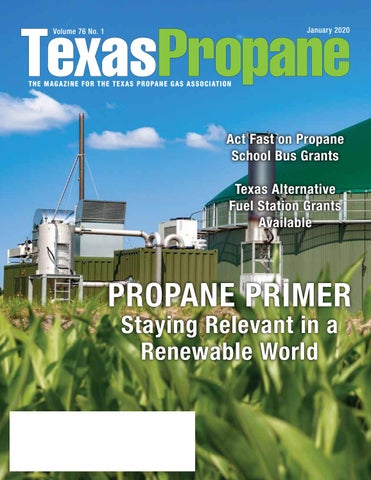
TexasPropane Texas Propane January 2020
Volume 76 No. 1
T H E M AG A Z I N E F O R T H E T E X A S P R O PA N E G A S A S S O C I AT I O N
Act Fast on Propane School Bus Grants Texas Alternative Fuel Station Grants Available
PROPANE PRIMER Staying Relevant in a Renewable World
Maintaining the Legacy You’ve Built
You have worked hard to build your business. Pinnacle Propane is committed to preserving your legacy. Have you considered selling your propane business but concerns for your customers and employees are holding you back? At Pinnacle Propane, our values of Customer Service, Integrity, and Safety emphasize providing the best possible experience for our customers and employees. We focus on providing local service to our customers and empowering our employees via competitive pay, a robust benefits package, and advancement opportunities. As you think about next steps, let us work with you to develop a fair purchase plan and a seamless transition so that you can relax and enjoy the results of your efforts.
Bill Webb Senior Vice President Business Development 936-329-1440
Matt Terry Director Business Development 210-560-5418
Call us today for more information and a confidential assessment of your business.
About Pinnacle Propane: Pinnacle Propane is a leading propane distributor in the U.S. and is part of a global group of
LPG companies owned by SHV Energy, the largest dedicated global LPG distributor. Pinnacle Propaneʼs operations include bulk gas storage and delivery, cylinder filling and distribution, and community gas systems. Learn more at www.pinnaclepropane.com.
TexasPropane January 2020
8408 North IH 35 Austin, TX 78753 512-836-8620 or 800-325-7427 512-834-0758 fax E-mail: info@txpropane.com www.txpropane.com
T H E M AG A Z I N E F O R T H E T E X A S P R O PA N E G A S A S S O C I AT I O N
TPGA staff Bill Van Hoy Executive Director bvanhoy@txpropane.com Jackie Mason Education & Marketing Regulatory & Legislative Affairs jmason@txpropane.com Debbie Simpson Executive Assistant Membership Meeting Planner Publication Coordinator dsimpson@txpropane.com Propane Service Corporation
Debbie Simpson 800-392-0023 dsimpson@txpropane.com
Features PROPANE PRIMER: Staying Relevant in a Renewable World. . . . . . . . . . . . . . . . . . . 6 Propane School Bus Grants. . . . . . . . . . . . . . . . . . . . . . . . . . . 10 Act fast to take advantage of these funds
Statewide Texas Clean School Bus Program (TCSB) Open Now, Funding Going Fast!. . . . . . . . . . . . . . . . . . . . . . . . 13 Texas Alternative Fuel Station Grants Available. . . . . . . . . . . 14 How to Avoid Cold Stress. . . . . . . . . . . . . . . . . . . . . . . . . . . . . 16 Adverse Weather—Do You Have a Plan?. . . . . . . . . . . . . . . . . 20
Publisher
Kim Scheberle Account Manager/Managing Editor Sail House Publishing 512-346-0892 kscheberle@austin.rr.com Joanne Pantaze Advertising Sales 512-273-2639 jpantaze@pvco.net Kiki Pantaze Art Director 512-924-7566 kpantaze@pvco.net
Frequency of Online Reviews Important for Local Businesses. . . . . . . . . . . . . . . . . . . . . . . . 22
Departments Highlights from Headquarters. . . . . . . . . . . . . . . . . . . . . . . . . . . . . . . . . 4 TPGA Board of Directors. . . . . . . . . . . . . . . . . . . . . . . . . . . . . . . . . . . . . 4 Safety Talk. . . . . . . . . . . . . . . . . . . . . . . . . . . . . . . . . . . . . . . . . . . . . . . 24 People in Propane. . . . . . . . . . . . . . . . . . . . . . . . . . . . . . . . . . . . . . . . . 26 Inside the Industry. . . . . . . . . . . . . . . . . . . . . . . . . . . . . . . . . . . . . . . . . 26 Classified Advertising.. . . . . . . . . . . . . . . . . . . . . . . . . . . . . . . . . . . . . . 28 Calendar of Events . . . . . . . . . . . . . . . . . . . . . . . . . . . . . . . . . . . . . . . . 29 Index to Advertisers . . . . . . . . . . . . . . . . . . . . . . . . . . . . . . . . . . . . . . . 29 Propane with Purpose. . . . . . . . . . . . . . . . . . . . . . . . . . . . . . . . . . . . . . 30 ON THE COVER: BioLPG is produced by using both renewable and waste products. Maize/corn is one such product.
Highlights from Headquarters
2020 Has Arrived Bill Van Hoy TPGA Executive Director Happy New Year to all! 2020 promises to be an exciting year, and I’m looking forward to working with you all – as individuals, organizations and experts. Together we can work on best solutions to the challenges we will doubtless face as an industry. TPGA has an excellent future and the board will work hard to ensure the association remains that way. I invite each of you to become more involved in TPGA’s committees and the governance of your association this year. Your ideas and your energy are what moves us forward. Talk to your colleagues about what is going on, look for solutions to prob-
lems, look for opportunities to serve. This association has a wealth of knowledge, and when combined with the networking opportunities, has helped create long-term relationships which have been priceless.
I look forward to a productive and successful year. AFFINITY PARTNERS BASYS • Lone Star Energy Group
2019-2020 TPGA Board of Directors President: Mark Peterson, Buster Brown Propane, 281-689-3946 President Elect: Josh McAdams, McAdams Propane, 936-598-7444 Secretary: Harris Baker, HBH Systems, 512-587-8347 Treasurer/Finance Chair: Allen Wells, Baygas, 281-332-2630 District 1 Director: David Collett, Gas and Supply, 903-780-2488 District 1 Alternate: Open District 2 Director: Josh McAdams, McAdams Propane, 936-598-7444 District 2 Alternate: Open District 3 Director: Jeremy Gentile, Hill Butane, 409-296-2001 District 3 Alternate: Open District 4 Director: Danny Meyers, Bellville Butane 979-865-2698 District 4 Alternate: Matt Peterson, Buster Brown Propane, 281-689-3946 District 5 Director: Ryan Tudyk, Howdy Propane Services, 361-771-1900 District 5 Alternate: Open District 6 Director: Omar Garcia, Mr. G Propane, 956-581-1063 District 6 Alternate: Open District 7 Director: Steve Smith, Smith Gas, 830-393-2533 District 7 Alternate: Sharon Seal, Bell Hydrogas, 210-533-7103 District 8 Director: Rodney Sladek, Fayetteville Propane, 979-836-7044 District 8 Alternate: Open District 9 Director: Bill McCullough, Butane Gas, 800-242-69010 District 9 Alternate: Brad Quisenberry, Gene Harris Petroleum, 888-336-4474 District 10 Director: Josh Nowlin, McCraw Propane, 9003-583-7481 District 10 Alternate: Chad Gregg, Enderby Gas, 940-482-3225 District 11 Director: Steve Adams, Hardwick LPG, 254-647-3402 District 11 Alternate: Open District 12 Director: Laci Jo Stone, Schneider Distributing, 800-901-9109 District 12 Alternate: Open District 13 Director: Open
4
Texas Propane • www.txpropane.com
District 13 Alternate: Open District 14 Director: Terry Perez, Perez Propane, 512-318-9780 District 14 Alternate: Open District 15 Director: Don Heinrich, Slaton Gas, 806-828-6501 District 15 Alternate: Open District 16 Director: Open District 16 Alternate: Open Past President: Jack Walzel, Tri-Co Propane, 254-642-3885 Past President: John Walter, Schneider Distributing, 800-901-9109 Past President: Ben Wood, Northwest Propane, 972-247-6121 Past President: John Kelly, Kelly Propane, 940-586-1208 Vice President: Jeremy Gentile, Hill Butane, 409-296-2001 Vice President: Matt Terry, SHV-Pinnacle Propane, 210-560-5418 Vice President: Larry Baty, Cadenhead Servis Gas, 800-722-8654 Sr. Vice President: Don Heinrich, Slaton Gas, 806-828-6501 Sr. Vice President: Bill Collins, Collins Propane, 972-442-1078 Sr. Vice President: Joe Green, Green’s Blue Flame Gas, 713-462-5414 Assoc. Supplier Service Director: Rusty Walker, Marshall Young Insurance, 817-645-9155 Assoc. Supplier Service Alternate: Steve Johnson, Midstream Transportation, 512-787-3777 Assoc. Producer/Marketing Gas Director: Anna May Etheredge, Bishop Energy, 940-665-4672 Assoc. Producer/Marketing Gas Alternate: Jimmie Grant, Martin Gas Sales, 713-851-6155 Assoc. Manufacturer/Distributor Director: Jim Diehl, Squibb Taylor, 214-357-4591 Assoc. Manufacturer/Distributor Alternate: Joe Ezernack, Meeder Equipment, 903-877-9401 Assoc. At Large Director: J.R. Anderson, Gas Equipment Company, 972-406-3817 Assoc. At Large Alternate: John Becraft, Targa Resources, 817-416-7757 Nominating Chair: John Kelly, Kelly Propane 940-586-1208 NPGA Director: Chad Gray, Dixie LP Gas, 254-582-5359
Feature
PROPANE PRIMER Staying Relevant in a Renewable World By W.L. Van Hoy Whatever we term it – global warming, environmental crisis, climate change –it’s is a hot topic, no pun intended. When I first heard the term “Renewable Propane,” honestly, I chuckled. How can propane renew itself; it seems like an absurd statement. During my research as to how this is possible, I determined whoever coined the phrase simply left a few keywords out. If I were to say “Propane from a renewable source,” then it all makes sense. 6
Texas Propane • www.txpropane.com
Feature
January 2020 •
Texas Propane
7
L TO LACE O CAN EXISTING WITH LPG,
BIOLPG IS NOT AN INNOVATION FOR THE DISTANT FUTURE, IT IS ALREADY AVAILABLE ON THE EUROPEAN MARKET IN QUANTITIES THAT CAN SERVICE THE ENERGY NEEDS OF THOUSANDS OF FAMILIES AND BUSINESSES. CURRENTLY PRODUCTION IS BEING INCREASED AND THE MARKET UPSCALED.
THE MISSION BEHIND THE DEVELOPMENT OF BIOLPG IS TO FURTHER REDUCE CARBON EMISSIONS AND THE ENVIRONMENTAL IMPACT OF LPG, WHICH ALREADY EMITS 35% LESS CO 2 THAN COAL AND 12% LESS THAN OIL. BIOLPG FULFILS THAT MISSION – IT EMITS 73% LESS CO2 THAN CONVENTIONAL LPG.
Feature
NCES.
pane’s cost per ton of emissions is best-in-class.
WHAT IS IT MADE FROM?
So Why?
So whenever the topic of “renewable propane” comes TECHNICAL CORN OIL up, many marketers wonder, If it ain’t broke, then why are ARM WATER & COOKING we trying to fix it? In other TALL-OIL words, why is the propane WASTE MATERIALS SOURCES & PITCH FROM THE FOOD industry – the environmental PROCESSING INDUSTRY FEEDSTOCKS fair-haired favorite child of YLINDERS: BBQ, RRACE HEATING, fuels – even talking about reCAMPING newable propane? CRUDE PALM RAPESEED “Because the propane inOIL OIL dustry doesn’t want to be just E TRANSPORT the fuel of today or the bridge SOY OIL fuel to tomorrow,” responds CAMELINA OIL T Tucker Perkins, president, JATROPHA OIL and CEO of the Propane Education & Research Council All infographics courtesy of the World LPG Association, www.wlpga.org. [PERC]. “Our industry wants to provide solutions for 2020, Now that we all understand what the term implies, why do I 2030, and 2050 – and working toward renewability is the bare care? I don’t sell renewable propane and isn’t propane very enviminimum we must do to offer such solutions moving forward. ronmentally friendly anyway? Have you ever heard “don’t let facts Propane is prepared to innovate and evolve to continue to be a get in the way of the truth?” relevant fuel far into the future.” Regardless of your position on the subject of global warming, While conventional propane is a coproduct of the generation the discussion is having a proand refining of oil and gas, renewfound effect on propane marketers able propane – also known as “bioCurrently, in the U.S., renewable propane in some parts of the U.S. and other propane” – is produced with raw countries. As I see it, there are two materials from a biologic source. comes almost entirely from the output of parts to this issue that the propane “Currently, in the U.S., renewbiodiesel fuel facilities. industry must engage. First, dispel able propane comes almost entireON. hearsay and crisis statements that ly from the output of biodiesel fuel OR are notSUSTAINABILITY supported by real science. Second, stay involved in the facilities. During the process of refining the biodiesel – which conversation. We are fortunate having both fossil-based environuses mostly animal fats or agricultural oils as its raw material – BIOLPG IS MADE FROM mentally advantageous propane and, yes, some limited supplies other natural-gas liquids areFIRST-GENERATION produced, including propane.” SUSTAINABLY PRODUCED CROP BASED FEEDSTOCKS of renewable “sourced” propane. I asked the industry’ most intelRenewable propane is chemically identical to conventional RENEWABLE RAW sMATERIALS PLAY AN IMPORTANT ROLE IN THE ligent speaker on the matterFROM whoCAREFULLY can articulate simplyPARTNERS. the why? propane, so it can easily replace be blended its OF convenSELECTED INITIALor ROLL-OUT AND with UPTAKE OUR SECTOR SUPPORTS STRICT BIOLPG, AND WILL To explain what he hears around the country. tional twin, and be used with all the existing appliances and hySUSTAINABILITY STANDARDS, TO WHICH WE GRADUALLY PHASED ALSOoffers HOLD the OURlowest PARTNERS. Fact: Conventional propane total emissions brid systems that use propane today withoutBE having to alter or OUT AND REPLACED FEEDSTOCK MUST BE FULLY TRACEABLE, footprint of any fuel available today. Additionally, it doesn’t polupgrade equipment. And just like conventional propane, renewSUSTAINABLE AND WELL MANAGED. BY WASTE AND RESIDUE MATERIALS. lute groundwater or soil, it burns cleanly and efficiently, and proable propane can be used in many diverse sectors and applicaBIOLPG IS CREATED FROM RENEWABLE AND WASTE MATERIALS. THE FEEDSTOCKS UNDERGO A SERIES OF SOPHISTICATED TREATMENTS TO PURIFY THEIR ENERGY CONTENT.
PALM FATTY ACID DISTILLATE & STEARINE
WASTE FAT FROM THE FISH PROCESSING INDUSTRY
HOW IS BIOLPG PRODUCED?
THE
KET IN
POWER TO GAS (P2G)
BIO-REFINING CONVERSION OF BIOMASS TO PRODUCE FUEL, HEAT, POWER AND CHEMICALS. A LARGE NUMBER OF TRADITIONAL OIL REFINERIES IN THE EU HAVE REFINERY TECHNOLOGY SUITABLE FOR HVO (RENEWABLE DIESEL) CONVERSION. AS SUCH, THE GLOBAL INSTALLED CAPACITY OF HVO-BIODIESEL IS EXPECTED TO INCREASE FROM 4.7 MILLION TONNES (MT) TODAY TO UP TO 20MT IN 2025.
TLY AND
8
Texas Propane • www.txpropane.com
SUPPLY OUTLOOK
IN THE MIX
A TECHNOLOGY WHICH CONVERTS ELECTRICAL POWER TO A GAS FUEL. COMBINING THE ELECTRICITY AND GAS SYSTEM (KNOWN AS SECTOR COUPLING) CAN INCREASE EFFICIENCY AND FLEXIBILITY OF THE ENERGY SYSTEM AND ULTIMATELY LOWER THE COST OF DECARBONISATION.
GA ANAEROBIC DIGESTION (AD) THE BREAKDOWN OF ORGANIC MATERIAL BY MICRO-ORGANISMS, IN THE ABSENCE OF OXYGEN. THIS PROCESS PRODUCES BIOGAS (SUCH AS BIOLPG). AD IS A KEY PROCESS FOR DEVELOPING A CIRCULAR ECONOMY AS IT ELIMINATES WASTE AND REGENERATES NATURAL SYSTEMS.
BIOLPG HAS HIGH POTENTIAL
AP PR BIO AN GA US GA TH TH
INDUSTRIAL PROCESSES REQUIRING A GASEOUS FUEL.
ACCOUNT FOR ABOUT
22%
OF ENERGY USED IN EU INDUSTRIAL COMBUSTION 4 . 4
Decarbonisation and industrial demand for gas in Europe (2019) – The Oxford Institute for Energy Studies
AS THAT GAS GRID.
COST EFFECTIVE
FLEXIBLE
BIOLPG CAN BE UTILISED IN EXISTING GAS BOILERS, THAT ARE
BIOLPG CAN BE EASILY AND COST-EFFECTIVELY
3-4
NTLY
TIMES CHEAPER THAN AN AIR SOURCE HEAT PUMP
8-9
TIMES CHEAPER THAN A GROUND SOURCE HEAT PUMP TO INSTALL IN A HOUSE6.
CLEAN 3
RTIES ARE NERGY ANTS K OF ATION
ng/cooling fuel
BIOLPG IS A CLEAN BURNING FUEL THAT PRODUCES
VERY LOW CONCENTRATIONS OF HARMFUL AIR POLLUTANTS. 6 7
BY
AS FOR
TIAL
2,000,000
LPG BOILERS5
IN THE EU THAT CAN LOCK-INTO LOWER CO2 EMISSIONS COST-EFFECTIVELY.
Feature
5
Space and combination heaters market analysis (2019) – European Commission DG Energy
WITH ITS INHERENT BENEFITS IT CAN ALSO SET THOSE AREAS ON A LOW-CARBON PATHWAY
ON DS 2
COAL
LPG BOILERS
SAVING BOTH THE HOUSEHOLD BUDGET, AND HASSLE FROM SWITCHING TO A NEW HEATING SYSTEM.
IT CAN BE USED IN EXISTING GAS TECHNOLOGIES AND STORED COMPACTLY IN
STORED AND TRANSPORTED,
MAKING IT A FLEXIBLE FUEL SUITABLE FOR A WIDE RANGE OF APPLICATIONS.
STORAGE VESSELS,
WHICH SAVES SPACE AND EXPENSE.
LOW-CARBON COMBUSTING BIOLPG IN A BOILER PRODUCES
90%-99%
LOWER CONCENTRATIONS
OF PARTICULATE MATTER (PM) THAN HEATING OIL, COAL, AND BIOMASS7
WHEN USED IN A TYPICAL GAS BOILER, BIOLPG CAN REDUCE
GREENHOUSE GAS EMISSIONS BY
70%-80%
AGAINST HEATING OIL.
THIS CAN BE LOWERED FURTHER WHEN BIOLPG IS CONSUMED IN A HYBRID HEAT PUMP, OR COMBINED HEAT & POWER SYSTEM, AND WHEN ENERGY EFFICIENCY MEASURES ARE INSTALLED.
Space and combination heaters market analysis (2019) – European Commission DG Energy EMEP/EEA air pollutant emission inventory guidebook (2017) – European Environment Agency
tions, wherever heat, light, or power is required. And how about where the proverbial rubber meets the road: How much cleaner is renewable propane than traditional fossil fuels or today’s conventional propane? “Renewable propane is high-performing and low-emitting compared with other fuels,” Perkins confirms. “Conventional propane already emits 35% less carbon dioxide than coal and 12% less CO2 than oil; its carbon intensity is around 82. Renewable propane’s carbon intensity is about 35. So it’s definitely ready to be featured in a world consumed with achieving zero carbon.” How close we are to living in that zero-carbon-consumed world depends upon what part of the world you’re in. In Europe and Asia, companies are already using organic-waste refining to TO INCREASE THE produce significant amounts of commercial-grade renewable proAVAILABILITY OF pane.SUCH Biofuels developer Neste Corporation is capturing renewADVANCED LPG able MATERIALS, propane as THE a byproduct of creating biodiesel from vegetable INDUSTRY AND ITS oils and animalNEED fats at its facility in Rotterdam, The Netherlands. PARTNERS THE The NECESSARY company is committed to producing a total of 160,000 metTIME, TOOLS & gallons] of renewable propane over the ric tons [about 83 million TECHNOLOGY nextTO four years. INNOVATE AND TO “Worldwide, the propane industry is making around 100 milMAKE THIS CRUCIAL TRANSITION lion ENERGY gallons of renewable propane each year; about 4% is curHAPPEN TOWARDS rently being made in the United States,” states Perkins. “REG 2050. Geismar in Louisiana coverts waste fats and oils into renewable diesel, renewable naphtha, and renewable propane. A couple of other companies are in the process of alterGASIFICATION AND PYROLYSIS ing their facilities so they can A PROCESS THAT USES HEAT, produce renewable propane, PRESSURE AND STEAM TO CONVERT BIOMASS MATERIALS SUCH AS FOREST and we’re helping identify othAND AGRICULTURE WASTE INTO GASEOUS COMPONENTS THAT CAN BE ers that may be a good fit and USED IN VARIOUS APPLICATIONS. GASIFICATION IS ANOTHER SOLUTION helping them realize the value THAT COMPLIMENTS AND SUPPORTS in it. Overall, there are probTHE CIRCULAR ECONOMY. ably hundreds of U.S. facilities
with the right feedstock and the potential for the right process to make renewable propane.” PERC is trying to advance renewable propane development – especially since legislation and regulation requiring all fuels to have a renewable component has already begun in some parts of the country. In several states, zero or near-zero carbon-emitting fuels are becoming must-haves, and without a renewable component, propane doesn’t make the list. “To be relevant in a fast-changing world, you must innovate,” Perkins attests. “And if the focus is renewable fuels, then we can participate wholeheartedly with renewable propane. To be acknowledged by most forward-thinking policy people and the environmental community, I believe we need to consider a renewable component. Talking about renewable propane knowledgeably and realistically keeps us in the conversation in those markets. “At the same time, I think our industry must be much more prepared to talk about the environmental benefits of the propane we’re using today,” he continues. “For years, we’ve talked about its good value, its portability, its storability, its ability to serve your home, farm, and vehicle. Now, we need to be able to have a conversation about renewable propane as a viable alternative for the future while also telling the story of conventional propane. How it shares many of the same qualities and is here today, abundantly available, and serving our world well. The truth is, conventional propane is an extremely low-carbon fuel that results in clean, efficient energy. So, yes, we’re happy to talk about renewable propane, as well as about how we’re already achieving much of the environmental good it promises for the future with conventional propane today.” Back in the fossil-fuel-intensive Lone Star State, I was very hesitant to mention Renewable Propane for fear Texans would send me packing; this is fossil fuel country. However, I saw an opportunity as Tucker Perkins did, to use the Climate Crisis discussions to not only tell the story of our part in renewables, but remind the public of traditional propane’s advantages to the environment. January 2020 •
Texas Propane
9
Feature
Propane School Bus Grants Act fast to take advantage of these funds
links those fumes to lower test scores. Previous studies proved that diesel exhaust contributes to allergies, asthma, and lung cancer.
Millions of Dollars of Funds Available to Texas Schools
School districts across the country are tasked with getting children from their homes to school (and back home) safely, quickly and economically. Propane has been shown to be a fuel of choice to help administrators with this responsibility. In Texas, we are leading the way in propane gas adoption, with more than 3,000 propane school buses currently operating. Districts using cleaner-burning propane school buses range from small to large, from rural to metropolitan. Incentives are helping pave the way for this transformation. Across the 48 lower states, there are 18,500 propane school buses safely moving 1.3 million students. Why should school districts be shifting to propane? At the top of the list of reasons is the total lower cost of ownership, which takes into account lower fuel cost, lower maintenance cost and reduced volatility of fuel pricing. Additionally, propane school buses provide superior cold weather performance, are much quieter than traditional diesel and offer lower emissions. In fact, a study released in August of 2019 showed that propane school buses can reduce NOx fumes up to 96 percent (see sidebar for specifics on this study). Another recent study, by Georgia State University, directly
10
Texas Propane • www.txpropane.com
The Volkswagen State Environmental Mitigation Trust (Trust) is part of a settlement agreement in the litigation between the United States Environmental Protection Agency (EPA), the State of California, and Volkswagen (VW) and its related entities for violating the Clean Air Act. The suit alleged that approximately 590,000 light-duty 2.0-liter and 3.0-liter diesel vehicles manufactured by VW and its subsidiaries contain emission defeat devices. These devices cause the emissions control system of those vehicles to perform differently during emissions testing compared to performance during normal vehicle operation and use. The subject vehicles emit nitrogen oxides (NOx) at a level above required standards during normal vehicle operation and use. The EPA, California, and VW resolved this case through settlements in which states can use the money to clean up NOx in their state. As part of the settlement agreements, VW must pay approximately $2.9 billion into the environmental mitigation Trust. Of the $2.9 billion, $209 million was allocated for Texas for vehicles and buses to help reduce NOx. Further, $58 million was allotted for school buses and transits. This past May, the Texas Commission on Environmental Quality solicited applications from school districts in affected areas to replace model year 2009 or older diesel buses with cleaner, new school buses in: Dallas-Fort Worth; Houston-Galveston-Brazoria; San Antonio; Austin; El Paso County; Bell County; and Beaumont-Port Arthur. Of the $58 million, $50 million was awarded. This represented a total of almost 700 buses being replaced with the VW settlement money (to date). Nearly 100 of those buses will be propane, taking older diesel buses off the road.
Feature TCEQ’s Statewide Clean School Bus Program
pane, is expected to stay open until February 26, 2021. While the Clean School Bus Program is STATEWIDE, the Texas Natural Gas Vehicle Grant Program is limited to a 83-county region called the Clean Transportation Zone. Counties in the Clean Transportation Zone include: Aransas, Atascosa, Austin, Bastrop, Bee, Bell, Bexar, Brazoria, Brazos, Burleson, Caldwell, Calhoun, Chambers, Collin, Colorado, Comal, Dallas, Denton, DeWitt, Duval, El Paso, Ellis, Falls, Fayette, Fort Bend, Freestone, Frio, Galveston, Goliad, Gonzales, Gregg, Grimes, Guadalupe, Hardin, Harris, Harrison, Hays, Henderson, Hill, Hood, Hunt, Jackson, Jefferson, Jim Wells, Johnson, Karnes, Kaufman, La Salle, Lavaca, Lee, Leon, Liberty, Limestone, Live Oak, Madison, Matagorda, Medina, McLennan, McMullen, Milam, Montgomery, Navarro, Nueces, Orange, Parker, Refugio, Robertson,
At the end of December 2019, the Texas Commission on Environmental Quality (TCEQ) opened $6.2 million in funding for the Texas Clean School Bus Program (TCSB). (Read more about the Statewide Clean School Bus Program on Page 13.) The TCSB will provide grants to public and charter schools, as well as school transportation companies statewide, all across Texas, not just non-attainment of near non-attainment areas, to replace older diesel school buses with new school buses. One of those options includes replacement of older buses with cleanerburning propane autogas school buses. Last biennium, propane only received $687,500 of the $6 million, but the grant was intended to stay open nearly 2 years closed within 30 days of opening. The vast majority going to “clean diesel.” But we have another opportunity with the grant Recent Study Shows Massive Reduction opening this month to get in more apps for 2020, but inin NOx for Propane School Buses terested parties and school districts will need to act fast, After more than a year of testing, researchers from West Virginia University concluded emissions the funding is likely to go just measured from propane school buses are significantly lower than those from diesel buses. About as fast as last year. ProCOT’s 1 million students in more than 900 school districts across the nagrant writer has already been tion ride to school in propane school buses each day. working with several school West Virginia University researchers studied nitrogen oxides (NOx), districts in the 4th quarter of highly damaging emissions that are federally regulated due to their 2019 in anticipation of stateTH E P R O V E N R negative impact on human health and the environment. According wide program opening. O U TE
Other School Bus Grant Opportunities
While the VW Settlement is largely done and the TCEQ Texas Clean School Bus Program will go fast, you have a little time and breathing room to take advantage of a couple other opportunities. First, the TCEQ TERP Texas Natural Gas Vehicle Grant Program has a budget of $15 million. The program is limited to only propane and natural gas and is available first come, first serve. Last biennium, two school districts, Leander ISD and Georgetown ISD, were awarded a total of $1.5 million to replace 47 diesel school buses with propane school buses. The Texas Natural Gas Vehicle Grant Program, which allows for school bus replacements for diesel and gasoline buses with either natural or pro-
to the Environmental Protection Agency, exposure to NOx exhaust can trigger health problems like asthma, bronchitis, and other respiratory issues. The primary source of NOx is motor vehicles — including school buses. In this comprehensive study commissioned by PERC, West Virginia University’s Center for Alternative Fuels Engines and Emissions (CAFEE) completed two types of tests at different times during 2018 on four Blue Bird school buses. Test routes included both city and highway roads, and a stop-and-go route similar to standard school bus operation. Researchers installed a portable emissions measurement system to measure exhaust emissions on each vehicle and performed test runs on each bus with both cold and hot starts, for a total of 36 test routes. The study’s results demonstrated that distance-specific NOx emissions measured from the diesel bus were significantly higher than those measured from the propane bus for tests conducted in early 2018. Specifically:
TO C LE A N E R O
P E R A TI O N
A new study shows that, when compar of similar ma ed with a die ke and model sel bus year, propan can significan e autogas bus tly reduce har es mf ul em issions. When with real wo rld operation fac ed , even diesel systems cou ’s modern em ldn’t outper issions form propan e autogas.
96 % NOX REDUCTION
VE RS US CL EA N
DI ES EL BU S
VS PROPANE Dut y cyc le:
ACT NOW TO
Your district
Low spe ed,
REPLACE YO
DIESEL sto p-a nd- go
UR DIESEL
route
BUSES
can utilize fun ds from the Mitigation set Volkswagen tlement to rep lace its diesel with cleaner buses propane aut ogas model Propane.com s. Learn mo re at /Buses
For the city route, which included city and highway roads, NOX emissions were 15 to 19 times higher for the diesel school bus. NOx was reduced by 95 percent with the propane bus. For the stop-and-go route, NOX emissions were 34 times higher for the diesel school bus. NOx was reduced by 96 percent and carbon dioxide by 13 percent with a propane bus.
Source: 201 8 Wes Emissions stud t Virginia University Cen ter y with 2014 ultr comparing 2015 LPG Blue for Alternative Fuels Eng a-low sulfur ines and diesel Blue Bird Bird school bus (6.8L, 10 Cylinder) school bus (6.7 L, 6 cylinder) . © 2019 6775 -PH-19
Subsequent testing performed in late 2018 with newer model year and lower mileage propane and diesel buses validated the previous testing results.
January 2020 •
Texas Propane
11
Feature lion has been awarded to fund propane school buses, putting 342 more propane school buses on Texas roads between 2010 -2019. In 2019, school districts were awarded $2.2 million for 48 propane school buses through the TCEQ TERP Texas Clean Fleet Program.
Reach Out to Your Local ISD!
Rockwall, Rusk, San Patricio, Smith, Tarrant, Travis, Upshur, Victoria, Walker, Waller Washington, Webb, Wharton, Williamson, Wilson and Wise counties. Additionally, for larger districts also in the Clean Transportation Zone another grant opportunity will be opening up later this year. For districts with more than 75 buses, that want to replace 10 at a time, a more lucrative, and competitive grant called Clean Fleet will be opening up. Since 2010, propane has dominated this program, $19 mil-
Do you think your local ISD should be applying for these grants? School bus marketing assets are available from PERC including photos, videos, and printable downloads. There are also fact sheets and case studies on their Propane Resource Catalog at https://propane.com/resource-catalog.
Complimentary Grant Writing Available
Additionally, the Propane Council of Texas has partnered with a professional grant writer. ProCOT can you put Texas school districts interested in applying in touch with the complimentary grant writer. Reach out to ProCOT at info@propanecounciloftexas.org for more information and help.
PROPANE SAVINGS
TEXAS
Using Volkswagen Mitigation Trust or other available funds to purchase cleaner, cost-efficient propane buses is a smart move for your state. See the numbers for yourself.
NOx Emissions could be reduced by
PROPANE
CLEAN DIESEL
ELECTRIC
Purchase price: $95,000*
Purchase price: $90,000*
Purchase price: $300,000*
Cost per mile: $0.19
Cost per mile: $0.80
Cost per mile: $TBD
Cost per pound of NOx reduced: $91
Cost per pound of NOx reduced: $1,330
Cost per pound of NOx reduced: $268
THAT’S JUST THE BEGINNING The NOx statistic above applies to a standard .20 NOx propane engine, but you have even cleaner options.
Low NOx Propane Engine 75% Cleaner than EPA Standards
663,000 POUNDS annually by replacing all of Texas’ model year 2007-2014 diesel buses with 2019 propane models. Reductions will be greater if model year 1992-2006 buses are replaced. Contact PERC for details. Source: AFLEET
Ultra-Low NOx Propane Engine 90% Cleaner than EPA Standards
Learn why propane is the best choice for buses: Propane.com/VW *Vehicle purchase price may vary by state. Calculations assume the full cost to deploy the cleanest commercially available Type C buses for each fuel type based on emission calculations from the 2017 ANL AFLEET Tool with diesel in-use adjustment.
12
Texas Propane • www.txpropane.com
Feature
Statewide Texas Clean School Bus Program (TCSB) Open Now, Funding Going Fast!
At the end of December 2019, the Texas Commission on Environmental Quality (TCEQ) opened $6.2M in funding for the Texas Clean School Bus Program (TCSB). The TCSB, which is now open, will provide grants to public and charter schools, as well as school transportation companies statewide to replace older diesel school buses with new school buses. One of those options includes replacement of older buses with cleaner-burning propane autogas school buses. The Texas Propane Gas Association worked diligently during the 85th legislative session in 2017 with the Texas Clean Air Working Group, a group of clean air advocates, to get the program expanded to include replacements as well as propane into the mix. Prior to its expansion it was limited to exhaust retrofits. The program had been scheduled to be open for two years, but closed within a month when its monies were exhausted. But we have another opportunity with the grant opening this month to get in more apps for 2020. Who is eligible? Public and charter schools, as well as school transportation companies located STATEWIDE. Private schools are not eligible for this grant. How much can a school district get? Limit is 5 school buses per application.
TCEQ will pay for 80% of eligible cost of replacement, which includes invoice for new propane school buses, taxes and freight. How it works? • Apply to replace pre-2007 (so 2006 or older) diesel bus with new cleaner bus e.g. new propane school bus. • School transportation applicant get assigned contract from TCEQ that the money is reserved. • School transportation applicant destroys old engine within 90 days of receiving the check (hole in engine block) or removes from North America. • School transportation applicant has 18 months to make purchase. • School transportation applicant makes purchase and gets reimbursed from TCEQ. Short report due once a year for 5 years. Deadline. Funding is available first come, first serve and is likely to run out within 4-6 weeks. Grant Writing Assistance. The Propane Council of Texas has partnered with a professional grant writer. ProCOT can you put school districts interested in applying in touch with the complimentary grant writer. Contact ProCOT at info@propanecounciloftexas.org for grant help. January 2020 •
Texas Propane
13
Feature
Texas Alternative Fuel Station Grants Available
This past legislative session, the Texas Propane Gas Association lobbied along with other clean air advocates to double the funding for Alternative Fuel Facilities Program (AFFP) from $6 million to $12 million for FY 2020-FY 2021. AFFP provides grants for construction or upgrade of alternative fuel refueling stations including propane. Here are more details on what the TCEQ calls the Alternative Fuel Facilities Program: Station Type. Eligible facilities that will be open to the public will be considered for funding before private facilities.
Bexar, Brazoria, Brazos, Burleson, Caldwell, Calhoun, Chambers, Collin, Colorado, Comal, Dallas, Denton, DeWitt, Duval, El Paso, Ellis, Falls, Fayette, Fort Bend, Freestone, Frio, Galveston, Goliad, Gonzales, Gregg, Grimes, Guadalupe, Hardin, Harris, Harrison, Hays, Henderson, Hill, Hood, Hunt, Jackson, Jefferson, Jim Wells, Johnson, Karnes, Kaufman, La Salle, Lavaca, Lee, Leon, Liberty, Limestone, Live Oak, Madison, Matagorda, Medina, McLennan, McMullen, Milam, Montgomery, Navarro, Nueces, Orange, Parker, Refugio, Robertson, Rockwall, Rusk, San Patricio, Smith, Tarrant, Travis, Upshur, Victoria, Walker, Waller Washington, Webb, Wharton, Williamson, Wilson and Wise Scoring. Grant is not first come, first serve. It’s competitive. Applications scored by station location (proximity to highway); project objectives, applicant qualifications, & project feasibility. School Districts. Although this grant is open to all legal entities doing business in Texas, the grant is great opportunity for existing school districts to upgrade their propane refueling stations or even new school districts who want to switch to propane. Last year Eanes I.S.D. received over $100,000 to upgrade their 12,000 gallon refueling station to 18,000 gallon station. Other districts could follow suit in 2020.
Grant Amounts. Covers 50% of eligible expenses up to $600,000 • Eligible expenses: Priority Budget Categories: – Equipment – Supplies and Materials • Secondary Budget Categories: – Construction – Contractual Services – Other Expenses • Project costs not eligible for reimbursement include: – costs incurred prior to the opening of the grant round; – employee salaries and travel expenses; – facility improvements and equipment not directly associated with the natural gas or alternative fuel dispensing equipment; – land or existing station purchase; and – administrative costs.
Reporting. Grant winners will be required to provide a quarterly progress report until station is completed. Once completed, a final report with pictures will be required. Thereafter for three years, an annual report will be due.
Eligible Areas. Alt Fuel station operators in 1 of 83 counties called the Clean Transportation Zone can apply. These counties include: Aransas, Atascosa, Austin, Bastrop, Bee, Bell,
Interested in applying? Complimentary grant writing assistance is available. Email info@propanecounciloftexas.org to see if you might be a good candidate for the competitive grant.
14
Texas Propane • www.txpropane.com
Deadline. The competitive grant deadline is March 18, 2020. Project completion. Awardees have until April 30, 2022 to complete new station construction or upgrade.
January 2020 •
Texas Propane
15
Feature
How to Avoid Cold Stress scenario with exposure to a wet environment, and trench foot may also be a problem.
What are the most common cold induced illnesses/injuries?
1.Hypothermia - when body heat is lost faster than it can be replaced and the normal body temperature (98.6°F) drops to less than 95°F. Hypothermia is most likely at very cold temperatures, but it can occur even at cool temperatures (above 40°F), if a person becomes chilled from rain, sweat, or submersion in cold water.
What are the symptoms of hypothermia?
Cold weather often means higher propane use. Fantastic news for propane marketers. But with that increased use comes increased delivery and out-of-gas calls. Propane workers may be required to work outdoors in cold environments and for extended periods. The following frequently-asked questions will help you understand what cold stress is, how it may affect your health and safety and how it can be prevented.
How cold is too cold?
What constitutes extreme cold and its effects can vary across different areas of the country. In regions that are not used to winter weather (think Texas), near freezing temperatures are considered “extreme cold.” A cold environment forces the body to work harder to maintain its temperature. Whenever temperatures drop below normal and wind speed increases, heat can leave your body more rapidly. Wind chill is the temperature your body feels when air temperature and wind speed are combined. For example, when the air temperature is 40°F, and the wind speed is 35 mph, the effect on the exposed skin is as if the air temperature was 28°F. Cold stress occurs by driving down the skin temperature and eventually the internal body temperature (core temperature). This may lead to serious health problems, and may cause tissue damage, and possibly death. What risk factors contribute to cold stress? Some of the risk factors that contribute to cold stress are: • Wetness/dampness, dressing improperly, and exhaustion • Predisposing health conditions such as hypertension, hypothyroidism, and diabetes • Poor physical conditioning How does the body react to cold conditions? In a cold environment, most of the body’s energy is used to keep the internal core temperature warm. Over time, the body will begin to shift blood flow from the extremities (hands, feet, arms, and legs) and outer skin to the core (chest and abdomen). This shift allows the exposed skin and the extremities to cool rapidly and increases the risk of frostbite and hypothermia. Combine this
16
Texas Propane • www.txpropane.com
• Mild symptoms: • An exposed worker is alert. • He or she may begin to shiver and stomp the feet in order to generate heat. • Moderate to Severe symptoms: • As the body temperature continues to fall, symptoms will worsen and shivering will stop. • The worker may lose coordination and fumble with items in the hand, become confused and disoriented • He or she may be unable to walk or stand, pupils become dilated, pulse and breathing become slowed, and loss of consciousness can occur. A person could die if help is not received immediately. What can be done for a person suffering from hypothermia?
• Call 911 immediately in an emergency; otherwise seek medical assistance as soon as possible. • Move the person to a warm, dry area. • Remove wet clothes and replace with dry clothes, cover the body (including the head and neck) with layers of blankets; and with a vapor barrier (e.g. tarp, garbage bag). Do not cover the face. • If medical help is more than 30 minutes away: • Give warm sweetened drinks if alert (no alcohol), to help increase the body temperature. Never try to give a drink to an unconscious person. • Place warm bottles or hot packs in armpits, sides of chest, and groin. Call 911 for additional rewarming instructions. • If a person is not breathing or has no pulse: • Call 911 for emergency medical assistance immediately. • Follow 911 operator’s instructions on administering chest compressions, and continue following their instructions until professional help arrives. 2. Frostbite - is an injury to the body that is caused by freezing of the skin and underlying tissues. The lower the temperature, the more quickly frostbite will occur. Frostbite typically affects the extremities, particularly the feet and hands. Amputation may be required in severe cases. What are the symptoms of frostbite?
• Reddened skin develops gray/white patches.
Feature • Numbness in the affected part. • Feels firm or hard. • Blisters may occur in the affected part, in severe cases. What can be done for a person suffering from frostbite?
• Follow the recommendations described above for hypothermia. • Do not rub the affected area to warm it because this action can cause more damage. • Do not apply snow/water. Do not break blisters. • Loosely cover and protect the area from contact. • Do not try to rewarm the frostbitten area before getting medical help; for example, do not place in warm water. If a frostbitten area is rewarmed and gets frozen again, more tissue damage will occur. It is safer for the frostbitten area to be rewarmed by medical professionals. • Give warm sweetened drinks, if the person is alert. Avoid drinks with alcohol. 3. Immersion/Trench foot - is caused by prolonged exposure to wet and cold temperatures. It can occur at temperatures as high as 60°F if the feet are constantly wet. Non-freezing injury occurs because wet feet lose heat 25-times faster than dry feet. To prevent heat loss, the body constricts the blood vessels to shut down circulation in the feet. The skin tissue begins to die because of a lack of oxygen and nutrients and due to the buildup of toxic products. What are the symptoms of trench foot?
• Redness of the skin, swelling, numbness, blisters What can be done for a person suffering from immersion foot?
• Call 911 immediately in an emergency; otherwise seek medical assistance as soon as possible. • Remove the shoes, or boots, and wet socks. • Dry the feet.
How can cold stress be prevented?
Although OSHA does not have a specific standard that covers working in cold environments, employers have a responsibility to provide workers with employment and a place of employment which are free from recognized hazards, including cold stress, which are causing or are likely to cause death or serious physical harm to them (Section 5(a)(1) of the Occupational Safety and Health Act of 1970). Employers should, therefore, train workers on the hazards of the job and safety measures to use, such as engineering controls and safe work practices, that will protect workers’ safety and health. Employers should train workers on how to prevent and recognize cold stress illnesses and injuries and how to apply first aid treatment. Workers should be trained on the appropriate engineering controls, personal protective equipment and work practices to reduce the risk of cold stress. Employers should provide engineering controls. For example, radiant heaters may be used to warm workers in outdoor security stations. If possible, shield work areas from drafts or wind to reduce wind chill. Employers should use safe work practices. For example, it is easy to become dehydrated in cold weather. Employers therefore, can provide plenty of warm sweetened liquids to workers. Avoid alcoholic drinks. If possible, employers can schedule
heavy work during the warmer part of the day. Employers can assign workers to tasks in pairs (buddy system), so that they can monitor each other for signs of cold stress. Workers can be allowed to interrupt their work, if they are extremely uncomfortable. Employers should give workers frequent breaks in warm areas. Acclimatize new workers and those returning after time away from work, by gradually increasing their workload, and allowing more frequent breaks in warm areas, as they build up a tolerance for working in the cold environment. Safety measures, such as these, should be incorporated into the relevant health and safety plan for the workplace. January 2020 •
Texas Propane
17
5
Feature
PLACE AREAS AFFECTED BY FROSTBITE IN WARM- TO - TOUCH WATER
vides better insulation. Do not wear tight fitting clothing. • An inner layer of wool, silk or synthetic to keep moisture away from the body. • A middle layer of wool or synthetic to provide insulation even when wet. • An outer wind and rain protection layer that allows some ventilation to prevent overheating. • Wear a hat or hood to help keep your whole body warmer. Hats reduce the amount of body heat that escapes from your head. • Use a knit mask to cover the face and mouth (if needed). • Use insulated gloves to protect the hands (water resistant if necessary). • Wear insulated and waterproof boots (or other footwear).
FROSTBITE CAUT ON
Since skin may be numb, victims of frostbite can harm themselves further. Use caution when treating frostbite and:
1 UNLESS NECESSARY, DO NOT WALK ON FEET OR TOES WITH FROSTBITE
2 DO NOT USE A FIREPLACE, HEAT LAMP, RADIATOR, OR STOVE FOR WARMING
3 DO NOT USE A HEATING PAD OR ELECTRIC BLANKET FOR WARMING
4 DO NOT RUB OR MASSAGE AREAS WITH FROSTBITE
Safety Tips for Workers
http://emergency.cdc.gov/disasters/ winter/staysafe/index.asp CS253565-A
Dressing properly is extremely important to preventing cold stress. The type of fabric worn also makes a difference. Cotton loses its insulation value when it becomes wet. Wool, silk and most synthetics, on the other hand, retain their insulation even when wet. The following are recommendations for working in cold environments: • Wear at least three layers of loose-fitting clothing. Layering pro-
18
Texas Propane • www.txpropane.com
• Your employer should ensure that you know the symptoms of cold stress. • Monitor your physical condition and that of your coworkers. • Dress properly for the cold. • Stay dry in the cold because moisture or dampness, e.g. from sweating, can increase the rate of heat loss from the body. • Keep extra clothing (including underwear) handy in case you get wet and need to change. • Drink warm sweetened fluids (no alcohol). • Use proper engineering controls, safe work practices, and personal protective equipment (PPE) provided by your employer. You can find additional resources about cold stress (and its prevention) at https://www.cdc.gov/niosh/topics/coldstress/.
THIS IS WHERE WE'VE BEEN. THIS IS WHERE WE ARE. THIS IS WHERE WE ARE GOING.
MOVING FUEL AHEAD OF EXPECTATION
WWW.MKGAS.COM 1-888-MKGASTX
J LIQUID TRANSPORATION J TANK INSTALLATIONS
J LP GAS INSTALLATIONS J FUEL SUPPLY January 2020 •
Texas Propane
19
Fleet Safety
Adverse Weather—Do You Have a Plan? Top 4 Tips for Inclement Weather 1. Follow weather forecasts and expect the unexpected 2. Be prepared for various scenarios 3. Manage your speed and the space between you and others 4. Empower your drivers to put safety first
and rain. Adverse weather is simply anything other than optimal weather. Ideas to consider when putting your plan into place: Being weather aware: It’s important that both drivers and dispatchers stay current on weather and road conditions that the driver may encounter. There are several methods of receiving current weather related information such as downloadable apps, telematics systems that provide real time weather information and the 511 phone service. Dispatchers can also monitor weather and provide the information and potential alternative routes to drivers in route. You can’t change the weather but you can change how you react to it. Avoiding traveling in adverse weather is the generally the safest and best option. Unfortunately for most carriers that is not always a possibility. The next best option is to have an adverse weather plan. Having a plan means
drivers, dispatchers and customers are able to adjust expectations and helps reduce stress and anxiety. It also decreases the likelihood of a weather-related crash. When you think of adverse weather you may think of snow and ice, but it can also include high wind, fog/smoke, sleet
Happy New Year! As you make your resolutions… Add shopping at Propaneservicecorp.com to your list! Propane Service Corporation 800.392.0023 sales@propaneservicecorp.com www.propaneservicecorp.com
20
Texas Propane • www.txpropane.com
Closed January 1, 2020 Open online 24/7
Empowering or pushing
Drivers who are pushed to make tight scheduling may make poor decisions that can cause a load to be later than the few hours it would take to wait out a storm. Empower drivers to be able to make the decision to stop in a safe and secure location and wait for conditions to improve. Be Prepared
When possible, know what to expect during your trip and allow extra time for delays. Being prepared also includes: • Ensuring the vehicle is in proper working condition • Making sure the brakes are properly adjusted • Tires are properly inflated and in good condition • Fluids are topped off • Wiper blades are in good condition • Emergency supplies are stocked including extra wiper blades and windshield washer fluid • Ensure the weight of the load is evenly distributed
Fleet Safety • Check that the head lights, tail lights and turn signals are in good working order and be sure to clean them at each stop. Know the chain law requirements for states that will be traveled through, ensure the vehicle is equipped with the proper size and number of chains needed. A quick refresher on properly chaining up may be beneficial to drivers. Speed and Space Management
When weather becomes hazardous your best defense is to reduce your speed,
Rural Computer Consultants, Inc.
Complete Back-Office Software
and allow more space between vehicles. This increases your ability to react to unforeseen situations and respond more effectively. In good driving conditions, larger vehicles need approximately a 6-8 second following distance. However, in adverse weather this can easily be doubled. Slower speeds are vital especially when approaching curves or entering intersections. Use extra caution in high hazard areas such as bridges, overpasses, intersections, exit ramps and areas where black ice may be present. Always drive with caution and watch
for motorists who lack the skill or experience to drive in adverse conditions. If adverse weather occurs without warning, it is best to safely get off the road and wait for conditions to improve. This article is courtesy of information compiled by Crum & Forster. This material is provided for information purposes only and is not intended to be a representation of coverage that may exist in any particular situation under a policy issued by one of the companies within Crum & Forster.
START THE YEAR WITH THE RIGHT TANK Service
Customer attention, best lead time
Mix-loads
Get what you need
Crane trucks Deliver & unload
Version 10 Faster
Smarter
Best warranty policy We got your back
Best Quality
Rego Valves, Rochester Gauges, Powder Coated paint
BETTER
Also offering: MOBILE OFFICE ON THE GO
Delivery Service Work Orders Meter Reading Cylinder Exchange 1-800-722-6659 • www.rccbi.com Bird Island, MN • Birmingham, AL • Portland, ME
January 2020 •
Texas Propane
21
Marketing Minute
Frequency of Online Reviews Important for Local Businesses By Rachel Denney
How modern consumers view online reviews
Consumers increasingly rely on reviews to select local businesses. Mobile internet users, especially younger demographics, base their first impressions of local businesses on reviews on third-party review sites. While this trend isn’t new, the discerning skepticism consumers view reviews with is. According to a new BrightLocal consumer review survey, consumers research local businesses through reviews on Yelp, Google, and other local mobile
directories. But consumers doubt the authenticity of individual reviews, which makes them value the aggregate of newer reviews across multiple sources. Businesses need to be aware that their previous review generation strategies may be insufficient. Instead of simply having reviews and a high rating, local businesses should focus on having recent, numerous reviews across several local business directories.
Let the company that knows your business, protect your business
worker’s compensation • general liability • auto insurance property insurance • health insurance & employee benefits risk management services
Protecting Propane and Petroleum Dealers for over 20 Years!
Member
225 S. Fifth St., Waco, TX 76701 • (800) 267-6221 • www.insurors.com 22
Texas Propane • www.txpropane.com
Online marketers have known for years than reviews can be a stand-in for vital human interaction and word-of-mouth recommendations. Because they’re so valuable, however, businesses have transparently pushed customers to leave reviews — sometimes with the request for positive reviews specifically. This has left modern review readers skeptical of glowing claims. Individual reviews can be outright dismissed, even if they came from verified customers. But this doesn’t mean reviews as a whole have lost their power. Instead, consumers have been more discerning. According to this analysis of the BrightLocal survey, consumers now evaluate local business reviews based on: Their recency. The most persuasive reviews have a timestamp within the past two weeks and reviews lose most of their impact if they’re a month old. The quantity. Consumers are more trusting of local businesses that have at least ten reviews, though consumers between the ages of 18 and 34 need at least 13, on average. The consistency of the rating across multiple sites. Respondents to the survey browse the ratings across multiple review sources like social media, Yelp, and TripAdvisor. Maintaining a consistently positive impression across most of these data points is essential. All of these factors play an important role in consumers’ anti-fraud strategy to avoid being overly impacted by a fake or coerced review. With the increased use of social media for product research and the growing use of mobile devices for local business searches, business owners can expect consumer research strategies to get more nuanced, and to incorporate several different platforms. This information can help businesses guide their online marketing strategies for
Marketing Minute
How powerful are reviews?
While consumers clearly use reviews as some part of their research journey, it can be unclear how significant of a role they play or what part they fulfill in converting online visitors to in-store customers. According to the BrightLocal survey, consumers typically took one of three courses of action after reading reviews: • Visiting business websites • Searching for confirming reviews • Visiting the physical store For mobile searchers, this behavior could be due to their immediate need to find a location or services. They’re not browsing; they’re selecting which option will fulfill their need. For desktop users, these behaviors indicate less immediate needs but clear intentions to use a well-reviewed business in the future. SEO experts can use their site-specific analytics to find the percentage of mobile audiences and desktop audiences they reach to create specific marketing plans. However, the fact that consumers immediately take progressive steps down the buyer’s journey indicates that businesses shouldn’t necessarily focus on persuading consumers to take certain actions. Instead, they should convince consumers that their local business is the best option to fill a pre-determined need. How local businesses can strengthen their reviews
While consumers may be leery of reviews, they still provide a vital informational resource. Thus, businesses should invest time and effort into boosting their presence on multiple business directories like Google My Business and review sites. Even more importantly, local businesses should focus on ethically securing reviews. ‘Ethical,’ in this instance, means requesting reviews without requesting a certain star value. Some sites like Yelp don’t allow direct review solicitations at all. Local businesses shouldn’t let worries about negative reviews stop them. Not only can a few negative reviews appease people’s suspicions that businesses are fil-
tering out bad reviews, they’re less likely to happen in the first place. The BrightLocal survey respondents reported that positive experiences were the most likely reason they’d leave a review, not negative ones. Asking for reviews by email or face-toface after an in-store interaction is an effective technique. 51% of surveyed consumers said they’d leave a review after being asked. In fact, younger shoppers aged 18 to 34 left an average of 11 reviews in 2018, and older shoppers wrote an average of five. Asking for reviews openly, often, and
ethically is one of the best ways to get marketable feedback from online and inperson consumers. Transparent review requests may even go a long way in assuring first-time visitors that they were right to trust the reviews in the first place, bringing your marketing efforts full-circle. This article was published by Impact, www.impactbnd.com, a marketing agency that provides articles, educational resources and live shows to help clients increase sales and returns.
Is the missing Piece
WORTH the risk?
LONG TERM CARE
HEALTH & LIFE INSURANCE
FINANCIAL & ESTATE PLANNING
DISABILITY INSURANCE
HO M AU E & TO
2020. Before, local businesses have been aware that reviews were important. Now, business owners can direct their focus on collecting reviews constantly rather than relying on glowing but old reviews.
EMPLOYEE BENEFITS
FARM & RANCH
Other propane owners have come to our agency to get help with connecting their insurance pieces: 1) Some have grown frustrated with the lack of timely response and personal service from their current agent. 2) Many have discovered a missing piece of coverage after meeting with us. 3) Most tell us they have no idea what companies insure their industry and are surprised to learn there are multiple options available.
“We chose Marshall Young as our insurance agent because of the personal service, value and the ability to meet all of our insurance needs. When we need anything we get immediate and personal service with just a phone call.” — John Walter Schneider Distributing/ Past TPGA President
WWW.MARSHALLYOUNG.COM
401 N. Ridgeway Drive, Cleburne TX 76033 | 817-645-9155 MEMBER
January 2020 •
Texas Propane
23
Safety Talk
Properties of Static Electricity Safety Meeting number of factors, including: 3 Walking through a facility or across a carpet. 3 Fuel flowing at high velocity through a small opening. 3 Friction from wind blowing over cellophane or stretch wrap near cylinders. 3 Putting on or removing conductive clothing. 3 Picking up a charged item, without static discharge control footwear, and/or not grounding yourself after putting the item down. WAYS TO REDUCE STATIC ELECTRICITY: 3 Identify where static elec-
Static electricity is electricity at rest, but if a conductive path is present, it can result in a spark or static discharge. In propane operations, this spark can ignite and cause a fire or even an explosion. It is important to understand static electricity, where and how it can arise, and how to reduce risks of a static ignition. FACTS ABOUT STATIC ELECTRICITY: 3 Static electricity occurs when two materials touch and sepa-
rate, thus creating an imbalance of electrons and a positive charge. Benign in many situations, static electricity can be extremely dangerous around propane. 3 Static sparks give off energy in the form of heat or light. 3 The level of static charge is affected by speed of movement, humidity, material size, and materials’ electrical properties (conductive or non-conductive). Metals, wet fabrics, wet concrete, and the human body are common conductive materials. 3 Higher humidity reduces static generation significantly. However, polymeric materials such as HDPEs, PVCs, and plastic films do not retain moisture and thus can charge to extreme voltages even in high humidity. 3 Even through they do not throw sparks, non-conductors can transfer their electrical energy to something or someone that can cause a spark. This is called induction. 3 The smallest static spark we can see or feel (about 3,000 volts) has double the energy required to ignite propane.
CAUSES OF STATIC ELECTRICITY:
In propane operations, static electricity can be caused by a
24
Texas Propane • www.txpropane.com
tricity may be coming from, and use signage and floor markers to label all static discharge control areas. Limit access to authorized personnel only. 3 Use a grounding path for static charges you may develop or carry. Make sure all process and handling equipment is grounded and bonded in accordance with electric codes. 3 Follow your company’s guidelines on static discharge footwear and PPE, and use static-safe floor mats and other plantsupplied safety tools. 3 Make sure you understand how to control static generation and provide safe grounding paths. Talk with your supervisor if you need training. DISCUSSION TOPICS 1. Which common situations and activities at your workplace can generate static electricity? 2. How might humidity levels affect a specific job task? How do your precautions change in low-humidity versus high-humidity situations?
LEARNING ACTIVITY Display various fabrics (including uniforms or other employee clothing) and plant materials (stretch wrap, metal, etc.). Demonstrate how static can occur and which items may pose greater hazards.
Source: Static Electricity in the Propane Industry (PERC) For more information about static electricity, visit propanesafety.com.
Safety Talk
Static Discharge Prevention Tips The release of static electricity (static discharge) can be extremely hazardous in propane operations. By using the following tips, you can help prevent and control static discharge and ensure a safe working environment for yourself and your coworkers. EIGHT SAFETY TIPS FOR PREVENTING STATIC DISCHARGE: 3 1. Know the area. Every propane facility has designated Static
Discharge Control Areas — places where propane vapors may be released or pooled. These include areas where any propane transfer, processing, or storage occurs. Be aware of where these locations are, and take appropriate prevention measures when nearby. 3 2. Ground yourself. Workers can conduct or carry a significant amount of static electricity as they move about the plant. Always wear static-safe footwear or conductive wristbands, and use a static-safe floor or floormat to safely discharge any buildup before handling propane. 3 3. Check your attire. Cotton and cotton blends generate less static electricity than most synthetic materials, and thus are the typical propane uniform fabric. Wear your uniform and be aware of any garment or layers that “snap” or “crackle” when removing. Never put on or remove clothing inside a Static Discharge Control Area. 3 4. Clean up. Check that all HDPEs, PVCs, and other synthetic materials are out of Static Discharge Control Areas. 3 5. Follow regulatory code. Electrical equipment inside a Static Discharge Control Area must be installed in accordance with NFPA 58 and state electrical codes and regulations. Metal
and non-electrical stationary equipment, such as rollers, should also be grounded. 3 6. Observe your processes. Most static electricity comes from the friction between materials, even if they are non-conductive. Review your facility’s processes and activities and take action to reduce any apparent risk. 3 7. Limit access. Limit access to Static Discharge Control Areas to trained propane workers who understand how to perform the particular task and handle static discharge safely. 3 8. Speak up. Propane personnel who work in Static Discharge Control Areas can provide the best information on potential threats and hazards. Let your supervisor know of any issues you become aware of. DISCUSSION TOPICS 1. You have been engaged to perform a new task and believe that it may produce a signifi cant static electricity issue. How do you respond? 2. You notice that several plastic trays and some plastic wrap are present inside a Static Discharge Control Area. You need to fill cylinders quickly for a waiting customer. What should you do? LEARNING ACTIVITY Stage a Static Discharge Control Area, and walk your participants through what to do when entering, working in, and leaving the area.
FUEL YOUR PROFITS WITH LOWER WORKERS’ COMP PREMIUMS Endorsed by:
*Dividends are not guaranteed and past dividends are not a guarantee of future dividends. The Texas Department of Insurance must approve all dividend plans
Call your agent to get a quote or call Curtis Heptner, Master Agent H (940) 397-2771 H Curtis@certessentials.com
January 2020 •
Texas Propane
25
Inside the Industry
People in Propane Guy G. Matthews, 80, of Pflugerville, TX, passed away on December 4, 2019. Mr. Matthews had been the owner of Pflugerville Propane since 1981. Prior to that he worked for the Railroad Commission of Texas. While at the Railroad Commission, he was instrumental in their fire training program. Our thoughts and prayers go out to the family at this time. William Doyce Taylor of Bonham, TX, passed away on December 16, 2019. Doyce was a key part of the McCraw Oil & Propane family for 29 years and a proud owner for the past 19 years. Our thoughts and prayers go out to his family and his McCraw Propane family at this time. The family asks that in lieu of flowers, donations be made in memory of Doyce to the Fannin County Children’s Center, 112 West 5th, Bonham, Texas 75418. Donations can be mailed or given online at www.fanninccc.org, under Honor and Memorial Gifts. Gene Ford, 80, of Hamilton, passed away in late December. Mr. Ford retired from Bert Schrank LP Gas after 26 years. He enjoyed hunting with this sons and friends and watching westerns on TV. Our thoughts and prayers go out to the family at this time. Dub Taylor, Director of the State Energy Conservation Office (SECO), is retiring from state service after serving in that capacity for the last 20 years. Prior to joining SECO in 1999, Taylor’s public sector experience included six years with the Railroad Commission’s Alternative Fuels Research and Education Division. TPGA’s Sr. Technical Director Richard Gilbert has been appointed to the ANSI Z223.1 committee. Along with the NFPA 54 committee, on which he also serves, the ANSI Z223.1 provides minimum safety requirements for the design and installation of fuel gas piping systems in homes and other buildings. Congratulations, Richard, on your appointment.
PERC Social Media 101 Webinars
Over 2019, the Propane Education & Research Council (PERC) held numerous webinars on Google and digital advertising. In the first quarter of 2020, they will tackle social media in a twopart webinar as part of the Can Do Training Series. The first webinar is scheduled for January 6; the sec-
ond for February 3. Details on the webinars: January 6, 2020 Facebook/Social Media Plan Development You set up your company’s Facebook page, now what? Learn how to develop and execute a successful social media plan for your company or organization. February 3, 2020 Facebook/Social Media Calendar Development Learn about social media advertising and how the requirements for a successful social
BAM Propane is committed to servicing your propane needs with supply availability at all the major supply points across Texas. We market Polygrade Propylene, Refrigerant Grade Propane in addition to HD-5. Please contact us for more information: Jeff Severson Marketing Manager (817) 738-8224 (Office) (817) 894-6126 (Mobile)
26
Texas Propane • www.txpropane.com
media campaign have changed in just the past few years. In this session, we’ll get into more detail about the different ad products offered by each major social media platform and what you can and can’t do on each platform. Register for these and other marketing webinars from PERC at www.candotraining.com. CETP Certification Transfer to PERC Begins January 1, 2020
Beginning January 1, ownership and administration of the Certified Employee Training Program (CETP) will transfer
Inside the Industry to the Propane Education & Research Council (PERC). The industry’s premier safety education and compliance program offers 14 different certification areas covering a variety of skills. CETP provides a formal structure for testing and verifies employee knowledge and skills to perform their work safely and effectively. Some Texas marketers have used CETP for their Continuing Education, which the Railroad Commission recognizes and allows as an alternative Continuing Education (CE) to help marketers comply with CE requirements. The rest of the country uses it for their training, because most states do not have a state agency that offers formal training like we do. The National Propane Gas Association (NPGA) has owned and administered the certification program since its creation in 1987. Since 2002, PERC has owned and developed the content portion of the training, while NPGA continued to operate the certification step. The transfer includes moving all training records, tests, skill evaluations for more than 100,000 propane professionals to a new, online platform called The
Learning Center housed on the PERC website (www.propane.com). Users will be able to conveniently access all materials from their desktop computer, laptop, cellphone, or tablet. The change brings both components back together in one place so that PERC’s team of experts can create innovative training and safety materials and new innovative ways to deploy those materials and access the training, according to Eric Kuster, PERC’s vice president of safety, training and compliance. “Our goal is to make workforce training and certification better, faster, and cheaper,” Kuster says. “Today’s workforce learns differently than previous generations, so we are designing a more flexible system that better serves current and future hires alike.” A dedicated help desk line (800-7571554) for users will also launch January 1. Mr. Steak Propane Grills Recalled
Bass Pro Shops is recalling MR. STEAK propane gas grills due to reports of grill fires. Bass Pro Shops, Cabela’s, and ABT Appliance & Electronics stores nationwide and online at basspro.com
YOUR BOBTAIL
HEADQUARTERS White River Distributors, Inc. has loyaly served Texas since 1949. White River is an active and responsive force in the Texas propane industery. We have tanks 600 to 8000 gallons, your choice of chassis. White River can customize your bobtail to your specifications. New, used, and refurbished propane bobtails, change-overs, and repairs. Financing available.
and cabelas.com sold the grills from May 2017 through July 2019 for about $500 for the four burner grill and $600 for the five-burner grill are on the recall list. The recall involves four and five burner models of MR. STEAK propane gas grills, models MS-4B-PG, SKU 2472264 and MS-5B-PG, SKU 2472265, that have both a fuel gauge and a fuel line that is not attached to the inside of the grill. The grills are stainless steel with black trim and have four or five black and red dials. The words “MR. STEAK” is printed below the thermometer on the grills’ lid. The recall also applies to SKUs 2366916 and 2366917 if the consumer added an aftermarket fuel gauge to the regulator assembly. A label on the inside of the left compartment door or on the back of the grill identifies the model number of the grill. The SKU is printed on the purchase receipt. Nine reports of grill fires have been reported so far but no injuries. Consumers contact Mr. Steak toll-free at 833-677-8325 or 833-MRSTEAK from 8 a.m. to 6 p.m. ET Monday through Friday, or online at mrsteak.com and click on “RECALL” or visit mrsteak.com/repairpartskit for more information.
69 Y e Fabr ars of T a icati on fo nk Truck r Tex as
REFINED FUEL TANK WAGONS • PROPANE BOBTAILS VACUUM TANKS • WATER TRUCKS • OIL/WATER SEPARATORS • FRAC SAND CONTACT
Danny McElroy
w w w. l p g b o b t a i l s . c o m
at the Southwest Sales Center • Dallas, Texas 1-800-483-9971 • 214-326-8661 cell danmcelroy@aol.com
January 2020 •
Texas Propane
27
Classifieds 2003 Kenworth T300 2500 gallon Propane Tank, 301K miles, 6 Speed
Asking $35K Contact: Steve or Wanda (361) 364-2284
BOBTAILS FOR SALE T exas trucks, no rust, good to excellent condition: • 1998 Peterbilt, 6 speed, 2500 gal, tank, LC Register, Steel deck, Aluminum wheels, 45,386 miles on new motor in 2009 • 2003 Kenworth, 6 speed, 2800 gal. Whiteriver built tank, Neptune meter, steel deck, vapor reel, Guidemaster, Self-load plumbing, 17,248 miles on new motor in 2017. • 2005 Peterbilt, 6 speed, 2800 gal. tank, 300,000 miles.
PetroStar Equipment Resources Purchase & Sale Pre-Owned Propane Tanks 5,000 gallons to 90,000 gallons FOR SALE (2) 12,000 gallon, 250 psi, 2013 (2) 18,000 gallon, 250 psi, saddles, 2007 Contact: Jim Oliver 936-755-6108 petrostar@pdq.net
Call or email for Pictures and Pricing @ 512-276-7800 or 1-800-696-3493 or sturner@directpropaneservices.com
WOULD YOU LIKE TO ADVERTISE IN TEXAS PROPANE MAGAZINE? For Advertising, contact: Joanne Pantaze at 512-273-2639 or by email at jpantaze@pvco.net
Garrett Insurance Agency, Inc Formerly, Southern Star Insurance Agency, Inc Cecil Joiner, Risk Manager cecil@garrettinsurance.com 936-756-2222 www.garrettinsurance.com
CHERYL@LONGHORNPROPANE.COM or WENDY@LONGHORNPROPANE.COM, 830-964-2525
28
Texas Propane • www.txpropane.com
Calendar JANUARY 2020
6 PERC Webinar Facebook/Social Media Plan Development https://www.candotraining.com 23-24 PERC Trainer’s Conference 21-23 NAHB International Builders Show Las Vegas, NV
FEBRUARY
3 PERC Webinar Facebook/Social Media Calendar Development https://www.candotraining.com 3-5 2020 AHR Expo Orlando, FL 4-5 WLPGA Technical Summit & Industry Council Meeting Washington, DC 9-11 NPGA Winter Board of Directors meeting Scottsdale, Ariz. 11-13 World Ag Expo Tulare, CA 12 PERC Council Meeting Confernce Call
Index to Advertisers 15 Deadline for Submitting National Propane Gas Foundation Scholarship Applications 17 TPGA & PSC office closed for President’s Day 27-29 Farm Commodity Classic Show San Antonio, TX
MARCH
2 PERC Webinar Email Marketing www.candotraining.com 3-4 TPGA Board & Committee Meetings Lakeway, TX 3-6 The Work Truck Show 2020 Including the Green Truck Summit Indianapolis, Ind. 8-10 NPGA Spring TS&S Committee Meeting San Antonio, Tex. 12-13 NPGA Spring Benchmarking Council Meeting Irving, Texas 12-14 Hearth, Patio & Barbecue Expo New Orleans, La.
BAM Propane Consultants 26 BLT Tanks 15 Cunningham Gas Products 18 Ferrellgas 26 Fisk Tank Carrier Inc. Outside Back Cover Gas Equipment Company 31 Insurors of Texas 22 Lone Star Energy Group 25 Longhorn Propane 28 Lumbermen’s Insurance Agency 31 Marshall Young Insurance 23 Meeder Equipment Co. 5 Metsa Tanks Inc. 21 MK Gas 19 Pinnacle Propane Inside Front Cover Propane Service Corporation 20 Rural Computer Consultants 21 White River Distributors 27
Find Us On Social Media
Click LIKE on the Texas Propane Gas Association Page
Texas Propane Gas Association
Follow Us with TPGA’s twitter @txpropane1 January 2020 •
Texas Propane
29
Propane With Purpose
Propane Serves the Serious Home Brewer It’s no secret that propane power is a fuel of choice for craft brewers and spirit makers. Its precise heat allows small-batch manufacturers the ability to tailor their heat to their needs, in addition to being portable and economical. Home brewing is evolving in this direction, as well. While the entry level home brewer might start by boiling items on their stove, the more serious and evolved home brewer can turn to propane for more scalable batches of their favorite brew. On homebrewing.com, there are a variety of propane powered systems that can run from $2,500 to $6,500. These are for the serious brew crafter! For single pot brewers, one product that caught our eye was the Hellfire™ Burner manufactured by Blichmann Engineering. (https://www.blichmannengineering.com/hellfire-burner. html) This custom made burner is tuned to operate in high efficiency mode, and also in a second high power mode. In high power mode, it features 140,000 BTU/hr output for blazing fast heating - double the power of the company’s previous burner, and significantly more power than anything else on the market. Waiting for a boil is now a thing of the past. In the high efficiency mode, brewers enjoy 80,000 BTU/hr and superb heat transfer to the wort and whisper quiet operation. Plenty of power to keep a rolling boil on a 20-gallon batch of beer.
30
Texas Propane • www.txpropane.com
The Smart-Hose™ LP Facility Hose
Cylinder Cabinets FEATURING
The Smart-Hose™ Facility Hose has all of the same attributes as the well known Smart-Hose™ for LP tank trucks that is being used by thousands of trucks on the road today to comply with HM-225 under 49 CFR 173.315 less DOT certificate to reduce cost.
2 Exceptional Material & Coatings options: Powder Coated Galvanized or Hot-Dipped Galvanized for Long Life Protection!
“The Smart-Hose Facility Hose Complies with NFPA 58, 2014 §6.19.2.6(3) Facility Hose Regulations” Features: • Hose end plunger closes automatically in the event of vehicle pull away or hose separation. • Provides for a safer work environment. • Price is comparable to standard hose assemblies lacking integral safety features.
CEC-20#-18
FCC-33#-12-YWL
FCC-33#-12-YWL
CEC-20#-12
FCC-33#-9-HDG
Cabinet Features
Smart-Hose™ Lifeline 3 Open Position Smart-Hose™ Lifeline 3 Closed Position Shown with Optional Breakaway Feature
To view a demo of this product go to the GEC YouTube Channel www.youtube.com/gasequipmenttv Atlanta GA
(800) 241-4155
Chandler OK
(800) 763-0953
Houston TX
(800) 334-7816 Little Rock AR
(800) 643-8222
Dallas TX
(800) 821-1829
Indianapolis IN
(800) 241-1971
Orlando FL
(800) 821-0631
• Tamper resistant welded frame • Shelving versatility on certain models. Can be arranged to store either 20# cylinders or 33.5# forklift cylinders. • Galvanized powder coat models are made from zinc galvanized material, then powder coated. • HD Galvanized models are hot-dipped after fabrication. • Tamper resistant lockable door for Puck Lock.
• • • • •
Leg levelers. Loading hooks Reinforced hinges. Replacement parts available. Includes propane sign kit.
Fayetteville NC
(800) 447-1625
Kansas City MO
(800) 821-5062
Richmond VA
(800) 368-4013
St. Louis MO
(800) 423-4685
www.gasequipment.com
Tracy Wells East Texas
John Percy West Texas
Mike Armstrong South Texas
FEATURING SPECIALIZED PROGRAMS FOR LP GAS DEALERS
• Worker’s Compensation • General Liability • Business Auto Insurance • Property • Commercial Umbrella
Building and Maintaining Confidence in the Insurance Industry since 1949
Member
Contact John S. Porter, CIC Mark D. VanDover, CIC Miles T. McFann
1305 South First Street • Lufkin, Texas (936) 634-3326 • 1-800-223-1289 Emails: john.porter@lumbermen.net • mark.vandover@lumbermen.net mmcfann@austin.rr.com • www.lumbermen.net
�skinc.net Call for a quote today!
800-355-3475