Introduction to Derivatives and Risk Management 9th Edition Chance
Full download at link:
Test Bank: https://testbankpack.com/p/test-bank-forintroduction-to-derivatives-and-risk-management-9thedition-chance-brooks-1133190197-9781133190196/
Solution Manual: https://testbankpack.com/p/solutionmanual-for-introduction-to-derivatives-and-riskmanagement-9th-edition-chance-brooks-11331901979781133190196/
CHAPTER 5: OPTION PRICING MODELS: THE BLACK-SCHOLES-MERTON MODEL
MULTIPLE CHOICE TEST QUESTIONS
The following information is given about options on the stock of a certain company.
No dividends are expected.
Use this information to answer questions 1 through 8.
1. What value does the Black-Scholes-Merton model predict for the call? (Due to differences in rounding your calculations may be slightly different. “none of the above” should be selected only if your answer is different by more than 10 cents.)
a. 5.35
b. 1.10
c. 4.73
d. 6.50
e. none of the above
2. Suppose you feel that the call is overpriced. What strategy should you use to exploit the apparent misvaluation? (Due to differences in rounding your calculations may be slightly different. “none of the above” should be selected only if your answer is different by more than 10 shares.)
a. buy 791 shares, sell 1,000 calls
b. buy 705 shares, sell 1,000 calls
c. sell short 791 shares, buy 1,000 calls
d. sell short 705 shares, buy 1,000 calls
e. none of the above
3. The price of a put on the stock is: (Due to differences in rounding your calculations may be slightly different. “none of the above” should be selected only if your answer is different by more than 10 cents.)
a. 0.85
b. 8.64
c. 2.35
d. 4.88
e. none of the above
4. To construct a risklesshedge, the numberof putsper 100 shares purchased is: (Due to differences in rounding your calculations may be slightly different. “none of the above” should be selected only if your answer is different by more than 0.01.)
a. 0.7580
b. 0.2420
c. -0.2480
d. -0.6628
e. none of the above
5. The call's vega is: (Due to differences in rounding your calculations may be slightly different. “none of the above” should be selected only if your answer is different by more than 0.05.)
a. -3.02
b. 0.046
c. -0.792
d. 4.67
e. none of the above
6. If the actual call price is 3.79, the implied standard deviation is
a. 0.25
b. greater than 0.25
c. less than 0.25
d. infinite
e. none of the above
7. If we now assume that the stock pays a dividend at a known constant rate of 3.5 percent, what stock price should we use in the model? (Due to differences in rounding your calculations may be slightly different. “none of the above” should be selected only if your answer is different by more than 10 cents.)
a. 22.60
b. 19.65
c. 23.00
9th Edition: Chapter 5
179
Test Bank
© 2012 Cengage Learning. All Rights Reserved. May not be scanned, copied or duplicated, or posted to a publicly accessible website, in whole or in part.
d. 21.99
e. none of the above
8. If we now assume that the stock pays a single dividend of 2.25 in three months, what stock price should we use in the model? (Due to differences in rounding your calculations may be slightly different. “none of the above” should be selected only if your answer is different by more than 10 cents.)
a. 17.75
b. 20.75
c. 20.00
d. 20.80
e. none of the above
9. If the simple return on a Treasury bill is 8.5 percent, the risk-free rate in the Black-Scholes-Merton model is
a. 8.77 percent
b. 8.93 percent
c. 8.55 percent
d. 8.20 percent
e. none of the above
10. Which of the following variables in the Black-Scholes-Merton option pricing model is the most difficult to obtain?
a. the volatility
b. the risk-free rate
c. the stock price
d. the time to expiration
e. the exercise price
11. The binomial price will theoretically equal the Black-Scholes-Merton price under which of the following conditions?
a. when the number of time periods is large
b. when the option is at-the-money
c. when the option is in-the-money
d. when the option is out-of-the-money
e. none of the above
12. If the stock price is 44, the exercise price is 40, the put price is 1.54, and the Black-Scholes-Merton price using 0.28 as the volatility is 1.11, the implied volatility will be
a. higher than 0.28
b. lower than 0.28
c. 0.28
d. lower than the risk-free rate
e. none of the above
13. Which of the following statements about the Black-Scholes-Merton model is not true?
a. decreasing the volatility lowers the call price
b. the expected stock price plays a role in the model
c. the risk-free rate is continuously compounded
d. the model is consistent with put-call parity
e. none of the above
14. Which of the following characteristics of the Black-Scholes-Merton model is not correct?
9th Edition: Chapter 5
180
Test Bank
© 2012 Cengage Learning. All Rights Reserved. May not be scanned, copied or duplicated, or posted to a publicly accessible website, in whole or in part.
a. it is a discrete time model
b. it is the limit of the binomial model
c. it is a continuous time model
d. it gives the price of a European option
e. none of the above
15. Which of the following assumptions of the Black-Scholes-Merton model is not correct?
a. the stock volatility is constant
b. the stock return follows a normal distribution
c. there are no transaction costs
d. there are no taxes
e. none of the above
16. Which of the following statements about the delta is not true?
a. it ranges from zero to one
b. it converges to zero or one at expiration
c. it is given by N(d1) in the Black-Scholes-Merton model
d. it changes slowly near expiration if the option is at-the-money
e. none of the above
17. Which of the following “Greeks” is not a measure of the option’s sensitivity to a change in one of its input values?
a. delta
b. gamma
c. rho
d. theta
e. sigma
18. Which of the following statements is true about the relationship between the option price and the risk-free rate?
a. a call price is nearly linear with respect to the risk-free rate
b. a call price is highly sensitive to the risk-free rate
c. the risk-free rate affects a call but not a put
d. the risk-free rate does not affect a call price
e. none of the above
19. The relationship between the volatility and the time to expiration is called the
a. volatility smile
b. volatility skew
c. term structure of volatility
d. theta
e. none of the above
20. What is the reason for executing a gamma hedge?
a. the volatility can change
b. the stock price can make a large move
c. the stock price moves are too small for a delta hedge to work
d. there is no true risk-free rate
e. none of the above
21. Which of the following statements about the volatility is not true?
9th Edition: Chapter 5
181
Test Bank
© 2012 Cengage Learning. All Rights Reserved. May not be scanned, copied or duplicated, or posted to a publicly accessible website, in whole or in part.
a. the implied volatility often differs across options with different exercise prices
b. the implied volatility equals the historical volatility if the option is correctly priced
c. the implied volatility is determined by trial and error
d. the implied volatility is nearly linearly related to the option price
e. none of the above
22. The relationship between the option price and the exercise price is called
a. the gamma
b. the vega
c. the omega
d. the zeta
e. none of the above
23. What happens when the volatility is zero in the Black-Scholes-Merton model?
a. the option price converges to either zero or the lower bound
b. the option price converges to the intrinsic value
c. the option automatically expires out of the money
d. the gamma and delta converge
e. none of the above
24. Which of the following is not correct about a call’s gamma?
a. it is the same as a put’s gamma
b. it is large when the call is at-the-money
c. it can be viewed as a measure of the risk of the delta
d. it is a source of risk that can be hedged only by using another option
e. none of the above
25. Which of the following statements is incorrect about the historical volatility?
a. if used in the Black-Scholes-Merton model, it gives the current market price
b. it is based on the volatility of the log return on the stock
c. it requires a sample of recent returns
d. it should be converted to an annualized volatility
e. none of the above
26. A hedge portfolio is established and maintained by constantly adjusting the relative proportions of stock and options, a process referred to as
a. actively managing
b. continuous reconciliation
c. marking to market
d. dynamic trading
e. none of the above
27. The standard normal random variable used in the calculation of cumulative normal probabilities within the Black-Scholes-Merton option pricing model is
a. the lognormal distribution
b. the d1 and d2 statistic
c. the z statistic
d. the f distribution
e. none of the above
28. The pattern of volatility across exercise prices is often called
9th Edition: Chapter 5
182
Test Bank
© 2012 Cengage Learning. All Rights Reserved. May not be scanned, copied or duplicated, or posted to a publicly accessible website, in whole or in part.
a. the price-fluctuation graph
b. the volatility smile
c. the term structure of implied volatility
d. the skew
e. none of the above
29. The Black-Scholes-Merton model for European puts, obtained by applying put-call parity to the BlackScholes-Merton model for European calls, is customarily expressed by which of the following:
a.
P = Xe rcTN( d2) S0N( d1)
b.
P = X(1+r) T N( d2) S0N( d1)
c.
d.
e. none of the above
P = X(1+r) T N( d1) S0N( d2)
30. The implied volatility is obtained by finding the standard deviation that, when used in the Black-ScholesMerton model, makes the
P = Xe rcTN( d1) S0N( d2)
a. model price expire at zero
b. model price equal the market price of the option
c. model price such that it exceeds currently traded market option values
d. model price equal the intrinsic value of the underlying stock
e. none of the above
9th Edition: Chapter 5
© 2012
183
CHAPTER 5: OPTION PRICING MODELS: THE BLACK-SCHOLES-MERTON MODEL
TRUE/FALSE TEST QUESTIONS
T F 1. The Black-Scholes-Merton model is the discrete time limit to the binomial model.
T F 2. In the Black-Scholes-Merton model, stock prices are assumed to behave randomly.
T F 3. The values of N(d1) and N(d2) are called risk neutral probabilities.
T F 4. An option's gamma represents the risk of the delta changing.
T F 5. The binomial model always gives the same option price as the Black-Scholes-Merton model.
T F 6. The Black-Scholes-Merton model assumes that the volatility does not change throughout the option's life.
T F 7. One of the variables that influences the price of the option is the expected return on the stock.
T F 8. The option's rate of time value decay is represented by its theta.
T F 9. The option's delta is approximately the change in the option price for a change in the stock price.
T F 10. Since dividends could trigger an early exercise of an American call, the Black-ScholesMerton dividend adjustment will provide the correct price of an American call.
T F 11. The Black-Scholes-Merton option price is relatively insensitive to changes in the risk-free rate.
T F 12. One of the inputs to the Black-Scholes-Merton model is the volatility over a recent time period.
T F 13. When the risk–freerate iszero, the Black–Scholes formula converges to the intrinsic value.
T F 14. In order to compute the implied volatility, one must force the option to be correctly priced by the model.
T F 15. The Black-Scholes-Merton model combined with put-call parity give the theoretical price of an American put option.
T F 16. Vega captures the combined effects of time decay and volatility.
T F 17. The volatility smile is the relationship between implied volatility and historical volatility.
T F 18. The Black-Scholes-Merton formula requires cumulative probabilities from the lognormal distribution.
T F 19. In the term structure of volatility, the forward volatility is the expected future volatility.
9th Edition: Chapter 5
184
Test Bank
© 2012 Cengage Learning. All Rights Reserved. May not be scanned, copied or duplicated, or posted to a publicly accessible website, in whole or in part.
T F 20. A riskless hedge requires more shares of stock than call options.
T F 21. An approximate implied volatility for an at-the-money call can be solved directly.
T F 22. The implied volatilities of a call and a put with the same terms should be the same.
T F 23. The historical volatility is the same value as the implied volatility.
T F 24. The option’s sensitivity to an interest rate change is called rho.
T F 25. The time to expiration of an option is based on a 360-day year.
T F 26. The Black-Scholes-Merton model can be used with currency options by replacing the dividend yield with the foreign interest rate.
T F 27. The Black-Scholes-Merton model is the best model for valuing all types of options.
T F 28. The Black-Scholes-Merton model assumes the underlying instrument movement is lognormally distributed.
T F 29. The Black-Scholes-Merton model assumes that the underlying company never goes bankrupt.
T F 30. The level of liquidity of the underlying instrument will influence the behavior of related options.
Commented [DMC1]: I’m not sure this is true. I believe S = 0 is theoretically possible with GBM and the BSM model converges in the limit to the appropriate value for call and put.
185
Another random document with no related content on Scribd:
As the very tender part of this favourite joint, which lies under the bone, and is called the fillet, is preferred by many eaters, the beef should be raised, and some slices be taken from it in the direction a b, before the carver proceeds further. The slices should be cut quite across the joint, from side to side, as indicated by the line from c to d, in which direction the whole of the meat is occasionally carved, though it is much more usual to slice the upper part from e to f. When the brown outside has been taken off this, it should be evenly carved in thin slices, and served with some of the gravy in the dish, and accompanied with horseradish very lightly and finely scraped, with tufts of which the beef is commonly garnished.
No. 6. SIRLOIN OR RUMP OF BEEF.RIBS OF BEEF.
Are carved in the same manner as the sirloin; but there is no fillet attached to them.
A ROUND OF BEEF.
To carve this well, a very sharp-edged and thin-bladed knife is requisite. A thick slice should first be taken entirely off the top of the joint, leaving it very smooth; it should then be cut as thin and as evenly as possible, and delicate slices of the fat or udder should be served with the lean.
A BRISKET OF BEEF
Is carved in slices quite across the bones.
This, whether roast or boiled, is dished as it lies in the engraving, unless when fanciful eaters prefer the underside of the joint laid uppermost, and carved quite across the middle, for the sake of the finely grained meat which lies beneath the part commonly called the Pope’s eye. In a general way, the mutton should be sliced, rather thick than thin as directed by the line between a b; the fat will be found in the direction c d.
No. 7. LEG OF MUTTON.No. 8. QUARTER OF LAMB.
The shoulder must be divided, and raised entirely from the breast in the direction of the letters a b c d. A slice of butter sprinkled with cayenne and salt is then usually laid between them, and a little lemon-juice is added, or a cold Mâitre d’Hôtel sauce is substituted for these. The shoulder may then be removed into another dish or not, as is most convenient. The brisket is next separated from the long bones in the line e f, and carved in the direction g h; the rib-bones are divided from i i to j j. The choice of the different parts is offered in serving them.
No. 9. SHOULDER OF MUTTON OR LAMB.
Commence by cutting from the outer edge direct to the bone of the shoulder in the line a b, and carve as many slices from that part of the joint as it will afford: then, if more be required, draw the knife on either side of the ridge of the blade-bone in the direction c c d d. The fat must be carved in the line e f. Some eaters have a preference for the juicy, but not very finely-grained flesh on the underside of the shoulder, which must be turned, for it to be carved. For the mode of boning a shoulder of mutton or veal, and giving it a more agreeable appearance, see 219.
No. 10. A SUCKING PIG.
Every part of a sucking pig is good, but some persons consider the flesh of the neck which lies between the shoulders, and the ribs as the most delicate portion of it. The shoulders themselves are preferred by others. They should be taken off, and the legs also, by passing the knife under them at the letters a b c. The ribs may then be easily divided from e to d. The flesh only of the larger joints should be served to ladies; but gentlemen often prefer it sent to them on the bones.
A FILLET OF VEAL.
There is no difference between the mode of carving this and a round of beef; but the brown outside slice of the veal is much liked by many eaters, and a portion of it should be served to them when it is known to be so. The forcemeat must be reached by cutting deeply into the flap, and a slice of it served always with the veal.
A LOIN OF VEAL.
This may be carved at choice quite across through the thick part of the flesh, or in slices taken in the direction of the bones. A slice of the kidney, and of the fat which surrounds it, should accompany the veal.
No. 11. A BREAST OF VEAL.
The brisket or gristles[6] of this joint must first be entirely separated from the rib-bones by pressing the knife quite through it in the line between a and b; this part may then be divided as shown by the letters c c c d d d, and the long bones or ribs may easily be separated in the direction e f. The taste of those who are served should be consulted as to the part of the joint which is preferred. The sweetbread is commonly sent to table with a roast breast of veal, and laid upon it: a portion of it should be served with every plate of the breast.
6 The tendons are literally the small white gristles themselves, which are found under the flesh in this part of the joint When freed from the bone attached to them, they may be dressed in a variety of ways, and are extremely good: but they require from four to six hours’ stewing to render them perfectly tender, even when each tendon is divided into three or four slices. The upper flesh must be laid back from the tendons before they are taken from the breast, not left adhering to them. They are very good simply stewed in white gravy, and served with green peas, à la Française, in the centre. The breast entirely boned, forced, and rolled, makes a handsome dish, either roasted or stewed.
No. 12. A TONGUE.
This is sliced, not very thin, through the thickest and best part, shown by the letters a b. The fat of the root, when it is liked, must be carved by turning the tongue, and cutting in the direction c d.
No. 13. A CALF’S HEAD.
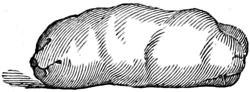
An entire calf’s head, served in its natural form, recalls too forcibly the appearance of the living animal to which it has belonged not to be very uninviting. Even when the half of one only is sent to table, something of the same aspect remains, and as it is in every way improved, and rendered most easy to carve when boned[7] and rolled, we would recommend its being so prepared whenever it can be done without difficulty. Our engraving does not give a very flattering representation of it in that form, but having been dressed with the skin on, it was not quite so easily brought into handsome shape as if it had been freed from it; yet we would nevertheless advise its being generally retained. When the head is served without being boned, it is carved across the cheek, in the line from a to b; the part which in flavour and appearance resembles a sweetbread, and which is regarded as a delicacy, lies in the direction indicated by the letters c d. The flesh of the eye is another favourite morsel, which must be detached from the head by passing the point of the carving knife deeply round the eye-hole, in the circle marked e e.
7. This will be more easily accomplished by an experienced cook after the head has been boiled for half an hour and then allowed to cool; but it should not be left until cold before it is altogether prepared for dressing. After the bones are removed, it should be laid on a clean cloth, and the inside sprinkled over or rubbed with a little salt, mace, and cayenne, well mixed together; the tongue may be laid upon, and rolled up in it It must be secured, first with a skewer, and then bound tightly round with tape It should be boiled or stewed extremely tender; and is excellent when just covered with good stock, and simmered for two hours, or when strong broth is substituted for this, and the bones are added to it. The head may be glazed, and served with rich brown gravy, or with the ordinary sauces if preferred; and it may be eaten cold, with Oxford brawn sauce, which is compounded of brown sugar, vinegar, mustard, and salt, mixed to the taste, with the addition of oil when it is liked.
No. 14. A HAM.
Strict economists sometimes commence the carving of a ham at the knuckle, and so gradually reach the choicer portion of it; but this method is not at all to be recommended. It should be cut at once through the thick part of the flesh, quite down to the bone, in the line a b, and sliced very thin and evenly, without separating the fat from the lean. The decoration of the ham No. 14, is formed by leaving on it a portion of the rind at the knuckle in a semi-circle, and then trimming it into scollops or points at pleasure; and the ornamental part of the top is formed from the fat which is pared away from the thick end and the edges. A paper ruffle, as will be seen, is wrapped round the bone of the knuckle.
No. 15. A PHEASANT.
This bird was formerly always sent to table with the head on, but it was a barbarous custom, which has been partially abandoned of late in the best houses, and which it is hoped may soon be altogether superseded by one of better taste. The breast is by far the finest part of a pheasant, and it is carved in slices from pinion to pinion, in the lines a a b b; the legs may then be taken off, in the direction c d. The bird, when it is preferred so, may be entirely dismembered by the directions for a fowl, No. 16. Black and moor-game are trussed and served like pheasants. The breasts of both are very fine eating, and the thigh of the black-cock is highly esteemed.
No. 16. A BOILED FOWL.
The boiled fowl of plate 6 is represented as garnished with branches of parsley, which is an error, as they would be appropriate to it only if it were cold, and it is seldom served so, being considered insipid. Small tufts of cauliflower would have been in better keeping with it, as the bird is supposed to be dished for the dinner-table. Unless it be for large family parties, fowls are seldom carved there entirely into joints; but when it is wished to divide them so, the fork should be fixed firmly in the centre of the breast, and the leg, being first disengaged from the skin, may be taken off with the wing in the line a b; or, the wing being previously removed, by carving it down the line to b, and there separating it from the neck-bone, the leg may be released from the skin, and easily taken off, by cutting round it from a to c, and then turning it with the fork, back from the body, when the joint will readily be perceived.
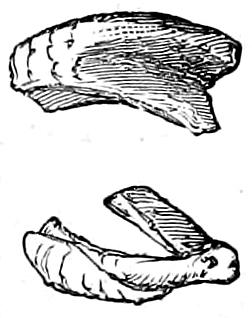
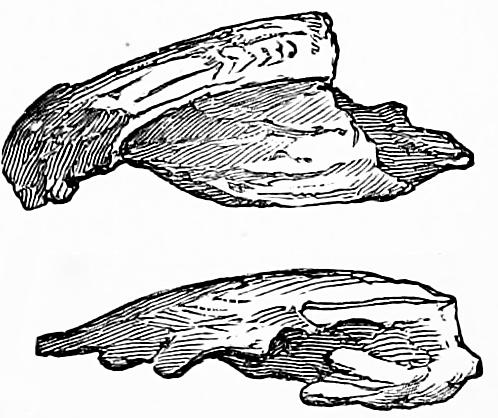
After the leg and wing on the other side have been taken off in the same manner, the merrythought must follow. To remove this, the knife must be drawn through the flesh in the line d e, and then turned towards the neck quite under the merrythought, which it will so lift from the breast, in this form:—The neck-bones—which lie close under the upper part of the wings, and are shaped thus—must next be disengaged from the fowl, by putting the knife in at the top of the joint, dividing the long part of the bone from the flesh, and breaking the short one off by raising it up, and turning it from the body; the breast, which is shown here, may then be divided from it by merely cutting through the tender ribs on either side.
It is seldom that further disjointing than this is required at table; but when it is necessary to cut up the entire fowl, the remainder of it must be laid with the back uppermost, and to take off the side-bones, which are of this shape—the point of the knife must be pressed through the back-bone, near the top, about half an inch from the
centre, and brought down towards the end of the back, quite through the bone, then turned in the opposite direction, when the joints will separate without difficulty. All which then remains to be done is, to lay the edge of the knife across the middle of the only two undivided bones, and then with the fork to raise the small end of the fowl, which will part them immediately: to carve a boiled fowl or chicken in a more modern manner, see the directions which follow. The breast, wings, and merrythought, are the most delicate parts of a fowl. On the upper part of the sidebone is the small round portion of flesh called the oyster, by many persons considered as a great delicacy.
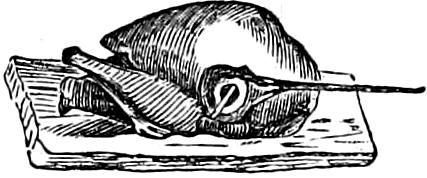
It is not usual to carve fowls entirely at table in the manner described above. The wings, and any other joints are taken off only as they are required. The breast of a very large fowl may be carved in slices like that of a turkey; or the whole of that of a small one may be taken off with the wings, as shown by the line a b. As the liver is a delicacy, the handsomer mode of serving these last is to remove the gizzard, which is seldom eaten, then to divide the liver, and to send an equal portion of it with each wing. The whole of a roast fowl may be carved by the directions we have already given for No. 16.
No. 17. A ROAST FOWL.No. 18. A PARTRIDGE.
When partridges are served to ladies only, or in parties where they are present, it is now customary to take off the heads, to truss the legs short, and to make them appear (in poulterer’s phrase) all breast. For gentlemen’s dinners, the heads may be left on or not at choice. The most ready mode of carving a partridge is to press back the legs, then to fix the fork firmly in the inside of the back, and by passing the blade of the knife flat under the lower part of the breast, to raise it, with the wings, entire from the body, from which it easily separates. The breast may then be divided in the middle, as shown by the line from a to b in the engraving here. This is by far the best and handsomest manner of carving a partridge, but when the supply of game at table is small, and it is necessary to serve three persons from the choicer parts of one bird, a not very large wing should be taken off with the leg on either side, in the line from a to b in No. 13, and sufficient of the breast will still remain to send to a third eater. The high game-flavour of the back of a partridge, as well as that of various other birds,[8] is greatly relished by many persons.
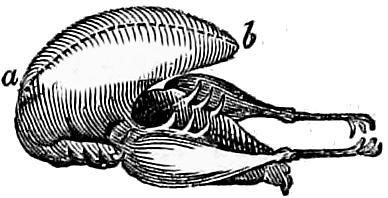
8 A great man o the north eloquently describes that of a grouse as “the most pungent, palate-piercing, wild bitter-sweet.”
No. 19. A WOODCOCK.
The thigh and back are the most esteemed parts of a woodcock which, being a small bird, may be carved entirely through the centre of the breast and back, or distributed in the same manner as the partridge for three, which we have described; or even carved down like a fowl, if needful. In whatever way it is divided, however, a portion of the toast which has received the trail, and on which it should always be sent to table, must invariably be served to all who partake of it. The very old fashion of trussing the bird with its own bill, by running it through the thighs and body, is again adopted by very good cooks of the present day; but the common method of preparing either woodcocks or snipes for table is this: the trussing of the legs is, however, better shown at Nos. 19 and 21 of Plate 6.