THE INTERNATIONAL LIGHT RAIL MAGAZINE
Free to LRTA members
www.lrta.org www.tautonline.com
SEPTEMBER 2026 N o . 1065
DRIVING CHANGE FOR UK LIGHT RAIL
Difficult questions and choices addressed at 2026 UKLRC Brazil’s new Salvador tramway opens Paris chooses CAF vehicles for T13 line Berlin Urbanliner launched for service Overcoming limits Besançon to solve capacity limitations
£5.20
LRT and economics How LRT can help urban regeneration
CONTENTS Andrew Thompson
The official journal of the Light Rail Transit Association SEPTEMBER 2026 Vol. 89 No. 1065 www.tautonline.com
341
EDITORIAL EDITOR – Matt Johnston hello@mainspring.co.uk ASSOCIATE EDITOR – Tony Streeter tony.streeter@mainspring.co.uk WORLDWIDE EDITOR – Michael Taplin miketap@mainspring.co.uk
328
Mike Russell
Neil Pulling
SENIOR CONTRIBUTORS – Howard Johnston, Neil Pulling
354
NEWS 324 CAF trams enter service in Brazil as Salvador opens new tramway; Berlin welcomes Urbanliner trams into service.
BUDGET-BEATING BESANÇON 341 Andrew Thompson visits the mid-sized French city that is seeking to break the confines of its capacity limitations.
UK LIGHT RAIL CONFERENCE 2026 328 Devolution and political restructuring were leading discussions at this year’s UKLRC; TAUT summarises the positive atmosphere of change and the new projects in the pipeline for the UK.
20 YEARS OF PROGRESS 343 UKTram looks back to the very first UKLRC, and reflects on the 20 years since.
UNLOCKING POTENTIAL 335 TAUT asks if the Metrolink model that has given such a boost to Manchester could be applied to other cities in the UK. A NEW ERA OF OPPORTUNITY? 339 RailIntel analyses the data that could indicate the global urban rail market is entering a new era of scale and renewal.
SYSTEMS FACTFILE: GRAZ 345 Andrew Thompson visits the Austrian city, fresh from opening a new cross-city extension and with more still to come. WORLDWIDE REVIEW 350 Shenyang opens metro line 3 extension; Madrid metro breaks patronage record. CLASSIC TRAMS: BREMEN AT 150 354 Mike Russell reports on the parade held to mark 150 years of Bremen’s tramway.
WORLDWIDE CONTRIBUTORS Richard Foster, Andrew Grahl, Andrew Moglestue, Herbert Pence, Mike Russell, Nikolai Semyonov, Alain Senut, Andrew Thompson, Witold Urbanowicz, Bill Vigrass, Thomas Wagner, Philip Webb. PRODUCTION – Lanna Blyth Tel: +44 (0)1733 367604 production@mainspring.co.uk DESIGN – Debbie Nolan ADVERTISING COMMERCIAL MANAGER – Geoff Butler Tel: +44 (0)1733 367610 geoff@mainspring.co.uk Tramways & Urban Transit 13 Orton Enterprise Centre, Bakewell Road, Peterborough PE2 6XU, UK Tramways & Urban Transit is published by Mainspring on behalf of the LRTA on the third Friday of each month preceding the cover date.
LRTA MEMBERSHIP (with TAUT subscription) Tramways & Urban Transit is sent free to all paid-up members of the Light Rail Transit Association. LRTA WEBSITE AND DIARY Tim Kendell webmaster@lrta.org meetings@lrta.org SUBSCRIPTIONS, MEMBERSHIP AND BACK ISSUES LRTA Membership Secretary (Dept T06), 38 Wolseley Road, Sale M33 7AU, UK. Tel: +44 (0)117 951 7785 membership@lrta.org Website: www.lrta.org
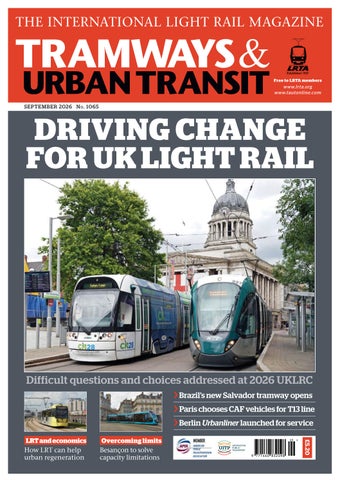
UK’s new PM doesn’t need convincing Unlike ultra-expensive high speed rail, light rail and metros rarely make world headlines (unless something goes wrong), but as RailIntel reveals in this issue, they are a fast-growing business. A projected 8% rise in the number of new systems over the next five years is good news. Equally positive is that metros will expand by a mighty 33%, and light rail 13%. This is tremendous news for planners, manufacturers and suppliers, all of which are enthusiastically competing for over 1000 individual schemes. If you’re looking for major contracts, Africa and the Middle East are the best places to go, followed by Asia and Australia. North America is coming good again, while there are still deals to be done across slower-moving Europe. The Global Light Rail Portal – see page 340 to learn how to log on – is where you can find out all the detail. In the UK, where there is an eternal tight rein on public spending, there are fresh hopes for investment following the elevation of Andy Burnham to Prime Minister on 20 July. As Mayor of Manchester, he was outspoken in his support for integrated transport, with continued expansion of Metrolink, creation of the Bee bus network, and a planned takeover of the region’s heavy rail commuter system. It will be interesting to see how he exerts influence on central government to loosen the purse strings. All this came a little too late for the 2026 Light Rail Conference in Nottingham, when cities renewed their pleas for attention. Andy Burnham spoke to the 2023 Conference, and we discovered his video presentation in our archive. He stated: “Continuing to champion the importance of our light rail networks, and the need for investment in them, will be vital if we are to deliver world-class integrated transport networks across cities and our regions”. These are powerful words Andy, so don’t let us down. Matt Johnston, Editor COVER: Part of the NET fleet, Bombardier Incentro and Alstom Citadis vehicles convene infront of The Council House at Old Market Square in Nottingham, UK, on 29 June. Neil Pulling
FOR CORPORATE SUBSCRIPTIONS VISIT www.mainspring.co.uk LRTA REGISTERED OFFICE 13 Orton Enterprise Centre, Bakewell Road, Peterborough PE2 6XU, UK Private company limited by guarantee, No. 5072319 in England and Wales. LRTA CHAIRMAN – Paul Rowen chair@lrta.org © LRTA 2026 Articles are submitted on the understanding they may also be used on our websites or in other media. A contribution is accepted on the basis that its author is responsible for the opinions expressed in it, and such opinions are not those of the LRTA or Mainspring. All rights reserved. No part of this magazine may be reproduced or transmitted in any form by any means, electronic or mechanical, including photocopying, recording or by any information storage and retrieval system, without prior permission in writing from the copyright owner. Multiple copying of the contents of the magazine without prior written approval is not permitted.
PRINT The Manson Group Limited, St Albans, Herts AL3 6PZ
DISTRIBUTION Warners (Midlands), Bourne, Lincs PE10 9PH, UK
www.tautonline.com . www.lrta.org SEPTEMBER 2026 / 323
News
Brazilian tramway carries first passengers
A CAF tram at Calçada terminus in Salvador. VLT de Salvador
CAF trams enter Salvador service more than a decade after they were first built
S
tate governor Jerônimo Rodrigues and Eracy Lafuente, president of the Bahia State Transport Company (CTB), attended the opening of the first phase of Salvador’s new tramway on 30 June. Currently only a trial service – Mondays to Fridays, 08.00-16.00 – is being offered on a 4km (2.5-mile), six-stop section from Calçada to Lobato. It is not yet clear when a full timetable will begin over the whole 16.6km (ten-mile) Brazilian tramway from Calçada to São João. The new line is expected to attract 100 000 passengers per day and, at the ceremony, Mr Rodrigues said: “In addition to the assisted operation of the VLT, we are delivering urbanisation works in the environment of the new transportation system.” With the line being built on the formation of a 1940s
metre-gauge suburban railway, Mr Lafuente told the crowds that the restored Calçada station was one of Brazil’s “most beautiful”. He added that it compared favourably against Sé, the central station on São Paulo’s metro. The BRL5bn (EUR858m) tramway replaces what was originally going to be a Chinesebuilt monorail, which was cancelled in 2023. Eventually, Salvador’s tram network should comprise three lines running on 36.4km (23 miles) of track. Salvador has purchased 40 CAF Urbos 44m seven-section double-ended trams. These were originally ordered by the city of Cuiabá in Mato Grosso state and were delivered in 2014-15. However, work on this scheme was halted in 2020 and Salvador provided them with a home. All 40 trams have been refurbished at CAF’s Brazilian factory.
Helsinki’s Crown Bridges tested MetroRiel could bring high-quality passenger transport to Guatemala City. MetroRiel
UK finance for Guatemala light rail The UK and Guatemalan governments signed a financial agreement on 9 July, making up to GBP5bn (EUR5.8bn) available in export guarantees over the next five years to bring the Metro Riel light rail project to fruition. The 21km (13-mile), 1435mmgauge line in Guatemala City is to connect Centra Norte and Centra Sur long-distance bus terminals, using an abandoned heavy rail route. It will have 22 stations and its 41-minute end-to-end journey time is expected to attract 250 000 passengers a day.
Full-scale testing and training is now in progress on one of Helsinki’s most ambitious light rail projects. It marks the culmination of a project approved by the Finnish capital in 2016 to use new bridges to link islands, which are being redeveloped with new housing, to the mainland. These bridges are to carry a tramway, pedestrians and cyclists only. The three new Crown Bridges that carry the tramway are the Merihaka (422m), Finke (293m) and Kruunuvüorensilta (1228m). Construction started in 2021 and the first test tram ran across them on 7 April. Official opening for pedestrians and cyclists followed on 18 April. The new, 10km (six-mile) line should carry its first passengers in early 2027, running from the outer terminus Yliskylän keskus to an interchange with existing line 13 at Nihti and a city terminus at Hakaniemi,
offering interchange with the metro. A tramway branch is being built on Laajasalo Island to Haakoninlahti and when this is ready, a through service to Helsinki Central station is expected to be offered. The cost of the tramway infrastructure has been calculated at EUR326m, plus EUR25m for a new depot and
EUR80m for rolling stock. Helsinki’s tramway operator HKL ordered 23 ForCity Smart Artic X54 trams from Škoda-Transtech in 2021; the model is already in use on the Jokeri orbital light rail line, in the north of the city, which opened in 2023. The Crown Bridge’s new trams are 34.5m long, double-ended and can carry up to 214 passengers.
Škoda X54 trams undergo testing on the Crown Bridges in Helsinki. M. Meeseeks
Light Rail Safety & Standards Board develops new accreditation standards The Light Rail Safety & Standards Board is developing a UK-wide accreditation framework for tram driver competency. The Tram Driver Competence & Continuing Professional Development (CPD) Framework draws together existing industry
standards as well as guidance and requirements from National Occupational Standards and the Office of Rail and Road. A pilot scheme is now being developed with Edinburgh Trams, although the LRSSB stresses that individual operators will remain
324 / SEPTEMBER 2026 www.tautonline.com . www.lrta.org
responsible for assessing and authorising drivers. LRSSB’s Head of Learning & Competence, Marlene PearsonMcGrath, said: “Built around a model of ‘accreditation by adoption’, the framework is intended to enable operators to
adopt a consistent competence standard. “The LRSSB’s role will be to define and assure the framework design, which is structured around ten core learning modules covering key safety and operational topics.”
Paris chooses CAF tram-trains Spanish manufacturer to provide rolling stock for T13 extension
C
AF has won an order for 15 42m tram-trains for the Paris line T13 extension. The order for the French capital is a departure as CAF has, so far, only built tram-trains for Cádiz in Spain. These new vehicles are destined for use on the 10.2km (six-mile) extension to AchèresVille RER station, via Poissy RER, which is due to open in 2028. The current line is operated by 11 four-section, dual-voltage, 42m Alstom Dualis tram-trains, part of a fleet of 41 that are also used on lines T4 and T11. However, the options in the original order with Alstom have been used and so a new tender had to be issued. It is not yet clear where the
vehicles in the EUR159m order will be built; one option is CAF’s former Bombardier factor in Reichshoffen, Alsace. Alstom was obliged to dispose of this as part of the approval process for the takeover of Bombardier in 2021. It is already busy building regional trains for SNCF Voyageurs and is working in a consortium with Alstom for new RER trains for Paris Line B. Another possibility is CAF’s factory at Bagnères-de-Bigorre, close to the Franco-Spanish border. T13 opened in July 2022 as the first phase of a western orbital express line. The 18.8km (11.7-mile) route from Saint-Cyr to Saint-Germain-en-Laye is built on the former Grande Ceinture suburban railway
An Alstom Dualis tram-train in Saint-Germain-enLaye, showing right-hand running on street-based track, under 750V dc overhead. P. Haseldine
between St-Germain-enLaye and Noisy-le-Roi, before becoming a street-based light rail system. Not only does the
Berlin Urbanliner enters service Berlin’s public transport operator BVG officially welcomed the first of its new Urbanliner trams into public service at a ceremony on 15 July. Standing alongside Senator for Mobility Ute Bonde, BVG Chief Executive Henrik Falk said: “With these new vehicles,
we are ensuring that, following the U-Bahn, our tram fleet will also be high-performing for the next decades.” Getting the Urbanliners into service in the German capital has taken six years. The order was placed with Bombardier in
Welcoming the Urbanliner into service on 15 July. BVG
December 2020, shortly before the company was taken over by Alstom. The 65 vehicles are the longest (50.9m) and heaviest (63.5t, unladen) trams ever used on the Berlin network. They can carry 303 passengers. The first of these 100% low-floor, ten-axle trams was delivered in June 2024 and commissioning, trials and driver training began shortly after; entry into service was due to take place in 2025. However, the approval process through technical supervisory authority TAB raised issues with Berlin’s line M4. The Urbanliner’s 6.35t axle load exerts more downward pressure where the tramway crosses the U-Bahn lines at Alexanderplatz than the coupled GT6 sets with their 5.2t axle load. Additional supports had to be installed at Alexanderplatz before the Urbanliner could be signed off at the end of June.
Royal visit for Isle of Man horse tramway King Charles III unveiled a plaque on 14 July commemorating 150 years of the Douglas Bay Horse Tramway, which opened on 7 August 1876. The King also took a short ride on the 1.6km (one-mile) line during his first visit to the island since
becoming both UK monarch and Lord of Mann in in 2022. The Royal visit came a week before Tynwald, the island’s parliament, approved the GBP3m (EUR3.5m) reinstatement of the tramway from its current terminus at
Broadway to Sea Terminal. Infrastructure Minister Tim Crookall described the tramway as “a living piece of Manx heritage that attracts tourists, educates future generations and promotes the island internationally”.
system use a mixture of 25kV ac and 750V dc power, but the street running section mixes left and right-hand running.
German tramways ‘melt’ in heat
Successive heatwaves in June and July brought service suspensions to German tramways. When temperatures in Leipzig reached 41°C in June, the asphalt that encased the rails melted and filled the flangeway. This caused the closure of the whole system on 27-29 June; unfortunately, Leipzig’s transport authority (LVB) could not operate replacement bus services as many of its buses were also off the road with heat-related problems. With rail temperatures topping 70°C, LVB invited the public to help clear the flangeways. Problems with melting bitumen-based sealing materials also affected Bremen, Nürnberg (Nuremberg) and Würzburg. Nürnberg’s tram service was suspended for several days in July and its annual vintage tram parade has been pushed back to 13 September.
Toronto numbers rise
Toronto Transit Commission has released new performance statistics that show it provided 21 500 hours of tram service during May. It carried 1.74m passengers that month (an 8% increase on May 2025) and 65% customer satisfaction was achieved. Mean distance between failures was 36 236km (22 516 miles), while on time performance was 60% against a target of 90%. On light rail lines 5 and 6, average round-trip times have been reduced by 17 minutes and 30 minutes respectively since opening (TAUT 1058/1060).
www.tautonline.com . www.lrta.org SEPTEMBER 2026 / 325
News
Austin chooses Stadler for new line Vehicles for Texas city will be similar to those selected for Utah
T
he southern US city of Austin has awarded Stadler a contract for 21 trams for its new 16km (ten-mile) light rail line. The USD7bn (EUR6.1bn) route through the Texas state capital is to run from Crestview to Yellow Jacket/Oltorf. Its planned 15 stops are expected to attract 29 000 passengers per day. These new vehicles are to be three-section, 37.2m long, double-ended 100% low-floor trams. They are to be based on Stadler’s CITYLINK platform, and will have a passengercarrying capacity of 240. The USD352.8m (EUR309m) fixed-price contract with Austin Transit Partnership includes an option for 19 more vehicles. The trams will be built at
Stadler’s factory in Utah’s Salt Lake City, which is already working on similar cars for the Utah Transit Authority. Martin Ritter, CEO of Stadler’s North American Division, said: “Stadler’s CITYLINK platform sets new standards – it defines what the next generation of light rail vehicles in the United States can look like. Together with the Austin Transit Partnership, we are helping to shape a new era of public transportation in one of the fastest-growing cities in the US.” Construction of the new Austin line is due to start in 2027, with a planned completion date of 2033. A contract has already been awarded to a StacyWitbek/ Sundt Construction joint venture, while funding is
Almaty’s new tramway
Moldova unveils tram-based railbus
Almaty in Kazakhstan is to replace its first-generation tramway with an all-new, 1435mm-gauge line that will form part of an integrated transport network. The 18.3km (11.4-mile) route is to connect the Alatau district with Almaty-2 railway station, using mostly reserved tracks along Momyshuly and Töle Bi streets, and serving 34 new stops. The new tramway is expected to open in 2029. A memorandum of understanding has been signed with Integra Construction KZ and CRRC for the supply of Chinese-built trams. Almaty’s tramway operated between 1937 and 2015. The remaining rails from the first-generation tramway are being lifted. Almaty opened a metro in 2011, which is now 13.4km (8.3 miles long). The tram will connect key transport hubs, with integrated metro, BRT, bus and taxi routes.
Moldovan technology firm InformBusiness has converted a Tatra T3 tram into a battery railbus that could form the basis of a low-cost fleet for the country’s rail network. Moldova’s rail operator Calea Ferată din Moldova has reportedly been looking for solutions for shortand medium-distance railway routes, including Chisinau – Ungheni and Stră seni – Chisinau – Revaca – Singera. The vehicle can carry 100 passengers and its batteries give a range of 400km (roughly 250 miles). It has a new body, making it double-ended but single-sided. As Moldova does not have its own tram network, InformBusiness acquired two Odesa T3 trams, 30166
An artist’s impression of Almaty’s new tramway. EIA
coming from Proposition A, a voter-approved property tax. Austin had a first-generation light rail system between 1891 and 1940.
A visualisation of Austin’s forthcoming Stadler tram. Austin Transit Partnership
The tramlike battery railbus for Moldovan railways. MOLDPRESS
(built in 1980) and 30384 (1985). Odesa’s tram operator Odesmiskelektrotrans has been running 250 T3s since 2018. These are being modernised to Odyssey specification, using European Investment Bank
funding. Ukrainian firm Vagonoremontni Maisterni has manufactured body panels for these trams and was also responsible for supplying InformBusiness with components for the new railbus.
First step taken towards Dublin MetroLink Transport Infrastructure Ireland (TII) has purchased the former Carlton Cinema site in Dublin as the first step in the construction of the planned 18.8km (12-mile) underground MetroLink system. The Art Deco picture house on Upper O’Connell Street has been empty since 1994 and planning permission exists to build a station underneath. Minister for Transport Darragh O’Brien said: “Purchasing this
326 / SEPTEMBER 2026 www.tautonline.com . www.lrta.org
key strategic site by agreement ensures that the risk of delays and increased costs arising from the compulsory purchase order process are reduced.” Construction on the former cinema site is due to start in 2027. Meanwhile, MetroLink is one of nine infrastructure projects across Ireland included in the Critical Infrastructure Act 2026. The Act was signed into law on 25 June, meaning
that public bodies must take steps to reduce the time needed for approvals and ensure that necessary administrative, technical and decision-making resources are allocated. MetroLink is the only light rail project to come under the Act. However, it also includes the Cork Area Commuter Rail Programme, which aims to improve heavy rail services; plus road, water and power projects.
Funding promised for new West of England mass transit projects Will UK’s Bristol region receive a new light rail network?
N
ew UK Prime Minister Andy Burnham has committed to funding the West of England Combined Authority’s plans for a mass transit system. He said: “I recognise that this part of the world needs much better public transport. The West of England got GBP750m [EUR875m], which I think is the most ever and a sign of our commitment. But more would
be needed, obviously, to deliver mass transit.” Speaking at the launch of a UK-wide GBP2 (EUR2.33) cap on bus fares on 22 July, Mr Burnham said: “In the long run I want to put that investment in so that all cities have integrated, functioning public transport, supporting people into jobs and growing the economy. “The evidence from Greater Manchester is really clear. We
had a decade of above average growth partly because we had a transport system that could support a growing economy. If you want growth you have to make the investment to get it.” WoEMCA Mayor Helen Godwin said: “We’ve allocated some funding into mass transit. We are now working closely with the Department for Transport. We’re not saying ‘We want this, how do we get there?’; we’re
saying ‘what is the right solution for different parts of the region’ and how can we get something where we need it most quickly?” WoEMCA published its West of England Transport Vision in February. This included plans to connect “key corridors and growth zones”. Initial mass transit routes could connect Bristol Airport with the city centre as well as connecting Bristol to Bath.
Catalonia launches tramway study… Spain’s province of Catalunya (Catalonia) has invited tenders for a technical, functional and socio-economic study for a tramway project that could link the city of La Seu d’Urgell with the Principality of Andorra. The report is due to be published by July 2027. Work on the so-called Tramvalira comes under the cross-border commission. The line would be about 20km (12 miles) long with five stops. A fleet of at least six trams would be required. The cost is expected to be around EUR250m, with
65% coming from EU funding. A branch to Andorra-La Seu d’Urgell airport is a possibility. The Andorra bus network would be adjusted to act as a feeder to the tramway. Target date for completion is 2040. The project is associated with a planned 57km (35-mile) rail link from La Seu d’Urgell to La Tour de Carol on the Spanish/French border, which would reduce travel times from Barcelona to between 2.5 and three hours. A CGI visualisation of the Tramvalira. Generalitet de Catalunya
… as Tarragona tramway contract awarded A consortium of Systra Ardanuy and Typsa has won the construction management contract for the Camp de Tarragona tramway project in Catalunya (Catalonia), Spain. This includes supervising the works, as well as co-ordinating with Spain’s state-owned main line infrastructure manager Administrador de Infraestructuras Ferroviarias plus municipalities and utility companies, and overseeing testing and final validation. Systra is to ensure that all tramway subsystems work together to permit the inauguration of commercial service. The contracts will play a central role in delivering the first stage of the network, to be operated by Ferrocarrils de la Generalitat de Catalunya. This first phase comprises a 14km (nine-mile) link from Cambrils Centre to Vila-seca via Salou and re-uses the former coastal railway corridor. Joan Serrano, Vice-President of Systra Ibérica said: “The Camp de Tarragona tramway is a structured project for mobility in southern Catalonia. Its success will rely on the ability to co-ordinate complex works, sensitive railway interfaces and in the integration of all systems
required for operation. “These two contracts illustrate Systra’s added value on tramway projects with an end-to-end vision from works through to commissioning.”
A map of the planned Tarragona tramway system. FGC
www.tautonline.com . www.lrta.org SEPTEMBER 2026 / 327
UK Light Rail Conference 2026
UK LIGHT RAIL: IS DEVOLUTION THE FUTURE?
Project updates, technology briefings and discussions on political restructuring were all part of the 2026 UK Light Rail Conference. TAUT reports.
All images by Neil Pulling
“
Nottingham was the venue for this year’s UK Light Rail Conference, returning to where it all began 20 years ago. Pictured is one of the city’s Alstom Citadis fleet on Old Market Square.
328 / SEPTEMBER 2026 www.tautonline.com . www.lrta.org
Y
ou can’t drive change unless you’re prepared to make some difficult choices… to make 1000 omelettes, you’re going to drop a few eggs on the floor.” Jonathan Whittaker from the West Yorkshire Mass Transit Programme put forward a passionate case at the 2026 UK Light Rail Conference for why the country needs to take the opportunities already available in London and “move that north”. By putting “big cities closer” through investment in national transport, and mirroring that “within your cities”, the Jacobs Senior Associate Director – Cities and Places told some of the almost 300 delegates that “you stimulate economic activity”. “That simulates tax generation… productivity increases. It’s that simple.” West Yorkshire is currently rolling out the new Weaver Network, which will initially encompass the Leeds area’s bus services, before then being widened to include the proposed future mass transit system. It is widely hoped that this will become the UK’s next Light Rail Transit scheme. Whittaker, however, drew the argument more widely than just Yorkshire, suggesting the UK should develop a steady pipeline of light rail projects. “We have to do this at a lower cost, faster”, he told delegates in Nottingham, adding that “the way we will do this is by having repeat programmes.”
Angela Kandola, Chair of Greater Nottingham Light Rapid Transit Advisory Committee, opened this year’s conference.
RIGHT: The plenary session opened the event on 30 June, with speakers including Martin BaynhamKnight from Keolis (pictured).
BELOW AND BELOW RIGHT: The exhibition hall was always busy, with almost 30 stands to visit.
Accepting that LRT schemes are long-term undertakings, Whittaker also argued that promoters need “a compelling case that goes beyond the current political flavour.” “So my ask is ‘give us the time to put the compelling case together.’” With the UK changing its leadership for the seventh time in a decade, it was perhaps inevitable that political structure and the country’s seemingly related underperformance in light rail delivery were common themes at the conference, which was held on 30 June-1 July. Around 70 speakers across two halls were complemented by additional activities such as a networking dinner and a Nottingham Express Transit depot tour; the associated trade exhibition included 30 stands from across the industry.
Britain’s problem?
Mike Birch from international consultancy and engineering company Egis made the comparison between the UK and its near neighbours, by asking: “What is Britain’s problem with light rail?” While France has opened 25 new light rail schemes since 1985, the UK has only managed around a quarter of that. A key reason for this, the Egis representative argued, is that the UK reserves comparatively greater power for its central government. Continental European schemes are “typically funded from a mix of national, regional and local contributions, European Union support, loans from the European Investment Bank, and increasingly Public Private Partnerships” – whereas in much of the UK promoters are reliant on persuading the Department for Transport to provide the money. That’s because any project costing
more than GBP50m (roughly EUR59m) “is a “As part of the ‘green book’ reform,” he retained scheme by government”. argued, “there is clearly an opportunity to In contrast, continental municipal and arrive at a common framework that considers regional authorities “are often the prime the full range of benefits, including social, project sponsors, leveraging… national and environmental and economic impacts”. European funds”. Plus, he contended that a commitment In addition, Whitehall decision-making to further devolution – a stated priority of leads to fragmented planning, Birch argued. Labour’s incoming Burnham government – However, this was but one aspect of “can only be a positive from where I sit”. his diagnosis. Others included the timeReform was also on the agenda for Martin consuming nature of the UK’s Transport Baynham-Knight from Keolis, who argued in and Works Act regulatory process (up to favour of creating a national body to oversee four years), political cycles “with increasing light rail. likelihoods of U-turns”, a skills shortage, Making the point that the “most successful and the WebTAG ‘green book’ planning networks are typically integrated”, guidance that prioritises Baynham-Knight suggested direct transport benefits that a ‘Great British Light over socio-economic and Rail’ be formed to mirror regeneration factors. the forthcoming Great Martin Baynham-Knight, Birch also argued that British Railways that Keolis European schemes from 2027 should serve “This is not a new typically have “a the country’s heavy bureaucracy, this is not a lower overall funding rail network. GBR body that takes decisions requirement” – and will bring together away from mayors or transport specifically raised previously disparate authorities. But it’s a framework the perennial issue parts of the national that helps provide consistency, of utilities that lie system, including the coordination and long-term in the way of new hitherto privately-run visibility across the sector.” tramways, saying that passenger train operators. the cost of moving or “I increasingly wonder accommodating these usually whether light rail needs what amounts to around 30% of UK rail may soon have…” Baynhamproject costs. Knight argued, “a clearer national In contrast with other jurisdictions, guiding mind.” utilities such as electricity or water supplies “This is not a new bureaucracy, this is not a are in the UK “privatised, regulated body that takes decisions away from mayors separately”, with a background of or transport authorities.” inconsistent records, and incentives “often “But it’s a framework that helps provide not aligned and motivated to try and deliver consistency, coordination and long-term to the ambitions of transport”. visibility across the sector.” However, Birch did see areas for optimism. “The purpose would be simple – to help
www.tautonline.com . www.lrta.org SEPTEMBER 2026 / 329
UK Light Rail Conference 2026 local leaders succeed.” At a more regional level, moves are already being made towards better integration, including in South Yorkshire, where Supertram began operating in 1994. Since 2018, Supertram has also hosted the UK’s first true tram-train scheme. In 2024 the Sheffield system moved under direct public control and a new operating company, South Yorkshire Future Trams Ltd, is wholly owned by the South Yorkshire Mayoral Combined Authority. Priorities for Sheffield’s new South Yorkshire People’s Network include a GBP530m (EUR622m) asset maintenance programme, life extension of existing vehicles as well as procurement of new ones (potentially with delivery from 2032), infrastructure upgrades and the seeking of expansion opportunities, plus bringing buses under public control from 2027. A new stop at Magna on the tram-train route opened in April. Driving this push for better integration is the perceived poor current integration between trams, buses and trains, with more than 100 ticket types on offer. SYMCA Executive Director of Transport Elaine Corcoran also reported that “about a third of the passengers on Supertram do not have access to a car”. As Corcoran explained, South Yorkshire Mayor Oliver Coppard has extolled a vision for the region’s public transport network – one that is safe, affordable, good for the planet and “genuinely people-focused”. “Because when we make transport work for people, everything else follows.”
Making tracks…
Technical aspects always generate interest at the UK Light Rail Conference, with topics this year including the lightweight track form that has been developed for Coventry’s Very Light Rail system. The 800-metre city centre demonstration line has already provided a venue for the slab track to be trialled in real-word conditions; the system includes a dig depth from the top of the rail of 300mm, contrasting
Colin Robey (left) led a panel on the first day that looked at how to encourage younger generations into light rail – this was a follow-on from the very popular panel on a similar theme at the 2025 conference.
with the more normal 600mm-900mm of conventional track. Modifications to what is known as the Universal Track system have been made in the light of experience – such as developing slab variants to make it work better in terms of offering access to utilities. Further trials such as in West Midlands Metro’s Wednesbury depot or using a roughly 160m section of the South Yorkshire network at Herdings-Leighton Road are intended to further prove the concept. As well as carrying some of the country’s heaviest light rail vehicles, the planned Herdings installation encompasses aspects such as a curved transversal alignment, transition to ballasted track, and its use by road traffic. Coventry VLR Programme Director Nicola Small said that such trials “will enable us hopefully to commercialise the track form as a product in its own right”.
She explained to delegates that “we’re really confident in the track’s ability to perform and support conventional trams in future.” Appropriate sites for its rollout could include those where there are underground complications, such as water culverts or ancient burial grounds. However ballasted track, Small said, “remains the cheapest track form, if you were delivering… a segregated link”. Track was also the subject of John Hammond’s presentation. So-called ‘concrete cancer’ degradation – brought about by the rusting of steel reinforcing rods – is not a problem with the PCAT-LRT slabs designed by JKP Static. These are reinforced with 100% polypropylene macro synthetic fibres, and are also resistant to the transfer of stray current. Adoption of the 58K2 grooved block
The Magic Garden was busy on the first day as the venue for a dinner and drinks reception, where delegates enjoyed networking well into the evening.
330 / SEPTEMBER 2026 www.tautonline.com . www.lrta.org
LEFT: Dan Colley, Nicola Small, Jonathan Bailey and Hamish Falconer joined together on stage to talk about Coventry trams and VLR – followed by an exploration of the future of trackform with Mott MacDonald’s James Bowyer and Ian Mackenzie.
rail from ArcelorMittal has allowed the depth of the slab to be reduced from 380mm to 290mm (saving some 25%). Part of the attraction of these precast slabs is that they include within them things such as utility ducts and drainage pipes. “In the event that utilities need access”, the PCAT Director’s presentation explained, “the slab can be quickly detensioned and removed and put back.” Pre-assembly of track before installation and simplicity of design were aspects promoted by Railone for its ‘Rheda City Fast Track’ solution. This, the company says, “requires almost no maintenance, offers perfect ride comfort, supports heavy loads, and ensures great safety.” Such developments were far from the only technical innovations discussed at the Nottingham conference. For example, imagine being able to monitor ground and structural movement with millimetre-scale accuracy… without having to be present. Paul Bhatia from Geospatial Ventures Ltd explained how satellite-based surveys can do just that and allow networks to move from reactive to proactive maintenance. Neil Bradbury and Rhys Morgan from Iconsys spoke about how the future of light rail modernisation lies not in isolated asset replacement but in “the continuous evolution of operational infrastructure”. They gave the example of the UK’s West Midlands Metro, which has undergone around eight years of “phased modernisation and expansion with no disruption to operations”. Arguing that UK networks “are entering a critical transition phase” they noted aspects such as ageing technology and increasing risk of obsolescence, as well as growing demands – whether from passengers or the regulatory framework. They suggested that future-proofing projects should include consideration of renewable energy and energy storage integration, cyber resilience and security, and operational digitalisation. There will certainly be no shortage of a
market into which such concepts can be promoted: Matt Johnston from conference organiser Mainspring explained that in 2031 the global operating cost of LRT is anticipated to be GBP400bn (EUR469bn) per annum, and that total market spend in 2030-50 is to be GBP2483bn (EUR2914bn). Across just 2025-31, light rail and metro mileage is expected to increase by 24%.
Catrina Lynch from KeolisAmey Docklands spoke about embedded structured partnership working.
… and paying for it
How do we finance such ambitions? One option is attracting outside investment through such concepts as the Private Finance Initiative. Increasingly being used in continental Europe, PFI came to prominence in the UK under the Blair Labour government roughly three decades ago. As well as transport projects, it has been used for hospitals, schools and even military aircraft. However, Nottingham’s network is the only UK LRT system to have been funded under PFI, which “presents unique challenges”. So said Tramlink’s Asset CEO Tim Hesketh, who explained: “The thing about PFI projects that people often forget is that it is based on a transfer of risks”. The Tramlink Nottingham consortium has complete revenue risk – but also total control over aspects such as ticket prices. With the PFI scheme running from 2019 to 2037, the initial plan was to pay off loans from banks and shareholders in time for dividends to be given to shareholders over the last 2.5 years of the scheme, before the system returned to Nottingham’s council. In reality, revenue fell short from the start of operations by around 50% – even before external shocks such as the COVID-19 pandemic. Passenger numbers have still not completely recovered to the pre-COVID level. Meanwhile, the forecast costs were “depressingly accurate”. As a result, Tramlink Nottingham faced the prospect that without action it would not be able to repay its ‘senior debts’ – those owed to banks. Using cash reserves provided
Telent’s Mark Warrender and James Boyes from Transport for Greater Manchester presented a session on delivering technical infrastructure upgrades in parallel with a live operational environment.
Colas Rail’s Alejandro Moreno led a panel debate on collaborative innovation for reliable LRT delivery.
www.tautonline.com . www.lrta.org SEPTEMBER 2026 / 331
ABOVE AND a temporary fix, but the ultimate solution was RIGHT: NET to restructure the loans to match revenues. welcomed The senior debt is now expected to be paid a group of off by September 2032, after which attention delegates to its can turn to shareholders before operation is depot at the end handed to the council in 2034. of the second Hesketh explained: “It’s a story of necessity day, where they being the mother of invention… had we also enjoyed a go on the simulator. not exercised the restructuring we did, the project would have folded.” Priorities to help maximise revenue are avoiding cancellations or delays, getting the fare strategy right and Tramlink’s Asset CEO minimising fare evasion. On the Tim Hesketh other side of the ledger, “It’s a story of necessity key areas lie in managing the being the mother of costs associated invention… had we not with energy prices, and exercised the restructuring maintaining an ageing fleet. Students we did, the project PFI schemes are sometimes proposed creating would have folded.” criticised for costing the a new gateway stop taxpayer more over the longer for the southern side term. However, the Nottingham of the East Midlands experience does show how such city, near the currently projects genuinely transfer revenue risk to largely-overlooked entrance the private sector. to the ‘city of caves’ underground Asked Hesketh: “Would we invest, would attraction. This is a challenging location in our shareholders invest, in new projects? an area that currently suffers from anti-social Absolutely. Would we take on the same risks? behaviour, as well as being close to other Probably not.” stops, and raised on viaduct. The chosen solution included improving access and Closing skills gaps converting a currently prohibited walking “There’s no point in just giving you a route into a safe corridor. technically competent engineer, who has no Russhard described the way that students idea about the real world or how the industry responded as “really encouraging” – creating works.” a catalyst to look at public realm movements So explained David Russhard, Principal in the Broadmarsh area. Lecturer in Civil Engineering at the NTU plans to further develop such conference’s venue, Nottingham Trent schemes for students in future, as part of an University. “integrated approach to teaching students Courses include 240 hours of workabout engineering, introducing them to new like experience, and the university has concepts and making sure that when they maintained a collaboration with Tramlink graduate from us, they go out potentially Nottingham since shortly before the to you, with all of the skills… we know that COVID-19 pandemic. employers need.” A starting point for students is to consider Given the skills shortages in light rail, that might just be the kind of thing the the feasibility of creating another tramline sector requires. Indeed, encouraging through the city. However, one proposal younger generations into light rail was yet instead looked at city centre network another topic of the conference, part of resilience, and the creation of a new tram which comprised a panel led by UKTram’s stop. Given that participants were asked to Colin Robey. consider something that would not even be As in other aspects though, the UK may built until a decade from now, the concept of be able to draw on useful ideas from its a tram stop for the future was born.
332 / SEPTEMBER 2026 www.tautonline.com . www.lrta.org
near-neighbours. Mott MacDonald’s Martijn Donders explained that, in the Netherlands, 1% of the value of every project is put into social return – and this can, for example, go into lectures for young people.
New opportunities
No UK Light Rail Conference would be comprehensive without updates from around the country – and this year’s covered widespread networks from Edinburgh southwards. Reports included one on the new system being developed around Cardiff, over a mixture of former heavy rail and new infrastructure. A doubling of services to Cardiff from Bridgend, Merthyr Tydfil, Aberdare and Treherbert – and a quadrupling from Rhymney – are among the changes planned under the South Wales Metro scheme. Yet if one statistic symbolises the overall ambition, it is perhaps the planned 71% increase in morning peak capacity compared with today. Transport for Wales Operations Director Sarah Higgins explained how quicker, more frequent services using new stock over infrastructure that has undergone GBP738m (EUR866m) of investment will bring about such a transformation. This includes electrification of the whole 170km (106-mile) Core Valley Lines network, opening new stations and creating a new depot at Taff’s Well. Upgrades at stops include providing level boarding, while the first Class 398 Citylink tram-train entered service in
UK Light Rail Conference 2026
Hitachi Rail’s Martin Smart and Mark Smalley discussed tram technology partnerships.
June, presaging the inauguration of an 800m tramline between Cardiff Central and Cardiff Bay. While most of the project updates covered UK systems, David Weldon and Fergus Meehan explained Transport Infrastructure Ireland’s pipeline of LRT schemes. Current priorities include the 4km (2.5-mile) Dublin Luas extension to Finglas, which aims to leverage existing Green Line capacity, giving a highly-segregated corridor from the M50 to Parnell Square, and 30-minute journey times between Charlestown and Trinity that are 17 minutes faster than using private cars. Perhaps even more exciting is the plan to provide Cork with a similar Luas system, set against the prediction that the population of the southern coastal city will have grown from 211 000 in 2016 to anything up to 336 000 in 2040. Cork’s tramway is expected to be operational from the mid-2030s and fully complete by around 2045. The preferred route runs for roughly 20km (12 miles) from Ballincollig West, eastwards through the city centre to Mahon Point. Ramboll Deutschland Project Director Urban Rail Steffen Plogstert and Director of Light Rail Nils Jänig meanwhile explained developments around København (Copenhagen), where the first section of the Hovedstadens Letbane LRT system opened in 2025. The remainder of the 28km (17 miles) of double-track line with 29 stations is due to carry passengers from this August. The Danish capital’s standard-gauge system uses Overhead Line Equipment energised at 750V DC, and 29 Siemens Avenio trams. Ramboll’s representatives explained that lessons for other projects include simplifying construction processes and using off-site preparation where possible,
Fergus Meehan from Transport Infrastructure Ireland updated delegates on pipeline projects for Dublin and Cork. LEFT: A steady flow of delegates visited the exhibition hall throughout the two days of the event – Colas Rail was one of the exhibitors to enjoy being given exposure to almost 300 delegates.
limiting interfaces between contracts, and remembering that “handover is indeed a process and not a milestone”. For those in the halls of Nottingham Trent University, such a statement could perhaps be equally true of the UK’s overall light rail development. Even so, as the country undergoes further political change, there is a feeling that things could accelerate. Although he was absent from the 2026 conference, delegates were surprised to be reminded of previous comments by Greater
Manchester Mayor Andy Burnham. When he addressed the 2023 event, Burnham said: “Continuing to champion the importance of our light rail networks, and the need for investment in them, will be vital if we are to deliver world-class integrated transport networks across cities and our regions”. When those words were spoken, Burnham was the mayor of a city region; yet when you read this piece, he will be the UK’s new Prime Minister. Will he be able to carry such ambitions forward to a national level?
7 OCTOBER
BATTERSEA ARTS CENTRE
www.lightrailawards.com
www.tautonline.com . www.lrta.org SEPTEMBER 2026 / 333
THE PREMIUM SYSTEM LEVEL CROSSING SYSTEMS
FAST & UNCOMPLICATED
SAFE & RELIABLE
fast installation and short possession times
for different loads and climatic conditions
LONG SERVICE LIFE
INSTALLED WORLDWIDE
proven since 1976
more than 90,000 times
STRAIL (UK) Ltd. | Tannery Lane // Send / Woking // GU23 7EF // Great Britain Head Office +44 (14 83) 22 20 90 // info@strail.com
www.strail.com
@strail_official
@kraiburg strail
CONNECTING PEOPLE AND PLACES Light rail in the UK is entering a new chapter. With renewed government backing, bold regional plans and rising demand for sustainable transport, the sector is poised for a renaissance.
GLASGOW MANCHESTER
DUBLIN
NOTTINGHAM
But delivery is complex. It takes long-term vision, deep expertise, and a firm grasp of regulatory and operational challenges. That’s where we come in. We’ve helped shape every modern UK light rail system. From business cases to system and rolling stock design to asset management, we deliver systems built to last. Talk to us: richard.briggs@mottmac.com Visit: mottmac.com
BIRMINGHAM
Designing tomorrow. Supporting today. LONDON
334 / SEPTEMBER 2026 www.tautonline.com . www.lrta.org
Economic regeneration
UNLOCKING ECONOMIC POTENTIAL
How does light rail drive economic developments? TAUT takes a look at Greater Manchester where its trams are helping it lead the UK.
TOP: The Trafford Park line in Manchester, which opened in March 2020, follows the southern Salford Docks either side of Wharfside. The city has seen major economic benefits since the opening of Metrolink – could similar strategies be applied to other cities around the UK? Neil Pulling
W
hy do we build light rail? Whether it’s China, opening hundreds of kilometres every year or somewhere with more modest developments, it’s probably fair to say that there are three fundamental principles that are universal. Attracting people out of their cars is a key driving force, both to better protect the environment and to reduce congestion. For tramways, having achieved modal shift leads to another principle: space that was once used for cars can be turned into better spaces for people. The final factor is economic. Redeveloped places and improved connectivity can drive economic development. Unlike a façade-tofaçade redevelopment, however, ‘economic benefit’ is harder to see. It can also take longer to achieve results. Each country or conurbation will have its own views on which factor – environmental, place-making or economic – is the driving force behind its light rail development, but for the UK, it is the latter that takes priority. As Nils Jänig, Director Global Rail Division at Danish consultancy firm Ramboll, told delegates at the 2025 UK Light Rail Conference about Germany’s
view of light rail: “I have learnt that [in the UK], you talk about business cases, added value and growth. We don’t do this. We hope [for economic benefits]. But, the main reasons are things like environmental issues, climate issues, urban upgrading.”
“In Europe, cities see public transport as an essential service; in the UK it’s seen as something that always needs to wash its face from a financial point of view. ” The UK’s new Prime Minister Andy Burnham has promised “good [economic] growth in every postcode”. As the former Mayor of Greater Manchester, Burnham has been the figurehead for the economic transformation of the region, which, in terms of productivity, has out-performed most city regions in the UK. Public transport was
high on his agenda in Manchester and some political commentators have suggested that rail and light rail could now receive greater priority as a way to unlock that growth across the whole country. That’s because Metrolink is one of the main drivers behind the economic growth that’s taken place in Greater Manchester between 2005 and the 2020s – at least that’s the conclusion drawn by consultancy group Metro Dynamics in its 2023 report Growth and transport in Greater Manchester. So how does a new rail connection, be it heavy or light, actually start to transform the local economy? Professor Andrew McNaughton, former Technical Director and Chief Engineer of HS2, said: “You can’t prove cause and effect in three decimal places. The likes of HM Treasury is deeply sceptical and the sort of ‘we’ll show you we’re right in 30 years’ time’ doesn’t cut a lot of mustard with it. However, there is a sort of belief system amongst most of us that where you have good connectivity is the most attractive place to achieve some extra economic growth.” But what does that actually look like? Jim Steer of transport research group Greengauge 21 said, “The first thing you’d notice is an impact on the property market.
www.tautonline.com . www.lrta.org SEPTEMBER 2026 / 335
Economic regeneration
Values would increase and rents would increase. That would lead to increased demand for housing, then increased demand for schools, then retail.” This view is echoed by transport consultant Stephen Joseph who describes how improvements in transport infrastructure in Stourbridge – including Pre Metro Operations’ Stourbridge shuttle – has benefited the West Midlands’ town. He commented: “There has been an explosion of flats in Stourbridge. New housing is being built, existing housing is being done up. There’s been a growth in riverside properties, along with shops, coffee bars and so on.” One of the hurdles that can often scupper a light rail scheme in the UK is getting it through the Department for Transport or HM Treasury. Proposals need to show positive cost:benefit ratios and to tick other boxes to prove that taxpayer’s money is being spent wisely. This need to show ‘accountability’ is what has delayed construction of West Yorkshire Mass Transit (TAUT 1061). However, Transport for Greater Manchester’s Chief Network Director Danny Vaughan says, “In Europe, cities see public transport as an essential service whereas in the UK, it’s seen as something that always needs to wash its face from a financial point of view. And it doesn’t. “But it does when you bring in the other benefits, the economic benefits, the fact that young people have opportunities to go to jobs and generate careers. We need to look
“The joined-up thinking is a Greater Manchester feature, which surprises me that it isn’t in other locations... it’s something unique about our geography. ” to Europe [where they] have much more of an engineering-led approach. Often, we worry far too much about aspects of the business case before we’ve even said what we’re going to build.” That said, what’s been dubbed Metrolink’s ‘Big Bang’, which took place between 2010 and 2020, was carried out using current appraisal methods. This took the 30.9km (19.2-mile) Bury – Altrincham line and its 6.4km (four-mile) branch to Eccles and turned them into the 103km (64-mile) network that now reaches the Trafford centre, Manchester Airport, Rochdale and Oldham, Ashton, East Didsbury and Salford Quays. So, what made this possible? And is Metrolink really responsible for Greater Manchester’s booming economic growth? Andy Burnham may have become the figurehead for the region’s public transport, particularly the Bee Network that ties
336 / SEPTEMBER 2026 www.tautonline.com . www.lrta.org
bus and tram and – one day – selected heavy rail routes under a united brand, but Vaughan explains that the roots of success date back to the Association of Greater Manchester Authorities that was formed in 1986 and through successive visionary council leaders, such as Sir Howard Bernstein and Sir Richard Leese. “That evolution and devolution, supported by a number of governments, Labour and Conservative, over time gave us the governance [and] the confidence to back ourselves, to borrow and to build Metrolink, to invest in better transport infrastructure.” That ‘Big Bang’ cost approximately GBP2bn (EUR2.4bn) to build; of that, GBP1m (EUR1.25m) came from UK government grants while the other billion pounds was borrowed from the ten local authorities that form the Combined Authority. Even local authorities that don’t have Metrolink contributed willingly. That’s quite a contrast to, say, South Yorkshire where, prior to South Yorkshire Mayoral Combined Authority taking control of Sheffield Supertram in 2024, then-MP for Don Valley, Nick Fletcher, wrote on social media: “Do you agree with me that it’s a scandal that the people of Doncaster, Barnsley and Rotherham have to pay for Sheffield Supertram?” “The joined-up thinking is a Greater Manchester feature, which surprises me that it isn’t in other locations”, Vaughan says, “I think it’s something unique about our geography.
ECONOMIC BENEFITS... IN THRIVING ECONOMIES The economic gains that light rail can bring are particularly useful for regenerating towns and cities that have suffered from periods of decline. Can it benefit countries with currently thriving economies, such as China and India? Actually, yes. To put China’s economic transformation into context, in 1995, only Beijing and Tianjin boasted a metro system. It now has thousands of kilometres of light rail and, according to its State Council, 100m urban rail journeys are being made across the country daily. The Polish Journal of Environment Studies published the paper Urban Rail Transit, Industrial Structure Advancement, and Green Economic Growth – Evidence from Chinese Metro-Opening Cities, which showed that “development [of] green growth varies according to the degree of connectivity of the metro system” and that every additional 50km (30 miles) of metro “can lead to a 2.2% increase in the green economic growth of the city”. India boasted 248km (154 miles) of metro in 2014. This has grown to over 1000km (600 miles) across 26 cities in 2025. India’s Economic Times has published statistics from a report by the Economic Advisory Council to the Prime Minister about the direct economic benefits light rail can bring: less reliance on private cars freed up more income to meet mortgage payments
and other financial obligations. “In Delhi, missed home-loan payments declined by 4.4%, while early mortgage repayments increased by 1.4% after metro connectively improved”. Similar trends, the report said, were reported in Bengaluru and Hyderabad. Bengaluru’s most recent metro expansion, the 19.1km (12-mile) Yellow Line, opened on 10 August 2025; while Hyderabad’s 69km (43-mile) metro could expand by a further 278km (173 miles) under its ‘Phase III’ expansion plans (see TAUT 1064 for more).
ABOVE: In just over a decade, India has added over 750km to its metro network. Pictured is Mumbai’s booming metro service. Alamy
FAR LEFT: This shot from 2021 shows the ramp near Manchester Central (to the right), which connects the street level with Metrolink’s elevated former railway alignment. The area’s building boom is evident in the background. Neil Pulling LEFT: At the 2026 UKLRC, Nils Jänig from Ramboll talked about the German view of light rail, which prioritises environmental concerns, climate issues and urban upgrading over business cases, added value and growth. Pictured is Siemens NF6 car 2105 at Schadowstrasse in Düsseldorf, Germany. Neil Pulling
We were borrowing on the strength of [Stockport, Wigan and Bolton] and that just shows you what a cohesive unit, on a civic leadership perspective, that it is.” Though these places didn’t directly gain from Metrolink, Vaughan says that they benefited in other ways; Wigan got the Leigh guided busway for example. Vaughan also points to Greater Manchester’s Mayoral Development Corporations which allow “quicker planning, quicker decision making, and attraction of investment in regeneration” as another benefit of increased devolution. One example of its use is the transformation of Stockport bus interchange, which not only includes housing developments, but was designed in a way that will, one day, permit Metrolink to be incorporated. “That’s all a part of Stockport town centre’s plans to regenerate, to attract investment, to grow its economy. That’s been a success. That model, we’re now looking at that in other parts of Greater Manchester as well, where transport is embedded in the thinking about places, about growth, about communities. “We’ve got ten very strong local authorities individually. When you pool all of that resource together… around a coherent core, which is Manchester city centre, then you can really start to deliver. “[It] sounds obvious. If you can get people to work, companies will come and put offices there. But, at the same time, all of
that thinking needs to be quite joined up. And I think that’s the thing that Greater Manchester offers. We don’t just think about transport. We think about jobs. We think about education. We think about other opportunities.” So what does that look like in real terms? Can you see a change at street level? “I went to Didsbury recently and that was the place I moved to when I first came to Greater Manchester. It was really interesting looking around to see how that has changed in the course of the last ten years. Metrolink opened there in 2013. The whole community has changed. There’s a busy-ness about the place and a vibe, and it’s a fantastic place to go for entertainment. “People say that [they] feel more connected now. Families growing up in Rochdale would have never thought of having a job in Manchester. Now for those kids who have grown up in the last decade and they’re starting out in employment, there’s a whole new job market that’s opened up to them. “[But] that change and that beneficial impact does take a long time to settle in to communities. Some are reaping the benefits a bit more slowly than others.” How, then, does Greater Manchester compare to similarly-sized cities in, say, Europe? “If you take a city the size and population of Manchester and you plonk it in France, say, you get Lyon. If you look at Lyon, it’s got a tramway that’s smaller than ours but it also
has a metro. And it’s got trolleybuses. And it’s got quality bus corridors. And it’s got [an extensive] bike rental scheme. “Lyon’s tram network probably carries 1.5 times the capacity that we do with [our] slightly bigger system. Why is that? Because it’s all very joined-up, integrated, fairly low fares [and] the funding is done entirely differently. “When you look at the transport map, they’re just different colour lines. It doesn’t matter on which mode you’re travelling.” Public consultations on proposed Metrolink routes have taken place (TAUT 1058) while there have been suggestions of new underground railways under the city to cope with demand. So are there any parts of the Greater Manchester region where the numbers for a Metrolink extension don’t stack up? Vaughan explains that distance is actually the deciding factor on future Metrolink destinations. “The beauty about light rail is the relatively short distance between stops. Anything above about 15km [nine miles] becomes unfeasible.” It’s no secret that there’s an ambition for local heavy rail services to become part of the Bee Network and these could offer “more suitable options to get to the further-flung parts of the region”. However, Vaughan says, “The team here are looking at potential tram-train options for some of our extensions. He doesn't give names, but says “they become more feasible through tram-train.”
www.tautonline.com . www.lrta.org SEPTEMBER 2026 / 337
Advertorial
BEYOND BETTER CONNECTIVITY: HOW METRO SYSTEMS ARE TRANSFORMING CITIES A city works better when people can move around it easily. That's the simple idea behind India’s metro push. But metros have ended up doing more than just moving people from one place to another. They’re reshaping how cities grow. In 2014, India had about 250km (155 miles) of metro track. Today it’s over 1000km (621 miles), across 23 cities, making it the third largest metro rail network in the world. That growth hasn’t just made commutes shorter. It’s changed how cities plan themselves. It’s also opened up new ground for businesses and local communities that didn’t have this kind of access before.
Shaping cities through better connectivity
Metro corridors are changing how cities are built. The concept of Transit Oriented Development (TOD) means homes, shops and recreational spaces get built around metro stations, instead of far away on the edge of the city. That creates compact neighbourhoods where living, working and getting to daily essentials are all close by. The idea is simple: put people closer to where they work and what they need.
That means less time getting there and more time actually living their lives. You can already see Transit Oriented Development (TOD) in Delhi NCR, Bengaluru, Ahmedabad and Pune, where new residential pockets and business districts have grown up around metro lines. It also nudges people out of cars and onto trains. That means less traffic and easier movement for everyone, not just the people riding the metro.
Strengthening local economies
Improvement in connectivity also changes the way local economies operate. The Blue Line in Noida, the commercial belt around Rapid Metro in Gurugram, and Namma Metro in Bengaluru all show the same pattern. They are examples of how better connectivity allows for retail trade office space development, commercial real estate and job creation. The effect isn’t limited to areas that were already commercial hubs. When commuting gets easier, companies can hire from a much wider pool across the city. Employees aren’t losing hours of their day to travel. It works the other way too. People in parts of the city that used to be cut off now have real access
to jobs, education, healthcare and other everyday essentials. Metro systems aren’t just transport anymore. They’ve become a genuine driver of economic development and urban regeneration. The success of these systems depends on whether these benefits can be sustained in the long term.
The real work begins after construction
Building the metro corridor is only the first step. What keeps the impact going is how the system performs after that – how safe efficient and consistent it is. That’s operations and maintenance. Regular maintenance and updated technology are what keep it running well. A metro that’s well maintained breaks down less and feels safer and more reliable to ride. And that’s what brings down traffic, improves air quality, and makes better use of the city’s infrastructure. In the end, a metro line isn’t judged only by how many kilometres it covers. It’s judged by whether it actually makes people’s lives easier and supports economic growth. That’s a test it has to keep passing, years after it first opens.
DELHI INTERNATIONAL LIMITED
A wholly owned subsidiary of DMRC
Mobility beyond borders. Three decades of metro expertise - now open to the world.
PLANNING
CONSULTANCY
CONSTRUCTION
dmil.delhimetrorail.com/en @OfficialDMlL
338 / SEPTEMBER 2026 www.tautonline.com . www.lrta.org
OPERATIONS & MAINTENANCE
SCAN TO LEARN MORE
Data insight
GLOBAL LRT: A NEW ERA OF OPPORTUNITY? Is the global mass urban rail market entering a new era of scale, renewal and opportunity? RailIntel analyses the data to find out.
F
or decades, mass urban rail transit (light rail and metro) has been the quiet workhorse of urban mobility: reliable, sustainable, and steadily expanding, but rarely grabbing headlines in the way that high speed rail, autonomous vehicles or hyperloop concepts tend to do. Yet the data now emerging for the 2025-50 period tells a very different story. It is no longer a niche mode or a legacy technology – it is becoming one of the world’s most significant and fastest-growing urban transport markets. The latest global market assessment shows that capital investment between 2025 and 2030 will exceed GBP290bn (EUR340bn), driving a GBP70bn (EUR82bn) increase in annual operating cost over the same period. Total market spend from 2030 to 2050 is projected at GBP2483bn (EUR2905bn), a figure that underscores the scale of long-term commitment governments and cities are making to fixed route electric and battery transit: it is far from a small market. By 2026, global operating costs will reach GBP330bn (EUR386bn) per year, rising to GBP400bn (EUR468bn) per year by 2031. These numbers only reflect new system and line construction and increase significantly with the intensifying need for renewal, replacement and modernisation across mature networks. This is a market entering a new era – one defined by rapid expansion, regional
diversification, and unprecedented levels of reinvestment.
A five year surge: Systems, kilometres and construction pipelines
The headline growth figures for 2026-31 are striking. Light rail systems worldwide will increase from 471 to 508, an 8% rise; while metro systems grow from 206 to 222, a 7% increase. Combined, the total number of fixed
“This is a market entering a new era – one defined by rapid expansion, regional diversification, and unprecedented levels of reinvestment. ” guideway urban rail systems is expected to reach 735 by 2031, up from 677 in 2026. In terms of route length, the expansion is even more pronounced. Light rail networks will grow from 22 600km (14 042 miles) in 2025 to 25 600km (15 900 miles) in 2031: a 13% increase. Metro networks will expand from 25 500km (15 845 miles) to 33 900km
ABOVE: The BTS Skytrain arriving at Saphan Taksin station in Bangkok, Thailand in 2020. By 2031, systems in South East Asia and Australasia are expected to grow from 135 systems to 143, with EUR68.4bn in investment. Uwe Schwarzbach, Flickr CC BY-NC-SA 2.0
(21 064 miles), a dramatic 33% increase. Total global track length will rise from 48 100km (25 538 miles) to 59 500km (36 972 miles), representing 24% growth in just five years. These figures are not abstract projections – they are backed by a substantial construction pipeline: • 388 light rail lines or extensions are currently under construction, with 239 more proposed. • 732 metro lines or extensions are under construction, with 147 proposed. This pipeline demonstrates that the growth is not speculative; it is already funded, planned and underway. The global picture masks significant regional variation. Some markets are mature and focused on renewal, while others are in the midst of transformational expansion.
Africa and the Middle East: The fastest-growing region
The region is expected to see an 86% increase in light rail kilometres between 2026 and 2031, rising from 1410km (876 miles) to 2630km (1634 miles), with the number of systems increasing from 32 to 47. Investment over the period totals EUR55.8bn. This reflects major programmes in Gulf states and North African cities, where mass urban rail systems are being deployed as a backbone mode for new urban districts and rapidly-growing metropolitan areas.
www.tautonline.com . www.lrta.org SEPTEMBER 2026 / 339
Data insight REGIONAL DYNAMICS: WHERE GROWTH IS ACCELERATING THE FASTEST REGION Africa & Middle East Central and South America Europe North America South East Asia and Australasia South Asia
2026 Systems 32 33 326 75 135 28
2031 Km (h) 1410 1210 22870 5080 15990 1530
Systems 47 38 356 85 143 52
% KM INCREASE
INVESTMENT (EUR BN)
86% 36% 9% 16% 23% 77%
55.8 14.5 32.5 72.7 68.4 18.2
Km (h) 2630 1640 24860 5900 19690 2720
Information courtesy of Rail Data and Intelligence, May 2026.
South Asia: A parallel surge
South Asia shows similarly dramatic growth, with kilometres rising 77% from 1530km (951 miles) to 2720km (1690 miles), and systems increasing from 28 to 52. Investment totals EUR18.2bn. India’s metro boom is well documented, but light rail and tram-train concepts are now emerging as complementary modes for medium sized cities.
SE Asia and Australasia: Strong, steady expansion
Total kilometres are expected to increase 23%, from 15 990km (9936 miles) to 19 690km (12235 miles), with systems rising from 135 to 143. Investment reaches EUR68.4bn. This region’s growth is driven both by megacities (Jakarta, Manila, Bangkok) and smaller cities adopting modern tram systems.
North America: Renewed momentum North America sees a 16% increase in kilometres, from 5080km (3157 miles) to 5900km (3666 miles), with systems rising from 75 to 85. Investment totals EUR72.7bn, the highest of any region. This reflects the resurgence of light rail in US cities and the continued significant expansion of Canadian networks.
Europe: Mature but still growing
Europe’s growth is modest in percentage terms – 9% increase in kilometres from 22 870km (14 210 miles) to 24 860km (15 447 miles) – but the region remains the world’s largest and most complex light rail market, with 326 systems rising to 356. Investment totals EUR32.5bn. Europe’s challenge is not expansion alone but renewal, modernisation and replacement of ageing assets. At least 2000km (1243 miles) of track will be replaced across Europe in the next five years and more than 2800 vehicles on current European rolling stock is 20-25 years old. Can the supply chain really remain tethered to local markets and their conditions? Where are synergies with other like-minded players to broaden their horizons?
Market maturity: Are we there yet?
We’ve all heard (and used) the expression ‘are we there yet?’ Perhaps the most striking insight is the comparison between existing light rail cities and the total number of cities that could sport such systems. There are currently almost 800 cities and towns with a light rail system, compared with over 2300 cities and towns worldwide with populations over 250 000. That means only a third of potentially suitable cities and towns have adopted mass urban rail transit! This gap represents enormous, untapped
ABOVE: Addis Ababa was the first city to have a light rail network in sub-Saharan Africa – the first route, the 16.9km (10.5-mile) north-south Blue Line, opened on 20 September 2015, with the east-west Green Line following shortly afterwards. The network is operated by a fleet of CNR Changchun 70% low-floor LRVs. mwmbwls, Flickr CC BY-NC-SA 2.0
potential. As cities and towns continue to densify, electrify and decarbonise, light rail’s role as a scalable, proven and sustainable mode becomes increasingly compelling.
Why mass urban rail is surging: The underlying drivers
The data tells a clear story, but what is driving this surge? 1. Urbanisation and population growth. The stress on cities’ roads and streets will only continue to rise. The global urbanisation level at the end of 2025 is 58.5%, and forecast to grow to 62.5% by 2035. This means that 5.6bn people will be living in cities and urban areas, including 48 megacities. 2. Decarbonisation and climate policy. Electric fixed guideway transit is central to national climate strategies. Mass urban rail’s energy efficiency and ability to shape urban development make it a preferred mode for cities seeking to reduce car dependency. 3. Economic benefits. Studies show increased property values and commercial operations around Mass Urban Rail system expansion. Look at China where they built a station in the ‘middle of nowhere’, which stimulated development and now has a significant commercial/residential property development. Efficient transport, unencumbered by traffic volume, drives employment productivity and efficiency. 4. Predictability and public acceptance. Light rail enjoys strong public support, predictable operating costs, and proven ridership performance. These factors make
340 / SEPTEMBER 2026 www.tautonline.com . www.lrta.org
it attractive to both governments and private operators. 5. Integration with new mobility modes and multmodal. Tram-train, bus rapid transit, micromobility and active travel networks increasingly form integrated mobility ecosystems. Light rail often serves as the backbone of these systems.
Conclusion: A market coming of age
The global light rail market is expanding, diversifying and maturing at a pace few other transport modes can match. With hundreds of new lines under construction, thousands of kilometres of track being renewed, and billions in investment committed, light rail is entering a golden era. Yet the most important insight may be the simplest: only one third of cities that could support light rail have built systems so far. The remaining two thirds represent the next frontier. For policymakers, operators,manufacturers and consultants, the message is clear. Light rail is not just growing – it is becoming one of the defining urban transport modes of the 21st Century. Please scan below for more information on RailIntel and to book a demo.
Besançon
BEATING BUDGET CONSTRAINTS IN BESANÇON
Images by Andrew Thompson
Andrew Thompson visits the last French city to receive a second-generation tramway, which is now seeking to overcome the limitations imposed on it by capacity.
L
ocated on the western ridge of the French Jura mountains, which form much of the border with neighbouring Switzerland to the east, the mid-sized city of Besançon is the cultural and economic hub of the otherwise sparsely populated Franche-Comté region. With a population of roughly 120 000 and a link to the French high speed railway network at the somewhat peripheral Besançon Franche-Comté TGV station further north, the city is situated on the banks of the River Doubs, boasts a beautifully preserved Old Town and is best known for its elaborate 17th Century citadel, which towers on a majestic hilltop and was designated a UNESCO World Heritage Site in 2008. Between 1897 and 1952 Besançon featured a metre-gauge first generation tramway. This light rail system, however, was seriously damaged during World War Two, as all bridges over the Doubs were blown up in 1940 and the tram depot was bombed from the air in 1943. Post-war reconstruction proved costly and complicated, and by the early 1950s the decision was made to abandon the largely single-track tramway
and shift all public transport to diesel buses. By the early 2000s, the overcrowded buses started to reach their capacity limits and service constraints. As part of the new wave of modern tramway construction in France during the late 20th and early 21st Centuries, Besançon was the last French city to receive an all new, purpose-built light rail system. As such it is also one of the smaller European cities to benefit from the construction of a modern tramway. The standard-gauge network in Besançon opened in August 2014, after a little more than three years of construction. The backbone of the 14.5km (nine-mile) layout is the southwest to northeast trunk route of line 1. It is complemented by line 2, which has a short, 800m stub from Parc Micaud to Besançon Viotte, the main railway station. Part of the political premise of Besançon’s new tram system was that it had to be built to a tight budget and with various economy measures packed into the original specification. This included the use of a small fleet of 19 double-articulated LRVs, supplied by the Spanish builder CAF, although all but the prototype were built in Soulé in France.
ABOVE: Citadis 902 shows off its sleek profile while passing over the pedestrianised Pont Battant, which was purpose-built for the tramway in 2014 and has become one of its signature features in the heart of the Old Town. In total, the tramway crosses the River Doubs on four different bridges in the city centre.
The 23m-long, three-section Urbos 3 LRVs were supplied for a comparatively low package price of just EUR34.4 million, or EUR1.81 million per vehicle, and offered space for 132 riders, including 38 seats. Even at the time, observers commented that these cars would quickly reach their capacity and were not capable of accommodating mid-term ridership growth. The Besançon tramway caught on with locals and provided the city with a much needed step change in urban mobility and efficient mass transit, proving more of a success than initially anticipated. The short Urbos 3 soon suffered overcrowding, especially during peak hours. This has not been helped by the fact that most of the boarding has to take place through the two double-bladed doors in the centre module, as the single-blade front doors do not easily facilitate passenger interchanges, especially when the trams are fully loaded. It is still a common phenomenon in Besançon that during peak hours tramway passengers cannot board an overcrowded Urbos 3 and need to wait for the next service to arrive. After evaluating and ruling out as impractical the increase of the three-section
www.tautonline.com . www.lrta.org SEPTEMBER 2026 / 341
Besançon 0
2
1
Marnières Orchamps
Kilometres
Lilas
Fort Benoît
1
Chalezeule
Croix de Palente Schweitzer Les Vaîtes Brûlefoin
2
Flore
Gare Viotte
Tristan Bernard Fontaine Argent Parc Micaud
Battant Canot
République Révolution
“Part of the political premise of Besançon’s new tram system was that it had to be built to a tight budget and with various economy measures.”
Chamars Polygone Brulard Pôle Santé
CHRU Minjoz Rosemont
UFR Médecine Hauts du Chazal
1
2
Époisses Malcombe Ile de France
Allende
Micropolis
Urbos to five-section trams, the municipal authorities decided to participate in a joint procurement process with the French cities of Toulouse and Brest for new, higher capacity cars. A small series of five new Alstom Citadis 305 was ordered in April 2023, with an option for three more exercised in April 2025. The delivery of these new LRVs started in June 2025, with the first car entering revenue service in November. The last of these 32m double-ended cars are expected in service by mid 2026. With their sleek styling, Besançon’s Citadis 305 offer 54 seats and have a total capacity for 201 passengers. To increase the headway on the main trunk line through the city centre and allow for a more frequent circulation of the new Citadis cars on the busy line T2 to Besançon Viotte railway station, construction work has been underway since January 2026 on a new terminus with a siding near the existing Brulard stop, along the western branch to Hauts-du-Chazal. This measure will allow line T2 to reverse much sooner and return to the city centre for capacity provision, instead of running each time all the way out to the far western terminus of Hautsdu-Chazal. The project has a budget of EUR3.5 million and is scheduled for opening on 28 November. Generally, Besançon is a prime example of how a peripheral city in a largely rural region can be transformed by sensible public transportation investment. TOP LEFT: As is typical for modern French tramways, the Besançon light rail system is attractively integrated and elegantly threaded through the city centre, as is seen here with the placement of the tram tracks along the high River Doubs embankment. LEFT: Framed by the university building, CAF Urbos 802 to the left and the new Alstom Citadis 903 pass each other near Canot stop on the west bank of the River Doubs.
342 / SEPTEMBER 2026 www.tautonline.com . www.lrta.org
Report BACK TO NOTTINGHAM: DECADES OF PROGRESS FOR UK LIGHT RAIL When delegates arrived in Nottingham for this year’s UK Light Rail Conference, there was a sense of coming full circle. UKTram’s Chelsea Branch explains why.
T
wenty years ago, Nottingham represented the future collaboration, capability and sector development, ensuring of modern light rail in Britain. As Nottingham the industry benefits from joined-up leadership. Express Transit prepared to welcome its first The challenges facing the sector have also changed; passengers, the wider sector was beginning to find its while early discussions focused on consistency and feet. UKTram itself was less than a year old, created standards, today’s priorities include developing the future to provide something the industry had never truly had before: workforce, accelerating innovation, making better use of a single organisation dedicated to supporting the sector through data and demonstrating the wider social, environmental collaboration and shared expertise. and economic value that light rail delivers. Supporting Returning to Nottingham two decades later offered an future schemes has become just as important as supporting opportunity to reflect on just how far both the sector and UKTram existing networks. have come. That shift is reflected in UKTram’s own priorities. By expanding specialist training programmes, In the early 2000s, the UK’s modern tram renaissance was strengthening its Best Practice Guidance library and gathering pace. Systems including Manchester Metrolink, developing new approaches to future skills, innovation, Sheffield Supertram, Croydon Tramlink, the Midland Metro and and knowledge sharing, the Tyne & Wear Metro were all operating organisation continues to adapt successfully, but they largely worked alongside the industry it serves. independently. Technical standards Underpinning this is a simple varied, opportunities to share learning objective: helping members work were limited and engagement with together more effectively while Government lacked coordination. ensuring light rail remains The expertise was there, but what was central to conversations about missing was a structured way to bring it sustainable transport. together. UKTram was established to fill The numbers also tell part of that gap, initially supported by volunteers that story. UKTram estimates that and just four founding member its work has generated more than organisations. GBP51m (EUR60m) in cumulative There were no dedicated staff and only value for the sector over the past modest resources, but there was a belief two decades through technical that collaboration would deliver better leadership, collaboration, standards outcomes than individual organisations development, knowledge sharing working alone, which is a principle that and the avoidance of duplicated remains just as relevant today. effort. During 2024-25 alone, the Over the last 20 years, the light rail organisation delivered an estimated landscape has evolved significantly. GBP4.3m (EUR5.1m) in value to Existing networks have expanded, new the sector, representing a return on systems have entered service and the ABOVE: The UKTram team at July’s UK Light Rail investment of more than 7:1. sector has continued to innovate. Conference in Nottingham. UKTram The emergence of tram-train, advances Figures tell part of the story, in very light rail, and growing interest but not all of it. Over the past in integrated mass transit have reinforced light rail’s role in two decades, one of the defining strengths of the light rail sector has been its willingness to work together. supporting cleaner, better-connected towns and cities. Sharing experience, learning from one another and Alongside that growth, UKTram has evolved too. What began tackling challenges collectively has created a culture that as a representative body has become a mature organisation continues to benefit the entire industry. supporting operators, local authorities, manufacturers, suppliers Looking back at this year’s UK Light Rail Conference, and Government through technical guidance, industry working Nottingham served as a reminder that the first 20 years have groups, training, best practice, stakeholder engagement and been about building these foundations and that the next 20 leadership. Its role has broadened considerably, reflecting the years present an exciting opportunity. changing needs of an ever-evolving sector. With the Government placing renewed emphasis on Some of the most significant milestones have come through integrated transport, major schemes progressing across the collaboration. The establishment of the Light Rail Safety and UK and Ireland, and increasing recognition of the role light Standards Board strengthened the industry’s approach to safety and assurance, while the development of the UK’s first rail can play in our places, the sector enters its next chapter Light Rail Strategy repositioned light rail within national from a position of strength. conversations around net zero, regeneration, accessibility Twenty years ago, UKTram was created because the and economic growth. sector needed a voice. Today, the sector needs leadership, More recently, UKTram and LRSSB have strengthened their collaboration, evidence and a commitment to continuous collaboration, aligning Governance to enable both organisations improvement. to continue to grow and support the sector. While LRSSB leads on As the conference demonstrated, those qualities continue safety, standards and assurance, UKTram continues to focus on to define UKTram’s role and will do for years to come.
www.tautonline.com . www.lrta.org SEPTEMBER 2026 / 343
Anne Laure P, Unsplash
IN YOUR NEXT ISSUE OF
RENEWAL IN LIÈGE, BELGIUM
EXPANSION IN BIELEFELD
An historic settlement that became an early industrial giant, Liège has a tramway that opened in 2025 as part of the Belgian city's reinvigoration.
Andrew Thompson reports from northwestern Germany on recent light rail developments in the mid-sized city of Bielefeld.
AN ITALIAN LRT RENAISSANCE
A familiar story has unfolded in Italy when it comes to LRT, with the car coming up trumps. But as TAUT finds out, the tide is turning in light rail’s favour.
OCTOBER
PLUS... + I nnoTrans 2026 preview: Innovations to look out for +C lassics: 60th anniversary weekend of the TTA in Belgium +T he latest news and analysis, system and technical development
THE INTERNATIONAL LIGHT
RAIL MAGAZINE
SYSTEMS FACT FILE Graz,
Free to LRTA members
227 Austria
No.
www.lrta.org www.tautonline.com
SEPTEMBER 2026 N O . 1065
DRIV ING CHA NGE FOR UK LIGHT RAIL
Difficult questions and choices
addressed at 2026 UKLRC
£5.20
Overcoming limits Besançon to solve capacity limitations
A
s the second-largest city in Austria, Graz is also the regional capital of Styria (Steiermark) and serves as the economic hub of the country’s southeast. Located in proximity to both the Hungarian and Slovenian borders, the city finds itself along the newly-opened Koralmbahn high-speed railway corridor, and thereby has growing significance as an important logistics node between the Alps and the Adriatic Sea. Boasting a metropolitan population of roughly 307 000 within city limits
Graz
Not long after entering revenue service, brand new Graz Flexity 542 runs through the old town on the east bank of the River Mur on a line 7 service on 12 July.
and about 660 000 in the wider conurbation, Graz also features the second-largest light rail system in Austria, currently covering 38km (23.6 miles). More significantly, the system has been extended no fewer than eight times during the past 20 years, and has also seen the development of a realigned underground interchange at the main railway station (Hauptbahnhof) in November 2012. The latest network addition opened in November 2025 with
the launch of the much-needed second trunk route through the city centre, including a purpose-built second tram bridge over the River Mur at the widened Tegetthoffbrücke. This second city centre corridor diverges from the main trunk route at Roseggerhaus (two stops east of Hauptbahnhof) and then reconnects with the network at Jakominiplatz, the central tram and bus interchange on the east bank of the river and just south of the City Hall at Hauptplatz. The new river crossing is used by lines 16 and 17, although only the latter
www.tautonline.com . www.lrta.org
10/08/2026 10:27 321_TAUT 2609_cover.indd 1
AUSTRIA
On sale 18 September
SUBSCRIBE NOW! Now in its 86th year, Tramways & Urban Transit is the world’s leading monthly publication dedicated solely to light and urban rail developments.
Brazil’s new Salvador tramway opens line Paris chooses CAF vehicles for T13 Berlin Urbanliner launched for service
LRT and economics How LRT can help urban regeneration
Graz Andrew Thompson reports from Austria’s second-largest city, which opened a new cross-city extension at the end of 2025.
2026 ISSUE
345-349_TAUT2609_SF_Graz.indd
SEPTEMBER 2026 / 345
1 03/08/2026 10:01
We deliver comprehensive worldwide news and analysis, incisive technology features and key interviews with leading industry figures each and every month. Either in print or digitally, don’t miss out.
SUBSCRIBE TODAY!
Personal membership with TAUT subscription: For 12 months from joining (12 TAUT) UK £68.00 Europe £95.00 USA £140.00 International £120.00
For Personal membership online payments: www.lrta.org/join For details of Student membership and other enquiries please email membership@lrta.org
Personal membership with TAUT and Tramway Review: For 12 months from joining (12 TAUT + 4 TR) UK £91.00 Europe £118.00 USA £166.00 International £146.00
Mr/Mrs/Miss/Ms
Personal membership with online only access to TAUT : For 12 months from joining (12 TAUT) £45.00 Personal membership with online only access to TAUT and Tramway Review : For 12 months from joining (12 TAUT + 4 TR) £61.00
Forename ........................................................... Surname ��������������������������������������������������������������������������������������������� Address �������������������������������������������������������������������������������������������������������������������������������������������������������������������������������������������� ������������������������������������������������������������������������������������������������������������������������������������������������������������������������������������������������������������������� ������������������������������������������������������������������������������������������������������������������������������������������������������������������������������������������������������������������� Postcode.......................................................................................................................................................................................... E-mail.................................................................................................................................................................................................. I enclose a cheque for £ ....................................................... payable to ‘LRTA Subscriptions’
Please complete this form and send it with your payment to: LRTA Membership Secretary (Dept T06), 38 Wolseley Road, Sale M33 7AU, UK
Graz
SYSTEMS FACTFILE Graz, No.
Andrew Thompson reports from Austria’s second-largest city, which opened a new cross-city extension at the end of 2025.
227 Austria
A
s the second-largest city in Austria, Graz is also the regional capital of Styria (Steiermark) and serves as the economic hub of the country’s southeast. Located in proximity to both the Hungarian and Slovenian borders, the city finds itself along the newly-opened Koralmbahn high-speed railway corridor, and thereby has growing significance as an important logistics node between the Alps and the Adriatic Sea. Boasting a metropolitan population of roughly 307 000 within city limits
Not long after entering revenue service, brand new Graz Flexity 542 runs through the old town on the east bank of the River Mur on a line 7 service on 12 July.
AUSTRIA Graz
and about 660 000 in the wider conurbation, Graz also features the second-largest light rail system in Austria, currently covering 38km (23.6 miles). More significantly, the system has been extended no fewer than eight times during the past 20 years, and has also seen the development of a realigned underground interchange at the main railway station (Hauptbahnhof) in November 2012. The latest network addition opened in November 2025 with
the launch of the much-needed second trunk route through the city centre, including a purpose-built second tram bridge over the River Mur at the widened Tegetthoffbrücke. This second city centre corridor diverges from the main trunk route at Roseggerhaus (two stops east of Hauptbahnhof) and then reconnects with the network at Jakominiplatz, the central tram and bus interchange on the east bank of the river and just south of the City Hall at Hauptplatz. The new river crossing is used by lines 16 and 17, although only the latter
www.tautonline.com . www.lrta.org SEPTEMBER 2026 / 345
Graz THE FLEET Prior to the arrival of the first new Alstom Flexity, 18 Bombardier Cityrunner delivered in 2000-2001 and 45 Stadler Variobahn LRVs supplied from 2009-15 formed the backbone of the modern low-floor fleet. They have been augmented by the last remaining Duewag cars, which were built under license in Austria by SimmeringGraz-Pauker (SGP) in 1978. The newer series of SGP Duewags, built in 1986-87 and recognisable by their more rectangular front-end, were retrofitted with low-floor centre modules in 1999. They have been classified in the 600- rather than 500-number range. The main workshop is located at the centrally-located Steyergasse depot, while the second shed at Alte Poststrasse, west of Hauptbahnhof, mainly serves as a stabling point.
The spacious square and high rise residential buildings at Reininghauspark are another showcase for the rapidly transforming and previously industrial west of Graz, where new residential districts provide a high quality of life and offer direct light rail connections to the main railway station and city centre.
“For the mid-term future, the most important tramway project is the construction of the new 12.6km line 8.” 0
1
2
3
Kilometres
5
1
Andritz Waldhof
Grazer Straße
Tannhof Teichhof
Rettenbach
Sankt Johann Maut Andritz
Mariatrost
Kroisbach
Robert Stolz Gasse
Mariagrün Senior:innenzentrum und Salon Hilmteich/ Stolz Botanischer Garten Hasnerplatz
Carnerigasse Smart City/ Peter Tunner Gasse
6 16
Schönbrunngasse
17
1
LKH Med Uni/Klinikum Nord Nikolaus Eggenberg/UKH Harnoncourt Park Lange Gasse Sankt Leonhard/Klinikum Mitte 1 Lenaugasse Dreierschützengasse Keplerbrücke Eggenberg Odilien-Institut/Klinikum Süd Vinzenzgasse 3 Roseggerhaus Tegetthoffplatz Georgigasse Südtiroler Graz Schloss Eggenberg Reiterkaserne Schlossbergbahn 2 Platz Hbf Merangasse 1 9 4 8 Hauptplatz 12 Herz Jesu Kirche Eggenberger Allee/tim 11 14 Absengerstraße 16 17 Schillerplatz 7 Bad zur Sonne 10 13 5 6 Baierdorf Andreas Hofer Platz Krenngasse 3 Karl Morre Jakominiplatz Dietrichsteinplatz Straße Johann Haiden Reininghausstraße Neue Technik Plüddemanngasse Straße Fidanzamt Münzgrabenkirche Reininghauspark/t Eisteichgasse Steyrergasse Wetzelsdorf 7 17 im Breitenweg 17 18 16 15 Jochen Rindt Sankt Peter 6 Moserhofgasse Platz Karlauer NUMBERED STOPS Schulzentrum Stadthalle 4 Reininghaus Gürtel Prof. Franz Spath Ring St Peter Fröhlichgasse/ 1. Auster Sport und Wellnessbad Ostbahnhof Messe 2. Laudongasse Puchstraße 3. Starhemberggasse Jauerburggasse 4. Daungasse/Hauptbahnhof Dornschneidergasse
5. Fachhochschule Joanneum 6. Eggenberger Straße (Remisenzufahrt) 7. Köflacher Gasse/PVA 8. Esperantoplatz/Arbeiterkammer 9. Schloßergplatz/Murinsel 10. Kaier Josef Platz/Oper 11. Maiffredygasse 12. Lichtenfelsgasse/Kunstuniversität 13. Mandellstraße 14. Rechbauerstraße 15. Neuholdaugasse/Augartenbad 16.Josefkirche 17.Jakominigürtel 18. Sankt Peter Friedhof
Lauzilgasse Zentralfriedhof
Stadion Liebenau / Bertha von Suttner Platz Plachelhofstraße Maut Puntigam Brauquartier/tim Brauhaus Puntigam
Puntigam Bahnhof
346 / SEPTEMBER 2026 www.tautonline.com . www.lrta.org
5
Dr Lister Gasse Karl Huber Gasse P+R Murpark Liebenau Murpark
4
16
runs all the time. As with similar schemes in other cities, the aim of the second city crossing has been to create crucial decongestion and enhance operational resilience in case of disruption. The second city crossing marks the culmination of major tram investments in Graz during the past five years, when two new branch lines opened in late November 2021 in the west of the city. This included the 1.5km (0.9-mile) extension of lines 6 and 16 from Daungasse/Hbf to Smart City with four intermediate stops, as well as the 1.8km (1.1-mile) extension of line 4 from Alte Poststraße to Reininghaus with three new intermediate stops along the branch. Both of these extensions mainly serve residential districts, but line 6 to Smart City also ties in schools and the 60m-high ‘Science Tower’ office block. Coinciding with these enhancements, Graz Linien (the municipal operator) has also heavily invested in new vehicles, marking the push to eventually convert the entire modern fleet to low-floor rolling stock. In early October 2025, the first single-ended, 33.8m-long Flexity was delivered from Alstom’s plant in Vienna to Graz. After the usual period of trial running and driver training, revenue service with the first Flexity LRVs started in late May 2026. A total of 55 Flexity are now on order. These cars offer 60 seats and can accommodate up to 200 passengers. By mid-2028, the first 31 Flexity from the initial contract are expected to be in service, with all 55 due for delivery by summer 2030. In the short-term the most important tramway project in Graz is the double-tracking of line 1 on the northeastern branch to Mariatrost, along a 900m-long route section at Hilmteichstrasse. Once completed by spring 2028, this will allow the introduction of a six-minute headway on the busy line 1, an improvement on the current ten-minute interval. The phased works are being made in several stages, with a first engineering block closing the Mariatrost branch for several weeks during the 2026 summer holidays. For the mid-term future, the most important tramway project in Graz is the construction of the new 12.6km (7.8-mile) line 8, including 11km (6.8 miles) of new, purposebuilt alignment. The new route will connect the northwest of the city and Gösting district with Strassgang in the southwest, running via the major S-Bahn interchange at Don Bosco. The main benefit of the line is to better connect districts currently not linked to the tramway, and in particular to alleviate overused bus routes in the west of the city. Shovels in the ground are expected by 2030, with infrastructure inauguration by mid
ABOVE: The silver livery of Variobahn 214 perfectly matches the silhouette of the 60m-high Science Tower, which is located on the Smart City extension of line 1, which opened in late November 2021.
BELOW: Running over the new tram bridge Tegetthoffbrücke, Bombardier Cityrunner 654 is on the second city crossing on 12 July with a westbound line 16 service.
www.tautonline.com . www.lrta.org SEPTEMBER 2026 / 347
Graz
“Although plans for a metro have been discontinued, there is now planning in place for an underground cross-city tunnel.” TOP: Showcasing its retrofitted lowloor centre module, SGP Duewag 605 passes westbound over the River Mur at ErzherzogJohann-Brücke on the main trunk route. LEFT: Running eastbound on the main trunk route, Variobahn241 has just left the busy stop at Roseggerhaus, which is named after the landmark 1913 building that rises above it. This is where the second city crossing branches from the main trunk route just to the left of the picture frame.
348 / SEPTEMBER 2026 www.tautonline.com . www.lrta.org
NETWORK FACTS Opened: 1878 (electric from 1898) Lines: Six regular and three supplementary Depot: 2 (plus one museum shed) Gauge: 1435mm Power supply: 600Vdc Size: 38km (23.6 miles) General frequency: Every 6-10 minutes peak, or every 15-20 minutes during early and late hours Municipal operator: Graz Linien www.holding-graz.at/en/mobility/ our-lines/ Civic information: www.graz.at Tourist information: www.graztourismus.at
ESSENTIAL FACTS Local travel: Graz is currently 2h 26min by direct train from the Austrian capital Vienna (Wien). Since the opening of the Koralmbahn in December 2025, the fastest travel time between Graz and Klagenfurt on this new high speed line – suitable for 230km/h (143mph) travel – is just 42 mins, a significant acceleration over the previous journey time between 2hr 40 min or even up to three hours on the detour via Bruck an der Mur. The daily EuroCity train between Graz and the Hungarian capital Budapest has a journey time of roughly five hours. What is there to see and do? The historic old town of Graz has been designated a UNESCO World Heritage site, as has the Baroque Eggenberg Palace on the western edge of the city, which is near the namesake Eggenberg/LKH terminus of tram line 1. The most famous landmark of the city is the 28m-high Clock Tower atop the tree-clad Schlossberg fortress hill, which rises prominently above the city. The Schlossberg can be accessed via a 212m-long funicular, which first opened in 1894, as well as by lift. The funicular overcomes an altitude differential of 109m, and from the top of the Schlossberg there are fabulous views of the city and the River Mur.
2033. The project costs are currently projected to be EUR166 million. During the past few years there has been a political decision to prioritise tramway and S-Bahn development, rather than pursue over-ambitious underground schemes. This came on the back of the former Mayor of Graz unveiling a grand plan for two fully-automated metro lines in February 2021. The straightforward underground network with one north-south line intersecting an east-west route would have had a planned length of 25.4km (15.8 miles), including 27 stations. With an estimated cost of EUR3.3 billion, the idea received mixed public reviews and was unlikely to achieve finance. The metro proposal was buried in May 2022, when new city leadership came into office after local elections. Although plans for a metro have been discontinued, there is now planning in place for an underground cross-city tunnel to accelerate regional commuter trains (S-Bahn services) through the urban core. The 7.3km (4.5-mile) tunnel would have five underground stops, including at
Jakominiplatz, the main tram and bus interchange, thereby linking Hauptbahnhof in the west with Ostbahnhof in the east. The tunnel will let commuters from the periphery reach city centre destinations directly by S-Bahn, rather than having to change at major hubs from rail to tram or bus, with lines S3 and S7 serving the tunnel route at 15-minute intervals. The ambitious tunnel project is only in its early planning stages, with finance yet to be secured and construction timelines yet to be determined. In a best-case scenario, opening is expected by 2040. Interestingly enough, the projected costs of the city tunnel are similar to those of the aborted metro scheme, with early projections above EUR3 billion, although there is greater political consensus for the S-Bahn tunnel than there was for the metro, as it is seen as a better integrated system with wider regional reach. In the interim, the Graz S-Bahn network is already benefiting from the ongoing electrification of the GrazKöflacher-Bahn (GKB) on both of its branches to Wies in the southwest and
ABOVE LEFT: Leaving the central public transport interchange at Jakominiplatz on the new alignment of the second city crossing, Variobahn 234 is headed westbound with a line 16 service to Smart City.
BELOW: Variobahn 244 calls at the underground but partially open tram stop at Hauptbahnhof, which opened in November 2012.
Köflach in the west. Since 2010, GKB trains have been using certain sections of the developing Koralmbahn in diesel mode, and since the timetable change in December 2025 with electric trains as a step-change for accelerated connections to the southwest of Graz. The 40km (25-mile) long branch line to Lieboch and Köflach, west of Graz, is scheduled for conversion to electric operation by 2028. While the future of public transport in and around Graz looks promising, the system also merits a look back. The first horse tramway started operations in 1878; 20 years later in 1898, the first electric trams started to roll across the streets of the city. Several vehicles from these early days have been successfully preserved and are on display at the local tramway museum, which is located in the historic depot at the Mariatrost terminus in the northeast of Graz, beneath the namesake landmark church. With currently about 50-52 million annual riders, the recent network extensions will see light rail utilisation further grow during the coming years.
LEFT: Car 505 is one of the last remaining high-floor Duewags in use in Graz. On 24 February 2025 the elegant tram is seen rounding the curve at Jochen-Rindt-Platz, one stop before the Reininghaus terminus of line 4 that opened in late November 2021. New housing estates frame much of this purpose-built branch in the west of the city.
www.tautonline.com . www.lrta.org SEPTEMBER 2026 / 349
Review
Worldwide
Worldwide Review ARGENTINA BUENOS AIRES. In TAUT 1064 we ran an article on Buenos Aires, which stated that: “Currently, Line P makes an operating loss of USD448m (EUR387.2m) per month”. This figure is incorrect. Subterráneos de Buenos Aires would like to clarify that the amount stated is in Argentine Pesos, which works out around USD309 000 (EUR268 500) – or USD3.7m (EUR3.22m) per year.
AUSTRALIA SYDNEY. L2 and L3 services were suspended in July after six roof fires on Citadis trams in four months. Operator Transdev worked with Transport for New South Wales and safety authorities to carry out a risk assessment before a reduced service resumed; a faulty batch of batteries has been blamed. Siemens delivered the first of 12 three-car metro trains from its Wien (Vienna) factory to Orchard Hills depot on 8 July. They are destined for the 23km (14-mile) Western Sydney Airport line, due to open in 2027. RGI
AUSTRIA WIEN (Vienna). E2+c5, ULF and D class trams undertook the first test runs to Stadion on 6 July. Passenger service on the line 18 extension should start on 18 September. tramwayforum.at
BELGIUM BRUXELLES/BRUSSEL (Brussels). A plan presented to the city council on 2 July suggests replacing the suspended Metro 3 project with surface running for lines 51 and 82 between Midi and Lemonnier. Lines 4 and 10 would remain in subway. R. Missen CHARLEROI. Driver training on the ex-Gent (Ghent) PCCs 6217/20/14/05, which are to become works cars 7455-58, started in June. Tram 7440 undertook the first M5 trial run to Les Viviers on 19 June. Passenger services should start in 2027. T-2000 GENT (Ghent). Track replacement in Sint-Pietersaa lstst raat, Zwijnaardsesteenweg and Ledebergplein is due to take place from 14 September until May 2027. T3 is to be withdrawn, T4 cut back to Sint-Pietersstation and 11 is to run Flanders Expo – Zuid – Keizerpoort – Gentbrugge. T-2000
BRAZIL BELO HORIZONTE. A limited service was introduced on new metro line 2 (Nova Suíça – Amazonas) from 3 July. urbanrail.net
FEDERAL DISTRICT. A tender for 15 four-car metro trains, estimated to cost BRL1bn (EUR171m), has been issued. They are to be used on the 6km (3.7-mile) line 1 and to increase capacity on the rest of the 42.4km (26-mile) system. IRJ SALVADOR. Bahia state government has chosen CRRC Changchun to supply ten four-car metro trains. RGI SÃO PAULO. The first six stations on the 5.2km (3.2-mile) João Paulo 1 – Perdizes metro line 6-Orange opened on 2 July. Água Branca station is now the deepest in South America at 47.8m below the surface. Siemens has been selected to equip the 3.3km (two-mile) line 4-Yellow extension to Taboão da Serra with automated operation technology. skyscrapercity, Siemens
BULGARIA SOFIA. A tender has been issued for ten double-ended, air-conditioned trams for the city’s 1009mm-gauge network. lok-report.de
CANADA CALGARY. Siemens C10 highfloor LRVs entered service from 23 June. They will replace the remaining 32 U2 cars. Q U É B E C . V i l l e d e Qué b e c and CDPQ Infra have selected Connexion Capitale, a Siemens Mobility/AtkinsRéalis consortium, to take the TramCité project forward. The aim is to have this 18.9km (11.8-mile) line operational in 2033. Mass Transit TORONTO. Toronto Transit Commission has awarded Hitachi Rail Canada a CAD100m (EUR62m) contract to install SELTRAC communicationsbased train control system on the Bloor – Danforth subway line 2. Implementation, which aims to increase capacity and reduce delays, is scheduled for 2028-37. P. Webb
CHINA HEFEI. Metro line 7 opened from Felcul Gongyuan to Sheng Wenhuahefelyiguan on 1 July. urbanrail.net HONG KONG. Free tram rides were offered 1-3 July to mark the 29th anniversary of the transfer of the Special Administrative Region from the UK to China. skyscrapercity MACAU. The government has committed MOP1.74bn (EUR189m) towards building the automated East Line extension. skyscrapercity SHENZHEN. Phase 2 of metro line 13 opened on 28 June.
350 / SEPTEMBER 2026 www.tautonline.com . www.lrta.org
In the Czech Republic the city of Liberec is adopting a new livery for its bus and tram fleet, including Tatra T3R.PLF 37 with low-floor centre entrance. V. Caske
The 19.3km (12-mile) line connects the northern districts of Shangwu and Lisongiang. RGI SHENYANG. The 14km (ninemile) metro line 3 extension from Nan Liguan to Fangjialan opened on 30 June. urbanrail.net XI’AN. Metro line 5 was extended by 1.8km (1.1 miles) from Yanminghu to Xi’andongzhan on 30 June. urbanrail.net
COLOMBIA MEDELLÍN. Work has started on the 500m subway that includes San Germán station. This marks the halfway point in building the 13.3km (8.3-mile) Metro de la 80 light rail line, which is due to open in 2028. CRRC is to deliver 22 LRVs. IRJ
CROATIA ZAGREB. A tender is being prepared for 20 trams of between 28m and 35m lengths. The estimated cost is EUR75m. TP
CZECH REPUBLIC BRNO. Assembly of new Drak bogie trams 1863 and 1864 was taking place in Medlánek workshops during July, using parts supplied by Pragoimex. All 40 Škoda 45T trams (176099) were coupled together for a run from Medlánky depot to nám Svobody on 30 June. The official length was 1.24km (0.8 miles). dopravak.eu, DS PLZE Ň . Škoda 52T tram 9524 from Praha (Prague) was tested on the network in mid-July. Operator PMDP plans to buy up to 22 new trams. cs-dopravak PRAHA (Prague). Škoda delivered 52T 9522 on 22 June, followed by 9523 on 30 June. The latest T3R.PLF partly low-floor bogie tram is 8784, built using parts from 8167; 8785-87 were to follow. The line to Prague Castle reopened to outbound trams on
11 July. Prototype Tatra T3 6102 returned to service on heritage line 42 from 8 July. Polish firm ENIKA has been awarded a CZK396m (EUR16.4m) contract to equip 123 Škoda 15T trams with air conditioning; the work will be carried out in the Łódź tramway workshops. dopravak.eu
DENMARK KØBENHAVN (Copenhagen). Tenders have been invited to build the first 8.5km (5.3 miles) of the M5 metro from København H main station to Prags Boulevard; five stations are to be underground and one elevated. The line will require 14 automated trains. Alstom Rotterdam returned the first metro trains on 21 April, nearly three years after a refurbishment programme began; 34 sets are to be treated by 2029. RGI, BT
ESTONIA TALLINN. Changes to the tramway network were due to come into effect on 1 August, including the resumption of services to Ülemiste and the airport. The network is to comprise: T1 (Kopli –Kadriorg); T2 (Kopli – Airport); T3 (Tondi – Kadriorg); T4 (Tondi – Airport); T5 (Kopli – VanaLõuna); T6 (Kopli – Suur-Paala). A tender for 22 new trams (TAUT 1055) has been amended to specify double-ended rather than singleended cars. lok-report.de
FINLAND TAMPERE. The first X45 tram, which Škoda-Transtech extended to 47m by adding a 10m section, started trials on 21 June. A further 11 X45s are to be created for the line to Koskipuisto. BS
FRANCE BORDEAUX. Wildfires encroaching on western suburbs on 24-26 July led to disruption on lines A, D, and F, with several stops
Review
Worldwide
taken out of use. The airport was served by a non-stop tram shuttle to Mérignac Soleil. TBM ST-GERVAIS. The 300m extension of the Tramway du Mont Blanc to Nid d’Aigle mountain hut (2380m above sea level) opened on 27 June. lok-report.de. PARIS. An initial section of Grand Paris Express line 18 is to open in December. It links Massy-Palaiseau and Christ de Saclay. The last MP73 metro trains were withdrawn from line 6 on 9 July. A motor car is to be preserved in the RATP museum collection. FNAUT, leparisien.fr
GERMANY AUGSBURG. Stadler had delivered Tramlink vehicles 901-06 by the end of June. BS BERLIN. BVG has reportedly sold Tatra trams 6100/13/27 to Santos in Brazil, for use as party trams. Alstom withdrew its challenge to the award of a new S-Bahn train contract on 12 June. The Siemens/ Škoda consortium will supply 350 four-car trains and maintain them for 30 years. A third order for 166 J class subway cars has been placed with Stadler. After eight years of disuse, the Waisentunnel link between U5 and U6-U9 is being reinstated. lok-report.de, H. Tschirner BONN. Premature tyre wear led to the withdrawal of 60 of the 75-strong Stadtbahn-B LRV fleet on 20 July. Köln (Cologne) loaned 20 K5000s to enable a reduced service to be maintained. It was hoped to return all Stadtbahn-Bs to service by mid-August. Der Lokführer BREMEN. Line 1’s extension to Mittelshuchting is to open in spring 2027. New line 8E will then be introduced between Rolandcenter and Domsheide via Am Brill while new line 9 is to connect Flughafen to Bf Mahndorf via Domsheide and Hbf. BS COTTBUS. Delivery of Škoda 47T low-floor trams 19-22 should be completed in August. BS DUISBURG. The last ten-axle tram was withdrawn on 27 June. Line 901 resumed operation Kasslerfeld – Ruhrort on 30 June, following completion of the KarlKehr bridge replacement. DS DÜSSELDORF. HF6 2015 has become the first of the class to have red ends, after accident repairs were completed in early June. BS ESSEN. The Steeler Strasse – Betriebshof Stadtmitte section of the Citybahn opened on 1 July. It is used by line 105 to Frintrop. DS FRANKFURT/Oder. Preserved LOWA two-axle tram 348 moved to Schöneiche on a year’s loan in late June. BS
GERA. Stadler TINA 601 became the first to carry passengers on 22 July; car 602 has been used for driver training. DS HEIDELBERG (RNV). A study has been launched for a new line from Leimen to S-Bhf Wiesloch/ Walldorf via Nussloch. This is intended to use part of a tram alignment that closed in 1973. BS INDUSTRY. Polish company PESA Bydgoszcz SA formally acquired HeiterBlick GmbH on 1 July. DS KARLSRUHE. Stadler is to deliver single-ended 37.2m LRV 101 this year. By 2032, the fleet should be numbered 100-173. Each can carry up to 229 passengers. Doubleended, dual-voltage AVG cars start at number 401 and, by 2028, should comprise a fleet of 75. BS KREFELD. Line 043 resumed operation to Uerdingen from 4 May. On 18 May, 044 resumed running to Hüls. LEIPZIG. LVB has published a tender for up to 90 low-floor trams. There are firm orders for 30 45m cars and 30 30m cars. Delivery of the first 30 should be completed in 2031. The city already has 25 trams on order from HeiterBlick. DS MAGDEBURG. Ex-Berlin Tatra KT4Ds 1291 and 1293 have been sent to the Hannoversche Strassenbahn Museum at Wehmingen. DS MAINZ. Trams returned to Bretzenheim from 1 June after infrastructure work lasting 322 days. Regular services in Binger Strasse were due to start on 10 August, with an opening ceremony planned for 15 August. MANNHEIM (RNV). From 1 June, line 6 runs from Neuostheim via Mannheim Hbf and Ludwigshafen Berliner Platz to Oppau, while 6A extends the line 6 route to Neuhermsheim (SAP Arena) and Planetarium. Line 7 operates Vogelstang – Marktplatz – Schloss – Berliner Platz – Rheingönheim. Lines 5A and 15 have been merged to form line 15 (Heddesheim to Mannheim Hbf/ Ebertpark while line 9 replaces line 4 between Bad Dürkheim and Oggersheim. Limited stop 9X runs from Bad Dürkheim to Luisenpark. BS MÜNCHEN (Munich). Following delivery of the final Siemens Avenio trams, a lack of depot space has resulted in R2b trams 2123/25/29/31/33/35/61-62 being stored off the network. BS POTSDAM. The fleet at 1 July comprised KT4DC 146/149/151154/156-157/159/161 and 248249/251-256, Combino 401-416, Variobahn 421-438 and Tramlink 441-442. Further Tramlinks are being fitted out at Hennigsdorf
The 1.24km line-up of 40 Skoda 45T trams in the Czech city of Brno. Kiv
after construction at Stadler Pankow. BS RHEIN-RUHR. VRR has ordered 20 articulated buses for rail replacement services. lok-report.de SCHÖNEICHE. Tatra KT4DNF 29 and ex-RNV low-floor tram 68 were involved in a head-on collision in Schöneiche Landstrasse on 6 July, which injured 12 passengers. Services were suspended until early afternoon. DS SCHWERIN. Some EUR30m is to be spent refurbishing the tramway infrastructure over the next five years, thanks to a 50% federal grant. lok-report.de STUTTGART. The S-Bahn closed between Hbf and Vaihingen on 20 July to enable SSB to extend line U1 from Heslach to Vaihingen. It is to reopen on 12 September. DS
GREECE THESSALONIKI. Services on line L2’s 25 Martiou to Micra extension started on 28 July. urbanrail.net
HUNGARY BUDAPEST. Funding has been secured for the HUF32.2bn (EUR88.8m) extension from Szent Gellért tér and Budafoki ut to southern Buda. The 2.8km (1.7mile) line could open in 2029. IRJ
INDIA KOLKATA (Calcutta). The new state government has engaged consultants RITES to prepare a plan for the revival of trams, both on the current network and possible extensions. D. Budd PATNA. The 3.1km (1.9-mile) Blue Line metro extension from Bhootnath to Malahi Pakri opened on 2 July. urbanrail.net
ITALY BRESCIA. Ground-breaking for the 22-stop Fiera – Pendolina line T2 took place on 6 July. The 11.3km (seven-mile) line, 3.1km (1.9 miles) of which is without overhead, is to cost EUR426m and could
take 4.5 years to complete. Hitachi Rail Italia is to supply 18 trams with onboard batteries. lok-report.de TRIESTE. The Opicina tramway resumed operation on 20 July after a nine-month shutdown. The city terminus is still Piazza Dalmazia; trams are not expected to return to Piazza Oberdan until June 2027. triestetrasporti.it
JAPAN HIROSHIMA. Combino trams 5001/06/09-10 have been scrapped, leaving 5008 and 5011 in service on line 2. BS KITAKYUSHU. An order has been placed with Alna Sharyo for a three-section, six-axle articulated tram. The 100% low-floor vehicle, to be numbered 7001, should be delivered in March 2027 and is to carry up to 112 passengers. Y. Hanafusa
KAZAKHSTAN UST-KAMENOGORSK (Oskemen). Belkommunmash has delivered T701 bogie trams 14-19. transphoto.org
MALAYSIA K U A L A L U M P U R . Demonstration passenger services started on the Klang Valley’s 37.8km (23.5-mile) automated Shah Alam Line 11 on 28 June. Running from Bandar Utama to Johan Setia, the line uses 22 CRRC three-section trains. The planned 51km (32-mile) MRT3 Circle Line is to go ahead after receiving a 93.3% approval rating from residents. RGI
NETHERLANDS AMSTERDAM. Line 26’s extension to Strandeiland was to open on 17 August. Children aged between four and 11 will be able to travel free of charge on public transport from 1 January. Children under four already travel free. OR
www.tautonline.com . www.lrta.org SEPTEMBER 2026 / 351
Worldwide Review SPAIN
Farewell to the 1975 Tatra T4R trams in the Romanian capital Bucuresti on 12 July. PosztoHUN
DEN HAAG (The Hague). Use of new Stadler TINA trams on line 15’s extension to TU-Delft has been approved and trials started on 19 June. It could open in September. Ticket machines on trams were withdrawn from 1 August; most passengers use tap-in, tap-out. OR ROTTERDAM. Infrastructure work at Hofplein started on 20 July and is to last until November. This affects most lines on the main network. Lines 4 and 8 have been split into two; the western sections are now 14 and 18 respectively. OR
NORWAY OSLO. Buses have replaced line 13 services between Thune and Furulund to enable new overhead to be erected. Completion is due in January. A new turning circle is being built at Öråker to replace the one at Lilleaker. BS
POLAND
GDAŃSK. A PLN524m (EUR121m) contract has been signed with PESA for 20 low-floor, double-ended, 46.8m Twist trams. Delivery of the five-section, air-conditioned vehicles is to be undertaken by summer 2029. UTM KATOWICE. Modertrans Moderus Beta MF30AC 15m double-ended trams 1101-1103 entered line 9 service on 25-26 June. They replace Konstal 105N trams from 1975. PESA is delivering Twist 2017N articulated trams 1053-62. TP KRAKÓW. A planned parade on 28 June to mark the 125th anniversary of tramways was cancelled due to a heatwave. It may be rescheduled for September. DS POZNA Ń . The last of 120 secondhand trams imported from Germany in the late 1990s was withdrawn on 26 June. A doubleended ex-Frankfurt eight-axle tram undertook special runs. DS TORUŃ. A PLN45.4m (EUR10.5m) option has been exercised for four more PESA Swing trams for delivery in 2028. This will bring the total on order to 12. TP
ROMANIA
PLOIEȘ TI. Bozankaya’s appeal against the award of a contract for 20 new trams to Astra has been rejected. cs-dopravak
RUSSIA KALININGRAD. A plan is being developed to purchase 18 more Korsar low-floor trams. The City Plan includes reinstatement of services on Elista Frunze and Elista Gagarina, to create a third line. A 250-day refurbishment of Alley Festivalnaya’s tramway infrastructure has started. J. Carpenter MOSKVA (Moscow). Autonomous tram 30665 was withdrawn after catching fire on Rusakovskaya ulitsa on 10 July. transphoto.org ORSK. UKVZ 71-623 bogie trams 2630/43/64 have arrived from Moskva (Moscow). transphoto.org ROSTOV-NA-DONU. All tramway services were suspended from 26 July due to severe weather. transphoto.org YEKATERINBERG. PKTS 71-923M Bogatyr articulated tram 00184 has arrived for testing on the Verkhniaya Pyshma interurban line. transphoto.org
SINGAPORE MASS TRANSIT RAILWAY. The 33km (20.5-mile) Circle Line metro opened between Harbour Front and Marina Bay on 12 July. There are two service patterns: a full trip around the circle or from Prince Edward Road to Dhoby Ghaut via Caldecott. urbanrail.net
SLOVAKIA KOŠICE. A tender has been announced for up to 30 singleended 32m low-floor trams. Minimum capacity is 220. The first of nine KT8D5 trams to be modernised by Pragoimex, including fitting air conditioning, was presented to the media on 15 July. TP
352 / SEPTEMBER 2026 www.tautonline.com . www.lrta.org
ALACANT (Alicante). Stadler’s Valencia factory delivered 45m Tramlink 4501 on 16 July. Facebook BARCELONA. Tenders have been invited for 35 new metro trains. Of these, 22 are for line 9 and the rest are to be shared between other lines. RGI JAÉN. Training for the reopening of the mothballed tramway was suspended from 17 July after the Junta de Andalucía delayed completing the concession order with the Unión Temporal de Empresas consortium. It had been hoped to start a dummy service on 15 October. horjaen.com MADRID. Madrid Metro broke its patronage record in the first six months of 2026 with 389.6m journeys, a 3.6% increase on the same period in 2025. CAF is to deliver 48 automated six-car trains for line 6 from 2027. Platform screens will be fitted at all 28 stations. The city council has approved metro line 11’s EUR889m 7.2km (4.5-mile) extension from Mar de Cristal to Aeropuerto T4 and Valdebebas Norte. IRJ
SWEDEN UPPSALA. An order for 20 ŠkodaTranstech double-ended trams, including maintenance, has been confirmed (TAUT 1064). Total contract value is EUR270m. Škoda
SWITZERLAND GENÈVE (Geneva). Line 17’s cross-border extension from Annemasse to the Étoile district (Perrier-Aubrac) is to open on 17 October. lemessager.fr SOLOTHURN – MOUTIER (SMB). Services resumed between Oberdorf and Moutier on 5 June. This section closed in 2024 for modernisation, including the refurbishment of Weissenstein tunnel. ZÜRICH. An option for four more Alstom Flexity trams has been exercised at a cost of CHF21m (EUR22.5m). These would bring the total on order to 136. A further 23 Bombardier Tram2000s with low-floor centre sections are being donated to Vinnytsia in Ukraine. cs-dopravak
TAIWAN TAIPEI. Trial passenger services on the 14.3km Sanying (Light Blue) automated light metro in New Taipei started on 30 June. Linking Yingtao Fude and Dingpu, the line was built under a turnkey contract with Hitachi Rail. RGI
THAILAND BANGKOK.
A
THB6.1bn
(EUR160m) contract has been signed with Unique Engineering & Construction to build an 8.8km (5.5-mile) Dark Red metro line extension. Connecting Rangsit to Thammasat University, it is due to open in 2029. A UNIQ/Trusty Construction Company joint venture is to build the 20.5km (12.7-mile) Light Red line extension from Taling Chan to Salaya. This THB14.7bn (EUR384m) project is also due to open in 2029. IRJ
TURKEY ADAPAZARI. Makyol Construction has won the TRY14.5bn (EUR269m) contract to build a two-line tramway from the city to Sakkara University/ Serdivan. Of its 15.5km (9.6 miles), 1.6km (0.9 miles) is to be in a subway. RGI ANTALYA. The heritage tramline has been closed after a fire compounded technical problems. It has operated since 1999 with ex-Nürnberg (Nuremberg) trams. Antalya Ekspres ISTANBUL. T4’s ex-Köln (Cologne) Stadtbahn-B LRVs are being replaced by 34 new cars of locally-produced TRAM 34 highfloor design. These 24.8m twosection cars are built by EUROtem in Adapazarı, using bodies and bogie frames from engineering company Yilgenci. Production rights have been retained by Metro Istanbul. cs-dopravak TRABZON. A TRY33.3bn (EUR617m) contract has been signed with a Kalyon/Makyol joint venture to build the first phase of a new light rail project. The 16.5km (10.2-mile) line, with 16 stops, is to connect the airport to a park-and-ride site. Its nine two-section LRVs are expected to carry 180 000 passengers per day and services could start in 2030. Phase 2 would extend the line to 32km (20 miles). RGI
UKRAINE KAMIANSKE. The first of 17 Tatra trams rebodied by Tatra-Yug with part low-floors entered line 1 service on 22 July. Up to 80% of the EUR14m project is funded by the European Investment Bank. A. Bilousov KHARKIV. A tender has been issued for five-car metro trains. How many are ordered depends on the prices offered. The budget is EUR45m. lok-report.de
UNITED KINGDOM GREATER MANCHESTER. Around 1.6km (0.9 miles) of track at Trafford Bar and between Deansgate and Castlefield was to be renewed between 13 July and 2 August. Genesis Panel Lifters
were to be employed. The work included laying 3000 tonnes of rail and 800 new concrete sleepers. EDINBURGH. The aftermath of a fire in a former department store on Princes Street was causing disruption into late July. The fire, which broke out on 13 July, led to bus services being rerouted while tram services from the airport terminated at West End. INDUSTRY. The Seaton Tramway, West Midlands Metro and Docklands Light Railway were among operators that welcomed students as part of ‘Work Experience Week’ (6-10 July). INDUSTRY. Industrial automation and power systems specialist iconsys has appointed safety-critical rail programmes and digital transformation specialist Neil Bradbury as its new Business Development Manager for Rail. LONDON (Docklands). Arup is to design the new Thames Wharf station. Roughly halfway between Canning Town and West Silvertown, this is to serve a new housing development. Construction is due to start in 2028. LONDON (Trams). Night time trams ran ‘wrong line’ from Reeves Corner into George Street in July, for the first time since 1999. The aim is to offer greater operational flexibility during periods of track replacement. A cap on fares at GBP1.75 (EUR2.02) has been extended from 31 August until 1 November. LONDON (Underground). Approval in principle has been sought for a Compulsory Purchase Order for additional land at Queen’s Park and Stonebridge Park depots to house a proposed 36 new Bakerloo Line trains. The land in question is currently owned by Network Rail. NOTTINGHAM. Buses were to replace trams between Wilkinson Street and The Forest 26 July9 August, while track repairs took place. Nottingham City Council is to spend some of the GBP15m (EUR17.5m) from East Midlands Combined County Authority to develop the construction of the Broad Marsh tram stop. SHEFFIELD. South Yorkshire People’s Network organised a public consultation in July into plans to expand Meadowhall Interchange Park & Ride, with a new car park. SOUTH WALES. Stadler Class 398 tram-trains started operating between Pontypridd and Cardiff Bay on 23 June – see TAUT 1064 for more. TYNE & WEAR. Redundant Metro rails and sleepers are to be incorporated into a new memorial
in South Shields to soldiers from the region who helped built the Burma ‘death railway’ during World War Two. A nine-day closure of the Green Line between South Gosforth and Airport is to take place 15-23 August. While primarily allowing the canopy over the rails at Regent Centre to be removed, the opportunity will be taken to undertake cable repairs, track upgrades and other work. WEST MIDLANDS. CAF Urbos 100 48 was named ‘Geoffrey Claydon CB’ on 2 July. The light rail champion and LRTA patron, who died in June 2025, was born in Birmingham in 1930. Construction of West Midlands Metro’s East Side extension is to affect roads in the area throughout the summer. Meriden Street has reopened between High Street Deritend and Coventry Street; however, Meriden Street/Bordesley Street/New Canal Street junction is now closed. YORKSHIRE. Tom Gordon, MP for Harrogate and Knaresborough, has called for West Yorkshire Mass Transit to extend beyond the West Yorkshire Combined Authority’s borders.
USA ATLANTA, GA. The first four of 63 Alstom Innovia automated people mover cars entered service at Hartsfield-Jackson international airport in June. RGI AUSTIN, TX. A contract for a light rail operations and maintenance facility has been awarded to the Kiewit Austin Partnership. Metro Magazine BOSTON, MA. Massachusetts Department of Transportation is to transfer USD530m (EUR465m) to MBTA to support day-to-day transit operations and repairs. J. May CHICAGO – SOUTH BEND (IL/ IN). Services were curtailed 24 June-16 July due to the derailment of a coal train between Miller and Hegewisch. This affected six stations and damaged infrastructure. J. May NEW YORK, NY. New R211A trains have replaced 1970s-era R46 subway cars on the Rockaway Park GS shuttle line. J. May PORTLAND, OR. A new timeline for building the planned replacement Interstate Bridge over the Columbia River has been released. This follows completion of the environmental review and approval of the design by the federal government. Linking Portland and Vancouver (WA), the bridge’s construction is now expected to begin in 2028 for completion around 2035. This will permit extension of the
The Škoda 52T tram (right), while being demonstrated at Plzeň, next to one of the undertaking’s own Škoda 40T in the Czech city of Plzeň. K. Simána
MAX Yellow Line across the river; this could open in 2036. S. J. Morgan SAN FRANCISCO, CA. San Francisco Municipal Transportation Agency’s board has adopted cost-saving strategies recommended by the Metropolitan Transportation Commission. These include the use of single LRVs on Lines K and M at certain times. J. May
UZBEKISTAN TASHKENT. Metrovagonmash handed over the first three of ten new four-car metro trains in July. RGI
VIETNAM HANOI. The VinSpeed consortium has been appointed to design and build five metro lines totalling 267km (166 miles) of track; the contract for Lines 1, 2, 8, 10 and 14 is worth EUR43.4bn. The network should be completed by 2035. RGI
MUSEUM NEWS BEAMISH (UK). Newcastle upon Tyne coat of arms transfers have been made for Newcastle Corporation Tramways 114. A set has also been ordered for Lisbon tram 730, which is to receive pseudo NCT livery. COVENT GARDEN (UK). The London Transport Museum’s Covent Garden site is to undergo a GBP26m (EUR30m) revamp in time for its 50th anniversary in 2030; the former flower market building has housed the museum since 1980. The redevelopment involves building a new entrance, creating new exhibition space and introducing initiatives such as lowcarbon heating. ÉREZÉE – DOCHAMPS (BE). The 60 anniversary of the Tramway Touristique de l’Aisne was celebrated on 4/5 July with tram sets ART90+8944+A1584, AR133+A1206+8893 and ART69+19572+19538 in use. T-2000 LOBBES – THUIN (BE). Zürich
crane works car Xe2/2 1953, built by Credé in 1963, has arrived at the ASVi museum tramway. BS OOSTENDE (Ostend) (BE). BN eight-axle tram 6102 left De Panne on the night of 2-3 July for preservation by the group META VZM. T-2000 SALTBURN-BY-THE-SEA (UK). A pair of new Teesside-built bodies have been delivered to the funicular. They have been mounted onto the existing 1283mm-gauge water-balance chassis. SUNDERLAND (UK). Tyne and Wear Metrocar 4020 has been preserved at the North East Land Sea & Air Museum in Sunderland. This unit carried Queen Elizabeth II when she officially opened the Metro in 1981. UK. The Office of Rail & Road and the Health & Safety Executive have published guidance on how 14-16-year-old volunteers can be utilised on preserved railways and tramways without contravening the Employment of Women, Young Persons and Children Act 1920.
CONTRIBUTORS Worldwide items for inclusion should be sent to Michael Taplin at Flat 8, Roxan Villa, 33 Landguard Manor Rd, Shanklin, Isle of Wight PO37 6EA, UK. Fax: +44 (0)1983 862810 or e-mail miketap@mainspring.co.uk UK and Ireland items, please e-mail: uknews@lrta.org Acknowledgements are due to: Antalya Ekspres, Blickpunkt Straßenbahn (BS), BT, cs-dopravak, Der Lokführer, dopravak.eu, Drehscheibe (DS), FNAUT, horjaen. com, International Railway Journal (IRJ), lemessager.fr, leparisien. fr, lok-report.de, Mass Transit, Metro Magazine, Op de Rails (OR), Railway Gazette International (RGI), skyscrapercity, Tram-2000 (T-2000), tramwayforum.at, TBM, transphoto. org, Transport Publiczny (TP), triestetrasporti.it, urbanrail.net, and Urban Transport Magazine (UTM).
www.tautonline.com . www.lrta.org SEPTEMBER 2026 / 353
Classic Trams
BREMEN MARKS 150 YEARS The ancient city state of Bremen is unique amongst Germany’s great cities. Over the weekend of 6-7 June an excellent selection of its tramway’s vehicles was paraded, to the delight of locals and visitors. Mike Russell reports.
B
remen is capital of the German State of the Free Hanseatic City of Bremen, a two-city State comprising Bremen and Bremerhaven. As an autonomous free imperial city of great antiquity, Bremen has been an important trading centre over many years and was a member of the Hanseatic League from the 13th Century. With development in the 19th Century, it soon became a centre of heavy industry in the fields of shipbuilding, aeronautics and especially submarine construction. Its industrial importance, particularly when on a war footing, made it a prime target for Allied forces. Aerial bombardment began in May 1940. The city sustained no fewer than 29 bombing raids in the years of World War Two, of which the heaviest took place on 18-19 August 1944 when over 60% of the housing stock was destroyed and more than 50 000 inhabitants were rendered homeless. The effect on the tramways can be imagined. It is frankly remarkable that anything of antiquity survived the war. An insight into the strength of the Bremen tramways may be deduced from the fact that it has been operated under the administration and governance of the Bremer Strassenbahn AG (BSAG) since 1891, though with the city council retaining a 100% shareholding through the municipal holding company (a typical German arrangement). The company was formed by a fusion of the two local horse tramway operators, Bremer Pferdebahn AG dating from March 1876, and the competing Grosse Bremer Pferdebahn AG of 1878. Plans for an initial horse-drawn route between Herdentor and Oberneuland were submitted in 1875 but there was insufficient capital to build the whole line, so authorisation was limited to the section from Herdentor to Horn. After just a five-week
construction period, operation of that line began on 4 June 1876. The new company became an early convert to the benefits of electric traction, the first route from Börse to Horn opening on 1 May 1892 following a demonstration line that opened in June 1890. Tramways are an important component in the city’s facilities, and festivities to mark their 150th anniversary are spread throughout 2026. In March came two weekends of themed trips and special operations on line 4, incorporating part of the initial horse-drawn route. However, the high point of the celebrations took place on 6-7 June, when a rolling stock parade through the city centre took place. Vehicles passed through the mediaeval core, of which the Marktplatz and Rathaus with its ornate façade were spared the wartime devastation that was visited upon a wider area. Also saved was the Monument to Roland, dating from 1404; he is viewed as the protector of the ancient city and its rights and privileges, and his statue stands as a representative of Bremen’s status as a UNESCO World Heritage city. On 19 September there will be a further themed operation – ‘in the footsteps of line 7’ – and the main events will conclude on 10-11 October with festivities centred around Sebaldsbrück depot to celebrate its centenary. From this delightful programme the conclusion may rightly be drawn that the local tramway enthusiast organisation (Freunde der Bremer Strassenbahn e.v. – FBS) and operating company BSAG enjoy a close working relationship. This, together with the ready cooperation of city authorities and the local police, ensured that the event on 6 June was seamless and smoothly-executed. A welcome touch, rightly applauded, was the distribution of a 90-page illustrated potted history of the Bremen trams, Die Elektrische; copies were available free of charge.
1 Perfection on parade
Although Saturday’s parade was not scheduled to begin until 16.00, preparations began several hours earlier. Participating tramcars had to be correctly marshalled and this had to be achieved on track unused by normal services, ready to be called forward at around 14.30. By this time the central section between Doventorstrasse and Faulenstrasse to Am Brill crossing was closed to all traffic except vehicles directly associated with the event. The electric tramcars themselves were all marshalled onto the eastbound track through the city centre and spread out along Hutfilderstrasse and up to the mid-point in Obernstrasse. Here a very special visitor was brought out to delight spectators. This is horse car 23, smartly presented and ready for its motive power to be attached for the short journey leading the parade, albeit working wrong-line on the westbound track. This three-window tram is a single-horse carriage from a series of four vehicles built in 1888 by the Grosse Bremer Pferdebahn for the rival Bremer Pferdebahn. Production took place in the Walle workshop of the Grosse Bremen company, later the first main workshop of the unified Bremen tramway. It was in service until 1925 as a trailer in electric service and subsequently served as accommodation in allotments in BremenWalle. Remarkably, it was rediscovered in 2007, then recovered to Sebaldsbrück and restored by 2009. It is one of the oldest genuine operational horse cars anywhere. Next in the cavalcade came ‘Molly’. This was built in 1900 by Bremer Strassenbahn AG in the Walle workshops, one of a series of 147 similar vehicles. Initially unvestibuled and fitted with just one motor, the car was vestibuled and fitted with sliding doors in 1921 but not further modernised in the style of other similar cars.
2 2. With the parade proper now over, most of the cars returned to Sebaldsbrück depot. Here is ‘Molly’ (car 49) making its return journey through Domsheide.
3
354 / SEPTEMBER 2026 www.tautonline.com . www.lrta.org
3. A pair of two-axle cars, numbers 134 and 701 of widely different vintages, about to cross the junction with Lüneburger Strasse on their outward journey from Sebaldsbrück depot to the parade marshalling area.
1. On Saturday Works two-axle car EGW, built by BSAG in 1954, was positioned outside Sebaldsbrück depot ready to tow horsecar 23 to its allotted position in the parade.
4
4. The outpouring of interest and affection for horse car 23 is abundantly evident from this view of the car passing though the throngs of spectators at the Marktplatz during Saturday’s parade. Its appearance as a moving exhibit was strictly restricted and on reaching the junction at Domsheide it was swiftly towed back to Sebaldsbrück depot. J. Borchers 5. In the early afternoon the first cars for display moved along the track in Doventorstrasse, by now cleared of regular service trams, to their prescribed parade positions. Here we see the two oldest cars, 49 of 1900 in original unvestibuled condition, and 134 of 1904, originally built to the same design but rebuilt and extensively modernised shortly before World War Two.
7
6. Car 917 seen at the Hauptpostamt on its way to take up position in the preparatory line-up of cars destined to feature in the parade.
3
5
7. As may be imagined, horse car 23 of 1888 was the subject of great interest during the time it was exhibited in the central area. Here it is seen parked up awaiting arrival of its motive power.
6
7
8. The Wegmann-built pair of short articulated cars, 557+747, on display in Faulenstrasse, with an example of one of the current fleet of low-floor articulated cars in rear. 9. Car 701 rounds the curve connecting Doventorstrasse with Faulenstrasse whilst taking up its parade position.
8 10
10. There was considerable interest in all the trams on display before commencement of the parade. Here car 701 is the subject of investigation by pedestrians.
9
www.tautonline.com . www.lrta.org SEPTEMBER 2026 / 355
Classic Trams Car 49 was withdrawn from passenger service in 1954 and spent two years as an advertising car before being parked up. Subsequent restoration in BSAG’s workshops has involved replacement of the traction batteries by a pantograph from Berlin and a return to its original fleet number, from the 149 of its non-service years. Although making regular appearances at local events, 49 no longer carries passengers. Tramcar 134 was one of the same design as the batch of 147 vehicles mentioned above, but subjected to much heavier reconstruction in 1939 when it received new flush-sided panelling and upholstered seating; it remained in service under number 192 from 1946-54. After its conversion to an adapted driver training car it became LW1. It later served as the Sebaldsbrück depot shunter. In 1991 the car was sent for restoration to Rostock. It returned to Bremen under its historic fleet number of 134. Its electric and mechanical equipment was brought up to the highest standards and 134 is now a regular performer on heritage route 16. Car 701 was built in 1947 by Bremer
Maschinenbau und Dockbetrieb GmbH (the name of the shipyard AG ‘Weser’ when it was not allowed to build ships in the immediate post-war period). The car belonged to a series of 25 motor cars and 25 trailers, constructed according to plans of the Lindner cars built from 1940 onwards. Later in its career, 701 was one of the few two-axle cars adapted for one-man-operation and as 886 became a works shunter, turning the bogies of modern cars to even their wear. Extensive restoration work by the FBS began in 1991 and the car was made ready to participate in the 2001 125th anniversary parade. Built in 1957, car 917 belonged to a series of 28 motor cars and 28 identical trailers; these were the first articulated tramcars to enter the BSAG fleet from 1955 onwards. Since the delivery of a series of two-axle sets was underway during the development of the new cars, it was decided to continue using parts of these wagons under construction and therefore to develop a two-axle vehicle with a single-axle trailing section. The front parts were manufactured by BSAG, the trailing sections came from Hansa-Waggonbau GmbH in Bremen.
These vehicles were quickly nicknamed ‘farm wagons’ due to their perceived poor running characteristics. For this reason, the construction of another seven tramsets was aborted. Car 917 was withdrawn in 1977 and later transferred to the museum fleet. Built as part of a second series comprising 22 tramcars and 20 trailers, 811 was built in 1954 by Hansa-Waggonbau GmbH in Bremen. It was later remodelled for one-manoperation and served in this form until 1990 when it was stored at Sebaldsbrück until taken over by the FBS as a restoration project. Since returning to service it has again had to be extensively rebuilt following collision with a BSAG bus in 2014. It has now returned to the operational heritage fleet.
More modern examples
The last two pairs of trams in the cavalcade were of the short articulated type. First came the Hansa-built set of motor car 446 and trailer 1458, all built in 1967 and retired from Bremen service in 1994 (446) and 1997 (1458). Including a prototype, 74 motor cars and 42 trailers were constructed in three batches over a six-year period and were for
11 13 13. Unvestibuled car 49, alias ‘Molly’, about to cross the junction with Lüneburger Strasse on its outward journey from Sebaldsbrück depot to the parade marshalling area.
14
12 11. Although the parade formally finished at the Marktplatz, as will be evident there was still strong support displayed by interested parties during the return depot journeys. Car 134 is here passing through the track junction at Domsheide. 12. Two-axle works car AT6 is a reconstruction by BSAG of former passenger car 922. It is now a multi-purpose works car and is here seen on Sunday 7 June turning out of the depot-connection track in Georg-Bitter-Strasse towards the terminus at Weserwehr.
356 / SEPTEMBER 2026 www.tautonline.com . www.lrta.org
14. The coupled Wegmann set of 557+747 arrives at the setting-down point at Huckelriede before reversing on the triangle. This point is a short-working facility on the Arsten line.
15. In contrast to its thronged state on the previous afternoon, Marktplatz was largely devoid of visitors on Sunday afternoon as veteran car 134 passed through on its way back to Sebaldsbrück. It is seen passing the early 15th century statue of Roland, traditionally Bremen’s protector, which survived the destruction of wartime. 16. This is the scene on the central reserved track in Friedrich-Ebert Strasse with the set of 811+1808 returning from Huckelriede during the Sunday service that used six members of the historic fleet. 17. The junctions at Domsheide are the location for this view showing short articulated car set 446+1458 passing through on their last Sunday journey to Huckelriede.
All photography by Mike Russell on 6 and 7 June 2026 except where otherwise stated.
15 many years the predominant public face of Bremen tramways. A further five identical cars were acquired from Bremerhaven, by earlier agreement, after that city’s tramway abandonment in 1982. After withdrawal, many were passed to Timișoara in Romania, where they have enjoyed an extended second life; two of the seven remaining cars there were still in service on line 7 as recently as May. Car 557 and trailer 747 are products of Wegmann of Kassel; 61 motor and 58 trailer cars were produced between 1973 and 1977. This set is made up of cars of type GT4f of 1977. They were in service until 2009. Most were again passed to Timișoara, which has since given them new bodies as the Armonia type, and remain in daily service there. Mention should be made of two more modern trams, earmarked for the heritage collection, but which are currently stored at Sebaldsbrück. One is 801, billed as the world’s first complete low-floor tram, which operationally has a wide variety of systems to its credit as demonstrator; the other is Bremen 3073, one of the 78 GT8N articulated cars ordered from a consortium of manufacturers and in service until the end of 2022. On 7 June, six of the heritage trams or sets provided a 20-minute free service for around four hours, linking Weserwehr with Huckelriede, a short-working reverser on line 4 to Arsten. Cars used were 134, 701, 917, 557+747, 811+1806 and 446+1458. ‘Molly’, car 49, made one return journey before becoming caught in one of the intermittent rain-showers that had threatened to prevent its appearance completely. Bremen’s events enjoyed the advantage (which should be emulated by others) of being announced with firmly fixed dates several months in advance. This event was thus well attended and a high point in the 2026 calendar. The Bremen tramway undertaking is a progressive one with an expansionist agenda – we wish it well for its next half-century.
16
17
www.tautonline.com . www.lrta.org SEPTEMBER 2026 / 357
NEWS FROM THE LIGHT RAIL TRANSIT ASSOCIATION
Tram named in honour of Geoffrey Claydon Paul Rowen, LRTA Chair.
T
he LRTA is delighted that West Midlands Metro recently named tram 48 after our former patron, Geoffrey Claydon CB. The naming was suggested by Colin Robey, President of UKTram. Following a welcome from Sandeep Shingadia on behalf of Transport for West Midlands, and tributes from David Frodsham, Colin Robey and David Keay, Lord Richard Faulkner unveiled Geoffrey’s name on the vehicle. The event recognised Geoffrey’s lifelong dedication to tramways and heritage preservation, as well as the development of light rail around the UK.
It was well attended by several LRTA members including Ian Longworth and Tim Kendell, Treasurer of the Association. October 2028 will mark 90 years since the then-Light Rail Transport League organised a trip to Dudley and Rednal on one of the last first-generation trams. It is proposed that on 23 October 2028, we recreate that visit on West Midlands tram 48. Make a note in your diary! The Publications Group is also working a book on Birmingham’s Tramways, which Geoffrey was involved in. We hope to have it on sale in time for the Birmingham AGM in 2027.
Tim Kendell
Members visit Nexus Several members visited the refurbished Nexus depot and new trains on 15 July. This followed on from our visit three years ago, when we viewed the mock-up of the trams and plans for the new depot. The visit started with a presentation on Nexus’ plans to extend the system to Washington and the ongoing re-signalling programme. This was followed by a tour of the new depot, as well as a chance to ride the new trams. This was a very interesting and informative day, and thanks are due to the Nexus staff who facilitated the day and gave talks and free travel passes. This was the second of three members’ days. A visit is planned to South Wales Metro for the third day, once the tramtrains are fully in service. Again we hope to include a visit to the new depot.
TAUT and TR mailings
ABOVE: West Midlands Metro’s MD Sophie Allison and Sandeep Shingadia, Executive Director of Transport at Transport for West Midlands, alongside the newly-named tram 48. Tim Kendell
MEETINGS & EVENTS SEPTEMBER Thursday 3. Brentford 14.30. Alan Holmewood: Vicinal sunset. London Museum of Water and Steam, Brentford, TW8 0EN. Contact: thamesvalley@tlrs.info. GBP5 inc. refreshments. (TLRS)
Friday 4. Solent 10.00. Modelling meeting. Community Kettle CIC, Portsmouth, PO6 2PS. Contact: solent@tlrs.info. GBP3. (TLRS) Wednesday 9. Sussex 19.40. Stephen Bigley: The railways of South Wales. Southwick Community Centre, BN42 4TE. Contact: sussex@
Following difficulties with copies of TAUT and TR mailings to members living in the EU, we have recently switched courier services. Members may find this a slightly slower service, but so far it seems more reliable than the Royal Mail. We would be interested to hear from any EU-based members who have not received July’s TAUT – please e-mail: chair@lrta.org.
Compiled by the LRTA. For a full list of the year’s events and meeting places, including online meetings, visit www.lrta.org tlrs.info. GBP2 visitors. (SEG) Saturday 12. Cumbernauld 13.00. Scottish Area Group show and tell. Cumbernauld Theatre, Cumbernauld G67 2UF. Contact: scotland@tlrs.info. (TLRS) Friday 18. Solent 10.00. Zoom call replays. Community Kettle CIC,
Portsmouth, PO6 2PS. Contact: solent@tlrs.info. GBP3. (TLRS) Saturday 26. Nottingham 14.00 TBA:Ken Follett. Beeston Scout Hut, NG9 1GA. Contact: eastmidlands @tlrs.info. (TLRS) Saturday 26. Garstang 14:00. TBC. Contact: northlancs@tlrs.info. (TLRS)
For more information on the Association and its activities visit www.lrta.org
Bookshop Order online from https://shop.lrta.org/ – or by post from: LRTA Publications, 38 Wolseley Road, SALE, M33 7AU
(Please provide telephone contact details and quote LRTA membership number if applicable) Outside UK = Airmail to Europe (includes all of Russia) / Surface mail to rest of world; Airmail Zone 1 = outside Europe excluding Australia, New Zealand & USA; Airmail Zones 2/3 = Australia, New Zealand & USA
TRAM 2000 Calendar 2027 Dive into the world of trams past and present each month with this superb calendar! Rediscover places that have completely changed, thanks to 17 A4-sized colour photos taken across Belgium between 1960 and 2025. French and Flemish text. > A4 spiral bound, printed on heavy art paper. £17.00 (UK addresses); £23.00 (outside UK); £26.50 (Airmail Zone 1); £30.00 (Airmail Zones 2/3); LRTA Members: £1.40 discount
Orders must be placed by 30 September for despatch of calendars in October.
Order direct from the website shown (not from the LRTA) Les Voitures De Rechter Et leurs essieux rayonnants en Belgique et dans le monde This is a fascinating account of the development of the radial axle truck for tramcars by its inventor, François De Rechter. He created a wide range of trailer cars that proved invaluable to secondary railways, not only in Belgium but also in at least four other countries. Details are given for tramcars and secondary rail vehicles used on various lines in Germany, France, Italy and The Netherlands plus the former Ottoman Empire, totalling some 400 units covered by the De Rechter patents. The book concludes with a description of the restoration project that allowed the Vicinal trailer A.1584 to run again at 133 years old, at the TTA in April 2026 after 71 years of retirement and EUR50 000 of expenditure! French text. > A4 hardback; 96 pages, 192 colour and black & white pictures, 15 plans. EUR 49 – www.tramania.com
Présence de l’AMUTRA Soixantieme Anniversaire 1961-2021 Marking the diamond jubilee of L’Association pour les Musées du Tramway, which was responsible for the collection of preserved Belgian tramcars at Schepdaal and other museum sites, this superb book explains the huge efforts made by enthusiasts and many people in the operating companies to preserve iconic cars from the early years of Belgian tramways. The museum fleets at Antwerpen (VlaTAM), Blegny-Trembleur (Le Trimbleu), Liège (MTCW), Thuin (ASVi), Woluwe (MTUB), the Tramway Touristique de l’Aisne (TTA) and on the Belgian coast (TTO Noordzee) are also covered. French text. > A4 hardback; 180 pages, richly illustrated in colour and black & white. EUR 57 – www.tramania.com
More Edinburgh Trams A range of rare and previously unpublished photographs of the Scottish capital’s first-generation tramway network in its final years up to c1956. The newest cars had only been introduced in 1950 and had an extremely short life. >B 5 softback; 96 pages, 180 mainly
Coming soon from the LRTA, a new book on
Tramway Architecture
black & white pictures. For further details of all this and other books, please go to our website. £14.39 – www.amberley-books.com
Loo k pre- out for p o offe ublicat ur r in t i he n on ext issu e
Advertorial
STOP TALKING ABOUT INNOVATION; START LEARNING FROM IT The Government’s newly-established Mass Transit Taskforce has been given an ambitious challenge: identify how Britain can deliver mass transit systems more quickly, more efficiently, and at lower cost. Its remit extends beyond traditional tramways and metros to include emerging technologies such as Very Light Rail (VLR), with a focus on removing the barriers that prevent schemes from progressing to reality. That raises an important question. While much of the debate centres on future innovation, are we making enough use of the evidence that already exists? For more than 17 years, the Stourbridge Shuttle has demonstrated what VLR can achieve. It remains the UK’s only operational VLR service, providing a reliable, highfrequency rail link using lightweight railcars at significantly lower operating costs than a conventional heavy rail service. Unlike many transport proposals, the Shuttle is a mature public transport operation supported by nearly two decades of real-world operational experience that matters. Every journey undertaken has generated evidence covering passenger demand, fleet performance, maintenance requirements, reliability, infrastructure needs, operational resilience and customer acceptance. These are the kinds of practical insights that transport planners seek when developing
projects, which cannot be replicated through modelling or feasibility studies alone. The Taskforce has been asked to examine planning, funding, procurement, governance and delivery across all forms of mass transit. Rather than asking whether Very Light Rail can work, policymakers now have the opportunity to ask more valuable questions. What has already been proven? Which lessons can be applied elsewhere? And what barriers remain? The answers extend well beyond a single branch line. Operational experience from Stourbridge provides evidence on realistic operating costs, service frequency, maintenance regimes, depot requirements, vehicle reliability, integration with the wider railway and the practical introduction of innovative technology into everyday passenger service. These lessons can form the foundation for future schemes. Proposals such as the Dudley Dasher seek to build upon the experience gained in Stourbridge, applying proven principles to deliver affordable, scalable rail connectivity in areas where conventional light rail may prove financially challenging. That represents an important shift in thinking. Rather than beginning with a blank sheet of paper, future VLR schemes can start with 17 years of operational knowledge. The Mass Transit Taskforce therefore has
an opportunity to do more than recommend new funding mechanisms or streamline planning procedures. It can recognise that Britain already possesses a successful example of innovative mass transit and ensure those lessons influence future policy. The definition of mass transit should fully recognise VLR alongside conventional systems. Policy should encourage authorities to select the transport technology that best meets local needs, rather than defaulting to the largest and most expensive option. Secondly, affordable and scalable transport solutions should be considered from the outset of every rail reopening, regeneration and urban transport project. The approval process also requires greater proportionality. A GBP30m (EUR35m) VLR scheme should not be expected to navigate the same level of bureaucracy as a multibillion-pound metro project. Simpler governance and procurement arrangements would allow smaller authorities to deliver practical improvements with greater confidence. If the Mass Transit Taskforce is serious about delivering better public transport faster, more affordably and to more communities, it should not simply ask what the future of mass transit might look like. It should begin by learning from what Stourbridge has already proved can work.