THE INTERNATIONAL LIGHT RAIL MAGAZINE
Free to LRTA members
www.lrta.org www.tautonline.com
OCTOBER 2026 N o . 1066
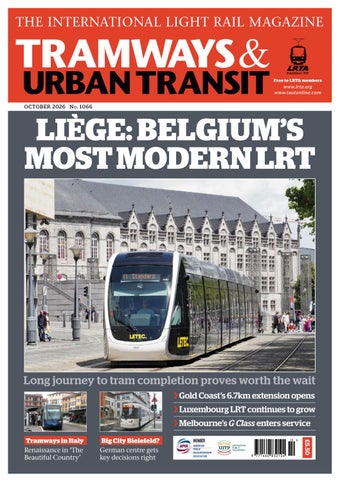
LIÈGE: BELGIUM’S MOST MODERN LRT
Long journey to tram completion proves worth the wait Gold Coast’s 6.7km extension opens Luxembourg LRT continues to grow Melbourne’s G Class enters service Big City Bielefeld? German centre gets key decisions right
£5.50
Tramways in Italy Renaissance in ‘The Beautiful Country’
Main Image: Andrew Thompson Inset Image: Gianni Belloni, CC BY NC SA 2.0
European Light Rail Conference
TWO days of interactive debates... TWELVE hours of dedicated networking... ONE place to be
Torino, Italy
Join key decision makers, professionals and industry experts as they gather for two days of debate centred upon how new technologies are driving progress in sustainable transport. For 2027 we are taking the European Light Rail Conference to a new venue and a new country. We are heading to Turin, with the event being held at the beautiful NH Collection Torino Santo Stefano hotel. Turin in northern Italy is home to a large tram and metro network that delivers a superb service to all areas of the city. As the population grows, safety and the environmental impact are more than ever key factors that will contribute to an improvement in the quality of life for the citizens of Turin and the surrounding region. Italy as a whole is currently undergoing something of a renaissance, with more systems being built and extensions planned.
17-18
2027
NH Collection Torino Santo Stefano
March
As an attendee, you will experience: Two days of presentations, panel debates and discussion from some of the sector’s most innovative and forward-thinking suppliers, manufacturers and operators, plus an expansive exhibition hall. A technical tour is planned for a tram ride to the depot which will be hosted by GTT. An evening networking reception will showcase a journey on the historic Sassi-Superga rack railway that connects the Turin suburb of Sassi to the Basilica of Superga at an altitude of 672m (2205 ft). From here, high in the hills facing the city across the River Po, a panorama of Turin is visible against a backdrop of the Alps. Here we will enjoy local cuisine and drinks, whilst maximising networking opportunities. With bespoke sponsorship and exhibition packages available, there has never been a better time to place yourself at the very heart of European light rail.
ORGANISED BY
MEDIA PARTNERS
SUPPORTED BY
+44 (0)1733 367600 @ eulr@mainspring.co.uk
www.mainspring.co.uk
CONTENTS
370 The official journal of the Light Rail Transit Association
386
www.tautonline.com
EDITORIAL EDITOR – Matt Johnston hello@mainspring.co.uk ASSOCIATE EDITOR – Tony Streeter tony.streeter@mainspring.co.uk
Sean Marshall, Flickr CC BY-NC 4.0
Neil Pulling
Robert Pritchard
OCTOBER 2026 Vol. 89 No. 1066
NEWS 364 Copenhagen’s Letbane opens; Melbourne welcomes G Class trams. INNOTRANS PREVIEW 368 TAUT takes a look at what to expect at Europe’s giant of a trade show. NORRKÖPING: THE SURVIVOR 370 Robert Pritchard explores the small Swedish city of Norrköping, home to a key surviving first-generation tramway. BIELEFELD: BIG CITY GOALS 374 Andrew Thompson reports from a small German city that got the big stuff right. SHARING EXPERIENCE 378 Andreas Berk and Axel Kühn explain how the benefits of experience can be magnified when shared.
WORLDWIDE EDITOR – Michael Taplin miketap@mainspring.co.uk SENIOR CONTRIBUTORS – Howard Johnston, Neil Pulling
380
ITALY’S GREAT RENAISSANCE 380 Richard Foster takes a tour of developments across this great European country, which is seeing something of an LRT revival. SYSTEMS FACTFILE: LIÈGE 386 As part of this Belgian city’s reinvigoration, a new tramway opened in 2025 – which Neil Pulling now visits. DEVOLUTION FOR UK LRT? 391 UKTram asks what devolution reforms could mean for UK light rail. WORLDWIDE REVIEW 392 Milan receives approval for funding to reopen line; Porto launches new tender. CLASSIC TRAMS: TTA BELGIUM Francis Terry reports on the 60-year celebrations of this Vicinal line.
396
WORLDWIDE CONTRIBUTORS Richard Foster, Andrew Grahl, Andrew Moglestue, Herbert Pence, Mike Russell, Nikolai Semyonov, Alain Senut, Andrew Thompson, Witold Urbanowicz, Bill Vigrass, Thomas Wagner, Philip Webb. PRODUCTION – Lanna Blyth Tel: +44 (0)1733 367604 production@mainspring.co.uk DESIGN – Debbie Nolan ADVERTISING COMMERCIAL MANAGER – Geoff Butler Tel: +44 (0)1733 367610 geoff@mainspring.co.uk Tramways & Urban Transit 13 Orton Enterprise Centre, Bakewell Road, Peterborough PE2 6XU, UK Tramways & Urban Transit is published by Mainspring on behalf of the LRTA on the third Friday of each month preceding the cover date.
LRTA MEMBERSHIP (with TAUT subscription) Tramways & Urban Transit is sent free to all paid-up members of the Light Rail Transit Association. LRTA WEBSITE AND DIARY Tim Kendell webmaster@lrta.org meetings@lrta.org SUBSCRIPTIONS, MEMBERSHIP AND BACK ISSUES LRTA Membership Secretary (Dept T06), 38 Wolseley Road, Sale M33 7AU, UK. Tel: +44 (0)117 951 7785 membership@lrta.org Website: www.lrta.org
Honesty is always a good policy Italy has come clean by admitting that it is some way behind many European countries in its number of quality light rail systems… but it also declares that it is doing its best to catch up. It has been a key mass manufacturer of motor cars for domestic use and export worldwide – FIAT and Alfa Romeo spring immediately to mind – while its principal cities such as Roma (Rome), Milano (Milan), Torino (Turin) , Firenze (Florence) and Genova (Genoa) have also sadly become stereotyped in feature films as symbols of traffic bedlam, with motorists harmoniously blaring their car horns while stuck in traffic jams for hours on end. That is happily changing, and this issue of TAUT celebrates the determination of city planners and the success of major firms such as Hitachi Rail and Stadler, which are winning large orders to both modernise existing routes and serve extensions. All this comes at a time when everyone is counting the cost of owning a motor car. The spiralling cost of a tankful of fuel shows little sign of slowing down while US President Trump and Iran continue their conflict, and the case for wholesale replacements by hybrid and all-electric power hasn’t been won yet. If you live in a city or town and want to be ‘green’, the answer more than ever is to use a tram or the metro. We are delighted that this year's Global Light Rail Awards event at the Battersea Arts Centre in London on 7 October is already a complete sell-out, even though it’s being staged at a larger venue. With over 140 entries from around the world, it will certainly be a night to remember, and TAUT looks forward to sharing with you the names of the worthy winners. Matt Johnston, Editor COVER: Liège car 5101 heads away from Place Saint Lambert, a main civic space and transport hub in the Belgian city, with the former Palace of the Prince-Bishops in the background. Neil Pulling
FOR CORPORATE SUBSCRIPTIONS VISIT www.mainspring.co.uk LRTA REGISTERED OFFICE 13 Orton Enterprise Centre, Bakewell Road, Peterborough PE2 6XU, UK Private company limited by guarantee, No. 5072319 in England and Wales. LRTA CHAIRMAN – Paul Rowen chair@lrta.org © LRTA 2026 Articles are submitted on the understanding they may also be used on our websites or in other media. A contribution is accepted on the basis that its author is responsible for the opinions expressed in it, and such opinions are not those of the LRTA or Mainspring. All rights reserved. No part of this magazine may be reproduced or transmitted in any form by any means, electronic or mechanical, including photocopying, recording or by any information storage and retrieval system, without prior permission in writing from the copyright owner. Multiple copying of the contents of the magazine without prior written approval is not permitted.
PRINT The Manson Group Limited, St Albans, Herts AL3 6PZ
DISTRIBUTION Warners (Midlands), Bourne, Lincs PE10 9PH, UK
Front cover Italy image: Gianni Belloni, Flickr CC BY-NC-SA 2.0
www.tautonline.com . www.lrta.org OCTOBER 2026 / 363
News
Gold Coast light rail extension opens Could a new northern branch follow?
G
old Coast’s G:link light rail system opened its 6.7km (4.2-mile) extension from Broadbeach to Burleigh Heads on 9 August. Inauguration of Stage III of G:link completes the 34.4km (21.4-mile) northsouth tram line along the southeastern Queensland coast between Gold Coast University and Burleigh Heads. The tramway has a flat fare of AUD0.50 (EUR0.30) and operates every seven-ten minutes from 05.00-23.59, with 24-hour weekend service. Queensland’s Minister for Transport & Main Roads Brent Mickelberg said: “The extension will better connect communities, support local jobs and businesses and make it easier for people to move between popular destinations.”
The extension has taken four years to build at a cost of AUD1.55bn (EUR950m). It has been criticised for spiralling costs as its initial budget was AUD709m (EUR435m); this has been blamed on the need to upgrade 48km (30 miles) of sewer and water infrastructure that had not originally been identified. A further southbound extension, dubbed Stage IV, was cancelled by the Queensland Government in 2025 due to increasing costs. This 13km (eight-mile) line would have taken G:link from Burleigh Heads to Coolangatta via Gold Coast airport. It was conceived as part of plans to improve transport links in the area in readiness for sporting events connected with the 2032 Olympic games. These are to be centred around Queensland’s
Gold Coast tram at the new Burleigh Heads terminus. D. Cansdale
capital Brisbane, to the north of Gold Coast. While a dedicated bus, dubbed GC Surfer, is to connect the city with the airport, Queensland Government’s Gold Coast Transport Plan, which considers transport solutions to be completed in time for the Games, has proposed a northern G:link
extension. Published in June, the report proposes a new 4km (2.5-mile) branch from Gold Coast University Hospital station to Biggera Waters. Phil Mumford, the former CEO of tramway contractor GoldlinQ, has been appointed to oversee the project. It is due to be completed by 2032.
T-class trams return to Frankfurt
The first G-class tram in passenger service at Flinders Street station. TramBook
G-class tram enters Melbourne service The first of Melbourne’s new three-section G-class trams entered passenger service on 30 July when 7006 left Essendon depot to take up an extra working on Line 59 to Flinders Street station. Alstom’s Dandenong factory, to the south of Melbourne, is building 100 of these trams under an AUD700m (EUR429m) contract; 65% of the vehicles’ content is Australian-made. Guillaume Tritter, Managing Director of Alstom Australia and New Zealand, said: “The G Class journey into passenger service has been made possible thanks to the financial investment made by the Victorian Government and a spirit of understanding, collaboration and problemsolving that has defined this programme from its early days.”
He said the vehicles are “proof that rolling stock can and should be built here in Australia by Australians for Australians.” The G-class fleet is to be based at the new Maidstone depot and is to be used on Lines 57 (West Maribynong), 59 (Airport West) and 82 (Footscray – Moonee Ponds). The new class is to replace Z-class and C-class trams. Developed under the ‘Next Generation G Class Tram’ programme, the new cars are based on Alstom’s Flexity 2 design. They have an onboard 48.9 kWh energy storage system, with roof-mounted batteries to permit operation away from the overhead. Alstom has also invested AUD40m (EUR24m) in the Dandenong factory to build the new 25m low-floor trams.
364 / OCTOBER 2026 www.tautonline.com . www.lrta.org
Alstom T-class 320 returned to Frankfurt-am-Main’s streets on 17 August, after an operating licence for the fleet was issued on 13 August. Alstom has rebuilt the 14 vehicles after they reportedly did not meet contractual requirements in respect of technical functions when delivered between December 2022 and November 2024. An agreement between Alstom and operator VGF resulted in Alstom’s Görlitz factory carrying out additional work. VGF undertook tests with car 320 prior to agreeing that contractual requirements have been met. Once all 14 cars have been rebuilt and delivered,
production on the remaining 44 is to begin. The original order for 58 trams is divided between 24 threesection 31.5m and 34 five-section 40m trams. They are to be used on lines 16-18, permitting the withdrawal of the last high-floor P-class trams and replacement of the 40 R-class vehicles.
An Alstom T-class tram on the streets of Frankfurt. UTM
Edinburgh disruption after building fire No Edinburgh Trams services (UK) were able to run north of Princes Street for at least a month, following the fire at the former Debenhams department store on 13 July (TAUT 1065). The street and tramway passing close to the building were closed off, creating difficulties during the annual Edinburgh Festival, which attracts up to three million tourists. Only the section from the Airport to a temporary terminus at West End has been usable.
Edinburgh’s city council considered transferring trams by road from Gogar depot at the far western end of the system to allow services to resume to Leith and Newhaven, but this was ruled out on grounds of cost, practicability and the increased risk of vandalism. The disruption brought calls for a second depot or stabling facilities to be built, previously considered when the northern line through Leith was approved, but dropped to save money.
Nairobi’s 78-year-old dream to be realised
Bucharest’s financial problems
New underground line to be built under Kenyan capital
K
enyan President William Ruto has revealed plans for a 30km (19-mile) metro to be built through Nairobi as the first stage in an ambitious programme to improve connectivity around the capital. “Our plan for the Nairobi Metropolitan Mass Rapid Transport System is the perfect solution to the traffic congestion and gridlock that face our capital city and the environs”, President Ruto said. The new metro would connect the suburb of Eastlands with Nairobi’s central business district; current estimates are that commuters between the two presently spend between 2hr 30min and 3hr in traffic each day. However, at KES1tr (EUR6.6bn), the NMMRTS is the African country’s most expensive infrastructure project to date. Approved by Nairobi City County Government, the initial phase comprises a 10km (six-mile) orbital line serving eight new stations as well as a 20km (12-mile) elevated line to Eastlands. The system is to serve five million people, who are
An impression of the planned Eastlands elevated metro. Nairobi County Council
expected to make 12m trips per day. Completion is due by 2035. Governor Sakaja Johnson said: “The approval of NMMRTS Phase I is our firm commitment to delivering a modern, fast and safe public transit network. By integrating an underground core through our Central Business District (CBD) with direct high capacity links to Eastlands, we will unlock Nairobi’s true economic potential.” Kenya’s national government is to contribute KES388bn
(EUR2.6bn) to the scheme. This includes around EUR771m for rolling stock. Procurement should start in 2028. Nairobi first unveiled plans for a metro in 1948. The idea was incorporated into 1972’s Nairobi Metropolitan Growth Strategy and also in the 2014 Nairobi Urban Integrated Development Plan. The NMMRTS is due to be complemented by a new Bus Rapid Transit system and improved commuter railway lines.
A court in București (Bucharest) has rejected a request from the Romanian capital’s public transport operator STB to enter insolvency. According to General Mayor Ciprian Ciucu, the request was declined because STB failed to submit all the required paperwork. STB filed for insolvency on 6 August, weeks after offering voluntary redundancy to up to 800 employees. Ciucu told the Spot Media news outlet that STB’s financial situation had worsened in 2020 after not transferring “VAT and salary-related contributions to the state”. Debts continued to accumulate, reaching RON1.7bn (EUR323m) by the end of 2025. When combined with the costs of operating the city’s buses, trolleybuses and trams, STB is costing the city RON5.6bn (EUR1bn) a year, when city hall’s total annual budget is RON5.8bn (EUR1.1bn). STB’s current financial situation is not expected to affect current operations. Insolvency would enable STB to reorganise its finances for the future. This would mean changes to its operations, particularly where routes overlap the metro.
VLR named as Ironbridge contender
A map of the planned Nairobi metro. Nairobi County Council
Bali opts for trams Despite a ground-breaking ceremony taking place in September 2024, the governor of Bali, I. Wayan Koster, has cancelled plans to build a 16km
(ten-mile) underground metro from the airport to Cemagi via Central Parkir Kuta. This, the first stage in the IDR234.4tr (11.3bn) Bali Urban Subway project, did not attract sufficient interest from private investors.
Instead, construction of a IDR2.2tr (EUR106m) surface light rail line from I Gusti Ngurah Rai International Airport to the tourist resort of Canggu is to start in 2027, although the route has yet to be finalised.
Telford & Wrekin Council (UK) has allocated GBP150 000 (EUR170 000) to explore building a VLR system to connect the main line station at Telford with the Ironbridge area. It is part of the council’s 2027-41 transport plan for the borough. Track owner Network Rail says it is happy to lease the mothballed 6.5km (four-mile) route, which reaches the site of the former coal-fired Ironbridge power station (demolished in 2019) alongside the River Severn. Now known as Benthall Grange, this is undergoing redevelopment by its new owner the Harworth Group and is to provide 1000 new homes. The council is looking to identify and develop intermediate station locations along the route, which lost its passenger services in the 1960s.
www.tautonline.com . www.lrta.org OCTOBER 2026 / 365
News
Mainz opens city diversion line
A Mainz tram tests the new tracks across Alicenbrücke. Mainzer Mobilität
Trams began running on Mainz’s new 300m link between Münsterplatz and Alicenplatz on 10 August; the German city then held an official opening ceremony on 15 August. Running along Binger Strasse, the new line is intended to provide relief for the congested main railway station forecourt section, through which all tram services have traditionally had to pass. It has also shortened the journey between the western districts and the city centre. However, passengers on the new link can still reach Hbf West stop, a short walk from the station. Construction started in 2024. The link is used by line 53 (Lerchenberg – Schillerplatz). Relief of the busy tracks in front of the railway station also allows the opportunity for further extensions of the city’s tramway network. Mainz’s horse trams of 1884 were replaced by electric trams from 1904 (steam trams also ran from 1891 to 1923). The current 30km (19-mile) metre-gauge network comprises five lines operated by 36 low-floor trams. In July 2025, an order was placed with Škoda for 22 ForCity Smart 43.5m trams with delivery in 2028-30.
Plans submitted for Montevideo trams Light rail vying with buses in Uruguay capital
An AI generated impression of how a modern tramway in Montevideo might look. railbays.com
A
consortium comprising Stadler Rail, Saceem and engineering contractor Stiler has submitted a feasibility study to Uruguay’s government for a five-line tramway across the country’s capital Montevideo. The ‘Three S’s’ consortium was commissioned to produce the study in 2025, by the then newly-elected Frente Amplio (Broad Front) coalition party. Shortly after the election, Transport Minister Lucía Etcheverry said the coalition “establishes the priority of starting to advance quickly on a strategic plan in the metropolitan area, and that it has to be multimodal, incorporating the different transport systems. Today 60% of the population is concentrated in the metropolitan area.” The feasibility study proposes starting with a two-line network, 46.4km (29 miles) long, serving 48 stops. Line 1 would connect Plaza Independencia – El Pinar over 32.6km (20.3 miles).
Line 2 would share 7.3km (4.5 miles) of line 1 infrastructure on its 13.8km (8.6-mile) route from Plaza Independencia to Aeropuerto via Intercambiador Belloni. The study proposes that the first phase would take three years to complete, with the consortium operating it for a further 22 years. Lines 1 and 2 would cost around USD787m (EUR674m) to build, including purchasing 30
Stadler Citylink LRVs. The first 7.3km of line could open in 2031. Remaining lines would comprise line 3 (Ciudad Vieja – Estación Central), line 4 (Buceo – Sayago) and line 5 (Estación Central – Las Piedras). Lines 1 and 2 could on their own carry up to 150 000 passengers a year. In October 2025, a rival proposal was made for a two-line USD528m (EUR452m) 53km (33-mile) BRT network.
A map showing the first two lines for the planned Montevideo tramway. Stadler
West Yorkshire transit campaign stepped up A demonstration called ‘Supertram Day’ was staged on 27 July to call upon new UK Prime Minister Andy Burnham to make a firm pledge to fund West Yorkshire Mass Transit. The date was chosen as being 33 years to the day since the Leeds Supertram Act received Royal
366 / OCTOBER 2026 www.tautonline.com . www.lrta.org
Assent – the scheme was later abandoned because of rising costs. The latest Leeds/Bradford proposals have stalled because West Yorkshire’s pro-tram mayor, Tracy Brabin, has been unable to generate funds. Campaigners believe the way ahead is to secure
firm long-term commitment from central government, and allow the region to generate its own funding for money by imposing extra business rates on companies. Campaigner Gareth Forest wants spades in the ground within the next two years.
Luxembourg tramway continues to expand New extension approved while line construction continues
L
uxembourg’s parliament approved a new 2km (1.2-mile) tramway extension on 15 July, at a time when other expansion work was well underway. The extension is to run from Stäreplaz/Étoile stop towards the hospital complex (Centre hospitalier de Luxembourg) and the neighbouring municipality of Strassen. Part of the new line is to run in a 600m tunnel and it is to serve four intermediate stops. Construction is set to begin in 2029, with services due to start in late 2032. The estimated construction costs of EUR171m are to be shared between the Luxembourg state (EUR114m) and the City of Luxembourg (EUR57m). Approval of the extension has, as reported by Luxembourg Times, led to Strassen’s Mayor Nico Pundel to call for the tramway to be extended 3.2km (two miles) to Belle Étoile shopping centre. This could include single-track running along the Route d’Arlon. Mayor Pundel said: “The frequency of the tram along the
Russian manufacturer PKTS showed off the latest version of its 71-921 Korsar metre-gauge tram at its Sankt Peterburg (Saint Petersburg) factory on 13 August. This has an improved bogie design and air-conditioning and can carry 177 passengers (31 seated). The new tram is to go on test in the city of Pyatigorsk. PKTS has built 16 Korsar trams for Kaliningrad. It reportedly hopes that this new demonstrator will help it win orders from Pyatigorsk and also Yevpatoria.
Lisbon metro re-routed
New pointwork being installed on the Luxembourg tramway. R. Birgen
Route d’Arlon won’t be as high as in the city centre. That’s why it’s not a problem if there are sections that are single-track.” Meanwhile, construction of the new depot at the southern end of existing line T1 began on 6 July. The four-hectare site close to the Stade de Luxembourg stop is to feature a storage building, workshop and administrative facilities to house the 41 additional trams needed following the further expansion
Zimbabwe light rail makes progress Zimbabwe’s government has granted ‘National Project Status’ to a proposed USD3bn (EUR2.6bn) light rail system across the capital Harare. The change in status brings an associated acceleration in delivery along with key government backing. Although planned to be delivered in five stages under a public-private partnership contract through the Zimbabwe Investment and Development Agency, the first stage will only be built if a suitable investor can be found. However, funding worth USD5m (EUR4.3m) has been secured to fund engineering and environmental assessments. Samuel Nyabeza, Harare City Council’s Acting Director of Town Planning, said: “This is not a project that [Harare]
New tram unveiled
can implement on its own. The development of a light rail system is a national-level infrastructure project that will be undertaken in collaboration with relevant Government ministries and State entities responsible for rail transport and major infrastructure development.” The first stage is to be a 14km (nine-mile) link from the city centre to the western suburb of Kuwadzana, which could be completed within five years. Stage 2 comprises a 30km (19mile) line south to Chitungwiza, followed by a 20km (12-mile) line to Mabvuku-Tafara in the east (Stage 3). Stage 4 would add 12km (7.5 miles) to reach the airport via Cranborne, while the final phase would extend Line 1 by 11km (seven miles) from Kuwadzana to Mount Hampden.
of the network. Completion is scheduled for 2030. Construction of the 2.3km (1.4-mile) extension to the European School took a major step forward between 22 July and 9 August when the new turnout was installed on T1 between Rout Bréck-Pafendall and Mudam stops. Tracklaying is to begin in early September and the line could open in September 2027. A further extension towards Luxexpo is planned.
Portugal’s national government has rejected a plan by Lisboa (Lisbon) to amend its Linha Circular (Circle line) metro project to save an estimated EUR10m. Creating the line involves building a 1.9km (1.2-mile) link between the current Green line’s termini at Rato and Cais do Sodré. The proposal was for throughrunning from the Yellow line’s northern terminus at Odivelas onto the Green/Circle lines. In order to save the EUR10m, the Yellow line will remain a separate branch (Odivelas to Telheiras), making an interchange with the Green/Circle lines at Campo Grande.
Welsh tram-trains
Tram-trains are becoming more commonplace on South Wales Metro services radiating from Cardiff (UK), following an initial roll-out on 23 June. Although still restricted to single formations, up to ten Stadler Class 398 units have been noted in use on the Cardiff Bay – Pontypridd corridor.
Copenhagen’s Letbane is open The 14km (nine-mile) second phase of the København (Copenhagen) Letbane opened on 22 August (TAUT 1065). Now 27km (17 miles) in length, the orbital line connects key suburbs around the Danish capital. It runs from Lundtofte in the north, via three suburban rail interchanges in Lyngby, Buddinge, and Herlev, to
Rødovre Nord. The 13km (eight-mile) Ishøj – Rødovre Nord section opened in October 2025. End-to-end journeys take approximately 68 minutes. Around 14 million passengers are expected to be carried each year from 2030 onwards. This is due to the development of new residential areas alongside the purpose-built light rail corridor.
København’s (Copenhagen’s) Letbane fleet of 29 Avenio trains is based at the Rødovre Nord operational centre. Andrew Thompson
www.tautonline.com . www.lrta.org OCTOBER 2026 / 367
InnoTrans 2026
INNOTRANS 2026: MORE INTERNATIONAL THAN EVER Berlin’s giant rail trade show returns in September. TAUT takes a look at what to expect.
I
nnoTrans. Every two years, people from around the world gather for this worldleading rail industry show, held at the trade exhibition grounds in Berlin, Germany. This September though, InnoTrans celebrates a significant anniversary – it’s 30 years since the first of the fairs, whose very name is a mashup of the words ‘innovation’ and ‘transport’. In 1996, InnoTrans attracted somewhat under 6500 visitors to a show that had 172 exhibitors. Compare that with the last exhibition in 2024, when more than 169 000 people came to see nearly 3000 exhibitors from 59 countries, spread across 42 halls and an outside display area. This year’s event promises to be the most international yet – with more than 60 countries represented. InnoTrans covers the entirety of the rail sector – from rolling stock through components, services, engineering equipment and much else too. But with light rail burgeoning around the globe, it is a chance to demonstrate much that’s specific to this sector too. While the stands throughout the halls provide the vast majority of the exhibition in both size and quantity, it’s the roughly 3.5km (2.2 miles) of track space outside that offers the stage for the show’s symbolic heart. In 2024, multiple manufacturers displayed light rail vehicles – from Alstom with its Berlin Flexity, to Stadler with its Citylink and Hyundai Rotem, which brought a hydrogenpowered tram.
Trams, batteries, track
At the time of writing, not all of the manufacturers have yet announced their displays for 2026 – but Stadler is bringing
RIGHT: InnoTrans last took place in Berlin in 2024, welcoming visitors from 133 countries. This year’s event is set to have even greater international participation. Geoff Butler
BELOW: Stadler is bringing seven vehicles to this year’s show, including a TINA for Rostock and S-DT8.16 for Stuttgart. Stadler
seven vehicles, of which two are for light rail. Both of these are for German customers. First, there’s a TINA for Rostock, one of 30 ordered by the Baltic city. These 32m trams can accommodate up to 216 passengers, 75 seated. Modern features for passengers include WiFi, USB charging ports and dual information monitors, while driver aids include a collision avoidance system. With an entrance height of 290mm and floor height of 350mm, these three-section low-floor trams are step-free and fully accessible. Each of Rostock’s TINAs has four multi-function areas that can be used for bikes, prams or luggage. The first vehicles were ordered by the city in 2022. Also in Stadler’s portfolio is the S-DT8.16 for Stuttgart, which the manufacturer describes as being “specifically tailored to
368 / OCTOBER 2026 www.tautonline.com . www.lrta.org
the challenging topography of the capital of Baden-Württemberg.” Stuttgarter Strassenbahnen AG has ordered 70 of the 39m-long two-section bidirectional vehicles, which offer barrier-free access options, have a floor height of 970mm, and can take 250 passengers. All axles are driven (using three-phase asynchronous drive) and the design has multiple unit traction capability. These vehicles represent the third generation of Stadler vehicles for Stuttgart; the first contract for the S-DT8.16 was placed in 2022, with an initial order for 40. Among the other vehicles being brought to InnoTrans by Stadler are a battery-powered FLIRT Akku regional train being delivered to Austria, and a hydrogen-powered narrowgauge train that has been ordered by three separate Italian railways. The Swiss company is also planning a presentation on accessibility of trams from the point of view of people with disabilities. Its main stand will cover the aspects of rolling stock, signalling and service. Of course, much of the technology on display at InnoTrans is ‘mode agnostic’ – being appropriate for heavy or light rail. Other vehicle presentations are expected to include a bimodal EDMU from Koncar, and an explanation of Hitachi’s BEMU technology by that company – which will also display a
ABOVE AND LEFT: Voestalpine will be showcasing its New Urban Track system, which the company says will address challenges such as high wear and costly maintenance. Voestalpine
train at the other end of the spectrum from light rail: its high-speed Frecciarossa ETR1000 for Italy. Permanent Way innovations are always an important part of InnoTrans, and those being presented this year are to include Voestalpine’s New Urban Track system. The manufacturer describes this as “a newly developed track superstructure system for trams and light rail systems”. This, the company says, “addresses key challenges such as high wear, costly maintenance, and increasing demands for availability, noise, and vibration reduction.” Just as for innovations in track, InnoTrans is an opportunity to showcase not only complete vehicles but also components. As examples, Knorr-Bremse will this year display a hydraulics-free digitalelectromechanical rail brake alongside continued electro-pneumatic development, plus a Digital Automatic Coupler, air supply and AI diagnostics exhibits. Saft will meanwhile present its latest range of advanced Li-ion batteries for rail, which it says have been “engineered to deliver superior reliability, efficiency, and performance for modern rolling stock and rail infrastructure.”
Interiors, AI, networking
This though represents just one side of the event. Indeed, the show is broken down into five segments: Railway Technology, Railway Infrastructure, Public Transport, Interiors and Tunnel Construction. Around 300 exhibitors are expected to display their products in a dedicated 15 000m2 area for vehicle interiors. Examples include wall-mounted seating from Clerprem, which allows floors to be kept clear, facilitating both cleaning and maintenance. Vehicle cleaning is among the other themes this year, and the Mobility Cleaning Circle will offer “opportunities for networking, discussing innovative cleaning concepts and provides insights into current challenges and solutions in cleaning in the mobility industry.” German company Otto Christ is displaying under the motto ‘I love rail wash’, and will provide information on aspects such as exterior cleaning systems for tram fleets, and resource-efficient wash concepts with low water and energy consumption. Meanwhile, some four years after launching its Xcelerator programme, industrial giant Siemens is bringing its open digital business platform into rolling stock for the first time, with its Vectron X locomotive. Siemens, which is to have a roughly 1000m2 booth, around 45 indoor exhibits and more than 300m of outdoor displays, reports that
it will “demonstrate how data and artificial intelligence help operators increase capacity, improve availability and reliability, enhance the passenger experience, and optimise lifecycle costs.” Artificial Intelligence is an increasingly important aspect of planning and managing public transport. Planning and ticketing company INIT reports that “Artificial intelligence and other data-driven technologies (Smart Intelligence) offer tremendous potential to optimise service offerings, improve service quality, streamline processes, and reduce costs.” Its display “will showcase how these technologies help transport operators”. This year’s InnoTrans will also include a dedicated ‘AI Mobility Lab’ and an ‘AI Mobility Corner’ – the latter being a forum for talks and presentations. A new feature in the show’s supporting programme is an ‘AI on track’ Hackathon, at which participants will be asked to develop aspects such as AI applications for the transport sector. AI is also a theme for the InnoTrans Convention, which is to include a public transport forum that will focus on “artificial intelligence as a driver of efficiency in public transport”. Other themes include a design forum and a tunnel forum. If anything demonstrates the scale of InnoTrans at its 30th anniversary though, it is perhaps something that will take place away from the showground itself. On 21 September – the day before InnoTrans begins – a train will run from Brussels to Berlin carrying around 200 people: politicians, representatives from transport authorities, and figures from across public transport. UITP – the International Association of Public Transport – will be represented by both its President and Secretary General, and will lead an interactive session during the journey of what it describes as “a moving conference”. At InnoTrans itself, UITP will share its stand with Hamburg, as it looks forward to holding its 2027 summit in the northern German city next June. Visitors to its InnoTrans stand, says UITP, “can learn more about our work across urban and regional public transport, and about the EU funded projects UITP is currently leading or supporting, from autonomous trams to metro innovation and rail digitalisation, and so much more.” The sentiment may be specifically about UITP – but it symbolises much of what InnoTrans has to offer. TAUT will carry a full report on InnoTrans in November’s issue.
Siemens is set to have a huge 1000m2 booth and over 300m of outdoor displays, which will include its Vectron X locomotive. Siemens
Knorr-Bremse will display a hydraulics-free digitalelectromechanical rail brake and a Digital Automatic Coupler among other exhibits. Knorr-Bremse
Presentations are expected to include an explanation of Hitachi’s BEMU technology – the company will also display the latest version of its high-speed Frecciarossa ETR1000 for Italy. Björn König, Wikipedia CC0
WHERE AND WHEN? InnoTrans 2026 takes place from 22-25 September at Messe Berlin, the trade fair facility in the German capital. The event spreads across 200 000m2 of exhibition space, encompassing 42 halls and outside areas including the rolling stock display and summer garden; the latter hosts a bus display. InnoTrans’ official opening title for 2026 is “Mobility on a global scale – shaping projects and growth opportunities”. For more information, see www.innotrans.de
www.tautonline.com . www.lrta.org OCTOBER 2026 / 369
NORRKÖPING: SMALL TOWN SURVIVOR Robert Pritchard explores today’s tram network in Norrköping, home to this year’s LRTA Annual General Meeting in September.
A
long with the Swedish second city of Gothenburg (Göteborg), the regional city of Norrköping managed to retain its tramway in the 1960s when many others in the country lost theirs as a result of the nationwide policy to abandon electric city transport in favour of buses. This was principally because of the switch from leftto right-hand driving in September 1967, which rendered large fleets of single-ended trams unusable (the changeover was known as Högertrafikomläggningen, or the right-hand traffic changeover). Rather than scrap the tramway altogether, forward-thinking city leaders chose to invest in 25 new M67 vehicles and rebuild the tramway. Trams had always been popular and were viewed as the most important form of transport in Norrköping, unlike other cities which already depended on buses. Since then the tramway has thrived, with a significant extension in 2010-11 adding 3.5km (2.2 miles). Today it forms an important part of the Norrköping transport network, supported by a number of bus routes. Norrköping is unusual in that it still uses trams dating from the 1960s in normal everyday service – something not seen in many other places away from museum routes. The city lies around 160km (99.4 miles) southwest of Sweden’s capital, Stockholm, in the province of Östergötland. This also
includes the larger city of Linköping around 40km (25 miles) to the south, one of several cities in Sweden where a new tramway has been proposed (of these proposals, Lund opened in 2020 and Uppsala’s line is due to open in 2029).
“The tramway typically carries around 50% of all public transport journeys in the city.” Norrköping has a population of around 100 000 and is the tenth-largest city in Sweden by municipal population. Trams have operated since 1904, and today’s standardgauge 18.7km (11.6-mile) tramway of two lines is operated by Transdev as part of the Östgötapendeln operation, which covers local tram, bus and railway operations. A new eight-year contract commenced in June 2025 with the option to extend this by a further four years. The trams and infrastructure are owned by the Norrköping Municipality. The tramway typically carries between five million and 5.5 million passengers per year. This is around 50% of all public transport journeys in the city.
370 / OCTOBER 2026 www.tautonline.com . www.lrta.org
ABOVE: Duewag M97 car 68 of 1966 passes the Grand Hotel and crosses the river bridge just beyond the Rådhuset stop on a line 3 service to Vidablick. All photos by Robert Pritchard taken on 5 May.
Two-line tramway
The Norrköping tramway consists of two regular lines, 2 and 3, and a heritage line that operates at summer weekends as line 1. Line 1 used to be a city centre-only tram line, but this ceased as a regular route in the 1950s. A short line 4 to Smedstuguplan also operated for just nine years in the 1950s and 1960s before closure in 1966 due to low ridership. Both of today’s lines operate from one side of the city to the other, with journey times of between 35 and 43 minutes end-toend and a frequency of every ten minutes, every 15 minutes from mid-evening and at weekends, and every half hour in the late evening period. During the school summer holidays (mid-June until mid-August) the frequency also reduces to every 15 minutes on both routes. On Friday night and Saturday mornings half-hourly night services continue to run until around 03.00. On weekdays services start very early – typically between 04.30 and 05.00. The longer line 2 runs from Fridvalla to Kvarnberget, taking around 43 minutes with 28 stops. Line 3, meanwhile, runs from Vidablick to Klockaretorpets Vändplats taking 35 minutes with 21 stops. Seven stops are shared by the two routes, although at Söder Tull there are different platforms for the two lines. All stops are technically classed as request stops, although in practice this doesn’t apply to most in the city centre.
Norrköping near Norr Tull, and an abandoned loop near Albrektsvägen which was used when this was a terminus. Both lines operate with a mix of segregated and street-running; on some sections there is quite extensive use of grass-track sections such as at the terminus at Vidablick in the north, at the two southern termini, and on the long tree-lined approach to Rescentrum.
The tram fleet
ABOVE: In the city centre at Hörsalsparken, with two Flexity Classic trams, 41 and 48, passing on line 3. BELOW: Two Bombardier Flexity Classic cars, 41 and 37, pass outside the front of the attractive Central Station at Norrköping while working line 3 services.
With some trams being single-ended, each of the four termini have balloon loops. The north end of line 2 is quite rural, with trams passing an attractive church on departure and then negotiating a short single-track section at the Heleneborgsgatan stop. At Hagaskolan the two lines join in the north. The north end of line 3 is rather different in character to line 2, serving several high-rise buildings near the terminus. On the section where both lines run together in the north of the city this gives a frequency of a tram every five minutes. This section serves the busy Norrköping Central Station at the Rescentrum stop, also wellserved by local buses. Heading into the city centre, after the next stop (Rådhuset – city hall), the two lines take different routes through the centre. Line 3 runs through the main shopping district (on Drottninggatan, which includes a short single-track section) whereas line 2 runs a little to the east on the perimeter of the centre along a ring road (Östra Promenaden). It is off this route where the access tracks to the depot at Oxelbergen leave close to the Gustaf Adolfsplan stop. The route through the city centre was
completely closed for major rebuilding and track relaying between April and October 2025, and only the southern part of each route was in operation during this time. The two lines rejoin briefly at the Söder Tull stop – also an important bus interchange – before splitting again. Line 2 then runs south, and from Albrektsvägen there were three separate extensions between 2006 and 2011, bringing the line first to Ljura then to Trumpetaregatan, and finally to the current terminus at Kvarnberget. This route serves both dense and lower-density housing developments. The whole route has been well-built on its own right of way. At Hagby Centrum it serves the large Mirum Galleria shopping complex, while the terminus at Kvarnberget serves the Ringdansens centrum shopping centre. Line 3 heads in a westerly direction to Klockaretorpet, the western sections of this line being opened between 1975-80 to serve new housing developments built during this time as the city expanded. There are additional loops at Folkets Park and Trumpetaregatan, but these are not normally used by regular services. There is another loop used by the heritage line 1
When operating the ten-minute tram service, Norrköping requires 18 trams for service, although some swaps may happen during the day. Notably there are not normally any peak-hour extras. The core of the tram fleet consists of 22 Bombardier Flexity Classic trams. These are three-section double-ended 100% low-floor articulated cars dating from 2006-12 (numbered 31-52). Most have always operated in Norrköping, but some are ex-Stockholm. These were replaced in the capital when demand outgrew their capacity on the Djurgårdslinjen line 7 and longer CAF trams were ordered (a batch of six Flexity trams, 47-52, were transferred to Norrköping from Stockholm in 2020). The Flexity trams replaced the last of the ASEA four-axle cars that had been bought new in 1966-67. As well as the Flexity trams, there are still five serviceable Duewag M97 (originally GT6s or GT8s, depending on number of axles) – single-ended articulated cars dating from 1966-67 ex-Duisburg, Germany (62, 65, 68, 69, 70). Cars 61, 63, 66 and 67 are stored and used for spares, others of this series having been scrapped. Fifteen of this type originally arrived in Norrköping in 1994, having been made redundant in Duisburg when the new central city tunnel opened. Initially acquired as a stop-gap measure while the ASEA trams were upgraded, they proved so successful that they were retained and upgraded with a low-floor centre section in 2000-01. Electrical equipment was replaced and had to be reinstalled into new cubicles in the interior during this work. The front and rear ends were also modernised. Interiors were refurbished with new seats in a 2+1 layout, whereas the Flexity trams still have their original seats. All trams have seats with an attractive dark green upholstery. Duewag tram 71 has been retained in the heritage fleet as a ‘partytram’ and has retained its unrefurbished front ends. Also visible stored outside the depot are two of the three prototype MAN/AEG GT6N trams (22/23). These date from the early1990s and previously operated in Munich. They were withdrawn in Norrköping in the early 2010s when the voltage was changed from 600V dc to 750V dc. The depot also houses a small heritage fleet operated on museum line 1 by the Swedish Tramway Society. On the west side of the depot and easily photographable is ASEA M67K 148 of 1967, mounted on a plinth on its own section of track and with mock overhead wires. With 18 trams typically required for service and 22 Flexity trams in the fleet, this would nominally be enough to cover all requirements, but usually at least some of the Duewag trams are in operation. For example on a weekday visit in May 2026, 15 Flexity and three Duewag trams could be seen in use, with one of the Flexity trams
www.tautonline.com . www.lrta.org OCTOBER 2026 / 371
Norrköping 3
2
Fridvalla Heleneborgsgatan
De Geersgaten
“Norrköping is unusual in that it still uses trams dating from the 1960s in everyday service.”
Vidablick Rågången Sandbyhov
Slåttergatan
Eneby Centrum Cedersborgvägen Hagaskolan
Breda vägen
Marielund
Norrtull
Matteusskolan
Rådhuset
ReseCentrum Nya torget Styrmansgatan
Vägträffen
Bastuban
Väster Tull Broocmansplan
Lokegatan Sandtorp
2
Gustaf Adolfsplan
Stortorget Söder Tull
Albrektsvägen
Skarphagsgatan
3
What else is there to see?
Djäkneparksskolan
3
Hörsalparken
Strömbacken
Klockaretorpets Centrum Klockaretorpets vändplats
Ljura Centrum Ljura Spårvägsbro Hageby vårdcentral Hageby Centrum Hyvlaregatan Trumpetaregatan Atriumhusen
Ringdansens Centrum 0
1
2
Kilometres
swapped for another during the day. All trams carry the attractive fleet livery of dark yellow and green (no trams were seen in advertising liveries), but while smart, on some trams it has noticeably faded. Most of the Flexitys are named after famous local or Swedish figures including actors, artists or doctors. Information panels inside the trams (in Swedish only) tell you about the history of the individual. Some of the Duewag trams are named after cities in Germany.
2 Kvarnberget
LEFT: Duewag car 69 approaches the junction in the north of the city at Hagaskolan with a line 2 service for Kvarnberget.
BELOW: On the southern extension that opened in 2010, Flexity Classic 38 heads a line 2 service working back into the city centre and to Fridvalla. Car 43 can be seen in the background at the busy Hagby Centrum stop heading for Kvarnberget.
While it would be an overstatement to say that Norrköping is a popular tourist city, there are certainly many interesting sights and fine buildings away from the tramway that could keep you entertained for a day, together with a number of attractive parks. The city centre is just a short walk (or tram ride) from the main station, and there are wide streets and a good selection of shops and eating establishments. En route you will also cross the wide Motala ström river, with a number of riverside walks where you will pass spectacular industrial buildings such as textile mills harking back to Norrköping’s industrial past. An important industry since the 1850s has been a large paper mill, which continues to operate to this day. Adjacent to the Rådhuset tram stop is the Rådhus (city hall) building, a very attractive brick building dating from the 1900s; across the main square here is Hedvigs church. The Stadsmuseum (City Museum) is located in an old factory and tells the story of the city’s cultural heritage. The Arbetets Museum of Work covers not only work but everyday life, and is located in an old cotton mill. Further afield, the tramway museum in the small town of Malmköping (Museispårvägen Malmköping), located roughly halfway between Stockholm and Norrköping, is well worth a visit and operates some of the old trams that used to run in Norrköping.
Getting there and ticketing
Norrköping can be visited as an easy day trip from Stockholm, with frequent train services operated by either national operator SJ or open access operator Snälltåget taking around 1h 15 min-1h 40 min each way. Trams run from right outside Norrköping’s main railway station. Visitors should note that Sweden is almost entirely a cashless country these days. You can pay by contactless card or Apple Pay using a tap-on tap-off system on board the trams. Alternatively, the author recommends using the Östgötatrafiken app to purchase the excellent value 24-hour ticket for the Norrköping city zone, which costs SEK70 (EUR6.35) and is valid on all local public transport. Single tickets can also be purchased via the app for SEK35 (EUR3.17) – or SEK29 off-peak (EUR2.63) – and are valid for 60 minutes after activation. Concessions are available for those over 65. Norrköping may host one of Europe’s smallest tramways but it is certainly well worth a visit! Robert Pritchard gave a presentation to LRTA members on Swedish trams in May. A recording is available to watch on the LRTA website.
372 / OCTOBER 2026 www.tautonline.com . www.lrta.org
CIRAS reporting app
Got a health or safety concern? Report it in confidence, on the go.
Scan me
www.tautonline.com . www.lrta.org OCTOBER 2026 / 373
BIELEFELD: BIG CITY AMBITIONS Andrew Thompson reports from northwest Germany on recent light rail developments in the small city of Bielefeld.
I
n the eastern part of North RhineWestphalia, roughly midway between Dortmund and Hannover, Bielefeld occupies an interesting niche in the German urban rail landscape. With a population of around 331 000, it is large enough to sustain a substantial electric rapid-transit system, yet its Stadtbahn remains considerably smaller than those of neighbouring cities such as Hannover, Dortmund and Essen. What makes Bielefeld particularly interesting to transit enthusiasts is not simply its size, but its combination of characteristics. It is a genuine pre-metro Stadtbahn, developed from an existing tramway but rebuilt around underground sections, high-floor rolling stock and elevated platforms. More unusually, it is the only German pre-metro Stadtbahn system built to metre-gauge. The result is a compact network on which relatively modest infrastructure delivers a surprisingly high level of urban rail performance. The current network consists of four lines across 33.5km (21 miles). At the heart of the system is a web of tunnel routes converging on Bielefeld Hauptbahnhof, the city’s principal railway station. From
there, the Stadtbahn continues beneath the central city along a short underground trunk section, serving the important interchange and commercial centre at Jahnplatz before branching again. Of these branches the southern end of line 1 from Brackwede Bahnhof to Senne with six intermediate stops was closed for comprehensive rebuilding from spring 2023 until summer 2026. The arrangement reflects a classic German Stadtbahn philosophy: put the most congested and conflict-prone sections underground while retaining surface running where complete grade separation is unnecessary.
From tramway to Stadtbahn
Bielefeld’s origins are considerably older than its modern tunnels. The city’s tramway opened in 1900, and unlike many systems that began with steam or horse operation, it was electrified from the outset. For much of the 20th Century the tram formed an essential part of Bielefeld’s urban transport system, with articulated cars eventually becoming a familiar sight on the city’s streets. Among the most recognisable vehicles were the Düwag GT6 articulated trams, which
374 / OCTOBER 2026 www.tautonline.com . www.lrta.org
entered service from 1956 onwards. These cars represented the post-war generation of German tram technology: relatively compact, highly manoeuvrable and well suited to the existing street-running network. By the 1960s, however, the limitations of traditional tram operation were becoming increasingly apparent. Growing motor traffic was competing for road space, while passenger volumes and expectations demanded faster and more reliable public transport. Bielefeld therefore faced the same fundamental question confronting many West German cities: should the tram be abandoned in favour of buses, or should it be transformed into a higher-performance Stadtbahn? The decisive political choice came in 1966, when Bielefeld opted to retain its tramway and modernise it according to Stadtbahn principles. This decision placed the city within a much broader contemporary movement. Hannover, Dortmund and Essen were among the cities pioneering the German Stadtbahn concept from the late 1960s onwards. Rather than constructing entirely new metro systems, these cities sought to progressively upgrade existing tram networks. Central
Bielefeld LEFT: On a northbound sevice at the main Rathaus (City Hall) interchange, the GTZ8 Vamos LRV shows off its clever use of space, designed to give passengers a maximum amount of cabin area, while still fitting to 1000mm-gauge tracks. All images by Andrew Thompson
sections would be separated from road traffic, stations would become more substantial, and high-platform rolling stock would eventually permit level boarding. Bielefeld adopted the same philosophy, albeit on a much smaller scale and with the additional complication of its metre-gauge infrastructure.
The first tunnel – and a long wait
The first step underground was remarkably modest. In September 1971, just 250 metres of underground track opened, together with the below-surface stop at Beckhausstraße. That opening was symbolically significant, but it did not immediately herald a rapid transformation of the network. Funding shortages and engineering difficulties prevented the Stadtbahn programme from progressing as originally envisaged. Underground construction subsequently stalled for several years. This delay is an important part of Bielefeld’s story, because the present-day network was not produced through one continuous megaproject. Instead, it emerged incrementally, with each new tunnel section gradually changing the balance between conventional street tramway and rapid transit operation. The major breakthrough finally came in the 1980s, when work on the underground network resumed. The culmination of this phase was in April 1991, when four additional underground stations opened: Hauptbahnhof, Jahnplatz, Wittekindstraße and Nordpark. The new infrastructure transformed the system’s operating geography. Hauptbahnhof became the central interchange between the Stadtbahn and the national railway network, while Jahnplatz provided a crucial connection with the city centre. The tunnel removed trams from some of the busiest streets and created a much more reliable east-west and north-south operating environment. For enthusiasts, the stations also illustrate the distinctive character of Bielefeld’s Stadtbahn. This is not a shallow metro built independently of the historic tramway. It remains visibly a Stadtbahn system, with its architecture, route geometry and metre-gauge dimensions reflecting its origins.
Completing the underground system
Bielefeld’s underground evolution continued through the 1990s. The final major addition to the existing tunnel network opened in April 2000, when the northwestern branch serving line 4 gained underground stops at Siegfriedplatz and Rudolf-Oetker-Halle. Line 4 is particularly important for an understanding of the network’s development. Running towards the university campus and ultimately to Lohmannshof, it demonstrates how Bielefeld has used underground
ABOVE: One of the visually most attractive features and an impressive feat of historic urban engineering, is on the short eastern branch of line 3 from Rathaus, where it runs via the Dürrkopp factory complex to the nearby eastern terminus at Dürrkopp Tor 6. Along the way it passes under the old factory arch at NikolausDürrkopp-Strasse. This classic industrial complex was developed between 1870 and 1912. Originally sewing machines were built on site, with the production of bicycles, motorbikes, cars and lorries later also being added.
infrastructure selectively to improve the busiest and most constrained portions of longer surface routes. The result is a network that feels considerably larger than its physical dimensions might suggest. Underground routes converge and separate around the central area, while much of the outer system continues on the surface. This hybrid structure allows Bielefeld to obtain many of the operational benefits of rapid transit without the expense of placing the entire network underground. It is a distinctly German solution – one that sits between conventional tramway and full metro.
Expansion after 2000
Once the main tunnel network had been completed, Bielefeld entered a period of relative stability. The system has been operated by moBiel Gmbh, a subsidiary of Bielefeld Stadtwerke, since 2000, and falls within the OWL Verkehr group. This is the regional public transport company that co-ordinates public transport in the Ostwestfalen-Lippe region, including the city of Bielefeld – it organises local bus services, regional ticketing, and subscription management across Bielefeld and surrounding districts. Unlike some larger German Stadtbahn cities, where extensive new lines and branches have continued to appear, Bielefeld’s route structure has remained broadly unchanged in these years.
The most significant addition in the 21st Century came in December 2015, when line 2 was extended northeast from Milse to Altenhagen. At just 1.3km (0.8 miles), this was a relatively short extension, but it demonstrated that network development had not come to an end. A more substantial project is now taking shape on line 4. The northwestern route from Lohmannshof is planned to continue towards Hochschulcampus Lange Lage, serving additional parts of Bielefeld’s expanding academic district as well as a developing residential area. Construction began in 2026, with completion planned for around 2029. The project is a logical continuation of line 4’s existing role: linking the university and surrounding districts with the central city through the Stadtbahn network. Other extensions remain under consideration and are subject to the usual mixture of planning studies, political debate and funding constraints. For the moment, none appears to be at the stage of implementation.
The big proposal: Senne to Sennestadt
The most ambitious potential addition is the proposed 9km (5.6-mile) southern extension of line 1 from Senne to Sennestadt. If realised, the project would do more than simply add another branch to the map. It would extend the Stadtbahn into an area with around 85 000 additional
www.tautonline.com . www.lrta.org OCTOBER 2026 / 375
Bielefeld 3
Babenhausen Süd
1
Voltmannstraße Lohmannshof
Lange Straße
Wellensiek
Auf der Hufe
Universität
Schelpmilser Weg
Heidegärten Kattenkamp
Koblenzer Straße
4
Milse Schildesche
Nordpark (U)
Sudbrackstraße
Bülmannshof WittenGraf von Stauffenberg kindStraße straße Rudolf Oetker Halle (U) Siegfriedplatz (U)
2
Buschbachtal
Baumheide
Deciusstraße Johannesstift
Altenhagen
Seidenstickerstraße
A major renewal beneath the city
Schüco
Ziegelstraße Finkenstraße Schillerstraße Stadtheider Straße Beckhausstraße
“Bielefeld’s route structure has remained Jahnplatz Rathaus Dürkopp Tor 6 Landgericht broadly unchanged Markt Str. Adenauerplatz Krankenhaus Mitte in these years.” Sieker Mitte Bethel August Hauptbahnhof
3
Bebel Oststraße Lutherkirche Straße Roggenkamp Teutoburger Straße Eggeweg Elpke 2 Stieghorst Gesamtschule Mozartstraße / Sieker Synagoge Prießallee Stieghorst 4 Brackwede Bahnhof
Friedrich List Straße
Gaswerkstraße Normannenstraße Brackwede Kirche Windelsbleicher Straße
0
Rosenhöhe Sennefriedhof Senne 1
2
1 Kilometres
LEFT: The Düwag M8D LRVs typically run in coupled sets during regular daytime hours. Here car 589 is seen leading one such formation as it departs from Dürkopp Tor 6, the eastern terminus of line 3, which is also the shortest of the branches on the star-shaped network.
residents, creating a stronger interurban-style connection between the existing network and Sennestadt. The proposal is also attractive from a transport-planning perspective because it could offer faster and more direct journeys than some existing combinations of bus and regional rail. In this sense, it embodies the original logic behind the Stadtbahn concept: not merely replacing buses with trams, but providing a fast and attractive public transport spine capable of competing with private cars. Whether the scheme progresses, however, will depend on political decisions, detailed planning and funding. Bielefeld’s experience in the 1970s demonstrates that ambitious rail projects can take decades when finance and engineering constraints intervene.
A fleet that tells the story
The rolling stock mirrors the evolution of the infrastructure. Today the fleet consists of 36 Düwag M8D vehicles, built in two series in 1994-95 and 1998, together with 40 Vamos light rail vehicles supplied by the HeiterBlick/Vossloh consortium. The Vamos vehicles arrived in batches from 2011-12 and again during 2020-23.
The fleet includes five trailers dating from 1999, built by Siemens /Adtranz, which are unusual in having their own pantographs for power supply and heating. The contrast between the two generations is particularly striking. The M8D belongs to the established German articulated Stadtbahn tradition, with an appearance and layout recognisable across many systems descended from conventional tramways. The Vamos, by contrast, has a much more contemporary visual identity. Its distinctive, somewhat bulbous front end has made it one of the more recognisable modern light rail vehicles in Germany. Technically, however, the important point is less its appearance than its compatibility with Bielefeld’s existing high-floor infrastructure and metre-gauge alignment. That combination is unusual. Many modern tram and light rail projects have moved towards low-floor vehicles and low platforms, often to simplify street-level accessibility. Bielefeld instead retains the high-floor Stadtbahn model, with elevated platforms allowing level boarding into vehicles designed specifically for segregated infrastructure. About two-thirds of the stops feature these high platforms. The arrangement reflects decisions made
376 / OCTOBER 2026 www.tautonline.com . www.lrta.org
decades ago. Once the city committed to a high-platform Stadtbahn concept, subsequent infrastructure and vehicle procurement naturally had to remain compatible with it. While network expansion attracts most attention, Bielefeld's most important recent infrastructure project has been less glamorous – but arguably more important for the system’s long-term reliability. During the 2026 summer holidays, approximately EUR4 million was invested in the comprehensive renewal of all the 1.7km (one mile) of underground track on the central tunnel sections. The work represented the first major renovation of the Stadtbahn tunnels in the 21st Century. The timing was strategically useful. Carrying out major work during the school holiday period reduced passenger demand and allowed extensive engineering work to take place in a concentrated window. Rail replacement buses covered the affected routes while the tunnels were unavailable. For a system whose central infrastructure dates largely from the late 20th Century, such renewal is becoming increasingly important. Track, drainage, power systems, signalling and structural components all age, even when the original engineering remains fundamentally sound. Maintaining a relatively small tunnel network in good condition is therefore essential to the reliability of the entire Stadtbahn. The summer 2026 works also underline a less visible reality of modern light rail: expansion and maintenance compete for finite budgets. Extending a line into a new district is politically attractive, but renewing infrastructure that passengers barely notice is equally essential.
A small system that made the right big decision
Bielefeld’s Stadtbahn is not one of Germany’s largest urban rail systems. Its tunnel network is modest, its route mileage is limited, and its fleet is small compared with those of the major metropolitan systems. Yet its historical importance lies precisely in the fact that Bielefeld chose not to dismantle its tramway in the post-war era. Instead, the city decided in 1966 to invest in the network’s evolution – and more than half a century later, that decision still shapes everyday transport. Today, another chapter is beginning with the line 4 extension and the possibility of the much larger Senne – Sennestadt project. Meanwhile, the renewal of the central tunnels in 2026 ensures that the infrastructure inherited from previous generations remains capable of supporting the next one. For a city of Bielefeld’s size, that may ultimately be the Stadtbahn’s greatest achievement. It is not a miniature version of a Berlin, Munich or Hamburg metro. It is something more specifically German: a carefully adapted urban railway, built around an existing tramway and progressively upgraded as the city required. Beneath the streets, on metre-gauge rails, the concept remains remarkably fit for purpose.
THE INTERNATIONAL LIGHT RAIL MAGAZINE
Advertise in Tramways & Urban Transit magazine
THE INTERNAT
IONAL LIGHT RA
Free to LRTA membe
S ALL M AC AU B E TG RT ON G ROW IN L N O . 1064
AUGU ST 2026
THE INT
ERNATIO
NAL LIG H
T RAIL M
’ in China’s ‘Vegas to transform life potential nsion SEP TEM BER ch northern exte
System has real
202 6 Nane to laun Letb O . 106 5
AGAZINE
Free to LRT A mem bers
DR I V I NG FOR U K L C H A N G E IG H T R A IL ot autonomous dep Mannheim opens t line testing to star Maryland purple
n Cardiff tram-trai o Sout h Wales Metr m gains momentu
www .lrta .org www .tau tonl ine. com
£5.20
Heart of Brussels is Sprawling system set to expand again
06/07/2026 09:39
er.indd 1
281_TAUT 2608_cov
E IL MAGAZIN TnsRA estio L LIGH and choice
Difficult qu
ATIONA THE INTERN
LRT and eco nomics How LRT can help urban reg eneration
s addresse
Overcom ing limits Besançon to capacity lim solve itations
d at 2026
UKLRC Brazil’s ne w Salvado r tramway opens Paris choo ses memb ersCAF ve Free to LRTA hic les for T13 lin Berlin .lrta.o rg www e Ur banli .com www .tauto nline ner launche d for serv ice
N O . 1066 321_T
AUT 2609_
cover.indd
Long journey
d 1
over.ind 361_TAUT 2610_c
1
to tram comp
efeld? Big City Biel re gets German cent right key decisions
10/08/2026
it worth the wa letion proves ion opens
m extens Gold Coast’s 6.7k to grow LRT continues Luxembourg service G Class enters e’s urn lbo Me £5.50
Italy Tramways in ‘The Renaissance in ntry’ Beautiful Cou
£5. 20
IUM’S LIÈGE: BELEGRN LRT MOST MOD
OCT OBE R 2026
CONTACT US Tel: +44 (0) 1733 367600 Email: hello@mainspring.co.uk www.mainspring.co.uk
rs
www.l rta.org m www.t autonl ine.co
Your window into the light rail world... The world’s leading international light and urban rail magazine Established in 1938 – now in its 87th year Unrivalled worldwide news, analysis and industry updates Published monthly, with over 9500 readers worldwide Comprehensive system and project factfiles A vailable in both print and digital versions R ead by senior transport professionals and campaigners alike, Tramways & Urban Transit is well-known and respected as a publication that not only reports the news, but also helps to shape the debate for improved public transport.
IL MAGAZINE
07/09/2026
09:30
10:27
Urban Tram Forum
EXCHANGING EXPERIENCE: THE URBAN TRAM FORUM Developed from an EU project, an international organisation shares information on operations and safety for the benefit of its members, as Andreas Berk and Axel Kühn explain.
W
ithin the EU’s research funding programmes, COST (European Cooperation in Science and Technology) is an instrument to support networks in the fields of research and innovation. Among these was a programme that dealt with the operation and safety of tramways which interact with other traffic in the urban realm, which ran in 2011-15. Its purpose was to initiate a European exchange targeting an increase in tramway safety and reduction of conflicts with other traffic. An initial ten countries were involved, with five more engaged during the life of the scheme. Operators, safety authorities, umbrella organisations, research centres, universities and consultants all participated. When the official scheme ended, a number of participants decided to keep the network alive: the Urban Tram Forum (UTF) was born. The driving force behind the UTF has come from two French institutions: STRMTG (Service Technique des Remontées Mécaniques et des Transports Guidés), in principle the French technical supervisory body for tramways; and CEREMA (Centre d’Etudes et d’Expertise sur les Risques, l’Environnement, la Mobilité et l’Aménagement). This organisation dates from 2014, when 11 public research centres were integrated into one body, offering years of experience in bridge, road and harbour infrastructures, water, geo-technology, risk assessment, land use and urban development. BEA-TT (Bureau d’Enquêtes sur les Accidents de Transport Terrestre), a state body for the investigation of accidents/incidents in land transport, has become involved more recently. Active participation by these three partners ensures the availability of in-depth firsthand information on French approaches and experience. Besides these key partners, a
variety of international tramway and light rail operators, organisations such as UK Tram, universities and numerous experts contribute. UTF’s focus is largely on tramways and light rail, and more generally on guided surface public transport. As with the COST project, a major focus is interaction with other traffic participants. As a non-commercial activity, the exchange of experience within UTF is based on two pillars: • A yearly two-day meeting at varying locations, with technical lectures and site visits. • Spontaneous use of the network to obtain insight and advice.
From cyclists to derailments
Topics raised cover a wide variety of aspects, and have included the interaction of cyclists and tramways, in particular regarding the hazard that grooved rails can involve. In recent years, attempts have been made to find a method of closing the groove in a way that prevents cycle wheels being trapped, while at the same time ensuring safe tramway operation. Presented to the UTF meeting in 2022, the approach of Switzerland’s BaselStadt canton and operator Basler VerkehrsBetriebe (BVB) is currently undergoing a test phase to achieve homologation by the Swiss authority for traffic. It consists of a metal box, within which a rubber profile is fixed. Rapid wearing of the rubber profile and the consequent effort needed to replace it has been found to be a critical factor. In step two of the test, a variant is now being investigated which foresees 6m-long sections being located before and after a stop to allow the safe movement of cyclists between the rails. Combining space for tramways and car traffic by means of so-called ‘trafficable platforms’ has been a space-saving solution for years. The method does not require separate platforms. ‘Velogleis’ Basel (Switzerland) and a warning sign for cyclists in Portland, Oregon in the US. All images courtesy of Axel Kühn
A trafficable platform in Nordhausen, Germany.
378 / OCTOBER 2026 www.tautonline.com . www.lrta.org
However, a similar approach but with a cyclepath in the area of a tramway stop is a more recent development. German cities such as Berlin have used such an approach over the last decade, and a ‘Velo-Lichtinsel’ was established in Basel for the first time in 2014. BVB monitored the situation for several months, and the solution has since been implemented at other locations on its network. No collisions or critical situations between cyclists and waiting passengers have been reported. Another discussion has taken place around additional safety measures at pedestrian level crossings; the topic in particular covered additional measures, complementary to standard precautions, especially for nonsignalled crossings and those activated by approaching vehicles. UTF members were able to deliver real-life information from systems such as Lyon in France. There is arguably no country more addicted to the adoption of roundabouts for junctions as France. Given the large number of new tramway schemes in France in recent years, it is no surprise that suitable solutions to operate tramways through roundabouts have been in high demand. The first guidance document was published by CEREMA and STRMTG in 2008, and an update followed in 2017. While the operation of tramways through pedestrian areas with speeds higher than that of walking is common in some countries (see table), others opt out of this completely. In a tramway environment which is strictly based on ‘line of sight’, it is important to understand a ‘speed limit’ not as being a ‘speed recommendation’. Drivers are required to adapt their driving styles and speed to the given traffic conditions, which may mean operating at walking speed. Otherwise, safe operation through Amsterdam Leidsestraat, which is crowded by pedestrians every day, would be impossible.
ABOVE LEFT: ‘Velo-Lichtinsel’ at Basel’s Kunstmuseum.
Worthwhile exchanges
Operators worldwide are obliged to ensure safe operation, while technical and legal approaches and requirements can be different. One of the authors was heavily involved in such interfaces in the planning process for the cross-border tramway lines in Basel, where Swiss, German and French rules needed harmonisation. UTF discussions are well-placed for the sharing of different approaches. Members give and receive insight on solutions in challenging areas that all operators, municipalities or project promoters face. The forum gives access to a huge base of practical knowledge, which other members may use and adapt for their specific needs. At the same time, members may also use the group to receive critical feedback based on widespread experience, both in terms of content and geographical spread. UTF colleagues from Quebec, Canada, explained why they found it worthwhile to join: “The tramway project in Quebec City
ABOVE: Leidsestraat in Amsterdam, the Netherlands, where the speed limit is 30km/h (18mph).
Permissible speed for trams in pedestrian zones and traffic-calmed areas (research from 2016)
Pedestrian zone Bremen 30 Darmstadt 15 Freiburg 25 Karlsruhe 25 Germany Kassel 25 Mannheim 25 Rostock 10 Würzburg 25 Zwickau 20 Graz Austria 20 Linz 30 Amsterdam Netherlands 30 Angers 20-30 Besançon 15-20 Le Mans 20 France Nice Strasbourg
Speed [km/h] TrafficTrafficcalmed calmed business area area
20-30 30
30 30 30 20*
Legal basis
Notes TAB = Technische Aufsichts-Behörde (the German safety authority for tramways)
Exemption permit, taking into account the specific local circumstances
The hazards involved with door-closing mechanisms will return to the discussion list for 2026. The interplay of fast operation, technical norms for safe door operation and the needs of increasingly ageing populations will surely result in a challenging discussion. Discussion of accidents is another regular UTF activity. Examples have included Sandilands on the London network in the UK (2016); and October 2024’s Oslo accident, in which a tram derailed and ended up in a computer store. In the Oslo case, the investigation showed that the driver lost consciousness. As a result, the vehicle accelerated on the approach to a junction until it derailed there. The deadman’s device worked properly but the time frame for emergency braking (ten seconds) was too long to be helpful here – the vehicle had already reached its final position when automatic braking was applied. Fortunately, there were no casualties. This accident raises questions regarding additional assistance tools for drivers in times of AI, but also regarding the layout of the driving handle.
LEFT: Warning signals at pedestrian level crossings in the station area (Lyon region, France).
Also for buses Recommended walking speed
Previously 20km/h, requirement TAB
*30 km/h for motorised individual transport, but access restrictions
20-30 25
ABOVE Overview of speed limits. Visible is a range between 15km/h (9mph) and 30km/h (19mph) – Germany’s Rostock with 10km/h (6mph) is an exception. Axel Kühn
being in the planning phase, we notice the importance of gathering knowledge from experienced operators, specialists and people who have lived through the challenges of a major tramway project. These meetings provide us with inspiration and best practice. Our participation in UTF is an investment that we will repeat for the great benefit of our future tramway and our clients. UTF 2025 in Amsterdam also meant a great
networking expansion for Quebec. It allowed us to establish relations that will help us with many technical questions we’ll have in the future.” UTF’s 2026 session will take place in Brussels on 1-2 October. This will perhaps be too short notice for readers, but there is time to express ‘early bird’ interest in participating for 2027. Please contact the authors or UKTram.
AUTHORS Dipl.-Ing. (FH) Axel Kühn (Independent Consultant) Axel Kühn has been an independent consultant for public transport with a focus on rail systems since 2002. Previously, he worked for the Karlsruhe operators VBK and AVG and the consultancy subsidiary TTK. As a lecturer at Stuttgart’s University for Applied Science, since 2018 he has offered a course on International Public Transport Strategies. He has been active within the UTF since 2016. Dipl.-Ing. Andreas Berk (BVB Basle) Since 2020, Andreas Berk has supervised operational safety for the Basel operator BVB on its tri-national network. He is head of operations (Betriebsleiter) according to the German BOStrab for the tramway section in Weil am Rhein (D) und safety manager (Responsable Sécurité) for the tramway in Saint-Louis (F). Before this he was Senior Project Manager in the BVB infrastructure department. His active participation in the UTF began in 2019.
www.tautonline.com . www.lrta.org OCTOBER 2026 / 379
ITALY’S LIGHT RAIL RENAISSANCE
ABOVE: Milan car 4988 beside the city’s Duomo. At 112km of track the system is the country’s largest, but despite this, it is showing no signs of slowing its plans for growth. Neil Pulling
Richard Foster takes a look at the European nation that appears to be turning its back on its preferred form of transport in favour of more sustainable ways of moving about.
I
taly – Paolo Marchetti, Technical Director for Systra’s Italian subsidiary told delegates to the 2023 UK Light Rail Conference – lags behind other European countries in terms of tramway infrastructure. “But the good news is that we’re trying to catch up.” Italy’s light rail story is a familiar one. Most cities in each of what are now its 20 regions boasted a tram system, but these fell
into decline after World War Two as people and cities started to favour the car. At about this time, Italy also started to invest in underground metro systems. Selling the idea of new tramways, Marchetti said, has traditionally proven difficult as they take space away from cars, for which Italy is known to have a great love. Looking from the outside, it does appear that this ‘lagging behind’ is perhaps no longer the case, particularly when you add metro developments into the mix. On top of this, the country has its own tram and metro train manufacturer. Hitachi bought Italian rolling stock manufacturer AnsaldoBreda in 2015; and Hitachi Rail STS, with its headquarters in Naples, now operates building and maintenance facilities across the country. Hitachi’s Italian tram products revolve around the 32m Sirio platform, originally developed by Ansaldo, which can also be
LEFT: Turin’s tram network spans ten lines across 91km, but has faced mixed fortunes in recent years, particularly with regards to the underconstruction Fermi – Cascine Vica line 1 extension. Type TPR tram 5041 is at the Piazza Castello. Andrew Thompson
380 / OCTOBER 2026 www.tautonline.com . www.lrta.org
found in Sweden, Greece, Turkey and even China, where it is licence-built by CRRC Dalian. A 28m version has been developed for Torino (Turin) dubbed ‘Turin Tram’, the first of which was delivered in 2022. Hitachi Rail STS is also a global player in the railway signalling and train control systems market, as well as developing Ansaldo’s TramWave catenary-free groundlevel power supply system. There is currently so much light rail development within Italy’s 301 340km2 (116 350 square miles) that it’s probably best to start with the locations with minimal changes. Trieste, Italy’s most easterly city, is on the thin finger of land around the Adriatic that borders Slovenia. It is home to the 5.2km (3.2-mile) line to Opicina, on a plateau that overlooks the city. Dating back to 1902, this 1000mm-gauge tram/funicular hybrid closed for repairs after an accident in 2016. It was due to reopen in 2024 but it wasn’t until 18 December 2025 that a dummy timetable started. Passenger services were due to resume on 1 February 2026 but, in January, it had closed again, reportedly due to a broken cable. However, the line reopened to Piazza Dalmazia on 20 July; it is now due to open throughout to Piazza Oberdan in June 2027. Another equally historic line is Ferrovia del Renon (or Rittnerbahn), an electric rack railway in the largely German-speaking South Tyrol region, dating from 1907. With the 5.5km (3.4-mile) Bolzano – Himmelfahrt section replaced by a cable car, the remaining 6.6km (4.1 miles) from Himmelfahrt to Collalbo (Klobenstein in German) is a popular tourist attraction. Bolzano’s city authorities unveiled plans for a secondgeneration tramway – it lost its trams in 1948 – in 2019 but the scheme appears to have come to naught. Venezia (Venice) might be steeped in history but one of its connections to mainland Italy is via a 18.9km (11.7-mile) Translohr line, with rubber-tyred vehicles following a single guide rail. This first opened in 2010 and now comprises a twoline network: T1 runs Via Monte Celo – Mestre Centro –Venezia Piazzale Roma, via the Ponte della Libertà road bridge. T2 heads from Mestre Centro to Salamonio. We start our tour of new developments in Sardegna (Sardinia). The island has two light rail systems over its 24 100km2 (9305 square miles). Cagliari, its capital, is home to MetroCagliari. The original section which was opened in 2008 was a refurbishment and electrification of the old 950mm-gauge line between Piazza Repubblica and Monserrato – San Gottardo as line 1. A new elevated branch from San Gottardo to Poloclinico was opened in February 2015. The trackbed from Repubblica to Caracalla section of lines 1 and 3 has, over a period, been restored to double-track to allow an increase in frequency, which was completed in October 2025. This 12km (7.5-mile) system is now being extended by 4.7km (2.9 miles) to Sestu (line 1); although this is due to open in 2028, construction has yet to begin. Part of this project involved doubling the 4km (2.5-mile) Gennari – Caracalla section of line 1, which
ABOVE: Sicily hosts two light rail systems: in Palermo and Messina (above). Although it currently comprises just a single line, an EUR115m transformation is underway that includes an extension as well as relocation of some existing track. Industrial Wales, Flickr CC BY-SA 2.0 BELOW: Florence has its line 1 and the ever-expanding line 2; T3 has been approved and work on the EUR360m project should commence later this year. Sirio 2031 is on on new tracks at Piazza della Libertà, heading towards the airport on a T2 service. Andrew Thompson
took place in October 2025. Line 2 (San Gottardo – Settimo San Pietro) was closed from 7 April until 1 July for infrastructure work to allow peak services to be increased to every 30 minutes. Extension works are at an advanced stage between Piazza Repubblica to Stazione FS through the city centre; however, plans to extend between Bonaria and Poetto appear to have been shelved. Cagliari is on the island’s southern coast; in the north is Metrosassari, a 950mm-gauge, 4.3km (2.7-mile) tram-train that connects Sassari city centre with S. Maria di Pisa. Services ceased on 15 June for a two-month refurbishment to its four Sirio tram-trains. An extension to the Li Punti industrial area is planned, although with this still at the route planning stage, it’s not clear when it might open. Whilst not directly relevant to TAUT, it’s worth noting that Stadler and operator Azienda Regionale Sarda Trasporti
unveiled the world’s first narrow-gauge hydrogen-powered train on 19 June. The fleet of ten units is not expected to enter service until 2028, but this could offer a more costeffective alternative than converting the 28km (17.3-mile) Sassari – Alghero railway to tram-trains. Sicilia (Sicily) is the largest of Italy’s 450 islands at 25 832km2 (9974 square miles). It boasts two light rail systems, one in its capital Palermo and the other in Messina, alongside the narrow strait that separates Sicily from the mainland. Palermo lost its trams in 1946 but a fourline network, totalling 15km (9.3 miles) of track, opened on 30 December 2015. Lines 2, 3 and 4 serve Piazza Armerina/S. Paolo, the CEP district and Corso Calatafimi respectively from Notarbartolo railway station, while line 1 is an isolated 5.5km (3.4-mile) tramway from Centrale station to Roccella.
www.tautonline.com . www.lrta.org OCTOBER 2026 / 381
Italy LEFT: Significant investment is being made in expanding Palermo’s four-line network. Plans for three extensions are underway totalling 24km, while a further four extensions were approved in September 2025. Pictured is a Bombardier Flexity Outlook 11. Cristian1989, Wikipedia CC0
Significant investment is being made in expanding Palermo’s tram network. In June, work started on ‘C’, one of three extensions totalling 24.2km (15 miles) that were approved between 2023 and 2025. This runs Piazza Giulio Cesare – Corso Calatafimi, while ‘B’ connects Piazza Boiardo to Piazza Giachery, and ‘A’ runs from Piazza Giulio Cesare to Piazza San Giovanni Paolo II. The total investment is EUR403m. A further four extensions (‘D’, ‘E’, ‘F’ and ‘G’) were approved in September 2025, with the Municipality of Palermo signing a EUR145m contract with the D’Agostino Costruzioni Generali consortium in December to design and build ‘E’ and ‘F’. This comprises a 5.8km (3.6-mile) northsouth corridor (Croce Rossa – Francia – Zen – Mondello (‘E’) and the 4.5km (2.8-mile) link from Palermo Centrale railway station on
line 1 to Giachery main line station. To complement this investment, an additional 23 CAF Urbos 3 trams have been ordered (the current fleet comprises 17 Bombardier Flexity trams) while Mongibello and Galatea interchange park-and-ride facilities are being rebuilt. Change is also coming to Messina’s 7.7km (4.8-mile) tramway. This single line currently connects Gazzi with Annunziata and opened in 2003. It is now undergoing a EUR115.3m transformation, which includes relocating 1.5km (0.9 miles) of tramway on Piazza della Repubblica to La Farina Street, to not only reduce travel times but create new public spaces. It is also being extended by 2.9km (1.8 miles) from Annunziata to Università degli Studi di Messina (Papardo). Catania’s location in the shadow of Mount Etna means that a Variable Density
A Trenitalia Vivalto stands at Genova Nervi station on the Ligurian coast, where travel by train is the most comfortable and efficient mode to travel between coastal resorts. Expansion plans have been proposed for the area’s metro system, although no opening dates have been announced. Andrew Thompson
382 / OCTOBER 2026 www.tautonline.com . www.lrta.org
Tunnel Boring Machine has to be used to dig tunnels for the eastern city’s underground metro. According to Spanish construction firm Sacyr, part of the SIS consortium, only 20 VD-TBMs have been deployed around the world; Catania requires one to dig through its lava subsoil, laid down by countless eruptions from Etna over the centuries. The 1435mm-gauge metro is designed to complement an historic 950mm-gauge railway on Sicily’s east coast, the Ferrovia Circumetne, which almost loops around Etna from Catania to Riposto. It does not reach the coastal areas, which are instead served by FS mainline services. The underground metro replaces the railway, which was largely reserved street-running with level crossings. Currently 10.5km (6.5 miles) long and running between Monte Po and Stesicoro, the metro is to become a 30km (18.6-mile) system, from Paternò to the northwest of the city to the airport in the south. The main route towards the airport replaces the original terminus at Porto, which is currently mothballed. The metro will be extended to Paterno, where the FCE now starts its journey. The first stage of the journey from Paterno – Adrano is also being modernised with grade separation and tunnels under the towns the FCE serves. Use of VD-TBMs on the EUR124m Monte Po to Misterbianco Centro metro section is underway, with opening due in 2027. Construction of the next stage of the southern section – Stesicoro to Palestro – could also start next year.
Bergamo to Rome
Our tour of mainland Italy starts in the northern Alpine towns and cities. The 12.5km (7.8-mile) Bergamo – Albino tramway opened in April 2009. The 1435mm-gauge tramway is called T1 and, hopefully from September 2026, should be joined by the 11.5km (7.1-mile) T2. Škoda Group has already started testing the first of ten 33.5m 49T ForCity Classic trams for T2 at its test track in Plzeň. T2 shares T1’s formation from Bergamo railway station to Via Fratelli Bronzetti before diverging on a former railway formation to Villa d’Almè. Brescia is just over 50km (30 miles) to the south-east of Bergamo and boasts a 13.7km (8.5-mile) underground metro. Serving 17 stations, its 18 AnsaldoBreda driverless trains have been in service since 2013. The city is building a EUR326m, 11.3km (seven-mile) tramway, confusingly called line T2 (there’s no T1), linking Fiera to the south with Pendolina to the north, via the city centre. Hitachi is building 18 five-section LIVe trams, with battery power. Ground was broken on 6 July and the line is due to open in 2030.
Future proposals include T3, to run from Mille Miglia to Badia while, in July 2025, a feasibility study into a proposed 22km (14-mile) interurban light rail line was published. This EUR722m project would link the city to Villanuova Sul Clisi, with a possible extension to Lake Garda. It could carry ten million passengers per year. Both Bergamo and Brescia flank Milano (Milan), which has both a metro and a firstgeneration tram system. The metro is Italy’s largest, its 111.8km (69.5 miles) of track serving 125 stations. Line 1 alone carries an average of 120 million people per year. The system has gradually expanded since November 1964 and this growth shows no signs of slowing down. Line 1 is due to extend by 1.9km (1.2 miles) from Sesto 1° Maggio to Cinisello/Monza in 2027, while the EUR362m, 3.3km (two-mile) western extension is now under construction. This is due to open in the 2030s. Line 5 is also being extended from 12.8km (eight miles) by a further 13km (eight miles). The EUR1.9bn project will take it from Bignami to Monza (Polo Istituzionale) via 11 new stations. It is due to be completed in 2034. A further line, 6, is being proposed. There are three possible routes, over which citizens will be able to have their say: it could be a circular system inspired by the Berlin Ringbahn, an extension to line M2 from Piazza Abbiategrasso towards Gratosoglio, Rozzano or Buccinasco that could become an independent line or what news outlet Domus described as a ‘hybrid system’. This could turn “suburban lines… railway and existing infrastructure into a model closer to the German S-Bahn”. Milano’s tram system comprises 158.5km (98.5 miles) of 1445mm-gauge track over 17 routes. Line 7’s 1.5km (0.9-mile) Via Roberto Tremelloni – Via Adriano extension was inaugurated in January. A further line 7 extension, to Cascina Gobba metro station on M2, is to open next year. The city’s two historic interurban lines are also being rebuilt. The city region has allocated EUR25m to the rebuilding of the Milano – Desio – Seregno line, which closed in 2011. The new-look system will be 14.3km (8.9-miles) long and will serve 25 equallyspaced stops. It is not clear when the line could reopen; councillor Alessia Villa told MilanoToday, “The Region has chosen to step in with significant funding to help cover the additional costs. Now, the Metropolitan City must guarantee a firm timeline, provide a clear schedule, and pay close attention to every aspect required for the line to enter service.” Meanwhile, restoration of the 12km (7.5-mile) interurban line from Comasina to Limbiate started in early 2026. This line, which closed in 2022, could reopen in 2029 with new Stadler low-floor trams. Torino’s (Turin’s) metro faces mixed fortunes. It is currently 15.1km (9.4-miles) long and from the air looks like an elongated number ‘7’, linking Fermi to the west with Bengasi to the south. Hitachi Rail won the EUR480m contract to supply 12 four-car trains and signalling for the first stage of the new line 2. UNStudio has won the architectural design contract for
ABOVE: Padua 03 arriving at Eremitani. The city is home to a 10km Translohr system (SIR1), whih opened in 2007. An extensio (SIR2) was due to open this summer, this is now reportedly to take place in 2027; testing started on SIR3, a 5.5km extension, in June. Ivanfurlanis, Wikipedia CC BY-SA 3.0
LEFT: The 12.5km T1 Bergamo – Albino tramway opened in April 2009 and, hopefully from September, should be joined by the 11.5km T2. Bergamo-bound car 012 is at Alzano Sopra, with the chimneys of the 1880s-built cement works in the background. Andrew Thompson
the stations. This initial section is 7.7km (4.8 miles) long and links Rebaudengo to Porta Nuova. Construction is due to start in 2027, with opening planned for 2033. Eventually, the fully-automated line 2 will be 28km (17.4 miles) long, stretching out to Policlinico. However, there’s less good news for line 1’s Fermi – Cascine Vica extension. Approved in 2015, construction started in 2019. Several opening dates have been proposed but, in July, news outlet Il Sole 24 Ore reported that regional mayors, including Torino Mayor Stefano Lo Russo, have written to the Italian government for additional funding for the project. Spiralling costs mean that construction could cease. Torino’s tram network dates back to 1871 and currently comprises ten lines on 91km (57 miles) of track, including the 3.1km (1.9-mile) Sassi – Superga Strub rack system tramway. On 1 December 2025,the city’s line 3 officially extended its route back to the Piazza Hermada terminus, restoring service after a 12-year hiatus. Made possible thanks to using bi-directional trams, the extension added three new stops: Ospedale Gradenigo H, Borromini, and Hermada Terminus. Turin’s operator Gruppo Torinese Trasporti (GTT) is also rolling out a EUR60 million fleet renewal. Seventy 28-metre, five-module Hitachi Rail 8000-series cars are on order, began entering service in September 2023. These will operate primarily on routes including lines 3, 9, and 10, and gradually replace aging 2800-series vehicles.
Padova (Padua) is home to a 10.3km (6.4-mile) Translohr route that runs from Pontevigodarzere to Guizza via the railway station. The line, named SIR1, opened in 2007. Testing started on SIR3, a 5.5km (3.4-mile) extension from the station to Voltabarozzo, in June. A second extension, the 18.3km (11.4-mile) SIR2 from Rubano to Busa di Vigonza, is under construction and was due to open this summer. However, this is now reportedly to take place in 2027. Genova (Genoa) has a 7.1km (4.4-mile) double-track metro, linking Brin with Brignole. Hitachi has delivered new fourcar metro trains (numbered 41-54) for proposed fleet expansion for three intended extensions: the 600m Brin to Canepari and 550m Brignole to Martinez lines, and the 3km (1.9-mile) branch from Dinegro to Fiumara. No opening dates have been announced; Invest in Genoa reports says that all three are part of a EUR240m investment in the city’s metro. Bologna, as we explored in TAUT 1031, had drawn inspiration from tramways as far afield as Amsterdam, Bordeaux, Jerusalem and Manchester for its new tram network, which aims not only to achieve modal shift away from cars but also to offer façade-tofaçade redevelopments of urban areas. This includes restoring an old canal, which was covered to make more room for cars. The 16.5km (10.3-mile) Borgo Panigale to Centro Agro-Alimentare di Bologna Red line is due to open at the end of this year, while the 7.4km (4.6-mile) Due Madonne – Corticella
www.tautonline.com . www.lrta.org OCTOBER 2026 / 383
Italy Green Line is intended to come on stream next year. Firenze (Florence) opened its first tramway since the 1950s in 2010 as a way to reduce traffic congestion in the city. The system comprises line 1 from Villa Costanza (Scandicci) to Pontignale and the everexpanding line 2. Its latest extension, the 2.5km (1.6 miles) to San Marco University, opened in January 2025, bringing the system’s total length to 19.3km (12 miles). Line 2 is to be extended across the River Arno to Bagno a Ripoli, where a new depot is planned. Meanwhile, the city council has approved construction of T3’s Rovezzano branch. Of its 6.1km (3.8-mile) line, 1.2km (0.8 miles) will be without overhead. Work on the EUR360m project should start later this year. Napoli (Naples) is the most southerly city on the Italian mainland to boast both a metro and a tram system. Construction of the former started in 1976 but it didn’t start operating until 1993. It now comprises 36.4km (22.6 miles) of 1435mm-gauge track over three lines (1, 6 and 11). This is another system that continues to expand: the new 5.5km (3.4-mile) line 6 (Mergellina – Municipio) opened in July 2024, followed by a 1.9km (1.2 mile) line 1 extension from Garibaldi to Centro Direzionale on 1 April 2025. Meanwhile, contracts were awarded in March 2026 for the 14.3km (8.9-mile) line 10 from Principe Umberto to Afragola with 12 new stations. On the surface is the 11.8km (7.3-mile) tramway, the remnants of a network that dates back to 1875. There are just three routes: 412, 421 and 422. Work started to reinstate the tramway to Mergellina (Piazza Sannazaro) in 2025. The 10km (6.2-mile) Tram del Mare project has to be completed by 30 August this year in order to meet deadlines set by the Italian government’s National Recovery and Resilience Plan. To support the reopening, Turkish manufacturer Bozankaya is building 20 new vehicles, the first of which are under test. They will join the existing fleet of 22 AnsaldoBreda low-floor cars. Four trolleybus routes also operate in the city: 201, 201, 204 and 254 (or 254R). On 8 July, the Campania Region and local regions authorised the conversion of the former railway line from Gragnano to Castellammare di Stabia into a light rail system. The project still requires approval from Contratto Istituzionale di Sviluppo, a EUR287m development plan for the Vesuvio – Pompei – Napoli region, but a construction contract for the new line could be offered this December. We conclude our Italian tour in Roma (Rome). As befits the nation’s capital, it has trams and a metro. The latter is the country’s oldest, dating from 1955. That first line is now part of the 18.2km (11.3-mile) line from Laurentina to Rebibbia, named line B, plus its 5.5km (3.4-mile) branch from Bologna metro station to Jonio, which opened throughout in 2015. The line A designation is given to the 18.4km (11.4-mile) route from Ottaviano – Battistini, which opened in stages between 1980 and 2000. In 2025, a tender was issued to revive a project first conceived in
ABOVE: Italy’s capital, Rome, has both a metro and tramway. Various extension plans for the metro are underway, but now the tramway – much reduced in size since its heyday – could grow too, with feasibility studies into four tram extensions announced. An orbital line is also set to be opened at the end of the year. Tram 7027 near Termini. Rob Dammers, Flickr CC BY 2.0
the 1970s: an extension from Battistini to Torrevecchia Montespaccato. The tender includes construction of two underground stations at Bembo and Torrevecchia, as well as complementary park-and-ride facilities at both stations, plus a new six-train depot. Although no dates for either the start of construction or opening have been announced, provision is to be included for a further extension to Casal Selce and an interchange with the city’s Grande Raccordo Anulare ring road.
“Of its four new stations, two will become ‘archaeo-stations’, displaying historical artefacts unovered during construction.” Line C is now 21.2km (13.2 miles) long after the San Giovanni to Colosseo extension opened in December 2025. Plans to make it bigger are already underway, after the Webuild/Vianini Lavopri consortium won a EUR776m design-and-build contract to extend it from Clodio/Mazzini to Farnesina. This will make line 1 29km (18 miles) long. Significantly, the line C extension will connect historical locations including the Vatican, and it is being dug through the heart of ancient Rome. Of its four new stations, two – Chiesa Nuova and Piazza Pia/Castel Sant’Angelo – will become ‘archaeo-stations’, displaying historical artefacts uncovered during construction. The project is due for completion in 2037. Meanwhile, plans for a new Line D have been dusted off for further consideration.
384 / OCTOBER 2026 www.tautonline.com . www.lrta.org
Proposed in 2005 but dropped in 2011, the 30.5km (19-mile) line could link Nomentana/Grande Raccordo Anulare to Via di Vigna Murata via Piazza Venezia and Stazione Trastevere. According to news outlet Wanted in Rome, Roma’s President of the Mobility and Road Safety Commission Enrico Stefàno said that the city must now choose between restarting the stalled process or beginning again from scratch, together with updated economic assessments. Roma once boasted Italy’s largest tramway but of its 140km (87 miles), just 36km (22 miles) remain in use. This currently comprises six lines: 2, 3, 5, 8, 14 and 19. Feasibility studies into four tramway extensions were announced in December 2025. These comprise Tiburtina high speed station – Ponte Mammolo and interchange with metro line B; a link between metro lines A and C (Anagnina – Angela); an extension of line 2 from Piazza Mancini to Vigna Clara; and a new tramway between Trastevere main line station and Via di Vigna Murata. All are still at early proposal stages but two further projects are gathering momentum. The first is the 8km (five-mile) orbital tram line, which is due to become line 10. It is set to link Via Orazio Pulvillo to Ponte Mammolo and, as well as having 19 stops, it is to connect metro lines A, B and C. This new line is due to open towards the end of the year. Meanwhile a tender worth around EUR250m has been issued to rebuild the city’s Termini – Giardinetti 950mm-gauge tramline as a 1435mm-gauge express tramway. The new-look line is set to reopen in 2029 and is to include a 3.6km (2.2-mile) extension from Giardinetti to Parcheggio Scambiatore park-and-ride, plus a 540m extension at Termini to make a link with lines 5 and 14.
T. Pixsson
IN YOUR NEXT ISSUE OF
SYSTEMS FACTFILE: DUISBURG
STRASBOURG, FRANCE
Neil Pulling explores the two tram lines and interurban Stadtbahn making up the Duisburg system at the western end of Germany's Ruhr valley.
In 2025 the French tramway extended its new interurban line, and more light rail projects are now under way, as Andrew Thompson reports.
LESSONS LEARNED FROM LETBANE As Copenhagen opens the full route of its much-anticipated Letbane, TAUT looks back at the road to delivery and lessons learned along the way.
NOVEMBER
PLUS... + I nnoTrans 2026: Report on all the new transport technology +C lassics: Farewell to Tatras in Bucureşti +T he latest news and analysis, system and technical development
THE INTERNATIONAL LIGHT
Liège
RAIL MAGAZINE
SYSTEMS FACT FILE No. Liège,
Free to LRTA members
228
www.lrta.org www.tautonline.com
OCTOBER 2026 N O . 1066
LIÈGE: BELGIUM’S MOST MODERN LRT
Belgium
L
Long
worth the wait journey to tram completion proves
Gold Coast’s 6.7km extension opens Luxembourg LRT continues to grow Melbourne’s G Class enters service
Big City Bielefeld? German centre gets key decisions right
£5.50
Tramways in Italy Renaissance in ‘The Beautiful Country’
With expansion ruled out even before the service opened, Belgium’s most modern tramway has nevertheless become a core asset for transport and for the environment.
iège in Belgium’s mainly and created sites needing clearance Francophone Wallonia for alternative uses. Liège has one region is the country’s fifthof Europe’s busiest freight airports, most populous city. Core part of a concentration of logistics population is just under activities, with education and business 200 000, part of a metropolitan area services also being major employers. that has around 750 000 residents. The Belgium’s eminence in early setting includes the winding Meuse tramways was reflected in Liège. river which is joined by the Ourthe From the first operations in 1871 with tributary in the south of the city, and electrification from 1893, it hosted by hills fringing the valleys. From at 1435mm-gauge urban services and least Roman times, the settlement’s was a focal point of the national metreposition and topography has made it gauge SNCV Vicinal network. In this militarily significant, with German once-great concentration of tram incursions early in both World Wars. operations, city services ended by late Able to transport ore, coal and finished 1967. The interurban Seraing line’s goods along the Meuse (downstream closure in April 1968 ended the mode’s as the Maas in the nearby Netherlands) presence for 57 years. Trolleybuses and associated canals, Liège became had been introduced in 1930, but like industrialised during the 19th trams in being replaced by buses, the Century, a process accelerated by last service ran in 1971. Similarly-sized railway expansion from 1842. to Liège and also a heavy industry The decline of economically viable location, Charleroi thereby became heavy industry raised unemployment Wallonia’s only urban light rail
386 / OCTOBER 2026 www.tautonline.com .
BELGIUM Liège
Words and pictures by Neil Pulling
With the main railway station in the background and on one of three wire-free sections, CAF Urbos 100 5116 approaches Gares des Guillemins stop on 10 June.
operation, adding a metro format to retained Vicinal route in 1976. Construction for an automatic light metro in Liège began in the early 1970s, but – lengthening Belgium’s list of rail infrastructure works not brought into use – the project was formally cancelled by 1989. Even with the inherent challenges of such schemes, returning trams to Liège following the project’s approval in 2011 became far from straightforward. The preferred bidder announced in 2014 for delivering the system under a design, build, finance and maintain contract was the Mobiliège consortium. This included BAM (construction) and Alstom, which would have supplied Citadis trams. Objections to the Mobiliège financial arrangements led to new bidding in 2017, with the Tram’Ardent consortium becoming preferred. Their title referenced the
www.lrta.org
07/09/2026 09:30 361_TAUT 2610_cover.indd 1
386-390_TAUT2610_SF_Liege.indd
386 17/08/2026 11:58
2026 ISSUE On sale 16 October
SUBSCRIBE NOW! Now in its 86th year, Tramways & Urban Transit is the world’s leading monthly publication dedicated solely to light and urban rail developments. We deliver comprehensive worldwide news and analysis, incisive technology features and key interviews with leading industry figures each and every month. Either in print or digitally, don’t miss out.
SUBSCRIBE TODAY!
Personal membership with TAUT subscription: For 12 months from joining (12 TAUT) UK £72.00 Europe £99.00 USA £150.00 International £120.00
For Personal membership online payments: www.lrta.org/join For details of Student membership and other enquiries please email membership@lrta.org
Personal membership with TAUT and Tramway Review: For 12 months from joining (12 TAUT + 4 TR) UK £95.00 Europe £122.00 USA £176.00 International £146.00
Mr/Mrs/Miss/Ms
Personal membership with online only access to TAUT : For 12 months from joining (12 TAUT) £45.00 Personal membership with online only access to TAUT and Tramway Review : For 12 months from joining (12 TAUT + 4 TR) £61.00
Forename ........................................................... Surname ��������������������������������������������������������������������������������������������� Address �������������������������������������������������������������������������������������������������������������������������������������������������������������������������������������������� ������������������������������������������������������������������������������������������������������������������������������������������������������������������������������������������������������������������� ������������������������������������������������������������������������������������������������������������������������������������������������������������������������������������������������������������������� Postcode.......................................................................................................................................................................................... E-mail.................................................................................................................................................................................................. I enclose a cheque for £ ....................................................... payable to ‘LRTA Subscriptions’
Please complete this form and send it with your payment to: LRTA Membership Secretary (Dept T06), 38 Wolseley Road, Sale M33 7AU, UK
Liège
SYSTEMS FACTFILE No.
228
L
Liège, Belgium
iège in Belgium’s mainly Francophone Wallonia region is the country’s fifthmost populous city. Core population is just under 200 000, part of a metropolitan area that has around 750 000 residents. The setting includes the winding Meuse river which is joined by the Ourthe tributary in the south of the city, and by hills fringing the valleys. From at least Roman times, the settlement’s position and topography has made it militarily significant, with German incursions early in both World Wars. Able to transport ore, coal and finished goods along the Meuse (downstream as the Maas in the nearby Netherlands) and associated canals, Liège became industrialised during the 19th Century, a process accelerated by railway expansion from 1842. The decline of economically viable heavy industry raised unemployment
With expansion ruled out even before the service opened, Belgium’s most modern tramway has nevertheless become a core asset for transport and for the environment.
Liège
Words and pictures by Neil Pulling
and created sites needing clearance for alternative uses. Liège has one of Europe’s busiest freight airports, part of a concentration of logistics activities, with education and business services also being major employers. Belgium’s eminence in early tramways was reflected in Liège. From the first operations in 1871 with electrification from 1893, it hosted 1435mm-gauge urban services and was a focal point of the national metregauge SNCV Vicinal network. In this once-great concentration of tram operations, city services ended by late 1967. The interurban Seraing line’s closure in April 1968 ended the mode’s presence for 57 years. Trolleybuses had been introduced in 1930, but like trams in being replaced by buses, the last service ran in 1971. Similarly-sized to Liège and also a heavy industry location, Charleroi thereby became Wallonia’s only urban light rail
386 / OCTOBER 2026 www.tautonline.com . www.lrta.org
BELGIUM
With the main railway station in the background and on one of three wire-free sections, CAF Urbos 100 5116 approaches Gares des Guillemins stop on 10 June.
operation, adding a metro format to retained Vicinal route in 1976. Construction for an automatic light metro in Liège began in the early 1970s, but – lengthening Belgium’s list of rail infrastructure works not brought into use – the project was formally cancelled by 1989. Even with the inherent challenges of such schemes, returning trams to Liège following the project’s approval in 2011 became far from straightforward. The preferred bidder announced in 2014 for delivering the system under a design, build, finance and maintain contract was the Mobiliège consortium. This included BAM (construction) and Alstom, which would have supplied Citadis trams. Objections to the Mobiliège financial arrangements led to new bidding in 2017, with the Tram’Ardent consortium becoming preferred. Their title referenced the
THE FLEET All services are run using 20 fully low-floor, air-conditioned, bi-directional CAF Urbos 100 numbered 5101-5120. The first was received in July 2022. They are fitted with CAF’s ACR supercapacitor rapid charging system. Trams have seven sections and are 45.4 metres long, 2.65 metres wide; capacity is 310 (of which 62 seated). Wood-effect flooring tiles contrast with very bright interiors and decorated ceiling panels. In addition to display on the high-level screens which also show transfer information and minutes due until arrival, the stops are announced in advance and again at arrival. There are also different sound signatures for stops and the announcements have mood/pace variations deemed appropriate to the time of day. Located just beyond Liège Expo terminus and integrated with TEC’s Bressoux park-and-ride building, the depot, administration and control centre is parallel to the LiègeMaastricht railway near Bressoux station.
“Even with the inherent challenges of such schemes, returning trams to Liège became far from straighforward.” TOP LEFT: The system’s southern terminus has a park-and-ride site and is next to the Maurice Dufrasne stadium, home of Royal Standard de Liège football club. LETEC may change service arrangements here on match days. LEFT: Intended to be a through-stop on a route originally due to extend to Herstal, Place Coronmeuse terminus handles many transfers between trams and buses. BELOW: Carrying the name of the prominent red Palais Curtius building which houses a museum, the tram stop on the riverside single-track section is near works for the abandoned 1970s metro project.
www.tautonline.com . www.lrta.org OCTOBER 2026 / 387
Liège Modified under the tramway project and on a wire-free section, the pre-existing Pont Atlas spanning three channels gives access to the system’s depot.
NETWORK FACTS Opened: 2025 Lines: 1 Depots: 1 Approx. weekday hours: 04.30-01.00 Core route frequency: 5-8 minutes Gauge: 1435mm Power: 750V dc, overhead supply + wire-free Fleet: 20 ransport body: Opérateur de T transport de Wallonie www.wallonie.be perator: TEC Liège-Verviers O www.letec.be Civic information: www.liege.be ourist information: T www.visitezliege.be
ABOVE: Just beyond Liège Expo terminus, the depot adjoins a TEC park-and-ride site beside the events venue in an area of redeveloped industrial land and near established housing.
ABOVE: A southbound T1 service as seen from the Liège-Guillemins platform level. This area was much changed by the station project and later tramway installation.
ABOVE: Overlooked by Saint Martin’s Basilica, track follows the curving Boulevard de la Sauvenière. Formerly taken by Liege’s first-generation trams, this setting once contained a Meuse channel.
ABOVE: With a service from Liège Expo, 5102 descends the ramp at Pont Atlas towards the junction with the Place Coronmeuse branch.
388 / OCTOBER 2026 www.tautonline.com . www.lrta.org
LEFT: Mostly used for southbound services only, the Féronstrée section with a passing loop at the stop handles both directions when the northbound counterpart is unavailable.
Cité Ardente nickname which alludes to Liège’s lively reputation. Including CAF and Colas, Tram’Ardent was awarded a 31-year contract which included a 45-month design and build phase intended to allow service commissioning by October 2022. Flooding and the pandemic were amongst the external factors which delayed progress, with the first test runs during October 2023 and an opening in April 2025. System operation is by a regional government arm, which by January 2019 had been restructured as Opérateur de transport de Wallonie. It has five geographicallybased business units, these including TEC Liège-Verviers. The established common branding of services across Wallonia as TEC – from Transport en Commun – was retained. Liège trams initially carried the established TEC logo, which was later replaced by the bold ‘LETEC.’ styling as now used for the organisation’s website. TEC’s longserving mainly yellow and red vehicle livery as later adopted for Charleroi metro and the region’s buses was not used for the new service, with Liège’s Urbos 100 trams having dominant black and silver exteriors. The 11.7-km (7.3-mile) system largely follows the Meuse valley bottom with an overall north-south orientation. However, the sinuous course through the city means that a given point is more reliably identified relative to the river’s flow – Liège’s historic centre and most of the tramway is on the left bank. The tracks mainly follow roads, the restructuring of which placed around 90% of the route in reserved space and with about 30% featuring grassed track. There are three wire-free sections, with the tram supercapacitors recharging when under the wires and by regenerative braking. The system’s installation involved bold remodelling and traffic restrictions in central Liège, exemplified by the main square, Place Saint Lambert, as well as around Place de l’Opéra. Road space was reduced along the Meuse quays to yield space for track, here as elsewhere also adding better facilities for cyclists and pedestrians.
0
1
0.5
Parc Reine Astrid
Kilometres
Pont Maghin Marengo Féronstrée Saint Lambert
Sauvenière
Curtius
Opéra
La Batte
Place Coronmeuse
use Me
Droixhe Pont Atlas Liège Expo
Pont d’Avroy Charlemagne
Blonden Petit Paradis Liège-Guillermins
Gare des Guillemins Général Leman
Val Benoit
Sclessin Standard Place Ferrer Meuse
Petit Bourgogne
RIGHT: The project greatly improved central spaces like Place de l’Opéra. The Theatre Royal’s foundation and early performances predated the declaration of Belgian statehood in 1830.
LEFT: A multi-use area of a TEC Liège-Verviers CAF Urbos 100.
About 3km (1.9 miles) by tram south from Saint Lambert stop is LiègeGuillemins, the city’s principal railway station which was officially opened in 2009. With characteristically bold styling by the Santiago Calatrava practice and set against a green hillside, it is perhaps the main symbol of Liège’s post-industrial identity. On a site previously hemmed in by buildings, the station’s plaza on the northern side includes Gare des Guillemins tram stop. The station is on Belgium’s principal east-west route, which includes Brussels about 90km (56 miles) to the west, as well as junctions for Maastricht (Netherlands), Luxembourg City and the southern Meuse valley.
As such, large numbers of people transfer rapidly between trains and trams, bringing sudden demands on the latter’s capacity. South from Liège-Guillemins, the route passes beneath the railway near Général Leman stop before shadowing the Namur/Charleroi railway towards the industrial Sclessin district. The Sclessin Standard T1 terminus is between the Royal Standard de Liège (‘Standard Liège’) football stadium and TEC’s Sclessin park-and-ride site. Returning to the city centre, the tracks separate from Place Saint Lambert until just beyond the Pont Maghin and Palais Curtius stops, respectively handling the southbound and northbound services. A regular
www.tautonline.com . www.lrta.org OCTOBER 2026 / 389
Liège RIGHT: The northern junction for the single-track sections near Pont Maghin stop. The Maghin bridge is one of several connections with the Outremeuse river island neighbourhood.
“Today’s tramway was installed in a manner that has brought clear improvements and has proven to be very well used.” exception to this is when the riverside (via Palais Curtius) track is blocked by a centuries-old institution, the Sunday La Batte street market. The Féronstrée route then handles both directions, made possible by double track at Féronstrée and Pont Maghin stops. Continuing the riverside position, the route splits into a pair of doubletrack branches near Pont Atlas stop, one of which takes the same-named bridge which was re-engineered for the tram project. Although only this short section is on the Meuse’s right bank, it gives access to a developing area around Liège Expo and the system depot. As for depot moves, trams can pass directly from Pont Atlas via a delta junction onto the other northern branch to Place Coronmeuse terminus. Liège’s 23-stop system is run as one line, designated T1, with all services normally running between Sclessin Standard and Pont Atlas with frequency peaks at five minutes. Halving the prevailing frequency, alternate services run over the branches north of the junction near Pont Atlas to Place Coronmeuse and Liège Expo. Timetable changes apply according to education term times and on Sundays due to La Batte market.
Most stops have side platforms and some are configured to allow crossplatform transfers with buses. In all cases, stops at pavement level or with ramp access have bold signage for tram-bus transfers and are wellprovisioned with sheltered space. Realtime service information is by audio and screens. As at Sclessin Standard, Place Coronmeuse handles many transfers to bus lines. This aspect would have been quite different if original ideas for the system had proceeded. There were two four-stop extensions envisaged from both ends, with some ground works begun. Each around 2.9km (1.8 miles) long, the extensions would have added Sclessin Standard to Jemeppe Gare Routière (bus terminal) in Seraing and Place Coronmeuse to Place Licourt in Herstal. Today’s tramway was installed in a manner that has brought clear improvements – not least in Liège’s tourist appeal – and has proven to be very well used. Even allowing for capital costs and earlier project shortcomings, this makes the August 2024 cancellation of system expansion in favour of priority bus lanes harder to appreciate as a long-term measure. Contrasting TEC liveries on a bus and tram at Petit Paradis.
LEFT: Clearly presented TEC tram/ bus interchange information.
ESSENTIAL FACTS Local travel: TEC information points at Liège Guillemins station and Place Saint Lambert’s main bus area; ticket machines at tram stops. Online information for the Liège system is embedded within the general regional TEC website. Fares cover TEC trams and buses: one-hour tickets from machines at EUR2.70 make the ‘Classic 1 jour’ one-day 24-hour ticket at EUR6 much better value. Onboard validation is required. What is there to see? City tourism office at 4 Rue de la Boucherie, near La Batte stop. City overviews from challenging stairways, the best-known being Montagne de Bueren (near Feronstrée). Keep within the arc of Boulevard de la Sauvenière for the city’s historic core, including the Cathedral of Saint Paul. Commercial traffic on the Meuse from riverside walkways and bridges. Wallonia Transport Museum (www.musee-transports. be) has tramway exhibits and a prototype vehicle from the cancelled Liège metro project: it is about 1km (0.6 miles) east of Petit Paradis stop through parkland on Outremeuse.
390 / OCTOBER 2026 www.tautonline.com . www.lrta.org
Report THE EVOLUTION OF THE UK’S TRANSPORT NETWORKS Recent devolution reforms are opening up new opportunities for light rail and integrated transport. UKTram’s Chelsea Branch asks what these changes could mean for the UK.
T
he UK’s transport system is evolving. With the as Expert Advisers to the Taskforce, making sure the Government’s Better Connected: Integrated Transport sector’s experience shapes its recommendations. UKTram Strategy and the new Mass Transit Taskforce, is also preparing a response to the Government’s Call for recent devolution reforms are giving regional Evidence, using insights from members, partners, and leaders more control over local transport. industry experts. These changes open up new opportunities for light rail and Such changes bring new opportunities for the sector. integrated mass transit. More local powers could speed up decisions and the Mass Transit Taskforce is working to solve longstanding One important change is that regional mayors and authorities problems in delivering major transport projects. now have a bigger role in delivering transport projects. With a renewed The approval limit for national focus on locally-funded schemes has integrated transport, increased to GBP500 million these changes (EUR585 million), so more could help create a projects can move forward better environment without needing sign-off for planning and from the Department for delivering future light Transport. These reforms rail schemes. could speed up projects that However, success support economic growth, will rely on ongoing housing, and regeneration by teamwork, as cutting red tape and giving Government, transport regions more freedom to authorities, operators, invest in transport that fits suppliers, and industry local needs. partners must come For the light rail sector, together to share this shows that people knowledge, learn and increasingly see local ensure future projects decision-making as the are delivered efficiently best way to plan transport. and sustainably. As more regions look at This way of working new tram, metro, and very has always been light rail systems, having important to UKTram more local control can help and will stay central with long-term planning as the sector adapts to and better integration of these changes. transport options. The path forward is These reforms also mark a shift in UK transport becoming clearer as policy, with more focus on regional leaders take building connected networks on more responsibility that make travel easier, rather for transport than treating buses, rail and planning. Light rail light rail as separate systems. will be important in Light rail is already building accessible and ABOVE: Light rail is already important in some cities such as Manchester, where important in many regions, sustainable transport Metrolink has become relied upon for transport across the region. Could devolution mean that more locally-prioritised projects get off the ground? Keshan Jalot, Unsplash networks that support and future projects can be planned as part of fully communities, economic integrated transport strategies from the beginning. growth and the move to lower-carbon communities. It is At the same time, the Government’s Mass Transit Taskforce is through working together and sharing evidence, expertise, looking into why new mass transit projects often take a long time and practical experience that the sector can help build and cost a lot to deliver. This independent group is reviewing integrated mass transit across the UK. the economic, spatial, and social benefits of integrated mass transit, as well as challenges in governance, funding, planning, KEEP UP WITH UK LIGHT RAIL procurement, skills, and project delivery. Its recommendations Follow the latest news, projects and developments will help shape future policy and suggest practical ways to speed shaping light rail and integrated transport across up new projects. the UK. We’re pleased to share that UKTram is playing an active role in Visit the UKTram website for sector updates, this work. Managing Director James Hammett, West Midlands insights, events and more: uktram.org Metro Managing Director Sophie Allison, and Network Rail Head of Light Rail Simon Coulthard have been asked to serve
www.tautonline.com . www.lrta.org OCTOBER 2026 / 391
Review
Worldwide
Worldwide Review AUSTRIA GRAZ. Alstom Flexity trams 543545 entered service on 4 August. tramwayforum.at
AZERBAIJAN BAKU. The Green line metro closed between Nizami and 28 May stops on 15 August. This will facilitate a planned year-long construction project in the tunnels – connected with the future separation of the Red and Green lines – to take place. skyscrapercity
BELGIUM ANTWERPEN (Antwerp). A total of 11 PCC trams are to take part in 26 September’s planned ‘farewell’ day. They are due to run 10.00-18.00, with a flat rate fare of EUR10. Entry to Groenenhoek museum is free. L. Koenot
BULGARIA SOFIA. Metro line M3’s 3.2km (two-mile) extension from Hadzhi Dimitar opened on 15 August. The new terminus has been named after General Vladimir Vazov. urbanrail.net
CANADA CALGARY/EDMONTON. As part of a CAD30bn (EUR18bn) investment in passenger rail services, the province of Alberta plans to build commuter railways from the city centres of Calgary and Alberta to their respective airports. Province of Alberta EDMONTON. An order for 32 HyundaiRotem high-floor LRVs has been increased to 40. Delivery is expected in 2029-30. Mass Transit MONTRÉAL. Stadler is to set up a rolling stock assembly and maintenance plant, initially to build 45 new locomotives for VIA Rail. Transport Canada MISSISSAUGA. The first powered test run on the Hurontario light rail line took place on 10 August. Passenger services are expected to start in the first quarter of 2028. M. Geier QUÉBEC. An AtkinsRéalis/ Siemens Mobility consortium has been selected to supply the railway systems for the Tram Cité project. Passenger services are due to start in 2033. RGI TORONTO, Metrolinx and Infrastructure Ontario have awarded a CAD4.32bn (EUR2.7bn) contract to the Pape North Connect joint venture as part of construction of Canada’s new 15.6km (ten-mile) Ontario Line. The consortium, which comprises Webuild and FCC, is to build the
The Norwegian city of Bergen has a heritage tramway running from the former Møhlenpris depot and featuring ex-Berlin 1969 Reko trams. P. Korcz
3km (two-mile) tunnel under the suburbs to the north-east of central Toronto and a connection to Line 5 Eglington at Don Valley station. The contract also includes building two new underground stations (Pape and Cosburn). The cost of the Ontario Line has increased to CAD34bn (EUR21bn), with completion now expected in the early 2030s. It heads south from Don Valley on an elevated section to the new tunnel. Tunnelling on Eglinton Crosstown’s western extension is now complete. The 6.3km (3.9-mile) tunnels between Scarlett Road and Renforth Drive were completed in 2024, while twin 500m tunnels between Mount Dennis Station and Jane Street were finished this August. The whole extension from Mount Dennis to Renforth Drive is 9.2km (six miles) long and is due to open in 2031.
scheme which will connect the capital with the municipalities of Chía, Cajicá and Zipaquirá. The line is to follow the Savannah railway alignment and services could start in 2034. IRJ
CHINA
LE HAVRE. Rails for future tram line C were laid at La Brèque in mid-August. lineoz.net
GUANGZHOU. A 48.3km (30-mile) Zhuliao – Xintang extension to the Guangzhou – Shenzhen commuter rail line opened on 31 July. urbanrail.net SHANGHAI. CRRC Zhuzhou is delivering seven trains for metro line 22, which is due to open in December. RGI
COLOMBIA BOGOTÁ. A tender has been launched for the 48km (30-mile) RegioTram del Norte tram-train
392 / OCTOBER 2026 www.tautonline.com . www.lrta.org
CZECH REPUBLIC PRAHA (Prague). Škoda 52T 9524 was delivered on 20 July after its demonstration period in Plzeň. T3R.PLF facelift trams 878587 entered service in July. They were respectively rebuilt from 8173/8174/8154. It is 25 years since Hostivar works started this rebuilding programme. Another two historic trailers have appeared on line 42: trailer 723 was paired with tram 412, while 855 was paired with 349. Fare increases from January are to make PID’s Lítačka app cheaper than paper tickets. dopravak.eu
FRANCE
GERMANY BIELEFELD. A planning application has been submitted for the conversion of the existing turning circle into a tram depot. This forms part of the planned line 1 extension from Senne to Sennestadt. lok-report.de BONN. Stadtbahn B cars returned to service during 17-26 August
after completion of inspection work. The regular timetable was due to resume on 2 September, while the cars loaned from Köln (Cologne) to cover for the temporary withdrawal of the Stadtbahn B vehicles have been returned. lok-report.de CHEMNITZ. Testing over the new Chemnitz Model tram-train tracks at Falkeplatz began on 3 August. DS HAMBURG. Preserved U-Bahn DT1 set 9030/31 has been withdrawn for overhaul. It is not due to return to the network until late 2027. DS JENA. Trams returned to the Oberaue district on 15 August after track replacement. JeNah KARLSRUHE. VBK and AVG are working on a EUR120m project to automate 45km (28 miles) of lines S1/S11 from Hochstetten to Bad Herrenalb/Ittersbach to Grade of Automation level 4 (unmanned) by 2029. SV MÜNCHEN (Munich). Delivery of all 85 Siemens C2 six-car metro trains was completed on 30 July. This means that the last A2 trains are to be withdrawn by the end of the year. DS SCHÖNEICHE. A Tatra T6 works car, transferred from Frankfurt (Oder) in July, is to become rail grinder 501. DS WÜRZBURG. HeiterBlick delivered tram 218 on 11 August, the same day that classmate 215 (TAUT 1061) made a short test run. DS
Review
Worldwide
The first ex-RNV tram on Italy’s Renon tramway with the existing Swiss stock in the background. S.Bombardieri
HUNGARY BUDAPEST. Low water levels in the Danube have affected cooling at the Paks nuclear power station. Resulting energy-saving measures in the Hungarian capital have included ‘slowdowns’ on metro and tram services. BKV
INDIA BENGALURU (Bangalore). CRRC Nanjing Puzhen and local partner company Titagarh have delivered 15 six-car metro trains, with 75% Indian-made content. RGI LUCKNOW. Uttar Pradesh Metro Rail Corporation has awarded a contract for the construction of a depot and workshop on Hardoi Road to GHV India. This will serve the future 11.2km (6.9-mile) east-west metro.
IRELAND DUBLIN. Advantage was taken of Ireland’s Bank Holiday weekend (1-3 August) to complete engineering works on the Luas Red Line between Red Cow and Tallaght/Saggart.
ITALY BERGAMO. Civil works for the 11.5km (seven-mile) line T2 were completed by 30 June. Škoda should deliver all ten trams this October, meaning that services could start by the end of the year. IRJ CAGLIARI. A tender has been issued for the supply of seven 33m trams. There is an option for a further ten, plus maintenance. lok-report.de MESSINA. It is hoped to resume tramway services in spring 2027; five new trams are being purchased. Service has been suspended since March 2025. lasiciia.it MILANO (Milan). Lombardia province has approved an additional EUR25m towards the
reopening of the 14km (ninemile) interurban tram line linking Milano (Milan) and Seregno. It could reopen in 2029. RGI NAPOLI (Naples). The first 12 950mm-gauge Stadler ETR300 EMUs entered SFSM service on 28 July, running between Napoli and Baiano. A total of 40 1500V dc units are on order. RGI TRIESTE. The Opicina tram line had to be suspended on 1-2 August after extreme heat caused expansion of the haulage cable on the funicular section. Standing passengers have been banned since 12 August. New bicycle racks, capable of holding four bikes, are being installed on each car. lok-report.de
JAPAN KUMAMOTO. A 7.1 magnitude earthquake on 28 July caused power cuts that affected railway and tram services. The tramway reopened on 29 July. H. Takaoka
KAZAKHSTAN PAVLODAR. The city council has allocated KZT3.4bn (EUR6.3m) for the purchase of new trams. RGI
The new Tatra-Jug tram for the Ukrainian city of Kamianske (until 19 May 2016 Dniprodzerzhyns’k). KCity
Danao City to Carcar City metro has been allocated by the Department of Transportation. sunstar.com
POLAND
CZĘSTOCHOWA. An unnamed contractor has won the PLN32.5m (EUR7.6m) contract to rebuild lines between Ulicy Gajowa and Petli Kucelin, with completion due in October 2028. TP GDA Ń SK. GZM Metropolis is to change its livery from red to yellow as part of a rebranding exercise. The first yellow tram is due to appear in November. TP ŁÓD Ź . To combat the rise in prices for new trams, MPK is investigating building new 32m vehicles at the Helenówek Technical Centre. These could be delivered in time for the 130th anniversary of tramway operation on 23 December 2028. TP POZNAŃ. Modertrans is to supply ten 32m Moderus Gamma singleended air-conditioned trams in 2028. There is an option for a further 20. The EU is to contribute PLN175m (EUR41m) towards the purchase cost. TP
MALAYSIA
PORTUGAL
PENANG. A Malaysian Resources Corporation/Theta Edge joint venture has won the MYR3.03bn (EUR645m) contract to supply railway systems for the 29.7km (18.5-mile) Mutiara Line light metro. This is expected to open in 2031. RGI
PORTO. Metro do Porto has launched a tender for the next light rail operating contract. The eight-year contract is to start in April 2027. Consultation has started on plans for new metro line LJ from Dragão to Souto. Heritage tram line 22 resumed operation from 1 August, running daily every 30 minutes. The Carmo – Batalha line was suspended in November 2021 to permit metro construction work to take place. P. R. Costa
NEW ZEALAND AUCKLAND. The 3.5km (2.2mile) commuter rail city loop from Waitemat ā station to Maungawhau was opened on 13 September. urbanrail.net
PHILIPPINES
RUSSIA
CEBU. Funding for a feasibility study into a 67.5km (42-mile)
KALININGRAD. Further investment in the tramway
involves track reconstruction along Sovyetsky Prospekt, at a cost of RUB24m (EUR244 636), and rebuilding of 667m on Bolshaya Pesochnaya Ulitsa at a cost of RUB13m (EUR132 511). This will permit a new circular tram route to be introduced to complement lines 3 and 5. J. Carpenter MOSKVA (Moscow). Plans have been announced to convert the ‘Big Circle’ metro line to automated operation by 2030. Trial operation is due to start in 2027. RGI ORYOL. Tram services to the Zheleznodorozhny district were restored from 27 July after two months of infrastructure work. transphoto.org ROSTOV-NA-DONU. The last 1989-built Tatra T6 trams, 812/824-825, were withdrawn on 1 August. transphoto.org SANKT PETERBURG (Saint Petersburg). Delivery of 84 new 71-431 Dostoevsky trams is due in 2027. www1.ru
SOUTH KOREA TAOYUAN. An ST Engineering/ HyundaiRotem consortium has won a USD840m (EUR720m) turn-key contract for the Brown Line metro. The eight-year project is due to start later this year and involves linking the city centre with Huilong station in New Taipei City. Of its 11.4km (7.1 miles), 6.1km (3.8 miles) are to be underground and 5.3km (3.3 miles) elevated. IRJ
SPAIN BARCELONA. Test trains started running on the new RENFE branch to Barcelona-El Prat Airport T1 on 10 August. Passenger services should start in early 2027. skyscrapercity JAÉN. Training resumed on the mothballed tramway on 11 August. Passenger services
www.tautonline.com . www.lrta.org OCTOBER 2026 / 393
Worldwide Review
To mark donors’ day for the Den Haag Tramway Museum this line-up was arranged showing from left to right PCCs 1022 and 1304 (1952 and 1971), GTL8 3101 (1992), Regio Citadis 4001 (2006), Avenio 5001 (2014) and TINA 7001 (2025). V. Daoust Porto heritage tram 216 on the reopened line 22. Autocarros De Porto
could begin before the end of the year. hora Jaén
before the end of the year. skyscrapercity
SLOVAKIA
UKRAINE
BRATISLAVA. Škoda Electric and ŽOS Trnava are to build 20 double-ended 32.5m trams. lok-report.de
ODESA. Tram services to the Peresyp district were suspended 9-15 August due to Russian air attacks. traffic od.ua
SWITZERLAND
UNITED KINGDOM
GENÈVE (Geneva). Test running on the new line 17 to Annemasse, over the French border in PerrierAubrac, started on 10 August. transphoto.org
BLACKPOOL. Trampower’s City Class tram was moved by road from Rigby Road depot on 5 August after more than eight years in storage; it is understood to have been transported to the Midlands for refurbishment. It was once earmarked for use between Preston and Longhedge, on a system that has never materialised. The tram suffered a serious fire in 2007, which required a major rebuild. Overhead w ires have been removed from Blundell Street and the access to the fitting shop, which is believed to be to allow for it to be demolished. This was the site of Tramtown. B l a c k p o o l Tr a n s p o r t h a s said that its heritage trams will remain off the tracks for the rest of 2026, but is reported to be hopeful that heritage tours can resume in time for October’s Lightpool festival. Blackpool Transport earlier stressed that the work required to bring the fleet back into service was significant and “represents a significant challenge... it would be unfair to give an exact date for a resumption of the tours. However, we are doing everything we can to carry out this work as quickly as possible and hope to run some trips later this year as our bold plans take shape.” LONDON (DOCKLANDS). A lift has been approved for Tower Gateway station’s recentlybuilt second entrance to serve new housing and a hotel. It should open next year. LONDON (UNDERGROUND). The Northern Line’s Morden
TAIWAN KAOHSIUNG. The former Taiwan Railway Corporation depot has been repurposed as the Kaohsiung Family Amusement Park. Opening on 8 August, the park contains a model of a Yellow Line metro train. Y. Hanafusa TAIPEI. Full services began on the new 14.3km (8.9-mile) Sanying metro line on 16 August. At the time of writing, it was still free to use. skyscrapercity
TUNISIA TUNIS. CRRC Nanjing Puzhen has won a EUR90m contract for 18 two-car LRVs (plus five years of maintenance). They are destined for the 18km (11-mile) La Marsa line. RGI
TURKEY ISTANBUL. Bozankaya has delivered the first of 100 metro cars for line M4 and the new line M10. These are the Turkish manufacturer’s first metro cars. skyscrapercity KONYA. A pair of important openings is due to take place in 2027: the first section of a 21km (13-mile) suburban tram line; and a new rail link to the airport. skyscrapercity SAMSUN. Bozankaya delivered the first of 12 new fivesection trams in mid-August. They should enter service
394 / OCTOBER 2026 www.tautonline.com . www.lrta.org
terminus celebrates its centenary on 13 September. The area’s population has grown by 150 times over the century since the station on the City & South London Railway opened as part of a southern extension in 1926. MANCHESTER. Metrolink tram 3104 is regularly chosen to carry special advertising liveries and its latest (and fifth) incarnation is to promote the online bank Monzo. It previously endorsed Courvoisier cognac. SHEFFIELD. South Yorkshire Supertram’s delta junction, used by 440 tram workings per day, has been out of action for most of August for a GBP3.5m (EUR4.1m) track renewal programme. This resulted in the system being operated as separate lines: Blue (Malin Bridge – Cathedral and Sheffield Station – Halfway); Purple (Sheffield station – Herdings Park); Yellow (Middlewood – Cathedral and Woodbourn Road – Meadowhall). Tram-trains ran between Woodbourn Road and Parkgate. Line 5 reopened on the afternoon of 27 August ahead of schedule. The Rail Accident Investigation Branch’s report into a tram colliding with two pedestrians at Stainforth Road footpath crossing on 22 June 2025 concluded that they were not alerted by a tram horn, and that the crossing layout and signage did not effectively alert the pedestrians to the risk from approaching trams. South Yorkshire Mayoral Combined Authority is offering free Supertram travel to 5-15 year olds. TYNE AND WEAR. Public drop-in sessions are to take place during September to explain the progress being made on the Tyne and Wear Metro’s proposals for the 13km (eight-
mile) extension to South Hylton and Washington, with additional stations at Follingsby, Washington North and Washington South. Services could begin in 2033. The Metro has edged closer to putting its entire fleet of 46 new Stadler trains into service, with just three (555022/30/46) awaiting commissioning on 18 August. The latest to enter service are 555024-25/30, which have been at South Gosforth depot since February. The last four original Metrocars (4041+4050 and 4068+4081) remain on standby, but have not been used since the third week of July. Services between South Gosforth and the airport were suspended 15-23 August to allow unhindered work on the new Regent Centre interchange as well as station renewals at Callerton Parkway, Bank Foot, Kingston Park, Fawdon and Wansbeck Road. WEST MIDLANDS. The European Athletic Championships marathon through Birmingham city centre streets on 16 August severely affected Metro services, providing the opportunity to carry out overhead line upgrades. Further overhead line work was due to take place on 13 September. West Midlands Metro is stepping up its ‘Buy Before You Board’ fare evasion offensive by installing new on-platform ticket machines, and warning of GBP100 (EUR120) fines for anyone caught on board a tram and unable to produce a ticket. Longer term, the option to purchase from onboard conductors will be removed. A brochure celebrating ten years of the Midland Metro Alliance, the organisation led by West Midlands Combined Authority and Colas Rail UK, is available to download from https://online. flippingbook.com/view/343419401/
Two Alstom trams in Wien (Vienna) on the summer U-Bahn replacement service E3 (Westbhf – Breitensee). alteremil
USA AUSTIN, TX. The Leander diesel light rail line service was suspended 24-28 August to not only permit critical track work to take place but also allow start of construction on a new station at North Burnet/Uptown. CapMetro BETHESDA – NEW CARROLLTON, MD. Purple Line testing reached Bethesda for the first time on 20 July. skyscrapercity DALLAS, TX. A USD25m (EUR21.4m) grant from the Department of Transportation will enable DART to make accessibility improvements at light rail stations in South Dallas, including the removal of centre platform crosswalks. J. May LOOKOUT MOUNTAIN, TN. The Chattanooga Area RTA (CARTA) and the town council have reached an agreement about the future of the 1.6km (0.9-mile) funicular that dates back to 1895. CARTA is to provide a passenger-based safety fee, there will be a daily limit of 2000 passengers, and hours of operation will be limited to 08.30-21.00. J. May NEW YORK, NY. MTA is seeking a contractor to design and refurbish Chambers Street BMT subway station, which dates back to 1913. A USD800 000 (EUR685 828) feasibility study is planned to investigate whether heat generated during summer can be used to keep nearby buildings warm in winter. J. May OKLAHOMA CITY, OK. After an increase in patronage of 71% was recorded, the Central Oklahoma Transportation board voted to make the fare-free streetcar operation permanent from 7 October. J. May PHILADELPHIA, PA. 11th Street station on SEPTA’s Market
– Frankford line is to close for around a year from 5 September to permit refurbishment. The station’s 9400 daily passengers are to be redirected to 8th or 13th St stations. J. May SALT LAKE CITY, UT. The FTA has approved USD1.28bn (EUR1bn) in capital investment to double-track the FrontRunner commuter rail line at 11 locations to permit a more frequent service by 2030. The Utah Transit Authority is inviting public comment on proposed service reductions/fare increases in 2027. J. May SEATTLE WA. Sound Transit has identified funding and project milestones to enable the USD18.1bn (EUR15.5bn) Ballard light rail extension to start carrying passengers in 2042. J. May
VIETNAM HANOI. Construction on two metro line 5 stations started on 24 July. The 39.6km (25-mile) automated line 5 is due to open in 2030. RGI
MUSEUM NEWS ALFORD (UK). Restoration of the Alford Valley Community Railway’s 1901-built Aberdeen Corporation Tramways car 15 is underway at Stanegate Restorations in Haltwhistle, Northumberland. Funded by a private donor, restoration is expected to take several years. HEATON PARK (UK). A celebration involving opentop tram 5 to mark the 125th anniversary of electric trams in nearby Stockport was to take place on 30 August. MALMKÖPING (SE). The museum was to host the first ‘National Tram Driver Championship’ on 5 September with teams from Stockholm, Göteborg (Gothenburg) and Norrköping competing for the title
The latest version of the PKTS 71-921 Korsar tram at its press launch in Sankt Peterburg on 13 August. frunzenecc
‘Sweden’s Best Tram Driver’. SS SEATON (UK). The automatic trolley reverser has been removed from the north end of Colyton station because it required expensive maintenance. Drivers now carry out the turning manually. The Swire Foundation has contributed GBP25 000 towards the cost of a depot extension to put three trams under cover, but more money needs to be raised. SUNDERLAND (UK). Having failed to find a new home for Duewag T4 412, the North East Land Sea & Air Museums has decided to scrap the 1957-built tram. It is to be stripped of parts over the winter. Its seats are currently for sale. Built for use in Krefeld, it has been in the UK for 45 years.
CONTRIBUTORS Worldwide items for inclusion should be sent to Michael Taplin at Flat 8, Roxan Villa, 33 Landguard Manor Rd, Shanklin, Isle of Wight PO37 6EA, UK. Fax: +44 (0)1983 862810 or e-mail miketap@mainspring.co.uk UK and Ireland items, please e-mail: uknews@lrta.org Acknowledgements are due to: BKV, CapMetro, dopravak. eu, Drehscheibe (DS), hora Jaén, International Railway Journal (IRJ), JeNah, lasiciia.it, lineoz.net, l o k- re p o r t . d e , M a s s Tra n s i t , Railway Gazette International ( R G I ) , s k y s c r a p e r c i t y, S S , sunstar.com, SV, tramwayforum. at , t ra n sphoto.o rg, Tra n sp o r t Canada, Transport Publiczny (TP), urbanrail.net, and www1.ru.
All the latest news... Keep up to date with the latest news right at your fingertips. Visit:
www.mainspring.co.uk/ industry-news/
www.tautonline.com . www.lrta.org OCTOBER 2026 / 395
Classic Trams
ANNIVERSARY IN THE ARDENNES Recent refurbishment of the former Vicinal line now operated as the Tramway Touristique de l’Aisne provided a good reason to celebrate its 60 years as a museum tramway. Francis Terry reports on an impressive weekend of operations.
I
n January, one of the last remnants of the metre-gauge light rail network that once criss-crossed the Belgian countryside was closed. The line had owed its survival to the fact that it provided convenient access for visitors to the spectacular cave at Han-sur-Lesse. Visitors could take a short ride on a diesel tram (Autorail) to the mouth of the cave, and walk through it to emerge near the starting point. Closure is apparently final, despite the line’s popularity, and equipment is being dispersed. Around 90 years ago, the network operated by the Société Nationale des Chemins de Fer Vicinaux (SNCV) – popularly known as the Vicinal – boasted over 4500km (2800 miles) of route, linking towns and villages across Belgium. It had been promoted by the Belgian government, starting in 1885, and using the concession model to build and operate individual lines or groups of lines, where standard-gauge construction could not be justified. Most lines were lightly laid to save on cost, and motive power was provided by steam trams or small locomotives. Electrification followed in the early 20th Century, and eventually about 50% of the network was electrified at 600v DC overhead. On the non-electrified routes, a fleet of internal combustion-engined trams gradually superseded steam through the 1930s. The prototypes of these Autorails, classified AR, were delivered in the late 1920s and by 1935 the SNCV had well over 100 such units. They were of very simple construction, typically on four wheels, with wooden bodywork seating about 24 passengers, a petrol engine and crash gearbox. Many were later upgraded with Brossel diesel engines and steel bodywork. The success of the Autorails also led to some being rebuilt after 1947 as tractor units (classified ART) with a more powerful diesel motor and capable of towing two or three trailers or a rake of up to a dozen wagons. Following World War Two, large parts of the Vicinal system were deemed uneconomic, and although some modernisation continued, closures began in earnest from 1950. The process accelerated rapidly in the 1960s as the SNCV built up a replacement bus network, with freight often continuing for some years after passenger services had been withdrawn. By the 1980s, remnants of the Vicinal survived only in two main areas. Firstly, along the North Sea coast, between Knokke and de Panne (known as the ‘Kusttram’), which still provides a valuable interurban service to ports and holiday resorts in a modernised form. Secondly, fragments of the Vicinal survived around the once heavily industrialised area of
Charleroi. Over the 50 years from 1976, plans for a ‘metro leger’ (light metro) have slowly been evolving, based initially on reshaped and modernised ex-Vicinal routes and designed to stimulate economic regeneration in what is a depressed region. Regrettably, these plans fell victim to over-ambitious goals and mismanagement. In other cities like Brussels and Antwerp, where the Vicinal provided connections from outlying suburbs and settlements to the centre, the urban tramway network has absorbed some abandoned sections of line.
Fitting celebration
Nowadays, the only real survivor of the original SNCV system is the non-electrified line from Pont d’Erezée, in the northern Ardennes region, through Forge-à-la Plez and Dochamps to a hilltop terminus at Lamorménil, a distance of 11.2km (seven miles). This was once part of a 64km (40-mile) line connecting Melreux to Comblain la Tour, via a meandering route through Manhay, Harré and Burnontige. The line is now operated by preservationists, under the title of the Tramway Touristique de l’Aisne (TTA), since the valley of the river Aisne largely defines the route. Construction of the route had started in 1908 and was largely complete by 1912. The main traffic was minerals from small deposits along the line, agricultural produce and timber; it was a typical Vicinal operation. A basic passenger service of three daily through trains each way ran for many years, but usage dwindled until it was withdrawn in 1954; freight continued until 1959. That was not the end of the story. The Belgian tramway preservation movement (AMUTRA) launched a project to reopen part of the line in stages. It is exceptionally scenic, running through attractive woodland in a remote area, and gradually climbing to a height of 465 metres. Helped by local politicians who realised its tourist potential, AMUTRA reached agreement with SNCV to take over the Aisne valley route. A limited public service restarted in 1966 over the section from Erezée to Dochamps. Since then, it has been a long haul for the volunteers, as they replaced thousands of sleepers, repaired bridges and stations, and restored rolling stock. In 1967-68 two steam trams joined the fleet, and two years later the TTA was honoured by a visit from His Highness Prince Albert of the Belgians, who inaugurated a nature reserve along part of the route. In 1978, a Vicinal royal carriage was acquired for restoration. Finally, the
396 / OCTOBER 2026 www.tautonline.com . www.lrta.org
1 remainder of the present line from Dochamps to Lamorménil was rehabilitated and reopened in 2015 by Prince Laurent. Today, the TTA line survives as the only authentic example of Belgium’s once-great tram network. It was therefore very fitting that, over the weekend of 4-5 July, the TTA’s 60th anniversary should be celebrated. The present-day terminus at Pont d’Erezée now boasts a modern station building with tourist information and a café. Opposite the single platform is a small shed and museum. Here the principal exhibit is a superbly restored Vicinal steam tram, 1075, a Class 18 built in 1920 by Ateliers de Construction Grand Hornu. It is accompanied by two four-wheeled saloon coaches finished in the traditional green and cream colour scheme. Although TTA sometimes used steam traction until the 1980s, the cost and technical difficulty of maintaining its steam trams (1000, 1075 and 1076) has meant that services now rely on the Autorails, of which ART69 and AR133 were in use on 4-5 July hauling open-sided and saloon trailers. They were assisted by ART90, recently transferred on loan from the Grottes de Han line after closure. This was the first occasion for many years that three Autorails have operated simultaneously on the TTA line. A further special feature of the weekend was the inaugural operation of newly-restored De Rechter trailer A1584 of 1893. The SNCV De Rechter cars and trailers were built on adapted metal chassis, fitted with radial axles designed by engineer François De Rechter, aiming to improve the carriages’ running performance on track curves, with the ultimate goal of building cars longer than conventional twoaxle models. Thanks to a pivoting guidance system, the axles orient themselves radially in relation to the curve’s radius, thereby reducing wear on rails and wheel flanges. The service comprised four round trips over today’s line, which ends at Lamorménil, and three short-working trips to Forge-à-laPlez where a display of vintage automobiles was held. The line was never signalled, being operated today in five sections using staff and ticket. A preserved bus, SNCV 905111 (MAN/ Van Hool), worked connecting trips back from the Lamorménil terminus to Erezée, taking ten minutes compared to the tram journey of one hour which included a pause at Forgeà-la-Plez. All together, the 60th anniversary weekend was a superb event, well attended by local people and recapturing the atmosphere of the Vicinal in its heyday. Additional reporting by Luc Koenot.
1. On the outskirts of Hotton, SNCV trailer car 10737 stands on a short track. It is a reminder that the Aisne valley route once ran well beyond the present terminus at Lamorménil, to reach a junction with the SNCB line at Melreux. Francis Terry
2
2. One of the notable features of the weekend was the operation of three rakes of rolling stock, each headed by an AR or ART Autorail. Here are all three: nearest is ART90 with baladeuse 8944 and De Rechter car A1584 attached; ART69 and AR133 stand behind on the twin stub terminal tracks. Luc Koenot 3. Two Autorails stand ready at Pont d’Erezée. On the left is ART69, rebuilt from coach A1302 in 1933 and converted to a tractor unit with more powerful diesel engine in 1950. On the right is AR133, built 1935 with Brossel petrol engine (a 60hp diesel was later fitted). Francis Terry 4. The weekend also celebrated the launch of restored De Rechter trailer A1584, seen at Pont d’Erezée. Restoration was undertaken off-site over many years by Roland Dussart-Desart. The long wheelbase between the two radial axles is clearly shown. Stefan Justens
3
3
4
5
6
8
5. The TTA line is surrounded by verdant scenery. A few opportunities arise for views such as this one, of ART90 towing De Rechter trailer A1584 and baladeuse 8944 on the return trip to Pont d’Erezée. Stefan Justens 6. Pride of the TTA collection is a Class 18 steam tram, 1075, built by Ateliers de Construction Grand Hornu in 1920. It is accompanied by two restored trailers in the SNCV cream and green livery. Stefan Justens 7. End of the line for ART90, recently arrived from the Grottes de Han line. It was formerly coach A948 and converted to an Autorail in 1934 in the SNCV’s workshops. In 1949 it was rebuilt to a tractor unit, and from 1977 worked at Han. It has towed open-sided baladeuse trailer 8944 and De Rechter trailer A1584 to Lamorménil. Stefan Justens 8. The smoke clears as the rake formed by ART69 with trailers 19572 and 19538 passes alongside the depot at Blier. Former Vicinal works car 9594 is on the track fan. Stefan Justens
7
All images taken on 4-5 July.
www.tautonline.com . www.lrta.org OCTOBER 2026 / 397
NEWS FROM THE LIGHT RAIL TRANSIT ASSOCIATION
AGM in Norrköping
Full programme planned, explains LRTA Chair Paul Rowen.
T
he 88th AGM of the LRTA will be held on Sunday 21 September in Norrköping, Sweden. Papers for the AGM can be found in the Members’ area of the LRTA website, together with details of how members can join the AGM online. This includes the Accounts, Chair and Treasurer’s report, as well as functional group reports. For those members attending in person, as usual there is a full programme of events and activities before and after the AGM. This starts on Thursday 17 September in Stockholm with a meal on the Thursday night at the Elite Hotel Arcadia, where the group is staying. There is then an opportunity on Friday to ride the various lines in Sweden’s capital, starting with line 7N. This will include riding a museum car followed by a depot visit. A presentation about the Swedish Tramway Society’s activities and a ride on a 1947 Scania bus to the Aga depot on line 21 will complete the day’s activities. For members wanting more information on Stockholm’s system, the excellent talk by Rob Pritchard can be viewed on the LRTA website. He is also writing a follow-up article for TAUT, so look out for that. On Saturday the group is leaving for a special opening of the Swedish Tramway Museum at Malmköping before travelling to Norrköping. The group will be based here until Tuesday, staying at the Elite Grand Hotel, which is on routes 2 and 3. The AGM is at 14.00 local time, and will be followed by a talk by Swedish member Claes Waborg on the light rail systems in Sweden. This will be screened as our September online talk.
The AGM dinner guest speaker is Mimmi Mickelson, President, Fedecrail & Infrastructure Manager, Göteborg’s Stad and Swedish Tramway Society. On Monday there will be an opportunity to tour the system in Norrköping, starting with a trip on a museum car and a visit to the museum and depot. The network is operated by Transdev and includes 18 Bombardier Flexity Classic trams on routes 2 and 3. The old route 1 round the central loop is used when the museum cars operate. Finally on Tuesday, the group will head for home. Photos of the visit will be in the next issue of TAUT and on the website.
Thursday 1. Brentford 14.30. John Parkin: Blackpool and Crich trams. London Museum of Water and Steam, TW8 0EN. Contact: thamesvalley@tlrs.info. GBP5 inc. refreshments. (TLRS) Friday 2. Solent 10.00. Modelling meeting. Community Kettle CIC 62 High Street, PO6 2PS. Contact
At its August meeting, the LRTA Council approved a plan for the future of the LRTA library and archives. Since its formation, the library has been housed in the homes of successive librarians. It was agreed that this arrangement would not be sustainable in future and a permanent home for the library was required. It has therefore been decided to transfer the library to the Bus Archive in Droitwich. They have adequate storage space, can keep the material under controlled environmental conditions, will make all material available to researchers and create a catalogue of the collection that will be available online. The LRTA Librarian can continue to deal with members’ enquiries. The past 15 years or so of TAUT and Tramway Review are also held in electronic format, and it is hoped eventually to make these available through the members’ pages of the LRTA website. The physical transfer of printed material will take some time and the Bus Archive will need time to process it. A further announcement will be made once it is possible to access the material at Droitwich.
LRTA submits report to transit consultation
ABOVE: This year’s AGM will begin in the Swedish capital city, Stockholm, where there will be an opportunity to ride various lines. Ian Longworth
MEETINGS & EVENTS OCTOBER
The LRTA library
solent@tlrs.info GBP3. (TLRS) Tuesday 6. Southampton, 19.30. Martyn Davies presents another selection of ‘mixed railways’. Junction Church, SO50 9FE. Contact: southern@lrta.org. GBP4. (LRTA/SEG) Wednesday 14. Sussex 19.40. Paul Coles: Model trams and how to manage them. Southwick Community Centre, BN42 4TE. Contact: sussex@tlrs.info GBP2
Following the government’s establishment of a group looking at barriers to mass transit, the LRTA has submitted a full response to the consultation. This is a crucial piece of work and we are hoping that the barriers to light rail expansion in the UK can be lifted. There will be a full report on our response in the next issue of TAUT.
Compiled by the LRTA. For a full list of the year’s events and meeting places, including online meetings, visit www.lrta.org visitors. (TLRS) Friday 16. Solent 10.00. TBA. Community Kettle CIC 62 High Street, PO6 2PS. Contact: solent@tlrs.info GBP3. (TLRS) Saturday 17. Bridgwater 14.00. Brian Boddy. Preserved for posterity. Journeys on 300 public service vehicles. Bridgwater Station Meeting Room, TA6 5HB. Contact: westofengland@tlrs.info. GBP2.00
inc. light refreshments. (TLRS) Saturday 24. Cumbernauld 13.00. Scottish Area Group show and tell. Cumbernauld Theatre, G67 2UF. Contact: scotland@tlrs.info. (TLRS) Saturday 31. Garstang 14.00. TBC. Contact: northlancs@tlrs.info. (TLRS) Saturday 31. Nottingham 14.00. Modelling session. Beeston Scout Hut, NG9 1GA. Contact: eastmidlands@tlrs.info. (TLRS)
For more information on the Association and its activities visit www.lrta.org
Bookshop Order online from https://shop.lrta.org/ – or by post from: LRTA Publications, 38 Wolseley Road, SALE, M33 7AU
(Please provide telephone contact details and quote LRTA membership number if applicable) Outside UK = Airmail to Europe (includes all of Russia) / Surface mail to rest of world; Airmail Zone 1 = outside Europe excluding Australia, New Zealand & USA; Airmail Zones 2/3 = Australia, New Zealand & USA
Tramway Architecture An introduction to buildings of the first generation of tramways
p Sp offere-pubecial r on lica tio n booew LRTn k A
By Michael Shippobottom and edited by Martin Dibbs. Trams provided the backbone of urban public transport in Britain for over 50 years, and their introduction spawned a large body of building work: depots, workshops, power stations, substations, offices, shelters and stations. This first book on the subject looks at each of these types of structure and explores links between tramways and town planning. Tramway abandonment resulted in the loss of many buildings while those that survive often remain in plain sight, their significance lost. It is hoped the book will help rectify this and further a greater appreciation of these structures and also raise awareness on what remains and might be under threat.
> A4 softback, 176 pages, 400 illustrations Full price £40.00 – £5 discount if you pre-order your copy by 31 October (prices including shipping shown below). £35.00 (post-free to UK); £46.50 (outside UK); £55.00 (Airmail Z1); £57.50 (Airmail Z2/3); LRTA Members discount not applicable
TRAM 2000 Calendar 2027
Do ordn’t del er to ay – day !
Dive into the world of trams past and present each month with this superb calendar! Rediscover places that have completely changed, thanks to 17 A4-sized colour photos taken across Belgium between 1960 and 2025. French and Flemish text. > A4 spiral bound, printed on heavy art paper. £17.00 (UK addresses); £23.00 (outside UK); £26.50 (Airmail Zone 1); £30.00 (Airmail Zones 2/3); LRTA Members: £1.40 discount
Orders must be placed by 30 September for despatch of calendars in October.
Transport in London A personal showcase Photo album of images recorded by the late Fred Reynolds of the London Transport scene in the post-war period up to 1956. This was a most interesting time with older vehicles continuing due to a policy of make do and mend, war-time utility buses and borrowed vehicles being slowly phased out as newer types became available. Trams, trolleybuses and the fleets of Central and Country Buses, plus the surface stock lines of the Underground are covered. > A4 hardback; 128 pages; 250 black & white pictures. £37.50 (UK addresses); £49.50 (outside UK); £62.50 (Airmail Zone 1); £67.00 (Airmail Zones 2 and 3; LRTA Members: £3.20 discount
For further details of all this and other books, please go to our website.
7 OCTOBER
BATTERSEA ARTS CENTRE
www.lightrailawards.com