THE INTERNATIONAL LIGHT RAIL MAGAZINE
Free to LRTA members
www.lrta.org www.tautonline.com
NOVEMBER 2026 N o . 1067
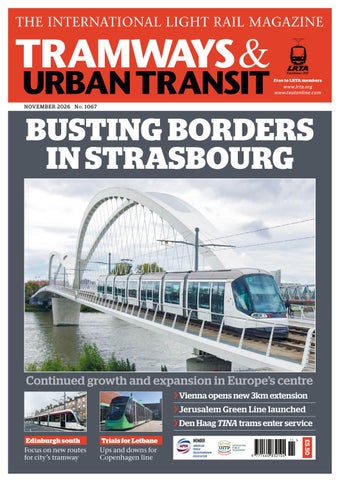
BUSTING BORDERS IN STRASBOURG
Continued growth and expansion in Europe’s centre Vienna opens new 3km extension Jerusalem Green Line launched Den Haag TINA trams enter service Trials for Letbane Ups and downs for Copenhagen line
£5.50
Edinburgh south Focus on new routes for city’s tramway
CONGRATULATIONS TO ALL OF THIS YEAR’S WINNERS
www.lightrailawards.com
CONTENTS
436 The official journal of the Light Rail Transit Association
426
NOVEMBER 2026 Vol. 89 No. 1067 Mike Russell
www.tautonline.com
EDITORIAL EDITOR – Matt Johnston hello@mainspring.co.uk
416
ASSOCIATE EDITOR – Tony Streeter tony.streeter@mainspring.co.uk WORLDWIDE EDITOR – Michael Taplin miketap@mainspring.co.uk SENIOR CONTRIBUTORS – Howard Johnston, Neil Pulling
Neil Pulling
Andrew Thompson
WORLDWIDE CONTRIBUTORS Richard Foster, Andrew Grahl, Andrew Moglestue, Herbert Pence, Mike Russell, Nikolai Semyonov, Alain Senut, Andrew Thompson, Witold Urbanowicz, Bill Vigrass, Thomas Wagner, Philip Webb.
NEWS 404 Vienna opens line 18 extension; Den Haag’s new Stadler TINA cars enter service. INNOTRANS REPORT 408 TAUT rounds up the highlights from this year’s vast international trade show. EDINBURGH LOOKS SOUTH 412 The focus for Edinburgh’s next tram route looks to be south of the city – TAUT finds out why.
SYSTEMS FACTFILE: DUISBURG 426 Neil Pulling visits the Rhine-Ruhr system that has evolved into just three LRT lines,in contrast to some of its neighbours. WORLDWIDE REVIEW 431 Metrolink 2026 infrastructure renewals programme to conclude; Chemnitz line 4 planning process underway; Plans for new extension in Potsdam; Test running begins on first Yangtze metro crossing in Shanghai.
STRASBOURG: STILL GROWING 416 Andrew Thompson reports from the cross-border line that continues to expand.
CLASSIC TRAMS: GOODBYE TO TATRAS 436 Mike Russell bids farewell to Bucuresti’s long-serving Tatras.
COPENHAGEN LETBANE 423 TAUT speaks to Steffen Plogstert about the challenges of building a new LRT system in Denmark.
UKTRAM PAGE 438 As another busy year for light rail draws to a close, UKTram looks back – but also forward to a new chapter to follow.
DESIGN – Debbie Nolan ADVERTISING COMMERCIAL MANAGER – Geoff Butler Tel: +44 (0)1733 367610 geoff@mainspring.co.uk Tramways & Urban Transit 13 Orton Enterprise Centre, Bakewell Road, Peterborough PE2 6XU, UK Tramways & Urban Transit is published by Mainspring on behalf of the LRTA on the third Friday of each month preceding the cover date.
LRTA MEMBERSHIP (with TAUT subscription) Tramways & Urban Transit is sent free to all paid-up members of the Light Rail Transit Association. LRTA WEBSITE AND DIARY Tim Kendell webmaster@lrta.org meetings@lrta.org SUBSCRIPTIONS, MEMBERSHIP AND BACK ISSUES LRTA Membership Secretary (Dept T06), 38 Wolseley Road, Sale M33 7AU, UK. Tel: +44 (0)117 951 7785 membership@lrta.org Website: www.lrta.org
Denmark gets it right second time Is urban sprawl the same as free for all? For well over a hundred years, the expansion of towns and cities has been accompanied by often half-hearted attempts to bring some sort of order to it all. The obvious benefits include the ability to provide efficient public utilities at a realistic cost, and of course good public transport. There have been varying degrees of success, because governments cannot be relied upon to have consistent long-term strategies, and they are always susceptible to often single-minded commercial pressures. How refreshing it is, therefore, to read about recent activity in København (Copenhagen), Denmark’s busy and progressive capital city. Although it dispensed with its tramway back in 1972 and only came back on board last year, it has never deviated from the ‘Finger Plan’ it adopted soon after the end of World War Two. To the chagrin of developers, it has prohibited the construction of retail centres just for the sake of it, and retained green spaces for residents to enjoy. Even then, it hasn’t been an easy ride, and a lot of lessons have been learned, but initial passenger business is gratifyingly higher than was expected. As car owners continue to count the spiralling cost of filling up their fuel tanks, city dwellers have good reason to celebrate the foresight of tramways around the world to be opening a steady stream of extensions, and this month’s news pages seem to abound with them. We also learn that the island of Cyprus in the eastern Mediterranean is interested in creating its first light rail system in the busy coastal city of Limassol. In the next issue, we will have a full report of this year’s sell-out Global Light Rail Awards event that was to be staged at Battersea Arts Centre in London on 7 October. It’s set to be a great night! Matt Johnston, Editor COVER: Running over the purpose-built Beatus Rhenanus Bridge, Strasbourg car 3036 arrives on the German bank of the River Rhine in Kehl. Andrew Thompson
PRODUCTION – Lanna Blyth Tel: +44 (0)1733 367604 production@mainspring.co.uk
FOR CORPORATE SUBSCRIPTIONS VISIT www.mainspring.co.uk LRTA REGISTERED OFFICE 13 Orton Enterprise Centre, Bakewell Road, Peterborough PE2 6XU, UK Private company limited by guarantee, No. 5072319 in England and Wales. LRTA CHAIRMAN – Paul Rowen chair@lrta.org © LRTA 2026 Articles are submitted on the understanding they may also be used on our websites or in other media. A contribution is accepted on the basis that its author is responsible for the opinions expressed in it, and such opinions are not those of the LRTA or Mainspring. All rights reserved. No part of this magazine may be reproduced or transmitted in any form by any means, electronic or mechanical, including photocopying, recording or by any information storage and retrieval system, without prior permission in writing from the copyright owner. Multiple copying of the contents of the magazine without prior written approval is not permitted.
PRINT The Manson Group Limited, St Albans, Herts AL3 6PZ
DISTRIBUTION Warners (Midlands), Bourne, Lincs PE10 9PH, UK
www.tautonline.com . www.lrta.org NOVEMBER 2026 / 403
News
Vienna opens 3km line 18 extension New tramway brings environmental and connectivity improvements
W
iener Linien, the Wien (Vienna) public transport operator, celebrated the opening of line 18’s 3.1km (1.9-mile) extension on 5 September. The new tramway runs from Schlachthausgasse through the Prater park to Stadion U-Bf/ Handelskai, bringing the total length of line 18 through the Austrian capital to 11.1km (6.9 miles). Bus route 77A has been re-routed to take account of the new line, which is expected to carry six million passengers each year. The extension provides easier public transport access to the Remise tramway museum, via the Ludwig-Koessler-Platz stop. An existing underpass allows
it to make an interchange with U-Bahn line U2. The loop terminus runs via Handelskai and Dr-Natterer-Gasse, the latter providing easier transit access for customers at the Hilton Waterfront Hotel. An additional turning circle is being built at Ernst Happel Stadion, where it is to be used during events, with line 18 providing a direct link to the main railway station. A statement from Wiener Linien described the extension as “much more than a tram project.” “There will be less car traffic, greater safety for pedestrians and cyclists and more space for trees and green areas.” Construction started in June 2025; the 70m of green tram track near the Ernst Happel
D-class tram 371, an Alstom Flexity, on the private right-of-way across the Prater. JoachimT
Stadion has been complemented by the creation of more than 10 300m² of green space alongside the line as well as 14 smaller public green spaces and the planting of 200 new trees. A further 2150m of cycle paths have been created along the route.
Prague extension work celebrated A ceremony to mark the laying of the first rail on the Olšanská – Habrová tramway extension in Praha (Prague) took place on 31 August. The CZK599.2m (EUR24.6m) project is to serve six stops and is expected to carry its first passengers in August 2027. The 1.9km (1.2-mile) tramway runs east from the junction of Olšanská and Jana Želivského through the former Žižkov freight yard. It is to have double track other than for a 600m section over former railway alignment around Vackov. This will be the first single-track operation in Praha since 1983. Electronic protection is to be installed to avoid potential collisions. A 450m section of street running is being complemented by the planting of 68 new trees. To ensure they thrive, a specially-designed substrate is being provided, while rainwater is being channelled to the trees’ roots from roads and pavements. Surplus rainwater will also be retained in storage tanks to irrigate the grassed tracks. The ceremony took place ten days after a CZK824.4m (EUR33.9m) contract was awarded for the construction of the 1.22km (0.75-mile)
The ‘first rail’ ceremony for Prague’s new tram line. DPHMP
tramway extension to Strahov. Completion is expected by summer 2028. • On 5 September, line 11 trams again started running between Muzeum and I. P. Pavlova. Services had been interrupted for a year as part of the project to reopen the tramway on Václavské náměstí approaches completion. Line 13 still terminates at Zvona řka; full services are to resume when the Václavské náměstí section opens next June. The Pet ř ín funicular reopened on 22 September after a two-year hiatus. The 510m line, which
404 / NOVEMBER 2026 www.tautonline.com . www.lrta.org
dates back to 1891, has been modernised and is now operated by two new cars, built by Doppelmayr/Garaventa. Meanwhile Praha’s city council approved the preparation of a feasibility study into a fifth metro line on 7 September. This orbital route would connect Smíchov to Let ňany via Žižkov. Construction work on 10.6km (6.6-mile) metro line D also began on 21 September. A 300m access/ventilation tunnel to the Nové Dvory station is being built; tunnel boring machines should begin the major phase of construction next year.
The road connection along Stadionallee and Meiereistraße between Lusthausstraße and Stadionbad has been closed to traffic. By encouraging people to switch from cars to public transport, Wiener Linien says that the project could save up to 1300 tonnes of CO2 per year.
Championship to go worldwide A team from the Czech capital Praha (Prague) has won the 12th European Tram Driver Championship, held in Warszawa (Warsaw) on 19 September. A total of 26 teams from 24 countries took part in a series of tram-driving skill tests in eight disciplines, including stop and go, speed control, and tram bowling. The Praha team, Vendula Tmejová and Zdeněk Rychtá ř from Vokovice depot, secured first place with 6000 points. The team from Oradea (Romania) was second with 5820 points and in third place came the pair from Sofia (Bulgaria) with 5775 points. Making its debut, the team from London’s Tramlink (UK) took away the ‘wooden spoon’ with 3070 points. The competition becomes the World Tram Driver Championship from 2027, when it is to take place in Melbourne.
The victorious team from the Czech capital. Tram-EM
New fixed link opens for Düsseldorf airport Light rail line launches in German city – further extensions are planned
D
üsseldorf airport’s light rail link was inaugurated by Nordrhein-Westfalen Minister President Hendrik Wüst on 4 September. After the ceremony, trains on lines U80/81 began serving the new 1.9km (1.2-mile) branch from Freiligrathplatz. Minister President Wüst said: “This is important for the entire state. The trade fair location is one of the strongest in Germany, the airport is of regional importance, everything is interconnected – fantastic. It is money well spent for the people.” Lars Redeligx, CEO of Flughafen Düsseldorf, added: “Düsseldorf airport is already one of the best-connected airports in Germany. The light rail connection further shortens travel times for many passengers. They can reach the old town within 15 minutes.” The extension features a 438m curved bridge over the B8 highway and A44 motorway; the airport station itself is in subway. Light rail service to the airport is available 04.00-01.00 using Rheinbahn’s high-floor HF6
More Škoda trams for Brandenburg
The opening ceremony at the airport subway station. Rheinbahn
LRVs. Line U80 runs every 20 minutes to Düsseldorf Hbf with a journey time of 19 minutes. Line U81 connects the airport with the trade fair grounds and arena. Construction of the airport link started in 2019, after the project was given the go ahead in 2011. It was originally planned to open the line in time for the 2024 European Football Championship but delays have been blamed on the COVID-19 pandemic as well as
inflation caused by Russia’s war with Ukraine. The final cost of EUR336.2m is double the original estimate. There are plans to further extend the line. To the west, a bridge could take it across the Rhein river towards Meerbusch, Neuss and Krefeld. Heading east, a two-phase approach is planned: the first is for a 3km (1.9-mile) extension to the main railway station followed by a further 4.3km (2.7 miles) to Ratingen.
Copenhagen operations contract awarded to KBH Metro Partner ApS KBH Metro Partner ApS has won a 12-year operation and maintenance contract for the København (Copenhagen) 43.3km (27-mile) automated light metro system. The DKK17bn (EUR2.3bn) deal for the Danish capital takes effect in September 2027 and the FrancoSingapore RATP Dev/SBS Transit (Singapore) joint venture will be responsible for safe, stable and secure operation for the 135m people who use the metro’s four lines every year. As well as its existing 44 stations, KBH Metro Partner ApS will be responsible for the line 4 branch to Outer Nordhavn when it opens, expected to be in 2032. Søren Boysen, Director of Operation and Maintenance at Metroselskabe, København
The Škoda 48T for Brandenburg. Nase
Verkehrsbetriebe Brandenburg an der Havel GmbH, the public transport operator in the German city of Brandenburg, has exercised an option for four Škoda ForCity Plus 48T trams. This will double the fleet of the vehicles to eight. Delivery is due at the end of 2027. The first four of these 28.96m, single-ended trams were delivered as part of a joint order with other metre-gauge tramways in Cottbus and Frankfurt (Oder) in 2026. The three-section, 71% low-floor trams can carry up to 151 passengers.
New CBTC signalling trialled in Rostock
Rostock is trialling Siemens’ Signalling X, the first time the communications-based train control system has been used on a German public transport network. Signalling X uses a centralised data centre to remove lineside signalling hardware and promises to “increase network capacity by up to 30%” while improving punctuality and energy efficiency. It has been installed in the subway under Rostock Hbf, which is used by trams on lines 2, 3, 5 and 6.
Lisbon funicular to be modernised
Public transport operator Carris is to modernise the Glória funicular tramway in Portugal’s capital Lisboa (Lisbon) in the wake of the fatal accident on 3 September 2025 (TAUT 1054). Carris said the programme of work is to strike a balance between 21st Century levels of safety and maintaining the historic nature of its route. The 275m line, which dates from 1885, should reopen in 2029.
Milan expansion restarts
Automated metro train in København (Copenhagen). Metro Service
metro’s owner, said: “It is a big and complex operational task that has gained significant international interest. We have completed a thorough and competitive tender process, and are now looking forward to
cooperating with KBH Metro Partner.” The existing contract is held by Metro Service of Italy (an AnsaldoSTS/ATM Milano joint venture), in charge since the metro was inaugurated in 2002.
Work has restarted on the 1.9km (1.2-mile) metro Line M1 northern extension in Milano (Milan), 16 years after ground was first broken. The two-station extension from Sesto FS to Cinisello-Monza Bettola is due to be completed in 2030. M1’s 3.3km (two-mile) western extension from Bisceglie to Quartiere Olmi should open in early 2032, while 31 March 2034 has been earmarked as the opening date for the 13km (eight-mile) M5 extension.
www.tautonline.com . www.lrta.org NOVEMBER 2026 / 405
News Cleveland gets first Siemens S200 vehicle The US city of Cleveland received its first Siemens S200 on 31 August. Built by Siemens’ factory in Sacramento, the 54 vehicles will enable Cleveland Regional Transit Authority to replace its existing fleet. The new vehicles are designed to handle the city’s winter weather, with a dedicated heating, ventilation and airconditioning system. They also boast ice-cutting technology and heated windscreens, as well as steps at the front and rear doors. The initial order for 24 S200s was placed in 2023, with further options being exercised in 2024 and 2025. The trams are due to enter Red Line (heavy metro) service in summer 2027, followed by the Blue and Green Lines (light rail) in 2028.
The first SS200 for Cleveland. GCRTA
Jerusalem opens first section of Green Line New route is first stage of planned major expansion
A CAF tram on Jerusalem’s Green Line. Z. Stub
A
n initial 7km (4.3 miles) of Jerusalem’s Green Line 3 opened on 21 August. The tramway runs from HaTurim to Malha, passing through the city centre and serving 12 new stops. Its eight-minute service runs every day apart from during the Sabbath (Friday evening to Saturday evening). Green Line 3 makes an interchange with the Red Line, which opened in 2011, and there is a new key interchange at Yitzhak Navon railway station. Eventually, the Green Line will be 20km (12.4 miles) long, with 41 stops, connecting Gilo in the south with Mount Scopus in the north and linking both campuses of the Hebrew University. It should carry around 250 000 passengers/day when complete. The next section includes a link to the central bus station and is planned to open in December. A branch between Har Nof and Neve Yaakov should open in June 2027.
The EUR2.86bn Green Line is part of a larger Jerusalem LRT (J-Net) expansion programme that also includes extensions to the Red Line as well as creation of the 31km (19-mile) Blue Line. Serving 53 stops, this is due to open in phases from 2029. The Green Line is worked by coupled sets of CAF five-section trams, capable of carrying 500
passengers. They are part of an order for 114 that supplements the 46 Alstom Citadis trams already in use on the Red Line. The Blue Line was to have used 132 33m trams from Polish manufacturer PESA. However, operating consortium JTrain subsequently changed the manufacturer to CRRC in China – but this has reportedly caused security concerns within the US.
Joint venture wins Los Angeles contract The East San Fernando Valley light rail line. LACMTA
A Skanska and Stacy Witbeck joint venture has been awarded a USD2.43bn (EUR2.1bn) contract to design and build the southern section of the East San Fernando Valley light rail line. The 10.72km (6.7-mile) route connects the Orange bus rapid transit line at Van Nuys to the intersection of Van Nuys Blvd and San Fernando Road and is to serve 11 new stops. The contract includes providing a depot and workshop. Planned to open in 2031, the line will use 34 P3030 LRVs. It is expected that nearly 48 000 passengers will use it per day. Skanska USA EVP James Bailey said: “The project is an investment in mobility for the region. By bringing together new construction techniques with our experienced teams, we will be able to deliver safer,
406 / NOVEMBER 2026 www.tautonline.com . www.lrta.org
more reliable infrastructure that will better connect communities to where they need to go. Partnering with Metro and Stacy Witbeck in the early phases of the project has allowed us to better coordinate with stakeholders to deliver transit that fits the community’s needs.” Eric Meisgeier, Project Manager at Stacy Witbeck, added: “Delivering this light rail project requires getting every detail right, from utility co-ordination through revenue service, across some of the most active urban corridors in Los Angeles. We will construct this project with the same focus on the work and respect for the community that defines how our team operates on every project.” A second phase is to take the line north by 4km (2.5 miles) to Sylmar/San Fernando Metrolink station.
Den Haag’s new TINA vehicles enter service Stadler trams’ introduction leads to withdrawal of system’s older vehicles
T
he first of 62 new Stadler TINA trams carried passengers through the streets of the Dutch city of Den Haag (The Hague) on 4 September. This trial service on line 2 heralds the replacement of operator HTM’s GTL8 high-floor trams that date from 1992-93. An initial order was placed in 2022 and, as more arrive in 2027, TINAs will be allocated to lines 1, 6 and 12. All 62 should be in service by 2028. There is also still an option that could be exercised for a further 38. The 36.5m, 2.65m-wide double-ended, air-conditioned, 100% low-floor cars are being built at Siedlce in Poland and can carry up to 230 passengers. Roofmounted battery packs permit operation away from overhead wires for up to 1.3km (0.7 miles). The new vehicles have also been provided with a collision protection system and driver assistance aids using Stadler’s UNIBOARD technology. Dr Andlar Brockmeyer, Stadler’s Deputy Group CEO, said: “Today is a proud moment for everyone involved in this project. Together with HTM, we
Cork Luas is to move to the preliminary design stage after 85.2% of respondents to a consultation process supported the project. The 18km (11.1-mile) light rail line is to run from Ballincollig in the west to Mahon Point in the east, via Cork University Hospital and Kent railway station. Those who voiced opposition or who were ‘unsure’ did so, the report added, mainly due to the impact that the preferred route had on local communities and facilities “rather than on light rail as a concept”. Projected costs for the line range from EUR1.8bn-2.5bn; construction could start in 2031.
London renewals backlog questioned
Den Haag’s first Stadler TINA to enter service. Stadbus
have developed a vehicle that reflects the needs of a modern city; accessible, comfortable, reliable and designed with passengers at its heart. Now we look forward to seeing the TINA fleet become an integral part of
Nexus reveals new Washington route Tyne and Wear Metro operator Nexus (UK) has unveiled its proposed route for the 13km (eight-mile) extension from Pelaw to Washington. Heading south from Pelaw on the Green and Yellow Lines, the extension would use the mothballed Leamside line to a point just beyond the four-arch Victoria viaduct across the River Wear. The line was last used in 1991. A total of three stations are proposed for this stretch: Follingsby, Washington North and Washington South. Turning east, a new formation will take the extension to South Hylton. This will roughly run parallel to the former railway that linked Sunderland with the Leamside line. This closed in 1981; Metro services use the Sunderland – South Hylton section, while
Irish scheme progresses
much of the rest of the trackbed is an active travel route. Connecting South Hylton to the extension is likely to involve closing Hylton Bank to road traffic. This has been met with criticism from local residents. Nexus’ Head of System Development, Tom Hardwick, said: “I would stress they are proposals at the minute, to be considered by the residents... [and Nexus would] work with [residents] as close as possible to ensure we deliver a solution that works best for the village.” Public consultation on the route took place in September. An outline business case is to be submitted to the North East Mayoral Strategic Authority early next year. Construction could start in 2030 with a view to the line opening in 2033.
everyday life in Den Haag.” Aside from Den Haag, TINAs have also been ordered for Basel in Switzerland as well as by a number of German operators: Darmstadt, Gera, Görlitz, Halle, Rostock and Zwickau.
Blackpool displays Work is underway to prepare two historic trams for the Blackpool (UK) ‘Lightpool Festival’ on 21-31 October. However, the Western Train and Rocket novelty vehicles are being prepared only for static display. A spokesman told TAUT that Blackpool Transport aspires to have heritage trams operating at some point during the Illumination season (4 September-3 January).
Trams for Limassol? Results from a study coordinated by the University of Cyprus and Frederick University into transport options for the city of Limassol are to be announced shortly after this issue closes for press. Cyprus Minister of Transport, Communications & Works Evanthia Tsolaki said “the
Transport for London advised the UK capital’s Assembly on 16 September that a shortfall in funding for its capital renewals programme has not affected safety on the city’s Underground. Concerns were raised by the fact that TfL has calculated that it takes just under GBP1.2bn (EUR1.4bn) per year to prevent all assets across its portfolio from deteriorating but that, in the five years to 2025/26, it had spent an average of GBP700m (EUR816m) a year on asset renewals. This resulted in a GBP6.5bn (EUR7.6bn) backlog. Patrick Doig, Chief Finance Officer, said that TfL was trying to get back to levels of renewals investment last seen in 2018 by 2030 and that with “any further investment we can secure from Government, we can accelerate that trajectory”.
However, work needed includes “structural welding, electrical systems and axle repairs”. Balloon 717 and ‘HMS Blackpool’ worked during 2025’s illumination season, and 717 and Bolton Corporation tram 66 have run during 2026. Meanwhile, Blackpool Transport is looking for suitable space to display some of its heritage fleet. Demolition of the old workshop buildings, which once housed the Tramtown exhibition, is imminent. introduction of a tram… appears to be a very promising proposal”. However, Professor Loukas Demetriou, who is leading the research project, warned: “We need to be very careful and really assess whether investing in such a mode of transport is worthwhile, how it can best be combined with the city’s other initiatives, how the public will embrace it and whether it is genuinely needed.”
www.tautonline.com . www.lrta.org NOVEMBER 2026 / 407
InnoTrans 2026
INNOTRANS 2026: BERLIN SHOWCASES THE NEXT GENERATION OF RAIL TAUT rounds up the highlights from this anniversary event in Berlin.
B
erlin once again held the global railway event InnoTrans from 21- 25 September. Every two years the event returns to the German capital, and this year celebrated its 15th edition and its 30th anniversary. This show grows each year, with around 175 000 trade visitors from more than 120 countries in 2026. The 200 000m2 exhibition site was fully booked, with an outdoor and track area featuring 113 vehicles from 17 countries – making InnoTrans 2026 the largest edition in the event's history. Yet the significance of InnoTrans 2026 was not simply a matter of size. The exhibition provided a snapshot of where the rail sector is heading. Artificial intelligence, automation, alternative propulsion, cybersecurity and digitalisation were among the dominant themes, while the traditional centrepiece of the event – the full-size trains displayed on the outdoor tracks – demonstrated how quickly battery, hydrogen and other technologies are moving from research projects towards operational applications. The event also demonstrated that the future of rail is unlikely to be defined by a single technology. Instead, the industry is pursuing a combination of electrification, alternative power systems, software, automation and improved passenger experience.
InnoTrans returned to Berlin in September, and this year welcomed over 175 000 visitors. Images by Geoff Butler unless otherwise stated.
The railway is increasingly digital
If there was one technology that dominated the conversation at InnoTrans 2026, it was AI. AI has been discussed in the rail sector for several years, but the exhibition suggested that the conversation is moving increasingly away from broad promises and towards specific operational applications. The organisers highlighted the growing use of automated systems in trains and workshops, as well as robotics for infrastructure inspection and digital tools designed to improve passenger experience. Alstom, for example, introduced an AI assistant called ‘Talk to my train’, designed to help maintenance personnel identify and repair problems more rapidly. Such applications illustrate that rather than replacing the railway workforce, AI can be used as an additional tool for employees dealing with complex systems. The event also featured its first international ‘AI on Track’ hackathon. Supported by Alstom, Wabtec and Siemens Mobility, the initiative brought developers, start-ups and industry specialists together to
work on practical challenges using artificial intelligence. The winning concepts included applications involving onboard climate control, timetable optimisation and voiceassisted ticket booking.
Automation and autonomous rail
Another major theme was automation. The railway industry has long used automated systems for specific functions, but developments in sensing, computing, communications and artificial intelligence are making increasingly autonomous operation technically possible. The German Aerospace Center (DLR) presented research into automated train operation and remote train operation. Its work examines how sensor systems can detect the position, speed and movement of trains and how control centres could interact with trains when human intervention is required. InnoTrans also featured the development of autonomous rail vehicles designed for more flexible transport services. RailEvo presented
408 / NOVEMBER 2026 www.tautonline.com . www.lrta.org
autonomous on-demand rail taxis, while other exhibitors demonstrated autonomous and remotely controlled concepts. The potential advantages are significant; however, the technology also raises difficult questions about safety certification, cybersecurity, human oversight, employment and public acceptance. In a railway environment, an autonomous system cannot simply be judged by whether it works under normal circumstances. It must also respond safely to failures, obstructions, unusual situations and communication breakdowns. That makes automation a long-term process rather than an overnight transformation.
Cybersecurity becomes part of railway engineering
The increasing digitalisation of railways also brings a corresponding emphasis on cybersecurity, which is no longer an issue confined to an IT department. It has become part of the engineering and operational architecture of a railway.
ABOVE: Manufacturers’ stands including Hitachi were kept busy throughout the event, showcasing innovations such as GHH Bonatrans' GHH SILENCE-ID integrated damping solution (centre). Outside, models including CRRC’s new Vellink driverless metro vehicle (right) could be viewed.
InnoTrans placed cybersecurity alongside artificial intelligence and automation within its digital technology programme. The AI Mobility Lab included companies working on cybersecurity, while the broader exhibition addressed the security implications of increasingly connected transport systems. This is particularly important because railways are safety-critical infrastructure. A cyberattack can potentially affect not only data but also service availability and operational systems. The industry's challenge is therefore to achieve the benefits of digitalisation without creating vulnerabilities that undermine reliability.
Passenger experience
Another significant feature of the 2026 exhibition was the increasing integration of passenger-facing technology. The public transport segment included 414 exhibitors and covered areas from digital ticketing and traffic planning to accessible navigation and autonomous vehicles. This reflects a broader shift in how rail systems are designed, with passengers increasingly expecting seamless information, easy ticketing, reliable connections and accessibility. AI could contribute to this transformation by helping passengers navigate stations, predict disruption and find alternative routes. It can also support operators in managing demand and responding to incidents. These developments point towards a railway in which the digital layer becomes almost as important as the physical infrastructure.
Infrastructure remains fundamental
The focus on AI and rolling stock should not obscure the importance of conventional railway infrastructure. InnoTrans 2026 featured substantial representation from infrastructure and tunnel-construction companies, with around 600 companies associated with these sectors at the event. This is an important reminder that new trains alone cannot solve the railway industry’s capacity and reliability problems. Europe and many other regions face ageing infrastructure, capacity constraints and lengthy project-development cycles. Digital signalling can increase capacity in some circumstances, but it still depends on physical
infrastructure capable of supporting reliable services. Likewise, introducing battery trains does not eliminate the need for investment in infrastructure. The exhibition therefore presented two sides of railway modernisation: highly visible technological innovation and the less glamorous but equally important work of renewing the underlying network.
A more international industry
One of the strongest impressions from InnoTrans 2026 was the extent to which railway technology has become an international business. European manufacturers such as Siemens Mobility, Alstom, Stadler and CAF were represented alongside major Asian companies including CRRC and Hyundai Rotem. The global nature of the industry is also reflected in the range of projects being pursued. High-speed rail continues to expand in Asia and other markets, while European countries are concentrating on electrification, regional services, digital signalling and the revival of international passenger rail.
What this says about the future
Taken together, the themes of InnoTrans 2026 point towards a railway industry undergoing several transitions simultaneously. These changes are interconnected, and the railway of the future is unlikely to be defined by one breakthrough product. It will be the result of many technologies working together. Tram-related highlights included: • Alstom – urban/light-rail technology was represented among the rolling stock displays. Alstom’s involvement was particularly prominent, with three vehicles on the track display overall. • Škoda Group – a major public transport/ urban rail presence; its CEO Petr Novotný was also among the headline industry speakers at the opening. • Stadler – particularly relevant to urban rail through its tram-train and light-rail portfolio. Its CITYLINK concept, demonstrated at the previous InnoTrans, illustrates the type of vehicle connecting urban tram networks with conventional rail. • The wider exhibition included technologies specifically applicable to tram infrastructure, including track systems, signalling, electrification, condition monitoring and maintenance.
The metro presence was broader and more systems-oriented than the tram presence. Vossloh Rolling Stock (VRS) announced plans to develop a trackless Smart Rail Transit (SRT) system. This is an articulated vehicle running on rubber tyres rather than steel wheels. The first axle is steered by the driver, while the remaining axles automatically follow to keep the vehicle on track. It’s designed for a service life of 14 years and could enter the market within three years. OTIV showed on its stand how its technology moved a freight vehicle from almost 700km (400 miles) away, controlled from an RTO control desk at InnoTrans in Berlin. The company highlighted remote train operations on the Betuwe Route, a dedicated freight railway that forms part of the International Rhine-Alpine rail freight corridor. The German manufacturer Heiterblick, now owned by PESA, showed one of its trams being built for Würzburg on the outside tracks. The company presented a tram based on the company’s TWIST 3.0 + SWING 3.0 platform. It is one of an order of 18 trams initially agreed for delivery with Würzburg transport authority WVV in December 2019. The vehicle can travel a minimum of 3000 metres with the use of stored onboard energy reserves, and its use of modern insulation material, dampeners on the wheels, and elimination of heating elements in the passenger components is intended to reduce its overall noise pollution. The tram is constructed with lightweight materials to reduce energy consumption and features a modern drive system based on silicon carbide (SiC) technology, which seeks to enable lower energy requirements and higher efficiency. Overall, the five-section tram can carry up to 76 seated and 147 standing passengers. Four of the 18 vehicles have completed tests in Würzburg and are now awaiting the results of the certification process. As a crucial component at the heart of train dynamics, Alstom’s Flexx bogies portfolio ensures safe and cost-effective operations, as well as comfortable travel conditions. It features leading-edge technologies and solutions for all types of rolling stock. The new frameless bogie was on show on the Alstom stand and is being introduced for the first time on the Urbanliner trams ordered by Berliner Verkehrsbetriebe (BVG). Each
www.tautonline.com . www.lrta.org NOVEMBER 2026 / 409
InnoTrans 2026 FAR LEFT: The Bozankaya tram for Naples, nicknamed the ‘Tram del Mare’ (Tram of the Sea).
LEFT: Škoda showed off its 52T model destined for Prague. Škoda
bogie is around 500kg lighte than previous versions. Passenger space between the wheel housing has increased by 150mm to 660mm, improving interior comfort and accessibility. The secondary suspension is now positioned directly above the wheels. The wheel bearings and gearbox are fully-suspended, and wheel tyres can be replaced without the entire wheelset having to be removed. GHH Bonatrans showed its brand-new product, the GHH SILENCE-ID, which is an integrated damping solution for the GHH V60 wheel system. Designed to increase wheel damping to mitigate curve squeal, it can be retrofitted to nearly all existing GHH V60 wheels. The system supports quieter, lighter and more efficient wheel solutions. Stadler showed off the first S-DT8.16 LRV that is being supplied to Stuttgarter Strassenbahnen. The model has been developed to meet the needs of Stuttgart, the sixth-largest city in Germany and capital of the state of Baden-Württemberg. To be suitable for the city, the vehicles have a modern design which combines performance and accessibility. They have a powerful drive system, which enables them to climb steep gradients and operate through the city’s tunnel network. The new light rail vehicles are fitted with an all-axle drive system, which ensures that even when track conditions are challenging, the vehicles can remain in operation. Chinese manufacturer CRRC showed two very striking vehicles at InnoTrans, one being its Velforce, a six-axle hydrogen-powered locomotive and the other being the Vellink, a driverless metro vehicle. Developed with lightweight construction in mind, the car body consists entirely of aluminium, with its roof, air duct, sound and heat insulation all directly integrated into its main structure, allowing them to serve as load-bearing elements. With integrated carbon fibre, the train’s front panelling and frame structure are capable of being redesigned to provide significant weight reduction – with the configuration on display possessing an axle load of 15 tonnes and a car body length of 24.4 metres in total. The train’s front incorporates a floor-toceiling circular window, and onboard seating offers a range of unique configurations to
maximise standing room, whilst its ceilings offer a virtual skybox view of the current time of day. Onboard operator interfaces utilise technologies such as intelligent displays, holographic projection, and biometric recognition in a bid to enable interaction whilst providing passenger information including transfers, tourism opportunities, dining and entertainment. The train offers a maximum operating speed of up to 120km/h (75mph), and a maximum testing speed of 132km/h (82mph). Pandrol introduced the SD/QuickFit, the newest member of its Safe Driven threaded fastening range. The launch is intended to support very high rates of track construction and maintenance while reducing dependence on skilled labour. The QuickFit function automatically guides the rail clip between a service position, described as switch-on, and a maintenance position, described as switch-off, as the coach screw is tightened or loosened. In the parked position the clip is held securely without intruding into the rail seat, matching the way sleepers arrive on site as pre-assembled captive units with no loose components and ready for the rail to be threaded through. Siemens Mobility showcased the new Inspiro London Piccadilly Line train. Attendees were invited aboard the 113-metre-long, nine-car train for a guided tour to provide a first-hand look at the innovative features and passenger-focused enhancements designed for future London Underground journeys. Global company 3M demonstrated many products on its stand this year, including a cooling film. When applied to the roof of a vehicle, it helps reduce heat buildup at the source with its highly reflective surface that deflects more than 85% of incoming solar energy, limiting how much heat reaches the vehicle below. The film also has high thermal emissivity – over 91% in the atmospheric window – which dissipates absorbed heat away from the surface and back to the cooler sky. This creates passive cooling to keep interiors cooler without external power. Turkish manufacturer Bozankaya showcased the 16th vehicle of its new tram fleet for Napoli (Naples) at InnoTrans
410 / NOVEMBER 2026 www.tautonline.com . www.lrta.org
2026. The low-floor trams, nicknamed the ‘Tram del Mare’ (Tram of the Sea), have also drawn wider attention after Bozankaya’s promotional video featured the late footballer Diego Maradona, a lasting icon in the city. The 30-metre low-floor tram for Naples was on display outside Hall 4.2 at InnoTrans 2026 in Berlin, with ‘next station: FUTURE’ shown above the windscreen. These bi-directional trams are 30 metres long and 2.4 metres wide, and carry an azure livery in Naples’ traditional colour. The tram on display at InnoTrans depicted a mural of Maradona in his iconic Napoli number 10 jersey, alongside a Naples skyline with Mount Vesuvius, pizza, lemons and an espresso. Each side has four double-leaf doors and two single-leaf doors to speed up boarding. The trams can carry up to 274 passengers, with 64 seats and room for 210 standing. Vehicles continue to arrive at the San Giovanni depot in Naples. Full operation is expected later this year on the route between San Giovanni a Teduccio and Piazza Sannazaro. Škoda Group has revealed a new fivesection, 100% low-floor tram developed for the city of Prague at InnoTrans 2026, designed to operate in the Czech capital’s historic centre. The tram will run on a chassis combining front swivel bogies with inner limited swivel bogies to enable operation through sharp curves and inclines without compromising ride quality. The unidirectional, five-section tram is equipped with the ability to navigate the sharp curves in Prague city centre, managing the challenging uphill tracks. Jan Christoph Harder, President West and North at Škoda Group, spoke of the high passenger volume in Prague and how the city was the “perfect environment” for this tram. And with a new anti-collision support system and camera systems, there has never been a safer tram system to navigate the tricky streets of Prague. The tram features an EM-brake system, cutting oil-based maintenance entirely while still delivering 100% adhesion braking. Air-conditioning is on-board using R290, a natural, low-globalwarming-potential refrigerant, in place of traditional HFC-based systems. We will all meet up again in Berlin in 2028, with an almost inevitably larger event!
Advertorial
CONNECTING COMMUNITIES AND SUPPORTING VLR DEVELOPMENT Pre Metro’s ambition for Very Light Rail in Dudley has always been to improve everyday journeys with practical, affordable transport that connects people to jobs, education, shops, and opportunities. The Stourbridge Shuttle showcases what VLR can achieve locally, demonstrating how a small rail service can play a significant role within a larger network. It links the town centre with mainline trains, making onward journeys easier. With more than eight million journeys recorded, it proves that VLR can deliver a useful, dependable public service. However, passenger numbers are increasing; peak services are always full; and our rolling stock’s lifespan is finite. Encouraging more people to travel by public transport requires sufficient space when they need it. We must therefore explore how to scale up the service whilst preserving the convenience and reliability passengers value. This means assessing practical improvements to existing vehicles alongside options for larger vehicles and operational changes. Any solution will protect accessibility, safety and passenger comfort. The immediate priority is to ensure that capacity supports continued growth and that the convenient passenger experience remains the same.
The proposed Dudley Dasher offers an opportunity to apply these lessons more widely. Its potential to connect Stourbridge with Brierley Hill, and provide an interchange with West Midlands Metro, is central. This would create new journey opportunities across the borough and beyond, helping more passengers reach the expanding Metro network from places it does not directly serve. Multimodality is key to the success of both our service and the West Midlands Metro expansion. Passengers need different forms of transport to work together as one network. The Dasher could provide a link between local rail, mainline trains, Metro and buses. Wellplanned interchanges, coordinated services, clear information and straightforward ticketing would help turn those connections into convenient everyday journeys. The Dasher also has serious potential to demonstrate how existing infrastructure can be used more effectively and affordably. Exploring the use of the existing double-track freight corridor could establish a practical approach to introducing passenger services while making better use of railway assets already present in our area. New VLR rolling stock could bring these ambitions together, modernising the Stourbridge Shuttle while providing a vehicle
platform suitable for the proposed Dasher. Exploring vehicles capable of serving both routes would allow us to address current capacity pressures and prepare for future expansion. A shared approach could also help to make both services more economical to maintain and operate. The Shuttle could provide an established operating environment in which to prove innovative vehicles through everyday service. Assessing their reliability, accessibility, capacity and operating costs would build practical evidence to inform their potential deployment. This would connect vehicle innovation directly with passenger needs, ensuring that investment delivers meaningful improvements to journeys. Proving the use case comes first. By modernising the Shuttle, developing the Dasher and connecting effectively with West Midlands Metro, Pre Metro can demonstrate how VLR supports will create a more integrated transport network. Together, these services would provide a model example in branch line restoration and the effective use of our existing infrastructure. If we want to support longterm growth across the VLR sector, we have to be willing to invest in its future and support projects like the Dasher.
www.tautonline.com . www.lrta.org NOVEMBER 2026 / 411
EDINBURGH: ALL ROADS POINT SOUTH TAUT finds out why the next focus for tramway development in Scotland’s capital is to the southern side of the city.
“
D
oing nothing with mass transit in Edinburgh is just not an option.” Councillor Stephen Jenkinson has only been Transport Convenor for City of Edinburgh Council (UK) since 2024, but he’s quickly become a staunch LRT supporter. If determination alone can build a tramway, with Councillor Jenkinson at the helm, Edinburgh’s network will expand! But what would the next line look like? After a meeting on 10 September, it won’t be the long-proposed Granton – BioQuarter, north-south line. The focus is now just on a southern line. Public consultation into a proposed northsouth line took place between August and November 2025. “It was one of the largest consultation responses that the council has ever received on a topic, which everybody has an opinion on and everybody is interested in”, Jenkinson says. That Edinburgh needs an additional tram line is hardly in doubt. The years of disruption and cost over-runs that plagued the tramway’s construction (2007-14) have been consigned to history. Passenger numbers continue to increase, from 7.3m in 2018 to 12.5m in 2025. Saturday 9 August 2025 was the busiest day on record, with 77 000 passenger journeys made.
Yet only running on a largely west – east axis, with the curling northern tip to Newhaven, the 18.5km (11.5-mile) system can be vulnerable to outside influence. A fire in a former department store on Princes Street on 9 July curtailed services to Newhaven until 29 August. Granton Waterfront is a GBP1.3bn (EUR1.5bn) flagship development on the banks of the Firth of Forth. Meanwhile, to the south of the city, the 40-hectare BioQuarter, described as “a leading global destination for healthcare delivery, groundbreaking medical research and life sciences innovation” is set to grow over the next decade. “We do need to do something”, Jenkinson reiterates. We’re the fastest growing city and the fastest growing region in Scotland. “People like the tram: it’s cheap, it’s efficient and in an historic city like Edinburgh, there is no other option. I’m certainly not convinced there is another form of mass transit that will tick all the boxes that Edinburgh needs... [and] certainly will in the future. And if we do nothing, the congestion woes that we’re currently faced with are only going to exacerbate over the next decade.” The north-south line was theoretically divided into two: the northern section (Granton – Princes Street) and the southern section (Princes Street – BioQuarter). The
412 / NOVEMBER 2026 www.tautonline.com . www.lrta.org
ABOVE: The Edinburgh system runs a fleet of 27 CAF Urbos 3 low-floor trams. All photos courtesy of City of Edinburgh Council
total length for the two is around 18km (11 miles). One of the reasons for the flood of responses to the public consultation was the fact that the first choice for the route on the proposed northern leg was the former Caledonian Railway branch line to Granton and Leith that closed in 1967. The trackbed has been re-purposed as the Roseburn Path, now a popular active travel route. So popular, in fact, that a campaign group was formed in response to what could “permanently destroy a vital green space and negatively impact on quality of life for Edinburgh residents and their families”. Reviewing the Roseburn Path situation even became a manifesto pledge for some parties in the run up to the Scottish Parliament elections in May 2026. Those campaigners can breathe a sigh of relief for the Roseburn Path is ‘safe’ for now, despite the fact that the formation has enough run for both trams and active travel. That’s because, in the wake of 10 September’s meeting, all efforts are to focus on the southern section. Some political commentators have suggested a certain amount of ‘buck passing’ with what is, undoubtedly, a political hot topic, particularly, they allege, with Scottish Local Government elections due to take place next May. Not so, the Labour politician says.
Edinburgh RIGHT: The first tram leaves Picardy Place on 7 June 2023. Just a few years later, a second route is in the planning stages – although this has honed in to focus on just a southern line. BELOW RIGHT: One of the system’s Urbos 3 vehicles at York Place.
“I’ve been clear on my preference and the preference of the administration [and that’s] to take the tram from Granton to Princes Street via the Roseburn Path. I see that as the only show in town.” Other routes, he says, particularly that across Thomas Telford’s Dean Bridge, offer significant engineering challenges. Plus, building a tramway to Granton was part of the original 2006 Phase 1b route and the Roseburn Path is still covered by an Act of Parliament. “The northern section is still on the table. It will be debated at some point further down the line but I think it’s fair to say that it has been deprioritised.” Pausing progress on the northern leg, Jenkinson says, shows that City of Edinburgh Council has listened to the public consultation. “The perception is, ‘well, we’ve consulted, we’ve ticked that box and then we’re just going to ignore whatever you say’. “I’ve always been clear that the consultation exercise is actually really important. It isn’t a referendum but it’s very valuable. It actually does help significantly with the process. I wanted to give it the credit that it was due, especially when we had had so many people responding to it.” Originally, he adds, the results of the consultation and the strategic business case were to have been delivered and considered at the same time. However, due to the level of response, a meeting was held in June, which dealt with the consultation and market research. The strategic business case and the decision-making meeting then took place in September. “There was an awful lot of information to be consumed and actually creating a bit of space for the debate to happen – [while] it wasn’t without its risks – I think it was probably the right thing to do.” Views on the Roseburn Path were mixed, from those who agreed with the proposals, to those who were against and, of course, those who sat in the middle. One day, Jenkinson will have to “get a vote [about the Roseburn Path] across the line” but that can wait; all efforts are now focused on building a tramway from Princes Street to the BioQuarter. There’s much to recommend this course of action. Unlike the northern leg, Jenkinson says, there was much more “consensus around that… more support”. He added that it would be easier to build, with fewer engineering challenges than the northern section. It would also mutually support another light rail scheme in Edinburgh that’s gaining momentum: running tram-trains on the Edinburgh Suburban & Southside Junction Railway. This former North British Railway line runs across the southern side of the city, from Portobello in the east to Haymarket in the west. It lost its passenger service in 1962
“It would be easier to build, with fewer engineering challenges than the northern section.”
but is still open for goods and charter traffic. The ‘South Sub’ scheme rose to prominence after engineering students at Heriott-Watt University carried out a feasibility study into running tram-trains over the line and connecting it to the Edinburgh Tram network (TAUT 1049). Transport Scotland and Network Rail announced in August that they would undertake a feasibility study, to “identify practical challenges and opportunities of reintroducing passenger services”. Says Jenkinson about the proposal, “This is just my own opinion [but] I don’t think the business case for the South Suburban railway would stack up in isolation. [But] I think it can complement the tram.” With the tram going on a broad northsouth axis and tram-trains potentially moving east-west, it would not only improve connectivity in a part of Edinburgh that, according to Jenkinson, has a “lot of growth” but it would also bring additional resilience to the tram network, creating an alternative route should something like the Princes Street fire happen again. Despite the lack of engineering challenges and the experience gained building the
4.7km (2.9-mile) Newhaven extension between 2019 and 2023, delivering the southern section of the north-south tram will still, Jenkinson says, cost billions of pounds. Even developing the business case will need investment in the millions. The question is, therefore, who is going to pay for it? Jenkinson is brutally honest: City of Edinburgh Council hasn’t got the money. “If we did, we would have had it done by now.” Edinburgh, he says, generates roughly 30% of Scotland’s Gross Domestic Product with 10% of the country’s population. He describes the city as an “an economic powerhouse for the Scottish economy” and is frustrated that, at governmental level, the new tramway has been described as a ‘local’ project. “I’ve always considered that this is a project of... local, regional and national significance. These major regional, strategically important construction projects are never borne in isolation by local authorities. My counterpart in Glasgow, for example, is not being asked to find the money to pay for Clyde Metro. My counterpart in
www.tautonline.com . www.lrta.org NOVEMBER 2026 / 413
Edinburgh
“It’s always better that it’s done right than fast, because we have to learn the lessons of previous projects.” ABOVE: A potential route map for the proposed southern line. LEFT: A sketch of singletrack running on Roseburn Path. This path was the subject of some debate in Edinburgh, as it currently forms a popular active travel route. A campaign group opposed the tramway plans stating that these would destroy a vital green space and negatively affect the quality of life. BELOW LEFT: Since September 10, a route south has been prioritised to connect the Royal Infirmary and BioQuarter, running along North Bridge and South Bridge (pictured). BELOW: Testing and commissioning ahead of service along Constitution Street.
414 / NOVEMBER 2026 www.tautonline.com . www.lrta.org
the Highlands isn’t being asked to find the money to dual the A9 [trunk road]. “I don’t think it’s fair, I don’t think it’s appropriate and, actually, I don’t think it’s right that pressure had been applied… to find the money to fund the business case.” How can that focus from ‘local’ to ‘regional’ – or even ‘national’ – be shifted? South East of Scotland Regional Transport Partnership – or SEStran – is the Regional Transport Partnership for eight local authorities, including City of Edinburgh. Formed under the Transport (Scotland) Act 2005, RTPs are designed to bring “councils together to perform local government functions collectively and strategically over a larger area” to “work towards a more sustainable and efficient transport network”. SEStran is currently working on what’s called SEStransit, “a co-ordinated, regional approach to transport planning across South East Scotland, recognising that the benefits of an integrated transport network are greater than the sum of individual components”. This will result in a Strategic Business Case for the whole SEStran region. Says Jenkinson: “Tram, tram-trains, heavy rail, also Bus Rapid Transit – everything should be considered in this mix to ensure that the economic growth and development of the region is enhanced and harnessed to benefit the whole country – and the UK economy as well. “I’m fairly confident that tram will form a key part of that regional transport plan. We’re going to be pressing quite hard for the southern leg – and the South Suburban railway if it’s appropriate – but we’re still wanting to ensure that [the] whole northsouth tram is included but certainly the prioritisation of the southern section. “If that does get support from SEStran and it does form part of the regional plan, any future outline business case would be a regional business case, not just a local one.” The ‘64 000 dollar’ question: what about timescales? The SEStransit report, Jenkinson says, should be completed next autumn. Alongside this, there will be an attempt to find funding for the outline business case. Putting together the full business case is “likely to take a number of years”. “I think I got myself into a little bit of [a] mix up when I said we could have spades in the ground by the end of the decade. I think it’s probably more realistic that we’ll have, with a fair wind, a business case... signed off by the end of the decade… we could have spades in the ground by the beginning of the next decade. “These big projects – frustratingly, they take longer than everybody would like. But they have to be done in the right way and it’s always better that it’s done right than fast, because we have to learn the lessons of previous big infrastructure projects that have been tied up in knots for decades. “My job now is to apply the thumbscrews to get that work done, get as much support as we can financially from our regional partners in the first instance but the Scottish Government [and] the UK Government if necessary. “We have to look at everything to see how we can get this delivered.”
Ricard Codina Flickr CC BY-NC-SA 2.0
IN YOUR NEXT ISSUE OF
COMMUNITY SYSTEMS FACTFILE: BENEFITS FOR DLR DORTMUND
How exactly can a light rail scheme improve the local community? Catrina Lynch from the Docklands Light Railway describes some success stories.
Neil Pulling explores Dortmund’s DSW21 network at the eastern end of Germany's Ruhr conurbation which integrates trams, Stadtbahn, buses and the ‘H-Bahn’ system.
In 2027, Charleroi will convert its 'Ghost Metro' into the modernised M5. Andrew Thompson visits ahead of this momentous change in mass transit.
DECEMBER
PLUS... +G ermany: Developments and plans around a booming country +C lassic Trams: Isle of Man celebrates 150 years +T he latest news and analysis, system and technical development
THE INTERNATIONAL LIGHT
Duisburg
RAIL MAGAZINE
SYSTEMS FACT FILE No. Duisburg,
Free to LRTA members
229
www.lrta.org www.tautonline.com
NOVEMBER 2026 N O . 1067
BUSTING BORDERS IN STRASBOURG
Germany
D
Continued growth and expansion
in Europe’s centre
Vienna opens new 3km extension Jerusalem Green Line launched Den Haag TINA trams enter service
Trials for Letbane Ups and downs for Copenhagen line
£5.50
Edinburgh south Focus on new routes for city’s tramway
Contrasting with multi-line operations in some other Rhine-Ruhr conurbation cities, the Duisburg system has evolved into just three light rail lines.
Duisburg
GERMANY
Words and pictures by Neil Pulling
uisburg in Nordrheinzero-emission buses including some Westfalen state is sited using hydrogen fuel cells. at the confluence of Districts which are covered by the Rhine and Ruhr today’s light rail services with 133 rivers. The city was stops once had separate street-running synonymous with heavy industry by tram concerns with a mix of 1000mm the late 19th Century, with rivers, and 1435mm gauges. These were canals and railways later contributing respectively in the north and south to Duisburg becoming Europe’s largest of the present Duisburg area. In inland port. The 2025 population was 1881 a horse-drawn service opened 502 270 (EU Eurostat). Duisburger between the then administratively Verkehrsgesellschaft AG (DVG) is the separate Duisburg and Ruhrort, with mobility arm of the city-owned utility electrification of lines beginning in group, Duisburger Versorgungs 1897. As well as transitions to motorund Verkehrsgesellschaft (DVV). buses, civic changes such as Hamborn Serving an area of 281km 2 joining Duisburg in 1929 influenced (174 square miles) and the city’s tram coverage. transport operator since 1940, DVG Once extending west of the Rhine has routes totalling just under 600km and east to Oberhausen, metre-gauge (375 miles), the great majority being operations ended by 1966. Shorn of bus services. Alongside the continuing branches and some connections, a replacement of light rail vehicles, much simplified layout – all on the DVG is increasing the proportion of Rhine’s right bank – now handles
426 / NOVEMBER 2026 www.tautonline.com
Bombardier/ Alstom Flexity Classic 2001 (here in use for driver training) and 2033 at Rheintörchenstraße on 9 June. This stop south of central Duisburg is a terminus for alternate line 903 services.
three regular lines. Lines 901 and 903 are tram operations which are wholly run by DVG. Covering the approximately 22km (13.8 miles) of line 901 normally takes just over one hour. With a similar scheduled endto-end time, line 903 is 27.3km (17.1 miles) long. Both of these lines have alternate services operating shorter routes which include the urban core. Duisburg hosts the northern end of the 41km (25.6-mile) interurban U79 Stadtbahn line, with operations overall being shared with Düsseldorf-based Rheinbahn. Distinctions between the tram and Stadtbahn formats are illustrated within a small part of Duisburg. Heading north from Düsseldorf into Duisburg from the administrative boundary near Kesselsberg, U79 runs in dedicated space, some elevated, and has stops that only have high
. www.lrta.org
05/10/2026 10:22 401_TAUT 2611_cover.indd 1
THE GHOSTS OF CHARLEROI
426-430–TAUT2611_SF Duisberg.indd
426 16/09/2026 13:16
2026 ISSUE
On sale 20 November
SUBSCRIBE NOW! Now in its 86th year, Tramways & Urban Transit is the world’s leading monthly publication dedicated solely to light and urban rail developments. We deliver comprehensive worldwide news and analysis, incisive technology features and key interviews with leading industry figures each and every month. Either in print or digitally, don’t miss out.
SUBSCRIBE TODAY!
Personal membership with TAUT subscription: For 12 months from joining (12 TAUT) UK £72.00 Europe £99.00 USA £150.00 International £120.00
For Personal membership online payments: www.lrta.org/join For details of Student membership and other enquiries please email membership@lrta.org
Personal membership with TAUT and Tramway Review: For 12 months from joining (12 TAUT + 4 TR) UK £95.00 Europe £122.00 USA £176.00 International £146.00
Mr/Mrs/Miss/Ms
Personal membership with online only access to TAUT : For 12 months from joining (12 TAUT) £45.00 Personal membership with online only access to TAUT and Tramway Review : For 12 months from joining (12 TAUT + 4 TR) £61.00
Forename ........................................................... Surname ��������������������������������������������������������������������������������������������� Address �������������������������������������������������������������������������������������������������������������������������������������������������������������������������������������������� ������������������������������������������������������������������������������������������������������������������������������������������������������������������������������������������������������������������� ������������������������������������������������������������������������������������������������������������������������������������������������������������������������������������������������������������������� Postcode.......................................................................................................................................................................................... E-mail.................................................................................................................................................................................................. I enclose a cheque for £ ....................................................... payable to ‘LRTA Subscriptions’
Please complete this form and send it with your payment to: LRTA Membership Secretary (Dept T06), 38 Wolseley Road, Sale M33 7AU, UK
STILL GROWING IN STRASBOURG Strasbourg has followed an evolving path of growth and modernisation. Andrew Thompson reports on developments to date and those still to come.
A
s the seat of the European Parliament and various other EU institutions, the Alsatian capital of Strasbourg is a truly European city, not least due to its noteworthy history and close border proximity to Germany. Currently as one of only three border-crossing tramway systems in the world, the French light rail network was extended across the River Rhine to Strasbourg’s German sister city of Kehl in 2017. While Kehl boasts a population of 40 000, Strasbourg has 294 000 within its city limits and about 494 000 in the wider conurbation of the French Bas-Rhin Département. Part of the new generation of French tramway systems to be built in the late 20th Century, Strasbourg was inaugurated in November 1994 following the previous launches in Nantes and Grenoble in the 1980s and Paris in 1992. Originally Strasbourg featured a sprawling first-generation tramway, which initially opened during the city’s German era in 1878 as a horse railway and was later electrified in 1894. It was finally closed by French authorities in 1960, after more than 30 years of decline. In order to fully understand Strasbourg’s history and with it the course of European
events in the late 19th and early 20th Centuries, one must know that as a result of the Franco-Prussian War of 1870-71, the city became a part of the German Empire – together with all of annexed Alsace and Lorraine – until the end of World War One in 1918. Re-occupied by German forces during World War Two from June 1940 to November 1944, Strasbourg has remained the largest and most important city in northeastern France since the end of that war, serving as an economic, industrial, cultural and also administrative hub. As part of post-war reconciliation and peacebuilding in Western Europe, the Council of Europe was established in Strasbourg in 1949 and the European Court of Human Rights (ECHR) in 1959. The Common Assembly of the European Coal and Steel Community, as the early precursor to the contemporary European Parliament, held its inaugural session in Strasbourg in 1952. In order to alleviate congestion and improve urban mobility, the political decision to build a modern tramway was made in 1989, after consideration had also been given to a VAL-type rubber-tyre metro, as had previously been built in Lille in 1983. Construction works for the new lines commenced in June 1991. The first tram route to be put into service was the 9.8km
416 / NOVEMBER 2026 www.tautonline.com . www.lrta.org
(six-mile) line A from Hautepierre Maillon to Illkirch Baggersee, which included the 1.4km (0.9-mile) long tunnel from Rotonde to Les Halles, located 17m beneath the surface and calling at Strasbourg Ville, the main railway station. In July 1998 this line was extended at its southern end to Illkirch Lixenbuhl. The next development occurred in September 2000 with the simultaneous opening of lines B and C and the establishment of Homme de Fer in the city centre as the central interchange station. In August 2007 another paradigm shift occurred in the phased development of the tramway, as line E was introduced in two stages as the first peripheral route. Running from the temporary Wacken terminus in the EU quarter in the north of the city, south to Illkirch Baggersee, the line was designed to bypass Terre de Homme to the east and alleviate pressure on the city centre by introducing a new orbital connection. Just three months later in November 2007, phase 2 of line E opened with the 2.5km (1.5-mile) extension from Wacken to Robertsau, linking up the European Parliament. As coinciding enhancements, various extensions of the existing routes or branches were implemented at the same time in 2007, such as the 1.8km (1.1-mile) eastern extension of line D from Étoile Polygone towards the River Rhine at
Strasbourg LEFT: On 31 August 2020, EU-branded Citadis 2021 passes the old water tower of the Strasbourg railway depot, which was built in 1878, while traveling along the new line F extension to Comtes. As is typical for French light rail design, the new route runs largely on a dedicated right-of-way and features several sections of grass track. All images by Andrew Thompson
Aristide Briand, and the 4.2km (2.6-mile) southeastern spur of Line C from Esplanade to Neuhof Rodolphe Reuss. This package of enhancement works transformed Strasbourg’s budding tram network from a simplistic starshape to a more sophisticated web. In late May 2008, the network continued to grow in the southwest of the city, when line B was extended by 4.9km (three miles) from Elsau to Ostwald and Lingolsheim. This steady pace continued in 2010 with the launch of line F from Place d’Islande to Elsau in the southwest of the city. Eventually line F would be re-routed at its western end from Elsau to Comtes in late August 2020, when the 1.7km (one-mile) new-build route from Faubourg National to Comtes opened, crossing under the Mulhouse – Colmar – Strasbourg railway corridor just south of the main station. With lines A and D extended by 1km (0.6 miles) each on a new Y-shaped alignment in the northwest of the city in November 2013, and line A being extended by 1.8km (1.1 miles) from Illkirch to Graffenstaden in April 2016, Strasbourg’s network continued to grow in all directions, reaching residential districts and population centres on the edge of the city as well as in the adjoining suburbs. By far the most symbolically significant project, however, was the 2.7km (1.7-mile) extension of line D over the River Rhine to Kehl in April 2017. With funding from both France and Germany, this prestigious undertaking was perfectly placed for the selfproclaimed ‘Eurométropole’. Initially line D terminated at Kehl Bahnhof, right next to the main line railway, but in late November 2018 another 1.2km (0.7 miles) of track and two stops were added to reach the town centre and city hall at Kehl Rathaus. To date the most recent addition to the ever-sprawling Strasbourg system has been the November 2025 inauguration of the new northwestern extension of line F from Comtes to the neighbouring communes of Eckbolsheim and Wolfisheim. This EUR122m scheme added 4km (2.5 miles) of track and seven intermediate stations between Comtes and the new Park & Ride terminus at Wolfisheim Henri Rendu, bringing the size of the entire Strasbourg system to roughly 52km (32 miles). From the penultimate stop at Parc d’activités d’Eckbolsheim Zénith to Wolfisheim Henri Rendu, the new line runs through open fields, giving it the characteristics of an interurban tramway. Matching its steady and continuous growth over the past three decades, the municipal and regional authorities in Strasbourg are not about to let up, and the next schemes to extend urban mobility and connect further communities to the tramway are underway. The most immediate of these is the ‘Tram Nord’ project, which is designed to reach the towns of Schiltigheim and Bischheim and initially run for a length of 5km (3.1 miles) from the Strasbourg Ville station on newly-placed tracks along the inner ring
ABOVE: Running with a northbound line B service to Hoenheim Gare, one of the original Eurotram LRVs has just departed Faubourg National and is about to cross the namesake Pont National on its way to the Homme de Fer interchange on 3 October 2025. RIGHT: Three days after the opening of the latest extension in Strasbourg, Alstom Citadis 3046 runs over the new grade-separated, grass-lined tracks between Octroi and Poteries on 18 November 2025. This spot is sited shortly before the junction where the Wolfisheim line F extensiom links up with the existing terminus of line D.
At République, Citadis 2014 passes the stately library, a representative civic structure dating from 1894. It was built under the Kaiser to impress local Alsatians.
www.tautonline.com . www.lrta.org NOVEMBER 2026 / 417
Strasbourg “Operator CTS chose to give the Strasbourg tramway a cutting-edge look and feel from the very beginning of operations.”
ABOVE: Three days after the opening of the new Wolfisheim extension, Alstom Citadis 403 2033 is on the final leg of the line F extension in the west of Strasbourg on 18 November 2025, shortly before the Wolfisheim Henri Rendu terminus. This is where the line runs through green fields and has interurban characteristics.
of Boulevard du Président Wilson, before continuing via Avenue des Vosges and Place de Haguenau to the planned northern terminus at Quartier des Écrivains. This is a densely-populated residential district that lacks direct, high-capacity light rail access to the city centre. With construction works underway, the inauguration of ‘Tram Nord’ is foreseen for the second half of 2027. Currently undergoing feasibility studies for medium-term implementation, the proposed southern extension of line C by 2.4km (1.5 miles) to Neuhof Stockfeld with a terminus at Parc de la Klebsau could be opened in the early 2030s, as finance of around EUR38m still needs to be secured. Through the procurement of the dynamic and futuristic Eurotram LRVs from Socimi, municipal operator CTS chose to give the modern Strasbourg tramway a cutting-edge
look and feel from the very beginning of operations. After Socimi went bankrupt in 1994, the radical design was picked up by ABB (which later became Adtranz, and then Bombardier). Initially 27 Eurotram were delivered in 1994-95 in the standard 33m-long doubleended version, complemented by a further ten in 1998. At the same time and in order to boost capacity, an additional 17 Eurotram in the longer 43m version were also supplied in 1998. Sometimes also referred to as ‘Jumbotram’, the nine-part third series of the Eurotram model offers space for 270 passengers. Due to the high cost of the Eurotram, CTS decided to change suppliers and between 2005-08 took delivery of 44 Alstom Citadis 403. This was complemented by a second series consisting of 39 Citadis 403, which were delivered in 2016-22 for line D
418 / NOVEMBER 2026 www.tautonline.com . www.lrta.org
to Germany, as the vehicles were designed to comply with German BOStrab standards and certification. With roughly half of the original Eurotram fleet from the mid-1990s withdrawn after around three decades of service and 27 remaining Eurotram in the fleet, CTS signed another contract with Alstom to procure its third generation of Citadis. Delivery of these 45m-long high-capacity cars started in June 2025, and is expected to run until 2028. All LRVs in Strasbourg remain double-ended. Thanks to nearly four decades of careful planning and implementation, Strasbourg’s tramway has become a role model for other cities to follow and shows how futuristic transport design can be elegantly integrated into an historic urban setting, for the benefit of local commuters and the area’s many . visitors alike.
NEWS FROM THE LIGHT RAIL TRANSIT ASSOCIATION
A report on the LRTA AGM in Sweden Paul Rowen recounts the highlights of this year’s meeting, which took in several Swedish sites.
L
RTA members and supporters enjoyed a busy AGM weekend at the end of September in Sweden, starting with a visit to the Djurgårdslinjen line and depot shared by cars for both the modern city line 7 and museum line 7N. This was followed by an opportunity to ride the city’s extensive light rail and metro network, along with a visit to the Stockholm Transport Museum.
On Saturday the group travelled to the tram museum at Malmköping, which hosts a tram from every town or city in Sweden. Following the AGM on 21 September, LRTA member Claes-Goran Waborg gave a talk on those systems planned in Sweden, and those that might have been. This talk is available for members on the LRTA website. Mimmi Mickelson, President of Fedecrail
and Infrastructure Manager Goteborgs Stad., was the guest speaker at the dinner. On the final day the group had a tour on Norrköping car 65, a 60-year-old former Duisburg vehicle, of which five remain in service. This was followed by a tour of the depot and museum. Our thanks go to all who made this very memorable visit possible.
ABOVE: Norrköping 71, a former Duisburg Düwag converted into a bistrovagn, provided the group with coffee and cookies. All images courtesy of Paul Rowen. ABOVE: (left to right) Paul Rowen, Thomas Lange of the Swedish Tramway Society in Norrköping, Per England, Chief Traffic Controller Djurgårdslinjen, Mimmi Mickelson, President Fedecrail and guest speaker, Mike Crabtree from the TMS, and the LRTA’s Ian Longworth.
ABOVE: Stockholm 24 of 1907 was provided for the tour of the Djurgårdslinjen, paused here for a group photograph. RIGHT: Lidingöbanan 5 of 1924 at the Malmköping museum was one of a number of cars to provide rides for the group. The line also survives as line 21 of the modern Stockholm network.
,..
MAKING THE CASE FOR LIGHT RAIL
Paul Rowen, LRTA’s Chair, issues a response to the UK’s Mass Transit Consultation, which was set up earlier in 2026.
T
he setting up of the Mass Transit Task Force by the UK Government in May this year has provided an opportunity for the light rail sector to influence transport policy in a way not seen since the publication of Green Light for Light Rail by the Coalition Government in 2011. The Mass Transit Task Force was set up with the following objectives: • A n assessment of the wider economic, spatial and social benefits of integrated mass transit systems with a focus on mass transit’s role in supporting economic growth, new jobs and housing. • Identification of the barriers that impede the development and efficient delivery of mass transit systems. • Targeted recommendations to central and local government for practical reforms to project planning and approvals, financing and delivery models to speed up delivery and efficiency. The LRTA has submitted a response which has drawn on experience from across the association and examines the lifecycle of mass transit projects, from their economic and social benefits and early business cases through to funding, procurement, construction, testing and eventual operation. LRTA Chair Paul
Rowen said: “I’m delighted with how our team has worked to put together a detailed submission. After all, it’s in our DNA and was what brought the Light Railway & Transport League [now the LRTA] into existence.”
WHAT WE WANT TO SEE • A clearer, more consistent national framework for mass transit and light rail , fully integrated into planning and aligned with social and economic benefits. • A long-term pipeline of schemes which retains experience and enables a supply chain to invest in skills, manufacturing capacity, specialists and innovation. • UK Tram and LRSSB to have a standing remit to hold national light rail experience for projects developing skills and acting as a repository of knowledge • Appraisal of alternative modes of transport over a common period – buses, guided systems alongside trams and to include evidence of their social value • Greater local accountability and devolution with agreed multi-year financial settlements.
ABOVE: The air quality in Nottingham (above), which has two light rail lines, is 30 times better than its neighbour Derby, which has no LRT lines. Images courtesy of Neil Pulling
The responses are now being considered by a specialist team with a view for a report to be sent to government by Christmas.
Benefits of light rail
Light rail enables cities and larger conurbations to operate efficiently, providing connectivity between residential areas, places of work, education, commerce, entertainment and longer distance transport nodes. Well-planned light rail provides the transport backbone to minimise travelling time and provide capacity so that travelling is not a constraint on individuals or businesses within an area. Light rail reduces the environmental impact by creating a reduction in the need for individual personal transport via modal switch, where the public transport alternative is cheaper and easier. In the UK, both Greater Manchester and Nottingham have benefited from the switch from personal cars to the tram, with each having witnessed a significant reduction in congestion and a comparable improvement in air quality. For example, the air quality in Nottingham – which has two light rail lines – is 30 times better than its neighbour Derby, which has no light rail systems. The LRTA is currently campaigning for the introduction of trams in Derby alongside
a local group, including a consultant from Derby Royal hospital who is concerned about the lives being lost due to poor air quality. Light rail also acts as a driver to economic development along its fixed alignments, or as a spur to economic development in an area. This can be seen, for example, in Croydon or Media City in Salford. The planned developments at Atom City between Rochdale and Bury also include Metrolink/ tram-train, providing a direct link to the centre of Manchester. Threse show how mass transit can act as a spur to economic development and housing. When integrated with park-and-rides, railway stations and feeder bus routes, as seen in Sheffield, the true benefits of having a consistent, fullyintegrated mass transit system can be seen. By contrast, of 37 UK busway and bus rapid transit systems which have had significant public investment since 1971, 16 have been cancelled, withdrawn or reverted. The LRTA is not anti-bus, but wishes to see fullyintegrated public transport with all modes – rail, bus and mass transit – utilised.
upfront, but has a longer lifespan than a bus. We often fail to join the dots together – which would ensure that transport infrastructure investment acts as a spur to housing or economic development.
Moving forward: The future?
There are encouraging signs that things are changing. The creation of Metro Mayors and the recent decision of the Department for Transport to devolve more financial and planning decisions to a city or regional level will give communities a real opportunity to get the infrastructure they desperately need. However, that needs a commitment from central government to a pipeline of projects fully-integrated into planning and place developments. We want to see a much-expanded role for UK Tram and the LRSSB, properly funded, to support local authorities to develop the expertise and skills needed to introduce new light rail schemes. They are the go-to bodies for advice and support, and represent all sectors of the light rail industry. A long-term
pipeline will encourage the development of manufacturing capacity in the UK. Alstom’s factory in Derby last produced trams for Strasburg in the 1980s – will it produce trams for its home city? I hope so. We have seen some changes in the Green Book used to evaluate transport schemes, but it needs to go further – recognising not just the longer-term benefits of light rail schemes, but their greater social benefits like clean air. A level playing field with all transport modes integrated and supporting, not competing. The Transport and Works Act needs revising to ensure it is quicker, cheaper, and more responsive to local needs and longer term financial settlements; and allowing Metro Mayors and regions to develop longerterm transport plans must be a priority. Will this work? The answers are in plain sight – the Mass Transit Team will report by Christmas. Prior to the last election, the LRTA set a target of at least five new light rail schemes to be started by the end of this Parliament. That is still achievable. We now need to see the political will.
“The stop-start nature of light rail schemes means that there is insufficient opportunity for investment in skills... ” Barriers to mass transit
Both France and the UK ripped up their first-generation tram systems around the same time. However, France now has 26 light rail systems, compared to the half a dozen in the UK. The reasons for this have been excellently analysed in two reports published by Create Streets: Towns and Trams – Learning from the French (March 2026), and How to Build New Trams in the UK and Get Britain Moving (August 2024). Their analysis supports what the LRTA has been saying for years – while Coventry (with a population of 460 000) struggles to introduce Ultra-Light Rail (which we fully support), a town like Angers in Western France (with a population of 170 000) has three tram routes built, so that no resident is more than 500 metres from a tram stop. Decision-making in the UK is far too centralised, short-term and dominated by a Treasury mindset. Successive cuts in local government have left local authorities with insufficient expertise to carry out largescale transport infrastructure projects. The stop-start nature of light rail schemes means that there is insufficient opportunity for investment in skills and capacity both human and physical. This was illustrated last year when West Yorkshire’s Mass Transit application fell at the first hurdle. Light rail schemes in the UK cost far more than elsewhere – not because the trams, track or electrical systems are different. Our method of procurement, planning and governance are too ponderous and time-consuming. We price in whole-life replacement of utilities with minimum cost but maximum benefit to them. Nor do we measure the greater social and health improvements which light rail systems bring. When we compare alternative modes of transport, we do not do so to the same timescale. A light rail scheme is more costly
ABOVE: Manchester Metrolink, pictured above, is one of just 11 LRT systems in the UK. The pace of development has fallen far behind countries such as France. BELOW: Angers, France has a population of 170 000 and three tram routes. This can be contrasted with the UK city of Coventry, which has a population of 460 000, and yet no tram route.
Trams for Derby: An LRTA update
S
ince the very successful conference on Trams for Derby in April, the LRTA team has been busy. Several online meetings have been held and a team of local volunteers has been recruited. The UK city’s three MPs have been lobbied with a very positive response from Jonathan Davies MP, who has also posted a very positive message on his website in support of the project.
Nottingham air cleaner than Derby
News that the air in Nottingham is 30 times better than that of traffic-congested Derby is not surprising considering the success of Nottingham’s two light rail lines with parking at the end of each line. The group is now working to convince the Metro Mayor that the cancellation of the A38 road scheme provides a perfect opportunity for the region to bid for additional devolved funding for a light rail scheme.
ABOVE: Ian Longworth drove tram 21, powered by Torrin the horse, at the Isle of Man 150 years celebratory event. Mike Russell
Isle of Man gives the stamp of approval LRTA Vice Chair Ian Longworth recently featured on an Isle of Man stamp celebrating 150 years of the Douglas Horse Tramway. The GBP3.62 stamp shows Ian driving the tram for ERA members on a British Isles visit in May this year. Although now retired as Isle of Man’s Director of Transport Services, Ian continues to drive on the Manx Electric Railway and the Douglas Bay Horse Tramway. We’re not sure what Torrin, the horse, made of the return of his old boss! The stamps can be purchased online from: https://iomstamps.com/collections/ heritagetransport
ABOVE: The event has been commemorated with a special set of stamps. iomstamps
MEETINGS & EVENTS NOVEMBER Tuesday 3. Southampton 19.30. AGM followed by members’ digital images. Junction Church, Eastleigh, SO50 9FE. Contact: southern@lrta.org. GBP4. (LRTA/SEG) Friday 6. Solent 10.00. Modelling meeting. Community Kettle CIC 62 High Street, PO6 2PS. Contact solent@ tlrs.info. GBP3. (TLRS) Monday 9. Copenhagen 12.00. Light Rail Day 1. Various locations see www. lightrailday.com for details. EUR990 + 25% VAT (two days) Tuesday 10. Copenhagen 08.00.
Light Rail Day 2. Various locations see www.lightrailday.com for details EUR890 + 25% VAT (2nd day only) Wednesday 11. Sussex 19.40. Andrew Marshall: British Railways in the 1990s, Part 1. Southwick Community Centre, BN42 4TE. Contact: sussex@tlrs.info. GBP2 (SEG) Saturday 14. Cumbernauld 13.00. Scottish Area Group show and tell. Cumbernauld Theatre, G67 2UF. Contact via: scotland@tlrs.info (TLRS) Monday 16. Liverpool 14.30. Martin Jenkins: Liverpool in 1956 plus more. Sefton Park Community Association, L17 3AG. Contact: merseyside@tlrs. info. GBP4 (TLRS/MTPS)
Compiled by the LRTA. For a full list of the year’s events and meeting places, including online meetings, visit www.lrta.org Friday 20. Solent 10.00. TBA. Community Kettle CIC 62 High Street, PO6 2PS. Contact: solent@tlrs.info GBP3. (TLRS) Saturday 21. Bridgwater 14.00. Robert Manders: Tram-trains. A Clash of Two Different Technologies. Bridgwater Station Meeting Room, TA6 5HB. Contact: westofengland@ tlrs.info. GBP. inc. light refreshments. (TLRS) Thursday 26. Manchester 19.00. Geoff Senior: Photographs from the MTMS collection of the tramways of Bolton, South Lancs Transport, Salford, Warrington, Wigan, St Helens and Preston. Friends' Meeting House,
M2 5NS. Contact: manchester@lrta. org. GBP4 donation requested (LRTA) Saturday 28. Garstang 14.00. Tony Young and his review of the year 2026. St Thomas Church Hall, Garstang PR3 1PA. Contact: northlancs@tlrs.info. Small fee GBP3 and refreshments. (TLRS) Saturday 28. Nottingham 14.00. TBA – Seaton Tramway – Roger Poole. Beeston Scout Hut, NG9 1GA. Contact: eastmidlands@tlrs.info (TLRS) Monday 30. Bromborough 19.30. MTPS Annual General Meeting (MTPS members only). The Merebrook, CH62 6DD. Contact: merseyside@tlrs.info
For more information on the Association and its activities visit www.lrta.org
Copenhagen
UPS AND DOWNS IN DELIVERING LIGHT RAIL
TAUT speaks to Steffen Plogstert about what went well – and what went less well – when it came to building a new LRT system in Denmark.
I
t’s sometimes forgotten that, in terms of urban planning, København (Copenhagen) is a pioneer and, remarkably, decisions taken in the 1940s have led directly to the DKK9.6bn (EUR1.3bn) Hovedstadens Letbane that opened throughout on 22 August (TAUT 1066). Mass transit is increasingly seen as a way to allow urban growth to remain sustainable, ensuring that it doesn’t become urban sprawl. København has avoided such sprawl thanks to a revolutionary vision that became known as the ‘Finger Plan’. This restricted urban development to five key axes (which resembled the fingers on a hand), keeping green spaces between them. The ‘bone’ in each finger was the S-tog, the electrified suburban rail service inspired by Berlin’s S-Bahn. In fact, the first S-tog service operated in 1934, just four years after the first S-Bahn trains ran. The Finger Plan was adopted in 1947 and while it has evolved over the years, the underlying philosophy remains. A paper from Oxford University Press’ Oxford
Academic called København’s ‘Finger Plan’ a “cultural icon”, saying “not only has it prevented urban sprawl, it has also prevented the construction of chaotic and congested cityscapes with a low quality of life”.
“København’s Finger Plan... has prevented urban sprawl [and] the construction of chaotic and congested cityscapes with low quality of life.” It continued: “Private developers have no doubt cursed the strict enforcement of the core principle of the ‘Finger Plan’ that prohibits the construction of shopping malls and new neighbourhoods in the attractive green wedges separating the urban fingers. By contrast… this enables local citizens
ABOVE: Two of the Siemens Avenio fleet rest outside Letbane’s depot. All images by Steffen Plogstert unless otherwise stated.
to enjoy the healthy pleasures of outdoor activities.” By the dawn of the 2010s, the five radial lines – the ‘Fingers’ – reached (clockwise) Koge, Høje Taastrup, Frederikssund, Farum and Hillerød, with a short line C spur to Klampenborg. If there was any flaw in the ‘Finger Plan’, it was that no consideration was given to future radial connectivity in the suburbs between the ‘fingers’. Circular metro line M3 offers the connectivity under the city centre, while S-tog line F does a similar job, again close to the city. Hovedstadens Letbane was built to provide that connectivity further out in the suburbs, following the route along the ring road, which is why Ramboll refers to it as Ring 3. But why build a tramway? Why not, for example, build a new S-tog line? Steffen Plogstert is Project Director of Urban Rail with Ramboll Group, part of the Ramboll Arup JV joint venture, which has been involved in Hovedstadens Letbane since 2014. He says that S-tog was considered but its negative impact was deemed to be too great,
www.tautonline.com . www.lrta.org NOVEMBER 2026 / 423
Copenhagen
ABOVE: The Letbane’s 29 stations all boast step-free access, either with side or island platforms, making the trams fullyaccessible. RIGHT: The Letbane runs a fleet of 29 Siemens Avenio low-floor bidirectional trams.
especially as it would, for example, have meant compulsory land purchases. “It would conflict with the idea of developing the city and it would also come with a very different construction cost.” Hovedstadens Letbane is 28km (17 miles) long and serves 29 stops, from Lundtofte in the north to Ishøj in the south. As providing improved S-tog connectivity was a key driving force, there are interchanges at Lyngby (with S-tog lines A/E), Buddinge (lines B/Bx), Herlev (lines C/H), Glostrup (lines B/ Bx), Vallensbaek (lines A/E) and Ishøj (lines A/E again). Letbane’s full end-to-end journey time is about 68 minutes. Opening a line of such length is not without its challenges, as Plogstert revealed to delegates at the UK Light Rail Conference in Nottingham this summer (TAUT 1065). He explains that the original intention was to open the whole line in one go but that that turned out not to be possible. “[Building] a bridge over one of the motorways to Hillerød, on the northern section, was delayed and the rail infrastructure could not be installed. Once the bridge was installed, the rail infrastructure followed.” This meant that the line had to be opened in two sections. Ishøj to Rødovre Nord opened on 26 October 2025 (TAUT 1055); Rødovre Nord – Lundtofte followed on 22 August this year. “If you want to open the line in two steps, maybe write it into the contract from the beginning,” he said, before hinting at the
repercussions that this decision had. “This was a difficult decision. We told the suppliers that we wanted to split [the opening] and you know what happens when you make a change to a running contract.” That said, having been so closely involved for so long, finally seeing trams run from end to end “was a great feeling”. Danish consultancy group COWI looked after the civil engineering works, including relocating utilities, while Ramboll Arup JV was responsible for overseeing
“If you want to open the line in two steps, maybe write it into the contract from the beginning.” the transportation system, essentially “everything that makes a railway a railway [such as] the track, the overhead lines”. Contracts went to tender in 2017. A Siemens Mobility and Per Aarsleff Holdings joint venture was selected as the Transportation System Contractor (TSC), while the 15-year operation and maintenance contract went to Metro Service. Its parent company is Azienda Trasporti Milanesi, the operator of Milano’s (Milan’s) public transport, which has operated København Metro since 2008, although that contract is due to end in 2027 (see News). S-tog trains are operated by Danske Statsbaner (Danish state railways). Letbane’s southern section was ready to
424 / NOVEMBER 2026 www.tautonline.com . www.lrta.org
hand over for testing and commissioning in 2024. But Plogstert warned that simply handing over a finished line doesn’t mean that services can start. “When you put together these kind of projects… this whole handover and getting it into service is not a milestone, it’s actually a time period, a process.” At the time Plogstert was speaking at the UK Light Rail Conference, Ramboll was “looking at things maybe not done to the quality or the level that we would have expected under the contract”. Allowing time to rectify such faults, Plogstert suggested, needs to be built into the project timeline from the beginning. Ramboll Arup JV was also responsible for overseeing Letbane’s Control & Maintenance Centre (CMC), located at Rødovre Nord. This was tendered out as a separate contract and Plogstert admits that it “didn’t work”. He explained: “The issue was a wish from the owners that the contracts should be capable for local contractors. A large transportation system contract, including the CMC, would conflict with this ambition. The original plan was to make the contractor for the CMC a subcontractor to the TSC. “The idea was to keep the interface handling with the TSC. However, the market didn’t respond well to the setup and a separate tender for the CMC appeared to be the solution matching the market. However, this resulted in timing and interface issues.” While Metro Service is in charge of maintaining Hovedstadens Letbane, Siemens will actually undertake the work.
The interchange at Ishøj, where the Letbane connects with S-Tog and bus routes. Ian Longworth
“Try to take construction out of the city where you can... this results in shorter on-site installation times and reduces the impact on existing assets” “So the vehicles will be maintained by the original supplier. It’s a good idea to keep the manufacturer on board as then they have an interest to ensure the vehicles perform with a high level of availability.” Yet for all the changes involved in opening Hovedstadens Letbane, there were many successes and knowledge gained that Plogstert suggests could be used to benefit other similarly-sized LRT projects. One was to use as much standardised equipment as possible. “One of our tasks was to make it simple. So it’s standard-gauge, it’s double-track and it’s not signalled [but] line-of-sight operated. There are no tunnels, [and the track runs] mostly in the middle of the highway. It’s a relatively straightforward system. “We stuck to 750V dc as it’s a more standard solution, and we got 29 Siemens Avenios.” These trams are 36.9m long and 2.65m wide and can carry up to 258 passengers. Plogstert jokes that the only innovation they can boast of is that they were “the first to have automatic wipers on a 2.65m-wide tram”. One was sent to Wildenrath, Siemens’ German test track to undergo testing rather than wait for Letbane infrastructure to be ready. “We did noise and vibration testing off site, we did all that kind of stuff in advance and I think this worked well.” New trams also need drivers, and if the trams could be tested away from Letbane metals, the installation of five simulators
enabled drivers to get to grips with the new vehicles and route without the infrastructure being complete. Plus, those simulators will be retained to enable drivers to re-train without interrupting services. This idea of undertaking jobs away from the construction site applies to other areas. For example, the modular slab platforms were manufactured off site. “Try to take construction out of the city where you can”, Plogstert advised. This results in shorter on-site installation times and “reduces [the] impact on existing assets”. Plogstert and his colleagues assumed that the provision of service vehicles would probably be overlooked and “that proved to be correct”. “We had some requirements in the contract… saying things like ‘you need to buy all the equipment that allows you to carry out maintenance’,” he recalls but, in the end, Ramboll helped supply a shunting vehicle, an overhead line maintenance vehicle and a rail groove cleaning vehicle, all of which were delivered to the CMC at Rødovre Nord. “As a public procurement entity, if you think there should be a de-ice overhead maintenance machine, you probably have to buy it yourself or make sure it’s a requirement [in the contract].” Hovedstadens Letbane’s accessibility and overall branding is another area which Plogstert feels has been carried out successfully. The 29 stations, either with side or island platforms, are all step-free. He feels that this is an often forgotten plus point for light rail in the usual ‘tram vs bus’ debate.
While step-free access is not impossible to achieve with a bus, “you need very good drivers if you want to achieve the same accessibility on a bus as you get on light rail”. All stations boast “next-service countdown displays” but, more importantly, they look “very specific”. “You know you are at the stop for the light rail. They all have this totem with the green capital ‘L’. They are very clearly branded as a light rail stop.” København’s buses are yellow, its S-tog trains are red, and the metro is white. “So the trams,” Plogstert said, “couldn’t be white [but] that was an interesting moment when we were told that the trams would be green, we thought ‘ooh...’. I think it’s a nice choice.” The proof of the proverbial pudding is in the eating, and while there may have been challenges in delivering Letbane, it is already having a positive effect on the Danish capital. Plogstert says that it’s too early to have any meaningful data yet on passenger figures over the whole system, but he reveals: “We are transporting more people than was expected on just on the southern part. We hope that we when we open the rest, this will be significantly increased, to really connect all the S-tog lines.” Does this mean that we could see more tram routes in København? “I believe there are very high-level thoughts and ideas,” he explained, “but there are no detailed plans at this moment. “I think it depends on how successful [the Letbane] will be.”
www.tautonline.com . www.lrta.org NOVEMBER 2026 / 425
Duisburg
SYSTEMS FACTFILE No.
229
D
Duisburg, Germany
uisburg in NordrheinWestfalen state is sited at the confluence of the Rhine and Ruhr rivers. The city was synonymous with heavy industry by the late 19th Century, with rivers, canals and railways later contributing to Duisburg becoming Europe’s largest inland port. The 2025 population was 502 270 (EU Eurostat). Duisburger Verkehrsgesellschaft AG (DVG) is the mobility arm of the city-owned utility group, Duisburger Versorgungs und Verkehrsgesellschaft (DVV). Serving an area of 281km2 (174 square miles) and the city’s transport operator since 1940, DVG has routes totalling just under 600km (375 miles), the great majority being bus services. Alongside the continuing replacement of light rail vehicles, DVG is increasing the proportion of
Contrasting with multi-line operations in some other Rhine-Ruhr conurbation cities, the Duisburg system has evolved into just three light rail lines.
GERMANY
Words and pictures by Neil Pulling
zero-emission buses including some using hydrogen fuel cells. Districts which are covered by today’s light rail services with 133 stops once had separate street-running tram concerns with a mix of 1000mm and 1435mm gauges. These were respectively in the north and south of the present Duisburg area. In 1881 a horse-drawn service opened between the then administratively separate Duisburg and Ruhrort, with electrification of lines beginning in 1897. As well as transitions to motorbuses, civic changes such as Hamborn joining Duisburg in 1929 influenced tram coverage. Once extending west of the Rhine and east to Oberhausen, metre-gauge operations ended by 1966. Shorn of branches and some connections, a much simplified layout – all on the Rhine’s right bank – now handles
426 / NOVEMBER 2026 www.tautonline.com . www.lrta.org
Duisburg
Bombardier/ Alstom Flexity Classic 2001 (here in use for driver training) and 2033 at Rheintörchenstraße on 9 June. This stop south of central Duisburg is a terminus for alternate line 903 services.
three regular lines. Lines 901 and 903 are tram operations which are wholly run by DVG. Covering the approximately 22km (13.8 miles) of line 901 normally takes just over one hour. With a similar scheduled endto-end time, line 903 is 27.3km (17.1 miles) long. Both of these lines have alternate services operating shorter routes which include the urban core. Duisburg hosts the northern end of the 41km (25.6-mile) interurban U79 Stadtbahn line, with operations overall being shared with Düsseldorf-based Rheinbahn. Distinctions between the tram and Stadtbahn formats are illustrated within a small part of Duisburg. Heading north from Düsseldorf into Duisburg from the administrative boundary near Kesselsberg, U79 runs in dedicated space, some elevated, and has stops that only have high
THE FLEET Assembled in Bautzen, Germany, from 2020 and continuing into 2026, DVG’s three-section air-conditioned Flexity Classic trams are numbered from 2001. They are 34 metres long, 2.3 metres wide, with a 70% low-floor area and capacity for about 200. Their livery introduced a brighter red than is used on earlier stock. Unlike the Rheinbahn, DVG did not acquire the Bombardier Alstom HF6, but in October 2020 the two concerns placed an initial joint order with Siemens Mobility for 109 Avenio HFx vehicles that should lead to full replacement of Stadtbahn B stock. These will be for Stadtbahn services; of these, 18 are for DVG and will have contract arrangements with Siemens for their maintenance and servicing. LEFT: Rheinbahn B80D 4245 at a high platform (Stadtbahn) area at Duisburg Hbf on 29 May 2025.
TOP LEFT: Rheinbahn Bombardier/Alstom HF6 4337+4329 leaves St Anna Krankenhaus in Duisburg with a Düsseldorf-bound U79 service. Created for developments that did not materialise, the substantial but unadopted Angerboge stop is in the background. LEFT: Sited above the tram and Stadtbahn junction near Platanenhof stop, the Hochfelder Bogen pedestrian and cycle bridge officially opened in early 2026. BELOW: Now withdrawn GT10 NC-DU on the tram crossroads at Marxloh Pollmann in Hamborn on 29 May 2025. It is a very different scene to the usual daytime bustle – it seems few people have been tempted out on this rainy public holiday.
www.tautonline.com . www.lrta.org NOVEMBER 2026 / 427
Duisburg NETWORK FACTS Opened: 1881 (electrified 1897) Lines: 3 Depots: 1 Approx. weekday hours: 04.30-23.00 Line frequency: 15 minutes Gauge: 1435mm Power: 750V dc, overhead supply uisburg utilities: D https://bericht.dvv.de ity network/operator: C DVG www.dvg-duisburg.de egional transport: Verkehrsverbund R Rhein-Ruhr www.vrr.de ivic and tourism information: C www.duisburg.de
Once within the area’s extensive metre-gauge coverage and the northern limit of today’s system, Dinslaken Bahnhof terminus at the main line station was remodelled in 2021. A through stop for line 903 and the northern U79 terminus, the widely-spaced Meiderich Bahnhof platforms have separate levels for the two formats. Images of Rhine crossings decorate the stop’s walls.
Ruhrbahn B80D 4242 and DVG B80C 4701 with U79 services cross near Grunewald depot on Düsseldorfer Straße.
The DVG Grunewald Betriebshof (depot) on Düsseldorfer Straße.
DVG Stadtbahn B stock at Platanenhof: folding steps on U79 vehicles enable use of low tram platforms here.
platforms. Contrary to an original plan to have such segregation extending further north, by Im Schlenk stop the previously elevated tracks are on the surface and have road intersections. The different features of the formats largely disappear at a junction near Platanenhof stop where U79 joins the tracks used by tram line 903. Like several stops in being scheduled for reconstruction, Platanenhof has only low-level platforms, thereby requiring use of the Stadtbahn stock’s folding steps. Infrastructure compatibility enables the system’s depot which is beside Grunewald Betriebshof stop to handle tram and Stadtbahn vehicles. Stock can reach the depot from both directions on a U79 street section. The area’s maze-like heavy rail concentration handles local and
long distance services for freight and passenger operators. The main railway station, Duisburg Hbf, is currently undergoing major reconstruction. It is commonplace in the Ruhrgebiet conurbation for boundaries to be crossed by bus and rail services run by neighbouring authorities. At its eastern end, DVG’s line 901 is substantially within Mülheim an der Ruhr, a city primarily served by the Essen/Mülheim metre-gauge system which merged as Ruhrbahn in 2017. An approximately 2km (1.2-mile) overlap with Ruhrbahn has dualgauge track. Mostly in-tunnel, this extends east from Königstraße – the most easterly stop which is served only by DVG – to Mülheim Hbf, where line 901 has a dedicated platform. The former Stuttgart metre-gauge
428 / NOVEMBER 2026 www.tautonline.com . www.lrta.org
DVG 2019 leaves Mülheim Stadtmitte which has dual-gauge for handling DVG line 901 and Ruhrbahn line 102.
Ruhrbahn’s Bombardier M8D-NF2 1612 joins the short dual-gauge surface section in Mülheim as DVG 1018 approaches Königstraße stop.
903
Dinslaken
0
2
1 Kilometres
Neustraße Trabrennbahn Pollenkamp Bärenstraße Walsum/Watereck Vierlinden Fasanenstraße Walsum Betriebshof
At the south end of line 903 tracks which shadow active or former industrial premises, this is the departure platform at Mannesmann Tor 2: the name refers to a steelworks gate.
Walsum Rathaus Sonnenstraße Schwan Striepweg
901
Heckmann
Hermannstraße Obermarxloh Schleife Kopernikusstraße Lohstraße Wolfstraße Hamborn Betriebshof Marxloh Pollmann Kampstraße Wilfriedstraße Morian Stift Markgrafenstraße Rhein Ruhr Hamborn Rathaus Halle Thyssen Verwaltung Hamborn Feuerwache Matenastraße Amsterdamer Straße
Thyssen Kokerei
Theodor Heuss Straße Beeck Denkmal
Landschaftspark Nord
Brauerei Stockumer Straße
Brückelstraße
Neanderstraße
U79
Bronkhorststraße
Meiderich Bahnhof Auf dem Damm
Laar Kirche Scholtenhofstraße Thyssen Tor 30 Ruhrort Bf Karlstraße
Friedrichsplatz Tausendfensterhaus Vinckeweg Ruhr
e in Rh
T2 811, previously used in Mülheim, is displayed outside a supermarket converted from a tram depot beside line 901’s Speldorf Betriebshof stop. Other DVG coverage outside Duisburg boundaries is north of Watereck, an intermediate line 903 terminus, beyond which tracks are in the Dinslaken district. This section led to a dispute when Dinslaken’s overarching authority, Kreis Wesel, claimed that as the service was entirely within Dinslaken, it alone should contribute to annual operating costs; in early 2026 a court ruled that it was a responsibility of the whole authority. Upgrading the inter-urban tramway between Duisburg and Düsseldorf had begun several years before the first tunnel section opened just north of Platanenhof in 1992. The five subsurface stops on this 2km (1.2-mile) section include König Heinrich Platz and Duisburg Hbf, which handle all three lines. They are focal points of the light rail system, with both having platforms on two sub-surface levels. Between the two, tracks are beneath Königstraße, the pedestrianised main street and formerly with surface trams. Installed by cut and cover, a complex layout here allows for cross-platform transfers at the Hbf for services in the same direction. Where Stadtbahn and tram vehicles share tracks in the tunnels, the stops have two platform heights. It was from the 1992 tunnel’s most northerly stop, Duissern, that a second section was added to Meiderich Bahnhof in September 2000. This 3.6km (2.2 miles) included route beneath waterways and railway yards. The former surface route using the Aakerfährbrücke was abandoned; although without overhead equipment, rails were left in this bridge’s road deck. Meiderich Bahnhof near the tunnel portal is a spacious stop for line 903 and is the northern U79 terminus. Adjoining surface bus platforms make this interchange more important for local transport than the nearby Meiderich stations on the Oberhausen to Ruhrort branch.
Albertstraße Kaßlerfelder Duissern Straße König Zoo/ Heinrich Landesarchiv NRW Lutherplatz Uni Platz Rathaus Steinsche Gasse Schweizer Duisburg Straße Hauptbahnhof Platanenhof Kremerstraße Musfeldstraße Brückenplatz Siechenhausstraße Karl Jarres Straße Pauluskirche Marienhospital
Monning
Rennbahn To Mülheim
901
Raffelberg Jakobstraße
Speldorf/ Betriebshof
Grunewald
Hochfeld Süs Bf/ Rheinpark
Grunewald Betriebshof Kulturstraße
Fischerstraße
Im Schlenk
Rheintörchenstraße Neuenhofstraße Ehinger Straße Heiligenbaumstraße Rheinstahl
Münchener Straße
Tiger and Turtle Mannesmann Tor 1 Mannesmann Tor 2
903
Waldfriedhof
Sittardsberg
U79 To Düsseldorf
www.tautonline.com . www.lrta.org NOVEMBER 2026 / 429
Duisburg “Taking line 901 north-west from Duisburg’s centre includes crossing over the Ruhr and canals.”
ABOVE: Following a prolonged introduction, the Bombardier/Alstom GT8ND Flexity Classic is due to become the sole type in the DVG tram fleet.
RIGHT: Düwag GT10NC-DU crosses the 1950-built Schwanentorbrücke over the inner harbour in central Duisburg. Renovation on a more northerly Ruhr bridge required bus replacement at this time. BELOW: Formerly with a dining area for the ‘Speisewagen’ service ended by 1988, Duisburg’s B80C 4718 is at the northern Düsseldorf suburbs at Golzheimer Platz on 24 July 2024.
ESSENTIAL FACTS Local travel: DVG main information office (KundenCenter) on Harry Epstein Platz near Duisburg Hbf. Most ticketing is within the cross-mode Verkehrsverbund Rhein Ruhr (VRR) system: single journey from EUR3.80; 24-hour tickets from EUR7.60. Also covered by the state-wide NRW ticket, EUR39.80 per day and the subscription national DeutschlandTicket, EUR63.00 per month. Each of the three lines has a DVG leaflet with times and route maps, these being reproduced on the DVG website. What is there to see? Duisburg tourist information office at 86 Königstraße. Re-used leisure spaces on former industrial land – each near a tram stop with their name – are Landschaftspark Duisburg-Nord (www.landschaftspark.de) combining parkland, industry artefacts and entertainments, with Tiger & Turtle being a viewpoint topped by a pedestrian roller-coaster structure. Seasonal harbour tours (www.hafenrundfahrt-duisburg.de).
430 / NOVEMBER 2026 www.tautonline.com . www.lrta.org
With a tunnel ramp near Duisburg’s vast town hall, taking line 901 northwest from Duisburg’s centre includes crossing over the Ruhr and canals. In recent years bridge maintenance and renewals have required service changes and bus replacements. Mainly using shared road space, the northwestern arc of the system passes a great expanse of ThyssenKrupp sites related to various stages of steel production. As with the Mannesmann counterpart at line 903’s southern end, some stops feature the company name. Although still an important industry, steel output has fallen and technical changes have also reduced job numbers. High unemployment has particularly affected the Marxloh area which had largely become urbanised as a result of industrial expansion. The core of this community with a high immigrant proportion spreads around the intersection of lines 901 and 903. With the second name derived from the Pollmannhaus building, the Marxloh Pollmann platforms are set around the crossroads. Evident from passing trams, a profusion of specialist outfitters here has led to this area being termed as Germany’s ‘wedding capital’.
DVG’s bi-directional tram fleet currently has two types, the elder being three-section Düwag GT10NC-DU. These originated in the 1980s/90s as the two-section GT8 NC-DU, with the DU suffix indicating aspects specific to the Duisburg system. Adding low-floor centre cars began in 1996, with the vehicle length becoming 32.6 metres. A single Adtranz 6NGT-LZD Variobahn prototype was received in 1996, but it remained a ‘one-off’ and was sold. The substantial move to lowfloor tram operations was prefaced by a December 2017 contract with Bombardier, although realising this increase in accessibility was not rapid. It was in April 2023 that the first Flexity Classic (GT8ND) trams entered public service, by when the manufacturer had become Alstom. The GT10NC-DU trams have gradually been withdrawn as Flexity Classics have been commissioned, but as at August 2026 some remained in use. The shared U79 operation means that the Ruhrbahn Stadtbahn B stock and much newer Bombardier/Alstom HF6 – initially barred from Duisburg due to clearance issues – are regularly present on the Duisburg system.
Worldwide Review AUSTRIA
CANADA
GR A Z . D ouble - t r ac k i n g of line 1 is due to be completed on 27 N ove mb e r. S e r v ic e s a r e currently diverted to a terminus w it h l i ne 7 at L K H Med Universität. Replacement buses are operating. EB HALLSTATT. The new EUR34m Salzbergbahn funicular opened on 29 August. The 594m line uses Doppelmayr technology while its two passenger cabins were built by Carvatech. In-motion.me LINZ. Work should start in 2027 on the EUR67m line 5 extension f rom Technik West to Völs. The 2.7km (1.7-mile) section is due to open in 2032. BS W I E N ( V i e n n a). L i ne 4 3 resumed f ull operation from Schottentor to Neuwaldegg on 29 August after infrastructure work. Alstom Flexit y trams 439-442 entered service the same day. The end of the school holidays in late August resulted in five E2+c5 sets working on lines 25-27. D class trams ran on line O for the first time on 7 September. urbanrail.net WIEN – BADEN (WLB). Trams resumed running to Ring/Oper on 7 September. Infrastructure work had led to services terminating at Inzersdorf. tramwayforum.at
TORON TO. A f ter being damaged by f loods in A u g u s t 2 0 18 , B o m b a r d i e r Flexity 4471 re-entered service on 7 September. D. Drum VA N C O U V E R . E x p o L i n e SkyTrain’s 16km (ten-mile) King George – Langley City Centre extension, due to open in late 2029, is to be named after Dave Barrett. As Premier of British Columbia in 1972-75, Barrett championed the major expansion of transit across the Vancouver region. I. Fisher VA N C OU V E R I S L A N D. A feasibility study into turning the former Victoria West – Langford railway line into a light rail s y ste m i s to b e f u nde d by CAD500 000 (EUR310 244) from the Federal Building Communities Strong Fund and CAD 523 100 (EUR324 599) from the Capital Regional District. A business plan could be developed in 2027. canada.ca
BELGIUM BRUSSEL/BRUXELLES (Brussels). Although nine sixaxle articulated PCCs (7706/10/21/ 3 2 - 3 3/51 a n d 7 817/ 2 0 / 2 2 ) remained by mid-September, none were in passenger traffic. Alstom delivered Flexity 3251 in mid-September. Track replacement on Ave de Tervueren is to start on 3 October. Lasting until 26 March 2027, lines 39 and 44 are to be cut back to Woluwe depot, with replacement buses running to Merode. T-2000 GEN T (Ghent). Track work between Sint-Pietersaalststraat and Ledebergplein has brought the withdrawal of line T3 and the diversion of lines T1 and T4. The eight-month project started on 14 September. The ban on museum trams on the network, imposed after an accident in May 2024, has been lifted. T-2000
BULGARIA SOFIA. Construction of line 23’s extension to Mladost 3 metro station started on 28 August. This includes building a turning circle, which will enable the withdrawal of the last ex-Bonn, double-ended Duewag trams. They are currently needed because of t he st ub terminal at Druzhba 2. cs-dopravak
CHINA CHANGCHUN. The new 23.2km (14.4-mile) metro line 7 opened between Qiche Gongyuan and Donghuanchenglu on 26 August. The 19.7km (12.2-mile) line 5 (Zhuoyue Street Station to East Bridge Station) is to open in October. urbanrail.net C H A NG SH A . Met ro l i ne 2 was extended by 11km (seven miles) from West Meixi Lake to Longhuling on 4 September. urbanrail.net N I NGBO. Demonst rat ion services started on metro line 12 between Xiaoyangjian and Damuwan on 14 September, with revenue-earning services starting after this initial six-day period. The 61.5km (38.2-mile) system includes the Xiangshan port cross-sea bridge and there is an interchange with lines 4 and 7 at Xiaoyangjiang. urbanrail.net SHANGHAI. Test running started on the 44km (27-mile) line 22 from Pudong to Chongming Island in late August. This is the first metro to cross the Yangtze River. skyscrapercity X I A M EN. New met ro l i nes opened on 16 September: line 4 from Jimel Software Park North to Qianwu via North Railway and line 6 (Jiaojiang Road – Huaqiao University). urbanrail.net
CZECH REPUBLIC PRAHA (Prague). A further 25 Škoda 52T trams have been ordered, bringing the total order to 96; 26 had been delivered by mid-August. Trial back-to-back operation of T3R.PLF trams 8281+8279 and
An Antwerpen Hermelijn tram at Oostende during its summer loan to the De Lijn coastal tramway. focus1965
8271+8280 took place on line 19 on 29-30 August. Ta t r a K T 8 D 5 R N 2 P 9 11 2 entered service on 16 September. This was formerly Miskolc 201 and Košice 533. Tatra T3 6312, built in 1964 and formerly training car 5520, entered service on heritage line 23 on 22 August. Line 23’s route changed on 19 September; it now runs via Jind ř išská instead of I. P. Pavlova. cs-dopravak, M. Baxter
FINLAND HELSINKI. The Crown Bridges tramway is to open for passenger services on 7 November, ahead of schedule. Line 11 is to link Pasila with Kruunuvuorenranta, while line 12 runs from Rautatientori to Yliskylä. I. Longworth
FRANCE B E S A N Ç O N . T h e n e t wo r k is being reorganised f rom 28 November to provide more capacity as daily journeys now exceed 35 000: T1 is to connect Hauts-du- Chazal with Viotte while T2 is to run from Chalezeule to Rue du G énéra l Br u la rd. The changes should result in a peak frequency between Brulard and Parc Micaudof of a tram every two minutes. 20minutes.fr LILLE . New A lstom Citadis entered service on 27 September. They will gradually replace the 1994 Breda fleet. TR PARIS. T8’s 800-series trams are moving to T2 to boost capacity, and to T7 for its extension. They are being replaced on T8 by new Alstom TW20 Citadis. lineoz.net TOULOUSE. New Alstom Citadis 5129-31 and 5232-34 have received a gold livery for use on the future airport service. T-2000
GEORGIA T BI L I SI. T he 36 -mont h, GEL288m (EUR97.4m) contract
to build the 7.5km (4.7-mile) Didi Dighomi – Didube metro station tramway was signed with Turkish consortium EYE on 7 September. CRRC delivered the first four-car D201 metro train on 26 August. RGI
GERMANY AUGSBURG. A tour to mark the end of GT6M trams was to take place on 3 October. The Croatian capital Zagreb is buying 11 of these 1974-built trams. cs-dopravak B A D S C H A N DAU. G ör l it z her itage t ra m 23 is v isit ing the K irnitzschtalbahn. It arrived on 9 September. DS BERLIN. Plans have been revealed for a 3.4km (2.1-mile) tramway to serve the new Elisabeth-Aue residential area. It could open in 2032. Infrastructure work in Allee der Kosmonauten started on 7 September. Lines M8, M17, 18 and 27 are being diverted until at least 13 December while line 37 has been withdrawn. The turning circle at S-Bhf Adlershof is being relaid. BS BIELEFELD. Line 1 resumed running through to Senne on 3 September after a 2.5-year programme of infrastructure work. BOCHUM. The 1988 tram subway st at ion D e ut s c he s B e rg bauM u s e u m (G e r m a n M i n i n g Museum) has been given listed building status. DS BON N. T he ret ur n of Bonn Stadtbahn cars star ted on 28 August and ten were in service by mid-September. Line 66 services started running from Vilich to Siegburg from 20 September. BS, DS BRAUNSCHWEIG. Planning permission is being sought to extend line 3 to Volksmarode Nord. T he 1. 3k m (0.8 -m i le) extension could cost EUR58m but there is political opposition to the scheme. BS
www.tautonline.com . www.lrta.org NOVEMBER 2026 / 431
Worldwide Review
The first CAF tram for the new system under construction in Bologna, Italy. Comune di Bologna
BREMEN. The network is due to be restructured after the line 1 extension to Mittelshuchting opens (expected 21 March 2027). Line 1 is to run Mittelshuchting – Am Brill– Hbf – Universität. Line 9 is to run (Mahndorf – Hbf – Domsheide – Flughafen), with line 6 Universität – Domsheide – Flughafen. There are two Monday to Friday-only services: lines 1E (Roland Centrum – Hbf) and 9E (Mahndorf – Hbf). DS C H E M N I TZ . T he pla n n i ng process for the 1.8km (1.1 miles) of new line 4 tramway in Leipziger Strasse started on 26 August. BS C O T T BU S . L i ne 2 s t a r te d running from Ströbitz to Jessener Strasse on 24 August. Line 3 is Sandow – Madlow. BS DORT M U ND. H-Bahn car 5 entered service on 27 August per m it t i ng resu mpt ion of t he shut t le ser v ice bet ween S-Bahn station Universität and Technologiezentrum. DR DRESDEN. Almost two years since the Carolabrücke collapsed (TAUT 1047), the council has approved plans for a replacement structure to be built across the Elbe, catering for both trams and road traffic. Construction could start in 2028. However, the required financial sav i ngs cou ld mea n ser v ice reduc t ions, wh ile a not her austerity measure is to paint overhauled trams plain yellow without black stripes. DS, BS ERFURT. Public consultation has started for the planned new 4.2km (2.6-mile) line 9. Just five Tatra KT4D trams remain: 9512/22/30 undertake city tours, while two (1 and 4) act as works cars. BS ESSEN. Due to a lack of depot c a p a c i t y, w i t h d r a w n H F -1 cars are being stored off site. Just 5305/12/15/18-19/21/24/2627 remain. BS GERA. The first of the six new Stadler TINA trams entered line 3 service on 26 August. UTM H A L L E . St ad le r s u sp e nde d de l ive r y of T I NA t ra m s on
19 August after issues were raised with noise and vibrations from the bogies. Withdrawn Duewag MGT6D tram 602 has been handed over to the museum group. cs-dopravak, dubisthalle.de HAN NOVER. The financing agreement for the Gleidingen – Sarstedt section of line 1 expires at the end of 2027. A request for an increase in subsidy from L a nd k reis Hildesheim has resulted in political debate. HEIDELBERG (RNV). A site at Wieblingen, on line 5, is now the favoured location for a replacement depot. The plans involve expanding an existing facility for hydrogen buses. Montpellierbrücke reopened to line 22 trams on 13 September. BS KARLSRUHE. Lines 4, 16 and 17 are cut back from Europäische Schule to Hirtenweg until at least 22 November to a llow remodelling work at the terminus. Track work at Weinbrennerplatz is also affecting lines 2, 5 and 17 while work at Durlach Turmberg has affected lines 1, 2, 8 and 16. VDV tram-trains continue to be delivered. Withdrawn stock has been scrapped at Betriebshof West to create space for the new vehicles. BS KASSEL. Škoda is due to start deliver ing 22 new t ra ms in December. They are not expected to enter service before June. Tram 464 has been scrapped after an accident but 603/605 have returned to service after repair at IFTEC Leipzig. BS KÖLN (Cologne). The 138m long, 40-year old tram subway ramp at Barbarossaplatz is to be rebuilt next summer at a cost of EUR2.1m. This is part of a larger E U R 81. 8 m p r o g r a m me of infrastructure upgrades. BS LUDWIGSHAFEN. A new track connection along Bleichstrasse, b e t we e n Ko n r a d - Ad e n au e rBrücke and Berliner Platz, enabled new line 9X to start running. Introduced from 31 August, it runs from Mannheim Technoseum to
432 / NOVEMBER 2026 www.tautonline.com . www.lrta.org
Bad Dürkheim although there is no service late evenings and at weekends. To provide cover at these times, line 4 runs from Oggersheim to Bad Dürkheim. BS MÜNCHEN (Munich). Planning permission is being sought for the second stage of the Westtangente l i ne f r om Wa ld f r ie d hof to U-Bhf Aidenbachstrasse. It is hoped to open it in late 2028. A celebration of 150 years of tramways is planned to take place on 17 October. It is set to feature KSW car 721, which last ran in 2013. An open house at Betriebshof 2 (Einsteinstrasse) is to take place the following day. BS NAUMBURG. A special timetable is in force until 27 November to allow infrastr uct ure work at Marienring. Trams shuttle bet ween Hbf and Poststrasse Mondays-Fridays (but only until 14.30 on Fridays). A full service is provided at other times. BS P OT SDA M . Pla ns a re being produced for a 4.6k m (2.9-mile), EUR174.2m extension from Campus Jungfernsee to Krampnitz. SV ZWICKAU. EUR22.5m has been made available for the purchase of six new low-floor trams. Construction works means that there is no tram service between Neumarkt and Neuplanitz until early December. BS
GREECE THESSALONIKI. The 4.8km (t h r e e - m i le) br a nc h of t he metro from 25 Martiou to Micra opened on 27 August. It is now called line 2. urbanrail.net
INDIA I N D O R E . T h e c it y ’s f i r s t metro opened on 6 September. The 17km (11-mile) line runs from Veerangana Jhalkari Bai to Ma lv iya Naga r Chau ra ha and currently uses ten three-car Alstom Movia automated trains out of an order for 52. urbanrail.net
INDONESIA JAK ARTA. A 6km (3.7-mile) extension of the light metro op e ne d f rom Ve lo d rome to Ma ngga ra i on 26 Aug ust. T he line now totals 11.8k m (7.3 miles). urbanrail.net
IRELAND DU BL I N. Ke ol i s A mey Lu a s took over the operating and ma i ntena nce cont rac t for Dublin’s trams from Transdev on 1 September. The contract runs for the next seven years, with an option for a further six. I rela nd’s Gover n ment has approved prog ressing t he MetroLink project to the detailed tender stage. Market bids will be
sought and partners selected to build and operate the 18.8km (11.7-mile) automated system under the Irish capital.
ISRAEL TEL AVIV. NTA Metropolitan Mass Transit System has invited prospective tenderers to pre- qua l i f y for cont rac ts to s up ply, b u i ld , op e r ate a nd maintain the planned three-line, 150km (93-mile) metro. IRJ
ITALY BOLOGNA. CAF delivered the first Urbos trams for the new system to Borgo Panigale depot on 8 September. transphoto.org
JAPAN TOKYO (Shinjuku–Chichibu). H it a c h i R a i l h a s wo n t h e c ont r ac t to mo de r n i s e t he Seibu Railway’s 144 2000 series commuter rail EMUs. The first of these refurbished 25-year-old trains should appear in 2028. skyscrapercity
KAZAKHSTAN ALMATY. The first rails for the new 18.3km (11.4-mile), Almaty-2 – Alatau tram line were laid on 18 September. Completion is due in December 2027. cs-dopravak PAVLODAR. With ten batteryequipped Belkommunmash T811 bogie trams entering service, a tender has been issued for 65 more trams to the same specification. T hey are to replace the last remaining KTM-5 trams. cs-dopravak
MEXICO M E X I C O C I T Y. P l a n s t o modernise parts of metro line 3 have been expanded to cover a complete upgrade to the whole line, costing an estimated MXN40bn (EUR198m). skyscrapercity
NETHERLANDS AMSTERDAM. Line 26’s 1.6km (one -m i le) I J bu rg e xtension opened on 31 August. Coupled Combino sets run every seven/ eight minutes bet ween Theo van Goghpark and Franz Kafkastraat. The line serves new housing built on artificial islands to the east of the city. Lines 7, 14 and 25 returned to their normal routes from 25 September after the crossing at Linnaeusstraat/Wijttenbachstraat was relaid. OR DEN HAAG (The Hague). Line 19’s extension from TU-wijk in Delft was to open on 5 October. Sie me n s Ave nio 50 2 5 ha s been painted in the colours of Nederlandse Spoorwegen, the country’s national rail operator. OR
The first 38m Stadler Tramlink is delivered to Geneve. A.Knoerr
ROT TER DA M. T he damage caused when 2112 ran into the back of 2029 is expected to take 15 months to repair. The incident took place on 22 July, when 2029 was waiting while the Erasmusbrug opened to let vessels pass. OR
routes on 7 September following completion of infrastructure work on Pasajul Basarab. informat.ro IA ȘI. A tender has been issued for ten single-ended, 22m trams. The deal is worth an estimated RON125.6m (EUR23.7m). TP
PHILIPPINES
RUSSIA
MANILA. The Department of Transport is seeking ten new LRVs for light metro LRT2. Sumitomo/Japan Transport Engineering has delivered the first of 38 eight-car EMUs for the north – south commuter rail line. skyscrapercity
KALININGRAD. A contract has been awarded to a Sankt-Peterburg (Saint Petersburg) consultancy firm to develop a 15-year public transport plan. J. Carpenter MOSKVA ( Moscow). Met ro line 17 opened on 5 September, l i n k i ng Shelepi k ha a nd Bu l G enera la K a rbyshev. Of t he five stations on the 8.7km (5.4mile) line, three are new while two had previously been on the ‘Big Circle Line 11’. Services are operated by new Metrovagonmash Moskva-2026 trains. Cit y Day on 6 September was marked by a parade of 18 historic trams. transphoto.org P E R M . Tr a m s r e t u r ne d to Kuybyshev Shosse after track repairs on 5 September, but the section from Ulitsa Borchaninova to Perm II is now closed for reconstruction. transphoto.org STARY OSKOL. The remaining 15 tram drivers have been given their notice, taking effect from 2 November. Commentators have suggested that this signifies the end of tramway operations. transphoto.org
POLAND
GDA ŃSK. PESA signed a contract for 20 double-ended Twist 3.0 trams on 2 September. Costing PLN26.2m (EUR6.05m) each, the 46.8m long, 2.46m wide trams are designed with a capacity of 321 passengers. Delivery is due to start in 2029. TP GRUDZI Ą DZ. Modertrans has delivered Moderus Beta trams 99-101, ordered in 2024. RGI KATOWICE. Chorzów viaduct reopened on 22 Aug ust and i s u se d by l i nes 9 a nd 11. Temporary lines 10 and 19 have been withdrawn and line 6 runs Br y nów – Katow ice Rondo – Chorzów Rynek – Bytom-Stroszek. EU funding has been secured for 16 four-car commuter rail trains as part of plans to create the Metrorail system. The new trains cost PLN321.4m (EUR73m) and will be owned by GZM. BS, TP POZNA Ń . An order has been placed with Modertrans for ten more Moder us Gamma 10 0 % low-floor trams. There is an option for a further 20 and delivery is due by the end of 2028. cs-dopravak WROCLAW. All six Protram 204WrAs bogie car sets have been retrofitted with ENIKA airconditioning units. RGI
ROMANIA
BUCURE ȘTI. Lines 1, 4, 10, 11 and 47 returned to their regular
SERBIA B E O GR A D ( B e lg r a d e). A t h i rd tender for new t ra ms has been launched after two previous versions were deemed unsuccessf ul. This time, the tender is for 85 three-section, fourbogie 30m trams with a capacity of 300 passengers. Bids were required by 2 October. M. Kerridge, biznis
SOUTH KOREA DA EJEON. The cit y council has postponed the opening of the 38.1km (23.7-mile) tramway for two years to late 2030. A
To celebrate 60 years of the Wiener Tramwaymuseum on 19 September there was a parade of preserved trams, including fleet number 1 (Fuchs KSW 1944) with trailer 5417 (Graz 1929). P. Zsolt
city-backed audit of the scheme is underway. RGI ULSAN. Seoul Economic Daily reported that the city of Ulsan has blamed “weak business viability… operating losses and long travel times” for shelving plans for the 10.9km (6.8-mile) tramway project, preliminary construction work on which started in April. Opposit ion polit ica l leaders are calling for the project to continue, particularly in view of its planned role in the 2028 Ulsan International Garden Show. RGI
SPAIN MADRID. A 6.5km (four-mile) extension to metro line 10, southwest to Móstoles, is to be built by 2034. Te s t i n g t h e f i r s t s i x- c a r CAF 10 000 series metro trains started on line 6 on 18 August. They are Grade of Automation level 4 and are planned to operate without staff on board when they enter service in 2027. skyscrapercity
SWITZERLAND BASEL. Consultation is taking place on possible changes to the tram network from December 2027. Lines 1, 3, 12, 14, 14, 16, 17 are subject to change while line 21 could be withdrawn. Scheidt & Bachmann has been awarded the contract to supply 50 0 on-street cashless ticket machines and to provide ten years of maintenance. BS, RGI GENÈVE (Geneva). Deliveries of 38 seven-section 44m Stadler TR AMLINKs, numbered 18421879, started on 25 August. Plans to extend line 15 to SaintJulien-en-Genevois have been dropped after an adverse report from the federal administrative tribunal about its route through the Swiss border town of Perly. A revised plan is expected to be produced. P. Hofmann
TAIWAN K AO H S I U N G . S t a d l e r h a s
unveiled a mock-up of the threecar sets that are planned to enter Yellow Line service in 2032. The 25 sets are Stadler’s first metro trains for a system in Asia. RGI TAIPEI. The 1.4km (0.9-mile) MRT Red line extension opened on 30 August. Services were free until 28 September. Y. Hanafusa
TURKEY ANK AR A. A design contract has been awarded for the 13km (eight-mile) metro line 45 (Kızılay – Dikmen) as well as the Kuğ ulu Park –Atakule – Turan Güne ş funicular. skyscrapercity KONYA. Line 2’s 1.4km (0.9-mile) extension from Adliye to Ş ehir Hastanesi opened on 9 September. This is the first part of a line to Yeni Sanayi. urbanrail.net
UKRAINE KYIV. Tatra T3s 5745 and 5813 have been scrapped after suffering accident damage. BS M A R I U POL . Tra ms i n t h is Russian-occupied city did not run 2-16 August due to failure of the local energy supply. BS Y E N A K I Y E V E . Tr a mw ay services on lines 3 and 4 resumed on 1 September. transphoto.org
UNITED ARAB EMIRATES DUBAI. The new Al Maktoum International Airport is to be equipped with a 50km (31-mile) people-mover system with nine stations. The contract has been awarded to a Mitsubishi/Larsen & Toubro joint venture. The new airport and Dubai International Airport are also to be connected by a 55km (34-mile), five-station Airport Express line from 2032. skyscrapercity
UNITED KINGDOM BLACKPOOL. Trams resumed running to Fleetwood Ferry on 12 September after a fire-damaged former department store building was made safe. Trams have not used the full length of the system since the fire broke out on 4 June
www.tautonline.com . www.lrta.org NOVEMBER 2026 / 433
Worldwide Review (TAUT 1064). The position of scaffolding around the damaged building means that the London Street tram stop was, at the time of writing, still closed to Fleetwoodbound trams. Bombardier Flexity 2 012 has been painted in 1950s-style green and cream livery. CAR DIF F. New traffic arrangements are in place around Ca llagha n Squa re to per mit construction of Cardiff Crossrail (TAUT 1064). Ground-breaking was to have taken place by the time this issue closed for press. The 800m tramway link to the railway to Cardiff Bay should open in 2028. GLASGOW. Glasgow Subway is to celebrate its 130th anniversary by launching 130 Voices, “a social media series showcasing the stories, memories and experiences that have made the Subway what it is today”. Those interested i n cont r ib ut i ng c a n e -ma i l communications@spt.co.uk T he 10 . 5k m (6 . 5 - m i le) 1219mm-gauge subway opened on 14 December 1896. GR E AT ER M A NCH E ST ER . Metrolink’s major infrastructure renewals programme for 2026 is to conclude t h is aut u m n when 4km (2.5 miles) of track is replaced between Trafford Bar and Deansgate Castlefield from 19 October to 1 November. School g roups ca n now travel free on Metrolink when undertaking visits to Greater Manchester's museums, galleries and other attractions thanks to a new scheme launched by Transport for Greater Manchester and insurance company Aviva. Public consultation into plans to improve Bury Interchange c los e d on 27 S e pte mb e r. Improvements to the footbridge and tram platforms are to start by the end of the year; the consultation is for a proposed ‘s e c ond ph a s e’ to i mpr ove connections between buses, trams and active travel routes as well as potential building developments. It is not clear when the results will be made public. INDUSTRY. TAUT’s publisher Mainspring has joined forces with the Railway Industry Association to “create more opportunities for the industry to connect, share ideas and build relationships”. LONDON (GENERAL). Transport for London has published its Corporate Environment Plan. Proposa ls include insta lling 10 0 0 0 m² of add it ion a l sustainable drainage systems and providing new solar installations to feed the Underground. L O N D O N ( D O C K L A N D S ). Mod if ied CA F B23 t ra ins
entered passenger service from 7 September. The 54 new trains started to be used in September 2025 but were withdrawn that November due to issues with low adhesion performance. NOTTINGHAM. Nottingham Express Transit held a recruitment open day on 15 September. To see vacant positions, visit www.thetram.net/recruitment SHEFFIELD. Buses have replaced Supertram Blue Line services bet ween Glead less Tow nend and Halfway after a hole was d iscovered u nder t he t rack. What the hole is – either an old well or mine shaft – had not been confirmed as this issue closed for press. A plan to fix the problem was still being devised. T he G B P3 . 5m ( E U R4 .1m) replacement of the delta junction (TAUT 1066) was completed on 9 September. VolkerRail replaced t h ree double ju nc t ions a nd 80m of plain track. W E ST M I DL A N D S . A new Operational Control Centre has opened at Wednesbury depot, in readiness for the opening of the extension to Dudley, due to take place later this year. Other changes at Wednesbury include increasing t he t ram stabl i ng a rea a nd i mproved facilities for drivers and staff. Conductors were withdrawn from W M M ser v ices on 13 September. A new Buy Before You Board ticket retail system has been installed at all tram stops. WEST YOR K SHIR E. Public consultation into Reg ulation 19, which seeks “views on the soundness and legal compliance of the draft joint Development P l a n D o c u m e nt ” o n We s t Yorkshire Mass Transit closed on 27 September.
USA ATLANTA, GA. The results of the Beltline Transit Study were presented on 3 September. The final recommendation is for a three-line light rail system serving 13 stations and providing connections to the city centre. The anticipated construction cost is USD3.5bn (EUR3bn). BOSTON, M A. Orange Line services to Back Bay resumed on 31 Aug u st a f te r a n 11- d ay suspension to complete infrastructure work. J. May CHARLOTTE, NC. The 6.4km (four-mile) Gold Line tramway celebrated its fifth anniversary on 30 August. There are plans to extend the line by 9.6km (six miles), using funds from a county sales tax. A referendum on the subject received voter approval in November 2025. J. May CHICAGO, IL. Plans have been
434 / NOVEMBER 2026 www.tautonline.com . www.lrta.org
unveiled for a privately-funded, non-stop rail connection between O’Hare airport and the city centre, wh ich cou ld open i n 2 030. Using disused freight tracks, the journey time to Canal Street would be 15 minutes. The Northern Illinois Transit Authority (NITA) became the governing authority for Chicago’s t r a n s it f r o m 1 S e p t e m b e r, replacing the Regional Transit Authority. NIRTA will have about USD1.5bn (EUR1.3bn) per year to disburse to transit agencies. J.May NEW YOR K, N Y. Gover nor Kathy Hochul announced on 9 September t hat t he Dra f t Environmental Impact Statement for the USD5.5bn (EUR4.8bn) Interborough Express light rail line will be released this year. The four subway stations due to provide interchange that are not currently accessible w ill be prioritised for accessibility projects. OMAHA, NB. OSCAR is Omaha S t r e e t c a r ’s n e w o p e r a t i n g name. CAF is to deliver its six trams in 2027, with services starting in 2028. DS PHILADELPHIA, PA . Substation repairs required the closure of the tram subway over the four weekends from 29 August to 28 September. SEPTA is to receive a USD13.3m (EUR11.7m) federal grant to help it replace the 1970s-built Silverliner IV commuter rail cars. J. May PITTSBURGH, PA. Pittsburgh Regional Transit is to receive USD82.8m (EUR73m) in federal funding to support the purchase of 45 51.8m LRVs. They would replace the existing fleet of 76 24.4m cars. The new vehicles would be mor e e ne r g y e f f ic ie nt a nd eliminate the running of two cars coupled together. J. May SEATTLE, WA. Sound Transit opened Pinehurst light rail station on 30 September, as an ‘infill’ station north of Northgate. The Federal Transit Authority has approved the draft environmental impact statement f o r t h e 2 5 . 6 k m (16 - m i l e) extension to Everett, which is due to open in 2037-41. J. May WASHINGTON, DC. WMATA restarted Red Line metro service to Bethesda on 7 September after 12 weeks of infrastructure work. This included making provision for a future interchange with the under-construction Purple Line. J. May
MUSEUM NEWS BRIGHTON (UK). The Volk’s E l e c t r i c R a i l w a y ’s n e w e s t passenger car, 10, has turned 100. The ‘toast rack’ vehicle was built at the pioneering electric
railway’s Paston Place workshops in September 1926. BUDAPEST (HU). Ganz-built 1929 Rowan rack tramway set 30+40 made an overnight test run on 25-26 August. Preserved since 1973, it was cosmetically restored in 20 02 - 04 but has now been converted to run on 150 0V dc. It could return to service in 2027. facebook CR ICH ( UK). Blackpool tram 645 entered ser vice on 12 September in its new role as an accessible tram. ISSAQUAH, WA (US). Six years after its closure, the Issaquah Valley Trolley line reopened on 1 August and was scheduled to operate at weekends until the end of September using ex-Lisboa (Lisbon) 519. S. J. Morgan LOWESTOFT (UK). Blackpool Standard tram 159 has undergone a repaint into green/cream livery in the East Anglia Transport Museum’s workshops. R IO V I STA, C A ( US). T he Western Railway Museum and the Bay Area Electric Railroad Association have opened a Rapid Transit History Center to preserve t h ree f i r st-generat ion BA RT cars from the 1970s (1164, 1834 and 329), along with associated displays. WRM SKJOLDENAESHOLM (DK). The Danish Tramway Museum has purchased an additional 2.1 hectares of land adjacent to its site to allow for future expansion. SHS WEHMINGEN (DE). Ex-Wien (Vienna) 4037 and ex-Hannover 215 have been sent to the Kraków tramway workshops in Poland for restoration. BS
CONTRIBUTORS Worldwide items for inclusion should be sent to Michael Taplin at Flat 8, Roxan Villa, 33 Landguard Manor Rd, Shanklin, Isle of Wight P O37 7 H Z , U K . Plea se fa x : + 4 4 ( 0 )19 8 3 8 6 2 810 o r e-mail miketap@mainspring.co.uk UK and Ireland items, please e-mail uknews@lrta.org. Acknowledgements are due to 20minutes.fr, biznis, Blickpunkt Straßenbahn (BS), canada.ca, csdopravak, Der Stadtverkehr (SV), Drehscheibe (DS), dubisthalle.de, Eisenbahn (EB), informat.ro, Inmotion.me, lineoz.net, Op de Rails (OR), Railway Gazette International (RGI), SHS, skyscrapercity, Today’s Railways ( T R), Tram-2000 ( T-2 0 0 0), t ra m wa y fo r u m . a t , transphoto.org, Transport Publiczny (TP), urbanrail.net, Urban Transport Magazine (UTM), and WRM.
All the latest news... www.mainspring.co.uk/ industry-news/
Letters
MAILBOX Get your views into print matt@mainspring.co.uk
Letters submitted by post should be clearly typed and preferably not handwritten. We reserve the right to edit contributions for publication.
The right decisions for Gold Coast Light Rail? About a year ago Queensland’s state government changed from Labor to LNP (Liberal Nation Party), and soon announced that it would not continue Gold Coast’s line to the airport and New South Wales. It has since announced that the gap would be provided by singlearticulated diesel buses in a body style resembling a GC tram. Instead, the plan is to extend the line about 4km (2.5 miles) north to a shopping centre that is not likely to generate a lot of traffic. People going to those places want their car to carry home all their purchases. As that will be a branch from the
Glasgow’s last day – or not?
The excellent article, Multi-Modal Ambitions for Glasgow (TAUT 1062), states that the last day was 4 June 1962. In fact, depending on how the ‘last day’ is defined, it was one of 2, 4 or 6 September 1962. John Burgin, by e-mail
Clarification on Basel S-tram route
Many thanks for the news that is contained in your excellent magazine every month. Where would we be without TAUT? There is just a small error in the TAUT 1061 article about the Basel S-tram plan, in that the BVB route 2 crosses the BLT 10/17 at Dorenbach, where there is to be the link to the Margarethenbrucke (rather than at Dornach, which is the far terminus of route 2, some way to the south on the other line of that route). Chris Warren, Hove, Sussex
Turkish trams in Iena
hospital, I don’t think the government has considered how it will operate. The only practical solution is to run shuttles between the shops and the hospital, which will mean a change of vehicle for passengers. Hopefully they will dither for the next couple of years and get voted out at the next election. Wait and see. However, the Stage 3 extension has started running the full length of the line end-to-end, but without passengers for the new section. It may open to riders late July. Gold Coast needs 19 of its fleet of 23 vehicles for this, but two of the four spares
are unusable. One suffered serious damage in a derailment last year, as readers may remember, another being unusable – possibly being cannibalised for spare parts. So now Gold Coast has only two spares, which is cutting it fine. Running time on the extension of 6.7km (4.2 miles) is 17 minutes in each direction. Some of the drivers have been undertaking familiarisation runs on the line, and have not mentioned any difficulties to me except for a bit of tuning of traffic light priority in the evenings. Richard Youl, by e-mail
fate is still a mystery. Maybe they vanished in the heavy bombings suffered in Monceau during the war? The full history of the several tram companies in Smyrne/Izmir can be found in my book Les tramways belges dans l’Empire ottoman, available on www.tramania.net. Roland Dussart-Desart, by e-mail
New trams in Brest
At the last LRTA council meeting I promised a few pictures of the new extension in Brest, line B. Here are some I took on 13 May. Line A is the original line illustrated by the image on the bridge. It opened in 2012. Line D is a high frequency articulated bus service, which may be converted to light rail as traffic develops. Line C is an urban cable car (téléphérique in French), and is only a short ride (about two minutes), but it climbs high over the port area and saves a very long walk! Colin Brazier, by e-mail
ABOVE: Brest Line A, which opened in 2012. BELOW: The Line B extension in Brest. Both images Peter Makinson
I’d like to amend the evocation of Jena trailers 291-296 in the report in TAUT 1063. The Belgian city – Electricité et Tramways de Smyrne – electrified its line from Konak to Gueuz tépé on 18 October 1928 with 15 motorcars and 12 trailers supplied by the Ateliers métallurgiques (Nivelles). Another concession included an extension to the railway station of Basmahané, for which six motorcars and five trailers were ordered from the Ateliers Germain in 1931. The extension was partly built, but the city didn’t fulfil its commitment to rebuild a bridge and the line was never completed. Change restrictions and bad relations with the city led to the decision to get rid of those cars. In 1941, six of them were sold to Jena for BEF400 000, where they became 49-54 and later 291-296. It seems that in fact, the cars sent as trailers were the motorcars (they were not yet fitted with their electrical equipment) and not the trailers (they were only five, not six), whose
www.tautonline.com . www.lrta.org NOVEMBER 2026 / 435
Classic Trams
FAREWELL TO BUCUREŞTI’S T4 After a very respectable total career spanning 53 years of reliable operation, the last Tatra T4 cars in Bucureşti were formally retired in mid-July. Mike Russell joined a western-style farewell in eastern Europe.
W
e seem to be moving to a wider form of celebration of tramway and tramcar milestones, which hitherto emphasised anniversaries of a system, or occasionally that of a route. However, the relentless onward march of the low-floor revolution has brought home to operators the demise of celebrated classes of their traditional high-floor trams. This development seems now to have reached eastern Europe, and was highlighted during the summer by a properly-organised farewell to the Tatra T4 fleet in the Romanian capital, Bucureşti (Bucharest). Bucureşti at one time operated a fleet of 130 tramcars of this type, delivered starting in 1973 (the prototype), with the main batch in 1975. They were only the second big consignment of post-war trams built outside Romania, preceding the onset of nationwide autarky under the regime of Nicolae Caeuşescu, which resulted in these foreign products remaining the only such cars in the Bucureşti fleet; the first batch was the Tatra T3R cars for the new standard-gauge tramway in Galaţ i, delivery of which started in 1971. The T4 model, with its overall width of 2.2 metres, was deemed the most suitable for the Romanian tramways (the wider overall width of 2.5 metres being the principal difference in the specifications of the T3 and T4 models). They were very popular in Romania and other secondhand examples of the type found their way to Galaţi (for the former metregauge lines) and operators such as Arad, Iaşi, Craiova, Brăila and Oradea. With a lifetime of 53 years of service in the capital they were well recognised as amongst the most reliable members of the city fleet, and in honour of their much-loved status the operator (STB) staged a farewell to them during July.
Special finale
Throughout their working life Bucureşti’s T4 cars were associated with routes operated by the city’s Militari depot, which had been built and developed to house this type of car. Before its opening the cars then delivered had been allocated randomly to various routes. Also at that time the fleet was delivered in Tatra’s standard red and cream factory finish, a format later superseded by other paint schemes but to which a few cars were restored in the final period of their lives. After the fall of the Ceauşescu regime the fleet was gradually repainted into an overall yellow ochre scheme. This was later changed and with the advent of a reconstruction programme affecting the locally-built VA3
articulated cars, a new livery of white with grey and yellow relief was applied. This was extended to other classes of Bucureşti tramcars, including the Tatras. Most of those remaining in service by 2026 were finished in this livery. With the introduction of increasing numbers of low-floor articulated vehicles, the numbers of Tatra T4 cars gradually diminished and by early 2026 had reached 23 units. STB had determined by then that this year would be their last, but recognising their enduring popularity amongst the public was determined not to let them go without a proper farewell. This was scheduled for the two weekends of 11-12 and 18-19 July. Their last day in normal public service was Monday 6 July, when several of these cars provided service on line 35 for the last time and were thereafter parked up out of service at Militari depot. The special operations on each of the following two weekends were not identical but featured scheduled Tatra operation on routes with which they were associated over the years. On the first weekend, operations on Saturday were concentrated on routes 5 (Pantelimon – Aeroport Bă neasa); 21 (Piaţ a Sf. Gheorghe – Pasaj Colentina); 1 (Romprim – Bulevardul Banu Manta, anti-clockwise circular) and 10 (Romprim – Bulevardul Banu Manta, clockwise circular). On the Sunday they were on just two routes, albeit trunk operations: 25 (Depoul Militari – CFR Progresul) and 41 (Piaţ a Presei – Ghencea). For the final weekend their appearance was applied on the Saturday to lines 7 (CFR Progresul – Piaţ a Unirii), 23 (Zeţ arilor – Faur), 11 (Cartier Giuleşti – Zeţ arilor) and 47 (Ghencea – Piaţ a Unirii), with both single and coupled cars in operation and journeys specified as such in the published timetables. Volunteer conductors issued passengers with flimsy, narrow paper tickets of the type normally used in the years of communism, recalling older times before the onset of more sophisticated ticket systems and tariffs.
Last departures
The last day itself, Sunday 19 July, was quite special with operation of Tatras confined to line 35 (Depoul Militari to Gara Basarab). Interest and hence loading on this day was impressive and as so often in eastern Europe, set-piece tramway events drew an audience dominated by young enthusiasts, all with their expensive cameras and semiprofessional support equipment, emphasising the extent to which the international supply chain has progressed in Romania.
436 / NOVEMBER 2026 www.tautonline.com . www.lrta.org
1 As well as the special operations, Militari depot staged an open-day on that date and in addition to the display of many authentic Tatra cars, this included a small selection of Tatra-derived specimens. These included representatives of the 3000-class two-section V2A-T articulated cars with bodywork built new in the RATB’s works between 2000 and 2008 but incorporating control equipment and running gear salvaged and rehabilitated from withdrawn Tatra T4s. It was intended that this batch would be greatly expanded but the rehabilitation programme was halted after only ten cars had been so treated, almost all of which were painted in an overall blue livery to distinguish them from other members of the city fleet. Also parked up was the unique Bucur V2S-T rebuilt car 3001 on three bogies featuring two-section articulated bodywork. This car was built in 1999 using the bogies of T4R car 3394, but had been withdrawn from normal service in 2007. The short production batch of rebuilt T4R cars, mainly painted blue, were often to be found on routes to Basarab station. The STB intended that the two weekends’ events should be well publicised and issued an attractive dual-language (Romanian and English) brochure giving details of the routes and their operations entitled Festivalul Tatra, together with an abridged chronology of the cars’ service lives in the city. In this respect as in several others during the weekend, the STB showed recognition of the practices of many western European tram undertakings on the occasion of tramway celebrations. The final departures from Militari depot were scheduled for 15.00 on Sunday 19 July but were delayed by the outbreak of a huge thunderstorm. The ferocity of this tempest was such that it even defied the sheltering facilities available beneath the overpasses in Gara Basarab, where outbreaks of horizontal storm-force rain ensured that nobody taking advantage of waiting under them would be excluded from a drenching. Eventually, some 45 minutes behind schedule, the last departures left that terminal for the destination of Militari depot and the era of the Tatra T4 in Bucureşti was at its formal end. Although the T4 cars are not intended to make further appearances in service, this will not signal their complete disappearance from the city’s street scene. Several of the 23 survivors are likely to be retained for use on special occasions. Bucureşti has in recent years recognised the public interest in and affection for its tramcars and has indulged in several special cavalcades, more of which can be expected in future.
1. The elongated terminal loop for the Calea Plevnei routes passed through one of the few areas of the old city that escaped Ceaușescu’s bulldozers during the destruction of much of the historic centre. Tatra T4 3415 turns into Strada Perlea. 18 April 2015. 2. Two T4 cars, one each in the old red/cream and the more recent white livery, pass whilst working on line 35 on the last day, Sunday 19 July. Seen at the triangular junction of Bulevardul Timișoara and Bulevardul Vasile Milea, 3303 in red heads for Gara Basarab whilst 3311 is returning to Militari depot. 19 July 2026.
2
4. A few weeks after delivery 3307, one of the first Tatra T4 cars in the București fleet, is shown in Calea Grivitei operating on line 6. It sports the standard Tatra red/cream livery. 28 July 1975.
4
3
3. The rebuilding programme of T4 cars into two-section articulated cars mainly incorporated a new all-blue livery, but rebuilt 3003 retained the standard white colour-scheme. It is here seen on the terminal loop at Gara Basarab. 20 May 2011.
5. Car 3336 arrives at the terminal loop for line 41 at Piaţa Presei, a post-revolution renaming to mark the introduction of a free press in Romania. This car was later dismantled and the running units overhauled for incorporation into new articulated car 3004. 8 April 1993.
3
6. After the 1989 Revolution, the tramway deteriorated into a poor condition. This is illustrated by this view of cars 3317 and 3329 heading north along Calea Ferentari from Zeţarilor, with disreputable bodywork compounded by degraded track. 6 April 1993.
5 7
6 8
7. A relatively typical view of the small number of cars rebuilt from Tatra T4 cars and given the all-over blue livery is this one of 3004, rebuilt from T4 3336. It is near Grozăveşti on its line 35 journey from Gara Basarab to Militari depot, on 23 May 2011. 8. Tatra T4 cars in their natural habitat, where their appearance once predominated. Cars 3368+3369 lead the pack en route to Militari Depot on line 25, with 3421 in rear, at the junction in Bulevardul Geniului. 23 May 2011.
All images by Mike Russell.
www.tautonline.com . www.lrta.org NOVEMBER 2026 / 437
Report BUILDING ON MOMENTUM As 2026 comes to an end, UKTram looks towards the next chapter for light rail.
A
s another busy year for light rail draws towards a close, UKTram is looking ahead to the role it can play in helping the sector make the most of a changing environment for mass transit. During September’s UKTram and LRSSB Summit in Birmingham, Chair Stephen Edwards and Managing Director James Hammett outlined the year’s achievements and the organisation’s future direction. The message across both presentations was that the light rail sector already holds a huge amount of expertise. UKTram’s focus now is on making better use of that knowledge, ensuring it is shared and can benefit the sector.
Knowledge sharing
In 2025-26, UKTram recorded its highest level of Functional Group engagement, published seven Best Practice documents and increased its capacity at no additional cost to members. The launch of the Members’ Hub and RFI library have also made it easier for members to access information and learn from experience across the sector. UKTram’s Functional Groups play an important part in this. As well as giving members a forum to share knowledge and experience, the groups are increasingly helping to turn those conversations into guidance, training, research and other resources that can be used across the sector. Recent work has included rostering guidance, OLE competency training, KPI benchmarking, technical guidance, research and support for developing schemes. It reflects a growing focus on capturing the knowledge that already exists across UKTram’s membership and making it useful to others.
between projects, making it more difficult and costly to rebuild capability for future schemes, which in turn, makes retaining and sharing knowledge essential.
Future skills and training
This also feeds directly into UKTram’s focus on skills. Its longer-term strategy includes strengthening training and careers activity, while ensuring specialist knowledge is retained and passed on. There is a similar focus on making better use of the information already held across networks, so that future projects can learn from what has already been done rather than starting again from scratch. There has already been progress. OLE competency training has provided practical development opportunities, while skills initiatives and the Rising Stars programme have broadened activity. Work is also underway on careers and routes into light rail as the sector considers how to attract its next generation of professionals. Additionally, evidence will be equally important. UKTram aims to strengthen the case for light rail by enhancing evidence of its economic, environmental, and social contributions. This includes examining its impact on jobs, housing, education, regeneration, and investment beyond its core transport function. For members, the ambition is for this direction to translate into practical benefits: faster access to expertise, more intelligence, capability and support for developing schemes alongside a stronger evidence base.
ABOVE: UKTram at the recent Light Rail Summit. UKTram
Mass transit team
That role is becoming even more important as the conversation around mass transit develops nationally. In 2026, the creation of the Government’s dedicated Mass Transit Team and the launch of the national Mass Transit Call for Evidence have opened up new opportunities for the sector to share its experience and help inform how future schemes are planned and delivered. UKTram’s submission to the Mass Transit Taskforce called for a clearer national approach to planning and delivering mass transit, supported by a long-term pipeline of investment. It also highlighted the need for business cases to be more proportionate to the schemes being developed. That contribution is continuing as the Taskforce moves into its next stage. Managing Director James Hammett is one of 32 expert advisers appointed to support its work, alongside UKTram Board members Sophie Allison, Managing Director of West Midlands Metro and Simon Coulthard, Head of Light Rail at Network Rail. Their involvement gives UKTram and its members another route to feed experience from across light rail into the discussions shaping future mass transit delivery. UKTram developed its response by drawing on the experience of operators and authorities, supplier expertise, case studies, data and insights from Functional Groups, as well as evidence from the UK and abroad. The responses also highlighted a recurring challenge: intermittent investment can lead to a loss of expertise
438 / NOVEMBER 2026 www.tautonline.com . www.lrta.org
Sector value
UKTram calculated its sector realisation value at GBP4.5m (EUR5.2m) during 2025-26, representing a value-for-money ratio of more than 7:1. Stephen Edwards, Chair of UKTram, said the organisation’s strategic direction is underpinned by the ambition to become a first port of call for light rail knowledge, guidance and connection, while demonstrating tangible value and strengthening capability across the sector. James Hammett, Managing Director of UKTram, added: “There’s a huge amount of knowledge and experience across light rail, and we see that every day through our members and Functional Groups. For us, the important thing is making sure that knowledge doesn’t stay in one organisation or with one project. “A lot of what we’ve done this year has been about making it easier to share what works and learn from what hasn’t.” “There are some real opportunities ahead for light rail, and we want UKTram to play its part by making sure the sector’s experience is heard and that our members have the knowledge and support they need as things move forward.” The sector will continue to evolve, and the opportunities around mass transit are likely to evolve with it. For UKTram, connecting the sector remains the foundation. The next chapter is about ensuring those connections translate into greater sustainability and impact.
Bookshop Order online from https://shop.lrta.org/ – or by post from: LRTA Publications, 38 Wolseley Road, SALE, M33 7AU
(Please provide telephone contact details and quote LRTA membership number if applicable) Outside UK = Airmail to Europe (includes all of Russia) / Surface mail to rest of world; Airmail Zone 1 = outside Europe excluding Australia, New Zealand & USA; Airmail Zones 2/3 = Australia, New Zealand & USA
Tramway Architecture An introduction to buildings of the first generation of tramways
DON ORD ’T DEL ER T AY – ODA Y!
By Michael Shippobottom and edited by Martin Dibbs. Trams provided the backbone of urban public transport in Britain for over 50 years, and their introduction spawned a large body of building work: depots, workshops, power stations, substations, offices, shelters and stations. This first book on the subject looks at each of these types of structure and explores links between tramways and town planning. Tramway abandonment resulted in the loss of many buildings while those that survive often remain in plain sight, their significance lost. It is hoped the book will help rectify this and further a greater appreciation of these structures and also raise awareness on what remains and might be under threat.
> A4 softback, 176 pages, 400 illustrations Full price £40.00 – £5 discount if you pre-order your copy by 31 October (prices including shipping shown below). £35.00 (post-free to UK); £46.50 (outside UK); £55.00 (Airmail Z1); £57.50 (Airmail Z2/3); LRTA Members discount not applicable
Might Have Been Trams and Tramways This fascinating book details all the UK tram schemes that failed to see the light of day. > A4 softback; 192 pages; 116 colour and 119 black & white pictures; 117 maps. £23.00 (UK); £30.00 (outside UK); £37.50 (Airmail Z1); £42.00 (Airmail Z2/3); LRTA Members: £2.00 discount
Trams of Kolkata The creeping decline of a colonial monument This book is dedicated to the last operating tramway in South Asia. It covers the 152-year history of this huge Indian city’s tram system. English and German text. > A4 softback; 168 pages, 200+ colour and black & white pictures, 20 maps. £42.00 (UK addresses); £53.50 (outside UK); £68.00 (Airmail Z1); £73.50 (Airmail Z2/3); LRTA Members: £3.75 discount
Tramways in Portugal in Colour
Tramways in Milan in Colour (1954-1978)
(1985-2018)
I tram di Milano – Immagini a colori (1954-1978)
The second in our new series of colour albums covering the historic Lisbon, Porto and Sintra tramways plus the new Metro do Porto and Metro Transportes do Sul light rail networks introduced in 2005/07. > A4 hardback, 144 pages, 287 colour pictures plus 16 maps. £33.50 (UK); £40.00 (outside UK); £47.50 (Airmail Z1); £52.50 (Airmail Z2/3); LRTA Members: £3.00 discount
Third in the series of colour albums exploring the fascinating combination of urban and interurban tramways in and around Milan. The variety of rolling stock is amazing and is richly illustrated. English and Italian text.
> A4 hardback, 144 pages, 176 colour pictures plus two maps. £33.50 (UK); £40.00 (outside UK); £47.50 (Airmail Z1); £52.50 (Airmail Z2/3); LRTA Members: £3.00 discount
For further details of all this and other books, please go to our website.
Main Image: Andrew Thompson Inset Image: Gianni Belloni, CC BY NC SA 2.0
European Light Rail Conference
TWO days of interactive debates... TWELVE hours of dedicated networking... ONE place to be
Torino, Italy
Join key decision makers, professionals and industry experts as they gather for two days of debate centred upon how new technologies are driving progress in sustainable transport. For 2027 we are taking the European Light Rail Conference to a new venue and a new country. We are heading to Turin, with the event being held at the beautiful NH Collection Torino Santo Stefano hotel. Turin in northern Italy is home to a large tram and metro network that delivers a superb service to all areas of the city. As the population grows, safety and the environmental impact are more than ever key factors that will contribute to an improvement in the quality of life for the citizens of Turin and the surrounding region. Italy as a whole is currently undergoing something of a renaissance, with more systems being built and extensions planned.
17-18
2027
NH Collection Torino Santo Stefano
March
As an attendee, you will experience: Two days of presentations, panel debates and discussion from some of the sector’s most innovative and forward-thinking suppliers, manufacturers and operators, plus an expansive exhibition hall. A technical tour is planned for a tram ride to the depot which will be hosted by GTT. An evening networking reception will showcase a journey on the historic Sassi-Superga rack railway that connects the Turin suburb of Sassi to the Basilica of Superga at an altitude of 672m (2205 ft). From here, high in the hills facing the city across the River Po, a panorama of Turin is visible against a backdrop of the Alps. Here we will enjoy local cuisine and drinks, whilst maximising networking opportunities. With bespoke sponsorship and exhibition packages available, there has never been a better time to place yourself at the very heart of European light rail.
SUPPORTED BY
+44 (0)1733 367600 @ eulr@mainspring.co.uk
ORGANISED BY
MEDIA PARTNERS
www.mainspring.co.uk