









NEWS 164
Extension opens in München; New York proposes largest-ever subway car order; CAF delivers new Roma cars; Italy suffers two serious LRT accidents within a week; Delhi opens two metro extensions.
EU LIGHT RAIL CONGRESS 168
TAUT reports from this year’s EU Light Rail Congress in Tenerife.
CHANGING TIMES IN AUSTRALIA 172
Time doesn’t stand still. New extensions, rolling stock orders and grand new plans all mark the past 18 months in Australia. Richard Foster summarises changes.
NEW TECH FOR BETTER SAFETY 177
Martin Farrow explains how LRSSB’s support for new technology will contribute to improved safety across the sector.
EXTENDING IN AUBAGNE 184
France’s shortest LRT system will lose that distinction when the Val’Tram project opens this year. Andrew Thompson reports.
SYSTEMS FACTFILE: POTSDAM 187
Neil Pulling writes from the German city that offers a distinct flavour to its close neighbour, Berlin; and where tramway evolution has been influenced by historical events.
WORLDWIDE REVIEW 192
Rotterdam invests to increase metro services; Hitachi Rail wins Torino contract.
CLASSIC TRAMS: BALLARAT 196
A range of investments has led Ballarat Tramway Museum to transform into a full heritage experience. Mike Russell pays a visit.
Is free travel the answer to the oil crisis?

The spiralling conflict in the Middle East in early April put fuel-starved Australia in an awkward spot, but two states reacted quickly by making travel on public transport free of charge.
Keen to stay popular and to be actively positive in a crisis, Victoria made travel over its 400km (250-mile) Melbourne Metro and its V/Line local trains and buses free of charge for a month. Tasmania followed suit with its buses and ferries until the early summer. Queensland has been less generous but still cut its fares by 50%, while New South Wales and South and Western Australia have stayed put, seemingly scared at losing millions of dollars a day.
Ultimately, it’s up to individual car owners to make their own decision, but the long-term consequences of the world’s current instability cannot be imagined as many countries may have little alternative but to cut back on major capital projects as they are forced to devote their attention to short-term economic survival, defraying unrest and getting them re-elected.
While money is tight around the globe and confidence is at a low ebb, it’s ironic that President Trump’s United States, which began the war with Iran in the first place, is spending like never before. It has just issued a contract for the biggest subway car contract in the history of the New York city system, perhaps up to 2400 vehicles.

MAY 2026 Vol. 89 No. 1061 www.tautonline.com
EDITORIAL
EDITOR – Matt Johnston hello@mainspring.co.uk
ASSOCIATE EDITOR – Tony Streeter tony.streeter@mainspring.co.uk
WORLDWIDE EDITOR – Michael Taplin miketap@mainspring.co.uk
SENIOR CONTRIBUTORS –Howard Johnston , Neil Pulling WORLDWIDE CONTRIBUTORS
Richard Foster, Andrew Grahl, Andrew Moglestue, Herbert Pence, Mike Russell, Nikolai Semyonov, Alain Senut, Andrew Thompson, Witold Urbanowicz, Bill Vigrass, Thomas Wagner, Philip Webb.
PRODUCTION – Lanna Blyth Tel: +44 (0)1733 367604 production@mainspring.co.uk
DESIGN – Debbie Nolan
ADVERTISING
COMMERCIAL MANAGER – Geoff Butler Tel: +44 (0)1733 367610 geoff@mainspring.co.uk
Tramways & Urban Transit
13 Orton Enterprise Centre, Bakewell Road, Peterborough PE2 6XU, UK
Tramways & Urban Transit is published by Mainspring on behalf of the LRTA on the third Friday of each month preceding the cover date.
LRTA MEMBERSHIP (with TAUT subscription) Tramways & Urban Transit is sent free to all paid-up members of the Light Rail Transit Association.
LRTA WEBSITE AND DIARY Tim Kendell webmaster@lrta.org meetings@lrta.org
SUBSCRIPTIONS, MEMBERSHIP AND BACK ISSUES LRTA Membership Secretary (Dept T06), 38 Wolseley Road, Sale M33 7AU, UK. Tel: +44 (0)117 951 7785 membership@lrta.org Website: www.lrta.org FOR CORPORATE SUBSCRIPTIONS VISIT www.mainspring.co.uk
LRTA REGISTERED OFFICE 13 Orton Enterprise Centre, Bakewell Road, Peterborough PE2 6XU, UK Private company limited by guarantee, No. 5072319 in England and Wales.
LRTA CHAIRMAN – Paul Rowen chair@lrta.org
© LRTA 2026
Articles are submitted on the understanding they may also be used on our websites or in other media. A contribution is accepted on the basis that its author is responsible for the opinions expressed in it, and such opinions are not those of the LRTA or Mainspring. All rights reserved. No part of this magazine may be reproduced or transmitted in any form by any means, electronic or mechanical, including photocopying, recording or by any information storage and retrieval system, without prior permission in writing from the copyright owner. Multiple copying of the contents of the magazine without prior written approval is not permitted.
Matt Johnston, Editor
If only life was as good in the Ukraine, where the city of Mykolaiv is suffering from repeated Russian missile attacks. Welcome help is on its way from Göteborg (Gothenburg), where 40 redundant vehicles are not to be scrapped (at some cost), but rather donated to bolster Mykolaiv’s diminishing fleet. This is a grand gesture that we’d like to see become common practice.
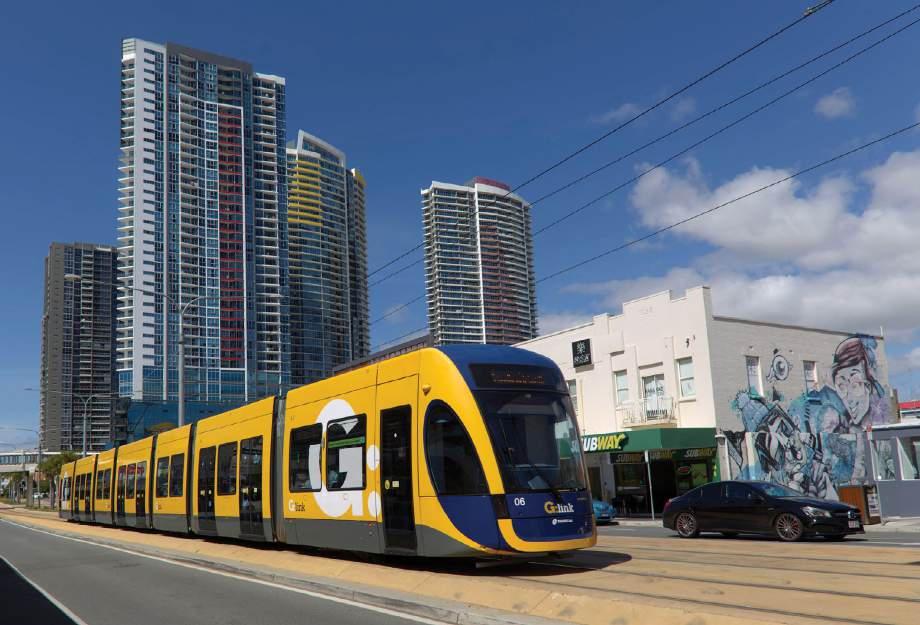
COVER: A G:Link tram passes through Southport in Queensland, Australia, where the construction of Stage 4 of the Gold Coast system is still an issue for debate. IconsAustralia/Alamy
The Manson Group Limited, St Albans, Herts AL3 6PZ
First new line in a decade is beginning of an orbital tramway
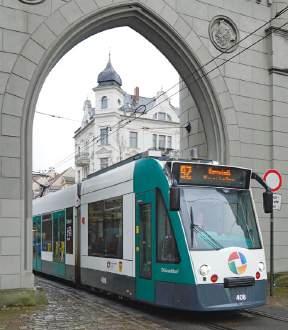
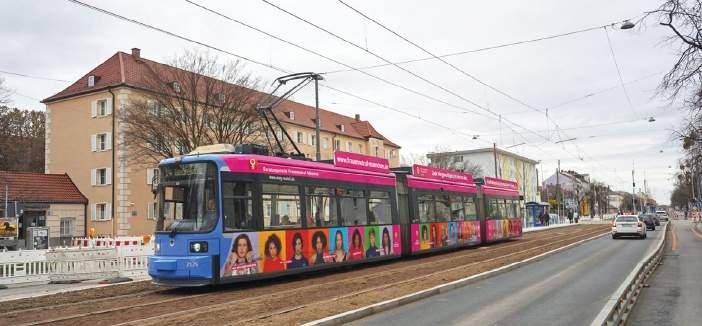
München (Munich) has opened the first extension to its tramway since December 2016. A three-stop link between Fürstenrieder Strasse and Ammerseestrasse, launched on 28 February, this is the first phase of the German city’s ambitious Westtangente line.
Construction of the 1.5km (0.9-mile) extension started in June 2024. It is served by new line 14, which circulates every ten minutes using five trams on a route between Pasing Bahnhof and Gondrellplatz, in the west of the Bavarian capital.
Deputy Mayor Dominik Krause said: “I am delighted that our city has resumed the expansion of the tramway network after almost a decade of inactivity. More public transport is a fundamental requirement
for attractive mobility and, therefore, quality of life in München.”
The Westtangente, an orbital route through the western side of the city, will eventually expand south from Ammersee to Waldfriedhof and north to Romanplatz. What is planned to be line 12 is to eventually
total 8.3km (5.2 miles). The project’s total cost is estimated at EUR498.1m, with 75% of funding coming from Germany’s federal government. It is hoped that the Westtangente could open throughout by the end of 2028.
Deputy Mayor Krause added: “The Westtangente tram line is one of München’s largest and
Testing of Lausanne’s first new tramline in more than 35 years is due to start on 3 May. The new 4.6km (2.9-mile) line through the Swiss city, on the shores of Lac Léman (Lake Geneva), will connect Lausanne-Flon metro interchange to Renens railway station in the western suburbs.
This is part of line T1, which is to extend by another 3.1km (1.9 miles) to Villars-SainteCroix within four years. The city council is providing CHF20m (EUR21.8m) to the project, with the canton of Vaud contributing CHF453m (EUR472m).
With a journey time of 14 minutes and a tram promised every six minutes, the new line is expected to attract 13m passengers a year. Services are due to start in December.
Swiss tramways are
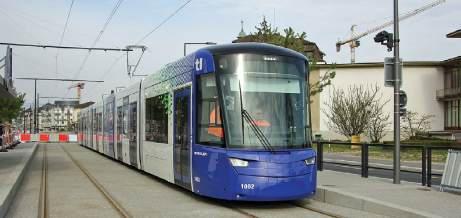
traditionally 1000mm-gauge but Tramway Lausannois’ ten new double-ended, 45m-long, air-conditioned Stadler Tramlinks are 1435mm-gauge. Trams 10011010 are to be the country’s first 2.65m-wide low-floor trams; the first two were unveiled on 2 March to the media at Renens-
Perrelet depot. This is to host a public open day on 2 May. Lausanne had a firstgeneration tramway from 1896 until 1964, but has relied on a trolleybus network in recent times. Lausanne Metro, now M1, opened in 1991 and is operated by LRVs.
Delhi metro grew on 8 March when India’s Prime Minister Modi opened two new extensions: the 12.3km (7.6mile) Pink Line 7 from Majlis Park to Maujpur-Babarpur and
the 9.5km (5.9-mile) Magenta Line 8 from Majlis Park to Deepali Chowk.
The metro network in the Indian capital now comprises 374.5km (233 miles) of track,
with the following lines: Red Line 1, Yellow Line 2, Blue Lines 3 and 4, Green Line 5, Violet Line 6, Pink Line 7, Magenta Line 8 and Grey Line 9 plus the Orange Airport Express Line.
most important infrastructure projects in recent years. It fills a gap in our network, which is heavily concentrated [on] the city centre.”
Part of the proposed line was formerly served by line 26. This was withdrawn in 1993 when an extension to the U-Bahn was opened.
Egyptian President Abdel Fattah El-Sisi inaugurated the USD4.5bn (EUR3.8bn) monorail in Al Qahirah (Cairo) by riding in a special train from Al-Fattah Al-Alim Mosque to Financial and Business District on 20 March.
The 56.5km (35.1-mile) East Nile Line connects Nasr City (Cairo Stadium) to Justice City in the New Administrative Capital, with 20 intermediate stops. There are connections with Metro Line 3 and the Cairo LRT suburban rail network.
Construction started in 2019 and Bombardier (now Alstom) has supplied 40 Innovia 300 rubbertyred trains. It is not known when services will start.
Construction of the 45km (28-mile) West Nile Line started in 2020 but has been paused.
Pink Line 7’s extension has turned it into Delhi metro’s first circular line. It is fitted with Alstom’s Urbalis Flo communications-based train control system.
Basel in Switzerland has unveiled plans to turn tramline 17 into an S-Tram. The name is derived from S-Bahn, meaning a fast suburban railway; S-Tram effectively offers a faster than normal tram service, using small infrastructure changes that require minimal construction work. S-Tram is due to become operational in 2030.
Baselland Transport (BLT) currently operates two tram routes linking the city centre and the Leimental area to the south-west of the city: Line 10 to Rodersdorf (on the French-Swiss border) via Ettingen and line 17
to Ettingen. Both lines share the same tracks into the city centre.
Basler Verkehrs-Betriebe’s (BVB) tramline 2 crosses lines 10/17 at Dornach. The S-Tram conversion involves building a 300m link between BLT and BVB here to enable line 17 to run direct to Basel SBB railway station using line 2’s metals.
Lines 10 and 17 are to swap destinations. Line 10 is to become an all-stops service to Ettingen, while line 17 will run from Badischer Bahnhof via Bahnhof SBB and Ettingen to Rodersdorf. Between Dornach and Ettingen, line 17 will serve four stops compared with line
10’s ten stops over the same section. As a result, passengers from Rodersdorf will enjoy a 12-minute faster journey to the city centre.
Other work to create S-Tram involves building a new platform access at the Margarethenbrücke, building a public transport hub with turning circle at Bottmingen, lengthening of the double-track section at Spiesshöfli, and redesigning the section of line between Zoo and Heuwaage to improve priority for line 10. The conversion is set to cost CHF75m (EUR81.2m), with a large proportion coming from federal funds.
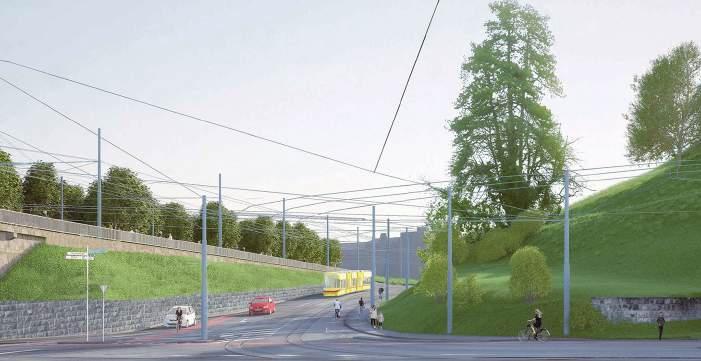
A pair of Italian cities have suffered serious light rail incidents within a week. On 27 February, two people were killed and 40 injured in Milano (Milan) when Stadler TRAMLINK 7707 derailed and crashed into a building.
The incident took place at approximately 16.00 at the
junction of Viale Vittorio Veneto and Via Lazaretto; the tram should have gone straight ahead but the points were reportedly set for a left turn.
Then, in Roma (Rome) on 4 March, two trains collided on the narrow-gauge Termini – Centocelle tramway. The collision took place on a
single-track section near Ponte Casilino; there were no injuries. Services were suspended and this may have marked the end of 950mm-gauge operation on the line; it was due to close in July for a four-year-long conversion to 1435mm-gauge, a project that includes an extension to Tor Vergata.
The tram subway under Place Bara in the Belgian capital of Brussel/Bruxelles (Brussels) is to close on 27 April for structural repairs. Work is expected to take a year to complete.
Route changes are as follows: Line 4 is to be split into two sections (Nord – Wiels and Porte de Hal – Stalle); Line 10 is to operate between Hôpital Militaire and Midi; Line 51 is to
Paraguay’s President Santiago Peña and United Arab Emirates President Sheikh Mohammed bin Zayed Al Nahyan signed a transport and energy Memorandum of Understanding on 3 February. It includes plans to build a 44km (27-mile) tram-train line from the capital Asunción to Ypacaraí.
The line looks set to be built under a 30-year concession between Paraguay’s rail operator FEPASA and Etihad Rail, with a EUR390m contribution from the UAE. The first 20km (12 miles) to be built would link the capital with Luque, part of the Gran Asunción metropolitan area. While initial reports suggest that the line could open with 11 trains carrying 40 000 passengers/day, it is not known when this might take place.
Asunción had a tram system from 1871 until 1995 (electric trams were introduced in 1913). A contract to build a line from Asunción to Ypacaraí with a South Korean consortium, signed in 2022, was cancelled in September 2024.
be split into two (Lemonnier –Marguerite Duras and Belgica – Stade); Line 81 is to operate between Trinité and Montgomery while shuttle bus service 96 is to connect Trinité and Midi.
The UK’s West Midlands Metro has introduced a new timetable ahead of the opening of the Albert Street/Millennium Point extension. From 15 March, services from Wolverhampton St George’s have terminated at Bull Street. Trams then run empty along Bull Street to Albert Street/ Millennium Point and back, before collecting passengers at Corporation Street and continuing to Edgbaston Village. This arrangement is to remain in place until the first stage of the Birmingham Eastside extension opens later this year. Another extension to the WMM network is also due to open this year: the 6.5km (four miles) from Wednesbury to Dudley Interchange. West Midlands Combined Authority has allocated GBP300 000 (EUR346 703) to Dudley to compensate businesses for disruption caused by tramway construction. Of that grant, GBP160 000 (EUR184 907) will be used to make “public realm improvements”, while some will go towards marketing activity to encourage more visitors to the West Midlands town.
Amsterdam changes
Changes to Amsterdam’s tram network came into force on 29 March. Line 1 now runs Osdorp De Aker – Azartplein; Line 6 is Station Zuid – Westwijk; Line 7 is Slotermeer – Flevopark; line 12 is Amstelstation – Zoutkeetsgracht, while line 24 is VU Medical Centre – Centraal Station via Leidsestraat.
Lines 2, 4, 5, 6, 14, 17, 19, 25R and 26 are unchanged but line 3 has been withdrawn.
Further changes are due to be introduced with the renewal of infrastructure between Linnaeusstraat and Middenweg from 24 April. Lines 7, 14, 19 and 25 will be diverted, while shuttle line 29 is to be introduced between Linnaeusstraat and Diemen.
Line 26 is due to be extended to Strandeiland on 3 May.
All change in Katowice PESA delivered 1053, the first of ten new Twist trams, to Tramwaje Konurbacji Śląskiej on 10 March. Also expected imminently is the first of ten Modertrans Moderus Beta 15m double-ended bogie trams, which can carry 90 passengers (20 seated).
Meanwhile, a tender has been issued for the construction of a new 4.6km (2.9-mile) segregated line from Kostuchna to Katowice city centre.
Metropolis GZM (Katowice’s metropolitan administration) and the province of Silesia are also to co-finance 32 new EMUs (with an option for 20 more) for a new suburban rail service, Metrokolei Services are due to start in 2029.
Making the case for trams West Yorkshire Combined Authority continues to make the case to the UK Government that West Yorkshire Mass Transit needs to be a tram rather than bus network. Transport Secretary Heidi Alexander told The Yorkshire Post in mid-March that while the WYCA team was “very powerfully” making the case for trams, the Department for Transport has not guaranteed that WYMT will be a tramway.
WYCA was allocated GBP2.1bn (EUR2.5bn) in the June 2025 Spending Review (TAUT 1052) to start Mass Transit construction by 2028 and open it during the 2030s.
Cambridge Mass Transit study launched Cambridge Growth Company has launched its Mass Rapid Transit Study to identify what form of transit best suits the city. CGC, a UK Government-backed organisation, is to consider trams and other forms of light rail as well as buses and guided busways.
Paul Bristow, Mayor of the Cambridgeshire & Peterborough Combined Authority (CPCA), whose concept for a light rail system connecting key research locations was covered in TAUT 1060, called the study an “important step”.
New York City’s Metropolitan Transportation Authority is seeking proposals from manufacturers for the largest subway car contract in its history. The base order is for 1140 vehicles to replace R62 and R62A cars, which date from 1983-85, on lines 1, 3 and 6. An option for a further 1250 cars would provide vehicles to lines 2, 4 and 5, allowing their R142 and R142A cars (built 19992005) to be cascaded elsewhere.
Dubbed R262, the new cars will be funded by the MTA’s 2025-29 capital plan, which received USD68bn (EUR58.8bn) in funding in the 2026 state budget.
State Governor Kathy Hochul said: “Thousands of new subway cars [giving] better service and a more reliable ride for millions every day – that’s what we can achieve when we invest in transit.
“We are in the midst of a public transit renaissance in New York, with growing ridership, the best service in a generation and historic investments to modernise the lifeblood of our city. By bringing even more open-gangway cars to
The Swedish city of Göteborg (Gothenburg) is to donate 40 trams to the Ukrainian city of Mykolaiv, where the tramway system has suffered from repeated attacks by Russian drones.
The 40 M29 15m-long bogie trams will be withdrawn this summer as new Alstom-built 45m M34 trams are delivered. Swedish manufacturer Hägglund built 60 M29s between 1969 and 1972, and 44 remain. Transport has been arranged through the Swedish Civil Contingencies Agency and the EU Emergency Response Co-ordination Centre. Deliveries are to start in the late summer.
Linda Rudenwall, CEO of operator Göteborg Spårvägar
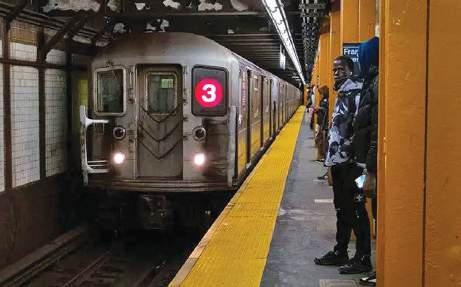
the subway, we can make real improvements to riders’ safety and overall experience.”
MTA Chair and CEO Janno Lieber added: “Thanks to Governor Hochul… New Yorkers are seeing a golden age of transit investment. So much of our investment goes unseen, but this next subway car order – our largest ever – is a major step to visibly delivering the modern system New Yorkers deserve.”
The contract is performancebased rather than design driven;
the new design has to offer a mean distance between failures of 321 869km (200 000 miles) compared with the R62’s average of 143 232km (89 000 miles). Proposals must be submitted by 8 September and the contract is expected to be awarded by 2028. The US city’s last order was for 378 R268 metro cars and was placed with Kawasaki Rail Car Manufacturing Company in 2025. Kawasaki has a manufacturing plant in Lincoln, Nebraska.
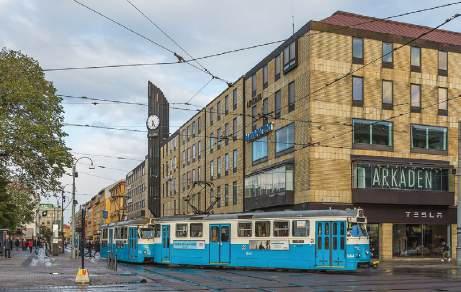
(GS), said: “They are symbols of Göteborg and public transport, but they no longer meet our requirements for public transportation. We send them away with both sadness and joy. The donation will save money for GS as we needed a budget of SEK37m [EUR3.4m] to have them scrapped.”
Mykolaiv, in southern Ukraine, has had electric trams since 1915 and operates mostly Russian-built KTM5s built in 1969-70 along with some exCzech Tatra T3s. In 2002, it had 145 trams operating on 12 lines. It currently has six operational lines and approximately 45 serviceable trams.
Seattle’s Link light rail became a 93km (58mile) network on 28 March when Line 2 services started running over a new extension. This includes a 1172m-long floating bridge across Lake Washington. Line 2 has been operating as an isolated section from Redmond to South Bellevue since 2024. This new 12.8km (eight-mile) extension means that it now connects with Line 1 at International District/Chinatown.
The extension involved installing lines on the Homer M. Hadley road bridge. This is floated on Lake Washington using hollow concrete pontoons, as the lakebed would not support bridge foundations. It is believed to be the world’s first light rail line on a floating bridge.
Line 2 duplicates Line 1 by running north to Lynnwood City Center, doubling the frequency on this section. It has two intermediate stations, at Mercer Island and at Judkins Park, to the west of the bridge. Sound Transit provides an eight-minute service at peak times and every 15 minutes off-peak.
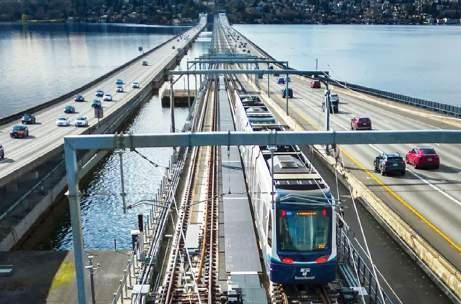
The original fleet of 62 Kinkisharyo LRVs has been supplemented by 152 Siemens S700 cars, with ten more due for delivery in 2027. A new fleet is being planned to replace the original cars in the 2030s, to allow for further expansion.
It has been 30 years since voters approved plans to build the Seattle light rail system and almost 22 years since it opened in 2003. Over the years, Line 1 has been expanded north to
Lynnwood and south to the airport and Angle Lake. Annual patronage is about 37.8m passengers per year.
If Sound Transit can adhere to its promised timescale – Line 2 was six years late and USD60m (EUR51.9m) over budget – then future extensions should reach West Seattle in 2032, Tacoma (2035), Everett (2037), Ballard (2039) and Issaquah and Kirkland (2044). It would eventually total 187km (116 miles).
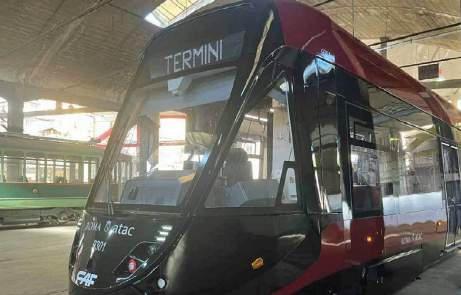
The public transport operator in Italy’s capital Roma (Rome) took delivery of its first CAF Urbos tram on 5 March. Shipped from Spain via the Italian port of Civitavecchia, 9301 is now being commissioned at Via Prenestina workshops. It is the first vehicle
from an order of 80 (October 2023’s original framework contract was for 121 at a cost of EUR457m) and the first new tram on Roma’s system for 20 years.
Azienda per la mobilità di Roma Capitale (ATAC) is to receive ten of the new 33.5m,
New Piccadilly Line trains are not expected to enter service until at least December. So far, four of the 94 Siemens-built trains have been delivered to Transport for London (UK).
The first four 2024 Stock trains for the Underground were built at Siemens’ factory in Vienna; 80% of the fleet is to be built at Siemens’ new factory in Goole in East Yorkshire. The cost of the fleet has increased by GBP409m (EUR473m) to GBP3.4bn (EUR3.9bn). The rest should enter service by summer 2027.
Meanwhile, B23 Stock should start running on the Docklands Light Railway from the summer. The three sets in service were withdrawn in November after one over-ran its stopping point (TAUT 1057). Engineers from TfL and builder CAF have, said a TfL statement, been identifying “the root cause”. Changes to the braking software have been made and these are being tested by CAF.
The Spanish manufacturer has built all 54 new B23 Stock cars, which are to be formed into five-car sets. Construction started in 2020 and the first was delivered to Beckton depot in 2023. The first three started carrying passengers on 30 September 2025.
five-section, double-ended vehicles this summer and another ten by the end of the year. Air-conditioned and designed to carry 215 passengers (68 seated), they are to replace the remaining 7000-series Stanga cars dating from the late 1940s, as well as the 9000-series SOCIMI partly low-floor trams from the early 1990s.
The CAF trams will also work the new 8km (five-mile) tram line along Viale Palmiro Togliatti (Ponte Mammolo – Subaugusta) that will link stations on metro lines B and A. The EUR184m project is nearing completion and has been financed under the National Recovery and Resilience Plan. It includes a new depot at Centro Carni.
The
Transport for London, four West London boroughs and Old Oak & Park Royal Development Corporation have jointly committed to developing plans for a West London Orbital railway. A total of GBP6.65m (EUR7.7m) will be spent on aspects including finalising a preferred option for stations, junctions, signalling and power supplies for the new route in the UK capital.
The 18.5km (11.5-mile) addition to the London Overground would connect Hendon in the north to Hounslow to the south-west. This involves converting two currently goods-only heavy rail lines between Brent Cross West and Acton Wells Junction and between Acton South and Old Kew Junction to London Overground specifications.
Public consultation for the estimated GBP700m (EUR809m) project is expected to open during the summer. The West London Orbital is not expected to open until the next decade.
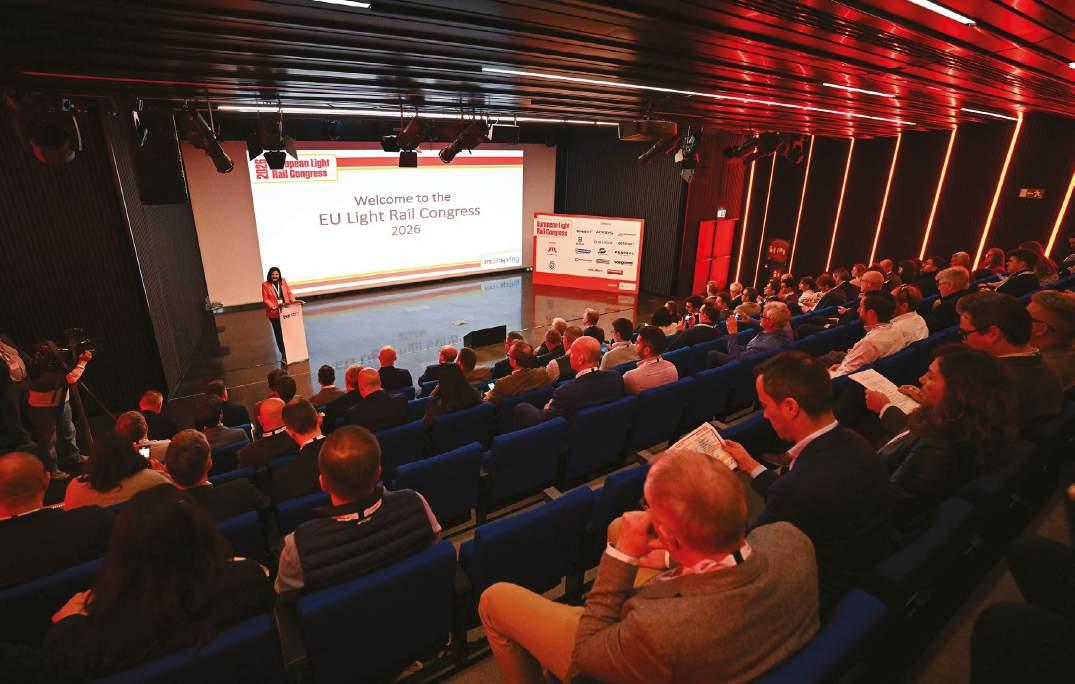
Geoff Butler reports from this year’s European meeting in Tenerife.
Metrotenerife’s exciting ambitions for a six-line system and for connecting the divided northern and southern communities of the popular Canary Island it serves were a big talking point at this year’s European Light Rail Congress on 11 and 12 March. This was two days packed with presentations, a lively panel debate, an exhibition, and a technical tour.
Over 150 delegates from 15 countries gathered in La Laguna in Tenerife to learn how the two current lines will be extended and another four constructed, all offering sustainable public transport to address acute road congestion.
The rain and wind that greeted this year’s attendees didn’t dampen anyone’s enthusiasm. Maria Eulalia Garcia Silvia, President of Metrotenerife and Councillor for Mobility of Tenerife’s island government, opened the event, and Metrotenerife’s International Business Development Manager Teresa Benet explained how the South Train alone will cover 80km (50 miles) of track with over 22km (14 miles) of tunnels and 8km (five miles) of bridges, serving 18 million passengers per year, at a cost of EUR2.5bn.
There is also a Fonsalia connection in the south and a North Train route and island ring. The EUR1.1bn North line will require 36km (22 miles) of track, 17km (11 miles) of tunnels, 1km (0.6 miles) of bridges, all to carry 7.5 million passengers a year.
Juan Manuel Herrera, project engineer from Getzner Werkstoffe, talked about the long-term performance of a floating slab
track system on Metrotenerife’s line 1 that solves vibration issues close to buildings and people, making vibrations around ten times lower than regulatory limits. It has drawn the same conclusion, that after 18 years, the system behaves as it should.
The global light rail spend will grow from its current EUR380bn a year to EUR450bn by 2031, predicts Andy Lucas, Chief Operating Officer of Rail Intel.
Andy urged companies to think hard about how they obtain vital up-to-date information to make their own business decisions simpler, and offered Rail Intel’s unique service as the ideal cost-effective solution.
Africa and the Middle East, Central and South America, Europe, North America, South Asia and Australasia, all predict significant growth over the next five years. Metros have an estimated 732 new lines and extensions under construction, with a further 147 proposed. Light rail will have 388 new lines and 239 extensions. The current top five countries are Turkey, France, Spain, Serbia and Romania (metro), and France, Italy, Germany, Turkey and Spain, all with expansionist ambitions.
There could be 19 tram-train systems by 2030, and 2000km (1250 miles) of track is being replaced across Europe. With all of this said, there are 2333 cities and towns with populations of over 250 000 that do not have fixed track systems, and the number with light rail is just 794. At just 34%, there’s certainly a lot of scope.
Mosdorfer highlighted how light rail catenary systems differ widely, and the company’s Commercial Sales Manager Rob Renshaw explained how LRT differs to heavy rail; with tight curves, steep gradients, lower operating speeds, street running alongside pedestrians, and road traffic to contend with. The objective is to be less intrusive, and stray currents also need to be addressed, because they flow through soil, foundations, pipes and bridges, causing accelerated corrosion. Catenary insulation and bonding design is critical and must be robust. Mosdorfer’s solution is a spring-powered auto-tensioning device, which is compact, low maintenance, and aesthetically pleasing.
Juan Lozcano from Pandrol is an expert on translating noise and vibration simulations into urban track design decisions, and the company has a dedicated multidisciplinary team, specialising in track measurement, with laboratory analysis, onsite measurements, and in-tune software.
The Continuously Supported and Fastened Embedded Slabtrack System is completely encapsulated by prefabricated elastic profiles, providing continuous fastening and support without sleepers, tie-bars and mechanical clips, even on tight curves.
Modular crossings and track maintenance was talked about by Jean-Robert Laarhoven from Spanish specialist Amurrio. There are solutions for light and urban rail, including turnouts for pneumatic track for metros, and grooved rail and transit on subways.
A good case study is a loop in Chicago, which
has century-old elevated track in the city’s financial centre. The challenge has been to replace five sections in collaboration with a local manufacturer, which was achieved in record time. Other successes have been Barcelona, Santander and in Uruguay.
Nils Jänig and Steffen Plogstert jointly discussed the return of trams to Kiel after a 40-year break. This is the largest new-build LRT scheme in Germany, and addresses the need to reduce road congestion, improving the quality of life in residential and business areas, boosting the economy and tourism, and importantly meeting climate targets.
BRT was considered as an alternative to trams, but lost out on cost and other grounds. Subject to funding, the Governor of Kiel will receive a much more sustainable system with trams. The phased planning approach that began in 2020 has included public participation along the way. There have been 11 planning workshops as well as online activity, and the public has been invited to walk along the entire proposed network.
The 36km (22-mile) scheme consists of four lines, and preliminary work has been done on track design, roads, utilities, cycleways and walkways, overhead line, signalling, environment, rolling stock and depots, and funding and risk management.
Martijn Donders from the Mott MacDonald consultancy talked about moving projects forward from getting the green light right through to them going live, and also how to take the risk out of commissioning for operators and regulating bodies.
Common problems are cost overruns, scheduling, operational risk, reputational damage and regulatory exposure. They include late changes, underestimating complexity, lengthy software fixes, and late operator involvement. Safety is also key: the people involved and the processes needed. Ontario is an example of how to deliver a quality system on time and on budget.
Metro de Sevilla’s Miriam DominguezAdame gave a presentation on what the Andalucian system has achieved, and how improvements will make passenger journeys more efficient and to the same very high standard. Listening to passengers is key to identifying pain points, such as the tapand-go system that saves buying a ticket when only a card is needed, and smartpost payment that allows the passenger to travel first and pay later and get the best price. Telmo is a chatbot that answers many passenger questions, but there are also staff around to assist if needed.
Going forward, Metro de Sevilla is implementing QR audio-description codes to provide accessible information for everyone. Also in the pipeline are real-time updates for the status of elevators and escalators to allow uncertain passengers to plan their trips with confidence.
Marcos Espanol (Los Tranvías de Zaragoza) said that safety has been a major influence in his city, working with residents to gain their support whilst championing new technology. Over 110 000 passengers/day use trams to get to work, study and for pleasure – because they are fast, efficient, reliable and cheap compared to other transport modes.
Only 0.32% of accidents are caused by trams (incidents overall have fallen by half over the decade, apart from bikes because of their increased popularity). The tram route that shares space with pedestrians has a reduced speed limit of 20km/h (12.4mph), and no stops are on curves to ensure that trams are highly visible. The cars have overspeed controls, and a pedestrian anti-crush mechanism to prevent them running over obstacles.
Traffic lights and pedestrian crossings have been upgraded, stop lines relocated, and safety railings installed at stops. LED lighting is also placed in the ground around the busiest crossings and beacons detect when a tram is approaching.
The power of digital twins in transportation was discussed by Julio Lerena from Octave. He covered aspects such as schematics and 3D modelling, engineering
“Kiel... is the largest new-built LRT scheme in Germany, and addresses the need to reduce road congestion [and] improve quality of life.”
analysis, information management and geospatial intelligence. Construction and supply chain management and project performance were explained, as well as asset performance, public safety, physical security and industrial cybersecurity.
A major challenge is that information silos in the rail industry fragment data, storing it in isolated, incompatible, or inaccessible systems, which prevents different departments, teams, and external partners from sharing data freely. Octave offers its EAM system (Enterprise Asset Management) to drive uptime, compliance, and efficiency. The public works agency of Junta de Andalucia is creating the digital twin of Granda Metro and Trambahía of Cádiz with this technology, and users can teleport to any part of the rail network without leaving the office.
Roberto Cambursano came from Torino (Turin) in Italy to showcase his city’s tramways, past, present and future. He began his story with horse-drawn trams in 1871, the change to steam and electric power, and the destruction caused by World War Two. New trams became larger to carry more passengers but lost out to car competition in the 1960s. Now, a new route and extensions are getting tram usage back to old numbers. The current system comprises seven routes plus an historic line, and a link to the football stadium.
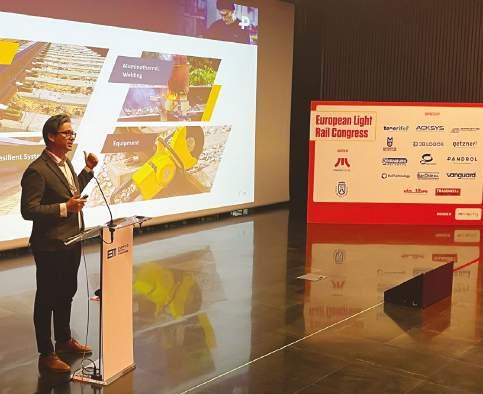
There is 70km (43 miles) of track in total, 10km (six miles) of financed extensions, five depots (Nizza, Tortona, San Paolo, Venaria, Sassi) and 230 tramcars. The automated metro’s line 1 is operational, and construction of line 2’s first section will start in 2027. The latest rolling stock totals 70 units, with over 30 more to come from Hitachi Rail Italy, all delivered between 2023-26.
Digital training tools for light rail operations were promoted by Ian Rowe, Director of Avansim in the UK. He highlighted hazard awareness, driver training simulators and OCC training devices. PC-based hazard awareness tools provide objective measurable scores to determine individuals’ performance, and are used by all UK tram operators to allow recruitment pre-assessment, with ongoing analysis.
Driver training simulators are becoming more common in the light rail industry, varying from full cab motion systems to small footprint desktop units. There are a host of benefits, including safety without real-world risk, faster skill development and cost-efficient reduction of operational impact.
Offering better assessment and targeted coaching to prepare for rare but high-risk events, the simulators support workforce growth and resilience. Nowadays, 85% of all new driver training is conducted this way, and there are four-fifths fewer incidents. It now costs 38% less to commission new drivers, giving a return on investment of around 48 months, and cutting the training time to open new lines by half.
Day one ended with a social visit to a working winery and museum at El Souzal in the west of Tenerife, to continue conversations begun earlier in the day in a relaxed environment.
Day two was launched with a remote presentation from Paolo Marchetti, Technical Director of Systra, who is based in Italy. He talked about progress on works on the Red and Green lines of Bologna’s new tramway. The Red line was started in 2023 and the Green line last year, and when complete these are expected to carry around 105 000 and 69 000 passengers/day respectively.
The Red line will have 16.5km (ten miles) of track and 34 stops, whereas the Green line is 7.4km (4.6 miles) long and has 19 stops. By the end of last December, the Red line’s civil works were 60% complete, with two thirds of the equipment in place. Half of the Green line’s infrastructure is in place, and the rest is making good headway.
“Many operators have problems with ageing structures that have to cope with increasing traffic and usage, and cost pressures.”
There are many projects under way in Italy over a distance of 186km (116 miles), including in Bergamo, Brescia, Padova, Florence, Palermo, Rome, Cagliari and Milan. Other systems at an early design stage include Rome, Messina, Reggio Emilia and Pisa, as well as the Blue line in Bologna, where urban renovation includes areas formerly used for car parks that will now be part of the tramway alignment, with some catenaryfree sections in narrow streets.
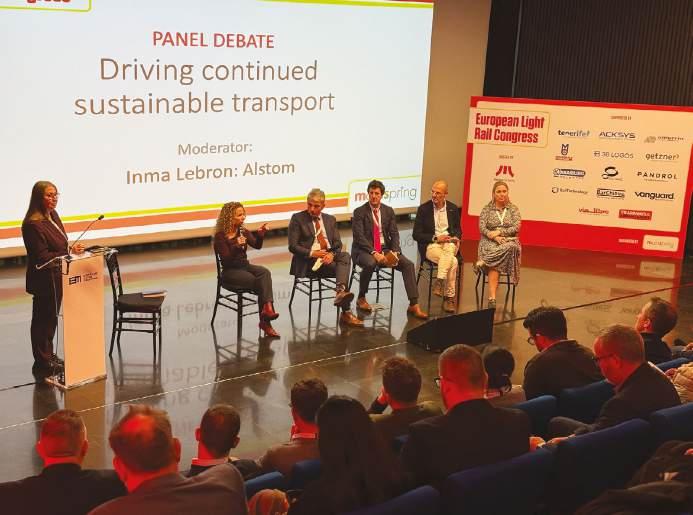
ABOVE: A panel debate hosted by Alstom focused on driving forward continued sustainable transport.
Lowering carbon levels was the topic of Peter Schaul’s presentation on tram and metro systems, using engineered macro synthetic fibre reinforcement. These fibres are used in track slab and metro and light rail structures to strengthen concrete, making them corrosion-free. They improve crack performance, reduce maintenance, enhance safety, are easier to install, and have less impact on the environment. The return on investment for the client is increased because of the increased lifecycle, and lower costs.
Case studies included the Warsaw Metro, where all sections of the original design which contained heavy steel reinforcement have been replaced using structural synthetic fibres. Steel has been eliminated from the main line, the depot, emergency walkway and open track areas, saving large volumes of carbon dioxide. In summary, fibre-reinforced concrete is increasingly popular due to rising steel prices and labour costs.
Leonard Wnendt was on next to talk about how data collection forms a critical role in managing railway infrastructure. It takes care of structural inspections and real-time monitoring, and a state-of-the-art digital solution can be offered along with visualisations.
Many operators have problems with ageing structures that have to cope with increasing traffic and usage, and cost pressures. Then there are staff shortages and many data sources with little transparency. Decisions need to be justifiable and explainable, and are today expected to be data-based. Poor information can lead to the wrong priorities being targeted, hidden risks with inconsistent data, inefficient investment, and inaccurate predictions.
The presenter cited an example when welding and grinding is needed, and a need to forecast the end-of-life date of assets. Data is often required quickly to calculate the probability of a defect occurring within a combination of railway components.
Göteborg (Gothenburg) Light Rail, an urban backbone in Sweden, was the subject of the presentation from Mimmi Mickelson. It is one of the largest tramways in Northern Europe, and development has historically been alongside main routes, defining areas of the city that are vital to the economy.
Göteborg is expanding rapidly, with a clear ambition to attract more residents and strengthen its role as a regional hub. This strategy creates a growing demand for efficient and reliable public transport, so a larger tramway network and new supporting infrastructure are needed to meet this demand.
Urban development is increasing pressure on the existing system, highlighting the need for strategic planning to improve capacity, connectivity and overall mobility. Today, the inner city has more than 607 000 inhabitants, while the wider Göteborg metropolitan area exceeds 1080 000, making it the nation’s secondlargest city.
Between 2025-40, around 12km (7.5 miles) of new double-track tramway is planned to be built in several stages, with a 3km (two-mile)
tunnel. After many years without major tramway expansion, the city is now excited about the future. Lindholmsalleen opened in December 2025, Engelbrektslanken is planned to open in 2027, Hjalmar–Brunnsbo in 2029, Lindholmen-Eriksberg in 2033, Parkgarten in 2033 and Lindholmen to Linneplatsen in 2040. Important destinations and interchange points are also being redesigned.
Fernando Lozano, Managing Director of Metro de Malaga, talked about how he is planning and investing to satisfy rising ridership growth. Stage 1 offered a 10.8km (6.7-mile) network with 17 stations, and stage 2 a further 12.8km (eight miles) with 19 stops. Passenger demand has almost doubled from 6.8 million passengers in 2019 to 19.2 million in 2024, creating the need for an extension from the city centre to the hospital.
In the short term, two spare units have been made available for peak hours and advanced planning took place for highdemand weeks. The implementation of short-turn services (loops) was introduced when required. Reactive reinforcement has its limits however, with added pressure on maintenance and increased reliability risk, making it unsustainable long-term. The answer is to order more vehicles.
The development of London’s Docklands Light Railway was presented to the European audience by Samantha Murat of Keolis Amey Docklands.
The global operator thinks like a customer to offer the best possible service in and around the busy UK capital. Insights and engagement are two focus areas, extracting more value and insights from existing data sources, and then adding new information.
All forms of accessibility are also included in the overall strategy to offer the best possible service. Customers now know in real-time whether there are issues on the network that could affect their journey, and staff actively engage in major community events such as the London Marathon, Valentine’s Day, and World Mental Health Day.
Eduard Cabrera, Head of Tramway Infrastructure Management Service at ATM Barcelona, reflected on a year of service on the phase 1 operation, one of the most strategic mobility projects connecting the city’s tram networks.
ATM’s territory covers 346 municipalities and almost six million inhabitants, and the Integrated Fare System (ITS) ensures consistent fares and intermodality across the region. The core responsibilities include managing the ITS (four rail and 50-plus bus operators), co-ordinating funding among administrations for the entire system, and developing mobility and infrastructure master plans.
Barcelona has two separate tram networks, Trambaix and Trambesòs. Both are efficient, accessible and well regarded by users. There are three lines per network with 29 stops on each, 15-16 km (9-10 miles) of track and fleets of 23 trams (Trambaix) and 21 (Trambesòs).
The complete diagonal tram connection spans 4km (2.5 miles), and will unify the two
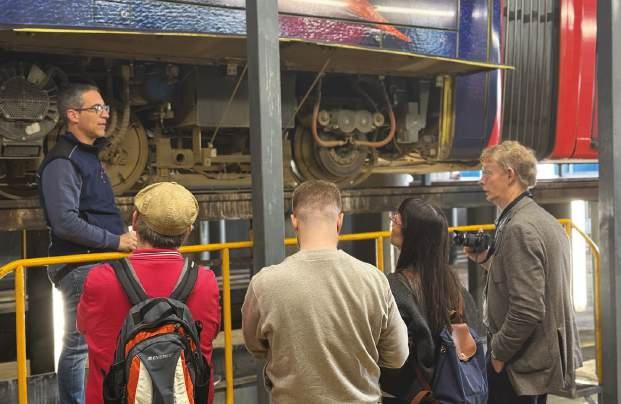
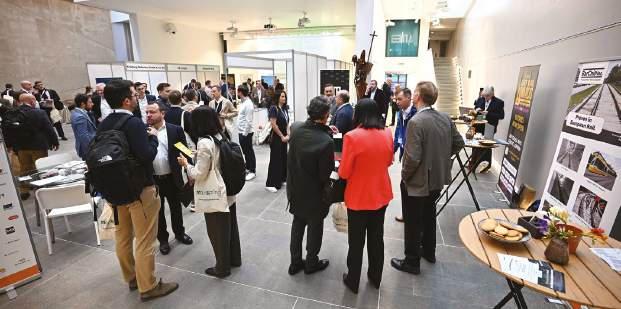
BELOW: There was plenty of time for networking at this year’s
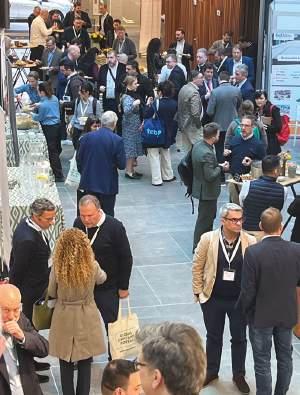
tram networks. There will be six new stops and 18 new trams, and 117 000 additional daily journeys are anticipated when work is complete, doubling the existing ridership and offering a catenary-free APS section. The first year saw ridership increase to 11.3 million trips in 2024, up 23.7%. By last October alone, 12.3 million accumulated trips were made. The next initiatives include new rolling stock, and three new trams, increasing the Besòs fleet from 18 to 21.
The completed first phase of the connection of the tram networks opened and a unified tram network was launched on 10 November 2024.
EMC simulation was discussed by Mark van Bekkum of Dutch company Microsim. Smart EMC, for minimal disturbance, is defined as the ability of electrical equipment and systems to function acceptably in their electromagnetic environment.
Light rail vehicles generate changes in the local magnetic field that can have a strong influence on the surrounding area, and so can buses, lorries, bicycles, and even people.
Light rail EMC has a much bigger influence because it is powered by a large direct current source. Trams have more pulling power nowadays, and new and existing projects look at integration, and mitigation of EMC disturbance. Smart integration begins with sharing knowledge, and although this costs money, it saves on other fronts.
Miguel Fernandez, Managing Director of Tranvia De Parla, highlighted how his workforce connects with passengers to offer the best possible service. The township is 20km (12.4 miles) from Madrid, and serves a population of almost 140 000. The circular tramway is 8.2km (five miles) long, with 15 stops. The main stop is Parla Centro which interchanges with commuter trains (Cercanías RENFE).
Tranvía de Parla has a fleet of nine trams, which enables a seven-minute service to run in the peak. The concession (Consorcio Regional Transportes) and the Ayuntmiento Parla (Local Authority) have two revenue streams, Investment Contribution (local authority) and Operation Contribution (50% Consorcio Regional de Transportes de Madrid and 50% local authority). Over seven million passengers were carried in 2024.
UK Tram’s Tim Bilby talked about light rail innovation and what his organisation is doing to promote the mode as an effective, reliable, environmentally sustainable, and cost-effective way of meeting the transport needs of modern urban areas. The organisation also shares and promotes best practice amongst tramway operators and those responsible for maintenance.
UK Tram is developing its machine learning and AI usage for driver assistance, asset condition monitoring, and the demands of passengers as well as their behaviour. It is also keen to maximise and share the benefit of innovation.
The Congress concluded with a panel debate, bringing together several of Europe’s operators and systems to discuss how they aim to continue driving sustainable transport.
Panellists from Metrotenerife, Metro de Malaga, Tranvia de Parla, Metro de Sevilla and London’s DLR conveyed what they had learned from the two-day sessions, and how the conversations they had commit them to continued progress in achieving growth across the continent, higher quality of performance and greater customer satisfaction.
Everyone looks forward to meeting up again in 2027.
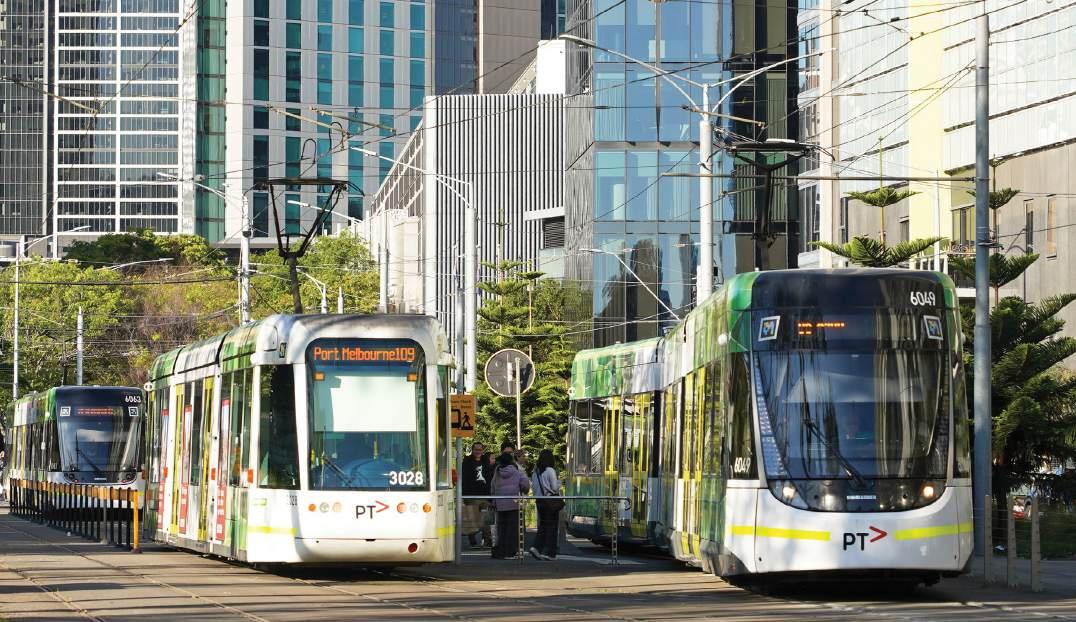
A lot can change in 18 months, and for Australia, the time has been marked by extensions, new rolling stock, and plans for new lines and systems. Richard Foster summarises the activity to date.
When infrastructure projects, such as building a new light rail system, can take decades to complete, it’s easy to forget how much things can change in a comparatively short period of time. TAUT last looked at Australia in the October 2024 issue (TAUT 1042) and, nearly 18 months later, the light rail scene looks quite different. Key projects have been completed and new lines opened. Contracts have been signed. But, conversely, some projects have been cancelled.
Adelaide
Where better to start a tour than with an ‘A’ and, in this case, it’s Adelaide. In October 2024, Torrens Connect operated its 14.9km (9.3-mile) four-line tram network while Keolis Downer operated suburban rail services. These all came under the Adelaide Metro banner, along with the city’s buses, include the O-bahn guided busway. Suburban rail services came under government control on 2 February 2025, followed by the trams on 31 August. Buses remain with Keolis Downer’s SouthLink.
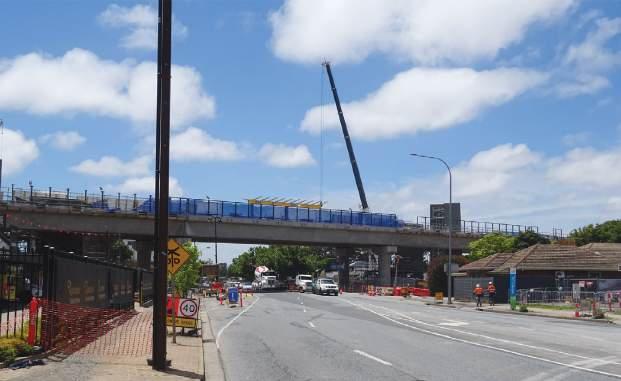
The system closed on 2 August 2025 to continue upgrades to the tram network, including safer and more reliable journeys through the Tram Grade Separation Projects [TGSP]. And it has fulfilled that promise.
The AUD800m (EUR486m) TGSP involved replacing three level crossings with bridges (Marion Road and Cross Road in South Plymton, about halfway between Adelaide and Glenelg and Morphett Road in neighbouring Morphettville) as well as rebuilding a bridge over the underconstruction AUD15.4bn (EUR8.8bn) ‘lowered motorway’.
The TGSP caused huge disruption to the system, with the closure of the line between South Terrace Adelaide and Glenelg. However, the system returned to normal from 26 January 2026, although some finishing-off work will continue to take place until the middle of the year. The opportunity was also taken to refurbish the main street through Glenelg with new road surfacing and pavement.
Some of the stops on the system were elevated to bridge-level including Stop 12 Morphettville, by Morphettville Racecourse,
LEFT: Melbourne is already the world’s largest tramway network, but even so, there are eight extensions proposed to start by 2030 that are recommended to support sustainable travel around the city. Pictured is the existing system at the juncture of Clarendon Street and Whiteman Street. Neil Pulling
which opened on 26 January, while the elevated Stop 6 South Road, in Glandore, opened on 1 March. Stop 10, Marion Road Crossing, is still to open.
Will Adelaide’s system ever expand?
Various politicians have proposed route extensions and improvements, but at the current time, none of these are funded.
Melbourne
Melbourne needs little introduction to TAUT readers. The statistics attached to the world’s largest tram network are still somewhat mind-blowing: it comprises 250km (160 miles) of track, 1700 tram stops, and has a fleet of over 500 vehicles.
The biggest change coming to the system is the introduction of G Class trams. The 100 new vehicles are described as being the “largest investment in locally-made trams in Australia’s history”. The design is based on Alston’s Flexity 2 but with tweaks to suit the Melbourne system, including pivoting outer bogies. They’re being built at Alstom’s plant, the former Commonwealth Engineering works, at Dandenong, to the south-east of the city centre.
The first G Class was delivered to the new, purpose-built depot in a north-western suburb of Maidstone in time for its opening on 17 October 2025 (TAUT 1056). While the depot is now operational, passengers won’t get to experience a G Class until they enter service later this year; they are to initially replace high-floor Z Class trams on Lines 59, 57, and 82.
With such a mature system, greater focus is on new innovations to make it more efficient and sustainable rather than looking for opportunities for expansion. One such innovation could be to make modular tramstop platforms from recycled plastic.
Monash University and tramway operator Yarra Trams have partnered with four firms from the plastics and recycling industry (PACT group, GT Recycling, DKSH Australia, Integrated Recycling) to develop the platforms, which has been funded by the state of Victoria’s Circular Economy Research & Development Fund. With development work still ongoing, it’s not yet known when a recycled plastic tramstop could be trialled at a Melbourne tram stop.
However, Infrastructure Victoria (IV), the state’s independent advisory body, has recommended that work needs to start on eight tramway extensions by 2030 in order to support sustainable growth around the state capital.
The proposed routes are:
• Swanston St to Kensington
• Spencer St to Flemington Bridge
• Anzac train station to Fishermans Bend North
• Southern Cross Station to Fishermans Bend South
• East Malvern to Hughesdale via Chadstone
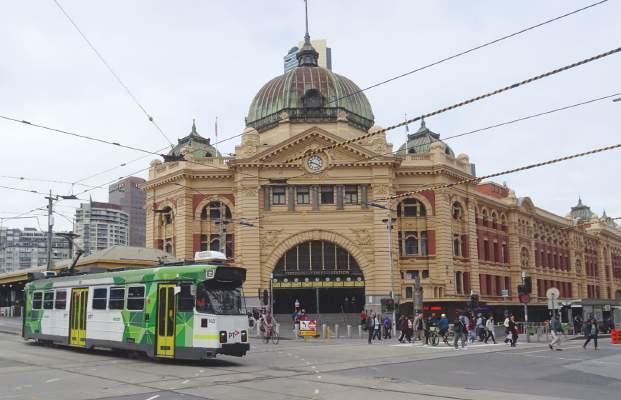
ABOVE: With projections for Melbourne to become a city of nine million people by 2050, city officials have already started planning, with extensions to the tramway network suggested, as well as a Suburban Rail Loop. The view of the tunnel (below) is located beneath the Z3 (pictured) – one of the oldest types on the system which are due to be replaced by the new G Class trams. Ian Longworth
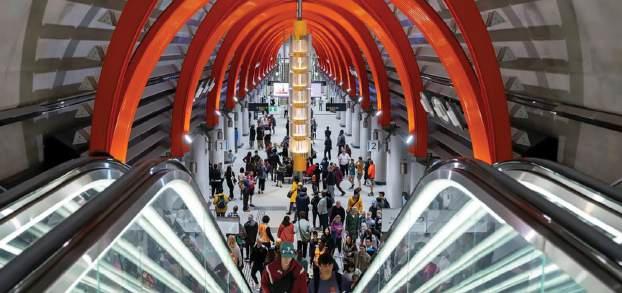
need to zig-zag across the city centre when travelling on a north-west/south-east axis. Alstom
• East Brighton to Moorabbin
• Melville Road to Batman train station
• Wattle Park to Burwood East
Infrastructure Victoria estimates that such a programme would cost AUD5.7bn (EUR3.5bn) over five years.
Chief Executive Dr Jonathan Spear said, “Our recommendations lay out how the Victorian Government can reduce the costs of providing infrastructure over the next three decades and generate over AUD166bn [EUR101bn] worth of benefits for Victorians.”
The extensions were proposed as part of Infrastructure Victoria’s Victoria’s infrastructure strategy 2025-2055, which was published last autumn. The Victorian Government, says IV, “is required to respond to the strategy recommendations within 12 months” and so we might learn more about whether the tram system could get even bigger by the end of 2026.
The current Victorian Labor Party has followed a ‘Big Build’ policy since 2014 and this shows no signs of slowing down. The most recent project to open is the Metro Tunnel, which is a heavy rail scheme,
but will be of interest to TAUT readers because the original business case involved complementary changes to the tram network.
Suburban rail services on a north-west –south-east axis have, traditionally, had to zig-zag their way across the city centre, via the main hub that is Flinders Street station. Metro Tunnel, comprising twin, 9km (5.6-mile) long bores, offers a more direct north-west – south-east route under the city whilst reducing congestion at Flinders Street and offering improved connectivity through its five new underground stations. Services are provided by 70 High Capacity Metro Trains from the Evolution Rail consortium that comprises Downer Rail, CRRC Changchun and Melbourne-based investment firm Plenary Group. These are being assembled at the former Victorian Railways Newport Works and will be maintained at new facilities at Pakenham East and Calder Park. Metro Tunnel opened on 30 November 2025, although the full timetable only came into effect on 1 February. Now, Cranbourne, Pakenham and Sunbury Line trains run through the tunnel while Frankston Line
trains use the existing surface ‘City Loop’ railway. The tunnel attracted 120 000 passengers in its first five days, but whether any of the proposed tramway alterations ever come to fruition remains to be seen.
The Suburban Rail Loop is another ‘Big Build’ project. TransitLinX Alliance won the AUD8.8bn (EUR5.1bn) contract to build the first section, the 26km (16.1-mile) Cheltenham to Box Hill line, in December.
The SRL is planned to be a 90km (56mile) long, fully-automated underground line that curves from Box Hill, to the east of the city, through the northern suburbs of Sunshine and Bundoora and via the airport, to Werribee in the west.
It’s being divided into three sections – SLR East, SLR North and SRL West. As yet, only two have completion dates: East is due to open in 2035, while North won’t open until 2053. It’s not known how much the entire project will cost to build.
A statement from the project said, “Our city and state are growing. Melbourne will be a city of nine million people by the 2050s – the size of London today. We need more transport and more homes in the right places – and Suburban Rail Loop (SRL) will deliver both.”
To help alleviate pressure from the current worldwide fuel crisis, the State of Victoria has extended its free travel zone to cover the entirety of the system (previously the free zone only applied to the city centre). This is expected to run until the end of April, and includes all metropolitcan trains, trams, buses and V/Line services.
The Suburban Rail Loop has been compared to the Sydney Metro, Australia’s biggest public transport project and one that passed a massive milestone on 2 February when Tunnel Boring Machine Jessie broke through into the site of the Hunter Street station. Hunter Street, in the heart of Sydney city centre, is the eastern terminus of the 24km (14.9-mile) Metro West line to Westmead in
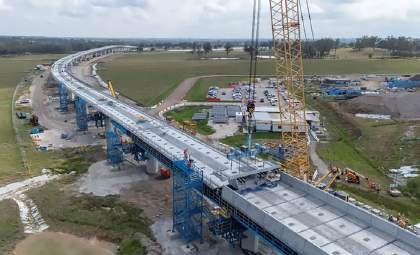
Parramatta. And while the tunnel has been dug, the line is unlikely to open before 2032.
The first phase of the Metro, the Northwest Line, between Tallawong and Chatswood, opened in 2019. In November 2025, the first train ran on the combined Northwest and City & Southwest lines from Tallawong to Bankstown, which includes a connection to L1 at Dulwich Hill. Totalling 66km (41 miles) and serving 31 stations, both lines feature large sections of existing suburban railway that have been converted to automated metro operation. The six-car Alstom Metropolis trains reached speeds of 100km/h during initial testing. However, 9000 hours of testing is required before services can start; this is due to be completed during 2026.
The final piece in the Metro jigsaw is the Western Sydney Airport line. This is an isolated, 23km (14-mile) line that’s being built from a junction on the Main Western railway at St Marys south to Bradfield, via the new Western Sydney airport.
Opening was due to coincide with the first flights to the airport (due to start in October 2026). However, in late February, Siemens had yet to ship the 12 three-car Inspiro automated trains from Germany. It’s not clear when the line could open but April 2027 has been suggested by several news outlets.
The Western Sydney Airport line is to use 25kV ac overhead catenary. As the rest of the Metro uses 1500V dc, the airport line will always be a standalone part of the network. However, future plans include an northern extension to Schofields and an interchange with the Northwest Line.
Metro West’s western terminus at
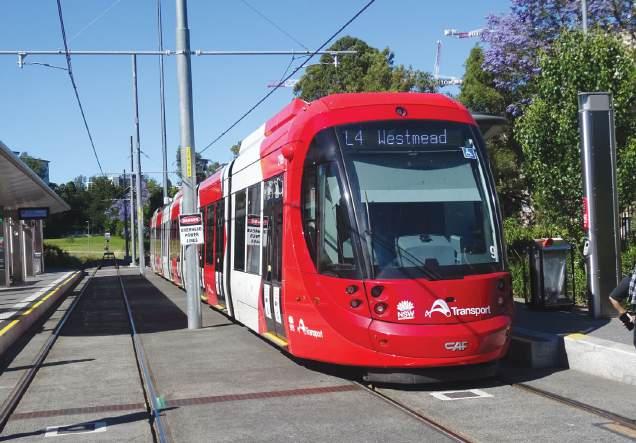
Westmead is to provide an interchange with the L4 Westmead & Carlingford Line of Sydney’s tram network. This is better known as the Parramatta Light Rail, the 12km (7.5-mile) line that connects Westmead to Carlingford via the CBD of Parramatta, about 24km (15 miles) west of Sydney’s CBD.
Phase 1 opened on 20 December 2024 (TAUT 1046) but passenger numbers on the AUD2.9bn (EUR1.7bn) project’s first year were lower than expected. The New South Wales government had estimated that 22 000 people per day would use the line but an average of 12 000 daily trips was recorded between January and November 2025.
Despite Parramatta’s status as a major suburb and commercial district, Mathew Hounsell, transport researcher at the University of Technology Sydney, told ABC News that complementary housing developments, retail spaces and hospitality restaurants were needed to help meet the government’s estimations.
“It takes time for any light rail to build patronage but [the Parramatta Light Rail] is lacking a cohesive plan around land use and events and places to go to drive patronage,” he said.
Early service reliability issues have been reported and might also be a factor in these figures.
The next phase will be L5, from Parramatta Square to Carter Street and Sydney Olympic Park. It was originally envisioned that the estimated AUD3.9bn (EUR2.4bn) project would be built in two phases, the first phase being 10km (6.2 miles), with enabling work on the new bridge over the Parramatta River
between Wentworth Point and Melrose Park, starting in 2025.
Procurement activities for Stage 2a started in January 2026. Stage 2a comprises 4.5km (2.8 miles) of line from Camellia to Wentworth Point, a new depot and additional trams. Construction is due to start in 2027 with a 2031 opening. When Stage 2b to Carter Street could open – or indeed when work could start – has yet to be confirmed.
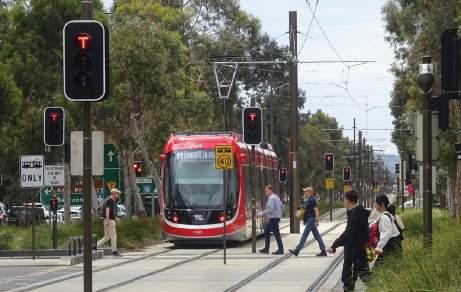
There’s another major LRT project taking place just over 300km (186 miles) south west of Parramatta and that’s Stage 2A of Canberra Metro’s extension. It’s at a more advanced stage and, at the time of writing, road closures were underway to allow for utility works and the installation of a bridge that will take the Metro across the Parkes Way dual carriageway.
When we last looked at the project, preliminary construction had started on the 1.7km (1-mile) extension but the biggest job was to use 60 000 cubic metres of fill to raise the southern end of the London Circuit, a hexagonal road around City Hill. This would replace the ‘clover leaf’ road junction with Commonwealth Avenue, built in 1963, with a flat interchange, suitable for trams.
Canberra Metro’s existing 12km (7.5mile) line between the northern suburb of Gungahlin and the city centre opened in 2019. Stage 2A takes the line south from its Alinga Street terminus, anti-clockwise around London Circuit, across Parkes Way to a terminus at Acton Waterfront by Lake Burley Griffin, also created in 1963 by damming the Molonglo River.
Returning London Circuit to its pre-1963 configuration was completed in late 2025. Stage 2A construction has continued and, as well as installing the Parkes Way bridge, tracklaying was due to start in February.
Construction of the AUD575.3m (EUR326m) project is expected to be completed in 2027; opening in 2028.
Progress of another sort was made in January 2026 when the last of five new CAF Urbos 3 trams entered service. Unlike the existing 14 Urbos 3 trams, the new vehicles have an on-board energy storage system (OBSS) for the overhead-free section of Stage 2A between Alinga Street and Commonwealth Park. Eventually, the older trams will receive the OBSS equipment.
Stage 2B is to take the Metro south from Acton Waterfront, across the lake to the suburb of Woden. That journey by car is currently about 10km (6.6 miles) but it’s not yet clear how long Stage 2B will be because its precise route has yet to be confirmed.
Initial route maps show the line crossing the lake and then swinging around Parliament House to the south-east before following key road arteries to a new public transport interchange at Woden.
The interchange was due to open in March and will, initially, provide a better interchange between local bus services. However, changes to the layout of utilities as well as laying electric conduit have been made to accept Stage 2B in due course.
The two route options around Parliament House are either to stick to the State Circuit road that literally rings the home of
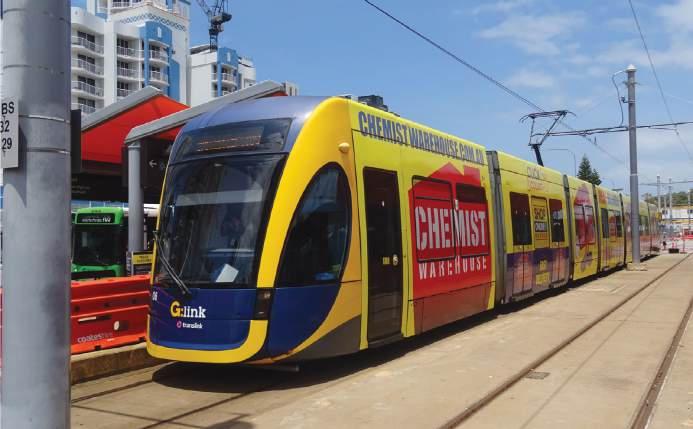
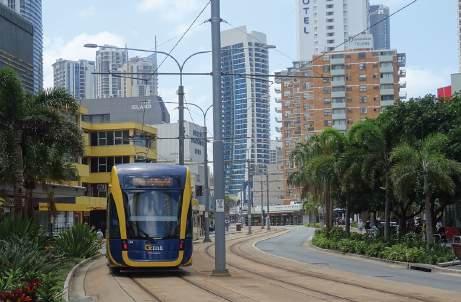
A G:Link
passes
Paradise on the
network. Stage 4 has recently been cancelled, although reinstating the project forms part of the Mayor’s 2028 re-election manifesto. The image shows the extent of the urban refurbishment of the street scene that is taking place in sync with constructing the tramway.
Ian Longworth
LEFT: Transport for New South Wales proposed 17 different extensions to the Newcastle system in 2020. This image shows where the tramway has just departed from the former railway alignment and continues east street-running on Hunter Street.
Ian Longworth
LEFT: Canberra’s major project is Stage 2A of Canberra Metro. Construction has already started for this LRT extension, which will see 1.7km added to the network. Pictured is North Bourne Avenue, with the line looking south towards the city centre.
Australia’s federal government or to loop further east, through the suburb of Barton, via King George Terrace and National Circuit.
A decision on the Business Case for Stage 2B is unlikely to be made until 2028 at the earliest. That coincides with the completion (due in late 2027) of the AUD152.2m (EUR92.5m) project to upgrade the Commonwealth Avenue bridge across the lake. The bridge comprises two parallel structures, which were built in 1963 across the lake. Stage 2B foresees building a new, tram bridge between the two.
ACT’s Minister for Transport, Chris Steel, told news outlet Region that approval of Stage 2B could also include a further southern extension, to the suburb of Mawson, where there is a large shopping centre.
“It’s unlikely there will be the same level of environmental risk with a future extension down to Mawson, and so it hasn’t been included in the [draft] Environmental Impact Statement for stage 2B,” Mr Steel said. “But it would still be considered in a business case in 2028-2029 about whether the government would want to take up the option of going down to Mawson.”
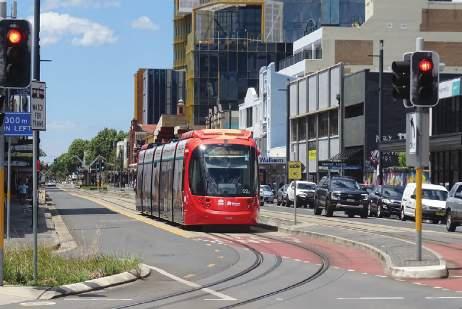
About 160km (100 miles) north of Sydney and still well within New South Wales is the city of Newcastle, situated at the mouth of the Hunter River. Its 2.7km (1.7-mile) tramway connects the eastern end of the city with Newcastle Interchange where it makes a connection with Sydney Trains’ heavy rail Central Coast & Newcastle Line. Despite its short length, services run every 7-8 minutes and it is very well used.
The first proposals to expand the system were published in 2016, three years before Newcastle Light Rail opened on 18 February 2019. Transport for New South Wales proposed 17 different extensions in 2020. However, the Newcastle Future Transit Corridor, published last spring and revised during the summer, has speculated on the Newcastle Light Rail’s future route.
This will head west from Newcastle Interchange for a short distance, shadowing the heavy rail line, before turning sharply left to reach Tudor Street, via Selma Street and Gordon Avenue. It will then turn west along Tudor Street before eventually reaching Broadwater railway station. The total length is 3.2km (2 miles) and the Department of Planning, Housing & Infrastructure is to protect the route. However, when the route might be turned into a light rail line is yet to be determined, as this isn’t in the five-year plan and hasn’t received funding.
“The Crisafulli Government made a clear commitment to listen to the Southern Gold Coast local community at the election and today that commitment has been delivered.” So said Jarrod Bleijie, Queensland’s Deputy Premier and Minister for State Development, Infrastructure and Planning in September just after Queensland’s government cancelled Stage 4 of G:link in September 2025, Gold Coast’s network.
This 13km (eight-mile) line would have taken G:link from Burleigh Heads to Coolangatta, serving the Gold Coast
airport, but rising costs – estimates ranged from AUD3.1bn (EUR1.9bn) to AUD7.6bn (EUR4.6bn) – and the current political leadership sealed its fate.
However, plans for replacement bus services have not been met with universal approval, especially as Gold Coast is set to host sporting events connected with the 2032 Olympic games, to be centred around Queensland’s capital Brisbane, in July and August 2032.
Queensland Airports’ Chief Executive Amelia Evans said in a statement, “Transport between the airport and wider city is critical to meet the demands of a rapidly-growing population.”
However, Gold Coast Mayor Tom Tate has made building Stage 4 part of his 2028 re-election manifesto. He told Gold Coast Bulletin, “I want to prove to Queensland Government that there is a mandate from the whole of the city [for] light rail Stage 4 to be recommenced.”
Controversy over Stage 4 has perhaps overshadowed development of Stage 3.
Construction of this AUD1.2bn (EUR677m) 6.7km (4.2-mile) extension started in 2022, and the first test run between Broadbeach South and Miami North took place on 12 November 2025. February 2026’s Gold Coast Light Rail Stage 3 newsletter said, “Stage 3 [is to] transition into testing and commissioning in [the] coming months, moving the project steadily towards delivering passengers services across the extended network in mid-2026.”
Landscaping, said the newsletter, between Cedar Court and Deodar Drive was “about to get underway” while “finishing works [including] final line marking… installation of handrails at pedestrian crossings” are due to be finished this May.
Australia’s most populated region is along the south and east coasts, stretching from Adelaide in the south all the way around to Brisbane. It’s arguably easy, therefore, to forget about Perth, the capital of Western Australia.
Sitting in the south-western corner of the 2.5 million km 2 (9.7 million square miles) state, the opening of Midland station on 22 February marked the end of a 13-year, AUD15bn (EUR9.1bn) project to transform
commuter rail services around the city. Despite being 1067mm gauge, the project, dubbed METRONET, is technically heavy rail. Since the new line to the Airport opened in October 2022 some 72km (45 miles) of new railway and 23 stations have been added. The Ellenbrook line opened on 8 December 2024, and the penultimate station is on the eastern edge of Whiteman Park which has many transport attractions within this leisure facility. In order to link the station with the various activities the tramway operated by the Perth Electric Tramway Society has had a branch added to the railway station. Built with a grant of AUD1m (EUR600 000) and using 85% recycled materials, this 1.3km (0.8-mile) line is now served every 45 minutes. For the first year travel was also free.
Working with Alstom, a new manufacturing facility (the Bellevue Railcar Manufacturing and Maintenance Facility) has also been set up to build 246 C-series EMU cars.
Perth has also commissioned urban design specialists Gehl to produce a masterplan to take Perth through the next decade. A key feature of Towards 2036 and Beyond is that “streets are reclaimed for pedestrians and cyclists with a coherent public transport network given priority”.
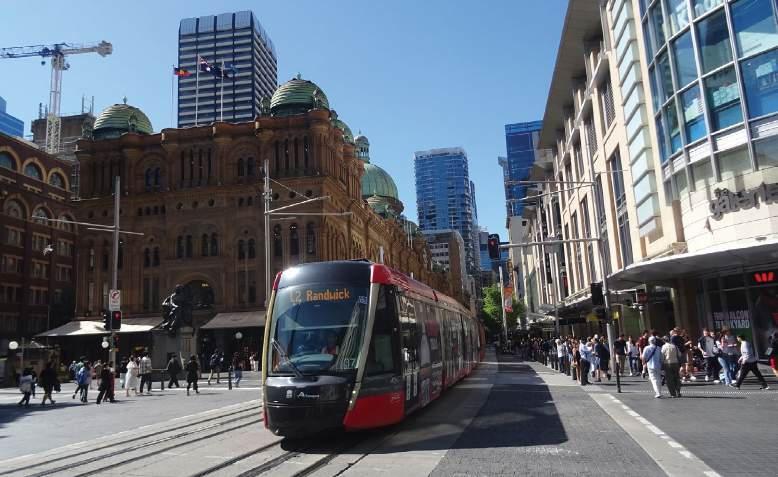
Gehl has used Sydney’s George Street as its inspiration, which was once its most congested thoroughfare and is now “a 2.5km [1.6-mile] pedestrian-friendly boulevard served by light rail”. Therefore, it has proposed an east-west mass transit spine across Perth’s city centre, using Wellington Street or St Georges Terrace, which would also simplify the city’s bus network.
However, don’t expect trams to be taking to the city’s streets anytime soon. Firstly, because light rail is in contention alongside Bus Rapid Transit and secondly, this has been added to the ‘Beyond 2036’ category.
There are some familiar stories emerging from Australia: the debate between buses versus trams; LRT being a long-term aspiration; spiralling costs leading to project cancellations. But what’s encouraging is the amount of construction that’s on-going, what’s in the pipeline and what has recently been completed. It will be interesting to see what changes in another 18 months!
LRSSB has set its sights on new technology to develop practical advances that will help to enhance tramway safety.
Discovering effective applications for new and emerging technologies will be vital to further reducing the risk of accidents on UK tramways, and the Light Rail Safety and Standards Board is playing a key role in ensuring the sector makes the most of them.
The organisation has set aside over GBP500 000 (EUR578 650) over the next couple of years to help fund a range of diverse research projects involving partnerships with network operators, academics and the light rail supply chain.
Over the next 12 months, the LRSSB aims to build on the success of previous trials that have embraced artificial intelligence (AI), virtual reality (VR) and obstacle avoidance systems to deliver practical advances in tramway safety.
Craig O’Brien, Head of Engineering Safety and Innovation at the LRSSB, explained: “As an organisation, we’ve already established ourselves as a focal point of efforts to find innovative solutions to the safety challenges faced by the sector.
“We now aim to take this vital work to the next level by building a portfolio of projects that aim to look at new ways to address the
most pressing hazards to tramway safety, as identified by our safety risk modelling.
“These include collisions with pedestrians and other road users, as well as the growing threats to cybersecurity and more persistent issues such as anti-social behaviour.”
There are already plenty of examples of how the LRSSB’s partnership approach is putting the UK at the forefront of research in new technologies, not least in the field of AI. The benefits of AI have already been demonstrated in the advanced driver training simulators used by most tramway operators that have been updated with funding from the organisation.
Another groundbreaking project has embraced the technology to improve safety at tramway crossings, and has since been given the green light to advance to the next stage of development.
The partnership between the LRSSB and a data specialist company saw the installation of advanced monitoring cameras at key locations on several tram networks.
In the months since, they have been utilised to observe and analyse the behaviour of pedestrians at Non-Motorised User
(NMU) crossings, providing critical insights into how they are used while identifying potential risks and opportunities for safety improvements.
Understanding user behaviour at this type of crossing will help develop data-driven strategies to reduce risks and ensure safe interactions between light rail vehicles and pedestrians.
Although the locations of the cameras were not disclosed, as this would risk influencing the behaviour of people using the crossings, their use has had no additional impact on privacy, as all the crossings are routinely monitored for safety purposes.
Craig also said that the findings will contribute to a broader discussion on NMU safety, which has also been the subject of other research projects backed by the LRSSB.
As well as using AI to reduce the risks of collisions at crossings, the LRSSB has been supporting research into more traditional, engineering-based solutions.
The ‘Safer Tram Crossings’ initiative has seen the development of a new alert system by Efficiency Ups, following ‘proof of concept’ tests by the company in Sheffield last year.
Exploring the potential of track vibrations to alert pedestrians of approaching trams,
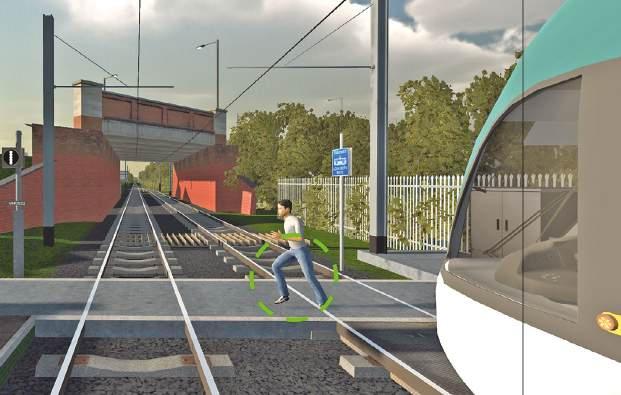
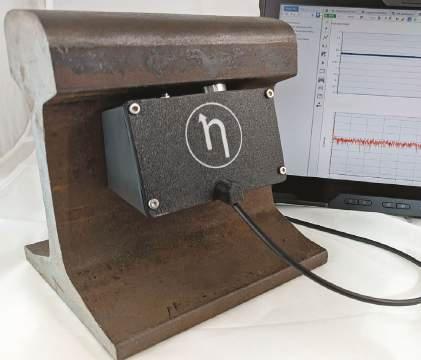
it is set to deliver a major boost for light rail safety as trials are stepped up on networks across the UK.
Now the research is being taken to the next level with further trials planned, and University of Birmingham Enterprise is accelerating the development of prototype equipment.
In addition to providing funding for the project, the LRSSB has helped to support and guide the research and testing of the system, which is capable of providing a 30-second warning of an approaching tram at crossings.
“Early tests demonstrated the potential of the VibeSafe to do just that, and we’re fully behind this latest phase of its development.”
The initial trials provided promising results, showing that the VibeSafe technology is not only highly reliable but also able to operate independently of other safety systems, a critical factor in its potential for widespread implementation. Engineers found that the system delivered consistent warnings at key crossing points and demonstrated long-term viability as a cost-effective safety solution.
“While the principle of using track vibrations as a trigger for warnings has now been established, this next stage of the
The LRSSB’s partnership approach is helping to put the UK at the forefront of research in new technologies, including into the field of AI. The benefits of AI have already been demonstrated in the advanced driver training simulators used by most tramway operators, such as that pictured.
project will focus on determining the most effective way to implement the device and alert people of an approaching tram, be it through audio alarms, visual signals, or a combination of both”, Craig said.
Jason Molyneux, Managing Director at Efficiency Ups, added: “It is fantastic to see that the light rail sector is investing in innovative technology that improves public safety, enabling people to make safe decisions about their use.
“We are absolutely thrilled to be part of this journey and are determined to develop the technology to meet the needs of the sector and the end user – the public.”
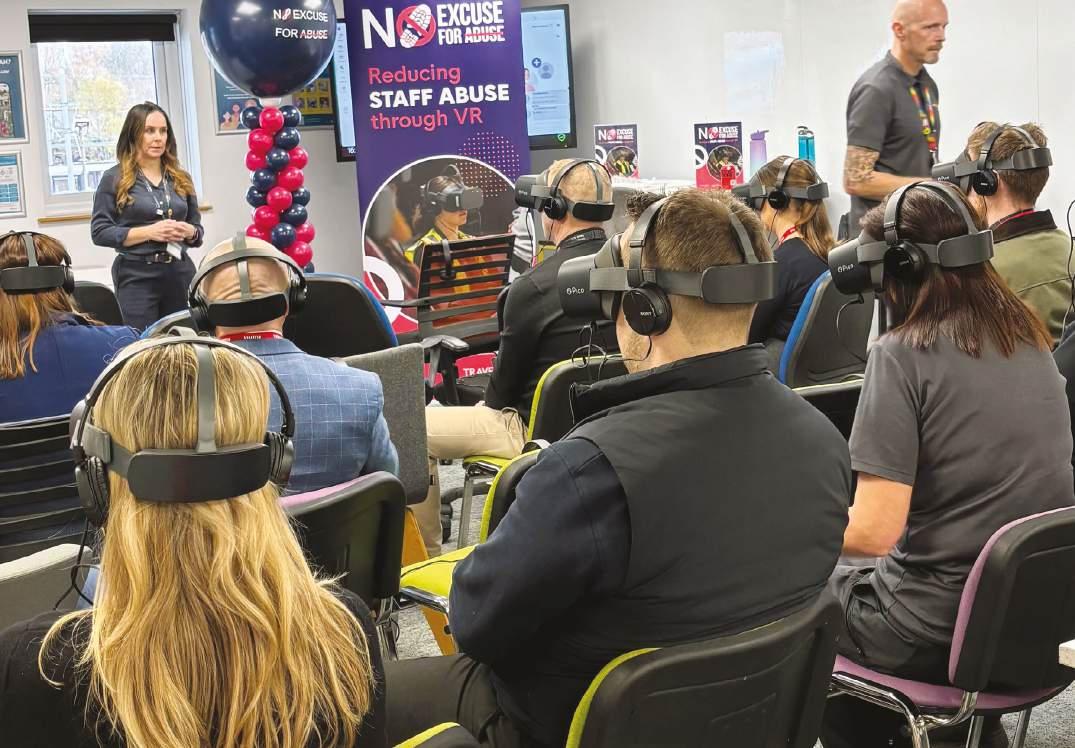
VR is another area the LRSSB is keen to explore, and the technology has been the subject of a more recent collaboration. Earlier this year, it joined forces with the operator of Manchester Metrolink on an initiative aimed at tackling verbal and physical assaults on tramway employees.
Funded by the LRSSB and KeolisAmey Metrolink, the pioneering project uses stateof-the-art digital technology to illustrate the impact of unacceptable behaviour.
VR headsets have already been deployed in local schools as part of the Bee Network’s TravelSafe Partnership Education and Engagement Programme, with the backing
of the organisation responsible for driving tramway safety standards.
Craig set out the thinking behind the collaboration: “Both physical and verbal assaults can have a profound impact on people who are just going about doing their own work, and such incidents can also be distressing for witnesses to the incident.
“New software for the headsets enables users to experience simulated assaults through the eyes of the victim and people who may be passing by, raising awareness of the issue and hopefully making some people think twice before engaging in criminal or anti-social behaviour.”
So far, more than 600 youngsters aged from 13-14 years’ old have used the hi-tech headsets to view a short film, entitled No Excuse for Abuse, which was launched in early December.
Within weeks, the initiative started to deliver impressive results, and a recent survey found that 94% of respondents said the film has changed their perception of transport staff, and 90% said they are more likely to show greater respect for them. Of those questioned, 79% also said they have a better understanding of the impact ASB has on transport staff, and 85% now understand the consequences of having a criminal record if they are abusive to staff.
The GBP60 000 (EUR69 000) project builds on a similar initiative in Greater Manchester, called ‘A Victimless Crime’, that also used VR to highlight the dangers of throwing objects at trains, trams and buses.
Louise Barry, Head of Customers and Growth at KeolisAmey Metrolink, commented: “Unfortunately, our front-line staff are routinely subjected to the threat of violence and intimidation simply for carrying out their role.
“The safety and well-being of our colleagues is crucial, but it is vital that we protect our staff, as without them, we can’t look after our customers.
“Whilst adults do commit assaults against our staff, young people are also offenders, and early education is crucial. The VR film aimed at preventing projectiles [being] thrown at vehicles has already generated empathy and changed behaviours, mitigating future criminal activities, and it’s clear this latest project is having a similar impact.”
Following the success of the project in Manchester, the LRSSB is now working with the developers of the VR software to find new safety-related applications for use by other UK operators. This involves the LRSSB purchasing VR headsets along with the software and video content to recreate hazardous scenarios, so that users can experience these scenarios safely.
As with all research and development sponsored by the LRSSB, decisions on future investment will be closely tied to analysis of data collected by the organisation’s advanced Tramway Accident and Incident Reporting (TAIR) system and the risk models it helps to shape.
“The result of any studies we support is carefully evaluated to ensure it makes a real contribution to our key aim of reducing the risk of accidents and other hazardous events to as low as practically possible,” Craig added.
LRTA Council Member Keith Whitmore reviews the Heaton Park Tramway – which contains the only surviving track from the original Manchester network.
Heaton Park Tramway (UK) can trace its history back to the 1970s, when the preservation of Manchester Tram 765 was secured, returning to Manchester after a number of years running at Crich.
The first real occasion when the tram was on display to the public was in 1973, when Manchester City Council organised a huge festival to celebrate all that the city had to offer. This festival took place over a threeweek period, and without doubt the highlight of the event was the first-ever public opening of the original Coronation Street and events at Granada Studios, which attracted thousands. A notable Festival of Transport, under the theme ‘Buzz around Manchester’, took place at Manchester Docks. The tram was on display to the delight of many, alongside steam locomotives that had worked the docks and a locomotive from the Dinting Railway Centre near Glossop, which gave footplate rides.
Planning was then set in motion to find the tram a permanent home. After much discussion, it was agreed that it would move to Heaton Park in North Manchester, and it was moved into the former Heaton Park Tramway shelter at Middleton Road. This was from where, in operational days, trams would enter the park through the gates to turn at the shelter and return to central Manchester.
The official opening of the tramway took place in the park on 28 March 1980. It was unique in preservation, as it was the only tramway which operated on original track operational during the heyday of tramways. The short length from the park entrance to the shelter, by now converted into a tram depot, was the limit of operation for many years, until an extension was built to almost reach the Lakeside in the Park and then to the lake itself. At the same time, a collection of trams was being assembled and moved to the park, including iconic vehicles such as Stockport 5, built in 1901; Hull 96, also 1901-built; a 1937 Blackpool Brush; and Manchester 173, another 1901-built tram. The society also owns Manchester 53, a unique Eades-patent reversible horse tram which is displayed at the Museum of Transport in Cheetham, Manchester.
The almost exponential growth of the collection led to a decision to build additional accommodation for it, and a new second depot was built near the lakeside, which opened in 2013. It is still an aspiration to further extend this depot to accommodate
more trams, and provide an archive and shop for the tramway as well. This was built with generous support from the Viridor Company.
The tramway has not been without its problems over the years, and members were devastated to find that in the early hours of 24 September 2019 the overhead wiring had been stolen, forcing the line to close. The public response was amazing: within hours a GoFundMe campaign was established and over GBP4000 (around EUR4500) was was raised to aid in repairs. Transport for Greater Manchester (TfGM) and KeolisAmey Metrolink also came to the rescue, providing both labour and materials for the repairs, and the tramway was able to reopen just a month later.
More recently, the tramway needed to be closed again due to faulty electrics in the substation, needing urgent repairs and a safety overhaul. Manchester City Council has really risen to the occasion and, in a time of financial cutbacks, has committed to spend GBP481 000 (EUR550 000) on repairs, including replacing the transformer and switchgear. With work scheduled to start this summer, hopefully the tramway can be operational in this special season, marking 125 years of electric tramways, which started in Manchester.
The tramway has had its place in history: notably in 1908, the suffragette Emmeline Pankhurst addressed a major women’s social and political rally of around 50 000 people, and a picture was taken of her obstructing a tram in the park, symbolising the ‘Deeds not Words’ campaign. A re-enactment of this event took place in the park on the very spot on the tramway where the demonstration was held.
As the second tramway in Manchester, Heaton Park enjoys a special relationship with TfGM and Metrolink. One of the original 1992 T68 trams is preserved and stored in the Metrolink Trafford depot. Eventually it is hoped that the tram will move to the park to be operational on a new extension from Bury Old Road, when it should be possible to cross the road from Heaton Park Metrolink stop and hop from an M5000 and onto a T68 to the lakeside; then ride on a first-generation tram to Middleton Road.
Before all that, we are looking forward to being able to operate and ride on the tramway again after a more than 18-month gap following the condemning of the substation.
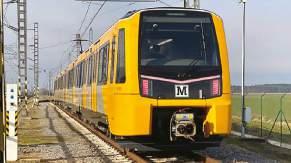
Details of the next LRTA members’ day visit have just been announced: it is to the NEXUS system in England’s North East. Members previously visited NEXUS a couple of years ago to see the mock-up of the new vehicles and hear details of the new depot.
Now that the Stadler trains are in service and the new depot is open, we thought it would be a good opportunity to visit the system. Plans have also been announced to extend the system to Washington.
The visit will take place in the second week of July. From Newcastle railway station, members will be taken by coach to the Gosforth depot where they will be given a tour and a briefing on the Washington extension. After that, they will be provided with tickets to ride the system and the new Stadler units, before making their own way home.
Details and booking (places are limited) can be found on the LRTA website at: www.lrta.org.
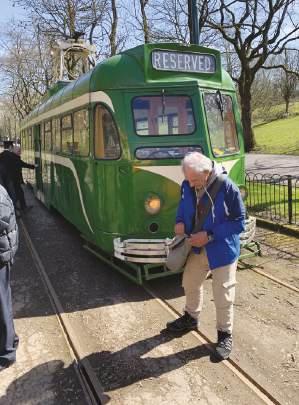
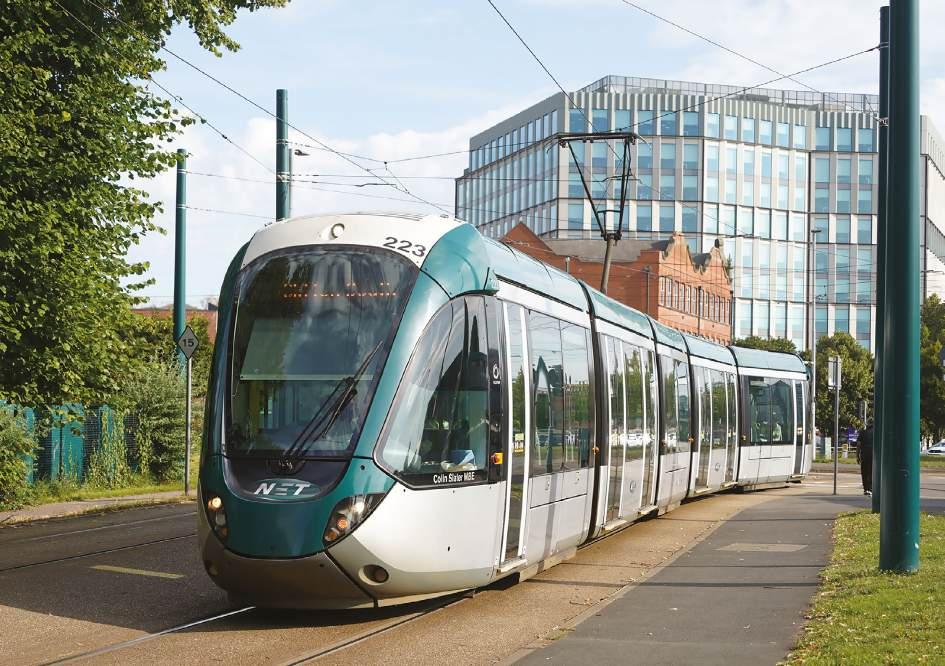
LRTA Chair Paul Rowen discusses the implications of the UK government’s announcement on new towns, and how two reports by Create Streets may provide the solution to Britain’s lack of new tram schemes.
The UK government has a vision to build 300 000 new homes a year. It’s something that has been shared by successive Labour, Conservative and Coalition governments. However, not since the 1950s has the figure been reached.
As part of a plan to achieve this, the UK government has announced a consultation on seven areas where new towns could be built. The aim is that at least three will be commenced during this parliament. The seven areas are:
• Tempsford – in the Oxford to Cambridge Growth Corridor
• Crews Hill and Chase Bank in Enfield
• Leeds South Park
• Thamesmead, Greenwich
• Manchester Victoria North
• Brabazon South Gloucestershire
A quote from the UK official written statement reads: “These have the potential to provide hundreds of thousands of new homes in the decades ahead and... will be well connected, well designed, sustainable and attractive places... With all the infrastructure, amenities and services [required].”
Of the seven, two (Tempsford and Thamesmead) have rail or light rail schemes planned. Two others (Manchester Victoria and Leeds South Bank) have light rail
“France has consistently built 300 000 new homes each year... every city with a population greater than 150 000 has light rail. ”
schemes existing or planned; and Milton Keynes mentions the need to develop “a locally-appropriate solution” – perhaps a nod to the mistakes of the car-focused metropolis of the 1960s.
The Create Streets Reports: A way forward?
France, which has a similar population to the UK, has consistently built 300 000 new homes each year, and every city or town with
a population greater than 150 000 has a light rail and/or metro system. Like the UK, France pulled up most of its first-generation systems, but quickly learned the error of these ways. The country now boasts 21 light rail systems, compared to the seven systems currently operating in the UK.
Create Streets is a design practice, townbuilder and think tank based in Leeds. It has previously produced two research reports: How to Build New Trams in the UK and Get Britain Moving and Towns and Trams. The first report was published in 2024 and the second in March this year. For supporters of light rail, their analysis and conclusions are nothing new. What is novel is the manner in which they have sought to influence the politicians and decisionmakers.
The advantages trams bring to town planning include:
• Lower emissions by encouraging motorists to switch to public transport.
• Reliable and predictable service patterns, bringing a rapid transport system to towns and cities thereby enabling people to get to jobs and thus increasing the size of the labour market.
“We’ll do it... the question is the scale... weneed devolution, regulation fixes and institutional drive.”
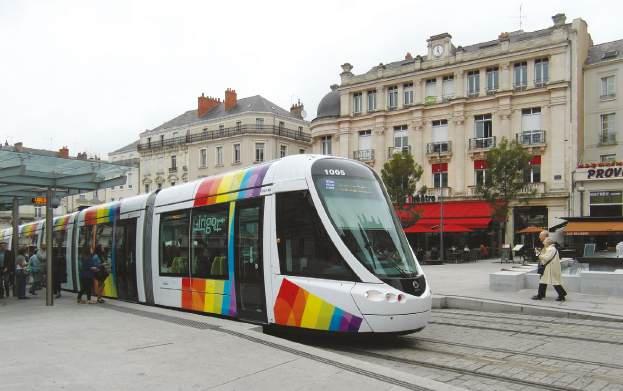
Predictably, they also make the following points about building tramways in the UK:
• A tramway in the UK costs double the European average.
• The planning and regulatory framework in the UK adds considerable time and costs to the process.
• The UK’s centralised decision-making
Mainz, Germany – Mainzelbahn extension
Tampere, Finland – Tampere tramway
Portland, USA – 1st phase Portland streetcar Cadiz, Spain – Cadiz Line 1
Besançon, France – Besançon tramline 1 Palermo, Italy – Palermo trams
Bergen, Norway – Phase 1 Bergen Light Rail
Dijon, France – Dijon Tramway
Nottingham, UK – Phase 1 NET
Utsunomiya, Japan – Utsunomiya Tram
Lund, Sweden – Lund Tramline
Manchester, UK – Metrolink to the airport
Nottingham, UK – Phase 2 NET
Edinburgh, UK – Extension to Newhaven
Birmingham, UK – Wednesbury to Brierley Hill
Dublin, Ireland – Luas Cross City
Manchester, UK – Trafford Park Lane
Edinburgh, UK – Edinburgh tram 1st phase Birmingham, UK – Westside estension
Birmingham, UK – Eastside extension
Sydney, Australia – CBD and South East Tram
Manchester, UK – Second City Crossing
means decisions are further from the people most likely to make cost-effective and appropriate decisions.
Create Street’s recent report, Towns and Trams – Learning from the French, involved taking five policymakers with direct responsibility for housing, transport and planning to visit three French locations
Source: Britain Remade
Cost per mile of tramline adjusted for inflation in GBPm (GBP1 = EUR1.15 @ 30.03.26)
where tramways have been used to unlock development: the Panorama District in Clamart and the long-term transformation of Le Plessis-Robinson (both in the southern suburbs of Paris and through which runs line T10); and the Capucins development zone in Angers, where tram route A runs.
Participants were interviewed before and after the visit under Chatham House rules with the aim of showing how exposure to real places can shape views on what might be possible in the UK. Their responses make interesting reading:
“A strong figurehead to push through the bureaucracy… the strength of the vision and the hands-on nature of the mayor.”
“Hypothecated taxation enabling borrowing… strength and simplicity.”
“We’ll do it… the question is the scale... we need devolution, regulation fixes and institutional drive.”
“I’m increasingly confident of its success and potential success in Britain.”
Conclusion: The LRTA response
The LRTA welcomes the work of Create Streets and the recent statement by Alistair Graham, CEO of Keolis. Prior to the General Election we committed to supporting local peoples’ demand for light rail schemes with a central government pipeline of at least five schemes this parliament.
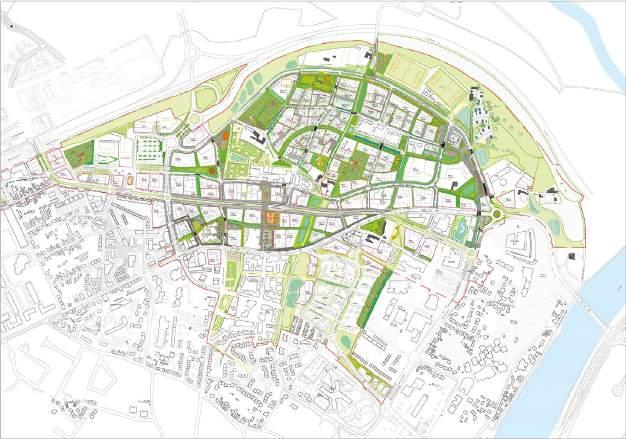
We have strengthened our ties with the Campaign for Better Transport and will be working closely with Create Streets. This includes our conference on Trams for Derby, and a future event in Manchester with the CBT during Better Transport Week.
It is clear that if the government is to meet its house-building target, increase growth in our regions and improve productivity, then light rail must be part of the local transport mix.
For more information, please visit: www.createstreets.com/front-page-2/ urban-planning-research-uk/
TOP LEFT: The cost per mile (1.6km) of selected tramlines in the UK. Britain
BOTTOM LEFT: Five policy makers from the UK visited three French cities where tramways have bene used to unlock development: the Capucins development zone in Angers was one of these sites. Could future town and city development in the UK be influenced by developments such as this? BASE
This year the Annual General Meeting of the LRTA will take place on Sunday 20 September in Norrköping, Sweden. It is being organised in conjunction with an Ian Longworth tour.
As always, members can join the AGM via Zoom if preferred.
For those attending in person, we are organising a tour to give members an opportunity to ride the light rail systems and visit tram museums. The package covers our stay in Sweden, to which flights can be added from various airports. Alternatively you can book your own flights. The full programme is as follows:
Thursday 17 - Friday 18 September: Arrival in Stockholm with free time to explore the extensive system. The modern tram route 7 departs the Central Station for the Island of Djurgårds, and the 7N is a shorter-version operated by museum cars.
The historic interurbans have been modernised, but some keep a few tramway features: Line 21, Lidingöbanan (Line 21) in the north east departing from Ropsten, and Line 12, Nockebybanan in the south east. This departs from Alvik where it also meets the new circular Tvärbanan light rail lines (30 and 31).
The Saltsjöbananis standard-gauge departs from Slussen to the east, and the Roslagsbanan is a 891mm-gauge interurban in the north.
We will stay at the hotel Elite Hotel Arcadia (4*) for two nights, with dinner included on the first evening.
Saturday 19 September: Leave at 09.30 for the Swedish Tramway Museum at Malmköping, a distance of 106km (66 miles). Admission is included for this special opening.
At 15.00 we will move onto Norrköping, where we will stay for three nights at the Elite Grand Hotel (4*). Dinner is included on the first evening.
Sunday 20 September: The LRTA AGM
will take place in the afternoon, followed by dinner in the evening (included).
Monday 21 September: Free day in Norrköping. We will be seeking to arrange a visit to the tram museum and a tour.
Tuesday 22 September: Returning to the airport by train for the journey home.
The length of this trip can be adjusted for individual requirements. The basic package is a guide to what can be included. Full details and a booking form can be found on the LRTA website at www.lrta.org/agm-2026/
To reserve a place on this tour, please return your completed booking form. This can now be completed electronically (including signature) or printed out. The completed form can then be sent to Ian Longworth: ianjlongworth@lrta.org
Alternatively, booking forms can be posted to Ian at 10 Piccadilly Court, Queens Promenade, Douglas, Isle of Man, IM2 4NS.
The cost is GBP650 per person, with single rooms available at a supplement of GBP285 (with a requirement for deposit of GBP300).
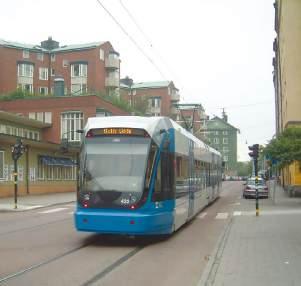
ABOVE: A Stockholm Bombardier Flexity Swift 422. A class A32, partially low-floor tram from 2002.
BELOW: Pictured at the Swedish Tram Museum, to the left is the rear of ‘Mustang’ 500, built as a class A27 for Stockholm in 1952 by Hägglund. Helsingborg 39, an E class tram built by ASEA in 1928 is on the right. Both images courtesy of Ian Longworth
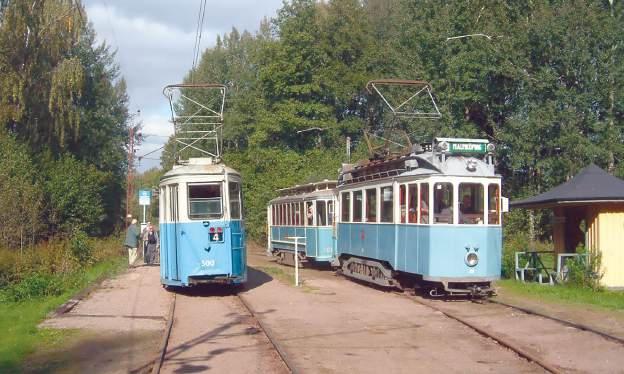
Tuesday 2. Southampton 19.30. Members’ digital images. Junction Church, Eastleigh, SO50 9FE. Contact: southern@lrta.org GBP3. (LRTA/SEG)
Thursday 4. Brentford 14.30. Bob Hodges films.London Museum of Water and Steam, TW8 0EN.
Contact: thamesvalley@tlrs.info GBP5 inc. refreshments. (TLRS) Monday 8. Leeds 19.30. David Farrar Buses Galore. The Engine House, Leeds LS10 2JG. GBP1 (inc. light refreshments). Contact: enquiries@lths.co.uk. (LRTA/LTHS) Wednesday 10. Sussex 19.40. Keith Carter: Trams, tramways &
trolleybuses on film. Southwick Community Centre, BN42 4TE. Contact: sussex@tlrs.info GBP2. (TLRS) Saturday 13. Cumbernauld 13.00. Scottish Area Group show and tell. Cumbernauld Theatre, G67 2UF. Contact: scotland@tlrs.info. (TLRS) Friday 19. Solent 10.00. Martin Petch and Paul Coles:
The Southampton tram project restorations. Community Kettle CIC, PO6 2PS. Contact: solent@tlrs.info. GBP3. (TLRS) Saturday 27. Arnside 14.00. Jon Allens Garden Tramway, 1/16 scale. Contact: northlancs@tlrs.info. (TLRS) Saturday 27. Visit to West Midlands Metro. Contact: eastmidlands@tlrs. info. (TLRS)
What if delivering a new rail connection didn’t take decades or cost hundreds of millions? What if it could be introduced quickly, affordably, and designed around the everyday journeys people actually make?
The Dudley Dasher is a practical answer to that question. Built on the success of the Stourbridge Shuttle - the UK’s only operational VLR system – the proposal aims to extend this model beyond its current 1.3km (0.8-mile) branch line, creating a wider network between Stourbridge and Brierley Hill.
Using lightweight vehicles, existing rail alignments, and a simplified infrastructure approach, VLR offers a faster, lower-cost alternative to traditional rail without compromising on reliability or accessibility.
But the Dasher is more than a transport scheme. It is a community-first corridor, designed to connect people with the places that matter most: jobs, healthcare, education, and leisure. The route prioritises accessibility, frequency, and convenience - making it a realistic and attractive option for travel.
At its western end, Stourbridge stands as a vital local hub with a mix of independent shops, cafés, and essential services.
Strengthening connections in Stourbridge would make it even more accessible, encouraging increased footfall and supporting local businesses. For residents, this means easier access to shopping, services, and leisure - without relying on a car.
Moving along the corridor, the proposed Brettell Lane stop highlights the route’s ability to support employment and local enterprises. With up to 40 businesses located within a short walking distance, this area represents a thriving commercial cluster.
Improved public transport connectivity would help link employees to jobs while also increasing customer access, reinforcing the strength of the local industry.
Access to healthcare is another key priority. The Vicarage Road stop would provide convenient links to essential services, including the Corbett Outpatient Centre and Stourbridge Health and Social Care Centre, both within easy walking distance. With additional GP practices along the route and Russells Hall Hospital located near the eastern end, the corridor would offer a reliable transport option, helping to ensure that healthcare is accessible to all.
In Brierley Hill, recent investment in the High Street has created a more attractive and pedestrian-friendly town centre. The proposed Moor Street stop would build on this regeneration by bringing passengers directly into the heart of the area. Increased accessibility means more visitors, and a more vibrant centre that can continue to evolve.
The final Canal Street stop would serve the Waterfront, and connect with the West Midland Metro extension. By connecting workers, residents, and visitors to this Canalside hub, the route would support both economic activity and social life.
The route also connects a wide range of leisure opportunities. From fitness facilities such as David Lloyd Dudley and local sports clubs to education, with several schools also in proximity to the route.
Together, these elements highlight the wide-ranging role that VLR can play along this corridor. By connecting homes, jobs, healthcare, education, and leisure, the Dasher route offers a smarter, more sustainable way to support everyday life.
It’s not just about getting from A to B - it’s about bringing communities closer together.

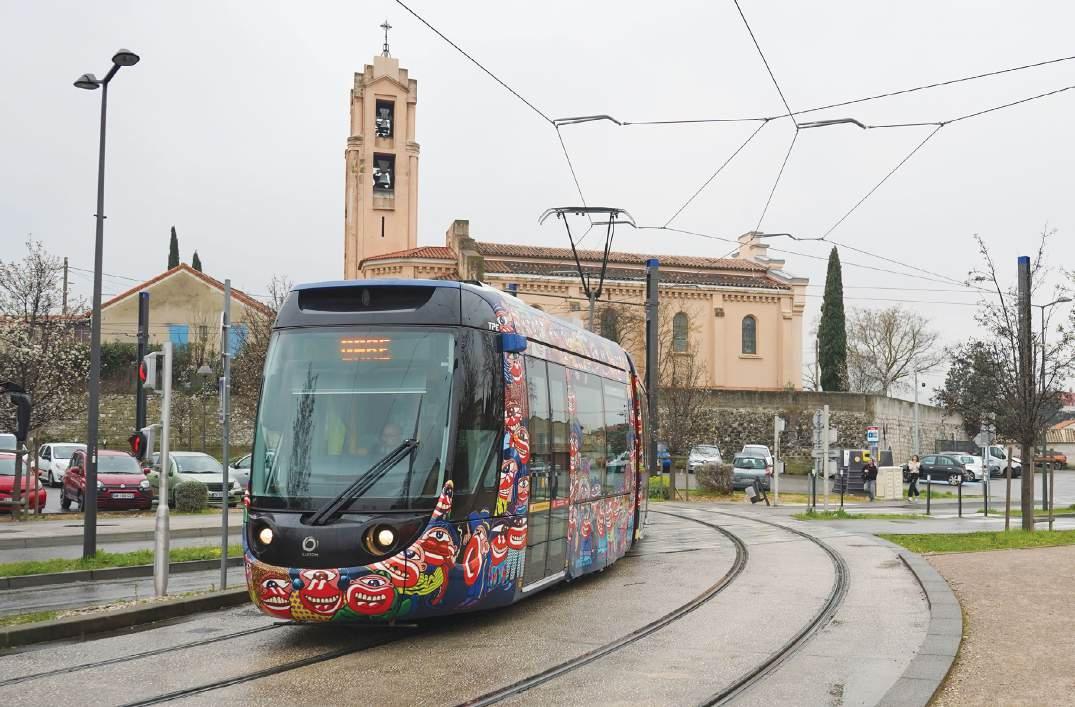
Adding just under 12km to its length along abandoned rail tracks will mean that France’s shortest tramway will lose that distinction this year. Andrew Thompson reports.
Located 15km (nine miles) east of the Mediterranean metropolis of Marseille, the quaint city of Aubagne has a population of just under 50 000 and for the past few years has had the distinction of featuring the shortest second-generation tramway in France. With a length of just 2.7km (1.7 miles) and having seven stops in total, the single ‘T’ line opened on 1 September 2014, connecting the railway station with small commercial zones and a residential district at the southwestern terminus Le Charrel. There is a compact fleet of eight Alstom Citadis 205 trams, although three are sufficient to run services. A further four vehicles are on order for delivery in summer 2026. The fleet is housed and maintained at the lone shed, located at Piscine, two stops from the terminus.
As with so many of France’s other municipalities, Aubagne previously featured a first-generation tramway in the early 20th Century, and the overland lines from SaintMarcel and Saint-Pierre to Aubagne formed
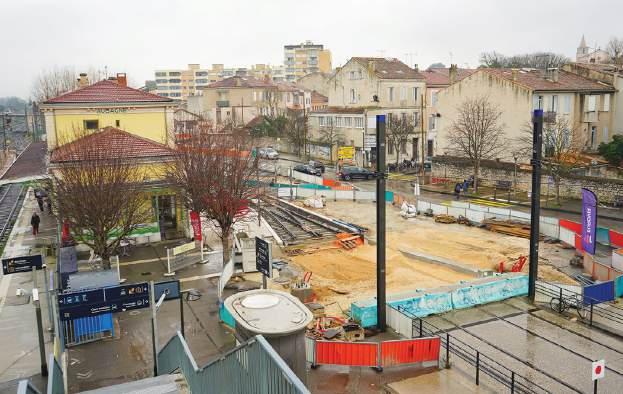
LEFT: Framed by the Église Saint-Jean-MarieVianney, an Alstom Citadis Compact LRV arrives at Piscine. This is one of seven stops along the short T line, until the launch of the Val'Tram extension later this year.
part of the eastern end of the once-sprawling Marseille interurban network. After some of those transport links were switched to bus service beginning in 1950, the last overland trams ran in 1958.
Following the success of other modern French light rail systems, planning for a new tramway in Aubagne commenced in 2006, with contracts for new vehicles being placed in 2011 and construction work starting in 2013.
The first short section was always seen as just the first phase of a larger system, but iterations and plans for phases 2 and 3 changed over time and were finally scrapped. A paradox of phase 1 is that it has not served the city centre since its inauguration, as that lies just east of the railway station.
Plans for a new line, Val’Tram, were finalised in 2017 with construction work starting in 2023. This will create a northern extension to the Aubagne line, which will lead through the inland Huveaune Valley further north and not only link up the city centre of Aubagne, but also connect the neighbouring communes of Roquevaire, Auriol and La Destrousse before terminating in the town of La Bouilladisse.
While the engineering works have required more complex interventions in the centre of Aubagne, including partial demolition of the railway station building and the construction of a purpose-built tram bridge over the River Huveaune, for most of the new 14.5km (nine-mile) route, the old Valdonne railway has been used.
The former Aubagne to Fuveau – La Barque standard-gauge railway was originally built
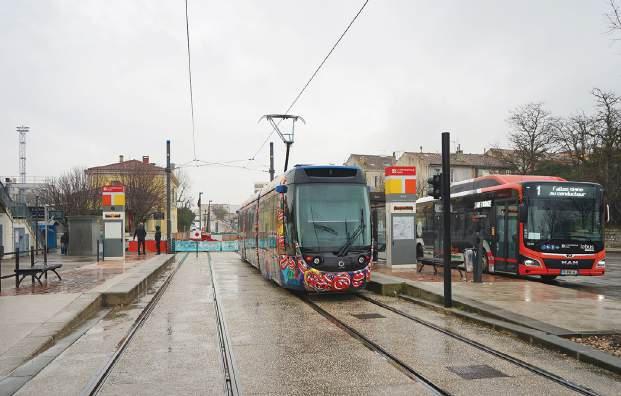
The first short section was always seen as just the first phase of a larger system. ”
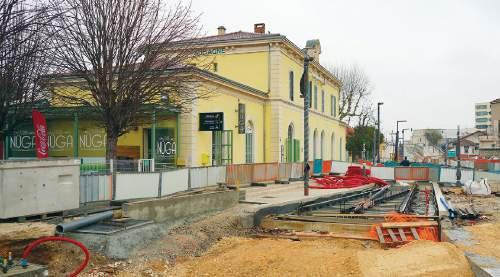
by the private Compagnie des chemins de fer de Paris à Lyon et à la Méditerranée (PLM) and first opened in 1868. It closed in stages between 1964-72, but the route was protected for potential repurposing. Aubagne’s short urban T line will thus be transformed into an actual overland tram-train service.
From the 11 new stops of the Val’Tram extension, five will feature park-and-ride facilities to encourage modal shift. The regional authorities project that the new investment to the tune of EUR136 million
will help to alleviate congestion and take cars off the narrow roads. They project initial ridership figures of 16 000 - 18 000 daily passengers. The headway will be a tram service every ten minutes. The current fleet of eight Alstom Citadis will be complemented by four more LRVs from the same supplier.
Opening of the new Val’Tram route is expected by June, as the commissioning phase has been underway for most of early 2026, with the first trial runs having already taken place in December 2025.


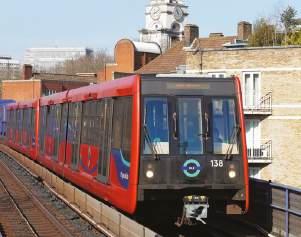
Neil Pulling looks at how London's DLR DLR – a system much changed from its rudimentary beginnings – has been central to urban renewal on a grand scale.
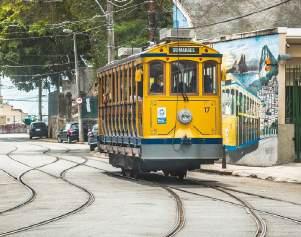
Richard Foster looks at the progress cities across South America have been making with their light rail projects in recent years, and asks: what next?
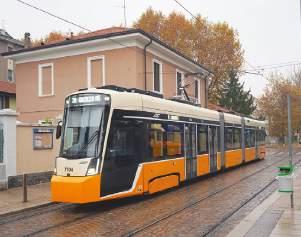
Fresh from hosting the 2026 Olympic Winter Games, Milan has gained from significant public transport investment, as Andrew Thompson reports.
+ Berlin: Rapid growth for LRT
+ Classics: Stockel, Bruxelles: 100 years of public transport
+ The latest news and analysis, system and technical development

Despite its proximity to Berlin, Potsdam is distinctive in its own right. The evolution of Potsdam’s tramway is closely linked to the city’s eventful history.
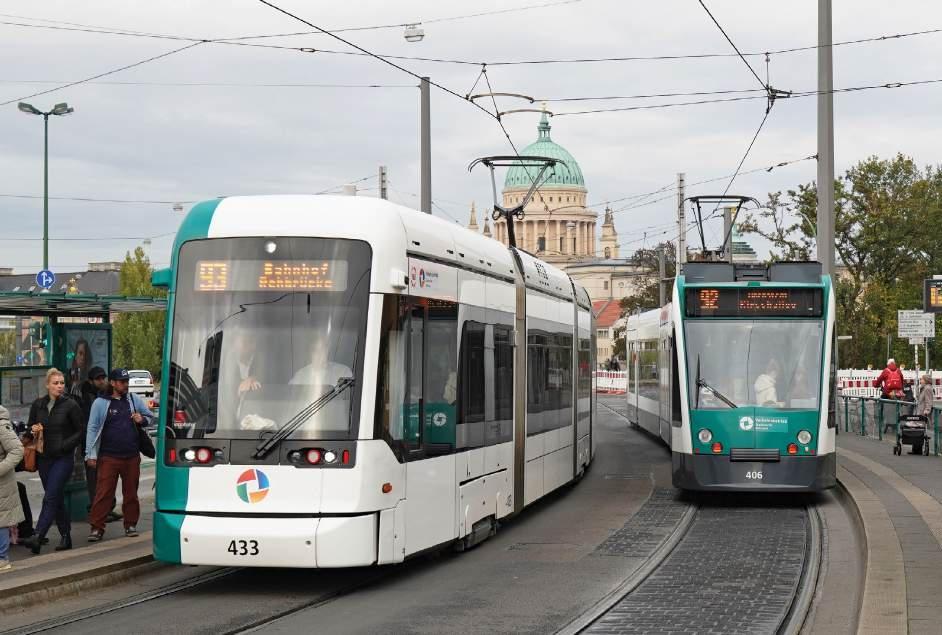
Potsdam is south-west of Berlin, with their centres about 25km (16 miles) apart. Although they adjoin, it is not an urban spread, for this boundary is mainly along river channels or across heaths and forests. After German reunification, Potsdam became the capital of a newly-constituted Brandenburg state in 1990. Against the trend of most eastern German cities, the population is growing (163 668 in 2014; 187 820 in 2024). This may be attributed to a concentration of local job opportunities and academic institutions, local attractions and easy access to the continuing resurgence of Berlin.
In May 1880 it was along the road towards Berlin that Potsdam
Stadler Variobahn 433 and Siemens Combino 406 at Lange Brücke on 23 October 2025. Sited above tracks just west of Potsdam Hbf and next to the adjoining Bahnhofspassagen Potsdam shopping centre, the stop takes the name of the Havel crossing nearest the city centre. The dome of St. Nicholas Church at Alter Markt is in the background.
ran its first trams, a horse-drawn service ending at a River Havel crossing and boundary that would become part of the city’s history. Then a stone structure, Glienicker Bridge was some years from Cold War spy exchange fame. Originally trams ran through Potsdam’s Alter Markt (Old Market) square, but are now routed just outside of this restored civic showpiece. Its transport hub role moved a little to the north, where all normal tram services and many bus lines pass around Platz der Einheit. This is about 600 metres south of Nauener Tor, a restored city gateway over Friedrich Ebert Straße at the east of Potsdam’s main commercial area. Across this street is the Dutch Quarter which, like the 19th Century Russian Colony further north, represents foreign influences on the
city’s evolution. Developed from 1745, Sanssouci Palace became the favoured residence of the Prussian ruler Friedrich II (‘Frederick the Great’). Potsdam became a military centre, a role maintained through and beyond both World Wars. International recognition rose when the Cecilienhof estate hosted the 1945 conference of the victorious ‘Big Three’ Allies; thereafter Potsdam came under Soviet control. As part of East Germany, it bordered West Berlin until both political entities were formally abolished in October 1990.
German reunification brought changes to transport arrangements, including how the tramway expanded and how it was equipped. The main operator, Verkehrsbetriebe Potsdam, was formed in 1990 and styled as ViP. It is part of the city-owned
All trams are uni-directional, with only the KT4D used in multiple formation. Today’s livery colours and configurations are developed from styling adopted in the early 1990s. Following the Combino, ViP changed supplier with 18 five-section Variobahn (421-438) built by Stadler in Pankow, Berlin, between 2011 and 2014. They are
uni-directional, fully low-floor, 30 metres long with a signed capacity for 175 including 59 seated. Some Variobahn continued a ViP practice of naming trams, a mixture of cities twinned with Potsdam, tramway pioneers and, notably on Combinos, systems using the same type. ViP received the first of two pre-series (441-442) Tramlink
assembled by Stadler in Valencia in early 2025, with service use beginning in December. Series production of the eight others in the initial order and later options will be built in Berlin. The ViP Tramlink is 42 metres long with seven fully low-floor sections; it has four multi-use areas and a capacity of 246, 74 seated.
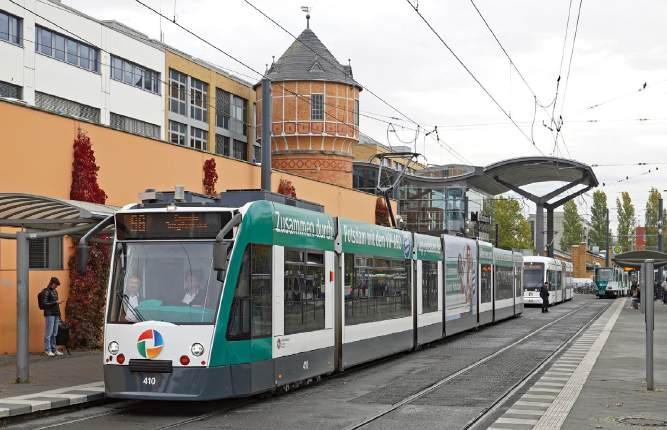
ABOVE: Gaining the title Potsdam Hbf, the new station and adjoining Bahnhofspassagen Potsdam retail development opened in 1999. Previous stations here had a tram terminus loop, but in spring 2000 a new layout incorporated with the southeastern arm came into use.
RIGHT: About two months before the type’s public service debut in December 2025, pre-series Stadler Tramlink 441 undertakes a test run at Johannes Kepler Platz.
RIGHT: Having turned on a Y and reversed to this position, modernised 1987-built ČKD Tatra KT4D 161+159 (remaining in service into 2026) wait at Glienicker Brücke terminus on 12 June 2015.
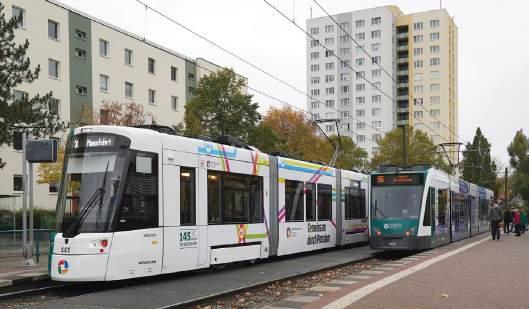
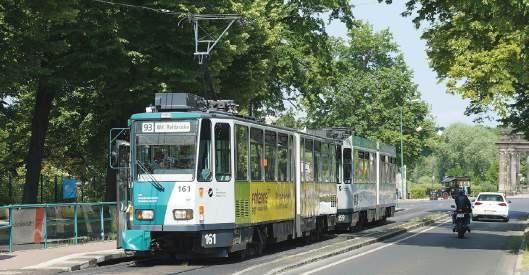
utilities group, Stadtwerke Potsdam, an identity which has supplanted ViP as the public face of transport operations. In 1991 membership of the new Verkehrsverbund BerlinBrandenburg (VBB) network brought changes to line designations, with tram routes becoming identified in the present 90-numbered series. Of today’s seven normal lines, some have limited service days/hours and variations according to school or commuting peaks.
The system’s early growth had mainly been on a north-east to south-west axis, with the western end having a track divergence which now includes Schloss Charlottenhof as a line 94 terminus. Further west the loadings are relatively light, but new developments are expected to raise demand. Luftschiffhafen stop recalls the lakeside Zeppelin base to which the service extended in 1914. This area became used for sporting activities and remained a terminus until 1958 when track reached Süd station, now Bahnhof Pirschheide. Tram platforms are near a surface railway counterpart. Also present on the elevated Berlin Außenring outer rail circuit – another facet of national division – the station was designated Potsdam Hauptbahnhof from 1961 to 1993, despite remoteness from the city centre. The current Potsdam Hbf gained its title when opened with the integrated Bahnhofspassagen Potsdam shopping centre in 1999. Trams had served the old station with a short branch from the system’s southern arm, replaced in spring 2000 by through-platforms on a new alignment. The reach to Babelsberg (then as Nowawes) originally ran south of the Havel river. A trolleybus service also ran in eastern districts between 1949 and 1995. From 1985 trams began using a new branch off the Glienicker Bridge route, crossing the river on the Humboldt Bridge. The southern tracks to central Babelsberg closed in 1992, surviving only as a short stub available as a Y turning point. Due to restricted space, a similar installation remains in regular use for turning trams towards the Glienicker Br ücke terminus.
Another abandoned tram route was the south-western Schützenhaus branch, which opened in June 1930 but gained little patronage. Unlike elsewhere on the system, it was not restored after the total closure following an overnight bombing raid in April 1945.
Rail access from Berlin is mainly via Potsdam Hbf, with services by longdistance, regional and S-Bahn trains. With a longer tram connection, an alternative is via Potsdam-Rehbr ücke which is under 30 minutes from Berlin Hbf. Rehbr ücke Bahnhof terminus is at the end of a route opened in 1934. The branch joining this route

Rote Kaserne
Erich Arendt Straße
Volkspark
Hannes Meyer Straße Wiesenpark Campus Fachhochschule
Kirschallee
Johan Bouman Platz
Am Schragen Puschkinallee Reiterweg/Alleestraße
Mangerstraße
Rathaus
Nauener Tor Branderburger Straße Dortustraße
Luisenplatz Süd / Park Sanssouci Feuerbachstraße
Bahnhof Charlottenhof
Schloss Charlottenhof
Platz der Einheit
Auf dem Kiewitt
Schillerplatz / Schafgraben
Kastanienallee / Zeppelinstraße
Im Bogen / Zeppelinstraße
Luftschiffhafen
Pirschheide
“The system’s early growth had mainly been on a north-east to south-west axis.”
Glienicker Brücke
Leonardo da Vinci Straße
Schiffbauergasse / Berliner Straße
Holzmarktstraße
Schiffbauergasse / Uferweg
Humboldtring / Nuthestraße
Burgstraße / Klinikum
Alter Markt / Landtag Lange Brücke
Alt Nowawes
S Potsdam Hauptbahnhof / Friedrich Engels Straße Friedhöfe
Sporthalle
Anhaltstraße
Rathaus Babelsberg
S Babelsberg / Wattstraße
Kunersdorfer Straße
Waldstraße / Horstweg Magnus Zeller Platz
Eduard Claudius Straße
Heinrich Mann Allee
Zum Kahleberg Friedrich Wolf Straße Am Moosfenn
Fontanestraße
Plantagenstraße
Bisamkiez
Abzweig Betriebshof ViP
Bahnhof Rehbrücke
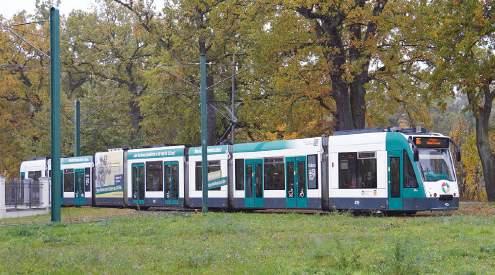
Johannes Kepler Platz Max Born Straße Gaußstraße
Turmstraße
Robert Baberske Straße
Marie Juchacz Straße
Hans Albers Straße
Priesterweg
Am Hirtengraben
Under 30 minutes from Berlin Hbf by Regional Express, the main line transfer at Rehbrücke Bahnhof became part of the 1930s system expansion. Leafy surroundings are a feature of the tramway’s outer reaches.
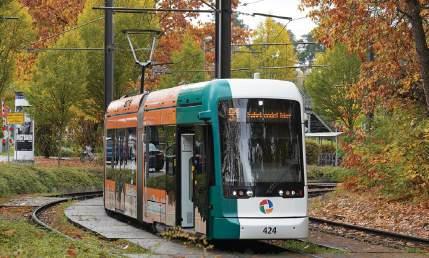
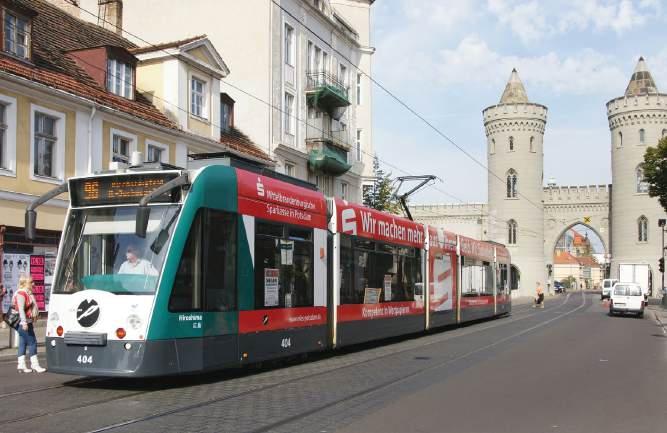
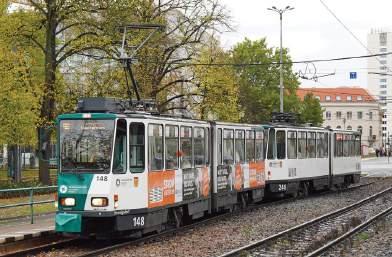
“The next major project is another northern extension, provisionally with services from 2029.”
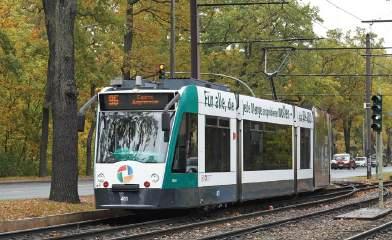
Opened: 1880 (Electric 1907)
Lines: 7
Length: 29km (18 miles)
Stops: 63
Depots: 1
Approx. weekday hours: 04.30-00.30 (line variations)
Line frequency: 10-20 minutes
Gauge: 1435mm
Power: 750V dc, overhead supply
City network/operator: ViP Verkehrsbetriebe Potsdam www.vip-potsdam.de
Regional network: Verkehrsverbund Berlin-Brandenburg https://unternehmen.vbb.de
Civic information: Landeshauptstadt Potsdam www.potsdam.de
Tourist information: www.potsdam-tourism.com
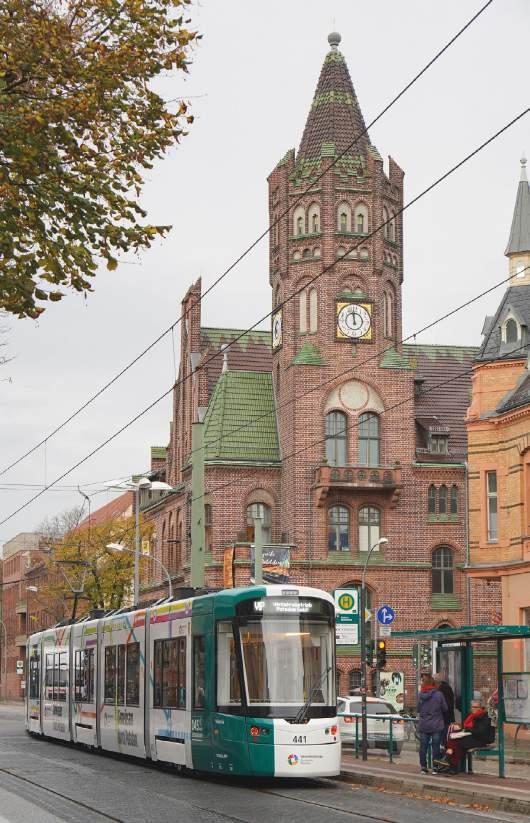
near Waldstrasse/Horstweg stop is about 6km (3.8 miles) long and was created to serve housing estates developed from the 1970s in the south-eastern Stern district. Demand soon overwhelmed bus coverage and tram services began to Johannes Kepler Platz in 1982. With an interim extension, tracks reached the present Marie Juchacz Straße terminus by 1998. This arm includes connections to the depot which opened in the south of Babelsberg in 2001, replacing two former sites. Set away from revenue track, access is from a junction near Abzweig Betriebshof ViP stop. Bordering the depot, Orenstein & Koppel Strasse commemorates the company’s railway works, later home to state-owned Lokomotivbau Karl Marx Babelsberg. In another aspect of post-reunification change, activities here had ceased by 1992.
For over 70 years trams went no further north in Potsdam than Alleestraße, just 600 metres past Nauener Tor, but it is beyond here that the substantial recent changes have occurred. These were enabled by getting land access and opportunities to alter building use in areas released from Soviet control. Going beyond a short 1954 extension, the Kirschallee route opened during 1999, adding Wiesenpark stop in April 2024. Extending from a junction near
Campus Fachhochschule, track opened in 2001 with services initially geared to the April-October 2001 Federal Garden Show (BUGA). The site entrance stop, BUGA Park, was renamed ten years later as Volkspark. This extension’s Viereckremise return loop – now removed and replaced with a through-stop titled Erich Arendt Strasse – was the northern terminus until replaced by Campus Jungfernsee in December 2017. The new section included single track near the Rote Kaserne, an imposing sequence of red-brick barracks dating from 1892. Arrival and departure platforms are on the Campus Jungfernsee loop which encircles a park-and-ride site.
The next major project is another northern extension, provisionally with services from 2029. Called ‘Tram 96’ in reference to the line number, the project again involves ex-military land and would expand the system’s already substantial education site coverage. The initial 4.6km (2.9-mile) phase is from Campus Jungfernsee to Krampnitz-West, where a new community with a planned 10 000 population is in development. The 2.6km (1.6-mile) second phase is from there to Schule Fahrland, with the project overall adding ten new stops. Related to these works, the Rote Kaserne single track is due for doubling and a second depot is envisaged.
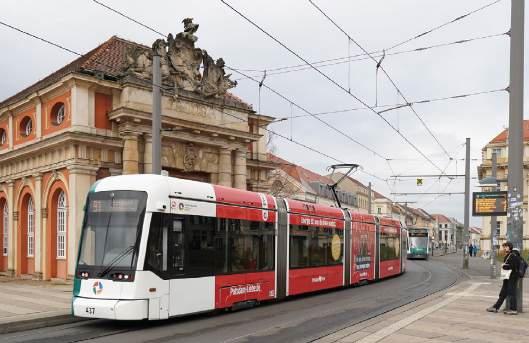
RIGHT: With the name of a summer palace in nearby Sanssouci Park, Schloss Charlottenhof stop is on the unidirectional divergence of tracks towards the system’s western end.
LEFT: Tramlink 441 pauses at Rathaus Babelsberg. Incorporated with Potsdam in 1939 and best known as a pioneer film production centre, Babelsberg was originally served by a now closed tram route south of the Havel.
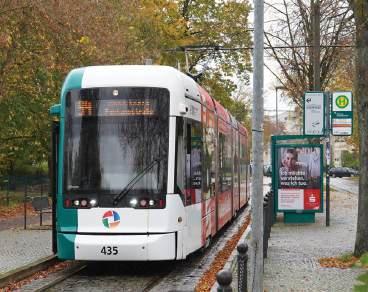
Following testing in Prague, the prototype Czech ČKD two-section Tatra KT4 first saw service in Potsdam, beginning over 50 years of the type’s use here. As no.001 and for years in regular use, this 1972-built vehicle is now in the heritage collection and is used for tours. Production KT4D soon followed, with a 1989-90 transfer of 80 updated models from Berlin fully replacing the East German VEB Gotha cars dating mainly from the 1960s.
BELOW LEFT:
Just outside the historic market square, Alter Markt stop is adjacent to a building dating from 1685. Previously an orangery and then a stable, it is now the home of Potsdam Film Museum.
BELOW RIGHT:
The Kirschallee extension opened in 1999 to serve housing developments. Seen in May 2011, Combino 409 has a ViP logo, now replaced by the identity of the parent group, Stadtwerke Potsdam.
The KT4D became the sole type until the Siemens Combino – another tram first deployed in Potsdam – entered fleet service in 1998. ViP also retains the Combino prototype, with tram 400 entering service use before becoming an autonomous driverless test-bed. It was in Potsdam during 2004 that Combino structural problems were first identified, leading to rebuilding the ViP fleet and those on other systems. There are two ViP Combino versions, the original five-section, 30.5-metre 401-408 and the 41.8-metre XL 409-416. The latter were formed in 2017-18 by adding two modules, raising capacity by almost 40% to 246. Their irregular profile is due to the modules being as per Siemens’ later Avenio model. The need to increase capacity and allow withdrawal of remaining KT4D led in 2021 to an order for ViP’s longest trams, the Stadler Tramlink
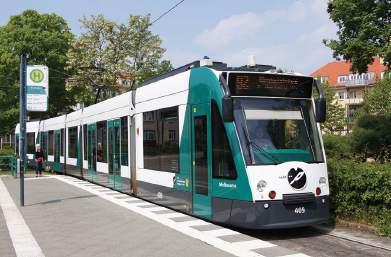
Local travel: Combined transport and tourism information office on retail overbridge at Potsdam Hbf, also at Platz der Einheit/Nord. Tickets here or from machines at stops and aboard trams. Four-stop EUR2.10; Single (60 minutes from validation) EUR3.70. If including Berlin and with Potsdam and Berlin Brandenburg Airport being in BVG zone C, the ABC ticket is good value: 24-hour at EUR12.90. Long visits or adding regional public transport makes the subscription Deutschland-Ticket at EUR63.00 a sensible option (prices as at March 2026).
What is there to see? Old Market Tourist Information Centre near Alter Markt/Landtag stop. Epic in scale and splendour, Sanssouci Palace and Gardens are immediately west of the city centre near the (Potsdam) Brandenburg Gate. Information on Sanssouci and Potsdam’s many other historical sites is at www.spsg.de. Just beyond the Glienicker Brücke line 93 terminus are expansive views from the bridge and displays which explain the area’s significance. Mass appeal Filmpark Babelsberg builds on the cinema heritage: www.filmpark-babelsberg.de. Bookings for city attractions, including heritage tram and bus tours through www.fritz-und-peter.de.
MELBOURNE. Work has started on the 6km (3.7-mile) Airport Rail Link, a heavy rail mass transit line from Sunshine station to the airport. The first task on the AUD4.1bn (EUR2.5bn) project is to lay new track at Sunshine to increase its capacity.
Shortlisted consortia for the next Metro Trains operations and maintenance contract, due to start in 2027, are Go Places Melbourne, RATP Dev JH Downer and Melbourne Grow. premier.vic.gov, RGI
LINZ – EFERDING. Stern & Hafferl tram-train 4828 801 started trials under power on 17 March. A further five are expected to be delivered this year.
A nostalgia weekend is planned for 4-5 July, utilising historic rolling stock. BS SALZBURG. A Guest Mobility Ticket is to be introduced on 5 May that gives overnight hotel guests access to public transport in the state region. In-motion.me WIEN (Vienna). Alstom Flexity trams 430-434 were delivered in March.
U-Bahn Line U2’s LinaLoos-Platz station opened on 19 January. It serves the Oberes Hausfeld development of 3700 apartments. EB
ANTWERPEN (Antwerp).
An 11-month renovation of the pre-metro subway between Diamant station and Groenplaats is to start on 4 May. During the work, a tramway shuttle is to run between Melsele park-and-ride and Meir, using double-ended CAF trams. Lines 3 and 15 are combined to form new line A3 between Merksem park-and-ride and Boechout park-and-ride, while lines 5 and 9 are combined as line A9 (Wijnegem – Station Berchem).
Line 11 was to revert to full tram operation on 4 May. T-2000 BRUSSEL/BRUXELLES (Brussels). Articulated PCC 7806 has been earmarked for the Woluwe tram museum. Of the 128 PCCs built, 29 remain in service.
A planning application has been lodged to install 500m of extra tram track at Rue d’Enghien depot. T-2000
CHARLEROI. Operator TEC has purchased four ex-Gent (Ghent) double-ended PCC trams from Antwerpen (Antwerp). Trams 6205/14/17/20 are to
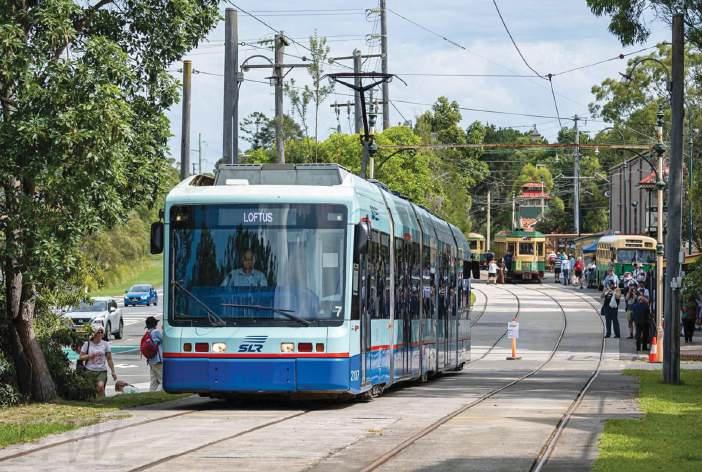
replace the SJ works cars and will be renumbered 7456-9. T-2000
GENT (Ghent). Lines between Gent-Sint-Pieters station and Korenmarkt were taken out of service from 6 January for relaying. Line 1 is diverted via Rozemarijnbrug. Reopening is to take place for the 150 years of tramways celebration on 18-19 May. T-2000
HAN-SUR-LESSE . The last day of passenger operation on the tramway to Grottes de Han was 4 January, followed by a final movement on 22 January. All stock (ART90 and 168, AR 89, 145/59 and 266 and trailers GR001-9) is stored at the depot. A museum group has proposed a rescue attempt. T-2000
DE PANNE – KNOKKE. Coastal tram 6155 was hit by a car at Nieuwpoort on 28 February. The tram derailed, injuring 15 passengers. Services were suspended until 20.00 on 1 March. vrt.be
CAMPINAS. A feasibility study for a 44km (27-mile) light rail line linking the airport to the city centre has been put out to tender. RGI BRASILIA. Tenders have been invited for a feasibility study into a 15km (nine-mile) light rail line linking Taguatinga and Ceilândia via Pistão Norte. RGI
MONTRÉAL. Transdev Canada has won the contract to operate EXO commuter rail services.
It will take over from Alstom in 2027. Mass Transit TORONTO. Spadina streetcar resumed operation from 28 February after a fire in an underground power vault on 24 February.
The Finch West Line 6 suffered 350 delays in its first month of service, including several complete shutdowns in late February, caused by signalling and pointwork problems. A late evening service was introduced on 15 March and the peak service boosted to every 6.5 minutes.
Traffic signal priority is being rolled out on Lines 5 and 6.
Alstom has been awarded a five-year extension to its GO Transit commuter rail service operating contract. P. Webb, RGI VANCOUVER. Translink is to boost transit services on match days during the 2026 FIFA World Cup, with extended SkyTrain service including two-minute headways and a later close of service. The city is to host seven matches during the 11 June – 19 July tournament. Mass Transit
The 2028 International Association of Public Transport summit is to be held in Hong Kong. The planned April 2026 summit in Dubai has been cancelled due to the Middle East conflict. RGI
CZECH REPUBLIC
BRNO. Škoda 45T double-ended
trams 1785 and 1786 were delivered in February.
Vario 1551 is the first to be fitted with air-conditioning at a cost of CZK10.5m (EUR429 042). BS, dopravek.eu
OSTRAVA. Operator DPO has issued a tender for 16 100% low-floor, high-capacity trams, including ten years of maintenance. Delivery should be completed within 32 months. There is an option for nine more. dopravek.cz PRAHA (Prague). Works car 5521 became the first tram across the Dvorecký bridge on 24 February. This new link between Smíchov and Podolí was expected to open on 17 April and is to be used by lines 20 and 21.
Tramlines between Chotkovy sady and Brusnice, past Prague Castle, closed on 21 March for reconstruction. They are to reopen on 17 July. Lines 22 and 23 are diverted via Hradčanská.
T3R.PLF 8781 entered service on 24 February. It was created using components from 8168, which in turn was a rebuild of 6714.
KT8D5 9111 made its first test run on the network on 18 February. This was 213 from Miskolc in Hungary, now fitted with a low-floor centre section.
dopravek.cz, M. Baxter
ODENSE. Letbane has recommended that four additional 40m trams are purchased to cope with patronage growth. The contract could have an option for 14 more.
SANTO DOMINGO. Metro line 2 was extended by 7.3km (4.5 miles) on 25 February. The extension, 900m of which is underground, connects C. María Montez to Pablo Adón Guzmán and an interchange with cable car line T2. Free rides are planned until Easter. urbanrail.net
QUITO. Alstom has been awarded a USD27m (EUR23.4m), four-year contract to maintain metro line 1’s signalling. IRJ
HELSINKI. Track renewal on the Jätkäsaari bridge was to take place 7 April-10 May. Line 7 was to terminate at Kolmikulma and line 9 diverted to Tahitinkatu. Temporary line 9T was to operate between Kauppatori and Huutokonttori (the south end of the bridge) using double-ended Škoda ForCity Smart Artic X54
The new Crown Bridges line (TAUT 1029) should open in early 2027 with new lines 11 and 12.
Operator HKL has published a tender for 58 new metro trains to replace the first-generation vehicles. BS, lok-report.de TURKU. A consultation prior to tendering has been launched for 14 new trams for the underconstruction 12km (7.5-mile) line, due to open in 2033. RGI
LILLE. Alstom delivered the first Citadis XO5 to Rouges-Barres depot during March. lineoz.net PARIS. Alstom TFS 205 undertook the fleet’s ceremonial last run on 6 March.
RATP is preparing a tender for the mid-life overhaul of the 66 line T2 Citadis vehicles. The work is to take place between September 2026 and July 2028.
Alstom has won a contract to automate metro line 8 by 2029. youtube, X.com TOULOUSE. Alstom delivered the first three line T1 trams on 19 March. A further six are on order for T2. lineoz.net
BERLIN. Work to repair fire damage at line U9’s Schloßstrasse station (TAUT 1057) was completed on 1 March. Through U-Bahn operation resumed from 2 March. Launch of the new 4km (2.5-mile) S-Bahn line S15 from Wedding to Hbf is postponed to mid-June. lok-report.de BONN. Škoda delivered the last of the current tram order, 2466, on 24 February.
We should record that the planned December introduction of a five-minute service on line 66 and the curtailment of line 16 did not take place. BS BRAUNSCHWEIG. A turning circle is to be built at Gliesmarode. Line 3 will use it while the extension to Volkmarode Nord is built. BS BREMEN. The BürgermeisterSmidt-Brücke was to reopen to line 1 trams on 13 April, after 18 months. lok-report.de DARMSTADT. Political opposition has led to the planning application for a new tramline to Ludwigshöhviertel to be withdrawn. BS DUISBURG. Alstom GT8NDs 2006/07/09/34-35/41 are still at the factory.
Nine ten-axle trams remain available for service:
1001/07/18/22/27-28/41-42/44. BS
DÜSSELDORF. Replacement of overhead between Lörick and Krefeld meant evening bus substitution of lines U70 and U76 on 22-26 February and 1-26 March. Further dates were expected. BS FRANKFURT-AM-MAIN. After nine months of trials, VGF has agreed to accept the first of 19 T class trams that had been returned to Alstom for rectification. Deliveries of trams – 58 were ordered – are to restart this summer. They are to replace the remaining P class high-floor trams.
Line 18 now terminates at Breslauer Strasse to permit railway bridge replacement in Sachsenhausen. This is likely to last until 2028. fr.de, BS GERA. Stadler delivered TINA 601 on 4 March. The order for six is worth EUR38m. DS HAMBURG. U-Bahn DT4 set 150 has been scrapped after it derailed, while running empty, at Billstedt. BS
JENA. Stadler has started to build nine 32m Tramlink trams for the city. BS KARLSRUHE. NET2012 32699’s driving cabs are being rebuilt after drivers reported neck and back problems. It is hoped to complete the work by the end of 2027.
DB’s Wittenberg workshops are to carry out rust treatment on 40 GT8-100D trams. BS KIEL. A city-owned planning and construction company was formed on 16 March to take forward plans for a new tramway (TAUT 1054). kn-online.de KÖLN (Cologne). Tracks at Stadion terminus are to be lengthened to accommodate two 90m tram sets. BS KREFELD. Line 043 terminates at Elfrath while trackwork on the line to Uerdingen continues. BS
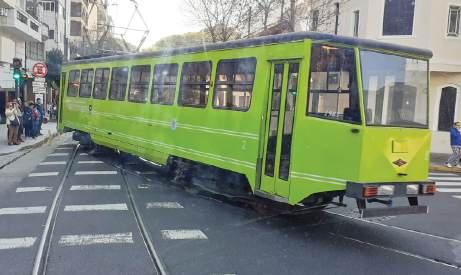
MAGDEBURG. Deliveries of Alstom Flexity cars will allow resumption of traffic on line 3 (Klinikum Olvenstedt – Leipziger Chaussee). mvbnet.de MÜNCHEN (Munich) . The 18.7km (12-mile) Ebersberg –Wasserburg line is to be electrified as part of its absorption into the S-Bahn network. IRJ NAUMBURG. The heritage tramway carried 306 000 passengers in 2025, a 3% increase over previous years. BS ROSTOCK. Tram West’s 3.8km (2.4-mile) extension from Zoo to Reutershagen is to continue after a city council vote on 4 March. BS WUPPERTAL. Free rides on 28 February-1 March helped mark 125 years of the Schwebebahn. Strike action, which would have disrupted the event, was called off. DS WÜRZBURG. Commissioning of HeiterBlick GT-F trams 215 and 216 started in late February. DS
BUDAPEST. Withdrawal of the 20 42-year-old non-modernised Tatra T5C5 trams is being marked with special events in March and April. These involve single cars working on routes on which they are not normally seen: they ran on line 59 on 1 March and Line 28A on 7 March. There are still 302 modernised T5C5 trams in service. cs-dopravak
CHENNAI. The Chennai MRTS 4.5km (2.8-mile) Velachery to St Thomas Mount extension opened on 14 March. urbanrail.net
DUBLIN. Replacing Luas Red Line’s 26 Alstom 4000 Class trams is one of the recommendations made in the National Transport Authority’s Statement of Strategy 2026-2030. This also recommends increasing the Green Line frequency, as well as startingwork
on the Finglas extension (TAUT 1057).
KeolisAmey has won the Luas operating contract. This starts on 1 September and lasts for seven years, with an option for a further six.
DART suburban rail services are to be extended west to the town of Kilcock, on the County Meath/ Kildare border. Public consultation for the site of a new DART depot, to the west of the town, is to be launched.
DOUGLAS BAY HORSE TRAMWAY. The island’s parliament has voted to bring back the full length of the line to Sea Terminal, with voting on detailed proposals set for May. GENERAL. Passenger numbers across the island’s railways rose in 2025. The Douglas Bay Horse Tramway had the biggest increase at 53 879 passengers, 9.51% up on 2024. The Manx Electric Railway carried the most passengers –155 494, a 3.67% increase.
MANX ELECTRIC RAILWAY. The operating season started on 17 March. Additional services ran on 19 and 23 March to provide cover during a strike by bus drivers. However, the line was closed on 25 March for vegetation works.
TEL AVIV. Plans for a 150km (93-mile) automated metro were unveiled on 23 February, with a briefing for bidders. Stage 1 of what is planned to be a three-line system with 109 stations will be 78km (48.5 miles) long. Pre-qualification is required by the end of April. IRJ
INDUSTRY. India’s Titagarh Group has sold its Titagarh Firema rolling stock building subsidiary to the Italian state railway, bringing the company back under Italian control. RGI
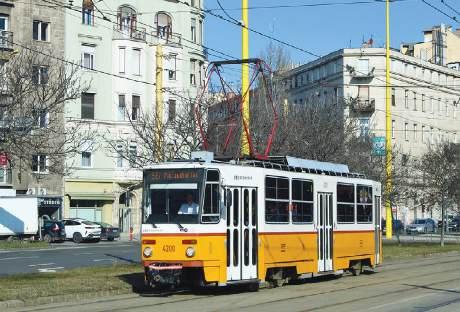
MILANO (MILAN). Construction of metro line M1’s 3.3km (two-mile) extension to Baggio started on 25 February. Its three stations should generate an additional 7.5m passengers/year. skyscrapercity TORINO (Turin). Hitachi Rail has won a EUR388.5m contract to supply 12 four-car trains and signalling for the new 7.7km (4.8-mile) automated metro line 2 from Rebaudengo to Porta Nuova. There is an option for a further EUR93.1m contract for the 2.3km (1.4-mile) Porta Nuova – Policlinico section and two more trains. UNStudio has won the architectural design contract for the stations. RGI
ENOSHIMA. Sets 701 and 702 were delivered in January, becoming the Electric Railway’s first new stock for 20 years. BS HIROSHIMA. A new ring tramway opened on 28 March, operating 10.00-16.00 on weekdays. BS KYOTO. Kyotrams 02 and 03 have been delivered. BS OKAYAMA. The city council and Okayama Electric Tramway have agreed to build 600m of new line between Saidaiji and Daiunji-mae, with completion expected in 2029-30. BS SAPPORO. Alna Koki delivered the first of five new Polaris II type trams in January. The delivery rate is one tram a year. H. Ushui
PENANG. The 3km (1.9-mile) light rail bridge from Komtar on Penang Island to Butterworth on the mainland is to be built with a 60m clearance above high tide. The future Butterworth terminal will be adjacent to the railway station. The 29.7km (18.5-mile) line is expected to carry passengers from December 2031. M. Baxter
MEXICO CITY. CRRC Zhuzhou started delivery of LRVs 50-66 in February. S. J. Morgan
DEN HAAG (The Hague). Rebuilding of line 12 to accept 2.65m-wide trams started in February. OR ROTTERDAM. EUR1bn is to be invested to allow services every five minutes on the metro by 2033. This will require 38 new 90m trains. OR
BYDGOSZCZ. A tender has been issued for five 100% low-floor trams including maintenance and repair. There is an option for 20 more. lok-report.de CZ Ę STOCHOWA. MPK plans to issue a tender for three new trams in 2027. TP TORU Ń A further four PESA Swing trams have been ordered, bringing the total number to eight. The last of the first four was delivered on 19 March. TP
LISBOA (Lisbon). The first part of the funicular network to reopen since the September crash ( TAUT 1054) is to be the Graça line. BS PORTO. This year’s annual tram parade is to take place on 2 May. M. J. Russell
ROMANIA
BUCUREȘTI (Bucharest). Line 5 (Aeroport B ă neasa – Obor –Pantelimon) reopened on 8 March after a year of reconstruction work. Buses replaced trams on lines 14, 17 and 36 from 21 March, due to infrastructure work on Bulevadul Ferdinand I. DS
RUSSIA
CHELYABINSK. Ust-Katav has delivered five 71-938M
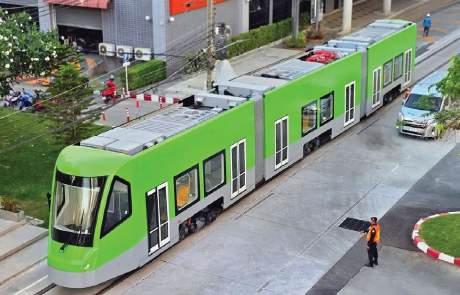
three-section 100% low-floor trams. transphoto.org
KALININGRAD. A report presented by the Governor in March trailed the purchase of 18 new trams and reconstruction of 20.9km (13 miles) of tramway by 2031 at a total cost of RUR10bn (EUR106m). J. Carpenter MOSKVA (Moscow). New line 5 runs to Belorussky railway station after the opening of a new section of tramway in late 2025. As 4km (2.5 miles) is without overhead wires, supercapacitor-fitted 71-911EM Lvionka bogie trams 30641-90 are used. TP SARATOV. PKTS delivered 71-931M Vityaz-M three-section 100% low-floor trams 102835 in February. Three more are expected. transphoto.org
STARY OSKOL. Budget constraints mean that the city council plans to close the tramway by mid-summer. transphoto.org
YAROSLAVL. The city has gifted 20 71-619KT bogie trams to the city of Biysk. RGI
SINGAPORE
MASS TRANSIT RAILWAY. China Railway Tunnel Group has won the engineering contract for the final 1.8km (1.1 miles) of the Downtown Line 2 extension. This is due for completion in 2035. IRJ
BRATISLAVA. Škoda 29T3 100% low-floor air-conditioned trams 7451-55 were unveiled at the modernised Kras ň any depot on 13 March. Another five are to arrive by the end of June. They will be used on line 4.
Tatra T3SU tram set 7733+7734 made its last runs on 23 February. Transportation World
MADRID. Metro line 1 is to be extended north with three new stations to Fuencarral Nord.
The existing section of line 1 between Bambú and Charmartin will be transferred to line 4.
Privately-operated line 9B (Puerta de Arganda – Arganda del Rey) will be transferred to Metro de Madrid when the concession expires in 2030. A new station will be built between Rivas Urbanizaciones and Puerta de Arganda. madridsecreto.co SEVILLE. Tenders have been invited for five new metro trains to relieve overcrowding; passenger numbers are reaching 22.6m per year.
A 4.7km (2.9-mile) airport rail link with Seville-Santa Justa station has been approved. TR5
STOCKHOLM. The Regional Council approved the extension of the Tvärbanan light rail on 17 February. Connecting Bromma Flygplats to Helenelund via Ursvik is set to cost SEK9.3bn (EUR857m) and the line could open in 2028-29. lok-report.de
BERN. A five-phase track and pointwork renewal programme is taking place around Hauptbahnhof involving various closures and diversions from 9 March until 21 August. BS LAUSANNE. A tender is being prepared for 18 two-car automated metro trains for delivery in 2030-31. There will be an option for ten more. BS RAPPERSWIL. Knie’s Kinderzoo – a zoo aimed at children – has installed a 480m narrow-gauge tramline equipped with an open-sided battery tram built by Stadler apprentices. nau.ch ZÜRICH. Alstom Flexity deliveries had reached 4091 by midMarch. The last Pony car, 2418, was withdrawn on 16 February and will pass to the tram museum group.
The last Series II Tram-2000 cars
(2057 and 2073) were withdrawn in March.
BS
ZÜRICH (SZU). Trains are to terminate at Selnau 29 April18 October to permit reconstruction work at Hauptbahnhof to increase its passenger capacity.
BS
ZÜRICH – ESSLINGEN (FB). The Forchbahn has published a tender for seven two-car sets, with the option of a further four. ted.europa
DNIPRO. The first of five Tatra-Jug single-ended three-section K1T306 100% low-floor trams, 3401, entered service on 26 February. TP KYIV. Electric transport resumed full operation on 3 March after disruption caused by damage to power infrastructure. transphoto.org
BLACKPOOL. Fisherman’s Walk became the tramway’s temporary northern terminus on 10 March. The Fleetwood Ferry –London Street section was closed for infrastructure work that was due to be completed by the end of the month.
CARDIFF. Cardiff Council has approved plans to appoint GRAHAM as principal contractor for the GBP100m (EUR115.6m) first phase of Cardiff Crossrail. Construction of the 800m tramway between Cardiff Central and Cardiff Bay stations should start during the summer, with opening in 2028.
DERBY. Stonewall has accredited Alstom UK & Ireland as a ‘Trailblazing Employer’ in its Proud Employers Accreditation scheme.
GLASGOW. Contactless payment was introduced to the Subway on 16 March.
GREATER MANCHESTER.
Preparatory work for replacing rails at Trafford Bar and between Deansgate and Castlefield was to take place 3-6 April. Infrastructure work across Metrolink is to last until the autumn as part of a GBP150m (EUR174m) programme.
Greater Manchester Combined Authority has allocated GBP60m (EUR69m) to building a new tram stop at Sandhills, between Manchester Victoria and Queens Road.
LONDON (DOCKLANDS).
Cutty Sark reopened on 23 March after the installation of four new escalators. The station has also received new lighting, a new lift and new firedetection system.
LONDON (UNDERGROUND)
Work to rebuild South Kensington station should start this year. The Listed arcade will be restored,
while a step-free entrance will be built on Thurloe Street. Mothballed Platform 1 will be restored, while a four-storey building containing retail and office space will replace the single-storey structure on Old Brompton Road. New housing will be built on land on the Pelham Street side of the station.
NOTTINGHAM.
Nottinghamshire Police is to increase patrols around the Nottingham Express Transit network. There were incidents of stones being thrown at trams in February, while a driver had a chemical substance thrown in his face.
SHEFFIELD. Supertram is now part of the city’s new public transport brand ‘South Yorkshire People’s Network’. An orange/grey/black colour scheme will be applied to stops in the coming months. SYPN will be expanded to the city’s buses next year.
Magna tram-train station is to open on 9 April. It is the first new stop on the system since 2018.
TYNE & WEAR. Nexus is to invest GBP8.8m (EUR10.2m) in replacing the Supervisory Control & Data Acquisition system (SCADA) at its South Gosforth control centre. The SCADA manages Tyne & Wear Metro’s power supply, fire and intruder alarms, lights, escalators and tunnel drainage pumps.
Some 3200m of overhead wire is to be replaced between Pelaw and South Shields on 13-17 April.
USA
ATLANTA, GA. MARTA introduced tap-on technology to its Breeze fare payment system on 28 March. J. May BOSTON, MA. Back Bay –Forest Hills Orange Line subway services resumed from 7 March after MBTA commissioned a new signalling system. Mass Transit CHICAGO, IL. After the Federal Transit Administration threatened to cut funding if CTA did not revise its security plan, CTA has agreed to bring in Cook County sheriffs to patrol rapid transit trains. Chicago Tribune KANSAS CITY, MO. The Kansas City Streetcar Authority has unveiled plans for a new east-west line serving the Crossroads Arts District. This would support the existing and soon to be extended north-south line. M. Baxter LOS ANGELES, CA. Metro Line D’s extension to Wilshire/ La Cienega is to open on 8 May. The 6.2km (3.9-mile) line serves three new stations. skyscrapercity
NEW YORK, NY. The MTA is suing the Trump administration, having accused it of withholding USD58.6m (EUR50.7m) in federal reimbursement for the Second Avenue subway extension project . J. May OMAHA, NB . Rail for the under-construction 4.8km (threemile) Streetcar line was delivered in March. It is due to open in 2028. PORTLAND, OR. CAF was the only bidder for 15 100% lowfloor trams for Portland Streetcar. An order is not expected to be placed before June.
TriMet finalised the contract amendment for more Type 6 LRVs on 19 March. This order is largely for replacement of the 52 Type 2 LRVs rather than for expansion. Just one of these, 241, has been returned from overhaul and no more sent, so it looks as if the 2019 deal for the overhaul of SD660s will not be completed. S. J. Morgan SAN DIEGO, CA. Patronage on the San Diego Trolley has dropped by 1.3% this year.
MTS Chief Executive Sharon Cooney said: “Border regions are facing lower transit ridership… due to ICE [US Immigration & Customs Enforcement] activities. We also see that people will travel less… if their household expenses are too high and they can’t afford to do other leisure activities.”
However, passenger fare revenue is up 4.7% after a fareenforcement effort. J. May TAMPA, FL. Four Alstom Innovia R automated peoplemovers entered service at the airport in mid-March; 16 are on order. Mass Transit
MUSEUM
AUCKLAND (NZ). Wanganui 1922-built trailer 21 entered passenger service at the Museum of Transport & Technology on 21 March after completion of restoration. It runs behind steam tram 100. STM
BEAMISH (UK). Newcastle tram 114 has been prepared for signwriting. It is hoped that it will return to service in 2026 in order to celebrate both it and Newcastle Corporation Tramways’ 125th anniversary.
BRIGHTON (UK). Brighton Tram 53 Society has been donated a 1:12 scale model of Brighton 74 from Brighton Museum Services. It has its own 12m long track and replica overhead poles.
DORRIGO (AU). Estate agent Ray White has been advertising a property located in rural New South Wales, near Dorrigo, with a former Bondi tram body inside it.
LEIPZIG (DE). The tramway museum is to open 18.00-24.00 on 9 May, 17 May, 21 June, 19 July, 16 August and 20 September. BS
LOWESTOFT (UK). Blackpool tram 143 arrived at East Anglia Transport Museum from Rigby Road depot in February. Minor maintenance work was carried out during March, but 143 requires repair of a motor defect before it returns to service.
MATLOCK (UK). Crich Tramway Village has been rebranded ‘National Tramway Museum’. This aims to “challenge perceptions of what a ‘museum’ can be – it’s a living, moving experience, where history is heard, felt and ridden”.
SOUTHAMPTON (UK) Southampton trams 11 and 38 – plus Lisboa tram 715 – are to be open for inspection during the Solent Sky Tram Event at Solent Sky Museum on 9-10 May.
WEHMINGEN (DE). Hannover Tram Museum is open on Sundays 11.00-17.00 5 April-25 October. It is also to open on 1 May, 31 October and 6 December.
Ex-Berlin KT4D 6005 has been scrapped. BS
Worldwide items for inclusion should be sent to Michael Taplin at Flat 8, Roxan Villa, 33 Landguard Manor Rd, Shanklin, Isle of Wight PO37 6EA, UK. Fax: +44 (0)1983 862810 or e-mail miketap@mainspring.co.uk UK and Ireland items, please e-mail: uknews@lrta.org
Acknowledgements are due to: Blickpunkt Straßenbahn (BS) , Chicago Tribune, cs-dopravak, dopravek.eu, Drehscheibe (DS), Eisenbahn (EB), fr.de, In-motion.me, International Railway Journal (IRJ), kn-online.de, lineoz.net, lok-report. de, madridsecreto.co, Mass Transit, mvbnet.de, nau.ch, premier.vic.gov, Railway Gazette International (RGI), skyscrapercity, STM, ted.europa, TR5, Today’s Railways (TR), Tram-2000 (T-2000), transphoto.org, Transport Publiczny (TP) , Transportation World, urbanrail.net, vrt.be, X.com, and YouTube.
Keep up to date with the latest news right at your fingertips. Visit: www.mainspring.co.uk/ industry-news/
With the combined benefit of private donations, legacies and a government grant, the Ballarat Tramway Museum has been transformed into a full heritage experience. Mike Russell relates the story, assisted by Paul Nicholson, a founding society member. 1
Ballarat, in the Australian State of Victoria, was prominent in the era of gold prospecting and by the late 19th Century its increasing population and visitor numbers supported a need for public transport. A 24km (15-mile) network of standard-gauge tram lines grew, opening from December 1887.
Initially worked as a horse-drawn system with open-top double-deck cars, by 1905 electrification commenced, a change completed in 1913; the horse-drawn and electric trams were then operated by two separate companies. The company running electric trams was taken over by the State Electricity Commission of Victoria (SEC) when it took over electricity supply in Ballarat. It worked the lines until well into the post-World War Two era.
In September 1971 the system was closed, with motor bus replacement, but not before a local outcry had motivated formation of the Ballarat Tramway Preservation Society (BTPS), which proposed to continue to operate part of the system as a heritage line. The initial concept was to replicate operation of the SEC tramway by picking up and setting down passengers en route and utilising replica tickets and uniforms. To the group’s amazement it found willing partners in the SEC and a sympathetic local authority, and when public services finished, five trams (26, 27, 28, 38 and 40) were donated to the BTPS and another car (14) transferred to it that was originally a gift to the local council.
A 1.3km (0.8-mile) section of track was earmarked for the heritage line. This was entirely along Wendouree Parade, a section of gutter-running private track through the gardens on a road serving a recreation area. The unusual status of the road assisted in obtaining initial approval.
After construction of a new depot, substation and connecting track, operation commenced on 26 December 1974 – on a lengthy section of an original 1887 route. Official opening was on 1 February 1975.
The original BTPS fleet was progressively supplemented with more trams, cars 11, 13, 18, 32, 33, 35 and 39 being recovered from use in parks, a school and museums. A pair of bogie trams was acquired from the Melbourne & Metropolitan Tramways Board (M&MTB) to avoid subjecting the elderly four-wheelers to undue wear. However the depot space, even when enlarged, became cramped and better premises were needed.
The Ballarat Tramway Museum (a new identity following renaming of the BTPS) drew up plans for a privately financed Display
Hall, complementing its existing depot and releasing space for maintenance and overhaul works. After the hall was opened the BTM received a two-for-one grant from the State government to complete its fitting-out. This new building was light and airy, with an absence of internal pillars and plenty of space between exhibits for visitors to walk and obtain good photographs of the cars, with unobtrusive display boards. The tracks are connected to the museum’s existing depotconnection line, enabling exhibited cars to be operated from time to time.
At present the hall contains seven cars, four of which are fully restored, two (27 and 38) are awaiting restoration, one (32) is in unrestored “as found” state, whilst restoration of Launceston 14, the property of the Sydney Tramway Museum, is incomplete.
An important parallel development has been the friendly cooperation between the BTM and the Melbourne Tramcar Preservation Association (MTPA), a smaller group which owns and operated the Haddon Tramway Workshops a few miles away; during the 1970s the MTPA evolved into an organisation devoted to preserving Melbourne trams.
With the challenges associated with accreditation to operate, and the lack of an operating museum in Melbourne, by working together both the BTM and the MTPA can showcase a variety of Victorian trams. Former MMTB L 103 and W2 407, both restored, are on loan to Ballarat and operate as required.
The high quality of the restoration work undertaken at Haddon under the management of Anthony Smith is legendary; a prime example is Victorian Railways’ drop-centre bogie car 41 of 1923, which used to work in Melbourne’s southern suburbs between St Kilda and Brighton Beach. This magnificently-restored car is now part of the Ballarat museum display and gets to operate on Wendouree Parade on special occasions.
Tramcar restoration and overhaul continue at the well-equipped Haddon site, but the surrender of official accreditation, too much of a burden for a small site with few volunteers that opened to the public on just a few occasions a year, now precludes the MTPA from offering public rides around its track. Cars can still be brought out for demonstration to visitors by appointment.
Part of the evolution of the BTM was recognition that there was no museum showcasing the Geelong tramway system. A pair of Ballarat trams (13 and 14) had come from Geelong before that system closed
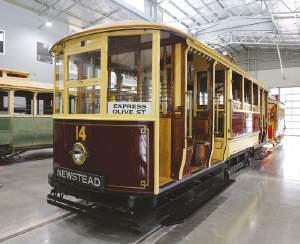
in 1956, and in 2020 beautifully restored Geelong 2 was donated to the BTM along with non-restored Geelong 28. The BTM is now able to represent that system.
A third tramway museum in the State of Victoria is Bylands. This was the first tram museum in Victoria but has suffered from a lack of resources, as well as theft and vandalism and severe weather events. The premises are currently closed to visitors and may not reopen. The safe storage of many priceless trams is therefore threatened.
The BTM fleet comprises 30 tramcars. Of these, 16 are operational, two are on static display, another two are dedicated for special-purpose work, car 12 is under reconstruction and car 18 under restoration in the depot. Three of the trams on display (1, 41, 2) are operable and 11 more are in the depot. The BTM has established a large offsite storage and workshop facility, currently holding 26 trams. Some are the property of the Melbourne Tram Museum and others are housed on behalf of VicTrack, the government body which owns a number of heritage trams and railway vehicles.
BTM representatives have been very proactive for many years in seeking support from the City of Ballarat as well as local State and Federal politicians. This has resulted in sufficient government funding to replace all the track in Wendouree Parade and build the new track to the Display Hall, ensuring the long-term future of the BTM.
Visitor numbers to the museum have doubled since the new hall was opened. During the annual Begonia Festival, when tram service was reinforced with council financial support from 2005 to 2022, there was a five-fold increase in footfall. Visitors now see the transformed BTM as a full heritage experience. The display hall includes audio-visual displays supporting the trams, as the museum is aimed at all age groups, particularly families with children.
The museum is open all year on Tuesdays, Saturdays and Sundays and likewise on Thursdays during the Victoria State school holiday periods. Admission charges (adults AUD15 (EUR9.22), children AUD7 (EUR4.30)) include access to all displays and unlimited tram rides. The service operates according to demand, starting at 11.00 with last departures at 16.00 (Tuesdays and Thursdays when running: 10.00-15.00).
With grateful thanks to Peter Winspur for additional information.
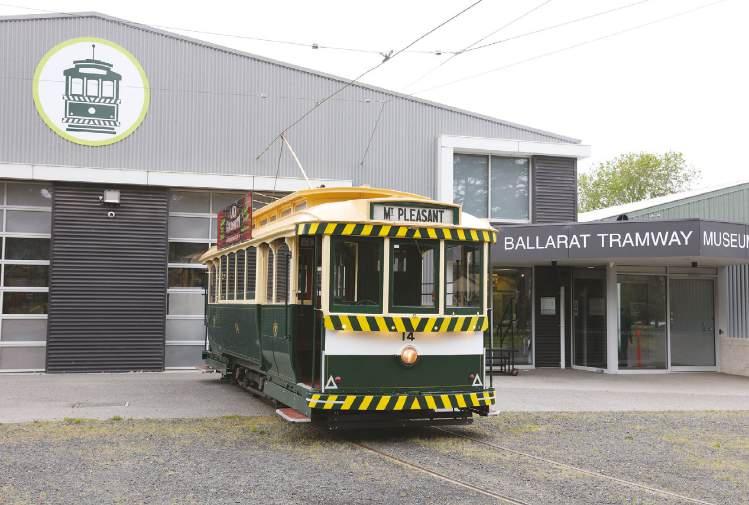
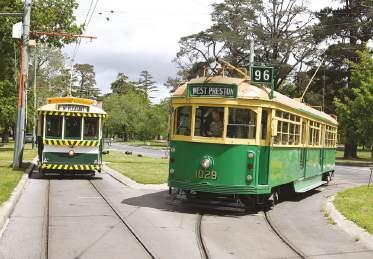
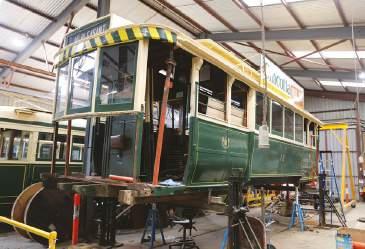
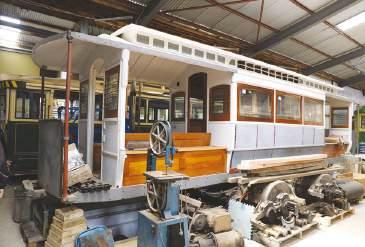
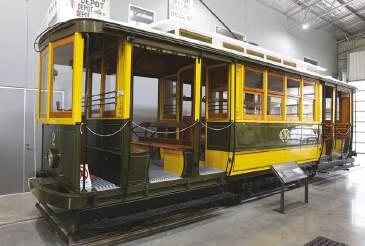
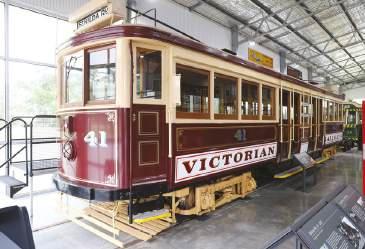
1. On loan from the Sydney Tramway Museum at Loftus is Launceston (Tasmania) 14, dating from 1912 for the opening of the system by local builder J & T Gunn. It remained in service until the system closed in 1952.
2. Standing sentinel outside the imposing new BTM Display Hall is car 14. It was built in 1915 by Meadowbank for the Prahran & Malvern Tramways Trust and after sale in 1927 operated first at Geelong and then in Ballarat from 1936.
3. A scene at the junction of the depot-connection track with the main running line, with car 14 giving way to 1029, a former Melbourne (M&MTB) W7 class bogie car of 1956. It was acquired in 2019 to become an accessible tram.
4. Representing the Geelong tramway system is car 2, one of seven built in 1912. After closure in 1956 the car was sold for various uses until rescued in 1991. It was restored using a motor and wheelsets from Bruxelles, and was presented to the BTM in 2021.
5. Duncan and Fraser built car 18 for the Prahran and Malvern Tramways Trust (Melbourne) in 1913. It came to Ballarat in 1931, and in 1964 was decorated (with bogie car 40) to mark the centenary of the Borough of Sebastopol, to which it was donated in 1971.
6. One of the proudest exhibits in the BTM Display Hall is Victorian Railways bogie car 41 of 1923, built on 1600mm bogies for operation in the southern Melbourne suburbs. The car was acquired by the MTPA in 1977 and restored at Haddon.
7. Long-term restoration work is in process in the workshop area on car 12. Built in 1892 by Benjamin Carne for the NSW Government Tramways, it is a rare example of a cable car trailer later rebuilt for electric service. When finished it will ride on a newly-constructed Bruxelles-style 21E truck.
8. The oldest tramcar in the collection is double-deck horse car 1, built in 1887 by Duncan and Fraser of Adelaide for the opening of the Ballaarat tramways. After system electrification it served as a trailer until withdrawal in the 1920s. Reconstructed between 1987-92 it uses a mix of new and original material, and is claimed to be the oldest working tram in Australia. 8 6 7 5 3
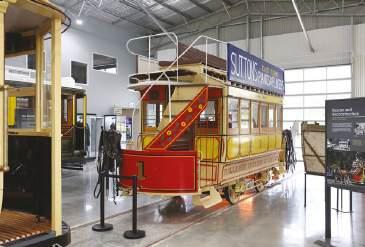
All photography by Mike Russell on 9 November 2025.
In marking Global Accessibility Awareness Day, Chelsea Branch spoke with UKTram operator members to explore how LRT is becoming more accessible and inclusive.
Accessibility is often discussed as a feature of transport systems, but it is something far more fundamental. It shapes whether people can travel at all.
With more than one billion people worldwide living with a disability, the way light rail systems are designed and operated has a direct impact on independence and everyday mobility. As networks continue to grow, accessibility remains a vital part of delivering public transport that works for everyone.
This year’s Global Accessibility Awareness Day (21 May) will provide an opportunity to assess how accessibility is implemented across the light rail sector. Ahead of this year’s campaign, UKTram spoke with several of its operator members to explore how accessibility is being delivered in practice across networks.
Enhancing accessibility through a people-focused approach
In 2025 and 2026, KeolisAmey Metrolink launched a new colleague development initiative, ‘Travelling in the Shoes of Our Customers’. The programme is intended to deepen staff’s awareness of passengers’ experiences with disabilities by providing practical and immersive learning opportunities.
As part of the initiative, Metrolink has partnered with disability advocate Zara Beth, who provides insight into wheelchair users’ experiences. The programme is further supported through collaboration with Manchester Deaf Centre and Manchester Sensory Support Service, helping colleagues understand deaf and blind communities, through information on guidance techniques, communication approaches and ensuring the use of appropriate terminology.
The impact of this approach is already being felt across the network. Front-line colleagues are applying their new awareness and skills in day-to-day roles, supporting passengers with greater confidence and sensitivity.
guidance for mobility scooter users, including a leaflet distributed onboard and through local retailers. The guidance offers advice on safe scooter positioning, improving safety and confidence.
Alison Sweeney, Head of Marketing at NET, explains: “As a public transport operator, it’s our duty to make our service simple to use and accessible for as many people in Nottingham as possible. We’re proud of the substantial investment we’ve made into making sure more people can feel safe and comfortable when using the trams.”
Speaking about the real impact of accessibility in practice, UKTram Board Member Lindsay Murphy recalled a moment from her time at Nottingham Trams: “During a ‘Meet the Manager’ session, we set up at tram stops so people could meet those running the tramway. A woman in an electric wheelchair approached us. She explained that before the tramway was built, she lived just up the road from a few small shops but needed help getting into them. Now, she can board the tram independently, travel into the centre of town, meet friends, and get home again without assistance. That’s what light rail can do.”
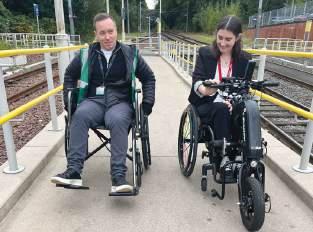
Focusing on lived experience supports the initiative’s key message: accessibility is not solely about infrastructure; it’s also about how people interact with passengers and respond to their needs.
Nottingham Express Transit (NET) has also taken a proactive approach to ensuring that passengers of all abilities can navigate the network with confidence. Working in partnership with accessibility company Widgit, NET has developed a travel guide that uses specialist symbols and images to support those who may find it difficult to travel independently or may not speak English.
The guide helps passengers know what to expect when travelling on the tram, reducing anxiety and promoting greater independence.
NET has also partnered with the Thomas Pocklington Trust to support blind and partially-sighted passengers. Through this collaboration, the network has developed audio guides and videos to help users navigate the system more easily.
For passengers with mobility needs, NET has introduced
Across the UK, modern light rail systems are designed with levelboarding as standard, enabling stepfree access for disabled passengers. Networks including Manchester, Sheffield, Nottingham, Edinburgh, Tyne and Wear, Croydon and Docklands demonstrate how consistent, accessible design can support independent travel across entire systems.
In Edinburgh, the tram network has been designed to be fully step-free, with level-boarding, low-floor vehicles and clearly marked wheelchair boarding points, enabling independent travel without the need for pre-booked assistance.
In London, the Docklands Light Railway (DLR) has long been recognised for its accessibility-first design, with step-free access and level boarding, along with audio-visual announcements and wheelchair spaces.
More recently, initiatives such as the Access DLR trial are going further, providing pre-bookable assistance for passengers who may need additional support.
In Ireland, Dublin Luas has similarly prioritised accessibility through low-floor trams, step-free stops and clear passenger information, supporting independent and inclusive travel across Dublin’s growing network.
These approaches are often strengthened through collaboration with charities and advocacy and user communities, making sure that accessibility improvements are informed by actual experience rather than assumptions. For the sector, the opportunity is to continue sharing knowledge and building on effective practices. When light rail is designed for everyone and systems are easier to navigate and more intuitive to use, they benefit those with additional needs and the wider travelling public.

Order online from https://shop.lrta.org/ – or by post from:
LRTA Publications, 38 Wolseley Road, SALE, M33 7AU
(Please provide telephone contact details and quote LRTA membership number if applicable)
An album of evocative images from the last years of Scotland’s third and fourth cities as their tramways fell to the inexorable, if misguided, abandonment policies of post-war Britain.
> A4 hardback; 120 pages, 180 black & white pictures and 10 maps.
£34.50 (UK addresses); £46.00 (outside UK); £63.00 (Airmail Z1); £68.00 (Airmail Z2/3); LRTA Members: £2.90 discount
The creeping decline of a colonial monument
This book is dedicated to the last operating tramway in South Asia. It covers the 152year history of this huge Indian city’s tram system. English and German text.
> A4 softback; 168 pages, 200+ colour and black & white pictures, 20 maps.
£42.00 (UK addresses); £53.50 (outside UK); £68.00 (Airmail Z1); £73.50 (Airmail Z2/3); LRTA Members: £3.75 discount

The second in our new series of colour albums covering the historic Lisbon, Porto and Sintra tramways plus the new Metro do Porto and Metro Transportes do Sul light rail networks introduced in 2005/07.
> A4 hardback, 144 pages, 287 colour pictures plus 16 maps.
£33.50 (UK); £40.00 (outside UK); £47.50 (Airmail Z1);
£52.50 (Airmail Z2/3); LRTA Members: £3.00 discount
This fascinating book details all the UK tram schemes that failed to see the light of day.
> A4 softback; 192 pages; 116 colour and 119 black & white pictures; 117 maps.
£23.00 (UK); £30.00 (outside UK);
£37.50 (Airmail Z1);
£42.00 (Airmail Z2/3); LRTA Members: £2.00 discount
Outside UK = Airmail to Europe (includes all of Russia) / Surface mail to rest of world; Airmail Zone 1 = outside Europe excluding Australia, New Zealand & USA; Airmail Zones 2/3 = Australia, New Zealand & USA For
Comprehensive history of this seaside town’s extensive tram system from initial proposals through to the conversion to trolleybus operation in 1936.
> A4 hardback; 338 pages, 227 black & white and three colour pictures, 25 maps.
£47.50 (UK addresses); £58.00 (outside UK); £80.00 (Airmail Z1);
£90.00 (Airmail Z2/3; LRTA Members: £4.00 discount
The first in a series of three books covering many of the tramways and electric light railways operational in Spain in the mid-1950s.
> A4 hardback, landscape format; 144 pages, fully illustrated in colour throughout.
£42.50 (UK); £54.00 (outside UK); £66.00 (Airmail Z1); £67.50 (Airmail Z2/3); LRTA Members: £3.90 discount
Tramways in Milan in Colour (1954-1978)
I tram di Milano – Immagini a colori (1954-1978)
Third in the series of colour albums exploring the fascinating combination of urban and interurban tramways in and around Milan. The variety of rolling stock is amazing and is richly illustrated. English and Italian text.
> A4 hardback, 144 pages, 176 colour pictures plus two maps.
£33.50 (UK); £40.00 (outside UK); £47.50 (Airmail Z1);
£52.50 (Airmail Z2/3); LRTA Members: £3.00 discount
A companion volume to our Bolton book, describing the different generations of tramway from the Company steam era, the Corporation electric period and through to today’s Metrolink system.
> A4 softback; 184 pages, over 220 photographs, four maps and extensive appendices.
£26.00 (UK); £37.50 (outside UK); £48.50 (Airmail Z1);
£52.50 (Z2/3); LRTA Members: £2.25 discount
The BIGGEST YEAR in our history.
The STRONGEST PROGRAMME we’ve ever delivered.
The event the ENTIRE SECTOR is talking about.

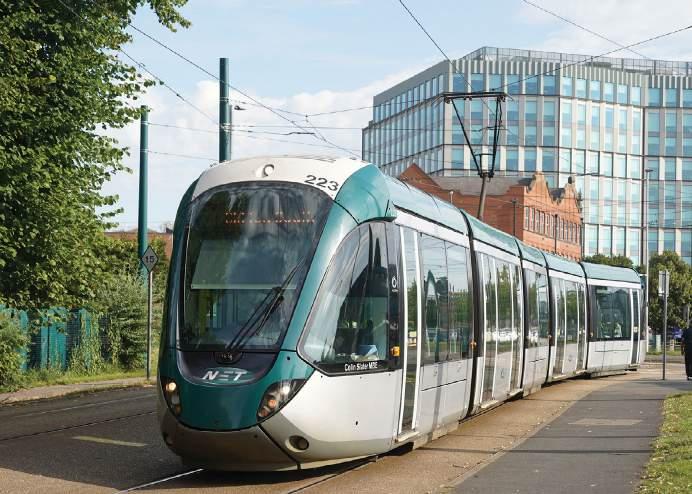



Be part of the milestone year that brings the entire UK light rail community together.
For our 20th anniversary, we’re returning to Nottingham Trent University, where it all began. We’re bringing a fresh new look inspired by sustainability, innovation, and the future of green transport.
This is your chance to:
• Build powerful relationships with UK and international leaders
• Hear industry-shaping insights from the people setting the agenda
• Discover new tech, solutions and suppliers
• Position your organisation at the heart of the next decade of light rail
This isn’t just another conference, it’s the UK’s most influential light rail gathering, trusted for two decades by operators, suppliers, policymakers, innovators and solution providers.
www.mainspring.co.uk