









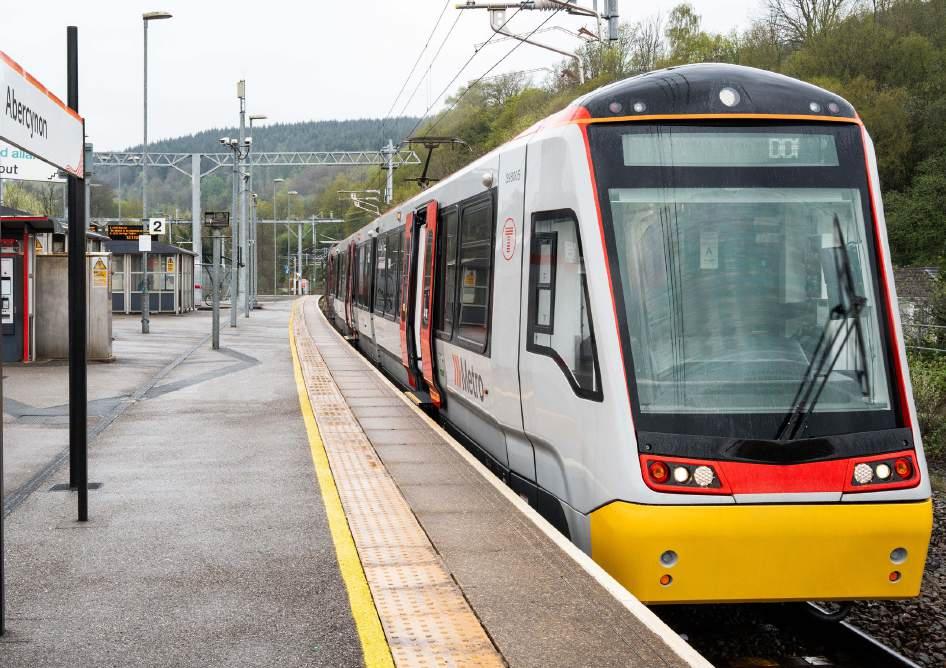
Pioneering battery power
Stadler

stadlerrail.com
Stadler
stadlerrail.com
NEWS
Romania wins investment for two cities; Cairo elevated monorail starts service.
244
INSPIRATIONAL LRT
248
What makes a tramway ‘inspiring’? TAUT rounds up just some of the systems around the world that could justify this description.
NATIONAL TRANSPORT STRATEGY 254
TAUT asks: could new government legislation finally help unlock light rail expansion in the UK?
CAUSE FOR OPTIMISM
256
TAUT takes a tour around the UK’s systems to find out their latest progress and plans.
THE BENEFITS OF AN ALLIANCE
260
Andrew Thompson visits this German city system after its western extension opened.

JULY 2026 Vol. 89 No. 1063 www.tautonline.com
EDITORIAL
EDITOR – Matt Johnston hello@mainspring.co.uk
ASSOCIATE EDITOR – Tony Streeter tony.streeter@mainspring.co.uk
WORLDWIDE EDITOR – Michael Taplin miketap@mainspring.co.uk
SENIOR CONTRIBUTORS –Howard Johnston , Neil Pulling
WORLDWIDE CONTRIBUTORS
Richard Foster, Andrew Grahl, Andrew Moglestue, Herbert Pence, Mike Russell, Nikolai Semyonov, Alain Senut, Andrew Thompson, Witold Urbanowicz, Bill Vigrass, Thomas Wagner, Philip Webb.
PRODUCTION – Lanna Blyth Tel: +44 (0)1733 367604 production@mainspring.co.uk
DESIGN – Debbie Nolan
ADVERTISING
UKTRAM: NEW MILESTONES 265
The Mixed-Use Railway gains momentum.
SYSTEMS FACTFILE: COTTBUS 266
A delayed fleet renewal is now underway in this German city; Neil Pulling reports.
WORLDWIDE REVIEW
Duisberg increases Siemens order; Milan secures funding for the M5 project.
MAILBOX
CLASSIC TRAMS: JENA
COMMERCIAL MANAGER – Geoff Butler Tel: +44 (0)1733 367610 geoff@mainspring.co.uk
Tramways & Urban Transit 13 Orton Enterprise Centre, Bakewell Road, Peterborough PE2 6XU, UK
Tramways & Urban Transit is published by Mainspring on behalf of the LRTA on the third Friday of each month preceding the cover date.
271
275
Answers to the Lisbon Sintra 2 car mystery.
276
Midland Metro Alliance reflects on its unique working model. THE STAR OF MUNICH 262
Mike Russell reports on the celebrations marking 125 of this German tramway.
Is this the law we’ve been waiting for?

The UK Government has just published new legislation that could smash down some of the barriers that have stood in the way of building new rail systems for the last half a century. This will be great discussion fodder at the 20th Annual Light Rail Conference being held on 30 June/1 July, and the basics are outlined on pages 254-255 of this issue of TAUT
We are told that it is all about devolving powers from the centre to the regions. Commentators have argued strongly and loudly that it is not all about the usual pumping of all available funds into new roads, because history shows that they do little or nothing for our medium and long-term economic well-being.
The Devolution & Community Empowerment Act 2026, which became law on 29 April, will bring some consistency to what has been a haphazard approach across England, Scotland and Wales. Change can only come if local authorities are legally allowed to both raise their own money and decide how they spend it.
Of course the big headlines are stolen by the revolutionary Great British Railways, which brings track and passenger (not freight) services back into public ownership after 30 years, but there are also potential rich pickings for urban transit. Jason Prince, Director of the Urban Transport Group, has already told Prime Minister Sir Keith Starmer that current national policy impedes progress in delivering small local interventions right through to major schemes.
He calls for infrastructure project delivery to be turbocharged, while the granting of all-important Transport and Works Act Orders covering land acquisition and construction should be decentralised from the Westminster parliament for most tram, light rail and underground projects. This would save masses of time and vast legal expense – which is all sound stuff.
Matt Johnston, Editor
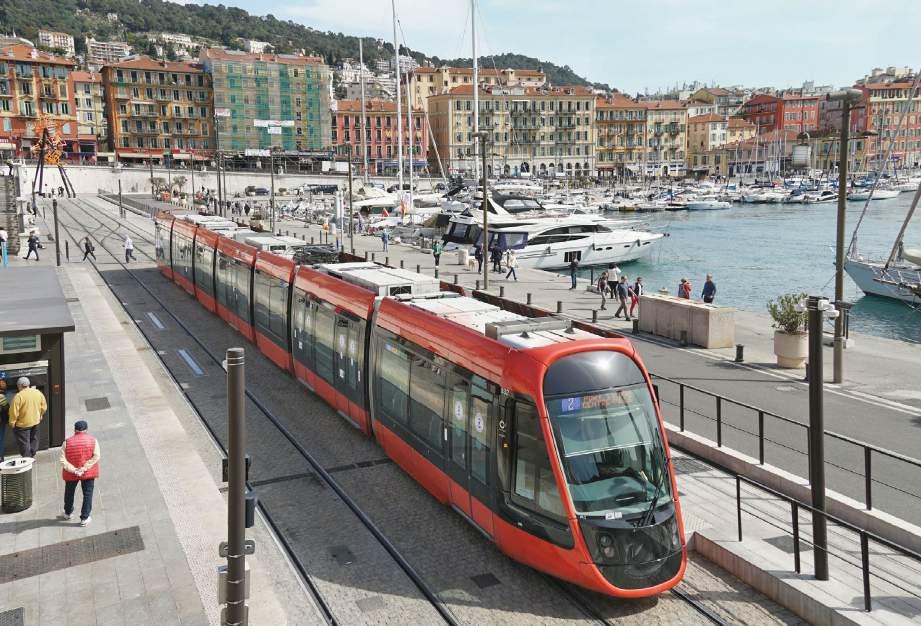
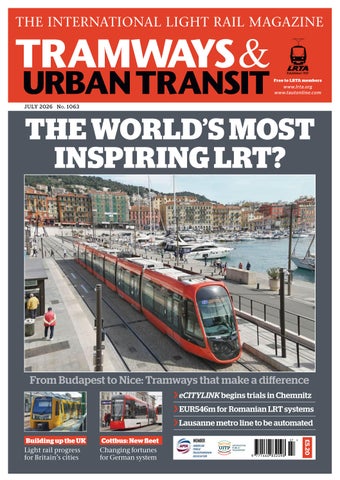
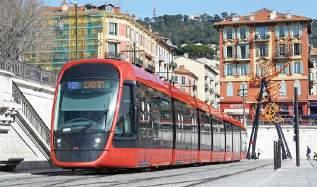
COVER: Prominent yet in sympathy with its setting: the Port Lympia terminus at Nice’s Old Port in March 2023. Neil Pulling
LRTA MEMBERSHIP (with TAUT subscription) Tramways & Urban Transit is sent free to all paid-up members of the Light Rail Transit Association.
LRTA WEBSITE AND DIARY Tim Kendell webmaster@lrta.org meetings@lrta.org
SUBSCRIPTIONS, MEMBERSHIP AND BACK ISSUES LRTA Membership Secretary (Dept T06), 38 Wolseley Road, Sale M33 7AU, UK. Tel: +44 (0)117 951 7785 membership@lrta.org Website: www.lrta.org FOR CORPORATE SUBSCRIPTIONS VISIT www.mainspring.co.uk
LRTA REGISTERED OFFICE 13 Orton Enterprise Centre, Bakewell Road, Peterborough PE2 6XU, UK Private company limited by guarantee, No. 5072319 in England and Wales.
LRTA CHAIRMAN – Paul Rowen chair@lrta.org
© LRTA 2026
Articles are submitted on the understanding they may also be used on our websites or in other media. A contribution is accepted on the basis that its author is responsible for the opinions expressed in it, and such opinions are not those of the LRTA or Mainspring. All rights reserved. No part of this magazine may be reproduced or transmitted in any form by any means, electronic or mechanical, including photocopying, recording or by any information storage and retrieval system, without prior permission in writing from the copyright owner. Multiple copying of the contents of the magazine without prior written approval is not permitted.
Romania has won EUR546.2m of European Union support for two different tram schemes. The European Investment Bank agreed to a EUR265.6m loan on 20 April that will go towards modernisation of the București (Bucharest) tram network; this supports a larger EUR1.3bn programme to improve urban mobility across the Romanian capital as well as helping to reduce its carbon footprint.
București operates 23 tram lines over a 144km (89.5-mile) system in addition to its five-line metro. The loan will enable 50km (31 miles) of track to be relaid, 63 new trams to be purchased and the complete modernisation of Colentina depot, which is to be completed by 2030.
Mayor Ciprian Ciucu said: “București needs big investments in its tramway network, that has not been modernised for over 50 years and is no longer efficient. This financing is extremely important for the city. We are committed to continuing this collaboration and accelerating the development of projects that will shape the future of our city for generations to come.”
The tramway received 100 Astra Imperio low-floor trams in 2022-24, but the majority of
the 486-strong fleet comprises high-floor vehicles.
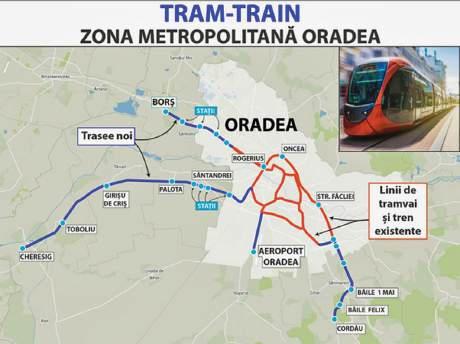
Five days before the București funding was announced, the EU pledged EUR258m in funding to Bihor County Council for it to establish a tram-train system around the city of Oradea. Bihor County will fund the remaining cost of the RON1.43bn (EUR280.6m) project.
This will be Romania’s first tram-train network and is proposed to be 33.4km (21 miles) long, serving 27 stations. It will involve restoring and electrifying more than 24km (15 miles) of existing railway to B ă ile Felix, I Industrial Park Oradea, Cheresig, Cord ău and Aeroportul Internaţ ional Oradea. A tender has been issued for the supply of 14 100km/h (62mph) tram-train vehicles, expected to cost EUR6.4m each.
Bihor City Council President Mircea Mă lan described the project as “important for Oradea and for localities around the city, because it offers people a simpler, faster and more civilised way to get around.”
Oradea has operated trams since 1882 and has a 20km (12.4-mile) three-line network.
Siemens/ELIN Ultra Low Floor trams were introduced in 2008, while deliveries of 30 Astra Imperio vehicles started in 2022.
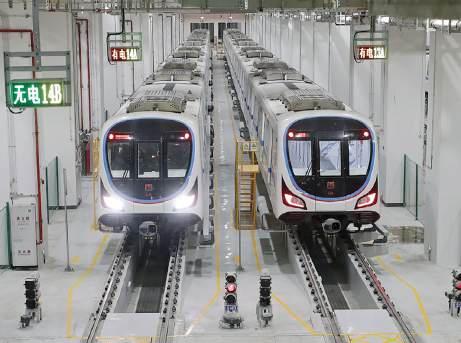
The Chinese city of Wuhan’s metro system grew on 1 May –and should become even longer by the end of 2026.
Line 12 is an automated orbital metro that the city claims will be the longest such line in the world. Phase 1 is now operating between Gangduhuayuan and Moshuihu Park via Wuchang railway station. The 35.3km (22-mile) line serves 23 stations in the city’s southern suburbs. Phase 2 is to add a further 24.6km (15.3 miles) of track and 14 more stations when it opens, expected to take place this year.
The 43 six-car trains have a maximum speed of 80km/h (50mph) and are equipped for Grade of Automation 4. The fleet is to increase to 79 trains when Phase 2 opens.
Line 12 is a public-
private partnership scheme implemented on a ‘BuildOperate-Transfer’ basis involving China Railway Development & Investment Group and China Railway Construction Investment Group.
Wuhan opened its first metro in July 2004 and this has now expanded to become a 553km (344-mile) network with 335 stations. It carries approximately 1.5bn passengers per year.
A 49km (30-mile) tram system started operating in 2017 and acts as a feeder to the metro.
• The combined length of China’s metro systems reached 10 000km (6213 miles) by the end of 2025. It has been estimated that a further 731.5km (455 miles) could open in 2026, while 2544km (1580 miles) of lines are under construction.
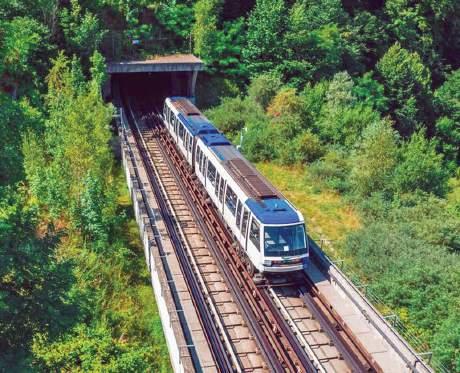
Lausanne’s public transport operator TL has selected Alstom to deliver a EUR295m contract to modernise the Swiss city’s metro line M2. Alstom is to install its Urbalise Fluence CommunicationBased Train Control (CBTC) system, permitting increased frequencies.
Meanwhile, Alstom is to carry out mid-life refurbishment of the line’s 15 two-car trains at its Villeneuve factory in Switzerland. Key onboard systems will be renewed, while the interiors will be given makeovers. When they return to Lausanne, the rubber-tyred trains will also boast a new livery. Alstom is to phase the upgrade work, to minimise disruption to daily services. Most installation and testing activities are to be
Temporary closures on London Underground’s Piccadilly Line (UK) this summer will permit trials of 2024 Stock trains to take place. The new Siemens Mobilitybuilt trains were expected to enter service in 2025 but are now not due to carry passengers until December at the earliest.
Part closures, says Transport for London, will enable “essential upgrades to the power supply, tracks, platforms, depots and sidings while continuing to test the new trains’ interaction with existing London Underground infrastructure, alongside assessments of their efficiency and performance”.
Trains of 2024 Stock have already covered 400km (roughly 250 miles) on test, including carrying simulated loads.
Most temporary closures are due to take place overnight at weekends, although midweek closures are scheduled between Cockfosters and Uxbridge on 18-20 and 25-27 August. Wholeline overnight closures are due to take place on 31 July-1 August and 30 October-1 November. The full list of closures can be found at www.tfl.gov.uk/piccadillyworks
carried out at night.
“The need to modernise the automation system and increase capacity is crucial for the entire transport network of the Lausanne metropolitan area”, said TL Chief Executive Officer Patricia Solioz Mathys.
“We are delighted to be able to rely on Alstom’s expertise to carry out this strategic operation.”
Alstom Switzerland Managing Director Marie Icardo added: “By combining our next-generation CBTC system with onboard intelligence and a fullyintegrated mid-life fleet upgrade, we are increasing capacity while extending performance of existing trains for many years to come.”
M2 opened in October 2008. Linking Ouchy on Lake Geneva with the city centre and
Épalinges, it runs underground for 4.1km (2.5 miles) of its 5.9km (3.7-mile) route. It uses the alignment of the Ouchy – Le Flon
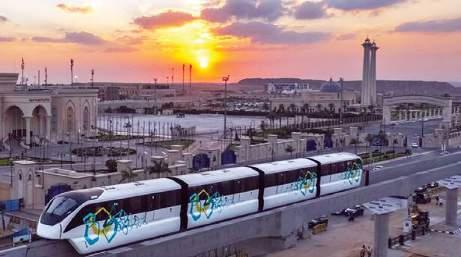
Commercial services on the East Nile automated elevated monorail in El Qahirah (Cairo) started on 6 May. The 56.5km (35-mile) line currently runs from a temporary terminus at El-Moshir Tantawi to the New Capital (Justice City).
The EUR2.7bn line was built by Orascom Construction and Arab Contractors, which will operate the route on a 30-year concession. It uses 68 Alstom Innovia 300 four-car trains that were built at Alstom’s UK factory.
“The Innovia monorail system is truly a game changer, not only for Egypt but for the African continent as a whole”, said
Martin Vaujour, Alstom’s Africa, Middle East & Central Asia Region President.
Services operate 06.00-18.00 and ticket prices are based on a zonal structure, with prices starting from EGP20 (EUR0.32).
The East Nile line is designed to carry up to 45 000 passengers per hour in each direction.
Currently serving 16 stations, the monorail is due to be extended by six stations from El-Moshir Tantawi to an interchange with metro line 3 at Cairo Stadium. The 42km (26-mile) West Nile line, linking metro line 3 at Wadi El Nile to Giza, is still under construction.
railway that ran from 1877 until 2006. However, the use of rubber tyres enables M2 to rely solely on adhesion.
The Government of Ontario awarded the first contract for the Hamilton LRT project on 30 April, to Hamilton Transit Alliance, led by Aecon Infrastructure Inc. Work in the contract includes relocating utilities and reconstructing roads, as well as designing a replacement bridge and new underpass.
The 14km (8.7-mile) Hamilton LRT is to link McMaster University on Main Street to Eastgate Square via the city centre, with 16 stops.
CAD1.76bn (EUR1.09bn) is to come from the Canadian government, while the province is contributing CAD 1.64bn (EUR1bn).
A proposed opening date is to be announced.
Tramwaje Warszawskie has issued a tender for 20 double-ended trams. The Warszawa (Warsaw) operator requires delivery within 34 months of a contract being signed. There is also an option for 42 additional vehicles.
The new trams are to be between 30m and 33m long. The manufacturer will be chosen on the competitiveness of the bid, but also other factors, such as the smallest possible carbon footprint.
“The goal is to shorten the supply chain, thereby ensuring its safety and timeliness, in accordance with Polish and EU law”, TW said.
“Contractors must propose environmentally-friendly solutions, such as selecting a production site or using local suppliers.”
Completion of the MXN2.39bn (EUR118m) upgrade of the Tasqueña – Xochimilco light rail line in Mexico City was marked by a ceremony on 11 May. The project included ordering 17 four-section LRVs and giving a facelift to each of the 18 stations.
CRRC Zhuzhou delivered the last of the new vehicles on 31 March. Carrying a new white livery, with black trim and silver doors, they will permit a fourminute frequency at peak times.
The 12.8km (7.9-mile) Tren El Ajolote is operated by Servicio de Transportes Eléctricos, which is also responsible for the capital’s trolleybuses and cable cars.
Separately, on 26 April, Mexico City’s suburban electric railway system Tren Surbano opened its new 23.7km (14.7-mile) line from Buenavista station to Aeropuerte Internacional Felipe Ángeles. This currently uses eight CAFbuilt EMUs, although these are to be replaced by 14 EMUs from CRRC Zhuzhou.
Line 2, which connects with the 27km (17-mile) line 1 at Buenavista, is expected to carry 80 000 passengers a day.
Gold Line is go
Dubai’s Roads & Transport Authority is seeking contractors to build the AED34bn (EUR8bn) Gold Line after the project was formally approved on 22 April. The contract includes all civil works and provision for both electromechanical equipment and rolling stock. Interested parties have until 13 June to respond.
The 42km (26-mile) underground east-west line will link Al Ghubaiba and Jumeirah Golf Estates via Business Bay and Meydan. It will have 18 stations and interchange with the Green and Red lines. Completion should be achieved by September 2032.
More trams for Cologne
The tender for up to 113 new trams for Köln (Cologne), as reported last issue (TAUT 1062) is in addition to the outstanding order for 62 trams placed with Alstom in 2020. The first Citadis for this delayed order was approaching completion at Alstom’s Barcelona factory in April. Both orders will be used to replace the Bombardier 4500-series low-floor cars introduced in 2005. With all the new rolling stock expected to arrive between now and 2033, a new EUR9m ‘commissioning hall’ is to be built at the system’s central workshops.
Stadler eCITYLINK tramtrain 451 has started trial runs in and around Chemnitz. Delivered in December 2025, the vehicle the first of 19 second-generation CITYLINK tram-trains on order; a second vehicle was delivered on 21 April.
eCITYLINK is a dual-voltage version of the German city’s firstgeneration CITYLINKs that run on both diesel power and using overhead wires at 600V dc. The new vehicles are built to operate at 600V dc on the city tramway and 15kV ac on electrified railways. They are to start carrying passengers between Chemnitz, Stollberg, Mittweida and Döbeln in 2027. In future, they will also be deployed on new tram-train links between Chemnitz and LimbachOberfrohna and between Stollberg and Sankt Egidien. These double-ended LRVs are 37.1m long and have a maximum speed of 100km/h (62mph). They
Harshen Engineering Corporation has started preliminary construction of tram line 1, an east-west route across the South Korean city of Ulsan. The 10.9km (6.8-mile) route will link Taehwagang station in the city centre to the Sink intersection, near Ulsan University. It is expected to cost KRW381.4bn (EUR218.8m).
The nine five-section trams from HyundaiRotem will be powered by hydrogen fuel cells, and the line will be built without overhead. Passenger services to its 15 stops should start in 2029.
Plans are also being made for a 13.5km (8.4-mile) northsouth tram line; a further two lines in the northern suburbs could follow. There are plans for Ulsan to become a terminus for an extension to the Donghae commuter rail line. This could terminate at an interchange with line 1.
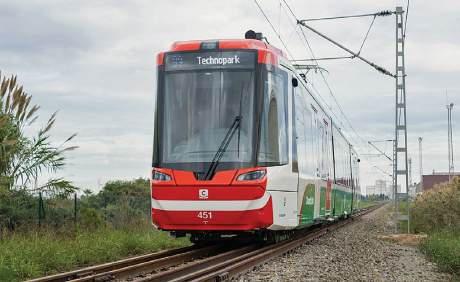
are fitted with a toilet, given their planned use on longer-distance routes. In addition to the firm order for 19, there is an option to supply another 27.
“The new tram will undergo rigorous testing in the Chemnitz tram and regional rail network over the coming months”, Operator VMS’s Managing Director Mathias Korda said.
“From 2027, the new vehicle,
along with its sister vehicles, is scheduled to be deployed on the Chemnitz Model network’.”
The first stage of the Chemnitz Model tram-train system opened in December 2002. It now covers four lines with an interchange point at Chemnitz Hauptbahnof, the city’s main railway station. The fleet currently comprises six Stadler VARIOBAHN cars and the 12 diesel-electric CITYLINKs
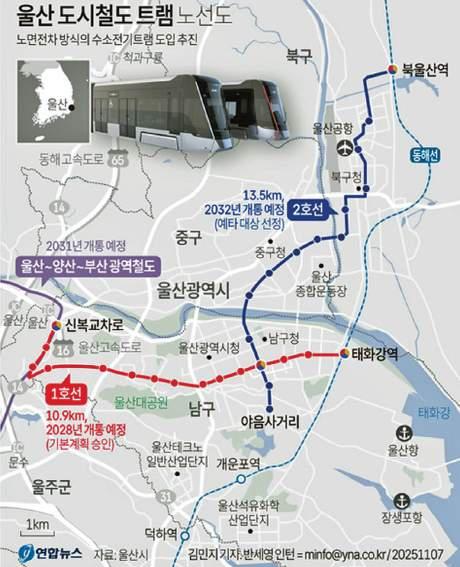
A map of planned tramways in Ulsan. yna.co.kr
New team aims to shape transport and ‘turn ambition into reality’
Anew group has been created by the UK Government to “tackle barriers to delivery of mass transit systems across the UK”. The Mass Transit Taskforce (MTF) was unveiled on 20 May.
Transport Secretary Heidi Alexander said: “Mass transit has the potential to transform towns and cities across the country. Creating a better, more integrated transport system will not only support economic growth and new jobs, but will also deliver housing.
She said the MTF “will use its skills and vast knowledge to deliver real and practical
recommendations to shape the future of urban transport for years to come.”
Chaired by economist Bridget Rosewell, the MTF currently includes Create Streets Managing Director David Milner, Arup Chief Officer for Global Business and Markets Richard de Cani, and Urban Transport Group Director Jason Prince.
Ms Rosewell said: “Integrated mass transit systems can transform how people move around our towns and cities, connecting communities with jobs, homes and opportunity.
She added that the MTF “provides practical
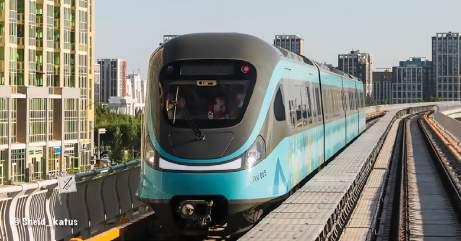
Tramtown, the heritage exhibition in Blackpool Transport’s historic Rigby Road headquarters (UK), has permanently closed. The fitting shop that housed Tramtown was threatened with closure in December due to issues with the building’s electrics. A GBP50 000 (EUR57 340) grant from the UK Government’s ‘Pride in Place’ fund was to be used to carry out repairs. However, an independent structural report, carried out while the electrical repairs were taking place, deemed the buildings unsafe.
“I would like to categorically state that this is not the end of
the line for heritage trams in Blackpool”, Blackpool Transport Managing Director Lea Harrison said.
“While it’s sad to say goodbye to the existing building, we also have an opportunity to build a sustainable future for a top tourist attraction featuring our world-famous fleet.”
Limited heritage operation has resumed from the main depot at Starr Gate. Balloon 717 and Bolton 66 both operated tours in May.
The bulk of Blackpool’s heritage fleet is housed in the main depot building, which is out of bounds to the public due to its condition.
recommendations to government and local leaders on how to turn ambition into reality.”
The MTF has now started gathering evidence ahead of making its first recommendations, due to be delivered at the end of 2026.
Separately, the UK Government has announced that it is to consult on measures to give additional powers to elected mayors. The devolution of Transport & Works Act Orders would, a statement said, “ensure local leaders have more tools to deliver local transport, which meets the needs of local people”.
Kazakhstan’s President KassymJomart Tokayev opened the country’s first automated metro on 16 May. The 21.3km (13.2mile) line crosses the capital Astana, connecting Nürly Zhol railway station and Nursultan Nazarbayev International Airport. It is designed to carry 146 000 passengers per day. Serving 18 stations, the elevated line is operated using 19 four-section 60m trains, built by CRRC Tangshan. Services run 06.00-23.00, with a 5-10 minute frequency. End-to-end journeys take 40 minutes.
President Tokayev said that
München (Munich) kickstarted its year of celebrations marking 150 years of trams with a special Muttertag (Mother’s Day) event at the Ständlerstrasse tramway museum on 10 May. A new exhibition dedicated to the German city’s tram history opened on the same day, while shuttle line E7 operated between Max-Weber-Platz and the museum. One of the Bavarian capital’s newest trams, Siemens Avenio 2559, has been given a retro look, with each section
The Light Rail Transit Association has added its signature to a letter from the Campaign for Better Transport to UK Prime Minister Sir Keir Starmer. A total of 16 non-governmental organisations have signed the letter, which calls for “a target to increase travel by public transport… cycling, walking and wheeling, supported by a package of medium- and long-term transport measures” as well as asking the Government to “fulfil its pre-election commitment to set a ‘modal shift target’”.
Ben Plowden, CBT’s Chief Executive, said: “The most effective way to reduce UK households’ vulnerability to volatile global energy markets is not through short-term fixes, but by reducing our reliance on fossil fuels and moving towards a self-sufficient clean energy economy.”
Astana “should eventually develop into [the] transportation hub of Eurasia.”
Abat Shynynbekov, Vice Chairman of the board of LLP City Transportation Systems, added: “Astana’s light rail is currently the most advanced in Central Asia. The Chinese-made improvements to the station’s interior [make] it aesthetically pleasing. The quality of the exterior materials of the trains has also been enhanced.”
Construction of the light rail system started in 2017, but work was suspended between 2020 and 2022.
painted in an historical livery. The main 150th anniversary celebration is planned for 17 October, when trams from the museum’s collection are set to run through the streets.
Ingo Wortmann, Chief Executive Officer of municipal operator Münchner Verkehrsgesellschaft, said: “The tram shapes the face of the city and the lifestyle of the people in Munich. For the anniversary, we want to trace a broad arc from the impressive history of the tram to its growing importance for our mobility today.”
Horse trams started running in 1876, with electric operation starting in 1895. The city has 85km (53 miles) of tramway.
There are many ways in which to find a tramway ‘inspiring’, and those reasons can vary from one person to another. Here are just some that TAUT considers are worthy of the ‘inspirational’ tag.
Inspiration is by nature subjective: that which delights some may be disliked or held in indifference by others. Judgements will inevitably be coloured by personal views and experiences. Inspiration may reach across an industry as a practice to be followed; equally a tramway may inspire affection and a sense of attachment for everyday users – the enjoyment of open days and heritage parades is by no means confined to enthusiasts. There is no attempt here to establish a hierarchy, for there are too many aspects for clear-cut comparisons. An operation’s
scale may influence the regard in which it is held, although admirable features may be perceived in any size of system. As the saying goes, ‘beauty is in the eye of the beholder’ – and as such, trams passing through the arch by the historic Martinstor tower in Germany’s Freiburg im Breisgau is a thing of joy to some, yet for others it is marred by signage for a McDonalds branch within.
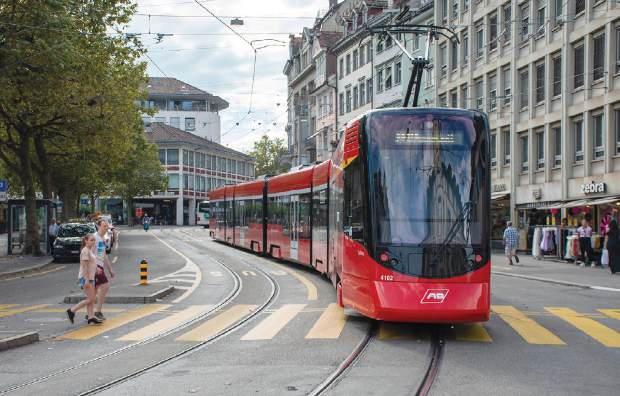
To have an aesthetically pleasing tramway, it helps if the city has some easy-on-the eyelocations, as in Budapest, Vienna, Lisbon or Bern. For entirely new or second-generation installations however, the system itself may
be the biggest contribution to the appeal of the surroundings. There are many examples where light rail has supported social and economic aims; as such inspiration may arise in any setting. However challenging the task and however good an outcome might eventually emerge, there may be justification (think UK High Speed 2, Stuttgart 21, the Amsterdam North-South metro) for transport projects to generate scepticism and its corrosive neighbour, cynicism.
What follows tries to take wider and longer views, giving due credit for contributions made by urban light rail.
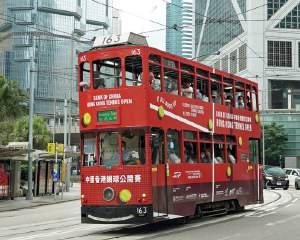
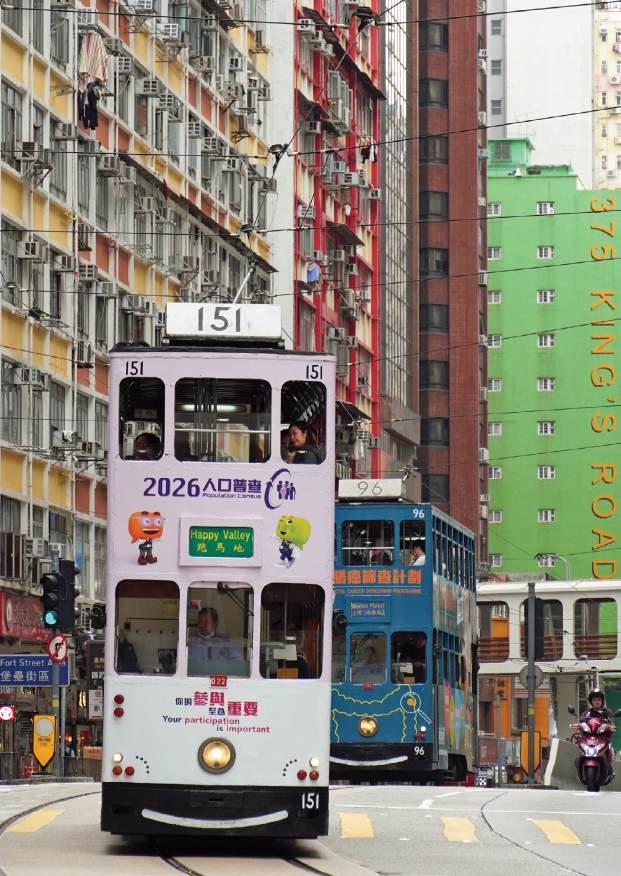
There is only about 16km (ten miles) of tram route on Hong Kong Island, but this includes some of the territory’s most-visited parts. These include the Central business district, the shopping honey-pot of Causeway Bay and, for a taste of an older Hong Kong, around North Point. The two-axle, doubledeck trams are certainly part of the tourism product – no bad thing anyway – but like the Star Ferry crossing to Kowloon, they remain important to many locals on an emotional level and as a low-cost option. Even when crowded, trams are less frenetic and give much better views than the shadowing MTR Island line and, courtesy of opening windows, provide a stream of fresh air, however hot and humid that may be.
As here on King’s Road, North Point, there’s rarely a long wait before the next tram comes along.
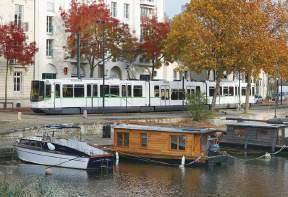
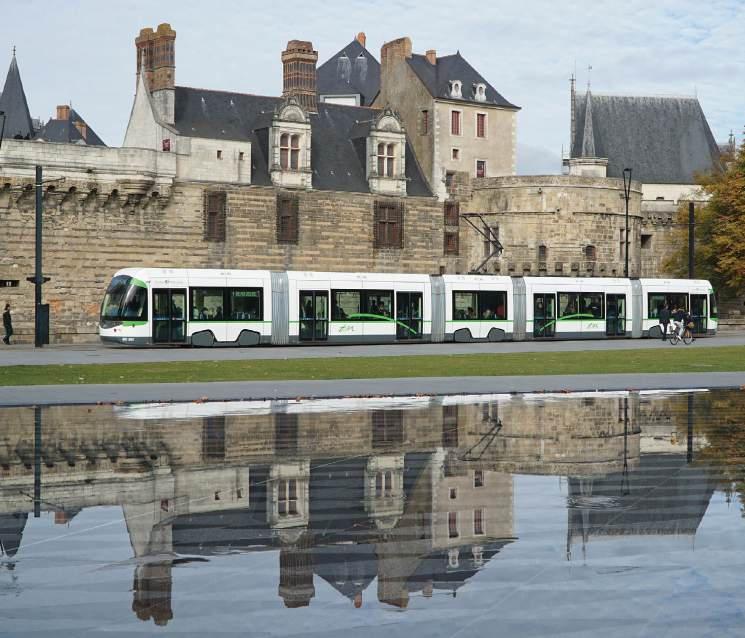
Nantes has a special place in light rail history. Only unusual local conditions enabled survival of the few French legacy systems existing beyond the 1950s, so it was a bold step by Nantes to reinstate the mode. At the 1985 opening, it was with a fleet marking France’s return to tram making. This rapidly led from the first Tramway Français Standard (a short-lived model, but long-lived in service) to Alstom’s Citadis that became represented around the world. Nantes was not an outlier for long as other projects were progressing, for major French cities without a second-generation tramway became a rarity.
The Nantes water mirror which was added 2015 does its job for Adtranz Incentro 362 as it passes the Château des ducs de Bretagne. This is on the first part of the system that opened in January 1985.
Identifying Düsseldorf as an inspiring tramway may seem unlikely and there is a large element of shared laurels here. Stuttgart, Cologne, Hannover or Frankfurt am Main may have an equal and similar claim, for what these similarly prosperous German cities with no shortage of car owners have done is to keep faith with light rail. They invested in legacy tramways with few apparent doubts about it being a good idea, with some developing routes into reserved space as Stadtbahn, either fully or in a complementary role to street trams. Those in cities without such facilities may look on in envy.
Rheinbahn’s Düwag NF6 2142 heads south through Düsseldorf’s central shopping district on 30 May 2025. Here the Kö-Bogen renewal project included keeping tracks on the surface in prominent and easily accessible positions.
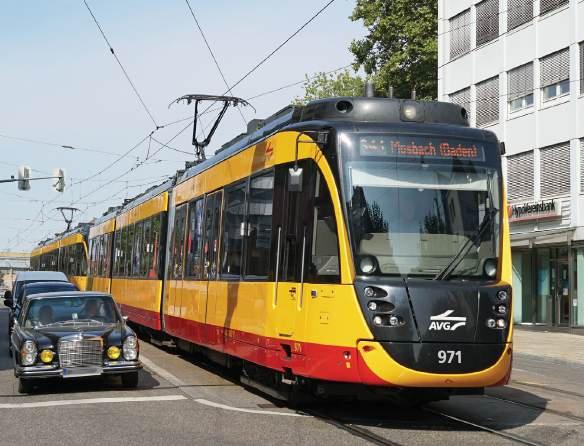
Definitions surrounding tram-train, throughrunning of passenger vehicles between urban and heavy rail lines, can get blurred. Examples are whether infrastructure is still part of the heavy rail network or if exactly the same tracks are used by both light rail and main line stock. Nevertheless, acceptance of the phrase ‘The Karlsruhe Model’ to describe such a hybrid mode is testament to the influence of practices around this southwestern German city. Since 1992 and with many subsequent refinements, it has run light rail vehicles meeting main line standards around a network within and extending far from Karlsruhe: it has a deserved place in the lexicon of public transport.
A dual-system Bombardier Flexity Swift ET2010 pair in central Heilbronn with a Mosbach service on 30 August 2022. Like the longer distance S4 between Heilbronn and Karlsruhe, this route includes streetrunning and use of national rail infrastructure.
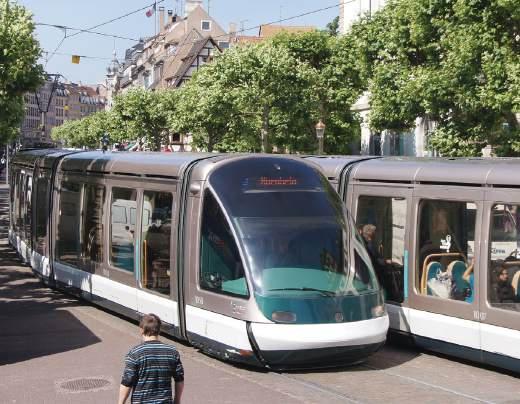
Now with comprehensive urban coverage, Strasbourg’s tramway has several grounds for celebration. When it opened in 1994, the Socimi/ ABB Eurotram fleet set new standards. Fully low-floor with wide internal gangways and deep windows, they became a benchmark for light rail systems globally. As the system grew, new Alstom Citadis models drew upon the modern elegance introduced by the Eurotram The 2017 line D extension to Kehl in Germany made the system one of few in the world to cross an international border, doing so in grand style with the Beatus Rhenanus Bridge which includes two 130-metre high-level spans over the Rhine.
In 1994 Strasbourg’s opening fleet of fully low-floor Socimi/ABB Eurotrams set new standards of accessibility. With styling to match the city’s elegance, short and long Eurotram variants cross at Place Broglie on 3 June 2011.
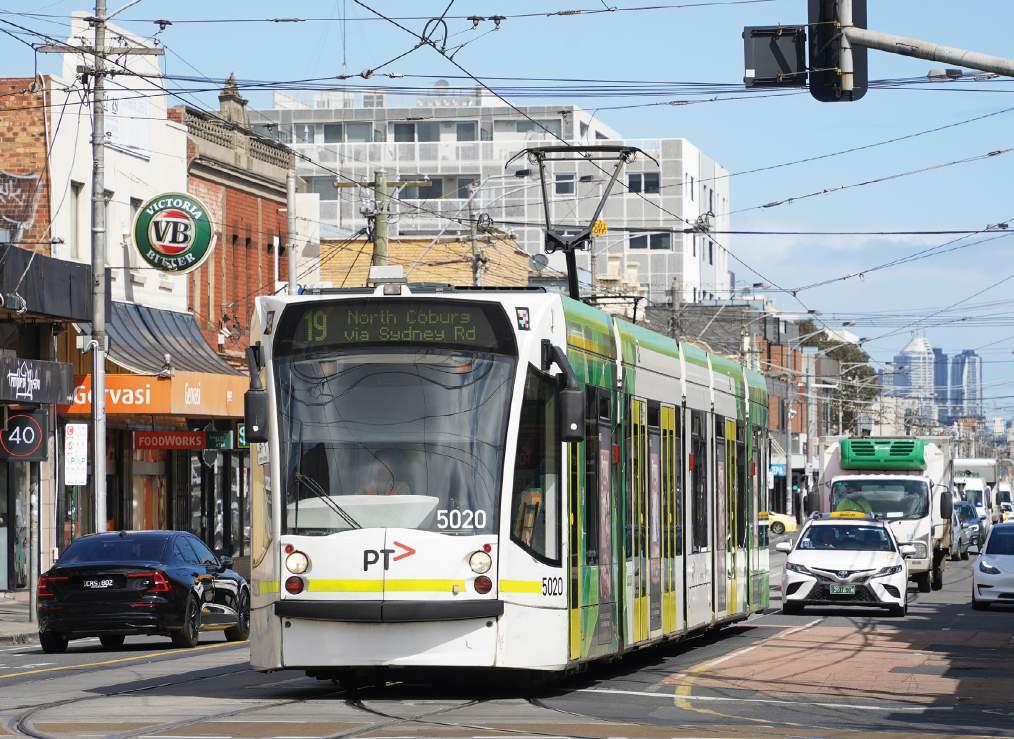
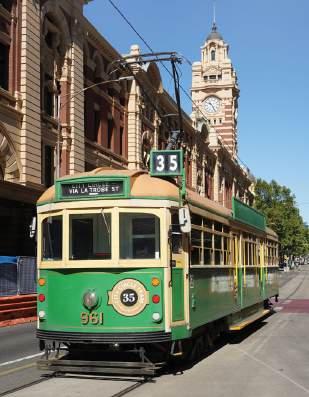
One of the world’s leading tramways, and not only for being its biggest active system. This is also a survivor, the city hanging onto a legacy tramway despite other Australian cities getting rid of theirs. Fine Melbourne settings include the Domain Parklands, St Kilda’s Esplanade and the ‘Under the Clocks’ Flinders Street station entrance: even Melbourne’s vast suburban spread can be appreciated for its variety on a leisurely tram ride. Adding to distinctions, few trams truly warrant the adjective ‘iconic’, but Melbourne’s W-class series are in that category. To drive home Melbourne’s eminence, you can ride for free in a large area of the city centre, including, of course, aboard a small but emblematic W-class fleet.
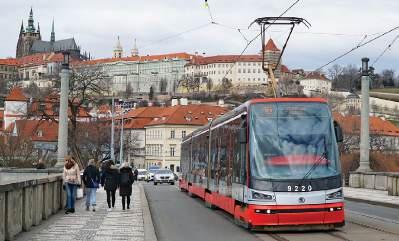
The sheer variety of sight-seeing by service trams will for some nudge Prague to the top of an elite list that also includes Vienna, Amsterdam, Kraków and Budapest. All of these tramways with comprehensive coverage are also part of the host city’s identity and a visual shorthand for a place that you would want to revisit.
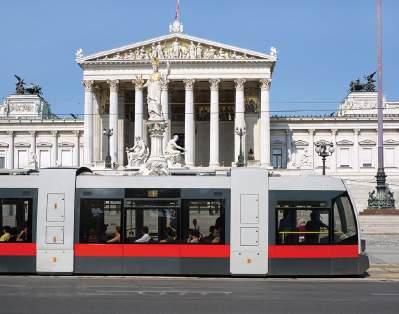
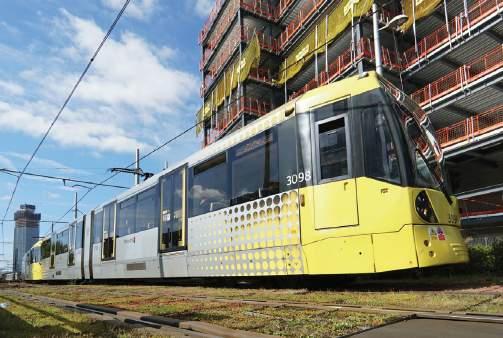
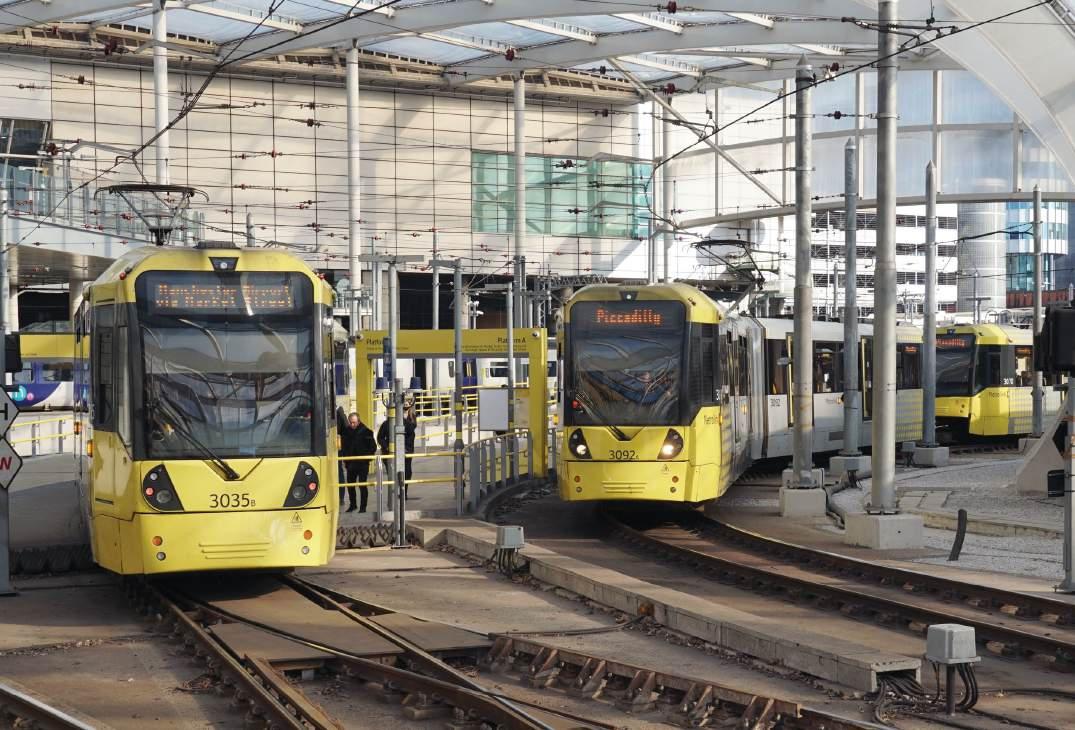
Begun in 1992 as a way of incorporating two suburban railways with a new city centre link, today’s 103km (64 miles) of Metrolink with 99 stops has been a key support for improvements around north-west England’s biggest conurbation. In early 2026 the BBC summarised: “At 3.1% annual growth sustained over ten years, Manchester’s economy has performed twice as well as that of the UK as a whole.” Many in areas such as West Yorkshire, Merseyside and Bristol may wish that those with powers to influence such matters would learn by the Metrolink example.
Access to Metrolink has been influential in the spread and scale of commercial and residential properties around the conurbation: near Deansgate-Castlefield in August 2024.
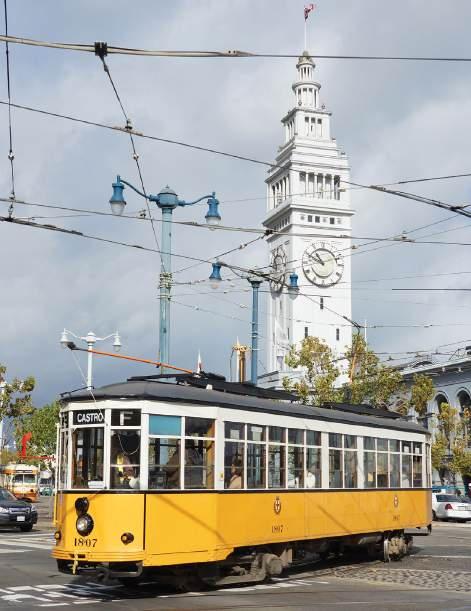
Cable cars may be uppermost in international association with San Francisco, but today’s Market Street Railway – in 2026 celebrating its half-century – is just as noteworthy. Integrated with the city’s Muni network, it combines normal daily service with being a living museum. The 9.6km (six-mile) F-line route between Fisherman’s Wharf and the Castro District is worked by a PCC collection in liveries recalling American streetcar systems. Add to the mix classics such as Melbourne W-Class, Blackpool Boat, Milan Ventottos and other treasures: few tramways could be more inspiring.
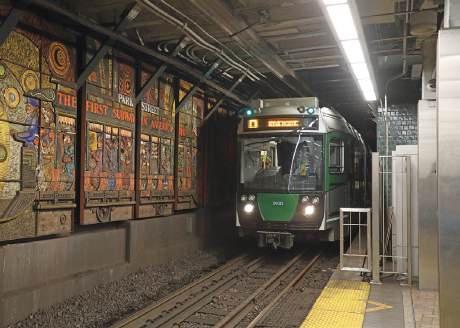
Massachusetts Bay Transportation Authority (‘The T ’) operates trolleys and subways in Boston and the surrounding area. The network includes the Green Line dating from 1897 which is North America’s oldest trolley subway, with the Mattapan Trolley (now classified with the Red Line) regularly using meticulously maintained vintage PCCs. Along with distinctive features, the long history has also brought challenges. A number of incidents around the network in 2022 raised concerns, but a phoenix-like revival has followed. A major refurbishment programme saw years’ worth of modernisation and infrastructure repairs made in just 14 months, with public trust also being rebuilt along the way.
A mural at Park Street station on the Green Line commemorates ‘the first subway in America’. Maintaining historic lines and fleets has brought an increasing number of challenges for the operator, which reached crisis point in 2022 – but a rapid refurbishment programme has dramatically flipped the situation on its head. Andrew Grahl
Legacy tramways have not always had an easy path to their present state, with Dresden, Hiroshima, Wrocław (formerly Breslau) and Rotterdam being examples where revival emerged from war-time obliteration. For new systems, policy changes are battles of another kind. France produced modern systems where locally-centred political support lasted long enough to get projects approved and lines into service. It also allowed for an expression of identity: whether tram styling like the ‘silkworm’ in Lyon or maritime-theme in Marseille are costly frivolities or worthy features is a matter of opinion. Less contentious has been creating fixed links between key sites such as hospitals, universities, stadiums and main stations. Many French systems are present in prominent locations, a retrofitting made possible through bold measures such as selective banning of other traffic and rebuilding public spaces. Not necessarily from French experience and perhaps just good sense, some features have found expression in systems such as Nottingham and Zaragoza.
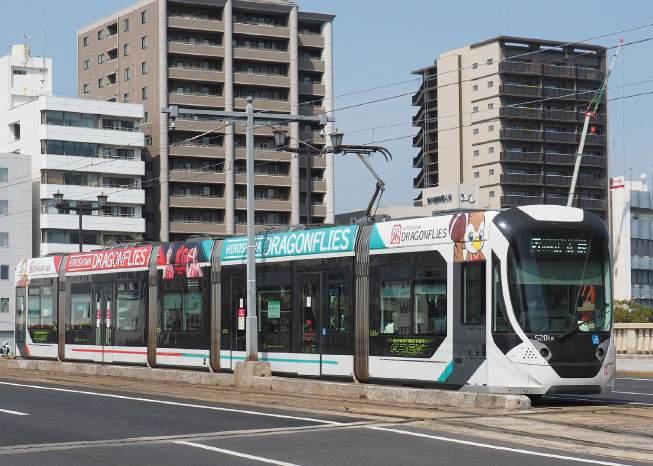
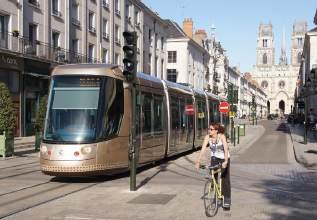
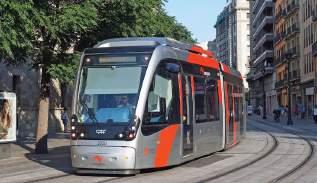
Zaragoza’s tramway is most notable for operating one of Europe’s longest catenary-free sections, to protect the aesthetics of the city’s historical centre – which has also been a key consideration in many French cities. The trams use an onboard Rapid Change Accumulator (ACR) system. Tranvía de Zaragoza
the
When someone listens, people will make the right call. See us in booth I at the UKLRC 2026!
Thousands of organisations in the transport sector are members of CIRAS. We build a strong listening partnership with our members to improve safety. Our confidential safety hotline provides extra listening to help staff make the right call and report their concerns even when they feel they can’t use other channels. When we listen, we learn.
Learn how you can build your listening partnership with CIRAS at ciras.org.uk/rightcall

Scan me We find safety in listening. Download the CIRAS reporting app
Could new government legislation help unlock light rail expansion in the UK? TAUT considers the possible effects of the English Devolution & Community Empowerment Act 2026.
Could a new law promoting devolution be the key to unlocking light rail projects in the UK?
“For transport infrastructure and road maintenance, the impact of devolution will be immediate.”
So said Carrington West’s Principal Consultant for Local Authorities in the Highways Sector for the UK’s London & South East region.
Writing last year, Ilya Donets’ focus in What Will Local Council Devolution in England Mean for Highways and Transport? may have largely been roads. However, he continued: “Some councils may prioritise investment in sustainable transport, such as public transport networks and cycling infrastructure, while others may focus on traditional road maintenance.”
It’s a recognition that the UK’s new Devolution Act could have a profound effect on the delivery of local priorities for transport – which can, of course, potentially include light rail.
What is properly called the English Devolution & Community Empowerment Act 2026 became law on 29 April. So, how significant is it?
Light rail promoters have long despaired
at the limited progress made in the UK, particularly in comparison with its European neighbours. Short-termism and a lack of consistent funding are criticisms frequently levelled at the UK approach.
However, Monta Drozdova from the Urban Transport Group (UTG) said in May of the new Act: “For transport in particular, it marks a meaningful shift from ad hoc arrangements to a more coherent, long-term approach”.
“It marks a meaningful shift from ad hoc arrangements to a more coherent approach.”
It’s true that in some areas, UK devolution has been around for years – Scotland, Wales and London being notable examples of places with significant local powers. More recently, mayoral authorities in provincial areas of England have gained extra responsibilities too.
But the picture is patchy, inconsistent – the powers granted to the Scottish parliament are not all the same as those bestowed across
London, or Northern Ireland, or Wales. And despite the existence of individual city deals, much of England – which is by far the most populous part of the UK – has not had devolution in any meaningful sense.
This new Act, according to the UTG’s Drozdova in The Devolution Act: What it Means for Strategic Authorities, “standardises the combined authority model and brings it together under a new legal category: strategic authorities. Within this framework sit three tiers – foundation, mayoral and established mayoral authorities – each able to access a defined suite of powers by default.
“Placing this framework in primary legislation matters as it moves English devolution away from informal agreements and negotiations, and towards a durable and predictable approach.”
As a result of the legislation, authorities within the top tier now have wide-ranging powers over transport, including over the development of rail networks. They also have a right to propose that they be granted further powers and funding.
Separately, the Railways Bill that is currently progressing through the UK parliament will give regional authorities a role in planning local heavy rail systems. Taken together with the Devolution Act,
it means that areas which have previously lacked a voice will in future have significant input into fixed-track policies.
Dropping behind
Given that transport planning requires stability over periods of years – particularly when it comes to delivering systems such as light rail – moving towards greater predictability could be key in helping English cities catch up with competitors.
In a 2026 paper, the Institute for Government (IfG) argued that “England’s largest urban areas underperform in productivity, growth and transport connectivity relative to many of their European counterparts”.
“Across the eight largest cities in England, approximately 39% of people can get into the centre of the city on public transport within 30 minutes, compared to 67% of people in comparably sized European cities.”
How Devolution Can Improve Transport Connectivity contends that “this poor connectivity restricts the optimal matching of workers with jobs, limits opportunities for specialisation and ultimately constrains economic growth and productivity.”
Not all of that underperformance is purely about transport systems themselves – the IfG says that the comparatively low population density of English cities is one reason for their relatively poor connectivity. However, the IfG argues that strong local mayors have an important role “for instance, through improving integration between different modes of transport and developing spatial strategies that integrate transport planning with housing and regeneration schemes.”
As regular TAUT readers will know, denser housing favours light rail by creating a demand for reliable mass transit.
The IfG also contends that improving transport connectivity is “the highest-profile responsibility of regional mayors, so their ability to deliver visible improvements in connectivity is central to the success or otherwise of the whole devolution agenda.”
Funding will be crucial – it’s hard to see how devolution can truly work if the money is in reality all centrally controlled. In the English case this is to come via various sources, including from 2027-28 from what will be known as Transport for City Regions (previously City Regions Sustainable Settlements). This body will cover devolved regions that encompass some of the UK’s most populous places: East Midlands, Greater Manchester, Liverpool City Region, North East, South Yorkshire, Tees Valley, West of England, West Midlands and West Yorkshire.
While some of those areas already have light rail systems, others do not. As an example, Leeds in West Yorkshire stands in stark contrast to its equivalents on the Continent. With a population of circa 800 000, it is Western Europe’s largest city to lack either light rail transit or a metro system.
Attempts to change that have been made over more than three decades. Yet despite campaigns and the support of Mayor Tracy Brabin, decisions about whether the proposed West Yorkshire Mass Transit will even be tramway-based have yet to be made.
Indeed, even if you include networks such as the Undergrounds in London and Glasgow,
the UK has only 11 active light rail systems. That is less than half the number in France, which opened its first second-generation tramway at Nantes in 1985. Germany has more than 50 tramways – and that figure does not include things such as Stadtbahn or U-Bahn networks, the latter being broadly comparable to London’s Underground.
Outside the UK, there are plenty of examples to draw inspiration from – and not just regarding the number of LRT schemes. In Germany, rail reforms in the 1990s transferred responsibility and funding for regional passenger services to the individual states; these now directly specify and place contracts for services, while the regional Verkehrsverbünde (transport associations) plan across transport modes.
In Switzerland, widely held up as having a model transport system, a collaborative planning process involves even the smallest political units. Long-term planning also brings certainty: the country has a 20-year planning cycle.
Yet there are positive cases even from within the UK: In 2017, the Urban Transport Group produced Rail Devolution Works, a report that made the argument for further devolution, in the light of experience from Scotland, Merseyside, Tyne & Wear, and London.
Examples cited include: a 51% increase in patronage after Transport for London took over the metro services now known as Overground; a rise in passenger satisfaction from 82% to 90% on Merseyrail, 15 months after control of the Liverpool area services was devolved; and continuous innovation on the Tyne & Wear Metro.
“When devolution happens train reliability and punctuality improves and passenger satisfaction levels increase”, said the UTG in the report’s conclusion.
“There is more innovation and investment. Rail services are planned with wider economic, social and environmental goals in mind.
“They become part of a more integrated approach to land use planning and economic development which opens up new synergies around funding sources to support further improvements and expansion.”
The promise is, that once regions truly have control over their local transport, then priorities such as mass transit can be focused on in a way they never would be while places are reliant on persuading national-level bodies such as the UK’s Department for Transport.
It should though be acknowledged that there are potential disadvantages too –UK government and parliamentary sources have raised the issues of potential duplication of effort, and a clash between local and national priorities.
In Wales, transfer of the Core Valley Lines railways around Cardiff to Transport for Wales allows the development of an integrated South Wales Metro and introduction of tram-trains. This is however not an entirely segregated system, but one which must share routes with long-distance heavy rail passenger trains to destinations such as London, as well as freight. Removing barriers in certain areas has led to new interfaces in others.
In Germany, some services that previously ran across state boundaries are now split, with passengers having to change, after individual states contracted with different providers for ‘their’ aspects of the timetables. Such interfaces seem unavoidable with devolution – although in both Germany and the UK, strategic long-distance transport has remained the purview of national governments.
Even so, the 2026 Act means that devolution in England as well as other parts of the UK is now an increasing political reality. Will there be more light rail as a result?
Examples – whether from the UK or around Europe – suggest that the answer will be yes. Perhaps, if that happens, some of England’s underperforming urban areas might finally catch up with the competition.
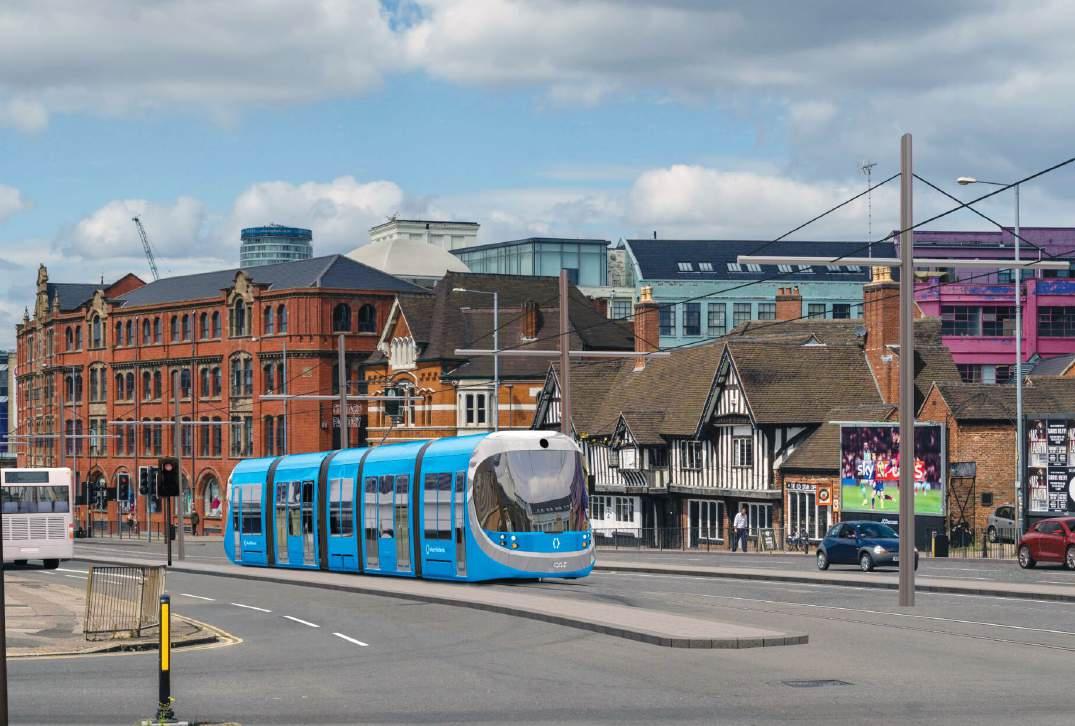
The opening of the newest stretch of tramway in April 2026 prompts TAUT to take a tour around the UK to see what projects are making progress.
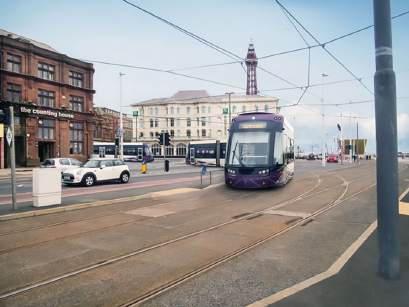
Blackpool’s 600m tramway extension along Talbot Street was, when it opened on 12 June 2024, the UK’s newest light rail line. How much has opened since? Well, on 5 April 2026, West Midlands Metro services started running on the first stretch of the Eastside Extension, to a point opposite the Clayton Hotel. This is now the UK’s newest light rail line.
So, in just under two years, the UK has managed to open about 500m of new light rail. Compare that with China, which opened 200km (124 miles) in December 2025 alone (TAUT 1058).
It’s not really fair to make comparisons between the UK and China. There are many reasons why China is able to make such great strides forward and, arguably, no countries in Europe could or indeed even remotely need to match this level of development. But it highlights just what progress can be made, with a number of countries around the world sadly outpacing the UK.
UK light rail promotors are always hampered by a lack of public awareness of the benefits improved connectivity can bring, as well as the need to meet strict Government funding criteria. Yet despite this, exciting expansions are underway.
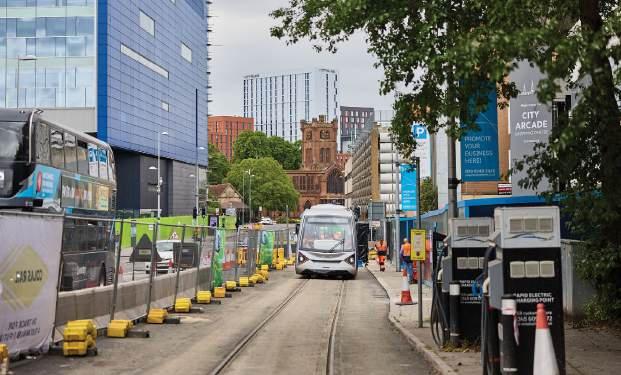
Had it not been for the construction of the new high-speed rail station at Curzon Street, West Midlands Metro’s full 1.7km (one-mile) Eastside Extension through to High Street Deritend in Digbeth would have probably opened in April 2026. Much of the infrastructure between the terminus and Meridien Street is complete, but it remains isolated from the new extension by the HS2 worksite. When Midland Metro Alliance contractors will be able to access Curzon Street to connect the two halves is not yet clear. HS2 contractors finished sinking the 2011 concrete piles that will support the new station in March. Ground Engineer reported that the “main focus has turned to preparing the way for the Digbeth extension to the West Midlands Metro – which will stop under the station on New Canal Street – and completion of the remaining foundation works”.
The Millennium Point extension is unlikely to be the UK’s newest light rail line for long. WMM’s trams should start testing on the GBP649m (EUR749m) extension to Dudley in June, with the 9.7km (six-mile) extension scheduled to open to passengers in August. The further 8km (five-mile) extension from Dudley to Brierley Hill is due to open in 2028.
The East Birmingham and North Solihull
tram extension, would, says Midland Metro Alliance, “unlock around GBP10bn [EUR11.5bn] of private investment, 55 000 new jobs and 7700 homes, helping to tackle the area’s long-standing inequalities”. Whether the whole 17.5km (11-mile) line ever gets built remains to be seen, but the section beyond Digbeth to the proposed Sports Quarter is moving forward.
Sports Quarter is a GBP100m (EUR119m) redevelopment plan to the east of Digbeth by US firm Knighthead, which owns Birmingham City Football Club. It centres around building a new 62 000-seat football stadium, which is due to open in 2029.
The West Midlands Combined Authority board approved a ringfenced GBP50m (EUR57.4m) from the 2027-32 Transport for City Regions (TCR) payment from the UK Government to accelerate development. This will “not only assist in helping to understand the precise TCR impact, it will also help maintain project schedules where the delivery timescales are particularly tight”.
Another new UK light rail line did open to passengers in 2025, but only for two months. This was the 220m trial section of Coventry Very Light Rail, which operated in May and June.
Approval for a second, 800m-long, trial
track was approved on 16 December 2025 and construction of 500m of twin-track line along Mile Lane is to start in July, according to Nicola Small, Coventry VLR Programme Director at Coventry City Council.
“The next and final section of the demonstrator installation is planned for spring 2027 and is circa 300m of single track with a bi-directional tramway section”, Small told TAUT. “This will demonstrate how CVLR could be deployed for roads with parking and access constraints.
“Whilst the full track installation should be complete by end of summer 2027, we will not be running a vehicle on it until 2028, as the programme for assembling a live trafficcompliant vehicle takes us till then.”
When passengers start using West Midlands Metro’s extension to Dudley, spades should be in the ground for a light rail project in the Welsh capital, Cardiff. If you’ve wondered why Transport for Wales ordered 36 Class 398 tram-trains from Stadler when the current South Wales Metro network doesn’t include any tram lines, that is going to change this summer.
Consultants Mott MacDonald published Cardiff Crossrail – A Transit-Led Vision for Cardiff in 2023 and this suggested a five-phase tram-train system that, by 2035, would connect Cardiff Central station and the city centre with outlying towns and suburbs. Phase 1 in that report covered the City Line, from Radyr to the city centre via Ninian Park stadium and Cardiff Central station.
Contractor GRAHAM is to start building Phase 1 – or, more correctly, Phase 1a – during the summer. However, this is slightly more modest than previously envisaged: a new tramway is to be built from Cardiff Central station’s car park, along Tresillian Way and Callaghan Square to make a connection with the heavy rail line that heads south to Cardiff Bay station where new tram platforms will be built. The whole 800m-long line, which is costing GBP100m (EUR115.5m), is due to open in 2028.
Phase 1b would take the tramway south from Cardiff Bay to the Pierhead, on the shores of the bay itself. This is currently at the concept stage and is, as yet, unfunded.
Meanwhile to the east in the UK’s capital city, Transport for London (TfL) has embarked on Preliminary Market Engagement for the Docklands Light Railway’s GBP1.62bn (EUR1.9) 3km (1.9-mile) Thamesmead Extension.
The new route would diverge from the existing Gallions Reach – Beckton line before curving round to pass under the River Thames in a 1.5km (0.9-mile) tunnel. Thamesmead, on the border of the Royal Borough of Greenwich and the London Borough of Bexley, is expected to be home to 100 000 people by 2050. In January, permission was granted for 15 000 new homes to be built on a waterside brownfield site. Construction of the Thamesmead extension could get underway in 2027, with opening in 2033.
Another TfL scheme is gathering momentum. The transport body and four west London boroughs, plus Old Oak & Park Royal Development Corporation, have jointly committed to developing plans for
RIGHT: Blackpool opened its Talbot Street extension in 2024 –but in the two years since then, the UK as a whole has only managed to open another 500m of line. Blackpool Council
BELOW: At the end of May 2025, Coventry’s VLR tram carried its first passengers along a newly-laid modular slab track. As a trial, it only ran for two months – but the next demontrator installation is planned for spring 2027 with vehicles planned to run from 2028. Andrew Moore
“The final section... will demonstrate how CVLR could be deployed for roads with parking and access constraints.”
the West London Orbital railway. A total of GBP6.65m (EUR7.7m) will be spent on finalising a preferred option for stations, junctions, signalling and power supplies as well as calculating how new services will run alongside existing rail operations and what benefits to the local economy the new line could unlock.
The 18.5km (11.5-mile) addition to the London Overground network would connect Hendon in the north to Hounslow in the southwest. This involves converting two currently goods-only heavy rail lines (Brent Cross West – Acton Wells Junction and Acton South – Old Kew Junction) to London Overground specifications.
Public consultation for the estimated GBP700m (EUR809m) project is expected to open during the summer. Four new stations would be built: Neasden, Harlesden, Old Oak Common Lane and Lionel Road.
Engineering challenges to overcome include electrifying the currently goodsonly sections of line, replacing semaphore
signals on the Dudding Hill line (Brent Cross Junction – Acton Wells Junction) and modifying the track layout at Hounslow to permit trains to terminate there. The West London Orbital is not expected to open until the next decade.
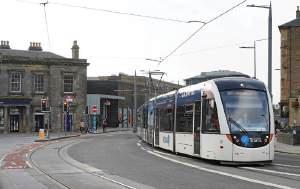
Having opened its extension to Leith in 2023, which gives a slight northerly kink to the otherwise largely east-west axis, the next phase in Edinburgh’s tram expansion is a north-south line. One of the suggested routes would link Grantown – on the Firth of Forth – with the BioQuarter, to the south-east of the city. Any construction work is “unlikely to begin before 2028 at the earliest”, says City of Edinburgh’s Council.
The council’s Transport & Environment Committee is set to receive the consultation and market research committee on 18 June. Then, on 10 September, the committee is to receive the Strategic Business Case and “recommendations on how to proceed”.
However, the public consultation that ran during the summer of 2025 solicited over 11 500 responses, almost a record number. That’s because one of the two proposed routes utilises the Roseburn Path, a popular active travel route. It’s preferred over the Orchard Brae route as it offers a higher catchment area for passengers and affects fewer underlying utilities. Orchard Brae also offers an engineering challenge – how to incorporate a tramway onto Thomas Telford’s 1831 bridge over the Waters of Leigh.
The Scottish National Party suggested that it would seek alternative routes if it won the Scottish Parliament elections on 7 May, at which it ended up as the largest party, although just short of a majority. Whether this will affect the presentation of the Strategic Business Case in September is unclear.
However, one scheme that is gaining traction in the Scottish capital is the introduction of tram-trains on the 12.3km (7.6-mile) goods-only Edinburgh Suburban & Southside Junction Railway. The ‘South Sub’ scheme rose to prominence after engineering students at Heriott-Watt university carried out a feasibility study into the concept (TAUT 1049).
Campaign group Tram Trains for Edinburgh’s 23 April meeting attracted 170 people, including Labour and Liberal Democrat politicians. Group Chair Rob Falcon said, “It was great to welcome so many members of the public to our latest open meeting. Local residents will benefit hugely from better public transport across the south side of the city.”
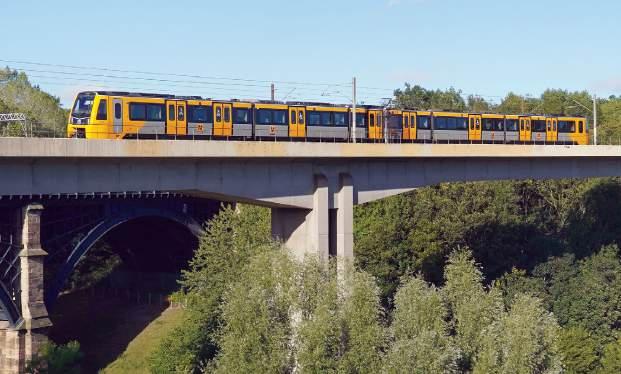
Around 190km (118 miles) south, Nexus, operator of the Tyne and Wear Metro, is working on the 13km (8-mile) Metro to Washington project, which would fill a key gap in its network. The project involves reusing former railway alignments, including a stretch of the mothballed Leamside line, which closed in the 1990s, south from the Green/Yellow Line station Pelaw to Washington before striking eastwards to make a connection with the Green Line at South Hylton.
Nexus spokesman David Punton told TAUT, “The project is currently in Phase 1, which is the preparation of the outline business case. Nexus has been tasked with completing the business case by March 2027.” Phase 2, says Punton, is scheduled for 2027-30 and would include obtaining planning permission, procuring contractors and confirming the costs, which are currently estimated at GBP900m (EUR1.038bn). Phase 3, construction, would take place 2030-33.
The county of Yorkshire could become a hotbed of light rail construction if UK
Government commitments become reality. Money has been promised but current progress is somewhat mixed.
The South Yorkshire Combined Authority: NPR Compact Agreement, signed on 22 January by SYMCA Mayor Oliver Coppard and UK Secretary of State for Transport Heidi Alexander, committed GBP7.5m (EUR8.7m) to the development of Sheffield’s tram-train network.
The existing 5.5km (3.4-mile) line from Cathedral tram stop to Rotherham Parkgate was given a boost on 9 April when the new Magna stop opened.
Various expansion options have been suggested. Stocksbridge MP Marie Tidball is pushing for the re-opening of the remaining stub of the former Manchester, Sheffield and Wath electric railway, which closed as a through route in 1981. This was being considered by the UK Government's Restoring Your Railways scheme, which was cancelled in July 2024.
“Will the Prime Minister work with me and the South Yorkshire mayor, to ensure that we get spades in the ground for a tram train extension to Stocksbridge?”, Tidball asked Prime Minister Sir Keir Starmer in Parliament on 25 March.
Other options include heading south to Chesterfield, utilising the goods-only railway via Killamarsh and Barrow Hill. However, the Supertram 2026-27 Business Plan only included a proposed extension to a new station – Rotherham Gateway – adjacent to a new 2500-house development.
West Yorkshire Combined Authority was first promised the GBP2.5bn [EUR2.9bn] it needs to build West Yorkshire Mass Transit around Leeds and Bradford in the wake of the October 2023 cancellation of HS2 Phase 2. West Yorkshire Mayor Tracy Brabin told delegates to both the 2024 and 2025 UK Light Rail Conferences – as well as confirming to Minister for Rail, Lord Peter Hendy – that she’s committed to start initial construction on West Yorkshire Mass Transit in 2028. This was a view echoed by UK Chancellor Rachel Reeves in a speech in Leeds in April: “I remain committed, we remain committed as a government to work with Tracy to get spades in the ground by 2028 and get those trams running by the 2030s.”
LEFT: Tyne and Wear is in tbe first phase of its 13km Metro to Washington Project, which would see construction taking place between 2030-33. Class 555 555003 crosses Byker viaduct.
BELOW: The next phase in Edinburgh’s epansion is a north-south line, linking Grantown with the BioQuarter. However, this is not the only project the city has embarked upon. Pictured is one of the system’s Urbos 100 vehicles at Haymarket Interchange. Both images Neil Pulling
However, Heidi Alexander told The Yorkshire Post in mid-March that the Department for Transport has to spend taxpayers’ money carefully and hasn’t, therefore, guaranteed that WYMT will be a tram system. Mayor Brabin told a 13 March Scrutiny Committee that “we have to make the case, and that is fine. We are now in a process where we have to prove it can’t be a bus”.
With political wranglings affecting, say, WYMT, it’s easy to fall into the trap of believing that nothing is happening in the UK. On the contrary, as we can see, light rail lines are being built, construction is due to start on others and more are in the pipeline.
The biggest problem is that while local government and authorities can promote multiple light rail schemes, national government still needs to be convinced of the benefits. Therefore, how many local authority ambitions for light rail will be fulfilled remains to be seen. However, one green shoot of optimism, for England at least, is the English Devolution and Community Empowerment Bill, which received Royal Assent on 29 April (see page 254). This will give Metro Mayors, according to the Urban Transport Group, “more autonomy to shape transport systems that reflect local needs”. We wait with interest to see how this affects light rail developments.
Several proposals for new light rail lines are in the early stages of development. We covered the latest news from Clyde Metro in TAUT 1062, while the election of Paul Bristow as mayor of Cambridgeshire and Peterborough in May 2025 has put long-mooted plans for light rail in Cambridge on a more official footing (TAUT 1060). West of England Combined Authority’s West of England Transport Vision was published on 11 February 2026 and while it does not commit to a specific mode, WECA announced on 27 March that GBP150m (EUR173m) is being invested in developing a mass transit system. Transport for Greater Manchester has revealed a number of ambitions for expanding light rail across Greater Manchester, which we’ll explore in a future issue of TAUT.
Across the UK, conversations about the future of public transport often focus on billionpound infrastructure projects, lengthy delivery timescales, and complex political negotiations.
While major transport schemes undoubtedly have their place, there is growing recognition within the light rail scene that innovation will come from smaller, more agile solutions. That is why the Black Country is uniquely positioned to become the home of the UK’s next generation of rail innovation.
Over recent months, Pre Metro has welcomed industry leaders, MPs, transport specialists and railway professionals to Stourbridge to demonstrate what is already being achieved through Very Light Rail (VLR) on the Branch Line.
From hosting the Network Rail Mixed Use Railway (MUR) Workshop to showcasing the Stourbridge Shuttle and discussing future expansion plans with local and national stakeholders, one message has become increasingly clear: the Black Country has the opportunity to lead the next chapter of rail development.
The Stourbridge Shuttle has already proven that lightweight, cost-effective rail solutions can deliver reliable and attractive public transport. Operating for over 17 years, the service has carried over eight million passengers, while consistently achieving industry-leading reliability. More importantly, it has demonstrated that local rail services do not need the scale or cost of traditional heavy rail to be successful.
However, if the UK is serious about developing and deploying VLR on a larger scale, it needs a real-world railway route where new ideas can move beyond the testing phase.This is where the Dudley Dasher becomes so important.
The proposed route would connect Stourbridge and Brierley Hill using existing railway infrastructure, creating a practical, affordable transport solution for communities that currently rely heavily on cars. Rather than requiring extensive new construction, the project would utilise underused rail corridors to provide a modern public transport service that could be delivered at a fraction of the cost of many traditional schemes.
Yet the Dasher is far more than a local transport project. It represents an opportunity to create a living demonstration railway for VLR. New vehicles, alternative traction systems, innovative operating models and mixed-use railway concepts could all be refined within a genuine passenger environment. The lessons learned could then be replicated across branch lines and regional transport corridors throughout the country.
The Black Country also possesses something many regions do not: an established innovation ecosystem. From the Stourbridge Shuttle’s operational experience to the National Innovation Centre, expertise is being developed across the region.
For decades, the Black Country helped power Britain’s industrial revolution. Today, it has the opportunity to play a leading role in shaping the future of sustainable transport.
If VLR is to become a genuine solution, it needs to prove itself at scale. The technology exists. The expertise and ambition exist. Now the opportunity is to turn the Dudley Dasher into a premier mixed-use railway test bed, and there is no better place for that journey to begin than the Black Country.

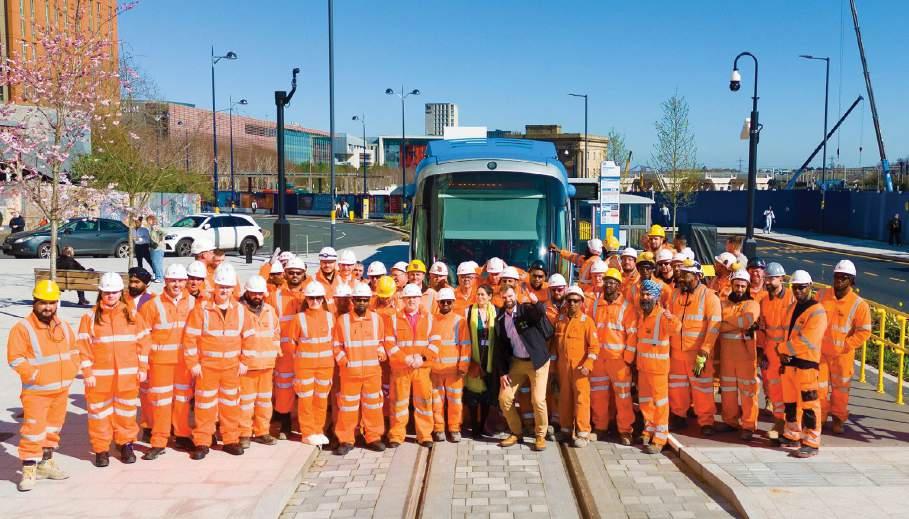
As it reaches its ten-year milestone, the Midland Metro Alliance reflects on its unique perspective.
What do you see as the benefits and challenges of the Alliance method of working?
Reaching the ten-year milestone of the Midland Metro Alliance represents a defining chapter in Colas Rail’s evolution as a leader in light rail delivery in the UK. Throughthe design, development and delivery of this ambitious programme, we have successfully demonstrated our international capability while firmly establishing a resilient, UK-based light rail business.
Initially supported by expertise from our global network, the Alliance has enabled us to embed that knowledge locally, developing a highly skilled domestic workforce andleadership team with first-hand experience of complex urban light rail renewals, extensions and enhancements. This has created a sustainable capability within the UK, ready to meet the growing demand for light rail infrastructure.
Just as importantly, the long-term nature of the programme has allowed us to build trusted, collaborative relationships with clients, supply chain partners and key stakeholders.This continuity has improved delivery efficiency, fostered innovation and strengthened our understanding of regional priorities.
and ensuring that the benefits of the Alliance extend well beyond the infrastructure itself.
What are the benefits and challenges of the Alliance model?
Having operated within an Alliance model for over a decade, we firmly believe its greatest strength lies in aligning client, designer and contractor as a single, integrated team with a shared purpose. In complex, live urban environments, success depends on collaboration rather than fragmentation and Alliance contracting provides the framework to enable exactly that.
“This longevity of the project has instilled a strong sense of ownership and legacy within our teams.”
Perhaps most significantly, the longevity of the programme has instilled a strong sense of ownership and legacy within our teams, driving high levels of engagement, pride and retention,
This model supports earlier decisionmaking, proactive risk management and a culture where innovation can thrive. Over time, it also enables the systematic transfer of knowledge, lessons learned and technical expertise across schemes, creating continuous improvement and long-term value for clients and communities alike.
However, the Alliance model demands a fundamentally different mindset. It requires absolute transparency, sustained alignment and a commitment to programme success above individual or business priorities. Trust is essential and it must be actively maintained through open challenge, strong leadership and collective accountability.
Delivering infrastructure in busy city environments, while maintaining operations and minimising disruption, is inherently complex. Yet when the Alliance culture is trulyembedded, the
benefits are transformative extending beyond programme delivery into sustainability, stakeholder confidence and regional legacy.
Any anniversary is a good chance to look forward as well as back. What do you see as the key milestones of the last decade, and what are your expectations and aspirations for the next one?
Over ten years, the Alliance has delivered a series of transformational milestones, each scheme enhancing connectivity and shaping the future of mobility in the West Midlands. Among these, the Birmingham Eastside Extension stands out as a landmark achievement, delivered on time and under budget, fundamentally evolving the system from a single line into a true network.
This shift represents more than infrastructure: it changes how passengers interact with the system, offering greater connectivity, flexibility and choice.
That transformation will accelerate further with the opening of the Black Country extension, strengthening links across the region and amplifying the value of the network to local communities.
The programme has also demonstrated resilience. During the challenges of COVID-19, the Alliance not only maintained delivery but adapted rapidly, capitalising on reduced urban activity to accelerate works. It is a powerful example of turning adversity into opportunity through collaboration and agility.
Looking ahead, our ambition is clear: to build on this momentum, continuing to expand and enhance urban light rail networks while applying the lessons, capability and partnerships developed over the past decade.
How would you assess the UK light rail situation in 2026, and what lessons could the country learn from others?
With the recent announcements by the Chancellor in the 2025 Spending Review, the UK light rail sector looks to be entering a renewed period of opportunity. Significant government investment in urban transport, alongside rising passenger demand, reflects growing recognition of light rail as a sustainable, high-capacity solution while addressing the ‘first and last mile’ challenge.
Local authorities are increasingly exploring new systems and extensions, recognising light rail’s role in unlocking economic growth and delivering low-carbon mobility. However, delivery in the UK still faces structural challenges. Lengthy approval processes, complex regulatory requirements and coordination with utilities can delay schemes and reduce momentum.
There is an opportunity to learn from European counterparts,
where more streamlined processes have enabled faster delivery without compromising quality or governance. Achieving the right balance between rigour and efficiency will be critical.
Equally important is maintaining a consistent pipeline of work. While the Midland Metro Alliance has driven sustained delivery in the West Midlands, activity elsewhere has been comparatively limited. To preserve and grow the UK’s hardwon capability, the sector must now convert political intent into a coherent, long-term programme of delivery.
What do you feel Colas has ‘brought to the party’ as part of the MMA over the last ten years?
Colas Rail has played a central role in delivering meaningful, visible change across the West Midlands over the past decade by enhancing both the reach and the quality of the region’s transport network.
From the outset, we recognised that light rail is not just about infrastructure, but about enabling social and economic regeneration and leave a legacy for future generations. This has been reflected in our commitment to social value, local investment and community engagement throughout the programme.
Our approach has been rooted in collaboration, professionalism and resilience. Major urban infrastructure schemes inevitably encounter technical, political and stakeholder challenges, yet our teams, working alongside internal and external partners, has consistently found solutions that maintain progress and protect long-term goals and objectives. Crucially, successful Alliances are built on trust at both organisational and personal levels. We have placed strong emphasis on leadership behaviours as well as technical excellence, fostering a culture where openness, challenge and shared ownership drive performance.
As we reflect on ten years of delivery, we do so with pride in what has been achieved, but also with a clear sense of responsibility for what comes next. The Midland MetroAlliance has not only transformed a regional transport network; it has proven that the UK can deliver complex, high-performing light rail programmes when the right capability, culture and longterm commitments are in place.
Colas Rail now stands at the forefront of that capability. With a proven track record, a highly skilled UK-based team and the backing of global expertise, we are uniquely positioned to support clients in shaping and delivering the next generation of light rail systems. As investment gathers pace and ambition grows across the UK, we are ready to partner with authorities, operators and stakeholders to turn intent into delivery, creating sustainable, connected networks that leave a lasting legacy for communities and the economy alike.
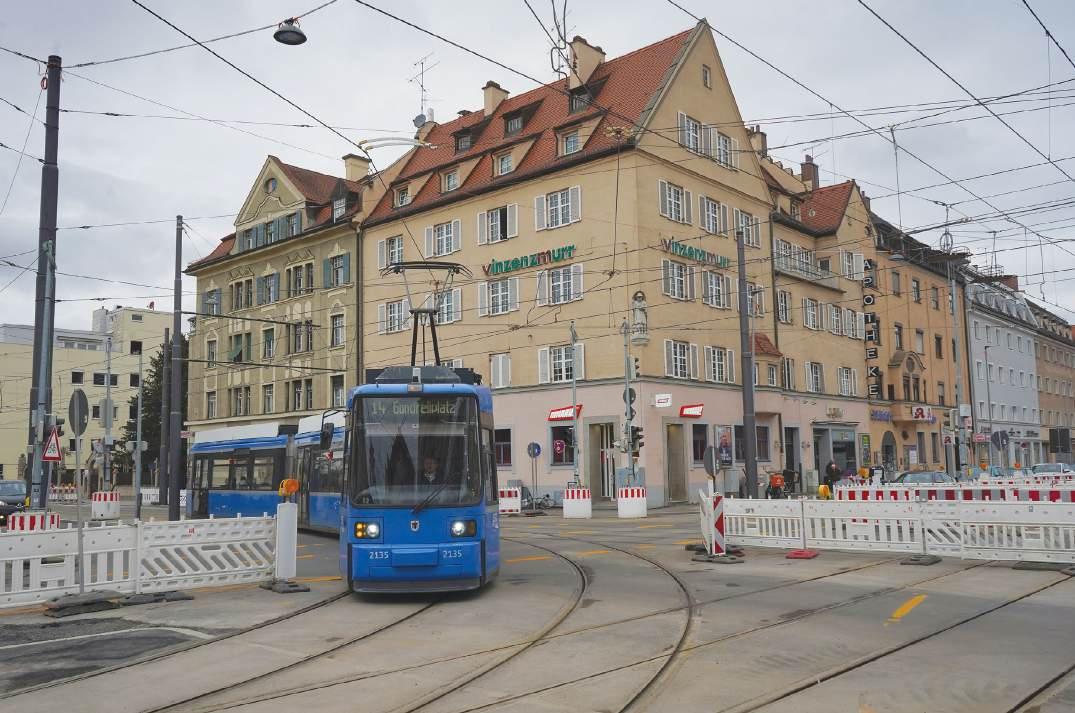
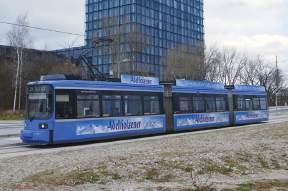
Andrew Thompson visits Munich, where the first section of the Westtangente line opened in February, linking up some of the western arms of the tramway’s ‘star’.
The year 2026 marks the 150th anniversary of tramways in Munich (München). Since horse-drawn cars first started running on the streets of the Bavarian capital in 1876, light rail infrastructure has evolved significantly. While electrification occurred in 1895, the standard-gauge network reached its greatest extent in 1964 at 134km (83 miles). The contraction of the tramway was synchronous with the development of the new underground system, which opened its first U-Bahn line in 1971 – in time for the 1972 Olympic Summer Games. Since then the underground network has been politically favoured and become the backbone of urban mass transit, together with the large network of S-Bahn trains, which have run in a tunnel through the city centre since April 1972.
The S-Bahn trunk route is known as the ‘Stammstrecke’ and runs in a 4.3km (2.5-mile) east-west tunnel between München Hauptbahnhof, Marienplatz and Ostbahnhof. Currently used by seven regular S-Bahn lines, the central artery has become a victim of its own success and is now considered a major bottleneck. Planning
for a second artery route, which is to run in a 7.5km (4.6-mile) tunnel parallel to the existing one slightly further north between Laim in the west and Leuchtenbergring in the east, has been underway for years. With ever-increasing costs and engineering complexity, the budget is currently just shy of EUR10bn and opening is not foreseen until the late 2030s, at the earliest.
When construction of the first underground lines initially started in the 1960s, city planners and politicians expected the U-Bahn network to eventually replace the tramway. Yet by the mid-1980s the political mood shifted and because of public protests in favour of the trams, official policy changed. Although two tram routes were closed in 1991 and 1993, the turnaround occurred in 1996 and 1997, when the tram network started to grow again with the reopening of previously mothballed routes.
During the past two decades, purpose-built extensions have been added. In December 2011 the 4.3km (2.6-mile) branch of tram line 17 from Effnerplatz to St. Emmeram was opened in the northeast of the city. This was followed in December 2016 by the new eastern branch of line 19 from Max-Weber-Platz to Berg am Laim Bahnhof,
which converted the siding to Steinhausen depot to public use and then added 1.3km (0.8 miles) of new track in order to reach the new terminus at the Berg am Laim railway station and multimodal interchange.
After those enhancements to the eastern end of the network, the focus shifted to the west of the city with the aim of building a new western orbital tram route to link up existing branches and complement the starshaped underground system, which currently covers 103km (64 miles), with six regular and two booster lines serving 100 stations.
After roughly 20 months of construction, the first part of the so-called ‘Westtangente’ opened in late February with the 1.5km (0.9-mile) link between Fürstenrieder Strasse and Ammerseestrasse. This new alignment includes three stops and is served by line 14, which circulates on a short shuttle route between Pasing Bahnhof and Gondrellplatz. In a best-case scenario, the new tram spur along Fürstenrieder Strasse should be complemented by the next sections of the western tangent by 2028, including the southern extension from Ammerseestrasse south to Waldfriedhof and from Fürstenrieder Strasse north to Romanplatz, thus completing the full route.
While plans for a similarly ambitious northern tram tangent have been paused, the project to build a new 1km (0.6-mile) spur from Regina-Ullmann-Strasse to Johanneskirchen Bahnhof is still being advanced, despite political opposition centred largely on the high costs of roughly EUR60m for a relatively short stretch of track.
In the near term, the next major infrastructure project due for completion is the 1.3km (0.8-mile) western extension of U-Bahn line U6 from the current terminus Klinikum Grosshadern to Martinsried.
Construction has been ongoing since 2023 and is likely to be completed in 2026, with public inauguration foreseen for 2027.
With a population of 1.5 million in the city and 6.2 million in the wider metropolitan area, Munich is the largest city in southern Germany and the economic hub of Bavaria (Bayern). Compared with other German cities, such as Stuttgart or Düsseldorf, which chose to develop pre-metro Stadtbahn systems in the second half of the 20th Century, Munich has separate tram and underground systems. For that reason the star-shaped tramway and similarly-shaped underground networks lack certain orbital features, which are covered by S-Bahn or bus routes (and by the end of this decade in part also the new western tram tangent). Given the size and scale of the city, Munich will continue to depend on all of its different modes of mass transit to ensure quality transport for its residents and many visitors.
All of Munich's trams are singleended, as seen here with the low-floor type R 3.3 car 2218, as it passes the court building near München Hauptbahnhof on a line 21 service.

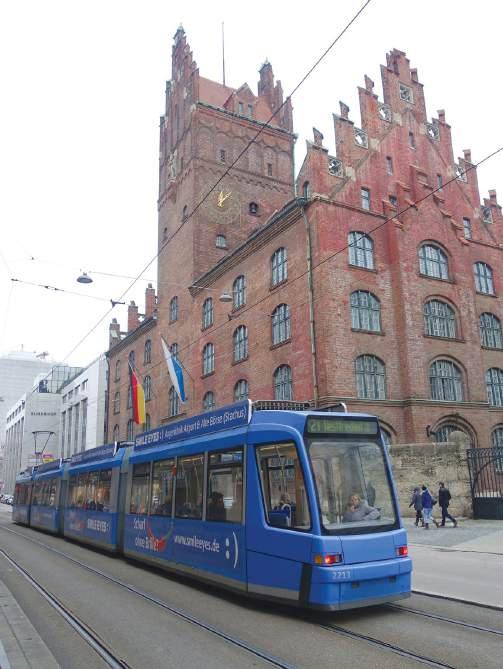
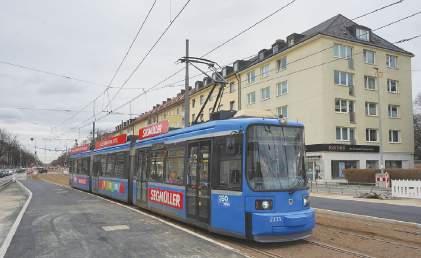
ABOVE: On 1 March type R 2133 is seen on Fürstenrieder Strasse on the new western tangent with a line 14 service. The low-floor tram is just about to branch off, and then call at Ammerseestrasse before continuing to the western terminus at Gondrellplatz.
BELOW: Siemens Avenio 2558, classified locally as type T, has special commemorative vinyls to celebrate the 150th anniversary of trams in Munich. Each car features a historic livery from the 20th and 21st Centuries. The front livery references car 256 (the oldest preserved electric tram at the museum of the municipal operator MVG from 1901), to the most modern, contemporary blue colour-scheme at the end of the vehicle.
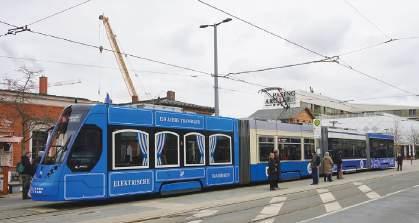
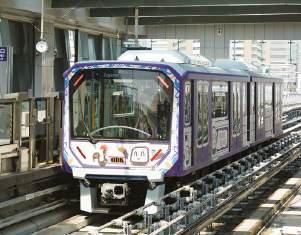
Neil Pulling visits Macau where a system now with limited coverage has clear potential for becoming a comprehensive and much-needed urban service.
Buenos Aires is home to one of the world’s most historic light rail systems, now undergoing massive investment to bring it up to 21st Century standards.
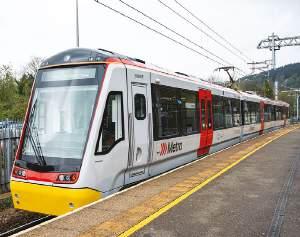
New tram-trains are running in the Cardiff Valleys this year. Howard Johnston has seen the rapid transit transformation.
+ Safety and autonomous trams
+ Classics: Historic trams through the hours of darkness
+ The latest news and analysis, system and technical development
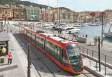
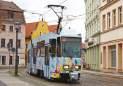

The Mixed-Use Railway (MUR) initiative reached another important milestone recently as members of the growing cross-industry community gathered in Stourbridge for the official launch of a new UKTram-hosted industry platform designed to support more integrated thinking across the rail sector.
Held at the Bonded Warehouse in May and hosted by Pre Metro Operations, representatives from across rail, light rail, infrastructure, standards, innovation and operations met to discuss the future direction of the initiative and the role Mixed-Use Railway could play in supporting more adaptable and financially sustainable transport solutions.
At its core, Mixed-Use Railway encourages decision-makers to view rail as a spectrum of interconnected solutions rather than a single operating model. This includes heavy rail, metro, tram-train, light rail and very light rail, each suited to different operating environments, passenger demand and infrastructure constraints.
Rather than defaulting to a one-size-fits-all approach, the initiative promotes the selection of the most appropriate mode based on operational suitability, expected usage, frequency requirements, affordability and long-term sustainability. The aim is to create transport systems that are deliverable, scalable and better integrated with urban mobility networks.
The concept emerged through rail reconnection work, where industry partners identified that conventional heavy rail solutions were not always the most practical or cost-effective way of reconnecting communities or opening new transport corridors. In response, organisations across the sector began exploring how different rail modes and operational approaches could work together more flexibly to deliver improved outcomes.
The launch also reflects growing recognition for the initiative across the industry. The Mixed-Use Railway team previously received the Team of the Year award at the Global Light Rail Awards, after originally being shortlisted for Vision of the Year, reflecting both the collaborative nature of the work and its relevance to the future of transport planning.
Nicola Islef, Head of External Relations at TDI Greenway, commented: “TDI is delighted to be part of the working group that developed the new webpage for the Mixed-Use Railway Group. It is an important source of information for considering the different rail solutions available across our industry and provides links to member sites for more detailed information.
“The webpage will continue developing to feature emerging rail technologies and new case studies as projects progress, helping provide the latest insight into integrated transport developments across the UK.”
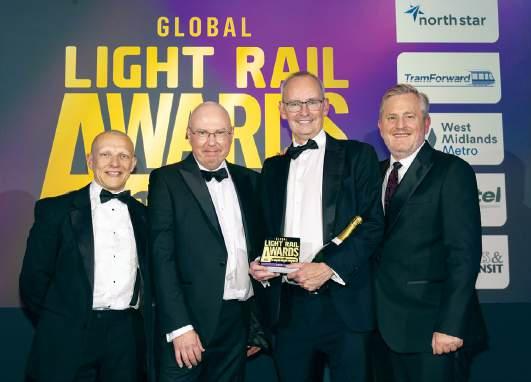
During the session, UKTram Marketing and Communications Manager Chelsea Branch presented the new platform, which has been designed to provide a clear and accessible introduction to the concept while signposting users towards more detailed technical resources developed across the wider community.
Chelsea said: “It’s been a really interesting project to work on and I’m grateful for the collaboration and huge amount of knowledge shared by organisations across the MUR community throughout the process.”
That thinking has continued to evolve through collaboration between organisations working across policy, regulation, operations, delivery and innovation.
The Mixed-Use Railway community now includes contributors and participating organisations from across the rail and light rail sector, including the Department for Transport, Office of Rail and Road (ORR), Network Rail, UKTram, the Light Rail Safety and Standards Board (LRSSB), Rail Safety and Standards Board (RSSB), the Light Rail Transit Association (LRTA), Railfuture, CNNCT Ltd, TDI Greenway and Pre Metro Operations, alongside industry representatives supporting the development of more integrated rail solutions.
The launch of the webpage represents another step in the development of the initiative, providing a shared space for collaboration and knowledge sharing across the rail and light rail community.
The initiative also aligns closely with industry priorities around decarbonisation, accessibility and integrated transport delivery. By encouraging more adaptable approaches to rail development, Mixed-Use Railway supports efforts to improve connectivity and increase public transport use, particularly in areas where traditional models may not always be viable.
Further information on the Mixed-Use Railway initiative is available at: uktram.org/mixed-use-railway
A varied past and changing fortunes are shared by the city of Cottbus and its metre-gauge tramway, now in the midst of a delayed fleet renewal.
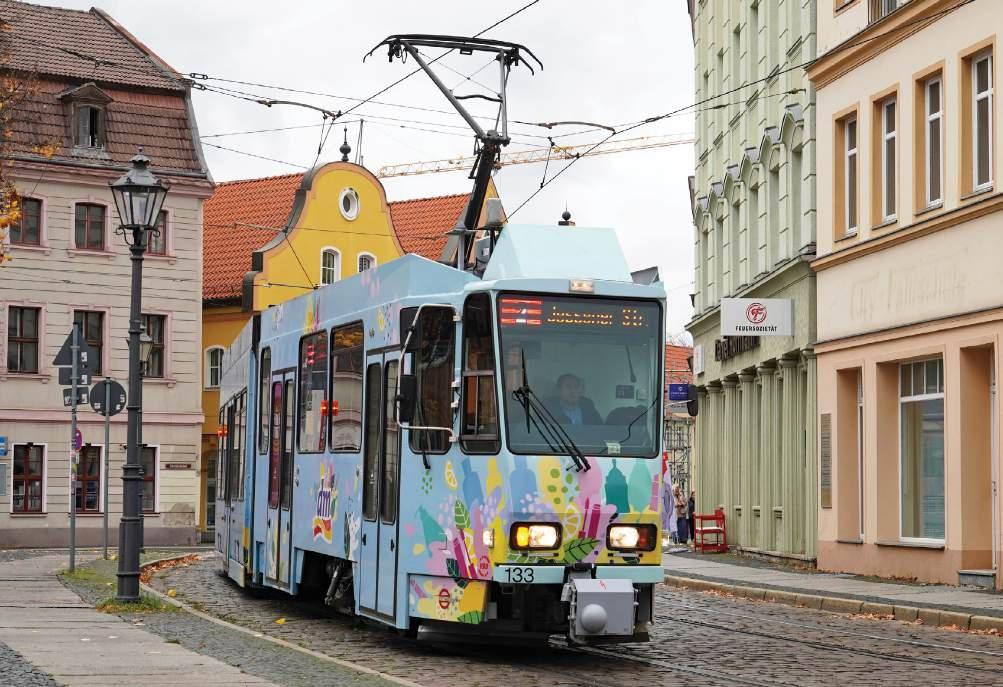
About 105km (66 miles) south-east of Berlin and 22km (14 miles) from the Polish border, Cottbus is the second-largest city in Germany’s Brandenburg state. The population has fluctuated around 100 000 for several years, most recently with small increases that are in contrast to many parts of the former East Germany. Textiles had historically been a major industry, but Cottbus became more dependent upon open-cast mining. It is the biggest community in the Lausitz/ Lusatia lignite (brown coal) region which spreads into Poland. Largely due to environmental considerations, employment related to extracting
and burning this notoriously ‘dirty’ fuel for electricity generation fell drastically. As such, the Cottbus area became eligible for funding to reinvigorate the economy under Germany’s Coal Regions Investment Act of 2020. This extended to public transport, including some support for tram fleet renewal.
Brandenburg University of Technology Cottbus was created following Germany’s reunification, and the city forms part of the Lausitz region’s tourism promotion. Although industry-based traffic has declined, railway activities still occupy a large area well south of the central area. This includes the widely-spaced platforms of the main
New in 1986 as a two-section KT4D, this tram later became ČKD Tatra/ MGB KTNF6 133. This was further modernised as the twelfth Langläufer, seen passing through Cottbus Altstadt on 22 October 2025.
station, Cottbus Hbf, and also what Deutsche Bahn identifies as its biggest and most modern high-speed train maintenance facility. The hourly RE2 service between Berlin Hbf and Cottbus Hbf takes about 90 minutes. Unlike many German systems in being separate from a utility group administration, a municipally owned transport body, Cottbusverkehr, runs the city’s four tram and 18 bus lines. Through a subsidiary constituted in 2025, it also operates buses in the surrounding Spree-Neiße district. Although in decline and with few users, the Slavic Lower Sorbian language is nationally recognised. It appears with German on signs around the city and includes transport
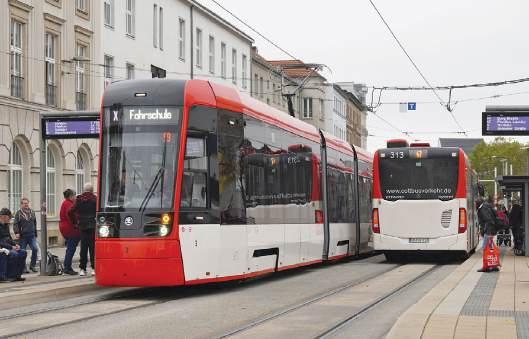
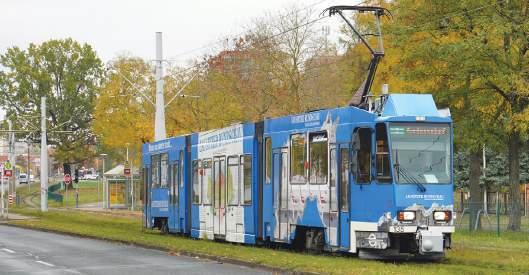
With delayed commissioning of the Škoda trams, ČKD Tatra KTNF6 have remained the more numerous of the system’s two types into 2026. There are two forms of KTNF6, those largely as rebuilt from KT4D and the 13 modernised by Cottbusverkehr in its own premises, a variant termed Langläufer (literal translation: cross-country skier). The Langläufer upgrade project which produced its first vehicle in 2012 was to give a life extension lasting until the acquisition of completely new stock. Although retaining the 1xx number series, each Langläufer has a small internal plaque identifying its project number and completion date; they also feature smart interiors with some similarities to the incoming Škodas. The 70% low-floor, air conditioned Škoda 47T ForCity Plus trams are about 29 metres long; capacity 158 passengers, with 61 fixed and five folding seats. Swivelling powered bogies are under the two outer sections which each have pairs of level-entry double doors and single end doors with stepped access. The short centre section has a supporting bogie and no doors. Advertising is prominent on the KTNF6, with Škoda 47T in the as-delivered red and white network colours.
TOP LEFT: Škoda 47T ForCity Plus 3 in training use on the east-west route at Stadthalle Post; here as at some other stops around the system, platforms are used by buses and trams.
LEFT: The first Langläufer, tram 135 leaves Schwarzheider Straße for line 4’s Sachsendorf terminus. This southern branch completed in 1978 has a high proportion of off-road space.
BELOW: The initial Cottbus 1903 tram service ran between this area around the imposing Oberkirche St. Nikolai (now part of the Sandow branch) and the main railway station.
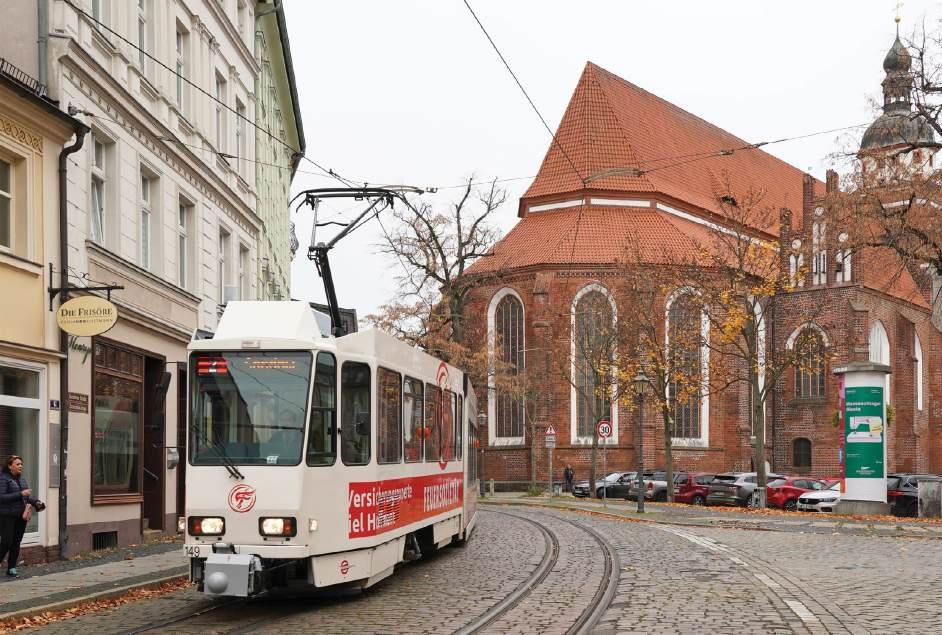
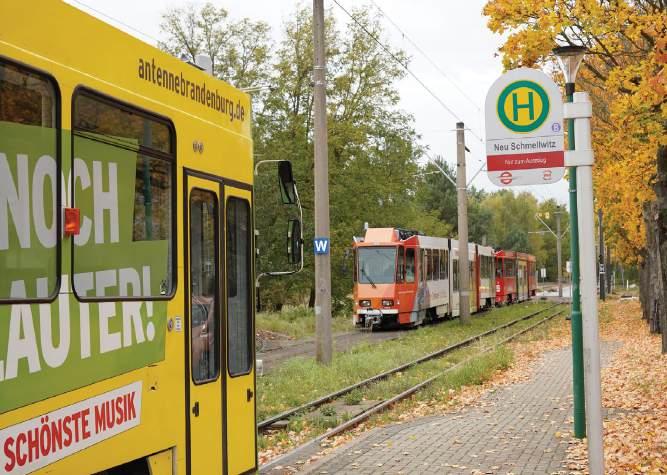
Opened: 1903
Lines: 4
Depots: 1
Approx. weekday hours: 05.00-20.30
Line frequency weekdays: 10-20 minutes
Gauge: 1000mm
Power: 600V dc, overhead supply
Fleet: In transition with new deliveries/ commissioning due
City network/operator: www.cottbusverkehr.de
Regional network: Verkehrsverbund Berlin-Brandenburg www.vbb.de
Civic information: https://cottbus.de
Tourist information: https://cottbustourismus.de and www.spreewald.de
On a section opened in 1984 to serve housing estates, Neu Schmellwitz is the northern terminus for most line 4 services. Beyond the return loop is track access to the Schmellwitz depot site, opened in 1998.
Aboard KTNF6 149: a plaque on the grey panel in the low-floor section identifies this tram as Langläufer 5, an upgrade completed at the system’s own works in 2015.
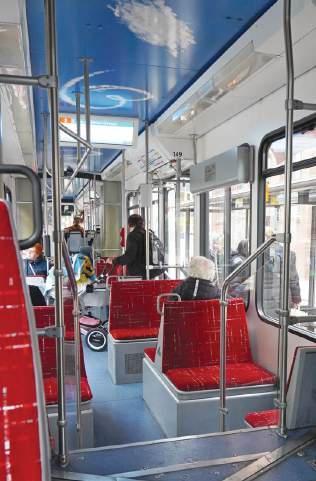
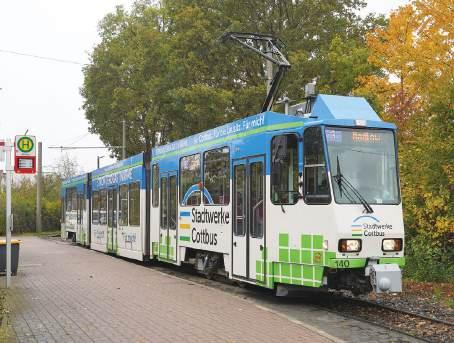
Ströbitz terminus loop was added in 1965. Tram 140’s livery promotes the utility body, Stadtwerke Cottbus. Cottbusverkehr now has a free-standing municipal administration.
applications such as Cottbus Hbf - Chóśebuz głowne dwórniš ćo.
A point at which many will join the tram system, Cottbus Hbf is about 1.6km (one mile) south of the wide city centre crossroads between the Stadthalle venue and Rathaus (city hall). Here the long north-south and much shorter east-west tramway routes intersect, each with separate platforms, respectively as Stadthalle Puschkinpromenade and Stadthalle Post. This area also hosts a street market and is near Spree Galerie, a modern indoor shopping centre. To the east between Stadthalle and the Spree river is the Altstadt, a reconstruction of the historic city centre completed over several years. It was between this area dominated by the Oberkirche St. Nikolai church and the main station (then Staatsbahnhof) that the first tram service ran in 1903, being an electric operation from the outset. By 1909 there were 12.5km (7.8 miles) of route, much of which was single-track with passing loops, but funding problems made extension and operation intermittent. Bombing raids late in World War Two causing around 1000 deaths and the Soviet occupation from 1945 also depleted transport resources.
Although some sections closed after just a few years of use, today’s approximately 20km (12.5-miles) of route owe much to rebuilding, extensions and layout changes during East Germany’s later years. The mid1970s saw track removed from the central Spremberger Straße shopping street, being replaced just to the west as part of the Stadtpromenade development. The western (line 2) Hbf access includes a Bahnhofstrasse section put out of use for 12 years until bridge renewal was completed in autumn 1990; the Hbf retained tram coverage via Görlitzer Straße. Infrastructure rebuilding closed Bahnhofstrasse again during 2011-12, with the re-opening bringing changes to the service’s line structure. Cottbusverkehr identifies 25.5km (15.9 miles) for the combined current four lines which have short central sections of overlap. Most of the uni-directional system is double-tracked and all termini now have return loops; intermediate loops may indicate a former limit of the system. As with some other East German networks, some stops had an idealogical renaming and more have followed due to changes in the tramway’s surroundings.
Betriebshof Schmellwitz
Schmellwitz Anger
Am Nordrand
Nordfriedhof Beuchstraße
Stadthalle Puschkinpromenade
Stadthalle Post
Schillerstraße
Ströbitzer Weg
Waisenstraße
Ewald Müller Straße
Ströbitz
Jessener
Saarbrücker Straße Thiemstraße / Klinikum
Schleife Thiemstraße
Thierbacher Straße
Gelsenkirchener Platz
Schwarzheider Straße
“Today’s route owes much to rebuilding, extensions and layout changes during East Germany’s later years.”
Remodelling of Hauptbahnhof interchange completed in 2019 brought separate platform faces for trams and buses, with the tram tracks in the centre. Adding a new turning layout enabled two lines to use these platforms rather than one having stops on the more distant north-south route. The shortest of the four lines with an end-to-end time of 17 minutes and the lowest frequency at 20 minutes, line 1 only operates Monday to Friday. The long north-south line 4 takes about 30 minutes with the system’s highest main frequency of ten minutes. Tram destination panels show line numbers with the relevant colour-coding. Most stops have facing side platforms. Becoming a pumpprimer for regional tourism, visitors to the April-October 1995 German Federal Garden Show (BUGA 95) could
Neu Schmellwitz
Gewerbegebiet TKC Zuschka
Neue Straße
Nordring/Am TKC
Bonnaskenplatz Zimmerstraße
Am Doll Sandow
Hermann Hammerschmidt Straße
Cottbuser Ostsee

Marienstraße / Glad House
Görlitzer Straße Weinbergstraße Ottilienstraße
Ringstraße Sportzentrum
Spreestraße
Priorstraße
1. August Bebel Straße
2. Stadtmuseum
3. Hauptbahnhof
4. Friedrich List Straße
5. Stadtpromenade
6. Altmarkt
7. Goethestraße
The modern tram and bus shelters at Madlow, terminus of a branch completed in 1926, are close to free parking spaces; a former depot building is nearby.
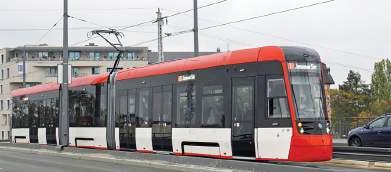
Made stronger for heavier trams and longer than its predecessors, the 140m Bahnhofsbrücke viaduct renewed in 1990 spans tracks near Cottbus Hbf. This ForCity Plus 6 is on a line 2 service to Jessener Straße.
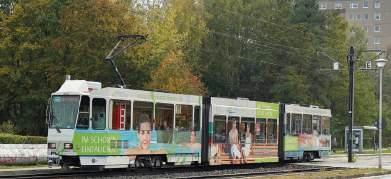
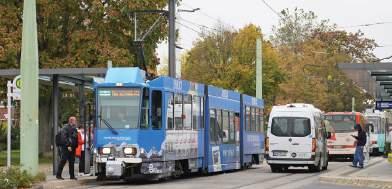
With line 1’s northern end unavailable, shuttle buses replaced trams on the section from Stadthalle Puschkinpromenade in October 2025.
Local travel: Staffed information/sale points at the Hbf and near Stadtpromenade stop. Ticket machines at stops and aboard trams. VBB’s ‘Liniennetz Cottbus’ leaflet shows tram lines integrated with the local and wider network. The system is within zones A/B for which single/60-minute validity tickets cost EUR2.70; 24-hour at EUR5.60. If reaching Cottbus by rail, especially if also using systems like Berlin or Frankfurt (Oder), the VBB day pass at EUR28.50 or the monthly Deutschlandticket at EUR63.00 may be better options (prices as May 2026). What is there to see? Cottbus Service in the Stadthalle building is a well-stocked and welcoming place to find information on the city and its surroundings. Although worthy of a visit, the Altstadt does not have a monopoly of interesting buildings, and the tram routes allow a sampling of the city’s variety. Still in development are former opencast mines east of the city which have been allowed to flood since 2019, becoming the Cottbuser Ostsee. Park Railway information on www.pe-cottbus.de
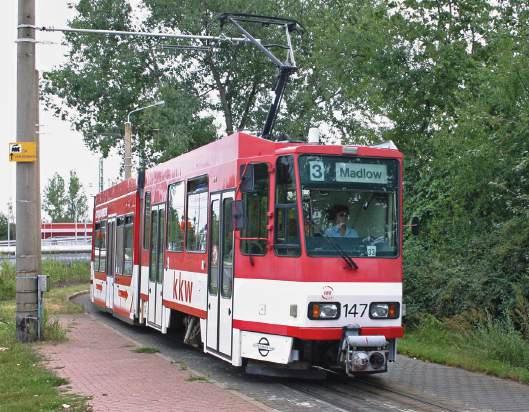
The present Sandow branch was completed in 1972, bringing trams close to a park railway terminus. Slightly nearer the tram platforms, Cottbus-Sandow main line station opened about nine months before this 23 August 2004 view of KTNF6 147 on the return loop.
“Reduction of KTNF6 stock now relates to the commissioning of Škoda 47T ForCity Plus.”
benefit from enhanced tramway coverage, but it was rail transport of another kind which was expanded to play a key role, carrying around 650 000 during the event. The linear BUGA site was served by the former pioneer railway dating from 1954 (now Cottbuser Parkeisenbahn run by Cottbusverkehr) over a 3.2km (two-mile) route south from near the Sandow tram terminus which had opened in 1972.
From the first being received in 1978, two-section high-floor ČKD Tatra KT4D trams became the only type in the passenger fleet and saw use in multiple formations. Early examples became dispersed to many other systems, with 26 newer deliveries being modernised from 1992 by Waggonbau Bautzen (later Bombardier). It was from these that the still-dominant type, the KTNF6, was developed between 1995-98. These resulted from the addition of a central section (supported by four separate wheelsets rather than being suspended) by the vehicle modification specialists Mittenwalder Gerätebau, now Gleisbaumechanik Brandenburg. This created an approximately 30% overall low-floor area with an unstepped double-door and ramp access. The centre section has seats as well as wheelchair/child buggy space. From the original KT4D 18.1-metre length and capacity for 106, the 28.1m-long KTNF6 renumbered in the 1xx series have a capacity for 145, including 52 seats. A locally completed further
development of some KTNF6 is described in panel ‘The Fleet’. Reduction of KTNF6 stock now relates to the commissioning of Škoda 47T ForCity Plus. Acquisition of these new trams was under a joint procurement with other Brandenburg state metre-gauge systems in Frankfurt an der Oder (46T ) and Brandenburg an der Havel (48T ). Following delays caused by objections to the procurement, Cottbus placed the biggest order amongst the three under an agreement completed in 2021. Its 22 trams returned to an earlier number series as 1-22. Seating and liveries are amongst the differences between the 46T-47T-48T; the Cottbus trams are also 100mm wider at 2.4 metres. Built in Plze ň in the Czech Republic, the first 47T was received in Cottbus in June 2024. Since a delayed service debut in August 2025, commissioning of new arrivals has taken longer than anticipated. Dating from 1903, the original depot facilities at Berliner Straße were expanded as the tramway changed, but site restrictions led to a transfer of functions to Schmellwitz depot, opened in 1998. Passing to other uses by 2001, the Berliner Straße buildings and severed tracks are visible on the Jessener Straße branch. Shared by buses and trams, the Schmellwitz compound is sited beyond the line 4 Neu Schmelwitz return loop. Sited at the end of the 1926 branch to Madlow, a building remains which served as a small depot that closed in 1998.
GRAZ. Approval was given for the first of the latest batch of Alstom Flexity trams to carry passengers from 27 May. tramwayforum.at PEGGAU – ÜBELBACH. Sihltal Zürich Uetliberg Bahn motor car ET15 moved to the 10km (six-mile) light railway in May to provide cover after set 4062.001/2 suffered accident damage. EB WIEN (Vienna). Track work in Lerchenfelder Strasse means that line 46 is diverted to Josefstädter Strasse U-Bahn station until at least 10 July.
Alstom Flexity 433/436 were delivered in April, followed by 437/438 in May.
Line 49’s Ultra Low Floor tram 628 became the ‘Song Contest tram’, which ran during May when the Eurovision Song Contest was held in Austria’s capital and hosted sing-alongs. The Eurovision flag was applied to 550 trams and the frequency on lines 6, 18 and 49 was increased during the event on 12/14/16 May.
S-Bahn closures due to viaduct repairs are due to end on 31 October 2027, not 2026 as suggested last issue. EB, K. Matzka
ANTWERPEN (Antwerp). The last day of regular PCC operation was 30 April, with special runs on lines 2 and 8. A farewell celebration is being planned for later this year. Car 6214 was sent to TEC Charleroi on 22 April. DS BRUXELLES/BRUSSEL (Brussels). Alstom TNG 3247 entered service in April.
PCC six-axle articulated tram 7814 took to line 39 on 24 April to mark the last day of the vehicles (built 1971-73) running in operational service.
Esplanade turning loop is to be eliminated, enabling depot tracks to be extended. T-2000 LIÈGE. The tramway carried 12m passengers between April 2025 and April 2026, its first year of operation. T-2000
BRAZIL
BELO HORIZONTE. Following delivery of 24 new CRRC metro trains, six Class 900 trains (built 1983-96) have been sold to Recife. RGI
SOFIA. PESA tram 2301 has received a light brown livery with red stripe to mark 125 years of tramway operation. BS
CANADA
EDMONTON. The southern section of the Valley Line light
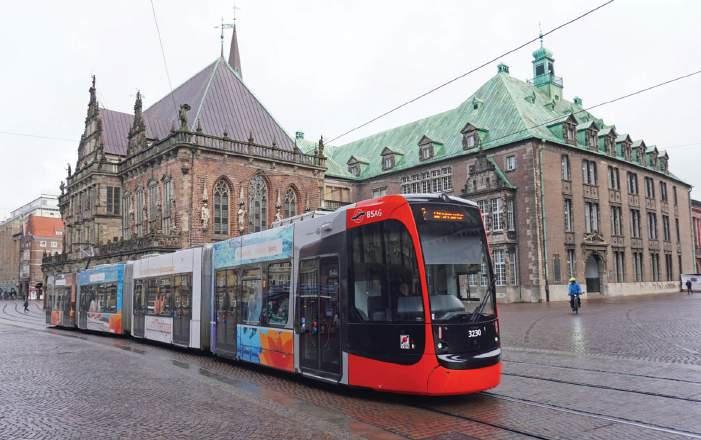
rail was closed on 12-13 May after a collision between a car and train at a level crossing. LRV 2024 was damaged. Edmonton.citynews.ca
CHINA
HANGZHOU. CRRC Nanjing
Puzhen is delivering 29 fourcar Grade of Automation 4 (GoA4)-equipped metro trains for line 12, which is due to open in late 2027. RGI JINHUA. Commuter rail services were extended by 3.6km (2.2 miles) from Lingyun to Yiwu Railway Station on 26 April. urbanrail.net
NANJING. Metro line S2 opened on 22 April. The 54.2km (34-mile) Ningma line links Xishanqiao station in Nanjing to Taibai in Ma’anshan.
skyscrapercity
WUHAN. Metro line 12 opened on 1 May. The 35.3km (21.9-mile) Gangduhuayuan – Moshuihu Park line makes up the southern part of a future circular line; a further 24.6km (15.2 miles) is under construction. Its 79 six-car trains are to be equipped for GoA4 automation. urbanrail.net
CROATIA
OSIJEK. Tatra T3PV.O trams rebodied in 2006 are to be donated to Zhytomyr in Ukraine. Of the six, two (0602/0603) are to be sent imminently; the rest are to follow later this year. transphoto.org
ZAGREB. The Donji Grad – Gornji Grad funicular reopened on 19 May after an 18-month rebuild. transphoto.org
CZECH REPUBLIC
BRNO. Tatra KT8D5R 1719 has been converted to battery power by technology company AZD. It carries the name Lenka (meaning Light Electric Charging Rail Vehicle) and is undergoing testing on the Kopidlno – Dolní Bousov line.
Škoda delivered 45T trams 1790-92 in April. KT8 1703 has been scrapped. AZD, BS MOST. A CZK5m (EUR205 874) feasibility study is to take place for a 3km (1.9-mile) tramline along Lake Most to the site of new housing.
Pragoimex has delivered EVO2 trams 327-30. BS OLOMOUC. Pragoimex has won a CZK305.3m (EUR12m) order for eight low-floor trams. lok-report.de PRAHA (Prague). New T3R. PLF trams are numbered 8783 and 8784. A new KT8D5.RN2P, created from ex-Most 322 and ex-Miskolc 213, has become 9111.
Doppelmayr delivered two 120-passenger vehicles for the refurbished Pet ř ín funicular on 24 April. Testing started in May, with opening planned for September. BS
SANTO DOMINGO. The National Consortium for Integrated Mobility has won a DRP29m (EUR423 556) design and build contract for 10.5km (6.5 miles) of monorail from Centro Olimpico to Av. Charles de Gaulle. RGI
HELSINKI. Škoda Transtech is
seeking to appeal the decision to award a contract for new trams to Stadler (TAUT 1062).
A tender for up to 58 new metro trains has closed without a contract being awarded. A new tender was issued on 22 April with responses required by 8 May. Škoda ,lok-report.de TURKU. The 12km (7.5-mile) Port – city centre – Varissuo tramway project was approved by the city council on 18 May. Services are to start in 2033. A tender for 14 trams is being prepared. The scheme is projected to cost EUR530m. turunraitiotie.fi
LILLE. New 32.4m Alstom Citadis trams have been numbered 101-127. They should enter service this autumn. T-2000 NANTES. Track renewals mean there will be no tram service on line 1’s western section between 14 June-3 August. BS PARIS. Alstom unveiled RER line B’s new M120 dual-voltage doubledeck EMUs on 7 May. CAF builds the motor cars for the 146-train order while Alstom builds the trailers and undertakes final assembly. RGI
BERLIN. Services on lines M6 and 16 resumed running to Hackescher Markt on 23 May. GT6O trams 1250/1253 have been scrapped.
Strengthening work is taking place under the tramway at Alexanderplatz U2 station to permit M4’s Alstom Urbanliners to enter service this summer.
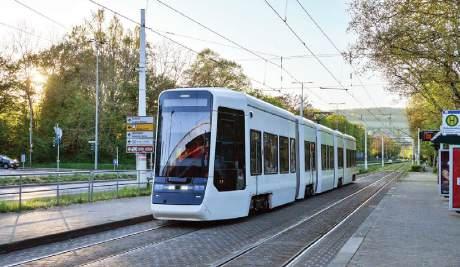
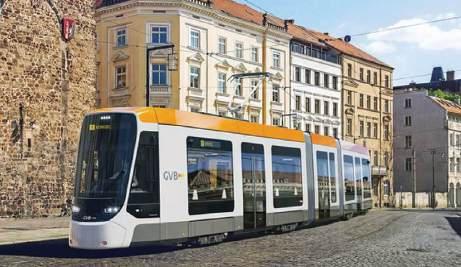
The first of 756 Stadler Type J large-profile U-Bahn sets entered trial service on line U5 on 30 April. BS BONN. Line 66 services have been cut back from Siegburg to Vilich until at least 12 June, to allow completion of a new railway bridge.
Plans for a 3.8km (2.4-mile) cable car between Venusberg UN Campus and Ramersdorf have been approved. BS BREMEN. Bürgermeister-SmidtBrücke reopened to trams on 13 April. Line 5 now runs Gröpelingen – Bürgerpark and is no longer linked to line 8. This now runs Huchting –Kulenkampffallee. Line 14 was withdrawn.
Public transport is to be free from 14.00 on 2 October to the end of services on 4 October for German Unity Day. Tram 3239 has been given a special livery to advertise the occasion.
Operator BSAG is to replace side windows on its 84 Siemens Avenio trams delivered in 2020-25. A fault resulted in a lack of adequate waterproofing. Staff at Sebaldsbrück depot can rectify up to six trams per month. BS, A. Thompson DARMSTADT. A renumbering programme started in April with four- and five-digit numbers replaced by two- and three-digit numbers respectively.
Trams are to cease running to Griesheim for two years from December 2027, to permit replacement of the Rheinstrasse railway bridge. BS DORTMUND. HeiterBlick resumed delivery of B80D Stadtbahn cars on 18 May. DS DUISBURG. The order for Siemens HFx Stadtbahn cars has been increased from 18 to 23; the first is to arrive in 2027.
The new Karl-Lehr-Brücke was slid into place between 18 April and 10 May. Line 901 was split into two, with shuttle buses filling the gap. DS
DÜSSELDORF. Stadtbahn line U81’s extension to Flughafen is to open on 4 September.
HF6 Stadtbahn car 4325 has received the new ‘improved visibility’ livery. The scheme, with more red and less grey, is part of the ‘Safety Concept 2030’ initiative.
Vossloh has delivered rail grinder 5342. BS FREIBURG. A tender is being prepared for between 50 and 65 double-ended trams to replace vehicles 2029-2040.
GT8N eight-axle tram 230 is now a driver-training vehicle. BS HAMBURG. Alstom is delivering 146 ET490 S-Bahn sets. Of these, 9001-51 are single-voltage; the remainder are dual-voltage and equipped for Automatic Train Operation. BS KÖLN (Cologne). The stop at Barbarossaplatz is to be rebuilt with more grassed areas. The EUR14.2m project is to take place in 2027. BS KREFELD. Line 043 has resumed running to Uerdingen after 22 months of infrastructure work. DS
LUDWIGSHAFEN. KonradAdenauer-Brücke reopened on 1 June, allowing lines 4 and 4A to resume their normal routes. Lines 6/6A were diverted to the reopened bridge as the subsequent closure of the Kurt-Schumacher-Brücke took effect. Line 7 resumed throughrunning to Rheingönheim. A new line 12 operates from Oppau to Rheingönheim. BS MAGDEBURG. After 58 years, Tatra trams no longer serve the network. B6A2 trailers 2205 and 2207 were withdrawn on 30 April. Withdrawn KT4Ds 1291 and 1293 have been sent to Wehmingen museum. BS MAINZ. Trams to Hechtsheim were replaced by buses from 29 June to permit reconstruction of track and stops. BS PFULLINGEN. A referendum on a proposed tram scheme is to take place on 21 June. Alternative
routes include either on-street track through the city centre via Marktplatz or a route along former railway. DS
RHEIN–SIEG. Simplification of the joint tariff area fares started on 1 June in a programme to reduce fare levels from 16 to three. lok-report.de
ROSTOCK. The network is to be split in two 13 July-21 August to permit track work. Lines from the north are to reverse at the depot and lines from the south at Doberaner Platz/Platz der Jugend. Line 2 will be suspended, while lines 3 and 6 will be cut back from Neuer Friedhof to Zoo from October to permit demolition of the railway bridge. Built in 1994, tram 663 is to become the first low-floor vehicle to be scrapped. They are being replaced by eight new Stadler TINA trams. BS SCHÖNEICHE. Ex-Bochum works tram 677 (Düwag, 1957) has been scrapped. BS WOLTERSDORF. A new arrival is Warszawa (Warsaw) works tram P16. Built as Berlin T40 3942 in 1940, it is privately owned. BS WUPPERTAL. Modernisation of Vohwinkel station and depot is complete; the Schwebebahn reopened from Zoo on 24 May. Schwebebahnblogger ZWICKAU. Rebuild of the railway station forecourt is to start in July and is likely to affect the tram service until the project is completed in 2028. BS
DUBLIN. Transport Infrastructure Ireland has launched the procurement process for the EUR7.3bn contract to supply trains, Grade of Operation 4 automation systems and signalling, depots, trackwork and the building and fitting out of 16 stations on MetroLink. The contract also covers operating and maintaining the 18.8km (11.7-mile) system for 25 years.
MANX ELECTRIC RAILWAY. Winter Saloon 20 has returned to service after overhaul, for the first time since the end of the 2024 season. Car 2 has returned to service after bodywork repairs.
Redundant trolley wheels are available to buy from the MER’s online shop (www.iombusandrail. im/heritage/shop).
DOUGLAS. The Department of Infrastructure’s business case for resurrecting the Villa Marina – Sea Terminal section of the Douglas Bay Horse Tramway is now expected to be submitted to the island’s parliament in June rather than May. Rebuilding the line could take 40 weeks to complete, costing anywhere between GBP750 000 (EUR868 719) and GBP2m (EUR2.3m).
BERGAMO. The Italian government has awarded an additional EUR25m to complete the line T2 tramway project. RGI MILANO (Milan). EUR576.5m of state financing has been secured for the 13km (eightmile) underground M5 metro extension from Bignami to Monza (Polo Istituzionale) with 11 new stations. The EUR1.9bn project is due to be completed in 2034. blog.urbanfile.org
SOPRABOLZANO. Heidelberg Düwag M8C-Nf 3252/6-8 have arrived on the Renon tramway. Of these, 3256 will be used for spares.
DS
TAKAOKA. An order has been placed with Alna Sharyo for six 16.5m, three-section 100% low-floor trams for delivery in 2027-33. They will replace the six MLRV1000 trams dating from 2003-09. Y. Hanafusa TOKYO. Ueno Zoo’s monorail, which closed in 2023, is to be replaced by accessible three-section trains. The line,
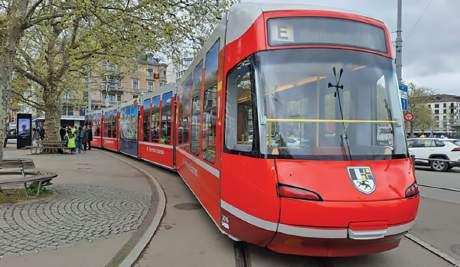
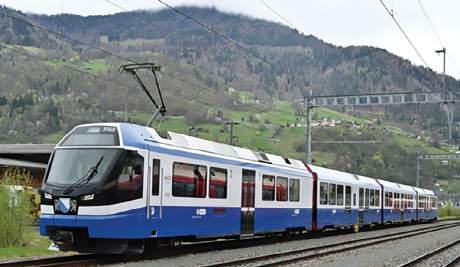
14m above the ground, is to open by 2030. Y. Hanafusa
RIGA. Line 7’s 2.2km (1.4-mile) extension from Ausek ļ a iela to Ķ engarags opened on 1 June. Line 14 also serves the new terminus. rigassatiksme.lv
MONTERREY. Metrorrey aimed to launch limited services on parts of monorail lines 4 and 6 in time for the FIFA World Cup in June. Full services are due to start in 2027. RGI URUAPAN. An 8.4km (5.2-mile), six-station cable car opened on 18 April. Doppelmayr supplied the equipment for the MXN3.2bn (EUR159m) line. UTM
AMSTERDAM. Line 26’s extension is due to open on 4 July. Line 1 returned to Czar Peterstraat on 20 April. OR DEN HAAG (The Hague) Introduction of line 1’s Stadler TINA trams has been postponed. Trials revealed that lineside infrastructure in Delft needed modification.
The first test run on the extension to TU-campus took place on 7 April. OR
OSLO. Line 13 (Furulund – Lilleaker) was withdrawn on 15 April. It is to return in 2027, operating from Thune to Øraker. Trams on lines 17 and 18 resumed operation between John Colletts plass and Gaustadalléen from 20 April. Services to Rikshospitalet will not restart until at least 2030. Museum tram 140 undertook its first journey on 19 April. BS
PANAMA CITY. Testing on the 25km (15.5-mile) monorail started in early May. It connects metro line 1’s Allbrook terminus and
Ciudad del Futuro, and includes a 5.3km (3.3-mile) tunnel under the Panama Canal. Hyundai Engineering built the EUR2.1bn line, with Hitachi supplying 28 six-car trains. RGI
This is after the consortium agreed to order the 12 LRVs from PESA rather than CRRC Tangshan. The EUR600m, 11.5km (7.1-mile) line is expected to open in 2029.
Reuters
BILBO (Bilbao). Funding for the EUR412m 6.7km (4.1-mile) metro line 4 from Errekalde to Matiko has been agreed. IRJ
GDA Ń SK. A tender for new trams has been cancelled. Although bids were received from Škoda and PESA, both exceeded the loan amount available to finance the deal. A new tender for 20 double-ended five-section 45m trams was issued in May. lok-report.de POZNA Ń The end of 105Na bogie trams was celebrated on 30-31 May. The five remaining sets ran on various routes. DS SZCZECIN. Modertrans delivered the last of 12 Moderus Gamma double-ended 32m trams on 8 May. Each three-section tram can carry up to 240 passengers (46 seated) and cost PLN12m (EUR2.8m).
PLOIE Ș TI. Astra Vagoane is preferred bidder for 20 new low-floor trams. Turkish manufacturer Bozankaya is reportedly appealing the decision. cs-dopravak
MOSKVA (Moscow). The last 71623 bogie trams were withdrawn on 17 May. The fleet now comprises low-floor 71-911EM (with bogie) and 71-931M (articulated) trams. Autonomous driving equipment has been fitted to 71-911EM 30735. transphoto.org
SAUDI ARABIA
TP
WARSZAWA (Warsaw). A tender has been issued for 20 double-ended trams, with an option for 42 more. Delivery is required within 34 months of contract signing.
The first event to mark 160 years of tramway operation was a parade of seven trams on 16 May, followed by an open day at Praga depot. A larger parade is planned for December.
TP, M. J. Russell WROCŁAW. A media event at Borek depot on 19 May marked the delivery of the 40th PESA Twist 146N tram, 3440.
RIYADH. Orange Line 3’s Western station opened on 15 May. The last of 22 stops on the 41km (25.5km) automated line, it includes a bus interchange, 600-space park-and-ride and a mosque. DS
SERBIA
BEOGRAD (Belgrade). Bozankaya won the EUR187.4m contract for 85 new trams. Tram lines 11 and 13 to Blok 45 in Novi Beograd are closed for rebuilding. The only lines crossing the river are 7L and 9L to Novi Beograd depot, running to Ustani č ka and Banjica respectively.
BASEL (BVB). The tender for 23 new trams has closed without a result. Only one bid was reportedly received. A new tender is being prepared. DS BERN. A change of policy by the cantonal parliament means that the tramline to Fischermätteli will not be turned into a bus route. EA BEX – BRETAYE (TPC). The BVB section of line between Bex and Villars-sur-Ollon is to remain closed until 29 November to prepare the infrastructure for new Beh4/8 trains, due to enter service in 2028. EA GENÈVE (Geneva). Testing on line 17 from Annemasse to Perrier-Aubrac is to start on 23 June, with opening to passengers on 1 September. BS LE LOCLE – LE BRENETS (transN). Neuchâtel canton is to replace the 4.1km (2.5-mile) metre-gauge line with electric buses by 2032. TR VEVEY – BLONAY (MVR). Replacement buses are to run between 26 June and 16 August to enable a technical upgrade to take place. EA ZÜRICH . The last high-floor trams ran on 8 March. Alstom Flexity 4092 was delivered on 30 April. Be2/4 2418 has been passed to Tram-Museum Zürich. BS
TP
MPK is carrying out consultation on design features for future trams as it plans to tender for up to 160 new cars.
LISBOA (Lisbon). The European Commission has authorised Metropolitano de Lisboa to award the Violet line light rail construction contract to the Mota-Engil consortium.
cs-dopravak, P. Haseldine
BRATISLAVA. Škoda has delivered five-section, 32.5m 29T trams 7451-60. BS
SPAIN
BARCELONA. FGC has issued a tender for 36 train sets for the Llobregat – Anoia line. lok-report.de
BANGKOK. Construction of two Red Line extensions is to start in July: the 8.8km (5.5 miles) from Rangsit to Thammasat University and the 20km (12.4 miles) from Siriraj to Taling Chan and Salaya. skyscrapercity
ISTANBUL. Metro line M5 was extended by 4.4km (2.7 miles)
from Samandıra Merkez to Sultanbeyli on 22 May.
The city council has approved plans to borrow EUR871.2m to purchase 422 new metro cars. Line M1B’s 9.7km (six-mile) Kirazlı – Halkalı extension is to receive 272 new trains while the 11km (6.8-mile) M5 extension (Çekmeköy – Sultanbeyli) should gain 150. IR
KYIV. A tender has been published for the supply of two new funicular cars and associated equipment, for delivery within 18 months. lok-report.de
BLACKPOOL. A new timetable with extended running times, intended to increase service reliability, was introduced on 17 May. It maintains a 15-minute frequency between Starr Gate and Fleetwood.
EDINBURGH. The Scottish Government is to fund a feasibility study into operating tram-trains on the ‘South Sub’, a freight-only railway through the city’s southern suburbs.
GREATER MANCHESTER. Metrolink services were disrupted 16-29 May for drainage installation between Monsall and Newton Heath & Moston. Attention was also paid to the track foundation and alignment. During the same period, sheetpile driving took place at Derker, to permanently fix the site of a 2024 landslip. Equipment at Piccadilly Gardens was replaced. HERTFORDSHIRE.
Hertfordshire County Council has unveiled plans for a GBP2bn (EUR2.3bn) ‘trackless tram’ network. Hertfordshire Essex Rapid Transit would connect Harlow and Hemel Hempstead via Hertford, with a branch via Watford to Croxley.
INDUSTRY. The Australian arm of consultant ARUP is to share operational and safety-related material with Light Rail Safety & Standards Board members.
LONDON (TRAMS). Weekend fares are to be capped at GBP1.75 (EUR2.02) between 25 July and 31 August. The same fare also applies on buses at weekends during the same period.
LONDON (UNDERGROUND).
The Rail, Maritime & Transport Union called off planned strikes in May. Strikes are planned in June in a response to Transport for London’s plans for a voluntary four-day week for drivers.
Early closing on the Northern Line’s Bank branch was to come to an end in “late spring”. Track replacement has affected
evening services between Camden Town and Kennington since January.
The disused part of Charing Cross Underground station was used by the British Army in May, as a bunker for a training exercise.
NOTTINGHAM. NET has appointed Andrew Downie as its new Head of Operations & Safety. Downie began his career with British Rail and became Duty Service Manager with East Midlands Railway. He also spent 20 years serving with Nottinghamshire Police.
New statistics have revealed a 19% increase in car-tram collisions in 2025.
TYNE & WEAR. The GBP8.8m (EUR10.2m) upgrade to Tyne & Wear Metro’s control room was completed on 21 May. Sella Controls and Nexus installed a new Supervisory Control & Data Acquisition System.
Kier has won the GBP7.9m (EUR9.2m) contract to rebuild the Regent Centre Metro station. The project is to start over the summer.
CARROLLTON, MD. The final rails for the 25.9km (16.2-mile) Purple Line light rail were laid on 7 May. Services are due to start in late 2027. Mass Transit BOSTON, MA. MBTA completed a nine-day complete renewal of overhead equipment between Kenmore and Boston College on the Green Line B branch on 1 May. Train Protection System infrastructure was also installed. R. Barrows CHICAGO, IL. Construction of the 8.8km (5.5-mile) Red Line extension from 95th St to 130th St is underway. The USD5.7bn (EUR4.9bn) project is due to be completed in 2030. abc7 DALLAS, TX. A referendum on 3 May resulted in Highland Park leaving Dallas Area Rapid Transit. Buses no longer serve Highland Park. A further five municipalities have threatened to withdraw from the transit agency. Mass Transit KANSAS CITY, MO. Kansas City Streetcar’s 1.1km (0.7-mile), USD62m (EUR53m) Riverfront extension opened on 18 May. Trams now run 10.4km (6.5 miles) from Riverfront to the University of Missouri-Kansas City. J. May
LOS ANGELES, CA. LAX airport’s 3.6km (2.25-mile) automated people-mover started trial operations on 20 April. It is due to open in late June. J. May
MINNEAPOLIS – ST PAUL, MN. The Blue light rail line is to close
29 June-19 August to renew track and signalling. Mass Transit
NEW YORK – LONG ISLAND (NY). The commuter rail network was closed by a three-day strike that started on 16 May. Unions were seeking an improved pay offer. J. May
NEW YORK – NEW JERSEY (PATH). Direct weekend trains from Hoboken to World Trade Centre were introduced on 17 May. J. May
PHILADELPHIA, PA. Line T5 resumed operating along Island Avenue on 24 May after stops were rebuilt with new shelters, enhanced lighting and modifications to permit level boarding.
PATCO’s new USD19.4m (EUR16.7m) operations control centre at Lindenwold opened in May. J. May
PORTLAND, OR. The number of additional Type 6 LRVs now on order is 52, to be numbered 631-82. Delivery is due to start in mid-2029. S. J. Morgan
SACRAMENTO, CA. The city of Elk Grove has launched a joint project with Sacramento Regional Transit and Caltrans for a light rail or Bus Rapid Transit connection to Sacramento. Mass Transit SAN FRANCISCO, CA (Muni) A two-year balanced operating budget was approved in April, eliminating future shortfalls totalling USD651m (EUR142m). Fares, fines and parking fees are to increase. J. May
VIETNAM
HO CHI MINH CITY (Saigon). A VND491bn (EUR16m) contract has been signed with HyundaiRotem for automated trains to run on the 64km (40-mile) metro line 2, due to open in 2030. IRJ
MUSEUM NEWS
ALFORD (UK). The remaining section of Aberdeen Suburban Tramways Company 11 underwent trials at the Alford Valley Community Railway on 9 May. Withdrawn in the 1920s, 11 served as a summerhouse before being preserved. It has been converted from 1435mm-gauge to 610mm-gauge.
ASHINGTON (UK). Tyne & Wear Metro operator Nexus has donated concrete blocks, scaffolding boards, timber posts and plywood sheeting from its restoration of Whitley Bay station to the Woodhorn Narrow Gauge Railway. The 1km (0.6-mile) 610mm-gauge railway is being restored to operational standard, having closed in 2018.
BEAMISH (UK). Sunderland Corporation Tramways 16 has
undergone repairs to its roof. CHEMNITZ (DE). The tramway museum is open ThursdaysSaturdays until 24 October (but not on holidays). It can be reached on line 1 at Am Feldschlösschen. BS
CRICH (UK). Blackpool Centenary 645 is to return to service as the National Tramway Museum’s Access Tram on 12 September.
DÖBELN (DE). The horse tramway is running every first Saturday May-September, plus 10 October. UTM
MARIAZELL (AT). The operating season for the museum tramway is 23 May26 October, on Saturdays and Sundays. UTM
KOHLFURTH (DE). Bergische Museumsbahnen’s season started on 10 May. Trams run every second and fourth Sunday of the month until the end of October. UTM KRAKÓW (PL). Restored LOWA trailer 1817 ran in passenger service on 1 May. It worked with Warszawa (Warsaw) Type N 838 on heritage line O. This German-built trailer was originally Klingenthal EB198-03. DS
LOWESTOFT (UK). Blackpool Standard 143 has had both its controllers rewired and refurbished. It is on loan from Fylde Transport Trust. A contractor is set to rebuild one of its traction motors.
STUTTGART (DE). Museum tram lines 21 and 23 operate on Sundays from Bad Canstatt tramway museum to Hbf/Ruhbank. UTM
Worldwide items for inclusion should be sent to Michael Taplin at Flat 8, Roxan Villa, 33 Landguard Manor Rd, Shanklin, Isle of Wight PO37 7HZ, UK. Please fax: +44 (0)1983 862810 or e-mail miketap@mainspring.co.uk UK and Ireland items, please e-mail uknews@lrta.org.
Acknowledgements are due to abc7, AZD, Blickpunkt Straßenbahn (BS), blog.urbanfile. org, cs-dopravak, Drehscheibe (DS), Edmonton.citynews.ca, Eisenbahn (EB), Eisenbahn Amateur (EA) lokreport.de, Mass Transit, Op de Rails (OR), Railway Gazette International (RGI), Reuters, rigassatiksme.lv, Schwebebahnblogger, skyscrapercity, Tram-2000 (T-2000), tramwayforum.at, transphoto. org, Transport Publiczny (TP), turunraitiotie.fi, urbanrail.net and Urban Transport Magazine (UTM).
All the latest news... www.mainspring.co.uk/ industry-news/

matt@mainspring.co.uk

Get your views into print
Letters submitted by post should be clearly typed and preferably not handwritten. We reserve the right to edit contributions for publication.
I refer to the question raised in March’s Mailbox about Sintra car 2 (‘Puzzle in Lisboa’), which I can answer as follows.
In 1903 seven motorcars and six trailers were acquired from Brill in Philadelphia. Four of the motorcars and four of the trailers were of the open cross-bench type with seats for 32 on eight wooden benches. Three of the motorcars and two of the trailers were of a small closed type with 17 upholstered seats: three rows of transverse seats in 2+1 configuration and longitudinal seats for two in each of the corners. The platforms of all tramcars were originally open, but the ones of the closed motorcars were later closed.
In 1945-1948 three new closed bodies were built with help of staff of Carris in Lisboa. These new bodies were of the
A spring visit to Prague
I was in Prague during April, and photographed this T3 set working across the new Dvorecky bridge on the 21 service. The service crossing the bridge is worked by the 15T cars. There is a stop in both directions at the western end of the bridge which carries the name ‘Lihovar’, which is the same as the stop on the main road used by line 4, 5 and 12 services to Barrandov. There have been a number of route changes
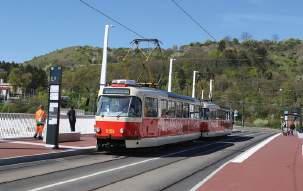
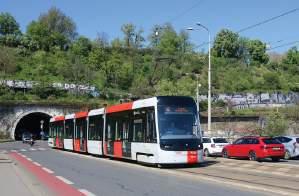
Lisboa ‘standard’ type and had seats for 24. They were combined with the trucks, motors and other electric equipment of three original Brill-built trams, two closed and one open, to make new motorcars. The body of the open tram was used for a new trailer. Of the original Brill-built closed bodies, one was scrapped around 1945, while the other has been in storage without running gear since around 1946.
The current status is that, next to the three trams (2, 4 and 5) with Lisboa-type bodies, there are still one Brill-built closed motorcar (3) and three open motorcars (1, 6 and 7). The trailer fleet now consists of two closed cars (8 and 10) and five open cars (9, 11, 12, 13 and 14). Only part of the fleet is operational, while the rest is awaiting restoration.
across the whole network since the bridge opened, including a new route 34 which we saw in the city centre. Perhaps one of our better informed correspondents can enlighten us as to the details?
The bottom-left image was taken on 22 April, and shows one of the latest Skoda 52T cars on the Stefanikuv Bridge north of the city, on a route 8 working. During our visit we saw these cars mainly on the 8 and 12 services, with odd workings on line 6. With only 20 so far in service, they are a bit more difficult to track down than the other types!
Peter Makinson, by e-mail
I was intrigued when starting the second paragraph of the article ‘NPR offers tramtrain expansion’ (TAUT 1059, March 2026). That paragraph starts: ‘The existing 5.5km (3.4-mile) tram-train line from Cathedral to Rotherham Parkgate opened in 2018...’
The distance from Sheffield (Fitzalan Square) to Rotherham (College Street) by tram in 1905 – by a more direct route than the Supertram tram-train – was six miles [9.6km]. Rotherham Parkgate is a further 1.4 miles [2.3km] from College Street, whereas Sheffield Cathedral is about 200 metres further than Fitzalan square. Thus the tramtrain distance is more like 7.4 miles [11.9km], (not the 3.4 miles [5.5km] quoted).
The distance from Sheffield Cathedral to Tinsley/Meadowhall South (the stop less than 100 metres before the tram-train line diverges), is about 6467 metres (6.5km/four miles). The difference between 7.4 miles and four miles is 3.4 miles. The distances quoted in the article refer to the extension from Tinsley to Rotherham Parkgate, whereas the information portrayed in an
In 1997 two ‘standard’ tramcars were bought from Carris in Lisboa, 703 and 709, for future use on the to-be-reinstalled line to Sintra-Vila. However this project was later cancelled. One (709) was already changed to metre-gauge (Lisbon has 900mm-gauge) had a major overhaul, was painted red and received the number 100. However the car was never used. No work was ever done to the other car. Both are still in storage in Ribeira, the Sintra depot.
Another former Lisboa tram, 615, also went to Sintra and was converted to metre-gauge. This tram is owned by a privete person and was used for some time for rentals and as a works car. After many years of storage in Ribeira, it has now returned to its owner. Ernst Kers, by e-mail
otherwise excellent article is somewhat misleading.
John Burgin , by e-mail
Manchester should look to Vienna
Regarding the plans for Manchester's Metrolink to build a new station at Sandhills, I would invite the planners to look at Vienna. A new U-Bahn station on line U2 has just opened. Called Lina-Loos Platz, it is in the middle of nowhere – but has been built in advance of the forthcoming houses that will be constructed there.
Contrast that with Manchester where, despite a GBP2bn (EUR2.3bn) regeneration programme taking place in Collyhurst, Metrolink is only thinking about possibly having Sandhills station ready to serve it by 2030. How difficult and costly is it to put down a couple of platforms next to an existing line? How unambitious is the management at Metrolink? By offering good public transport whilst new housing is being built, you will not only make property more attractive, but you might even convince some people to forego owning cars.
Robert Missen, Belgium
A section of text in the June issue of TAUT (1062) – page 226, Systems Factfile – was omitted in error. The full text should read:
“Like many services under the public sector TfL brand, operation and maintenance of the DLR is contracted to a train operating company. This is currently the joint venture KeolisAmey Docklands 2025, which commenced its second contract (for eight years) in April 2025, continuing from a previous ten-year term.”
TAUT Editor
Even 36 years after the reunification of Germany, several metre-gauge tramways in the former East continue to exhibit unmistakable signs of their ancestry. They include Jena, which recently celebrated a big anniversary. Mike Russell reports. 1
Jena, the second-biggest city in Germany’s Thüringen Land (its present-day population being around 110 000), never had its own horse-drawn or steam-propelled tramway. Rather, the introduction of electric tramways from 6 April 1901 marked the first serious provision of public transport in the town. By that year’s end a sizeable system had been developed; given Jena’s topography, this is clearly discernible in the layout of the tramway to this day. However, the several changes and major extensions of recent years have transformed the old layout which remained largely unchanged, save for a spate of route closures and re-routeings in the 1960s, until 1997. The detail of today’s route network, therefore, bears only passing resemblance to that of the German Democratic Republic years.
The original plans to provide Jena with an electric tramway as part of a wider plan for electricity generation and supply, along with similar facilities in the neighbouring town of Apolda and an interurban tramway line connecting the two, was proposed by Berlin-based promoters of electrical energy in 1896. There had also been several earlier expressions of interest. Following discussions, the Jena authorities preferred to develop their own system and after the tramway opened in 1901 under the aegis of Berlin’s promoters, in the following year the seat of the company was transferred to Jena.
Rekowagen recalled
In common with most smaller tramways inaugurated in this era the initial rolling stock was double-ended with four-wheel trucks and initially all cars were non-vestibuled. Despite the longevity of much of the early fleets of tramcars on the smaller German systems, nothing of this era survived in Jena and so, in attempting to portray a continuum of development, the undertaking had to start from a later period. Fortunately in this it is better placed, as in 1923 the company took delivery of ten so-called Thüringerwagen cars (23-32) from the Gotha works in that town. Most were withdrawn or demoted to trailers in the 1960s, but in 1976 an opportunity arose to acquire an almost identical tram dating from 1929 from the fleet of the former Eisenach tramways, whose system was finally closed on the last day of 1975.
A single car (19) still remained in the Eisenach depot as late as March 1976 and after negotiations for its acquisition were quickly concluded, the car was transferred to Jena. A hurried but effective repaint was
carried out in time for it to take pride of place in the tramway’s 75th anniversary celebrations in April 1976, renumbered 26. Sadly this car became victim to an accident and fire in 1978, and some years passed before repair works could be undertaken. Now, however, car 26 is beautifully restored to working order, lettered for Strassenbahn Jena, and rightly took its place at the head of this year’s 125th anniversary cavalcade.
The post-reunification Jena tram fleet consisted entirely of two-axle cars (both new trams from the Gotha works and rebuilds (Rekowagen) from the Reichsbahnausbesserungswerk in BerlinSchöneweide, operated both singly and in two- and three-car coupled formation. Indeed, it was not until as late as 2003 that the last examples were withdrawn – by which time Jena was the last ex-GDR full-service tramway operating such cars. Since then, several of these cars have been passed on to undertakings in Turkey for operation on heritage services, leaving one three-car train in Jena. This comprises T57 motor car 101 and B57 trailer 155, supplied new by the Gotha Works in 1958 and 1959 respectively, plus Rekowagen trailer 207 of 1973. Outwardly similar, the Rekowagen is distinguishable by its greater bodywork height, four-window saloon, narrower passenger doorways and stepped interior layout.
The standard practice in the GDR was to allow depot staff to form up three-car trains of two-axle cars irrespective of type. The following story may be apocryphal but is attributed to Jena. Apparently, with Jena’s preponderance of Rekowagen over new-buid Gotha cars, it sometimes happened that three Rekowagen were formed into a train; complaints were received from well-built citizens that this meant they were denied access to the service on account of the narrow doorways. A management directive was then supposedly issued to the effect that in every three-car train, at least one of the cars (motor or trailer) had to be of the Gotha type.
This surviving three-car train was the second participant in the parade and preceded a line of three examples of modern low-floor articulated cars that make up Jena’s present-day fleet. The first of these was 620, one of the surviving Adtranz/Bombardier GT6M-ZR cars delivered in two batches (1995-7 and 2002-3), several of which have recently been withdrawn and sold to Łód ź Then came an unusual specimen,tram 703, one of five Solaris Tramini S109j cars built in 2013, a type rarely found outside their home city of Pozna ń . Finally came 801, representing
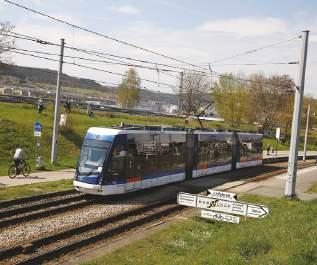
the most recent delivery of Tramlink cars from Stadler (16 seven-section and eight five-section). All these cars are of doubleended configuration and the complexities of the Jena network explain this necessity. The termini at Jena-Ost (route 2) and Ernst-AbbePlatz (4 and 5) are laid out as stubs, as is that at Lobeda-Ost (1 and 3) and having even a small number of single-ended cars would be highly restrictive on such a network. The one bogie car that did not participate in the parade was 963, a double-ended Düwag GTW6A acquired from Heidelberg in 2003 and now fitted out as a party tram; this was on exhibition at Dornburgerstrasse storage sidings.
It may sound as though Jena struggled to assemble a parade of rolling stock to illustrate network development over the years, but the undertaking had an interesting earlier fleet, none of which survived to form part of an historic collection. Initially there was a group of Belgian-built cars dating from 1915 intended for a tramway in İ zmir, Turkey, which turned out to be a frustrated export. They remained at the premises of the builder (les Ateliers Germain of Monceausur-Sambre) for many years, undelivered and unpaid for, until acquired by Jena in 1931. Later, ten motor cars were acquired from Weimar, where the tramway had closed in 1937. Of these, four were retained as motor cars whilst the remaining six were initially converted as trailers – to be followed later in life by the other four.
The parade itself took the form of a specially-devised route to allow the cars to be displayed to all areas of the town, whilst avoiding the potential pitfall of covering sections of remaining single-track or termini equipped only as stubs. Doing otherwise would have been a recipe for considerable delay to advertised services, on which passenger traffic appeared to be at a level that would be envied by several other systems of similar size. This remarkably good loading should be a great encouragement to the tramways’ management, with their planned building of a northward extension beyond the Zwätzen terminus to Himmelreich, due to open in 2029.
The company also produced a wellillustrated and attractive softback book (Nahverkehr in Jena – Eine Geschichte mit Zukunft) to mark the anniversary, and invited well-wishers to participate in the parade on the historic cars – provided they were dressed in apparel appropriate to the period represented!
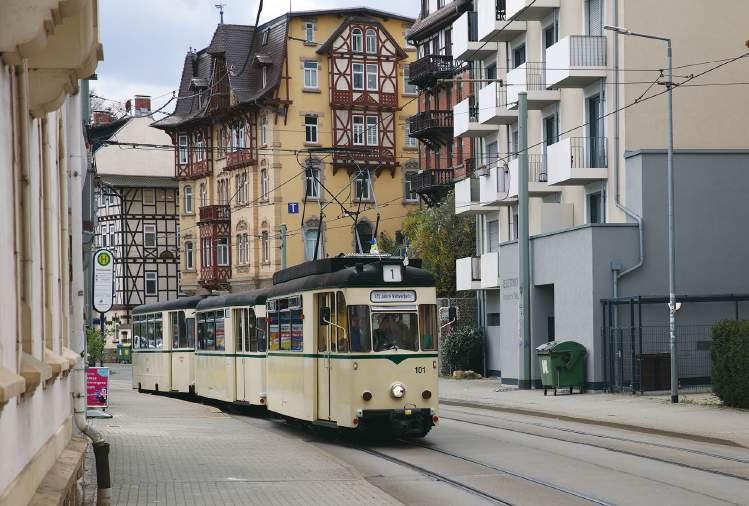
2
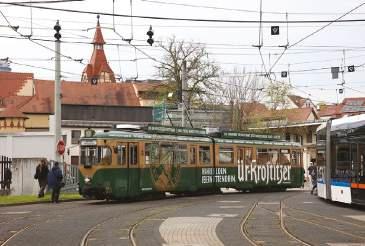
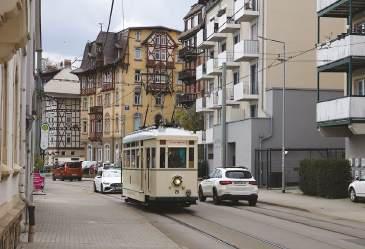
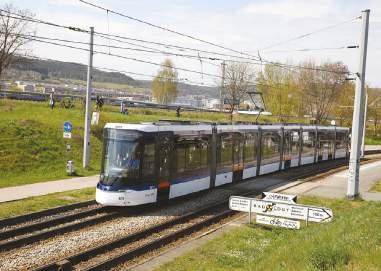
8 6 7 5 3
1. The Solaris Tramino was not a major product for the Polish firm when set alongside the widespread popularity of its trolleybus and motor bus catalogue. Tram 703 is one of just five such cars in the Jena fleet, seen on the reserved track approaching Sparkassen-Arena junction.
2. It is not so long ago that GDR-era three-car trains of two-axle cars were the standard formation on much of the Jena tramway. Recreating an image from the early 2000s is the sole surviving example formed of 101+155+207, seen at Mühlenstrasse.
3. This double-ended Düwag GT6 articulated car originated with Heidelberg and was subsumed into the combined Rhein-Neckar system before acquisition by Jena to become its party tram with fleet number 963. It was on display at Dornburger Strasse yard, but did not participate in the parade.
4. Numerically the first of the 16 long (seven-section) version of the Stadler Tramlink brings up the rear of the parade, which took around two hours to traverse the entire route. Again it is shown on the reserved track approaching Sparkassen-Arena junction.
5. Back in its spiritual haunts is Jena’s historic Gotha car 26, originally Eisenach 19, passing along part of the traditional street-running track at Mühlenstrasse. This is one of only a few sections of Jena track not relaid as reservation.
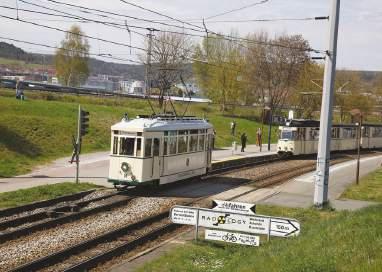
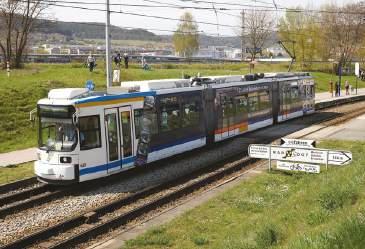
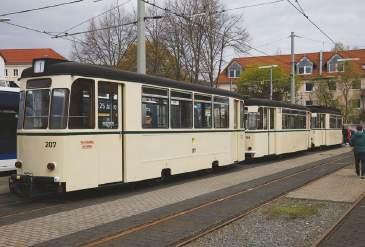
6. Tram 620 is numerically the oldest survivor of Jena’s first type of low-floor articulated car, from its second batch delivered in 2002-3. It was the leading car of three types of modern articulated trams in the parade and is seen on the reserved track approaching Sparkassen-Arena junction.
7. Gotha-built car 26 of 1929 was the oldest participant in the parade and is shown here with the three-car train of 101+155+207 approaching in the distance and the hilly surroundings of Jena clearly visible.
8. Rekowagen 207 of 1973 formed up into the rearmost car of the three-car train of GDR-era rolling stock, with 155 in the middle and 101 leading (at the far end). This was the scene at Dornburger Strasse yard before the start of the parade.
All images taken by Mike Russell on 18 April 2026.
By Paul Rowen
The LRTA, alongside 16 transport non-governmental organisations (NGOs), has written to to UK Prime Minister Sir Keir Starmer, urging the Government to take urgent action to give UK households long-term protection against volatile fuel costs.
The letter warns that many households remain heavily reliant on cars with few viable alternatives, leaving them exposed to rising fuel costs and placing added pressure on household budgets. It calls for a target to increase travel by public transport use, cycling, walking and wheeling, supported by a package of medium- and long-term transport measures to help protect households from volatile global energy markets and future energy shocks, while also easing cost-of-living pressures by improving access to jobs and opportunities.
The letter came on the day the UK Government set out a package of measures to help families and businesses deal with escalating prices caused by the Iran war. As part of that package, the Government has announced that the GBP0.05 (EUR0.06) fuel duty cut will be retained rather than being scrapped in September as planned.
Paul Rowen, Chair of the LRTA, said: “The most effective way to reduce UK households’ vulnerability to volatile global energy markets is not through short-term fixes, but by reducing our reliance on fossil fuels and moving towards a self-sufficient, clean energy economy. By failing to invest now in the future transport network, we risk locking households into high and rising costs, increasing congestion, and leaving
hard-pressed households exposed to repeated energy shocks like the one we are currently experiencing. That includes more investment in light rail which is clean, green, and brings about positive investment in local communities.”
Alongside the Light Rail Transit Association, the letter is signed by Campaign for Better Transport, Aldersgate Group, Ashden Climate Solutions, Bus Users UK, Clean Cities, CoMoUK, Cycling UK, Greener Vision, Good Journey, JFG Communications, Living Streets, Possible, The Climate Coalition, T&E UK, Transport Action Network and Women in Transport.
It calls on the Government to:
• Fulfil its pre-election commitment to set a ‘modal shift target’ by expanding transport choices and ensuring people have access to reliable, affordable and energy-efficient alternatives to driving.
• Invest more in buses to improve frequency, reliability and coverage to enable millions more people to use the bus.
• Introduce a national programme of ‘mobility hubs’ which bring together public transport, walking, cycling, and shared cars, bikes and e-scooters to help expand access to other forms of transport and reduce the need to use a car for everyday journeys.
• Accelerate the electrification of public transport, including delivering more electric tram networks.
• Promote international rail as an alternative to short-haul flights to Europe.
JULY
Thursday 2. Brentford 14.30. David Hanger: Funicular railways. London Museum of Water and Steam, TW8 0EN. Contact: thamesvalley@tlrs.info. GBP5 inc. refreshments. (TLRS)
Wednesday 8. Sussex 19.40. Gordon Adams: Train ferries of World Wars l and ll. Southwick Community Centre, BN42 4TE. Contact: sussex@tlrs.info. GBP2 visitors. (SEG)
Friday 17. Solent 10.00. TLRS Zoom call replays. Community Kettle
With this edition of TAUT, members will receive details of the formal agenda for the AGM which takes place in Norrköping, Sweden, on 20 September. Full details of how to book or take part online can also be found on the website. There are also details of a couple of important constitutional changes that will allow voting online. At the moment members not able to attend must vote by proxy.
CIC, Portsmouth PO6 2PS. Contact: solent@tlrs.info. Cost GBP3. (TLRS)
Saturday 25. Daisy Hill 14.00. Arthur Dawson: Old Sirs Garden Tramway, G and 1/16 scales. Contact: northlancs@tlrs.info. (TLRS) Saturday 25. Cumbernauld 13.00.
Scottish Area Group show and tell. Cumbernauld Theatre, Cumbernauld G67 2UF. Contact: scotland@tlrs.info. (TLRS)
Saturday 25. Visit to Aldridge Transport Museum. Contact: eastmidlands@tlrs.info. (TLRS)

Order online from https://shop.lrta.org/ – or by post from:
LRTA Publications, 38 Wolseley Road, SALE, M33 7AU
(Please provide telephone contact details and quote LRTA membership number if applicable)
Outside UK = Airmail to Europe (includes all of Russia) / Surface mail to rest of world; Airmail Zone 1 = outside Europe excluding Australia, New Zealand & USA; Airmail Zones 2/3 = Australia, New Zealand & USA
Trams of Kolkata
The creeping decline of a colonial monument
This book is dedicated to the last operating tramway in South Asia. It covers the 152year history of this huge Indian city’s tram system. English and German text.
> A4 softback; 168 pages, 200+ colour and black & white pictures, 20 maps.
£42.00 (UK addresses); £53.50 (outside UK); £68.00 (Airmail Z1);
£73.50 (Airmail Z2/3); LRTA Members: £3.75 discount
Tramways and Light Railways of Barcelona, Mallorca and Valencia in Colour (1954-1980)
The first in a series of three books covering many of the tramways and electric light railways operational in Spain in the mid-1950s.
> A4 hardback, landscape format; 144 pages, fully illustrated in colour throughout.
£42.50 (UK); £54.00 (outside UK); £66.00 (Airmail Z1);
£67.50 (Airmail Z2/3); LRTA Members: £3.90 discount
For further details of all this and other books, please go to our website.
Order direct from the website shown (not from the LRTA)
Detailed record of the significant numbers of historic vehicles representing the first-generation urban electric traction era in the UK, and their location in museums and other places. Highlights the opportunities to travel on preserved trams and trolleybuses.
> B5 softback; 96 pages, 180 mainly colour pictures.
£14.39 – www.amberley-books.com
The Turin Class 2800 Streetcars and their look-alikes
The Italian city’s first batch of 58 six-axle articulated trams were built from pairs of 1933-38 bogie cars and took to the streets between 195059, and were then rebuilt between 1979-81. A further 45 similar cars followed in 1982-3.
> 210x210mm softback; 160 pages, fullyillustrated in colour and black & white. £20.00 – www.nationaltrolleybus.org
Le Métro Léger du Charleroi
Volume 1: Boucle Centrale & Ligne M1/M2
Full-page images of the lines that loop around the city’s main station and head west to Anderlues in this interesting light metro network. French, Dutch, English and German text – picture captions by QR code.
> A4 hardback, landscape format; 120 pages, 100+ colour pictures and three maps. EUR30.00 – www.photorail-collection.com
The Class 3000 Streetcars and their look-alikes
Records the history of the 162 bogie cars that were built between 1942 and 1959 and operated in the city until 2003. The differences between the six batches are explained and the details of the six survivors – most still in operating condition – are described.
> 210x210 mm softback; 146 pages, fully-illustrated in colour and black & white.
£20.00 – www.nationaltrolleybus.org
The covert campaign that killed off the British tram

For those with an interest in social history and the impact of changes in the UK in the 1920s that led to the virtual disappearance of our first-generation tramways, this book is a must. The author has carefully researched the variety of influential campaigns against trams and explains why they were so successful.
> 250x180mm hardback; 232 pages, 20 colour and 60 black & white pictures.
£23.99 – www.pen-and-sword.co.uk
Le Tram de Liège
Toute la Ligne T1 en 100 photos
Full-page images of the new tramway which opened in the capital city of Wallonia in 2025, usefully displayed above a line diagram to pinpoint where each was shot. French, Dutch, English and German text – picture captions by QR code.
> A4 hardback, landscape format; 120 pages, 100 colour pictures, 20 historical views plus network map. EUR30.00 – www.photorail-collection.com