THE INTERNATIONAL LIGHT RAIL MAGAZINE
Free to LRTA members
www.lrta.org www.tautonline.com
FEBRUARY 2026 N o . 1058
SAN FRANCISCO: URBAN DIVERSITY
US city’s urban rail options evolve to meet continued demand China opens over 200km of light rail Toronto’s Finch West line launched Montpellier completes fifth tram line MTS: High goals Small but valuable addition to Lisbon
£4.95
Hannover’s star Fleet upgrades and extension plans
The BIGGEST YEAR in our history. The STRONGEST PROGRAMME we’ve ever delivered. The event the ENTIRE SECTOR is talking about.
CELEBRATE 20 YEARS OF LIGHT RAIL EXCELLENCE
NOTTINGHAM, UK 30 June - 1 July 2026
Supported by
Be part of the milestone year that brings the entire UK light rail community together. For our 20th anniversary, we’re returning to Nottingham Trent University, where it all began. We’re bringing a fresh new look inspired by sustainability, innovation, and the future of green transport. This is your chance to: • Build powerful relationships with UK and international leaders • Hear industry-shaping insights from the people setting the agenda • Discover new tech, solutions and suppliers • Position your organisation at the heart of the next decade of light rail
This isn’t just another conference, it’s the UK’s most influential light rail gathering, trusted for two decades by operators, suppliers, policymakers, innovators and solution providers.
www.mainspring.co.uk
Contact us: hello@ mainspring.co.uk Organised by
CONTENTS
65 The official journal of the Light Rail Transit Association
58
FEBRUARY 2026 Vol. 89 No. 1058 Neil Pulling
www.tautonline.com
EDITORIAL EDITOR – Matt Johnston matt@mainspring.co.uk ASSOCIATE EDITOR – Tony Streeter tony.streeter@mainspring.co.uk
51
WORLDWIDE EDITOR – Michael Taplin miketap@mainspring.co.uk SENIOR CONTRIBUTORS – Howard Johnston, Neil Pulling
Neil Pulling
Andrew Grahl
WORLDWIDE CONTRIBUTORS Richard Foster, Andrew Grahl, Andrew Moglestue, Herbert Pence, Mike Russell, Nikolai Semyonov, Alain Senut, Andrew Thompson, Witold Urbanowicz, Bill Vigrass, Thomas Wagner, Philip Webb.
NEWS 4 Melbourne opens new metro tunnel; Finch West LRT opens but faces timing criticism. RAIL LIVE! 2025 48 TAUT reports on this year’s event, held over three days in Madrid, Spain. SAN FRANCISCO Andrew Grahl finds his way around San Francisco via a multitude of public transport services.
51
SEATON TRAMWAY 63 Matt Johnston visits the UK’s classic Seaton Tramway, which is working to balance preservation with innovation. SYSTEMS FACTFILE: METRO TEJO DO SUL 65 Neil Pulling visits Lisbon’s smaller – yet equally vital – system that is currently exploring expansion options.
PRODUCTION – Lanna Blyth Tel: +44 (0)1733 367604 production@mainspring.co.uk DESIGN – Debbie Nolan ADVERTISING COMMERCIAL MANAGER – Geoff Butler Tel: +44 (0)1733 367610 geoff@mainspring.co.uk Tramways & Urban Transit 13 Orton Enterprise Centre, Bakewell Road, Peterborough PE2 6XU, UK Tramways & Urban Transit is published by Mainspring on behalf of the LRTA on the third Friday of each month preceding the cover date.
WORLDWIDE REVIEW 71 Spades break ground in Seoul for Ui LRT.
THE STAR OF HANNOVER? 54 Andrew Thompson visits the German city not resting on its laurels: plans for a new fleet and new extensions are underway.
UKTRAM: WOMEN IN TRANSPORT 75 Chelsea Branch presents her thoughts on the value of diversity in the industry.
WHEELSETS AND BOGIES Richard Foster explores the world of tram wheels and bogies.
CLASSIC TRAMS: POZNAŃ PARADE Mike Russell witnesses an unexpected parade of tramcars in this Polish city.
58
76
LRTA MEMBERSHIP (with TAUT subscription) Tramways & Urban Transit is sent free to all paid-up members of the Light Rail Transit Association. LRTA WEBSITE AND DIARY Tim Kendell webmaster@lrta.org meetings@lrta.org SUBSCRIPTIONS, MEMBERSHIP AND BACK ISSUES LRTA Membership Secretary (Dept T06), 38 Wolseley Road, Sale M33 7AU, UK. Tel: +44 (0)117 951 7785 membership@lrta.org Website: www.lrta.org
Late and expensive, but worth the wait Many thousands of kilometres/miles of new urban transit are due to open in 2026, and not all are conventional fixed track laid on a flat surface. Leading the diversity is Egypt’s capital Cairo, which now has the world’s longest driverless monorail, having been expanded by a further 13 stations at the beginning of the year. Another innovative scheme that is capturing attention is the LAX automated people mover due to open at Los Angeles Airport in the US in the early summer. Although only 3.6km (2.25 miles), its two-minute headways will transform the journeys of up to 6000 passengers each way at peak times. The outlay of USD5 billion (EUR 4.3bn) seems expensive, but is it really that much when spread over 25 years? In the Far East, the short Johor Bahru – Singapore Rapid Transit cross-border link, key to the economies of Malaysia and Singapore and which was conceived in 2011, should finally open in December. It is yet another example of long construction delays and cost overruns, demonstrating that ambition and reality rarely line up. Far more down to earth, you have to go a long way to surpass the achievements of the German city of Hannover, where half a century of steady development has taken the efficient Stadtbahn to new levels of excellence, with 12 routes and now over 200 stops. You can read about this high achievement in this issue. Booking has opened for two major networking events that will keep you at the cutting edge of light rail development and help you to forge life-long connections and friendships. Tenerife will be hosting this year’s European Light Rail Congress on 11-12 March, and Nottingham is the venue for the 2026 UK Light Rail Conference on 30 June-1 July. See you at both! Matt Johnston, Editor
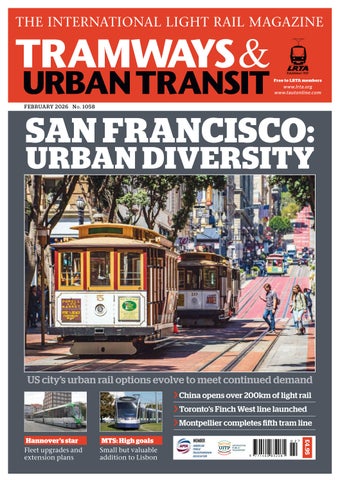
COVER: Cars 5 and 19 of San Francisco’s cable car fleet travel along Powell Street in 2019. Created 150 years ago to traverse the city’s steep gradients, today they mostly operate for tourists. Daniel Abadia/Unsplash
FOR CORPORATE SUBSCRIPTIONS VISIT www.mainspring.co.uk LRTA REGISTERED OFFICE 13 Orton Enterprise Centre, Bakewell Road, Peterborough PE2 6XU, UK Private company limited by guarantee, No. 5072319 in England and Wales. LRTA CHAIRMAN – Paul Rowen chair@lrta.org © LRTA 2026 Articles are submitted on the understanding they may also be used on our websites or in other media. A contribution is accepted on the basis that its author is responsible for the opinions expressed in it, and such opinions are not those of the LRTA or Mainspring. All rights reserved. No part of this magazine may be reproduced or transmitted in any form by any means, electronic or mechanical, including photocopying, recording or by any information storage and retrieval system, without prior permission in writing from the copyright owner. Multiple copying of the contents of the magazine without prior written approval is not permitted.
PRINT The Manson Group Limited, St Albans, Herts AL3 6PZ
DISTRIBUTION Warners (Midlands), Bourne, Lincs PE10 9PH, UK
www.tautonline.com . www.lrta.org FEBRUARY 2026 / 43
News
Montpellier opens its fifth tram line New tramway connects another 100 000 residents
T
he southern French city of Montpellier (population 310 000) expanded its tramway with the opening of line 5 on 20 December. This 17.5km (11-mile) line, with its 27 stops, brings tramway services to a further 100 000 residents. Line 5 connects the west of the city at Grés de Montpellier with the north at Clapiers, and has two park-and-ride sites, with 450 spaces. The western arm serves the Yves du Manoir sports complex and its rugby stadium. It uses existing tracks between Gambetta Saint-Denis and Corum. The project also involved the creation of 20km (12 miles) of new cycle routes. Michaël Delafosse, President of Montpellier Métrople, said: “I want to thank the TaM teams who have achieved a remarkable feat in Montpellier. We will have
The inaugural CAF tram on Montpellier line 5 at Ave Georges Clemenceau on 20 December. Y. Allain
the largest network in France, in the largest city in Europe to offer free public transport.” Free transport on buses and trams was phased in for residents from 2020. Trams on the 45-minute trip run up to every 12 minutes,
though as more of the new CAF seven-section 100% low-floor trams are commissioned, it is hoped to reduce the headway to 7.5 minutes by September. Work on the EUR440m project started in 2019 and the line is expected to attract 80 000
passengers per day. Montpellier opened its first modern-era tramway in July 2000 and, prior to the opening of line 5, the standard-gauge system had reached 60.5km (37.6 miles). A first-generation tramway operated from 1880 to 1949.
Left behind… at Mexican light rail transit opening The mayor of Tlajomulco de Zúñiga in Mexico was left behind by the inaugural service on Guadalajara’s Tren Ligero line 4 on 15 December. A video of Mayor Gerardo Quirino Velázquez Chávez jogging down the platform towards the waiting train before being left somewhat red-faced when it pulled away
went viral on social media. According to The Guadalajara Reporter, Jalisco state governor Pablo Lemus Navarro conducted the official opening ceremony, calling the event “historic” after the southern suburbs of Guadalajara had experienced years of “disorderly growth”. Opening of line 4 adds 21.7km
Melbourne’s Metro Tunnel opens Suburban trains on the Cranbourne, Pakenham and Sunbury lines started running through the new 9km (5.6-mile) Metro Tunnel under central Melbourne from 30 November. A 20-minute service linking the Australian system’s five new underground stations on the Sunbury – Pakenham line (Arden, Parkville, State Library, Town Hall and Anzac) runs 10.00-15.00 (19.00 at weekends) to bed in the new facility. A new timetable with 240 more trains/ week on all suburban lines will
be introduced in February. Some 70 000 passengers used the AUD12.8bn (EUR1.6bn) tunnel, construction of which started in 2019, on the opening day. Weekend travel is to be free until 1 February. Melbourne’s 429km (267mile) suburban rail network comprises 16 lines serving 227 stations and is worked by 269 six-coach trains. The 1600mmgauge system has been operated by MTR of Hong Kong on behalf of the Victorian State Government since 2009.
Anzac Metro Tunnel stations offers easy interchange with trams on St Kilda Road. Government of Victoria
44 / FEBRUARY 2026 www.tautonline.com . www.lrta.org
(13.5 miles) to the 68.8km (42.8mile) 1435mm-gauge Sistema de Tren Eléctrico Urbano network. Line 4 connects the suburbs around Las Juntas to Tlajomulco Centro via Tlaquepaque and, while not connected to any other SITEUR lines, it does offer connections to existing Bus Rapid Transit systems.
Free travel was offered between the eight stations on 1531 December. A full, fare-paying timetable was due to come into effect in early 2026, along with a ninth station. Line 4 is expected to carry approximately 110 000 people per day. CRRC Zhuzhou has supplied 20 high-floor 29.6m two-section trains.
Finch West LRT opens to background of criticism of journey times Changing traffic light priority needed to improve services
T
oronto’s standard-gauge Finch West LRT was opened on 7 December by Mayor Olivia Chow and Transportation Minister Prabmeet Sarkaria. The 10.3km (6.4-mile) Canadian line, with 18 stops, connects Finch West subway station to Humber College North Campus. Local news outlets have reported criticism from residents that journeys on the new
West Yorkshire opening delayed West Yorkshire Mayor Tracy Brabin has told UK Minister for Rail, Lord Peter Hendy, that she remains “committed… to getting spades in the ground on preparatory works” for West Yorkshire Mass Transit “by 2028”. An exchange of correspondence between the Mayor and the Minister was published on 18 December. Following a UK governmentbacked review into the project, Hendy said that completion “is projected to move from the mid2030s to the late-2030s”. UK Chancellor Rachel Reeves committed GBP2.1bn (EUR2.5bn) to the project in the June 2025 Spending Review, while West Yorkshire Combined Authority approved the release of GBP40.5m (EUR46m) on 18 September to help push through West Yorkshire Mass Transit’s Strategic Outline Case (TAUT 1055). This brought the total invested in WYMT to also develop the Outline Business Case and the Transport & Works Act Order applications to GBP121.4m (EUR137.7m). Lord Hendy reported to Mayor Brabin that he has been given the Ministerial responsibility for the WYMT programme by the Secretary of State for Transport.
CAD3.7bn (EUR2.3bn) LRT route take longer than the 36C bus that it replaced. The end-to-end time of 46-55 minutes has been blamed on a lack of priority signals at intersections and computer-mandated dwell times. Mayor Chow told NOW Toronto that the LRT needs “to have much higher priority because there’s… three or four cars making left turns, and it blocks a train that has 40, 50, 80, 100 people in it.” The mayor said that a motion to redress the problem was with the council. Operated by Toronto Transit Commission, the line was free
to travel over on the first day. Services will initially run 06.0022.00 with a 12-minute headway, using 18 Alstom Citadis Spirit LRVs (6500-17). Built in Canada, these 100% low-floor, 48.5m vehicles are designed to operate in temperatures as low as -38oC. However, heavy winter storms on 26 December caused points failures, leading the new line to be shut for periods. The first closure was between Driftwood and Humber College stations just before 07.00. Toronto’s 19km (12-mile) Eglinton Crosstown line completed its final day of testing on 1 December. Services should start on 15 February.
Graz opens its second city centre tramline A bottleneck at Herrengasse/ Hauptplatz on the Austrian city of Graz’s tram network has been relieved after the 1.2km (0.7mile) Neutorlinie tramway opened on 29 November. Celebrations included a day of free travel on historic trams. The EUR38m project links Roseggerhaus and Jakominiplatz, with new stops at Andreas-HoferPlatz and Stadtbibliothek. It is served by lines 16 and 17. Work on the EUR38m project started in March 2023. Construction involved widening and strengthening the Tegetthoff Brücke over the river Mur. Member of the National Council, Wolfgang Moitzi,
said: “We are demonstrating what is possible when the city, state, and federal government work together. The federal government… made it clear: modern, efficient public transport is not a luxury, but a fundamental requirement for a climate-friendly, liveable future. “For me, one thing is clear: this must only be the beginning.” Graz has plans to further expand its tram network, with a 12.6km (7.8-mile) link between Gösting and Strassgang, which will include 11km (6.8 miles) of new double track, a 1.3km (0.8mile) line to Innere SW, and a 2km (1.2-mile) line to Citypark.
Politicians and industry representatives celebrate in front of the Graz tramway’s Alstom Flexity 542. Graz Holding
US tram swap
The City of Portland and Seattle’s Sound Transit have reached inprinciple agreement for an unusual swap of trams. Sound Transit’s Tacoma system is to receive Portland’s three relatively new Brookville cars, while Portland will receive Sound Transit’s three 2002-built Škoda-Inekon 10T cars and a payment of USD16.6m (EUR14.2m). The swap will allow both operators to standardise their fleets, saving money in spare parts and staff training. The agreement was approved by the Sound Transit board on 18 December. The movement of the vehicles is to come in stages, from early 2026 to mid-2028, to allow time for car modifications. Already 24 years old, Tacoma’s Škoda cars are only expected to serve Portland for a few years. The city issued a ‘request for proposal’ on 21 October for 15 new trams; these would replace the ex-Tacoma cars in 2030-31.
Seattle light rail opening
Sound Transit’s southern Line 1 extension from Angel Lake to Federal Way opened at 11.00 on 6 December. The US system’s three new stations – Kent Des Moines, Star Lake and Federal Way Downtown – all boast park-and-ride facilities, totalling around 3200 parking spaces, and are expected to attract 23 000 passengers a day. Construction of the mostly elevated 12.5km (7.8-mile) line cost USD 2.5bn (EUR2.1bn). Line 1 now totals 41 miles (66km) between Lynnwood and Federal Way Downtown. Building of the extension started in 2020, but poor ground conditions delayed its opening. It is hoped that further extensions will bring the line to Tacoma by 2035. “We’ve always wanted this to go from Tacoma to Everett, and this is a big chunk into South King County”, U.S. Sen. Maria Cantwell told KOMO News Saturday Morning. Sound Transit intends to procure 58m LRVs in 2026, launching a tender for 70 (plus optional 80). At present, trains comprise three 29m Siemens cars.
Bhopal opens first metro
Bhopal, in India’s Madhya Pradesh state, opened its first metro line on 21 December. Trains initially run every 75 minutes 09.00-17.00 on the Bhoj Metro’s Orange Line. Linking Subhash Nagar and AIIMS hospital in the south-east suburbs, this eight-station, 6.2km (3.9-mile) section is destined to become part of a much larger, 16.7km (10.3-mile), 16-station system. The 13-station, 14.2km (8.8-mile) Blue Line is also under construction. On the opening day, nine out of 52 Alstom Movia three-car 1435mmgauge trains were available. The lightweight trains were built in India at the Savli factory in Gujarat and each carry 144 seated and 981 standing passengers.
www.tautonline.com . www.lrta.org FEBRUARY 2026 / 45
News
China adds a further 200km of new light rail line in December Extensions and new lines open in eight cities during a single month
D
ecember is usually a bumper month for new metro and tramway openings in China and 2025 was no exception. Services began over more than 200km (120 miles) of new line throughout the last month of the year. That followed Dongguan’s 57.5km (35.7-mile) metro line 1, which opened from Dongguanxi railway station to Meitang on 28 November. Also not included in this total is the 30.7km (19-mile) BYD rubber-tyred automated SkyShuttle that runs around Jinan’s High Tech East industrial park; using battery-powered
AGT YO101 vehicles, this started carrying passengers on 6 December. Jinan welcomed three new steel wheel/steel rail metro lines on 27 December: the 40.3km (25-mile) line 4 (Shandong First Medical University – Penhjiazhuang); 19.5km (12.1-mile) line 6 (Shandong University – Liangwang) and the 25.3km (15.7-mile) line 8 (Xingcun Lijiaoqiao East – Qinhyuan Dajie). China’s capital Beijing opened three new sections of metro on the same day, 27 December: the 19.8km (12.3-mile) Malianwa – Tiantongyuandong line 18
Coventry approves second VLR track
Aarhus orders battery Citylinks
Coventry City Council has formally approved the construction of a second Very Light Rail test track in the UK city. The decision on 16 December permits construction of an 800m double-track route from the railway station to the University Technology Park. It is due to be installed by March 2027. Unlike the 220m section that was tested in 2025 (TAUT 1051), the new line will operate in a ‘live’ environment, interacting with road traffic and traffic lights. If successful, the new trial route could fulfil Councillor Jim O’Boyle’s ambition to have a fare-paying VLR service operational by the end of 2027. It has been suggested that this could connect the railway station to the city’s airport.
The Danish city of Aarhus signed a contract with Stadler on 2 December for eight Citylink trams. These new 49m, four-section vehicles are to accommodate 332 passengers (152 seated) and are destined
opened; line 6 was extended by 2.1km (1.3 miles) from Lucheng to Luyang and line 17 was extended by 8.2km (five miles) from Workers’ Stadium to Shilihe. The following day (28 December), four metro lines opened in Shenzen. Line 13 was extended from Hi-Tech Central to Shangwu, and line 8 from Xiaomeisha to Xichong. Line 5 opened from Huangbeiling to Grand Theatre, with line 11 opening from Huaqiang South to Hongling South. Other openings included: 10 December: Fuzhou’s metro line 4 was
for line L2 in 2029, in order to enable implementation of a 15-minute service. There is an option for 12 more. Due to issues with ice in rural areas in winter, the new vehicles are to include battery technology
The Stadler Citylink LRV for Aarhus. Stadler
extended by 4km (2.5 miles) from Fenghuangchi to Banzhou. Xian’s 19.5km (12.1-mile) metro line 15 from Xiliu to Dongzhaoyu. 26 December: Hefei’s 34.4km (21.4-mile) metro line 6 from Qinglonggang to Longtan via Beiyanhu. 27 December: Shanghai’s metro line 18 was extended by 8km (5 miles) from South Changjiang Road to Kasngwen Road. 29 December: Guangzhou’s 11.5km (7.1-mile) line 22 commuter rail service opened from Chentougang to Fangcum.
that will allow them to run ‘off grid’ for up to 10km (six miles). Mie Krog, chair of Aarhus Letbane, said: “With more trains, we are making light rail an even stronger link between city and country. This is in line with our vision of delivering stable and efficient transport on time to the people of East Jutland.” The current Letbane fleet comprises 14 Stadler Variobahn trams for the city lines and 12 Stadler Tango LRVs for services beyond the city that use former heavy rail lines. “With Citylink, we are helping Aarhus move toward a smarter, greener, and fully integrated transport system that meets the needs of today while anticipating those of tomorrow”, said Iñigo Parra, CEO of Stadler Valencia.
Consultation takes place on Greater Manchester routes Residents of Greater Manchester (UK) can have their say on the future of the region’s public transport network. Public consultation on both the GM Transport Delivery Plan (2027-37) and the GM Transport Strategy 2050 opened on 9 December. The former details how GBP2.5bn (EUR2.9bn) committed to the region by the UK government’s 2025 Spending Review will be invested
in transport projects into the 2030s. The latter strategy takes a longer view and features the development of Metrolink to reach six new ‘Growth Locations’. Potential extensions and developments included in the plan are: E xtension of Metrolink from Didsbury to Stockport E xtension to Trafford Water and Port Salford T ram-trains Wigan– Salford
46 / FEBRUARY 2026 www.tautonline.com . www.lrta.org
B ringing Metrolink into Manchester Airport Terminal 2 Extend Metrolink to Middleton Vernon Everitt, Transport Commissioner for Greater Manchester, said: “Every voice matters, and we’ve already engaged with communities, businesses and stakeholders to make sure people and places are at the heart of these plans. Now we want to hear what you think,
so we can make sure they deliver what every area and community needs now and in the future.” The closing date for the consultation is 9 March. Meanwhile, Greater Manchester Mayor Andy Burnham has suggested that tram-trains could use the Network Rail line running from Guide Bridge, south through Denton and Reddish South, to Stockport.
Santos light rail network expands with free service Brazilian light rail extension comprises city centre tramway
S
ervices started on the extension of the eastwest light rail line in the Brazilian city of Santos on 1 December 2025. Travel was free until revenue-earning services started on 16 December. An initial 11.5km (7.1 miles) of the system opened in May 2014, utilising track that had last been used by goods trains in 2008. The light rail system was extended from Porto to Tatico in 2016. This new 8km (five-mile) extension comprises a singletrack loop through the city streets, from Avenue Conselheiro Nébias to Valongo. A full service (05.30-23.30) is expected to start during either May or June. The project cost BRL395m (EUR61m). Preparation for the new section of line included negotiations between city officials and merchants, who had been used to taking deliveries from the street outside their premises – which is now occupied by tram tracks.
A Santos LRV on street track in the city centre. Diário
The line to the former Porto terminus is no longer used for passenger trains, but has been retained for access to the depot and control centre. A third extension, running for 19.5km (12 miles), is to take the line west from Tatico to Baixada Santista.
The initial network was worked by 43.7m seven-section Tramlink LRVs built by Vossloh in Valencia, Spain (the factory now owned by Stadler). A fleet of 22 vehicles is now in operation, its size having grown in order to cater for the new extension.
Stadler wins new Frankfurt contract Stadler has been awarded the contract to supply Frankfurt-amMain’s new Regionaltangente West orbital line with 27 new Citylink tram-trains. The new vehicles for the German route are to be 49m long and are planned to carry 360 passengers. They are designed to take power at two different voltages (15kV ac and 750V dc) – and also to be compatible with two different platform heights: 960mm on Deutsche Bahn infrastructure and 800mm on Frankfurt’s Stadtbahn. The contract includes maintenance and spare parts for 30 years. The new tram-trains are to be built at the former Vossloh factory in Valencia, Spain. An initial three vehicles are to be delivered in autumn 2028, with the remainder due in 202930. Passenger services on the 52km (32-mile), 28-stop line are to start in December 2030. The EUR327.6m project has been under construction since 2022.
Ludwigshafen’s tramway reimagined with Pfalztram Representatives of Germany’s Ludwigshafen-Rheingönheim city, the state of RheinlandPalatine and operator Verkehrsverbund Rhein-Neckar (VRN) met on 27 November to approve plans for Pfalztram. This would turn the existing tramway system into a new transport network, serving the city and its suburbs. A new line would link the city centre with DannstadtSchauenheim in the south-west, while a north-south line would be created with extensions north from Ludwigshafen-Oppau to Ludwigshafen-Pfingstweide and south from Rheingönheim to Waldsee. An initial EUR3m has been allocated to enable more detailed planning to take place to identify the precise cost of the project. It is expected that 12 000 passengers could use Pfalztram every day. However, planning and construction is expected to take at least ten years. Public consultation on Pfalztram is to start during 2026.
A map showing the existing tramway network in black and Pfalztram proposals in orange. RNV
www.tautonline.com . www.lrta.org FEBRUARY 2026 / 47
SHAPING EUROPE’S TRANSIT FUTURE: RAIL LIVE! 2025 While sustainability and technological innovation remained staples of the latest event, the buzz centred more on collaboration. TAUT summarises three days at Rail Live! 2025.
T
his year’s Rail Live! event took place at IFEMA Madrid, Spain, from 26-28 November 2025. It brought together the railway sector, attendees from areas including infrastructure, rolling stock manufacturers, technology providers, public authorities, researchers and policymakers and more. Around 300 exhibitors, 200 speakers and 10 000 industry professionals from over
75 countries attended this year’s event. The conference programme covered topics ranging from cybersecurity and digitalisation to eco-friendliness and passenger experience. The key word heard around the venue was ‘collaboration’, with many companies talking about the need to work together going forward, considering sustainability, technological innovation, planning, environmental impacts and passenger experience.
ABOVE This year’s Rail Live! event took place at IFEMA in Madrid, Spain. Over 10 000 professionals from across the rail sector attended.
48 / FEBRUARY 2026 www.tautonline.com . www.lrta.org
Hitachi exhibited its advanced solutions in signalling, telecommunications and digitalisation that aim to shape future rail operations.
A major focus was on how digital technologies are reshaping railway operations and infrastructure. Companies demonstrated solutions incorporating automation, realtime data analytics, artificial intelligence (AI), and secure connectivity. GMV highlighted its SAE-R® Automatic Vehicle Location System (AVLS), designed to support real-time compliance monitoring and resource optimisation, as well as advanced ticketing systems for urban, tram and commuter networks. SICE presented SIDERA Rail, an integrated platform for the centralised management of stations, tunnels and track infrastructure, enabling real-time supervision of energy, ventilation, safety and passenger information systems. Sustainability was another popular narrative, with exhibitors and sessions addressing environmental performance, energy efficiency, and lifecycle impacts. Several companies highlighted green infrastructure technologies and rail materials designed to extend asset life, improve
ABOVE: Electrans showed a range of technology products and services in Madrid.
Rail Live! 2025 LEFT: Arcelormittal demonstrated how the company is moving towards carbon neutral steel for its rails.
RIGHT: Alstom showed many products including new interiors with ambient lighting, flip-up seats for greater comfort, and a range of passengercentric products.
recyclability and reduce environmental impacts. ArcelorMittal, for example, presented its portfolio of rails and special sections, emphasising how advanced steel solutions contribute to more durable, sustainable railway infrastructure. The company also talked about net-zero pathways, underlining decarbonisation as a strategic priority. With rail transport widely acknowledged as one of the most energy-efficient modes for long-distance and urban mobility, these sustainability efforts reinforced the sector’s role in climate mitigation. Marian Kelly of Transport for London (UK) talked about the use of new technologies to keep customers safe in London, looking at its 2030 goal to reduce the number of customers killed or seriously injured on the network by half, and by 2041 to eliminate deaths and serious injuries. Using different technologies in trials, TfL is looking at labbased, shadow and operational trials to see how this technology can effectively reduce incidents. These include train-operator CCTV with video analytics and central computer processing, and platform CCTV, both with links to the control centre and train operator CCTV with local computer processing via the train operator. These trials will test the performance of the technology in different network environments, across different modes of transport (light rail, railway and metro) using different types and ages of camera. Jorge Maroto, the MD of Metro de Sevilla (Spain), talked about current progress and
The CPK robot informed attendees of the company’s multi-modal transportation project.
Several companies also showed off their future plans. The first Spanish underground cutting-edge technologies, including Alstom system for which tickets can be recharged which highlighted its latest developments online is available to speed up journeys in automation, signalling, cybersecurity – Metro de Sevilla also has Telmo, an AI and passenger experience innovations at chatbot that can answer questions posed its stand. Hitachi Rail exhibited advanced by travellers. Tap & go is the system’s solutions in signalling, telecommunications paperless ticketing system, which offers and digitalisation that aim to faster transport journeys via the EMV shape future rail operations. contactless system, plus smart Ayesa engaged visitors with post-payment where passengers engineering expertise pay for all their journeys at spanning infrastructure, the end of each month with the best rates rolling stock, IT and automatically applied. telecom convergence Another innovation for rail systems. Polish from Seville is the use strategic investment of the sun’s rays, which company CPK even are harnessed to power had a robot on its stand the network’s vehicles – that proved a popular, photovoltaic energy is taken eye-catching addition to from solar panels placed on the event. It assisted with ABOVE: Jorge Maroto, the stations to power both information for anyone MD of Metro de Sevilla, talked about innovation trains and stations. A full interested in the multimodal and technology being 100% of electricity consumed Polish transportation system used across the comes from renewable CPK is promoting. Seville network. resources, which means that This year’s event also covered Metro de Sevilla has been networking and knowledge carbon neutral since 2020. Added to this exchange, with dedicated areas to promote are: a dedicated WhatsApp channel which talent development and innovation tours, allows for better customer experience; an which connected emerging professionals, automatic station occupancy control system start-ups and academic researchers with to show occupancy levels at every station; industry experts and potential collaborators. air monitoring including temperature, In summary, Rail Live! 2025 represented humidity, CO2 concentration and air renewal not merely an exhibition, but also placed in the trains; and new wayfinding signage emphasis on digitalisation, sustainable which has been implemented to make mobility, cybersecurity, strategic journeys as easy as possible to navigate. infrastructure and international cooperation Marcos Moyano Mateo from Metro de to provide a vision into how the rail sector is evolving to meet the demands of the Madrid, Spain, talked about growth and innovation within the Spanish capital driving 21st Century. For manufacturers, the show was a chance sustainable mobility. With growing demand to propel innovations to global markets; for on the network and a commitment to carbon operators and governments, it was a forum to reduction and environmental impact, signal priorities and forge partnerships; and they have a comprehensive and long-term for researchers and technologists, an arena to approach with sustainable financing, better shape future solutions. communication and training, as well as Overall, the event was a major platform for increased awareness. Weekends see a large networking, innovation showcases, thought uptick in riders affecting the life balance leadership, and collaboration across the of the metro’s staff, so services need to be rail sector – from advanced technologies to optimised without reducing service quality strategy-level discussions shaping the future or financial stability. Digital transformation of rail mobility in Europe and worldwide. of metro operations is taking place at stations, The themes emphasised at this year’s event and new automatic trains utilise fewer – from AI-enabled operations to low-emission personnel but improve digital operations. materials and smarter urban systems – Spain’s Minister for Transport and Sustainable Mobility, Óscar Puente, reaffirmed will likely influence investments, policy frameworks and technological priorities national plans to enhance rail capacity across Europe and beyond in the years to with more than 500 new trains for both the come. Cercanías (commuter) and high-speed lines.
www.tautonline.com . www.lrta.org FEBRUARY 2026 / 49
Possibly the most interesting line among San Francisco’s offerings is the Muni PCC operation that runs along Market Street and The Embarcadero: the F Line. Pictured is PCC car 1058 in Chicago livery.
SAN FRANCISCO:
MORE THAN SUNNY SKIES
Andrew Grahl explores the wealth of urban transit that the Californian city has to offer.
L
ocated on a peninsula between the Pacific Ocean and the San Francisco Bay, the city of San Francisco in California is a scenic wonder, with famous landmarks and excellent public transit. The San Francisco Bay Area encompasses a large part of Northern California that includes the cities of San Francisco, Oakland and San Jose. With a combined population of 9.2 million, each city has many public transit options, which we will explore. And just beyond the Bay Area is the capital city of Sacramento. Join us for a tour of Northern California!
San Francisco
The San Francisco Municipal Railway (Muni), part of the San Francisco Municipal Transportation Agency, operates a light rail network, a historic trolley line, three cable car lines, and many trolley bus and diesel bus lines. Muni was created in 1909, making it one of the last surviving first-generation streetcar systems. With an average of 104 500 boardings per day, it is the fifth-busiest light rail network in the United States.
Muni Metro
Five Muni light rail lines from surrounding neighbourhoods travel into downtown San Francisco in the Market Street Subway. They are: J Church; K Ingleside; L Taraval; M Ocean View and N Judah. The T Third Street line, the newest in the city, opened in 2007 and operates downtown in its own subway. Service is provided on all light rail lines by modern high-floor Siemens S200 cars, with the vehicles ordered currently being under construction at the Siemens facility in Sacramento, California. The last of the Bredabuilt cars were retired on 12 November 2025 after nearly 30 years of service. The J Church line opened in 1917, making it the oldest of all lines in the network. The Church line runs from the Balboa Park station in the Mission Terrace neighbourhood to The Embarcadero, under Market Street. With 26 stations, highlights of the line include travelling on photogenic private right-of-way and navigating a 9% grade. The K Ingleside line serves the Ingleside and West Portal neighbourhoods, using the Twin Peaks Tunnel to reach downtown. Starting in Balboa Park with the J Church line, the K runs along a dedicated right-of-way on Ocean Avenue for much of the route. The first stop of the L Taraval line at Wawona Street and 46 Avenue is one block from the Pacific Ocean and the San Francisco Zoo. The line uses Taraval Street from the Sunset District for most of its route
50 / FEBRUARY 2026 www.tautonline.com . www.lrta.org
before heading underground via the Twin Peaks Tunnel to reach Market Street and downtown. The M Ocean View line runs from San Jose Avenue and Geneva Avenue in Balboa Park, adjacent to the F Line’s Cameron Beach shops. The line navigates Oceanview, Stonestown and West Portal before entering the subway at the Twin Peaks Tunnel. The N Judah line is the busiest of all Muni Metro lines with a daily ridership of 33 000. Similar to the Taraval line, the Judah line begins adjacent to the Pacific Ocean at Judah and La Playa Streets in the Ocean Beach neighbourhood. The line travels in street traffic along Judah, Irving and Carl Streets before using the Sunset Tunnel to access the Market Street Subway. Unlike the other lines, the Judah line continues beyond Embarcadero station and operates in a private right-of-way along the Embarcadero and King Street. The line passes Oracle Park baseball stadium and ends at King and 4th Streets, with a connection to the T Third Street line and Caltrain commuter rail. Caltrain electrified all commuter train service between San Francisco and San Jose in 2024. The newest Muni Metro line is the T Third Street, the first part of which opened in 2007 and was completed with the opening of the Central Subway on 7 January 2023. It runs to the east of San Francisco from Sunnyside to Chinatown mostly along 3rd Street, then 4th Street before entering the Central Trolley Subway. There are 22 stations and most of the
San Francisco LEFT: San Francisco’s cable cars were created over 150 years ago to navigate the city’s steep hills – today they are the last manually-operated cars in the world. RIGHT: The Santa Clara Valley Transportation Authority (VTA) operates a three-line network around San Jose, which brings passengers into downtown San Jose and Silicon Valley, site of many high-tech companies. Pictured outside the Childrens’ Discovery Museum.
“While many commuters use the cable cars, much of the ridership comes from tourists. Long lines and waits are expected.” LEFT: The BART metro line covers 211km of track and 50 stations across six lines – it is used by around 179 900 riders on weekdays. Most BART lines travel underground in downtown San Francisco, but some lines traverse picturesque scenery, such as here at Walnut Creek. RIGHT: Trolley bus 5747 sits along the Muni network at the intersection of Church and Market Streets.
above-ground section of route operates in dedicated lanes in the centre of the road.
Market Street F Line
Quite possibly the most interesting trolley operation in the United States is the MUNI PCC operation along Market Street and The Embarcadero. Called the F Line and using rebuilt PCC cars which formerly ran in Philadelphia, Newark and New Jersey, plus some from San Francisco itself, each car is painted in a stunning, classic livery from various North American cities that at one time operated PCC vehicles. Eight of ten double-ended PCC cars, built for the San Francisco Municipal Railway in 1948, have been restored. Five are in liveries from San Francisco’s past and three represent cities that also used double-ended PCC cars; Philadelphia Suburban, Dallas and Illinois Terminal. Former Philadelphia Transportation Company SEPTA PCC cars currently in the 1050 and 1060 series were built from 194648. These cars have also been restored and repainted in a livery representing a US city in that operated PCC cars. The cities are as follows: St. Louis, San Francisco, Los Angeles (2), Brooklyn, Philadelphia (2), Kansas City, Cincinnati, Chicago, Boston, Pittsburgh and Baltimore. The 1070-series PCC cars were acquired from New Jersey Transit. They were originally built for the Twin Cities Rapid
Transit Company in Minneapolis and St. Paul, Minnesota. They have been restored and operate in a livery representing a North American city that used to operate PCC cars: Newark, Minneapolis, Mexico City, El Paso, Toronto, Cleveland, Washington, Birmingham, San Diego, Detroit and Los Angeles. The staff at Brookville Equipment Corporation in Brookville, Pennsylvania, need to be commended for the work they have done restoring these PCC cars for another generation of riders in San Francisco. The Market Street Railway (MSR) is San Francisco’s non-profit, volunteer preservation group that advocates for the success of MUNI’s historic fleet and the overall operations. MSR also acquires and collects historic streetcars, which can be operated over the MUNI network. An interesting website to visit for trolley enthusiasts is the Market Street Railway’s live view of the F Market Street Line. It is possible to see which of the colourful PCC cars are out on the line at any time (https://streetcar.live).
Market Street Subway
Today the street level features the F line and many trolley bus and diesel bus routes. Just below ground is the Muni Metro light rail subway, and one level below that is the BART subway. The BART subway opened in 1973 and the Muni Metro in 1980, removing trolleys from the street
for some years before the F line returned on 1 September 1995.
Cable cars
Among the most famous tourist attractions in San Francisco are the cable car lines operated by Muni. Built in San Francisco over 150 years ago to properly navigate steep hills, they are the last manually-operated cable cars in the world. There are three lines in daily operation: two from Fisherman’s Wharf to Market Street in downtown San Francisco (59 – Powell/ Mason and 60 – Powell/Hyde) and one across California Street (61). There are 9900 daily riders across all three routes. Twenty-eight single-ended cars are used on the Fisherman’s Wharf to Market Street lines, necessitating the use of turntables at both ends. The 12 California Street cars are single-ended. While many commuters use the cable cars, much of the ridership comes from tourists. Long queues and waits are expected; the author waited an hour to ride the Powell/ Hyde car in August 2023. San Francisco’s cable car lines are among only two street railways to be on the US National Register of Historic Places, the other being the St. Charles Streetcar in New Orleans. San Francisco MUNI’s Heritage Weekend is a public event celebrating public transit and the MUNI historic collection. The event is usually held in September, and is run in cooperation with the Market Street Railway non-profit group. Visitors can ride historic
www.tautonline.com . www.lrta.org FEBRUARY 2026 / 51
San Francisco Car 1061 from the Muni PCC fleet outside another San Francisco landmark, Pier 33.
ABOVE: Siemens S200 car 2093B on the Market Street underground line at Van Ness station, a key transit hub that connects with Bus Rapid Transit at street level.
LEFT: There are five Muni light rail lines in the city, each of which runs modern high-floor Siemens S200 cars. Here, car 2089B in Pacific Electric livery operates along Market and Church Streets.
trolleys, cable cars, trolley buses and buses from the collection that are not regularly in service. If you are planning a visit, this is the time to come to San Francisco!
BART
Bay Area Rapid Transit (BART) is a Metro in the San Francisco Bay Area, with 50 stations along six lines, covering 211km (131 miles) of track. Around 179 900 riders use the system on weekdays. Many lines run together for segments providing transfer opportunities for customers from different communities. Most BART lines run under Market Street in downtown San Francisco. BART has its ‘Fleet of the Future’, 775 Bombardier/Alstom-built Metro cars constructed from 2012-24. All of the older fleet were retired between 2021 and 2024. The Orange Line runs in the East Bay north from Berryessa in San Jose, through several cities including Oakland to Richmond. While the northern end of the line opened in the 1970s, the southernmost two stations at Milpatis and Berryessa are the latest to open, both on 13 June 2020. Milpatis is also a transfer station to the light rail in San Jose. All of the lines (except the Orange) use the 5.8km (3.6-mile) underwater tunnel called the Transbay Tube to link Oakland with San Francisco. The tunnel opened on 16 September 1974. The Green Line from Berryessa in San Jose runs north along the East Bay through many communities before reaching Oakland and travelling through the Transbay Tube to San Francisco and lastly Daly City. The line has 22 stations and covers 85km (53 miles). EBART is a short extension using Diesel Multiple Unit (DMU) cars from BART’s Yellow Line, running west from Antioch to Pittsburg/Bay Point using eight Stadler GTW cars. This extension serves only three stations over 14.6km (9.1 miles), with 4800 daily weekday riders in Contra Costa County. Yellow Line BART trains run from the EBART connection at Pittsburg/Bay Point to
San Francisco International Airport in San Mateo County. Some trains are extended south to Millbrae in the evenings when the Red Line is closed. The Yellow Line is the system’s most used and longest line at 100.1km (62.2 miles). The Blue Line begins at the Dublin/ Pleasanton station and runs for 57.5km (35.7 miles) through several communities before reaching Oakland and navigating the Transbay Tube to San Francisco, and eventually Daly City in San Mateo County. Red Line trains start in Richmond and travel south to Oakland, and use the Transbay Tube to reach San Francisco and Millbrae. Some 24 stations can be found on this 61.5km (38.2 mile) line. The Silicon Valley Phase II extension will add four new stops between Berryessa, downtown San Jose, Diridon station and Santa Clara. The almost-10km (six-mile) extension is tentatively scheduled to open in 2036. The Oakland Airport Connector is a 5.1km (3.2 mile) automated guideway transit system linking the BART Coliseum station to Oakland International Airport. BART uses four three-car trains built by Doppelmayr Cable Car in 2014.
SMART
Sonoma Marin Area Rail Transit (SMART) is a 77km (48-mile), diesel multiple unit (DMU) line running from Sonoma and Marin Counties to Larkspur, site of the Golden Gate Ferry to San Francisco. The line opened in 2017, currently has 14 stations, and uses 18 Nippon Sharyo DMU cars.
San Jose
Approximately an hour south of San Francisco is the city of San Jose. San Jose is a large city, known for being home to many high-tech companies. The two cities are connected by Caltrain electric commuter rail, BART Metro trains and Amtrak intercity trains.
52 / FEBRUARY 2026 www.tautonline.com . www.lrta.org
The Santa Clara Valley Transportation Authority (VTA) operates a three-line, 67.9km (42.2-mile) network around San Jose. There are 60 stations, 100 light rail vehicles and 16 100 daily weekday riders. All three lines are designed to bring passengers into downtown San Jose and Silicon Valley, site of many high-tech companies like Adobe, Cisco, Google and Nvidia. The Blue Line operates north from Santa Teresa to Baypointe, all in the city of San Jose. It covers 27.4km (17 miles), including an airport connection by bus and Caltrain connection at Tamien. The Green Line runs north from Winchester in Campbell, into San Jose, stopping at Diridon commuter and intercity rail transfer and continuing through downtown San Jose to Old Ironsides station in Santa Clara. Additional commuter rail transfers can be found at Lick Mill station and the Levi’s Stadium venue at Great America. The line is 35.89km (22.3 miles) long. The Orange Line runs east from a Caltrain connection in Mountain View, through Sunnyvale, Santa Clara and Milpatis to Alum Rock in San Jose. Milpatis features a transfer to the BART subway to San Francisco. The line is 25.4km (15.8 miles) long. The network uses a fleet of 100 70%-low floor Kinki Sharyo cars. Original UTDC equipment from the system’s opening in December 1987 has been retired. An extension of the Orange Line from Alum Rock to the Eastridge Transit Center in San Jose is under construction and planned to open in 2028. Sacramento is approximately 90 minutes northeast of San Francisco. Amtrak intercity trains connect the two cities.
Sacramento
The Capital of California boasts a three-line light rail network called the Sacramento Regional Transit District or SacRT. The system has 69km (42.9 miles) of track, 53 stations
ABOVE: San Francisco operates three cable car lines, which together make up one of the most famous tourist attractions in the city. Car 2 operates along Powell and Market 2 with the equally-famous Alcatraz Prison pictured in the background. RIGHT: PCC 1071 from the Muni fleet runs along Market and Church Streets, wearing Twin City Rapid Transit livery (Minneapolis St Paul’s).
and 121 light rail vehicles for 22 100 daily weekday riders. The Blue Line runs primarily south to north, operating from Watt/I-80 to Cosumnes River College. Portions of the northern part of the route were part of the original line, which opened in March 1987. The Gold Line runs east to west from Historic Folsom to the Sacramento Valley Station and connection to Amtrak. Much of the line from Butterfield to downtown Sacramento was part of the original 1987 line. Lastly the Green Line, which opened in 2012, runs from 13th Street, north to 7th and Richards/Township 9, and will eventually be extended to the Sacramento International Airport. The fleet consists of 40 CAF S200 cars and 55 Siemens S700 cars, now being delivered and constructed just a few miles away from the line. Some 36 Siemens-Duewag U2A cars have recently been retired, while 20 UTDC ALRV cars acquired from VTA in San Jose were removed from service in 2022 and are in the process of being scrapped. The San Francisco Bay area and the Capital region are filled with traction subjects to explore. Known for sunny skies, and many historic and cultural sites to explore, this is a great place to visit. For system maps and service information, visit: www.bart.gov/system-map
ABOVE: The Muni metro Siemens S200 cars are built at the Siemens facility in Sacramento, California; the older Breda-built cars retired in November 2025 after almost 30 years of service.
www.tautonline.com . www.lrta.org FEBRUARY 2026 / 53
Hannover
A STAR SHOWING IN HANNOVER
ABOVE: Car 2544 is seen arriving at the Hauptbahnhof/ZOB terminus of lines 10 and 17, which opened in September 2017 on the north side of Hannover Hbf. All images by Andrew Thompson.
Andrew Thompson explores the German system that is maintaining its modern and efficient operation even while it plans for grander schemes.
W
ith a population of just over half a million and well over a million in the wider conurbation, Hannover is the capital of Lower Saxony (Niedersachsen), an important regional hub and one of the major metropoles in northern Germany. The city’s expansive light rail system falls under the German classification of a Stadtbahn, as it primarily uses pre-metro style underground tunnels through the city centre, while beyond the immediate downtown area the LRVs mainly make use of reserved paths, with very little traditional street-running. Much of this transformation from a classic tramway to an upgraded Stadtbahn with elevated platforms occurred over the course of almost three decades from the mid-1960s to the early-1990s. The first underground route from Waterloo to the main railway station Hauptbahnhof opened in 1975, with the adjoining eastern section following in 1976. Other cross-city tunnel
routes gradually opened in the late-1970s and early- to mid-1980s, typically removing surface transport after they came into use. The main exceptions in the star-shaped system are green lines 10 and 17, which still see on-street-running in the city centre, even though their most prominent surface section across the forecourt of Hauptbahnhof at Ernst-August-Platz and then along Joachimstrasse and Prinzenstrasse to Aegidientorplatz was abandoned in May 2017. New tracks were instead laid in September 2017 to a modern terminus behind the main station at Lister Meile, and directly adjacent to the long-distance bus station (ZOB), which opened at the same time. This facility features 70m-long elevated platforms suitable for accommodating up to three coupled LRVs. Many of the high-level platforms were originally only built to a standard length of 60m, suitable for trains consisting of two coupled LRVs but not long enough for three. As a result, retrofitting some stations to the 70m standard has
54 / FEBRUARY 2026 www.tautonline.com . www.lrta.org
occurred over the past three decades. Following the most recent extension to the Hannover Stadtbahn system in December 2023, the network is currently 123km (76 miles), of which 19km (12 miles) are in tunnels and served by 19 different underground stations. The latest network addition at surface level was the 3.1km (1.9-mile) extension of line 13 at its southwestern end, leading from Wallensteinstraße to HemmingenWesterfeld. In turn, the longest service is the 27.7km (17.2-mile line 1, which leads from the neighbouring commune of Langenhagen in the north via Hannover Hauptbahnhof to the town of Sarstedt in the south, taking on interurban characteristics especially south of the city limits. With its diversified economy, the city of Hannover is vibrant and continues to grow, which is also reflected in a number of plans to extend the light rail network during the coming decade. At present, all of these schemes are still in the planning or
Langenhagen/ Langenforther Platz
4
Schönebecker Allee Jädekamp
5
Auf der Horst/ Pascalstraße Marshof Lauckerthof Freudenthalstraße
6
13
Mecklenheidestraße
16
Krepenstraße
Stadtfriedhof Stöcken
Bahnhof Leinhausen Herrenhäuser Markt Appelstraße
Ahlem
Büttnerstraße 14
11
13
12
15
10 17 6
Brunnenstraße Glocksee
1
2
10
3
Schwarzer Bär Am Lindener Hafen Am Soltekampe Riechersstraße
Empelde
Am Sauerwinkel
9
Tresckowstraße
3
7
Klingerstraße Spannhagengarten Pelikanstraße 4
Lister Platz Sedanstraße / Lister Meile Hannover 8 Congress 9 11 Zentrum Kröpcke 11 7
5 4
Allerweg Bauweg
Misburger Straße Nackenberg
9
Großer Hillen Ostfeldstraße
5 Anderten Tiergarten Bünteweg/Tierärztliche Hochschule August Madsack Straße Seelhorster Allee Döhrener Turm Brabeckstraße Fiedelerstraße Emslandstraße Feldbuschwende Peiner Straße 2 Kronsberg Stadtfriedhof Krügerskamp Ricklingen Bothmerstraße 8
HannoverLinden / Fischerhof Beekestraße Wallensteinstraße
Hemmingen
1. Steintor 2. Goetheplatz 3. Humboldstraße 4. Waterloo 5. Markthalle/Landtag 6. Hannover Hauptbahnhof 7. Aegidientorplatz 8. Marienstraße 9. Braunschweiger Platz 10. Schlägerstraße 11. Clausewitzstraße 12. Hannover Nordstadt 13. An der Strangriede 14. Fenkestraße 15. Werderstraße 16. Windausstraße 17. Reiterstadion
Schierholzstraße Kafkastraße Am Forstkamp Misburg Roderbruch
7 Roderbruchmarkt Medizinische Hochschule
Freundallee Kerstingstraße Geibelstraße
8 10
Altenbekener Damm
Wettbergen Hemmingen/Zentrum Hemmingen/Berliner Straße
Stockholmer Allee
Messe/ Nord
13
Messe/Ost (EXPO Plaza)
6
Laatzen/Eichstraße Laatzen/aquaLaatzium Laatzen/Krankenhaus Laatzen/Neuer Schlag Laatzen/Ginsterweg Rethen/Steinfeld
NUMBERED STOPS
Altwarmbüchen
Altwarmbüchen/Zentrum Stadtfriedhof Altwarmbüchen/Ernst Grote Straße Bothfeld Kurze Kamp Altwarmbüchen/Opelstraße Straße 2 Oldenburger Allee Bothfeld 17 Stadtfriedhof Lane Alte Heide Paracelsusweg Noltemeyerbrücke Pappelwiese Großer Kolonnenweg
Beneckeallee
Stöcken Stöckener Markt
3 Fasanenkrug
Berliner Platz Zehlendorfweg Tempelhofweg Wiesenau
Nordhafen Garbsen
1 Langenhagen
Langenhagen/ Angerstraße
Laatzen
1
Laatzen/Rethener Winkel Rethen/Pattenser Straße Rethen/Galgenbergweg Gleidingen Gleidingen/Thorstraße Gleidingen Am Leinkamp
Heisede/Marienburger Straße
Heisede/Langer Kamp Sarstedt/Am Boksberg Sarstedt/Röntgenstraße
0
1 Kilometres
2
Sarstedt
1
evaluation phase, with financing and project timescales to follow later. Once the formal processes have been completed, the next two network extensions will most likely be the 1.6km (one-mile) extension of line 13 from HemmingenWesterfeld to Arnum-West with one intermediate stop. In the northwest, there will be a 1.1km (0.7-mile) extension of line 4 from the current terminus at Garbsen Auf der Horst to the town centre and city hall at Garbsen Mitte. Although quite short, this project is more ambitious as it will also require the tram tracks to cross over the A2, a major motorway. While these schemes are being progressed, the interim focus is on improving the LEFT: Running on the new Hemmingen extension near Unter den Birken, car 2001 leads an outbound doubleheader.
www.tautonline.com . www.lrta.org FEBRUARY 2026 / 55
Hannover
ABOVE: Sporting the typical lime-green livery, car 6245 leads a double-headed formation of TW 6000 cars as they depart from Schünemannplatz with a southbound line 13 service to Hemmingen.
ABOVE: In what is already an historic image just a decade later, car 6112 leads a double-header as the pair passes over the forecourt of Hannover Hbf along the former surface alignment at dawn on 28 February 2016. Just over a year later in May 2017, these tracks were closed to line 10 and 17 services and later removed. A bus now runs over the paved section to Aegidientorplatz.
wide-scale accessibility to the network and enhancing barrier-free infrastructure at several tunnel stations. Hannover’s Stadtbahn fleet has so far been marked by three generations of high-floor LRVs, with 260 of the characteristic limegreen type TW 6000 being built by the consortium of Duewag, LHB, Siemens, Kiepe and AEG from 1974-93. Currently 55 TW 6000 remain in use in Hannover, with various cars having previously been sold off to Den Haag in the Netherlands or Budapest, Hungary. The silver TW 2000 were introduced between 1997-99, with 47 being built by Alstom LHB and Siemens, with another 96 from the modified TW 2500 variant being delivered until 2000 and the major Expo 2000 event, which took place in Hannover that year. Currently the newest vehicles in the fleet of the local public transport operator Üstra are the 153 TW 3000 with their distinctive, highly-stylised front end. These cars were produced by Alstom, Vossloh Kiepe and HeiterBlick from 2013-18. In 2022 orders were placed with CAF for the delivery of the fourth generation of Hannover Stadtbahn cars with the new Class TW 4000. An initial batch of 42 has been procured, with CAF building these at its French plant in Reichshoffen near Strasbourg, which the Spanish company previously acquired from Alstom in 2021 as part of wider anti-trust regulations, when Alstom absorbed Bombardier. There are contract options for the gradual acquisition of up to 275 TW 4000 cars by 2040, but initially only the base order for 42 has been placed. The first TW 4000 vehicles are expected for delivery and ensuing authorisation runs in 2026. Thanks to fast and frequent Stadtbahn services, public transport in Hannover is efficient and fit for purpose, the result of decades of continued investment and adjustment. Together with the similar systems in Düsseldorf and Stuttgart, it is among the largest such networks in Germany.
Hemmingen, the newest terminus in the Hannover system, is also a typical example of how many other light rail endpoints around the network are built with multi-modal interchange and park-and-ride facilities in mind. To the left is the arrival platform of line 13, in the middle are the bus platforms, to the right the departure platform of line 13 with inbound trains to the city centre, and finally, to the far right, parking spaces for commuters. A double-headed formation of type TW 6000 LRVs stands at the departure platform, ready to run a line 13 service to the northwestern terminus at Fasanenkrug.
56 / FEBRUARY 2026 www.tautonline.com . www.lrta.org
GLOBAL LIGHT RAIL PORTAL
Unlock your light rail potential with this unique eco-system which provides all the
information insight intelligence that you need to make
the right global light rail market decisions.
Light rail intelligence at your fingertips... Not organised your demonstration of the Portal yet? Scan here to set up your demo today...
www.railintel.com
FINDING YOUR WAY AT NIGHT AND IN FOG
LED LIGHTING FOR pedeSTRAIL
Output at full power: up to 240 hours without additional sunlight
Maximum visibility: approx. 900 m (depending on the course of the road)
temperature range: -20 °C to 85 °C
one-side and two-side reflectors and different colours possible
sleeper spacing independent system
STRAIL (UK) Ltd. | Tannery Lane // Send / Woking // GU23 7EF // Great Britain Head Office +44 (14 83) 22 20 90 // info@strail.com
www.strail.com
@strail_official
@kraiburg strail
www.tautonline.com . www.lrta.org FEBRUARY 2026 / 57
FROM WHEEL TO RAIL: WHEELSETS AND BOGIES Tram wheels have many potential stress points to allow for – tight gradients and steep curves, for example, or the switch between light and heavy rail. TAUT considers the many companies around the world and their innovations that help to overcome the various challenges.
T
he University Repository is an online service from the UK’s Huddersfield University that offers the chance to read past research papers. One of those is David Crosbee and Paul Allen’s Development of a Tram-Train wheel profile for dual-operation running, which was published in 2015 during the development of Sheffield Supertram’s tram-train programme (Supertram’s Class 399s entered service in 2018). Those with a light rail engineering background will probably make light work of it. For the less technically-minded observer the report is more challenging, but it makes it plain that the relationship between wheel and rail is a complex one. There are a large number of variables to consider, exacerbated by the fact that both rail and wheel wear over time. We looked at some of the innovations being made to track systems in TAUT 1056. It’s easy to see the driving forces behind them – the need to reduce tramway construction costs (shallow digging) and the requirement to minimise the intrusiveness of trams’ passage for neighbours (through reduction of noise). But track is nothing without the wheels to run over it. Light rail wheels – and tram wheels in particular – have to cater with more stresses that their heavy rail counterparts. Light rail curves are much tighter and gradients steeper. Noise reduction is just
as important. Being able to cope with the change between light rail and heavy rail, such as with a tram-train, is another challenge. There are, however, many organisations around the world for whom overcoming these obstacles is their bread and butter. GHH-Bonatrans is no stranger to the pages of TAUT. It’s one of the world’s leading railway wheel manufacturers. It’s been producing wheels since 1808 and its monoblock and resilient wheels can be found under rail vehicles in more than 80 countries around the world. With manufacturing facilities in Germany and the Czech Republic, it expanded its global reach when it launched Bonatrans North America Inc on 19 November 2025. This sales and service office is based in Hornell, New York, and complements similar facilities in Hong Kong. GHH-Bonatrans specialises in the resilient wheels, invented by Swedish engineer Gunnar Malmquist in 1932. The company summed the arrangement up thus: “buffershaped rubber-metal elements are arranged on both sides of a wheel tyre disc”. The contact forces act on the wheel, the rubber components giving it characteristics akin to a spring. This helps reduce impact loads, ground vibrations and running noise. The drive towards low-floor trams created a problem for the resilient wheel as it “only
58 / FEBRUARY 2026 www.tautonline.com . www.lrta.org
allowed a minimum wheel diameter of 580mm and so necessitated a greater floor height compared to other wheel types,” said GHH-Bonatrans. To combat this, GHH Ultra-S was developed. This is a resilient wheel with a minimum wheel diameter of 520mm (worn). It also boasts redesigned components, including enhanced rubber elements. GHH-Bonatrans has also developed BonaSilence, a range of dampers that can be fitted to wheels of varying diameter. With a minimum lifespan of 15 years, they can, says the company, “reduce the wheel rolling noise by 10dB in comparison with standard wheels.” Also of note is BonAxle, designed to bring innovative Japanese induction-hardened axles to the European market, while BonaStar is an enhanced steel grade that offers increased fatigue life combined with a “high level of plasticity”. MIIRA is a subsidiary of Spanish train builder CAF that also specialises in resilient wheels. It offers three versions: a tram wheel, an LRV/Metro wheel and an LRV/Special Interface wheel. MIIRA claims that its noise absorption system – additional damping plates that can be fitted to resilient wheels – eliminates flange squeal, which is the bane of urban rail operation and radically reduces rolling noise. MIIRA also claims that its
Wheelsets and bogies wheels “offer high axial stiffness, ensuring a smooth and stable ride even on uneven terrain” while simplifying tyre replacement. What makes MIIRA’s wheels stand out is the company’s commitment to reducing its wheel manufacturing carbon footprint. While the use of lightweight materials helps reduce their environmental impact when in use on a light rail system, wind turbines generate the electricity that MIIRA uses in its factories. On top of this, “100% of the scrap generated by our products is used to produce the steel we use”. Another leading wheel manufacturer is LUR, a joint venture between Italy’s Lucchini RS Group and Unipart in the UK. Wheels are forged in Italy and shipped to the UK where they are turned into the finished product. As with other manufacturers, LUR supplies wheels and axles to all rail sectors, from high speed to goods wagons. Its contribution to the world of light rail is its SYOPE range of noise reduction dampers. There are six versions available, of differing shapes but all designed to offer significant noise reduction properties. Of particular interest here is SYOPE Layers, which is specifically designed for resilient wheels.
OPPOSITE PAGE: Light rail wheels have certain stresses that need to be addressed, so innovation in this area is just as relevant as that in track. The wheelset of a Bombardier Flexity 2 is pictured in Blackpool (UK) depot. Neil Pulling RIGHT: Tramways have particular challenges that need to be contended with – for example, reducing noise to make passage of trams through residential areas less intrusive. Angers tram 2013 passes through the village of Avrillé, in France, where the route takes it directly through residential areas. Neil Pulling
More than wheels
It’s all very well having wheels, but how do you attach them to the vehicle itself? Beamish Museum in the UK has produced a comprehensive blog showing the overhaul of Gateshead tram 10’s bogies. Built in 1925, these are heavily engineered. The wheels, attached to big, solid-looking axles, are held at each end within thick frames. Coil springs are mounted to the axleboxes, while heavyduty leaf springs transfer the forces from the body mounts to the bogie frames. Consequently, in order to clear all that metal work, you have to step up to the tram. That’s no good in today’s world in which accessibility is key. The simplest solution to create a 100% lowfloor tram is to do away with the axle. Mount the motors and gearboxes to the outside of the bogie and you’ve created space for a low floor. GHH-Bonatrans produces independent wheel axles that use its GHHV60 wheel in conjunction with “a one-piece, die-forged portal axle design and a pair of tapered roller bearings”. SKF is arguably best known for its bearings but it also produces Axlebridge. This “connect[s] the two independent wheels and their bearings via bridge design”. Axlebridge is designed to be a “ready-tomount subassembly”. This means that it is supplied to manufacturers to be incorporated into their tram bogies, including by Siemens, which has included Axlebridge in its Combino trams. Siemens Mobility needs no introduction. But you may not be as familiar with MoComp. Launched in 2022, MoComp makes key Siemens Mobility products available to other manufacturers and suppliers. These include its tram bogie, which is available in either powered (motor) or unpowered (trailer) form. Metro trains, unlike trams, don’t require quite the same low-floor capabilities. Therefore, they have what you might consider a more ‘traditional’ railway bogie.
ABOVE: The UK’s Sheffield Supertram inspired some of the material in the 2015 research paper concerning the development of a tram-train wheel profile. The Supertram Class 399s entered service shortly after in 2018. Pictured is Duewag car 121 leaving Fitzalan Square on a blue route service in 2022. tr_nt. Flickr CC BY-NC 2.0
RIGHT: GHHBonatrans is one of the world’s leading railway wheel manufacturers, and its monoblock and resilient wheels can be found in more than 80 countries worldwide. GHH Bonatrans
RIGHT: Siemens has incorporated SKF’s Axlebridge into its Combino trams’ bogies. It connects two independent wheels and their bearings via a bridge design. SKF
www.tautonline.com . www.lrta.org FEBRUARY 2026 / 59
ABOVE: Stadler’s Tramlink family features conventional wheelsets with an axle. Stadler says these “feature innovative real-axle bogies that allow for a quiet and comfortable ride and maximum seating capacity over the bogies, without the need for ramps or steps.” Pictured is Vossloh Tramlink 6N2 611 at Doberaner Platz in Rostock, Germany. Neil Pulling
That said, they do need to deal with the greater stresses and strains that metro operation brings. MoComp, therefore, offers a specific metro bogie. Before we leave Siemens, it’s worth mentioning that it offers tram and metro trains with a minimal number of bogies to maximise capacity without affecting performance over tight curves. What Siemens calls “bogie offset articulation” is not new technology, but Siemens has used it to good effect on London’s new 2024 Stock.
Of the nine cars in each train, two are suspended from their neighbours. The space where the bogies would have been is utilised for equipment such as the air-conditioning system. Siemens also incorporated bogie offset articulation into its Avenio M trams. Another Siemens innovation is the Ultra Low Floor tram. Originally produced for use in Wien (Vienna) in the 1990s, ULF trams are also in use in Oradea in Romania. Siemens describes the system as “a series of vehicle
MAINTAINING WHEELS As the main contact point between tram and track, the wheel is a safety-critical piece of equipment, which means that it needs to be maintained in top condition. Inspecting wheels, particularly on a tram where they’re tucked under the bodywork, can, therefore, be a tricky operation. There’s where the Calipri range comes into its own. This is a joint venture between optical alignment specialists Hexagon and Nextsense and, at its simplest, involves running a laser over the wheel surface, which can reveal a lot of information about its condition. Calipri C42 is the hand-held version. It can check the wheel profile, the rim or tyre thickness and can reveal defects that might not be obvious to the naked eye. It can even be used to measure brake disc wear. Using the C42 means getting close to the wheel, so you’re back to inspection pits or jacking the vehicle up. Calipri X avoids this inconvenience. It mounts to the track and a tram or train simply runs over it. It paints a less comprehensive picture than the C42, only providing data on the profile, wheel diameter and the back-to-back measurements. However, this is enough to highlight a potential problem; it means that individual vehicles can being taken out of traffic for more comprehensive inspection or rectification. Koltech also offers a track-based monitoring system. VIDIgo takes a “dynamic measurement of the profile and wheel diameter” at speeds of up to 12km/h (7.5mph). Most defects can be put right by turning the offending wheel or wheelsets on a lathe. Koltech also makes the TUP range of underfloor wheel
Koltech offers a track-based monitoring system, VIDIgo, which takes a “dynamic measurement of the profile and wheel diameter”. Koltech lathes, where the tram is driven onto the machine and the wheels are turned without having to remove them. When used in conjunction with VIDIgo, data can be transferred to the lathe, making rectification particularly speedy.
60 / FEBRUARY 2026 www.tautonline.com . www.lrta.org
Koltech’s TUU1250 above-floor wheel lathe is best suited to complete wheelsets. These need to be removed from the vehicle but can simply be pushed into the machine, without lifting them from the rails. Hegenscheidt of Germany also makes a range of different wheel lathes. It offers two underfloor lathes, the U2000-150 being for axle loads of up to 18 tonnes; the U2000-400 is for heavier axle loads. As with the Koltech machines, it can turn wheels still connected to the vehicle or wheelsets that have been removed. Hegenscheidt’s above-floor lathes come in two types. The Type 165 locks the wheel in place with chucks (a three- or four-jaw chuck depending on the work required). Its portal design is optimised for “through-feed operation”. The PN190, meanwhile, uses an innovative frictionroller drive, offering “new potential in wheelset turning technology in terms of productivity and machining quality”, aided by its gantry design. Wheel lathes are big, expensive pieces of kit and are, generally, best suited to a main repair depot. If a system has multiple depots, a tram or metro train will generally have to make a special journey to the main workshop for attention. Hegenscheidt has recognised this and its response is the Mobiturn portable wheel lathe. This can be moved from depot to depot, either by rail or by road. As long as the depot has lifting jacks, the Mobiturn can be slid underneath and the offending wheels dealt with. Mobiturn3 is the third iteration of what Hegenscheidt calls “the world‘s first and only system that comes to the rail vehicle”. Making the lathe portable “ensures minimal downtime and high vehicle availability”.
Wheelsets and bogies modules and portal running gear with driven and non-driven single wheels, which are radially controlled in curves” and that “each portal running gear supports one vehicle module and is coupled to the next module”. Other manufacturers have offered their own solutions to the low-floor/bogie conundrum. As of December 2024, Alstom claimed to have sold more than 3000 Citadis trams across the globe. That figure has increased in the last 12 months and each one has, at its core, a pivoting bogie with independent axles. Bolsters and half-frames for Citadis Spirit bogies are produced by William Cook in the UK, which describes these parts as “among the most complex and high specification cast steel components in the world”. Alstom’s metro trains use its Flexx bogie, originally developed by Bombardier and acquired by Alstom in 2021. Originally a fabricated bogie, it was redesigned by William Cook as a seven-piece cast assembly, that’s been “fully stress analysed”. Flexx Eco was introduced in 2024. Heiko Mannsbarth, Head of Bogies & Drives at Alstom, explained what’s different about Flexx: “We turned the conventional bogie architecture inside out! This smart design involves a narrower bogie, with the wheels accommodated on the outside of the frame instead of within it. This smart solution leads to a lighter frame and a more compact bogie.” Weight reduction not only means a more efficient vehicle but also less wear and tear on track. But Flexx’s ‘inside out’ nature means that key items – the brakes, for example – are easily accessible, which has a positive effect on maintenance programmes. Czech tram builder Pragoimex’s EVO1 features pivoting bogies with outer frames and cradle suspension but with fixed axles. Yet door access height is 350mm above rail level. Pragoimex gets around the fixed axles by gently increasing the height of the floor to clear the bogies. It results in a simpler bogie without affecting accessibility inside the vehicle. Stadler’s Tramlink family is another design to feature conventional wheelsets with an axle. Initially developed by Vossloh, which Stadler Rail Valencia acquired in 2016, the first Tramlink appeared in 2011. Links between body and bogie allow the pivot point to move forward from the centre of the running gear; this has been likened to forming a parallelogram on curves. Stadler says that this patented design “features innovative real-axle bogies that allow for a quiet and comfortable ride and maximum seating capacity over the bogies, without the need for ramps or steps.” While it’s true that you can’t reinvent the wheel, there are plenty of innovations surrounding its use in light rail. And those innovations keep on coming. The Coventry Very Light Rail team told delegates at the UK Light Rail Conference in June 2025 that, along with the track form, the bogie that eliminated flange squeal was one of the system’s two most innovative features. With another test section due to open in 2027 (see News), we’ll hopefully get to explore further developments in bogie and wheel technology in future issues.
BELOW: MIIRA specialises in the manufacture of resilient wheels, and has a notable commitment to reducing its wheel manufacturing carbon footprint: 100% of the scrap generated by its products gets recycled back into steel to use in other products. MIIRA
ABOVE: Siemens has incorporated bogie offset articulation into its Avenio M trams, which are used on systems including Nuremberg, The Hague, Bremen and Ulm. Pictured is Avenio M car 58 on the Ulm network in 2019. Magro_kr, CC BY-NC-ND 4.0
ABOVE: With Alstom's Flexx Eco bogie, the wheels have been accommodated on the outside of the frame, resulting in a lighter and more compact structure. This reduces energy consumption and track wear, as well as lowering maintenance costs. Alstom SA 2025
BELOW: As of the end of 2024, Alstom said it has sold over 3000 Citadis models worldwide – each, at its core, has a pivoting bogie with independent axles. Here, Alstom Citadis X05 is at Port Lympia, in Nice, France, where the route emerges from a tunnel portal at the line’s eastern terminus. Neil Pulling
www.tautonline.com . www.lrta.org FEBRUARY 2026 / 61
THE INTERNATIONAL LIGHT RAIL MAGAZINE
Advertise in Tramways & Urban Transit magazine
THE INTERNAT
IONAL LIGHT RA
Free to LRTA membe
KING A PARIS: MAE ION N EW CON N C T
NOVE MBER 2025
N O . 1055
Celebrating
Tram lines T1 an
worldwide excelle
DEC EM BER
al Light Ra
202 5 N O nto face Toro. 105 6
B ON N C H
A NC E :
ES, NEW
TRAMS
06/10/2025 09:46
er.indd 1
405_TAUT 2511_cov
German ci T RAIL MAGAZINE ty pushes L LIGH modal sh ift to hit cl im
ATIONA THE INTERN
Bratislav a Modernis ation two decades in the works
Track tec hnology Key develo for tramw pments ay track
ate goals Copenhag en celebrat es return to LRT Vienna’s tramway memb ers opens ne Free to LRTA w route 19km .lrta.o rg www Me tro.com link approv www .tauto nline ed for Du blin
N O . 1057 445_T
AUT 2512_
cover.indd
£4.95
R 2.0: TYNE & WEEANEWAL
JAN UARY 2026
1
GROWTH & R
New line, new
d 1
over.ind 01_TAUT 2601_c
10/11/2025
eer ok for UK pion trains, newAPTloA warns against ‘reckless’ US cuts
e Big five for Nic and Plans set to expes city to five rout
opens West LRT line Toronto Finch transit EUR839m in Valencia invests £4.95
er DART gets Silv es Dallas celebrat g nin new line ope
2025
www .lrta .org www .tau tonl ine. com
£4.95
N EW L I N
il Awards
Free to LRT A mem bers
es automated tram Moscow introduc n ns Foothill extensio Los Angeles ope
s Shenzhen tram Small system’s key city role in Chinese
Warsaw expands s Polish city’s plan ing to keep on grow
nce: The Gl ob
ital’s suburbs d T2 to link up cap shortfall s CAD12bn cash
CONTACT US Tel: +44 (0) 1733 367600 Email: hello@mainspring.co.uk www.mainspring.co.uk
rs
www.l rta.org m www.t autonl ine.co
Your window into the light rail world... The world’s leading international light and urban rail magazine Established in 1938 – now in its 87th year Unrivalled worldwide news, analysis and industry updates Published monthly, with over 9500 readers worldwide Comprehensive system and project factfiles A vailable in both print and digital versions R ead by senior transport professionals and campaigners alike, Tramways & Urban Transit is well-known and respected as a publication that not only reports the news, but also helps to shape the debate for improved public transport.
IL MAGAZINE
08/12/2025
09:24
09:54
Seaton Tramway
THERE'S SOMETHING ABOUT SEATON
ABOVE: Seaton car 16 was primed to run the popular ‘Polar Express’ in November 2025. All images by Matt Johnston unless otherwise stated.
TAUT visits the UK’s Seaton Tramway, and looks at the past, present, and the road (or rails) ahead.
F
or more than half a century, Seaton Tramway has been one of Devon’s most distinctive attractions – a curious marriage of Edwardian aesthetics, narrowgauge engineering, and the timeless charm of trundling through marshland at a gentle, observant pace. Those who know the tramway even in passing will recall that it did not begin life on the banks of the River Axe. Its earliest incarnation was in Eastbourne, where Claude Lane’s experimental electric trams first captured the public’s imagination in the 1950s. When redevelopment threatened the original line, the enterprise moved west, settling into the Axe Valley in 1970. From the start, the tramway embraced two pillars of identity: restoration and reinvention. Historic double-deck and single-deck trams were built as boldly coloured vehicles designed to offer coastal views rather than city commuting, based on designs inspired by the London Metropolitan Tramway and Blackpool. Over the decades, the line gradually strengthened its stations, workshops, and collection, transitioning from a niche curiosity into an award-winning heritage transport system. It became a fixture not only for families holidaying on
the Jurassic Coast, but also for tramway enthusiasts seeking one of Britain’s most unusual electric railways.
A heritage line that won’t stand still
Today, Seaton Tramway is in one of its most active and ambitious phases of development. Visitors who last rode the line even a few years ago will notice how the organisation has refined its blend of heritage, community engagement, and visitor experience. At the heart of this evolution is the modern Seaton station – a light-filled, spacious terminus opened in 2018 – which has helped reposition the tramway from a quaint day out to a polished, all-weather attraction with contemporary appeal. The station acts as both a practical improvement and a symbolic statement. Fully accessible, equipped with a shop, café and children’s play area, and designed with architectural nods to the surrounding estuary, it serves as a gateway to the rest of the experience. While the tramway’s famous open trams remain delightfully unchanged, the infrastructure supporting them has been quietly modernised. Better boarding platforms, upgraded signalling and improved maintenance facilities mean operations run more reliably, with
smoother turnarounds and fewer weatherrelated disruptions. The current focus, however, is not purely logistical. Seaton Tramway has increasingly become an interpretive partner in telling the ecological story of the Axe Estuary. Its route – 5km (three miles) of marsh, reedbed, and mudflat – offers one of the region’s finest vantage points for birdlife, and the tramway has capitalised on this and other visitor attractions such as through the installation of the play area and the addition of the Jurassic Discovery. This includes exhibits formerly housed at the National History Museum in London – to make Seaton a selffunding visitor destination. Events are another cornerstone of the tramway’s present identity. Seasonal favourites such as the Polar Express-style Christmas specials and summer evening charters bring repeat visitors back year after year. Behind the scenes, volunteers remain crucial to delivering these experiences. While the organisation employs a professional staff, its volunteer workforce – drivers, conductors, engineers, and hosts – continues to expand and diversify. Many of the volunteers are heritage transport enthusiasts, but an increasing number are younger people or retirees drawn to community projects.
www.tautonline.com . www.lrta.org FEBRUARY 2026 / 63
Seaton Tramway The tramway’s training programme has become notably robust, offering structured pathways into operational roles that once relied largely on informal mentoring. Financial sustainability is another area of active development. Like many heritage railways, Seaton Tramway faced challenges during and after the pandemic, but it has responded with a combination of fundraising, grant applications, and commercial diversification. The tramway’s ability to present itself as both a heritage attraction and a venue – particularly with
the modern Seaton station facilities – has broadened its financial base and reduced reliance on seasonal tourist income. One of the most exciting current initiatives is the expansion of educational programmes. Schools from across Devon and Dorset now use the tramway as a field classroom, combining traditional learning with handson exploration. Workshops cover topics ranging from renewable energy and transport history to ecology and climate science. The tramway has invested in staff training, tailored lesson packs, and interactive TOP LEFT: Seaton car 14 is the oldest tram in the Seaton Tramway fleet. It is an enclosed, single-deck saloon car, which was built using the body of ex-Metropolitan Electric Tramways car 94. Here it rests in the depot, ready to work pre-Christmas services.
LEFT: The 1955 works car is currently undergoing electrical upgrades.
BELOW: The Seaton training programme has focused on building structured pathways into operational roles that once relied largely on informal mentoring. Below, a driving lesson takes place along the picturesque route. Mark, Flick/CC BY 2.0
64 / FEBRUARY 2026 www.tautonline.com . www.lrta.org
demonstrations that turn a simple ride into an immersive educational journey. This strategy is paying dividends: school visits are at their highest levels in years, and teachers praise the balance of curriculum relevance and genuine excitement. Technically, the fleet itself is also receiving attention. Several trams have been undergoing overhauls, including updates to electrical systems, improved braking, and bodywork restorations designed to preserve original features while ensuring modern safety standards. In the next issue of TAUT, there will be more detail on some of the exciting electrical innovations that the engineering team has been testing to make maintenance more efficient without compromising the heritage look and feel. Visitors rarely see the workshop’s full extent, but it remains one of the tramway’s most industrious areas – responsible for keeping a unique, hand-built fleet running smoothly on a daily basis. All these developments intertwine with the tramway’s renewed emphasis on accessibility and inclusivity. Recent upgrades include improved wheelchair access on certain trams, clearer visitor information, sensory-friendly experiences, and programmes aimed at supporting individuals with additional needs. It’s part of a broader cultural shift within the organisation: heritage railways, once perceived as specialist or enthusiast-only domains, are redefining themselves as spaces for everyone.
Vision, growth... and what’s next?
So where is Seaton Tramway heading next? The leadership team has made clear that the future lies in balancing preservation with innovation. Plans are evolving around three major themes: infrastructure, engagement, and sustainability. Infrastructure ambitions include further improvements to Colyton station, which the tramway hopes to develop into a more substantial northern terminus. Additionally, the longer term aspiration of a new depot remains a focus. There is also ongoing interest in refining the passing loops and trackbed to increase operational flexibility – particularly valuable during peak events when multiple trams need to run simultaneously. On the engagement front, the tramway envisions deeper partnerships with environmental organisations. The Axe Estuary continues to gain recognition as a vital habitat, and the tramway sees itself as a steward of this landscape. Future initiatives may include expanded wildlife monitoring projects, new digital interpretation tools, and collaborations with universities to use the line as a mobile research platform. As conservation becomes ever more central to public discourse, this positioning could elevate the tramway from an attraction to being an ecological ambassador. In short, Seaton Tramway’s future looks both ambitious and grounded in its heritage values. It is not content simply to survive; it intends to evolve – carefully, thoughtfully, and with a clear sense of purpose. For those who know the line, this blend of continuity and creativity is precisely what has always made it special.
Metro Transportes do Sul
SYSTEMS FACTFILE Metro Transportes No.
A valuable resource within its own area, the Metro Transportes do Sul tramway is also part of the Lisbon metropolitan area’s public transport network.
219 do Sul – Portugal
T
ram operations in Lisbon are famed due to continuing use of historic-looking vehicles on streets that seem barely wide enough to accommodate them. Such services have become part of a tourist product, as have views from the Portuguese capital’s waterfront. Just before reaching the Atlantic, a narrowing of the Tagus (Tejo) estuary south of Alcântara in Lisbon is visually dominated by the near-2.3km (1.4-mile) long Ponte 25 de Abril. This suspension bridge reaches the southern shore in Almada municipality near another dramatic feature, the Cristo Rei (Christ the King) monument. The bridge opened to road traffic in 1966, with the lateradded lower railway deck in use from 1999. These links greatly influenced
Cacilhas Interchange opened in November 2008. It brings MTS trams to within a few paces of the historic Tagus ferry crossing between Almada and Lisbon’s Cais do Sodre.
PORTUGAL
Metro Transportes do Sul Words and pictures by Neil Pulling
travel and land use around the Setúbal peninsula which is south of the Tagus. With a spur added from Lisbon’s Alcântara line and running onto new railway south of the river, the bridge tracks ended a longstanding national network divide. Due to the estuary’s wide inland reach, long-distance rail travel for the south of Portugal had involved a ferry crossing between Lisbon and the railhead at Barreiro. More locally relevant, the bridge enabled a southern extension of Lisbon’s suburban rail coverage. Similarly to improve public transport and discourage car use, light rail coverage specifically for the northern part of the Setúbal peninsula was also under consideration. In the mid-1990s, Almada, Seixal, Moita and Barreiro
municipalities (total population 477 000 by 2011) were proposing a system – then identified as Metro Sul do Tejo – spreading east from Almada around the southern Tagus inlets to Barreiro. Approval for light rail came in 1999, but scaling back of early ambitions meant that only the first stage has been implemented. This is the basis of today’s surfacerunning system with about 13.5km (8.4 miles of route) called Metro Transportes do Sul (MTS). The Tagus south bank opposite Lisbon had historically been important for shipbuilding, warehousing and the processing of cork. Initially based upon ferry use, it has long been a lower-cost dormitory for Lisbon and also became favoured by immigrant communities. The area is now being promoted as a distinctive
www.tautonline.com . www.lrta.org FEBRUARY 2026 / 65
Metro Transportes do Sul MTS running in reserved space beside a main road between Boa Esperança and Pragal.
THE FLEET All MTS services are run by the original fleet of 24 fully low-floor Siemens Combino Plus trams. Numbered C001-C024 and built in Vienna 2005-07, the first was delivered in May 2005. The four stainless steel sections each have a bogie, three being powered. Trams are air-conditioned, 36.4 metres long and 2.65 metres wide.
Standing capacity is 232 with 74 fixed and four folding seats, plus designated wheelchair spaces. On-board fare validation. They remain in the original dark blue and white livery. Before it was needed on MTS, Siemens had used C008 for equipment testing and for about three months in 2007 as a demonstrator, including
The southern junction on the central triangle of tracks which connects the system’s three arms. The grassed track (right) runs towards central Almada.
Fertagus has two interchanges with MTS. North of the Tagus are four stations in Lisbon including Entrecampos, where Alstom CAF CP3500 stock is seen awaiting departure to the Roma-Areeiro Fertagus terminus.
A May 2011 view of C007 with vinyls promoting safety awareness and compulsory fare validation. This Ramalha to Pragal section is unusual for MTS by not running on or beside a road, also here without trackside public paths.
66 / FEBRUARY 2026 www.tautonline.com . www.lrta.org
working regular line 16 service on Australia’s Melbourne system. Part of an early campaign to promote tram priority awareness and safety around the MTS system, the ‘Obrigado’ (Thanks) and smile vinyls are no longer on trams. The depot is at the end of about 1.5km (0.9 miles) of non-revenue tracks beyond Corroios terminus.
side-trip for the capital’s thriving tourist trade. Ahead of the Metro Sul do Tejo project’s implementation, the mainly road-based Barraqueiro company had become the concession holder of the Fertagus-branded suburban railway service. This began in 1999, using the same national railway infrastructure as the longerdistance trains. For the light rail scheme and originally in association with other organisations, Barraqueiro was awarded a 30-year design, build, finance and operate contract in 2002. An expectation of services beginning within two years of the contract’s issue was not realised. Political changes, amended specifications and renegotiations were amongst the factors which delayed the MTS debut until April 2007. Despite having Metro in the name, MTS has few features usually associated with that mode. It is a bidirectional 1435mm tramway, mainly running in unfenced dedicated space along or beside roads. In places on a slightly raised trackbed, rails are in roadway, paved or grassed areas. Overall MTS has a largely-urbanised setting on an undulating landscape. There are many road intersections and signals provide tram priority. The system is fully accessible, with low platforms and level access to low-floor trams. The double tracks include the widely-spaced Ramalha triangle where the system’s three arms converge. The first section to open was from Cova da Piedade, a stop amongst housing near the southern part of the triangle. At around 175 metres long, the Brejo viaduct with a parallel road span east of Cova da Piedade crosses a valley and a road intersection before the route turns south. There follows a long section beside the main N10 road until a turn onto the forecourt of Corroios station, where the threetracked tram terminus marks the southern limit of passenger services. Tracks west of Cova da Piedade opened in December 2007 to the western terminus, Universidad. This stop adjoins a significant demand point for MTS, the Monte da Caparica campus of NOVA University Lisbon. Less bordered by housing than the other two, the western arm has the system’s biggest single structure. Including pedestrian and cycle paths, an approximately 400-metre viaduct west of Ramalha spans the A2 motorway approaches to Ponte 25 de Abril. West of here and without adjoining paths, tracks pass under the railway near Pragal station. The current system was completed with a November 2008 opening of the north-eastern arm. Although the name Almada applies to the whole city and municipality, east of the sonamed stop is about 2km (1.2 miles) of fairly straight track which passes through Almada’s central commercial
1
To Lisbon River Tagus
3
Cacilhas
25 de Abril Gil Vicente S. João Baptista Almada Bento Gonçalves
3
Monte de Caparica
Fomega
Ramalha
Pragal Boa Esperança
Universidade
Cova da Piedade
2
Parque da Paz
António Gedeão
Laranjeiro
Santo Amaro
Casa do Povo
0
0.5
1
Corroios
Kilometres
1
2
RIGHT: The southern limit of MTS passenger services and the access point for the depot, Corroios tram platforms are next to the Fertagus station.
BELOW: On a long rise from waterfront Cacilhas, MTS follows Almada’s main retail street: southbound C003 is near São João Batista.
“Despite having metro in the name, ESSENTIAL FACTS MTS has few features usually Opened: 2007 Lines: 3 associated with that mode.” Stops: 19 Depots: 1 Approx. weekday hours: 05.15-01.30 Line frequency: 5-15 minutes Gauge: 1435mm Power: 750V dc, overhead supply Fleet: 24 Operator: MTS www.mts.pt ivic and tourist information: C www.cm-almada.pt www.cm-seixal.pt ross-Tagus travel: C www.fertagus.pt and https://ttsl.pt
www.tautonline.com . www.lrta.org FEBRUARY 2026 / 67
Metro Transportes do Sul
LEFT: ‘Inversão’ in C015’s destination panel indicates the pending reversal of this line 2 service at Pragal.
BELOW: Installed in an already developed area, the parallel Brejo viaducts addressed the problem of restricted space near existing buildings and avoided a busy road intersection.
ABOVE: MTS runs for about 3km (1.9 miles) beside Avenida 23 de Julho, the N10 road, in Almada.
ESSENTIAL FACTS Local travel: Staffed information points at Cacilhas, Corroios and Pragal termini. Ticket machines and real time displays at all stops. Lisbon area Navegante (formerly Viva Viagem) stored value cards apply on MTS: anonymous Navegante Occasional cards cost EUR 0.50 and are reusable for one year. In isolation from travel in Lisbon or on ferries – combination fares for these are available – Tarifa Normal/Bilhete Simples cost EUR 0.85 for one hour of MTS travel from first validation; breaks of journey allowed within that hour. Given the low costs and the MTS system size, using such fares on a Navegante Occasional card may suit visitors. Note that the Navegante has complexities such as any unused ‘Zapping’ value precluding the loading of day passes. If staying in the area for several days, having two suitably marked cards for the separate fare types may be worth an extra EUR 0.50. In July 2025 MTS announced the option of buying Bilhete Simples with the main contactless bank cards. (Prices as at December 2025) What is there to see? Partly fuelled by social media, sunsets viewed from the riverside west of Cacilhas terminus attract visitors from Lisbon, as for many years has the nearby concentration of fish restaurants. Just beyond Cacilhas terminus are two museum ships (https://cultura.marinha.pt). Bus 3001 from Cacilhas to Santuário Nacional de Cristo Rei – the Christ the King site (https://cristorei.pt). Another viewpoint towards Lisbon is the Boca do Vento panoramic elevator and river garden. Lisbon is the obvious nearby concentration of attractions; equally accessible by Fertagus, the attractive waterfront city of Setúbal has far fewer crowds and is less overtly commercial.
68 / FEBRUARY 2026 www.tautonline.com . www.lrta.org
district before descending towards the Tagus at Cacilhas. Most of the system is in Almada municipality (2023 population: 181 232) with the two most southerly stops being in neighbouring Seixal. The service is organised as three lines, designated on MTS diagrams as 1 (blue), 2 (yellow) and 3 (green). Service intervals vary and there is also a seasonal timetable change. End-to-end journeys on lines 1 and 3 take about 20 minutes, with line 2 at 15 minutes. Apart from around the Ramalha triangle and west of Pragal, all of the route has overlaps of two lines. The only terminus at a through-stop, Pragal has a stub siding for turning back line 2 services. Nearly all of the stops have bus coverage, including the three main interchanges. Most buses in the MTS area are run by Transportes Sul do Tejo, now owned by the Israelbased Dan Bus Company. Previously with TST’s own identity, vehicles are liveried according to operation within the Carris Metropolitana network which was created in 2022. MTS connects with Fertagus at two stations, Corroios and Pragal, as such being a feeder for railway services to Lisbon and southwards to Setúbal via Pinhal Novo. Fertagus has four stations in Lisbon including the northern terminus at Roma-Areeiro. It has a fleet of 18 four-car Alstom/CAF double-deck CP3500 electric multiple units that can have crush loading at peak times. For cross-river commuter traffic, the morning trains into Lisbon and the opposite in the evening
clearly outweigh the reverse flows at those times. The third principal MTS interchange and also a hub for bus services, Cacilhas is part of a mature townscape and has a strong maritime ambience. The four platform faces in the tram area are a few paces from the ferry landing stages. Mainly using catamaran fast-craft, Transtejo Soflusa sailings are mostly every 20 minutes, with up to six per hour during peaks on the approximately 2km (1.2-mile) crossing to Cais do Sodre. The eastern terminus of the Cascais railway, this interchange also includes tram, bus and Lisbon Metro. Original expectations of developing MTS had included a second phase running south-east of Corroios which would incorporate the current depot access track as part of the extension to Fogueteiro. A third and more substantial addition would reach Barreiro. Lower than expected ridership and financial conditions contributed to these plans being suspended. With consultations taking place from 2024, a more likely expansion now seems to be a westward reach of line 3 beyond the track stub at Universidad; a provisional start of works from around 2030 has been indicated. The approximately 7km (4.4-mile) and ten-stop route would go to Costa da Caparica, a linear beachfront in Almada parish, before turning north to Estação Fluvial da Trafaria. This would add a second MTS crossTagus ferry connection, currently being a service running via Porto Brandão to Belém.
Non-revenue track continues beyond Universidade terminus for about 400 metres, offering a potential connection for a westward extension to the Atlantic coast at Costa da Caparica.
Parque da Paz carries the name of Almada’s main green space, a 50-hectare area that is also accessible from two other MTS stops.
“Original expectations of developing MTS had included a second phase going south-east of Corroios.”
Siemens Combino Plus C024 between Cova da Piedade and Parque da Paz on 6 October 2025. The Cristo Rei monument in the background faces north across the Tagus towards Lisbon.
www.tautonline.com . www.lrta.org FEBRUARY 2026 / 69
IN YOUR NEXT ISSUE OF Michael Thomas, Flickr CC BY 2.0
SYSTEMS FACTFILE: METROTENERIFE: CLEVER BY DESIGN WUPPERTAL
BLACKPOOL, UK: BEYOND HERITAGE
TAUT considers what makes the Canaries’ only light rail system so special – and why this innovative system makes Tenerife the perfect site for EULR 2026.
Blackpool Transport’s Managing Director Jane Cole talks about the current state of the seaside town’s famous tramway and its plans for the future.
Neil Pulling visits Germany's Wuppertal Schwebebahn, an eccentric yet effective mode where the phrase 'enormous overheads' take on an extra meaning.
FEBRUARY
PLUS... +N ew tramways: Openings of new lines and extensions for 2026 +C lassics: Torino trolley festival and tram parade +T he latest news and analysis, system and technical development
THE INTERNATIONAL LIGHT
RAIL MAGAZINE
Metro Transportes do Sul
SYSTEMS FACT FILE No. Metro Transporte
A valuable resource within its own area, the Metro Transportes do Sul tramway is also part of the Lisbon metropolitan area’s public transport network.
Free to LRTA members
219 do Sul – Portugal s
www.lrta.org www.tautonline.com
FEBRUARY 2026 N O . 1058
SAN FRANCISCO:
PORTUGAL
Metro Transportes do Sul Words and pictures by Neil Pulling
URBAN DIVERSITY
T
US city’s urban rail options evolve
to meet continued demand
rail China opens over 200km of light Toronto’s Finch West line launched Montpellier completes fifth tram
MTS: High goals Small but valuable addition to Lisbon
line £4.95
star
Hannover’s Fleet upgrades and extension plans
ram operations in Lisbon are famed due to continuing use of historic-looking vehicles on streets that seem barely wide enough to accommodate them. Such services have become part of a tourist product, as have views from the Portuguese capital’s waterfront. Just before reaching the Atlantic, a narrowing of the Tagus (Tejo) estuary south of Alcântara in Lisbon is visually dominated by the near-2.3km (1.4-mile) long Ponte 25 de Abril. This suspension bridge reaches the southern shore in Almada municipality near another dramatic feature, the Cristo Rei (Christ the King) monument. The bridge opened to road traffic in 1966, with the lateradded lower railway deck in use from 1999. These links greatly influenced
Cacilhas Interchange opened in November 2008. It brings MTS trams to within a few paces of the historic Tagus ferry crossing between Almada and Lisbon’s Cais do Sodre.
municipalities (total population 477 000 by 2011) were proposing a system – then identified as Metro Sul do Tejo – spreading east from Almada around the southern Tagus inlets to Barreiro. Approval for light rail came in 1999, but scaling back of early ambitions meant that only the first stage has been implemented. This is the basis of today’s surfacerunning system with about 13.5km (8.4 miles of route) called Metro Transportes do Sul (MTS). The Tagus south bank opposite Lisbon had historically been important for shipbuilding, warehousing and the processing of cork. Initially based upon ferry use, it has long been a lower-cost dormitory for Lisbon and also became favoured by immigrant communities. The area is now being promoted as a distinctive
www.tautonline.com . www.lrta.org
05/01/2026 11:32 041_TAUT 2602_cover.indd 1
travel and land use around the Setúbal peninsula which is south of the Tagus. With a spur added from Lisbon’s Alcântara line and running onto new railway south of the river, the bridge tracks ended a longstanding national network divide. Due to the estuary’s wide inland reach, long-distance rail travel for the south of Portugal had involved a ferry crossing between Lisbon and the railhead at Barreiro. More locally relevant, the bridge enabled a southern extension of Lisbon’s suburban rail coverage. Similarly to improve public transport and discourage car use, light rail coverage specifically for the northern part of the Setúbal peninsula was also under consideration. In the mid-1990s, Almada, Seixal, Moita and Barreiro
065-069_TAUT2602_SF_Metro Transportes
FEBRUARY 2026 / 65
do Sul Portugal.indd 65 22/12/2025 11:45
2026 ISSUE On sale 16 January
SUBSCRIBE NOW! Now in its 85th year, Tramways & Urban Transit is the world’s leading monthly publication dedicated solely to light and urban rail developments. We deliver comprehensive worldwide news and analysis, incisive technology features and key interviews with leading industry figures each and every month. Either in print or digitally, don’t miss out.
SUBSCRIBE TODAY!
Personal membership with TAUT subscription: For 12 months from joining (12 TAUT) UK £68.00 Europe £95.00 USA £140.00 International £120.00
For Personal membership online payments: www.lrta.org/join For details of Student membership and other enquiries please email membership@lrta.org
Personal membership with TAUT and Tramway Review: For 12 months from joining (12 TAUT + 4 TR) UK £91.00 Europe £118.00 USA £166.00 International £146.00
Mr/Mrs/Miss/Ms
Personal membership with online only access to TAUT : For 12 months from joining (12 TAUT) £45.00 Personal membership with online only access to TAUT and Tramway Review : For 12 months from joining (12 TAUT + 4 TR) £61.00
Forename ........................................................... Surname ��������������������������������������������������������������������������������������������� Address �������������������������������������������������������������������������������������������������������������������������������������������������������������������������������������������� ������������������������������������������������������������������������������������������������������������������������������������������������������������������������������������������������������������������� ������������������������������������������������������������������������������������������������������������������������������������������������������������������������������������������������������������������� Postcode.......................................................................................................................................................................................... E-mail.................................................................................................................................................................................................. I enclose a cheque for £ ....................................................... payable to ‘LRTA Subscriptions’
Please complete this form and send it with your payment to: LRTA Membership Secretary (Dept T06), 38 Wolseley Road, Sale M33 7AU, UK
Worldwide Review AUSTRIA WIEN (Vienna). Alstom Flexity 425 was delivered on 27 November, followed by 426 on 5 December.
BRAZIL RIO DE JANEIRO. Discussions have started on a project to extend the VLT tramway from G e nt i le z a te r m i n a l to S ã o Christóvão stadium, a distance of approximately 5km (three miles). skyscrapercity
CANADA EDMONTON. HyundaiRotem has been named as preferred bidder for 40 new high-floor LRVs intended to replace 37 Siemens U2 cars and permit an expansion of capacity. Delivery is likely to be in 2029-30. Mass Transit M I S SI S S AUGA . It ap p e a r s unlikely that the CA D4.6bn (EUR2.9bn) light rail system will open in 2026. In fact, the mayor of the Ontario city said in a recent interview that 2029 is more likely. That will be five years behind schedule. D. Drum
CROATIA OSIJEK. Delivery of the first ten Koncar low-floor trams was completed on 28 November. A further ten will follow in 2026. The last remaining Duewag tram, 1237, has been transferred back to Zagreb, where it will become a museum piece. Delivered new to Mannheim in 1971 as 466, it was sold to Zagreb in 2012. transphoto.org
CZECH REPUBLIC P R A H A ( P r a g u e ) . Ta t r a KT8D5 91210 entered service on 13 November. It was delivered new to Most in 1990, before passing to Miskolc in Hungary, in 1997. The latest T3R.PLFs to enter service are 8778/79. The planned opening of the Dvorecký bridge for trams, cyclists and pedestrians in March will mean that lines 20 and 21 are to use the new crossing to connect Mod řany and Na Dědině. doprevacek.eu
DENMARK AARHUS. Aarhus Letbane has given notice to Keolis that it i ntends to end its t ra mway operating contract on 19 December. The municipal company plans to operate the service directly. Stadler Service D e n m a rk w i l l cont i nue it s maintenance contract. DS
DOMINICAN REPUBLIC SANTO DOMI NGO. Tenders have been invited for the design
Stadler Tramlink 901 is the first of the single-ended version in Bern, Switzerland. A. Thompson
and construction of a 10.5km (6.5 -mile) monorail w ith 12 stations from Centro Olympico to Ave Charles de Gaulle in the eastern suburbs. The President’s office has said that a monorail offers a 35% cost saving compared with conventional rail. RGI
EGYPT A L QA H I R A H (C a i r o). Construction of metro line 1’s new station, Sheikh Mansour, has started. It is located between Ezbet El Nakhl and El Marj. Cairo Scene
FINLAND H EL SI N K I. T he c ha nge i n overhead voltage from 600V to 750V dc on 13-14 September has caused operational problems, particularly the failure of inverters on older trams. R. Holliday VANTAA. Tramway construction started in December after all partners signed an agreement on 26 November. The 19km (12-mile) EUR750m line is due to open in 2029.
FRANCE BORDEAUX. Revenue-earning services started on two new lines on 6 December: line E (Blanquefort – Floirac-Dravemont) and line F (airport to Gare St-Jean and Bègles). These routes were created by joining the two existing branches of line A and the branch of line C at Porte de Bourgogne. RGI MARSEILLE. Opening of two T3 extensions was to take place on 7 January. These comprise the 1.6km (one-mile) extension north from Arenc to Capitaine Gèze and
the 4.4km (2.7-mile) extension south from Place Castellane to La Gaye station. urbanrail.net PARIS. The 4.5km (2.8-mile) Doppelmayr cableway in Creteil opened on 13 December. It links the terminus of metro line 8 (Pointe du Lac) and Villa Nova. The 130 ten-passenger gondolas operate a 22.5-second headway. T he Île- Saint-Denis br idge should reopen this summer. It has been closed since 15 May 2025 when it was struck by a river cruise ship. This resulted in the suspension of tramline T1 between St-Denis and Asnièressur-Seine. DS, R. Holliday
GERMANY COTTBUS. Stadler delivered 451, the first of 19 Tramlink tramtrains, on 17 December. The dualvoltage car (600V dc/15kV ac) is 37.1m long and equipped with a toilet but will not enter passenger service until the end of the year. DS DORTMUND. DSW is investing EUR400 000 to make the safety and operational infrastructure of the H-Bahn suspended cabin monorail more robust. DS FRANKFURT-AM-MAIN. With work on the extension of line U2 to Bad Homburg starting imminently, the service is to be temporarily cut back to OberEschbach from 28 January. HAMBURG. Sunday evening S-Bahn services through the city tunnel are suspended throughout 2 0 2 6 t o p e r m it e n h a n c e d maintenance. lok-report.de HANNOVER. Delivery of 42 CAF
Stadtbahn cars is due to start in December. DS KARLSRUHE. The first Stadler tram-train to be delivered was 492401 on 9 December 2025. The state of Baden-Württemburg has awarded operator VBK a grant of EUR17.5m to accelerate the renewal and extension of the Turmberg funicular at Durlach. A further EUR1.8m will enable the purchase of two new cars. The line has been closed since December 2024. lok-report.de K A S S E L . H e s s e Tr a n s p o r t M in ister Kaweh Ma nsoor i announced a EUR30m state grant to renew the 78km (48-mile) tramway system’s infrastructure, on 5 December 2025. DS LU DW IG SBU RG. T he c it y council voted on 19 November 2025 to suspend any further planning activity on core light rail proposals for the next ten years. This effectively cancels the project, supported by other communities, to build a link to the Stuttgart system. M. Schiefelbusch MAGDEBURG. The last Tatra ca rs on l i nes 3 a nd 10 ra n on 23 December 2025. DS M A N N H E I M – LUDWIGSHAFEN (RNV). The Konrad-Adenauer Brücke, built in 1959 and closed since March 2024, is not expected to reopen for trams until the spring. DS POTSDAM. The first Stadler Tramlink entered line 92 passenger service during the afternoon of 18 December. DS REUTLINGEN. The city council has determined that the planned Stadtbahn will use Gartenstrasse,
www.tautonline.com . www.lrta.org FEBRUARY 2026 / 71
Worldwide Review
We regret that the wrong Budapest photo appeared on page 5 of our January issue. This is the correct view of a Tatra T5 making a test run on the rack tramway. BKV
Alte Bahnstrasse and Landesstrasse to pass through the city centre. DS ROSTOCK. Stadler TINA low-floor tram 801 entered line 5 passenger service on 12 December. DS SCHÖNEICHE. Ex-Heidelberg articulated Düwag tram 48 has been transferred to the museum organisation tram88.de. DS STUTTGART. A feasibility study into a possible funicular link between Pragsattel Stadtbahn station and the Robert-BoschK ra nkenhaus hospita l is underway. DS
GUYANA GEORGETOW N. The gover n ment is rep or ted ly considering a light rail solution to deal with increasing traffic congestion within the capital. A line between Golden Grove a nd D i a mo nd wo u l d o f f e r a n a lter nat ive to ca r t ravel for 300 000 residents. IRJ
INDONESIA JAKARTA. Sumitomo/Nippon Sharyo have been given the order for eight six-car metro trains for Phase 2A of the Bunderan – Kota line. RGI
IRAN MASHHAD. An order for 60 low-floor trams has been placed with domestic producer MAPNA. The three-section 29.7m vehicles are to have at least 50% locallyproduced content. skyscrapercity
IRELAND DU BLI N. A lega l cha l lenge made against MetroLink is to be heard on 18 March. A group of 20 residents in the south Dublin suburb of Ranelagh have lodged an appeal for a judicial review into the project. Ireland’s planning body, An Coimisiún Pleanála, granted t he railway order (planning per m ission) for t he 18.8k m (12-mile) north-south metro line on 30 September (TAUT 1057).
ISLE OF MAN DOUGLAS. A Heritage Impact Assessment of Tramway Terrace is tak ing place, which could kick-start plans to restore the Douglas Bay Horse tramway to Sea Terminal. Tramway Terrace was built in 1877 and formed part of the tramway’s original stables. However, the building requires stabilisation work. Infrastructure Minister Michelle Haywood said that once the report is complete, a combined business plan for restor ing both building and tramway would be submitted.
ITALY ROMA (Rome). Tram services r e s t a r t e d o n 8 D e c e m b e r, following completion of a track relaying programme that had severed the depot from the rest of the system. transphoto.org TORINO (Turin). A tram parade on 7 December was joined by 8040, the latest Hitachi Rail Italia Sirio to be delivered. DS TRIESTE. Tram di Opicina is to remain suspended until the end of January, reportedly due to a broken cable. T. Rauscher
MALAYSIA K UA L A LU M PU R . H it ac h i Rail has been awarded a tenyea r cont rac t to prov ide d ig ita l sig na l l i ng for t he Ampang Line metro. IRJ
MEXICO MEXICO CITY. Rubber-tyred metro line 1 reopened on 16 November. The 19km (12-mile) line has undergone modernisation b y C h i n a’s C R RC u nd e r a MXN32.2bn (EUR1.5bn) contract. CRRC Zhuzhou has supplied 29 nine-car trains, 27 of which have been assembled locally. RGI
NETHERLANDS AMSTERDAM. Metro services are to be rearranged in December 2027 as follows: line M50 is to run
72 / FEBRUARY 2026 www.tautonline.com . www.lrta.org
Olomouc in the Czech Republic with a pair of Pragoimex EVO1 trams showing a reservation surfaced in low-growing sedum. P. Haywood
Isolatorweg – Zuid – Gaasperplas; line M51 Isolaterweg – Zuid – Amstel – Centraal Station; Line M52 Noord – Centraal Station – Zuid and line M54 Centraal Station – Amstel – Gein. There is no line M53. DEN H A AG ( T he Hag ue). By mid-December, five Stadler TINA trams had been delivered to Zichtenburg depot; 7005 is undergoing battery propulsion trials. haagsetramnieuws
NORWAY OSLO. Siemens commissioned the first stage of its communicationsba s e d t ra i n cont rol s y ste m on 2 December. It is replacing the whole of the signalling system on the 86km (53-mile) metro network, in order to boost capacity from 28 trains per hour to 36tph. Siemens
POLAND KATOWICE. A tender has been issued for the construction of a 3km (1.9-mile) loop around Sosnowiec. TP KRAKÓW. A PLN461.1m (EUR 109.5m) contract was signed with PESA on 1 December for 20 Twist trams for delivery in 2028-29. One of the 43.5m air-conditioned trams will be fitted with traction batteries permitting operation for 3km (1.9 miles) without overhead. They are to replace line 52’s threecar 105Na sets. There is an option for ten more. TP POZNA Ń. Manufacturer Modertrans is developing a 40m version of its Gamma low-floor tram in order to be able to respond to anticipated tenders. The Pozna ń -based builder was the only bidder to supply the city with ten 32m single-ended low-floor trams. It is to deliver the Moder us Gammas by the end of 2028. The contract price, which includes an option for 20 more, should be PLN20.3m (EUR4.8m) per car. TP
WARSZAWA (Warsaw). Trams returned to ul Rackowiecka on 22 December for the first time since 1967. Opening the 1.2km (0.7 miles) of new track between Puławska and al Independence is part of the larger PLN2bn (EUR 474 922) ‘Tram to Wilanów’ project to transform travel in the city. TP A report in the last issue of TAUT incorrectly advised the date of the city’s 160th anniversary tram event to be 16 June. The correct date is 16 May. MR WROCŁAW. MPK has started ma rket consu ltat ion for t he purchase of up to 160 new trams, in order to replace the remaining high-floor vehicles in the fleet. TP
PORTUGAL LISBOA (Lisbon). The suburban rail line to Estoril and Cascais is to be upgraded from 1500V dc to 25kV ac. Alstom is to supply it with 36 new EMUs in order to replace existing stock. TR
ROMANIA
PLOIE Ș TI. A tender has been issued for 20 new 100% low-floor trams, to be delivered within 19 months of the contract being awarded. TP
RUSSIA K A LI N I NGR A D. New t ra m platforms became operational from 15 December. L ine 5 t ra ms were due to ret u r n to Fest iva lnaya f rom 1 January following the conclusion o f a RU R 18 5 . 6 m ( E U R 2 m) infrastructure renewal project. The tram fleet is to benefit from a RUR134m (EUR1.4m) upgrade programme. J. Carpenter K R A S N O DA R . U K V Z h a s completed the delivery of 49 71-628 bogie trams, under the concession agreement with Sinara Urban Transport. RGI MOSKVA (Moscow). Ex-Czech Vario LF tram 2400 joined the museum tram fleet in December.
The PKTS 71-932 Nevskiy trams for the second privately-financed tramway in the Russian city of Sankt Peterburg (Slavyanka) can now be seen on test. Ed4m
Delivery by rail of a Moskva 2026 metro train on 10 December at Kievskaya station. Ozermos.
Test r unning of the latest Metrovagonmash Moskva 2026 metro train started on line 2 in early December. RGI SANKT PETERBURG (Saint Petersburg). Metro line 6 from Pulitovskaya to Yugo-Zapadnaya opened on 26 December. Just two days earlier, the 4.7km (2.9m ile) extension of t ra mway line 2 from Metro Kupchino to Valdayskaya ulitsa started carrying passengers. urbanrail.net STARY OSKOL. The 23.5km (14.6-mile) tramway has been transferred to the control of the city council, after it purchased 51% of the shares held by steel producer OEMK A.A. Ugarov. transphoto.org
VITZNAU – RIGI KULM. Rigi Bahnen has placed an order with Stadler for four more Bhe4/6 rackequipped 34.8m sets for delivery in 2028. They will bring the Vitznau – Rigi line to the same standard as the Arth-Goldau – Rigi line that has been operating similar sets since 2022. Stadler
SERBIA BEOGRAD (Belgrade). Buses have taken over from lines 2, 7, 9 and 11 north of Savski trg while the reconstruction of the Sava bridge takes place. Built during World War Two, the bridge provided a tram link to the suburb of Novi Beograd. The replacement structure is unlikely to open before 2029 but it is not yet known whether it will include a tramway. M. R. Taplin
SINGAPORE MASS TRANSIT RAILWAY. Operator SBS Transit has extended its contract with Siemens to support the signalling system of the Downtown Line until 2047. Siemens
SLOVAKIA BR ATISLAVA. Plans for the Eurovea-City project are being developed. This 3.3km (two-mile) tram line is to provide a direct link from Šafárikovo námestie to Saleziáni, to the south of the city centre. SV
SOUTH KOREA DA EJ EON. Work on a new metro station at Sikjangsan depot started on 2 December. This will permit a future 2.4km (1.5-mile) extension of line 1. The new
station is to be completed in August 2027. skyscrapercity SEOUL. The ground-breaking ceremony for the Ui light metro’s 3.9km (2.4-mile) northern branch from Solbat Park to Banghak took place on 24 November. It should open in 2032. RGI
SPAIN PALMA – SÓLLER. The 914mmgauge railway is closed until 1 February to permit maintenance, including the laying of concrete slab track. The Sóller tramway also closed for maintenance work. There was speculation that it was to have reopened on 21 December 2025 but this is unconfirmed. Mallorca Magazin
SWEDEN GÖTEBORG (Gothenburg). M31 tram 311, the first of 79 to be modernised under the contract with Škoda, carried passengers for the first time on 28 November. Revenue-earning services on the 2.2km (1.4-mile) tramway branch to Lindholmen started on 2 December. The branch is served by the diversion of line 10 from its previous terminus at B i skop sga a r de n a nd t he introduction of a new line 12. GS
SWITZERLAND BER N. Single- ended Stadler Tramlink 901 has been in revenueea r n i ng se r v ice si nce ea rly December 2025. Delivery of the seven vehicles was reportedly delayed due to severe weather in eastern Spain in autumn 2024, which affected Stadler’s Valencia fac tor y. Mu n ic ipa l operator Bernmobil still has contract options with Stadler for up to 50 Tramlink cars, meaning it could order up to 23 more. A. Thompson GE N ÈV E (G e neva). New commuter rail service L7 was introduced with the 14 December timetable change. Nine peak-hour trains run between Annemasse and Geneva Airport per day. EA
TAIWAN TAINAN. The 8.4km (5.2-mile) Blue Line monorail is to be built by 2032. The government is to meet TWD19.3bn (EUR524m) of the projected T WD32.7bn (EUR888m) cost. IRJ
UNITED KINGDOM CARDIFF. The city council has approved the submission of a Transport & Works Act Order to the Welsh government for Phase 1a of Cardiff Crossrail. The 800m tramway would connect Cardiff Central railway station with Cardiff Bay waterfront, at a projected cost of GBP10 0m (EUR114m). A decision on the TWAO is expected in September. EDINBURGH. During December, eight trams were temporarily named after reindeer made famous in Clement Clarke Moore’s 1823 poem A Visit from St. Nicholas. A ninth tram was named ‘Rudolph’ after Robert Lewis May’s 1939 creation, complete with a red nose. GR E AT ER M A NCH E ST ER . Metrolink’s Trafford Park line removed nearly 700 000 car and taxi journeys from the region’s roads between April 2024 and March 2025, according to statistics f rom Tra n sp or t for Greate r Manchester. Sandhills, between Victoria and Queens Road on the Bury line, is to become Metrolink’s 100th tram stop. Manchester City Council’s E conomy a nd Rege ne rat ion Scrutiny Committee heard, on 4 November, that the new stop could open in 2030-31 “subject to capital funding”. The stop would complement the GBP4bn
( E U R4 . 6 b n) V ic tor i a N or t h regeneration plan. The first two heavy rail lines – Manchester to Glossop and Manchester to Stalybr idge – w ill become par t of Greater M a n c h e s t e r ’s B e e N e t wo r k from December. LIVERPOOL. The Liverpool Echo reported that the city could be in line for a “Manchester-style tram-system” with EUR110m (EU R126m) a llocated to t he proje c t f rom t he EU R1.6bn ( E U R1. 8 bn) g ive n to t he region in the UK government’s June spending review (TAU T 1052). The money is, however, ea r ma rked for a t hree-route r apid t r a n s it s y s te m u s i n g tram-outline buses. LONDON (OVERGROU ND). F i r s t R a i l L o nd o n L i m ite d (FRLL), a subsidiary of FirstGroup PLC, has won the eight-year op e rator cont rac t for t he London Overground network. t is to take over from Arriva Rail London on 3 May. LON DON ( T R A M S). Mayor Sadiq Khan has announced a ‘fares freeze’ for London Trams, keeping them at 2016 prices. However, London Underground, Elizabeth line and Overground fares are to increase from March as this forms part of the funding deal for Transport for London that was part of the UK government’s spending review (TAUT 1052). New solar panels, infrared panel heaters and an electricallypowered on- demand hot w at e r s y s t e m h av e h e lp e d Therapia Lane depot become, according to Mete Coban, Deputy Mayor of London for Environment and Energy, Transport for London’s first depot “to remove fossil fuel gas usage”. LONDON (UNDERGROUND). Work to replace glass panels in the roof of Fulham Broadway Underg round station was to have started in December 2025. However, it is now set to begin on
www.tautonline.com . www.lrta.org FEBRUARY 2026 / 73
Worldwide Review 11 January and be completed in November. NOTTINGHAM. A Nottinghambased version of the board game Monopoly is to feat u re t wo Nottingham Express Transit stops. Financial figures for NET showed a EUR1.9m (EUR2.2m) loss in the year up to the end of March 2025. This is better than in 2023-24, when a loss of GBP26m (EUR30m) was recorded. Recently published statistics revea le d t hat 6 8 0 0 0 more tram journeys were made to Nottingham’s ten-day Goose Fair in 2025 (26 September-5 October) than in 2024. STOUR BR IDGE . A tea m from Network Rail’s Mixed Use Rail ( M UR) team v isited Pre Metro Operation’s Stourbridge operat ion on 21 November. B o t h o r g a n i s at io n s s h a r e d their respective v isions: PMO disc ussed its proposed ‘ Stou rbr idge Da she r ’ pla n s, while NR shared what Pre Metro described as “its pioneering data model on VLR, tram, tram-train, and heav y rail solutions” for reconnecting towns and regions to the national rail network. T Y N E & W E A R . A l l Ty ne and Wear Met ro d r ivers are
now qu a l i f ie d to d r ive t he Class 555 EMUs. It has taken 14 months to train more than 200 members of staff, including using simulators at the Nexus Learning Centre in South Shields. A f urther six trains – 555022/023/026/029/045-046 – await delivery to the UK from Stadler’s Swiss factory. A majority of the once 90-strong Metrocar f leet has now been scrapped; 4005/43/49/51/74-75 are the most recent disposals.
USA BETHESDA – NEW C A R ROL LTON ( M D). C A F delivered the last of 28 LRVs to the new Purple Line on 19 November. Testing over the full length of the route is due to start imminently. RGI BOSTON, MA. MBTA’s 44.8km (28-mile) Fairmount commuter rail line returned to a normal timetable from 1 December after five months of disruption for infrastructure reconstruction. Battery-electric trains are due to enter service in 2028. B U F FA L O, N Y. L i g ht r a i l ser v ice was e xtended 70 0 m sout h to t he old D elawa re, Lackawanna & Western Railroad
FOUR INCREDIBLE RAILWAYS Isle of Man Steam Railway
Douglas Bay Horse Tramway
Manx Electric Railway
Snaefell Mountain Railway
ONE UNIQUE ISLAND GO EXPLORE WITH ISLE OF MAN RAILWAYS visit rail.im - call 01624 662525
/IoMRailways
74 / FEBRUARY 2026 www.tautonline.com . www.lrta.org
station on 5 December 2025. This is being redeveloped as the Canalside commercial centre and the light rail system uses part of the former depot access tracks. skyscrapercity CLEVELAND, OH. As part of cost-saving measures, GCRTA w it hd rew Wi-Fi f rom a ll its trains, light rail and buses from 19 December 2025. J. May D E N V E R , C O. A n 8 6 - d ay projec t to reconst r uc t l ight ra il inf rast r uc t ure in t he city centre was completed on 25 November 2025. O p e rator R T D i nt ro duce d ‘Tap and Go’ payment in late November, but existing payment systems are maintained. J. May KANSAS CITY, MO. Recentlypublished f ig ures show that since the Kansas City Streetcar’s Main Street extension opened i n O c t o b e r, t h e l i n e h a s recorded its highest monthly patronage. Passenger numbers rose from 4000 daily boardings to 10 000, while weekend patronage doubled from 7000 passenger trips/day to 14 000. J. May NEW YORK, NY. MTA opened a metro car processing and testing facilit y near South Brook lyn Marine Terminal in November. It is able to accept cars delivered by road, rail or ship; MTA expects to take delivery of 1200 new subway cars by the end of the decade. F and M Line subway trains swapped routes bet ween Manhattan and Queens from 8 December. This is only on weekdays, between 06.00 and 21.30; weekend and late night services are unchanged. J. May PHILADELPHIA, PA . Pennsylvania Gover nor Josh Shapiro has allocated USD220m ( E U R 187. 7m) t o S E P TA t o fix problems with the 1970s Silverliner IV cars (TAUT 1057). However, USD48m (EUR41m) of that money is to be spent on replacing the tram subway overhead and three overhead maintenance vehicles. T he subway was still closed when this issue closed for press. J. May PITTSBURGH, PA. The Mount Washington tram tunnel was expected to reopen at the end of 2025 after being closed since February for track replacement and overhead refurbishment. R. Barrows SAN FRANCISCO (BART). A 6.2% fare increase, which came into effect on 1 January, aims to raise USD15.6m (EUR13.3m) in additional revenue in order to restore financial stabilit y. Cost savings worth USD108m (EUR92m) are planned for 2026. Mass Transit
MUSEUM NEWS BEA M ISH ( UK). Gateshead 10 is back on its bog ies for the first time in ten years. It still requires work before it can return to service. Sunderland 16 has had new Sunderland Corporation lettering applied by a signwriter. This was after temporary lettering applied for a filming contract damaged the existing transfers. CRICH (UK). Joiners are making progress on the dashboard of Blackpool Railcoach 298 while reassembly of the bogies continues. A team of volunteers from engine manufacturer Rolls-Royce spent a day work ing on Blackpool Centenar y car 645, which is being converted into a disabled access tram. GENER AL (UK). A mbig uit y over the legality of under-16s volu nte e r i n g o n p r e s e r ve d tramways is to end after a decision to amend the Employment of Women, Young Persons and Children Act 1920 as part of the UK government’s Employment Rights Bill. Ł ÓD Ź ( P L). Br u s mu s e u m tram depot reopened on 29 November to mark the 115th anniversary of tramway operat ion to Konsta nt y nów. GT6 4038 provided a free tram service link. TP PARIS (FR). RATP has decided to c r e at e a c it y t r a n s p o r t museu m usi ng t he e x h ibits currently stored in a warehouse at Villeneuve- Sa int- Georges. The new museum will be located at the Championnet workshops in the 18th arrondissement between Porte de Clignancourt and La Chapelle. It is unlikely that the new museum will open to visitors until 2032. leparisien.fr
CONTRIBUTORS Worldwide items for inclusion should be sent to Michael Taplin at Flat 8, Roxan Villa, 33 Landguard Manor Rd, Shanklin, Isle of Wight P O37 7 H Z , U K . Plea se fa x: + 4 4 ( 0 )19 8 3 8 6 2 810 o r e-mail miketap@mainspring.co.uk UK and Ireland items, please e-mail uknews@lrta.org. Acknowledgements are due to dopre vacek.eu, Drehscheibe ( D S), Eise nbahn Amate ur (EA), G öteborg Spå r våga r, haagsetramnieuws, International Railway Jour nal (IRJ), l e p a r i s i e n . f r, l o k - r e p o r t . d e , Mallorca Magazin, Mass Transit, Pa sse nge r Transpor t, Railwa y G a ze t te Inte r n at io n al ( RGI ), skyscrapercit y, Der Stadt verkehr (SV ), Today's Railways ( T R), transphoto.org, Transport Publiczny (TP), and urbanrail.net.
Report STRENGTHENING REPRESENTATION: UK TRAM AND WOMEN IN TRANSPORT A personal reflection on women’s roles in the transport industry and the value of mentoring, by Chelsea Branch, Digital Marketing and Communications Manager at UKTram.
O
ver the past three years, UKTram has strengthened its commitment to equality, diversity and inclusion through an active and rewarding partnership with Women in Transport, recently renewed for a third consecutive year. The year 2025 marked a particularly significant chapter, with Women in Transport celebrating its 20th anniversary. In June, UKTram Managing Director James Hammett joined colleagues at the London Transport Museum to recognise the milestone, reflecting on two decades of campaigning, culture change and collective momentum across the industry. In September, UKTram was proud to offer further support by becoming headline sponsor of the Women in Transport Northwest Hub’s 20th Anniversary event at Castlefield Viaduct in Manchester. The event offered honest, reflective discussions on career journeys and resilience. One sentiment that resonated strongly with me was the idea that true success would ultimately be when Women in Transport is no longer needed at all. The anniversary celebrations continued in Birmingham at the West Midlands event, delivered in partnership with Arup, Transport for West Midlands and West Midlands Metro. Conversations focused on representation, skills and the vital role mentoring continues to play in career progression, a theme that ran consistently through all anniversary events. For me, hearing women speak with confidence and conviction about their careers was both motivating and affirming, reinforcing why UKTram’s continued investment in this partnership matters. I was particularly struck by the number of speakers who shared the value of having a mentor,
encouraging others to seek out that support and invest in their own development. As it turned out, the year concluded with a personal milestone of my own, having been accepted onto the Women in Transport Advance Mentoring Programme for 2026. Being matched with a senior leader with more than three decades of operational and managerial experience in London’s bus industry has already proven beneficial. I had my first session in January and would strongly encourage others to consider the programme. For me, it’s not only for personal development and networking, but also to contribute more effectively to the wider mission of UKTram and continue advocating for inclusion across the light rail sector. While progress is evident, light rail, like much of transport, remains predominantly male. There is a real opportunity to use partnerships such as this to strengthen confidence, broaden representation and ensure that diversity is better reflected in how the sector presents itself, both internally and externally. Our ongoing partnership with Women in Transport continues to highlight the impact that comes from stepping into these conversations with openness and intent. As International Women’s Day approaches once again on 8 March, the challenge and opportunity for the tramways and light rail is clear: to engage more visibly and help shape a sector where inclusion is no longer a conversation we have to keep repeating, rather a reality we recognise.
BELOW: UKTram members (left to right): Steve Duckering, Phill Terry, James Hammett, Steve Edwards, Daniel Hill, Lorraine George and Chelsea Branch. UKTram
www.tautonline.com . www.lrta.org FEBRUARY 2026 / 75
Classic Trams
GRAND PARADE IN POZNAŃ
1
An unexpected panoply of rolling stock both old and modern was unfolded in Poznań in late autumn, presenting a review of tramcar development spanning more than a century. Mike Russell braved snow flurries and bitter cold for this report.
O
ver the years, changes in tramways’ top managements have often heralded alterations in approaches to historic cars. It appears that this may have been so in the Polish city of Pozna ń, where a parade of all types of tramway rolling stock, old and new, took place on 23 November. There has been limited operation of historic cars in Pozna ń for many years, with Sunday tours running through the city centre, but the occasions on which the entire fleet of historic cars was brought out for inspection have been rare. In April 2021 a new Chief Executive Officer was appointed. His name is Krzysztof Dostatni, and he continues to be a member of the city’s KMPS (Rail Vehicle Fan Club). Pozna ń is no more in the museums business than any other tramway undertaking, but his appointment does seem to have led to a change of approach. A rolling stock parade took place in November 2023, and whilst this might have implied that it would be some time before anything similar took place, 2025 brought forth just such a surprise. By late September rumours were circulating and before long a firm date was announced. It so happens that 2025 is the 145th anniversary of the start of public transport operations in Pozna ń and though this is hardly a milestone, it was as good a reason as any to cap a season of events with a parade. Many historic veterans were prepared for display and some 32 tramcars (motors and trailers) were assembled. Preparation took place at the former Madali ńskiego depot, no longer in use as an overflow facility for the main Pozna ń tram fleet following the opening of the new Franowo depot. Madali ńskiego depot’s future is currently uncertain. There have been suggestions that it might be converted into a proper museum for Pozna ń trams, but this would be expensive, with money needing to be spent to bring the building up to acceptable standards for public admittance; neither MPK Pozna ń nor the city council currently have funding available. For this reason admission to Madali ńskiego is currently strictly controlled. November’s event took place in two parts. The first was a formal parade of vehicles along a route through the city centre, with the first departure from the depot at 11.00 and others following in quick succession. The route was along the high-speed track in Hetma ńska as far as the junction with Głogowska, then over that thoroughfare to Most Dworcowy (the new station bridge with its distinctive overhead supports). From there a left turn
into Towarowa took the cars up to Św. Marcin, one of the city’s main streets and part of the central tram track that has been totally reconstructed in recent years. Running via Podgórna, Strzelecka and Kr. Jadwigi, the parade continued through Górna Wilda to Rynek Wildecki and back to Madali ńskiego.
Parading old and new
Although the highlight for many was the appearance of a wonderful fleet of historic cars, it should not be overlooked that over the years Pozna ń has amassed a great variety of modern low-floor articulated cars. It was arranged for an example of each type to be included, with them generally (although with exceptions) being represented in each case numerically by the first in each series. In this way was it possible to provide a complete overview of the electrically-operated fleet from the earliest days up to the four newest cars: 971 (Duewag R1.1 ex-Bonn – its first presentation to the public); 500 (Moderus Gamma long blue prototype); 941 (doubleended Moderus Gamma); and 600 (Moderus Gamma short four-axle purple prototype). By way of contrast, the historic cars encompassed the following: Cars 15+305 (I+WD): reconstructed (type I) motor car and Weyer trailer from the end of the 19th Century; 158+423 (H+S2D), a KSW motor car+pre-war ex-Szczecin trailer built by Niesky; 178+436 (N+ND), the only surviving N-type built by the Gda ńsk shipyard plus a trailer built by the Sanok factory (these cars represent the N-type in ‘as delivered’ condition). Cars 286+456 (types N+ND): these cars represent the N-type after modernisation (conversion to single-ended layout, fitment of electric doors and so on). Cars 9+454 (N+ND) represent the N-type from the first wave of modernisations in the 1960s. Both are owned by MPK Kraków – car 9 is painted in Kraków blue colours, while 454 is in Pozna ń green colours. Then came car 2041 (4N), an old overhead line maintenance car, and two of the Konstal-built articulated cars: 1 (102N), one of the small number built with the unsuccessful reversed-rake frontal windscreen and car 71 (102Na) with the more conventional design. Cars 82+81 are the designated museum vehicles of the Polish standard Konstal-built 105N; cars 144+143 were also present, representing the 105Na vehicles in their modernised state as they near the end of their time in revenue service. In recent years fleet modernisation has been accelerated by the acquisition of secondhand cars from Germany and the Netherlands, including two groups of cars
76 / FEBRUARY 2026 www.tautonline.com . www.lrta.org
from the Amsterdam fleet. The scheduled appearance by ex-Warszawa car 115 did not materialise, but in its place came a pair of coupled 13N motor cars (407+642). Amsterdam 610, a Beijnes 3G freshly repainted into its Dutch livery and carrying its original fleet number instead of Pozna ń’s 805, also appeared. The big fleet of Düwag cars (from Rheinbahn, Düsseldorf and Frankfurt am Main) has recently been withdrawn, but examples of both GT6 and GT8 models, both of which have served valiantly during the modernisation process, have been saved. They were joined by 907, one of five doubleended class O cars acquired from Frankfurt am Main. This and one of its fellows were still in service at this time and could be found in operation on lines 9 and 19 during Monday to Friday peak hours.
Display and public service
The parade was due to end at 12.15 and at that point an exhibition of vehicles, together with model tramways and railway layouts, opened in the depot premises. However, the formal parade was only the start of proceedings, because from 12.30 onwards a ten-minute-interval service of historic cars was operated for public benefit, again over a circular route but with differing features from the earlier parade. An enterprising feature was the display of Crown-sized posters at selected stops showing the exact projected times at which the individual historic vehicles should be expected. The last departure was shortly before 16.00, as the daylight was fading, and a most enjoyable event was brought to an end. It was not spoiled by the bitterly cold weather conditions in which it took place! It is always pleasing to record an instance of a respected operator broadening its outlook to display its rolling stock history to a wider public. With the change in top management in Pozna ń, maybe there will be more instances of special events such as this. Another feature to note is the increasing willingness of the various Polish tramway operators to loan historic cars to other undertakings for operation on their heritage services. We have already been alerted to the prospect of three ‘foreign’ tramcars being placed on loan to Warszawa in 2026 for operation on its regular heritage line 36 – these cars will come from Pozna ń, Kraków, and Gda ńsk. Thanks to Karol Tyszka for additional reporting.
1. Representing the post-war era of centralised Polish tramcar production at the Konstal works is 102N articulated car 1, one of only eight of this unsuccessful model supplied to Poznań. The scene is Most Dworcowy during the morning parade. 2. Exemplifying the current momentum for the loan of historic cars is this pair of N-type stock. In the lead in Krakow’s blue livery is type N car 9 of 1954, hauling trailer 454 in Poznań livery. The scene is at Fredry during the afternoon public city tours. 3. Whilst the expected appearance of ex-Warszawa 13N car 115 did not materialise, a coupled pair of the same model did in the form of cars 407 and 642 representing the standard formation in the capital over several decades. The pair are seen during the parade at Rynek Wildecki.
2
3
3
4 6
4. Whilst most of the historic cars displayed were already part of the heritage fleet, at least one example was still in service, hanging on for a few final weeks of use. Here is ex-Frankfurt am Main class O double-ended Düwag 907 on such a line 19 journey at Solacz on 24 November. 5. Several of the Duewag cars from Germany continued to serve in their original livery until the end of their time in Poznań. One such was GT6 car 2513, formerly Poznań 615, shown crossing the Grand Union junction at Most Teatralny. 6. A remarkable pair is this two-car set of wartime and pre-war cars. Centre-entrance Wismar-built trailer 423 of 1930 is hauled by Fuchs-built KSW motor car 158 that arrived during the German occupation of the city. It is seen at Rynek Wildecki. 7. Spruced up for the November event was exAmsterdam Beijnes-built articulated car 610, restored to its Dutch fleet number after having served in Poznań as 805. The public tour involved use of the track junction at Rynek Jeżycki, shown here.
5
8. The parade was led by Poznań’s oldest heritage cars, a reconstruction of a late 19th Century type I motor car (15) and a restored two-axle trailer (305). Here they are seen crossing Most Dworcowy with its distinctive overhead supports; cars 158 and 423 follow at a respectful distance.
7
8
All photography by Mike Russell on 23 and 24 November 2025.
www.tautonline.com . www.lrta.org FEBRUARY 2026 / 77
NEWS FROM THE LIGHT RAIL TRANSIT ASSOCIATION
Safeguarding Blackpool’s tram heritage By Paul Rowen.
F
or over 50 years, whilst towns and cities throughout the UK were ripping up tram tracks and switching to buses, Blackpool kept its first-generation system. The Balloon cars were part of a popular tourist attraction – which I, as a youngster, spent many hours on while holidaying in Blackpool. All that was threatened in the 2000s when Blackpools bid for a 3 genereration system was turned down by Department of Transport civil servants and the system was recommended for closure. However, a successful campaign by the All Party Light Rail Group secured GBP120m (EUR137m) for new trams, a new depot and power system.
“Ensuring the future of the Tram Town visitor attraction as an income stream for the Heritage lottery bid is vital.”
Heritage fleet retained at Rigby Road
The heritage fleet was retained and housed at the original depot on Rigby Road, but it was recognised that further work was needed to secure its future. Since then, the heritage fleet has remained a popular attraction, although concerns raised by the Office of Rail & Road have limited their use over the last 18 months. Despite this setback, Rigby Road has been developed as ‘Tram Town’, with an army of local volunteers. An application for Heritage Lottery Funding is being submitted which may result in a first stage GBP250 000
ABOVE: Blackpool is the only UK city to have retained its first-generation tramway system, housed at the depot at Rigby Road. Could the depot now be under threat of demolition? . Tim Kendell
MEETINGS & EVENTS FEBRUARY Wednesday 11. Sussex 19.40. AGM; Members Chat and Snap. Southwick Community Centre, BN42 4TE. Contact: sussex@tlrs.info. GBP2 visitors. (TLRS/SEG) Monday 16. Liverpool 19.30. Charles Roberts: To every corner of Britain – Ordnance Survey Transport Odyssey. Sefton Park Community Association, 3 Croxteth Drive, Liverpool L17 3AG merseyside@tlrs. info. Cost GBP4. (TLRS) Saturday 21. Taunton 14.00, David Edwards. USA and Europe in 2025. West Monkton Village Hall, Monkton Heathfield, TA2 8NE. Contact
westofengland@tlrs.info. GBP2 inc. light refreshments. (TLRS) Saturday 28. Nottingham 14.00. David Hanger – A ticket to Ryde. Beeston Scout Hut NG9 1GA Contact: chair@tlrs.info. (TLRS) Saturday 28. Garstang 14.00. Jim Saunders: European trips with his camera. St Thomas Church Hall, Garstang PR3 1PA. Contact: northlancs@tlrs.info. GBP3 inc. refreshments. (TLRS) MARCH Thursday 5. Brentford 14.30. AGM and Martin Jenkins: More from the Online Transport Archive.
(EUR285 181) grant being approved. This will allow a more detailed bid to be submitted.
Council considering demolition
However, all this work is now being called into question, with reports that Blackpool Council may have plans for the demolition of the workshop building where Tram town currently operates from at Rigby Road. The building is in desperate need of repair so to counter this, plans are being considered for a community asset transfer of the workshop building to a Tram Town Community Group. A meeting is being arranged to formalise this approach supported by the LRTA, and it is hoped that Blackpool Council will respond favourably to these proposals. Jane Cole, Blackpool Transport’s CEO, said: “Ensuring the future of the Tram Town visitor attraction as an income stream for the Heritage lottery bid is vital. The only way that the volunteers can continue to run the attraction is from a building which is close to the Rigby Road Depot where the heritage trams and archives are held. If the building can be secured as a community asset, it will give Tram Town volunteers the opportunity to continue to raise funds for the building’s upkeep together with keeping the attraction open.
Compiled by the LRTA. For a full list of the year’s events and meeting places, including online meetings, visit www.lrta.org
London Museum of Water and Steam, Green Dragon Lane, Brentford TW8 0EN. Contact: thamesvalley@tlrs.info. GBP5 including refreshments. (TLRS) Wednesday 11. Sussex 19.40. Paul Gosling: Mr. Gosling Galivants! Paul Gosling’s travels in 2025. Southwick Community Centre, Southwick, BN42 4TE. Contact: sussex@tlrs.info GBP2 visitors. (SEG) Monday 16. Liverpool 19.30. Martyn Hilbert’s views of Metrolink from unusual perspectives and locations. Sefton Park Community Association, 3 Croxteth Drive, Liverpool L17 3AG. merseyside@tlrs. info. Cost GBP4. (TLRS)
Saturday 21. Taunton 14.00. David Hanger: High speed rail in Britain starting with the Channel Tunnel through to HS2. West Monkton Village Hall, Monkton Heathfield, TA2 8NE. Contact westofengland@tlrs.info. GBP2.00 inc. light refreshments. (TLRS) Saturday 28. Nottingham 14.00. TBA. Beeston Scout Hut NG9 1GA. Contact: chair@tlrs.info. (TLRS) Saturday 28. Garstang 14.00. Peter Stephenson: Video tours around the world. St Thomas Church Hall, Garstang PR3 1PA. Contact: northlancs@tlrs.info. GBP3 inc. refreshments. (TLRS)
For more information on the Association and its activities visit www.lrta.org
Bookshop Order online from https://shop.lrta.org/ – or by post from: LRTA Publications, 38 Wolseley Road, SALE, M33 7AU
(Please provide telephone contact details and quote LRTA membership number if applicable) Outside UK = Airmail to Europe (includes all of Russia) / Surface mail to rest of world; Airmail Zone 1 = outside Europe excluding Australia, New Zealand & USA; Airmail Zones 2/3 = Australia, New Zealand & USA
A significant new book coming soon from the LRTA
NEW THE FROM LRT A
Trams of Kolkata The creeping decline of a colonial monument This book is dedicated to the last operating tramway in South Asia. It covers the 152-year history of this huge Indian city’s tram system. The development of the network and descriptions of the lines in operation since 1998 can be traced with the help of the route and track maps. Well over 200 images illustrate the text. The book is complemented by a description of the operating facilities and the development of the routes and the rolling stock. It also illustrates the changes in the route network for readers who are not familiar with the area. The book is bilingual in both English and German. The author – Alexander Weber – was born in 1968 in Karlsruhe, and for more than three decades has been photographing trams and drawing track maps as a hobby. He has visited Kolkata three times since 1998. He is also the honorary cartographer of the LRTA historical journal Tramway Review.
> A4 softback; 168 pages, 200+ colour and black & white pictures, 20 maps.
Full price £37.50 – £5 discount if you pre-order your copy now (prices including shipping shown below); £35.50 (UK addresses); £45.50 (outside UK); £51.50 (Airmail Zone 1); £55.50 (Airmail Zones 2/3). LRTA members’ discount not applicable. • £3.75 discount applies to full price after 31 March 2026
For further details of all this and other books, please go to our website.
European Light Rail Congress
TWO days of interactive debates... TWELVE hours of dedicated networking... ONE place to be
La Laguna, Tenerife Join key decision-makers, professionals and industry experts as they gather for two days of debate centred upon how new technologies are driving progress in sustainable transport. For 2026 we are taking the European Light Rail Congress back to the beautiful Canary island of Tenerife, home of the Metrotenerife light rail system. Metrotenerife provides modern and efficient public transport, with safety and the environment being key factors that contribute to improving the quality of life of the citizens of Tenerife and the surroundings. There are some very exciting expansion plans with their current lines in the North of the Island growing, as well as building new lines to connect more areas of the island and reduce the need for cars and reduce both congestion and pollution.
11-12
2026
Espacio Mutua Tinerfeña –
March
As an attendee, you will experience: Two days of presentations, panel debates and discussion from some of the sector’s most innovative and forward-thinking suppliers, manufacturers and operators, plus an expansive exhibition hall within the Espacio Mutua Tinerfeña in San Cristobal de la Laguna, which is very close to the tramway. An evening networking reception for delegates to maximise their networking opportunities is also included, along with an exclusive behind the scenes depot tour hosted by Metrotenerife. Convenient accommodation to the venue is very close with one hotel just 4-5 metres away, and another 450 metres away. With bespoke sponsorship and exhibition packages also available, there has never been a better time to place yourself at the very heart of European light rail.
ORGANISED BY
+44 (0)1733 367600 @ eulr@mainspring.co.uk
MEDIA PARTNERS
www.mainspring.co.uk