Celebrating excellence: The Global Light Rail Awards 2026
Free to LRTA members
www.lrta.org www.tautonline.com
DECEMBER 2026 N o . 1068
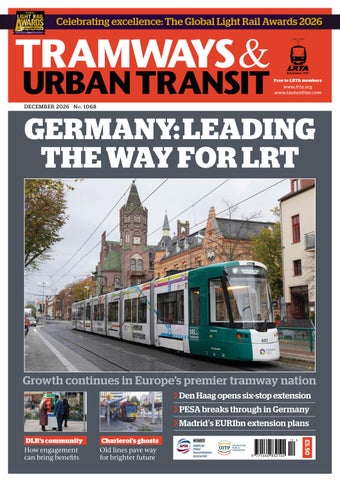
GERMANY: LEADING THE WAY FOR LRT
Growth continues in Europe’s premier tramway nation Den Haag opens six-stop extension PESA breaks through in Germany Madrid’s EUR1bn extension plans Charleroi’s ghosts Old lines pave way for brighter future
£5.50
DLR’s community How engagement can bring benefits
Transport’s independent, confidential safety hotline. If you work in transport, your concerns about health, wellbeing and safety need to be heard. From working environment and culture, to training, welfare and equipment concerns, you can speak up safely with CIRAS. Raise a concern online, over the phone or via the app.
CONTENTS
463 The official journal of the Light Rail Transit Association
474
DECEMBER 2026 Vol. 89 No. 1068 Neil Pulling
www.tautonline.com
EDITORIAL EDITOR – Matt Johnston hello@mainspring.co.uk
452
ASSOCIATE EDITOR – Tony Streeter tony.streeter@mainspring.co.uk WORLDWIDE EDITOR – Michael Taplin miketap@mainspring.co.uk
WORLDWIDE CONTRIBUTORS Richard Foster, Andrew Grahl, Andrew Moglestue, Herbert Pence, Mike Russell, Nikolai Semyonov, Alain Senut, Andrew Thompson, Witold Urbanowicz, Bill Vigrass, Thomas Wagner, Philip Webb.
Blickrichtung Süden
Isle of Man Government
SENIOR CONTRIBUTORS – Howard Johnston, Neil Pulling
NEWS 444 Praha’s modernised funicular opens; Ground broken for new Los Angeles line.
VLR FOR THE UK? 461 TAUT finds out what’s next for the Coventry VLR scheme.
DLR: COMMUNITY BENEFITS 449 TAUT explores how engagement with local communities can bring benefits to LRT systems.
SYSTEMS FACTFILE: DORTMUND 463 Neil Pulling visits this German city, which is restarting its fleet upgrade programme.
GERMANY: NOT STANDING STILL 452 Despite the country having around 60 tramways, there are still plenty of projects underway in Germany. CHARLEROI: A BRIGHTER FUTURE 458 Andrew Thompson uncovers how the ghosts of past plans have paved the way for the future of this Belgian city.
UKTRAM & THE GLRA 469 In support of the Global Light Rail Awards.
PRODUCTION – Lanna Blyth Tel: +44 (0)1733 367604 production@mainspring.co.uk DESIGN – Debbie Nolan ADVERTISING COMMERCIAL MANAGER – Geoff Butler Tel: +44 (0)1733 367610 geoff@mainspring.co.uk Tramways & Urban Transit 13 Orton Enterprise Centre, Bakewell Road, Peterborough PE2 6XU, UK Tramways & Urban Transit is published by Mainspring on behalf of the LRTA on the third Friday of each month preceding the cover date.
WORLDWIDE REVIEW 470 Chagchun and Nanjing open Metro lines. CLASSIC TRAMS: 150 YEARS ON THE ISLE OF MAN 474 The Douglas Bay Horse Tramway celebrates 150 years, with two days of parades.
GLOBAL LIGHT RAIL AWARDS 2026 – SPECIAL SUPPLEMENT TAUT shares the highlights from the industry’s favourite celebration of excellence.
LRTA MEMBERSHIP (with TAUT subscription) Tramways & Urban Transit is sent free to all paid-up members of the Light Rail Transit Association. LRTA WEBSITE AND DIARY Tim Kendell webmaster@lrta.org meetings@lrta.org SUBSCRIPTIONS, MEMBERSHIP AND BACK ISSUES LRTA Membership Secretary (Dept T06), 38 Wolseley Road, Sale M33 7AU, UK. Tel: +44 (0)117 951 7785 membership@lrta.org Website: www.lrta.org
Is this the key to prosperity? The UK is notorious for devoting years – sometimes decades – working up decent urban transit schemes, and then putting them on the shelf because there isn’t a way to get governments to release the funding. Why? They’re not quick vote winners. Attitudes seem to be changing, and under the latest moves by Chancellor of the Exchequer John Healey, city mayors are to have more say on how they spend their money. In south London, an extension to the Underground’s 7.5km (4.6-mile) Bakerloo Line has always seemed a no-brainier, creating 150 000 jobs and helping to build 100 000 new homes. The barrier has been how to find the GBP5.2 billion (EUR 6.2 billion) to get it to happen, and if this is now available what impact will this have on other stalled national transport projects? Germany’s tramway orders, like much of Europe, have traditionally seemed closed to outsiders, that is now in the past. More proof of this comes with news that Braunschweig (Brunswick) has placed an order with Polish rolling stock manufacturer PESA for 12 of its Twist 3.0 trams, with an option for another ten. Both countries gain, because it brings valuable assembly work for the former HeiterBlick factory in Leipzig, which was rescued by PESA earlier this year. Tis’ the season of goodwill, and it’s good to learn that the beleaguered city of Mykolaiv in Ukraine has been gifted 23 redundant Breda trams from Lille in France to ease the pain of repeated Russian attacks on its infrastructure. The supply of arms to defend the country is ever important, and so are gestures such as this to look after the civilian population. The 2027 European Light Railway Congress will be staged in Turin, Italy for the first time. It’s on 17-18 March, and looks set to be a busy two days. Matt Johnston, Editor COVER: Pre-series Stadler Tramlink 441 on test in Potsdam's Babelsberg district in 2025: the incoming Tramlink fleet is intended to replace remaining ČKD Tatra trams in the Brandenburg capital. Neil Pulling
FOR CORPORATE SUBSCRIPTIONS VISIT www.mainspring.co.uk LRTA REGISTERED OFFICE 13 Orton Enterprise Centre, Bakewell Road, Peterborough PE2 6XU, UK Private company limited by guarantee, No. 5072319 in England and Wales. LRTA CHAIRMAN – Ian Longworth chair@lrta.org © LRTA 2026 Articles are submitted on the understanding they may also be used on our websites or in other media. A contribution is accepted on the basis that its author is responsible for the opinions expressed in it, and such opinions are not those of the LRTA or Mainspring. All rights reserved. No part of this magazine may be reproduced or transmitted in any form by any means, electronic or mechanical, including photocopying, recording or by any information storage and retrieval system, without prior permission in writing from the copyright owner. Multiple copying of the contents of the magazine without prior written approval is not permitted.
PRINT The Manson Group Limited, St Albans, Herts AL3 6PZ
DISTRIBUTION Warners (Midlands), Bourne, Lincs PE10 9PH, UK
www.tautonline.com . www.lrta.org DECEMBER 2026 / 443
News UK PM offers verbal support for Bristol trams… “I don’t see why Bristol shouldn’t be able to aspire to a tram system similar to the one that we have in Manchester,” UK Prime Minister Andy Burnham has said. Talking to the BBC in September, Mr Burnham said a system in Bristol could be developed in stages. He added that connecting Bristol’s new arena at Filton with Temple Meads station and the city centre was a “scheme I’m prepared to look at” with West of England Combined Authority Mayor Helen Godwin. Bristol’s West of England Mayoral Combined Authority stated in February that it plans to “commence delivery” of its first mass transit routes “within 4-5 years” (TAUT 1060). Mayor Godwin commented: “What pops into my head is trams and light rail. [But] to do something quickly, which I think is what people want and deserve, we might be looking at bus-based mass transit.”
…as Northampton and Oxford eye mass transit West Northamptonshire Council (UK) has suggested that mass transit could “complement and in part replace bus services and provide high quality routes along prioritised corridors”. The council has proposed Coventry Very Light Rail technology and a so-called ‘trackless tram’ articulated bus in its Northampton Area Transport Strategy 2026-2036, which is now open for public consultation. Northamptonshire is suggesting five Bus Smart Corridors from the suburbs into the town centre, which would get priority over other traffic to boost connectivity. Mass transit, it says, “could be seen as a longterm evolution of [these] Smart Corridors”. Meanwhile, senior councillors from Oxfordshire County Council attended the first ‘Time for Trams’ conference at Coventry’s TechnoCentre on 24 September. Council leader Tim Bearder said: “If we are going to grow sustainably, we need to include a mass rapid transit system as part of the big picture. We can’t keep simply expanding our roads and not expect gridlock.”
Škoda trams in Ostrava, with the 39T to the left. Denik.cz
Ostrava orders from Škoda Czech city’s 16 new trams to feature innovative diagnostic technology
D
opravní podnik Ostrava (DPO), the public transport operator in the Czech city of Ostrava, has awarded Škoda Group a CZK3.1bn (EUR127m) contract for 16 new ForCity Smart trams, plus an option for a further nine. These three-section, doubleended vehicles are due to be delivered within 32 months. They are set to replace high-floor Tatra KT8 trams, built in 1989-90, on lines 1 and 2. Petr Novotny, CEO and Chairman of Škoda Group, said:
“We greatly appreciate the trust of [DPO] and are pleased that our trams will contribute to the further modernisation of public transport in the city. “The new high-capacity trams will offer passengers modern, comfortable and fully barrierfree travel. The contract also includes a ten-year service, so our co-operation will continue… even after the vehicles are delivered.” Each tram is to be capable of carrying 250 passengers. Its step-free design means that people will be able to access all
seats without a change in level. Air-conditioning will further add to passenger comfort. As well as being fitted with collision avoidance equipment, the vehicles are also expected to have a lubrication system to prevent flange squeal on curves. In addition, they will be fitted with a ‘self-diagnostic system’, whereby the tram will relay information about its technical condition to central control. Ostrava first ordered from Škoda in 1998 and its 14 03T1 Astrai have since been joined by 38 39Ts.
Work starts on Birmingham Eastside’s missing light rail link Midland Metro Alliance contractors are now on site by the location of the underconstruction high-speed station at Curzon Street in Birmingham (UK). Work around the northern terminus of the new HS2 route has meant that a gap currently exists in West Midlands Metro’s Eastside extension, which should be filled by the end of next year. The first 500m of the extension opened on 5 April (TAUT 1062), while much of the infrastructure from Meriden Street to Digbeth coach station is complete.
444 / DECEMBER 2026 www.tautonline.com . www.lrta.org
Handing over the first parcel of land for track laying beyond Millennium Point took place in mid-October. HS2 contractors are currently installing concrete beams to form a tunnel that will take trams under the Curzon Street terminus. Once this work is complete, the remaining section is expected to be handed over to MMA next spring. Having made a sharp righthand turn under Curzon Street, the Eastside extension will run along New Canal Street, which makes an end-on connection with Meriden Street. What has been described as “active
construction” is taking place along New Canal Street. It is anticipated that the Eastside extension will open throughout in 2028. Meanwhile, MMA has handed over the Dudley extension to West Midlands Metro for testing and commissioning work to take place. Night-time trials on what is now known as the ‘Black Country Line’ began on 14 October, with a simulated full service the following night. No date for opening has been set, although there are reports that it could take place by the end of the year.
Den Haag opens six-stop extension Difficulties overcome to bring trams to Technical University
T
he saga of the line 19 extension in Den Haag (The Hague) came to an end on 5 October when trams started running between Delft station and the Dutch city’s technical university. The 2.7km (1.7-mile), six-stop extension completes the 15.4km (9.6-mile) line from Leidschendam. A 15-minute service is provided 07.00-19.00. Line 19 is orbital, connecting northern suburbs, and does not pass through the city centre. Where it runs through the university campus, the line uses its own segregated carriageway, which it shares with buses. Plans for the extension to the university date back to 1996 and authorisation was given in 2004,
with an opening planned for 2009. In the event, construction dd not commence until 2015. In the area around one of the world’s leading technical universities, specialising in mechanical, aerospace, civil, chemical and structural engineering, the tramway had to be modified to avoid conflicting with delicate equipment. Stretches of track had to be relaid in special vibration-damping concrete, which resulted in delays. The original terminus at Van den Broekweg had to be moved to avoid magnetic interference, while there were also issues with the underlying ground. Each overhead mast also incorporates a power feed to reduce magnetic interference.
Politicians gather to mark the opening of Delft’s line 19 extension. R. Keus
Initial test runs took place on 7 April 2026, with a dummy service starting from 1 June. Adeel Mahmood, Alderman for Mobility, Den Haag, said: “With the extension… we are investing in the accessibility of the region. Good accessibility is the
Stadler delivers new Stuttgart Stadtbahn cars Stadler is delivering the first of a new batch of high-floor Stadtbahn cars to Stuttgart. The 39.1m two-car sets are classified S-DT 8.16. They are the fourth generation of 1435mm-gauge cars for the German city since it converted its system from metregauge between 1985 and 2017. Today, 180 LRVs run on the city’s 15 lines. The 40 new Stadler LRVs are planned to replace the firstgeneration cars that date from 1985-86 as well as providing a reserve for future expansion of
the system. Normally, two sets will run coupled together. All axles are powered due to the hilly terrain in what is the capital of Baden-Württemberg and they have an operating top speed of 80km/h (50mph). Total capacity of a set is 250 passengers, with 98 seated. Passengers are to gain the benefits of four (rather than two) multi-function areas, a lower boarding height and additional information displays. A driver assistance system has been installed.
The ARST set displayed at InnoTrans 2026 , the international trade fair held in Berlin, Germany. Stadler
The first set was displayed at InnoTrans in September, where Stadler also revealed its new hydrogen-powered units. These three-section, low-floor vehicles have been developed for 950mmgauge lines in Italy. With the hydrogen generated by solar power, these units are expected to save over 2100t of carbon dioxide each year compared with the diesel trains they are to replace. They feature lithium traction batteries, watercooled traction converters and asynchronous traction motors.
Stadler DT8.16 for Stuttgart on show at InnoTrans 2026. dopravacek.eu
driving force behind economic development because it better connects people, business and learning institutions. This is how we keep our metropolitan region attractive, accessible and economically strong for residents and businesses.”
Ups and downs for UK numbers UK light rail systems experienced mixed fortunes in 2025-26, according to new data published by the Department for Transport. A total of 238.5m passengers used the nine light rail systems (not including London Underground) between April 2025 and March 2026. Docklands Light Railway, with 90.8m passengers, remained the busiest. However, service reductions relating to the withdrawal of the B23 fleet have been blamed for a 7m decline over 2024-25. There was a 0.6m decline on South Yorkshire Supertram (8.5m in 2025-26). Nottingham Express Transit and Tyne & Wear Metro also noticed declines: 0.1m for NET (15.6m in 2025-26) and 0.7m for the Metro. Three systems had record breaking years: Manchester Metrolink attracted 46.6m passengers (46m in 2024-25), West Midlands Metro hit 9m passengers (8.8m in 2024-25) and Edinburgh Trams beat 2024-25’s 12.2m by 0.2m.
Approval granted for Helsinki’s West Harbour tramway upgrade Helsinki City Council has approved the EUR48m West Harbour light rail project. This involves rebuilding 5km (3.1 miles) of existing tramway from Hakaniemi to the West
Terminal in Jätkäsaari so that it can be used by 45m trams. The Finnish project involves lengthening stop platforms (some will be widened) while track geometry is adjusted. The
Simonkatu stop will be removed to accelerate journey times, while stops in Kamppi will receive improved facilities. This section of tramway will be incorporated into the new line
12 that was due to start operating on 7 November. It connects Yliskylä to Hakaniemi via the three new island-connecting bridges, known collectively as the Crown Bridges (TAUT 1029).
www.tautonline.com . www.lrta.org DECEMBER 2026 / 445
News Lille trams for Ukraine The French city of Lille has agreed to donate 23 Breda trams to the Ukrainian city of Mykolaiv. They are being made redundant on the 17.5km (10.8-mile) metre-gauge interurban tramway from Roubaix to Tourcoing by 27 Alstom Citadis that began arriving during March 2026. Of the batch of 24 vehicles built in Italy in 1994, one is being preserved in Lille under the auspices of the Association du Musée International des Transports Métropolitains. It is not known where or how the French trams will be re-gauged to 1524mm for use in Mykolaiv. The city’s 50-strong 1524mm-gauge fleet includes Tatra T3s obtained from Plzen in Czechia and three Tatra-Jug T6s from 1999-2001.
This Lille Breda tram will soon be headed for Mikolaiv. Bulgarian Rail
PESA lands first deal to supply trams for Germany Order for Braunschweig opens door to new market
P
olish rolling stock manufacturer PESA has received its first tram order from a German system. Braunschweiger Verkehrs-GmbH (BSVG), the public transport operator in the northern city of Braunschweig (Brunswick), is to take 12 Twist 3.0 trams, with an option for ten more. Deliveries are to start in late 2029, with the order expected to be completed in February 2031. Each tram costs EUR5.42m. Braunschweig has received EUR24m from the state of Lower Saxony towards the cost of the new vehicles, which will replace ADtranz articulated cars that date from 1995. The new 33m, single-ended trams will each carry up to 202 passengers, with 75 seated. The low-floor design features rotating bogies and air-conditioning. The bulk of the construction work is due to take place in PESA’s factory in Bydgoszcz, Poland. The part-complete
Impression of the PESA Twist for Braunschweig.PESA
vehicles will then move to the HeiterBlick factory in Leipzig, Germany, for completion. PESA acquired this facility earlier in 2026, when it bought the beleaguered German manufacturer (TAUT 1059). Frank Brand, Managing Director of BSVG, said: “Thanks to the new trams, our passengers will gain more space, significantly improved travel comfort and modern amenities.
New Los Angeles line breaks ground Ground was broken on the East San Fernando Valley light rail line in Los Angeles (US) on 19 October. Speaking at the ceremony, LA Metro Board Chair and LA Mayor Karen Bass said: “The East San Fernando Valley deserves an affordable and safe transit system that provides reliable access to jobs, healthcare, schools and local businesses; I am proud that Metro’s light rail project will deliver just that.” The 10.7km (6.7-mile), 11-station line is to run along Van Nuys Boulevard to connect the communities of Van Nuys, Panorama City, Arleta and Pacoima. It is also to provide an interchange with Metrolink commuter rail and Amtrak
Our customers and residents of areas located near tramlines will also benefit thanks to the freerotating bogies, a solution that reduces noise and rail wear and provides a higher level of travel comfort.” Braunschweig’s first horsedrawn trams began operating in 1879. It uses the unusual gauge of 1100mm; its six-line, 42.3km (26.3-mile) network is operated by 49 trams.
Lithuania’s Kaunas plans first tramway
Politicians gathered for the ground-breaking ceremony. LA Metro
long-distance rail services as well as bus rapid transit Line G. In addition to building the line, major streetscape upgrades are to be undertaken, along with new, safer pedestrian crossings and improvements to highway design. The estimated USD4bn (EUR3.6bn) project cost is being funded through a variety of federal, state and local sources, including a voter-approved sales
446 / DECEMBER 2026 www.tautonline.com . www.lrta.org
tax. Due to open in 2032, the line was initially planned to start operating in 2027. The area it is to cover was served by Pacific Electric interurban trams until 1952. Community discussions about the project started in 2010. Siemens, HyundaiRotem, Woojin IS and Kinki Sharyo have all expressed interest in building the new P3030 LRVs that the line will require.
Lithuania’s second city of Kaunas is to gain its first tramway after the city council approved a Sustainable Urban Mobility Plan on 26 September. The initial 13km (eight-mile) line is to head west along Šiaurės Avenue in the suburb of Eiguliai before swinging south-west along Savanorių Avenue toward Kaunas Castle. A precise route is not yet clear. A tender for this work is expected to be offered shortly. Martynas Matusevičius, head of the city’s Transport and Traffic Management Division, said: “Now we have the tram not only at the level of an idea, but also in a strategic document. The next steps will be to prepare design proposals.” The city’s first tramway opened in 1892 but closed in 1929. Trolleybuses were introduced in 1965, and an extensive system has since developed. However, with a population of 300 000, a capacity study has shown that this may be inadequate for future demand.
Madrid unveils EUR1bn rail expansion plans Spanish capital’s metro and tram lines to be extended
T
he President of the Community of Madrid, Isabel Díaz Ayuso, has revealed plans to invest over EUR1bn in the Spanish capital’s metro and light rail systems. Approximately 30km (19 miles) of new track is planned to be built over the next eight years, to better connect regions and suburbs around the city. Metro line 10 is to be extended from Puerta del Sur by 6.5km (four miles) to Móstoles. Design work on the double-track, six-station extension could start in 2027, with a 2030-34 construction period. A branch is to be added to line 1 to connect it to Madrid
Nuevo Norte, an urban regeneration project in Las Tablas, to the north of the city. Although the length of the branch has not been confirmed, a statement from Madrid Metro suggests that the new line would include 1.5km (0.9 miles) of tunnels. Costing EUR150m, the three-station branch would join line 1 at Chamartín. Construction could be completed by 2032. Work to extend the 8.5km (5.3-mile) line 11 by a further 6.6km (4.1 miles) is underway. However, while this Conde Casal – Plaza Elíptica extension is being built, President Ayuso’s announcement means that
studies have now started into bringing the line from La Fortuna to Poza del Agua, a distance of approximately 11km (seven miles). Line 11 is envisioned to cross Madrid, from Cuatro Vientos in the south-west to Valdebebas in the north-east, a distance of 33km (20.5 miles). Complementing the metro plans is the 1.5km (0.9-mile) extension to Metro Ligero’s line 3. This double-track, threestation addition is to take the tramway from Puerta de Boadilla to Valenoso, a residential area in the eastern part of Boadilla del Monte. The project will cost EUR25m, but no timescales have been given for its construction.
Praha’s modernised funicular reopens The modernised funicular in the Czech capital Praha (Prague) resumed public services on 22 September following two years of construction work. Located on the west bank of the River Vltava, the 510m funicular connects the Malá Strana quarter with the summit of Pet ř ín hill, where there is a 63.5m lookout tower. Both tower and funicular date from 1891. The line, which is connected to the Czech capital’s tram network at Újezd station, closed for refurbishment in May 2024. The most noticeable change is brought by the two new funicular cabins, manufactured in Olten (Switzerland) by CWA, a subsidiary of Doppelmayr/Garaventa, at a cost of approximately EUR5.7m.
Work has stopped on Hungary’s Southern Railway Ring, a key element in the development of an S-Bahn-like system in the country’s capital. Prime Minister Péter Magyar and Transport & Investment Minister Dávid Vitézy announced on 9 October that the project to multi-track the railway between Budapest’s suburbs of Kelenföld – Ferencváros is now being investigated due to a potential conflict of interest with the owner of contractor V-Híd. The decision threatens EUR320bn in EU funding since the 2030 deadline for completing the ‘S-Bahn’ network is unlikely to be met. The Southern Railway Ring is 40% complete.
Last stage of Manila metro launched
Philippines President Ferdinand Marcos Junior attended a groundbreaking ceremony for Metro Manila Subway’s terminus at Ninoy Aquino International Airport Terminal 3 on 16 October. The airport is to be connected to rest of the system at Pasay by a 2.4km (1.5-mile) spur. This will bring the total length of the metro, which is yet to open, to 33km (21 miles). Work on what’s officially called Metro Rail Transit Line 9 started in 2019. It is due to open from East Valenzuela station in the north to Bicutan station in the south in late 2031.
Tram link in Belarus
A feasibility study into building a new tramway between the Belarusian towns of Polotsk and Novopolatsk was launched by President Aleksandr Lukashenko during a visit to the Belkommunmash rolling stock factory on 23 October. Novopolatsk’s 11.5km (7.1-mile) tramway was established in 1974. The link from Polotsk would be approximately 10km (6.2 miles). The new cabin 1 of Prague’s reopened Petřín funicular in the first week of public service. A. Thompson
Custom-built, the exterior was designed by Anna Marešová, whose studio had previously developed ‘luxury tram’ T3 Coupé 5573 in 2017-18. The 12.3m-long cabins feature four separate compartments, offering
seating for 19 passengers and standing room for 100. The new-look funicular operates daily 07.00-22.15, with departures every ten minutes. The journey takes around four minutes.
Lack of Luas links affects new town and housing plans Plans to build a new township to the north-west of Ireland’s capital Dublin have been affected because it is unlikely to be connected to the Luas network until at least 2042. The Draft Dunsink Urban Area Plan originally proposed building 18 500 new homes on a green-field site just inside the M50 motorway that rings Ireland’s capital. This was revised to 16 200 new homes in
Budapest S-Bahn scheme paused
September, to be built in three phases, with the first phase under construction by 2029. However, delivery of the second phase could be delayed because the Green Line extension to nearby Tyrrelstown is not expected to be built before 2042. Councillor Ellen Troy said: “Too often, the communities experience development first and infrastructure later. We should be striving to avoid that scenario
in Dunsink.” Fellow Councillor David Healy said that “it’s absolutely essential that we have the Luas in Phase two and not put off to Phase Three”. Both councillors had motions to develop Dunsink’s public transport connections approved on 19 October. However, Fingal County Council Chief Executive Ann Marie Farrelly said that this “will delay housing”.
Hydrogen for Egypt?
HyundaiRotem is to develop a hydrogen-electric tram that could run between Al Qahirah (Cairo) and The New Capital, a city under development 35km (22 miles) away. The Korean manufacturer signed a Memorandum of Understanding with Egyptian Transport Minister Kamel Al Wazir, on behalf of the National Authority for Tunnels, during the ‘Korea-Egyptian Business Roundtable’ held in Greater Lotte Seoul on 7 October. A proposal for connecting The New Capital with Al Qahirah involves building a 28km (17.4-mile) tramway. HyundaiRotem is to put together a feasibility study into whether hydrogen-electric power would be suitable for such a line. If HyundaiRotem proves that the technology is suitable and it can “provide comprehensive solutions for the operation, operation, system, and maintenance of vehicles”, it could lead to an order for 44 hydrogen-powered trams.
www.tautonline.com . www.lrta.org DECEMBER 2026 / 447
News Obituary: David Walmsley
D
avid Walmsley was a physicist by training, a transport researcher by profession, and a passionate light rail advocate whose work helped shape the development, regulation and understanding of modern tramways in the UK. Born and raised in Blackpool, he attended Blackpool Grammar School. Although Blackpool is famous for its trams, they played surprisingly little part in his childhood: his family lived inland and travelled mainly by bus. Nevertheless, trams became a recurring thread in his life. David remembered journeys on systems in Liverpool and Leeds, enjoyed the Great Orme Tramway in Llandudno, and recalled with particular pleasure a childhood ride through London’s Kingsway Subway. Visits to his aunt in Reading also brought journeys on the trolleybus. After A-levels David studied Physics at University College London. During the summer he worked as a conductor on the Blue Buses in Lytham St Annes, an experience that introduced him to passengers from different backgrounds and gave him an early practical understanding of how transport worked. He graduated from UCL with a First and remained there to undertake a PhD in infra-red astrophysics. His doctoral work introduced him to experimental research involving electronics and computing, and took him to Texas, where he helped fly an experiment on a stratospheric balloon. During his PhD he met his wife Sue, a postgraduate student at Imperial College. They married in 1969. Later that year he joined the Road Research Laboratory at Crowthorne in Berkshire, then the research arm of the Ministry of Transport – later known as the Transport and Road Research Laboratory (TRL).
David’s early work involved the Transport Research Assessment Group, which examined ambitious proposals for technologically advanced transport systems. His first major project considered the economics, costs and passenger forecasts for several proposed forms of inter-city transport, including the Advanced Passenger Train, Tracked Hovercraft and Vertical/Short Take-off and Landing aircraft. During the 1970s and 1980s he became involved in some of the most important transport research projects of the period. He was a lead researcher on the study of the Tyne and Wear Metro and served as Project Officer for a parallel study of Glasgow’s Argyle Line and Subway refurbishment. He also studied the consequences of the 1986 deregulation of bus services. By the late 1980s his professional interests had increasingly focused on modern tramways and light rail. A major TRL study examined the wider effects of rapid transit on cities, including its influence on shopping, employment, land use and urban development. He travelled to major French cities with newly introduced tramways and metros, meeting transport authorities and urban development agencies and observing the systems at first hand. When public transport research at TRL was subsequently closed, he transferred to road accident studies. He did not, however, abandon his interest in light rail. He joined the Light Rail Transit Association and continued to present and develop his work. In 1995, after more than 26 years at TRL, David took early retirement: this, however, did not mean withdrawing from professional life. He expanded his teaching work – teaching mathematics, statistics and computing at further education level. In September 1995 he joined the Confederation of Passenger Transport (CPT)
as its Fixed Track Executive, initially part-time and later full-time. Here he became an important voice for the light rail sector in discussions with government. He helped scrutinise proposed railway safety guidance, ensuring that provisions relating to tramways reflected the realities of constructing and operating them. He also represented light rail operators during the development of accessibility regulations, helping ensure that requirements designed for railways were sensible and proportionate when applied to tramways. His responsibilities widened to include bus-rail integration. He played a role in developing the PlusBus ticket, enabling rail passengers to add local bus travel to their rail journey for a small additional fee. He also participated in work on smart cards. He became closely involved in the development of the UK’s light rail industry. He visited every light rail system in the country, served as Secretary of the Light Rail Operators’ Committee and was involved in the development of related engineering organisations. He was also a founder member of UKTram and later continued his involvement after retirement, advising on tramway proposals and contributing to the industry’s response to the Sandilands tram incident report. His expertise increasingly extended across Europe. As one of two UK representatives in the COST Action TU1103 study of tramway safety, he worked with transport professionals, regulators, operators and academics from across Europe. The project provided an opportunity to exchange knowledge and best practice between countries and produced a major report on developing safe and efficient urban tram systems. The participants subsequently continued their collaboration through the Urban Tram Forum. He was elected to the Council of the Light Rail Transit Association in 2000 and worked with its Publications and Campaigns Groups. In recognition of his many years of transport work, he received the Judges’ Special Award at the 2017 Global Light Rail Awards. His contribution was not confined to professional transport organisations. He served at various times as Treasurer and Chairman of the Wokingham Playbus Association and held roles with the Parent Teachers Associations of St Paul’s and Forest Schools in Wokingham. He also taught computing, mathematics and statistics at East Berkshire College, Henley Management College and the University of Reading’s Adult Education Department. Behind the professional achievements was a family life shared with Sue, their two sons, Graham and Derek, and a grandson, Frederick – to whom we offer our sincere condolences.
ABOVE: David Walmsley (centre) is presented with the Judges’ Special Awards at the 2017 Global Light Rail Awards ceremony by host Nicholas Owen (left) and Andrew Braddock from the LRTA (right). Mainspring
Compiled using information provided by David Walmsley, August 2026.
448 / DECEMBER 2026 www.tautonline.com . www.lrta.org
Collaboration and engagement
THE BENEFITS OF COLLABORATION
Can engaging with stakeholders and local communities really bring benefits to light rail systems? TAUT speaks to Catrina Lynch about the positive impact it’s had on the DLR.
L
ight rail can bring multiple benefits that look good on paper. Improved connectivity, when coupled with improved placemaking, can drive economic growth. Locals will be imbued with greater respect and appreciation for their new-look surroundings and so antisocial behaviour will decrease… and so on. There is, of course, plenty of evidence to show that light rail really does benefit local communities. Management might pat itself on the back for all the passenger journeys a new system might be generating. But not everyone is savvy or confident enough to use a new transport system. There will be questions about it, such as how exactly do you go about buying a ticket? Maybe taking the time to engage with communities could make those encouraging numbers look really positive. But engagement isn’t something just for new systems. London’s Docklands Light Railway will celebrate its 40th birthday in 2027. As its route mileage has increased, so has its patronage: from 8.3m passenger journeys
in 1990 to 30m in 1999, and then a peak of 122.3m in 2017. Despite this, franchise holder KeolisAmey Docklands (KAD) employs a team that helps people from local communities to use the DLR. The seven-strong Community Team is
“The team plays a key part in ensuring that KAD delivers its vision for a safe and sustainable railway delivering excellence every day. ” led by Community and Stakeholder Manager Catrina Lynch, who explained to delegates at the 2026 UK Light Rail Conference (TAUT 1065) that while the role is far ranging, the team plays a key part in ensuring that KAD delivers its vision for “a safe and sustainable
ABOVE: KeolisAmey Docklands engages with a variety of stakeholders from across the network to build shared priorities and improve local communities. All images courtesy of KeolisAmey Docklands.
railway delivering excellence every day”. From its first passenger service in August 1987, the DLR now stretches for 38km (24 miles) in a stylised ‘+’ across central, east and south London. There are already two tunnels under the River Thames and a further Thames crossing, to Thamesmead, is being developed. The system has its origins in the 1970s when London’s docks began to suffer from the increasing effects of containerisation; the DLR was considered a key part of regenerating the area. Consequently, the DLR runs through five boroughs, all with diverse communities. Canary Wharf, for example, is now one of the world’s key finance centres. By contrast, Newham and Lewisham are some of the more deprived areas in Greater London. What unites these communities is that not only do they contain a potential pool of customers but also that of employees. But how do you convince people to travel? Or that you can offer a career? “Collaboration”, says Catrina Lynch, who joined KAD’s Community Team in 2022 having previously worked in the charity sector.
www.tautonline.com . www.lrta.org DECEMBER 2026 / 449
Collaboration and engagement
ABOVE: KeolisAmey Docklands employs a team of people to help local communities use the system, building a sense of shared ownership of the DLR.
ABOVE: Conferences allowed DLR representatives to ask stakeholders what they wanted, which helped to shape the agenda.
KAD took on the eight-year DLR franchise in 2014, but this has been extended so that it will now operate the system until at least 2033. Whilst stakeholder engagement has always been integral to the franchise, “we’ve stepped up our focus in this area over the last few years”. Collaboration is key to stakeholder engagement. In early 2025, KAD became a member of the Institute of Collaborative Working (ICW). Formed in the UK in 1990, the ICW explains that while “people collaborate all the time… organisations that benefit from collaboration have generally recognised that it is not something that ‘happens naturally’, without the need for any attention to the factors that will underpin its success. A structured approach is the answer because it helps all the participants”. There is even an international standard for collaborative working: ISO44001. Having attended an ICW Collaborative Leaders Course, Lynch “realised that there was a real desire in East London to collaborate and work in partnership with the light railway, Transport for London and KAD”. “It was almost overwhelming how many people want to work with us and how many things we want to achieve,” she adds. Everyday practicalities meant that the team couldn’t achieve everything that members had on their list, but it did create an overarching purpose for them to encourage: safe, confident, respectful transport use. “For me,” says Lynch, “respect is everything from giving respect to young people, to making sure that people buy tickets.” What was described as a “huge piece of work” resulted in a bold vision: “to build trusted partnerships with communities and stakeholders that create lasting social value, strengthen DLR’s reputation and deliver measurable business benefits”. To deliver that vision, Lynch’s team created three key pillars: Strategic Stakeholder Engagement, Social Value, and Community Engagement. And each of these pillars is fed by “capturing and reacting to qualitative and
“We engaged with ten schools in Year 1 [and reached] over 2000 young people.” It’s not just the children who benefit from this. Teachers are trained to be able to deliver the STEM subjects for years to come. The result, says Lynch, is a legacy for the future generation of students in East London and “who knows, possibly even future DLR engineers!” The DLR team is engaging with a further ten schools in 2026 and is “aiming for the same success”. There’s been another benefit too. “Working with schools is building that reputation with young people so that they then respect the network, they respect the staff. Antisocial behaviour reduces as well.” Community Engagement is a comparatively simple title for something that’s so multifaceted. Effectively, Lynch says, “We’re the voice and the ears. We’re out in community spaces, hearing feedback directly.” This case study typifies the work that the Community Team engages in. When Lynch joined the team, she discovered that while mobility scooters have increased in size, the DLR’s lifts hadn’t. So, the team went out into the community to offer alternative routes to stations for mobility scooter users. Listening to people explaining what the barriers were to travel and then devising a solution was “another fantastic collaborative piece”. This evolved into wider ‘Accessibility Trips’. It’s logical that there are passengers who are struggling to use the DLR today because they aren’t as mobile now as they were 40 years ago when the system was new. For those people who are learning to cope with mobility issues, the Community Team offers advice and guidance, coaching and mentoring on how to use the system. This takes place either in group sessions or on a one-to-one basis. The idea is that no one should feel that they cannot use the DLR. Provision of a Community Team was part of KAD’s franchise bid and so there’s no risk of it disappearing from the DLR. But, in these belt-tightening times, the provision of such a team could feel like an optional ‘nice to
quantitative feedback from engagements and using it to drive continuous improvement”. But what does that actually look like? When it comes to Strategic Stakeholder Engagement, Lynch explains, “We don’t have contracts with British Transport Police or the five local authorities we serve. But we know that it’s in our collective interests to work together.” The only way to find out how a light rail operator and a local council, for example, can help each other is to get together and talk it through. So, Lynch and her team literally reached out to local stakeholders. “I’m not shy in knocking on doors,” she laughs. At least 18 parties attended the first Stakeholder Conference on 3 March 2026. Joining then KAD Managing Director Richard Graham and DLR General Manager Tom Page, were representatives from the five boroughs (City of London, Greenwich, Tower Hamlets, Lewisham and Newham), British Transport Police, London City Airport, London Excel and local colleges and universities. What did stakeholders gain from the event? “We asked them what they wanted, which always works well. ‘How can we help you?’” The responses, which didn’t rely on formal agreements, then shaped the agenda. Effectively the message was “come along to a day that you co-created”. “We had some really engaging break-out sessions,” Lynch says, “at a local community venue [so] we got to see the local area. We got on the DLR. It was a really fun but useful day.” The results of the conversations were compiled in an action log, a programme that would shape the next 12 months. One of KAD’s Social Value initiatives on the DLR involved collaboration with Primary Engineer, an organisation that, since 2005, has encouraged primary school children to engage with Science, Technology, Engineering and Maths (STEM) subjects by having fun. It’s been described as ‘STEM by stealth’. “We’re going into schools, using our engineers as volunteers and almost acting as Teaching Assistants in delivering a STEM programme.
450 / DECEMBER 2026 www.tautonline.com . www.lrta.org
have’ for when the finances are looking a lot healthier. How can such a team prove the worth that’s been invested in it? “We are always exploring new ways to measure the social value generated by the work we do in the community. There are some obvious links we can make between engagement and operations. For example, the cost of delays can be calculated”. Trespass causes delays and, on one section of the DLR, there were 11 incidents of trespass in four weeks. Direct action by the Community Team to address this eradicated repeated issues. Lynch continues the story: “When we looked at the incident reporting forms, every [trespasser] had a carer [either] with them or… close by. “We tracked down where these carers were coming from. It turned out to be a mental health hospital for women. “We worked really closely with them to understand how we could help them. We created a training programme for carers and managers, and took them to visit the station and our control centre. “It was a fantastic success, and we have had zero repeated trespassing from that setting since.” Another piece of direct interaction followed reports of abuse being directed towards the revenue team at a DLR station. “We identified it [as coming from] a school so my team are already out engaging, going in with a presentation for teachers and heads of year.” The team also warns local communities about forthcoming engineering works and maintenance, helping to build understanding before disruption occurs. Lynch believes that openness and early engagement are among the reasons why the DLR enjoys relatively low levels of complaints. “If we can get a customer or community to get involved, why not? No idea is too crazy.” It is a philosophy that runs through everything the Community Team does. Whether that means helping mobility scooter users navigate the network, inspiring future engineers in local schools, supporting carers to prevent trespass incidents, or simply listening to concerns and acting on them, the common thread is collaboration. The team’s work may not always be captured in passenger statistics or balance sheets, but its impact is felt across the communities the DLR serves. And perhaps that is the real lesson for the wider light rail industry. New lines, extra stations and replacement rolling stock can transform places physically, but lasting success depends on transforming relationships as well. Infrastructure may connect destinations, but engagement connects people. Nearly 40 years after it first carried passengers through a changing Docklands, the DLR remains a symbol of regeneration. Its continued success suggests that building a railway is only the start. Enhancing trust, confidence and a sense of shared ownership is what turns a transport system into a valued part of the community. As Lynch's team has discovered, the solution to a problem is not always another engineering fix. Sometimes, it starts with a conversation.
ABOVE: Community Ambassador, Naje, with regular passenger Robert.
“If we can get a customer or community to get involved, why not? No idea is too crazy. ”
ABOVE: Community engagement is a multi-faceted approach, involving stakeholders, schools and the wider community. A seven-strong Community Team is led by Catrina Lynch (left).
ABOVE: The Primary Engineer programme allowed the DLR to deliver social value, by visiting schools and using engineers as volunteers to engage children with STEM subjects.
www.tautonline.com . www.lrta.org DECEMBER 2026 / 451
GERMANY:
DELIVERING THE ‘PIPELINE’
Much is happening to develop the tramways of the Federal Republic of Germany. TAUT surveys some of the European country’s larger extension – and re-opening – schemes.
G
ermany’s light rail is mature – there are around 60 different tramways depending on how you measure it, and the system in the capital Berlin has a heritage dating back to 1865. Yet that does not mean that this central European country is not continuing to pursue tramway development. Far from it – as cities grow and Germany pushes for modal shift from the car, authorities around the federal republic are investing in growing public transport infrastructure. And while much of that development might these days be in U-Bahn (metro), tram-train or other urban rail such as S-Bahn, tramways are growing too. Indeed, in a number of instances Germany’s tramways can be said to be undergoing something of a renaissance, with openings (or re-openings) helping to add capacity where other modes are struggling to cope. In some cases that even means creating parallel routes to underground metro lines – a turnaround from the attitudes of the past when U-Bahn was seen as the way to alleviate congestion that was exacerbated by trams running in crowded streets. Germany has for decades been a federal country, and whereas planning of long-distance transport corridors is
undertaken by the national authorities, local transport such as tramways falls to cities and states. That brings such decisions closer to local communities than in other more centralised states such as the UK. It does not, however, mean that the federal government has no role. In fact, under the Gemeindeverkehrsfinanzierungsgesetz (Community Transport Financing Act), the central Bund funds up to 75% of the cost of local transport projects – typically for schemes costing more than EUR30m. That is of course subject to a set of rules (such as that single-track tramway projects will generally not be financed, whereas double-track lines will) but it also makes network expansion feasible for cities in ways that would otherwise be impossible. In addition, in contrast with some other jurisdictions, municipal operation remains the norm in Germany, with tramways often being subsidiaries of organisations that also handle other town infrastructure. This means that cities typically have an in-house operator with decades of corporate memory, a fact that helps create ‘intelligent customers’ for expansion schemes. Underlying these structures is BoStrab (Verordnung über den Bau und Betrieb der Straßenbahnen) – Germany’s long-standing
452 / DECEMBER 2026 www.tautonline.com . www.lrta.org
and respected nationwide legal framework for tramways that provides a standardised set of rules for both infrastructure and operation. As a result of all this, Germany has a continual pipeline of construction and enhancement, of the kind that should make some other countries envious. Indeed, this being Germany, there is too much going on to include absolutely every development in an overview article such as this one – and more is always in planning or preparation too. Examples of forthcoming projects to look out for include an extension of Hannover’s Stadtbahn by around 1km (0.6 miles) from Garbsen to Garbsen Mitte, a number of planned expansions in Freiburg im Breisgau, and the major Stadt-Umland-Bahn (StUB) overland line which is planned to connect Nuremberg, Erlangen and Herzogenaurach. Potsdam has plans to reach Krampnitz and Fahrland, Rostock is working up its Tram West extension, and despite previous criticism of the scheme, Braunschweig is expected to start imminently on work to extend from Gliesmarode to Volkmarode. Berlin meanwhile has a number of tramway extensions in the mix – which are probably worth their own dedicated article. In addition, the country also has a range of expansion projects across other rail-based
Germany LEFT: Munich’s tramway, pictured here at Westfriedhof,, currently runs for around 82km. The system celebrates its 150th year in 2026. The Westtangente extension will increase its size by a tenth. Neil Pulling
modes, whether U-Bahn, S-Bahn or indeed tram-train. In this article though, we concentrate purely on some of the key tramway projects, on which work is already physically underway. As with some of the forthcoming schemes listed above, these have been years – often decades – in gestation. That itself is a function of Germany’s longer-term policies, under which future schemes will be planned as part of a regular updating of local transport strategies. This helps create the much-desired ‘construction pipeline’ we hear so much of, and is perhaps a structure from which certain other countries could learn.
Verkehrsgesellschaft (MVG) said that around 11 000 passengers daily during the week were using the new line 14 between Pasing Bf. und Gondrellplatz. Most of these were travelling over the newly-constructed section itself, between the stops at Fürstenrieder Straße and Ammerseestraße. This though is just part of a scheme that has been broken into two planning stages: PFA1 from Romanplatz to Waldfriedhof (with turning circle); and PFA2 from Waldfriedhof to Aidenbachstrasse, for which permission was granted in August 2026. The entire scheme was calculated as having a Benefit:Cost Ratio of 1.78. When complete, the line will allow for new direct journeys in the western part of the city, helping refocus the traditionally centrally-orientated network. Major construction aspects include a replacement bridge over the A96 motorway, constituted to allow the addition of the tramway, the filling-in of the redundant Boschetsrieder Straße/Drygalski-Allee tram tunnel, and the creation of an underpass at Laim Bahnhof. Trams, buses, cycles and pedestrians will use this, while escalators and a lift will allow direct access to the S-Bahn station above. Elsewhere along the Westtangente, new entrances are being created to allow access to U-Bahn stations. As is normal in Germany, environmental considerations figure highly. The project includes grassed track, and of the 3700 trees surveyed in the project area, roughly 90% will be retained. It is planned to replace all those that will be removed. Around 34 000m2 of previously paved surface will be removed.
… and northern extension
A second Munich tramway extension has an even better Benefit:Cost Ratio of 2.61: the Tram Münchner Norden. At around 5.7km (3.5 miles), this expected EUR360m project is anticipated to be complete by 2031. After preliminary work in 2025, major construction activities started in mid-2026 with the combined tram/cycle/pedestrian
bridge over the Deutsche Bahn Nordring heavy railway. The tramline will serve former military areas that are being redeveloped – Neufriemann, where flats for up to 15 000 people are being built on the site of the old Bavaria barracks, and Milbertshofen, home to an expanding BMW research centre. This uses the site of the Kronprinz-Rupprecht barracks and is expected to employ up to 15 000 people by 2050. The route is covered by two separate planning sections: PFA1 (Schwabing Nord – Kieferngarten) and PFA2 (Neufriemann – Am Hart). The two segments meet at a junction at Werner-Egk-Bogen, and the completed line will resemble a ‘T’, with a north-south section from Schwabing Nord being topped by an east-west line between Am Hart and Kieferngarten. There will be turning circles at each of the latter termini. In total, the line is to deliver 12 new stops. Completion of Tram Münchner Norden will allow the extension of line 12 services through the new district, and introduction of a new line (24) from Kieferngarten to Am Hart. The above-ground and segregated line is expected to complement the planned new metro line U26, which is also to run Kieferngarten – Am Hart over an approximately 4km (2.5-mile) route. Operator Münchner Verkehrsgesellschaft – which has cared for the 1876-opened tramway since 2001 – aims to use the extension to introduce a new standard of barrier-free stop, with aspects such as a reduced gap between platform edge and vehicle, compared with existing calling points. Floor indicators and tactile guidance systems are planned, together with voiceoutput passenger information systems for the visually impaired. The project is being driven forward by MVG’s municipal parent, Stadtwerke München. “After all, more public transport is a basic prerequisite for sustainable and environmentally friendly mobility and thus
Munich’s Western tangent…
When the new Westtangente line in München (Munich) is completed throughout in late 2028, its 8.3km (5.2-mile) length will have expanded the currently 82km (51-mile) tramway network by around a tenth. This major scheme, currently expected to cost around EUR497.6m to deliver, will connect five separate areas in the Bavarian capital, and have 17 stops. It will significantly improve public transport mobility in this city of more than 1.5m people, connecting with the existing tramway network (lines 12, 16, 17, 18, 19) as well as metro lines U3, U5 and U6, and S-Bahn services at Laim. A first section from Agnes-Bernauer-Straße to Ammerseestraße opened in February 2026, and after 100 days operator Münchner
ABOVE: Returning surface trams to central Essen, the Citybahn project will bring more direct journeys for many and relieve pressure on some orbital routes: Ruhrbahn Bombardier Flexity Essen 1627 with a line 105 service at Moltkestraße on 29 May 2025. Neil Pulling
www.tautonline.com . www.lrta.org DECEMBER 2026 / 453
Germany for a better quality of life in Munich”, MVG said. “A dense public transport network helps to improve the transport situation for everyone and strengthens social participation and the local business location.”
Stadtbahn, Ruhrbahn… Citybahn
Described as a ‘mega-project’ for both the city and tramway operator Ruhrbahn, Essen’s Citybahn scheme is said to ‘close a circle’, returning trams to the streets around the main station five decades after opening of the U-Bahn there in 1977 brought the disappearance of the above-ground mode. Essen has had trams since 1893, with today's Ruhrbahn services composed of metre-gauge trams and a 1435mm Stadtbahn format which was formally introduced in 1977. Since 2017, services have been operated by Ruhrbahn – a fusion of the former Essener Verkehrs AG and the operator from neighbouring Mülheim an der Ruhr. Ruhrbahn is jointly owned by the two municipalities. Originally known as the ‘Bahnhofstangente’, the Citybahn has been in formal planning since 2018 as a scheme for an above-ground line that will relieve pressure on the existing underground infrastructure through the city centre. In total, three segments make up the roughly 5.5km (3.4-mile) route with 11 stops, which will provide an east-west connection between Essen-Frintop and Essen-Huttrop/ Steele. These are: Betriebshof Stadmitte to Hindenburgstraße via Hauptbahnhof (Hbf); a ‘gap filling’ section on Berthold-BeitzBoulevard; and a line from Berthold-BeitzBoulevard through the new Essen 51 city quarter, to connect to the existing network at Bergmühle. Preparatory work took place from 2021, with ground-breaking symbolically celebrated at Essen Hbf in 2024. It is estimated that the scheme will cost around EUR180m. After completion of the full project, expected in 2028, three lines will use the new infrastructure: 101 from Borbeck (Germaniaplatz) to Rellinghausen (Finefraustraße); 105 from Frintop (Unterstraße) to Steele (S-Bahn); and 108 from Bergeborbeck (Bahnhof) to Betriebshof Stadtmitte. There will be a mix of five- and ten-minute headways.
Dresden’s line for students
Launched as Stadtbahn 2020, Dresden’s Campuslinie project is a joint project for the Saxon capital and its public transport operator, Dresdner Verkehrsbetriebe AG.
RIGHT: Jena’s tramway system saw the start of extension works in 2026. The twin-track northern extension along the Naumburger Straße from Zwätzen Schleife (pictured here in 2016) is expected to be complete by 2029. Robert Bartkowiak
A key focus of the project is to relieve the current bus line 61 (Löbtau – Strehlen), which is heavily used by students at Dresden’s technical university; buses are frequently full and suffer delays at key times. Line 61 serves 36 800 passengers daily, making it Dresden’s busiest bus route, and some 15 000 passengers embark/alight just at the university. Under the Campuslinie plan, it is initially intended to serve the university with tramlines 7 and 9, creating new connections from places including Gorbitz, Löbtau, Pieschen and Reick. Ultimately though, the plan is to replace bus line 61 services with a new tramline, 14. This scheme is broken into four segments, two of which (the Zentralhaltestelle Tharandter Straße central stop and Tiergartenstraße – Oskarstraße/Wasastraße) have been in operation since 2019. Of the two remaining sections, one runs for 1.7km (1.1 miles) from Ebertplatz via the Nossener Brücke (Nossen bridge) and Nürnberger Straße. Delivery of this is expected to cost EUR324m. Work to demolish the existing 1960s-built Nossener Brücke began in summer 2026 – the bridge will be replaced with a new version complete with tramway lines, as well as a tram stop atop the structure and access to a new heavy rail S-Bahn stop underneath it. This new Nossener Brücke will retain the four lanes for motor traffic of its predecessor, while the new double-track tramway will run on a segregated formation in the centre. On the Nürnberger Straße, the tramway will utilise grassed track. Construction of this section is expected to take until 2031. Although planning has taken place, physical work on the 2.8km (1.7-mile) third section is not expected to start until 2029 at the earliest. This will extend the tramway from the Nürnberger Straße to the CasparDavid-Friedrich-Straße and will use both segregated grassed track and areas where the formation is shared with buses. The Dresden Campuslinie project will relieve the current bus line 61, which is heavily used by university students. Pictured are green tracks along Nürnberger Straße, and an accessible stop at Bernhardstraße. LocLab Consulting / Dresden.de
454 / DECEMBER 2026 www.tautonline.com . www.lrta.org
An aspect of this part of the scheme is the reorganisation of the stops serving Nürnberger Platz near the technical university. Given their expected usage by large numbers of students, platforms will be wider than the norm in Dresden, and to ensure an efficient flow, all stops for city-bound services will be grouped on the northern side of the square. Stops for buses and the mooted future tramline 14 are to be on the southeastern side of the square, catering for services running towards Fritz-Foerster-Platz. The existing line 3 stop on the Münchner Straße will be retained. Further planned projects for the Dresden tramway include creating a new line 5 between Plauen and Johannstadt via Hauptbahnhof (main station), which would relieve the current bus route 62; and an extension of line 8 from Hellerau to Wilschdorf, taking in the city’s Airportpark.
Himmelreich: Helping Jena grow
Running for roughly 1km (0.6 miles) and with three new stops (Juri-Gagarin-Straße, Carl-Orff-Straße and the terminus at Himmelreich), Jena’s Himmelreich extension began to become reality with the start of physical work during 2026. The twin-track northern extension along the Naumburger Straße from Zwätzen Schleife in the Thuringian city is expected to cost some EUR53.8m and to be complete by 2029. Tracklaying in Himmelreich began in September. As well as the tramway scheme itself, the wider project includes complete reconstruction and partial relocation of the Naumburger Straße, utilities renewals, and extension of the district heating infrastructure – effectively converting the road from a rural to town corridor. Unlike much of the former German Democratic Republic (East Germany), where populations have generally been falling, this area of Jena is expected to grow until 2040.
LEFT: The new Westtangente line in München will link five areas in Munich, along with connecting to the existing tramway and S-Bahn services. As is usual in Germany, the plans include grassed track and a 90% retention of existing trees. SWM/Rakete
LEFT: The surface tramway will return to Essen city centre as the Citybahn scheme, which will close the city’s ‘circle’. VRR
LEFT: A visualisation looking south across the bridge structure of the Tram Münchner Norden project, expected to complete in 2031. Blickrichtung Süden
www.tautonline.com . www.lrta.org DECEMBER 2026 / 455
A Bielefeld Vamos at the the Lohmannshof terminus in 2022, from where preparatory work has now begun to extend line 4 to Dürerstraße/Ecke Schloßhofstraße. Tramhendi, WIkimedia Commons
This latest scheme follows the previous doubling of the line from the junction with the Camburger Straße, and Flurweg, as well as the barrier-free rebuilding of the stops at Löbstedt and Flurweg. The extension also encompasses aspects such as track doubling between Flurweg and Wendeschleife Zwätzen, the rebuilding of Zwätzen stop to make it barrier-free, and the creation of ten park-and-ride spaces at Himmelreich, which will have a stub terminus. A further major current project is the relaying of lines around the city’s Paradiesbahnhof. This latest development is just part of a long period of evolution: Jena has had a metre-gauge tramway since 1901.
Nuremberg: Closing a gap in space…
Closing a gap. That’s the key aim of the extension of line 4 in Nürnberg (Nuremberg) by 1.7km (1.1 miles) to Finkenbrunn. The double-track extension will largely be on grassed track, and will take the line from the previous end-point at Gibitzenhof via the streets of Dianastraße and Minervastraße to Finkenbrunn (Minervastraße/JuliusLoßmann-Straße/Finkenbrunn), where it will meet line 5. There is to be a new stop at Minervastraße, corresponding with the current bus stop that is served by line 68. This route will be reorganised once the
tramline opens. As part of the work, Gibitzenhof stop is being rebuilt, and the existing turning circle replaced; such a facility is being retained to help ensure robust operation. The extension is also being ‘future-proofed’ in being built to allow trams 2.4m wide rather than Nuremberg’s more traditional 2.3m. Linking to the existing tramway at Finkenbrunn will allow passengers from the Falkenheim, Gartenstadt and Kettelersiedlung areas direct connections via the central interchange at Plärrer to the western part of the old town, and northern parts of the city. It is envisaged that the new line will be served every ten minutes (20 minutes on Sundays and in the evenings). Physical work began in 2025, with completion planned for late 2027. The extension is expected to cost around EUR32m.
… and time
A second project in Nuremberg is strictly a re-opening rather than a new extension – but given that regular service over the section in question last ran in 1996 this is perhaps a moot point. Trams will now return imminently to Stadtpark, where new facilities include a building that is completely planted over to blend into its Berliner Platz surroundings.
It means that rather than running from Tristanstraße to Hauptbahnhof, line 7 services will henceforth continue beyond the latter, via Rathenauplatz, for around 1.2km (0.75 miles). Advantages include not only the expanded service itself, but also creating new capacity to relieve the currently congested stop at Hauptbahnhof, as well as the U2 und U3 lines from Hauptbahnhof to Wöhrder Wiese and Rathenauplatz. A key part of the scheme is the rebuilding of the triangular junction at Rathenauplatz, which will serve not only line 7 but also line 8 (Doku-Zentrum – Erlenstegen). In total, the reactivation of the line to Stadtpark is expected to cost around EUR42m. As elsewhere in Germany, these developments are just part of a long history – Nuremberg’s tram era started with horses in 1881.
Betting on Bielefeld
Preparatory work has already taken place on the roughly east-west 1.2km (0.75mile) extension of Bielefeld’s line 4 from Lohmannshof via a new stop at Lange Lage to Dürerstraße/Ecke Schloßhofstraße. A new campus for students is planned for Lange Lage, as the northwestern German city pushes forward with plans to develop its status as a centre for study and research. Creation of the new extension also fits with Bielefeld’s strategy to increase the combined modal share for public transport, walking and cycling to 75% by 2030. A majority of the new section will be laid on grassed track, parallel to the existing road. With preparatory work already underway, a formal ground-breaking ceremony is expected to mark the start of major construction in March 2027. Completion is expected in late 2029 or during 2030, with the anticipated cost of the project now at around EUR70m. Formally rededicated as Stadtbahn in 1991 with the inauguration of the central tunnelled section, Bielefeld’s metre-gauge light rail network has developed out of its earlier tramway, which opened in 1900.
IN YOUR NEXT ISSUE OF SYSTEMS FACTFILE: PORTO, PORTUGAL Neil Pulling visits Porto where the Metro system has two new lines in development and a heritage tram operation benefiting from a tourism boom.
ENGAGING YOUNG ENGINEERS How can young people be engaged with the world of light rail? TAUT asks how the flame can be passed to the younger generation of engineers.
NEW EXTENSIONS IN LYON, FRANCE
In February 2026 the latest extension of the Lyon tram network opened in the north of the city. Andrew Thompson finds out more in France.
PLUS... + Nexus: Washington extension and signalling programme + Classic Trams: Düsseldorfmarks 130 years + The latest news and analysis, system and technical development
456 / DECEMBER 2026 www.tautonline.com . www.lrta.org
JANUARY
2027 ISSUE
On sale 18 December
FINDING YOUR WAY AT NIGHT AND IN FOG
LED LIGHTING FOR pedeSTRAIL
Output at full power: up to 240 hours without additional sunlight
Maximum visibility: approx. 900 m (depending on the course of the road)
temperature range: -20 °C to 85 °C
one-side and two-side reflectors and different colours possible
sleeper spacing independent system
STRAIL (UK) Ltd. | Tannery Lane // Send / Woking // GU23 7EF // Great Britain Head Office +44 (14 83) 22 20 90 // info@strail.com
Celebrating excellence: The Global
Light Rail Awards 2026
SYSTEMS FACT FILE No. Dortmund
Free to LRTA members
230 Germany ,
www.lrta.org www.tautonline.com
DECEMBER 2026 N O . 1068
GERMANY: LEADING THE WAY FOR LRT
T
Growth continues in Europe’s premier
tramway nation
Den Haag opens six-stop extension PESA breaks through in Germany Madrid’s EUR1bn extension plans
Charleroi’s ghosts Old lines pave way for brighter future
£5.50
DLR’s community How engagement can bring benefits
he city of Dortmund is at the eastern end of Nordrhein-Westfalen
(NRW) state’s Ruhr Valley conurbation. Having replaced earlier trading activities, coal mining and steel production declined rapidly during the late 20th Century: between 1960 and 1994 the city lost 90 000 jobs. Commemorative artworks, preserved industrial equipment and ‘zeche’ (mine) names indicate how very close such activities were to the city centre. This also applies to the landmark 100-year-old Dortmunder U building, formerly part of a large brewery site and a reminder of Dortmund’s now-diminished association with beer. Distribution, research technology and tourism have become major activities, contributors to reversing an industry-related dip in
463-468_TAUT2612_SF Dortmund.indd
GERMANY Dortmund
Words and pictures by Neil Pulling
population, now returned to above (https://21.de) as the municipal holding 600 000. company for a range of activities. Bordered by the Königswall DSW21 is within the company’s section of an inner ring road that Mobility and Logistics group. Another replicates the course of ancient city subsidiary is for Dortmund Airport walls, Dortmund Hauptbahnhof which is at the city’s eastern edge, (Hbf) is at the north of the central mainly hosting low-cost airlines area. This sprawling station and holiday flights. Hafen (Harbour) handling S-Bahn, regional and administers the significant port on long-distance trains is the core the north German waterway system, of the main public transport including a direct link to the North concentration. A tunnel at Sea by the Dortmund-Ems canal. The right-angles below the Hbf tracks DSW21 rail services, all prefixed U, are includes platforms for city rail identified as Stadtbahn – the English (Stadtbahn) services, with the Hbf’s version of audio announcements ground-level southern entrance identifies this as ‘City Train Line’. having a profusion of bus stops and Irrespective of being sited above or taxi spaces. below ground, stops may be signed as Dortmund’s own transport U/Stadtbahn. There are two formats services have been branded on the bi-directional system, with as DSW21 since 2005, with most lines using high-floor vehicles Dortmunder Stadtwerke and two using low-floor trams.
www.tautonline.com . www.lrta.org
06/11/2026 11:23 441_TAUT 2612_cover.indd 1
Düwag B80 364 climbs away from Westfalenhalle where line U45 and U46 exchange identities. As with the nearby Signal Iduna Park stadium, events at the Westfalenhalle and adjoining Messe Dortmund trade fair site make these venues major traffic generators.
Dortmund With restructuring of its light rail system completed some years earlier, in 2026 Dortmund was able to re-start a stalled fleet upgrading programme.
DECEMBER 2026 / 463
463 02/11/2026 10:22
www.strail.com
@strail_official
@kraiburg strail
SUBSCRIBE NOW! Now in its 86th year, Tramways & Urban Transit is the world’s leading monthly publication dedicated solely to light and urban rail developments. We deliver comprehensive worldwide news and analysis, incisive technology features and key interviews with leading industry figures each and every month. Either in print or digitally, don’t miss out.
SUBSCRIBE TODAY!
Personal membership with TAUT subscription: For 12 months from joining (12 TAUT) UK £72.00 Europe £99.00 USA £150.00 International £120.00
For Personal membership online payments: www.lrta.org/join For details of Student membership and other enquiries please email membership@lrta.org
Personal membership with TAUT and Tramway Review: For 12 months from joining (12 TAUT + 4 TR) UK £95.00 Europe £122.00 USA £176.00 International £146.00
Mr/Mrs/Miss/Ms
Personal membership with online only access to TAUT : For 12 months from joining (12 TAUT) £45.00 Personal membership with online only access to TAUT and Tramway Review : For 12 months from joining (12 TAUT + 4 TR) £61.00
Forename ........................................................... Surname ��������������������������������������������������������������������������������������������� Address �������������������������������������������������������������������������������������������������������������������������������������������������������������������������������������������� ������������������������������������������������������������������������������������������������������������������������������������������������������������������������������������������������������������������� ������������������������������������������������������������������������������������������������������������������������������������������������������������������������������������������������������������������� Postcode.......................................................................................................................................................................................... E-mail.................................................................................................................................................................................................. I enclose a cheque for £ ....................................................... payable to ‘LRTA Subscriptions’
Please complete this form and send it with your payment to: LRTA Membership Secretary (Dept T06), 38 Wolseley Road, Sale M33 7AU, UK
THE GHOSTS OF CHARLEROI The remnants of earlier plans have paved the way for a brighter future for Charleroi, as Andrew Thompson discovers.
L
ocated about 49km (30.5 miles) south of Brussels, Charleroi has a population of 207 000 and is the third-largest city in Belgium. In the French-speaking region of Wallonia (Wallonie), Charleroi remains the largest municipality, just ahead of fastgrowing Liège with 200 000 residents. Historically the centre of Belgian coalmining, steel production and glass industry, the blue-collar city Charleroi went into significant population decline and almost outright economic collapse in the late 1960s and early 1970s, as oil became the dominant global fuel and cheaper production in Asia undercut the local factories. Thus, sharing the same fate as many similar cities in the UK or the North American ‘Rust Belt’, Charleroi struggled to get out of its downward spiral of high unemployment, localised poverty and a ‘brain drain’ of skilled workers. While Charleroi became the hinterland of the country, the Flemish north of Belgium saw a spike in economic development thanks to the establishment of new logistics centres near the coastline, centred around the major ports of Antwerp (Antwerpen) or Zeebrugge. Successive Belgian governments of the time tried to remedy the situation and create a turnaround for Charleroi
with a combination of ambitious public infrastructure projects and new welfare programmes. At the same time, the delicate political balancing act between Belgium’s two major linguistic and cultural communities of Flanders and Wallonia required the government to not favour one over the other. This led to the creation of the somewhat quirky ‘Waffle Iron Policy’, where investment in one region had to be symmetrically mirrored in the other. This meant that as an ambitious premetro was approved for growing Antwerp, the same sort of scheme also had to be greenlit for shrinking Charleroi. The tit-for-tat politics also led to countless ‘bridges to nowhere’ for roads and highways, as well as growing national debt. The scheme was eventually discontinued in 1988 in favour of a new federal structure, where each linguistic region controlled its own budgets for infrastructure, education and local development. Initially, in the late 1970s and early 1980s several existing Vicinal routes had their infrastructure reconstructed to modern standards. Some of these sections were incorporated into the network and others never reopened. Attention was then focused on the planning for a premetro in Charleroi, initially on route 90 as far as
458 / DECEMBER 2026 www.tautonline.com . www.lrta.org
Anderlues on the former route to Mons. The remaining route was then linked with the former line 36 north to Binche and La Louvière. Construction continued and small sections of route 90 were gradually added: Leernes to Morgnies in May 1983, Pétria in May 1986, and finally completion of the route Moulin – Providence in August 1992 as routes 88 and 89. In 2012 they were renumbered M1 & M2. The first short section of Charleroi’s central premetro loop opened in the city centre between Sud (now Gare Centrale) and Villette, over the River Sambre, in June of 1976. It would take another four years – until June 1980 – for the next such stations at Piges and Ouest to open. The west side from Gare Centrale to Beaux-Arts (today Palais) and on to Dampremy was completed in May 1983. Due to the the topography of Charleroi, the south section of the city loop is considerably lower than the north which is underground. The next section to open between Waterloo and Parc took place in August 1996. The remaining southeast section of the loop was completed in February 2012, albeit not on the originallyplanned alignment. An elevated station at Tirou on the first floor of a school was built
Charleroi
“This became the infamous ‘Ghost Metro’, only used for testing and training with a weekly special car to maintain the line as operational.” before the plans changed to a ground level station on an adjacent road. The original premetro scheme called for eight different branch lines from all around the conurbation to feed into the central loop, but over time this grand scheme was drastically cut back and the officially branded ‘Métro Léger’ (Light Metro) shrank in scale and ambition. After the modernisation of the route to Anderlues in the west, the next route opened was the eastern link beyond Palais, via Waterloo to Gilly in August 1992 as routes 54 and 55. This is all in-tunnel. The route beyond Gilly is an open-air private right of way to Soleilmont, completed but not fitted out. This section was eventually opened in February 2012 as route M4. The street-running track from the city to the north as far as Jumet on the route to Gosselies had been retained for access to the main depot. The original plan was to replace this with a premetro line branching off from Waterloo. The exit from the tunnel was completed, but went no further. With no progress on this scheme, the street infrastructure was renewed. Beyond Jumet the northbound track is in the original narrow street. The southbound follows the disused railway which was due to become the premetro line. This line reopened in June 2013 as line M3. Also branching off from Waterloo, a route was planned to Châtelet. Construction of the right-of-way was completed in 1987 as far as Leopard/Corbeau (now renamed Roctiau), however the final fitting out was only completed as far as Centenaire. This became the infamous ‘Ghost Metro’, only used for testing and training with a weekly special car to maintain the line as operational. Eventually, around 2017, it fell into disuse
LEFT: From 2021 to 2024 the station forecourt at ABOVE: Car 7411 at the important and enclosed Charleroi Central was comprehensively renovated and Palais stop on the city centre loop line, which is the beautified, for its role as an attractive gateway to the city. largest station in the Charleroi Metro network and This includes elevated boarding platforms to provide step- served by all four lines. Built into a steep slope, the free access to the high-floor LRVs. station features a striking layout where it terminates on an elevated viaduct at one end and enters an underground tunnel at the other. All images by Andrew Thompson
ABOVE: Opened in August 1992, Providence is currently one of five elevated stops on the reserved track alignments of the premetro part of the system. This is also the stop that serves the industrial core of Charleroi and is framed by countless cooling towers old and new. The stop is served by both lines M1 and M2. The two additional elevated stations Neuville and Yernaux will open in 2027 as part of the new line M5 and are currently being converted from their ‘ghost’ status to future use.
and became heavily vandalised. Following the appointment by TEC of a new management team, a plan was prepared to modernise the Charleroi premetro including the completion of the Châtelet line – but to a new terminus at Les Viviers, adjacent to the new Grand Hôpital de Charleroi. With funding approved by the regional Walloon government in June 2021 and finance largely in place from EU contributions, as well as the Belgian government’s package of COVID recovery investments, formal construction works commenced in late 2023. This uses the
previously-constructed infrastructure as far as the partially-completed tunnel at Corbeau, before turning north on a new alignment to Les Viviers. This will become line M5, which is expected to open in 2027. This scheme has also been made possible by a turnaround in population size, with the city and conurbation enjoying light but steady residential growth since 2010. The budget for M5 is roughly EUR60 million. The 9.7km (six-mile) route will utilise the existing stations of the city loop then Neuville, Chet (renamed Yermaux), Pensée,
www.tautonline.com . www.lrta.org DECEMBER 2026 / 459
Charleroi “Originally, the grand plans of the mid-1960s foresaw an unrealistic network of 52km, but today the Charleroi light rail system covers roughly 35km.”
M3 Bruyerre Calvaire Léopold
Faubourg de Bruxelles Rue du Chemin de Fer Émailleries City Nord Chaussée de Fleurus
Carosse
Madeleine Rue Bertaux Chaussée de Gilly Puissant Sainte Antoine Sart Culpart Marabout
Marie Curie Deschassis La Planche Piges Dampremy
Anderlues Monument
Coron du Berger Surchiste Petria
M1 M2
Route de Thuin Jonction
Rue de la Station
Providence Moulin Fontaine Paradis
De Cartier Morgnies
Leernes
Soleilmont
Sacré Madame
Gilly Gazomètre Les Viviers Samaritaine Janson M5 Palais Corbeau Neuville Ouest Parc Vernaux Roctiau Villette Tirou Champeau Sambre Pensée Gare Centenaire Centrale
ABOVE: On 18 May 2026, car 7453 departs from the northern terminus of line M3 at Gosselies Faubourg de Bruxelles on a southbound service. The historic brick building to the right is used as a staff lounge.
ABOVE: Sporting the older red and yellow livery and TEC branding of the now-renamed regional operator LETEC (Transport en Commun), car 7412 runs on the single-track, uni-directional northern loop of line M3 in Gosselies, while on the approach to the Faubourg de Bruxelles terminus.
460 / DECEMBER 2026 www.tautonline.com . www.lrta.org
M4
Waterloo
Centenaire, Champeau and Leopard/ Corbeau (renamed Roctiau) and new stations at Corbeau (to serve a shopping centre) and finally Les Viviers (at the new Hospital). Originally intended to open in late 2026, the launch of line M5 has been pushed back to mid-2027, with a date in August 2027 currently pencilled in. Before that, intensive trials are to take place starting in May 2027. The journey time along the new M5 branch from the M4 junction after Waterloo to the terminus at Les Viviers is projected to be 14 minutes. Other parts of the plan include investing in the current system with LETEC also investing EUR22 million to give the distinctive yet outdated type 6100 articulated cars a major refit. Originally 55 cars were built, of which 54 were delivered to Charleroi by the consortium of La Brugeoise et Nivelles (BN) and ACEC in 1981-84. These 21.8m-long double-ended LRVs are already older than many contemporary light rail fleets in Europe. Now numbered in the 74xx series, 47 of the remaining 51 are being overhauled by Alstom. The plans also include infrastructure renewal on the other sections of the system. Originally, the grand plans of the mid1960s foresaw an unrealistic network size of 52km (32.3 miles), but today the Charleroi light rail system covers roughly 35km (21.7 miles). This includes 22 full metro stations, of which 12 are located below ground. With the opening of line M5 in 2027, the network will exceed 40km (25 miles). Despite the decades-long challenges and at times negative publicity, Charleroi is a prime example of the power of perseverance. It now can look forward to a bright future, thanks to exorcised ghosts of the past.
Very Light Rail
TAKING VLR BEYOND COVENTRY
BELOW: Trial runs on a 220m stretch of track in Coventry took place in May 2025, and were rewarded with a positive public response. Andrew Moore
Coventry’s VLR track system could benefit other UK towns and cities… and existing tramways too. TAUT finds out what’s next for this piece of innovation.
“
I
can’t emphasise enough that what we’ve done in Coventry is a game-changer.” That’s a bold statement from Coventry City Council’s Director of Innovation Colin Knight, but anyone who heard him speak at the 2025 UK Light Rail Conference in Leeds (TAUT 1053) will understand the rationale behind it. The conference came only a month or so after trial running on a 220m stretch of Very Light Rail through Coventry’s city centre had come to an end. If the few reported comments from those who had ridden on it in May and June were anything to go by, the public response was very positive. But that was nothing compared with how much the CVLR development team and contractor Colas Rail learned. As reported in TAUT 1056, the CVLR team used nothing more than a road planer to strip 300mm from the road surface and a 14t four-wheeled excavator, known in the trade as a ‘Rubber Duck’, to lower the 1.6 tonne track slabs into place. At its peak, the team placed 100-150m of slab in a day, although laying the slabs is only one step in the build. More telling is that the whole section went from construction occupying the highway to vehicles running on it in around ten weeks. It’s this speed of construction, together
with the fact that the utilities beneath the road can largely be left undisturbed, that led Knight to call it a “game-changer”. At the heart of the track system, now branded Universal Track, is a precast slab of Ultra High Performance Fibre Reinforced Concrete, a material first proposed in the 1970s and in commercial use since the 1990s. The slab was rigorously tested before being installed in Coventry’s streets. The highest stresses it was subjected to amounted to no more than 4MPa, well within its 9MPa limit. The CVLR team has repeatedly said that the intention with the system isn’t to replace established tramway construction methods, but to complement them, bringing the benefits of light rail to towns and cities that couldn’t afford a traditionally-constructed system. A comparative analysis by Colas Rail of the utilities, drainage, foundation and track works for a double-track urban corridor puts the system at GBP6.6-11m (EUR7.9-13.2m) per km, against GBP12.8-30.7m (EUR14.4-36.8m) for conventional embedded track, built in less than half the time. Most of the saving comes from avoiding the utility diversions that dominate conventional schemes. The next stage in the CVLR development process has now been completed. Around 300m of double track has been installed along Mile Lane in about ten weeks, including a
junction that had to remain open to traffic around the clock. This, says Nicola Small, Very Light Rail (VLR) Regional Programme Director at Transport for West Midlands (TfWM), “will give us robust, real-world evidence on the cost and programme needed to build Universal Track in complex, constrained urban roads.” What comes next has deliberately been kept flexible. Further extensions to this initial phase remain under consideration, as do alternative pilot installations elsewhere. The choice will depend on which offers the best value and the highest-quality evidence needed to take Universal Track from R&D to a commercially available system. Building in Coventry has also answered some practical questions. One of the reasons for only digging 300mm deep into the road surface is that the utilities can be left untouched. This brings multiple cost and time benefits, but raises the question: what if access is required to the utilities? The city centre trial section was used to find out. Where slabs are known to clash with manholes, they are precast with access openings. Elsewhere, the team has developed and trialled a set of techniques for reaching services beneath the track, including keyhole coring, moling, mini directional drilling and vacuum excavation. In an emergency, a slab
www.tautonline.com . www.lrta.org DECEMBER 2026 / 461
Very Light Rail
ABOVE: The precast slabs can be lifted into place and fitted very quickly – but equally, slabs can be cut and lifted out in less than an hour for works underneath if required. Coventry Very Light Rail
can be cut out and lifted to expose the ground beneath in under an hour. The programme has drawn on a broad base of engineering expertise along the way, taking a broad swathe of the industry’s minds to ensure the system is developed to the highest standard. Arup has acted as the Principal Designer for the construction phase, supported by Tony Gee, enabling a further test track to be installed by Colas Rail. AtkinsRéalis, Mott MacDonald and Rendel have been among the consultancies contributing to design, independent review and assurance as the system moves from R&D towards a certified design that others can specify. Waterman Aspen has been supporting with professional service provision in contract, project and engineering management throughout the programme. Mott MacDonald, working with TfWM, has been looking at how the slab could be adapted for wider application. Speaking at the 2026 UK Light Rail Conference (TAUT 1065), Ian Mackenzie and James Bowyer explained how the firm went “back to basics”, assessing how the rails are held in place and encapsulated, the different surface options and various
maintenance tasks. The collaboration between Coventry City Council, TfWM and Mott MacDonald was named Team of the Year at the 2026 Global Light Rail Awards. A range of surface finishes were trialled at the early test sites, and the slab has the potential to accept others, including grassed track. The rails themselves are encapsulated in a specially-developed mastic asphalt, poured directly into a channel in the slab “up to top of rail height”. Until now, the track has been developed in conjunction with the special battery-powered CVLR vehicle. Testing the slab on another UK system means that it would be used by trams powered from overhead catenary. Mott MacDonald is therefore supporting the development of a variant suitable for conventionally electrified tram networks, incorporating appropriate traction-current return arrangements and measures to control stray-current leakage. Whatever form this takes, the solution cannot compromise the ability to lay the slab quickly and comparatively inexpensively. The critical design load case for Universal Track has never been the lightweight CVLR
ABOVE: Around 300m of tracks have been installed along Mile Lane in about ten weeks, which will provide real-world evidence on the cost and programme required to build Universal Track in complex road environments. West Midlands Metro
462 / DECEMBER 2026 www.tautonline.com . www.lrta.org
vehicle, but the substantially higher loads imposed by heavy road vehicles, including exceptional HGV loading. The system was therefore always expected to accommodate the axle loads of conventional modern trams. This has recently been further substantiated through structural modelling, while 25-tonne, two-axle rail-road vehicles (RRVs) were authorised to run on the track during construction. The programme now aims to complement this analytical verification with real-world operational evidence, through a series of in-service pilot installations on established networks. These will subject the track to sustained tram loading under operating conditions, providing valuable evidence of its long-term performance and durability. The first is planned for the neighbouring West Midlands Metro network in “early 2027”. It might be a modest 50m section within Wednesbury depot, but it brings several design challenges: there will be a slab/ballast interface, the slab will need to be modified to cope with stray current, and drainage and other interfaces with surrounding civil engineering will need to be dealt with. Once in place, it will be used by WMM’s CAF Urbos 3 and Urbos 100 trams in day-today depot operations. However, there is a parallel track available should any unforeseen issues with the slabs reveal themselves. There are several factors that mean that the Wednesbury depot trial won’t be as comprehensive as the CVLR team would like: tram traffic won’t be regular throughout the day as the fleet will be out and about on the network; when the trams do pass over the stretch, they’ll only be doing about 5km/h (3mph) and there’s no opportunity for road vehicles to pass over the slab. The programme is therefore actively seeking further partnerships with light rail operators to demonstrate Universal Track under real-world operating conditions, and discussions are under way with a number of networks. The best candidates would combine heavier trams, curved alignment, road traffic and a transition to ballasted track, ideally on a stretch already due for renewal. The ambition is to establish mutually beneficial collaborations, in which the programme’s R&D funding can contribute towards new or refurbished infrastructure for the operator, while giving CVLR the opportunity to validate the system in service. Such pilots would further strengthen the already substantial body of technical evidence supporting Universal Track, particularly its long-term performance, durability and suitability for wider adoption. The longer-term ambition is to establish Universal Track as a proven, commercially available trackform, offering light rail operators an additional choice alongside established systems, with the potential to reduce infrastructure costs and simplify construction. If you would like to propose a suitable location for an operational Universal Track Test Pilot, please e-mail: CoventryVLR@coventry.gov.uk For further information on Universal Track, visit: www.coventry.gov.uk/coventry-lightrail/coventry-light-rail-track
Dortmund
SYSTEMS FACTFILE Dortmund, No.
230 Germany
T
he city of Dortmund is at the eastern end of Nordrhein-Westfalen (NRW) state’s Ruhr Valley conurbation. Having replaced earlier trading activities, coal mining and steel production declined rapidly during the late 20th Century: between 1960 and 1994 the city lost 90 000 jobs. Commemorative artworks, preserved industrial equipment and ‘zeche’ (mine) names indicate how very close such activities were to the city centre. This also applies to the landmark 100-year-old Dortmunder U building, formerly part of a large brewery site and a reminder of Dortmund’s now-diminished association with beer. Distribution, research technology and tourism have become major activities, contributors to reversing an industry-related dip in
Düwag B80 364 climbs away from Westfalenhalle where line U45 and U46 exchange identities. As with the nearby Signal Iduna Park stadium, events at the Westfalenhalle and adjoining Messe Dortmund trade fair site make these venues major traffic generators.
With restructuring of its light rail system completed some years earlier, in 2026 Dortmund was able to re-start a stalled fleet upgrading programme.
GERMANY Dortmund
Words and pictures by Neil Pulling
population, now returned to above 600 000. Bordered by the Königswall section of an inner ring road that replicates the course of ancient city walls, Dortmund Hauptbahnhof (Hbf) is at the north of the central area. This sprawling station handling S-Bahn, regional and long-distance trains is the core of the main public transport concentration. A tunnel at right-angles below the Hbf tracks includes platforms for city rail (Stadtbahn) services, with the Hbf’s ground-level southern entrance having a profusion of bus stops and taxi spaces. Dortmund’s own transport services have been branded as DSW21 since 2005, with Dortmunder Stadtwerke
(https://21.de) as the municipal holding company for a range of activities. DSW21 is within the company’s Mobility and Logistics group. Another subsidiary is for Dortmund Airport which is at the city’s eastern edge, mainly hosting low-cost airlines and holiday flights. Hafen (Harbour) administers the significant port on the north German waterway system, including a direct link to the North Sea by the Dortmund-Ems canal. The DSW21 rail services, all prefixed U, are identified as Stadtbahn – the English version of audio announcements identifies this as ‘City Train Line’. Irrespective of being sited above or below ground, stops may be signed as U/Stadtbahn. There are two formats on the bi-directional system, with most lines using high-floor vehicles and two using low-floor trams.
www.tautonline.com . www.lrta.org DECEMBER 2026 / 463
Dortmund THE FLEET Ordered in 2005 and assembled in Bautzen between 2007 and 2012, the articulated three-section, 30.4-metre long Bombardier Flexity Classic trams with Kiepe electrical equipment are run singly or in pairs. They are 70% low-floor with air-conditioning; capacity 178, 64 seated. The two-section articulated HeiterBlick Kiepe Vamos Dortmund (numbered
from 365) is 28 metres long, 2.65 metres wide with a total capacity of 262, 82 seated. As with older Düwag Stadtbahn stock, the Vamos usually run in pairs. Distinguishing features include external style changes, LED lighting which alters according to door operations, two general use areas and the ability to change boarding height by 30mm to suit
ABOVE: Dorstfeld depot handles both DSW21 rail formats: tram access is at the south end of the site. In the north, Stadtbahn stock uses an in-tunnel junction on the Westerfilde line. RIGHT: Stadtbahn B80 361 near U47 Aplerbeck, the interchange point with bus line 490, a combination forming a low-cost DSW21 service between the airport and central Dortmund. BOTTOM RIGHT: Representing the Düwag GT8 type which was for years a system mainstay, 1974-built car 13 in use as a static bar during 2012. Later re-liveried on this Kampstraße site, in 2018 it joined Dortmund’s transport collection (see ‘What is there to see?’ on p.468).
464 / DECEMBER 2026 www.tautonline.com . www.lrta.org
platform variations. The quiet running relates to the degree of thermal insulation and double glazing. To save a claimed EUR70 million capital plus long-term energy and maintenance savings, they are not air conditioned. The traditional red and white livery has been retained, with commemorative and promotional panels appearing on all fleet types.
Surface locations for the latter have the roadside H/Haltestelle signs as used nationally for buses and trams. Dortmund’s membership of the Verkehrsverbund Rhein-Ruhr (VRR) integrated network accounts for the 4xx number series used across the city’s public transport. Recovering from extreme World War Two damage, by 1949 Dortmund had restored tram coverage which had its origins in 1881, with the system electrified from 1894. Once vital for transporting the industrial workforce, this extensive system incorporated urban and inter-urban lines. As across post-war West Germany and despite downturns in the core activities, the economic boom years (Wirtschaftswunder) brought some re-industrialisation, rising prosperity and more road vehicles. A year after a decision was taken to put trams below ground, construction started in October 1969 for the restructuring of Dortmund’s light rail arrangements. The first transition from tram to the new more segregated Stadtbahn format was in the north-eastern outskirts on 4km (2.6 miles) leading to Grevel terminus. Taking a cue from some Eastern Bloc metros, the new system would extend from a central triangular meeting of three routes (Trunk Lines 1, 2 and 3), these eventually to include a total of 20.5km (12.8 miles) in tunnel. This configuration meant that someone arriving on one route could gain access to either of the other two with a single change. Very close to each other, the three sub-surface split-level interchanges became Kampstraße and Reinoldikirche, with Stadtgarten at the triangle’s southern point. Sections of trunk line 1 (broadly handling north/ north-west to south lines, now U41, U45/U46, U47, U49) and line 2 (north-east to south-west for U42 and U45/U46) opened respectively in 1984 and 1992. The third line differed in having trams and low platforms rather than Stadtbahn vehicles at high platforms. Running east-west with a single branch to the vast Westfalenhütte former industrial site, creation of trunk line 3 for use by the future-designated U43 and U44 began in March 1997. This route remained a wholly-surface operation until a central 3.5km (2.2-mile) tunnel which included the branch junction opened in April 2008. This ended surface light rail in central Dortmund and the transition to U-designations was complete. On this final underground route was the central triangle section between Kampstraße and Reinoldikirche, where the latter was and remains marked by a lattice mast tower. Bringing natural light to the lower platform level, it had provided shelter when trams were surface-running. Much of central Dortmund
0
1
U41
2
Brambauer Verkehrshof NUMBERED STOPS (Stadtbahn)
Brambauer Krankenhaus
Kilometres
1. Glückaufstraße 2. Münstrestraße 3. Schützenstraße 4. Brunnenstraße 5. Saarlandstraße 6. Polizeipräsidium 7. Remydamm
Oetringhauser Straße
Herrentheystraße
Brechten Zentrum
U41
Wittichstraße Maienweg
U42
Waldesruh Franz Zimmer Siedlung
Grävingholz Externberg
U47
Amtsstraße
Obernette
Zeche Minister Stein U Westerfilde Güterstraße Buschstraße
Schulte Rödding An den Teichen Bauernkamp
Grevel
H-Bahn (suspension railway)
Droote
Kirchderne
Scharnhorst Zentrum Gleiwitzstraße
Flughafenstraße
Burgholz
Fredenbaum
Eichwaldstraße Wickede S Asseln Dollersweg Aplerbecker U43 Straße M N U44 1 Wickede Post Westfalenhütte Döringhoff Lortzingstraße Knappschaftskrankenhaus L Bockumweg 3 U49 Hafen Insterburger Straße Vincenzheim Rüschebrinkstraße K 2 Am Hagedorn U46 Borsigplatz 4 Leopoldstraße In den Börten Businkstraße Auf dem Enschender Straße Oberdorfstraße U45 Dortmund Hbf Brümmer Pothecke Brügmannplatz U43 Kampstraße G Ostendtor Juchostraße Dortmund C D E Poth Am Zehnthof Marten A B I J F H Süd Funkenburg Reinoldikirche Stadtgarten Hauptfriedhof U44 Dortmund Möllerbrücke Dortmund Stadthaus Lübkestraße LETTERED STOPS Dorstfeld Allerstr./LWL Klinik Dortmund Möllerbrucke Markgrafenstraße Walbertstraße/ (Tramway) 5 Betriebshof Stadtkrone Schulmuseum Kreuzstraße Max Eyth Ost Voßkuhle 6 Westendorfstraße A. Wittener Straße Kohlgartenstraße Straße Theodore Fliedner Heim B. Ottostraße Märkische Schürbankstraße Karl Liebknecht Straße U45 C. Ofenstraße DO Universität Straße Willem van Vloten Straße D. Heinrichstraße An der U46 Technologiezentrum Aplerbeck U47 Westfalenpark 7 E. Unionstraße Palmweide Campus Nord Westfalen F. Westentor Am Dortmund Hörde stadion G. Geschwister Scholl Straße Beilstück Campus Süd Rombergpark H. Lippenstraße Barop Parkhaus Clarenberg I. Von der Tann Straße Eichlinghofen J. Berliner Straße U41 Eierkampstraße K. Brackel Kirche Hacheney U49 L. Brackerl Verwaltungsstelle Harkortstraße M. Ruckebierstraße Hombruch Hallenbad N. Zugstraße Grotenbachstraße U42 Parsevalstraße Huckarde Bushof Huckarde Abzweig
Immermannstraße/ Klinikzentrum Nord
Eisenstraße
“The first transition from tram to the more segregated Stadtbahn format was in the north-eastern outskirts leading to Grevel terminus.” LEFT: Bombardier Flexity Classic 41 at Westentor on 10 September 2026. This in-tunnel stop replaced a surface counterpart on the main east-west route in 2008, with line designations changing to U43 and U44.
LEFT: Car 24 heads towards Westfalenhütte through Borsigplatz, a name commemorating the locomotive builder’s former presence in Dortmund.
LEFT: With the emblematic Dortmunder U building in the background, Westentor is in the later stages of construction in 2007 above the Trunk Route 3 tunnel.
LEFT: A HeiterBlick B80D Vamos Dortmund pair leaves Lortzingstraße. Busy with local residents and shoppers, the stop is near the northern portal of the trunk line 1 tunnel.
www.tautonline.com . www.lrta.org DECEMBER 2026 / 465
Dortmund Located near the southern end of Dortmund’s canal-based harbour, Hafen is one of many stops sited between road carriageways. It has both over-bridge and street access.
“The convergence of the core route branches brings intensive coverage of central Dortmund.” LEFT: In a setting that still reflects tramway origins, U42 shares road space on the winding residential Krückenweg in the south-west. RIGHT: With little residential demand, Remydamm on the southern U45/U46 loop is bordered by extensive parking space which primarily serves leisure activities, notably at Signal Iduna Park.
NETWORK FACTS pened: 1881 (Stadtbahn format O from 1976) Depots: 1 Length: 75km (47 miles) Stops: 124 (26 sub-surface) ABOVE: Connected by a maze of walkways, the Stadtbahn platforms are beneath the sprawling Dortmund Hauptbahnhof.
pprox. weekday hours: A 04.00-01.00 Main line frequency: Ten minutes Gauge: 1435mm Power: 750V dc, overhead supply
ABOVE: In the final year of surface operation in central Dortmund, Düwag N8C 152 leaves Reinoldikirche on 25 September 2007. This tram was modified for use in Gdańsk, Poland.
ity network/operator: DSW21 C www.bus-und-bahn.de egional network: Verkehrsverbund R Rhein-Ruhr www.vrr.de Civic information: www.dortmund.de
RIGHT: Stadtgarten is one of the three interchanges at the central triangular route intersection.
466 / DECEMBER 2026 www.tautonline.com . www.lrta.org
ourist information: T www.ruhr-tourismus.de
is pedestrianised, but the wide Kampstrasse thoroughfare where trams once provided activity can seem bleak by comparison if no events are taking place. Some remnants of rail in the road surface remain here. The overall Stadtbahn project has however accelerated journeys due to much greater – but not total – segregation from street traffic. Many of the surface routes are between road carriageways, where stops with a mix of island and side platforms have pedestrian crossing or bridge/lift access. For new users, it is worth remembering that it is mainly a request stop system, for away from the tunnels the ‘missing’ of stops is commonplace. The system’s overall layout is radial and includes some rural surroundings in its outer reaches which also have some single-track sections. Locations like Aplerbeck, Brackel and Brambauer exemplify a system which covers communities with distinct identities rather than just following a suburban sprawl. The convergence of the core route branches brings intensive coverage of central Dortmund, with DSW21 bus routes structured to cater for orbital journeys. The south-eastern U47 arm’s Aplerbeck terminus has an advertised connection with the 20-minute interval bus line 490 for city-to-airport journeys: some signs at Aplerbeck have not (as September 2026) been amended to show the relocated stop for airport-bound buses. The MartenWickede-Westfalenhütte tram route features some street-level boarding. If Dortmund’s international identity with beer has faded, the city’s fame has increasingly rested on Borussia Dortmund (BVB 09), a major force in German and European football. The club’s Signal Iduna Park (non-sponsorship name: Westfalenstadion) to the south of the central area is Germany’s biggest such stadium, with home fixtures triggering proven and well-publicised special arrangements, even including audio warnings about the likely high
loadings that may be encountered. Adding to access from several DSW21 stops and the Signal Iduna regional rail station, match-day Stadtbahn fiveminute interval services run between Hbf and the stadium. Only used for events, DSW21’s Stadion terminus with three platform faces and a return loop has access tracks from a delta junction between Westfalenhalle and Remydamm. BVB 09 and DSW21 have a formal partnership now extending to 2030 which includes aspects of club sponsorship. Match ticketing for BVB 09’s home games including public transport (KombiTicket) across the VRR or all of NRW is available. Approximately half of those attending Signal Iduna Park games use public transport. Dortmund is towards the eastern end of the heavy rail Rhein-Ruhr S-Bahn network. Their frequent trains serve several stations within the city and its suburbs, some with DSW21 interchanges. The S-Bahn’s DortmundBochum line DO-Dortmund Universität station gives direct access to the H-Bahn (Hängebahn: suspended railway), which connects campuses of Dortmund Technical University. Previously run by the freestanding body H-BAHN21, operation is now integrated with DSW21. Using fully automatic Siemens SIPEM people mover technology, the initial 1.1km (0.6-mile) section of the Dortmund installation between Campus Nord and Campus Süd opened in 1984. The Universität interchange and a southern street access at the groundlevel Eichlinghofen terminus were added in 1993. A mainly straight roadside extension from Universität to Technologiezentrum opened in 2003. Included in the public transport network and subject to VRR fares, H-Bahn now has about 3.4km (two miles) of route that passes over a mixture of developed and protected ‘green’ space. The service has had several line designations and the main interval is ten minutes. The longest journey would take about eight minutes
ABOVE: Westerfilde terminus is one of several stops having interchanges with the Rhine-Ruhr S-Bahn network.
ABOVE: H-Bahn car 3 approaches the elevated DO-Universität S station which has lift access directly from the sub-surface S-Bahn station platforms.
ABOVE: Unlike the Düsseldorf Airport H-Bahn installation introduced in 2002 which has more stylish cars and multiple operation, Dortmund uses single cars.
ABOVE: At the H-Bahn’s southern end, car 2 leaves Eichlinghofen terminus. This ground-level stop provides interchange with DSW21 buses on Stockumer Straße.
ABOVE: Re-liveried as #WeRemember, Flexity Classic car 1 is at Lippestraße in the memorial colour scheme that includes the names of 1972 Dortmund Jews killed during the Holocaust.
www.tautonline.com . www.lrta.org DECEMBER 2026 / 467
Dortmund
between Technologiezentrum and Eichlinghofen. Planning is advanced for expanding beyond the University sites to connect with more DSW services, including a U42 connection at Theodor FliednerHeim. Changes of this scale will need fleet expansion and a new automation control system would be required. The single cars each have capacity for 45, including 16 seating; the present system records about 8000 daily term-time passengers. During the east-west tunnel’s creation and for some time afterwards, tram lines were operated by highfloor Düwag N8C, many of which went to Gda ńsk in Poland where in modernised form including low-floor space they remain in use. Dortmund’s N8C service overlapped with incoming Bombardier Flexity Classic NGT8.
ABOVE: In den Börten is a through-stop and an intermediate terminus for U43. Much of the route east to Wickede is single-track.
BELOW: On the system’s long U41 Brambauer branch, Zeche Minister Stein stop has pedestrian crossing and ramp access: the coal mine here closed in 1987.
All U43/U44 services are now operated by these trams which returned to a much earlier number series (1-47), The Stadtbahn fleet is mainly composed of Düwag B80 acquired in batches for the system’s debut and ensuing growth. Some of the twosection versions (301-343) date from 1986 and generally run as pairs. The newer version is the threesection B80C, 344-364. As with other systems such as Bonn, Düsseldorf and Ruhrbahn, Dortmund has confronted the challenge of how this very durable, fit-for-task vehicle might be replaced. The scale of these systems also means that any replacement should to be compatible with an infrastructure fashioned over many years. Dortmund’s ‘B-Wagen’ project costing around EUR300 million was announced in 2018. In an unusual
manner, this contract combined modernising the existing Düwag B80 fleet and acquiring 26 (later increased to 34) completely new Stadtbahn vehicles, the Vamos Dortmund B80D. The rebuilds are intended to match the new builds as closely as possible. Insolvency of the Vamos Dortmund supplier, Leipzig-based HeiterBlick, halted the programme in July 2025. By then, 24 of the new vehicles had been delivered and only one modernisation had been completed, the conversion of 348. Following the Polish company PESA completing a takeover of HeiterBlick in 2026, the project has been restarted. With aspects of the work to be carried out in Leipzig and in Dortmund, the last of the new stock is expected by 2027 and the rebuild programme should be completed by 2033.
ESSENTIAL FACTS Local travel: Available from staffed DSW21 outlets (main office at Kampstrasse), the small Bus & Bahn in Dortmund map is recommended. The complex ticket range is covered in the DSW21 website; zone and time-based ticketing categories. Single tickets from EUR3.80, 24-hour from EUR7.60. Any travel extending beyond one day and beyond Dortmund, as for visiting systems such as Bogestra, Ruhrbahn or Rheinbahn, will make the EUR66.80 (from 1 January 2027) DeutschlandTicket a realistic option: to buy without committing to a monthly subscription, see https://europe.tranzer.com. What is there to see? Tourist information office at 80 Kampstraße. DSW21’s Mit Bus & Bahn Dortmund Erleben relates main attractions to the transport system. Many restored and re-purposed former industrial sites. Other museums include beer, football and the arts; see https://dortmunder-u.de for events at the Dortmund U-Tower. Nahverkehrsmuseum Dortmund (use www.bahnhof-mooskamp.de rather than rely on web search pages): public transport exhibits including trams running on a former industrial site with rural surroundings; walk from U47 Obernette stop.
468 / DECEMBER 2026 www.tautonline.com . www.lrta.org
Report GIVING AND RECEIVING AT THE GLOBAL LIGHT RAIL AWARDS UKTram celebrates longstanding support for the Global Light Rail Awards.
U
KTram continued its longstanding support for the Global Light Rail Awards in October, sponsoring two categories at the 19th annual ceremony and celebrating achievements across the light rail sector. This year, UKTram sponsored the Rising Star and UK Operator of the Year categories for another year, reflecting its commitment to recognising both emerging talent and the achievements of established light rail networks. This year, Janete Gava of Nottingham Trams and Alex Wray of South Yorkshire Supertram jointly received the Rising Star award. London Trams and First Tram Operations were named UK Operator of the Year, with West Midlands Metro highly commended. UKTram’s association with the awards stretches back more than a decade, with sponsorship records dating to at least 2012, when it supported the Operator of the Year category. Since then, it has sponsored a range of awards, including Technical Innovation of the Year for both rolling stock and infrastructure, Most Improved System, and Best Environmental and Sustainability Initiative. The organisation has also received recognition for its own contributions to the industry. UKTram won Vision of the Year in 2014 and Significant Safety Initiative in 2015, before securing another Vision of the Year award in 2022 for its Light Rail Strategy. More recently, the 2024 ceremony named its Centre of Excellence Team of the Year, recognising the support and guidance it provides to organisations developing new light rail proposals. UKTram’s involvement has also extended to collaborative projects, with the organisation’s COVID-19 Response Team and its work with Edinburgh Trams on PERMIT+ both receiving highly commended recognition in 2021. In 2025, the MixedUse Railway (MUR) Team, of which UKTram was a part, received the Team of the Year award, recognising the collaborative work undertaken to support the development of mixed-use railway operations. The decision to sponsor Rising Star and UK Operator of the Year reflected two important priorities for the organisation. Recognising emerging professionals aligns with UKTram’s work to encourage new talent into light rail, including the development of its Future Skills & Careers Network. Celebrating operator achievement also reflects the value of sharing experience and recognising improvements across established networks. UKTram was represented among this year’s individual finalists,
with its Marketing and Communications Manager, Chelsea Branch, shortlisted for both Rising Star and Employee of the Year. James Hammett, Managing Director of UKTram, said: “UKTram has been proud to support the Global Light Rail Awards for many years, and it’s always a fantastic opportunity to celebrate the people and organisations doing great work across our sector. It was great to see so many UKTram members recognised this year. The team and I would like to congratulate everyone who was shortlisted, highly commended or took home an award.” UKTram would also like to thank the team at Mainspring for once again delivering what has become a highlight of the light rail industry’s calendar. The Global Light Rail Awards provide an important opportunity to recognise and celebrate the dedication and hard work across the sector, much of which happens behind the scenes. Congratulations to everyone who helped make this year’s event such a success and to all those whose achievements were recognised on the night. For UKTram, continued sponsorship is an opportunity to recognise the people and organisations delivering light rail services today, while encouraging those who will help develop the sector in the years ahead.
ABOVE: James Hammett (right) and Nicholas Owen (left) present a Highly Commended award to British Steel for the UKTram-sponsored Technical Innovation of the Year (Infrastructure) category. LEFT: UKTram’s Centre of Excellence received the Team of the Year award in 2024. Both photos courtesy of Mainspring
www.tautonline.com . www.lrta.org DECEMBER 2025 / 469
Review
Worldwide
Worldwide Review AUSTRALIA SYDNEY. Metro Line M1 was extended from Sydenham to Bankstown on 30 October, replacing the T3 Bankstown commuter rail line. This 14.5km (nine-mile) extension means that Sydney’s metro network now totals 66km (41 miles). urbanrail.net
AUSTRIA WIEN (Vienna). Alstom delivered Flexity trams 445 and 446 in October. Track renewal on Donaufelder Strasse led to E2+c5 tram sets being used on lines 25/26 from September. Line 25 runs from Aspern Oberdorfstrasse to Aspern Nord while line 26 connects Kagran with Hausfeldstrasse.
BELGIUM BRUXELLES/BRUSSEL (Brussels). Montgomery tram subway station is being modified for low-floor trams at the same time as track renewal takes place on lines 39 and 44. Articulated PCC 7706 celebrated its 55th ‘birthday’ at Marconi depot on 9 October. A further eight classmates have since passed this milestone. The first 2000-series tram to be withdrawn was 2027. Special events to mark 75 years of PCC tram operation are planned for 21-22 August and 4-5 September 2027. A display at De Brouckère station on 20 September marked 50 years of metro operation. T-2000, M. J. Russell CHARLEROI. M5 is due to start running between Gare Centrale and Gilly Les Viviers from April, opening in Aug ust. This line comprises 2.7km (1.7 miles) of refurbished tracks, and a new 3km (1.9-mile) extension to Les Viviers. The planned ten-minute service is expected to be operated by 3-4 trams. T-2000 OOSTENDE (Ostend). The 4.5 million passengers carried on the De Panne – Knokke Kusttram in July and August was a record. Six Hermelijn trams, on loan from Ghent, are to overwinter on the coastal line. T-2000
BOSNIA-HERZEGOVINA SARAJEVO. Line 11 now runs from the city centre to Hrasnica, via the new 5.9km (3.7-mile) extension from Ilidža. The route number is in honour of Edin Džeko, captain of the country’s national football team – his squad number was 11 – who retired on 2 October. urbanrail.net
The start of the parade to mark 150 years of München (Munich) trams on 17 October. Jonas H
BRAZIL BRASÍLIA. A BRL844.49m (EUR141m) contract has been signed with an AGISCarioca-Cetenco consortium to extend metro line 1 by 2.3km (1.4 miles) beyond Terminal Cellândia. IRJ NITERÓI. The BRL182.1m (EUR31m) development cost of a 5km (3.1-mile) tramline through the city centre is to be funded by the federal government. RGI RIO DE JANEIRO. The city centre’s new tram system operates 05.00-23.00. The fare is BRL5 (EUR0.83). Eye-witnesses report that, contrary to the operator’s website, neither line L2 nor the branch to Praia Formosa were operating in September. Y. Maller SALVADOR. Trial tramway services were extended to Itacaranha in September. It is not yet known when the line will open to the public. RGI
CANADA CALGARY. The City Council has decided that the Green Line light rail is to run east-west through the city centre on 10th Avenue SW. A proposal for a tunnel was scrapped after the province withdrew CAD1.5bn (EUR959m) in funding. globalnews.ca
CHINA CHANGCHUN. Metro line 1’s 19.5km (12.1-mile) extension from Zhuoyue to Dongdaqiao opened on 28 September. The system is now 194.1km (119 miles) long. urbanrail.net
470 / DECEMBER 2026 www.tautonline.com . www.lrta.org
QINGDAO. Commuter rail service started on line 8 (Qingdao North Railway Station – 4th May Square) on 22 September. urbanrail.net NANJING. Metro line 6 opened on 29 September. The new 32.4km (20-mile) route links the northern suburb of Qixiashan to Nanjing South Railway Station. urbanrail.net
CZECH REPUBLIC BRNO. Operator DPMB has issued a tender for up to 40 double-ended, low-floor trams and up to 40 articulated trolleybuses. There is a firm order for 12 trams. They are to be between 29m and 31m long, and delivered within 18 months. lok-report.de PRAHA (Prague). Škoda delivered 52T tram 9532 at the end of September. The latest T3R.PLFs to enter service are 8788 and 8790. KT8D5.RN2P 9112 (ex-Miskolc 201) entered service in September. Driver-training tram 5527, which uses the body from T3M 8029, has entered service. Trams 8361/65/69 and 8051/63/87 have been withdrawn. Škoda 15T 9320 from line 22 has been painted all-over blue with special logos to mark 90 years since the birth of former president Václav Havel. dopravcek.eu
DENMARK KØBENHAVN (Copenhagen). It was originally planned that the 28km (17-mile) Letbane (TAUT 1064) would carry 12 000 passengers a day. In its first full
month, 24 000 passengers a day were being recorded. Hitachi Rail has been awarded the contract to provide support systems for the conversion of the S-Bane to driverless operation. IMM, RGI ODENSE. Market consultation has started for a 4.9km (three-mile) extension from Korsløkke station to Seden, including the purchase of new trams. lok-report.de
FRANCE BESANÇON. Three new Alstom Citadis trams were due to enter service on 28 November. lineoz.net LE MANS. Trams were replaced by shuttle buses while demonstrations took place in the city centre on 17-18 October. lineoz.net LE HAVRE. Alstom plans to deliver the first of eight new Citadis for future line C in February. lineoz.net MONTPELLIER. All five tramlines and all buses serving the city centre were suspended on 24 October, in anticipation of demonstrations. lineoz.net
GERMANY AUGSBURG. The last three GT6M trams were withdrawn on 4 October. They have been replaced by new Stadler Tramlink vehicles. DS BERLIN. A tender has been issued for the construction of a 7.1km (4.4-mile) tram line from Jungfernheide to Kurt-Schumacher-Platz. New M20 is planned to serve Urban Tech Republic (the former Tegel
Review
Worldwide
Airport) every five minutes from 2032. M10 is set to be extended by 3.8km (2.4 miles) from Turmstrasse to Jungfernheide to provide a connection to M20. New J-class U-Bahn trains entered line U9 service on 5 October. UTM, DS BREMEN. Testing started on the line 1 extension in Huchting on 24 October. Passenger services should start on 21 March. DS COTTBUS. Gotha 1965-built two-axle tram 62 is again operational and can be used for special trips. SV DUISBURG. After 40 years of service, the last of the ten-axle Duewag trams (1041/42) were withdrawn on 30 September. cs-dopravak ESSEN. An opening ceremony for the first section of the Citybahn tramway is due to take place on 29 November, with revenueearning services to begin the following day. DS FREIBURG. Work should start on line 1’s eastward extension from Littenweiler to a new parkand-ride facility in 2027. Line 5 is due to be extended from Rieselfeld by 1.5km (0.9 miles) to the new Dietenbach development. There are plans to buy 40 new trams by 2040. SV GENERAL. After 14.5m people used the Deutschlandticket in 2026, the German Ticket Co-ordination Council has set the price for 2027 at EUR66.80 per month. lok-report.de JENA. A tender has been issued for a tramway track cleaning vehicle. lok-report.de KREFELD. SWK Mobil reportedly plans to save money by running trains on line 041 every 15 minutes instead of every ten. No new trams are to be ordered. A petition has been started to protest the plan. DS MÜNCHEN (Munich). MVG introduced six peak-hour extra trams on line 20 from 28 September. Running between Karlsplatz and Moosach Bhf, these extra trams replace the unadvertised line E20 provided for university students. Approximately 35 000 visitors came to the city on 17-18 October as it celebrated 150 years of its trams. On the actual opening anniversary date, 21 October, conductors in historical uniforms distributed commemorative tickets. DS, lok-report.de ROSTOCK. Heritage trams operated along Rennbahnallee for the last time on 25 October. DS
INDIA CHENNAI. Prime Minister Modi opened the 14.6km (nine-mile)
east-west Yellow Line metro on 11 October. It runs from Poonamallee Bypass to Vadapalani where there is interchange with the Green line. urbanrail.net
IRELAND DUBLIN. Amey Transport Ireland has won the Overhead Contact System (OCS) Works Framework to replace 750V dc equipment across the Luas network over the next four years. The contract is estimated to be worth EUR5m.
ISLE OF MAN DOUGLAS. A traverser trolley, built in 1885, has returned to service at the horse tramway’s Strathallan depot. At 1.9m long, it is slightly shorter than the depot’s other trolley but still capable of moving cars between seven of the depot’s 12 tracks. Sunshade car 32 returned to service on 12 September after a complete overhaul. The 1896-built car last ran in the early 2000s until it was declared unfit for passenger service.
ITALY CAGLIARI. The city council has authorised EUR41.5m for the construction of the 2.6km (1.6-mile) tramline 3 from Piazza Repubblica to Piazza Matteotti. TR NAPOLI (Naples). Hitachi Rail Italia is delivering 22 new 39m-long, air-conditioned metro trains for line 6. RGI
LUXEMBOURG LUXEMBOURG CITY. Luxtram has invited manufacturers to comment on plans to tender for 41 56m tram-trains that it wants delivered from 2030. lok-report.de
NETHERLANDS AMSTERDAM. Line 1 was diverted via line 17’s tracks from 16 September, following the closure of the Overtoomse Sluis bridge. Line 13 is diverted to Haarlemmeercircuit. These diversions are set to last until at least 30 April. Tram services to Osdorp resumed on 14 September. OR DEN HAAG (The Hague). Work commenced between Delft and Tanthof in October to provide clearance for 2.65m-wide Avenio and TINA trams. It is due to finish in December. TINA trams entered service on lines 2 and 10 from 7 September. OR ROTTERDAM. Line 7 is to only run between Burgemeester Oudlaan and Central Station from 4 January, under plans set out in the 2027 Transport Plan.
Farewell to PCC trams of Antwerpen (Antwerp), with 7001 leading at Nationale Bank on 26 September. TfDR
Market consultation has started for the purchase of Citadis replacement trams, due for delivery in 2032-34. OR
PANAMA PANAMA CITY. Alstom has been awarded a USD90m (EUR80.8m), 12-year contract to maintain and overhaul the 235 metro cars on lines 1 and 2. railway-news.com
PERU LIMA. Tunnel boring machines completed metro line 4’s two 7.5km (4.6-mile) tunnels on 28 October.
POLAND
G Ą DKI. Siemens Mobility’s new rolling stock service centre is due to be completed by the end of 2027. TP KRAKÓW. The 4.3km (2.7mile) tramway extension from TAURON Arena to Mistrzejowice, in the north-east suburbs, opened on 26 September. It is served by lines 9, 12 and 16. Built under a public-private partnership with Turkish company Gülermak for PLN1.9bn (EUR431m), the extension includes two subway stations in a 1.2km (0.7-mile) tunnel. It is expected to attract 30 000 passengers. Lines 44, 49, 50 and 52 have been renumbered 5, 19, 7 and 12. urbanrail.net WARSZAWA (Warsaw). PESA, Škoda and HyundaiRotem have submitted bids for the supply of between 20 and 652 double-ended trams. PESA’s bid of PLN401m (EUR91m) was the lowest, although still PLN100m (EUR23m) over budget. A decision has yet to be made. TP
PORTUGAL SINTRA. The last day of tramway operation before the winter break was 23 September. C. P. Nicholson
ROMANIA
IA Ș I. Turkish manufacturer Bozankaya was the only bidder for the RON125.6m (EUR23m) contract to supply ten new 22m trams. cs-dopravak
RUSSIA KALININGRAD. Deputy Prime Minister Rolbinov has announced that the purchase of 18 more trams is possible, together with upgrading 20km (12.4 miles) of track. It is hoped to more than double the average speed from 10km/h (6mph). Heated tram stops are being considered. J. Carpenter KAZAN. Research and production enterprise Lekat has delivered a prototype 71-711 single-ended bogie tram for trial service. Its fleet number is 1500. transphoto.org NABEREZHNYE CHELNY. A total of five 2013-built UKVZ 71-623 trams have arrived from Moskva (Moscow). transphoto.org SANKT PETERBURG (Saint Petersburg). Prototype 71-233 three-section, low-floor tram 8801, supplied by Sinara over a year ago, has yet to carry passengers. transphoto.org
SAUDI ARABIA MAKKAH (Mecca). Hitachi Rail has won the contract to refurbish the 18.1km (11.2-mile) metro, built by CRRC 16 years ago. Alstom has signed a EUR460m contract to supply an unspecified number of additional Metropolis metro trains for lines 3, 4 and 6. IRJ
SENEGAL DAKAR. The TER commuter rail service was extended by 19km (12 miles) to Blaise Diagne International Airport on 28 September. RGI
SERBIA BEOGRAD (Belgrade). CRRC
www.tautonline.com . www.lrta.org DECEMBER 2026 / 471
Worldwide Review
A pair of former Den Haag PCCs can now be seen at the National Capitol Trolley Museum in Maryland, USA. R. Cripps
Changchun unveiled the first of nine EMUs, destined for the new Nikola Tesla Airport – Expo 2027 line, on 12 October. RGI
SINGAPORE MASS TRANSIT RAILWAY. Alstom handed over the last of 106 six-car metro trains in late September. They are to replace the original fleets on the north-south and east-west lines. The Land Transport Authority has awarded Mitsubishi Heavy Industries an order for eight automatic guided rubber-tyred people-movers to increase capacity on the Sengkang – Punggol line. This would increase the fleet to 33 vehicles. RGI
SOUTH KOREA BUSAN. Both the 11.4km (seven-mile) Yangsan Valley Line metro from Bukjeong to Nopo station and line 2’s Yangsan-si to Yangsanjungang extension are due to open in December. urbanrail.net SEOUL. A KRW593.4bn (EUR396m) contract for 376 new metro cars has been awarded to Woojin Industrial Systems, the sole bidders. Of that order, 184 cars are for line 6 and 192 for line 7. RGI
SPAIN BARCELONA. Trams are not operating between Glories and Can Jaumandreu from 1 October until spring 2027. C. P. Nicholson MADRID. Formula One racing team Red Bull celebrated the city’s hosting of its first Spanish Grand Prix since 1981 in September by having racing driver Patrick Friesacher drive one of its RB8 cars, fitted with special rail wheels, around the metro system.
SWEDEN STOCKHOLM. Plans to celebrate 150 years of the city’s trams with a parade on 10 July are being formulated. M. J. Russell
The new terminus of St Louis Metrolink at MidAmerica St Louis Airport. Metrolink
SWITZERLAND
TURKEY
BERN. The federal authorities have granted planning approval for the 4.4km (2.7-mile) Ostermundigen tramway extension. The CHF264m (EUR286m) project to replace bus line 10 should be complete in 2031. RGI GENÉVE (Geneva). Crossborder tramline 17 has been extended in France by 1.3km (0.8 miles), from Annemasse Parc Montessuit to Annemasse PierrierAubrac. urbanrail.net HEMISHOFEN – RAMSEN. Stadler has laid 4km (2.5 miles) of dual 950mm- and 1435mm-gauge track to allow testing of the 21 hydrogen trains it is building for Italian operators – see News. dopravacek.eu LAUSANNE. A dummy service on the new line to Renens started on 4 October. Passenger services are to start in December. transphoto.org
BURSA. A TRY2.84bn (EUR51.1m) contract for 20 light rail cars for the BursaRay system has been awarded to Chinese company CRRC Zhuzhou. Its bid was 40% lower than Bozankaya’s. CRRC has a factory in Ankara where the LRVs will be assembled. The first is expected to be delivered within 15 months. cs-dopravak ISTANBUL. A visitor in October found that heritage line T2 had not operated since 28 June. T3 (Kadıköy – Moda) closed from 19 October for a six-month reconstruction programme. C. P. Nicholson, DS
TAIWAN
BLACKPOOL. Blackpool Transport Services Ltd has appointed Jamie Swift and Steve Staley as Executive Directors. Swift was formerly Head of Commercial while Staley’s previous role was Tramway Operations & Safety Manager. A pair of illuminated historic trams were statically displayed during Blackpool’s ‘Lightpool’ festival in October. HMS Blackpool was displayed outside Starr Gate depot while the Western Train was at North Pier. Blackpool Council has said it is now moving forward with plans to restore the main tram shed which houses and provides a workshop for the town’s heritage fleet. T he Tr a mtow n at t r ac t ion in R igby Road was closed in April this year following safety concer ns.T here has been no f ixed timeline annouced for its demolition. While plans for work at the site are underway,
KEELUNG. A joint venture led by Malaysian construction and engineering group Gamuda BND has been awarded a TWD29.22bn (EUR807m) contract to build the 15.6km (9.7-mile) Keelung light rail line. The elevated line which will have 13-stations and connect Badu to Nangang should take seven years to complete. IRJ
TAJIKISTAN DUSHANBE. A Memorandum of Understanding has been signed between the National Railway ROT and South Korean consultants Korail to start planning a metro through Tajikistan’s capital. RGI
TANZANIA DAR ES SALAAM. Tanzania Railway Corporation has commissioned Systra to produce a feasibility study for a monorail in the city. IRJ
472 / DECEMBER 2026 www.tautonline.com . www.lrta.org
UKRAINE KYIV. The European Bank for Reconstruction & Development is making a EUR150m loan to help facilitate the purchase of new metro trains. EBRD
UNITED KINGDOM
Blackpool Transport continues to look for temporary accommodation for its heritage fleet. GREATER MANCHESTER. Runner Jamie Soutar visited all 99 Metrolink stops during a two-day run to raise money for a mental health charity. He covered a total distance of 160km (99 miles). A 4km (2.5-mile) section of track was to be replaced between Trafford Bar and DeansgateCastlefield on 19 October1 November. This was the final section to be replaced in 2026 as part of a GBP150m (EUR179m) renewals programme. It meant that no trams ran on the Altrincham, Eccles and Trafford Park lines. GLASGOW. Platform screen doors are now in use at the Subway’s St. Enoch station. LONDON (DOCKLANDS). Tr a ns po r t f o r L on d on says that a public consultation into the proposed Docklands Light Railway extension to Thamesmead (TAUT 1064) “shows strong support for the scheme”. It says the feedback will help shape the Transport & Works Act Order application, to be made during 2027. LONDON (GENERAL). Nearly 200 businesses, including TV broadcasters and energy suppliers, have encouraged UK Chancellor of the Exchequer John Healey to support London Overground’s proposed West London Orbital from Hendon to Hounslow via Neasden, Old Oak Common a nd A cto n. The busin esses added their signatures to an open letter sent on 22 October by West London Alliance. LONDON (TRAMS). No trams were to run east beyond East Croydon from 24 October-5 November to permit “modernisation work” close to Addington Village tram stop to take place.
The new tram subway in the Polish city of Kraków, with a Stadler Lajonik tram. MPK
SHEFFIELD. Specialist surveys of the old mine shaft that appeared under track at Birley Lane (TAUT 1067) have taken place. A temporary ‘bridge’ structure has been placed over the shaft to allow further inspections to take place. SOUTH YORKSHIRE. Residents of Barnsley, Doncaster, Rotherham and Sheffield were able to voice opinions on the region’s public transport with a month-long survey that closed on 31 October. The results will be used to develop a draft Local Transport Plan, to be published in 2027. SOUTH WALES. Public consultation on expanding South Wales Metro services along the mothballed railway between Aberdare and Hirwaun is to end on 22 November. TYNE & WEAR. Class 555 555026 started carrying passengers on 13 October, meaning that all 46 new Stadler EMUs are now in revenue-earning service. Services were to be suspended between St James and Monkseaton on 24 October-1 November to permit infrastructure work to take place. This included renewing 1500m of track.
USA AUSTIN, TX. The vehicle programme for the planned light rail system has moved to preliminary design and integration work. Fares on the Leander diesel light rail line are to increase from USD3.50 (EUR3.14) to USD4 (EUR3.59) on 10 January. This is the first increase since 2015; a second round of increases is planned for 2029. J. May BOSTON, MA. Direct supervision of safety equipment and management is to return to the Massachusetts Department of Public Utilities. It follows a Federal Transit
Authority review of Massachusetts Bay Transportation Authority. Mass Transit CHARLOTTE, NC. A new Blue Line light rail station, Atherton Mill, is under construction. Completion is due in 2028. J. May DETROIT, MI. The state of Michigan has awarded a USD10m (EUR8.9m) grant to Detroit Transportation to upgrade the elevated people mover. The nine original trains will be replaced by 12 refurbished cars from Toronto. J. May LARKSPUR – CLOVERDALE, CA. SMART diesel light rail has received approval for a new station at Geyserville. J. May LOS ANGELES, CA. Patronage on the LA Metro rail system rose to 6.7m trips in September, a 12.4% increase year-on-year. Line D showed the biggest growth with a 114% increase on weekdays. In August, 99.9% of all trips were completed as scheduled. J. May MINNEAPOLIS-ST PAUL, MN. The USD3bn (EUR3.6bn) Green Line light rail extension is planned to open on 12 June. The 16-station, 23km (14.3-mile) line runs from Target Field to St Louis Park and Eden Prairie. J. May NEW YORK, NY. Metropolitan Transportation Authority is rolling out a USD1.1bn (EUR1.3bn) programme to fit sliding-door fare gates to 150 subway stations after the success of a pilot project. J. May NEW YORK – NEW JERSEY. Tunnel boring for the Hudson Tunnel project (Bergen Palisades – Penn Station) started in late October. It is due for completion in 2035. Mass Transit PHILADELPHIA, PA. A plan named Accelerate has been unveiled to take forward network modernisation. In addition to the 130 trams already on order, 200 subway cars will be
In the Polish conurbation based on Katowice, line 38 still sees the use of a Konstal N tram at weekends. Car 1118 is at Bytom Plac Sikorskiego. J. Beckhaus
ordered for the Market – Frankford line, with new stock for the Broad Street and Norristown lines to follow. Mass Transit SACRAMENTO, CA. The USD42.8m (EUR51m) Dos Rios Blue Line light rail station in the River District opened to passengers on 28 September. A further new stop, 7th & Railyards on the Green Line, opened on 15 October. Mass Transit SEATTLE, WA. Pinehurst light rail station in North Seattle opened to passengers on 7 October. It cost USD240m (EUR287m). Mass Transit ST LOUIS, MO. Construction of the 8.3km (5.2-mile) light rail extension from ShilohScott Transit Center to MidAmerica St Louis Airport has been completed at a cost of USD154m (EUR184m). Passenger service should start before the end of 2026. A pilot programme to operate single LRVs rather than coupled sets took place in October in an effort to reduce maintenance costs. J. May
VIETNAM HANOI. Alstom and Vingroup have signed a contract to supply 83 five-car Metropolis metro sets. There is provision for local assembly of 117 additional trains. RGI PHÚ QUÔC. Of the 17.6km (10.9 miles) of light metro under construction between the International Airport and APEC Conference Centre, 13km (eight miles) is elevated while 2km (1.2 miles) is in subway. CRRC is supplying 14 three-car LRVs and test running is planned for June. RGI
MUSEUM NEWS COLESVILLE (US). Former Den Haag (The Hague) PCC 1006 was delivered to the
National Capitol Trolley Museum on 6 October. It joins 1329, also from Den Haag’s operator HTM. R. Cripps DUNDEE (UK). Dundee City Council h a s approved an additional GBP500 000 (EUR597 380) to help move the Dundee Museum of Transport from its current home to the former Maryfield Tram Depot. The museum is expected to open at its new site in the first half of 2027 with a new exhibit – the last surviving section from one of the city’s electric trams. Discovered in an allotment, the body is believed to be from one of six trams built by Milnes Voss in 1908. LOWESTOFT (UK). Blackpool Standard 159 has entered service. It is to celebrate its centenary in June.
CONTRIBUTORS Worldwide items for inclusion should be sent to Michael Taplin at Flat 8, Roxan Villa, 33 Landguard Manor Rd, Shanklin, Isle of Wight PO37 6EA, UK. Fax: +44 (0)1983 862810 or e-mail miketap@mainspring.co.uk UK and Ireland items, please e-mail: uknews@lrta.org Acknowledgements are due to: cs-dopravak, dopravcek.eu, Drehscheibe (DS), globalnews.ca, IMM, International Railway Journal (IRJ), lineoz.net, lok-report.de, Mass Transit, Op de Rails (OR), Railway Gazette International (RGI), railwaynews.com, SV, Tram-2000 (T-2000), transphoto.org, Transport Publiczny (TP), urbanrail.net, and Urban Transport Magazine (UTM). CORRECTION TAUT 1067 In November’s ‘Mailbox’, two images were incorrectly attributed. These should be credited to Colin Brazier.
www.tautonline.com . www.lrta.org DECEMBER 2026 / 473
Classic Trams
DOUGLAS BAY: A LIVING LEGACY This month’s feature offers two different perspectives on the 150th anniversary of the Isle of Man’s Douglas Bay Horse Tramway. Liam Edwards offers a history of this long-lived operation, whilst Mike Russell provides a visitor’s perspective on the wider events.
F
or 150 years, the familiar clip-clop of heavy hooves on the road has provided a steady heartbeat for the Isle of Man’s capital. On 7 August 2026, the renowned Douglas Bay Horse Tramway officially marked its 150th anniversary, securing its position as the oldest continuously operating horse-drawn passenger tramway anywhere in the world. Far from being a static museum piece, this Victorian treasure continues to trundle along the sweeping crescent of Douglas Promenade, serving as a living testament to Manx identity, engineering perseverance, and a deep-seated respect for heritage transport. The sesquicentennial milestone has been met with a summer of celebration, and a legislative breakthrough that will finally see the line restored to its original full length.
Lightfoot’s vision
The tramway’s story began in the midVictorian era, when the Isle of Man was rapidly transforming into the premier holiday destination for industrial workers from the north of England and Scotland. It was the brainchild of Thomas Lightfoot, a retired civil engineer originally from Sheffield. Having managed the construction
of Sheffield’s first horse-drawn tramway, Lightfoot moved to Douglas with his wife and 13 children, seeking retirement. Instead, he was captivated by the potential of Douglas Bay and the booming tourism trade. Steering the necessary enabling legislation through Tynwald – the island’s parliament – Lightfoot financed and constructed a singletrack line along the seafront. When the service carried its first passengers on 7 August 1876, it was an instant commercial triumph. Over subsequent decades, ownership shifted from Lightfoot to the Manx Electric Railway, which in its then form went into liquidation as a result of the failure of Dumbell’s Bank in 1900. This resulted in Douglas Corporation gaining ownership of the horse tramway in 1902 to recompense it for outstanding debts. The tramway was subsequently rescued from closure by the Isle of Man Government’s Department of Infrastructure in 2016. Throughout these administrative evolutions, and with disruptions only during World War Two and recent seafront redevelopment, the tramway has remained a constant presence. It is today operated by Isle of Man Railways alongside three further narrow-gauge lines: the Isle of Man Steam
2
3
4
5
1 Railway, Manx Electric Railway and Snaefell Mountain Railway. There is no doubt that the Isle of Man revels in its status as an exemplar of vintage public transport. Official celebrations have been sanctioned for each of the railway lines or networks and used to extol their history to a wider public, not merely to transport enthusiasts. In 2023 we marked 130 years of the Manx Electric Railway (MER) – still with two of its original cars in daily service – and 150 years of the steam railway. In 2025 the Snaefell line (SMR) marked its 130th anniversary. This year’s ‘big one’ has been the anniversary of the horse tramway, now unique in the whole world. This was marked by a parade – or more accurately two days of special parades – on 1 and 7 August. The first was a prelude to the final day of what has now become the annual Transport Festival, with six of the surviving horse cars in operation along the Promenades. For 7 August – the actual 150th anniversary day – it was planned to parade seven vehicles, but car 32 was not ready and so had to remain on static display at Derby Castle (it has since re-entered service, on 12 September). Yet the two parades were in
2. The initial cohort of rolling stock that appeared on the 1 August parade featured (in the lead) double-deck car 18, Toastrack 21 and Winter Saloon 27. They are seen processing along Queen’s Promenade. 3. Winter Saloon car 27 makes a rare appearance in fine weather and here follows Toastrack 21 along Strathallan Crescent. 4. Car 29, one of the two original remaining Winter Saloon cars, departs from Derby Castle on 7 August whilst taking part in the more separated parade. 5. On the opening day, 7 August 1876, at the southern terminus. Thomas and Jane Lightfoot are on the top deck and the Manager, H. Leadbetter, has his hand on the corner pillar. Isle of Man Transport
474 / DECEMBER 2026 www.tautonline.com . www.lrta.org
1. Horse cars as far as the eye can see, with (starting from nearest the camera) 36, 29, 27, 21 and double-deck 18. This view of the returning parade towards Derby Castle was taken on 1 August. Car 34, on the opposite track, is a motorised example. 6. Double-deck horse car 18 of 1883 returns to Derby Castle on 7 August, drawn by two horses instead of the usual one. Historically two horses were only used on windy days in winter. Bobby is nearest the camera, with Ginger alongside. 7. Toastrack 21 on Queen’s Promenade heading south towards the temporary terminus at Broadway. 8. A contrast in rolling stock on the return to Derby Castle on 7 August. Nearest the camera is enclosed Winter Saloon 27 whilst Toastrack 21 leads the way.
6 77
8
9. A closely-formed array of rolling stock during the return to Derby Castle on the 1 August parade. Double-deck car 18, Toastrack 21 and Winter Saloon 27 feature in this unusually close formation. 10. Double-deck car 18 and Toastrack 21 pass at Switzerland Road on Queen’s Promenade in the more widely-spaced parade of 7 August. 11. Sunshade 36 follows Winter Saloon 29 along the Promenade as one of the well-separated sets of cars in the 7 August parade.
3 9
10
12. A fine and varied selection of horse cars is illustrated in this image of a closely-formed section of the parade of 1 August. Leading the way as always is double-deck car 18 whilst Toastrack 21 and Winter Saloon 27 follow closely.
11
12
www.tautonline.com . www.lrta.org DECEMBER 2026 / 475
Classic Trams character anything but a repeat of each other: the first was a more typical sequential parade of all six cars reasonably spaced, whereas that of 7 August featured repeated well-spaced passages of groups of three cars. Both parades were blessed with sunny summer weather, temperatures being moderated by breezes coming off the bay. The Festival’s final day on 2 August culminated in the (by now traditional) enhanced timetable with a significant increase in service to and from the MER’s Ramsey stop – with departures to and from Laxey and Ramsey every 15 minutes at peak. Although nine cars or pairs were employed, this was a reduction from the maximum of 13 achieved in 2020 – rolling stock availability on the MER having declined somewhat. Some of the Festival features have now assumed regularity, such as the early morning running of two trams in parallel between Derby Castle and Groudle, or the evening trips to and from Ramsey after normal weekday services have finished. A significant component of this year’s operations was the inclusion of almost all the trailer cars, most of which have been restored in recent years. An exemplary aspect of the Isle of Man operations is the great degree of staff flexibility exhibited in operating all the railways. Conducting, driving, supervisory duties, working on both electric and steam railways as well as regular maintenance work, are all accepted by staff as part of a unique operation and employment opportunity.
Especially during Transport Festival week many employees work hard to keep services running, and they are due the thanks of all visitors for their important part in making for a successful and enjoyable visitor experience. Aside from the human staff, at the core of the horse tramway are the ‘trammers’ – heavy draught horses, predominantly Shires and Clydesdales. Trammers begin their formal training aged four and enjoy a working career until about the age of 20. During the summer operating season, they reside in the purpose-built Summerhill Stables. Originally purchased and developed by Thomas Lightfoot in 1877, these stand today as a rare example of a 19th Century operational transport facility still serving its foundational purpose. The horses work highly regulated shifts, typically covering just two return journeys along the seafront per day.
Royal approval
The 150th anniversary celebrations received a significant honour on 14 July when King Charles III visited the Isle of Man for the first time since ascending the throne. Stepping out as Lord of Mann, His Majesty made a dedicated stop at the horse tramway’s Strathallan headquarters, where flag-waving crowds had assembled. The King conversed with stable hands, drivers, engineering teams and management, and unveiled a commemorative plaque marking the sesquicentennial milestone before participating in an event that mirrored
14 15
13 13. King Charles III, Lord of Mann, is introduced to the fleet’s horse team. He stands with the Hon. Tim Crookall MHK, the Isle of Man’s then Minister for Infrastructure. Isle of Man Government
476 / DECEMBER 2026 www.tautonline.com . www.lrta.org
Victorian history. He boarded car 18 – the world’s oldest operational double-decker horse tram, originally manufactured in 1883. The sight of the monarch riding on the open platform of a 143-year-old vehicle highlighted the cultural importance of the island’s preserved transit systems. Small brass plaques have been added to the interior of the tramcar to commemorate this historic occasion and have been produced in the same style as those exhibited on ‘Royal Tram’ 44 which carried Her Majesty Queen Elizabeth, The Queen Mother in July 1963, and HM Queen Elizabeth II, HRH Princess Anne and HRH Prince Philip in August 1972. To record the anniversary, the Isle of Man Post Office launched a six-stamp philatelic collection on 31 July. Titled Manx Heritage Transport: Buses & Horse Trams, it celebrates 150 years of the tramway alongside the 50th anniversary of the nationalisation of the island’s bus services. Alongside the main set, a special King Charles III Royal Visit Commemorative Sheet was issued, immortalising the image of His Majesty at the Strathallan depot. Celebrations reached a crescendo on the exact anniversary, 7 August, the second day on which there was a special parade. In addition to this, a family fun day engulfed the Strathallan Tram Depot, drawing hundreds of residents and international transport enthusiasts, and the day featured live Manx traditional music and tours. During the official cake-cutting ceremony, the knife was handed to Horse Tram
16
14. An assorted line-up of Douglas horse cars on Strathallan Crescent on 1 August. Here we see Winter Saloon 29, Sunshade car 36 and Toastrack 42. 15. King Charles III, Lord of Mann, took a short ride on the front platform of doubledeck car 18 along Strathallan Crescent. IJL 16. King Charles III walks ahead of double-deck car 18, the world’s oldest operational double-decker horse tram, originally manufactured in 1883. The car is hauled by Bobby, a much-loved 16-yearold Clydesdale tram horse chosen for his impeccably calm demeanour. Isle of Man Government
All photography by Mike Russell on 1 and 7 August, except where stated.
Driver Peter Cannon, who is celebrating his own 51st season of continuous service on the tramway. Having worked as a conductor during the centenary parade back in 1976, Cannon’s presence bridges the past half-century of the line’s survival.
Sea Terminal reinstatement
Summer 2026 also delivered the most critical decision for the tramway’s long-term future. During a major GBP26m (EUR30m) reconstruction of Douglas Promenade in recent years, the line was truncated, operating only between the Derby Castle depot and Broadway since 2022. This left a gap along the southern half of the seafront, preventing the trams from delivering passengers directly to the island’s main ferry hub, the Sea Terminal. On 21 July, Tynwald approved a comprehensive infrastructure scheme brought forward by the Minister for Infrastructure, Hon. Tim Crookall MHK. It authorised the immediate release of up to GBP2.5m (EUR2.9m) from the General Reserves to fund the complete reinstatement of tracks from Broadway to the Sea Terminal, with an additional GBP0.5m (EUR0.6m) held as contingency. This decision effectively ends years of intense debate, ensuring that arriving sea travellers will once again experience the classic, uninterrupted horse-drawn welcome to the Isle of Man. Assuming the proposed re-instatement goes ahead as planned, we can perhaps look forward to an expanded horse tramway pageant on the occasion of the reopening. To do justice to such a step it will be necessary to rehabilitate further members of the horse car fleet, for on the evidence of this year’s loadings there are indications that at peak times a ten-minute service – and perhaps even better – will be needed to move the crowds. As the cupcakes were distributed on 7 August and the horses returned to their stalls, the mood in Douglas was one of optimism. With royal recognition fresh in the memory, the backing of the island’s parliament, and tracks poised to stretch back to the Sea Terminal, the Douglas Bay Horse Tramway steps confidently into its next chapter, proving that true horsepower never goes out of style. Experience it yourself: The Douglas Bay Horse Tramway operates from Easter until the end of October. Go Explore passes can be used on the tramway; standard fares apply otherwise. See: www.rail.im
FOUR INCREDIBLE RAILWAYS Isle of Man Steam Railway
Manx Electric Railway
Douglas Bay Horse Tramway
Snaefell Mountain Railway
ALL ON ONE UNIQUE ISLAND GO EXPLORE WITH ISLE OF MAN RAILWAYS visit rail.im - call 01624 662525 -
/IoMRailways
www.tautonline.com . www.lrta.org DECEMBER 2026 / 477
NEWS FROM THE LIGHT RAIL TRANSIT ASSOCIATION
All change following the Norrköping AGM New LRTA council members elected for the year ahead.
F
ollowing the AGM held in Norrköping, Sweden, several changes of role were made at the council meeting in Birmingham held on 28 October. Gordon Pratt joins Ian Longworth and Paul Rowen as council members, elected at the AGM. Gordon replaces David Walmsley who stood down from his role, and sadly passed away in October (his obituary features on p.448 of this issue). Gordon has been the driving force behind the Kenex campaign for a cross-river tram between Kent and Essex, so brings valuable campaigning experience to the council. Ian Longworth was elected as Chair of the Association, with Paul Rowen stepping into the role of Vice Chair. Ian is well-known to many for his Longworth Tours, also as a Trustee of Bolton 86 and as former MD of Isle of Man Transport. Ian serves on the Executive of UKTram, representing the heritage sector.
coming up with proposals for the March council, which if agreed would be presented to the AGM in Birmingham.
Date agreed for 2027 AGM
The council also agreed that the 2027 AGM would be held on 9 October in Birmingham, when it is hoped that the line to Dudley will be fully open. Further details of the AGM and AGM weekend will be announced in the next few months.
ABOVE: Ian Longworth has stepped into the role of LRTA Chair, supported by council members Paul Rowen and Gordon Pratt. P. Rowen
MEETINGS & EVENTS DECEMBER Tuesday 1. Southampton 19.30. Mark Greening: How the railway scene in the south is changing during the 21st Century. Junction Church, SO50 9FE. Contact: southern@lrta.org. GBP4. (LRTA/SEG) Friday 4. Solent 10.00. Modelling meeting. Community Kettle CIC, PO6 2PS. Contact: solent@tlrs.info.
It is with deep regret that we have to announce the recent deaths of Alan Pearce and Eric Pounder, both long-standing members of the Association. Eric served as Area Officer for the West Midlands, and Alan as Area Officer for the London area. Our condolences to their families and friends.
Programme of online meetings anounced A full programme of online meetings, featuring several of our most popular speakers, has been announced through to next June. The meetings are held on Wednesdays at 16.00. The programme is as follows: November – John Scragg: The PCC trams in America December – Paul Coles from TLRS: Model making January – Tim Kendell: Designing a viable light rail system February – Mike Russell: The light rail systems of former Soviet Republics March – Mike Ballinger: The light rail systems of Helsinki April – Ian Gledhill: The first-generation systems of Greater Manchester May – Mike Gibson: Planning and light rail June – Mimi Mickelsen: The trams of Gothenburg
Working grou set up
Following a motion agreed at the AGM, a working group has been set up to look at revising the Articles of Association. A recent Companies Act passed by the UK Parliament has increased the requirements of those serving as a Director of the Association. At the moment, all members of council are Directors of the Association. However, it was agreed at the AGM that a more streamlined governance structure with fewer Directors would probably serve the Association better. The working group has been tasked with
Alan Pearce and Eric Pounder
GBP3. (TLRS) Monday 7. Liverpool 19.00 for 19.30. Annual Christmas festive dinner. Advance bookings only. Richmond Tavern, L15 9EA merseyside@tlrs.info. GBP26pp. (TLRS/MTPS) Wednesday 9. Sussex 19.40. Christmas social gathering. Southwick Community Centre, BN42 4TE. Contact: sussex@tlrs.info.
Full details can be found on the LRTA website: www.lrta.org/get-involved/meetings/ members-online-meetings/
Compiled by the LRTA. For a full list of the year’s events and meeting places, including online meetings, visit www.lrta.org GBP2 visitors. (TLRS-SEG). Friday 11. Solent 10.00. Christmas bash + Show and Tell/ What’s on your workbench/ Where have you been? Community Kettle CIC, PO6 2PS. Contact: solent@tlrs.info. GBP3. (TLRS) Tuesday 15. London 14.30. Bob Hodges : Tramway travels in 2025, inc. Munich 150 and the Danish Tramway Museum (video).
The Model Railway Club, N1 9DA. GBP3. (LRTA) Wednesday 16. 0nline 16.00. Paul Coles: Model making. Online Zoom meeting. www.lrta.org/getinvolved/meetings/members-onlinemeetings/ for information. (LRTA) Saturday 19. Nottingham 14.00. Tramway films. Beeston Scout Hut, NG9 1GA. Contact: eastmidlands@ tlrs.info. (TLRS)
For more information on the Association and its activities visit www.lrta.org
Bookshop Order online from https://shop.lrta.org/ – or by post from: LRTA Publications, 38 Wolseley Road, SALE, M33 7AU
(Please provide telephone contact details and quote LRTA membership number if applicable) Outside UK = Airmail to Europe (includes all of Russia) / Surface mail to rest of world; Airmail Zone 1 = outside Europe excluding Australia, New Zealand & USA; Airmail Zones 2/3 = Australia, New Zealand & USA
Scottish Transport No. 87 – 2026 Edition Annual magazine of the Scottish Tramway & Transport Society Features 75 years of the STTS, recollections of the last years of trams in Aberdeen, Dundee, Edinburgh and Glasgow – plus more. > A5 softback; 60 pages, illustrated in colour and black & white. £11.00 (UK addresses); £15.00 (outside UK); £17.00 (Airmail Zone 1); £18.50 (Airmail Zones 2/3); LRTA Members: £0.85 discount
Tram Atlas Südeuropa | Southern Europe Italy | Portugal | Spain Another new volume in the useful series of Robert Schwandl books, covering LRT networks from Almada to Zaragoza including Barcelona, Bilbao, Lisboa, Madrid, Milano, Napoli, Roma, Torino and Valencia. German & English text. > B5 softback, 160 pages, 300+ colour pictures, 70 maps. £26.50 (UK); £33.50 (outside UK); £43.00 (Airmail Z1, 2 & 3); LRTA Members: £2.30 discount
Adieu, p’tit Tram!
Tramway Architecture
Tu aurais eu 120 ans
An introduction to buildings of the first generation of tramways
The sad demise of the Vicinal tramway to the caves at Han-sur-Lesse in the Belgian Ardennes is recorded here with many evocative views of the diesel (and batteryelectric) “Autorails”. French, Dutch, English and German text. > 210 x 210 mm softback; 60 pages, 50 colour pictures, two maps. £13.00 (UK); £18.50 (outside UK); £23.00 (Airmail Z1, 2 & 3); LRTA Members: £1.00 discount
The introduction of trams in the UK spawned a large number of depots, workshops, power stations, substations, offices, shelters and stations. This book explores them. > A4 softback, 176 pages, 400 illustrations £45.00 (UK); £51.50 (outside UK); £60.00 (Airmail Z1); £62.50 (Airmail Z2/3); LRTA Members; £4.00 discount
For further details of all this and other books, please go to our website.
Order direct from the website shown (not from the LRTA) Freight trolleybus transport in the USSR
The story of Ukraine’s first trolleybus
An unusual book (in English) on an unusual subject sets out the history of trolleylorries in the former Soviet bloc, covering their uses on city networks and in specific industrial complexes. Includes a brief look at freight trams and the recent experiments with overhead wiring on key sections of motorway in Germany and Sweden.
Another unusual book (also in English) – this one covers the development of indigenous trolleybus production in Ukraine from the 1980s with mass production taking off in the following decade. The Kyiv-12, YUMZ-T1 and T2 followed and the later development of Belkommunmash types in Belarus is described.
> B5 hardback; 156 pages, 150 black & white pictures. £20.00 – www.nationaltrolleybus.org
Kyiv-11
> B5 hardback; 80 pages, 70 black & white pictures. £19.00 – www.nationaltrolleybus.org
Trolley Coaches – General Electric
Manufacturers’ Catalog Archive: Volume 2
Reproductions of early publicity for North American trolleybuses with GE equipment. Includes details of vehicles specified by a number of cities. Volume 1 (Westinghouse) is available at the same price. > A4 softback; 50 pages, well-illustrated in colour and black & white. £27.00 – www.nationaltrolleybus.org
Look out for our clearance sale Coming next month
On-line purchases only Massive price reductions Don’t miss the bargains!
Main Image: Andrew Thompson Inset Image: Gianni Belloni, CC BY NC SA 2.0
European Light Rail Conference
TWO days of interactive debates... TWELVE hours of dedicated networking... ONE place to be
Torino, Italy
Join key decision makers, professionals and industry experts as they gather for two days of debate centred upon how new technologies are driving progress in sustainable transport. For 2027 we are taking the European Light Rail Conference to a new venue and a new country. We are heading to Turin, with the event being held at the beautiful NH Collection Torino Santo Stefano hotel. Turin in northern Italy is home to a large tram and metro network that delivers a superb service to all areas of the city. As the population grows, safety and the environmental impact are more than ever key factors that will contribute to an improvement in the quality of life for the citizens of Turin and the surrounding region. Italy as a whole is currently undergoing something of a renaissance, with more systems being built and extensions planned.
17-18
2027
NH Collection Torino Santo Stefano
March
As an attendee, you will experience: Two days of presentations, panel debates and discussion from some of the sector’s most innovative and forward-thinking suppliers, manufacturers and operators, plus an expansive exhibition hall. A technical tour is planned for a tram ride to the depot which will be hosted by GTT. An evening networking reception will showcase a journey on the historic Sassi-Superga rack railway that connects the Turin suburb of Sassi to the Basilica of Superga at an altitude of 672m (2205 ft). From here, high in the hills facing the city across the River Po, a panorama of Turin is visible against a backdrop of the Alps. Here we will enjoy local cuisine and drinks, whilst maximising networking opportunities. With bespoke sponsorship and exhibition packages available, there has never been a better time to place yourself at the very heart of European light rail.
SUPPORTED BY
+44 (0)1733 367600 @ eulr@mainspring.co.uk
MEDIA PARTNERS
www.mainspring.co.uk