

Frontline workers and safety managers in light rail overwhelmingly believe that reporting health and safety concerns matters. They see it as a professional duty and moral responsibility. But belief in reporting doesn’t always translate into desirable reporting behaviour, and under-reporting is common.
Capacity, opportunity and motivation all shape behaviour. People may know the main reporting route but not what or when to report. Systems might not work in signal blackspots. Operational pressures may leave little time for listening and follow-up. People lose motivation to report if experience tells them nothing changes.
Feedback and responsiveness are central to reporting culture. Staff regularly describe concerns disappearing into a ‘black hole’. They want someone to listen, understand and act. Managers recognise that feedback reinforces confidence, shapes peer norms and makes reporting feel worthwhile. By contrast, silence feels like indifference. Where staff feel dismissed, doubt confidentiality or fear repercussions, reporting can become selective. When they’re treated fairly and respectfully, it becomes more routine. A healthy safety culture is not evidenced by silence, but by a workforce that feels confident and able to speak up.

CIRAS is your partner in listening. We offer a simple, direct and accessible way for your staff to be heard – whatever else is going on in your business and no matter how busy things are. They can share what they know with us, without being identified. We’ll listen and pass it on to the right people in our report, whether it’s for their employer or another company. You can use this information in your own planning and risk management. Offering a choice of reporting channels, including CIRAS, can help to close the reporting gap by overcoming any barriers
– real or perceived. Confidential reporting can reveal the concerns and information you might otherwise have missed.
When you receive a CIRAS report, you can respond and ask further questions through us. Your response lets the reporter know you are listening. When people believe someone is listening and that reporting is having an impact, they’re far more likely to make the right call and report their concerns.
To find out more, contact Susan Gray, stakeholder manager, at: susan.gray@ciras.org.uk.


NEWS
284
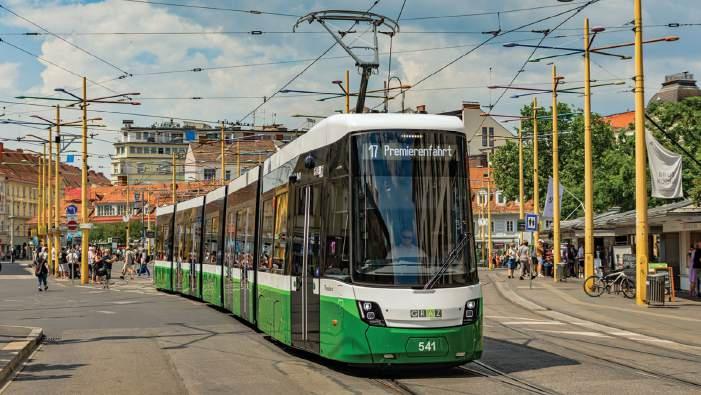
First Alstom Flexity enters Graz; Letbane’s final northern stage set to open; Enabling works start for tram-trains in Cardiff.
CARDIFF: TRAM-TRAIN
288
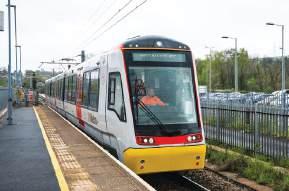
Howard Johnston visits the Welsh city where the South Wales Metro is set to claim a major foothold for tram-train, as the system is inaugurated later this year.
BUENOS AIRES: ALL NEW METRO
292
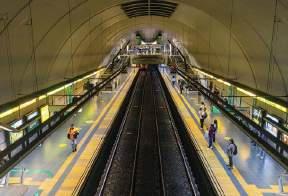
A large investment is being made into Argentina’s historic underground system to bring it up to date for the 21st Century. Richard Foster finds out more.
INTO THE HEART OF BRUSSELS
One of the largest legacy tram networks in Europe is set to grow even further –Andrew Thompson explores the plans.
296
SAFETY FIRST
300
TAUT looks at what safety developments are underway to keep our tramways safe.
LRT, PEOPLE AND PLACES
304
UKTram reports on how the impact of a new tramway goes beyond the line itself.
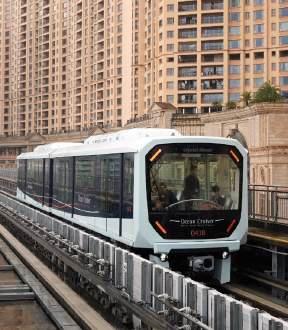
SYSTEMS FACTFILE: MACAU
305
The potential for delivering much higher quality transport for this Chinese city’s residents is huge, as Neil Pulling reports.
WORLDWIDE REVIEW
310
Tenders invited for Barcelona extension EMUs; PESA is preferred bidder for Gdansk.
CLASSIC TRAMS:
WARSZAWA BY NIGHT
Mike Russell enjoys an unusual and effective noctural spectacle.
Is Burnham the UK’s best bet for a breakthrough?

In strange circumstances, the UK incumbent Prime Minister Sir Keir Starmer has been pressured to step down in favour of Manchester regional Mayor Andy Burnham. The significance of this apparently bloodless coup to us is that the crown prince is one of the greatest advocates of light rail. He has championed the 103km (64-mile), 99-stop Metrolink network that underpins the local economy, and is closely integrated with buses and suburban heavy rail services.
The question now is whether, with the sudden demand to step up the national defence budget to counter the uncertainty of the Russia-Ukraine war and now the unresolved USA-Iran conflict, Burnham will have any spare money to replicate his good works across the rest of the UK.
Another person who should be able to move things forward faster is Rail (and Light Rail) Minister Lord Peter Hendy, who confirmed his commitment to change at the 20th Annual Light Rail Conference in Nottingham on 1 July. The hope is that the new Mass Transit Task Force that he has created will not just be a talking shop but decisively influence regional authorities who have been promised more autonomy and freedom and shake off the dead hand of government disinterest and time-wasting. Hendy expects some answers “in around six months”, but how will Burnham respond?
We are now into the second half of 2026, and our eyes turn to the Global Light Rail Awards which take place in London on 7 October, honouring innovation and excellence on a big scale. The event’s success has prompted a move again to an even larger venue, this time the magnificent Battersea Arts Centre. Time is running out for entries, so have you got yours in yet?
Matt Johnston, Editor
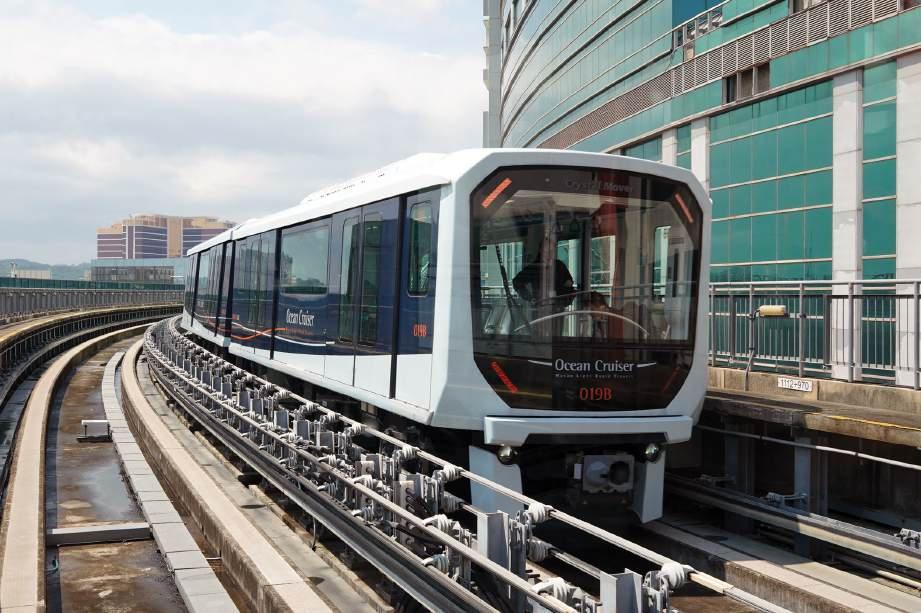
COVER: Macau LRT ‘Ocean Cruiser’ 019 approaching Airport station on the Taipa Line on 30 March 2026. Neil Pulling
314

AUGUST 2026 Vol. 89 No. 1064 www.tautonline.com
EDITORIAL
EDITOR – Matt Johnston hello@mainspring.co.uk
ASSOCIATE EDITOR – Tony Streeter tony.streeter@mainspring.co.uk
WORLDWIDE EDITOR – Michael Taplin miketap@mainspring.co.uk
SENIOR CONTRIBUTORS –Howard Johnston , Neil Pulling
WORLDWIDE CONTRIBUTORS
Richard Foster, Andrew Grahl, Andrew Moglestue, Herbert Pence, Mike Russell, Nikolai Semyonov, Alain Senut, Andrew Thompson, Witold Urbanowicz, Bill Vigrass, Thomas Wagner, Philip Webb.
PRODUCTION – Lanna Blyth Tel: +44 (0)1733 367604 production@mainspring.co.uk
DESIGN – Debbie Nolan
ADVERTISING
COMMERCIAL MANAGER – Geoff Butler Tel: +44 (0)1733 367610 geoff@mainspring.co.uk
Tramways & Urban Transit
13 Orton Enterprise Centre, Bakewell Road, Peterborough PE2 6XU, UK
Tramways & Urban Transit is published by Mainspring on behalf of the LRTA on the third Friday of each month preceding the cover date.
LRTA MEMBERSHIP (with TAUT subscription) Tramways & Urban Transit is sent free to all paid-up members of the Light Rail Transit Association.
LRTA WEBSITE AND DIARY Tim Kendell webmaster@lrta.org meetings@lrta.org
SUBSCRIPTIONS, MEMBERSHIP AND BACK ISSUES LRTA Membership Secretary (Dept T06), 38 Wolseley Road, Sale M33 7AU, UK. Tel: +44 (0)117 951 7785 membership@lrta.org Website: www.lrta.org FOR CORPORATE SUBSCRIPTIONS VISIT www.mainspring.co.uk
LRTA REGISTERED OFFICE 13 Orton Enterprise Centre, Bakewell Road, Peterborough PE2 6XU, UK Private company limited by guarantee, No. 5072319 in England and Wales.
LRTA CHAIRMAN – Paul Rowen chair@lrta.org
© LRTA 2026
Articles are submitted on the understanding they may also be used on our websites or in other media. A contribution is accepted on the basis that its author is responsible for the opinions expressed in it, and such opinions are not those of the LRTA or Mainspring. All rights reserved. No part of this magazine may be reproduced or transmitted in any form by any means, electronic or mechanical, including photocopying, recording or by any information storage and retrieval system, without prior permission in writing from the copyright owner. Multiple copying of the contents of the magazine without prior written approval is not permitted.
The Manson Group Limited, St Albans, Herts AL3 6PZ
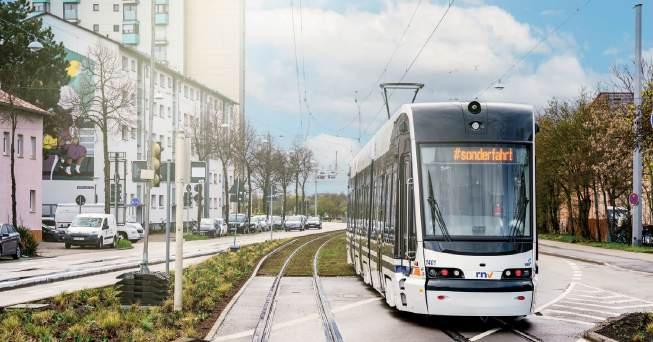
Graz’s first Alstom Flexity entered service on 27 May and, less than a month later, the Austrian city approved the purchase of an additional 24. The first tram to take to the rails has been named Theodora after Theodora Acham who, in 1988, joined Inge Steiner in becoming Graz’s first female tram drivers.
An initial EUR114m purchase and maintenance contract for 15 trams was signed in January 2024, with an option for a further 16 subsequently being exercised. The most recent option was approved on 18 June. All the vehicles should be in service by mid-2028.
Delivery of the first batch started in October 2025, followed by commissioning, training and 1880km (1168 miles) of test running. A further eight Flexity vehicles had arrived by the end of May. These are to replace the remaining ten 500-series high-floor trams and
12 600-series trams, which only have a low-floor centre section.
Gert Heigl, CEO of Holding Graz, said: “The number of public transport users, which has been rising for years, will continue to increase in Graz. The consequence of this development is that public transport and a
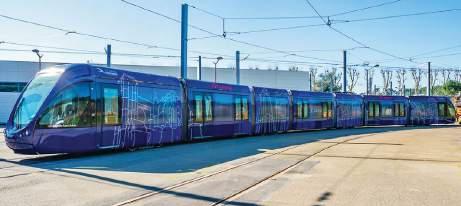
Le Mans’ first 44m Alstom Citadis entered service on 10 June, in time to cater for crowds attending the famous 24-hour motor race. Tram 1006, in a new midnight blue livery to differentiate it from the orange 32m trams, carried motor racing enthusiasts over the period 10-14 June.
Extending the 32m trams to 44m increases their passengercarrying capacity from 211 to 296. Operator SETRAM has, so far, extended 22 out of its 35 stops to cope with the longer vehicles.
Alstom modified 1006, which
also included modernising onboard technical systems such as video surveillance, at its factory in La Rochelle. The remaining 33 trams are to be extended at SETRAM’s workshops by Alstom technicians. Signed in 2024, the EUR57m contract is to be completed by the end of 2027.
Le Mans’ 18.8km (11.7-mile) second-generation tramway opened in November 2007. A first-generation equivalent operated in the French city from 1897 until 1947; the first 24 Hours of Le Mans race took place in 1923.
modern mobility service must be further expanded.
“Grazer Linien currently has 85 trams in its fleet. During the morning rush hour, 66 of these are in operation. With the 31 additional trams being delivered over time, the public transport service on Graz’s trams will be
increased by 30% in terms of passenger capacity.”
These new single-ended Flexity trams are 33.8m long with five-sections. They are air-conditioned, can carry 200 passengers and are 100% lowfloor, with a 215mm floor height at the doors.
Politicians and the general public will have been able to review routes for three very different UK light railway systems during 2026.
Consultation on London’s Docklands Light Railway’s Thamesmead extension opened on 8 June.
Detailed plans were available for scrutiny for the proposed 3km (1.9-mile) line, which is expected to cost GBP1.62bn (EUR1.9bn) to build. Transport for London said that public feedback “will help shape the final scheme ahead of a planned Transport and Works Act Order (TWAO) application in early 2027”.
Consultation is due to close on 19 July.
The new line is to diverge from the Gallions Reach – Beckton line before curving to pass under the River Thames in a 1.5km (0.9-mile) tunnel to reach Thamesmead, on the border of the Royal Borough of Greenwich and the London Borough of Bexley. Work could start in 2029.
Public consultation is also to take place this summer on the final route of Tyne & Wear
Metro’s ‘Metro to Washington’ project. Although dates for the consultation sessions have yet to be announced, the public will be able to give feedback on the location of the 13km (eightmile) line’s three intermediate stations: Follingsby, Washington North and Washington South.
‘Metro to Washington’ involves reopening disused railways from Pelaw, via Washington, to make a connection with the Green Line terminus at South Hylton. The line could open in 2033.
Councillors in Edinburgh are set to make a decision on the future of the north-south tramway extension by the end of the year.
Public consultation on the proposed route, which links Grantown to the north with the proposed Bioquarter to the south of the city, resulted in a 68% negative response to proposals to turn the Roseburn Path active travel route into a tramway.
Officers are currently preparing a detailed report for the councillors, including detailed costings.
This year’s ‘Gladsaxe Day’ municipal festivities will coincide with the opening of the northern section of the København (Copenhagen) Letbane. Gladsaxe is just one of the 17 stops on the new Danish line that will boast live music and other attractions on 22 August to welcome the new 1435mm-gauge route.
Opening the line from Rødovre Nord to Lundtofte via Gladsaxe and Lyngby completes the DKK9.6bn (EUR1.3bn)
project. From its terminus at Ishøj to Lundtofte, the whole Letbane covers 28km (17 miles).
An initial section (Ishøj –Rødovre Nord) opened on 26 October last year and had carried a million passengers by 19 May. Opening of the extension is expected to help bring the total number of passengers for 2026 to 2.4m. Forecasts show that 38 000 passengers could be using Letbane every day by 2030.
Letbane is owned by the Capital Region of Denmark
Appointment of a new transport minister for West Bengal on 11 June could offer Kolkata’s (Calcutta’s) tram system a brighter future. Arjun Singh said the state government is considering introducing new, higher-speed trams to the city, although it has yet to be decided which parts of the system would be rejuvenated. At its peak, Kolkata’s tram system comprised 56km (35 miles) of track but, from 2024, just the 5km (3.1-mile) Line 5 and the 9km (5.6-mile) Line 25 remained operational.
Minister Singh said: “Various aspects are being examined, and plans are being considered to introduce faster trams using modern technology”.
Dr Debasish Bhattacharyya of the Calcutta Tram Users Association said: “People are talking about trams not just as heritage, but as a sustainable and economical mode of transport.”
and the 11 municipalities it serves. The orbital line provides interchange with the S-Tog commuter rail system at six locations. Its fleet comprises 29 36.9m low-floor Avenio LRVs built at Siemens’ factory in Kragujevac, Serbia.
Jakob Thomasen, Chairman of Capital Region Light Rail’s Board, said: “The test runs on the northern part of the route have so far gone well and safely, so we can now set an expected date for the opening.”
He added that 22 August “will be a big day for everyone who will use the Light Rail, and an important milestone for the entire capital region. We look forward to welcoming passengers on the full route.
“With the opening of the entire Letbane, passengers can travel directly through eight municipalities and transfer to the S-tog… as well as to regional trains and buses along the way. This creates faster, more direct connections across the region, bypassing Copenhagen’s central hubs.”
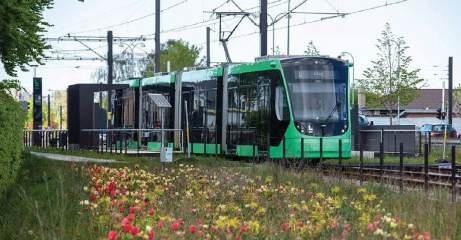
Škoda-Transtech is the preferred bidder to supply Uppsala with 20 new trams. The Swedish city is building a 17km (11-mile) two-line tramway and the new vehicles are due to arrive in 2028, ready for it to open in 2029. The news broke on 16 June but there followed a ten-day appeal period
The trams are expected to be 30m ForCity Smart Artics, although they could be extended to 40m. There is an option for 18.
AB Transitio, the agency owned by the Swedish regions, is buying the vehicles and will then lease the fleet to Uppsala region. The final bid price has yet to be announced; the contract is set to include maintenance.
Uppsala had a first-generation tramway system from 1906-53. The new version was approved in conditional form in December 2021 and is expected to cost SEK12bn (EUR1bn).
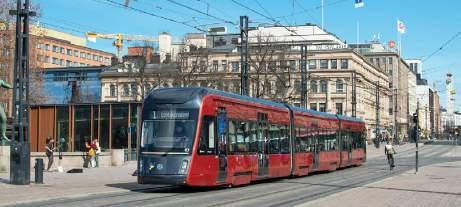
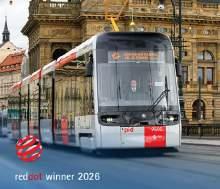
Škoda Group has won a Red Dot Award for its ForCity Plus 52T tram developed for the Czech capital Praha (Prague).
Established in the 1950s, the Red Dot Awards are divided into three categories: Product Design, Brands & Communication Design and Design Concept. The 52T picked up the Product Design award because the international panel of judges, said Skoda, “highlighted the vehicle’s passenger comfort for people with different needs, as well as its ability to blend well into the urban environment”.
Presentation of the award will take place at the Red Dot Design Museum in the German city of Essen on 7 July.
The 52T was designed specifically for Praha’s demanding tramway network, with its narrow streets and tight curves, steep gradients and busy urban routes.
Thomás Chludit, Škoda Group’s Head of Industrial Design, said: “Receiving the Red Dot Award is an exceptionally strong confirmation for us that the design of the 52T tram can stand out in the most demanding international competition. This award therefore belongs to the entire team involved in the tram’s development.”
Portland cut back Portland’s MAX Green Line looks set to only operate over the 10.4km (6.5-mile) section between Gateway and Clackamas Town Center from 23 August. The State Legislature last September approved an increase in the ‘payroll tax’, which is operator TriMet’s largest source of operational funding (TAUT 1056). However, a public referendum on 19 May resulted in an 83% vote against the increase and TriMet’s board voted on 27 May to curtail the Green line to the branch line only, reducing the frequency on the common section though the Transit mall.
Dudley delays
The first trams started test running to Dudley (UK) on 24 June. However, problems with commissioning the signalling system have meant that West Midlands Metro’s 9.7km (six-mile) extension will not open on 28 August as planned. Originally due to open in 2024 the extension has, said Transport for West Midlands, proved to be complex as it has involved “repairing Victorian infrastructure, navigating unpredictable ground conditions, and working in a busy town centre”.
TfWM has not released a revised opening date.
Santa Teresa opening
The 2.9km (1.8-mile) section of Rio de Janeiro’s Santa Teresa Tramway between Dois Irmãos and Silvestre reopened on 11 June. The Brazilian line was last used in 2006 and closed in 2008.
It is currently in what is described as an initial ‘testing’ phase and is only served by four trips per day from Carioca station; a more extensive timetable was expected to start in July.
Contrary to previous reports, the connection with the Corcovado Rack Railway has not been restored. Its station at Silvestre, which closed in 1966, has yet to reopen.
• The Santa Teresa Tramway’s 800m Rua Francisco Muratóri branch is believed to be served by one trip a day, which departs Carioca at 08.30.
Moscow automation expanded
More automated trams have taken to the streets of Moskva (Moscow) in Russia. A further three 71-911EM bogie trams are now operating at Grade of Automation 3, so there is no driver but an attendant is on board. The first GoA3 tram entered service last September. Digitisation of five routes (15, 23, 27, 30 and 31) has taken place to permit the use of the automated trams’; radio signals from traffic lights tell the tram if it’s safe to proceed.
Roman Latypov, from the Russian capital’s Department of Transportation, said: “The AI-supported system thus knows when the green or the red light will turn on. That ensures a smoother run in comparison with driver-operated trams.”
Operation of the first tram without a human attendant on board (Grade of Automation 4) is expected to take place in 2027.
Mr Latypov added: “By 2030, two thirds of the fleet will migrate to the highest grade of automation, which means 350 trams will be unmanned. We are vigorously working on the modernisation of the infrastructure, creating highresolution maps and fine-tuning the tram.”
Škoda demonstrated its autonomous Smart Depot system at tramway operator
Rhein-Neckar-Verkehr’s depot in Mannheim (Germany) on 27 May. Škoda tram 1422 was used to demonstrate how depot operations could be operated with reduced manual intervention, while improving safety and efficiency.
RNV, which serves the German cities of Mannheim, Ludwigshafen and Heidelberg, hosted the ‘Autonomy Day’ which showed how Smart Depot integrates several individual systems into a coordinated operational system that covers automated parking, controlled vehicle guidance, obstacle avoidance and automated passage through washing facilities. All vehicle movements
Škoda tram 1422, under autonomous control, enters the washer at Mannheim depot. Škoda
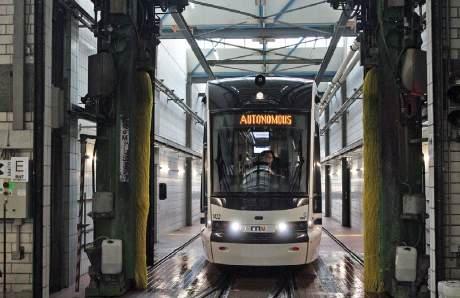
are monitored from a central control room.
It also demonstrated AIpowered visual inspection technology that allows predictive maintenance as well as self-surveillance, which is used to improve passenger safety and comfort by warning drivers and dispatchers of emerging risks. The system made its debut at Tampereen Ratikka’s depot in Tampere, Finland, in 2025
(TAUT 1054). Škoda also used the Mannheim event to show off its anti-collision system and Intelligent Speed Limiter.
Jiri Liberda, Škoda Group’s Managing Director Digital, said: “Mannheim represents an ideal environment for presenting modern technologies for urban mobility. Strategic cooperation with a partner such as RNV allows us to test and deploy our technologies in real operation.”
Testing has begun on Maryland’s 25.6km (16-mile) Purple Line after the final rails were laid in May. CAF-built low-floor LRVs have been running outside the US route’s Operations & Maintenance facility along Veterans Parkway in Glenridge.
The 21-stop orbital line links the Maryland suburbs of Bethesda and New Carrollton, just north of Washington DC. It will provide an interchange with Washington Metro’s Red, Green and Orange lines.
The Federal Transit Administration approved the project in 2014 and, in 2016, a Fluor Enterprises-led consortium won the USD5.6bn (EUR4.9bn) Public-Private Partnership
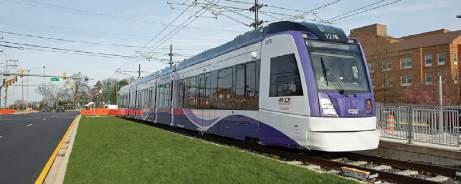
contract to design, build, operate and maintain the line.
In September 2020, the consortium withdrew from the contract and a new contract was not signed until April 2022.
At the time of writing, Dragados/ OHL, trading as Maryland
Transit Solutions, had completed the line’s basic infrastructure and 90% of the construction work.
CAF’s assembly plant at Elmira, New York state, delivered the last of the 28 43.3m LRVs in November 2025.
Construction of Helsinki’s West Tram line has started. The final route for the 10km (6.2-mile) line was approved on 26 May and Destia (the Finnish subsidiary of
Colas) and its alliance partners began enabling works shortly afterwards.
What will become line 14 is to link the north-west district
of Kannelmäki to the Finnish capital’s existing network near Munkkiniemi. There will also be an intersection with the Jokëri orbital light rail at Vihdintie.
Enabling works on Phase 1a of Cardiff Crossrail (UK) started on 15 June, just as Transport for Wales was preparing to introduce the first of 36 new tram-trains into service. Contractor GRAHAM started work in Callaghan Square, through which the new tramway passes on its way from a terminus outside Cardiff Central station to a junction with the heavy rail line to Cardiff Bay station. The new line’s total length is 800m. Phase 1a, including new platforms at Cardiff Bay station, is to cost GBP100m (EUR115.5m).
Siemens Mobility has won the contract to install signalling infrastructure. Dan Tipper, TfW’s Chief Infrastructure Officer, said: “Siemens Mobility has already been a big part of transforming the Core Valley Lines, so we’re pleased to continue working together as we bring better, greener and more reliable transport to communities across Cardiff and beyond.”
Meanwhile, crew training on the 36 Class 398 tram-trains is underway. However, before these Stadler-built vehicles enter service, TfW is ensuring that passengers have access to toilet
facilities at stations. Unlike the Class 150 DMUs they replace, the new vehicles have none on board.
To ensure that no passenger is more than 20 minutes away from a toilet, new facilities are being installed at nine South Wales Metro stations; those on the initial Cardiff – Pontypridd service will be upgraded. The new facilities are complemented by new CCTV and lighting.
Class 398s are set to enter service on the Cardiff –Pontypridd line during the summer, with a 15-minute frequency.
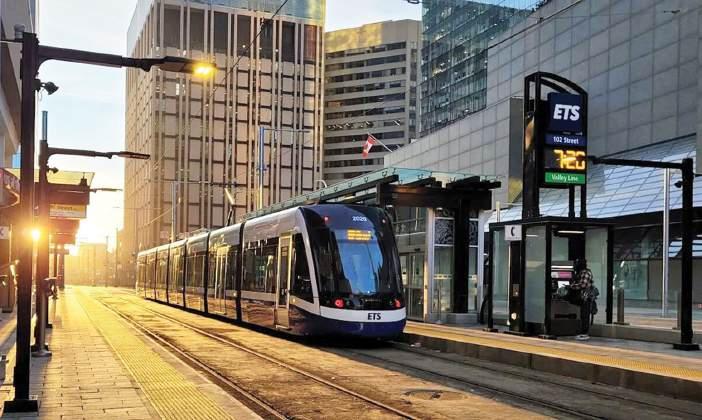
The Canadian city of Edmonton is to terminate its 30-year operating contract for Valley Line light rail with TransEd Partners in 2028.
Operations for the whole 27km (17-mile) line will transfer to the directly-operated Edmonton Transit Services (ETS) when the CAD2.7bn (EUR1.7bn), 13.9km (8.6-mile) western section from Downtown to Lewis Farms opens in two years.
Alberta’s capital city awarded the Bechtel/Alstom/Arup/
Fengate consortium a 30-year CAD1.8bn (EUR1.1bn) design, build, operate and maintain Public-Private Partnership contract for the 13.1km (eightmile) south-east segment in 2016. This line (Downtown to Mills Woods) opened in November 2023.
City Manager Eddie Robar said that the approach is costeffective and offers the best value and most certainty to taxpayers. The city will make an undisclosed termination
Construction of the 3.9km (2.4-mile) Finglas extension to Dublin’s Luas system could start in 2028 rather than what Ireland’s Minister for Transport Darragh O’Brien called “sitting in the middle of the 2030s”.
The design and build contract for the new line, which is to head north from the current Green Line terminus at Broombridge, could be let in 2027. A Railway Order – effectively planning permission – was given in October 2025 (TAUT 1057).
Building the line, which is to serve a suburb of 58 000 homes, could cost in the region of EUR600m. It is not yet known when the line will open.
Meanwhile, ground-breaking on Dublin’s MetroLink scheme could start in 2027. Minister O’Brien told the Sunday Independent that construction could then start in 2028.
The minister said that the 18.8km (12-mile) underground metro could be built in stages. The first phase could be “north of Swords into Dublin city centre”, with a second phase being the southern section from the city to the suburb of Charlemont. The cost is expected to exceed the EUR9.5bn projected in 2021.
payment to TransEd Partners.
ETS already operates the city’s Capital and Valley Lines. The former opened in 1978 and was North America’s first modern light rail system. Its Siemens high-floor LRVs were based on those in Germany’s Frankfurtam-Main. The high-floor Metro Line followed in 2015.
The separate Valley Line again followed European trends; this time it adopted low-floor operation, using 26 Bombardier Flexity Freedom LRVs.
The UK’s Office of Rail & Road gave Blackpool Transport an Improvement Notice on 6 May. Issued by HM Railway Inspector Lindsey Pike, the notice said the operator of Blackpool Trams “failed to take so far as is reasonably practicable appropriate measures to control and mitigate known risks associated with bogie degradation which could give rise to derailment or collision”. The regulator initially gave Blackpool Transport until 19 June to remedy the situation, subsequently extending the deadline to 13 August.
A Blackpool Trams spokesperson told TAUT that it was how bogie inspections and maintenance on its 18 Flexity 2 trams was being documented –“the paper trail” – that led to the Improvement Notice rather than any physical problem with the bogies themselves.
The spokesperson added: “Safety is always our number one priority.”
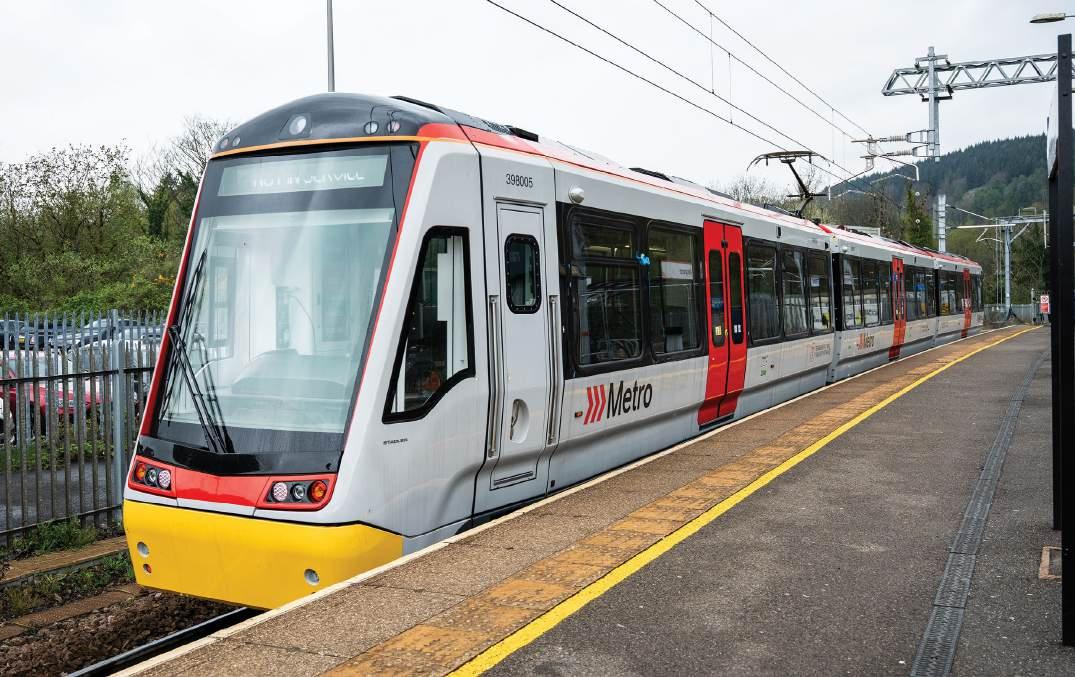
ABOVE: The narrow-bodied appearance of the ‘398’ makes it distinctive. All images courtesy of TfW unless otherwise stated.
There’s so much potential in this vast UK urban transit project, but will there ever be the money to fully realise it? Howard Johnston visits the Welsh capital of Cardiff.
The tram-train concept has been a slow mover in the UK, but this year should see it gain its first major foothold when the 240km (150-mile) South Wales Metro is fully inaugurated.
It is now 14 years since former Transport Minister Norman Baker announced the go-ahead for tram-trains as an adjunct to the South Yorkshire Supertram 320km (200 miles miles) away in the Sheffield area, and only five train sets were built, with no more in short-term prospect.
Cardiff, the Welsh capital, is at the southern end of a large metropolitan area with a population of around 1.5 million, and the local economy is still recovering from a century of the natural decline (and now total loss) of its traditional coal mining industry. Before World War One, it enjoyed prosperous worldwide exports of this once valuable commodity through Cardiff and the nearby Barry docks, as well as locally produced steel. Today, there is a heavy reliance instead on commerce, technology, light industry and tourism.
The geography of South Wales has to be clearly understood. North from the coast, it
features a series of townships situated in long, parallel and deep valleys that cannot be connected by public transport without heavy engineering such as tunnelling, which has never been realistic. A part-solution in the past was the building of large numbers of high bridges and viaducts, but most of
“In all ways, the new Stadler rolling stock is a quantum leap from the current Class 150 diesel fleet.”
these have disappeared through general disuse, poor construction, and age-related general decay. This means that communities that are relatively close together distancewise are only properly connected with journeys southwards to junctions situated where the hills peter out on the northern outskirts of Cardiff, and then returning north again.
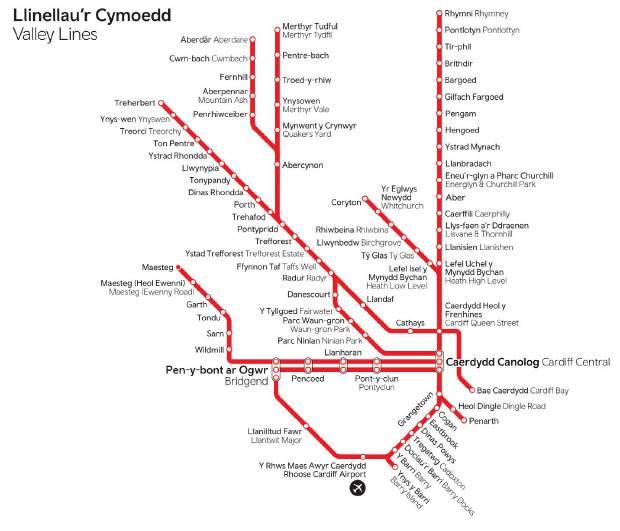
Of the rail routes that have survived the mass rationalisation of the last half century, the three selected for tram-train operation are Cardiff Central to Merthyr; to Aberdare; and to Treherbert routes, plus the short spur into Cardiff Bay. The intended 15-minute service, double that at present, is possible because the tram-trains accelerate faster than the elderly diesel units they are replacing, and there are also shorter dwell times at platforms.
The train fleet is all-new Transport for Wales (TfW) has opted for almost total fleet replacement.
The order for 36 tram-trains (designated Class 398 ) was placed with Stadler Rail when the 15-year Wales and Borders rail franchise was awarded to KeolisAmey Wales from 14 October 2018, and the Stadler order was due for delivery by 2023. As has been the case worldwide, this deadline had to be relaxed following the outbreak of the COVID epidemic.
There are other new trains. Stadler also built 11 Class 231 diesel-electric units of the FLIRT family from 2023, which are now all to be retro-fitted as bi-modes. They are currently employed on the Rhymney and
Vale of Glamorgan lines to Bridgend but also stray further afield to Merthyr, Aberdare and Treherbert. They will eventually migrate eastwards to serve Ebbw Vale, and it is suggested that they could even stray over the English border from Cardiff Central to Cheltenham Spa.
More technically complex is the Stadler Class 756, a tri-mode version in three-car versions (a fleet of seven), and four-car versions (17 units). They take power from the 25kV overhead, and are also powered by a diesel generator set, and three lithiumtitanium-oxide batteries.
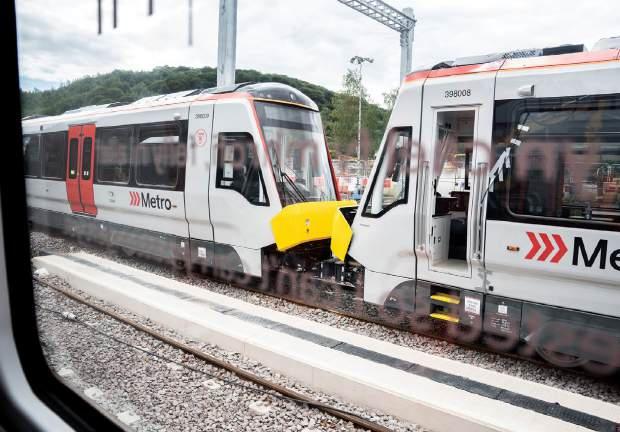
Despite their capability and potential, the 398 s will only operate on conventional heavy rail routes for some time. Assembled at Stadler Rail’s factory at Valencia in Spain, they comprise three articulated cars with 40-metre body lengths, and weigh 73.2 tonnes. Two sets can be coupled together for peak services.
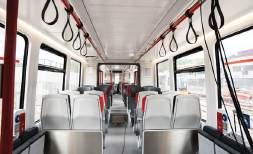
The power system is 25kV overhead, with Li-lon battery power for non-electrified sections. The maximum permitted speed is 100km/h (62mph) on main lines, and 72km/h (45mph) in battery mode. Passenger capacity is 252 (equal numbers seated and standing), with level boarding, and large open areas in the doorways, two wheelchair spaces with fold-down tables, and six areas with priority for bicycles. Controversially, and unlike other trains, there are no onboard toilets, with TfW claiming that the upgraded facilities at many of the stations represent better use of investment. It has promised that passengers will never be more than 20 minutes from any station served by a tram-train.
The first 398 arrived in May 2022 for appraisal and testing at the Rail Innovation & Development Centre in Leicestershire, and deliveries to the purpose-built GBP100m (EUR 120m) Walnut Tree stabling and maintenance facility at Taffs Well north of Cardiff commenced ten months later.
In all ways, all the new Stadler rolling stock is a quantum leap from the current Class 150 diesel fleet, built by British Rail in 1986/87 as a one type-fits-all solution to its desperate need to replace the first generation of slam-door, high density units dating back to the end of the 1950s, these trains themselves having superseded steam-hauled services. When investment money was at its scarcest in the mid-1980s, BR also acquired a stop-gap fleet of low-cost Class 143 ‘Pacer’ DMUs, based on a bus design and never intended for a long life. They did however soldier on for over 35 years.
While nowhere near its route mileage of the 1930s, when the key business driver was freight, the TfW network has recovered somewhat with the reopening of three routes, Ebbw Vale – Cardiff/Newport (50km/31 miles), the Vale of Glamorgan (Barry-Bridgend, 31km/19 miles), and Bridgend-Maesteg (13km/nine miles).
Operational costs have been reduced in a number of ways. There are long singletrack sections with passing loops in some stations, electric signalling is run from the Taffs Well control centre and, importantly, discontinuous sections of electric masts
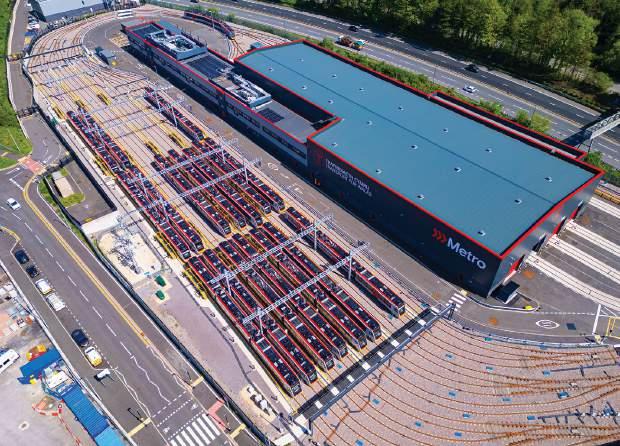
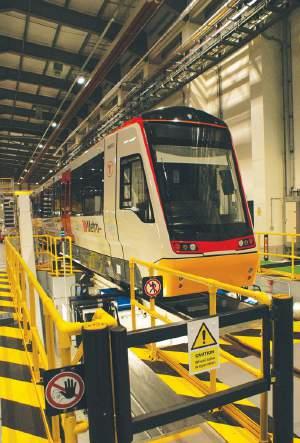
ABOVE: Getting ready to go: Brand new Class 398 tram-trains await commissioning at the purpose-built depot at Taffs Well.
BELOW: Two tram-trains can work in multiple at peak times.
“Change is urgently needed to alleviate overcrowding and congestion, improve capacity on event days and provide for long-term growth.”
The Class 398 rollout has taken much longer than expected, but TfW has not been prepared to simply throw them straight into squadron service. This decision is straightforwardly based on the desire to only commence operation when the 36 sets are fully reliability-proven.
The entire fleet has been parked up at Taffs Well depot, but several units have been seen out and about in quiet hours, running up the mandatory 8000km (5000 miles) of fault-free running, a rule that will be relaxed for classmates when their characteristics are better understood. This is
familiar practice worldwide, ensuring that crews are properly trained, and that there is full technical compatibility with signalling and lineside communications.
When services do finally commence, Taffs Well will make 33 tram-trains available to maintain the regular timetable, with one on standby in case of failure or mishap, and two others undergoing maintenance and routine inspection. The depot has the facility to turn wheelsets on its single-axle lathe, and there are also five sets of power and trailer bogies to ensure a rapid return to service.
Exploring the full potential of South Wales’ tramtrains seems to be dependent on the support from UK central government in Westminster, London, which has the power to approve further investment, and is notorious for its slow decisionmaking and habit of diverting allocated funds to other regions. Despite having autonomy on many issues, the Welsh Assembly has been frustrated at not being allowed to approve its own schemes, or even manage its main line train services –although the Devolution Act could change this. Returning to the Class 398 tram-trains, it is intended to develop their role in Cardiff.
Linked to the improvements to the main Cardiff Central station is the complete revamp of the 0.8km (0.5-mile) transport system accessing the Cardiff Bay investment area from Cardiff Queen Street station slightly to the north west. Cardiff Bay station will soon have a second platform (and there will be an intermediate station at Bute Town), and while this is the current limit of intended electrification, battery power can be employed if permission is granted to push the line further south to Pierhead.
Crossrail 1 will deliver a new two-platform station stop located in the southern car park of
Cardiff Central station, a new tramway through Callaghan Square to join the Cardiff Bay line, and a third platform at Cardiff Bay.
In the west of the city, traffic surveys show great potential to at least double service frequencies on the City Line from Cardiff Central to Danes Court and Radyr, past the new Cardiff City football stadium near Ninian Park to every 15 minutes; the the current limited platform capacity at Ninian Park is a headache on match days. Radyr could also find itself on a new circular line if the current short branch terminating at Coryton becomes a through route.
Further into the future, there is widespread scope to create greater capacity by route widening, more new stations around Cardiff, and additional platforms on existing lines.
Will we ever see the dream fulfilled of a 3km (two-mile) cross-valley link-up between the Rhymney and Merthyr Tydfil routes between Quakers Yard and Trelewis, and the return of passenger services from Caerphilly to Machen, and from Aberdare to Hirwaun? The potential in Newport (the third largest metropolitan area in Wales) should also not be overlooked, particularly for tram-train operation.
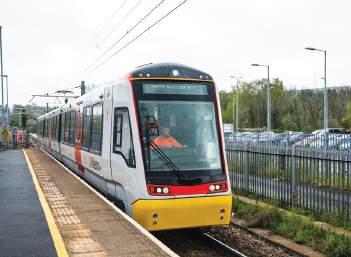
LEFT: Tram-trains have to run up large fault-free mileages before they are accepted for revenue traffic.
and wires which have avoided the cost of expensive infrastructure changes, having to replace fixed structures such as like overbridges to raise clearances. These gaps are no problem because bi-mode train sets can be easily switched from electric to battery power.
Passengers are enjoying a huge improvement in the quality of facilities at South Wales Metro stations, most of which feature new or improved buildings, resurfaced platforms, access-for-all passenger lifts, better footbridges, real time information screens, and also level boarding for all new trains.
Aberdare station, the terminus for one of the lines along the valleys, gained a second platform in May 2025. However, site restrictions meant it had to be positioned 150m south of the existing station, and is therefore only served by arrivals to a leisure centre and school.
In the pipeline is a major reconstruction of the principal Cardiff Central interchange station, which has an annual footfall of 12.5 million. Change is urgently needed to alleviate overcrowding and congestion, improve capacity on event days and provide for long-term passenger growth.
Everything comes at a price of course, but strong cross-party political consensus seems to so far have prevented any significant cutbacks to the South Wales Metro investment programme despite the project cost doubling to around GBP1.3bn (EUR1.5bn) since its inception.
Where and whether further investment will happen is open to question, and the state of the national economy is the biggest deciding factor. There is tremendous potential for the Class 398 tram-trains if street running is adopted, first through selected corridors in Cardiff, and then in other major conurbations such as Newport and large townships in the Welsh valleys.
Established
Published
Comprehensive
Available
Read
Transit






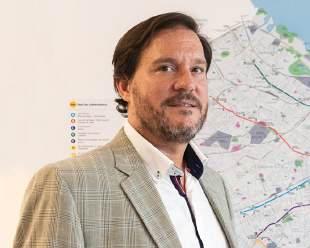
President
What role does the metro play in the life of Buenos Aires? How important is it?
To speak of the Buenos Aires Metro is to speak of the city’s identity. With 113 years of history, it is not simply a network of tunnels; it is the cornerstone of urban mobility. The system has been designed to work in conjunction with other forms of public transport, with the main train stations (Retiro, Constitución, Once and Chacarita) connecting to metro stations, allowing those travelling from Greater Buenos Aires to complete their journey to the city centre by metro. It also links up with buses and Metrobus corridors, as a large proportion of users rely on more than one mode of transport.
How does the structure between the various parties’ work?
The structure of the Buenos Aires Metro operates under a public-private partnership model, whereby the City Government oversees and plans, whilst a private company operates the service under a concession. Subterráneos de Buenos Aires forms part of the Ministry of Mobility and Infrastructure of the City of Buenos Aires, and we are responsible for the administration of the metro network, as well as the development, expansion and oversight of the service’s operations.
EMOVA is the concessionaire for the Subway and Premetro, and is responsible for operating and maintaining the subway network. Its contract is valid for a period of 12 years, starting 1 December 2021.
In addition to Line F, we are implementing a major modernisation plan which, for this year, represents an investment of USD168.3m (EUR145.4m) and has five main pillars:
• The modernisation of Line B, which carries the highest number of passengers and runs beneath Corrientes Avenue, one of the city’s main thoroughfares.
• We are making the most significant investment in rolling stock in the last ten years, with the purchase of 224 carriages for three lines.
• The refurbishment of stations.
• The modernisation of the infrastructure in general.
SBASE is a pioneer in Latin America in the construction and operation of underground networks, and we have a team of professionals working to provide an excellent and sustainable service in the long term. Our aim is to increase the number of metro users to reduce surface traffic, improving mobility in the city and reducing the impact on the environment.
What are the challenges involved in operating a historic system?
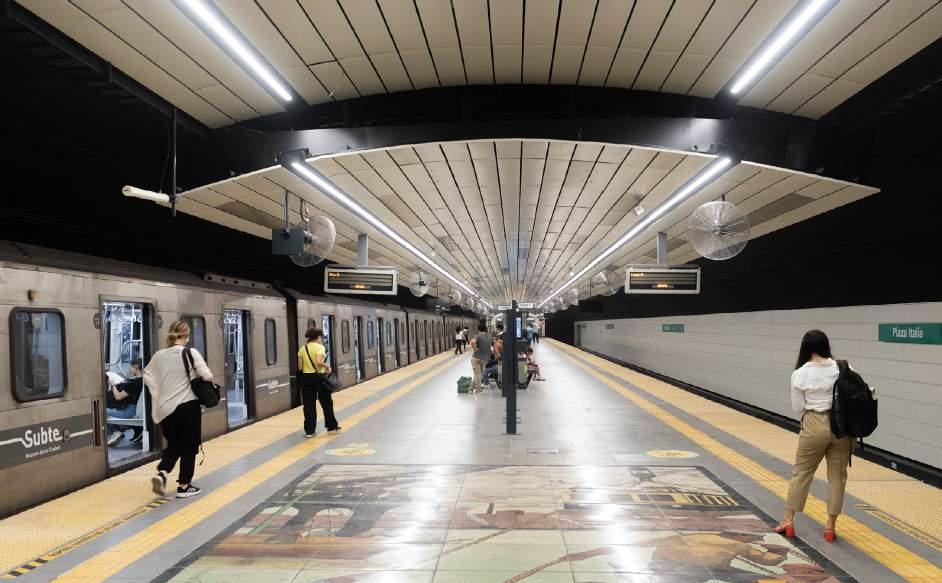
Our biggest challenge is the infrastructure, in terms of maintenance, and the modernisation of the rolling stock, specifically on Lines B and E, where not all trains are airconditioned. The purchase of new carriages will improve both lines. As for the infrastructure, we have drawn up an action plan to renovate 48 stations that opened before 1940. We have completed work on 20 of them, and tenders for a further eight are due to be launched within 30 days. We will be carrying out very thorough waterproofing work, segmenting areas and identifying causes, and selecting different materials and solutions on a case-by-case basis. We are also installing Aluzinc metal cladding, doing painting work, refurbishing floors, installing new LED lighting and new furniture, and restoring murals and works of art.
Thirty stations have been designated as National Historic Monuments, and we are carrying out meticulous work on these in collaboration with heritage specialists. We hope to complete the current term of office [2023–2027] with the restoration work finished at all 48 stations considered to be over a century old.
What are the current priorities for the development of the system, and what major projects are planned?
• Technological modernisation.
What is the current status of Line F?
The City of Buenos Aires is putting a new metro line out to tender, and bids from interested companies are due to be opened in July.
How will Line F change the network?
It is estimated that it will benefit approximately 300 000 people and will play a key role in the connectivity and intermodality of travel within the city. It will connect with all metro lines and with the Roca Railway, which runs from the south, and will help relieve congestion on Line C, as it will also pass through Constitución, one of the main rail interchange hubs.
Are there plans to further expand the system?
The city’s transport system is currently being strengthened by the arrival of the TramBus, a 100% electric, silent and eco-friendly form of public transport that complements the underground network at surface level. The TramBus runs on tyres and does not require rail infrastructure, which allows for greater flexibility in its route. Our priority is to offer different modes of transport that enable real connectivity. The first line, T1, will connect the city from south to north, reaching Jorge Newbery Airport. It will have dedicated lanes and smart traffic lights, which will give it priority of way.
What lessons can other systems learn from Buenos Aires? You cannot undertake transformative projects unless you have your house in order. Sustaining a process of this magnitude requires planning and financial stability. The City of Buenos Aires has for years maintained fiscal balance, low levels of debt and orderly administration, which allows it to undertake large-scale investments such as those required by the Subway and to tap the market for credit.
Another key lesson is that planning is not a snapshot, but a roadmap, and we have learnt this through experience. When the way we work changed, especially after the pandemic, the way we travel changed too. Therefore, our priority is no longer simply to cover more kilometres, but to improve the overall experience: stations that are more comfortable, safer and more modern, and which can connect with other modes of transport.
New trains, network extensions and station renovations are part of a huge investment being made in Argentina’s historic underground system to make it fit for the 21st Century and beyond.
South America’s urban light rail and metro systems are, as we explored in TAUT 1062, perhaps not as well known around the globe as those in Europe or North America. Therefore, it might not be so well known that Argentina’s capital, Buenos Aires, was the first city in South America to boast an underground railway.
Right now, this historic system is in the midst of a massive makeover. In fact, the equivalent of EUR602m is being invested across the city’s public transport network to make it more environmentally friendly. An electrified bus route started operating across the city in May 2025, while testing has also started on Trambus, a new, two-line, 12km (7.5-mile) Bus Rapid Transit system that’s due to open later this year.
Our primary interest is, of course, not on Buenos Aires’ buses, but the investment being made on its roads does highlight how seriously the city takes its commitments to green and sustainable public transport. That’s why it’s also completely rebuilding the city’s tram line (see panel) as well as transforming the Subte (underground) network.
Buenos Aires separated from its surrounding conurbations in 1994 and is officially known as the Autonomous City
of Buenos Aires. It was originally founded in 1580 on the shore of Río de la Plata, the estuary formed by the confluence of the Uruguay River and the Paraná River, that’s easily visible on any map of South America. What is now Argentina declared independence from Spain’s Viceroyalty of the
• Line A: Plaza de Mayo – San Pedrito, 10.8km (6.7 miles), 16 stations. Originally opened: 1913. Carries 145 000 passengers a day.
• Line B: Leandro N. Alem – Juan Manuel de Rosas, 11.8km (7.3 miles), 17 stations. Originally opened: 1930. Carries 182 000 passengers a day.
• Line C: Retiro – Constitución, 4.3km (2.7 miles), nine stations. Originally opened: 1934. Carries 110 000 passengers a day.
• Line D: Catedral – Congreso de Tucumán, 11km (6.8 miles), 16 stations. Originally opened: 1937. Carries 167 000 passengers a day.
• Line E: Retiro – Plaza de los Virreyes, 12km (7.5 miles), 18 stations. Originally opened: 1944. Carries 87 000 passengers a day.
• Line H: Facultad de Derecho – Hospitales, 8.8km (5.5 miles), 12 stations. Originally opened: 2007. Carries: 90 000 passengers a day.
Río de la Plata on 9 July 1816. However, it took until 1880 for the federated state of Argentina to emerge from the subsequent political chaos.
Today, the city’s 200km 2 (77 square miles) is home to three million people. The surrounding Metropolitan region is 2600km 2 (1004 square miles) with a population of 15 million.
Buenos Aires is often praised for its blend of architectural styles, and the multiculturalism that flourishes on its streets is reflected in Subte’s history. Construction of what is now Line A started in September 1911. It was promoted by Anglo-Argentine Tramways Company, a UK/Argentine venture, while the contractor was Philipp Holzmann of Germany, and the stock was built by La Brugeious et Nivelles in Belgium. The trains were designed to run either on the underground or on the tram network (dating from 1863); a ramp provided access between the two systems and also enabled underground trains to reach the aboveground Polvorín workshops. After 1926, tram and underground operated separately. Remarkably, the last of the Belgian-built trains were not retired until 2013!
Subte was nationalised in 1948 and then privatised again in 1994, along with the
Privatisation of Argentina’s railway network curtailed further development of a city-wide surface light rail system. Consequently, PreMetro Line E2 – officially Line P – was the only part of the proposed system to be built. The 50km (31.4-mile) Metrobus network was built instead, leaving this 17-stop orphan, which cost EUR8.7m to build.
The Line P network is 7.4km (4.6 miles) long and connects Subte Line E at Plaza de los Virreyes with the General Savio housing development. There is a short loop at Presidente Illia and a short branch to Centro Cívico. The 12 trams, built by Argentine builder Materfer in the late 1980s/early 1990s, are operated by Emova.
Services on the main line have headways of just over ten minutes with trams every 21 minutes on the branch. A full line journey takes just over 30 minutes.
Consequently, Line P currently generates an average of 5500 fare-paying passengers week. A chunk of the EUR602m investment being made across the city is going towards increasing the number of police officers on board trams to
reduce fare evasion. This is being combined with new pay turnstiles and ticket validator systems.
Currently, Line P makes an operating loss of USD448m (EUR387.2m) per month. To combat this, the city is also trying to make the line’s 17 stations more enticing. It has already rebuilt one stop with new shelters, new platform furniture, easy-to-navigate pavements and platform surfaces and new LED lighting. The remaining 16 stops will be similarly treated.
‘P Loop’ represents the biggest investment in Line P. This EUR388m project involves building a new 850m tramway from General Savio to Centro Cívico. Construction was due to be completed in April.
Described as a “key project for improving the operation and frequency of a service fundamental to mobility in the south of the city”, the new single line on Ave Soldado de la Frontera is to have three new stops: North, Central, South. Frequency will increase to one tram every nine minutes when it opens in December this year.
rest of Argentina’s rail network. It currently comprises six lines (A, B, C, D, E and H) and is operated by Emova Movilidad S.A., a Metrovías and Grupo Roggio joint venture.
We start our survey with Line F, however. Construction of the 10.8km (6.7-mile) line started in 2020 and finishing it is part of the investment in public transport.
The route shadows the coastline, connecting Palermo and Barracas and, says Buenos Aires Subte, “is a key project within the framework of the desired city, due to its unique characteristics within the transport network and the synergy it generates with other modes”.
When it opens in 2031, Line F is expected to attract 307 000 passengers a day. Connections to Lines A, B, C, D, and E, as well as heavy rail and bus services, means that it will improve “strategic and intermodal connectivity”.
There are three main themes to what’s changing on the six existing lines: renovating stations, making accessibility improvements (installing new lifts and replacing escalators) and buying new trains. As well as this, 30 stations have been declared National Historic Monuments and work is being carried out
with specialists to preserve murals, works of art and original features “that form part of the Metro’s cultural identity”.
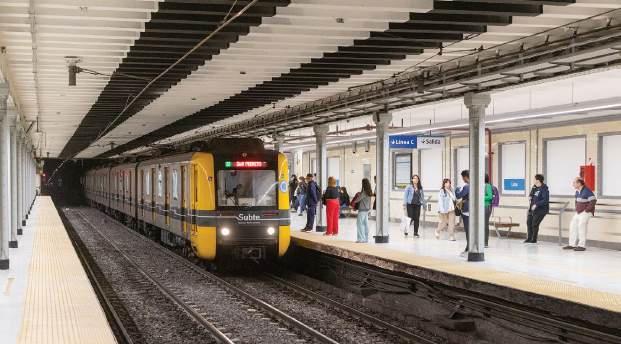
The plans for Lines A and C are quite similar. Stations are being renovated while seven stations (one on Line A and six on Line C) are receiving accessibility improvements. A joint tender has been issued for 50 new cars (to be formed in five ten-car sets). Currently, Line A uses 105 200 Series trains, built by China CNR Corporation, that entered service in 2013 while Line C’s 45 200 Series trains are complemented by 30 trains that were acquired from Nagoya in Japan in 2015.
The new trains, says Subte, will be used to increase frequency on both lines. They are an extension of the previous tender, although China CNR Corporation is now part of CRRC. The first is due to arrive in Argentina in January 2027 and could enter service early that year. All 50 trains are due to be operation by June 2027. Line A is also to gain a new Automatic Train Protection system.
Arguably, it’s Line B that’s gaining the most from the injection of capital. While stations are being renovated (11 are gaining refurbished escalators, which will improve
accessibility for some of these stations), the power supply is being changed from a mix of overhead line and third-rail 500V dc to 1500V dc overhead, the same as the rest of the Subte network. CBTC is also being installed, while CRRC is building 174 new cars. These will replace the Mitsubishi Eidan 500 Series (ex-Tokyo Metro) and CAF 6000 Series (ex-Madrid Metro) trains. Combined with those for Lines A and C, this marks the “largest investment in trains in the last ten years”, totalling EUR309m.
On top of this, Line B’s track is being renewed. It’s getting a redesigned drainage system and upgraded permanent way in order to accept the new trains. Depots are receiving new train-friendly equipment too, such as a bogie drop (Rancagua depot) and high level walkways (Urquiza depot).
Changes to Lines D and E are more modest, the improvements mainly concentrating on renovations and improvements to stations: 13 Line D stations are receiving accessibility improvements (including new lifts), with funding coming from the European Investment Bank, while five of Line E’s stations are receiving improved escalators. The EIB is also funding changes to Line D’s Congreso de Tucumán depot “in order to reduce congestion on the main roads and improve the reliability of the service”.
Line H is Subte’s newest line and, as such, station improvements are limited to just Venezuela station. It’s always been isolated from the rest of the system but this is being rectified with new connections, close to Humberto I station. Although passengers can make an interchange with Line E, trains will be able to do so once the new 210m connecting tunnel opens in the not-toodistant future.
Subte describes itself as an “emblem” of Buenos Aires. History, it says, gives the network “identity and heritage value but also poses enormous challenges: maintaining and modernising a century-old infrastructure so that it can meet today’s demands”.
Buenos Aires was once known as having the highest tramway-to-population ratio in the world. Horse trams started running in 1863, with electric tram services commencing in 1897. At its peak, the Argentine capital boasted an 875km (544-mile) long network.
However, the city bade farewell to its last trams in 1963. Asociación Amigos del Tranvía was formed in 1980 to preserve the memory of the system, and it now operates a 2km (1.24-mile) loop around the suburb of Caballito from the former tram depot at Polvorín workshop, which also still services Subte Line A stock. The operational fleet includes former Porto trams modified to represent old Buenos Aires vehicles, ex-Bruxelles/Brussel (Brussels) 9069 and cars 2 and 3, built by United Electric Co. of Preston, UK, in 1912.
Also worthy of note are the 125 cars built for Subte Line A by La Brugeoise that were delivered in 1911 and 1919. Some were rebuilt with new bodies in the late 1980s but these cars were still in regular service until 2013. A preservation order has been put on the survivors, while some have been restored for use on heritage services.
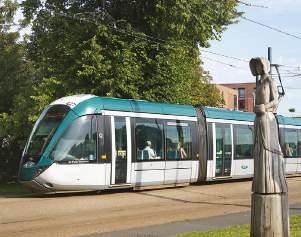
TAUT rounds up two days of innovation, technology and networking that helped to shape this year ’s 20-year milestone event in Nottingham.
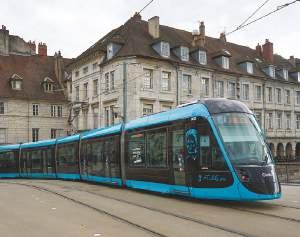
The small French tramway has taken delivery of longer Alstom Citadis LRVs, allowing it to increase passenger capacity and build on its growing popularity.
+ Urban regeneration: A look at the pros and cons
+ Classics: 150 years celebrated in Bremen
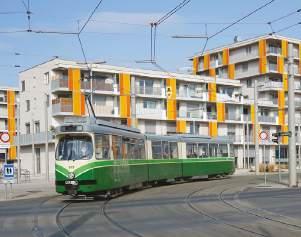
In late 2025, Graz opened its latest tram extension, a vital second cross-city link. Andrew Thompson reports from Austria's second-largest city.
+ The latest news and analysis, system and technical development

Andrew Thompson visits Brussels’ sprawling tram network, which has a number of projects underway to make it grow even further.
With one of the largest legacy tram networks in Europe, Brussels boasts a constantly evolving light rail system that includes trams and also makes use of pre-metro infrastructure. Additionally, there are the four ‘proper’ metro lines 1, 2, 5 and 6, with the east-west routes 1 and 5 plus loop lines 2 and 6 sharing extended central sections.
While horse trams trace their origin in the Belgian capital city back to 1869, the first electric trolleys started carrying passengers from Place Stéphanie to Uccle in 1894. By 1935, when Brussels was also host to the World’s Fair, the tram network had reached a size of 240km (149 miles) with 70 different lines.
Due to deteriorated infrastructure and increasing road congestion, the size and scale of the light rail network started to shrink after World War Two, as various street-bound
routes without grade separation were closed to improve traffic flow, while city planners and municipal decision-makers started to favour the construction of new tram tunnels to move transit underground. In a similar way to the initial wave of German Stadtbahn systems of that time, the first tramway tunnel in Brussels opened in 1969. It was used by line 1 and connected the central interchange points Schuman and De Brouckère. A year later in 1970, line 2 started to make use of the second tunnel route, which ran from Madou to Porte de Namur/Naamsepoort.
In 1976, the pre-metro infrastructure along the east-west trunk line was switched to full metro operation. From there it grew steadily with extensions at each end, taking it to its existing length by September 2003. Since 2009 the east-west service has been designated as lines 1 and 5, with line 5 running from Erasme/Erasmus in the
southwest to Hermann-Debroux in the southeast, and line 1 operating between the more centrally located Gare de l’Ouest/ Weststation to Stockel/Stokkel in the east.
The city centre loop, which is also known as Petite Ceinture/Kleine Ring, is currently operated by metro lines 2 and 6 and was upgraded from pre-metro status to regular metro operation in October 1988. Major extensions were added in September 2006 from Clemenceau to Delacroix, as well as the long northern branch to the national stadium at Roi Baudouin/Koning Boudewijn in April 2009.
For the past decade, the project to convert the north-south pre-metro tunnel from Albert to Gare du Nord/Noordstation to regular metro infrastructure and combine it with newly-bored underground tunnels leading north to Bordet to create metro line 3, has been beset by engineering challenges and spiralling costs. While initial budget
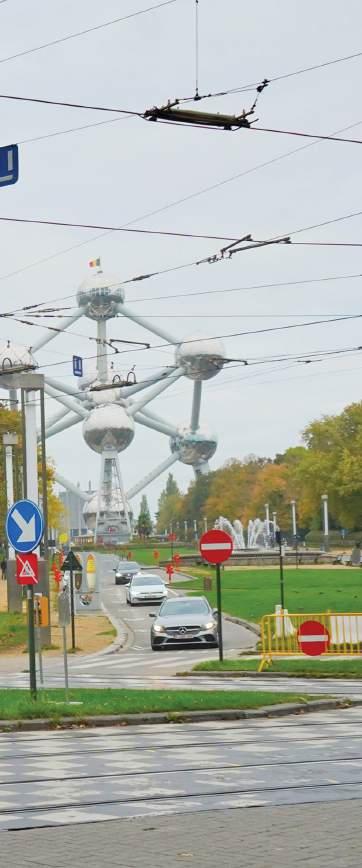
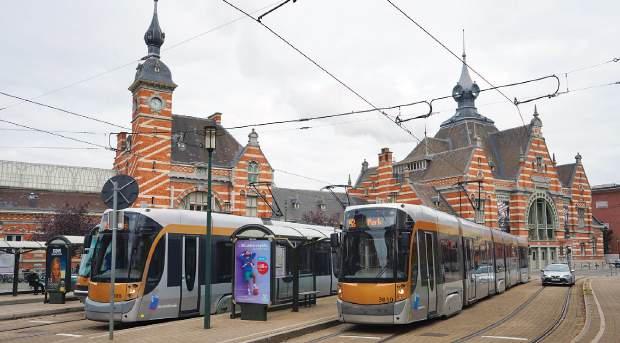
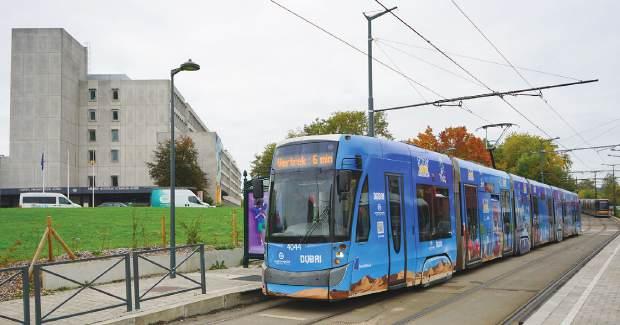
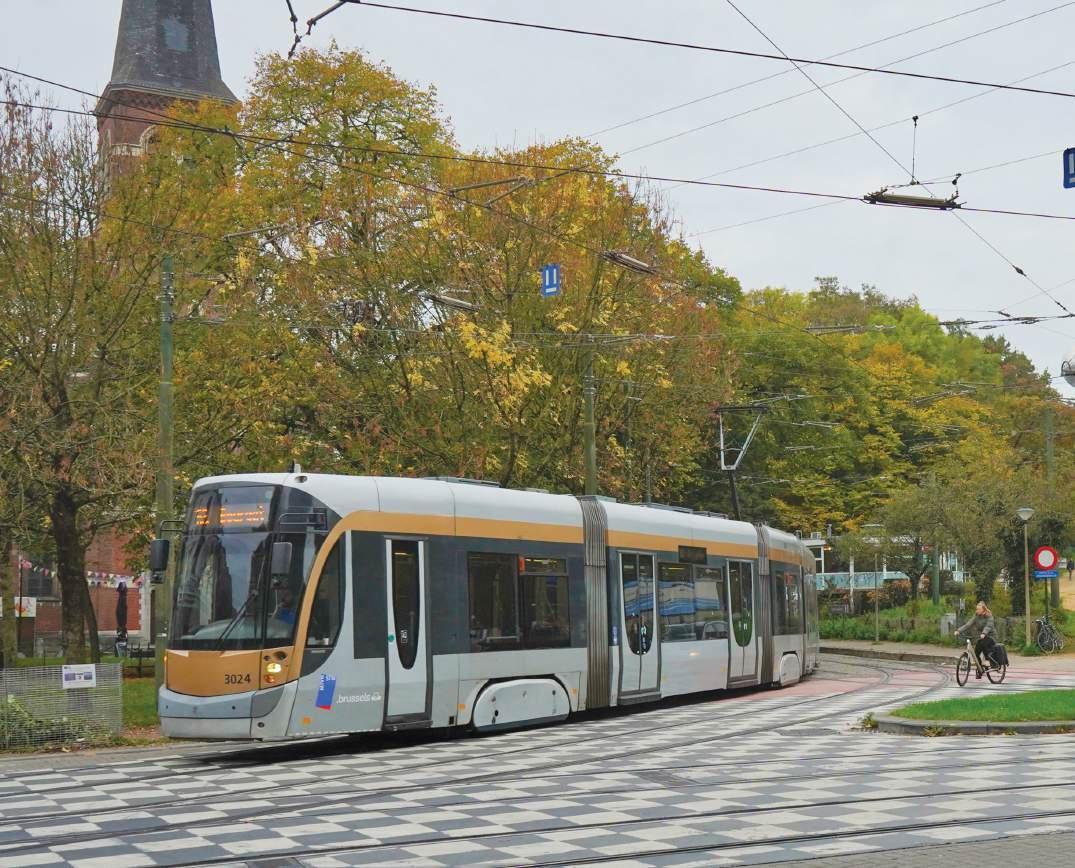
ABOVE: On 17 October 2025, Flexity 4044 is seen at the new northern terminus of line 10
This branch opened in September 2024 and is currently the most recent extension of the Brussels tram network. The 70 double-ended, seven-part Flexity low-floor cars were produced by Bombardier starting in 2005 and were delivered to Brussels in different batches until 2015. These 43m high-capacity cars are primarily deployed on busy pre-metro lines.
estimates of EUR1.6bn proved too optimistic and later rose to EUR4.5bn, the most recent estimates have even been in excess of EUR7bn, with delivery timescales slipping from 2030 to 2034 or later. As a result, in early 2026 the financial decision was made to scale back major parts of the scheme, while outright suspending others. This means that previously completed station shells might sit empty prior to eventual conversion for pre-metro use only. One such example is the plan to finish construction of the 825m tunnel from the main railway station and international interchange Gare du Midi/ Zuidstation to Anneessens, but only to pre-metro standard and for future LRV use. This tunnel spur is designed as a muchneeded bypass to ease congestion at the Lemonnier junction, a bottleneck that can handle up to 88 tram movements per hour, but lacks operational flexibility or resilience.
As of now, the Brussels metro network retains 40km (25 miles) and 59 stations, not taking into consideration the pre-metro infrastructure.
By contrast, expansion for Brussels’ sprawling tram network has proven more straightforward to implement during the past years and a number of essential schemes are also slated for completion by the early 2030s. Currently the largest tram network in Belgium, it has a size of about 150km (93 miles), with five different extensions having opened during the past 12 years since 2014. The most recent of these was the 4.4km (2.7-mile) branch from Heembeek to Hôpital Militaire/Militair Hospitaal in the north of the city, which opened in September 2024. Currently the most important light rail project is the so-called Tram de l’aéroport/ Luchthaventram, providing a new link from Brussels North railway station to Brussels Airport at Zaventem. The 12km (7.5-mile) route will run along Avenue Leopold III and connect inside the Ring Road to the existing tram network near NATO’s headquarters. Groundbreaking took place in early 2026 and completion is expected by the early 2030s. This extended timescale is necessary, as the project includes complex engineering
to cross the busy Brussels Ring Road as well as numerous railway lines. The airport tram includes a purpose-built light rail tunnel and complementary infrastructure such as cycling highways. Once completed, the journey time over the full length of the airport tram from Brussels North to Zaventem will be roughly 30 minutes. Despite the failure of the ambitious Metro Line 3 project, the more realistic future airport tram partially overlaps with the intended northern reach of Metro Line 3, serving the municipalities of Schaerbeek and Evere in particular and thus bringing rapid transit to the developing residential and business districts in these northeastern communes, which the Metro 3 was originally intended to connect.
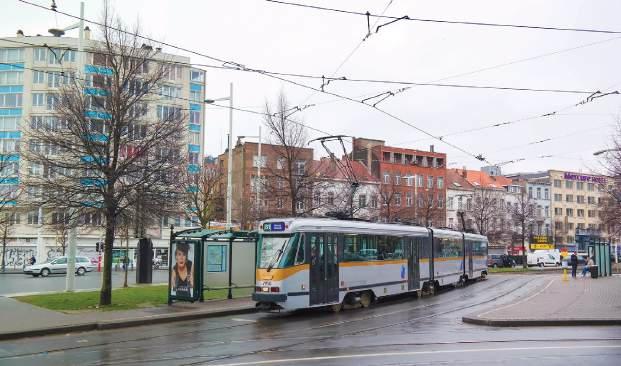
As of 2026, the municipal public transport operator STIB/MIVB has a tramway fleet consisting of roughly 400 cars, including 32 remaining high-floor trams of the doublearticulated, three-section PCC 7900 series and 18 of the 7700/7800 series. The rollout of modern low-floor trams continues at pace.

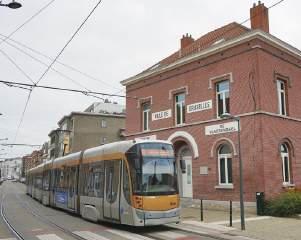
ABOVE: Running on the new branch line through the Neder-Over-Heembeek district to Hôpital Militaire on line 10, Flexity 4049 has just left P. Benoit stop. Initial statistics show that about 12 500 daily riders take advantage of this new extension.
RIGHT: Running on line 81, three-section PCC 7950 is seen near Gare du Midi. Because of their slim loading gauge, these cars still offer indispensable operational advantages on certain routes and will therefore continue to soldier on in revenue service until the end of this decade. A total of 61 of these cars were built in Belgium by BN (La Brugeoise) and ACEC in 1977-78. The vehicles use two Jacobs bogies, which are placed under the articulated joints.
In 2023 the first series 3200/4200 type TNG –Tram New Generation LRVs were introduced. Up to 90 of these double-ended Alstom Flexity, with 79 in the shorter 32m version and 11 in the longer 43m version, are being supplied to help retire the last high-floor cars by 2030. The remaining PCC 7900 cars are used on six routes, but mainly remain on lines 39 and 44 and offer the advantage
of fitting into the exact dimensions of the restrictive loading gauge of certain tunnel sections, especially at the Montgomery tunnel loop.
As the beating heart of a city famed as the seat of the European Union and NATO, public transport in Brussels keeps developing to meet the needs of the 2.5 million residents in the wider metropolitan area.


The EM 660/370 electric Makrofon allows for functional testing at a reduced volume. This ensures greater safety, less noise, and easy installation without compressed air.
www.zoellner.de
New technology and equipment are making LRT systems safer. TAUT takes a look at what’s being developed to keep staff and passengers safe, as well as considering the role that automation plays.
It’s a fact of life that human beings are not infallible. No matter how thoroughly one is trained or how carefully a component is made, all it takes is one slip of concentration or a manufacturing flaw to result in catastrophy. Therefore, safety is generally considered to be a constantly evolving journey.
Whether the emergence of computing technology – be that machine learning or artificial intelligence – can transport us to the ultimate destination, a world of 100% safety, remains to be seen.
Heavy and light rail can share many –though not all – of their respective safety systems, but tramways have an additional factor that heavy rail largely does not have to
face: proximity to members of the public.
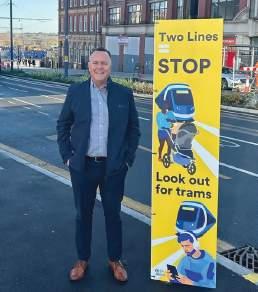
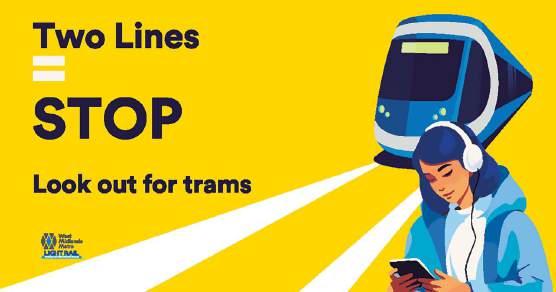
In countries that abandoned their trams after World War Two, generations of people have grown up without appreciating the dangers of a tramway. This is exacerbated by the increasing distraction caused by mobile phones and tablets. West Midlands Metro in the UK is just one of the LRT systems that has to issue advice on how to act when around the tramway: “When you are out and about and wearing headphones, it’s easy to get lost in the music, but when approaching tram tracks… take them off for a few seconds so that you can be fully aware of what’s going on around you.”
The obvious way that technology can make LRT systems safer is to correct minor errors
of judgement by the driver, from correcting –and reporting – incidents of overspeeding to making emergency brake applications.
Metrotenerife, which operates Tenerife’s 16.3km (ten-mile) tram network, developed SIMOVE. This, it says, monitors the tram speed [on] each section of the line, to warn the driver if the maximum speed has been exceeded and, finally, to activate the emergency brake if the situation is not corrected”.
Bosch (www.bosch-engineering.com) takes this a stage further with its ‘Tram focus assist’ system, which monitors the driver’s upper body and facial expression and issues a warning “if it detects any distraction, tiredness, or microsleep”. This is similar
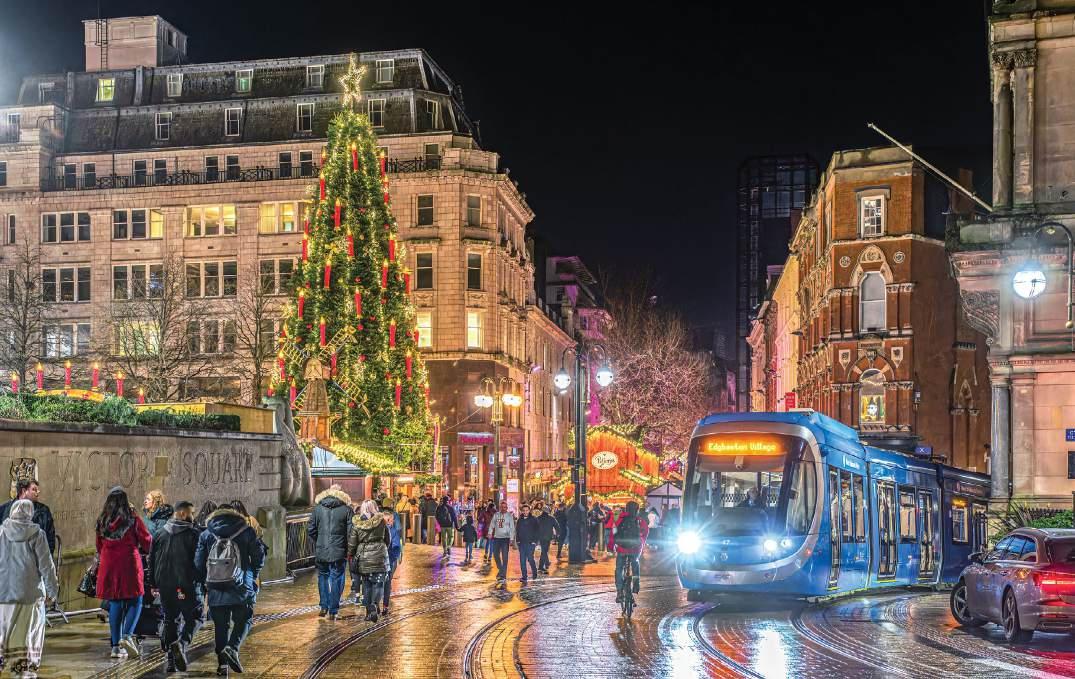
LEFT: Birmingham in the UK – like many tramways around the world – has the challenge of contending with close proximity of the public to its lines, and all the distractions and risks that brings.
Johnlsl, Flickr CC BY-NC-ND 2.0
Depots and workshops can be dangerous working environments and Zonegreen (www.zonegreen.co.uk) has developed a raft of innovative systems to help keep depot staff safe. For example, its Trapped key Interlocking means that machines and equipment can be fitted with a “series of coded keys to prevent hazardous functions from being performed”. It also produces converters that turn manually-operated points into electronically-powered ones; these are designed to complement its Depot Personnel Protection System that, with remote controlled derailers, enables vehicles to move safely around a depot.
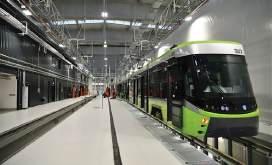
Olsztyn in Poland opened an extension to its depot in early 2024. This is modern enough to have been built to a specification with a range of safety features. P. Farsewicz
“Safety monitoring systems are only one part of keeping passengers safe. The physical construction of the tram is important too.”
Depot and workshop staff as well as those working on the track and other infrastructure need protective clothing. Bodyguard Workwear (www.bodyguardworkwear.co.uk) has been producing protective clothing – trousers, jackets and overalls – in the UK since 1975 and, since 2018, has been a GORE-TEX licence holder. It has been increasingly adding female-fit clothing to its range.
Bollé Safety (www.bolle-safety.com) started making eyewear in France in 1888. It has been making safety glasses since 1950 and its range now comprises safety glasses, goggles, face shields and welding helmets.
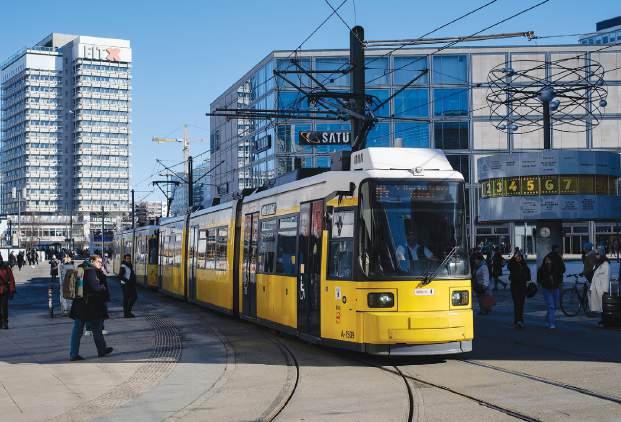
ABOVE: In a busy street setting in Alexanderplatz, Berlin, the tram contends with pedestrians in an open city setting – in situations like this, technology can help drivers to monitor the surroundings for hazards. Axel Kuhlmann, Flickr CC BY 4.0
Construction sites are – inherently – potentially unsafe places, particularly when work is being undertaken next to LRT lines that are still operational.
High Motive (www.highmotive.co.uk) offers a comprehensive range of safety equipment for mobile work sites. These range from the small MyZone vibrating alarm, worn on the back of a hard hat, that warns of “immediate danger from a moving or static safety hazard” to communications systems enabling team members to maintain contact across a large site. One of its larger products is M.E.W.U., described as the “most portable welfare unit in the world” which combines toilet, welfare unit and first aid station and which can be reduced to a 1.2m cube for easy transport.
Zollner Signal also offers a range of automatic warning systems that sound audible alarms, from something that can be worn by individuals to warning devices that can be carried by specific large construction machines so staff know that the machine is nearby.
Safety doesn’t just happen. Systems and processes have to be implemented and then regularly reviewed. Most LRT operations will have their own safety teams, but there are specialists and consultants able to advise on and devise safety-critical systems. FirstClass Safety & Control (www.firstclass-safety-control.co.uk) is a UK-based specialist in rail depot safety, protection and control systems, with more than 25 years of experience delivering solutions across heavy rail, light rail and metro networks in the UK and internationally. It designs, integrates and supports “Depot Protection Systems (DPS) [and] Depot Control Systems (DCS), locally operated points systems and interlocking solutions that protect people, assets and critical infrastructure while enabling safe and efficient operations.”
MH Safety is another UK-based company, which can carry out health and safety audits, and form health and safety policies as well as risk assessments (www.mhsafety.co.uk). WSP, from Canada, designed New York city’s Subway in the 1880s and is now a global consultancy firm for all manner of infrastructure and technology projects. Some of the advice it offers centres around “managing the risks emerging from complex, software-based autonomous systems in the transition to a world with self-driving vehicles” (www.wsp.com).
Sometimes, when things do go wrong, you’ll want to know why. Eurofins (www.eurofins.com) is a global organisation dedicated to scientific testing and it has over 20 laboratories around the world that can test materials and products to reveal faults and flaws.
to the Guardian system that the UK’s London Trams developed in response to the Rail Accident Investigation Branch’s recommendations from its report into the Sandilands derailment of November 2016 (TAUT 1034). Also in response to these recommendations, Integrated Human Factors of Edinburgh developed FOCUS+, which might look like a wristwatch but is actually a small biometric device that can warn of fatigue, pre-empting a loss of concentration event, such as a micro-sleep.
Devices to monitor speed and braking are also part of many Automatic Train Protection systems. Alstom, Stadler, Siemens Mobility and Hitachi STS have their own such systems, some of which are pure ATP systems. Others become part of more complex communications-based train control systems, featuring moving block signalling that is akin to – and compatible with – the European Train Control System that’s being rolled out across Europe’s railway network.
In busy street situations with many hazards, technology is helping drivers monitor the tram’s surroundings, keeping an eye out for potential accidents with motorists or pedestrians. Bosch has also developed anti-collision monitoring equipment. Its forward, near-range and flank assist systems use a combination of cameras and radio and light detection and ranging equipment
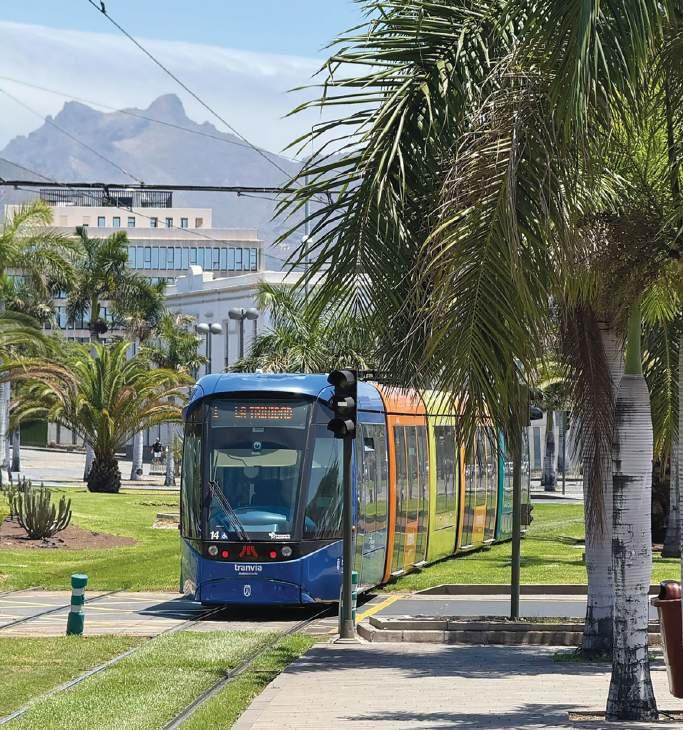
(radar and lidar) as well as sound sensors to monitor what’s in front and to the side of a tram. Ultrasonic sensors can even detect an individual directly in front of a tram where they might be below the driver’s field of vision.
Safety monitoring systems are only one part of keeping passengers safe. The physical construction of the tram is important too.
Tyneside Safety Glass (www. tynesidesafetyglass.com) has been making safety glass in the UK since 1937. It not only makes windscreens for rail vehicles but also bodyside and internal glazing too.
German firm HÜBNER Group produces safety-critical components for trams and metro trains (www.hubner-group.com).
HÜBNER’s obstruction-free metro train gangway connectors catch the eye along with its door safety systems. SensIQ uses colour LEDs to tell passengers whether doors are opened or closed, while it also
knows whether anything – be it a limb or luggage – is obstructing the doors.
For trams, HÜBNER not only makes easy to negotiate gangways but also front panels made from polyurethane foam. These result in a Head Injury Criterion of 600, well below the 850 that HÜBNER says “typically result[s] in minimal or no injuries at all to the involved persons”. It also makes manual or electrically-powered access ramps for trams.
A city street can be a noisy environment and a tram horn needs to make itself heard. Zollner’s Signal arm (www.zoellner.de) produces the Makrofon horn. This boasts different volumes – “between ‘loud’ and ‘quiet’ for long, medium, or short ranges” –as well as being fully customisable, so sound files can be uploaded to suit local regulations.
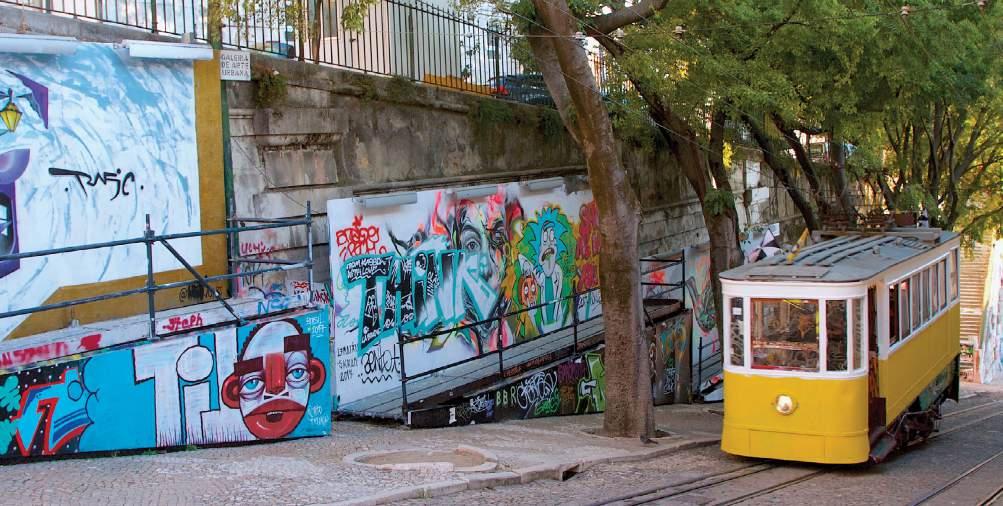
Graffiti, says Graffiti Removal London, “can have a profound psychological impact on individuals, businesses, and communities”; effectively, heavily graffitied areas can lead to feelings of being unsafe.
Monitoring the integrity of the landscape around a railway or tramway is an essential part of safety, particularly with climate change bringing increased extreme weather events. With its headquarters in the UK, Senceive (www.senceive. com/sectors/railway-track-monitoring) has systems that can monitor the condition of all aspects of infrastructure, from bridges and tunnels to embankments and even the permanent way. It’s probably fair to say that few metro systems around the globe run purely at surface level. Some
are elevated above the ground while others largely run in tunnels. For the latter, Microsim Tunnel Safety (www.tunnelsafety.com) specialises in all aspects of tunnel safety, from upgrading “escape plans to extensive testing of safety procedures”.
Consilium Safety Group (www.consilium.se) specialises in fire and gas detection and alarm solutions. From circuit breakers to sirens, Consilium’s products are designed not only for use around stations and the built environment but also on board trains and trams too.
Fleetshield (www.fleetshield.nl ) produces an innovative film wrap for both external and interior surfaces that can protect against knocks and chips as well as graffiti, the scourge of urban LRT operators.
Moving away from the vehicles, we’ve previously explored the manufacturers developing new solutions to make overhead wires (TAUT 1051) and track (TAUT 1039) safer. However, one track innovation that we didn’t cover was SEALABLE Solutions’ VeloGleis (www.seal-able.com). This rubber strip prevents bicycle tyres from getting caught in the flangeway, which,
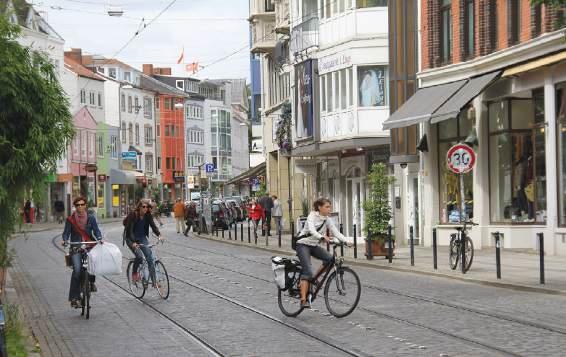
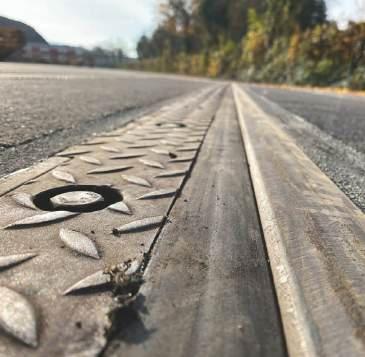
according to Zurich’s public transport operator VBZ, accounted for 6.3% of all tramway-related accidents across the city in 2020. The VeloGleis structure enables it to spring back after the passage of a tram, to continue to keep the flangeway filled in between services.
There are no statistics for the number of accidents which involve LRT around the globe. When you consider that over 400 cities operate some form of LRT, fatal accidents are, mercifully, comparatively rare. If you take Germany as an example,
Moskva (Moscow) boasts that it now has the world’s first autonomous trams running in passenger service and Roman Latypov, from the city’s Department of Transportation, has said that 15 autonomous trams could be running by the end of 2026. He added that, by 2030, the figure could be 350.
The 71-911EM trams that have been running in the Russian capital since September 2025 have Grade of Automation Level 3 (GoA3), which means no driver but there is an onboard staff member. Grade of Automation Level 4 is the highest level of automation, with no staff on board. GoA2, in contrast, is where a driver operates the doors and can operate the train in emergencies but stopping and starting is done automatically.
GoA2-A4 levels of automation are most commonly employed on metro systems rather than tramways. However, Siemens undertook the first trial of an automated tram in Potsdam, Germany, in 2018. In response to the trial, UK law firm Addleshaw Goddard said, “While the tram has the advantage of having a defined path to run on, and hopefully people being more aware of its expected arrival, this can also be a major disadvantage. If there is a blockage in the road ahead, an autonomous car can manoeuvre around it, while the tram needs to stop and wait for the blockage to be removed.”
Global consultants Triple E listed some of the issues with automation: “Systems must be robust to withstand failures and cyber-attacks… sensor systems must be sophisticated enough to maintain safe operation in adverse [weather] conditions [and] regulators should establish clear guidelines for the safe operation of these vehicles.”
Consultant SYSTRA’s view is that, in the short
there were, according to its Federal Statistics Office, 1131 accidents across its 63 tram systems in 2023. This resulted in 1944 casualties, of which there were 26 fatalities and 220 people classified as seriously injured. That year, the FSO records show that Germany’s 2.5m road traffic accidents left 364 993 people injured with 2770 fatalities.
While you can’t make direct comparisons between cars and trams, LRT is still a very safe way to travel – and the technology being developed around the world is making it safer still.
No one wants an unsafe LRT system but complacency, as the saying goes, does breed contempt.Yet it’s not always easy to speak out against unsafe practices, which is why, in the wake of serious rail accidents in the late 1990s, the Confidential Incident Reporting & Analysis Service was formed. CIRAS offers a confidential reporting service for all transport workers in the UK and the Republic of Ireland (www.ciras.org.uk).
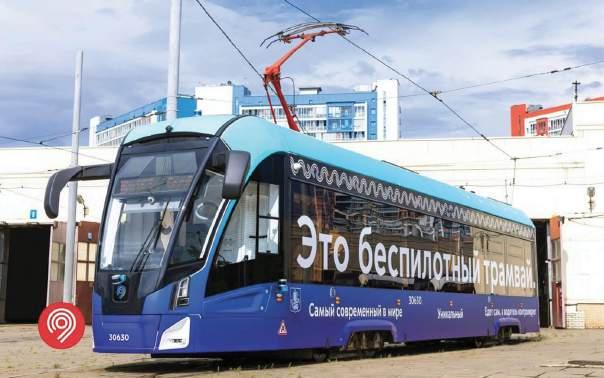
A 71-911EM ‘Lvyonok’ undergoes tests and prepares to become the first autonomous/driverless tram in Moscow. Cypok
term, automation ought to focus on two areas: “driving assistance given to the tram driver for a more economical and safer trip” and “total autonomy within the depot”; Skoda has already tested its Smart Depot automated system in Tampere, Finland (TAUT 1054), where trams take themselves around the depot.
The UK’s Rail Accident Investigation Branch also highlighted some of the issues of GoA2 automation after a fatal incident at Stratford Underground station on 26 December 2023, when drivers didn’t
see that a passenger had fallen onto the track. RAIB’s January 2025 report suggested that drivers experience ‘underload’, whereby the driver’s alertness “can decrease because they have less active input into the control of the train”. Automation isn’t just about improving safety. There are continuing reports of LRT driver shortages across Europe, with services having to be cut as a result. Whether increased automation can be utilised to fill these vacancies remains to be seen.
When people think about light rail, they often think about transport: journeys, timetables, ridership and connections between destinations. Yet the impact of light rail extends beyond moving people from one place to another, as UKTram reports.
In the UK and around the world, people are now recognising light rail as a driver of change, helping develop neighbourhoods, supporting renewal, and making communities more attractive and accessible. While its transport benefits are easy to spot, the real value often lies in how it shapes the places it serves.
As towns and cities continue to grow, transport investment is increasingly being viewed through this wider lens. The outcome is becoming more than just about moving more people. It is about creating places that are attractive, accessible and connected to opportunity.
Tramways are different from many other types of transport because they are permanent. Tracks built into streets and neighbourhoods show that the service is here to stay and this lasting presence can attract investment and help local leaders plan.
All over the British Isles, light rail has become part of many cities’ identities and has helped shape the areas around them.
In Birmingham, the West Midlands Metro has changed much of the city centre. Places like Corporation Street and Centenary Square are now more welcoming, with more space for people to walk and spend time. Outside the centre, new tram lines are making it easier to get around the Black Country, helping renew neighbourhoods and giving more people access to jobs and education.
Sheffield Supertram demonstrates how LRT can support communities over the long-term. Spanning 34km (21 miles), the network links residential areas with the city centre and Meadowhall, while contributing to environmental and urban improvements across South Yorkshire.
Blackpool Tramway offers a different perspective. Operating since 1885, the tramway is both an important transport link and an integral part of the town’s identity. Its combination of heritage vehicles and modern trams demonstrates how light rail can evolve with changing travel patterns while continuing to contribute to a place’s character and appeal.
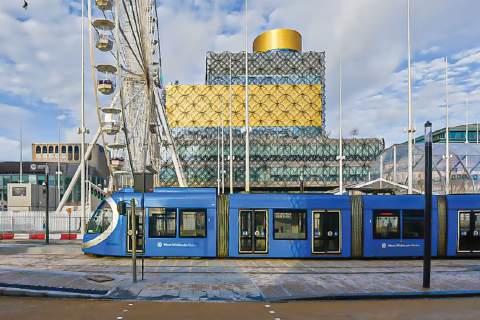
Sophie Allison, Managing Director of West Midlands Metro and a UKTram Board Member, believes light rail’s influence extends well beyond transport itself.
“Investment in light rail is also an investment in places. Successful networks become part of the identity of a city and help influence how communities experience it for generations to come.”
Manchester’s Metrolink has also helped shape the city. The tram system has supported the renewal of old industrial areas and is now a key part of the Bee Network, Greater Manchester’s joined-up transport system. Places like Salford Quays and MediaCityUK have changed a lot in recent years, with light rail connecting homes, businesses and cultural spots, while also encouraging greener travel and long-term investment.
In Edinburgh, the tram has become an established part of the city’s transport network and wider identity. The extension to Newhaven has strengthened links between the city centre and waterfront communities, improving access to homes, workplaces and visitor destinations while encouraging more people to choose public transport.
The influence of light rail extends beyond today’s established networks. Coventry Very Light Rail is exploring how smaller cities might benefit from many of the same principles that have shaped larger systems. The project is testing lightweight batterypowered vehicles and a shallow track design intended to reduce construction costs and minimise disruption during installation. While still in development, the ambition is to make rail-based transit more accessible and to give more communities the opportunity to use light rail as a catalyst for regeneration and placemaking. Accessibility is an important part of this conversation, too.
Modern tramways are designed to be easy to use and easy to navigate, helping create environments that work for residents, commuters and visitors alike. Stops often become focal points within communities, providing clear information, shelter and connections to wider transport networks.
This is why having joined-up transport is important. Light rail works best when it is part of a bigger system, alongside trains, buses and walking or cycling, to make journeys simple and appealing.
Passenger numbers and travel times are still important, but they are not the only way to judge success. More and more, people look at whether transport helps support greener travel and builds places where people want to live and work.
For light rail, that wider contribution has always been part of its story. Much of our discussions with our member community are based on the idea that successful tramways are those that do more than simply move people around a city, but also help create places that are more navigable, welcoming, and more connected to opportunity.
Macau’s Light Rapid Transit is a system in its infancy in terms of the potential for delivering better and much needed public transport.
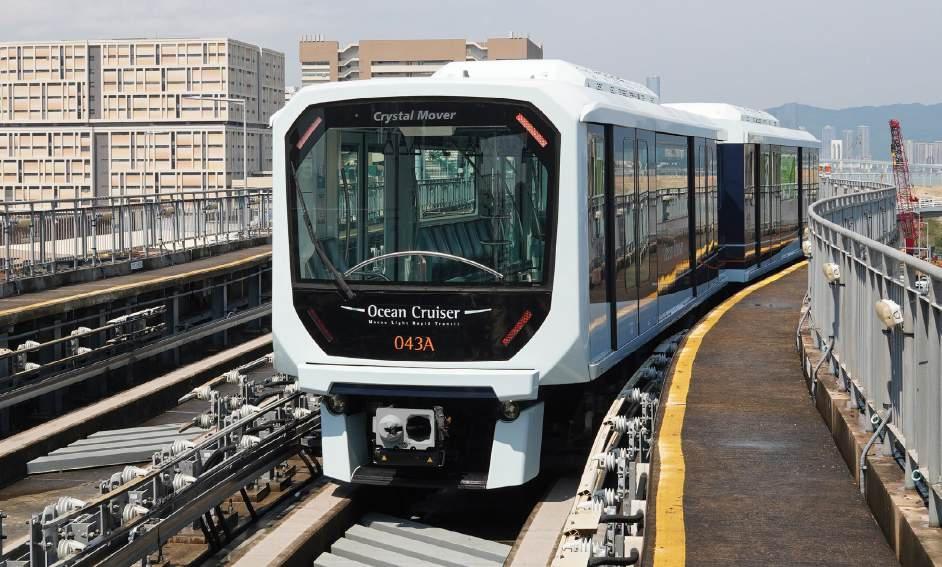
Macau (or Macao) became a Portuguese trading post during the 1550s and was recognised as a colony in 1887. Its present status as a Chinese Special Administrative Region (SAR) came in 1999. Through years when the border with China was heavily restricted, visiting Macau usually meant doing so via Hong Kong, one of many ways in which the two have been intertwined. Respectively west and east of the Zhujiang/ Pearl River estuary, the separately administered SARs have land borders with Guangdong province. Each has giant neighbours, Hong Kong with Shenzhen and Macau with Zhuhai. All are in the region now promoted by China as the Greater Bay Area. The Light Rapid Transit (LRT) system which opened in December 2019 was Macau’s first fixed-link public transport, being an aspect of the 21st Century transformation of a
Macau LRT Mitsubishi Heavy Industries Urbanismo-22 approaching Taipa Ferry Terminal on 30 March. Currently used for holding stock between services, these tracks will connect with the under-development East Line.
now almost fully urbanised area. Chinese (locally Cantonese) and Portuguese are the official languages, with English also prominent in tourism-related activities including transport.
The LRT’s administrative body is Sociedade do Metro Ligeiro de Macau (MLM)/Macao Light Rapid Transit Corporation (LRT). Operation and maintenance was by a subsidiary of Hong Kong’s MTR Corporation until December 2024, when a handover to MLM/LRT was completed. Most of the current LRT is double-tracked and elevated, with much above or beside roads on once rural space or reclaimed land. A continuing programme of reclamation accounts for Macau’s growth from under 12km 2 (7.5 square miles) in 1912 to around 30km 2 (18.6 square miles), with most expansion realised under projects since the 1970s. Bordered in the north by a land border, the
Macau peninsula is around 4km (2.5 miles) north to south. Across Macau’s Outer Harbour crossed by four bridges are the merged Taipa and Coloane islands which are about 6km (3.7 miles) north to south. Although small in area, a population approaching 725 000 places Macau amongst the world’s most densely populated territories. The peninsula’s concentration of buildings, narrow streets and traffic congestion prompted studies for a local transit system in 2002. Despite the peninsula being where mass transit was most needed, LRT construction which began in 2012 was in the important but less challenging surroundings of the still developing Taipa-Coloane. Fishing, trading and textiles feature in Macau’s history, although gambling – here the core aspect of tourism – has underpinned the economy for many years. Hong Kong’s longstanding gambling restrictions and Macau’s more liberal laws led to many regularly
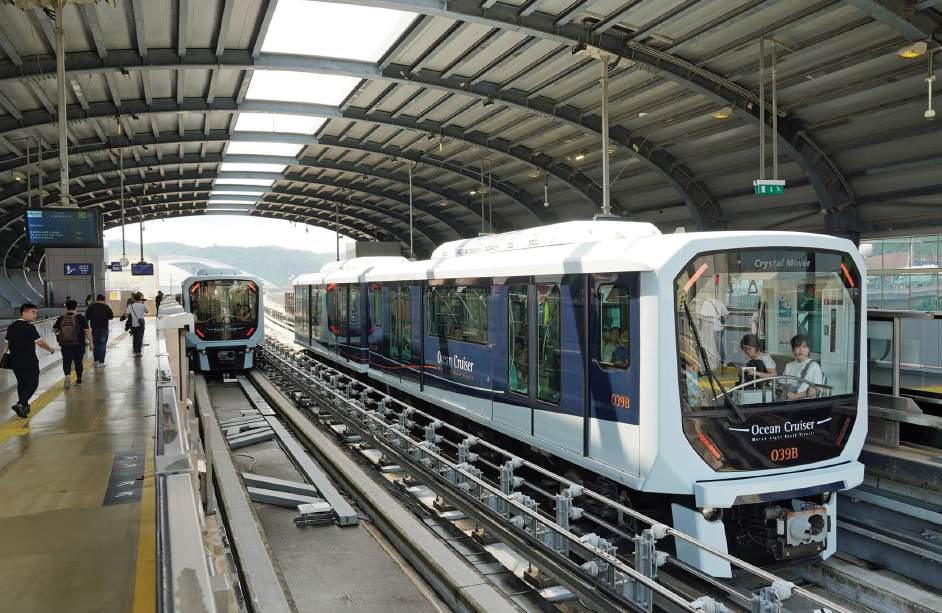
The surface level depot, storage area and control centre is sited just west of the airport zone, with track access by a delta junction between MUST and Cotai East stations. The compound has the potential for fleet growth. Macau LRT’s 55 Mitsubishi Urbanismo-22 bidirectional, non-gangwayed paired cars are 23.5 metres long and 2.8 metres wide. Each car has 22 seats and a
capacity for 119. They carry the manufacturer’s Crystal Mover brand but are more prominently titled with the locally selected name of Ocean Cruiser. Numbered in an 001-series, the cars are distinguished as A and B. The main livery combines pale and dark blue, with curves to further represent the marine surroundings. Some units have external and internal advertising.
ABOVE: Like Cotai East, most stations are open-air but are fully covered, and have half-height platform edge doors. Signs indicate which platform area is in use for the currently prevailing singlevehicle services.
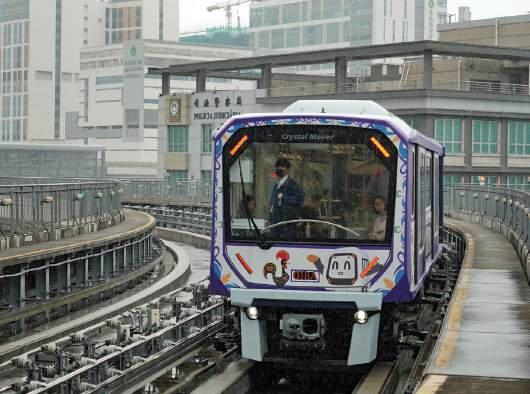
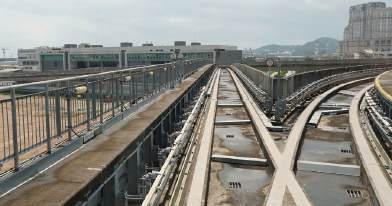
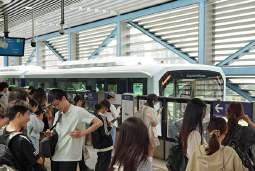
ABOVE: As here at Hospital Union, students are recognised as significant LRT users. The short branch onto Hengqin island in Zhuhai is particularly relevant to this passenger group.
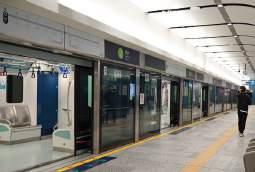
ABOVE: The northern end of the delta junction for the LRT depot which appears centreleft; revenue track curves to the right. All of the system has emergency walkways.
LEFT: The only LRT station on the Macau peninsula and the first of the two now located underground, Barra on the extension from Ocean joined the system in December 2023.
crossing the estuary to seek their fortunes. Capacious casinos opened during the 1960s near ferry berths on the peninsula. In expanded forms such outlets remain, but gambling is now also prominent on land unavailable until the 21st Century. Part of the Taipa-Coloane reclamation became the Cotai Strip, a concentration of casinos and hotels in the Las Vegas style. As Macau’s international catchment grew, it overtook the gambling revenues of its Nevada model. It is a short distance to the Cotai Strip from Macau International Airport which opened in 1995 and the adjoining Taipa Ferry Terminal completed in 2017. The route of LRT passes around the Strip’s outer edges and with few exceptions gives little convenient access to most of the venues. Even if without luggage, local weather conditions can be challenging even for short walks. Fleets of wellpatronised casino (mostly free) buses, taxis and limousines attest to roads giving far better door-to-door access to the Cotai Strip than the LRT. A gambling-related venue with good LRT access, the Macau Jockey Club racecourse, closed in April 2024. This large area reclaimed from the defunct organisation by the Macau Government is next to the now misnamed Jockey Club station. Future uses of the racecourse are to be decided, but the addition of more casinos and housing has been ruled out.
Macau LRT uses Mitsubishi Heavy Industries Automated Guideway Transit technology similar to that used for internal systems such as the extensive Singapore Changi Airport installation. The Crystal Mover vehicles are rubber-tyred and run on concrete bases with steel guide rails; power is supplied through rails set above the guides. Although driverless, the services carry a member of LRT staff. All track is bordered by door-level walkways if needed for emergency access. Lifts, escalators and level boarding make the LRT fully accessible. The platforms can accommodate two LRT sets although currently most services use one. Platform edge doors are standard, halfheight except for the two underground air-conditioned stations. Like the rolling stock, the stations are kept in immaculate condition. Now one of three lines and by far the longest at 12.5km (7.8 miles), the Taipa Line with 13 stations is configured in a U-shape. It runs between Taipa Ferry Terminal and Barra, with a journey between the two taking about 28 minutes. The latter station joined the system in December 2023 as part of a 3.2km (two-mile) extension from the previous western terminus at Ocean. Barra became the system’s first underground station and the first on the peninsula. It is part of a public transport interchange, a role which

“Barra... is part of a public transport interchange, a role which will grow if plans for the LRT South Line are realised.”
will grow if plans for the LRT South Line across the peninsula are realised. The Barra extension is mainly covered, yet most of it is not underground. About two-thirds runs in the enclosed lower decks of the Sai Van bridge which opened in 2004. With other bridges over the Outer Harbour having only open spans, the bridge was built with lower decks containing roadways, available to maintain connections during extreme weather. Installing the LRT halved the Sai Van road space
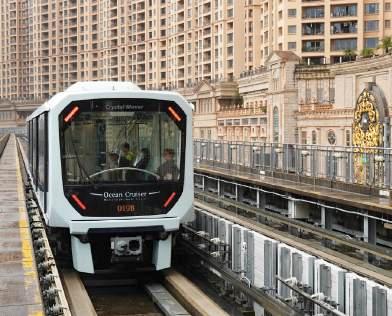
Opened: December 2019
Lines: 3
Stations: 15
Depots: 1
Approx. weekday hours: 06.30-23.15
Main line frequency: 5-6 minutes
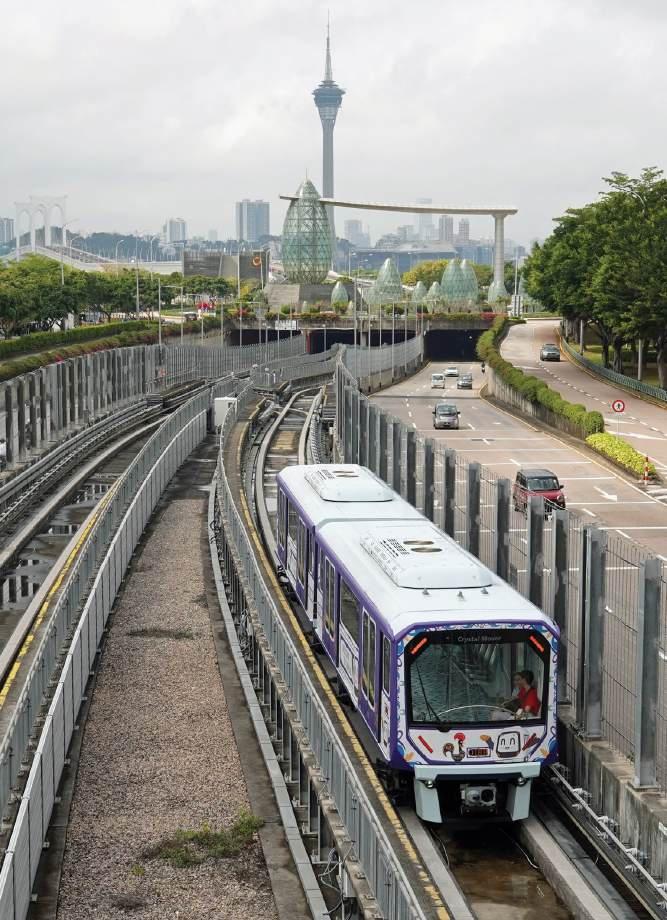
Power: 750V dc, third-rail supply System: Macau Light Rapid Transit www.mlm.com.mo
Civic information: Government Portal www.gov.mo
Tourist information: www.macaotourism.gov.mo
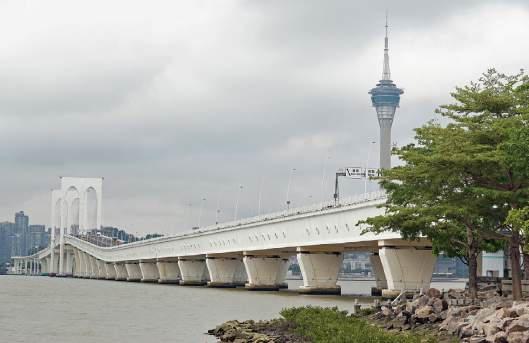
which may be seen intermittently from LRT trains on the bridge.
The two short LRT branches run separately from Lotus and Union Hospital stations, each of which has dedicated platforms for their branch. These are operated as shuttles with no intermediate stations, with both branches having an approximate two-minute end-to-end journey time. Although short, the branches generate a disproportionate amount of ridership due to the nature of their outer termini. Along with the Barra extension, their addition to the system accounts for a marked increase in system patronage. Even post-COVID, daily ridership had rarely exceeded 7000; since January 2025 the range has mainly fluctuated between 25 000 and 30 000. The 1.6km (one-mile) Seac Pai Van Line added south of Hospital Union in November 2024 reaches Macau’s biggest public housing estate. The terminus structure is clearly prepared for a planned 2.1km (1.3-mile) south-western elevated extension to Coloane Village. Opened in December 2024, the single-track Hengqin Line 2.2km (1.4-miles) running west from the elevated Lotus station is mainly underground, including passing under the Shizimen Channel to Zhuhai’s Hengquin Island.
The LRT terminus here has border controls and is now identified as the busiest LRT station by passenger numbers. It is near Hengquin station on the Zhuhai Airport Intercity Railway which was completed to the airport in February 2024. The University of Macau has a campus on land leased from the People's Republic of China to the south of Hengquin LRT. The most frequently made journey on the system is now identified as being between Hengquin and University of Science and Technology (MUST) stations. Public holidays and events can bring extreme ridership variations, but the more regular cross-border traffic relates to Zhuhai’s lower living costs. This encourages commuting to work and education in Macau, and equally for Macau residents seeking cheaper shopping and leisure activities in in the People’s Republic.
The Government is planning for a substantial increase in LRT coverage, notably in the peninsula where the
potential for high ridership is evident. The policy is for future LRT lines to mainly be sited underground due to the scarcity of space, to preserve the surface environment and be less affected by weather. The active LRT project is to add the East Line by 2029. This will join the present system north of Taipa Ferry Terminal with the land border crossing identified in Portuguese as Portas do Cerco. Many bus routes currently serve this area, just beyond which is Zhuhai’s main railway station. The mainly underground route of the 7.7km (4.8mile) East Line includes three stations on the in-development Urban Zone A, an artificial island mainly intended for residential properties. Another station will serve the smaller Zone E reclamation area adjoining Taipa.
Local travel: Macau’s flight connections are mainly with China and the south-east Asia region. Access from Hong Kong by helicopter, high-speed ferries on several routes and buses using the Hong Kong-Zhuhai-Macau Bridge. The cheapest and most frequent of these ( https://i.hzmbus. com) runs between the bridge’s port areas; for Hong Kong this adjoins Lantau island near the airport. Centre-tocentre bus services
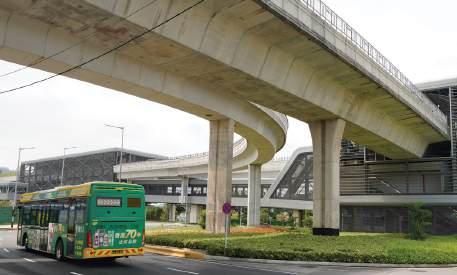
are also available. All crossings are subject to border/customs controls – checking requirements in advance is recommended.
Macanese Pataca (MOP) are pegged against Hong Kong Dollars. Including for LRT and buses, the latter are widely accepted in Macau, but not vice-versa. See www.mlm.com.mo for LRT charges which are based on a journey’s number of stations; adult fares from MOP6 (EUR0.65); no day fares
although long stays may make locally available passes worthwhile.
LRT ticket machines issue tokens for barrier access. Flat fare on service buses (with traditional-style fare box on entry) MOP6, no change given.
What is there to see?
Colonial Macau is recalled on the peninsula by a UNESCO World Heritage Site which includes the distinctly Portuguese Senado Square and
the hilltop church frontage of St Paul’s Ruins with an adjoining museum. Macau Tower observation decks (www. skyparkmacau.com). On the approximate 1.4km (one-mile) of the Cotai Strip are extravagant casino interiors and replicas of the London’s Houses of Parliament (full height ‘Big Ben’ with LED clock faces), the Eiffel Tower (half-height), Venice landmarks and ‘Golden Age’ Hollywood features.
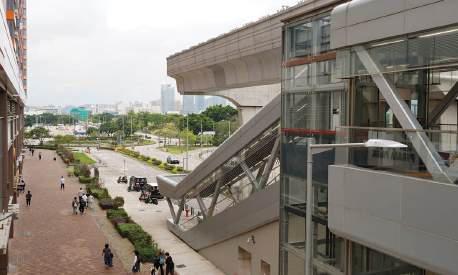
“The most frequently made journey on the system is now identified as being between Hengquin and MUST stations.”
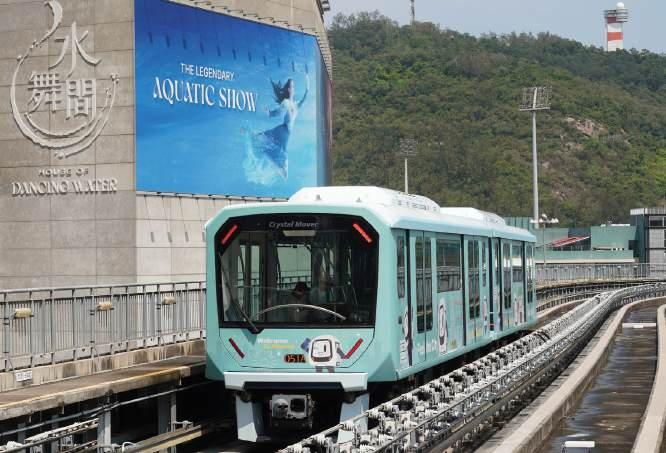
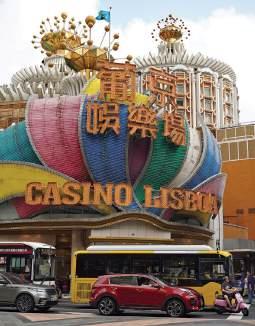
CANBERRA. The tramway extension to Woden is now to run via Adelaide Avenue rather than via Parkes and Barton as originally suggested. Construction is expected to be completed in 2028. C. P. Nicholson GOLD COAST. A dummy service on the 6.7km (4.2-mile) extension from Broadbeach South to Burleigh Heads started on 18 June as part of the final testing and commissioning process. Passenger services could start in July/August. The extension brings G:link’s total length to 26.7km (16.6 miles). R. Youl MELBOURNE. The federal government has agreed to contribute a further AUD3.8bn (EUR2.3bn) towards the Suburban Loop Project, bringing the total contribution to AUD6bn (EUR3.6bn). The first phase will be a 26km (16.1-mile) underground line (TAUT 1061). IRJ SYDNEY. Transport for New South Wales has awarded German technology company INIT a EUR650m contract to deliver an account-based ticketing system. Tap-in tap-out is to serve only as a means of identification while funds and ticketing are processed in the background. Installation is planned for 2027-28. RGI
WIEN (Vienna). Alstom Flexity 440 was delivered on 9 June.
E2+c5 tram sets can still be seen on Lines 11 and 71. tramwayforum.at
ANTWERPEN (Antwerp). CAF returned 7262 after refurbishment on 29 April. It is the first of 84 Hermelijn trams to be treated.
Lines 2 and 4 were to be cut back to Zwaantjes from 1 July to permit point-work replacement in Hoboken.
The farewell event for PCC bogie trams is scheduled to take place on 26 September. It is planned to include a hop-on hop-off service of different examples, operating from 12.00 until late afternoon.
T-2000, M. J. Russell BRUSSEL/BRUXELLES (Brussels). The peak run-out from 11 May was 286 trams, a reduction from 312 due to temporary closure of several sections of line for infrastructure work.
Despite being officially withdrawn from 18 May, single articulated PCCs have continued to make occasional appearances; 7706/10/21/32-33/51 and 7817/20/22 have been noted as still operational. T-2000
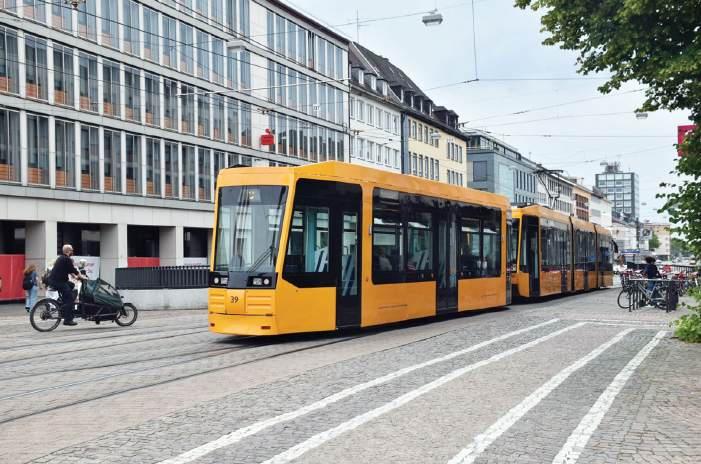
In addition to renumbering its fleet by dropping the year prefix, the German city of Darmstadt is replacing its white, blue and orange livery with all-over orange. The city is one of the few places where trailer operation is still common, 39 being a 1994 LHBbuilt example. 4001
CHARLEROI. The temporary closure of the viaduct station Villette (opened in 1976) has been made permanent.
GENT (Ghent). CAF returned Hermelijn tram 6301 on 4 May after refurbishment.
Tram 6338 was the first to be sent this year to the 67km (41.6-mile) Coastal Tram. T-2000
SOFIA. The first of five four-car Škoda-built metro trains entered service on 26 May. A total of eight trains are being purchased for EUR65m. Škoda
OTTAWA. Running of Alstom LRV sets coupled together resumed on light rail line 1 from 8 June. This was the first time since problems with wheel bearings were discovered in January. CBC TORONTO. Mayor Chow has revived plans to extend Eglinton East light rail by 18.6km (11.6 miles) from Kennedy Station to Scarborough and Malvern. The line would be street-based and CAD10m (EUR6.2m) has been allocated for preliminary work. urbantoronto.ca VANCOUVER. Dynamic testing on the 5.7km (3.5-mile) CAD2bn (EUR1.2bn) Broadway SkyTrain line started in May. Passenger services are expected to start in late 2027. Mass Transit
CHILE
CONCEPCIÓN. CRRC
Qingdao Sifang is delivering ten three-car EMUs for Biotren line 2 to Coronel. RGI
FOSHAN. Metro line 3 was extended by 4km (2.5 miles) from Lianhe to Zhongshan Park on 18 June. The line’s intermediate stop, Foshan station, will open later. urbanrail.net
CROATIA
ZAGREB. A tender has been issued for the purchase of new trams with an estimated value of EUR75m. Delivery is due within 36 months of signing. lok-report.de
CZECH REPUBLIC
BRNO. Breaking through on the 320m tram tunnel to Kamechy took place on 9 June. This tunnel will facilitate a 1.4km (0.9-mile) line 1 extension, due to open in late 2027.
Route H was to resume operation on 5 July, featuring 1943 twoaxle tram 107. Line H’s weekend departures from Komenského nám take place until the end of September. dopravacek.eu OSTRAVA. Škoda was the only bidder for a third tender for 16 32.5m trams (with an option for nine more).
Tatra T3 752 has been restored to original 1970 condition as a museum piece. It was one of several cars used to celebrate 125 years of tramway operation 6 June with public rides and an open day at Martinov workshops. cs-dopravek
PLZE Ň PMDP is launching a market consultation for the purchase of 22 45m trams capable of carrying 330 passengers. The successful bidder would have to deliver ten in 2029-34, followed by 12 more.
The oldest working Czech tram, Plze ň 18 (built by K ř ižík in 1899), is being restored by Kolínská lokomotivní s.r.o. at a cost of CZK11.58m (EUR477 518). It should be finished by December 2027. cs-dopravak PRAHA (Prague). A construction contract worth CZK599.2m (EUR24.7m) has been awarded to a consortium comprising Firesta, Pedasta and N+N – Konstrukce a dopravní stavby Litom ěř ice. It is for the 2km (1.2-mile) Olšanka – Habrová tramway extension in Žižkov, which is to run on disused railway alignment.
Škoda delivered 9521, the first of a new batch of 52Ts , on the night of 1-2 June; 19 more are due this year.
Tatra T3s (6312 and 7122) have returned to line 23 after ten months in the Brno workshops. A further two, 6892 and 7188, are to follow. dopravacek.eu
ODENSE. A tender for 12 new trams is to be issued, with an option for a further six. They are to be 40m long.
Odense Letbane carried 7.4m passengers in 2025. Demand reportedly stretched its capacity at times. BT
HELSINKI. Škoda-Transtech delivered X34 tram 647 at the end of May.
Finland’s Supreme Court rejected Škoda Transtech’s appeal over the award of a contract for up to 183 new trams on 2 June, ending a legal process that has been ongoing since October 2025. Škoda Transtech has begun consultation with employees at its Otanmäki factory over possible job reductions. Raitio, cs-dopravak
CAEN. Night trials of a tram equipped with batteries took place on 26-27 May; line T4 is to be built with overhead-free sections for aesthetic reasons. lineoz.net
LYON. Alstom is set to deliver 40m trams 937-42 this year, with five more expected in 2027. The company is also refurbishing the 47 Citadis 302s (801-47) that were built in the early 2000s to extend their service life. T-2000 MONTPELLIER. Lines 1 and 5 are planned to be replaced by buses 3-30 August between SaintÉloi and Peyrou-Arc de Triomphe. This is to permit connection of new tracks. Buses are also planned to replace line 1 trams between Mosson and Occitanie 17 October-1 November. lineoz.net
PARIS. Extension of tram-train line T13 is in progress. Street running is being extended from Lisière Péreire (Saint-Germain-enLaye) to Poissy and Achères-Ville, where it is to make an interchange with RER Line A. Completion is due in December 2028, with 13 more dual-voltage LRVs required.
The first of 13 CAF Coradia Stream EMUs for the Gare de l’Est – Paris-Aeroport Charlesde-Gaulle line was unveiled on 27 May at the former Alstom plant in Reichshoffen, Alsace. The 32km (20-mile) CDG Express is due to open in March 2027. When it does, services are planned to run every 15 minutes, with journey times of 20 minutes. TR, bfmtv.com
BERLIN. S-Bahn S15 started carrying passengers between Hbf and Gesundbrunnen on 15 June. It uses new tracks between Wedding and Hbf. Its ten-minute service is expected to attract 40 000 passengers per day. Extensions to Potsdamer Platz and Gleisdreieck are planned. berlin.de BONN. With just six of the Duewag R1.1 low-floor trams still in service in late May, a farewell event was announced for 27 June. These vehicles are being transferred to Poznań in Poland. DS CHEMNITZ. A ground-breaking
ceremony for the new 16km (ten-mile) tram-train line to Limbach-Oberfrohna took place on 18 June. lok-report.de DORTMUND. Transport association VRR has contributed EUR697 700 to the EUR1m needed to create more storage sidings at Dorstfeld depot. lok-report.de DÜSSELDORF. A parade of 18 trams marked 130 years of tramway operation on 14 June. The trams that ran from GrafAdolf-Strasse included 583+797 (built 1923), 954+858 (1928), 267+316 (1936), 14+332 (1944), 379 (1950), 5111 (1924), 2501+1689 (1956), 2432+1680 (1961), 2269 (1966), 3201/06 (1973) and 3375 (2012). DS GOTHA. Special workings due to construction work are in effect until 14 August, with the tramway closed between Waltershausen Dreieck and Gotha hospital. Ex-Basel trams are in use on a shuttle between Bad Tabarz and Waltershausen. lok-report.de
KARLSRUHE. Stadler delivered VBK’s first new tram-train in midMay. Tram-train 100 was joined by two more in mid-June. VBK KÖLN (Cologne). Lines 1, 7 and 9 are to be affected by infrastructure work until 2 September. Line 7 is running only to Neumarkt and lines 1 and 9 terminate at Heumarkt. Replacement buses run to Deutz Messe/Deutzer Freiheit where east bank trams will also terminate. KVB MÜNCHEN (Munich). Siemens completed the delivery of 73 foursection Avenio trams on 28 May. Line 14, which opened on 28 February, is carrying 11 000 passengers a day. Punctuality on the initial 1.5km (0.9 miles) of what is to be an 8.25km (5.1-mile) line was initially 65%; changes to traffic light priorities have increased this to 80%. F. Buchleitner, lok-report.de NECKAR – ALB. A 21 June referendum voted in favour of a planned light rail line linking Reutlingen and Engstingen. lok-report.de NORDHAUSEN. A shortage of spares for the diesel engines used in the Siemens Combino tramtrains has led to a study being undertaken into electrifying the Harzquerbahn line as far as Ilfeld.
BS
SAARBRÜCKEN. New Stadler dual-voltage tram-trains started carrying passengers between Römerkastell and Siedlerheim on 11 June. DS WÜRZBURG. HeiterBlick delivered tram 217 on the night of 28/29 May. cs-dopravak
GREECE
ATHINA (Athens). CAF has refurbished line 1’s 14 42-year old
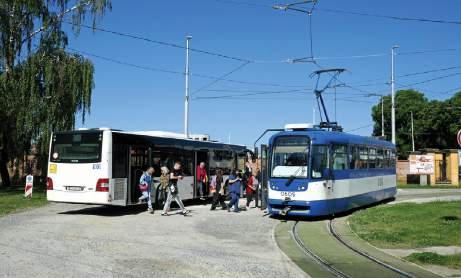
BUDAPEST. An open day at Szépilona depot, combined with the marking of the 20th anniversary of Siemens Combino trams on lines 4/6, meant the following museum trams were in action on 13 June: 436 (Schlick, built 1913), 611 (Schlick, 1908), 2806 (Schlick, 1911), 2624 (BVV, 1958), CSM-4 1233 (1964), 3873+6010+3888 (Ganz UV, 1964), 1337+1343 (Ganz, 1970), 1438+1439 (Ganz, 1975) and 7806 (Muki, 1926). A pair of Ganzbuilt trams, 3257 and 3701, were displayed at the depot. transphoto.org
HYDERABAD. The Government of Telangana-owned Hyderabad Metro Rail took over operations of the 69km (43-mile) metro from Larsen & Toubro on 29 April. RGI
ISLE OF MAN
SNAEFELL MOUNTAIN
RAILWAY. A road traffic accident in Laxey on 8 June shut the railway until 10 June. Manx Electric Railway services between Laxey and Ramsey were affected until 9 June.
TEL AVIV. CAF delivered the first of 98 Urbos trams for the Purple Line through the port of Haifa on 14 June. The 29km (18-mile) line is expected to open in 2028. RGI
GENOVA (Genoa). The city council is carrying out a feasibility study for an eightstation, 6.5km (four-mile) cable car. Running from Brignole FS to Molassana, it is estimated to cost EUR140m-160m. skyscrapercity
ENOSHIMA. New J-TREC-built 700-series cars were due to replace two-car set 1001+1051 in July.
RIGA. Line 7’s 2.2km (1.4-mile) extension from Ausek ļ a iela to Ķ engarags opened on 1 June. Line 14 was also extended to the new terminus. rigassatiksme.lv
MEXICO
MEXICO CITY. The Xochimilco light rail line has now been rebranded as Tren Ligero ‘El Ajolote’ and its LRVs carry a livery featuring a stylised axolotl (ajolote). This species of salamander has deep cultural significance in Mexico City. S. J. Morgan
NEPAL
KATHMANDU. Expressions of interest have been invited for a feasibility study into a 27.5km (17mile) circular mass transit line. IRJ
AMSTERDAM. The opening of line 26’s extension to Strandeiland is now expected to take place in mid-August. Planned work means that the Osdorp tram line is to be isolated from the rest of the network until 13 September. Temporary lines 27 (from Dijkgraafplein) and 28 (from De Aker) started running to Cornelis Lelylaan using double-ended trams on 8 June. Lines 1 and 17 now terminate at Surinameplein. OR DEN HAAG (The Hague). Track renewal around Rijswijkseplein is set to take place from 17 July until 18 September. Diversions for lines 1, 9, 10, 15, 16 and 17 are to come into effect.
Open trailer 402, built by Franco-Belge in 1896, has been restored for the HTM collection. OR
ROTTERDAM. The second phase of track renewal in IJsselmonde is due to start on 18 July. Lines 2 and 3 are to be diverted until 30 August. The 2027 transport plan shows that line 7’s evening services will only run from
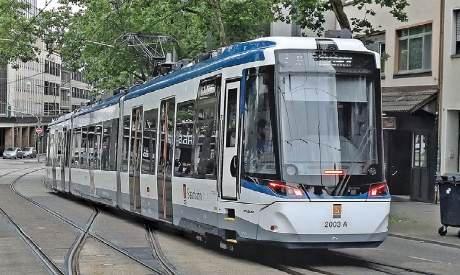
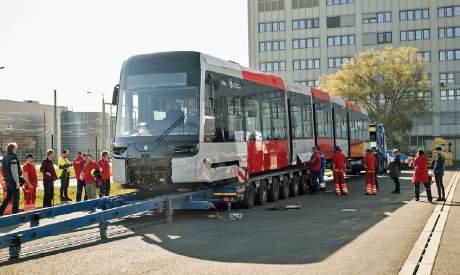
Burgemeester Oudlaan to Centraal Station.
Extending line D has boosted peak period metro services between Centraal Station and Pijnacker.
Tram 2025, out of service for months due to collision damage, has returned as an instruction car. OR UTRECHT. Evening and weekend services to Science Park are to be introduced in 2027.
Tramway operation has been reorganised under a standalone company, owned by the province. This new organisation is responsible for operation and maintenance. OR
LIMA. Metro line 1 is to undergo a EUR3.4bn modernisation programme. A new train control system is to be installed to permit a 90-second service. The concession to operate the line, undertaken by Argentina’s Ferrovías S.A.C., is to be extended to 2031. IRJ
BYDGOSZCZ. A tender has been issued for five new trams, each capable of carrying 200 passengers. There is an option for a further 15 and delivery should start within 24 months of contract signing. TP
GDA Ń SK. PESA has emerged as the preferred bidder for new 45m trams but an evaluation was still underway at the time of writing. A new PLN321m (EUR75m) tram depot, capable of holding 20 47m trams, is to be built at the Uje ś cisko tram and bus terminus. TR KRAKÓW. Ex-Amsterdam 1960 eight-axle tram 610 from Poznań was hit by a car on 21 June, its first day in service. Katowice Konstal 102Na 183 of 1970 was hastily loaned to the system to act as a museum tram. transphoto.org WROCŁAW. Škoda 52T tram 9521 from Praha (Prague) was
demonstrated in the city in mid-June.
Operator MPK is preparing a tender for up to 160 new trams. Škoda
LISBOA (Lisbon). Plans to extend the Red line metro by 4km (2.5 miles) to Amoreiras and Alcântara have been delayed by the loss of EU funding. This was due to an increase in construction costs and inability to complete work by the end of 2026. RGI SINTRA. The historic tramway’s summer timetable features three departures on weekdays, leaving Sintra at 10.20, 14.00 and 16.00. At weekends and holidays, additional departures take place at 12.10, 15.00 and 17.00. R. Holliday
ROMANIA
BUCURE Ș TI (Bucharest). Operator ILFOV organised its first parade of preserved and modern trams on 31 May. These included 119 (built ITB, 1956) + 6334 (ITB, 1976 rebuilt as open-sided), 304 (FAUR, 1995), 354 (URAC, 1994), 6001 (ITB, 1976), 3303+3344 (Tatra, 1975), 3405 (Tatra, 1975), 417 (BUCUR, 2023), 136 (URAC, 2007), 3900 (Astra, 2024), 2008 (Rathgeber, 1967) and ex-Wien (Vienna) 6324 (Simmering, 1929).
A festival is planned for 11-12/18-19 July to mark the withdrawal of the last Tatra T3R trams. transphoto.org, STB PLOIE Ș TI . Astra Vagoane was the preferred bidder for 20 new low-floor trams but Bozankaya has successfully appealed the decision. Both bids will now be reevaluated.
cs-dopravak
RUSSIA
PROKOPYEVSK. The 65-year old overpass on Komosomolskaya has been found to be in dangerous condition, resulting in the closure
of lines 3 and 7 from 5 June. transphoto.org
STARY OSKOL. The acting governor of the Belgorod region pledged to continue the express tramway service during a visit on 16 June. transphoto.org
VOLZHSKY. The city has acquired five Ust-Katav-built 71-623 bogie trams from Moskva (Moscow). transphoto.org
YEKATERINBURG. The first of 50 three-section 71-639 Castor trams, ordered from UKVZ under a leasing deal with SberLeasing worth RUB10.9bn (EUR127.5m), was delivered on 6 June. RGI
SINGAPORE
MASS TRANSIT RAILWAY. The Harbour Front – Marina Bay section of the Circle Line metro was to open on 12 July. This completes the 33km (20.5-mile) project.
CRRC Qingdao Sifang has delivered the first of 44 six-car trains for the future 29km (18mile) Cross Island Line, due to open in 2030. urbanrail.net, RGI
SPAIN
BARCELONA. Tenders have been invited for 36 metre-gauge EMUs for FGC’s line to Manresa/Igualada and to cover the city extension from Plaça d’Espanya to Passeig de Gràcia. TR
DONOSTIA (San Sebastian). Suburban metre-gauge commuter rail services from Altza to Galtzalaborda were to start on 18 July. urbanrail.net GRANADA. Junta de Andalucia has awarded Pérez Jiménez a four-year, EUR6.5m contract for maintenance of the tramway system, including the southern extension that is due to open later this year. CAF has a EUR5.5m contract covering electrification, power supply, lifts and escalators. RGI PALMA DE MALLORCA. The government authorised a EUR3.1m contract on 1 June for the design and construction
planning of the 30km (18.6-mile) Palma – Llucmajor line. Construction is expected to start in 2028, with completion in 2032. lok-report.de
BASEL. BVB’s lines 1, 2, 3, 6, 8, 11, 14, 15/16, 17 and 21 are to be diverted until 6 September to permit reconstruction of Marktplatz. Line 12 is cancelled. DS
CHUR – DISENTIS. The section of RhB’s line between Klosters Platz and Davos Platz is to be closed between 7 September and 16 October to permit rebuilding at Davos. It is planned to close again between 23 August –15 October 2027.
A CHF57m (EUR61.8m) order has been placed with Windhoff for eight multifunction works cars, with delivery due in 2029. EA
LAUSANNE. Federal funding has been agreed for metro line M3. This 3.5km (2.1-mile), six-station automated line would link Gare CFF and Bossons/Blécherette. Construction could start this year, with completion in 2034. letemps.ch
TAIPEI. HyundaiRotem is building ten six-car metro trains to meet increasing passenger demand. They should enter service in 2027. RGI
ISTANBUL. Metro Line M11’s 21.7km (13.5-mile) Arnavutköy Hastane – Halkalı extension opened on 19 June. urbanrail.net
UKRAINE
YENAKIIEVE. A one-tram shuttle between Ulitsa Brailyana and Schazhta Krasny Oktyabr came into effect on 2 June. This will allow track repairs to take place on the Ulitsa Tiunova bridge. transphoto.org YEVPATORIA. Line 2 on
the Crimean system resumed operation from 11 June, operating Gorteatr – Liman between 09.00 and 18.00. transphoto.org
BLACKPOOL. Services currently terminate at Fisherman’s Walk, due to the condition of a former department store in Fleetwood following a fire on 4 June. Replacement buses provide access to Fleetwood Ferry and Fleetwood Market.
GLASGOW. Strathclyde Partnership for Transport has appointed Jamie Ross as its new Chief Executive. Ross was previously Liverpool City Region Combined Authority’s Director of Transport.
INDUSTRY. Mike Birch has been appointed Transportation Director for the UK and Ireland at global consultancy and engineering firm Egis. He was previously West Yorkshire Combined Authority’s Mass Transit Director.
LONDON. Mott MacDonald and Egis have been appointed to Transport for London’s Professional Services Frameworks 3 (PSF3) for Project, Programme and Commercial Management (PPCM) services.
LONDON (TRAMS).
VolkerRail has used a machine to apply Sika’s Icosit polymer rail embedment system for the first time. The machine can pump 200 litres of vibrationdampening polyurethane grout around the rail heads; previously, 12 litre tins of grout had to be poured by hand.
LONDON (UNDERGROUND).
Transport for London has said that all its below ground stations should have 4G and 5G mobile phone coverage by the end of the year, up from approximately 60% now.
London Underground Ltd plans to replace its fleet of 29 battery locomotives used for infrastructure trains. The current fleet dates from the 1960s/70s but uses older technology. Design work could start in 2029 with delivery in the following decade.
NOTTINGHAM. Lifts providing access to Nottingham Express Transit’s elevated Station Street stop are out of action until at least 14 August for replacement of life-expired components.
TYNE & WEAR. The last runs of Tyne & Wear Metro’s original Metrocar fleet were to have taken place on 26 June. The 90-strong fleet of two-car EMUs, built by Metropolitan Cammell in 1975-81, has been
replaced by 46 five-car Stadler Class 555s.
USA
BOSTON, MA. The Red Line metro was to close north of Park Street station 21-30 July for track upgrades. Mass Transit DENVER, CO. Denver Regional Transport District’s board is to be reduced from 15 to nine from 2029 and each member is to have specific authorities and responsibilities.
Mass Transit LARKSPUR – WINDSOR, CA. A 2 June referendum approved retaining the sales tax that funds the SMART diesel light rail operation. The line carries more than 1.4m passengers per year.
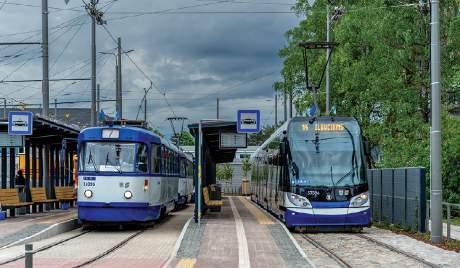
J. May
LOS ANGELES, CA. Passenger numbers on the LACMTA rail system reached 6.5m in May, a 9.5% increase over May 2025. There was a 62% patronage increase on Line D following the opening of three new stations on 8 May.
The Foothill Gold Line Construction Authority has awarded the management contract for the 3.7km (2.3-mile) Pomona – Claremont extension to a joint venture comprising Skanska USA, Stacy & Witbeck and Herzog Contracting; USD6.3m (EUR5.5m) is allocated to pre-construction activity. Services could start in 2031.
Mass Transit
NEW YORK, NY. A SkanskaTraylor-Walsh joint venture has won the USD1.02bn (EUR899m) contract for the design and construction of Phase II of the Second Avenue subway from 96th St to Lexington Avenue. Ground-breaking took place on 9 June. IRJ
NEW YORK, NY. A Request for Proposals has been issued for 252 new commuter rail coaches (with an option for a further 377), for use on the Metro North Hudson and Harlem lines. They should start entering service in 2029. Mass Transit PHILADELPHIA, PA. Rapid transit cars 1017/18 have been given a special livery to mark the 250th anniversary of the USA’s Declaration of Independence. W. Vigrass SACRAMENTO, CA . Public consultation on the USD164m (EUR144.5m), 2.9km (1.8mile) Downtown Riverfront Streetcar Project took place in June. Completion is planned for 2029-30. J. May
SALT LAKE CITY, UT. Work has started on the S-Line streetcar extension to Highland Drive/ Simpson Ave. It could open in autumn 2027. J. May
SAN FRANCISCO, CA. An increase in sales tax to support Bay Area transit agencies will be on the November ballot. It aims to generate an extra USD980m (EUR864m) per annum from 2027. J. May ST. LOUIS. Testing started on the 8.3km (5.2-mile) MidAmerica St Louis Airport Metrolink light rail extension in mid-May. It is to open later this year. sctd.org WASHINGTON, DC. An exhibition is taking place on the National Mall to mark 50 years of Washington metro and 250 years since the signing of the Declaration of Independence. A Rohr 1000-series car from 1976 and a mock-up of a new Hitachi 8000-series were to be on display until 10 July. J. May
VIETNAM
HO CHI MINH CITY (Saigon). A consortium of Guangzhou Metro Design and Arup has been awarded the contract to carry out a feasibility study for metro line 4. IRJ
MUSEUM NEWS
AMSTERDAM (NL). Former Praha (Prague) two-axle tram 352 of 1915 has been transferred to the Ostrava (Czech Republic) tramway museum collection. Former Bonn works tram A41 has been sold to a private buyer, who intends to use it as a camping car. OR
BEAMISH (UK). Gateshead & District Tramways Company 10 moved under its own power around the museum’s depot on 12 June. It last worked in 2016. Chief Executive Rhiannon Hiles was appointed a Commander of the Order of the British Empire (CBE) in the King’s Birthday Honours, announced on 13 June. She joined the museum as a volunteer in 1995 and became Chief Executive in 2021. CRICH (UK). Blackpool Jubilee Car 762 returned to
service in June after repairs to its motors.
EDMONTON (CA). The museum tramway across the High Level Bridge operates Thursday-Monday until 7 September, then FridaySunday until 12 October. culturealberta.com
WORKINGTON (UK). Workington Transport Heritage Trust is appealing for volunteers to help restore the body of a City of Carlisle Electric Tramways tram. The tramway closed in 1931 and this lower deck section is believed to be the only survivor from the fleet, although its identity remains a mystery.
Worldwide items for inclusion should be sent to Michael Taplin at Flat 8, Roxan Villa, 33 Landguard Manor Rd, Shanklin, Isle of Wight PO37 6EA, UK. Fax: +44 (0)1983 862810 or e-mail miketap@mainspring.co.uk UK and Ireland items, please e-mail: uknews@lrta.org
Acknowledgements are due to: berlin.de, bfmtv.com, BT, CBC, cs-dopravak, culturealberta. com, dopravacek.eu, Drehscheibe (DS), Eisenbahn Amateur (EA), International Railway Journal (IRJ), KVB, letemps.ch, lineoz.net, lokreport.de, Mass Transit, Op de Rails (OR), Railway Gazette International (RGI), Raitio, rigassatiksme. lv, skyscrapercity, STB, Today’s Railways (TR), Tram-2000 (T-2000), transphoto.org, Transport Publiczny (TP), tramwayforum.at, urbanrail. net, and urbantoronto.ca.
All the latest news...
Keep up to date with the latest news right at your fingertips. Visit: www.mainspring.co.uk/ industry-news/
A delightful and popular feature of the annual Museum Night service of historic trams put on by Warszawa is their operation well into the hours of darkness. Mike Russell went along to see what it was all about.
We break new ground this issue, by featuring a great cultural success story that has spread widely across Europe and beyond since being pioneered by Berlin in 1997. This is what was originally described as the ‘Long Night of Museums’ but is now more simply 'Museum Night’.
The concept is simple but effective: one night each year, museums of all descriptions remain open until the early hours of the next day, offering free or reduced-price admission to widen the exposure of their collections to the general public and advance the knowledge and appreciation of cultural heritage. This concept often includes special vintage public transport linking various museum sites, sometimes free of charge but more often with a combined transport and admission ticket at special rates.
Many tram towns and cities participate, often operating just one or two special services using their heritage fleets. However, this article centres on one city that has fully embraced the scheme and turns out seldomseen representatives from its own heritage collection: Warszawa (Warsaw).
Here, the tramway is now a principal participant in the wider museum event staged in the Polish capital. At first the event took place each September but has now been fixed at the third Saturday in May each year. This report concentrates on the events of 16 May 2026.
Warszawa habitually nominates one of its tram depots as the host, and this year it was the turn of Praga, as it was in 2025 –previously it had been Plac Narutowicza. The contribution of tramways to the overall event was substantial: a fleet of ten cars (seven motor and three trailers) was mustered for an initial parade across the city, and then many of them provided a special free pan-
handle service (line M) based on Praga depot throughout the evening. Further members of the heritage fleet, not designated operational for this event, were exhibited for inspection on the apron of Praga depot.
Museum Night has become, in many ways, the annual high point for Warszawa’s heritage tram collection. It is now the only annual occasion on which the two oldest veterans, each over a century old, are paraded for the general public. Rather remarkably, members of the public are encouraged to ride on them for free.
Established
Heritage transport is a well-established facet of summer operation in the Polish capital. This encompasses trams, motor buses, railways and even river services on the Wisła (Vistula). So far as the trams are concerned there is a long-established historic service (T), operated since 1996, which runs in high summer and is normally worked by fourwheel tramcars from 1940 onwards. The increasing march of the low-floor revolution has confined several more modern Warszawa tramcars to the ranks of heritage vehicles, and since 2021 these have operated on line 36 (Metro Marymont – Plac Narutowicza) as part of the normal city system in an extended summer season. This was covered in the January 2022 issue of TAUT.
Although the initial offering on this operation was of Warszawa’s own vehicles, its scope has since widened and now a system has developed under which preserved trams from other standard-gauge Polish tramways come to the city for a summer’s operation, with an equivalent exchange of Warszawa rolling stock. This year will feature cars from Gda ń sk, Kraków and Pozna ń; former Rheinbahn car 2513 from Pozna ń had already arrived in the capital.
Line 36 has a longer operating season,
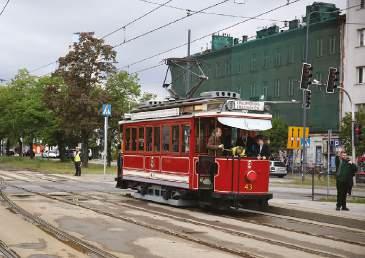
generally from 1 May to the end of September.
The timetable for 17 May was for the customary route 36 operating hours (around 12.00-19.30) but for Museum Night itself the operating day was extended to midnight, in each case utilising three cars from the Warszawa collection. Among these is former Pozna ń 102N car 5, part of the capital’s heritage fleet since 2004. This friendly interchange of rolling stock adds great interest to this operation, and it would be good if the smaller metre-gauge systems could be encouraged to consider a similar arrangement in future years.
Warszawa has many years’ experience of operating heritage services, as the use of the restored Kogut (Cock) car 43 was a feature of tourist services even under the former Communist regime. However, one relatively novel feature of today’s Warszawa is the growth of public protest movements. These range from modestly-sized examples to substantial affairs highlighting significant political or social issues – and the tramway company was uncertain of the extent of any delay that might be experienced by the special tramway heritage operations on the Saturday. Thus, although the crosscity parade was due to start from Plac Narutowicza at 17.00, the exit of the trams from Mokotów depot took place much earlier despite the relatively short duration of the journey. Shortly after 15.00, two separate convoys – each of three motor cars with three trailers attached to the second tranche – could be found making their way from the depot to take up appointed positions on the three available storage tracks at Plac Narutowicza. This left just one track free for use by regular routes 14 and 15.
Cars that came from Mokotów were class A Kogut 43 dating from the electrification of the tramways in 1908, works car tower
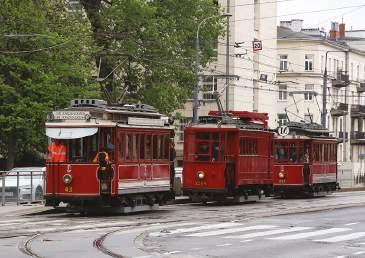
2. Class A car 43 on the central reserved track in Aleja Zieleniecka on its way to static display at Praga depot. This car was built in 1908 by Falkenried of Hamburg for the city’s first electric tramcars.
3. A convoy led by Falkenried class A car 43 of 1908, and followed by TMW type W tower car 2204 of 1928 and class C passenger car 257 built in 1925 by the
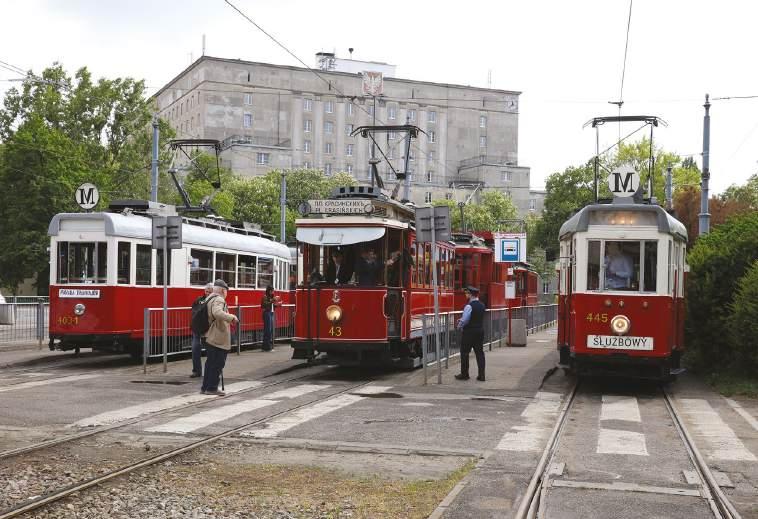
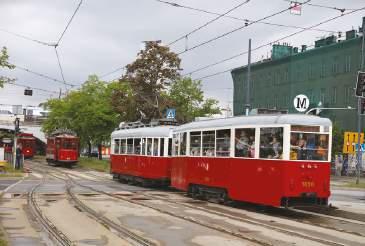
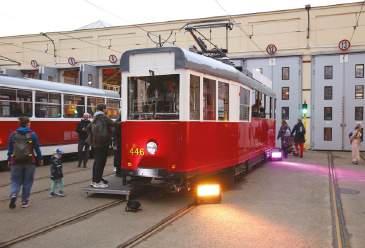
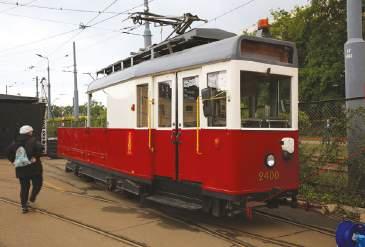
8 9 5
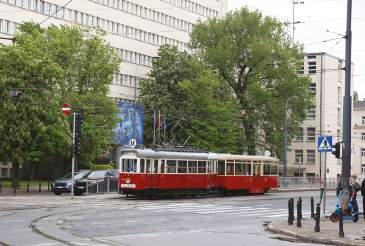
6
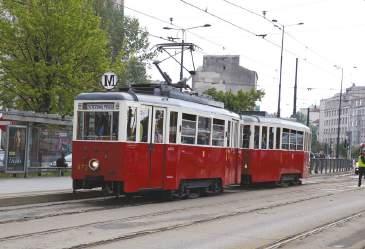
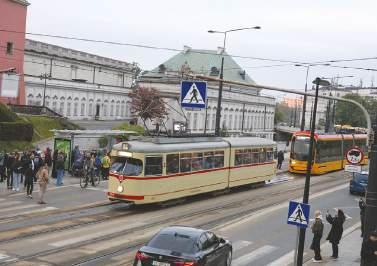
1. Operation of heritage service well into the hours of darkness is most unusual and gives the Warszawa experience a special delight. Here the set of 403-1 and trailer 1620 pause at Rondo ONZ.
4. A fine collection of vintage trams at Plac Narutowicza, occupying three of the four roads on the north-eastern side of the square. From left to right we see Gdańsk-built K-class 403-1, class A 43 (the true grandmother of all Warszawa electric tramcars) and Chorzów-built K-class 445.
5. A shot illustrating the relatively close formation of the parade, with cars 43, 2204 and 257 ahead of the set comprising K-class 403-1 and trailer 1620, all on their way to Praga depot and about to pass along Targowa. Car 403 was one of 20 class K vehicles built at Gdańsk, whilst 1620 is a type ND trailer, one of a small number built by Sanok.
6. Class K long-wheelbase two-axle motor car 445 was built at Chorzów in 1940 and transferred to Berlin for the duration of World War Two, returning to Poland in 1945. Here it is hauling car 506, a replica centre-entrance pre-war trailer. The set is seen at the Grand Union junction at Al. Niepodległosci with Nowowiejska on its way to Plac Narutowicza.
7. Another class K car that has found a later role in life is 446, which has gained an open rear section.
8. The archetypal Polish tramcar of the early post-war era was the type N motor car and its later derivatives and matching trailers. This view is of N-type 873 and trailer 1811. Car 873 is a later type of N-class vehicle designated 4N1, and both date from 1961. They have just turned into Aleja Zieleniecka.
9. So robust was their construction that after withdrawal from passenger service a number of class K cars were retained and adapted for works duties. Car 2400 is one such, relegated from its former role as 408 in 2002. It stands sentinel outside Praga depot.
10. Heavy loading required reinforcements being called up; here is Poznań 2513, an ex-Rheinbahn Düwag GT6, heading west at the stop below the reconstructed Old Town.
wagon 2204 and C-class motor car 257 of 1925. The second group consisted of motor car 403 of 1940 with trailer 1620; motor car 445 with Wismar-built S2D trailer 506 on loan from Kraków for the season (now in the Szczecin red and cream livery to which it was repainted after being rebuilt to post-war condition whilst operating in Szczecin); and N-type set 873+1811. It should be mentioned that the existence of car 43 is most remarkable given the privations visited upon Warszawa and its tramways during World War Two. Remarkably some 40 cars of class A (from over 100 built) survived the war. They were repaired in the undertaking’s workshops and remained in service until 1958. Car 43 was set aside for museum purposes and in 2000 was rebuilt to original 1908-14 unvestibuled condition as originally supplied by Falkenried of Hamburg.
During World War Two, car 43 was based at the former Muranów depot, and in recent years evidence has been found confirming that it performed on the unnumbered shuttle service within the Jewish Ghetto between 1941 and 1942, the route indication being a circular headboard bearing the Star of David.
Leaving Plac Narutowicza around 17.00, the parade set off via Plac Zawiszy and then along the east-west main line of Al. Jerozolimskie to Most Poniatowskiego and on via Rondo Waszyngtona towards Praga depot. In Aleja Zieleniecka the cavalcade met an even longer parade of motor buses, with several vintage specimens leading an increasingly modern line-up all needing to cross the tramway under Police supervision. The tram parade could then continue to Praga depot, where hordes of visitors had already assembled, pressing at the depot gates which were not due to be opened until 18.00.
Praga depot’s apron had been cleared of the customary stabled spare service tramcars, which temporarily moved to the newest Annopol depot, to make room for a variety of special and historic cars. In this they were joined by class A 43 and C 257.
Amongst other vehicles on display were: 541, one of the Linke-Hoffman-built cars identical to those supplied to Wrocław from which undertaking this example was retrieved; another class K, 446, one of several retained for works duties and now with an open rear section; 503, one of the first 13N
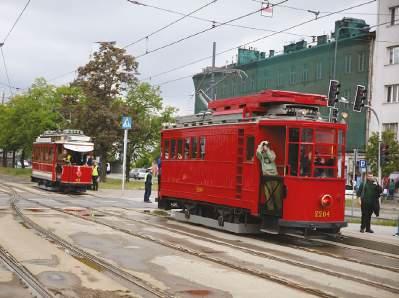
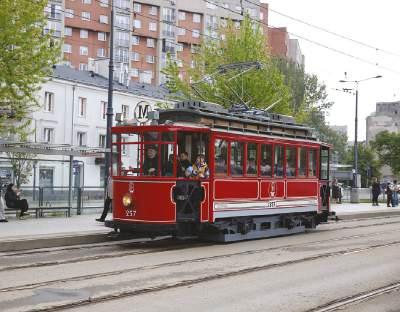
production series cars derived from the Czech T I type in 1959 and rebuilt to represent the two Czech visitors; and 105N 1006.
Alongside the building on the circumference track, the first two sets of cars had been marshalled to provide service on the night route M. Like any great city tramway, Warszawa can be expected always to have track up somewhere for rehabilitation, and so the itinerary of line M had to be devised to avoid short-term renewal works. The route was from Praga depot via Dworzec Wile ński, Most Šlą sko Dąbrowski, Plac Bankowy, Al. Solidarności, Al. Jana Pawła II, Rondo ONZ, Prosta, Kasprzaka, Skierniewicka, Wolska, Al. Solidarności and with the outward route reversed to Praga depot. The first departure was shortly before 18.25, with a 20-minute frequency thereafter until around 23.00.
Only the oldest cars were employed on this operation (save for 43 and 257, parked at Praga) and demand during the evening was so great, with consecutive journeys operated by motor-plus-trailer sets being overwhelmed, that some trips were operated by Rheinbahn Düwag 2513. On loan from Pozna ń, this inaugurated Warszawa operations on line M and can now be seen in operation on line 36.
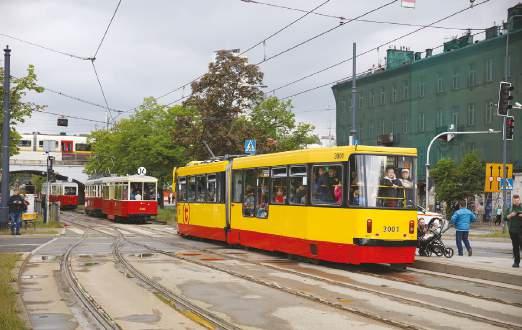
13. Following behind the two-axle cars was 3001, the city’s first low-floor articulated car built by Konstal as type 112N and delivered in 1995. This car is still in regular passenger service, but is already deemed worthy of a place in the heritage collection.
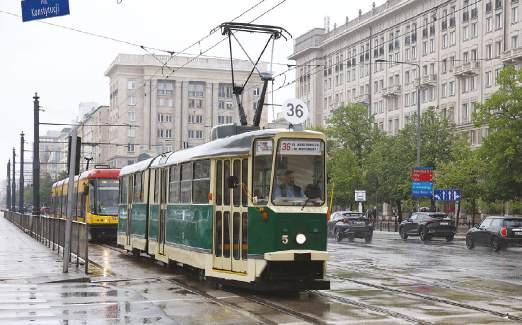
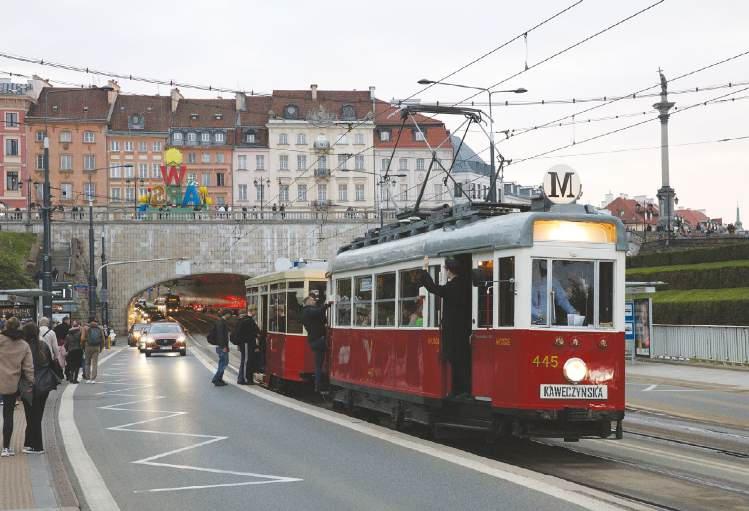
A ride on one of the two-car sets of Chorzów(445) or Gda ńsk-built (403) class K motor cars with trailer in tow presented a stark contrast with present-day practice on the system. The acute sounds of flange squeal and harsh, angular cornering of the older two-axle cars reminded passengers of how tram travel used to be, contrasting with today’s smooth riding and high speeds on well-maintained track, with multisection low-floor cars powering into curves with unremitting confidence.
Operation of vintage museum cars anywhere in the hours of darkness is quite rare and the Warszawa experience is one of the best examples of this imaginative practice.
Warszawa’s network has had a chequered history. Starting with horse tramways on 11 December 1866, the system developed into the biggest in Congress Poland. Not only was it the first in the Russian partition but survived until 1917, longer than any of the other subsequentlyopened horse-car systems except Kostrzyn, which lasted until 1923. The original gauge was 1524mm (or perhaps 1525mm – sources vary) and was retained during the subsequent electrification programme.
Such was the devastation wrought upon the tramway during World War Two that when peace returned and the chance for reconstruction presented itself the opportunity was taken to relay to European standard-gauge (1435mm), a process which had already been in train in the later pre-war period.
This year’s May procession was originally expected to represent the tramway’s 160th anniversary but it later became clear that another event, perhaps bigger than this one but totally tramway-orientated, would take place on a date to be announced nearer the actual anniversary. It seems probable that a commemorative book will also be published on that occasion.
With thanks to Witold Urbanowicz for additional information.
15. The great popularity of museum-night service M is well illustrated by this view taken at the tram stop below the rebuilt OId Town, a rare example where passengers board and alight at a roadlevel stop with no physical protection from general traffic other than (generally well-observed) requirements to cede passage to tramway passengers. Cars 445 and 506 are doing great business at 20.02; the service continued until after midnight.
“Operation of vintage museum cars anywhere in the hours of darkness is quite rare, and the Warszawa experience is one of the best examples.”
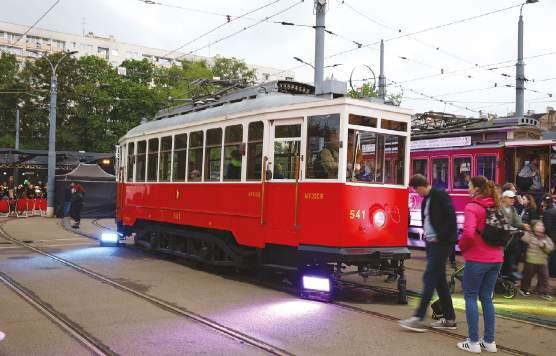
17
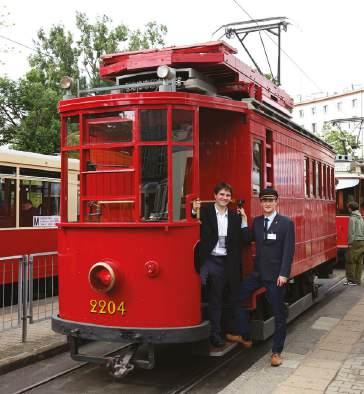
16. Warszawa had a fleet of 40 Linke-Hoffman two-axle cars but none survived quite long enough into the preservation era so an identical car was acquired from Wrocław (that city’s number 1024, later G-020) and given what would have been the next serial number (541) in the Warszawa fleet.
17. Warszawa Tramways staff members pose on the rear step of tower car 2204, dating from 1928, during its elongated stay on one of the stabling roads at Plac Narutowicza before setting off in the parade.
With the prospective election of Andy Burnham as the UK’s sixth Prime Minister in ten years, LRTA Chair Paul Rowen speculates what a Burnham premiership might mean for light rail.
Not since the 19th Century and the Anti-Corn Law campaign led by Richard Cobden (a Rochdale MP) and John Bright (a native of Rochdale) has what happens in Manchester been so high on the agenda. However, the first thing that must be said is that what has worked in Greater Manchester was not a Burnham invention. Rather, it has been a pragmatic response by the leaders and councils of the ten districts following Mrs Thatcher’s decision in the 1980s to abolish Greater Manchester Council. Unlike most other metropolitan areas and fostered by the likes of Sir Richard Leese and Howard Bernstein, the ten districts that make up the conurbation continued to work together across the political divide. So when the then-Conservative Government was threatening to privatise Manchester Airport, the leaders appointed Colin Swarbrick, Tory leader of Trafford, as Chair of the airport board. Thatcher did not proceed with privatising the airport.
Similarly, when Labour Chancellor Alistair Darling announced the scrapping of several light rail schemes in the 2000s including Metrolink’s big expansion, Greater Manchester was the only area that forced the government to back down.
When the Coalition government backed by George Osborne decided to introduce Metro Mayors, Greater Manchester’s was the first to be appointed, negotiating a devolution deal that included control of the health budget. Burnham – sensing an opportunity and having failed to be elected Labour leader –became the authority’s first Metro Mayor.
Progress has continued since, including with the rollout of the Bee bus network alongside ambitious plans for further Metrolink expansion and a detailed economic growth plan. Whilst the skyscrapers in the city have grabbed attention, it is ambitious plans like the advanced manufacturing facility at Atom City on the border between Rochdale and Bury that are bringing real growth throughout the conurbation.
So how might Burnham translate this growth to the rest of the UK, including the development of light rail? Unlocking growth in the regions of the UK will mean real devolution – not just of powers, but also finances. The dead hand of the Treasury must be loosened. Introducing land value taxation and allowing councils to issue municipal bonds to finance infrastructure projects like light rail are possibilities. This is not without risk, but if it works elsewhere, why not here? Secondly, Metro Mayors need greater control of the planning process – why should Transport and Works Acts have to be determined in Whitehall? There is also a need to expand the role and support that UKTram can give authorities when developing light rail schemes, and we need to develop a pipeline of work that will help bring costs down. As the recent report by Create Streets on experience in France has shown, when planned alongside housing and industrial development, light rail can get the country moving.
Burnham has shown this works in Greater Manchester – let’s all hope he gets it through the Whitehall maze!
AUGUST
Saturday 8. Cumbernauld 13.00. Scottish Area Group show and tell. Cumbernauld Theatre, G67 2UF. Contact: scotland@tlrs.info. (TLRS) Wednesday 12. Sussex 19.40.
Chris Warren: First London tram rides 1950 – 1952. Southwick Community Centre, BN42 4TE. Contact: sussex@tlrs.info. GBP2 visitors. (TLRS) Friday 21. Solent 10.00. Andrew Harri: European tram films.
Compiled
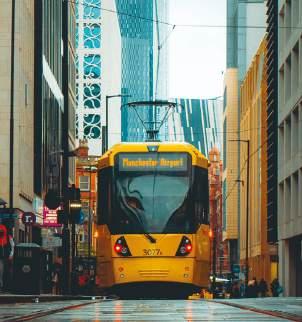
With this edition of TAUT, members will receive details of the formal agenda for the AGM which takes place in Norrköping, Sweden, on 20 September. Full details of how to book or take part online can also be found on the website. There are also details of a couple of important constitutional changes that will allow voting online. At the moment members not able to attend must vote by proxy.
Community Kettle CIC, PO6 2PS. Contact: solent@tlrs.info. Cost GBP3. (TLRS) Saturday 29. Nottingham 14.00. Bring a thing. Beeston Scout Hut, NG9 1GA. Contact: eastmidlands@ tlrs.info. (TLRS)
SEPTEMBER
Thursday 3. Brentford 14.30. Alan Holmewood: Vicinal sunset. London Museum of Water and Steam, TW8 0EN. Contact: thamesvalley@tlrs.info GBP5 inc. refreshments. (TLRS)

Order online from https://shop.lrta.org/ – or by post from:
LRTA Publications, 38 Wolseley Road, SALE, M33 7AU
(Please provide telephone contact details and quote LRTA membership number if applicable)
Outside UK = Airmail to Europe (includes all of Russia) / Surface mail to rest of world; Airmail Zone 1 = outside Europe excluding Australia, New Zealand & USA; Airmail Zones 2/3 = Australia, New Zealand & USA
This fascinating book details all the UK tram schemes that failed to see the light of day.
> A4 softback; 192 pages; 116 colour and 119 black & white pictures; 117 maps.
£23.00 (UK); £30.00 (outside UK);
£37.50 (Airmail Z1);
£42.00 (Airmail Z2/3); LRTA Members: £2.00 discount
The creeping decline of a colonial monument
This book is dedicated to the last operating tramway in South Asia. It covers the 152year history of this huge Indian city’s tram system. English and German text.
> A4 softback; 168 pages, 200+ colour and black & white pictures, 20 maps.
£42.00 (UK addresses); £53.50 (outside UK); £68.00 (Airmail Z1);
£73.50 (Airmail Z2/3); LRTA Members: £3.75 discount
The second in our new series of colour albums covering the historic Lisbon, Porto and Sintra tramways plus the new Metro do Porto and Metro Transportes do Sul light rail networks introduced in 2005/07.
> A4 hardback, 144 pages, 287 colour pictures plus 16 maps.
£33.50 (UK); £40.00 (outside UK); £47.50 (Airmail Z1);
£52.50 (Airmail Z2/3); LRTA Members: £3.00 discount
A book from the LRTA by Tony Young and Derek Shepherd. Detailed history of the local tramway networks accompanied by several maps and many previously unpublished photographs.
> A4 softback; 160 pages.
£27.50 (UK); £32.00 (outside UK);
£38.00 (Airmail Z1); £42.00 (Airmail Z2/3); LRTA Members: £2.50 discount
Straßenbahnen in Wien in Farbe (1956-78)
A superb full-colour album from the LRTA showing the variety of car types in the Austrian capital. Captions in English and German.
> A4 hardback, landscape; 144 pages, 200+ colour pictures, one map.
£32.00 (UK addresses); £38.50 (outside UK); £46.00 (Airmail Z1);
£50.00 (Airmail Z2/3); LRTA Members: £2.90 discount
The first in a series of three books covering many of the tramways and electric light railways operational in Spain in the mid-1950s.
> A4 hardback, landscape format; 144 pages, fully illustrated in colour throughout.
£42.50 (UK); £54.00 (outside UK); £66.00 (Airmail Z1);
£67.50 (Airmail Z2/3); LRTA Members: £3.90 discount
I tram di Milano – Immagini a colori (1954-1978)
Third in the series of colour albums exploring the fascinating combination of urban and interurban tramways in and around Milan. The variety of rolling stock is amazing and is richly illustrated. English and Italian text.
> A4 hardback, 144 pages, 176 colour pictures plus two maps.
£33.50 (UK); £40.00 (outside UK); £47.50 (Airmail Z1); £52.50 (Airmail Z2/3); LRTA Members: £3.00 discount
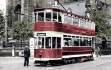
A companion volume to our Bolton book, describing the different generations of tramway from the Company steam era, the Corporation electric period and through to today’s Metrolink system.
> A4 softback; 184 pages, over 220 photographs, four maps and extensive appendices.
£26.00 (UK); £37.50 (outside UK); £48.50 (Airmail Z1); £52.50 (Z2/3); LRTA Members: £2.25 discount