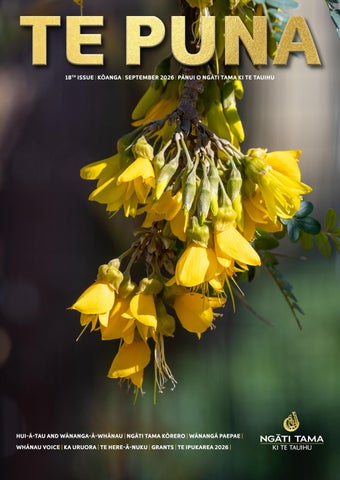
18TH ISSUE | KŌANGA | SEPTEMBER 2026 | PĀNUI O NGĀTI TAMA KI TE TAUIHU
HUI-Ā-TAU AND WĀNANGA-Ā-WHĀNAU | NGĀTI TAMA KŌRERO | WĀNANGĀ PAEPAE | WHĀNAU VOICE | KA URUORA | TE HERE-Ā-NUKU | GRANTS | TE IPUKAREA 2026 |
Publish Date: September 2026
PAGE 2 | TE PUNA
Rārangi Ūpoko He Kupu Whakataki
2
Appointments and Acknowledgments
3
FEATURES Whānau Voice - Te Ataarangi
4
Ko te Kāhui Whetu ki Te Uma
6
Te Here-ā-Nuku
8
NGĀTI TAMA KŌRERO Honouring the mouri of Wakapuaka
9
Kairuku ki Kaiteretere
10
Kapa Haka Nationals
10
STRATEGIC PRIORITIES AHUREA Whānau Voice - Wānangā Paepae
12
Kura Taio ki Mohua
14
AHUMAHI 16
Ka Uruora - More than a Home AHUTAIAO Kāinga Ora homes
18
Te Rourou Bridge
19
AHUORA Whānau Voice - Cheyna Matengā
20
Whānau Voice - Kennedy Strong
22
Grants Information
24
EVENTS AND UPDATES Ngāti Tama Podcast and Website
26
Te Ipukarea 2026
27
Hui-ā-Tau and Wānanga-ā-Whānau 2026
28
TE PUNA | PAGE 1
He Kupu Whakataki - nā te Heamana me te Pouwhakahaere CHIEF EXECUTIVE AND CHAIR UPDATE
E te whānau whānui o Ngāti Tama, tēnā koutou katoa This spring issue of Te Puna carries a strong sense of movement: looking back with gratitude, standing firmly in the present, and turning with purpose toward what comes next. Across these pages we acknowledge the people, kaupapa and places that continue to shape Ngāti Tama: from the passage of Te Here-ā-Nuku and the responsibility of stewardship that now follows, to the quiet dedication of those strengthening our commercial, BUTCH LITTLE
HĒMI SUNDGREN
cultural, environmental and whānau foundations.
TE HEAMANA, CHAIR
TE POUWHAKAHAERE, CEO
There is much to celebrate. We honour Waari WardHolmes for his long and disciplined contribution to
Ko hiringa nuku Ko hiringa rangi Ko hiringa te kōrero Ko hiringa te wānanga Ko hiringa tau Ko hiringa taketake ki te whai ao ki te ao mārama
Tama Asset Holding Company, welcome new governance capability through Luke Mitchell, and acknowledge the mahi of those who have served the Trust. We also hear directly from our uri through stories of reo reclamation, scholarship, and the courage it takes to keep learning, keep showing up, and keep carrying the aspirations of our tūpuna forward. This issue also reminds us that identity is lived in practice. It is present in paepae wānanga, Kura Taiao, the restoration of Wakapuaka, the naming and design of public spaces, the blessing of new homes, and the events that bring whānau together across the rohe. Whether through reo, whenua, wai, housing, education, sport or governance, each kaupapa speaks to the same enduring responsibility: to serve our people well, protect what has been handed to us, and build foundations worthy of those still to come. Ngā mihi nui to everyone who has contributed kōrero, photographs, reflections and mahi to this edition. May these stories strengthen our connection to one another, to our places, and to the kaupapa that continue to guide Ngāti Tama forward.
Tama tū ki te Tauihu, Tama ora ki te Ao. Ngā manaakitanga Butch and Hēmi
PAGE 2 | TE PUNA
APPOINTMENTS AND ACKNOWLEDGMENTS
LUKE MITCHELL: APPOINTED DIRECTOR OF TAMA ASSET HOLDING COMPANY
Ngāti Tama is pleased to acknowledge the appointment of iwi member Luke Mitchell as a Director of Tama Asset Holding Company (TAHC), following his earlier appointment as an Associate Director. Luke brings more than 25 years’ experience in banking and financial services, with expertise in credit risk, financial analysis and financial risk management. He has held senior roles in New Zealand and London and currently works for BNZ as Manager, Business Pricing. His experience also extends beyond finance, including a career break working as a full-time artist in London and involvement in community activities. Luke’s financial and commercial expertise, combined with his connection to Ngāti Tama, will be valuable to the TAHC Board as it continues to manage and grow the iwi’s commercial assets. His progression from Associate Director to Director also reflects the importance of building governance capability within Ngāti Tama. We congratulate Luke on his appointment and look forward to his continued contribution to TAHC and the future growth of Ngāti Tama’s commercial assets.
HONOURING WAARI WARD-HOLMES
When Waari Ward-Holmes was welcomed onto Tama Asset Holding Company (TAHC) as a Director and Chair in June 2017, he brought a formidable commercial pedigree, including long governance service with Wakatū Incorporation and directorships across Kono and Tohu Wines, to a young post-settlement portfolio. That experience showed. In his first year, TAHC managed $46.8 million in assets, returning 3.62%. Waari set a patient, disciplined course, championing the shift out of managed funds into collective iwi investment vehicles such as Hāpai and Pūainuku. Nine years on, the results speak for themselves: TAHC equity has grown to $77.8 million, and in FY2025 the company delivered a net profit of $7.4 million, a 10.2% total return and a $2.0 million dividend to the Trust, the iwi's primary income source. Beyond the numbers, Waari has been a steady, diligent influence, guiding the Board through volatile markets while never losing sight of the mokopuna these assets serve. He leaves the portfolio positioned for enduring success.
"E te rangatira, ngā mihi maioha ki a koe".
JENNA NEAME Jenna Neame joined Ngāti Tama in October 2023 as our Operations Manager and finished her time with the Trust in July 2026. During her time with Ngāti Tama, Jenna supported the dayto-day operations of the Trust and worked alongside our staff and Trustees across a range of kaupapa. Her role included much of the mahi that happens behind the scenes to support the team and the work we deliver for whānau. We would like to acknowledge Jenna for the time and mahi she contributed to Ngāti Tama over the past few years and thank her for the work she carried out during her time with the Trust. As Jenna moves on to her next chapter, we wish her and her whānau all the best for the future and whatever opportunities may come next.
The Tama Asset Holding Company - from left: Meg Matthews, Joe Hanita, Waari Ward-Holmes, Butch Little.
TE PUNA | PAGE 3
Whānau Voice - Te Ataarangi
Before starting Te Ataarangi, what was your relationship with te reo Māori, and what made you decide it was finally the right time to begin your journey? Before starting Te Ataarangi, I had already studied te reo Māori through Te Wānanga o Raukawa and completed up to Level 4. I have been learning on and off for many years, but my biggest issue has always been consistency. I would study for a while, stop, and then when I came back to it, I felt like I was starting from the beginning again. Because I wasn't using te reo in my everyday life, a lot of what I had learnt wasn't sticking.
Jasmine La'auli Parapara te mounga, Pariwhakaoho te awa Ngāti Tama te iwi Tihe mauriora e Ko Te Ketu Rameka ka moe ia Ko Ragimihia ka puta Ko Rameka Te Ketu ka moe ia ko Mere Mataiawa ka puta Ko Tiki Rameka ka moe ia ko Amiria Ngatāua ka puta Ko Mere Tiki Wharerangi ka moe ia Ko Haare Hawe ka puta Ko Tiki Wharerangi Haare Hawe ka moe ia Ko Joyce Wipaki ka puta
Ko Kathleen Hawe ka moe ia ko Mark James ka puta Ko au
This year, Ngāti Tama partnered with Te Ataarangi ki Kahui Maunga to provide ten uri of Ngāti Tama with the opportunity to take part in a 20-week Te Ataarangi programme. Designed to strengthen te reo Māori through an immersive and supportive learning environment, the programme encouraged participants to grow in confidence, deepen their understanding of te reo, and reconnect with their culture and identity. One of our participants, Jasmine La’auli, shares her journey, reflecting on the impact the programme has had on her reo journey and what it has meant for her and her whānau.
PAGE 4 | TE PUNA
I wanted to try Te Ataarangi because it was a completely different way of learning, particularly being in a rumaki environment. I hoped putting myself in a space where te reo Māori was constantly around me would be a turning point. For me, a big part of the journey is becoming comfortable with being uncomfortable. There is nothing more nerve-wracking than waiting for your turn to stand up and say a karakia or your pepeha, let alone having to start a waiata in front of everyone! I think I will know I have cracked it when I can do those things without getting that nervous, sick feeling in my puku. Until then, I just have to keep putting myself in those spaces. Was there a moment during the course that really stayed with you or changed the way you saw yourself, your whakapapa, or your connection to te ao Māori? Tell us about it. I remember being really nervous going into my first online class. Even though I was learning from home, it still felt intimidating, and I have always put an enormous amount of pressure on myself to get things right on the first attempt. A real turning point for me was realising that mistakes were actually welcomed, even in an online space. We weren't expected to log in already knowing everything or to get everything right straight away. Making mistakes was simply part of how we learnt. That was a huge relief for me. It allowed me to relax a little, stop putting so much pressure on myself and just give things a go. Being surrounded by other tauira who were learning alongside me also helped. We could make mistakes, laugh, try again and support eachother through it. It made the learning environment safe and reminded me that none of us have to be perfect to reclaim our reo. Learning a language can be challenging. What was the hardest part of your reo journey, and how did Te Ataarangi and your fellow tauira help you work through it? Being a second-language learner has been really challenging for me. I have tried different ways of learning over the years, but I have always struggled
to retain everything. I keep going back to the basics, hoping everything I have studied previously will come flooding back. Some of it does, but a lot of it doesn't. The feeling of not being "good enough" is also very real. For generations, our whānau were disconnected from our reo, and the effects of that are still felt today. It has taken me a long time to accept that I am good enough to learn and that I deserve to put the time and effort into reclaiming my language. I know that it is a long journey. I was in and out of te reo Māori classes all the way through to college, and I think this is why it has been hard for me. I have never been consistent. I look forward to the day when I can sit in a pōhiri and understand the whaikōrero, understand the karanga and have the reo and confidence to respond. I also look forward to knowing naturally when it is time to stand for the waiata tautoko instead of waiting for the tap or nod to stand up and start. Te Ataarangi has helped me understand that I don't need to know everything right now. I just need to keep showing up, listening, speaking and learning. Since completing Te Ataarangi, what has changed in your everyday life? Whether it's speaking with your tamariki, understanding karakia, participating on the marae, or simply feeling more confident, we'd love to hear your experience. Since completing Level 2 with Te Ataarangi, I have a much better understanding of sentence structures and the importance of knowing the different tenses, but I have also learnt a lot about the way I learn — especially as I have always struggled with these concepts in English as well, which has made it harder at times, but also helped me realise I just need to learn in a way that works for me. I would often come away from our classes with heaps of questions because during the class I didn't have enough reo to know how to ask them! At first that was difficult for me because I am someone who likes to understand why a sentence is structured a certain way. I would automatically try to compare everything back to English, which would sometimes confuse me even more. Looking back, not being able to stop and question everything was actually a blessing. Te Ataarangi made me listen, watch, repeat and trust the process rather than overthinking everything. The repetitive style of learning really helped me, and I have started to recognise structures and kupu without needing to pull everything apart first. I still have a long way to go, but I feel like I now understand what works for me and what I need to do to keep progressing.
to become comfortable with being uncomfortable, because sometimes that is where we learn the most. You don't have to wait until you know enough, feel confident enough or have everything figured out before you start. One thing I really enjoyed about Te Ataarangi was the repetition and knowing that mistakes were encouraged. It takes so much pressure off when you realise you aren't expected to get everything right. For our Ngāti Tama whānau, I would encourage everyone to start, or if you have already started, keep going. Learning our reo isn't only a benefit for ourselves. It benefits our tamariki, our whānau and ultimately our iwi. Every extra person who can kōrero, understand a karakia, support a waiata or stand confidently on our marae strengthens us collectively. Is there anything else you'd like to share about your Te Ataarangi journey that we haven't asked, or a message you'd like to leave for future tauira? A whakataukī that really resonates with me and my reo journey is:
"Mā te kimi ka kite, mā te kite ka mōhio, mā te mōhio ka mārama." THROUGH SEEKING WE DISCOVER,
THROUGH DISCOVERY WE COME TO KNOW,
AND THROUGH KNOWING WE GAIN UNDERSTANDING.
For me, this is about recognising that we are continuously learning. There isn't a point where you suddenly know everything. You just have to keep searching, keep learning, keep speaking and, most importantly, keep showing up. My reo journey definitely isn't finished, and I don't think it ever will be. There will always be more to learn. What type of tūpuna do you aspire to be? This is probably the hardest pātai for me. I aspire to be a tūpuna who served, someone who did right by my whānau, hapū and iwi and who played my part in bringing our reo back. We often hear that it can take one generation to lose the reo and three generations to bring it back. I want to be part of the generation that brings it back, so that my tamariki and the generations after them don't have to start from the same place I did.
If one of your cousins, siblings, or friends told you they were too whakamā, too busy, or thought they weren't good enough to learn te reo, what would you say to encourage them to take that first step?
I would love for my tamariki to be immersed in our marae, te reo Māori, kapa haka, taiao and everything that comes with te ao Māori. I want those spaces to feel normal and natural to them. I want them to grow up knowing who they are, where they come from and feeling confident in those spaces.
Everyone is good enough to learn their language. Te reo Māori is our birthright. I would tell them to learn
If I can help create that foundation for my tamariki and our future generations, then I think I will have done my job.
TE PUNA | PAGE 5
Ko te kāhui whetu ki Te Uma Te Hautapu me to tahi o Te Tau KA ARA A PUANGA, KA ARA A MATARIKI. KA ARA KO TE KĀHUI WHETŪ KI TE UMA O RANGINUI E TŪ NEI. TAKIRI KO TE ATA, KA URA TE ATA, KA HUA KO TE TAU HOU, KA PUA TE WĀNANGA. There is a particular kind of darkness that comes before the
What made the morning possible was the many weeks and
new year. It is cold, it is long, and it asks something of those
nights of preparation that came before it. The hautapu sat
who stand within it. On Saturday 11 July, whānau gathered in
within the second noho of the Tokomaru Wānanga series at
that darkness at Te Uma in Motueka, Whakarewa, Ngāti Rārua,
Te Āwhina Marae, where the wānanga did more than prepare
Te Ātiawa and Ngāti Tama standing together, waiting for the
us for ceremony, it strengthened our confidence, deepened
first light of a sunrise that would not break until 7.51am.
our understanding, and created space for the kaupapa to take
That waiting was not separate from the ritual; it was part of the ritual itself. Our tūpuna did not mark the turning of the year in the comfort of the afternoon, but at the edge of night, when the cold was deepest and the sky was clearest. It
root. With whānau from Wairau alongside us, we were able to reflect on the ceremony they had carried the morning before and begin shaping a shared pathway for how our iwi might continue to bring this kaupapa into the light together.
was then that Puanga and Matariki could be read, and the
Through karakia, kōrero and learning over many weeks and
signs they carried received with humility. It was then that
months, Tokomaru Wānanga helped build the capability,
offerings could be made, not as performance, but as an
confidence and collective foundation needed to uphold
act of remembrance, release, gratitude and commitment.
these annual commitments across the region with unity,
Te Tahi o Te Tau is not simply a celebration placed within
purpose and mana.
a long weekend. It is a sacred pause, a moment to honour those who have passed, to acknowledge the year that has been, and to turn with intention toward the year ahead.
So when we came to Te Tākiritanga (dawn rise) and spoke the names of those we had lost, releasing them to become stars, we did so with understanding. When the umu was opened
This year, for the first time, we carried that work alongside the
and kai was lifted to the whata, to Tipu-ā-nuku, Tipu-ā-rangi,
Rārua whānau from Wairau. Their knowledge, generosity and
Waitī and Waitā, we knew what each offering answered
support helped shape the ceremony at Te Uma, with elements
to. Ritual done well is never performance. It is discipline,
of the hautapu they had carried the morning before becoming
preparation and trust. It is people knowing their part, having
part of the framework we followed together. In a year nationally
spoken the words aloud before, and being ready to hold the
themed Matariki Herenga Waka, this felt deeply appropriate.
space for one another.
The waka are bound together, and so are we. What one whānau has held, protected and practised can be shared, received and carried forward by another. This is how mātauranga lives, not in archives alone, but in people; in the willingness to gather before dawn, to stand together in the cold, to trust the process, and to pass the kaupapa on with care.
PAGE 6 | TE PUNA
That is the true outcome of the wānanga: not simply that a ceremony was delivered, but that a generation is now better prepared to carry it again. To stand before the dawn. To read the signs. To honour the dead. To offer for the living. To bind our waka together and move into the new year with purpose.
This is how mātauranga lives, not in archives alone, but in people; in the willingness to gather before dawn, to stand together in the cold, to trust the process, and to pass the kaupapa on with care.
TE PUNA | PAGE 7
Te Here-ā-Nuku | From Settlement to Stewardship WRITTEN BY HĒMI SUNDGREN AND KERENSA JOHNSTON
On 18 August 2026, whānau travelled from Whakatū and across the motu to fill the public gallery at Parliament. When the Te Here-ā-Nuku (Nelson Tenths) Bill unanimously passed its third and final reading, there were tears, waiata and the quiet weight of generations in the room. What that day revealed was more than a legal victory. It was the power of people standing together: kaumātua who never gave up, whānau who carried the kaupapa at great personal cost, and a community, Māori and non-Māori, that chose to stand alongside us. If the settlement has proved anything, it is that our greatest asset was never the land alone. It was the people, standing together in common purpose. That spirit of collective purpose is exactly what the work ahead demands. The return of whenua and compensation is a threshold, not a finish line. Thresholds ask something of those who cross them. The word that should guide us now is whakahauora: the restoration of life, wellbeing and prosperity. We have written previously about the importance of an endowment. Te Here-ā-Nuku is a taonga, not a windfall. Its discipline is simple to state and difficult to maintain: protect the endowment in perpetuity, distribute only what is sustainable, and steward it collectively for the educational, spiritual, economic, health and cultural wellbeing of our people. This is the difference between serving the fund and taking from it. The road ahead for the Te Here-ā-Nuku Trust will require that same discipline in practical form. The legislation gives us the purpose and parameters; the Trust must now agree
a long-term strategy that gives effect to those obligations in a way that is clear, transparent and enduring. That also means putting the right systems around governance, reporting, distributions and the completion of property title transfers. The Trust must also establish strong investment disciplines and accountability, and embed a fair and trusted election framework and cycle. These are not simply administrative tasks. They are some of the foundations that will determine whether Te Here-ā-Nuku remains a living endowment: protected, purposeful and capable of serving our people for generations to come. There are sober lessons from elsewhere. Indigenous nations that have turned historic settlements into enduring funds have learned that the real test begins after the endowments are restored. Over-spending, weak governance, or decisions that drift from the voice of the people and the original purpose can quietly undo what took generations to win. The lesson is consistent: endurance beats extraction. The gallery emptied that afternoon, but the responsibility did not. The measure of success cannot simply be the value of the assets returned or the distributions made. It must be measured in sustained improvements in prosperity and wellbeing, in opportunities created for the people, and in the strength of the taonga passed forward. That is what whakahauora asks of us. It is not a slogan, but a discipline of restraint and a habit of service. And it is a promise renewed, as one kaumātua reminded us, for the mokopuna not yet born.
Melissa Banks Photographer
PAGE 8 | TE PUNA
NGĀTI TAMA KŌRERO
HONOURING THE MOURI OF WAKAPUAKA A significant chapter in the restoration of the Wakapuaka River has been marked with the unveiling of a new artwork designed by Ngāti Tama CEO Hēmi Sundgren to honour the mouri of the awa. The artwork is part of the Wakapuaka Mouri restoration project, which has seen more than 85,000 native plants planted over the past five years, helping restore the health of the awa and strengthen connections between people, whenua and the natural environment. Designed to reflect the cultural and ecological significance of the Wakapuaka River, Hēmi’s artwork acknowledges the deep connections between the awa and those who have long cared for and relied on this place. The unveiling also marked the transition from the Ministry for the Environment - funded programme into a new phase of landowner and community stewardship. Over the past five years, Wakapuaka mouri has brought together mana whenua, landowners, contractors, local government, schools and volunteers, demonstrating what can be achieved through collaboration. Ngāti Tama Pou Taiao and Environmental Manager Dayveen Stephens says the project has highlighted the importance of strong relationships alongside environmental outcomes. “The opportunity to work alongside Wakapuaka 1B Trustee and Ngāti Tama Trustee Andrew Stephens, landowners Richard Ussher of Cable Bay Adventure Park and the Kidson family, Asita Langi from Nelson City Council, and Sophia from Te Tauihu Environmental Trust demonstrated the value of collaboration.” “Together, we were able to achieve positive environmental outcomes while also building enduring relationships with landowners, local government, and organisations that support and uphold our cultural values and expectations.” The 85,000 native plants will help stabilise riverbanks, improve water quality and provide habitat for native birds, bats and insects, supporting the restoration of the catchment and its mouri for generations to come. The new artwork stands as a visible reminder of the journey so far, recognising the cultural connections of the awa and the collective effort behind its restoration.
While project funding has ended, the mahi continues. The relationships built over five years, alongside a growing network of volunteers, landowners, iwi partners and community organisations, provide a strong foundation for the next chapter. Ngāti Tama acknowledges everyone involved, including the Ussher and Kidson families, Wakapuaka 1B, Nelson City Council, Te Tauihu Environmental Trust, contractors, schools, volunteers and the wider community. The next chapter will focus on continuing the mahi, strengthening these relationships and supporting the awa and whenua to flourish into the future. TOP: Wakapuaka whānau, alongside the Kidson
family, Richard and Elinder Usher, Nelson City Council,
Sophia Bisdee of Te Tauihu
Environment Trust, and Ngāti
Tama whānau and staff, gather to unveil the new artwork.
MIDDLE: Wakapuaka whānau from left: Ānaru Stephens,
Moetu Tuuta and Darney Tākao. LEFT: Crafted from corten
steel and designed by Hēmi Sundgren, the taonga sits
alongside our tūpuna awa.
Hēmi spoke of the importance
of connectedness, emphasising that wai is essential to all
people and living things, and celebrating the connections that flow ki uta ki tai.
TE PUNA | PAGE 9
NGĀTI TAMA KŌRERO
KAIRUKU KI KAITERTERE | EXPLORING OUR MOANA
KAPA HAKA NATIONALS | SECONDARY NATIONALS
On Saturday 28 February 2026, whānau from across Te Tauihu came together at Kākā Pā for Kairuku ki Kaiteretere, a fun-filled day celebrating our connection to te taiao and each other.
Ngāti Tama extends our warmest congratulations to Ngā Aho Rau on their outstanding achievement at the 2026 National Secondary Schools Kapa Haka Championships.
Led by Te Ātiawa, with the support of Ngāti Rārua and Ngāti Tama, the day began with a whakatau and karakia at Kākā Pā, grounding everyone in the kaupapa before heading down to Little Kaiteretere. Thanks to the incredible support of Tasman Bay Guardians, whānau had the opportunity to explore the underwater world through snorkelling. For many, it was their first time putting on a mask and discovering what lies beneath the surface of our moana. Watching tamariki and pakeke alike build confidence, encourage one another, and share in the excitement of spotting marine life was a real highlight of the day. As some whānau ventured into the moana, others took part in Mau Rākau and Tirohanga Awa activities, learning new skills while strengthening their understanding of our natural environment. The variety of activities meant there was something for everyone, with tamariki, rangatahi, mātua and kaumātua all getting involved throughout the day. More than anything, Kairuku ki Kaiteretere was about bringing whānau together. It was a chance to reconnect with our environment, spend quality time with one another, and create lasting memories through shared experiences. The laughter on the beach, the encouragement between participants, and the smiles at the end of the day reflected the success of the kaupapa. A huge mihi to everyone who attended and to all those who helped make the day possible. We look forward to seeing even more whānau join us for future events as we continue to strengthen our connection to our people, our places, and our moana. TOP LEFT: Kākā Pā, Kaiteretere TOP RIGHT: Iyla La'auli with Auntie Jane du Feu RIGHT: Ngā Aho Rau
PAGE 10 | TE PUNA
Held every two years, the National Secondary Schools Kapa Haka Championships bring together the very best secondary school kapa haka rōpū from across Aotearoa. This year, 43 rōpū qualified to compete, showcasing the strength, talent and future of kapa haka on the national stage. Representing Te Tauihu, Ngā Aho Rau delivered a performance that earned them an impressive 19th placing overall. This is the highest placing the rōpū has achieved at the national championships and also saw them finish as the top-ranked rōpū from Te Waipounamu — an outstanding accomplishment that reflects the continued growth and strength of kapa haka throughout our region. As an iwi, we were especially proud to see a number of our own Ngāti Tama uri performing as part of the rōpū. Seeing our rangatahi stand proudly on the national stage, representing not only their schools but also the wider Te Tauihu community, is something our whānau can all celebrate. Their commitment, passion and willingness to uphold our culture through kapa haka is something to be acknowledged, and we hope they leave the experience with memories and friendships that will stay with them for years to come. We also acknowledge Tamu Mausii, Ngāti Tama uri, who was one of the tutors supporting Ngā Aho Rau throughout their campaign. Behind every successful kapa haka performance is a dedicated team of tutors who generously share their time, knowledge and experience to support the growth of our rangatahi. We congratulate Tamu, alongside the wider tutor collective, on this significant achievement. Congratulations once again to Ngā Aho Rau on a record-breaking result. We look forward to watching the rōpū continue to grow and wish all of our rangatahi every success in their kapa haka journeys.
2026-2031
Strategic Priorities Our Vision
TAMA TŪ KI TE TAUIHU, TAMA ORA KI TE AO Our place, our people, our destiny
Our Mission
MĀ NGĀRAHU, KA MURA TE AHIKĀROA
Success will depend on each of our contributions
Our Values
TŪ RANGĀTIRA - Courage, determination, growth ĀKONA KIA TUPU - Learn, teach, evolve MANA TIAKI - Restore, protect, sustain
AROTAHI AI TĀTOU - Collective, unified, inclusive
AHUREA
CULTURE AND IDENTITY. Uphold and embed the Ngāti Tama way of being across generations.
AHUTAIAO ENVIRONMENT.
The natural world is respected and sustained so future generations can enjoy and connect with it.
AHUORA
HEALTH AND WELLBEING. Whānau live healthier lives with fairer access to health outcomes.
AHUMAHI
EMPLOYMENT AND POTENTIAL.
Support whānau to grow skills, succeed in mahi and contribute to the collective wellbeing of our iwi.
AHUHAUTŪ
LEADERSHIP AND DIRECTION. Grow confident, capable leaders who can guide Ngāti Tama into the future. TE PUNA | PAGE 11
AHUREA CULTURE AND IDENTITY Uphold and embed the Ngāti Tama way of being across generations.
Whānau Voice - Wānanga Paepae There is just something about our marae. Every time I am there, I feel this sense of calm, and after a busy week at mahi, it is exactly what I need. Catching up with whānau, having a whawhewhawhe, meeting new people, and simply being back in that space always fills my cup. Every wānanga brings its own lessons, but it is also the people who make the experience what it is. Some of the greatest learning comes through conversations, through being present, through watching others, and simply being in the right place at the right time.
Rowena Hart Ka rere taku manu ka kite i tōku waka a Tokomaru e ū ana ki uta. Tiu ana rā ki te tihi o Piripiri, mātai iho ki te awa o Te Weranga o Waitohi, ka tau te remu o te toroa ki te marae o Waikawa, Te Ātiawa, e ara e!
Tama tū ki Te Tauihu. Tama ora ki te Ao. Tēnā koutou, Ngāti Tama, i tēnei o ngā wheako ki te hāpai i ngā mahi ā ngā tūpuna, kia whaowhia te kete mātauranga. Hei aha? Hei oranga tonutanga mō ngā uri whakaheke. Tēnā koutou. E ngā iwi o te motu nei, he raukura rā tēnei, e titia nei e ngā mahi a kui mā, a koro mā. Kei ngā tohunga, kei ngā punga o te waka, arā, ko Rangimōkai, ko Hemi, ko Mitch. Mei kore ake koutou, ka kore ēnei manu pīrere e rewa ai. Ka huri ngā mihi ki a Jazz rāua ko Tracey, ngā ringa raupā e pupuri nei i ngā taura o tēnei waka. Nā kōrua ēnei wānanga e tū tonu ai. Takiri ko te reo, hāpara ko ngā tikanga. Tēnā koutou katoa.
PAGE 12 | TE PUNA
I never really go into a wānanga with expectations because I know I will be grateful for whatever I come away with. Sometimes it is a small piece of mātauranga that I might not fully appreciate until later. Other times, there is something that really sticks with me and changes the way I think about my role and responsibilities. I have learnt that I do not need to leave every wānanga knowing everything. What matters is taking what has been gifted to me and using it. Our kaupapa has been karanga for tangihanga, which felt particularly fitting considering the year we have had in Te Tauihu. We have experienced significant loss and moments that remind us of the importance of our tikanga and of the people who hold and carry that mātauranga. We have also explored themes for karanga and how they can relate to the take of the wānanga or hui. It is about understanding the kaupapa, the people and the location, then weaving all of those together through karanga. There is a responsibility to ensure that what we say is meaningful, appropriate and connected to the kaupapa. One of the biggest highlights for me has been the haerenga. We are really fortunate to have whānau like Uncle Neville, Hēmi, Aunty Jane and Kerensa to share kōrero about key sites in our rohe, including Te Matau, Karaka Pā, Te Taero o Kupe and the Queen’s Gardens. Visiting these places while hearing their kōrero gave me a greater sense of my relationship with, and responsibility to, these wāhi whakahirahira. I am a visual learner, so standing on the whenua and seeing these wāhi tapu allows me to picture our tūpuna there, understand the significance, and feel a stronger connection to our hītori and pūrākau. As mentioned earlier, understanding the place is an important part of karanga, and these site visits give us an opportunity to gather the mātauranga that can later be woven into our karanga.
If I had one barrier, it would probably be finding time between wānanga to go back over everything we have learnt. There is always so much to take in over a weekend, and I think making time afterwards to revisit and reflect on it is just as important. When I do take that time, I find myself thinking not only about what I have learnt, but how I can carry it into my daily practice. One thing that really stuck with me was how much responsibility a kaikaranga has. It is not just about walking out onto the mahau and calling; it is about making sure the marae is ready, the people are ready, and that you are ready too. I liked hearing about the importance of finding your own space beforehand, sitting with your thoughts, and getting yourself into the right frame of mind before you karanga. Another takeaway was that kaikaranga are part of the paepae too. It is often thought that those who sit at the front of the paepae are “the paepae”. I have come to see the kaikaranga and kaikōrero as complementary roles, each with their own responsibilities but working together to support and uphold the kaupapa of the pōwhiri. One does not stand alone; their roles are interconnected and bring balance to the pōwhiri. Since I was at intermediate school, I have been doing karanga for a range of occasions — from sports events and cultural exchanges with visiting tamariki from other kura, to kapa haka brackets. For a long time, karanga was something I was familiar with, something I had done many times without necessarily stopping to think deeply about the responsibility and significance that sits behind it. These wānanga have made me reflect on the karanga I have done in the past and consider how much more there is for me to learn, understand and grow into as a kaikaranga. Those learnings have also challenged me to consider the kind of tūpuna I want to be for future generations. I hope I am someone who leaves my uri rich in mātauranga Māori, reo and tikanga; someone who teaches them to manaaki others, to be proud of who they are, and to understand that knowledge is not ours to hold on to, but something we have a responsibility to carry forward to the generations that follow. One of the biggest reflections I have taken from this wānanga is the importance of being prepared for the future of the karanga. Not necessarily the future of karanga itself, but the future of upholding the roles and responsibilities that sit within our marae. At the moment, we are fortunate to have our aunties who hold that space for us and carry the responsibility of the karanga with such mana and experience. However, there will come a time when they are ready to stand down, and it is our responsibility to ensure that the space does not become empty when that time comes.
“Moea te poi, moea te taiaha, moea te panekoti pango Mōu, mōku, mō ngā iwi katoa.”
PHOTOS ABOVE: Whānau at various locations across the three Wānanga Paepae held this year.
TE PUNA | PAGE 13
Kura Taiao ki Mohua Reading the Season, Building the Weir There is a particular kind of learning that only happens on the whenua: cold mornings, wet feet, and a karakia carried on the dawn air. That was the spirit of our most recent Kura Taiao Wānanga in Mohua, where whānau gathered at Patons Rock to deepen our role as kaitiaki through reo, mātauranga, and hands-on practice.
PAGE 14 | TE PUNA
Photography and reel by Aorere Media
STRATEGIC PRIORITIES 2026-2031 | AHUREA
At the heart of the weekend was te reo Māori, not as a classroom subject, but as the living language of the taiao. Under the guidance of Te Atapō, practitioners worked through karakia, pao, whakataukī and pūrākau, building the vocabulary to name what we see, monitor and care for. This is the discipline Kura Taiao was designed for: a cohort of active kaitiaki growing their reo o te taiao, alongside their mahi kai and technical mahi. That reo was woven through wānanga on the seasons, the maramataka, and the influence of the kāhui whetū in marking the turning of the tau. Our tūpuna read the year through the sky: the rising of certain whetū heralds the shift from one season to the next, telling us when species move, spawn and are ready to harvest. Understanding the elements that drive seasonal change — the stars, the tides and the temperature of the awa — is exactly what allows a kaitiaki to know when to act, not just how. The practical kaupapa brought this together: te piharau, the lamprey, and the customary art of building whakaparu, the weirs traditionally used to guide and catch them. Whānau harvested and prepared rarauhe (bracken), then worked shoulder-to-shoulder on a practical demonstration of constructing a whakaparu, reconnecting hands to a practice held by generations before us in Taranaki and Whanganui. Alongside this sat kōrero on piharau as a taonga species, customary trapping methods, and our seasonal monitoring framework, mātauranga and method, side by side. For some of our taiao practitioners, the most quietly powerful moments came at the edges of the day, actively learning and leading karakia in the dark of morning and the close of night. Several reflected that saying karakia themselves, rather than hearing it said, changed the experience entirely. Learning and applying what we learn at place, with purpose. That is the true measure of Kura Taiao. Whānau leave with more confidence in cultural health monitoring, a stronger grasp of Ngāti Tamatanga, and deeper relationships with the sites and taonga of our rohe. But they also leave carrying something older, the ability to read a season, build with their hands, and speak to the taiao in its own reo. Ngā mihi maioha ki a Te Atapō, Willow, and all our passionate practitioners who gathered for the wānanga. A special mihi also to Syd for manaakitanga fit for royalty, and to our wider whānau who helped bring the kaupapa to life.
He kura taiao, he kura tangata mō ngā uri whakatipu. WATCH THE REEL Kura Taiao is delivered with the support of the Department of Conservation and Te Mātāwai. ABOVE: Whānau learning out on the whenua.
TE PUNA | PAGE 15
AHUMAHI EMPLOYMENT AND POTENTIAL Support whānau to grow skills, succeed in mahi and contribute to the collective wellbeing of our iwi.
KA URUORA TE TAUIHU – A YEAR OF IMPACT For many whānau, owning a home can feel like a distant aspiration. Through Ka Uruora Te Tauihu, more whānau across the region are taking practical steps toward home ownership, growing their financial confidence and creating secure foundations for future generations. Established by the six iwi of Te Tauihu, Ka Uruora supports whānau through housing pathways, financial education and savings initiatives designed to turn long-term aspirations into achievable outcomes. Over the past year, that support has translated into real progress, with new homes completed, more whānau entering housing developments, and growing participation in programmes that help prepare whānau for home ownership and financial wellbeing. TE URUNGĀ KĀINGĀ - HOUSING The past year has been a significant one for Ka Uruora and the whānau it serves. Across Te Tauihu, we are now seeing the tangible results of years of planning, partnership and investment, with whānau moving into new homes, others preparing for ownership, and many more beginning their housing journey. Developments such as Berryfields in Waimea and Waikārapi in Wairau are helping create opportunities for whānau to establish secure homes, strengthen connections to place and build long-term wellbeing for future generations.
Berryfields – Waimea • •
Stage One completed: 8 whānau moved into brand-new homes Stage Two underway: 5 new homes began construction in January 2026, expected completion June 2026
Waikārapi - Wairau •
94 new homes in total; construction began on the first three homes, due February 2026
•
21 whānau actively progressing housing opportunities across 40 Ka Uruora homes
•
Additional 70 whānau engāged in early conversations about housing readiness
•
Progress to date: 25 building consents lodged, 11 approved
•
12 sections sold on the open market, including five to uri of Te Tauihu
These milestones reflect years of preparation and iwi-led planning, turning whānau housing aspirations into reality.
PAGE 16 | TE PUNA
Last October we supported the opening ceremonies for the first Berryfield homes, an extra special occasion as we collectively welcomed Te Hau Wilkie and other uri of Te Tauihu into their homes, witnessing the first hand the positive and material impact these housing opportunities create for whānau. TE URU AHUPŪTEA – FINANCIAL EDUCATION Home ownership begins long before the keys are handed over. It starts with knowledge, planning and confidence. Te Uru Ahupūtea supports whānau to build those foundations by providing practical financial education focused on budgeting, saving, mortgages and long-term planning. The programme is designed to help whānau better understand the steps involved in purchasing a home while strengthening the financial capability needed to achieve wider aspirations. Over the past year, 225 whānau completed the programme, gaining skills and confidence that support progress towards home ownership and financial wellbeing. Over the past year, 225 whānau graduated the programme through Ka Uruora Te Tauihu, a number we hope to build on. This programme also serves as a pre-requisite for consideration for Ka Uruora housing opportunities, ensuring participants are well-prepared to meet eligibility requirements and increase their chances of securing housing. LOOKING AHEAD The work ahead remains simple but important: helping more whānau move from aspiration to ownership. Through developments such as Berryfields and Waikārapi, alongside continued investment in financial education and housing readiness, Ka Uruora will continue walking alongside whānau as they build stable futures for themselves, their tamariki and generations to come. Every whānau journey is different, but the goal remains the same: creating pathways that support whānau into warm, secure homes and strengthening the foundations for long-term prosperity across Te Tauihu. TO REGISTER YOUR INTEREST PLEASE CONTACT: Te Hau Wilkie: tehaupanarae@kauruora.nz Quilla Kiore:
quilla@kauruora.nz
kauruora.nz
More than a home series. Eight whānau stories. Home means fulfilling our biggest dreams. Breaking generational barriers. Berryfields Waimea is a powerful example of what can be achieved when whānau, iwi and partners come together with a shared vision. Over the past 12 months, whānau have celebrated a significant milestone — achieving the dream of homeownership and creating strong foundations for future generations. The 'More Than a Home' series captured the stories of whānau who have worked towards this goal for years. Their journeys remind us that a home is about much more than four walls. It is about belonging, security, whakapapa and creating new possibilities for our tamariki and mokopuna.
Story Three - Play here
As one whānau member shared:
“It’s one of our biggest dreams – to be able to step into this.” Berryfields Waimea reflects the strength of collective action across whānau, iwi, Ka Uruora, Hāpai and the wider hapori. Together, we are breaking generational barriers and building brighter futures for whānau.
Story Four - Play here
Story Five - Play here
He mihi nui rawa ki a koutou katoa who have helped bring this kaupapa to life. Berryfields Waimea is a journey we can all be proud of. WOULD YOU AND YOUR WHĀNAU LIKE TO BE PART OF THIS KAUPAPA? If owning your own home is part of your dream, the first step is enrolling in Te Uru Ahupūtea, Ka Uruora Te Tauihu’s financial education programme. Enrolments are open now.
Story Seven - Play here
Story One - Play here
Story Six - Play here
Story Two - Play here
Story Eight - Play here
Register here with Te Uru Ahupūtea
kauruora.nz/ka-uruora-te-tauihu/
KA URUORA TE PUNA | PAGE 17
AHUTAIAO ENVIRONMENT The natural world is respected and sustained so future generations can enjoy and connect with it.
NEW STATE HOMES READY FOR WHĀNAU IN CENTRAL NELSON Sixteen new state homes in central Nelson are now complete, with whānau preparing to move into their new homes at 107 Nile Street. The six two-bedroom and 10 three-bedroom homes were blessed on 1 July 2026 by Matua Harvey Ruru and Ngāti Tama, marking the completion of a significant housing development in the heart of the city. The development will provide warm, modern and stable homes for families, while also contributing to the wider wellbeing of the Nelson community. Located close to schools, NMIT, shops and essential services, the homes will give whānau greater access to the facilities and opportunities they need. Ngāti Tama has been involved in the project through the design process, working alongside Kāinga Ora to ensure the cultural history and significance of the site was recognised in the development. This included the incorporation of tāniko patterns and a tuna motif into the design of the homes. Ngāti Tama Pou Taiao and Environmental Manager Dayveen Stephens says the design elements acknowledge the longstanding relationship between iwi, the whenua and freshwater taonga.
“When tamariki transition into warm, stable, purpose-built homes, the benefits to their education are profound. We see healthier kids, fewer sickness-related absences, and an end to the disruptive cycle of constantly changing schools.” For Nelson, the development is another step towards addressing the need for quality social housing and supporting families to establish secure foundations in their community. The site was previously home to the Nelson Masonic Hall. Kāinga Ora purchased the property in 2022, with the former building subsequently demolished to make way for the new homes. Construction began in September 2025. The completion of the Nile Street development brings new homes into the community while also demonstrating how housing projects can incorporate local history and cultural identity through meaningful engagement with mana whenua. Ngāti Tama is pleased to have contributed to the project and to see cultural elements incorporated into a development that will become home to local whānau. With families moving in, the focus now shifts from construction to community — with 16 new homes ready to become part of the fabric of central Nelson.
“Ngāti Tama maintains our traditional associations with taonga species connected to freshwater. This area was once abundant with tuna, and these important cultural connections are reflected in some of the design elements.” The inclusion of these elements provides a visible connection to the history of the area, while allowing the new development to reflect something of the cultural identity of the place. The project has also been welcomed by Nelson Central School, whose Te Pouahi ākonga performed waiata as part of the blessing. School principal Pip Wells says stable housing can have a significant impact on tamariki and their ability to learn and thrive.
ABOVE: Design elements reflecting cultural connections. ABOVE RIGHT: Nelson Central School ākonga performing waiata.
PAGE 18 | TE PUNA
STRATEGIC PRIORITIES 2026-2031 | AHUTAIAO
TE ROUROU BRIDGE - CONNECTING RICHMOND’S LANDSCAPE, CULTURE AND COMMUNITY The new Te Rourou Bridge on Lower Queen Street is now complete, bringing together improved infrastructure, environmental restoration and the cultural identity of Te Tauihu. The bridge features eight corten steel panels representing the eight iwi of Te Tauihu, with kōwhaiwhai-inspired elements acknowledging the cultural connections and history of the area. Ngāti Tama was involved, alongside other iwi, in discussions around the cultural aspects of the project. The name Te Rourou, meaning 'food basket', acknowledges the area’s longstanding connection to kai and food gathering. Ngāti Tama Pou Taiao and Environmental Manager Dayveen Stephens says the cultural elements provide an opportunity to recognise the values and connections rooted in the area. “The unveiling of the new name, together with the corten steel panels, provides an opportunity to acknowledge and celebrate the cultural values, practices, and connections that are deeply rooted in this place.” The 48-metre bridge also significantly increases the capacity of Borck Creek, allowing it to carry up to 105 cubic metres of water per second — three times the capacity of the previous bridge — helping reduce flood risk and strengthen Richmond’s resilience. The project includes more than 2,000 native plants, extensive grass restoration and a shared-use underpass connecting Headingly Lane and Berryfields. Te Rourou reflects Richmond’s growth while ensuring the cultural identity and connections of Te Tauihu remain visible within the landscape.
TOP RIGHT: Dan Solomon unveiled the panel representing Ngāti Tama MIDDLE AND BELOW: Everyone gathered to bless Te Rourou Bridge
TE PUNA | PAGE 19
AHUORA HEALTH AND WELLBEING Whānau live healthier lives with fairer access to health outcomes.
RECIPIENT OF THE JOHN MITCHELL SCHOLARSHIP A SCHOLARSHIP FOR TERTIARY STUDENTS STUDYING IN THE FIELD OF SCIENCE OR HISTORY STUDIES. HONOURING THE LEGACY OF MĀUI JOHN MITCHELL.
Cheyna Matengā Ko Tama Ariki te ariki Ko Rakeiora te tohungā Ko Tokomaru te waka Ko Ngāti Tama te iwi Ko Huroirangi ko Parapara ngā maungā Ko Te Tai o Aorere ko Te Tai Tapu ngā tai Ko Wakapuaka ko Pariwhakaoho ngā awa Ko Waikoropupū te wai Ko Huriawa te kaitiaki Ko Paremata te tupuna Ko Ngāwaina toku kuia Tama Tū ki Te Tauihu Tama Ora ki te Ao
To start off, could you share a bit about your background,
What sparked your passion for your chosen field of study?
your whānau links within Ngāti Tama, and where you are
Was there a specific moment or person that inspired you?
currently living or studying?
My passion was sparked through being involved in kaupapa
I was born in Porirua, where I was raised until my teenage
with my cousins and brother around whenua. Seeing the
years before moving to Australia. Returning home to
importance of understanding the law, protecting our taongā,
Aotearoa has been a journey of reconnecting with my
and strengthening our connection to te taiao inspired me
identity, culture, and whakapapa. My connections to
to pursue knowledge that can support whānau and future
Ngāti Tama are through Paremata Te Wahapiro and
generations.
Ngāwaina, and that whakapapa continues to guide me in my aspirations. I am currently studying at Te Herengā Waka - Victoria University of Wellington, completing a Bachelor of
How did it feel when you found out you had been selected for the John Mitchell Scholarship, and how is it helping you
Arts, majoring in Kaitiakitangā with a minor in Māori studies,
out with your studies this year?
alongside a Bachelor of Laws, with a particular interest in
I felt deeply honoured to receive this scholarship and grateful
Māori land.
for the support my iwi has provided throughout my three years of study. It had eased the financial pressures of tertiary education, including the cost of resources such as law books, allowing me to focus more on my studies and kaupapa.
PAGE 20 | TE PUNA
STRATEGIC PRIORITIES 2026-2031 | AHUORA
This scholarship honours the legacy of Māui John Mitchell, who did incredible research and history work for our tūpuna. How does it feel to carry that legacy forward through your own journey? When I think about the doors our tūpuna opened for us, I reflect on the responsibility we carry - not only to walk through those doors but continue opening pathways for future generations. I feel incredibly fortunate to be in a position where I can honor their legacy, continue their work, and give back to our iwi. If you could aspire to be like any of our tūpuna, who would it be and why? If I could aspire to be like any of our tūpuna, it would be Kauhoe. Her strength, resilience, and ability to carry the memory of her whānau through waiata is inspiring. She reminds me that leadership is not only shown through acts of power, but through protecting whakapapa, preserving our stories, and holding people together through difficult times. I hope to carry those same values in my own journey serving
Matengā whānau
Ngāti Tama. What has been the most exciting or surprising thing you
What advice or words of encouragement would you give to
have learned or worked on in your course so far?
other young Ngāti Tama uri who are thinking about heading
There are many exciting discoveries throughout my studies.
into tertiary study?
I have taken every Māori paper available to me, which has
If you desire to pursue higher education - go for it. It's okay to
deepened my understanding of our people and whenua.
be worried, it's okay to be nervous but don't let the fear stop
I have especially enjoyed learning how to map whenua,
you. If our tūpuna could heke north to south, you can achieve
exploring Polynesian histories, and gaining a deeper
your education goals. Universities today often have marae and
understanding of constitutional history and Te Tiriti o Waitangi.
strong Māori support networks, so you don't have to leave who
How do you hope your studies will benefit our iwi and whānau in the future? What does "giving back" look like for you? Giving back for me means using my knowledge in service of our iwi and whānau. I hope my studies in law and resource management will allow me to support Ngāti Tama in protecting our whenua, strengthening our governance, and navigating the legal challenges that affect our people.
you are behind to achieve your goals. Be brave, back yourself, and give it a go.
"Be brave, back yourself, and give it a go."
JOHN MITCHELL SCHOLARSHIP This scholarship honours the legacy of Māui John Mitchell and is offered to tertiary students studying in the field of science or history. John was the inaugural Chair of the Ngāti Tama Trust and dedicated his life to researching and recording the history of Ngāti Tama ki Te Tauihu tūpuna. Alongside his wife, Hilary, he coordinated the Ngāti Tama Waitangi Tribunal hearings at Wakapuaka and Pōhara. Their research has been preserved in the pukapuka Te Tau Ihu o Te Waka: A History of Māori of Nelson and Marlborough and He Ringatoi o ngā Tūpuna.
TE PUNA | PAGE 21
STRATEGIC PRIORITIES 2026-2031 | AHUORA
RECIPIENT OF THE JANICE MANSON MEMORIAL SCHOLARSHIP A SCHOLARSHIP HONOURING JANICE MANSON FOR TERTIARY STUDENTS ENROLLED AT NELSON MARLBOROUGH INSTITUTE OF TECHNOLOGY. (NMIT).
Kennedy Strong A humble and reflective kōrero about study, whakapapa, giving back, and the honour of receiving the Janice Manson Memorial Scholarship.
ABOVE: Rania (Janice's daughter) presenting the Janice Manson Scholarship to Kennedy.
To start off, could you share a bit about your background,
there are so many deserving tauira. One of the coolest parts
your whānau links within Ngāti Tama, and where you are
of the whole experience was having the award presented by
currently living or studying?
Aunty Rania, Janice's daughter, who was visiting from Australia
Ko Kennedy ahau. My whakapapa connects me to Te Tauihu
at the time. It felt really special to receive the scholarship from
o Te Waka a Māui through Ngāti Rārua, Te Ātiawa, and Ngāti Tama. I feel very fortunate to have those connections and to belong to communities with such rich histories and strong connections to whānau and whenua. I am currently studying at NMIT and have really enjoyed the journey so far. Like many tauira, I started out feeling a bit nervous and unsure of myself, but over time I've gained confidence and learned a lot, not only through my studies but about myself as well. I've been lucky to have great
someone who carries such a close connection to Janice. It was a privilege and an exceptional honour, and I think it was a pretty memorable moment for both of us. It made the award feel even more personal and gave me a stronger appreciation for the legacy behind it. The scholarship has helped ease some of the financial pressure that comes with studying and has allowed me to focus more on my learning. More than anything, it has given me confidence and reassurance that people believe
support from whānau, friends, and tutors along the way.
in what I am trying to achieve.
What sparked your passion for your chosen field of study?
This scholarship honours the memory of Janice Manson,
Was there a specific moment or person that inspired you? There wasn't one defining moment that led me into study. It was more a gradual decision to challenge myself and
a respected Iwi leader, Māori arts advocate, and champion for education at NMIT. How does it feel to carry that legacy of leadership and advocacy forward through your own
create opportunities for the future. A lot of my inspiration
learning journey?
comes from the people around me. Seeing the hard work and
Receiving a scholarship in Janice Manson's name is something
determination of whānau has taught me that growth doesn't
I feel incredibly humbled by. The more I learn about her life
happen overnight and that sometimes you just need to back
and contribution to Ngāti Tama and education, the more I
yourself and take the first step. Their encouragement gave
appreciate what an honour this award really is. To be honest,
me the confidence to give tertiary study a go.
I don't see myself as carrying on a legacy just yet. I'm still
How did it feel when you found out you had been selected for the Janice Manson Memorial Scholarship, and how is it helping you out with your studies this year?
learning and finding my own path. But this scholarship reminds me to make the most of opportunities and remember that what we learn can benefit more than just ourselves. I hope that through hard work and staying connected to my values, I can
To be honest, I was pretty surprised when I found out I had
eventually use what I've learned to support my whānau, hapū,
been selected. I felt incredibly grateful and honoured because
and iwi.
PAGE 22 | TE PUNA
If you could aspire to be like any of our tūpuna,
others. Whether that's through my career, community projects,
who would it be and why?
or supporting whānau aspirations, I hope whatever path I take
I find that quite a difficult question because there are so many
allows me to keep learning and making a contribution.
inspiring tūpuna. Rather than choosing one person, I admire the qualities that many of them shared, such as courage, resilience, humility, and service to others. I often think about how much they overcame for future generations. If I could carry even a small part of those qualities forward in my own
How do you hope your studies will benefit our iwi and whānau in the future? What does 'giving back' look like for you? For me, giving back means taking what I've learned and using it to support others. Education is a privilege, and I think it
life, I would be proud of that.
becomes even more valuable when it can be shared. Giving
What has been the most exciting or surprising thing you
it's helping where you can, sharing knowledge, encouraging
have learned or worked on in your course so far?
others, or contributing to projects that strengthen our people
One of the biggest surprises has been how much I've genuinely
and communities.
back doesn't always have to be something big. Sometimes
enjoyed learning. I started my studies thinking mostly about the qualification, but I've found a lot of satisfaction in challenging myself and developing new skills. I've also learned that study is about much more than coursework. It builds confidence, communication skills, and the ability to work
What advice or words of encouragement would you give to other young Ngāti Tama uri who are thinking about heading into study at NMIT? I'd say give it a go, even if you're nervous. I was nervous too,
alongside people with different perspectives and experiences.
and there were definitely times when I questioned whether
Tertiary study comes with its ups and downs. What has been
everything figured out before you start. You just need to be
your biggest challenge so far, and how have you overcome it?
willing to take that first step. There are people at NMIT who
My biggest challenge has probably been self-doubt. There
genuinely want to help, and there are lots of other students
have definitely been times when I've wondered whether I was capable or if I really belonged in tertiary study. What helped was realising that nobody starts with all the answers. Talking
I was making the right decision. You don't need to have
on the same journey. Back yourself, ask questions, and don't be afraid to make mistakes. Sometimes the opportunities that seem the most daunting turn out to be the ones that help us
with tutors, classmates, and whānau reminded me that asking
grow the most.
for help is part of learning. Once I stopped expecting myself to
Ngā mihi nui,
be perfect, things became much easier. Where do you hope your studies will take you in the future? What is the dream career, job, or project you would love to tackle? I'm still figuring out exactly where I want my studies to take me, and I think that's okay. What I do know is that I want to be involved in meaningful work that has a positive impact on
Kennedy
"Back yourself, ask questions, and don't be afraid to make mistakes"
JANICE MANSON MEMORIAL SCHOLARSHIP Offered by NMIT, the Janice Manson Memorial Scholarship supports ākonga (who whakapapa to Ngāti Tama) enrolled in NMIT programmes. Janice of Ngāti Tama descent was a passionate advocate for cross-cultural partnerships and Māori visual arts. She supported local Māori artists and children’s Māori art exhibitions at the Suter te Aratoi o Whakatū and was a life member of Nelson Kaupapa Māori Arts Inc. A former NMIT Academic Council member and resource teacher for Māori, Janice later chaired the Ngāti Tama Trust during preparations for the Trust’s Waitangi Claims hearings. Iwi, hapū and whānau were central to her life. She was also a strong advocate for positive development initiatives for Māori in the region. Janice was warm, committed and deeply involved in the lives of others. She is fondly remembered by her whānau and the many people whose lives she touched.
TE PUNA | PAGE 23
Grants and scholarships Ngāti Tama ki Te Waipounamu Trust provides assistance to whānau who are registered with us to promote and enhance social, educational, health and wellbeing, sporting and cultural opportunities of the iwi. Listed below are the grants that are currently open. MANAAKI GRANT
Manaaki
If you want support with health-related costs you can apply for a Manaaki Grant once a year. The type of costs you can apply for vary but include glasses, medical bills, dental bills, hearing aids etc. Applications are approved on a case-by-case basis by our Charitable Trust.
TAMA TŪ GRANT
Tama Tū
This grant is to tautoko whānau in exceptional circumstances where government or other support is not available or suitable to meet whānau needs. The Tama Tū grant is available once a year. The type of costs you can apply for vary and approval of application is at the discretion of our Charitable Trust.
SPORTS GRANT Are you involved in a sports team, have membership/uniform fees or an upcoming sports tournament? You might be able to apply for support via our Sports grant – check out our website to see if you’re eligible and submit your application form.
Sports CULTURAL GRANT
Cultural
Are you planning on or currently involved in a cultural activity? This could be something in the areas of kapa haka, te reo, mātaurangā or toi Māori. Or perhaps you’ve got an upcoming art exhibition or performing in a show? Check out our cultural grant application to see if you are eligible and apply now.
TRAVEL SUBSIDY
Travel
The individual subsidy is available to all registered adult (18+) members and tamariki of registered members who would like to attend a Ngāti Tama hui or kaupapa. One subsidy per registered member (and child/ren) per year. Application forms will be available at the Hui-ā-Tau and wānangā, where whānau must be present to apply. The subsidy will be distributed to whānau bank accounts in the weeks following the Hui-ā-Tau and wānanga.
TO APPLY FOR ANY OF THESE GRANTS LISTED - PLEASE GO TO: HTTPS://NGĀTITAMA.NZ/GRANTS/
PAGE 24 | TE PUNA
A selection of whānau that have received grants.
TE PUNA | PAGE 25
NGĀTI TAMA EVENTS AND UPDATES
NEW
JUST D
NGĀTI TAMA PODCAST
RELEASE
LAUNCHE
SERIES THREE
NGĀTI TAMA WEBSITE
We're excited to share the latest episode of our podcast
Ngāti Tama is pleased to share the soft launch of our
featuring Raina Hawe-Moe and Brooke Hawe, alongside
new website. The refreshed site provides a clean,
our hosts Hoani and Dan.
modern look and an easier way for whānau to find
In this episode, Raina and Brooke share their experiences of moving home to Te Tauihu, reflecting on what drew
information, stay connected, and keep up to date with what’s happening for our iwi.
them back, the transition of settling into Nelson, and
This is the first phase of our website development,
what returning has meant for them personally. It's an
and we look forward to continuing to build and
honest conversation about reconnecting with whānau,
improve the site with whānau in mind.
finding a sense of belonging, and building a future back in the place they call home.
Next year, we move to the second phase, introducing a secure members’ area. This will replace our existing
Tune in for an inspiring kōrero that highlights the many
Whānau app and bring our whānau services and
journeys our uri take and the different paths that lead
resources together in one place.
us back home.
WATCH PODCAST SERIES 3
GO TO WEBSITE
Tama Clothing We have a wide range of merch available for whānau to purchase online. There's something for everyone with sizes for tamariki, rangatahi and adults. Warmer weather is on the horizon so now might be a good time to grab a new cap or T-shirt! To see what’s available, including prices, click button below.
GO TO ONLINE CLOTHING
PAGE 26 | TE PUNA
Te Ipukarea Upcoming Events and News
Te Ipukarea 20 TH-21 ST NOVEMBER • WAIRAU
Te Ipukarea is back this November, and this year we're looking forward to joining our whanaunga in Wairau, where Rangitāne will proudly host this much-anticipated iwi sporting event. Bringing together whānau from across the rohe, Te Ipukarea is a celebration of sport, whakawhanaungatanga and iwi pride. Whether you're a seasoned competitor or simply keen to be part of the weekend, there is something for everyone to enjoy. This year's programme includes basketball, golf, euchre, netball, touch, ki-o-rahi, tug-of-war, before wrapping up with the always entertaining Haka Ngahau bracket. Please click on the link below to RSVP/register if you and your whānau are interested in participating.
EVENT DETAILS DATES: Friday 20th – Saturday 21st November 2026 LOCATION: Lansdowne Park, Wairau (Blenheim) ACCOMMODATION: Blenheim Bridges Holiday Park
• Golf • Euchre • NETBALL • KI-O-RAHI • TUG-O-WAR • BasketbalL • TOUCH RUGBY • TAMARIKI GAMES • KAUMATUA GAMES
If you have any pātai, please contact: jasmine@ngāti-tama.iwi.nz
RSVP/REGISTER YOUR INTEREST HERE
We look forward to seeing whānau in Wairau!
TE PUNA | PAGE 27
HUI-Ā-TAU AND WĀNANGA-Ā-WHĀNAU KI WHAKATŪ 2026 FRIDAY 4TH - SUNDAY 6TH DECEMBER Our annual Wānanga-ā-Whānau and Ngāti Tama AGM ki Whakatū is coming up, and we’re looking forward to welcoming our whānau back to Whakatū for another weekend of whakawhanaungatanga, connection and kaupapa. This year’s gathering will be held from Friday 4 December to Sunday 6 December 2026, with a full weekend planned for whānau of all ages. Saturday will be our Whānau Day, bringing everyone together for a relaxed day of connection and activities. Our Ngāti Tama AGM will be held on Sunday at Whakatū Marae, where whānau can hear updates on the mahi of the Trust and what is ahead for Ngāti Tama. Accommodation will be available at Whakatū Marae for whānau travelling to attend the weekend. Spaces are limited and will be allocated on a first-come, first-served basis, so we encourage those who require accommodation to register early. More information, including the full weekend programme, will come out soon. If you would like to register, please do so clicking on the link below.
RSVP/REGISTER YOUR INTEREST HERE
We look forward to seeing whānau in Whakatū!
PAGE 28 | TE PUNA
TE PUNA | PAGE 29
WHAKAPĀ MAI | CONTACT US NGĀTI TAMA KI TE WAIPOUNAMU TRUST 74 Waimea Road, Nelson 7010 MAILING ADDRESS PO Box 914, Nelson 7040 TARI 03 548 1740 | 0800 8262 494 (TAMA IWI) pouawhina@ngāti-tama.iwi.nz NGĀTI TAMA WEBSITE ngātitama.nz
PAGE 30 | TE PUNA