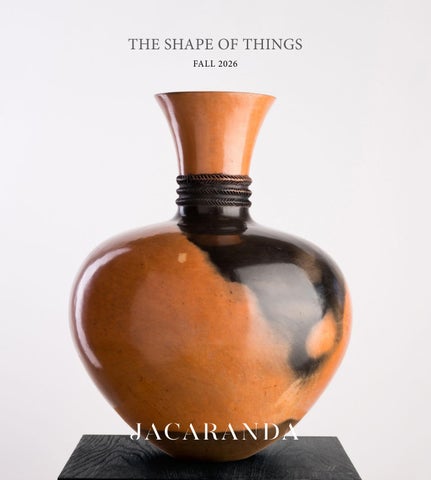
THE SHAPE OF THINGS FALL 2026
1
ART AND ANTIQUES FROM AFRICA, OCEANIA AND THE AMERICAS
www.jacarandatribal.com dori@jacarandatribal.com T +1 646-251-8528 New York City, NY 10025
© 2026, Jacaranda LLC Published November 2026
2
THE SHAPE OF THINGS FALL 2026
Across cultures and time, people have shaped materials
decorated paddle from the Austral Islands in Polynesia.
into objects of extraordinary presence. Made for ceremony
These are just a few examples of the remarkable diversity
or daily life, these objects may have served profoundly
of objects in the collection, each distinguished by its own
different purposes, yet when brought together, striking
sculptural character and cultural significance.
visual relationships emerge.
The South African ceramics included here extend
This catalog considers them primarily as sculpture.
this exploration across generations. Made by master
None depicts the human figure. Their power lies in the way
potters, they range from historical works dating to the
they occupy space and in the choices their makers made
mid-twentieth century to vessels by living contemporary
in shaping them. A vessel may swell outward and narrow
artists. Particularly meaningful is the inclusion of works
abruptly at its opening; a headrest may transform a practical
by mothers who are no longer living alongside those of
purpose into an elegant sculptural construction.
their daughters, who have carried on and enriched the
These affinities should not obscure their differences.
traditions they inherited. Together, these vessels reveal not
Similarity in appearance does not imply similarity of
only continuity and invention, but the enduring legacy of
meaning. Each object emerged from a particular culture
knowledge passed from one generation to the next.
and tradition, with meanings and associations specific
The works gathered here remain firmly rooted in the
to the people who made and used it. What we see today
cultures that produced them. At the same time, seeing them
primarily as sculpture may originally have held meanings
together allows us to appreciate qualities that transcend
that are no longer immediately apparent to us.
their customary categories and to discover visual affinities
Yet looking at these objects in this way offers another perspective. Freed from conventional classifications, we can more readily appreciate how a maker responded to material and function while creating something of remarkable visual
where we might not expect them. Across great distances of geography and time, unexpected relationships in form emerge. We hope you will enjoy this selection of objects.
and sculptural presence. Among the works represented are a finely carved ipukasuy from Japan, Inuit goggles, and an intricately
Dori & Daniel Rootenberg new york city, november 2026
3
4
5
6
1
CEREMONIAL PADDLE AUSTRAL ISLANDS, FRENCH POLYNESIA First half 19th century Wood Height: 41 in, 104 cm PROVENANCE
Julius Carlebach, 1940’s. Carlebach was a prominent New York
both aesthetically and culturally within Oceanic art history.
art and antiques dealer whose gallery played an important
Though widely called ‘paddles,’ these objects are not
role in the development of the American market for traditional
functional paddles. They are ‘paddle shaped,’ but their sizes
African, Oceanic, and Indigenous North American art during
are too extreme; their shafts are too weak, and they are
the mid-twentieth century. Having emigrated from Germany
thoroughly unsuitable for use as paddles. Consequently, it
to the United States in 1937, he established his gallery in New
has been assumed that they were emblems of rank or status,
York in 1939, subsequently moving to Madison Avenue in 1958.
for ceremonial rather than functional use. But an exhaustive
Carlebach occupied an important position in the cultural milieu
survey of the historical sources has confirmed that there
of postwar New York, serving a discerning clientele of collectors,
are no known eyewitness accounts of their use or function.
artists, and intellectuals. His associations included the Surrealist
No local name is recorded for them, anywhere, before 1890,
artist Max Ernst and other figures drawn to the artistic and cultural
though they are sometimes called ‘hoe‘ after the Tahitian
significance of non-Western objects.
word for a paddle.
Private New York collection
Most Austral Island paddles are dated roughly between 1820 – 1840, probably made on the Island of Raivavae, and are generally described as made for trade items, with their
Ceremonial paddles from the Austral Islands are revered
original use being treated as something of a mystery. There
for their sharply delineated motifs and symmetrical
are good grounds for asserting however that few if any
forms, representing some of the finest Oceanic artistry.
‘paddles’ were made and exported after 1842. Firstly, the
Comparable examples can be found in the British Museum
population decline was extreme, particularly among the
and prominent private collections, marking them as prized
adults. By 1840 the total population on Tabuai had fallen to
artefacts among collectors of tribal and ethnographic works.
250 and on Raivave to 360. Actual carvers would have been
The elaborate geometric carving is a hallmark of Austral
even fewer. Moreover, after the French took over Tahiti in
craftsmanship, distinguishing these paddles as significant
1842, trade visits to the Austral Islands declined.
c e r e m o n i a l pa d d l e
7
8
c e r e m o n i a l pa d d l e
c e r e m o n i a l pa d d l e
9
10
c e r e m o n i a l pa d d l e
c e r e m o n i a l pa d d l e
11
12
c e r e m o n i a l pa d d l e
2
MATHUNZI ENTABA Nicholas Sithole Terracotta clay, hand-built, carved, burnished and smoke-fired Height 15 3/4 in, 40 cm; Diameter 11 3/4 in, 30 cm
Born in Mkhondo, Mpumalanga, in 1964, Nicholas Sithole began working with clay as a child, inspired by his maternal grandmother. For nearly three decades, he produced vessels for other potters before establishing his own artistic identity in 2007. Encouraged by ceramic artist Magdalene Odundo, Sithole developed a distinctive sculptural language combining traditional Zulu ceramic knowledge with bold contemporary invention. Known for his exacting standards, he destroys works that fail to meet his expectations, making surviving examples particularly valued. His ceramics are represented in the Pretoria Art Museum, the Nelson Mandela Museum and private collections in South Africa and the United States.
m at h u n z i e n ta b a
13
14
m at h u n z i e n ta b a
m at h u n z i e n ta b a
15
16
m at h u n z i e n ta b a
3
PRAYER STICK IKUPASUY AINU PEOPLE, HOKKAIDO, JAPAN 19th century Wood Height: 11 ½ in, 29 cm PROVENANCE
Private New York collection
An elegantly carved wooden ikupasuy, the ceremonial
terminal and carefully balanced composition lend the object
stick used by the Ainu people of northern Japan in ritual
a striking sculptural presence.
offerings and prayers. The elongated, slender form is
An important ritual implement in Ainu spiritual life, the
embellished with intricate geometric ornamentation,
ikupasuy served as an intermediary through which prayers
including bands of scale-like triangular motifs alternating
and libations were offered to the kamuy, the spiritual
with elongated chevron patterns. A raised, rounded
beings associated with the natural world. Both a functional
rectangular panel at the center provides a distinctive focal
ceremonial object and an expression of Ainu woodcarving
point, its incised design echoing the surrounding decorative
artistry, this example is distinguished by its refined
vocabulary. The rich, dark, lustrous surface accentuates
geometric decoration, sculptural detailing and deeply
the depth and precision of the carving, while the tapered
patinated surface.
p r ay e r s t i c k i k u pa s u y
17
18
p r ay e r s t i c k i k u pa s u y
p r ay e r s t i c k i k u pa s u y
19
20
p r ay e r s t i c k i k u pa s u y
4
THREE ENGRAVED RITUAL OBJECTS CHURINGA ABORIGINAL PEOPLES, CENTRAL AUSTRALIA Late 19th century / early 20th century Wood A: Height: 13 in, 33 cm B: Height: 20 ½ in, 52 cm C: Height: 12 ½ in, 32 cm PROVENANCE
Various private collections, United Kingdom
An exceptional group of three finely engraved wooden
imposing, presents a strikingly monumental arrangement
churinga, distinguished by their elongated, elegantly
of concentric circles. On one face, five principal circular
tapering forms and intricate arrangements of concentric
motifs are distributed vertically along its elongated surface,
circles, sinuous lines, and geometric motifs. Associated with
separated by groups of gently curving parallel lines. The
the ceremonial traditions of Aboriginal peoples of Central
reverse features three more widely spaced concentric
Australia, churinga are sacred objects closely connected to
circles, creating a powerful contrast between the elaborate
ancestral beings, particular places, and the transmission of
composition of the front and the austere geometry of the
spiritual knowledge across generations.
back. The unusually generous spacing of the engraved
The churinga on the left, the narrowest of the three,
elements emphasizes the broad, uninterrupted surface of
displays an elaborate and densely organized composition.
the wood, lending the object a remarkable sense of stillness
A succession of deeply engraved concentric circles extends
and sculptural authority. Its dark, richly worn patina further
along its central axis, interconnected by fine parallel lines
enhances its imposing presence.
and enclosed within a complex network of curving, dotted,
The churinga on the right is distinguished by a more
and arched motifs. The reverse continues this rhythmic
freely arranged and asymmetrical composition. Concentric
arrangement of circular forms, although with a somewhat
circles of varying sizes are distributed across its surface,
more restrained treatment of the surrounding ornament.
with larger circular motifs surrounded by smaller satellite
The precision and density of the engraving, combined with
forms, interconnected by delicate engraved lines. Unlike
the object’s slender proportions and warm reddish patina,
the strictly axial compositions of the other two examples,
give it an almost jewel-like delicacy.
its ornament creates a lively, almost celestial constellation
The central churinga, considerably larger and more
of interconnected forms. The reverse presents a similarly
t h r e e e n g r av e d r i t ua l o b j e c t s c h u r i n g a
21
intricate vocabulary of circles and connecting lines, but with a looser, more open arrangement. A small perforation near one end may have served for suspension or attachment. Although the engraved motifs of churinga frequently relate to ancestral journeys, sacred sites, and the topographical features of particular territories, their precise meanings are traditionally restricted to initiated custodians and cannot reliably be interpreted from visual examination alone. The concentric circles and connecting lines that characterize these three objects form part of a broader Central Australian visual language in which apparently abstract geometric designs can encode complex relationships between people, country, and ancestral history. Considered together, the three churinga offer a compelling study in the extraordinary diversity of expression achieved within a shared artistic tradition. From the densely worked intricacy of the first example to the monumental restraint of the second and the animated, constellation-like decoration of the third, each demonstrates a distinctive approach to rhythm, balance, and the organization of sacred imagery. Their sculptural elegance and remarkable graphic sophistication reveal an artistic tradition in which the simplest elements—circles, lines, and dots—are transformed into compositions of exceptional visual power.
22
t h r e e e n g r av e d r i t ua l o b j e c t s c h u r i n g a
t h r e e e n g r av e d r i t ua l o b j e c t s c h u r i n g a
23
24
t h r e e e n g r av e d r i t ua l o b j e c t s c h u r i n g a
t h r e e e n g r av e d r i t ua l o b j e c t s c h u r i n g a
25
26
t h r e e e n g r av e d r i t ua l o b j e c t s c h u r i n g a
5
ZULU VESSEL JAMIESONS DRIFT, KWAZULU-NATAL, SOUTH AFRICA Artist: Thandiwe Magwaza Terracotta clay. Hand-built, carved, burnished and smoke-fired. Height 12 ½ in, 32 cm; Diameter 13in, 33 cm
Thandiwe Magwaza belongs to the distinguished Magwaza family of potters from KwaZulu-Natal, South Africa. Trained by her mother-in-law, Nginemibile MaShezi Magwaza, she is celebrated for her mastery of qhubuza, a demanding technique in which clay is pressed outward from the vessel’s interior to create intricate raised patterns. Her elegantly proportioned pots, characterized by broad shoulders and tapering bases, combine technical precision with inventive geometric decoration. Her work has been exhibited internationally and is represented in the North Carolina Museum of Art and Die Neue Sammlung, Munich.
z u lu v e s s e l
27
28
z u lu v e s s e l
z u lu v e s s e l
29
30
z u lu v e s s e l
6
SEPTUM RING BIPANE PAPUA NEW GUINEA First half 20th century Shell, organic material Height: 3 in, 8 cm; Width 6 in, 15 cm PROVENANCE
Rick Gallagher, New York
In New Guinea, septum rings were worn for much more than decoration. Depending on the cultural group, they could communicate a man’s social standing, mark his transition into adulthood, or symbolize hunting and warrior achievements. Among the Asmat people of southwestern New Guinea, the bipane was a distinctive ornament associated with social standing and respect within the community. Its materials and craftsmanship could contribute to its significance. Museum documentation connects the ornament with successful hunting; in some historical Asmat contexts, it also signified achievement in warfare and headhunting. In several New Guinea communities, septum piercing and wearing particular ornaments were associated with initiation rites. These practices could mark a young man’s passage into adult social responsibilities and recognition.
s e p t u m r i n g b i pa n e
31
32
s e p t u m r i n g b i pa n e
7
SNOW GOGGLES PUNUK CULTURE, ST LAWRENCE ISLAND, ALASKA 500 to 1000 ce Marine ivory Width: 5 ½ in, 14 cm; Height 2 in, 5 cm PROVENANCE
Jeffrey Myers, New York City
An extraordinary pair of excavated snow goggles from St. Lawrence Island, distinguished by their powerful
bridge suggesting an enigmatic human face. Snow goggles were an essential adaptation to life in the
sculptural presence and richly ornamented surface. Carved
Arctic, where intense sunlight reflected from snow and
as a continuous, gently curved form, the goggles feature
ice could cause debilitating snow blindness. Their narrow
two elongated, almond-shaped eye openings framed by
apertures restricted the amount of light reaching the
concentric incised lines, punctuated by carefully arranged
eyes while preserving sufficient visibility for hunting and
circular depressions. The deeply weathered surface, ranging
travel. On St. Lawrence Island, such objects also provided
from warm reddish brown to lustrous black, reveals the
an opportunity for artistic expression, transforming
effects of prolonged burial and lends the object a remarkable
an indispensable piece of equipment into an object of
sense of antiquity.
considerable aesthetic refinement.
The decoration is particularly compelling. Sweeping,
The present example is especially striking for the
curvilinear engravings encircle each eye opening, creating
tension between its practical purpose and its expressive,
an almost hypnotic interplay of line, rhythm, and symmetry.
almost otherworldly appearance. Its monumental eye
Small drilled depressions, some surrounded by incised
forms, animated surface decoration, and beautifully aged
rings, articulate the surface and suggest the sophisticated
patina exemplify the ability of ancient Bering Sea artists to
ornamental vocabulary associated with the ancient cultures
invest even the most utilitarian objects with extraordinary
of the Bering Strait. Although conceived as a functional
sculptural vitality.
object, the goggles possess an unmistakably masklike
In good condition. Vertical crack to right eye.
quality, their exaggerated eyes and subtly modeled central
snow goggles
33
34
snow goggles
snow goggles
35
36
snow goggles
8
ZULU VESSEL OYAYA, KWAZULU-NATAL, SOUTH AFRICA Artist: Nesta Nala Terracotta clay. Hand-built, carved, burnished and smoke-fired. Height 9 ½ in, 23 cm; Diameter 10 in, 24 cm
Nesta Nala (1940–2005) was a legendary South African
and the necked uphiso - is celebrated for its nearly flawless
ceramicist and a foundational matriarch of contemporary
geometric symmetry, highly burnished, glossy jet-black
Zulu pottery. Born in Oyaya in the Thukela Valley of
surfaces meant to honor ancestral spirits and complex
KwaZulu-Natal, she learned the multi-generational art form
geometric relief patterns like the amasumpa (raised clay
at age twelve from her mother, Siphiwe Nala, continuing
nodes).
an ancient maternal lineage that she later passed on to five
Regarded as a pioneering South African art icon, Nala
of her daughters, including Jabulile and Thembi. While
won the FNB Vita Craft Competition (1995), represented
she initially produced utilitarian vessels for local sorghum
her country at the Cairo International Biennale (1994), and
beer ceremonies, Nala single-handedly shepherded the
participated in the Smithsonian Folklife Project (1999). Today,
transition of Zulu ceramics from domestic wares into the
her highly collectible masterworks reside in premier global
global fine art market by the mid-1980s. Her hand-coiled,
institutions, including The Metropolitan Museum of Art, the
pit-fired earthenware - most notably the spherical ukhamba
Art Institute of Chicago, and the Harn Museum of Art.
z u lu v e s s e l
37
38
z u lu v e s s e l
z u lu v e s s e l
39
40
z u lu v e s s e l
9
SNUFF CONTAINER SOUTHERN AFRICA 19th century Horn Length: 11 in, 28 cm PROVENANCE
Private collection, United Kingdom
An exceptionally elegant snuff bottle carved from horn,
Africa, its feathers used to create the headdresses for
distinguished by its elongated, three-tined extension and
warriors in the Natal Colony and possibly further afield.
subtly anthropomorphic character. The gently swelling,
Snuff-taking was an important social practice throughout
ovoid receptacle, fitted with a small stopper, rises above
southern Africa, and the containers used to hold powdered
three slender, tapering prongs that sweep downward in a
tobacco were frequently objects of considerable artistic
graceful arc. Originally worn in the hair, the object served
refinement. Related horn snuff containers and ear
simultaneously as a practical container for powdered
ornaments are preserved in the British Museum, including
tobacco and an arresting form of personal adornment.
nineteenth-century examples associated with the Zulu
The bottle possesses a remarkable sculptural presence. Its
and neighboring peoples. Particularly relevant is a snuff
rounded upper chamber suggests a human head, while the
container recorded from KwaZulu-Natal in 1897 that the
narrow connecting neck and attenuated prongs evoke an
museum also classifies as an ear ornament.
elongated torso and limbs. This anthropomorphic quality
With its extraordinary economy of form, sinuous
is achieved without explicit figurative carving, emerging
movement, and almost surreal suggestion of the human
instead from the object’s carefully balanced proportions and
figure, this bottle transcends its utilitarian purpose to stand
fluid, organic silhouette. The richly variegated horn, ranging
as a compelling example of southern African sculptural
from warm amber to deep brown and almost black, further
ingenuity.
accentuates its sculptural character. The small round bodies of the finials with their elongated
In fine condition. A handwritten label accompanying the object identifies it as ‘Barotse,’ suggesting an attribution to
‘tails’ bring to mind the long-tailed whydah bird hovering
the Lozi (Barotse) people of the upper Zambezi region in
over the grasslands. It is found in many parts of the
present-day western Zambia, although the precise origin of
southern sub-continent including Lesotho and South
the piece remains unconfirmed.
s n u f f co n ta i n e r
41
42
s n u f f co n ta i n e r
s n u f f co n ta i n e r
43
44
s n u f f co n ta i n e r
s n u f f co n ta i n e r
45
46
s n u f f co n ta i n e r
10
FACE MASK OR BASKET VILI PEOPLES, GABON OR REPUBLIC OF CONGO 19th century Cane fiber Height: 8 ½ in, 21 ½ cm PROVENANCE
Bobbi Hamill, Boston
A rare and enigmatic example of Vili basketry, constructed
ceremonial, the object is distinguished by its unusual form,
from slender, curved wooden or vegetal elements bound
ingenious construction and compelling combination of
with plant fiber to form an open, ovoid framework. Its
structural simplicity and intricate geometric design.
intricate lattice is articulated by a series of diamond-
We know of 6 other examples of this unusual woven
shaped panels, each composed of tightly wound concentric
object. William Oldman lists a similar example in his
coils that create a striking geometric rhythm. The warm
May 1905 catalog. He describes it as a mask of cane for
brown patina, varied tones of the natural materials and
the face, over which is placed a net to protect the painted
irregularities of the hand-worked construction lend the
decoration on the face and also to keep the mosquitos
piece considerable visual character.
off. The Wereldmuseum, Leiden has 2 examples as does
Traditionally described as either a mask or a basket,
the American Museum of Natural History. A further
the precise function of this unusual object remains
example is illustrated in ‘Angola and the River Congo,
uncertain. Its openwork construction and cage-like form
vol. 1’ by Joachim John Monteiro. This work, published in
suggest the possibility of a practical use, perhaps as a small
1875, provides an in-depth exploration of Angola and its
enclosure for birds or other small animals, although this
surrounding regions, detailing the landscape, culture, and
interpretation remains speculative. Whether utilitarian or
history of the area along the River Congo.
fa c e m a s k o r b a s k e t
47
48
fa c e m a s k o r b a s k e t
fa c e m a s k o r b a s k e t
49
50
fa c e m a s k o r b a s k e t
11
MSOBOMVU Nicholas Sithole Terracotta clay, hand-built, carved, burnished and smoke-fired Height 20 ½ in, 52 cm; Diameter 15 3/4 in, 40 cm
Born in Mkhondo, Mpumalanga, in 1964, Nicholas Sithole began working with clay as a child, inspired by his maternal grandmother. For nearly three decades, he produced vessels for other potters before establishing his own artistic identity in 2007. Encouraged by ceramic artist Magdalene Odundo, Sithole developed a distinctive sculptural language combining traditional Zulu ceramic knowledge with bold contemporary invention. Known for his exacting standards, he destroys works that fail to meet his expectations, making surviving examples particularly valued. His ceramics are represented in the Pretoria Art Museum, the Nelson Mandela Museum and private collections in South Africa and the United States.
msobomvu
51
52
msobomvu
msobomvu
53
54
msobomvu
12
T WO ENGRAVED SNUFF CONTAINERS TSONGA, SOUTH AFRICA Late 19th / early 20th century Wood, wirework
transverse grooves, creating a striking interplay of texture,
A: Height: 6 ½ in, 16 ½ cm
light, and shadow. A boldly carved suspension loop projects
B: Height: 4 in, 10 cm
from one side, while the narrow neck is encircled by a tightly wound metal-wire binding, providing a contrasting
PROVENANCE
metallic element to the deeply patinated wood.
A: Reverend A.A. Jacques and thence by descent. Reverend
The smaller container, of compact ovoid form, is
Jacques was a Swiss Mission priest known for his ministry and
distinguished by its refined geometric decoration. The
detailed ethnographic documentation in South Africa during
smoothly polished surface is engraved with registers of
the early 20th century. Beginning in the mid-1920s and spanning
intersecting diagonal lines, nested chevrons, zigzags,
roughly fifteen years, Rev. Jacques collected a massive assortment
and concentric arches, arranged in a carefully balanced
of traditional headrests (neckrests) created by the Tsonga-related
composition. A short cylindrical neck rises from the
(Shangaan) peoples. Most of these artifacts were gathered and
rounded shoulders, while a small pierced lug provides
documented around the Pilgrim’s Rest (Bushbuckridge) area in
for suspension. The restrained simplicity of its silhouette
the eastern Transvaal. In the late 1940s, he created the first formal
contrasts elegantly with the rhythmic complexity of its
classification system for southern African neckrests. Today, the 111
incised ornament.
headrests he compiled form a foundational ethnographic display
Snuff containers were important personal possessions
housed in the Johannesburg Art Gallery
throughout southern Africa, serving both practical and
B: Marc and Denyse Ginzberg Collection.
ornamental purposes. Frequently suspended from the body or carried among an individual’s personal effects, they offered opportunities for considerable artistic expression.
Two finely carved wooden snuff containers, each displaying
The care invested in their carving and decoration reflects
a distinctive approach to form, surface decoration, and
the significance of tobacco consumption within southern
ornamentation. Both are fashioned from dark hardwood
African social life, where the preparation, exchange, and
and possess a rich, lustrous patina, reflecting their age and
sharing of snuff formed part of everyday interaction and
handling.
hospitality.
The larger container is of elongated, tapering form, its
Together, these two containers illustrate the remarkable
slender body terminating in a gently rounded point. The
diversity and sophistication of southern African small-scale
surface is intricately worked with parallel longitudinal
woodcarving, transforming utilitarian objects into intimate
ridges alternating with densely incised bands of fine
expressions of craftsmanship and personal adornment.
t w o e n g r av e d s n u f f co n ta i n e r s
55
56
t w o e n g r av e d s n u f f co n ta i n e r s
t w o e n g r av e d s n u f f co n ta i n e r s
57
58
t w o e n g r av e d s n u f f co n ta i n e r s
13
PAIR OF HEADRESTS SWIKHIGELO TSONGA PEOPLE, SOUTH AFRICA OR MOZAMBIQUE Late 19th century Wood, pokerwork Height: 6 in, 15 cm, Width 25 in, 63 cm PROVENANCE
Michael Heuermann, Cape Town, South Africa Jonathan Lowen, London, United Kingdom Karel Nel, South Africa
identical design, but being hand-carved, are not exactly the This pair of headrests is sumptuously interlinked with not
same. The ‘caryatid’ form consists of a central rectangular
one, but two sets of chains, painstakingly carved of wood.
upright that intersects two arcs, one curving down onto the
The artistry and planning required to carve both headrests
base and the other reaching upwards to support the sleeping
and the intervening chains from a single length of wood
platform. The outer surfaces of the arches and the vertical
attests to the maker’s skills. The upper platforms are gently
struts have carved decorations and a whorl that resembles
curved in opposite directions to facilitate the comfort of the
the design on the lugs at the point where they meet.
sleepers, indicating that they would not sleep side by side
Much has been debated as to the meaning and purpose of
but with their bodies positioned on opposite sides of the
headrests joined together by chains. Nel has explained how
headrests and their heads intimately close to one another.
acquiring paired headrests was a betrothal custom where
Indeed, these headrests show a degree of wear consonant
the objects explicitly demonstrated the connection between
with two individuals using them at the same time.
husband and wife and between the lineages of both families.
The ends of the upcurves are delicately incised with a
This double headrest is perhaps a declaration of an even
series of raised dots and darkened with pokerwork. The two
greater degree of commitment to the union. The virtuoso
outer edges of the sleeping platforms have semi-circular
carving is surely an indication not only of the pride in
lugs carved with spiral designs, while the inner lugs, also
owning such an object but in the reverence for the ancestral
of the same shape, serve as the connecting surface for the
associations that attach to its presence.
upper chain that joins the two headrests. The lower chain is
Images of two identical examples are reproduced – one
connected to the chamfered, two-lobed bases, each of which
in Art and Ambiguity and the other in The Art of Southern
has the typical V shape where the lobes meet.
Africa: The Pethica Collection, both undoubtedly by the
The central panels of the two headrests are carved in an
same carver.
pa i r o f h e a d r e s t s s w i k h i g e lo
59
60
pa i r o f h e a d r e s t s s w i k h i g e lo
pa i r o f h e a d r e s t s s w i k h i g e lo
61
62
pa i r o f h e a d r e s t s s w i k h i g e lo
14
ZULU VESSEL TUGELA RIVER VALLEY, KWAZULU-NATAL, SOUTH AFRICA Artist: Mncane Nzuza Terracotta clay. Hand-built, carved, burnished and smoke-fired. Height 10 ½ in, 27 cm; Diameter 21 in, 53 cm
Mncane Zinindeli Nzuza is a revered South African master
(beer vessel). Her work is celebrated for its complex tactile
potter recognized as one of the most innovative and
detailing, featuring precision linear etchings, diamond
technically accomplished practitioners of traditional Zulu
motifs, and raised amasumpa (clay bumps) that are finished
ceramics. Based along the Tugela River in KwaZulu-Natal,
through organic pit-firings to produce a glossy, jet-black
Nzuza learned her craft from her grandmother, initially
surface deeply rooted in Zulu ancestral spirituality. Today,
creating earthenware vessels for local community rituals
her signature masterworks reside in prestigious global
before gaining global acclaim.
institutions, including The Metropolitan Museum of Art,
Nzuza hand-builds ultra-thin, delicate vessels using coiling and slab techniques, famously pioneering unique,
The Art Institute of Chicago, The Minneapolis Institute of Art and The Nelson Atkins Museum of Art.
flattened profiles on traditional shapes like the ukhamba
z u lu v e s s e l
63
64
z u lu v e s s e l
z u lu v e s s e l
65
66
z u lu v e s s e l
15
KNOBKERRIE IWISA ZULU PEOPLES, KWAZULU-NATAL, SOUTH AFRICA Late 19th / early 20th century Wood Height: 35 in, 89 cm PROVENANCE
Private New England collection
Knobkerries were traditionally carried by men among the Nguni-speaking peoples of southern Africa, serving as weapons, emblems of personal identity, and expressions of
An exceptionally elegant North Nguni knobkerrie,
status. Although fundamentally utilitarian, certain examples
distinguished by its boldly sculpted head, refined
were conceived with a degree of refinement that elevated
proportions, and remarkable economy of form. Rather
them well beyond their practical function. The distinctive
than the more familiar spherical or bulbous terminal, the
flattened and ridged head of the present example suggests
head has been carved into an elongated, fruit-like form,
an intimate observation of natural forms, its possible
its two broad, convex surfaces meeting along a sharply
botanical inspiration expressed through an unusually
defined central ridge. Rising to a gently pointed apex, the
restrained and abstract sculptural vocabulary.
head recalls the fruits and seedpods of the southern African
The surface displays a particularly attractive patina, its
landscape, its swelling, organic volumes articulated with an
warm reddish-brown tones deepening to near black along
almost architectural precision.The sculptural sophistication
the ridges and recessed areas. Subtle variations in color,
of the piece is particularly evident in the transition from
together with fine traces of handling and wear, accentuate
the slender cylindrical shaft to the broad, flattened head.
the underlying grain and contribute to the object’s quiet
The pronounced longitudinal ridge, extending toward
sense of age and intimacy.
the pointed extremity, imparts a sense of tension and
With its commanding silhouette, extraordinary restraint,
movement, while the smooth, subtly swelling surfaces
and harmonious balance between organic inspiration
soften the otherwise rigorous geometry. Viewed from
and geometric precision, this knobkerrie exemplifies the
different angles, the head alternates between a broad,
sculptural ingenuity of North Nguni woodcarving. Devoid
almost leaf-like silhouette and a narrow, blade-like profile,
of applied decoration, it achieves a remarkable expressive
creating a striking interplay of light and shadow. This
power through proportion and the subtle articulation of
transformation of an organic, seemingly natural form into
its surfaces alone. Its distinctive head, at once suggesting
a carefully balanced geometric composition reveals the
a ripened fruit, a pointed seedpod, and a carefully faceted
carver’s exceptional sensitivity to volume, symmetry, and
abstract volume, transforms a traditional implement into an
proportion.
object of exceptional sculptural elegance.
knobkerrie iwisa
67
68
knobkerrie iwisa
knobkerrie iwisa
69
70
knobkerrie iwisa
16
ARMLET ARRAP MAASAI, KENYA Early 20th century Horn, copper wire Height: 8 ½ in, 21 ½ cm PROVENANCE
Nobel Endicott, New York
A sculptural traditional Maasai upper-arm ornament,
and was reserved for use by warriors who had taken life in
carved from animal horn and decorated with metal wire
battle. Carved of cow horn, its form recalls the head and
and, in some examples, suspended chains or tassels.
horns of an animal. The blend of curve, angle and line at
Historically associated with male warriors, this distinctive
play in this piece imbues it with a lively sense of poise.
form of armlet was reportedly reserved for individuals who
Errap were created by mothers for their sons, and
had killed an enemy in battle, serving as a marker of martial
were traditionally worn on ceremonial occasions such
achievement and social standing.
as weddings. These special ornaments are becoming rare
Such ornaments were also connected with family
as young Maasai men have gradually left the ancestral
tradition and ceremonial occasions. Primarily documented
schools and embraced modern modes of education. Despite
in historical collections from Kenya, examples date to the
their decline, errap have a lasting importance in Maasai
late nineteenth and early twentieth centuries. This type of
communities and are treasured by the families who own
arm ornament, known as errap, was worn on the upper arm
them.
armlet arrap
71
72
armlet arrap
armlet arrap
73
74
armlet arrap
17
INKOMO KAMAMA Clive Sithole Terracotta clay, hand-built, carved, burnished and smoke-fired Height 15 in, 38 cm; Diameter 11 in, 28 cm
Born in Johannesburg, Clive Sithole has developed a practice rooted in Zulu ceramic traditions, enriched by his exchanges with master potters across South Africa and his work with Magdalene Odundo in the United Kingdom. Widely regarded as the first male Zulu ceramic artist to devote himself fully to a field historically dominated by women, Sithole reinterprets traditional izinkamba beer vessels through bold sculptural forms and incised imagery inspired by cattle, ancestral figures and the landscape. His work is represented in several important collections, including the Eskenazi Museum of Art in Indiana and the North Carolina Museum of Art.
inkomo kamama
75
76
inkomo kamama
inkomo kamama
77
78
inkomo kamama
18
SEPTUM RING BIPANE PAPUA NEW GUINEA First quarter 20th century Boar tusk Height: 2 ½ in, 6 cm; Width: 3 ½ in, 9 cm PROVENANCE
Collected in New Guinea in the 1930’s by a missionary, and thence by descent
In New Guinea, septum rings were worn for much more than decoration. Depending on the cultural group, they could communicate a man’s social standing, mark his transition into adulthood, or symbolize hunting and warrior achievements. Among the Asmat people of southwestern New Guinea, the bipane was a distinctive ornament associated with social standing and respect within the community. Its materials and craftsmanship could contribute to its significance. Museum documentation connects the ornament with successful hunting; in some historical Asmat contexts, it also signified achievement in warfare and headhunting. In several New Guinea communities, septum piercing and wearing particular ornaments were associated with initiation rites. These practices could mark a young man’s passage into adult social responsibilities and recognition.
s e p t u m r i n g b i pa n e
79
80
s e p t u m r i n g b i pa n e
19
SERVING DISH WITH INDIGENOUS REPAIRS IPUKAI
and sculptural presence. Of particular interest are the numerous indigenous repairs distributed around the circumference of the vessel. Carefully fashioned wooden butterfly-shaped inserts bridge several fractures along the rim and exterior, while additional
HAWAII ISLANDS
fitted patches reinforce areas of damage. These repairs,
19th century
become an integral part of the object’s visual character. Far
Wood
from diminishing its beauty, they introduce a compelling
Diameter: 9 in, 23 cm, Depth 1 ½ in, 4 cm
secondary geometry to the otherwise unadorned surface,
executed with considerable ingenuity and precision, have
their angular forms providing a striking counterpoint to PROVENANCE
the vessel’s soft, continuous curves. They also speak to the
Private California collection
importance of preserving and maintaining valued wooden vessels within traditional Hawaiian society. Wooden bowls and serving dishes occupied an important
An exceptionally elegant shallow wooden serving dish
place in Hawaiian material culture, where skilled craftsmen
from the Hawaiian Islands, distinguished by its beautifully
produced vessels ranging from modest domestic utensils to
balanced proportions, restrained sculptural form, and
finely finished objects associated with chiefly households.
remarkable evidence of prolonged use and indigenous
Prized for their utility, durability, and beauty, such vessels
repair. Carved from a single piece of wood, the dish
exemplify a woodworking tradition in which sophisticated
presents a broad, gently concave interior enclosed by a
craftsmanship was expressed through purity of form rather
thin, subtly rounded rim. Its low, hemispherical profile and
than applied ornament.
uninterrupted contours reveal the Hawaiian carver’s refined
The present example is particularly compelling for the
understanding of volume, proportion, and the expressive
intimate relationship between its original conception and
possibilities of the simplest forms.
the accumulated history of its use. The charred interior,
The exterior displays a particularly attractive, richly
richly worn exterior, and carefully executed repairs together
variegated patina, its warm honey and reddish-brown tones
create a remarkable record of its working life. Its modest
deepening to darker shades along the edges and areas of
scale and shallow proportions lend it an understated
wear. The smooth, gently swelling underside retains subtle
elegance, while the juxtaposition of dark and luminous
traces of the original carving and the fine grain of the wood,
surfaces, organic curvature, and geometric restoration gives
lending the object an appealing organic quality. In striking
the dish an almost contemporary sculptural sensibility.
contrast, the interior has acquired a deep, almost black
With its extraordinary simplicity, deeply expressive
surface, apparently charred through exposure to heat or fire.
patina, and poignant evidence of preservation, this small
This darkened surface, with its subtle variations in tone and
serving dish embodies the quiet sophistication of traditional
texture, creates a powerful visual contrast with the luminous
Hawaiian woodcarving, transforming an everyday vessel into
exterior and contributes significantly to the dish’s character
an object of exceptional beauty and historical resonance.
s e r v i n g d i s h w i t h i n d i g e n o u s r e pa i r s i p u k a i
81
82
s e r v i n g d i s h w i t h i n d i g e n o u s r e pa i r s i p u k a i
s e r v i n g d i s h w i t h i n d i g e n o u s r e pa i r s i p u k a i
83
84
s e r v i n g d i s h w i t h i n d i g e n o u s r e pa i r s i p u k a i
20
EZAKWANTU Sbonelo iHubo leNgabadi Terracotta clay, hand-built, carved, burnished and smoke-fired Height 8 ¾ in, 22 cm; Diameter 11 in, 28 cm
Born in the Eastern Cape and raised in KwaZuluNatal, Sbonelo iHubo leNgabadi comes from a family of traditional ceramic practitioners. He graduated from Durban University of Technology in 2011 with a National Diploma in Fine Arts. Drawing upon his indigenous and spiritual heritage, his sculptural vessels explore the cosmological and ceremonial significance of pottery within South African cultural traditions. His practice moves beyond conventional distinctions between functional objects and fine art, emphasizing the vessel as an expression of cultural identity and ancestral knowledge. He has exhibited in South Africa and internationally, received several awards, and is represented in public and private collections, including Iziko Museums of South Africa.
e z a k wa n t u
85
86
e z a k wa n t u
e z a k wa n t u
87
88
e z a k wa n t u
21
CARVED LIDDED VESSEL ZULU, SOUTH AFRICA Mid-late 19th century Wood, pokerwork Height: 14 in, 36 cm PROVENANCE
elaborate containers, frequently elevated on projecting
Private collection
feet and embellished with intricate surface carving, were produced by highly accomplished craftsmen working for Zulu elites and, increasingly, for European patrons. Their
An exceptional lidded wooden vessel of swelling ovoid
creation required exceptional technical skill, particularly in
form, supported on three boldly projecting feet and
the careful integration of complex geometric patterns with
surmounted by a closely fitted domed cover. The entire
the vessel’s continuously curving surfaces.
surface is covered with an extraordinarily intricate
The deeply incised decoration appears to evoke the
arrangement of deeply carved parallel grooves, organized
structure of woven basketry, reflecting a broader southern
into interlocking triangular and chevron-shaped fields.
African artistic tradition in which the forms and textures
The alternating direction of the carving creates a
of one material were translated into another. Here, the
complex, rhythmic pattern resembling interwoven fibers,
precision of the carving produces an almost textile-
transforming the rounded wooden surface into an intricate
like surface, while the emphatically rounded body and
geometric composition.
projecting supports give the vessel a powerful, almost
The decoration follows the contours of the vessel
animate character.
with remarkable precision, emphasizing its fullness and
Related examples are preserved in the Princeton
sculptural volume. The lid repeats the elaborate geometric
University Art Museum and the Metropolitan Museum
ornament of the body and is punctuated by three substantial
of Art, the latter attributed to the circle of the nineteenth-
projecting lugs. These, together with the three flaring feet,
century Nguni master carver Unobadula. Such comparisons
lend the vessel a striking architectural presence, their
place this vessel within an important tradition of prestige
broad, smoothly polished surfaces contrasting dramatically
carving in which utilitarian form was elevated into an
with the densely worked carving. The wood has acquired
ambitious expression of artistic virtuosity.
a rich, dark brown patina, with subtle variations in color
Distinguished by the extraordinary intricacy of its
accentuating the depth and precision of the ornament.
ornament, the harmonious integration of lid and body, and
The vessel belongs to a distinctive and relatively rare
the sculptural confidence of its three-legged construction,
tradition of sculptural woodcarving that flourished in
this vessel is a compelling example of nineteenth-century
KwaZulu-Natal during the nineteenth century. These
Zulu woodcarving.
carved lidded vessel
89
90
carved lidded vessel
carved lidded vessel
91
92
carved lidded vessel
22
HEADREST XIKHIGELO ZIMBABWE/MOZAMBIQUE/SOUTH AFRICA 19th century Wood, pokerwork Height 4.92 x Width 6.45 x Depth 2.99 ins. (12.5 x 16.4 x 7.6 cm) PROVENANCE
Udo Horstmann, Zug, Switzerland Karel Nel Collection, South Africa
Three light colored columns, balanced on the back of an arc
d’Ethnographie de la Ville Neuchatel, collected by Henri
of darkened wood, seem to brace themselves to the work of
Junod in the late 19th century. He had identified it as
holding up the sleeping platform of this headrest. Together,
‘Ronga’, a group that lived around the Delagoa Bay area. Its
the arc and the columns comprise an unusual central panel.
museum accession date is 1892 and it is also illustrated in his
The arc spans the distance between the outer edges of the
The Life of an African Tribe.
double-lobed base. The two lobes themselves feel splayed out
This headrest also bears a strong similarity to two
by the force of the load above with their spreading chamfered
examples in the Johannesburg Art Gallery collection,
sides and, in connecting with each other, create a definite
which are documented as having been collected by the Rev.
indent on either side of the base. In fact, the gestalt of the
AA Jaques for the Suisse Romand mission school at Lemana
headrest seems like a zany ideogram for a person carrying a
in modern-day Limpopo, about 100 km south of Zimbabwe
load – a caryatid.
and 100 km west of the Mozambican border.
This headrest resembles an example in the Musée
h e a d r e s t x i k h i g e lo
93
94
h e a d r e s t x i k h i g e lo
h e a d r e s t x i k h i g e lo
95
96
h e a d r e s t x i k h i g e lo
23
TRIBUTE Jabulile Nala Terracotta clay, hand-built, carved, burnished and smoke-fired Height 10 ¼ in, 26 cm; Diameter 10 ¼ in, 26 cm
Born in Eshowe, KwaZulu-Natal, Jabulile Nala belongs to one of South Africa’s most distinguished families of ceramic artists, whose traditions extend back to the early twentieth century. Building upon the legacy of her mother, Nesta, and grandmother, Simphiwe, she creates striking sculptural vessels that both honor and challenge traditional Zulu forms. Her work is distinguished by inventive silhouettes and intricate surface patterns. Nala gathers red and grey clays from sites near her home, maintaining a close connection to the materials and practices of her ancestors. Her ceramics have been exhibited internationally and are held in public and private collections.
tribute
97
98
tribute
tribute
99
100
tribute
24
A BRONZE TORQUE FANG, GABON OR EQUATORIAL GUINEA 19th century Cast bronze Diameter: 5 ½ in, 14 cm; Height: 2 in, 5 cm PROVENANCE
Private European collection
Among the most significant objects in Fang metalwork are
as valuable adornment, but with their considerable weight
a type of heavy neck ring or torque called ngo. Cast in thick
and permanent attachment to the body, they helped ensure
brass or bronze, they were decorated with incised designs
that, if a woman fled from her home, her escape would be
and closed with a hammer blow around the throat. Once
hampered and her married status would be impossible to
put on, ngo would remain worn until death. Similar torques
hide.
were sometimes wrapped around the arms.
This handsome example shows admirable craftsmanship,
Ngo were powerful symbols of social status and identity,
shaped with a strong central ridge that bisects the length
and possibly had ritual significance. While they were worn
of the torque and incised geometric panels symmetrically
by both married women and male warriors, some testimony
deployed at the midsection. Here, curved outlines are
from cultural elders indicates that the ornaments had a
interspersed with sharp, rectilinear shapes, generating an
severe purpose concerning wives. Superficially they served
attractive, subtly flexing tension in the design.
a b r o n z e to r q u e
101
102
a b r o n z e to r q u e
a b r o n z e to r q u e
103
104
a b r o n z e to r q u e
25
KNOBKERRIE IWISA ZULU PEOPLES, KWAZULU-NATAL, SOUTH AFRICA Late 19th / early 20th century Wood Height: 25 in, 64 cm
The transition from the heavily modeled head to the slender, cylindrical shaft is especially effective. The shaft’s smooth, uninterrupted surface provides a striking
PROVENANCE
counterpoint to the complex geometry above, emphasizing
Private collection, United Kingdom
the contrast between simplicity and elaboration. The rich, lustrous patina, ranging from deep mahogany to almost black, further accentuates the sculptural character of the
An extraordinary knobkerrie distinguished by its boldly
piece. Fine surface fissures, traces of handling, and subtle
faceted spherical head, whose complex arrangement of
variations in the wood contribute to its compelling sense of
irregular polygonal surfaces creates an arresting interplay
age.
of geometry, texture, and light. Unlike the smooth, rounded
Knobkerries were traditionally carried as weapons,
terminals characteristic of most southern African clubs,
implements of personal defense, and expressions of
the head of this example has been meticulously carved into
masculine identity and status. While many examples were
a succession of shallow, subtly concave facets, producing
fashioned with relatively simple rounded heads, others
an intricate, almost crystalline surface. The resulting
reveal considerable artistic invention, their carved terminals
form possesses a remarkable sculptural presence, at once
reflecting the individuality and technical accomplishment
suggesting a naturally weathered stone, a geometric
of their makers. The present example belongs to this more
polyhedron, and the segmented surface of an exotic fruit.
sculpturally ambitious tradition, in which a functional
The carving is particularly compelling in its balance
object becomes a vehicle for highly imaginative formal
between geometric order and organic irregularity. Each
expression.
facet is individually articulated, its gently hollowed surface
With its extraordinary geometric sophistication,
bounded by softly raised ridges that form an interconnected
beautifully balanced proportions, and deeply expressive
network across the entire head. The facets vary subtly in size
surface, this knobkerrie transcends its utilitarian origins.
and shape, creating a lively, shifting rhythm that rewards
The faceted head, reminiscent of both a naturally occurring
examination from every angle. Light moves across the
mineral formation and an intricately patterned botanical
surface, illuminating the warm reddish-brown planes while
form, possesses an almost modernist sensibility. Its interplay
casting the intervening depressions into deeper shadow.
of concavity and convexity, repetition and variation, lends
This sophisticated treatment transforms the familiar
the object a visual complexity rarely encountered in such
spherical head into a remarkably animated sculptural
implements, making it a particularly compelling example of
volume.
southern African sculptural ingenuity.
knobkerrie iwisa
105
106
knobkerrie iwisa
knobkerrie iwisa
107
108
knobkerrie iwisa
26
ZULU VESSEL MIDDLE DRIFT, KWAZULU-NATAL, SOUTH AFRICA Artist: Thembisile Nxumalo Terracotta clay. Hand-built, carved, burnished and smoke-fired. Height 13 in, 33 cm; Diameter 13 ¾ in, 35 cm
Thembisile Nxumalo is a South African ceramicist from KwaZulu-Natal who trained under master potter Jabulile Nala. Working within the Zulu pottery tradition, she creates hand-coiled vessels using locally sourced clay. Her forms are carefully burnished and pit-fired, producing rich earthy tones, dark fire markings, and lustrous surfaces. Her work is represented in the permanent collection of the Davis Museum at Wellesley College.
z u lu v e s s e l
109
110
z u lu v e s s e l
z u lu v e s s e l
111
112
z u lu v e s s e l
27
HEADREST ISIGQIKI ZULU PEOPLE, KWAZULU-NATAL, SOUTH AFRICA Mid-20th century Wood Height: 5 in, 13 cm; Width 17 in, 43 cm PROVENANCE
Vittorino Menenghelli, South Africa Karel Nel, South Africa
With its solid columns and deep recesses, this large,
and some descending onto the sturdy platform base. A
horizontal headrest has the elements of grand architecture
horizontal row of square, coffered panels adorn the base,
on a small scale. The two massive outer legs are made even
and a version of the same design is carved vertically on the
more monumental by the columns carved in low relief on
two innermost columns which flank a deep central recess.
them. The lustrous sleeping platform overhangs the outer
This headrest is similar to an example carved by Makhebe
columns, providing a ‘roof ’ to the structure. The central
Khanyile, who lived southwest of Thukela Ferry in the
‘façade’ consists of a rhythmic interplay between smaller
Msinga area.
columns and recesses, some thrusting up from the base
headrest isigqiki
113
114
headrest isigqiki
headrest isigqiki
115
116
headrest isigqiki
28
SINEW SPINNER SIBERIAN YUPIK PEOPLES, ST. LAWRENCE ISLAND, ALASKA 19th century or earlier Marine ivory Length: 8 in, 20 cm PROVENANCE
Rick Gallagher, New York City
Sinew spinners have been dated as far back as the Old Bering Sea I period and were initially thought to be part of a friction drill. In his seminal work The Eskimo about Bering Strait, anthropologist Edward William Nelson describes seeing a similar spinner on St. Lawrence Island, describing its use as follows: ‘The sinew to be spun is attached to the flattened rod at the shoulder, just below the hole, and by a rapid circular motion of the hand the flattened rod is caused to revolve rapidly, giving the desired twisting to the cord.’ The example offered here presents a form quite reminiscent of a twentieth-century Modernist sculpture, consisting of three almost geometric forms interlocked in an asymmetrical arrangement. A deep patina and mottling of age texture its ivory surfaces, lending an organic touch to the abstract, utilitarian minimalism of the piece.
sinew spinner
117
118
sinew spinner
29
ZULU VESSEL PONGOLA, KWAZULU-NATAL, SOUTH AFRICA Artist: Penny Gumbi Terracotta clay. Hand-built, carved, burnished and smoke-fired. Height 18 ½ in, 47 cm; Diameter 17 in, 43 cm
Penny Gumbi is an exceptional South African master
structural balance, fine surface texture, and highly inventive
ceramicist celebrated for her high-caliber, large-scale
exterior decorations, which often feature intricate relief
contemporary Zulu pottery. Based near the mountainous
elements and unique ‘woven’ clay appliqué designs. Hand-
Pongola region of Northern KwaZulu-Natal, Gumbi learned
coiled and pit-fired using traditional organic fuels, her
her multi-generational craft from her mother, Nester
meticulously polished pots yield rich, dark tones and
Gumbi, and her mastery has been widely documented
dramatic fire-marks that make her large-scale vessels highly
in definitive ceramic texts like Elizabeth Perrill’s Zulu
sought after by global collectors and public museums
Pottery. She is highly regarded for crafting large, beautifully
including the High Museum, Atlanta.
balanced earthenware vessels that embody foundational
Penny Gumbi’s ceramics have been featured in
shapes like the ukhamba (beer container) and uphiso
publications and exhibitions devoted to South African
(narrow-necked water vessel).
pottery, including projects associated with Grinnell College
Gumbi’s work is distinguished by its extraordinary
and Indiana University.
z u lu v e s s e l
119
120
z u lu v e s s e l
z u lu v e s s e l
121
122
z u lu v e s s e l
30
THREE SNUFF GOURDS SOUTH AFRICA Late 19th / early 20th century Gourd, glass beads, wire Height: A : Height 3 ½ in, 9 cm B: Height 2 in,5 cm C: Height 3 in, 7 ½ cm PROVENANCE
Private collection
An engaging group of three snuff containers fashioned
The smallest, of compact, flattened globular shape,
from naturally formed gourds, each distinguished by its
is ornamented with finely twisted metal wire arranged
sculptural shape and distinctive ornamentation. The gourds
in radiating and intersecting bands. The wire follows
retain their warm reddish-brown surfaces, enriched by
the contours of the gourd, creating a delicate geometric
handling and age, while their varied decorative treatments
framework punctuated by small looped embellishments. Its
illustrate the ingenuity with which modest, utilitarian
decoration offers a particularly pleasing interplay between
objects could be transformed into expressions of personal
the organic form of the vessel and the disciplined geometry
adornment and individual taste.
of the applied metalwork.
The tallest, of elegant double-bulbous form, is encircled
Snuff-taking was an important social practice among
at its narrow waist by two closely spaced bands of turquoise
numerous Southern African communities, and the
colored glass beads. The restrained decoration emphasizes
containers used to store powdered tobacco frequently
the gourd’s naturally balanced silhouette, the brilliant blue
became objects of considerable aesthetic refinement. Often
providing a striking contrast to the richly patinated surface.
carried on the person, such vessels combined practical
The largest, of broad spherical form, is embellished
utility with opportunities for individual artistic expression.
with elaborate arrangements of small green glass beads
Taken together, these three examples demonstrate the
and contrasting white beads, suspended in dense vertical
remarkable diversity of form, material, and decorative
fringes from its shoulders. The beadwork recalls the beaded
invention found within this intimate tradition of Southern
ornaments worn on the body, effectively dressing the vessel
African material culture.
itself and lending an animated, almost anthropomorphic quality to its rounded form.
three snuff gourds
123
124
three snuff gourds
three snuff gourds
125
126
three snuff gourds
31
ZULU VESSEL OYAYA, KWAZULU-NATAL, SOUTH AFRICA Artist: Thembi Nala Terracotta clay. Hand-built, carved, burnished and smoke-fired. Height 9 ½ in, 24 cm; Diameter 16 in, 41 cm
Thembi Nala is an accomplished South African ceramicist from KwaZulu-Natal and a daughter of the renowned master potter Nesta Nala. Continuing her family’s distinguished tradition of Zulu pottery, she creates handcoiled vessels inspired by traditional beer containers. Her work is characterized by elegant proportions, carefully burnished surfaces, and incised and raised geometric decoration. Through her mastery of traditional techniques, she preserves and extends the artistic legacy of one of South Africa’s most celebrated pottery families.
z u lu v e s s e l
127
128
z u lu v e s s e l
z u lu v e s s e l
129
130
z u lu v e s s e l
32
HARPOON THULE CULTURE, ST LAWRENCE ISLAND, ALASKA 15th – 16th century Walrus ivory Length: 21 in PROVENANCE
Excavated on St Lawrence Island Jeffrey Myers, New York
While modern technology has replaced many of the
was harpooned. The other variety had a socket at the base of
traditional tools that enabled Inuit to survive in the Arctic,
the head to receive the tip of a foreshaft. After being thrust
one of their fundamental hunting weapons, the harpoon,
into an animal, one or more spurs at the base of the head
continues in use to the present day. Essentially, the harpoon
dug into its flesh; tension on the harpoon line, which passed
is a spear designed to secure a detachable point, or head, to
through a hole above the socket, then caused the head to
an animal; a line attached to the head allows the hunter to
rotate, preventing it from slipping out. This variety, called
retrieve the quarry once it has been struck. Harpoons have
the toggle harpoon head, was the more common form in
a wide distribution throughout the world, but it is among
Inuit cultures and is the type offered for sale here.
the Inuit that the most complex pre-industrial forms were
This harpoon comprises 3 parts: harpoon head, the
developed. The primary use of the Inuit harpoon was for
foreshaft and a socket piece. The socket piece would have
hunting sea mammals, both at breathing holes in the sea
been inserted into a long shaft. The harpoon shaft was made
ice and in open water, although in some arctic areas the
of wood, if available, as it would then float. In areas where
harpoon was used for fish as well.
wood could not be obtained, the shafts were fashioned from
Harpoon heads generally belonged to one of two major
narwhal tusk or from several pieces of bone or antler spliced
groups. One kind had a projecting tang at its base, which
together. It is extremely rare to find 3 original elements of an
was inserted into a socket piece on the end of the shaft.
excavated harpoon. Additionally, the example on offer has
Barbs projecting from the body of this type of head ensured
an unusual curve as it was probably designed to enable the
that it stayed embedded in the flesh of the animal once it
hunter to reach animals hiding under ice floes.
harpoon
131
132
harpoon
harpoon
133
PRICES
1 CEREMONIAL PADDLE
6 SEPTUM RING BIPANE
$7,500
$700
2 MATHUNZI ENTABA
7 SNOW GOGGLES $6,500
$6,500
11 MSOBOMVU $9,800
12 T WO ENGRAVED SNUFF CONTAINERS LARGE $950 SMALL $800
3 PRAYER STICK IKUPASUY
8 ZULU VESSEL $4,200
$2,400
13 PAIR OF HEADRESTS SWIKHIGELO $7,000
4 THREE ENGRAVED RITUAL OBJECTS CHURINGA
9 SNUFF CONTAINER
14 ZULU VESSEL $6,500
$8,500
LEFT $750 MIDDLE $1,200 RIGHT $750
5 ZULU VESSEL $6,000
134
prices
10 FACE MASK OR BASKET
15 KNOBKERRIE IWISA
$1,500
$1,800
16 ARMLET ARRAP $2,500
22 HEADREST XIKHIGELO
28 SINEW SPINNER $3,500
$3,000
17 INKOMO KAMAMA
23 TRIBUTE
29 ZULU VESSEL
$5,200
$5,200
18 SEPTUM RING BIPANE
24 A BRONZE TORQUE
30 THREE SNUFF GOURDS
$700
$800
LEFT: $600 MIDDLE; $600 RIGHT: $700
19 SERVING DISH WITH INDIGENOUS REPAIRS IPUKAI
24 KNOBKERRIE IWISA
31= ZULU VESSEL
$7,200
$4,000
$1,500
$1,250
20 EZAKWANTU
26 ZULU VESSEL
$5,200
$3,600
21 CARVED LIDDED VESSEL
27 HEADREST ISIGQIKI
$7,500
$4,500
32 HARPOON $1,500
Photos courtesy of Art Formes, for objects #2, #11, #17, #20 and #23.
prices
135
ART AND ANTIQUES FROM AFRICA, OCEANIA AND THE AMERICAS
www.jacarandatribal.com dori@jacarandatribal.com T +1 646-251-8528 New York City, NY 10025
136
prices