NEW ACQUISITIONS
SUMMER 2026
NEW ACQUISITIONS
SUMMER 2026
We are pleased to present our catalog New Acquisitions — Summer 2026.
Our online exhibition comprises works from around the world. Among the highlights is a magnificent Yup’ik sculpin mask from Alaska, a rare and important example of the form. In Inuit mythology, the sculpin is a bottom-dwelling sea creature that features prominently as the husband of the powerful sea goddess, Nuliayuk. We also offer a very early and powerful shaman’s mask. On dangerous whaling voyages, shamans were brought aboard to ensure a safe and successful hunt.
From the collection of the late artist Karl Stirner, we present a Gope ancestor board from New Guinea. A stunning drummer’s headdress from the collection of Stanley Marcus is also offered. Marcus served as
chairman of the board of Neiman Marcus and assembled a distinguished collection of art.
We have also included a selection of miniatures gathered by us over the years — ranging from beautiful and tactile goldweights from West Africa, acquired by a jewelry designer in England in the 1960s and 1970s, to a very fine Inuit needle case. We also have probably the smallest known southern African snuff container, acquired from the renowned collection of Paul F. Walter.
We are always excited by the discovery of new objects from cultures around the world, and hope you will enjoy this eclectic selection.
Dori & Daniel Rootenberg new york city, july 2026
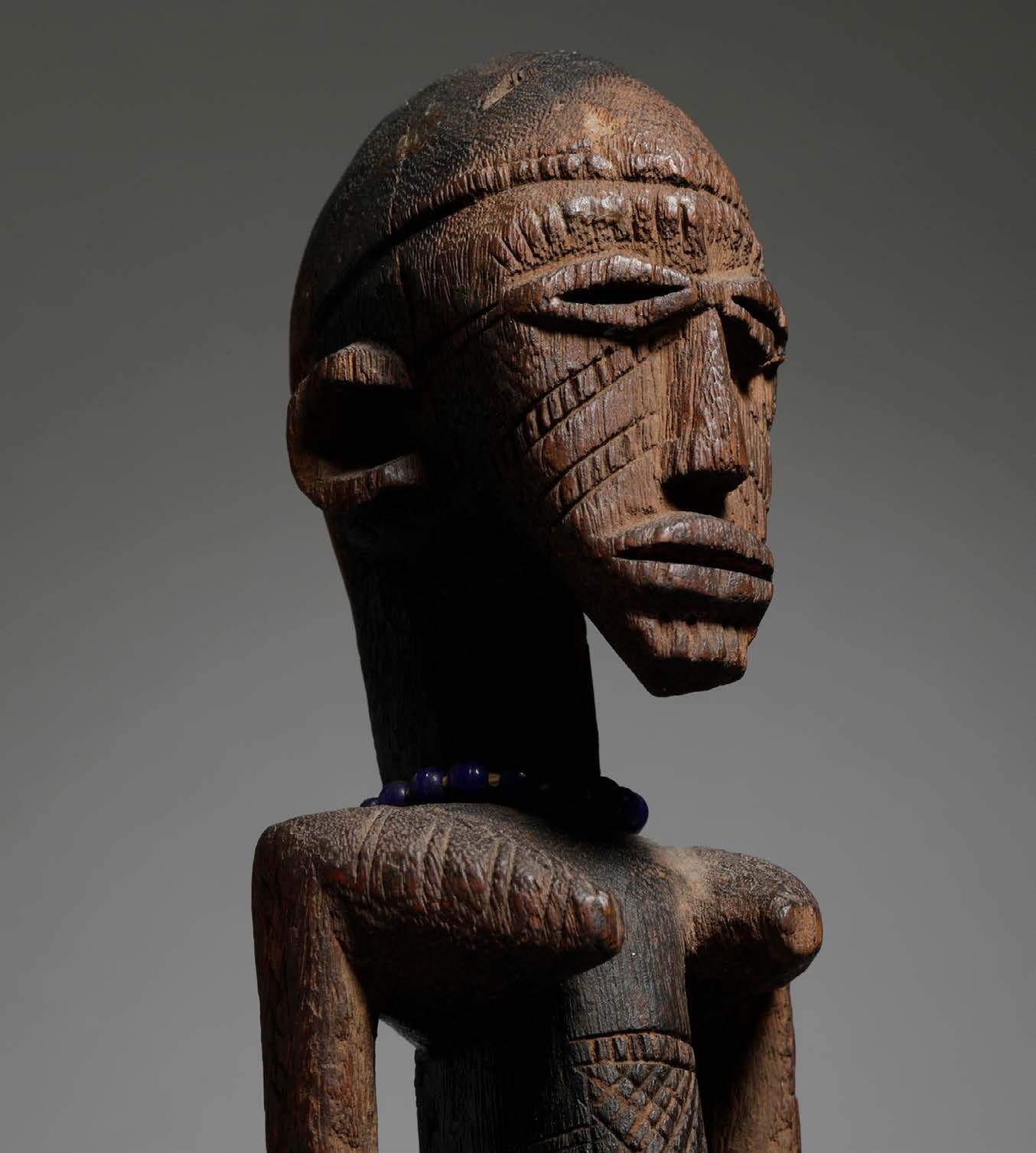
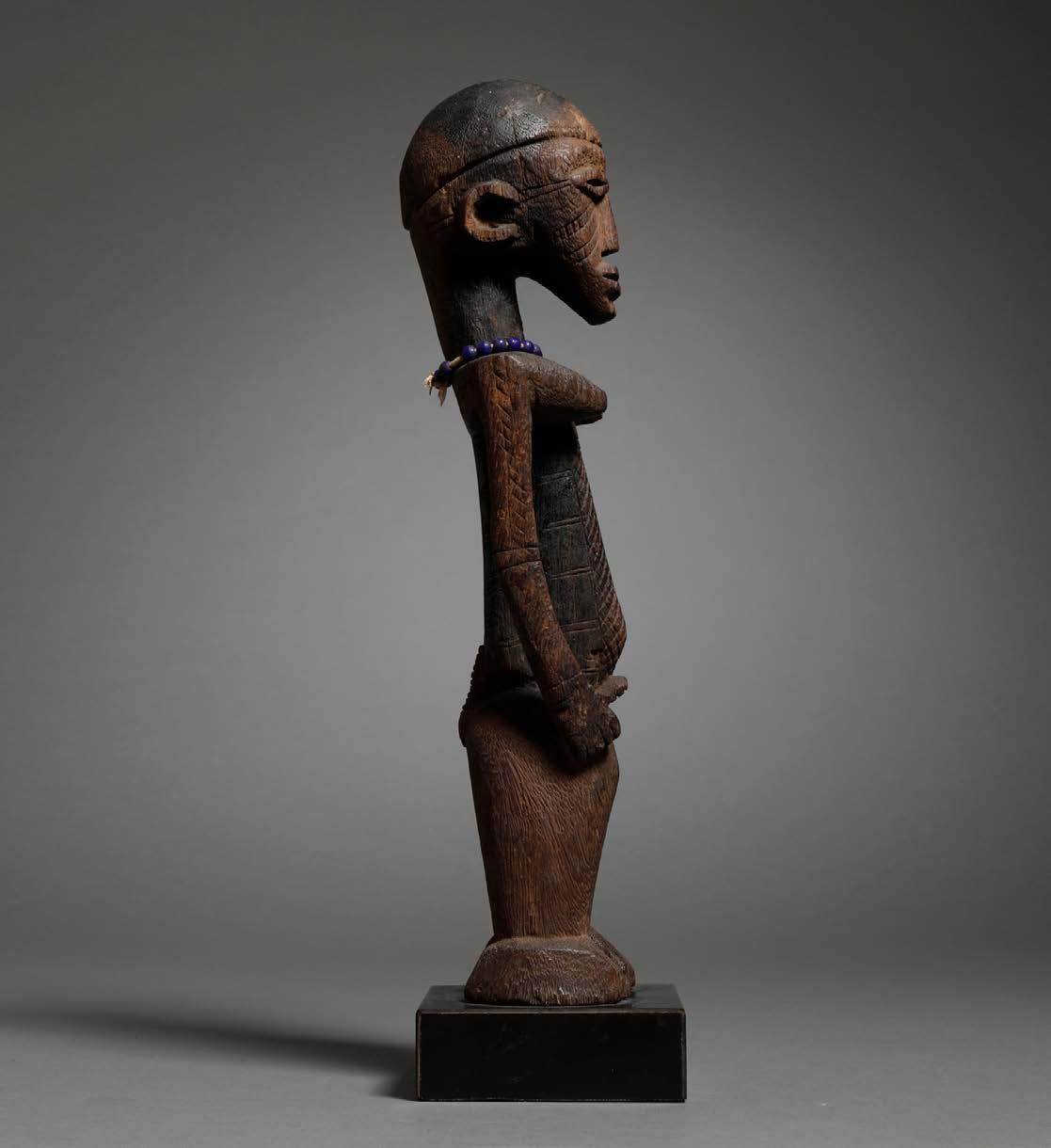
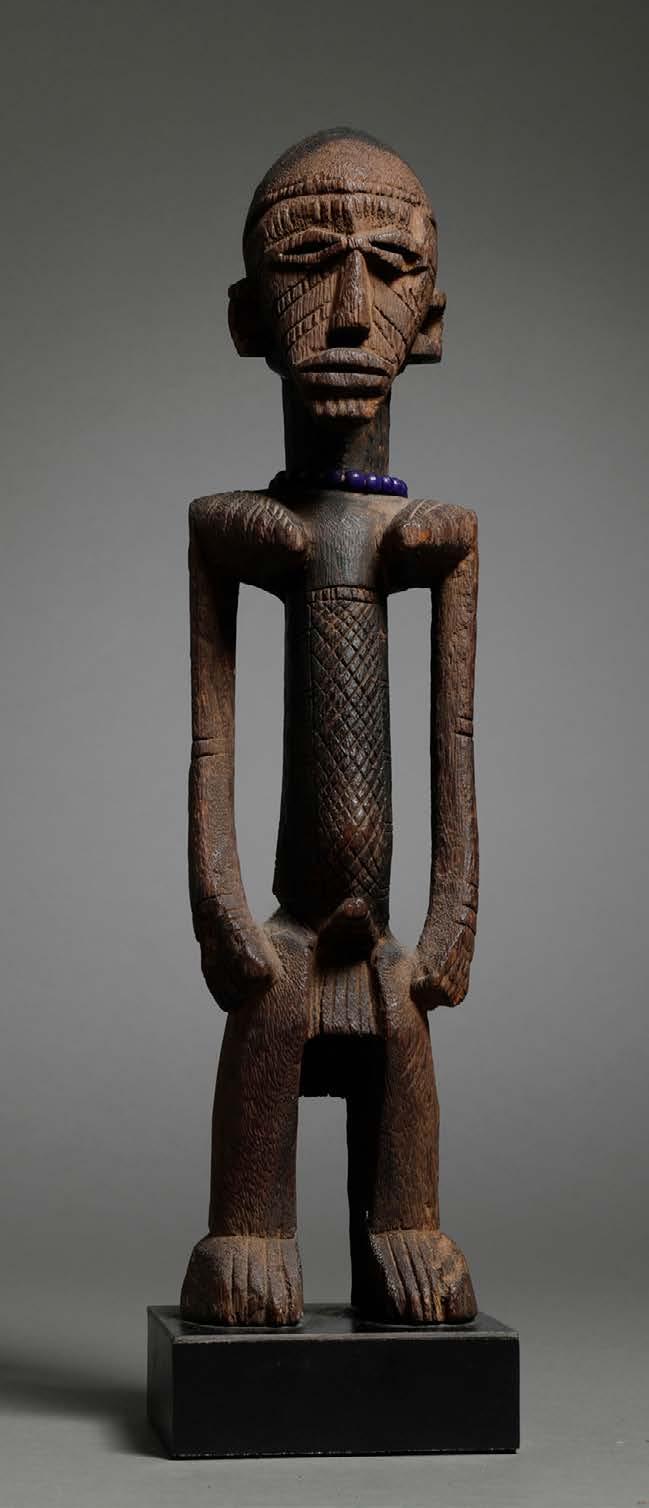
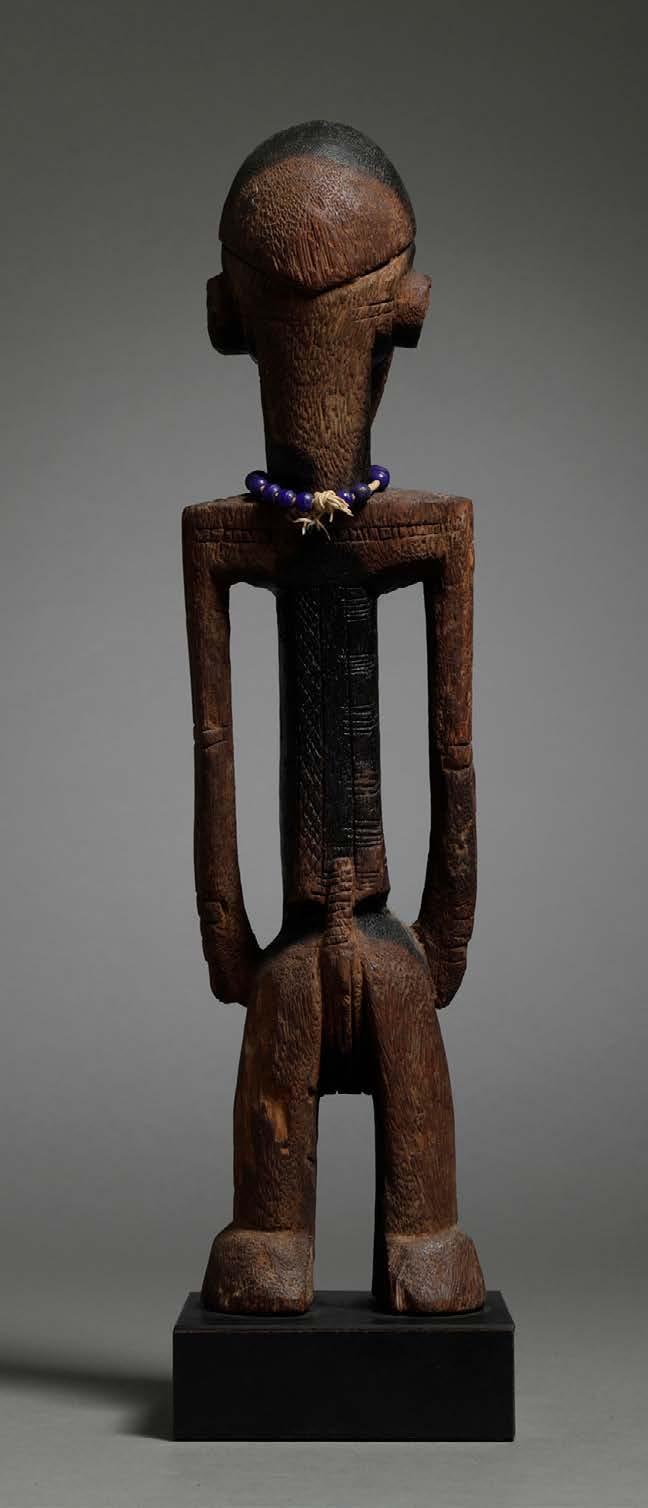
STANDING FIGURE
TURKA, BURKINA FASO
Late 19th / early 20th century
Wood, glass beads
Height: 12 in, 30 ½ cm
PROVENANCE
Prof. Lou Wells, Boston, Massachusetts
Private American collection
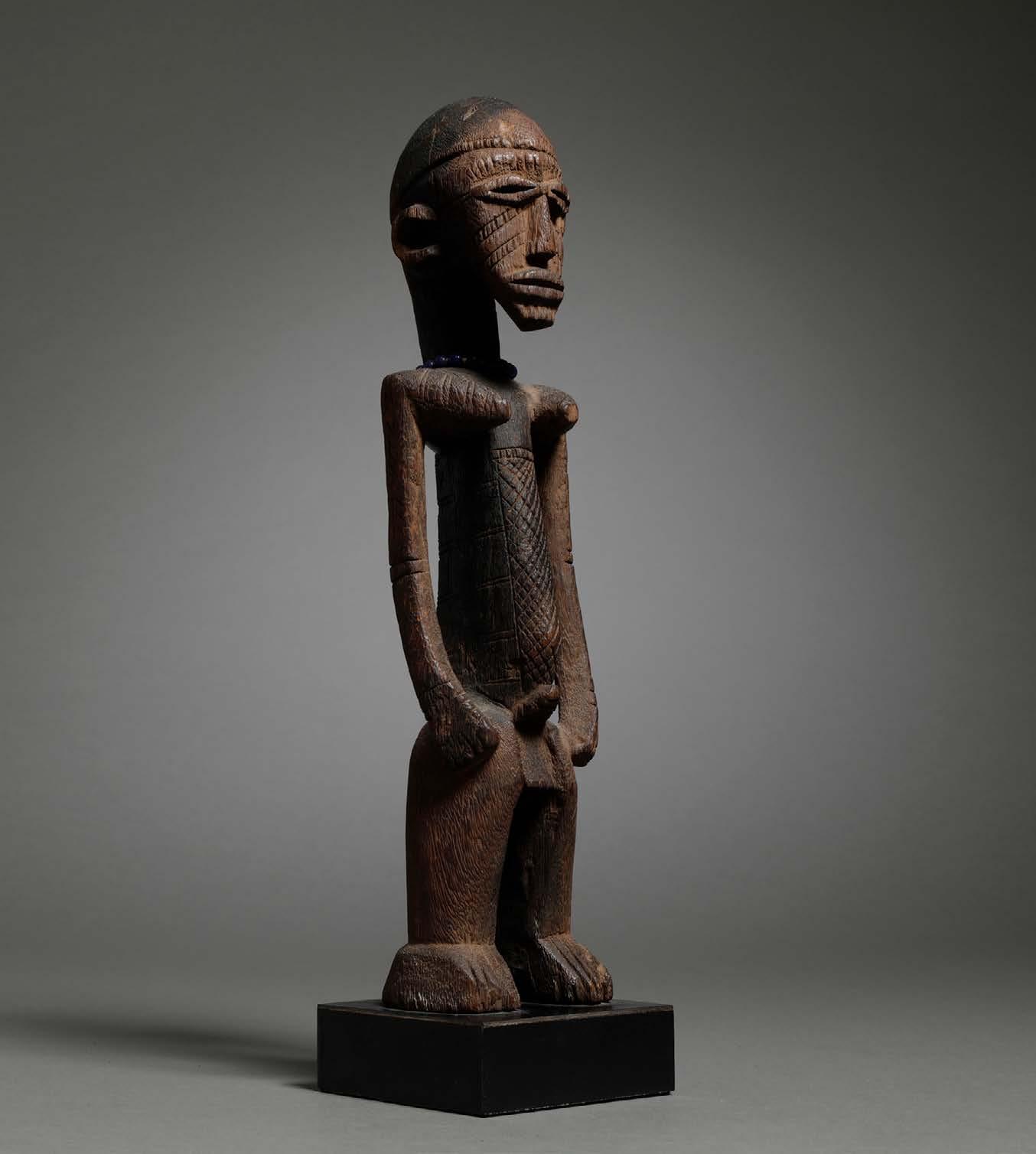
Among the Turka of southwestern Burkina Faso and their neighbors across the Lobi-region cultural complex, figurative sculpture served not primarily as decoration but as habitation — a carved body into which a spirit (thil) could be invited to reside, protecting and guiding the household or individual who maintained it. These figures were placed on domestic shrines, fed with libations, and addressed directly. They were not representations of the spirit; they were the spirit’s point of contact with the living.
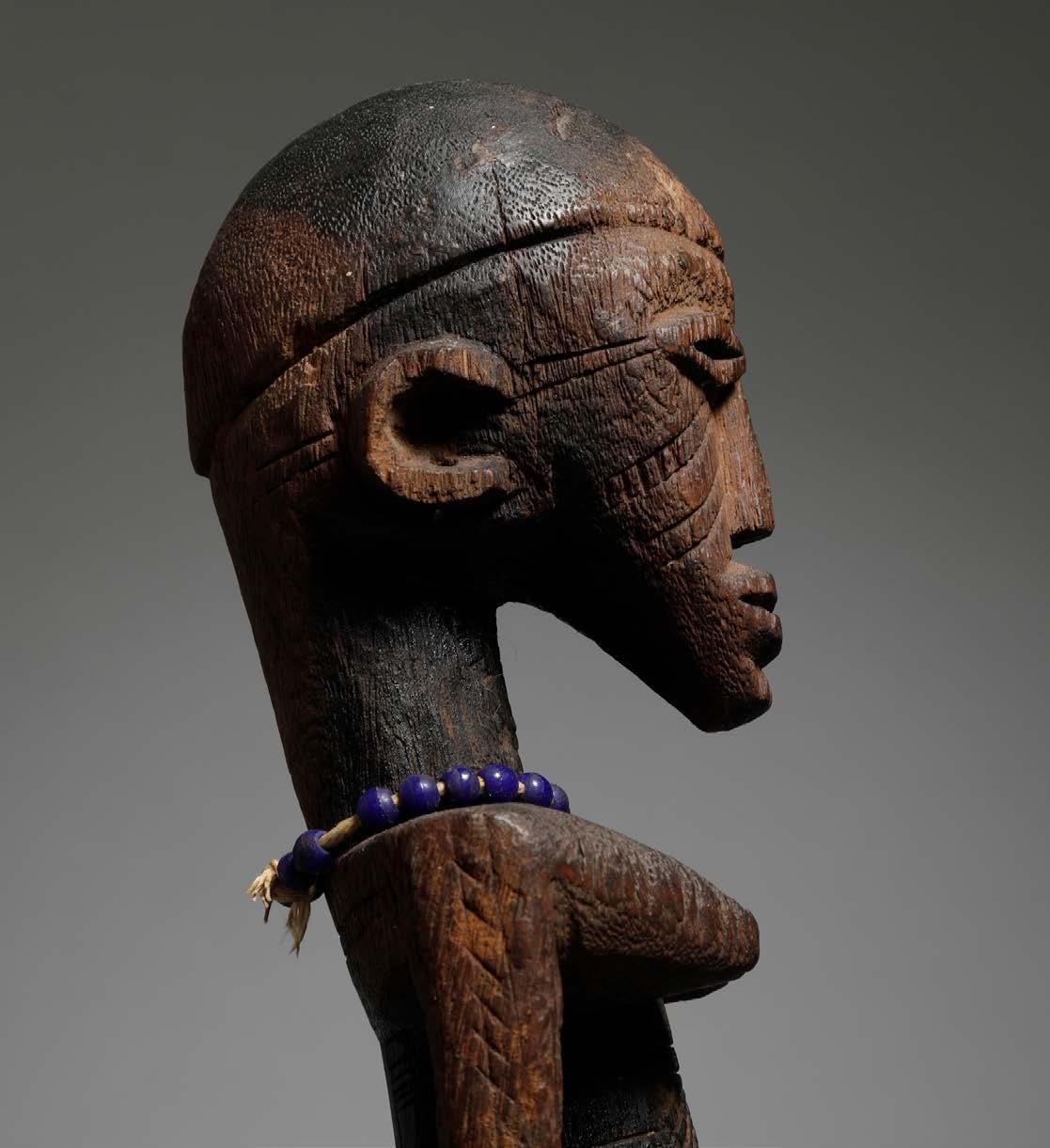
This standing hermaphrodite figure presents the Turka formal vocabulary at its most refined. The head is the commanding element: a high, smoothly domed cranium giving way to a face covered in carefully incised scarification — diagonal lines and chevron patterns traversing the cheeks, brow, and temples in a dense geometric field that would have identified the figure’s social and ritual identity as clearly as any text. A horizontal band of short vertical notches encircles the head at brow level, rendering a coiffure or headband with characteristic economy. The eyes are deeply set and half-closed, the nose straight and projecting, the mouth composed in an expression of composed inward authority that is common to the finest works of this region.
At the base of the long, columnar neck rests a strand of cobalt blue trade glass beads — not a later addition but an original component of the figure’s shrine assemblage, their deep blue complementing the warm reddish-brown of the aged wood. Below the beads, the torso is lean and schematic: small horizontal breast projections mark the figure as female, while the long arms hang close to the body, hands meeting at the lower abdomen in the posture of patient, grounded receptivity characteristic of Lobi-region ancestral figures. The torso front is covered from chest to groin in a dense diamond-lattice scarification pattern — the same incised crosshatch vocabulary as the face, here suggesting a garment, body adornment, or the ritual marking of a spiritually prepared body.
The legs are simply rendered and slightly parted, the feet with individuated toes resting flat. The patina throughout is warm and dry — a reddish-brown tone that has deepened in the recesses of the scarification to near-black, the natural result of age and ambient handling rather than heavy sacrificial application. This drier surface is typical of Turka and northern Lobi figures and distinguishes them from the more heavily encrusted works further south.
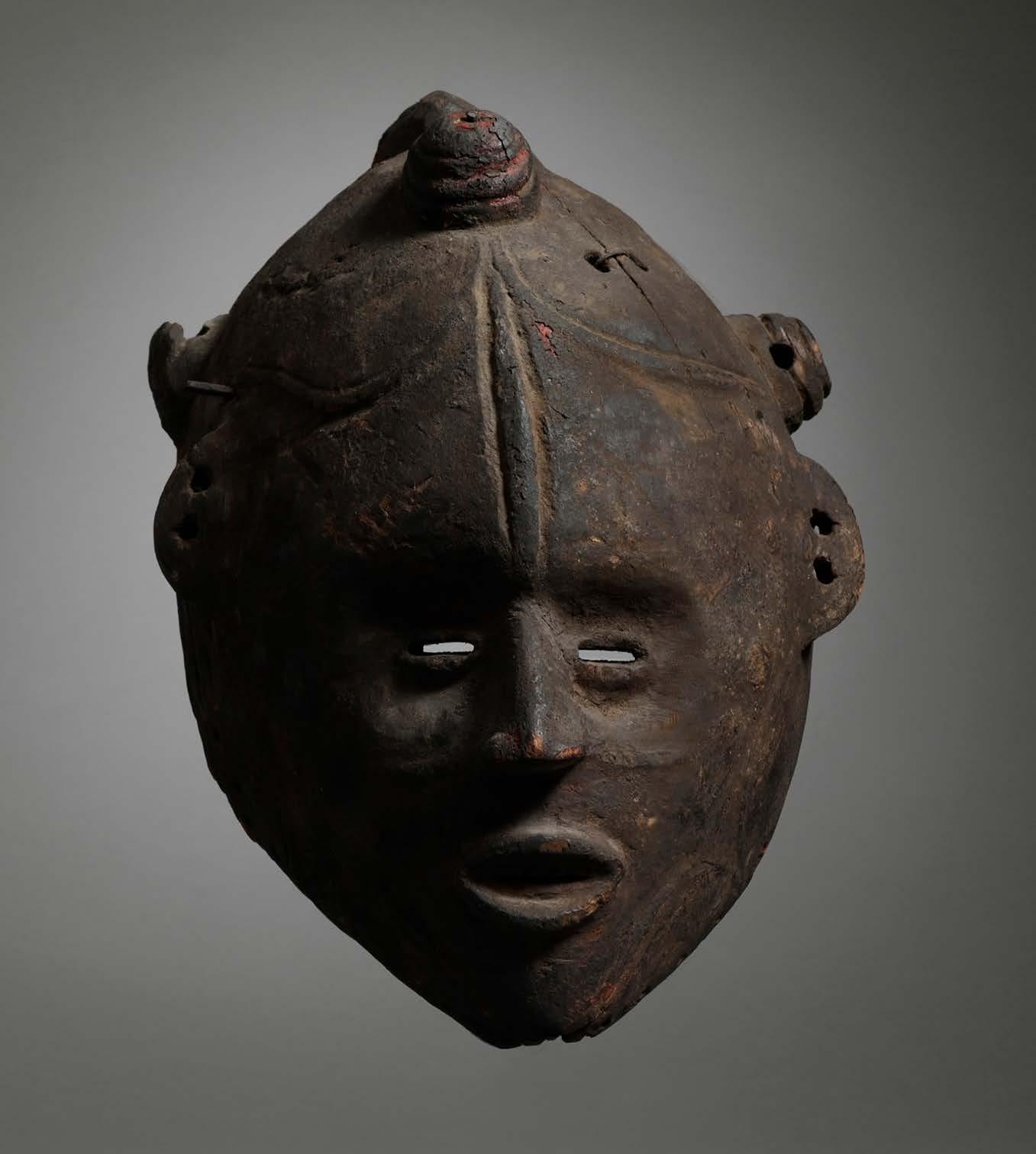
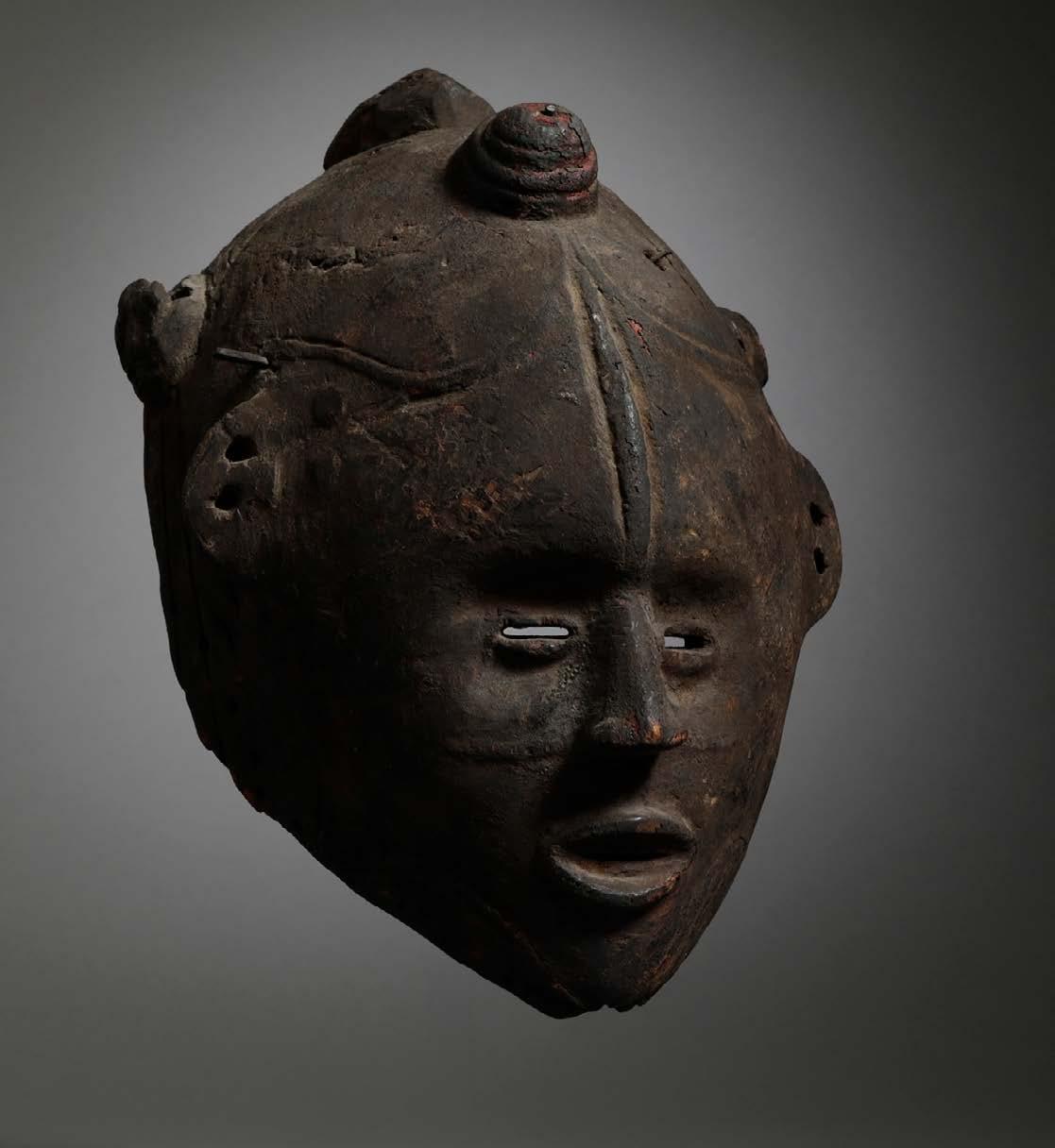
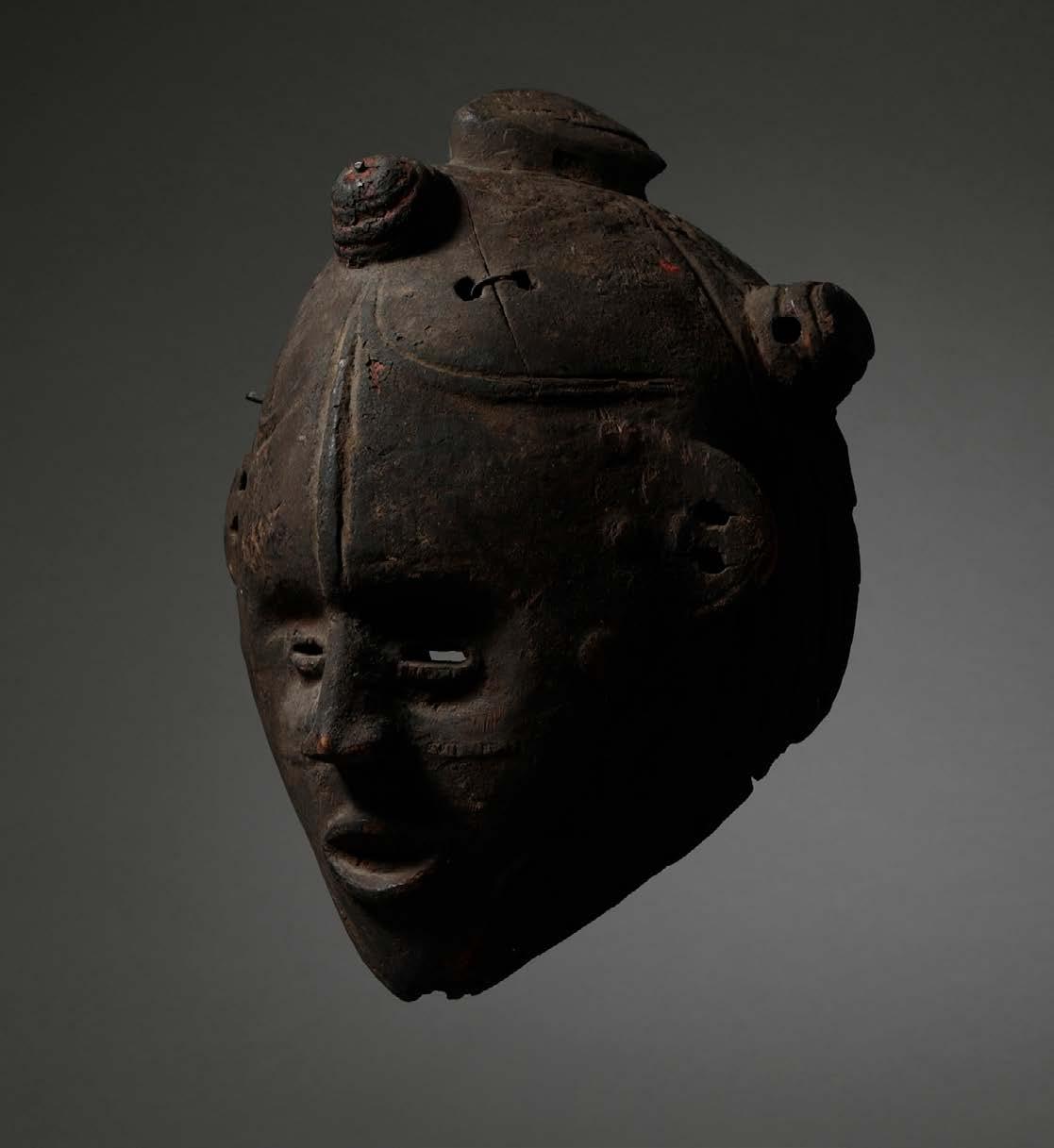
HELMET MASK
IGBO OR IDOMA, NIGERIA
Early 20th century
Wood, metal
Height:12 in, 30 ½ cm
PROVENANCE
John and Nancy Hyde Devoe, New York.
Acquired circa 1960s–1970s
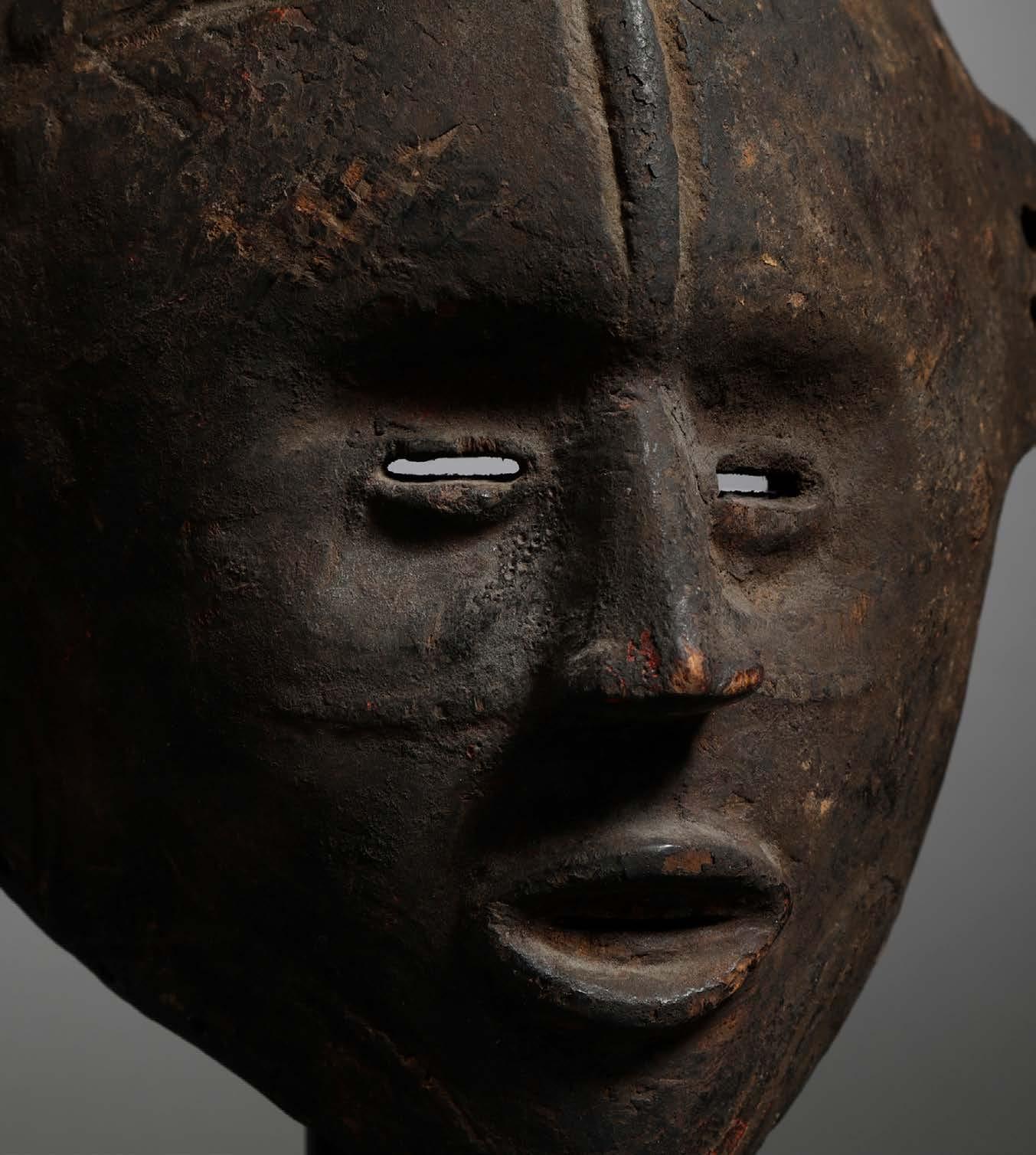
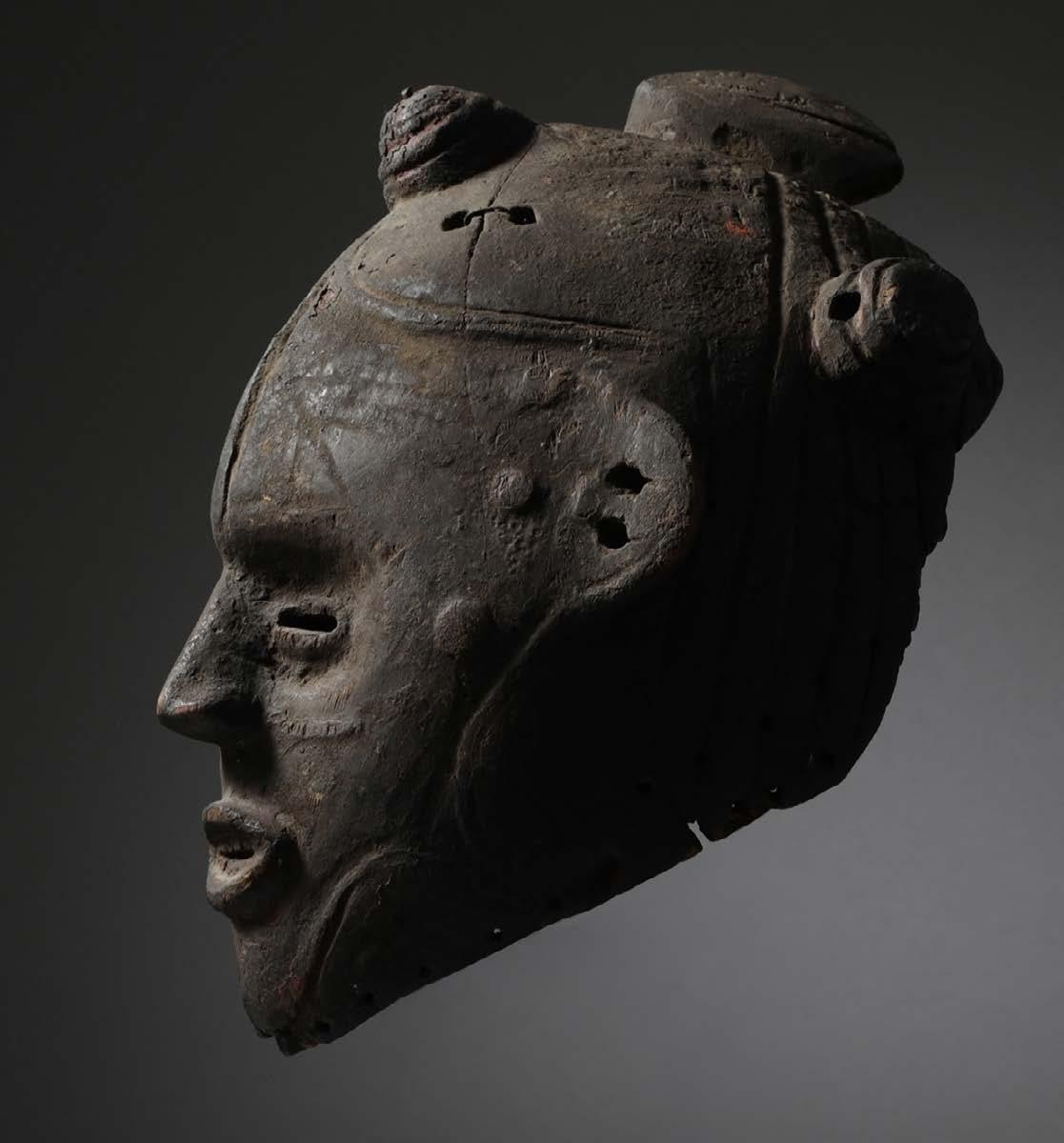
This commanding helmet mask rises from a broad, rounded jaw to an elongated cranium crowned by a tiered topknot coiffure, its form instantly evoking the elaborate hairstyles of prestige and ceremony that were once worn by titled men and women throughout the Cross River hinterlands and the Benue valley. The face is modeled with restrained naturalism: narrow slit eyes set beneath a gently furrowed brow, a composed expression, and a slightly parted mouth that suggests the mask is caught mid-utterance — midinvocation — rather than frozen in silence.
The coiffure is the mask’s defining element. Incised parallel lines sweep from crown to nape along the back and sides, rendering in wood the carefully dressed and oiled plaits of a woman of status — or, in some Igbo contexts, the ceremonially feminized persona of a maiden spirit (agbogho mmuo). The rendering is precise and confident, the work of a carver deeply familiar with the social grammar of hair as a marker of identity, age, and rank. A tiered conical knob sits at the apex, its layered rings retaining vivid traces of red
pigment — almost certainly camwood (Pterocarpus osun), a substance associated across the region with life force, protection, and ritual readiness.
At the crown, an old iron wire repair binds a longitudinal crack that passes near the topknot. The wire is deeply oxidized, its rust fully absorbed into the surrounding wood, making it clear that the repair was carried out long ago — during the mask’s active ceremonial life rather than after it left the community. Far from diminishing the object, this intervention speaks to how prized it was: worth mending, worth preserving, worth using again.
The patina overall is exceptional — deep reddish-brown darkening to near-black in the recesses, with areas of wear at the cheekbones and brow that trace the accumulated handling of many years. Multiple perforations along the lower perimeter and at the sides of the cranium provided attachment points for a fiber or raffia costume that would have shrouded the performer’s body, completing the transformation.
price $3,500
MASK OF A SCULPIN FISH
YUP’IK, MAINLAND ALASKA
Late 19th century Wood, pigments
Length: 24 in, 61 cm
PROVENANCE
Collected by Barton R. Lowder (1915 - 1991) from an Eskimo family. Lowder was on the crew of the steamer boat Nenana. The SS‑Nenana was a historic 237-foot river sternwheeler that operated on the Tanana and Yukon rivers in Alaska from 1933 to 1954.
Private Collection, New York
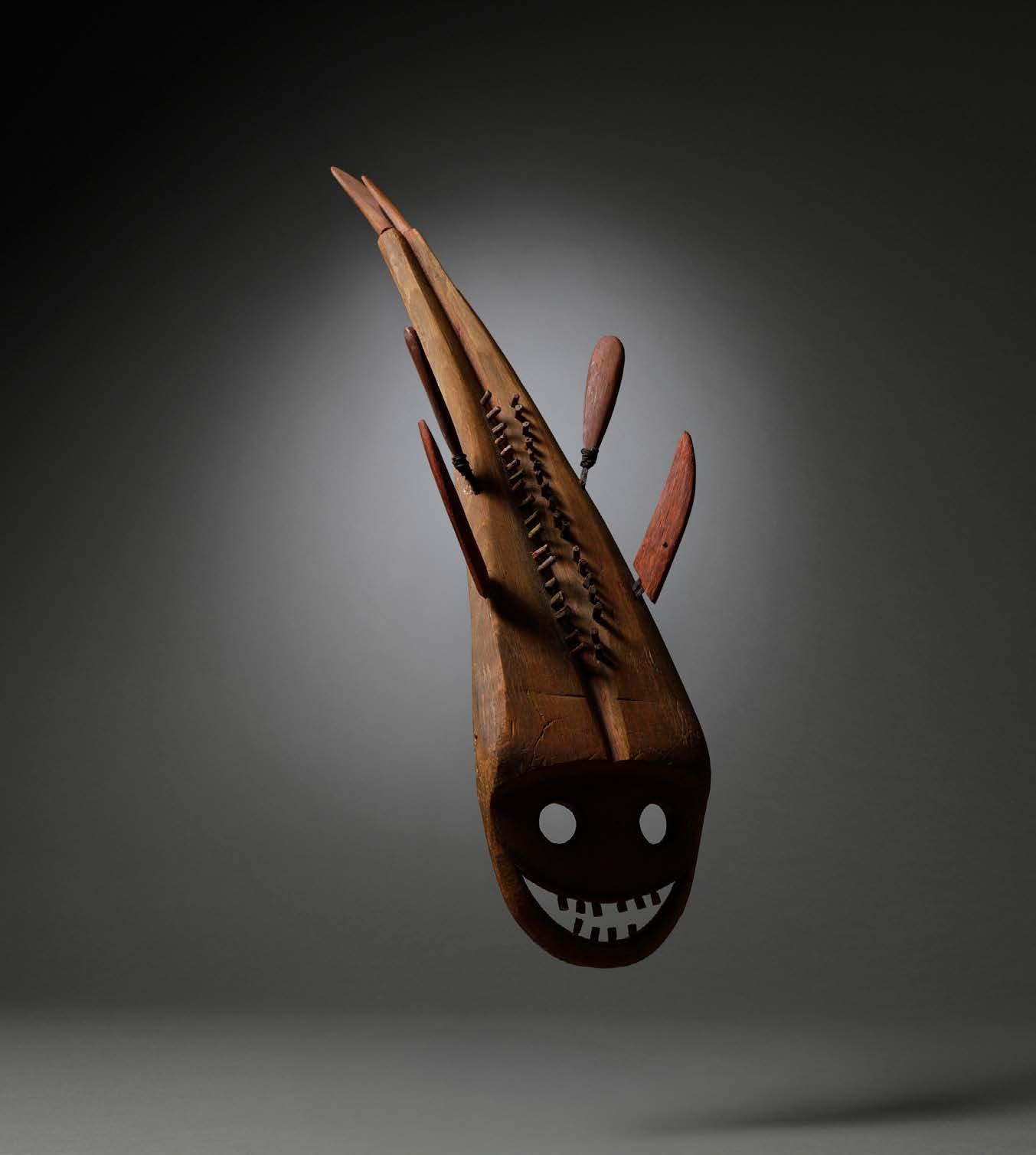
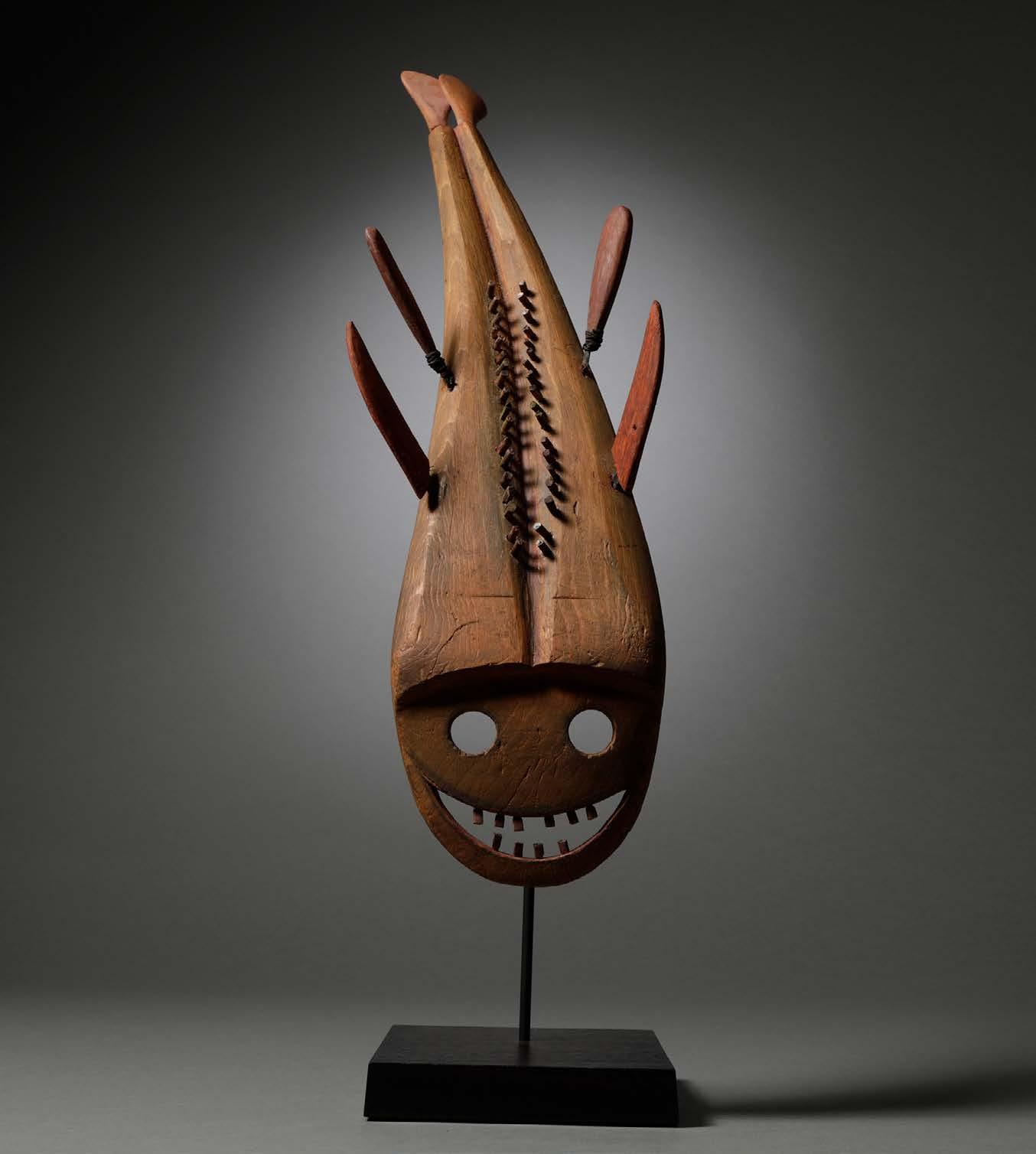
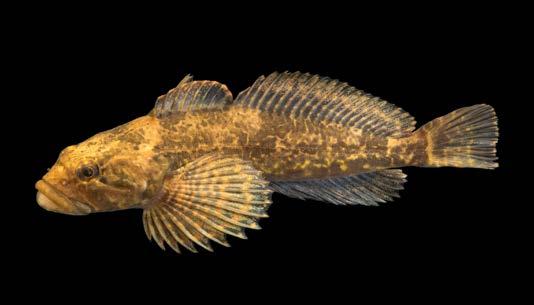
Sculpin (Cottus or Myoxocephalus species) were important spirit beings in the Yup’ik cosmological system, and fish masks of this type were made for the Agayuyaraq (asking/ inviting ceremony) or other winter ceremonials in which the yuat (persons/spirits) of sea creatures were invited, honored, and asked to return.
The sculpin — ungainly, armored, broad-mouthed, and bottom-dwelling — was not a fish that invited easy sentiment. But in the Yup’ik world of coastal Alaska, every creature possessed a yua, an inner person or spirit, and it was precisely the most formidable and unexpected beings that demanded the most careful ceremonial attention. The sculpin’s spiny body, gaping jaw, and fierce territorial nature made it a figure of power in the spiritual landscape of the Bering Sea coast, and the shaman who could speak to its yua — who could invite it, honor it, and persuade it to cooperate with human hunters — wielded knowledge of real consequence.
This mask renders the sculpin with the naturalistic
precision and formal inventiveness that characterize the finest Yup’ik zoomorphic work. The body is an elongated, tapering form — broadening at the head and narrowing to the tail — carved from a single substantial plank of driftwood with the confident economy of a carver who understood the animal from long observation. The head is the commanding element: a broad, blunt snout with two large round eye apertures — the dancer’s windows to the world, painted white to suggest the sculpin’s prominent eyes — above a wide, lipless mouth from which a row of individually carved teeth emerges, the inner lip painted the vivid reddish-orange of the fish’s actual coloration and of the yua’s vital energy.
The dorsal surface carries the mask’s most extraordinary technical achievement: a full ridge of individually inserted wooden spines running the length of the body’s centerline, each pin driven through a drilled hole and secured from within, replicating with meticulous fidelity the sculpin’s characteristic dorsal armature. The carver did not simplify
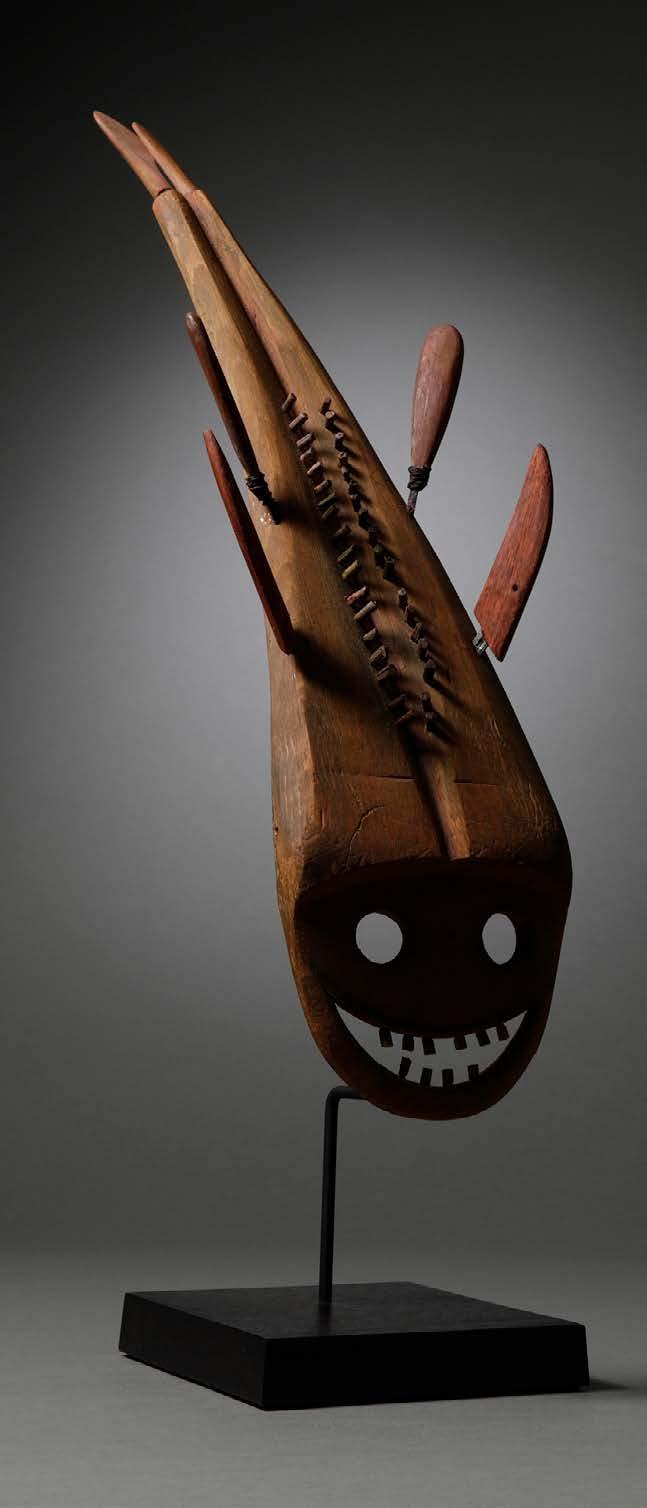
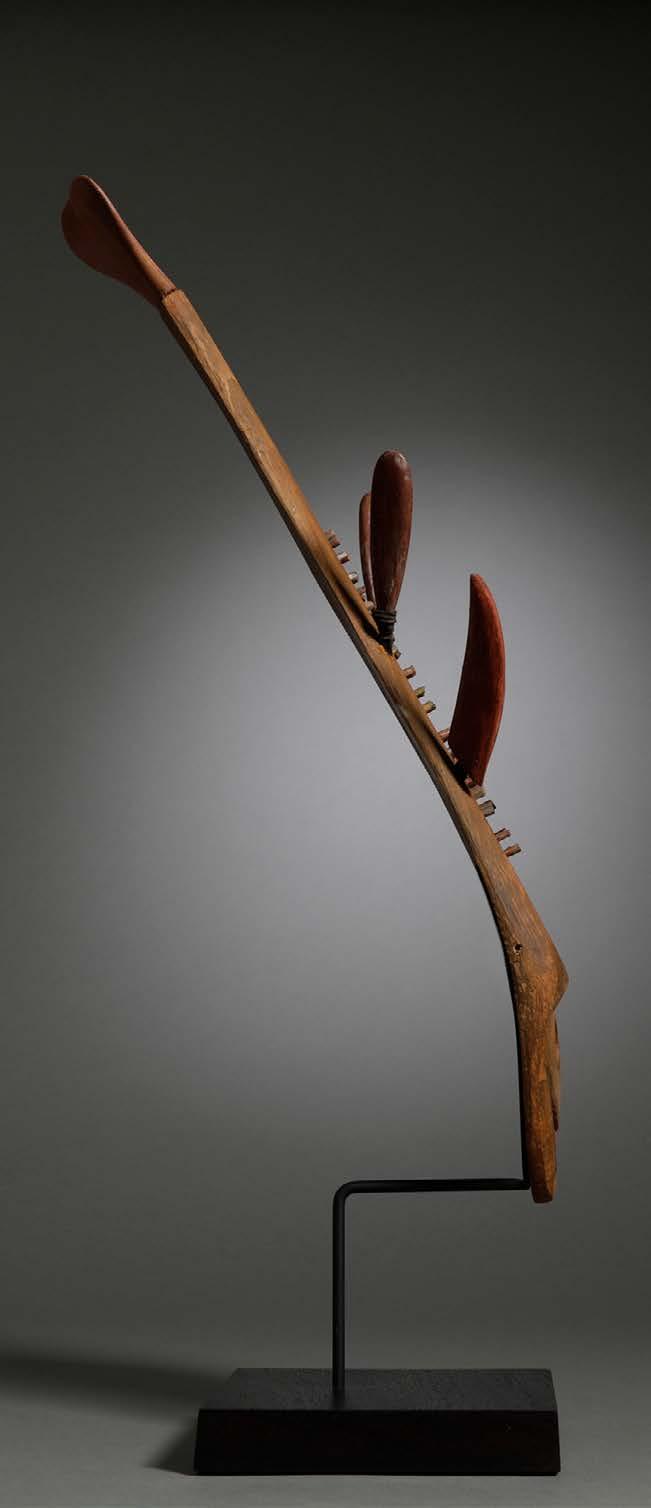
or suggest the spines — he counted them, placed them, made them real. This is the kind of specificity that Yup’ik mask-making demanded: the spirit of the sculpin would recognize itself, or it would not come.
Four lateral fins — each a flat, paddle-shaped piece of wood painted reddish-orange and lashed through drilled holes with sinew or twisted fiber — project from the body’s sides, their attachment knots still intact. One fin has separated from its lashing over the years, its loss the inevitable consequence of the organic materials that bound it; the attachment point and sinew remain, preserving the complete record of the original configuration. A carved caudal element at the upper terminus completes the fish form.
The surface throughout retains the warmth of aged, handled wood — the grain open and expressive, the paint worn and honest, the scratches and abrasions of ceremony and time fully integrated into the object’s presence.
Sculpin masks are exceptionally rare. For a similar example, see Upside Down: Arctic Realities by Carpenter, E., Mooney, S. et al p. 222 fig. 17
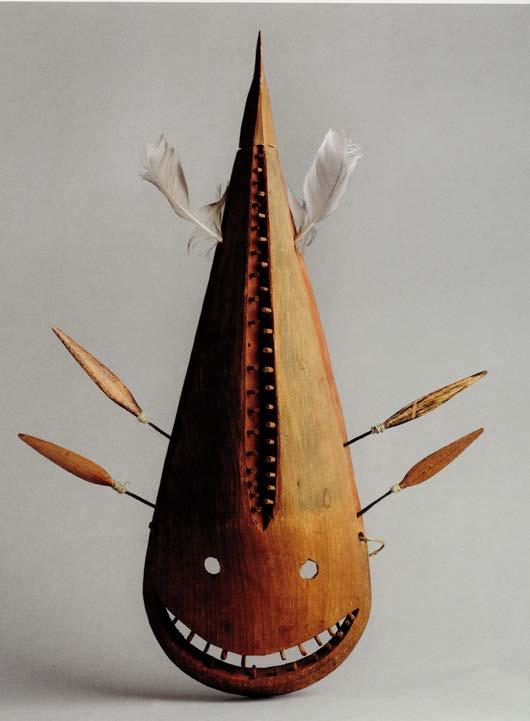
Sculpin mask exhibited in Upside Down: Arctic Realities by Carpenter, E., Mooney, S. et al p. 222 fig. 17.
Prickly sculpin (Cottus asper).
DRUMMER’S HEADDRESS
AFO, NASARAWA STATE, NIGERIA
Early 20th century
Wood
Height: 11 ½ in, 29 cm
PROVENANCE
Stanley Marcus, Dallas, Texas
Christie’s, New York, May 1995
PUBLICATION HISTORY
African Art in American Collections, 1989, Robbins & Nooter p. 282 illustration no. 734
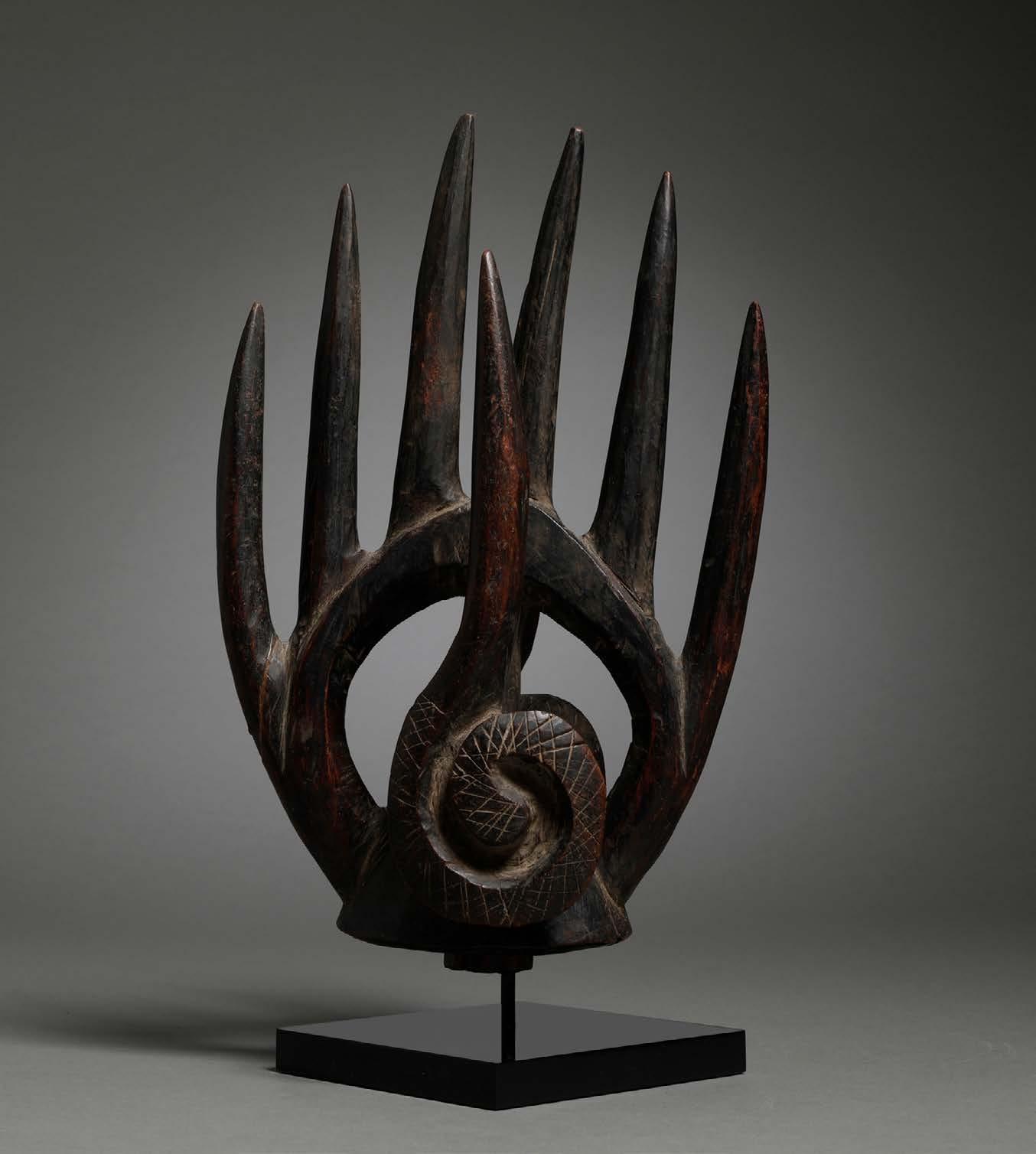
with warm red tones breaking through the deep black ground where the wood has been stressed or abraded.
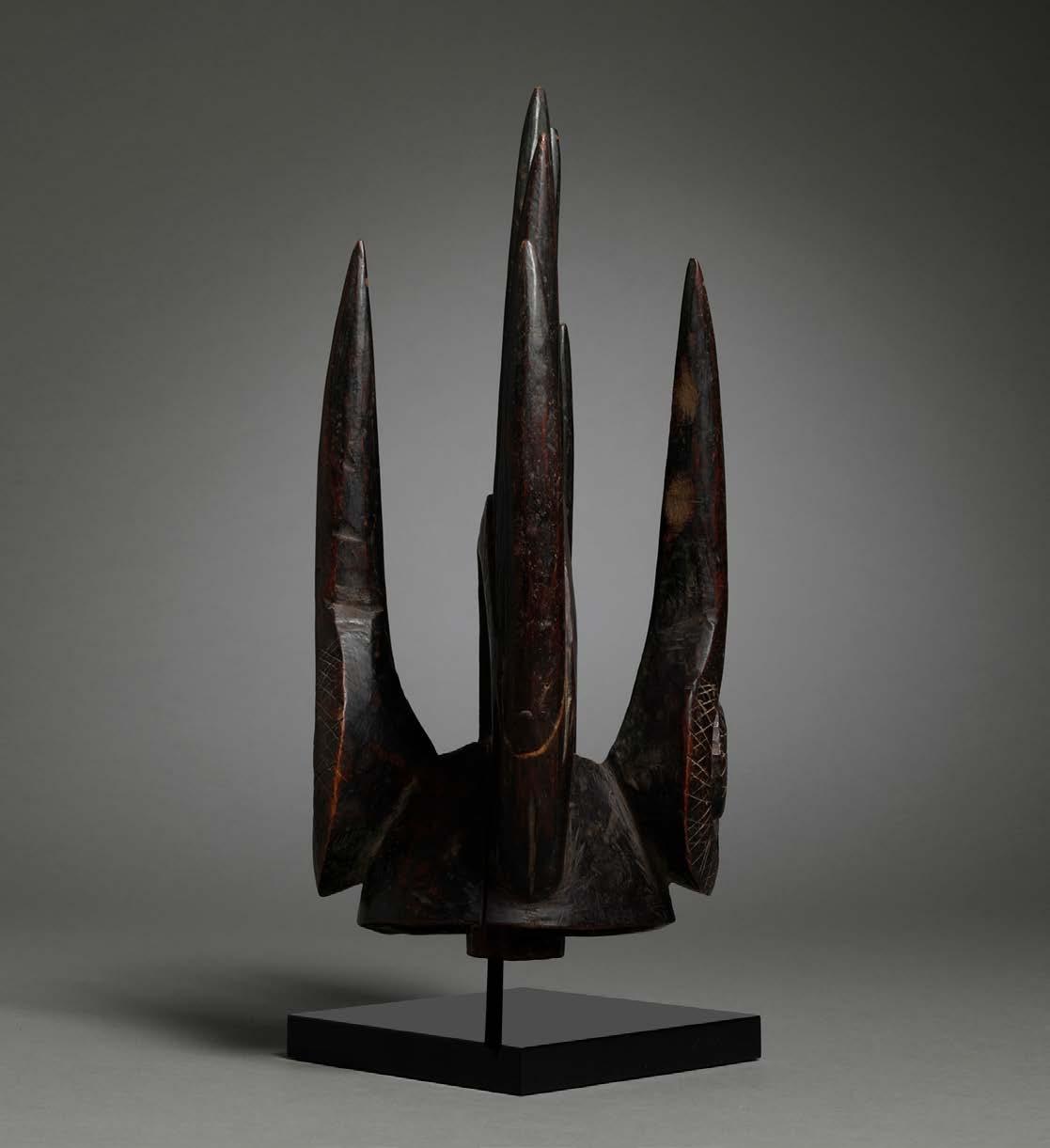
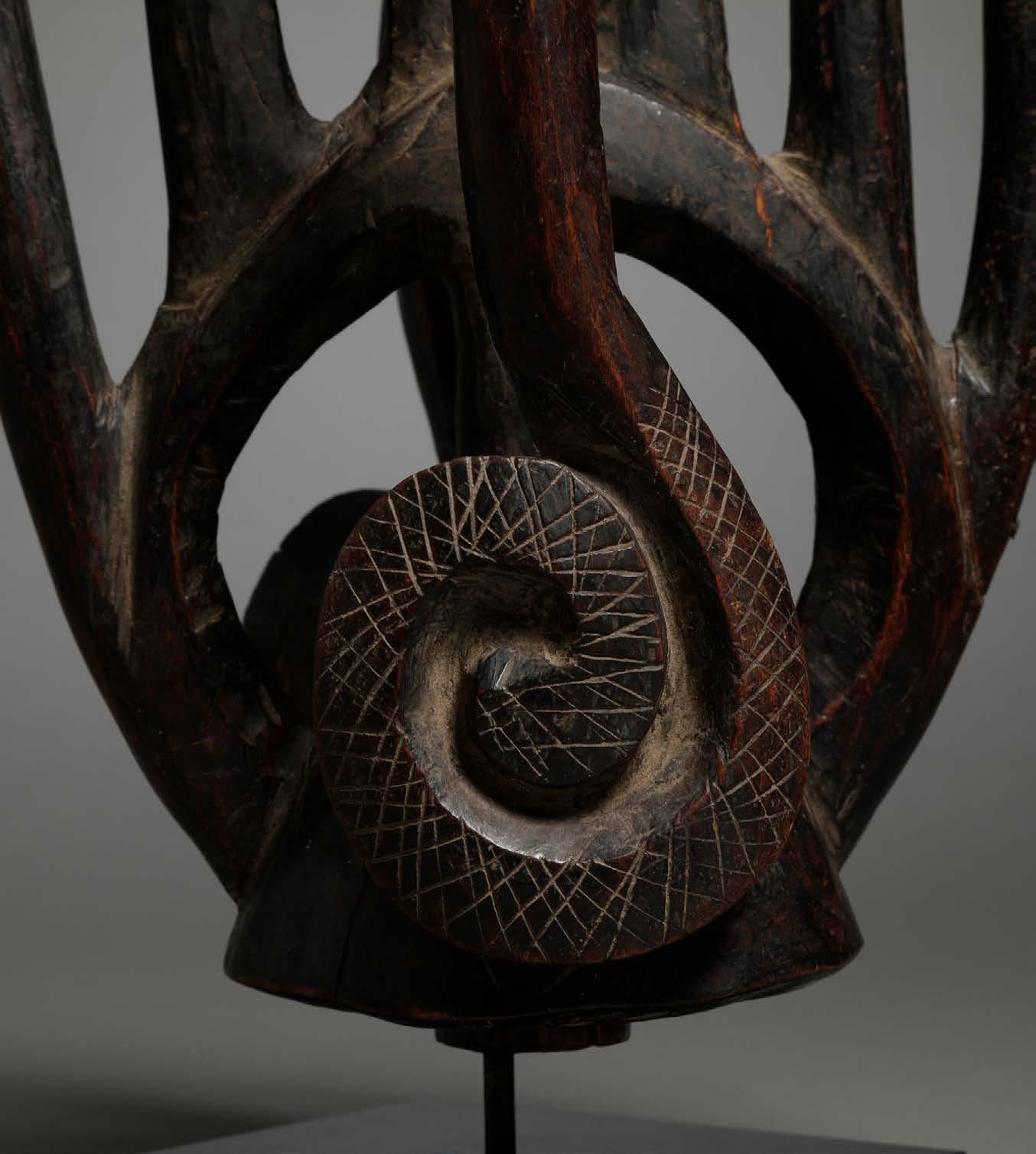
Nested within the ring, on both faces of the object, is a coiled serpent. The snake is the headdress’s most charged element. Its body is rendered in dense, confident crosshatching — a pattern of incised lines laid at opposing angles across the coils — and it spirals inward from the ring’s circumference to a raised head at the center. Among the Afo and related peoples of the Benue valley, the python carries connotations of the earth, of cyclical regeneration, and of powers that move beneath the surface of ordinary life. Here, encircled by spikes and held within a ring, the serpent is not threatening but contained — domesticated power, harnessed to the rhythm of the drum.
The ekpesi is among the most visually arresting headdress forms in the whole of West African masquerade tradition. Worn by the principal drummer during Afo masquerade performances, it transforms the musician into something more than accompanist — into a figure of focused spiritual power whose rhythm mediates between the visible community and the forces that govern it. The headdress is not merely worn; it amplifies.
This example achieves its effect through a composition of almost ruthless formal intelligence. From a compact, helmet-like base rises a great circular ring — the axle of the entire composition — from which seven long, tapering spikes radiate outward and upward in a fan that simultaneously suggests a crown, a sunburst, and an open hand raised in command. The spikes are carved with remarkable sureness: each tapers to a needle point, the surfaces worn smooth and lustrous by age and handling,
The rear of the headdress is equally resolved, with the central spike rising to its greatest height from between two flanking forms that carry the same hatched surface treatment as the serpent body, lending the back face a strict, heraldic quality. The patina throughout is deep and consistent — black with persistent reddish-brown undertones, built up from repeated applications of pigment and oil and worn to a subtle sheen at the spike tips and ring edge.
Few headdress types from Nigeria’s Middle Belt command both the formal radicalism and the symbolic density of the ekpesi. This example, with its intact spikes, finely incised serpent, and excellent overall condition, represents the type at its most compelling.
This headdress comes from the collection of Stanley Marcus. Harold Stanley Marcus (1905 – 2002) was president and later chairman of the board of the luxury retailer Neiman Marcus in Dallas, Texas, which his father and aunt had founded in 1907.
price $4,000
MASK
IDOMA, BENUE STATE, NIGERIA
19th century
Wood
Height: 7 ½ in, 19 cm
PROVENANCE
Merton D. Simpson (1928–2013), New York City, New York, USA
Robert & Patricia Berg, San Diego, California, USA
Michael Oliver, New York, USA
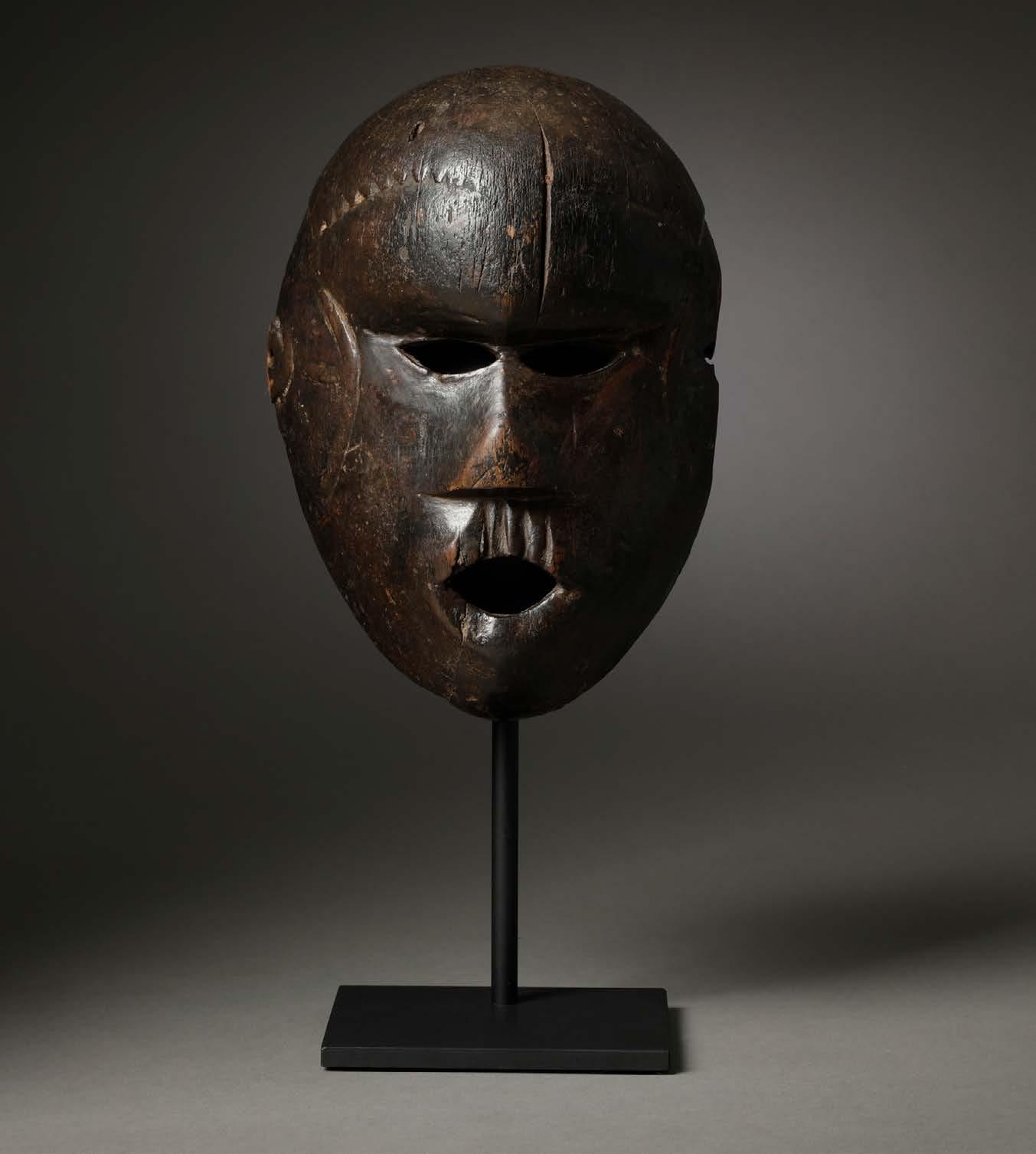
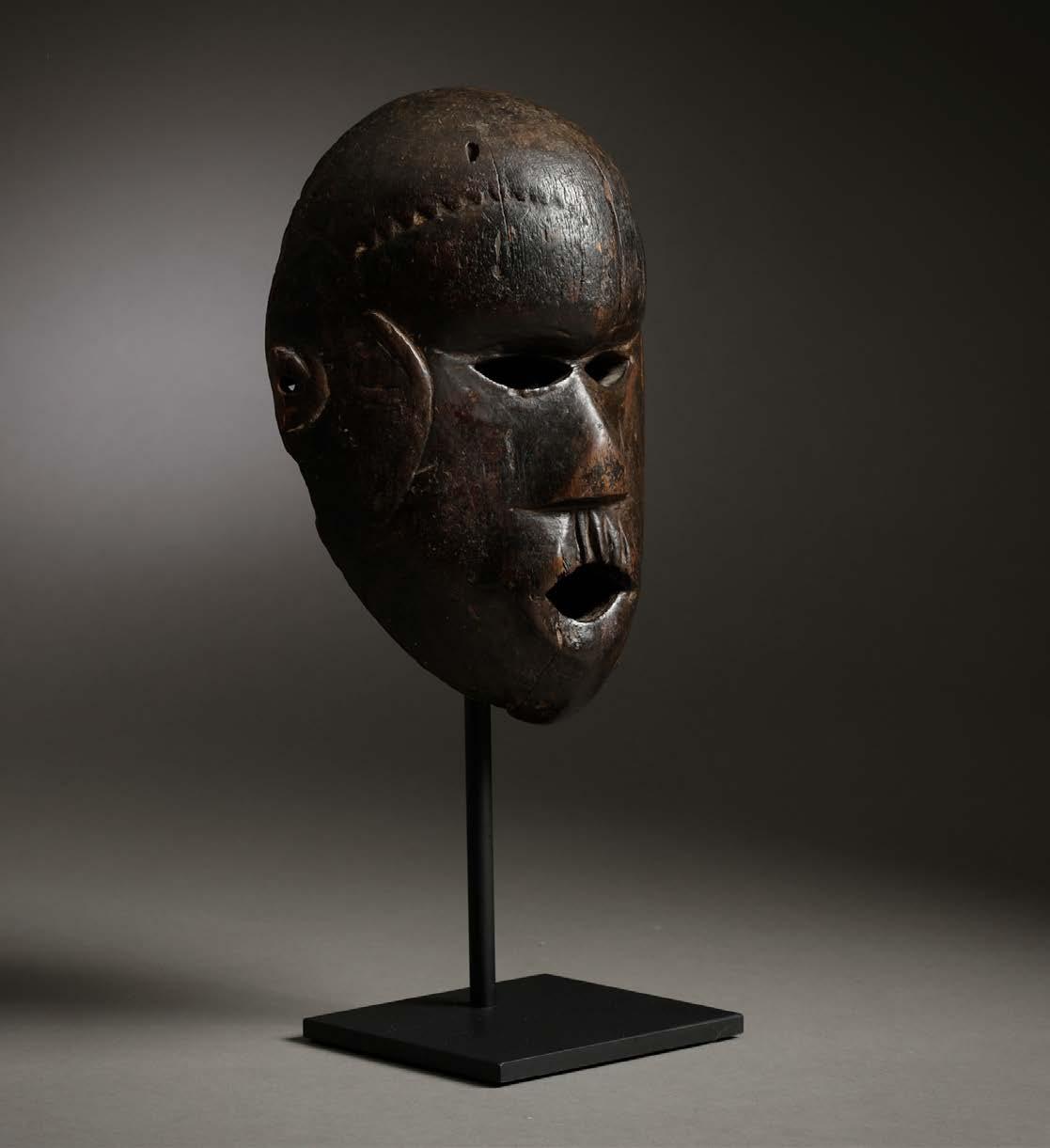
The Idoma of the Benue River valley in central Nigeria are renowned for their powerful masquerade traditions, in which masks serve as conduits between the living and the ancestral realm. This face mask displays the hallmarks of the Idoma aesthetic: a smooth, domed forehead, dramatically slit almond-shaped eyes, a prominent and boldly modeled nose, and an open, slightly parted mouth that conveys both authority and animation. The overall form is strongly ovoid, with a refined economy of surface that draws the eye inward, commanding attention without ornament.
The dark, lustrous patina — deep brown verging on black — speaks to sustained ritual use and repeated application of libations or oils over many years. Wear and abrasion along the high points of the forehead and cheekbones further
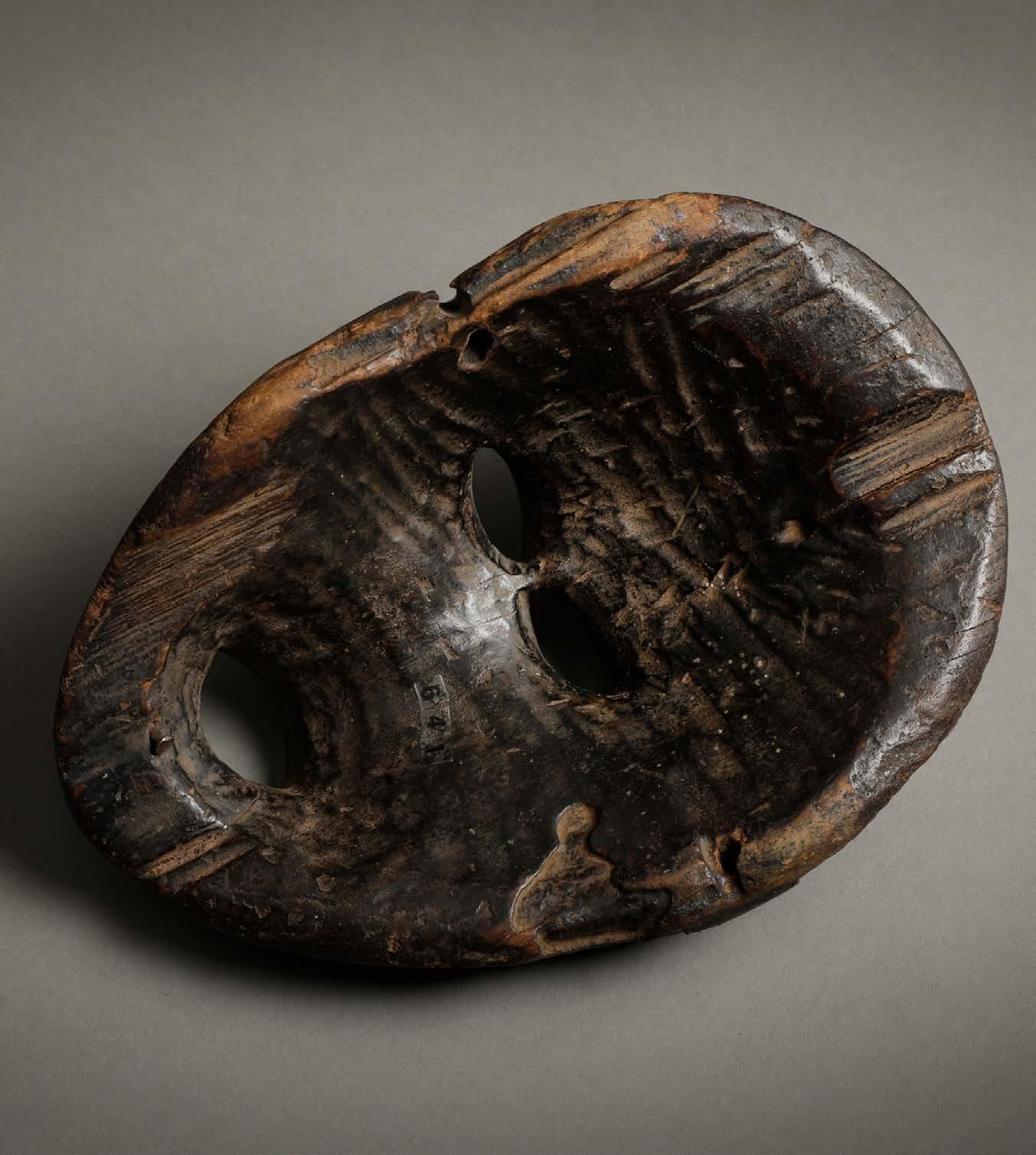
confirm a life in active ceremony rather than storage. Small lateral projections at the temples are characteristic of certain Idoma mask types and would have served as attachment points for fiber, raffia, or other organic costume elements that completed the masquerade ensemble.
Idoma masks of this type were performed within the oglinye and anjenu masquerade associations, appearing at funerals, initiations, and community judicial proceedings. The masks embody ancestral spirits (alekwu) whose presence enforced social order and mediated between worlds. The open mouth suggests the mask was intended to speak — to give voice to the ancestors in the public arena of ceremony.
price $2,500
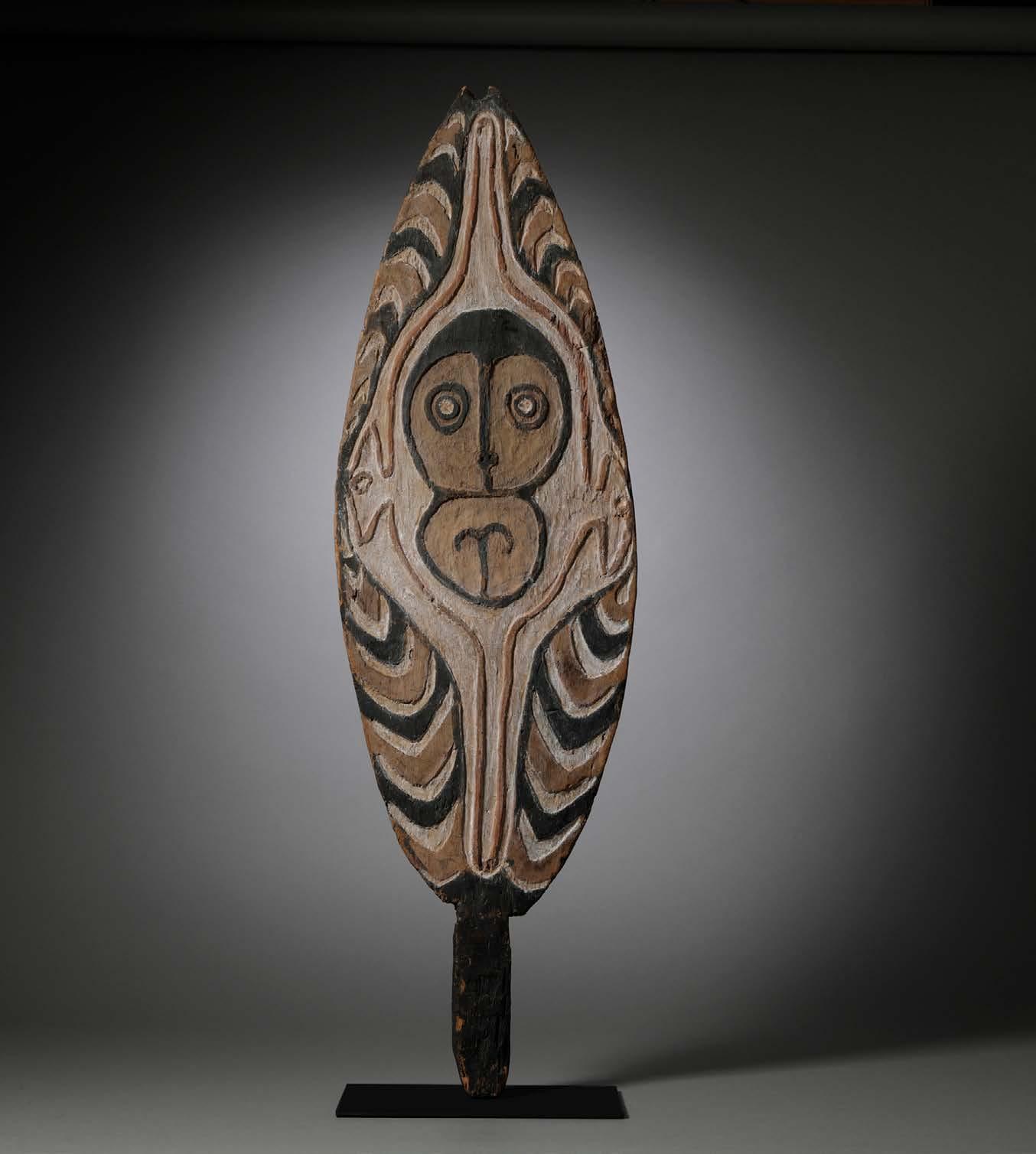
SPIRIT BOARD GOPE
URAMA (URAMU) ISLAND, PAPUAN GULF, NEW GUINEA
Early 20th century
Wood, pigments
Height: 45 in, 114 cm
PROVENANCE
Karl Stirner (1923–2016), Pennsylvania, USA
The gope — flat, oval spirit boards carved and painted by the peoples of the Papuan Gulf — are among the most iconic objects produced anywhere in the Pacific. They are not merely beautiful; they are inhabited. Each board houses the captured soul of an enemy slain in battle, a force (imunu) that the owning clan could direct toward protection, fertility, and the amplification of power in war and the hunt. Kept in the men’s ceremonial house (eravo), hung above the doorway or propped upright along the walls, gope were fed, addressed, and renewed with fresh pigment before important undertakings. They were, in the most literal sense available to their makers, alive.
This example from Urama Island presents the form at its most commanding. The board is large — a full leaf- or canoe-shaped oval, pointed at crown and base — and its painted surface has retained exceptional color and compositional integrity across what is clearly a considerable span of years. The palette is the classic Gulf triad: white from burned lime, reddish-brown from iron ochre, and black from charcoal, applied in flat fields and fine outlines that together achieve a visual complexity far beyond their material simplicity.
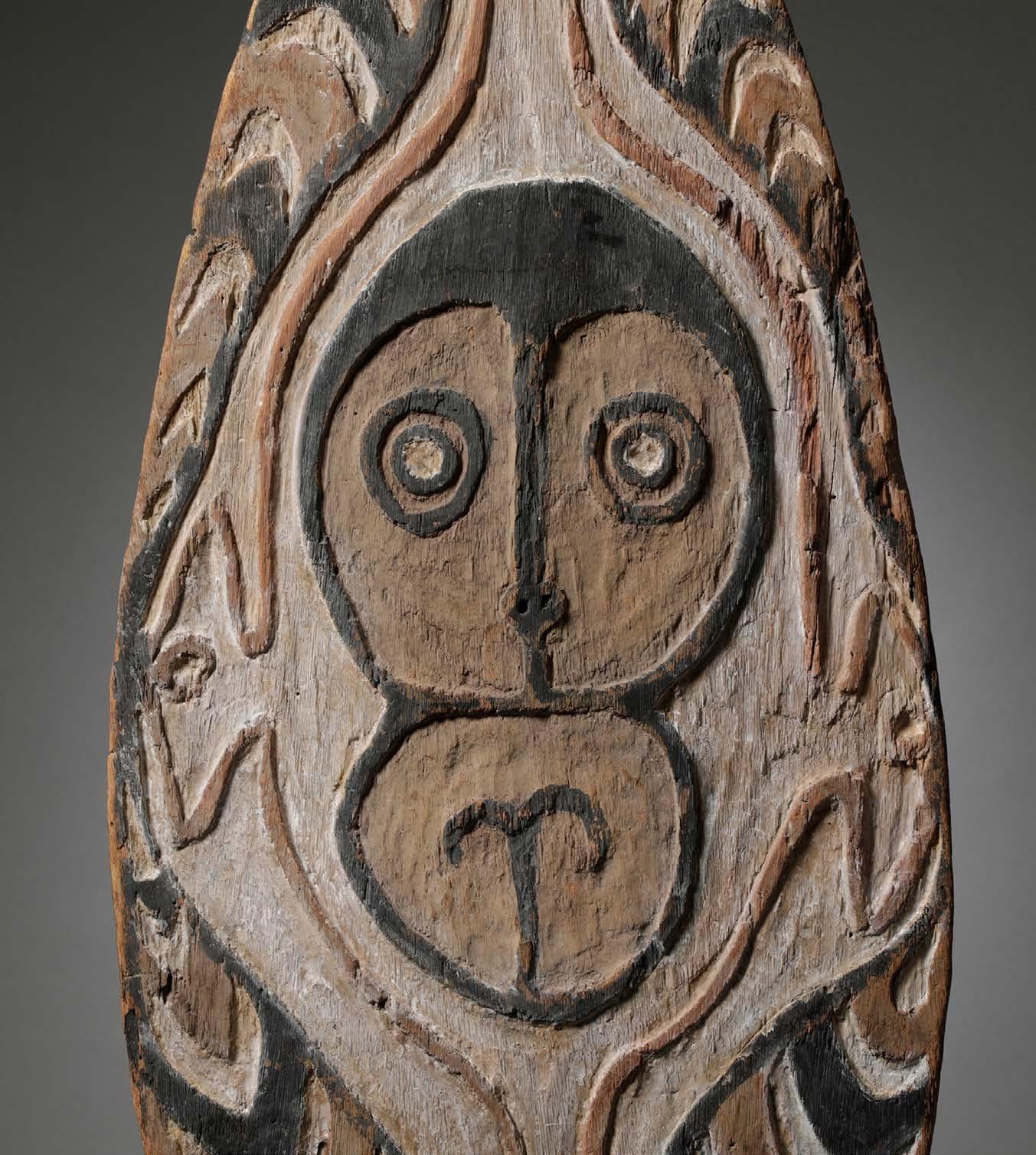
At the center of the composition, framed within a luminous white oval field, the spirit face looks outward. It is rendered as two lobed forms stacked vertically — the larger upper circle the head, the smaller lower lobe the chest or body — in warm reddish-brown, with two round eyes whose white pupils catch and hold the viewer across the decades. The nose is lightly indicated; below it, the chest lobe carries a small curved projection suggesting a mouth or chin. The face is simple and absolute. It does not invite interpretation so much as acknowledgment: something looks back.
From this central face, white curvilinear lines extend upward and downward along the board’s vertical axis, tracing the organic logic of leaf veins or river channels toward the pointed terminations of the form. Flanking the central panel on both sides, the field is filled with tightly nested arc bands in reddish-brown outlined in black — a pattern that reads as ribs, as water, as the scaling of a crocodile, as the layered energies of a contained force pressing outward against the board’s edge. The technical execution is confident and assured, the bands laid with a control that speaks to a painter working within a longpracticed tradition.
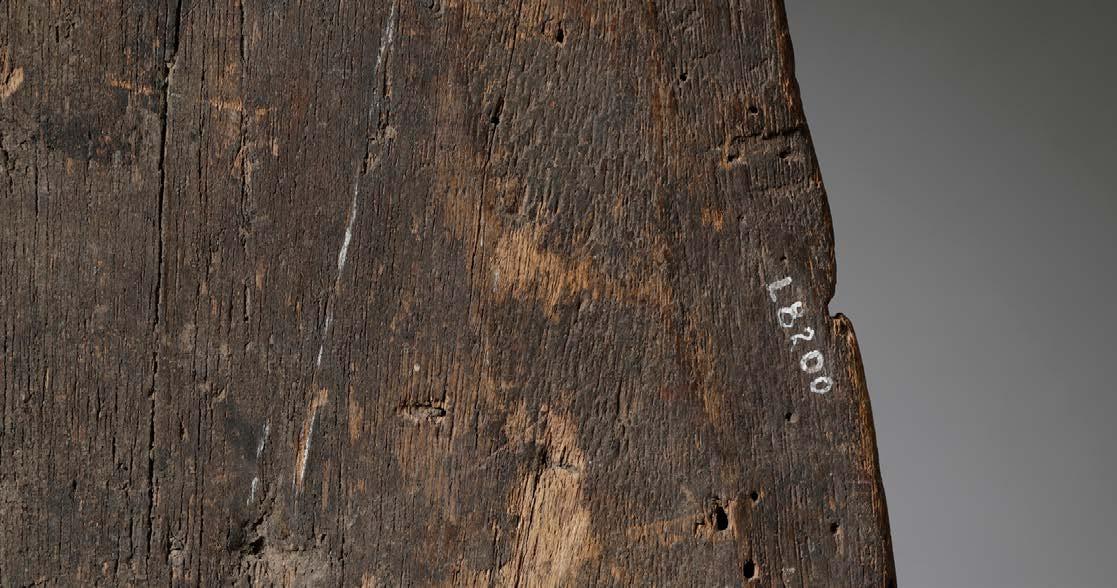
The reverse is unpainted and deeply patinated — dark, dry, and pitted throughout with the channels of woodboring insects, a testament to the board’s age and to the humid environment of the Gulf in which it spent its active life. An old iron wire repair at the upper back binds a longitudinal crack, and a painted collection number — consistent with early Australian or European institutional numbering — confirms a collecting history that predates the modern market. The handle, through which the board was thrust into the ground or held upright in ceremony, survives intact. When purchased, a later coat of paint was professionally removed to reveal the original surface.
Old collection number L8200 on reverse.
price $6,000
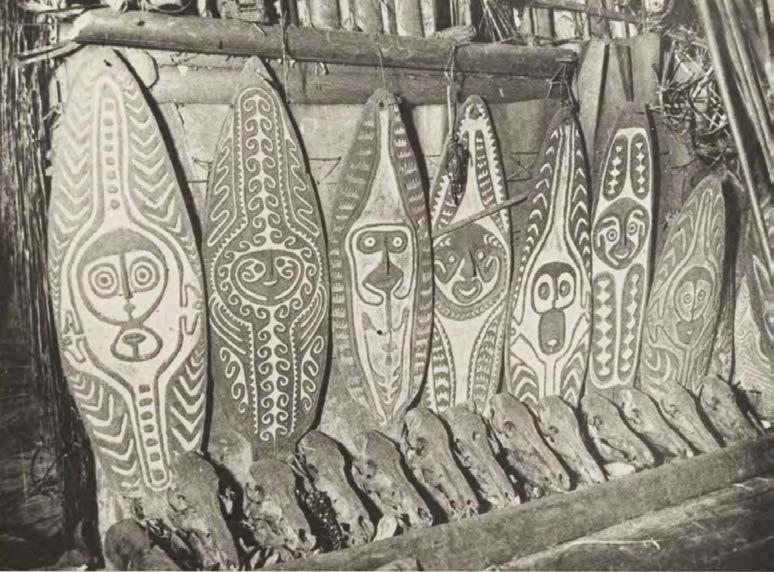
Urama shrine photographed by Frank Hurley, 1924.
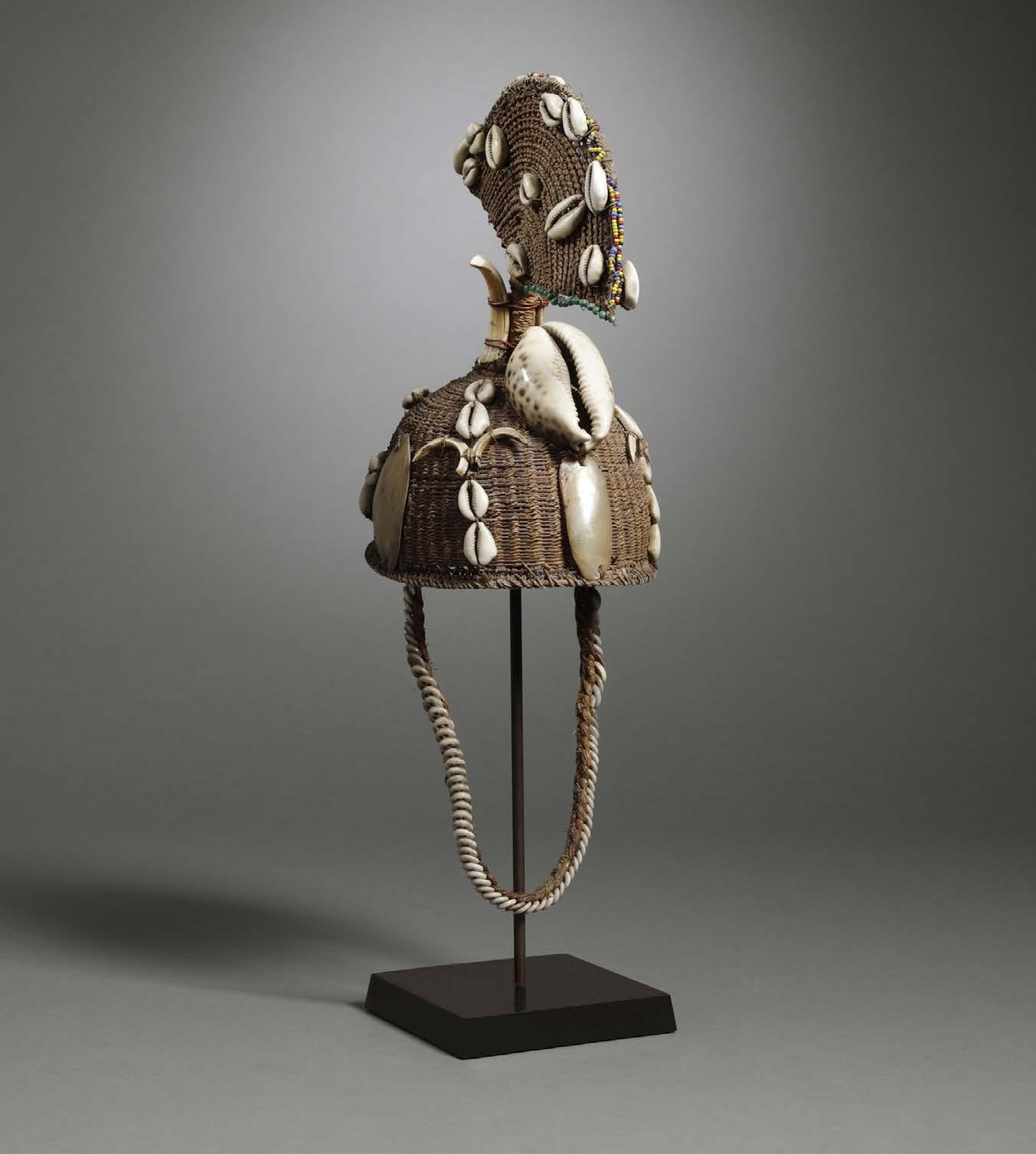
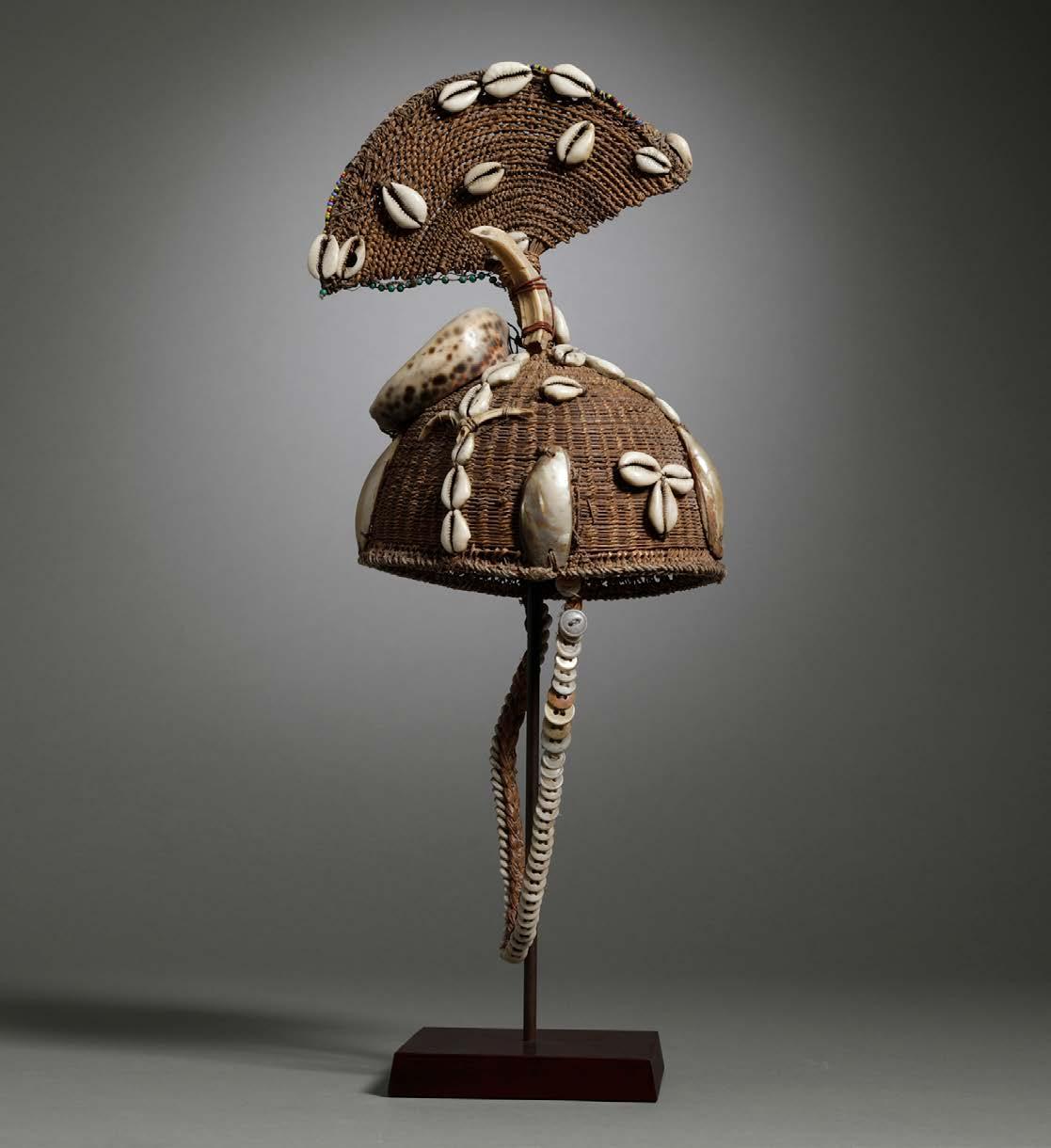
PRESTIGE HAT, DRC
LEGA PEOPLES, DRC
Early 20th century
Vegetable fiber, cowrie shells, mother-of-pearl shell, spotted cowrie, bone toggle, trade glass beads, shell disc beads
Height (from bottom of strap): 18 in, 46 cm
PROVENANCE
Michael Oliver, New York City
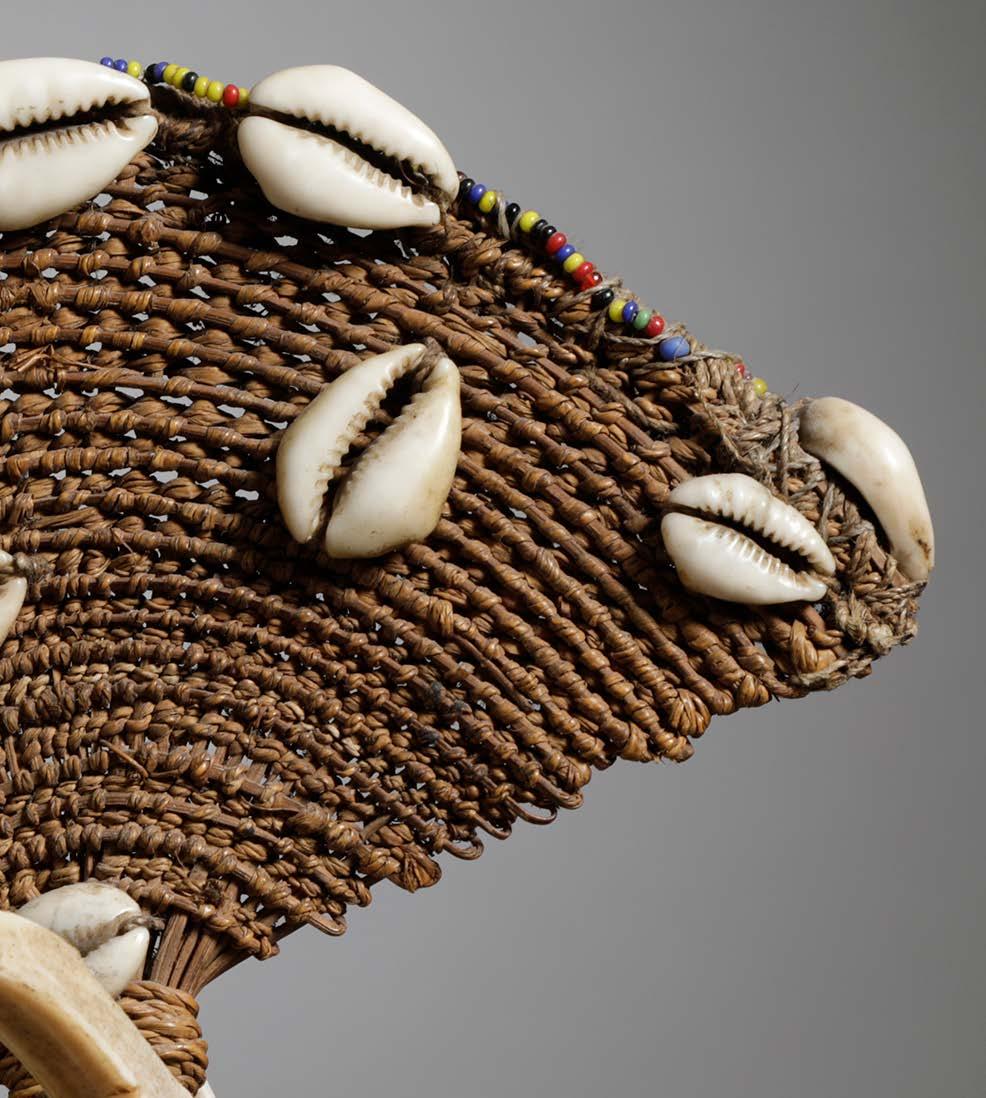
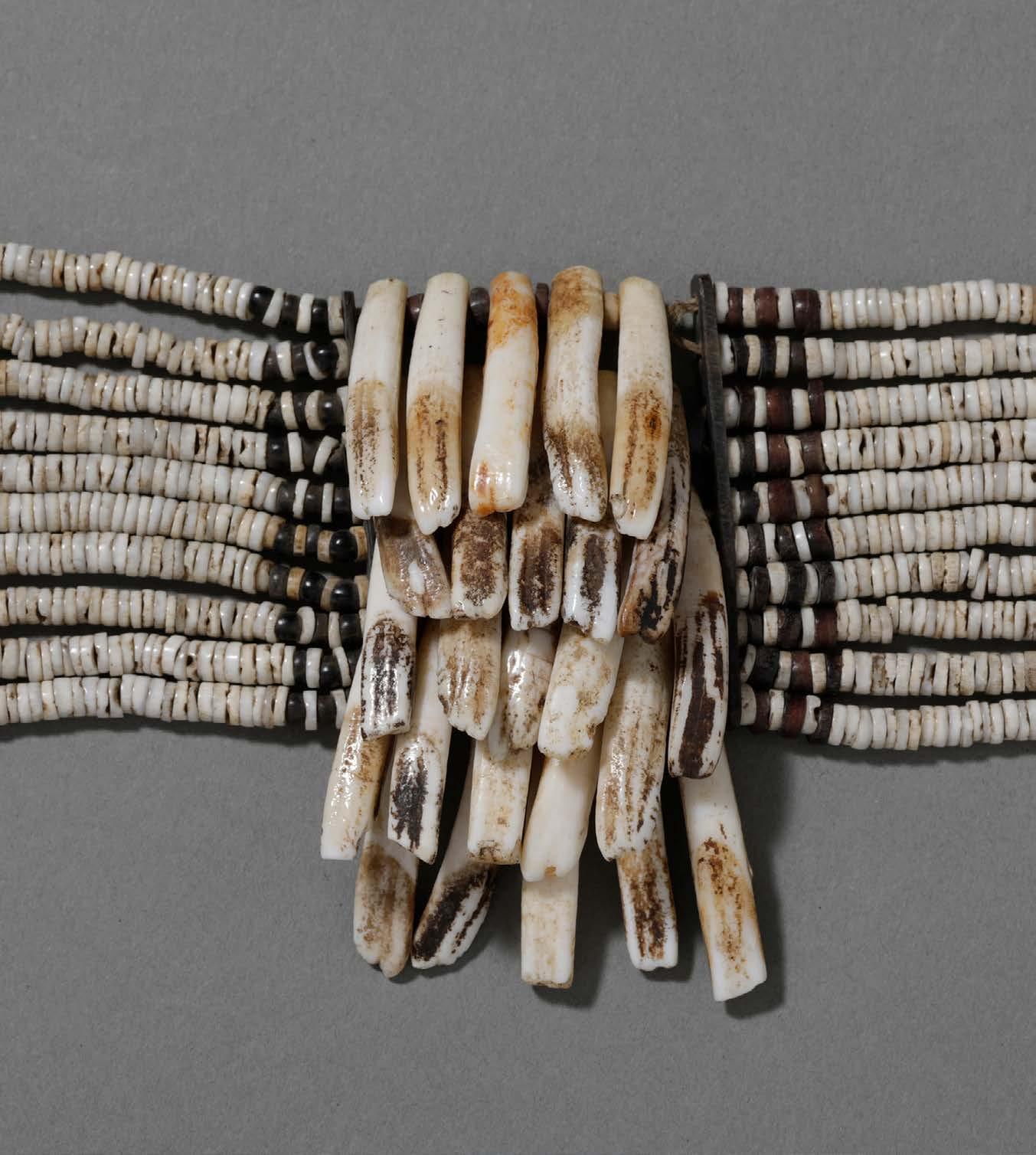
Among the Lega of the eastern Congo, membership in the Bwami society — the elaborate, multi-tiered association that organized social, moral, and spiritual life — was expressed not through political office or inherited rank alone, but through the accumulation and display of specific objects. Bone, shell and fiber were not merely materials; they were the visible language of wami initiation, each object encoding a level of achievement, a body of knowledge, and a set of obligations to the community. A man’s collection of Bwami objects was, in the most direct sense, his biography made tangible.
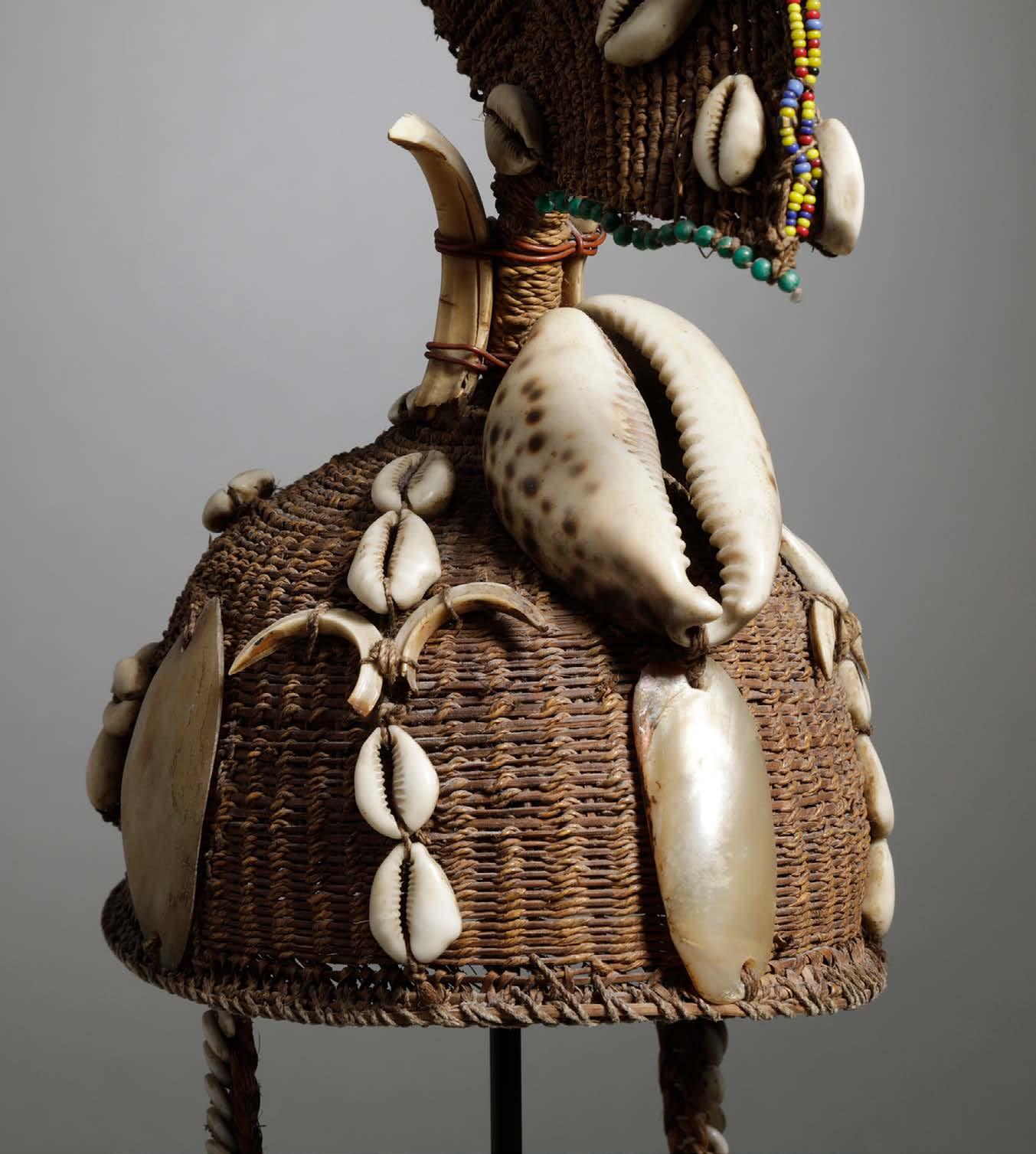
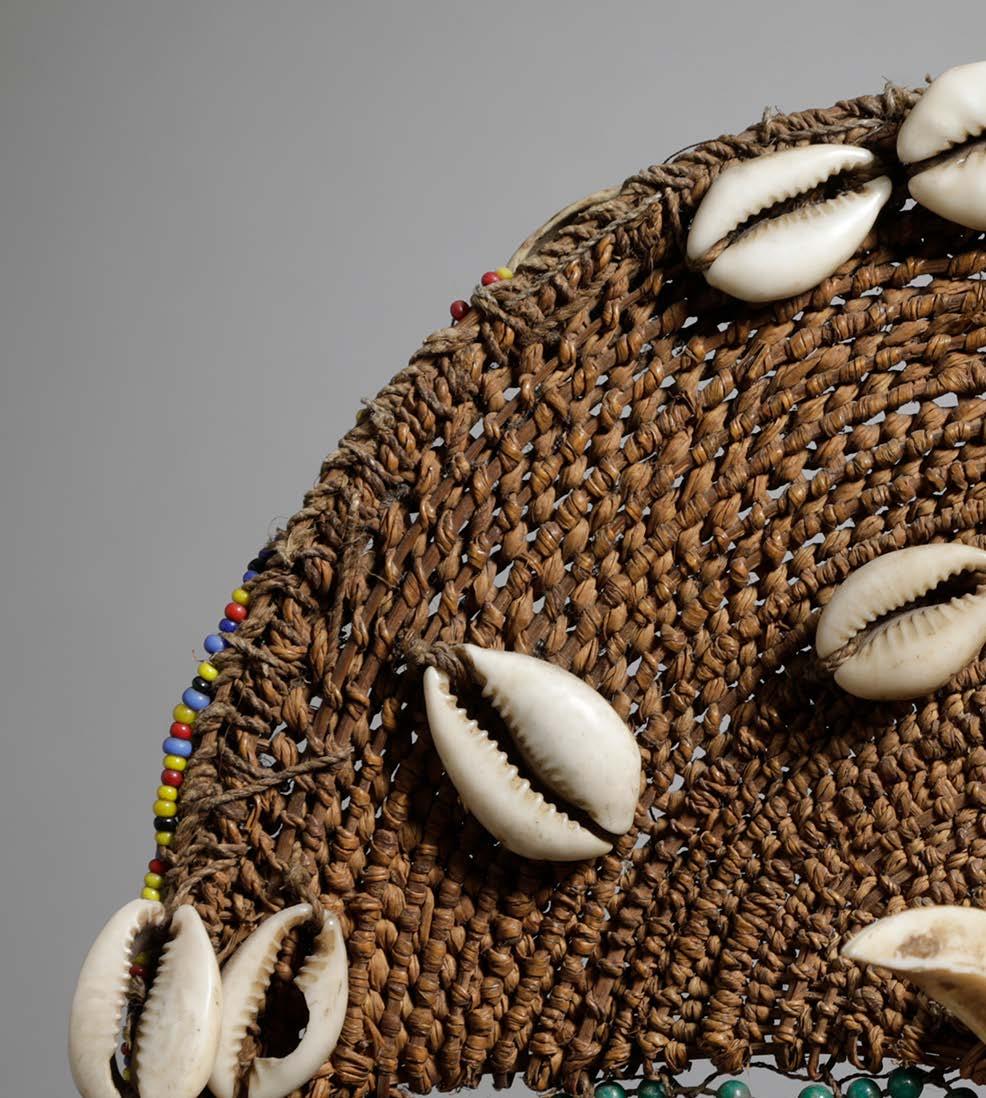
This prestige hat is a Bwami object of evident senior rank. Its construction alone signals exceptional status: a tightly coiled dome of dark vegetable fiber forms the foundation, rising to a fan-shaped crest of the same material that is attached at the crown via a curved peg of bone or ivory — the toggle itself a Bwami material of significance — and tilts backward at a proud angle that would have given the wearer a commanding profile. The silhouette is both architectural and animate, combining the stability of the dome with the upward energy of the crest in a form that reads as simultaneously helmet and crown.
Every surface is a surface for meaning. The dome’s front face is centered on a large, luminous mother-of-pearl shell — its iridescence catching light in the dimness of the ceremonial house, signaling wealth and connection to waters far beyond the forest. Surrounding it, cowrie shells are sewn on in pairs and clusters across both dome and crest, their quantity and careful arrangement speaking to accumulated exchange relationships, to journeys of trade and initiation, to a life spent moving through networks of obligation and reciprocity. At the hinge between dome and crest, a large spotted cowrie — rarer and more visually dramatic than the common money cowrie — marks the compositional and symbolic center of gravity. Along the upper edge of the fan, a fine border of small turquoise trade glass beads introduces a note of chromatic precision, the blue-green a color associated throughout the region with water, with the ancestral realm, and with initiated knowledge.
Hanging from the dome’s lower rim is a long pendant of stacked white shell or bone disc beads with a single dark accent near the crown — worn to fall alongside the face or beneath the chin, completing the transformation of the wearer from an ordinary person into a Bwami initiate of senior grade, a man whose presence commanded attention, deference, and the acknowledgment of accumulated wisdom.
The fiber throughout has aged to a deep, warm brown, the patina of long handling and ceremonial use. The shells retain their luster. The overall condition is excellent for an object of this complexity and organic materiality.
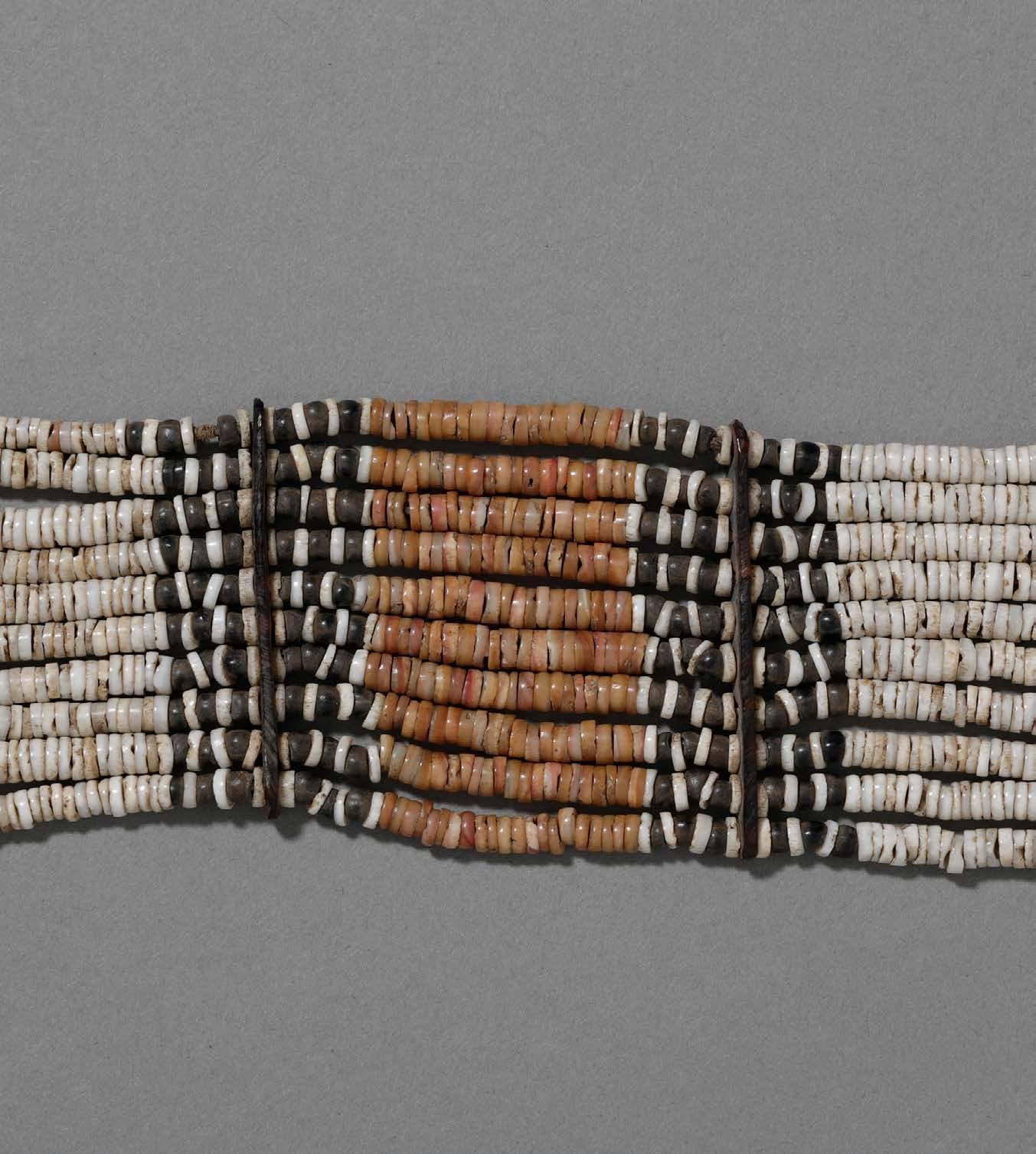
FO’O’ABA PRESTIGE BELT
ARE’ARE OR KWAIO PEOPLES, MALAITA, SOLOMON ISLANDS
Late 19th / early 20th century
Galu (white shell disc beads), fira’i (red shell disc beads), fulu (black shell disc beads), dolphin or canine teeth, vegetable fiber
Length: 29 in, 74 cm
PROVENANCE
Matthias
Lemaire, Amsterdam
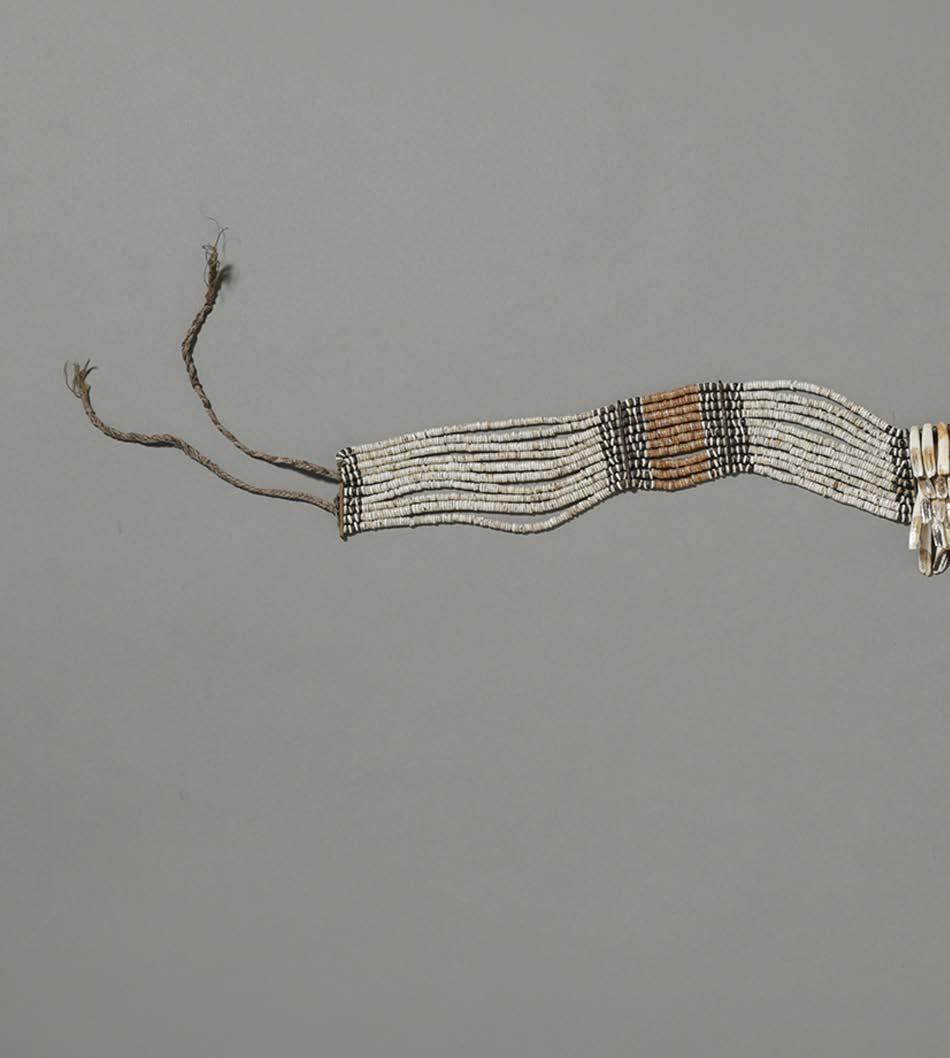
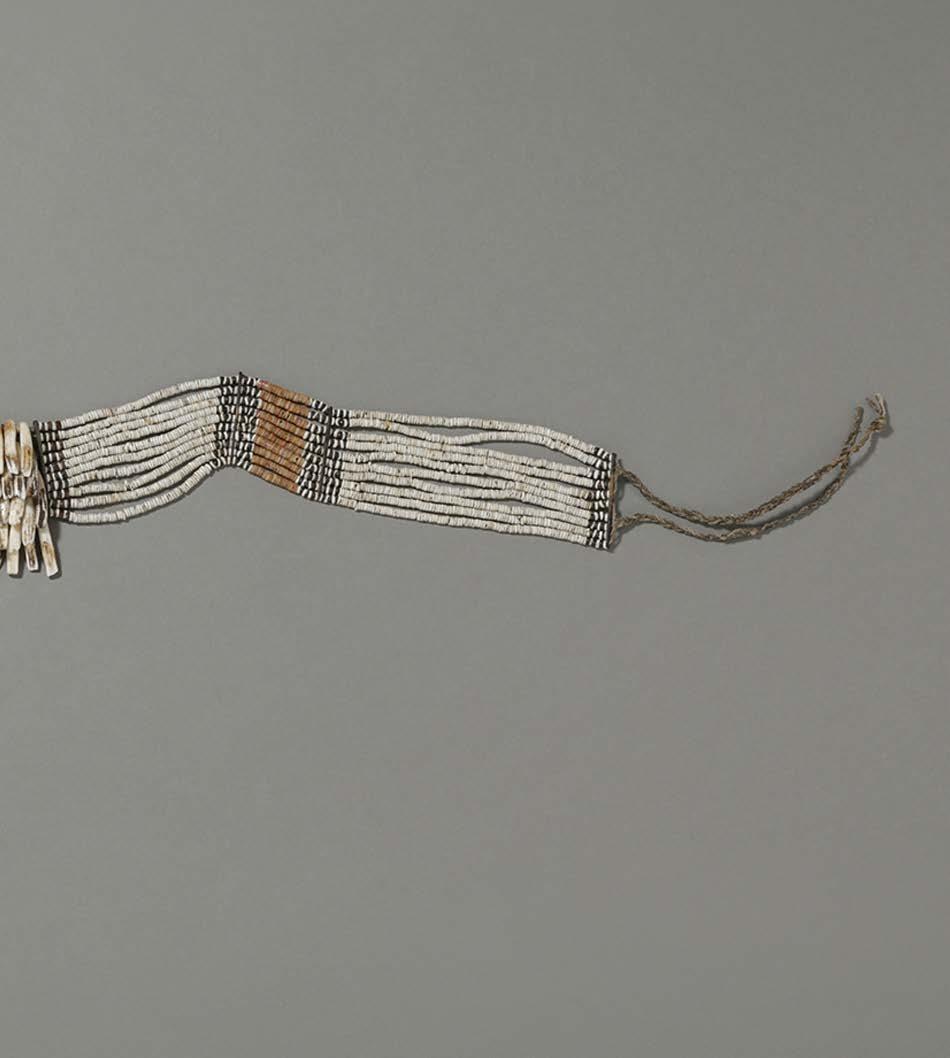
In the Solomon Islands, and on Malaita above all, shell valuables were never merely ornamental. They were the medium through which life’s most consequential transactions were conducted: bride wealth, compensation for injury or death, the conclusion of peace between clans, initiation into adult society, and the honoring of the ancestral dead. A man’s standing was measured in shell, and a belt of this quality — dense with galu, fira’i, and fulu beads, terminated in dolphin teeth — was an object of serious economic and social gravity, assembled over time through accumulated exchange relationships and the labor of many hands.
This fo’o’aba is a prestige chest belt of outstanding completeness and refinement. Its body is formed from ten or more parallel strands of shell disc beads running in close parallel across the full width of the ornament, each strand precisely loaded with the three canonical bead types of Malaitan valuables. The dominant white galu beads — ground from Conus or white Tridacna shell — form the ground of the composition, their uniform small discs creating a surface of dense, even texture that catches light
price $1,800
with a muted, chalky luminescence. At regular intervals, strands of black fulu beads interrupt the white in crisp horizontal bands, the dark discs ground from the black lip of bivalve shells and polished to a matte finish that creates a precise rhythmic contrast. Where the strands converge at the dolphin tooth terminal, warm bands of reddish fira’i beads emerge — ground from the pink-red interior of Chama or similar shell, each bead representing labor and exchange investment of a kind that made red shell among the most valued of all Malaitan materials.
The terminal pendant is a bound mass of dolphin teeth — perhaps forty or more individual teeth drawn from multiple animals, their long curved forms tapering to points, cream to warm ivory in tone, their hollow root canals visible at the cut ends and confirming their cetacean origin beyond doubt. Dolphin teeth (bakiha) were, alongside shell money, the most important form of wealth currency across much of the Solomons: used in brideprice payments, mortuary feasts, and compensation transactions, their accumulation required either direct participation in communal dolphin drives — a dangerous and ritually charged undertaking
— or extensive exchange networks reaching across island groups. A cluster of this density and uniformity represents substantial accumulated wealth.
The junction between bead strands and tooth cluster is itself a feat of craftsmanship: a tightly bound collar of alternating dark and light disc beads creates a structured, architecturally precise transition, the strands disciplined into order before releasing into the mass of teeth. At the opposite terminus, original twisted vegetable fiber ties survive intact, through which the belt was secured across
the chest of its owner during ceremonies, feasts, and the major social performances that defined a man’s public life on Malaita.
The overall condition is excellent: the beads retain their original surface character — the galu chalky and dense, the fulu dark and precise, the fira’i warm and glowing — and the teeth, though stained with age and use, are complete and secure in their binding. This is not an object assembled for sale but one that accumulated its materials across years of purposeful exchange.
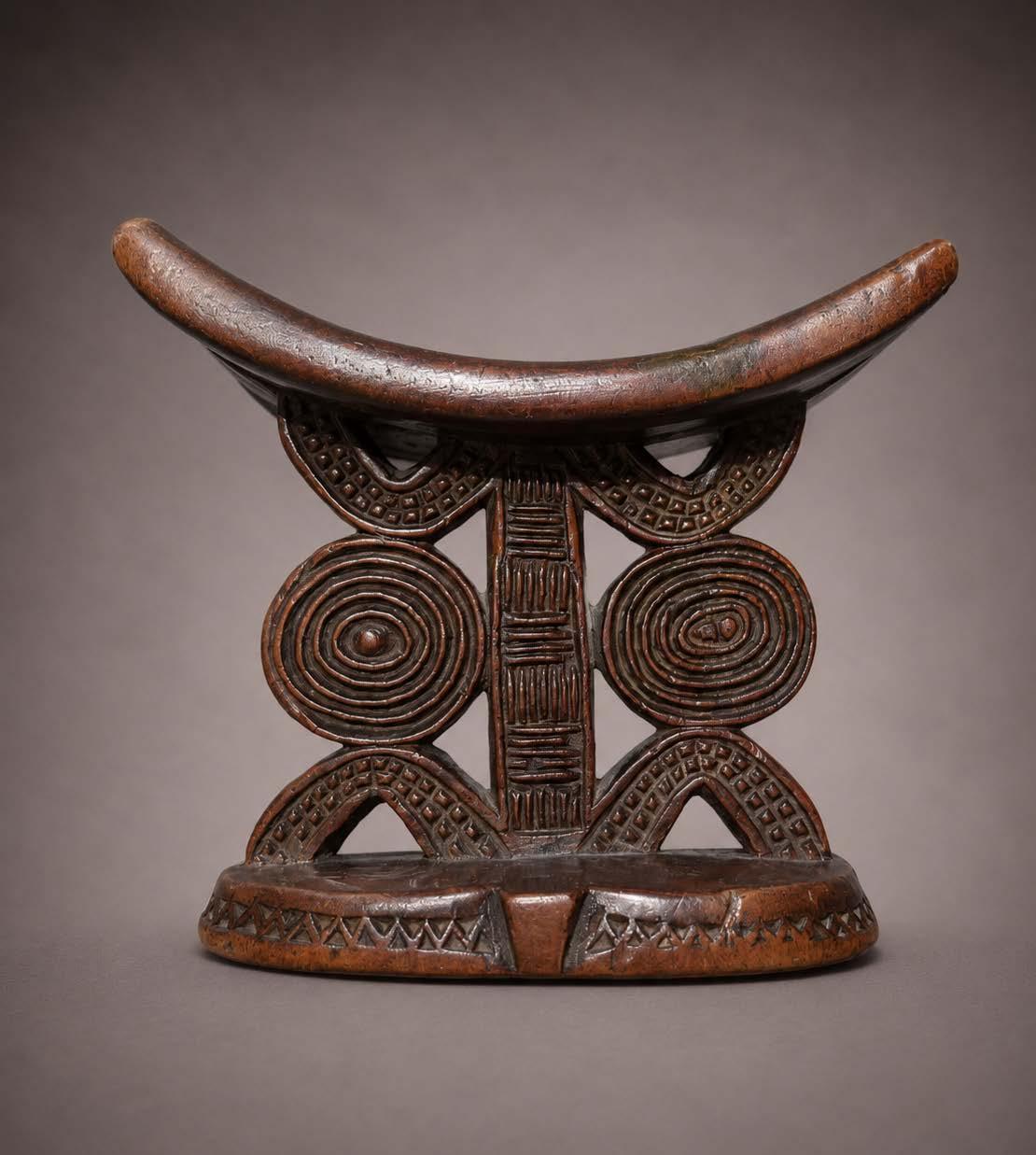
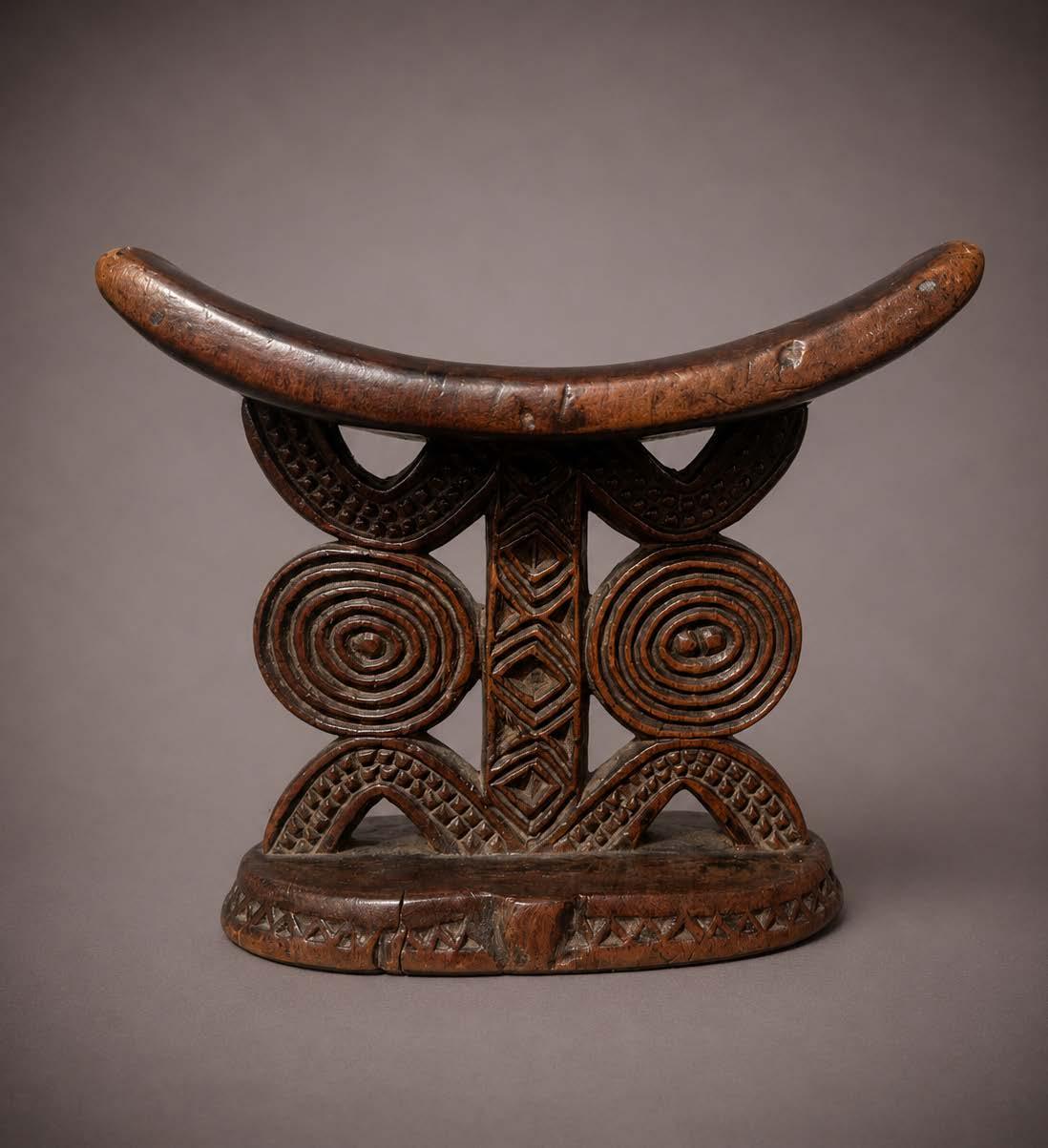
HEADREST MUTSAGO
SHONA PEOPLES, ZIMBABWE
Late 19th / early 20th century
Wood
Height: 5 ½ in, 14 cm
PROVENANCE
Ben Hunter, London
Private Collection, USA
Among the Shona of Zimbabwe, the headrest (mutsago) was one of the most intimate objects a person could own. Used nightly to support the head during sleep, it was also the instrument through which the sleeper maintained contact with the ancestral world: Shona belief holds that the most significant communications from the vadzimu — the ancestral spirits — arrive through dreams, and the headrest was the physical threshold across which those dreams were received. A man’s headrest was buried with him at death, or passed to a favored heir as an object charged with accumulated personal and ancestral power. It was never simply furniture.
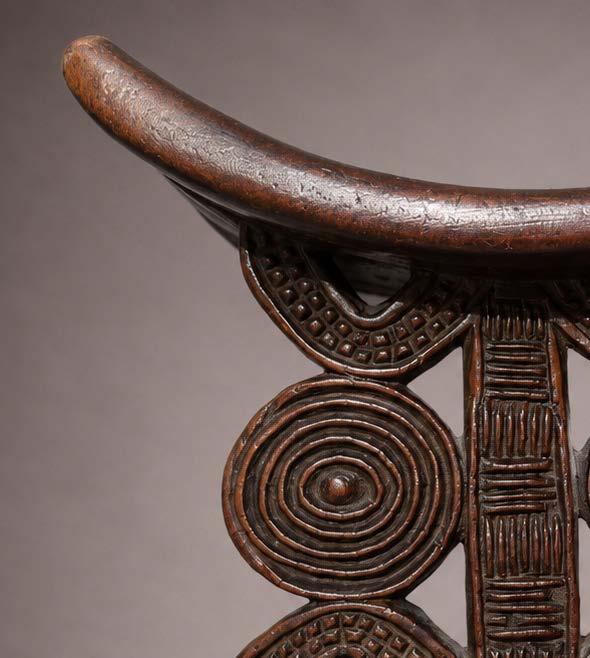
This example achieves the full formal ambition of the Shona headrest tradition. The crescent platform is generous and precisely curved — a smooth, rounded D-section arc that would have cradled the neck with exact comfort, its surface worn to a deep, even patina by long nocturnal use. No carver decorated the crescent itself; its eloquence is entirely in its form, in the confident sweep of the curve and the quality of the wood beneath the hand.
Below the crescent, the central support column rises from a broad oval base through three distinct decorative registers
of exceptional refinement. The uppermost zone flanks the column with paired crescent-shaped lobes densely covered in fine stippled dotwork — a texture that catches raking light and creates a field of quiet visual vibration against the smoother surfaces on either side. The central and dominant zone is commanded by two large concentric circle motifs projecting laterally from the column, each spiraling inward through five or six tightly incised rings to a small raised boss at the center — the chirango or coil motif that is the most characteristic element of the finest Shona carving, evoking simultaneously the coiled snake, the unfolding of time, and the spiral logic of ancestral connection. The column itself, between and behind the circles, carries registers of parallel horizontal lines, diamond chain patterns, and lozenge forms — each face slightly varied, the mark of a carver at ease within a tradition he has thoroughly internalized.
The lower register bridges column and base through paired arched forms filled with further dotwork and chevron incision, and the oval base itself is edged with a continuous running border of small opposing triangles — the njuzu teeth pattern that appears on the finest Shona objects as a marker of completeness and protective intent. The base surface shows the smooth, dark compaction of long contact with sleeping mats and earth floors.
The patina throughout is the object’s most eloquent testimony: warm reddish-brown deepening to near-black in the incised channels, the high surfaces polished by decades of handling to a silky, living sheen. This is a headrest that was used, and used well, across a long life.
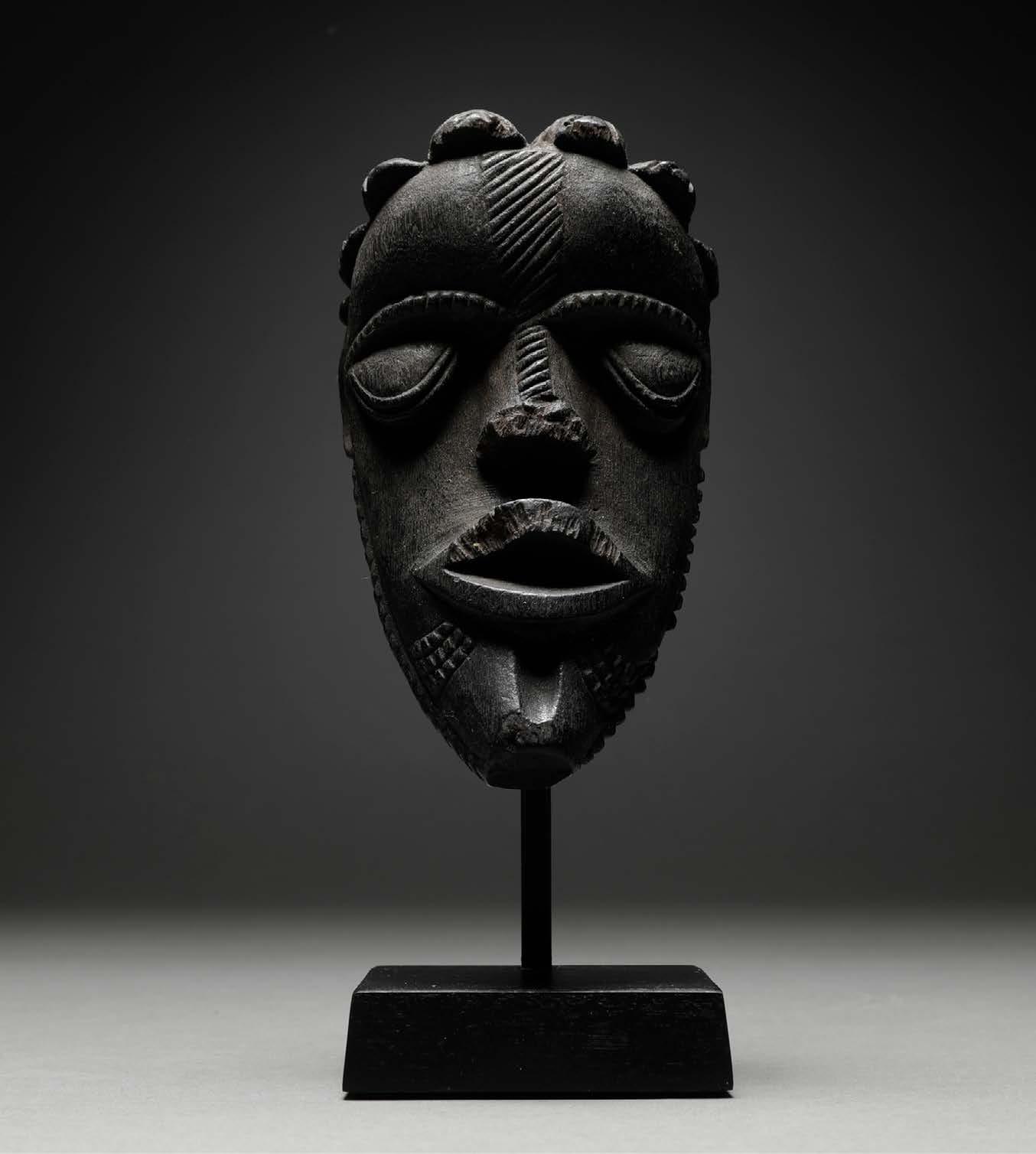
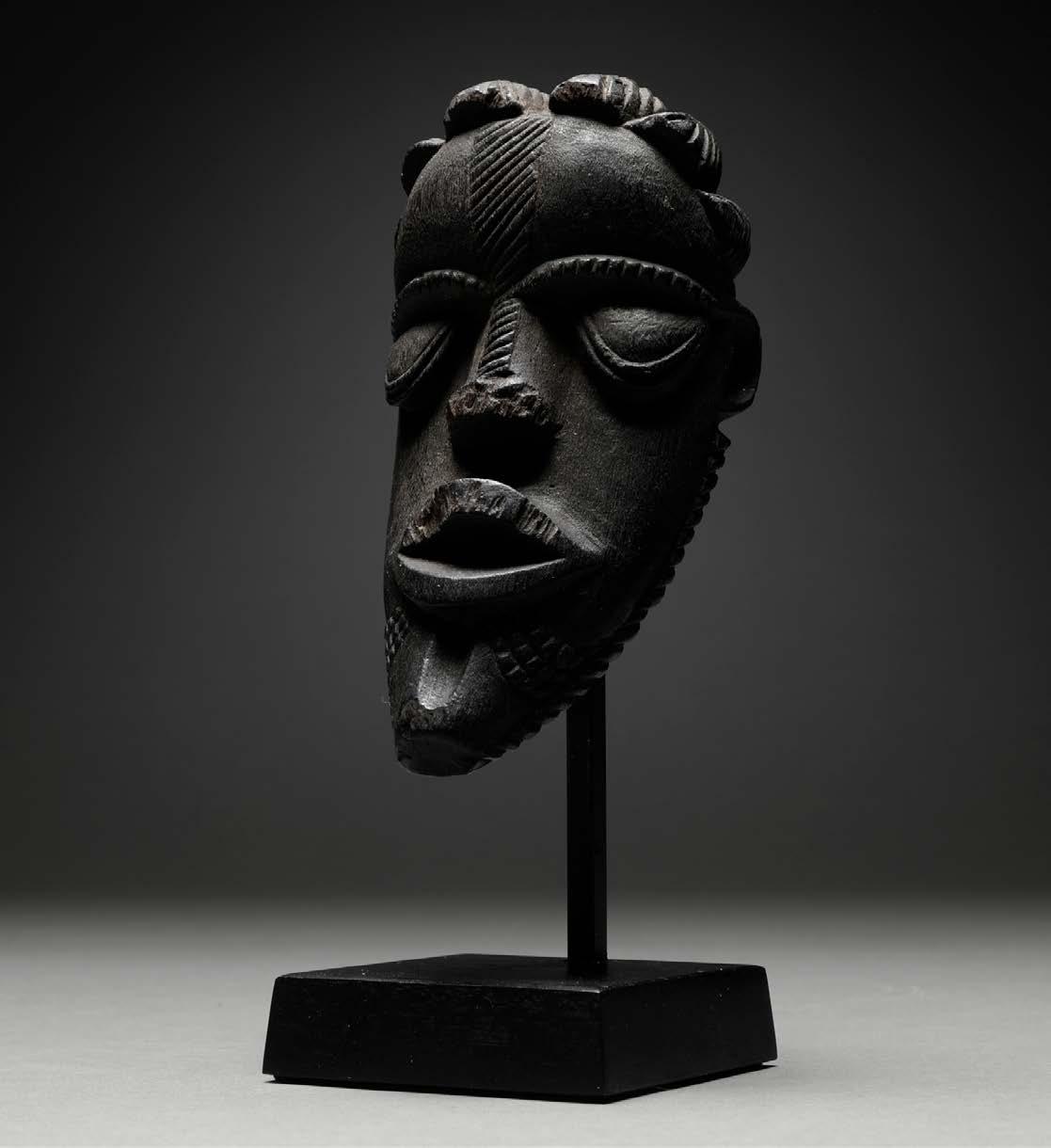
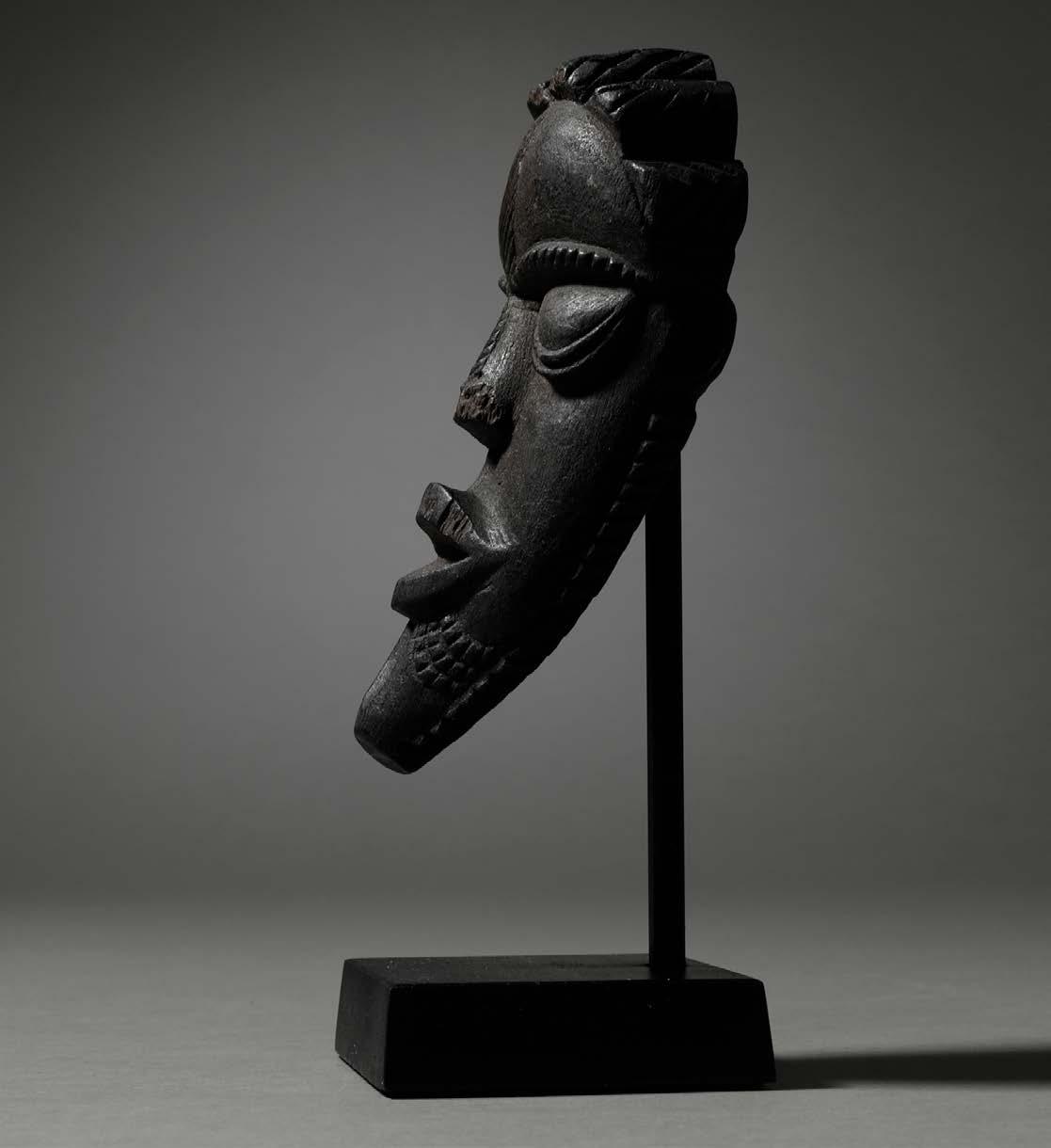
FAMILY MASK GELA
BASSA, LIBERIA
Early 20th century
Wood
Height: 6 in, 15 cm
PROVENANCE
Private Collection
Paolo Akam
The Bassa of coastal and interior Liberia have long maintained the Gela masquerade as one of their central institutions of social regulation and spiritual authority. The Gela mask embodies a female spirit of beauty, composure, and moral order — appearing at initiations, funerals, and community celebrations to affirm the values that bind Bassa society together. When the Gela dances, accompanied by singers and musicians, its presence is understood as the spirit made visible: a distillation of feminine grace and ancestral power that elevates the occasion beyond the ordinary.
This Gela mask presents the type in its most refined and concentrated form. The face is an elongated oval that narrows to a composed pointed chin — a silhouette that conveys both dignity and delicacy — its surface treated with an even, deep black pigmentation that absorbs light and gives the mask an interior quality, as though illuminated from within rather than reflecting from without. The pigment, renewed before each performance, has been fully absorbed into the wood over many years, its surface worn to a subtle sheen at the brow, eyelids, and lips.
The coiffure is the mask’s crowning statement. A
price $5,000
horizontal band of finely notched rope-twist carving circles the brow — a diadem of carved fiber or plaited hair rendered with precision — above which a diagonal lattice panel suggests a carefully dressed and arranged coiffure, flanked by small raised knob ornaments at the crown.
Hair arrangement among the Bassa, as across much of West Africa, was a primary expression of social identity and aesthetic refinement; its careful rendering here signals that the spirit embodied by this mask is one of cultivated, deliberate beauty.
The eyes are the face’s commanding element. Heavily lidded, with dramatically swollen upper lids that hang low over the lower — nearly closing the eye — they convey a gaze that is simultaneously composed and penetrating, turned inward toward the spirit world rather than outward toward the crowd. In Bassa aesthetic thought, beauty of this kind is not passive; it is powerful. The Gela spirit sees what ordinary eyes cannot, and its nearly closed eyes signal the depth of that perception. There are no apertures in the eye — the dancer sees through the mask’s open mouth or a small hole below, leaving the spirit face complete and uncompromised.
The lateral edges of the face — from brow to chin — are framed by a continuous border of fine notched or rope-twist carving that echoes the brow band and creates a contained, architectural silhouette when the mask is viewed in profile.
Below the full, slightly parted lips, a small chin element decorated in crosshatch incision marks a beard or a tattoo — a masculine inflection on what is otherwise a feminized spirit form, the kind of deliberate ambiguity that gives the finest Bassa masks their psychological complexity.
An example by the same hand is in the Tervuren Museum collection.
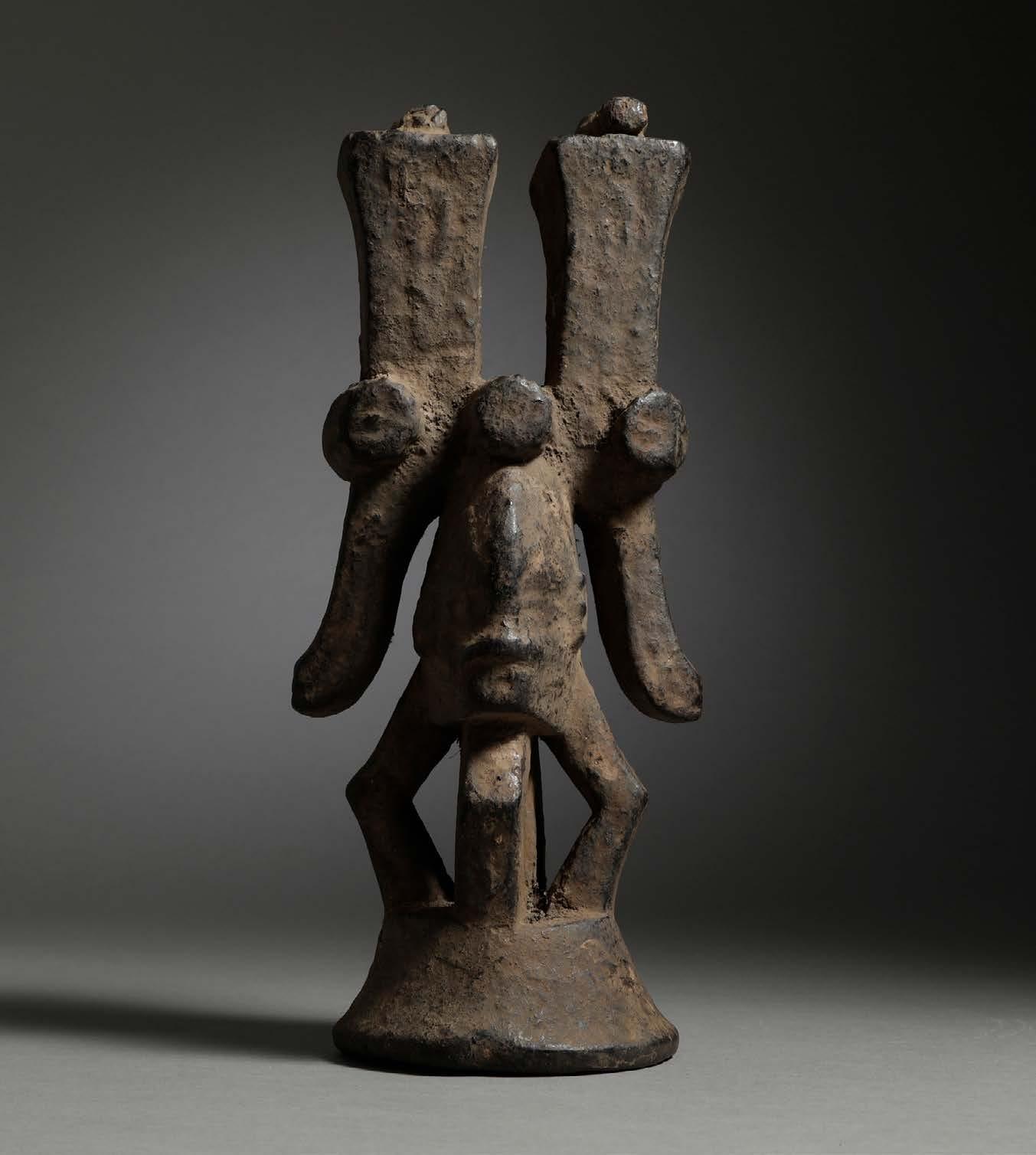
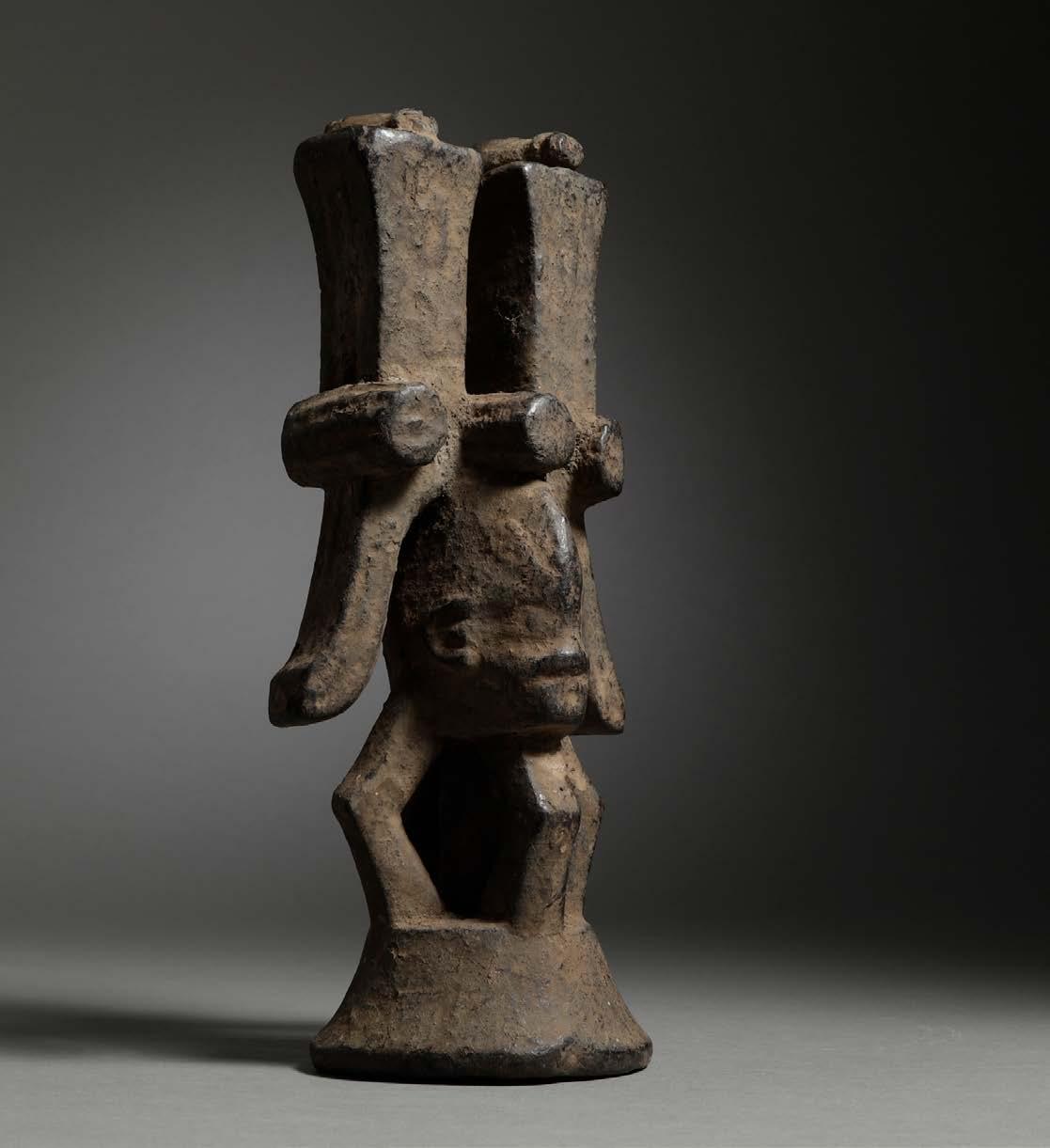
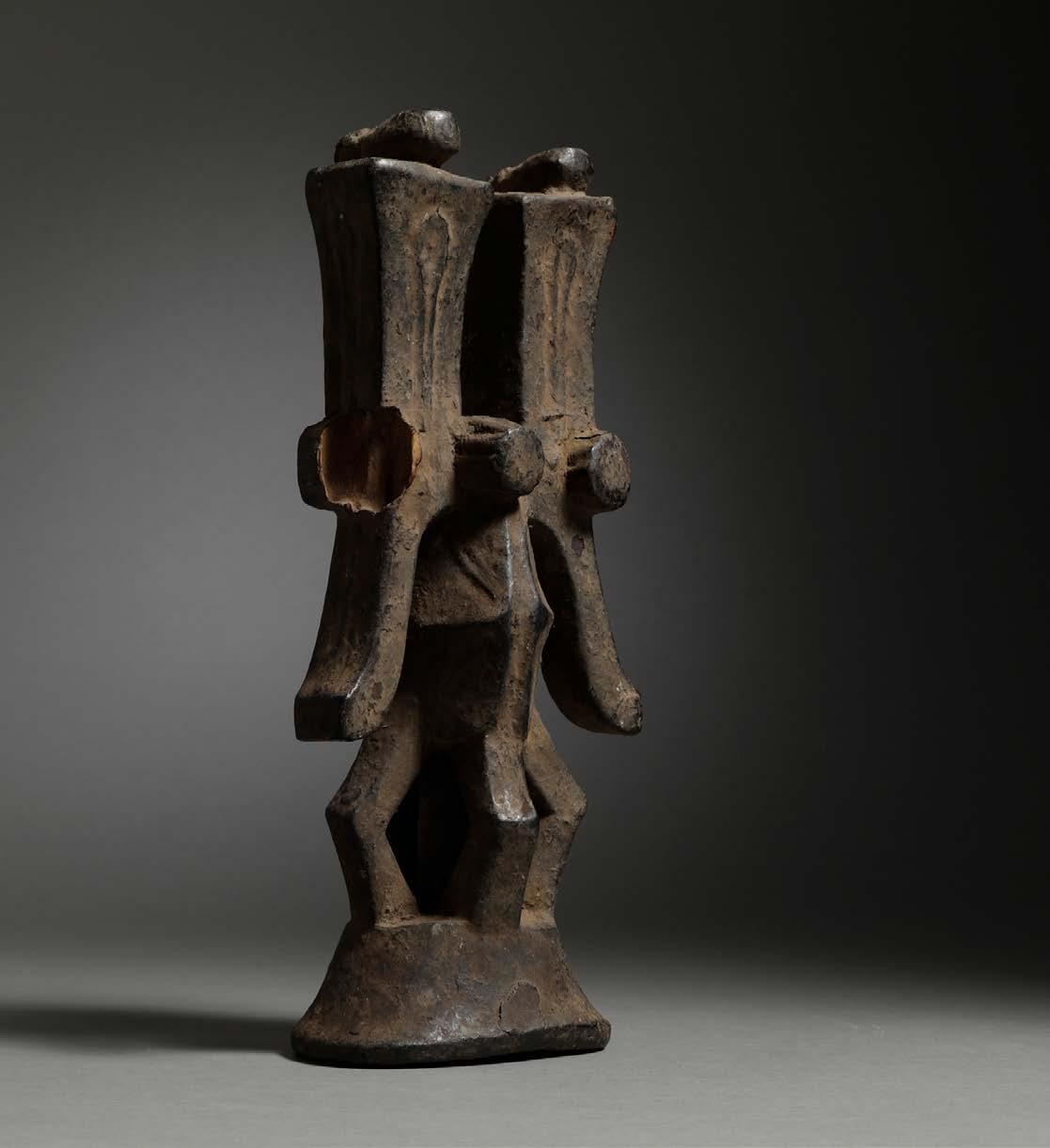
MALE FIGURE IKENGA
IGBO, NIGERIA
Early 20th century
Wood, natural pigments
Height: 11 in, 28 cm
PROVENANCE
John and Nancy Hyde Devoe, New York.
Acquired circa 1960’s–1970’s
Among the Igbo of southeastern Nigeria, the ikenga stands as one of the most philosophically charged categories of personal shrine objects on the continent. Its name translates loosely as “place of strength” or “power of the right hand” — the hand that wields the tool, draws the bow, strikes the enemy, and signs the agreement. Every man of standing owned one. It was fed, spoken to, and held accountable. When a man died, his ikenga was sometimes split in two, severing the compact between the living and the force that had animated his striving.
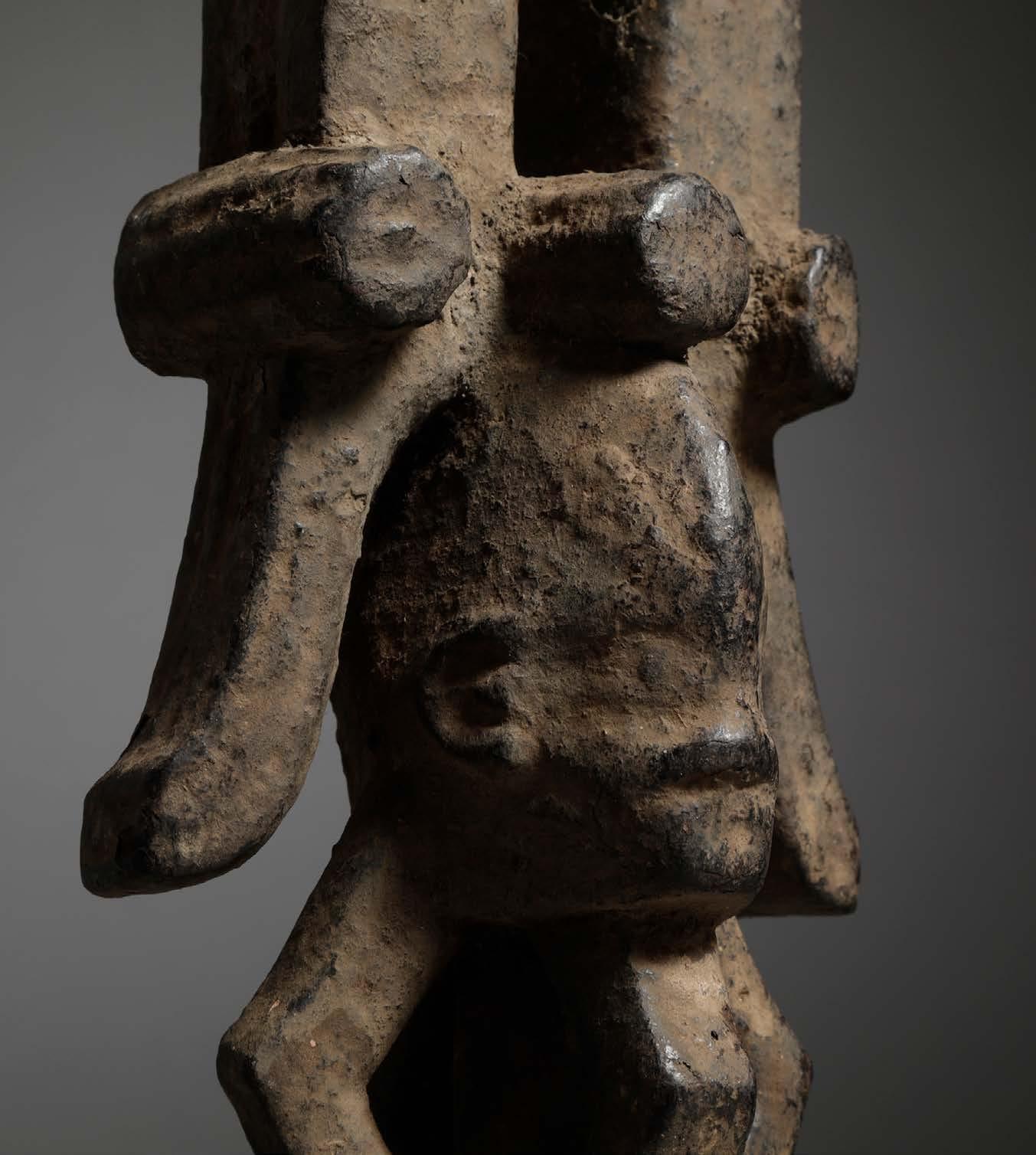
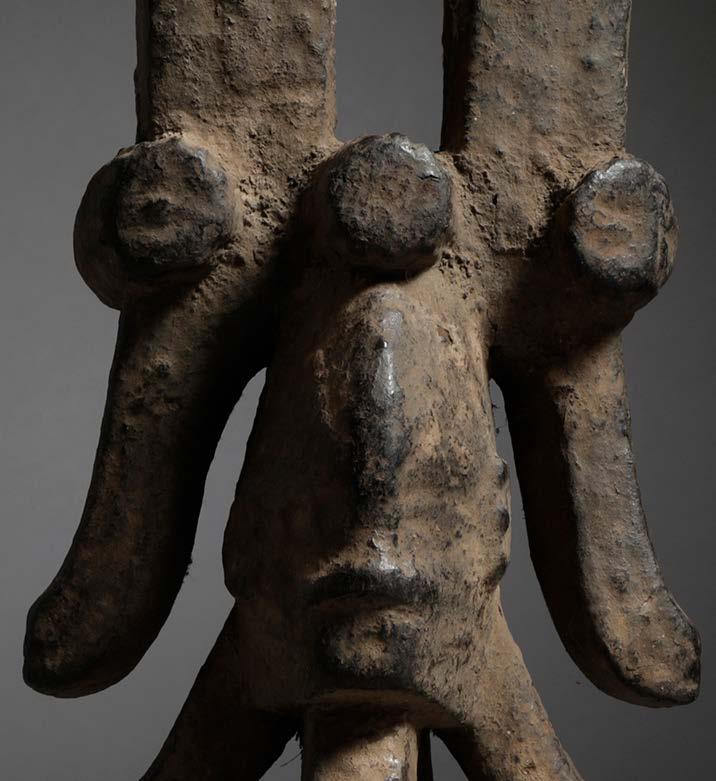
This example presents the form in its most potent distillation. Two great horns — bold, planar, and slightly flared at their tips — erupt from the crown of the figure, reaching upward with an authority that borders on aggression. They are not decorative; they are the visual grammar of chi, of vital force directed outward into the world. At the apex of each horn a small rounded head emerges, subtle presences that expand the figure’s register beyond the individual — ancestors or attendant forces
implicated in the owner’s achievements, silent witnesses to every libation poured.
The figure is compact and powerful: a broad-shouldered torso with rounded chest projections — likely scarification marks rendered in the round, a sign of initiated status — arms held close, and legs slightly parted above the wide flared base that grounds the whole composition. The face is schematic and inward-looking, a surface that receives attention rather than performing it. This is a figure built for veneration, not display.
The patina is the object’s most eloquent testimony. The surface is densely encrusted, matte and variegated, built up through repeated applications of palm wine, kola nut, and animal sacrifice over many years of active shrine use. The recesses are blackened; the high points have been worn to a softer tone by handling. This is not the patina of age alone — it is the accumulated record of a life’s ambitions, setbacks, and victories, compressed into wood and offering.
price $1,500
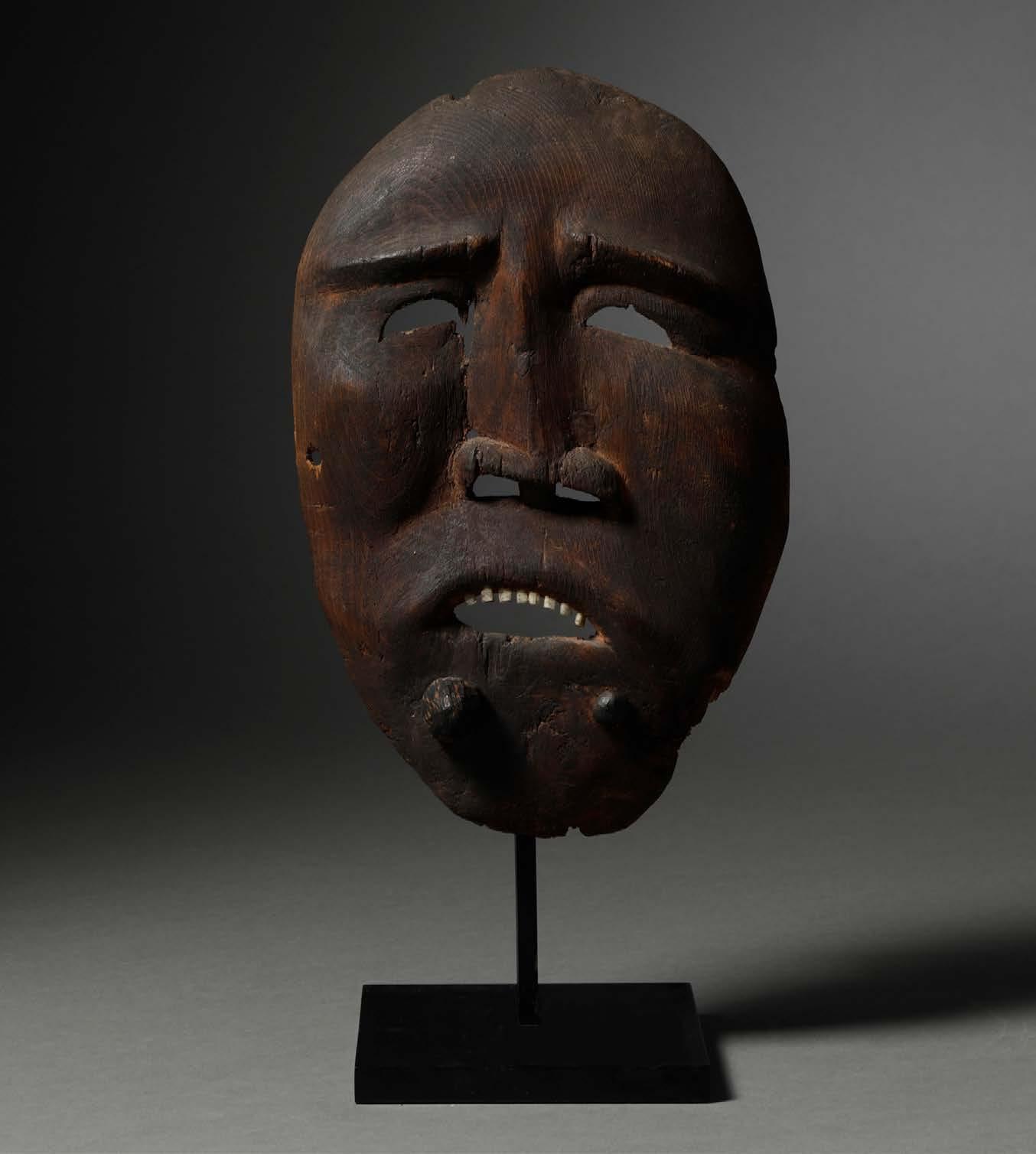
FACE MASK OF A MAN
YUP’IK OR INUPIAQ PEOPLES, ALASKA
Pre-contact to early contact period
Excavated wood, caribou teeth
Height: 9 ½ in, 24 cm
PROVENANCE
Christie’s, New York
Private Collection, New York
The shamans of the Yup’ik and Inupiaq peoples of coastal Alaska occupied a singular position at the membrane between the visible world and the world beneath appearances — the realm of yuat, the persons or spirits that animate every living thing, every animal, every force of weather and sea. It was the shaman (angalkuq) who could perceive and negotiate with these presences, and it was through the mask that this negotiation was made visible to the community. A mask worn in the qasgiq — the men’s ceremonial house — or carried on the open water during the hunt did not merely represent a spirit; it materialized one, giving it a face through which it could look back at the living.
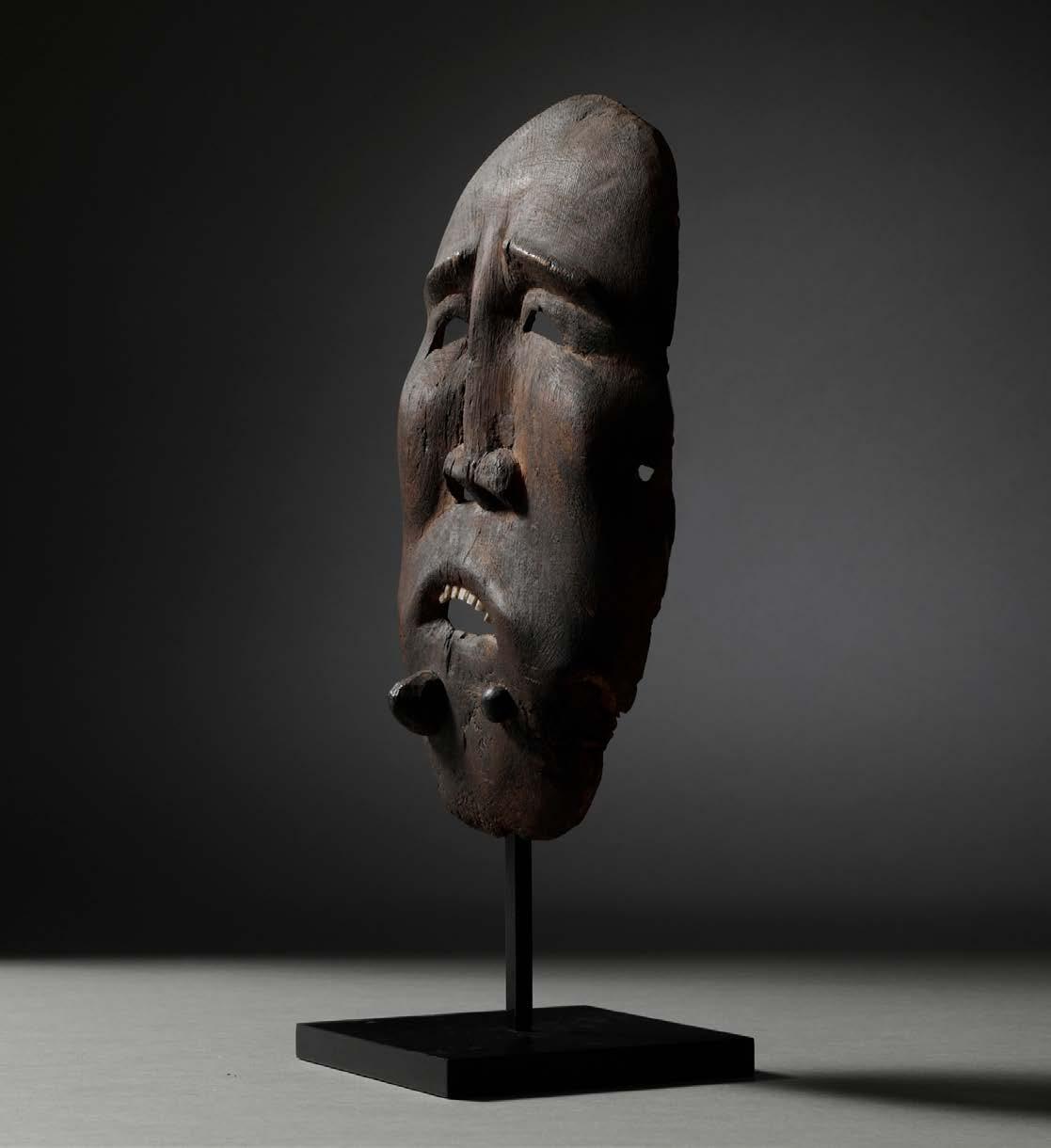
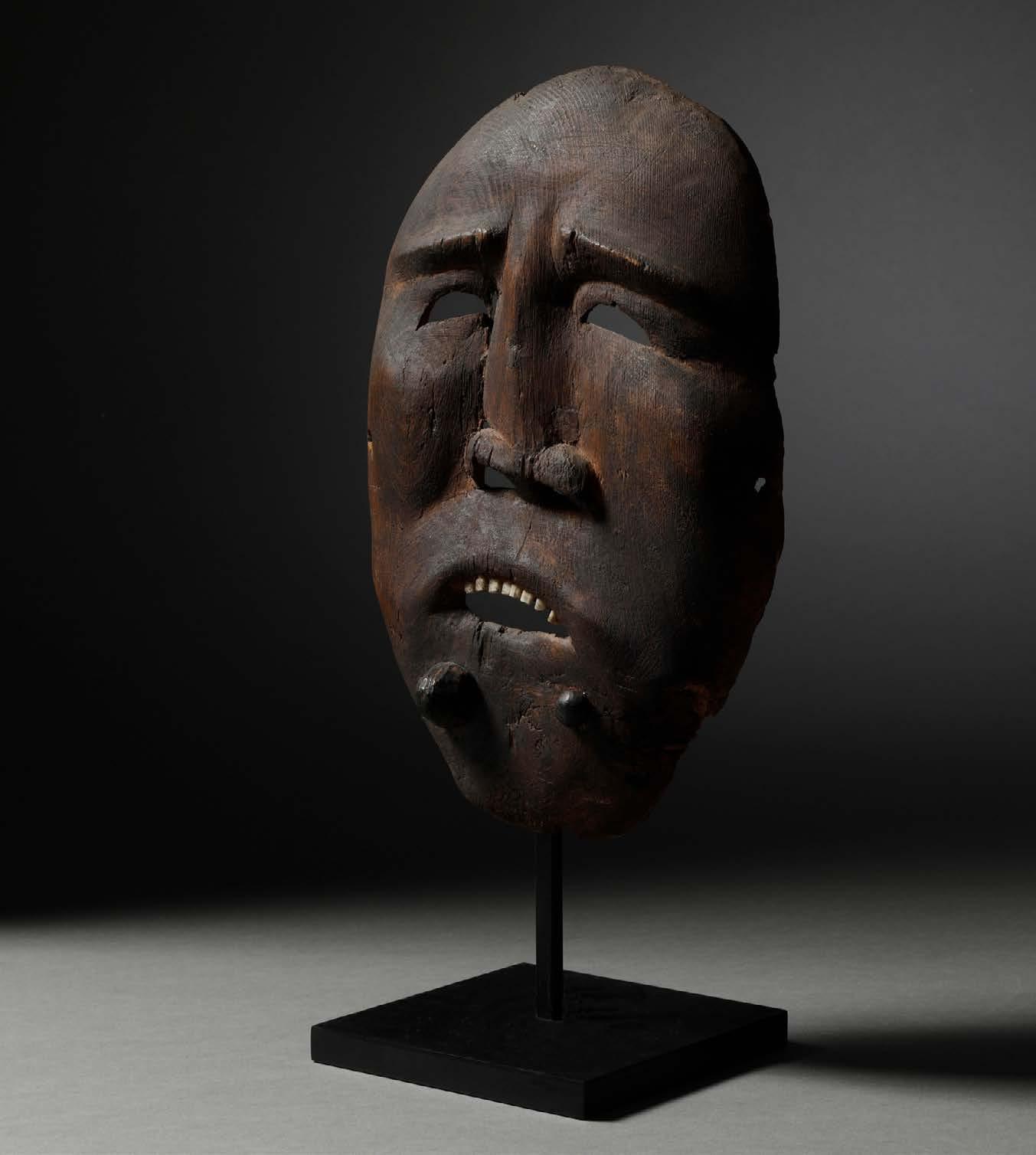
This mask presents a face of exceptional presence and authority. The forehead is broad and domed, the brow ridge a single heavy shelf from which deep-set eye apertures are cut — asymmetrically, deliberately so, the left aperture wider and more irregular than the right. In Yup’ik shamanic tradition, asymmetry was not error but grammar: the face that looks at once into the ordinary world and the spirit world cannot be perfectly balanced, for these are not equivalent realms. The nose is broad and projecting, carved
with confident fidelity to human anatomy, its bridge rising unbroken from the brow in a single strong line.
The mouth is the mask’s most technically demanding feature. It is held open — not in anguish but in speech, or song, or the controlled exhalation of shamanic power — and set into the upper jaw is a row of small, individually shaped teeth in bone or ivory, each one fitted with care into the carved wooden gum line. The effect, across the centuries since this mask was made and used, remains viscerally alive: the mask breathes, or is about to speak, or has just stopped singing.
Below the lower lip, flanking the chin, are two labret pegs — the ellanguaq of male adult identity among Yup’ik and Inupiaq men, worn through piercings made at adolescence and replaced with progressively larger plugs as a man aged and accumulated standing. Their presence here identifies the spirit or persona embodied in the mask as a man of status — a hunter, an elder, or a being of the spirit world rendered in recognizably human terms of prestige and maturity. One peg appears to be integral to the mask’s wood; the other, darker and denser in tone, may be a separate material — bone or stone — inserted into a carved recess, a distinction in material that may itself carry meaning.
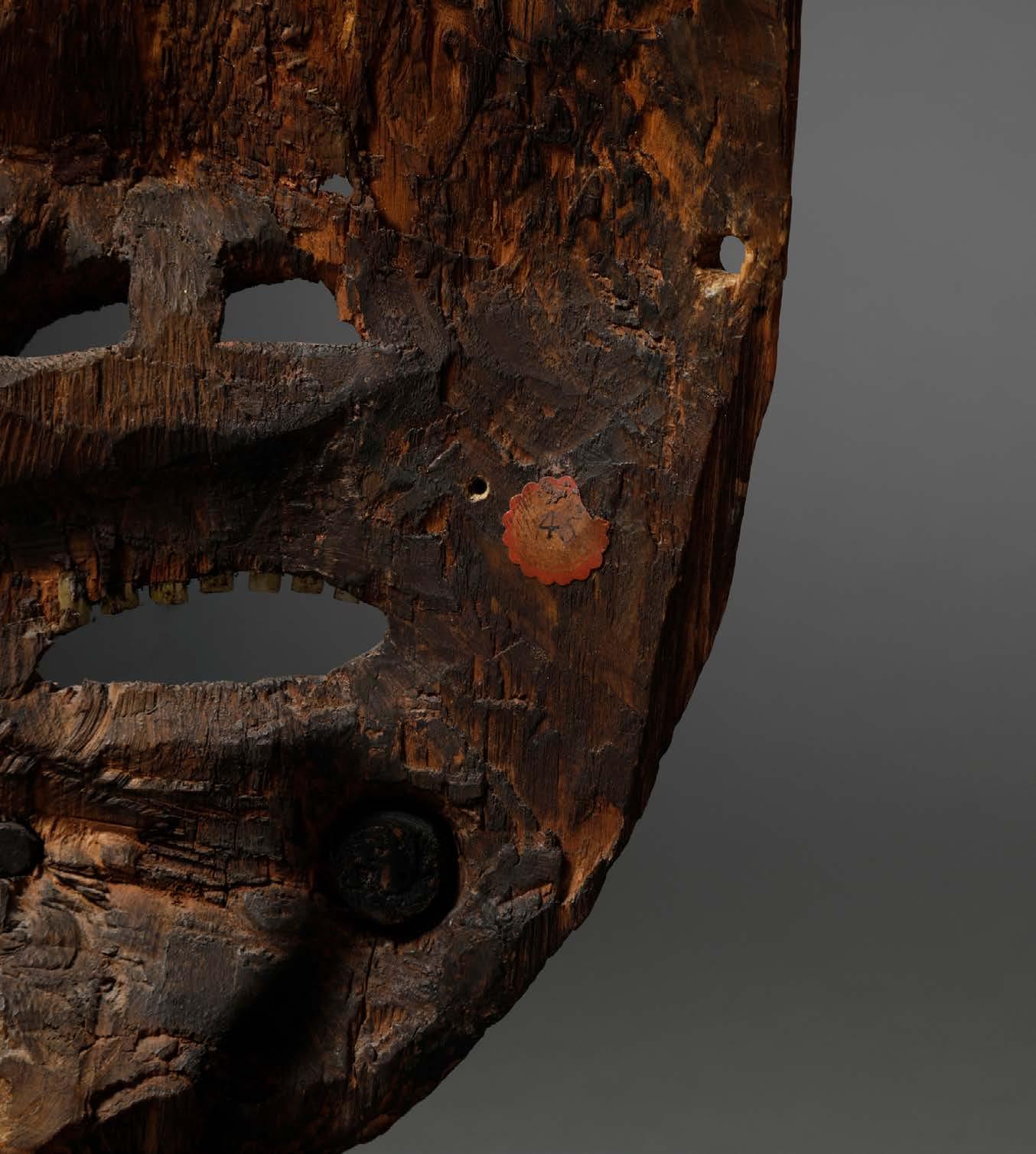
The patina speaks unambiguously of age and ground contact: a deep reddish-brown that has compacted to a nearsilky surface over the high planes of the forehead, cheeks, and brow, darkening to near-black in the recessed eye sockets and nostrils. The reverse retains the rougher, lighter-toned surface of wood less exposed to the elements, and the slight warping and checked grain visible along the forehead are consistent with cyclical freezing and thawing over a long period in the ground. A single perforation at the left cheek provided an attachment or lashing point for the fiber or sinew that secured the mask to its wearer or to its ceremonial rigging.
Masks of this quality are rarely encountered outside major museum collections. Old label with collection #45 on the back.
MINIATURES
ITEMS 13–29
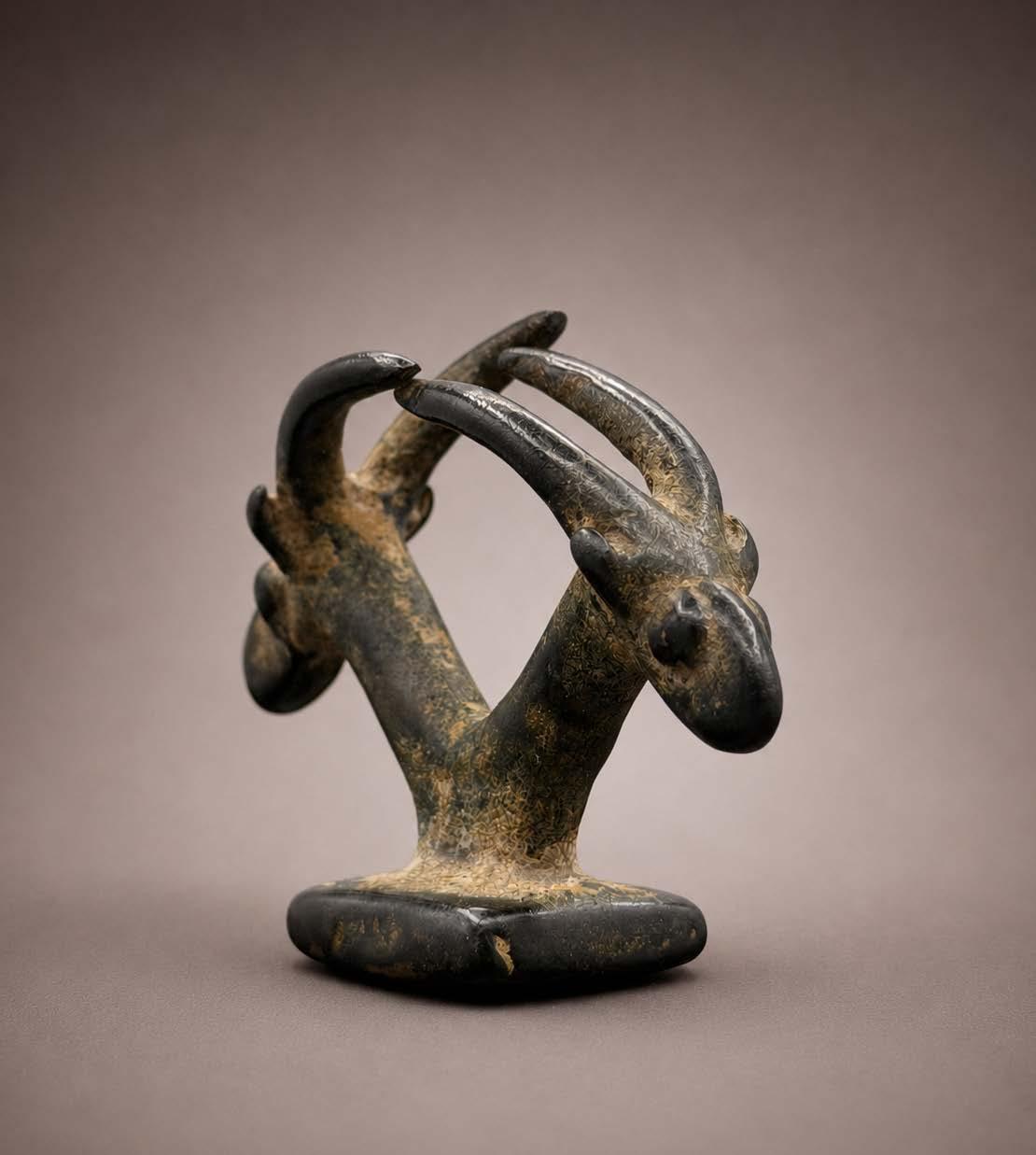
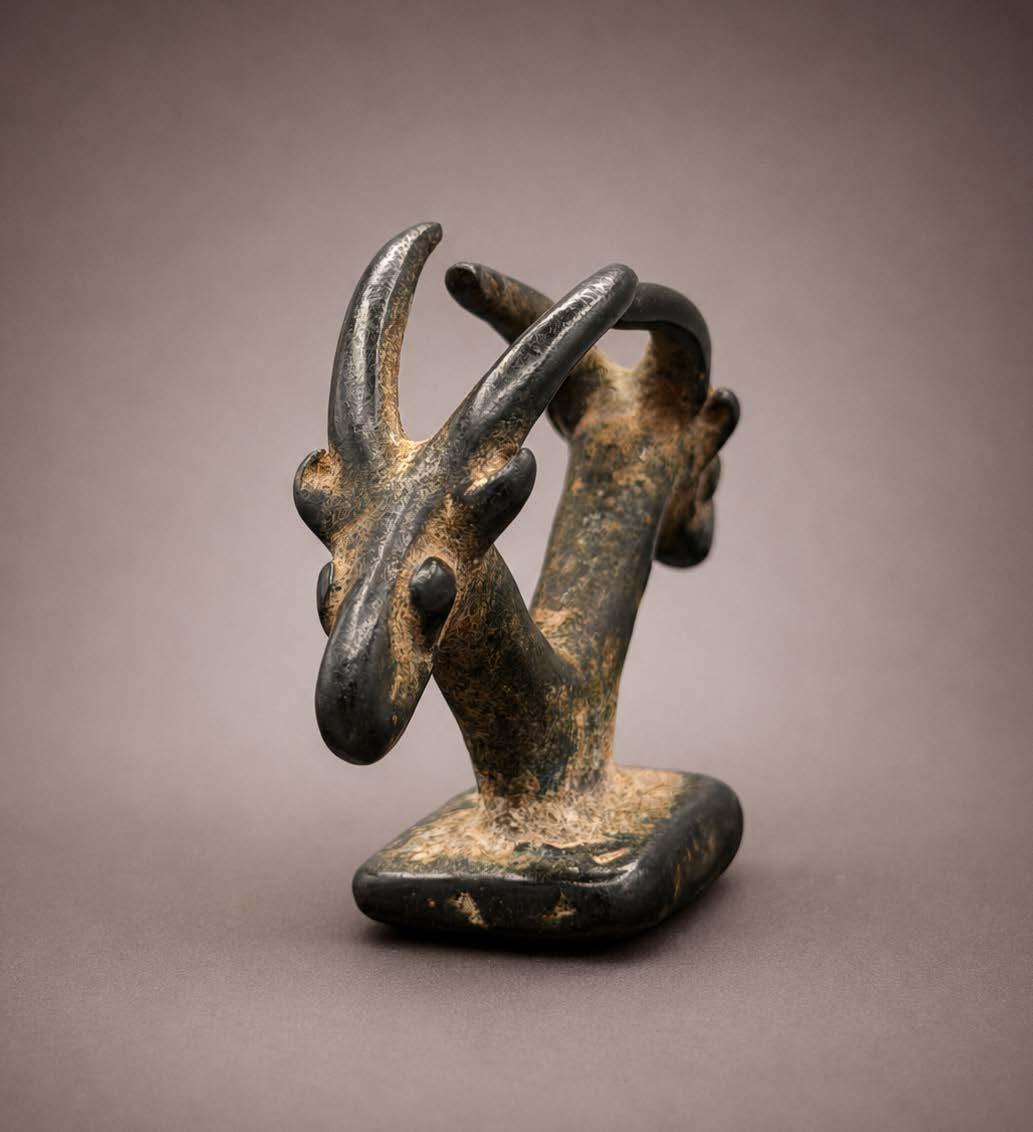
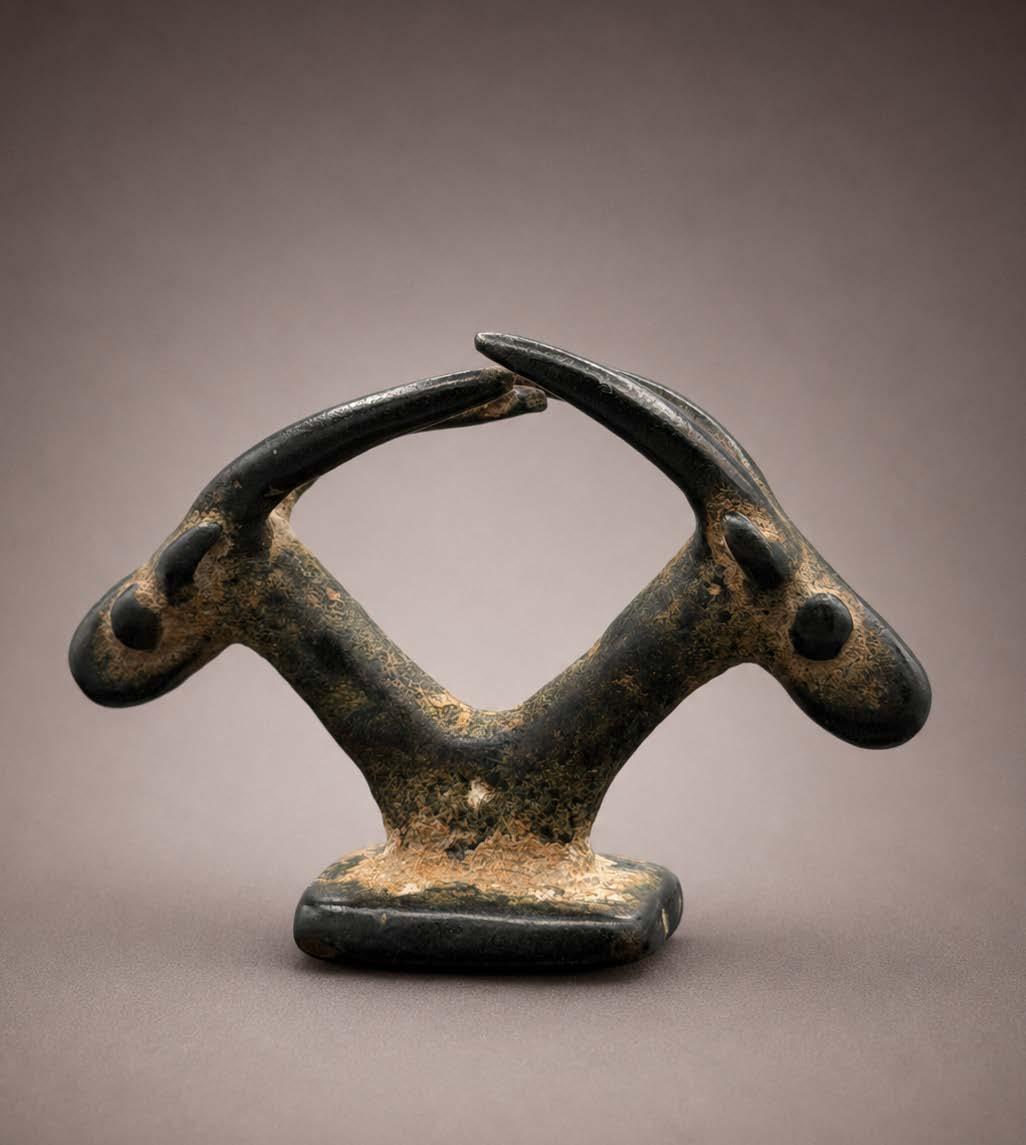
PIN HEAD OR AMULET DEPICTING CONFRONTED IBEX HEADS
LURISTAN, WESTERN IRAN
c. 1200–800 bce
Cast bronze
Length: 2 in, 5 cm
PROVENANCE
Estate of Karl Stirner. Karl Stirner (1923 – 2016) was a German-born American sculptor known internationally for his metalwork.
A finely cast Luristan bronze object in the form of two ibex heads facing outward in opposite directions, their sweeping horns arching upward and inward to nearly meet at the apex, forming the characteristic open-work silhouette that defines this celebrated class of ancient Iranian metalwork. The piece most plausibly functioned as the decorative head of a dress pin — a well-attested Luristan form in which an elaborately sculpted bronze terminal was mounted atop a long pin shaft used to fasten a cloak or garment at the shoulder — or alternatively as a pendant amulet worn on the body. Either use would have placed this object in close, visible relationship with its owner, serving simultaneously as personal adornment and apotropaic protection.
The two heads — each rendered with the schematic naturalism typical of Luristan animal bronzework — share a single neck post rising from a flattened, rounded base designed for attachment to a shaft or suspension cord. Circular eyes are rendered as deep drilled depressions, and the elongated muzzles taper with confident economy. The long curving horns are of the capra aegagrus type, consistent
price $600
with the bezoar ibex native to the Zagros highlands — the emblematic animal of ancient Iran, holding a symbolic status analogous to the lion in Assyria, the dragon in Babylon, and the bull in Sumer.
The back-to-back double-headed composition — two animals sharing a single base, their gazes directed outward in opposite directions — carries an inherently apotropaic quality, the all-seeing vigilance of the paired ibex guarding its wearer from every approach. Small paired-animal compositions are considered among the most distinctive of all cast bronze works reported from Luristan, and at this intimate scale the piece would have been an object of daily personal significance rather than public ceremony. The surface carries a rich dark patina — deep charcoal and gunmetal with silver highlights on the high-relief surfaces — consistent with age and likely burial or votive deposition at the end of its working life. Most Luristan bronzes have been recovered from funerary contexts, suggesting that objects of this kind, however personal in daily use, ultimately served a ceremonial function in death as well.
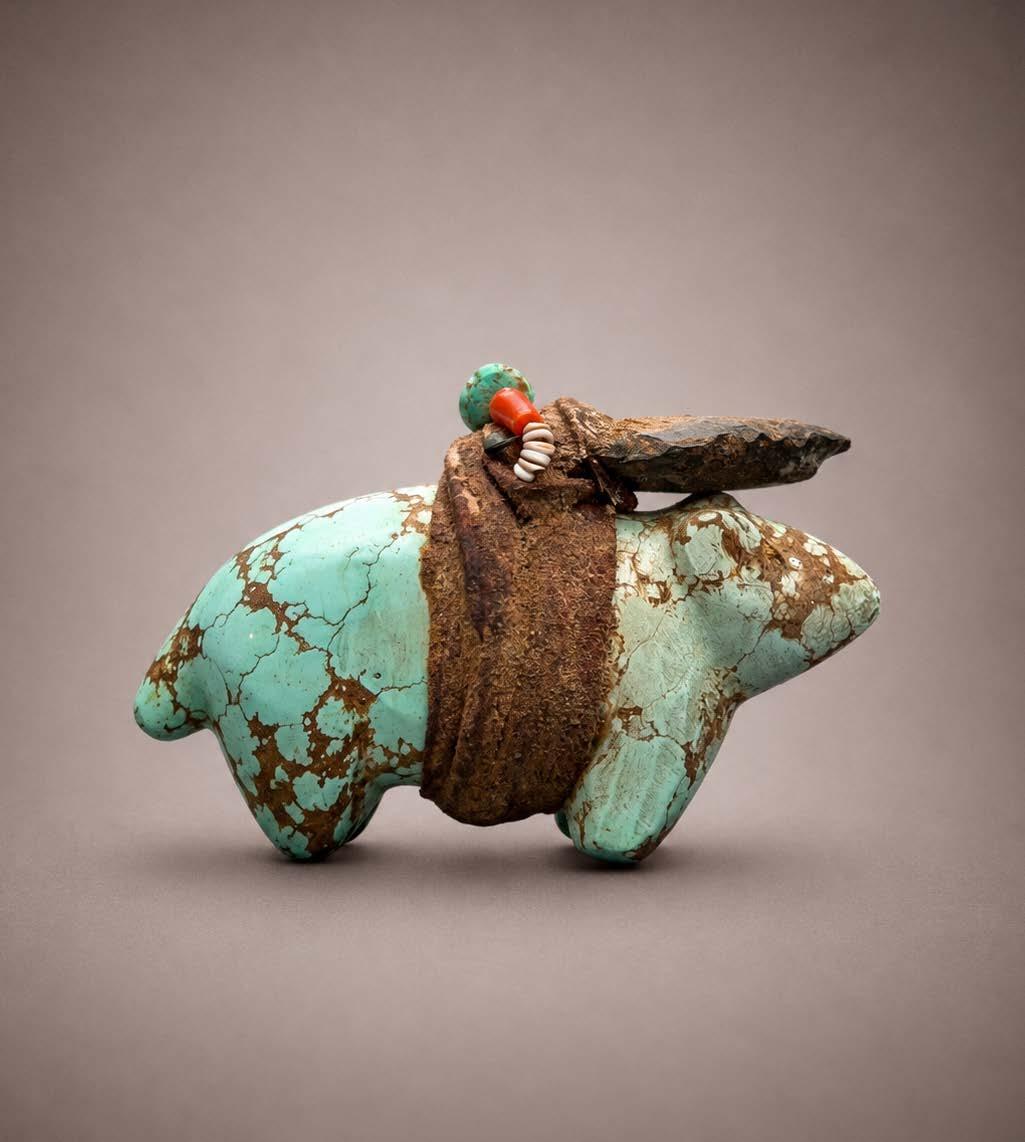
BEAR FETISH WITH ARROWHEAD BUNDLE
ZUNI PUEBLO, NEW MEXICO
19th to early 20th century
Turquoise, stone arrowhead (obsidian or chert), coral, shell, turquoise or glass bead, sinew
Length: 3 in, 7 ½ cm
PROVENANCE
John and Nancy Hyde Devoe, New York. Acquired circa 1960s–1970s
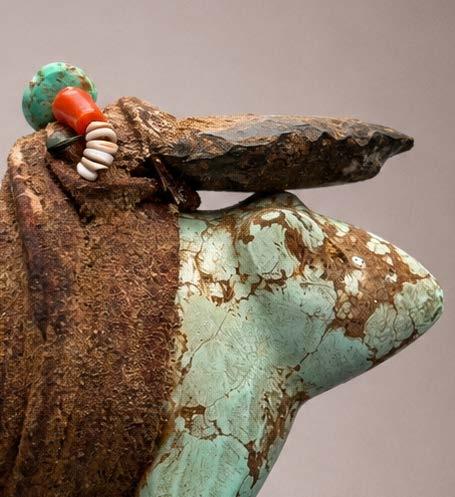
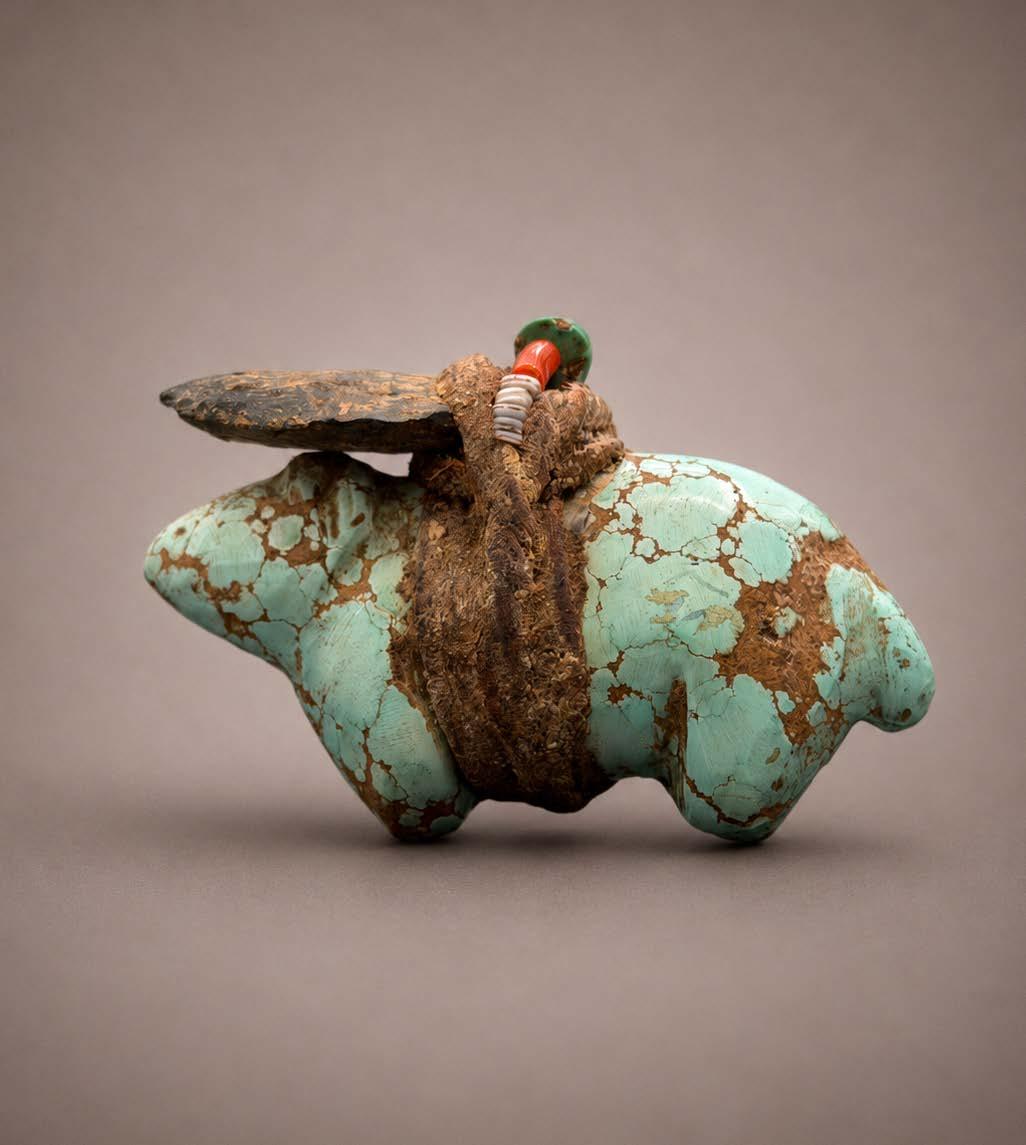
Among the Zuni of the American Southwest, certain stones were understood to contain living spirits — not carved into being, but discovered, recognized, and then tended. A naturally occurring stone that suggested an animal form was itself already a fetish; the carver’s task was simply to clarify what the stone already held. The bear, foremost among the six directional guardians of the Zuni world, was associated with the west, with healing, and with the most potent forms of protective medicine. A bear fetish was not an ornament; it was a presence, an ally, a living participant in the spiritual negotiations that sustained the individual and the community.
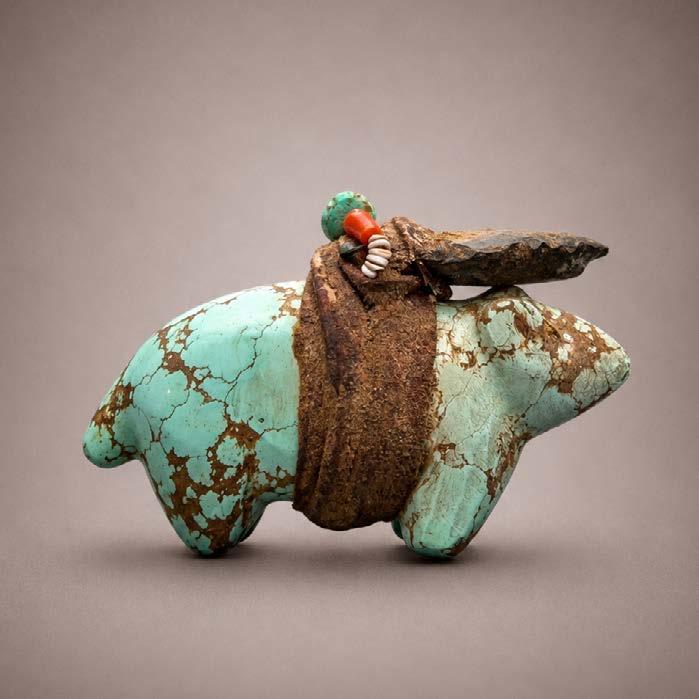
This bear fetish is carved from a piece of natural turquoise of exceptional character — a vivid sky-blue stone veined throughout with a dark brown matrix that the carver has incorporated rather than concealed, leaving the animal’s dorsal surface in its raw, unworked state while smoothing and defining the body below. The effect is striking: the bear appears to emerge from the earth itself, its turquoise flesh rising from the matrix stone as though caught in the act of
price $1,200
manifestation. The four legs are compact and grounded, the haunches low, the posture one of alert stillness. The head is minimal and essential — a presence rather than a portrait, as Zuni aesthetic sensibility demands.
Across the animal’s back, lashed with fine sinew wrapping, lies a dark stone arrowhead — obsidian or chert, its surface oxidized and ancient — bound in the classic configuration of the empowered fetish. The arrowhead amplifies the bear’s medicine, directing its protective force with the precision and intent of the hunter’s aim. At the lashing point, a small medicine bundle has accumulated: a single orange coral or shell tube bead, a small turquoise or green glass bead, and fine white shell disc beads, all bound together with sinew — offerings made to the spirit within the stone, prayers compressed into material form. These bundles were built up over time, each addition representing an act of petition or gratitude, and their presence confirms that this fetish was actively used and tended across a significant period of its life.
Turquoise, coral, and shell — the three materials of this bundle — form the sacred color triad of Pueblo ceremonial life: blue-green for sky and water, red-orange for life and blood, white for breath and cloud. Their combination here is not accidental.
BULLROARER
ABORIGINAL, AUSTRALIA
19th to early 20th century
Hardwood (mulga or similar)
Height: 8 in, 20 cm
PROVENANCE
Private US collection
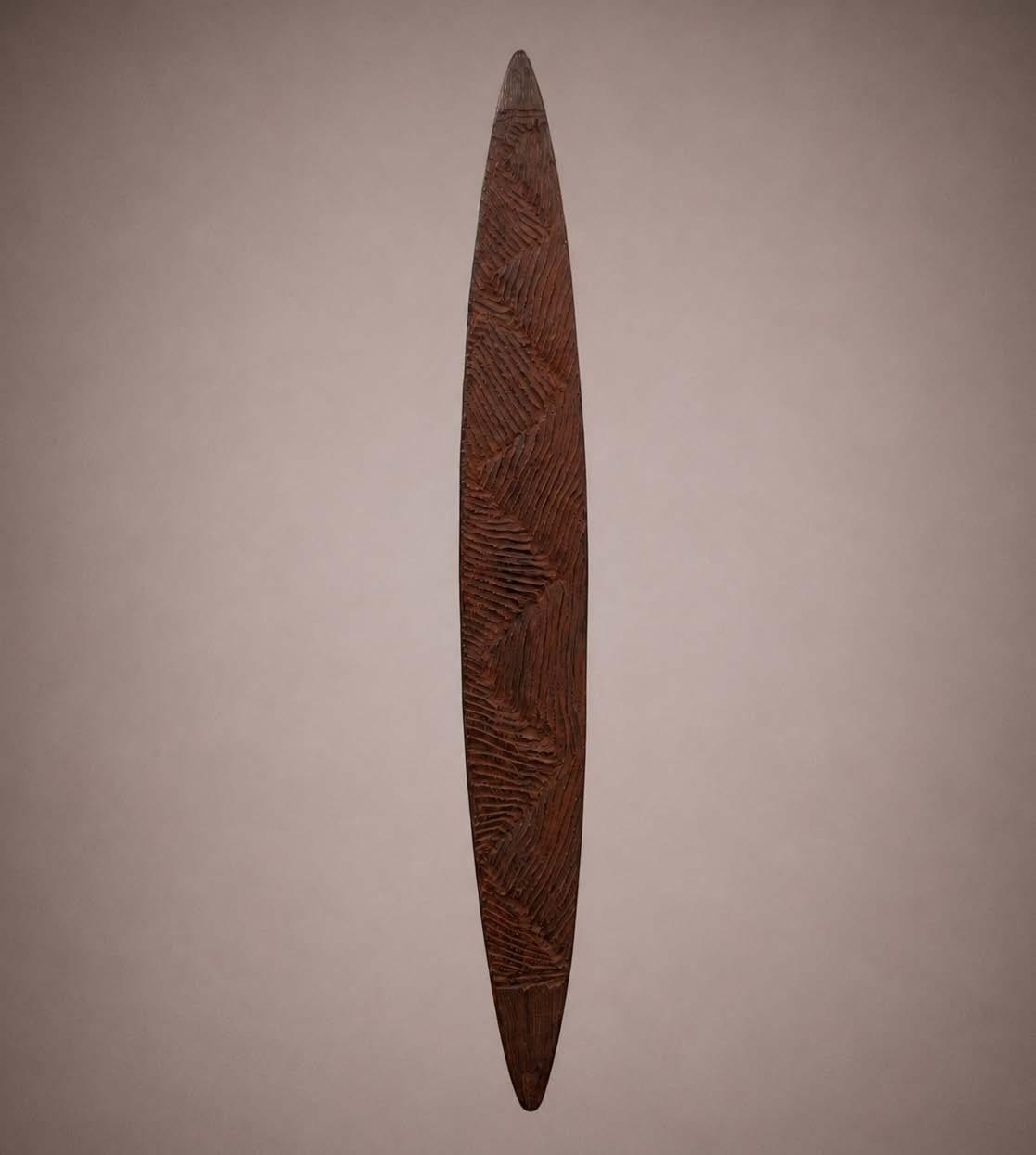
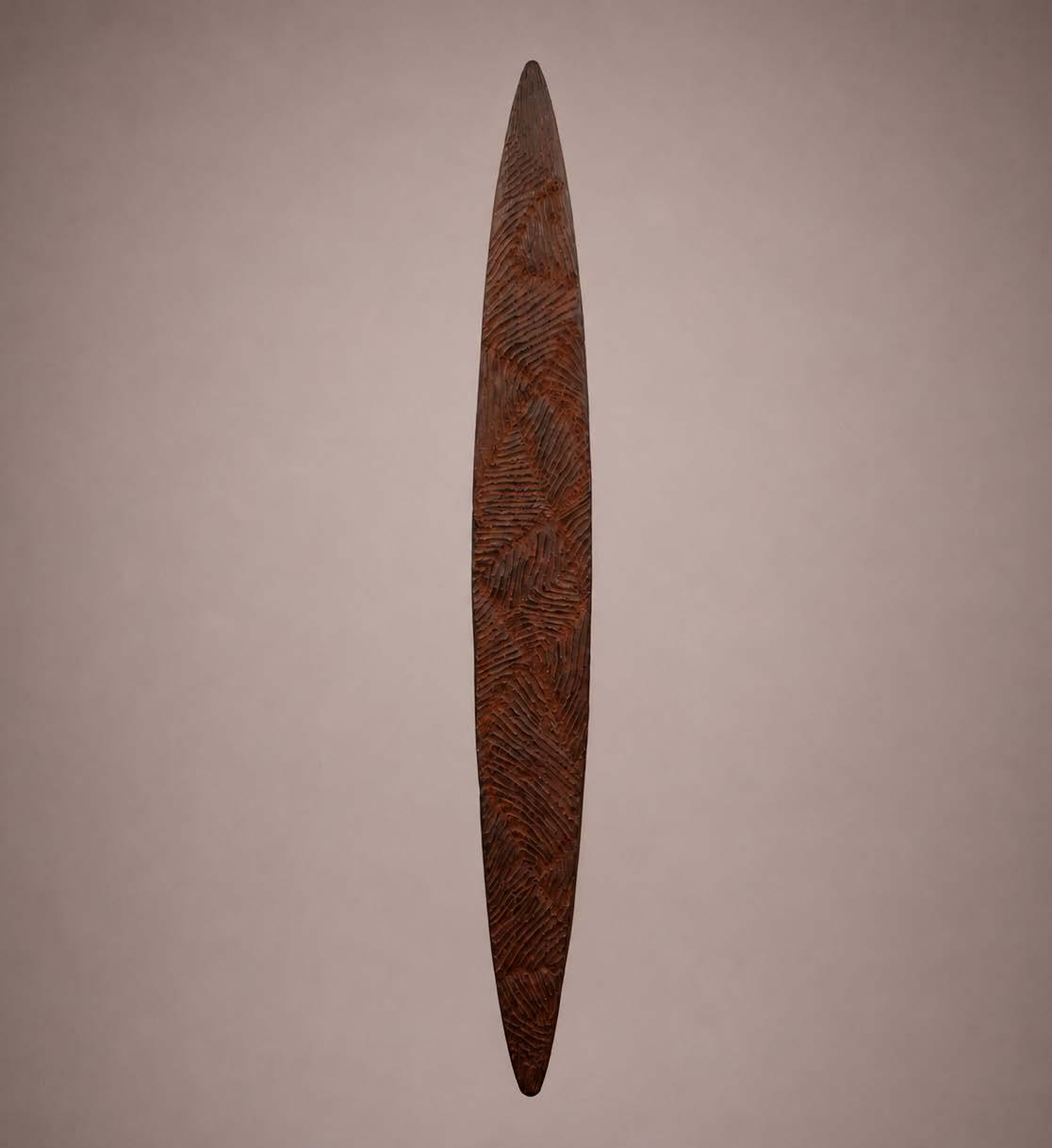
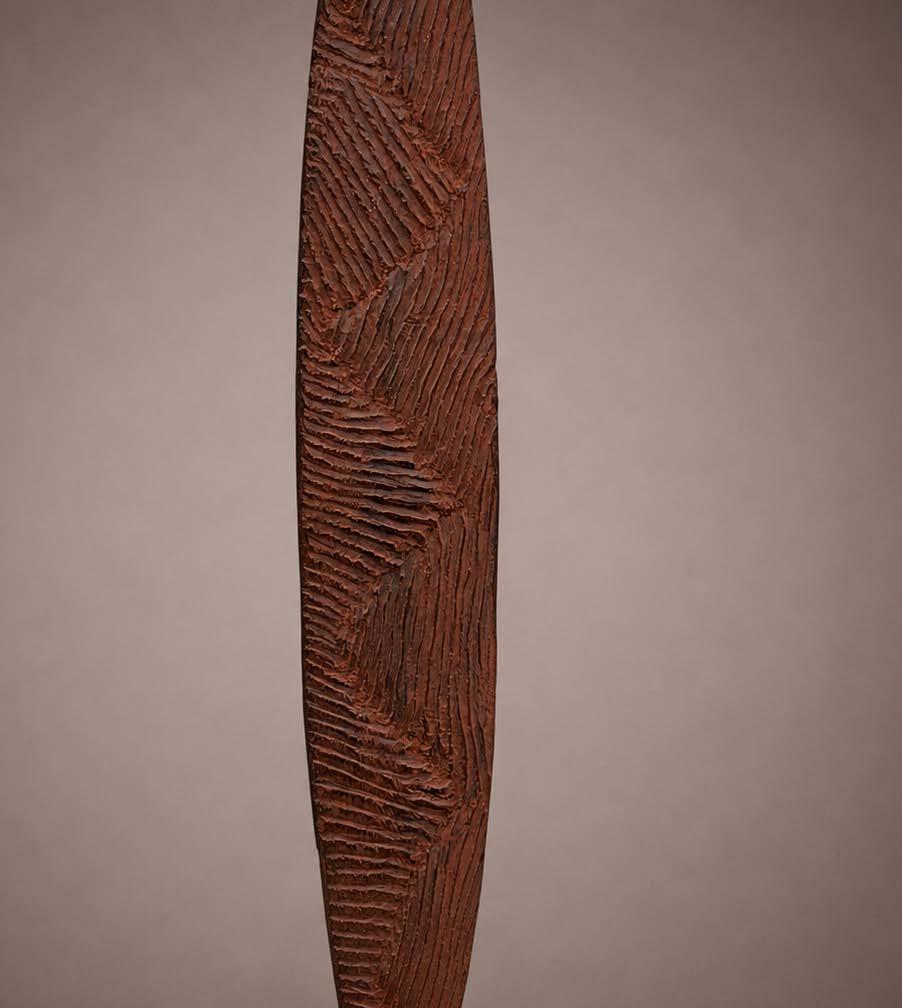
The bullroarer is among the oldest and most widely distributed sacred objects in human culture, but nowhere has it been maintained with greater ceremonial intensity and philosophical depth than among the Aboriginal peoples of Australia. Known by many names across the continent’s hundreds of distinct language groups, the bullroarer is at once a musical instrument, a ceremonial object, a repository of ancestral power, and a physical embodiment of the Dreaming itself.
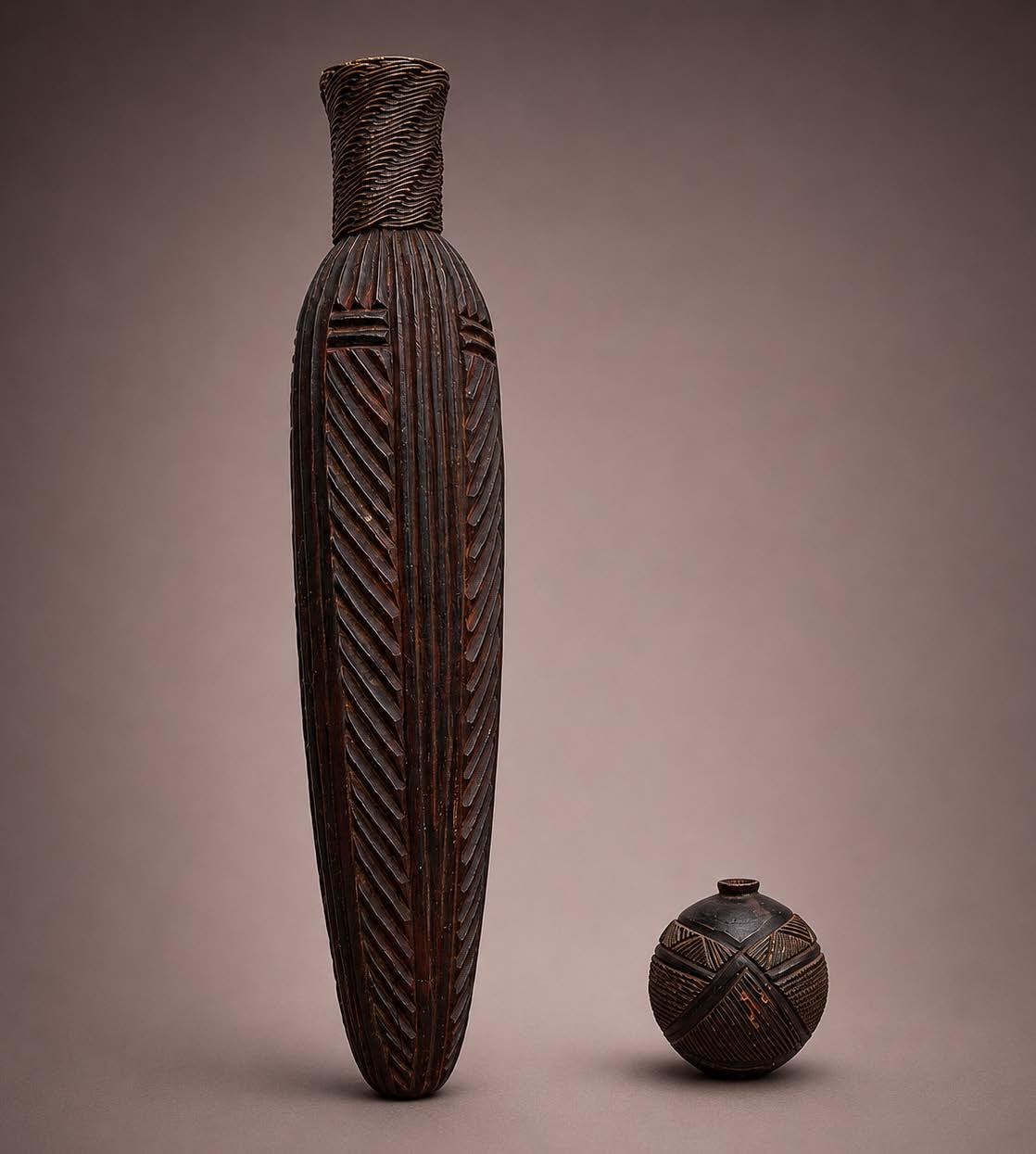
When swung on a cord in a wide arc overhead, the bullroarer produces its characteristic sound — a deep, pulsing roar that rises and falls with the speed of rotation, carrying across remarkable distances through open country. This sound was understood as the voice of an ancestor, the breath of a Dreaming being, or the direct manifestation of a sacred presence. In many traditions the sound alone was sufficient to clear women and uninitiated men from ceremonial ground; in others, the bullroarer’s voice announced the beginning of initiation, signaled the presence of the sacred, or called participants to ceremony from across the landscape.
This example is a finely made object of evident age and use. The form is resolved with the aerodynamic precision
price $800
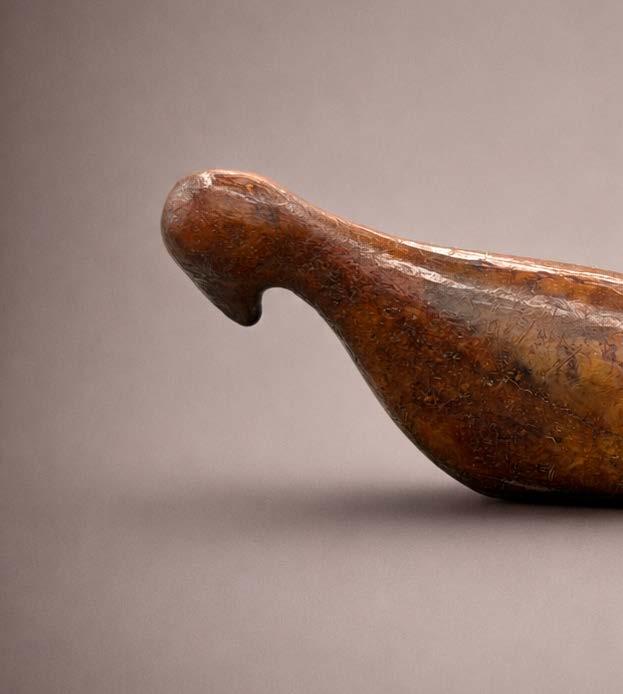
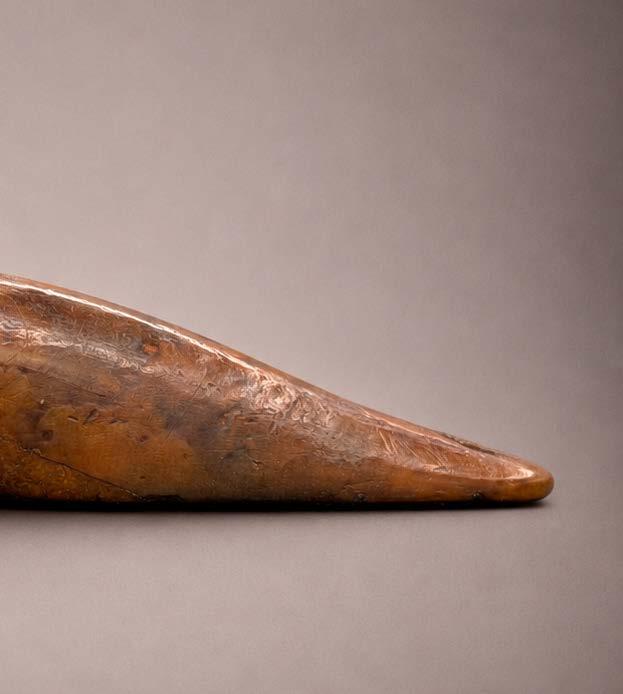
that effective bullroarers require: a long, narrow lens tapering symmetrically to fine points at both ends, the widest point at the center providing the mass and surface area that generate sound when the board is spun. The wood is a dense Australian hardwood — reddish-brown, closegrained, light relative to its size — carved from a single piece and thinned to the exact profile that experience across generations had established as most effective.
The entire visible face is covered in deeply incised herringbone decoration organized around a strong central spine: from this axis, diagonal parallel lines radiate outward in alternating directions to either side, creating a bold zigzag or chevron field that runs uninterrupted from tip to tip. In Australian Aboriginal decorative tradition, herringbone and chevron patterns of this kind are among the oldest and most semantically charged visual vocabularies — appearing on objects, on bodies, and in sand drawings across the continent, their specific meaning varying by region and context but consistently associated with water, with movement, with the tracks of ancestral beings across the landscape, and with the structural grammar of the Dreaming. The confident, assured execution — deeply cut, evenly spaced, covering every available surface — suggests a maker working from internalized knowledge rather than copying: this pattern was not designed, it was known.
At the lower tip, a drilled hole provided the attachment point for the cord — the physical connection through which the performer’s arm transmitted energy into the spinning board, setting the ancestor’s voice in motion.
NEEDLE CASE WITH BEAR
YUP’IK OR INUPIAQ PEOPLES, ALASKA
19th century
Walrus ivory, European velvet ribbon
Height (needle case only): 3 in, 7 ½ cm
PROVENANCE
Private Northeast collection
In the Arctic world, needles were not simple tools. The ability to sew — to construct the layered, perfectly fitted skin garments that stood between a person and death by exposure — was among the most essential skills a woman could possess, and the needles that made this possible were objects of genuine consequence. To lose a needle on the tundra or the sea ice was a serious matter. The needle case that protected them was accordingly an object of care and pride, made with the same precision and investment of meaning that went into the garments themselves.
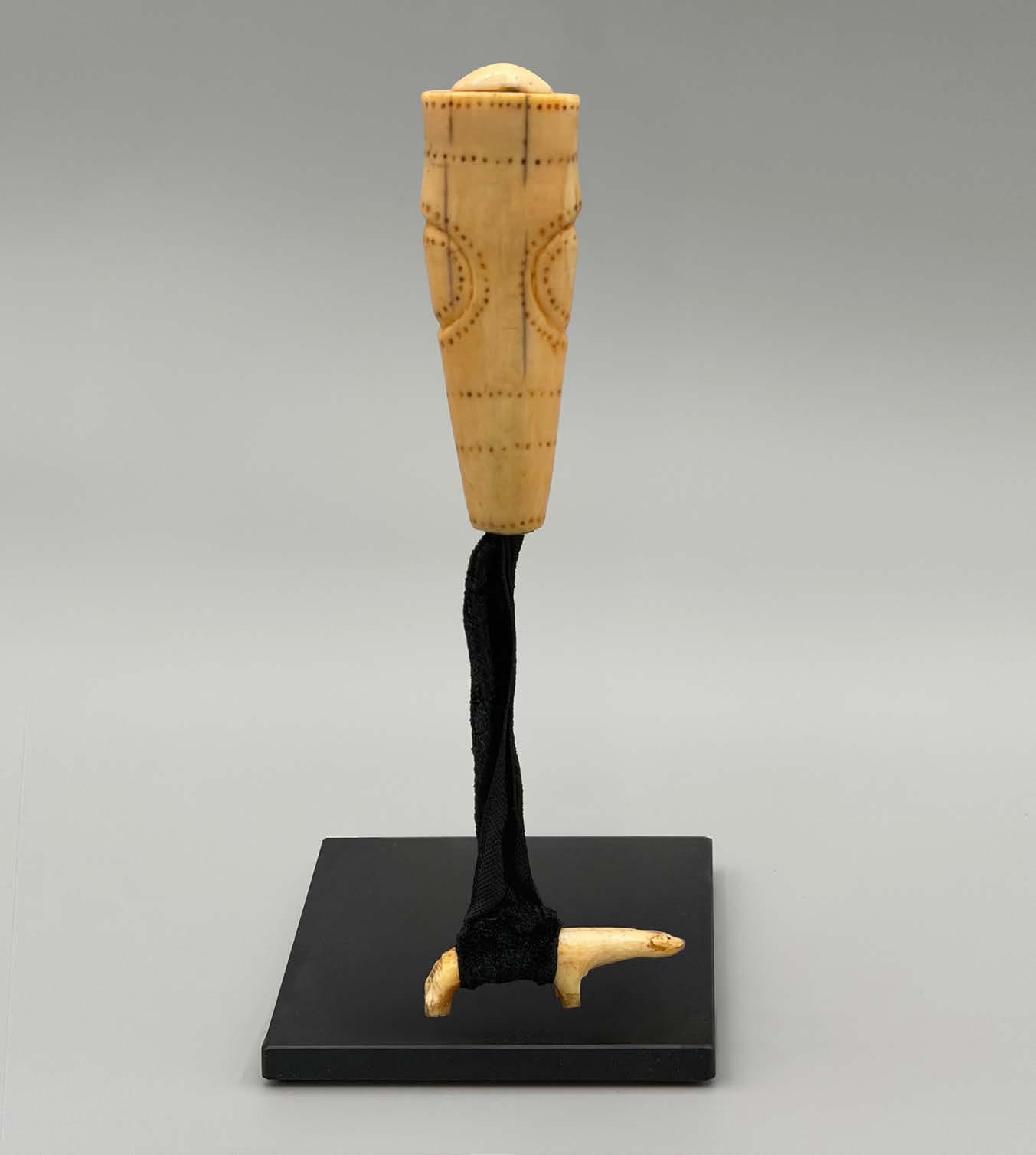
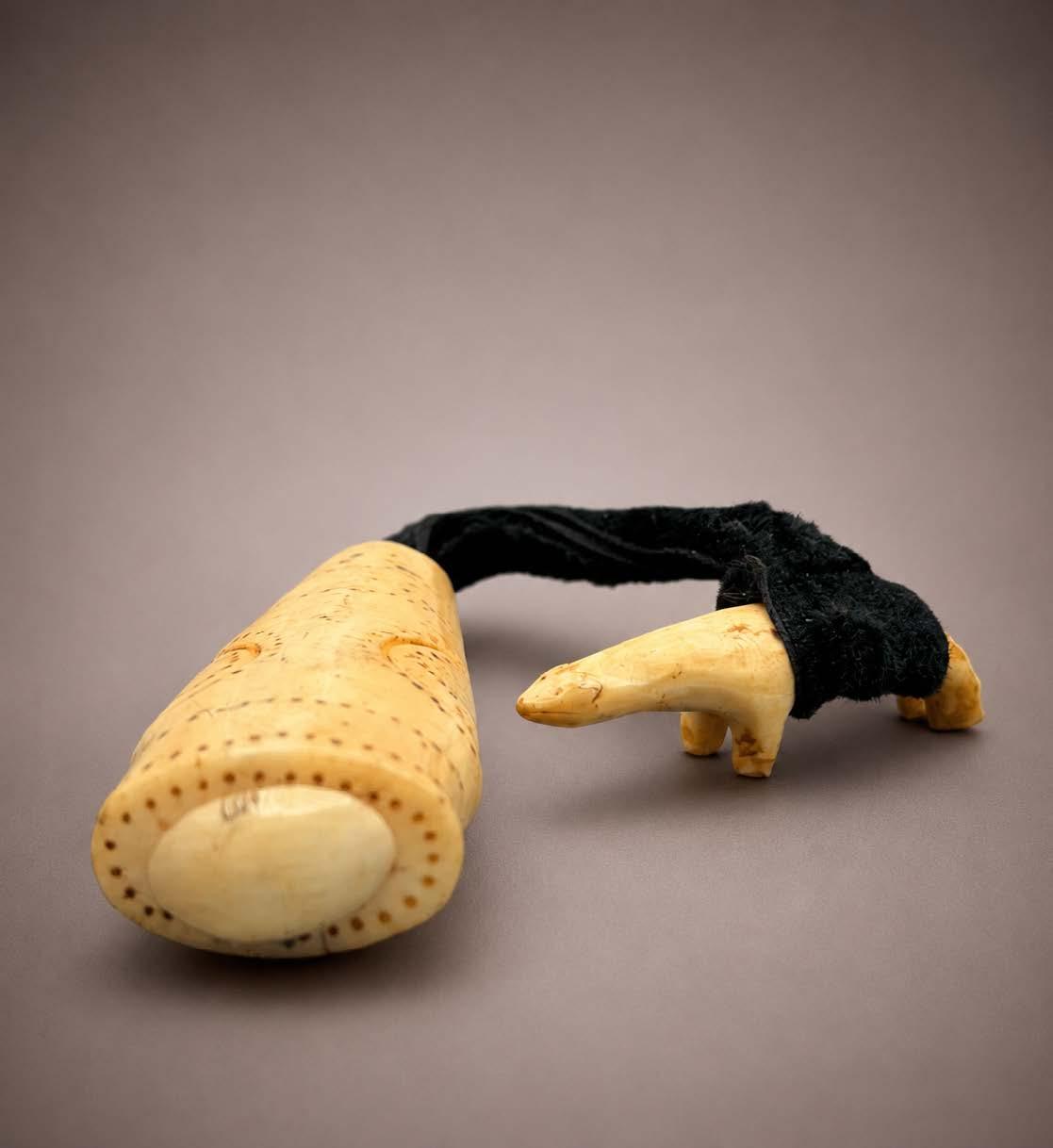
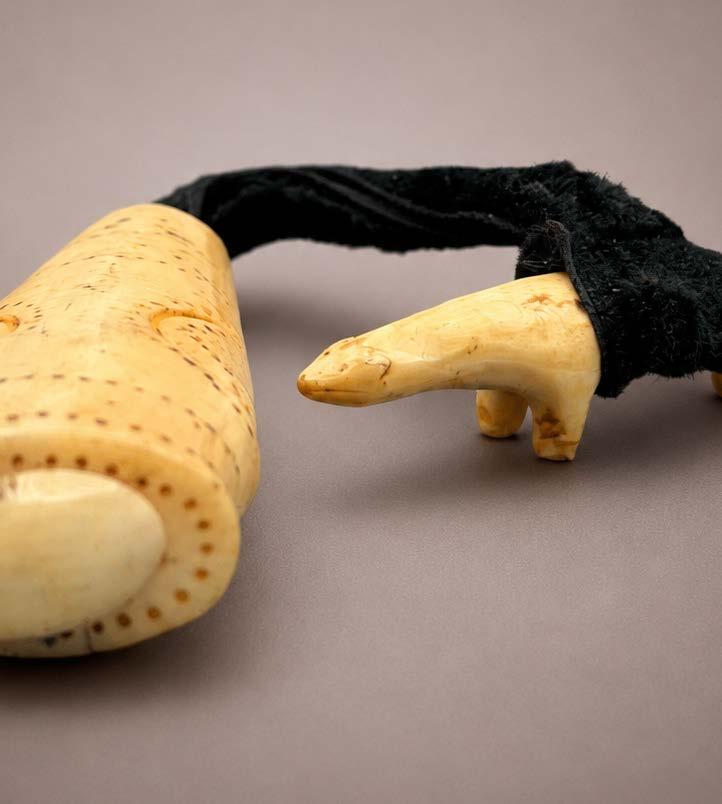
This miniature needle case is carved from a single piece of walrus ivory — tapering from a flat-crowned cylinder at the top to a rounded base — its entire surface covered in finely engraved decoration executed in the classic dotand-line vocabulary of Arctic ornamental art. Horizontal registers of precisely drilled dot-punches divide the surface into bands, within which paired crescent or arc motifs bilaterally face each other on opposing sides of the cylinder — forms that may reference eyes, the ulu knife, or the structural visual grammar of yua, the inner person present in all living things. The dots retain their original dark infill — graphite or soot worked into the incisions to make the pattern legible — and the engraving shows the practiced
price $1,500
hand of a carver working within a tradition of miniature precision that Arctic craftspeople brought to its highest expression.
The case is suspended from a loop of black European velvet ribbon — a trade material that entered the Arctic through the fur trade networks of the 18th and 19th centuries, and whose presence here anchors the object within the period of early contact without diminishing its essential indigenous character. The velvet was chosen for its softness and its ability to pass cleanly through the drilled suspension hole without abrading the ivory.
From the same velvet cord, at the base, hangs a second object of equal significance: a tiny carved ivory bear, complete in all its essential anatomy — four legs, a body, a head — rendered with the economy and authority that miniature Inuit carving demands. The polar bear (nanuq) was the most powerful animal in the Inuit and Yup’ik spiritual world: the being most nearly equivalent to a human in intelligence and presence, the animal most closely associated with shamanic transformation, and the most sought-after protector for personal amulets. To carry a miniature bear was to carry the bear’s power — its strength, its hunting acuity, its capacity to move between worlds — compressed into an object small enough to hold in a closed fist.
Together — needle case and bear, utility and protection, the domestic and the shamanic bound on the same cord — this pair represents the kind of object that was made for a specific person, carried close to the body across years of use, and charged with accumulated personal meaning that no catalog description can fully recover.
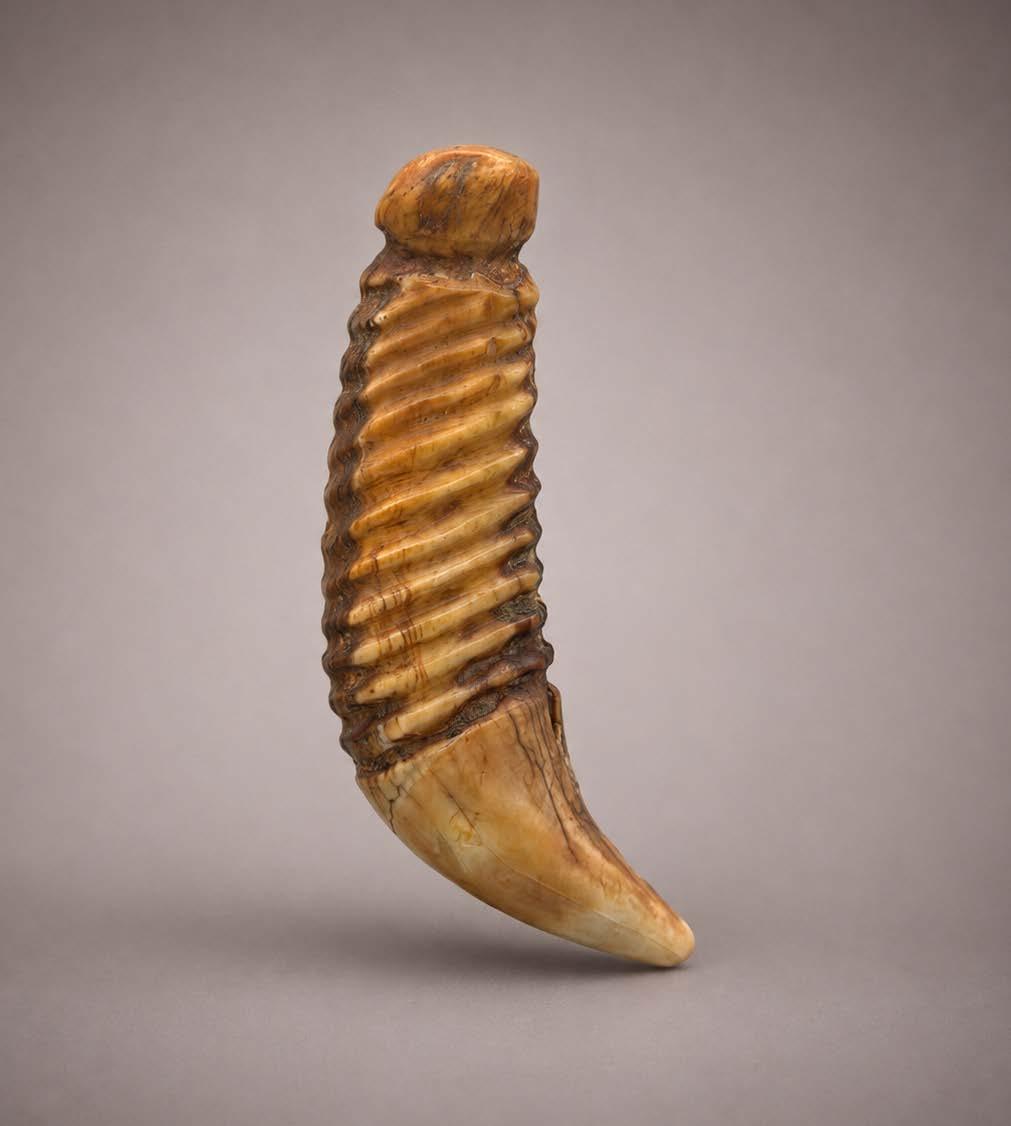
BEAR TOOTH AMULET
SIBERIAN OR ALASKAN
18th century or earlier
Bear canine tooth (worked)
Height: 3 ½ in, 9 cm
PROVENANCE
Seward Kennedy, London and New York
The bear — in virtually every culture that shared its range across the northern hemisphere — occupied a singular position in the spiritual imagination. Larger than any other land predator in its environment, capable of standing and walking upright, of using its forepaws with something approaching manual dexterity, of appearing to die each winter and return to life each spring: the bear was the animal that most closely mirrored human nature while exceeding human power. To possess a part of the bear — to carry its tooth — was to carry the bear itself, its strength, its endurance, its capacity for periodic death and renewal compressed into a single object that could be held in a closed fist.
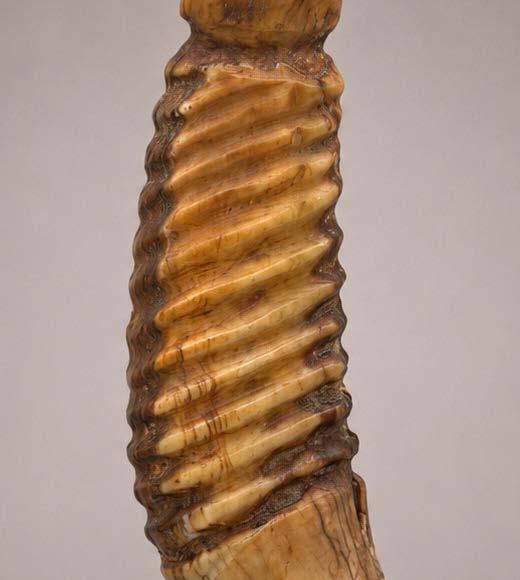
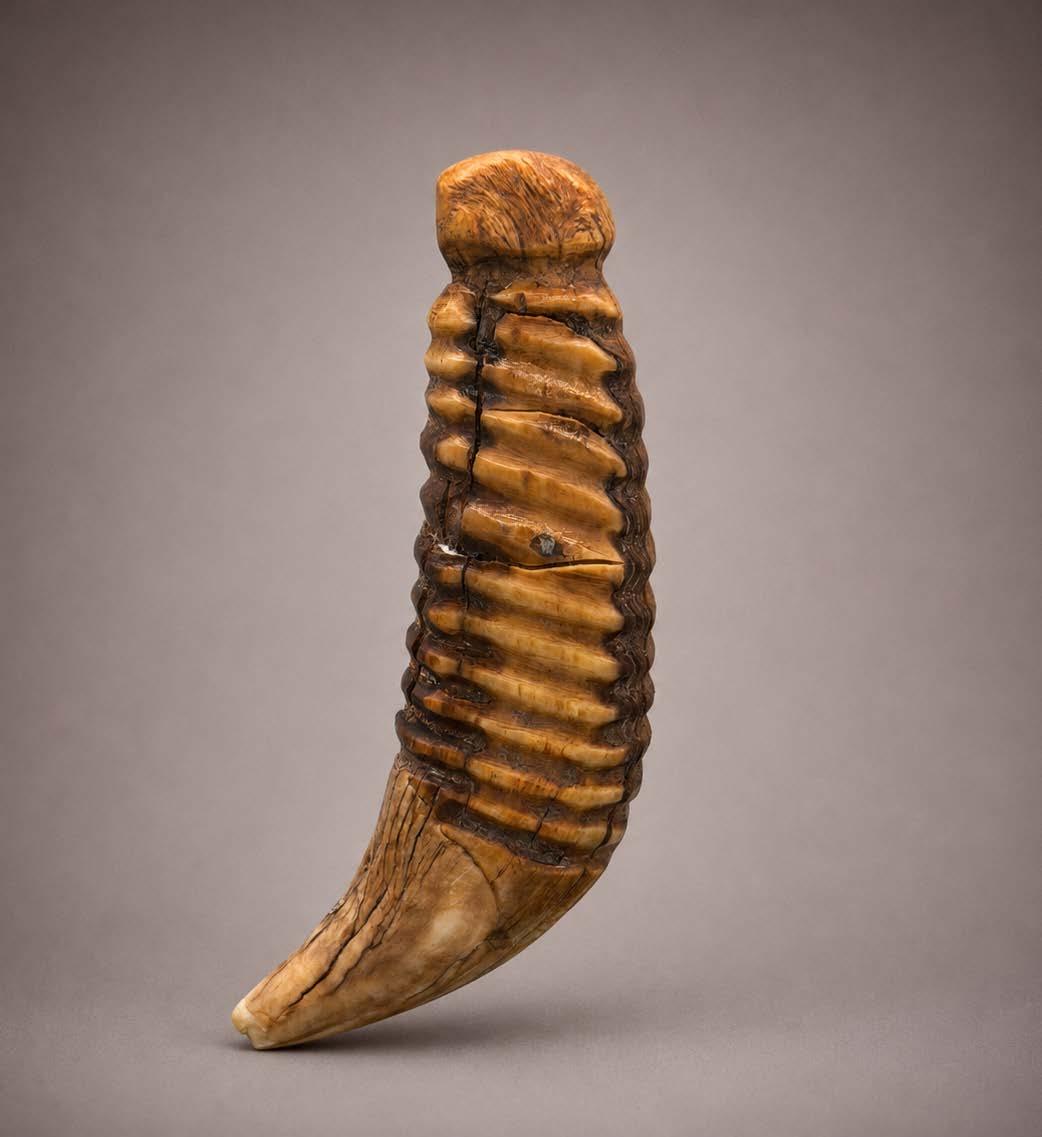
This carved bear canine is a piece of considerable physical authority. The tooth itself is large — a fully developed canine from an adult bear of substantial size — its naturally curved form tapering from a broad, rounded crown to a long, sweeping point. The dentine has aged to a deep ambergold, the surface cracked along its length in the longitudinal lines that develop in tooth material over many generations, the cracks now filled with the dark staining of time and
contact. This is old material — the tooth itself, before any carving was applied to it, was already an object of age and power. Across the body of the tooth, a series of diagonal spiral grooves has been incised — possibly serving as a tally of kills, though their precise meaning is uncertain.
At the crown, the natural root of the tooth is retained — broader, darker, more porous — as the terminal element of the composition. A small metal fitting at this juncture provided either a suspension point for wearing the amulet on a cord against the body, or a repair that kept the tooth in use after age or ceremony had stressed it. Either way, the fitting speaks to an object too valued to retire.
The unworked tip is left entirely in its natural state — the long curving point of the original canine, its surface cracked with age, its color a lighter cream where the outer dentine has worn or split away to reveal the paler interior. This decision — to leave the natural tip untouched while carving the body above — is the same formal intelligence seen in the companion piece, and it speaks to a shared understanding: the tooth’s own form is already eloquent, and the carver’s task is to extend that eloquence, not to override it.
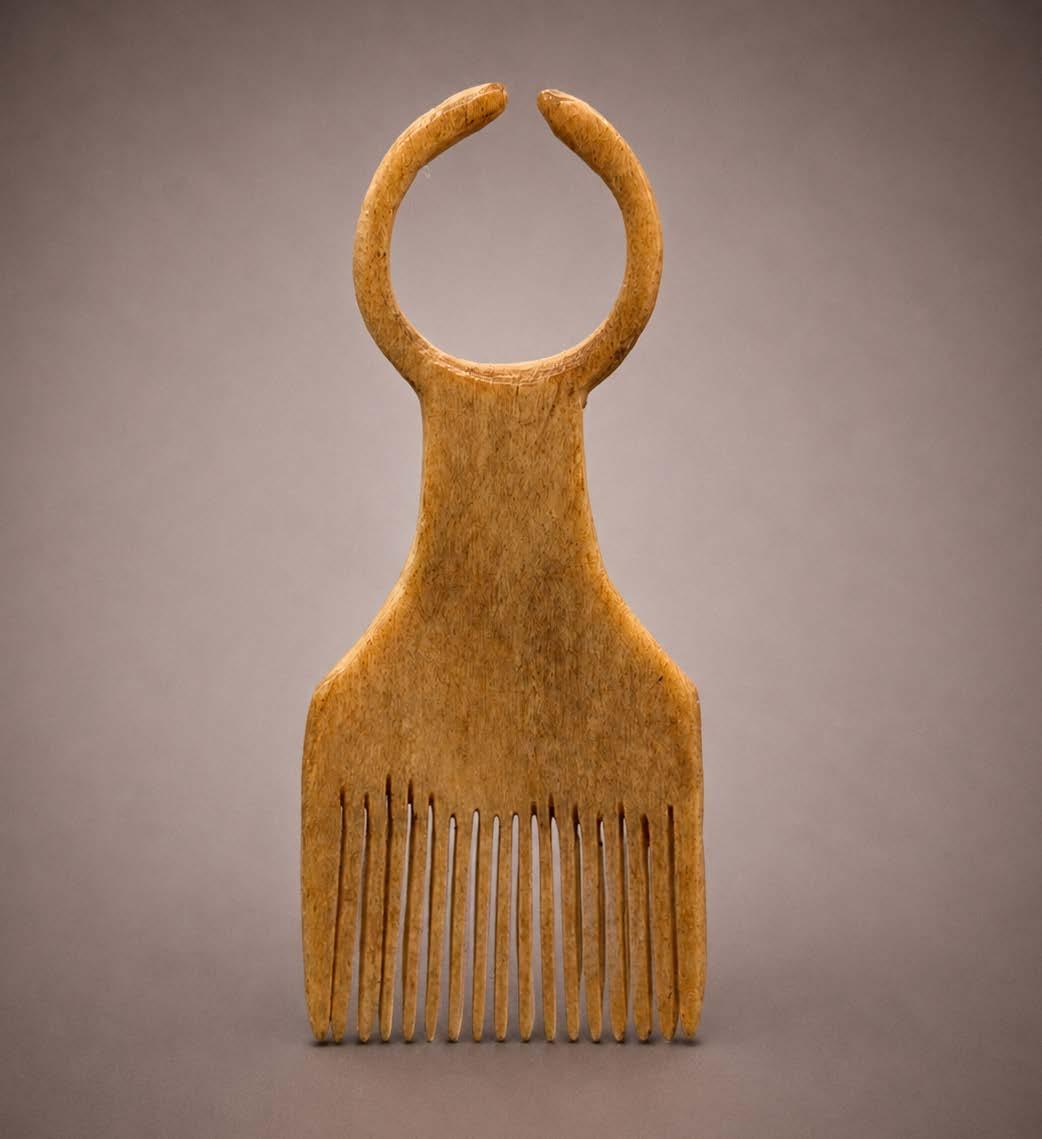
HAIR COMB
YUP’IK OR INUPIAQ PEOPLES, ALASKA
19th century or earlier
Walrus ivory or caribou antler
Height: 2 in, 5 cm
PROVENANCE
Seward Kennedy, London and New York
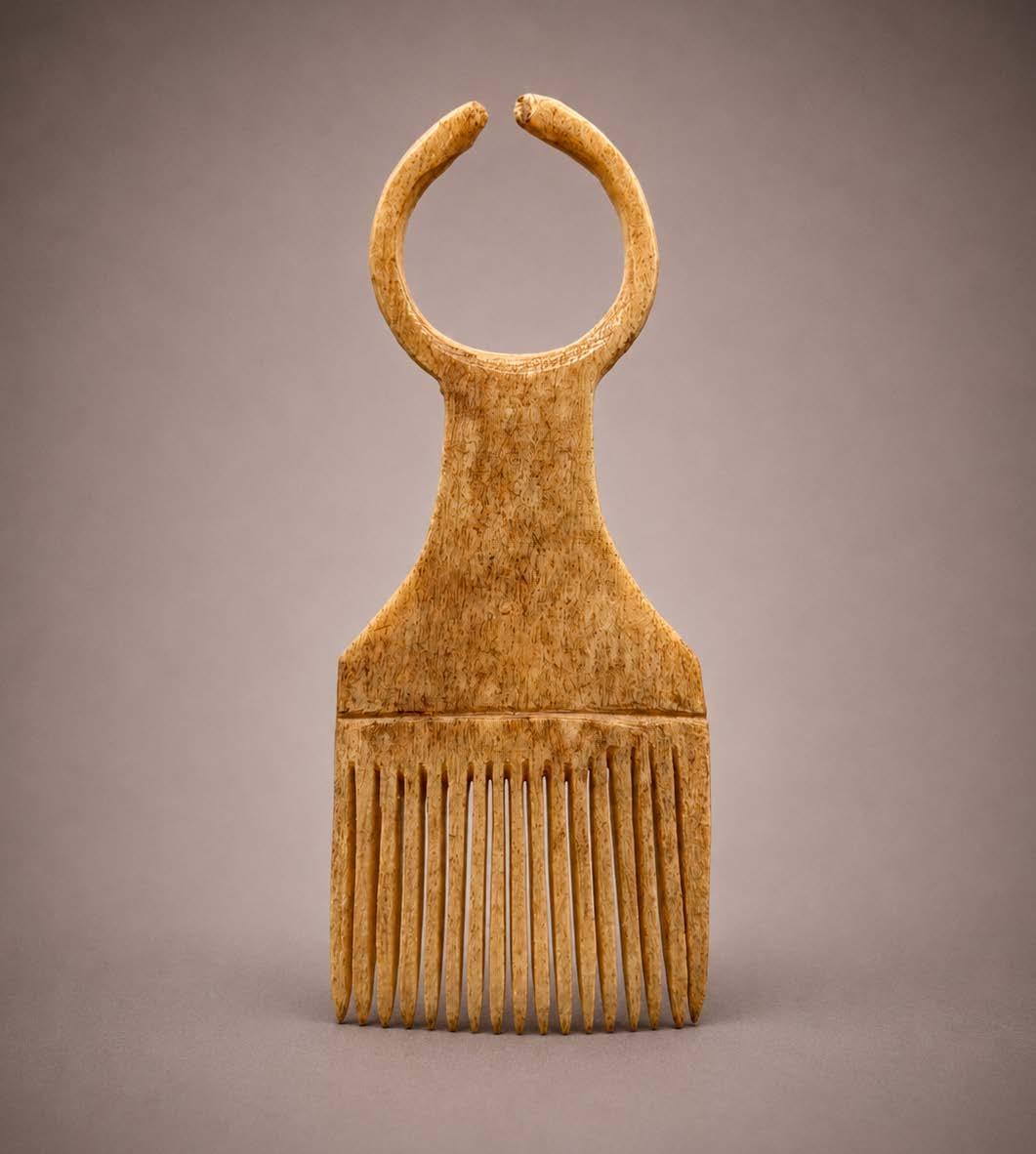
Personal grooming in the Arctic world was not vanity but social practice — the careful arrangement of hair, the maintenance of clothing, the attention to one’s own appearance within the community were expressions of self-respect and of respect for those around you, values as central to Inuit and Yup’ik social life as any other. The objects made for this purpose were accordingly made with care, and this small ivory comb is no exception.
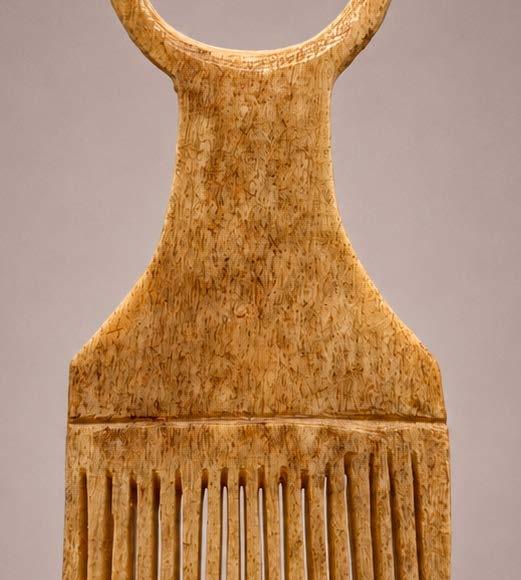
Carved from a single piece of walrus ivory or caribou antler — the material warm cream-yellow, its internal structure visible as a beautiful mottled pattern of amberbrown flecks that give the surface a vitality no manufactured object could replicate — the comb is resolved in three zones that together constitute a complete and elegant object. At the base, approximately 20 evenly cut teeth of consistent width and graduated length perform the object’s practical function with the precision that daily use demanded: the gaps between them clean, the tips rounded, every tooth intact after what may be well over a century of existence. A fine incised horizontal line marks the boundary between tooth zone and body, a structural articulation that also reads as a quiet decorative statement — the maker’s
acknowledgment that even a comb deserves a moment of formal attention.
The body above is a plain trapezoidal panel, its surfaces undecorated, allowing the natural beauty of the material to carry the visual weight. And it does: the speckled, mottled pattern of the ivory or antler reads across the surface like a map of the material’s own interior life — the record of growth and time encoded in the structure of the animal’s tooth or horn, now made visible by the carver’s thinning of the piece to its working dimensions.
At the crown, a fully three-dimensional circular loop rises from the body — the ivory worked in the round to create an open ring through which a sinew cord could pass, keeping the comb suspended from the owner’s clothing or belt pouch, accessible at any moment. The loop’s two terminal tips rest against the body with a slight organic irregularity that is the mark of a hand-carved object rather than a manufactured one. This small detail — the imperfect perfection of the loop — is what finally confirms the object’s humanity: it was made by someone, for someone, with the particular attention that small personal objects attract when they are meant to last.
BIRD GAMING PIECE
YUP’IK OR INUPIAQ, ALASKA
19th century or earlier
Walrus ivory
Length: 3 in, 7 ½ cm
PROVENANCE
Private US Collection
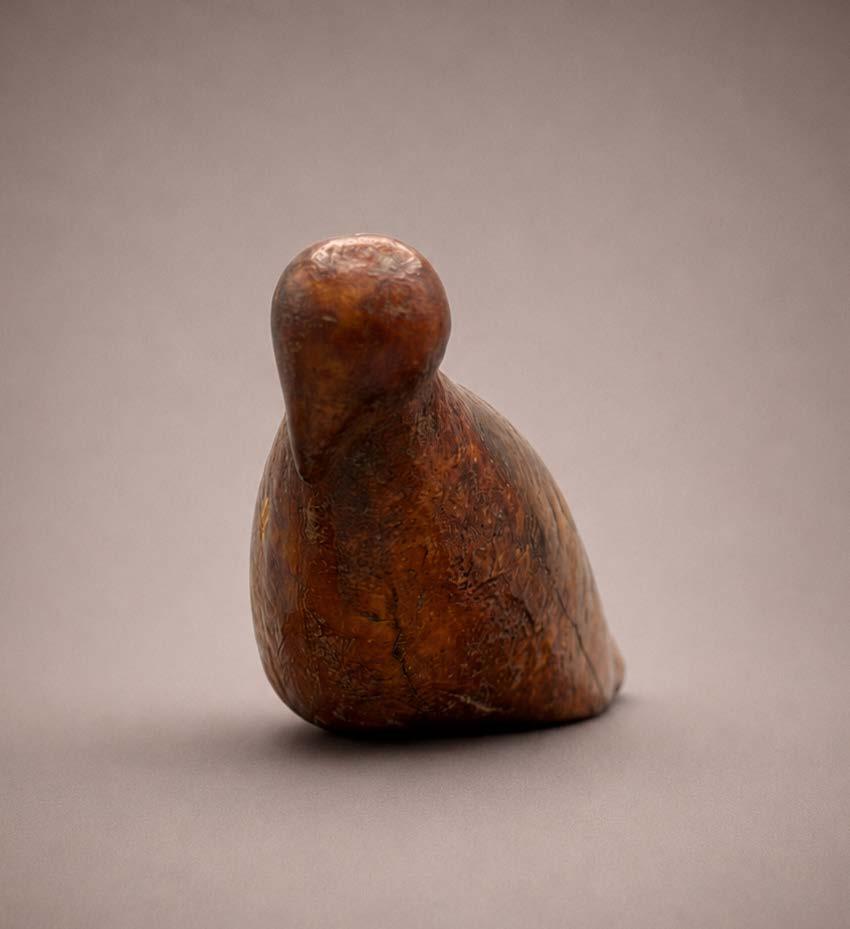
The long Arctic winter — months of darkness, confined quarters, the qasgiq or family dwelling filled with the sounds and warmth of people pressed close together — generated its own rich interior culture of storytelling, music, and games. Among the most widespread of Inuit and Yup’ik games were those involving sets of carved animal pieces strung on sinew cord, the object being to swing the pieces and catch them on a pin or hook with a single fluid motion. Skill, speed, and the particular weight and balance of each carved piece all mattered. The best pieces were made with care, and kept.
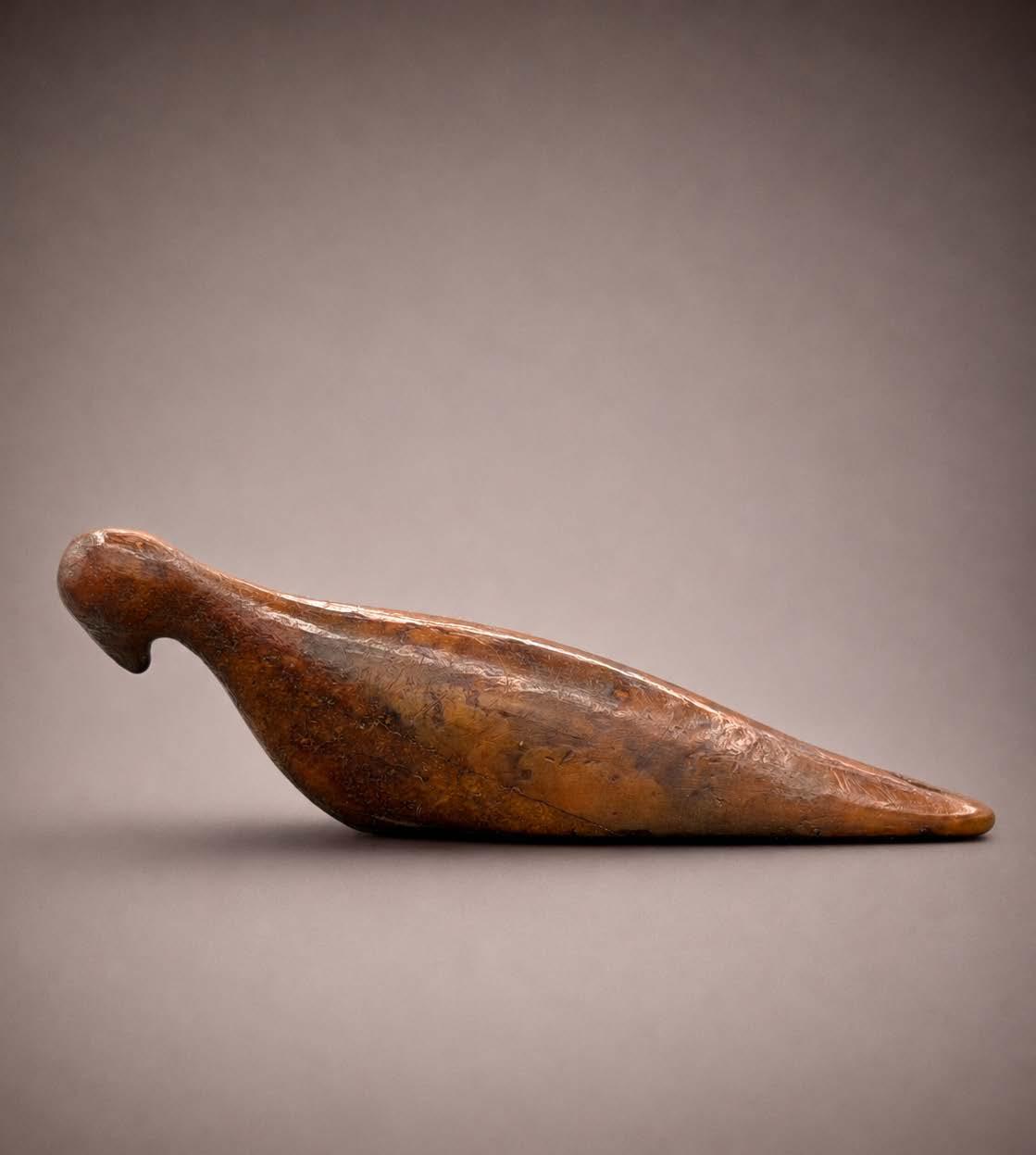
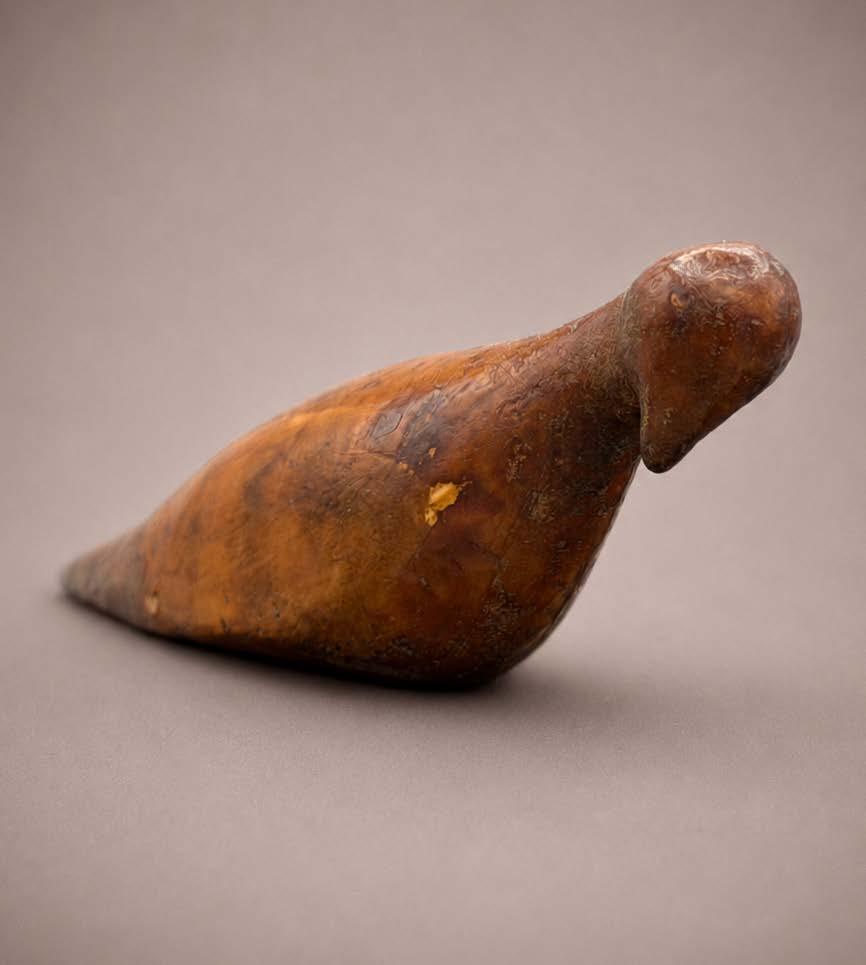
This resting bird is one such piece — a gaming token of exceptional quality, carved from walrus ivory or dense marine mammal bone that has aged over many decades to a deep, warm amber-brown. The form is a ground-nesting game bird at rest — a ptarmigan or eider settled flat, body a long low wedge tapering from rounded breast to fine tail tip, the profile as close to the tundra as the bird itself would make it. The head is the carving’s quiet masterstroke: small,
rounded, turned and tilted at a gentle angle that gives the resting bird an expression of relaxed alertness — one eye open, aware but unhurried, entirely at ease in its moment. A single precise notch defines the beak. Nothing more was needed.
Into the back, a smooth oval cavity runs the full dorsal length — scooped clean and well-finished, its interior darkened with age and use. On a gaming piece of this type the cavity reduced weight, adjusted balance, and gave the piece its particular flight and spin when swung on the cord. Near the tail, a drilled suspension hole accepted the sinew that connected this bird to its set — thread worn smooth by long use, the hole’s edges burnished by the passage of cord across many winter evenings of play.
The surface throughout carries the accumulated evidence of that use: fine random scratches, worn edges, a burnished sheen on the highest points where hands have passed most often. No carved decoration was applied — the form itself was considered sufficient, and correctly so.
AWL OR TATTOO NEEDLE IN THE FORM OF A FOX
YUP’IK OR INUPIAQ PEOPLES, ALASKA
19th century or earlier
Walrus ivory or marine mammal bone
Length: 3 in, 7 ½ cm
PROVENANCE
De-accessioned from a museum with old collection numbers
Jeffrey Myers, New York
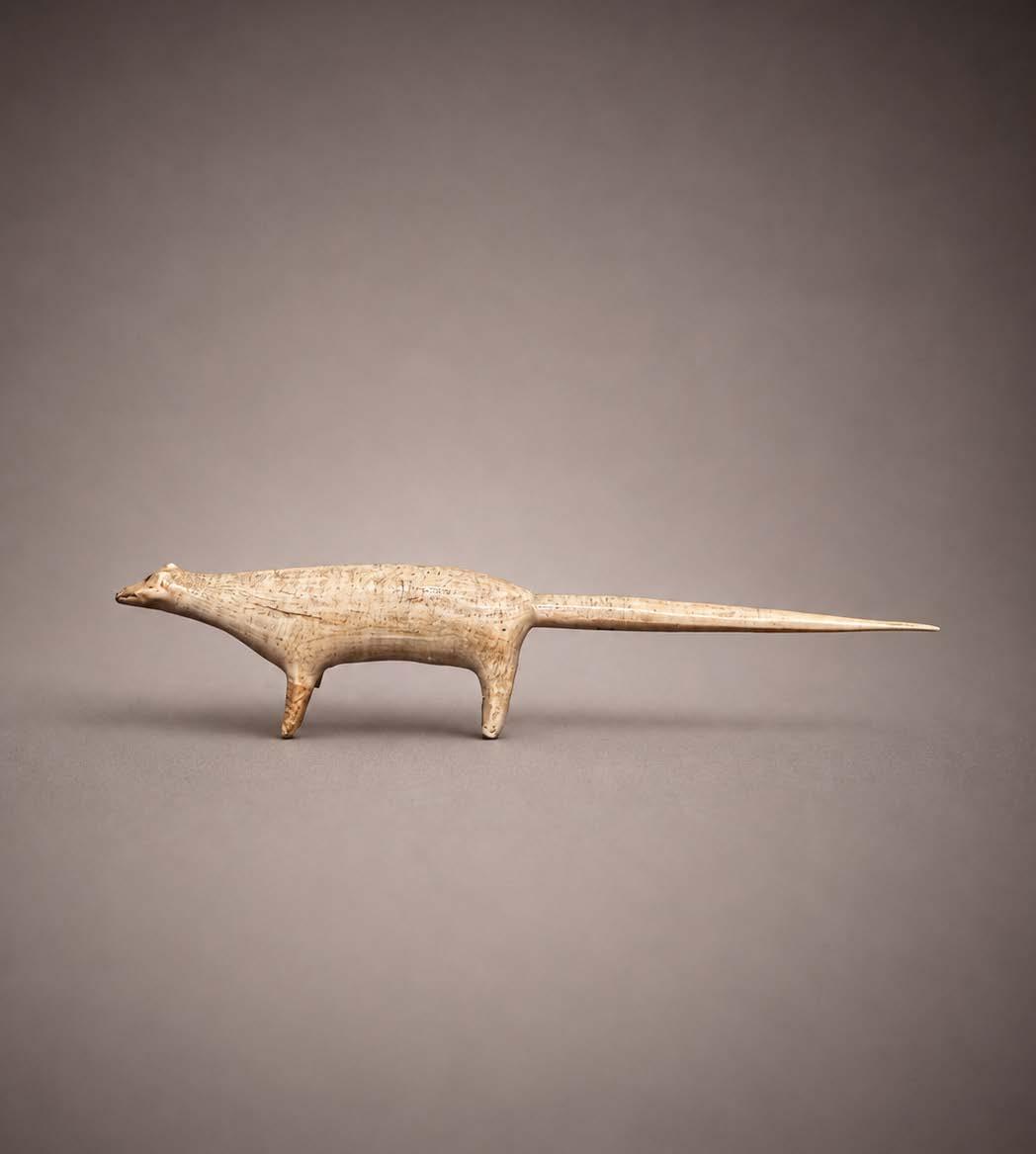
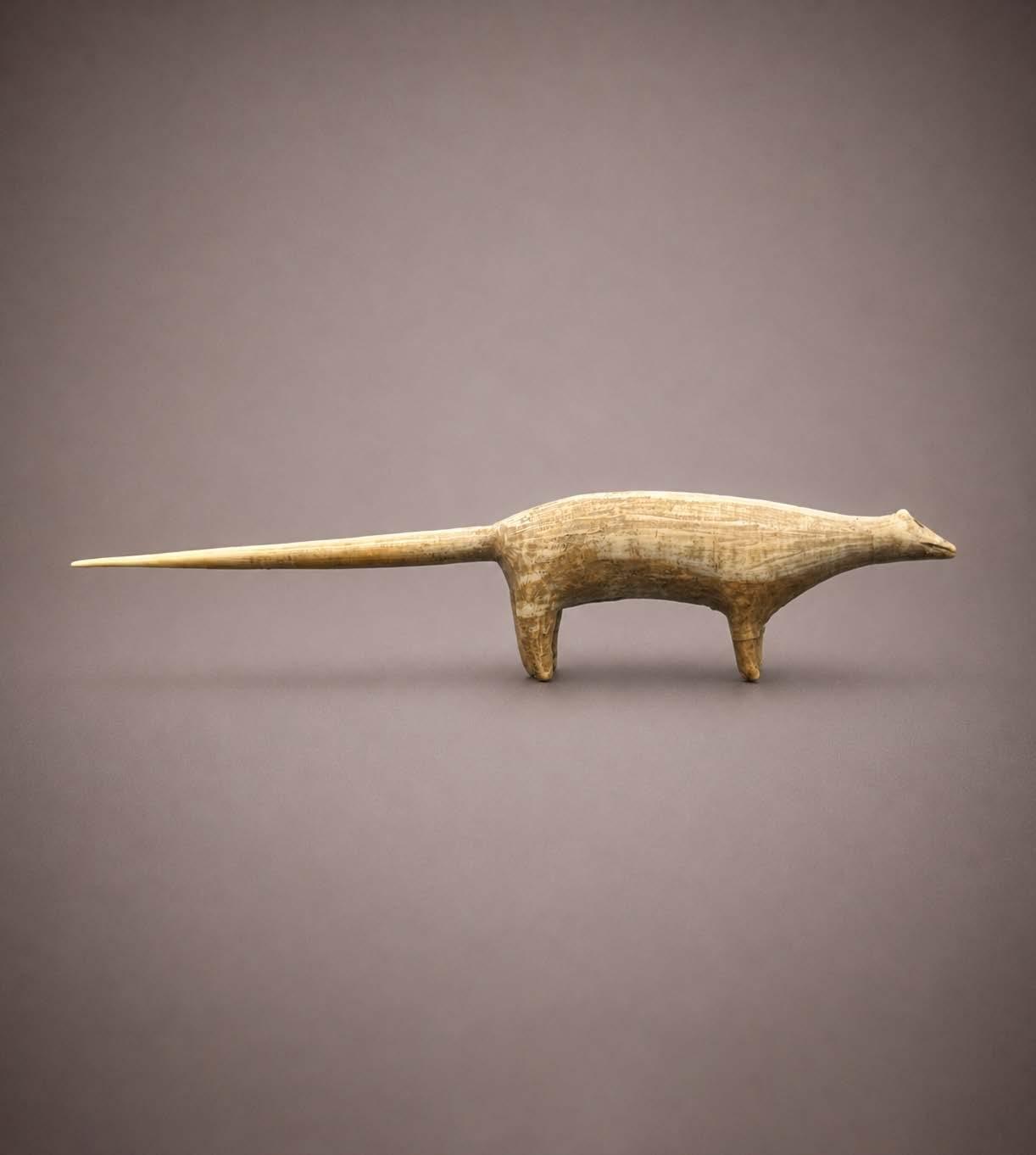
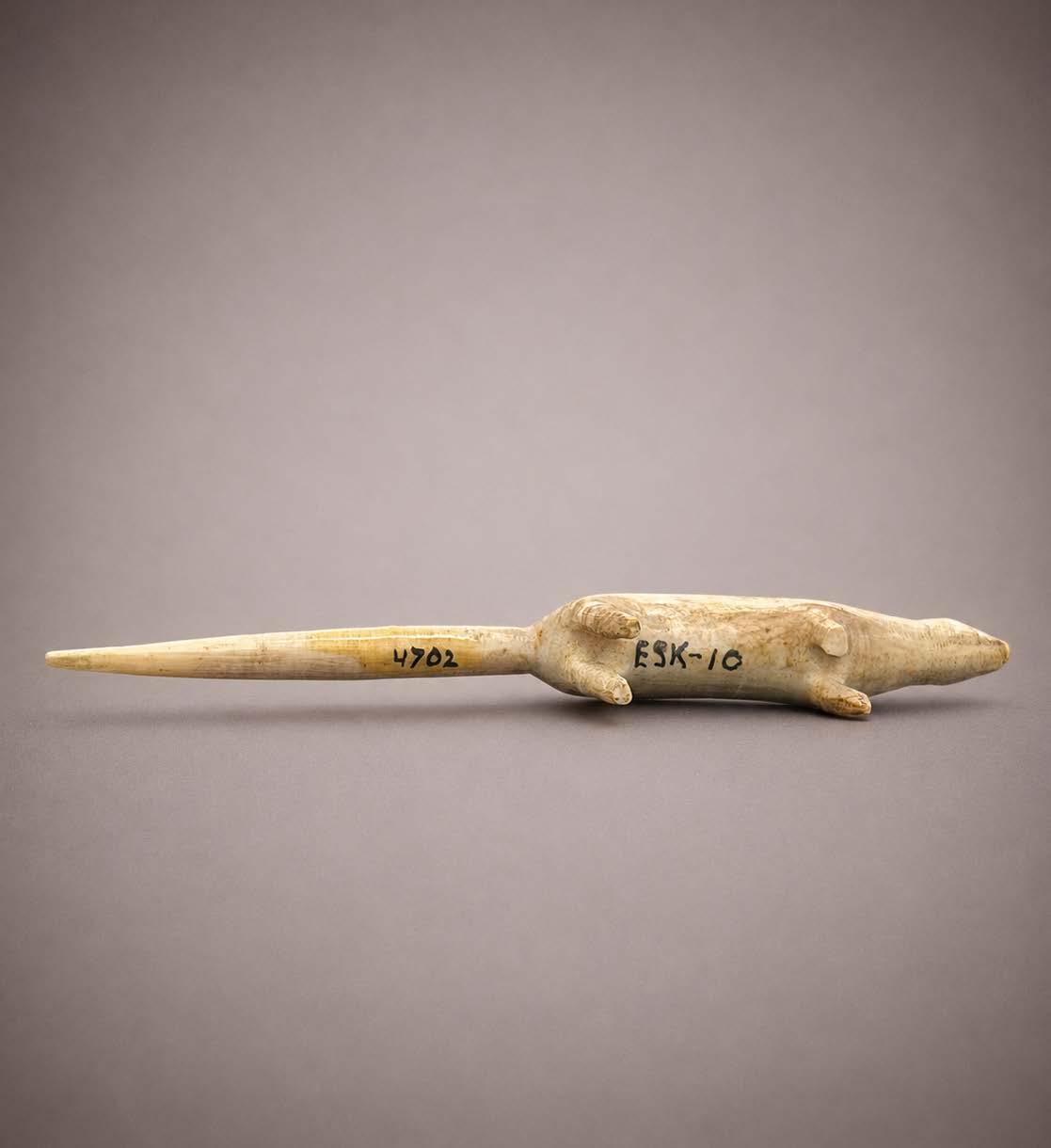
Among the Inuit and Yup’ik peoples, tattooing was a practice of profound social and spiritual significance — particularly for women, whose facial and body tattoos marked life transitions, signaled status and identity, and were understood to guide the spirit after death to the correct realm. The needles used to introduce pigment under the skin were accordingly objects of more than functional importance. A tattooing needle carried the marks it had made; it participated in the transformations it enabled; and when it was made in the form of a spirit animal, it brought that animal’s power to the work.
The carver’s insight was simple and exact: the fox’s naturally long, tapering tail, held straight behind the body in motion, is already a needle — it needs only to be recognized and released from the ivory. The fox’s body becomes the handle, the tail becomes the working point, and the whole object acquires a logic so complete that it seems inevitable rather than invented.
The fox itself is rendered with the observational precision that the finest Arctic animal carving always achieves through economy rather than elaboration. The long, low
body is streamlined and forward-leaning — the fox in motion, nose down, following a scent with the focused, ground-reading attention that makes the arctic fox such a successful predator on the open tundra. The pointed snout is thrust forward, the tiny eye alert and bright, the ears just suggested at the crown. Four short legs with minimal toe separation give the piece stability when set down without interrupting the flowing horizontal silhouette. And then the tail: departing the haunches in a seamless transition, round in section, tapering evenly over its full length to a working tip that shows the slight wear of use — lighter in tone at the point, the ivory compressed and smoothed by repeated contact with skin.
The material throughout is walrus ivory or large marine mammal bone — light cream to warm ivory-white, the natural grain lines of the material running the full length of the piece like the suggestion of fur, the surface dry and silky with the particular quality of old ivory that has been handled regularly across many years. No decoration was applied. None was needed.
In Yup’ik tradition, the fox was associated with cleverness, with the ability to find what is hidden, with the capacity to move between states — between the visible world and the world beneath the snow, between the surface and what lies under it. A tattooing needle in fox form brought all of this to the act of marking: the fox’s ability to find and penetrate, the fox’s knowledge of hidden things, applied to the transformation of the human body into a surface that carried meaning. Note that right front leg is partially missing. price $500
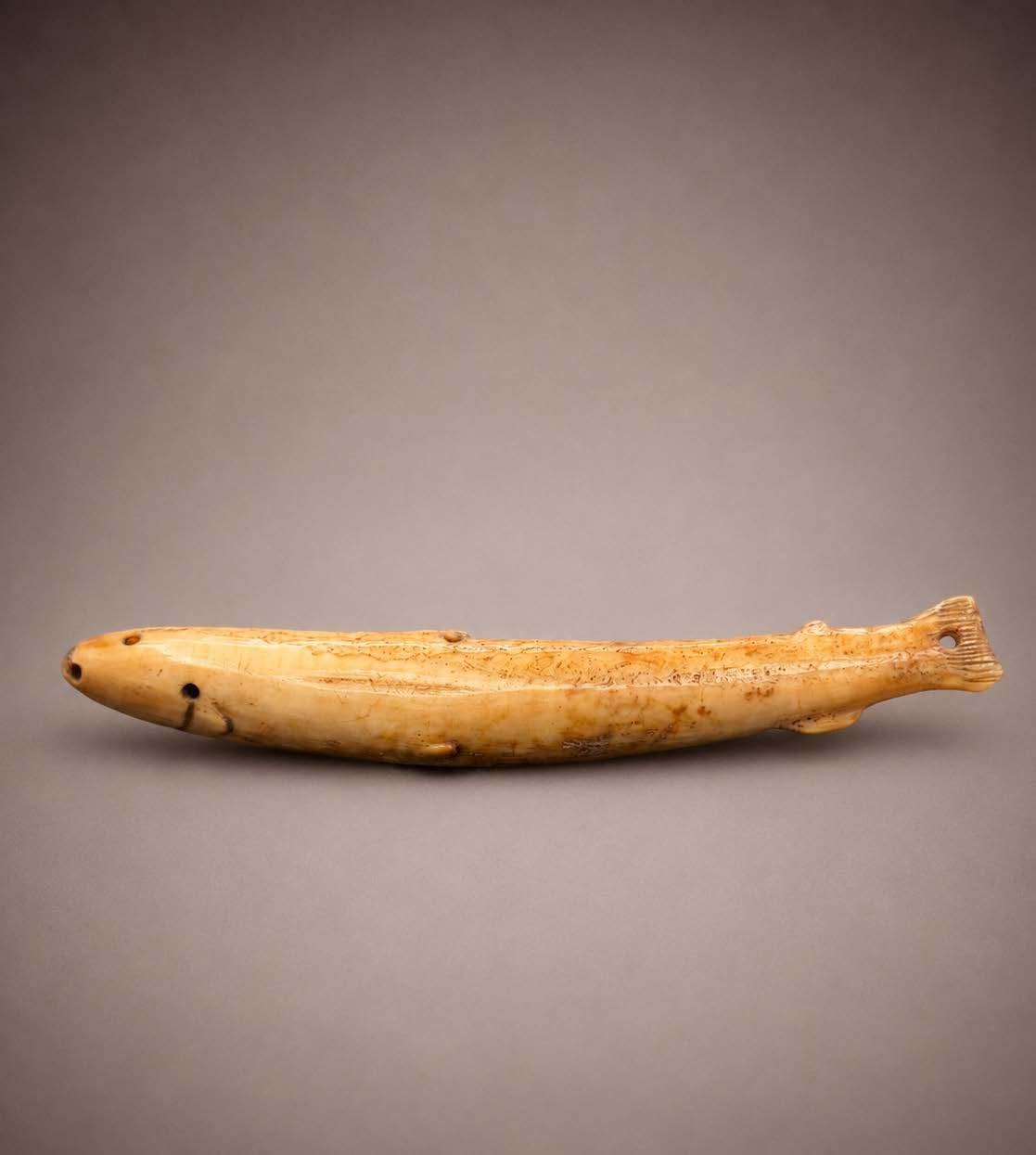
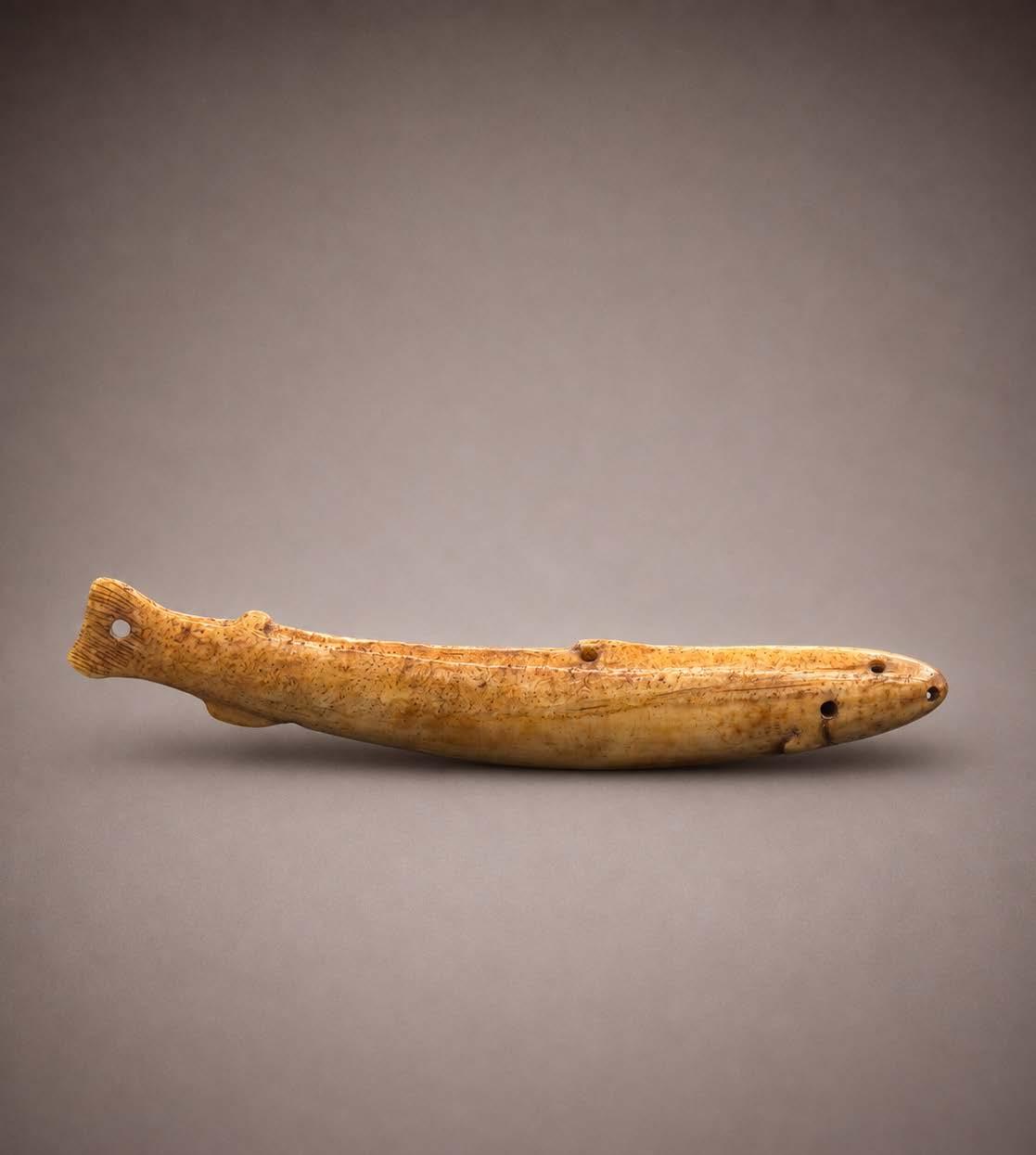
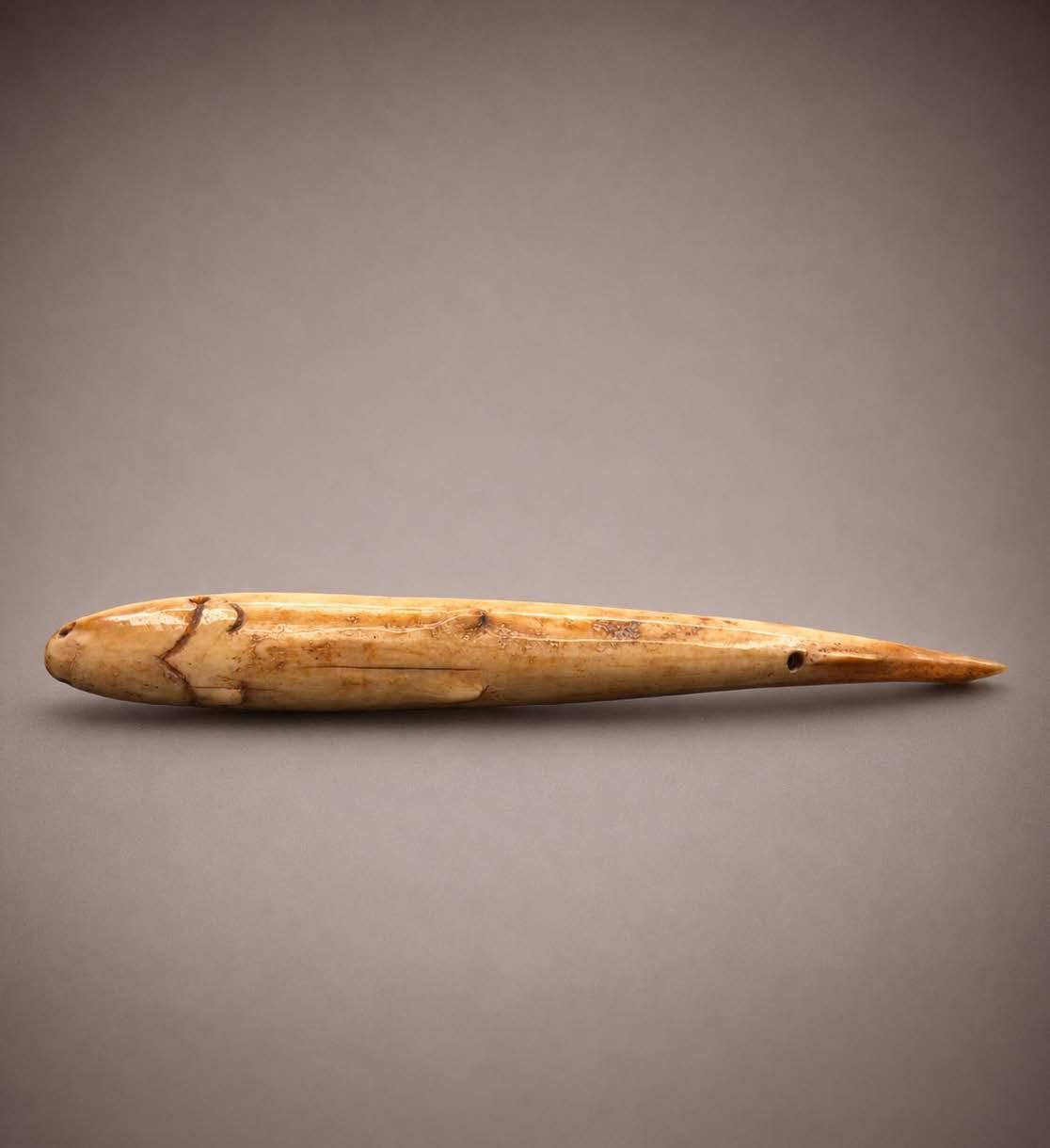
FISHING LURE OR LINE WEIGHT
YUP’IK OR INUPIAQ PEOPLES, ALASKA
18th–19th century
Walrus ivory
Length: 3 ½ in, 9 cm
PROVENANCE
Arthur Gross Collection
Ice fishing on the rivers and coastal waters of the Arctic was not a passive activity. The fisher sat over a hole chopped through ice that could be several feet thick, lowering a lure into the dark water below and working it with a practiced wrist motion — jigging it up and down, varying the rhythm, reading the resistance of the line for the moment when a fish struck. The lure’s effectiveness depended on how convincingly it moved through the water, and that depended on its form, its weight, its balance, and the precise placement of the attachment holes that determined its angle and action. A good lure was a precision instrument, and the best were made with the full attention of a skilled carver. This fish lure is among the finest examples of the type. Carved from a single piece of walrus ivory that has aged to a warm amber-cream stained with the reddish-brown of long water immersion and sediment contact, the body describes a perfect fish silhouette — widest at the middle, tapering evenly to a pointed head and a forked tail — with a weight and density that would have given it exactly the right sink rate and the convincing, slightly nose-down swimming angle that fish respond to. The carver understood hydrodynamics from long practical experience, and
translated that understanding directly into form.
At the head, two drilled holes accepted the fishing line — their precise placement determining the lure’s tilt in the water, angling the head slightly down so that when jigged, the body rose and fell with the nodding motion of a small fish feeding near the bottom. At the tail, a second drilled hole provided the attachment point for the hook — a bone or later metal point that would have hung below the tail, concealed by the lure’s realistic profile and ready for the strike. This dual-attachment system, with line at head and hook at tail, is the canonical Inuit lure configuration, refined over generations of practical testing in the rivers and coastal waters of the Bering Sea region.
The tail is carved with particular care: a fully realized forked caudal fin, each lobe rendered with fine parallel incised lines describing the fin rays with anatomical accuracy — the observation of someone who had cleaned and eaten thousands of fish, who knew exactly how the tail was structured and translated that knowledge into ivory with the confidence of total familiarity. Along the dorsal surface, a shallow longitudinal groove traces the fish’s spine, giving the body its three-dimensional realism; fine incised lines along the mid-body suggest the lateral line that real fish use to sense pressure changes in the water — the organ of the fish that detects the approach of predators and prey alike, rendered here in miniature on a lure designed to attract the very creature it depicts.
The patina is the lure’s most eloquent testimony to its active life. The ivory is stained unevenly — darker along the belly and in the carved recesses, lighter on the upper surfaces — the precise differential that results from repeated immersion in water carrying silt and organic material, the underside in greatest contact with the bottom. This is not the patina of a kept object but of a used one, worked season after season through ice holes in rivers and coastal waters until it passed out of use and into the long sleep of the collection.
price $500
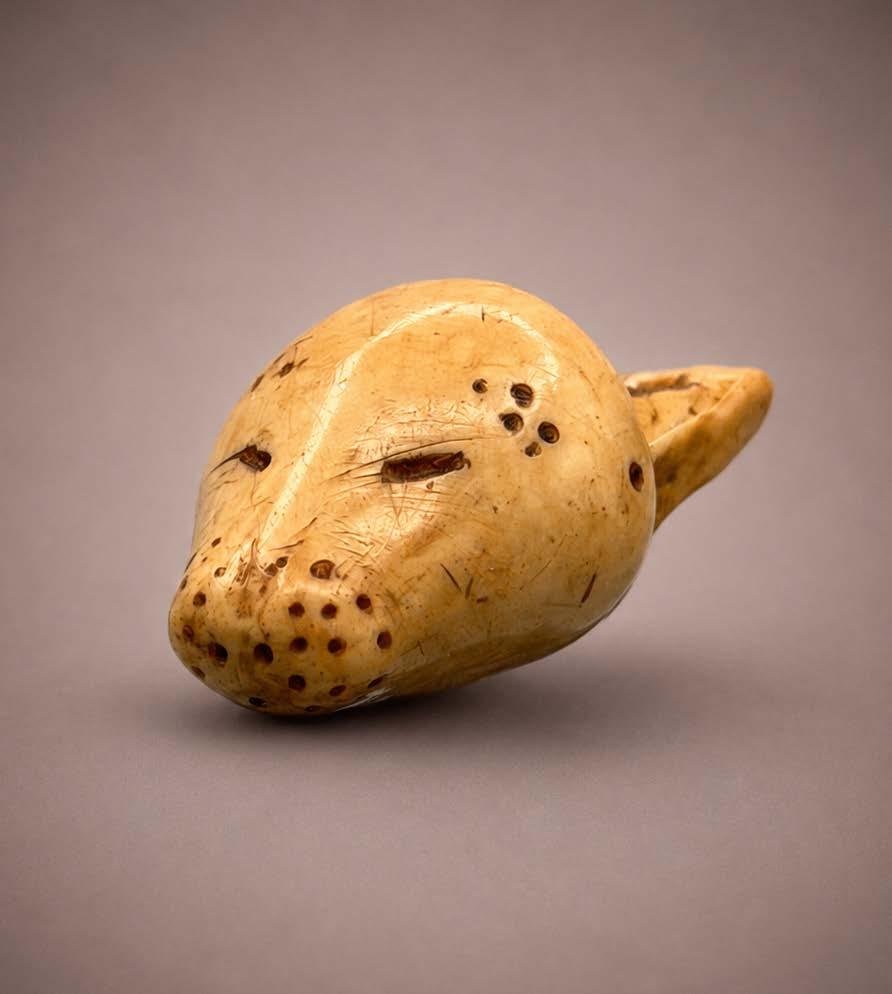
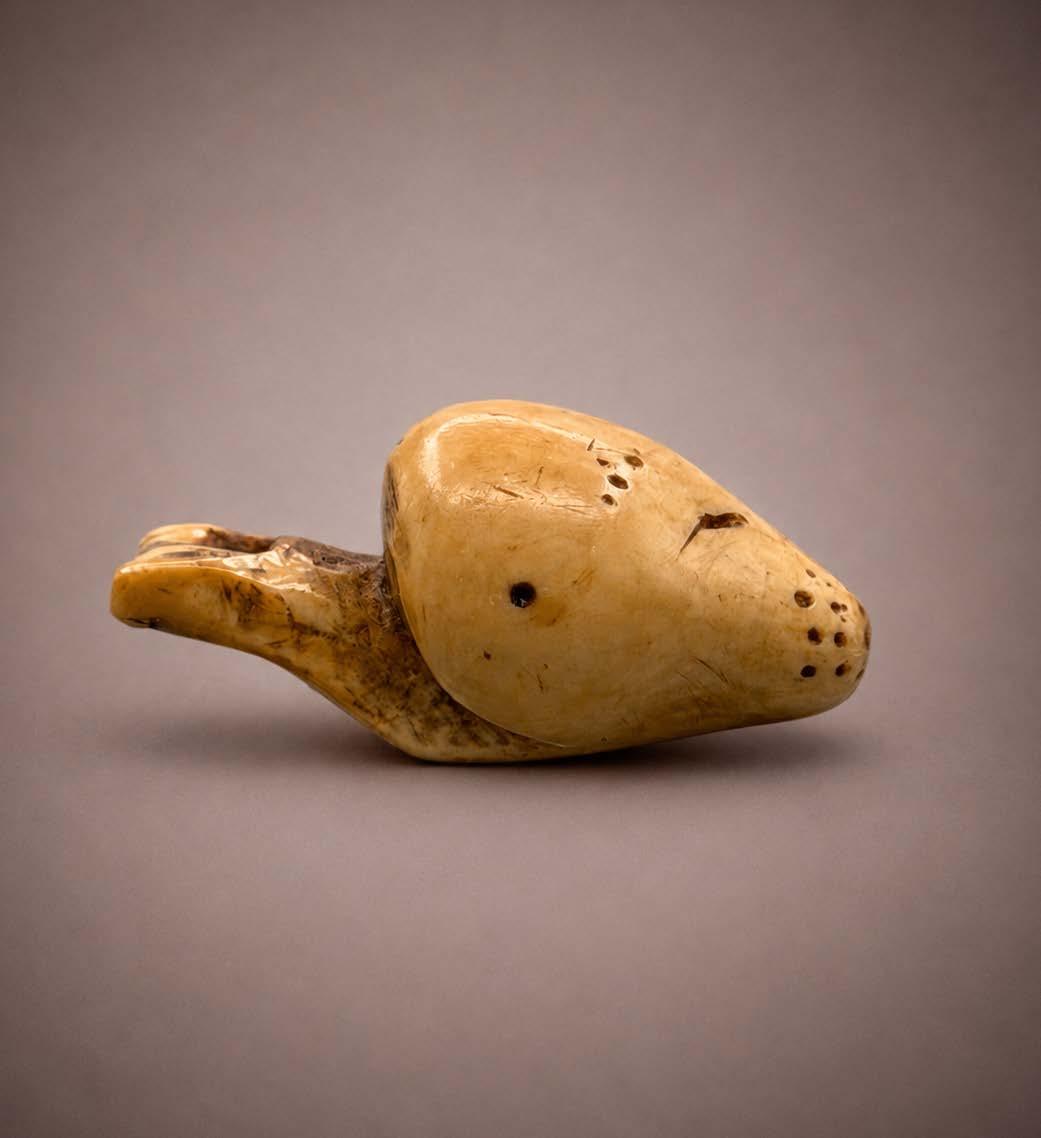
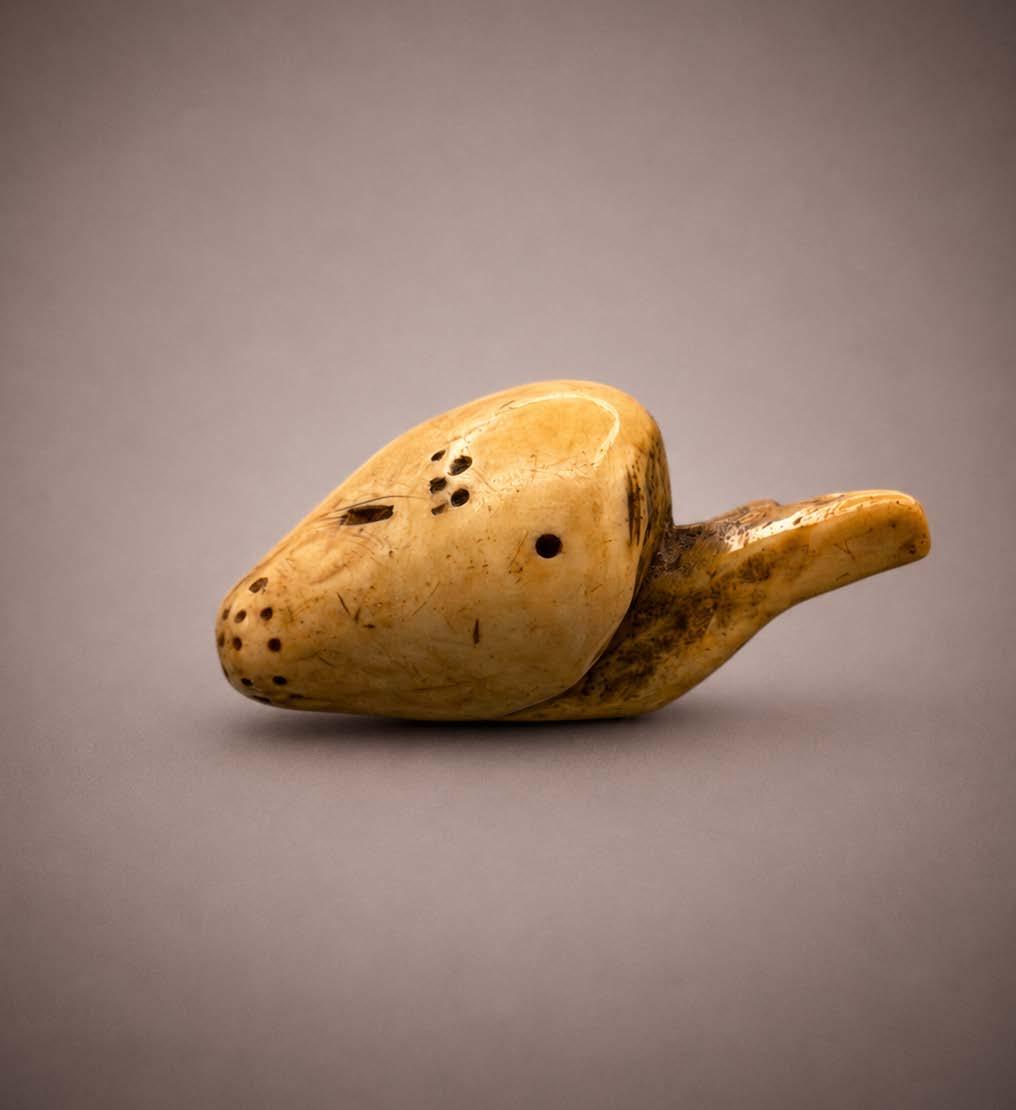
BELT FASTENER OR TOGGLE IN THE FORM OF A SEAL HEAD
PUNUK ISLANDS, ALASKA
18th century or earlier
Walrus ivory
Length: 1 in, 2 ½ cm
PROVENANCE
Dug by Jason Iya on the Punuk Islands
The smallest objects in the Arctic artistic tradition are often the most charged. In a world where every possession had to justify its weight and every material had to be worked by hand in conditions of extreme cold, a carving of one inch in walrus ivory — perfect in form, complete in detail, resolved in expression — represents an investment of time, skill, and attention that speaks directly to the object’s importance. This was not made casually.
This miniature seal is carved from a single piece of old walrus ivory that has aged to a deep, warm amber — the color of ivory that has spent long years in close contact with human skin, carried in a pocket or pouch or worn against the body on a thong. The surface is polished to a high sheen by handling rather than tool, the natural flecking and spotting of the ivory matrix visible across the rounded body like the dappled markings of a ringed seal’s pelt. The carver has rendered the animal with complete anatomical fidelity and absolute economy: the full, rounded body, the raised and slightly turned head, the projecting fore-flipper — everything necessary, nothing extraneous.
The function is revealed on the dorsal surface: a carved
price $750
rectangular bridge rises from the seal’s back, its transverse slot cut cleanly through to accept a thong or lashing. This is a toggle — a fastener and amulet simultaneously, the two functions inseparable in the Inuit and Yup’ik understanding of useful objects. Toggles of this kind secured the closures of hunting bags, clothing, and equipment; they were also among the most personal of amulets, the animal carved onto or into the toggle lending its yua — its inner spirit — to the person who carried it. A seal toggle on a hunter’s bag was not decorative. It was an invitation to the seal spirit, a gesture of respect and connection that acknowledged the animal’s willingness to be taken and asked for its continued cooperation.
The seal — puiji in Inuktitut — was the foundation of Arctic survival: food, fuel, clothing, and line all came from its body. To carry a seal in miniature was to carry the relationship itself, compressed into ivory and worn close. surfaces — the precise differential that results from repeated immersion in water carrying silt and organic material, the underside in greatest contact with the bottom. This is not the patina of a kept object but of a used one, worked season after season through ice holes in rivers and coastal waters until it passed out of use and into the long sleep of the collection.
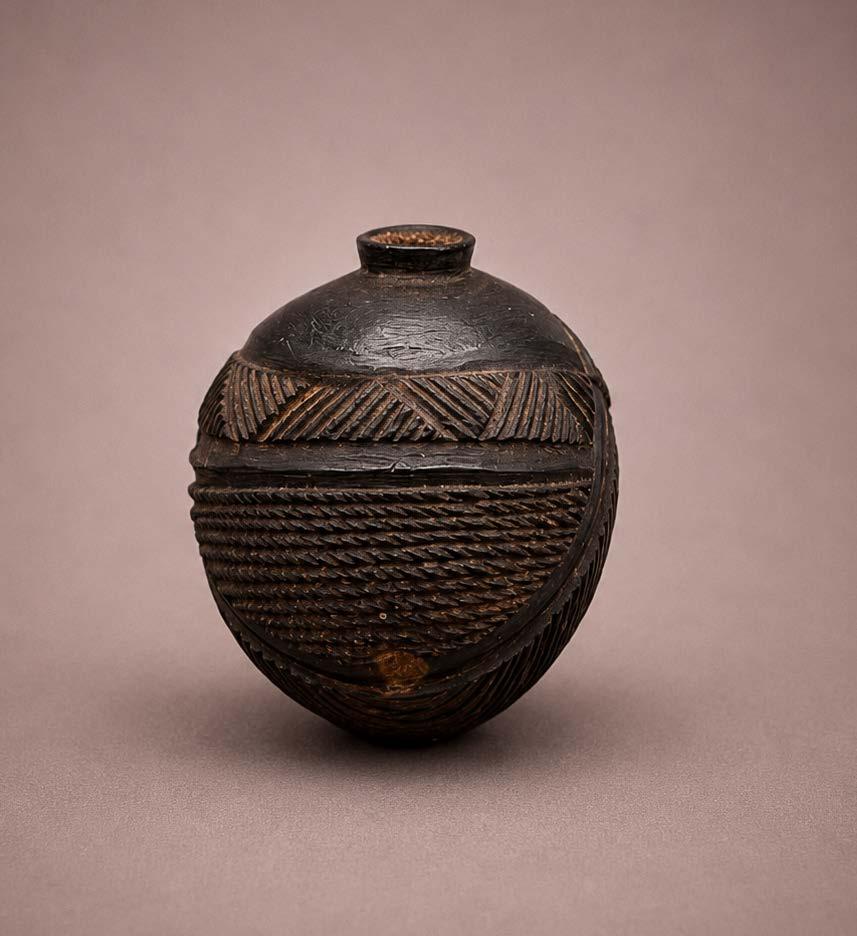
SNUFF CONTAINER ISHUNGU
ZULU
PEOPLES, KWAZULU-NATAL, SOUTH AFRICA
Late 19th / early 20th century
Wood
Diam.: 1 in, 2 ½ cm
PROVENANCE
Estate of Paul Walter. Walter was a New York-based collector and connoisseur who bought his first works — prints by the artist James McNeill Whistler — while attending Oberlin College in Ohio, and later obsessively collected all manner of objects, from Raj-era silver and Mughal miniatures to architectural drawings and art from many eras. Walter’s father had invented the electric igniter for gas cookers and, after becoming chief executive of his family’s electronics firm in 1968, he travelled frequently to European antiques markets and London’s auction houses. His collection of African non-figurative objects was donated to the Yale University Art Gallery.
like this one — were made with the full technical ambition of the Zulu carving tradition applied to the smallest possible scale.
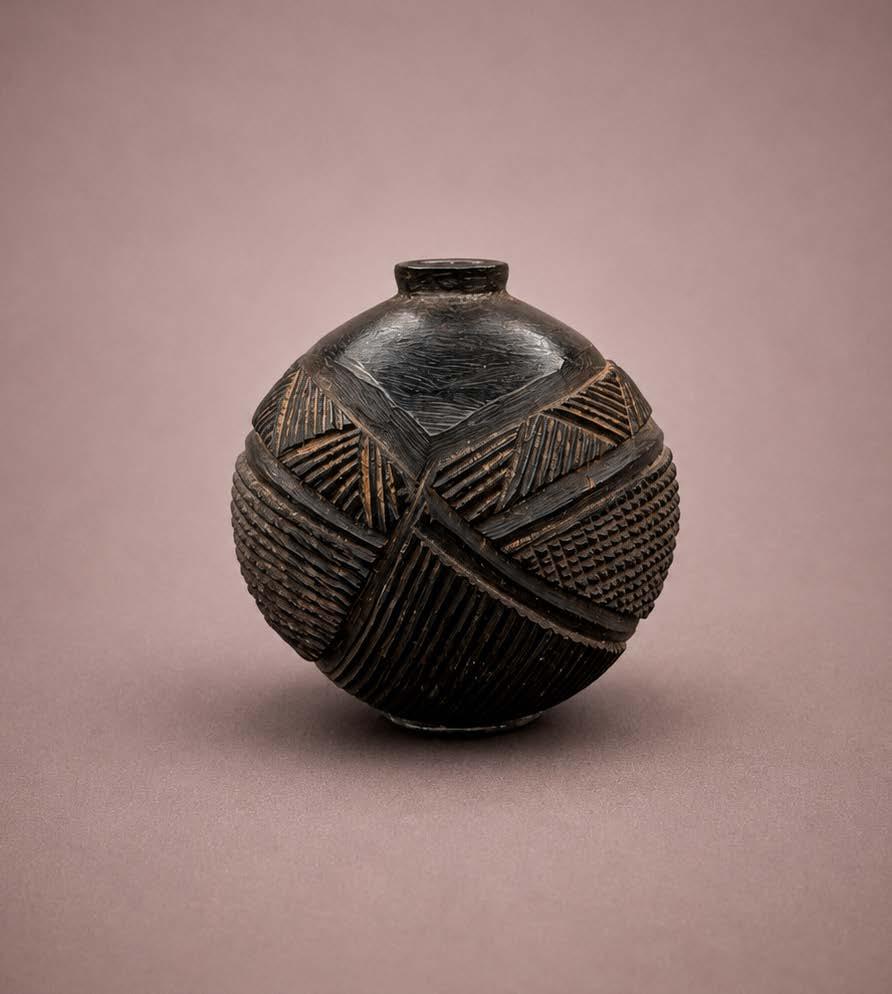
To hold this vessel is to hold a complete world in compressed form. The ishungu — the Zulu snuff container — is among the most formally resolved object types in the entire southern African decorative tradition: a sphere so nearly perfect that it reads as a geometric absolute, its surface so densely and precisely worked that every square centimeter is a considered decision, its function so intimate that it was carried on or near the body for years, decades, a lifetime.
Snuff (ugwayi) was central to Zulu social and spiritual life — offered to ancestors at the beginning of ritual, exchanged as a gesture of respect between individuals, carried always by those of status and years. The container that held it was accordingly an object of prestige, and the finest examples —
The form is the large ukhamba beer vessel translated into miniature with total fidelity: the same near-perfect spherical body, the same small cylindrical neck, the same commanding geometric surface program — all compressed to an object that fits in a closed fist. The parallel is not accidental. The ukhamba and the ishungu share a formal language because they share a social one: both are vessels of offering, of exchange, of the careful transfer of substance between people and between the living and the ancestral world. To make the snuff container in the image of the beer vessel was to carry the full weight of that tradition in something small enough to slip into a pocket.
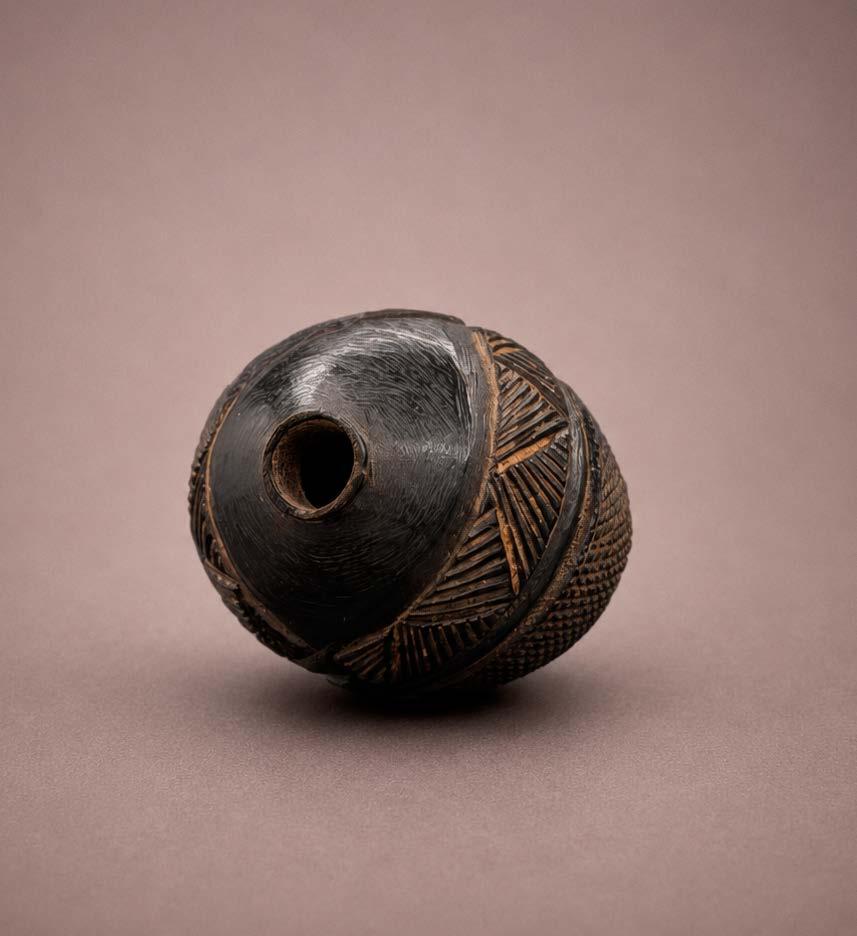
The surface is organized by bold raised dividing bands that cross the sphere in a structural X, partitioning the body into distinct decorative panels each filled with a different but related geometric vocabulary. Tightly packed diagonal parallel lines fill the large lower panels — the fundamental Zulu incised line register, executed here with a precision and consistency that speaks to a carver of considerable experience. The amasumpa nodule field — those small raised warts or bumps that appear across Zulu prestige objects from headrests to staffs to the finest ceremonial
vessels — occupies its own panel to one side, each nodule placed with even spacing in a regular grid. In the upper zone flanking the neck, triangular panels carry radiating fan-line registers that echo the converging geometry of the dividing bands. The shoulder and neck darken to near-black — the accumulated evidence of handling at the object’s most-touched point, where the stopper was removed and replaced, where fingers rested while the container was opened and offered.
The wood — dense, dark, carbonized — has aged to a surface of deep matte black that reveals its warm reddishbrown interior only in the incised channels and between the nodules, the two tones working together to describe form and decoration simultaneously. It is a surface that repays close attention: what reads from a distance as an almost uniformly dark sphere resolves at close range into a field of extraordinary textural richness.
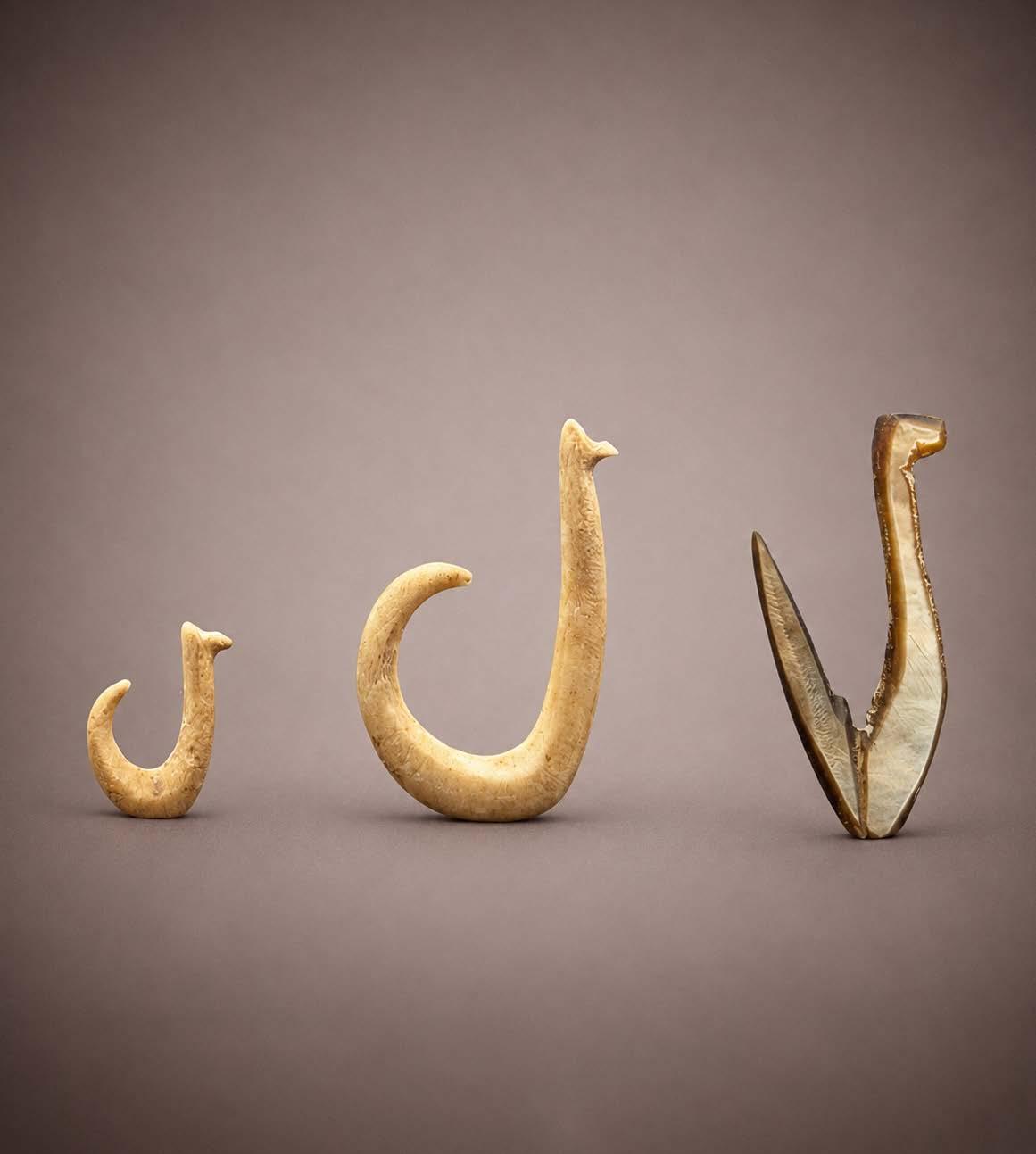
THREE FISH HOOKS
SOLOMON ISLANDS AND HAWAII
Late 19th / early 20th century Shell, bone
Height: ½ in (smallest) 1 in (largest), 1 ¼ cm (smallest) 2 ½ cm (largest)
PROVENANCE
UK private collection
Three Fishhooks: Two Hawaiian (Makau) and One Solomon Islands Shell Hook
The fishhook is one of humanity’s oldest and most universal tools — present in every culture that lived near water, adapted to every ocean’s particular fish, current, and depth with the precision that survival demands. But in the Pacific, where the sea was not a boundary but a highway, the fishhook was also something more: a technology refined over millennia of open-ocean navigation, a form so successfully resolved that the finest examples achieve the visual authority of pure sculpture, and an object sufficiently valued that the best hooks were named, inherited, and offered to the gods before important fishing expeditions.
The Two Hawaiian Hooks (Makau)
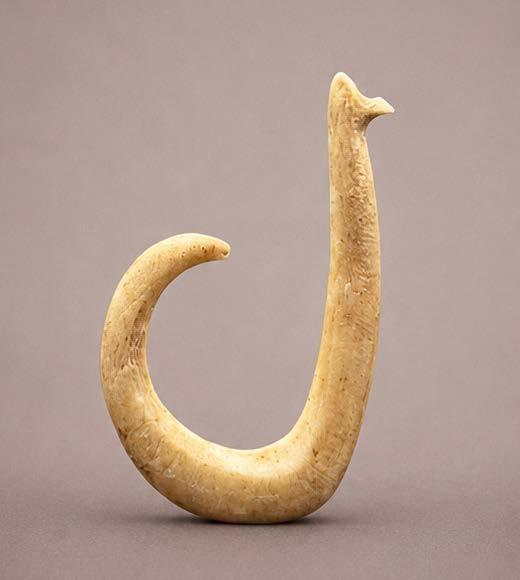
The Hawaiian makau is among the most distinctive fishhook forms in the Pacific — its tall, nearly vertical shank, tight circular body curve, and precisely placed inward barb creating a silhouette that is instantly recognizable and formally unlike any other tradition’s hooks. Both examples here follow this canonical form with fidelity: the long shank ascending to a small but
sharply defined barb spur at the top, the body sweeping in a generous arc to a pointed tip that curves inward to close the gap. The larger of the two has a fuller, more open curve and a slightly more sinuous shank — the individuality of handwork within a shared form — while the smaller is tighter and more compressed, every element scaled down without loss of resolution.
Both are carved from bone — the material worked to a smooth, close surface that has aged to warm cream, the dense grain of the animal material providing its own subtle texture. At this scale — bait hooks, small enough to target the reef and nearshore fish that were taken in quantity for daily use and for the larger trolling rigs that pursued ahi and mahimahi in open water — the precision of the barb placement is remarkable: each spur exactly positioned to allow easy entry and prevent escape, the functional logic of the form thoroughly understood and faithfully executed.
In Hawaiian tradition the makau carried meaning beyond its practical function. Hook-shaped pendants in whale ivory and other precious materials were among the most significant personal ornaments in the chiefly repertoire; the hook form itself was associated with the demigod Māui,
price $500 for the group of three
who fished up the Hawaiian islands from the ocean floor with a magical hook made from his grandmother’s jawbone.
To carry a hook, to make a hook, to fish with a hook well — all were acts that participated in a cosmological narrative older than memory.
The Solomon Islands Shell Hook
The third hook speaks an entirely different formal language. Cut from a single piece of Pacific shell — Trochus or large bivalve, its layered, iridescent interior surface visible along the inner faces — this is a V-form or rotating hook of the type characteristic of the Solomon Islands and wider Melanesian fishing tradition. Where the Hawaiian hooks are carved from bone in a single continuous curve, this hook is cut from flat shell plate into a two-armed form: a longer curved shank on the right terminating in an inward barb, and a shorter inner arm on the left creating the hook’s
functional gap. A small notch at the shank’s upper tip accepted the fishing line.
The shell material was not merely practical — throughout the Solomon Islands and across Melanesia, shell was a substance of exchange value and social significance, used for currency, ornament, and prestige objects as well as for tools. A hook cut from Trochus or large oyster shell was an object in a web of meanings that extended well beyond the fishing grounds. The V-form’s rotating action when a fish struck — the two arms pivoting against each other — was a functional refinement suited to the fast-striking pelagic fish of the Coral Sea.
Presented together, these three hooks compress an entire Pacific fishing world into a few inches of bone and shell: two traditions, two oceans, two formal solutions to the same ancient problem, each one perfect within its own logic.
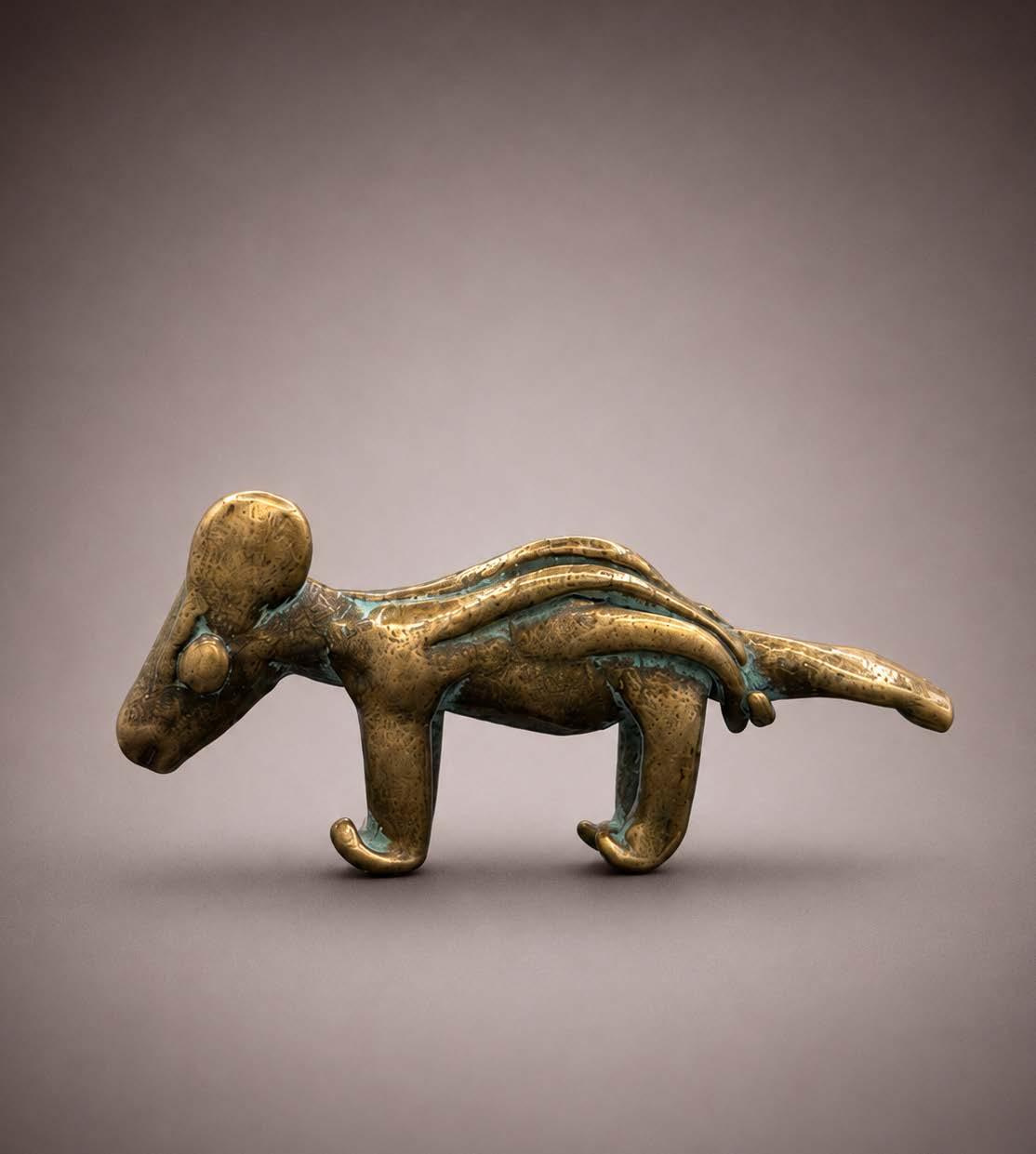
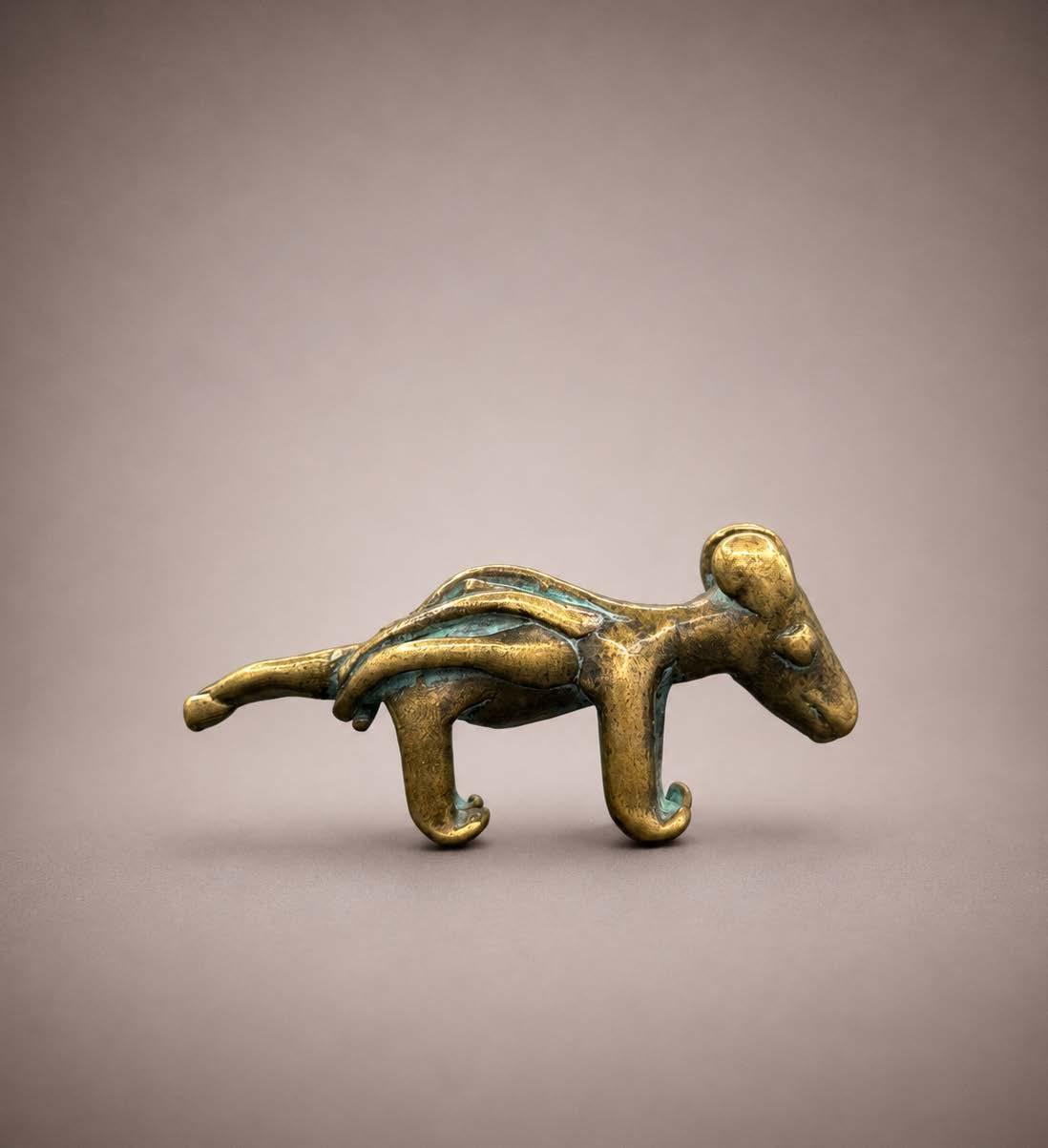
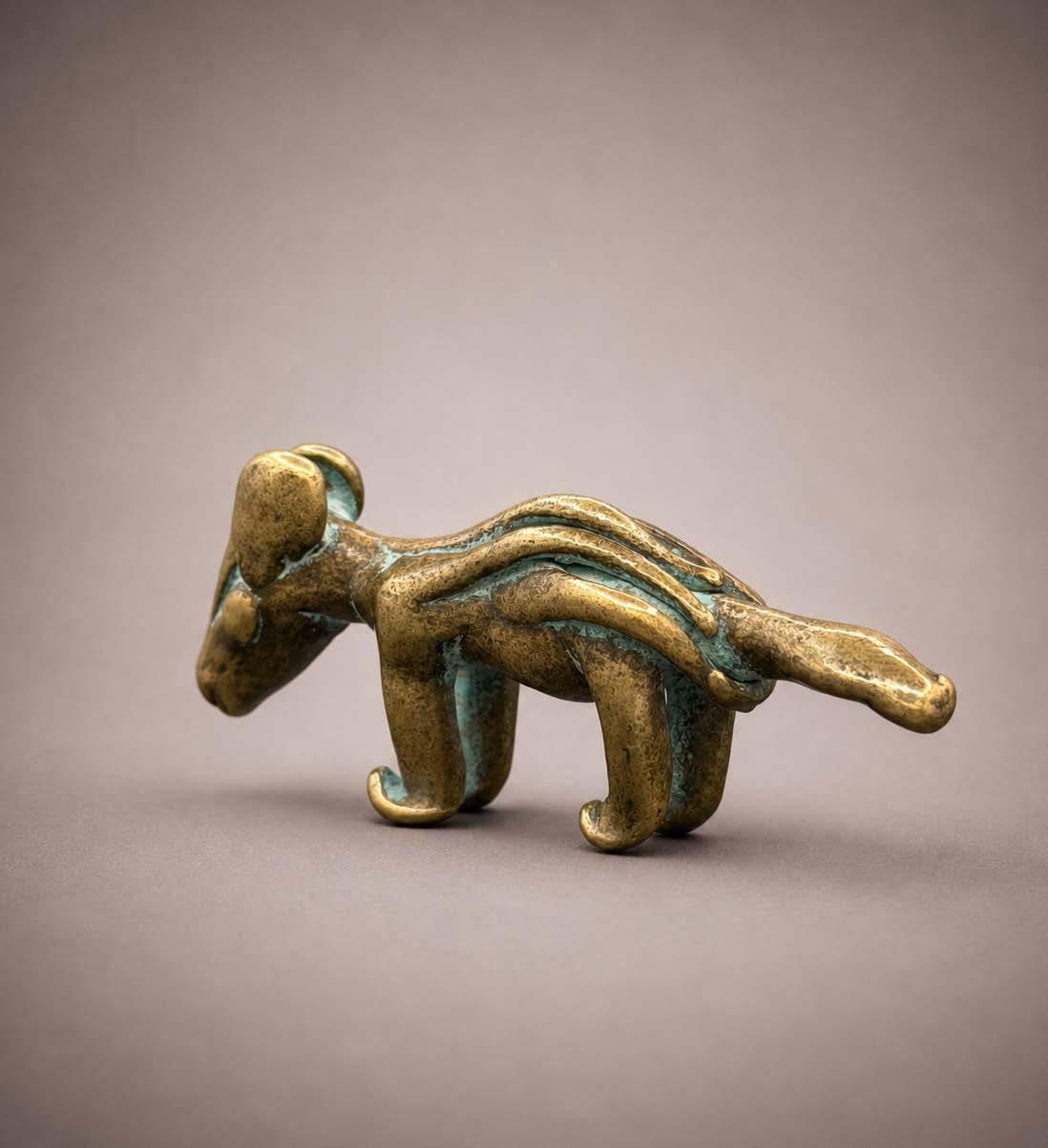
GOLDWEIGHT OF A QUADRUPED
AKAN PEOPLE, GHANA/IVORY COAST
Cast copper alloy (brass)
Late 19th century
Length: 2 ½ in, 6 cm
PROVENANCE
Irena Corwin. Irena Corwin was a ballet dancer and actress who later became a jewelry designer in New York in the 1960s and 1970s.
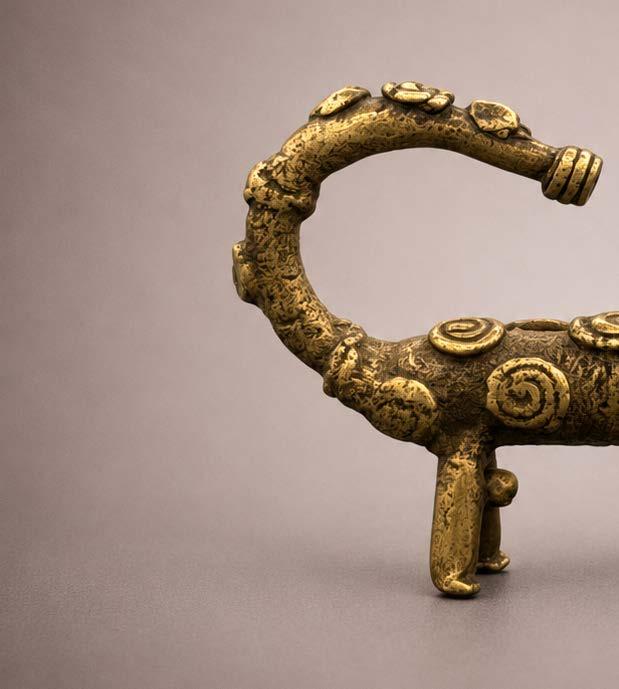
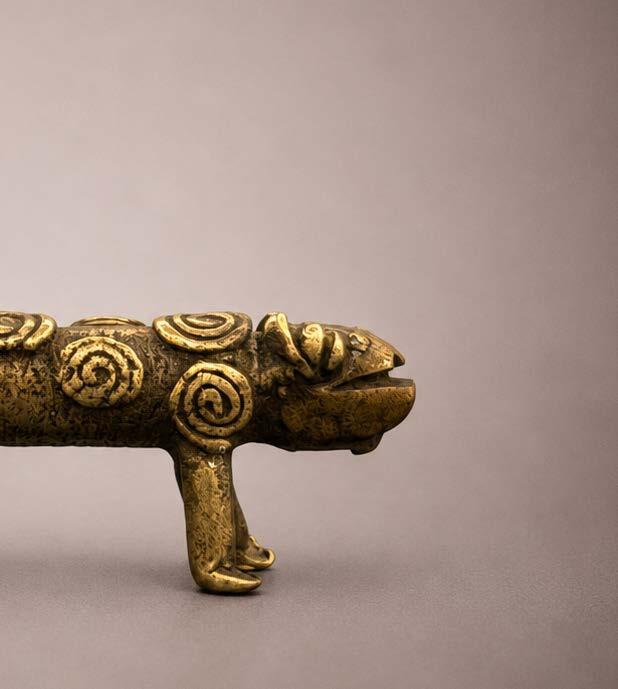
A boldly modeled figurative goldweight (abrammuo) in the form of a four-legged animal — most plausibly a ram, given the rounded, bulbous head, curling horn-like protrusion, and compact, muscular body — rendered in the schematic, energetically abstracted manner characteristic of late-period Akan figural casting. The piece shows the naturalistic economy typical of Akan animal weights: four splayed legs with rounded hooves, a strong arching back, and a tail extended rearward as a counterbalance. Vivid blue-green verdigris patina pools in the recessed areas between the legs and along the spine, contrasting richly with the warm golden-brown of the high relief surfaces. Cast using the lost-wax technique, these figurative weights served both as practical instruments for measuring gold dust in trade transactions and as culturally encoded objects embodying Akan proverbs and moral principles. Figurative weights of this kind first appear around 1600 ad, and many symbolize well-known proverbs, riddles, and codes of conduct central to Akan cultural life.
price $350
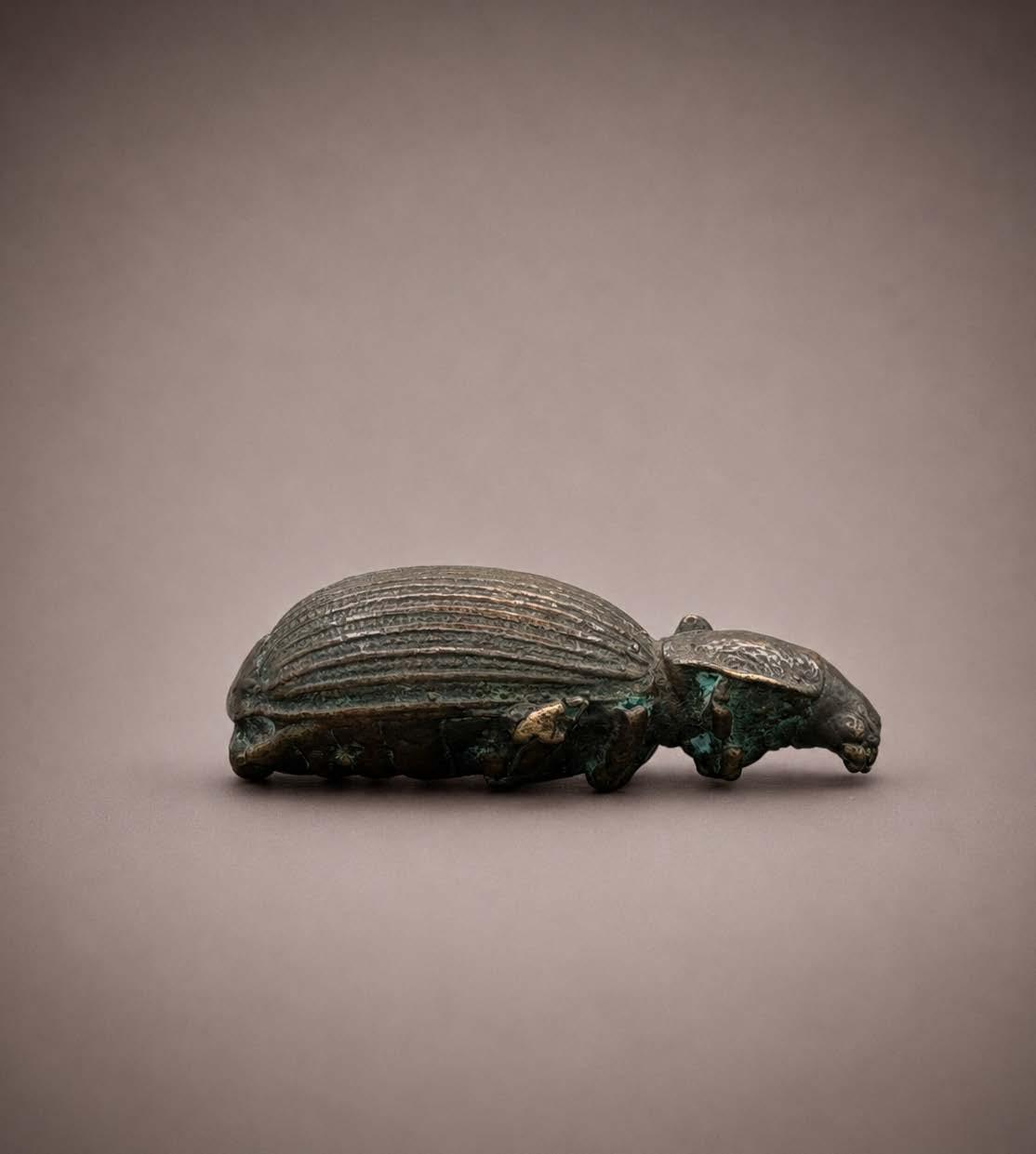
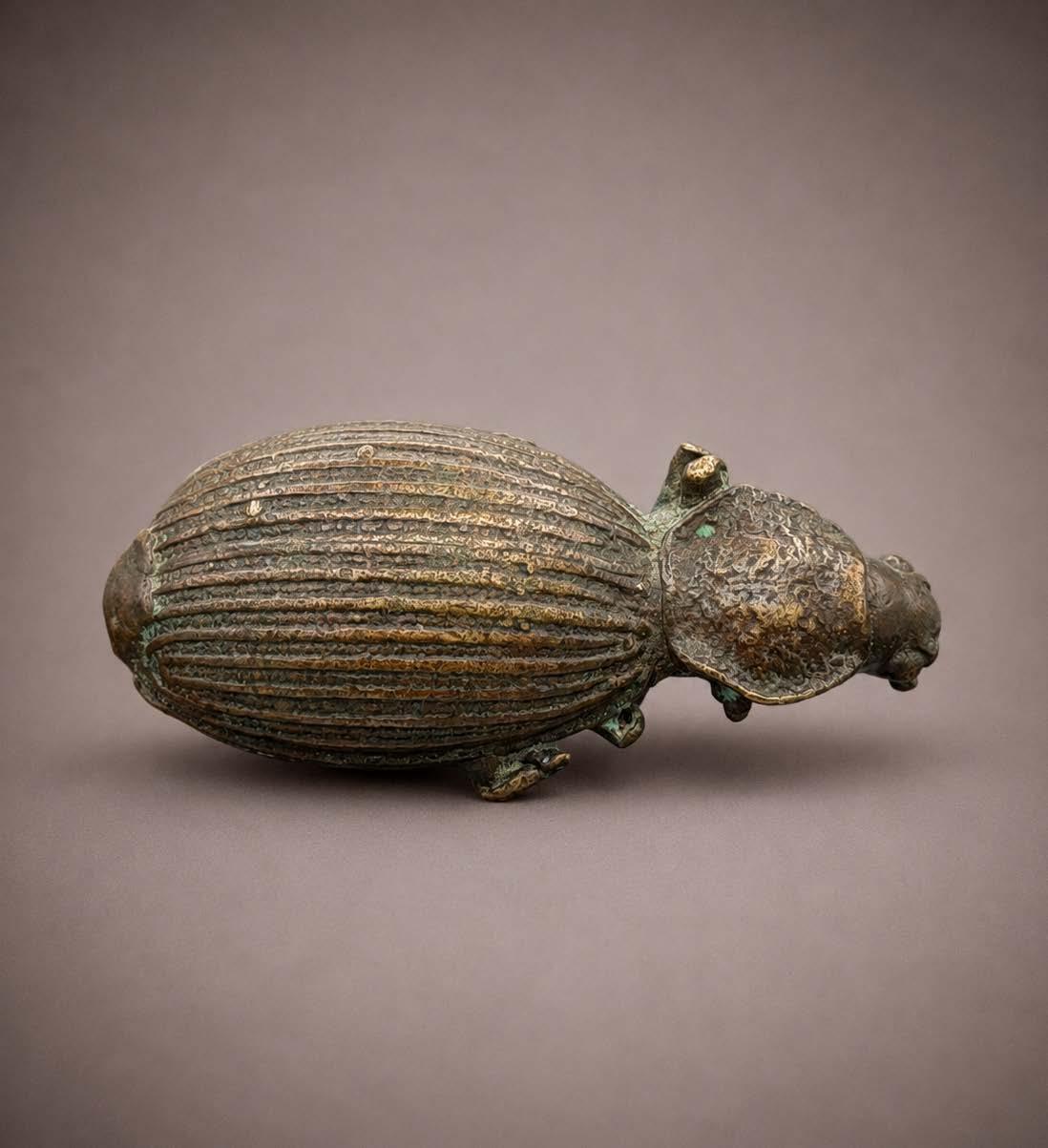
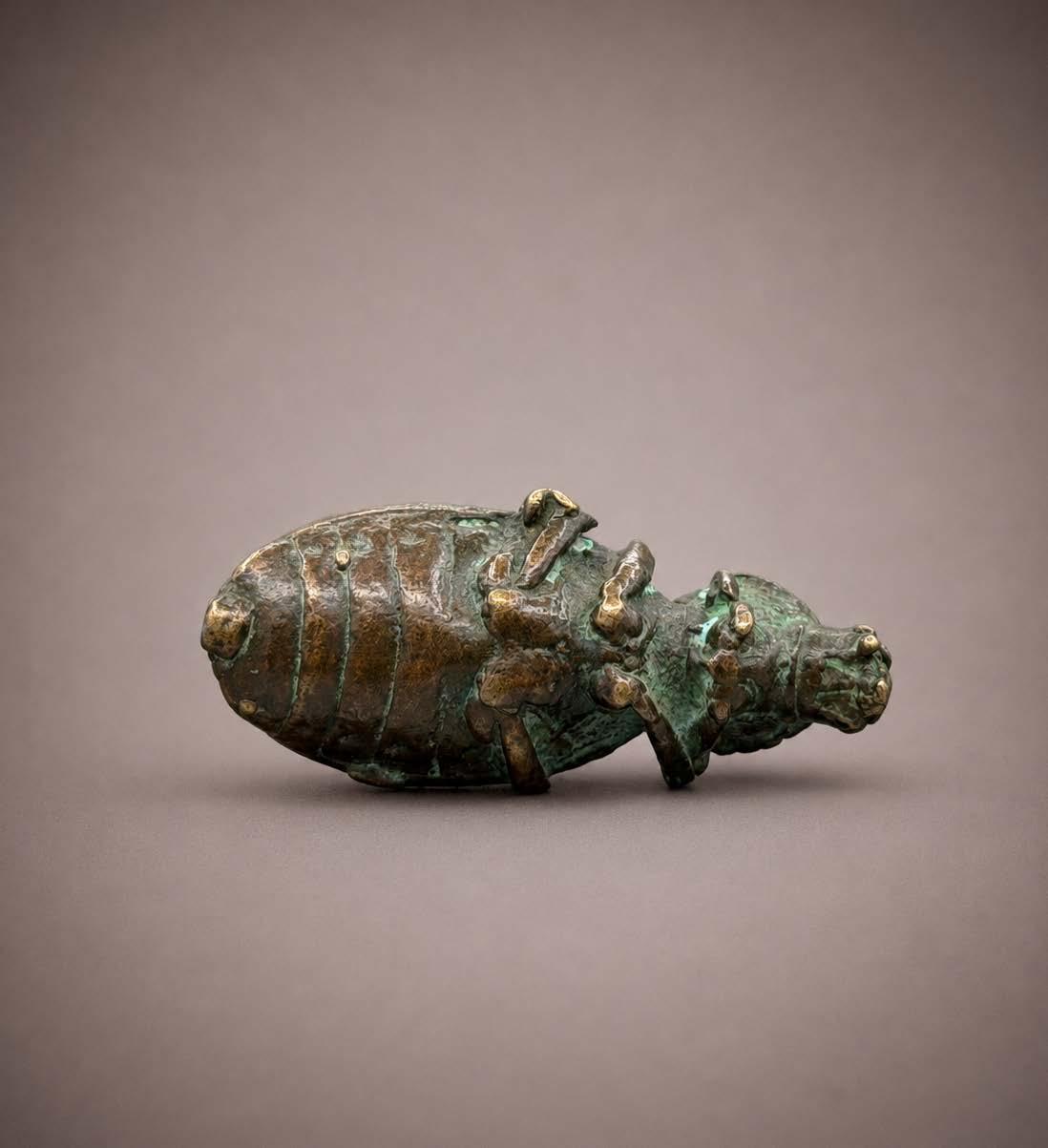
GOLDWEIGHT OF A DUNG BEETLE
AKAN PEOPLE, GHANA/IVORY COAST
Cast copper alloy (brass)
Late 19th / early 20th century
Length: 2 in, 5 cm
PROVENANCE
Irena Corwin. Irena Corwin was a ballet dancer and actress who later became a jewelry designer in New York in the 1960s and 1970s. She went to Europe to acquire objects to incorporate into her jewelry.
An exceptionally detailed goldweight in the form of a large beetle — likely a dung beetle or ground beetle (Scarabaeidae or related family) — naturalistically rendered with a domed, longitudinally ribbed elytra (wing case), a broad pronotal shield, articulated head with visible mandibles, and stubby legs. The base shows a secondary face or figural element on the ventral side, suggesting this may have served a dual symbolic function. Insect goldweights of this kind were often cast directly from nature: the dried insect was embedded in clay with a wax sprue attached, then fired until the insect’s body burned away entirely, leaving a hollow void into which molten metal was poured — an extraordinarily direct form of nature casting. The surface carries a rich, layered patina of deep brown and malachite green, consistent with age and use. The ribbed detailing on the elytra is rendered with remarkable fidelity. In Akan and related societies, organic forms in goldweights recall the dialogue between humanity and nature, and the choice of animal was rarely arbitrary — each shape was intentional, often encoding a proverb or moral lesson.
price $350
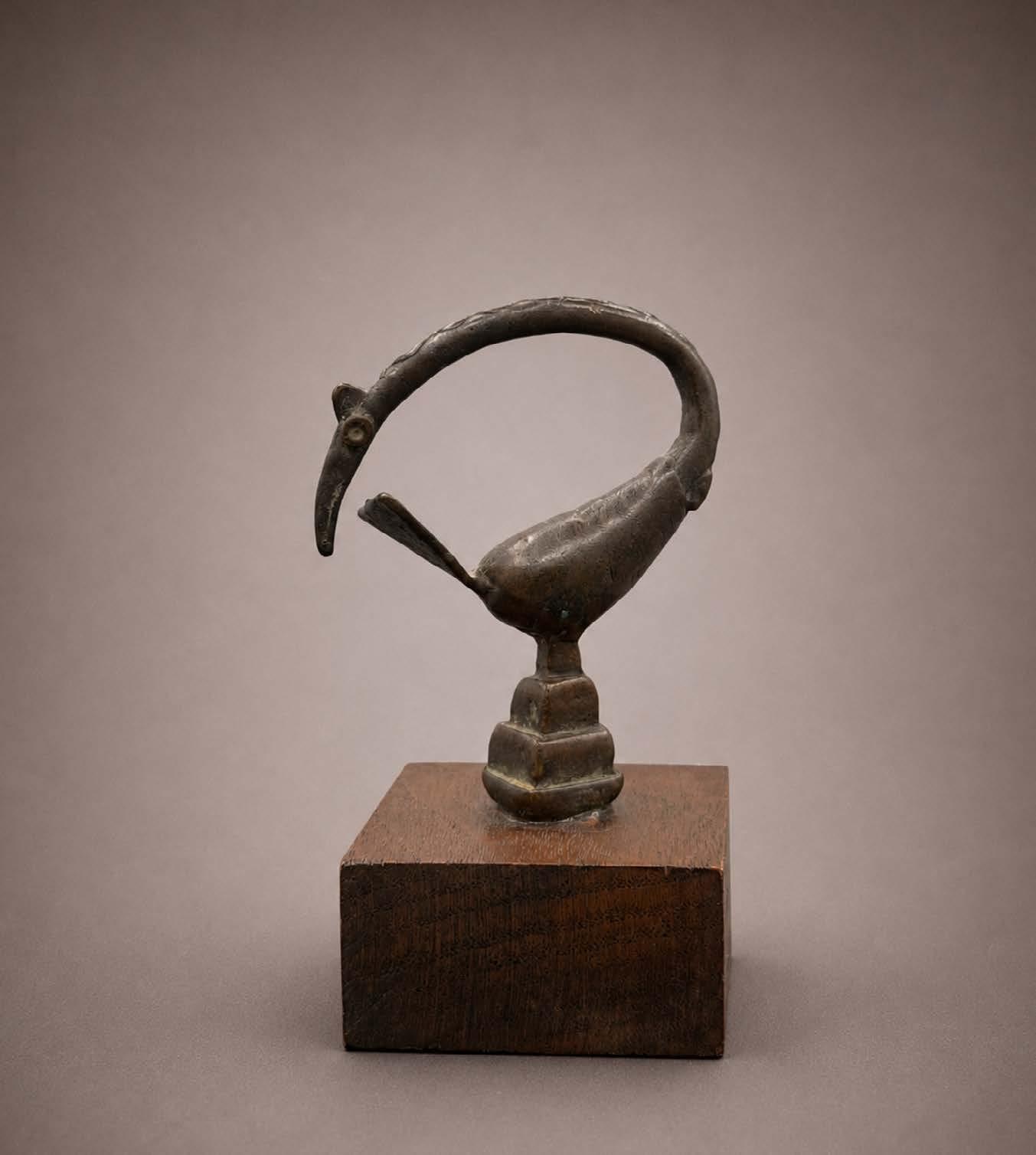
GOLDWEIGHT OF A HORNBILL
AKAN PEOPLE, GHANA/IVORY COAST
Cast copper alloy (brass)
Late 19th / early 20th century
Height: 2 ½ in, 6 cm
PROVENANCE
Irena Corwin. Irena Corwin was a ballet dancer and actress who later became a jewelry designer in New York in the 1960s and 1970s. She went to Europe to acquire objects to incorporate into her jewelry.
Among the Akan-speaking peoples of Ghana and Côte d’Ivoire, the system of brass goldweights — abrammuo — was one of the most sophisticated and culturally rich material systems ever devised for the measurement and exchange of gold dust. In use from at least the fourteenth century until the colonial disruption of the gold trade in the late nineteenth, these small cast-brass objects were the instruments of commerce and the repositories of proverbial wisdom simultaneously: every weight had a meaning, and many were made in the form of animals, objects, and human figures whose visual identity encoded a specific saying or moral precept that both parties to a transaction were expected to understand.
This hornbill weight is cast with the formal intelligence and sculptural confidence that distinguishes the finest Akan bronzes from the merely competent. The bird’s long neck sweeps upward from the compact body in a full, graceful arc — curving back over itself so that head and beak face forward and down, the whole form contained within an
ovoid silhouette that is satisfying from every angle. The long, downward-curving beak is the hornbill’s defining feature and the source of its proverb: in Akan tradition, the hornbill was associated with patience, foresight, and the willingness to look downward — to attend carefully to what lies beneath the surface of things. A trader who used this weight signaled something about how he understood his own practice.
The neck and body carry fine incised or cast linear decoration rendering the feathering with naturalistic delicacy — a level of surface attention that goes well beyond functional necessity and speaks to a maker who took pleasure in the full resolution of form. A tiny raised boss with a drilled center serves as the eye — minimal, precise, and entirely alive. Below the body, a stepped three-tiered square plinth — cast as part of the single lost-wax pour — elevates the bird with the same architectural dignity given to prestige objects across the Akan world.
The patina is deep and even: a warm dark brown with traces of verdigris in the deepest recesses of the incised decoration, the surface of old brass that has spent long years in use and handling. The casting itself is crisp and clean — evidence of a skilled founder working within a tradition that had refined the lost-wax process to a high art across many generations.
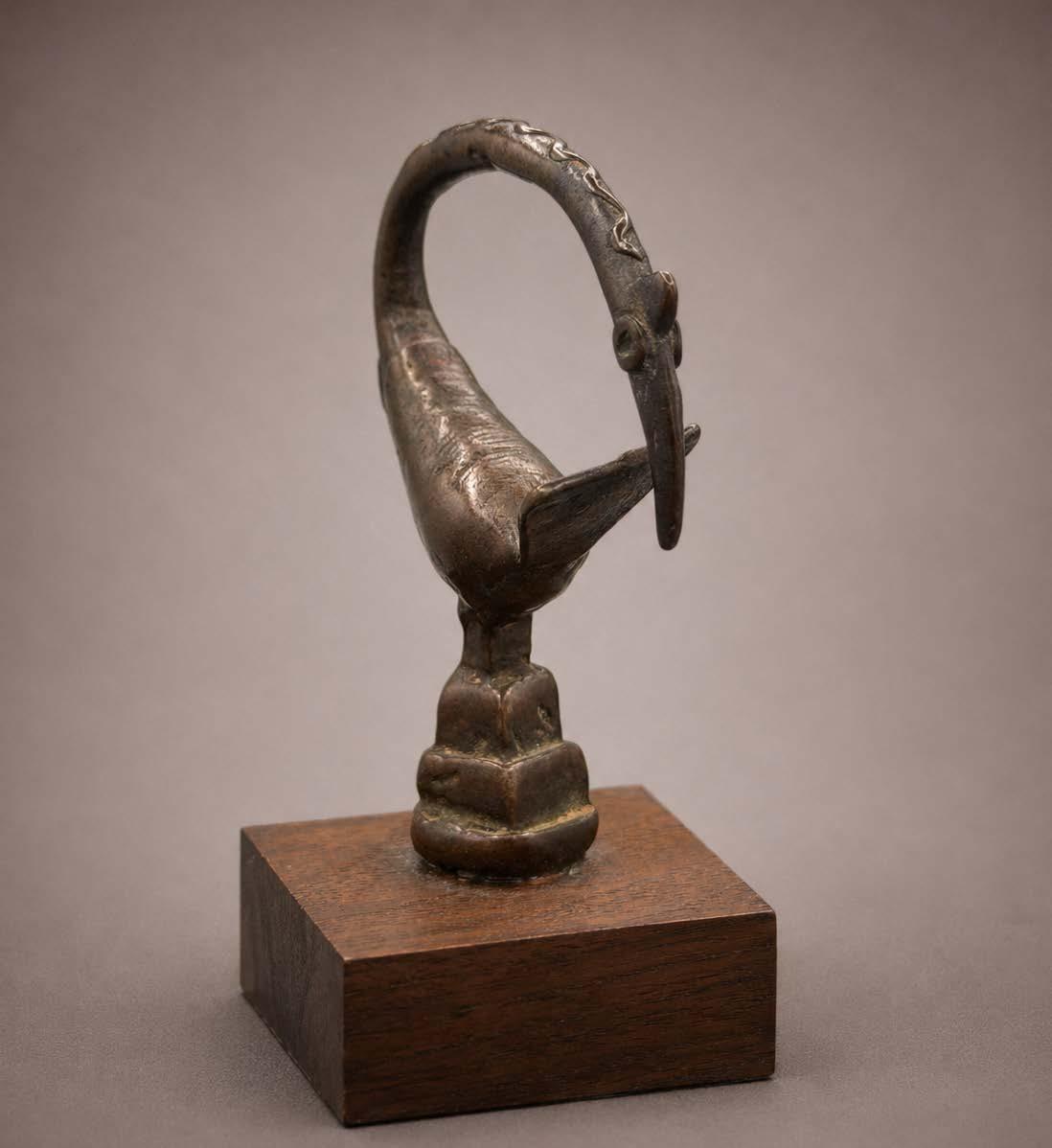
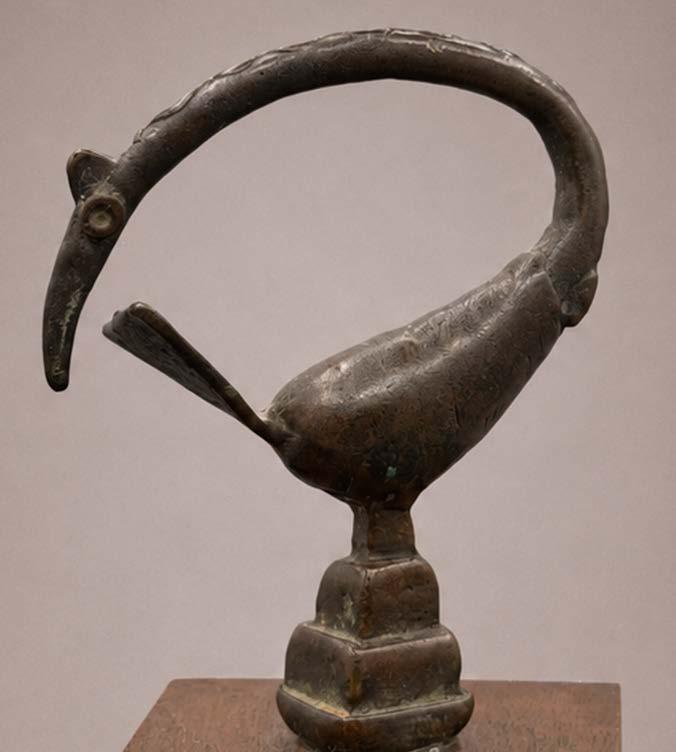
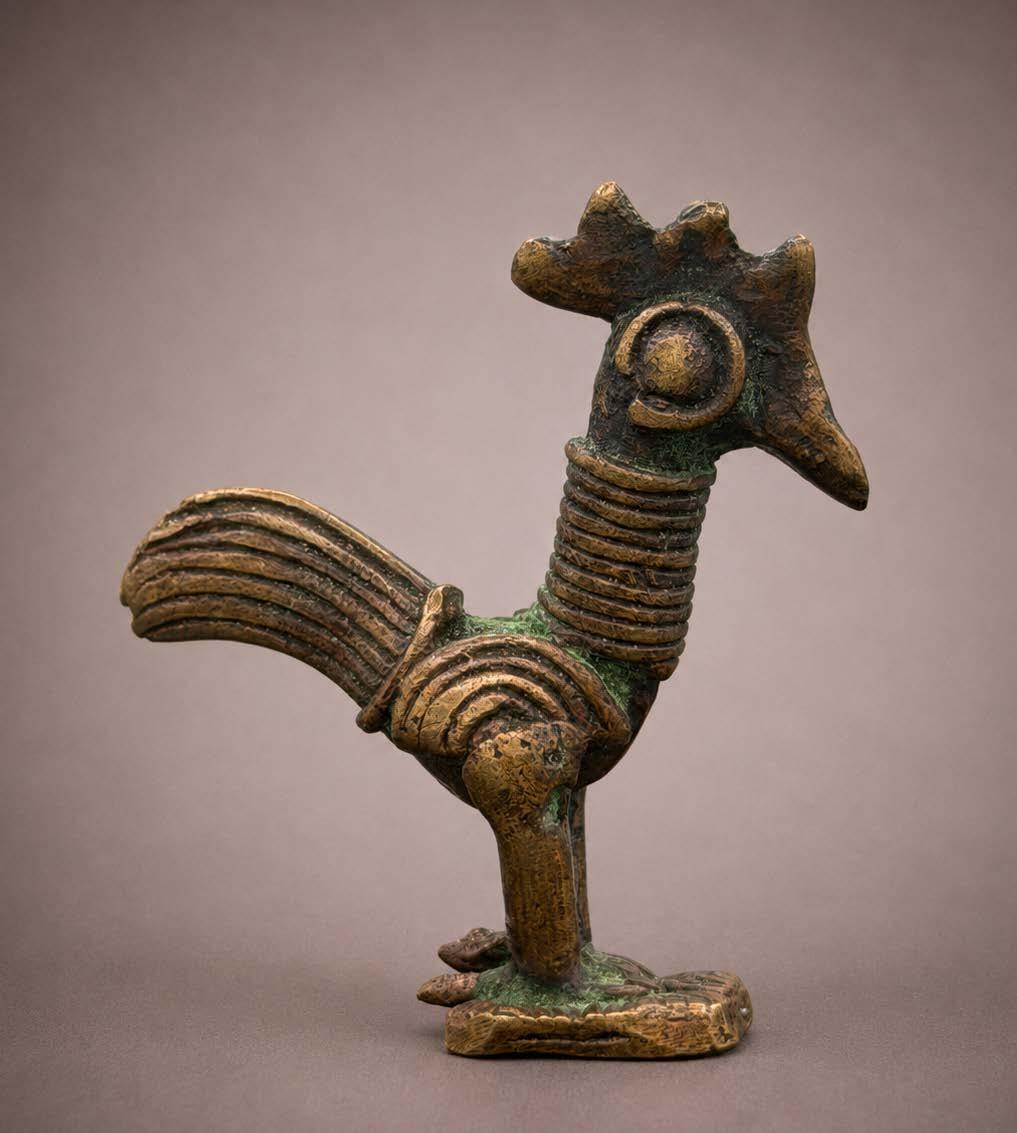
GOLDWEIGHT OF A ROOSTER
AKAN PEOPLE, GHANA/IVORY COAST
Cast copper alloy (brass)
Late 19th / early 20th century
Height: 2 in, 5 cm
PROVENANCE
Irena Corwin. Irena Corwin was a ballet dancer and actress who later became a jewelry designer in New York in the 1960s and 1970s. She went to Europe to acquire objects to incorporate into her jewelry.
The rooster (kokoo) was one of the most symbolically loaded birds in the Akan proverbial universe, and among the most frequently rendered in brass. Its crow announces the dawn before the sun is visible — a proclamation of what is coming before it arrives. The Akan proverb most commonly associated with the rooster weight encodes this precisely: Kokoo — the rooster crows not because it has seen the sun, but because it knows the sun is coming. A trader who placed this weight on the scale communicated something about his own nature: that he acts on knowledge and foresight, not merely on what is already obvious to everyone. This rooster weight is among the most fully realized examples of the form. The bird stands in a posture of full alert display — chest forward, head raised, tail swept high — cast with a confident understanding of the animal’s essential gesture that goes well beyond mere identification. The serrated comb erupts from the crown in a bold starburst of points; the beak projects forward at the precise angle of a bird in mid-crow; the fanned tail rises in a
cascade of parallel ridges, each feather a bold raised rib that catches light along its full length.
The neck is the casting’s most inventive element: encircled from base to head by a series of tightly spaced horizontal coils that give it the appearance of a spirally wound collar — a treatment that transforms the bird’s anatomy into something simultaneously naturalistic and formally abstracted, suggesting both the physical neck and the idea of ornament, of prestige marking, of a bird that wears its status visibly. At the junction of neck and body, a bold scroll or volute anchors the composition at its center of gravity. The eye is a raised spherical boss set within a cast ring — a small but exact detail that gives the face its alert, watchful quality.
The base is an irregular oval plinth, textured to suggest ground, the feet clearly articulated with individual toes gripping the earth — the rooster not posed but planted, present, occupying its territory with the assurance of the proverb it embodies. price $350
The patina is exceptional and has developed over a long period into a rich two-tone surface: warm golden brass glowing on every raised ridge, every coil, every feather tip and comb point — the metal burnished by handling to its original color — while deep verdigris green has settled into the recesses and body surfaces, the natural oxidation of old brass in a humid tropical environment. The contrast between gold and green gives the weight the visual complexity of a painting, the two tones working together to describe form and depth simultaneously.
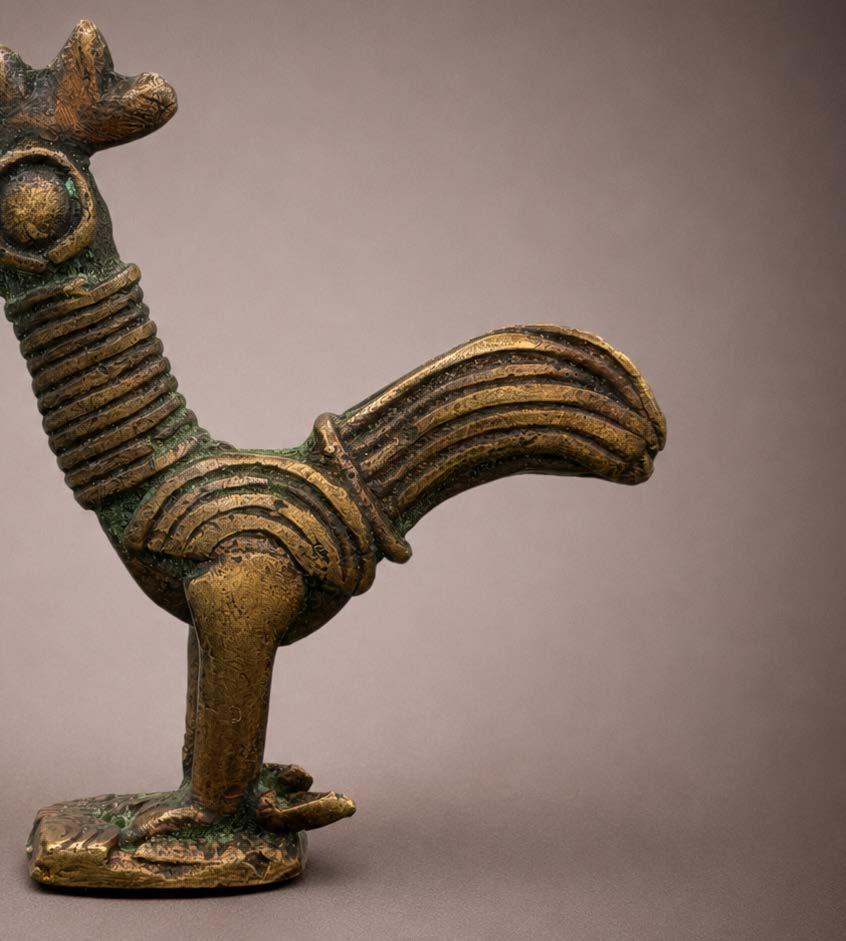
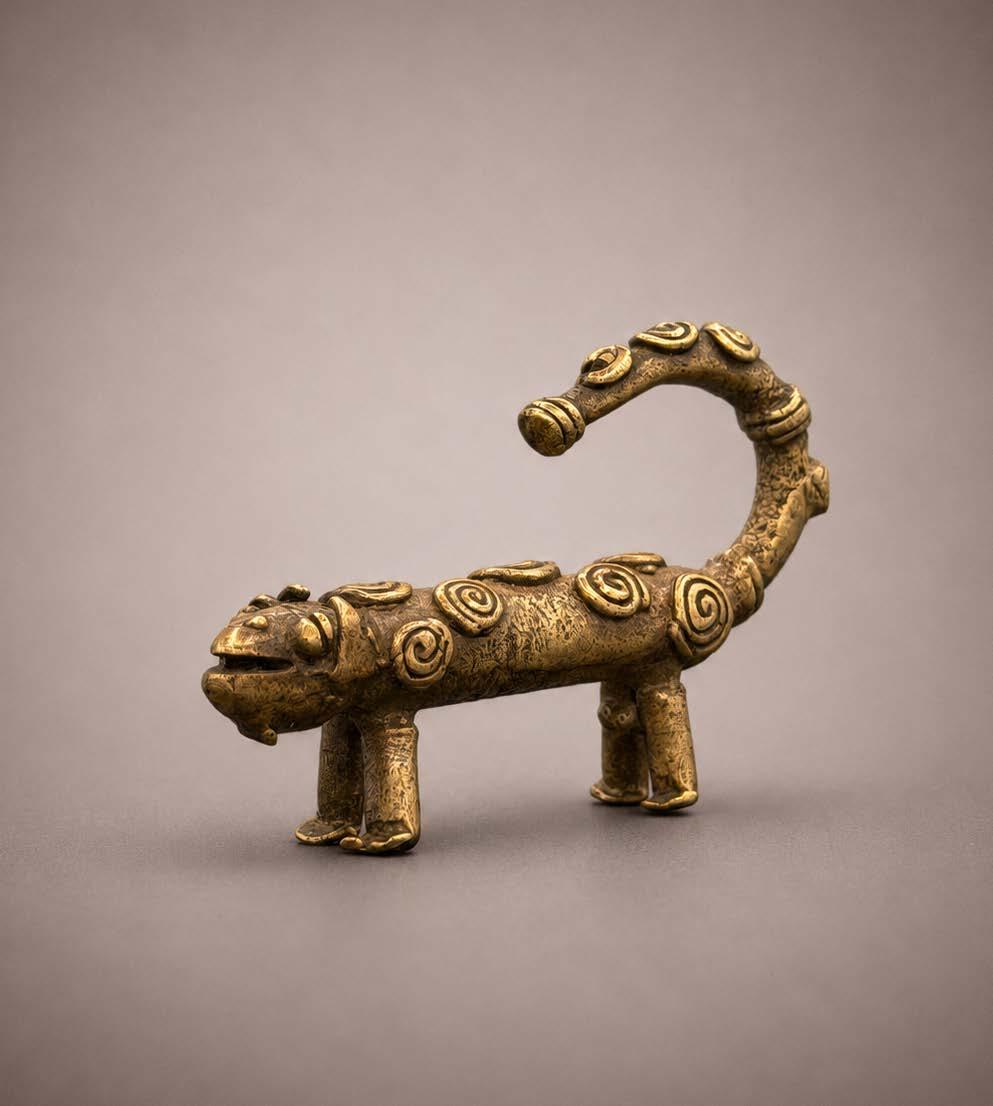
GOLDWEIGHT OF A MONITOR LIZARD
AKAN PEOPLE, GHANA/IVORY COAST
Cast copper alloy (brass)
Late 19th / early 20th century
Length: 2 in, 5 cm
PROVENANCE
Irena Corwin. Irena Corwin was a ballet dancer and actress who later became a jewelry designer in New York in the 1960s and 1970s. She went to Europe to acquire objects to incorporate into her jewelry.
the animal’s characteristic blunt-nosed calm, two large hemispherical eyes set laterally on the skull exactly as anatomy demands, flanking a closed, composed mouth. This is not a threatening animal but a watching one — present, patient, taking the full measure of its surroundings before committing to any movement.
The monitor lizard — the great Varanus niloticus of the West and Central African riverbanks and forest margins — was a creature that occupied an uneasy place in the Akan imagination. Large, deliberate, armored, and ancientseeming, the monitor moved between water and land with the unhurried assurance of an animal that has no natural predators of consequence. It was associated in Akan proverbial thought with patience, with the careful survey of terrain before action, and — through its name’s phonetic proximity to owuo, death — with the crossing of thresholds that cannot be uncrossed. A weight in this form carried weight in more than the literal sense.
This monitor lizard is cast with a keen observational fidelity to the animal’s essential character. The body is compact and powerfully cylindrical, raised on four substantial columnar legs that give the creature a convincingly terrestrial, ground-owning posture — the monitor’s characteristic deliberate stride, each foot placed with intention. The wide, flat head is turned forward with
Across the body and continuing up the length of the sweeping tail, raised spiral bosses punctuate the surface at organic intervals — six or more on the body, three or four on the tail arc — each a tightly wound concentric coil that describes simultaneously the monitor’s scaled, textured skin and the deeper Akan symbolic vocabulary of the spiral: cyclical time, the coiling python, the life force that returns to its own beginning. Between the bosses, the body surface is worked in a fine granular texture that provides a warm, matte ground against which the polished spirals read with crisp golden clarity.
The tail is this weight’s most distinctive formal feature, differentiating it clearly from the crocodilian type. Where the crocodile’s tail curls tightly back over its own body in a contained arc, this monitor’s tail sweeps upward in a broader, more open curve — reaching for height rather than containment, the arc generous and self-assured. Additional spiral bosses punctuate the tail’s length, and a rounded terminal knob closes the composition at the apex. The result is a silhouette that reads from across a room: horizontal body, vertical tail, the two axes in dynamic tension.
The patina is a warm, even golden brass — the metal enriched by years of handling to a tone that reads in certain lights as almost honey-colored, the textured ground darkening to provide relief and depth against the polished high surfaces.