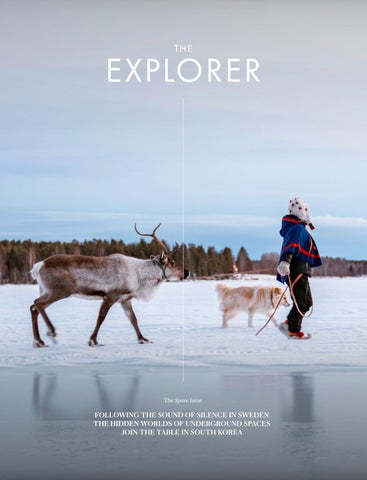
The Space Issue
FOLLOWING THE SOUND OF SILENCE IN SWEDEN
THE HIDDEN WORLDS OF UNDERGROUND SPACES JOIN THE TABLE IN SOUTH KOREA
The Space Issue
FOLLOWING THE SOUND OF SILENCE IN SWEDEN
THE HIDDEN WORLDS OF UNDERGROUND SPACES JOIN THE TABLE IN SOUTH KOREA
A passion for food and drink means Beverley is at her happiest when there’s fresh fish on the plate and plum wine in hand. A recent Asia trip reignited memories and her appetite for a region that’s unmatched in flavour.
Cape Town writer Terri loves unearthing the history and legends that bring places to life. In this issue, she explores the ancient voices that echo through Australia and New Zealand.
From solo traveller to global expedition leader, Emily continues to quench her thirst for travel through her writing and the occasional overseas adventure.
Often swapping cityscapes for serene, bird-filled landscapes, this photographer found inspiration in the true silence and tranquil vastness of Northern Sweden this year.
Bitten by the travel bug, Britt has now ticked off both Switzerland and Germany this year. In this issue she explores the communities living in remote corners all over the world.
MIRABEL OKPLA
Based in England but a lover of sunsoaked destinations, Mirabel is always seeking out her next tropical escape.
From once navigating hostels to now uncovering the best local coffee spots and food markets the world over, Emelie’s love for exploration is ever-evolving.
As at home on remote mountain peaks as on cacophonous city streets, Natalie explores how visiting amazing places has the power to transform us.
Forever following her tastebuds –especially when it comes to gelato –Michelle recounts some of her favourite culinary experiences on a recent trip to Greece’s lesser-visited spots.
MELISSA HAUN
Melissa has lived all over the world and is currently based in Lisbon. When she’s not writing, you’ll find her searching for the best surf spots and plant-based food in Portugal.
SOPHIE GREEN
A languages degree sparked Sophie’s enduring love of travel and she’s been exploring ever since. In this issue, she discovers new ways to explore the mesmerising landscapes of her former home, Peru.
With a creative spirit fuelled by music and modern trends, Demi loves to explore, finding endless inspiration across the globe.
As content touring Norway’s wild Lofoten Islands as she is foraging for porcini in the hills of Emilia-Romagna, Martha brings her eye for exploration to this issue. She speaks with a first-time Jacada traveller who celebrated family milestones on the trip of a lifetime.
Finding stillness in daily life, Sara believes that travelling is an excellent way to meditate in motion. In this issue, she connects these two worlds through simple experiences anyone can embrace.
JESSICA JULIENNE
Hailing from a small island in the Seychelles, Jessica has long dreamed of exploring places far beyond its familiar shores. Slowly, she’s turning that into a reality, letting her love for great food lead the way.
The Explorer is published by Jacada Travel
Travel enquiries enquiries@jacadatravel.com
US +1 646 895 8368
UK +44 20 3514 0977
Online jacadatravel.com
Editor-in-chief
Jessie Brechin-Leman
Editor Eleanor Aldridge
Design
Extract Studio
Illustrations
Alicia Warner
Sophie Green
With thanks to The Kierzek family
Legendary Mwiba Lodge
Katogi Averoff Hotel & Winery
Wilderness
Tourism Australia
Andean
All Nordics
When you have finished with this magazine please recycle it.
Printed in Canada by Hemlock Printers
The constant presence of technology makes our lives easier in many ways but it also rules and restricts us. It’s no surprise, then, that when we travel, we're all looking for freedom. We seek the quiet vastness of open spaces, the chance to wander without crowds and that deep reset you only get from truly finding your ‘space.’
When I started Jacada my driving belief was that luxury travel should connect people, not separate them. My own trips through Brazil showed me how having that space to immerse myself in a new culture could achieve that, and it brought a clear vision that’s led us to where we are today.
Our trips are carefully designed to blend those two ideas: space and connection. We create room for you to connect more deeply – with the places you visit, with yourself, with your travel companions and with the people you meet.
Space can take on many meanings, as you’ll find in these pages. From endless stretches of ‘nothing’ to architectural marvels of the natural and human
worlds, the common thread is of appreciation for what surrounds us.
At the same time, the luxury landscape is truly evolving. It's not just about experiences anymore, or the spec of the furniture; it’s about exclusive access to spaces. Low-volume, high-value journeys are becoming ever more appealing. This approach, which attracts fewer visitors who contribute more meaningfully to a destination, is driven by a deep longing for the splendour of openness and expansive horizons.
Discover the untamed wilderness of Sweden’s far northern Sápmi region on page 22, consider Africa’s incredible wildlife as nature’s most impressive architects on page 46 and explore South Korea's shared food culture on page 74, where a meal is so much more than just eating – it's an experience that fosters cultural and emotional connection.
I hope you'll enjoy reading about the journeys in this issue, where space and connection come together to show how the right setting can open up new ways of seeing things and reinvigorate your spirit.
Happy
travelling,
Alex Malcolm Founder

Boarding Call Features
Briefing
The latest news from the world of luxury travel.
The Art of Conscious Travel
Introducing experiences to Jacada’s Positive Impact Collection for trips that are as meaningful as they are memorable.
Seeking Space
Our experts reflect on how travel can unlock a deeper understanding of how we navigate the world.
The Sound of Silence
Embracing disquiet to discover the magic that lies on the other side of stillness.
Reclaimed Spaces
A journey through Australia and New Zealand’s reclaimed and restored sacred grounds.
Tasting Tradition
Ancient traditions, rich experiences and delectable regional delicacies: follow your tastebuds across mainland Greece for an extraordinary culinary adventure.
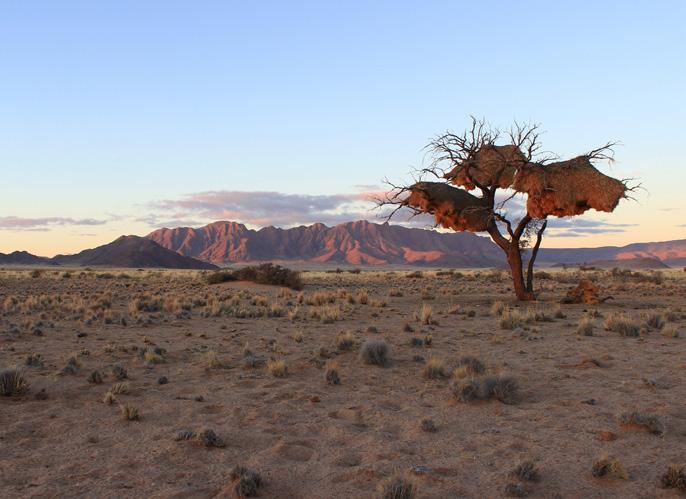
Wild Engineers
Across Africa, meet the creatures who defy the odds to create intricate structures, apply generational wisdom, demonstrate advanced intelligence and forever change the space around them.
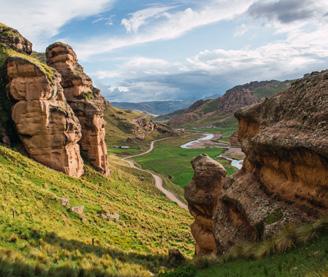
Peruvian Wonders
Get off the beaten track in Peru to discover a breathtaking new scenic journey.
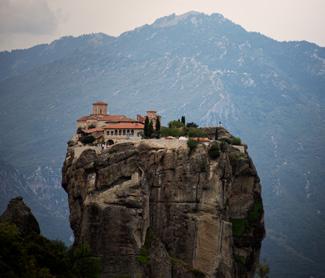
Sacred Places
From huge mountains to minuscule shrines, these sacred sites are symbols of something greater than ourselves.
Inspirations
70
Escape the Ordinary
Discover a collection of truly unique properties that go beyond the expected, allowing you to step into the heart of your destination.
74
Table for (Every)One
In South Korea, sharing is a way of life. Spaces are intentionally close, built for warmth, for laughter and for leaning in.
76
Creative Expression
Artistry is woven into the fabric of Latin America. Across the region, discover creativity born with quiet contemplation or join in and connect with the stories and traditions.
80
The Remote World
In remote communities around the world, age-old techniques are still practised, ancient rituals preserved and a deep connection to the land endures.
84
Beyond the View
Travel has the power to transform how we see the world. Explore how each new destination can shift our perception of space, time and place.
88
Subterranea
Some of the world’s most remarkable places lie beneath the earth, revealed only to those who venture downward.
92
How I Travel
We chat with first-time Jacada clients about celebrating milestones through family travel.
Openings and news in the luxury travel world.
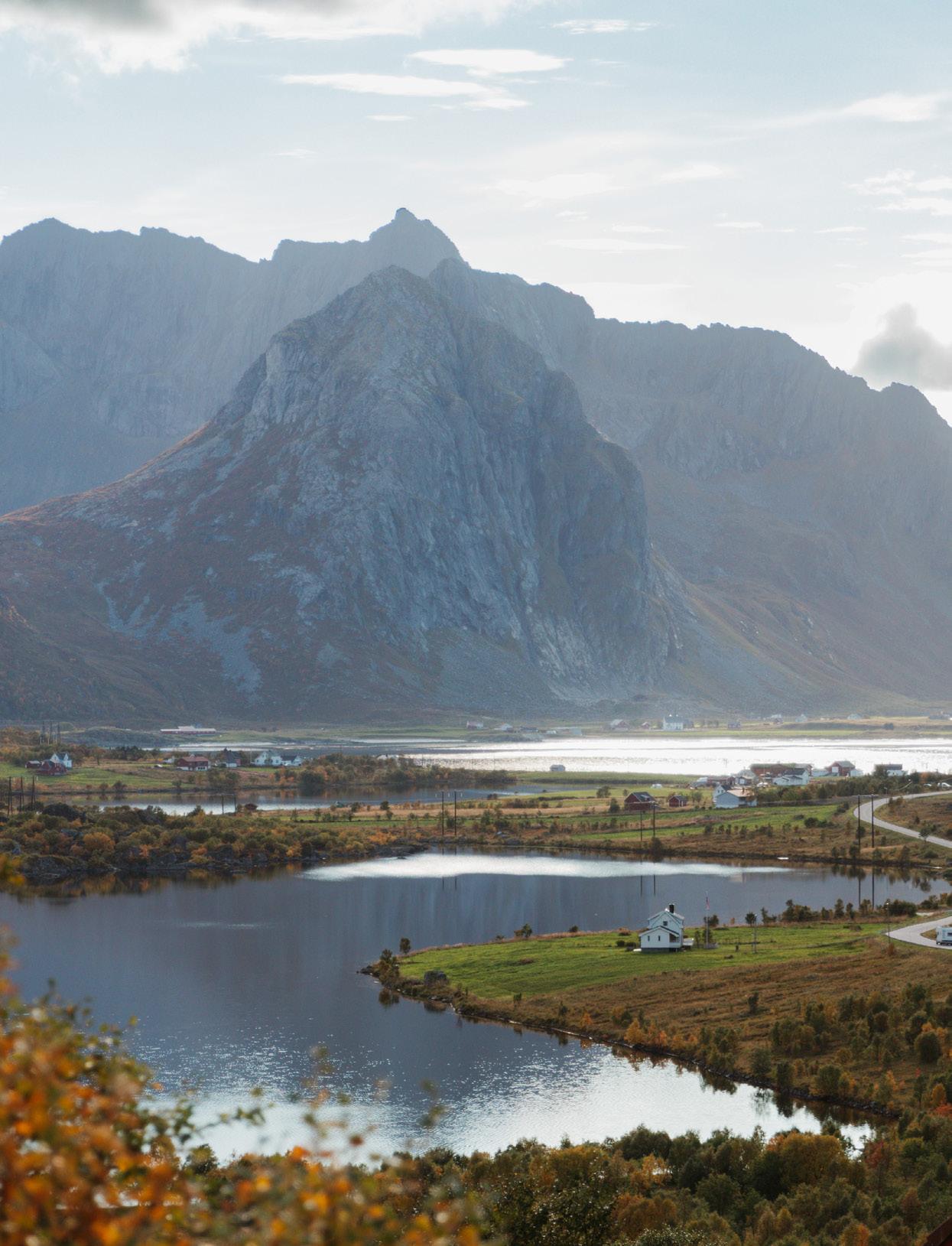
Mark your calendars for the debut of the Norient Express, set to sweep guests through Norway’s most dramatic landscapes over six days. Departing Bergen, a shifting panorama of jewel-toned rivers and lakes unravels as you cross the enormous Hardangervidda mountain plateau. After arriving in Oslo, the route then traces a path north to Trondheim, rolling through the Dovrefjell mountains where magnificent musk oxen wander the alpine tundra. The train cars themselves underscore Norwegian materials and craftsmanship, taking their cues from the forests, fells and fjords drifting past your window.
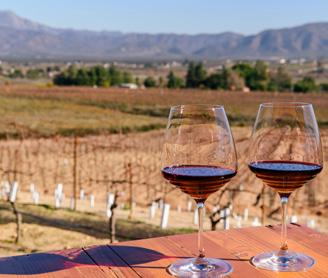
This is the year to rediscover Mexico through its wine. Hemmed by desert hills, cacti and agave in the northern Baja Peninsula, Valle de Guadalupe is quietly making its mark as one of the world’s best wine destinations. Experience its magic, tasting wines that are bold and rooted in a legacy of tradition, often poured by the very winemakers who craft them.
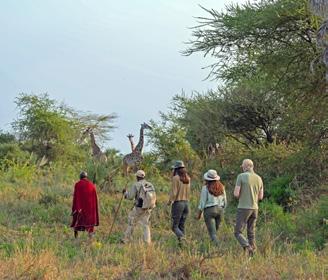
In line with their slow safari philosophy, Chem Chem Lodge in Tanzania now offers silent walks as part of a new collection of wellness experiences inspired by ponya, the Swahili word meaning ‘to heal’. Guided by a Maasai warrior, you’ll set out across golden grasslands in complete silence, heightening your other senses and bringing nature’s finer details into focus. Each step will draw you closer to the wilderness, and in turn, reconnect you with your true essence.
Setting sail for Antarctica later this year, Douglas Mawson is the latest addition to Aurora Expeditions’ cruise fleet, which also includes Sylvia Earle and Greg Mortimer. The vessel will pay tribute to its namesake, the remarkable Australian geologist and polar explorer. Life onboard reflects his strong sense of discovery, featuring dedicated Zodiac access points, a science centre, where engaging exhibits bring the region to life, and several observation areas for marvelling at colossal icebergs and breathtaking glaciers.
Earlier this year, six of our experts were named among Condé Nast Traveler’s Top Travel Specialists for 2025, a list that honours the world’s most knowledgeable travel advisors. This accolade recognises their unmatched local expertise and passion for designing truly unforgettable journeys.
Catalonia has made history as the first European territory to be crowned World Region of Gastronomy in 2025. The title celebrates the richness of Catalan flavours and their deep connection to the land. Embark on a gastronomic journey to uncover the region’s varied terroir through its crisp cava or spiced vermouth, and the secrets of Catalan cooking by tasting specialities like Iberian ham and canelones
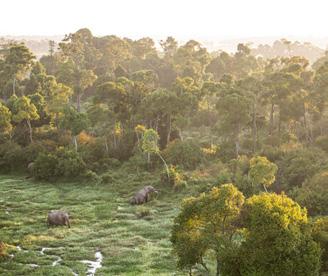
Come early 2026, Wilderness Mara is set to offer guests the chance to stay in the Mara Triangle, a remote area in the Maasai Mara where thrilling wildlife sightings unfold year-round. Just 12 tented suites will sit along the edge of a marsh roamed by elephants, from where you’ll have unrivalled access to both sides of the Mara River.
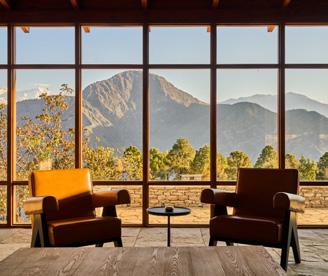
Shakti Prana, comprising seven suites positioned along Shakti Himalaya’s Kumaon walking circuit in the mountains of Uttarakhand, is set to open this year. In this little-known corner of northeast India, yoga and meditation are followed by guided treks through crimson rhododendron forests to hillside villages and sacred shrines. After a day’s walk, celebrated guest chefs will prepare home-style meals for you to savour with the Nanda Devi and Panchachuli peaks as your backdrop.
Introducing experiences to Jacada’s Positive Impact Collection for trips that are as meaningful as they are memorable
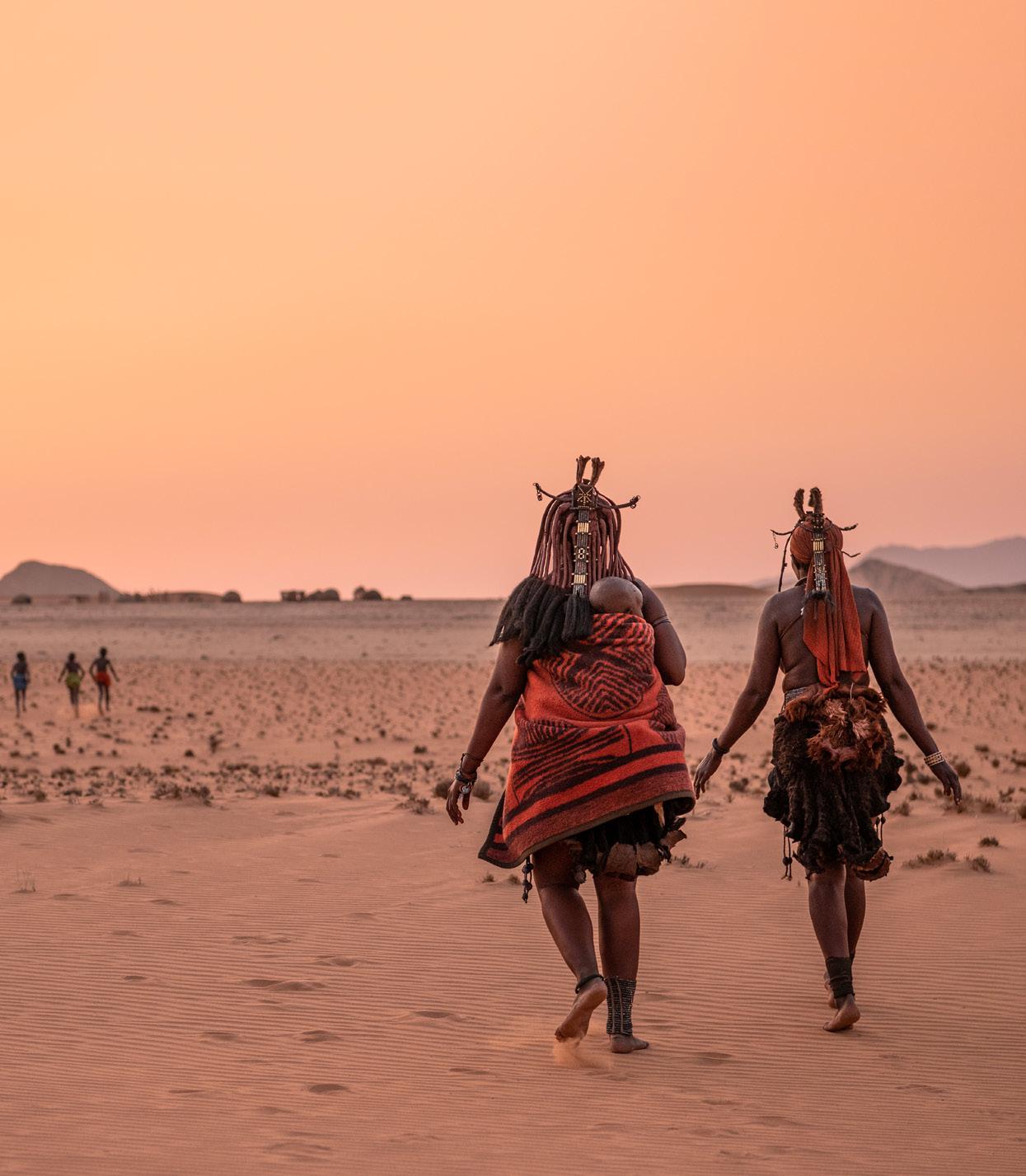
Below: Connecting with the seminomadic Himba community in Namibia's Kaokoveld offers unique insights into their traditions

Suitcases unpacked, passports stowed safely away until your next trip, you’ll still find yourself daydreaming of those unforgettable moments from your past journeys, smiling as a flavour transports you back, or sighing happily as a fragrance prompts a special memory to float to the surface. So often, it’s the truly out-of-the-ordinary experiences that linger the longest, those that had a remarkable impact on you as well as on the people and places you visited.
To expand on our Positive Impact Collection of outstanding hotels and lodges, we now invite you to discover over 40 thoughtfully curated experiences, each meticulously evaluated against the United Nations’ Sustainable Development Goals and in collaboration with local partners. Designed to deepen your connection to the places you visit, these meaningful activities contribute directly to the restoration of fragile ecosystems, the protection of endangered wildlife, or the vital upliftment of diverse communities.
“When you choose to step into the story of a destination – to give back, listen and engage with care – the impact can be lasting. Not just for the communities and ecosystems we aim to support, but for you as a traveller. That’s the power of positive impact travel,” explains Natalie LyallGrant, Head of Positive Impact at Jacada.
“The experiences have the ability to create a transformational impact not only on the destination and host communities but also on you, the traveller. Each experience invites you to engage in hands-on activities set within reflective, immersive environments.”
Each experience contributes to one of three important pillars: environmental restoration or protection, the preservation of cultural heritage or development of economic resilience and wildlife conservation. They have a strong focus on hands-on activities in reflective and immersive settings, with guided interpretation and expert-led storytelling throughout.
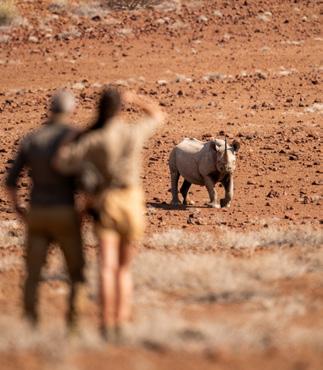
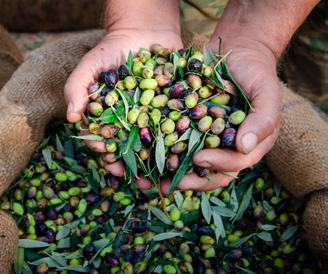
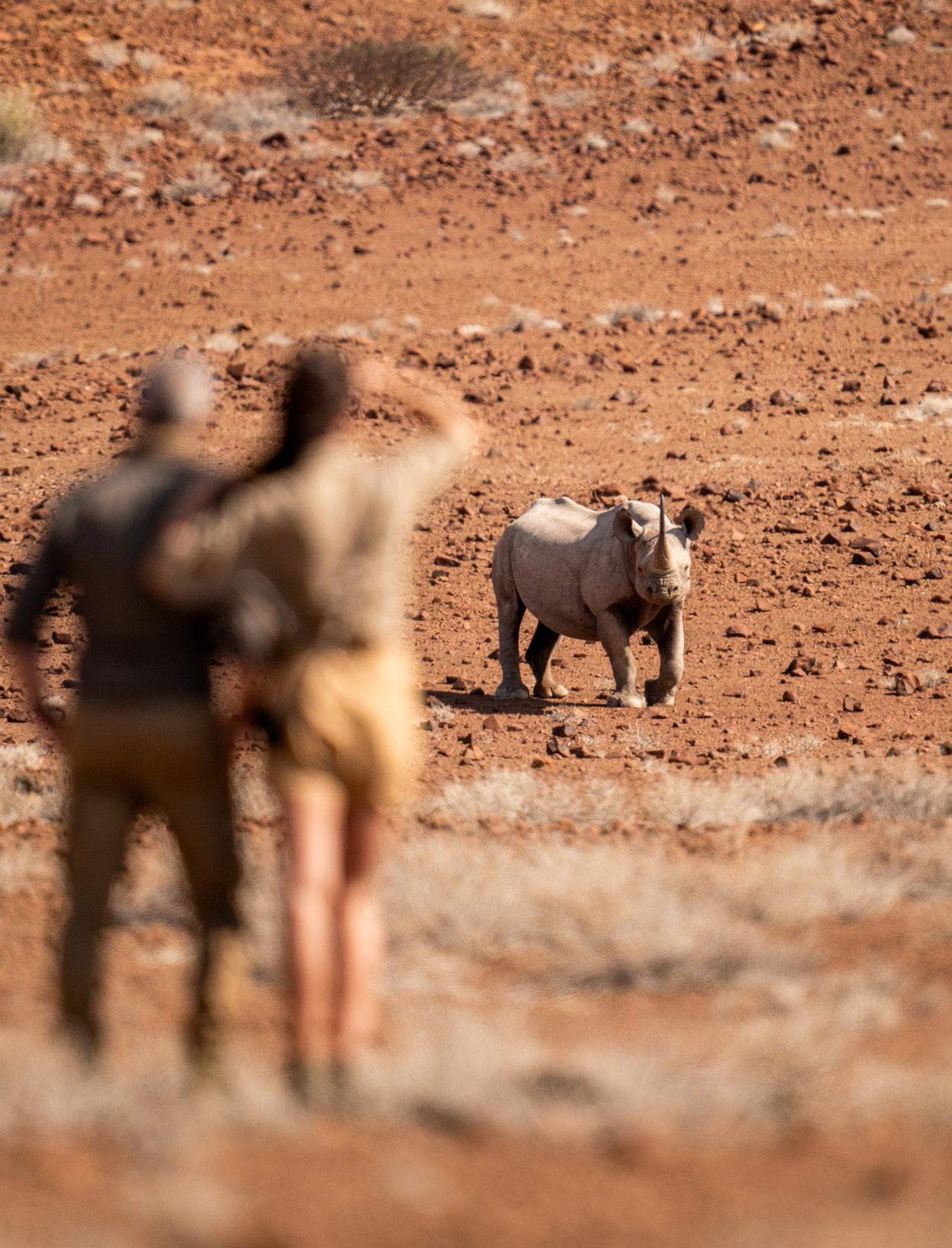
From the heart-pounding thrill of tracking rhinos in the wilds of Namibia, or sun-drenched days during the olive harvest in Greece, to discovering the flavours of an authentic Oaxacan cooking class in Mexico, here are some of the experiences that have earned their place in the collection.
Farms, flavours and futures
On your adventure in New Zealand you can embark on an electric vehicle journey through the beautiful Waitakere Ranges, where you'll explore a forest farm which supplies local ingredients to some of Auckland's top restaurants. While you’re there you’ll have the opportunity to head out for a spot of foraging.
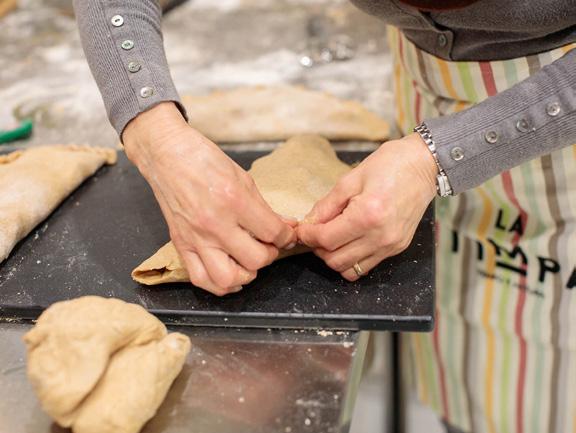
If you find yourself exploring Italy, you can head to La Timpa in Sicily, a restored 17th-century water mill and organic farm. Here, you'll witness ancient grains being milled into pesticide-free flours and then head into the kitchen to create delicious Sicilian meals.
In Morocco, you can savour a meaningful lunch at a social enterprise in Marrakech where over 300 women, many having faced significant challenges, have been empowered through culinary arts training. And in South Africa you’ll discover the Singita Community Culinary
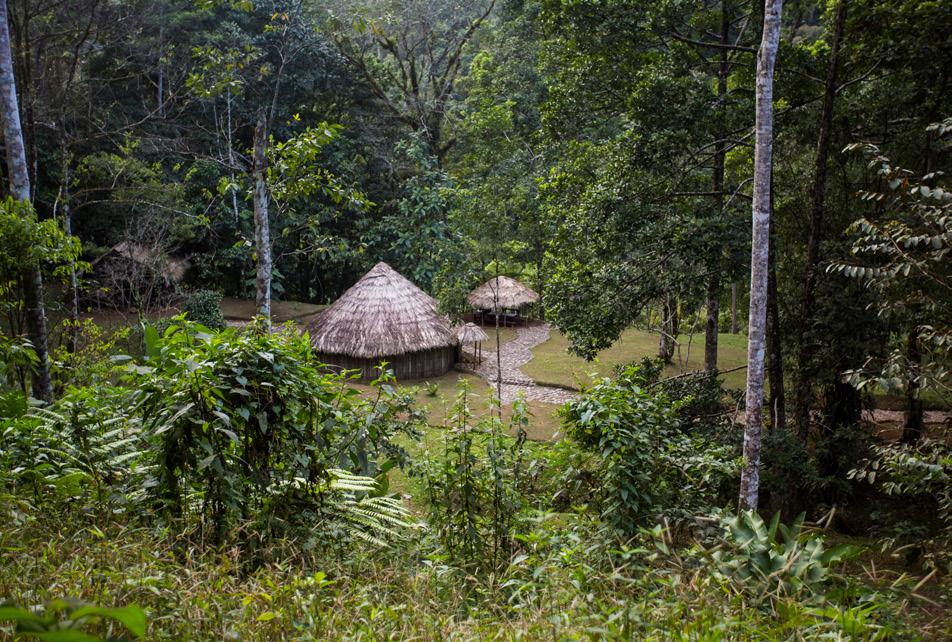
School, a programme empowering local young adults. This is an incredible chance to join students in the kitchen to add some Pan-African flair to your own cooking repertoire using fresh ingredients.
Wildlands and natural wisdom
Head into the heart of Borneo's rainforest for a unique overland and boat trip to a tree-planting site in the Lower Kinabatangan to plant native trees, enjoy a meal and learn about the mission to restore habitats for endangered species.
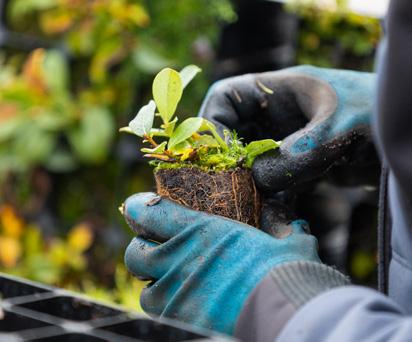
And while discovering the beauty of the British Isles, embark on a purposeful journey into the Scottish Highlands to support a reforestation charity, enjoy a behindthe-scenes tour of the centre and nursery and even assist with repotting native tree seedlings.
Head over to South America and begin your unforgettable Inca Trail hike with a meaningful act of environmental stewardship, symbolically planting a tree within the Historic Sanctuary of Machu Picchu, and in doing so directly contributing to vital reforestation efforts.
Or journey deep into the Guatemalan jungle to Uaxactun, where you'll ascend an ancient Maya temple at night to witness the star-filled sky, connecting with ancestral knowledge of celestial observation and the profound link between culture, conservation and community.
Culture and community connections
Step into Seville's vibrant and often secretive flamenco world with a British expat who married into a Romani family, for an intimate traditional fiesta where you'll witness authentic dance, song and guitar, engaging deeply with a tight-knit community.
In Africa, you can spend time with the semi-nomadic Himba community in Namibia's Kaokoveld, visiting their village or cattle post to gain unique insight into their traditions and way of life, supported by Wilderness Serra Cafema Camp's commitment to local employment and conservation.
Staying in the southern hemisphere, venture into Costa Rica's Talamanca Mountains for a challenging trek to spend time with the Cabécar indigenous group, exploring ancient trails and for -
est secrets while directly supporting their community and engaging with their living cultural heritage.
Wildlife and wilderness
Escape to a secluded cabin in Romania's Făgăraș Mountains for an immersive wildlife experience, where expert trackers will guide you through breathtaking landscapes to witness the inspiring comeback of the majestic European bison and observe the forest's nocturnal life.
Embark on a profoundly intimate gorilla trekking experience in Rwanda's Volcanoes National Park, where you'll encounter magnificent mountain gorillas in their natural habitat while directly funding their vital conservation, habitat restoration and local community empowerment efforts.
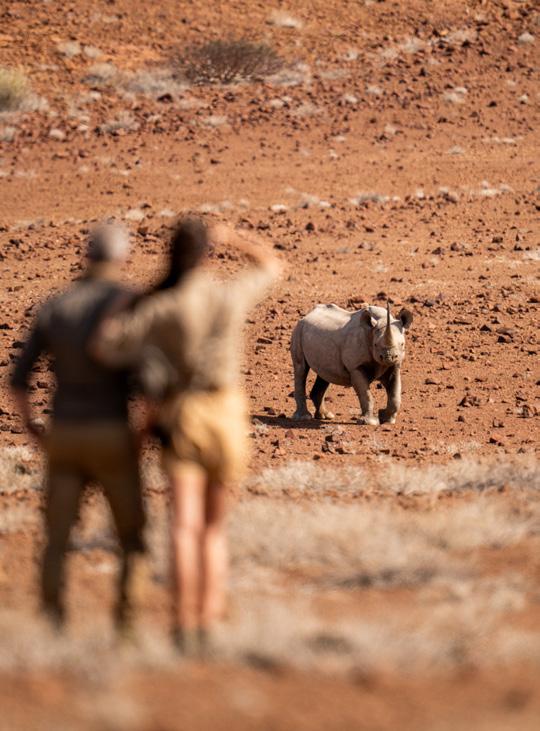
Venture across to Namibia, and from Wilderness Desert Rhino Camp, you can head out on an unparalleled wildlife experience in Namibia's Palmwag Concession, as you join expert Save the Rhino Trust trackers to seek out endangered desert-adapted black rhinos on thrilling vehicle and walking excursions.
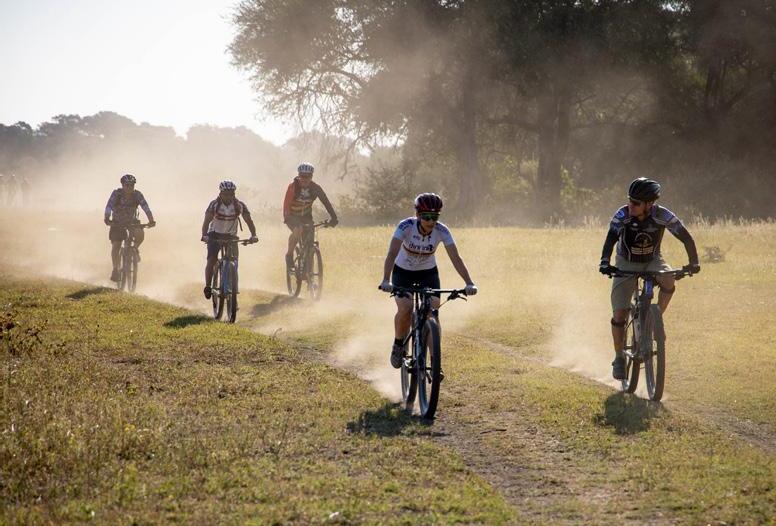
Experience Botswana's awe-inspiring zebra and wildebeest migration from a unique, low-impact bicycle safari at Jack's Camp, where your stay directly contributes to vital local conservation and community projects while you explore ancient landscapes with expert guides.
Read more about our Positive Impact Collection experiences → jacadatravel.com/positive-impactcollection/experiences/
Wherever you have your sights set on next, speak to your travel designer about further enriching your adventure. Experiences in the Positive Impact Collection span destinations across Africa, Asia Pacific, Europe, Latin America and the Middle East.
Great journeys aren’t just about the places we visit. Travel can often be a catalyst for unlocking a much deeper understanding of how we navigate the world. We asked six of our experts Murray, Charles, Angela, Emily, Jack and Jody – named as Condé Nast Traveler top specialists for 2025 – for their reflections. Not just on their own travels, but on how we comprehend the true scale of our world, carve out mental space in our increasingly busy lives and perceive home after experiences gathered when we’re away.

JODY VAN MERODE Senior Travel Designer for Africa
Where is one of the most remote and remarkable places you’ve been?
The desert at Wilderness Serra Cafema, near Kunene River. It’s probably the most remote place I’ve ever been. The vast expanse of sand dunes and empty space made it feel like I’d reached the very end of the world. The incredible scenery, the stillness and the sheer emptiness around me created a powerful sense of how vast and awe-inspiring our planet really is. It was a moment of profound peace and perspective.
How can a safari feel wild yet intimate?
I love including a walking safari in the Serengeti. I was lucky enough to do a few myself a few years ago. It’s such an intimate experience, walking out with your guides across the vast plains. There are no crowds, just you, nature and the animals. It’s a wonderful way to escape the beaten track and really focus on the small details around you without the distraction of vehicles, just pure wilderness and wildlife.
What’s your favourite recommendation for those seeking time to reconnect?
For our travellers to truly reconnect and relax, I think it’s incredibly important they spend some time in the bush really embracing being in the middle of nowhere, surrounded by wilderness, rivers and wildlife. Often without Wi-Fi, they can simply enjoy being in the moment. There’s something special about sitting around a fireplace at night with a drink, reading a book and just being present. One of the best ways to experience this is by staying at a mobile camp in the Serengeti or Maasai Mara. It’s a chance to get away from the crowds and immerse yourself in the natural world.
“It’s such an intimate experience, walking out with your guides across the vast plains. There are no crowds, just you, nature and the animals. ”
CHARLES KRONSTEN
Senior Travel Designer for Latin America
Can you describe a time that a place truly awed you?
It was in Antarctica. I travelled right at the end of the season on an expedition to the Weddell Sea, a region of real historical significance with connections to early expeditions like Shackleton’s. It can be difficult to get far into the Weddell due to heavy sea ice – and we experienced that first-hand. The winds were strong, the ice was more extensive than expected and in the end, we only managed to spend around eight hours there during a nearly two-week trip. Instead, we diverted to the Antarctic Peninsula, which was incredible in its own right. We saw hundreds of whales and thousands of penguins. But two things really stuck with me. Firstly, the glaciers. They’re absolutely everywhere. You almost stop noticing them because they’re so constant. And secondly, kayaking through the sea ice. That complete silence, the feeling of total stillness and isolation. It was extraordinary. Then you look at a map and realise you’ve barely made it halfway down the peninsula and the peninsula itself is only about 3% of Antarctica. That was a truly humbling moment.
Where would you go for calm and isolation?
I’d definitely head to Patagonia, especially the more off-the-beaten-path areas. It’s a place where you can hike, bike, raft, kayak or ride for hours on end without seeing another soul, surrounded by some of the most incredible landscapes on earth. A great example is the Aysén region in Chile. On one of my research trips with Jacada, I visited Explora Patagonia National Park, which is truly remote. On two separate days, at both dawn and dusk, I walked just 200 metres from the lodge and sat on a rock in silence, waiting for about an hour to an hour and a half each time. That
particular spot is known as a puma corridor and a guide had told me there was roughly an eighty percent chance of seeing one. Both times, I was lucky. Each time, a puma passed right in front of me, about 30 metres away. It was just me and the puma: no one else around. That stillness, that solitude while waiting and then the quiet, powerful moment of the sighting itself was absolutely extraordinary.
What’s one of the most interesting places you’ve stayed recently?
In Peru, I stayed at Cirqa, a beautiful hotel in Arequipa. It’s known as the ‘White City’ and surrounded by volcanoes in the Peruvian Andes. The hotel itself is a lovingly restored 16th-century monastery and one of the most interesting interior spaces I’ve encountered on my travels. It really showcases the traditional sillar construction, a white volcanic stone that’s used throughout the old town, and features beautiful vaulted ceilings and arches. They’ve managed to integrate modern comforts seamlessly, all while maintaining a minimal impact on the original architecture. The result is a stunning blend of heritage and contemporary design. It was a truly special place to stay, both elegant and full of character.
How do you find the right pace for a trip?
I find it really important to ask our travellers why they are taking the trip and understand how fast or slow they prefer the pace to be. When they are staying somewhere truly special, whether it’s the destination or the hotel itself, we make a point of building in extra time, at least a half day of leisure, so they can fully appreciate and enjoy that unique experience. It’s all about balancing their interests and energy levels to ensure they can relax and reconnect, not just rush from one activity to the next.
“Each time, a puma passed right in front of me, about 30 metres away. It was just me and the puma: no one else around.”


“That little spot on the map suddenly feels incredibly broad and open. It’s a powerful reminder of just how immense and aweinspiring our planet truly is.”
ANGELA THOMAS
Client Experience Manager for Africa
Tell us about a time on your travels that shifted your perspective. It was during a gorilla trekking trip in Rwanda. Rwanda is one of the smallest countries on the map, but when you’re there, surrounded by the vastness of the rainforest and seeing the gorillas in the wild, it really puts things into perspective. That little spot on the map suddenly feels incredibly broad and open. It’s a powerful reminder of just how immense and awe-inspiring our planet truly is. It made me realise that no matter how small we may feel, the world itself is far bigger than we often imagine.
Where would you recommend to reset and recharge?
Namibia. The vast open spaces there are simply amazing. Initially, it can feel a bit daunting, knowing you’re heading to a remote location without the usual comforts: no city lights, no internet, no everyday distractions. But once you’re there, it’s truly incredible. At night, sitting out on your deck in complete silence is an amazing experience. The sky is filled with stars thanks to almost zero light pollution and that quietness brings a deep sense of tranquillity. Namibia doesn’t overwhelm you with constant activities; there’s plenty to do, but also space just to be. Often, activities are scheduled in the morning or afternoon, leaving the late afternoons free for a siesta, some quiet time with a book, or simply sitting with
your own thoughts. Some might find that a little intimidating, but for me, it’s a valuable time. I journal a lot while I’m there. The uninterrupted peace really helps me reflect, and looking back on what I’ve written, it’s usually been quite insightful. Namibia’s remoteness also brings a rare chance to disconnect and be fully present in the moment, which is why I find it such a special place to breathe and recharge.
What private experiences stand out from trips you’ve arranged?
Definitely hot air balloon rides, especially over the Maasai Mara. They’re truly an amazing way to appreciate the vastness of the landscape beneath you, combined with the profound silence that comes with floating gently in the air. Being up there in a small basket, drifting across the Mara, offers a unique perspective while also providing a quiet space for reflection. Because of this, I always recommend a private ride. It makes the experience more intimate and personal. We’ve had many wonderful stories from those we’ve arranged – and it’s even become a popular choice for proposals. Usually, when you land, there’s a champagne breakfast waiting, creating a beautiful moment to celebrate or mark a special occasion. Aside from the flight itself, another fantastic aspect of the private experience is being able to watch and even help with the balloon setup – the rigging and logistics that make it all work. It’s a fun, hands-on opportunity for those interested.
JACK BECKFORD
Travel Designer for the Middle East & Silk Road
Where have you encountered truly vast landscapes?
Mongolia is the epitome of vast landscapes, with a population density of less than two people per square kilometre, making it one of the least inhabited places on Earth. I remember driving through the golden steppe for hours on end. Occasionally, you might come across a nomad with their flock of sheep and horses, but otherwise, it’s completely deserted. This sense of isolation and openness was really brought home at Three Camel Lodge in the Gobi Desert, one of the lodges we recommend. Sitting out on the veranda, looking out over the endless steppe as far as the eye can see, is a truly special experience. It really makes you appreciate the vastness of the world.
Can you tell us about an experience that shifted your perception of home?
Definitely my time in Egypt. I studied Arabic at university and as part of the course, we had to spend a year abroad. I chose Egypt, and that’s really when my love affair with the Middle East began. From the moment I arrived, I felt at home. There’s an Arabic expression: ‘When you drink from the Nile, you will always return’, and this was definitely true for me. After spending time with the people and immersing myself in the culture, I felt a deep connection. When my year abroad ended, I was
heartbroken, having fallen completely in love with Egypt. I promised myself that I would return after graduation – and I did. I went straight back and ended up living there for another four years.
What’s one of the most memorable pri vate moments you’ve arranged?
One of my favourite private experiences that I’ve arranged was in Egypt. Through our contacts, we were able to secure exclu sive access to the Pyramids and the Sphinx, an incredible opportunity that very few people can talk about. We obtained all the necessary permissions from the Egyptian government, allowing our traveller to enjoy one of the wonders of the world completely privately. They were able to get up close to the pyramids and the Sphinx, which is usually cordoned off to the public, and even visit inside Khufu’s pyramid without anyone else around. It was definitely one of the most extraordinary experiences I’ve put together.

“There’s an Arabic expression: ‘When you drink from the Nile, you will always return’, and this was definitely true for me.”

MURRAY MITCHELL
Senior Travel Designer for Europe
Can you describe a moment where you’ve really felt the scale of the world? There have been many moments during my travels when I’ve truly felt the scale of the world. One that really stands out is standing on top of the Jungfrau in Switzerland. It was one of those interesting days where I started with breakfast down at lake level, wearing shorts and a T-shirt, and just two hours later, I found myself at the summit with snow up to my ankles. It genuinely felt like being on top of the world. The views from up there were absolutely fantastic.
Tell us about a remarkable experience on a more intimate scale.
It was at the Venice Opera House. I was in Venice in December, in the off-season, and we had the opportunity to visit the opera house after hours. Just walking into that enormous space with no one else around was truly remarkable. We had a private performance and learned about the architecture and history of the building, and the incredible artists who have performed there. It was unforgettable.
located right in the heart of the valley with its own private access to the site. If you're staying there, you can explore the temples at sunset with your guide after the other tours have gone for the day. It truly feels as if you have the place to yourself. The site comes alive at that time of evening, with the changing light and atmosphere adding something really special.
How do you craft space in an itinerary for relaxation and reconnection?
I always try to connect with our travellers early in the planning process and suggest building in at least a half or full day to reflect on the trip and unwind. Many of our itineraries include a guided half-day tour in the morning, which covers the highlights. Then, in the afternoon, they can explore at their own pace using the guide’s recommendations, allowing for a slower, more relaxed experience. I also often suggest limiting the number of destinations so they can fully enjoy each place without feeling rushed. Quality over quantity. This way, the trip feels less like a checklist and more like a chance to really savour each moment.
“It genuinely felt like being on top of the world. The views from up there were absolutely fantastic.”
What is one of the most memorable private experiences you’ve arranged? It would have to be an itinerary I planned to Sicily. We arranged a fantastic sunset walking tour through the Valley of the Temples, which is especially memorable when staying at Villa Athena, a hotel
EMILY WALLINGTON
Senior Travel Designer for Africa
Can you describe one of the most awe-inspiring places you’ve travelled?
Many years ago I was in Morocco, at a place called Todra Gorge. It’s a dramatic canyon located in the Atlas Mountains and truly one of the most spectacular places I’ve ever visited. Walking through the gorge, the sheer size of the rock walls on either side of you is breathtaking. They tower up against the sky, creating an incredible natural cathedral. My friend and I actually spent the night there. We took sleeping bags and roll mats and laid on the canyon floor, looking up at the night sky. Because it’s a remote desert area with no light pollution for miles, the stars were phenomenal – an endless expanse of sparkling light overhead. That vastness made me feel incredibly small, like a tiny cog in a massive wheel. I think that’s what travelling often does: it humbles you, reminding you how immense and awe-inspiring the world really is, and how we’re just a small part of it.
Where do you visit when you’re looking for space to breathe?
The Okavango Delta in Botswana. It’s incredibly remote. When you’re out there, you rarely see other people, boats, or vehicles: it’s just you and nature. The landscape is dotted with small islands, palm trees and elephants quietly standing by. One of the main reasons the Delta makes me feel so calm is the presence of water. There’s something about water that naturally soothes and slows everything down, and the Okavango offers a beautiful mix of land and water. You can explore on vehicle-based safaris or glide down its numerous channels and rivulets by boat or traditional dugout canoe. For me, it’s not just the animals that bring peace, though they are part of the experience, but the sensory elements: the wind in my hair as I’m on the boat, the distinctive scent of the potato bush or other fragrant plants as you pass by. These simple, natural sensations shift my mood and create that space to breathe. The whole experience is deeply calming because it feels so pure and connected to nature.
Tell us about some of the exclusive moments woven into the trips you plan. When crafting an itinerary, I always aim to include private spaces or experiences because that’s often what many of our travellers truly want – a sense of exclusivity and intimacy. One of my favourite options is exclusive-use safari lodges or private areas within a lodge. These offer a sanctuary in the wild, serving as a home for a group over several days. It’s a unique setting that fosters bonding while providing a rare feeling of belonging in nature’s wilderness. Another experience I love to include, especially for guests travelling to Southern Africa, is a private sundowner cruise in Cape Town. You’re out on a sailing yacht with just your family or partner and a skipper, drifting around the bay as the sun sets. With Table Mountain in the distance and the stunning cityscape of Cape Town nearby, it’s an incredibly romantic, therapeutic and beautiful moment.
What makes an itinerary relaxing as well as rewarding?
In my view, it’s essential to design an itinerary with breath, not just motion. Avoid over-scheduling or stacking too many activities because often, the magic happens during slower, quieter moments like a leisurely breakfast, a walk at dusk or stargazing in silence. So let the day breathe. For example, on travel days, build in time for a relaxed walk or an extended breakfast for that much-needed space. These pauses create the opportunity to truly unwind and absorb the surroundings. I also prioritise selecting properties that feel like sanctuaries, where it’s possible to relax without needing to constantly be ‘on the go’. It could be a bedroom with a private deck overlooking a waterhole where elephants come to drink – all visible from the com fort of your bed. Or an exclusive-use villa with a family fire pit, where after dinner everyone can gather to share stories and reflect on the day. These intimate, restful moments are just as vital as the excursions themselves.
“On travel days, build in time for a relaxed walk or an extended breakfast for that much-needed space."

Embracing disquiet to discover the magic that lies on the other side of stillness.
Words: JESSIE BRECHIN-LEMAN
We are surrounded. from the moment our alarms ring in the morning to the moment we fall into bed at the end of the day. Surrounded by life, by work, by family, by strangers, by traffic, by…everything. Technology has given us the gift of constant connection and allows us to be within seconds of our loved ones, our friends and our colleagues at all times. We have the ability to work from wherever we are and the ability to access all of the world’s information at the swipe of a finger. We schedule ourselves to the minute and to push away any speck of boredom that threatens to sneak in.
We may love these lives deeply, and find satisfaction, happiness and even joy in the busyness. We may thrive on the adrenaline of this constant go. But we’re also living on the edge. Waiting for the next notification, the next alarm, the next task to drive us forward.
But what if we stopped? If we deliberately took the time to surround ourselves with something else? Sometimes it takes a truly remote destination, where nature takes over our senses, to truly appreciate our place in the world.
Embracing disquiet
Whether it’s Thoreau retreating into the woods in search of simplicity in the 1800s, or doctors prescribing forestbathing to their patients in the 21st century, the need not to just disconnect from our lives, but to reconnect with nature has precedent. We expect to find peace and relaxation when we do so, and in that these escapes don’t disappoint. What we perhaps don’t expect is the discomfort that comes along with them.
‘Discomfort’ when you travel isn’t unusual, no matter how luxurious your trip. Typically it might take the shape of awe as you experience an unfamiliar culture. Or the bumpiness of the dirt road carrying you deep into magical wilderness. It’s the discomfort that comes from nothing that we don’t always anticipate.
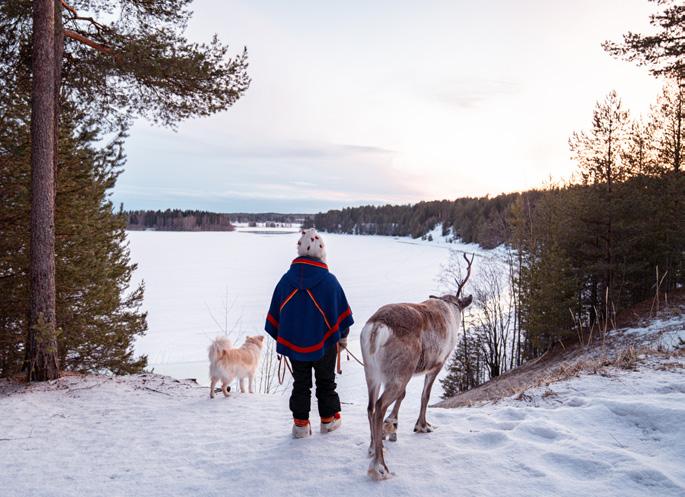
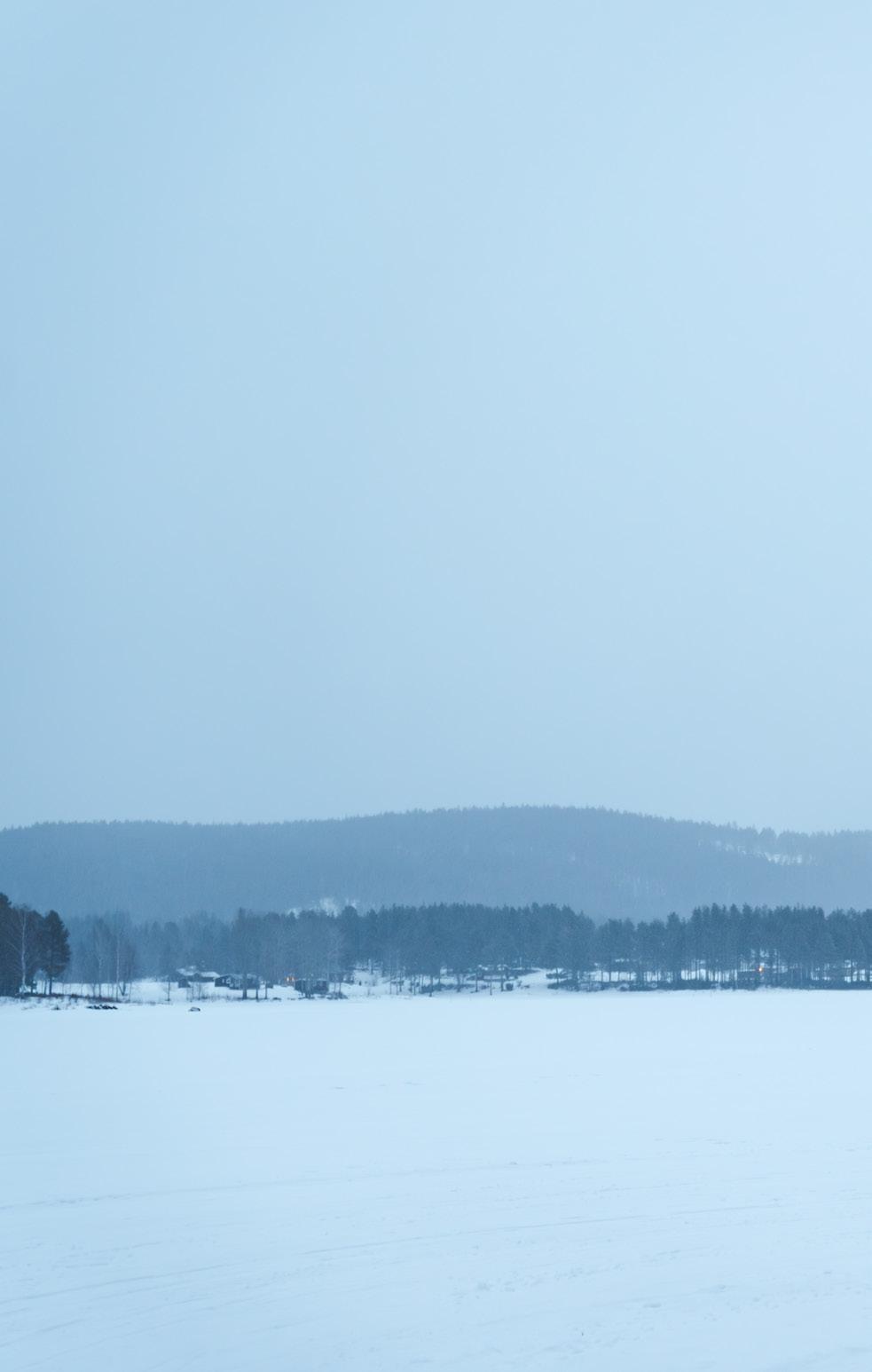
Arriving in northern Sweden will make you confront that feeling. The further you drive from the airport the more you are surrounded by ‘less’. City gives way to small town, gives way to village, to solitary cabins and finally to… nothing. No cars pass on the road: your own tyres make the tracks in the crunch of snow. And further you go.
As human habitation becomes less, nature becomes more. The trees that were once background actors loom into place as the protagonists until they take over the scene entirely. With no buildings to break the lines, the sky expands and stretches its fading light impossibly far into the distance. You feel small.
The isolation of winter forests and lakes is a stark contrast to city life. Ice lingers on heavy branches, frosted leaves peak through the drifts and light catches on the crystals, sparkling in the corners.
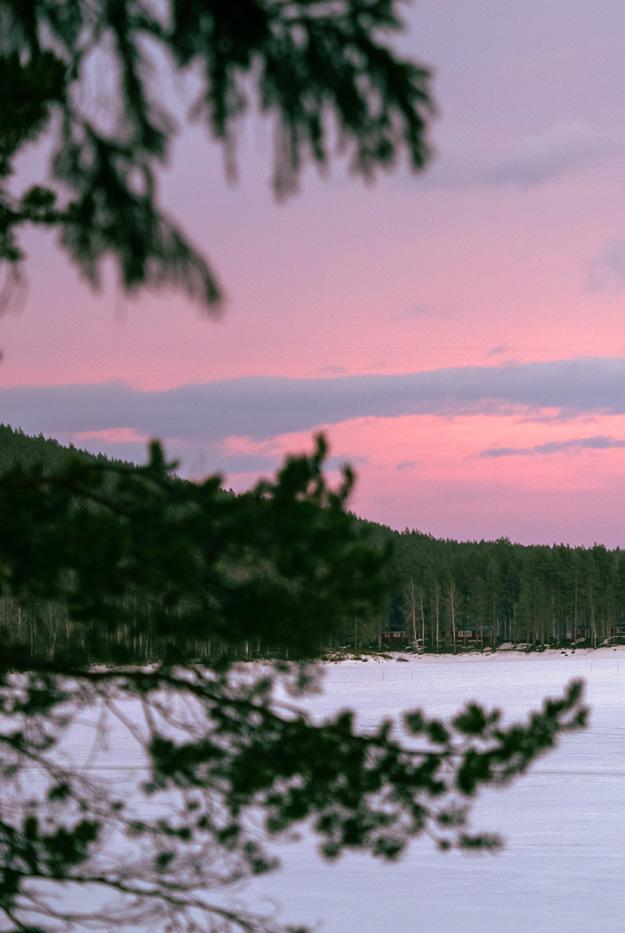
The whole world seems to pause. Frozen in time as well as temperature. No movement catches your eye, there are no distant echoes of people or even birds. You become conscious of the sight of your breath, of the thump of your heart and the sound of your pulse. The paw prints etched into the snow are the only signs that something else might be here. It’s disorienting at a minimum, deeply unsettling at its strongest.
Pushing through that initial shock, you start to appreciate new details. A swoop of wind in the branches reminds you that time hasn’t in fact stopped and maybe, just maybe, this is what peace feels like.
Embracing that peace and the space that comes with it opens up a whole new dimension of joy. One where the only focus is on the present and the freedom it brings to truly experience your surroundings.
Of course peace doesn’t mean lethargy – far from it. There are plenty of things to discover in this frozen wonderland, some more obvious than others.
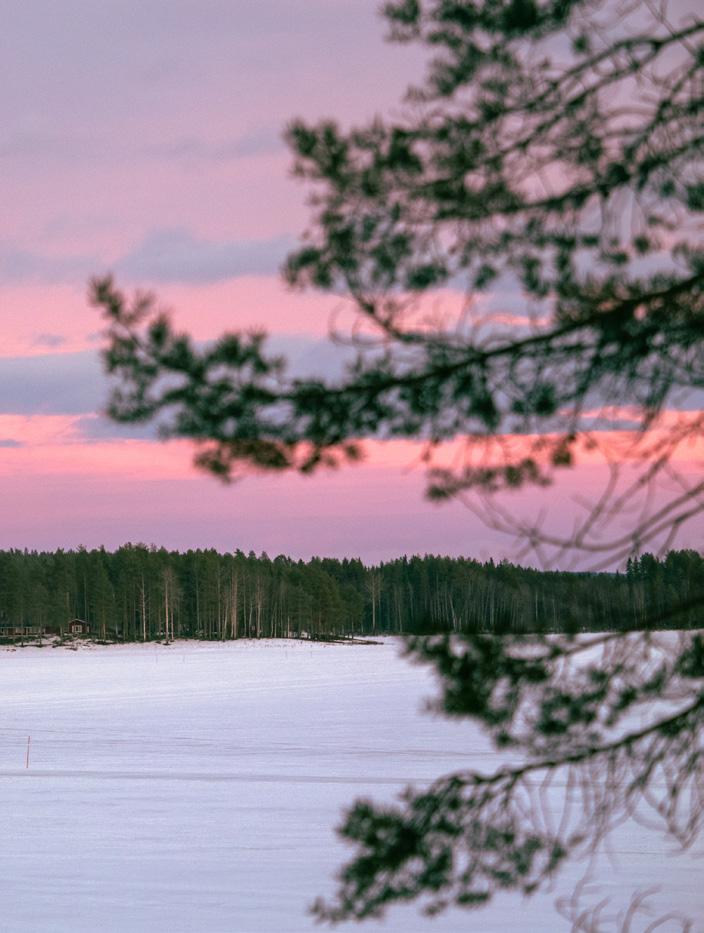
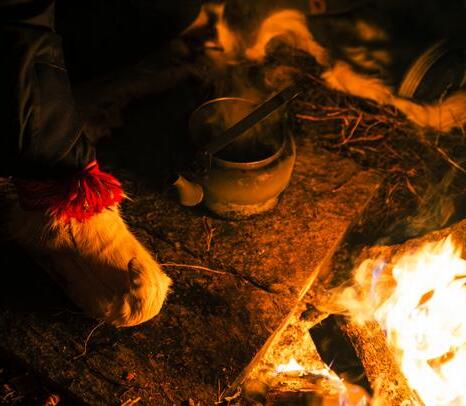
Right: In the stillness of winter, the only sounds you hear may be the muffled scurrying of squirrels gathering food

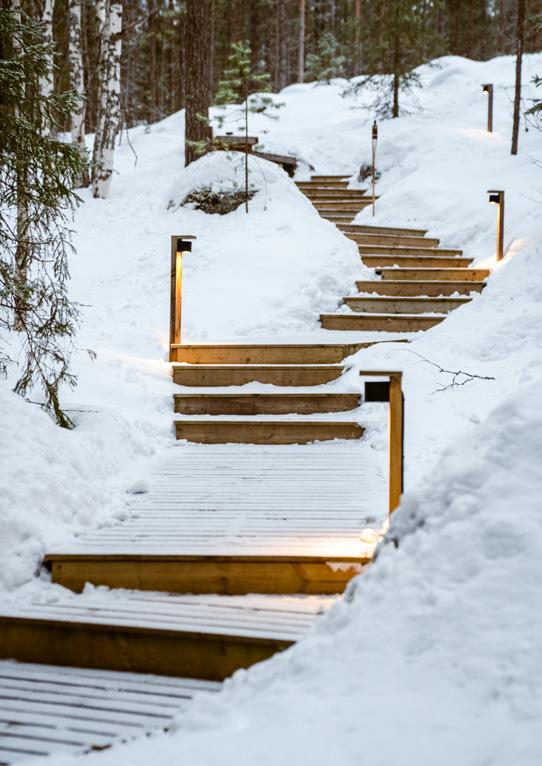
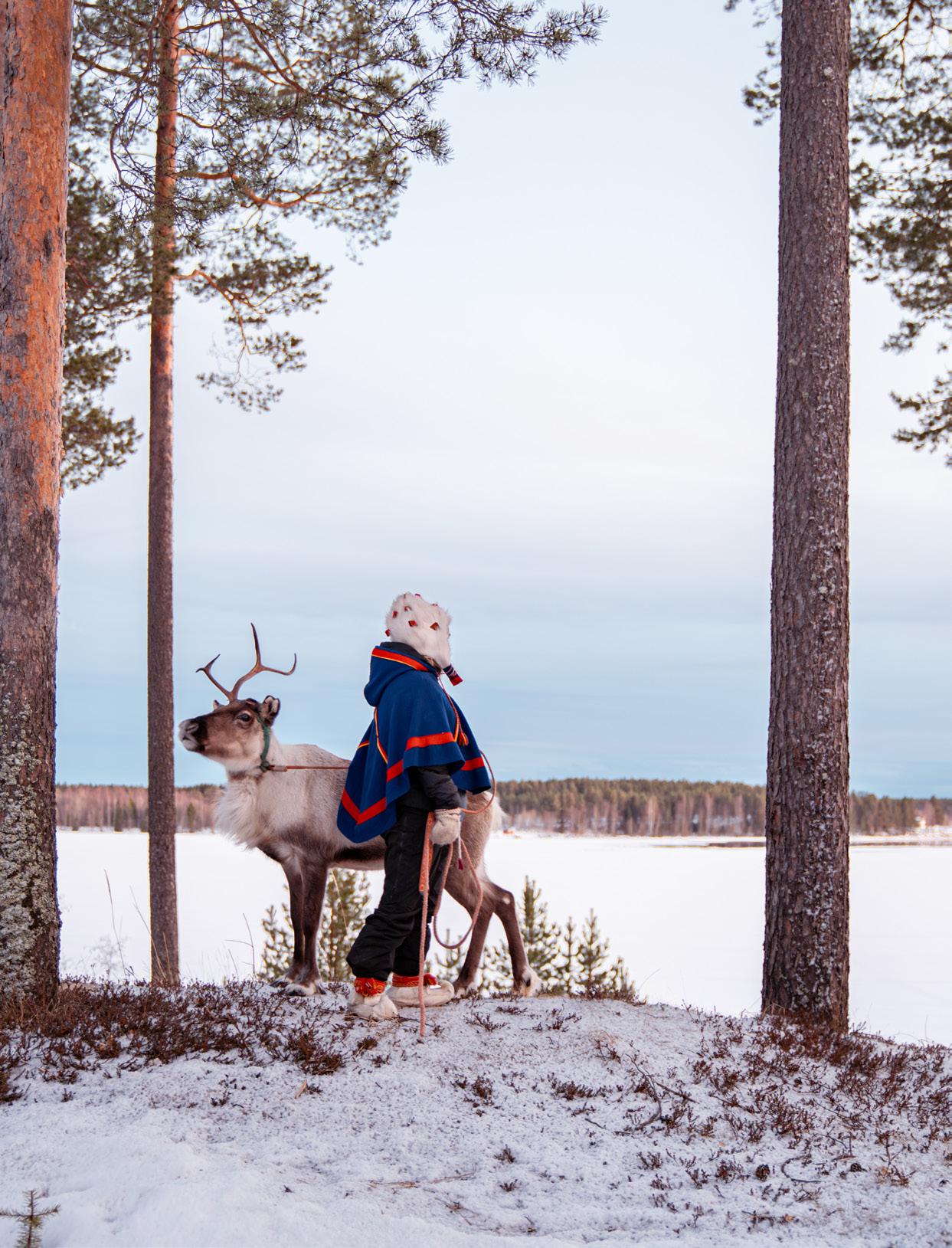
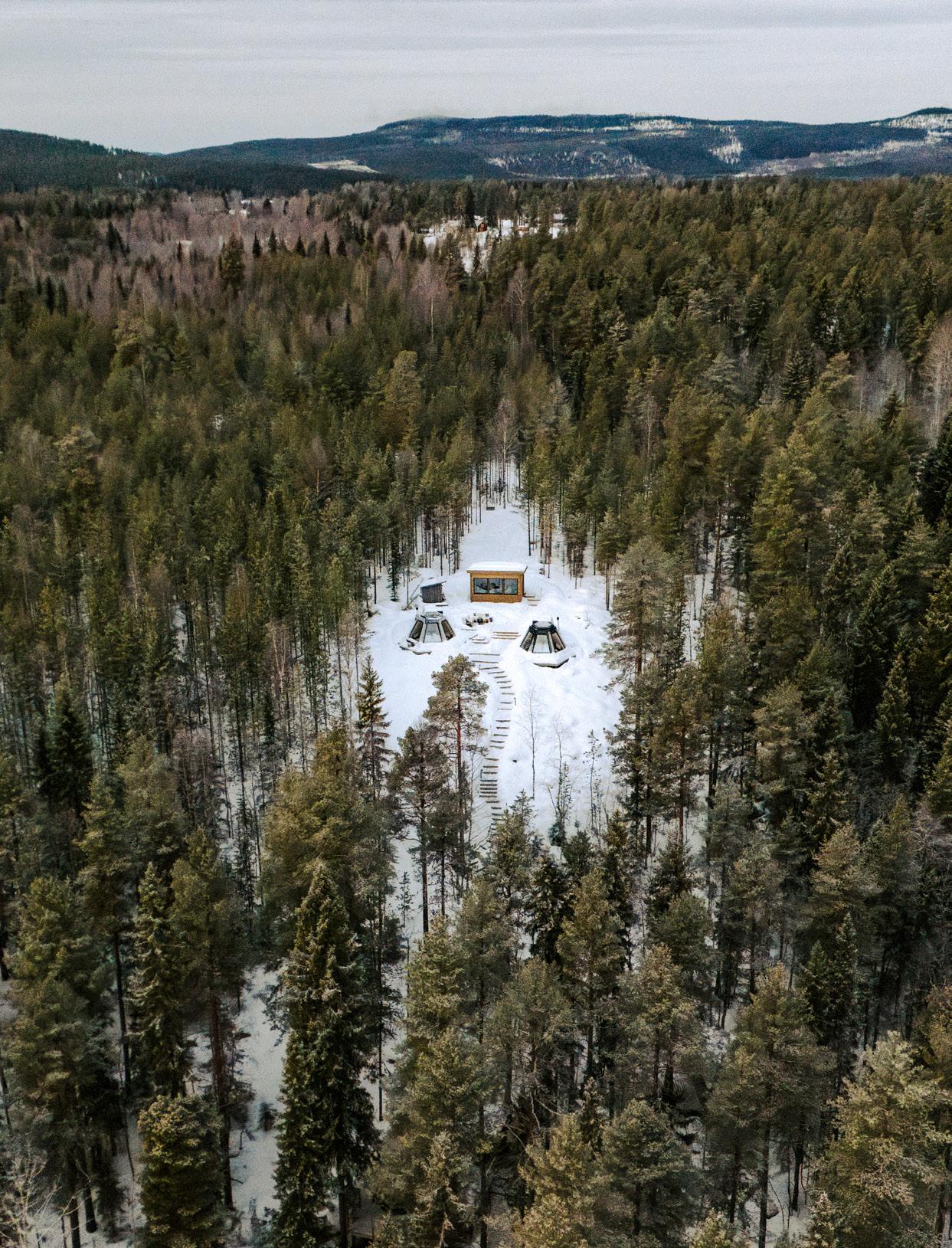

Along snowy trails
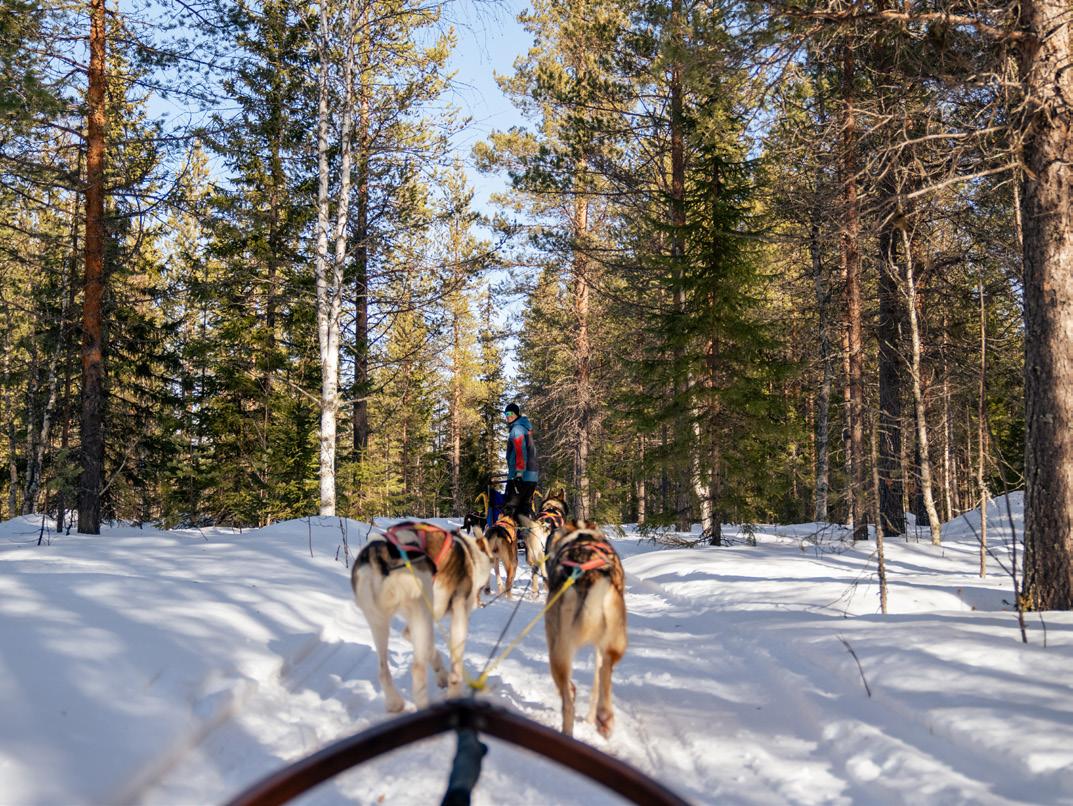
Dog sledding is one of the most peaceful ways to move through this landscape. Without the thrum of an engine, the sounds of nature have space to come forward, mixing with the skid of the sled and the rhythmic panting of the dogs as they tear along the trails. It’s a magical way to experience the area and the dogs agree. They can barely contain themselves as you help to get them into harnesses and prepare them for the adventure ahead. Their unadulterated joy is infectious: these creatures are born to run.
As the driver your concentration is fully engaged, leaning into corners and applying the right drag to keep the speed steady as the wind whips at your face. It’s a beautiful combination of adrenaline and calm.
When was the last time you made bread from scratch?
Kneaded the dough with only your hands? Then baked it over an open fire and greedily slathered it with fresh butter? It’s more than just cooking: it’s a connection to the beating heart of community and tradition.
Join a baking class to make traditional dimpled flatbreads with the same technique that’s been used for generations, while you learn more about what it’s like to live in an area where clocks don’t seem to hold quite so much power.
From Swedish fish to fika, this part of the world is no stranger to a sweet treat either. While the bread dough quietly rises you can take the time to make another household staple: chokladbollar. With no baking needed and a delightful level of mess involved, these decadent chocolate balls are fun for any age or skill level.
Foraging for nature’s bounty
When great blankets of snow muffle the earth, you’d be forgiven for assuming that life is hibernating. But there’s so much more going on than we realise at first glance. Take a foraging walk with a local expert who
has gathered knowledge from far and wide, including from the indigenous Sámi who have thrived in this place for millennia. Bark, buds, leaves, berries… all rich sources of foods, tonics and tools. Lift the veil and begin to see the landscape for the place of abundance that it truly is.
A dip beneath the ice
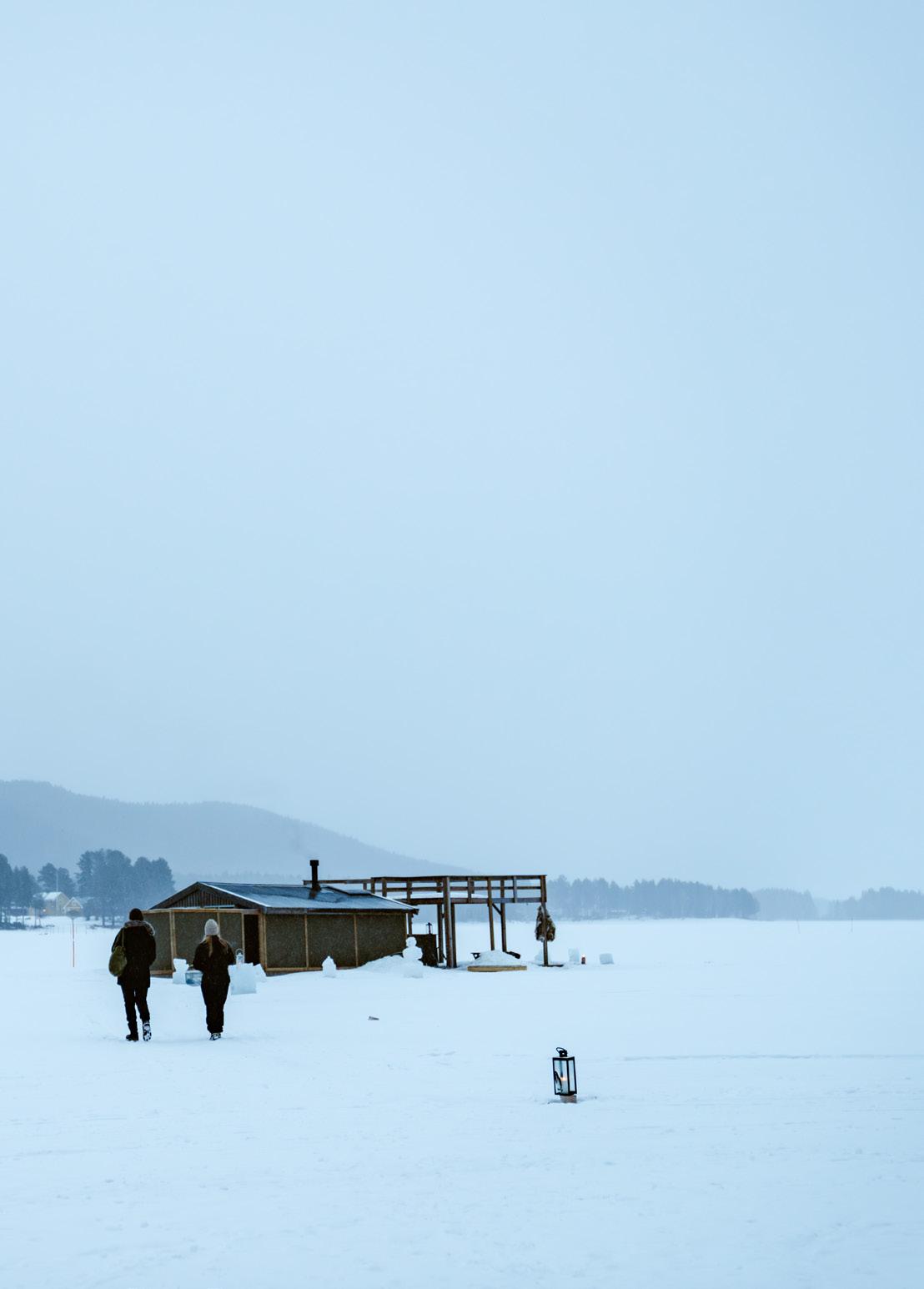
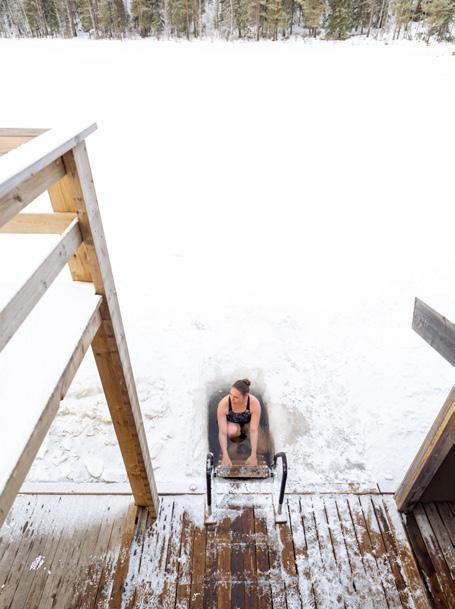
Trudge out through the fresh snow covering the expanse of solid lake, your path lit by lanterns, until you reach a floating sauna, frozen in place by the winter ice. The sauna is a welcome retreat from the biting cold where you can sit in the heat and watch the dark world outside. If you’re brave enough to leave that cocoon, the ice dip awaits. A great slab is hewn from the surface and a ladder lets you step down into the black water. Focus on breathing through the initial shock and your senses are electrified, feeling every cell in your body in a new way.
When we step out of our day-to-day and into an unfamiliar space where silence and nature dominate, something happens to our senses. Without the clamour of the background noise and the constant expectation of urgency everything that remains is heightened. The smell of snow, the crackle of a fire, the taste of wind and the tingle of frost on your cheeks is much more real, more insistent than before. You can hear the single drip of a melting icicle, aware of everything around you in a new way. Even the food gains new dimensions. The sweet tang of lingonberries and the way a meringue dissolves on your tongue. The taste of butter, moreish and creamy and a thousand times more complex than you realised.
A trip like this defies time itself. What might have only been a few days feels like a complete reset and returns you to your reality just a little better than you were before.
It’s not only frozen places that can provide a powerful reset of the senses. Here are a few other places to consider, where nature takes over and you can embrace your place in the world.
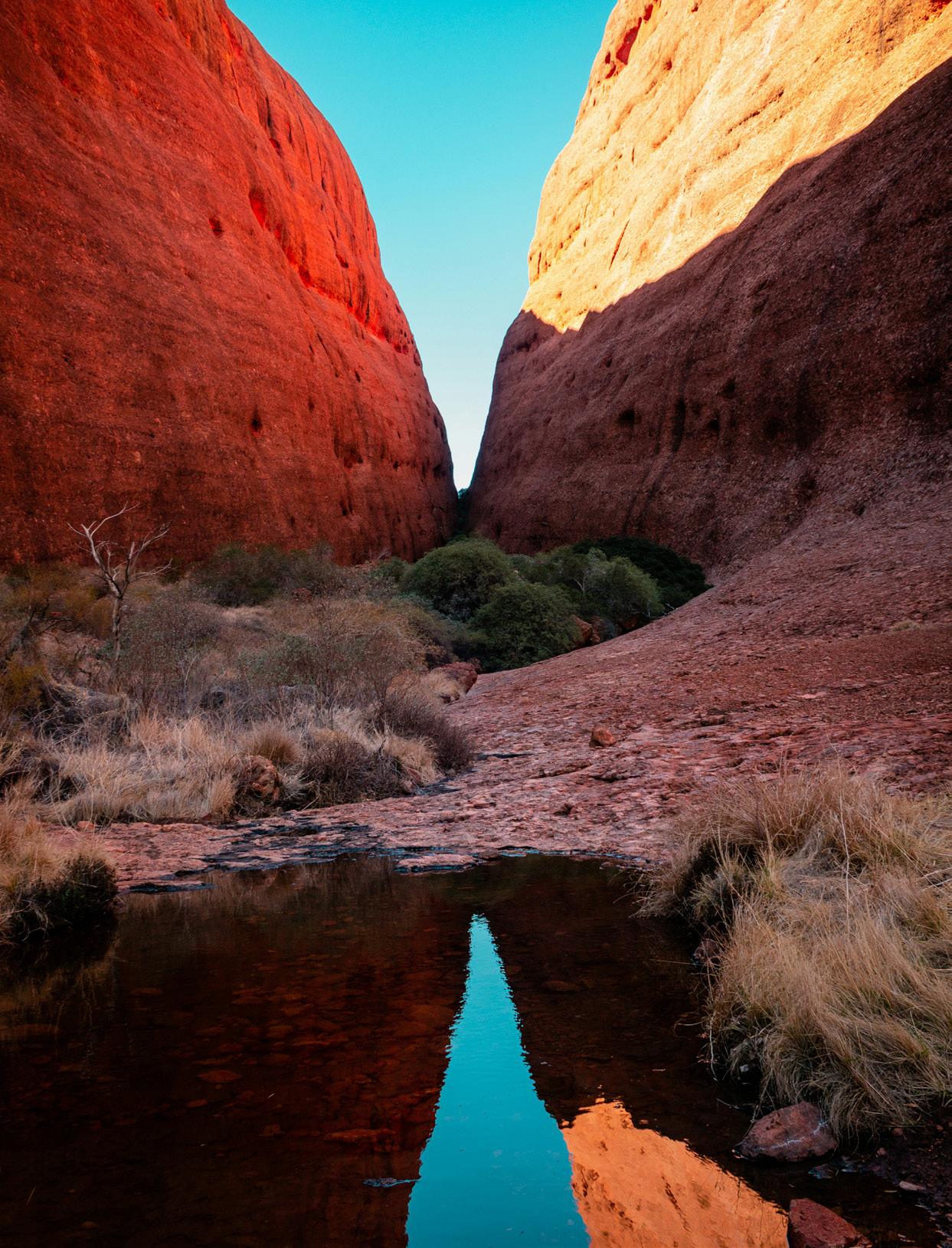
A vast expanse of red dunes stretches as far as you can see. Explore the singing sands during the day and then sleep outside in a sumptuous bed under a hundred thousand stars.
The Lake District, Chile Vira Vira
In the ancient forests of the Lake District you’ll find a special kind of disconnection. Float down the river in wonderful silence and let the trickle of water take you away.
A journey through Australia and New Zealand’s reclaimed and restored sacred grounds.
Words: TERRI DUNBAR-CURRAN
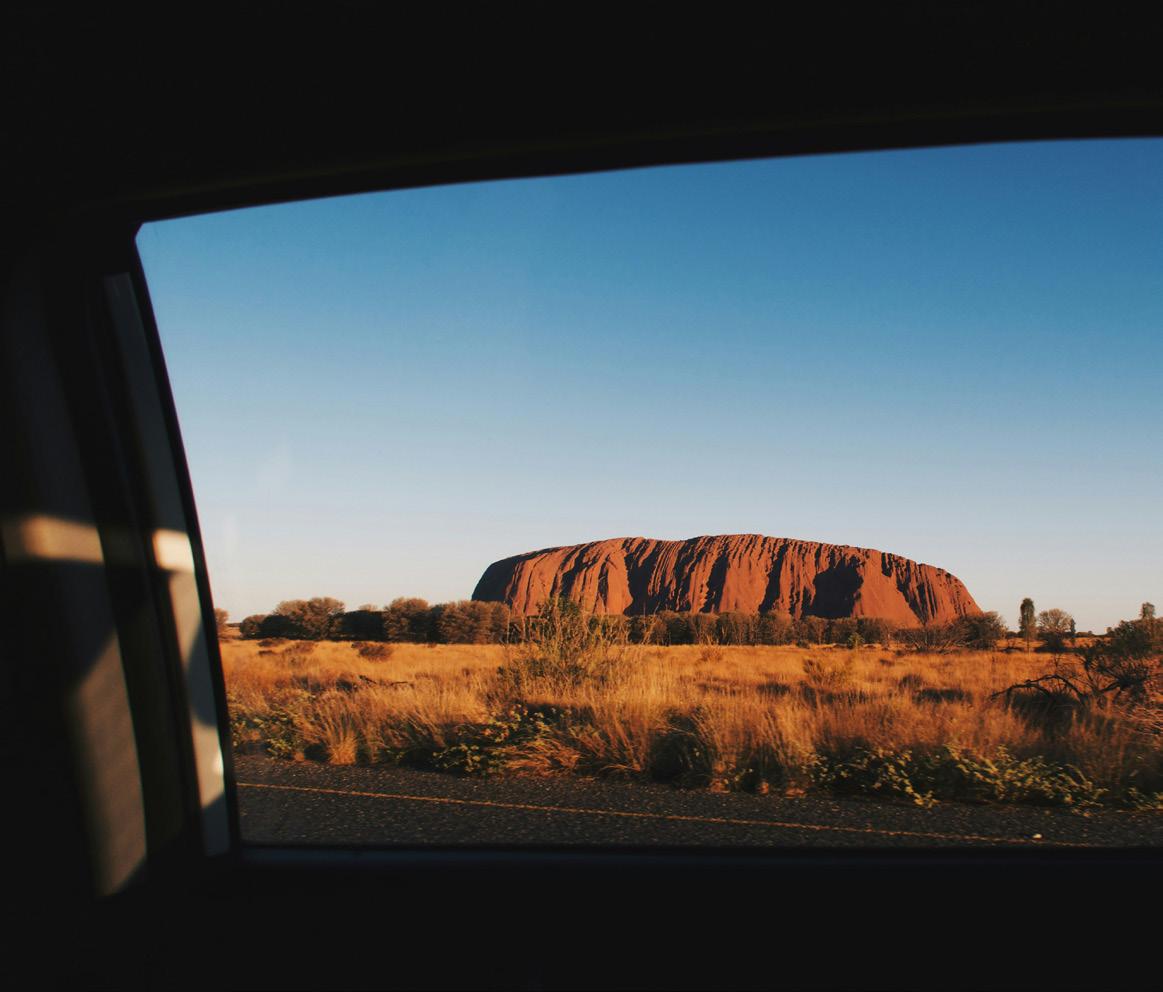
As the rising sun drapes its rays
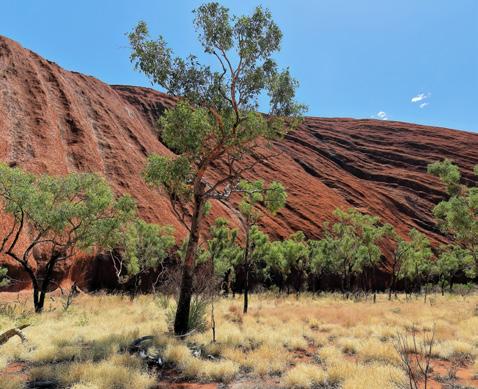
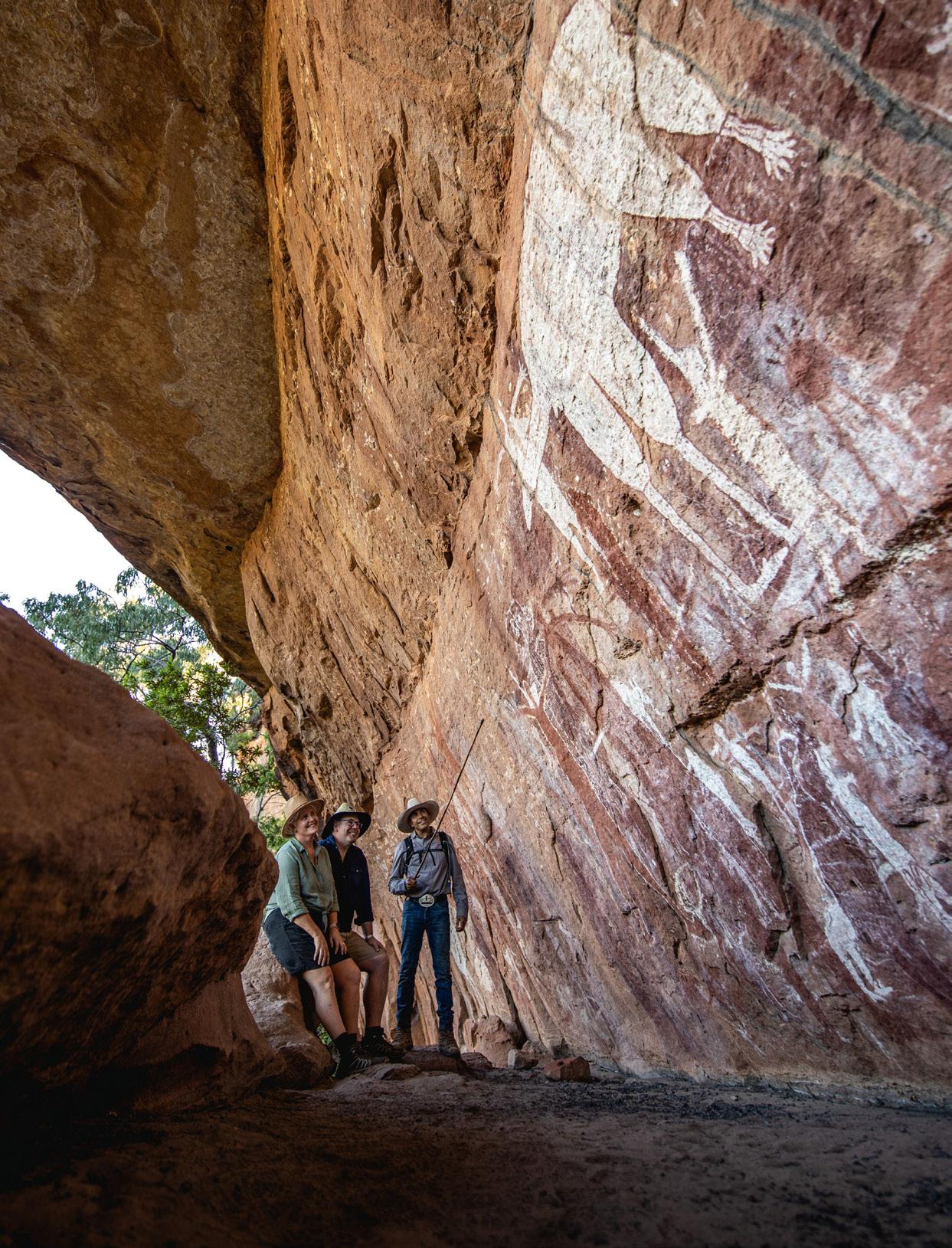
o ver the massive rock’s surface, the colours shift between red, orange and golden. There’s a stillness, a reverence, as centuries of history settle around you like a quilt, passed down through generations and embroidered with the stories of yesterday. The monolithic rock formation of Uluru dominates Australia’s Northern Territory landscape. Beyond the obvious visual spectacle, it provides an incredible chance to engage with the rich Aboriginal culture of Australia and find yourself ushered into the Dreamtime by your hosts.
For centuries, however, the deep spiritual significance of places like Uluru was overlooked, with land being appropriated by European explorers who arrived in the 1800s. The good news is that in recent years there’s been a concerted effort to return these sites to their traditional custodians – in the case of Uluru, the Anangu people. With this recognition comes the opportunity to celebrate the importance of these places. And as travellers, you are granted the extraordinary privilege of being welcomed into these sacred spaces, forging a profound connection to Earth's ancient history.
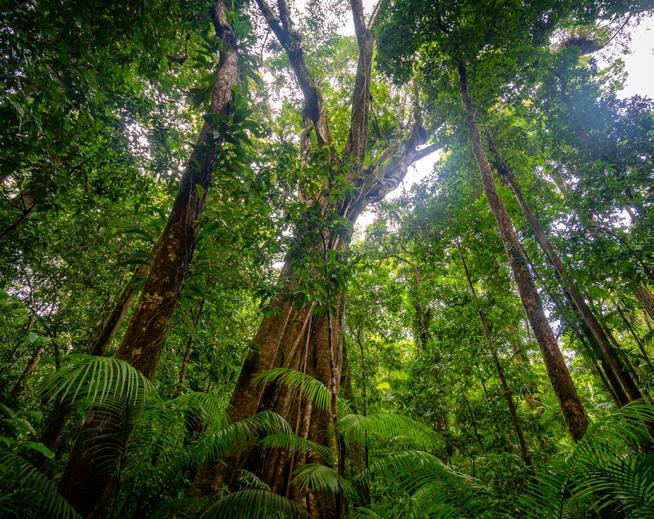
Head further north, into Queensland, and you’ll find yourself in the astoundingly beautiful Daintree Rainforest, the world’s oldest tropical rainforest which is home to an array of wildlife and plants. The Kuku Yalanji community are the traditional First Nations people here with their stories weaving back through some 50,000 years.
Below, right: In Queensland you'll find Daintree Rainforest, the world's oldest tropical rainforest
This living landscape is deeply intertwined with their culture, stories and way of life. You can get a glimpse into all of this at the Mossman Gorge Cultural Centre. It’s not just natural spaces where land and cultural identity is being reclaimed, venture into some of Australia’s cities and you’ll find echoes of the Dreamtime being woven into the contemporary setting, with guides ready to introduce you to their culture and stories. The Wurundjeri people have lasting ties to Melbourne's Birrarung River, and you’ll discover more about the Aboriginal peoples’ saltwater Heritage at illi-Langi The Rocks in Sydney. Community engagement, breaking stereotypes and supporting Indigenous-led economic empowerment is vital to ensuring that experiences in these urban spaces thrive.
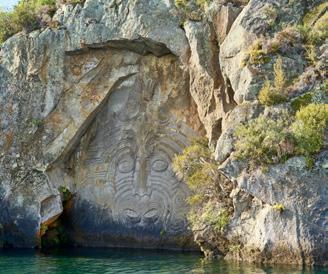
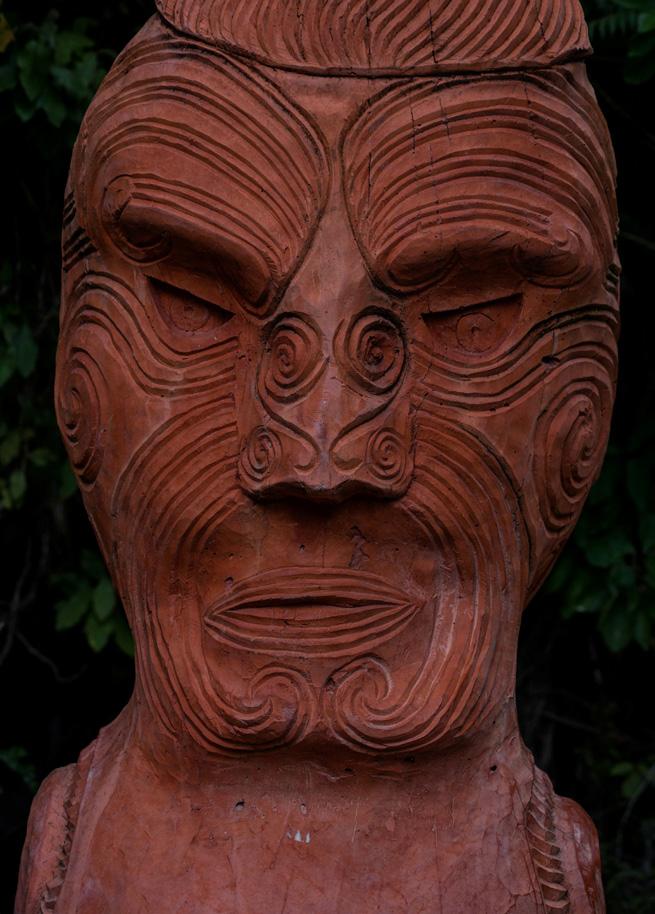
Over in New Zealand, there is plenty of opportunity for you to spend time with people from various Māori iwi (tribes). On your travels, visit some of their most significant historical sites, sacred landscapes and marae, culturally important community spaces. These experiences become infinitely richer when you’re welcomed by a Māori guide who can bring the history, stories and deep connection to the land to life.
A major step towards acknowledging New Zealand’s indigenous heritage and encouraging a more inclusive natural identity was incorporating the Māori name
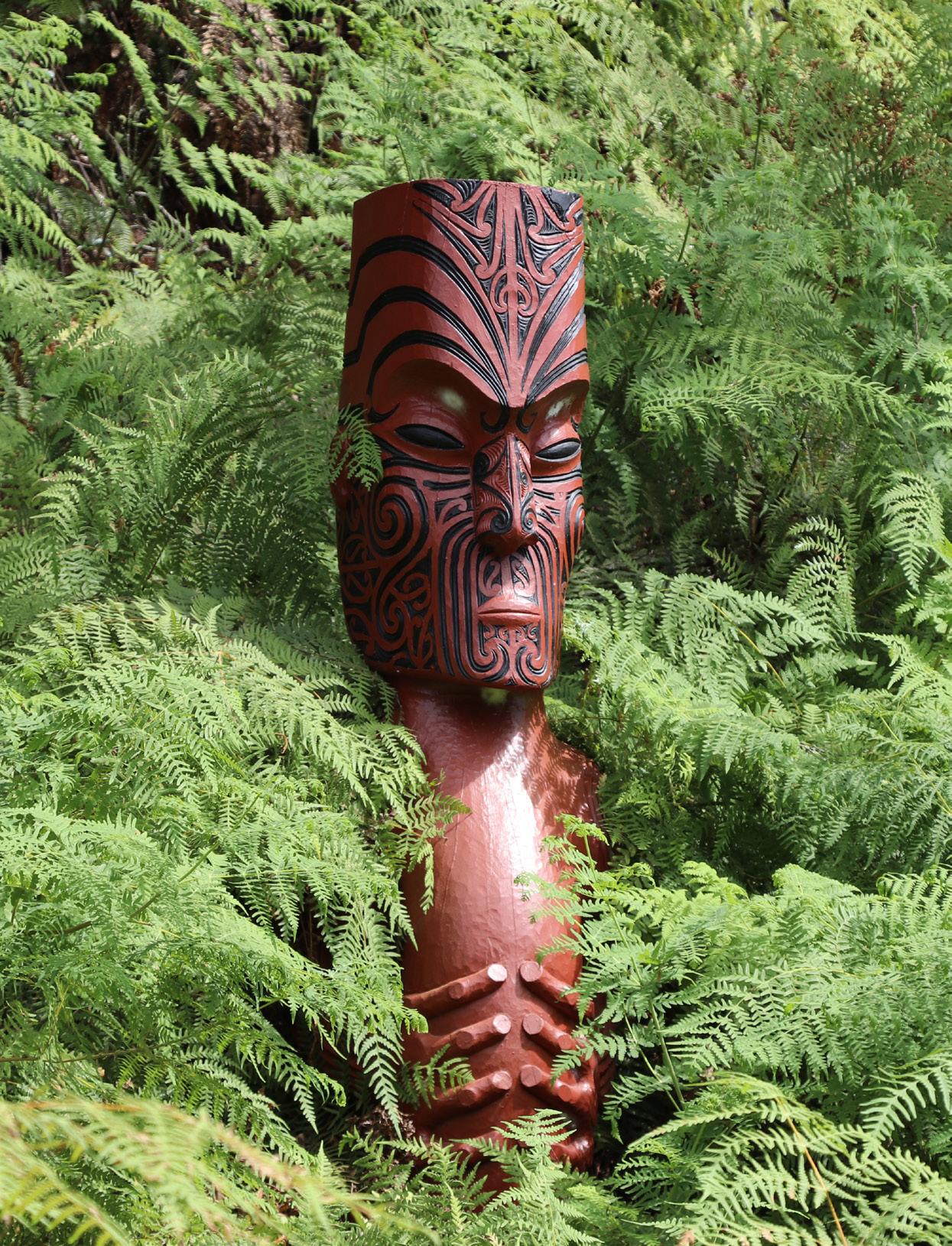
Aotearoa alongside New Zealand. Aotearoa, means "land of the long white cloud", and is the traditional Māori name for New Zealand, which predates European arrival and colonisation. This combined name is one of the ways in which the principles of the Treaty of Waitangi, which outlines the relationship between the British Crown and Māori, are being upheld.
While there is ongoing political debate and some disapproval around the document signed in 1840, it has been useful when it comes to addressing historical grievances and advocating for Māori rights in areas like cultural preservation and resource management.
A large number of spaces across New Zealand have been returned to Māori iwi. The Waitākere Ranges in West Auckland hold deep significance for the iwi Te Kawerau ā Maki in particular. They know their ancestral homeland as Te Wao Nui a Tiriwa (the Great Forest of Tiriwa) and there are many spiritually significant sites and burial grounds here. The responsibility of caring for and protecting the land, known to the Māori
people as kaitiakitanga, is central to their relationship with the ranges. As a visitor, engaging with this concept can truly deepen your understanding of how humanity and nature are connected. The area is also steeped in legend, spend some time here and you may hear about the fairy-like tūrehu or supernatural taniwha creatures which are said to live in the rivers, lakes and the sea.
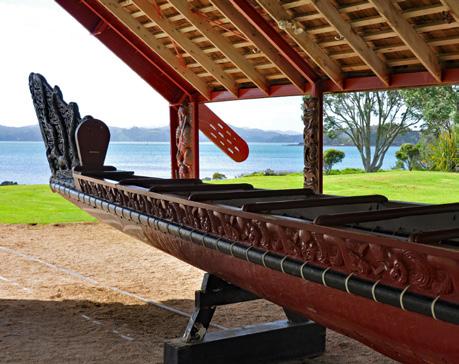
In the Bay of Islands, you'll find several places of profound significance to M ā ori culture. At the Waitangi Treaty Grounds, you can explore a meeting house and museum, and visit the impressive Ngatokimatawhaorua waka, an ornately carved Māori war canoe that helps to bring a chapter of the area’s history powerfully to life.
Further south, in the Taranaki region there are around 16 sites of cultural significance connected to eight iwi. According to Māori legend, the dominant volcanic peak Taranaki Maunga, was once part of the central North Island volcanoes but was forced to leave after a battle and settled in its current location, creating
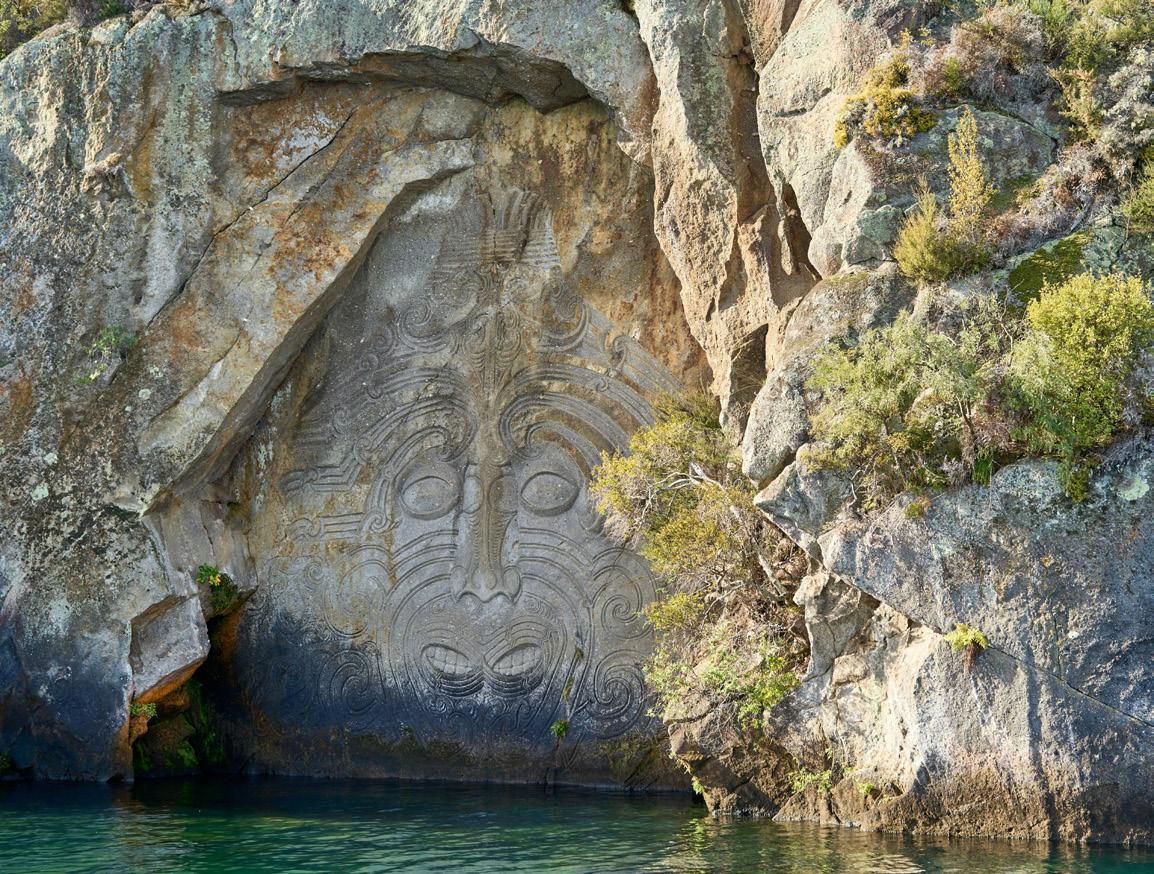
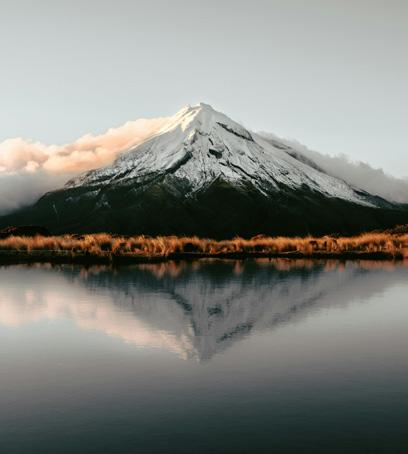
the Whanganui River as it journeyed west. The peak is considered to be a living ancestor and has even been officially granted legal personhood – which means it’s recognised by law as having the same rights as a legal person. In fact, there’s a broader movement to grant legal rights to other significant natural features in New Zealand.
Beyond tourism: a legacy for the future
It is important to recognise that these sites, and countless others across Australia and New Zealand, are not merely historical landmarks, but they are living cultural landscapes imbued with spiritual meaning, ancestral stories and traditions that are treasured to this day. Engaging with them in a responsible and respectful way means recognising the traditional owners’ sovereignty over the land and their heritage.
Choose experiences that are led by and benefit Indigenous people, with economic returns flowing directly back to the communities. This takes tourism from being passive observation to a genuine exchange that both honours the past and safeguards the future of these ancient cultures. Being welcomed into these sacred spaces by members of the very communities that have treasured them for generations can be a profoundly impactful experience.
There are a number of books and films which explore the complex history of land ownership and return in Australia and New Zealand, many through the lens of Indigenous experiences and the impact of colonialism.
ON THE SHELF:
The Secret River by Kate Grenville
This 2005 historical novel centres on an early 19th-century Englishman transported to Australia for theft. The story explores what might have happened when Europeans colonised land already inhabited by Aboriginal communities.
Footprints on the Land: How Humans Changed New Zealand by Richard Wolfe
Less than a thousand years of human occupation have massively altered Aotearoa. Cultural historian Richard Wolfe explores how and why settlers have impacted on nature and what this means for our future.
The Land Before Avocado by Richard Glover
A humorous and insightful look at Australian social and cultural history, including the attitudes and laws that shaped land ownership and displacement.
ON THE SCREEN:
Whale Rider, directed by Niki Caro
The poignant story of Pai, a spirited 12-year-old Māori girl who believes she is destined to lead her tribe, despite her traditionalist grandfather's insistence that only a male heir can hold the chieftainship.
High Ground, directed by Stephen Maxwell Johnson
In a bid to save the last of his family, Gutjuk, a young First Nations man, teams up with ex-soldier Travis to track down his uncle Baywara, the most dangerous warrior in the Territory.
Ancient traditions, rich experiences and delectable regional delicacies: follow your tastebuds across mainland Greece for an extraordinary culinary adventure.
Words: MICHELLE ALLEN
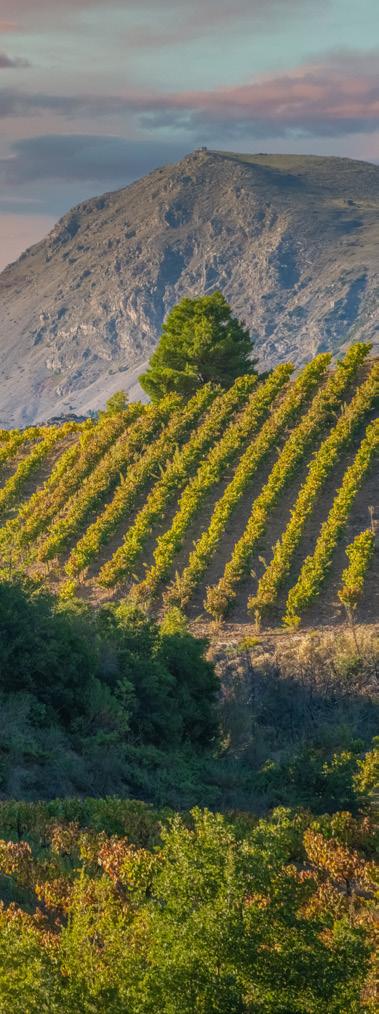

Greece is a country renowned for its warm hospitality, where locals and travellers alike are welcomed around the table to unite over the sharing of food. Beyond the country’s ancient capital and sun-drenched islands, in Greece’s lesser-visited regions traditional techniques are still honoured. Uncover quaint farmsteads in the Peloponnese, experience the seasonal joy of truffle hunting in the forests of Epirus or try your hand at the age-old ritual of making oliveoil. Each destination offers unique opportunities to build deeper connections with the cultures, places and people you encounter along the way.
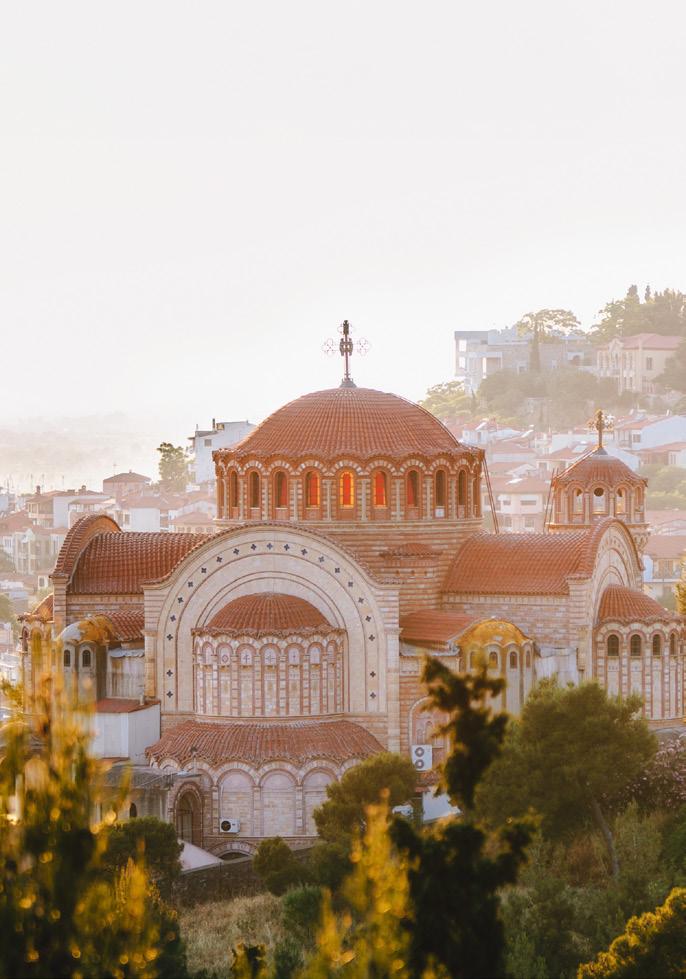
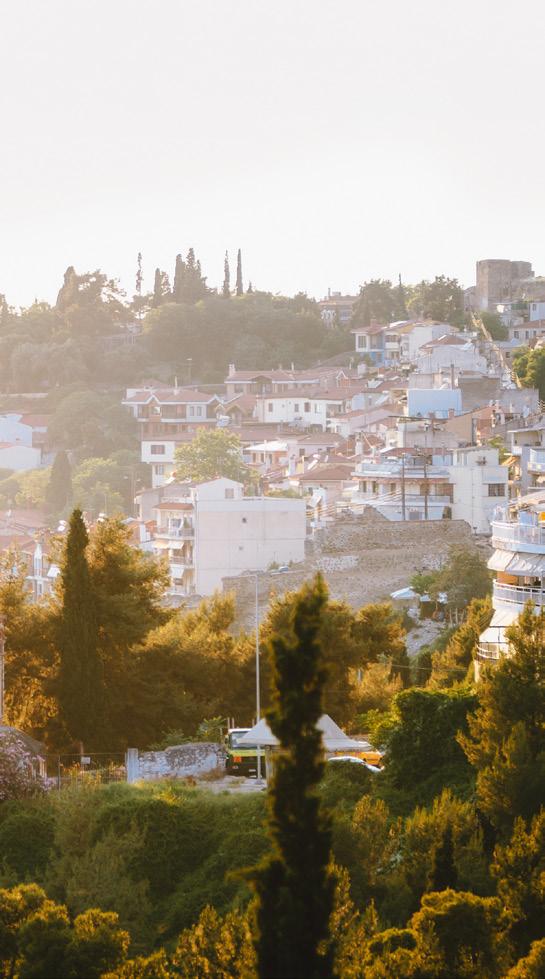
Thessaloniki beholds a strong cultural identity born through an amalgamation of influences from its past occupants: the Romans, the Byzantine Empire and the Ottomans. A pivotal city through the ages, it is now the gastronomical centre of Greece, bursting with Middle Eastern, Balkan and Asian flavours carefully bound by unrivalled Greek hospitality.
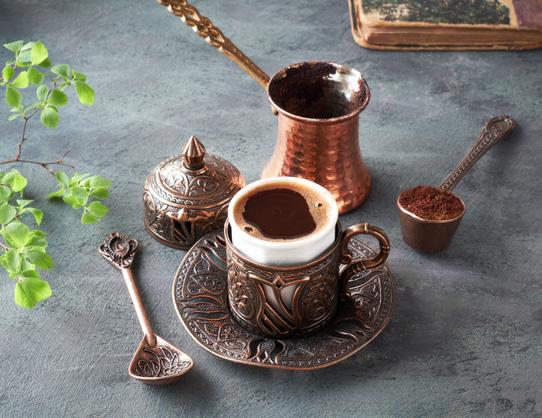
Follow in the footsteps of the Greeks and enjoy the morning at a relaxed pace with a privately guided walking tour. Explore markets where hessian sacks overflow with fragrant herbs, the woodiness of freshly harvested olives hanging in the air and the sweetness of vine-ripe tomatoes teasing your taste buds. Wander through the cobbled side streets and secluded courtyards of the old town before stopping at a local kafeneio (cafe) to sample ellinikos kafes – Greek coffee, sometimes known as Turkish coffee.
Introduced during the Ottoman period, ellinikos kafes is to be savoured and shared. Its preparation is a ritual in itself and is not to be rushed. Traditionally taking between five to ten minutes, it is freshly boiled in a special pot called a birki to create its signature rich, strong flavour and creamy texture. Sit and slowly sip as you watch people weave through the old town. Pair it with bougatsa, a traditional Greek breakfast pastry. Enjoy the crunch of the flaky filo pastry before you’re greeted with the soft centre of your choice, with custard,
cheese or ground meat amongst the most popular. You may be fortunate enough to befriend a Thessalonian and experience the art of having your coffee grounds read.
Leaving the city behind, the countryside beckons. A side of Greece that is often overlooked, the northwestern region of Epirus offers the opportunity to experience the country in a new light. Bordering Albania, nestled between the Pindos mountain range and the Ionian Sea, it is a region of soaring peaks, glistening rivers and sprawling pines – a contrast from the typical Greek postcard.
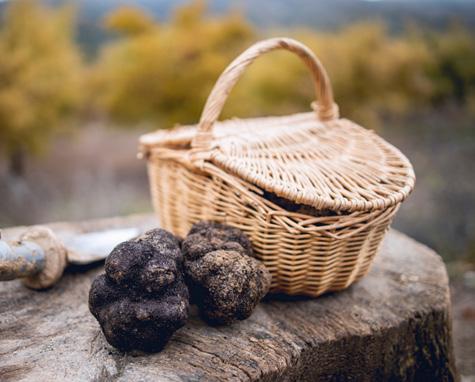
With its fertile land and alpine climate of harsh winters and cooler summers, Epirus is an epicentre of rich culinary heritage. Truffle hunting is famed to have its historic roots here. Known as the diamonds of the kitchen, the fungi were once a delicacy served only to
Opposite:
nobles. Now, truffle hunting is a lucrative livelihood for a select few, some of whom share their art with passing travellers.
Head out with your expert guide and their Lagotto Romagnolo dogs, which are recognised around the world as specialised truffle searchers. This is a yearround pursuit, with each season bringing its own unique treasures beneath the forest floor. For those seeking the rarest finds, October is the time to go. Your searching will be rewarded by the cool autumn sunlight bursting through the leaves as they transition to warm hues of gold and amber – a true sight to behold.
Then make your way to the home of your guide, carrying baskets brimming with fresh bounty. The friendly faces of relatives welcome you, taking you to the river at the far end of the garden where mushrooms are cultivated.
Set under a pergola that is interlaced with fuchsia blooms, an intimate lunch offers the opportunity to sample farm-to-table cuisine at its source and savour the earthy tones of the morning’s freshly foraged truffles. Here menus change with the seasons, each centred around the theme of truffles and the produce picked from the forest. Enjoy delicacies such as mushroom soup, creamy risotto and a sweet berry dessert topped with white truffle shavings – the perfect blend of sweet and savoury.
Both truffle and wine-tasting beckon at Grand Forest Metsovo, opposite the town of Metsovo, with panoramic views of the town sprawling across the valley.
Find out more → bit.ly/grand-forest-metsovo
A feast for the senses
Epirus’ culinary scene stretches beyond the diamonds of the kitchen. Head into the valleys to find the jewel of Epirus: Metsovo. Set beneath the Katara Col (Katara Pass) that traces the Mountain Range of Pindus, Metsovo is a small but lively alpine town that hugs the face of a valley, with its terracotta roofs often shrouded in a soft mist that descends throughout the day.
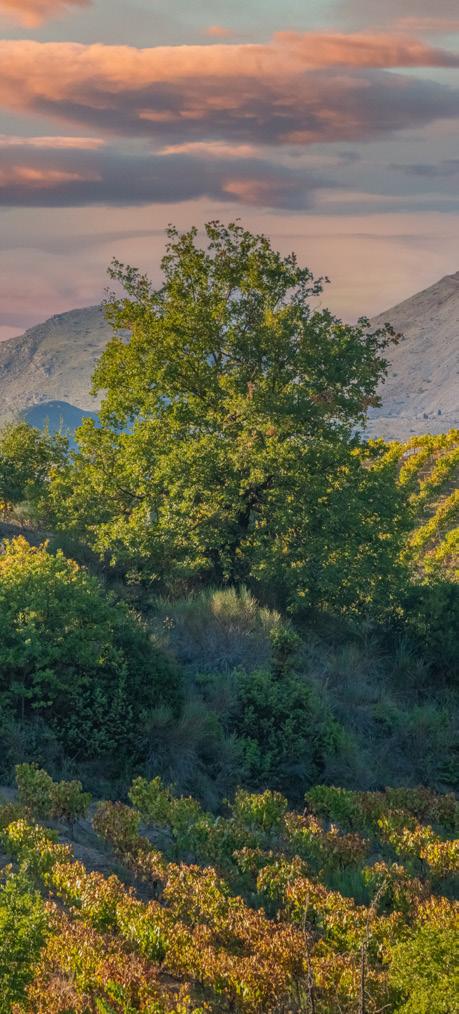
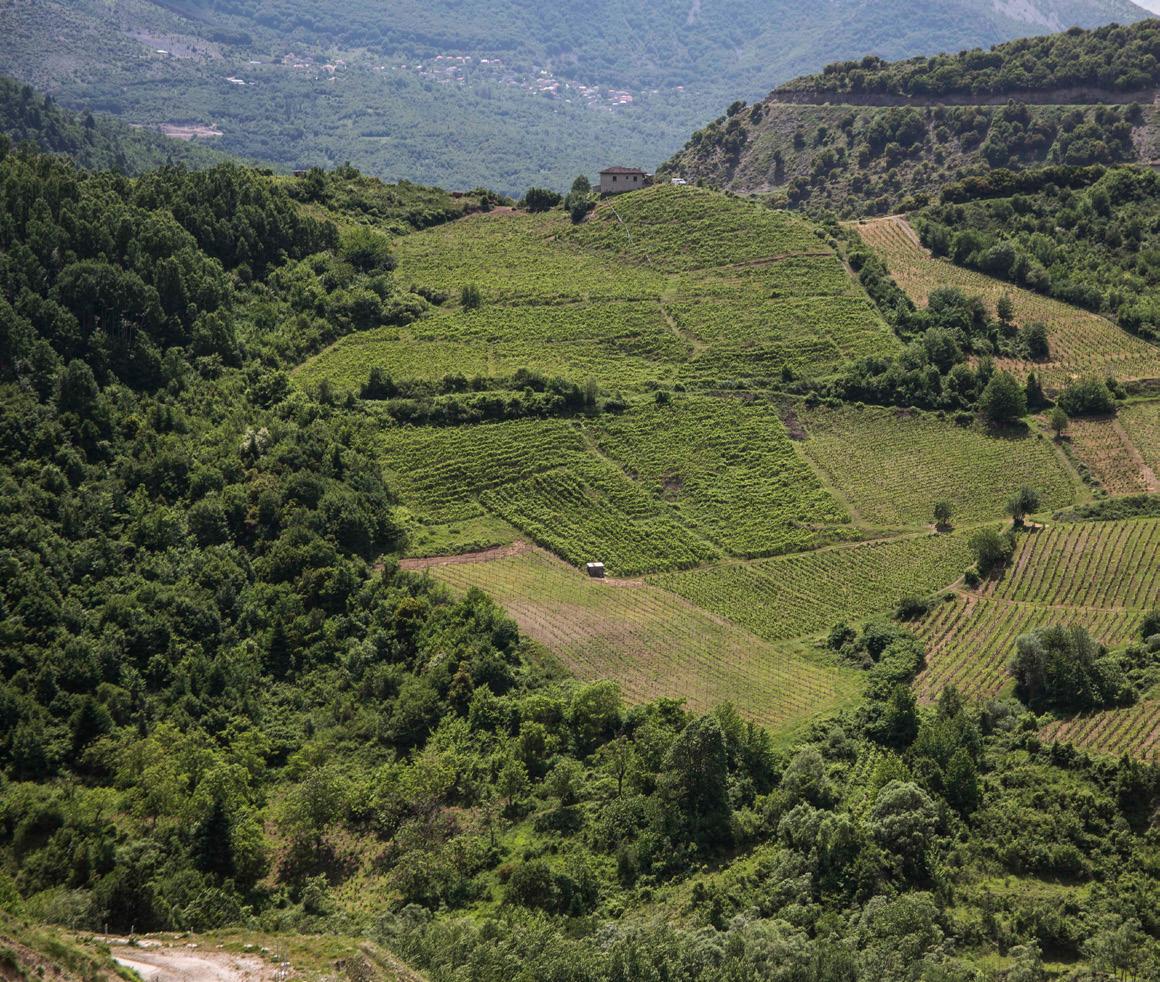
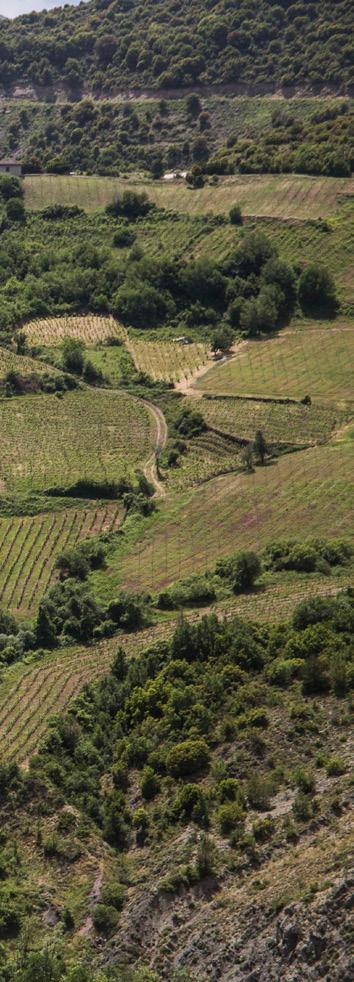
A popular winter destination for locals, the town charms with its allure of quaint streets, stone-clad buildings and traditional Vlach culture that is still present in carpet weaving and wood carving. With vineyards sitting at an elevation of 1,000 metres, Metsovo is home to a range of unique and high-altitude wines – both native and international varieties.
A visit to Katogi Averoff winery invites you to taste some of the region’s most exceptional wines. Enjoy an exclusive tour through cellars that date back to 1973, where tradition lives on and grapes are still picked by hand. What truly sets this experience apart is the
presence of the founder’s grandson, who now proudly carries forward the family legacy.
From here, start in a small museum, home to an extensive collection of artefacts that trace the story of the winery and its founder’s deep connection to the local region. As you explore, Alexandros – the founder’s grandson – brings the past to life, sharing personal stories behind each item. Together, they paint a vivid portrait of his grandfather – a revered writer, a person of power and a collector.
Unlike at other wineries, this cellar is an immersive multi-modal installation. Design elements showcase the founder’s artistic side. Deep red lights illuminate the bottles of garnet wine surrounding the tasting table, holograms and portraits share tales along the midnight black walls, and detailed artwork decorates over 1,200 oak barrels.
The experience concludes with a private tasting, set around a large mahogany table. An exquisite à la carte menu is presented, with each course thought-
Above: With vineyards sitting at an elevation of 1,000 metres, Metsovo is home to a range of unique and highaltitude wines
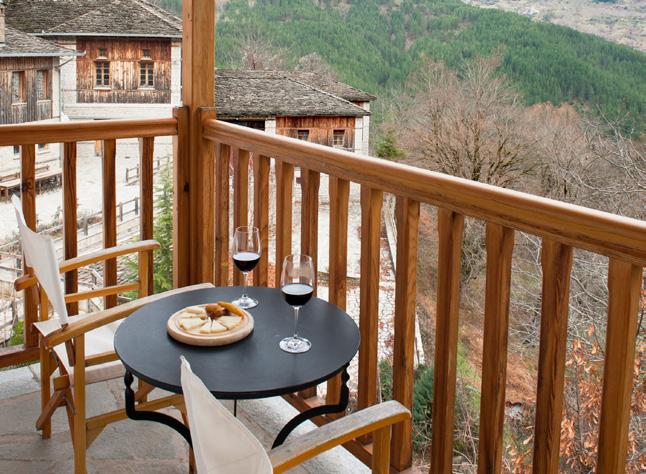
fully paired to showcase the depth and character of the wines. A fruity, floral dry white complements a delicate appetiser, while a demi-sec rosé brings out the sweetness in peach, sautéed greens and whipped feta. To finish, a bold Cabernet Sauvignon – layered with notes of sweet spice and roasted coffee – pairs perfectly with a serving of tender, succulent meat.
From farm to table
Swap the mountains of the north for those of the southern Peloponnese peninsula, where the menus see meat replaced by fresh seafood, and truffles are exchanged for local honey.
Discover some of the flavours and traditions of rural Greece with a visit to a local organic farmstead. During your visit, you can learn about practices that preserve agricultural knowledge and support local communities. Join the owners and partake in their everyday farm work. Feed the animals and collect fresh eggs from the hen house, before visiting the farmhouse to prepare and taste local cuisine. A highlight amongst the delicacies is galatopita a sweet pie made from Greek milk and custard.
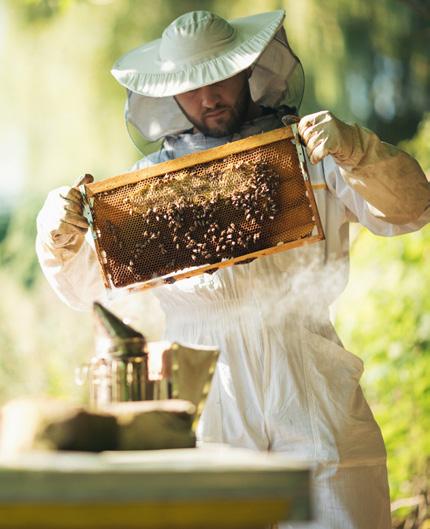
Why not take the opportunity to learn about the great importance that a small insect has on our ecosystem – the honey bee? Continue on to a unique beekeeping workshop where you will witness the bees hard at work in their special hives. You will also see the old tools used in the traditional extraction of honey
alongside those also key to agricultural life in the area. Afterwards, sink your teeth into a slice of bread slathered with local honey, accompanied by a coffee or tea brewed from aromatic herbs.
Perched amidst the picturesque Gortynia Mountains and overlooking the sprawling hillside town of Karytaina, lies the Arkadiani Multispace. This retreat offers a multitude of workshops that aim to revive the traditional values of Arcadian life: simplicity and working harmoniously with nature. It is a haven for agritourism, harnessing local products, traditional recipes and a deep respect for the environment.
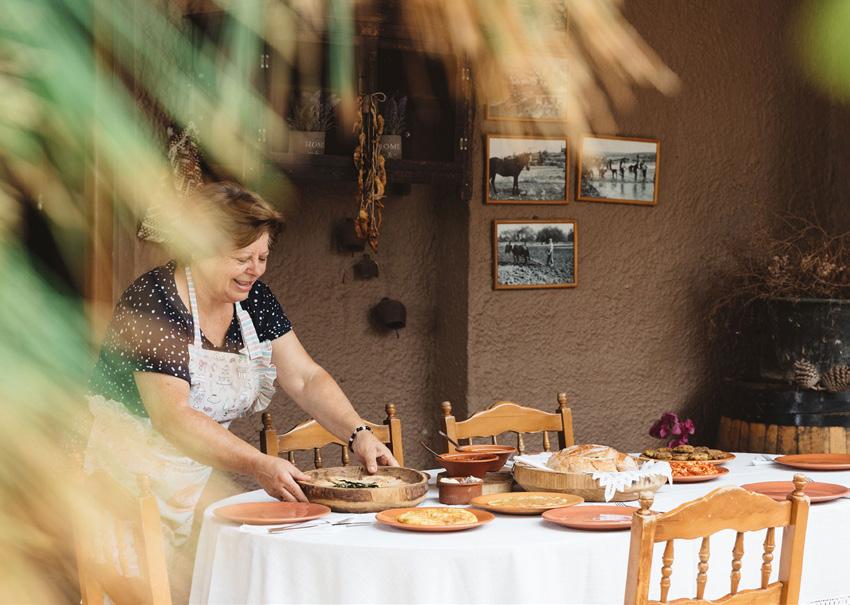
Step back in time in the centre’s library, where over 650 cookbooks from the 19th century preserve recipes passed down through generations. Then immerse yourself in an exhibition featuring the village’s ancient cooking tools. Learn of each of their uses from your
knowledgeable host, before trying your hand at the old manual stone mill.
Then share in what is often called the Greeks’ physical expression of love by cooking together with freshly picked produce from the centre’s on-site garden. Prepare kouloura, a traditional bread used in wedding ceremonies that is adorned with elaborate decorations including roses, pomegranates and doves, each with its own symbolism.
End your time here with a stroll through the private vegetable garden. With the help of your host, you will fill your basket with home-grown ingredients destined for your own private cooking class. The terrace is the perfect spot to savour your labour of love alongside some delectable organic wine, all the while soaking up the coexistence of traditions.
At the enchanting Liotrivi Estate, sunshine beams practically all year round. Situated in the coastal area of Peloponnese’s Monemvasia, Liotrivi invites you to feel the connection to their roots, which span generations.
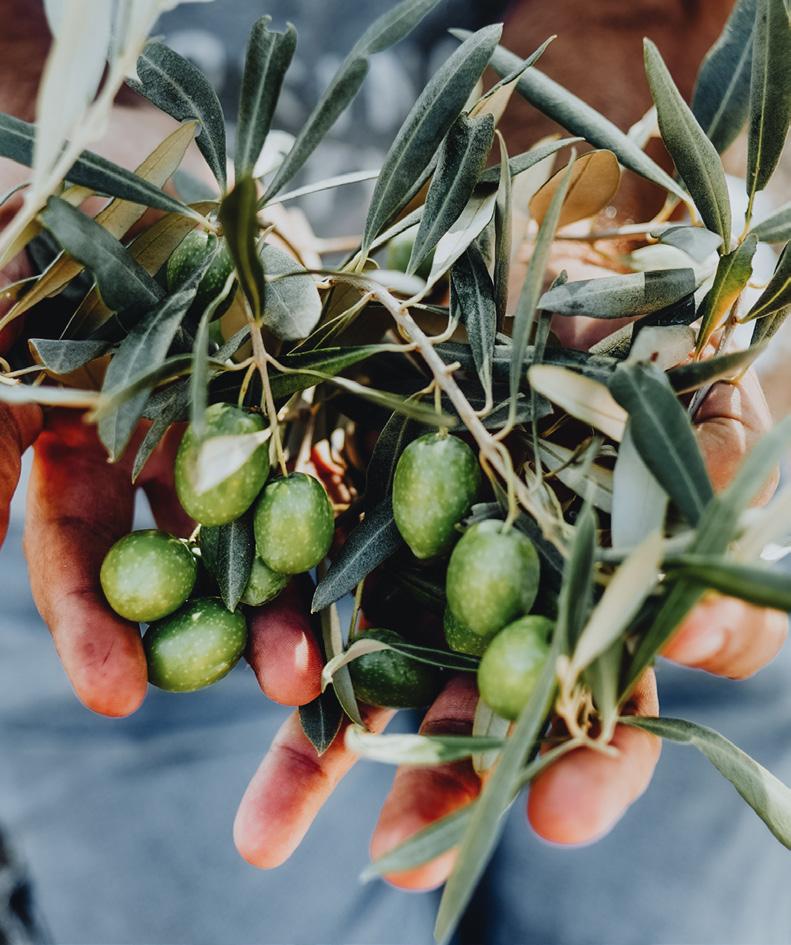
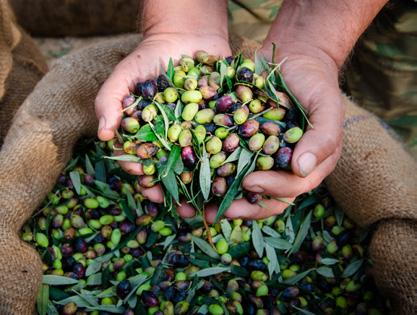
The olive tree – a symbol that brings with it great pride to the nation – is synonymous with the region of Peloponnese. Many see the olive tree as kin and continue their ancestors’ traditions of passing them down through the family. An art finessed for thousands of years, the production of olive oil is one of Greece’s

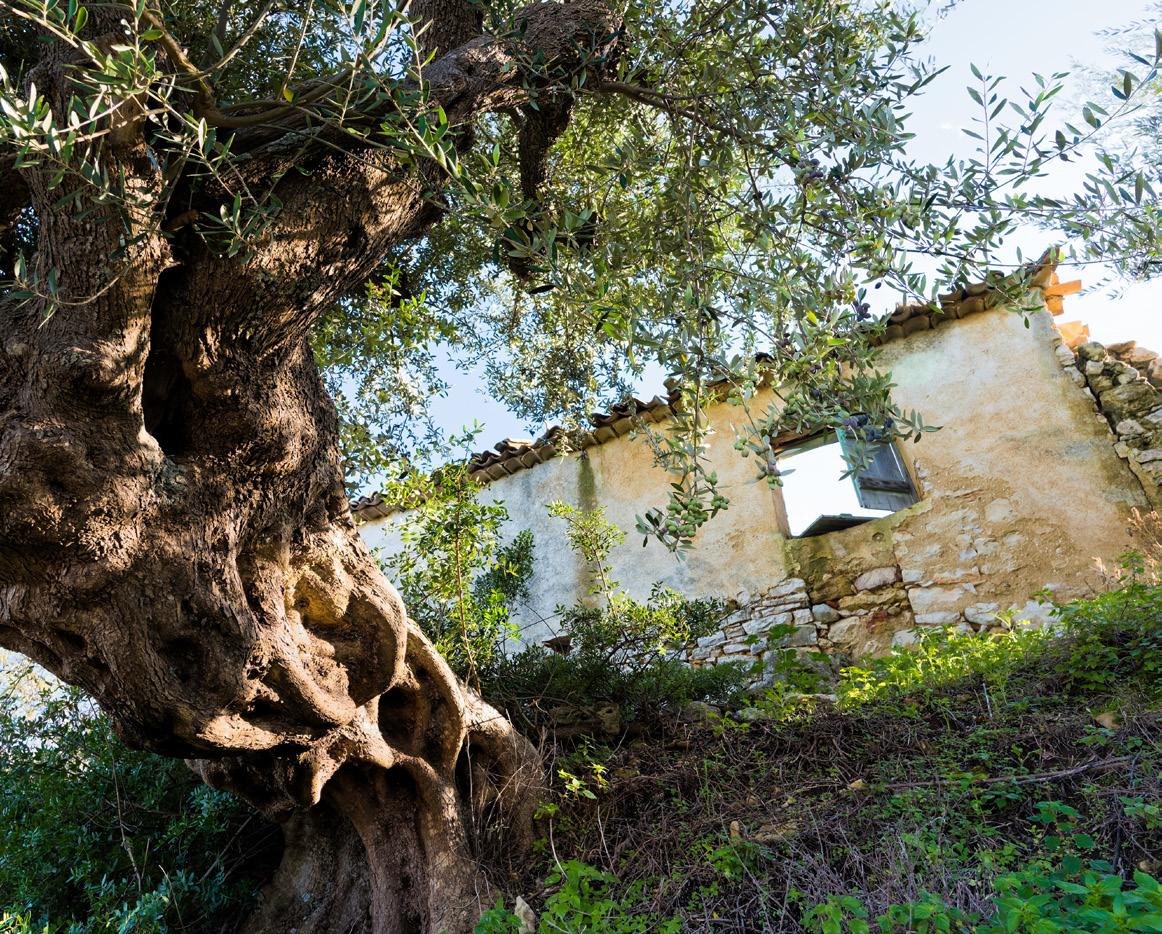
most important agricultural activities. Beyond a source of income, locals believe that gifting olive oil is said to strengthen ties to the land and the bonds between people.
With the guidance of a gardener, explore the orchard of the estate, carefully harvesting and gathering the ripe fruit by hand. Watch as the olives are crushed in the old stone mill to produce fresh oil, a practice dating back to the ancient Minoan civilisation. Conclude this immersive journey by choosing to adopt an olive oil tree – a symbolic action that will further strengthen your ties with Liotrivi.
Planted in a specially designed area, your seedling will be nurtured by the estate. You’ll receive annual updates and pictures documenting the tree’s progress alongside a bottle of extra virgin olive oil or a jar of olives, if desired.
Taste buds tantalised? Speak to a travel designer to plan your culinary journey or get your first ideas from an example itinerary.
Find out more → bit.ly/flavours-of-greece
Across Africa, meet the creatures who defy the odds to create intricate structures, apply generational wisdom, demonstrate advanced intelligence and forever change the space around them.
Words: EMILY OPIE
Africa’s landscapes and wildlife are inextricably linked. The open savannahs of Tanzania move with striped zebras and dainty gazelles. The lush green jungles of Rwanda and Uganda contrast against the soft, thick, black fur of mountain gorillas, while pretty pink flamingos light up lakes in Kenya.
But, the wildlife in Africa does more than just adorn its wild spaces. The animals here are intelligent, sophisticated and are able to engineer their own impressive homes as well as the environment around them. Africa's wild engineers can be tiny or huge. You can find them in bright blue skies, below sun-drenched plains or meandering through its emerald wetlands.
Micro might
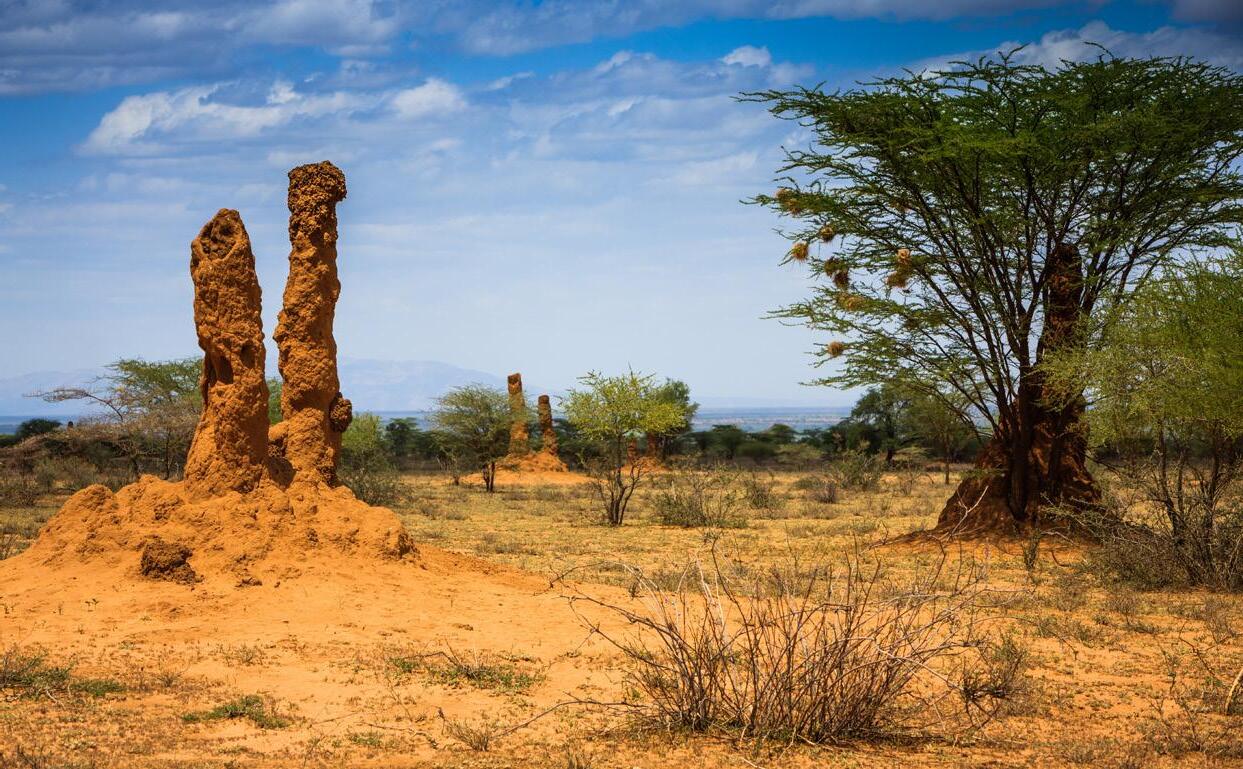
Termites are incredible insects. A workforce of these tiny creatures tirelessly toils to create towering mounds that rise above an intricate labyrinth of subterranean
nests, tunnels and chambers. These mounds are architecturally fascinating. The engineering involved in their successful construction defies all probable expectations of such miniscule workers, who will be, on average, 300 times smaller than the mound they create.
Dogged perseverance, unwavering determination and the unified, skilled collaboration of the entire colony enable the creation of mega-constructions that emerge from the earth. This monumental achievement occurs over many years, even as the termites endure the challenges of adverse weather and assaults from animals such as aardvarks, anteaters and pangolins.
Millions of termites build one mound and have used the same blueprint consistently for millennia. The tower or ‘chimney’ (the ‘mound’ itself) is constructed by the termites depositing an exact mixture of soil, saliva and dung, almost like a cement. The intelligent design of the chimney functions as a natural ventilation system for the complex levels of chambers and tunnels beneath. Hot, stale air is expelled from the tower, while cooler, fresh air is drawn in through small openings and the mound's porous walls.
Incredibly, these tiny engineers and their ingenious natural ventilation system have become a direct source
Above: Termite mounds and their natural ventilation systems have inspired how we design some of our human spaces
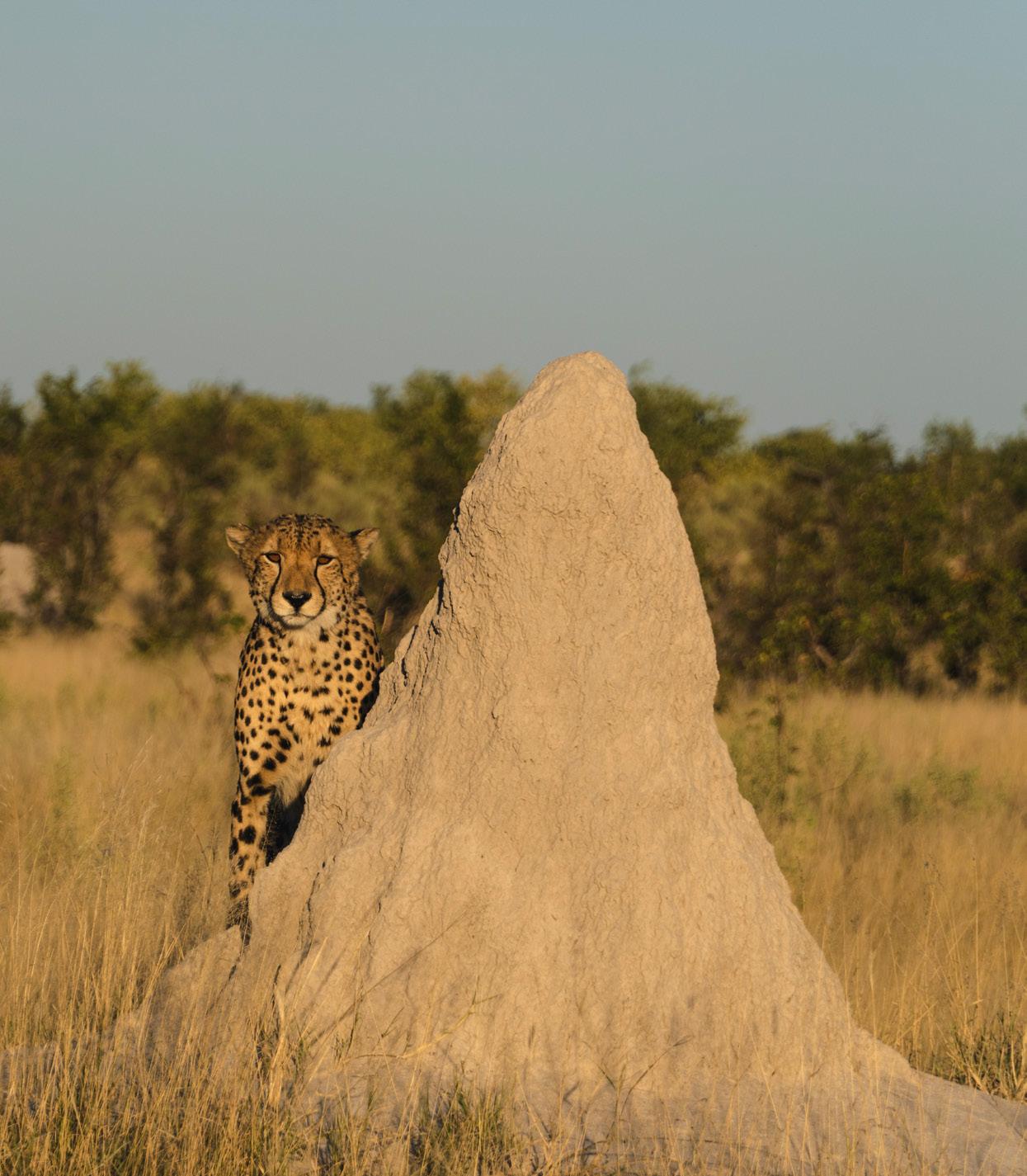
Below: Termite mounds are great vantage points for a variety of wildlife
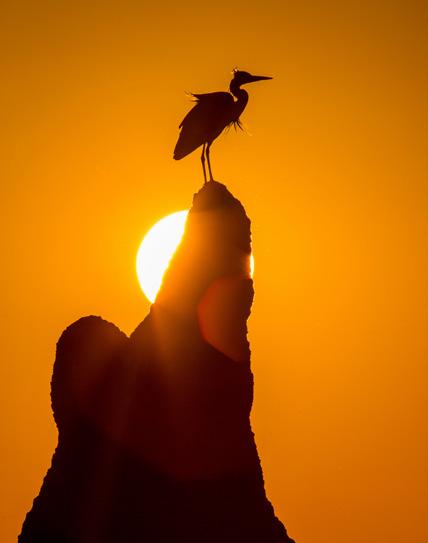
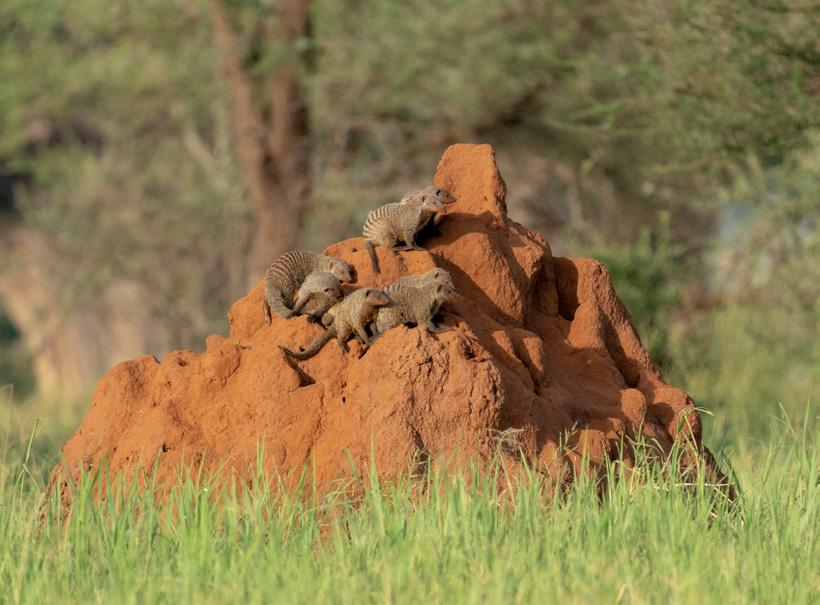
ward, acting as lookout points for agile cheetahs who can climb to the top, or shade to a wandering zebra.
The land here is arid. Wind erosion is common and vegetation is sparse. But the opposite is true for the micro-environments around termite mounds. The mounds act as vital support to the nearby ecosystems by enriching the soil and creating a fertile space where plants, such as edible mushrooms, can grow and animals and insects can thrive.
of inspiration for how we design our human spaces. Engineers, particularly those concerned with sustainable building design, have studied the termite building processes and replicated it in multi-storey buildings. It’s called the ‘stack effect’.
Termite mounds can be found throughout Africa, though some of the most impressive and ecologically significant are built by the Macrotermes genus, which are primarily found in Namibia, South Africa and Botswana. The colossal constructions actively shape the geographical features of space around them and profoundly impact local ecosystems and wildlife. What's truly remarkable is that they have been performing these vital roles for thousands of years.
In Namibia the mounds create an otherworldly component to the vast expanses of sun-cracked flat red earth. Hundreds of little red chimneys reach sky-
So great and longstanding are the powerful natural benefits of termite mounds that their significance has influenced human belief systems. For some cultures in Namibia, the mounds signify growth and prosperity and are associated with the spiritual world. It’s believed that the mounds contain the spirits of ancestors and are in turn used as burial sites.
In Botswana's Okavango Delta, termite mounds, over thousands of years, have played a pivotal role in the creation of many of the 150,000 islands. As the mounds grew in size they naturally redirected the seasonal flood waters, creating waterways that carved through the wetlands and savannahs, encircling what would become dry islands. This perpetual cycle of mound building and flooding continues today.
South Africa’s Namaqualand region, in the northwest of the country, close to Namibia, is where you can find Africa’s largest termite mounds. These awe-inspiring structures are up to 9 metres tall, 3 metres deep and 30 metres wide. Even more remarkable, they're
believed to be a staggering 34,000 years old, making them the oldest known examples on Earth.
Mounds of this size and age play a significant role in the planet's natural carbon cycle, as the termites bury carbon deep underground, away from the earth's atmosphere. This process is crucial in mitigating the effects of climate change and this simple yet effective process has led to detailed human research. It’s fascinating how much we can learn from the engineering behaviour of these tiny wild masterminds.
A woven masterpiece
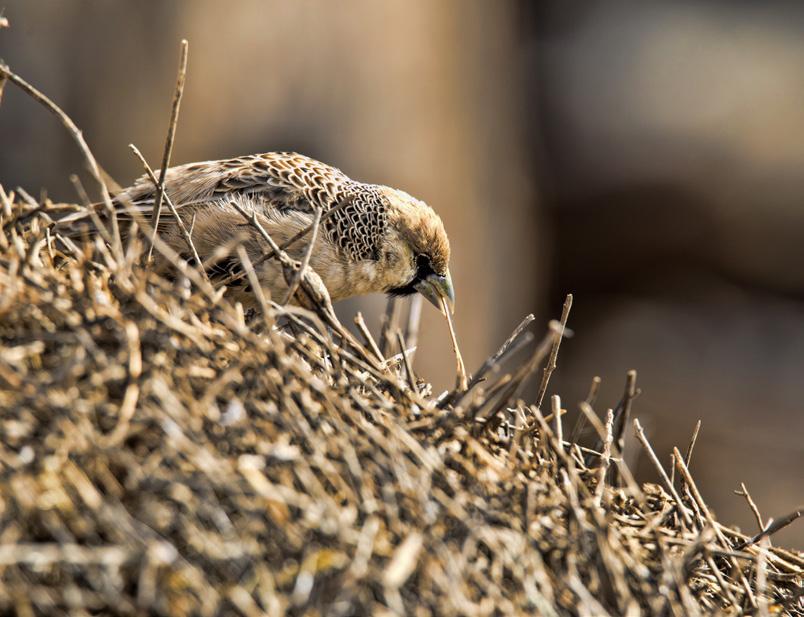
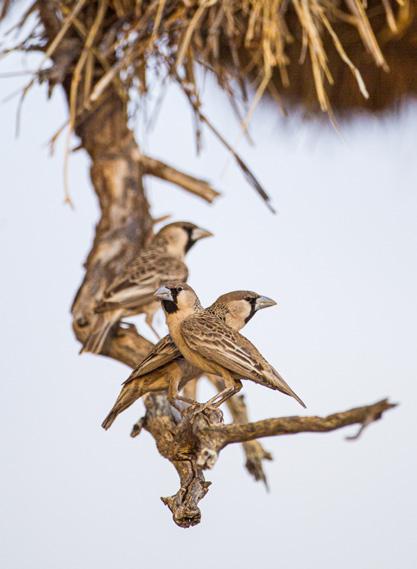
In the skyward spaces of Africa you’ll find the enigmatic weaver bird, endemic to southern Africa, specifically the Kalahari and Namib regions. These small, busy, finch-like birds, often brightly coloured in yellow or red, are constantly chirping and chattering. Their pretty appearance and sociable, almost fun, personality doesn’t immediately reveal their true nature as advanced and talented engineers, but looks can certainly be deceiving.
Weavers stand out in the avian world for their gregarious character and communal living. They join just a small handful of other communal birds, such as parrots, who continuously live – not just during mating and feeding — with others in their community.
There are 57 different types of this powerful and distinctive little bird and although they can be found
in some parts of Asia and Australia, they are primarily found in Africa. And it's here that they make the biggest impact on the spaces around them.
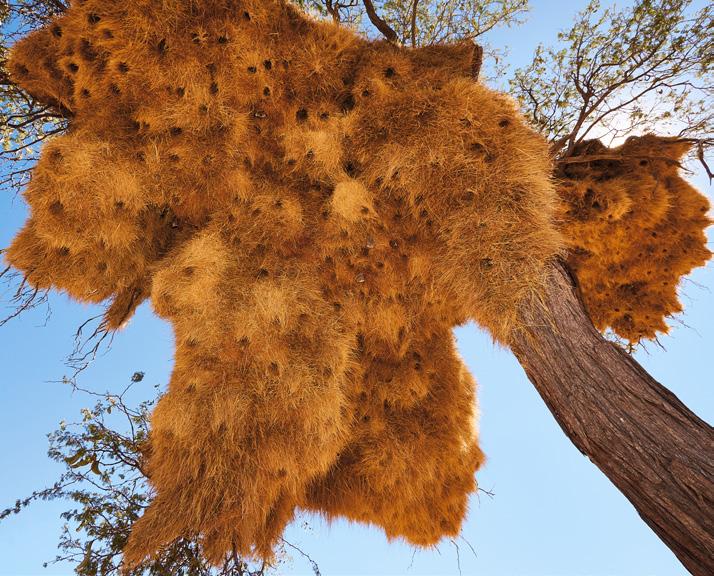
All species of weavers create intricate woven nests. While some other bird species create large nests, the sociable weaver is unique: it meticulously weaves massive communal structures using knots, featuring specific entrances, hallways and vast living spaces for entire communities.
The design of these hanging nests is strategic and complex. These enormous refuges have doorways at the base of the nest, set furthest away from the structure it’s attached to, making it difficult for predators such as snakes to gain access. Then, the entrance hall, a narrow chamber with protruding rough twigs that face inwards, a further deterrent to unwelcome intruders.
The roof begins with a framework of large twigs and branches, sturdy enough to support a thick layer of dry grass. This provides crucial protection and insulation. Individual chambers are then created underneath using soft grasses. Each of these ‘rooms’, known as nesting chambers, will house a pair of weavers and their offspring. Each pair then lines their own chamber with fur, cotton and fluff for comfort and extra insulation.
They are often built hanging from the branches of acacia trees or even from telephone poles and sign posts, covering them with intricately woven grass and twigs.
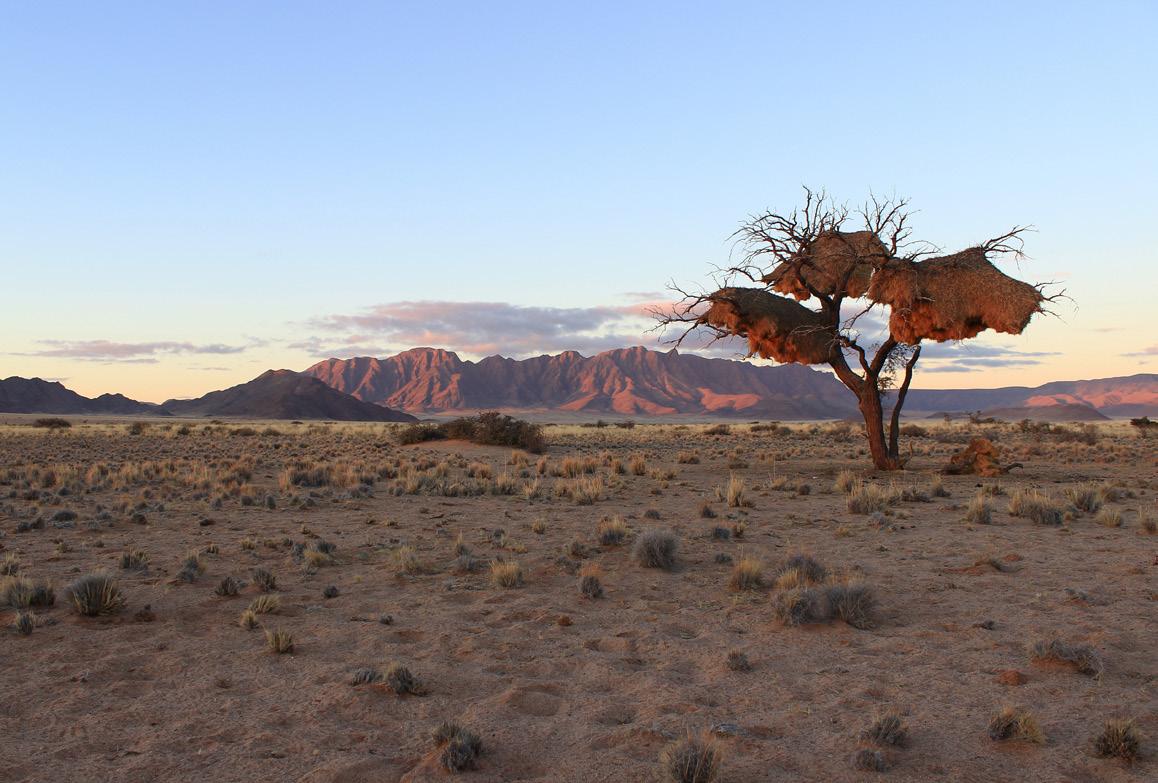
The biggest nests can be found in the Kalahari desert which encompasses South Africa, Botswana and Namibia. These nests are monumental feats of engineering, avian super-structures that can exceed 6 metres in width and 3 metres in height. These busy bird cities can house upwards of 100 residents in over 50 nesting chambers with some providing shelter for the last 100 years.
In these parts of Africa, the conditions can be inhospitable with searing daytime temperatures and freezing nights. The weaver nests are constructed to mitigate these extreme temperatures by maintaining thermal equilibrium throughout the communal space, protecting the birds whatever the weather.
Other desert dwellers, including pygmy falcons and lovebirds, find solace in the protected thermal refuge of sociable weaver nests. And wasps, bats, mice and various insects also retreat to share this safe space. Large raptors such as vultures, owls and eagles will roost on the rooftops, and mongooses, genets, leopards and cheetahs climb the nests to utilise them as sturdy observation platforms.
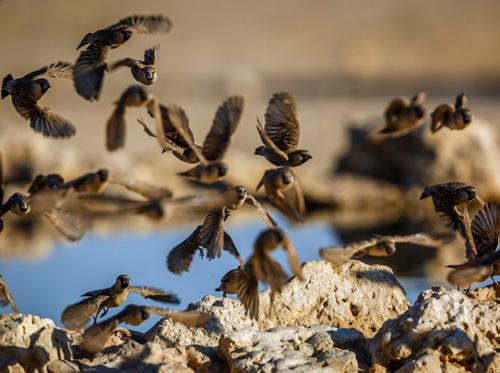
The fact that the social weavers' communal living model extends beyond their own species has a profound positive impact on the surrounding environment, resulting in them being known as ecosystem engineers. It’s believed that as desert spaces are further impacted by climate change and weather conditions become more extreme, these smart thermal shelters will adapt further, becoming vital in the protection of large numbers of different species.
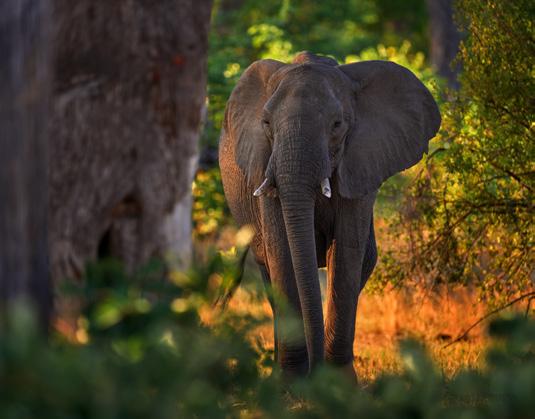
African elephants don't just occupy space; they command it with their sheer physical presence. They possess high intelligence and are capable of intense emotion ranging from deep empathy, grief to joy and volatile aggression. They are known for their legendary memory, remarkable capacity for learning and complex social bonds, making them one of the world’s most sophisticated species.
Elephants can be found all over east and southern Africa, with the largest populations in Zimbabwe, Tanzania, Kenya, Namibia, Zambia and South Africa. But it’s in Botswana’s lagoons, rivers and wetlands that you’ll find the highest densities of Africa’s giants.
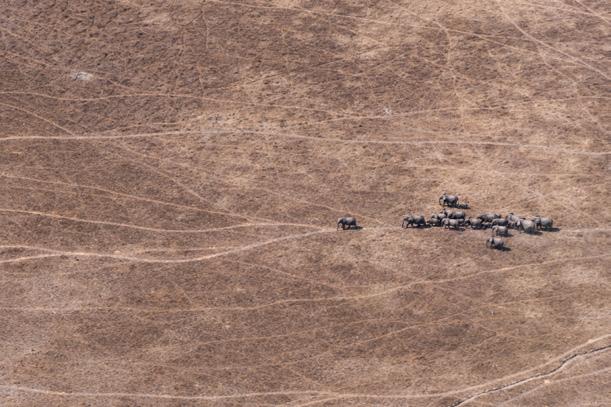
Individually, elephants are fascinating. Collectively, their impact on the environment becomes so profound that they, along with beavers, are named the world’s most important animal ecosystem engineers.
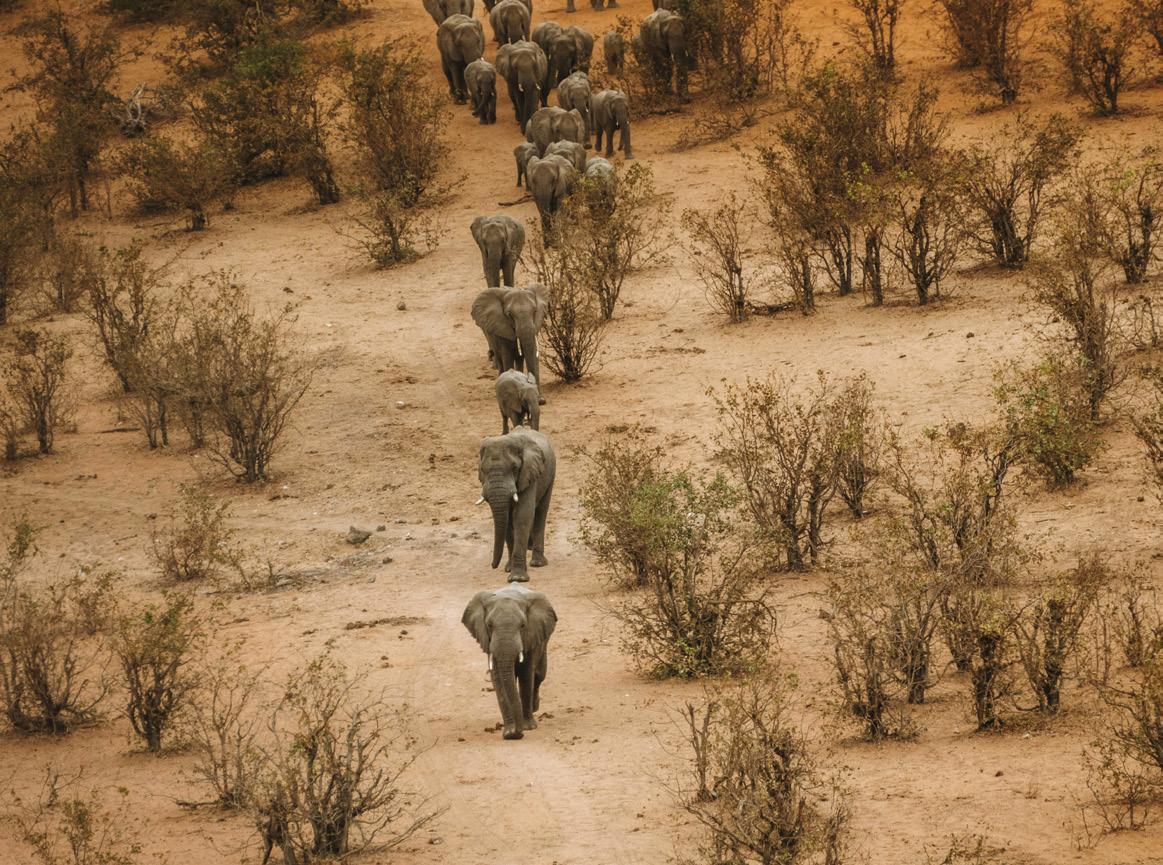
African elephants are slowly but constantly moving. From above, it’s possible to catch glimpses of elephants moving across massive remote spaces. For countless generations these magnificent creatures have walked in the footsteps of their ancestors, etching ageold migratory corridors across Africa’s diverse terrain.
They are driven to move for basic survival, to find water and food and for reasons rooted in deep generational behaviour patterns, such as establishing hierarchies and social structures. However, with new environmental pressures, elephants must rely on their incredible adaptability skills, forging new pathways and altering their traditional routes.
These animals, their ancient wisdom combined with insightful reactions, often move in large numbers. Matriarchal herds can include up to 3 generations of the same family, with adolescent males usually leaving the ‘family’ to join smaller bachelor herds. Many older bulls will live a solitary life. Regardless of their social grouping, every elephant will ultimately traverse the same network of old and new trails.
Their constant choice of where and how they move has many significant impacts on the world around them. Physically, elephants engineer new habitats. By knocking down trees, making new pathways and digging for water they create space and accessibility that helps other animals to survive, and allows plants the opportunity to grow.
Along with super effective seed dispersal, which is critical for forest regeneration and biodiversity, elephants play a vital role in maintaining healthy and varied ecosystems. Through these significant contributions, Africa’s elephants have without doubt earned their title as one of the world’s greatest ecosystem engineers.
Explore the endless deserts of South Africa’s Kalahari and stay in the Tswalu Reserve, with a choice of residences including The Motse, a collection of nine private suites, and the exclusive-use Tarkuni, a private fivebedroom house.
Study ancient elephant corridors from the stunning Wilderness DumaTau luxury camp, surrounded by waterways in Botswana’s wildlife rich Linyanti region.
Witness some of Africa’s biggest elephant herds at Mana Pools in Zimbabwe, staying at Wilderness Ruckomechi Camp.
Stay at luxurious Jack’s Camp, part of the Positive Impact Collection, in the Makgadikgadi Pans for the chance to explore towering termite mounds in incredible, remote surroundings.
Start planning →jacadatravel.com/africa/
If you’ve marvelled at every step of the Inca Trail and dined at the most sought-after restaurants in Lima, you’d be forgiven for thinking you know exactly what Peru has to offer. And yet, this enthralling country, with its multi-faceted kaleidoscope of wonders, always has something new to offer.
Words: SOPHIE GREEN
Peru is no stranger to the concept of slow travel.
Luxury trains such as the Belmond Andean Explorer and the opulent Hiram Bingham have been offering journeys in style and comfort for years.
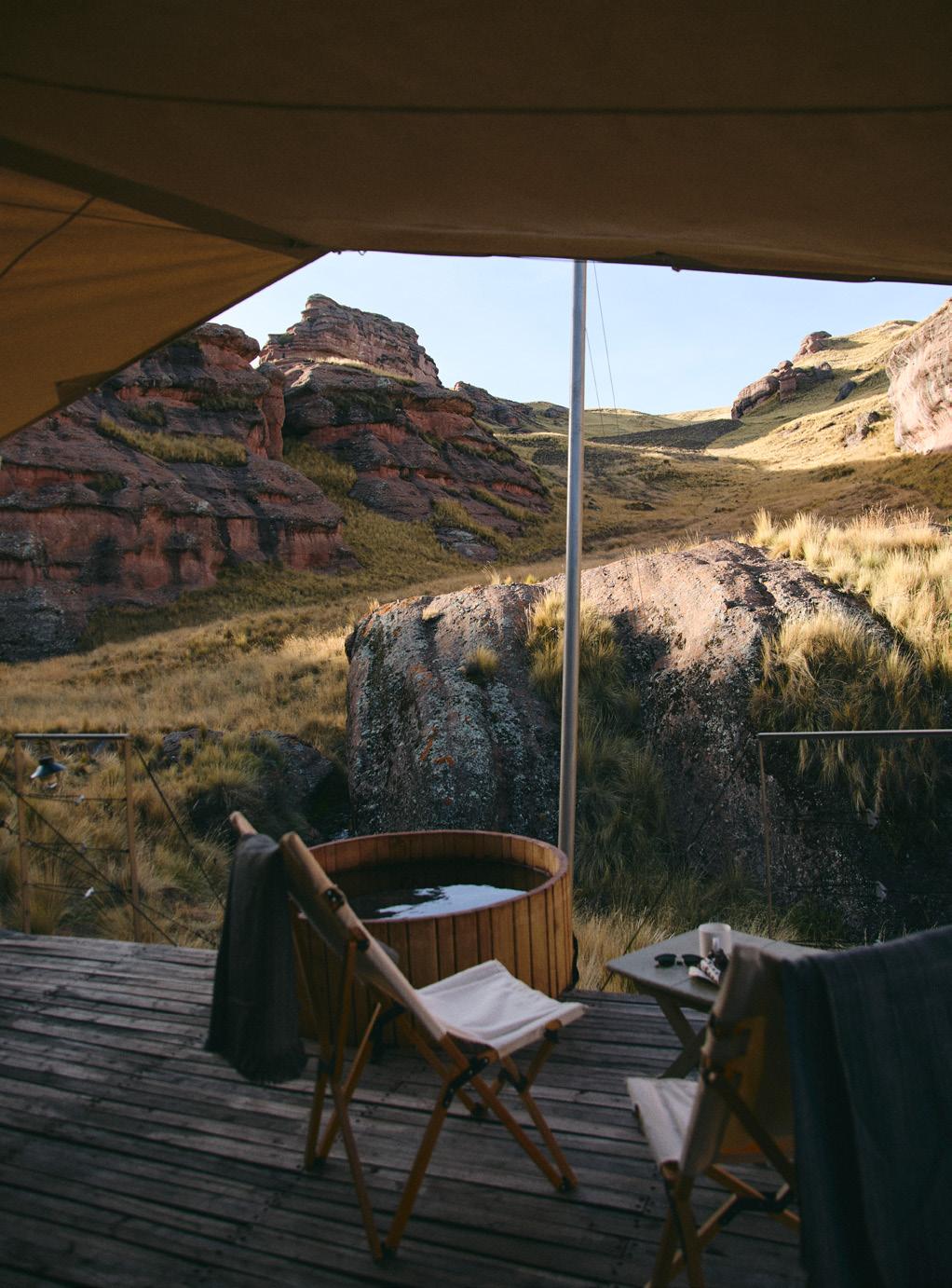
Now, a new journey takes things one step further, offering an overland adventure between Puqio, in the Colca Canyon, Titilaka, in Puno, and a new luxury tented camp, Tinajani, set among the towering landscapes of the Tinajani Canyon in the Peruvian Altiplano.
If you’ve never heard of the Tinajani Canyon before, that’s the point. This is Peru’s ability to surprise at its very best.
The route was born out of a desire for authenticity and a rising demand for truly off-the-beaten-path experiences. In response, the team behind Puqio and Titilaka have created a new lodge, and with it, a new and remarkable experience. Our Latin America team tried the journey themselves earlier this year. Here, we follow in their footsteps.
Your journey begins from Puqio, a luxury tented lodge in the Colca Canyon, where nature’s power soars. Towering volcanoes brush the heavens and the deep scars of canyon walls seem to descend to the earth’s core, showcasing new depths of natural beauty.
At the end of your time here, you clamber into the comfortable seats of a private 4x4, the cool, air-conditioned interiors infused with the scent of fresh leather and equipped with bottles of cold water and refreshments to fuel your journey. Ready and waiting, your private driver and guide greet you warmly – they’ll become old friends by the end of your trip.
Ahead of you lies the open road. The day is yours. Weave your way through snow-capped peaks, the formidable mountains echoing with the ancient spirit of Pachamama – Mother Earth. In Incan mythology, this benevolent goddess embodies the mountains and presides over life on Earth. Seeing the rosy morning sunlight glinting off the mirrored lakes and sleeping volcanoes, their dormant craters frosted with sparkling snow, it’s easy to believe that these spellbinding vistas were lovingly hand-crafted by the goddess herself. You’re free to stop as you wish, taking the route at a comfortable pace and truly immersing yourself in the majesty of your surroundings. Your guide will explain the history and culture of the region, provide information about the flora and fauna, and point out miradores (viewpoints) – of which there will be many – where you might wish to stretch your legs and take advantage of a photo opportunity.
As you descend through the mountain roads, the barren beauty of the landscape metamorphosises into lush greenery resplendent with flourishing life. Guanacos prance among the native plant life, grazing on leaves made vibrant by the closing rainy season. Adobe houses, baked warm by the gentle sun, punctuate the roadside.

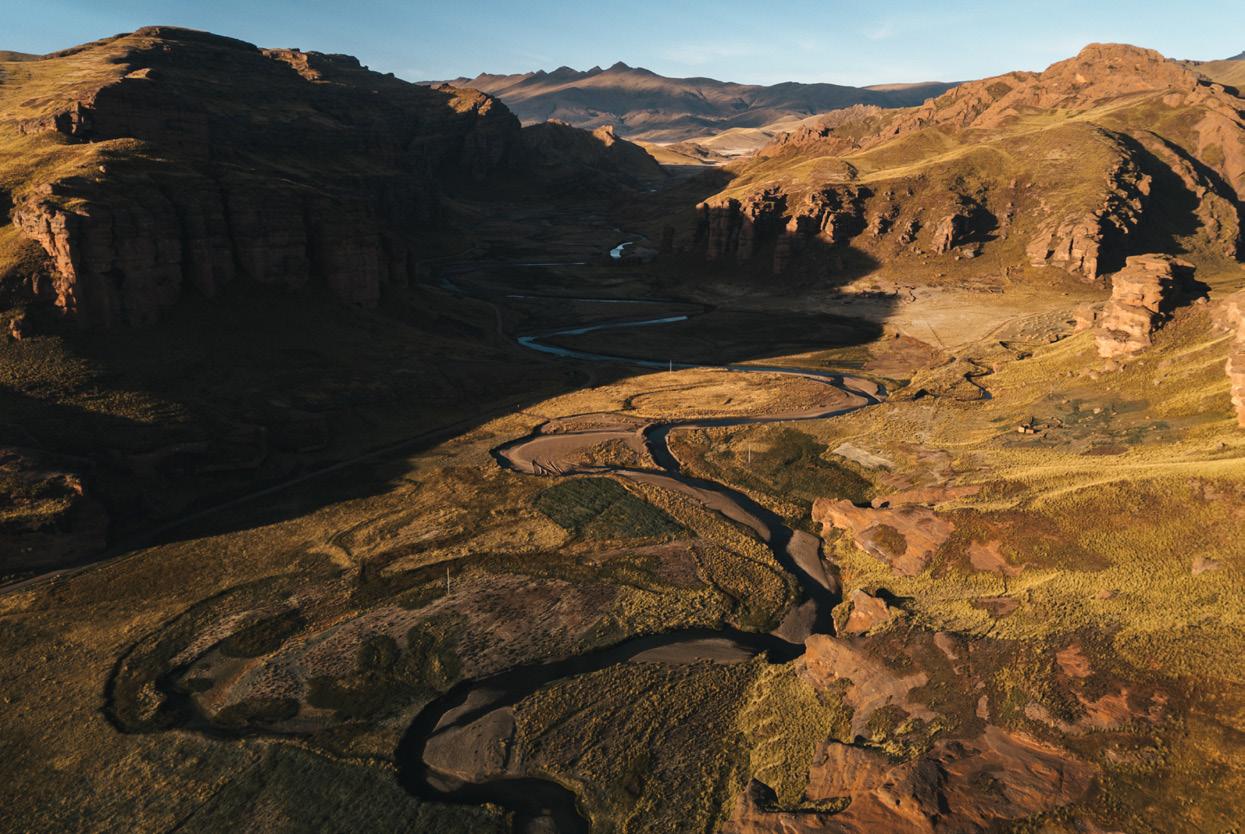
You’ll find no other travellers here. This is under-explored and enriching. A privileged look into life in Peru away from the tourist gaze.
Nearing Tinajani Canyon, the landscapes change again. Green melts into startling red, the staggering canyons and rock formations thrusting into an empty sky, bronze-hued grasses sweeping into the valleys below.
Most of Peru experiences a green season and a dry season, but in Tinajani, the seasons are green and gold.
In the gold season, the amber sun creeps into each corner of these arid panoramas and illuminates them with its Midas touch. As far as the eye can see, sun-soaked plains and gilded rocks stretch into the horizon. For the locals, gold season is often their favourite.
A medal for completing the day’s journey, the golden light of Tinajani is your finish line, and your reward for straying from the usual path.

The spirit of the wild
Opened in April 2025, Tinajani comprises six luxury tent camps clustered around a traditional Andean farmhouse. Each campamento consists of two connected safari-style tents and an outdoor deck with a private hot tub and wood-burning stove, a quietly elegant set up that embodies the luxury of simplicity. Their earthen hues and simple exteriors are designed to allow the landscape to take centre stage, immersing you in its grandeur.
Local legend says that the towering rock formations were once ancient giants turned to stone by the gods, left to silently guard the canyon for eternity. Even now, the lingering myth of their presence is profound, lending the location an otherworldly quality that permeates the stillness and the space across the centuries.
Here, the experience and the destination are one.
At an altitude of 3,810 metres (12,900 feet), Tinajani places you among the heavens. By day, the cool and dry climate, characterised by clear skies and pure mountain air, is ideal for exploration, while by night, the deep purple depths of the infinite sky are filled by unfathomable numbers of stars. The cosmos is at your fingertips.
Lose yourself in the great vastness of the wild, creating memories to be shared fireside each evening.
Cycle or hike through the surrounding canyons, observing how the hues of the rocks change from dawn to dusk as you navigate the region’s raw and untouched beauty. Explore the striking Puya de Raimondi forest, breathe in the dawn at the centennial Qolle tree, the only one of its kind that grows within the canyon, or embrace the mystical energy of the Andes with a shaman-led Andean rebirth ritual.
You’ll be greeted each evening with the crackling warmth of a campfire, the nostalgic smell of woodsmoke blending with the earthen aroma of hearty Altiplano cuisine, served family style in the farmhouse.
To be at Tinajani is to be in the moment. There are no grand expectations, no crowds. You are not rushed: Pachamama sets her own schedule. She has carved each crevice of these canyons over the course of millennia, and now you sit humbled by the majesty of her creation.
Slow travel for the soul: the 101

There is no right or wrong way to explore Peru. The country can be a great gateway to Latin America, with myriad natural wonders an enticing starting point. Choosing to veer off the beaten path adds a different dimension to your trip.
Tinajani shows a side of Peru that’s little seen, a raw and unfiltered escape where the only travellers you’ll encounter are soaring condors and roaming alpacas. Trips here are deliberate and mindful, as much about the journey as the destination. Low-impact activities mirror Tinajani’s commitment to leaving no permanent trace on the environment, while community engagement and local guides enrich your understanding.
You’ll have time for reflection and meditation – and to reconnect with the world around you.
“Many classic Peru trips end in Cusco after taking in the wonders of Lima, the Sacred Valley and Machu Picchu. These highlights are incredible, but extending your stay by a few days to include Tinajani will show you so much more. My favourite activity is cycling through the Puya de Raimondi forest, seeking out the striking flowers known as the Queen of the Andes. Taking up to one hundred years to mature, they can reach heights of up to twelve metres and bloom only once in a lifetime. They’re native to the Andes of Peru and Bolivia, meaning that Tinajani is one of the few places in the world where you can observe them.”
- Charles Kronsten, Senior Specialist Latin America Travel Designer

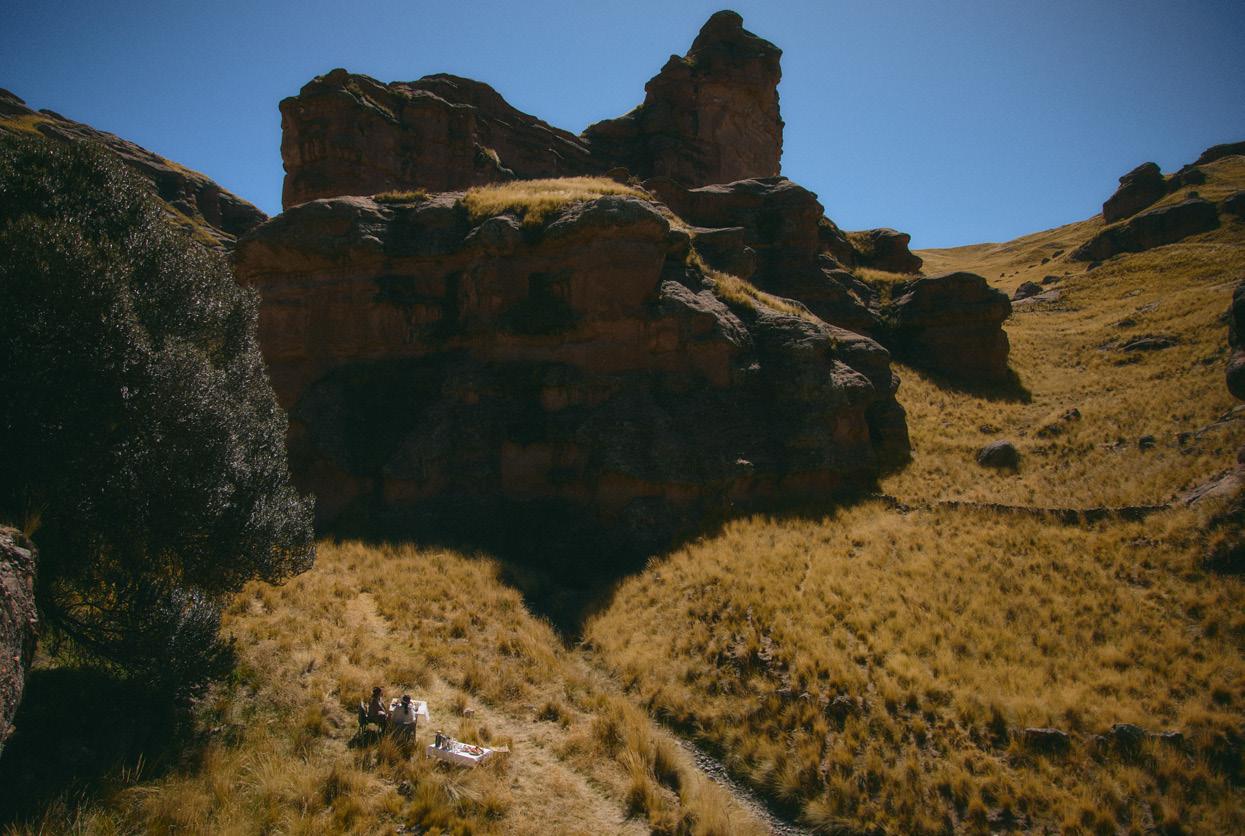
The world’s most sacred spaces range from massive temples and mountains to minuscule shrines and sanctuaries. These diverse places are linked by something uniquely human: the enduring idea that certain sites are symbols of something greater than ourselves.
Words: MELISSA HAUN
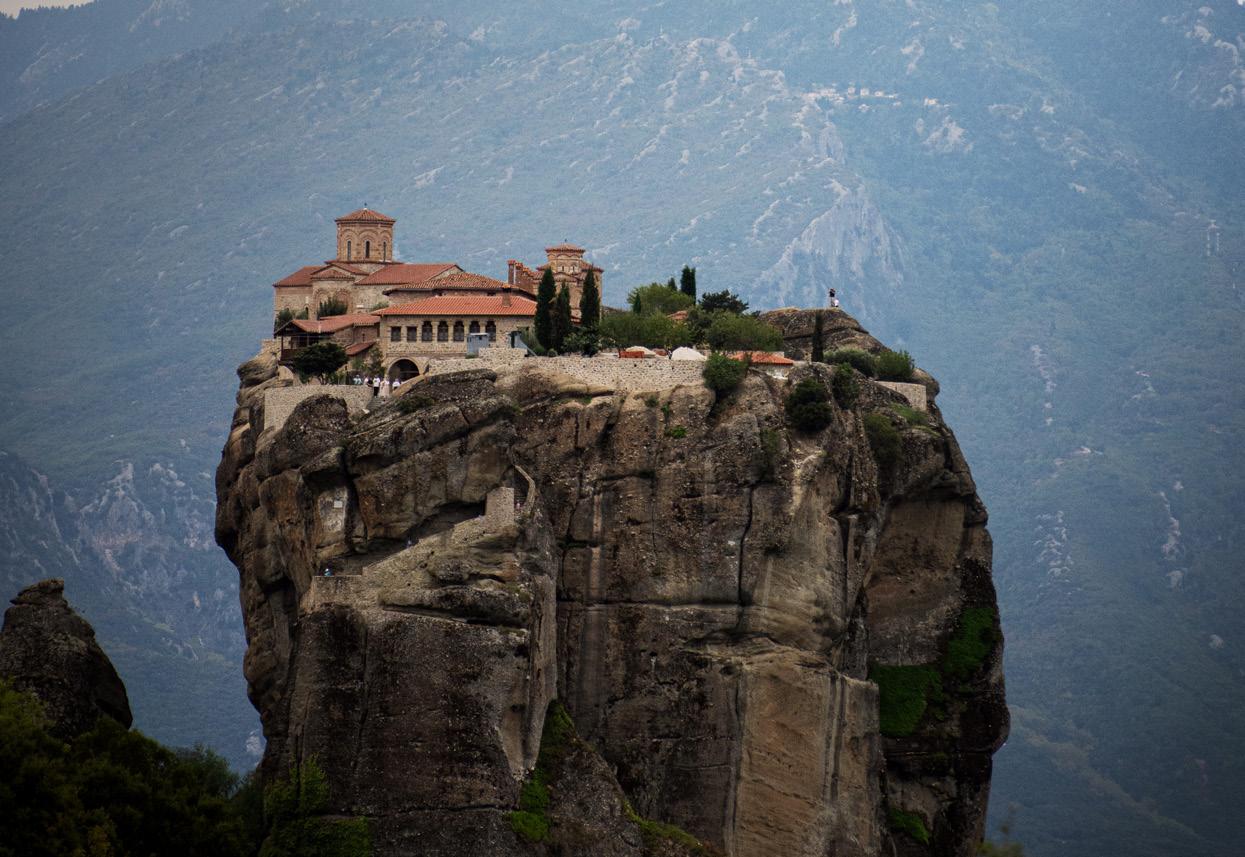
Left: The Meteora monasteries in Greece were once reachable only by pulleys, nets, and later, wooden ladders
Below: Prayer wheels are found at many Buddhist sites around the world
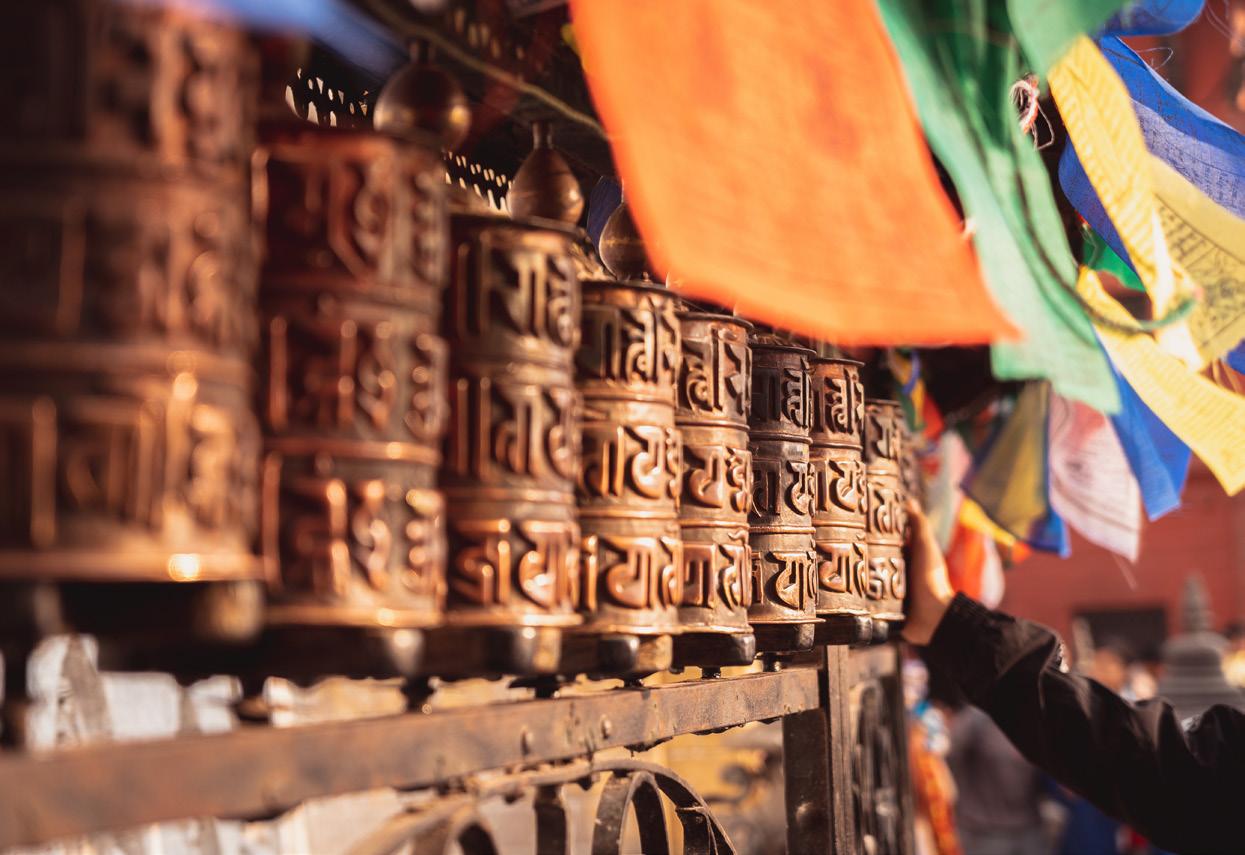
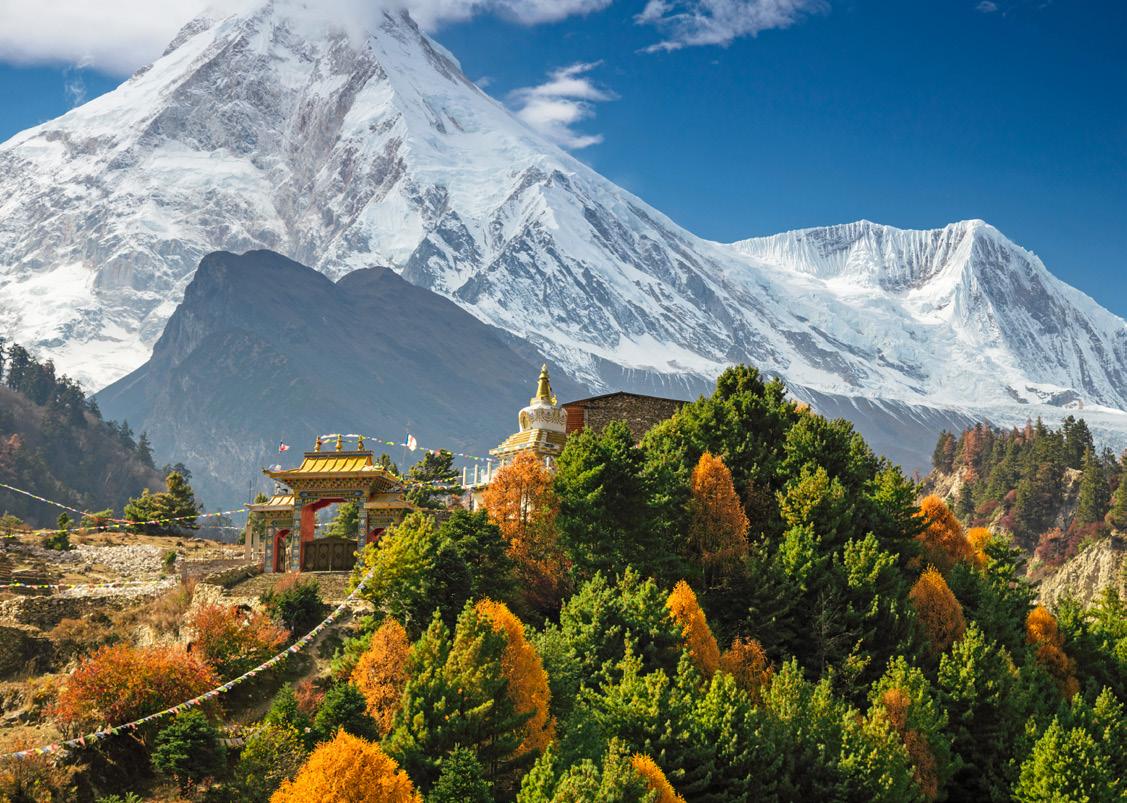
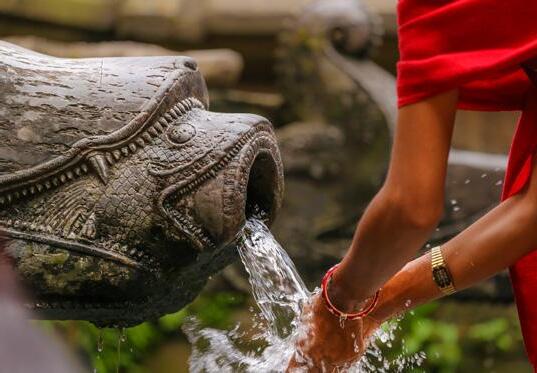
Above: Throughout Nepal you'll find fountains that are both practical and purifying
Right: Sacred peaks hold timeless meaning - like Mount Sinai, a holy site for the world’s major Abrahamic religions
What is it, exactly, that makes a place sacred? What innate qualities must it possess, and how is it imbued with spiritual meaning? When you consider the sheer number of these spaces across the globe, these questions aren’t easy to answer. Within different continents, countries and cultures, the idea of sacredness varies just as much as the languages used to describe it.
This ideological diversity is clearly reflected in tangible spaces. As much as human beings like to explore the abstract, to dream of other dimensions and pray to higher powers, we reside firmly in the physical world. We manifest our religious beliefs in places of worship, construct monuments to honour our holiest values and see signs of transcendence all around us – whether atop the summit of a staggering peak or caught among the currents of a rushing river.
Precious peaks and holy waters
To begin our exploration of the world’s most sacred sites, let’s turn to those that existed long before humans were around to worship them. People often equate natural wonders with spiritual significance or mystical origins. Even beyond the bounds of religion, our planet is full of majestic landmarks that inspire reverence and awe.
Mountains are revered within many different belief systems. There’s Mount Sinai in Egypt, where Moses is said to have conversed with God – making it a holy site in all three of the world’s major Abrahamic religions (Christianity, Judaism and Islam). Mount Kilimanjaro in Tanzania is venerated by Indigenous groups including the Maasai and Chagga. Japan’s Mount Fuji has long been a spiritual location for several different religions, as well as a secular symbol of the nation.
Apart from monumental peaks, another common thread among sacred natural sites is water. The River Ganges is incredibly holy in Hinduism and said to possess healing powers. Lake Titicaca plays a central role in Incan creation myths and is venerated by modern Indigenous communities. And at the Mayan archaeo-
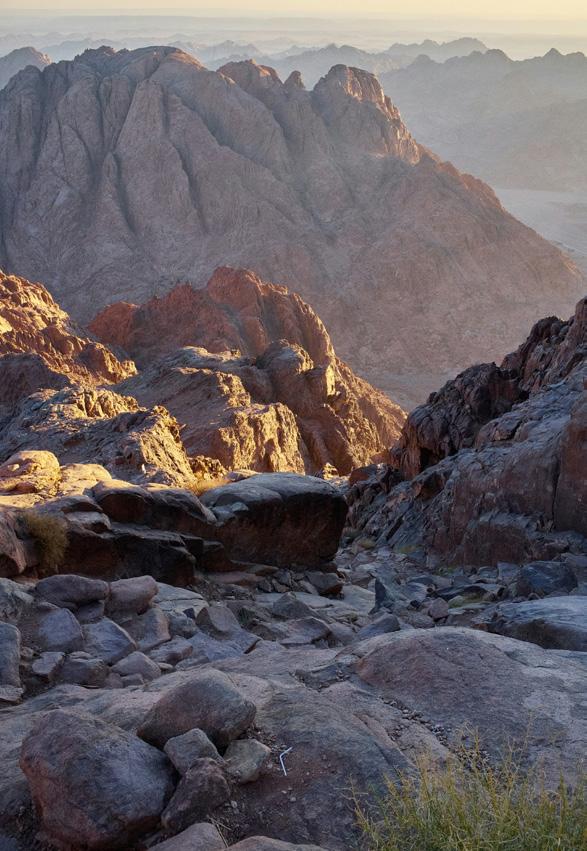
logical site of Chichén Itzá, the Cenote Sagrado (sacred cenote) is a sinkhole where sacrifices were once made to the gods.
Throughout Nepal you’ll find fountains that are both practical and purifying, fed by natural springs and suffused with spiritual meaning. These water sources, known as dhunge dhara, are a prime example of how some sacred places combine naturally occurring phenomena with human intervention: in this case, the intricate carvings that decorate the water spouts.
Architectural marvels and natural motifs
Many sacred spaces were built by humans, from churches and cathedrals to temples and shrines. But some of the most impressive examples also draw upon the beauty and mystery of the environment – blending the natural world with spiritual transcendence and cultural ingenuity.
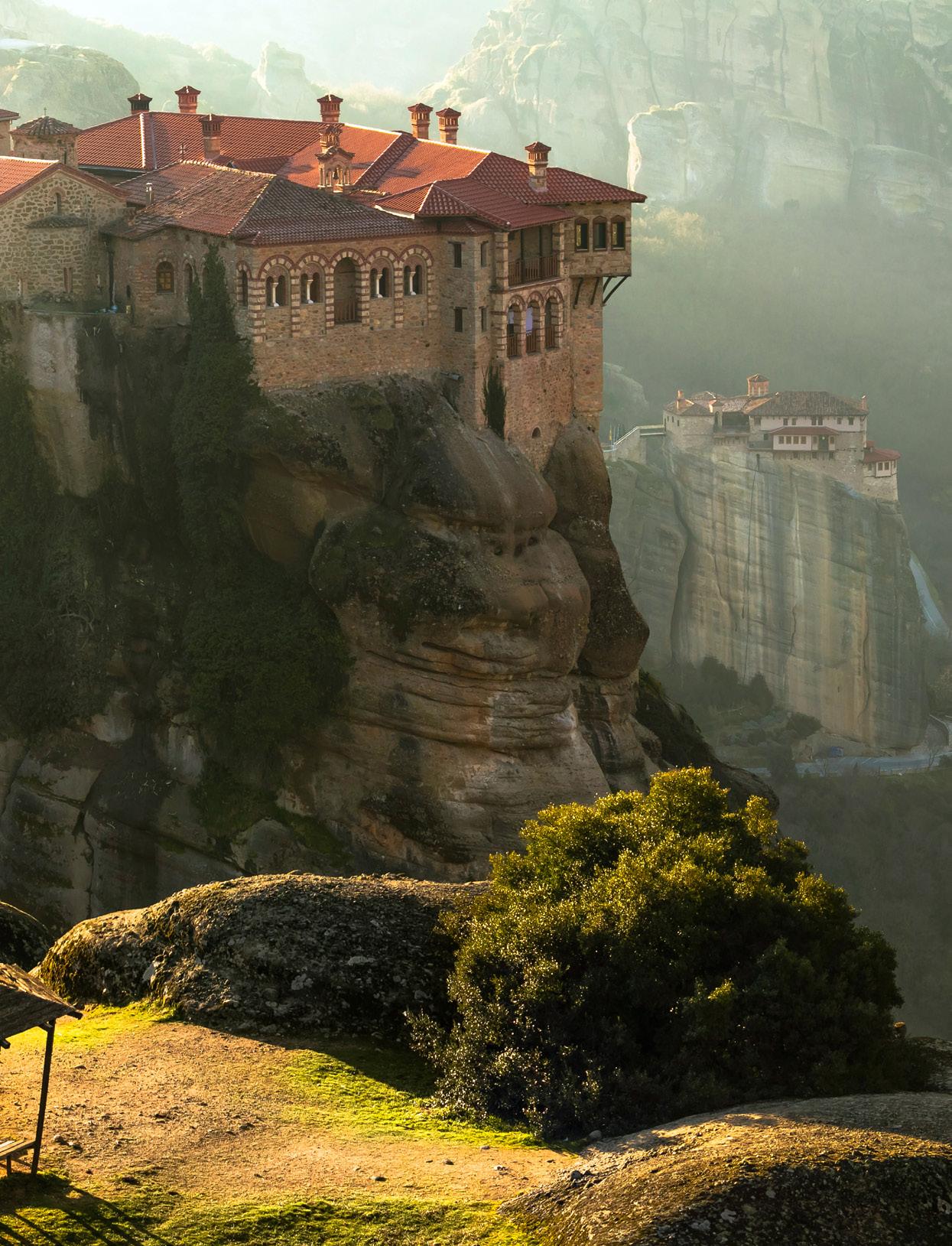
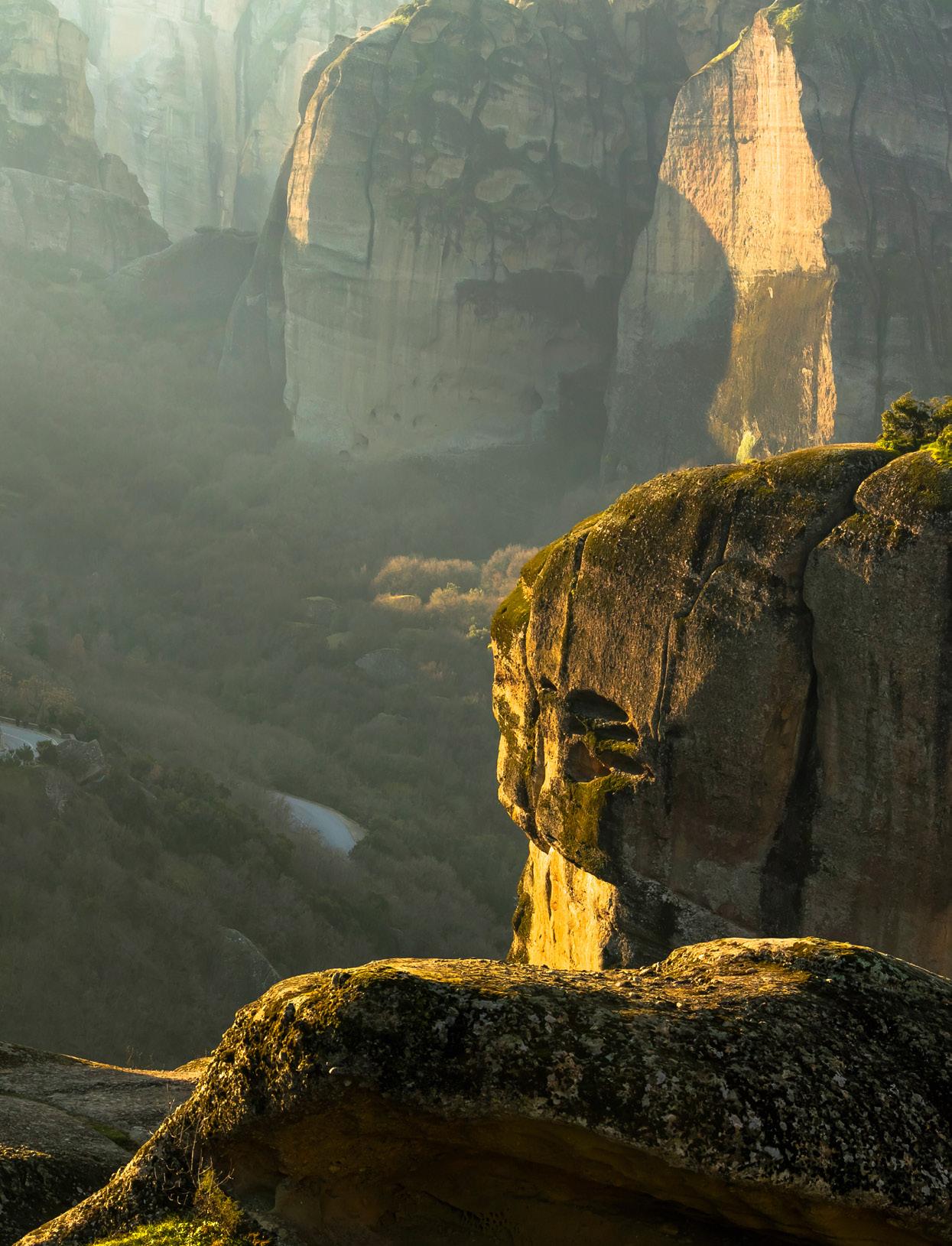
The Sagrada Familia in Barcelona is Antoni Gaudí’s most renowned masterpiece, and it’s filled with references to nature, from its tree-like columns and ceilings to detailed carvings of plants and animals. Other religious sites make use of extreme or unusual natural settings, such as the monasteries of Meteora in Greece. Built atop towering sandstone peaks, these structures were originally only accessible via a system of pulleys and nets, and later wooden ladders.
Some holy spaces are quite literally carved into the earth. Colombia’s Catedral de Sal (Salt Cathedral) of Zipaquirá, for instance, is an enormous underground church that began as a small sanctuary where salt miners would pray for safety. Thousands of miles away, Cappadocia, Türkiye is famous for its rock-cut churches and underground cities like Derinkuyu, which once housed people fleeing religious persecution.
Pilgrimage sites and places of worship
Although nature is often intertwined with sacred places, plenty of holy sites are man-made. Some of the world’s most spiritually meaningful destinations are
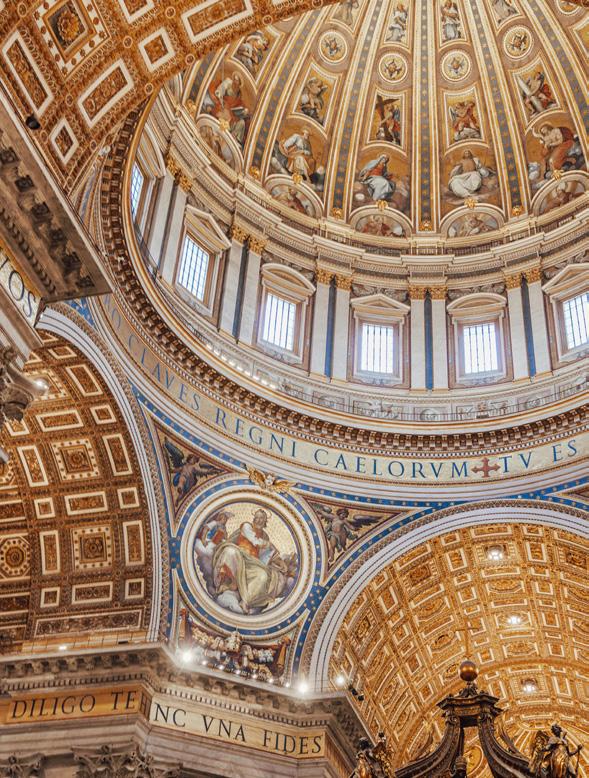
entire cities, like the Islamic pilgrimage site of Mecca, the Vatican or Varanasi. Many others are soaring basilicas, domed mosques, ancient synagogues or sprawling temple complexes such as Angkor Wat.
Entering one of these buildings has an undeniable effect, regardless of your religious beliefs. With their beautiful adornments and cavernous halls, they’re testaments to the power of spiritual conviction; of the seemingly impossible feats that can be achieved in the service of faith. In many cases, they’re also evidence of the immense resources and power that various religious groups have held at different moments in history.
Spirituality may be a universal concept, but its specific manifestations and expressions are largely determined by time and place. Organised religion is the most common form that it takes, and many of the sites on an average travel itinerary are linked to major religions (both modern and ancient).
However, it’s also important to recognise that sacredness is not limited to the attractions you’ll find in a guidebook. A humble wayside shrine can be just as moving as an ornate altar. A delicate cairn can inspire the same sense of awe as a grand pyramid. A mysterious stone circle or an anonymous cave etching may have unknown origins, but sometimes this open-ended meaning is even more mesmerising than the world-famous landmarks featured on postcards.
Perhaps what ultimately makes a site sacred is the way it allows us to feel connected to its creators, and to all the other people who have visited it before. In this sense, sacredness is universal. It’s less about our religious beliefs and more about how we relate to each other, the way we remember our predecessors and the legacies we choose to leave for our descendants.
The cultural significance of sacred places
Visiting sacred spaces can be one of the best ways to grasp the cultural context of any destination. Of course, this must be done thoughtfully and with respect for local norms and boundaries. Many temples and churches ask visitors to cover certain parts of their bodies before entering, and some require silence or adherence to other specific rules.
When we approach the sacred places of others with the same reverence that we hold for our own, they become portals of understanding. They’re windows into the souls of the people who create, inhabit and worship them. They’re vessels for the innate human desire to find meaning in our surroundings, and to carve out sanctuaries where we feel safe and significant.
Just as spirituality helps us make sense of our existence and the endlessly unknowable world around us, these places provide peace and refuge. They’re tied to our history and traditions, woven into our living spaces and daily rituals, rooted in the natural environment and intertwined with our deepest sense of identity – of where we come from, who we are, and who we want to be.
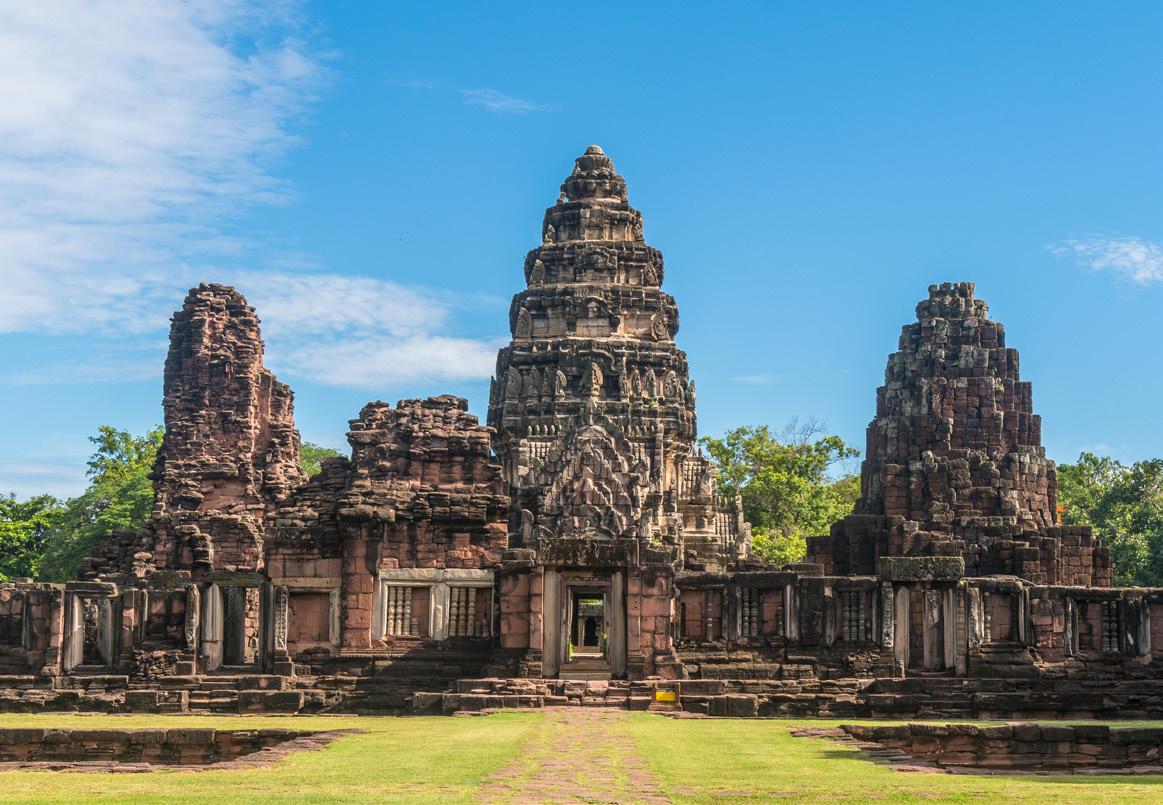
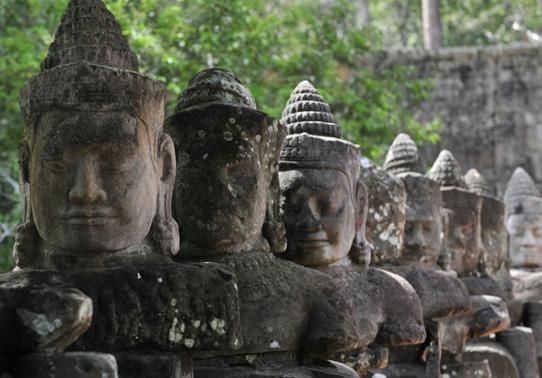

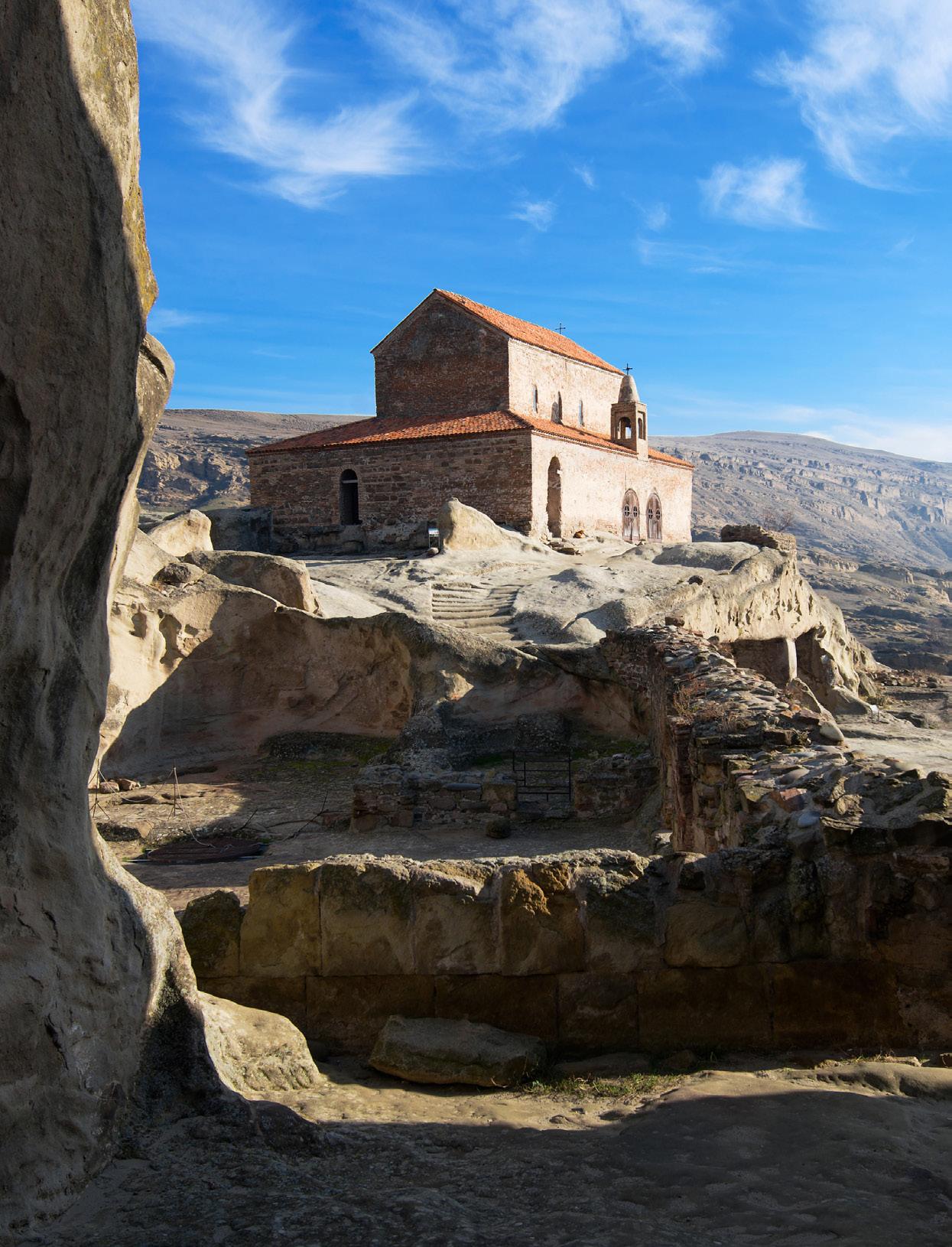
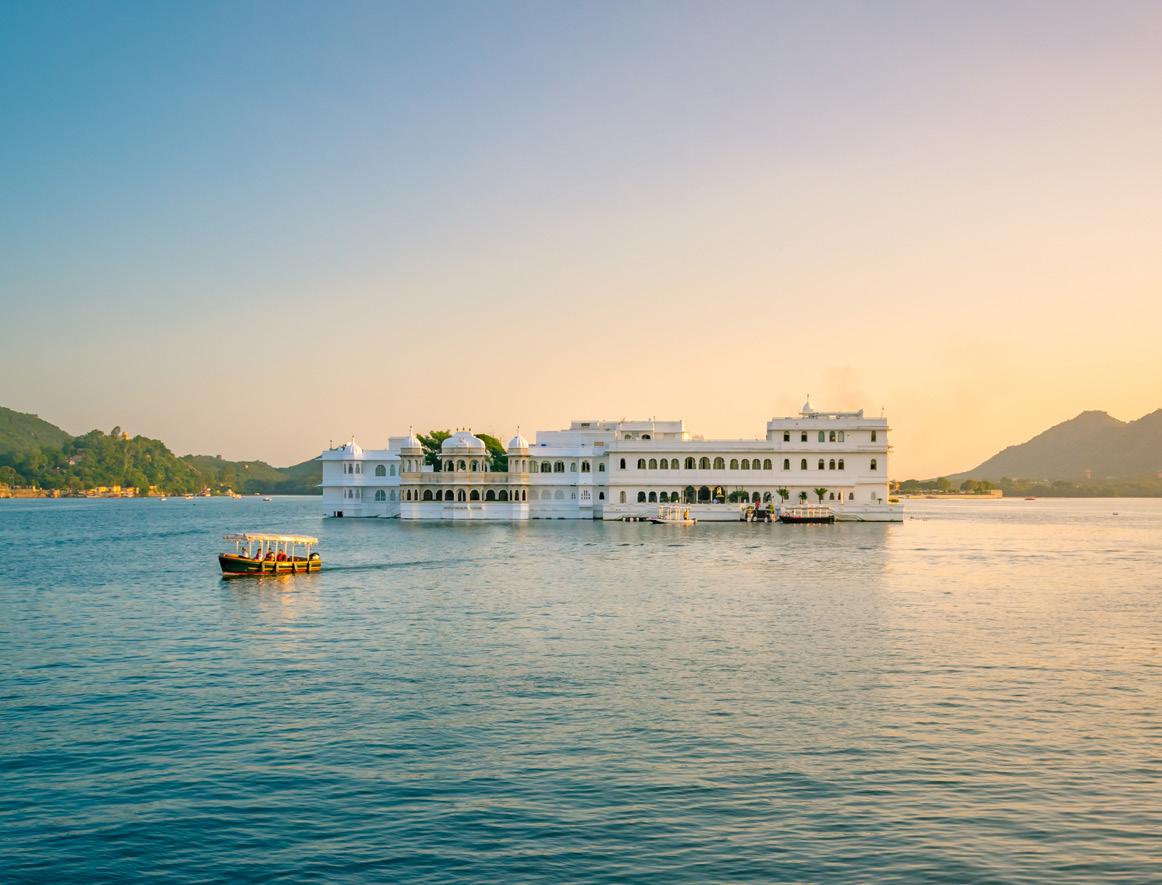
The most unforgettable stays are about more than just five stars – they’re about stories. These truly unique properties go beyond the expected, allowing you to step into the heart of your destination, shaping memories that will remain with you long after you return home.
Words: EMELIE STEVENSON
Agrand entrance marks your arrival in County Clare, Ireland. Meandering down a curving lane, you’re transported back in time as you catch fleeting glimpses of grey stone turrets peeking over emerald woodland. Right away, you can feel the presence of history. This is the magic of Dromoland Castle.
Once the home of Ireland’s last High King, the 16th-century castle still preserves the opulence of a bygone era. Canopied beds overlook the lake and sprawling greenery beyond. There’s a grand drawing room for gathering, and an intimate cocktail bar – the former family library – in which to wind down after a day of exploring County Clare. If these walls could talk, they’d tell tales of illustrious guests, from royalty to Hollywood stars. Spend an evening with the castle historian getting lost in the stories from its past.
Outside of the castle walls, adventure awaits. Situated in the middle of the Wild Atlantic Way, you’ll be in a prime position to discover some of Ireland's
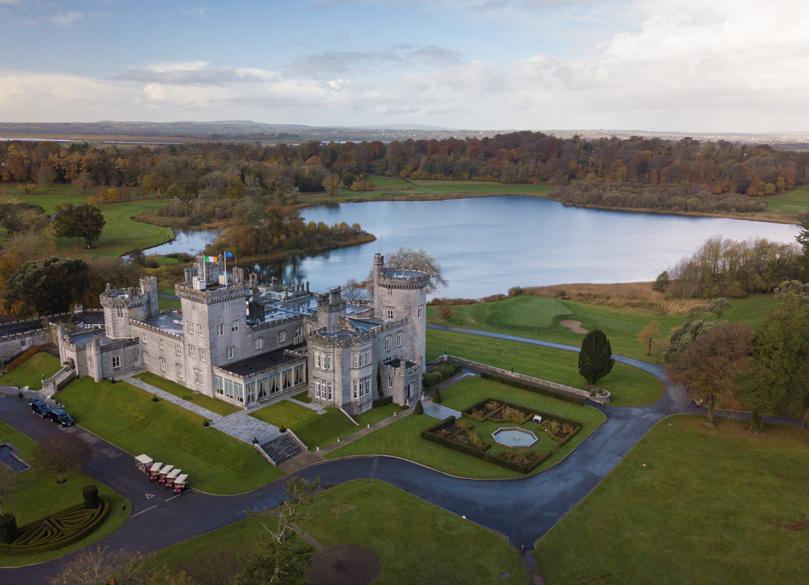
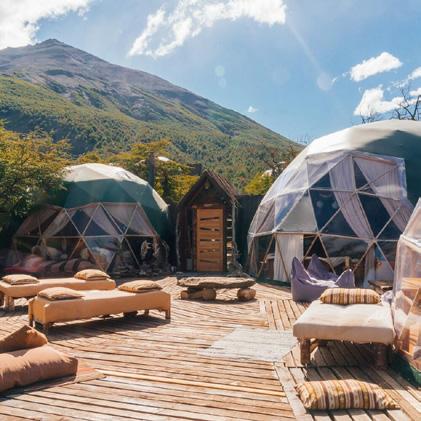
most dramatic scenery or famous cities. Be sure to take in the craic of a traditional pub, where accounts of local legends and traditional songs reveal the true spirit of Ireland.
In Chile's extreme south, jagged granite spires soar over giant glaciers, while thick forests erupt in fiery hues of orange and red. Torres del Paine National Park is breathtaking – a natural spectacle that has to be seen to be truly believed. And with so much to explore, it’s a paradise for those seeking adventure.
Sitting beneath the park’s dramatic peaks, and camouflaged by surrounding forests, you’ll find a cluster of rounded geodesic domes. Inspired by the traditional mobile dwellings of the Kawésqar, EcoCamp Patagonia offers no grand hotel façade. Instead, the domes invite you to live in harmony with nature, encompassing the Kawésqar's ‘leave no trace’ philosophy.
Unzipping the canvas entrance to your room, you’ll step into a haven of space and light. Come nightfall, look up through the large skylight directly above your bed for an uninterrupted sight of the sky. No ceiling to block the stars, no artificial light to diminish their shine. EcoCamp is an immersion into your surroundings.
From the moment you arrive, you’re invited to adopt the pace of nature. Easily set off into Torres del Paine on foot or horseback, or witness its grandeur unfold from the seat of a kayak, as you glide over glassy lakes.
Given India’s reputation for magnificent architecture, it’s no surprise that some stays here are as sumptuous as they are architecturally astounding.
Start by getting whisked across Lake Pichola by private boat, letting the clamour of Udaipur fade away. Enjoy a refreshing drink and cool towel as you’re welcomed into the tranquillity of the Taj Lake Palace, a hotel that sparks a sense of awe and wonder from the moment you lay eyes on it.
Seemingly emerging from the water itself, the hotel sits like a mirage in the heart of the lake. A vision of pure white marble, impossibly elegant against the backdrop of the surrounding hills and Udaipur itself.
Dating back to the mid-18th century, the Taj Lake Palace was originally a summer retreat for the royal dynasty of Mewar. Today, the hotel maintains the same lavishness and seclusion that were built into its very
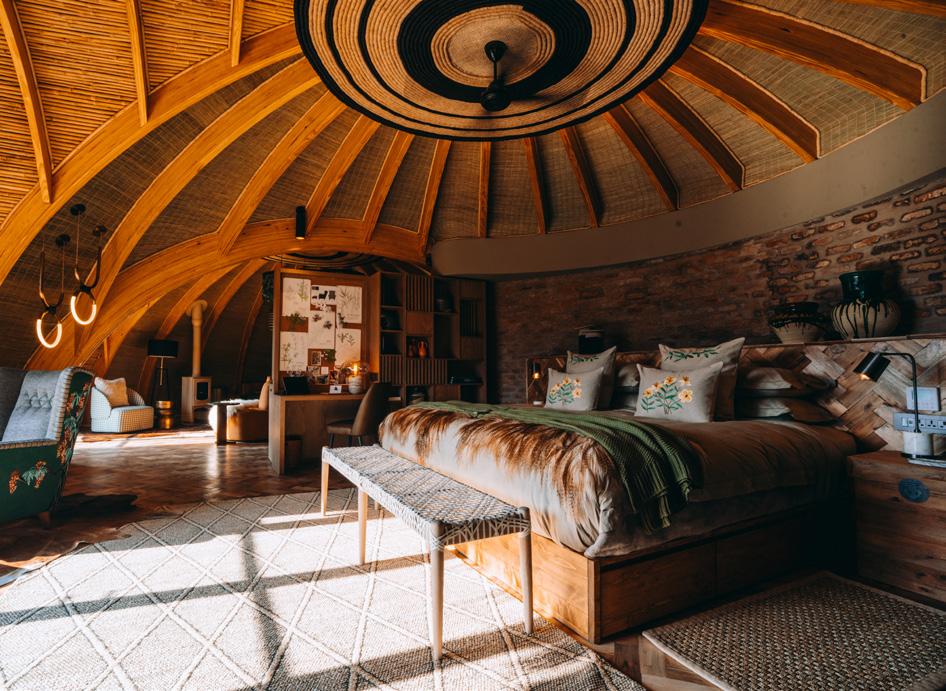
foundations. Suites are adorned with silk, velvet and chandeliers, surrounded by centuries of history and the vast expanse of the lake.
At each of the restaurants, you can expect culinary excellence. On the rooftop, Bhairo offers fine-dining European cuisine paired with sweeping views of distant Udaipur. Whilst Neel Kamal offers authentic Rajasthani and northwestern Indian specialities in a setting inspired by a decadent banquet hall. For those seeking an even more intimate experience, dine aboard the royal barge, Gangaur, and take in the palace itself at sunset.
Rhythms of the rainforest
As rolling hills slope towards Rwanda’s Volcanoes National Park, you’d be forgiven for not immediately spotting Wilderness Bisate Reserve. In fact, with only four villas accommodating eight guests, part of its appeal is to be enveloped within the landscape from which it rises.
The property draws design inspiration from its nearby sister lodge, Wilderness Bisate, featuring cocoon-shaped villas made with local materials like volcanic stone, bamboo and timber. From your private deck, you can gaze out to undisturbed views of the Virunga volcanoes.
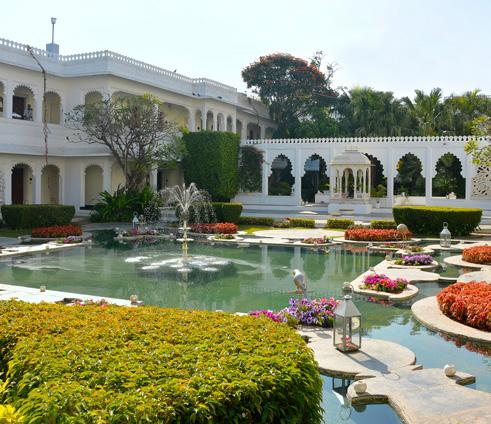

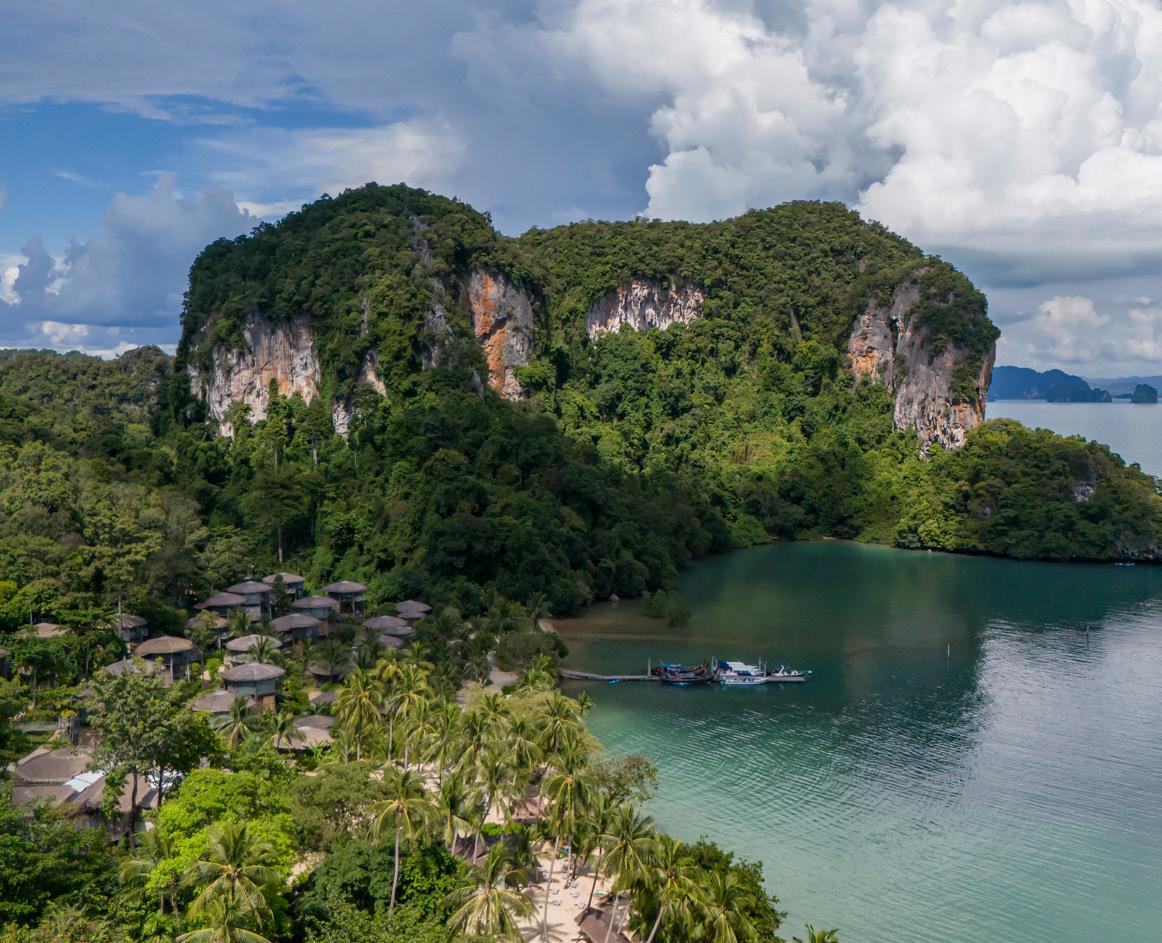
The property's location at the doorstep of the national park makes it an ideal base for observing endangered mountain gorillas, offering an unforgettable trekking experience into their natural habitat. Other activities in the surrounding wilderness include invigorating hikes up the dormant volcanoes or gentler nature walks.
Amongst the treetops
Between Phuket and Krabi you’ll discover one of Thailand’s quieter, more laid-back islands: Koh Yao Noi, or Little Long Island. Upon approaching Koh Yao Noi by boat, you’re met with a world of contrasts as dramatic limestone karsts rise from the calm, turquoise waters before you. It’s here you’ll find a property where luxury takes an unexpected form.
You’re not walking into a conventional beachfront hotel, but instead are climbing a winding walkway into your very own treehouse. TreeHouse Villas is woven seamlessly into towering trees, inspiring a childlike wonder.
Downstairs, an open-air living area invites the jungle in, where you can sit back and listen to rustling leaves and lapping waves. Climb the spiral staircase and step into a master bedroom whose views stretch over the dense rainforest to the sparkling waters of Phang Nga Bay. Spend your days soaking up the sunshine in your private infinity pool, and feel as if you're floating above the treetops.
Ready for a different kind of escape? Start planning now → enquire@jacadatravel.com
In South Korea, sharing is a way of life. Meals aren’t plated individually; they’re placed at the centre of the table, inviting hands to meet and hearts to connect. Spaces are intentionally close, built for warmth, for laughter, for leaning in. Whether it’s a dish of kimchi, a seat at a table, or a midnight pour of soju, the message is the same: what’s mine is ours.
Words: BEVERLEY LENNON
Illustrations: ALICIA WARNER
On a side street in Seoul, steam curls out from a tent no bigger than a parking spot. Inside, strangers huddle shoulder to shoulder. They are drawn together by the rich scent of sizzling meat and the tang of fermented spice. Elbows bump, glasses clink and chopsticks dart between bowls. There’s barely room to move, but somehow, more than enough space to belong.
In South Korea, food is a shared experience. At the heart of every meal is banchan: a colourful spread of side dishes that speaks to a culture rooted in community. Kimchi sharp with spice, tender spinach dressed in sesame oil, stir-fried anchovies, crisp pickled radish; each small dish is placed at the centre of the table, offered without hesitation, refilled without being asked. Rice and soup may be personal, but everything else belongs to everyone, passed from hand to hand. Even as modern life reshapes the way people eat – with solo booths, tray-service restaurants and livestreamed mukbangs – the heartbeat of Korean dining remains unchanged.
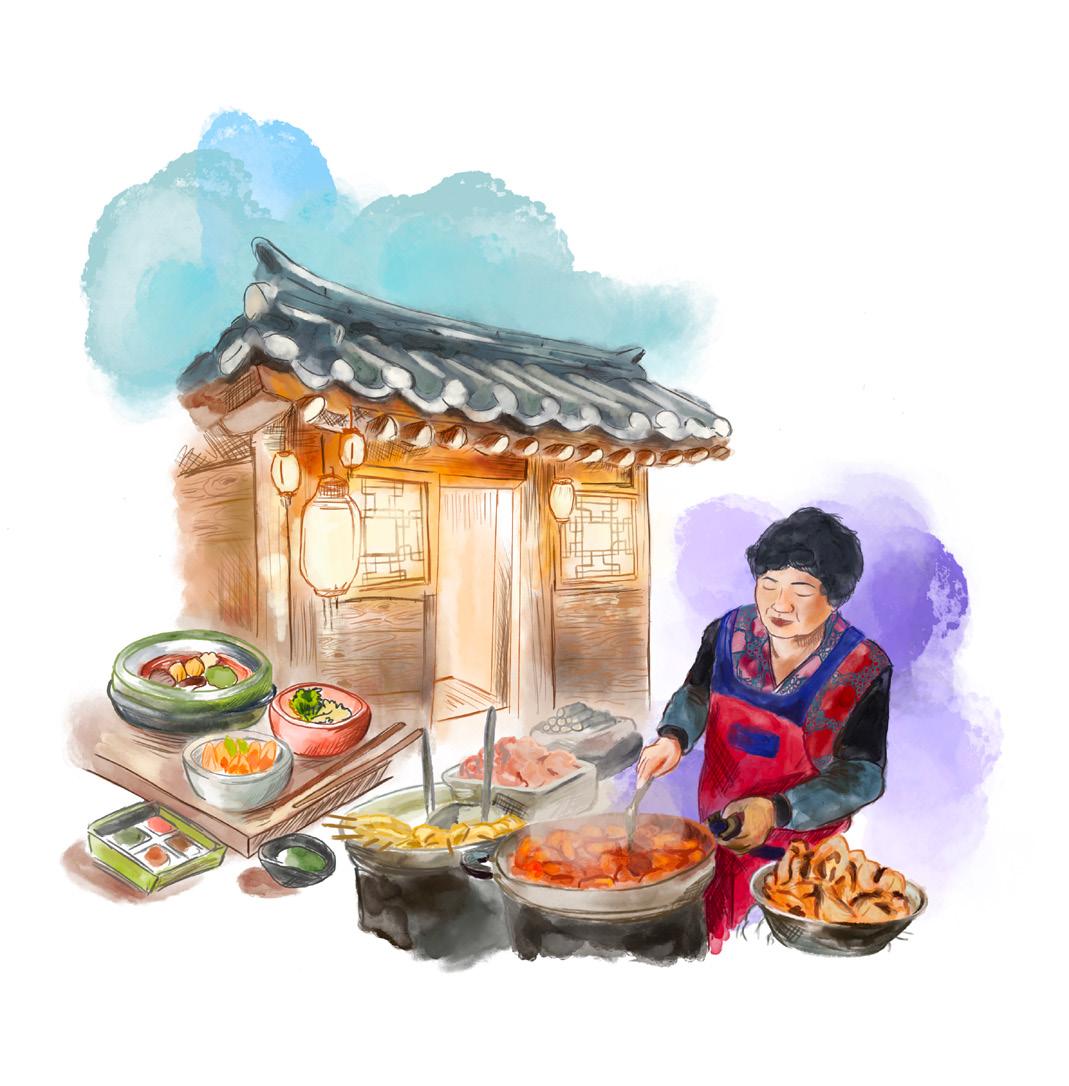
Table rituals
In this choreography of passing and receiving, of tasting and offering, eating becomes a shared language. To say “gachi meokja!” (“let’s eat together!”) is not only to offer a seat at the table, but a gesture of care, solidarity and even love. This spirit of togetherness reaches back through centuries, to Korea’s agrarian past, when communities depended on collective effort and mutual support. After long days in the fields, neighbours and families would gather to eat, reinforcing the sense that life itself was something to be shared. Confucian values, which have shaped Korean social customs for centuries, introduced a structure to these meals: elders first, juniors attentive, but never undermined the collective spirit. The table became a place where no one was ever left to eat alone. In South Korea, food has always played a central role in relationships. It’s how joy is celebrated, how grief is comforted, how apologies are made.
Night bites
Even as a visitor, you’re never far from this culture of connection. In a smoky back-alley pojangmacha, it’s not uncommon to find yourself squeezed beside locals, a glass of soju pressed into your hand, dishes pushed your way with a smile.
Lining neon-lit streets and tucked between highrises, pojangmacha – those iconic orange tented stalls – are among Korea’s most beloved dining spaces. Often no larger than a few square metres, these makeshift eateries serve comfort in its most concentrated form: spicy tteokbokki, skewers of odeng (fishcake) bobbing in gently simmering broth, bubbling pots of fiery jjigae, all washed down with a bottle (or two) of soju or creamy makgeolli. The real magic here is in the atmosphere: steamy, close, utterly human. Inside, strangers lean in, conversation flows between bites and for a few hours, the outside world fades.
Originally born out of necessity in the post-Korean War era, pojangmacha began as stalls feeding labourers and late-night workers. Over time, they evolved into cultural touchstones – symbols of a Korea that remembers its past while racing into the future.
Join a private guide on a street food tour, winding through hidden alleys and night markets, sampling sizzling delicacies straight from the grill. Follow the scent of grilled garlic and chilli to tucked-away stalls where vendors ladle bubbling stews into shallow metal bowls or flip golden, crisp jeon straight from the pan.
Where time slows
Today, you can still experience the Korea of the past. One of the most intimate ways to do this is by stepping into a hanok, a traditional Korean timber-framed home.
Rooted in the philosophy of baesanimsu – the idea that a home should sit in harmony with the land, mountains behind and water before – the hanok embodies balance. Slide open paper doors and you’ll find sunlit courtyards and low wooden tables.
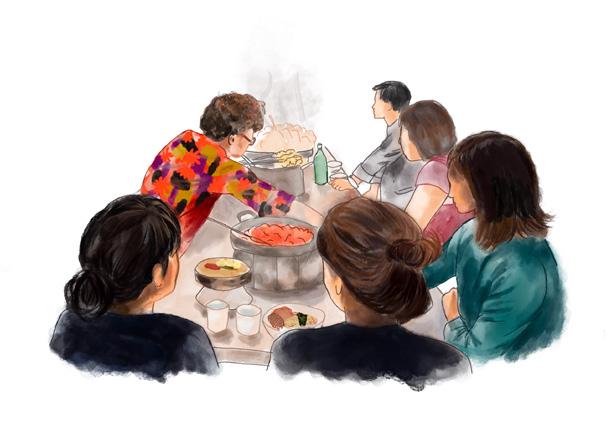
Join a traditional tea ceremony in one of these storied homes, and you’ll step into Korea’s time-honoured traditions. Seated on the warm ondol floor with legs tucked beneath you, you watch as your host begins with a graceful bow. The tea – often a delicate omija (five-flavour berry) or a soothing, nutty boricha (barley tea) – is brewed with careful precision. Each pour is deliberate. Each sip, an invitation to slow down. Silence is an essential part of the ritual, inviting you to be present.
A shifting S(e)oul Meals in South Korea were never just about sustenance, they were a social glue, thick with ritual and respect. To eat alone once implied misfortune, estrangement, even shame. A table for one was a lonely thing. But in the glowing thrum of 21st-century Seoul, something is changing. Sky-high apartment blocks fill with single-person households; cafés buzz with laptop-lit solitude. Restaurants now embrace the solo diner – not as an exception, but as a norm. Private booths are framed with warm light. Mirrored walls reflect back comfort. Even the digital realm offers a kind of table. The rise of mukbang broadcasts, where viewers virtually dine with strangers, speaks to a culture adapting without erasing its soul.
Gita recommends:
Make space for tea and dessert
In an intimate ceremony taking place at Gyeongbokgung Palace, centuries of Korean heritage flow. Amid ornate wooden beams the outside world fades, leaving only the quiet communion between leaf and water. You’ll witness the art of Korean tea culture through a guided demonstration. You’ll also make yakgwa, delicate honey cakes shaped by hand, and hear stories that trace tea’s journey through dynasties and daily life alike.
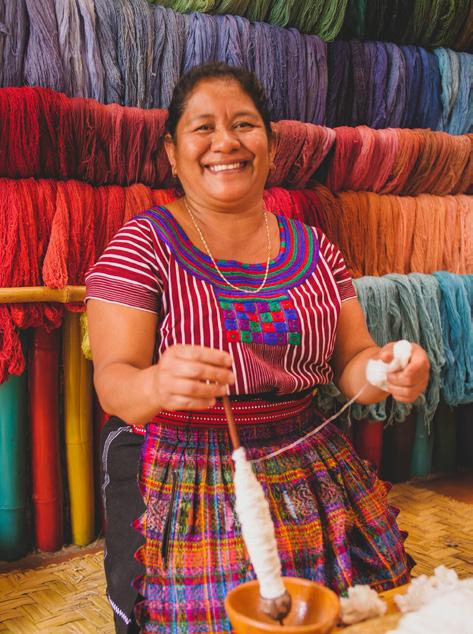
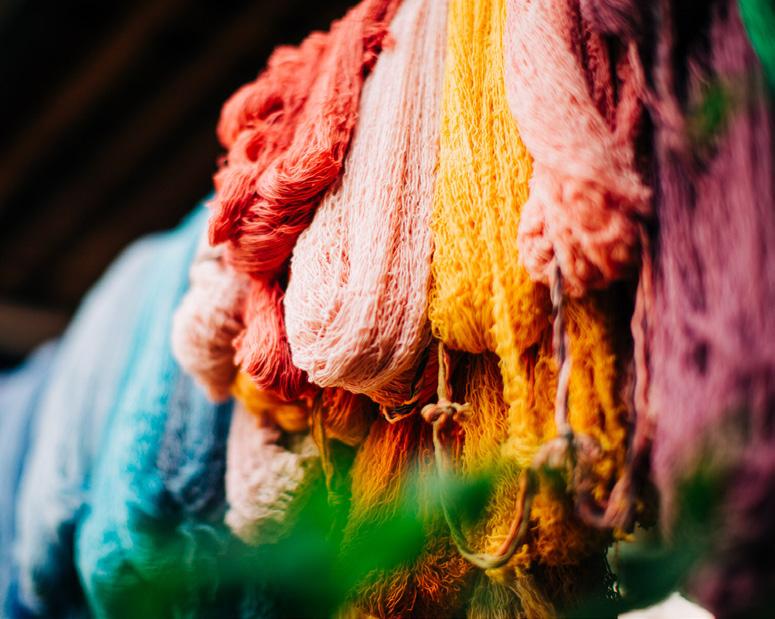
Artistry is woven into the fabric of Latin America. Across the region, discover creativity born with quiet contemplation or join in and connect with the stories and traditions.
Words: SARA CARRILES PEREZ
n Latin America, the most profound creative spaces are sometimes found in the heart of communities, beyond the silent walls of a traditional gallery. This creativity unfolds in contrasts as beautiful as they are varied, from the focused dedication of a weaver at their loom to the shared, explosive euphoria of a festival. In the same way, art is found both in the deliberate architecture of private homes, and in the playful craft of turning simple ingredients into a delicious meal.
With every woven textile comes a quiet meditation. The subtle actions begin in the gathering of cotton and continue as the frame is prepared, the warp strung with intention and the weft guided with care. Under the guidance of a master weaver, you feel the rhythm of moving hands, the gentle tension of threads and the steady heartbeat of tradition. There is a meditative quality in the natural dyes – indigo, cochineal and marigold – infusing the fibres, creating a transformation as relaxing as the dawn over Lake Atitlán.
This is the view from Casa Flor Ixcaco, a beautiful weaving studio on Lake Atitlán in Guatemala. The studio was founded by Doña Teresa Cumes, a visionary Maya artisan who is dedicated to sharing ancestral techniques and creating sustainable futures for the women and families of her community. Within the studio, textiles adorn the walls, while shelves are lined with bundles of dried plants and baskets of raw cotton. Look closer and you’ll notice Maya motifs – the quetzal
bird, maize and intricate geometric patterns – that echo the community’s spiritual identity. The finest creations are never hurried, but emerge from this mindful practice, destined either to remain here or find a home with you, as a new treasured possession.
The making of carnival
The calendar throughout Latin America is rich with local fiestas and national holidays. Even so, no single event commands the world’s stage quite like Carnival in Rio de Janeiro, where millions come together for a spectacle of grand celebration.
Carnival is a final, fervent festival that precedes the quiet reflection of Lent. In Rio it has become an expression of identity rooted in centuries of tradition. You’ll notice elements of European pageantry and the soul and rhythm of African heritage. The preparation for this world-renowned spectacle is a year-round endeavour within the vast workshops of Cidade do Samba, where the most revered samba schools transform their chosen theme into tangible creations. It’s a place of immense collaboration, where thousands of designers, welders, sculptors and seamstresses share a singular passion: to bring the annual enredo (plot) to life.
Within these ateliers, you can witness the meticulous process firsthand, as colossal, multi-storeyed floats are constructed and artisans embellish thousands of
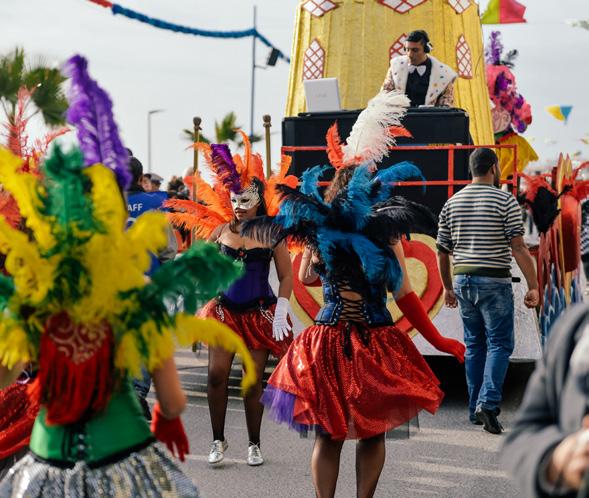

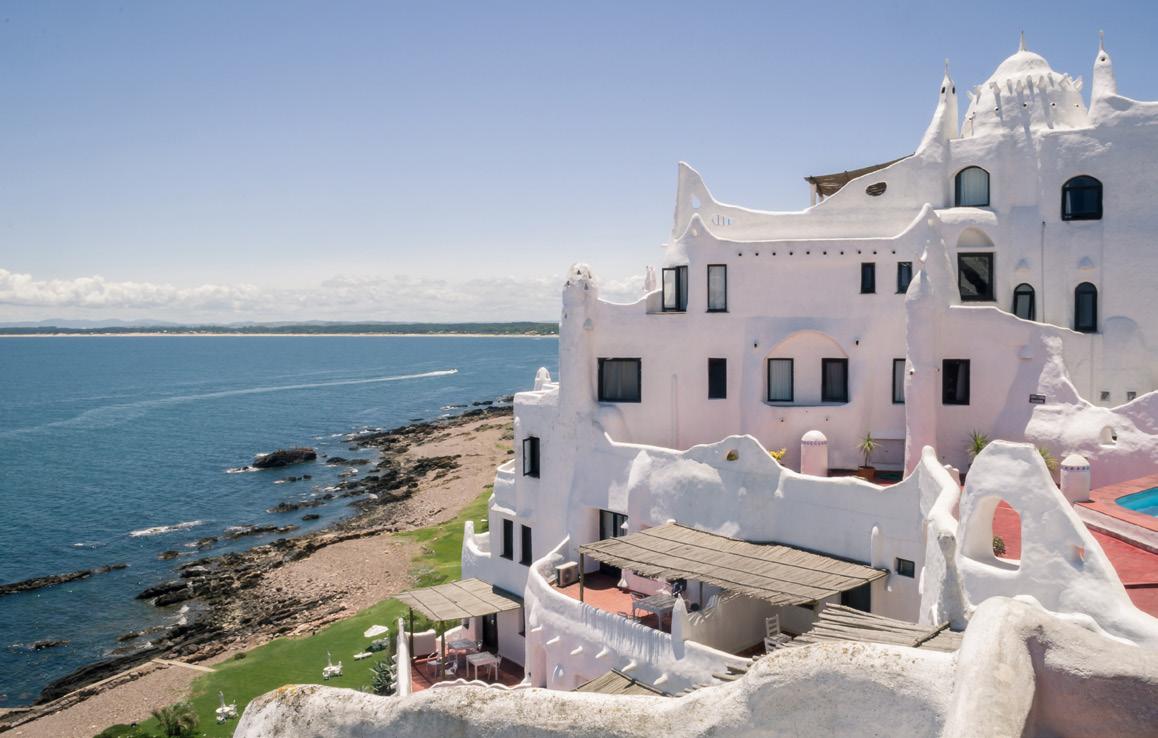
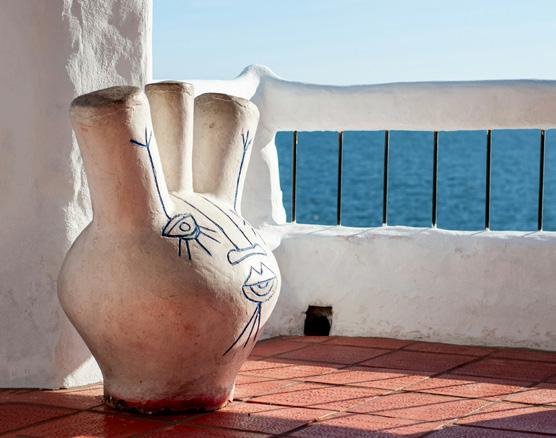
elaborate costumes. Schools like Grande Rio open their doors to reveal these masterpieces. Feel the weight of an authentic sequined costume, learn the fundamental steps of samba or experience the rhythm of carnival by playing the percussion instruments that drive the parade’s pulse. Here, carnival is not merely an event but a living, breathing art form crafted by a community united in creative expression.
On the coastal cliffs of Uruguay, the remarkable living sculpture of Casapueblo rises from the rock, the work of celebrated Uruguayan artist Carlos Páez Vilaró. Its whitewashed walls and winding corridors blur the line between art, architecture and the landscape itself. Originally built as his personal residence and studio, Casapueblo gradually transformed into a museum, art gallery and boutique hotel. Vilaró envisioned a space where art, nature and community could converge, and by opening his doors to the public, he dissolved the boundary between artist and audience. While wandering its sculptural labyrinth, you can reflect and find a sense of belonging – a feeling made possible by an artist who shared not just his art, but his home.
The architecture is both whimsical and profound. Inspired by the mud nests of the native hornero bird, it is a maze of organic curves, undulating staircases and sun-drenched terraces. Eschewing straight lines, Vilaró favoured fluid, dreamlike forms reminiscent of Mediterranean villages and Gaudí’s surrealist visions.
Inside, walls display his paintings and ceramics, while nooks are filled with sculptures and found objects. The space feels alive, shaped by his hands and imagination, yet open to your own interpretation.
Casapueblo is a testament to the power of small, consistent actions. Vilaró hand built it brushstroke by brushstroke, curve by curve, room by room – all with great patience. It’s a reminder that with steady steps and dedication, it is possible to create something truly monumental.
kitchen as a canvas
The taco might have become a beloved symbol of Mexican cuisine, but the country’s true culinary identity is multi-faceted, enriched by regional practices and delectable specialties. Among the most renowned are elaborate Oaxacan moles (pronounced moh-lay, a rich gravy style sauce), deeply intertwined with communal rituals and celebrations, rather than seen as individual meals. You can learn how to prepare these complex sauces in the intimate kitchen of Quinta Brava, or join a Zapotec cooking class in Teotitlán del Valle, both with their roots in the heart of Oaxacan cuisine.
These family homes open their doors for hands-on workshops where traditional dishes are prepared with mole at their centre. The process is holistic, from gathering ingredients in the organic garden to grinding dried corn with a metate (a large stone typically used for this purpose). The day culminates in connection, as everyone gathers around the table to share the meal. It becomes a space for creative reflection, forging a deeper understanding that goes far beyond the plate.
Below: The finishing touch for a rich Oaxacan mole: a smooth masa slurry is stirred in to create its signature velvety texture
Across Latin America, you'll find an abundance of destinations where creativity and inspiration converge.
Playa Vik
In Uruguay, contemplate the design and artistic vision of Playa Vik, with its sculptural titanium roof mirroring the movement of the sea, and a James Turrell-inspired light installation that plays with shifting colours to create a meditative atmosphere.
Ibiti Project in Ibitipoca
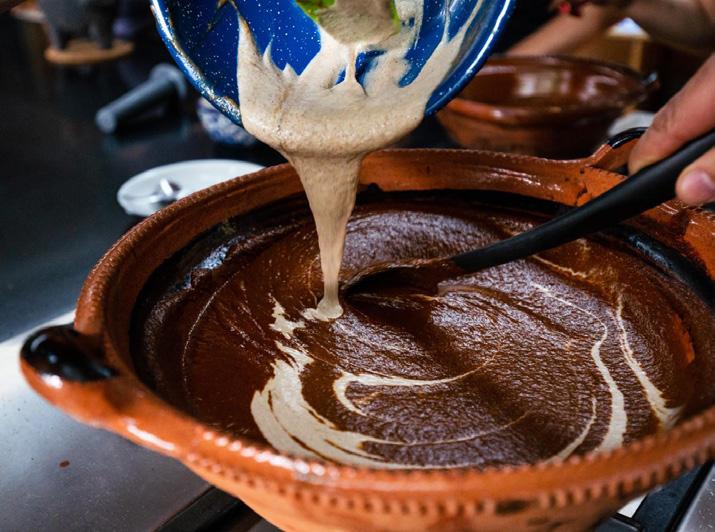
Connect with Brazil through a stay in nature at the Ibiti Project in Ibitipoca, an astounding reserve in Minas Gerais, where you’ll find enormous outdoor sculptures once showcased at Nevada’s infamous desert festival, Burning Man.

Bar El Federal Masterclass
In the atmospheric Bar El Federal of Buenos Aires, a hands-on empanada masterclass reveals the art of this classic pastry. Guided by an expert chef, you’ll learn to craft creative fillings and the traditional ‘repulgue’ crimp.
Start exploring → jacadatravel.com/latin-america
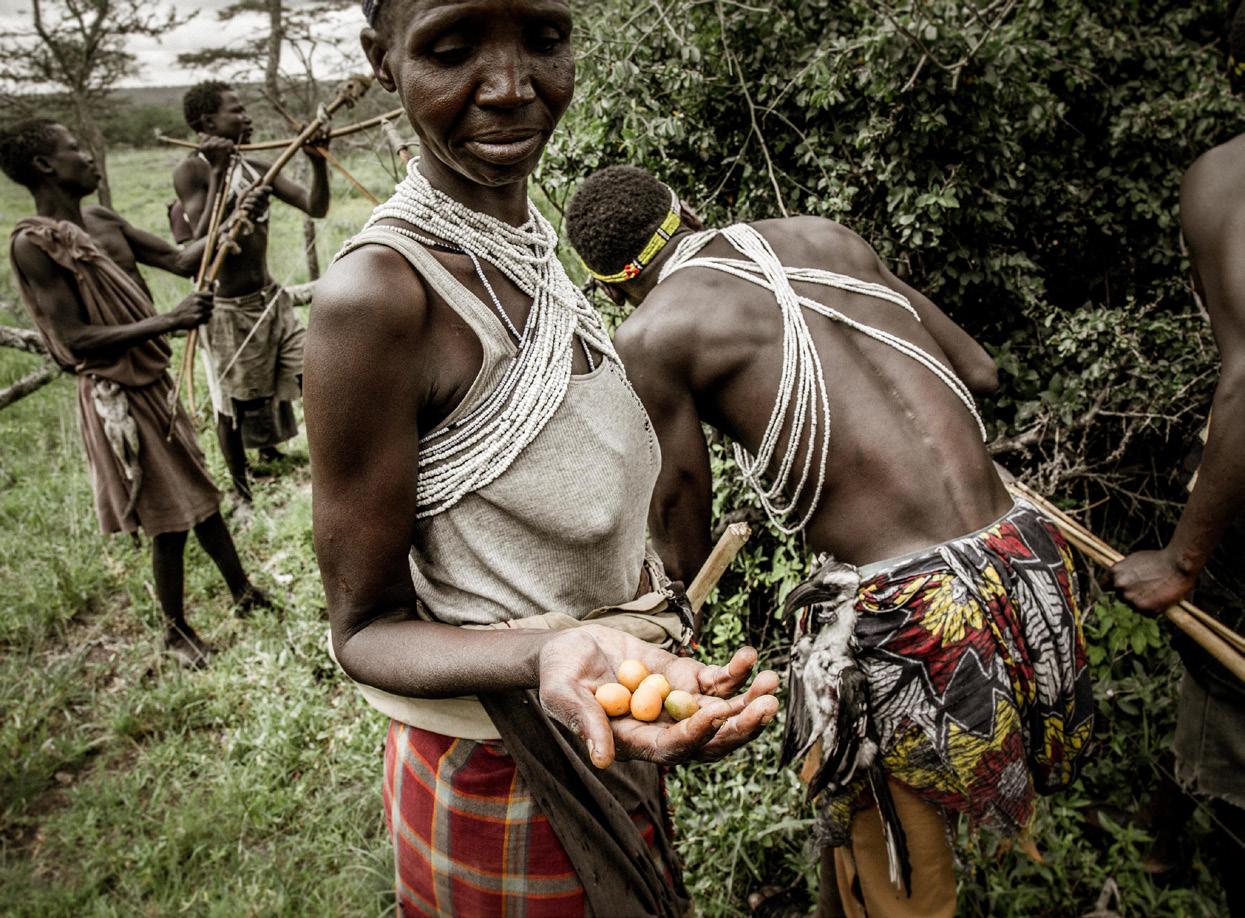
In remote communities around the world, age-old techniques are still practised, ancient rituals preserved and a deep connection to the land endures.
Words: BRITTANY REEVE
Illustrations: SOPHIE GREEN
Since the dawn of time, humans have constantly been moving and adapting. We mastered the element of fire to aid our survival. We explored the icy depths of Antarctica. We built cities, defined borders and, through travel, forged connections across oceans and continents. Since the 1900s, we’ve even set our sights on worlds in the far reaches of space.
Yet some communities remain rooted in nature. Living in harmony with the land, they often carry down traditions, protect areas of remarkable wilderness and preserve ancient languages.
Among these communities are those who welcome visitors for meaningful cultural exchange, offering experiences that both bring economic benefit and help preserve cultural heritage for the years to come.
The Himba of Namibia
Namibia’s human history spans millennia. It’s believed that the first humans lived in the Huns Mountain in the south, based on the discovery of painted stone plates in the 1960s. Today several Indigenous groups are scattered throughout Namibia, with one of the most recognisable being the custodians of the Kunene Region: the Himba.
This semi-nomadic tribe is famed for the otjize paste they apply that gives their skin a crimson hue. Stay at Wilderness Serra Cafema, an intimate camp set along the banks of the Kunene River, to begin your journey into their world. You’ll join an expert guide in a visit to their village: a circular formation of mud, dung and wooden huts rising up out of the amber desert. Here, your guide will introduce you to a community member, acting as interpreter, as the Himba speak only OtjiHimba.
Your time here brings the chance to learn about Himba customs, such as ‘smoke baths’ that involve burning aromatic herbs and wood and allowing the smoke to induce perspiration for a full-body cleanse. Or watch as the men of the village tend to their livestock before gathering around the communal fire to get lost in a joyful performance of song and dance.
The Hadzabe community of Tanzania
Deep in the heart of the private Mwiba Wildlife Reserve, which fringes the southern Serengeti, Legendary Mwiba Lodge offers the chance to meet one of the last remaining hunter-gatherer societies in Africa. The Hadzabe tribe are a nomadic community, moving in tandem with the seasons and never settling in one place for too long. They forage from the land and hunt small wildlife, employing the use of ancient techniques. Your guide will lead you deep into the wilderness, following faint footsteps, until you come across the grass and branch huts that mark the Hadzabe’s temporary abode. Listen as they speak Hadza, a unique language that’s notable for its distinctive clicking sounds. Then join them as they demonstrate how to gather honey straight from bees nests high in the trees. It’s an insight into a world entirely in sync with nature.
The Akha hill tribe of Thailand
Originating from Tibet, the Akha hill tribe is now spread across Laos, Myanmar and the mist-strewn mountains of Thailand’s Chiang Rai. On a walk through their villages, a knowledgeable guide will explain how traditional Akha houses are made from
bamboo. They balance on stilts, with an interior division that designates separate living spaces for men and women.
You’ll learn about their traditional dress: extravagant headdresses and indigo clothes adorned with intricate embroidery. Then try your hand at stitching Akha embroidery, a skill that preserves their cultural heritage and has been passed down through the generations by the women.
If you time your visit right, you will be able to witness the Akha Swing Festival, which takes place every August or September once the community has planted their crops. This joyous celebration sees the Akha people gather to honour their goddess of fertility and the women of the tribe, who are adorned with festive ornaments. They climb onto large wooden swings and sway back and forth at immense heights, letting their voices ring out across the mountains as they pray for a good harvest.
The Veddha in Sri Lanka
Descended from Sri Lanka’s earliest inhabitants, the Veddha are a now-dwindling Indigenous community with fewer than 200 individuals still following a traditional way of life. Originally a nomadic group who would pursue animals across the seasons, they now live in the verdant Gal Oya National Park and the areas surrounding the Senanayake Samudraya Reservoir on Sri Lanka’s East Coast.
On your visit, you can meet with an elder from the local village for a walk through the rich nature of Gal Oya. You’ll easily spot them as they approach, with their brightly-coloured sarong and an axe heaved over their shoulder. Traditionally they speak an ancient
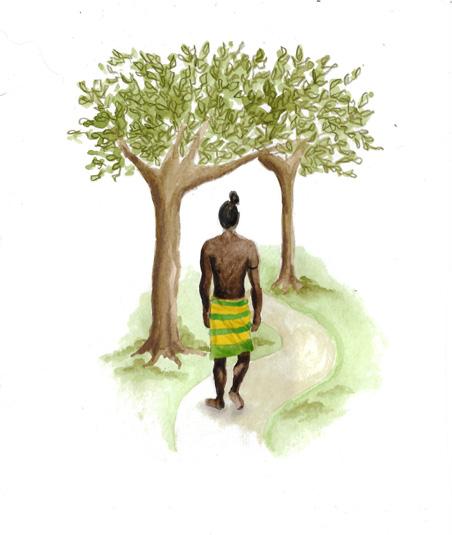
dialect of Sinhala, with the original Veddha language fading into extinction. As you trek through the forest they’ll reveal some of their ancient practices, pointing out medicinal plants and showing you how they wrap meat in bee honey for preservation.
The community of Longyearbyen in Norway
Stretching along the Longyear Valley and the shore of idyllic Adventfjorden, the small town of Longyearbyen is the world’s northernmost settlement and known as the gateway to adventure in the Arctic. It was once a coal mining settlement, but since the 1990s it has become a cheerful town, where reindeer roam the streets and seeing whales cavorting in the fjord is a normal occurrence.
Join a local guide for an exploration of the settlement. Depending on when you visit, you can experience two entirely different worlds: one where the winter months of November to February are spent in the complete darkness of ‘the Polar Night’, and one where the sun never sets between April and late August. In the winter the citizens of Longyearbyen come together, revelling in the festive cheer. Watch as the streets are lit by the flaming torches of hundreds of people on the first Sunday of Advent, and the lights of the Christmas tree in the town square twinkle as carols are sung out into the chilly air. Or head out into the wilderness, where the bright ribbons of the northern lights dance in the sky on clear nights and snowmobile adventures offer an escape into the snow-blanketed forests.
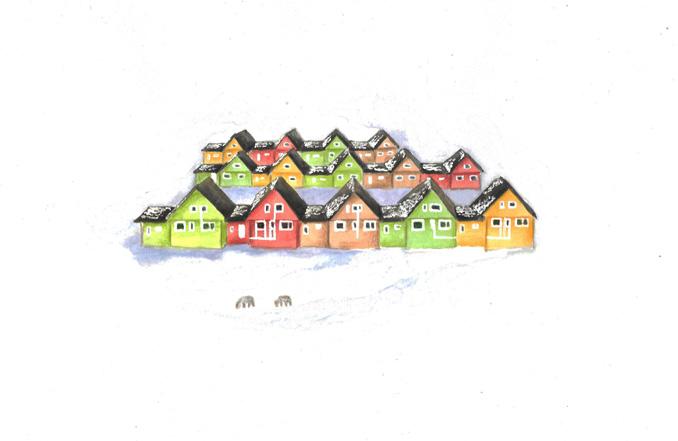
During your time here, you can witness the art of dyeing and spinning fine alpaca wool, before watching the artisans deftly weave the yarn together to create hats, ponchos, belts and more. You’ll then be invited to sit down with them and share a pachamanca; a traditional earth-cooked meal that’s baked underground to deepen the community’s connection with nature, and preserve the flavours of the land. Ingredients can vary from marinated lamb and pork to chicken, accompanied by a range of vegetables such as potatoes, green lima beans, corn and yucca. Wrapped in the warmth of the food, the community’s music and the lively dances, this is a memory that will remain with you long after you leave.
The Patacancha community in the highlands of Peru High in the highlands of Ollantaytambo, over 4,000 metres above sea level, is where you’ll find the village of Patacancha. For hundreds of years the traditions of the Incas have been kept alive here through an array of intricate textiles, ceremonies and rituals.
The Zapotec people of Mexico are an Indigenous community that have their roots in the historic Oaxaca Valley. You can gain an introduction to their traditions whilst visiting the village of Teotitlán del Valle, embedded in the foothills of the Sierra Juárez mountains.
A local family will show you firsthand how Teotitlán rugs are made. You’ll learn about their use of traditional techniques to card and spin the wool, before dyeing it with natural colours and weaving on solid wooden looms. As one of the earliest towns to be founded by the Zapotec people in 1465, Teotitlán del Valle is the birthplace of Zapotec textiles, which have been used for centuries to weave tales of culture, history and spirituality through their geometric patterns. You’ll find that the artisans of the village have been making the blankets, rugs and ponchos since they were children. It’s a process that brings the whole family together, with tourism now helping to preserve traditional knowledge and keep ancient practices alive.
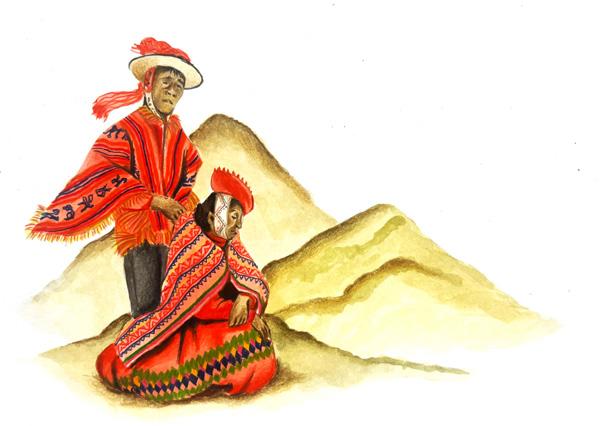
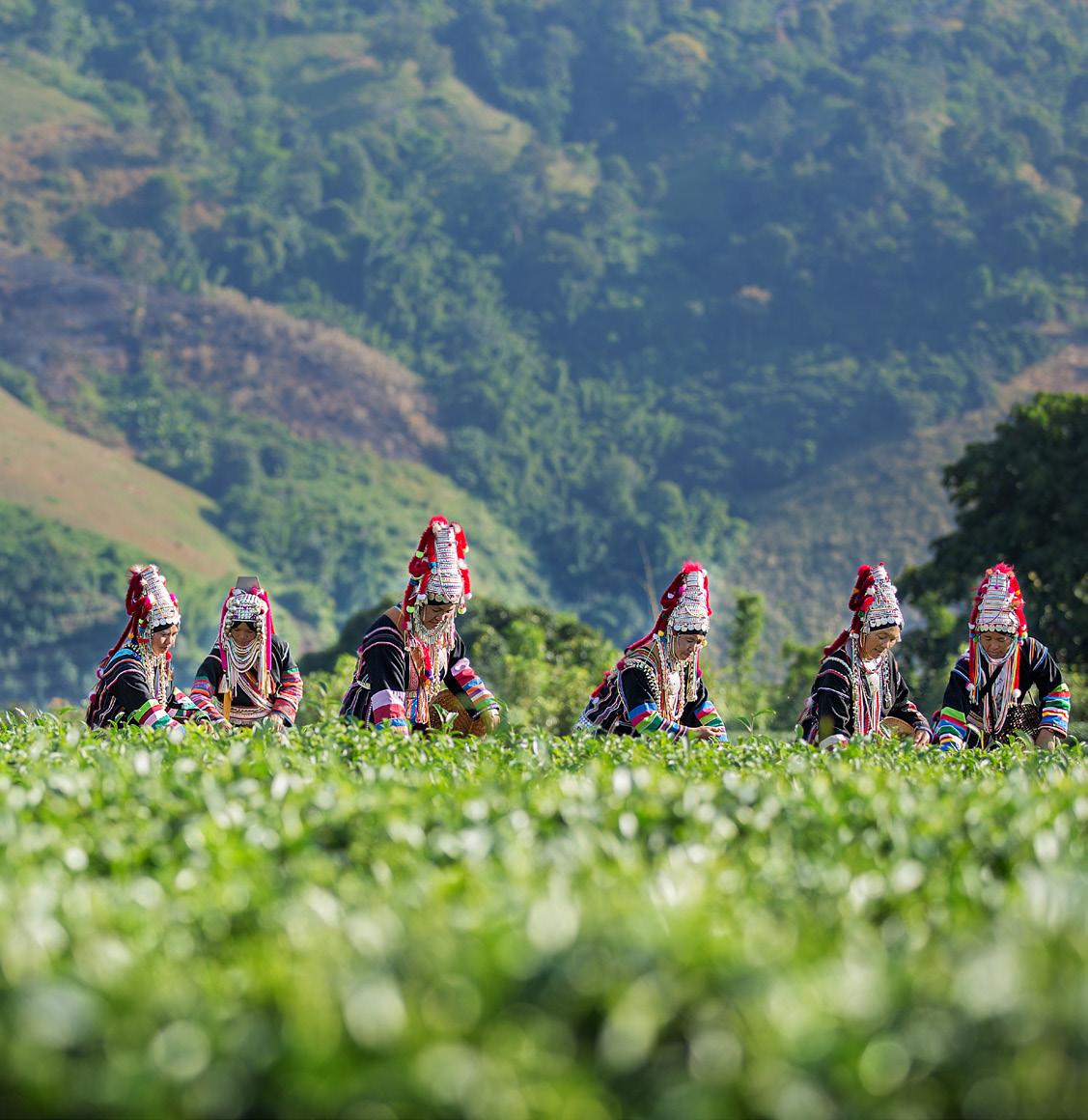
Visiting remote and Indigenous communities offers an incredible opportunity to deepen your connection to the places you visit. These experiences may be some of the most memorable of your trip.
Your visit also brings the opportunity to support historically marginalised groups – and we seek to ensure that your journey benefits and uplifts those you visit. At Jacada, we look to support local and Indigenous communities in celebrating and protecting their traditions, promote historical and cultural preservation, and ensure economic benefits are directed to communities themselves.
Learn more → jacadatravel.com/positive-impact-principles
Travel has the power to transform how we see the world. Explore how each new destination can shift our perception of space, time and our place in the cosmos.
Words: NATALIE CHEESE
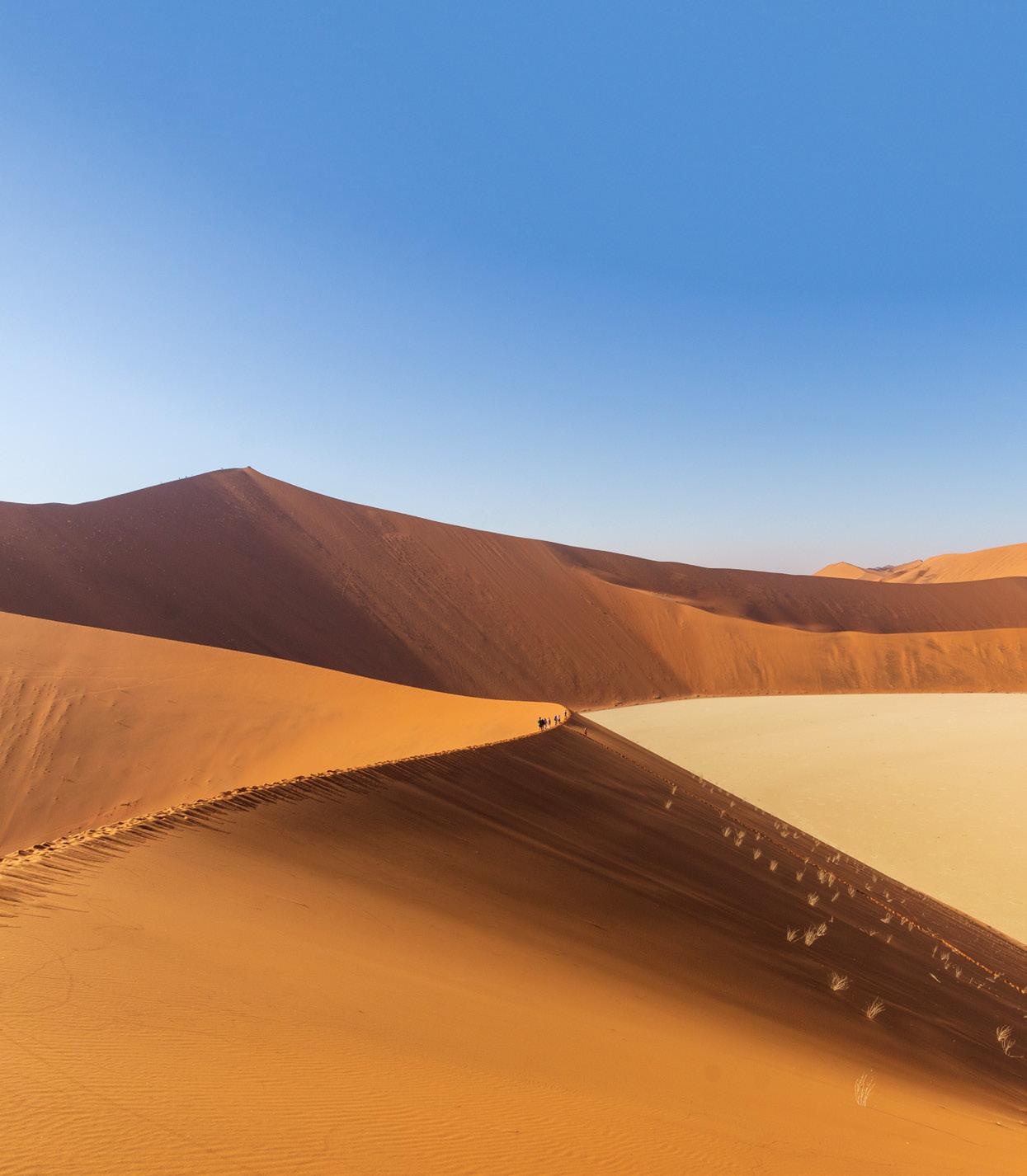
There are places in the world that redefine our sense of space and scale. These destinations are so vast, so ancient, so quiet, that they shift the way that we perceive ourselves.
One moment, you’re a traveller with a camera in hand, eyes wide with wonder; the next you’re a held breath beneath the Patagonian sky, a fleeting presence beside an Antarctic glacier, a blink in the shadow of Petra’s carved stone facades. In these places, space becomes more than a feature of the landscape, it becomes a lens through which we see ourselves and our place in the world.
Landscapes that diminish and define
There’s a unique sense of awe that comes from being in places that tower over and around you. They don’t just make you feel small – they recalibrate your sense of meaning.
One such place is the Namib Desert, where dunes rise like waves of rust and gold, stretching endlessly beneath a sky that feels bigger than time itself. Your

footprints vanish almost as soon as they're made, swallowed by cascading grains of sand. This breathtaking landscape is as vast as it is simple – just an abundance of sand and sky.
In Patagonia, the landscape has a different type of grandeur. Mountains thrust skywards and rivers thunder through deep stone canyons. They don’t just humble you, they have the power to clarify the mind. In the face of such enormity, we are small, yes, but our place in the world matters, like the grains of sand that shape a desert or the droplets that form a glacier.
Wonder in the small and still
Not all beauty comes in sweeping vistas. Sometimes, it lives in small details that we might overlook.
In Kyoto, meaning is folded into the simplest moments; a teacup’s fragile rim, the fleeting bloom of a cherry blossom tree and the delicate sweep of a calligraphy brush across starched paper. Each tiny detail holds centuries of tradition. The scale is small, but the impact is profound.
The cloud forests of Costa Rica tell a similar story in a wilder language. In Monteverde, orchids bloom no bigger than a fingernail. Hummingbirds hover like breaths on the wind and dew scatters across moss-
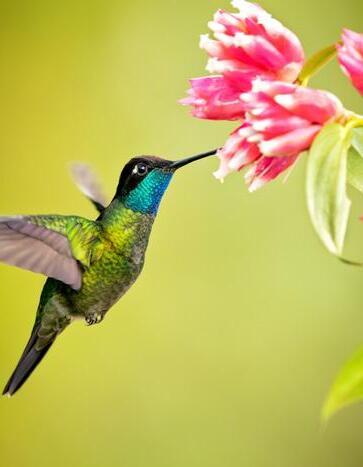
draped branches, each droplet reflecting a world within a world. In these artfully balanced ecosystems complexity and beauty emerge not from size, but from intricacy, and serve as a reminder that the smallest things can carry all of life within them.
Glimpsing the universe's grandeur
Look up in a place free of the bright lights of the city and the sky becomes an endless painter’s canvas. In Chile’s Atacama Desert, the night sky arrives with startling clarity, the Milky Way spilling across the darkness in strokes of silver, violet and ink. It is one of the clearest windows into the cosmos, a place where the stars feel impossibly close.
But it is more than beauty; there is also memory here. This light began its journey before we were born, from stars that may no longer burn, yet still send their story across the centuries. To look up is to be reminded that even in this remote stillness, we are not alone. That same starlight once brushed the faces of those who marvelled at the sky centuries ago, linking us across time in an eternal glow, connecting our stories to those of ancestors long since passed.
Astronomical spectacle of a different type draws sky watchers to the frozen tundras of Sápmi, in Sweden’s far north. During the winter months, the sky dances with the mystical lights of the aurora borealis. To witness the physical manifestation of the Earth’s atmosphere shielding us from the relentless power of the Sun’s solar winds is to be awed by the beauty and power of our planet. Under skies like these, it’s hard not to feel tiny. But within that smallness comes a strange comfort: of all the things the universe has made, we are among the few that can look up and understand what we are seeing.
Above: Even the
Right: A clear night sky and no city lights could leave you in awe
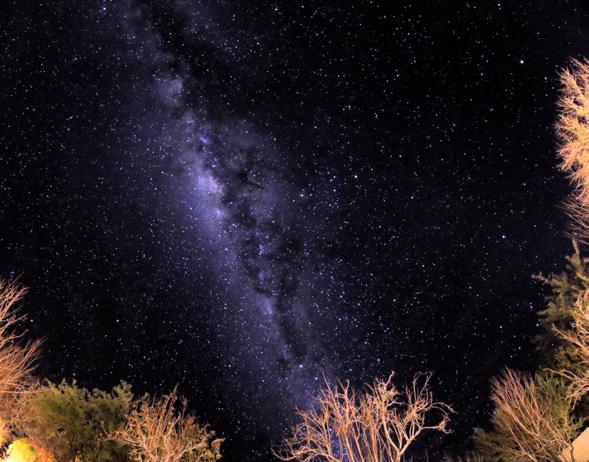
Echoes through epochs
Scale is not only about size or distance. Sometimes, it is about time, and witnessing its slow, silent march.
In Antarctica, glaciers creek and crack their way across the landscape, moving with a patience that outlasts lifetimes. Egypt’s temples, crafted over 3000 years ago, rise from the desert like echoes of a distant past, their stones inscribed with stories thousands of years old.
In Iceland, time shapes the landscape with ice and fire. þingvellir National Park reveals the place where continents meet and move, showing us that even the ground we stand on is part of an ancient, shifting story. Human history at þingvellir National Park dates back to 930 AD, but the rocks and crevasses have stood sentinel for millions of years longer. Landscapes around the country rumble and split apart in flows of lava, erupting geysers and dramatic displays of never-ending geological change.
Together, these destinations invite travellers to witness time’s dual faces: the imprint of human legacy and the slow, elemental rhythms of the planet itself. They are places that remind us that we are part of a long story, one written in stone, ice and fire.
human ingenuity
Throughout history, humans have reflected our own relationship with space and time in our creations. Wherever we live in the world, humanity is connected by our desire to create, to build and to invent. Venice rises from the sea like a mirage, its canals and palazzos showcasing ingenuity, beauty and the will to make something lasting in an unlikely place. The city streets are a labyrinthine network of streets from across centuries woven in water and stone, as opulent as the artwork that adorns the walls of the Renaissance palaces along the water’s edge.
Cities like London rise as well as spread. Glass and steel reach toward the sky in sleek defiance of gravity, alongside historic buildings etched with bygone stories. Streets bustle in layered symphonies of traffic, language and commerce, all compressed into a vertical sprawl. There is something exhilarating in this density, this constant movement that pulls you into the city’s momentum. It's a reminder of the vast systems
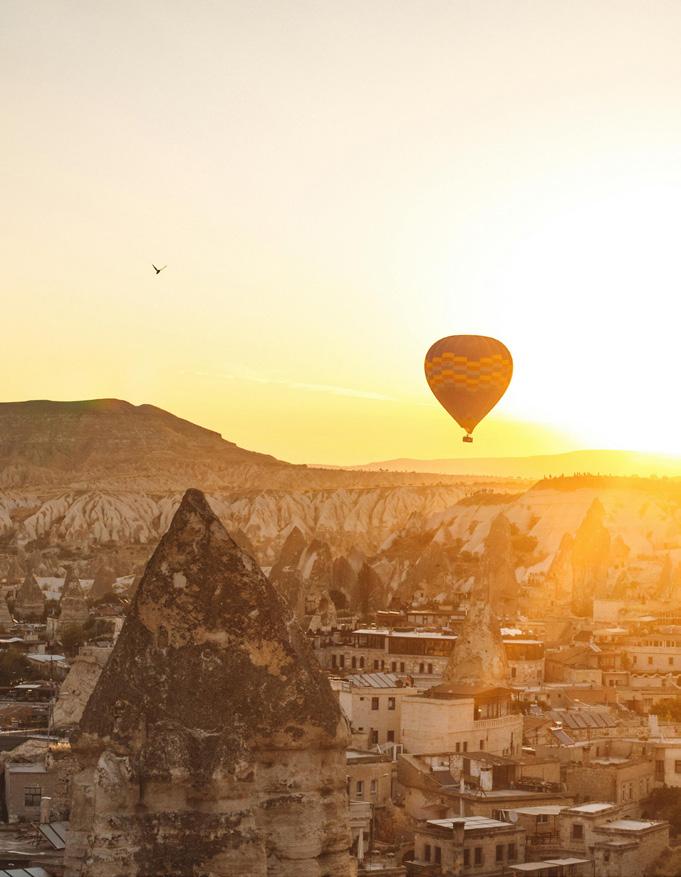
that sustain modern life, and how the human spirit stretches to meet them. Amid the height, the light and the hum, we’re reminded of our place within a different kind of grandeur – one we built ourselves, and must learn to navigate with the same awe we give to nature.
The perspective of height
There is something transformative about height. In Capadoccia in Türkiye, hot air balloons drift above surreal stone landscapes, the dusk-hued shadows melting away into a soft dawn light. Suspended above the landscape in stillness, it is a chance to let go of daily worries and simply be. The silent rise of scores of balloons into the pastel-hued sky is an ethereal sight.
In the mighty Himalayas, altitude takes on a spiritual weight. With each step upwards, the air thins and
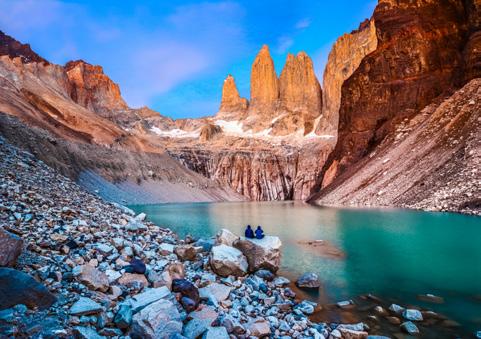
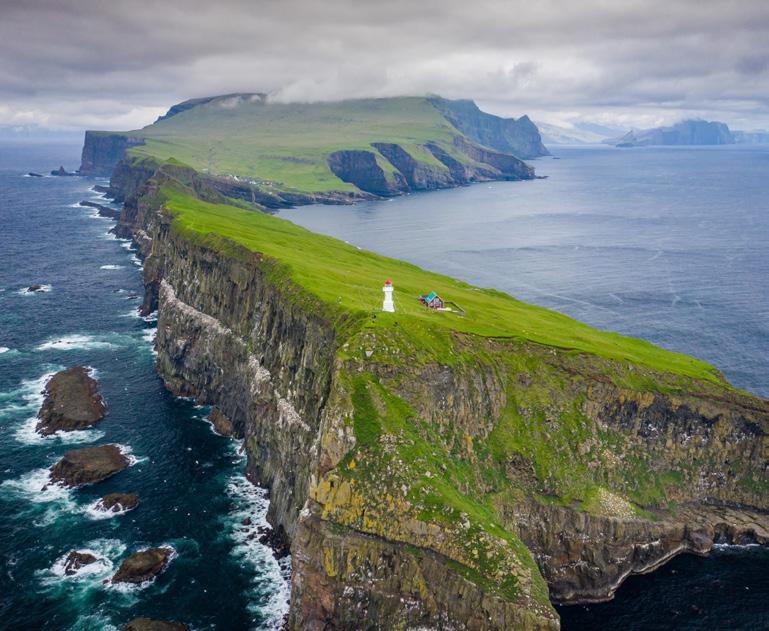
distractions fall away as you connect with each breath you take. Prayer flags flutter in the wind, marking the moments when stillness and meaning meet.
These are the places that offer perspective not only of the world below, but of what matters within.
Soundscapes and their power
Not all spaces are seen. Some are heard, or felt in the hush where sound should be. In the Faroe Islands, wind rushes over cliffs and curls through empty fjords, carrying with it a silence so complete it feels architectural, echoing through the valleys like a hymn resonating off the walls of a cathedral. The absence of noise here is not an emptiness, but a presence, a spaciousness in which thought stretches out, uninterrupted.
In the depths of the Amazon Rainforest, the effect is reversed. Sound becomes a measure of scale. Layer upon layer of birdsong, insect chatter, calling monkeys and rustling leaves form a symphony of life. It's not volume that overwhelms, but density in a thick soundscape that hints at complexity far beyond what the eye can see. The forest is auditory, immersive and alive. Whether in the saturated chorus of life or the vastness of quiet, these places ask us to listen differently. To feel how sound, or the lack of it, can mirror our internal
dialogue, inviting stillness or awakening awareness. In this way, sound, too, can reshape how we move through the world.
Across deserts and forests, under starry skies and ancient temples, something shifts. Travel doesn’t just take us to new places, it has the power to change the way we see. It resizes us. Sometimes, it makes us feel small. Other times, it reminds us how grand we really are.
Luxury, in this light, becomes not about indulgence, but about space – the space to feel, reflect, to change and be changed. To travel well is to return not only with memories, but with a renewed sense of ourselves, our planet and of our place within it.
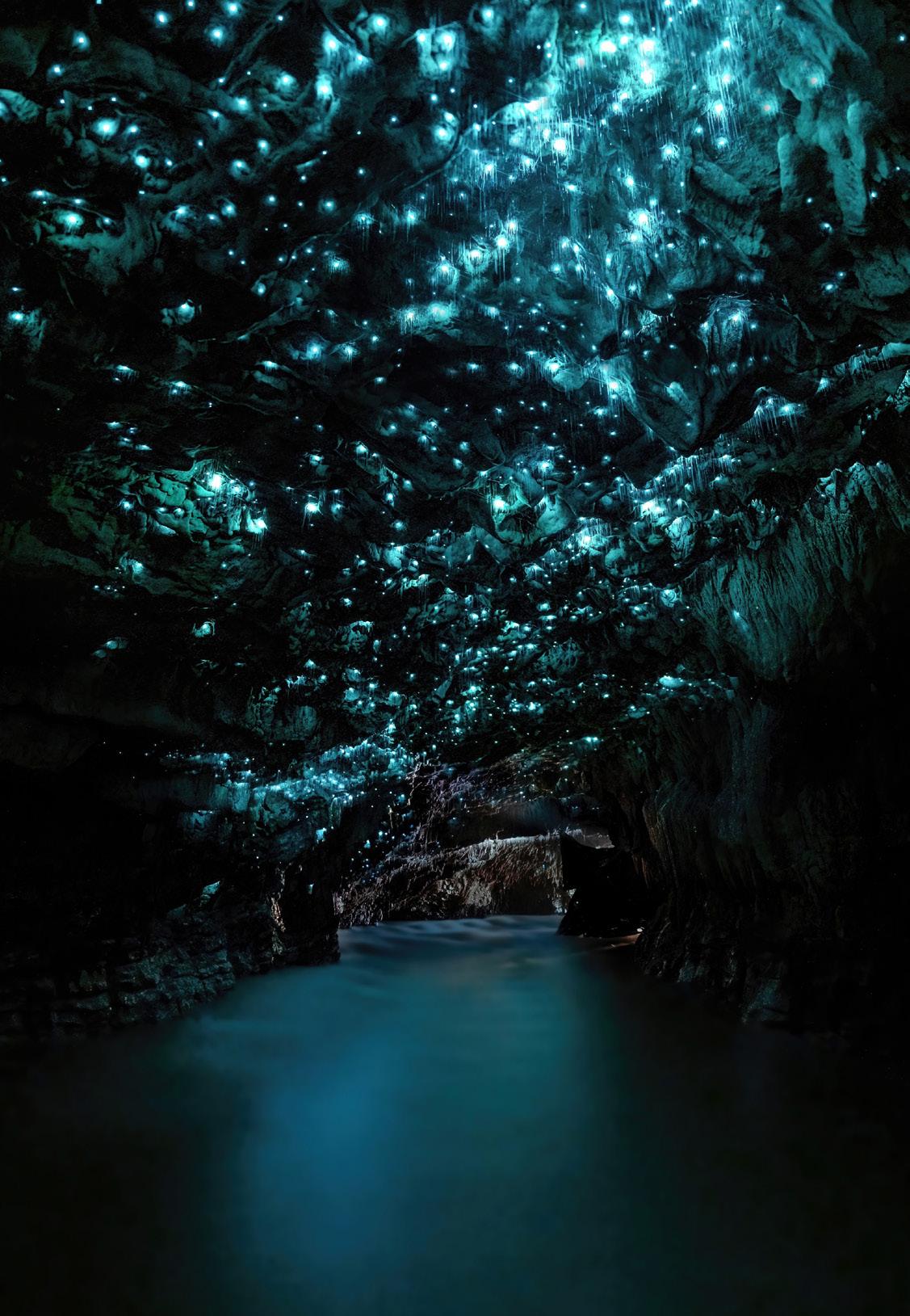
Some of the world’s most remarkable places lie beneath the earth, revealed only to those who venture downward.
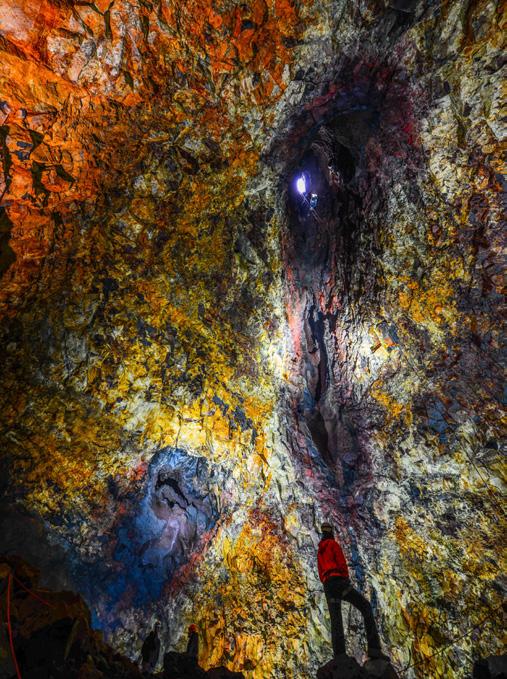
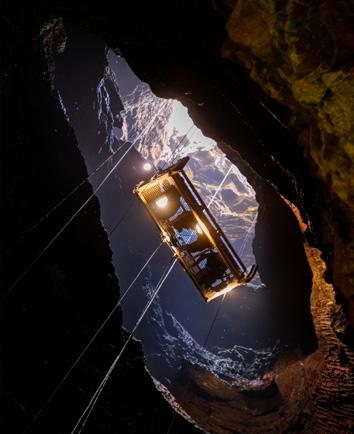
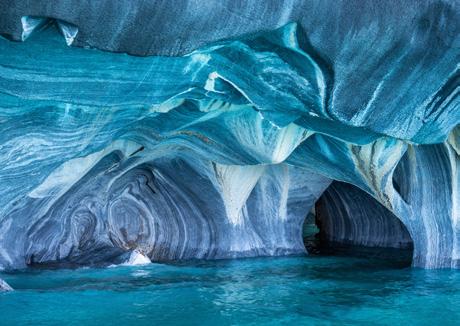
Beneath the surface of the Earth lies a different kind of history. Stories etched into rock, sculpted by nature, lit by bioluminescence and inscribed by ancient hands. These underground spaces are living archives, shaped over millennia by nature’s elemental forces, by the people who once inhabited or revered them and by the persistence of time.
Each of these spaces offers a distinct lens through which to experience fascinating narratives of our planet. In these subterranean realms, culture, geology and human experiences converge, inviting us to look and listen far below the surface.
Thríhnúkagígur Volcano, Iceland
In the land of fire and ice, there is perhaps no experience more elemental or surreal than stepping inside a volcano. Located just 30 minutes outside Reykjavík, Thríhnúkagígur is the only dormant volcano in the world into which visitors can descend.
The journey begins above ground, with a hike across a lava field that feels otherworldly. As the volcano comes into view, its cone modest against the cinematic landscape, it’s difficult to imagine the magnificent void that lies beneath.
The descent into the volcano is nothing short of breathtaking. An open cable lift lowers you 120 metres
into the hollow magma chamber. Once a furnace of molten lava, the chamber is now a grotto of extraordinary scale and colour. Its mineral-streaked walls are brushed with ochre, crimson, emerald and ash black – all remnants of a geological process that ended over 4,000 years ago.
Volcanologist-led tours provide rare insight into Iceland’s tectonic architecture. As you stand inside this hollow cavern, guides recount the science and stories of the eruption that shaped it, as well as the geological process that allows us to enter a space which most volcanoes seal shut forever.
The Marble Cathedral, Chile
Chilean Patagonia is home to one of the most ethereal natural sanctuaries in the Southern Hemisphere: the Marble Cathedral. Accessible only by boat, this network of water-carved caverns rises from the turquoise depths of General Carrera Lake.
The caves, formed over the course of 6,000 years, are the product of patient erosion. Glacial runoff, rich in minerals and motion, has gradually hollowed and polished the solid calcium carbonate into swirling col-
umns, vaulted domes and rippling walls, all rendered in shifting shades of blue, white and grey. Each surface reads like a natural fresco, the veining and colours reflecting millennia of geological change.
Kayaking inside is an experience that blurs the boundaries between land and water. Light behaves differently here: refracted off the lake, it illuminates the marble from below, casting a glow on the walls and ceiling. Guided boat expeditions trace the geology of the site, contextualising the cathedral’s formation within the broader narrative of Patagonian glaciation.
The Ajanta and Ellora Caves, India
Carved into the basalt cliffs of Maharashtra are some of the world’s most extraordinary expressions of devotion, inscribed directly into the landscape. The Ajanta and Ellora cave complexes, both UNESCO World Heritage Sites, are sacred archives where stone becomes scripture.
At Ajanta, a crescent-shaped gorge shelters 29 rock-cut caves, created between the 2nd century BCE and 6th century CE as monastic retreats for Buddhist monks. Inside, light slips gently through arched doorways to illuminate walls painted with some of the oldest surviving murals in Asia. Some of these paintings narrate the Jātaka tales: scenes recounting the Buddha’s past lives that remain vivid even after more than two millennia.
Farther west, Ellora is a masterpiece of sacred pluralism. For over 100 years, artisans chiseled into volcanic rock to create 34 caves: 12 Buddhist, 17 Hindu and 5 Jain, each a self-contained cosmos of iconography and belief. Arguably the most impressive is the Kailasa
Temple (Cave 16), an entire freestanding temple complex excavated from a single rock face.
You can join expert-led tours that delve into the stylistic evolution of these sacred spaces, from the serene expressions of meditating Buddhas to the dynamic carvings of Shiva dancing the cosmic Tandava.
Amidst the red sands of Namibia’s Damaraland lies a story engraved into the earth’s surface. Twyfelfontein is home to one of the greatest concentrations of petroglyphs on the African continent, an archive of San cosmology carved into sandstone more than 6,000 years ago.
Across this weathered terrain, the sandstone provides glimpses into a world that once was. Giraffes stride across rock faces. Ritual dancers freeze mid-movement in the stone. Celestial symbols mark the passage of stars. These are not merely drawings, but coded messages, fragments of ancient spirituality and ecological knowledge, passed down through generations.
Private tours offer a chance to decipher these stories. You move through the site’s terrain alongside archaeologists and local Damara guides who interpret the symbolic language of the engravings, weaving in San cosmology and oral storytelling traditions.
Located in the heart of New Zealand’s North Island, the Waitomo Glowworm Caves reveal a celestial wonder – one that is not overhead, but underground. Here, the darkened silence of the subterranean world
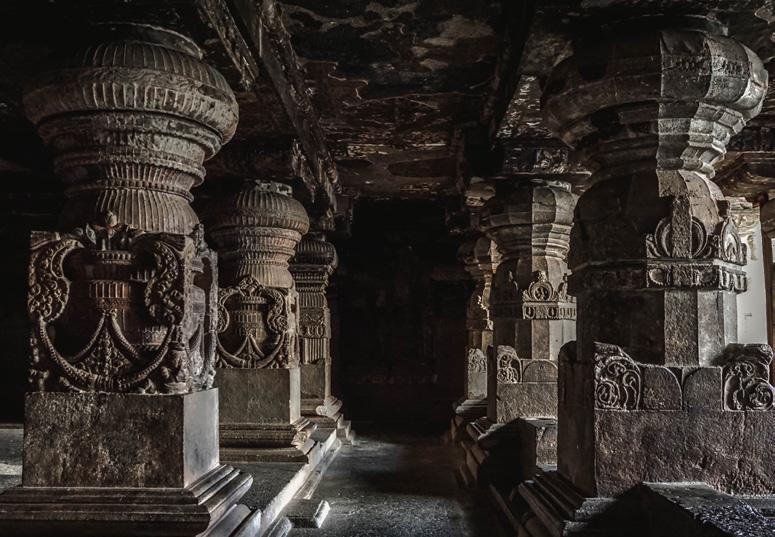
Top right: Uplistsikhe is among the earliest urban settlements in the Caucasus
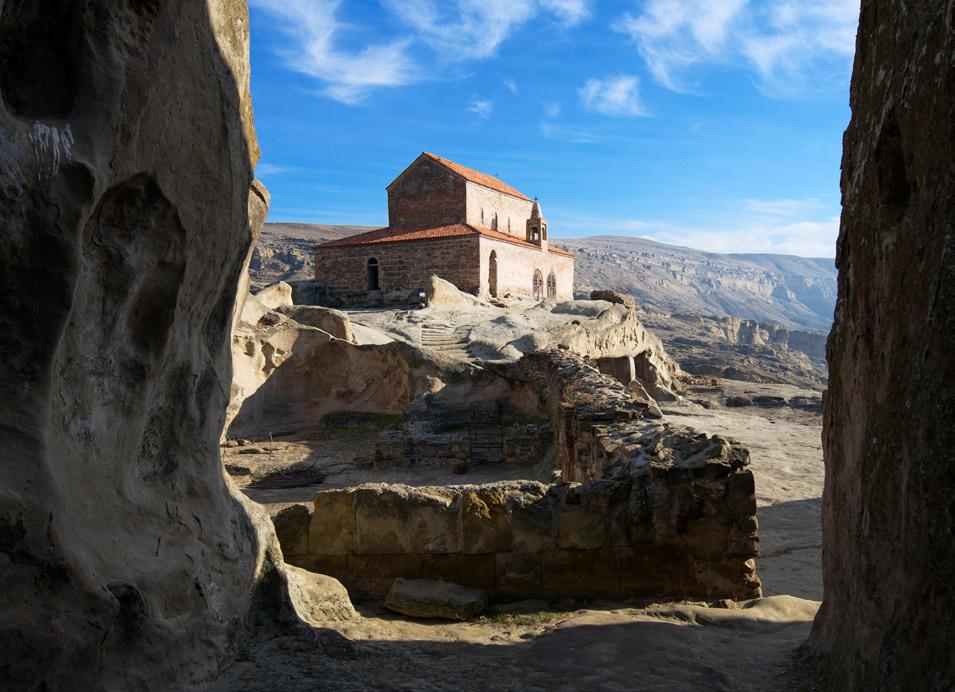
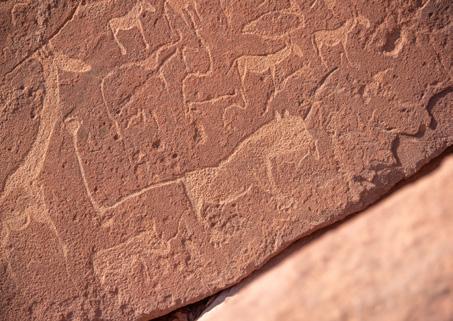
is pierced by a constellation of living lights suspended in the blackness. Waitomo’s magic lies not just in its glow, but in the reversal of expectation. Light, typically a symbol of openness and sky, here flickers to life in the deepest reaches of the Earth.
The spectacle is created by Arachnocampa luminosa, a species of bioluminescent glowworm found nowhere else on Earth. These tiny organisms, clinging to the cave ceilings by the thousands, emit a cool, bluish light that transforms the cavern walls into a miniature galaxy.
You glide through the caves’ subterranean river system by boat. As the vessel slips deeper into darkness, the glowworms intensify above, their lights mirrored on the water’s surface, creating the illusion of floating through a night sky enclosed in stone.
Experiences include photography-focused expeditions into the lesser-visited bioluminescent chambers, guided by local naturalists who offer insight into the life cycle and ecological significance of this luminous species.
On a plateau above the Mtkvari River in eastern Georgia, an entire city is carved into cliffs of soft sandstone, its origins reaching back to the early Iron Age. Uplistsikhe – which means ‘the Lord’s Fortress’ in Georgian – is among the earliest urban settlements in the Caucasus, a once-thriving spiritual, political and trading centre on the Silk Road.
What remains today is an open-air depiction of previous eras: early medieval basilicas, a Hellenistic amphitheatre and a remarkable network of tunnels, streets, storage rooms and ceremonial halls.
Here you’re invited to wander through Uplistsikhe’s history, with expert guides revealing tales of architectural ingenuity and spiritual meaning. Vaulted chambers echo with stories of ancient rites, while carved niches hint at the details of domestic life thousands of years ago.
To deepen the sensory journey, curated experiences bring Georgian tradition into direct dialogue with the site’s archaeological gravity. You can taste qvevri wines (fermented in traditional clay vessels buried underground) in candlelit rock chambers, their cool air preserving the aroma of native grape varieties.
Start planning your own adventure → enquire@jacadatravel.com
Embarking on a journey to Japan, first-time Jacada clients Molly and Grant Kierzek recently experienced the trip of a lifetime alongside their two adult children and new daughter-in-law. They chatted to us about how this multi-generational adventure unfolded, from rich cultural immersion to celebrating an array of milestones along the way, and what made their bespoke exploration of Japan truly unforgettable.
What was your initial vision for this special family trip?
Life is busy and our daughter doesn’t live nearby, so spending quality time together as a family was the main reason for the trip. This year has been particularly special, marked by numerous milestones: my husband Grant’s retirement, our 30th wedding anniversary, our son’s first wedding anniversary, our daughter’s 25th birthday, and the added pleasure of our new daughter-in-law joining us. We saw this trip as a wonderful way to celebrate everything simultaneously, seeking exciting experiences and the chance to create new memories together. When we first connected with our travel designer, Keith Jarman, he understood us immediately. He made the trip sound not only possible, but took away the anxiety we had around planning it and turned that into excitement.
Travelling with family can be a challenge with trying to accommodate everyone’s personal preferences. Does your family share a travel style?
We are immersive travellers. From the time our kids were little, we always wanted them to experience other cultures and to get out into nature. My daughter once said to me, “Mom, why can’t you just look at the scenery? You always have to be a part of it!” We all have different interests and that’s simply part of travelling together as a family. Our main shared passion is food as we’re a huge foodie family, so this was a big feature on our itinerary. We found it so important that everyone had the time and space to focus on what they wanted to do, but it was wonderful to experience others’ wishes as well. We were amazed at the attention to detail and are so grateful that Jacada made this trip one we will always treasure.
How did Japan become the destination of choice?
Japan hadn’t initially been on our radar, but it topped our kids’ wish list. It was a new destination for all of us, so it felt like a great choice and we’re glad we took their direction on this one. As first-time visitors, we
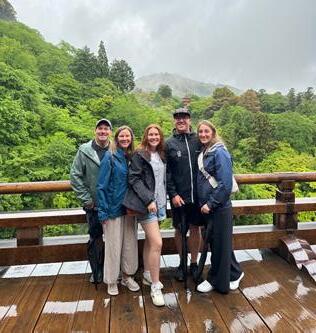
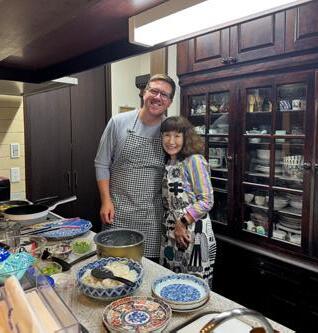
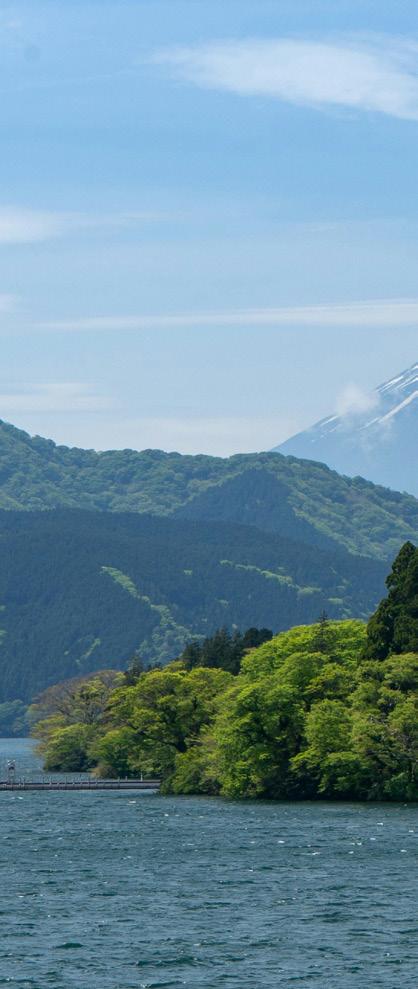
entrusted Keith with the planning and his expertise helped us understand where to go, what to expect and how to navigate the culture respectfully. He also got a feel for our family dynamic right off the bat.
Were there any specific 'must-haves' or unique experiences you hoped to include on your itinerary? Our non-negotiables were hiking, trying new foods and enjoying cultural experiences – and our time spent in Hakone covered all of these. Beyond the temples and shrines we explored, the markets were a highlight. Our favourite ways to connect with local people were through the tea ceremony, the cooking class and
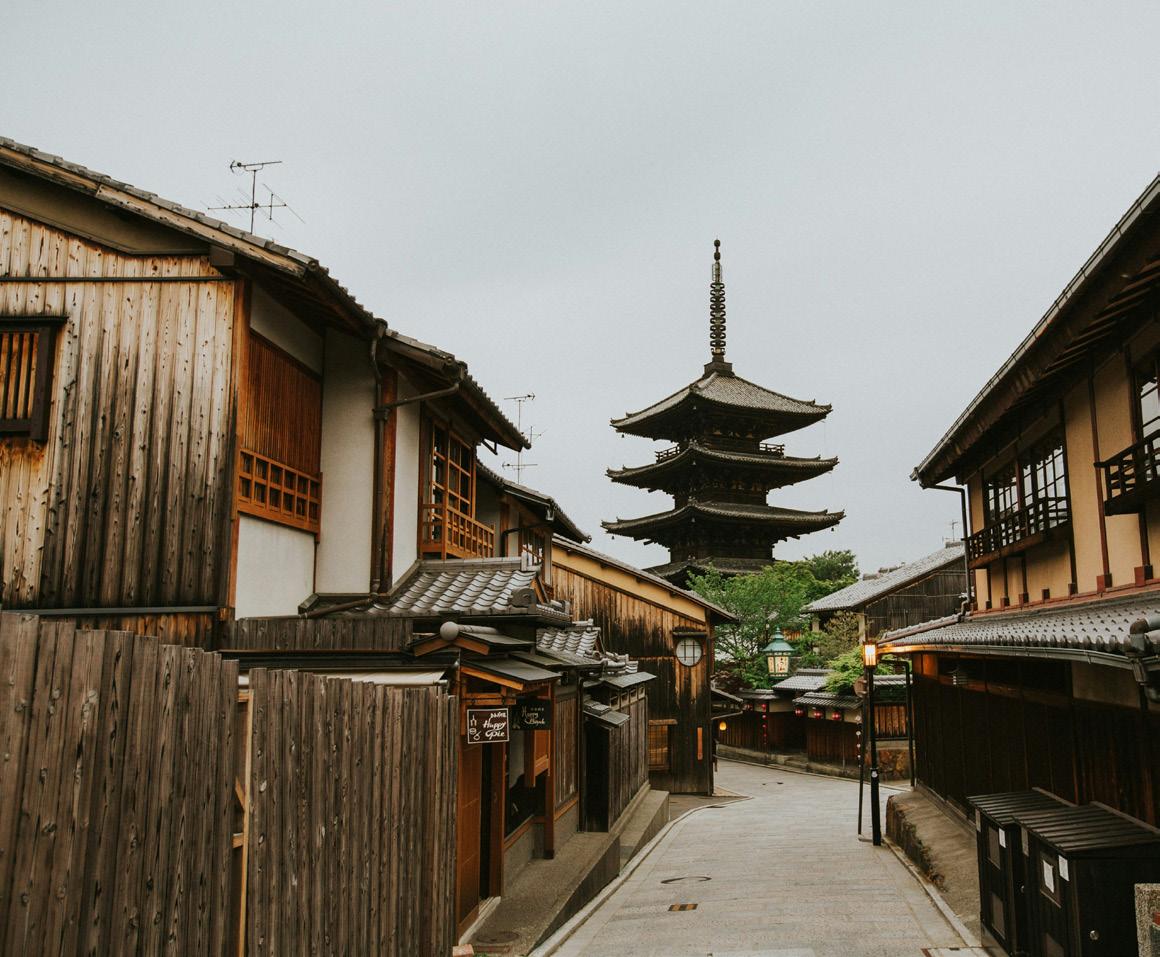
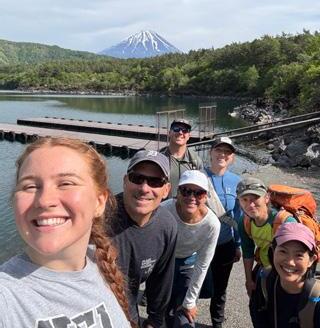
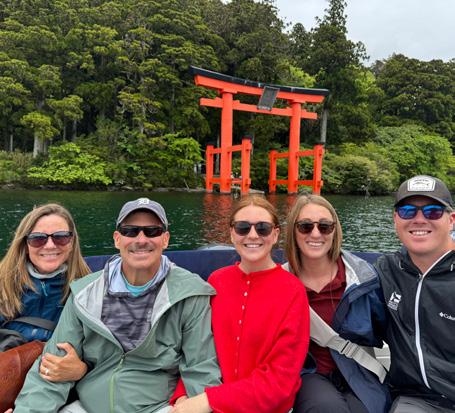
Below:The Kierzek family holding up their calligraphy after a workshop
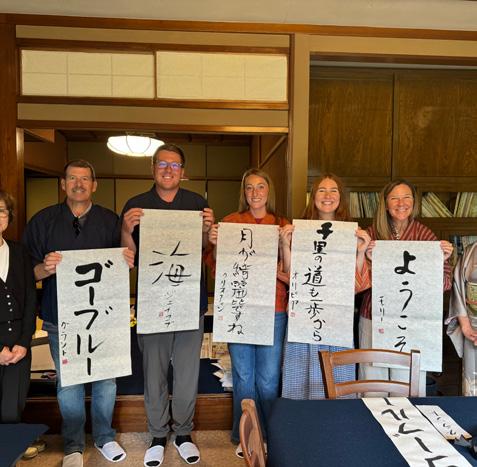
calligraphy workshop. We fell in love with much of the cuisine and enjoyed trying new dishes as food is always a huge part of our experience while travelling.
Did you encounter any unexpected joys during your trip?
When we arrived at our hotel on the day of our daughter’s 25th birthday, the room was filled with balloons and there were sweets waiting for us. It was such a fun way to celebrate and made her day even more special. All of the milestones we told Keith and our concierge, Jessica, about during the planning stages were acknowledged on the trip with small gifts, lovely cards and even hotel staff congratulating us. The special care we received throughout was above and beyond.
Like anywhere we’ve travelled, it’s always the people that make a place so special, and Japan was no exception. Through a couple of connections at home, we met someone linked to our little mining town and even reconnected her with her pen pal from the 1980s. This moment was so special to us, but also to our interpreter because she had become so invested in the story! These special, one-on-one connections continued throughout the trip as we were invited into people’s homes for cooking and calligraphy classes. It really was such a highlight.
What was your favourite stay on the trip and what made it stand out?
The ryokan in Hakone, without a doubt. It was exciting and delightful to immerse ourselves in such strong culture and tradition. The food, the rooms, the garden and the fresh mountain air were all exquisite. There was such a calmness and tranquility that came with that space and we cherished the time we spent there.
When you look back on this family trip years from now, what do you imagine will be your most cherished memory?
We had some of our most memorable dinners ever on this trip. The one that stands out was our omakase experience at Sushidokoro Man in Kyoto. We had such an incredible time talking with the chef, our fellow patrons and each other. My daughter Olivia says she had the best bite of sushi in her entire life sitting at that little counter. I remember all of us looking at each other after each bite in complete disbelief over what we were tasting. I don’t think I’ll ever forget that night. But overall, I’d have to say the time spent together. We went into this open-heartedly, hoping to experience something new together, which is exactly what we did. We were able to make some amazing memories and enjoy this adventure together and we are all so grateful for it.
What does travelling with family mean to you and how did working with Jacada help arrange the experience?
Jacada took charge and planned out so many details. Our travel was seamless and was completely stressfree, and we all felt so taken care of. Keith and Jessica (our wonderful concierge) are amazing at what they do. They made sure we had experiences that were for everyone, and went above and beyond to make us feel welcome and comfortable throughout. They thought of everything and because of that, they gave us an unforgettable experience. It was a dream trip and the memories we made are priceless.
Step with us beyond the pages and into the heart of our journeys. Come foraging in Sweden’s wild forests with those who know every hidden flavour, or follow us across frozen landscapes where winter reveals its quiet magic. Join us behind the scenes with local experts, and be transported to some of the places that inspired this issue.
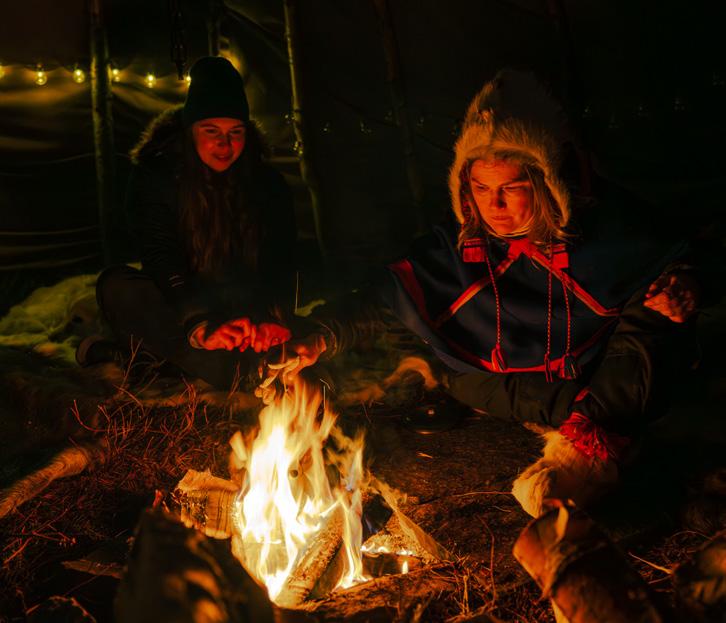
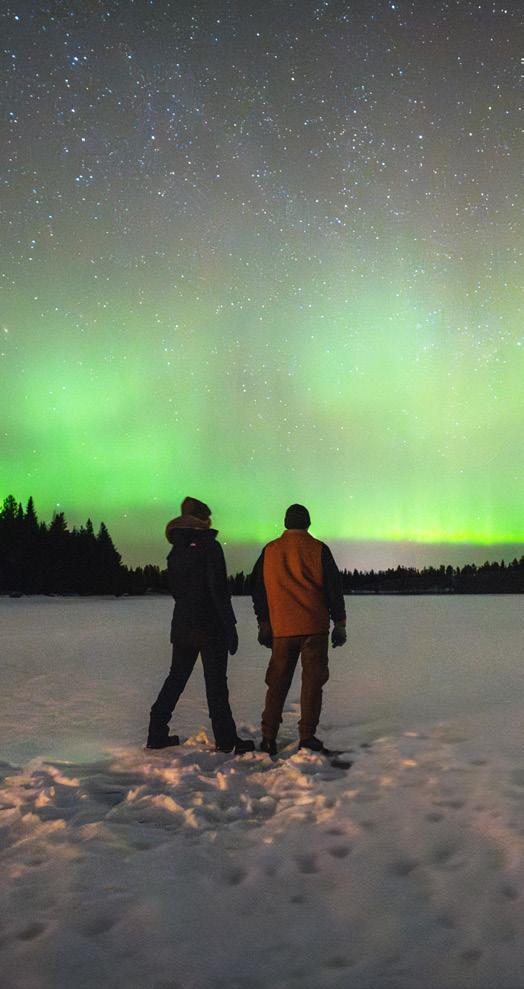
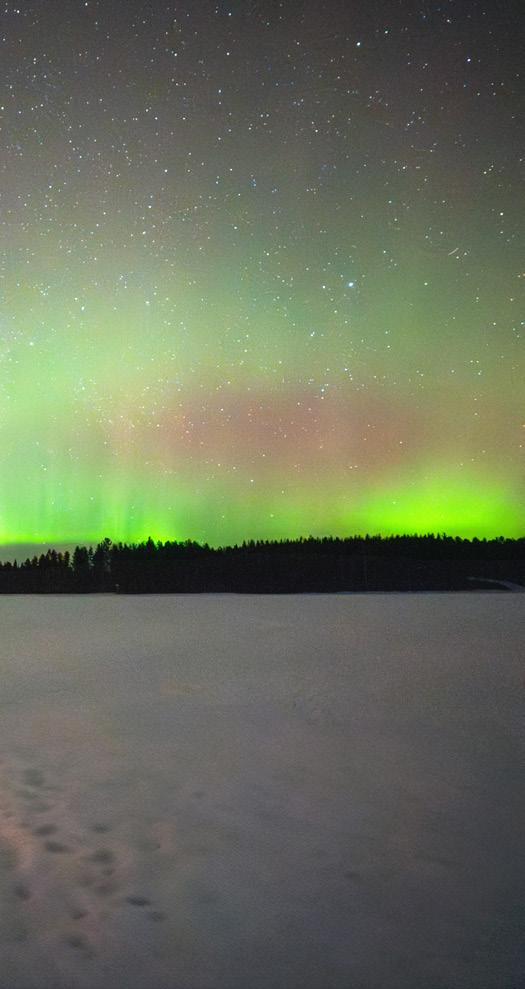
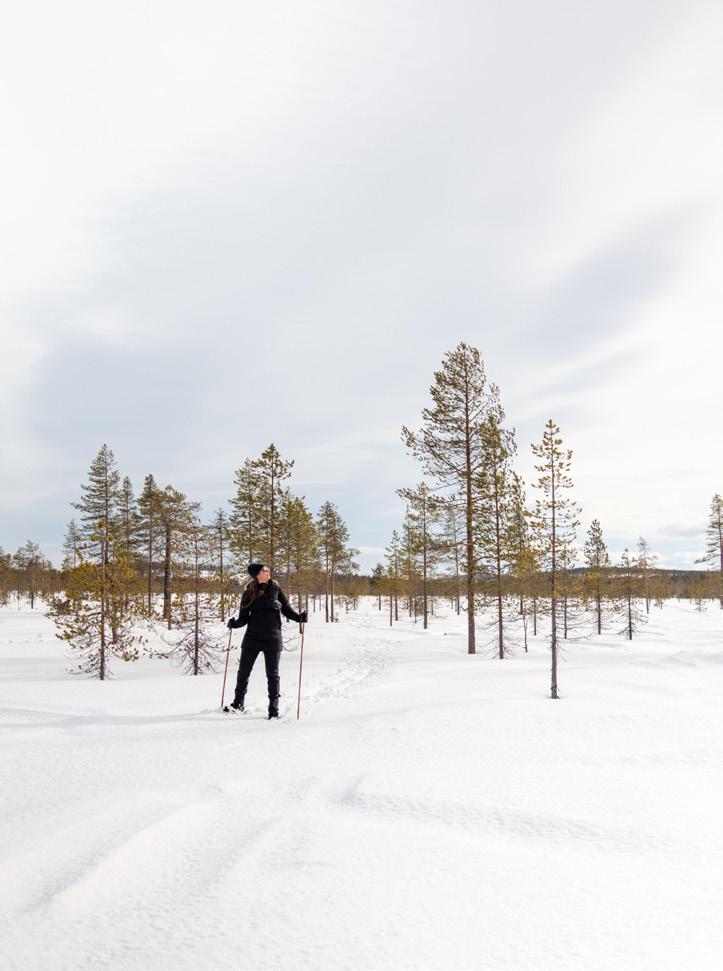

Space invites us to explore differently. To step into remote places where horizons stretch forever, to descend into underground worlds where secrets lie. This edition is a journey into the many shapes of space – grand, subtle and truly unforgettable.