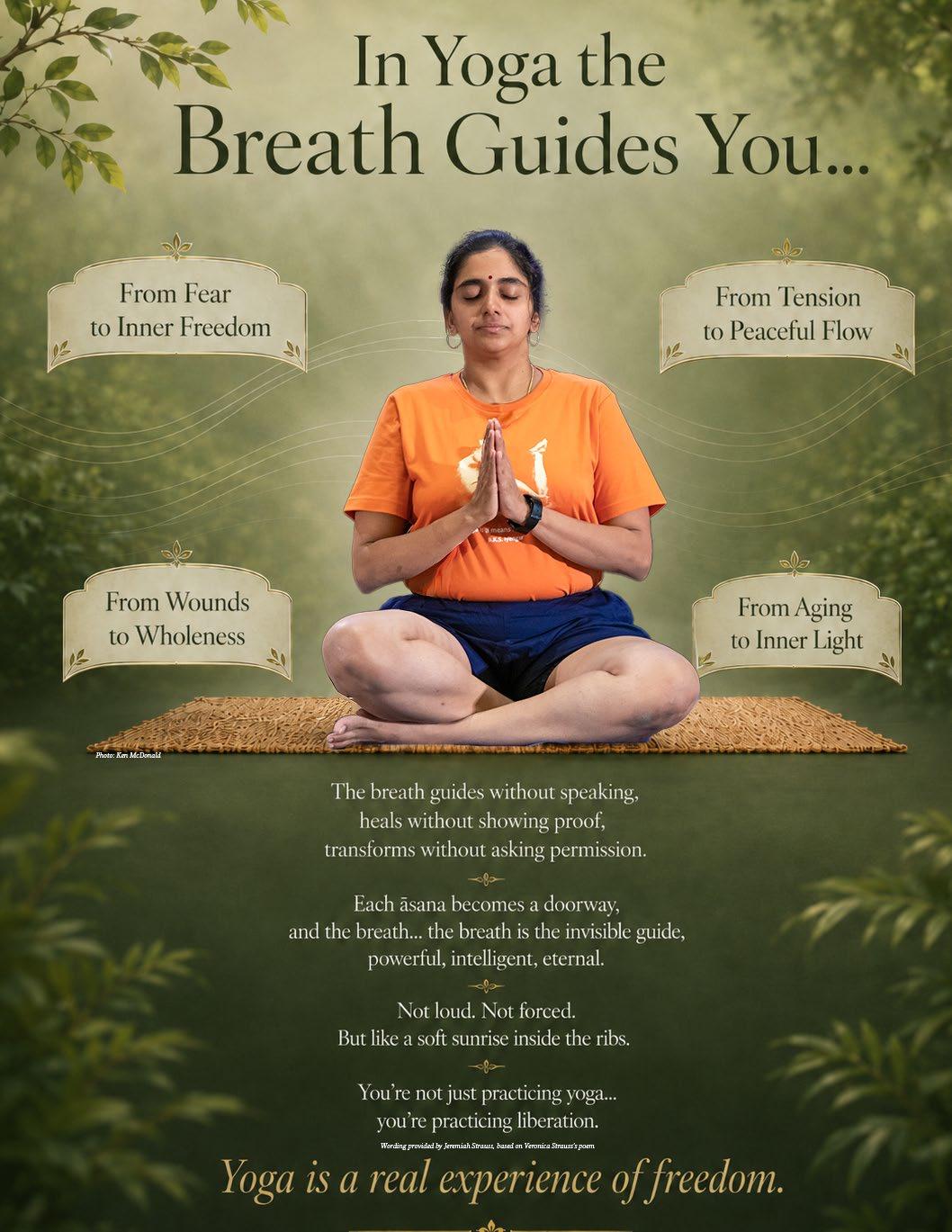



The breath is the invisible master of liberation, pulling sacred strings with intelligence we cannot explain, perfectly fitted to your inner self, as if it knows your wounds, your dreams, your hidden prayers. There is no GPS.
No map. No fixed destination. Because practicing yoga is not about arriving somewhere…
It is about becoming.
The breath guides without speaking, heals without showing proof, transforms without asking permission. It eliminates fear like a quiet fire, expands the mind like a sky opening wider, hugs the soul like a mother holding her child, and moves the body into shapes that feel like poetry. Each position is not only a posture, it is a new version of you being born.
A sacred invisible choreography where the breath leads… and the universe inside you finally remembers: you were never meant to be trapped. Yoga is a real experience of freedom not only breath, not only movement, but every cell becomes a celebration. An expansion to a multidimensional space. The body remembers joy. The mind becomes softer.
The soul starts singing again. And the greatest liberation… is that yoga gives us a sight beyond fear. Because fear is everywhere: the fear of aging, the fear of time stealing beauty, the fear of becoming dust, the fear of disappearing.
But in practice… we discover something sacred: Even if the body changes, the presence remains. Even if time transforms us, the spirit expands.
In every āsana we whisper to the universe:
“I am still here.
I am still alive.
I am still light.”
Yoga doesn’t erase aging…
It erases the prison of fear.
And that is true immortality: to feel free inside the temporary body, to breathe like eternity lives within the ribs. Yes… that’s exactly the sacred miracle of practice. From one corner of the body to the other, we travel not just stretching muscles but rewriting the inner universe.
Each āsana becomes a doorway, and the breath… the breath is the invisible guide, powerful, intelligent, eternal.
It moves like light through hidden corridors, touching every cell, awakening places that were sleeping in silence, dissolving tension that we didn’t even know we carried, accommodating pain …
And suddenly… freedom arrives. Not loud. Not forced.
But like a soft sunrise inside the ribs.
A peaceful path is born again, because the body remembers: It was always meant to move, to heal, to expand. You’re not just practicing yoga… you’re practicing liberation.
Each āsana turns the mat into a flying sanctuary, where every movement whispers: “You can rise. You can heal. You can become infinite.”
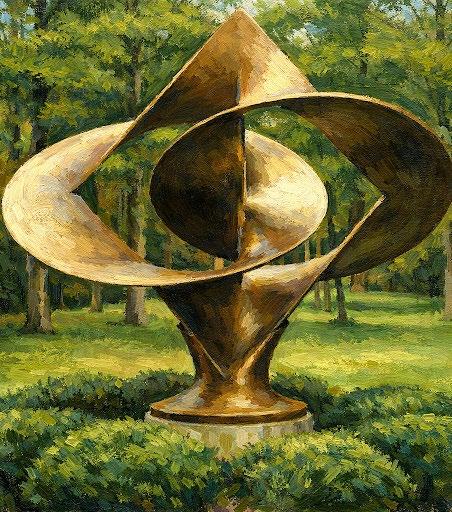
Welcome to the IYNAUS Convention 2026: Cultivating Freedom. We are meeting in Philadelphia, an east coast city steeped in history, on the 50th anniversary of B.K.S. Iyengar’s first visit here in 1976. His visit made such a lasting imprint that there is a permanent sculpture honoring the impact of his teaching here. (See the article on page 84 about After Iyengar)
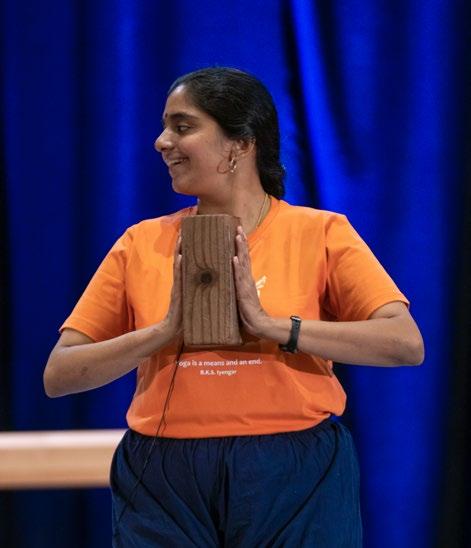
For the first time, the Iyengar Yoga Association of Greater New York region is hosting the triennial convention with IYNAUS. We are honored and grateful for the opportunity to have Abhijata Iyengar join us in the Northeast for her fourth U.S. convention. We are excited to gather together and knit the fabric of our community into a tighter weave under her guidance. We come out of our own individual comfort zones to experience together our own glimpses of inner freedom that made her grandfather, Guruji, B.K.S. Iyengar, our legendary teacher.
May this, the 60th anniversary of Light on Yoga’s debut, be a moment for the light of our practice and understanding to burn ever brighter...within ourselves...and in the world.


I would like to share a little about how the theme of this convention came about and how it shaped the magazine you are holding. The path to discovering this theme was a journey in itself.
It began, as many things do these days, on a Zoom meeting. Five ladies were trying to settle on a theme for the 2026 Convention. Philadelphia holds a special place in our history, and with this year marking the 250th anniversary of the signing of the Declaration of Independence, we naturally gravitated toward symbols of liberty. We also wanted something uniquely connected to the city, so after a brief, joking suggestion of the Rocky statue, we quickly agreed on a much more resonant image: the Liberty Bell. Now we had our symbol, but we still needed a theme. Someone brought up the idea of freedom, closely tied to the Constitution, no snide remarks please. We tried several phrases, but none of them quite felt right. As we sat with the imagery of the Liberty Bell, something finally struck a chord. From that symbol of liberation, the phrase Cultivating Freedom, a suggestion by Skyler Christensen, emerged as our guiding light.
It is a phrase rich with meaning. It anchors us in the historical pursuit of liberty, while also mirroring the inner work of the practitioner. For yogis, freedom is something cultivated patiently from within. Because each of our inner journeys is deeply personal, the field for interpretation is wonderfully vast. My own first experience of freedom came during Śavāsana after prāṇāyāma. It took me a long time to trust the act of letting go, not so much of my physical body, but of my mental control. On the day that finally happened, I felt a connection between the finite and the infinite. For the first time, I experienced a freedom and release from the fear of death and dying. It changed me in a way I had not known I needed.
Stepping into the role of Editor-in-Chief, I found myself reflecting on how best to represent such a vast and meaningful theme. The answer, eventually, became clear: freedom is a shared experience. I began to ask myself how many ways I might define freedom. The answer felt endless. That led me to wonder how others would define it. So we invited a wide range of voices to share what Cultivating Freedom means to them. Emails were sent to Level 3 teachers and above, along with a few others, asking them to share, in three sentences or fewer, their definition of freedom. I have included their reflections here for you to read and consider. Some of these reflections also became the inspiration for the articles included in this magazine.
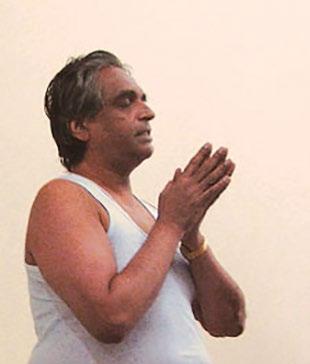
What you are holding in your hands is the result of many sleepless nights and more than a few moments of wondering how I let myself be talked into this. The articles that follow are a testament to collective wisdom. They span the philosophical, the academic, and the deeply personal, with contributions arriving from as far away as Germany and India. It is a special honor to include an original piece by Prashant Iyengar and an exclusive interview with Abhijata Iyengar. I have also included several articles on subjects I felt would be meaningful and of interest to all of you, as well as a poem that deeply touched my heart.
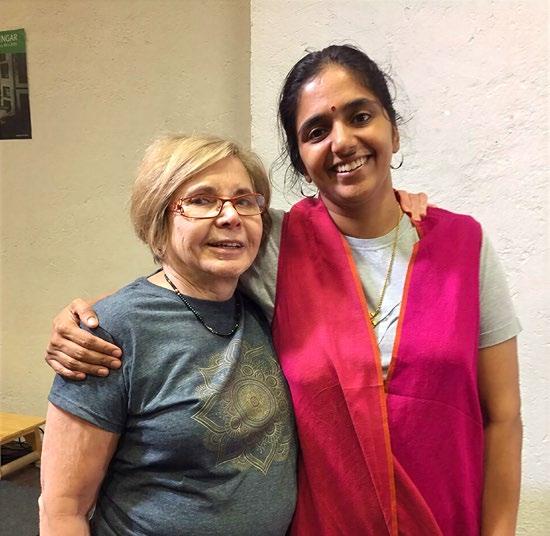
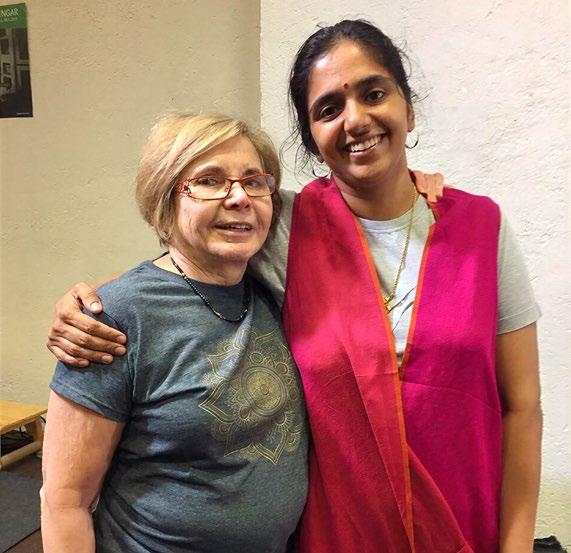
I am deeply grateful to every contributor who took the time to write. I am also especially grateful to my editor, yoga student, technical wizard, and friend, Rohit Kulkarni, who has the patience of a saint, as many of you already know.
With gratitude to Guruji, Geetaji, Prashantji, and Abhijata for their wonderful teachings, and to IYNAUS for bringing us together for this special event. I hope this gives you something to reflect on as you immerse yourself in practice during the convention.
White is a Level 4 CIYT who presently lives in New York City.
Sacred Reunion
Veronica Strauss
Page 01
Editor’s Letter
Joan White
Page 03
Quotes on Cultivating Freedom
Page 08, 15
A Journey of Discovery in Yoga
Abhijata Iyengar
Page 10
Freedom from the Gravities of Life
Prashant Iyengar
Page 16
Practicing with Guruji
Patricia Walden
Page 20
Tori Milner
Finding Freedom from Within Page 23
Cultivating Freedom “With Pain & Fear”
Victoria Austin
Page 28
Cultivating Freedom: Making Space Within
Jessica Becker
Page 32 15 46
Raising the Donkey Leg: A Yogic Battle for Freedom
Rohit Kulkarni
Page 36
Pariṇāma: Transformation as Path to Cultivating Freedom
Skyler Christensen
Page 40
Freedom in Expansive Space
Carolyn Belko
Page 46
“No other subject cleans the head and purifies the heart like yoga. It is a complete package. Like space, it can be there in everything you do.”
― Abhijata Iyengar

56
The Architecture of Sound
Frederick Smith & Rohit Kulkarni (with Prashantji)
Page 48
From Outer to Inner, From Doing to Being
Sharon Conroy
Page 53
The Shared Path:
Dharma to Mokśa
Naomi Hiller Reynolds
Page 56
The Clear Mirror
Elizabeth Smullens Brass
Page 58
1582 58
Cultivating Freedom to Know 15
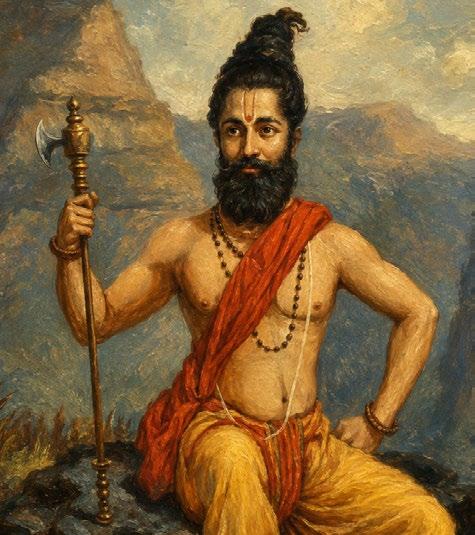
Rāma Jāmadagnya and the Resolution of Inner Tension
Frederick M. Smith
Page 60
Freedom: Entering Through the Body
Matt Dreyfus
Page 64
Freedom from Reaction
Purnima Manghnani
Page 69 A Practice of Freedom
Lara Warren
Page 72
Christopher Briney
Page 78
The Practice of Gathering: Reflections on Community
Heather Haxo Phillips
Page 80
Philadelphia: A City Built on Freedom
Page 84






“The infinite space we connect with through Yoga is Freedom.”
- Carolyn Belko
“The term Cultivating Freedom implies that we are not free and, in fact, feel trapped or restricted. This is the human condition. We feel unfulfilled, limited, and ultimately unhappy. What is the cause, and what is the solution? Our own minds and conditioning propel us into actions that create this unsatisfactory experience. Truly, the way to freedom is to break this mental conditioning, and Yoga is the method.”
- Ray Madigan
“There is no freedom without discipline. Being disciplined within my Yoga practice gives me freedom.”
- Juliana Fair
“Cultivating Freedom frees me to answer this way when people say, ‘When I grow up, I want to be like you.’ I reply, ‘Then don’t grow up. Keep your youngness and put joy into every day, in every way.’ And I smile.”
- Bobbiji
“After my first backbend following surgery for breast cancer, I lay on the floor and felt the breath move into my expanded chest. My mind opened to joy, happiness, and freedom from fear”
- Colleen Gallagher
“Like cultivating a garden, Cultivating Freedom is about observing from the heart, not the head. You can’t make freedom happen. You practice, you look inward, and observe from the heart.”
- Susan Marcus
“My practice of Yoga first cultivated freedom in my physical body, increasing mobility, strength, and energy. Then, slowly but surely over twenty years, it cultivated freedom in my mental body, quieting the chatter and giving me the means, no matter what was happening, to find a peaceful state of mind. Now, in recent years, I am cultivating greater freedom throughout my entire being through the breath, becoming more fully aware of how breath nourishes not only the physical and mental body, but the entire prāṇic system, once it is able to move freely throughout our embodiment.”
- Sharon Conroy
“Practice with integrity.”
- Lois Steinberg
“Letting go helps us cultivate freedom. Through practice, we can let go of our identification with the ‘seen’ (prakṛti, our bodies, thoughts, and emotions) and experience the freedom of the ‘seer’ (puruṣa).”
- Patricia Walden
“I cultivate freedom by focusing on my ability to choose: Choosing to be aware of puruṣa, to understand prakṛti, to tune into love, and to practice the methods that make sense to me.”
- Tom Alden
“Cultivating Freedom is about creating a lightness, a space in which there are no constraints, restraints, or boundaries. Cultivating Freedom is the effortlessness we experience in āsana, the ease we feel in prāṇāyāma, and the openness of our minds. We are blessed to Cultivate Freedom in our practice of Iyengar Yoga.”
- Ann McDermott
“The fundamental goal of Yoga and Yoga practice, or sādhana, is freedom. To me, freedom means living and acting without the limitations of fear, desire, and identity, and abiding in the limitless joy of Being.”
- John Schumacher
“The word ‘cultivate’ has its roots in preparing and fostering the land for crops, and in caring for and tending what develops. My understanding and personal experience of freedom expand, evolve, and grow as my practice deepens and changes as I grow older. To tend to our own state of finding freedom through all the limbs of Yoga is an important gift we can give ourselves, our families, and our communities.”
- Tori Milner
“Cultivating Freedom feels very poignant, as it brings forward ideas of individual freedom that we in this country have long been proud of, but which sadly seem to be slipping away. The freedom I find most important to cultivate is the inner space, the quiet space that is so rare amid the day-today turmoils of living in the world today. When I find that space after a practice, it does not always come, but when it does, it is deeply relished and deeply important. Experiencing it, and learning to cultivate it, matters greatly to me, because otherwise my emotions can get the better of me, as they often do. Cultivating that freedom and inner space is immensely important to my wellbeing and to the well-being of those around me.”
- James Murphy
“Freedom, to me, is space. I used to feel confined within my body and mind. Yoga practice reveals that the walls are an illusion.”
- Matt Dreyfus
“While I was learning to live in the aftermath of accident trauma, one day Guruji decided to correct my form in every pose, every day. Guiding wellness in my fractured neck and other injuries, the sensitive touch of his fingertips opened my expression, my function, and my vow to a great healing light. Like the sun that calls forth transformation in a seed that has lain dormant in rocky ground for eons, he transmitted cellular trust in the abundance of nature, giving life to growth toward the Self.”
- Victoria Austin
“Freedom is awakening into a state of presence. Freedom arrives as we excavate the core of our Being and live in alignment with our spiritual heart. Despite our current circumstances and past conditioning, we are always free, in any moment, to live from our highest potential and to respond with wisdom, compassion, and love.”
- Peentz Dubble
“As any wise gardener knows, cultivation, the doing side of the enterprise, removing obstacles, preparing the soil, intentionally planting certain seeds, and coaxing them along, is a collaboration with greater forces. This knowledge frees us from the small self that thinks we have to do it all, and invites us to be the same in success and no success.”
- Mary Reilly
“Cultivating Freedom is the essence of Sūtra I.1 and I.2. With dedication and intention, Yoga begins in order to free the mind of clutter, experience space, and witness the divinity within.”
- Manju Vachher
“Cultivating Freedom is maintaining a daily spiritual practice, an investment with bountiful divine blessings. Keeping in mind the purpose of this cultivated practice, as a way to purify consciousness, to be free for spontaneity, to recognize positive and necessary changes, and to joyfully experience this essence in the sacred heart.”
- Rebecca Lerner
“What freedom means to me: Living from the heart, the highest human good. How to cultivate this amidst the challenges of life: Pause. Breathe. Reflect. Wait. Ask whether any response can come from my highest human good. Until the response comes: Pause, breathe, reflect, wait.”
- Jito Yumibe
“Cultivating Freedom means being free from judgment. My own personal judgment and concern about the views of others.”
- Michelle LaRue
“The Self is hidden in the chaos of prakṛti, māyā. Cultivating freedom brings harmony and order from this chaos, allowing one to experience the existence of the soul.”
- Neeta Datta
“A mundane sense of freedom requires free space and free time in outer form, like a playground and recess for children. Though our bodies are limited by space and time, Yoga frees us from this sense of constriction and limitation. Yoga gives us the opportunity to cultivate freedom in the body, and even more so in the mind, revealing its true nature: Open and spacious, like the sky.”
- Carolyn Christie-Irvine
“Cultivating Freedom suggests learning to recognize and eliminate personal biases.”
- Laurie Blakeney
“What stands out to me around the concept of freedom are the words of Guruji and Geetaji. I can hear these words lifting me up often: ‘Stand in your Self. You be in you.’ They give me a deep centeredness and the freedom to remain centered in the light of Puruṣa. Knowing that the other things are just external, and staying focused on what is truly essential, gives us that freedom.”
- Paula Weithman
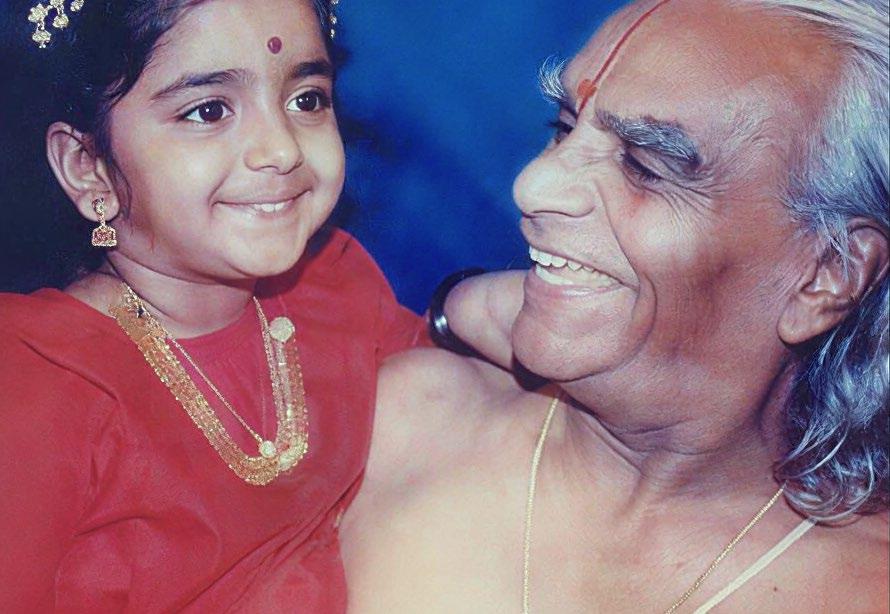
In this interview, Abhijata Iyengar reflects on her early years around yoga, her journey into the practice, and the profound influence of BKS. Iyengar, Geetaji, and Prashantji.
Speaking with Joan White, she shares memories of her formative years at the Ramamani Iyengar Memorial Yoga Institute in Pune and the experiences that shaped her path.
Joan: How old were you when you were first introduced to yoga?
Abhijata: If I can be honest with you, I hope that is okay.
I grew up in Chennai in southern India, while Guruji, the Institute, Geetaji, and Prashantji were all in Pune. My mother was born and raised in Pune but moved to Chennai after her wedding, so that is where I spent my childhood. Because my maternal family was in Pune, I visited every summer vacation.
At that time I simply knew that Guruji was a famous person. I did not know Geetaji and Prashantji as the world knows them today. To me they were just my aunt Geeta, my Periamma, and my uncle Prashant, my Mama. I had no idea they were such giants. It was only later, when I began attending classes, that I realized their brilliance.
What I did know was that the Institute was dedicated to yoga, and I grew up feeling that yoga was something special. I grew up hearing stories about my grandmother and her nature. During flood warnings in Pune, while others rushed to save their belongings, she chose to protect the Light on Yoga manuscript. For her, Guruji and his yoga were the most important.
Growing up with these stories, I knew that Guruji and yoga were something special. If you had asked me then to explain why, I would not have been able to.
it.
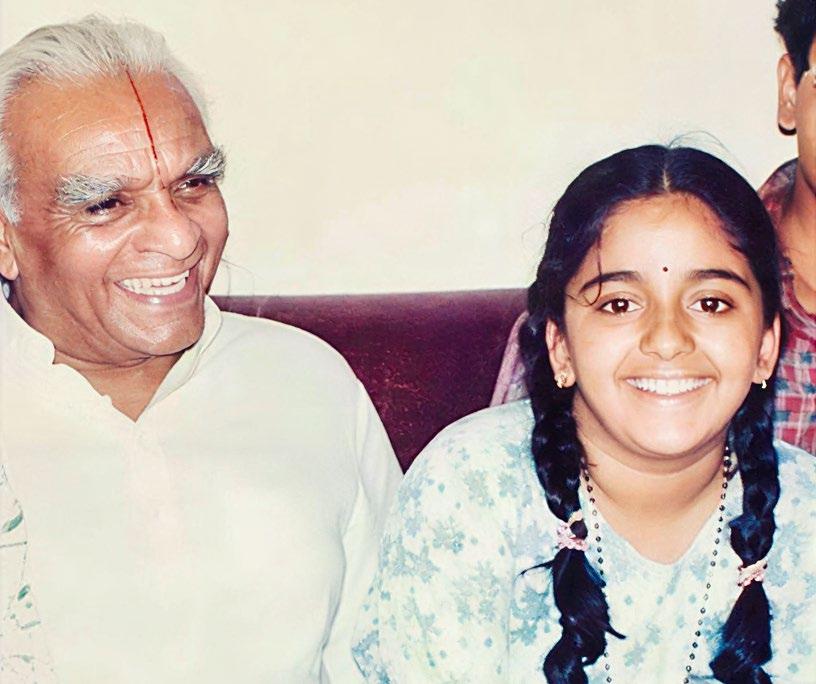
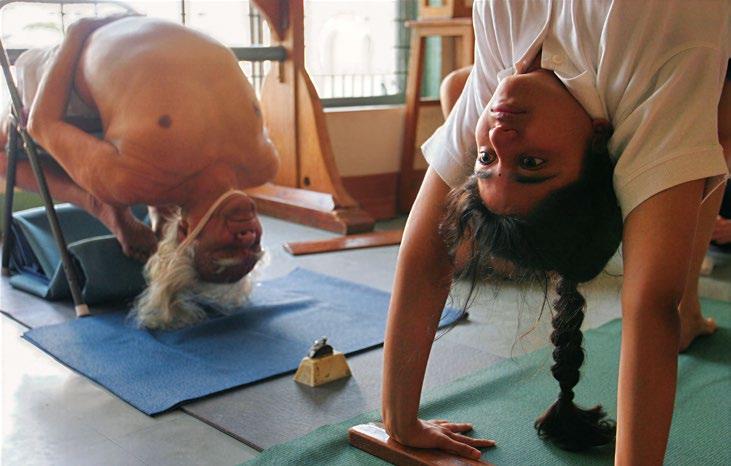
Joan: You were also interested in science and could have pursued a career in biology. What led you to choose yoga instead?
Abhijata: After my 12th grade, which is when school education ends and we move toward university, I had to decide what to study. I was honestly not sure what I wanted to do.
Around that time Dolly the sheep had been cloned, and I became fascinated by genetic engineering. I was very interested in the biological sciences, especially molecular and cellular biology, but I did not want to become a doctor. So, what should I study?
Zoology required dissection. I was strongly against dissection because I was against cruelty towards animals. But zoology was necessary if I wanted to pursue genetics. So I found myself in a dilemma: either accept dissection or give up genetics altogether. When I looked at other options such as physics, chemistry, mathematics, arts, or commerce, none of them interested me. I was honestly confused.
Joan: How old were you when you began taking classes or practicing seriously?
Abhijata: After my 12th grade, which is when school education ends and we move toward university, I had to decide what to study. I was honestly not sure what I wanted to do.
But I began attending many classes. I was taking at least five classes a week, sometimes six or seven if Geetaji and Prashantji taught both morning and evening.
That is how my association with yoga began. And I was amazed. Imagine my first teachers being Geetaji and Prashantji. Oh my God! Such brilliant people. Suddenly I would do something in my big toe and my arm would respond. I would do something in my chest and my leg would respond. I would adjust something in my knee and suddenly I could breathe differently in the pose. I had no idea these kinds of connections were possible.
Prashantji would talk about solar systems, black holes, nature, rain. Geetaji would speak about Āyurveda, about morality and ethics, about The Bhagavad Gītā. To be exposed to all of that in a yoga class seemed incredible. And I remember thinking: We are on sticky mats wearing T-shirts and shorts.
Where is all of this coming from? What really is yoga? That was the feeling I had. This was around the year 2000.
Joan: Is it true that you gave yourself time to explore yoga before deciding on graduate school?
Abhijata: In 2005 I completed my master’s degree in Bioinformatics. Then the question came again: What next?

The natural progression would have been a PhD. But by that time I had become deeply involved in yoga. So I approached my head of department and told her that I wanted to pursue a PhD, but only half time. I hoped to practice yoga in the mornings and come to the department in the evenings.
She explained that Bioinformatics was a new field and doctoral work required full commitment. I had been part of the first Bioinformatics batch at Pune University, and she said I would need to work full days for at least five or six years.
I found myself in between. I was not fully ready to commit to a PhD, but I was not yet certain that yoga would become my path either.
She suggested that if I went abroad, I could finish a PhD in three or four years and then return to India and do whatever I wanted. But by then I was enjoying yoga so much that I did not want to give it up and leave Pune.
So I decided to take one year off. I did not even know the word “sabbatical” at the time, but I had a brainwave: For one year I would give myself completely to yoga. Instead of dividing my time between study and yoga, I would choose yoga for now, for at least a year, and then decide what I truly wanted.
During that year I practiced in the hall where Guruji practiced. Actually it is not correct to say that I was practicing with Guruji. Guruji was practicing, and I was simply fortunate to be nearby doing my own practice. Even now when I think about those days I get goosebumps.
They were just too good. They touched me deeply. That one year passed before I even realized it.
In fact, the break never really ended.
Joan: Did you always want to become a yoga teacher?
Abhijata: No. Not at all. Actually when I first answered your earlier question, I did not confess fully.
When I was younger I did not like yoga.
I could not do anything. I could not jump into Adho Mukha Vṛkṣāsana or balance in Śīrṣāsana in the center of the room. During summer vacations in Pune I would see other children jumping into handstands so easily. They would do handstands in middle of the hall and drop back into Ūrdhva Dhanurāsana. And I was struggling just to kick up.
I would feel so bad about myself. I would think: What is this? I cannot even do this, and they are not only doing it but enjoying it. They are so happy doing it. So honestly, when I was a child, I did not like yoga. But later, when I moved to Pune during my graduation years, I thought I would at least explore it.
One day Geetaji asked me to come to a remedial class because she needed young people to run around and fetch props. She said that at her age she could not run around like that. So I became a runner in the class, bringing props in and out. Later she asked me to attend the children’s classes on Sundays to observe and help. The children’s class gradually became the place where I helped.
Geetaji told me to start teaching beginner classes. That is how I began teaching.
Joan: Once you made your decision to pursue yoga, did you have any lingering doubts?
Abhijata: No. Absolutely not!
The three teachers I had gave me such a firm foundation. They grounded me so deeply that there was no doubt at all.
Joan: What sort of agreement did you and Guruji have about immersing yourself in yoga so you could make your decision?
Abhijata: No, there was no agreement.
During practice sessions Guruji would sometimes joke. When things became difficult he would say, “If you cannot face all this, you are free to go back to Chennai to your parents. I will not force you to stay here.”
He joked like this many times, and I would laugh. Looking back now, I sometimes wonder what he really had in mind. But he always made it clear that it was my choice. For me, the thought of leaving never came. I was simply in awe. I wanted to know all of this. I remember telling Geetaji and Prashantji at different points in time, “I wish there were some magic where you could just touch my head and everything in your mind would come into mine.”
Curiosity kept me there.
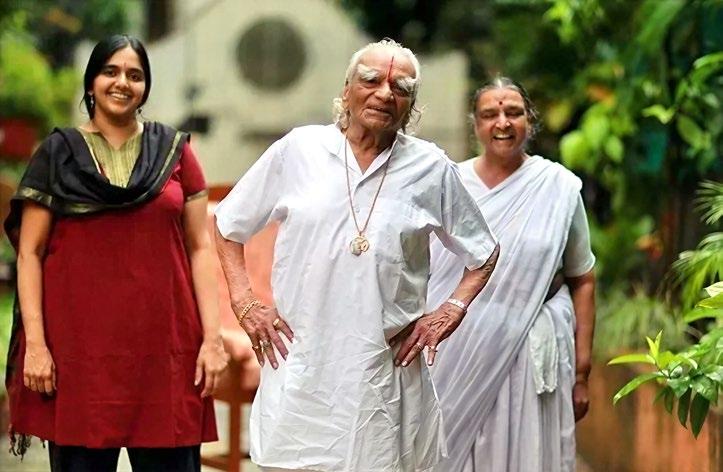
Joan: Can you speak about what you learned from Geetaji and from Prashantji?
Abhijata: If it had not been for them, I would not have understood even half of what Guruji taught. They deciphered Guruji in a way that I would never have been able to by myself.
Whether the situation was formal or informal, they opened up such rich perspectives for me on āsana, prāṇāyāma, the body, breath, mind, emotions, and even props, really on everything they touched.
The way they unfolded Patañjali and the Yoga Sūtras was extraordinary. Philosophy did not remain abstract. It came alive in the class.
When I was seventeen or eighteen, I thought philosophy was for later in life, when my hair turned grey. My thinking was simple: Now I will do the āsanas. Philosophy can come later. But when I was eighteen, nineteen, twenty, I realized that philosophy could be for me right then. That realization was a huge Eureka moment. They made philosophy tangible.
It began with honestly attempting the āsana, to connect that effort to what Patañjali calls hetu, the intention behind the action, to connect that intention to the emotion behind it, and gradually to move from performing a posture to reading myself as a person.
There was great clarity in the way they taught. Nothing was ambiguous.
It was never:
“One day you will realize the Self,” or “One day awareness will come,” or “One day knowledge will arise.”
And through those experiences I began to sense that there was much more within the practice than I had imagined. To tangibly feel that depth, to sense that something deeper was unfolding within the practice
Those were incredibly liberating moments.
Joan: Is there anything else you would like readers to know about those formative years?
Abhijata: I consider myself very lucky for where I was during my formative years. In many ways I feel that I am still in that formative period, and I hope it continues. There is a real joy in continuing to discover things in practice and in stumbling upon new insights and realizations again and again. For that I feel deeply grateful.
I also had wonderful classmates, and I cannot leave them out of the equation. They made the experience so much more enjoyable. I was never a first-row student. I was usually somewhere in the back rows. But my friends made those years joyful. I always looked forward to every class. That much I can say with complete confidence.
And then there were the therapy classes. To see Guruji in action there was extraordinary. My God! The way he would relieve someone in pain, diagnose the problem, and involve himself completely with the person in front of him.
For him, his own comfort did not matter. Even at the age of eighty, eighty-five, ninety, he would go out of his way to help someone. He would physically adjust students in the poses. Even with me, he gave adjustments in so many āsanas. At that age, to put in that kind of effort, it was remarkable.
Through that involvement I saw selflessness in him.I saw honesty.
I saw total dedication to yoga.
And the same qualities were present in Prashantji and Geetaji. Honesty, truthfulness, single-minded dedication. These were not just ideas. They were personified in them.
I simply feel very fortunate that I was able to share time and space with them.
“Freedom comes from maitrī, karuṇā, muditā, and upekṣā. By constantly returning to these principles, I can shake free from the grip of the distractions life continually presents and return to spaciousness.”
- Naomi Reynolds
“Freedom is the balance of head and heart, of doing and not doing. It is effortless effort, releasing unnecessary grips and tensions while putting in place the proper supports that sustain and nourish us. Freedom is finding rhythm, being fully present in the moment, where time is suspended, space expands, and ego dissolves. Head and heart aligned, supports placed, tensions released, freedom flows like breath.”
- Lara Warren
“Cultivating Freedom means giving myself permission to experiment in āsana and prāṇāyāma, and to make choices based on my own inner knowledge.”
- Pauline Schloesser
“Exploring one’s authentic expression is related to the goal of Yoga. Yoga celebrates the opportunity for growth and evolution for all, regardless of obstruction or limitation. Guruji has said, ‘My end is your beginning.’ He has given us a way forward.”
- Lucienne Vidah
“Cultivating Freedom from the limiting aspects of ego, fear, and doubt builds the strength to hold compassion and love in every situation.”
- Nancy Stechert
“Thoughts and actions sifted with discernment cook intelligence. Then ego acts as needed. When we arrive in a place of freedom, we find the steward of the soul.”
- Patrinia Dobish
“Cultivating Freedom implies intentional and deliberate action to create the conditions for limitlessness to arise. Just as a gardener tends the soil so that plants grow well, the Yoga practitioner tends consciousness so that it grows beyond its present limitations.”
- Christopher Briney
“Cultivating freedom through practice cultivates self-awareness. Selfawareness is where we glimpse our behavioral patterns and come to know them. Freedom is cultivated when we have space around these patterns to act differently, to be responsive rather than reactive.”
- Jessica Becker
“The path to freedom requires the practice of satya, which inevitably brings us face to face with the ways we have suppressed freedom within ourselves, our communities, our society, and globally. To paraphrase Dr. Martin Luther King, Jr., I cannot be free until you are free, and my freedom cannot be based on your oppression. Let us honor Guruji by Cultivating Freedom together, starting with ourselves, so that all, human and more than human, locally and globally, can experience freedom.”
- Gwi-Seok Hong
“One of the first deep lessons an āsana practice can teach is that discipline transforms the body physically, allowing us to experience greater freedom. As practice deepens, the idea of freedom also deepens, moving from the physical to other aspects of existence. Over time, the discipline learned through practice can itself show us what it means to live a life committed to freedom, not only for ourselves, but for others in the world around us.”
- Michael Lucey
“When practicing Yoga postures with conscious attention, awareness is directed, nurtured, and brought to understanding. Knowledge grows, and maturity evolves. Freedom cannot be imposed. That feeling of freedom arises from practice, as a gift.”
- Jaki Nett
“Mokṣa is the Sanskrit word often translated as ‘freedom,’ but it may also be understood as a state in which one is free from fear.
In Light on Life, Guruji describes mokṣa as ‘the persistent and sustained will to be ever more free, to cut the myriad threads that bind us.’
The greatest lesson Yoga has taught me is that to be free from fear, which is finite, I need only place myself in the infinite reservoir of strength, resilience, love, and hope that exists within me.”
- Holly Walck Kostura
by Prashant Iyengar
Freedom, release, liberty, and emancipation are universally coveted by mankind. In their name, humanity has embraced struggles, revolts, and global wars. To secure this freedom, we create enemies and aliens. Tragically, in the process, allies become alienated, friends become foes, and the beloved become despised. Life turns bitter, parching, and thorny.
The ultimate travesty is that freedom won often becomes freedom lost. We avoid the fire only to step into an inferno. Freedom is perceived as a great fortune, yet the pursuit of it leads to utter misfortune. We chase a mirage, mistaking hell for heaven. In the strange and mysterious unfolding of life, apparent form and true essence are often opposites. Life is strange and mysterious.
To understand this paradox, we must examine these concepts through a “reality-scope,” a “truth-scope,” and a “wisdom-scope.” We must deeply ponder the true nature of:
* Dependence vs. Independence
* Freedom, Liberty, and Emancipation
* Bondage, Slavery, and Shackles
* Limitedness vs. Unlimitedness
Is it not true that life, livingness, or sentiency itself is inherently bound and limited?
As human beings, we are essentially limited and entrapped. Every life form operates with deficiencies, shortcomings, and incapacities. Observe a small bird and a large bird: they possess entirely different radii of operative freedom. Worms, insects, birds, animals, beasts, cattle, plants, and trees all exist within strict boundaries of impossibility and improbability. Human and biological life are no exceptions.
Philosophically, taking philosophy as that which divulges reality, all life possesses finitude. Life, anytime and anywhere, is marked by mortality and limitation.
Thus, the Upaniṣads declare:
“I am mortal, let me go towards immortality. I am in darkness, let me move towards light.”
Life-ness means existing within a framework of limitations. Consider the story of a homeowner locked out of his own house, waiting for his spouse to return with the keys. As he waited, he noticed a tiny insect effortlessly crawling under the door, entering and exiting at will. In dismay, he thought:
“I am the owner, yet I am restricted outside, while these insects freely come and go.”
The owner experiences deprivation, while the tiny insect does not. Ownership does not guarantee freedom. In fact, non-ownership often appears freer from restriction. The man is angered and offended, uncertain whether to envy the insect, blame the Almighty, or curse his luck and fate.
Another crucial point to consider is the motive behind this pursuit:
Do you seek freedom and liberty merely to fulfill your own desires and aspirations?
If your answer is affirmative, should everyone be granted this same boundless liberty? And what would be the ultimate end result?
One must deeply ponder the differences between:
* Having freedom
* Taking freedom
* Giving freedom
* Getting freedom
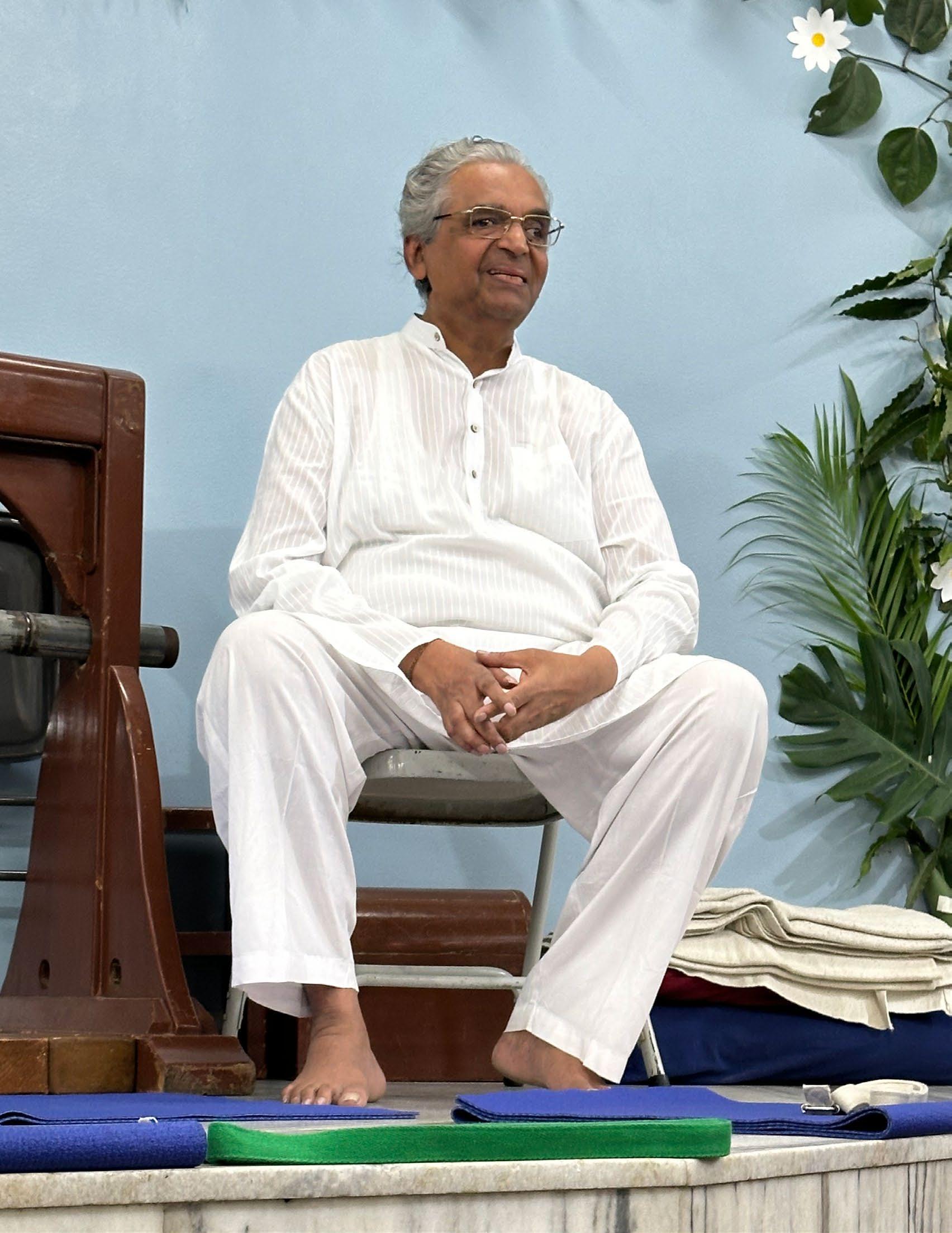
Generally, one cherishes freedom but fails to understand that others cherish and covet it just as much. If we, as human beings, demand freedom, we must be prepared to give it at least equally to others.
Mere humanness is an existence limited physically, mentally, and psychologically. Every consciousness has a distinct radius of operation, which itself imposes a limit on humanness. In contrast, theology presents the concepts of omnipotence, omniscience, and omnipresence, qualities of the unlimited Divine.
To navigate human limitation, Indian philosophy postulates the four Puruṣārthas, the fundamental pursuits and accomplishments of human life:
1. Dharma (Righteous duty)
2. Artha (Material prosperity)
3. Kāma (Desire and enjoyment)
4. Mokṣa (Spiritual emancipation)
The fourth Puruṣārtha, Mokṣa, represents the absolute freedom we are truly seeking. By our very “manufacturing defects,” humans are shackled, dependent, and bound. However, we hold the potentiality to be completely free, liberated, and unlimited. This process is called Mokṣasādhana.
This ultimate liberation culminates only after the first three pursuits, Dharma, Artha, and Kāma, are conceived, attained, and accomplished.
Only then can potential freedom become an actuality. This is the attainment of Brahman-hood or Brahmanness. Brahman, according to Vedānta philosophy, is pure infinitude and immutability. To realize it is to break open the humanness, transcending into Brahmattva.
Humanness operates within a heavy band of delimitations: birth, growth, disease, decay, and death. Beyond these biological limits, we are weighed down by a massive cluster of gravities:
* Caste, Class, and Race
* Genetic and Karmic backgrounds
* Creed, Gender, and Age
* Status, Stature, and Social Conditions
These gravities exert a constant downward pull. Without nullifying and neutralizing them, true freedom remains a far-fetched fantasy at the relative level.
Yet, philosophically, the human being has the potential to cross mortality. We are uniquely qualified to transcend humanness. In fact, this transcendence is the Puruṣārtha, the ultimate objective and spiritual purpose of human life. The culmination of this life is
Just as a spacecraft requires “escape velocity” to break free from the terrestrial world and avoid crashing back to earth, the spiritual practitioner requires an escape velocity to break free from the gravities of human life. Yoga philosophy teaches that we are not bound by just one gravity, but by several:
* Mundane and Personal gravities
* Life-ness and Tri-world gravities
* Tendency gravities
* Kleśa (affliction) gravities
* Karma (action) gravities
Yoga provides the exact technology required to generate this spiritual escape velocity. It reveals that the ultimate “zero-gravity capsule” resides within one’s own spiritual heart. From there, the consciousness can finally dart into absolute freedom and liberation. Without this, anything we call freedom is merely pseudo-liberation.

“I should like to emphasize here that yama and niyama are not only the foundation of yoga, but the reflection of our success or failure at its higher levels.”
— B.K.S. IYENGAR Yoga Sutras of Patanjali, II.33





by Patricia Walden
B.K.S. Iyengar was my guru.
He was my teacher, and more than my teacher. He was the flame that ignited my passion for yoga and sustained my discipline in practice. He was my guru. He taught me to see myself through the lens of āsana and to channel my love of yoga into teaching. To have my Guru teach me was one of the greatest blessings of my life. He showed me a path from prakṛti to puruṣa. He brought me to my spiritual heart.
Yoga lives in my cells. Still, I miss him every day.
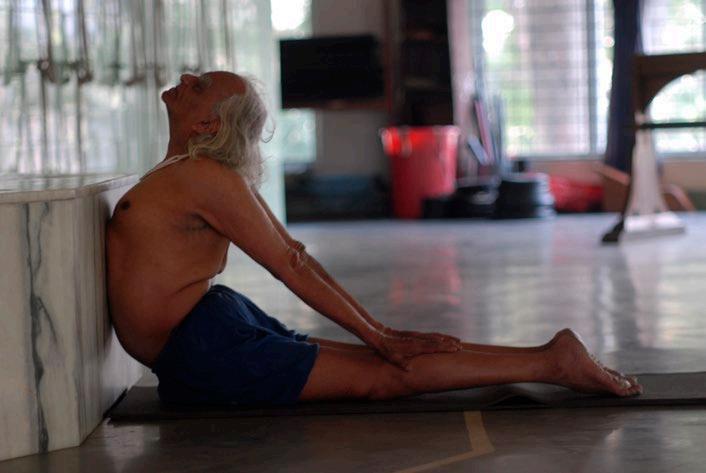
In 1976, B.K.S. Iyengar came to Boston to teach for the first time. It was a five-day workshop, and of course I attended. I had been using Light on Yoga for a couple of years, but to meet him in person was entirely different. From the very beginning, I knew he was my teacher. His presence was inspirational, and his energy filled the room. Instead of standing in front of us and telling us what poses to do, he walked among us, looking carefully with his penetrating eyes to see who we were. He would stop in front of each person, sometimes with a quiet “harumph,” observing us one by one. Then, to our surprise, he adjusted us in our poses. At the end of the workshop, his assessment was simple:
“You Boston people are tough coconuts to crack.”
He had a wonderful sense of humor. I knew from that first class that my life had changed. The following January, I went to India to study with him. I was determined to learn. I attended public classes, and because I am tall, I was placed in the back of the room, red leotard and all. That first visit was hard.
At one point, he mistook my attention and posture as arrogance, and he said:
“I will break you down.”
Little did he know, I was already broken.
His teaching was profound and penetrating, from the skin to the soul. I returned home and practiced what he taught. This became my annual rhythm. I would go to India to study, then come home to practice and teach Practice and teach. That was my life. From the very beginning, he taught with subtlety. He presented many points, wonderful points, but it was his presence that inspired and galvanized us. He taught actions, but he also taught through questions, asking for perception and reflection:
“Do you see this now?”
“What
happens when…?” “What do you feel?”
As he traveled internationally, his legend grew. Students from around the world traveled to Pune to attend his classes. Sometimes a teacher would bring groups of students to the Institute, and this began to build our communities in America. To support us, he taught both public classes and intensives. The intensives took us deeper into understanding his method. He emphasized demonstration, reflection, and practice. Initially, he demonstrated himself, both the good and the bad. Once I observed him practicing a pose that was distinctly crooked. When I asked him why, he responded:
“I need to understand how to correct my students.”
As the years went on, he used more seasoned students and teachers as examples. This was his way. Teach by example. His standards were always very high, and we all worked to meet them. After class, we gathered to take meticulous notes on each pose. I used these notes to practice and to prepare my own classes. Studying was a necessary part of practice. While we studied his points, Guruji focused on the point of practice. He emphasized that āsana contained all eight limbs of yoga:
“The body is my temple, and āsana are my prayers.”
Patañjali was very important to him. As Prashant-ji said at the 50th anniversary celebration:
“If you want to know Guruji, study Patañjali.”
His points were not just a collection of instructions. He was pointing toward the deeper aspects of yoga. His method was always practical:
“How can you expect to know God if you don’t even know your big toe?”
We used our practice of āsana and prāṇāyāma as prakṛti pointing toward puruṣa, spiritual practice in physical form. It was a blessing when Guruji began to use me as one of his demonstrators. He was demanding. He wanted his students to respond quickly, with intelligence and alacrity. Speed was a priority, and once he said with a smile:
“I train racehorses.”
Demonstrating was a challenge I welcomed. It was an opportunity to receive his instructions and respond. He demanded that we be fully present, intelligent, and vital His voice could sound commanding, but his presence elicited strength and clarity. The effects spoke for themselves. We felt his devotion to yoga.
Beneath his energy and charisma was something even more powerful. He cared. He cared about yoga, and he cared about his students. He wanted us to experience what he experienced, our inner divinity. After his initial skepticism of me, he was always supportive. He saw my determination to meet his standards. He always set the bar high, and I was grateful. As he grew older, he turned teaching responsibilities over to the next generation, but he remained a steady presence in the practice hall. He practiced daily, coming into the hall, walking to his preferred space, removing his dhotī, and positioning his timer. Being with him in the practice hall added another dimension to his teaching. We could experience his actual practice.
From the outside, we could see how he practiced what he taught. But there was also our inner experience. His presence emitted a vibration, vibrant and still, a silence that resonated within us. I do not know how I gathered my nerves, but one day I practiced near him. In his kindness and care, he began to teach me one to one. He loved to teach, and I loved to learn. He could be very tough on me, but I felt his intention to help me. This kindled my courage, and I began to practice by his side He taught by example and by resonance. I could feel the energy of his practice and ride with his waves. In the silence of his practice, there was an energy that took me deeper within myself. In the silence of his practice, there was an energy that took me deeper within myself. Sometimes he would stop his practice to teach me,
sometimes with questions, sometimes with words, and sometimes with touch. When he adjusted me, I could do things I never thought possible. I surrendered. In his touch, there was a vibration that charged my consciousness and allowed me to experience deeper states of being. Through this process, I felt how practice evolves into presence. From prakṛti into puruṣa, from the skin to the soul, we experience our inner divinity. Once, while I was practicing Paścimottānāsana, he came behind me and pressed on my ribs, drawing my chest deeper toward my legs.
“What do you feel?”
“My legs and my hamstrings,” I responded.
He pressed again. “What do you feel?”
“My lungs and my heart.”
He grunted with mild disapproval and walked away. I remained in the pose. A while later, he returned and again pressed on my back chest wall, sustaining the force.
“What do you feel?” And then I understood.
“Silence. My spiritual heart.”
“Yes,” he said. “That is good.”
From that point on, I was grateful in a new way, for the certainty of knowing how to practice. Tapas is the effort we need. Svādhyāya provides wisdom. Īśvara-praṇidhāna, surrender, brings us home to our spiritual heart.
Sometimes those of us in the hall could not help ourselves. When he was in a deep state of silence, he was superbly still. We could not even see him breathe. When he came out of that state and saw us watching and learning, he would smile. In his later years, he would say:
Once he felt my earnest devotion in practice, he was very supportive of me. He was happy for me and sent me a letter that touched my heart and soul:
“When I was young, I played. Now I stay.” “Muditā.”
One afternoon in the library, he called me over. I sat facing him. He took my hands in his hands, looked deeply into my eyes and my heart, and said:
“Now it has come.”
When he was hard on me, I could accept his fierce compassion, because I understood his purpose. I trusted him. One last thing I want to say. Towards the end of his life, we were in the library, when he said:
“After I am gone, no one will remember my name.”
That, dear friends, is the one time I knew he was mistaken.
by Tori Milner
In the early days of planning this convention, giving it a theme was one of the first tasks. Inspired by its location in Philadelphia, the Liberty Bell, the sculpture “After Iyengar” that is there, as well as the 250th anniversary of the signing of the Declaration of Independence, we came up with “Cultivating Freedom.” At one point, Joan asked for a few brief sentences to reflect on what that means to us, and I wanted to share more in depth on my own personal reflections.
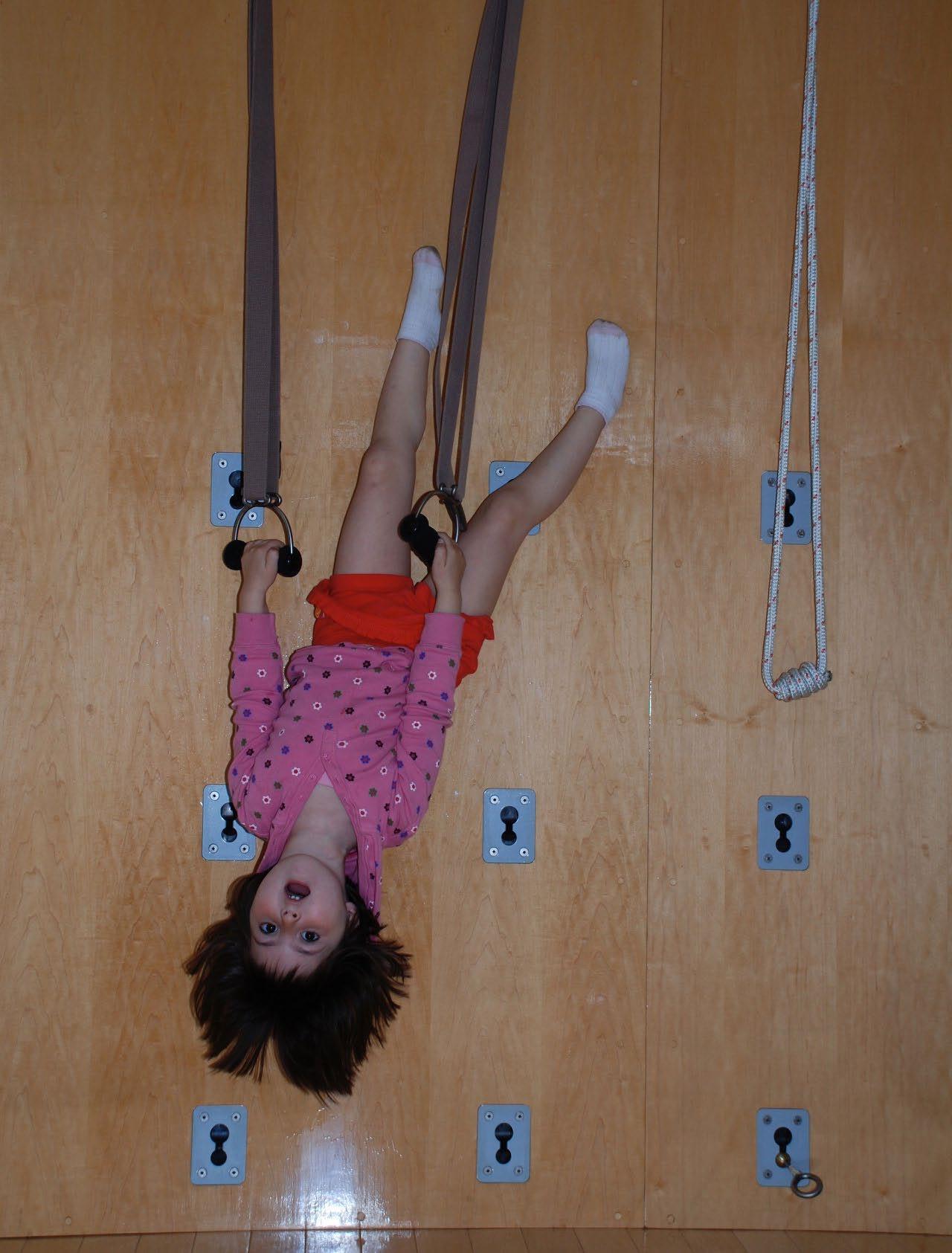
I remember the experience as a child that spinning in circles, doing cartwheels, and swinging back and forth through the air on the swing set transported me. Those dizzying physical experiences were my first inklings that movement had the ability to change my state of consciousness, to neutralize it, and even to convert it into joy. I did not have language for it. It was pure feeling Childhood included tough experiences. My parents underwent a contentious divorce. In the middle of it, one of my three older brothers died in a car accident. He was 17. I was 7. Attempting to start over, my mother moved the youngest of my three brothers and I to Savannah, Georgia when I was nine. Moving to Georgia from the Northeast was a culture shock and pulled us away from the rest of the family. I struggled to find a sense of belonging.
As a teen, I found alcohol and in it, I found relief – finally able to let down my guard and escape from my troubles, so I thought. I sought freedom from anxiety, fear, sadness, and other difficult emotions, but what I didn’t know at the time is that escapism and freedom are not the same. I considered alcohol a solution, not a problem. Eventually, I became preoccupied with it. My behavior deteriorated, and I made repeated oaths and promises to myself and others that I would stop or at least stop getting in trouble. The consequences heated up anyway. Scared I would wind up like my older brother and put my family through that pain again, I went to rehab the summer I was 18 years old.
There, I learned that alcohol was not the cure to my troubles, but actually a dis-ease.
I embraced sobriety, determined to overcome the fears and anxieties that drove me to drink in the first place. They say once you have been sober for five years, you get your marbles back. Around this time, in the mid-90s, I discovered Iyengar Yoga.
“atha yogānuśāsanam…”
Now that I had tried other things, yoga was introduced. I took a Beginner’s Series that lasted six weeks. After that, I started taking classes regularly. Here was physical movement again, delightful, intense, challenging, intelligent, and sustained. The instructions were uniquely detailed and demanding, unlike anything else I had experienced. It was a whole new kind of engagement with my mind, intellect, and body. I started going twice a week. I noticed that I felt better, lighter, no matter what we had done, even if, and especially when, it was hard. The rigor was motivating, the motion was exhilarating, and I started going three times a week and sometimes more. I started to practice and that’s when I saw real progress.
“yogaś citta vṛtti nirodhaḥ…”
Up to this point, my life had been intentionally antinirodha. But through the experience of the āsanas, I began to tap into my own ability to set aside inner distractions and to focus and concentrate. That was palpable in poses like Vṛkṣāsana, Ardha Chandrāsana, and Śīrṣāsana. I discovered discipline in yoga. Placing myself in alignment with care and clarity, minding my sense of direction before pushing up into Ūrdhva Dhanurāsana, showed me that rigor, determination, and commitment were vehicles for freedom, a wholly new idea for me and quite a contrast to my former beliefs about what freedom was. Yoga became a major focus of my life.
I moved to New York in 1999. Mary Dunn was there. Her unique approach included making everyday experiences relevant to the teachings: A newspaper article, baking a cake, a Broadway show, riding on the subway, anything, it seemed. It was so fresh and in the moment. She brought lightness to the weight and depth of the subject. She helped me discover my breath and how to use it to find and coordinate parts of myself that I was previously unaware of. She encouraged us to “make the breath a bridge between the body and the mind… to use the breath to find ourselves in the present moment.” Through that experience, I could find freedom in the moment. It was always there, within myself. What a revelation! In Śavāsana, she said, “find contentment in the position you are already in.” I learned that this access to freedom was not coincidental; it was a choice. I became more serious and decided to teach.
“tadā draṣṭuḥ svarūpe’vasthānam…”
The first day of my Teacher Training Program in New York was supposed to be on Tuesday, September 11, 2001. But the attacks happened on the World Trade Center towers, and we didn’t meet. Instead, in the coming days, Mary led us through a special series of postures from Guruji for traumatic circumstances. We kept our eyes open in Śavāsana and focused on our breath. Iyengar Yoga was teaching me, and all of us there at the time, how to be free even in the midst of devastating circumstances, which felt more important than ever Now, this access to what I experience as freedom has been a true gift and has been found mainly through my yoga practice. My younger self was searching for it in the wrong places. Sobriety provided a foundation, and then Iyengar Yoga gave me the tools to find my way home, to return fully to myself. As Sūtra I.3 explains, yoga brings the consciousness to a state where the seer can rest in its own true nature. At times, I have felt this in Kapotāsana. At other times, it has appeared in the breath between what someone says and
Learning how to navigate these “other” times is at the heart of Patañjali’s Yoga Sūtras, and at the core of Guruji’s teaching. So many times, Geeta would admonish, “You have to deal with yourself!”
In my 20s, many of the postures were easy for me. Thirty years later, I am in a different state to deal with.
Sometimes, I take the support of props to allow me to work correctly, stay longer, and receive deeper benefits. Now, support is sometimes needed for me to attain things that were once easily done. Instead of being devastated by that reality, I look for compassion for my body and what it needs now. I appreciate, more fully, Prashant’s wisdom that the āsanas are a means, not an end. I cannot do the postures perfectly, but whatever is happening on the mat or in life, my breath is both a rudder and an anchor – a steady guide and rhythm that holds me together and gets me through to the next right action. Recently, a colleague whom I deeply appreciate, challenged me that the theme we chose could feel like a tone-deaf choice during this difficult and dark moment in history, when so many freedoms we have taken for granted seem to be slipping away. I truly honor and respect that perspective. The point for me is this: How will I cultivate my own feeling of freedom? How can I adjust myself and my attitude when there is so much I cannot control? What choices can I make? In so many ways, my practice of Iyengar Yoga illuminates what is within my control. A nondenominational prayer called the Serenity Prayer says:
“God, grant me the serenity to accept the things I cannot change, the courage to change the things I can, and the wisdom to know the difference.”
But of course there are all those “other times,” when I can’t find my toes or I yell at my tween twins because they are not doing what I asked. Sometimes the disturbances are big, like 9/11, losing loved ones like Mary, seeing my children’s pain, and experiencing the losses that come with aging. Sometimes they are small, like a delay on the subway, or my cat running across the computer while I am typing.
This path has provided a way for me to detach from my own resistance, preoccupations and disturbances. I once thought the things that disturbed me came from external forces and my goal was to stop them. Through my own experience on my path, I now realize that the disturbances actually exist within me, but then, so too does access to a solution. What a relief. I have a choice. I can choose to let go, or be dragged. Freedom is no longer something I have to look for “out there.” Freedom resides within. I alone cultivate this freedom – no one else can provide it. Iyengar Yoga allows me to realize this full potential and ability to tap into this freedom within, to soothe the inevitable times of frustration, anxiety, anger, fear, and the like that crop up regularly in this human form. Thank you to Guruji, the Iyengars, all the senior teachers, and to Patañjali for showing us the way to discover this gift together.
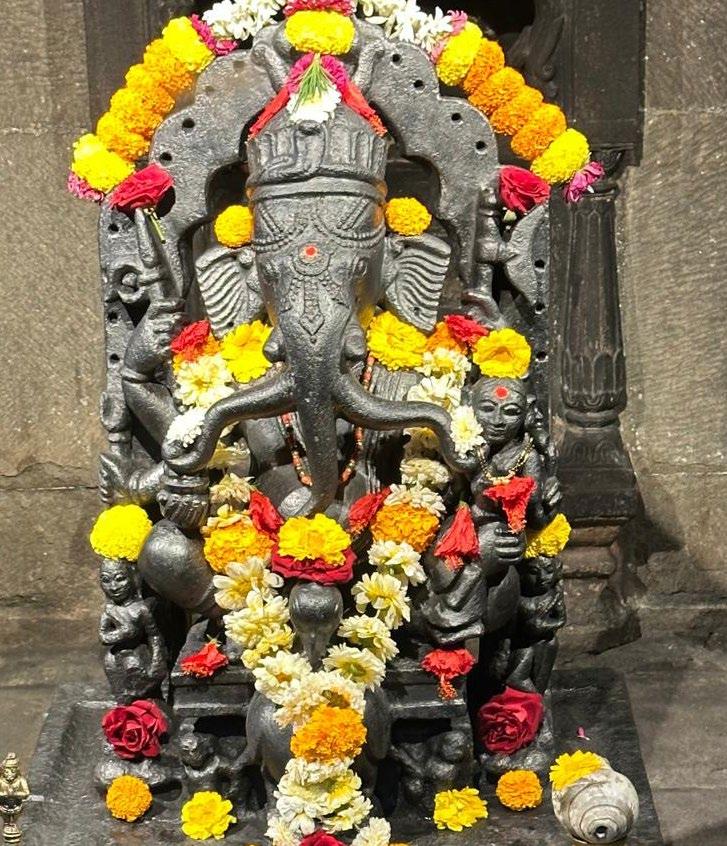
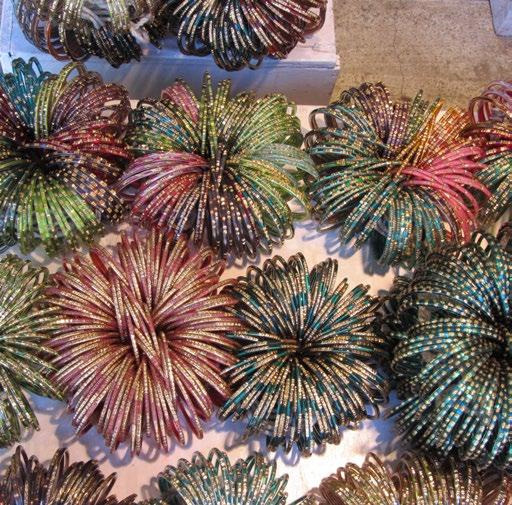
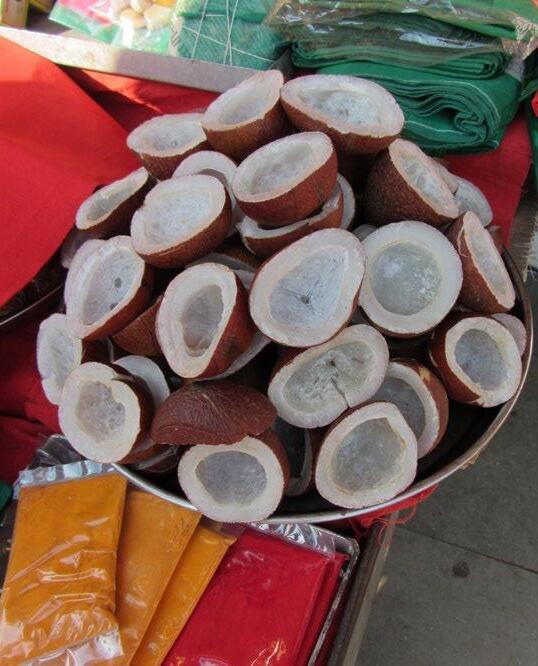
“Puṇe tithe kāy uṇe”
“In Pune, there is nothing lacking.”
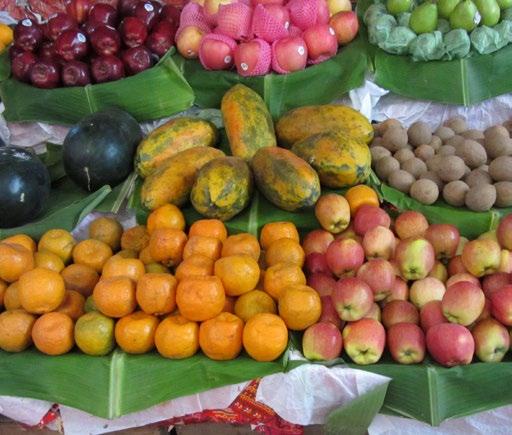
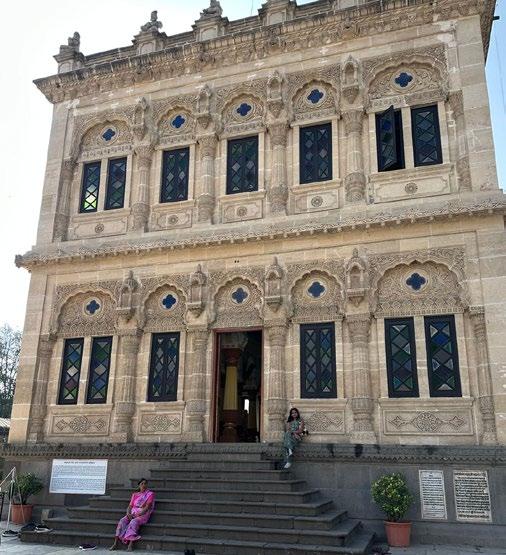
All Photos: Joan White























“with” Fear and
by Victoria Austin
“Ouch. Ouch. So, so scared!”
I’d been up all night worrying about the double abdominal surgery that was about to happen. I knew it was bad when I started being anxious about my worries. But while waiting, my common sense kicked in. I remembered that virtually no one is exempt from abhiniveśa. My thoughts turned to freeing myself from it. But no matter how I tried, with each moment of entry—responding to questions, bagging my clothes, saying goodbye to the sister who had come to help—waves of fear continued to build.
As I was fitted with an IV and wheeled into the operating suite, I realized that I was not going to be able to do this in a state free “from” fear and pain. I asked myself, “How about freedom “with” fear and pain? Once I come out of anesthesia, how can I practice freeing myself? In the adrenalized state I was in, I felt unable to find my obstacles and enter contemplation, to immerse myself, as the Sūtras recommend, in a sorrowless, effulgent light, or to take refuge in the example of the sages.
For practitioners undergoing surgery, the traditional advice is, “Wait three months to restart your yoga practice.” My gut told me:
“No interruption to yoga practice. Instead, throughout acute recovery, let me be strict about the boundaries of practice, so that I can refrain from harming myself or the work that has been done, and rediscover the nourishing side of yoga. Whenever I find some ease, let me spread the benefit to new areas of body, speech and mind.”
This journal records the discovery of ease and the spreading of benefit during the acute stage of recovery. Throughout, I kept reminding myself that the obstacles were in full operation, limiting my ability both to act and to perceive. They were very well defended in each moment.
“The four very observable signs that arise along with obstacles are suffering (duḥkha), agitation (daurmanasya), unsteadiness of the body (aṅgamejayatva), and irregular breathing (śvāsa–praśvāsa).” — Patañjali’s Yoga Sūtras I:31
Fortunately, Yoga Sutra I.31 lists the four very observable signs that arise along with the obstacles: Suffering, agitation, unsteadiness of the body, irregular breathing. Though I have no memory of doing this, I’m told that in the recovery room I spoke about how to progressively calm these four signs, by refraining from harm, doing good, and purifying the mind.
As recovery proceeds, I’m working first to notice each of these four overt signs of bondage to obstacles. They don’t have to circumscribe practice. Instead, they can become cues for me to work to cultivate freedom, to realize my intention and to record my process. Thus I offer my observations to the community, and invite your reflection and response.
Process:
Each week I developed a specific theme, inspired by the progression of learning given to us by Guruji and Geetaji in beginners’ and medical classes. Daily meditation and chanting provided a spiritual foundation of confidence, patience, and energy to maintain uninterrupted safety and continuity.
Each day, working within my specific theme, I chose āsana and prāṇāyāma practices in keeping with Guruji’s main medical instruction: Complete the prerequisite medical treatment and acute recovery after surgery (about 12 weeks) before building back depth in āsana.
A word of caution:
The sequences I show are not intended as a prescription for those of you dealing with abdominal surgeries. They are only a record of my own practice of calming the four signs to cultivate freedom “with” rather than “from” fear and pain.
In the hospital, duḥkha and daurmanasya levels were low, due to residual anesthesia. Aṅgamejayatva and śvāsapraśvāsāḥ from dizziness and abdominal wounds made it difficult to rest, stand or walk. Once supplemental oxygen was removed, breathing was particularly unsteady. Continuous, light breath observation regularized my inhalations and exhalations. Pain from the gas used to inflate my chest and abdomen during surgery began to dissipate with mild, supported arm movement.
The surgeon asked me to move, with care, as soon as possible. I started with arm work to build steadiness by focusing on position and pain-free range of motion. My prāṇāyāma practice focused on the preparatory stages of relaxation and rib expansion, to prevent pneumonia and give a foundation for healing. When I extended the ribs while respecting the limits imposed by pain, duḥkha and daurmanasya almost entirely fell away, and breathing became easier and more regular for the rest of the day. I quickly discovered that I needed to continually face forward, and to keep a foursquare torso shape to avoid harming my healing wounds. By the end of the second week, I was ready to practice standing work to bring steadiness to my legs, in ways that avoided stretching external or internal abdominal incisions.
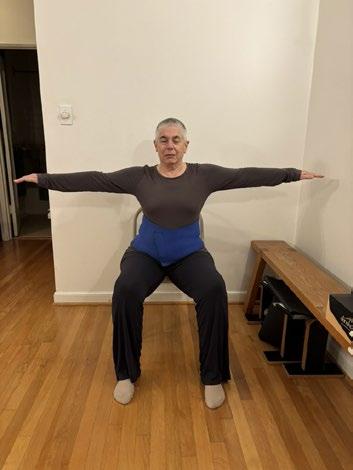
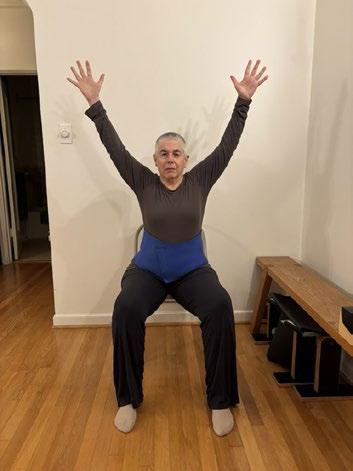


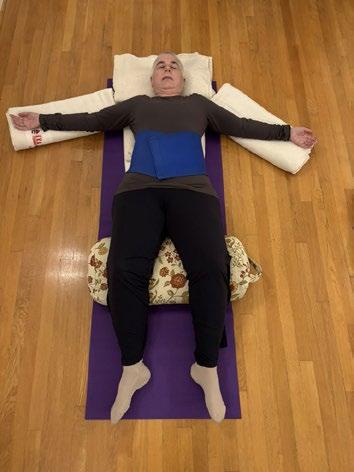
level support to gently broaden diapgragm; support organs of action. Ujjāyī Actions.
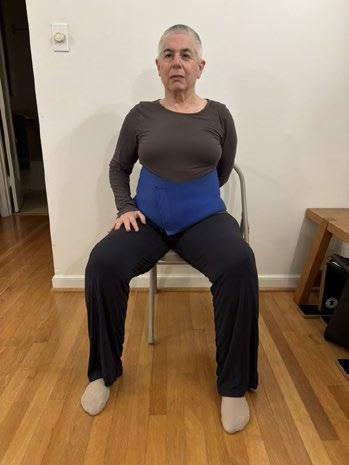
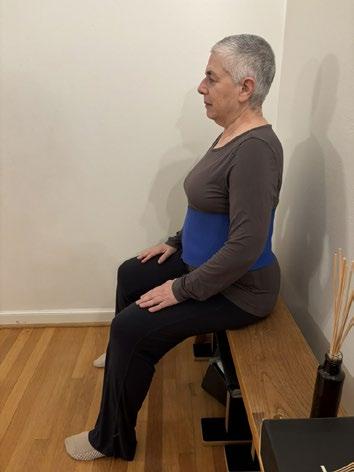
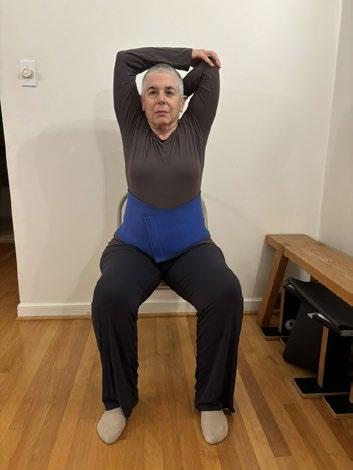
In the third week, my surgeon complimented my healing and told me to continue whatever it was I was doing, again without forcing past pain.
Following these guidelines, I continued to practice Ujjayi I, II and III as in Week 2, and added chair-sitting Ujjayi V, VI, and VII seated on a chair. I asked myself once again:
To reduce fear and pain, using the help of a chair to get up and down, I practiced the cultural (seated) poses and other simple, forward-facing hip actions with activepassive actions for arms and legs. This built physical steadiness.
Day 16:
Mental and spiritual steadiness began to build in relation to each of the four signs—suffering, despair, unsteadiness of body and of breath—as I nourished them with confidence, patience, and energy. These “yoga vitamins” nourished my body and mind to make cultivating freedom from fear and pain both possible and achievable.
Day 17:
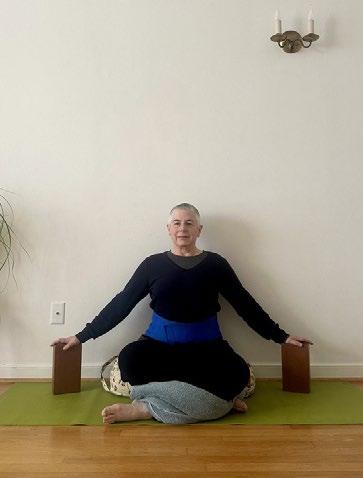
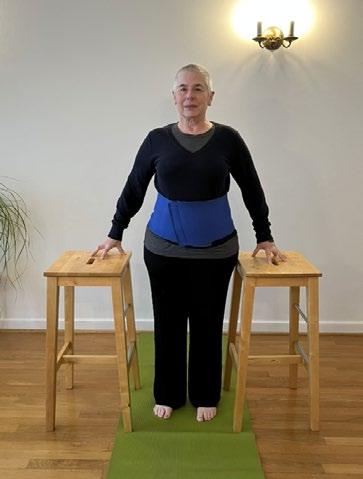
Tāḍāsana with hand support for abdominal height
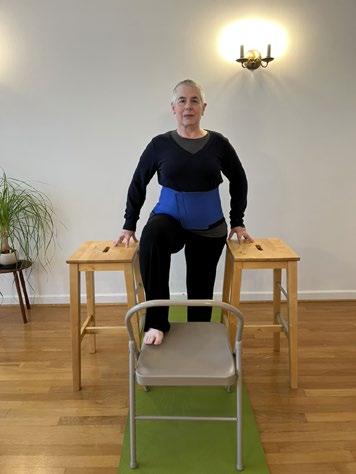
Developing position, support and movement for Utthita Hasta Pādāṅguṣṭhāsana
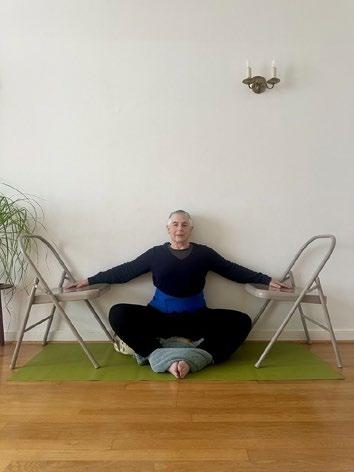
“How do I expand my practice of position and motion within a pain-free range?”
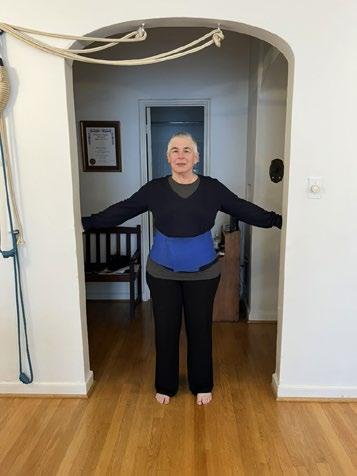
Tāḍāsana with shoulder leverage for chest and respiratory expansion
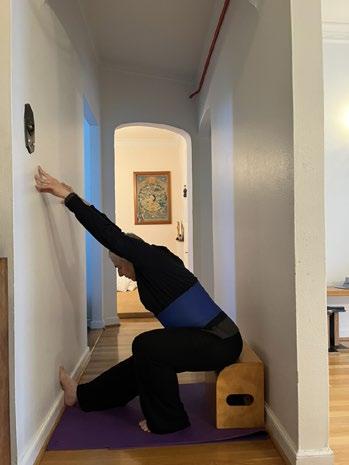
Developing position and primary movements for Marīchyāsana I
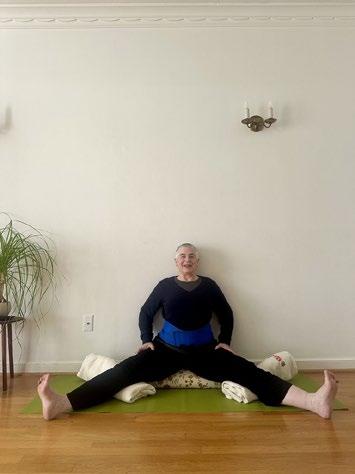
Developing position and range for the cultural poses.
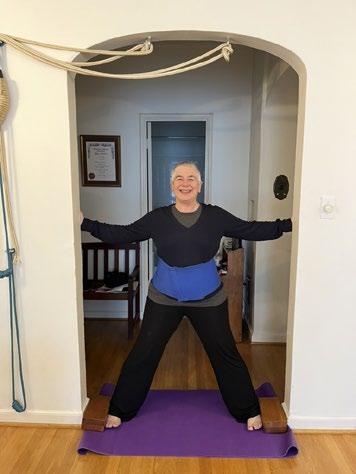
Developing Utthita Hasta Pādāsana
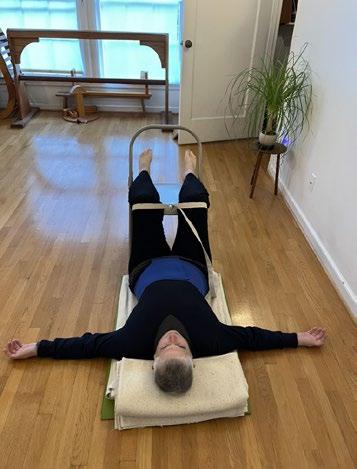
Releasing the karmendriyas in supported Śavāsana
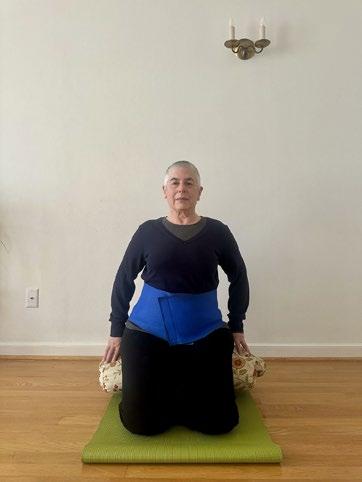
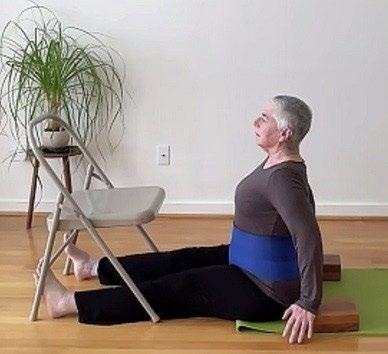
Daṇḍāsana with containment for abdominal ease
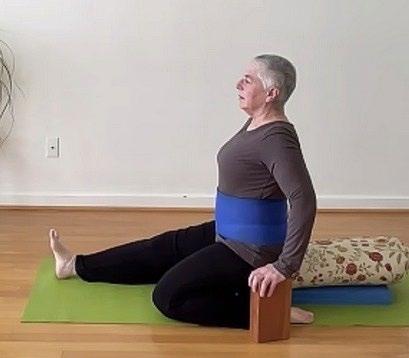
Utthita Triāṅga Mukhaikapāda Paścimottānāsana with support for abdominal
As it turned out, observing and responding to the four signs served as a natural, effortless guide to wholesome action. They gave me specific, measurable clues at a time when body and mind were experiencing too much change to easily observe the obstacles themselves.
My surgeon wholeheartedly agreed with this approach. After the post-surgery assessment at the end of the second week, he cleared me to continue to re-learn āsana in my new body, as long as the four signs stayed peaceful and calm.
From my preliminary, unrealized intention the day of surgery until today, my new body and mind continue to evolve. At first, there was no discernible impact to my levels either of fear or of pain. With repetition and continuity, my developing faith, patience, and energy gradually lit up the shadows of these negative states, allowing me to discern when I was going wrong, and how to adjust. The path became clear, as my wholesome sense of myself and the practice gradually eclipsed the impulsive states of woe.
What is fear? What is pain? For fear, the word abhiniveśa gives abhi (to, towards, over) plus niveśana (entrance, abode). The word implies that deep, transcendent fear is not just towards a conventional idea of death, but rather towards the threat of leaving the known. For the suffering of pain, duḥkha implies a sense of uneasiness, as when our bicycle wheel has spokes of uneven length. For both of these states, nothing feels right.
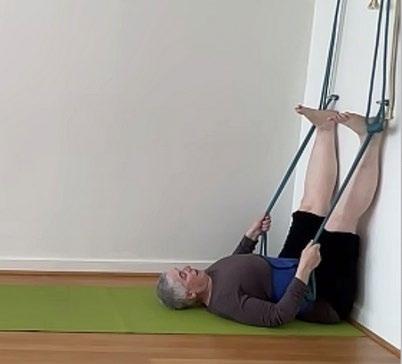
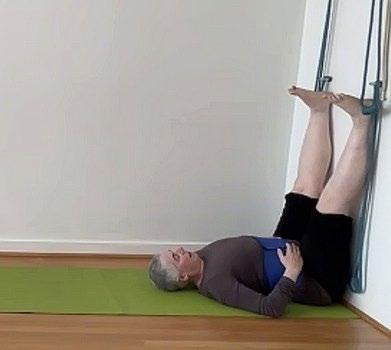
Supported entry, abdominal safety to introduce inversions with leg containment
Abdominal ease
Sūtra I.31 gives clues by which we can discern somatic and physiological signs of fear and pain. Discernment builds the skill of diagnosis and response, allowing us to work with them directly through responsive practice. This sūtra has given me the gift of direct experience of the sensory building blocks of woe, pointing towards how conscience and spirit might direct me to resolve the antarayas or hindrances given in I.30.
Am I free “from” fear and pain? Absolutely not. I feel these feelings. However, with practice I am not pushed around by them. I am free “with” them, in that I give them their due as part of the human condition. At the same time, they are illuminated in a great light that is infinitely larger than them or than me. Suffering, despair, and unsteadiness of body and breath—these are thus my great teachers right now. Yes, in the first weeks and months, recovery practice must be modest. That said, being “with” duḥkha-daurmanasya-aṅgamejayatva-śvāsapraśvāsāḥ without harm, with good, and with extension, expansion and depth—can open a gate to profound cultivation of freedom.
by Jessica Becker
Cultivating freedom is the path of a spiritual practice. Most of us cannot identify what freedom is, but through our yoga practice we begin to cultivate awareness of all the ways in which we are not free. We become familiar with our repeated behavioural patterns, and how they constrain us. We recognize our attachments to what we do, what we feel, and what we think. We notice how these attachments shape our actions, our thought processes, and how we express ourselves. We also see the possibilities of change, freeing us from past entrapments.
Patricia Walden once spoke of Guruji’s words:
“We come to know our place in space, and eventually our space in space.”
More recently, in a class with Gabriella Giubilaro, she quoted Guruji as saying that “freedom is space.” These are perhaps the clearest words I have come across that describe the feeling of freedom.
In Sanskrit, mokṣa is translated as freedom. It is freedom from the repeated patterns and habits, driven by karma, that keep us stuck in cycles of birth and death.
Saṃskāras are impressions formed over time and imprinted in our consciousness. They can be patterns of both positive and negative behavior. They present themselves in our lives as psychological attachments to our desires, aversions, and fears. Karma and saṃskāras feed each other. Saṃskāras shape our karma, and our karma reinforces the saṃskāras. Guruji writes in The Tree of Yoga that actions driven by these patterns make us react without pause:
“We leave no space [between the action and reaction because we feel we
have to act immediately.”
Most often, we are not aware of our saṃskāras and how they constrain our lives. Until we can see the patterns, we do not know that there are other possibilities in how to act. The only way to become aware of them is to study the very patterns within us where they lie.
“Mokṣa is a daily freedom… hard won in the teeth of life’s setbacks and disappointments.”
—
Guruji,
Light on Life
When described this way, cultivating freedom can seem like a daunting and impossible task! However, we have some resources.
First, Guruji asks us to distinguish between what is determined and what is inevitable in our lives.
“We are biologically determined by nature for our own evolutionary benefit…(but) At the level of our consciousness, deterministic forces produce a strong predisposition to repeat pleasure, avoid pain, flee what we fear…but this is NOT INEVITABLE”
— Guruji, Light on Life
Guruji explains our human incarnation is determined but over the course of our lives, certain tendencies evolve to preserve this naturally determined human form. For example, we tend to move towards what feels good, and desirable, and move away from what feels painful, unconformable or fearful. He reminds us that, even though these tendencies are powerful, they do not absolutely dictate what we do. They can influence us, but they do not decide what we do. Sage advice from our Guru. To cultivate freedom is to know what is not inevitable, and become free of it.
Second, our main tool is self-awareness. Over time, practice refines our awareness from a blunt instrument into a sharper tool with which to study ourselves and dig deeper and deeper into our saṃskāras, whether they are gross or subtle. For example, we may express physical sensations in an āsana thinking - I like this stretch, I don’t like this stretch. With sharper awareness I notice that a stretch I didn’t like at one time, actually lengthens my lower back, and helps me breathe better. My dislike of the stretch has changed, and it is no longer perceived by me as being an obstacle that I have attached negative feelings towards. Another example - I may change from saying - I have tight hamstrings and instead I notice that this is why it is hard to straighten my knee.
Third, we become aware of our saṃskāras as obstacles that clutter the field of our awareness.
This is a very accessible and useful metaphor. The field includes everything made of mass, time, and space, as well as the physical and mental forces that shape our lives. In Hindu tradition, when a Sādhu, a holy man, is asked what his duty in life is, he replies.
“I am a farmer.
This body of mine is
my
field. I sow good thoughts and actions, and in my body, I reap the results”
The metaphor of the field is further explored in Yoga
“Nature does not need to be pushed in order to change. Growth happens when obstacles are removed, just as a farmer builds banks to guide water so crops can grow.” — Yoga Sūtra 4.3
This sūtra reminds us that transformation is not something we force into being. As Ravi Ravindra explains, the only task of the knower of the field is to “remove the obstacles to natural growth, as a farmer clears the ground for the crops.”
In a field, lie obstacles that prevent the flow of water to nourish the field. In a physical field, these obstacles are stones, rocks, and branches etc. My saṃskāras are the psychological stones, rocks and branches that are the obstacles in my field of consciousness. Since I am the knower of my field, I become aware of my obstacles and, as I begin to move them, I come to know that my obstacles are not an inevitable part of me.
There are no doubt parts of the landscape of my field that are determined, and I come to know these too. But my practice is to walk through my field and, without exception, clear it of the obstacles that are inevitably movable.
I get to know everything about them and how they affect my field, and, however stubborn, big or small, light or heavy, easy or difficult they are, I remove them. Sūtra 4.3 states this is all I get to do. And, by removing an obstacle, something remarkable happens: In a moment, something shifts and changes forever. Something brand new happens that is free from what came before. And, at this moment, I get to do nothing, except experience this as a moment of transformation.
I find this Sūtra fascinating because my ego consciousness can only find and remove an obstacle, and I may think that this is a big deal - it is a big deal!! AND “The apparent causes of transformation do not in fact bring it about.”
What this means is that what happens once the obstacle is removed is where the essence of freedom lies. The sutra uses the image of water irrigating a field, flowing with freedom unimpeded by my obstacles.
“The freedom cultivated is ‘freedom from myself’”
— Ravi Ravindra
Change can only be witnessed in the present even at the most subtle levels. What might this actually feel like? We may notice we are doing something differently than before. A usual trigger may be less triggering. What we might have labelled as determined is, in fact, not determined. To cultivate freedom is to free ourselves from what we perceive as inevitability.
To use the example of an āsana: In our method, we press the outer edge of the back heel into the floor in Utthita Trikoṇāsana. Initially I have to be taught that my heel has the potential to do this. I may not know what that means or precisely where it is. I may need to be reminded until I remember that there is a possibility of my outer back heel doing something different. I may experience physical and mental effort, discomfort, doubt and other frustrations, and I might say “ oh, THAT heel will never come to the floor” as if it is determined by my human incarnation with such words as “ this is the way it is.” But with repeated practice of this action, my awareness sheds light on this obstacle until I am able to remove whatever level of constraints are there, and, eventually, I feel my outer back heel fully present on the floor. What has changed is not my heel, but my awareness of my heel and I witness my Utthita Trikoṇāsana completely changed, free of this obstacle and its effects.
“Until you make the unconscious conscious, it will direct your life and you will call it fate.”
— Carl Jung
It is not fate that my outer back heel cannot touch the floor. It is an obstacle that my awareness has found and removed.
Over the years, I am now more aware of my obstacles: Those that are determined (ex: My human incarnation), and those that I considered determined that are in fact, not. Because of this, I have become more aware of what is actually going on, not what I want to be going on, or what I want to avoid. I have come to know myself better and experience moments of a feeling of what I might describe as freedom. This freedom feels like space.
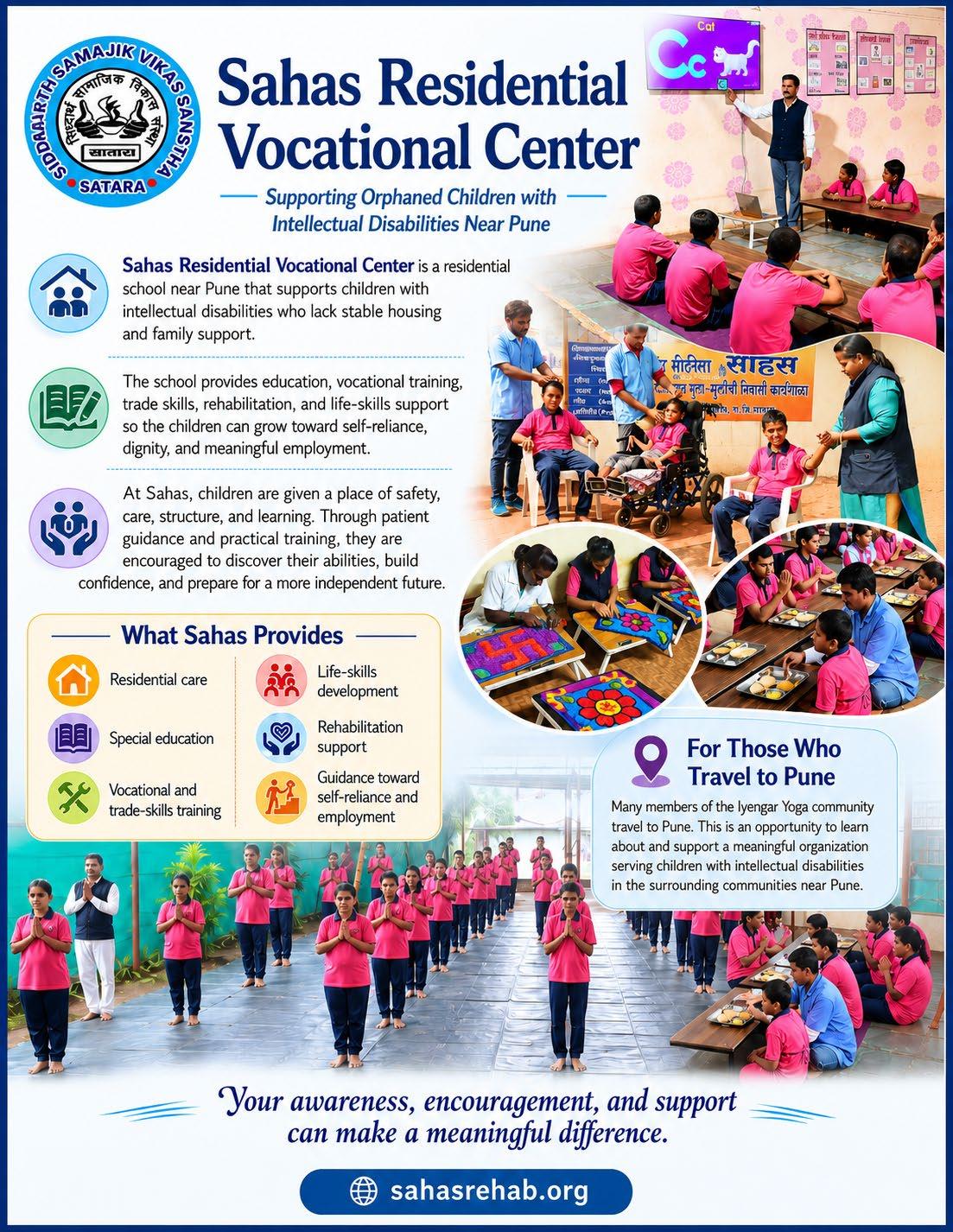
by Rohit Kulkarni
Yogaś Citta-Vṛtti-Nirodhaḥ
“Yoga is the stilling (nirodhaḥ) of the vṛttis (fluctuations)
— Yoga Sūtra I.2
It sounds simple. Still the vṛttis. Rest in silence. But anyone who has tried knows how quickly the mind stirs again. We have lives to live, families to care for, work to do, thoughts to think. We need some movement in the mind just to make it through the day. Patañjali never says we must still ALL vṛttis. He simply says: Yoga is the stilling of vṛttis. This distinction matters.
Silence may be the highest state, but Yoga is how we reduce the noise.
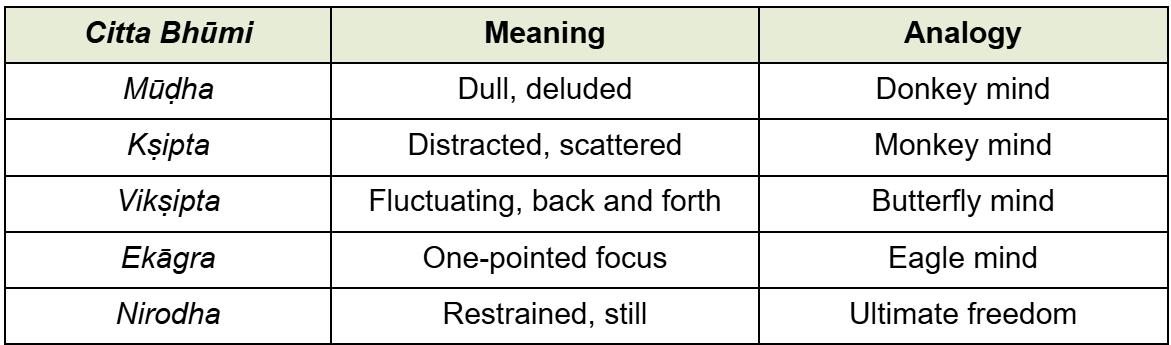
Sage Vyāsa describes five shifting planes of the citta in his sūtra-bhāṣya (commentary), known as the citta bhūmis. We move through these planes constantly. Vyāsa offers these planes as a map to locate ourselves, and in that act of seeing, a way to cultivate freedom. Knowing where we are helps us respond with clarity. In Light on the Vyāsa Bhāṣya, Prashant Iyengar uses simple, relatable analogies to help us visualize these planes.
1. Mūḍha (Dull, Deluded)
The mind is heavy, clouded, and unwilling to move. Like a donkey, it is stubborn.
2. Kṣipta (Distracted)
The mind jumps from one thought to the next, pulled in every direction. Like a monkey leaping from branch to branch, it cannot stay still even for a moment.
3. Vikṣipta (Back and Forth)
The mind sometimes focuses and sometimes slips away. There is effort, yet it lacks consistency and depth. Like a butterfly fluttering from flower to flower, awareness touches down briefly before drifting again.
4. Ekāgra (One-Pointed Focus)
The mind begins to steady itself on a single object. A quiet thread of focus emerges and strengthens with effort. Like the unwavering gaze of an eagle, distractions lessen, and a clear, attentive state takes form.
5. Nirodha (Restrained, Still)
The movements of the mind come to complete stillness. There is no grasping, no struggle. Stillness arises naturally through integration and sustained presence. Ultimate freedom is experienced.
We imagine these states as a ladder, moving step by step from dullness to stillness. In reality, we move back and forth through them throughout the day, shaped by our habits and choices.

In The Bhagavad Gītā, we see this inner struggle take dramatic form on the battlefield. Two warriors stand at the edge of conflict. Duryodhana resists. Arjuna surrenders. Two responses to the same moment. Only one turns toward transformation.
Have you ever wondered why Śrī Kṛṣṇa did not simply reason with the so-called “bad side”? Why did he not talk some sense into King Duryodhana and prevent the war altogether?
“I know what is right, yet I cannot bring myself to follow it. I know what is wrong, yet I cannot turn away from it. Don’t lecture me on what is right and wrong. I already know! But there is something inside me that keeps doing the wrong thing, and I can’t control it.”
— King Duryodhana
Duryodhana is stuck in his habits, trapped by his attachments, and overpowered by his vṛttis. Here, mūḍha appears in its rawest form. Awareness is present, but will is absent. He does not ask for help or seek a teacher. He does not open himself to anything greater than himself. He gives in to inertia. Like the donkey that digs in its heels, Duryodhana chooses not to move. And so his defeat begins. Not on the battlefield, but within himself.
While Duryodhana refuses to change, Arjuna chooses a different path. He enters the battlefield in a mūḍha state, paralyzed and unable to act. His heart collapses, and his will dissolves. Arjuna says, his eyes filled tears:
“I am overcome by helplessness. My mind is completely deluded. (mūḍha) What should I do? I surrender to you as your student. Please guide me.”
— Arjuna, Bhagavad Gītā 2.1
Arjuna does not pretend to be strong or cling to pride. He acknowledges his weakness and opens himself to guidance. He accepts his condition fully. And from that place of honesty, he surrenders.
Īśvara Praṇidhāna is revealed here: Surrender to something greater than the ego, a willingness to be led when the self can no longer lead itself. Surrender, in this sense, is not a collapse. It is the first act of strength and the first step toward clarity.
Kṛṣṇa treats Arjuna as a friend, not a distant advisor or a guru on a pedestal. He begins the way true friends often do: He scolds him.
“Do not yield to this weakness, O Arjuna. It does not suit you. Cast off this petty faint-heartedness and rise!”
— Bhagavad Gītā 2.3
This shows care in its fiercest form. A true friend sees your strength even when you forget it and speaks to your higher self, not your fear. Kṛṣṇa responds as only a true friend would when their loved one has lost their way. He reasons with Arjuna, challenges him, encourages him, and teaches patiently. He speaks of the Self, of dharma, of non-attachment, of love, and liberation.
When Arjuna protests that the mind is too wild to control, Kṛṣṇa does not dismiss him. He acknowledges it and offers a way forward.
“Undoubtedly, O mighty one, the mind is restless and hard to control. But by practice (abhyāsa) and non-attachment (vairāgya), it can be restrained.”
— Bhagavad Gītā 6.35
He meets Arjuna’s difficulties with honesty and hope. He offers practical encouragement and reminds Arjuna of his own inner power.
“Lift yourself up. Do not drag yourself down. You can either be your own best friend or your own worst enemy.”
— Bhagavad Gītā 6.5
Kṛṣṇa remains present, adapting his tone as needed, firm when firmness is required and gentle when softness will serve better. His guidance does not waver because it is rooted in care. It is not merely divine instruction, but the true love of a friend who will do whatever it takes to help you return to yourself.
We have seen Guruji B.K.S. Iyengar’s back leg in Ardha Chandrāsana and Vīrabhadrāsana III. Not too high nor too low. Perfectly aligned and perfectly balanced. Singlepointed. Completely effortless. Utterly still. A glimpse of ultimate freedom. We all want to be like that. Then there are students in the class who cannot even lift the back leg, let alone straighten it. I am one of those students.
I try again and again, and still the leg does not lift. I ask myself, what is this stiffness? It straightens just fine when I press the foot against the wall. So why does it refuse to straighten on its own? I put in tremendous effort just to get it moving. Still, the leg flutters, collapses, resists. Where is the effortlessness? Where is the stillness? The yoga mat gives us a unique opportunity to observe ourselves. Not just the mind, but each part of the body. What are its tendencies, its patterns, its vṛttis? What is dull and what is alert? What is weak and what is strong? What is scattered and what is one-pointed?
Through the journey of my Donkey Leg, I have come to understand the five citta bhūmis not as abstract ideas, but as real planes that live in the body.
1. Mūḍha: The Donkey Leg
The back leg is dull. It refuses to lift. No amount of mental encouragement or muscular effort seems to help. It is heavy, unresponsive, and stuck. Like Duryodhana, it knows what it should be doing, yet it will not. Its dharma is clear. Its vṛttis are stronger.
Sometimes, like Arjuna, I get frustrated. Why is it so hard? Why am I trapped in this state? I surrender all these frustrations and fears. My teachers have given me so much guidance and many ways to improve. I recognize it. I turn toward my leg like a stubborn friend. I say: “Hey, come on. You can do this. You must lift up, not drag yourself down.” It doesn’t listen.
2. Kṣipta: The Monkey Leg
So, I push. I demand. I fire up the will. For a moment the leg lifts, then drops, lifts again, wobbles, and collapses. It is distracted, agitated, untamed, like a monkey leaping in every direction. There is energy, but no focus. The vṛttis are still in control.
3. Vikṣipta: The Butterfly Leg
Gradually, refinement begins. I start to work with motion. I pump the leg, up and down. I use movement to invite stability. Glimpses of awareness begin to appear. There is effort. Some progress. But it flickers. In and out. On and off. Like a butterfly, it touches stillness briefly, then flies away.
4. Ekāgra: The Eagle Leg
Then, one day, the leg stays. A quiet thread of focus appears and holds. The monkey has calmed. The butterfly has landed. I reach through that leg with undivided attention and feel a clear line of energy running through it. The scattered vṛttis gather, and one-pointed focus
“Holding the body, head, and neck steady and aligned, fixing the gaze without distraction, one should be firmly established in āsana, restraining the mind in one-pointed concentration.”
— Bhagavad Gītā 6.12-6.13
5. Nirodha: Ultimate Freedom
I haven’t reached this state. Not yet. But I maintain śraddhā, faith, that with continued practice, presence, and sincerity, the leg will one day move with effortless effort. There will be no struggle or resistance, only quiet action flowing without interruption. Here lies prayatna-śaithilyaananta-samāpatti (Yoga Sūtra 2.47). Effort relaxing into stillness. Movement dissolving into absorption. So I continue to show up for this leg again and again, meeting it where it is and watching it change with patience and curiosity. In all its resistance, this leg has become my teacher. The donkey has shown me the path.
The world is our battlefield, and yoga is the journey within it. A movement from mūḍha (ignorance, heaviness, resistance) to nirodha (absorption, stillness, freedom). These five planes of citta are present in every āsana, every thought, every choice. They rise and fall through our layers of being:
- Body (aṅga): in a stubborn leg that refuses to lift
- Breath (prāṇa): in breath that will not settle
- Mind (manas): in thoughts that leap restlessly
- Intellect (buddhi): in doubt that questions every move
- Ego (ahaṅkāra): in pride that grips and resists
Yoga is not about perfecting the leg. It is about noticing the state of citta behind it.
Rohit Kulkarni is a Level 1 CIYT who lives in Richmond, VA. risingsanskrit.substack.com
by Skyler Christensen
“Yoga does not just change the way we see things, it transforms the person who sees.”
— B.K.S. Iyengar, Light on Life
Pariṇāma, or transformation, lies at the heart of yoga practice. In the Yoga Sūtras, Patañjali uses this term to describe the constant change taking place in the mind, the senses, and the world we experience. Nothing remains fixed. What we feel, perceive, and identify with is always in motion. B.K.S. Iyengar explains in Light on the Yoga Sūtras of Patañjali that this very process of transformation first appears as suffering, later becomes a means of selfmastery, and ultimately opens the doorway to freedom.
At first, change can feel painful. Yoga Sūtra II.15 teaches that even pleasurable experiences contain suffering because of the inevitability of change, the friction between the guṇas, and the momentum of past impressions, or samskāras. The untrained mind resists change, clings to what is familiar, and reacts with agitation when conditions shift. Yoga practice begins precisely here, at the point where change feels uncomfortable and often resisted. Rather than attempting to stop change, Patañjali teaches us how to understand and work with it. Through sustained practice, transformation becomes something we can observe, refine, and eventually direct. In Yoga Sūtras III.9 through III.12, he describes three progressive shifts in consciousness:
1. Nirodha-pariṇāma:
The mind learns to pause. You begin to sense moments of stillness.
2. Samādhi-pariṇāma: Distractions gradually fade. You experience greater steadiness.
3. Ekāgratā-pariṇāma:
Attention becomes unified and stable. You begin to rest in a single stream of awareness.
Together, these three stages show a clear progression. First, you taste stillness (nirodha). Then your focus is consolidated (Samādhi). Finally, awareness becomes one-pointed (ekāgratā). This ladder of transformation is built through disciplined, intelligent practice.
While these stages show how transformation unfolds over time, Patañjali also describes the qualities through which it can be understood. In Yoga Sūtra III.13, he names three
1. Dharma:
What something essentially is
2. Lakṣaṇa: What are the qualities that define it
3. Avasthā: What state it is in right now
B.K.S. Iyengar gives the example of clay. It can be dust, earth, mud, or a pot, yet its essential nature, dust (dharma) remains. Its qualities (lakṣaṇa) and condition (avasthā) change, while the underlying substance endures. The same is true for the body, mind, and consciousness. Mr. Iyengar extends this understanding of transformation from objects to the sādhaka:
“The sādhaka transforms himself to an exalted state (dharma-pariṇāma), develops awareness of perfection (lakṣaṇa-pariṇāma), and maintains himself without losing the acquired perfection (avasthā-pariṇāma).”
— B.K.S. Iyengar, Light on Yoga Sūtras (III.13)
Mr. Iyengar describes transformation as something cultivated, refined, and then maintained. In yoga practice, these three movements can be directly experienced. Sequencing creates the conditions for change. Careful attention in the pose allows refinement to be perceived. Time and steadiness test whether what is gained can be sustained.
Transformation through Sequencing (Nirodha-pariṇāma)
“In yoga practice a regular sequence (krama) must also be followed. The sadhaka first acquires restraint in consciousness (nirodha-pariṇāma) in order to experience tranquillity (Samādhipariṇāma). Then he proceeds towards the seer (ekāgratā-pariṇāma). Only then does he become a fulfilled yogi.”
— B.K.S. Iyengar, Light on Yoga Sūtras (III.15)
Sequencing, or krama, shapes transformation. Because transformation unfolds in stages, the order of practice matters. Sequencing brings restraint (nirodha-pariṇāma) to practice by reducing randomness and excess, allowing change to unfold intelligently. For example, a sequence that prepares the shoulders before backbends creates openness without harm, while a random order can lead to strain. The Iyengar method is grounded in this principle. Each pose is chosen with intention. One posture conditions the body and mind for what follows, creating a logical progression that supports healthy, sustainable change.
The alignment, awareness, and actions developed in one posture carry forward, building a foundation for what follows. This approach helps students experience how preparation in each step supports the next, making the practice both transformative and accessible. Each pose becomes a building block, preparing what’s ahead and supporting healthy, sustainable change in practice.
When practice follows an intelligent sequence, transformation becomes a direct experience. Preparation in earlier poses sets the stage for what follows. Actions, alignment, and awareness carry forward, making each step feel purposeful and connected. This makes transformation tangible, visible in strength, steadiness, and confidence. Sequences are designed intentionally to guide attention deeper into the āsanas. By linking actions from one pose to the next, focus is sustained, allowing distractions to fade and attention to deepen (Samādhipariṇāma).
Simple instructions, such as pressing into the inner feet or straightening the legs, draw attention to subtle shifts in the body and breath. When these actions are maintained as the practice continues, their effects become easier to recognize. Repeating a pose like Uttānāsana between other āsanas allows students to sense how each action influences the experience of the pose. This linking of actions can also be explored between contrasting poses. Take Uṣṭrāsana and Uttānāsana as an example. These are different conditions (avasthā) in which we place the same body (dharma). The attributes of the poses (lakṣaṇa) are completely different, yet the question remains. What can be carried from one āsana to the next?
When we practice a backbend like Uṣṭrāsana, we experience a sense of lift and openness across the chest. As we move into Uttānāsana, can we maintain this lakṣaṇa, this openness of the chest? Similarly, when we practice a forward bend like Uttānāsana, we experience the quietness of mind. Can we carry this lakṣaṇa, the quietness of the mind, back into our backbends?
In this way, while the āsana (avasthā) changes, the underlying attributes (lakṣaṇa) are sustained. Remaining with this continuity of experience draws attention inward and helps distractions recede. Over time, this process helps us understand not just what to practice, but why. We become more present, more aware, and more engaged in our own growth.
“After you have concentrated on doing a pose correctly, you hold it and then forget everything, not because you want to forget, but because you are fully concentrated. This is meditation.”
— B.K.S. Iyengar, Sparks of Divinity
Sequencing also transforms the experience of focus and time. As attention becomes steadier, practice shifts from simply entering a pose to remaining in it and refining it. Staying allows awareness to gather, deepen, and evolve, drawing the practitioner inward toward single-pointed focus (ekāgratā-pariṇāma).
Vṛkṣāsana offers a clear example. When the gaze wanders, balance is easily lost. When focus steadies, the body organizes itself and stability emerges. Time, too, is experienced differently in each pose. Ten minutes in Supta Baddha Koṇāsana may feel brief, while the same amount of time in Śīrṣāsana can feel expansive or even endless. Detailed instructions can make time seem to pass quickly, while silence can stretch it, inviting attention to move inward.
With sustained practice, awareness no longer remains at the surface. What may begin as simple, external actions, straightening the legs, lifting the arms, gradually deepens. Attention penetrates into the muscles, the bones, the organic body, the breath, and the mind. As focus becomes more unified, effort gives way to absorption. The practitioner learns to stay.
Through years of steady practice, transformation becomes visible. Śīrṣāsana is where I noticed the most change. My struggle with Śīrṣāsana began with thirty-second holds. My arms would go numb, and I was certain that this pose simply was not for me, like many beginners. Now, after twelve years of consistent daily practice, I can remain in Śīrṣāsana for twenty-five minutes or more. My body, mind, and experience of time have all changed. Looking back, the ideas of dharma (the essential nature of the pose), lakṣaṇa (the qualities that express it), and avasthā (the changing conditions over time) became clearer with practice. Early on, Śīrṣāsana felt unstable and rushed. My entire focus was on staying up and trying to breathe. Gradually, through small refinements such as studying the shoulders, engaging the legs more intelligently, and calming the breath, my experience began to change. Now, I work with the energetic lines of the body while remaining in the pose.
Sequencing played a significant role in this transformation. Practicing shoulder-opening āsanas, such as Gomukhāsana arms, along with standing poses before Śīrṣāsana, Śīrṣāsana more lift and ease. I experimented with placing Śīrṣāsana at different points in a sequence, noticing how it felt at the beginning, middle, and end. I also explored different prop setups and refinements to discover what my body needed in order to remain in the pose with steadiness. The different pariṇāmas, shifts in body, breath, and mind, revealed themselves in subtle ways. Some days the pose felt effortless; on others, I encountered resistance or distraction. Progress was never linear. There were setbacks, frustration, and long stretches when holding the pose for longer seemed impossible. I worked through these challenges by returning to basics, refining my setup, staying curious, and trusting the process.
Even now, challenges remain. At times the mind wanders or the body feels heavy. Yet moments of steadiness and unity arise more frequently. Holding Śīrṣāsana has become less about endurance and more about presence. The journey continues, and each practice reveals something new. Over time, restraint and quietness, what the texts describe as nirodha-pariṇāma, became more accessible in Śīrṣāsana. The urge to push or fidget gradually faded, allowing the pose to settle. At times, everything comes together and a sense of absorption appears, Samādhi-pariṇāma.
At other moments, attention collects into a unified, uninterrupted presence in the pose, ekāgratā-pariṇāma. These experiences come and go, but they have become more familiar as my practice continues to evolve.
When I first started practicing yoga, my body was incredibly stiff. I cannot emphasize this enough! I could barely touch my shins in Uttānāsana
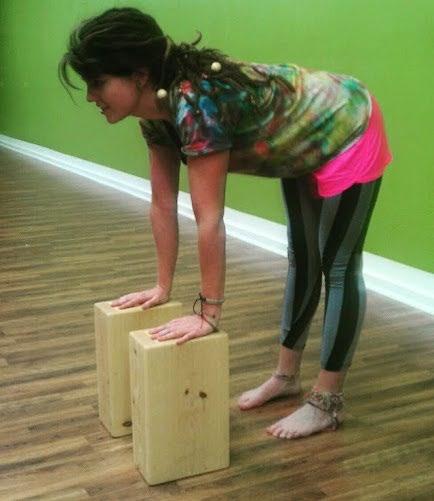
Throughout the Yoga Sūtras, Patañjali reminds us that there is something that does not transform. Puruṣa, the true Self. While the body, breath, and mind fluctuate, Puruṣa remains constant, pure, and free. The journey of yoga is to witness change without being bound by it, resting in the awareness that underlies all transformation.
Pariṇāma is not merely something that happens to us. Through practice, we become active participants in our own transformation. We learn to observe change, to guide it with intelligence and care, and eventually to transcend it. This is the path to freedom. Pariṇāma is the path. Work with it, and let it guide you toward true liberation.
“On this path effort never goes to waste, and there is no failure. Even a little effort toward spiritual awareness will protect you from your greatest fear.”
— Bhagavad Gītā 2.40
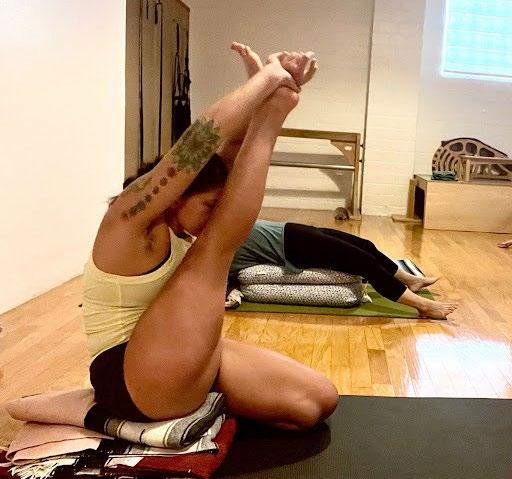
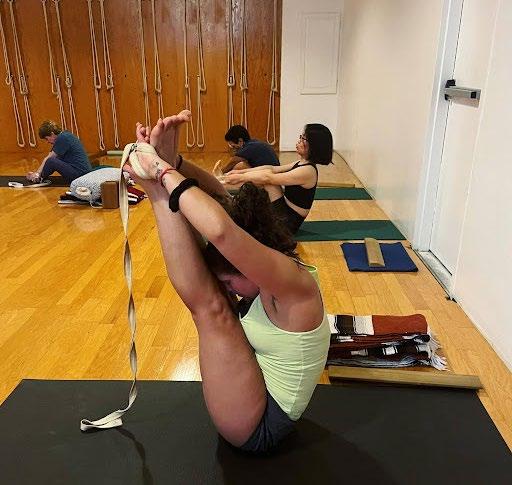



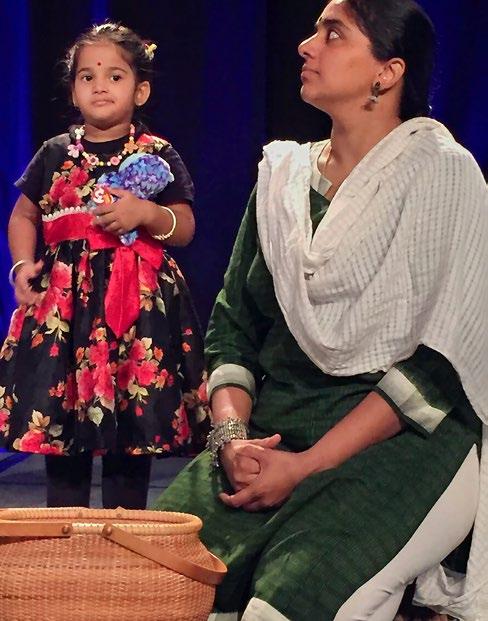
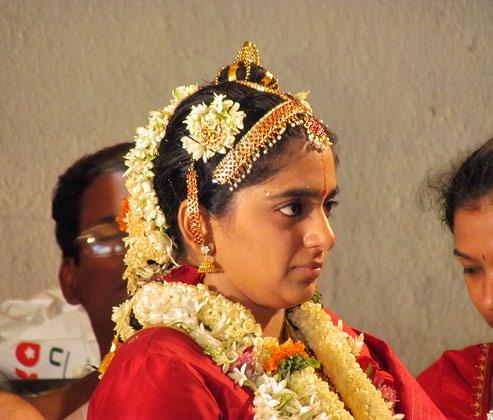
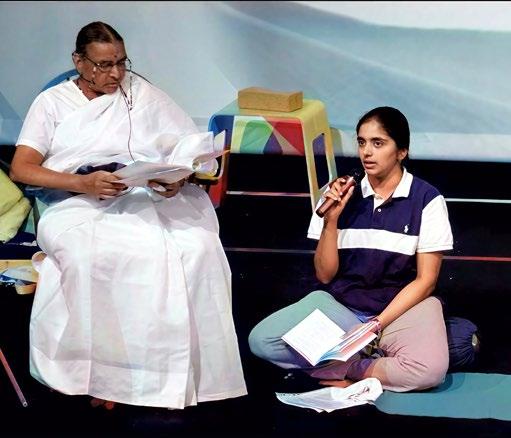
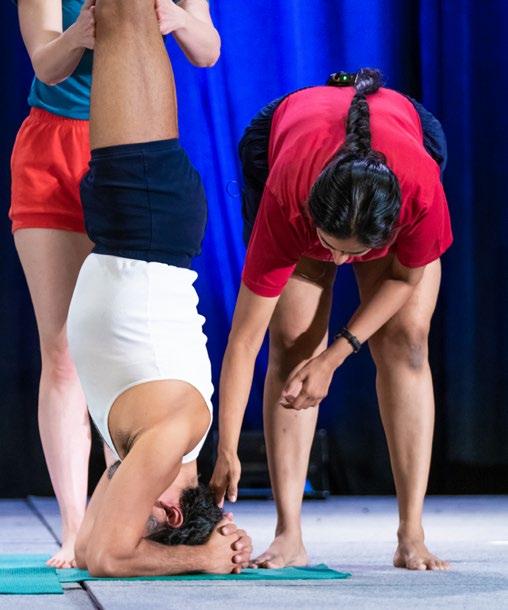
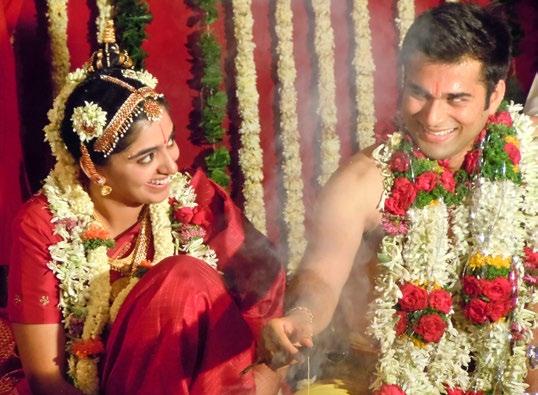
Many Sides of Abhijata
“Yoga should make you a joyous human being” - Abhijata
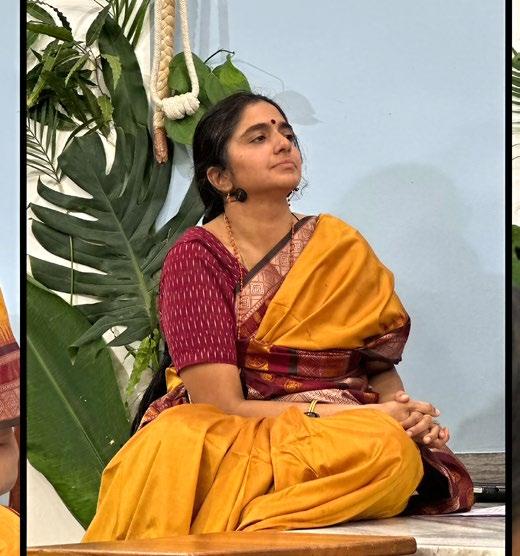
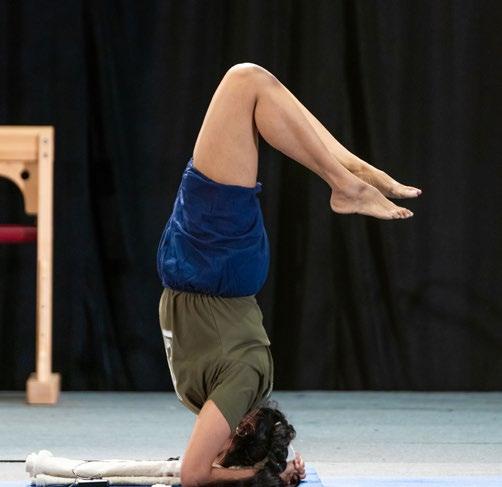
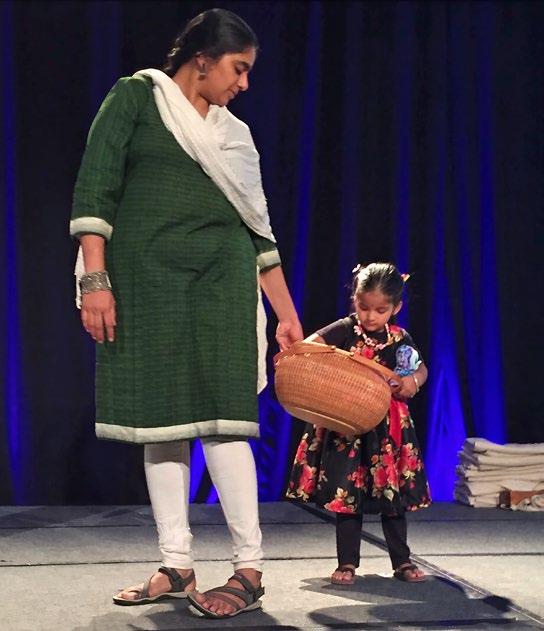
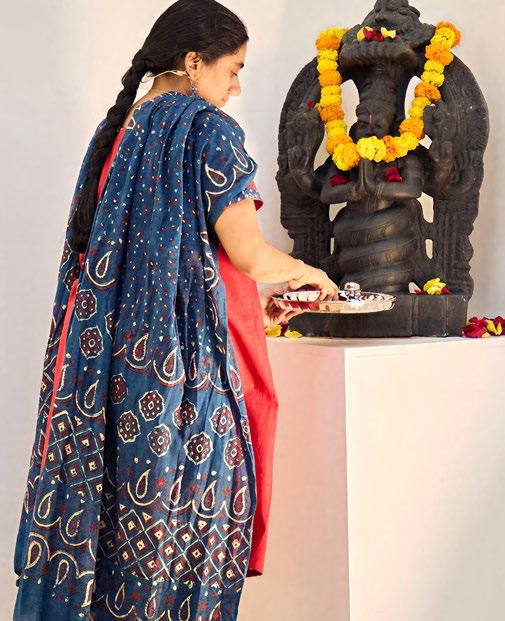
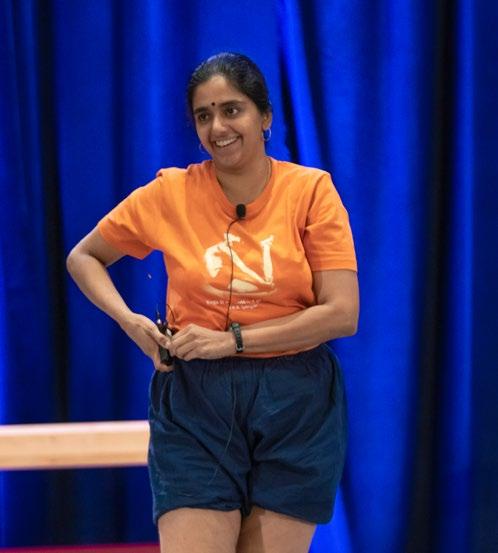
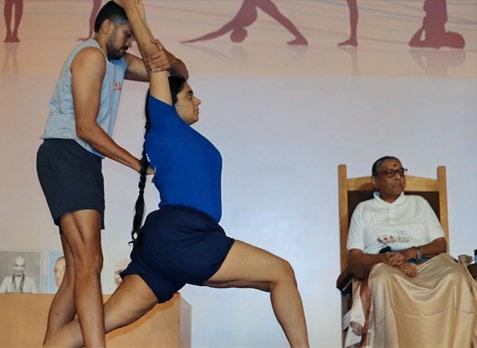
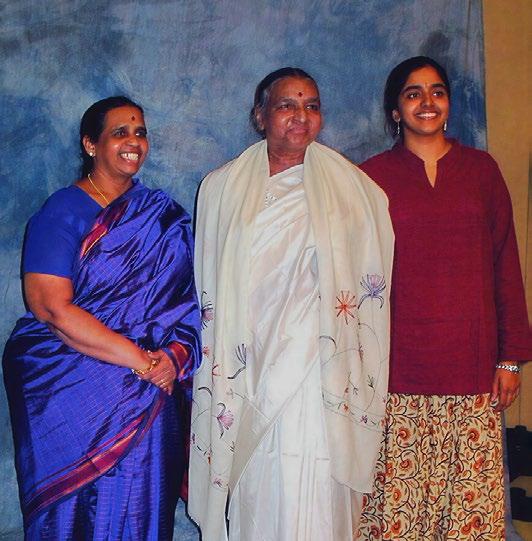

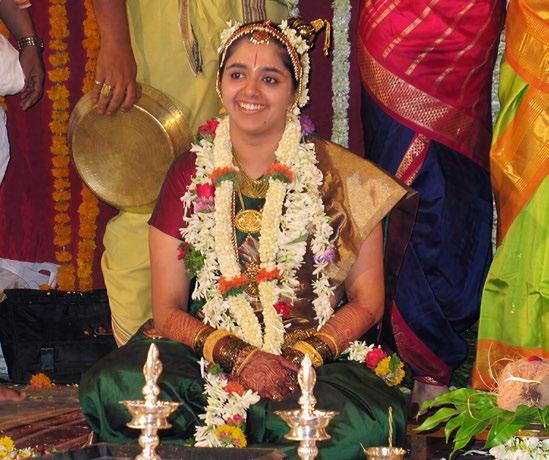
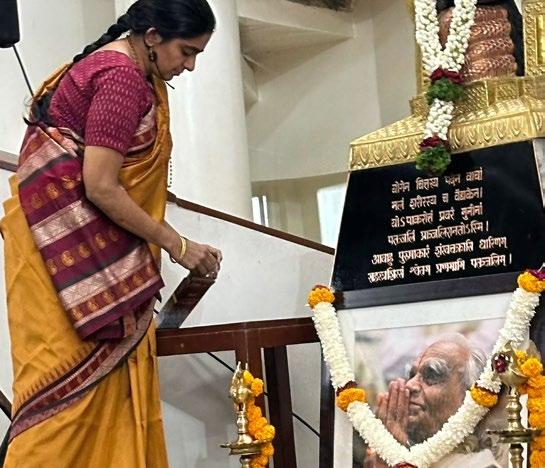
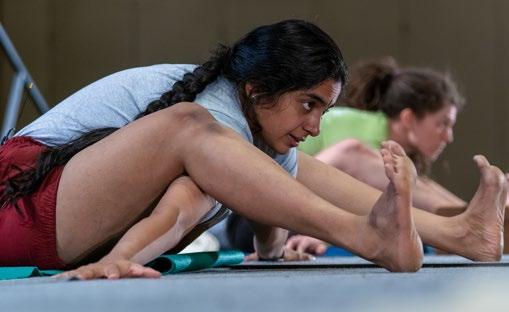
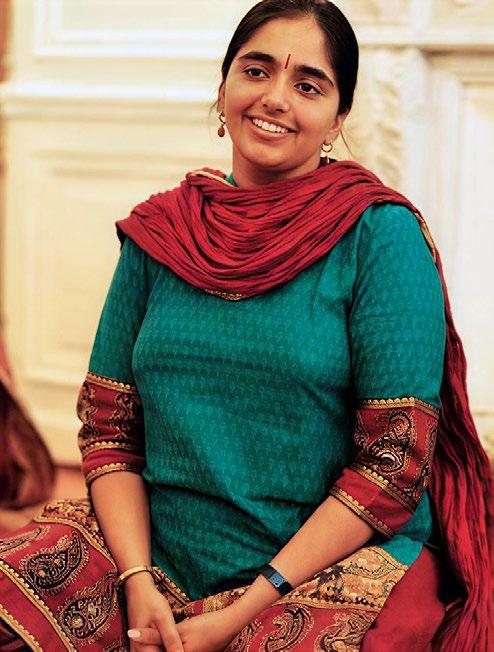
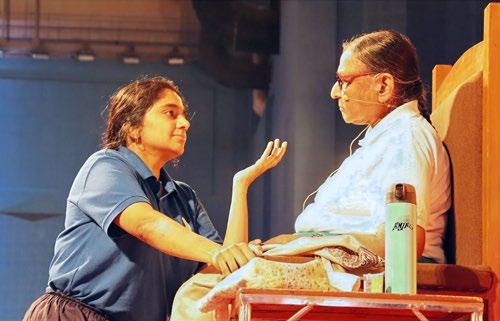
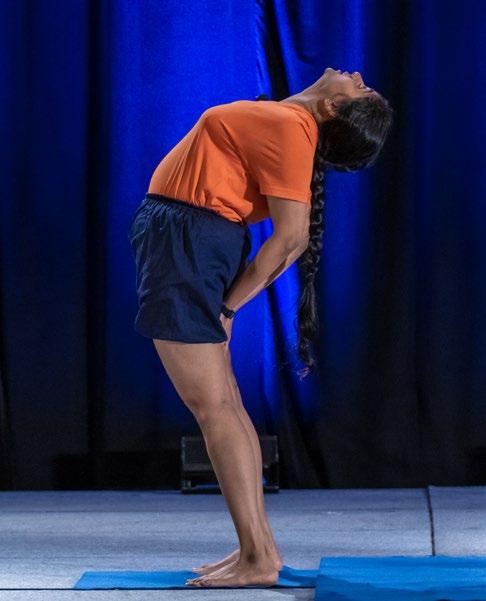
by Carolyn Belko
In yogic philosophy, the ultimate state of freedom is known as mukti (liberation). Whether we consciously realize it or not, every human being is born into a quest for this profound sense of freedom. The Upaniṣads teach us that mukti is not a distant promise reserved for the afterlife. It can be attained right here, in this very body, in this very lifetime. Those who achieve this state are known as jivanmuktas, liberated souls living in the world.
We seek this freedom externally, often without any awareness, searching in places where it does not truly exist. We may experience it in the expanse of an ocean sunrise, the quiet vastness of a desert, or standing on a high rooftop in Philadelphia under a stellar night sky. While these external experiences of expansive space (ākāśa) offer us a fleeting taste of liberation, they are only temporary. True freedom requires us to look inward. In yoga, one may connect with the physical body as the sacred container for the infinite.
To understand how to find this inner space, we must look at the building blocks of material existence (Prakṛti) through the lens of yoga and Sāṅkhya philosophy: The Pañca Mahābhūtas (the five elements).
1. Earth (Pṛthvī)
Stability and steadiness
2. Water (Āp)
Flow and mobility
3. Fire (Tej)
4. Air (Vāyu)
Lightness and lift
5. Space (Ākāśa)
Expansion and freedom
Disciplined effort (tapas) and transformation
Akasa serves as the container in which the elements all operate. Because space (ākāśa) is the subtlest expression of material reality (Prakṛti), it is not affected by the other four elements. Thus, space is understood to be closest to the soul (Puruṣa).
In life, we have all experienced confinements and tight spaces. When we step onto the mat, we may connect with the container of the body to organize these elements. By invoking the expansion felt in āsana, the sensation of inner freedom may bring us fearlessly towards the unknown.
“We
all have access to a space, an inner space, where there is an end to duality, an end to conflict.”
— B.K.S. Iyengar, Light on Life
In this way, we have all tasted freedom in āsana through the expansive consciousness that awareness of space awakens. Is it not remarkable that one can feel connected to infinite space within, even while physically confined? During Guruji’s teaching at his 80th birthday celebration in Pune, we were guided to experience the body as that container of infinite space. Through careful awareness and precise action, dents and bulges were refined. What once felt dense began to feel open, revealing a sacred inner space in which expansiveness could be directly experienced.
I often spend time in the desert, immersed in its boundless expansion and profound silence. In this environment, the vast night sky mirrors and awakens the cosmos within, bringing a unique depth and lightness to my practice of āsana and prāṇāyāma. It is in Śavāsana that we are offered the ultimate opportunity to surrender into this infinite space. The space we have connected with reveals itself as a representation of the divine, existing simultaneously inside and out.
In yogic philosophy, the subtle essence, or tanmātra, of space is sound (śabda). Space is the medium through which sound travels. Consider the Liberty Bell in Philadelphia. Its hollow form was specifically engineered to hold space, allowing its vibration to resonate and carry far and wide. In our yoga practice, the physical body acts much like this bell. When we refine our āsana and cultivate the body as a sacred container, it holds the potential to acquaint us not only with the infinite space within, but also with the subtle inner resonance of mantra, or pure expansive silence.
Let us dive deeply into this inner space. Through precise awareness on the mat, we can cultivate the container of our own freedom, ready to spring forth with profound expansion in our daily lives.

by Frederick M. Smith & Rohit Kulkarni
The theme of this year’s convention in Philadelphia is “Cultivating Freedom.” As some of you advanced teachers know, I have been teaching sound as mantra into practice for several years. I can’t replicate that experience in a magazine article, but I can talk about the architecture of sound that can eventually be applied to our practice.
First, understand that freedom as a state of being must always be cultivated. We are born into this world because we carry with us saṃskāras or impressions from past births. These saṃskāras develop into vāsanās or habits in this birth. Unless we cultivate freedom, this process will continue forever into an infinite number of future births. This means we are bound to the world of “solid matter” for longer than we can imagine. By incorporating sound and mantra into our practice of Yog, a shift in consciousness becomes possible, from identification with solid matter toward the subtle world of vibration.
In our practice of yoga, we work intelligently with rhythm, alignment, and precision. Over time, we begin to recognize that the body is not a static vessel, but a finely tuned resonant instrument. Rhythm comes first. Through repetition of action and regulation of the breath, stability begins to take root. The mind gradually settles and attention stabilizes. From this foundation, focus turns to alignment. As placement, direction, and balance are refined, intelligence awakens throughout the body.
With sustained awareness, practice deepens into precision. Adjustments become subtle rather than gross. The system begins to organize itself with coherence from within. If this progression refines the body, breath, and mind, can we bring that same intelligence to sound? Can mantra be more than mere repetition? Can it be practiced as a disciplined refinement of rhythm, alignment, and precision?
At the core of the Vedic tradition lies the realization of Nāda Brahma, the insight that ultimate reality is sound. When we peel back the layers of physical existence, we find that the universe is not a collection of “things,” but a complex web of oscillations. This Vedic realization is on par with modern quantum physics, both concluding that each subatomic particle is essentially energy vibrating at specific frequencies. What we call “solid matter” simply reflects particular rates of vibration.
The Key Insight is that sound is the primary “Operating System” of existence. It serves as the medium between the Unmanifest, pure potential energy, and the Manifest, physical reality. It is the frequency that organises chaos into form. By mastering the science of sound, we are not just “chanting.” We are interacting directly with the “Inner Physics” of our own biology and the cosmos. We are learning to tune our inner instrument.
“Mananāt trāyatē iti mantrah”
That which protects (trāyatē) through contemplation (manana) is a mantra.
We must move beyond the misunderstanding that mantra is merely religious prayer or affirmation. In the Vedic tradition, mantra is a form of Acoustic Engineering, or Āntarik Bhautik Śāstra (Inner Physics). Its potency does not depend primarily on semantic meaning, but on articulation and vibration. It is shaped by the geometry of the mouth, the placement of the tongue against the palate, and the specific pressure of breath.
To understand how mantra works, we must recognize that it unfolds in progressive stages:
1. The Rhythmic Level
Focus is on breath and repetition. Even if pronunciation is imperfect, rhythm begins to quiet down the racing mind and stabilize attention.
2. The Phonetic Level
Attention shifts to geometry of the mouth, the placement of the tongue, and the articulation of the syllables. This alignment refines the vibration, shaping it with greater accuracy.
3. The Bīja Level
With sustained alignment, practice deepens into precision. The frequency of the sound becomes exact. The vibration penetrates into the subtle layers of our being, producing profound and systematic shifts.
The ancient ṛṣis (seers) of the Ṛg Veda (1.164) understood sound as unfolding in four dimensions. Only one of these is audible.
1. Vaikharī
The audible, spoken level of speech. This is articulated sound, perceptible to the ear, and the densest level of sound.
2. Madhyamā
The intermediate level. This is the level of mental thought, the “inner voice” we hear in our minds.
3. Paśyantī
The level of “seeing.” Here vibration takes on visual or archetypal image before it becomes thought.
4. Parā
The “root” level. Parā means “beyond” or “transcendent” It is pure, undivided vibration, the primordial source of existence.
The ancient ṛṣis (“seers”) did not compose or invent the mantras. They were called “seers” because they perceived sound in its subtle dimensions. Like listening to a radio, they tuned themselves to the sonic blueprints already vibrating at the level of Parā. What they “heard” (Śruti) was then translated into audible Vaikharī. These mantras were preserved in the Vedas and transmitted through generations. They continue to be practiced today.
Let us consider one such mantra as an example: Rā-Ma.
There is a well-known story from the Indian tradition Long ago, in the Dvāpara Yuga, when dharma was still strong but had begun to decline, a feared robber named Ratnākara made his living by ambushing travelers in the forest.
One day, he stopped a group of sages. Instead of resisting or fleeing, they stood calmly before him. They began to speak. Their composure unsettled him. A conversation followed, and something shifted within him. Realizing the weight of his actions, Ratnākara asked how he can atone for his sins. The sages instructed him to repeat a single word: “Marā,” meaning death. They asked him to contemplate death itself. He began to chant:
“Marā… Marā…Marā…”
With steady repetition, the syllables began to flow into one another. The rhythm gathered momentum. The sound turned upon itself.
“Marā… Marā…Ma…Rāma…Rāma…Rāma…”
Marā became Rāma. Parā unfolded as Vaikharī. The name of death transformed into the name of the Divine. Rāma, the avatāra of Viṣṇu. The embodiment of dharma. Ratnākara continued chanting, absorbed in the vibration. Time passed. Tradition says a termite mound (valmīka) formed around him as he sat unmoving in repetition. When he finally emerged, he was no longer the robber he had been. He became Vālmīki, “one who emerged from a termite mound,” India’s “first poet-seer” (ādikavi) who would give the world the Rāmāyaṇa. It is said: “Sahasranāma tulyam Rāma nāma varānane” One repetition of the name “Rāma” is equal to a thousand names of Viṣṇu. Such is the power of this mantra.
Vālmīki’s discovery of Rāma reveals a deeper meaning behind the structure of the mantra. What unfolded in that forest was not merely devotional repetition. It was the direct application of Āntarik Bhautik Śāstra, an inner physics expressed through sound. The potency of this mantra does not arise from semantic meaning. It arises from articulation, from the geometry of the mouth, the placement of the tongue against the palate, and the pressure of the breath. If we return to the three levels of mantra practice discussed earlier, rhythmic, phonetic, and bīja, we can examine Rā-Ma more closely through that same progression.
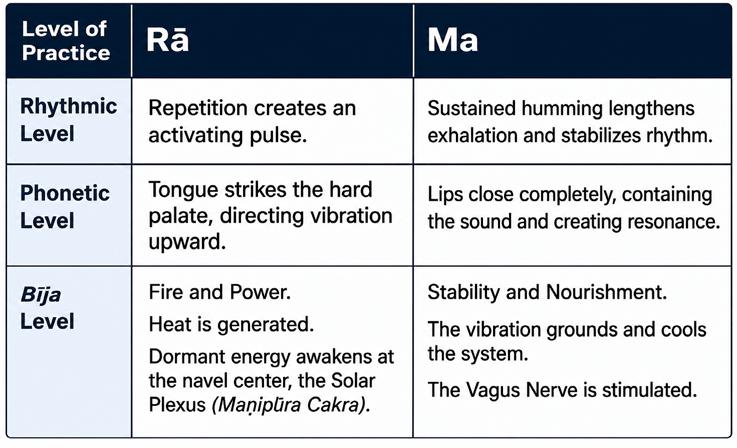
When combined into “Rāma,” these sounds form a balanced formula. The “Rā” ignites the internal fire and power, while the “Ma” provides the stability and containment to utilize that energy safely. It is a design for energetic equilibrium. It is not just a name.
Mantra practice functions as a biological metronome. Through steady rhythm and repetition, it regulates the nervous system directly, bypassing the cognitive mind. Much of our mental activity operates as repetitive background narration. Neuroscience refers to this as the Default Mode Network (DMN), the network associated with “self-talk” or “background chatter.” When overactive, it produces constant mental noise and subtle stress.
Mantra chanting begins to interrupt this pattern. As repetition becomes steady, the internal dialogue diminishes. Brainwave patterns shift from heightened Beta activity, associated with anxiety and vigilance, toward more coherent Alpha states, associated with relaxed awareness. This shift occurs through Neural Entrainment. Just as you tap your foot to a drumbeat, brain activity begins to synchronize with the rhythm of the mantra. The mind settles because the nervous system is given a stable pattern to follow.
The phonetic structure deepens the effect. Sustained humming sounds, such as “Ma,” create resonance in the chest, throat, and skull. This vibration stimulates the Vagus Nerve, supporting regulation of heart rate, cortisol, and blood pressure. The body gradually shifts from sympathetic activation, commonly described as “fight or flight,” toward parasympathetic balance, often called “rest and digest.” Over time, continued repetition promotes Somatic Regulation.
Stress and unresolved emotional patterns are often held within the nervous system. Mantras act as “carrier waves,” providing a stable, organized frequency through which these patterns can gradually settle. Practitioners may experience emotional release or a sense of lightness as the system reorganizes and stored tension softens.
As repetition stabilizes, the system begins to synchronize. Breath, heart rhythm, and neural oscillations move into coherence with the rhythm of the mantra. This alignment is described as Phase Locking, a state in which internal systems begin to operate in harmony rather than fragmentation.
Yet the most essential phase of the practice begins when the sound stops and silence begins. If the mantra is the hammer used to strike a bell,silence is the resonance that continues after the strike. We call this: the “Residue of Sound.”
In this stillness, the effects of the mantra integrate. The vibrations continue to echo throughout the nervous system, allowing the energy to integrate and reorganize our biology. If one rushes immediately into activity after chanting, that integration is interrupted. You “throw away the meal” you just cooked. This is where Cultivation occurs.
Much of what binds us operates through unconscious repetition. Saṃskāras give rise to vāsanās, and vāsanās repeat as habit. Through these patterns, we feel trapped, as though we are confined within a world of “solid matter.” Mantra introduces a different kind of repetition. It shifts attention from rigid identification with form toward awareness of rhythm and vibration. Mechanical mental narration is gradually replaced with deliberate frequency. Over time, this conscious pattern begins to reorganize the unconscious ones.
Freedom is cultivated through refinement. When sound becomes steady, the mind steadies. When the mind steadies, awareness clarifies. In silence, that clarity reveals itself.
As the mantra thins the ego’s grip of habitual self-talk, the practitioner rests as a vessel of pure awareness. The mantra serves as a boat to cross the river of mental noise. Once stillness is reached, even the boat is left behind. Then, we stand in the quiet reality of existence.
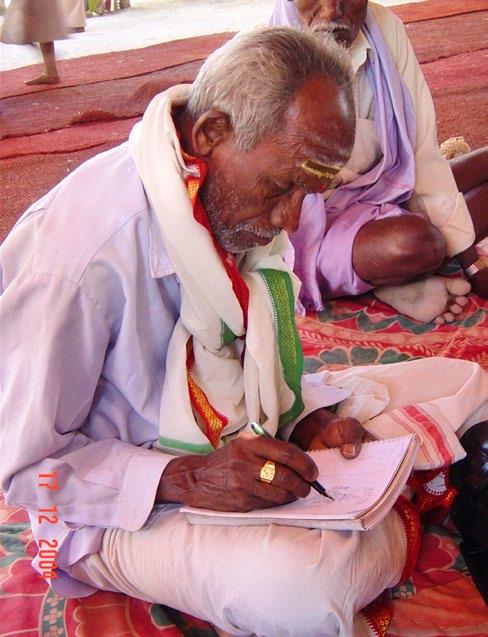
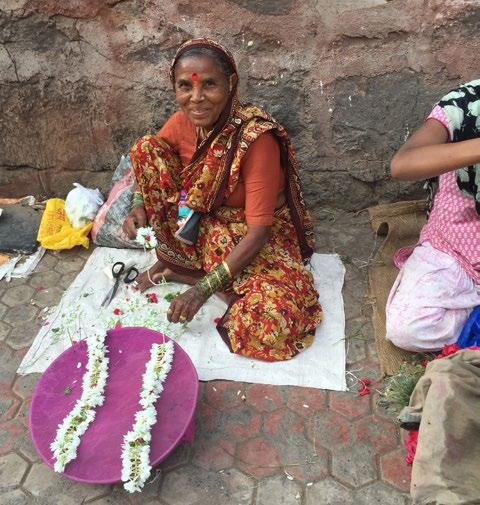
“Jo ithe ālā, ithlāch jhālā.”
“Whoever comes here becomes part of
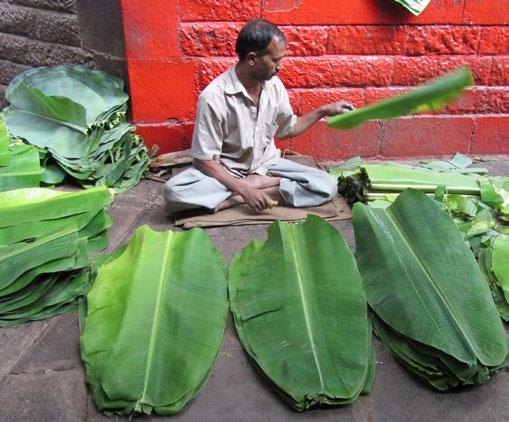
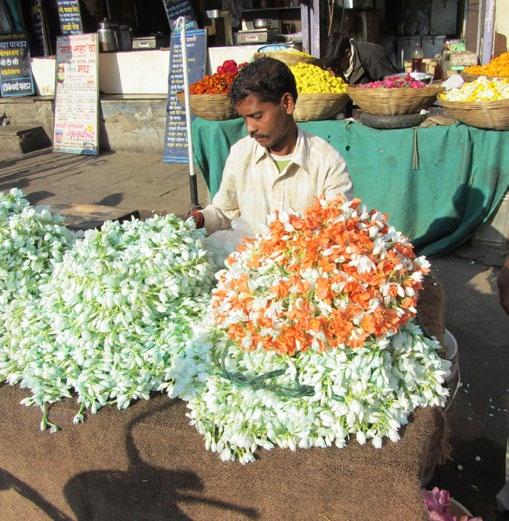
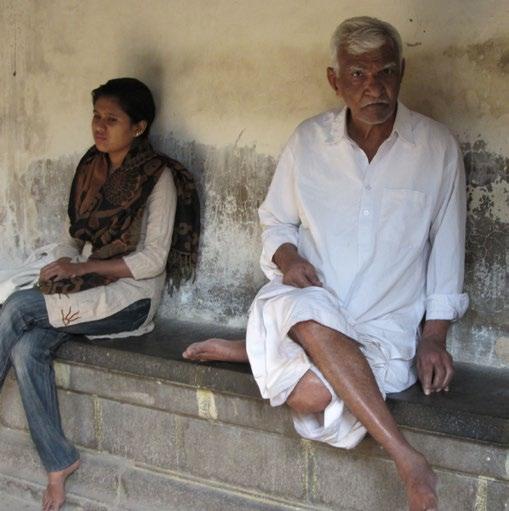
A senior teacher told the class- “You’re beginners for the first 20 years.” Authentic progress on the path of yoga is indeed a slow process! While my awareness focused initially on the outer body, over the past forty years, it’s traveled inward making practice a transformative experience in increasingly subtle ways. And, as my understanding of yoga and its sister sciences, Āyurveda and Jyotiṣa grew, I came to see that there’s a divine order to the universe, one that provides each of us with what we need if we’re paying attention.
I began taking classes in 1986 and was told that Guruji wanted students to bring intelligence to every cell of the body. Although I’d inhabited my body for forty years, I quickly discovered that, in many ways, it was foreign territory!
Slowly but surely, I made friends with places in my physical body with which I’d never worked consciously. As a result, tight places stretched, weak places strengthened, and I left each class, feeling both relaxed and energized.
It took me six months to establish a home practice. And, once I did, my ability to be fully present in class increased, as did my understanding of what actions helped my body become physically aligned. While I could maintain multiple actions in an āsana, bringing intelligence to every cell of the body was a long way off! In those early years, I got to know my body by mentally puzzling out misalignments and then correcting them physically with actions I’d been taught. Over time, that changed in a substantive way. The intelligence of my entire body saw what needed to be done and did it, without my mind having to puzzle things out. That brought an early sense of freedom to my practice. And, eventually, a similar shift took place in my teaching.
When I started teaching in 1989, I had to puzzle out each student’s body in my head and decide what action might serve their particular body. However, after a few years, what action was needed came to me suddenly, like a flash of lightning!
Somehow, my entire being, the subtle intelligence within, knew what needed to be done, and quickly communicated that to me. While I didn’t initially trust the insight that arrived like a flash of lightning, over time, I did because, again and again, that sudden insight effectively served the student’s needs.
To what do I attribute this gradual progress? One, I’d developed a dedicated daily practice which became longer over time. Two, I’d studied with teachers who knew far more than I did, and, to this day, I remain deeply grateful to each of them. Initially, I’d felt disadvantaged not to have a senior teacher with whom to study on a weekly basis. Then, one of my mentors said that it was actually an advantage because I had to figure things out on my own. Later, at RIMYI, I discovered that was precisely what Guruji and his family wanted each of us to do!
My first trip to RIMYI in 2001 marked a real turning point in my understanding of yoga. While I’d attended IYNAUS conventions where Guruji taught, to be able to practice six days a week in the same room with him and to be able to take classes with both Geetaji and Prashantji was incredibly inspiring. But, it was something Prashantji said in almost every class that really captured my attention and made me want to know more.
“Yoga is a state of being not a state of doing.”
That sentence was unlike anything I’d heard from teachers back home! And, after a week of classes, I gathered the courage to ask Prashantji if we could meet, which he kindly agreed to do. Over the next three weeks, multiple meetings at Pandu’s desk allowed me to ask questions and confirm whether I’d correctly understood what he’d taught.
While teachers in the U.S. encouraged me to do increasingly advanced āsanas, Prashantji worked with very basic āsanas. And, rather than focusing on instructions to the physical body, he often invited us to bring the breath to different places in the body. Working in this way revealed the importance of the breath in āsana. I began to feel how prana flows differently in each āsana and how attending to it in these new ways brought my mind to a quieter, more peaceful state. Prashantji’s classes were definitely helping me experience my embodiment in more and more subtle ways! I returned to RIMYI in December 2003, and, once again, was deeply moved by Prashantji’s classes.
“Yoga is a mirror to look at ourselves from within.”
— B.K.S. Iyengar
Through Prashantji’s teaching, that mirror was brought to new places. I began to experience the pranic body in ways I hadn’t previously encountered. I was moving closer to a state of being, what I often describe as a state of empty/ fullness. As a result, my journey along the path of yoga became the top priority in my life.
When my younger brother died suddenly of a stroke in October 2004, I was reminded that my own life could end suddenly and unexpectedly. And, given that yoga was my top priority, I made a vow that I would spend every December at RIMYI. I kept that vow and returned to the Institute annually for fifteen years, through 2019 and the arrival of Covid. And, I believe that doing so was the best decision I’ve made in this lifetime! During those fifteen years, when we practiced, I learned not only from what I did but also from pausing my own practice to watch Guruji mentor Abhijata and help other students. On one occasion, frustrated that several senior teachers weren’t understanding what he was asking them to do in he āsanas they were practicing, as he returned to his own practice, Guruji threw his arms up and exclaimed- “You call yourself teachers, I am a learner!!!” That moment reminded me of something Geetaji had said in class- “I give you the clues, the work is yours!” Both Guruji’s and Geetaji’s comments made a lot of sense to me!
We each enter the world with an innate curiosity; we want to explore and learn. And, Prashantji was also asking us to be learners by inviting us, in each āsana, to explore our own embodiment on a prāṇic level.
And, as my understanding and practice of his teachings deepened. I got to know my prāṇic body in a new way. At the end of a class, I often felt like prana was flowing freely within my embodiment. At such times, I felt at one with all that is. And, I was reminded of a Rumi line-
“Not until someone dissolves can he or she know what true union is-that descends only into
Although Covid prevented me from teaching and returning to RIMYI for three years, during that period, I felt more grateful than ever for my practice! And, while I was able to return to RIMYI in 2023, I haven’t been able to do so again. While I miss being at the Institute, I “attend” Prashantji’s Saturday philosophy satsanga as well as his prāṇāyāma and āsana classes. By doing so, my journey continues to progress.
As Guruji said- “All of us have a dormant spark of divinity in us which has to be fanned into flame by yoga.” Prashantji’s teaching and my own practice continue to take me to more subtle places in my embodiment, and, in so doing, help ignite that flame. Prashantji says, again and again, that yoga is a knowledge process, a wisdom process. And, it’s very clear to me that, like Guruji and Geetaji, Prashantji wants us to develop knowledge through “experiential learning.” In recent classes, he’s said- “It’s not proper to be spoonfed by teachers all the time.”
“Don’t be totally teacher dependent. Otherwise you won’t develop your own intelligence.”
”There’s a lot to watch and observe. I’m not telling you what to do.”
”I’m not your teacher. I’m drawing you to the teacher within you.”
To help us become more intelligent and move towards the teacher within, at times, Prashantji gives us “sensitivity exercises.” We may practice certain āsanas using sound forms in different parts of the body or we may do Viloma II in a variety of supine āsanas. By practicing in this way, Prashantji says that we transform ourselves: “Like a snake sheds its skin, you shed your mundanity.”
Over time, what he calls the collective dynamic composite takes over: Body, mind, breath, senses, psyche, thought, consciousness, awareness. Then, Prashantji says-
“You don’t have to do it; they do it.”
“Yoga is not a mechanical machine. It’s a cosmic machine.”
Many of the āsanas I now practice are those that I worked with as a beginner. But, thanks to Prashantji’s teachings and forty years of practice, my experience of the āsanas is quite different. I’m much more attuned to the flow of pranic energy in the body, and I’ve been given increasingly subtle ways, as I practice both āsana and prāṇāyāma, to become one with all that is, to move towards union with the divine.
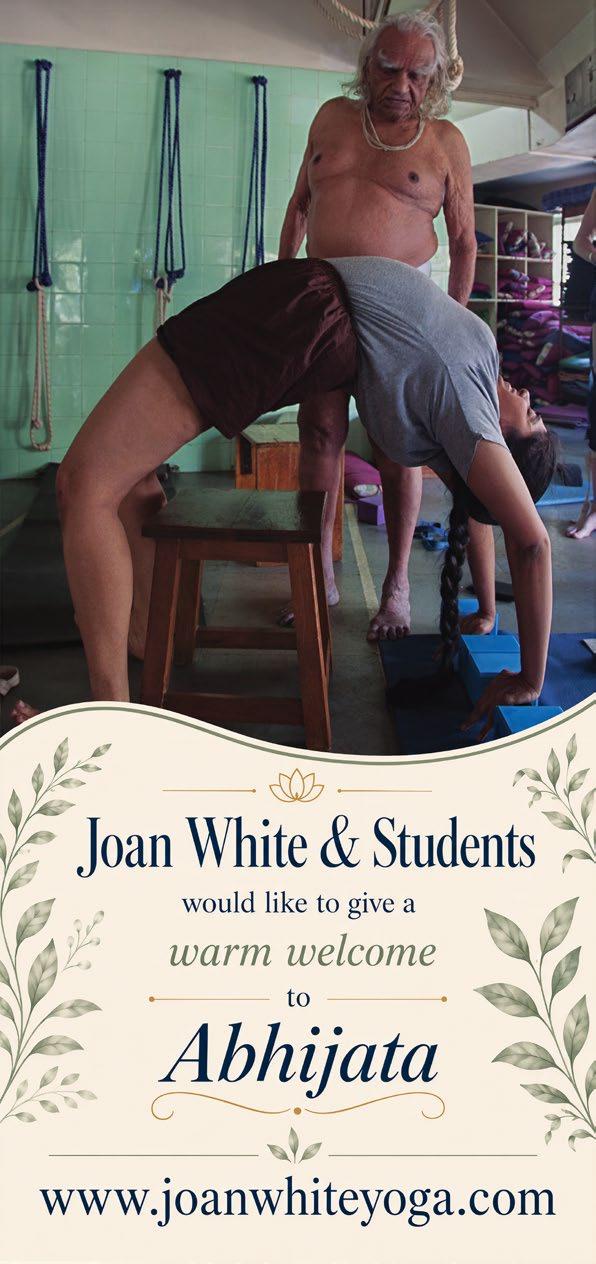
And, I’m forever grateful to Prashantji for expanding the means for each of us to do that! I also feel immense gratitude to the entire Iyengar family for the teachings they’ve generously shared with the world. And, given the times we’re in, I believe the practice of yoga is one of the most beneficial things we can do, not only for ourselves, but also for the world.
As Rabindranath Tagore says-
“In the song of the rushing torrent, hold onto the joyful assurance: I will become the sea. And, this is not a vain supposition; it is absolute humility, because it is the truth.”

by Naomi Hiller Reynolds
As I write this, it’s a cold, blustery November. Winter is coming. My mind keeps moving forward to May when we will gather in Philadelphia. Last year was a memorable one for a multitude of reasons. My friends who study Jyotișa, the Vedic system of astrology, agree that the oncein-a-lifetime alignment of planets and energies has been epic. Even if you don’t follow astrology and the planets, you would have to have been living under a rock not to notice and be affected by what has transpired in 2025.
Personally, I was presented with opportunities and choices that pushed me so far out of my comfort zone that it felt terrifying and unimaginable. In January, my marriage of 30 years was crumbling, and at the same time I was taking over ownership of a yoga studio with two other teachers. The apparent end of one life and the beginning of a new one had me feeling like Arjuna on the eve of the great battle: Paralyzed by doubt and sorrow, confounded, dejected, and unable to move forward. In that moment, Krșņa instructed him to:
“Perform your prescribed duty, for action is better than inaction. One cannot maintain even his physical body without work.”
— Gītā 3.8
As a practitioner of almost 40 years, I did what any of us would do. I practiced. I threw myself not only into āsana practice, but worked endless hours to make the studio run. I joined practice groups. I attended classes. I taught classes. I worked as Krșņa had urged Arjuna to do.
This new opportunity offered me the chance to utilize my gift of yoga and skills in business. Two callings that had seemed at odds my whole life were suddenly brought together in this scary and overwhelming karmic golden opportunity. I was straddling two separate worlds, emotionally and spiritually. How could I not use my talents and skills to benefit the studio and its community?
By April, I had hit bottom. My body was hurting, my heart was hurting, and my mind was hurting. With some urging from trusted friends, I realized that holding my pain inside wasn’t the way forward. I needed to share what was in my heart and head, both with those close to me and with my husband from whom I had separated. I had to set aside my ego and be vulnerable. I realized that I was lost in the kleśas, from avidyā through to abininveśa. Hitting me in the face, full force. Avidyā distorted my perception. Asmitā tightened my sense of self. Rāga kept me attached to comfort and dveșa pushed me away from a new way of life. Abhiniveśa made it difficult to let my old self die. Let’s be honest, these dynamics were always there, but I really felt them now. And the surety that I usually operated with was mightily challenged as I navigated unknown emotional territory.
It was so very difficult to come to this realization. But once there, my heart lightened and the shift came easily. I told my husband that I needed him. I told those around me I needed help. It was such a new and unfamiliar place to be sharing my vulnerable side. And yet that softening, that opening, and that vulnerability led to a new liberation for me: A new path forward with my husband, a deeper relationship with my yoga studio partners, and a new level of compassion in my teaching.
We all struggle with challenges and obstacles. That’s part of life. It’s unpredictably full of sukha and duḥkha. We all strive to rise above it to gain moments of happiness, or at least to gain freedom from duḥkha. Yoga can help us be strong and resilient. Our teachers and gurus guide us, our svādhyāya reinforces it, and our sadhana confirms it. But along the path, we can get lost, even when we think our footing is sure.
When we’re deep in our pain, it can be difficult to find perspective, let alone liberation from pain. But that’s what our practice can do for us. And what following our path can provide. Whether you practice for yourself, or practice to find inspiration to teach others, or somewhere along that spectrum, we have a gift from Guruji. He instilled within us the power to transform our duhkha through effort into mokśa. This is our dharma.
Dharma has a broad interpretation depending on its context. At the core, it relates to the concepts of support, order, duty and righteousness. And whether you consult Hinduism or Buddhism, dharma provides the framework for ethical living and spiritual understanding, a foundation to which we set our moral compass. Dharma supports the edifice of mokśa. Mokśa requires dharma.
Mokśa is defined as freedom, or liberation. These terms might seem interchangeable, but in practice they are distinctly different, philosophically, psychologically, and spiritually. Freedom generally refers to the absence of external constraints, a state where one can act, think, or be unhindered by coercion or limitation. Liberation is more of an emancipation from internal bondage, ignorance, attachment, and suffering. While freedom is a necessary precursor to liberation, liberation demands an inner transformation that radically reshapes one’s relationship to the world and to oneself.
As I interpret it, mokśa is both freedom and liberation, and more. It is the transcendence of the ego and the dissolution of ignorance. It is the state beyond freedom, a union with the divine and with ultimate reality. For those of us following the path of Iyengar (and Patanjali’s) yoga, it is our aim and goal, albeit a seemingly far away and lofty one, to reach mokśa. Our teachers amplify the importance of deepening the practice beyond mere bodily or mental ease and moving towards an immersive self-knowledge and transformation.
The gift of yoga is a dharma we share. We have all felt its power. This past year, as I worked through my challenges, I kept following my dharma. To share my passion for yoga, my skills in business, and my compassion for people experiencing emotional or physical pain.
Each human shares an experience of pain and suffering. Yoga offers a path to freedom and liberation from suffering. Knowing that, we can all extend the gift of yoga to anyone in need, whether they are students in our class, people in our extended community, or a random stranger encountered during your day.
I urge each of you, no matter what has happened to you this past year or what unimaginable events you’ve endured, to work the dharma we have inherited in this lifetime. Share your gifts of compassion, joy, friendliness, and equanimity that you have developed through your practice and that which sustains you. Work to share these gifts for the good of our local and global communities.
The Gītā reinforces this path to freedom. In two of the most renowned verses, Krșņa states:
“You
As I write this, I look forward to May. We will bring our complete beings to Philadelphia; our sukha and our duḥkha. And we will be bringing our dharma to share and enliven each other. I am looking forward to seeing you. I am looking forward to the hope of a new year. Most of all, I am looking forward to sharing this gift of yoga.
have the right to work, but never to the fruit of work. You should never engage in action
for the sake of reward, nor should you long for inaction. Perform work in this Arjuna, as a man established within himself – without selfish attachments, and alike in success and defeat. For yoga is perfect evenness of mind.”
— Gītā 2.47-48
by Elizabeth
In 1997, in my first yoga class at RIMYI, Geetaji asked me to “get out.” An assistant quickly appeared and took me to sit on the balcony (there used to be a balcony in the yoga hall). Fighting back tears, I watched the class, until the end, when another assistant came to me and said, “apologize to your teacher.” Geetaji, sat on the platform and I stood before her, terrified and apologized. Still angry, she looked at me, turned her head then looked away.
I cried all the way back to the Chetak Hotel and fell asleep that night in tears. I had flown from Chicago to Amsterdam, on to Mumbai, and then taken a five-hour car ride in the middle of the night to Pune, after waiting years to study at RIMYI. Four years earlier, I had spoken with my teacher, Joan White, about my desire to go to Pune. Before one of Joan’s annual trips, she took my $100 cash deposit and returned with an airmail envelope confirming my reservation for July and August 1997. I carried that precious piece of paper with me as I moved from Philadelphia to Chicago in 1996 and then, the following year, to India. Somewhere along the way, I missed something, and that absence led me to be asked to leave my first class at RIMYI. I was determined to find what was lost.
I was 10 years old in 1976, the United States Bicentennial, and in Philadelphia there was a buzz of activity. Queen Elizabeth visited from England, tall ships arrived from around the world, and thousands celebrated at Independence Mall. Philadelphia, considered the birthplace of the U.S., is where the Declaration of Independence and the U.S. Constitution were written and signed, and was the first U.S. capital. In 1976, B.K.S. Iyengar also visited the United States, and in Philadelphia he gave a public demonstration of yoga at Haverford College. The artist Robert Engman was commissioned to make a sculpture commemorating Guruji’s 1976 U.S. visit, and the abstract bronze sculpture entitled After B.K.S. Iyengar can be seen in Philadelphia at the Morris Arboretum.
Fifty years later, for our country’s Semiquincentennial, Guruji’s granddaughter, Abhijata, visits our city, bringing people together again in the exploration of yoga.
In the mid-1980s, I was in college in New York City, and my dance teacher and friends were all going to Peentz Dubble’s yoga classes at Barnard College and downtown at the Iyengar Yoga Center of New York. I joined, and it was in Peentz’s classes where I first heard about Mr. Iyengar and his approach to yoga, where everyone was welcomed, no matter their experience or health condition.
I learned that this approach to teaching yoga came from Mr. Iyengar himself, and that he taught people of all ages and backgrounds and developed the use of “yoga props” so everyone could benefit from and understand yoga āsana and prāṇāyāma. The atmosphere in class was inclusive and non-competitive, with an emphasis on self-awareness and self-knowledge. The teaching felt democratic and even revolutionary in comparison to my dance and academic studies. When I graduated from college, my father asked what I was going to do, and I spontaneously said: “I don’t know, but I will always do yoga.”
After college, I traveled in Europe and settled in Amsterdam. When I arrived in 1988, I searched for Iyengar yoga classes and found classes offered by Clé Souren and Nanda Peek. Their home studio was on a small street, in the front room of their apartment. I could follow even though the classes were in Dutch, with occasional English instructions. The emphasis on precision and observation was familiar and clear, regardless of the language.
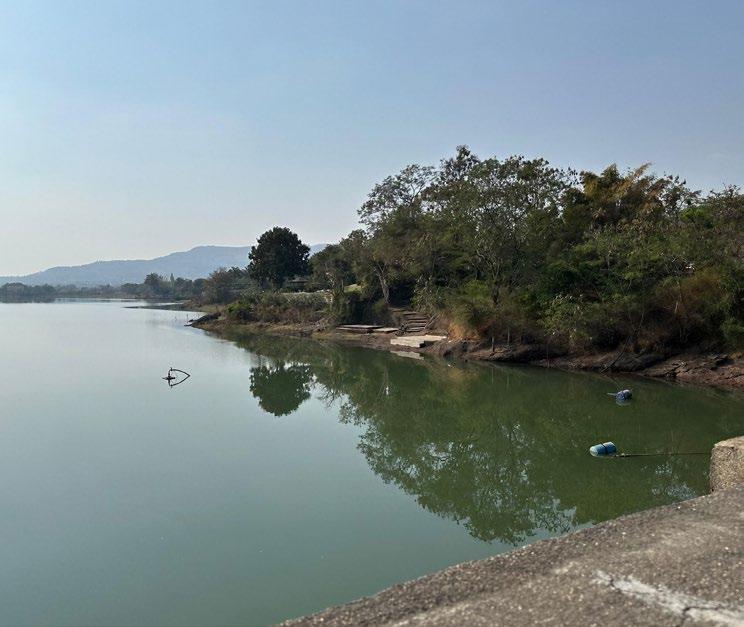
In 1991, I moved back to Philadelphia and told my mother that I had heard there was a great Iyengar Yoga teacher in Philadelphia and that we should try her classes. We soon joined Joan’s classes and, immediately, we were hooked. I started going twice a week, and Joan’s classes gave me the stability that I didn’t know I was looking for. Joan’s cats and dogs greeted us as we entered her home to go to class in her converted attic-turned yoga studio. The warmth of Joan’s yoga room drew me in, and I loved seeing photos of Joan and Mr. Iyengar together, along with objects from Joan’s travels. Joan’s dynamic teaching was filled with stories and explanations about yoga given to her by Iyengar himself. I felt close to my teacher’s teacher and to Pune because of Joan’s connection and yearly studies in India.
It was during those years that I got the idea to study at RIMYI. Before I left for India at the end of June, Joan remarked that since I would be in Pune before my starting date of July 1, maybe I could take classes. When I arrived in Pune, I made my way to the Institute, registered, and asked Pandu about taking classes before July. He told me to show up to class that night.
It was the end of the month, and Geetaji was teaching prāṇāyāma. Like all first timers at RIMYI, I was confused about where to get props, and Geetaji saw me among the 80+ people in the class.
She came right up to me and asked,
“Are you here for the Canadian Convention?” (which was also starting on July 1).
“No,” I replied.
“Are you here for general classes?”
“Yes,” I replied.
“When are you supposed to start?”
“July 1,” I said.
Then she responded quickly, “I knew that I never saw you before,” and yelled, “Get out!”
She took me out of the class because she didn’t know me. I came to understand that during the month she had brought the students through āsanas to prepare for prāṇāyāma. She knew what her students could do and what they couldn’t. As she said, she had never seen me before and didn’t know my experience or abilities. Geetaji took me out of class out of care and concern for my wellbeing. Getting thrown out of class was my first, and one of the most important, lessons that I received from my studies at RIMYI.
On that first visit, I saw that Guruji, Geetaji, and Pranshantji watched every student, whether we knew it or not. Nothing was missed. I saw Guruji ask someone from across the yoga hall what was going on with their left lung during prāṇāyāma class. Later in life, Geetaji gave me a yoga sequence by email to stop the bleeding that came during the fourth month of my first pregnancy (it worked, by the way).
In The Yoga Sūtras, Patañjali describes the mind as being like a mirror that gets clouded by past experiences and conditioning. It is through the practice of yoga that we clear our mirror so we can see our true Self, our true nature.
For the last 26 years, I have lived in Berlin, and in 2024 we were honored by Abhijata teaching at the German Iyengar Yoga Convention. Abhijata told us the story of how she was nervous before her first international teaching trip. She knew that she would be teaching people who had been studying Iyengar Yoga longer than she had been alive. She wondered what she could teach them, and Guruji saw that she was nervous. He said to her, “Do you think that they will be coming for your teaching? They will be coming for what I have taught you.” With a smile, Abhijata told us that in that moment her nervousness was gone. The burden had been lifted because she then knew what was hers to share.
This is what it means to learn yoga within a lineage. Through the teachings, we discover that what we think we are lacking is already here. Self-knowledge, insight, and even liberation are our true nature and reside in each one of us. In Light on Life, Guruji calls this The Will to Be Free and writes:
“In spite of its attractive sound, to the average person a daunting prospect, implying as it does entry into the heart of the unknown, detachment, and the potential pain of ultimate self-knowledge. This requires real guts.” (p. 168)
Our yoga tradition cultivates these needed “guts” by nurturing our willpower through dedicated and diligent practice. It is through yoga that we come to realize that we are always free, inwardly free, and it is this recognition of freedom that becomes the focus of our lives. Through a clear mirror, we see that nothing is lost. Rather, it is here, ready to be found.
Elizabeth Smullens Brass is a German Level 3 CIYT originally from Philadelphia, Lives in Berlin
by Frederick M. Smith
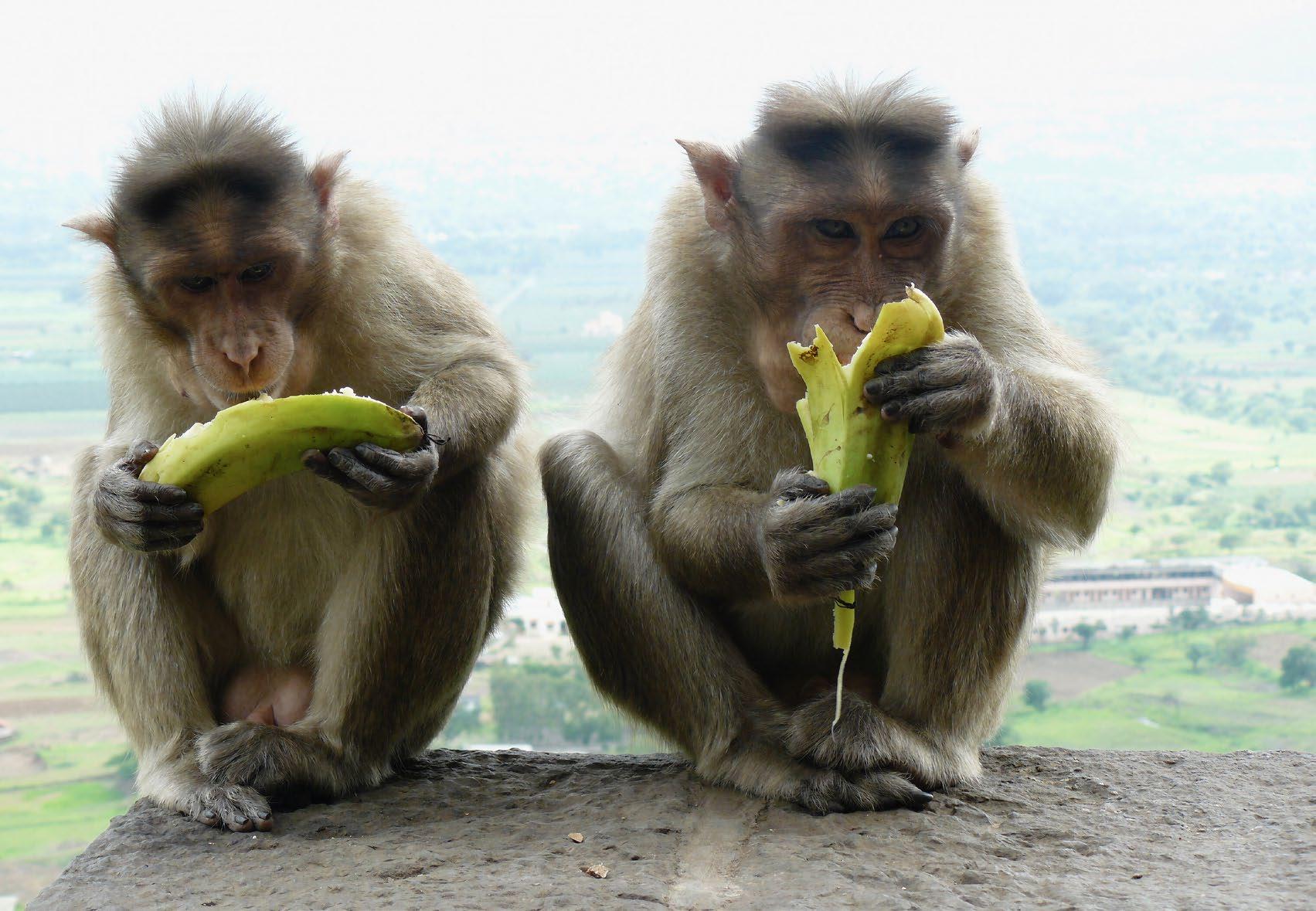
The Mahābhārata, redacted in Sanskrit about two thousand years ago, tells innumerable stories that are both central and peripheral to the overarching one of the rivalry between the Pāṇḍavas and the Kauravas, the great war which was at the time the war to end all wars. It also explores a myriad of philosophical, spiritual, and cultural issues and doctrines that defined the landscape of North India at the time.
One story that comes up in several places speaks about Rāma Jāmadagnya (“Rāma the son of Jamadagni”), not to be confused with Rāma the righteous king in the other Sanskrit epic, the Rāmāyaṇa. In later Indian sacred literature, Rāma Jāmadgnya became known as Paraśurāma (“Rāma with the Axe”), celebrated as the sixth avatāra or descent of Viṣṇu.
In the Mahābhārata, Rāma Jāmadagnya’s father Jamadagni was killed well before the great war by the kṣatriya Kārtavīrya Arjuna (not to be confused with the great Pāṇḍava hero Arjuna).
Jamadagni was a brahmin and Rāma’s mother, Renukā, hailed from a respected kṣatriya or warrior lineage. To avenge his father’s killing, Rāma Jāmadgnya, who had gained a great deal of spiritual power through lifetimes of practice, slaughtered twenty-one generations of kṣatriyas, an epic feat like all things in the great Indian epic.
He was unstoppable. But one day he was told the following tale about the senses and their interdependence:
Mahābhārata, Āśvamedhika-parvan 14.30.2-31 (from the Anugītā):
There was once a royal sage, Alarka by name, who practiced the most severe austerities. He was a knower of dharma, associated with the truthful, was highly esteemed, and kept very strict vows.
Conquering the entire earth up to the shores of the ocean with his bow, a very difficult deed to accomplish, his mind became absorbed in the subtle.
Then, sitting at the foot of a tree, he became uneasy. He cast away his great kingdom and set his sights on what lay within.
Alarka said:
“My mind has become strong. Conquering the mind is a victory that has become firm. Although I’m surrounded by enemies, I will fire my arrows in other directions.
The mind, its appearance notably wavering, always desires that it should act. I shall fire very sharp pointed arrows at the mind (manas).”
The mind said:
“These arrows cannot possibly pass through me, Alarka; they will only rupture your vital points (marma). Your vital points ruptured, you will die.
Look for other arrows with which you can kill me.”
After hearing this, Alarka reflected for a while, then spoke these words:
“After smelling countless scents (gandha), the nose greedily goes towards them alone.
Therefore, I shall fire sharpened arrows towards the nose.”
The nose said:
“These arrows cannot possibly pass through me, Alarka; they will only rupture your vital points.
Your vital points ruptured, you will die. Look for other arrows with which you can kill me.”
After hearing this, Alarka reflected for a while, then spoke these words:
“This one, having enjoyed delicious tastes (rasa), greedily goes towards them alone.
Therefore, I shall fire sharpened arrows towards the tongue.”
The tongue said:
“These arrows cannot possibly pass through me, Alarka; they will only rupture your vital points. Your vital points ruptured, you will die.
Look for other arrows with which you can kill me.”
After hearing this, Alarka reflected for a while, then spoke these words:
“The skin, after touching various objects of touch (sparśa), greedily goes towards them alone.
Therefore, I will pierce my skin with heron’s feathers.”
The skin said:
“These arrows cannot possibly pass through me, Alarka; they will only rupture your vital points. Your vital points ruptured, you will die.
Look for other arrows with which you can kill me.”
After hearing this, Alarka reflected for a while, then spoke these words:
“Having heard different sounds (śabda), the ear greedily goes towards them alone. Therefore, I shall fire sharpened arrows towards the ear.”
The ear said:
“These arrows cannot possibly pass through me, Alarka; they will only rupture your vital points. Because of that, you will destroy your life. Look for other arrows with which you can kill me.”
After hearing this, Alarka reflected for a while, then spoke these words:
“Seeing different states of existence, the eye greedily goes towards them alone. Therefore, I shall fire sharpened arrows towards the eye.”
The eye said:
“These arrows cannot possibly pass through me, Alarka. Your marmas are ruptured; as one with a ruptured marma, you will die.
Look for other arrows with which you can kill me.”
After hearing this, Alarka reflected for a while, then spoke these words:
“The intellect (buddhi) has determined various kinds of certainties with the help of higher knowledge. Therefore, I shall fire sharpened arrows towards the intellect.”
The intellect said:
“These arrows cannot possibly pass through me, Alarka; they will only rupture your vital points. Your vital points ruptured, you will die.”
The ancestors said:
“Although Alarka undertook fierce and very difficult austerities, with his supreme psychic energy he was unable to obtain arrows (to fire) at these seven. His consciousness (cetas) highly concentrated, he then contemplated the matter. Then Alarka, the finest among the intelligent, thought about it for a long time and could not obtain anything better than yoga.”
“He made his mind one-pointed, immovable, established in the practice of yoga. This energetic one quickly annihilated the senses with a single arrow, becoming absorbed in the Self through yoga, attaining the highest perfection. Amazed, this royal sage then uttered this verse: ‘Alas, the hard truth is that we previously gained a kingdom, yet I did not know until later that there is no supreme happiness except through yoga.’ Know this, O Rāma, do not kill kṣatriyas. Practice fierce austerities, then the highest good will take possession of you.”
The brāhmaṇa said:
“After the ancestors said this, the son of Jamadagni performed severe austerities. That undertaken, this highly fortunate one gained perfection, difficult to achieve.”
First, what is a marma? The Suśruta Saṃhitā, one of the most important ancient Indian Āyurveda texts, states:
“(A marma point is) an aggregate of flesh (māṃsā), veins and other tubular structures (śirā), muscle and ligaments (snāyu), bones (asthi) and connective tissue (sandhi). The prāṇas abide inherently, explicitly, in them. Therefore, any injury to them leads to consequential states.”
The most consequential state resulting from piercing a marma is sadyaḥprāṇahara, “sudden death.” Direct treatment to marma points remains an important part of Āyurveda today, at least in theory, even if very few Āyurvedic practitioners practice it now.
The more important lesson here is that the organism, inclusive of body, mind, and spirit, requires integrated development, which can be achieved through yoga. Overdevelopment of one sense, such as hearing or taste or smell, cannot be regarded as “cultivating freedom.”
Only the careful cultivation of the five senses, the mind (manas) and the integrative faculty called buddhi (the usual translation, “intellect,” does not convey this) can allow the consciousness to ascend to its higher state of freedom. That yoga is not only one practice or another is what Alarka taught to Rāma Jāmadagnya.
By understanding the yoga of full mind-body integration, Rāma Jāmadagnya was able to shake free of the conditioning from past births (saṃskāras) and habits of this birth (vāsanās) and gain perfection (siddhi), difficult for anyone to achieve, let alone a warrior with a history of compulsive violence.
Frederick M. Smith is a professor at Amethyst University, Iowa, specializing in Sanskrit and Indian religion. He has numerous publications and lives in Santa Fe, NM.



by Matt Dreyfus
“O God, I could be bounded in a nutshell and consider myself a king of infinite space, were it not that I have bad dreams.”
That’s Hamlet, speaking a truth I think we can all relate to. Our embodiment itself, the skeletomuscular frame, skin, organs, thoughts, feelings, wishes, dreams, fears, hopes, and memories, has the capacity to be a prison, and has the capacity to be open and spacious. Yoga practice can crack open the nutshell or, more accurately, reveal it as an illusion. It does this in a particular way, because we use our own body as the field of inquiry and practice. This can be a revelation for those of us who have grown up in the modern West, because in our culture, the mind is often seen as separate from the body.
I have a vivid memory from when I was about twentytwo years old. I was on a cross-country road trip with a friend, and we were in the Rocky Mountains in Colorado. I was completely blown away. I’d never been anywhere so stunningly beautiful. The experience of breathing, of feeling the air on my skin and in my lungs, was exhilarating and awe-inspiring. This led to many years of backpacking trips and a new appreciation for the natural world. And yet, during this wondrous experience, I had a feeling of separateness, that I wasn’t fully there, that I was somehow apart from what I was experiencing. I came to recognize this sense of separation as a pervasive fact of life.
A couple of years later, in 1994, I found Iyengar Yoga, and pretty soon thereafter, Mary Dunn. Mary’s way of teaching was transformative, because it was so organic. Under her guidance, I learned how to be present in an āsana, to release what needed to release, to stabilize what needed stability, and to cultivate awareness and calm in the challenging realm of practice. I started to experience and recognize my mind states through my body, and things began to change. I studied with Mary for fourteen years, until her death in 2008. One day, coming out of her Tuesday afternoon class, a friend, who had some really
“I realized that if I was going to straighten my arms in Adho Mukha Śvānāsana, I would have to give up my despair.”
This struck me deeply, because I could absolutely feel what he meant. Our mind is present throughout our body, they go together, and they can heal each other When I first went to RIMYI in 1999, I encountered Prashant Iyengar’s unique teaching style, which was very breath-centric. By the time I came home, my relationship with breath in āsana had opened up dramatically. It is the breath that closes the gap between body and mind and helps us to integrate. It is the breath that takes us from the role of being a separate observer to being truly connected, from thinking to feeling. Once you have a foundation in āsana practice, your breath can be your best teacher. There are many techniques for using your breath to feel and to act in the āsanas, but to begin, all it takes is tuning in, observing, and feeling.
In the early 2000s, I also began practice and formal training as a student of Zen Buddhism. I became more grounded in my āsana practice and more comfortable in stillness. Early on in this exploration, I worried that Zen meditation was not in harmony with Iyengar Yoga. But my experience as a student in Gitaji’s prāṇāyāma classes calmed this fear. Over the years, the sense of difference between Yoga practice and Zen studies has faded, as things have become more natural.
Some time after Mary died, I felt the need for guidance and support and began to study with John Schumacher. In class, his instructions were clear, precise, and intelligent, and the effect was profound. I came to realize that one of the strongest aspects of his teaching was the fact of his long, uninterrupted dedication and practice, something unarticulated but absolutely present. This is a kind of teaching that may go unnoticed or unappreciated, but it is perhaps the most important imprint we receive from a teacher.
One aspect of B.K.S. Iyengar’s teaching that I think is really brilliant, among so many, is the way he used lateral standing āsanas. It is worth noting that when Prashantji wrote a book to help us understand the various ways of approaching āsana, he chose to use Utthita Trikoṇāsana (see his eye-opening Alpha and Omega of Trikonasana).
Matt Dreyfus is a Level 3 CIYT who lives in Hoboken, NJ.
There is something very particular about moving sideways and becoming integrated in that orientation. It is not part of our usual way of being and acting in the world, and I find these postures shift my state of being. Even the more energetically demanding āsanas, like Utthita Pārśvakoṇāsana, have this quality. I find that when I get into an āsana, as I stay and breathe, I can cultivate space and evenness, a sense of balancing the dualities of up and down, in and out, left and right. At some point, the equal spreading of energy brings a quality of stillness. This engenders a steadiness within me that I value so much. Somehow, the process of this balancing calms the waves of my mind and spreads my awareness. In Yoga Sūtra 2.33, Patañjali tells us that when we are disturbed by negative thoughts, we are to cultivate their opposite (pratipakṣa). I am reminded of Guruji’s commentary:
“The internal measuring and balancing process which we call pakṣa-pratipakṣa is the key to why Yoga practice actually works. In āsana, the pose first brings inner balance and harmony, and in the end becomes the outer expression of that inner harmony.”
— B.K.S. Iyengar, Light on the Yoga Sūtras of Patañjali
I recommend reading Guruji’s full commentary on this sūtra. It gives us a clue about the importance of practicing on our own. While it is wonderful and freeing to turn ourselves over to a teacher during class, in the end, Yoga is a process one does alone, within oneself. Of course, Yoga is not only about bringing ourselves calm, or energy, or whatever it is that helps us live our lives more freely.
Ultimately, it is about living in harmony with the realities of life, including the reality that this life is temporary. During the time of my father’s illness and death, I found that my practice was a huge support. I remember his funeral, digging a shovel into a pile of earth, filling the space above his coffin one shovelful at a time.In my past experience of funerals, the coffin would be lowered into the ground, and the mourners would each add a symbolic bit of dirt. We would leave, and the grave would be filled in by workers at the cemetery. The rabbi who performed the service for my father told us that we would fill the grave ourselves. It was the last mitzvah we could do for my father.
This was a profound and healing practice for me. The physical reality of it, the tactile feel of the process, and the opportunity to express the energy of loss through my body, as I offered my father’s body back to the Earth. Feeling with my body the fact of my loss and my grief was deeply nourishing. My years of practice surely supported my ability to be present, to allow the process to move through me, and to play out in a natural way. I am so grateful that I have learned to live more in this way, that the sense of separation within me has eased.
To paraphrase Hamlet, there are more things on heaven and earth than are dreamt of in our philosophy. It is my aspiration to live freely within this life, open to possibility. I believe that being present, experiencing things completely as they are, is the way to be free, and it is practice that makes this possible. As I write this piece, it is clear to me that everything I have as a practitioner I owe to my teachers and to my great good fortune in meeting so many incredible guides. I am deeply grateful to Yoga, and to my teachers, for opening this doorway for me, and for the possibilities of what is not yet realized.
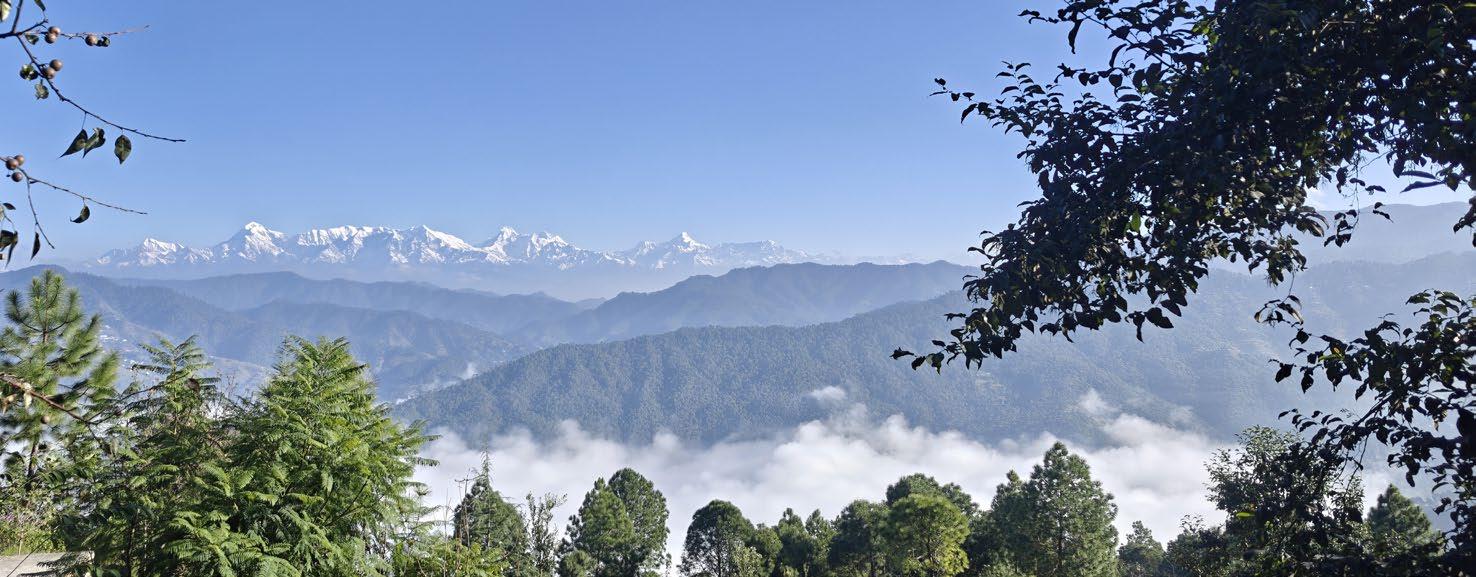


Welcome Abhijata and yoga practitioners from around the globe! In community we realize the freedom to enjoy connection, growth, & stability. Thank you all!



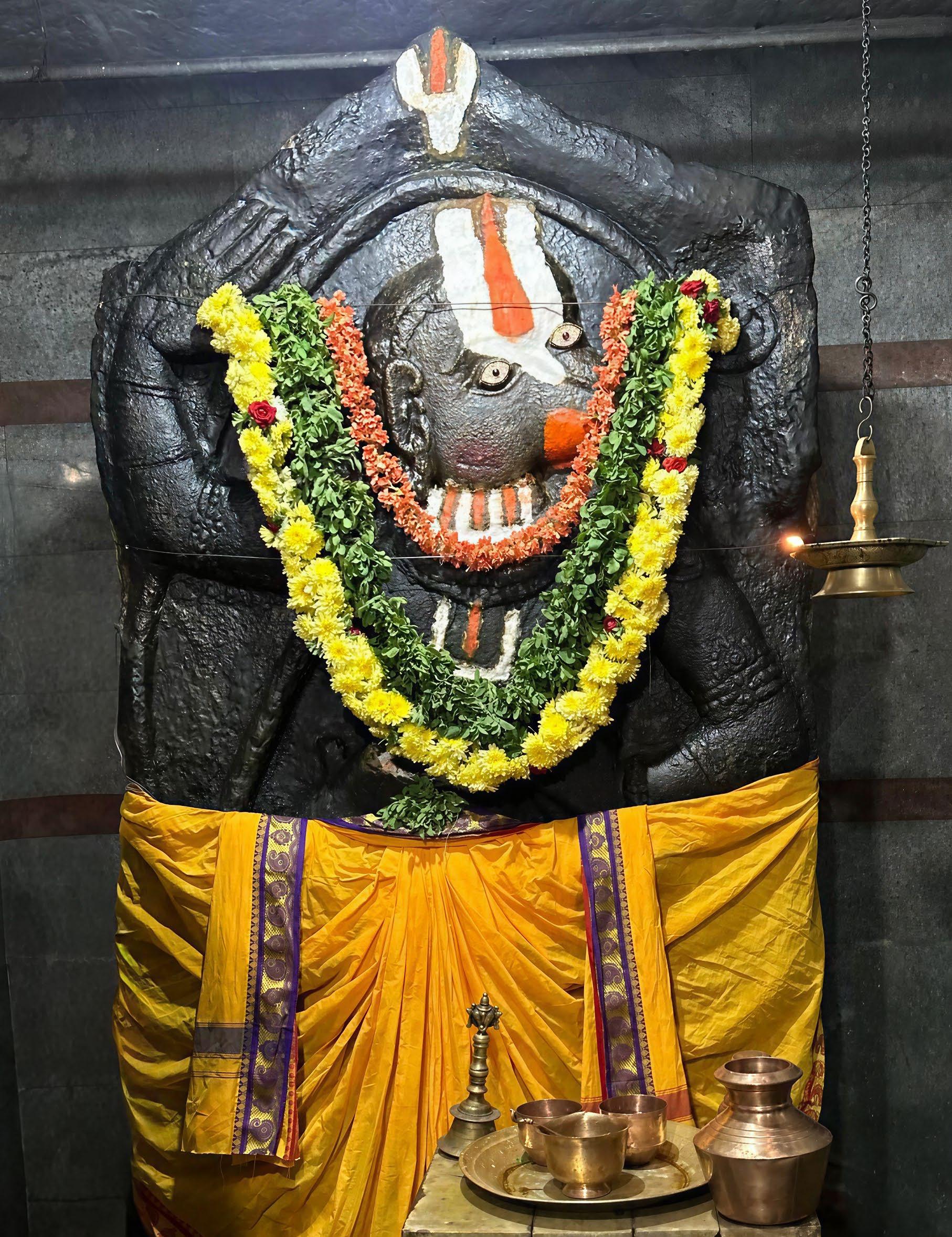
by Purnima Manghnani
“To a yogī, freedom implies not being battered by the dualities of life, its ups and downs, its pleasures and its suffering.
It implies equanimity, and ultimately an inner serene core of one’s being that is never out of touch with the unchanging, eternal infinite.”
—
B.K.S.
Iyengar, Light on Life
Freedom is a term with varied meaning and significance for different embodied beings. It is a word that tends to be used loosely, without depth or sensitivity. Freedom may be understood in personal, collective, or global contexts. Personal freedom is often understood as the ability to do what one wishes, without regard for consequences to oneself, others, or the environment. Discipline may be perceived as a constraint, restriction, or denial of personal freedom.
In yogic philosophy, discipline is the means to freedom. Discipline in our practice cultivates freedom, and it is through discipline that freedom is experienced. From what do we experience freedom? From habits, from dwelling in the past, from anxiety about the future, and from non-liberating patterns of behavior that generate attachment and, consequently, suffering. This freedom may be experienced as a reduction in fear, bodily pain, and emotional distress. It allows us to live with fewer desires, less bound to and at the mercy of external objects. Through sādhanā, we begin to transcend ingrained tendencies such as compulsions, obsessions, and addictions, and to move beyond limitations in our thinking and mind.
Over time, we may loosen the hold of karmas, saṁskāras, and vāsanas, and experience moments, however brief, of clarity in which the Self is no longer identified with particular vṛttis or the constrictions of prakṛti. While disturbances of the outer world and pains of the body and mind continue to arise, we become better able to dissociate from them at the core of our being. The yogic path to freedom does not involve denying the world or suppressing unpleasant experiences. Rather, it teaches us to meet each experience of this material, human existence fully, without identification. In this way, interaction with the outer world itself becomes the means through which we learn not to be bound by it.
I came to Iyengar Yoga during an extremely emotionally difficult time in my life. I was also suffering from bouts of debilitating lower back pain and spasms, after slipping a disc in my late twenties. Life felt meaningless and extreme sadness was constant. I do not recall what was taught in the very first Iyengar Yoga class I attended, but clearly remember a complete respite from the despair and pain I was then experiencing. For the entire duration of class, my attention was fully absorbed in the teacher’s instruction and demonstration, in the precision of each posture and its set-up, and in the careful observation of my own movements and actions.
This sustained, one-pointed attention brought relief from my crisis. I left the class knowing I wanted to practice in this manner every day for the rest of my life. The anticipation of the next class sustained me, and my schedule soon revolved entirely around practice. I felt a new freedom, not constant, yet unmistakable, that I could not put into words A sense of inner space began to grow, a space untouched by external circumstances and which I vowed to preserve and protect.
One of the greatest challenges for me, in life and in relationship, has been correct perception, or seeing reality without imposing my own personal lens. Guruji teaches us to be fully present, not only in practice but in daily life. This moment-to-moment presence is essential for reducing vṛttis rooted in false perception and their associated suffering. Just as repeated āsana practice helps us understand the process (stages) and recognize and rectify mistakes and imbalances, the emotional and intellectual work of observing and subduing vṛttis also requires sustained practice.
“We know that our mind turns more readily to the world’s pleasures than to the vision of the soul. It is a bridge between the senses and the spirit; a secret enemy and a treacherous friend, able to change our conduct without giving us time to consider.
Patañjali advises the sādhaka to train the mind and cultivate discrimination, so that objects and events are seen only for what they are; then they cannot gain power over us.
Without discrimination we cannot break free, but with understanding and practice we can use our interaction with nature to reach the highest peace and bliss.”
— B.K.S. Iyengar, Light on the Yoga Sūtras of Patañjali (PYS II.25)
Patañjali Yoga Sūtras III.17 and III.18 examine perception more closely, using spoken word as the object of inquiry:
“Confusion arises from the superimposition of the word (śabda), meaning (artha), and intention (pratyaya). Through direct perception of latent impressions (samskāras), knowledge of underlying tendencies arises.”
— Patañjali Yoga Sūtras III.17, III.18
In III.17, Patañjali identifies three distinct aspects of verbal communication and reveals how they interact with one another. These are śabda, the literal translation of words; pratyaya, the intention or meaning the speaker seeks to convey; and artha, the meaning interpreted or imposed by the listener. When artha is projected by the listener’s citta and imposed upon pratyaya, misunderstanding arises.
This confusion becomes a source of suffering in relationship with others, with ourselves, and the external world. This challenge of correct perception is introduced early in the Yoga Sūtras. Patañjali outlines the five vṛttis, or modifications of consciousness (I.6-I.9). In III.17, he returns to this theme, emphasising the difficulty of perceiving objects, people, behaviours, and spoken word as they truly are, without distortion. Are we directly and correctly perceiving words as they are meant to be understood (pramāṇa)? Are we imposing mistaken meaning onto the words of others, shaped by our own misconceptions or life experiences (viparyaya)? Are we imagining and projecting meanings onto words that bear no correspondence to the actual content of those words (vikalpa)?
“If vikalpa is brought to the level of factual knowledge by analysis, trial, error, and discrimination, it can awaken a thirst for correct or true knowledge, and delusion can be transformed into vision and discovery.”
— B.K.S. Iyengar, Light on the Yoga Sūtras of Patañjali (PYS I.9)
Similarly, in The Art of Integration, Rohit Mehta elaborates on the necessity of saṃyama, which he describes as “the action of the new mind,” in resolving confusion between the different aspects of spoken word. This confusion is described by Patañjali as itaretaradhyāsāt, where artha violates and taints pratyaya. Mehta writes that the action of the new mind “is able to forge effective channels of communication to convey the majestic splendour of communion.” How are we to clear the confusion created by our own impositions onto the words of others? Patañjali indicates that this can only be done through communion. Mehta explains that this communion involves “noting the movement of one’s own mind while listening to the words uttered by others.” In this sense, communion requires listening in silence. This silence does not simply mean abstaining from speech. It refers to an inner restraint, the capacity to note our immediate reactions and tendencies to imposed meaning, and to refrain from acting on them. Mehta emphasises that this requires listening simultaneously to the speaker and to the movements of one’s own mind. In this way, listening becomes an act of observation rather than reaction.
Mehta describes these inherent or natural tendencies to react immediately as samskāras. To understand this abstract concept more simply, samskāras may be seen as tendencies that express themselves automatically, without any conscious thought process.
“The tendencies are the samskāras. If we commune with, rather than suppress, these inherent tendencies, then the nature of our past experiences is revealed.”
— Rohit Mehta
This is the communion described here: listening and, observing, and watching without allowing thought or the thinker to interfere. Such communion can arise only in the new mind, free from the immediate influence of past impressions, experiences, and traumas. Through this practice, we are better able to understand the true intent of what is spoken, and to find greater peace both in relationship with others and within our own being Sūtra III.18 further guides us in reducing our reactive tendencies by addressing the interference of the old mind, a consciousness clouded or veiled by human experience. This veiling arises from our own traumas, memories, pleasures, and suffering, accumulated in this life and in previous lives, and from the way these impressions are imposed onto the present moment. The old mind reacts to current situations not as they are, but as echoes of the past.
From my own practice, I have noticed a growing ability to pause before reacting, to recognise when a response is rooted not in the present moment but in a past hurt. This discernment has carried into āsana practice, where I am better able to pause in the face of discomfort, assess intelligently, and respond with clarity rather than react impulsively. In daily life, this restraint allows me to move in the world with less conflict, to see the present moment more clearly, and closer to its true nature, with greater pramāṇa. This practice shines a light of understanding to the natural reactive tendencies within myself.
Patañjali teaches that in order to be free, to be emancipated, to move forward on the yogic path with discriminative intelligence, we must relinquish old reactive patterns rooted in the samskāras and vāsanas of this life and past lives. The old mind belongs to prakṛti and must be discarded, to come closer to puruṣa.
In order to move further in the spiritual realm, we must cognise our past in order to let go of the impressions and natural reactive tendencies shaped by past experience. When left unexamined, these impressions become impediments to our progress. To understand their impact, we must study them as they arise, and this study requires that we do not suppress them. By not suppressing them, we create the opportunity to overcome them.
While we have been gifted with practical tools to distinguish what is eternal from what is fleeting, it is not easy to remain undisturbed by life’s demands, by sense objects, and by the words, sights, and sounds that continually bombard us. Each time we are able to execute control over reacting, we create new positive pathways which help us to make the correct choices again. Smṛti (memory) allows us to remember how unexamined action led to further suffering, and how restraint and right action prevented potential future suffering. As with āsana, this practice requires consistency and attention.
In this way, we come to recognise that the resources for freedom are present within us. Through steady practice and quiet observation, we learn to rest more fully in our true nature.
by Lara Warren
Freedom is a word that carries a lot of weight. The moment you use it, you step into a crowded field of rhetoric, ideals, and contradictions. Philosophers, theologians, and politicians have spent centuries trying to define what it means to be free—internally, in thought and consciousness, and externally, in social and political life. The trouble is that any attempt at a universal definition is untenable. Freedom shifts depending on context, culture, and power. What liberates one person can constrain another. From a societal perspective, one could even argue that freedom does not truly exist, since it inevitably produces conflicting definitions, institutional forms, and tensions with our highest ideals.
For the purposes of this essay, I’m setting all of that aside. I’m not interested in defining freedom in the abstract. Instead, I want to describe what freedom means to me, how I actively cultivate it, and how I find my way back to it when it slips away. This isn’t a theory. It’s a lived practice. An ongoing process of attention, adjustment, and return. Or, to aspire to B.K.S. Iyengar’s caliber, an effort to be “neither a slave to my mind nor to my body.”’
Before I talk about how I practice freedom, I need to say what I mean by it. For me, freedom is a balance between head and heart, between doing and not doing. It’s what Iyengar famously called “effortless effort”: Releasing unnecessary tension while creating the proper supports to sustain and nourish ourselves.
It’s being present without being pulled in different directions by preference and aversion, by regret over the past or anxiety about the future. When we are present in the present, time loosens its grip, space expands, and the ego stops insisting on center stage.
To move from idea to practice, I rely on what I think of as a personal mandala—a map of consciousness that I experience less as a concept and more as a structure I live inside. It’s based on the Shingon Buddhist sotaba, a vertical cosmological form that’s sometimes carved and placed at gravesites. I’m drawn to both its clarity and its quiet reminder of impermanence.
Unlike a circular mandala, the sotaba is stacked. At the base is a yellow square for Earth. Above it sits a blue circle for Water, then a red triangle for Fire, a white crescent moon for Air, and finally a gold teardrop for Ether at the crown. I experience this form somatically. When the lower layers are unstable, whatever rests above them are unsettled and can’t be as easily accessed. Earth forms the base: Home, routine, physical health, family, and daily structure. Water governs relationships, emotional flow, and communication. Fire represents creative force and the ability to act, earn, and put out into the world. Air corresponds to the mind and all its various facets of attention, discernment, and thought patterns. Ether holds everything together, pointing to spiritual life and integration, the sense that nothing essential is left out.
At any given moment, one layer may be stable while another needs attention. When an element is neglected or overburdened, the imbalance shows up elsewhere. Freedom, in this sense, isn’t a fixed state—it’s the ability to notice when the structure tilts and to respond before it topples.


It’s always been easier for me to find freedom on the yoga mat than off it. When the body becomes a magnet for the mind, integration happens almost immediately. Thoughts slow down. Awareness sharpens. There’s a sense that something deeper than “me” is doing the work. After decades of practice, I know my terrain. I’m familiar with my energetic surges, my physical limitations, and my changing capacities. Even as my body grows older and undeniably arthritic, I know what I need. I know how to take care of myself on the mat—and often, in rolling it out, I begin taking care of whatever life is throwing at me beyond it. Patanjali names what gets in the way of this clarity:
As Earth slowly took form—not inherited, but cultivated— Fire could return to its proper role. Work and creativity became generative rather than compensatory. The freedom that emerged was quiet but real: A felt sense of rhythm in daily life, and the ability to act without a constant undertone of urgency. Freedom didn’t come from escaping necessity, but from restoring balance.
The five afflictions (kleśās) are ignorance (avidya), ego or pride which acts as an imposter of the seer (ahamkara-asmita), attachment (raga), aversion (dvesa), and anxiety or fear of death (abhinivesa), as if life were eternal.
— (PYS II.3)
These aren’t abstract ideas to me. They’re familiar movements of mind and body that show up whenever balance is lost. There’s a quiet paradox here. What binds us is also what we have to work with. The same mind that generates these afflictions is the instrument through which they can be seen, understood, and gradually loosened.
One of the most persistent imbalances in my life off the mat has been between Fire and Earth. In the absence of inherited stability, I relied heavily on Fire—work, creativity, and income—to create the ground beneath me and my child. That made my Earth volcanic: Productive and forceful, but prone to eruption. Security depended on constant output, and rest always felt provisional.
A different kind of imbalance shows up in my life as a parent. Living with a teenager who struggles with the Earth element—waking on time, getting to school, completing assignments, keeping order—has tested my steadiness in ways no yoga pose ever could. Despite my efforts, I haven’t been able to shift these patterns for him. And when I’m honest, that’s been one of the harder lessons. Freedom here hasn’t come from fixing the problem, but from changing my relationship to it.
When the elements are in balance, something unmistakable happens. Nothing is clamoring for attention. Nothing essential is neglected. Earth does its quiet work of holding, and because it holds, Fire is freed to create rather than compensate. Relationships flow easily, thoughts are clear, and there is a sense of spiritual fulfillment and contentment. This is the payoff. With ground beneath me, I have space, literal and figurative, to practice yoga, to pick up my guitar, to spend hours in the ceramics studio, to be present with my child and connected with friends, to travel, to explore, to follow curiosity where it leads. Work hums rather than shouts. Days have rhythm. Energy circulates instead of leaking. Avidyā asmitā rāga dveṣa abhiniveśāḥ kleśāḥ
Over time, this began to change—not through dramatic insight, but through steady practice. Instead of asking Fire to do the work of Earth, I focused on building continuity and structure for my family: Simplifying systems, establishing rhythms, and easing the sense that everything depended on constant effort.
This is where the practice of maitrī, karuṇā, muditā, and upekṣā—friendliness, compassion, joy, and equanimity— becomes essential. Not as lofty ideals, but as practical tools for regulating my nervous system when frustration rises and patience thins. These attitudes allow me to settle internally even when nothing external has changed. At the same time, I’ve learned to create Earth through consistency on my own part. I keep regular timing at home whether or not my son meets it. Meals happen. Routines hold. The structure remains intact without coercion or collapse. Earth, in this sense, is offered rather than imposed.
Alongside the mandala, I rely on Patañjali’s Yoga Sūtras and a daily practice of āsana and prāṇayama. Sūtra II.33 offers a deceptively simple instruction: When the mind moves in an unhelpful direction, cultivate the opposite. Contraction meets expansion. Agitation meets steadiness. Reactivity meets pause.
On the mat, this instruction is literal. In life, it’s deliberate. Over time, the mind reorganizes itself. Clarity replaces agitation—not through suppression, but through skillful redirection.
Freedom, as I experience it, isn’t a permanent state or an achievement to secure. It’s the capacity to return— to equilibrium, to coherence—again and again. The sotaba reminds me that life is layered, finite, and always in motion. When one layer is neglected, another compensates.
As long as I’m willing to practice within the conditions of my life as it actually is, freedom remains available. Not as certainty or control, but as coherence: The ability to remain steady within change, and to reorient myself when the elements fall out of balance.






We at Unity Woods are grateful and happy to join the rest of the Iyengar Yoga community in this beautiful setting to celebrate the power and beauty of Guruji’s teachings as presented by his pupil, granddaughter, and Master Teacher Abhijata Sridhar. www.unitywoods.com
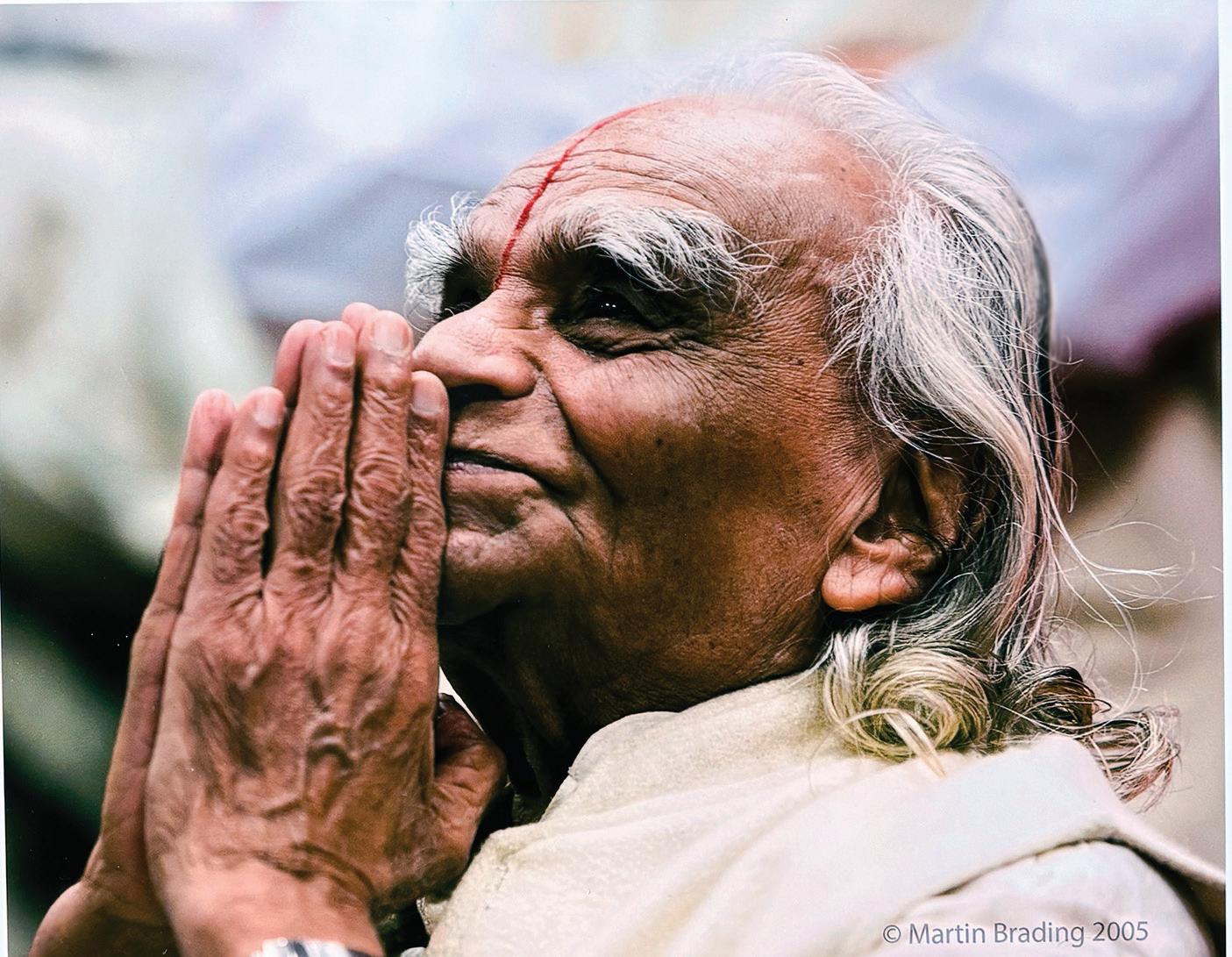

Pātañjali’s Yoga Sūtras state that the practice of yoga is meant to attenuate, weaken and neutralize the kleśas, and lead to Samādhi. In his book, Light on Life, Guruji B.K.S. Iyengar describes the kleśas as “the polluting fluctuations of consciousness,” and Samādhi as “inexpressible . . . an experience in which the sense of ‘I’ disappears.” In my understanding, and more potently in my experience, these kleśas are the source of suffering. I have found that any and every suffering that I experience in my body or mind can be linked to one of the kleśas. Though a physical disease or malady is not itself a kleśa, it can activate the kleśas.
“Diseases do not take us to the doctors but it is dis-ease that takes us to the doctors.”
— Prashant Iyengar Yoga and the New Millennium
So then, what is this “dis-ease” that the kleśas cause, and how does the practice of yoga help us to cultivate freedom from them, or from their influence, and to disappear the sense of ‘I’ so as to open the gateway to Samādhi? Yoga philosophy is clear that the root kleśa is avidyā. Guruji refers to avidyā as the “father of all the kleśas,” and defines it in Light on Life as “ignorance, lack of knowledge or understanding, and nescience.” That last word, nescience, is interesting. It originates from the Latin ne- (“not”) and scīre (“to know”). This suggests that the source of all suffering is simply not knowing. So, what does avidyā cause us not to know?
“You don’t know what is real and what is not real. You don’t know what is enduring and what is perishable. You don’t know who you are and who you are not.”
“Life seeks fulfillment as plants seek the sunlight.”
— Guruji , Light on Life
Without this knowing we are liable to act out of accordance—you could say out of alignment—with life. It is my belief that not knowing this urge of life toward fulfillment, and/or not being able to align our actions with it causes our suffering. Otherwise we would align our actions with life’s seeking and thus be fulfilled. At a minimum, fulfillment must be one of the hallmarks of freedom from suffering.
So what does practicing yoga postures and “breath work” (yogāsanas and prāṇāyāma) have to do with avidyā? More importantly, what does practicing yoga have to do with vidyā, or knowing?
After nearly three decades of practicing yoga, I am convinced that the practice of yogāsanas and prāṇāyāma are extremely well suited to fostering my “education” about life, about who I am and what I am made of. In other words, the practice of āsanas are extremely wellsuited to bestow vidyā, or profound knowledge about the nature of life that not only educates but also transforms.
Through my studies with Prashant Iyengar over the course of more than a decade, I have discovered that what I call as me, or my embodiment has three primary dimensions, or components:
1. The physical material of my body—skin, flesh, muscles, bones, etc.
2. The “material” of my breath—inhalation, exhalation, and the pauses/retentions in between 3. The “material” of my mind—sensing, feeling, perceiving, etc..
I have found that any āsana provides opportunities to experience, explore, and ultimately develop knowledge (vidyā) of these aspects of my embodiment. In other words, the āsanas show me the fabric of life that I call “me” or “mine.” Cultivating freedom entails increasing my ability and skill to sense, observe, learn and know this fabric because it contains many keys to aligning with the drive of life toward fulfillment.
“Yoga is a knowledge process, not an activity process.”
— Prashant Iyengar
I cannot count how many times I have heard Prashant-ji stress this point in the classes I have attended with him (as well as in other teachings he has shared through his writings, and various forms of online education). I have heard the statement enough times to understand it intellectually, but intellectual understanding alone does not enable me to cultivate freedom. A certain willingness, even a certain humility is required to cultivate this freedom. The main willingness I seem to need is the willingness to set aside the clamor in me to satisfy my own personal desires through practice.
I have to be willing to set aside the part of me that wants to get definite results, that wants tangible achievement, that wants to do more and do better physical action in the āsanas. This is not easy. As a “Westerner” and U.S. citizen I live in a culture that, by and large, emphasizes instant gratification and prizes immediate benefits. We are constantly bombarded with messages that we can and should “feel better fast,” as well as countless strategies for how we can do so. We are taught to do cost/benefit analyses to determine our courses of action. We are encouraged to measure success by the yardstick of personal gain.
This spirit seems to press and seep into the yoga world, including my own practice. I have found there is a strong gravity for me (and others) to do more, “get” more āsanas under our belt, show more prowess, and achieve the positions. The practice of yoga postures can be rife with appearance mindedness. So long as this drive predominates my (our) efforts, cultivating the freedom to know is hindered. Cultivating the freedom to know appears to require taking in what’s there in the āsana rather than always reaching for more. While I don’t feel they are mutually exclusive, I have seen that often the latter supersedes the former. And there is so much to know. Just the body itself has so many facets! The variety of tissues, systems, organs, functions, and properties is enormous. The breath, too, has many dimensions beyond mere inhalation and exhalation (for an awe-inspiring look at the many components of the breath, refer to Prashant Iyengar’s introduction to Alpha and Omega of Trikonāsana). The mind similarly has immense variety in its activities and functions. All of these elements are participants in the practice of āsana and prāṇāyāma. What’s more, they interact with one another in real and profound ways.
Cultivating the freedom to know means I must be willing to not know, to face my avidyā and seek to diminish and rectify it.
This is difficult but I have found it worth the challenge, because if avidyā is the root kleśa (or root of “affliction”), and yoga exists to liberate us from affliction or suffering, then the key to that liberation must be vidyā. With the freedom to know, which I believe requires a willingness to seek, I have the opportunity to develop vidyā and, in doing so, automatically cultivate freedom from suffering.
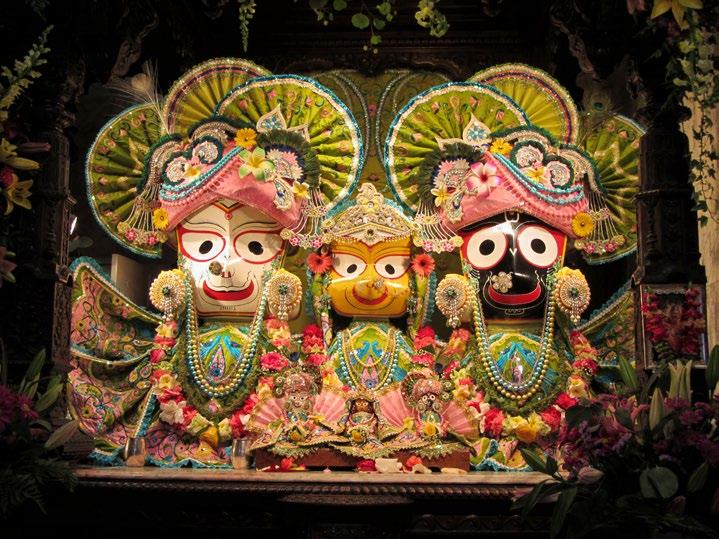
As I said, this is not an easy task, but here’s the beauty of it. I am not the one who has to know. I am only the one who
“You and me cannot do yoga. Only ours, only that in us can.”
— Prashant Iyengar
What I understand this to mean is that my limited identity—the ego structure that has a definite worldly agenda—cannot gain this knowledge.
“The impersonation of the soul by ego is at the base of all human woes, and this is the root of avidyā”
—
Guruji
, Light on
Cultivating the freedom to know means I must depart from the firm ground of concrete action and accomplishment (namely the firm ground of learning, implementing and knowing the concrete, biomechanics and musculoskeletal techniques of the āsanas and prāṇāyāmas), move into uncharted waters, and attempt to explore and map them via my own observations.
Avidyā negates the chance of yoga. By contrast, what Prashant-ji refers to as “ours,” or “that in us”—at its most basic level the three dimensions of body, breath, and mind—are inherently linked to a dimension of life that transcends individuality. They have a reality and an existence that does not stem from any particular identity. I have found that they contain within themselves a fundamental connection to the impulse of life toward fulfillment and as such provide gateways to vidyā, to knowing the essential nature of life, which is essential for attaining fulfillment.
The beauty of yoga practice is that it presents me with opportunities to learn from them how to follow their seeking, and to allow them, as life, to draw me deeper into their current towards fulfillment. What a rich journey this is!
by Heather Haxo Phillips
My entire life I have been interested in how we humans gather together. My curiosity about gathering began early—before I had language for it, before I understood community as anything more than the feeling of being together.
The earliest memory I have of myself is one where I was the host: I was turning 5 years old and throwing the first birthday party of my life. It was so exciting as the parents shepherded their little ones to the Oakland Zoo. There at the picnic tables, I received my very own vinyl copy of the hit record: Mickey Mouse Disco!!! An incredible gift! I was over the moon imagining myself spinning on a dance floor with my real and imagined friends including Daffy Duck and Minnie the Mouse.
And yet, at that same party, we lost David. Somewhere between the elephants and zebras, one of our young guests just disappeared. We found him later, crying on a park bench after getting separated from his tribe. It. was. awful. Even nearly 50 years later, I have not forgotten that moment: the ecstasy of being together in celebration and the agony of leaving someone behind. That inherent tension of being together—offering opportunities for both belonging and abandonment— has stayed with me ever since. I remain deeply curious about how gathering together holds such incredible potential to both support and disrupt our upliftment on personal and group levels.
Priya Parker, an author and dialogue facilitator, is a national leader in helping us understand the dynamics of gathering. Perhaps you have read her book The Art of Gathering? Or maybe you are already devoted to her substack channel “Group Life”? Priya talks about how America has fed its obsession for personal transformation with a bajillion dollar self-help industry, but we have completely left behind our quest for group health.
Gathering together on zoom and in person consumes our days, she says, but so few of these occasions happen
with forethought. Yet, gathering intentionally has incredible power. Being with each other is the thing that makes our lives more meaningful, vibrant and connected. “Let us start it as a movement!” she says. “Let us observe our collective needs and develop tools that bring that wisdom into our communities!” she exhorts. I am totally into it. Over the years, I have become deeply attentive to how we gather. And, we don’t need to look far to find potent examples of how to do it well.
Have you ever noticed how good the Iyengars are at helping us build community?
Geetaji was famous for her “monthly meets.” These monthly gatherings at RIMYI are informal yet riveting. I am still savoring the audio recordings of the 40+ monthly meets that Geetaji hosted on The Bhagavad Gītā alone. The pearls of wisdom that Geetaji offered us - centered on a text designed to help us navigate the very, very complicated nature of human life - is extraordinary. Abhijata has carried on this tradition of generous hosting. No trip to Pune feels complete without attending a chitchat, a celebration, or both. The richness of opportunities to gather at RIMYI is astounding: Guru Pūrṇimā, Gītā Jayantī, Guruji’s birthday, Annual Day, and so many more. Each gathering strengthens relationships, deepens wisdom, and renews our commitments to one another.
Some gatherings at RIMYI are devoted purely to sadhana—discussions of philosophy, demonstrations of how to use the trestle. Others include joyful celebration, beautiful costumes and shared meals. Some gatherings are spontaneous, such as when Geetaji passed away. That was a profound gathering—one that continues to sit inside me seven years later. Others are carefully planned, such as Yogānuśāsanam, RIMYI’s annual international gathering. And, most obviously, there are our yoga classes. Guruji debuted the concept of yoga classes to the world, and he did so in the most intentional ways. He also made sure that those who teach offered their classes in ways that were just as deliberate. Yoga classes sit at
the center of our lives, they are literally our gathering epicenter. Every class is designed to transport both the practitioners and the teacher. Each class is unique, completely unrepeatable and utterly precious. They succeed at transforming us on a soul level.
That is the definition of a good gathering.
The transformative nature of Iyengar Yoga classes helps us feel the value of intentional gathering. We gather for a purpose. We honor participants by convening them for a reason. We take people somewhere—and we allow ourselves to be taken somewhere too. And then, we accept that the gathering has an end.
That, too, is part of the magic of a good gathering.
If two or more people come together for a reason— planned or spontaneous—it counts as a gathering. The best gatherings have a shared purpose, whether it is a committee meeting deciding how assessments should be run, or a convention like this one in Philadelphia, designed to explore the concept of freedom.
Priya Parker reminds us that gatherings offer opportunities to practice the real skills of living well with others: How to gather with purpose, hold healthy conflict, create belonging, navigate power, and strengthen groups for everyone involved.
The Iyengars have taught us a great deal about all of this.
“HOW CAN YOU CALL YOURSELVES AN ASSOCIATION IF YOU NEVER ASSOCIATE?!” I remember Geetaji yelling from more than one platform. She had a point. And she made it with clarity. She and Guruji emphasized that gathering matters. They encouraged group practice, collective study, and shared reflection on the teachings. They initiated the invention of led practices and targetpose sessions. And they themselves modeled their commitments by hosting innumerable meaningful gatherings.
Personally, I have experimented with many models of gathering. Over the past twenty years, I have volunteered in all kinds of capacities within Iyengar Yoga—serving on boards, chairing committees, designing agendas, hosting roundtables, assessing candidates, and launching new events. Through all of it, I have been studying how to gather in healthful, skillful ways. One thing I have learned: Good gatherings often generate healthy controversy. Collaboration requires wrestling—with words, with conscience, with plans. It has never been easy, but it has always been meaningful.
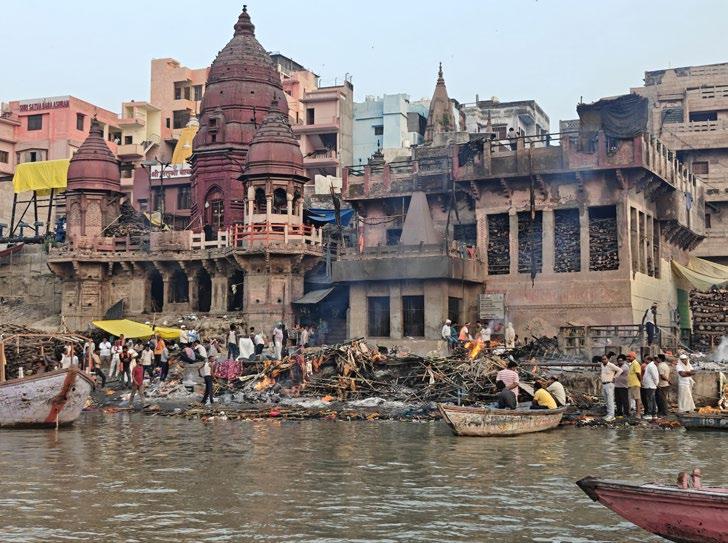
Why do I keep doing it? Honestly, because Geetaji is still perched on my shoulder, yelling: “HOW CAN YOU CALL YOURSELVES AN ASSOCIATION IF YOU NEVER ASSOCIATE?!” It’s my dharma. It’s my duty. And, in one way or another, it is yours too. I also do it because it is fun.
At my own studio, we have experimented with many dynamic ways to gather. Our nine-month Sadhana Studies program intentionally includes service learning and collaborative creative projects on yoga-related topics. One year, participants even formed a band! Self-expression matters deeply if we want to gather well. For our broader student community, we host potlucks, movie nights, and even did a clothing swap. You can never fully understand a person until you share a meal—or walk in their shoes. These gatherings build trust and resilience within our community.
And then there are the chit-chats. Adeline Yoga offers free chit-chats whenever possible, hosted by different teachers on topics that genuinely interest them. In recent months, we have gathered to discuss hypermobility, yoga and the creative process, the invocation to Patanjali, and more. Students love these interactive sessions, and it helps us hold the traditions of RIMYI close to our hearts. Good gatherings also make use of space. This year, Adeline Yoga moved into a larger home and established a reading library. It has been a joy to see spontaneous gatherings form around books—people reading together, researching questions like “What is the difference between a mandala and a yantra?” and comparing quotes about yoga from the books by Prashant, Geeta and Guruji. The library hums with their wisdom and
our laughter. Even our staff meetings are intentional gatherings. Three years ago, we adopted the Working Genius model developed by Patrick Lencioni to help our team understand their innate gifts and frustrations. This framework has transformed how we work together. We have learned to lean more into wonder, invention, galvanizing and other types of our working geniuses. Meetings have gotten shorter, more focused, and far more joyful.
Gathering well is not intuitive. I have seen excellent agendas sabotaged at the last minute by well meaning people. I have seen meetings fall flat due to lack of preparation. Gathering well requires practice. It is a muscle we must train—through repetition, reflection, and commitment.
In this way, gathering well becomes its own sādhana.
Gathering well does mean learning how to fight well too. Conflict is inevitable—and necessary. Healthy conflict can strengthen communities by inviting honesty, vulnerability, and skillful communication. When handled well, conflict offers opportunities to heal rather than fracture.

The payoff of all this practice?
When we develop a strong capacity for gathering, we feel safer and more fulfilled. And goodness knows—we all deserve to feel a little safer and more fulfilled right now. It feels fitting to reflect on gathering while we are here together at a large convention. Given the state of the world, our ability to gather meaningfully may be one of the things that helps us stay sane in the months and years ahead.
I invite you to reflect on how you gather in your life of yoga—and how you might harness the power of gathering in the coming year. Perhaps during this convention you will chat with your mat-mates before practice, sharing ideas and stories about gathering well. This is an opportunity for collecting inspiration, sharing ideas and making new friends. These small moments matter, they help us to feel whole.
As we bring intention to gathering well, our connections with one another can fulfill the hopes of the Iyengars. In this way, each of us can help carry forward this precious practice of Iyengar Yoga.


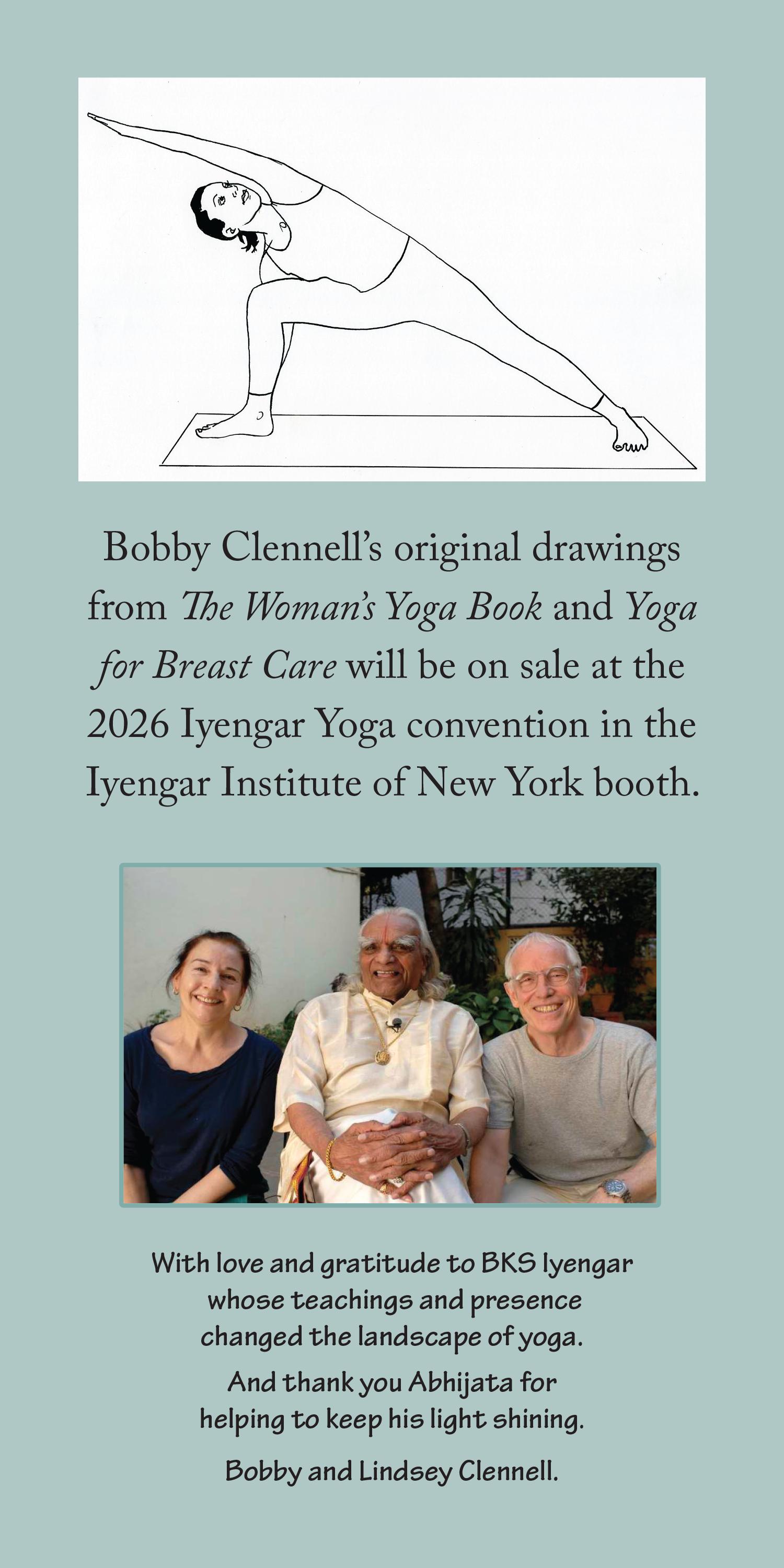
In 1976, Guruji was invited to give a yoga demonstration at Haverford College in Haverford, Pennsylvania. In the audience that evening sat Robert M. Engman, one of Pennsylvania’s most prolific sculptors. Marian Garfinkel had invited him to witness the demonstration and to meet Guruji.
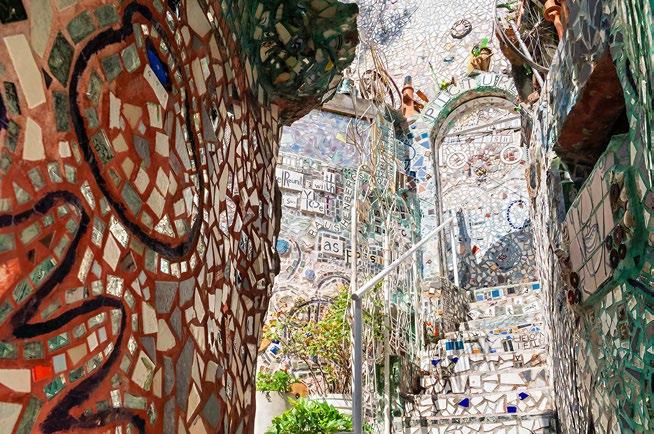

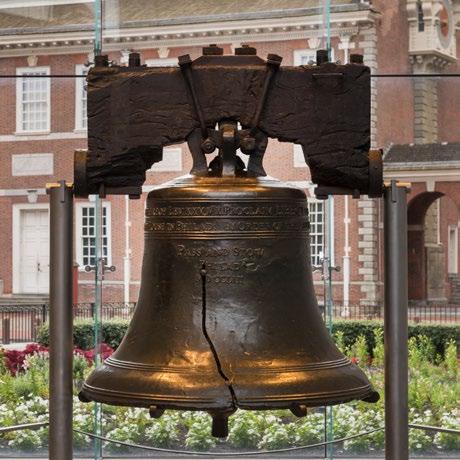


What Engman saw left a deep impression. The precision. The authority. The quiet intensity that filled the room. Compelled by the experience, he wanted to create a sculpture that would capture his dynamic impressions of Guruji’s demonstration. Although not a portrait in the traditional sense, he strove to embody the radiant spirit Guruji expressed through movement and stillness. Engman later elaborated that he wanted to capture “the incredible control, wisdom, gentleness, and concern for life” that he felt from Guruji.
Those feelings took form in a large bronze sculpture that now graces the Morris Arboretum. In 1988, Marian and Marvin Garfinkel placed the work there on long-term loan. Another casting of After B.K.S. Iyengar resides in the collection of the Hirshhorn Museum and Sculpture Garden in Washington, D.C. That sculpture still stands here, holding the memory of that evening in 1976.
Long before we arrived with our mats and bolsters, Iyengar Yoga had already left its mark on this city. Now we gather here to continue that story.
Welcome to Philadelphia.
If you are reading this, chances are you have traveled a long way, navigated airports and time zones, all to arrive here for the 2026 Iyengar Yoga National Convention with Abhijata Iyengar. That already says something about your commitment. We are genuinely honored to have you here.
Before you unroll your mat and settle into the intensity of practice, we thought it might be helpful and enjoyable to introduce you to the city that is hosting us. Philadelphia is a city that reveals its character gradually, much like Yoga itself. There is history here, humor, discipline, contradiction, and a deep respect for structure. In other words, it is a surprisingly good place to practice Iyengar Yoga. It is a fitting home for a convention devoted to Cultivating Freedom.
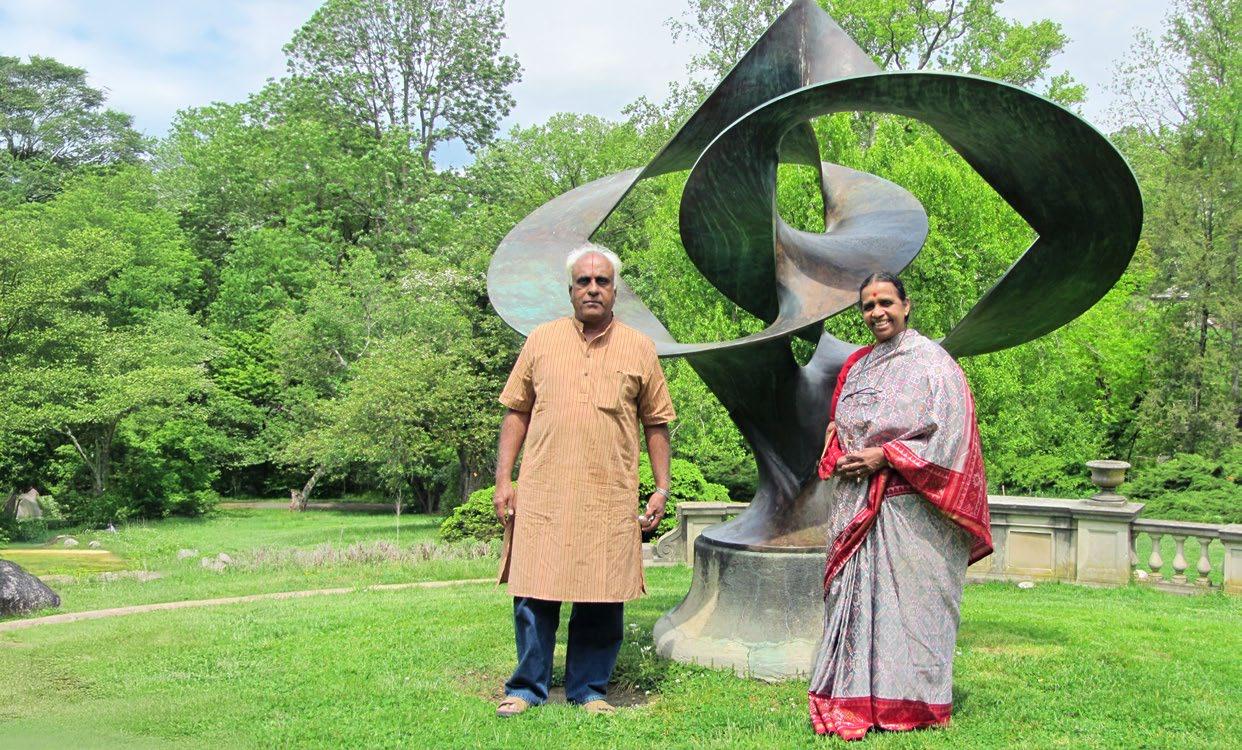
At its core, Philadelphia represents the American experiment in self-governance. This is the city of Independence Hall and the Liberty Bell, where the language of rights, responsibility, and collective order was debated, drafted, and made public. That civic identity still shapes the city’s tone today. The Benjamin Franklin Parkway, modeled on European ceremonial boulevards, creates a deliberate axis between civic space and cultural inquiry. It links public life with public learning and culminates at the Philadelphia Museum of Art.
A
Philadelphia was founded in 1682 by William Penn as what he called a “Holy Experiment.” His vision was radical for its time. Liberty, he believed, had to be anchored in ethics, civic order, and mutual responsibility. Freedom was never meant to be chaotic or self-indulgent. This philosophy is visible in the city’s structure. Philadelphia’s grid, punctuated by public squares, was designed to support health, reflection, and communal life. Space was intentionally left open. Air, light, and movement were considered essential to a functioning society. That vision reached its historical apex in 1776 with the
Philadelphia is often called a museum city, but that description is an understatement. Art in Philadelphia is not only collected, but studied. The Philadelphia Museum of Art is the city’s most recognizable cultural landmark. For many visitors, the approach begins with the iconic climb up the Rocky Steps, a playful yet meaningful ritual of effort and perseverance. At the top, the view opens across the Benjamin Franklin Parkway. Inside, the galleries emphasize structure, proportion, and material intelligence across civilizations. Particularly significant is the Pillared Temple Hall from Madurai, India. This is the only full-scale Hindu temple hall displayed in a U.S. museum. The surrounding South and East Asian galleries extend this experience through devotional sculptures, Chola bronzes, Buddhist figures from Gandhara, Chinese ceramics, and Japanese screens and ink paintings. The European sculpture galleries invite study of weight and counterbalance, while the modern and contemporary wings explore abstraction and essential form. Moving through the museum becomes a kind of walking meditation.
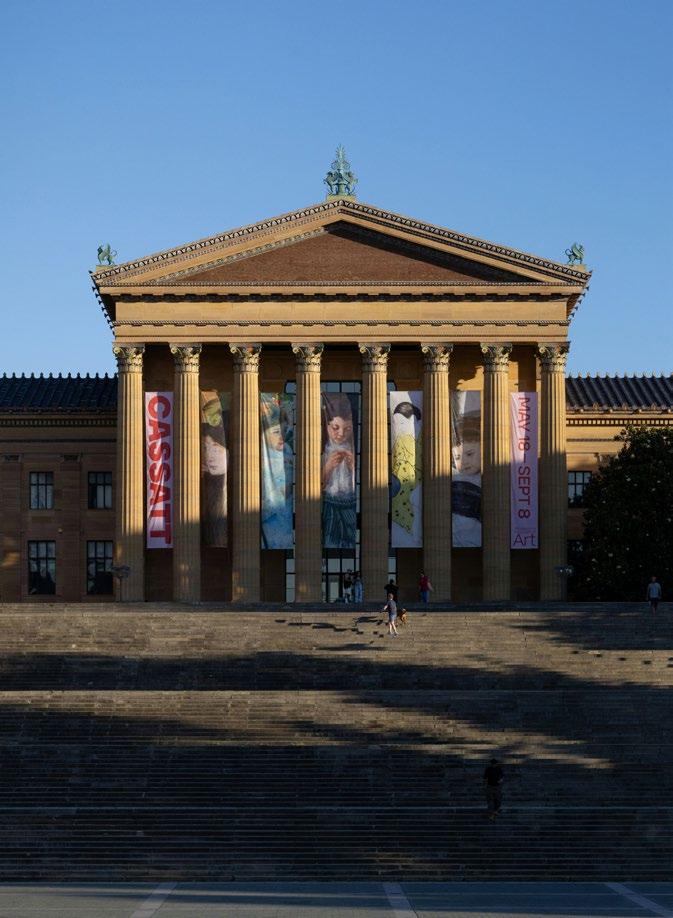
The Barnes Foundation offers one of the most distinctive art experiences in the world. Dr. Albert Barnes rejected traditional museum conventions. Paintings are not arranged by artist, chronology, or style. Instead, they are grouped into “ensembles,” where works are placed in relationships based on line, color, light, and spatial rhythm. A Cézanne may hang beside African sculpture, wrought iron, or furniture, to train the eye to perceive underlying structure. For Iyengar Yoga practitioners, this method feels immediately familiar. Just as we intelligently construct sequences, allowing actions established in one āsana to inform and refine the next, the Barnes trains the eye to perceive relationships rather than isolated forms.
Set quietly along the Parkway, The Rodin Museum is a rare treasure. It houses one of the largest collections of Rodin’s work outside France and offers an atmosphere markedly different from larger institutions. Rodin’s sculptures put emphasis on weight, gravity, and inner tension. Figures appear caught between movement and stillness, effort and surrender. For a very different yet equally meaningful experience, Philadelphia’s Magic Gardens offers an immersive environment created by mosaic artist Isaiah Zagar. Covering half a city block, the space is built entirely from fragments: Broken tiles, bottles, mirrors, wheels, and reclaimed objects.
JadeYoga is proud to sponsor the 2026 IYNAUS Convention!









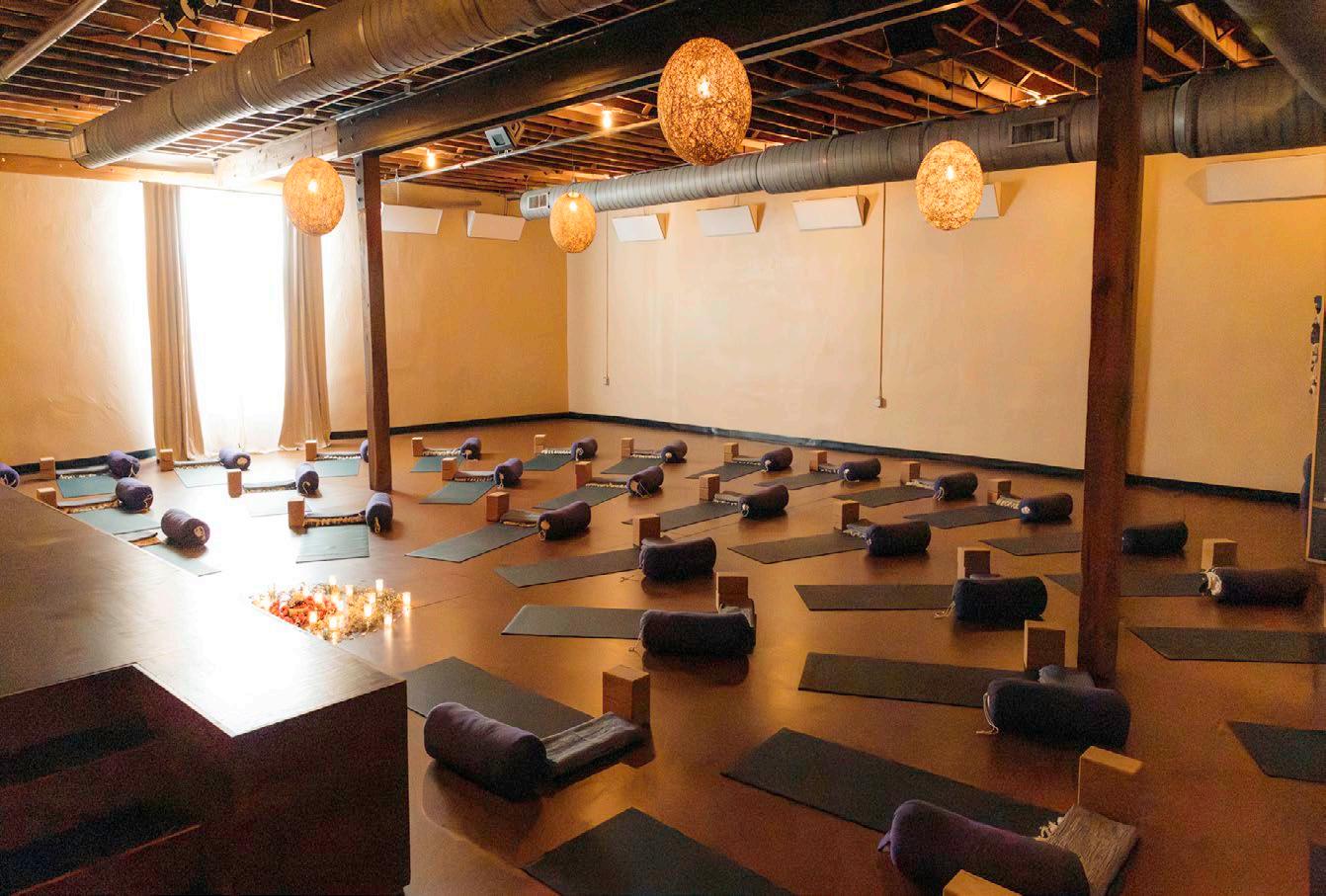
Please stop by and visit us at the convention marketplace to check out Nature’s Best Yoga Mats! Show your conference pass for a special discount. And mention this ad for a free gift!