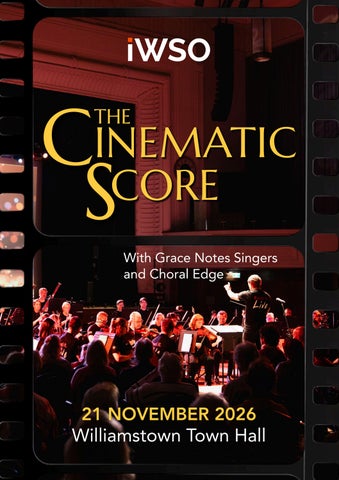
CINEMATIC CORE S THE
With Grace Notes Singers and Choral Edge
21 NOVEMBER 2026 Williamstown Town Hall
OUR SPONSORS Since October 2024, Community Bank Seddon has sponsored our No Strings Attached program, helping us provide hundreds of tickets to people in our community and making sure cost isn’t a barrier to enjoying live music. We’re so grateful for their support.
Stick It Percussion has been generously lending us large percussion instruments for our concerts since the beginning. Listen up, you’ll definitely hear them today!
Documents on Call printed the gorgeous program you’re holding. Without their generous support, you would be trying to read it on your mobile phone!
ACKNOWLEDGMENT OF COUNTRY We respectfully acknowledge the Wurundjeri Woi Wurrung and Bunurong peoples of the Kulin Nation, on whose unceded lands we rehearse and perform. We recognise their continued connection to Country and their role in caring for and maintaining Country over thousands of generations. We pay our respects to Elders past and present.
Program FEATURING Inner West Symphony Orchestra Grace Notes Singers Choral Edge Conductor: Andrew Leach Presenters: Michelle Tran and Ali Campbell
ACT 1 R STRAUSS
2001: A Space Odyssey ~ Also Sprach Zarathustra
B ROWLAND
The Man from Snowy River Suite
B HERRMANN
Vertigo Suite
P DUKAS
Fantasia ~ The Sorcerer’s Apprentice
J WILLIAMS
Saving Private Ryan ~ Hymn to the Fallen
INTERVAL (25 mins)
ACT 2
INTERVAL: Saxophone Quartet Ghostbusters Theme Harder, Better, Faster, Stronger - Tron Legacy Friends on the Other Side - Princess and the Frog Cantina Band - Star Wars James Bond Medley Puttin’ On the Ritz
R WAGNER
Apocalypse Now ~ Ride of the Valkyries
J WILLIAMS
Star Wars - John Williams is the Man Arr. M J Goetke
H HUGHES/ P COLUM
Michael Collins ~ She Moved Through the Fair
ENYA
The Lord of the Rings: The Fellowship of the Ring ~ May It Be Arr. W. Poquiz
H SHORE
Symphonic Suite from The Fellowship of the Ring
E MORRICONE
The Mission Suite
3
Welcome
Welcome to the grand finale of our 2026 season. This year has been one of profound artistic growth and local impact for the Inner West Symphony Orchestra. From Ravel’s Boléro to the blues-inspired energy of Gershwin’s An American in Paris; from Borodin’s Polovtsian Dances to Bizet’s gorgeously lush L’Arlésienne Suite No. 1, 2026 has both challenged and educated us. This repertoire has expanded our musical horizons and, we hope, deeply enriched your experience as our audience. Today, we shine a spotlight on some legendary composers who have shaped 20thcentury cinema, including iconic cinematic scores from John Williams (Saving Private Ryan), Howard Shore (The Lord of the Rings), Ennio Morricone (The Mission) and Bernard Herrmann (Vertigo). To help bring these to life, we welcome two choirs to our stage: Grace Notes Singers and Choral Edge. As we strip away the film itself and let the music stand on its own, I’m reminded of a wonderfully relevant quote from the great John Williams: Music is three things: It’s the composer, and it’s an orchestra or a singer, and the listener. And what music is, is the stuff in-between, the spirit of the three participants who lean on each other ... It is the power that music can transport or connect between people, a nexus of some kind.
Thank you for being here today to provide that connection and share in this spectacular musical journey. Our audiences really are the cornerstone of our community. Please stay tuned for some exciting announcements soon regarding our 2027 season. Andrew Leach Artistic Director
4
Musicians FIRST VIOLINS
CELLOS
OBOES
TRUMPETS
Michael Patton (Concertmaster) Elisa Grech Jean Leibel Patrick Neilson Tehya Nguyen Emma Rudin Yilin Wang Shion Yoshika
Zoe Barker Ali Campbell Thi Dang Shannen D’Mello Richard MacNeill Madison Muscat Jasmine Nguyen Ben Scott Julia Tran Justin Van Jana Zulic
Cinnamon Lane Greg Leibel Katie Rees
Tim Bell Anthony McKee John Rice-Whetton
COR ANGLAIS
TROMBONES
Greg Leibel
Arjen Goessens Chloe Truong
SECOND VIOLINS Nick Allan Justin Casserley Mia Holton Margaret Newton Gabrielle Powell Maree Roberts Madeleine Rowe Marcella Tonini Michelle Tran Liz Wooldridge
VIOLAS cubbie Rodney Morgan Eric Nguyen Talitha Ray
DOUBLE BASSES Peter Caffyn Adrian Close Christina Hall Cate Phillips
CLARINETS William Federico Greg Strong
BASS TROMBONE
BASS CLARINET
TUBA
Andrew Derrett Greg Strong
Angus Charlton
PERCUSSION
CONTRABASSOON Andrew Derrett
BASSOONS
PICCOLO Kate Rockstrom
John Crawford Oscar Lane
FLUTES
FRENCH HORNS
Nicole Le Grand Kim Pearson Kate Rockstrom
Nicole Aebi-Moyo Tee Aebi-Moyo Nick Benbow Julia Bristowe David Howell
TIN WHISTLE Kim Pearson
Liam Green
Izan Cantero Herrera Chris Lancaster Mark Leach Jacq Prestedge
HARP Shelby Rose
PIANO Tehya Nguyen
* Musicians listed in alphabetical order
5
ANDREW LEACH Artistic Director and Conductor Andrew’s love of orchestral music began at the age of three, obsessed with a vinyl record featuring the instruments of the orchestra. Since then, he has built an extensive performance career spanning both the orchestral and commercial music industries. Drawing on his experience developing and leading outstanding music education programs, Andrew aims to create a welcoming rehearsal environment where every musician can build confidence, refine their skills and experience the joy of making music together.
MICHAEL PATTON Concertmaster Born in England, Michael started playing the violin at the age of four and went on to receive an honours degree in music from the University of Birmingham before completing a Postgraduate Certificate in Education at Reading University. During this time he received training from a variety of world-renowned musicians in all aspects of the violin and orchestral musicianship. Since moving to Melbourne, Michael has worked with many amateur and professional orchestras, including the Victorian Youth Symphony Orchestra, the Australasian Orchestra and Synthony.
MICHELLE TRAN Presenter and violinist Michelle is a music teacher and leads our second violins. She joined the IWSO in 2025 in search of a welcoming and vibrant musical community and has been an enthusiastic member ever since. A passionate advocate for accessibility in the arts, Michelle is proficient in Auslan and aspires to become an interpreter, with the goal of making music more accessible to the Deaf community. She also volunteers with the Melbourne Youth Orchestra’s Adaptive Bridging Program, supporting inclusive music-making for young musicians, and at Open Table, cooking meals for those in need.
ALI CAMPBELL Presenter and cellist
6
Ali started playing the cello when she was young, and put it aside as an adult when the demands of a busy life, a physiotherapy career and family took over. A few years ago, her family gave her a cello for a milestone birthday and she has not looked back. Ali has been with the IWSO from the beginning and also performs with the Newport Strings. When she is not playing cello, she loves taking very long walks in the bush, swimming at Williamstown Beach and pottering in the garden with her entertaining chickens.
Miranda Bordignon Melissa Bourchier Naomi Brown Rosemary Hanscombe Emma Hesketh Lilia Ilina-Taranto Meredith Jones Bryony Lepere Nicole Makawa-Mbewe Erin Matheson-Bugg Anita Narayan Grace Nicastro Lucia Ragnanese Christine Timoney Kay Trounson Issy Vigilante
Grace Notes Singers Formed in 2013, Grace Notes Singers brings together a diverse range of singers, including young professionals, parents, carers, retirees, school leavers and students. The choir is multigenerational and young at heart. Directed by Marjorie Butcher, they have performed with the Essendon Symphony Orchestra, the Inner West Symphony Orchestra and various choirs around Melbourne, and are very proud to have developed relationships with emerging Australian composers through premiering and commissioning new works.
Choral Edge is one of Melbourne’s most innovative and engaging choirs. Founded in 2018 by Juliana Kay, and now led by Marjorie Butcher, the choir seeks to expand the boundaries of choral music through playful, multidimensional projects. Recent highlights include Y.U.M. (You. Us. Me.), a devised performance combining movement and song; Origami, a fusion of the Japanese craft with choral storytelling; and Scribbles, a communal art-making project where the audience drew and doodled their way through an hour of music.
Choral Edge
Campbell Andrew Alexander Blackman Thomas Cotter Beck Fiala Elizabeth Howes Genevieve Hughes Ismini Karamesinis Stephanie Lai James Layton Mike Mews Louisa Oryé Beth Paterson Brynleigh Tiller Yilin Wang
7
Program notes
by Andrew Derrett
RICHARD STRAUSS Also Sprach Zarathustra ~ 2001: A Space Odyssey Stanley Kubrick’s perfectionist approach to filmmaking was clearly evident in his choice of music for his films. His tendency to use existing music, whether it be classical works or pop songs, was guided by the belief that hiring a modern composer was unnecessary when plenty of music by famous composers was already available. While Kubrick’s choice of music for 2001: A Space Odyssey was mostly locked in early with various classical works by Strauss (both Johann Jnr and Richard), Khachaturian and avant-garde Hungarian composer György Ligeti, Kubrick did approach Alex North to compose an original score for the movie to cover all bases. It wasn’t until the premiere of the film in 1968 that North found out that none of his score made it into the film. Kubrick had grown too attached to his original classical choices and stuck with his deeply held belief: ‘Unless you want a pop score, I don’t see any reason not to avail yourself of the great orchestral music of the past and present.’ And what great orchestral music he used. Richard Strauss composed his tone poem Also Sprach Zarathustra (based on a philosophical work of the same name by Friederich Nietzsche) in 1896. Scored for a massive orchestra, the two-minute opening has become one of the most recognisable and iconic pieces of classical music. Kubrick used the piece three times in 2001, and legend has it that he listened to every available recording of the work before settling on one of several performances featuring Herbert von Karajan conducting the Berlin Philharmonic Orchestra. I’ll leave the final word on the use of music in films to the master himself:
8 8
I think music is one of the most effective ways of preparing an audience and reinforcing points that you wish to impose on it. The correct use of music, and this includes non-use of music, is one of the great weapons that the filmmaker has at his disposal. Stanley Kubrick
BRUCE ROWLAND The Man from Snowy River Suite Bruce Rowland’s score for The Man from Snowy River has become an iconic part of film music culture in this country, featuring four times in ABC Classic’s annual Classic 100 Countdown. The film was released in 1982 and was based (rather loosely) on the Banjo Paterson poem. The film starred Hollywood legend Kirk Douglas in dual roles (which did annoy some in the local industry) as well as Australian screen icon Jack Thompson and newcomers Tom Burlinson and Sigrid Thornton. The main theme includes a brief reference to the convict ballad ‘Moreton Bay’, which Rowland based ‘Clancy’s Theme’ on. Rowland would go on to win the AFI Award for Best Score for The Man from Snowy River.
BERNARD HERRMANN Vertigo Suite Composer-director relationships have become legendary in the film industry and there have been some fruitful working relationships throughout Hollywood: John Williams and Steven Spielberg; Jerry Goldsmith and Frankin J Schaffner; Maurice Jarre and David Lean. But arguably the most famous (and later infamous) was Bernard Herrmann and Alfred Hitchcock. Herrmann scored a total of seven films for Hitchcock, starting with The Trouble with Harry
in 1955 and finishing with Marnie in 1964. It was one of the most productive periods of Hitchcock’s career; however, a new contract with Universal later in his career placed him under greater control by the studio, who demanded he make more films in line with his ‘Master of Suspense’ reputation. The studio feared other younger filmmakers of the 60s were outHitchcocking Hitchcock. 1958’s Vertigo is considered Hitchcock’s finest film and has inspired generations of filmmakers and film historians. Herrmann’s score is pure cinema and a textbook example of how music can enhance the emotional connection an audience has with the image on the screen. From the swirling opening titles to the jagged strings and muted brass in the rooftop scenes, Herrmann provides the audience with the connection required. He is a repetitive composer who relies on small, fragmented motifs played repeatedly to dig into the audience’s psyche. Psycho (1960) and Cape Fear (1962) are two such examples. The scene in Vertigo where private detective Sonny (James Stewart) follows Madeleine (Kim Novak) around San Francisco is a wonderful example of a suspenseful underscore. The score’s climax is the ‘Scene d’amour’. Nothing more needs to be said here. You’ll know it when you hear it.
PAUL DUKAS The Sorcerer’s Apprentice ~ Fantasia Paul Dukas composed his tone poem The Sorcerer’s Apprentice in 1897. Subtitled ‘Scherzo after a ballad by Goethe’, it is based on Goethe’s 1797 poem ‘Der Zauberlehring’ and is the most popular of Dukas’ works, notable for appearing in Walt Disney’s 1940 film Fantasia. If anything, Goethe’s poem is fable on how cutting corners just doesn’t work. In the film, Mickey Mouse plays an apprentice to an all-powerful sorcerer. When the sorcerer goes to bed after a long day of casting spells, Mickey decides to use spells from the sorcerer’s all-powerful book to complete his nightly chores. Things quickly go pear-shaped: the brooms that Mickey brings to life to carry buckets of water don’t stop and soon the place is flooded.
Dukas’ tone poem is wonderfully descriptive and the film requires no dialogue to tell the story; the music does it all. Scored for a large orchestra, you can almost sit back and imagine an army of walking broomsticks trampling over a frightened Mickey as he desperately tries to stop the spell. There is a wonderful moment in the film where Mickey’s pain, anguish and exhaustion are captured in a close-up as the recap of the bassoon theme marches relentlessly forward, this time armed with the entire orchestra. But it all works out well in the end. Despite getting his butt kicked by a very angry sorcerer, Mickey gets the chance to shake hands with maestro Leopold Stokowski on the podium: ‘Mr Stokowski! Mr Stokowski! My congratulations sir!’, he cries. To which Stokowski replies, ‘Congratulations to you, Mickey!’ … I think the sorcerer would have a different take on proceedings, don’t you?
JOHN WILLIAMS Hymn to the Fallen ~ Saving Private Ryan Saving Private Ryan was the 16th collaboration between Steven Spielberg and John Williams, one of cinema’s most successful and longstanding director-composer partnerships. It was a personal project for Spielberg, inspired by his father’s World War Two experiences, and from the graphic opening scene of American forces coming ashore at Omaha Beach in Normandy, to the living nightmare that was the invasion of Europe, Saving Private Ryan is steeped in realism, with a bleached, handheld documentary-look to the film. Williams’ score focuses on the emotional toll and culminates in the Hymn to the Fallen, which accompanies the closing credits of the film. Orchestra and choir combine in the rousing finale which begins from nothing. A lone snare drum begins with sustained strings before two trumpets sound a haunting fanfare call. The piece builds steadily with the sustained nature of the opening making way for more urgency in the strings until the rousing finale takes over. Then, like the setting of the sun, Hymn to the Fallen ends the way it began: with the snare drum and a final string chord. Don’t be in a rush to applaud. Let the moment linger. Until it is lost in time.
9
RICHARD WAGNER Ride of the Valkyries ~ Apocalypse Now Wagner’s Ride of the Valkyries serves as the prelude to the first scene of Act 3 in his opera Die Walküre, the second of four epic operas in Der Ring des Nibelungen. As a separate piece, Ride of the Valkyries is often heard in a purely instrumental version. Its performance outside of the opera has seen it appear in several films, the most famous of which is Francis Ford Coppola’s Vietnam War epic Apocalypse Now. Coppola may have got the idea of using it to accompany a squadron of Bell ‘Huey’ and Hughes ‘Loach’ helicopters to attack a Vietnamese village from a 1941 World War Two German newsreel, Die Deutsche Wochenschau. Here, the work served as the soundtrack for squadrons of Junkers Ju 87s dive bombers (known as ‘Stukas’) approaching the Mediterranean island of Crete at dawn in low flight. Its use in Apocalypse Now is a classic example of source music within a film. Meaning, the music can be heard by both audience and characters on the screen. We will be performing the instrumental version, not the operatic version used in the film.
Shire with a tin whistle, the dreamlike choral music of Rivendell, or the brutal low-end percussiveness that represents Sauron, Howard Shore has created an extended masterpiece in film scoring.
ENNIO MORRICONE The Mission Suite The Mission was the first of three films scored by Italian maestro Ennio Morricone for English director Roland Joffé. The others being the preOppenheimer atomic bomb drama Fat Man and Little Boy, starring Paul Newman, and the Patrick Swayze vehicle City of Joy. Morricone’s score for The Mission is among his most recognisable and always seems to be at the pointy end of classical music polls around the globe. The rich South American flavour, the chanting choir, the epic music that accompanies the waterfalls and the famous Gabriel’s Oboe theme have put this score at the pinnacle of the art of film scoring. When composing the oboe theme, Morricone studied the random finger movement of actor Jeremy Irons as he sat perched on a rock, playing his beautiful ebony baroque oboe. The scene doesn’t go well for the oboe (it gets snapped in half!) but it does turn up later in the film thanks to a bit of repair work.
HOWARD SHORE Symphonic Suite from The Fellowship of the Ring
The Mission received the coveted Palme d’Or award for best picture at the Cannes Film Festival in 1986. The film stars Robert De Niro and Jeremy Canadian composer Howard Shore’s contribution Irons as two Jesuit priests during the 18th-century to The Lord of the Rings cinematic universe is colonisation of South America. A story that was unparallelled. The three films (The Fellowship of the always going to end tragically. Ring, The Two Towers and The Return of the King) earned Shore two Oscars and he later returned to score all three films in The Hobbit trilogy. Interestingly, Shore was not Peter Jackson’s first choice for the project. Jackson initially approached Andrew Derrett (soprano), Greg Strong (alto), James Horner, based on his experience scoring Kim Pearson (tenor), Greg Leibel (baritone) fantasy films such as Krull and Willow. However, Horner’s reluctance to score multiple sequels led Jackson to turn to Shore instead.
Saxophone Quartet
Shore began the epic challenge of scoring the three films, which were filmed back-to-back, in 1999. He worked with the London Philharmonic Orchestra, and along the way, guest artists including Enya and Sir James Galway. The score is epic and is unmistakably Tolkien in flavour. Whether capturing the Celtic character of the
10
Support the IWSO For many people in Melbourne’s west, an IWSO concert is the only place where they can hear a full orchestra play live. And as a not-for-profit organisation run entirely by volunteers, every concert you hear is made possible by the support of our community. That includes people like you. Local businesses, families, foundations and individuals all help keep us going, and every contribution counts. Whether it’s $20, in-kind support or a larger contribution, your support keeps our tickets affordable, gives local musicians and composers the opportunity to perform and premiere new works, and connects people through the joy of music.
HOW YOU CAN SUPPORT US Help our percussionists practise! Have you ever wanted something named after you? Have you ever wanted percussionists to think you’re awesome? You’re in luck, because you can choose for your donation to fund the purchase of a percussion item, meaning our percussionists have more instruments to rehearse and perform with, and will also forever think of you as an absolute legend. Scan the QR code for more information on what you can fund, and how you will be recognised.
Sponsor a specific need Our specific needs range from contributing towards operating expenses such as rehearsal and concert venue rental, music licensing and copyright fees to the provision of youth bursaries, commissioning of new works to champion local musicians, community and member programs and the establishment of an IWSO conductor stipend. If you’d like to sponsor one of these needs, or have another idea in mind, please contact us using the information below.
Sponsor us for the 2027 season If you’d like to support the orchestra for a specific need, fund the purchase of a percussion instrument, or are interested in discussing sponsorship opportunities for our 2027 season, please email Elisa and Yilin at iwso@iwso.org.au as we would love to start this conversation with you.
ACKNOWLEDGMENTS Huge thanks to our team of hardworking concert volunteers: Annaliese Campbell, Bruce Campbell, Natalie Grech-Maxwell, Tom Lane, Max Le Grand, Claire Leibel, Hugh Leibel, Katrina Leibel, Lola Kornbrust, Jason Maxwell, Ellen McCarthy, Marg Morrissey, Tracey Portelli and Alex Zammit. Photo credits: cover, pp 2, 4, 5: David Musial; p 3: pixabay; p 6 (from top): Anthony McKee, Anthony McKee, Zerin Jai; p 7 (top): Chris Hocking, (bottom): Choral Edge; p 10: Anthony McKee; p 11, back cover: David Musial. Program team: Nicole Le Grand (editing, design and layout), Andrew Derrett (program notes), Kim Pearson (proofreading). Concert projections: Nicole Le Grand *The IWSO is a registered charity and DGR-endorsed, making donations of $2 or more fully tax-deductible.
Printed by Documents On Call Unit 3,17-19 Orange Street Williamstown North VIC 3016 www.docsoncall.com.au © Inner West Symphony Orchestra 2026
iwso.org.au