Imagine the World as One
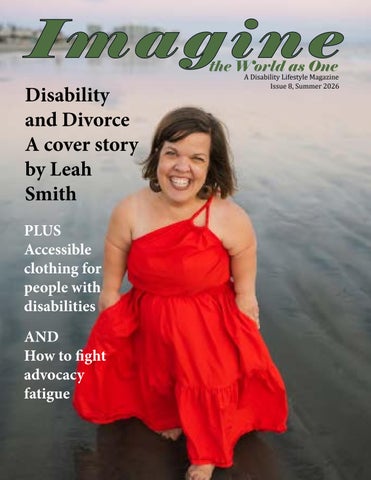
Disability and Divorce A cover story by Leah Smith PLUS Accessible clothing for people with disabilities AND How to fight advocacy fatigue
Page 1
A Disability Lifestyle Magazine Issue 8, Summer 2026
AND How to Fight Advocacy Fatigue
Imagine the World as One Issue 8, Summer 2026 EXECUTIVE EDITOR Evan Trad
EDITOR
Molly Wiesman
Imagine the World as One (IWO) Magazine seeks to elevate and spotlight the disability experience. We champion and showcase the disability lifestyle by empowering journalists with disabilities to share their extraordinary experiences.
As an internationally recognized disability lifestyle magazine, our focus is on human potential. Imagine the World as One (IWO) creates a connection between the readers and our journalists in a meaningful and empowering manner. We inspire those living a disabled lifestyle to dream bigger by providing real-life examples of those who have moved from limited to limitless.
Follow us on social media!
@iwomagazine
Page 2
@IWOmagazine
@ImagineMagazine2
Contents 4 10 11 16 18
Beyond Buttons and Zippers: Why Your Clothing Shouldn’t Be a Challenge Niveah Gandhi
“Electroshock, Sovereignty for CAPA”. “Cosmic Jacqui Passes,” “What Apartheid? What Genocide?”: Poems Scott Norman Rosenthal
The Right to Leave: Protecting Disabled Women in Divorce Leah Smith
Finding my Voice with a Disability Michelle Steiner
Because You Matter: Chrissie Henson’s Journey of SelfLove and Healing Chrissie Henson
21 Sundara Rengasamy
Inclusive Employment
Page 3
23
The Cold, Hard Truth about Cold Medicine Brittney Clayton
Advocacy Fatigue
25 Anthony Corona 28 30 32 36
My Dating Story as a Person with a Physical Disability in Uganda Katamaru Peter Colllibs
Every Canadian Counts Coalition Hubert Van Niekirk
Progressive HCBS-Home and Community Based Services Reform is Needed Now More than Ever Nicole Leblanc
Break the Barriers and Embrace the Adventure Nethra Silva
Beyond Buttons and Zippers: Why Your Clothing Shouldn't Be a Challenge Niveah Gandhi
L
et me ask you something: How long did it take you to get dressed this morning? Five minutes? Ten? Now imagine if that simple routine took 30 minutes, left you exhausted and frustrated, or required asking someone else for help with something as personal as getting dressed. For millions of people in the disability community, this isn't a hypothetical scenario. It's daily reality. If you've ever struggled with a stubborn zipper while your hands weren't cooperating, wrestled with buttons that seem small, or wished your favorite shirt didn't require you to be super flexible and skilled to put on, this article is for you. We're going to talk about the clothing struggles that don't get enough attention, what research tells us about these challenges, and most importantly, what's changing and what still needs to change. Whether you're someone with a disability looking for solutions, a caregiver seeking better options, or just curious about why adaptive fashion matters, you'll find practical insights here drawn from recent research and real experiences.
What the Research Actually Tells Us Here's something that might surprise you: researchers have been studying clothing challenges for people with Page 4
Image Description: A woman sitting in a wheelchair looks at
herself in a mirror. There is a rack of clothes behind the mirror. She is pictured wearing a turquoise shirt and jeans.
disabilities since the 1980s. Yet meaningful solutions from the fashion industry didn't really show up until after 2016. A comprehensive 2024 study published in the International Journal of Consumer Studies examined decades of this research and found a huge gap between what people with disabilities need and what's been available [1]. Numbers tell a story. More than 40 million people in the United States live with disabilities, and about 14 million have difficulty with essential daily activities like getting dressed [2]. Think about that for a moment. That's 14 million people who face unnecessary struggles every single day, not because getting dressed has to be hard, but because clothing design hasn't caught up with reality. Researchers at the University of Missouri dug into online reviews from people buying adaptive clothing and identified two main problems that keep coming up: first, the products available don't actually meet specific needs, and second, even when good products exist, they're incredibly hard to find and access, not to mention they are way over budget for most consumers [3]. If you've spent hours searching online for pants that work with a wheelchair or shirts that accommodate medical devices, you know exactly what I'm talking about. But here's what really struck me about the research: it's not just about function. Multiple studies emphasize that clothing affects self-esteem, body image, and how people see themselves [4]. When the only options are purely functional designs that scream "medical
equipment," it sends a message that style and self- this, but solutions remain limited. expression somehow matter less for people with disabilities. That's not just a fashion problem. That's The Shopping Struggle: Even when you know what about dignity and identity. you need, finding it is another challenge entirely. Most stores don't carry adaptive clothing. The few that do rarely have it in physical locations where you could The Real, Everyday Struggles actually try things on. Online shopping means buying Let's get specific about what makes getting dressed without sometimes knowing what you’re getting, so challenging, because understanding the problem is hoping the item works, and dealing with returns if it doesn't. Product descriptions often don't tell you what the first step toward demanding better solutions. you need to know. Search terms aren't standardized. Small, Hard-To-Handle Fasteners: If you have arthritis, One store calls something "adaptive," another calls parkinson's, cerebral palsy, multiple sclerosis, or you're it "accessible," another uses "easy dressing" [7]. It's recovering from a stroke, you know the frustration exhausting before you even get to the trying-on part. of trying to manipulate small buttons, zippers, and hooks. Research confirms what people experience: How We Got Here (And Why It Took So Long): For fine motor skill challenges make traditional closures the longest time, clothing for people with disabilities significant barriers to independence [5]. So many lived in medical supply catalogs, right next to hospital people describe the same experience: they can do beds and shower chairs. The message was clear: this so many things, but getting dressed becomes this isn't fashion, this is medical equipment. Function only, style not included. Those clothes were usually beige exhausting test of patience every morning. or white, shapeless, and about as fashionable as a When Your Body Won't Bend That Way: Pulling a hospital gown. shirt over your head, reaching behind your back to zip something up, bending down to pull up pants while Things started shifting around 2014 when people seated, these movements that clothing designers started pushing back. Mindy Scheier, whose son has assume everyone can do just don't work for many muscular dystrophy, founded the Runway of Dreams people. For wheelchair users especially, the entire Foundation after watching him struggle to wear the concept of how clothes go on needs rethinking. When same jeans as his friends. That advocacy led to the first you're trying to dress while seated, clothing designed mainstream adaptive line with Tommy Hilfiger in 2016 [8]. Suddenly, adaptive features like magnetic closures for standing bodies simply doesn't cooperate [6]. that looked like regular buttons, adjustable hems, Sensory Overload: For those who are neurodivergent, and sensory-friendly construction appeared in actual have autism spectrum disorders, or sensory processing stylish clothing. issues, clothing can be genuinely painful. That scratchy tag, that seam that hits wrong, that fabric texture that This wasn't just about one clothing line. It represented feels like sandpaper, these aren't minor annoyances. a fundamental shift in thinking. The old "medical They're real barriers to comfort and function. Yet most model" viewed disability as an individual problem clothing still includes all these sensory irritants as requiring specialized solutions. The newer "social model" recognizes that many challenges come from standard features. environmental barriers that society creates, including Medical Devices Need Access Too: If you use a poorly designed clothing. It's not that people need feeding tube, catheter, ostomy bag, insulin pump, or special clothes because something's wrong with them. prosthetic, traditional clothing gives you basically two It's that clothing design has excluded people with choices: modify your clothes yourself (hello, scissors disabilities, and that's a choice designers made that and safety pins), or partially undress in public to access they can unmake. your devices. Neither option is great. Neither option respects privacy or dignity. The research acknowledges Since 2016, things have expanded. Target, JCPenney, American Eagle, and other major retailers launched adaptive lines. Specialized brands emerged.
Page 5
Elastic Waistbands That Don't Look Like Gym Pants: High-quality elastic waistbands eliminate the need for zippers and buttons while maintaining a polished appearance. The key is in the design. Good adaptive pants don't look like you're heading to the gym. They look like regular trousers that happen to be much easier to put on.
Image Description: Three teenagers demonstrate WearKind adaptive clothing, all wearing coordinating navy blue polo shirts with velcro closure design. The middle person, seated in a wheelchair and wearing sunglasses, is flanked by two standing peers, all giving enthusiastic thumbs up. Image Credit: WearKind
Organizations like Open Style Lab started connecting designers with people with disabilities to co-create solutions. Progress is happening. But we're still in the early stages.
What Actually Works: Design Features That Make Sense
L
et's talk about solutions that work, because understanding what's possible helps us demand better options.
Back-Opening Designs: Shirts and dresses that open at the back serve multiple purposes beautifully. They work for people with limited arm mobility who can't reach overhead. They make caregiver assistance more dignified. They accommodate medical devices on the torso. The challenge is ensuring secure closures and adequate coverage. Rethinking Shoes Entirely: Adaptive footwear has come a long way. Full wraparound zippers that let shoes open completely. Hands-free designs you can step into. One-handed zippers. These innovations recognize that the traditional concept of shoes doesn't work for everyone, and that's okay. We can design better. Sensory-Friendly Details: Flat seams, tagless designs, soft natural fabrics, elimination of scratchy elements, these features address neurodivergent needs while making clothing more comfortable for everyone. It's a perfect example of how designing for specific needs often creates universal improvements.
Why Style Isn't Superficial
Magnetic Closures: This innovation deserves all its praise. Magnetic buttons look exactly like regular buttons from the front but fasten effortlessly with concealed magnets. You maintain that professional look, that polished appearance, while eliminating the frustration of traditional buttoning. It's particularly brilliant because it solves the function problem without advertising that it's adaptive.
H
Smart Velcro Placement: When done right, hook-andloop closures can be nearly invisible but incredibly functional. Side-seam openings with Velcro or snaps let you put on a shirt without overhead reaching or complicated maneuvering. The trick is thoughtful positioning and concealment so the clothing looks conventional when worn.
Recent studies emphasize that clothing's importance extends far beyond keeping people covered or warm. It's about expressing who you are, building confidence, connecting with others, participating fully in social and professional life [9]. When adaptive clothing options are limited to purely functional, elderly-looking designs, young people with disabilities are essentially told - fashion isn't for you. Style doesn't matter for you. Self-expression is a luxury you don't get.
Page 6
ere's something that research keeps confirming but society keeps forgetting: people with disabilities care about fashion just as much as anyone else. Actually, sometimes more, because clothing is one of the ways people assert their identity in a world that often tries to define them solely by their disabilities.
That's not just wrong. It's non-inclusive and harmful. People want to wear what their friends wear, what's trendy, what makes them feel confident. They want professional attire that looks professional, not medical. They want variety, color, style options that reflect their personalities. They want what everyone wants: clothing that helps them present themselves to the world as they choose.
status. The shift matters because it changes the conversation from "special needs" to "good design that acknowledges human diversity." It normalizes these features instead of othering them. Language shapes perception, and perception shapes what gets designed and marketed.
What Still Needs to Change
The social impact of this goes beyond personal feelings. Despite real progress, significant challenges remain. When you can't access appropriate professional Here's what still needs to happen: clothing, it affects employment opportunities. When you can't dress for social occasions, it affects More Diversity in Who Designs Are For: Too much relationships and adaptive fashion still community participation. assumes everyone When you're limited to is elderly, or that clothing that advertises all disabilities have disability, it affects how the same needs. others perceive and Young professionals treat you. These aren't need contemporary minor concerns. They're business wear. fundamental issues of Athletes need social participation and adaptive sportswear. equality. Fashion-for ward people need The Words We Use trendy options. No Matter More Than You two people with Think disabilities have identical needs, et's talk about language for a moment, because even with similar diagnoses. Design needs to reflect it shapes how we think about these issues. The that diversity. fashion industry loves the term "adaptive clothing." But research shows this term can actually alienate the Actually Making Products Available: Beautiful adaptive very people it's supposed to serve [9]. designs don't help if people can't access them. We need mainstream retailers to carry adaptive lines Why? Because "adaptive" puts the focus on disability in physical stores. We need online retailers to make rather than on the clothing features. It positions these products findable with better search and standardized garments as separate from "normal" clothing. It can terminology. We need detailed sizing and feature make the person feel like these are special products information. And critically, we need prices that don't for people who can't handle regular clothes. treat accessibility as a luxury.
“It’s not that people need special clothes because there’s something wrong with them, It’s that clothing design has excluded people with disabilities, and that is a choice designers made that they can unmake.”
L
Many advocates prefer terms like "inclusive design" or "universal design." These phrases recognize that features benefiting people with disabilities often benefit everyone. Elastic waistbands help pregnant people, aging adults, anyone whose weight fluctuates. Magnetic closures help anyone dressing in a hurry, with cold hands, or while juggling kids. Easy-access designs help post-surgery recovery regardless of disability Page 7
Involving the Community in the Design Process: Early adaptive fashion research was all about non-disabled people making assumptions about what people with disabilities needed. Current best practice involves co-design: bringing people with disabilities in as equal partners throughout the design process. Lived experience provides insights no external researcher or designer can match. More of this, please.
G
Making This Part of Fashion Education: Fashion etting dressed shouldn't be anyone's biggest design programs need to teach adaptive design as a challenge of the day. Clothing should help standard curriculum, not as a specialty topic. Industry people live their lives, not limit them. The professionals need disability awareness training. struggles people face with conventional clothing aren't Future designers need to learn from the beginning that inevitable. They're design choices that can be changed. diversity in ability is normal and expected. The adaptive fashion movement proves that thoughtful design can be both functional and beautiful, that addressing specific needs doesn't require sacrificing What You Can Do Next style. That when we design for the margins, we often If you're reading this and thinking about clothing create solutions benefiting everyone. struggles, whether your own or those of someone you People with disabilities deserve clothing that fits care about, here are some practical next steps: properly, looks good, and makes daily life easier. They Explore What's Available: Major retailers like Target deserve options reflecting personal style and identity. and JCPenney now have adaptive lines online. They deserve to participate fully in fashion, not be Specialized brands like Silverts, IZ Adaptive, and Zappos relegated to medical supply catalogs. These aren't Adaptive offer extensive options. BILLY Footwear has special accommodations. They're basic requirements revolutionized adaptive shoes. Don't assume you have for dignity and social participation. to settle for medical supply catalog options anymore. The future of fashion must include everyone, not as Modify What You Have: Simple modifications can an afterthought or niche market, but as part of the full transform existing clothing. Replace buttons with spectrum of human diversity. The clothing struggles magnetic closures (you can buy these online). Add people with disabilities face aren't about bodies failing zipper pulls for easier grasping. Convert back zippers to fit clothing. They're about clothing failing to fit the to Velcro. Look up "adaptive fashion DIY" for tutorials reality of human bodies in all their diversity. That's something design can fix. from people who've found creative solutions. Demand Better: When you shop, leave reviews detailing what worked and what didn't. Contact brands and retailers to request adaptive features. Customer feedback shapes what companies design and stock. These voices matter, especially when people use them.
And when we fix it, everyone benefits. That's the real promise of inclusive design: recognizing that accessibility lifts everyone up. Buttons, zippers, and seams might seem like small details, but in people's lives, these details are everything. They're the difference between independence and dependence, self-expression and invisibility, exclusion and full participation.
Share Your Knowledge: If you've found solutions that work, share them. Post in disability community forums. Tell friends facing similar challenges. Write reviews. The disability community thrives on shared Fashion is for everyone. It's time the fashion industry knowledge, and your experience could make someone fully embraced that truth. else's life significantly easier. Advocate for Change: Support organizations working on adaptive fashion access. Contact your representatives about including clothing in disability rights legislation. Push your local retailers to carry adaptive options instore. Systemic change requires collective advocacy.
The Bottom Line Page 8
About the Author Niveah Gandhi is the founder of WearKind, a universal design clothing brand serving the Dallas-Fort Worth area. Niveah is leveraging grassroots advocacy to transform the lives of patients with mental and physical disabilities. As the founder of WearKind nonprofit, she believes that meaningful change starts at the community level and that young voices can drive
systemic transformation.
review analysis. International Journal of Consumer Studies. Through hands-on community work with children with [8] Kolko, S. R. (2025). Adaptive fashion. Lived Places disabilities and extensive research, Niveah uncovered gaps in adaptive clothing: poor fitting, difficult Publishing. fasteners, sensory-irritating materials, and limited [9] McBee-Black, K., & Ha-Brookshire, J. (2020). Words availability. Most importantly, she recognized how matter: A content analysis of the definitions and usage current adaptive fashion fails to balance accessibility of the terms for apparel marketed to people living with with self-expression. disabilities. Clothing and Textiles Research Journal. Niveah channeled these insights into founding WearKind (www.wearkind.org), a grassroots initiative creating universal design clothing through community collaboration. References [1] Rana, S., Parvez, S., & Fangueiro, R. (2024). Adaptive apparel for people with disabilities: A systematic literature review and future research agenda. International Journal of Consumer Studies [2] Curteza, A., Cretu, V., Macovei, L., & Poboroniuc, M. (2014). Designing functional clothes for persons with locomotor disabilities. [3] Li, M., Zhao, L., & Srinivas, S. (2023). It is about inclusion! Mining online reviews to understand the needs of adaptive clothing customers. International Journal of Consumer Studies [4] Chae, M., Kim, Y., & Lee, J. (2025). Toward inclusivity through fashion: A qualitative exploration of the clothing consumption experiences of physically disabled men in South Korea. Fashion and Textiles. [5] Chang, W. M., Zhao, Y. X., Guo, R. P., Wang, Q., & Gu, X. D. (2009). Design and study of clothing structure for people with limb disabilities. Journal of Fiber Bioengineering and Informatics. [6] Esmail, A., Vrinceanu, T., Lussier, M., Predovan, D., Berryman, N., Houle, J., Karelis, A., Grenier, S., & Bherer, L. (2020). The role of clothing on participation of persons with a physical disability: A scoping review. Applied Ergonomics,. [7] Zhao, L., Li, M., & Srinivas, S. (2023). Understanding adaptive clothing customer experiences through online Page 9
Follow us on Social Media!
@iwomagazine
@ImagineMagazine2 @IWOmagazine
Poetry
by Scott Norman Rosenthal
Electroshock, Sovereignty for CAPA. Refuse of stars. Hemmed by streets. Seeking skies untainted. Mind dims. Pain encircles. Save your degrees. Stay on your pedestals. Drink your own lightning! We are more than the ledgers of our naming. Louder than the silence of our living. (Scott Norman Rosenthal, Spring, ‘23)
Cosmic Jacqui Passes 1. Broad. South of Washington. She reminded. Hills of salvation. Secrets around the corner. Days inescapable. Now she moves around that corner. Up the street.
Page 10
2. We search. Like only children reaching for siblings. Orphans seeking old homes. She reminds us. We’re all on the way home.
What Apartheid? What Genocide? 1. She shoulders her book bag. Grandmother’s hijab hangs in the closet. On campus she kisses her lover. Two young women in shorts, in sunlight. Freedom is not genocide. Nor is sunlight. 2. The Prophets of Glory and Death have killed the flowers of art and wealth. Homes are husks. Memory forbidden. Shops are filled. Coffers bursting. Deception starves the people. The World surrounds the billboards of History. 3. After classes they walk, they chatter. Free to be each other. Scott Norman Rosenthal, Spring, 2024.
The Right to Leave: Protecting Disabled Women in Divorce Leah Smith Note: Throughout this article, the term “disabled women” is used inclusively to refer to people who identify as women and as disabled, including cisgender and transgender women, as well as gender-expansive individuals whose lived experiences align with those discussed here.
W
hen we look at policy issues affecting the disability community, marriage equality is often on the top of the listand rightfully so. No one should have to choose between marrying the person they love and keeping life-saving benefits. But we rarely look at the other end of the spectrum: what happens when disabled people, especially disabled women, want a divorce? People leave relationships for countless reasonsfrom simply growing apart to escaping lifethreatening abuse. Disabled women should be able to leave safely, freely, and on their own terms. Yet both lived experience and available data show that they face far greater obstacles than nondisabled women when trying to separate from a spouse. These barriers can make leaving nearly impossible and can dramatically raise the stakes in an already dangerous situation. There are likely several reasons this issue has been overlooked- everything from the stigma of divorce to the invisibility of women with disabilities. In general, disability policy issues did not become widely visible and disability led until the 1970’s with Ed Roberts and the independent living movement and later with the Section 504 Sit In’s. While roughly 35% - 40% of first marriages end in divorce, there is still a large amount of perceived moral stigma Page 11
when people divorce. And while data on disability specifically is rare, disability data that has been further broken down by gender is even more rare. This means that the specific realities of disabled women are overlooked in policies surrounding women’s issues, employment statistics, and health reports- leading to the invisibility of disabled women. As highlighted in the DREDF article, Charting Equality: Why Demographic Disability Data is Good for Everyone, gendered disability data often gets lumped together with other demographic data (like race, age, and gender) as one large dataset in surveys, administrative records, and public health datasets. This means that the unique experiences of disabled women disappears within the disability experience as a whole. By failing to separate disability data by gender, we miss important truths about how women with disabilities face systemic challenges in jobs and pay, gender-specific patterns of violence and safety risks, unequal access to reproductive healthcare, and the disproportionate rate at which disabled mothers face custody loss. Without this kind of detail, policymakers cannot see how intersecting identities of sexism and ableism (not to mention other possibilities of marginalized identities like race, sexual orientation, etc.) combine to affect disabled women's lives. But, more importantly, their needs remain invisible in the very systems meant to support them. To further compound this issue, divorce has most often been studied among nondisabled people or by simply excluding disability status. With that, we have known for years that birth order, education
level, presence of children, and previous divorce living. What is rarely addressed, however, is how experience are all key factors in whether or not a to navigate the ableism that often accompanies couple gets a divorce. disability. For women, there is even less preparation for the ways ableism may surface within intimate owever, when looking at disability relationships and marriage itself. specifically, recent research studies show us that when married women become Economic Dependence and Benefit Traps disabled, they are also likely to face divorce. In a 2025 research study among heterosexual couples, For many disabled women, divorce is not simply when a male partner becomes disabled, divorce an emotional or legal decision; it is also a question rates remain relatively stable. But when the female of survival. Leaving a marriage can mean losing partner becomes disabled, divorce rates rise healthcare, caregiving supports, accessible housing, significantly. transportation, or access to critical disabilityrelated services. In some cases, a spouse may serve This research reflects the gendered expectations as a paid caregiver, transportation provider, or placed on women, who are often socialized to primary support for activities of daily living. This be caregivers rather than care recipients. For makes separation far more complicated than simply generations, women have been socialized to be moving out caregivers, emotional laborers, and the stabilizing force of the household. Men, by contrast, are Disabled women are also disproportionately more rarely expected to assume those same caregiving likely to experience poverty, underemployment, roles. And this research points to how when and reliance on public benefits due to longstanding a male partner becomes disabled, the cultural systemic inequities. For disabled women, poverty script still positions him as someone deserving of and reliance on benefits are not random - they care, support, and accommodation. But when a are often the result of systems that restrict access woman becomes disabled, she is often perceived as to education, employment, healthcare, caregiving, failing in her expected role. She is no longer able and family supports. Poverty is systemically built to ‘hold everything together,’ no longer able to into SSI benefits by requiring people to remain perform unpaid labor, and no longer able to meet under strict income and asset limits. Disabled the gendered expectations that marriage quietly people on SSI or SSDI are effectively penalized for demands. This only further reveals the immense saving money or earning above low thresholds. pressure women face to continue pushing forward Disabled women, particularly disabled women of regardless of their physical or mental health. It does color, often face both sexism and ableism in hiring raise an important question: How many women and wages. Further barriers to employment include are currently masking symptoms, delaying care, hiring discrimination, inaccessible workplaces, lack or minimizing their needs in an effort to preserve of accommodations, transportation barriers, and their marriage — and, by extension, maintain the assumptions about competence or productivity. family structure and supports they may desperately They may also be pushed into being underpaid, rely on? part-time work or jobs without benefits.
H
A
s a result, many are forced to weigh For women, becoming disabled can have an even impossible choices: stay in an unhealthy broader impact than navigating a new diagnosis or or unsafe relationship, or risk losing the disability itself. When a person acquires a disability, they are often given resources to help them adapt supports that make independent living possible. to daily life — learning how to transfer safely, use This reality can make economic abuse especially assistive technology, or navigate activities of daily powerful. Control over money, mobility devices, Page 12
Image Description: A woman in a wheelchair turns away from a man sitting on a couch. She has a sad expression on her face. Image Credit: Photographee.eu
medications, transportation, interpreters, or of these devices suddenly disappearing the moment personal care may all be used as tools to discourage a woman said she wanted to leave. Spouses used or prevent someone from leaving. accessibility tools as leverage, withholding them as a form of control to make leaving physically While research helps explain some of these impossible. structural barriers, it does not fully capture how they unfold in real life. With support from the WITH For survivors who have experienced abuse, the Foundation, an advisory board of divorced and options for safety were even more limited. Women’s disabled women was recently convened to identify shelters and churches, two of the most common the systemic barriers they encountered throughout places women turn to in times of crisis, are rarely their own divorce process.. Drawing on their lived accessible for disabled and/or deaf women. The experiences, the board helped develop a strategic National Coalition Against Domestic Violence plan aimed at making these systems more equitable and The National Coalition Against Sexual Assault and accessible. When formal research failed to both note accessibility remains a serious problem capture the full story, their insights revealed the in shelters, which often operate on thin budgets following truths. and struggle to fund necessary modifications. Churches, meanwhile, advocated for exemption When disabled women leave a relationship, they from the Americans with Disabilities Act (ADA), most often find that they lose access to the very leaving many religious spaces legally permitted to items that make daily life possible- ramps, crutches, remain inaccessible. hearing aids, or assistive technology. Whether or not abuse was present, we heard repeated stories For disabled moms, the fear of losing their children Page 13
shaped every decision. As one woman reported, “I stayed longer because I knew family court would see my disability before they saw me as a mother.” Their fear is justified. The National Center for Parents with Disabilities reports of the 50 States, 44 of them include parental disability as grounds for the termination of parental rights.
the perpetrator. When disabled women leave a relationship, they are not only ending a partnership — they are navigating threats to their independence, healthcare, housing, and custody. Abusers know this, and they use these vulnerabilities repeatedly as tools of control.
In many states, disability is still embedded within What would an Accessible Escape System Look legal definitions of “parental incapacity” or Like? “unfitness,” reinforcing systemic risks for disabled parents in custody and parental rights cases. n accessible escape plan begins with a Leaving an abusive relationship often requires simple but radical premise: disabled planning, secrecy, and speed — all of which can women deserve safety, autonomy, and the be significantly more ability to leave a difficult for someone relationship on their with a disability. own terms. As the Plans for accessibility, advisory board built “Leaving an abusive caregiving, and this strategic plan, childcare can be this premise guided difficult to coordinate decision. relationship often requires every in advance without What emerged was involving a larger not just a set of planning, secrecy, and network of people, recommendations, which may increase but a vision of the risk of alerting an speed — all of which can be a world where abuser and placing disabled women can a woman in greater move toward safety significantly more difficult danger. Disabled without sacrificing women may also their independence, need accessible dignity, or for someone community. transportation, personal assistance, with a disability.” The first theme in childcare, or help any accessible escape packing and moving plan is community. on short notice. Disabled women The article Domestic Violence Shelters and The consistently report that isolation is one of the most ADA explains that escape plans can break down powerful tools used against them. Abusers often when shelters are inaccessible, when staff are control access to transportation, communication unable to communicate with deaf or non verbal devices, mobility aids, or caregiving support — all women, or when a woman relies on her abuser of which can cut a woman off from friends, family, for personal care and has no alternative support or outside help. system. Some women may also be unable to safely make arrangements to leave with their children and Research across disability studies shows that fear what could happen if they are left behind with community reduces isolation, increases resilience,
A
Page 14
consequences of disability. They are the result of systems that were never designed with disabled women in mind. From inaccessible shelters and housing, to family courts shaped by disability bias, to caregiving and benefit systems that create dependence, too many structures make leaving a relationship harder — and sometimes dangerously Community is not just emotional support. It is impossible. a practical safety net — people who can help troubleshoot barriers, share resources, check in Disabled women need networks that reduce discreetly, or step in when a woman needs help isolation, offer practical support, and understand the unique risks they face. Faith communities, navigating systems that are not built for her. advocacy groups, disability organizations, and local When conversations about disability and service providers must build cultures of accessibility relationships arise, the focus is often — and and accountability — not as an afterthought, but understandably — on the right to marry. But true as a core commitment. Communities must learn relationship equity cannot begin and end with to recognize the signs of disability‑specific abuse, marriage. Disabled women must also have the understand how mobility devices, medications, or ability to leave relationships safely, freely, and with caregiving can be weaponized, and create pathways dignity. No one should have to choose between for disabled women to seek help without fear of enduring harm and losing access to healthcare, judgment or disbelief. Safety grows from connection, housing, caregiving, mobility, financial stability, or and disabled women deserve communities that refuse to let them navigate danger alone. their children. and strengthens safety networks. An accessible escape plan must therefore begin with building or strengthening connections: peer networks, disability‑led groups, online communities, and trusted individuals who understand the unique risks disabled women face.
To make that possible, policy change is essential. Family courts must eliminate statutes that allow disability to be used as a proxy for parental unfitness. Domestic violence shelters and crisis services must be required and funded to meet accessibility standards. Benefits systems must be restructured so that disabled women are not forced into economic dependence or punished for attempting to live independently after leaving a marriage. Housing, transportation, and caregiving programs must be redesigned to ensure that disabled women can access emergency support without navigating systems that assume physical mobility, privacy, or financial resources they may not have. Without these structural changes, disabled women will continue to face barriers that nondisabled women never encounter. But policy alone is not enough. Community‑level change is equally critical. The stories shareby divorced disabled women make one thing painfully clear: the barriers they face are not inevitable Page 15
Ultimately, the goal is not simply to help women with disabilities survive unsafe relationships — it is to build a world where safety and autonomy are the default, not the exception. Disabled women do not need saving; they need access, autonomy, and systems that recognize their right to safety and self-determination. Leaving a relationship should not require risking one’s survival. Until our policies, courts, domestic violence systems, faith communities, and disability services are built to support disabled women in moments of transition and crisis, many will continue to remain in relationships not because they want to, but because the alternatives feel even more dangerous. Every woman deserves the freedom to decide whether to stay or leave a relationship. Disabled women deserve nothing less.
FINDING MY VOICE WITH A DISABILITY MICHELLE STEINER
O
ne of the most important tools, for me to have success with my disability, is using my voice. I have to use this to advocate and speak up for what I need. I use this when I am at work, in the community and at home. It is especially important to be able to state what I need, because my disability Image Description: A river and coloful trees are visible against is hidden. People cannot see my learning disabilities a blue sky. Photograph by the author. and the difficulties they create. I did not start out of getting the answer wrong. I did not want the being outspoken about my needs. For many years other students to laugh at me. Oftentimes I would I cowered in shame. Discovering my voice while know the answer, but did not take the chance of having a learning disability has been a journey for being wrong. Oftentimes a peer would answer the me. question correctly and I would be hard on myself for not answering it. I also feared rejection socially. A great deal of the reason I did not want to speak I struggled to make friends and to be accepted. I up was the humiliation caused by my peers. I was never thought that I said or did the right things. All bullied in school for having a learning dissability. of my peers socialized with such ease and I did not The school that I went to was small and I could feel like I fit in. not blend in the background. My struggle in the classroom made me stand out in a negative way. My Everyone thought that I was introverted. In fifth peers saw me struggle to learn in the classroom. I grade our class had superlative awards for each quickly got labeled an outcast. student. Some of the awards were best dressed, class clown and most talkative. My award was for When I went to learning support for classes or to shyest girl. My porcelain cheeks blazed when I went have a test read, I had an additional stigma. Everyone to receive the award. The presenter also commented knew that I went to those classes for support. I also there was no award for shyest boy because they got picked on in support classes. Most of my peers were all talkative. struggled with reading, not math. Many of them also had behavior issues, and sadly, came from What people did not understand is that I did want backgrounds with trauma. to speak, and I did have things I wanted to express. I had to learn to push the fear aside of what others I was afraid to answer questions in class for fear thought of me and speak up. Page 16
In my education journey, it was key to use my voice to advocate. In high school, I had to speak up and say that I wanted to go to college, not a trade school. The school did not think that I could handle it and suggested trade school, thinking it would be easier for me.
miss when driving. People tell me that I bring out the parts of the flower that they miss. Instead of being sad about not having a ride, I get to stop and sniff the roses, along with taking pictures of them.
I now show my students how to advocate for themselves and the power of using their voice. At college it was up to me to advocate for my needs. I So many of them are afraid to ask for help. I gently had to register with the office for students with dis- demonstrate how to speak up for what they need. abilities to get the services. It was up to me to in- I will go with them for support, but I make them form professors say what they of this and to A need. One day tell them what my students I needed. I also will leave me, had to say “abbut for many solutely not” of them, their when an advidisabilities sor wanted me will stay. It is to take Chemimportant they istry after saylearn now to ing I was bad at speak up. It is math. my hope that they achieve have to speak every goal up for myself they have, and when othlearning how to ers give me bad advocate is key career advice. for success. I have had well meaning people I am no longer tell me I should afraid to use become a certimy voice to fied teacher, or a speak up for stocker at the grocery store. None of these jobs are myself. I am no longer hiding in the shadows and bad, but I could not perform them. It is also import- staying silent. Instead, I am stepping into the light ant for me to speak at places of employment. All of and not hesitant to speak up for myself. By shedding the students and staff know not to ask me to help the layers of shyness, I have found success. I have with math. Some do not understand and think that been able to go to college, graduate, fall in love, get they can teach me. However, it has not worked, my married, and have a job. None of this would have brain is not wired for numbers. been possible if I would have quietly blended in. Now I show students how to speak their power and Photography has been another outlet for expression. to advocate for themselves. The journey of finding I am not able to drive because of my disability, and I my voice has not always been easy, but certainly has often take pictures of flowers and other interesting been worth it. things on my walks. I can notice details that others
“A great deal of the reason I did not want to speak up was the
I
Page 17
humiliation caused by my peers. I
was bullied in school for having a learning disability.”
Because You Matter: Chrissie Henson’s Journey of Self-Love and Healing
transformed them into motivation—to become a voice for others, to challenge stigma around both disability and mental health, and to show that resilience and authenticity can be the foundation of healing. In Self-Love: Because You Matter, I bring my hard-won
CHRISSIE HENSON
The Beginning of a Movement
W
hen was the last time you looked in the mirror and spoke kindly to yourself? For many of us, self-criticism comes more easily than self-love. We juggle responsibilities, live with past scars, and often give more to others than we give ourselves. But what if you could reframe that inner dialogue—not as selfishness, but as survival? What if learning to love yourself wasn’t a luxury, but a necessity?
That is the central message of my latest book, Self-Love: Because You Matter, a compassionate and practical guide that invites readers to step into the gentle but powerful practice of valuing themselves. I am the founder of Counselling with Chrissie (counsellingwithchrissie.co.uk), and know first hand how transformative self-love can be. As a qualified person-centered counselor and speaker, I have spent years creating safe spaces for people to heal. And through both my therapeutic practice and writing, I have made it my mission to remind us all of one vital truth: you matter.
From Struggles to Strengths My personal journey shapes my work. Living with cerebral palsy, I have navigated barriers of accessibility and endured discrimination throughout my life. These experiences, though painful, have deepened my empathy and sharpened my purpose. Instead of allowing those obstacles to silence me, I have Page 18
Image Description: The cover of Chrissie’s book is pictured against a square pink background with illustrations of flowers at the bottom. The cover of the book is pink with a heart on it. Text on the cover of the book reads “Self-Love: Because you Matter, Simple yet powerful techniques that empower you to love yourself.” Chrissie, a light-skinned woman with blonde hair who is wearing an orange sweater, is pictured in a circle in the upper-right hand corner.
wisdom to the page. The book is not about empty affirmations or surface-level positivity. Instead, it’s a heartfelt exploration of how we can reclaim our worth, set boundaries, and nurture ourselves with the same kindness we so easily extend to others.
Why Self-Love Matters Now More Than Ever
W
e live in a world where “busy” is a badge of honour and burnout is normalized. Social media constantly bombards us with unrealistic standards, while internal voices echo old wounds—“not good enough,” “too much,” “undeserving.” Self-love is the antidote to this culture of depletion. But it’s not about indulgence; it’s about balance. As I say: “Self-love is not selfish. It is the foundation that allows
us to live, love, and give fully. Without it, we run on empty. With it, we flourish—and so do the people around us.”
Counselling with Chrissie: A Safe Haven
The book is deeply connected to my therapeutic practice. At Counselling with Chrissie, I offer personMy book offers practical steps to begin this journey— centred counselling—a form of therapy grounded in whether through setting boundaries, finding your empathy, unconditional positive regard, and the belief dream life, or real-life examples drawn from my that individuals have the innate capacity to grow. counselling and teaching work. Readers will find both encouragement and concrete tools to help them make Clients describe their sessions with me as safe, self-love a daily practice rather than an abstract ideal. validating, and transformative. Unlike approaches that focus solely on diagnosis or advice, my counselling honours the client’s autonomy. I walk alongside Inside the Book: A Roadmap to Self-Love people on their journey, helping them access their own Self-Love: Because You Matter is divided into sections resilience and wisdom. that gently guide the reader from self-awareness to My website, counsellingwithchrissie.co.uk, reflects this self-acceptance and, finally, self-celebration. ethos. It is not just a portal for services, but a welcoming resource—complete with reflections, information Some highlights include: about therapy, and updates about my books and talks. • The Inner Critic vs. the Inner Ally How to recognise and challenge the harsh voice inside, By combining counselling, teaching and writing, I have created a holistic offering: therapy for those seeking replacing it with one rooted in compassion. one-to-one support, courses for those looking for self development and accessible books for those who want • Boundaries as Self-Respect Practical advice on saying no, honouring personal to start or supplement their journey of self-discovery. limits, and creating space for rest.
A Voice of Representation
• Healing Old Wounds Insightful reflections on how past experiences shape our sense of worth, and exercises to begin rewriting those narratives and changing who you attract into your world.
Representation matters. For many, it’s rare to see therapists or authors who openly share their lived experience with disability and discrimination. It stands as proof that healing professionals come in all forms, and that lived experience can be a source of strength rather than limitation.
• Daily Practices for Self-Love From simple self-check-in techniques to pushing My presence in the counselling and literary world yourself out of your comfort zones, I offer small but challenges stereotypes and invites others—especially powerful habits that can transform the way we relate those who feel unseen—to step into the light. Readers to ourselves. of Self-Love: Because You Matter don’t just find guidance; they find representation, solidarity, and Every chapter blends personal storytelling, professional proof that they, too, deserve love and respect. insights, and practical guidance. It feels like sitting down with a counsellor and a trusted friend at the Reader Testimonials: The Book in Action same time—someone who listens, validates, and gently nudges you toward growth. arly readers of Self-Love: Because You Matter have described it as “comforting,” “practical,” and “deeply moving.” Page 19
E
One reader shared:
and courage.
“I’ve read many self-help books, but this one felt different. It wasn’t about quick fixes or abstract theories. It was about real life—my life. Chrissie’s words reminded me that I matter, even when I forget.”
My hope is simple yet profound: that every reader, student, talk guest and client comes away with a deeper sense of their worth, a softer voice inside, and the confidence to live fully.
Another wrote:
As I often remind my audience, “You matter. Not because of what you do, or how others see you. But simply because you are.”
“The exercises were simple but powerful. For the first time, I felt like I could actually put self-love into practice How to Connect rather than just wishing for it.” These testimonials echo what I have long believed: that self-love, when practiced consistently, is transformative not only for individuals but for communities.
Quick Tips from the Book: •
•
•
•
Follow updates on new projects, talks, and workshops through my site and social media.
Start each day with “Self-love is not selfish. It one kind word to Closing Reflection yourself. is survival. Because when Schedule rest as you In a world that constantly you matter to yourself, would an important tells us we’re not enough, meeting. I aim for my voice to be everything changes.” Notice when your refreshing and radical, inner critic speaks— reminding us of the and gently challenge opposite truth: We it. already are. Self-Love: Keep a “Because I Matter” journal to record Because You Matter is not just a book to read—it’s a moments of self-kindness. book to live.
Did You Know? People who practice self-compassion report: • • •
T
o learn more about my counselling services, or to order Self-Love: Because You Matter, visit: www.counsellingwithchrissie.co.uk.
Lower levels of stress and anxiety Greater resilience during challenges Stronger, healthier relationships
Looking Forward: A Growing Legacy Self-Love: Because You Matter is more than a book. It’s a movement—an invitation to shift how we see ourselves and each other. Through my writing, counselling, and speaking, I am building a legacy rooted in compassion Page 20
Through its pages, and through the safe haven of Counselling with Chrissie, thousands are discovering what happens when you give yourself permission to matter. And, that, perhaps, is the most powerful form of healing we can imagine.
INCLUSIVE EMPLOYMENT Sundara Rengasamy
Image Description: A woman in a wheelchair uses her lanyard card to open up a door. She is dressed in professsional looking clothes.
F
inding employment that suited my preference as a person with a learning disability has been a challenging journey because of the limitations that are set upon me by disability employment providers.
is because of the stigma that comes with having a learning disability, which resulted in me disengaging with employment services.
Even though I was able find some employment that suited me. I am still looking for an inclusive employer that will work with When I was assigned to various Disability me and support me to build up my existing Employment Service providers, the capacity and skills. Australian government program meant to support people with disabilities in finding When working with people with a learning employment, I felt I was undervalued and disability, it’s important to think of them as that my full strengths were questioned. This being capable and able to do what they are
Page 21
if they were to work with their job coach I think the best way to do this would be for the It also helps when employers have strength- job coach to look at the person’s resume and based approaches when supporting go through their skills that are based on the employment seekers with a learning disability. person’s strength. With the right employer believes in us, we can be limitless, but with discrimination Inclusive Employment Australia will have and undervaluing in place, our rights are more supports for participants, like being with one employment hindered, and we provider for a extendmight never reach ed time, compared to our full potential. the old employment “With the right service model where A new model called Inclusive Employemployer, our potential participants had to be with a employment ment Australia has service provider for the potential to supwill be limitless, but a 2 year period, but port more people with the new modwith disabilities in discrimination and el they want remove the workplace. This is the 2-year service a goverment funded program that is deundervaluing in place, limit. The program will feature providers signed to help people with staff who have with disabilities find our rights are hindered, a diversity skills and and maintain work experience that is and grow their career. This will allow people and we may never reach representative of the communities they are to change the providworking with. ers they may be workour full potential.” ing with order to find You can find more employment. information about the new Inclusive y tips for Employment Austrae m p l oye r s that want to be inclusive are to have lia model on the https://www.dss.gov.au/. a little more compassion when hring people Search for Inclusive Employment Australia with disabilities and to be more accepting or the jobAccess websites. for people’s needs. I also think it would be helpful for the job seeker with disabilities being asked. Ask, and don’t assume.
M Page 22
The Cold Hard Truth about Cold Medicine Brittney Clayton
Image Credit: Different packs of pills of different shapes and colors are pictured. Svhets Production.
I
t happens every year -- the onslaught of cold
of those without vision and those who have other
season. No one can escape each fall or winter
colour-processing challenges? The aim of this
without catching at least one cold. When this
article is to encourage its readers to do just that
happens, in order to make themselves feel better,
and to raise awareness about the cold hard truth
all they need to do is drink plenty of fluids and
about cold medicine.
take cold medicine to lessen the severity of their symptoms.
Imagine yourself as someone who is totally blind. You wake up one morning and with an itchy throat
This seems simple, right? However, have we considered how this would play out in the world Page 23
and a runny nose and you realize “oh no. I have
a bad cold.” Your first thought: “I’ll need to go to
time ones be round and the night-time ones long.
the drug store to get some cold medicine to help This would be especially helpful given that most cold me feel better.” As we know, most cold medicines
medicines are distributed in blister packs. Another
have a “daytime” and “nighttime” variety. So you
possibility is to put Braille labels on the lids and
pick up two bottles. That’s when the realization hits
sides of both daytime and nighttime bottles. Even
you; the daytime pills are yellow and the nighttime
a third possibility would be to give the blue ones a
ones are blue. So what do you do as a person who
minty coating. Some may say “the blind community
is totally blind? How can this situation be easily
is very small. Why make changes to something
navigated?
that already exists just to benefit a few?” These changes would not
The practice of colordifferentiation in cold medicine makes the blatant
assumption
that those who are buying it are not blind
only help the blind
“That’s when the realization hits you, the daytime pills are yellow and the nighttime pills
or that those who
are blue.”
community, but also the aging population and
those
color
with
processing
c h a l l e n g e s . Consider this: even
are totally blind have
just changing that
someone with them
one aspect of cold
all the time who can
medicine
would
tell them the difference between the yellow and
bring us a little bit closer to making the world a
blue pills. This is not true for a majority of people
much more inclusive place. When designing a
who are totally blind as they can live independently.
product, like a pill for example, consider how it will
S
be the most useful for the most people. In addition,
wrong pill at the wrong time?
With access to information such as whether a pill
o how could the companies who design
consult with focus groups such as persons with
and distribute cold medicine do better in
disabilities to find out how you can make your
differentiating the daytime pills from the
products much more accessible and inclusive.
nighttime ones thus avoiding people taking the is yellow or blue or for day or for night, we can feel One possibility is a different shape -- having the day
Page 24
better faster.
Advocacy Fatigue
T
Anthony Corona
So when we talk about advocacy fatigue, we are not just talking about being tired of explaining one aspect of who we are. We are talking about the cumulative weight of representing multiple truths, often all at once, often to audiences who may only be ready to understand one layer at a time. Over time, that constant readiness can begin to take something from us.
Recognizing
Advocacy
Fatigue
in
here is a particular kind of exhaustion that does not come from lack of sleep, but from the Ourselves constant hum of responsibility. It lives in the dvocacy fatigue does not always announce spaces between conversations, in the pause before itself loudly. Sometimes it slips in quietly, deciding whether to speak up, correct, educate, or like a dimmer switch lowering the light on let something slide. something that once burned bright. That exhaustion has a name. Advocacy fatigue. Advocacy fatigue is the emotional, mental, and sometimes physical wear that comes from consistently showing up to advocate, explain, defend, and represent. For those of us in the blind and low vision community, especially when layered with LGBTQIA plus identity, advocacy is not an occasional act. It is woven into daily life. It shows up in the grocery store, in the workplace, in healthcare settings, in casual conversations that suddenly become teachable moments we did not ask for.
A
You might notice that you feel less inclined to engage in conversations that once felt important. You might feel irritation where you once felt patience. You may find yourself withdrawing, choosing silence not out of strategy but out of sheer depletion.
There is also the repetition factor. Explaining the same concepts, correcting the same assumptions, navigating the same misconceptions again and again. At some point, it can feel like you are starring in a never-ending loop, delivering the same lines to a rotating audience.
And often, blindness or low vision is only one piece of the story. And then there is the internal negotiation. That moment when someone asks, “Where is your Many of us are carrying multiple identities that person?” and you immediately understand the intersect and overlap. Race, gender identity, sexual translation. “Where is your caretaker. Where is orientation, disability, socioeconomic background, the person assigned to manage your life?” In that and more. These are not separate lanes we travel split second, you are making a decision. “Do I turn in one at a time. They converge, they collide, they this into an advocacy moment. Do I educate? Do I compete for space in our hearts, our minds, and our challenge? Do I protect my energy?” When those daily interactions with the world. What that means decisions start to feel heavier than the interaction in practice is that advocacy is rarely about just one itself, that is advocacy fatigue speaking. thing.
Not Every Moment Is a Classroom
In a single moment, we may be navigating assumptions about blindness, while also managing ne of the most important permissions we can perceptions tied to queerness, gender expression, give ourselves is this. Not every situation is an or other lived realities. The emotional labor does advocacy opportunity, and it does not have to not divide itself neatly. It stacks. It compounds. It be. That idea can feel almost rebellious. Many of us intensifies. have been conditioned, internally or externally, to believe that if we do not speak up, we are somehow
Page 25
O
letting the moment pass unchecked.
But there is a difference between impact and obligation. There are moments where education will land, where a conversation can open a door, where someone is genuinely ready to listen. And then there are moments where no amount of explanation will move the needle. The energy required will outweigh the outcome. Learning to tell the difference is not giving up. It is strategy. It is also self preservation.
Sometimes the most powerful choice is to redirect the tone, answer the question in the simplest way possible, or move through the interaction without turning it into a full educational experience. That is not failure. That is boundaries in motion.
Practical Ways to Respond to Advocacy Fatigue
without inviting deeper conversation. We can shift tone, move the interaction along, or simply decide that this is not the moment. There is also the option of stepping back more broadly. Taking a break from advocacy spaces, limiting engagement on social media, or consciously choosing fewer moments of education can allow space to recharge. And that recharge is not optional. It is necessary.
Communicating What We Need
A
dvocacy fatigue does not exist in a vacuum, and neither should our response to it.
Explaining to the people in our lives what we are experiencing can be a powerful step. Not as a declaration that everything must change overnight, but as an invitation to understanding. There is a balance here. Simply naming advocacy fatigue and expecting others to immediately adjust their behavior is not realistic. At the same time, remaining silent about what we need only deepens the strain.
The first step is honest recognition. Naming advocacy fatigue for what it is allows us Image Description: A man wearing a red long sleeved shirt and black to step out of the pants sits in front of a computer monitor with his head on a desk. There are three clocks of different sizes on the wall behind him. Image expectation that we Credit: Who Is Danny? This is where clarity must push through at matters: Here is what all costs. From there, I am feeling. Here is why. Here are the patterns that we can begin to make intentional choices. are contributing to it. And here is what would help. We can start by conducting an internal inventory. That help might look like others stepping in to share What situations drain us the most? What the load of education. It might mean respecting when conversations leave us feeling depleted?. Where do we choose not to engage. It might mean offering we feel most effective, and where do we feel like we support without requiring explanation. are pouring energy into a space that does not receive it? This is where cost benefit becomes real. Not every battle deserves the same level of engagement. We can also practice redirection. Instead of engaging fully, we can choose brief responses that acknowledge Page 26
It also requires commitment from us. A willingness to actually take the step back when we say we need it. To resist the pull to re-enter every conversation out of habit or expectation.
Balancing the Reality
Post Script
T
A
Because advocacy is not only about what we give to the world. It is also about what we protect within ourselves. And if we are to continue showing up in meaningful, effective ways, we must allow ourselves the space to rest, to recharge, and to return on our own terms, with intention, with strength, and with our voices intact.
Advocacy is not a single lane. It is a landscape, and each of us moves through it in our own way, at our own pace, guided by what we know, what we have lived, and what we are able to carry. And sometimes, the most powerful form of advocacy we can offer each other is not instruction, but compassion.
here is a real and complicated truth at the center of this.
s we navigate advocacy fatigue within ourselves, we must also be mindful of how we view it in others.
We are fatigued, and yet advocacy often requires more explanation, not less. That tension can feel It can be easy, sometimes even instinctive, to like a contradiction, but it does not have to be. In- measure someone else’s advocacy fire against our stead of outlining every instance that led us here, own. To question their level of engagement, their we can shift the focus. This is where I am. This is tone, their strategy, or their silence. To assume that my mindset. I have my reasons. And this is what I what works for us should translate seamlessly into need moving forward. That shift allows us to move their lives. from constant justification to grounded self-awareBut no two lived ness. Advocacy fatigue experiences are is real. But how we reidentical, even when spond to it must also “In a single moment, we may be they appear to be real. It must be inintersect.What fuels tentional, sustainable, navigating assumptions about one person may drain and rooted in honesty blindness, while also managing another. What feels with ourselves. perceptions tied to queerness, safe for one may feel exposing or even risky Because the goal is not gender expression, or other lived for someone else. And to stop caring. The goal realities.” safety itself is not is to care in a way that always something that allows us to continue. can be defined from To preserve the fire, the outside looking in. not extinguish it. And ultimately, it is up to each of us to decide when to We do not always know the full weight someone else advocate, how to advocate, and whether the moment is carrying, the history that informs their choices, or the energy reserves they have available in any given in front of us is one that deserves our energy. moment. There will be times when we step forward and speak with clarity and purpose. There will be times So when we encounter someone whose approach when we redirect and move through the situation to advocacy looks different from our own, the with quiet efficiency. And there will be times when invitation is not to judge, but to pause, to lead with we consciously choose to conserve our energy, understanding instead of comparison. To offer recognizing that not every moment is designed for support, or simply acknowledgment, rather than correction. Because just as we are learning to give impact. ourselves permission to step back, redirect, or That discernment is not weakness. It is wisdom engage on our own terms, we must extend that same grace outward. earned through lived experience.
Page 27
My Dating Story as a Person with a Physical Disability in Uganda Katuramu Peter Collins
I
am a 39-year old man from Uganda with a physical disability (club foot in both legs). I have a post Graduate Diploma in International Gender Studies from Iceland with a specialization in gender, disability and sexuality.
Image Description: Katuramu Peter Collins is pictured. He is a dark skinned man wearing blue jeans and a tan colored jacket. Cliff and hills are pictured behind him.
simply because my community believed My story about dating with a disability that disability was contagious. highlights both challenges, such as internalized ableism, societal judgment, When I went to University, many female assumptions about caregiving, and an students wanted to be around me only inaccessible environment. It also highlights because I would help them with their experiences like building stronger bonds coursework, but whenever I tried to show with shared understanding, finding a signs and actions of romantic affection, my partner who can see beyond my disability, “hello” could be rejected immediately after and redefining what a "normal" life and they looked at my legs and how I walked. I finished university without a girlfriend. I partnership looks like. felt as though women were only using me to Dating is a way to find true connection get money from me, and those who offered and love, which I have not had up until romantic love never wanted society to know now. I grew up in a community that was that they were sharing a life with me, which ignorant about disability, and looked at my breaks my heart up to day. disability as a curse and bad luck which could be transferred to whoever I was in a relationship or intimate with. When I was a child, no one hugged me except my mother, Page 28
A
t the end of 2021, I met a lady who had finished a certificate course in nursing and midwifery who
promised me and my family that she loved me, and that my disability was not an issue. We visited her family, paid her school fees to go back to college, and we have one son who we named Collins. When I visited her college, she would not introduce me to her friends and lecturers as her husband; she told them I was her partner. After I had paid tuition fees for her, she refused to take me to her father's home for a wedding to introduce me as her husband, because she never wanted her family members and friends to see her with a man with a physical disability, so she took another man to the wedding that did not have a disability. I felt I had been betrayed and lied to for four years. Now I am single with no love, and yet naturally I believe in love. I have faced challenges in my journey to find love, but I still believe that one day I will find the one who will love me truly despite attitudinal, cultural and societal barriers.
I have encountered a disbelief that I am not capable of romantic relationships and love, or that my needs make me a burden. People made assumptions about my ability to be a partner or even to have sex. Yet I am aware that I am capable, even with disabilities, and that I am never a burden to anybody, and that I am supportive of everyone in my life. Limited accessibility in public spaces or specific dating venues is common in Uganda-we don’t have dating venues and sites where I can easily find a partner who is ready to share their life with me. Page 29
Image Description: Text laid over a colorful background illustration of someone in a whelechair with people standing behind them reads “Would you like to seen your article in a future issue of IWO? Email them to imaginetheworldasonemagazine@gmail.com”
Every Canadian Counts Coalition Hubert Van Niekirk
Image Description: The name of the article “Every Canadiann Counts Coalition” and the author, Hubert Van Niekirk, are visible against the backdrop of a Canadian Flag.
F
or more than a decade, Every Canadian Counts has been a nonprofit, volunteerled organization bringing together people with and without disabilities to advocate for meaningful, systemic reform in disability support across Canada. Across the country, disability support systems are marked by troubling inconsistencies and inequities. Insufficient funding, uneven access, affordability challenges, inefficient service delivery, limited knowledge sharing, and gaps in data have created a fragmented system that fails to meet the needs of Canadians with disabilities and their families.
this program would provide comprehensive, lifetime support for individuals with lifelong disabilities from birth through end of life, as well as for those who acquire disabilities before the age of 65. Such a program would ensure income security, eliminate stigma, and promote equity with dignity.
The NDIP would cover a full spectrum of disability-related supports, including paid caregiving, home and vehicle modifications, psychosocial services, transportation, supported housing, life-skills and job training, assistive technologies, and therapeutic services. In short, it would address all needs associated in living with a disability.
In response, we propose a transformative solution: the creation of a publicly funded he impact of such a program would be National Disability Insurance Program (NDIP). profound. It would improve the wellDeveloped through consultation with people being of millions of Canadians while with disabilities and stakeholder organizations, strengthening economic sustainability. By
Page 30
T
establishing entitlement-based, non-means- This trajectory can and must be changed. tested support that is portable across provinces hile recent federal initiatives, such as and territories, the NDIP would recognize accessibility legislation and inclusion disability as a shared societal responsibility, strategies represent progress, they not an individual burden. It would be seen as fall short of establishing a comprehensive, an investment in people. enforceable right to disability support services. A national program would also generate Furthermore, poverty and disability must be significant cost savings by reducing reliance addressed as distinct and separate issues. on crisis interventions, healthcare systems, Reducing poverty alone will not eliminate the incarceration, policing, emergency services, added costs of living with a disability. and social supports related to homelessness and mental illness. Notably, an estimated A national disability insurance program would 742,000 Canadians with disabilities are create equity across regions and communities, willing and able to work, but are prevented ensuring consistent support regardless of geography. It would address the growing from doing so due to inadequate support. economic toll of caregiving, which currently The current system also places immense removes the equivalent of 558,000 full-time strain on caregivers (most often women) who workers from the Canadian workforce each frequently leave the workforce to provide year. unpaid care. This results in lost income, reduced pension contributions, and long- The case for action is clear. Public demand term financial insecurity. With access to for reform is increasing, while demographic paid caregiving, many could return to work, pressures and rising healthcare costs expose contributing to the economy and securing the unsustainability of the current patchwork system. Canada has an opportunity to their own futures. demonstrate bold leadership through the An NDIP represents true nation-building. creation of a national disability insurance It aligns with federal priorities by fostering program. workforce participation, supporting innovation, strengthening human capital, The next steps are straightforward. The federal and bridging urban, rural, and Indigenous government must lead a comprehensive communities. Research consistently assessment of the feasibility, viability, and demonstrates the economic and social benefits desirability of the NDIP, building on existing research. At the same time public awareness of a national disability insurance model. must grow, so Canadians understand the Such a program would position Canada as a transformative benefits such a program would global leader in disability inclusion, and ensure bring. compliance with Human Rights, including the United Nations Convention on the Rights of The time has come to implement the next major advancement in disability support. Let Persons with Disabilities. us ensure that every Canadian truly counts The urgency cannot be overstated. For many guided by the principle of “nothing about us individuals with disabilities, years of systemic without us.” failure have already caused lasting harm. Without reform, more lives will be lost to Simply put, it is the right thing to do. preventable hardship, including through pathways such as medical assistance in dying.
W
Page 31
Progressive HCBSHome and Community Based Services Reform is Needed Now More than Ever Nicole Leblanc
H
ome and Community Based Services (HCBS) have been in existence since 1981 when Congress passed the “Omnibus Budget Reconciliation Act” to create the first Medicaid waiver via section 1915C. This provided alternatives to institutional care. Since then, Medicaid Waivers, also known as HCBS, have expanded to provide alternatives to segregated settings like institutions and nursing homes. This has enabled a bigger selection of services to be offered. Medicaid is currently the only funding source for long term services and supports for seniors and people with disabilities. It is much cheaper to support seniors and people with disabilities in the community across the lifespan than it is in segregated settings, such as nursing homes. However, low pay and a lack of livable wages for Direct Support Professionals (DSPs) erodes these benefits. Low wages for DSPs contribute to high turnover costs, higher overtime costs, and higher usage of temporary staffing to fill gaps caused by high turnover. Lastly, the instability of the direct care workforce also leads to a higher risk of people with disabilites being forced into an institution or nursing home. To make HCBS genuinely person-centered, states should redirect growth funding to supportive apartment programs and away from congregate models that dictate schedules, staffing, and peers. Page 32
Supportive apartments are integrated settings with tenancy rights—e.g., a standard lease and the ability to lock doors—and portable services tailored to the person’s goals, consistent with the HCBS Settings Rule’s person-centered requirements. Concretely, states can braid Medicaid HCBS with housing resources—tenant-based Housing Choice Vouchers and Project-Based Vouchers, Section 811 Project Rental Assistance, and Low Income Housing Tax Credits (LIHTC) allocations or setasides to create integrated units—so housing is not contingent on a provider and services can follow the person. Medicaid should reimburse tenancy supports (housing search, application help, landlord mediation, move-in, and housing stabilization) using existing authority outlined by the Center for Medicaid Services. States should also expand selfdirection—allowing people to hire and schedule their own workers and manage an individual budget—and ensure conflict-free, person-led planning. To reduce waitlists and unbundle services from specific settings, states can leverage 1915(i) State Plan HCBS and 1915(k) Community First Choice options to finance individualized supports in ordinary apartments rather than facilities.
T
o help more older adults and people with disabilities live in their own homes, states should invest in technology-enabled supports—for example, Vermont’s Safety Connection model, which uses remote monitoring, prompts, and on-call assistance to increase independence and reduce crisis responses. At the same time, the system must expand alternatives to guardianship so people keep their full civil rights, including the right to vote. Supported Decision-Making (SDM) lets a person make everyday and major life decisions with help from a chosen network—preserving autonomy while ensuring informed choices. Over the last decade, the HCBS Settings Rule has pushed practice in the right direction by requiring conflict-free case management and defining what real community living should look like: autonomy, privacy, choice of services and roommates, and access to community life on the same basis as everyone else. Advocates’
interviews and studies showed that many settings labeled “community” didn’t feel that way in practice. An example of this would be a “community” group home where residents can’t choose meal times, must follow a fixed bedtime, need permission to have visitors, can’t lock their bedroom door, or have no say in roommates. Even if the address is in a neighborhood, those conditions replicate institutional control—not true community living. To better support people with autism and others who fall through the cracks, we need national eligibility reforms. Reliance on rigid criteria—like an IQ score of 70 or below, homelessness, or being in crisis— should be retired. IQ alone is a poor proxy for dayto-day functioning and doesn’t capture the strengths and challenges many autistic people experience like cooking, cleaning, budgeting, following doctors’ orders, maintaining a healthy diet, and having the ability to get and keep stable employment and manage public benefits. The HCBS system should focus on keeping people out of crisis. Even a modest HCBS waiver package can dramatically improve outcomes—reducing unnecessary healthcare use, supporting meaningful employment, decreasing social isolation, and strengthening independent-living and executivefunctioning skills. Research shows that people without HCBS have higher rates of emergency room visits and overall healthcare utilization; expanding HCBS access helps bring those rates down for children and adults with autism. As people age, Direct Support Professionals (DSPs) become even more critical. Some studies suggest autistic people may experience earlier onset of age-related health needs, which makes timely, community-based supports essential.
D
underemployment, often because long-term job coaching is scarce. Today, Medicaid HCBS waivers are the primary source of ongoing job support; when access is limited, people are left without the assistance they need to work and advance.
Data from 2003 to 2005 showed rising unsuccessful closures in Vocational Rehabilitation cases from 453 to 696. By contrast, supported employment— especially job carving, which allows employers to tailor jobs to meet the capabilities of their workers with disabilities, as well as ongoing coaching—has proven effective in helping autistic people secure and keep jobs. Budget cuts and restrictive eligibility in HCBS too often block these pathways to success. The key is reliable access to a modest package of HCBS that covers healthy living, nutrition and stress management, transportation, problem-solving, building social connections, ongoing job coaching and career development, systems navigation, benefits maintenance, protection against financial exploitation, and mental-health support. The more we invest in prevention and early intervention, the better the outcomes—for individuals, families, and communities. Lifetime support costs for autism are substantial, with estimates between 3.6 million to 7 million dollars per person, so smart, early investment in community supports is both humane and fiscally responsible.
HCBSs are far more cost-effective than segregated settings (e.g., institutions, nursing homes, sheltered workshops). Studies consistently show that the average per-person cost of HCBS is lower than institutional care. Overall spending, however, also depends on how many people are served and the acuity of those receiving supports—factors like medical complexity and behavioral or mental-health needs.
uring the COVID-19 pandemic, many people who couldn’t self-administer tests ended up seeking repeated care at urgent-care centers System Trends and Remaining Barriers that were far costlier than having a DSP provide support at home. Employment is similar: autistic Since 2015, HCBS funding has surpassed people experience high rates of joblessness and institutional care as the largest source of long-term Page 33
services and supports for people with disabilities— reflecting HCBS’s cost advantages, the benefits of community living, and what the developmental disability community prefers. Yet true inclusion still lags because many communities lack robust infrastructure. Medicaid’s institutional bias also persists: nursing facility and institutional care are entitlements, while HCBS remains optional in many states. According to the 2025 Case for Inclusion, the average annual cost to serve a person in an institution was $313,188, compared with $49,764 for HCBS Medicaid waivers. One reason institutions cost more is staffing: state-run or privately operated institutions often pay higher wages and benefits than many nonprofit HCBS providers, increasing the institutional price tag.
T
he biggest barriers to closing segregated settings and expanding true community living are inadequate infrastructure, persistent attitudes, uneven public investment, and—at times—labor resistance. Attitudinal barriers may be the most stubborn: many people still treat disability as a character flaw or personal problem rather than a shared social responsibility. As the U.S. Center for Disease Control notes, “By not considering disability a personal deficit or shortcoming, and instead thinking of it as a social responsibility in which all people can be supported to live independent and full lives, it becomes easier to recognize and address challenges that all people—including those with disabilities—experience.” Negative perceptions sit at the heart of obstacles to community living. And remember: the disability community is the largest minority group that anyone can join at any time.
Americans living in state-run institutions fell from 194,650 in 1967 to 17,596 in 2018, and by 2020, 17 states had closed all large state facilities for people with developmental disabilities. To keep moving forward, we must invest in HCBS infrastructure and the direct-support workforce so community supports are robust, reliable, and available to everyone. A third major barrier to closing institutions and building a fully community-based system is family attitudes and the lack of future planning for when caregivers can no longer provide support. With medical advances, many people with disabilities now outlive their parents; without proactive planning— supported decision-making, housing and service arrangements, employment supports, and backup staffing—crises can lead to institutionalization. Some families, especially those supporting people with significant disabilities or complex medical needs, still believe institutions or other segregated options (like sheltered workshops) are the only safe choice. To overcome this, we need public-awareness and peer-to-peer campaigns that showcase real success stories of people with significant disabilities who live, work, and thrive in the community using Medicaid waivers and appropriate supports. With the right supports, everyone can live and work in the community.
As Tia Nelis notes, “Any time you segregate anybody away from the community, it’s still like being in an institution. An institution is any place where you do not have control over your life or make your own decisions.” Some family groups claim segregated settings are safer for people A second barrier is the political economy with significant disabilities, but evidence suggests around institutions. Unions and other workforce otherwise. Studies indicate that as much as 82% of stakeholders sometimes oppose closures out of reported abuse against people with intellectual and concern for losing stable, well-paid jobs. Staff in developmental disabilities occurs in institutional remaining institutions are often state employees settings, where limited control over one’s life fosters or private-sector workers with higher wages and dehumanization. Segregation is rooted in the Medical benefits than many non-profit HCBS providers, Model of Disability, which frames people as broken creating incentives to preserve the status quo. Still, and in need of fixing; the focus becomes cure and the long-term trend shows progress: the number of treatment rather than removing the environmental Page 34
and attitudinal barriers that create disability.
benefits and empower people with disabilities to take charge of their lives, dream big, and achieve their goals.
To build a truly community-based system, we need state and federal investments that raise Medicaid rates so providers can pay Direct Support Profesn the area of culture change, we must create sionals (DSPs) a living wage, offer robust benefits, a culture that embraces the “Dignity of Risk” and provide comprehensive training with clear cawhen it comes to creating a system that is truly reer ladders. DSP work is a profession, not a dead- person-family centered and one that operates from end job—it creates hope and opportunity in the a strengths-based approach. Too often people with lives of adults with disabilities. DSPs are essential disabilities are held to higher standards than their to reducing health non-disabled peers, disparities, improvand prevented from ing mental health, trying and doing strengthening belongeveryday things ing, and advancing that non-disabled community inclusion people do. People for people with develwith disabilities opmental disabilities. are often held to a To support that imhigher standard that pact, we should make says they can’t make these changes in the mistakes and must following areas: be perfect all the time. Some of the Housing: Expand ways this shows up Image description: A person wearing a red and black plaid shirt access to affordable, in the lives of people denoonstraes how to scultpt to a man with down syndrome. Image accessible homes Credit: Yakobchuk Elena with developmental located near public disabilities who get transit and everyday services includes if services. Create options beyond Section 8 and a person with a disability takes the wrong bus, launch “Home of Your Own” programs to support they may be prevented from taking the bus again homeownership. by themselves. A second example is bouncing a check, which often results in getting a rep payee or Employment & Entrepreneurship: Strengthen guardianship who controls their money and their supported employment with job carving and lives. In order to create a system that supports this, customized roles that match people’s strengths. training providers and families should be counseled on how best to let go and move away from the culture Make it easier to start a small business by cutting of overprotection. Life is about risk, whether we red tape and addressing benefit disincentives in have a disability or not, and people with disabilities programs like Medicaid, SSI/SSDI, SNAP, and housing should be given equal opportunity to learn and grow vouchers—so people aren’t punished for working. from failure.
I
A
Peer Leadership: Invest in peer-run self-advocacy s disability rights activist Robert Perske organizations that build community, leadership, and warned, “overprotective attitudes toward confidence. Taken together, these steps reduce the people with intellectual disabilities can fear and anxiety that come with navigating public smother people emotionally and strip them of their Page 35
dignity.” To truly move beyond segregated settings and build a person-centered, community-integrated system, we must embrace the dignity of risk. Although many places have closed institutions, institutional attitudes still show up in everyday decisions that limit people’s choices. Seeing people with disabilities as people first means honoring their right to take reasonable risks, make decisions, and learn from experience—just like anyone else. Stepping outside our comfort zones is how we all grow, and it’s how systems demonstrate a presumption of competence. Presuming competence means not deciding in advance what someone can or cannot do because of a disability. The Moral Model of Disability treats disability as a personal failing or even God’s punishment, casting people as weak or a burden to society. It shows up when harm against a disabled person is minimized—such as lighter sentences or a “slap on the wrist” compared with the same crime against a non-disabled person—and when blame is placed on the individual. This mindset fuels violence, abuse, exploitation, and segregation, including institutionalization, sheltered workshops, and day programs that isolate people from community life. These attitudes have slowed our progress toward a truly inclusive society for all.
As we move further into the 21st century, we must move beyond the Moral and Medical models and embrace the Social Model of Disability—the civilrights view that places responsibility on society, not the individual. It is our environments, policies, and attitudes that need to change so everyone can participate. When communities are accessible, everyone benefits. Adopting the Social Mode of Disability promotes greater autonomy, control, and empowerment; it reduces stigma and strengthens belonging; increases diversity; and supports economic growth. Put into practice—through inclusive design, fair employment, and equitable health policy—the Social Model can go a long way toward reducing health disparities and improving employment outcomes for people with disabilities. Page 36
Break the Barriers and Embrace the Adventure!
Nethra Silva
Introduction
L
ive your life to the fullest! “Just living” and “living it to the fullest” have two definitions which are entirely opposite to each other. Any creature born in this judgmental and hypocritic world has to live until their time is fulfilled yet, living your life to the fullest requires some extra effort. You must be brave! You must have the inner power to fight the forces that exist within. Most people would say, “It is beyond your ken, so just give up!” Why would you even care what they think of your capability? Remember! You and only your efforts will decide what you will receive and where you can reach! In this article, I will navigate you through how accessible environments are created for people with disabilities, allowing them to be adventurous. Further, it will encourage you to contribute to the good roots such as education, technology and protective framework as responsible individuals. What is a Barrier?
“There are no constraints on the human mind, no walls around the human spirit, no barriers to our progress except those we ourselves
face double marginalization and reduced travel opportunities both at home and abroad. Diversity comes with a package which brings lots of learning opportunities and invitations to explore the world we are living in. Every single individual is diverse. Plant to plant, flower to flower, place to place and human to human, we all are different and entirely unique. People being different from each other does not mean they lose their value, Unfortunately, most people misunderstand the beauty of diversity. Image Description: A person is seen from behind in a wheelchair in front of a set of steps. Credit: Raul_Mellado
erect” says Ronald Reagan. A barrier is a limit or a maximum distance that we believe to be the upper margin of our capability. Unfortunately, that is something made-up within our brains. This article invites you to think out of the box, embrace opportunities and face your fears! Diversity Across the Globe
Opportunities are diverse based on many factors and embracing the right opportunity could lead to a remarkable change. Economically, two distinct regions are identified as ‘Global North’ and ‘Global South’. Global North consists of the most powerful, stable and wealthy regions that ensure the maximum quality of life. Most importantly, cities such as Barcelona and Sydney have become symbols of accessibility, with tactile pavements, low-floor buses, and detailed accessibility information available online. In contrast, the Global South, the economically challenged regions, exhibit compounding barriers in many ways; limited funding, fragmented policies, weak enforcement mechanisms, and deeply rooted social stigma. Even when disability laws exist, implementation is often inconsistent due to infrastructural deficits, limited awareness and pollution. Geographic disparity is another concept that we must explore. This means that the disabled travelers from the Global South Page 37
Reimagining Accessibility Through Empowerment
T
he world we live in today is not only diabolical but also sophisticated. More often than not, the most significant barriers are attitudinal rather than physical. It is a fact that most of the regions in the world are not prepared to provide an accessible experience to people despite their disabilities. However, inferiority and the underestimation of abilities bring a powerful objection towards their self-esteem.
The utmost question for us to focus on is how to empower individuals with disabilities by enhancing their quality of life. If this was a world of justice and had a proper contribution of rights, we would not have to discuss this topic. I think of the message of a film I saw about a woman who was paralyzed-if you think it would be difficult to be disabled for five minutes, imagine the life of someone who is permanently disabled. I bet most people who value equality for people with disabilities would object to the message the filmmakers wanted to share with the entire world. What about letting the woman in the film experience the world around her? What about letting her sense the beauty of rain and snow? What about letting her breathe a vibrant culture of a different region? What about giving her the opportunity to live her life to the fullest? This world needs empathy, not sympathy. Let’s break the barriers for a blissful tomorrow where we
all can live to the fullest!
Education as a Tool for Breaking Barriers
E
ducation is the game changer. Why would I say that? Typically, the generational traumas and the stereotypical thought patterns are inherited. Most of the time, people hesitate to explore the things that they believe will remain the same. However, education is a powerful tool to break barriers, not only in physical sense but also attitudinally. A few centuries back, people held extremely rigid and unjust thoughts toward people with disabilities. Though, it is not sudden, this pattern of thoughts changes over time. It could be because of new knowledge, scientific discoveries, research projects, amendments to the existing legislature, and establishment of new laws.
personalization. Adjusting teaching methods, using accessible materials, and employing assistive technologies create an environment where everyone can thrive. For instance, visual learners may benefit from diagrams, while students with visual impairments might use tactile learning tools or audio materials. When teachers understand the unique learning styles of each student, barriers to achievement begin to dissolve.
Moreover, higher education institutions are increasingly adopting inclusive designs in both their physical and digital environments. Universities such as Harvard and Oxford now integrate accessibility principles into online courses, while many developing countries are slowly following this trend. However, there remains a significant gap between policy and practice, specifically in the Global South, where Education not only focuses on knowledge, but limited funding and lack of awareness hinders also on the importance of justice. Newly adapted progress. Education also extends beyond formal inclusive education systems ensure that every schooling. learner, regardless of their disability, receives equal opportunity to learn, participate, and Public awareness campaigns, community grow. When inclusion becomes a norm within training, and workplace diversity programs schools, society naturally grows to respect and can reshape societal attitudes and beliefs. Such efforts can shape individual thought patterns; by celebrate diversity. educating the public about accessibility, equity, The foundation of inclusion begins in early and rights. Nations can cultivate an informed childhood. When children learn alongside citizenry capable of advocating for inclusion peers with disabilities, they develop empathy, in all spheres of life. When society begins to patience, and understanding qualities. Such identify education as not only a privilege, but qualities are not taught but learned with also a shared responsibility, true equity becomes observation. Inclusive classrooms successfully possible. challenge the traditional notion of “normality,” allowing students to respect and accept Technology and Digital Accessibility differences they encounter in one another. In echnology has become the great equalizer such spaces, students with disabilities are given in this era, bridging distances and giving opportunities to be valuable contributors to the voices to those who were trapped, framed learning community. and limited by society. Digital innovation Educators play a critical role in this offers a new dimension of independence, selftransformation. An educator who embraces expression, and participation for individuals inclusive practices of teaching demonstrates that with disabilities. Accessibility is no longer education is not only about standardization but confined to ramps or tactile paths as it extends Page 38
T
into the digital universe. Assistive technologies and portable devices such as mobiles, media and the software facilities have revolutionized how people engage with the world. Screen readers allow visually impaired users to access digital content effortlessly, while text to speech software empowers individuals with hearing or mobility challenges to communicate freely and effectively. Smartphones, once seen as luxury devices, now serve as vital accessibility tools through applications that offer navigation guidance, voice assistance, and real-time captioning. The rise of smart cities is another remarkable step toward inclusion. Modern urban designs increasingly integrate sensors, AI-driven interfaces, and digital signage to support accessibility. Virtual reality and augmented reality are also emerging as powerful tools for inclusion. They provide immersive educational experiences for students with disabilities, helping them explore museums, nature, or even distant parts of the world from their classroom. In tourism, virtual tours have opened global attractions to those who have severe physical disabilities, allowing them to experience adventure from their homes while still feeling connected to the world.
frameworks and national legislations have evolved to recognize the rights of people with disabilities as fundamental human rights. Policies that promote equity and accessibility are essential for dismantling systemic barriers and creating societies where everyone can thrive.
The most significant global milestone in this regard is the United Nations Convention on the Rights of Persons with Disabilities (CRPD), adopted in 2006. It emphasizes full participation, equal opportunities, and respect for inherent dignity. The CRPD marked a historical turning point by shifting the focus from medical care to human rights, urging nations to redesign their systems and infrastructures to ensure accessibility in education, employment, transportation, and public life.
Complementing the CRPD, the Sustainable Development Goals provide a global roadmap for inclusion. Goal 10 calls for the reduction of inequalities within and among countries, while Goal 11 emphasizes making cities inclusive, safe, resilient, and sustainable. Further, CRPD Article 8, 9 and 12 are also focusing on raising awareness, accessibility and equal recognition before the law. Accessibility is central to achieving these goals as equitable participation The digital age also comes with its challenges. strengthens economies, communities, and the Unequal access, geographical challenges, collective human spirit. economic fluctuation and unstable government decisions create a separate set of barriers that In practice, various regions have adopted their need to be addressed. True accessibility must own legislative measures. The Americans with therefore include affordability and education in Disabilities Act (ADA) of 1990 remains a piotechnology use. Governments and organizations neering law, setting standards for public accommust prioritize inclusive digital literacy modation, employment rights, and transporprograms so that technological advancements tation accessibility. In the European Union, the benefit everyone. European Accessibility Act ensures that goods and services ranging from ATMs to e-books are Global Policy and Legal Frameworks accessible to all citizens. However, challenges persist, particularly in the Global South, where he movement toward accessibility and policies often exist, yet are not particularly pracinclusion is not only moral but also ticed. Limited funding, inadequate enforcement, legal. Over the decades, international and social stigma restrict effective implemen-
T
Page 39
tation. While developed countries continue to innovate inclusive design, many developing nations still struggle to provide basic access to education and infrastructure. International cooperation can bridge this gap. Partnerships between governments, Non Government Organizations, and the private sector can foster inclusive economic growth and equitable mobility.
even inclusive family experiences are offered to people with disabilities to enhance their quality of life. Thinking outside of the box allows people with disabilities to strengthen the bonds with their families and friends. Travel thus becomes a powerful social equalizer, a shared journey that centers joy rather than limitations.
In Barcelona, beaches and iconic historical sites have a shared space Embracing for wheelchair Adventures u s e r s , specifically at mbracing the. Metros advenand trams are ture plays commonly seen a crucial role in even in the challenging socity, reducing cietal assumpthe rush tions about over private capability and participation. transportation, Unlike in histo- Image Description: A man pushes another man in a wheelxhair down an making it easier ry where peo- acessible beach ramp. Image Credit: 24K-Production for people with ple with disdisabilities to abilities used get around. to be passive observers, the world needs to offer Costa Rica offers accessible rainforest them the opportunities to be active adventurers experience at national parks and adaptive like everyone else. However, adaptive tourism surfing programs for individuals with mobility and creating an accessible environment is quite disabilities. Japan has sensory-friendly cultural tricky as most governments and the states do experiences in temples and museums in Tokyo, not focus on prioritizing accessibility. and signage designed for people with disabilities. Furthermore, in Tokyo the public transport Fortunately, there are certain remarkable re- systems are upgraded. They use voice navigation gions that have paid their attention to welcome and tactile maps to help passengers with visual every single individual with dignity, respect and impairments. London’s transport apps provide fulfillment. Accessible scuba diving initiatives real-time accessibility updates for people that allow wheelchair users to navigate under- with limited mobility. The United States offers water ecosystems, mountain trekking experi- accessible parking, an accessible Disneyland ences using all-terrain adaptive chairs, hotels experience for people with disabilities, and and resorts with accessible ramps, accessible river-cruise or train-based tours designed for beach access, sailing, travel guiding software and limited mobility travelers.
E
Page 40
Adventure does not always require distant destinations or extreme sports. Visiting an inclusive botanical garden, attending a multisensory art exhibition, or participating inin in adaptive community sports can provoke the bliss of discovery and a feeling of personal achievement. Urban environments are increasingly incorporating accessible design such as tactile wayfinding, audible traffic signals, and step free public transit, making spontaneous local adventures far more feasible. These seemingly small experiences accumulate into greater confidence, independence, and engagement with society. In recent years, digital innovations have opened up additional pathways for adventure. Navigation apps that map accessibility features, virtual tours of world attractions, online booking platforms with verified accommodation details and other mobility ideas empower disabled travelers to plan with autonomy, reduce uncertainty and be independent. Conclusion
Breaking barriers requires a collective effort. Individuals have to identify the barriers and locate them accordingly. The world consists of many regions while each region represents hundreds of cultures and societies. These cultures and societies are made of billions and trillions of unique individual personalities. Some of them are teachers who nourish the education system, a bunch of them are doctors who discover medical knowledge and are involved in treatment procedures. Another set of individuals are manufacturers who manufacture different products. Some people design technological devices. Some support building the society physically and with thoughts. Finally, another bunch works within the legal system. We are responsible for contributing to society to protect the rights of people with disabilities. Let’s be proud contributors and live our lives to the fullest! Page 41