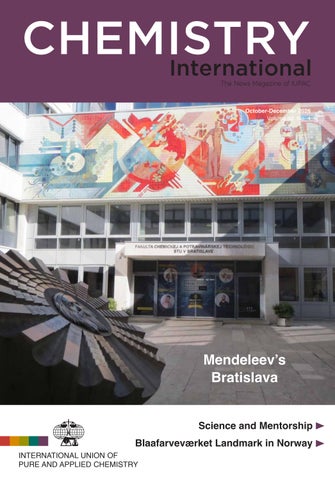
CHEMISTRY International The News Magazine of IUPAC
October-December 2026 Volume 48 No. 4
Mendeleev’s Bratislava Science and Mentorship Blaafarveværket Landmark in Norway
INTERNATIONAL UNION OF PURE AND APPLIED CHEMISTRY
Chemistry International CHEMISTRY International The News Magazine of the International Union of Pure and Applied Chemistry (IUPAC)
All information regarding notes for contributors, subscriptions, Access, back volumes and orders is available online at www.degruyter.com/ci Managing Editor Fabienne Meyers IUPAC, c/o Department of Chemistry Boston University Metcalf Center for Science and Engineering 590 Commonwealth Ave. Boston, MA 02215, USA E-mail: edit.ci@iupac.org Design/Production: Stuart Wilson
Chemistry International (ISSN 0193-6484) is published 4 times annually in January, April, July, and October by De Gruyter Brill Inc., 121 High St., 3rd Floor, Boston, MA 02110 on behalf of IUPAC. See https://iupac.org/what-we-do/journals/chemistry-international/ or https://www.degruyter.com/ci for more information. ISSN 0193-6484, eISSN 1365-2192 © 2026 International Union of Pure and Applied Chemistry. This work is licensed under a Creative Commons Attribution-NonCommercial-NoDerivatives 4.0 International License. Cover: What is the story behind the striking monument to Dmitri Mendeleev featured on our cover? Standing outside the Slovak University of Technology in Bratislava, this remarkable sculpture has welcomed generations of chemists, including visiting IUPAC delegates. Yet for years, the identity of its creator remained a mystery. Discover how a determined search finally revealed the artist behind this tribute to the father of the periodic table. Read the full story by Viktor Milata, page 10.
Contents
CHEMISTRY International October-December 2026 Volume 48 No. 4
Vice President’s Column Busy time for the Science Board by Christine Luscombe
2
Features Blaafarveværket, the first EuChemS Historic Landmark in Norway
4
by Leiv K. Sydnes
The story of Bratislava’s Mendeleev by Viktor Milata Where Science and Mentorship Have No Boundaries
10 13
When Chemistry Becomes Machine-Readable: Four Checks Before AI Uses the Data by Gleb Tsipursky
18
by Jamie Z. Y. Khoo, Eslam M. Hamed, and Fun Man Fung
IUPAC Wire Winners of the 2026 IUPAC-Solvay International Award for Young Chemists IUPAC Announces the 2026 Top Ten Emerging Technologies in Chemistry Calls for Project Proposals and Strategic Areas 2027 IUPAC-Soong Prize for Sustainable Chemistry— Call for Nominations 2027 IUPAC Awards in Analytical Chemistry—Call for nominations IUPAC Council Approves Future Scientific and Governance Structure of the Union First IUPAC Secretariat Retreat Brings Málaga and Rome Teams Together In Memoriam: Ruth M. Lynden-Bell In Memoriam: Mark Salomon In Memoriam: C. Robin Ganellin In Memoriam: Bipul Saha Project Place IUPAC Symbols Certificate for Books:A new milestone for standardization in chemistry? Definition of Single-Atom Catalysis A data standard for size-exclusion chromatography data
20 21 21 22 22 23 24 25 26 26 27 28 30 31
Making an imPACt Critical evaluation of thermodynamic data for sulfate complexes 32 in aqueous solution. Part 1. H+ (IUPAC Technical Report) Basic classification and definitions of polymerization reactions 32 (IUPAC recommendations 2025) The role of mega ports in climate change (IUPAC Technical Report) 32 More than 9700 quality-evaluated pKa values of more than 5000 33 acids in 7 dipolar aprotic solvents Structure-based nomenclature for polymers containing 35 non-identical constitutional repeating units Comprehensive definition of valence as a quantity 35 Bookworm Examples of expressions of uncertainty in measurement Towards Gender Equality in Scientific Organizations Conference Call From Inspiration to Action: Voices of Young Green Chemists from Latin America Electroanalysis BioOrganic Chemistry
36 39 45 50 52
Where 2B & Y Montreal, IUPAC|CSC 2027
56
Mark Your Calendar
59
Index
60
Vice President’s Column Busy time for the Science Board by Christine Luscombe
M
uch of the Science Board effort has focused on a topic that many members of IUPAC will already be familiar with, which is to grapple with the future scientific structure of the Union. While the discussions have often reverted to which Divisions and Standing Committees should be retained or be established, that is not the most important question. That question has been “How can we ensure that IUPAC continues to deliver the activities for which it is best known while also positioning the Union to respond to the evolving needs of chemistry?” The recommendations presented to Council in a Special meeting in July 2026 did not emerge overnight. They were built on discussions that began at the 50th IUPAC General Assembly in Paris in 2019. The first step was the establishment of the Executive Board and Science Board. Now that they are up and running, two
consecutive Science Boards have focused on how best to deliver the scientific mission of IUPAC. There has been extensive consultation with National Adhering Organizations (NAOs), Division Presidents, Standing Committee Chairs, volunteers, and members of both the Science Board and Executive Board. Town halls, forums, and various surveys, all contributed to shaping the final recommendations that were ultimately considered by Council. The culmination of these efforts was that at the Special Council meeting in July 2026, Council approved a revised future scientific structure for IUPAC, providing a mandate to begin implementation. See page 23 or https://iupac.org/iupac-council-approves-futurescientific-and-governance-structure-of-the-union/ One of the most visible outcomes was the establishment of two new divisions: the Division on Digital Standards in Chemistry and the Division on Chemistry Education and Outreach. These additions reflect the increasing importance of digital standards, data interoperability, education, and outreach within the modern practice of chemistry. At the same time, the approved structure retains the foundations that have long formed the basis of IUPAC’s scientific activities. For the remainder of the current biennium, we are operating within a transitional framework. As part of that transition, two preliminary Strategic Areas have been established: Language and Standards of Chemistry
Revised scientific structure setting the Strategic Areas framework for projects and including new divisions.
2
Chemistry International
October-December 2026
and Delivering Green and Sustainable Chemistry. These provide an opportunity to test aspects of the new model while maintaining continuity as we move toward full implementation in January 2028. These Strategic Areas are also ring-fenced to ensure that we do not lose sight of IUPAC’s core activities. The next phase of this work has meant that we have now launched calls for both new projects and additional Strategic Areas within the new framework. See https:// iupac.org/calls-for-project-proposals-and-strategicareas/ The Science Board looks forward to receiving ideas from across the Union and from our National Adhering Organizations. Ultimately, the success of any structure depends not just on the structure itself, but on the scientific activities it enables. While preparing for these activities, I spent some time looking back through earlier issues of Chemistry International. One observation that struck me is that we have discussed these questions many times before. How should IUPAC evolve while remaining true to its mission? How do we balance disciplinary excellence with interdisciplinary challenges? How can the Union remain visible and relevant in a rapidly changing scientific landscape? I found myself asking “How do we make sure that we bring all the volunteers through this transitional process and make sure that the changes stick? We’ve created interdivisional committees before to break down silos – how will it be different this time?” This will have to be a multi-year transition with leadership after leadership chipping away at the transition, trying to ensure that we communicate more with the NAOs while not losing our volunteers. Whether we succeed in delivering our goals strongly depends on our community, and maintaining momentum during these transitions. Another thing that struck me is the breadth of activities that we have. We are extremely fortunate to have dedicated volunteers who produce excellent Technical Reports and Recommendations. Yet I found myself wondering how many in the chemistry community, or even our own volunteers, are fully aware of the scope of our work. Again, not new questions. If IUPAC is to remain relevant, we need to ensure that the community knows about the work and uses it. The Strategic Areas should facilitate this. Throughout the consultation process we have heard a wide range of perspectives. Some colleagues
were enthusiastic. Others were skeptical. Some felt the proposals did not go far enough, while others worried they went too far. While there was no shortage of opinions, the discussions were thoughtful and it reminded me how fortunate we are that IUPAC has the passionate volunteers it has. The goal is not “out with the old, in with the new” but to prioritize our limited resources toward activities that only IUPAC can do, enhance the visibility of that work, and ensure IUPAC remains relevant in this current scientific environment. There is much work left to be done, but with Council’s approval, we can now move from discussion to implementation. As always, I welcome your thoughts, suggestions, and ideas. I hope we can continue these conversations as we work together through the next phase.
Christine Luscombe <christine.luscombe@iupac.org> is Vice President since January 2026. Christine is a Japanese-British chemist known for her work in polymer chemistry and organic electronics. She has been actively involved with IUPAC for more than a decade and served as Vice President of the Polymer Division from 2016 to 2019, President from 2020 to 2023, and was elected to the Executive Board in 2024.
Chemistry International October-December 2026
3
Blaafarveværket, the first EuChemS Historic Landmark in Norway
Picture 2. (Top) Restored houses for workers in the mines. Picture 3. A part of the restored Blue Colour Works (BWC) site. In the largest building, there is a laboratory where visitors are invited to prepare smalt. Photos: Leiv K. Sydnes
by Leiv K. Sydnes
C
hemical heritage is celebrated and recognized in many ways around the world. In Europe, the most prestigious recognition is EuChemS Historic Landmark Award (HLA), which was initiated by European Chemical Society in 2016 to draw attention to and honor locations where important chemical events, linked to a person, an institution, or a chemical plant, had occurred [1]. Two awards are handed out annually, one for impact at the European level and another for impact at a regional level, and today HLA plaques are widely spread over Europe (Picture 1).
The Norwegian Chemical Society decided to nominate the restored company Blue Colour Works (BCW; Blaafarveværket in Norway) in Modum west of Oslo for the 2023 award at the European level [2]. The basis for the nomination was the company’s leading role globally in cobalt production for decades in the 19th century (see text box next page) [3] combined with the restoration of much of the mining community’s factory buildings, living quarters, and mines where exhibitions, hands-on activities, and guided tours in the mines (Pictures 2-5) have made Blaafarveværket one of the best visited attractions in Norway. After waiting for months, the decision was announced, and it was indeed a great pleasure to learn that the nomination of Blue Colour Works had been successful (see text box next page) [1].
4
Chemistry International
October-December 2026
The award ceremony took place in June 2025. The plaque was unveiled between an interesting cobalt symposium and a guided tour to a laboratory to make smalt and in a mine to look for still visible cobalt minerals (Picture 6). EuChemS was represented by President Angela Agostiano from Italy and Secretary General Nineta Hrastel from Slovenia whereas the delegation from Blaafarveværket was headed by Tone S. Steinsvik, Director and Founder of the Blue Colour Works Museum and a prominent driving force since 1975 in the restoration of the mining community (Picture 7). The BCW was an industrial mining community situated in a hilly area belonging to the Kongsberg sector of the Precambrian supracrustal rocks of southeastern Norway. This geological formation is more than 540 million years old and is characterized by faults and folding due to tectonic movements in the crust [3]. The geology in the area is therefore complex, with folded metasediments containing elongated outcrops and lenses with variable amounts of sulfur, arsenic, colbalt, and iron. Due to the variation in the relative abundance of these four elements in the formation, several cobalt minerals were formed and resulted in variation in the mineral composition of the rock over the years. As a consequence, process improvements had to be made to obtain high-quality products as the production went on, and this made BCW a leading producer of cobalt blue in the world for a couple of decades.
EuChemS Historic Landmark Award 2023: The Blue Colour Works, Modum – Norway
Picture 1. Locations where an EuChemS History Landmark has been awarded. Blaafarveværket is located closest to the North Pole. From ref. 1.
Picture 4. (Above) Visitors ready for a guided tour of one of the restored mines. Picture 5. Visitors to the laboratory trying to make smalt. Photos: Leiv K. Sydnes Picture 6. In the mines, pink and red spots due to erythrite are found many places. The colour is due to [Co(H2O)6]2+ from weathered cobalt minerals. Photo: Leiv K. Sydnes
The Landmark is based on the mining community in Modum, Norway, centred around the Blue Colour Works (BCW) factory, which was established in 1776 and remained in operation until 1898. The plant is unique in the sense that it consists of sites representing all aspects of cobalt pigment production, in total 60 well preserved buildings located in clusters over an area of ca. 100 hectare. For more than 100 years the BCW was a site for technology development and production of blue pigment from cobalt — both as ready-made pigment and its raw product — with arsenic as a by-product. The blue pigment was in high demand internationally for use in glazes and colouring of glass and porcelain, in artistic paints, and for bluing paper and textiles. BCW took over the market from Central European companies, which had produced blue pigments for centuries for the porcelain industry. Under German leadership in the 1830s and 40s the BCW became the largest industrial corporation in Norway, with a workforce of more than 1000 men and an annual production of more than 150 tons. The BCW markets were mainly in the UK (e.g., approx. 70% of the total import in 1832), Belgium, and the Netherlands, and even China and the USA. At its peak, the Landmark was one of the most important producers of cobalt blue in the world. From the 1840s, the main product was pure cobalt oxide, but well before the works closed in 1898, cobalt schlich and white arsenic became increasingly important. BCW developed a new method that made ores poor in cobalt commercially valuable, which led to international publications. Contributions were also made to mineralogy by studies on iso- and polymorphism, and by descriptions of new minerals. Because BCW technology was focused on the production of smalt, a production that was in decline elsewhere, however, the technological advances at Modum made more impact on the regional than the global production. Moreover, due to the secrecy of the cobalt industry until the early 19th century, the transfer and spread of technological advances were limited. Most of the technology and leadership needed to construct and run BCW were obtained by unlawful means of industrial espionage and recruitment in Hessen and Saxony. As noted above, BCW became a central player in the 19th century European pigment industry, until synthetic organic colors gradually started to replace colors based on inorganic pigments. The chemical work at BCW required specialized personnel, and workers were trained to handle poisonous materials resulting in protection and health care measures. To keep their workers, the BCW invested in “social welfare” in accordance with mining legislation and traditions, e.g., by establishing schools and health care for workers and their families. Widows were provided for with work and housing. Those measures, documented by contemporary accounts, make BCW a landmark also in social organization in industry.
Chemistry International October-December 2026
5
Blaafarveværket, the first EuChemS Historic Landmark in Norway Cobalt minerals mined at Blue Colour Works
Cobaltite [5]
Erythrite [7]
Skutterudite [8]
Glaucodot [10]
Safflorite [12] Picture 8. The main minerals found in the BCW mines at Modum. The numbers refer to the source of the mineral picture.
6
Chemistry International
Five main types of cobalt minerals were used at BCW over the years. A common feature was the presence of arsenic with the stochiometric As/Co ratio varying from 1:1 to 3:1 [3,4]. In addition, there were traces of other metals, in particular iron, but also copper and nickel, and depending on their amounts, other minerals could be formed. When production at BCW was at its highest and the quality of the product was the best, between 1822 and 1845, cobaltite and skutterudite were the predominant minerals. The former has a reddish, silver-white look (Picture 8) and contains Co, As, and S in a 1:1:1 ratio, which gives the formula CoAsS [3]. Under moist conditions, weathering will gradually occur and convert cobaltite to erythrite which has a deep red to pink color and is a hydrated cobaltarsenate with the chemical formula Co3(AsO4)2.8H2O (Picture 8) [4,6,7]. Skutterudite, named after Skutterud in Modum, Norway, where it was first discovered in 1845, consists of only cobalt and arsenic and has a pale, tin-like color with a metallic luster (Picture 8) [8]. In its perfect form the As/Co ratio is 3, but structurally the unit cluster contains seven CoAs3 units so the chemical formula is written (CoAs3)7. Thus, this is an arsenide mineral. In several sections of the mines, the cobalt-arsenic minerals were mixed with other minerals containing variable amounts of other metals. The most prominent examples are glaucodot and safflorite. The former contains iron in addition to Co, As, and S, the latter iron in addition to Co and As. Both minerals have a tin-white to grey look, but glaucodot has occasionally a tint of red (Picture 8) [9-12]. The formulae October-December 2026
Picture 7. Key people involved when Blaafarveværket was awarded the HLA at the Europen level 21 June 2025. From left: Nineta Hrastelj (EuChemS Secretary General), Angela Agostiano (EuChemS President), Tone S. Steinsvik (Director of Blaafarveværket Museum), Annette Lykknes (Chair, Norwegian Chemical Society Section for the history of Chemistry), and Brigitte Van Tigglen (Chair of the Jury for the EuChemS Historic Landmark Award). Photo: Leiv K. Sydnes
for the minerals are usually written (Co,Fe)AsS and (Co,Fe)As2 respectively, where (Co,Fe) means that both cobalt and iron are present, but in variable ratio.
The process operated at BCW
There are few published details about how the cobalt ore was processed to make the final products at BCW the first 50 years, but in 1822, a new head chemist, Friedrich C. G. Roscher from Germany, was hired and he started immediately to optimize the process. According to a fairly detailed report he wrote in 1830 [3,13], considerable improvements were made so that even poor cobalt ore gave products of high quality. For many years, the main product from BCW was smalt, a blue glass pigment obtained by reacting a cobalt compound (CoCO3 or CoO) with quartz and potash. The rock from the mines was first crushed and sorted by hand based on the look, and the fraction seemingly richest in cobalt minerals was crushed again, washed and heated to give a product called slig, a wet, complex mixture of cobalt-, arsenic-, iron-, and sulfur-containing compounds. In order to get rid of As and S, the slig was strongly heated in an oven in a stream of air (roasting),
Picture 9. Smalt of highest quality to the left and poor quality to the right. Photo: Leiv K. Sydnes (left) and Annette Lykknes (right)
Blaafarveværket, the first EuChemS Historic Landmark in Norway 7 Cake from roasting
1) H2SO4 2) Heat
CoSO4, FeSO4, CuSO4, soil, minerals
H2O, Fe2+, Cu2+, Co2+. SO42-
Water
Unreacted minerals, soil, basic sulphate of iron
CoO
Heat
CoCO3
Na2CO3
Na2CO3
Water Co2+, SO42-
FeCO3 , CuCO3
Scheme 1. The process which according to Crookes and Röhrig was used at BCW to manufacture CoO from cobalt minerals contaminated with iron and copper compounds [13].
Scheme 1. The process which according to Crookes and Röhrig was used at BCW to manufacture CoO from cobalt minerals contaminated with iron and copper compounds [13]. Reaction 2 which generated a fume of arsenic trioxide (As2O3), CoO + SiO2 + K2CO3 + Heat sulfur dioxide, and water vapour and left behind a cake to(and blueiron oxides if iron-containing min͢ Co2SiO4 + Glass + CO2 ofFrom cobaltpink oxide erals were present) (Reaction 1). The cake was used The colour change from pink to blue that occurs when smalt is produced from cobalt minerals to produce smalt (Picture 9), and the fume was led into From the middle of the 1840s, CoO of high purity is a good example of how energy levels of metal orbitals change when anions are exchanged. a long tube (150 m) where As2O3 settled on the wall gradually replaced smalt and became the main product In the the size ofinto thethe orbitals and the total spin of the electrons make manufactured by BCW. Thethe first steps of the CoO and and SOcase atmosphere. 2 andofHcobalt(II), 2O were released smalt processes were identical, Ascompounds twice a year and after purification 2O3 was removed of this ion structurally diverse [18]. The most common structures are either but after roasting to remove arsenic and sulfur, the CoO process became by sublimation, exported as a valuable chemical to be tetrahedral or octahedral (Figure 1), and when a cobalt(II) complex reacts and forms another much more advanced as shown in Scheme 1 [3,13]. used as insecticide and to colour wallpaper. compound, a conversion from one form to another often takes [18-20]. often Toplace produce theThis oxide, theresults cake obtained from roasting Reaction 1 was mixed with sulfuric acid and boiled to dryness to in change of colour because tetrahedral cobalt(II) compounds are mostly blue while octahedral Slig + Air + Heat give a new cake that was subsequently roasted. This are reddish This is illustrated in Figure 2. Compound B is tetrahedral, absorbs visible ͢ [18,20]. As2O3 + SO2 + CoO + (FeO/Fe2O3) gave a dry mixture of the sulfates of cobalt, copper, light between 550 and 750 nm (the red end of the spectrum),and andiron reflects the as blue part of the as well residues of soil and unreacted minerals. This mixture was then If the iron contents in the slig were significant, the spectrum; consequently, the compound looks blue. Analogously, compound A is octahedral,boiled in water and left to cool so that soil, minerals, and what Crookes and smalt would become light blue (Picture 9), difficult absorbs visible light between 400 and 550 nm (the blue end of the spectrum), and reflects the Röhrig called “the basic sulphate of iron formed by the to sell, and unprofitable to produce. This issue was red part of by the Roscher, spectrum; who consequently, theacompound looksroasting red. process” [13] could precipitate. Subsequent addressed developed method to filtration afforded a solution of mainly Co2+, but also remove iron from the cake formed by the roasting of the slig. When the cake was heated in the presence of charcoal, cobalt metal and an iron-rich slag were formed. Subsequent removal of the slag followed by Carbonate Ksp (M2) Look roasting of the cobalt metal gave very pure CoO, which could be used to make smalt of high quality. Smalt was produced according to BCW’s own CoCO3 [14] 1.0.10-10 procedure, which was kept secret due to competition, Figure 1. Compounds of cobalt(II) appear in a variety of structural forms. The most common particularly from(left) German companies. theare from ref. 19. are tetrahedral and octahedral (right).However, The drawings ingredients and the main steps were known. The product after roasting, mainly CoO, was mixed with SiO2 and K2CO3 in an oven and heated briskly to give smalt, CuCO3 [15,16] 1.4.10-10 which essentially is a mixture of intense blue Co2SiO4 and glass (Reaction 2). When the blue glass became viscous, it was poured into barrels with cold water to solidify and then crushed to powder. The powder was mixed with water and transferred to tanks for sedimentation so FeCO3 [15,17] 3.2.10-11 that the smalt could be separated into fractions based on grain size according to customers’ specifications. Table 1. The solubility product and look of the carbonates of Co2+, Cu2+, and Fe2+.
Chemistry International October-December 2026
7
Blaafarveværket, the first EuChemS Historic Landmark in Norway variable amounts of Cu2+ and a little Fe2+. The filtrate was then heated, and by careful addition of sodium carbonate, FeCO3 and CuCO3 precipitated and left behind a solution of Co2+ with high purity. The loss of cobalt was claimed to be minimal because 1) CoCO3 is more soluble than the other carbonates and 2) it was easy to see when precipitation of CoCO3 started and the addition of Na2CO3 had to be stopped due to the different colour of the three carbonates (Table 1) [14-17]. Another filtration was carried out, and when the filtrate was subjected to Na2CO3 addition followed by filtration, CoCO3 was obtained, washed, dried, and strongly heated in clay crucibles to furnish cobalt oxide (Scheme 1).
Figure 1. Compounds of cobalt(II) appear in a variety of structural forms. The most common are tetrahedral (left) and octahedral (right). The drawings are from ref. 19.
From pink to blue
The colour change from pink to blue that occurs when smalt is produced from cobalt minerals is a good example of how energy levels of metal orbitals change when anions are exchanged. In the case of cobalt(II), the size of the orbitals and the total spin of the electrons make the compounds of this ion structurally diverse [18]. The most common structures are either tetrahedral or octahedral (Figure 1), and when a cobalt(II) complex reacts and forms another compound, a conversion from one form to another often takes place [18-20]. This often results in change of colour because tetrahedral cobalt(II) compounds are most blue while octahedral are reddish [18,20]. This is illustrated in Figure 2. Compound B is tetrahedral, absorbs visible light between 550 and 750 nm (the red end of the spectrum), and reflects the blue part of the spectrum; consequently, the compound looks blue. Analogously, compound A is octahedral, absorbs visible light between 400 and 550 nm (the blue end of the spectrum), and reflects the red part of the spectrum; consequently, the compound looks red. During smalt production from cobalt minerals, the structural changes described above occur. In the minerals employed, which are more or less pink, cobalt is surrounded by arsenic and sulfur and exhibit an octahedral structure whereas smalt is a silicate, Co2SiO4, with tetrahedral structure. As a result, the energy of orbitals associated with cobalt are changed, a consequence of which is a shift of the absorption to a longer wavelength (red or bathochromic shift) and a change of the colour to blue. The blue glass produced at Blaafarveværket was named smalt from its colour [20], but in spite of this it is often called cobalt blue, for instance in Wikipedia [21]. This is incorrect. The blue colour of smalt is caused by cobalt silicate (Co2SiO4) whereas cobalt blue er
8
Chemistry International
October-December 2026
Figure 2. Top: The solar spectrum in the visible region as a function of wavelength in nm. Bottom: Typical spectra in the visible region for octahedral (A) and tetrahedral (B) complexes of Co(II). The bottom figure is from ref. 18.
cobalt aluminate Co2Al2O4, which is also called Thénard’s blue after the French chemist Louis Jacques Thénard (1777–1857) [22].
What about the future?
Increasing demand for cobalt and rare-earth elements to produce modern technological devices, including lithium batteries and windmills, has generated new interest in exploration for Co in the vicinity of Blaafarveværket. In the period 2013-2016, Norwegian Geological Survey (NGU) performed test drillings at several locations, and based on chemical analyses of the samples collected [23], zones containing 0.1-0.15 % Co were discovered in an area close to formations rich in Ni. Not long after, Berkut Minerals Ltd., an Australian mining company, drilled in another area and came across some interesting geological formations containing 0.16 % Co [4]. This was of course encouraging, but far more so was the discovery of a 6.2 m thick layer of rock containing up to 1.08 % Co by Kuniko Limited, an Australian mineral exploration company, on yet
Blaafarveværket, the first EuChemS Historic Landmark in Norway another location in the Modum area [24]. No wonder, therefore, that there is a growing optimism regarding future cobalt-mining operations in the not-too-distant future.
Leiv K. Sydnes is Professor Emeritus at Department of Chemistry, University of Bergen, Norway. He has a long career in various professional organizations including IUPAC where he served the Presidental succession 2002-2007. He chaired the CHEMRAWN committee 2008-2015. Acknowledgement
Valuable information about geological processes and structures from Dr. Magnhild Sydnes is highly appreciated.
5.
6. 7. 8. 9. 10. 11. 12. 13.
References
All internet references were checked 2026.06.20 and were found to be correct. 1. https://www.euchems.eu; https://www.euchems.eu/ awards/euchems-historical-landmarks 2. This paper is based on two articles published in Kjemi, a magazine published by the Norwegian Chemical Society, and used with permission: Sydnes, l. K. Blaafarveværket nominert til EuChemS Historical Landmark Award. Kjemi 2023, (1), 20-24; Sydnes, l. K. Fra rosa mineraler til mørkeblå smalt på Blaafarveværket. Kjemi 2025, (1), 14-18. 3. Bjørnland, L.H.; Degryse, P.; Schibille, N.; Eremin, K.; Walton, M.S.; Gratuze, B.; Braekmans, D.; Shortland, A.J. The Production of Smalt, and other cobalt Compounds at the Blaafarveværket, Modum, Norway. Forensic Archaeolog, Anthropology and Ecology 2.2 (2018). 4. Bjerkgård, T.; Dahlgren, S.; Raanes, A.; Sandstad, J.S.; Heldal, T. Mineralressurser i området Kongsberg-Modum-Ringerike, Busekrud. Norges Geologiske Undersøkelser 2020, report 023, p. 2 and 28-29; https://www.ngu.no/upload/Publikasjoner/ Rapporter/2020/2020_023.pdf
14. 15. 16.
17. 18.
19.
20.
21. 22. 23. 24.
https://www.dreamstime.com/cobaltite-mineral-samplecobalt-used-manufacturing-image214034782; https:// en.wikipedia.org/wiki/Cobaltite https://snl.no/erytrin https://en.wikipedia.org/wiki/Erythrite https://no.wikipedia.org/wiki/Skutteruditt#/media/ Fil:Skutt%C3%A9rudite.jpg https://en.wikipedia.org/wiki/Glaucodot https://www.dakotamatrix.com/products/3871/glaucodot https://en.wikipedia.org/wiki/Safflorite https://www.dakotamatrix.com/products/14262/safflorite Crookes, W; Röhrig, E. A Practical Treatise on Metallurgy, Adapted from the latest German Addition of Professor Kerl’s Metallurgy. Longmans, Greene and Co, London, UK. 1868, pp. 578-579. https://www.google. no/books/edition/A_Practical_Treatise_on_Metallurgy/ sR0NAAAAYAAJ?hI=no&gbpv=1&d-Q=%22A+practical +treatise+on+metallurgy%22&printsec=frontcover https://en.wikipedia.org/wiki/Cobalt(II)_carbonate https://www.chm.uri.edu/weuler/chm112/refmater/ KspTable.html https://www.indiamart.com/proddetail/ copper-carbonate-powder-2856739917855. html?srsltid=AfmBOoqmAhLcbQxZU_ OhbQKxflUAVpJTa9qo_k8uyctYtHV18WhDw-Hc https://no.wikipedia.org/wiki/Jernspat Cotton, F.A., Wilkinson, G.; Murillo, C.A.; Bochmann, M. Advanced Inorganic Chemistry, Sixth ed.; John Wiley & Sons, New York, USA; 1999, pp. 816-821. Holleman, A.F.; Wiberg, E. Lehrbuch der Anorganischen Chemie, 57th-70th Edition; Walter de Gruyter & Co, Berlin, Germany; 1964, pp. 152 and 528. Hägg, G. Allmän och oorganisk kemi, 5. opplag; Almqvist & Wiksell Förlag, Stockholm, Sverige; 1963, s. 690-692. https://no.wikipedia.org/wiki/Koboltbl%C3%A5tt https://snl.no/Louis_Jacques_Th%C3%A9nard https://geo.ngu.no/kart/mineralressurser_ mobil/?lang=nor https://kuniko.eu/projects/skuterud
Chemistry International October-December 2026
9
The story of Bratislava’s Mendeleev
by Viktor Milata
E
very day we walk past them, we perceive them in a strange way: they complete our environment, beautify it and create a kind of symbiosis of art inspired by the muse and the idea that is the driving idea of every chemist. In short, I am writing about two of our works of art—a mosaic and a monument—which are located in front of and above the entrance to the new building of the Faculty of Chemical and Food Technology of the Slovak University of Technology in Bratislava (Slovakia). Before 1990, every building had in its construction budget an item for the artistic decoration of the space, which was usually stylized for the given space. That was the case with our faculty. But nowhere in the faculty materials did we find even a trace of the creators of these two works, and so the task arose to try to find the artists. As luck would have it, Peter Šimon, DSc. was doing DTA analysis of materials for some artists and managed to find out the name of the author of the mosaic above the entrance to the building (picture above). She is the academic painter Jarmila Dičová-Ondrejková, now living in Brunovce between Piešťany and
10
Chemistry International
October-December 2026
Nové Mesto (New City) over river Váh. The mosaic depicts artistic views on several areas of chemistry. The search for the author of the second work—the sculpture of D. I. Mendeleev with his periodic table of elements (in the left part of the picture above) was much more difficult and complicated: in 2009, this magazine published an article on the periodic table of the elements which was illustarted by this sculpture (Chem. Int. 31(1), 4-6, 2009). I contacted the author G. Jeffery Leigh asking how he got ahold of the aforementioned image, but Jeffery came back to me asking who the author of the aforementioned work was. A search began, which I thought would be banal and quick, but none of the older colleagues could remember who the author of the work was. In 2009, two years before the International Year of Chemistry IYC 2011 (IYC2011) declared by UNESCO, IUPAC leadership expressed its intention to visit Slovakia as one of the countries it had not yet visited and organized a Bureau meeting there. The Slovak Chemical Society, as a member of IUPAC, managed to secure this and the visit took place in April 2009. The meeting took place in the SAS conference center near the Presidential Palace, it
One of IUPAC Executive gathering in Bratislava (2009); standing from Left: David StC Black (IUPAC Secretary General) and his wife Anda (directly behind), John W. Jost (IUPAC Executive Director) and his wife Kim, Mary Corish, Nancy and John Malin, Nicole Moreau (IUPAC Vice President), Bryan Henry (IUPAC Past President), (front) Mary Kirchhoff, XX?, Wolfram Koch (secretary of the GDCh), Prof. Jun-Il. Jin (IUPAC President), ? (behind), Fabienne Meyers, John Corish (IUPAC Treasurer), Milan Drábik, Victor Milata; and kneeling in the front, from the left, Slavko (Venčeslav) Kaučič (President of the Slovenian ChS) and Erich Leitner (Secretary of the Austrian ChS).
was organized by Milan Drábik and Viktor Milata, and the participants expressed interest in the sculpture and took pictures in front of it (picture above): The photo shoot was a success in the form of several versions and private photos, including a photo of the mosaic above the entrance. A similar interest was aroused during the committee meeting of the IUPAC Division of Analytical Chemistry under the leadership of its then president Jan Labuda from 19-21 March 2016 (photo below). And shortly afterwards, from 6–8 April 2018, a meeting of the IUPAC Bureau was held at the Faculty in the premises of the Slovak Chemical Library, organized by Milan Drábik, Peter Šimon, Viktor Milata, and
Ján Labuda with a speech by the then Vice-Dean for Science Anton Gatial. Among other things, they discussed preparations for the celebration of the 100th anniversary of the founding of IUPAC and the 150th anniversary of the announcement of the discovery of the Periodic Law (picture next page): However, we still did not know the name of the artist of the sculpture...only by chance and after almost half a year of effort did we manage to contact the creator of the mosaic, Mrs. Dičová-Ondrejková, who was then living in Italy for a long time, who revealed the name of the author of the sculpture: he was the academic sculptor Karol Lacko from Beckov. Thus, our long effort was crowned with success. IUPAC Analytical Chemistry Divsion (2016): From left to right: Elena Savonina, Earle Waghorne, Takae Takeuchi, Aleš Fajgelj, Stefan Tsakovski, M. Filomena Camões, Attila Felinger, Zoltan Mester, Jan Labuda, D. Brynn Hibbert, Heli M. M. Sirén, Huan-Tsung Chang, Sandra Rondinini, Érico M. M. Flores, M. Clara F. Magalhães, David G. Shaw, Slavica S. Ražić, Paul De Bièvre, Derek Craston.
Chemistry International October-December 2026
11
The story of Bratislava’s Mendeleev
Chemistry International vol. 31, no. 1, 2009, pp. 4-6. https://doi.org/10.1515/ ci.2009.31.1.4
Side note: D. I. Mendeleev was cruelly ignored in the nomination for the Nobel Prize in Chemistry in 1903. The Swedish chemist Svante Arrhenius, the holder of the Nobel Prize for Chemistry, already had antipathies against him, and they were so strong together with his influence that even such a colossal discovery was not rewarded with a Nobel Prize. It should be noted that 2019 was declared by UNESCO as the International Year of the Periodic
Above: IUPAC Bureau (2018) Fabienne Meyers, Jurgen Stohner, Alan Hutton, Lynn Soby, Jan Reedijk, Carlos Tollinche, Lars Ohrström, (back) Russell J. Boyd, (front) Rita Cornelis, Pietro Tundo, Natalia Tarasova, Doug Templeton, Richard Hartshorn, [right of the statute] Carolyn Ribes, Bonnie Lawlor, (back) Colin Humphris, Francesco Nicotra, (front) Qi-Feng Zhou (IUPAC President), Christopher Brett, Mei-Hung Chiu, (back)??, Hemda Garelick, Jan Apotheker, Mary Garson, Javier Garcia Martinez, Ehud Keinan, Greg Russell, and Ken Sakai
Table (IYPT 2019), and apart from completing the 7th row of the periodic table of elements, a special form of the periodic table (picture below) was published, which reflects the proportional representation of individual elements in nature, and is made available to the chemical community to promote chemistry and its role in everyday life: there is an answer to the question of whether there is anything in the world without chemistry? This table is gradually being translated into national languages, so that the information in it is clearly accessible to the public and to lower school students who may not yet be fluent in English. (download from https:// www.euchems.eu/euchems-periodic-table/) I wrote this article so that the younger generation can remember the artists who portrayed chemistry and its personalities with their artistic vision, as well as the fact that even small Slovakia is not unknown in the world of chemistry.
Viktor Milata is professor at the Institut of Organic Chemistry, Catalysis and Petrochemistry at the Slovak University of Technology in Bratislava, and President-Past and Honorary President of the Slovak Chemical Society (www.schems.sk) 12
Chemistry International
October-December 2026
Where Science and Mentorship Have No Boundaries A Three-Generation Conversation Across the Global North and the Global South by Jamie Z. Y. Khoo, Eslam M. Hamed, and Fun Man Fung
T
he IUPAC World Chemistry Congress (WCC) 2025 in Kuala Lumpur drew chemists from every career stage and every region. Among them were three chemists who graduated from the same research group at the National University of Singapore (NUS), spanning undergraduate to faculty—an unbroken thread of mentorship that began with Sam F. Y. Li and now runs across three academic generations. The format of this article borrows from the PARTY Approach [1]: a narrative interview that lets each voice speak for itself, in conversation with the others. Eslam M. Hamed (EH) is a research fellow in the Department of Chemistry at NUS, working on single-atom nanozymes for biosensing and environmental remediation under the supervision of Sam F. Y. Li. He is also affiliated with the Department of Chemistry, Faculty of Science, Ain Shams University, Cairo. Jamie Z. Y. Khoo (JK) is a recent BSc(Hons) graduate from NUS, where she completed her fourthyear research on molecularly imprinted polymers for forensic biosensors under the supervision of Sam F. Y. Li. She is also working on the intersection of Artificial Intelligence and chemistry education, co-supervised by Fun Man Fung and Yvonne Choo. Fun Man Fung (FM) is a faculty member at the School of Chemistry, University College Dublin (UCD), and a PhD alumnus of Sam F. Y. Li’s group at NUS. He is the National Representative for Ireland on the IUPAC’s Committee on Chemistry Education (CCE).
Tell us briefly about yourselves and what brought each of you to Kuala Lumpur in 2025.
Eslam: I joined Prof. Li’s group at NUS in 2022 and have spent my PhD designing single-atom nanozymes – enzyme-mimicking catalysts whose active centre is a single metal atom. They are remarkably versatile: we have used them for biosensing, for CO₂ capture and conversion, and most recently for the photocatalytic remediation of wastewater dyes [2,3]. IUPAC 2025 in
Kuala Lumpur was where I gave my first oral presentation at a global congress. Jamie: I had just graduated from NUS with my honours degree in chemistry. With international authors, I published a project researching on the intersection of chemistry and artificial intelligence looking at how the readiness of AI tools is reshaping the way we teach and learn chemistry [4]. Bringing that work to IUPAC was a way of taking student-led research onto a global stage. Fun Man: I am based at UCD now, but I did my PhD with Prof. Li at NUS, and that is the thread that ties the three of us together. I first attended an IUPAC WCC in 2019, in Paris, as Prof. Li’s PhD student. Six years on, I came back to Kuala Lumpur as a faculty member alongside two scientists from the very same group. It felt like a homecoming with a different role.
This is a Li-group story across three generations. How did each of you become part of that group?
Fun Man: I’ll start, because mine is the longest arc. I joined Prof. Li’s group as a PhD student over a decade ago. The group’s core expertise is in analytical chemistry, but Prof. Li never minded that my own posters drifted into chemistry education, a field outside his usual domain. At my first IUPAC in 2019, I presented several chemistry education posters at Palais des Congrès, Paris. What I remember most vividly is the sight of my supervisor walking up to each one and cheering me on. That kind of public encouragement, for work outside the lab’s mainline, is rare. It set the tone for how I have tried to mentor since. Eslam: I joined the group in 2022, when FM was still with NUS. I had come from Ain Shams University in Cairo to Singapore on a scholarship from the Egyptian Ministry of Higher Education. Not long after I arrived, FM, whom I had not known yet, reached out. He had seen my work and wanted to know if I would be interested in collaborating. That is how we started co-authoring on the single-atom nanozyme programme [2], and more recently on a green-synthesis route to jarosite nanoparticles from banana-peel extract [3]. The four authors on that paper – Hui Wen Neo, myself, FM and Prof. Li – span every generation of the group. Jamie: My path is the most recent. Prof. Li was my fourth-year research thesis supervisor at NUS, and FM was my mentor on the chemistry education project which I did on the side. That is the same fourth-year role Prof. Li had once played for FM—so the pattern keeps repeating. Beyond my thesis, we have co-authored on artificial intelligence in chemistry education [4], on disaster-prepared research networks in the wake of Chemistry International October-December 2026
13
Where Science and Mentorship Have No Boundaries
Figure 1A. EH on A day with with the Nobel laureates and peer-to-peer exchanges with fellow young scientists at the Lindau Nobel Laureate Meeting, June 2025.
the 2024 Hualien earthquake [8], and on ASEAN as a model for science diplomacy [7]. Fun Man: Watching Jamie take on her honours year and produce that body of work mattered to me personally. Prof. Li trusted me to also do chemistry education as a PhD student in analytical chemistry; I have tried to extend the same trust to the next student in that seat.
Before IUPAC 2025, you each had formative international experiences. Talk us through them.
Eslam: For me, Singapore itself was the launchpad. My first major international event was the Global Young Scientists Summit (GYSS) 2024 in Singapore, which I could attend without extra funding because I was already based at NUS. The most memorable moment was a small-group discussion with 2014 Nobel Laureate Stefan Hell. When I asked him what he looks for in new lab members, his answer was: “passion and vision.” He emphasised that research is full of setbacks and repeated failures; without passion for the process and a long-term vision, the journey becomes hard to endure. Eslam: That spirit stayed with me through an even more immersive experience: the Lindau Nobel Laureate Meeting in June 2025. Over 30 Nobel Laureates and hundreds of young scientists gathered on the small
14
Chemistry International
October-December 2026
island of Lindau. I had breakfast with Frances Arnold, a coffee break with John Jumper, lunch with Morten Meldal and his spouse Phaedria Marie St. Hilaire, and an evening walk with Roderick MacKinnon (Figure 1A). Discussions with Akira Yoshino, Ben Feringa, David MacMillan, Gregory Winter, Martin Chalfie, Moungi Bawendi, Stanley Whittingham, Stefan Hell and Steven Chu were just as enriching. Equally valuable were the peer-to-peer exchanges with fellow researchers across disciplines and continents. Lindau taught me that great science happens in communities where ideas are openly shared and thoughtfully challenged. My participation was made possible by NUS and the Mars company, one of the Lindau sponsors. Jamie: My defining chapter was an exchange semester at the University of California, Berkeley. Immersed in a research-driven environment, I worked with peers and mentors from very different backgrounds, and that is where I caught a deeper passion for research. Not just their classes, but my peers and close friends there were strongly anchored in research. Conversations with Anne Baranger’s group at their potluck dinner, and brief office visits with Richmond Sarpong and Omar Yaghi really grounded myself in a supportive research environment. A discussion with Fun Man Fung and Jennifer Schwartz Poehlmann at Stanford during the preparation of my most recently published paper showed me what a
Where Science and Mentorship Have No Boundaries Figure 1B. JK’s semester in UC Berkeley, and ACS Spring 2025, San Diego.
globally distributed conversation actually feels like. Jamie: I brought that momentum to ACS Spring 2025 in San Diego, which was my first international conference and my first with both oral and poster presentations (Figure 1B). The community I met there fueled my drive to contribute internationally, and led me directly to Kuala Lumpur. Fun Man: My pre-2025 beat is IUPAC 2019 itself, which I have already mentioned. Two earlier pieces in this magazine have stayed with me and shaped how I see Chemistry International as a venue: the reflections by two young observers at WCC 2023 in The Hague [9], and the PARTY Approach piece that this article is consciously modelled on [1]. Both convinced me that Chemistry International is a place where junior and
Figure 2. Three generations of the Li group reunited at IUPAC WCC 2025 - Eslam M. Hamed (EH) (PhD student), Fun Man Fung (FM) (faculty) and Jamie Z. Y. Khoo (JK) (undergraduate).
senior voices can sit side by side, and that is what we are trying to do here.
What did IUPAC WCC 2025 in Kuala Lumpur mean to each of you?
Eslam: Unlike GYSS and Lindau, Kuala Lumpur asked me to stand in front of an international audience and deliver an oral presentation. Presenting my research to a room of experts was both exhilarating and humbling—it pushed me to articulate the significance of the work with real clarity. But the personal significance ran deeper. I was joined by Fun Man, who had attended IUPAC 2019 in Paris as a PhD student of Sam Li; now, six years later, Fun Man had returned as a faculty member while I took on the student role. Completing the arc, Jamie delivered her own first oral. Three career stages, one group. My trip was funded partly by NUS High School’s SCIENTIA mentoring award and partly by my PhD supervisor. Jamie: I used the week in Kuala Lumpur to find my footing as a budding scientist – to meet new people and nurture connections. What left a real mark on me was how readily other scientists took the time to listen, give feedback and share their own journeys. The community made the difference. My participation was supported by the American Chemical Society (ACS) Singapore chapter, which gave me an irreplaceable opportunity to grow. Fun Man: For me, Kuala Lumpur was a return rather than an arrival. Bringing Eslam to his first IUPAC oral and Jamie to her first IUPAC oral, in the same week that the Li group gathered across three generations, felt like doing Prof. Li proud at the meeting where my own IUPAC journey had begun. Prof. Li has recently Chemistry International October-December 2026
15
Where Science and Mentorship Have No Boundaries Figure 3. A picture during one of IUPAC WCC 2025’s events, Kuala Lumpur, Malaysia.
celebrated his retirement in 2026 and the photograph in Figure 2 carries more weight for me than any single talk I gave that week.
Tell us about mentorship across generations. What does it look like in practice?
Fun Man: Prof. Li belongs to the generation of my parents; I am closer in age to Eslam and Jamie. We have come of age with very different technologies: Facebook and pre-smartphone literature searches when I was an undergraduate, AI-assisted research for Jamie’s cohort today. What does not change is that scientists are human beings first. Prof. Li has always treated his group with dignity and respect, encouraging without ever raising his voice, while still holding everyone to high standards. That is the culture I have tried to carry forward: human-centric mentorship, opportunity-sponsoring, and the conviction, in the spirit of Seneca, that “you are never too young to lead.” A perspective written together with mentees in Singapore and France argues that human connection, not bibliometric output, is the most honest measure of research success [6]. Eslam: From inside that culture, what I notice is the speed at which trust gets extended. When Dr. Fung reached out in 2022, I had no prior track record with him; he extended trust based on what he saw. With the sponsorship of Prof Li’s lab, we co-mentored high school students together. That changes how you work—you reciprocate by aiming higher. Jamie: As the youngest, mentorship has felt like being given the same seat at the table as anyone else. My supervisors positioned me as a lead co-author rather than a student attached to a paper; They
16
Chemistry International
October-December 2026
gave me opportunities to share my voice and grow my research skills. I’m truly grateful for such a form of mentorship, to be “working with” rather than “working for” a research. It has strengthened my research ethos, and pushes me to keep growing. That was what allowed me to walk into Kuala Lumpur as someone with something to contribute.
A word on the Global North-Global South dimension, which IUPAC takes seriously.
Fun Man: Kuala Lumpur made one thing very visible: the IUPAC stage is where the Global North and the Global South meet on level terms, and the friendships made between sessions outlast any individual presentation. The wider academic context isn’t getting easier. There is a real and growing set of pressures on academic research worldwide [5], and forums like IUPAC are where collective answers get started. Eslam: With my home institution in Cairo and my doctoral research based in Singapore, I experience the North-South dynamic firsthand during my daily commutes. In that landscape, Kuala Lumpur became a neutral meeting point where neither side of the bridge felt out of place. Jamie: And as someone who has just stepped into the international community, what I saw at IUPAC was a forum where the conversation crosses regions. Everyone shared the common agenda in the pursuit of science.
Looking ahead—what is next?
Eslam: We are already planning to be in Montreal, Canada, for IUPAC WCC 2027. . .
Where Science and Mentorship Have No Boundaries Jamie: All three of us. And more work in between— there is a generation of students coming up that we want to bring along, in the same way we were brought along. . . Fun Man: That is the point of writing this piece. Mentorship across generations is not a single hand-off. Mentorship is a chain you keep extending forward!
References 1.
2.
Conclusion
What began as a Li-group reunion at IUPAC WCC 2025 in Kuala Lumpur became, over the course of a week, a quiet demonstration of what cross-generational mentorship can do for chemistry. Three career stages, three regions of training, and one shared commitment to keep paying it forward. We hope this conversation encourages readers, at any career stage and in any region, to look around their own research communities and find the conversation partners who will become their next collaborators.
Disclaimer: The views and opinions expressed in this article are solely those of the authors and do not represent the views of this magazine or the organisations they work in.
Acknowledgement
Eslam M. Hamed is funded by a full scholarship from the Ministry of Higher Education of the Arab Republic of Egypt. Fun Man Fung acknowledges a University College Dublin (UCD) grant supporting the collaboration with the NUS team. He is grateful to the Royal Irish Academy for the opportunity to represent Ireland at the 53rd IUPAC General Assembly. Eslam M. Hamed thanks NUS High School (SCIENTIA programme) and his PhD supervisor for funding his IUPAC 2025 participation, and NUS together with the Mars company for funding his Lindau participation; Jamie Khoo thanks the American Chemical Society (ACS) Singapore chapter for supporting her IUPAC 2025 participation. The authors gratefully acknowledge Prof. Sam F. Y. Li for the mentorship culture that made this collaboration possible.
3.
4.
5.
6.
7.
8.
9.
Choo, Y., Fung, F. & Vidal, J. (2024). The PARTY Approach: How Friendship Transcended Borders for Science. Chemistry International, 46(3), 6–11. https:// doi.org/10.1515/ci-2024-0302 Hamed, E. M., Zhu, Y., Fung, F. M. & Li, S. F. Y. (2026). Coordination-Driven Design of SingleAtom Nanozymes: Bridging Mechanistic Insights and Multimetal Applications. Accounts of Materials Research. https://doi.org/10.1021/accountsmr.5c00337 Neo, H. W., Hamed, E. M., Fung, F. M. & Li, S. F. Y. (2025). Green synthesis of jarosite nanoparticles for photocatalytic degradation of Rhodamine B under simulated sunlight radiation. RSC Sustainability, 3(12), 5518–5526. https://doi.org/10.1039/D5SU00731C Khoo, J. Z. Y., Hollinger, F., Han, J. Y. et al. (2026). Tipping Point in the Future Readiness of Artificial Intelligence and Chemistry Education. Journal of Science Education and Technology. https://doi. org/10.1007/s10956-026-10330-8 Piret, G., Fung, F. M., Fullerton, J. et al. (2025). A call to action to address escalating global threats to academic research. The Innovation, 6(4). https://doi.org/10.1016/j. xinn.2024.100758 Tan, T. L. Y., Kon, M. W. R., Coumoul, X. & Fung, F. M. (2026). Why human connection is the true metric of research success. FEBS Open Bio. https://doi. org/10.1002/2211-5463.70238 Fung, F. M., Khoo, J. Z. Y., Martinez, I. S. & Lee, H. L. (2026). Chemical Security in a Fragmenting World: ASEAN as a Model for Science Diplomacy? ACS Chemical Health & Safety, 33(2), 180–184. https://doi. org/10.1021/acs.chas.6c00011 Fung, F. M., Khoo, J. Z. Y. et al. (2026). Reframing Science Diplomacy: Building a Regional Academic Network for Disaster-Prepared Research Collaboration and Emotional Recovery. ACS Chemical Health & Safety, 33(1), 52–59. https://doi.org/10.1021/acs. chas.5c00140 Kon, M., Teo, J., Fung, F. & Potgieter, M. (2024). Two Young Observers at the WCC in The Hague Share Their Reflections. Chemistry International, 46(2), 22–25. https://doi.org/10.1515/ci-2024-0204
Eslam M. Hamed, ORCID 0000-0003-0717-3134 Jamie Z. Y. Khoo, ORCID 0009-0009-5952-9471 Fun Man Fung, ORCID 0000-0003-4106-3174
Chemistry International October-December 2026
17
When Chemistry Becomes Machine-Readable: Four Checks Before AI Uses the Data by Gleb Tsipursky
I
UPAC members already work in a discipline where a misplaced character can change meaning. That makes chemistry a useful test case for artificial intelligence. Generative AI can accelerate literature triage, draft code, restructure tables, summarize technical material, and help explain complex work. Yet these systems produce plausible language rather than guaranteed chemical truth. That distinction matters because IUPAC’s mission rests on objective scientific expertise and a common language for chemistry. Its current scientific priorities explicitly include data standards, nomenclature, terminology, symbols, curated data, and technical standards for the digital age. As more chemistry becomes machine-readable, the value of AI will depend less on how fluent an answer sounds and more on whether people can trace what the system used, what it changed, and who verified the result. A practical way to get that benefit without adding invisible error is to build four checks into everyday workflows.
1. Anchor the task to a controlling source
The first question should come before the prompt: What source controls this answer? Consider a chemist using AI to compare nomenclature across papers, turn a written procedure into a structured record, or summarize a recommendation for colleagues. A model can blend current terminology with older conventions, flatten an exception into a general rule, or supply a familiar-looking definition from memory. The result may read cleanly while drifting from the standard that actually governs the work. Before using AI, name the authoritative source, version, and date that should control. Then ask the system to work within that boundary. If the task depends on a current IUPAC recommendation, identifier, unit convention, or critically evaluated dataset, keep that source visible during review rather than relying on the model to reproduce it accurately. This habit fits IUPAC’s broader role in creating the common language that lets chemists communicate across disciplines and borders. AI can help navigate that language, but it should not quietly redefine it.
2. Preserve provenance when data changes 18
Chemistry International
October-December 2026
form
The second check concerns what happens between input and output. IUPAC’s digital standards program reflects a growing need for chemical information that both people and machines can interpret consistently. That becomes especially important when AI helps clean, join, label, or transform datasets. Imagine three routine workflows. A researcher asks an AI coding assistant to merge structure-property tables from several sources. A laboratory team uses a model to convert instrument exports into a common schema. An educator asks AI to turn a collection of chemical examples into a machine-readable exercise set. In each case, the transformation may succeed technically while altering meaning. Units can be converted incorrectly. Missing values can become zeros. Stereochemical distinctions can disappear. Column labels can shift. An identifier can refer to a different form of a substance than the one intended. Keep a provenance record that travels with the data: original source, retrieval date, transformation steps, assumptions, unit conversions, identifier mapping, and any rows changed or excluded. IUPAC’s FAIR Chemistry Cookbook emphasizes practical skills for working with machine-readable chemical data. AI makes those skills more important because it can perform transformations so quickly that people lose sight of the intermediate steps.
3. Recalculate the consequential result
The third check is simple: if an AI-assisted output could change a scientific, operational, or public decision, verify the critical result independently. Suppose a chemist asks AI to generate code that calculates concentrations, fits a model, converts units, ranks candidate compounds, or compares measurements across datasets. Running code without an error message proves only that the code ran. It does not prove that the inputs, equations, filters, assumptions, or interpretation were correct. Choose the few outputs that carry the most consequence and reproduce them through a separate method. Recalculate a sample by hand. Compare against a trusted reference implementation. Run an independent script. Check whether units and significant figures survive the workflow. For a literature synthesis, open the original papers behind the most important claims rather than checking only the model’s summary. This approach does not require duplicating every calculation. It concentrates human attention where a mistake would matter most. That is especially useful
Illustration by Getty Images licensed under the Unsplash+ License
in an environment where automation can expand the volume of analysis faster than anyone can review every intermediate step.
4. Make human ownership visible
The final check addresses a behavioral problem rather than a technical one. AI can blur responsibility. When a result passes through a chatbot, a coding assistant, a database, and a shared document, teams can begin treating the output as something that “the system” produced. That makes it harder to know who should challenge an assumption or stop a flawed result from moving forward. Assign a named human owner at the point where an AI-assisted output becomes a chemical claim, project decision, published statement, teaching material, or recommendation. The owner should know which sources controlled the work, which transformations occurred, what was independently checked, and what uncertainty remains. Then track corrections. If a model repeatedly mishandles a unit, identifier, terminology rule, or data format, record the pattern and change the workflow. A correction log turns individual mistakes into organizational learning. It also gives teams a better measure of AI value than time saved alone.
The opportunity is larger than faster drafting
IUPAC’s recent work on digital standards and FAIR chemical data points toward a scientific environment in
which human-readable and machine-readable chemistry increasingly coexist. Its 2024–2025 biennial report highlights the continuing importance of common language, FAIR data standards, education, international collaboration, and scientific outreach. That creates an opportunity to design AI use around the same qualities chemistry already values: precision, provenance, reproducibility, and shared standards. The strongest AI workflow will not be the one that produces the fastest answer. It will be the one in which a chemist can explain where the answer came from, reproduce the important parts, identify what the machine changed, and take responsibility for the final scientific judgment. In a field built on a common language, that kind of traceability is what lets new tools accelerate chemistry without weakening the standards that make chemical knowledge portable and trustworthy. Adapted from: The Psychology of AI Adoption at Work: From Resistance to Results (Georgetown University Press, 2026) https://disasteravoidanceexperts.com/aibook
Gleb Tsipursky, a behavioral scientist called the “Office Whisperer” by The New York Times, helps tech-forward leaders stop overpaying for AI while boosting engagement and innovation. He serves as the CEO of the AI consultancy Disaster Avoidance Experts, and wrote eight books, including The Psychology of AI Adoption at Work: From Resistance to Results (Georgetown University Press, 2026). https://disasteravoidanceexperts.com/aibook Chemistry International October-December 2026
19
IUPAC Wire
News and information on IUPAC, its fellows, and member organizations. See also www.iupac.org/news
Winners of the 2026 IUPAC-Solvay International Award for Young Chemists
T
he International Union of Pure and Applied Chemistry (IUPAC) and Solvay are pleased to announce the winners of the 2026 IUPACSolvay International Award for Young Chemists. This prestigious award recognizes the best Ph.D. theses in the chemical sciences, as described in 1000word essays.
2026 Award Winners
Each of the five winners, representing diverse research fields and regions, will receive a cash prize of USD 1000 and travel support to the 2027 IUPAC Congress in Montreal, Canada (July 9–16, 2027). Winners are invited to present a poster at the Congress and submit a short critical review on their research for publication in Pure and Applied Chemistry. Sergio Barranco (Spain)—Institute of Chemical Research of Catalonia (ICIQ), Spain; “Harnessing the Mechanistic Potential of Reaction Intermediates in Cp*CoIII-Catalyzed C–H Functionalization Reactions”
https://orcid.org/0000-0001-5489-7755
Kang Rui Garrick Lim (Singapore) Harvard University, USA; “Raspberry-colloid-templated catalysts as a model thermocatalytic platform”
https://orcid.org/0000-0003-2159-9844
Soumyadip Mondal (India)—Institute of Science & Technology Austria (ISTA), Austria; “Oxygen and Sulfur Redox: Conversion Kinetics and Phase Equilibria”
https://orcid.org/0000-0001-8082-4891
Sergio Barranco
20
Chemistry International
Kang Rui Garrick Lim
October-December 2026
Philipp E. Schilling (Austria)—ETH Zurich, Switzerland; “Potassium Acyltrifluoroborates (KATs) for Chemical Protein Synthesis and Modifications”
https://orcid.org/0000-0003-4996-5367
Emily Xi Tan (Singapore)—Nanyang Technological University, Singapore; “Utilizing chemical domain knowledge and machine learning for nanoparticle and biochemical spectroscopic analysis”
https://orcid.org/0000-0001-5643-974X
This year’s competition received 45 applications from Ph.D. graduates across 24 countries. The award selection committee was chaired by Professor Ehud Keinan, IUPAC Past President. The awards will be formally presented at the Opening Ceremony of the 2027 IUPAC Congress, where winners of both the 2026 and 2027 competitions will be honored.
2027 Award Applications
The call for applications for the 2027 IUPAC-Solvay International Award for Young Chemists is opened. Eligible candidates must have received a Ph.D. or equivalent degree in 2026 from an institution in a country with an IUPAC National Adhering Organization.
About Solvay
Solvay, a pioneering chemical company with a legacy rooted in founder Ernest Solvay’s pivotal innovations in the soda ash process, is dedicated to delivering essential solutions globally through its workforce of over 9,000 employees. Since 1863, Solvay harnesses the power of chemistry to create innovative, sustainable solutions that answer the world’s most essential needs such as purifying the air we breathe and the water we drink, preserving our food supplies, protecting our health and well-being, creating eco-friendly clothing, making the tires of our cars more sustainable and
Soumyadip Mondal
Philipp E. Schilling
Emily Xi Tan
cleaning and protecting our homes. Solvay’s unwavering commitment drives the transition to a carbon-neutral future by 2050, underscoring its dedication to sustainability and a fair and just transition. As a world-leading company with €4.7 billion in net sales in 2024, Solvay is listed on Euronext Brussels and Paris (SOLB). For more information about Solvay, please visit solvay.com or follow Solvay on Linkedin.
IUPAC Announces the 2026 Top Ten Emerging Technologies in Chemistry
I
UPAC has released the 2026 Top Ten Emerging Technologies in Chemistry. The goal of this initiative is to showcase the transformative value of chemistry and to inform the general public about the potential of the chemical sciences to foster the well-being of Society and the sustainability of our planet. The Jury* - an international panel of scientists with a varied and broad range of expertise- reviewed and discussed the diverse pool of nominations of emerging technologies that were submitted by researchers from around the globe, ultimately selecting the final top ten that cover a broad range of fields from sustainability and medicine to manufacturing and imaging. These technologies are defined as transformative innovations that lie in between a eureka-moment discovery and a fully-commercialized technology and that have outstanding potential to open new opportunities in chemistry, sustainability, and beyond. IUPAC’s objective in putting these highly-innovative ideas under the spotlight is to strongly encourage collaboration across all scientific disciplines in order to accelerate progress towards a more sustainable and equitable world.
• • • • • • • • • •
The 2026 finalists are (in alphabetical order): Biomass Electrolysis-Stanton Biomimetic Vision Sensor Chainmail Catalysis DNA Origami Frontally Polymerizable Resins Mechanochemistry Molecular Editing Photoactive Colloids Ptychographic Imaging Rechargeable Metal-Air Batteries
In its eighth consecutive year of operation, the IUPAC Top Ten Emerging Technologies in
Chemistry initiative continues to look into sustainability and circularity, connecting new and innovative ideas towards a greener future, while maintaining a strong interest in the development of methods for the improvement of human health. Overall, the selection of the 2026 Top Ten, carefully crafted by a panel of experts from a pool of global nominations, continues to carry the spirit established by the first Top Ten list released in 2019 and that is to highlight the potential of chemistry - and chemists - to provide solutions to the most urgent societal issues. The 2026 Top Ten Emerging Technologies in Chemistry will be further detailed in a feature article to be published in the next January 2027 issue of Chemistry International (CI). Fernando Gomollón-Bel, the author of that feature, stated that the “Top Ten is much more than a catalogue of clever chemistry. It is a showcase of sustainable solutions for accelerating technology transfer and catalysing commercialization, connecting the chemical sciences to other disciplines towards the creation of a better future. Some of the technologies seemed like science fiction a few years ago, such as DNA origami or biomimetic vision, but start-ups beginning scale-up and preliminary clinical studies demonstrate their potential to expand and grow.” The first selection of the Top Ten Emerging Technologies in Chemistry was released in 2019 as a special activity honoring IUPAC’s 100th anniversary. The results were published in the April 2019 issue of Chemistry International, 41(2), pp. 12-17, 2019 (https:// doi.org/10.1515/ci-2019-0203). The results of subsequent editions and the related articles in CI can be accessed at: https://iupac.org/what-we-do/top-ten/. *The following comprised the panel of judges for the 2026 Top Ten Emerging Technologies in Chemistry: Michael Droescher, (Chair, German Association for the Advancement of Science and Medicine), Bonnie Lawlor, Ehud Keinan, Javier García Martínez, Arasu Ganesan, Molly Shoichet, Juliane Sempionatto, Mamia El-Rhazi, Jorge Alegre Cebollada, Bernard West, Natalia Tarasova, Zhigang Shuai, Rai Kookana, and Kira Welter.
https://iupac.org/what-we-do/top-ten/
Calls for Project Proposals and Strategic Areas
T
he IUPAC Science Board has been reviewing the IUPAC project system and is introducing a number of changes aimed at strengthening Chemistry International October-December 2026
21
IUPAC Wire the impact, coordination, and strategic direction of IUPAC projects. A key development is the introduction of Strategic Areas—mid- to long-term areas of focus that will help guide IUPAC projects and signal where the Union intends to concentrate its influence and resources. Strategic Areas will complement, rather than replace, IUPAC’s fundamental work in areas such as nomenclature, terminology, chemical data standards, and the Color Books. Two Strategic Areas have already been safeguarded from the outset: Language and Standards of Chemistry and Delivering Green and Sustainable Chemistry. The Science Board is now inviting the IUPAC community to propose additional Strategic Areas, with new areas scheduled to launch in January 2028. Individuals, task groups, Divisions, and National Adhering Organizations (NAOs) are encouraged to put forward forward-looking themes that connect IUPAC’s core strengths with emerging scientific and global challenges. The deadline for Strategic Area proposals is 15 December 2026. Alongside this longer-term strategic process, IUPAC is also introducing changes to the way individual projects are proposed, reviewed, and managed. Project proposals will move from continuous intake to synchronized application cycles and will be reviewed by the Project Committee. Projects aligned with Strategic Areas will ordinarily involve at least two Divisions, while disciplinary projects involving a single Division will continue to be considered with appropriate justification. Projects will normally run for up to four years, with formal midterm review against agreed milestones. The first Call for Project Proposals for the 2026– 2027 transition period is now open, with a submission deadline of 31 October 2026. Proposals should support IUPAC’s core activities, digitization, outreach, and/ or the developing Strategic Area framework, with an emphasis on clear deliverables, international collaboration, diversity, digital standards, external impact, and sustainable maintenance of project outputs. Together, these changes are intended to create a more coordinated project system that preserves IUPAC’s essential standards-setting role while enabling the Union to address important emerging challenges through visible, collaborative, and high-impact initiatives.
Contact Christine Luscombe, Vice President and Chair of the Science Board or Fabienne Meyers, IUPAC Secretariat https://iupac.org/calls-for-project-proposals-and-strategic-areas/ 22
Chemistry International
October-December 2026
2027 IUPAC-Soong Prize for Sustainable Chemistry—Call for Nominations
T
he IUPACSoong Prize for Sustainable Chemistry is a high-profile prize to be awarded annually to an outstanding scientist for a breakthrough or conceptual advance, highlighting the discovery rather than the laureate’s luminous career. Nominations for the 2026 award are invited via the following nomination form—deadline 30 Nov 2026. There are no restrictions on the candidate’s background, affiliation, identity, and opinions. The Prize laureate will receive a certificate, a medal, a monetary award of $30,000 (USD), and travel expenses to reach the prize ceremony. In addition to the prize ceremony, the awardee will be invited to present a lecture at the National Taiwan University within two years of receiving the award. Self-nomination is not allowed. The IUPAC-Soong Prize, established through a generous endowment by LITEON founder Raymond Soong, will recognize breakthroughs in sustainable chemistry. The third award will be presented during the IUPAC | CSC 2027 World Chemistry Congress, July 11-16 2027, in Montreal, Canada. In addition, and within two years, the laureate will also deliver a lecture at National Taiwan University. In July 2025, the first award was presented to Omar M. Yaghi at the IUPAC World Chemistry Congress. The second award was presented to Ronny Neumann at the 10th EuChemS Chemistry Congress.
For further information, contact Ehud Keinan, IUPAC President <ekeinan@ iupac.org> | <https://iupac.org/what-we-do/awards/iupac-soong-prize/>
2027 IUPAC Awards in Analytical Chemistry—Call for nominations
T
he Analytical Chemistry Division of IUPAC is inviting nominations for two awards, including:
•
The IUPAC Emerging Innovator Award in Analytical Chemistry – an award to recognize outstanding work undertaken by an emerging
IUPAC Wire
•
analytical scientist that corresponds to the aims of the Analytical Chemistry Division. The IUPAC Analytical Chemistry Medal – an award to recognize significant lifetime contribution to the aims of the Analytical Chemistry Division.
The awards are open worldwide to researchers working in the field of analytical chemistry. The Emerging Innovator Award is for researchers who are at an early stage of their independent career, as measured by the completion of a PhD within the last ten years. Appropriate consideration will be given to those who have taken a career break or followed a different study path. Nominations must be based on published works in the field of analytical chemistry. The Analytical Chemistry Medal is for researchers who have a substantial record of achievements demonstrated by the number and quality of their publications, by being actively involved in international partnerships as well as by their commitment in the training of the next generation of analytical chemists. The 2027 awards will be presented during IUPAC’s General Assembly and World Chemistry Conference in Montreal, Canada, July 9–16, 2027. The awardees will be invited to the meeting of the Analytical Chemistry Division to receive their award and to present a lecture. The Analytical Chemistry Division of IUPAC welcomes nominations for both awards from the world analytical chemistry community. The nomination deadline is 31 December 2026.
https://iupac.org/2027-iupac-awards-in-analytical-chemistry-call-fornominations/
IUPAC Council Approves Future Scientific and Governance Structure of the Union
T
he International Union of Pure and Applied Chemistry (IUPAC) convened a Special Virtual Meeting of Council on 21 July 2026 to consider a series of motions relating to the future scientific structure, governance, and financial framework of the Union. Following broad participation by the National Adhering Organizations (NAOs), Council approved all seven motions by substantial majorities, providing a clear mandate to begin the process of implementing the approved changes. The motions addressed the 2027 National Adhering Organization dues, the revised
2026–2027 budget, the future scientific and governance structure of the Union, transitional arrangements for implementation, and a comprehensive review of the NAO dues calculation methodology. A key outcome of the meeting was Council’s approval of a revised scientific structure for IUPAC, to take effect on 1 January 2028. The approved Divisions are: • Physical and Computational Chemistry • Inorganic Chemistry • Organic Chemistry and Chemical Biology • Polymer Chemistry • Analytical Chemistry • Chemistry and the Environment • Chemistry and Human Health • Digital Standards in Chemistry • Chemistry Education and Outreach Council also approved the future lineup of Standing Committees: • Finance Committee • Committee on Publications • Industry Liaison Group • Committee on Ethics, Diversity, Equity and Inclusion • International Younger Chemists’ Network • Project Committee • Evaluation Committee • Interdivisional Committee on Terminology, Nomenclature and Symbols With Council’s decisions, IUPAC will now begin the process of implementing the approved roadmap. This includes establishing a Task Force to prepare proposed revisions to the Union’s Statutes, Bylaws, and Standing Orders; developing the governance framework needed to support the new structure; and carrying out the approved transitional arrangements leading to implementation in 2028. The proposed revisions to the governing documents will be presented to Council for consideration at its next ordinary meeting, to be held in Montréal in July 2027, in accordance with the Union’s governance procedures. Council also requested a comprehensive review of the National Adhering Organization dues system, examining the current methodology to ensure it remains fair, transparent, equitable, predictable, and sustainable. The Treasurer will report the findings, together with any recommendations, to Council in advance of its next ordinary meeting. The detailed voting results demonstrate broad support across the membership for the proposed direction Chemistry International October-December 2026
23
IUPAC Wire of the Union and provide a strong foundation for the future growth of IUPAC and its scientific activity. Further information on the Special Council, including the agenda and supporting documentation, is available on the IUPAC Special Council webpage. IUPAC thanks its National Adhering Organizations and volunteers for their engagement throughout the consultation and decision-making process. Their contributions have been instrumental in shaping the Union’s future direction and ensuring that the implementation of these decisions is informed by the broad expertise and commitment of the global chemistry community.
https://iupac.org/iupac-council-approves-future-scientific-andgovernance-structure-of-the-union/
First IUPAC Secretariat Retreat Brings Málaga and Rome Teams Together
T
he first IUPAC Secretariat Retreat took place on 1–2 October at the Consiglio Nazionale delle Ricerche (CNR) Office in Rome, bringing together colleagues from IUPAC’s newly established offices in Málaga and Rome. In January 2026, IUPAC announced the establishment of its new European-based Secretariat, following an international call for proposals that marked the relocation of the Secretariat from Research Triangle Park, North Carolina, where it had operated continuously since 1997. The new Secretariat structure is supported by two host institutions with strong connections to science and international collaboration. In Málaga, the University of Málaga and the City of Málaga are supporting the Secretariat and its activities. In Rome, the CNR provides the institutional setting for the Italian office. IUPAC has emphasized that both hosts are providing office space, seconded staff, and corporate support as part of the new arrangements. CNR President, Andrea Lenzi, together with Lidia Armelao, Director of the Department of Chemical Sciences and Materials Technologies, welcomed the new members of the team, emphasizing the opportunity to strengthen IUPAC’s role as a globally recognized reference point for the chemical sciences. Special thanks go to Mauro Fabrini and Sarah Swee-Ling Chen, who led the preliminary procedures and governance for CNR. The two-day meeting marked an important milestone for the new European-based Secretariat: colleagues from the two locations had the opportunity to meet in person, exchange ideas, and begin building a shared
24
Chemistry International
October-December 2026
approach to working together as one team. It provided space for colleagues to get to know one another and strengthen the personal connections that will create an effective collaboration across the two offices. One member of the new Secretariat leadership is Katherina Viethmeier, Site Lead & Director of Business Development for the Málaga Office, who has taken on the responsibility of helping establish and develop IUPAC’s presence. Her leadership in Málaga is central to building the new office and strengthening IUPAC’s engagement, partnerships, and activities. For Katherina, the exchanging of ideas and workflow discussions has allowed them to come back with valuable insights and a clear plan for the next steps. For Fabiana Piscitelli, Director of International Affairs and Site Lead of the Rome Office, the gathering represented an important moment in the development of the new Secretariat: “These first conversations are about much more than workflows and responsibilities. They are about building connections, sharing perspectives and creating a common way of working that can best support the IUPAC community, its volunteers and its mission worldwide.” The digital dimension of the new Secretariat was also an important theme. Daniele Melaccio, IUPAC Digital Manager, is leading work to strengthen digital infrastructure, workflows, and information management, helping connect the two offices and support IUPAC’s global community. The new structure offers an opportunity to approach these challenges with a fresh, forward-looking mindset. Laura Polito (Scientific Programs Manager) and Aurora Caputi (Operations Coordinator) complete the Italian CNR team, while Marta Alcudia (Memberships) and Tatiana Montoya
IUPAC Secretariat with CNR and IUPAC leadership: (l to r) Mauro Fabrini, Tatiana Montoya, Fabiana Piscitelli, Daniele Melaccio, Fabienne Meyers, Zoltán Mester, Lidia Armelao, Katherina Viethmeier, Liana Vaccari, Aurora Caputi, Marta Alcudia, and Laura Polito
IUPAC Wire (Communications & Social Media) will be working from the Spanish Málaga Office. Also present was Liana Vaccari from Philadelphia, USA, who ensured a smooth transition from the previous United States location. The retreat was also an opportunity for the new Secretariat team to connect with IUPAC’s leadership and gain a deeper understanding of the Union’s structure, activities, and international community. Fabienne Meyers, Executive Director, and Zoltán Mester, IUPAC Secretary General, were present in Rome and helped coordinate the meeting, sharing their knowledge of IUPAC and providing valuable insight into the organisation’s work, priorities, and global network. Their involvement helped give the new team a broader perspective on the role of the Secretariat and the importance of working closely with IUPAC’s leadership and volunteer community. The European-based Secretariat, with offices hosted by the University of Málaga in Spain and by CNR in Rome, represents a significant new chapter for IUPAC. The two offices are designed to work closely together, combining their expertise and resources while maintaining a strong connection with IUPAC’s worldwide volunteer and scientific community. The Rome meeting provided a strong foundation for that collaboration, and an opportunity for the new Secretariat team to look ahead together. While the Secretariat now has two European locations, its purpose remains shared: to support IUPAC’s volunteers and advance international collaboration in chemistry and the chemical sciences. Discover The new Secretariat Team and explore our offices in Rome and Málaga: https://iupac.org/ who-we-are/secretariat/
https://iupac.org/first-iupac-secretariat-retreat-brings-malaga-androme-teams-together/ In Memoriam
Ruth M. Lynden-Bell (1937–2026)
I
UPAC remembers with sadness Professor Ruth M. Lynden-Bell FRS, who passed away on 27 April 2026, aged 88. A distinguished theoretical chemist, Ruth made pioneering contributions to our understanding of liquids and disordered solids, particularly through molecular simulation, while also dedicating her expertise and enthusiasm to international scientific cooperation. From 1995 to 2003, Ruth was Professor at Queen’s University Belfast, where she helped establish the
interdisciplinary Atomistic Simulation Group and contributed to advances in the understanding of ionic liquids, working alongside researchers including Ken Seddon. Returning to Cambridge in 2003, she continued her research on ionic liquids while remaining actively engaged in international scientific activities. In 2006, she was elected Fellow of Ruth M. Lynden-Bell the Royal Society in recognition of her crucial advances in understanding the properties of liquids and disordered solids, and the clarity and elegance of her scientific work. Ruth served as Secretary of IUPAC’s Physical and Biophysical Chemistry Division (Division I) from 2006 to 2009. She also contributed to strengthening connections between chemistry and physics through her involvement with the International Union of Pure and Applied Physics (IUPAP) Commission on Statistical Physics. Her service to IUPAC reflected her commitment to interdisciplinary collaboration and to fostering connections across the international scientific community. Beyond her scientific achievements, Ruth was an inspiring teacher and mentor. IUPAC President Mary Garson recalls first knowing Ruth as her physical chemistry supervisor during her undergraduate studies at Cambridge. Ruth subsequently played an important role in Mary’s professional development as a mentor at New Hall (now Murray Edwards College), where Mary held a research fellowship from 1978 to 1981. They reconnected through IUPAC General Assemblies in the early 2000s. Mary shares a particularly vivid memory of Ruth’s lecture on ionic liquids at the 2003 IUPAC meeting in Ottawa, when a major power failure interrupted proceedings. Undeterred, Ruth continued her presentation using her carefully prepared overhead transparencies, distinguished by their colour coordination and elegant copperplate handwriting. With the projector no longer working, she simply passed the transparencies around her small audience by hand, continuing her explanations. While most other lectures that afternoon were abandoned, Ruth completed hers to warm applause—a Chemistry International October-December 2026
25
IUPAC Wire memorable illustration of her resourcefulness, dedication and quiet determination. Remembered for her intellectual rigour, generosity and commitment to colleagues and students, Ruth leaves a lasting legacy through her scientific achievements, her encouragement of others and her contributions to IUPAC. She will be warmly remembered and greatly missed. With recollections kindly shared by Professor Mary Garson, IUPAC President.
Mark Salomon (1935–2026)
D
r. Mark Salomon, a distinguished American physical chemist and electrochemist, passed away peacefully on 11 June 2026, at the age of 91. A resident of Little Silver, New Jersey, Mark was widely recognized for his pioneering research on battery technologies, particularly lithium-based battery electrolytes, and for his longstanding contributions to IUPAC. A prolific author and editor, Mark contributed to numerous scientific publications and patents in electrochemistry, thermodynamics, and the transport properties of gelled electrolytes. His scientific expertise was complemented by a longstanding commitment to IUPAC and international collaboration. In the mid1970s he was a member of the group that launched IUPAC’s Solubility Data Project and has been since an active leader of the project. He served as a Titular Member of the Analytical Chemistry Division (Division V) from 1996 to 1999 and subsequently as a member of the Subcommittee on Solubility and Equilibrium Data from 2002 to 2017. Spanning more than five decades, his involvement reflected his dedication to advancing reliable chemical data and fostering scientific exchange across disciplines and national boundaries. Through IUPAC meetings, international collaborations and lectures at universities around the world, Mark helped strengthen connections within the global chemistry community. A respected scientist and valued colleague, Mark leaves a lasting legacy through his scientific contributions, his dedication to international cooperation in chemistry and the many lives he touched. He will be warmly remembered and greatly missed.
26
Chemistry International
October-December 2026
C. Robin Ganellin FRS (1934–2026)
I
UPAC remembers with sadness Professor C. Robin Ganellin FRS, who passed away on 27 June 2026 at the age of 92. A distinguished medicinal chemist and one of the co-inventors of cimetidine (Tagamet), Robin C. Robin Ganellin made outstanding contributions to drug discovery and played an influential role in advancing medicinal chemistry through international scientific collaboration. Robin studied chemistry at the University of London, where he obtained his PhD under the supervision of Professor Michael Dewar. In 1960, he was a research associate at the Massachusetts Institute of Technology, working with Arthur Cope, before joining Smith Kline & French Laboratories in the United Kingdom. There, he contributed to the discovery of cimetidine, a revolutionary treatment for peptic ulcers that transformed the management of acid-related gastrointestinal disorders and became a landmark achievement in modern medicinal chemistry. His distinguished scientific career included more than 250 publications and co-inventorship of over 160 patents. In recognition of his outstanding achievements, he was elected Fellow of the Royal Society in 1986 and appointed to the Smith Kline & French Chair of Medicinal Chemistry at the University of London. Robin’s commitment to advancing medicinal chemistry extended well beyond his own research. From 2002 to 2012, he chaired the IUPAC Subcommittee on Drug Discovery and Development, bringing together leading medicinal chemists from around the world. Under his leadership, the subcommittee became an active forum for scientific exchange and collaboration, with regular meetings attracting strong international participation. One of his notable initiatives was the Analoguebased Drug Discovery project, launched in 2003. This ambitious undertaking resulted in three volumes published by Wiley-VCH in 2006, 2010 and 2013, providing valuable reference works for medicinal chemists and drug discovery researchers.
IUPAC Wire Robin also played a central role in establishing the IUPAC–Richter Prize in Medicinal Chemistry, working with subcommittee colleagues to develop its statutes and serving as Chair of the Selection Committee from 2006 to 2014. The prize has since become an internationally recognized distinction celebrating outstanding contributions to medicinal chemistry. His dedication to education and knowledge sharing was further illustrated by the medicinal chemistry short course he organized in Rio de Janeiro in 2005. Through his scientific achievements, leadership and commitment to international collaboration, Robin helped shape both modern medicinal chemistry and IUPAC’s activities in drug discovery. He will be remembered not only as an exceptional scientist and visionary leader, but also as a generous colleague and dear friend whose influence will continue to be felt throughout the medicinal chemistry community. He will be greatly missed.
Bipul Saha (1952 - 2026)
I
UPAC remembers with profound sadness Dr. Bipul Saha, who passed away on 21 August 2026 following a period of illness. A distinguished industrial chemist and dedicated advocate for international scientific cooperation, Bipul made outstanding contributions to IUPAC over many years, bringing together his expertise in chemistry, industry and environmental sustainability with an unwavering commitment to the global chemistry community. Bipul held advanced degrees in both chemistry and management, including PhDs in each discipline, and undertook postdoctoral research with Nobel Laureate Professor Sir Derek Barton. His distinguished career spanned research, development and industrial leadership. He worked at the Bhabha Atomic Research Centre and Pfizer India before holding senior positions at Monsanto, Gharda Chemicals, Nagarjuna Agrichem and Vinati Organics. His scientific and professional achievements were recognized with the Homi Bhabha Gold Medal, awarded by the Bhabha Atomic Research Centre. Within IUPAC, Bipul was an exceptionally active and valued contributor. He served as a member of the Bureau and Executive Board and held positions within the Division of Chemistry and the Environment (Division VI), the Committee on Chemical Research Applied to World Needs (CHEMRAWN), and the Committee on Chemistry and Industry (COCI), where he also
served as Secretary. His involvement reflected his conviction that chemistry should play a central role in addressing global challenges and strengthening cooperation between science, industry and society. One of Bipul’s particularly significant contributions was his engagement in international efforts to improve the management of Bipul Saha chemicals and waste. Representing IUPAC alongside colleagues, he participated actively in discussions surrounding the Strategic Approach to International Chemicals Management (SAICM), the Global Framework on Chemicals, and the development of the Intergovernmental Science-Policy Panel on Chemicals, Waste and Pollution. Through these activities, he helped bring scientific perspectives into international policy discussions, emphasizing the importance of sound chemical knowledge in addressing pollution and promoting sustainability. Bipul was equally committed to education, outreach and expanding IUPAC’s global reach. His enthusiastic support for the Global Women’s Breakfast initiative helped inspire the organization of dozens of events annually across India. He also fostered connections with the Association of Chemistry Teachers in India, opening opportunities for thousands of students to engage with IUPAC and the wider international chemistry community. Beyond his professional achievements, Bipul will be remembered for his generosity, optimism and remarkable ability to connect with people. Colleagues recall his enthusiasm and positive outlook, even during lengthy and demanding international negotiations. For many within IUPAC, Bipul embodied the spirit of volunteer service: generous with his time, committed to collaboration and always ready to encourage others. His contributions extended far beyond formal committee responsibilities, leaving a lasting impression on colleagues across the world. IUPAC extends its deepest condolences to his wife, his daughter Shreyashi, and his family and friends. Bipul’s scientific contributions, dedication to international cooperation and unfailing kindness leave an enduring legacy. He will be warmly remembered and greatly missed. Chemistry International October-December 2026
27
Project Place
Information about new, current, and complete IUPAC projects and related initiatives. See also www.iupac.org/projects
IUPAC Symbols Certificate for Books: A new milestone for standardization in chemistry? by Alessandro Minguzzi, Nicola Cioffi, D. Brynn Hibbert,and Charles A. Lucy IUPAC makes substantial efforts to standardize chemical nomenclature, symbols, and terminology. Nevertheless, many authors of (text)books and scientific papers show limited motivation to adopt these recommendations. To address this issue, an IUPAC project (https://iupac.org/project/2022-008-4-500) has made a first step by awarding a “IUPAC Seal” to books that adopt symbols for quantities recommended by IUPAC. This recognition is intended to add authority and value to a certified work. For historical reasons, such as scientific communities bound to different traditions, different symbols have been adopted for the same quantity, and notation conventions do not always fully align with IUPAC recommendations. For example, mass density is frequently indicated using the symbol d, in place of the IUPAC recommended ρ. Instead, IUPAC recognizes d as the symbol for the relative density. A simple misunderstanding is round the corner! So, while no one would argue that the symbol for the element cobalt is anything but Co, rules for quantity symbols (IUPAC recommended, single character with italic font) are often ignored. Why should correct symbols for quantities be less consistent than symbols for chemical elements? A more rigorous motivation is given in the first lines of the IUPAC Green Book (https://iupac.org/whatwe-do/books/greenbook), that cites the words by M. L. McGlashan in 1969, chair of the Commission on Physicochemical Symbols, Terminology and Units and author of The Manual of Symbols and Terminology for Physicochemical Quantities and Units. The aim is “to secure clarity and precision, and wider agreement in the use of symbols, by chemists in different countries, among physicists, chemists and engineers, and by editors of scientific journals.” Luckily for this IUPAC Seal project, the majority of symbols are laid out in the Green Book (Brett et al., Quantities Units and Symbols in Physical Chemistry, 4th edition abridged, RSC 2025). And so in determining if a new textbook will be given the IUPAC Seal for Symbols, the text simply needs to be compared with the Green Book. While the task of checking a text for correct symbols might sound easy, as Italians say “Tra il dire e il fare c’è di mezzo il mare” (There’s a big gap between saying and doing).
28
Chemistry International
October-December 2026
Working with Artificial Intelligence
In what seemed a good idea in late 2025, an early effort in this project was the use of a large language model (LLM) to compare the symbols adopted by a given text with those recommended by IUPAC. When asked for the general importance of standardization in science (and so in chemistry), the LLMs often cite the famous example of the Mars Climate Orbiter, which was lost because of a mismatch between metric and imperial units (an example cited also in the IUPAC Green Book). For students, standardized symbols and units make learning easier and more consistent. They allow learners to focus on understanding concepts rather than translating between different scientific conventions. It is interesting that artificial intelligence (AI) “thinks” about the importance of these topics for students, while textbook and monograph authors too often consider them somehow of secondary importance. Indeed, we think that this last point is particularly relevant. Using different symbols for the same quantity might cause tremendous (and unjustified) confusion in students. Many chemistry students have asked the authors why another professor used a different symbol for the same quantity and if there’s any difference in using one or the other symbol! Using two symbols for the same quantity leads (probably subconsciously) to the idea that their meaning might be slightly different, or that they are applied into different contexts. In conclusion, we can state that standardization acts like a shared language of science. Using AI that does not violate copyright was a first problem, because an LLM is supposed to use the input data to instruct the model. The problem is easily solved by using the security options of the specific software. Alternatively, some educational/professional versions automatically exclude the use of the input data for instructing the LLM. Both solutions were possible with Open AI (ChatGPT). However, earlier versions of
ChatGPT had difficulty in simply identifying symbols as symbols, and many apparently “subtle” aspects (such as the formatting of subscript/superscripts) were not always considered. It was also evident that the instructions given to the LLM (prompts) were crucial, and that many interactions were needed to guide it to better solutions. A similar approach was obtained with Microsoft Copilot. In both cases, LLM has a tendency of providing replies that easily deceive the user: the famous “hallucination.” Overall, the results were not satisfying, and this conclusion is further reinforced by a recent MSc thesis [1]. Nonetheless, significant improvements have already been made in LLMs, that have substantially improved the analysis of symbols. Plus, these “virtual thinkers” have a clear view for the importance of this work. Indeed, looking for a non-biased spokesperson (albeit one that is universally encouraging), we asked some of the main LLMs (ChatGPT, Copilot, Gemini) about the importance of standardization of symbols and units in chemistry. All their replies put the emphasis on the fact that standard symbols and units allow scientists around the world to understand each other without confusion, allowing replication of experiments under the same conditions with accurate verification of results.
The value of a manual approach
That said, this initial phase of the project used a manual approach to look for criteria and guidelines to judge if a book is speaking the right “language” of chemistry. We have started with symbols, but we shall hopefully move on to include units, terminology and nomenclature in future projects. First of all, how to go through an entire book to examine all the symbols contained therein? Here’s some options: Avoid reading the book but focus on the symbol list that is presented at the beginning or at the end. Surely a quick approach, but we have no guarantee that these lists are complete or even provided! Use the LLM. It is probably the approach that will be adopted in the near future. Still, at this moment cannot be fully trusted, in that it might provide hallucinatory (convincing) replies that do not expose all the actual discrepancies present in the text. Review the entire text’s use of symbols manually. It’s the approach that we are currently using, provided that option 1 and 2 are not entirely satisfactory. We realized, with some surprise, that a large percentage of symbol mistakes that book authors make are not related to the letter itself, but rather with its formatting. For example, the use of italics vs roman (upright) style, which do not only apply to the “main”
symbol but also to subscript or superscripts. IUPAC convention is that roman type is used for symbols representing units, labels, chemical elements, and mathematical operators, and italic type is used for symbols of physical quantities, variables, and specifical structural descriptors. For example, if one wants to indicate a reaction enthalpy of the i th reaction, ΔrHi,
When Every Measure Was Different When Lieutenant Henry Hugh count of Baskerville, also called ’the Hound’, towards the end of World War II entered with his small group of soldiers this remote Italian mountain village, he addressed its Mayor, asking: ’Tell me, how do the people in the valley make a living?’ ’Mostly farming and cattle’, was the answer, ’you can assume that a family, in the region of the southern valley owns about 2000 tablets of land.’ ’How much is a tablet?’ ’Four square trabucci, of course’. ’How much are they?’ ’Thirty six square feet is a square trabucco. Or, if you like, eight hundred linear trabbucci make a Piedmont mile. A typical family can cultivate olives for about one sack of oil, and one sack makes five emine and one emina makes eight cups.’ ’I hope to understand’, said the Hound with some bewilderment, ’Every country has its own measures. For instance, while the British measure beer by the pint, you measure wine with the boccali.’ ’Or with the rubbio. Six rubbie make one brenta and eight brente make one bottale. If you like, one rubbio gives six pints. You should note, however, that our pint is different from the British imperial pint, which is about ten percent larger than 500 cm3, whereas the American liquid pint is a little less than 500 cm3, if you want to translate this into metric units.’ ’I think that I get the idea quite clearly’, said the Hound with some resignation. ’Yes, indeed’, said the Mayor, ’for instance in “New” England (USA) you still use the inch to measure length and the pound per square inch, the psi, to measure pressure. Do you wish to know anything else?’, he added with a tone that seemed defiant. ’No, thank you, that is more than enough’, the Lieutenant concluded this discussion. Inspired by Umberto Eco’s “Il Nome della Rosa” [The Name of the Rose], and as paraphrased in Brett et al., Quantities Units and Symbols in Physical Chemistry, 4th edition abridged, RSC 2025
Chemistry International October-December 2026
29
Project Place
Foundations of Physical Chemistry by Giorgio Spinola and Paulo Ghigna will be the first book to feature the IUPAC seal [2].
the mathematical symbol delta, Δ should be written in roman style, as well as the subscript descriptor “r” ; and the symbol for enthalpy, H, and i indicating physical quantities, must be written in italics. This is a general knowledge that applies to a vast majority of the symbols used in a general chemistry, analytical chemistry or physical chemistry book. If acknowledged by the authors, before writing the book, the work of evaluating the book would be much faster.
Testing the IUPAC seal
The next step was to find a suitable test subject to validate our approach. Is it possible to convince authors and editors on taking a book that is on its way to publication and review it in terms of the adherence of its symbols to the standard ones? The answer is yes, and the very first book awarded with an IUPAC Seal for symbols has just been published: Foundations of Physical Chemistry is authored by Paolo Ghigna and Giorgio Spinolo, by the University of Pavia and published by CRC Press [2]. In this case, we discussed the project with the publisher’s representatives and with the authors. We then received the book draft and worked on it. We took about six weeks to complete the review, doing our best to not slow down the publication process. However, as mentioned earlier, this step can be significantly shortened by implementing certain preventive measures, such as informing the authors in advance about some key aspects to manage from the very beginning of the writing process. It is worth saying, at this point, that our review was not meant to evaluate the scientific quality or correctness of the book. The final output of our work was a list of symbols that we asked the authors to review and correct. This was mandatory for the award of the IUPAC Seal for symbol. Are we sure to have spotted all the possible mistakes in the book symbols? Probably not, but we are confident that now the book’s adherence to IUPAC symbols is greatly improved. Considering that—being a physical chemistry book with a high density of symbols—the result is quite satisfying.
30
Chemistry International
October-December 2026
Now we are ready for the next book, and something is already waiting for us. We are also working on a IUPAC recommendation/technical report, that will serve as the guideline to make the outcomes of this project an institutional activity of IUPAC, most likely in charge of the Interdivisional Committee on Terminology, Nomenclature and Symbols (ICTNS).
References 1.
2.
V. A. Jacob, Evaluating and Enhancing Large Language Models for Chemically Accurate Representation of Physical Quantities using IUPAC Standards, MSc thesis, University of Southampton, 2025. https://www.routledge.com/Foundations-of-PhysicalChemistry/Spinolo-Ghigna/p/book/9781041082330 , published 22 July 2026.
The current project task group includes Alessandro Minguzzi (Chair, Università degli Studi di Milano), Ernesto de Jesús Alcañiz, Stuart Chalk, Nicola Cioffi, Jeremy Frey, Brynn Hibbert, Charles Lucy, Leah McEwen, Zoltán Mester, Fabiana Piscitelli, David Shaw, and Jürgen Stohner. For more information and comments, contact task group Chair Alessandro Minguzzi, alessandro.minguzzi@unimi.it | https://iupac.org/ project/2022-008-4-500
Definition of Single-Atom Catalysis Since its emergence, single-atom catalysis (SAC) has profoundly influenced catalysis research by conceptually bridging homogeneous and heterogeneous catalysis. However, despite exponential growth in publications and applications, spanning energy conversion, fine chemicals, electrocatalysis, and environmental catalysis, the term “single-atom catalysis” is used inconsistently across the literature. It currently encompasses chemically distinct systems, ranging from isolated metal atoms in well-defined coordination environments to dynamic sub-nanometric ensembles, metal-support interfacial species, and isolated metals in zeolites, single-atom alloys, and related single-site systems, often without clear experimental or conceptual boundaries. Examples of these ambiguities include the distinction between isolated metal atoms stabilized in zeolites and conventional single-site catalysts, the classification of single-atom alloys versus isolated supported atoms, and the treatment of dynamically evolving subnanometric species under reaction conditions. These overlap and boundary cases currently generate substantial inconsistency in terminology, interpretation, and reporting across the literature. This project brings together an international Task Group composed of recognized experts from
Project Place heterogeneous catalysis, organometallic chemistry, surface science, spectroscopy, theory, and materials chemistry. Using a structured approach based on critical literature assessment, historical and quantitative analysis of terminology use, comparative analysis of representative case studies, and expert consultation, the Task Group will: (i) provide a rigorous definition of SAC, addressing not only its defining structural and functional characteristics but also its conceptual boundaries in relation to closely related systems, such as single-atom alloys; (ii) critically assess the role of the support, coordination environment, and dynamic behavior under working conditions; (iii) evaluate characterization criteria required to claim atomic dispersion and catalytic relevance. The need for this project is urgent. SAC has been identified as a Top Ten Emerging Technology by IUPAC in 2025, yet there is no internationally agreed definition. Despite multiple dedicated conferences and workshops, community consensus has not been reached. The rapid expansion of the field risks conceptual dilution, irreproducibility, and barriers to technology transfer. IUPAC is uniquely positioned to provide neutral, internationally recognized guidance. The final outcomes will consist first of a IUPAC Technical Report, addressing the scientific background, historical development, terminology analysis, representative examples, and critical discussion of conceptual boundary cases, followed by a IUPAC Recommendation containing the agreed definitions, terminology, explanatory notes, and illustrative examples. Both documents will be developed through community input sessions, public consultation, and critical evaluation of representative examples, and will be published in Pure and Applied Chemistry following established IUPAC review and approval procedures. This effort will establish clarity, promote international consensus, and guide future research and education in this rapidly evolving field.
For more information and comments, contact task group Chairs Javier García Martínez <j.garcia@ua.es> or Gianvito Vilé <gianvito.vile@polimi. it> | https://iupac.org/project/2026-018-2-200
A Data Standard for Size-exclusion Chromatography Data Size-exclusion chromatography (SEC) is the standard experimental technique to measure molar mass distribution information, critical for characterization of polymers. Enabling SEC data to be FAIR would greatly improve the accuracy of polymer property
modelling. However, no standardized data format exists to store and share such data in machine readable format. The objective of this project is to establish a machine-processable data standard for reporting and compiling SEC data that can be adopted across the community and potentially extensible to other polymer characterization data. In this project, a FAIR, text-based notation standard for the reporting, storage, validation, and exchange of machine-readable size-exclusion chromatography data for polymers will be developed. The initial focus will be on SEC-derived molar mass distributions, including raw or processed distribution data, calibration information, detector metadata, normalization procedures, sample identifiers, and essential experimental parameters. The standard will be designed from the outset to be extensible, allowing future inclusion of broader polymer property data and metadata describing polymer synthesis, processing, and characterization history. The project will proceed through a staged community-driven workflow. First, an alpha version of the data standards will be defined, specifying initial data fields needed to describe SEC data in a machine-readable and interoperable form. In parallel, open software tools will be developed to read, write, and validate files against this specification, enabling early testing and feedback by users, vendors, and software developers. This alpha version will then be circulated to the polymer, analytical chemistry, publishing, database, and instrument communities for structured feedback. Based on this input, the data model and schema will be refined and released as a beta version of the provisional standard. The beta version will undergo rigorous testing using real SEC datasets from different laboratories, instruments, detectors, calibration methods, and data-processing workflows. Particular attention will be given to robustness, clarity, backwards compatibility, and practical usability. Also compatibility with other data standards, for example HPLC, which will share some similarities for example with respect to detector selections, will be considered as design criterium. The final phase will focus on early stages of implementation and dissemination. The project will provide documentation, example files, validation tools, and guidance for publishers, instrument vendors and data repositories. The long-term goal is to establish a IUPAC-supported FAIR data standard that enables transparent, reusable, and automated handling of polymer SEC data.
For more information and comments, contact task group Chair Tanja Junkers (Monash University) | https://iupac.org/project/2026-031-2-024 Chemistry International October-December 2026
31
Making an imPACt Critical evaluation of thermodynamic data for sulfate complexes in aqueous solution. Part 1. H+ (IUPAC Technical Report) Glenn Hefter and Cezary Gumiński Pure and Applied Chemistry, 2026 vol. 98, no. 9, pp. 1411-1472 https://doi.org/10.1515/pac-2024-0304 This Report is the first of five proposed parts that will in total collect and evaluate the experimental equilibrium constants (and related thermodynamic parameters) for the association of cations with the sulfate ion in aqueous solution. In this Report, quantitative data for the equilibrium: SO42−(aq) + H+(aq) ⇌ HSO4−(aq) were abstracted by a comprehensive review of the scientific and technological literature, including accessible databases. The equilibrium constants so obtained were accepted or rejected using an explicit set of criteria. The accepted results were then evaluated in closer detail, including comparison with related data. Where possible ‘best estimates’ under a given set of conditions were calculated as unweighted averages (means) and classified as Reliable, Provisional, or Indicative, depending on the level of agreement among independent measurements. Reliable values of the equilibrium constant and the accompanying enthalpy and entropy changes could be established over wide ranges of temperature, pressure, ionic strength, and electrolyte medium. Nevertheless, gaps in the database remain: in particular, few values for the isobaric heat capacity change are available under any conditions.
https://iupac.org/project/2019-028-1-500/
Basic classification and definitions of polymerization reactions (IUPAC Recommendations 2025) Wesley S. Farrell, Daniel J. Keddie, Christine K. Luscombe, John B. Matson, Jan Merna, Graeme Moad, Gregory T. Russell, Lydia Sosa Vargas, Patrick Théato and Paul D. Topham Pure and Applied Chemistry, 2026 Vol. 98, no. 7, pp. 1105-1117 https://doi.org/10.1515/pac-2025-0490 This document provides recommendations addressing the long-standing dilemma of the wide variety of terms that are used to describe the two common classes of
32
Chemistry International
October-December 2026
Recent IUPAC technical reports and recommendations that affect the many fields of pure and applied chemistry. See also www.iupac.org/what-we-do/journals/ polymerization mechanisms in the scientific literature, which includes chemistry and polymer-science textbooks. It is an update of a 1994 IUPAC document on this topic and provides clarification and hierarchical structure regarding the basic classification and terminology describing polymerization reactions. The term step polymerization describes polymerizations in which growth occurs by reactions between monomer, oligomer, or polymer molecules of any length. Two subclasses of step polymerization are denoted: additive step polymerization (synonym: polyaddition) and condensative step polymerization (synonym: polycondensation). The term chain polymerization describes polymerizations that proceed via a chain reaction with monomer molecules adding to active sites on polymer chains. Subclasses of chain polymerization include additive chain polymerization and condensative chain polymerization. The terms provide a logical and straightforward structure for describing the two common classes of polymerization mechanisms. Previously defined terms relevant to these two classes of polymerization reactions are also replicated in this Recommendation document.
https://iupac.org/project/2019-027-1-400/
The role of mega ports in climate change (IUPAC Technical Report) Fani Sakellariadou, Chris F. Wooldridge, Dimitra Kitsiou, Marti Puig, Kareem Mahmoud Tonbol, Nikitas Nikitakos, IdaMaja Hassellöv and Mohamed Elbawab Pure and Applied Chemistry, 2026 Vol. 98, no. 5, pp. 791-826 https://doi.org/10.1515/pac-2024-0246 Ports play a vital role in global trade yet pose significant environmental threats to marine and coastal ecosystems from which pollution and habitat alienation are of prime concern. This report investigates the multi-faceted challenges of environmental sustainability within port operations, highlighting the urgent necessity for the removal of pollution sources, including ballast water discharge, antifouling applications, and metal and hydrocarbon contamination. A definitive overview of International and European regulatory frameworks [e.g., Water Framework Directive (WFD), Marine Strategy Framework Directive (MSFD)] is presented in this context, to assess their effectiveness in promoting sustainable port management and marine environmental protection. Additionally, the paper explores the crucial role of bioindicators, particularly invertebrate
bivalves and mollusks, for monitoring marine environment health and assessing the impact of anthropogenic pollution. The evolution of port planning toward a more inclusive, stakeholder-driven approach is assessed, marking the transition from traditional top-down models toward a participatory strategy, which involves local communities, environmental organizations, and port authorities. The findings suggest that an integrated approach to management, stakeholder integration, and rigorous environmental regulation are all cornerstones of the successful attainment of sustainable development goals. This paper supports the dialogue on sustainable port management which calls for a harmonious blend between economic growth and environmental stewardship, advocating a framework, which will elevate environmental quality standards, thereby promoting joint port planning and management strategies.
https://iupac.org/project/2021-026-3-600/
More than 9700 quality-evaluated pKa values of more than 5000 acids in 7 dipolar aprotic solvents Ivo Leito, Ivari Kaljurand, Sofja Tshepelevitsh, Jonathan Wenyuan Zheng, Martí Rosés, and Jean-François Gal Acid dissociation is one of the most ubiquitous processes in chemistry and it influences countless systems and processes in nature and technology. Dissociation of an acid is quantitatively described by its dissociation constant Ka or, more commonly, its negative logarithm pKa. Importantly, pKa values are strongly solvent-dependent and the pKa of the same acid in different solvents can differ by many pKa units (each unit corresponding to an order of magnitude difference in acidity). Table 1 illustrates this situation for acetic acid. The lower the pKa value, the more extensive the dissociation. The greatest number of pKa values have been measured in water. Extensive critically evaluated data collections are available (see overview in Ref. 1) and reliable pKa values are known for the large majority of common acids. However, many important processes that are influenced by pKa values occur in non-aqueous solvents. Both in terms of availability and reliability of pKa data, the situation in non-aqueous solvents is far inferior to water. An important reason is that measurements of pKa values in non-aqueous solvents are much more demanding than in water. As a result, it is not uncommon to find in literature pKa values that are wrong by several pKa units, or pKa values of the same
acid in the same solvent reported by different groups spanning several pKa units (see Figure 1 for an illustration of the situation). Most importantly, until recently there were no compilations of critically evaluated pKa values in non-aqueous solvents available, leaving the user without a guidance as to which of the reported values to use. The first step in improving the situation has now been taken: as a result of the recently completed IUPAC project 2015-020-2-500 more than 9700 quality-evaluated pKa values of more than 5000 acids in 7 dipolar aprotic solvents (dimethyl sulfoxide, acetonitrile, dimethylformamide, pyridine, acetone, propylene carbonate and tetrahydrofuran) collected from around 800 original works are now available as a data collection in Zenodo repository (https://doi.org/10.5281/zenodo.12608876, Figure 1), which accompanies the recently published IUPAC Technical Report Acid dissociation constants in selected dipolar non-hydrogen-bond-donor solvents [1]. The widest possible selection of compound classes is covered by the pKa collection (Table 2). The results of this large-scale pKa data collection and evaluation work are now available for the scientific community to use in reaction mechanism analysis and modelling, catalyst design, computational method development, etc. Very importantly, the collected pKa data have been critically evaluated based on predefined quality criteria and depending on situation, kept as they were originally published, flagged as doubtful/unreliable (around 2700 values) or corrected (around 2500 values). The Zenodo data collection is intended to be a “living Solvent
pKa of CH3COOH
Tetrahydrofuran
24
Acetonitrile
23.5
Propylene carbonate
22
Acetone
21
Dimethylformamide
13.5
DMSO
12.3
Pyridine
12
Ethanol
10.6b
Methanol
9.6c
Water
4.76d
Table 1. pKa values of acetic acid in different solvents. Data from Ref 1, unless indicated otherwise. Integer values indicate that the values reported by different authors differ and that it is not possible to prefer one value over the others. b Ref. 2, c Ref. 3, d Ref. 4. Chemistry International October-December 2026
33
Figure 1. An excerpt from the pKa data collection. Rectangles: purple – large disagreements between pKa values from different authors; yellow – values flagged as doubtful (including corrected values that even after correction cannot be considered reliable); red – values flagged as unreliable; green – corrected values that can be considered reliable after correction.
database”, i.e. the authors continue supplementing it with new data, revising evaluations and correcting possible errors. The first such update was made in April 2026. The next update is scheduled for late autumn 2026. To enable automated processing and data mining, as well as other kinds of cheminformatics, the data are presented as a set of spreadsheets, together with structural codes (SMILES and InChI strings), compound class qualifiers and comments. The published IUPAC Technical Report [1] contains comprehensive educational background information on the acid-base processes in non-aqueous media, as well as brief descriptions of the main pKa measurement methods, with focus on the reliability of the data and sources Acid type
Compound class
How many
OH
Carboxylic acids
NH
CH
of uncertainty. Structure and coverage of the collection are also summarized and illustrated in a recently published report Curated digital datasets of acid dissociation constants in dipolar aprotic solvents [5].
Acknowledgements
The work has been carried out in the framework of the IUPAC project 2015-020-2-500. It was additionally funded by numerous sources, most importantly the EMPIR programme (project 17FUN09 “UnipHied”, www. uniphied.eu), by the Estonian Research Council grants (PRG690, PRG2557) and by the Estonian Ministry of Education and Research (TK210). Acid type
Compound class
How many
520
Other methylaromatics
60
Phenols
470
Alcohols, enols, NOH
260
Cyclopentadienes, indenes, fluorenes
240
SOH, POH, AsOH, other OH
170
Other cyclic and heterocyclic
140
Amides, amidines, guanidines
520
Alkynes
50
Sulfonamides, phosphonamides
270
Esters, ketones, aldehydes
380
Aliphatic and aromatic amines
410
Hydrazines, hydrazones, imines
40
Sulfones, phosphanes, phosphane oxides
270
Heterocyclic NH acids
610
Nitriles, nitro
170
Toluenes, di- and triphenylmethanes
220
Other CH
100
SH, PH, metal hydrides, other
180
Other
Table 2. Approximate numbers of representatives of different types of acids in the pKa collection.
34
Chemistry International
October-December 2026
Making an imPACt References 1.
2.
3.
4.
Leito, I.; Kaljurand, I.; Piirsalu, M.; Tshepelevitsh, S.; Zheng, J. W.; Rosés, M.; Gal, J.-F. Acid Dissociation Constants in Selected Dipolar Non-Hydrogen-BondDonor Solvents (IUPAC Technical Report). Pure and Applied Chemistry 2025, 97 (9), 973–998. https://doi.org/10.1515/pac-2024-0276 Gibson, G. T. T.; Mohamed, M. F.; Neverov, A. A.; Brown, R. S. Potentiometric Titration of Metal Ions in Ethanol. Inorg. Chem. 2006, 45 (19), 7891–7902. https://doi.org/10.1021/ic060517x Moreau, C. Dissociation of Substituted Acetic Propionic and Butyric Acids in Water and in Methanol. Bull. Soc. Chim. Fr. 1968, No. 1, 31. Harned, H. S.; Ehlers, R. W. The Dissociation Constant
5.
of Acetic Acid from 0 To 35° Centigrade. J. Am. Chem. Soc. 1932, 54 (4), 1350–1357. https://doi.org/10.1021/ja01343a013 Zheng, J. W.; Leito, I.; Tshepelevitsh, S.; Green, W. H. Curated Digital Datasets of Acid Dissociation Constants in Dipolar Aprotic Solvents. RSC Adv. 2026, 16 (36), 38515–38528. https://doi.org/10.1039/D6RA03288E
Ivo Leito, Ivari Kaljurand, and Sofja Tshepelevitsh are from the University of Tartu, Estonia; Jonathan Wenyuan Zheng, from TU Wien, in Vienna, Austria; Martí Rosés, from Universitat de Barcelona, Spain, and Jean-François Gal, Université Côte d’Azur, in Nice, France. For more information and comments, contact task group Chair Ivo Leito <ivo.leito@ut.ee> | https://iupac.org/project/2015-020-2-500/
IUPAC Provisional Recommendations Provisional Recommendations are preliminary drafts of IUPAC recommendations. These drafts encompass topics including terminology, nomenclature, and symbols. Following approval, the final recommendations are published in IUPAC’s journal Pure and Applied Chemistry (PAC) or in IUPAC books. During the commentary period for Provisional Recommendations, interested parties are encouraged to suggest revisions to the recommendation’s author. https://iupac.org/recommendations/under-review-by-the-public/
Structure-based nomenclature for polymers containing non-identical constitutional repeating units In research and in industry, there is a need for clear rules on the nomenclature of complex polymeric substances both for articles and patents. On the one hand, recent developments in “controlled” polymer chemistry allow for greater control over polymer structures, and on the other hand, an increasing market demand for more complex materials have together meant that polymeric structures are better defined and more complex. The existing IUPAC nomenclature recommendations can deal with most structures, but are increasingly outdated, and in some cases, surpassed by the complexity of the arising polymer skeletons. New recommendations for the systematic nomenclature of irregular polymers with two or more non-identical constitutional repeating units in linear, star, comb, and brush copolymers are given in this document. The principles and recommendations of systematic structure-based nomenclature recommendations
of irregular block polymers are thus reviewed and summarized.
Return Comments by 31 December 2026 to the corresponding author: Jiazhong Chen: jiazhong.chen@qnityelectronics.com
Comprehensive definition of valence as a quantity In one of many uses of the chemical term valence, it means a quantity that characterizes the bonding situation of an atom. Historically, the definition of the valence quantity has varied across different branches of chemistry. Based on our analysis of the use of this quantity, we recommend limiting the definitions to two contexts; the noun valence as the number of two-electron bonds associated with an atom, and the adjective n-valent for the oxidation state of a metal, which cover the past 70 years.
Return comments by 30 November 2026 to the corresponding author: Pavel Karen pavel.karen@kjemi.uio.no
Chemistry International October-December 2026
35
Bookworm
Books and publications hot off the press. See also www.iupac.org/what-we-do
JCGM GUM-5:2026 (Examples of expressions of uncertainty in measurement) is now published
JCGM GUM-5:2026
JCGM GUM-5:2026 is now published! by Brynn Hibbert As the Scottish poet and lyricist Robert Burns said: “There’s nae such uncertainty as a sure thing,” every measurement we make comes with doubt about its “true” value. How to estimate that uncertainty across all of measurement science has been deemed sufficiently important to cause the creation of an international body, the Joint Committee for Guides on Metrology (JCGM), tasked to prepare the “Guide to the expression of uncertainty in measurement,” or GUM for short. The JCGM also produces the VIM – the International Vocabulary of Metrology, and we will have more to say about that next year when VIM-4 will be published. Membership of the JCGM comprises IUPAC, IUPAP, BIPM, IEC, ISO, Global ACI, OIML and IFCC. (Feel free to look up the initialisms). IUPAC has long had an important presence in the JCGM and its working committees. At present IUPAC Secretary General (Zoltan Mester) leads our delegation on the JCGM itself, and WG1 (GUM) representatives are Steve Ellison, Francesca Pennecchi and Ivo Leito, and WG2 (VIM) representatives are Zoltan Mester, Jeremy Frey and Steve Ellison. They meet in person at the BIPM, home of the SI, which resides in the exquisite Pavillon de Breteuil in the Parc de Saint-Cloud, southwest of Paris (Figure 1).
Figure 1: The BIPM, home of the SI and JCGM. (Photo by D B Hibbert)
36
Chemistry International
October-December 2026
Guide to the expression of uncertainty in measurement — Part 5: Examples Guide pour l’expression de l’incertitude de mesure — Partie 5: Exemples
First edition 2026
© JCGM 2026
So what is the GUM?
It was realised some time ago, that measurement uncertainty is more than the 95 % confidence interval of repeated measurement results. In fact, the repeatability might contribute less than half of a real interval in which the true value lies with a given probability [1]. The ISCED (interdivisional subcommittee for evaluation of data) is often presented with measurements of a particular quantity from different labs that differ by far greater than their reported uncertainties. Indeed, the concept of “dark uncertainty” was coined by our own Steve Ellison [2]. A proper “bottom-up” evaluation of the measurement model, adding contributions of uncertainty until they are all combined in a realistic assessment is the goal of the GUM. While this works well for National Measurement Institutes making the highest level of measurements, as happened when the SI was re-defined in 2019, for day to day routine measurements in laboratories around the world, it is not so clear how to prepare a reliable uncertainty budget. The GUM is the ultimate authority, but there are field-specific interpretations that offer more practical advice. The EURACHEM/ CITAC Guide is a good example [3]. While the VIM has always been a single document (now online at VIM definitions with informative annotations, https://jcgm.bipm.org/vim/en/), the GUM has spawned many offshoots, with the GUM itself being JCGM 100, the others following 101, 102 etc. These
have now been tidied up into a series GUM-1, GUM-2 etc. The document we know as “the GUM”, is now GUM-3. Table 1 below lists the GUM collection. Some are just re-numbered, and others have been re-written. They are all available through the web site of the BIPM https://www.bipm.org/en/committees/jc/jcgm/ publications.
Guide to the expression of uncertainty in measurement — Part 5: Examples (JCGM GUM-5:2026)
https://doi.org/10.59161/YNLY8209 You may have already seen the draft which was circulated last year for comments by members of IUPAC. GUM-5, examples and case studies, is an attempt to give detailed guidance in areas familiar to the main disciplines of science. Chemistry does well, out of 16 examples at least six are chemical (pH, GC-MS of mass concentration,
molecular weight, preparation of gas mixtures by gravimetry, mass concentration of airborne particles, activity (of a radioactive source)and others impinge on our work (linear measurement models, calibration of weights, homogeneity of reference materials and measurement of Celsius temperature). The full list is given in Table 2. The pH example takes the case of a two point calibration using certified reference material standards. Temperature is taken into account, either in a calculation that stipulates the temperature, or one in which the variability of temperature is modelled. The example takes IUPAC to task for recommending that the quantities in the pH model are independent. “Laboratories that follow IUPAC recommendations [4] will not take correlation into consideration and so might be reporting unreasonably small measurement uncertainties.” The tone of these examples is still rather fierce, but they do represent the authoritative source for estimating measurement uncertainty.
GUM part
Guide to the expression of uncertainty in measurement — Part Title
Old reference
JCGM GUM-1
Part 1: Introduction
JCGM 104
JCGM GUM-2
Part 2: Concepts
JCGM GUM-3
Part 3: GUM:1995 with minor corrections
JCGM 100
Available as JCGM 100:2008 https://doi.org/10.59161/ JCGM100-2008E
JCGM GUM-4
Part 4: The role of measurement uncertainty in conformity assessment
JCGM 106
Available as JCGM 106:2012 https://doi.org/10.59161/JCGM106-2012
JCGM GUM-5
Part 5: Examples
JCGM 110
https://doi.org/10.59161/YNLY8209
JCGM GUM-6
Part 6: Developing and using measurement models
JCGM 103
Available as JCGM GUM-6:2020 https://doi.org/10.59161/ JCGMGUM-6-2020
JCGM GUM-7
Part 7: Propagation of distributions using a Monte Carlo method
JCGM 101
Available as JCGM 101:2008 https://doi.org/10.59161/JCGM101-2008
JCGM GUM-8
Part 8: Extension to any number of output quantities
JCGM 102
Available as JCGM 102:2011 https://doi.org/10.59161/JCGM102-2011
JCGM GUM-9
Part 9: Statistical models and data analysis for interlaboratory studies
Planned
JCGM GUM-10
Part 10: Applications of the least squares method
Planned
JCGM GUM-11
Part 11: Bayesian methods
Planned
JCGM GUM-12
Part 12: Basic methods for uncertainty propagation
Planned
JCGM 104:2009 was replaced by this document: https://doi.org/10.59161/ JCGMGUM-1-2023 Planned
Table 1: Overview of the parts (published and planned) of the Guide to the expression of uncertainty in measurement. To access these references, see https://www.bipm.org/en/committees/jc/jcgm/publications Chemistry International October-December 2026
37
Bookworm Recent references, including IUPAC Technical Reports pertinent to measurement uncertainty may be found at [5-8].
The great measurement uncertainty debate
We cannot let an article about GUM pass without mentioning the great debate about the very definition of measurement uncertainty. At present the VIM [9] gives 2.26 measurement uncertainty non-negative parameter characterizing the dispersion of the quantity values being attributed to a measurand, based on the information used Watch this space: the rather awkward definition of a thing (parameter) could well give way to the higher concept: measurement uncertainty doubt about the true value of the measurand that remains after making a measurement
Example uncertainty calculations in GUM-5 Measurement of pH: linear interpolation
with exactly how that doubt might be expressed left to many possibilities, including a non-negative parameter, depending on the nature of the problem. This is already in the GUM [10] (paragraph 2.2) as a general statement about the meaning of uncertainty and more explicitly in the new GUM 1 [11] (paragraph 3.4), but it has yet to find its way into the VIM. For more see Antonio Possolo’s short communication in Metrologia [12].
Brynn Hibbert is Chair of the IUPAC Subcommittee on Metrology in Chemistry (SMiC) and Secretary of the Interdivisional Committee on Terminology, Nomenclature and Symbols (ICTNS). He is the editor of the IUPAC Compendium of Terminology in Analytical Chemistry, 4th edn 2023. He is Emeritus Professor of Analytical Chemistry at UNSW, Sydney and Emeritus Fellow of IUPAC Analytical Chemistry Division. He is also a Past President of the Royal Society of New South Wales. He has become a go-to expert witness in matters of drugs (of abuse, and sports), and the occasional murder. He was the IUPAC delegate to JCGM WG1 from 2007 to 2015. He was made a member of the Order of Australia in 2018. ORCID 0000-0001-9210-2941 (Generative AI was not used in preparation of this article!!)
References 1.
Determination of benzo[a]pyrene Relative molecular mass of glucose Gravimetric mixture preparation and calculation of composition Greenhouse gas emission inventories
2.
Simple linear measurement models Second-order effects in a nonlinear measurement model: calibration of weights Gauge block calibration GUM uncertainty evaluation for least-squares versus Bayesian inference—Calibration of a torque measuring system
3.
4.
Conformity assessment of mass concentration of total suspended particulate matter in air Effect of considering a 2D image as a set of pixels on a computed quantity Between-bottle homogeneity of reference materials Measurement of Celsius temperature using a resistance thermometer Activity of a radioactive source corrected for decay Breaking force of steel wire rope Comparison loss in microwave power meter calibration
38
Chemistry International
October-December 2026
5.
6.
Hibbert, D. B.; Stenhouse, A.; Murphy, C.; Jarrett, M.; Osborne, R.; Vine, J. H.; Glowacki, L.; Russo, C. A GUM-compliant uncertainty budget for the analysis of total carbon dioxide (TCO2) in equine plasma. Accredit. Qual. Assur. 2008, 13 (9), 523-530. https://doi.org/10.1007/s00769-008-0395-5. Thompson, M.; Ellison, S. Dark uncertainty. Accreditation and Quality Assurance: Journal for Quality, Comparability and Reliability in Chemical Measurement 2011, 16 (10), 483-487. https://doi.org/10.1007/s00769-011-0803-0. Ellison, S. L. R.; Williams, A. E. Quantifying uncertainty in analytical measurement, third edition; 2012. https:// www.eurachem.org/index.php/publications/guides/quam. Buck, R. P.; Rondini, S.; Covington, A. K.; Bauke, F. G. K.; Brett, C. M. A.; Camoes, M. F.; Milton, M. J. T.; Mussini, T.; Naumann, R.; Brett, K. W.; Spitzer, P.; Wilson, G. S. The measurement of pH. Definition, Standards and Procedures. Pure Appl. Chem. 2002, 74 (11), 2169–2200. https://doi.org/10.1351/pac200274112169. Possolo, A.; Hibbert, D. B.; Stohner, J.; Bodnar, O.; Meija, J. A brief guide to measurement uncertainty (IUPAC Technical Report). Pure Appl. Chem. 2024, 96 (1), 113-134. https://doi.org/10.1515/pac-2022-1203. Kuselman, I.; Pennecchi, F. R.; da Silva, R. J. N. B.; Hibbert, D. B. IUPAC/CITAC Guide: Evaluation of risks of false decisions in conformity assessment of a multicomponent material or object due to measurement
Bookworm uncertainty (IUPAC Technical Report). Pure Appl. Chem. 2021, 93 (1), 113–154. https://doi.org/10.1515/pac-2019-0906. 7. Possolo, A.; van der Veen, A. M. H.; Meija, J.; Hibbert, D. B. Interpreting and propagating the uncertainty of the standard atomic weights (IUPAC Technical Report). Pure Appl. Chem. 2018, 90 (2), 395-424. https://doi.org/10.1515/pac-2016-0402. 8. Waghorne, W. E.; Hibbert, D. B. Strategy for Obtaining Consensus Solubility Values with Measurement Uncertainties at Given Temperatures from Published Data. J. Solut. Chem. 2025. https://doi.org/10.1007/s10953-025-01519-3. 9. Joint Committee for Guides in Metrology. International vocabulary of metrology – Basic and general concepts and associated terms (VIM); Sèvres, 2012. https://doi.org/10.59161/JCGM200-2012. 10. BIPM; IEC; IFCC; ILAC; ISO; IUPAC; IUPAP; OIML. Evaluation of measurement data - Guide to the expression of uncertainty in measurement (GUM); Sèvres, 2008. https://doi.org/10.59161/JCGM100-2008E. 11. BIPM; IEC; IFCC; ILAC; ISO; IUPAC; IUPAP; OIML. Guide to the expression of uncertainty in measurement— Part 1: Introduction; Sèvres, France, 2023. https://doi.org/10.59161/JCGMGUM-1-2023. 12. Possolo, A. Measurement uncertainty redefined. Metrologia 2025, 62 (4), 042101. https://doi.org/10.1088/1681-7575/adfb80.
Towards Gender Equality in Scientific Organizations: by Mark C. Cesa and Supawan Tantayanon Underrepresentation of women in scientific organizations is a persistent concern. The International Science Council (ISC), the InterAcademy Partnership (IAP), and the Standing Committee for Gender Equality in Science (SCGES) have collaborated on a study of the representation of women worldwide in national academies of science and international scientific unions. IUPAC was a key contributor to this project. The report from the joint study, entitled, “Towards Gender Equality in Scientific Organizations: Assessment and Recommendations,” summarizes findings from 2025 that illuminate how women are represented in, participate in, and lead scientific organizations around the world. The report bases its findings on surveys of national academies and international scientific unions, along with a global survey of individual scientists and a series of interviews with prominent women in science. Findings are compared with earlier results of studies by
IAP and SCGES. In addition to describing the status of representation of women in the sciences, the report outlines practices that have led to improvements and presents recommendations for increasing meaningful engagement of women in the sciences.
Introduction and background
International organizations, including national academies of science, engineering and medicine and international scientific unions, have a unique role in supporting, influencing and advancing productive trends in their disciplines. Among the critical issues that these organizations face is the advancement of gender equality in teaching, practice, and leadership in scientific fields. In recent years there have been several studies that measure the participation of women in the sciences with the goal of increased participation by women across the scientific landscape. At a global level, noteworthy recent studies and reports have addressed gender equality in science. In particular, the InterAcademy Partnership, IAP [1] published results of a 2015 study of participation of women in academies of science [2]. The International Science Council, ISC [3], IAP, and GenderInSite [4] published a similar study of women’s participation in global scientific organizations [5]. These studies assessed and monitored the levels of participation of women in science, providing a basis for measuring progress in subsequent years. Additionally, a project funded by the International Science Council, ISC entitled, “A Global Approach to the Gender Gap in Mathematical, Computing and Natural Sciences: How to Measure It, How to Reduce It?”, [6, 7] employed a global survey of practicing scientists to assess the status of women’s representation and to provide the basis for a series of recommendations for improvement. This latter project led to the formation of the Standing Committee for Gender Equality in Science [8], of which IUPAC is a founding member. It was clear from these reports that improvements were needed across the spectrum of women’s experiences in the sciences, from participation to recognition to quality-of-life issues. In 2024, to assess changes in the landscape of women’s participation in science, the ISC partnered with IAP and SCGES on a project entitled, “Advancing Gender Equality in Scientific Organizations” [9]. Representatives of these organizations gathered information from members of their organizations to build an assessment of the status of women in science and to compare results with the recent studies mentioned above. The findings in the final report, entitled, “Towards Gender Equality in Scientific Organizations: Chemistry International October-December 2026
39
Bookworm Assessment and Recommendations,” was published in 2025 [10]. This article is a review of the report and its results and recommendations with an eye toward its relevance to IUPAC in the coming years.
Method and approach
Several approaches were used for gathering information for the ISC-IAP-SCGES study. First, surveys were prepared and sent; one to national academies of science and the other to international scientific unions drawn from the membership of the ISC, IAP and SCGES, as well as other national academies of science, engineering and medicine, young academies centered on science, and other international scientific unions. The surveys contained common core sections to facilitate comparisons between academies and unions, with separate sections specific to each type of organization. Both surveys were constructed taking into account a recommendation from the 2020 IAP report. Second, a separate survey was made available to individual scientists who are members of scientific organizations or who are actively involved in their work. This survey incorporated open-ended questions designed to expand upon more quantitative results from the survey. Finally, a series of interviews were conducted with twelve selected people active in national academies and scientific unions. These interviews focused on initiatives in several organizations toward gender representation and involvement that have yielded results or improvements in gender equality. These interviews formed a basis for a set of case studies of best practice programs and processes. Because all the surveys were voluntary, and because respondents were not required to answer every question, comparisons across type of organization, region, or discipline were limited. For example, many organizations were found not to collect or report gender-disaggregated data (e.g., numbers and percentages of women attending conferences or who are members of the academies’ and unions’ individual member organizations.) However, trends arising from inspection of the data from the surveys do allow for some level of interpretation of the state of gender equality across these organizations and an assessment of certain trends over time. Previously obtained data from the IAP surveys in 2015 and 2020 and from reports in 2023 and 2024 to SCGES from its member unions provided the basis for comparisons where possible. Data interpretation was carried out with the help of an external organization specializing in detailed statistical analysis of data of the type collected in the surveys. Submissions from 109 academies were received
40
Chemistry International
October-December 2026
from among the 149 academies that are members of ISC and IAP. Of these submissions, 70 were analyzed in detail. 84 responses were received from international scientific unions, of which 39 were used in the analyses. 811 individual respondents submitted answers to their survey, of which 598 were used for analysis. Among the individual respondents, 59 % were female and 41 % were male.
Major Findings
The final report [10] contains substantial detail on the status and trends toward gender equality across national academies and international scientific unions, including representation by women as members, leaders and volunteers; women’s access to membership, committee service and leadership positions in comparison with men’s; recognition of women for excellence in science through awards in comparison with men’s experience; support and encouragement for women to participate in these organizations; effectiveness of gender-based initiatives; and the challenges facing national academies and international scientific unions as they strive toward gender equality. Readers are referred to the report to explore these detailed results. In this article the major findings from the surveys are discussed.
Bookworm
Figure 1. Gender-related initiatives at international scientific unions. Adapted from Ref. [10]. Copyright 2025 International Science Council, InterAcademy Partnership, and Standing Committee for Gender Equality in Science under CC BY-NC-SA 4.0 https://creativecommons.org/licenses/by-nc-sa/4.0/
Some overall findings, incorporating results from the institutional and individual surveys, are as follows: More than 60 % of academies and unions have policies, committees or initiatives that target gender equality. However, there are still significant gaps in participation, leadership and recognition (Figure 1). The representation of women in scientific organizations has increased over the last decade. In 2025, women comprised 19 % of the membership of those national academies whose data were incorporated into the study, compared with 12 % in 2015 and 16 % in 2020. For international unions who were able to provide relevant data, the global percentage of women’s representation in their respective sciences ranged from 55% (anthropology) to 25% in physics (Figure 2) The primary barrier to increased participation by women appears to be related to processes for identification, encouragement and nomination into their respective organizations. International scientific unions have in general shown higher participation by women in their activities as compared with national academies, including leadership positions. These levels of engagement tend
to be in keeping with the proportion of women in the scientific disciplines. While academies and unions have rules about membership and participation by women in their organizations, informal networks can have a greater influence. Both women and men report that they were encouraged to participate by mentors, and women tend to report that women mentors were more often influential than for men. Women who participate in academy/union activities are as active as men on committees, working groups, and similar. However, women continue to be underrepresented in leadership roles. Women were three times more likely than men to report barriers to participation and advancement; 4.5 times more likely than men to have experienced missed opportunities due to caregiving responsibilities; six times more likely than men to encounter limitation in participation at events such as symposia and congresses; and 2.5 times more likely than men to report witnessing or experiencing harassment. Academies and unions are reporting increasing numbers of policies supporting gender equality, but Chemistry International October-December 2026
41
Bookworm
Figure 2. Percentage of women members in international scientific unions with individual membership. Adapted from Ref. [10]. Copyright 2025 International Science Council, InterAcademy Partnership, and Standing Committee for Gender Equality in Science under CC BY-NC-SA 4.0 https://creativecommons.org/licenses/by-nc-sa/4.0/
resources and institutional mechanisms such as embedded structures that support gender balance continue to be limited.
Results specific to IUPAC – how we compare
IUPAC completed the survey for international scientific unions by drawing on information from the 2023 Congress and General Assembly as the most recent available data, as well as certain statistics on participation in IUPAC leadership, divisions, standing committees, and affiliates. Following are selected facts and statistics about gender balance in IUPAC as of 2025. CEDEI is the IUPAC Standing Committee [11] that monitors and influences diversity, equity and inclusion throughout the Union, including gender balance. IUPAC has guidelines for ethical, diverse, inclusive, and ethical behaviors and practices in the worldwide chemistry community along with policies on social media use, harassment, and privacy [11]. 10 of the 22 members of the Executive Board and Science Board were women; and 96 of 289 affiliate members were women. Of the 98 recipients of awards presented to individuals by IUPAC between 2020 and 2024, 45 were women. Among IUPAC’s awards and prizes is the Award for Distinguished Women in Chemistry or Chemical
42
Chemistry International
October-December 2026
Engineering, presented biannually since 2011 [12]. IUPAC provides guidelines to organizers of IUPACendorsed symposia and International Chemistry Congresses call for application of the principle of free circulation of scientists [13]. In IUPAC publications (Pure and Applied Chemistry, Chemistry International, Chemistry Teacher International], 1 of 4 editors in chief was a woman; 36 % of associate editors were women; and women made up 39 % of the membership of advisory boards. IUPAC has a formal collaboration with SCGES as a founding member of that Committee, and both IUPAC and SCGES participate in the International Day of Women and Girls in Science through the well-regarded Global Women’s Breakfast [14]. International scientific unions face challenges in their efforts at gender equality. Unions have reported a lack of gender-disaggregated data, a need for increased institutional prioritization of gender issues; and a continuing need to encourage increased representation of women in leadership roles.
Recommendations
The authors of the report prepared a series of recommendations based on the evidence gathered in the surveys and interviews. The recommendations
Bookworm target specific actions that are consistent with the remit and scope of the national academies and international scientific unions, all with the goal of lasting structural change. Some of the recommendations are based on actions and practices already implemented by some organizations. Academies and unions are invited to consider these recommendations and put into practice those that fit the organizations’ needs and concerns. 1. Institutionalizing Gender Equality: Make gender equality a core organizational responsibility. a. Include commitment to gender equality in the organization’s statutes. b. Develop and implement gender diversity plans. c. Establish dedicated structures with responsibility for gender balance. d. Provide regular reporting and funding. 2. Improving Nomination, Election, and Recognition Procedures: Make decisions transparent, fair and accountable. a. Define clear rules. b. Ensure gender equal candidate pools. c. Establish and train gender-balanced nomination committees. d. Monitor gender distribution across processes and procedures. e. Document decisions and actions across each stage of processes. 3. Creating Safe and Respectful Environments: Prevent and address misconduct. a. Publish a code of conduct. b. Train volunteers and staff. c. Provide confidential reporting mechanisms. d. Ensure visible and well-communicated procedures. 4. Making Participation in Events Accessible to Women and Caregivers: Remove barriers to participation. a. Develop a toolkit for event organizers, with guidelines for representation of women among speakers and attendees. b. Support caregivers financially and on-site. c. Provide hybrid or remote access and inclusive scheduling. 5. Developing an Inclusive Organizational Culture and Pathways: Build visibility, experience and leadership over time a. Include early and mid-career scientists. b. Offer mentoring and leadership development. c. Highlight women on web sites and in awards, leadership, public roles. d. Provide support networks for women.
e. Integrate gender equality into mainstream meetings and events. 6. Collecting Gender-Disaggregated Data: Measure progress to drive change a. Collect sustainable gender-disaggregated data over time. b. Define and track key indicators. c. Disaggregate data by discipline, region, career stage. d. Establish internal protocols that define responsibilities, timelines and review cycles. e. Review data regularly. 7. Sharing Experiences and Good Practices: Learn from others, and lead by example. a. Benchmark programs and processes. b. Communicate actions and progress. c. Promote peer-to-peer exchange across disciplines and regions.
Examples of Best Practices – Case Studies
Six case studies from selected academies and unions were included in the report to illustrate best practices to encourage and enable women in their organizations. In 2005, the Science Council of Japan reformed its process for member selection and its internal mechanisms to sustain gender balance. Women made up 6.2 % of membership in 2003, increasing to 38.9 % in 2023. In 2020, the Royal Spanish Academy of Sciences embedded quotas for gender and age in its statutes, after which the representation of women rose to 24 % in 2025 from 9.7 % in 2020. The Slovak Academy of Sciences conducted a gender audit, leading to its first Gender Equality Plan in 2021. The Hungarian Academy of Sciences has established an advisory Committee on Women in Science to address structural barriers to gender balance and implement reforms. The International Union of Pure and Applied Physics instituted a Women in Physics Working Group in 1999, leading to increased representation by women in the Union’s governance and the establishment of conferences for women in physics. Finally, the Scientific Committee on Antarctic Research, SCAR, has embedded EDI principles in its work and at SCARhosted conferences, instituted fellowships for women researchers, and reduced structural barriers.
Conclusions and Next Steps
A series of next steps are being considered by a sub-team of the authors of the report. The objective is to encourage the adoption of the report’s conclusions and recommendations by national academies and international unions in order to continue to effect Chemistry International October-December 2026
43
Bookworm improvements in gender balance in their organizations. Options may include engagement of scientific networks, enhancing the accessibility of the report, encouraging publications and presentations about the report, and taking advantage of existing ISC, IAP, and SCGES contacts to encourage efforts toward gender equality. Among these considerations is to encourage international scientific unions such as IUPAC to review and monitor its efforts at improving gender balance and to adopt procedures for benchmarking, measurement, staffing, recruitment of volunteers and leaders, and mechanisms for recognition and reward for excellence in science. IUPAC is in an excellent position to share its best practices, monitor and encourage improvement in gender-balanced participation in conferences, divisions and committees, and leadership. Additionally, SCGES has launched a worldwide online directory of initiatives to remedy the situation of underrepresentation of women among leaders in the scientific community. These initiatives span local, national, regional, and international levels, within or across scientific disciplines. SCGES invites contributions [15].
3.
Acknowledgments
9.
The data and figures in this article are covered by a Creative Commons license: Copyright 2025 International Science Council, InterAcademy Partnership, and Standing Committee for Gender Equality in Science under CC BY-NC-SA 4.0 https:// creativecommons.org/licenses/by-nc-sa/4.0/. The authors of this article acknowledge the writers, reviewers, project task force members, project support group members, and special consultants who carried out the work that led to the ISC-IAP-SCGES report and express their gratitude for being included on these teams.
References 1. 2.
44
The InterAcademy Partnership. https://www. interacademies.org/ (accessed 2026-08-14). The InterAcademy Partnership and Academy of Science of South Africa (ASSAf). Women for Science: Inclusion and Participation in Academies of Science. https://www.interacademies.org/publication/womenscience-inclusion-and-participation-academies-science (accessed 2026-08-14). International Science Council, Uniting the World Through Science. https://council.science (accessed 2026-08-14).
Chemistry International
October-December 2026
4.
5.
6.
7.
8.
10.
11.
12.
13. 14.
The Elsevier Foundation. Partnership. GenderInSITE. https://elsevierfoundation.org/partnerships/gender-insite/ (accessed 2026-08=14). International Science Council, InterAcademy Partnership, and GenderInSITE, Gender Equality in Science: Inclusion and Participation of Women in Global Science Organizations. https://council.science/ publications/gender-equality-in-science/ (accessed 2026-08-14). Gender Gap in Science: A Global Approach to the Gender Gap in Mathematical, Computing and Natural Sciences: How to Measure It, How to Reduce It? https://gender-gap-in-science.org/2020/06/25/gendergap-in-science-book/ (accessed 2026-08-14). Chiu, M.-H, Cesa, M. C. A Global Approach to the Gender Gap in Mathematical, Computing, and Natural Sciences: How to Measure It, How to Reduce It? Chemistry International, July-September 2020, 42(3), 16-21. DOI: 10.1515/ci-2020-0306. SCGES: Standing Committee for Gender Equality in Science. https://gender-equality-in-science.org/ (accessed 2026-08-14). International Science Council. Advancing Gender Equality in Scientific Organizations. https://council. science/our-work/gender-equality/ (accessed 2026-0814). International Science Council. Report: Towards gender equality in scientific organizations: assessment and recommendations. https://council.science/ publications/towards-gender-equality-in-scientificorganizations/ (accessed 2026-08-14). The report, Towards-gender-equality-in-scientific-organizations_ ISC_IAP_SCGES_Feb26.pdf, can be downloaded from this page. IUPAC. Committee on Ethics, Diversity, Equity and Inclusion. https://iupac.org/body/060/ (accessed 202608-15) IUPAC. IUPAC Distinguished Women in Chemistry or Chemical Engineering. https://iupac.org/what-we-do/ awards/iupac-distinguished-women/ (accessed 202608-15). IUPAC. Information and Responsibilities of Organizers of IUPAC-endorsed Meetings. https://iupac.org/whatwe-do/conferences/information-and-responsibilitiesof-organizers-of-iupac-endorsed-meetings/ (accessed 2026-08-15). IUPAC. GWB2026 – Many Voices, One Science. https:// iupac.org/gwb/ (accessed 2026-08-15). Standing Committee for Gender Equality in Science. SCGES Directory of Initiatives – Explore the Initiatives Database. https://gender-equality-in-science.org/ initiatives/ (accessed 2026-08-28)
Conference Call
Reports from recent conferences and symposia See also www.iupac.org/events
Figure 1. Group photo of the 18th International Postgraduate Summer School on Green Chemistry.
From Inspiration to Action: Voices of Young Green Chemists from Latin America Reflections on the 18th International Postgraduate Summer School on Green Chemistry, Venice, Italy by Maria Florencia Azcoaga-Chort, Felipe de Jesús BarrazaGarcia, Tabata Feijoó-Zambrano, Gustavo Felix-Bitencourt, Jose Luis Mendoza-Quiala, Gabriela Sofia Paronetto, Fernanda Abigail Silva-Melgarejo, Jorge Alejandro SolísPortillo, and Maria Velazquez-Tundidor. The International Postgraduate Summer School on Green Chemistry has become a distinctive meeting point for emerging scientists committed to rethinking chemistry through the principles of sustainability, responsibility, and global collaboration. Its 18th edition, held in Venice from 6-10 July 2026 in hybrid format, brought together 104 young researchers (66 in person and 38 online) from 32 nationalities, with an almost perfectly balanced gender distribution of 53 men and 51 women. During five intensive days, participants attended 26 lectures and shared 67 posters, covering topics such as renewable and green raw materials, green catalysis, alternative solvents, benign synthesis routes, sustainable polymers, green chemistry for energy, clean processes, and green chemistry education. Beyond these figures, the Summer School also demonstrated the importance of expanding access to
high-level scientific training. Among 150 applications from students in developing countries, 13 postgraduate students received scholarships for on-site participation and 28 for online attendance, creating opportunities for talented researchers who might otherwise face financial or geographical barriers. Within this highly international setting, Latin American participants found a particularly meaningful space for connection. Young researchers from Argentina, Brazil, Chile, Cuba, Ecuador, Guatemala, and Mexico recognized shared challenges from limited research funding and access to international networks to the need to translate sustainability principles into locally relevant solutions. At the same time, these common experiences became a foundation for empathy, friendship, and prospective collaboration. The reflections gathered in this article therefore move beyond individual testimonies: together, they illustrate how the Summer School can transform scientific inspiration into a collective commitment to strengthen Green Chemistry across Latin America. María Florencia Azcoaga Chort from the Institute of Research in Catalysis and Petrochemistry (INCAPE), National University of the Littoral—National Scientific and Technical Research Council (UNL-CONICET), Argentina: Participating in the 18th International Postgraduate Summer School on Green Chemistry was an inspiring and transformative experience. Beyond the excellent lectures, what impressed me most was the Chemistry International October-December 2026
45
Conference Call opportunity to exchange ideas with researchers and students from different countries, all sharing the same commitment to building a more sustainable future through chemistry. As a postdoctoral researcher from Argentina, where limited funding and access to international scientific María Florencia Azcoaga events are often signifChort icant challenges, being awarded a scholarship to attend this Summer School was especially meaningful. Being part of this experience allowed me to learn from renowned scientists, exchange ideas with colleagues from around the world, and gain new perspectives that I can bring back to my own research and academic environment. One of the most valuable lessons I learned was that Green Chemistry is not simply about developing new sustainable materials or processes. It is about questioning every stage of our research in chemistry, considering its broader environmental impact, and adopting systems thinking to design better solutions. This perspective has already influenced the way I approach my own research on carbon-based materials for sustainable energy applications. Above all, I return home with new knowledge, new friends, and an international network of colleagues who inspire me to continue promoting Green Chemistry in Latin America. This experience reinforced my conviction that collaboration is one of the most powerful tools for creating meaningful and sustainable change. Felipe de Jesus Barraza Garcia from the Bionanotechnology Laboratory, Institute of Physics, Autonomous University of San Luis Potosi, Mexico: Participating in the 18th International Postgraduate Summer School on Green Chemistry was a true Felipe de Jesus Barraza game changer in my Garcia professional development. As a young researcher from Mexico, having the opportunity to learn directly from leading experts in
46
Chemistry International
October-December 2026
green chemistry was particularly important. The program covered a wide range of relevant topics, including renewable raw materials, green catalysis, alternative solvents, and environmentally benign synthetic routes. It was inspiring to meet outstanding scientists in the field of Green Chemistry, such as John Warner, Philip Jessop, Javier García Martínez, and others. Beyond attending their lectures, we had the opportunity to exchange experiences with them, discover the research of postgraduate students from around the world, and understand how green chemistry can contribute to transforming society. Being selected from more than one hundred applicants was both a privilege and a responsibility. This unique opportunity encouraged me to honor the experience by applying and sharing the knowledge acquired. Motivational talks, such as the one delivered by David Laviska, also reminded us of the importance of perseverance and commitment throughout our scientific careers. One of the most valuable outcomes was the strong sense of empathy, friendship, and collaboration that emerged among the Latin American participants. These connections are already leading to new initiatives and collaborations that may strengthen green chemistry across our region. Venice and Ca’ Foscari University provided an unforgettable setting for this transformative and intercultural experience. I am deeply grateful to the organizing committee for making my participation possible. This experience represents a new beginning for green chemistry in Latin America, particularly in Mexico, and reinforces my commitment to sharing what I learned and promoting more sustainable and responsible scientific practices. Tabata Natasha Feijoó Zambrano from the Renewable Energies and Environmental Sustainability Research Group, Institute of Chemistry, Federal University of Rio Grande do Norte, Natal, Brazil: Participating in the International Postgraduate Summer School on Green Tabata Natasha Feijoó Chemistry was much Zambrano more than attending a series of lectures. What made this experience unique was the continuous exchange of ideas: learning from leading researchers, discussing scientific challenges with them after each session, and continuing those
Conference Call
Figure 2. Group photo of the green chemists from Latin America at the 18th International Postgraduate Summer School on Green Chemistry, with IUPAC Past President Javier Garcia Martinez (front row, 3rd from left).
conversations with fellow students from around the world. Together, these interactions created an inspiring environment unlike any other scientific event I have attended. Before attending the Summer School, I regarded electrochemistry as an inherently green technology. However, the lectures and discussions challenged me to realize that even green technologies can become more sustainable by critically evaluating their methodology and environmental impact. This perspective has influenced how I approach my research and reinforced my motivation to integrate green chemistry principles more consciously into my work. Equally memorable was meeting students from diverse backgrounds. Despite our different cultures, we shared similar challenges and aspirations as young scientists. As an Ecuadorian pursuing my PhD in Brazil, receiving a scholarship to attend the Summer School made these exchanges even more meaningful, since opportunities like this are often difficult to access for researchers from my home country. This experience strengthened my commitment to advancing green chemistry through research and international collaboration. Gustavo Felix Bitencourt from the Center for Natural and Human Sciences (CCNH), Federal University of
ABC (UFABC), Santo André, Brazil: Being selected to participate in the Green Chemistry Summer School (GCSS) as an OPCW fellow from a developing country was a life-changing experience. Leaving Brazil, travelling for approximately 24 hours to Venice, and presenting my research to Gustavo Felix Bitencourt professors and students from around the world was both unexpected and deeply moving. One of the main lessons was realizing how very different research areas are connected by a common purpose. I also learned that very few things can be considered 100 % green. Instead, our efforts should focus on making processes, materials, and technologies progressively “greener” than the alternatives used before. This also requires adopting systems thinking, considering not only the direct impact of a particular study but also how it interacts with natural and global cycles. The close contact with renowned researchers also made the experience more human, exposing that science is built through dialogue, collaboration, and the exchange of experiences. For someone from a Latin American country like me, where limited resources and uncertainty about an academic career are common challenges, I believe that this opportunity gives new meaning to our struggle for a place in science. It shows that our work matters, that we want to learn, create impact, be seen, and be remembered. Science is never built alone: every action can shape the world and future generations. Jose Luis Mendoza Quiala from the Research Laboratory of Functional Polymer Systems, Department of Physical Chemistry, Faculty of Chemistry and Pharmacy, Pontificia Universidad Católica de Chile (UC), Chile: “The real catalysts of change are us.” This phrase from Javier García Martínez Jose Luis Mendoza Quiala resonated deeply with all of us in Venice and stayed with me long after the Chemistry International October-December 2026
47
Conference Call event ended. Participating in the XVIII International Postgraduate Summer School on Green Chemistry was a genuinely transformative experience, both as a scientist and as a person. As a Cuban researcher pursuing my PhD in Chile, having the privilege to attend this school as a fellow was an incredible opportunity. It allowed us as Latin American researchers to gain cutting-edge knowledge that we are eager to bring back and share with our colleagues to continue strengthening science in our region. During these days, my perspective on sustainability expanded completely. I realized that Green Chemistry goes far beyond simply replacing solvents or working with bio-based polymers; it requires a holistic approach, life-cycle thinking, and a continuous commitment to improving every step of our processes. However, what made this experience truly unforgettable was the human connection. Sharing about our research was rewarding, but the real highlight was meeting so many passionate young researchers from all over the globe. We shared our diverse perspectives on science, our challenges, and our dreams. In doing so, we built genuine friendships that I know will last a lifetime, laying the foundation for future international collaborations to keep driving Green Chemistry forward together. Gabriela Sofía Paronetto from the Institute of Environmental Research and Engineering, School of Habitat and Sustainability (EHyS), National University of San Martín—National Scientific and Technical Research Council (IIIAUNSAM-CONICET), Argentina: The 18th Postgraduate Summer Gabriela Sofía Paronetto School on Green Chemistry far exceeded my expectations. Although I anticipated an outstanding scientific program, what impressed me most was the teaching approach and the genuine enthusiasm of the lecturers when presenting their research. Their passion made even complex topics engaging and inspired meaningful discussions throughout the course. Another pleasant surprise was the diversity of the participants. I initially expected that most participants would be from Europe, but I was delighted to meet many students from Latin America. This created a broader and more inclusive environment, fostering new connections, collaborations, and cultural exchange
48
Chemistry International
October-December 2026
among young researchers from different backgrounds. I am especially grateful for the scholarship provided by the Green Sciences for Sustainable Development Foundation, which made my participation possible. I hope that similar funding opportunities continue to expand so that even more students can benefit from these unique experiences and contribute to strengthening international scientific networks. Finally, the Summer School was characterized by an atmosphere of generosity, curiosity, and fellowship. Both students and professors were approachable and eager to share their knowledge, experiences, and advice. I left the Summer School not only with new scientific insights but also with valuable friendships and professional connections that I hope to maintain in the future. Fernanda Abigail Silva Melgarejo from the Bionanotechnology Laboratory, Institute of Physics, Autonomous University of San Luis Potosi, Mexico: This year, thanks to a scholarship awarded by the Green Sciences for Sustainable Development Foundation and the support from Fernanda Abigail Silva the Potosi Council for Melgarejo Science and Technology (COPOCyT), I had the privilege of attending the XVIII International Postgraduate Summer School on Green Chemistry in Venice, Italy. After participating virtually two years ago, experiencing the Summer School in person represented a meaningful continuation of that journey and a new stage in my path as a PhD student. The lectures showed me that green chemistry involves more than reducing waste or replacing hazardous substances. As Philip Jessop explained, addressing environmental hotspots is essential to maximizing the real-world benefits of greener research practices. This idea reshaped my understanding of what it means to put these principles into practice and encouraged me to think more critically about sustainability in nanomedicine, my field of study. Meeting young researchers from 32 countries and learning from John C. Warner, one of the founders of Green Chemistry, was inspiring. Participating as a young Mexican chemist reminded me how far curiosity and perseverance can take us. For Latin Americans, experiences like this can open doors that once seemed distant, allow our ideas to cross borders, and show us that our contributions belong in the
Conference Call international scientific community. I returned to Mexico with new knowledge, greater confidence, and a clearer vision of the scientist I want to become. Jorge Alejandro Solís Portillo from the Organic Chemistry Department, School of Chemistry, Faculty of Chemical Sciences and Pharmacy, Universidad de San Carlos de Guatemala, Guatemala: The more I’m involved in green chemistry, the more I realize that green chemistry is about people as much as it is about Jorge Alejandro Solís Portillo science. Sometimes, when we practice green chemistry, we might feel that we are alone facing these challenges, but this is not true. Green Chemistry is not only about developing cleaner processes. It is about redesigning the way we innovate to create a healthier, more sustainable world for everyone. I’m honored that I was selected to get a scholarship to this program, coming as a young scientist from Guatemala. Our country has a lot of potential, but one of our biggest challenges is exploiting all the natural resources we have in a sustainable way. This school has contributed to my formation in a significant way. As a professor of organic chemistry at my university, I value all the green chemistry tools I learned during all the lectures. I have the great pleasure of affirming that this will improve my lectures and give me fresh ideas to implement in our university. For me, learning about systems thinking, Green chemistry metrics, sustainable polymers, and Life Cycle Analysis in a deeper way was important. Also, I’m so happy that, while exploring the wonderful Venice, I made new friends from all over the world who care about sustainability and making this a better place from their respective research areas. As we were coming from Latin America, we had time to reflect on our common and similar challenges, but we had the opportunity to share our ideas in such a beautiful place with important researchers in the field. Green chemistry is also about people, because these strong networks that we have built help us realize that collaboration is the true catalyst for change. María Victoria Velázquez Tundidor from the Research Laboratory for Organic Polymers (RLOP), Department of Organic Chemistry, Faculty of Chemistry
and Pharmacy, Pontificia Universidad Católica de Chile, Chile: I decided to study science with the conviction that knowledge must be a real driver of social change. Currently, in my doctoral research, I synthesize polymers designed to optimize selective CO2 separation. However, I María Victoria Velázquez soon noticed a contraTundidor diction: although the final material contributes to a more sustainable future, the traditional chemical processes used to obtain it generate an environmental impact that urgently needs to be mitigated. This concern prompted me to apply to the XVIII International Postgraduate Summer School on Green Chemistry in Venice. Being selected for a scholarship to attend this prestigious forum was an invaluable opportunity, especially for those of us conducting research in developing regions. The school became a unique platform to present my work and receive direct feedback from world leaders in green chemistry. During the event, I acquired crucial tools, such as Life Cycle Assessment (LCA) to evaluate the real impact of my syntheses, alongside methodologies based on renewable solvents and reusable catalysis. I return with a firm commitment to transfer this knowledge not only to academia but to society as a whole, driving a cleaner and more conscious science from Latin America.
Conclusions
Taken together, the reflections of the Latin American participants show that the impact of the 18th International Postgraduate Summer School on Green Chemistry extended far beyond the acquisition of scientific knowledge. The lectures challenged us to examine sustainability more critically; through systems thinking, life-cycle assessment, green metrics, safer solvents, renewable resources, cleaner processes, and the recognition that no technology is inherently “green” without considering its broader environmental and social context. Equally important was the human dimension of the Summer School. Researchers who arrived in Venice from different countries, disciplines, and stages of their careers discovered shared challenges and aspirations. For the Latin American community, where access to international scientific networks and specialized training can still be constrained by economic and institutional limitations, the opportunity to learn directly Chemistry International October-December 2026
49
Conference Call from leading scientists and to interact with peers from around the world carried particular significance. What began as a group of participants rapidly evolved into a network grounded in empathy, friendship, and the possibility of future collaboration. The lasting value of this experience will ultimately be measured by what happens after Venice. Returning to our institutions means carrying with us not only new knowledge, but also a responsibility to adapt it, teach it, share it, and transform it into action. In this sense, the 18th International Postgraduate Summer School on Green Chemistry did more than just teach young green chemists: it strengthened a generation of researchers ready to act as catalysts for change. For us, this is not the end of the Summer School on Green Chemistry, but the beginning of a more connected, conscious, and collaborative Green Chemistry movement in Latin America, carrying the legacy of the late Pietro Tundo.
Acknowledgements
The authors would like to thank Mirabbos Hojamberdiev for his encouragement and discussion during the preparation of this article. On behalf of all the students who attended the 18th International Postgraduate Summer School on Green Chemistry, we would like to thank the members of the Organizing Committee: Francesco Trotta (Chair), Fabio Aricò, Aurelia Visa, Mirabbos Hojamberdiev, Graziana Gigliuto, and Alexander Antonov for organizing this remarkable Summer School on Green Chemistry. The 18th International Postgraduate Summer School on Green Chemistry was organized and managed by the Green Sciences for Sustainable Development Foundation (www.gssd-foundation.org), a nonprofit Foundation based in Venice, Italy, in collaboration with PhosAgro. Support was also given by the IUPAC, the Organization for the Prohibition of Chemical Weapons (OPCW), and the Interdivisional Group of Green Chemistry—Sustainable Chemistry of the Italian Chemical Society (SCI).
See also Daily Briefs accessible from https://iupac.org/event/ xviii-postgraduate-summer-school-on-green-chemistry/
Electroanalysis ESEAC 2026, 20th International Conference on Electroanalysis, Lisbon, Portugal 7-11 June 2026. by Felipe Conzuelo, ESEAC 2026 Chair The 20th International Conference on Electroanalysis – ESEAC 2026 took place in Lisbon, Portugal, from 7-11
50
Chemistry International
October-December 2026
June 2026. Nearly 300 researchers from all corners of the world gathered to present and discuss the latest advances in various topics of modern electroanalytical chemistry at an exciting edition, commemorating the 40th anniversary of the conference series. ESEAC continued the regular biennial international meetings initiated in 1986 by Malcolm R. Smyth. Previous conferences were held in Dublin, Ireland (1986); Turku, Finland (1988); Gijón, Spain (1990); Nordwijkerhout, The Netherlands (1992); Venice, Italy (1994); Durham, UK (1996); Coimbra, Portugal (1998); Bonn, Germany (2000); Kraków, Poland (2002); Galway, Ireland (2004); Bordeaux, France (2006); Prague, Czechia (2008); Gijón, Spain (2010); Portorož, Slovenia (2012); Malmö, Sweden (2014); Bath, UK (2016); Rhodes, Greece (2018); Vilnius, Lithuania (2022); and Ulm, Germany (2024). ESEAC 2026, was a vibrant meeting where participants had the opportunity to discover the latest advances in all major areas of interest in electroanalysis, a research field that plays a key role in various disciplines, ranging from life sciences to materials science, from fundamental knowledge to applications. Highlighting the impressive evolution of this field over the past few decades, the conference covered a broad scope of research topics, including electroanalysis at the micro- and nano-scale, hybrid electrochemical tools, new materials for electrochemical devices, electrochemical sensors and biosensors, study of materials for energy conversion and storage, wearable devices,
Conference Call
3D-printed technologies, in vivo and microfluidic electroanalysis, clinical analysis and medical applications, photoelectrochemical systems, analysis of microbial electrochemical technologies, electroanalytical studies on electrocatalysis, electrochemical analysis in food, agriculture, and the environment, AI-driven electroanalytical investigations, and fundamental studies on electrochemical conversions. The conference started with a welcome reception at the Medical School of the NOVA University of Lisbon on Sunday, 7 June, while the scientific program took place at the Faculty of Sciences of the University of Lisbon between 8-11 June. During the opening ceremony, held on 8 June, attendees were welcomed by the Conference Chair, Felipe Conzuelo, and had the pleasure to enjoy an overview about the history of ESEAC presented by Ari Ivaska, organizer of the second meeting of the series in Finland 1988. Finally, the former IUPAC president Christopher Brett, gave a presentation of the Union to all the attendees. A total of 283 registered participants from 42 different countries joined the event, having the opportunity to listen to high-quality scientific presentations. The following four plenary lectures were presented: “PaperBased Electrochemical (Bio)Sensors as Sustainable
and Smart Devices” by Fabiana Arduini (University of Rome Tor Vergata, Italy), “Nanoparticles that Mimic the Three-Dimensional Architecture of Enzymes: The Role of Nanoconfinement in Enhancing Activity and Selectivity” by Justin Gooding (University of New South Wales, Australia), “Electroanalysis-Unplugged” by Alexander Kuhn (University of Bordeaux, France), and “Bridging From Art to Application—Electrocatalytic Insights From Pico- to Ampere Levels” by Kristina Tschulik (Ruhr-University Bochum, Germany). The following six keynote lectures were presented: “Long Journey Towards Wearable Bioelectronic Platforms” by Joseph Wang (University of California, San Diego, USA), “Real-Time Electrochemical Monitoring of Aptamer–Target Binding in Vitro and in Vivo” by Leyla Soleymani (McMaster University, Canada), “Development of Liquid Triggered Batteries for Sustainable Low Power Electronics” by Neus Sabaté (Institute of Microelectronics of Barcelona, Spain), “Aptamer-Based Nanoscale Electrochemical Sensors for Neurochemical Detection in the Brain” by Nako Nakatsuka (EPFL - Federal Technology Institute of Lausanne, Switzerland), “Adaptive Electrochemistry: Paper and 3D Printing as Enablers of Next-Generation Analytical Devices” by Alberto Escarpa (University of
Chemistry International October-December 2026
51
Conference Call
Alcalá, Spain), and “Structural Analysis of Ribosomes with Solid-State Nanopores” by Paolo Actis (University of Leeds, UK). In addition, 12 invited lectures were delivered by Simona Baluchová (Charles University, Czech Republic), Johan Bobacka (Åbo Akademi University, Finland), Taek Dong Chung (Seoul National University, South Korea), Hua Cui (University of Science and Technology of China, China), Pedro Estrela (University of Bath, UK), Rodrigo A. Muñoz (Federal University of Uberlândia, Brazil), María Isabel Pividori (Autonomous University of Barcelona, Spain), Mamas Prodromidis (University of Ioannina, Greece), Ulrich Rant (Technical University Dresden, Germany), Goreti Sales (University of Coimbra, Portugal), Suna Timur (Ege University, Türkiye), and Jay Wadhawan (University of Hull, UK). The scientific program was completed with 96 oral presentations and 165 posters. On the second half of Wednesday 10, the participants had the opportunity to enjoy some local attractions and engage in discussions in a distended atmosphere. First, a group excursion was organized to the neighboring town of Sintra. Described by Lord Byron as a “glorious Eden” and enchanted by its “maze of mount and glen,” he considered it the most beautiful place in Europe. Sintra has been on the UNESCO World Heritage List since 1995 and was definitely worth a visit. Later on, the participants also enjoyed the conference gala dinner at Palácio Conde d’Óbidos in Lisbon. The scientific program finalized on 11 June. During the closing ceremony, the winners of seven poster prizes were announced: Daan Vangerven (University of Antwerp, Belgium), Karolina Kwaczyński (University of Lodz, Poland), and Katherine Bettencourt (University
52
Chemistry International
October-December 2026
of Lisbon, Portugal) with prizes sponsored by The Analyst (Royal Society of Chemistry); Mia Ambuski (Colorado State University, USA) and Rafaela C. de Freitas (UFSCar, Brazil), with prizes sponsored by Analytical and Bioanalytical Chemistry (Springer), and Krittamate Buppasirakul (VISTEC, Thailand) and Lilian Collins (University of Strathclyde, UK) with prizes sponsored by ACS Publications. A Special Issue collecting contributions derived from the conference is open for submissions in the journal Electroanalysis (Wiley-VCH), continuing the tradition of the conference series. The next edition, ESEAC 2028, will be chaired by Stefano Cinti, taking place in Naples, Italy.
https://iupac.org/event/20th-international-conference-onelectroanalysis-eseac-2026/ https://eseac2026.events.chemistry.pt/
BioOrganic Chemistry The 14th International Symposium on BioOrganic Chemistry (ISBOC-14), Milano, Italy, 21-24 June 2026 by Francesco Nicotra The ISBOC series was inaugurated in 1986 in New York by Ronald Breslow and has since been organized biannually around the world. The Symposium aims to present recent developments in bioorganic chemistry, highlighting translational applications and forecasting future trends and challenges. The 14th International Symposium on BioOrganic Chemistry took place in Milan from 21-24 June 2026
Conference Call
Open ceremony of ISBOC-14
in the historical venue of “Ca Granda,” built in the 15th century by the Duke of Milan Franciscus Sfortia as a public hospital and now headquarter of the University of Milan. The symposium saw the participation of more than 250 scientists from 34 different countries and offered an ideal context to discuss future trends in chemical research related to life sciences. The opening lecture “Innovation by evolution (and AI): bringing new chemistry to life” was provided by the Nobel Laureate Frances Arnold. Ample time was allocated to the speakers, with 8 plenary, 22 keynotes and 23 invited lectures, 53 oral communications and 88 posters completed the scientific content. The scientific program was structured to present the recent discoveries and methodological innovations in the chemistry of the molecules of life, “glycids, protids, nuclids and lipids,” and highlight the translational potential in healthcare. Synthetic methodologies to obtain bioactive compounds or diagnostics have been combined with structural studies and AI/ML approaches to understand the bioactivity. Space was reserved to innovations in which basic knowledge is combined with fantasy and capacity to explore new territories such as regenerative medicine or aging studies. Objective of the Symposium was indeed to stimulate the community of bioorganic chemists to think “out of the box” putting their expertise at the service of relevant translational and interdisciplinary objectives. In the area of glycans Peter Seeberger reported
innovations on the automated synthesis of very complex polysaccharides and glycoconjugates and their application as vaccines and cancer therapeutics. A vaccine candidate against C. difficile has passed Phase 1 human clinical trials. Vaccine candidates against a host of other pathogens including S. pneumoniae, S. suis and A. baumannii are under development. Synthetic oligosaccharides have given rise to monoclonal antibodies and nanobodies to kill cancer cells. These antibodies are currently in preclinical development. Efforts to develop vaccines based on bacterial glycan epitopes were reported also by Laurence Mulard, Roberto Adamo and Linda Del Bianco. Joe Barchi described the development of immunotherapeutics for pancreatic cancer based on mucin glycopeptides. Frank Fieschi reported developments and potential applications on C-type Lectin receptors which are at the heart of sugar-mediated immune recognition of pathogens or altered self. Carmen Ortiz Mellet treated the topic of glycomimetics as therapeutics. Alba Silipo explored the dual nature of the glycocode: its beneficial role as a mediator of cross-talk, homeostasis, and immune system development, and its harmful role when exploited by pathogens and cancer cells. Gordan Lauc analysed the glycans as biomarkers and functional effectors of cardiometabolic diseases reporting the first 200,000 analysed Human Glycomes. Its startup, GlycanAge, sponsored the Symposium and showed an analytical kit to determine the biological age of an individual from the glycosignature of the immunoglobulins of the blood. Another interesting approach for age definition was proposed by Young-Tae Chang, in a lecture entitled Chemistry International October-December 2026
53
Conference Call Chemical Based Aging Research through Fluorescent Live Cell Probes. It is based on a multi-dimensional approach to identify various immune cells. Merging expertise and interests in glycans and the other classes of biomolecules, Ben Davis attracted the interests of the auditorium showing how proteins can be chemoselectively functionalised with glycans in a so defined “post-translational editing” process. He developed precise methods that may be applied to biology at a posttranslational level, generating minimal “scars” or “traces” (ideally “trace”-less), allowing broad control of function. Matthieu Sollogoub developed cyclodextrins with protein-like properties in self-assembly. Suitably designed cyclodextrins undergo DNA-templated, electrostatically driven cooperative assembly to form filamentous virus-like architectures in which a carbohydrate framework replaces the capsid protein. The virus itself can template the cooperative assembly of these cyclodextrins through ligand-receptor interactions, generating antiviral systems that block infection. Protein and peptides were indeed another class of biomolecules widely described. Helma Wennemers showed how peptides can be exploited in asymmetric catalysis, also in complex environments (e.g. cell lysates) and cascade reactions with enzymes. Anna Maria Papini reported proof-of-concept and applications of peptides as therapeutics, diagnostics and cosmetics. Paolo Arosio showed how engineer enzymatic reactions and protein aggregation by biomolecular condensates. Giuseppe Melacini described an allosteric mechanism through which a self protein converts into an immunogenic antigen capable of driving autoimmune pathology. The mechanism illustrates how a conformational switch exposes otherwise hidden epitopes, enabling antibody binding. Nucleic acids have been also largely treated. Matthew Disney defined general principles that govern how small molecules recognize RNA structure. Using evolutionary conservation and experimental binding data, he identified structured RNA motifs that are suitable for small-molecule targeting. These interactions are then mapped across the human transcriptome to identify RNAs with targetable structures in cells. Hirishi Abe developed the PureCap method, which employs a hydrophobic tag attached to a cap analog to enable purification of capped mRNA by reversed-phase HPLC. This approach allows efficient preparation of highly pure capped mRNA and improves translation efficiency by removing uncapped transcripts. He developed strategies for complete chemical synthesis of mRNA using nucleic acid synthesizers. Francesco Ricci showed how to exploit the “designability” of DNA
54
Chemistry International
October-December 2026
The venue of ISBOC-14, “Ca Granda,” built in the 15th century by the Duke of Milan Franciscus Sfortia
to fabricate DNA-based structures and synthetic cells that display programmable features and how to control DNA-based reactions with different chemical and environmental stimuli. Nicolas Wissinger reported on several applications from his laboratory to encode and program self-assemblies of small molecules, template chemical reactions and respond to biomarkers. Cynthia J. Burrows described ribosomal responses to cellular stressors analyzed by nanopore sequencing. Daniela Montesarchioe explored multivalency effects in G4-forming aptamers for diagnostics and theranostics. Roberto Corradini reported on biomolecular-engineered Peptide Nucleic Acids (PNAs) as multifaceted health tools. Marcus Wilhelmsson developed a class of minimally perturbing labels for nucleic acids known as fluorescent base analogues (FBAs), recently employed to track the cellular uptake of mRNA-based therapeutics. Annemieke Madder described recent advances in the development synthetic approaches towards AOCs (Antibody-oligonucleotide conjugates) using covalent and non-covalent chemistries, highlighting an antibody-mediated delivery of oligonucleosides. Indeed, the reaction between biomolecules, therapeutics and diagnostics require Chemoselective orthogonal conjugations. Frederic Taran described bioorthogonal reactions with mesoionics. Mark Rubillard developed a bio-orthogonal cleavage reaction (clickto-release) between a trans-cyclooctene linker and a tetrazine trigger that allows in vivo control over drug activity. Innovations in Imaging in live cells, also very important in bioorganic chemistry, were reported by Mikiko Sodeoka, Bengang Xing, Takeaki Ozawa, and Martin Schnermann, whereas Shaomin Shuang described Carbon Dots-Based Fluorescent Sensing Arrays. Targeting tumors is of course the most relevant translational topic. Dario Neri showed how encoded combinatorial libraries (e.g., phage display antibody libraries and DNA-encoded chemical libraries) have
Conference Call facilitated the discovery of specific protein ligands and the clinical implementation of targeted delivery strategies for the imaging and therapy of several cancer indications. Daniela Arosio described the PD-L1 ligandIr(III) complex conjugates as dual action anticancer agents. A translational topic largely addressed were that of biomaterials for regenerative medicine and nanoparticles for theragnostic applications. Rui Reis presented impressive results on the development of biomaterials based on gellan gum-hydrogels for osteochondral repair and the utilisation of optical fibres to evaluate in “continuous” the properties depending on the components ratios. Lorenzo Moroni introduced several examples of instructive scaffolds aimed at steering functional tissue regeneration. Luisa De Cola described the use of responsive nanomaterials for medical applications such as imaging agents, drug delivery and tissue regeneration. He reported that disulfide-bridged organosilica nanoparticles are able to break on demand such materials to release drugs and avoid their accumulation in vital organs. Nanoparticles based on PNA- derivatives that can self-assemble through direct base paring or can be joined through a bridging functional nucleic acid were described. Silica capsules and hydrogels have recently proved to be an exceptionally interesting way to enhance coral settlement through the development of biomimetic microhabitats that replicate the chemical landscape of healthy reefs. Francesco Stellacci presented interesting results on how small molecules can stabilize nanoparticles and proteins. He found that the stabilizing effects of amino acids are remarkably consistent across very different systems, suggesting a broad, non-specific mechanism. To explain this, he developed a theoretical model treating amino acids as weakly interacting small molecules binding to patchy colloidal surfaces. Overall, the results suggest we should think of small molecules like amino acids not just as passive ingredients but as active modulators of colloidal behaviour. Oxygen and its implication in biological processes was a further topic. Dan Young described integrated advances in the development of chemical tools and mechanistic insights toward understanding ROSmediated biological processes and their therapeutic implications. Marcella Bonchio described a recent breakthrough in the field of artificial photosynthesis, the
From left: Angela Agostiano, president of EUCHEMS; Frances Arnold, Nobel Lecturer; Francesco Nicotra, chair of the ISBOC-14, Mary Garson IUPAC President.
discovery of totally inorganic multi-redox metalclusters, as analogs of the PSII-OEC, boosting H2O oxidation to O2 with unprecedented efficiency. Finally, AI/ML approaches in bioorganic chemistry were reported by Stefano Serapian in a lecture entitled “Machine Learning to Boost Detection of Allosteric Fingerprints from Molecular Dynamics.” Italfarmaco SpA organised a workshop to test interactively the auditorium on the interest and implications of the use of AI/ML in drug discovery. The workshop generated considerable interest among conference participants, as reflected by the high level of engagement throughout the session. The IUPAC-ISBOC series will continue, next event, ISBOC-15 is planned in Paris, 6-9 June 2028.
https://iupac.org/event/isboc-14/ https://iupac.org/tag/ISBOC/ Francesco Nicotra is Emeritus Professor, University of Milano-Bicocca; Chair of the IUPAC SubCommittee of Biomolecular Chemistry
Chemistry International October-December 2026
55
Where 2B & Y
Announcements of conferences, symposia, workshops, meetings, and other upcoming activities
Introducing our Plenary Speakers for IUPAC|CSC 2027 by Francesca M. Kerton Join our amazing plenary speakers in Montréal and learn about the earth’s atmosphere, artificial intelligence, nature-inspired chemistry, new materials and cutting-edge industrial research. The Canadian Society for Chemistry (CSC) looks forward to welcoming you to Montréal in July 2027—Save the Date! The 51st World Chemistry Congress together with the 110th Canadian Chemistry Conference and Exhibition (beginning on 11 July) will have an exciting and diverse technical program with presentation opportunities for students through to Nobel Laureates. In addition to our invited plenary speakers, plenary lectures will also be given by the IUPAC-Soong prize recipient and the Canadian Society for Chemistry’s Montréal medallist. Please contribute a talk or poster— our abstract submission portal will be open in October 2026.
Leader in Atmospheric and Environmental Chemistry
Susan Solomon is the Lee and Geraldine Martin Professor of Environmental Studies at the Massachusetts Institute of Technology. Prior to coming to MIT in 2012, she was a scientist at NOAA in Boulder, Colorado and an adjunct professor at the University of Colorado from 1982-2011. Solomon is widely recognized as one of the leaders in the field of atmospheric science. Her scientific papers have provided not only key measurements but also theoretical understanding regarding ozone destruction, especially the role of surface chemistry. In 1994, an Antarctic glacier was named in her honor in recognition of that work. In March 2000, she received the National Medal of Science, the United States’ highest scientific honor, for “key insights in explaining the cause of the Antarctic ozone hole.” She is the recipient of many honors and awards, including the highest awards of the American Geophysical Union (the Bowie Medal), the American Meteorological Society (the Rossby Medal), and the Geochemical Society (the Goldschmidt Medal). She received the Grande Medaille of the Academy of Sciences in Paris for her leadership in ozone and climate science in 2008 and the Crafoord Prize of the Swedish Academy of Sciences in 2018. Awarded by the King of Sweden, the Crafoord prize is considered the closest geosciences equivalent of the Nobel prize. In 2004 she received the prestigious Blue Planet Prize for “pioneering research identifying
56
Chemistry International
October-December 2026
the causative mechanisms producing the Antarctic ozone hole,” and in 2013, she was honored as the BBVA’s laureate in the Frontiers of Knowledge award in the climate change category. She is a member of the U. S. National Academy of Sciences, the American Philosophical Society, and is a Foreign Associate of the French Academy of Sciences, the Royal Society, the Royal Society of Chemistry, and the European Academy of Sciences. She served as co-chair of the Fourth Assessment of the Intergovernmental Panel on Climate Change (IPCC, 2007) climate science report, providing scientific information to the United Nations Framework Convention on Climate Change. She was named one of the year’s 100 most influential people in Time magazine in 2008. Her current focus is on issues relating to both atmospheric chemistry and climate change.
Quantum Computing, Machine Learning, and Automation
Alán Aspuru-Guzik is a professor of Chemistry and Computer Science at the University of Toronto with primary appointments in those two departments, and cross-appointments in Chemical Engineering and Applied Chemistry, Materials Science and Engineering, and the Institute of Medical Science. He is also the Canada 150 Laureate in Theoretical
Chemistry. He is CIFAR AI Chair at the Vector Institute for Artificial Intelligence, Director of the Acceleration Consortium, and Co-Director of the CIFAR Accelerated Decarbonization program. He is Editor-in-Chief of the Royal Society of Chemistry journal Digital Discovery and Fellow of the Royal Society of Canada. Alán began his independent career at Harvard University in 2006 and was a full professor there from 2013 to 2018. He received his B.Sc. from the National Autonomous University of Mexico (UNAM) in 1999 and his PhD from the University of California, Berkeley in 2004, where he joined as a postdoctoral fellow from 2005 to 2006. Alán’s research spans quantum information, machine learning, and chemistry. He pioneered algorithms and experimental implementations of quantum computers and quantum simulators for chemical systems, studied quantum coherence in photosynthetic energy transfer, and accelerated the discovery of organic semiconductors, photovoltaics, batteries, and light-emitting diodes. He has also advanced molecular representations and generative models for learning molecular properties. His current research focuses on automation, autonomous chemical laboratories, and AI Scientists, particularly the El Agente project.
Nature-inspired synthetic, dynamic chemistries
Ben L. Feringa, famous for his Nobel prize-winning research in the field of dynamic molecular systems, obtained his PhD degree at the University of Groningen in the Netherlands under the guidance of Professor Hans Wynberg. After working as a research scientist at Shell in the Netherlands and the UK, he was appointed lecturer and in 1988 full professor at the University of Groningen and named the Jacobus H. van’t Hoff Distinguished Professor of Molecular Sciences in 2004. His research is inspired by nature and has led to groundbreaking discoveries in synthetic and physical organic chemistry. He was elected Foreign Honorary member of the American Academy of Arts and Sciences. He is a member of the Royal Netherlands Academy of Sciences. In 2008 he was appointed Academy Professor and he was knighted by Her Majesty the Queen of the Netherlands. Feringa’s research has been recognized with numerous awards in addition to the 2016 Nobel prize in Chemistry including the Körber European Science Award (2003), the Spinoza Award (2004), the Prelog gold medal (2005), the Norrish Award of the ACS (2007), the Paracelsus medal (2008), the Chirality medal (2009), the RSC Organic Stereochemistry Award (2011), the Humboldt award (2012), the Nagoya gold
medal (2013), the ACS Cope Scholar Award (2015), the Chemistry for the Future Solvay Prize (2015), the August-Wilhelm-von-Hoffman Medal (2016), the Tetrahedron Prize (2017) and the European Chemistry Gold Medal (2018). In 2019 he was elected as a member of the European Research Council and a Foreign Member of the US National Academy, USA, and in 2020 as a Foreign Member Royal Society (London) UK. Feringa’s research interests include stereochemistry, organic synthesis, asymmetric catalysis, molecular switches and motors, self-assembly, molecular nanosystems and photo pharmacology.
Materials Science Maven and Diversity Champion
Jessica Wade is a Royal Society University Research Fellow and Lecturer in Functional Materials in the Department of Materials at Imperial College, London. Her research considers new materials for optoelectronic devices and quantum technologies, with a focus on chiral systems and the identification of strategies to control photon and electron spin. Outside of the lab, Jess is involved with several science communication and outreach initiatives. She is committed to improving diversity in science, both online and offline. In 2024, she received the Rosalind Franklin Award from the Royal Society for her achievements in functional materials and an outstanding project to support early career women scientists pursuing academic careers in materials sciences. She has received many awards for contributions to science, science communication, diversity, and inclusion. In 2015, Wade was awarded the Institute of Physics Early Career Physics Communicator Prize and in 2016, the Jocelyn Bell Burnell Medal and Prize for Women in Physics. In 2017, Wade won the Robert Perrin Award for Materials Science from the Institute of Materials, Minerals and Mining, and Imperial College’s Julia Higgins Medal for her work to support gender equality. In 2018, Wade won the Daphne Jackson Medal and Prize for “acting as an internationally-recognised ambassador for STEM” and was named as one of Nature’s 10 people who mattered in science. Wade was awarded the British Empire Medal (BEM) in the 2019 Birthday Honours for services to gender diversity in science. During the same year, Casio released a scientific calculator in Spain bearing Wade’s picture in a series of 12 calculators commemorating historically notable female scientists. In 2023, Wade was awarded the President’s Medal for Outreach from Imperial College London for her work in promoting diversity in STEM. Chemistry International October-December 2026
57
Where 2B & Y Industrial Advances
Rebecca T. Ruck is an Associate Vice President at Merck, where she leads the Development Sciences & Clinical Supply Digital Technologies group, a team dedicated to driving solutions through automation tools, data democratization, AI, and predictive science. She previously delivered impactful innovations in Process R&D Enabling Technologies, including the application of a biocatalytic cascade to the manufacturing route of islatravir, a pioneering photochemical flow process for belzutifan and a 13-enzyme multi-cascade process to enlicitide. Becky has been actively involved in the external research community through academic collaborations, creation of Merck’s university lectureship series and recruiting efforts that have led to an unrivaled increase in the number of women in the organization. She has expanded her women in chemistry efforts externally through the Women’s Chemist Committee-Merck Research Award and Empowering Women in Organic Chemistry (EWOC) conference and internally through expanded Diversity & Inclusion
accomplishments, such as a series of D&I-themed TED-style talks. For these efforts, Becky has been recognized with the 2018 American Chemical Society (ACS) Award for Encouraging Women into Careers in the Chemical Sciences and as a Heathcare Business Women’s Association (HBA) Rising Star and ACS Fellow. She holds positions on the ACS Petroleum Research Fund and the MIT Chemistry Visiting Committee and is an Executive Editor at the journal ACS Catalysis. Becky graduated summa cum laude from Princeton University, obtained her PhD in organic chemistry from Harvard in the lab of Eric Jacobsen and conducted NIH-funded post-doctoral research at the University of California-Berkeley with Robert Bergman.
Francesca Kerton is a Professor of Chemistry at Memorial University of Newfoundland, Canada. She is the Chair for IUPAC|CSC 2027 World Chemistry Congress & General Assembly. She is the past-chair of the IUPAC Chemical Research Applied to World Needs (CHEMRAWN) standing committee and a member of many task groups including chairing the Promoting Chemistry Applied to World Needs project.
IUPAC GA: July 9-14 WCC/CSC 2027: July 11-16
IUPAC | CSC
Montréal Montré Canada July 9 -16, 2027
54th IUPAC General Assembly and 51st World Chemistry Congress 110th Canadian Chemistry Conference and Exhibition
Engaging Chemistry
Present your research in Montréal at IUPAC | CSC 2027 Abstract deadline February 15, 2027
www.iupac2027.org
58
Chemistry International
October-December 2026
Ready to present? Scan to submit today.
Mark Your Calendar
Hed
Upcoming IUPAC-endorsed events See also www.iupac.org/events
2026 (starting September) 6–9 Sep 2026 - 27th IUPAC International Conference on Physical Organic Chemistry - Munich, Germany Contact: Prof. Oliver Trapp <oliver.trapp@cup.uni-muenchen.de> Department of Chemistry, LudwigMaximilians-Universität München • https://icpoc27.de/ 8–12 Sep 2026 - 11th IUPAC International Conference on Green Chemistry - Lisboa, Portugal Contact: Ana Aguiar Ricardo, E-mail: air@fct.unl.pt • Department of Chemistry, NOVA School of Science and Technology, 2829-516 Caparica, Portugal • https://www.greeniupac2026.org/ 14-19 Sep 2026 - 21st International Conference on Retinal Proteins - Siena, Italy Chair/contacts: Chair Massimo Olivucci (University of Siena & Bowling Green State University, USA) olivucci@ unisi.it; co-Chair Kwang-Hwang Jung (Sogang University, Republic of Korea); Organizing secretariat: University of Siena: unieventi@unisi.it • www.congressi.unisi.it/retinalproteins2026 15–17 Sep 2026 - 26th Isoprenoid Conference - Novotného Lávka, Prague Program Chair: Pavel Drašar, drasarp@vscht.cz, UCT Prague, Czech Republic https://isopsoc.org/Isoprenoids2026.html 28 Sep 2026 – 1 Oct 2026 - Next Horizons in Polymers - Busan, Korea IUPAC-PSK50 International Conference on Next Horizons in Polymers: Beyond the past 50, toward the next 100 Contact: Jonghwi Lee, e-mail: jong@cau.ac.kr Chemical Engineering and Materials Science, Chung Ang University • 84 Heukseok-ro, Dongjak-gu, Seoul, Korea • https://psk50.org/ 6-9 Oct 2026 - Polymer-solvent Complexes and Intercalates (POLYSOLVAT-16) Tutzing, Germany Contact: Stefano Pasini, E-mail: s.pasini@fz-juelich.de, Jülich Centre for Neutron Science (JCNS) at Heinz Maier-Leibnitz Zentrum (MLZ); E-mail: jcns-workshop@fz-juelich.de • https://iffindico.fz-juelich.de/e/ polysolvat16 11-14 Oct 2026 - Chemistry Education for Environmental Restoration and Innovation - Winneba, Ghana 7th African Conference on Research in Chemistry Education (ACRICE) Contact: Ernest Koranteng <ekoranteng@uew.edu.gh>, Chair of local Organizing Committee, University of Education, Winneba, Ghana, General E-mail: info@acrice2026.com • https://acrice2026.com/ 22-25 Nov 2026 - POLY-CHAR 2026 - Chiang Mai, Thailand Smart, Sustainable & Data-Driven Polymeric Materials: From Molecular Design to Circular Applications Contact/Chair: Pakorn Opaprakasit, e-mail: pakorn@siit.tu.ac.th, Sirindhorn International Institute of Technology (SIIT), Thammasat University, Pathum Thani, Thailand; polychar2026@gmail.com • https://fametu. com/polychar2026/ 8-10 Dec 2026 - Nature Inspires Creativity Engineers – Nice, France International N.I.C.E. Rendez-vous on Bioinspiration & Biobased Materials – winter 2026 Chair Frédéric Guittard, e-mail: frederic.guittard@nice-u.com, contact: contact@nice-conference.com https://www.nice-conference.com/ 8–16 Jul 2027 - IUPAC World Chemistry Congress 2027 - Montréal, Québec, Canada 54th IUPAC General Assembly and 51st World Chemistry Congress and together with the 110th Canadian Chemistry Conference and Exhibition www.iupac2027.org 11–15 Oct 2027 - 16th IUPAC International Congress of Crop Protection Chemistry - Thessaloniki, Greece IUPAC2027@artion.com.gr • https://iupac2027.gr/ How to Apply for IUPAC Endorsement
Conference organizers are invited to complete an Application for IUPAC Endorsement (AIE) preferably 2 years and at least 12 months before the conference. Further information on granting endorsement is included in the AIE and is available upon request from the IUPAC Secretariat or online.
Chemistry International October-December 2026
59
Index 2026 page (issue) Bookworm Examples of expressions of uncertainty in measurement 36(4) Towards Gender Equality in Scientific Organizations 39(4) Conference Call Advancing Analytical Standards—Joint IUPAC–DSM Workshop on LC-MS Method Validation and Performance 43(3) Applications of Nanotechnology for Sustainable Agriculture 41(1) BioOrganic Chemistry 52(4) Carbon Sequestration, Utilisation and Capture 43(1) Chemistry Board Games by TYCN: Making Chemistry Fun and Interactive 46(1) Chemistry Everywhere—The Chinese Chemical Society’s First Chemistry Popularization Forum and Science Exhi-bition 48(3) Electroanalysis 50(4) Environmental Impacts of Tyre Use 42(1) From Inspiration to Action: Voices of Young Green Chemists from Latin America 45(4) Isotopic Abundances and Atomic Weights—CIAAW in Focus: Tokyo Meeting 2025 Highlights and Recent Activi-ties 40(3) Management of Per and polyfluoroalkyl substances(PFAS) 41(1) New Intergovernmental Science-Policy Panel on Chemicals, Waste and Pollution 46(3) Features A Glimpse into the Mind of a Cinematic Chemist 10(1) An Interview with Omar Yaghi 2(2) Analytical Chemistry and Instrumentation and its Place in Early Education 16 (3) Blaafarveværket, the first EuChemS Historic Landmark in Norway 4(4) From Chaos to Innovation: The Evolution and Promise of Semiconducting Polymers 19 (3) From Venice to the World: Inspiring the Next Generation of Green Chemists 14(2) IUPAC Launches Guiding Principles of Responsible Chemistry 5(1) IUPAC-Solvay Award 25-Year Retrospective 22 (3) Magnesium, from the Sea to the Stars by Patrick H. Shea 6(2) Nanozymes 6(3) Opening the Door to Discovery 12(3) The story of Bratislava’s Mendeleev 10(4) The University of Zurich as Enabler of the First Female Doctors of Chemistry 16(1) When Chemistry Becomes Machine-Readable: Four Checks Before AI Uses the Data 18(4) Where Science and Mentorship Have No Boundaries 13(4) IUPAC Wire 10th Polymer International–IUPAC Award Goes to Anindita Das 26(3) 2026 Franzosini Prize and Balarew Award—Call for
60
Chemistry International
October-December 2026
Nominations 21(2) 2026-2027 IUPAC Officers and Boards Members 20(1) 2027 Distinguished Women in Chemistry/Chemical Engineering Award—Call for Nominations 29(3) 2027 IUPAC Awards in Analytical Chemistry—Call for nominations Call for Nominations 22(4) 2027 IUPAC-Soong Prize for Sustainable Chemistry— Call for Nominations 22(4) 2027 IUPAC-Zhejiang NHU International Award for Advancements in Green Chemistry—Call for Nominations 28(3) A tribute to Edwin(Ted) D. Becker 21(1) Brazil Rejoins IUPAC, Strengthening Latin American Leadership In Global Chemistry 19(1) Calls for Project Proposals and Strategic Areas 21(4) CCE Announces 2026 Global Awards Honoring Excellence in Chemistry Education 20(2) Christo Balarew Award Awarded to Mónia A. R. Martíns 18(2) Closing of the IUPAC RTP Office 30(3) Engaging Chemistry @ IUPAC | CSC 2027 29(3) First IUPAC Secretariat Retreat Brings Málaga and Rome Teams Together 24(4) Grand Prix de la Fondation de la Maison de la Chimie 18(1) Green Chemistry for Life—Evaluation of the PhosAgro/ UNESCO/ IUPAC Program 23(2) In Memoriam: Alan D. McNaught 24(1) In Memoriam: Alan Hayes 23(1) In Memoriam: Bipul Saha 27(4) In Memoriam: C. Robin Ganellin 26(4) In memoriam: Hans Vliegenthart 24(2) In Memoriam: Mark Salomon 26(4) In Memoriam: Ruth M. Lynden-Bell 25(4) IUPAC Announces the 2026 Top Ten Emerging Technologies in Chemistry 21(4) IUPAC Biennial Report 2024–2025: Advancing Chemistry Worldwide 30(3) IUPAC Council Approves Future Scientific and Governance Structure of the Union 23(4) IUPAC Formalizes Establishment of European-Based Secretariat with Signing of Agreements in Rome and Malaga 21(2) IUPAC Standards Online—FREE ACCESS IN 2026 29(3) IYCN Mentoring Program—Call for Mentors and Mentees 28(3) Mitsuo Sawamoto is the recipient of the 2026 Stepto Lecture Award 27(3) Ronny Neumann Receives the 2026 IUPAC–Soong Prize for Sustainable Chemistry 18(2) Solvay International Award for Young Chemists—Call for Applicants 18(1) Song Lin is the Thieme–IUPAC Prize Winner 2026 26(3) The 2026 IUPAC-Richter Award Goes to Richard B. Silverman 19(2) The Top Ten Emerging Technologies in Chemistry—Call for Proposals For 2026 18(1) Towards gender equality in scientific organizations 22(2) Winners of the 2026 IUPAC-Solvay International Award for Young Chemists 20(4)
Index 2026 page (issue) Making an imPACt A brief guide to polymer terminology (IUPAC Technical Report) 32(2) Acid dissociation constants in selected dipolar non-hydrogen-bond-donor solvents (IUPAC Technical Report) 33(1) Basic classification and definitions of polymerization reactions (IUPAC recommendations 2025) 32(4) Comprehensive definition of valence as a quantity (IUPAC Provisional Recommendations) 35(4) Conference Call Critical evaluation of thermodynamic data for sulfate complexes in aqueous solution. Part 1. H+ (IUPAC Technical Report) 32(4) Digital Units, Symbols and Terminology for the Physical Sciences 38(2) Experimental methods and data evaluation procedures for the determination of radical copolymerization reactivity ratios from composition data (IUPAC Recommendations 2025) 33(1) FAIRSpec-ready spectroscopic data collections—advice for researchers, authors, and data managers(IUPAC Technical Report) 34(1) Flow-through analytical systems and microsystems with electro-chemical detection for monitoring of biologically active species (IUPAC Technical Report) 32(2) IUPAC Poster Prize Certificate awarded at the 77th Annual Congress of the Slovak & Czech Chemical Societies 36(2) IUPAC Provisional Recommendations 33(2) Kinetic parameters for thermal decomposition of commercially available dialkyldiazenes (IUPAC Technical Report) 33(1) Metrics for green syntheses 32(2) More than 9700 quality-evaluated pKa values of more than 5000 acids in 7 dipolar aprotic solvents 33(4) Setting the standard on chemistry terms and symbols 33(2) Solution Chemistry 34(2) Special triple issue of “The International Year of Quantum Science” 34(1) Structure-based nomenclature for polymers containing non-identical constitutional repeating units (IUPAC Provisional Recommendations) 35(4) Sustainability of Digital Data Standards in the Chemical Sciences 39(2) The influence of quantum theory on chemistry 33(2) The role of mega ports in climate change (IUPAC Technical Report) 32(4) Mark Your Calendar Listing of IUPAC-endorsed Conferences and Symposia 50(1) 43(2) 54(3) 59(4) See https://iupac.org/events/
IUPAC at the Research Triangle Park, North Carolina (1997-2026) by Mary Garson with contributions from past IUPAC Officers 2(3) New Horizons for IUPAC by Mary Garson 2(1) Project Place A data standard for size-exclusion chromatography data 31(4) Composition of the Purple Book 3rd Edition 31(1) Definition of Single-Atom Catalysis 30(4) Engaging Chemistry Experts to Explain How Their Research Addresses World Needs 25(2) Flow-through analytical systems and microsystems with electro-chemical detection for monitoring of biologically active species 29(2) Fostering Chemistry Entrepreneurship 26(1) Harmonization of Strontium Isotope Data 31(1) Increasing Global Participation in the IUPAC Young Observer Program 31(3) IUPAC Symbols Certificate for Books:A new milestone for standardization in chemistry? 28(4) Kappa notation for coordination entities 32(1) Making NAMs Matter: The PRAGMATIC Path to Smarter Safety 32(3) Revision and Update of the Red Book—Nomenclature of Inorganic Chemistry 26(2) Safety Training Program in Asia 28(1) Terminology for Polymer Materials used in Energetic Applications 27(2) The Current Status of Analytical Chemistry Education 28(2) Threshold values for environmental chemical contaminants in the marine environment 27(2) Ultra-Processed Food: The Chemistry Within 27(2) Stamps International Ernest Solvay’s Rich Legacy 49(1) Up for Discussion What is an element, and how is it defined in the IUPAC Gold Book? 36(1) Follow-up response: A Layered Ontology of Elements, Isotopes, and Allotropes 34(3) On the dual nature of “elements”—A critical assessment of Templeton’s interpretation 36(3) Doug Templeton’s response and closing statement 38(3) Where 2B & Y Engaging Chemistry - IUPAC | CSC 2027 40(2) Introducing our Plenary Speakers for IUPAC|CSC 2027 56(4) Philosophy of Chemistry 40(2)
Planning for IUPAC|CSC 2027: Canadian Traditions at an International Scale 50(3)
Officer’s Column Busy time for the Science Board by Christine Luscombe 2(4)
Chemistry International October-December 2026
61