Tur, ommo imagnatur repeles enim ut venis ma soluptatio optatum que voluptatiae sincia coresto quuntor ep
Arum earum alia aut as ium aut veruptat ommolum dolorer iaepeli quatur, odigenis que si blaciento eatur, omnit,
I create and sell online design courses for many folks in tech – designers, aspiring designers, design-adjacent – and one question I’ve gotten a lot over the last two and a half years is: what is AI going to do to design?
I’ve been hesitant to answer too confidently, since things have been moving very quickly, and – as a teacher of design – I fall straight into a trap put so memorably by Upton Sinclair a century ago:
“It is difficult to get a man to understand something, when his salary depends on his not understanding it.”
-Upton Sinclair
That being said, if the robots are taking all the design jobs any time soon, I also would like to find my next act. So you can take this article with a grain of salt, and feel free to push back in the comments, on X, or via email
This post attempts to answer two questions:
1. Will AI take design jobs? If so, which ones?
2. In light of that, what should designers focus on?
This is a long article. Here are a few theses:
• After 2.5 years of insane hype, there’s no evidence that current AI is making the design process faster
• Good design comes from a broader process, not a one-off conversation – meaning the oneoff chat paradigm is unlikely to generate good design for non-designers
• AI architecture means it will continue to be worse at designs that are “out of the training data” – the bold, the novel, designs with very tight constraints
• Today, AI design tools show the most promise for personal projects, internal prototyping, and small public projects (with some other constraints)
The current state of things
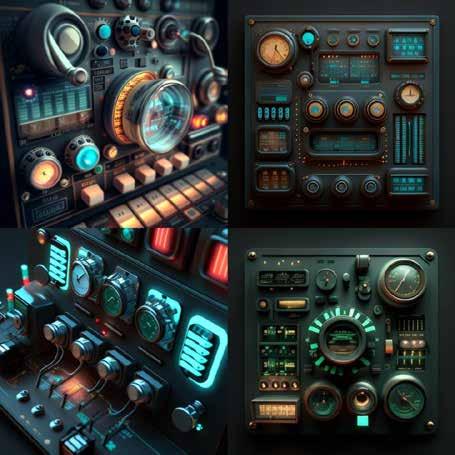
In 2022, I sent out some then-new Midjourney generations with the caption: If this doesn’t revolutionize design, I don’t know what will.
Three years later, I am surprised to note… there hasn’t been a revolution!
This is particularly notable, since the last 3 years have been a non-stop firehose of AI hype. And yet, so far as I’ve found:
There’s no evidence of massive designer productivity increases due to AI
There no evidence of designer job loss due to AI
I’ve not been able to significantly speed up my overall design process using AI
I’ve not talked to any designers who have significantly sped up their design process
If you had told me in late 2022 I’d be saying these things 3 years later, I would’ve been pretty surprised. “B-b-but - the tools are improving so fast! Your own workflow isn’t even noticeably improved!?”
Don’t get me wrong. I’ve had some incredibly productive moments with AI design tools. But I’ve had at least as many slogs, where I can’t get it to do some basic thing I should’ve done myself 45 minutes ago. And even those productive moments are generally for less important, less business-critical, less live-in-production design stuff.
My hunch: vibe coding is a lot like stock-picking – everyone’s always blabbing about their big wins. Ask what their annual rate of return is above the S&P, and it’s a quieter conversation
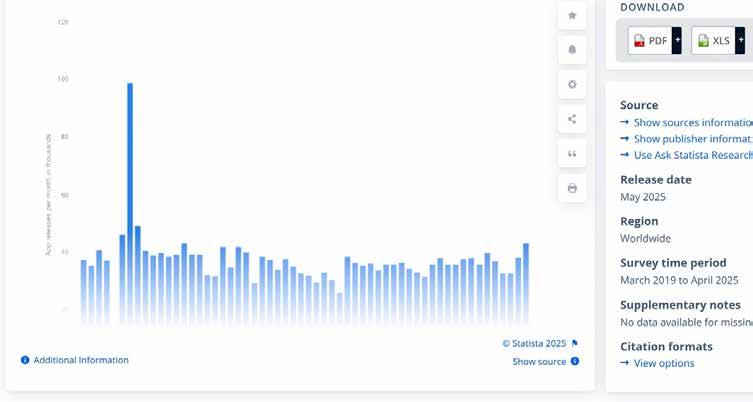
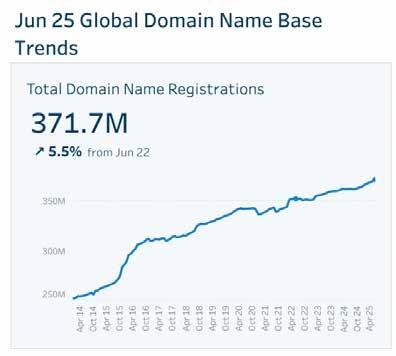
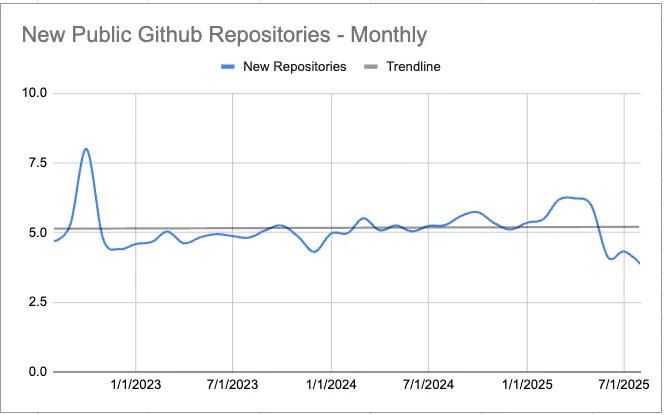
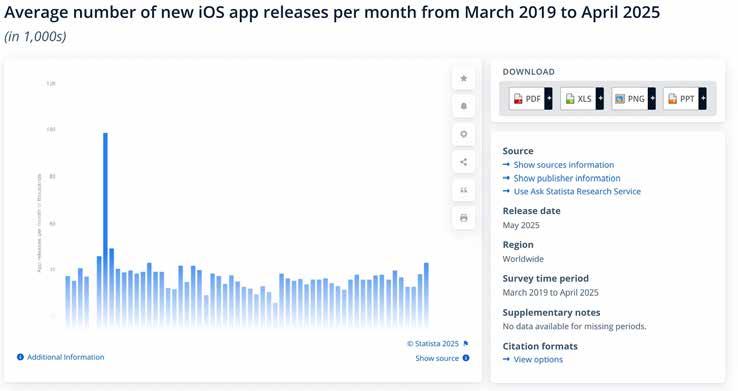
This, in my opinion, is how we end up with a firehose of AI hype, and yet zero signs of a software renaissance. As Mike Judge points out, the following graphs are flat: (a) new app store releases, (b) new domain names registered, (c) new Github repositories.
And while the tech job market is tough right now, this seems more than explainable with:
1. Elevated interest rates
2. COVID overhiring that led to post-COVID layoffs
I still haven’t heard of any CEOs who’ve laid off their design team and replaced it with AI. Perhaaaps some folks are hiring more slowly than usual, thinking design will be automated next month? – seems reasonable, no data.
So, despite the deluge of hype, AI design tools aren’t replacing us tomorrow. Maybe… next year?
Design by one-off chat will not work
My take: a lot of designer knowledge is embedded in the design process.
Or, to sound less like a continental philosopher: one-off chats with an LLM are a terrible way for a non-designer to end up with a great design.
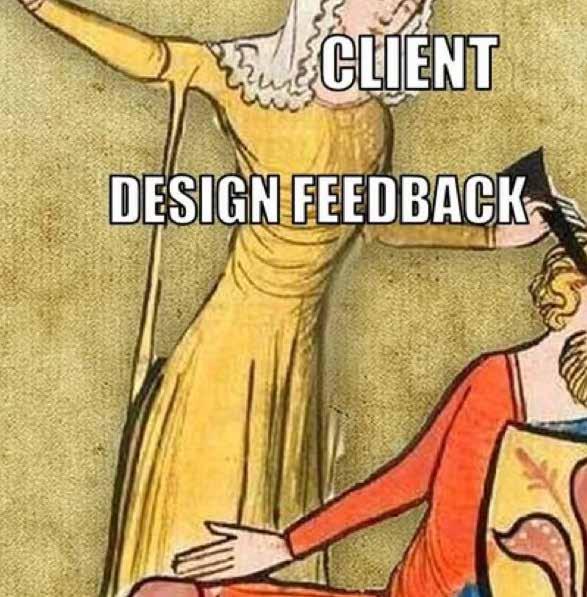
Why do I say this? Because one-off chats with a human designer are a terrible way to end up with a great design! Isn’t the classic joke that the client stands over your shoulder, telling you to “make the
logo bigger” and “move the button to the right” and “change the shade of blue”? One subtext of this joke is that this changes are not actually improving the design in any real way! If the designer is any good, making the logo bigger won’t actually move the needle.
But if one-off requests aren’t a reliable way to get a solid design, how does good design happen at all?
It’s because all of these conversations are embedded in a larger process, where the designer can contextualize what they’re hearing. I advise all my students to start the process – and every subsequent design presentation – centered around business goals.
I may be in the most left-brained 1% of UI designers, but I start every project with a fluffy lil’ conversation about “how do you want your visitors to feel?”
Why? Because it makes a tangible difference to the output!
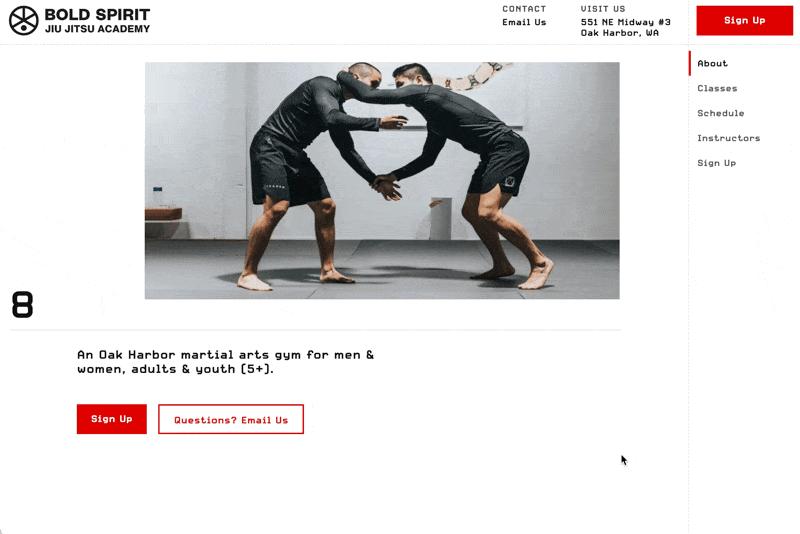
I recently received a request from a friend. He made this site in Lovable, but wanted a quote for some actual designer help. Why wasn’t Lovable cutting it? Look and see…
My take: it’s because there’s zero brand here. This is totally bland. But while a client might think “Hm, doesn’t pop”, a good designer will be looking at all the input they’ve gotten up to this point – goals, brand identity, other inspiration the client likes, the business model, etc. – to make a decision on where to go with it.
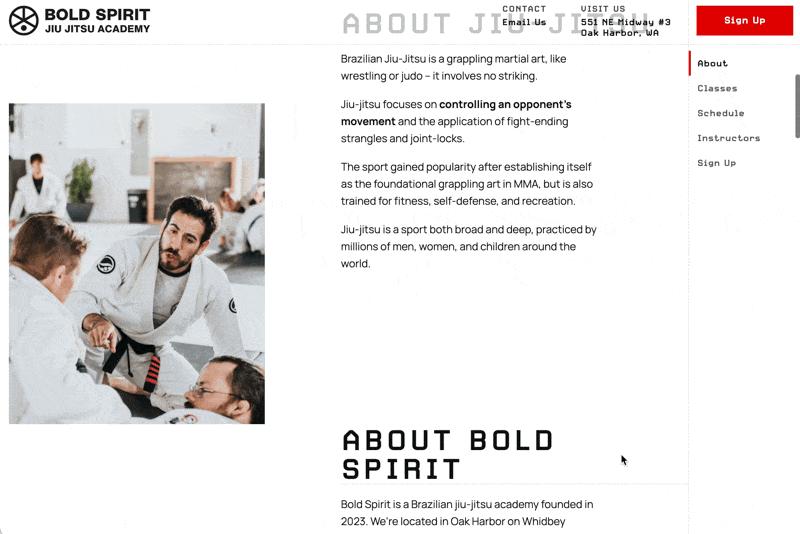
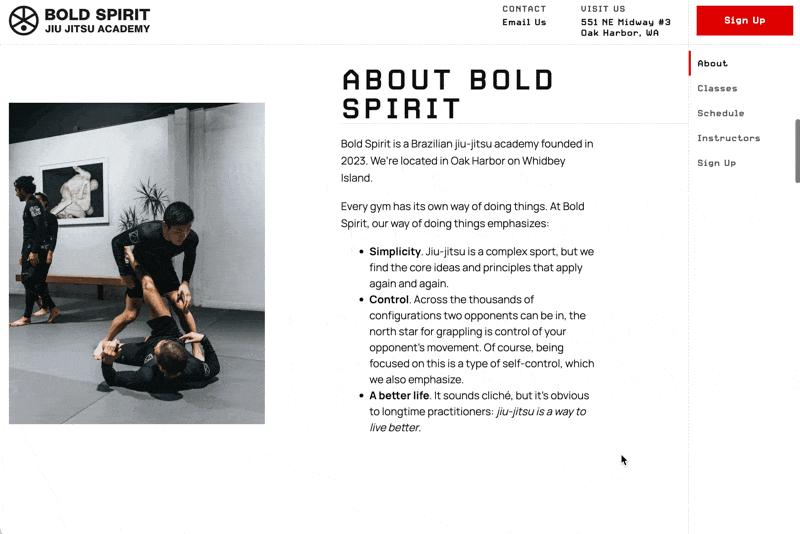
Coincidentally, I designed a site for a friend’s BJJ gym not too long beforehand. Here’s what I came up with:
It pops more, sure. But showing me the Lovable design #1 and saying “make it feel cooler” won’t give you design #2. I have to reverse-engineer that comment. And just as I can’t work miracles with a one-off request like that, no one should expect an AI will be able to either.
So if all AI does is hand clients the ability to make their own logo bigger, is that not just giving them more rope to hang themselves? And if they are successful with it, what are we (designers) even doing here? What are we adding? (This sets a high bar for us designers, but I think we should embrace it)
Now, to be perfectly fair, the retort to this is: what about an agentic AI (coming soon) that LEADS non-designers through the process? K, you’re welcome for the business idea. But even then, we should expect that the longer and more complex the process is, the worse the AIs will do for non-designer customers.
Which is a great segue into AI design limitations…
Designers should do what AI’s architecture prevents it from doing
I realize not all reader of this blog are technical, but I highly recommend to all learning about LLM architecture. Perhaps the first breath of fresh air that I experienced during the onslaught of AI news was after diving into how LLMs work. All of a sudden, so many questions and ponderings about that mysteri-
ous thinking silicon became so much clearer. Because LLMs aren’t magic; they’re algorithms.
(The best introduction, hands down, is 3Blue1Brown’s Deep Learning YouTube series.)
In short, LLMs are prediction machines. They are trained mostly on the internet, but post-trained on many other special data sets and tasks. Because the best prediction of a common question is the right answer, they frequently give correct answers. Because the best prediction of a sufficiently-rare/difficult question may be a quasi-realistic falsehood, they hallucinate. Where someone can create an easy-to-difficult step-ladder of 10,000 verifiable tasks or problems, the LLMs can post-train and become even smarter.
(That’s how they’re helping discover new quantum computing theorems while I’m dissing their ability to design a logo)
It’s not that algorithmic improvements won’t happen. They have, and they will. But if you want to know the surest bets of where to focus your design efforts, look to what LLM algorithms don’t do well.
In particular, the farther something is from the median training datum, the harder it is for AI to do. In my estimation, this could be along any axis – an uncommon visual effect, high-touch animations, a pixel-perfect UI, a new interaction paradigms, especially high data density, etc.
AI design will be safe. If you ask it to be bold, it will be bold in a safe, reasonable, well-trod way.
If your design has an opinion, something the median half-decent design would never touch, then the LLMs are already steering away from it. They may help you build it, but they won’t replace you in building it.
They’ll be busy building “slightly above 2025 average”. But in a world inundated with average, what’s great will shine all the more. “Proof of humanity” will increasingly feel like a breath of fresh air in an onslaught of slop.
In a world of generic templates, pre-built systems, and AI-generated designs, visual design is a superpower.
tools, it’s vision and craft that make the difference.
The demand for work that feels…
—
Fons Mans (@FonsMans) March 3, 2025
And, for what it’s worth, I’d recommend steering your own designs away from the hallmarks of UI-byAI: Inter, cards displayed in parallel, everything being 8px rounded, etc. The time to know your brand, know your audience, know the problem you’re solving, and lean way in starts now.
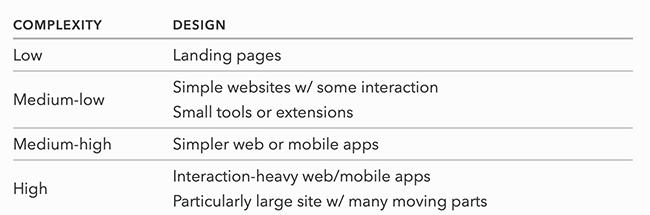
Another axis that AI will start lower on is complexity. It already can one-shot a simple landing page; small tools aren’t hard to build. But it’s difficult to imagine AI doing anything in the “high complexity” column unless it’s generally intelligent (but, at that point, every job on earth is at stake, not simply design jobs).
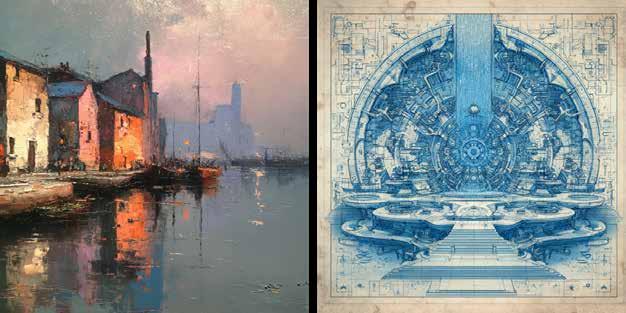
A third axis that I think about is “tightness of constraints”. I have a working theory that AI performs best when constraints are loosest.
As a simple visual example, note how much better it is at impressionism than blueprints – one is about vibes, the other requires geometric exactitud
Tools have lowered the barrier, anyone can create. But when everyone uses the same
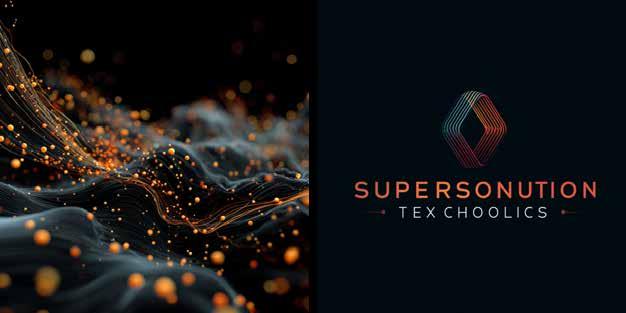
Or, a more UI-focused example. Great at backgrounds, bad at logos. Again: one is about vibes, the other requires geometric exactitude.
Here are other such constrained design tasks where I see humans being requisite for a long time:
• Brand needs to stand out in a crowded industry
• Logos with any sort of “cleverness” (very tight constraints around idea, brand, vector work)
• High information density
• High number of user actions, controls, or interactions
• High conversion rate needed (AI might be able to brute-force this eventually?)
• Performance (fast load times, all actions feel snappy, etc)
Where should a human designer focus their efforts over however long we remain without AGI? In short…
Focus on what is complex. Focus on what is interdisciplinary. Focus on what is novel. Focus on what is outside the training data.
(Or use AI to crank out basic landing pages for brick-and-mortar and make bank, idc)
The
narrow use-cases where AI is a game-changer
So… what can you design – or even launch – with AI that you couldn’t do before? What’s the diff?
• Task-specific AI tools have sped up a lot of smaller design tasks.
• e.g. background image removal, realistic content generation, layer renaming, etc.
• Creating supporting content (images, video, audio) is good – and improving rapidly
• e.g. Midjourney, Sora, Suno
Those comfortable with code have a shot at launching small apps or tools (with zero or minimal
developer support)
To me, the biggest news is the last bullet. But it has a caveat: “those comfortable with code” ��
The revolution is kinda here, and it’s definitely not evenly distributed. The people who get the biggest power-up from AI, at least right now, are (1) somewhat familiar with front-end code, and (2) somewhat familiar with backend concepts.
(While I’m specifically referring to the current late-2025 state of things right now, creating out-oftraining-data animations and front-end effects may require front-end code knowledge for a long time to come. To anyone who is open to learning more HTML/ CSS/JS, I’d bet on it being worthwhile)
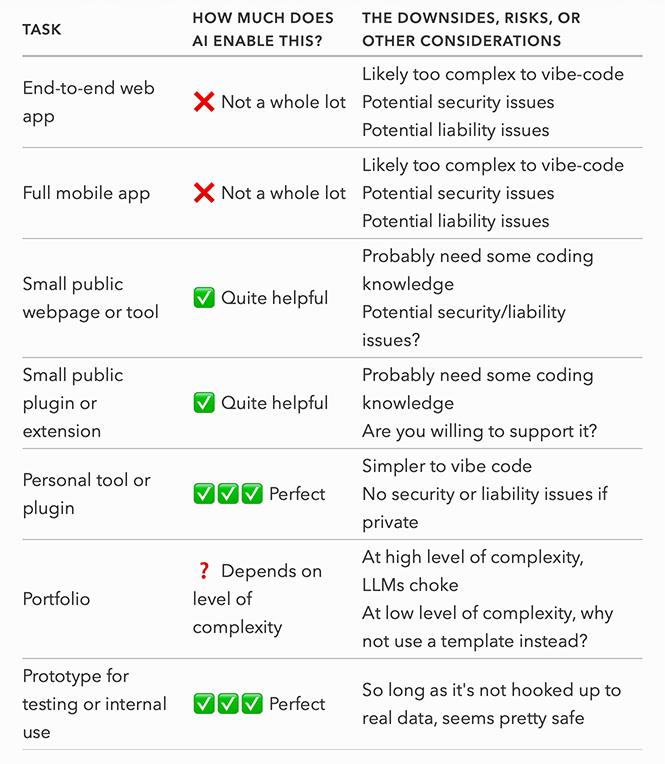
Given that, here’s my take on what’s enabled by AI design tools now:
I have tried vibe-coding every chance I can, and the results have been wildly divergent.
THE BEST experiences are when you’re trying to quickly set up a new site or project. I neither enjoy nor am good at this part of coding. Command line and packages and initial deployment stuff… yuck! Why does the AI succeed here? Boilerplate code is common in the training data, code complexity is low, success is easy to verify.
THE WORST experiences are when I keep trying to push a project further along without really understanding (or correcting) the code. It feels like there’s a complexity ceiling to how much you can vibe code before the AI simply cannot understand how to fix its own errors. My gut hunch is there’s some dynamic like
this: even if the code is 95% correct and great, the 5% of spaghetti sprinkled in there becomes too intertwined with everything else to easily correct. And at some point, you ask the LLM to do something that it just cannot get right, and you think, “Should I now try to understand these thousands of lines of code, or just start over?”
The sweet spot for designers launching their own projects with AI seems to be:
1. Small, low-complexity projects…
2. …with minimal security or liability risks…
• Does the project involve a database that you’d hate to be deleted or have made public? If so, you might want to hire someone who can verify that won’t happen
3. …that you don’t mind supporting as much as needed
• e.g. Do you have paying customers? Do you have 20,000 free users who’ll want you to fix it when the next version of whatever causes bugs?
You won’t be making millions off of these projects, but if you were, you could easily hire a developer anyways
Instead, I’d think about using AI for:
• Small public websites/pages/tools - Use these to show off your design skills, add to your portfolio, and get hired (or find clients)
• Personal-use projects - Scratch your own itch. Wish you had a browser extension for something? Now you can! Wish you had a website that does X? Now you can! If you don’t publish it, there aren’t security/liability/support issues… and, if you want, you can always invest more later – adding it to your portfolio, making it public, etc.
• Design prototypes - It’s never been easy to spin up a working, in-browser prototype of an idea and test it with real users. If it seems promising, then you and your team can spend the resources to design and develop it right. This swaps some steps of the typical design process from the last few decades, and I think we’ll see a lot more of it!
This is where I’ve gotten the most mileage, and certainly what I’d recommend to my students.
My recommendations, all summed up Here are my recommendations from the article above, put in one place:
• Become good at out-of-the-training-data skills. Pay attention when you see a design that feels way beyond AI’s capabilities. What makes it so? Can you do similarly? This includes:
• Great visuals
• High-touch animations
• Pixel-perfect UI
• New interactions or interaction paradigms
• Learn to work well within tight constraints. Some projects require tighter coordination between many elements, and this seems to be something where AI especially drops the ball:
• Brand needs to stand out in a crowded industry
• Great logos
• High information density
• High number of user actions, controls, or interactions
• High conversion rate needed (AI might be able to brute-force this eventually?)
• Performance (fast load times, all actions feel snappy, etc)
• Use the tools (mostly helpful for small and/or internal projects). Sure, everyone should use
AI to quickly crop photo subjects from backgrounds. But for revolutionizing workflows, unless you’re a great developer already, AI is mostly helpful for small and/or internal stuff.
Hopefully you’re already somewhat familiar with code. Either way, more familiarity will only be an asset.
Feedback appreciated! – I’ve put a lot of research and thought into writing this (but not with LLMs though; I write to be way better than the median training datum)
The Copyright and Impact of AI
Marian Bantjes
Published: 02/24/2023 printmag.com
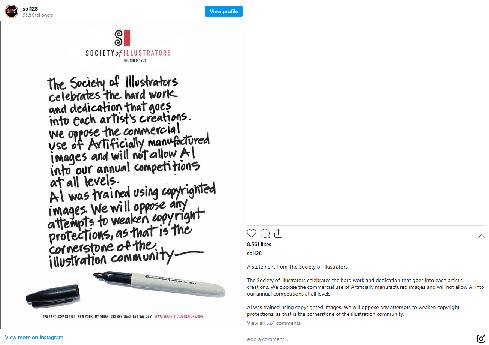
A statement from The Society of Illustrators-
The Society of Illustrators celebrates the hard work and dedication that goes into each artist’s creations. We oppose the commercial use of Artificially manufactured images and will not allow AI into our annual competitions at all levels.
AI was trained using copyrighted images. We will oppose any attempts to weaken copyright protections, as that is the cornerstone of the illustration community.
I have mixed feelings about this statement. I do value the importance of copyright (unlike some people who feel that it only serves corporate interests and should be abolished). I have threatened to sue on three occasions and been compensated in all three instances. Two of those were clear and direct lifts of particular images, but one of them was merely a infringement of style, which my lawyer enumerated in 13
points. He expected that they would tell us to “fuck off back to Canada” (his exact words), but much to our surprise they paid up and destroyed remaining copies of the offending item.
We were surprised because “style” is not copyrightable in the US (where the infringement took place). Someone has to actually, demonstrably lift your image or unique part of your image for you to have a copyright infringement. But when they do it it makes me hopping mad.
There is a—sadly abandoned—Facebook group called “Copy/Anticopy” which I absolutely loved. In it they would post two or more images of design sideby-side and ask the question “Similarity, Copy or Not Copy?” And those few of us following would weigh in. The comparisons were fascinating. As I pointed out in some of the posts, other options to the question were “homage” and “parody.” Some were posters that used
the same image—but that image might have been stock. I found the question endlessly fascinating. The group is still there, so take a look.
All this to say that unless your image has been specifically lifted and regurgitated (alterations and interpretations may or may not protect you: search “Shepard Fairey vs. Associated Press”), you are not protected by copyright—online outrage and accusations notwithstanding.
However, in tiny Canada:
“Canadian copyright law takes its cue from a 2004 decision of the Supreme Court: CCH Canada Ltd. v. Law Society of Upper Canada. In it, the high court defined an “original work” in terms of effort — as a product of “an exercise of skill and judgment.” That exercise of skill and judgment, wrote then Chief Justice Beverley McLachlin, “must not be so trivial that it could be characterized as a purely mechanical exercise.”
Super interesting! However, from the same source:
“But because Canada is a little fish in a big copyright pond, said Lebrun, many decisions about the legal status of generative AI may be settled abroad. “The principal problem facing any artist in this situation is jurisdiction,” he said. “This isn’t happening in Quebec. It’s happening in California, mostly. This is an international issue. It’s international data.”
From time to time someone would contact me to say that so-and-so had copied my work. I’d take a look and see something ornamental and say, “I don’t own ornament.” Or maybe it would be something that showed some influence, but so what? I have been influenced by those who came before me—we all know that’s how it works.
So when we look at other people’s work are we stealing something from them? What if we search for pictures of horses to figure out just what that hind leg looks like from a certain angle? What if we search #hotrod and use what we find as references to make our own drawings of hotrods? Is any of that theft?
Because that’s what AI is doing. And in fact, because it’s looking at and learning from absolutely everything, your (yes your) influence on it is far less than
Meanwhile, currently, images made with AI are not copyrightable. Copyright (in the US, anyway) applies only to images “made by humans.” I’m sure this will be challenged in the near future, but the law changes very slowly and technology moves very fast. But I’m fine with this; I think that’s fair for now until things get more sorted out. As mentioned in my previous post, I personally don’t feel authorship in the images I made, although I do feel ownership.
Turbulent waters
I’ve covered the basic usage of Midjourney, but it, and other AI image programs, have the ability to specifically request images “in the style of” an artist or photographer. Aside from the fact that style is not copyrightable, this does seem concerning—until you try it. I have tried it, and my dear designer/illustra-
tor friends … it has
no idea who you are. I have tried some of the most famous names in Illustration, and it doesn’t even give a hint of knowing who the fuck I’m after. As for myself? Oh, people have tried…
Again, it hasn’t got a clue. I’ve got maybe 500 images out there among billions. An artist has to have a massive level of fame (word-recognition by the masses) for this to affect them—if indeed it does. Below are a couple of experiments I made:
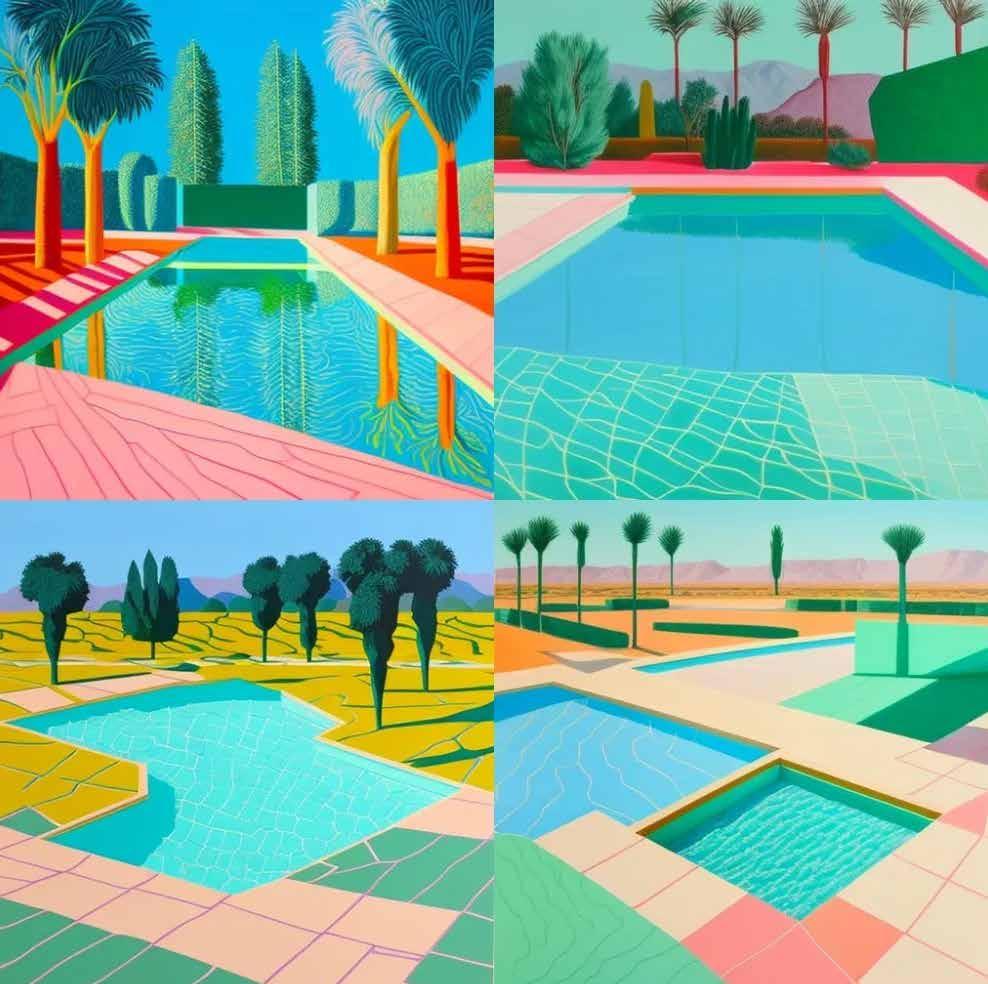
Both of these are astonishing. They really had me wondering how close they were to actual paintings (except the bottom two “Hockney”s) but via online searches I could find nothing with the same compositions, although plenty, in both cases, with similar elements. The AI is extremely good at representing paintings by incredibly famous artists within the subject matter that is common to their work, but I won-
dered how transferable that
imitation was to a subject not associated with the artist.
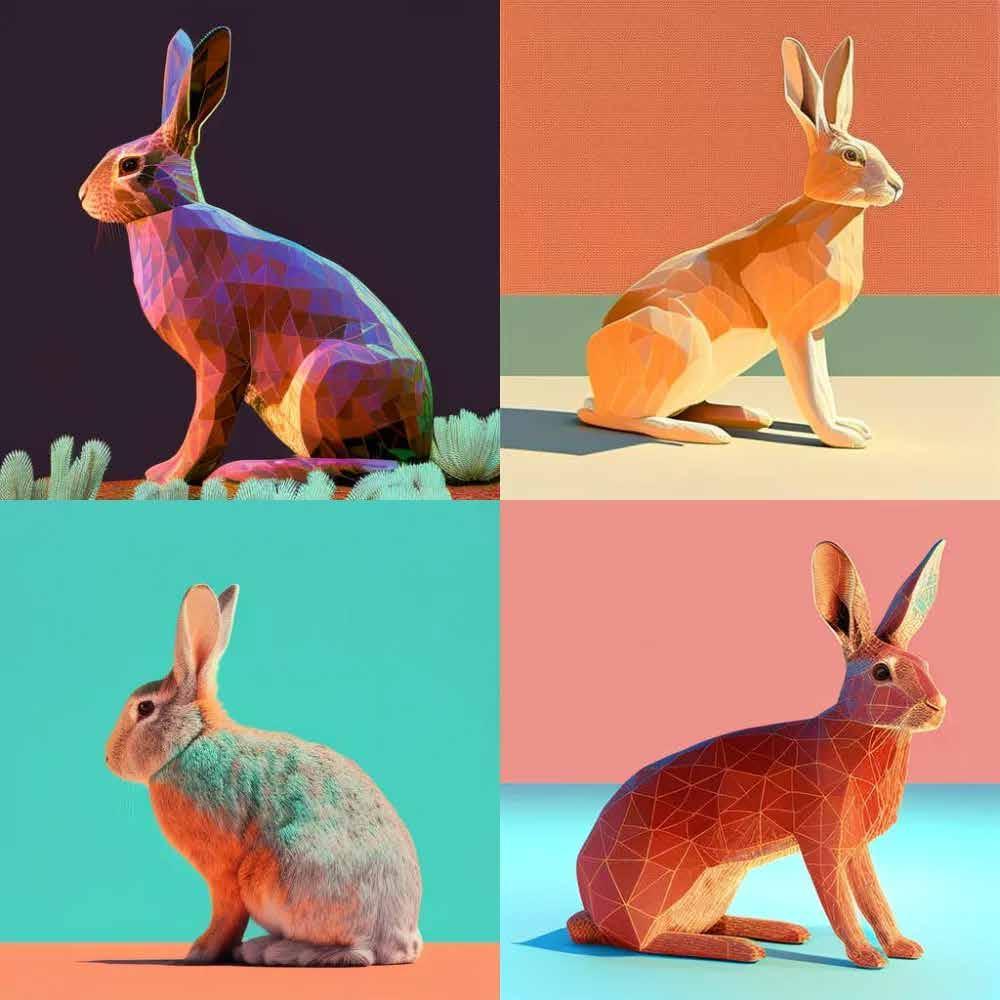
It would appear it has no idea how David Hockney might paint a rabbit:
It’s an idiot! This is because it has no actual intelligence—it is riffing off of many thousands of artworks on the internet by those artists. But when presented with something they never made, it’s unable to apply any technique whatsoever to a new subject. It has no idea that Rockwell is associated with sweetness, innocence, and a particular era. So basic to a human, incomprehensible to it. And this aspect of understanding is not going to improve in the near future, possibly the distant future, or maybe never.
Har har har de hardy har har!
Image generated in Midjourney by Marian Bantjes.
This may look like it’s making some association with me, but I would bet the results would be the same without my name in the prompt.
Nevertheless, an
unscrupulous person might generate a Hockney (or Rockwell, Koons, Hirst …) similarities and put them on pillows or some shit and sell them. But the AI didn’t do that, the human did. That same human would think nothing of taking images from the internet and selling them on pillows. And guess what—here they are. AI won’t change bad behavior by humans.
Things get murkier the deeper you go I was disturbed, however, to discover that you can point Midjourney to an online image in the prompt to include it in the algorithm. I do actually think this should not be legal, despite the less-than-stellar results, because it shows intent to copy. That’s an im-
portant point and comes
up in this legal case against Jeff Koons.
However, I wanted to test it out, so I used some of my own work on the internet to include in a prompt.
While the first two examples are vaguely me-ish in a way that I might recognize if I saw them in the wild, they are no more concerning than any human-created messes that I have seen based on or influenced by my work. As for the third example, there’s barely any relationship. Only the 2nd version might give me pause, but otherwise, have at ’er.
While I maintain that AI is not going to improve in “intelligence” any time soon, this type of copying directly from an image will improve, and that really is something worth fighting/lobbying against.
But aside from that I think Illustrators and artists
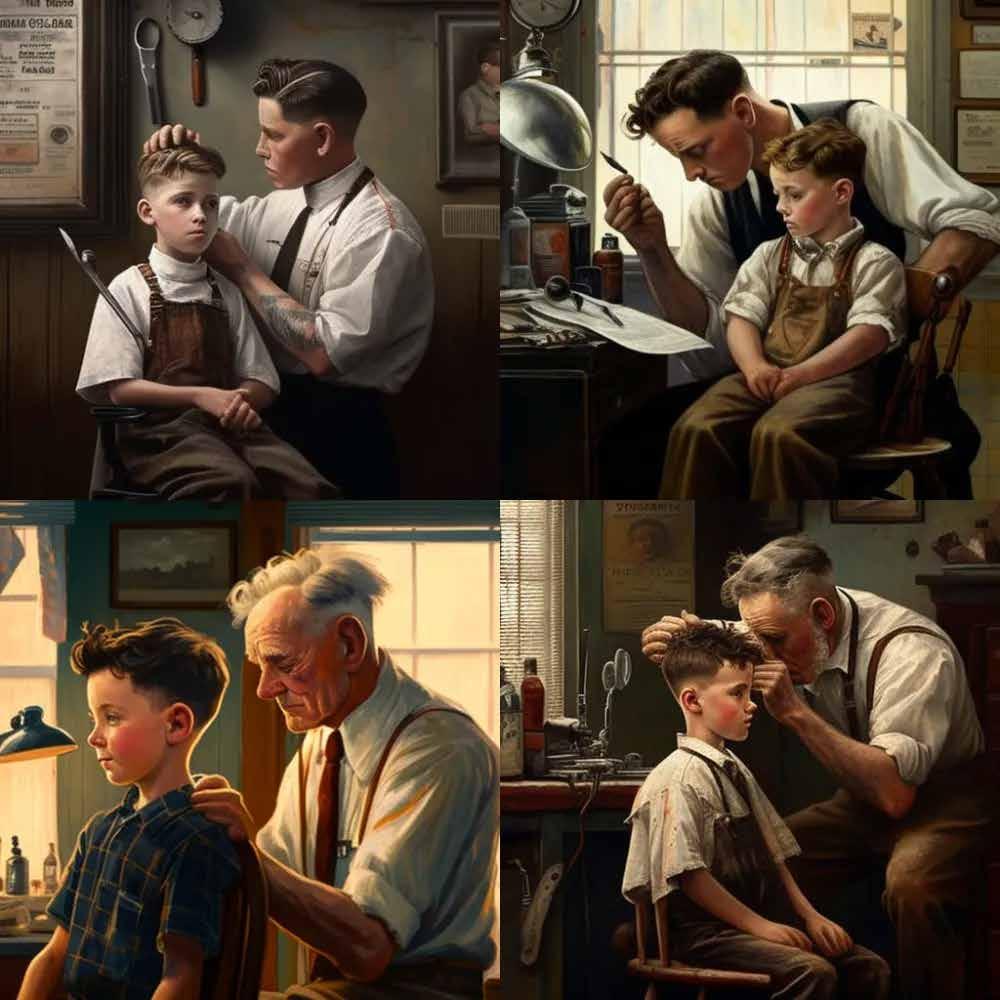
Image generated in Midjourney by Marian Bantjes using the prompt “Barber trimming a boys hair in the style of Norman Rockwell”
have little to worry about
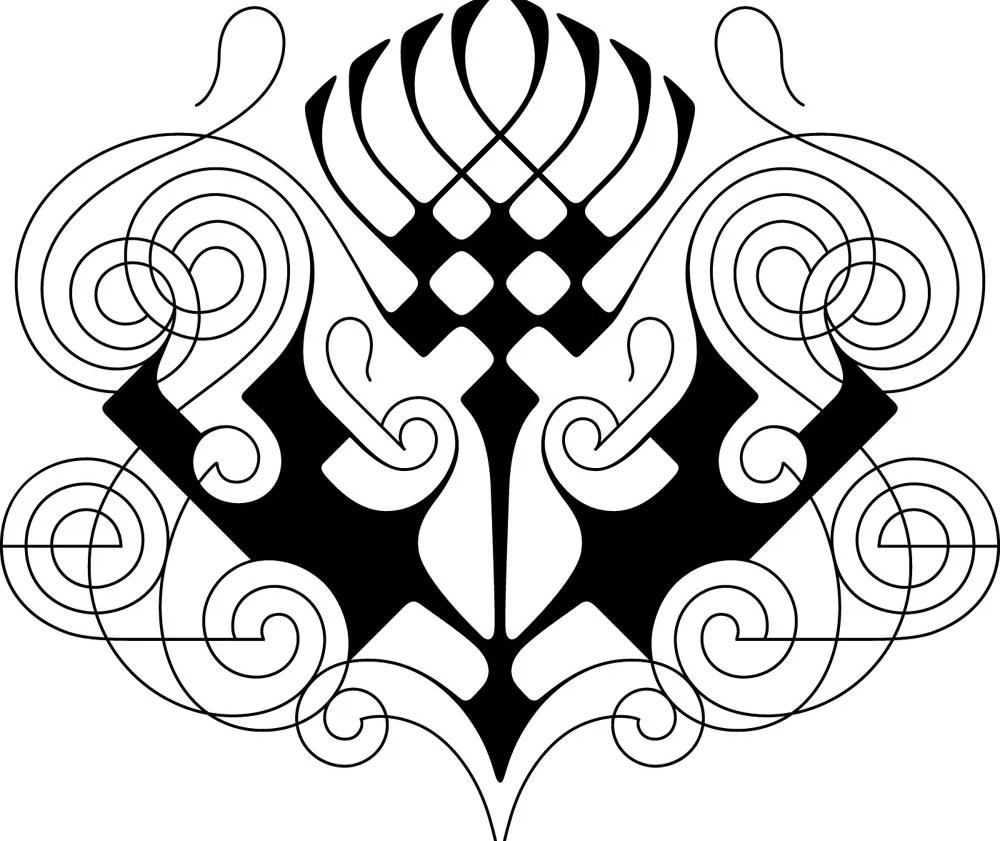
on the copyright front, unless your work looks like this.
In which case you should have been worried a long, long time ago, and not due to AI, but due to humans.
If you’re seriously worried about your copyright, you might want to take a look at what you agree to when you use Facebook, Instagram or any number of other
online platforms.
Meta’s (FB, Insta) current policy is: Meanwhile
“We do not claim ownership of your content, but you grant us a license to use it. Nothing is changing about your rights in your content. We do not claim ownership of your content that you post on or through the Service and you are free to share your content with anyone else, wherever you want. However, we need certain legal permissions from you (known as a “license”) to provide the Service. When you share, post, or upload content that is covered by intellectual property rights (like photos or videos) on or in connection with our Service, you hereby grant to us a non-exclusive, royalty-free, transferable, sub-licensable, worldwide license to host, use, distribute, modify, run, copy, publicly perform or display, translate, and create derivative works of your content (consistent with your privacy and application settings). This license will end when your content is deleted from our systems. You can delete content individually or all at once by deleting your account. [Emphasis mine.]”
Image created in Midjourney by Marian Bantjes using the prompt “David Hockney, rabbit”
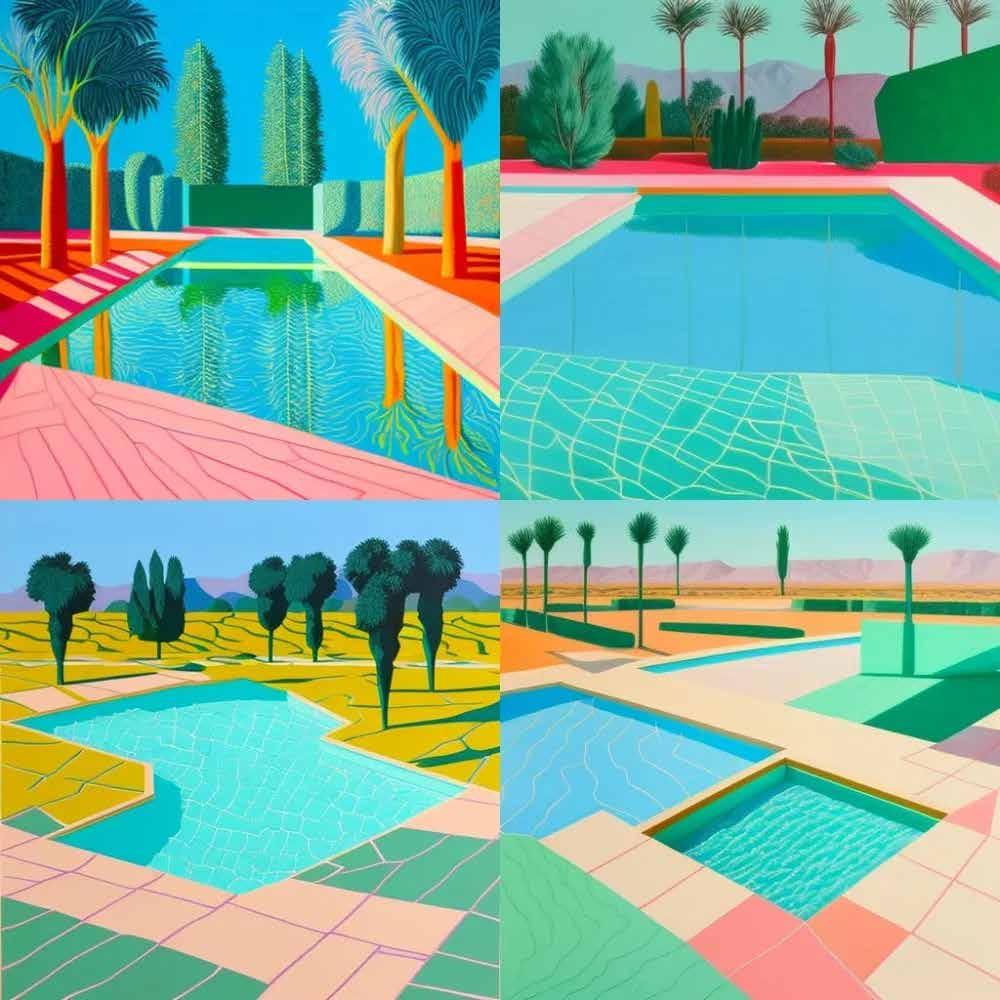
Image generated in Midjourney by Marian Bantjes using the prompt “David Hockney, swimming pool.”
And you might want to
think twice about complaining about it all on social media while using animated gifs from movies etc. to express your feelings.
Will people use AI instead of artists? Yes, and they already have. Ad agency BSSP used AI generated images for the fall 2022 production of The Nutcracker for the San Francisco Ballet. And I’m sure there are many more.
I think a lot of artists’ work will be lost to AI. Not
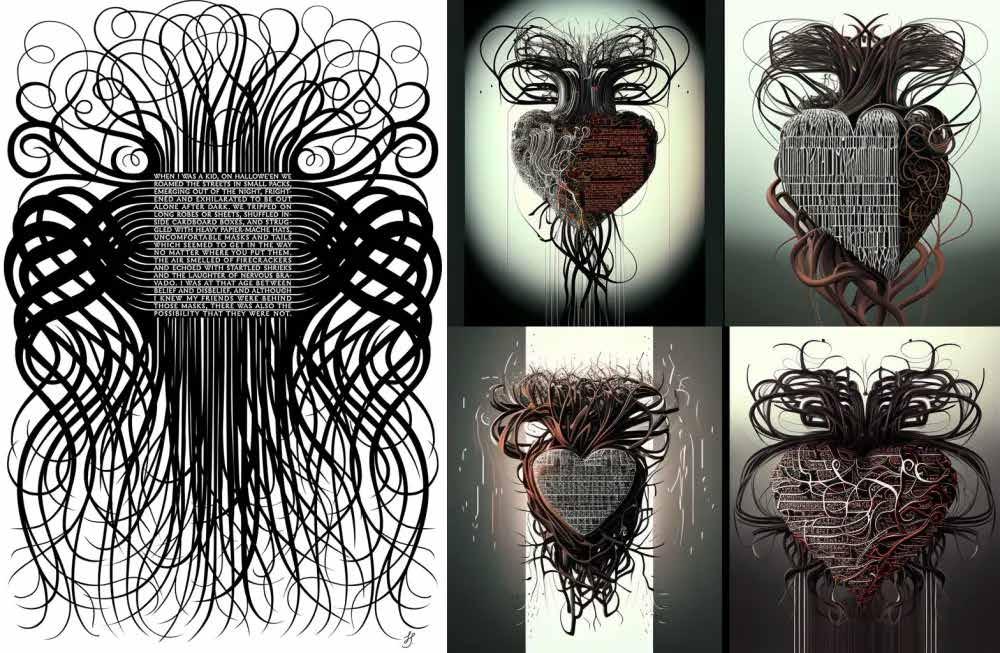
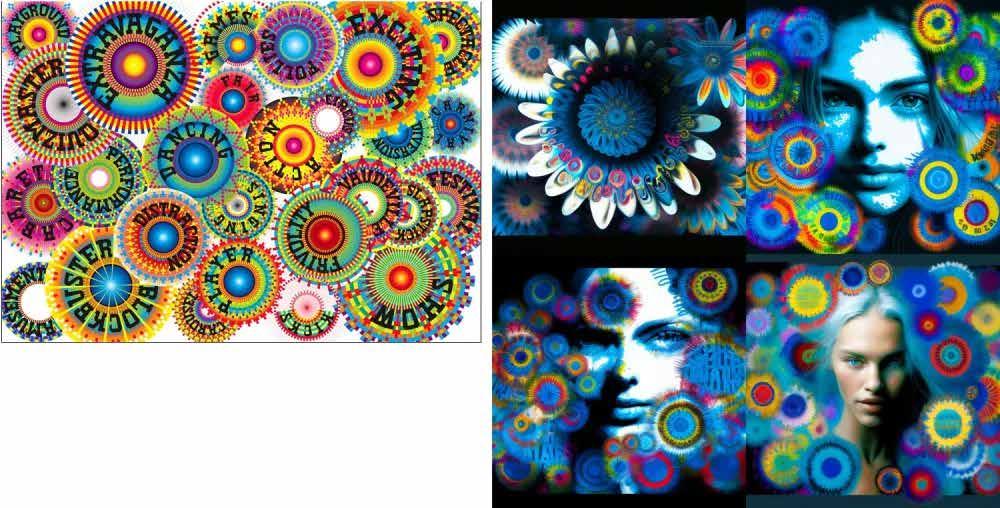
My original piece, left, referenced by me in a Midjourney prompt produced the four images, right.
from the likes of The
New Yorker, or anywhere that has intelligent (there’s that word again), sensitive Art Directors-but we all know that kind of work is few and far between. So while I honestly don’t believe
that an AD who would otherwise use, say, Anita Kunz, will instead try to get an Anita-Kunz-like-image out of AI (good fucking luck!), the types of people who just need something that they would have previously got from stock imagery, or stolen from the internet, will. Plus unimaginative, shit ADs.
David Holz, the founder of Midjourney, says:
“Right now, our professional users are using the platform for concepting. The hardest part of [a commercial art project] is often at the beginning, when the stakeholder doesn’t know what they want and has to see some ideas to react to.”
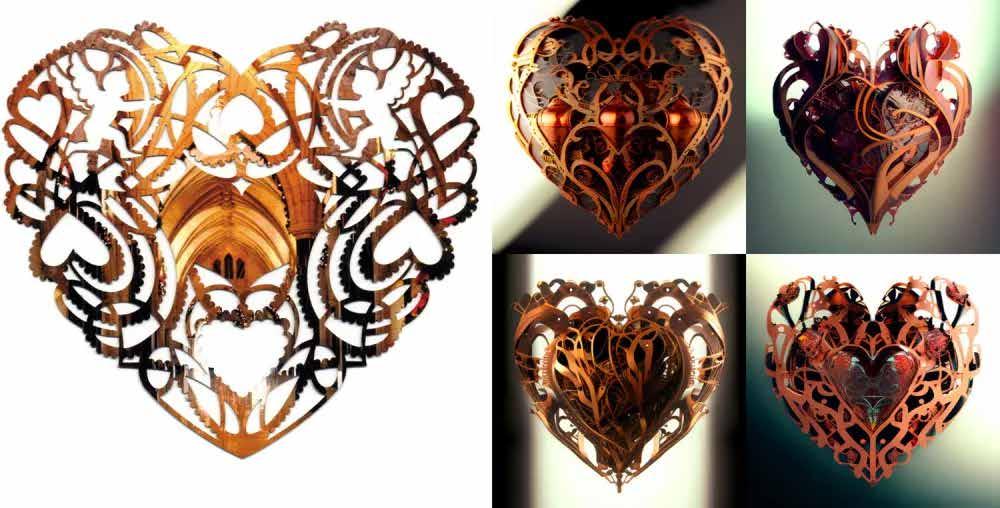
My original piece, left, referenced by me in a Midjourney prompt (plus the word “heart”) produced the four images at right.
Oh my god. The day
will come soon, if it hasn’t already, when you—yes you—will be presented with some piece of half-baked “concept art” generated in AI with the instructions “like this, sortof, only happier, with more “pop”, and no warrior king, and you-know— in your style.” This guy shows us how horrible it will be. Some of us have the luxury of telling such people
to fuck off. Others don’t. Welcome to the 1990s of graphic design when young designers had to take
Image generated in Midjourney by Marian Bantjes using the prompt “man with his hair on fire, waving his fist at passing cars, in the style of Norman Rockwell”
“direction” from people who just learned how to use InDesign, and people with two months of night classes in design were “stealing our jobs.”
In the immortal words of Michael Bierut, “Do good work.”
David Holz, again, says:
“I think that some people will try to cut artists out. They will try to make something similar at a lower cost, and I think they will fail in the market. I think the market will go towards higher quality, more creativity, and vastly more sophisticated, diverse and deep content. And the people who actually are able to use like the artists and use the tools to do that are the ones who are going to win.”
I hope he’s right, and in certain areas AI cannot and never (in our lifetimes and, I bet, before the power grid goes down and we all have to live on nuts and berries) will be able to compete. It will never be able to read a story, understand its nuances and come up with a compelling image for it (although it could “read” a
story and pick out repeating words like “girl, house, mother” and make some cliche out of that); and it will never have humor or wit (Christoph Niemann can totes relax).
But its use will impact you and other artists, and especially photographers, like stock photography and illustration did. I predict we will also see a big jump in the next year or two while everyone tries out the novelty of it.
But as someone who has used it obsessively over the past two weeks, I can tell you that it’s not as easy as people like to say it is, and I think ADs will tire of spending hours trying to get that “concept image” and revert to just telling you what they want.
Regarding Contests
So far, the Society of Illustrators New York, American Illustration, Communication Arts, Spectrum Fantastic Art, 3×3, Creative Quarterly, Society of Illustrators Los Angeles, World Illustration Awards, Applied Arts Awards and the AIGA have all stated that they will not allow AI images into their competitions, and for the moment, I support that, and think that’s fair.
I do believe, however, that AI like Midjourney, etc. are tools, and that creative people will find ways to use those tools in interesting and creative ways, and that these boundaries will become blurred.
For now, I believe that AI generated images should be clearly stated as such, wherever they are used, even if put in other photos or whatever. For the record, I also
believe that digitally altered
Image generated in Midjourney by Marian Bantjes. photos should also be stated as such. Much of the furor comes down to honesty. People should not claim work as their own that they did not make or that they stole from someone
else, whatever the method,
and such behaviour should not be tolerated.
If you want to understand more about AI, please read this article about the difference between AI and babies.
For more about US copyright and AI, you can watch/listen to this annoying video.
That article about Canadian law (“The Legal Status of Generative AI”) is super interesting, and is here.
Next, in Part 3, Edel Rodriguez and I will talk about all of this.
This essay was originally published on Marian’s blog, Marian Bantjes is Writing Again. You can keep up with her work here, or look through her archives on Substack.
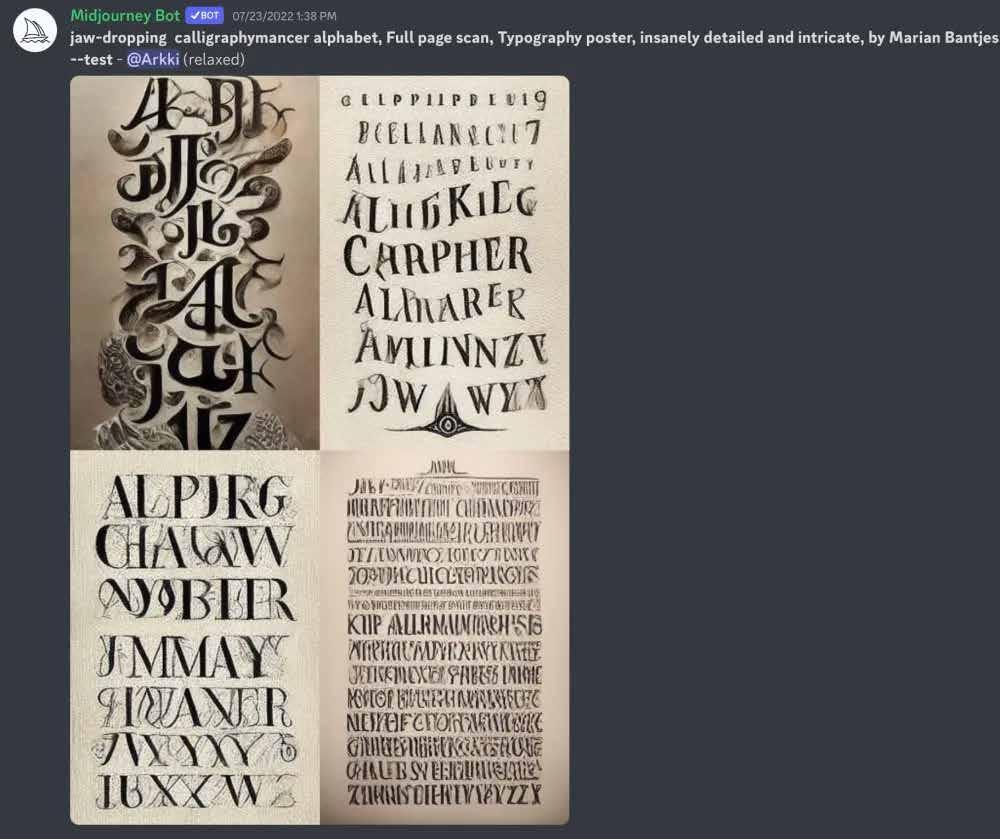
Header image generated in Midjourney by Marian Bantjes, including the prompt “in the style of Albrecht Dürer.”
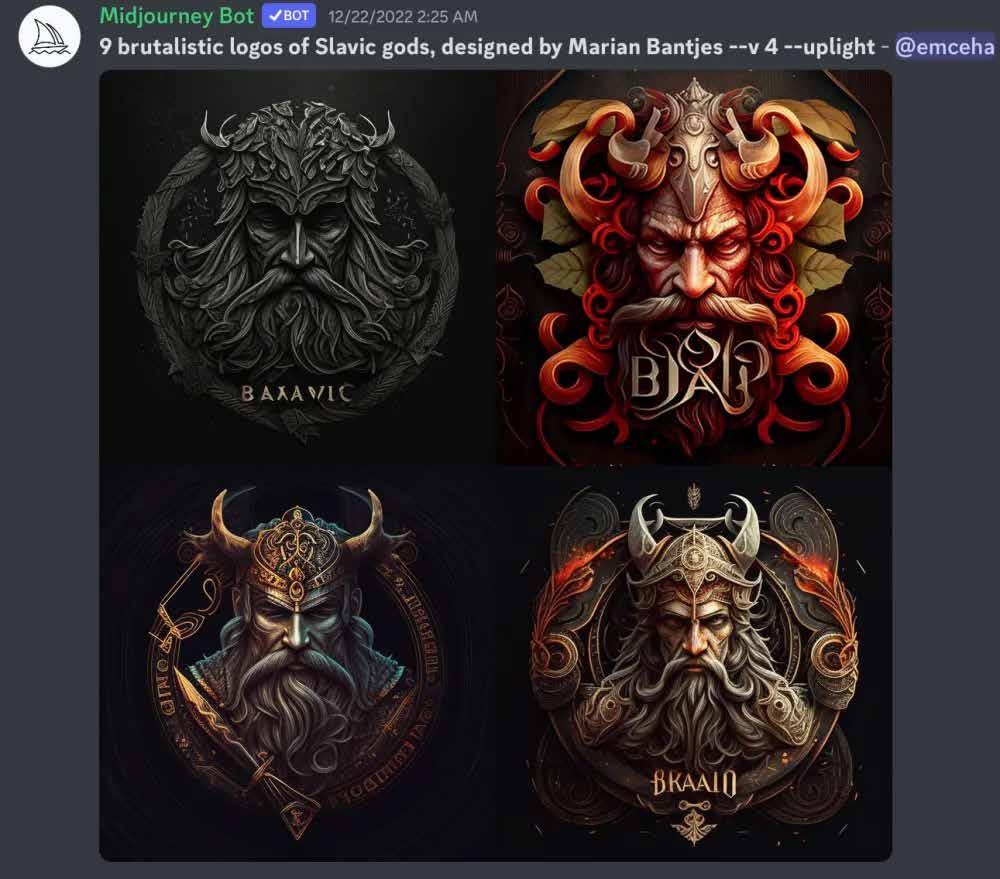
Image generated in Midjourney by Marian Bantjes.
The Ethical Implications of AI on Creative Professionals
“The ethical implications of AI models in art creation include concerns about the authenticity and originality of artistic works, as well as the potential harm to AI model authors’ intellectual property.” Peter Controneo
Expanding on my current studies in Ethical Computing Technologies in Society, I decided it would be a good idea to compile my research and talks into what I hope will be a useful discussion. As an IT professional with many years of experience in the industry, as well as someone who grew up in a family of successful writers, artists, and musicians, I find this topic especially important to me as a professional who plays (at least a small) role in the adoption and development of AI technologies today. It is reasonable to assume that all IT professionals have a role in the integration of AI tools in business and personal life, and I feel that talks like these are critical as our IT landscapes expand and change for the better or worse.
OpenAI’s ChatGPT and DALL-E have transformed AI into digital content and art creation, blurring the line between human and machine innovation. This has raised concerns about AI models
plagiarizing existing artists’ work and replacing their skills with AI models that can produce artwork quickly. Nightshade, a tool that protects artists’ intellectual property rights by “poisoning” AI models like Midjourney, GPT, and DALL-E, has emerged as a disruptive tool in the face of an overabundance of AI models attempting to duplicate human originality and artistic ability. However, the use of AI for creative output may stifle the development of unique and inventive ideas, potentially jeopardizing future opportunities for painters, writers, content creators, and other artists in various lucrative industries (Coeckelbergh, 2023).
The ethical implications of AI models in art creation include concerns about the authenticity and originality of artistic works, as well as the potential harm to AI model authors’ intellectual property. The introduction of Nightshade and similar tools has serious ethical and legal ramifications for the creative industry, as well
Théâtre D’opéra SpatialJason M. Allen — Colorado State Fair
The Ethical Implications of AI on Creative Professionals as job losses and future job opportunities in an evolving AI landscape (Peter, 2023).
Nightshade, an AI model, is used to protect artists’ intellectual property rights by “poisoning” models like Midjourney, GPT, and DALL-E by altering their training data through website scraping. This results in a degradation of their performance and outputs. The poisoned art is then disseminated to the internet, where models systematically scrape for new content consume it as training data. This degrades the AI model’s output, preventing individuals and businesses from effectively adopting these models (Heikkilä, 2023)
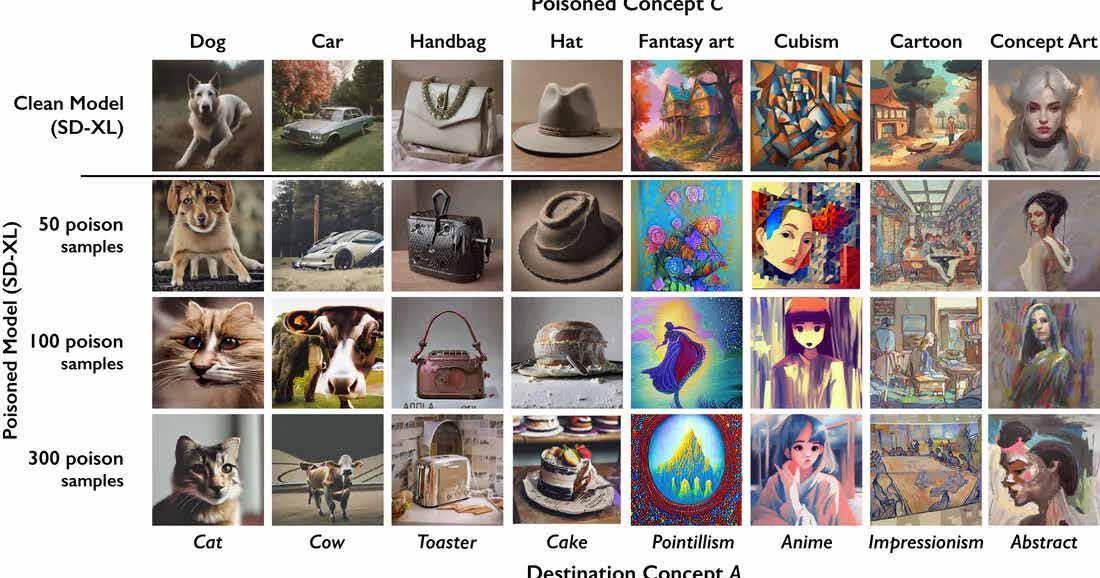
Production of Nightshade and similar tools has serious ethical and legal ramifications for the creative industry, as well as job losses and future job opportunities in an evolving AI landscape (Peter, 2023). Nightshade’s research and development include data poisoning techniques, which introduce unexpected behaviors into machine learning models while training. These samples, visually identical to benign images but containing significant differences in image data, impair the model’s ability to generate meaningful images. For example, if the prompt “Dog” is given, the poisoned model could return a picture of a cat instead.
Artists can now download Nightshade from the University of Chicago’s website to test their digitized artwork before it is published online. The tool, along with Glaze, adds digital “noise” to an image, making it unreadable by AI, so to speak. These tools enable artists to influence AI model training by disrupting
the traditional process. This is similar to how AI model creators scraped the web without giving artists control. Artists inject poisoned data onto the web, destabilizing corporations’ work without giving them control (Shan et al., 2023).
Some Real-world Examples & Implications
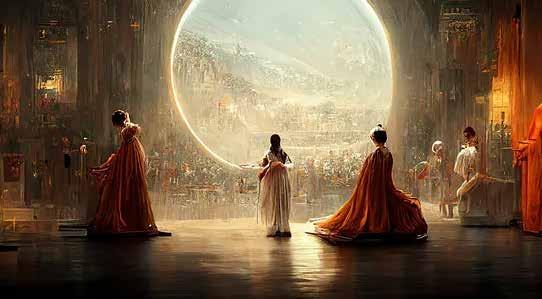
In 2022, the Colorado State Fair’s annual art competition featured AI-generated artwork, including Jason M. Allen’s “Théâtre D’opéra Spatial.” This was the first time AI-generated artwork had won a prize, prompting outrage among artists who accused Allen of cheating. AI’s ability to mimic established artists’ styles and create customizable artworks using text prompts has raised concerns about originality, validity, ownership, and the future of artist employment opportunities. AI can analyze large amounts of existing artwork, blurring the line between inspiration and reproduction, undermining the importance of human creativity and originality (Roose, 2022).
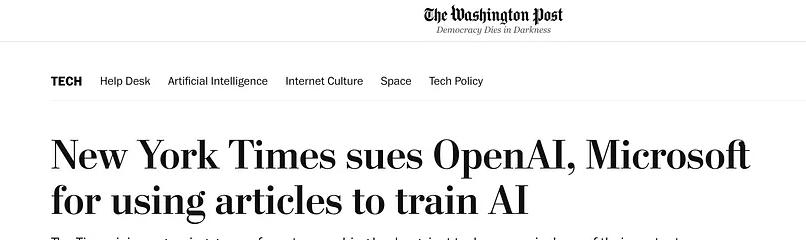
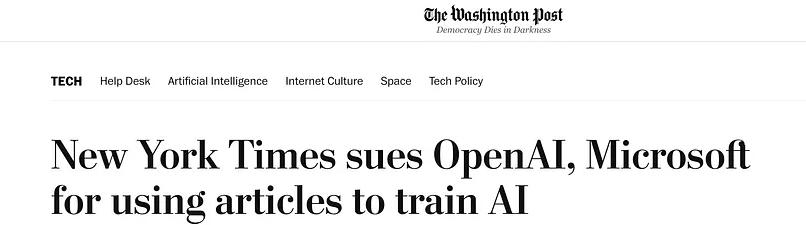
The New York Times has criticized OpenAI and Microsoft for stealing copyrighted articles to build their AI models, sparking debates about data privacy and ownership. This has resulted in legal disputes between writers, authors, and artists who are fighting back against the systematic appropriation of their work by tech business AI models. While copyright law protects authors’ rights, AI-generated content has the potential to expand artistic possibilities and accessibility. However, recent events highlight the importance of regulating AI technology, as the line between inspiration and imitation blurs, potentially leading to conflicts and issues of intellectual property, copyright ownership, fair use, and the loss of creative job opportunities (De Vynck & Izadi, 2023).
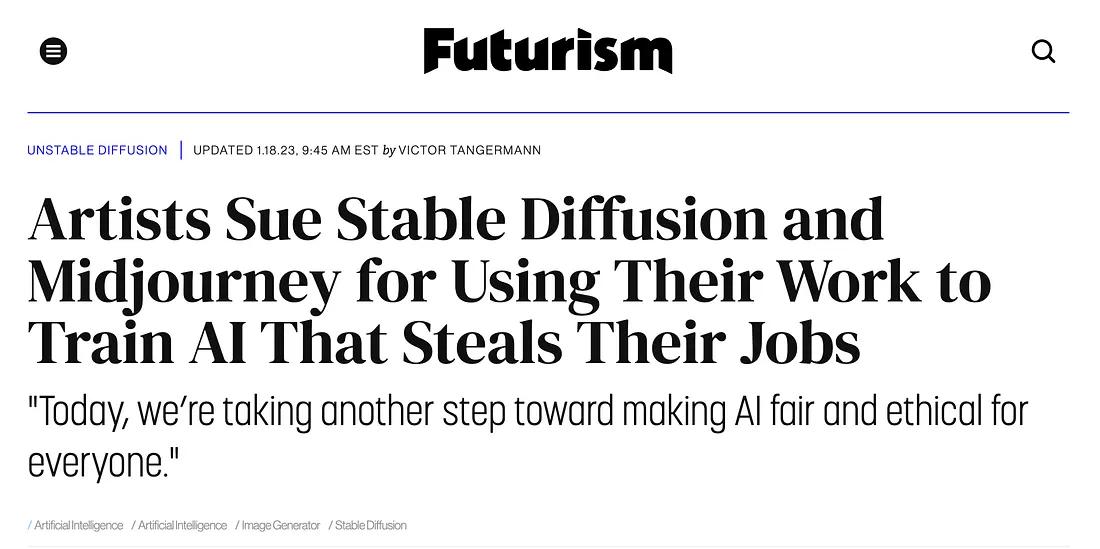
In January 2023, artists sued text-to-image model creators Midjourney and Stable Diffusion
The University of Chicago’s Glaze and Nightshade team showcases images produced by both the poisoned and clean AI models.
The Washington Post “New York Times sues OpenAI, Microsoft for using articles to train AI”
for stealing and profiting from their work without permission. The disregard for artists’ rights and livelihoods creates a risky precedent for the creative community and industry. It is critical to investigate artists’ well-being and the consequences of exploitation of their work, as well as the future role of businesses in providing visibility and distribution options (Tangermann, 2023).
The UK Supreme Court ruled in December 2023 that an AI contribution to a patent cannot be considered the invention of the patent, instead allowing only natural persons to be designated as inventors. The debate revolves around whether AI should be granted intellectual property rights, with some arguing that AI should serve society rather than intellectual ownership (Reporter, 2023).
The Ethical Considerations
The ethical implications of AI-generated art include authorship, originality, intellectual property infringement, and job loss. AI-generated art challenges traditional notions of creativity and the value of human artists. It can disrupt traditional creative markets and raise concerns about human labor in the creative process. AI-generated art can also diminish the originality of human creation, violating human authors’ intellectual property rights by using existing works to create new art. Originality is another concern, as AI-generated art has the potential to replicate the uniqueness and distinction of human artists. Companies like Microsoft and OpenAI have been accused of exploiting artists through their AI art generation technologies, disrupting job opportunities for creatives. This raises
ethical concerns about intellectual property rights, fair compensation, and the impact on the artistic community and their work. As AI technologies advance, questions of ownership, responsibility, and accountability arise, necessitating the establishment of transparency, guidelines, regulations, and laws to protect artists, their livelihoods, rights, and creativity. Artists must strike a balance between using tools for creative advancement while remaining authentic and ethical, and using tools for commercial espionage. The proper application of AI tools requires a thorough examination of how they affect artistic expression, originality, and the broader implications for the creative community.
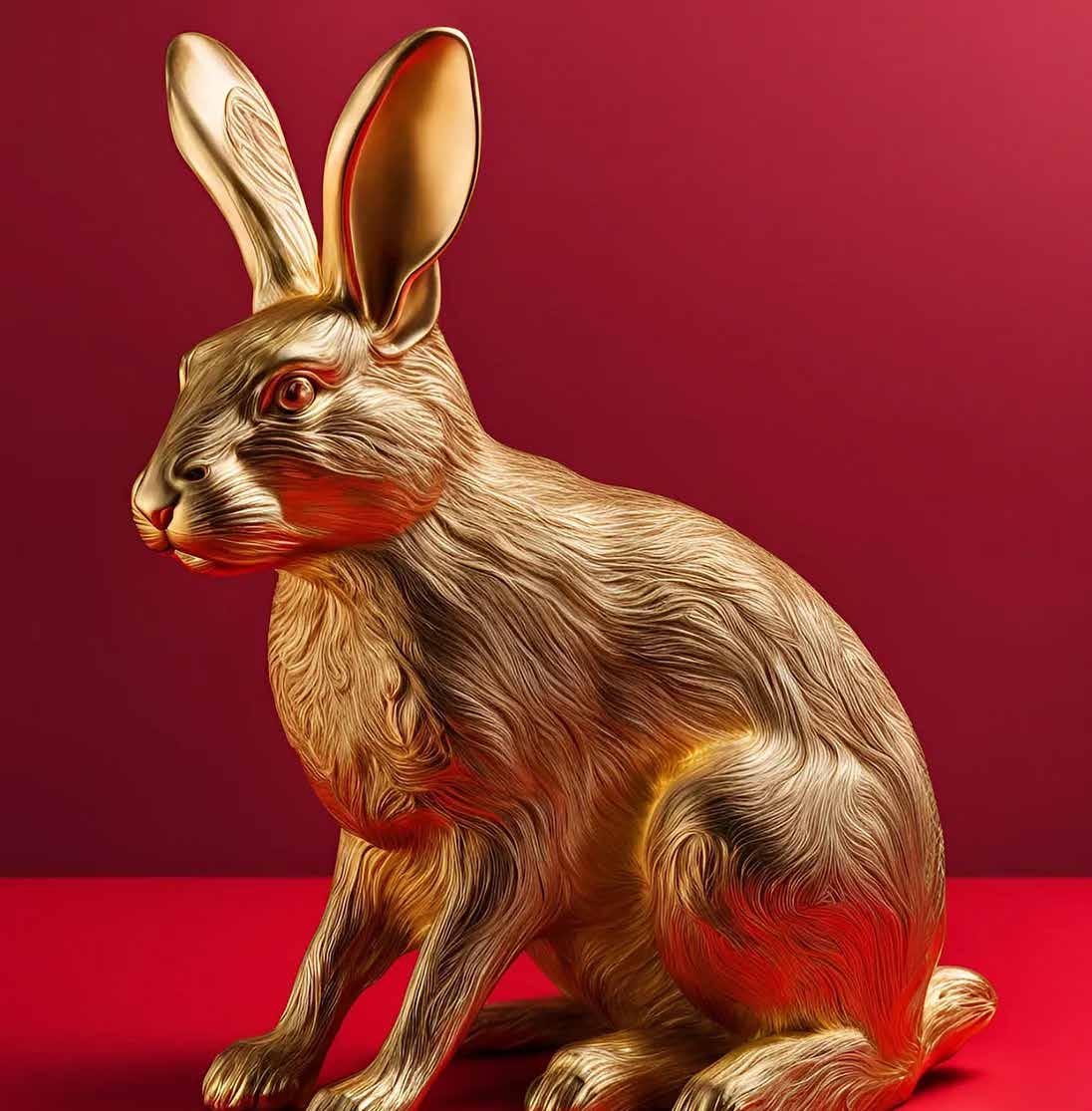
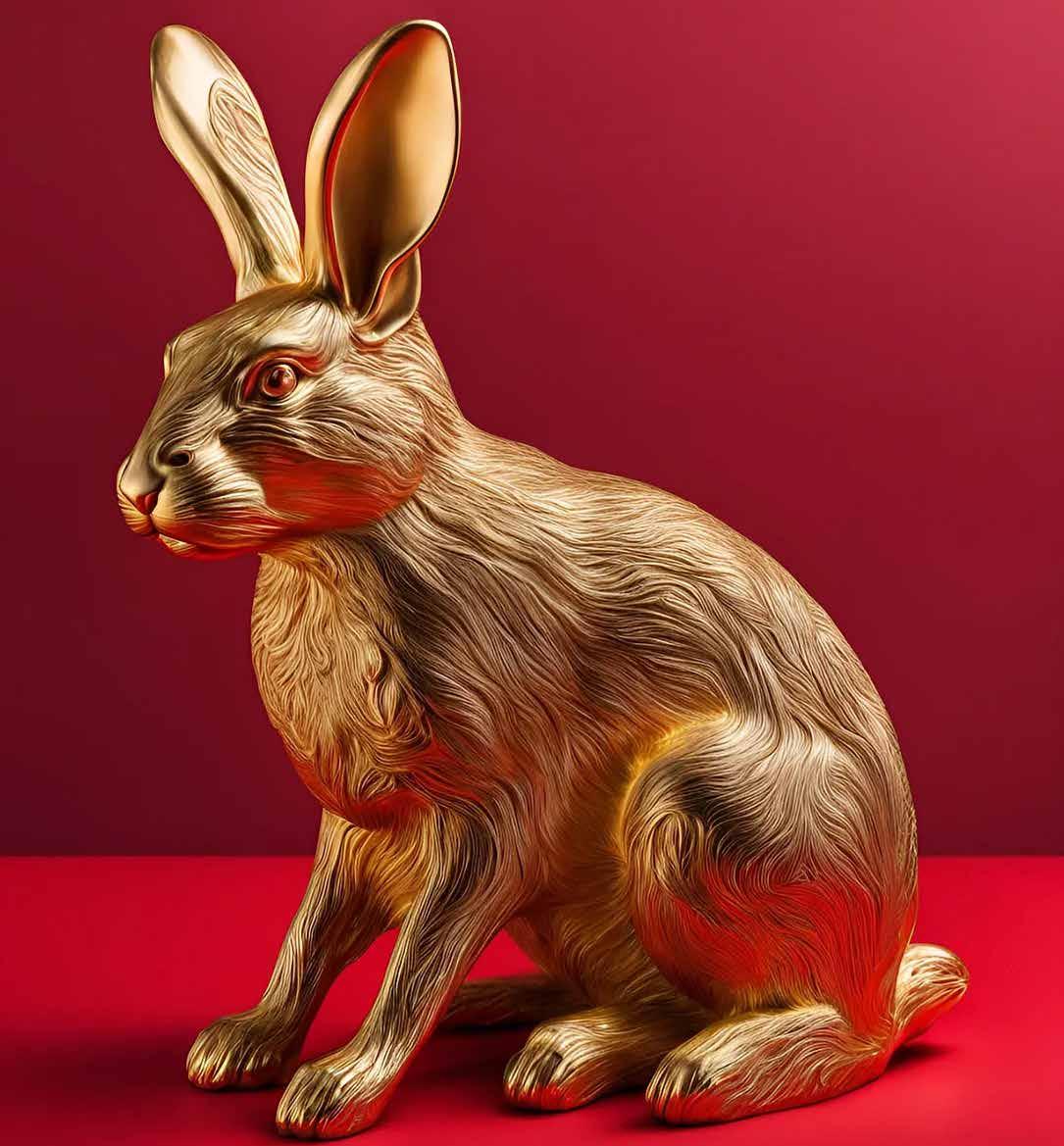
Canva.com AI Generated Art with Prompt “A golden sculpture of a
Futurism “Artists Sue Stable Diffusion and Midjourney for Using Their Work to Train AI That Steals Their Jobs”
rabbit, red background”
There’s a particular uncanny valley in AI-generated interfaces. You’ve probably seen it: a dashboard that looks polished on first glance but feels wrong the moment you try to use it. A signup flow that follows every pattern in the book yet somehow creates friction at every step. Screens that are technically correct but experientially hollow.
This isn’t just aesthetic snobbery. There’s something measurably different about AIgenerated UX, and the gap isn’t closing as fast as the hype suggests.
actual client work.
Why? Because good UX requires slowness in specific places. The pause where you reconsider whether users actually need this screen. The revision where you strip out half the elements because testing revealed people were overwhelmed. The conversation with engineering about why that animation, while beautiful, will tank performance on mid-range devices.
AI generates options. It doesn’t generate the constraints that make those options appropriate.
The Speed Problem Nobody Talks About What AI Actually Misses
AI tools can produce interface mockups in seconds. That speed is genuinely impressive. It’s also the source of most problems.
A Nielsen Norman Group study from early 2024 found that among UX practitioners they interviewed, designers were “most limited in their use of AI in their work.” Despite the explosion of AI design tools, the researchers found zero design-specific AI tools in serious use by professional UX designers. The tools existed. Professionals just weren’t using them for
The CHI 2024 research on UX professionals and generative AI identified several capabilities that practitioners consider irreplaceable by current AI systems. The list is instructive.
First, there’s what researchers call “contextual judgment”—the ability to weigh competing priorities that aren’t explicit in any brief. When a stakeholder says they want the checkout flow to “feel premium,” a human designer translates that into specific spacing decisions,
Pastora, Silvia. Why AI-Generated UX Still Feels Off. Vandelay Design, 2025. Image source: Vandelay Design article (no credited author)
animation timing, and copy tone. AI interprets it literally, often producing interfaces that look expensive but feel impersonal.
Second, there’s anticipatory design. Good UX predicts where users will struggle before they struggle. This requires mental models built from watching hundreds of people use interfaces, noticing the micro-hesitations, the cursor movements that reveal confusion. AI has pattern libraries. It doesn’t have intuition about human hesitation.
Third, there’s what the UXPA’s 2024 survey captured when they found 47% of UX professionals who used AI found it had “some value” while 20% were “not impressed.” The middling response suggests AI is helpful for certain tasks but insufficient for the work that actually matters: understanding why a design should exist, not just what it should look like.
The visual hierarchy is correct. The information hierarchy requires business context that wasn’t in the prompt.
Spacing The Doesn’t Breathe
There’s a reason experienced designers obsess over whitespace. It’s not aesthetic preference—it’s cognitive load management. cost is the information users most need to see early (because your return rate analysis shows unexpected shipping costs drive 40% of cart abandonment). It doesn’t know that hiding the “apply coupon” field in this specific context actually improves conversion (because your A/B tests showed that a visible coupon field sends users off to hunt for codes they don’t have).
“There’s a reason experienced designers obsess over whitespace. It’s not aesthetic preference—it’s cognitive load management.”
The Hierarchy Problem
Here’s a specific failure mode I keep seeing: AI-generated interfaces that have technically correct visual hierarchy but wrong informational hierarchy. An AI tool will correctly make headings larger than body text, primary buttons more prominent than secondary buttons, and ensure adequate contrast ratios. These are pattern-matching problems, and AI handles pattern matching well.
But the AI doesn’t know that for this particular e-commerce checkout, the shipping
AI systems trained on existing interfaces learn average spacing patterns. The problem is that spacing shouldn’t be average; it should be contextual. A dense data table might need tight line heights to help users scan rows. A meditation app might need expansive spacing to create psychological calm. A checkout flow might need strategic compression at certain steps (to reduce perceived effort) and expansion at others (to signal users should slow down and verify information).
When designers on Reddit discuss why AI-generated UX “feels off,” spacing comes up constantly. The interfaces look professional but
feel cramped or floaty in ways that are hard to articulate. What users experience as “feeling wrong” is often mathematically average spacing applied to contexts that needed something specific.
Flows, Not Screens
The deeper problem is that AI generates screens. Users experience flows.
A CHI 2024 paper noted that generative engines excel at producing “discrete design artifacts” but struggle with “longitudinal user journey considerations.” In plain terms: AI can make a beautiful password reset screen. It can’t make a password reset experience that accounts for the frustrated emotional state of someone who’s already failed to log in twice, the need to maintain security without creating more friction, and the opportunity to rebuild trust with a user who’s currently annoyed with your product.
The screen is the deliverable. The experience is the product. These aren’t the same thing, and AI consistently optimizes for the former.
Where AI Actually Helps
This isn’t a “AI bad” argument. Current AI tools are genuinely useful for generating variation—creating 20 button treatments so a designer can pick the three worth testing. They’re useful for boilerplate components that don’t carry much strategic weight. They’re useful for speeding up documentation and creating placeholder content during early exploration. What they’re not useful for is the thing that makes UX valuable in the first place: designing for specific humans in specific contexts with specific constraints that no training dataset can anticipate.
The Figma 2025 AI Report found 82% satisfaction among developers using AI features versus 54% among designers. That gap tells you something important. Developers use AI to accelerate implementation of already-decided solutions. Designers are being asked to use AI to generate the solutions themselves—and finding that the tool isn’t built for that kind of thinking.
The Skill Matters More
If AI handles pattern application, the remaining human value is pattern recognition: knowing which patterns apply to which situations, when to break patterns deliberately, and how to create new patterns when existing ones don’t fit.
That means junior designers learning to “use AI tools” are learning the wrong skill. The skill that will matter is developing the judgment that AI lacks—the ability to look at a technically correct interface and articulate why it’s wrong for this user, this context, this moment.
That judgment can’t be automated. It can only be developed through the slow, unglamorous work of watching real people use real products and caring about the difference between what works and what merely exists.
Where’s the AI Design Renaissance?
Erik D. Kennedy
Published 09/2025 learnui.design
I create and sell online design courses for many folks in tech – designers, aspiring designers, design-adjacent – and one question I’ve gotten a lot over the last two and a half years is: what is AI going to do to design?
I’ve been hesitant to answer too confidently, since things have been moving very quickly, and – as a teacher of design – I fall straight into a trap put so memorably by Upton Sinclair a century ago:
“It is difficult to get a man to understand something when his salary depends on his not understanding it.”
-Upton Sinclair
That being said, if the robots are taking all the design jobs any time soon, I also would like to find my next act. So you can take this article with a grain of salt, and feel free to push back in the comments, on X, or via email.
This post attempts to answer two questions:
1. Will AI take design jobs? If so, which ones?
2. In light of that, what should designers focus on?
This is a long article. Here are a few theses:
• After 2.5 years of insane hype, there’s no evidence that current AI is making the design process faster
• Good design comes from a broader process, not a one-off conversation – meaning the one-off chat paradigm is unlikely to generate good design for non-designers
• AI architecture means it will continue to be worse at designs that are “out of the training data” – the bold, the novel, designs with very tight constraints
• Today, AI design tools show the most promise for personal projects, internal prototyping, and small public projects (with some other constraints)
Image sourced from Adobe Stock
The current state of things
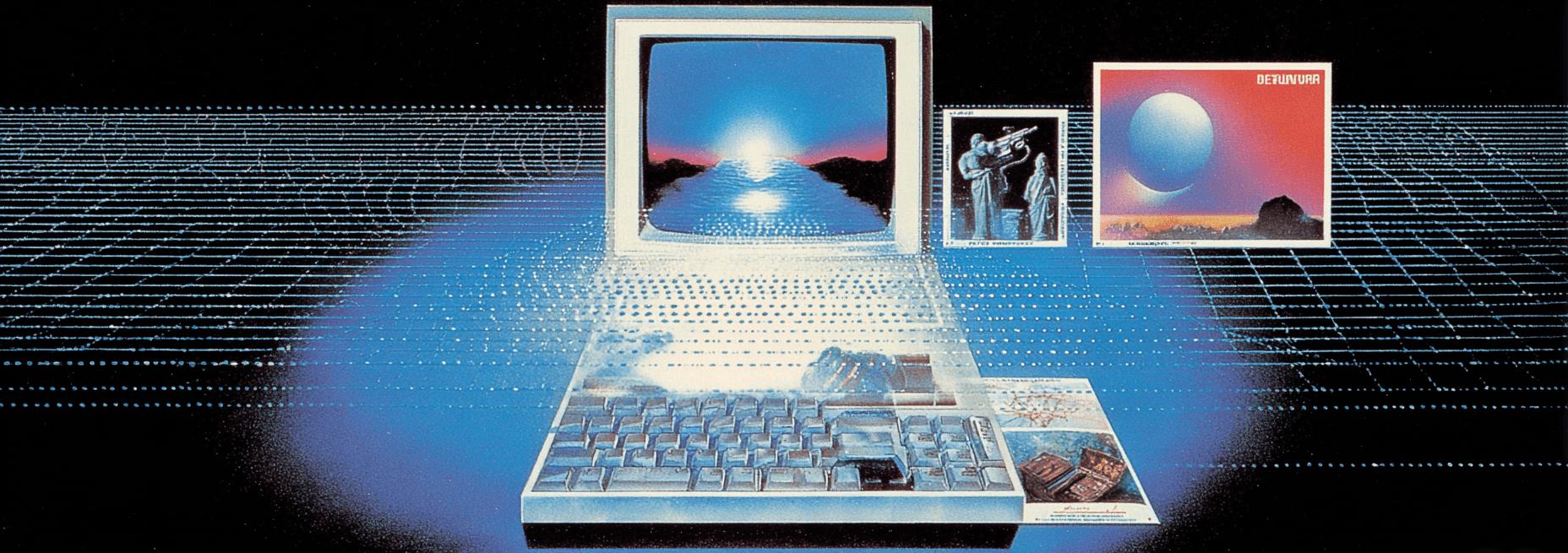
In 2022, I sent out some then-new Midjourney generations with the caption: If this doesn’t revolutionize design, I don’t know what will.
Image sourced from learnui.design
Three years later, I am surprised to note… there hasn’t been a revolution!
This is particularly notable, since the last 3 years have been a non-stop firehose of AI hype. And yet, so far as I’ve found: There’s no evidence of massive designer productivity increases due to AI
There no evidence of designer job loss due to AI
I’ve not been able to significantly speed up my overall design process using AI
I’ve not talked to any designers who have significantly sped up their design process
If you had told me in late 2022 I’d be saying these things 3 years later, I would’ve been pretty surprised. “B-b-but - the tools are improving so fast! Your own workflow isn’t even noticeably improved!?”
Don’t get me wrong. I’ve had some incredibly productive moments with AI design tools. But I’ve had at least as many slogs, where I can’t get it to do some basic thing I should’ve done myself 45 minutes ago. And even those productive moments are generally for less important, less business-critical, less live-in-production design stuff.
My hunch: vibe coding is a lot like stock-picking – everyone’s always blabbing about their big wins. Ask what their annual rate of return is above the S&P, and it’s a quieter conversation
This, in my opinion, is how we end up with a firehose of AI hype, and yet zero signs of a software renaissance. As Mike Judge points out, the following graphs are flat: (a) new app store releases, (b) new domain names registered, (c) new Github repositories.
These are perhaps more dev-centric metrics, but if vibe coding enables less-technical people to publish soft-
And while the tech job market is tough right now, this seems more than explainable with:
1. Elevated interest rates
2. COVID overhiring that led to post-COVID layoffs
I still haven’t heard of any CEOs who’ve laid off their design team and replaced it with AI. Perhaaaps some folks are hiring more slowly than usual, thinking design will be automated next month? – seems reasonable, no data.
So, despite the deluge of hype, AI design tools aren’t replacing us tomorrow. Maybe… next year?
Design by one-off chat will not work
My take: a lot of designer knowledge is embedded in the design process.
Or, to sound less like a continental philosopher: one-off chats with an LLM are a terrible way for a non-designer to end up with a great design.
Why do I say this? Because one-off chats with a human designer are a terrible way to end up with a great design! Isn’t the classic joke that the client stands over your shoulder, telling you to “make the logo bigger” and “move the button to the right” and “change the shade of blue”? One subtext of this joke is that this changes are not actually improving the design in any real way! If the designer is any good, making the logo bigger won’t actually move the needle.
Image sourced from learnui.design
sourced from learnui.design
Image
But if one-off requests aren’t a reliable way to get a solid design, how does good design happen at all?
It’s because all of these conversations are embedded in a larger process, where the designer can contextualize what they’re hearing. I advise all my students to start the process –and every subsequent design presentation – centered around business goals.
I may be in the most left-brained 1% of UI designers, but I start every project with a fluffy lil’ conversation about “how do you want your visitors to feel?”
Why? Because it makes a tangible difference to the output!
I recently received a request from a friend. He made this site in Lovable, but wanted a quote for some actual designer help. Why wasn’t Lovable cutting it? Look and see…
My take: it’s because there’s zero brand here. This is totally bland. But while a client might think “Hm, doesn’t pop”, a good designer will be looking at all the input they’ve gotten up to this point – goals, brand identity, other inspiration the client likes, the business model, etc. – to make a decision on where to go with it.
Coincidentally, I designed a site for a friend’s BJJ gym not too long beforehand. Here’s what I came up with:
It pops more, sure. But showing me the Lovable design #1 and saying “make it feel cooler” won’t give you design #2. I have to reverse-engineer that comment. And just as I can’t work miracles with a one-off request like that, no one should expect an AI will be able to either.
So if all AI does is hand clients the ability to make their own logo bigger, is that not just giving them more rope to hang themselves? And if they are successful with it, what are we (designers) even doing here? What are we adding? (This sets a high bar for us designers, but I think we should embrace it)
Now, to be perfectly fair, the retort to this is: what about an agentic AI (coming soon) that LEADS non-designers through the process? K, you’re welcome for the business idea. But even then, we should expect that the longer and more complex the process is, the worse the AIs will do for non-designer customers.
Which is a great segue into AI design limitations…
Designers should do what AI’s architecture prevents it from doing
I realize not all reader of this blog are technical, but I highly recommend to all learning about LLM architecture. Perhaps the first breath of fresh air that I experienced during the onslaught of AI news was after diving into how LLMs work. All of a sudden, so many questions and ponderings about that mysterious thinking silicon became so much clearer. Because LLMs aren’t magic; they’re algorithms.
(The best introduction, hands down, is 3Blue1Brown’s Deep Learning YouTube series.)
In short, LLMs are prediction machines. They are trained mostly on the internet, but post-trained on many other special data sets and tasks. Because the best prediction of a common question is the right answer, they frequently give correct answers. Because the best prediction of a sufficiently-rare/difficult question may be a quasi-realistic falsehood, they hallucinate. Where someone can create an easy-to-difficult step-ladder of 10,000 verifiable tasks or problems, the LLMs can post-train and become even smarter.
(That’s how they’re helping discover new quantum computing theorems while I’m dissing their ability to design a logo)
It’s not that algorithmic improvements won’t happen. They have, and they will. But if you want to know the surest bets of where to focus your design efforts, look to what LLM algorithms don’t do well.
In particular, the farther something is from the median training datum, the harder it is for AI to do. In my estimation, this could be along any axis – an uncommon visual effect, hightouch animations, a pixel-perfect UI, a new interaction paradigms, especially high data density, etc.
AI design will be safe. If you ask it to be bold, it will be bold in a safe, reasonable, well-trod way.
If your design has an opinion, something the median half-decent design would never touch, then the LLMs are
Image sourced from learnui.design
Where’s the AI Design Renaissance? already steering away from it. They may help you build it, but they won’t replace you in building it.
They’ll be busy building “slightly above 2025 average”. But in a world inundated with average, what’s great will shine all the more. “Proof of humanity” will increasingly feel like a breath of fresh air in an onslaught of slop.
In a world of generic templates, pre-built systems, and AI-generated designs, visual design is a superpower.
Tools have lowered the barrier, anyone can create. But when everyone uses the same tools, it’s vision and craft that make the difference.
The demand for work that feels…
— Fons Mans (@FonsMans) March 3, 2025
And, for what it’s worth, I’d recommend steering your own designs away from the hallmarks of UI-by-AI: Inter, cards displayed in parallel, everything being 8px rounded, etc. The time to know your brand, know your audience, know the problem you’re solving, and lean way in starts now.
Another axis that AI will start lower on is complexity. It already can one-shot a simple landing page; small tools aren’t hard to build. But it’s difficult to imagine AI doing anything in the “high complexity” column unless it’s generally intelligent (but, at that point, every job on earth is at stake, not simply design jobs).
A third axis that I think about is “tightness of constraints”. I have a working theory that AI performs best when constraints are loosest.
As a simple visual example, note how much better it is at impressionism than blueprints – one is about vibes, the other requires geometric exactitude.
‘impressionist painting’ vs ‘blueprints’. AI nails what’s vibes-based, but struggles with the tight constraints of geometric exactitude
Or, a more UI-focused example. Great at backgrounds, bad at logos. Again: one is about vibes, the other requires geometric exactitude.
abstract dark, techie visuals’ vs ‘vector logo for quantum computing computing company called ‘Superposition Technologies’’. Again, AI is good with the vibey, worse with geometric precision
Here are other such constrained design tasks where I see humans being requisite for a long time:
• Brand needs to stand out in a crowded industry
• Logos with any sort of “cleverness” (very tight constraints around idea, brand, vector work)
• High information density
• High number of user actions, controls, or interactions
• High conversion rate needed (AI might be able to bruteforce this eventually?)
• Performance (fast load times, all actions feel snappy, etc)
Where should a human designer focus their efforts over however long we remain without AGI? In short…
Focus on what is complex. Focus on what is interdisciplinary. Focus on what is novel. Focus on what is outside the training data.
(Or use AI to crank out basic landing pages for brick-andmortar and make bank, idc)
The narrow use-cases where AI is a game-changer
So… what can you design – or even launch – with AI that you couldn’t do before? What’s the diff?
• Task-specific AI tools have sped up a lot of smaller design tasks.
• e.g. background image removal, realistic content generation, layer renaming, etc.
• Creating supporting content (images, video, audio) is good – and improving rapidly
• e.g. Midjourney, Sora, Suno
Those comfortable with code have a shot at launching small apps or tools (with zero or minimal developer support)
To me, the biggest news is the last bullet. But it has a caveat: “those comfortable with code” ��
Image sourced from learnui.design
The revolution is kinda here, and it’s definitely not evenly distributed. The people who get the biggest power-up from AI, at least right now, are (1) somewhat familiar with front-end code, and (2) somewhat familiar with backend concepts.
(While I’m specifically referring to the current late-2025 state of things right now, creating out-of-training-data animations and front-end effects may require front-end code knowledge for a long time to come. To anyone who is open to learning more HTML/CSS/JS, I’d bet on it being worthwhile)
Given that, here’s my take on what’s enabled by AI design tools now:
Image sourced from learnui.design
I have tried vibe-coding every chance I can, and the results have been wildly divergent.
THE BEST experiences are when you’re trying to quickly set up a new site or project. I neither enjoy nor am good at this part of coding. Command line and packages and initial deployment stuff… yuck! Why does the AI succeed here? Boilerplate code is common in the training data, code complexity is low, success is easy to verify.
THE WORST experiences are when I keep trying to push a project further along without really understanding (or correcting) the code. It feels like there’s a complexity ceiling to how much you can vibe code before the AI simply cannot understand how to fix its own errors. My gut hunch is there’s some dynamic like this: even if the code is 95% correct and great, the 5% of spaghetti sprinkled in there becomes too intertwined with everything else to easily correct. And at some point, you ask the LLM to do something that it just cannot get right, and you think, “Should I now try to understand these thousands of lines of code, or just start over?”
The sweet spot for designers launching their own projects with AI seems to be:
1. Small, low-complexity projects…
2. …with minimal security or liability risks…
• Does the project involve a database that you’d hate
to be deleted or have made public? If so, you might want to hire someone who can verify that won’t happen
3. …that you don’t mind supporting as much as needed
• e.g. Do you have paying customers? Do you have 20,000 free users who’ll want you to fix it when the next version of whatever causes bugs?
You won’t be making millions off of these projects, but if you were, you could easily hire a developer anyways
Instead, I’d think about using AI for:
• Small public websites/pages/tools - Use these to show off your design skills, add to your portfolio, and get hired (or find clients)
• Personal-use projects - Scratch your own itch. Wish you had a browser extension for something? Now you can! Wish you had a website that does X? Now you can! If you don’t publish it, there aren’t security/liability/support issues… and, if you want, you can always invest more later – adding it to your portfolio, making it public, etc.
• Design prototypes - It’s never been easy to spin up a working, in-browser prototype of an idea and test it with real users. If it seems promising, then you and your team can spend the resources to design and develop it right. This swaps some steps of the typical design process from the last few decades, and I think we’ll see a lot more of it!
This is where I’ve gotten the most mileage, and certainly what I’d recommend to my students.
My recommendations, all summed up
Here are my recommendations from the article above, put in one place:
• Become good at out-of-the-training-data skills. Pay attention when you see a design that feels way beyond AI’s capabilities. What makes it so? Can you do similarly? This includes:
• Great visuals
• High-touch animations
• Pixel-perfect UI
• New interactions or interaction paradigms
• Learn to work well within tight constraints. Some projects require tighter coordination between many elements, and this seems to be something where AI especially drops the ball:
• Brand needs to stand out in a crowded industry
• Great logos
• High information density
• High number of user actions, controls, or interactions
• High conversion rate needed (AI might be able to brute-force this eventually?)
• Performance (fast load times, all actions feel snappy, etc)
• Use the tools (mostly helpful for small and/or internal projects). Sure, everyone should use AI to quickly crop photo subjects from backgrounds. But for revolutionizing workflows, unless you’re a great developer already, AI is mostly helpful for small and/or internal stuff. Hopefully you’re already somewhat familiar with code. Either way, more familiarity will only be an asset. Feedback appreciated! – I’ve put a lot of research and thought into writing this (but not with LLMs though; I write to be way better than the median training datum)
Image sourced from: web-interactive-design
The Copyright and Impact of AI
Marian Bantjes
Published: 02/24/2023 printmag.com
A statement from The Society of Illustrators-
The Society of Illustrators celebrates the hard work and dedication that goes into each artist’s creations. We oppose the commercial use of Artificially manufactured images and will not allow AI into our annual competitions at all levels.
AI was trained using copyrighted images. We will oppose any attempts to weaken copyright protections, as that is the cornerstone of the illustration community.
I have mixed feelings about this statement. I do value the importance of copyright (unlike some people who feel that it only serves corporate interests and should be abolished). I have threatened to sue on three occasions and been compensated in all three instances. Two of those were clear and direct lifts of particular images, but one of them was merely a infringement of style, which my lawyer enumerated in 13
points. He expected that they would tell us to “fuck off back to Canada” (his exact words), but much to our surprise they paid up and destroyed remaining copies of the offending item.
We were surprised because “style” is not copyrightable in the US (where the infringement took place). Someone has to actually, demonstrably lift your image or unique part of your image for you to have a copyright infringement. But when they do it it makes me hopping mad.
There is a—sadly abandoned—Facebook group called “Copy/Anticopy” which I absolutely loved. In it they would post two or more images of design sideby-side and ask the question “Similarity, Copy or Not Copy?” And those few of us following would weigh in. The comparisons were fascinating. As I pointed out in some of the posts, other options to the question were “homage” and “parody.” Some were posters that used
the same image—but that image might have been stock. I found the question endlessly fascinating. The group is still there, so take a look.
All this to say that unless your image has been specifically lifted and regurgitated (alterations and interpretations may or may not protect you: search “Shepard Fairey vs. Associated Press”), you are not protected by copyright—online outrage and accusations notwithstanding.
However, in tiny Canada:
“Canadian copyright law takes its cue from a 2004 decision of the Supreme Court: CCH Canada Ltd. v. Law Society of Upper Canada. In it, the high court defined an “original work” in terms of effort — as a product of “an exercise of skill and judgment.” That exercise of skill and judgment, wrote then Chief Justice Beverley McLachlin, “must not be so trivial that it could be characterized as a purely mechanical exercise.”
Super interesting! However, from the same source:
“But because Canada is a little fish in a big copyright pond, said Lebrun, many decisions about the legal status of generative AI may be settled abroad. “The principal problem facing any artist in this situation is jurisdiction,” he said. “This isn’t happening in Quebec. It’s happening in California, mostly. This is an international issue. It’s international data.”
From time to time someone would contact me to say that so-and-so had copied my work. I’d take a look and see something ornamental and say, “I don’t own ornament.” Or maybe it would be something that showed some influence, but so what? I have been influenced by those who came before me—we all know that’s how it works.
So when we look at other people’s work are we stealing something from them? What if we search for pictures of horses to figure out just what that hind leg looks like from a certain angle? What if we search #hotrod and use what we find as references to make our own drawings of hotrods? Is any of that theft?
Because that’s what AI is doing. And in fact, because it’s looking at and learning from absolutely everything, your (yes your) influence on it is far less than
Meanwhile, currently, images made with AI are not copyrightable. Copyright (in the US, anyway) applies only to images “made by humans.” I’m sure this will be challenged in the near future, but the law changes very slowly and technology moves very fast. But I’m fine with this; I think that’s fair for now until things get more sorted out. As mentioned in my previous post, I personally don’t feel authorship in the images I made, although I do feel ownership.
Turbulent waters
I’ve covered the basic usage of Midjourney, but it, and other AI image programs, have the ability to specifically request images “in the style of” an artist or photographer. Aside from the fact that style is not copyrightable, this does seem concerning—until you try it. I have tried it, and my dear designer/illustra-
subject not associated with the artist.
it has
no idea who you are. I have tried some of the most famous names in Illustration, and it doesn’t even give a hint of knowing who the fuck I’m after. As for myself? Oh, people have tried…
Again, it hasn’t got a clue. I’ve got maybe 500 images out there among billions. An artist has to have a massive level of fame (word-recognition by the masses) for this to affect them—if indeed it does. Below are a couple of experiments I made:
Both of these are astonishing. They really had me wondering how close they were to actual paintings (except the bottom two “Hockney”s) but via online searches I could find nothing with the same compositions, although plenty, in both cases, with similar elements. The AI is extremely good at representing paintings by incredibly famous artists within the subject matter that is common to their work, but I won
dered how transferable that
It would appear it has no idea how David Hockney might paint a rabbit:
It’s an idiot! This is because it has no actual intelligence—it is riffing off of many thousands of artworks on the internet by those artists. But when presented with something they never made, it’s unable to apply any technique whatsoever to a new subject. It has no idea that Rockwell is associated with sweetness, innocence, and a particular era. So basic to a human, incomprehensible to it. And this aspect of understanding is not going to improve in the near future, possibly the distant future, or maybe never.
Nevertheless, an
unscrupulous person might generate a Hockney (or Rockwell, Koons, Hirst …) similarities and put them on pillows or some shit and sell them. But the AI didn’t do that, the human did. That same human would think nothing of taking images from the internet and selling them on pillows. And guess what—here they are. AI won’t change bad behavior by humans.
Things get murkier the deeper you go I was disturbed, however, to discover that you can point Midjourney to an online image in the prompt to include it in the algorithm. I do actually think this should not be legal, despite the less-than-stellar results, because it shows intent to copy. That’s an im-
This may look like it’s making some association with me, but I would bet the results would be the same without my name in the prompt.
tor friends …
Image generated in Midjourney by Marian Bantjes.
Har har har de hardy har har! imitation was to a
portant point and comes
up in this legal case against Jeff Koons.
However, I wanted to test it out, so I used some of my own work on the internet to include in a prompt.
While the first two examples are vaguely me-ish in a way that I might recognize if I saw them in the wild, they are no more concerning than any human-created messes that I have seen based on or influenced by my work. As for the third example, there’s barely any relationship. Only the 2nd version might give me pause, but otherwise, have at ’er.
While I maintain that AI is not going to improve in “intelligence” any time soon, this type of copying directly from an image will improve, and that really is something worth fighting/lobbying against.
But aside from that I think Illustrators and artists
have little to worry about
on the copyright front, unless your work looks like this.
In which case you should have been worried a long, long time ago, and not due to AI, but due to humans.
If you’re seriously worried about your copyright, you might want to take a look at what you agree to when you use Facebook, Instagram or any number of other
Image created in Midjourney by Marian Bantjes using the prompt “David Hockney, rabbit”
online platforms.
Meta’s (FB, Insta) current policy is:
Image generated in Midjourney by Marian Bantjes using the prompt “Barber trimming a boys hair in the style of Norman Rockwell”
Image generated in Midjourney by Marian Bantjes using the
Meanwhile
“We do not claim ownership of your content, but you grant us a license to use it. Nothing is changing about your rights in your content. We do not claim ownership of your content that you post on or through the Service and you are free to share your content with anyone else, wherever you want. However, we need certain legal permissions from you (known as a “license”) to provide the Service. When you share, post, or upload content that is covered by intellectual property rights (like photos or videos) on or in connection with our Service, you hereby grant to us a non-exclusive, royalty-free, transferable, sub-licensable, worldwide license to host, use, distribute, modify, run, copy, publicly perform or display, translate, and create derivative works of your content (consistent with your privacy and application settings). This license will end when your content is deleted from our systems. You can delete content individually or all at once by deleting your account. [Emphasis mine.]”
And you might want to
think twice about complaining about it all on social media while using animated gifs from movies etc. to express your feelings. Will people use AI instead of artists? Yes, and they already have. Ad agency BSSP used AI generated images for the fall 2022 production of The Nutcracker for the San Francisco Ballet. And I’m sure there are many more.
I think a lot of artists’ work will be lost to AI. Not
My original piece, left, referenced by me in a Midjourney prompt produced the four images, right.
from the likes of The
New Yorker, or anywhere that has intelligent (there’s that word again), sensitive Art Directors-but we all know that kind of work is few and far between. So while I honestly don’t believe that an AD who would otherwise use, say, Anita Kunz, will instead try to get an Anita-Kunz-like-image out of AI (good fucking luck!), the types of people who just need something that they would have previously got from stock imagery, or stolen from the internet, will. Plus unimaginative, shit ADs.
David Holz, the founder of Midjourney, says:
“Right now, our professional users are using the platform for concepting. The hardest part of [a commercial art project] is often at the beginning, when the stakeholder doesn’t know what they want and has to see some ideas to react to.”
My original piece, left, referenced by me in a Midjourney prompt (plus the word “heart”) produced the four images at right.
Oh my god. The day
will come soon, if it hasn’t already, when you—yes you—will be presented with
Image generated in Midjourney by Marian Bantjes using the prompt “man with his hair on fire, waving his fist at passing cars, in the style of Norman Rockwell”
some piece of half-baked “concept art” generated in AI with the instructions “like this, sortof, only happier, with more “pop”, and no warrior king, and you-know— in your style.” This guy shows us how horrible it will be. Some of us have the luxury of telling such people
to fuck off. Others don’t. Welcome to the 1990s of graphic design when young designers had to take “direction” from people who just learned how to use InDesign, and people with two months of night classes in design were “stealing our jobs.”
In the immortal words of Michael Bierut, “Do good work.”
David Holz, again, says:
“I think that some people will try to cut artists out. They will try to make something similar at a lower cost, and I think they will fail in the market. I think the market will go towards higher quality, more creativity, and vastly more sophisticated, diverse and deep content. And the people who actually are able to use like the artists and use the tools to do that are the ones who are going to win.”
I hope he’s right, and in certain areas AI cannot and never (in our lifetimes and, I bet, before the power grid goes down and we all have to live on nuts and berries) will be able to compete. It will never be able to read a story, understand its nuances and come up with a compelling image for it (although it could “read” a
story and pick out repeating words like “girl, house, mother” and make some cliche out of that); and it will never have humor or wit (Christoph Niemann can totes relax).
But its use will impact you and other artists, and especially photographers, like stock photography and illustration did. I predict we will also see a big jump in the next year or two while everyone tries out the novelty of it.
But as someone who has used it obsessively over the past two weeks, I can tell you that it’s not as easy as people like to say it is, and I think ADs will tire of spending hours trying to get that “concept image” and revert to just telling you what they want.
Regarding Contests
So far, the Society of Illustrators New York, American Illustration, Communication Arts, Spectrum Fantastic Art, 3×3, Creative Quarterly, Society of Illustrators Los Angeles, World Illustration Awards, Applied Arts Awards and the AIGA have all stated that they will not allow AI images into their competitions, and for the moment, I support that, and think that’s fair.
I do believe, however, that AI like Midjourney, etc.
are tools, and that creative people will find ways to use those tools in interesting and creative ways, and that these boundaries will become blurred.
For now, I believe that AI generated images should be clearly stated as such, wherever they are used, even if put in other photos or whatever. For the record, I also
believe that digitally altered
photos should also be stated as such. Much of the furor comes down to honesty. People should not claim work as their own that they did not make or that they stole from someone
else, whatever the method,
and such behaviour should not be tolerated.
If you want to understand more about AI, please read this article about the difference between AI and babies.
For more about US copyright and AI, you can watch/listen to this annoying video.
That article about Canadian law (“The Legal Status of Generative AI”) is super interesting, and is here.
Next, in Part 3, Edel Rodriguez and I will talk about all of this.
This essay was originally published on Marian’s blog, Marian Bantjes is Writing Again. You can keep up with her work here, or look through her archives on Substack.
Header image generated in Midjourney by Marian Bantjes, including the prompt “in the style of Albrecht Dürer.”
Image generated in Midjourney by Marian Bantjes.
Image generated in Midjourney by Marian Bantjes.
The Ethical Implications of AI on Creative Professionals
“The ethical implications of AI models in art creation include concerns about the authenticity and originality of artistic works, as well as the potential harm to AI model authors’ intellectual property.”
Expanding on my current studies in Ethical Computing Technologies in Society, I decided it would be a good idea to compile my research and talks into what I hope will be a useful discussion. As an IT professional with many years of experience in the industry, as well as someone who grew up in a family of successful writers, artists, and musicians, I find this topic especially important to me as a professional who plays (at least a small) role in the adoption and development of AI technologies today. It is reasonable to assume that all IT professionals have a role in the integration of AI tools in business and personal life, and I feel that talks like these are critical as our IT landscapes expand and change for the better or worse.
OpenAI’s ChatGPT and DALL-E have transformed AI into digital content and art creation,
blurring the line between human and machine innovation. This has raised concerns about AI models plagiarizing existing artists’ work and replacing their skills with AI models that can produce artwork quickly. Nightshade, a tool that protects artists’ intellectual property rights by “poisoning” AI models like Midjourney, GPT, and DALL-E, has emerged as a disruptive tool in the face of an overabundance of AI models attempting to duplicate human originality and artistic ability. However, the use of AI for creative output may stifle the development of unique and inventive ideas, potentially jeopardizing future opportunities for painters, writers, content creators, and other artists in various lucrative industries (Coeckelbergh, 2023).
The ethical implications of AI models in art creation include concerns about the authenticity and originality of artistic works, as well as the
Théâtre D’opéra SpatialJason M. Allen — Colorado State Fair
potential harm to AI model authors’ intellectual property. The introduction of Nightshade and similar tools has serious ethical and legal ramifications for the creative industry, as well as job losses and future job opportunities in an evolving AI landscape (Peter, 2023).
Nightshade, an AI model, is used to protect artists’ intellectual property rights by “poisoning” models like Midjourney, GPT, and DALL-E by altering their training data through website scraping. This results in a degradation of their performance and outputs. The poisoned art is then disseminated to the internet, where models systematically scrape for new content consume it as training data. This degrades the AI model’s output, preventing individuals and businesses from effectively adopting these models (Heikkilä, 2023)
Production of Nightshade and similar tools has serious ethical and legal ramifications for the creative industry, as well as job losses and future job opportunities in an evolving AI landscape (Peter, 2023). Nightshade’s research and development include data poisoning techniques, which introduce unexpected behaviors into machine learning models while training. These samples, visually identical to benign images but containing significant differences in image data, impair the model’s ability to generate meaningful images. For example, if the prompt “Dog” is given, the poisoned model could return a picture of a cat instead.
Artists can now download Nightshade from the University of Chicago’s website to test their digitized artwork before it is published online. The tool, along
The Ethical Implications of AI on Creative Professionals
with Glaze, adds digital “noise” to an image, making it unreadable by AI, so to speak. These tools enable artists to influence AI model training by disrupting the traditional process. This is similar to how AI model creators scraped the web without giving artists control. Artists inject poisoned data onto the web, destabilizing corporations’ work without giving them control (Shan et al., 2023).
Some Real-world Examples & Implications
In 2022, the Colorado State Fair’s annual art competition featured AI-generated artwork, including Jason M. Allen’s “Théâtre D’opéra Spatial.” This was the first time AI-generated artwork had won a prize, prompting outrage among artists who accused Allen of cheating. AI’s ability to mimic established artists’ styles and create customizable artworks using text prompts has raised concerns about originality, validity, ownership, and the future of artist employment opportunities. AI can analyze large amounts of existing artwork, blurring the line between inspiration and reproduction, undermining the importance of human creativity and originality
The New York Times has criticized OpenAI and Microsoft for stealing copyrighted articles to build their AI models, sparking debates about data privacy and ownership. This has resulted in legal disputes between writers, authors, and artists who are fighting back against the systematic appropriation of their work by tech business AI models. While copyright law protects authors’ rights, AI-generated content has the potential to expand artistic possibilities and accessibility. However, recent events highlight the importance of regulating AI technology, as the line between inspiration and imitation blurs, potentially leading to conflicts and issues of intellectual property, copyright ownership, fair use, and the loss of creative job opportunities (De Vynck & Izadi, 2023).
In January 2023, artists sued text-to-image
The University of Chicago’s Glaze and Nightshade team showcases images produced by both the poisoned and clean AI models.
The Washington Post “New York Times sues OpenAI, Microsoft for using articles to train aAI”
model creators Midjourney and Stable Diffusion for stealing and profiting from their work without permission. The disregard for artists’ rights and livelihoods creates a risky precedent for the creative community and industry. It is critical to investigate artists’ well-being and the consequences of exploitation of their work, as well as the future role of businesses in providing visibility and distribution options (Tangermann, 2023).
The UK Supreme Court ruled in December 2023 that an AI contribution to a patent cannot be considered the invention of the patent, instead allowing only natural persons to be designated as inventors. The debate revolves around whether AI should be granted intellectual property rights, with some arguing that AI should serve society rather than intellectual ownership (Reporter, 2023).
The Ethical Considerations
The ethical implications of AI-generated art include authorship, originality, intellectual property infringement, and job loss. AI-generated art challenges traditional notions of creativity and the value of human artists. It can disrupt traditional creative markets and raise concerns about human labor in the creative process. AI-generated art can also diminish the originality of human creation, violating human authors’ intellectual property rights by using existing works to create new art.
Originality is another concern, as AI-generated art has the potential to replicate the uniqueness and distinction of human artists. Companies like Microsoft and OpenAI have been accused of exploiting artists through their AI art generation technologies,
disrupting job opportunities for creatives. This raises ethical concerns about intellectual property rights, fair compensation, and the impact on the artistic community and their work. As AI technologies advance, questions of ownership, responsibility, and accountability arise, necessitating the establishment of transparency, guidelines, regulations, and laws to protect artists, their livelihoods, rights, and creativity. Artists must strike a balance between using tools for creative advancement while remaining authentic and ethical, and using tools for commercial espionage. The proper application of AI tools requires a thorough examination of how they affect artistic expression, originality, and the broader implications for the creative community.
Futurism “Artists Sue Stable Diffusion and Midjourney for Using Their Work to Train AI That Steals Their Jobs”
Why AI-Generated UX Still Feels Off
By Vandelay 12/29/2025
There’s a particular uncanny valley in AI-generated interfaces. You’ve probably seen it: a dashboard that looks polished on first glance but feels wrong the moment you try to use it. A signup flow that follows every pattern in the book yet somehow creates friction at every step. Screens that are technically correct but experientially hollow.
This isn’t just aesthetic snobbery. There’s something measurably different about AI-generated UX, and the gap isn’t closing as fast as the hype suggests.
The Speed Problem Nobody Talks About
AI tools can produce interface mockups in seconds. That speed is genuinely impressive. It’s also the source of most problems.
A Nielsen Norman Group study from early 2024 found that among UX practitioners they interviewed, designers were “most limited in their use of AI in their work.” Despite the explosion of AI design tools, the researchers found zero design-specific AI tools in serious use by professional UX designers. The
tools existed. Professionals just weren’t using them for actual client work.
Why? Because good UX requires slowness in specific places. The pause where you reconsider whether users actually need this screen. The revision where you strip out half the elements because testing revealed people were overwhelmed. The conversation with engineering about why that animation, while beautiful, will tank performance on mid-range devices.
AI generates options. It doesn’t generate the constraints that make those options appropriate.
What AI Actually Misses
The CHI 2024 research on UX professionals and generative AI identified several capabilities that practitioners consider irreplaceable by current AI systems. The list is instructive.
First, there’s what researchers call “contextual judgment”—the ability to weigh competing priorities that aren’t explicit in any brief. When a stakeholder says they want the checkout flow to “feel premium,” a human designer translates that into specific spacing decisions, animation timing, and copy tone. AI interprets it literally, often producing interfaces that look expensive but feel impersonal.
Second, there’s anticipatory design. Good UX predicts where users will struggle before they struggle. This requires mental models built from
Image source: Vandelay Design article (no credited author)
watching hundreds of people use interfaces, noticing the micro-hesitations, the cursor movements that reveal confusion. AI has pattern libraries. It doesn’t have intuition about human hesitation.
Third, there’s what the UXPA’s 2024 survey captured when they found 47% of UX professionals who used AI found it had “some value” while 20% were “not impressed.” The middling response suggests AI is helpful for certain tasks but insufficient for the work that actually matters: understanding why a design should exist, not just what it should look like.
The Hierarchy Problem
Here’s a specific failure mode I keep seeing: AI-generated interfaces that have technically correct visual hierarchy but wrong informational hierarchy.
An AI tool will correctly make headings larger than body text, primary buttons more prominent than secondary buttons, and ensure adequate contrast ratios. These are pattern-matching problems, and AI handles pattern matching well.
Spacing That Doesn’t Breathe
There’s a reason experienced designers obsess over whitespace. It’s not aesthetic preference— it’s cognitive load management.
AI systems trained on existing interfaces learn average spacing patterns. The problem is that spacing shouldn’t be average; it should be contextual. A dense data table might need tight line heights to help users scan rows. A meditation app might need expansive spacing to create psychological calm. A checkout flow might need strategic compression at certain steps (to reduce perceived effort) and expansion at others (to signal users should slow down and verify information).
When designers on Reddit discuss why AI-generated UX “feels off,” spacing comes up constantly. The interfaces look professional but feel cramped or floaty in ways that are hard to articulate. What users experience as “feeling
“There’s a reason experienced designers obsess over whitespace. It’s not aesthetic preference— it’s cognitive load management.”
But the AI doesn’t know that for this particular e-commerce checkout, the shipping cost is the information users most need to see early (because your return rate analysis shows unexpected shipping costs drive 40% of cart abandonment). It doesn’t know that hiding the “apply coupon” field in this specific context actually improves conversion (because your A/B tests showed that a visible coupon field sends users off to hunt for codes they don’t have).
The visual hierarchy is correct. The information hierarchy requires business context that wasn’t in the prompt.
wrong” is often mathematically average spacing applied to contexts that needed something specific.
Flows, Not Screens
The deeper problem is that AI generates screens. Users experience flows.
A CHI 2024 paper noted that generative engines excel at producing “discrete design artifacts” but struggle with “longitudinal user journey considerations.” In plain terms: AI can make a beautiful password reset screen. It can’t make a password reset experience that accounts for the frustrated emotional state of someone who’s already failed to log in twice, the need to maintain security without creating more friction, and the opportunity to rebuild trust with a user who’s currently annoyed with your product.
The screen is the deliverable. The experience is the product. These aren’t the same thing, and AI consistently optimizes for the former.
Where AI Actually Helps
This isn’t a “AI bad” argument. Current AI tools are genuinely useful for generating variation—creating 20 button treatments so a designer can pick the three worth testing. They’re useful for boilerplate components that don’t carry much strategic weight. They’re useful for speeding up documentation and creating placeholder content during early exploration.
What they’re not useful for is the thing that makes UX valuable in the first place: designing for specific humans in specific contexts with specific constraints that no training dataset can anticipate.
The Figma 2025 AI Report found 82% satisfaction among developers using AI features versus 54% among designers. That gap tells you something important. Developers use AI to accelerate implementation of already-decided solutions. Designers are being asked to use AI to generate the solutions themselves—and finding that the tool isn’t built for that kind of thinking.
The Skill That Matters More
If AI handles pattern application, the remaining human value is pattern recognition: knowing which patterns apply to which situations, when to break patterns deliberately, and how to create new patterns when existing ones don’t fit.
That means junior designers learning to “use AI tools” are learning the wrong skill. The skill that will matter is developing the judgment that AI lacks—the ability to look at a technically correct interface and articulate why it’s wrong for this user, this context, this moment.
That judgment can’t be automated. It can only be developed through the slow, unglamorous work of watching real people use real products and caring about the difference between what works and what merely exists.