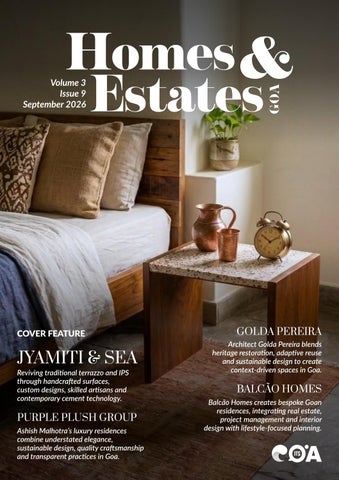
Volume 3
Issue 9
September 2026
goa
Homes & Estates
COVER FEATURE
Golda Pereira
Jyamiti & Sea Reviving traditional terrazzo and IPS through handcrafted surfaces, custom designs, skilled artisans and contemporary cement technology.
Purple Plush Group Ashish Malhotra’s luxury residences combine understated elegance, sustainable design, quality craftsmanship and transparent practices in Goa.
Architect Golda Pereira blends heritage restoration, adaptive reuse and sustainable design to create context-driven spaces in Goa.
Balcão Homes Balcão Homes creates bespoke Goan residences, integrating real estate, project management and interior design with lifestyle-focused planning.
create bespoke homes shaped by lifestyle, functionality and their surroundings.
We also feature architect Naomi D’mello, whose work centres on preserving Goa’s architectural heritage through thoughtful restoration, sustainable materials and traditional design, while adapting historic homes to contemporary needs.
Beyond architecture and design, this issue explores the investment potential of Goa’s thriving holiday rental market. Our feature on turning Goan
Editorial Dear Readers,
properties into profitable rentals examines how strategic property selection, hospitality and effective marketing can help homeowners make the most of growing tourism demand.
Welcome to the September 2026 edition of Homes & Estates Goa, where thoughtful architecture, sustainable living and real estate expertise come together to celebrate the evolving landscape of Goan homes.
We also turn our attention to sustainable living with a closer look at solar-powered homes in Goa. Exploring government incentives, long-term savings and emerging technologies, the feature highlights the growing role of solar energy in shaping a more
Jyamiti & Sea brings renewed attention to terrazzo
sustainable future for homeowners.
and IPS, combining traditional Indian craftsmanship with modern cement technology to create handcrafted surfaces defined by colour, texture and contemporary design.
This issue pays tribute to those pioneering a sustainable, community-driven approach to real estate, design, and hospitality in Goa. Each of these leaders is contributing not only to building spaces
Purple Plush Group, founded by Ashish Malhotra, presents thoughtfully designed luxury residences in
but to fostering a brighter, more sustainable future for the region.
Goa, bringing together understated elegance, quality craftsmanship and sustainable principles to create homes built to last.
Well, that’s all I have for you from my desk this month. I hope you enjoy reading this month’s issue of our magazine. Do share it with your friends all
Architect Golda Pereira explores the relationship
across the globe.
between heritage and modern living through her Goa-based practice, focusing on restoration,
Until next month, cheers!
adaptive reuse and context-driven architecture that respects the environment and local character.
Jessyl Fernandez
Editor
Balcão Homes takes a holistic approach to residential development, bringing together real estate, project management and interior design to
www.itsgoa.com
itsgoa_
Itsgoa
Index 01 Jyamiti & Sea
02 Purple Plush Group
03 Golda Pereira
04 Balcão Homes
05 Naomi D’mello
06 Airbnb Goldmine: Turning Goan Properties into Profitable Rentals
07 The Green Movement: Solar-Powered Homes in Goa
Introduction
Goa, the tiniest state on the western coast of India, boasts golden pristine beaches, palmfringed avenues, flavourful food, delicious Portuguese-influenced sweets, and warm, hospitable people. Also known as the Ibiza of India for its partying. A tropical paradise of flora and fauna, from the very famous 'almi' (mushrooms) endemic to its forests, that grow only on the red mud anthills, to the solar prawns that are fished immediately after the monsoons, Goa is unique. Tourists are also attracted to Goa for its cultural heritage - from the famous old Portuguese churches like Se Cathedral in Old Goa, the 16th Century Safa Masjid in Ponda and Shree Mangesha Temple in Mardol, the legendary Arvalem or Pandava Caves where the Pandavas of the Mahabharat fame lived, to its two unique festivals - Carnival and Shigmo. Goa plays host to many festivals - the International Film Festival of India that promotes cinema, the Serendipity Art Festival, Sunburn Music Festival, The Grape Escapade to name a few. To showcase this varied heritage of culture, art, tradition, food, and people, in 2015 ItsGoa was born. The main aim was to make it the premier portal for all things Goa. We were able to showcase Goa like never before. Soon our blog-based website transcended the virtual space, with the ItsGoa magazine – a sought-after resource for visitors to Goa from countries like Norway, Germany, UK, USA, UAE, etc.
Editorial Team Chief Editor
Jessyl Fernandez
Sales
Donald Fernandez
Andrea Fernandes
Content & Social Media
Britney Fernandes
Graphics & Layout
Britney Fernandes
For advertising queries:
+91 7887330620 / 9370502124
ItsGoa Media Group
Nordic Intent HQ - Floor 3, PDA
Colony, Porvorim, Goa 403521
Email: mail@itsgoa.com
Website: itsgoa.com
www.itsgoa.com itsgoa_ Itsgoa
hotel Lua Nova If holidays are inspired by nature and your thirst for rustic solitude and inner peace, Lua Nova is the hotel your heart was yearning for. Located at Goa's celebrated holiday capital at Baga, it overlooks a beautiful Canvas of village www.itsgoa.com itsgoa_ Itsgoa Goa, just 5 minutes walk from the Baga Beach.
cover feature
Jyamiti & Sea Jyamiti & Sea revives terrazzo and IPS through handcrafted surfaces, custom colours and patterns, combining traditional Indian material practices with modern cement technology, skilled artisans and contemporary design.
Article by: ItsGoa
Images by: Jyamiti & Sea
www.itsgoa.com
itsgoa_
Itsgoa
In a world increasingly shaped by factory-made finishes and standardised surfaces, Jyamiti & Sea is taking a different approach. Based in Goa, with a second base of operations in Bengaluru, the terrazzo and IPS manufacturing studio is bringing renewed attention to materials that were once an integral part of Indian homes. Through handcraft, contemporary cement technology and a strong sensitivity to colour and form, the studio creates surfaces that are designed not merely to be seen, but to be lived with.
The name itself captures the philosophy behind the brand. “Jyamiti”, the Bengali word for geometry, reflects the structured and mathematical character of the material, while “Sea” acknowledges Goa, the coastal setting that has become central to the studio’s identity.
At the heart of the venture is founder Soumak
Founder - Soumak Mukhopadhyay
Mukhopadhyay, whose route into material craft was anything but conventional.
A Lockdown Experiment That Became a Studio
From Technology to Material Craft
The origins of Jyamiti & Sea can be traced back to an unlikely beginning during the Covid-19 lockdown.
Soumak’s professional journey began far from the
With time spent indoors and a desire to explore
world of construction and design. He spent close to
something new, Soumak enrolled in an online course
a decade at Infosys, progressing from a developer to
that cost just ₹300.
a project manager while working on international assignments in Switzerland, the UK and France. His
What began as a low-risk experiment quickly
career later took a creative turn when he co-
became a hands-on exploration of concrete and
founded The Creative Lens, a photography studio
home décor. He began making pieces himself,
that he ran for more than ten years.
learning through experimentation and gradually becoming more interested in the possibilities of the
Photography gave him an understanding of
material.
composition, detail, light and visual storytelling. Yet after years behind the camera, he found himself
The project continued to evolve long after the initial
drawn towards something more tangible, the
curiosity had passed. Those early experiments
opportunity to create with his own hands.
eventually developed into a larger vision, giving rise to Jyamiti & Sea.
That transition has had a lasting influence on Jyamiti & Sea. His technology background contributes a
Terrazzo Rooted in Memory
process-oriented approach, while his years in photography have cultivated an instinct for visual
For Soumak, terrazzo carries a strong sense of
balance and detail. Together, these experiences have
nostalgia. Growing up in Kolkata, he encountered
shaped a studio that approaches material making
the material as an ordinary part of everyday
with both precision and curiosity.
surroundings.
www.itsgoa.com
itsgoa_
Itsgoa
Crafted the terrazzo top and rounded fluted terrazzo panels for this beautiful reception desk
www.itsgoa.com
itsgoa_
Itsgoa
Rather than applying colour as a superficial layer, the pigment becomes part of the material itself. This creates surfaces where colour is structurally integrated and ages alongside the concrete. The studio further softens the visual language of concrete through rounded edges and organic forms. The result is a material that can feel warm and tactile while retaining the strength and durability traditionally associated with concrete.
Handmade From Beginning to End
Bathroom in cast-in-situ pink terrazzo with white Indian marble chips Art Deco homes, stairwells, courtyards and residential spaces often features terrazzo, making it a familiar part of the urban landscape rather than a specialised design statement.
That early relationship with the material continues to influence the studio’s approach. Jyamiti & Sea does not treat terrazzo simply as a fashionable finish. Instead, the brand sees it as a material with history, one that belongs to lived spaces and becomes more meaningful through use. Its surfaces are intended to be touched, walked on and incorporated into everyday life. This perspective also informs the studio’s broader interest in reviving terrazzo and IPS, both of which were once widely used in Indian homes before factory-made alternatives gradually displaced them.
The studio’s work spans a variety of applications, including tabletops, countertops, slabs, flooring and wall finishes. While the finished surfaces may appear refined and precise, their production remains firmly rooted in handcraft. Each piece is mixed, pigmented, poured, ground and finished by hand. There is no mass-production line dictating the outcome. Instead, skilled artisans guide the material through each stage of its transformation.
This approach is particularly evident in the creation of patterns. Different pigmented batches are carefully poured and zoned within a single piece, creating compositions that emerge from a combination of planning, technique and the natural behaviour of the material.
Giving Concrete a Softer Identity
Concrete is often associated with strength, utility and industrial spaces. Jyamiti & Sea challenges that perception by exploring the softer, more expressive side of the material. Colour is incorporated directly into the concrete through oxide pigments before the material is poured.
Indian Patent Stone
www.itsgoa.com
itsgoa_
Itsgoa
Kingfisher - Custom Tiles, Inspired by Nature
www.itsgoa.com
itsgoa_
Itsgoa
Every commission can therefore become its own design exercise. The studio works with clients and designers to develop custom colours, patterns and formats, allowing surfaces to respond to individual spaces rather than being limited to a fixed catalogue.
Traditional Craft Meets Modern Science
While the process remains handmade, Jyamiti & Sea has also recognised the importance of contemporary material science. To strengthen the performance and reliability of its surfaces, the studio has worked with cement technology experts at IIT Chennai. This collaboration has helped update traditional terrazzo and IPS formulations to adapt the materials to today’s requirements.
The technology remains largely behind the scenes. Its purpose is not to replace the craft, but to support it, allowing artisans to continue working with their hands while producing surfaces that meet contemporary expectations for durability, consistency and design flexibility.
Terrazzo wall art The Beauty of the Unrepeatable
One of the defining characteristics of Jyamiti & Sea’s work is that no two pieces are exactly alike. Because every surface is hand poured and hand finished, and because pigments are incorporated directly into the material, each piece develops its own character. There is an element of unpredictability in how colours settle, interact and reveal themselves once the material cures. Rather than attempting to eliminate that variation, the studio embraces it.
For Jyamiti & Sea, these subtle differences are not imperfections. They are evidence of the human process behind the work. Each surface carries the marks of decisions made during pouring, finishing and polishing, giving it a character that a printed or mass-produced finish cannot replicate.
The Hands Behind the Material
Pieces Creating Something Beautiful
Behind this philosophy is a team of 25 artisans working across Goa and Bengaluru. Their contribution extends through every stage of production, from mixing pigments and preparing batches to pouring, grinding and polishing finished surfaces.
www.itsgoa.com itsgoa_ Itsgoa
Subtle Terrazzo Slab Finish
Handcrafted Terrazzo Flooring Detail
www.itsgoa.com
itsgoa_
Itsgoa
A Practice Shaped by Many Journeys
Soumak’s transition from technology to photography and eventually material craft is reflected in the character of Jyamiti & Sea. His years in international corporate environments brought structure and process; photography developed his sensitivity to composition and visual detail; and working between Bengaluru and Goa has placed him in environments where contemporary design and local material traditions intersect.
Textured Terrazzo Slab Detail Their skill is central to the studio’s identity. Jyamiti & Sea views the preservation of this knowledge as an important part of its purpose, particularly at a time when many traditional material practices have been replaced by industrial manufacturing.
The studio is therefore not only producing surfaces; it is helping sustain a craft tradition by giving artisans an opportunity to continue developing and passing on their expertise.
Jyamiti & Sea brings these influences together through an approach that is simultaneously technical and tactile. Its work respects the history of terrazzo and IPS while looking for ways to make them relevant to contemporary spaces. At its core, the studio is making a case for slowing down. In an industry increasingly dominated by speed and uniformity, it places value on skilled hands, individual variation and materials that reveal their character over time.
For Jyamiti & Sea, geometry may provide the structure, but it is craftsmanship, colour, memory and the unpredictable nature of making that give each surface its soul.
Designed to Age With Grace
Despite the craftsmanship involved, caring for Jyamiti & Sea surfaces is relatively straightforward. Regular mopping is sufficient for everyday maintenance, while mild detergents are recommended instead of harsh chemicals. The material is also intended to age rather than remain permanently unchanged. Over time, its surface can develop character, allowing the signs of use to become part of its story.
That quality reflects the studio’s fundamental philosophy: materials need not remain frozen in their original condition to remain beautiful. A surface that changes naturally through everyday life can become more personal with time.
Textured pattern Terrazzo www.itsgoa.com
itsgoa_
Itsgoa
Real Estate Developer
Purple Plush Group Purple Plush Group, founded by Ashish Malhotra, develops thoughtfully designed luxury residences in Goa, combining understated elegance, quality craftsmanship, sustainable design principles and transparent practices to create lasting homes. Article by: Team ItsGoa
Images by: Purple Plush Group
www.itsgoa.com itsgoa_ Itsgoa
For Purple Plush Group, creating a home in Goa is about more than building a property. It is about understanding the land, responding to its surroundings and creating spaces that allow people to experience the state at a slower, more personal pace. Founded by Ashish Malhotra, the group has built its work around understated design, careful execution and a direct, trust-led relationship with its clients.
Ashish comes from a jewellery background and continues to work as a jeweller in New Delhi. His experience with precious materials has shaped his appreciation for proportion, craftsmanship and attention to detail, qualities that have naturally carried into his approach to residential development.
His interest in architecture, beautiful spaces and hospitality further influenced the way he envisioned homes, with luxury defined not by excess, but by
Founder - Ashish Malhotra
thoughtful choices that remain relevant over time.
From a Farmhouse to Goa
For Ashish, real estate is fundamentally built on trust, making transparency an important part of both
Purple Plush Group began with an unexpected
the process and the client relationship.
success. Ashish had built a luxury farmhouse in Sohna, near Gurugram, as a private getaway. The
The group favours understated luxury over
property later attracted guests through Airbnb,
unnecessary embellishment. Rather than adding
receiving a positive response for its design,
features simply for visual impact, its approach
atmosphere and overall experience. The response
centres on selecting appropriate materials,
encouraged him to explore residential development
maintaining good proportions and executing details
on a larger scale.
correctly. The emphasis extends beyond how a residence appears in photographs. Functionality,
Goa emerged as the natural next destination. Ashish
durability and the experience of living in the space
noticed a recurring sentiment among visitors: after
are considered equally important.
spending time in the state, many wished they could have a home there. The attraction extended beyond
Communication forms another essential part of this
the beaches to Goa’s greenery, privacy, slower pace
approach. Purple Plush Group aims to maintain
and ability to offer a break from urban life. This
realistic timelines, clear commitments and direct
understanding became the foundation for Purple
conversations throughout a project. Construction
Plush Group and its focus on premium residences,
inevitably brings challenges, but the group believes
particularly across North Goa.
that addressing them openly and responsibly is more valuable than offering vague assurances.
Understated Luxury, Built on Trust
This philosophy has also shaped its growth. With At the heart of the group’s philosophy is a
more than 16 projects delivered and over 200 keys
straightforward belief: a developer must be honest
handed over, a significant part of the group’s
about what is being created and what can actually
business has developed through repeat clients and
be delivered.
referrals.
www.itsgoa.com
itsgoa_
Itsgoa
Casa Do Rei, Reis Magos
Villamor Socorro
www.itsgoa.com
itsgoa_
Itsgoa
discussed in advance and progress monitored regularly. The principle is simple: quality cannot be added at the end of construction. It has to be considered from the first drawing through to the final handover.
Homes With Their Own Identity
Purple Plush Group does not aim to make every development look alike. Each site has its own character, and the residences are designed to respond accordingly. Yet certain principles remain consistent across its portfolio: privacy, comfortable proportions, natural light, considered landscaping and a strong relationship between indoor and outdoor spaces.
Hotel Siloy Reis Magos Starting With the Land
For Purple Plush Group, every project begins with its setting. The group remains closely involved in land acquisition, design and construction, recognising that decisions made at the earliest stages influence everything that follows.
Before a design takes shape, the site is studied closely. The team considers the direction of natural light, available views, privacy, vegetation and the way a property can respond to Goa’s heat and monsoon conditions. Rather than imposing a predetermined design on every site, the intention is to understand its character and allow that understanding to influence the eventual residence.
During construction, attention turns to materials, finishes and smaller details. The group views premium quality as the cumulative result of numerous decisions made correctly rather than a single dramatic feature. Architects, consultants, contractors and site teams work closely throughout the process, with materials reviewed, details
The group also considers how a residence will actually be used. A second home may serve as a holiday retreat, but it should also provide the comfort required for longer stays with family. Storage, movement through the house, natural light and the relationship between rooms are therefore treated as practical design considerations rather than afterthoughts.
The same thinking extends to durability. Instead of following short-lived design trends, Purple Plush Group focuses on proportions, lasting materials and flexible spaces that can remain relevant for years. Goa’s humidity and monsoon conditions also influence decisions around construction and material selection.
Contemporary Homes Rooted in Goa
Goa’s landscape and architectural heritage provide an important context for the group’s work. From its greenery and village life to traditional architecture and distinct local character, the state influences how a residence is conceived and experienced.
Even within North Goa, the character of individual locations varies considerably. Moira, Socorro, Assagao, Sangolda and Reis Magos each offer different surroundings, whether defined by greenery, fields, valleys or village roads. Purple Plush Group seeks to understand these distinctions before beginning the design process.
www.itsgoa.com
itsgoa_
Itsgoa
Bedroom interiors - Casa Elegante Sangolda
Bathroom interiors - Casa Elegante Sangolda
www.itsgoa.com
itsgoa_
Itsgoa
Courtyards, verandas, shaded areas, natural ventilation and landscaping can all become relevant responses to the environment. However, the intention is not to reproduce one stereotypical interpretation of Goan architecture. Instead, the group seeks to create contemporary residences that remain connected to their surroundings and the character of the place they occupy.
Beyond Residences
As the business evolved, Purple Plush Group expanded beyond individual villas into residential communities, boutique hospitality-led developments and structured partnerships with landowners and investors. This broader scope eventually led to the creation of the Purple Plush Group identity, bringing its different areas of work under one brand and providing clients and partners with a clear point of accountability.
Its partnership models include joint ventures, project participation and land aggregation. Depending on
Timber Ridge, Sangolda
the project, the group can be involved in assessing land, developing the concept, overseeing design and
managing construction and delivery. Rather than applying a fixed model, the group first seeks to understand the objectives of the landowner or investor and establish whether there is genuine alignment. Clear responsibilities, expectations and financial structures are considered essential from the beginning, creating a more transparent foundation for the development.
Building for the Way People Live
The group's understanding of a home extends beyond aesthetics. Its residences are intended to support everyday life, whether that means a family spending a few weeks in Goa or using the property for extended periods.
This means considering how people enter and move through a home, where natural light falls, where storage is needed and how indoor areas connect with gardens, terraces and other outdoor spaces. These seemingly simple decisions can determine how comfortable and useful a property remains over
Hotel interiors time.
www.itsgoa.com
itsgoa_
Itsgoa
Casa Palmera, Nachinola For Purple Plush Group, a successful residence is ultimately one that continues to be enjoyed by its owners. Its value lies not only in its physical form, but in the experiences it enables: unhurried mornings, time with family and a stronger connection to the environment around it.
A Wider Vision for Second Homes
The next phase for Purple Plush Group is centred on thoughtful expansion. While the group currently operates within the mid-segment second-home market, it plans to broaden its portfolio to address different levels of demand.
At one end, it is exploring apartment developments that can offer buyers a more accessible route to owning a home in Goa. At the other, it is looking towards larger estates designed around greater
space, privacy and exclusivity. The objective is to expand the range of residences without compromising the personal involvement and quality standards that have shaped the business so far.
For Purple Plush Group, growth is therefore not simply about increasing the number of properties. It is about creating a wider selection of considered homes while retaining the principles that have guided the company from the beginning: thoughtful design, honest communication, dependable execution and respect for the setting.
Ultimately, Purple Plush Group seeks to create more than addresses in Goa. Its vision is to give people spaces where they can pause, reconnect and experience the state on their own terms. In its own words, the idea can be summed up simply: Own Your Escape.
www.itsgoa.com
itsgoa_
Itsgoa
Architect
Golda Pereira Architect Golda Pereira’s Goa-based practice focuses on heritage restoration, adaptive reuse and context-driven design, creating thoughtful spaces that balance traditional architecture, contemporary living, sustainability and meaningful connections with nature.
Article by: Team ItsGoa
Images by: Golda Pereira
www.itsgoa.com
itsgoa_
Itsgoa
Her summers in Divar offered a different kind of architectural education. At the family’s ancestral home, she and her cousins would spend weeks creating temporary structures from coconut leaves and sticks, turning them into spaces for play. These informal experiences of making, adapting and inhabiting spaces became an early connection to architecture and art.
Restoring What Already Exists
Architect - Golda Periera Golda Pereira’s architectural practice is rooted in a deep connection to Goa, its built heritage and the quieter rhythms of everyday life. Through her studio, she approaches restoration, adaptive reuse and new construction with an emphasis on context, experience and longevity.
A Creative Beginning
Golda Pereira is an architect based in Goa and the founder of Golda Pereira Design, which she runs from a studio in Guirim, an annexe to her home. A graduate of Goa College of Architecture, she began her professional journey with a one-year fellowship at the Charles Correa Foundation, followed by experience with a Goan architect, before establishing her own practice in 2017.
Her inclination towards architecture can be traced to childhood. Growing up, she was surrounded by both creative pursuits and an appreciation for thoughtfully designed spaces. Her father, a lawyer who later moved into business and undertook interior renovation projects, would take her along to sites. At home, she experienced simple but intentional interiors where function and aesthetics were carefully considered.
Golda’s first project after starting her practice was Dragonfly Villa in Anjuna, an adaptive reuse and renovation of a small heritage home. Originally around 150 square metres, the house had undergone previous alterations that had closed some windows and changed its internal arrangement. Through careful planning, material selection and the restoration of furniture, the project brought the character of the home back to life. She worked on the project alongside her colleague and friend Alisha Lawrence, who has since established her own practice.
The experience strengthened Golda’s interest in restoration. For her, heritage homes represent more than architectural forms; they carry the history of the land, the memories of families and the craftsmanship of earlier generations. Restoring them is also a more considered approach to resources, avoiding unnecessary demolition and new construction where existing structures can be given another life.
Her practice extends beyond traditional heritage houses. She also works on homes from the 1970s, often characterised by concrete balusters, reinforced concrete roofs and ageing metal windows. These projects can demand significant structural and spatial intervention, from reworking the façade to completely reconsidering the interiors. The reward comes from seeing clients experience the transformed space and recognise the vision that began during her earliest site visits.
The Quiet Language of Tropical Modernism
Golda believes architecture has the ability to influence how people feel.
www.itsgoa.com
itsgoa_
Itsgoa
Divar Renovation: Extended Roofs
Divar Renovation: Warm Dining Spaces
www.itsgoa.com
itsgoa_
Itsgoa
She works alongside her team, Melroy Mascarenhas and Nolan Ramos, whose contributions support the design and execution of projects, helping bring her architectural vision to life. She prefers to remain involved through the completion of a project, believing that an architect should understand not only the shell of a building but also how its occupants will experience it. The details within a home are therefore considered alongside its structure, openings and circulation, creating a more cohesive whole.
Designing Through a Goan Lens
Goa is central to Golda’s practice and identity. Growing up surrounded by its traditions, festivals, family gatherings and distinctive cultural landscape has shaped the way she understands space.
The state’s architectural diversity, influenced by
Assagao New Construction
Portuguese traditions as well as older indigenous systems, provides a rich foundation for her work.
Rather than treating a building as an object defined
Sloping roofs, courtyards, balcaos and the
primarily by its façade, she focuses on how it is
relationship between houses and their surroundings
experienced as one moves through it.
are all expressions of a built environment shaped by climate, history and lifestyle.
Her approach to tropical modernism is understated and contextual. Materials are selected with an awareness of Goa, while scale, proportion, light and materiality guide the design. The intention is to create spaces that feel grounded rather than imposed on their surroundings, allowing a home to make a statement without becoming unnecessarily conspicuous.
For Golda, good architecture is ultimately about creating an experience. Openings, natural light, movement and the relationship between spaces are considered from the beginning, rather than being secondary to the building’s exterior appearance.
Architecture Beyond the Shell
This philosophy extends naturally into her approach to interiors. Golda sees architecture and interior design as inseparable parts of the same process. Furniture, artwork, colour, fabrics and lighting should contribute to the larger vision established by the
Parra renovation
architecture.
www.itsgoa.com
itsgoa_
Itsgoa
Guirim New Construction
Divar, Casa Desa Monteiro – Restoration
www.itsgoa.com
itsgoa_
Itsgoa
Golda saw potential in every corner, preserving the original character while introducing contemporary interventions.
The restored house balances old and new. New windows bring in light, while the existing architecture and proportions remain respected. Sitout spaces overlooking the garden create natural places for conversation, while window seats frame the greenery and monsoon landscape. Restored furniture sits alongside customised pieces, while cotton textiles sourced from handicraft exhibitions and local stores add warmth.
More recently, Golda added her studio to the first floor, overlooking the garden. The home consequently reflects her understanding of slow living: spaces that encourage people to pause, observe, converse and remain connected to their surroundings.
Creativity in Everyday Life
Assagao restoration
Outside architecture, Golda continues to find inspiration in making and observation.
Beyond architecture, she is drawn to Goa’s slower pace of living and its emphasis on contentment rather than constant pursuit of status or material possessions. Fields, rivers, forests, hills and settlements coexist within a relatively small landscape, creating an environment where architecture is closely connected to nature and community.
A Home Reimagined
Golda’s philosophy became deeply personal through the restoration of her husband Fabian’s ancestral home, where the couple now live. The abandoned house had initially appeared deceptively intact, with a whitewashed façade and an overgrown front yard. Inside, however, it revealed years of neglect: bats occupied the false ceiling, doors were broken, chandeliers hung precariously and the roof of the refectory had collapsed.
What began as an intention to repair the roof eventually became a complete restoration, undertaken with the support of her father-in-law.
Sinquerim Addition
www.itsgoa.com
itsgoa_
Itsgoa
She enjoys long morning walks through the village and has recently explored Japanese bookbinding simply out of curiosity. Her interest in textiles has also led her towards a desire to learn more about Kunbi fabrics and the people who continue to produce them.
Her creative interests do not exist separately from her profession. Instead, they form part of the everyday curiosity that informs how she sees materials, spaces and objects.
Her husband Fabian, a photographer, complements this creative practice by documenting her projects. Their shared creative understanding allows Golda to communicate freely about what she wants a project to convey, while his photographs help translate those ideas to a wider audience.
A Practice Rooted in Authenticity
As a mother to Maya, Golda has also established clear boundaries around her professional life. She works from Monday to Friday, 9 am to 5 pm,
Guirim restoration and deliberately keeps evenings and weekends free from work calls and emails. Her approach is supported by a close family network, with both sets of grandparents living nearby and actively involved in Maya’s life.
This sense of balance reflects the broader philosophy behind her practice. Golda is not interested in following trends simply for the sake of relevance. Instead, she seeks to create homes with character, soul and a lasting connection to their context.
Assagao Restoration
For Golda Pereira, architecture is ultimately about creating meaningful experiences and spaces that remain relevant over time. Her work reflects a thoughtful approach to restoration, a sensitivity to the surrounding landscape and an understanding of how people inhabit their homes. Whether reimagining an existing structure or designing a new residence, she places importance on context, functionality and a lasting connection to place. In Goa, where landscape, culture and architecture are deeply intertwined, her practice continues to explore how homes can evolve while retaining a strong sense of identity.
www.itsgoa.com
itsgoa_
Itsgoa
Residential Development
Balcão Homes
Balcão Homes creates thoughtfully designed residences in Goa, combining real estate, project management and interior design to deliver bespoke homes and developments shaped by lifestyle, landscape and functionality. Article by: Team ItsGoa
Images by: Balcão Homes
www.itsgoa.com
itsgoa_
Itsgoa
A home is shaped by more than architecture. It is influenced by the landscape it sits within, the people who inhabit it, the way they spend their time and the small details that make everyday living feel natural. At Balcão Homes, this understanding forms the foundation of how residences are conceived, developed and delivered in Goa.
Founded by Sanya Hirani, Advay Lulla and Jayantika Bhatia, Balcão Homes brings together three distinct professional perspectives: residential project management and marketing, real estate and financial due diligence, and interior design. Their combined experience allows the company to approach a home as one complete process, bringing together land, architecture, interiors, budgets and execution rather than treating each as an isolated stage.
Three Perspectives, One Vision
Each founder brings a different strength to Balcão Homes. Sanya Hirani comes from a marketing background and has previously worked on large residential real estate projects in Bangalore. At Balcão, she is involved in overall project management, finances, investor relationships and communicating the company's vision.
Advay Lulla brings experience in Goa's real estate landscape. His role focuses particularly on financial and documentation processes, including the detailed due diligence and paperwork involved in land acquisition. His emphasis on organisation, reporting and thorough processes helps establish a strong foundation for each project.
Jayantika Bhatia brings an interior design perspective to the company, with a particular interest in the relationship between architecture, materials, interiors and everyday life. She is closely involved in shaping the design vision and ensuring that it translates into homes that feel considered, personal and connected to their surroundings.
Together, these different disciplines allow Balcão Homes to look at residential development from multiple angles. Rather than beginning with a predetermined aesthetic, the team considers how a home should function, where it should sit, who it is
Founders - Sanya Hirani, Advay Lulla and Jayantika Bhatia being created for and how all these elements can come together cohesively.
Creating Homes From the Ground Up
Balcão Homes grew from a shared desire to approach residential development more holistically. The founders saw an opportunity to combine their respective experience and create residences where architecture, interiors and execution were considered from the outset rather than handled as disconnected stages.
The company's philosophy is centred on creating homes that are thoughtfully designed for Goa, carefully developed and genuinely enjoyable to live in. This applies both to projects developed by the company and to bespoke residences created for individual clients.
The emphasis is on livability. Proportion, natural light, materials, movement through a space and the relationship between the home and its surroundings are all considered as part of the design process. Instead of following short-lived trends, Balcão Homes aims to create residences with their own identity that remain relevant and practical over time.
www.itsgoa.com
itsgoa_
Itsgoa
A glimpse into Ārka — their newest project, brought to life
Pool area - Villa Ārka
www.itsgoa.com
itsgoa_
Itsgoa
Understanding the People Behind the Home
This allows decisions to be made with the completed home in mind and helps reduce the gaps that can
For the team, designing a residence begins well
occur when different aspects of a project are
before drawings are made. It starts with
handled independently.
understanding the person or family who will live there.
For clients, the approach means having one team responsible for the journey from the initial land
Conversations with clients explore why they are
search through to the delivery of a cohesive
drawn to Goa, how they imagine spending their time
residence.
there and what they want their home to enable. Practical questions are equally important: how many
Bespoke by Nature
people will use the house, how they entertain, what they need from the kitchen and bedrooms, and how
For Balcão Homes, a bespoke residence is not
they want to use outdoor spaces.
defined by a particular architectural style or a catalogue of finishes. It is about translating the way
The team also considers quieter preferences. A client
someone lives into the design of their home.
may want a private retreat or a more social home. They may value a particular view, enjoy spending
The process considers what clients need, what they
mornings outdoors or want spaces that
enjoy and how they want their surroundings to feel.
accommodate frequent gatherings. These details
Those insights inform planning, architecture,
help establish a clearer picture of what the residence
materials and interiors, allowing the final residence
needs to become.
to develop around the people who will inhabit it.
Once these priorities are understood, the team
The team also coordinates the various consultants
evaluates suitable areas and plots by looking at
and professionals involved in creating a home. This
factors such as orientation, landscape, access,
allows clients to remain involved in the important
surroundings and the possibilities offered by each
decisions without having to manage every moving
site. The eventual design grows from the relationship
part of the process themselves.
between the client's lifestyle, the character of the land and the architecture.
The result is intended to feel personal in a more fundamental way. Rather than simply reflecting a
An Integrated Approach to Building
chosen aesthetic, the home is shaped around the habits, priorities and experiences of the people living
One of Balcão Homes' defining characteristics is its
in it.
involvement across the entire development journey. The process can begin with identifying and acquiring
Learning From Goa Without Replicating It
the right piece of land, followed by legal due diligence, documentation, plot registration and the
Goa's architectural heritage offers Balcão Homes an
permissions required to make a site construction-
important source of inspiration, particularly in the
ready.
way traditional homes respond to climate and everyday life.
This local understanding is particularly important in Goa, where navigating the land and regulatory
Verandas, shaded areas, courtyards and transitions
landscape requires familiarity with the region and
between indoor and outdoor spaces demonstrate
strong working relationships. By keeping these
how architecture can respond naturally to the
processes within an integrated framework, the
environment while creating opportunities for both
company aims to create greater clarity from the
gathering and quiet. Goa's distinctive light, greenery
beginning. Architecture, interiors, budgets and
and monsoon also influence the team's thinking
execution are then considered together rather than
around orientation, materials and movement through
being passed between disconnected teams.
a home.
www.itsgoa.com
itsgoa_
Itsgoa
Founders - Sanya Hirani, Advay Lulla and Jayantika Bhatia along with Sandesh Ghadi Civil site engineer
www.itsgoa.com
itsgoa_
Itsgoa
However, the intention is not to reproduce
location, landscape, architecture, materials, interiors
traditional architecture literally. Instead, Balcão
and execution considered as part of one cohesive
Homes looks at the principles behind it and
vision.
considers how they can be reinterpreted for contemporary living.
The distinction ultimately comes down to participation. Bespoke residences allow homeowners
The result is a balance between rootedness and
to shape the journey, while Balcão's own
modern functionality. Contemporary homes need to
developments offer a finished home for those who
accommodate changing expectations around privacy,
would rather leave the creative and executional
storage, technology and maintenance, while still
decisions to an experienced team.
retaining the qualities that make a home feel connected to Goa.
Looking Ahead
Designed Around the Landscape
Balcão Homes' upcoming project, Ārka, reflects the company's approach to creating considered
For the team, a residence should never feel like an
residences in Goa. The ready-to-move-in 5BHK villa
isolated object placed on a plot. Its relationship with
in Aldona is expected to be ready for possession in
the surrounding environment is an essential part of
the first half of 2027, offering homeowners a
the design.
complete residence without requiring them to navigate the many decisions involved in building a
The process begins by studying the site, including its
home themselves.
orientation, existing vegetation, views, landscape and relationship with the neighbourhood. Scale is
Alongside Ārka, the company plans to continue
also considered, ensuring that the home sits
developing its own villa projects across Goa while
comfortably within its surroundings.
also creating bespoke residences for clients who want to be involved in shaping their spaces.
This sensitivity is particularly relevant in Goa, where the spaces between buildings and the relationship
As Balcão Homes grows, the founders intend to
with nature contribute significantly to the character
remain closely involved in each project and retain
of a place. Balcão Homes seeks to respond to these
the attention to detail and personal connection that
qualities rather than working against them.
have shaped the company from the beginning. Their ambition is not simply to create visually appealing
Two Ways of Finding Home
properties, but homes that feel natural to inhabit. Ultimately, Balcão Homes sees a successful
The company approaches residential development
residence as one where the land, architecture,
through two distinct offerings: bespoke residences
interiors and everyday experience come together
and its own developments.
seamlessly.
Bespoke projects are designed for clients who want
A home should respond to its surroundings, support
to participate in shaping their homes. Their
the way people live and provide the setting for the
requirements, preferences and lifestyle become part
experiences and memories that give a place
of an ongoing design process, with Balcão Homes
meaning. In Goa, where landscape and lifestyle are
guiding the project from planning through execution.
so closely intertwined, that approach becomes less about building a property and more about creating a
Its own developments offer a different experience
way of living.
for homeowners who prefer a more complete, ready-made residence. These projects are designed
Website: balcaohomes.com
and developed by the Balcão team, with the
Instagram: @balcaohomes
www.itsgoa.com
itsgoa_
Itsgoa
Architect & Heritage Restoration
Naomi D’mello Architect Naomi D’mello combines traditional Goan architecture, sustainable materials and thoughtful restoration to preserve heritage homes, adapting them for modern living while maintaining their cultural character and architectural significance.
Article by: Team ItsGoa
Images by: Naomi D’mello
www.itsgoa.com
itsgoa_
Itsgoa
With over eight years of professional experience, Architect Naomi D’mello has built a practice shaped by a growing appreciation for restoration, sustainability and the architectural character of Goa. Born and raised in Mumbai, her professional journey began with modern interior projects, but over time, her interest shifted towards preserving traditional Goan homes and the principles that make them enduring.
Her connection with Goa is both professional and personal. Drawn by its natural surroundings, distinctive architecture and her own roots in the state, she eventually made the move back from Mumbai.
For Naomi, the decision was not simply about changing where she lived. It was about creating a better quality of life while reconnecting with the environment and heritage that had long held her interest.
A Connection Rooted in Memory
Naomi’s interest in Goan architecture began during her Bachelor’s degree, when she studied its distinctive design principles and sustainability.
The subject also brought back memories of spending summer holidays at her ancestral home, where architectural details that once seemed ordinary began to reveal their ingenuity.
She remembers how light filtered through shell windows even when they were closed, creating a soft, diffused illumination inside. The high roofs allowed hot air to rise and escape through the Mangalore-tiled roof, helping the interiors remain cooler despite the heat outdoors.
These simple yet effective features sparked her curiosity and encouraged her to understand how traditional homes achieved comfort through design and natural materials.
That early fascination eventually became a defining part of her architectural approach.
Preserving More Than a Structure
For Naomi, restoring an old Goan home is about more than repairing walls, roofs or windows. It is about retaining the character of a structure while finding ways for it to remain relevant to contemporary life.
Having grown up in Mumbai, she witnessed many old bungalows being demolished to make way for high-rise buildings. While such changes can be driven by the need for housing in densely populated cities, she sees a similar shift beginning to take place in Goa. Old homes are increasingly difficult for owners to maintain, while a lack of awareness about traditional construction and repair techniques can make demolition appear like the easier option.
This led Naomi to a different perspective on her role as an architect. Rather than simply replacing an old structure, she encourages homeowners to consider how it can be repurposed.
Founder - Naomi D’mello
Adapting a property for modern requirements or creating an opportunity for it to generate an income can give owners a practical reason to maintain it. In this way, restoration becomes not only an architectural exercise but also a means of keeping heritage homes useful and occupied.
www.itsgoa.com
itsgoa_
Itsgoa
Divar Island- A room that was originally used only to store fire wood has now become the second bedroom of the house
www.itsgoa.com
itsgoa_
Itsgoa
Architecture That Responds to Climate
One of the aspects Naomi admires most about traditional Goan homes is the way they achieved comfort through thoughtful design long before terms such as sustainable or climate-responsive architecture became widely used.
Laterite stone walls are a key example. Their considerable thickness provides structural strength while also offering thermal insulation. Lime-plastered walls allow the building to breathe and develop a characterful finish as they age. High ceilings and Mangalore-tiled roofs encourage hot air to rise and escape, while traditional shell windows bring in natural, diffused light even when they remain closed.
The materials used for flooring also reflect the practical evolution of Goan homes. Traditional cowdung floors were followed by finishes such as IPS, red oxide and terrazzo, many of which were locally available, durable and well suited to the climate.
For Naomi, these elements demonstrate that sustainability does not always require modern technology. Sometimes, it lies in understanding the materials, climate and context of a place and allowing those factors to shape the design.
The house that was untouched for over 2 decades, breathes once again
palette, with applications ranging from old Goan homes to contemporary spaces. Her work extends beyond heritage restoration to select residential and restaurant interiors. Even in these projects, she is naturally drawn towards concepts that are rustic, sustainable and grounded in natural tones and
A Mindful Approach to Materials
This philosophy continues to influence Naomi’s
textures.
Restoring With Patience and Purpose
restoration and interior projects. She prefers natural, locally available materials that complement the character of the property rather than overpowering it.
One of Naomi’s most memorable projects was the restoration of a home located on an island. The setting brought its own set of difficulties, particularly when it came to transporting materials and labour to
In restoration work, she uses laterite stone to rebuild dilapidated walls, including through traditional loadbearing construction techniques. The material also
the site. The logistical challenges added considerable time and cost to the project, requiring patience and careful coordination.
finds a place in some of her contemporary interiors, where it can be used to introduce new walls while maintaining a connection with Goa’s material language.
What made the experience particularly rewarding, however, was the shared commitment of the contractors and workers involved. They understood the importance of preserving the old home and
Natural stone flooring and traditional finishes are encouraged wherever they suit the design. Lime finishes are another important part of her material
often went beyond what was expected, working additional hours to complete the project on schedule.
www.itsgoa.com
itsgoa_
Itsgoa
Divar Island- Restored this niche to its original form
www.itsgoa.com
itsgoa_
Itsgoa
Kitchen renovation, Chandor
For Naomi, that experience reinforced the value of
heritage is a responsibility that extends to the
having the right people involved in restoration.
generations that will inherit it. While restoring an old
Preserving an old structure requires not only
home can appear challenging, she believes that the
architectural knowledge but also craftsmen and
process becomes more manageable with the right
professionals who understand traditional methods
knowledge, craftsmen and professionals.
and appreciate the character of the buildings they are working on.
Her approach is deliberately inclusive. She is willing to take on restoration and maintenance work of any
Learning Through Travel
scale, including the smallest jobs. For her, the value of such work is not determined by the size of the
Her inspiration also extends beyond her architectural
project but by its potential to help preserve another
practice. Naomi enjoys travelling, particularly to
piece of Goa’s architectural identity.
destinations surrounded by nature. Before visiting a place, she takes time to study its architecture,
As Goa continues to evolve, Naomi hopes more
allowing her to arrive with a sense of its history and
homeowners will see the possibilities within the
design language.
homes they already have. With thoughtful restoration and sensitive adaptation, she believes
Once there, observation becomes an important part
traditional houses can continue to serve
of the experience. She studies the buildings,
contemporary needs without losing the qualities that
materials and relationship between architecture and
make them special.
the surrounding environment, continually adding to her understanding. Travel, for her, is therefore both a
For Naomi D’mello, preserving these homes is
personal interest and an ongoing source of learning
ultimately about giving them another chapter. By
that brings new ideas into her work.
combining traditional knowledge with practical contemporary solutions, she hopes to ensure that
Looking Towards the Future
Goa’s architectural heritage remains not only remembered, but lived in and valued for years to
Naomi believes preserving Goa’s architectural
come.
www.itsgoa.com
itsgoa_
Itsgoa
authored article
Airbnb Goldmine: Turning Goan Properties into Profitable Rentals Goa’s thriving tourism and Airbnb demand make it a hotspot for profitable rentals. Strategic property selection, top-tier hospitality, and smart marketing can turn homes into lucrative vacation stays.
Article by: ItsGoa
Images by: Freepik
www.itsgoa.com
itsgoa_
Itsgoa
Goa, with its pristine beaches, vibrant nightlife, and unique blend of Portuguese and Indian heritage, has always been a hotspot for tourists.
In recent years, the rise of Airbnb and other shortterm rental platforms has revolutionized the hospitality sector, enabling property owners to turn their homes into lucrative rental spaces. Why Goa is Ideal for Airbnb Rentals
Year-Round Tourism: Unlike seasonal tourist destinations, Goa attracts visitors throughout the year, from domestic travelers seeking monsoon retreats to international tourists escaping harsh winters.
Diverse Traveler Demographics: From backpackers to luxury seekers, Goa offers accommodations for a wide range of guests, making it a profitable market for rental hosts.
Affordable Property Prices: Compared to metro cities, property prices in Goa are relatively lower, making real estate investment an attractive option for those looking to enter the rental business.
Government Support & Policies: With relaxed regulations and growing emphasis on tourism, renting out properties for short-term stays remains a viable and legal option in Goa.
How to Make a Goan Property Airbnb-Ready
Choose the Right Location: Beachfront properties, heritage homes, and villas in popular tourist hubs like North Goa’s Anjuna, Calangute, and South Goa’s Palolem tend to attract higher occupancy rates.
Aesthetic and Functional Interiors: A wellfurnished space with tasteful decor can make a lasting impression. Consider themes that reflect Goan culture, such as Portuguese-style furniture or boho-chic beach vibes.
Optimize for Comfort and Convenience: Provide essential amenities such as high-speed Wi-Fi, air conditioning, fully equipped kitchens, and
comfortable bedding to ensure positive guest reviews and repeat bookings.
Professional Photography & Listing Optimization: High-quality photos, compelling descriptions, and competitive pricing can increase visibility and attract more guests.
Exceptional Hospitality & Service: Personalized check-ins, local travel guides, and prompt responses to queries enhance the guest experience and lead to positive reviews.
Maximizing Profits on Airbnb
Competitive Pricing Strategy: Monitor local rental rates and offer dynamic pricing based on demand, peak seasons, and local events.
Flexible Booking Policies: Allowing last-minute bookings and offering discounts for long-term stays can increase occupancy rates.
Leveraging Social Media & Marketing: Promote listings on Instagram, Facebook, and travel groups to attract a wider audience.
Automate Operations: Use tools like smart locks, self-check-in options, and automated messaging to streamline guest management.
Partner with Local Businesses: Collaborate with cafes, tour operators, and transport services to enhance guest experience and earn additional revenue.
Conclusion With Goa’s evergreen appeal to tourists and the growing demand for unique travel experiences, investing in an Airbnb rental can be a profitable venture.
By strategically selecting properties, ensuring highquality hospitality, and leveraging digital marketing, property owners can transform their homes into successful and sustainable rental businesses.
The Airbnb goldmine in Goa is ripe for exploration— are you ready to tap into it?
www.itsgoa.com
itsgoa_
Itsgoa
authored article
The Green Movement: Solar-Powered Homes in Goa Goa is embracing solar energy for sustainable living, with government incentives, cost savings, and technological advancements driving adoption. Despite challenges, solar power promises a greener, more economical future for homeowners. Article by: ItsGoa
Images by: Freepik
www.itsgoa.com
itsgoa_
Itsgoa
Goa, renowned for its pristine beaches and vibrant culture, is also embracing a green revolution with the adoption of solar power in residential homes. As concerns over climate change and environmental sustainability grow, more homeowners in the state are turning to renewable energy sources, particularly solar power, to reduce their carbon footprint and electricity bills. Why Solar Energy?
challenges. The primary concerns include the high initial installation costs, lack of awareness, and the need for adequate rooftop space.
Furthermore, some homeowners are hesitant due to the variability in power generation caused by seasonal changes and cloudy weather conditions. Success Stories in Goa
Solar energy is a clean, renewable, and abundant resource, making it a perfect solution for a sundrenched region like Goa. Traditional power sources, such as coal and hydroelectric energy, contribute to environmental degradation and depend on finite resources. Solar power, on the other hand, harnesses the sun's energy, producing no harmful emissions and reducing reliance on fossil fuels.
Many homeowners in Goa have already transitioned to solar-powered homes and are reaping the benefits. Eco-conscious communities and housing societies have successfully implemented solar solutions, showcasing how renewable energy can enhance both sustainability and financial savings. Several eco-resorts and businesses have also adopted solar energy, setting an example for others to follow.
Government Incentives and Policies
The Future of Solar Energy in Goa
The Government of India, along with the Goa Energy Development Agency (GEDA), has been actively promoting solar energy through various subsidies and incentives. Homeowners can benefit from schemes that reduce the upfront cost of solar panel installation, making it a more affordable and attractive investment. Net metering policies further encourage solar adoption by allowing homeowners to sell excess electricity back to the grid, thereby reducing their overall energy expenses.
With advancements in solar technology and increasing government support, the future of solar energy in Goa looks promising. Innovations such as solar batteries and efficient photovoltaic cells are making solar power more reliable and accessible.
Cost and Savings While the initial cost of installing a solar panel system may seem high, the long-term savings on electricity bills make it a worthwhile investment. With the increasing cost of conventional electricity, solar energy offers financial relief by significantly lowering monthly utility costs. Additionally, maintenance costs for solar panels are minimal, as most systems come with a lifespan of 20–25 years. Challenges in Solar Adoption
Despite the numerous advantages, the widespread adoption of solar power in Goa faces certain
As awareness grows and more individuals recognize the long-term benefits, the shift towards solarpowered homes is expected to gain momentum, solidifying Goa’s position as a leader in sustainable living. Conclusion The transition to solar-powered homes in Goa is not just an environmental necessity but also a smart economic choice. With abundant sunshine, government incentives, and growing technological advancements, solar energy is paving the way for a greener and more sustainable future.
By embracing solar power, Goan households can contribute to a cleaner environment while enjoying long-term financial benefits, making the green movement an essential step toward a brighter future.
www.itsgoa.com
itsgoa_
Itsgoa
www.itsgoa.com
itsgoa_
Itsgoa
I t s G o a’ s E - M a g a z i n e s
A d v e r t i s e
With Us For more details Contact :
+91 9370502124 / +91 9209005127