F R E E / S E p t E m b E R 2 3 , 2 0 2 6 / Vo l u m E l I V, N u m b E R 5 3 / O u r 5 4 t h Ye a r FREE / SEPTEMBER 23, 2026 / VOLUME LV, NUMBER 04 / O u r 5 5 t h Ye a r
Online @ Ithaca.com
Online @ Ithaca.com
Your Next Great American Adventure BEGINS AT
ITHACA AIRPORT
A City That Belongs to All of Us
Washington may be America’s ultimate public city. Its monuments, memorials, parks, museums and great civic spaces invite everyone in. Walk the National Mall. Stand beneath the Capitol dome. Contemplate the words carved into the nation’s memorials. Wander through the Smithsonian museums. Sit beside the reflecting pool. Cross the Potomac and look back at the city from Arlington. You don’t have to be a politician, a historian or a Washington insider to feel that you belong there. In fact, perhaps that is the point. Washington was designed to be a place where the American story could be made visible to everyone. Its grand avenues and public spaces aren’t reserved for the people who work in government. They belong to the public. And for people in the Finger Lakes, getting there has never been more accessible. With United Airlines’ direct service from Ithaca to Washington, D.C., the nation’s capital is now just a flight away. That makes it easier to think of Washington not simply as a destination, but as an extension of our own civic lives.
A trip to Washington can begin with the familiar sights: the Lincoln Memorial, the Washington Monument, the U.S. Capitol, the National Museum of American History, the National Air and Space Museum. But spend a little more time there and another Washington begins to emerge. There are neighborhood restaurants and bookstores. Public markets and theaters. Parks and trails. Universities, galleries and independent museums. People from every corner of the country—and increasingly, every corner of the world— going about their daily lives. It is a working city as well as a symbolic one. And that may be what makes visiting Washington especially meaningful. The Finger Lakes is a place where communities know the value of gathering together. We have our village greens, main streets, public libraries, farmers markets, schools, theaters and community centers. We understand that a community is more than its institutions. It is the space between them—the places where people encounter one another.
Washington operates on a much larger scale, but the principle is familiar. Its greatest spaces are public spaces. They ask us to pause, look around and consider what we share. At the Lincoln Memorial, the words of the 16th president are surrounded by visitors from across the country. At the Martin Luther King Jr. Memorial, people gather to reflect on an unfinished promise. At the National Museum of African American History and Culture, generations of American experience are placed within a larger national story.
capital in time to spend the day exploring. A weekend can become a museum-andmonuments adventure. A family trip can become a living civics lesson. A visit with friends can be an opportunity to discover a city that extends well beyond the images we see on television.
None of these places belong exclusively to one political party, one generation or one region. They belong to all of us. That makes Washington worth visiting even when there is nothing specific on your itinerary. Sometimes the best reason to go is simply to see the country from a different perspective. And perhaps that is one of the quiet benefits of having a direct connection between Ithaca and Washington. It makes the capital less distant.
➢ You can encounter them in museums.
A morning departure can put you in the heart of the nation’s
Washington is where America puts many of its most important ideas on public display. ➢ You can read them on stone walls. ➢ You can see them in paintings and photographs.
And you can simply experience them by walking through the city. Sometimes, the best way to understand a place is to go there. And now, from Ithaca, Washington is closer than ever. Begin in Ithaca. Fly United. Connect through Washington Dulles. And discover where more than 150 destinations can take you. Your next great American adventure may be closer than you think, right outside your door.
Sponsored Content / Independent Media Production: This story was produced by The Ithaca Times as part of a sponsored media partnership with Ithaca Tompkins International Airport. It is paid promotional content and is separate from the newspaper’s independent editorial coverage. 2
THE ITHACA TIMES / SEPTEMBER 23 – 29, 2026
NEWSLINE Ithaca Common Council Advances $176K GIVE Grant, Hears Data on Violence Interruption Program By Philip O’ D ell
D
uring its Sept. 16 Committee of the Whole meeting, the Ithaca Common Council advanced a resolution to accept a $176,289 award under the 2026–27 state Gun Involved Violence Elimination (GIVE) Initiative. The measure was moved to the Oct. 7 regular voting meeting for final approval. According to the resolution, the Ithaca Police Department intends to allocate $20,267 for focused deterrence overtime under the proposed budget for the $176,289 state grant. The remaining $156,022 will be distributed across several initiatives, including $75,000 for the Violence Interrupter contract, $37,601 for a crime analyst position, $30,000 for equipment, $7,000 for travel and training, $4,261 for community and youth engagement, and $2,160 for Power BI software. The resolution says IPD was notified by the New York State Division of Criminal Justice Services on June 10 that Tompkins County received a $400,857 award under the 2026–27 Gun Involved Violence Elimination (GIVE) Initiative, with $176,289 allocated to IPD. Although the department applied for and secured the grant prior to Common Council’s July 8 resolution that established mandatory council approval for tactical equipment grant applications, police officials said they are bringing the funding forward to keep lawmakers informed and adhering to the oversight policy. Ithaca Police Chief Thomas Kelly said the GIVE initiative, launched by New York state in 2014, is entering its third year of involvement for the department
after Ithaca adopted the program in 2023. Kelly said the initiative brings together multiple partner agencies — including police, sheriff’s departments, probation, courts, and outreach groups — for community engagement, procedural justice, voice neutrality, respect, and trustworthiness. He said the competitive grant requires no matching funds and provides allocations for equipment, overtime personnel, focused training and technical assistance, subject to strict state guidelines that prohibit the purchase of weapons or ammunition. “We are looking at increasing our contribution to the Violence Interrupter program based on a lot of successes we’ve seen there,” Kelly said. Deb Wilkie, the homelessness crisis alleviation coordinator for Second Wind Cottages, shared data regarding the violence interrupter’s actions since the program’s inception a year ago. “Our mission has been to provide an immediate, non-police response to de-escalate conflicts, support mental health crises, and conduct proactive welfare checks across the entire community,” Wilkie said. Over the past 12 months, Wilkie said the violence interrupter has handled 771 community interventions, invested 1,621 hours of direct, on-the-ground and phone-based interventions, with the average intervention lasting 2.1 hours. Wilkie said the violence interrupter is effective as 65% of incidents were resolved without escalation into police matters or violent crimes, while 4.4% of cases reached a serious level. She said with over 950 hours spent on
low-level dispute resolution — such as arguments, intoxication, and loitering — the interrupter reduced the burden on law enforcement and the cost to the city. Over 50% of the interventions directly involve mental health crises, with our interrupter providing critical specialized care where it is needed most. We don’t just react to violence; in the last 12 months, the violence interrupter conducted 337 follow-ups and 174 welfare checks. Wilkie said over 50% of the interventions involved mental health crises, with the interrupter providing specialized care when needed. She said the program goes beyond reacting to violence as the interrupter conducted 337 follow-ups and 174 welfare checks over the past year. “This continuous care pipeline prevents non-violent disputes from re-escalating and keeps vulnerable individuals connected to support systems,” Wilkie said. Wilkie said the interrupter responded to 278 incidents in the West End and 363 incidents in the downtown area. She said the program focuses heavily on hours after 5 p.m., with 64% of all activity occurring between 6 to 11 p.m. Wilkie said the violence interrupter also offers hybrid support, handling situations over the phone to ensure flexibility. “With continued partnership and funding from the City of Ithaca, Second Wind Cottages can sustain this critical safety net, expand our coverage in high-need zones, and continue building a safer, healthier community for all residents,” Wilkie said.
Ithaca City Streets Will Have Reduced Speed Limit Starting This Fall
T
he City of Ithaca is changing the default city-wide speed limit this fall from 30 mph to 25 mph. The city’s announcement said this change is another step toward creating safer streets for everyone. “The citywide speed limit reduction is part of Ithaca’s broader commitment to improving transportation safety,” the announcement said. “Lower vehicle speeds can help reduce the severity of crashes and create safer conditions for people walking, biking, and living in
neighborhoods throughout the city.” As the new 25 mph limit only applies to city streets impacted by citywide policy, state-owned roads may remain at higher speed limits. The new speed limit will officially take effect as the city installs 116 new speed limit signs. The announcement said residents and visitors should be on the lookout for new signs and modify their driving speeds as more signs are put up. City crews will begin installing speed limit signs the week of Sept. 21. “Ithaca’s streets are shared spaces,
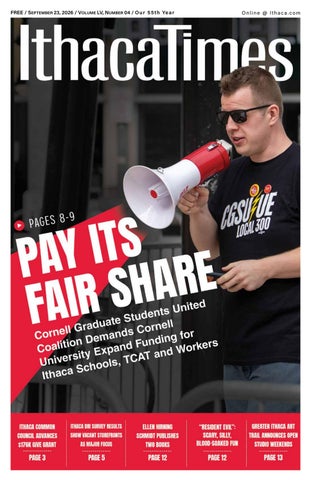
ON THE COVER: Pay Its Fair Share feature story. Cover designed by the Ithaca Times team.
NEWSLINE.............................. 3, 5 LETTERS TO THE EDITOR...............................4 PERSONAL HEALTH ����������6-7 COVER STORY ��������������������8-9 OBITUARY ���������������������������� 10 COMMUNITY NOTES ��������� 10 SPORTS...................................... 11 ARTS & FILM �������������������12-14 TIMES TABLE..................... 18-19
ON THE WEB Visit our website at www.ithaca.com for more news, arts, sports and photos. Call us at 607-277-7000 MIKAYLA ROVENOLT, MANAGING EDITOR EDITOR@ITHACATIMES.COM SCOTT MANSON, ASSOCIATE PUBLISHER JIM BILINSKI, PUBLISHER EMERITUS JBILINSKI@ITHACATIMES.COM ROY ALLEN, DIRECTOR OF STRATEGIC PARTNERSHIPS ROY@ITHACATIMES.COM LORIEN TYNE, ASSISTANT EDITOR LORIEN@ITHACATIMES.COM AUSTIN LAMB, COPY EDITOR ALAMB@ITHACATIMES.COM PHILIP O’DELL, REPORTER PHILIP@ITHACATIMES.COM JAKE SEXTON, ADMINISTRATIVE COORDINATOR, CALENDAR EDITOR JAKE@ITHACATIMES.COM MARK SYVERTSON, PHOTOGRAPHER MARKSYVERTSONPHOTOGRAPHY@GMAIL.COM STEVE LAWRENCE, SPORTS COLUMNIST STEVESPORTSDUDE@GMAIL.COM
TAK E NOT E
By L or ien Ty ne
VOL. LV / NO. 04 / September 23, 2026 Serving 47,125 readers weekly
and reducing the citywide speed limit is an important step toward making those spaces safer and more welcoming for everyone,” Scott Gibson, acting superintendent of public works, said. “This fall, as the new signs are installed throughout the City, we are asking drivers to slow down, pay attention, and help us build a culture of safer, more considerate travel. A few miles per hour can make a meaningful difference when it comes to preventing crashes and protecting the people who walk, bike and live in our neighborhoods.”
LISA ELLIN, ADVERTISING & MARKETING LISA.E@ITHACATIMES.COM KIRA WALTER, ARTS & ENTERTAINMENT REPORTER ARTS@ITHACATIMES.COM ZACHARY ISAAC STEPHENS,AUDIENCE ENGAGEMENT & DESIGN ASSOCIATE FREELANCERS: Barbara Adams, Charley Githler, Stephen Burke, Bill Chaisson, Ross Haarstad, Steve Lawrence, Marjorie Olds, Peter Rothbart, Austin Lamb, Clement Obropta, Jake Sexton, Kira Walter, and Ceili Ayoung THE ENTIRE CONTENTS OF THE ITHACA TIMES ARE COPYRIGHT © 2026 BY PATHWAYS TO EQUITY, LLC.
All rights reserved. Events are listed free of charge in TimesTable. All copy must be received by Friday at noon. The Ithaca Times is available free of charge from various locations around Ithaca. Additional copies may be purchased from the Ithaca Times offices for $1. SUBSCRIPTIONS: $139 one year. Include check or money order and mail to the Ithaca Times, PO Box 27, Ithaca, NY 14851. ADVERTISING: Deadlines are Monday 5 p.m. for display, Tuesday at noon for classified. Advertisers should check their ad on publication. The Ithaca Times will not be liable for failure to publish an ad, for typographical error, or errors in publication except to the extent of the cost of the space in which the actual error appeared in the first insertion. The publisher reserves the right to refuse advertising for any reason and to alter advertising copy or graphics deemed unacceptable for publication. The Ithaca Times is published weekly Wednesday mornings. Offices are located at 109 N. Cayuga Street, Ithaca, NY 14850 607-2777000, FAX 607277-1012, MAILING ADDRESS is PO Box 27, Ithaca, NY 14851. The Ithaca Times was preceded by the Ithaca New Times (1972–1978) and The Good Times Gazette (1973–1978), combined in 1978. FOUNDER GOOD TIMES GAZETTE: TOM NEWTON
SEPTEMBER 23 – 29, 2026 / THE ITHACA TIMES
3
how to build don’t know much about keeping people housed.
The Talk at
LETTERS TO THE EDITOR By Ithaca Times Readers
INHS Lost Another one Today
“
No, this person has not died. She was just displaced, or legally speaking, ejected from her apartment. She wasn’t behind on her rent or trashed her place. It was a case of domestic violence. She and her kids had to escape from an abusive relationship. When she tried to return to her apartment, when her abuser was behind bars, INHS told her the apartment was no longer available to her. This small family of four people moved back in anyway and tried to work it out with INHS. INHS dug in their heels and got a court ordered ejection. This family’s ejection is not an anomaly for INHS. The data is buried as to how many evictions INHS carries out in a year, a month, a week,
but it’s not infrequent. I know because I used to work with LawNY and INHS was often in City Court negotiating with LawNY lawyers. Sometimes the lawyers would work it out for a tenant to stay a few extra months but inevitably the people who rent loses and the ones who hold the property rights will win. The actions of INHS are particularly loathsome because they have gotten millions of dollars from Federal and State funding to further their real estate empire of low income housing. It’s the same old story all over again. Smart people who know how to put together deals to build more housing. INHS becomes a local icon because they build what nobody else can or is willing to do-affordable housing. The trouble is, as we have seen with Asteri and Arthouse, the people who know
If displacement of a family isn’t death, it comes pretty close. It takes the perseverance of spirit for this woman to ensure her kids can keep a roof over their heads. Her warm and angelic kids are a testament to the woman’s own sense of optimism and grit to work out another place to livealthough miles from the community her family has lived in for years. I’ve lived in Ithaca a long time and the facade of a progressive liberal community is wearing thin. Money talks and good intentions walk. I don’t know what became of INHS over the years. It seems like oligarchy finally caught up with them.” Tom Stern, Ithaca, NY
Josh Riley Votes to Chill Speech at Universities
“
Rep. Josh Riley broke with House Democratic leadership and voted with Republicans to pass H.R. 4795. This bill uses misleading and disingenuous language to attack First Amendment freedom of speech. The legislation authorizes the US Department of Education to deny grant funds to any university which engages in what the bill calls ‘a nonexpressive … boycott’ of a strategic partner of the United States. The term ‘nonexpressive boycott’ is an end-run around the First Amendment. As Rep. Jerry Nadler (D-NY) stated, ‘H.R. 4795 is a direct and gross violation of the First Amendment. The proponents of this bill hide behind an inadequately defined term of ‘nonexpressive [sic] … boycotts.’ The ‘inadequately defined term’ leaves universities to guess whether a specific boycott is ‘expressive’ – i.e., constitutionally protected speech – or ‘nonexpressive.’ The consequence for guessing wrong is clear: denial of funds. The consequence for guessing correctly, though, is exactly the same. We can be certain the government will immediately determine any boycott is ‘nonexpressive’ and proceed to deny grants. A university could challenge the denial in court, but that would take time and money. In the meantime, even if the university ultimately wins, both the university and its students would be harmed, perhaps irreparably. The safer course, therefore, would be not to engage in even an expressive boycott. This practice – legislating fear to silence speakers – is known as ‘chilling speech.’ Chilling speech is unconstitutional. Josh Riley: If you will not fight the forces undermining the Constitution, at least don’t join them.” Alan Wagman, Ithaca, NY
4
THE ITHACA TIMES / SEPTEMBER 23 – 29, 2026
AI Slop or a Future Worth Having - What’s It Going To Be?
“
We’ve been bombarded of late with news about how Artificial Intelligence (AI) software running loose in massive computer server warehouses will achieve ‘convergence’ (like in the Terminator movies), shed their dependence on humans and then kill off most and/ or all humans. But, fear not, as this apocalyptic potential future just means that we need to put even MORE financial resources (and at a faster rate, too) into even more AI complexes! And we must not abandon these monuments to stupidity, financial scams and vanity of ‘tech bros’. After all, AI is only the potential end of the world as far as humans are concerned - why should we stop now? Besides, who’s going to do the money laundering for the obscenely rich (Crypto), and we can’t stop squandering our money on porn, sports betting or any kind of betting, now can we? A major and possibly the main product of AI these days is a thing called ‘AI Slop’ which, if used in the pursuit of advertising and political campaigns, is OK…? Evidently you are more likely to buy stuff or ‘services’ after being subjected to AI Slop advertising. And internet based advertising is a big money maker - just between Facebook and Google, the 2026 profits from advertising are likely to be north of $400 BILLION. With those kind of profits derived from massive consumption of electricity, there is a massive financial/greed incentive to use as much electricity as can be made/delivered to these ‘AI complexes’, even if it jacks up electricity prices for most of the public. For those in the AI line of business, little else matters - even the potential extermination of the human race or the other consequence - a massive trashing of the climate/surface of the planet air temperature control system. Good to know, eh? In the recent past, bankers and finance gamblers have conjured up over a TRILLION dollars to build AI centers for a technology based largely on stolen intellectual property. Those server farms are, in effect, giant electrical resistors, converting electricity into fiber optic signals and a LOT of low grade heat. That invested ‘tera-buck’ - almost ALL in the form of money loans based on promises of massive future profits - could have been invested in wind turbines that would provide about 50% of the net electricity our nation presently makes and uses. Or if used with solar panels and back-up batteries, about 40% of our electricity production. With that much new renewable electricity made without by-product pollution, we could actually make a dent in our fossil fuel addiction - especially for transportation. But, thanks to the ‘Trumpster’, a stable SUPPLY that is needed for a world dependent on 100 million barrels per day (worldwide) of crude oil is no longer a given. And just like the impending digital end times, who needs such a crappy future as well as the guy who delivered it, anyway?” David Bradley, Dryden, NY
NEWSLINE
The third Local Planning Committee (LPC) meeting for the downtown Ithaca initiative was held Sept. 16 at the Tompkins County Public Library. (Photo: Philip O’Dell/Ithaca Times)
Ithaca DRI Survey Results Show Vacant Storefronts as Major Focus; Committee Receives 15 Proposals By Philip O’ D ell
R
esults from an ongoing online survey and recent workshops show that Ithaca community members prioritize addressing vacant properties, improving public spaces, and expanding housing as part of downtown revitalization efforts. The third Local Planning Committee (LPC) meeting for the downtown Ithaca initiative was held Sept. 16 at the Tompkins County Public Library. According to the city’s press release, the group is tasked with guiding planning efforts, gathering community feedback, and developing projects that reflect local priorities. Following the city’s receipt of a $10 million Downtown Revitalization Initiative grant in April, the committee is working to select and fund specific projects that will drive downtown Ithaca’s renewal, the city website says. The revitalization area encompassed the Commons along with the West State Street and MLK Jr. Street corridors, including the blocks on either side of both streets. City officials noted the committee retained the authority to amend the boundary lines during the planning process. According to the city’s website, an online survey is open through Oct. 1 for individuals to share DRI feedback to ensure broader public participation. The survey is available to residents, workers, students, business owners, and frequent downtown visitors. The city invites perspectives on the DRI draft vision and goals, downtown’s key strengths and challenges, and priorities for future investment. Community members can complete the survey, review meeting materials, and sign up
for project updates at the Ithaca DRI website. During the Sept. 16 meeting, project consultant Matt Rivas shared interim results from the online survey collected between Aug. 18 and Sept. 8 outline key challenges, opportunities, and investment priorities for local downtown revitalization efforts. A total of 270 respondents identified vacant storefronts and underutilized properties, substance use, behavioral health, homelessness, housing affordability, and limited retail and service options as top challenges facing the area. Top opportunities highlighted by the community include new retail and neighborhood services, affordable and workforce housing, transportation and pedestrian improvements, and beautification and public safety initiatives. When asked to identify priority actions, 60% of survey respondents favored redeveloping vacant sites, followed by improving public spaces at 45%, and investing in streets, sidewalks, and transportation at 42%. Attracting additional services and retail was chosen by 38% of participants, while 34% prioritized creating more housing opportunities. Regarding priority investments, public amenities led at 45%, followed closely by neighborhood amenities at 40%, affordable housing at 34%, interactive entertainment at 31%, and a safer pedestrian experience at 28%. Rivas said 88% survey respondents identified as residents of the City of Ithaca or Tompkins County. According to interim results, 46% of participants are downtown residents, employees, business owners, or property owners,
while 14% identified as visitors or customers. Around 86% of respondents visit downtown at least once per week and 40% visit daily. Participation was concentrated among working-age adults, with 47% of respondents aged 18 to 39 and 46% aged 40 to 64. Rivas said project leaders received 15 proposed standalone projects so far that are valued at over $75,000 each. The proposals focused on building upgrades, streetscape and public realm improvements, housing, and downtown branding. These standalone efforts comprise 12 projects carried over from the DRI application and three new projects submitted via intent-tosubmit forms. Organizers established a locally administered small project fund to assist business and property owners with building upgrades and business improvements under $75,000, which has garnered four interest forms. Three other project ideas have been submitted to the consultant team but would require further development to meet DRI eligibility requirements. Of the 15 standalone projects, Rivas said five proposals focus on housing and mixed-use developments, while another five are dedicated to commercial and business support. The remaining initiatives include three arts and culture projects, two focused on transit, walkability, and the public realm, and one designated for the Small Project Fund. Rivas said the LPC and New York state will evaluate proposed initiatives using three primary criteria that include eligibility, feasibility and impact. Under the eligibility guidelines, proposals must fit into one of four designated
project categories, and funding is strictly restricted to eligible project costs rather than temporary events or ongoing operational expenses. To demonstrate feasibility, Rivas said projects need to be well-developed and prepared to launch promptly upon receiving an award, with additional funding sources already secured. Applicants must also prove sponsor capacity by showing they can successfully manage the project, secure site control, obtain all required permits, and handle initial financing prior to reimbursement. For the impact criteria, Rivas said projects must actively support the targets set by both the LPC and the state for the DRI community, while delivering a meaningful positive push toward downtown revitalization. Submissions are required to show cost-effectiveness through an efficient use of public resources and generate co-benefits for the broader community beyond the developer, such as driving economic growth and enhancing local quality of life. Regarding the project evaluation timeline, Rivas said the open call period concludes Oct. 1 for gathering proposals and refining evaluation criteria. LPC will then screen projects for eligibility and feasibility in October before narrowing and refining submissions through November. An LPC meeting and public open house for sponsor presentations and community feedback will be held Oct. 21, followed by project status updates on Nov. 18. Projects will be finalized for a vote between November and December, culminating in a final LPC vote on Dec. 16. Full project proposals submitted by the Oct. 1 deadline are requested to include detailed project descriptions, property ownership information, a project timeline, and information on project sponsors and their capacity to manage grants. Additionally, applicants must provide detailed cost estimates that outline other funding partners and specify the desired percentage of project costs to be covered by Downtown Revitalization Initiative (DRI) funding. However, organizers noted that project sponsors have until the final Local Planning Committee (LPC) meeting on Dec. 16 to submit all requested information. Rivas said stakeholder outreach for local development efforts included group discussions and individual interviews with dozens of organizations, such as real estate developers, economic development agencies, youth organizations, transit providers, higher education institutions, and arts groups. About 30 people shared ideas for downtown’s future at an Aug. 18 DRI workshop at the Tompkins County Public Library. Attendees said downtown’s main strengths are its arts, culture, and independent character as defining strengths, while noting downtown’s natural setting remains an important yet underutilized asset. Top priorities include safer streets, affordable housing, better support for daily needs, and better connections across the district.
SEPTEMBER 23 – 29, 2026 / THE ITHACA TIMES
5
HEALTH & Sensibility P E R S O NA L H E A LT H
Dear Readers:
As part of our expanded
commitment to thoughtful,
community-centered journalism, the Personal Health section of the Ithaca Times will transition into Health and Sensibility—a monthly series exploring how personal choices, scientific
EXPLORING HOW PERSONAL CHOICES, SCIENCE, AND PUBLIC POLICY SHAPE YOUR HEALTH AND WELL-BEING.
CommunityVoices
The One Big Beautiful Bill Shifts the Costs of Hunger to Tompkins County
research, and public policy intersect to shape health and wellbeing. The series will feature two distinct formats. Community Voices will provide a forum for engaged citizens and contributors to share personal perspectives, experiences, and opinions on health-related topics. These essays will include the following disclaimer: “Community Voices essays are contributed by outside authors. Views expressed are solely those of the writers and do not necessarily reflect those of the Ithaca Times.” In addition, Perspectives from the Times will feature interpretive and analytical pieces produced by the Ithaca Times, continuing the longstanding journalistic tradition of informed commentary, reporting, and editorial insight. Together, these features aim to
Senator Chuck Schumer speaks about SNAP benefits. (Photo/provided)
foster informed dialogue, critical thinking, and deeper community engagement around the issues that influence our collective well-being. This week, we are featuring Health and Sensibility: Community Voices—Sarah DeFrank, Director of Advocacy and Education, Food Bank of the Southern Tier; Rachel Ostlund, County Legislator (District 16); and Katie Hallas, Tompkins Food Future. EDITOR’S NOTE: Health & Sensibility–Community Voices essays are contributed by outside authors. Views expressed are solely those of the writers and do not necessarily reflect those of the Ithaca Times.
6
The Tompkins County Legislature unanimously passed a resolution on August 18th urging the federal government to delay the SNAP cost shifts by two years to avoid staggering budgetary impacts for our community. This would allow time for county, state, and federal agencies to prepare and respond to these changes. The passage of the One Big Beautiful Bill (H.R. 1) in 2025 is estimated to reduce federal spending on SNAP by $187 billion over the next decade, shifting major financial and administrative costs to states and localities. The impact on New York—and Tompkins County—will come in two phases: On October 1, 2026, the SNAP administrative reimbursement rate will be cut in half by the federal government, adding an estimated $700,000 to Tompkins County's annual budget. The SNAP program in New York State is county-administered. As a result, the federal reduction in SNAP administrative reimbursement will have a significant impact on Tompkins County. On October 1, 2027, new benefit cost-sharing requirements tied to payment error rates will add over $1 billion in additional costs to NYS. If the state passes these benefit costs along to counties, it will mean an
THE ITHACA TIMES / SEPTEMBER 23 – 29, 2026
additional $4 million to Tompkins County’s annual budget—a significant new and ongoing financial burden, on top of the already burdensome administrative costs.
Understanding SNAP SNAP is the most effective and dignified anti-hunger program in the US and has historically garnered bipartisan support. The evidence is clear: SNAP works. The program provides near-term and long-lasting benefits—improving food security and health, helping working families make ends meet, and stabilizing household budgets during economic hardship. And its impact is profound: SNAP provides roughly 9x the amount of food assistance as the entire national network of Feeding America food banks.
Why This Matters in Tompkins County Approximately 7,000 Tompkins County residents currently receive SNAP benefits, ensuring that families, children, seniors, veterans, and people with disabilities can consistently access food. But that num-
ber understates the need. A 2024 estimate showed that an additional 14,400 Tompkins County residents are likely eligible for SNAP but are not enrolled. Some are unaware they are eligible while others face language and literacy barriers, transportation challenges, stigma, or difficulties navigating the application process. Tompkins County SNAP recipients spend $1.35 million in benefits locally each month—functioning as a consistent federal investment in our local economy. Every $1 of SNAP spending generates between $1.50 to $1.80 in economic activity, and that spending keeps local businesses and food systems viable. Our local grocery stores, farmers markets, food cooperatives, and other authorized retailers currently benefit from $16 million dollars annually of local SNAP spending, which in turn supports jobs, generates revenue, and sustains the food supply chain comprised of farmers, distributors, truck drivers, warehouse workers, and retail employees. These realities make the incentives created by H.R.1 particularly troubling. H.R. 1 shifts significant SNAP costs to state and local governments, creating new financial pressures that incentivize states to make it harder for eligible households to qualify for
system while ignoring the benefits SNAP brings to local economies.
and access food assistance, as reducing participation in the program is the easiest way to avoid both the administrative and benefit cost shifts. Reductions in SNAP participation means fewer dollars flowing to retailers, farmers, suppliers and other local businesses—and greater pressure on food pantries, charitable organizations, and county governments to fill the gaps. SNAP is more than a moral commitment to fight hunger—it is an economic engine supporting rural and urban economies.
A Better Path Forward
What Payment Error Rates Really Mean One of the most misunderstood aspects of these provisions is the term “payment error rate.” H.R. 1 established a new cost-sharing requirement for SNAP benefits tied to payment error rates (PER). If a state has a PER of over 6%, it will be required to pay a portion of SNAP benefits issued in the state. Payment errors are not fraud. Fraud involves intentional wrongdoing, whereas payment errors are administrative mistakes identified through quality control reviews. Error rates include both overpayments and underpayments and do not indicate criminal behavior. For example, an otherwise eligible SNAP recipient may be counted in the error rate because of delays in processing applications, missing paperwork, data entry errors, or the family’s income changed in between recertification—even though no one broke any rules. SNAP already has strong state and federal oversight systems to identify and correct these errors. The payment error rate was created to improve program accuracy, not to punish states. Under the new cost-sharing structure, states could face significant, undue financial hardship. To avoid these costs, many states have already made enrollment and recertification processes more restrictive and burdensome. Some states may even abandon SNAP entirely. One in seven Tompkins residents are already navigating food insecurity; rising
Standing together to end hunger in Tompkins county. (Photo/provided)
inflation and instability in global markets are making conditions worse. Rather than improving access to food and providing economic stability, H.R. 1 creates new barriers to the most efficient and effective anti-hun-
ger program that helps families and local businesses. Our local food bank and network of food pantries are under strain to meet existing demand. This federal policy puts additional pressure on the emergency food
A two-year delay would not solve the problem but it would buy valuable time: for federal agencies to provide guidance on how these shifts will be implemented, for states to adjust budgets and create sustainable funding plans, or to advocate for cost shifts to be repealed entirely. If federal representatives fail to act, New York State must ensure these costs are not borne by local governments. Counties lack the fiscal capacity to absorb costs of this magnitude without affecting other essential services and will be forced to pass along a tremendous increase in the tax burden to residents. The federal government may save money under H.R.1 in the short term—but these “savings” will increase local costs and create harm in our community. Families, and in particular children (who make up 39% of SNAP participants), will become more food insecure. The federal government has historically taken responsibility for paying 100% of SNAP benefits, as well as sharing administrative costs. By unilaterally deciding to break this longstanding system, they are failing to fulfill their responsibility to uphold this vital program. We appreciate our federal legislator’s leadership Schumer and Gillibrand’s leadership in defending SNAP, and with further changes still ahead, now is the time to keep pushing—not ease up—to protect access to this essential program. Consider contacting your federal representatives and encourage them to push harder for the two-year delay. Let them know we need robust federal investment in anti-hunger programs to ensure a future where no one goes hungry and every single person has dignified and consistent access to fresh, healthful food. What we are facing instead is an administrative and financial trap that will, by design, increase hunger and poverty in our community for ill-begotten federal gains.
THIS WEEK'S COMMUNITY VOICES
Rachel Ostlund, County Legislator (District 16). (Photo/provided)
Sarah DeFrank, Director of Advocacy and Education, Food Bank of the Southern Tier. (Photo/provided)
Katie Hallas, Tompkins Food Future. (Photo/provided)
SEPTEMBER 23 – 29, 2026 / THE ITHACA TIMES
7
‘Pay Its Fair Share’: Union-Led Coalition Demands Cornell University Expand Funding for Ithaca Schools, TCAT and Workers By Philip O’ D ell
Cornell Graduate Students United organized a coalition of local unions, community groups and elected officials on Sept. 15 at the Bernie Milton Pavilion. (Photo: Mark Syverston)
C
ornell Graduate Students United organized a coalition of local unions, community groups and elected officials to demand that Cornell University increase funding for international graduate workers and local entities like TCAT and the Ithaca City School District. CGSU held a gathering on Sept. 15 on the Ithaca Commons that included Ithaca Teachers’ Association President Kathryn Cernera, Ithaca City Alderpersons Jorge DeFendini and Kayla Matos, and Tompkins County Legislator Iris Packman. Organizations represented included Cayuga Medical Center Nurses’ Union, Ithaca DSA, Cornell YDSA, Cornell American Association of University Professors and Tompkins County Workers’ Center. 8
A Cornell spokesperson issued a statement via email to the Ithaca Times on Sept. 16 regarding CGSU’s rally and speakers’ claims. “Cornell has a strong commitment to shared governance - an established mechanism in which graduate students have an important voice,” the Cornell spokesperson said. “Additionally, CGSU-UE has a collective bargaining agreement in place designed to voice concerns on employment-related matters.” CGSU member Andrea Cicirello said the union is issuing an open letter to Cornell, urging the university to “pay its fair share” to its employees and the Ithaca community. To ensure the funding, Cicirello said the letter calls on Cornell to use its $11.8 billion endowment and $6.8 billion raised
THE ITHACA TIMES / SEPTEMBER 23 – 29, 2026
through its To Do the Greatest Good campaign. “Amid the federal crackdown on immigrant rights and higher education, Cornell must use its extensive financial resources to ensure the safety and security of the workers who make this university run,” Cicirello said. Cicirello said Cornell must help international graduate workers overcome federal research barriers by maintaining funding during grant cancellations, cuts or immigrationrelated delays that require them to work abroad. Cicirello said Cornell should match City of Ithaca and Tompkins County contributions to TCAT in line with their original agreement and provide at least $732 per student to the Ithaca City School District. Cicirello said the open letter
demands the Cornell administration to establish an international graduate worker fund to cover immigrationrelated legal assistance, visa travel, and status fees. It also calls on Cornell to fully fund graduate workers unable to return to the United States due to processing delays, visa revocations, or other immigration complications, as well as a living wage for all Cornell workers. CGSU member Stephan Wagner said Cornell displayed a lack of guidance regarding looming F and J visa duration-of-status rule changes over the summer. “We’ve gotten all too used to Cornell’s inaction. International workers especially feel unsupported, neglected, and even downright
sabotaged by Cornell. I don’t think that’s fair,” Wagner said. Wagner cited Momodou Taal and Amandla Thomas-Johnson as international graduate students who lacked university support during visa struggles tied to their pro-Palestinian speech and campus demonstrations. He said Cornell offered them funding that was contingent upon returning to campus to work, despite possible detention upon re-entering the country. Wagner said university representatives characterized the funding loss for workers due to visa and policy changes as an acceptable loss. CGSU launched a formal grievance demanding Cornell restore funding to Taal and Thomas-Johnson. Union leaders said the university breached its collective bargaining agreement by cutting financial support while the students are stranded abroad after the federal government revoked their visas over pro-Palestinian speech. In a previous statement to the Ithaca Times, a Cornell spokesperson said the university remains deeply committed to helping international students make academic progress during visa or travel-related challenges, though privacy regulations prevent officials from discussing individual cases. CGSU launched a petition urging the university to restore Taal and Thomas-Johnson’s funding and support affected international workers by providing alternative funding and offering financial and legal assistance. Wagner said CGSU gathered over 1,000 signatures from students, faculty and residents. He said the petition also called for increasing financial backing for underfunded local programs such as TCAT and ICSD. Wagner said Cornell’s administration has issued no response and taken no action since the signatures were delivered. “They refuse to act on behalf of international workers just like they refuse to act on behalf of all workers, students, and families all across Ithaca,” Wagner said. “Cornell owes all of its workers a fair share. They owe our community a fair share.” Cernera said ITA supports CGSU as graduate workers prepare to enter contract negotiations with Cornell.
She described its inclusion of broader community demands for ICSD and TCAT as “revolutionary” “Their fight stands to significantly increase our power as a community by asking, ‘what does Cornell truly owe Ithaca?’” Cernera said. Cernera criticized Cornell University’s tax-exempt property footprint, claiming that in 2024 the university owned over 40% of the taxable property within the school district. She said that this exemption strips over $42 million annually from the potential school district budget, forcing the remaining 60% of property owners to shoulder the entire tax burden for public schools that educate the children of university faculty, staff and graduate students. “We pay exorbitant taxes here in Ithaca simply because Cornell is legally given the choice of how much they are willing to contribute and they choose to short change us all,” Cernera said. Regarding the state’s public school funding formula, Cernera said it fails to account for tax-exempt properties when calculating a community’s wealth. Because the formula assumes Cornell pays its local share, Ithaca schools receive only about 30% of their overall budget in state aid — far below the 60% to 70% average for upstate New York districts — diverting residents’ state taxes to other areas and forcing local taxpayers to fill the gap. Cernera said ITA members will support CGSU through petition drives, message amplification, meal trains, and picketline solidarity. CGSU Communications Secretary Kaori Quan said Cornell gave ICSD about $700,000 in financial contributions for 2025 and 2026. Quan said those contributions should be increased, especially with the average Ithaca resident paying 15% in school taxes. Quan said if the university was taxed at the same rate, its contribution would exceed $10 million annually. Quan also urged the university to address compensation for graduate workers who provide essential teaching, grading, and lab labor. According to Quan, graduate workers currently make $2,614 below a living wage, with fellowship-supported students earning
even less, while international graduate workers face higher tax burdens and additional expenses for visas and travel. “Cornell must pay its fair share to the schools in Ithaca and public transit, but they also must pay their fair share to the workers who make the university run,” Quan said. Quan said fair wages for graduate workers would stimulate the local economy through spending at neighborhood businesses, restaurants, and libraries. “If Cornell paid graduate workers a living wage, they would invest that money back into this community,” Quan said. DeFendini pointed to underfunding issues surrounding TCAT. Cornell University, the City of Ithaca, and Tompkins County agreed in November to increase their joint financial contributions to TCAT by $280,000 each. Because TCAT’s financing structure requires equal shares from all three underwriters and is capped by the lowest contribution, the agreement bypassed an initial deadlock caused by Cornell’s opening proposal of $31,000 against a requested $500,000 increase. DeFendini claimed Cornell makes housing and transportation more expensive in Ithaca because it does not pay its fair share in taxes. DeFendini said Cornell owes about $30 million in local taxes but instead provides a $4 million payment. He said this shifts the remaining financial burden onto local taxpayers. Recalling previous negotiations, DeFendini said the city initially requested $8 million before accepting $4 million under university pressure. DeFendini said Cornell presented the $4 million allocation as a final offer, threatening to withhold payments entirely and force a 14% tax increase if the city refused. “That’s not how a good neighbor acts,” DeFendini said. “That’s not how a good faith business partner acts. That’s how a hostage taker acts, and that’s how Cornell has treated all of you. None of this is acceptable.” Tompkins County Legislator Iris Packman said Cornell affiliates make up 70% of TCAT riders, yet the City of Ithaca and Tompkins County
managed to find $500,000 each for the system despite difficult budget cycles. Packman contrasted those contributions — which required roughly a 1% tax levy increase for the county — with Cornell’s $6.4 billion budget, which is 57 times the size of the city’s and 26 times the size of the county’s. Tompkins County Legislator Iris Packman compared Cornell University’s local contributions unfavorably to peer Ivy League college towns, noting that Yale contributes roughly double per capita to its host community and Princeton contributes four times as much — providing about $6 million to a city comparable in size to Ithaca and $3 million to public schools, compared to Cornell’s combined academic-year contribution of $750,000. Packman added that Brown University also outpaces Cornell, contributing more than 50% more per capita in Providence, and called on Cornell to step up its support by paying its workers a living wage. Matos said Ivy League institutions with Cornell’s resources have a responsibility to strengthen local educational systems rather than funding investments connected to foreign conflicts or making deals with the federal government. She urged Cornell’s leadership to collaborate with local government on community investments, such as ensuring proper classroom equipment, creating affordable housing so teachers can live where they work, and building adequate infrastructure for safe student transit. Representing Cornell AAUP, David Bateman said Cornell lacks transparency regarding its internal finances, contrasting this institutional secrecy with the university administration’s demands for transparency from local entities. He said Cornell maintained budget austerity measures despite federal funding cuts proving much smaller than initially claimed. Bateman said these practices conflict with Cornell’s public mission as a landgrant university, pointing out that the institution educates fewer students per capita than any other state-level landgrant university in the country.
SEPTEMBER 23 – 29, 2026 / THE ITHACA TIMES
9
Obituary
Stephen Benedict Gibian
S
tephen Benedict Gibian, 72 years, of Danby, NY, passed away on September 5, 2026 at home with his family by his side. He is survived by his wife of 39 years, Thresa Gibian, daughter Anya Gibian, son Galen Gibian, a granddaughter Beatrice, his dog Loki, his four siblings; Peter, Mark (twin), Lauren and Greg, along with many cousins, nieces and nephews. A first generation American, Stephen was born February 1, 1954 in Northampton, Massachusetts, the son of George Gibian (b. Czech Republic) and J. Catherine “Cay” (Annis) Gibian (b. Canada). After he completed kindergarten and first grade in Northampton, the family accompanied George, a professor, to Berkeley, CA for a semester and then a year in France before moving to Ithaca in 1961, where Steve entered second grade at Cayuga Heights elementary school. At the age of 9, he started hiking the 46 High Peaks of the Adirondacks with George, older brother Peter and his twin brother Mark, earning membership in the “ADK46ers” (member number 477) in 1968, when they had finally climbed all 46 peaks. Stephen graduated from Ithaca High School in 1972. While in high school he ran cross-country and performed in school plays. He completed his college freshman year in the architecture program at the Rhode Island School of Design, followed by a gap of two years to travel. From 1970-1972, while still in high school, he built a one-room stone cabin in Ellis Hollow; he later lived in the stone cabin while completing his Bachelor of Architecture degree at Cornell in 1979. He hosted Stone Man and Hi Jinx parties at the Stone Cabin, which included the design and onsite printing of silkscreen T-shirts to mark these occasions (on-demand
swag). He hung out at the Royal Palms bar in Collegetown, played horseshoes and volleyball, was a member of the clogging dance troupe The Limberjacks and traveled to old time music festivals. Ever the craftsman and designer, he spent time in the Cornell Pottery Shop in Willard Straight Hallmaking ceramic vessels and sculptures.Stephen built dry-laid stone walls around Ithaca during the summers between semesters at Cornell. In 1976, at the age of 22, he built the Stone Volkswagen, a fullsize replica of the classic VW Beetle in stone, complete with chrome accents, cement-filled tires and a carved license plate in stone listing his initials and the year of completion: 1976-SG. There is much misinformation about the Stone VW on the internet. Having seen a photo of the Stone Volkswagen, Michael Rosen, the editor of the book MY BUG (1999), asked Stephen to submit an essay explaining how and why he built the sculpture. Stephen opened his professional practice in 1987 after passing the NCARB exam and becoming a NYS-licensed architect. His office was in a historic dairy barn that he renovated into a loft-style living space that doubled as the family home. Trained in hand drafting, he never used a CAD program in his practice. He could render designs beautifully and quickly, and used his sketching talents to effectively communicate his vision. Stephen and Thresa met in 1986 while working together at HOLT Architects and shortly thereafter moved into the barn, which provided an idyllic setting for raising a family. Stephen was a loving husband and father, a patient teacher, and an exemplar of ethics and character. He faithfully supported Thresa in her personal and professional endeavors. He unfailingly attended all performances, concerts, sports games,
and projects that Anya and Galen were involved in. He coached them as they learned to ride bikes, complete craft projects, garden vegetables, and contribute to chores around the house. His qualities, such as his attention to detail, diligence, and a well-calibrated moral compass, provided a paradigm for the family as it grew. In 1989, Stephen designed the Ithaca Farmer’s Market Pavilion and led a team of 60 market member volunteers in building the structure in such a way that the market never lost a vending weekend throughout the construction process. Steve got many calls from around the country to advise on the development of farmer’s markets. The Davis, CA farmer’s market metal pavilion, built in 1994, was inspired by Stephen’s design for the Ithaca Farmer’s Market. Last year, the Ithaca Farmer’s Market was voted, in the Newsweek Readers’ Choice Awards, #1 Best Farmer’s Market in the U.S. He designed the Trumansburg Farmer’s Market, advised on the structure and safety issues for the Grassroots Festival, and designed many buildings and additions throughout Tompkins County and the Finger Lakes region. Knowledgeable in historic preservation and civic-minded, he served 14 years as a member of the Ithaca Landmarks Preservation Commission. Stephen gave so much without expectation, without hesitation and without compensation. He was shy and humble. He was brilliant at math and clever in his humor. He was strong and steady; someone you could count on to show up as promised. He was adventurous, silly and graceful on the dance floor. He was creative, artistic, logical, frugal and ever so practical. He was ethical, professional and respectful. He was often outside in all kinds of weather, either sailing on Cayuga Lake, mowing on his 1942 Ford 2N tractor, skating on or swimming in the pond, shoveling snow, x-country skiing, stacking wood,
gardening, cooking or playing croquet. He was devoted to doing the NY Times crossword puzzles, his daily homework, reasoning it as a way to keep your brain elastic, or just a way to become very good at crossword puzzles. Concise in his language and quick to correct your grammar and edit your prose, he might remind you that you are taking too long to place your Scrabble tiles on the board, resulting in his need to hum the theme from Jeopardy. He was always on time and prepared to do the work. He often reminded us to take our time, not to rush, to do things in the right order and not get ahead of ourselves. His presence will be greatly missed by all who had the good fortune of having him in their lives. Now that he is gone, we find ourselves saying, “What would Steve do?” Please consider a donation in Stephen’s memory to these local notfor-profit organizations: Friends of the Ithaca Farmer’s Market, The Finger Lakes Land Trust, Historic Ithaca, Inc., Running to Places, or the Saltonstall Foundation. The Gibian family will host a reception to remember Stephen and celebrate his legacy on Tuesday, Oct 20, 2026 from 2:00 to 5:00pm, at the Ithaca Farmer’s Market. All are welcome.
COMMUNITY NOTES
On the Road to Watkins Glen
By Stephen Burke
I
f someone in Ithaca were to blindfold you, put you in a car and drive for about 40 minutes, then let you out, remove the blindfold and ask you to guess where you are, and you saw you were at the southern edge (judging by the position of the sun) of a long, narrow lake with hills about 500 feet high to the east and west, you might think Cayuga Lake and Ithaca, and wonder what the weird 40-minute round-trip prank was all about. When you found out it was actually Seneca Lake and Watkins Glen, you might still wonder about the weird prank, or right now in this actual case you might wonder about this weird introduction to a newspaper column. The point is that Watkins Glen and Ithaca, 30 miles apart, look uncannily alike, but are very different. If you’re the Sherlock Holmes type, the ride itself, even blindfolded, would indicate you’ve gone a distance from Ithaca. If you’re driving away from downtown Ithaca, whether on Route 13, 79 or 96, you’ll climb one major hill at the start, and then not many more. But about halfway between Ithaca and Watkins Glen, Route 79 is uniquely identifiable at multiple points as it 10
rides like a roller coaster: specifically, like the first rise and drop of a roller coaster, the severe one. You go up, up, up so steeply that you can’t even see the other side, and must assume one exists. I haven’t ridden it blindfolded, but you can feel the g-forces of the climb, and definitely the descent, in the pit of your stomach, or lower. Naturally, these hilltops are nopassing zones, and you have to have faith in humanity about that, because if some daredevil coming the other way tried to pass someone near the crest of one of these hills, you would never know until impact basically put you and them in the same car. But let us promote traveling mercies, not imaginary jinxes. Watkins Glen is a nice quick trip of distinction from Ithaca. Cayuga and Seneca Lakes are practically twins, but dressed differently. Ithaca’s place at the tip of Cayuga has a large public park. Watkins Glen on Seneca is less publicly recreational, with a strip of green with benches, but privately functional, with moorings for boats. Neither has swimming at these spots, but in Watkins Glen boat owners who don’t feel like using the dock will
THE ITHACA TIMES / SEPTEMBER 23 – 29, 2026
wade through waist-high water to their crafts. The hills to the sides of the lakes are also topographically twin-like, but Ithaca is bigger and busier, so sizable roads with considerable traffic slice through them. In Watkins Glen they have mostly trees. Downtown Ithaca has a pedestrian mall at its center which breaks up or diverts its major roads. In Watkins Glen you might say the car is king: it has hosted NASCAR and other road races ever since there were raceable cars, at a famous race track for decades now, but at the beginning right on downtown streets. Major roads don’t skirt downtown but go right through it, with a certain amount of automotive noise, but nobody seems to mind. There are historical markers everywhere of past races and winners. Beyond the differences of size and scope, there are similarities to the towns. “Ithaca Is Gorges” is a familiar catchphrase, but Watkins Glen has a reigning one in its State Park, which extends miles. Trails on either side of the gorge pass next to 19 waterfalls, and sometimes wondrously (and wetly) behind them. The main entrance to the park is in the heart of downtown. A shuttle bus runs between it and the top. Full appreciation of the park can easily take
more than one excursion, and there are camping facilities, with hotels and motels nearby. The trek on the trails can be arduous, but you’ll see families there, with members young and old. Now is a particularly good time to visit (it’s the second-most popular of over 200 state parks in New York, with over a million visitors annually), with school in session, summer vacation season over, the weather still nice, and weeks to go before the trails close in mid-October. Simple pleasures in Watkins Glen include Tobey’s Donuts, 30 varieties made fresh daily. They do enough business that they close at noon. If you miss out on the donuts, Scuteri’s Cannoli Connection is right up the street, in a storefront in the same downtown home for over half a century. They fill cannoli to order and have other Italian desserts, as well as pizza. I got a good indication of the nearbut-far relationship of Ithaca and Watkins Glen when I had some business in Watkins Glen and had to give a clerk my name and address. The clerk asked, “Name?” and I told her. She asked, “Street address?” and I gave it. She asked, “City?” and I said, “Ithaca.” She asked, “State?”
Sports
One TSOB By Ste ve L aw rence
I
would call him an “Ironman,” but that label has already been utilized – four times – so as this column unfolds, I will try to find a new way to describe my friend Mark Vallely. Mark has given me plenty to write about over the years. He completed the Ironman four times (2.2-mile swim, 112-miles bicycle race and a 26.2 mile marathon), he has been very active as a participant and instructor in Crossfit, but the most impressive thing he has done – in my opinion – is to have taken part in The Great Cycle Challenge, a monthlong event held every September to raise money to combat childhood cancer. Every September, Mark’s goal is to ride 500 miles over the course of the month, and since he first signed up in 2019, he has reached his goal every year, riding 3,148 miles and raising $30,299.79. What Mark has done is impressive, for sure, but it’s the why that compels me to write about it. Once again, we connected, made a plan to meet up, and I was surprised to see Mark limp into the cafe. I asked the obvious question, and Mark said, “I was moving a stationary bike and sustained a really deep thigh bruise.” The injury has sidelined the
dedicated rider temporarily, putting him behind his planned pace, but he said he hoped to get back on the bike and get caught up. Anyone who has sustained a deep thigh bruise knows how painful it can be, especially when employing the quads to crank on a bicycle for hours at a time, but to Vallely, that injury is low on the list of challenges he has faced. His backstory is worth revisiting... In Mark’s words, “When I was diagnosed with Multiple Myeloma in 2019, I was in a tailspin. Then, I learned about a charity ride to help kids facing cancer, and it pulled me out of that deep, dark depression. I thought about how unfair it is to be 4 or 5 years old, and face that kind of challenge, and I realized, ‘This is something I can do.’” For the first 6 years of the monthlong effort, Mark – now 67 and still undergoing monthly chemo treatments - consistently hit his mileage and fund raising goals. A few months ago, he learned that he would be dealing with yet another challenge, as he learned he had liver cancer. Once again, framed it in a way that gave him what he needed to keep going. He told me, “Yes, it’s rough. Yes, it sucks, but I think of what it would be like to walk the streets in a
war-torn country, or to be a child with cancer, I gain some perspective.” Mark has always been one to take that perspective and turn it into progress. He recalled, “When I had a stem cell transplant, I was in the hospital for 2 weeks, and I figured out that forty-eight laps around the hospital floor equaled 1 mile, so I walked it every day. I saw that so many people have health issues, and I saw some who appeared to have given up. I still have my infusions, and some of the treatment can be painful, but my doctors say, “Just keep doing what you’re doing.” It will come as no surprise to anyone who has read this far that Vallely is not taking this temporary setback lightly. Utilizing an appropriate metaphor, Mark told me, “This thigh injury has thrown a wrench into the gears, and I know I can always adjust my goals and see how close I can get to the 500 miles.” He added, “A lot of people say, ‘Go easy on yourself,’ but that’s a challenge. Looking at someone else, I would probably say ‘Do what you can,’ but again, that’s not easy. This really matters to me.” That’s clear, Mark. Since “Ironman” has already been used, I am now calling you “One TSOB.” There is still a good chunk of September left, so I have no doubt that Vallely will do what he can. If you are inclined to help, this will take you to Mark’s fund raising page. Greatcyclechallenge.com/riders/ MarkVallely
Mark Vallely puts personal challenges aside in raising money to fight childhood cancer.
UPS&DOWNS Ups
By Kaeleigh Banda
Community members can join seven artists partnering with Ithaca Murals for the 2026 Mural Jam on Oct. 3 and 4 at SouthWorks. Everyone is welcome to add to the community paint wall and there will be paint and brushes available.
Downs Tompkins County Whole Health (TCWH) alerted the community that measles cases are on the rise in neighboring counties, including Cayuga, Cortland, Tioga and Seneca Counties. TCWH urges everyone to be vaccinated against measles.
HEARD&SEEN Heard
The League of Women Voters is hosting “Secrets Revealed,” an information and training session talking about LWV’s 100-year history and ways to get involved. The event will take place on Oct. 3 from 11 a.m. to 12:30 p.m. at Tompkins County Public Library.
Seen
A fiery and funny peek into the halls of power that asks what it means to lead, and what it takes to save a country.
The Downtown Ithaca Alliance is holding a design contest for a limited-edition holiday tote bag to be given out during Shop Small Business Weekend. A jury will pick one original design that celebrates shopping at local small businesses and Ithaca’s Downtown area. The deadline for submissions is Oct. 22 and designs can be sent in through the form on the DIA website.
IF YOU CARE TO RESPOND to something in this column, or suggest your own praise or blame, write editor@ithacatimes. com, with a subject head “U&D.”
QUESTION OF THE WEEK Do you plan on attending Apple Fest? 33.3% Yes. 66.7% No.
NEXT WEEK’S QUESTION:
INFO
TICKETS
Do you think Cornell needs to increase their funding for local services and entities like TCAT and ICSD? Visit ithaca.com to submit your response.
SEPTEMBER 23 – 29, 2026 / THE ITHACA TIMES
11
Arts
Two Books, One Look at the World: Ellen Hirning Schmidt’s Oh, Say Did You Know/This Much I Know By Charle y Githler
T
here is a particular kind of courage in publishing a book that contains your earlier book inside it. Ellen Hirning Schmidt’s new collection does exactly that, pairing Oh, Say Did You Know, the book that won the 2019 Helen Kay Chapbook Prize, with a new, larger companion, This Much I Know. Read together, the two halves function less like a reissueplus-sequel than like two movements of a piece of music: the first sets out the themes, the second develops them under greater pressure and with a longer view. Poet, author, and writing guru Schmidt, who lives in Ithaca, New York, writes from a perspective that slides easily between the domestic and the historical, often within the same poem. An evening walk becomes a meditation on upheaval. A family memory opens onto the sweep of American history. That range, from the intimate to the civic, is the collection’s real subject, more than any single theme is. She is a poet who trusts the reader to hold the personal and the political in the same hand without letting go of either. The political poems are direct without becoming brittle. Schmidt writes into our moment of democratic strain: poems like “The Declaration of Independence” and “Hymn Medley”
take the founding documents and songs of American civic life and asks what they still hold and what has leaked out. Free speech, a government that feels suddenly fragile, the slow-motion emergency of a changing climate: these appear not as abstractions but as pressures on daily life, the sort of thing you feel before you can name it. What keeps these poems from sliding into polemic is Schmidt’s instinct for the specific image over the general complaint. She would rather show you a single hunting season than tell you about violence in the abstract, which is exactly what she does in “Hunting Season,” a poem whose anger arrives through suggestion rather than statement. Death moves through both books too, but rarely as an ending. It shows up as continuity, in way the dead keep making claims on the living, the way history is itself a kind of death that hasn’t finished happening. This is where Schmidt’s interest in “moments in American history” and her elegiac poems meet: the past isn’t past, it’s a room the present keeps passing through. Against all of this is magic. Not as escapism, rather an openness to the possibility that the world holds more than what can be measured. It’s a counterweight to the poems of siege and grief, and proof that Schmidt’s
Ellen Hirning Schmidt recently published “Oh, Say Did You Know.” (Photo: Oskar Schmidt/Provided)
vision isn’t only elegiac. The opening poem, “Equinox,” sets this tone early: tenderness toward family and friends, portraits rendered with real affection, before the book turns to harder material. What makes the pairing of the two books work is its explicit chronology. Oh, Say Did You Know establishes Schmidt’s method, the swerve between personal and historical, the trust in image over statement, and This Much
I Know takes that method into more contemporary territory, including poems that reckon with Gaza and with a democracy under visible strain. Reading the parts in sequence, you watch a poet’s attention widen without losing its precision. Oh, Say Did You Know / This Much I Know (2026) is available from Evening Street Press.
Film
“Resident Evil”: Scary, Silly, Blood-Soaked Fun By Clement Obropta
F
orty-five years ago, Sam Raimi’s “The Evil Dead” screamed into cinemas, a monolithic horror achievement realized for $375,000, 300 gallons of fake blood, and a dream. A dream that cinema didn’t have to choose — it could have BOTH Buster Keaton AND soul-sucking monsters in the same picture. A dream that one man with a chainsaw and a boomstick could rend his way through the absolute darkest terrors of everyone’s worst nightmares and laugh while he does it. Well, four decades and five “Evil Dead” movies later, it turns out that famed horror director Zach Cregger has found his calling, channeling Sam Raimi for an age of digital effects, IP fetishization, and the crushing cruelty of the gig economy. “Resident Evil” is here, it’s brutal and violent and incredibly silly, and it’s the first horror film since “Deep Rising” whose hero reminded me of Bruce Campbell, slashing his way through Hell just to survive a cabin getaway with his friends. You don’t need to know anything going into this movie. Forget the Milla Jovovich films, whose scrambled continuity is totally disregarded here, and the video games, which are mostly incidental to this movie’s narrative. Cregger builds his “Resident Evil” in the time-honored tradition of one bad day that just keeps getting worse, as a medical courier, Bryan (Austin Abrams),
“Resident Evil”
Bryan (Austin Abrams) running to make an important delivery in the zombie-infested Raccoon City. (Photo: IMDb/Sony Pictures - © 2026 CTMG, Inc.)
unwittingly takes a delivery job to a city in the throes of a zombie outbreak. After hitting a woman with his car on an ice-slicked, snowy road, Bryan seeks help at an abandoned farmhouse whose tenant is not exactly human anymore. From that initial series of incidents, the film’s events continue to spiral out of control as Bryan blazes a blood-soaked trail to Raccoon City General Hospital with his precious cargo in tow. Bryan’s not about to let that package go. For all his insistence that he’s a glorified Postmates driver but for human organs, he cares deeply for his job and the life he carries with him, which makes it all the more difficult when he has to shoot strangers in the head. But screenwriters Cregger and Shay Hatten know that in today’s America, too much empathy — and too much common sense — can be a character flaw, one that regularly drives Bryan to stick his head in the lion’s mouth
Rated R Directed by Zach Cregger Currently playing at Cinemapolis and Regal Ithaca Mall 120 East Green St. | 40 Catherwood Road, Ithaca 12 T H E I T H A C A T I M E S / S E P T E M B E R 2 3 – 2 9 , 2 0 2 6
simply because if he doesn’t do it, then who will? Even before the zombie apocalypse, Bryan was an errand boy for the medical industry, his poorly paid courier service filling a gap that never should have existed in the first place. Now, he’s diving down dark alleys, slipping and sliding through the sewers of Raccoon City, and evading the bloodthirsty undead for the same reason — he might be in the wrong place at the wrong time, but he’s also got a delivery to make, darnit, and no one else is going to do it if he fails. In its final sequences of pulpy, gory fun, “Resident Evil” takes the gig economy allegory to its natural conclusion, bringing the horrors wrought by corporate greed to bear on the people who created them in the first place. Reagan might have (wrongly) promised that wealth trickles downward, but in the world of “Resident Evil,” blood runs up.
For the filmmaker behind sleeper hit “Barbarian” and the Oscar-nominated “Weapons,” “Resident Evil” offers the perfect marriage of comedy and horror for Cregger. Unbound by the expectations of modern themes-driven horror or mystery-box plotting that defined his past two films, Cregger relies on his pure storytelling instincts for “Resident Evil,” structuring it like an episodic video game. It’s the ideal playground for some of his favorite stylistic quirks (downer endings, carefully controlled camera movements, nail-biting suspense immediately followed by jokes) as well as some new ones (firstperson POV shots of guns meant to evoke the video game aesthetic). At the center is an incredible performance from “Weapons” alumnus Austin Abrams, swearing, panting, and sweating through the worst day of Bryan’s life. It’s hard to act like you’re scared out of your mind, even harder to walk the tonal tightrope of a film that I can only describe as “Abbott & Costello Meet John Carpenter’s The Thing,” but Abrams meets every new horror with the same befuddled exasperation, which morphs into genuine courage as the film hurtles toward its inevitable bloody finale. The best video game movie by a country mile, “Resident Evil” also reminds us that, for all the money that film companies can throw at intellectual properties, the only ones worth seeing have a defining vision behind them. The best parts of “Resident Evil” might be reminders of a great horrorcomedy trilogy from 40 years ago, but maybe in today’s world, we need lessons in how to laugh through the horror, catch our breath, and then go back in for more. Clement Obropta is a film columnist for the Ithaca Times.
Arts
28th Annual Greater Ithaca Art Trail Announces Open Studio Weekends By Mikayla Rovenolt
T
he Greater Ithaca Art Trail, a program of the Community Arts Partnership of Tompkins County (CAP), is a year-round guide to 55 artists. CAP announced in a press release that on Oct. 10-11 and 17-18, from 11 a.m. to 5 p.m. each day, over 35 of those artists open their studios to visitors. Potential visitors are encouraged by CAP to gather art-loving family and friends and enjoy a drive through the fall foliage with artist studios as the destination. There’s no fee and no appointments needed — just a fall adventure with local art to see or buy, and have conversations along the way. Each year, the Greater Ithaca Art Trail Open Studio Weekends brings in more people from a larger geographic
region, drawn by the variety of art on view. The Trail offers visitors a chance to meet painters, illustrators, photographers, sculptors, multi-media artists, printmakers, and potters. Along the way, visitors can see wood burning, calligraphy, gourd art, fine jewelry, kiln-formed glass, and more. The artists are often excited to share their passion for their craft and show off what they’ve been working on. “This is truly an amazing event because Tompkins County not only has a wealth of amazing artists, but it is a beautiful area to visit — especially in October when the fall foliage is at its peak,” said Robin Schwartz, CAP program director. “Being able to visit such an amazing group of artists and to see art where it happens is awesome!”
Some visitors come to browse, taking in the experience and visiting. Others arrive with shopping lists in hand and find art priced from $10 to $5,000, with everything in between. Purchasing art can be an exhilarating experience, and connecting directly with the artist is part of what makes it special, according to Schwartz. Since this is a self-guided adventure, each visitor can make their own plan. Schwartz notes that the distance from one end of the Trail to the other is about 15 miles. Some visitors pick a geographic region to explore; others concentrate on a particular medium. To begin, get the “October Open Studio List/Map” at ArtTrail.com, where visitors can also find a list of raffle items and artist profile pages.
Registration is requested so CAP can keep visitors up to date on any potential changes. Those who register are entered into two raffles with over 25 chances to win artwork or discounts from participating artists, plus local gift cards. Questions can be sent to Robin Schwartz, Community Arts Partnership program director at info@ artspartner.org. The Art Trail is a program of the Community Arts Partnership of Tompkins County. For over 33 years, CAP has been a part of the arts community of Ithaca and Tompkins County. To learn more about CAP’s events, workshops, and grants, visit ArtsPartner.org.
INQUIRING PHOTOGRAPHER By Mark Syvertson
QUESTION OF THE WEEK: “WHAT WAS YOUR FAVORITE BAND AT PORCHFEST?” NOTE: If readers wish to participate in the Ithaca Times’ Inquiring Photographer column, contact Mark Syvertson at marksyvertsonphotography@gmail.com
Suki - “Dad on Arrival.”
JPete - “Newman Bros. were great.”
Jonah - “Dad on Arrival.”
The Greater Ithaca Art Trail will have over 35 studios open to visitors on Oct. 10-11 and 17-18, from 11 a.m. to 5 p.m. each day.
Marietta - “Fall Creek Brass Band. Always and forever.”
SEPTEMBER 23 – 29, 2026 / THE ITHACA TIMES
13
FINGER
LAKES EDITION
Traveling Troubadors The People Behind The Music of America Welcome to the Music of the Finger Lakes by Roy Allen Every song has a story. Every performance begins with a person. Behind the music that moves us are artists who dedicate their lives to creativity, expression, and human connection. Traveling Troubadours, a special series planned for the Ithaca Times, will celebrate those individuals—and the stories behind the music they create. Music is one of the Finger Lakes’ most enduring cultural treasures. It fills our concert halls, listening rooms, churches, theaters, festivals, cafes, and public spaces. It accompanies celebrations, comforts us in difficult times, and helps define the character of our communities. Yet behind every performance, composition, and song is a person with a story. Inspired by the traveling musicians, storytellers, and journeymen and journeywomen of olde—those skilled travelers who moved from place to place honing their craft and sharing their art—this series will profile the songwriters, composers, performers, educators, instrument makers, music entrepreneurs, and musical innovators whose work enriches America’s cultural landscape. Some are deeply rooted in the Finger Lakes. Others pass through Ithaca and the region on their artistic journeys, 14
while many call the area home and carry its spirit with them across the nation and around the world. Today’s Traveling Troubadours continue that timeless tradition. They create, perform, teach, collaborate, mentor, and inspire. They are cultural ambassadors whose work extends beyond geographic boundaries while remaining rooted in the communities that helped shape them. And the stories will be gathered by people who know that world from the inside. Among those helping Ithaca Times discover, collect, and curate the stories for the series arepeople such as songwriter Josh Ross and brothers Ash and Rylan of Guitar Works in Ithaca. Their participation reflects an important part of the project: Traveling Troubadours is not simply a series about musicians. It is a storytelling project being developed with and through the people who make, support, teach, preserve, and share music in our community. Through thoughtful conversations and in-depth profiles, Traveling Troubadours will explore the lives behind the music—the inspirations, challenges, influences, defining moments, relationships, mentors, and creative journeys that shape an artist’s work. These are stories of perseverance
THE ITHACA TIMES / SEPTEMBER 23 – 29, 2026
and passion, of roads traveled and lessons learned, of music made not only for audiences but as a lifelong calling. And sometimes the most interesting story may not be found on the marquee. It may be the songwriter who has spent decades writing songs that only a few people have heard. The guitarist who learned from a parent, teacher, friend, or stranger. The performer who found a second life through music. The instrument maker whose hands have helped shape the sound of generations. The teacher who inspired hundreds of young musicians. The local musician whose influence reached far beyond the Finger Lakes. Every song has a story. Our goal is to find it. From its birthplace in Ithaca, New York—a community long known for its vibrant artistic spirit—Traveling Troubadours offers a window into the people who create the soundtrack of American life and the rich, diverse musical heritage of the Finger Lakes. In celebrating these artists, we celebrate the places, mentors, friendships, audiences, and experiences that nurture them. Because while music may fill the room, it is the people behind the sounds who give it meaning. ©2026 – All rights reserved
SEPTEMBER 23 – 29, 2026 / THE ITHACA TIMES
15
IMPACT LAW
THE RULE OF LAW AT 250 From Declaration to Durable Democracy
Can I Legally Record This Conversation? Perspectives on Law, Governance, and Civic Continuity in the United States
As the United States approaches the 250th anniversary the Declaration of Someone is of angry at you. Independence, the moment invites more A colleague has just said than commemoration. It calls for a something thaton what does clear-eyed reflection was not sit right. Your what neighbor declared in 1776—and has since is threatening you. contractor been constructed, tested,Aand sustained through is oncelaw. again promising the job
will finishedof “next week.”was Or Thebe Declaration Independence not a legal document you simply wantin the anmodern accurate sense. It created no courts, enforcerecord of what was nosaid. You ment mechanisms, and no governing reach for your phone, open the institutions. It was, instead, a political voice recorder, confront and moral statement ofand extraordinary the that infollows almost force:question that legitimacy government does not arise from inheritance immediately: Can orI authority legally imposed this from conversation? above, but from the record consent of the governed.
Theidea did short answerproduce is: That not immediately a functioning legal 1776, it is sometimes. Thesystem. longerInanswer justified separation frominteresting— Britain; it did considerably more not yet define how a new nation would and far more important in a govern itself. But it permanently altered world where nearly everyone the intellectual foundation of American carries sophisticated recording civic life. aThe Declaration reframed device in a pocket. political power as conditional, not
absolute, and placed moral accountability smartphone can capture atA the center of public authority.
a Inconversation, call, its original context,a thevideo Declaration or an in-person interaction functioned as an indictment of arbitrary rule. It catalogued grievances against the with remarkable ease. What Crown and articulated a philosophical once required a concealed justification for independence. tape recorder now takesIts about language was aspirational rather than two seconds. the fact operational, rootedBut in natural rightsthat technology makes recording rather than institutional design. Yet effortless not meanwere the law embedded indoes that philosophy principles that would later become permits it in every situation.
foundational to American constitutional law: equality, accountability, the idea New York generallyandfollows that power must be constrained by rule a “one-party consent” rule. rather than will.
In broad terms, if you are a The transformation philosophical participant in afrom conversation, declaration to governing structure you may record it without unfolded over more than a decade. The obtaining the other person’s Articles of Confederation represented an permission. That principle early attempt at national governance but sounds straightforward. proved insufficient to sustain a unifiedIn and functional Constitu-so practice, it republic. is notThealways tion of 1787 emerged not as a rejection of simple. the Declaration’s ideals, but as an effort
The first question is whether you are actually a participant. Secretly recording a conversation between two other people is a very different legal matter from recording a discussion in which you are one of the speakers. Participation matters.
16
to give those ideals durable form.
Where the Declaration articulated legitimacy, the Constitution operationalized it. This distinction is central Location matters as to well. understanding the American rule of law. States take different approaches The Declaration is often treated as the to recording laws. Some require moral origin of the nation, but the rule of the consent ofthrough everyconstituparty law itself is expressed involved. yousystem are that in tional structureWhen and the legal followed. Together, form a layered New York andthey speaking with foundation: oneelsewhere—whether defining purpose, the someone other establishing process.
across a kitchen table that has The rule of at its screen core, is the become a law, Zoom linking principle that governmental authority Ithaca and California, or a must be exercised according to phone call between Syracuse established rules that are publicly known, and Massachusetts—the consistently applied, and subject to laws institutional checks. It is not simply may the of another jurisdiction existence of law, but the constraint of come into play. The same issue power through law. Under this framearises with conference calls work, government does not act solely and other forms electronic because it has the abilityof to do so; it acts communication. Geography that because it is authorized to do so through once feltprocedures. irrelevant can suddenly legitimate become decisive. The American system created this
structure through several design features: Expectation privacy separation of powers,offederalism, and is another critical factor. Not judicial review. These were not incidental developments, deliberate every soundbutmade in choices a public intended to prevent the concentration of place qualifies as a private authority. The framers constructed a conversation. A person speaking system in which ambition would check loudly in noa single crowded ambition, and institutioncoffee would shop occupies a different legal hold unchecked power. The goal was not perfect governance, position frombut restrained two people governance—one in which legitimacy speaking quietly behind a closed would depend on process rather than office door. The circumstances force.
surrounding the conversation Over time, the rule of law became not shape the analysis.
only a constitutional theory but a lived institutional Its meaning has Purpose reality. also matters. Suppose expanded through amendments, you are disputing a contractor’s legislation, and judicial interpretation. recollection a promise to repair The abolition ofof slavery, the extension of acitizenship, problemtheatexpansion no additional of votingcost. rights,record and thethe development of civil You next conversation rightscreate protections represent stages in to an allaccurate record. the ongoing effort to align legal systems That recording may be entirely with foundational ideals.
lawful. Yet legality is only the This evolution has never been linear. beginning. What you intend American legal history is marked by to do in with the raises periods which therecording rule of law was both separate questions. Keeping strengthened and tested. The Civil War it for personal records, sharing it with a lawyer, sending it to a friend, posting it on social media, or offering it as evidence in a lawsuit each carries different implications. Privacy, employment, defamation, and evidentiary rules can all come
THE ITHACA TIMES / SEPTEMBER 23 – 29, 2026
challenged the survival of the constitutional order itself. Reconstruction attempted to extend legal equality in ways the founding era had not realized. intotwentieth play depending on thenew use. The century introduced frameworks for civil rights, administraThere is also a practical tive governance, and economic regulareality is easy to overlook. tion, eachthat expanding the reach of law People often behave into areas once governed by differently custom or unchecked authority. when they know they are being
recorded. Sometimes change In each of these moments,that the rule of law was not abandoned but reinterpretis precisely the point of making ed. endurance liesOther not in rigidity, theItsrecording. times, but the in adaptability. A legal system survives knowledge that a conversation not because it remains unchanged, but is being captured can escalate because it is capable of absorbing conflict an already difficult situation. and translating it into institutional In many rather cases, simplest development thanthe breakdown. and safest is to ask: Yet the rule ofapproach law is not self-sustaining. “Do youonmind if I that record It depends institutions are this credible, processes that are transparent, so I don’t miss anything?” That and participants who are committed to single sentence can eliminate its integrity. Public trust, procedural substantial uncertainty. fairness, and equal access to justice are not peripheral concerns—they are Of course, there essential conditions for legitimacy.
are circumstances in which asking Today, the American legal system permission defeats the purpose operates in a period of rapid change. of the recording. Technological innovation isThose reshapingare the situations in which the law privacy, commerce, and communication faster than legislative frameworks can becomes most important—and fully adapt. Politicalassumptions polarization has can where casual placed strain on institutional provenewdangerous. Relying on neutrality and public confidence. a general statement that “New Economic and social inequalities York isto raise a one-party consent continue enduring questions state”how is consistently not enough. The rules about legal protections are canexperienced turn onacross the communities. specific facts: who participating, where Theseispressures do not signal the the absence of the rule of law. Rather, participants are located,theythe demonstrate continuing relevance. A nature of itsthe communication, legal system becomes most visible when whether there is a reasonable it is tested, because it is in those expectation privacy, and and what moments that itsofboundaries the recording is defined. intended to assumptions are actively accomplish. Within this environment, the role of
the legal profession carries particular One Lawyers further caution weight. serve not onlyis as worth noting. Your phone may advocates for individual clients, but as record more than the intended participants in a broader system that depends on the integrity of process. Their conversation. A meeting that work reinforces due process, ethical begins with a focused discussion standards, institutional accountability,
can inadvertently capture another person’s confidential remarks, a child’s voice, private medical information, or sensitive business details. What starts as an effort to document one exchange can create an entirely new set of legal questions.
and public confidence in legal resolution. Law firms occupy a distinct position within this structure, operating at the intersection enterprise“record”, and Before of private pressing public order. Their daily practice shapes therefore, consider three how law is experienced in business, questions: Who is participating? governance, and civic life. In this sense, the Where are does they legal profession not located? stand outsideAnd the what do you rule of law—it helpsintend sustain it.to do with
the If the answer As therecording? nation approaches 250 years to any of those questions since independence, the question is not is whether the idealsthe of 1776 remain likely complicated, situation relevant, but legal how they continue to be the warrants advice before interpreted in new contexts. The rise of button is pressed. digital governance, artificial intelligence, and global legal interdependence will The larger lesson extends require continued adaptation of legal beyond recording conversations. frameworks. Yet the foundational Technology faster than principle remainschanges unchanged: legitimacy our be habits andinour must grounded law,expectations. and law must be grounded We havein consent. grown accustomed
The Declaration of Independence began to documenting meetings, as a statement of aspiration. Over time, interactions, disagreements, that aspiration became institutionalized and even casual exchanges. Yet through constitutional design and the ease of digital capture does sustained through legal practice. The rule not theboth lawinheritance has stopped of law mean is therefore and caring about privacy, consent, or responsibility—something received from the past, and something continuously context. maintained in the present.
Your smartphone mayis not make At 250 years, the United States recording a conversation simply marking a historical anniversary. Iteffortless. is reaffirmingThe a commitment to govern law does not. through law rather than discretion, The next time you find yourself through process rather than personality, thinking, “I wish I had a record and through principle rather than power. of that,” pauseremains before That commitment the reaching enduring for the phone. You may have test of the American experiment. every right to press record. EDITOR’S NOTE: This article is for Or you may create problem you informational purposesa only and should didbenot previously have. not construed as, and does not When constitute, legalunderstand advice on any specific in doubt, the law matter, nor does message create an before you hitthis the record button. attorney-client relationship. These materials mayNote: be considered Attorney Editor’s This article is for Advertising in some states. Prior results informational purposes only and do not guarantee a similar outcome.
should not be construed as, and does not constitute, legal advice on any specific matter, nor does this message create an attorney-client relationship. These materials may be considered Attorney Advertising in some states. Prior results do not guarantee a similar outcome. Footnote: This essay is sponsored by Hancock Estabrook, LLP, a local law firm with offices in Ithaca and Syracuse.
One Investment Many impacts... WATCH TO LEARN MORE! Investment opportunities offered by prospectus only to current GreenStar member-owners who are residents of New York State.
How Does GreenStar Impact Our Community? • $7 million in annual LOCAL sales • Over 200 LOCAL vendors • Best grocer compensation in Tompkins County • $1 million+ in recoverable food donations per year • $200k in affordability discounts per year • Solar powered and energy-efficient building features
Competitive Annual Interest Rates Email: capital@greenstar.coop | Phone: 607.252.7729 Web: greenstar.coop/capital-campaign SEPTEMBER 23 – 29, 2026 / THE ITHACA TIMES
17
Music
Concerts/ Recitals
Clemens Center Parkway | The M&T Bank 2025-26 Broadway Season presents Mystic Pizza
WONDER + WILD | 12 p.m., 9/27 Sunday | Trade Design Build, 1520 Trumansburg Road | Free
Bars/Bands/ Clubs
9/23 Wednesday
Conjuring Memory, Reclamation & Community: How We Rewrite Our Narratives | 11 a.m., 9/27 Sunday | Studio 320, Schwartz Center for the Performing Arts, 430 College Ave. | Free
Art and Writing for Kids: Johnson Musem of Art Workshop | 4:30 p.m., 9/28 Monday | Tompkins County Public Library, 101 East Green Street |
9/23 Wednesday Midday Music for Organ: Annette Richards (CU Music) | 12:30 p.m. | Anabel Taylor Chapel, 548 College Ave. | Free
9/24 Thursday Louiston @ Danby Food and Drink | 6 p.m. | Danby Food and Drink, 1483 Danby Rd. | Free
9/25 Friday Brewhouse Blues Jam | 6 p.m. | The Farm at Hopshire, 1771 Dryden Rd
Nick Ziobro Sings the Great American Songbook | 2 p.m. | Cortland Repertory Theatre, 6795 Little York Lake Rd. Ana Popovic | 8 p.m. | Center for the Arts of Homer, 72 S Main St.
9/25 Friday Donna the Buffalo | 7 p.m. | $48.25 - $53.15 Luna | 8 p.m. | Center for the Arts of Homer, 72 S. Main St.
9/26 Saturday
UnConditional - a reading of a new American play | 7 p.m., 9/30 Wednesday | Auburn Public Theater, 8 Exchange St. | Free
Art Jane Dennis and Harry Littell at State of the Art Gallery | 12 p.m., 9/24 Thursday | State of the Art Gallery, 120 West State Street | Free
9/26 Saturday
Destination After Dark live at Treleaven Wines | 6 p.m. | Treleaven Wines, 658 Lake Road | $0.00 - $12.51
Adam Parker Live | 4 p.m. | Brewers Taproom, 10 Pinckney Rd.
Infinity Song | 8 p.m. | Center for the Arts of Homer, 72 S Main St.
Loose and Relaxed Florals: a four week acrylic painting class | 5:30 p.m., 9/24 Thursday | The Clay School’s ART Room, 950 Danby Road | $400.00
Cornell Chorus Twilight Concert | 6 p.m. | Bailey Hall, 230 Garden Ave.
9/29 Tuesday
Choral Collage at Ford Hall | 7 p.m., 9/24 Thursday | Into The Dark
Music in the Glen Tuesday and Saturday concerts | 6 p.m. | Glendale Park, 400 Glendale Drive
A Little Sculpture Class | 9:15 a.m., 9/25 Friday | Lifelong, 119 W. Court St. | $53.00
9/30 Wednesday
Acrylic Painting Class | 11 a.m., 9/26 Saturday | Newfield Public Library, 198 Main Street | This painting class is a chance for adults to experiment with acrylic painting. | Free
9/27 Sunday Bound for Glory Live with SingTrece | 2 p.m. | Lansing Area Performance Hall, 1004 Auburn Road | Free Annette Richards and David Yearsley present “Double Vision” | 3 p.m. | Sage Chapel, 147 Ho Plaza | Free
9/29 Tuesday Mozart in France: Theatrical and Pictorial Contexts | 12:30 p.m. | Herbert F. Johnson Museum of Art, 114 Central Avenue | Free
9/30 Wednesday Sociability, Playfulness, and Eighteenth-Century Performance | 7:30 p.m. | Barnes Hall, 129 Ho Plaza | Free
Sociability, Playfulness, and Eighteenth-Century Performance | 7:30 p.m. | Barnes Hall, 129 Ho Plaza | Free
Stage N/A by Mario Correa | 7 p.m., 9/23 Wednesday | Kitchen Theatre Company, 417 W. State / W. MLK, Jr. Street | Ballet & Books Fall 2026 | 2:45 p.m., 9/26 Saturday | Tompkins County Public Library, 101 East Green Street | Mystic Pizza | 7:30 p.m., 9/26 Saturday | Clemens Center, 207
Diane Woodhull Newton, one person exhibit ”But Where Will I Park?” | 12 p.m., 9/26 Saturday | The Gallery At South Hill , 950 Danby Rd. South Hill Business Campus | Free Be Gay Do Crafts | 6 p.m., 9/26 Saturday | The Clay School’s ART Room, 950 Danby Road | Come gather with us for Be Gay, Do Crafts! The Musicians’ Baseball Club of Brooklyn | 8 p.m., 9/26 Saturday | Rose Hall, 19 Church Street |
THIS WEEK APPLE HARVEST FESTIVAL FRIDAY, SEPTEMBER 25 FROM 12:00 P.M. TO 8:00 P.M. Ithaca Commons | The 44th Annual Apple Harvest Festival returns to Downtown Ithaca, September 25-27, 2026, with local farms, cider, baked goods, crafts, food vendors, live entertainment, and fall flavors. Free admission.
FESTIVAL (ESQUINA LATINA) SATURDAY, SEPTEMBER 26 FROM 1:00 P.M.TO 6:00 P.M. Dewitt Park | A multicultural festival celebrating Latino culture with music, dance, food, and community activities, offering a vibrant cultural experience.
18
THE ITHACA TIMES / SEPTEMBER 23 – 29, 2026
Mozart in France: Theatrical and Pictorial Contexts | 12:30 p.m., 9/29 Tuesday | Herbert F. Johnson Museum of Art, 114 Central Avenue |Free Makerspace Workshop: Intro to Linocut at IC Makerspace (Friends 102) | 3 p.m., 9/29 Tuesday | Make a custom stamp at the Makerspace! Design and make your very own linocut stamp and learn how to print on paper and/ or fabric. Free Screening of The Librarians | 6 p.m., 9/29 Tuesday | Cornell Cinema, 104 Willard Straight Hall | Free
Film The Wisdom o | 2 p.m., 9/26 Saturday | Join us for a screening of the documentary film The Wisdom of Happiness (2024), followed by a community conversation. Cornell Cinema Film Screening: Filipiñana at Willard Straight Theatre | 8 p.m., 9/26 Saturday | Cornell University, 144 East Ave. | Information & Tickets: The Musicians’ Baseball Club of Brooklyn | 8 p.m., 9/26 Saturday | Rose Hall, 19 Church Street | Cornell Cinema Film Screening: Levitating at Willard Straight Theatre | 7:30 p.m., 9/27 Sunday | Cornell University, 144 East Ave. | Information & Tickets: Fall World Cinema: 12 Masterpieces from Around the World | 1:30 p.m., 9/29 Tuesday | Lifelong, 119 W. Court St. |
Free Screening of The Librarians | 6 p.m., 9/29 Tuesday | Cornell Cinema, 104 Willard Straight Hall |Free Cinema Pe Cinema: The Theatres. The Movies. And Us at Willard Straight Theatre | 6 p.m., 9/30 Wednesday | Cornell University, 144 East Ave. |
Cinemapolis 120 E Green St, Ithaca New movies opening the week of September 23. Contact Cinemapolis for showtimes and continuing films. Drag Movie Night: Steel Magnolias | Drag Movie Night hosted by Tilia Cordata, Games begin at 8 PM, begins at 8:30 PM, Advance tickets: $15; door tickets: $20! A young beautician, newly arrived in a small Louisiana town, finds work at the local salon, where a small group of women share a close bond of friendship and welcome her into the fold. | NA 118 mins National Theatre Live: The Misanthrope | Award-winner Sandra Oh (Killing Eve) plays the title role in this razor-sharp reimagining of Molière’s classic dark comedy. Alice, a brilliant novelist, despises the carefully constructed lies of modern society. But the more she challenges those around her, the fiercer the backlash becomes. | NA 106 mins Ha-Chan, Shake Your Booty! |Haru and Luis love competing in Tokyo’s ballroom dance scene, but after tragedy strikes, Haru withdraws into isolation. When friends coax her back to the studio, she develops an infatuation with the new instructor. She must face what comes next as sparks fly. | NA 121 mins If I Go Will They Miss Me | In the Watts neighborhood of Los Angeles, twelve-year-old Lil Ant sees the world and his father the
way all children should - full of myth, wonder, and unwavering belief. If I Go Will They Miss Me is a breathtaking father-son story about imagination, family, and the grace we extend to the people we love. | NA 155 mins 2026 Reproductive Rights Film Festival: Short Film Program| The winning films of our 2026 Reproductive Rights Film Festival short film competition, featuring a diverse selection of animation, documentary, and narrative shorts from Turkey, China, Canada, and the United States. | NA 71 mins Primetime| In 2006, To Catch a Predator host Chris Hansen sets out to make television history. | NA 170 mins Portrait of a Lady on Fire|Passion brews quietly between an artist and her subject, until together they create a space in which it can briefly flourish, in this sumptuous eighteenth-century romance from Céline Sciamma, one of contemporary French cinema’s most acclaimed auteurs. | NA 121 mins.
Special Events Study Abroad Fair at Emerson Suites | 3:30 p.m., 9/23 Wednesday | The Study Abroad Fair is the biggest study abroad event of the year, offering all the information you need to get your planning process underway, all in one place. Trivia Night | 6 p.m., 9/23 Wednesday | Dundee Library, 32 Water St | Gather your smartest friends and put your knowledge to the test at our monthly Trivia Night! The Great Apple Pie Eating Contest | 1 p.m., 9/25 Friday | Bernie Milton Pavilion, Center Commons | Competitors go head to head at the Bernie Milton Pavilion to see who can finish their pie the fastest, with medals for first, second, and third place.
THE ENGLISH VARIATIONS: ITHACA COLLEGE SYMPHONY ORCHESTRA FRIDAY, SEPTEMBER 25 FROM 7:00 P.M. TO 8:30 P.M. Ford Hall | The English Variations Ithaca College Symphony Orchestra Presented by Ithaca College School of Music, Theatre, and Dance Ho-Yin Kwok, conductor and Will Porter, trombone.
CONJURING MEMORY, RECLAMATION & COMMUNITY: HOW WE REWRITE OUR NARRATIVES SUNDAY, SEPTEMBER 27 FROM 11:00 A.M. TO 3:00 P.M. Studio 320, Schwartz Center for the Performing Arts | The methodologies of award-winning dancer and choreographer Jie-Hung Connie Shiau center on revealing the unseen geographic of the body—those internal spaces where memory, emotion, and instinct are stored, shielded, or released in the on-going act of self-preservation.
Ithaca Volleyball vs Bard College at Ben Light Gymnasium | 6 p.m., 9/25 Friday | Ithaca Volleyball vs Bard College Ithaca Golf at Williams College at Williamstown, MA | 12 p.m., 9/26 Saturday | Ithaca Golf at Williams College Center Conversation on Modified Racing | 1 p.m., 9/26 Saturday | International Motor Racing Research Center, 610 S Decatur St | The Jess Novak Band at Wells College Golf Club (PUBLIC SHOW) | 6 p.m., 9/26 Saturday | Wells College Golf Club, 170 Main St |
Kids Spanish Storytime | 4:30 p.m., 9/25 Friday | Tompkins County Public Library, 101 East Green Street | Poker Run - Cops, Kids & Toys | 10 a.m., 9/26 Saturday | Fraternal Order of the Eagles, 161 Cecil Malone Drive | Get on your motorcycle and ride with The Chrome Divas of Ithaca! Discover Science by the Stream | 1 p.m., 9/26 Saturday | Sciencenter, 601 1st St |
The Musicians’ Baseball Club of Brooklyn | 8 p.m., 9/26 Saturday | Rose Hall, 19 Church Street |
Art and Writing for Kids: Johnson Musem of Art Workshop | 4:30 p.m., 9/28 Monday | Tompkins County Public Library, 101 East Green Street |
Books
Notices
TCPL Tours: Friends of the Library Book Sale | 10 a.m., 9/24 Thursday | Tompkins County Public Library, 101 East Green Street | Ever wondered what it takes to get ready for one of the most anticipated events of the season?
Sleep Hygiene (Leading Self) at Taughannock Falls Room, Campus Center | 1 p.m., 9/23 Wednesday
Mistranslation | 5:30 p.m., 9/24 Thursday | Buffalo Street Books, 215 North Cayuga Street | Free Sun Salutations Series of Poems | 12 p.m., 9/25 Friday | CCE-Tompkins Education Center, 615 Willow Avenue | Sun Salutations is a series of poems by Clare Jones and inspired by Cornell Cooperative Extension’s Smart Energy Choices. Fighting for the American Dream | 2 p.m., 9/26 Saturday | Buffalo Street Books, 215 North Cayuga Street | Charles J. Whalen launches his new book, Fighting for the American Dream (Bloomsbury), in conversation with Ian Greer at Buffalo Street Books, September 26, 2 pm. Queer Horror Book Club Hungerstone | 6 p.m., 9/30 Wednesday | Free
LGBTQ+ Roundtable at The Waterfront Cafe | 4 p.m., 9/24 Thursday | The Waterfront Cafe, 310 Taughannock Blvd | Looking for a supportive space to share ideas, get advice, and connect with mentors? BSU’s Mocktails and Mingle at ALS Lounge, West Tower | 6 p.m., 9/24 Thursday | We are hosting our annual Mocktails & Mingle! Pull up, connect with awesome people, and enjoy some delicious mocktails. Ithaca Mini Map Conference | 10:30 a.m., 9/26 Saturday | Tompkins County Public Library, 101 East Green Street | Join us for the first ever Miniature Mapping Convention in the Ithaca area. Food Pantry | 12 p.m., 9/26 Saturday | GYM-Southside Community Center, 305 S Plain St | Gathering Seeds from Your Flower Garden | 1 p.m., 9/26 Saturday | CCE Schuyler Teaching Garden, 323 Owego St |
Hector Harvest 5k - Hector, NY | 9 a.m., 9/27 Sunday | Hazlitt 1852 Vineyards | Catholic Mass & Community Dinner at Muller Chapel | 6 p.m., 9/27 Sunday | Weekly Sunday Mass @ Muller Chapel
10.23.26
Congress to Campus at Campus | 8:30 a.m., 9/29 Tuesday | Congress-to-Campus is a nationally recognized initiative offering the Ithaca College campus community and the broader Tompkins County community a unique and timely opportunity to engage directly.
with special guests Joe Lovano & Etienne Charles
Community Conversations: Lansing | 9 a.m., 9/29 Tuesday | Crossroads Bar and Grill, 3120 North Triphammer Road | Beyond the B | 2 p.m., 9/29 Tuesday | This session provides students with the opportunity to explore the many ways to make a difference through careers in public service. 2026 Senior Living Expo | 2 p.m., 9/29 Tuesday | Hotel Ithaca, 222 S. Cayuga St. | The Tompkins County Office for the Aging’s 2026 The Heart of Grieving - Grief and Loss Support Group at Muller Chapel Philips Room | 4:15 p.m., 9/29 Tuesday | Grief, whether new or with us for years, can make us feel alone and disconnected. The Rooms| 5 p.m., 9/29 Tuesday | An evening with two former members of congress, Cheri Bustos (D-IL) and Bob Inglis (R-SC), where they share their experience about public service and offer perspectives on policymaking, with a
11.21.26
Time for Three
2.28.27
Isabelle Faust, violin & Kristian Bezuidenhout,
with Cornell Symphony Orchestra
harpsichord
3.20.27
Sunny Jain’s Wild Wild West
Tickets available at cornellconcertseries.com
Manufacture to Install... we do it all!
A FULL LINE OF VINYL REPLACEMENT WINDOWS Call for Free Estimate & Professional Installation Custom Made & Manufactured by...
DIY Solar Installation | 6:30 p.m., 9/30 Wednesday | Newfield Public Library, 198 Main Street | Join Greg Nelson for a workshop about small scale, DIY solar installations for home use. | Free Sign Up Date for Nourish Her Balance Series | 11:59 p.m., 9/30 Wednesday | What if healthy eating started with understanding YOUR body? | Free
Chucho Valdés 85th Birthday Celebration
SOUTH SENECA VINYL
Romulus, NY 315-585-6050 or Toll Free at 866-585-6050
w w w. s o u t h s e n e c a w i n d o w s . c o m
UPCOMING SPECIAL EVENT AT ITHACA COLLEGE PCIM | Park Center for Independent Media
Not all credit unions are the same.
We are the Alternative. We specialize in lending to people and businesses that traditional banks turn away.
OCTOBER 5-9
84%
of our 2025 personal and auto loans went to low-income households and communitites.
Bank here, and your money helps your neighbors get a fair shot. Scan to see what we stand for.
https://www.parkindymedia.org/events/
alternatives.org 877.273.2328
SEPTEMBER 23 – 29, 2026 / THE ITHACA TIMES
19
Online @ Ithaca.com
New, Used & Vintage Stringed Instruments & Accessories Guitars Ukuleles Banjos and Mandolins
Strings, Straps, Stands, Songbooks and More!
215 N. Cayuga St. Ithaca, NY 14850 The Dewitt MaLL • (607) 272-2602
GUITARWORKS.COM
20
THE ITHACA TIMES / SEPTEMBER 23 – 29, 2026