IMPACT the LAW
The Legal Foundations of Renewable Energy Development
Sponsored
by the Law Firm of Hancock Estabrook
Renewable energy development has evolved into a complex, multidisciplinary undertaking shaped by legal frameworks, public policy, and financial strategy. As solar and wind projects expand across regions such as Central New York and the Finger Lakes, their successful implementation depends not only on technological feasibility but also on careful coordination with municipal authorities, regulatory bodies, and community stakeholders. The transition to cleaner energy sources is therefore as much a legal and regulatory exercise as it is an engineering one.
One of the central mechanisms supporting renewable energy development is the use of payment-in-lieu-of-tax (PILOT) agreements. These agreements, often negotiated with municipal Industrial Development Agencies (IDAs), provide a structured alternative to traditional property taxation. By stabilizing tax obligations over time, PILOT agreements make large-scale solar projects more financially predictable while still delivering revenue to local governments. Their design requires balancing competing interests— encouraging private investment while protecting municipal tax bases. For municipalities, PILOT agreements also offer a means of forecasting revenue streams, which is critical for long-term budgeting and planning.
In parallel, compliance with New York’s Real Property Tax Law, particularly Section 487, plays a significant role in shaping project economics. This provision offers tax exemptions for renewable energy systems but allows municipalities to opt out or require PILOT agreements instead. As a result, developers and municipalities must carefully navigate exemption eligibility, local policies, and long-term fiscal impacts when structuring community solar and photovoltaic (PV) projects. The in-
terplay between statutory exemptions and negotiated agreements often determines whether a project proceeds and under what financial terms.
Land use regulation and environmental review processes further influence project timelines and feasibility. Renewable energy developments are subject to local zoning requirements as well as the State Environmental Quality Review Act (SEQRA), which mandates comprehensive assessment of environmental impacts. These reviews typically involve multiple stages, including environmental impact statements, public hearings, and agency determinations. Public participation can be a defining feature of the process, shaping both project design and community perception. At times, organized opposition leads to litigation, particularly in jurisdictions where largescale installations represent a significant change in land use. Legal challenges— such as Article 78 proceedings—frequently test whether municipalities have adhered to proper procedures in approving or denying projects.
Wind energy projects introduce additional layers of complexity, including visual impact concerns, noise considerations, wildlife effects, and broader community acceptance. Municipalities play a critical role in evaluating these proposals, often requiring specialized technical and legal guidance to ensure that decisions are both informed and legally defensible. In some cases, litigation initiated by project opponents can delay or halt development, underscoring the importance of creating a thorough administrative record and adhering strictly to procedural requirements. These safeguards not only support defensible outcomes but also reinforce public confidence in the decision-making process.

At the property level, renewable energy development frequently involves negotiating solar leases and ground agreements with landowners. These contracts must address long-term land use, compensation structures, decommissioning obligations, and protections for both parties over project lifespans that can extend 20 to 30 years or more. In certain situations, groups of landowners may form conservation trusts or similar entities to manage leasing arrangements collectively, particularly in connection with wind energy projects. Such structures can provide additional safeguards, promote coordinated land use, and ensure that environmental and agricultural considerations are preserved alongside energy development.
Financing remains a critical component of project execution. Renewable energy developments often rely on complex funding arrangements, including syndicated loans and asset-based financing. These structures enable the significant upfront capital investment required for construction while distributing risk among multiple stakeholders. Lenders, in turn, require assurance that projects have secure land rights, stable revenue streams, and full compliance with regulatory requirements. This need for certainty extends to resolving real property issues, such as valuation disputes and title defects, which can otherwise hinder or delay investment.
Municipal participation extends beyond taxation and zoning. Local governments may also evaluate and implement initiatives such as remote net metering, which allows energy generated at one location to offset usage at another. These programs can broaden access to renewable energy, particularly for residents or businesses unable to host on-site generation. However, they also require careful consideration of infrastructure capacity, billing mecha-
nisms, and regulatory compliance to ensure effective implementation.
Sustainability goals increasingly intersect with broader development standards as well. Projects incorporating renewable energy components may pursue certifications such as LEED, with higher tiers like Platinum reflecting significant achievements in energy efficiency and environmental design. These benchmarks demonstrate how renewable energy is becoming integrated into mainstream construction practices, rather than existing as a standalone industry.
Overall, renewable energy projects operate within an intricate framework of law, finance, and public policy. Understanding these interconnected elements is essential for evaluating both the opportunities and challenges associated with transitioning to a more sustainable energy landscape. As development continues to expand, the legal foundations underpinning these projects will remain a defining factor in their success and long-term impact.
EDITOR’S NOTE: This article is for informational purposes only and should not be construed as, and does not constitute, legal advice on any specific matter, nor does this message create an attorney-client relationship. These materials may be considered Attorney Advertising in some states. Renewable Energy Development involves complex business, legal and tax considerations that vary by state and individual circumstances.
Always consult with qualified attorneys, financial advisors, and tax professionals to develop a plan appropriate for your specific project. Prior results do not guarantee a similar outcome. This content is sponsored by the legal professionals at Hancock Estabrook Law with offices in Syracuse and Ithaca, New York. www.hancocklaw.com
N ews line
Cornell Board of Trustees Says Student Protestors Didn’t Follow University Policy in Altercation With President
By Maddy Vogel
Cornell University’s Ad Hoc Special Committee of the Board of Trustees determined that the students who followed University President Michael Kotlikoff to his vehicle on April 30 after an April 30 oncampus Israel-Palestine debate did not follow the university’s expressive activity policy.
In a Friday statement, the ad hoc committee announced it had completed its review of the incident in which Kotlikoff struck two students with his vehicle.
In security footage released by Cornell shows Kotlikoff backing his car into one student and allegedly running over a second student’s foot at 8:20 p.m. on April 30. Kotlikoff then drove away. The incident occurred after students followed him to his car following an Israel-Palestine debate event in Goldwin Smith Hall.
Kotlikoff called the incident “intimidation and harassment,” while students organized with Students for a Democratic Cornell have said the incident is “simply a manifestation of [the] administration’s complete disregard for students’ rights.”
Based on information gathered by the Cornell University Police Department, including a sworn statement by Kotlikoff and verified video footage, the Tompkins County District Attorney’s office deter-
mined that “no criminal charges were warranted against any individuals involved in this matter,” according to the statement.
Kotlikoff declined to pursue a complaint against any students involved, according to the statement, but “appropriate action is being taken against the non-students involved.”
The committee said it hired independent legal counsel to evaluate the independence and integrity of CUPD’s investigation, which found the investigation was completed “without any bias or undue influence.”
Kotlikoff recused himself from involvement in the committee’s review or any related university decisions connected to the matter, according to the university, and those who typically report to President Kotlikoff are to report to board chair Anne Meinig Smalling for any matters related to the incident.
In an SDC statement sent to various news outlets, students involved said they weren’t contacted by the ad hoc committee or an outside investigator regarding the review.
The Board of Trustees can’t conduct an independent investigation, SDC said, because of its relationship to the university president.
“The Board of Trustees, who hired President Kotlikoff and pay his salary, and the Cornell University Police Department (CUPD), who report directly to Kotlikoff, cannot ‘independently’ investigate his con-
duct,” the statement said.
SDC added that students sought an independent investigation by the Ithaca Police Department, which declined to investigate unless CUPD ceded jurisdiction. “We had no faith in CUPD’s ability to conduct an independent investigation as an arm of the administration which has actively engaged in the repression of student protest, and were concerned that information provided to CUPD could be used against us by the University in disciplinary proceedings,” the statement read.
The committee added that at the scene, the individuals struck by Kotlikoff’s vehicle declined medical treatment and refused to give a sworn deposition to CUPD.
Students disputed Cornell’s claim that those involved declined medical treatment, saying Aiden Vallecillo, the student whose foot was run over, was evaluated
Continued on Page B25
X TCAT Reduces Services for Summer, Returns Weekend Trips to State Parks
By Lorien Tyne
TCAT’s summer service period from May 24 to Aug. 15 will have usual service reduction, but on weekends the new route 23 will travel from downtown to Taughannock Falls, Treman and Buttermilk state parks.
“We are pleased we can offer the route 23 this year as we know riders have been requesting weekend service to these popular summer destinations for some time,” Trevor Jensen, TCAT’s manager of scheduling and planning, said. “It’s an affordable opportunity for all members of our community to enjoy the outdoors without the need for a car or to pay park entry fees. Our hope is that not only our residents, but tourists
and visitors to our area use the service so that we justify offering it in years to come.”
Route 23 is similar to TCAT’s weekday-only route 22, primarily used by summer camps, that runs in the summertime. Route 22 travels from downtown to local parks and the Cayuga Nature Center, and onward to Taughannock Falls State Park, but doesn’t go to Treman or Buttermilk state parks.
TCAT has previously operated weekend variations of route 22 to one or all three state parks but reduced the service to weekdays only three years ago due to limited resources, according to TCAT’s notice. Route 23 will begin on the first day of summer service, but route 22 won’t start
until June 29, to line up with camp schedules.
According to TCAT’s summer service announcement, local tourism officials have wanted to make TCAT’s service more attractive to visitors by offering more routes to highlyfrequented destinations, like state parks.
Part of making TCAT more attractive to tourists and newcomers also includes making it easier to use public transit. This past year, TCAT simplified fare collection by allowing riders to use a credit/debit card or digital wallet to pay.
Maps and timetables for summer operations are posted on TCAT’s schedule page. The Summer 2026 Schedule and Service Guide will also be posted soon to replace the current guide.
o V enolt , r EP ort E r mack @ ithacatimes com
J ake S exton , a d M inistrativ E c oordinator jake @ ithacatimes com
M a R k S y V e R t S on , P hotogra P h E r marksyvertsonphotography @ gmail com
S te V e l aw R ence , s P orts c olu M nist stevesportsdude @ gmail com
l i S a e lli n , a dv E rtising & M ark E ting lisa e @ ithacatimes com
f r EE lanc E rs : Barbara Adams, Charley Githler, Stephen Burke, Bill Chaisson, Ross Haarstad, Steve Lawrence, Marjorie Olds, Peter Rothbart, Austin Lamb, Clement Obropta, Jake Sexton, Kira Walter, Vasant Alex Laplam, and Ceili Ayoung THE ENTIRE CONTENTS OF THE ITHACA TIMES ARE COPYRIGHT © 2026 BY PATHWAYS TO EQUITY, LLC. All rights reserved. Events are listed free of charge in TimesTable. All copy must be received by Friday at noon. The Ithaca Times is available free of charge from various locations around Ithaca. Additional copies may be purchased from the Ithaca Times offices for $1. SUBSCRIPTIONS: $139 one year. Include check or money order and mail to the Ithaca Times, PO Box 27, Ithaca, NY 14851. ADVERTISING: Deadlines are Monday 5 p.m. for display, Tuesday at noon for classified. Advertisers should check their ad on publication. The Ithaca Times will not be liable for failure to publish an ad, for typographical error, or errors in publication except to the extent of the cost of the space in which the actual error appeared in the first insertion. The publisher reserves the right to refuse advertising for any reason and to alter advertising copy or graphics deemed unacceptable for publication. The Ithaca Times is published weekly Wednesday mornings. Offices are located at 109 N. Cayuga Street, Ithaca, NY 14850 607-277-7000, FAX 607277-1012, MAILING ADDRESS is PO Box 27, Ithaca,
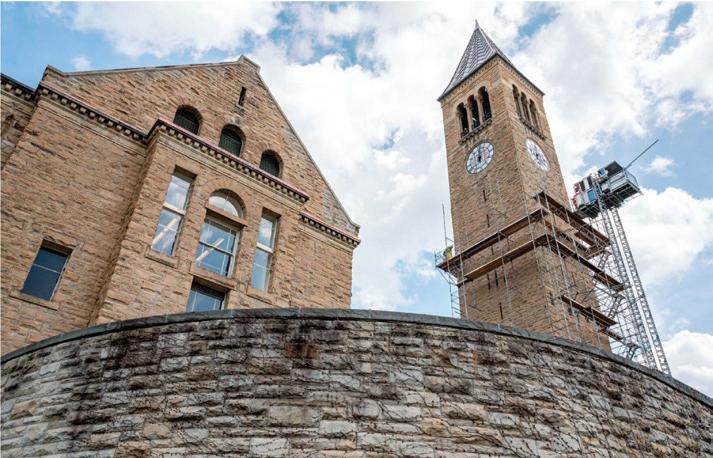
Cornell University’s iconic clocktowner. (Photo: Nathan Ellsion/Ithaca Times File)
By Mark Syvertson
QUESTION OF THE WEEK:
“WITH THE ITHACA PARADE LESS THAN 2 WEEKS AWAY, I HAD TO KNOW: WHY DO GOURDS KEEP SHOWING UP? ”
NOTE: If readers wish to participate in the Ithaca Times’ Inquiring Photographer column, contact Mark Syvertson at marksyvertsonphotography@gmail.com





City Plans Major Road Repairs, HUD Funding Moves Ahead
By Lorien Tyne
The city of Ithaca plans to repave 45 blocks this year, including portions of Albany, Geneva, Pleasant and Prospect streets. Public works staff warn that weather and emergency repairs may result in changes to the plan.
Adam Potter, superintendent of Ithaca’s Department of Public Works, presented to the Common Council on May 13 with DPW’s tentative road asphalt paving work plan for 2026. Potter said that $200,000 is budgeted by the city of Ithaca for road materials and $4.1 million is provided by the state to complete this work.
A map and a list of roads with planned work and the type of work are accessible through the Common Council’s May 13 meeting agenda document.
Potter said that the city decides which projects are a priority based on pavement condition index (PCI). The U.S. Army Corps of Engineers designed PCI, a numerical rating system to evaluate surface conditions of roads. In 2015, the Cornell Local Roads Program did a study that used the PCI system to evaluate local roads. Potter said that now, Construction Engineer Alfonso Reyes continues to develop data to determine pavement priorities.
Mark Verbanic, assistant superintendent of Streets & Facilities, said the city is looking to repave 45 city blocks this year. Verbanic said that in 2017 and 2018, the city was averaging 14 city blocks repaired per year.
“Within the past few years, we've been able to, with funding from the state, exponentially increase that with contractor forces and our own forces,” Verbanic said.
Potter said that in addition to 700,000 square feet of asphalt, the planned repairs also include 70 ADA curb ramps and 4,000 linear feet of curbing. He said that although there is a plan in place for which streets will have work done, it is subject to change if there are weather impacts or emergency projects.
“You have to realize as well that especially with the city crews, the same crews that are going out and putting in these new roads are responding to emergencies,” Potter said. “So, if they get pulled off a job and they have to go to that, there’s no way they’re going to get back and be able to finish this.”
In Other News
The Ithaca Common Council moved forward with the draft action plan for allocating 2026-2027 Housing and Urban Development (HUD) funding by approving the resolution to be on the council’s next consent agenda.
State Approves Temporary Rate Hikes for NYSEG, RG&E as Case Review Continues
By Lorien Tyne
The New York State Public Service Commission (PSC) approved temporary rate increases for New York State Electric & Gas (NYSEG) and Rochester Gas & Electric (RG&E).
Last summer, NYSEG and RG&E filed rate hike requests with PSC to increase delivery rates. While PCS has approved a temporary increase for the companies, it is much lower than the requested amounts.
NYSEG has sought delivery rate increases that would increase total monthly bills by 23.7% for average electricity customers and 33.5% for average natural gas customers. If approved, DPS estimates monthly bills will increase by about $33 for typical residential customers using 600 kilowatt-hours or 83 therms. Under the
The US Department of Housing and Urban Development provides the city of Ithaca with an annual allocation of funding to address community development needs. Each year, the city must submit an action plan to HUD to access entitlement program funding allocated to the city. The city contracts with the Ithaca Urban Renewal Agency to administer, implement and monitor the process and implementation.
The awarded grants through the HUD program are the Community Development Block Grant Entitlement Program (CDBG) and the Home Investment Partnerships Program (HOME).
The total funding available is $1,171,351, with $881,862 from CDBG and $289,488 from HOME. Much of this funding goes toward housing projects, such as the rehabilitation of the Henry St. John Building, to upgrade it into an allelectric building with improved interior and exterior and increased units from 12 to 16 affordable housing units.
Alderperson Jorge DeFendini asked IURA Community Development Planner Anisa Mendizabal about public concern regarding the Henry St. John project.
temporary plan, the estimated total bill impacts are 0.2% for electric customers and 1.7% for gas customers, according to a notice from the Department of Public Service (DPS).
RG&E’s proposals seek to increase rates by about $33 for electric customers, a 26% increase to the total bill, and nearly $19 for gas customers, a 22.2% increase to the total bill. The temporary increases are 2.9% for electric and 1.2% for gas.
The temporary plan provides NYSEG with a 3.7% annual revenue increase for electric service and 0.5% for NYSEG gas service. RG&B’s temporary rate hike will result in a 4% annual revenue increase for electric service and 1.5% for gas service.
“Establishing temporary rates when faced with statutory timeframes for a rate determination happens infrequently, but is
not unprecedented,” the DPS release said. “The requested increases are among the highest requested by any utility in recent history, which accentuates the necessity of additional evaluation.”
Upstate New Yorkers have been frustrated by rate hikes and issues with service quality resulting in significant backlash against the newest rate hike request, as previously reported by the Ithaca Times. The rate increases were approved on May 14 and will take effect on June 1. The temporary plan was put in place to give regulators more time to review the utility companies proposals and complete the rate cases. The case now involves more than 20 parties, over 10,000 pages of hearing transcripts, nearly 1,200 exhibits and about 26,700 written public comments, according to DPS A final decision on the cases, which will establish permanent rates, is expected in the coming months.
“The Commission’s authority to establish temporary rates during the course
“To squash the oligarchy!”
African Wine Kettle Gourd
“Because Ithaca is Gourdgeous!”
Indonesia Bottle Gourd
“We can’t get over ourselves.”
Mini Chinese Bottle Gourds
“We love to show off our curvaceous curves!” – Dipper Gourd
“Gourds just wanna have fun!”
Umbilical Gourd
Enfield Planning Board to Make Recommendation on Data Centers, Cryptocurrency Mining, Decision Uncertain
By Mikayla Rovenolt and Maddy Vogel
In the coming months, the En eld town board will consider restricting or banning data centers within the town’s borders. Board members are divided over to what degree the town should restrict data center development.
At it May 13 meeting, the board passed a resolution written by councilperson Robert Lynch directing the planning board to review the resolution and make recommendations on next steps concerning data centers and cryptocurrency mining facilities. e resolution was amended and then passed unanimously.
Amendments included removing a section about the town’s site plan review law a er Planning Board Chair Dan Walker suggested data centers and cryptocurrency mining be excluded from the law.
e removed section stated that the town board “directs the En eld Town Planning Board to promptly consider and commence dra ing appropriate amendments to the En eld Site Plan Review Law to address the review and potential approval of AI Data Centers, Cryptocurrency mines and related facilities.”
Board member Robert Lynch said that because En eld does not have zoning laws like other local municipalities, having the planning board review this resolution and make a recommendation to the town board is important.
“We are not sure if this will be part of our site plan review or if it will be just a straight out ban,” Stephanie Redmond, En eld’s town supervisor, said. “We don’t have zoning in En eld, so all of our land use laws are not codi ed under the zoning code. Instead, we have other land use regulations, like our Site Plan Review laws or our subdivision regulations that the planning board would use to determine if these things are appropriate.”
e decision to pass the resolution came a er discussions in which board members expressed concerns about data centers in New York and throughout the United States.
“ ere are those concerned about the incredible pace of the build out of data centers in New York and really throughout the United States, and there are a lot of side e ects that come with that,” Redmond
said. “I feel like at this point, it's important for us to really gure out how we can mitigate these issues before a project like this comes to the town.”
In Lansing, a proposed 400-megawatt AI data center from TeraWulf has drawn widespread criticism and divided the town governance. While some say the redevelopment of the former Milken Station alongside Cayuga Lake will increase tax revenue and bring economic development to the town, others criticize the plan for its potential environmental harm and energy costs. Cayuga Lake Environmental Action Now (CLEAN) and FLX Strong challenged the Lansing Zoning Board of Appeals’ decision to allow TeraWulf to proceed with building a data center as a general processing facility in a lawsuit.
Since the ZBA’s approval of the Cayuga Data Center, various municipalities in Tompkins County have moved to ban or restrict data center development. A petition launched on May 8 to show opposition for TeraWulf’s data center has drawn 14,000 signatures in just 10 days.
In January, the Town of Dryden became the rst town in New York state to ban data centers.
Following Dryden’s example, Danby town board members discussed amendments to their zoning code that de ned data centers and cryptocurrency mining facilities at an April 7 meeting. e board de ned the two uses and then did not allow them in all existing zones, e ectively banning data centers and crypto mines.
In En eld, board members are divided over whether the town should ban data
UPS DOWNS&

Ups
The Finger Lakes Land Trust has reopened part of the Roy H. Park Preserve in Dryden with new features making it the organization's rst fully accessible trail project. Funding for the trail improvements came from the Tompkins County Tourism Capital Grant program, the New York State Conservation Partnership Program and private donations.

Downs
A pedestrian was struck by a vehicle at the intersection of Hancock and Second streets in Ithaca on May 10. The pedestrian was taken to a regional trauma center with non-lifethreatening injuries. Police said the driver did not see the pedestrian in the road and was determined to be at fault in the incident
HEARD SEEN&

Heard
centers and crypto mines outright or whether they should be permitted with tight regulation.
“Some members of the Town Board, particularly Councilperson Jude Lemke, would prefer an outright ban similar to that enacted in Dryden, and soon if not already in Danby,” Lynch said in a statement to the Ithaca Times. “At the March Town Board meeting, I questioned the need for a ban. I would rather take an open-minded approach. I do not necessarily support data centers. But I’m not yet prepared to prohibit them either.”
Lynch added that he would vote against a local law banning data centers entirely.
“I recognize the divided public sentiment in Lansing,” Lynch said. “En eld resident views may prove similar. An outright ban is preclusive, not open-minded.”
Part of En eld’s resolution states that despite En eld lacking the infrastructure to host a data center or a crypto mine, the board “holds responsibility to plan for any such facility’s future arrival.”
“We have to customize any limitation or prohibition to our own unique circumstances,” Lynch said. “Perhaps data centers and cryptocurrency mines could be allowed with tight regulation. at is why I believe that the planning board should undertake its review.”
Redmond, who is a project manager for CLEAN and is involved with the organization’s ongoing suit against TeraWulf, believes the town should ban data centers outright.
“I feel like at this point, it’s important for
Continued on Page A6

The Downtown Ithaca Alliance is hosting a ribbon cutting and open house for REACH Medical to celebrate its new location downtown. The open house begins at 4 p.m. on May 21 at 130 E. Seneca Street in Suite 300. At the event, the public can visit the clinic’s new space, meet its team and learn about the organization’s work providing medical and behavioral health services to the Ithaca community.
Seen
The Tompkins County Clerk’s O ce hosted this year’s rst Naturalization Ceremony for new American citizens on May 14. At the ceremony, nine candidates from eight di erent countries o cially became U.S. citizens.
IF YOU CARE TO RESPOND to something in this column, or suggest your own praise or blame, write editor@ithacatimes. com, with a subject head “U&D.”
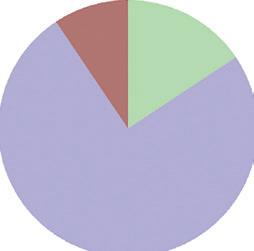
QUESTION OF THE WEEK
Will Ithaca get one more snowfall this spring?
15.6% Yes.
No.
I don’t care.
N EXT W EEK ’S Q UESTION : Do you consider Cinemapolis your go-to theater? Visit ithaca.com to submit your response.
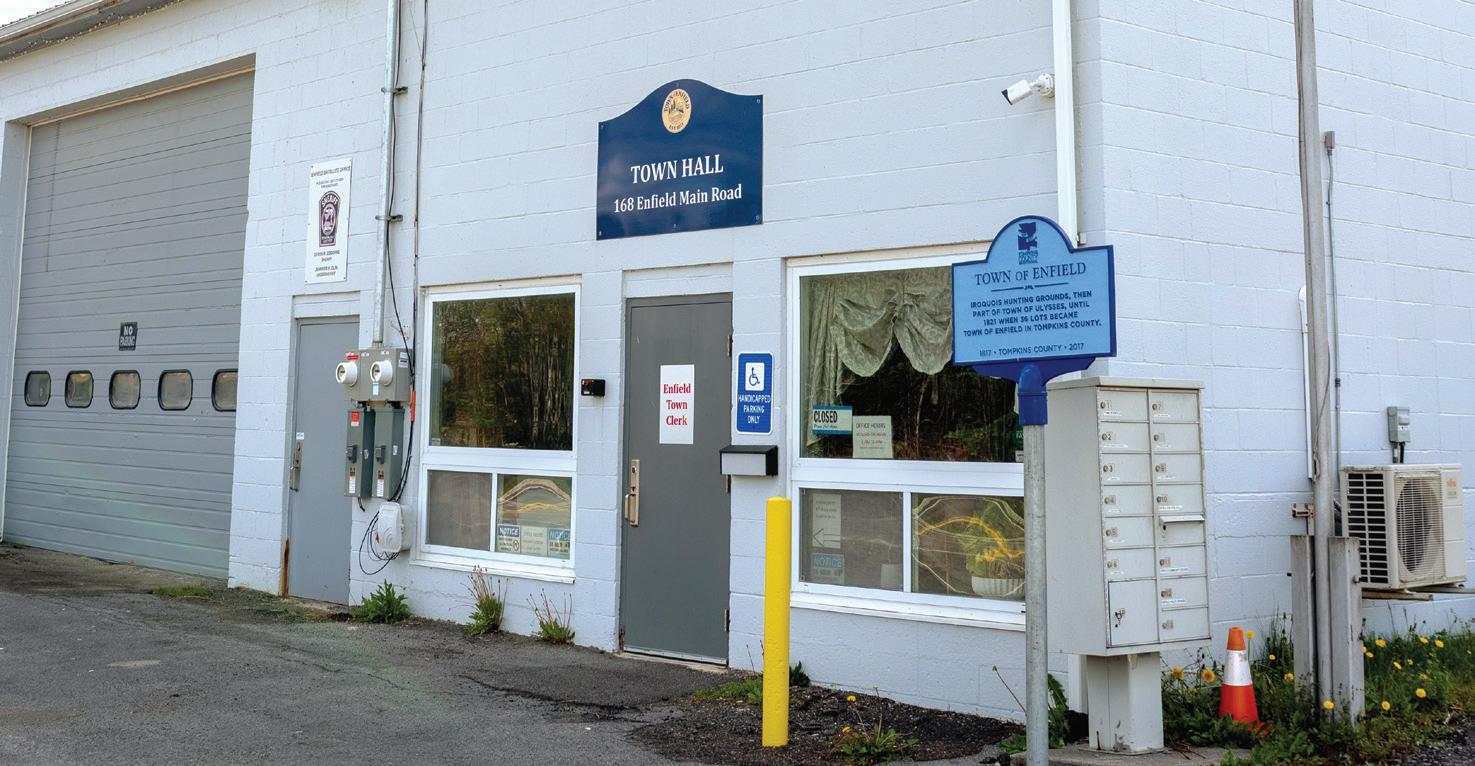
Enfield is considering banning or restricting the development of data centers and crypto mines. (Photo: Mark Syvertson/Ithaca Times)
Tompkins County Welcomes New Citizens with Naturalization Ceremony
By Mikayla Rovenolt
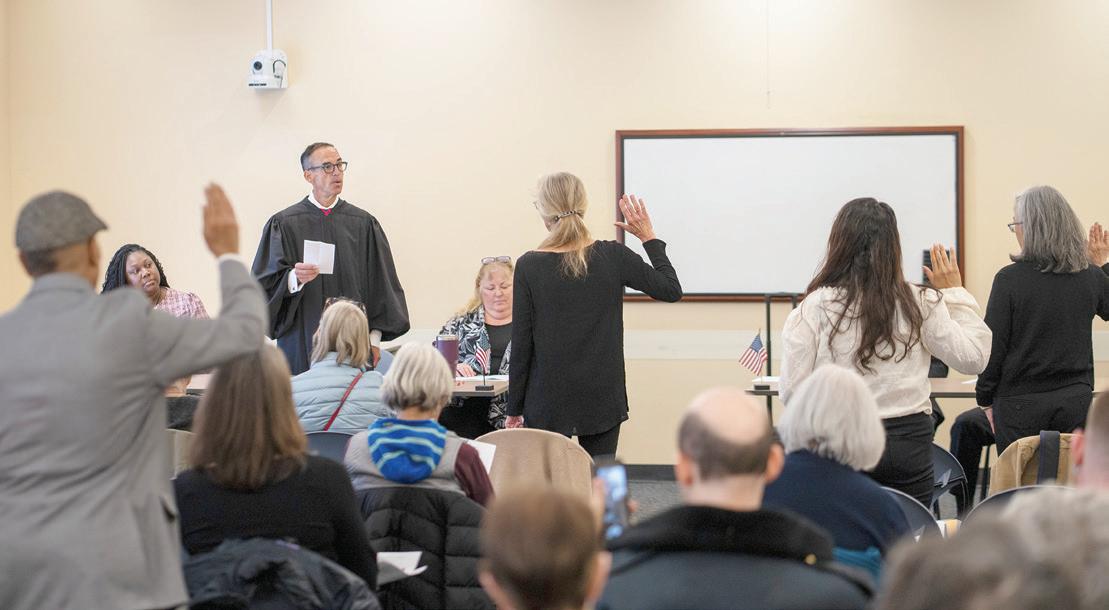
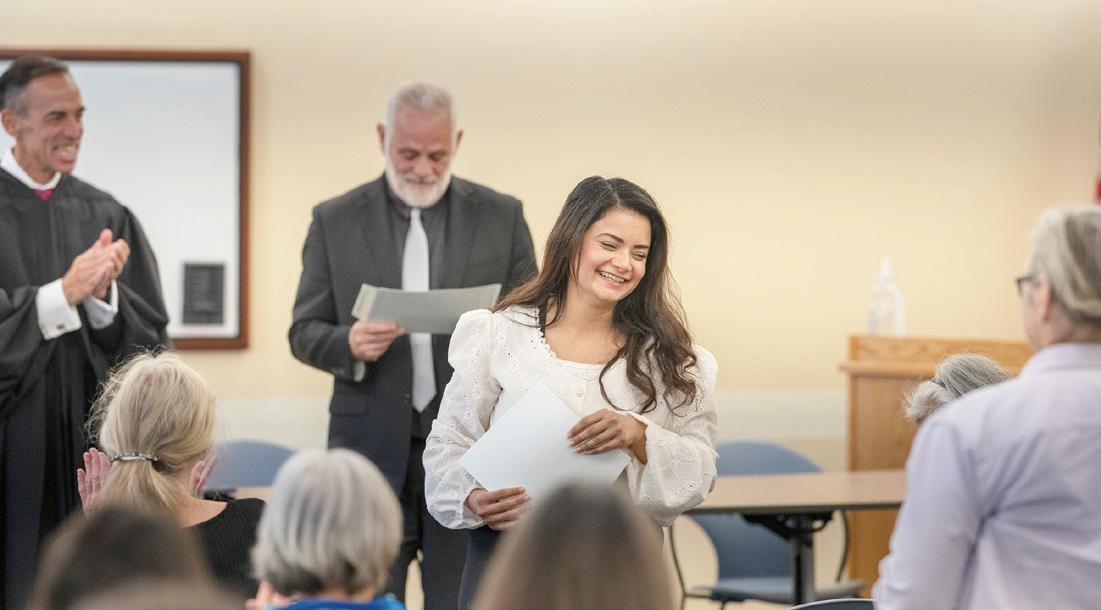
Nine people from eight countries obtained United States citizenship and call Tompkins County home following a naturalization ceremony on Thursday, May 14.
The Supreme Court of the State of New York held the ceremony at the Tompkins County Public Library’s BorgWarner room, where candidates took the Oath of Allegiance and became U.S. citizens.
Naturalization is the process by which U.S. citizenship is granted to a lawful permanent resident after meeting requirements established by Congress in the Immigration and Nationality Act (INA).
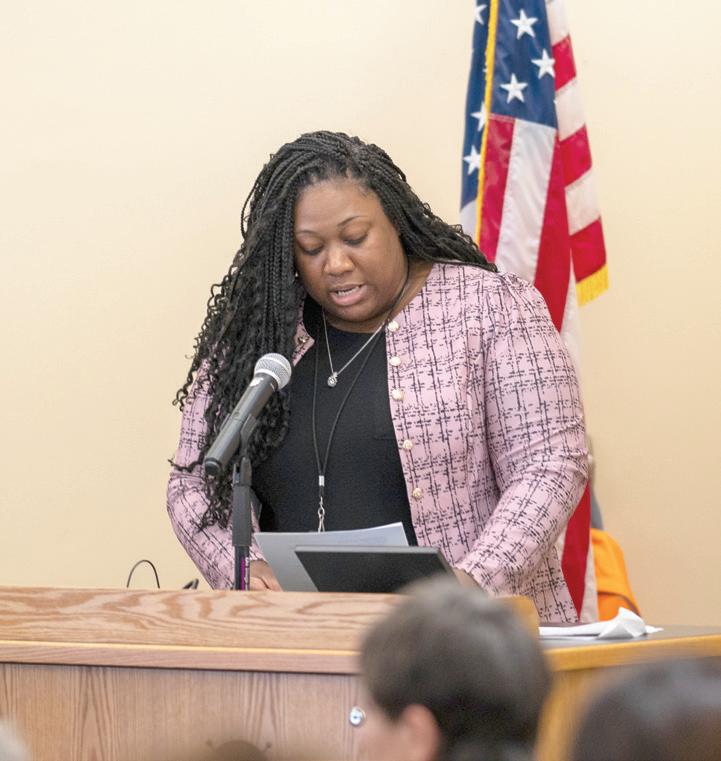
The event included Maureen Reynolds, Tompkins County clerk; Korin Kirk, Chief of Staff to Senator Lea Webb as the speaker; and the Honorable Christopher P. Baker, the presiding Supreme Court Justice.
“Normally every day at work is kind of a grind but these are the days my cheeks hurt from smiling,” Reynolds said. “Rather than going to a sterile court house where you don’t know anybody, here you can have your friends and family and the conversation is great. I think everyone should attend [a naturalization ceremony] at least
DATA CENTERS
continued from page A5
us to really figure out how we can mitigate these issues before a project like this comes to the town,” Redmond said. “At this point, we’re looking at a straight out ban, and we’re putting it in front of our planning
once in their life.”
Members of The League of Women Voters, who assisted with voter registration, members of the Kiwanis Club of Ithaca, who provided light refreshments after the ceremony, and The Daughters of the American Revolution, who gifted lapel pins to welcome the new citizens were also present at the ceremony. London McDaniels and McKenzie Jones performed two songs for the ceremony: Blackbird by George Harrison and Landslide by Stevie Nicks.
The nine new citizens came from Germany, Japan, South Korea, France, Canada, Georgia, India, and Pakistan.
“It’s a pretty involved and lengthy process,” Maxime Caly, from France said in an interview with the Ithaca Times. “It’s nice to have a ceremony like this and it’s a big moment for everyone. For me, I’ve always wanted to come back here. I was born in France and moved to the U.S. when I was really young and so I’ve always wanted to come back and I’ve always called this place home.”
Caly added that people should not be scared to go through the process, despite it being lengthy, because he said it is worth the time and effort.
Another new citizen, Denise Katzman of Canada, said she is excited to be able to finally vote. She has lived in Tompkins
board to see if it’s something that would be more appropriate to put in our site plan review, or if it should be a standalone law.”
Redmond said once the resolution goes to the town planning board, it will have six months to review the issue and make recommendations to the town board. She added that she is not sure what will hap-
County for close to eight years and is ready to fully be part of the democratic process.
“It is the biggest honor of all the duties that I have at the clerk’s office,” Rachel Graham, deputy clerk, said. “These are always beautiful and always emotional. It’s huge for the Ithaca community to have this celebration…They remind me of a lot of the things that I used to take for granted being born here and I’m just always so moved watching people take that oath of allegiance.”
During the second Donald Trump administration, officials have carried out widespread immigration crackdowns, including tens of thousands of arrests by U.S. Immigration and Customs Enforcement. Locally, ICE has made arrests in Ithaca and in the nearby Town of Spencer, sparking community concern. The administration has also called for an end to sanctuary policies like those enacted in Ithaca and Tompkins County, which offer protections to noncitizens by limiting local cooperation with federal immigration authorities.
In April, The New York Times reported that the administration was ramping up denaturalizations, the process by which the federal government revokes a naturalized individual’s citizenship through civil court proceedings.
Legislator Veronica Pillar, who attended the ceremony, said it is a celebration of
pen at that point.
“Personally, I don’t feel like AI and data centers and things like that are going to go away,” Redmond said. “I don’t think the genie is gonna be put back in the bottle, so to speak, and it is really becoming part of our new reality. So, we’re really looking at the ways that it could have impacts in our
community despite immigration issues that are currently taking place locally and nationally.
“I think in the context of ICE and federal agents abducting people from their communities, it is important to celebrate belonging, regardless of where someone was born, but also regardless of paperwork and immigration status,” Pillar said. “The naturalization ceremony is a celebration of people coming from somewhere else and belonging here in Tompkins County. It opens up a new way to civically participate.”
Kirk, on behalf of Senator Lea Webb, shared that it was an honor to be part of the ceremony. She thanked community partners and members for coming together to support the ceremony. Webb was unable to attend, but shared her thoughts in a statement.
“I want to extend my most heartfelt congratulations to all of the new citizens who participated in today’s Tompkins County Naturalization Ceremony,” Webb said in the press statement. “Throughout the Southern Tier and across my district, we are fortunate to have communities shaped by many cultures, languages, and lived experiences. I am honored that you have chosen to make your home here, and I look forward to all that you will contribute in the years ahead.”
community and ways that we can mitigate those impacts.”
The board also voted on a resolution in support of Senate Bill 9144 and Assembly Bill 10141, which would place moratoriums on data centers and cryptocurrency mining in New York State. This resolution also passed unanimously.
Nine individuals take the Oath of Allegiance with Presiding Supreme Court Justice Christopher P. Baker and Tompkins County Clerk Maureen Reynolds. (Photo: Mark Syvertson/Ithaca Times)
Nine people from eight countries obtained United States citizenship following a naturalization ceremony on Thursday, May 14.
(Photo: Mark Syvertson/Ithaca Times)
Korin Kirk attends Tompkins County’s naturalization ceremony on behalf of State Sen. Lea Webb. (Photo: Mark Syvertson/Ithaca Times)
Who’s Your Neighbor?
A Local Directory of Faith Communities, Faith-Related Services and Interfaith Activities
Many Ithacans are seeking connections that might accurately be called faith. Some return to their roots while others seek roots they may never have experienced. We hope our directory will provide a resource residents, students and visitors find useful in their journey.
FAITH COMMUNITIES
Agape Bible Church agapeithaca.org
Bahá’í Community of Ithaca ithacabahais.org
Bethel Grove Bible Church bg.org
Bread of Life Anglican Church breadoflifeithaca.org
Cedar Cabin Sangha (Buddhist, Plum Village Practice) cedarcabinsangha.blogspot.com
Christ Chapel christchapelithaca.org
Christian Community Church Ithaca cccithaca.org
Christ the King Fellowship Presbyterian Church ctkspencer.org
Church of the Epiphany epiphanytrumansburg.org
Congregation Tikkun v’Or (Ithaca Reform Temple) tikkunvor.org
518 Yoga Gathering suzannejanene@gmail.com
All Eyes and Ears on Racism AEER aeerforjustice@gmail.com
Catholic Charities of Tompkins/Tioga catholiccharitiestt.org
Finger Lakes Anam Cara fingerlakesanamcara.com
Area Congregations Together breedlovejami@gmail.com
Greater Lansing-Ithaca Interfaith Community LansingUnited.org/events
Danby Community Church danbychurch.org
First Baptist Church in Ithaca firstbaptistithaca.org
First Congregational Church of Ithaca fccithaca.org
First Presbyterian Church of Ithaca firstpresithaca.org
First Unitarian Society of Ithaca unitarian.ithaca.ny.us
First United Methodist Church of Forest Home foresthomechapelumc.org
Hillside Alliance Church hillsideithaca.org
Ithaca Quakers
(Religious Society of Friends) ithacamonthlymeeting.org
Lansing United Methodist Church LansingUnited.org
Living Hope Fellowship LHFithaca.org
New Life Presbyterian Church newlifeithaca.org
FAITH-RELATED SERVICES
Forest Hermitage staceysmithhypnosis.com
Integrative Mental Wellness psychologytoday.com/profile/1449445
Moonlight Epiphanies moonlightepiphanies.org
Namgyal Monastery Institute of Buddhist Studies namgyal.org/
INTERFAITH ACTIVITIES
Ithaca Dances of Universal Peace idancepeace.org
Ithaca Kitchen Cupboard ithacakitchencupboard.org
Ithaca Sunday Squares (585) 451-4288
Sacral Transformations and Braided Root
Waters Healing Sanctuary sacraltransformations.com
St. Catherine of Siena Church stcathofsiena.org
St. James AME Zion Church facebook.com/Stjamesamezionithaca
St. John’s Episcopal Church stjohnsithaca.org
St. Luke Lutheran Church and Lutheran Campus Ministry stlukeithaca.org
St. Paul’s United Methodist Church stpaulsithaca.org
Temple Beth-El tbeithaca.org
The Twelve Tribes twelvetribes.org
Trinity Lutheran Church trinityithaca.org
Vineyard Church of Ithaca ithacavineyard.org
Pure Essence Vibrations pureessencevibrations.com/
Second Wind Cottages secondwindcottages.org/
Willow Glen Christian School willowglencs.org/ Wisdom's Goldenrod Center for Philosophic Studies wisdomsgoldenrod.info
Shared Journeys sharedjourneys.net
The Foundation of Light thefoundationoflight.org
For more information, visit www.whoisyourneighbor.org and www.madeofclay.org
Please share our Who’s Your Neighbor? newsletter with your friends and send any ideas or stories you wish to share to: Roy@ithacatimes.com.
Copyright 2026, Pathways to Equity, Inc. All rights reserved.
LETTERS TO THE EDITOR
By Ithaca Times Readers
Take Down Flock Cameras
“Dear [Common] Council members:
It is admirable that you took the step of cancelling the City’s mass surveillance contract with Flock on March 4th, but we are disappointed that more than two months later, the Flock cameras remain in our community, recording, analyzing, and sharing our movements around the clock. Having already resolved publicly that Flock cameras are incompatible with the goal of ‘protecting the privacy and other civil rights and liberties of its residents and visitors’, we don’t understand why covering up the cameras does not seem to have been an immediate priority for the City. Ithaca advertises itself proudly as a ‘sanctuary city’, and yet it continues to allow Flock, well known as a tool of federal immigration enforcement, to track residents and visitors; this is a betrayal of the
community and the principles you profess, and we demand that you put an end to it.
Evanston IL, Olympia WA, Springfield OR, and Verona WI are all examples of municipalities with governments that protected their communities by covering their Flock cameras. Eugene OR went a step further and removed the cameras themselves after Flock failed to do so in a timely fashion. Covering Ithaca's cameras would be quick and inexpensive, and we see no reason why the City of Ithaca could not have already done so, or why it shouldn’t be possible in the next few days, let alone weeks.
Specifically, we demand an immediate statement from the City indicating
• a specific timeline and plan for covering up the cameras within the next two weeks
• a specific timeline and plan for permanent removal of the cameras thereafter
Every day that passes without covering the cameras is another day this corporation is allowed to record our movements and share the data with organizations hostile to our ideals of civil rights, free expression, and sanctuary for all. We ask that you put into practice the noble words to which you signed your names nine weeks ago. Our patience with the continued violation of our privacy has been exhausted, and we cannot tolerate inaction any longer.” Flock Off! Ithaca, Immigrant Solidarity Group, Ithaca Catholic Workers, Tompkins County SURJ

RE: Two Cornell Students Say University President Struck Them With Vehicle in Altercation After Israel-Palestine Debate
“I find these negative comments about the amazing students at Cornell very interesting. Why does the population of Ithaca and the surrounding areas have this animosity towards Cornell students? Blaming the students and giving a pass to the president sounds just like MAGA behavior. Find out the history of this man and the atmosphere of fear he created on campus. Unless you stand for Israel like our American and Israeli government demands these days, funds are taken away, visas denied. The adult in the room did not act like an adult at all, just like another president we know. Fun fact: without those awesome multicultural students who are doing great work in this crumbling country, they pay a lot of bills for many people in this area. We stand with the students! Fire this president and let democracy ring on our college campuses.” Patricia Sanchez, Ithaca.com
“It was obvious. Watch the video and it was a clear case of harassment by the students. Followed the President every step to his car, got into his face, and surrounded his car as he tried to exit. Then had the nerve to accuse him of ‘running them over at high speed’. Are these students this ignorant or are they just pretending to be? As adults, why didn’t they address their issues at the meeting?” — Bob Ellis, Ithaca.com
“‘Appropriate action’ is being taken against non-students only? The ‘students’ need to be expelled. This wasn’t protesting, this was intimidation, harassing, coercion, and attempted assault. Time Cornell developed a ZERO tolerance in these types of actions that may result in violence.” — John Butler, Ithaca.com
RE: Guest Opinion: After Months
Removing Shoes from Power Lines, I See Collegetown Differently
“I had no idea that what I considered thoughtless behavior and something close to vandalism was a way for students to commemorate their student years in Ithaca at Cornell. I wish I could think of another way for students to do that and I wonder if the CCC might run a contest that would produce a winning idea(s) for how this could be done.
Thank you John Crutchfield for the work you did and for making us aware of what the actual situation is.” — Judy Jensvold, Ithaca.com
Support the New York Health Act This Election
“The New York Health Act (NYHA) S3425/A1466 presents a comprehensive, single payer plan providing quality care to all New Yorkers, regardless of income, wealth, or employment status. This bill includes all medically necessary care: prescriptions and medical supplies, all preventative care and well child visits, dental, hearing and vision services, ER visits and ambulance services, prenatal care and long-term care, mental health and substance abuse treatment, hospital care, surgeries, worker’s compensation and motor vehicle accident health care services and palliative care.
The NYHA would be based on ability to pay through a progressively graduated payroll-based tax and by a progressively graduated tax based on other non-payroll taxable income, such as capital gains, interest and dividends. Federal funds received for Medicare, Medicaid, Family Health and Child Health Plus would be combined with the state revenue in a New
Continued on Page B25

Ithaca’s Maternal Health Crisis
By Lucas Hooker
How much does it cost to bring a new life into the world? According to KFF, the average price tag for a delivery in the United States is over $20,000. If you have had a baby in the last five years, you likely know that this sticker price rarely reflects the final bill. While insurance typically covers the main share of the cost, families are still left paying an average out of pocket bill of almost $3,000.
While a couple grand may seem manageable compared to tens of thousands of dollars, it can be a daunting cost for growing a family. This becomes even worse when you factor in the cost of rising monthly premiums. As the cost of living climbs, hospital deliveries are following suit. However, the solution to lowering these costs for everyone may be counterintuitive to what you expect.
The NYS Department of Health reports that over 43% of Upstate New York residents are covered by Medicaid. Given this massive subset, this means Medicaid’s reimbursement rates dictate the financial health of labor and delivery units, particularly for community hospitals. Currently, Medicaid is a heavy burden for units. The American Hospital Association reports that Medicaid reimbursements often leave hospitals with an 8.1% loss on every delivery they perform.
When nearly half of your patients result in a financial loss, hospitals must find a way to keep the lights on. A study published by the NIH reveals the answer is to pass the deficit onto private insurance holders, charging those patients more to make up for lost margins. This is why the Health Care Cost Institute found that private insurers compensate hospitals almost $9,000 more than Medicaid per delivery. Essentially, every family with private insurance is paying a hidden tax to subsidize the government's underfunding of Medicaid.
For many hospitals, even overcharging private insurers isn’t enough. Labor and delivery units are increasingly viewed as financial liabilities. The Times Union reports at least 29 hospitals have closed or reduced services in New York over the last 15 years. This reflects a national crisis. UPENN found that between 2010 and 2022, 537 hospitals across the country
closed their obstetric units. What was the primary driver cited for these closures? Financial constraints in relation to inadequate Medicaid reimbursement.
We have already seen units close in Schuyler, Geneva, and Olean. While it may seem unthinkable, all it would take is a few years of sustained deficits for Cayuga Medical Center to face a similar crossroads. If CMC’s unit closed, Ithaca would become a maternal care desert. Expectant parents would be forced to navigate the 45 to 60 minute trek to Syracuse, Sayre, or Elmira. This is a terrifying prospect during a Finger Lakes winter or a high-risk complication. The NIH shows that as the distance to maternal care increases, so do the rates of complications and negative outcomes for both mothers and infants.
We can break this cycle by passing the Keeping Obstetrics Local Act (KOLA) (H.R.3942). This legislation targets the root of the problem by addressing the inadequate compensation hospitals receive per birth. Specifically, the Act would require state Medicaid programs to reimburse hospitals at 150% of the Medicare rate. KFF estimates New York hospitals currently receive only about 83% of their costs from Medicaid. This shift would provide the financial floor necessary to keep rural hospitals, like Cayuga Medical Center operational.
Critics may argue that increased federal spending leads to higher taxation. However, we are already paying this cost. We pay through inflated private insurance premiums or the devastating long-term costs of maternal morbidity. By fully funding these deliveries we prevent further unit closures, like here in the Finger Lakes, and reduce the cost shift passed onto every American family.
KOLA is currently under review by the Committee on Energy and Commerce and the Committee on Ways and Means. Its future remains uncertain, but as New Yorkers, we hold unique influence. Senator Chuck Schumer, as the Senate Minority Leader, has the power to exert immense pressure to prioritize this bill. Expressing support to his office emphasizes that maternal health is a non-negotiable priority for his constituents. Likewise, urging Senator Kirsten Gillibrand to co-sponsor
A Civic Award for a Record Store
By Stephen Burke
From Elvis to the Rolling Stones, Iggy Pop and Public Enemy, rock music (loosely defined: all these musicians are in the Rock and Roll Hall of Fame) is supposed to represent rebellion, not respectability. It’s a target for Parental Advisory Warnings and condemnation by authorities.
So it might be surprising to find a government award for civic contributions going to a record store, particularly one with an acerbic name like Angry Mom Records.
It certainly was surprising to George Johann, the owner of Angry Mom Records in Ithaca.
“It was out of the blue,” George said. “They just reached out to me and said they wanted to give me this award for, what was it?” He paused to recall the phrasing. “Contributing to the artistic culture of New York State.”
Subsequent to that message in April, Senator Lea Webb of the New York State Assembly visited Angry Mom Records with a framed New York State 2026 Empire Award. It reads, “In recognition of outstanding contributions and dedication to the growth, prosperity and betterment of their community and New York State.”
George said, “I guess it had to do with the label, all the bands that play here, and just being, you know, what we all talk about, that ‘third space.’ We’re that for a lot of people.”
Angry Mom is a retail store for used (and some new) record albums, CDs, tapes, and equipment for playing them, located on the downtown Ithaca Commons. It started in the basement of Autumn Leaves Books on the Commons in 2009. Three years ago it moved to the top floor. With increased space, it expanded its music inventory, added VHS tapes, comic books, toys and games, and started hosting live all-ages performances. Along the way it created a record label.
George is a two-time transplanted New Yorker, first from his birthplace in Indiana to New York City, and after about ten years, from New York City to Ithaca. (“It was time,” he said.) He has the devotion of a transplant — or, as the award says, the dedication.
In Manhattan he was in the thick of things, working at a record store across
from the Chelsea Hotel. When “it was time” to explore leaving, he took a trip to Ithaca and “had instant love for it. It had a record store, bookstores, and good restaurants. In five minutes you could go from downtown and be in nature. What more did I need?”
The record store he found was in the basement of Autumn Leaves. It was ample, but uncurated. Joe Wetmore, owner of Autumn Leaves, met George and asked him to manage it. George brought his expertise and residual city-o character to it, adding to the hip urban side of Ithaca’s city/country duality. He also added, it turned out, a prosperous business that grew, as specifically lauded by the award. Angry Mom has gone from a sole proprietorship to employing five people in its 17 years (and counting).
George credits staffer Seven Caso for the development of live music at the store. He credits Joe Wetmore (who owns the building) as crucial to Angry Mom’s success.
“Anything that was built here is on his shoulders,” George said. “He’s been great to me.” He paused, then laughed. “Which I don’t think I’ve ever heard anybody say about any other landlord.”
The store has a core clientele of music fans and collectors who stop in regularly, lest they miss any treasures. But George notes that a large number of customers are from out of town. “Maybe one-third during the week, two-thirds on weekends,” he said. Both kinds of foot traffic are good for downtown, and Angry Mom is probably unique in attracting the mix so steadily. Certainly it is unique as a destination store, and one where people spend time. A typical business might have browsers who come in for a minute or two. George said he recently had a customer from Seattle “who bought a stack of records two feet high. He was here for six hours.”
George also notes a pleasant evolution in the record store business. “It used to be a place for grumpy men. A male to female ratio of 9 to 1, at least. Now it’s male to female fifty-fifty.”
Senator Lea Webb knows progress when she sees it, and that a record store can be a place of good business, energetic creativity, and community centrality. George Johann knows it too, in an award-winning run.
The Enduring Voice of Elie Wiesel — 1999
Curated by Roy Allen: Director of Strategic Partnerships — Ithaca Times, Finger Lakes Community Newspapers, www.ithaca.com
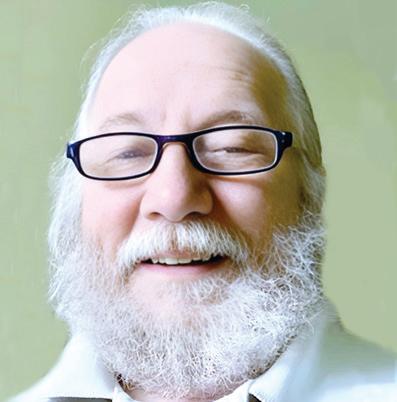
Many voices have helped to shape the nation we call America. This week we feature Elie Wiesel, a Romanian-born American writer, professor, political activist, Nobel laureate, and Holocaust survivor. He has authored several dozen books including Night, a memoir of his experience during World War II, as a Jewish prisoner at Auschwitz and Buchenwald.
Elie Wiesel: The Perils of Indifference — Delivered at the White House — April 12, 1999
Mr. President, Mrs. Clinton, members of Congress, Ambassador Holbrooke, Excellencies, friends: Fifty-four years ago to the day, a young Jewish boy from a small town in the Carpathian Mountains woke up, not far from Goethe's beloved Weimar, in a place of eternal infamy called Buchenwald. He was finally free, but there was no joy in his heart. He thought there never would be again. Liberated a day earlier by American soldiers, he remembers their rage at what they saw. And even if he lives to be a very old man, he will always be grateful to them for that rage, and also for their compassion. Though he did not understand their language, their eyes told him what he needed to know — that they, too, would remember, and bear witness.
And now, I stand before you, Mr. President — Commander-in-Chief of the army that freed me, and tens of thousands of others — and I am filled with a profound and abiding gratitude to the American people. “Gratitude” is a word that I cherish. Gratitude is what defines the humanity of the human being. And I am grateful to you, Hillary, or Mrs. Clinton, for what you said, and for what you are doing for children in the world, for the homeless, for the victims of injustice, the victims of destiny and society. And I thank all of you for being here.
We are on the threshold of a new century, a new millennium. What will the legacy of this vanishing century be? How will it be remembered in the new millennium? Surely it will be judged, and judged

severely, in both moral and metaphysical terms. These failures have cast a dark shadow over humanity: two World Wars, countless civil wars, the senseless chain of assassinations (Gandhi, the Kennedys, Martin Luther King, Sadat, Rabin), bloodbaths in Cambodia and Algeria, India and Pakistan, Ireland and Rwanda, Eritrea and Ethiopia, Sarajevo and Kosovo; the inhumanity in the gulag and the tragedy of Hiroshima. And, on a different level, of course, Auschwitz and Treblinka. So much violence; so much indifference.
What is indifference? Etymologically, the word means “no difference.” A strange and unnatural state in which the lines blur between light and darkness, dusk and dawn, crime and punishment, cruelty and compassion, good and evil.
What are its courses and inescapable consequences? Is it a philosophy? Is there a philosophy of indifference conceivable? Can one possibly view indifference as a virtue? Is it necessary at times to practice it simply to keep one's sanity, live normally, enjoy a fine meal and a glass of wine, as the world around us experiences harrowing upheavals?
Of course, indifference can be tempting — more than that, seductive. It is so much easier to look away from victims. It is so much easier to avoid such rude interruptions to our work, our dreams, our hopes. It is, after all, awkward, troublesome, to be involved in another person’s pain and despair. Yet, for the person who is indifferent, his or her neighbor are of no consequence. And, therefore, their lives are meaningless. Their hidden or even visible anguish is of no interest. Indifference reduces the Other to an abstraction.
Over there, behind the black gates of
Auschwitz, the most tragic of all prisoners were the “Muselmanner,” as they were called. Wrapped in their torn blankets, they would sit or lie on the ground, staring vacantly into space, unaware of who or where they were — strangers to their surroundings. They no longer felt pain, hunger, thirst. They feared nothing. They felt nothing. They were dead and did not know it.
Rooted in our tradition, some of us felt that to be abandoned by humanity then was not the ultimate. We felt that to be abandoned by God was worse than to be punished by Him. Better an unjust God than an indifferent one. For us to be ignored by God was a harsher punishment than to be a victim of His anger. Man can live far from God — not outside God. God is wherever we are. Even in suffering? Even in suffering.
In a way, to be indifferent to that suffering is what makes the human being inhuman. Indifference, after all, is more dangerous than anger and hatred. Anger can at times be creative. One writes a great poem, a great symphony. One does something special for the sake of humanity because one is angry at the injustice that one witnesses. But indifference is never creative. Even hatred at times may elicit a response. You fight it. You denounce it. You disarm it.
Indifference elicits no response. Indifference is not a response. Indifference is not a beginning; it is an end. And, therefore, indifference is always the friend of the enemy, for it benefits the aggressor — never his victim, whose pain is magnified when he or she feels forgotten. The political prisoner in his cell, the hungry children, the homeless refugees — not to respond to their plight, not to relieve their solitude by offering them a spark of hope is to exile them from human memory. And in denying their humanity, we betray our own.
Indifference, then, is not only a sin, it is a punishment.
And this is one of the most important lessons of this outgoing century’s wideranging experiments in good and evil.
In the place that I come from, society was composed of three simple categories: the killers, the victims, and the bystanders. During the darkest of times, inside the ghettos and death camps — and I’m glad that Mrs. Clinton mentioned that we are now commemorating that event, that period, that we are now in the Days of Remembrance — but then, we felt abandoned, forgotten. All of us did.
And our only miserable consolation
was that we believed that Auschwitz and Treblinka were closely guarded secrets; that the leaders of the free world did not know what was going on behind those black gates and barbed wire; that they had no knowledge of the war against the Jews that Hitler’s armies and their accomplices waged as part of the war against the Allies. If they knew, we thought, surely those leaders would have moved heaven and earth to intervene. They would have spoken out with great outrage and conviction. They would have bombed the railways leading to Birkenau, just the railways, just once.
And now we knew, we learned, we discovered that the Pentagon knew, the State Department knew. And the illustrious occupant of the White House then, who was a great leader — and I say it with some anguish and pain, because, today is exactly 54 years marking his death — Franklin Delano Roosevelt died on April the 12th, 1945. So he is very much present to me and to us. No doubt, he was a great leader. He mobilized the American people and the world, going into battle, bringing hundreds and thousands of valiant and brave soldiers in America to fight fascism, to fight dictatorship, to fight Hitler. And so many of the young people fell in battle. And, nevertheless, his image in Jewish history — I must say it — his image in Jewish history is flawed.
The depressing tale of the St. Louis is a case in point. Sixty years ago, its human cargo — nearly 1,000 Jews — was turned back to Nazi Germany. And that happened after the Kristallnacht, after the first state sponsored pogrom, with hundreds of Jewish shops destroyed, synagogues burned, thousands of people put in concentration camps. And that ship, which was already in the shores of the United States, was sent back. I don’t understand. Roosevelt was a good man, with a heart. He understood those who needed help.
Why didn’t he allow these refugees to disembark? A thousand people — in America, the great country, the greatest democracy, the most generous of all new nations in modern history. What happened? I don’t understand. Why the indifference, on the highest level, to the suffering of the victims?
But then, there were human beings who were sensitive to our tragedy. Those
(Photo Source: Oslo Freedom Forum)

Seven-Title Sweep
Seven titles secured with Ithaca talent at the core
By Steve Lawrence
Anews story came across my radar earlier this week that impressed me to the point that I felt compelled to circle back and check additional sources. Yep. It was true. SUNY Cortland Athletics has seven teams competing in the State University of New York Athletic Conference (SUNYAC), and all seven teams won their conference championship this spring. That’s amazing. My first thought was that this newspaper is the Ithaca Times — not the Cortland Times — and that the story might not be relevant to our readers. I am fortunate to be connected to a solid sports network, so I reached out to mi amigo Scott Yaple of the Ithaca High Athletics and wellness department. I asked Scott if any former Little Red athletes were part of this historic season, and he said he would dig into it. Dig in he did, and he struck gold.
I learned that John Anderson — Ithaca High Class of ’23 — not only competes for the Red Dragons as a member of the indoor and outdoor track teams, he is stacking up accolades that make him a standout by any measure.
Anderson graduated as a 4-year competitor for the Little Red, and a three-time captain. He holds the school record in the 55 and 110-meter hurdles, and was a national qualifier in those events, as well as in the 4 × 100 relay.
I called Fran Elia, the Sports Information Director at SUNY Cortland, and
asked him if Anderson made significant contributions to the Red Dragons’ SUNYAC title. Fran told me, “John is still competing as we speak. He qualified for a Regional meet, after winning the Decathlon in the conference meet.” I replied that an individual conference Decathlon championship was likely every Combined Event athlete’s dream, and Elia said, in effect, “But wait, there’s more.” He said that during the 2024-2025 academic year, Anderson won the Heptagonal title during the indoor track season, and followed up with the Decathlon title in the spring. He pulled off that double feat again in 20252026, going back-to-back as conference champ in both events. That makes it safe to say that a Ithaca High graduate is the preeminent track and field athlete in the entire SUNY system, and with one more year to compete, the hardware collection will very likely be enhanced. Congratulations to Anderson on a stellar run... And long jump. And high jump. And shot put, And discus. And pole vault. And javelin. The other teams winning conference titles for the Red Dragons are: Baseball, Softball, Men’s Lacrosse, Women’s Lacrosse, Men’s Track and Field, Women’s Track and Field and Golf. Seven programs, seven conference championships. For the Women’s Lacrosse team, it is a fresh title. All others are repeat champs. Talk about bragging rights.

Don’t Let Ithaca Lose Its Storytellers
Imagine the sharpest, most passionate young journalists you’ve ever met (the ones who stay late chasing a story because they believe in this town) slowly packing their bags. Not because they want to leave… but because local rents force them out.
That’s the quiet heartbreak happening right now. Our best new writers, the ones who grew up here or fell in love with Ithaca in college, are being pushed toward cheaper cities just to survive.
The Rising Star Fund rewrites their story into a happy ending by sponsoring a simple monthly housing stipend (a hand up, never a handout) so they can keep living here, keep writing here, keep falling deeper in love with Ithaca… and keep telling the stories that make this city our home.
When a young journalist can afford to stay in Ithaca, you get:
● Fresh, fearless voices loyal to your local paper
● Someone at every city council meeting who believes local news matters
● The next great Ithaca story written by someone who actually lives here
● Your $25, $50, or $100 a month doesn’t just pay their rent.
● It keeps storytellers in our community and stops local brain drain.
● When our younger generation thrives, Ithaca’s future stays bright.
Keep local talent in Ithaca by donating today to the Rising Star Fund (an initiative of Pathways to Equity, Inc a registered 501(c)(3) nonprofit organization)
For more info: roy@ithacatimes.com
John Anderson, an Ithaca High graduate, competes for SUNY Cortland’s track and field team, where he has emerged as one of the SUNYAC’s top multi-event athletes. (Photo: Erin Locascio/SUNY Cortland Athletics)
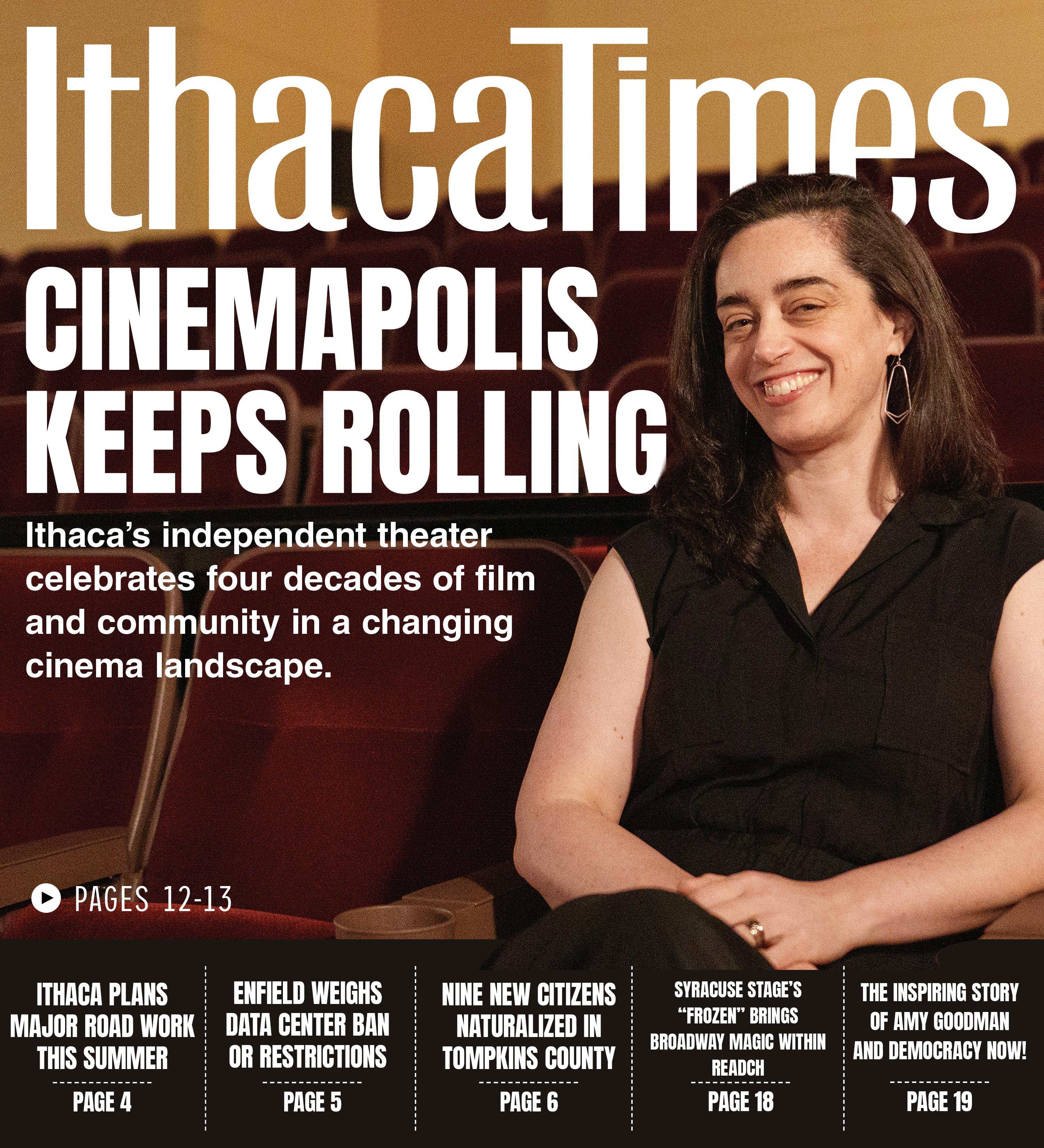
Cinemapolis Marks 40 Years in a Changing Film Industry
Ithaca’s beloved independent theater celebrates four decades of moviegoing while continuing to thrive in a shifting landscape
By Gabrielle Dela Cruz
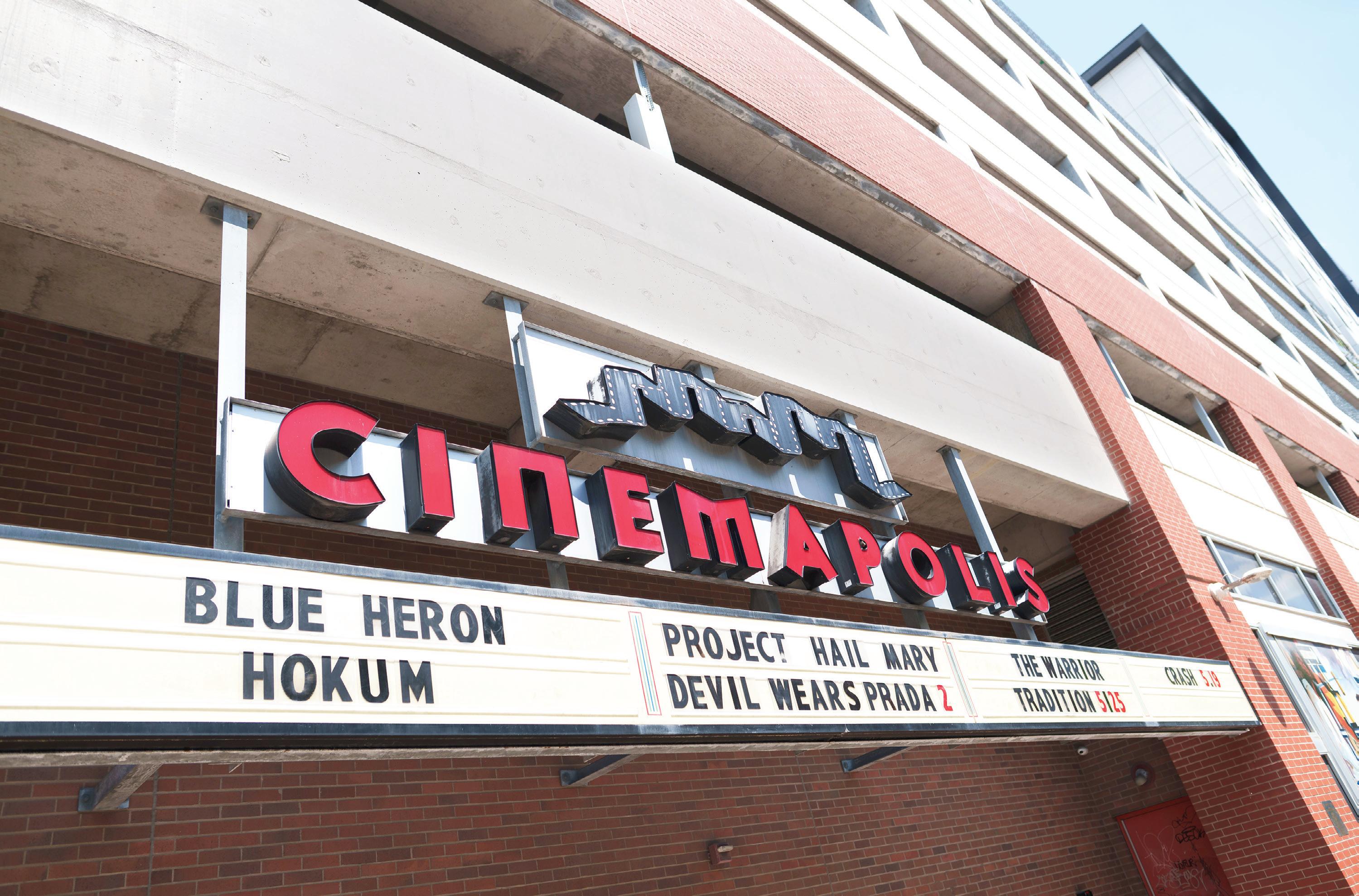
Cinemapolis has been Ithaca's independent movie theater for 40 years. (Photo: Mark Syvertson/Ithaca Times)
The glow of a marquee spills onto downtown Ithaca’s Green Street, illuminating a lineup of indie film titles and neon red lettering. Inside a brick building, the scent of fresh, buttered popcorn wafts throughout a lobby with floor-to-ceiling windows. Moviegoers murmur softly as they wait in line at the box office or concession stand. Their eyes flit around, studying the posters along the walls—documentaries, international features, locally produced independent pieces—or toward the suspended TV screen displaying show times.
Just beyond the TV screen, a warm, lit-up hallway guides visitors toward the intimate screening rooms that have long defined the theater’s charm. Cinemapolis, downtown Ithaca’s nonprofit, community-rooted independent theater, will celebrate its 40th anniversary this fall.
Cinemapolis was originally a single-screen theater in the basement of Center Ithaca on the Commons, according to its website. Established in 1986 by partners Lynn Cohen and Rich Syanzi, the pair previously operated a theater in Santa Fe, New Mexico, for a shared passion of independent film before relocating to Ithaca.
By 2000, the theater became a non-profit media arts organization under the Seventh Art Corporation, expanding operations from Center Ithaca to Fall Creek before moving to its current location on Green Street, where it grew to five screens. Cinemapolis’ commitment to enriching the lives of people through the art of film, entertainment, and exceptional service has remained unchanged since establishment.
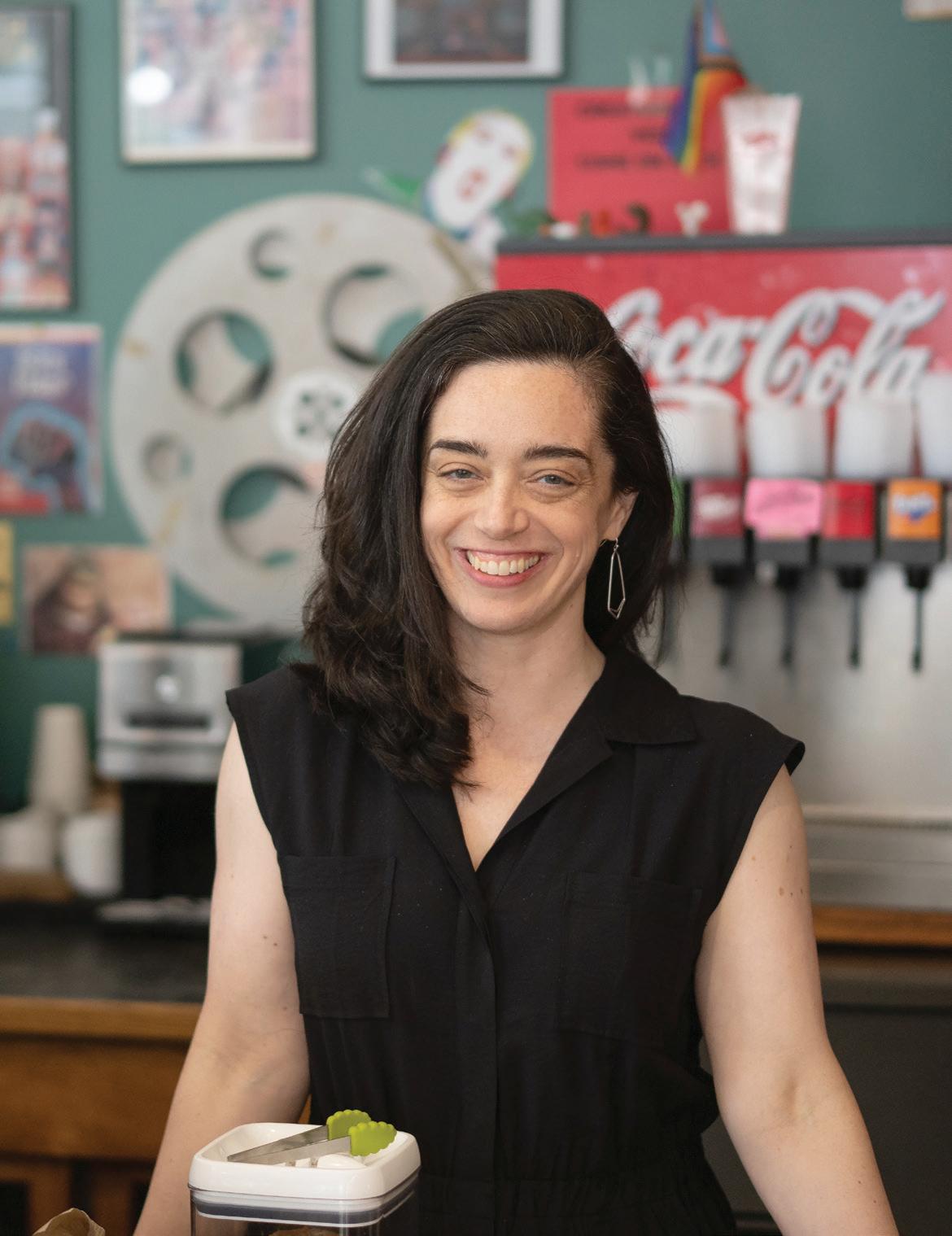
Kate Donohue, executive director of Cinemapolis, has emphasized this mission through her contributions in the past three years as director, backed by her 20year professional experience within the arts and nonprofit sectors.
is really important for diversity and for sustainability. We had a dad who brought his son to see Thunderbolts one day, and then the next day he came back and saw a documentary that he was really excited about, and he was like, ‘I love that I can do both of those things here.’”
For Donohue, making the cinematic experience accessible and inclusive goes beyond film selections and adapting the space to fit visitors’ needs and preferences.
“If we get feedback about issues with the space, we try to be as responsive as possible,” she added. “We adjusted our bathroom doors to make them lighter for people because it was a challenge. Someone told me that the seats were so low that it was really hard for her to get in and out, and we got an adjustable seat that people can use if it’s easier for them.”
While Cinemapolis is often wellregarded by the locals of Ithaca, the quaint theater has also managed to attract a variety of people, from travelers to new community members, over the years.
Bailey Sanford, a 25-year-old working at Ethiopian restaurant Hawi on Cayuga Street, moved to Ithaca from Washington, D.C., less than a year ago and has become a frequent viewer. Within her first week of moving in, she came to Cinemapolis three times, and it has since become part of her routine.
Just before 6 p.m., as the sun begins to set on a cool Saturday evening in February, Sanford sits at a table in the lobby, eating her takeout dinner from Hawi. Awaiting the premiere of the third annual
here once a week,” Sanford said. “I work at a restaurant in town, and I get off at, like, 5:00, so I usually come and see a showing around, like, 6:00 or whatever that’s playing.”
Moreover, even though Sanford admits to viewing most screenings by herself, she fondly recalls memorable experiences at Cinemapolis with the local community and her loved ones surrounding her.
“I came once on a date, and I saw the Jeff Buckley documentary movie, so that was really fun,” she said. “And then I came here on Christmas Day and saw ‘Hamnet’ with my mom and my sister, who were visiting me at the time…that was a good memory. The whole theater was kind of crying—and it was packed in here.”
Donohue felt a similar sentiment to Sanford, remarking on her meaningful and occasional interactions with moviegoers.
“There are a couple people who’ve told me that during difficult times in their life, they would just go to Cinemapolis and watch a sad movie and kind of be able to cry— and it was really cathartic and really, really useful to them,” Donohue said. “I love hearing from people that they have really special memories that go back a long way.”
Whether it's going on a first date or bonding with friends and family, a trip to the movies creates a comforting sensory experience that stands out in people’s memories instead of becoming just another mundane moment in their lives.
But beyond the films, Donohue believes that a crucial element of keeping Cinemapolis alive and rele-
preciate the fact that the person behind the popcorn counter will likely remember what toppings they want to order if they come, you know, pretty frequently. And they'll be asked: ‘What are you going to see? What did you think of it? Oh, did you see this other movie?’”
Now nearing its monumental anniversary, the theater has proved its resilience in an evolving world that has changed the ways we consume media and art.
“I think we absolutely have a bright future ahead. The model of running a movie theater might change and continue to require people to adapt, but I really don't think that experience is going to disappear, because so many people do really treasure it.”
— Kate Donohue, Executive Director of Cinemapolis
To new community members like Sanford, this achievement comes as a shock, but also serves as a true testament to its cultural value in Central New York.
streaming—accelerating declining attendance and shortened theatrical windows for commercial theaters—have left the future of cinema up in the air.
“The experience of going to the movies has been around for a long time, like 100 years,” Donohue said. “A thing that I say a lot is, there are just constant articles about how movie theaters are dying and filmgoing is dying.”
“I want the theater to be a space that is really welcoming for everybody,” Donohue said. “We have been through a few different programming initiatives successful in engaging some younger audiences, which
Ithaca Experimental Film Festival—a platform aimed at sharing bold, unconventional films from local filmmakers—visitors begin trickling in to purchase merchandise, showing tickets and snacks from smiling staff.
“I like coming here, depending on what's showing, I usually come
vant throughout the years has been their approach to customer service.
“We really love movies and we love talking to people who love movies. And so people come to Cinemapolis for the movies, but they also come because they want to talk to staff about what they’ve seen,” she said. “They also really ap-
“I think that really speaks to how large a part of the community it is, that it survived for so long,” Sanford said.
“Like, it’s really hard to keep an independent theater open, so I think that just speaks to how they get people to want to come here over and over again.”
Recent challenges like the COVID-19 pandemic and deepening concerns of the impact of
Even so, Donohue remains optimistic. Along with adapting to some of these setbacks by holding virtual community screenings during the pandemic, enhancing their presence on social media platforms like Instagram and updating their Letterboxd account, moviegoing at the cinema persists as a universally unique and cherished experience.
“I think we absolutely have a bright future ahead,” Donohue said. “The model of running a movie theater might change and continue to require people to adapt, but I really don't think that experience is going to disappear, because so many people do really treasure it.”
Kate Donohue is the Executive Director of Cinemapolis. (Photo: Mark Syvertson/Ithaca Times)
Criollo Horses Make a Home in New York for the First Time in Over 100 Years
By Mikayla Rovenolt
The Ithaca Equestrian Center is the new home of three Argentinian horses for the first time in over 100 years. The Criollos, the name for the Argentinian breed, are named Jauja, Gallineada, and Inocencia. The Angel family, which owns Finger Lakes Criollos is excited to bring the breed back to New York.
Valeria and Guillermo Angel moved to Ithaca with their children in 2024, when the couple began working remotely. Valeria had always loved horses and wanted to learn to ride one, she said. When she learned of the Ithaca Equestrian Center on Trumansburg Road, she was excited by the prospect of living a life involving horses.
“I’ve always felt that connection and admiration for the horse as an animal,” Valeria said. “I tell my husband it’s like a platonic love — you love them, you admire them, but it’s from afar. I didn’t really deal with them at all, and so when this move is happening, and of course this is his passion and his love, I start to go out of my comfort zone and actually enjoy that love in a very real way.”
Guillermo grew up farming in Argentina, surrounded by animals and Argentinian horses. For him, moving to Ithaca and bringing his love for the horses here was exciting and easy, he said.
Valeria said that Argentinian horses are a special breed of horses that come from the Patagonia region of Argentina, which is very cold, rugged, and sometimes dangerous. She said these horses were originally brought to Argentina by the Spanish and became wild over time as they escaped war or were left by their owners. Through natural selection, these wild horses became very strong and resilient within the climate of Patagonia.
“They could withstand any type of weather and they could eat or survive with whatever food they could find,” Valeria said. “So, many years go by, and the indigenous people, together with the Europeans, start
to notice those horses. They have great characteristics, and they start to look for ways to catch them.”
Through this process of domesticating the then-wild horses, the people of Argentina and the Europeans settling there created the Argentinian horse. Valeria added that people found these to be great work horses.
Valeria said that today, Thoroughbred horses and Argentinian horses are bred together to create the traditional polo horses. Valeria and Guillermo said not many people are aware of the breed outside of their uses in polo.
Paula Wedemeyer, a coowner of the Ithaca Equestrian Center, said she was unaware of Criollos until the Angels brought the idea of having Argentinian horses in Ithaca, which now reside at her stables and pastures.
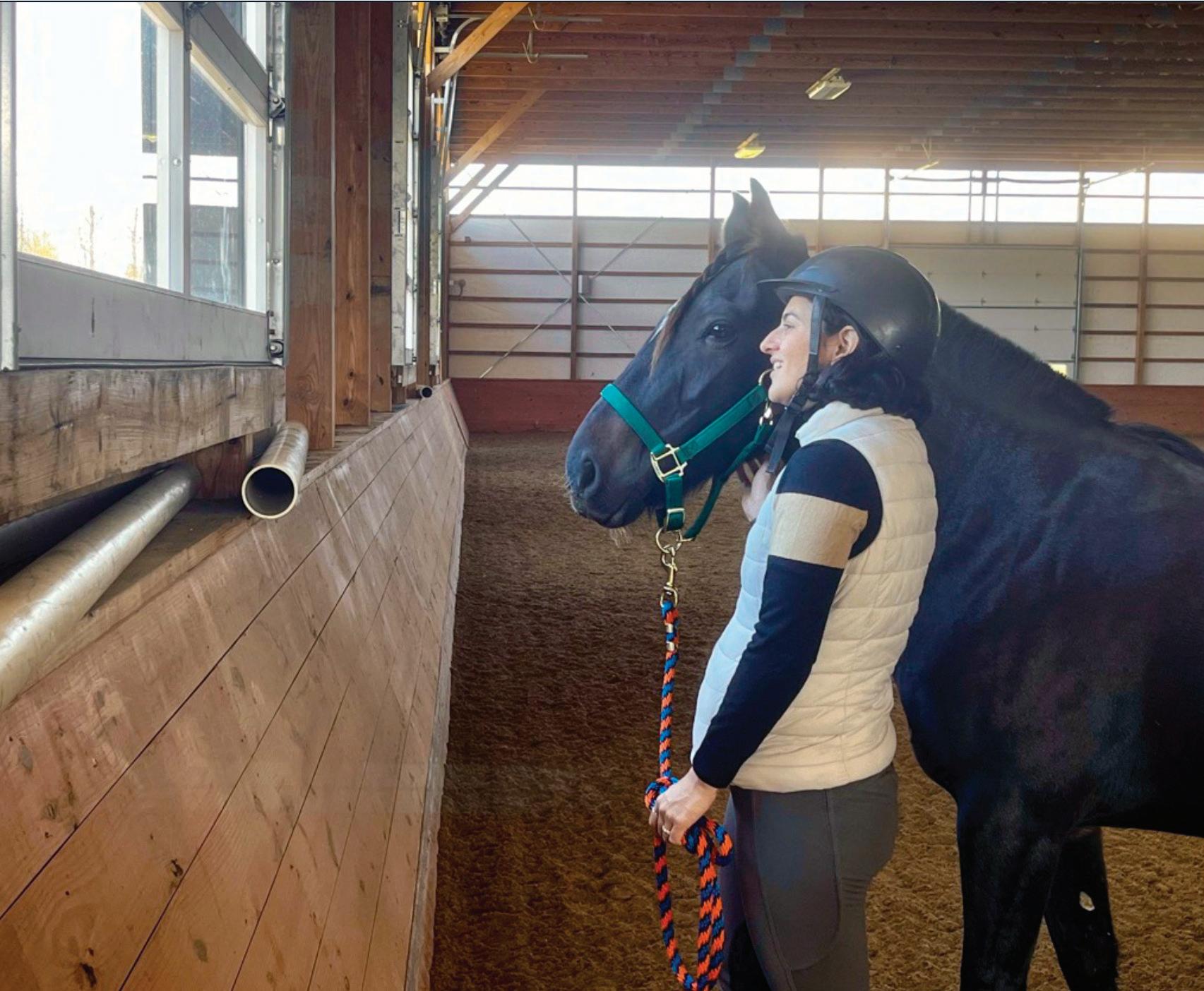
“These horses are really smart,” Wedemeyer said. “And what happens is, if they get afraid of something, they just stop, they don’t take off tearing, they just sort of stop and check out, and then right away start interpreting what’s going on. Then they look to you like, ‘Go ahead and do what we’re doing.’”
She said other horses tend to take off when scared and reflect later as a way to protect themselves, but the Argentinian breed does not do that. She added that they are very trusting, and she described one of the younger horses as cat-like. The young horse will follow people around and enjoys cuddling.
“They’re the foundation of what you use for polo horses,” Wedemeyer said. “You have these horses, and then you put them together
with a thoroughbred, and that’s where you get the traditional Argentinian polo horse, which is very strong, very fast, very intelligent, and they able to move quickly, but with a good friendly temperament.”
Having these horses in New York is a big deal to Valeria and Guillermo. She shared the story of a Swiss man, Aimé Tschiffely, who a century ago rode two Argentinian horses over two years from Buenos Aires, Argentina, to Washington D.C. and eventually to New York City. The horses, Mancho and Gato, traveled over 10,000 miles for this journey, according to Valeria.
“He is very famous in the equestrian world,” Valeria said. “He inspired a whole group and generation of people who like to do this long ride with horses, and he wrote a book about it from the horses’ perspective. I’m a filmmaker, and nobody has made any films, like any serious documentaries or
narratives, based on this. And so I started looking at it, and it’s a project that we're now working on.”
Valeria shared that one of their goals with Finger Lakes Criollos is to eventually breed the horses and grow their population in the U.S., though they are just in the beginning phases of that plan by getting to know and build relationships with their three family Criollos.
“There is no other place like this in Ithaca, so the Ithaca Equestrian Center has been critical for us to be able to bring the horses here,” Valeria said. “And trusting somebody who knows, even if they didn’t know the breed before, but with the experience that Paula has, trusting her lead and Guillermo’s knowledge to be able to put all of that together and make it all successful. I think that happens when things come together the right way, and we don’t even have to force it.”
Valeria and Gallineada together at Ithaca Equestrian Center. (Photo: Mikayla Rovenolt)
VETcorner
Pet Tips from a Local Vet
All About Feline Viruses
Brian Collins, DVM Cornell University College of Veterinary Medicine
By Mikayla Rovenolt
Q:What are some common feline viruses cat owners should be aware of?
A. Upper respiratory viruses in cats are common and include the Feline Rhinotracheitis Virus (FVR) --also known as Feline Herpesvirus type 1 -- and Feline Calicivirus (FCV). Both can cause upper respiratory signs including ocular and nasal discharge, sneezing, coughing, and conjunctivitis. Cats may have a fever, as well as lethargy and decreased appetite. Cats with FVR may also develop corneal ulcers, while cats with FCV may also develop ulcers in the mouth, sores on the skin, as well as pneumonia. Cats can become persistently infected with these viruses and be a source of infection for other cats.
B. Feline Coronavirus (FCoV) is a common viral infection in cats, but it is not the same virus that causes COVID-19 in people. It most commonly causes mild diarrhea, though many cats will not show any signs of illness. In certain situations, it can mutate into a more serious form of the virus and result in a condition called Feline Infectious Peritonitis (FIP).
C. Feline Leukemia Virus (FeLV) is a retrovirus that can cause severe illness in cats and typically results in a much-shortened life expectancy. It can result in a wide range of signs such as lethargy, weight loss, diarrhea, eye problems, and enlarged lymph nodes. Cats often become anemic, are susceptible to secondary infections, and develop cancer such as lymphoma or leukemia.
D. Feline Immunodeficiency Virus (FIV) is another retrovirus that is comparable to HIV in people, though cats and people do not pass these viruses between each other. FIV weakens the cat’s immune system, making them more susceptible to secondary infections and cancer such as lymphoma. Clinical signs can be similar to those with cats infected with FeLV, though cats with FIV can often live long lives with proper care.
Q:What is the best way to prevent indoor cats from getting sick?
Being indoors is the most effective way to prevent indoor cats from getting sick. For cats who are already infected with one or more viruses, an indoor lifestyle will help reduce their chances of becoming sick, allow for
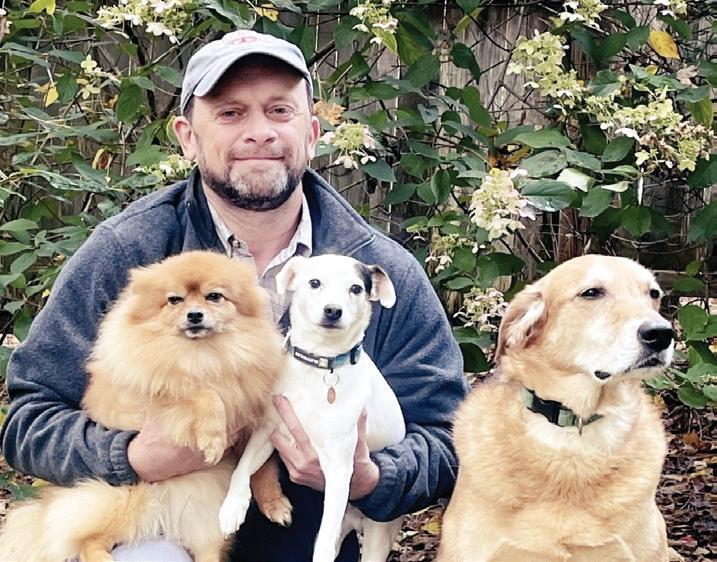
closer monitoring of their health, and enable early intervention for problems that arise. Cats with FeLV and FIV will benefit from more frequent checkups that may include blood and urine tests to screen for infections and other conditions. Early diagnosis and treatment of secondary conditions will help keep cats healthier.
Q:How common is Feline Immunodeficiency Virus (FIV)?
The prevalence can vary geographically, but in North America, FIV is detected in about 2.5-5% of healthy cats. In sick cats or cats who are at greater risk of infection (e.g. outdoor cats, cats living in groups, unneutered males who fight with other cats) the number of infected cats may be 15% or greater.
Q:How can cat owners treat FIV?
Treatment of the virus itself is rarely pursued. However, preventive care is very important, which includes an indoor lifestyle whenever possible, frequent checkups and testing as recommended by a veterinarian, good nutrition, and regular parasite prevention. Seeking veterinary care at the first signs of an illness is important. Treatment is focused on secondary conditions that arise due to the cat’s weakened immune system.
Q:What are some common symptoms cat owners should look out for regarding FIV?
Signs of FIV will vary from cat to cat. General signs may include lethargy, decreased appetite, weight loss, and poor coat condition. Secondary infections may appear in the skin, urinary tract, and respiratory tract. Gastrointestinal signs include vomiting and diarrhea. The nervous system may be affected resulting in behavior changes, seizures, and other neurologic conditions. Inflammation in the mouth and gums is common. Lymph nodes may be enlarged.
Q:How common is Feline Coronavirus (FCoV)?
The prevalence of infection with FCoV will vary depending on the situation, but overall, it is quite common though many cats will not show signs of illness. In households or catteries with several cats or more, the rate of infection and illness can reach as high as 100%. In single cat households or in feral cats, infection and illness are much less common. The number of cats with FCoV who develop FIP is also higher in situations where there are multiple cats living together.
Q:What are the symptoms of FCoV?
Mild diarrhea is most common, but vomiting and mild upper respiratory signs can also be seen.
Q:Can FCoV be treated?
FCoV typically does not require treatment unless FIP develops, which is a much more complicated situation. However, in simple cases, cats typically recover on their own or with mild supportive care.
Volunteer
Of the Month
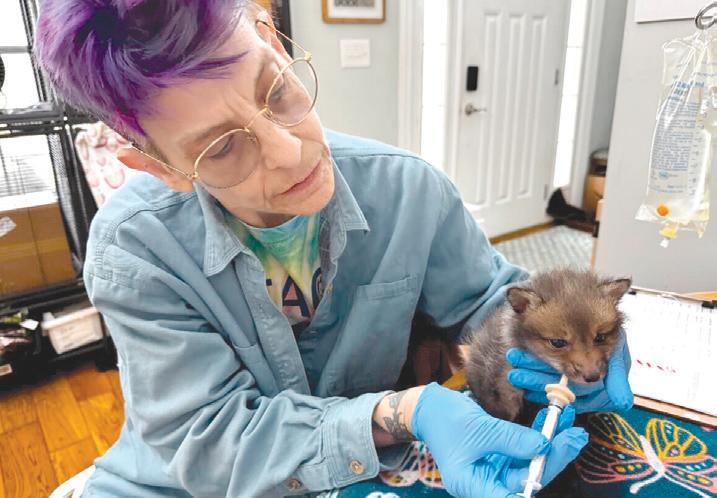
Wild by Nurture is so grateful for volunteers like Maria. From Claire Peters, founder and owner of Wild by Nurture, “Maria is an incredibly dedicated member of our team who shows up regularly, always ready to help wherever she’s needed. She’s also gone the extra mile to become licensed and now cares for a small number of baby animals in her own home. Her compassion, commitment, and excellent care make her such a valued part of our rescue family. Volunteers like Maria truly help make saving lives possible every single day.”

Trivia with Scott McArt Associate Professor, Department of Entomology, Cornell University
1) What is a male honey bee called?
2) Honey bees foragers communicate information about the distance and direction to food sources with their nestmates. How do they communicate this information?
3) Approximately how many domesticated honey bee colonies reside in New York?
a. 10,000 b. 20,000
c. 40,000 d. 80,000
4) Approximately how many species of wild bees reside in New York?
a. 50 b. 250 c. 450 d. 1050
5) The common eastern bumble bee (Bombus impatiens) is New York’s most abundant wild bee. It has also been domesticated and is shipped around North America, primarily because it’s excellent at buzz pollination. Buzz pollination is when a bee vibrates at an ultrasound frequency to release pollen from certain flowers. Growers of which greenhouse-grown crop that requires buzz pollination purchase the most domesticated common eastern bumble bee colonies?
6) How many ground-nesting bees were recently estimated to be living in the East Lawn Cemetery in Ithaca, NY?
7) There are over 20,000 species of bees in the world. What percentage of these species nest in the ground? a. 100% b. 75% c. 25% d. 5%
8) The largest bee in the world, Wallace’s giant bee (Megachile pluto), has a wingspan of 63.5 mm (2.5 inches) and resides in Indonesia. Where does this bee make its nests?
ANSWERS:
1) A drone
2) Via the waggle dance
3) d. 80,000
4) c. 450
5) Tomatoes
6) 5.5 million
7) b. 75%

8) In active nests of the tree-dwelling termite, Microcerotermes amboinensis.
Brian Collins with his dogs Dottie, Speck and Iris. (Photo: Provided)
Maria, Volunteer Wild by Nurture
(Photo: Provided)
Lethal Variant of Feline Coronavirus
Found in U.S. PEThealth
By Mikayla Rovenolt
Cornell researchers Gary Whittaker and Ximena A. Olarte-Castillo have discovered that a lethal variant of feline coronavirus (FCoV) has appeared in the United States. The variant, previously thought by scientists to be limited to a 2023 outbreak on the island of Cyprus that killed thousands of cats, raises concerns about potential large-scale outbreaks in vulnerable cat populations.
The findings of the study were published in the March 6 issue of the Journal of Feline Medicine and Surgery by a group of researchers at the Cornell University College of Veterinary Medicine.
According to the research study, FCoV is common among cats and typically causes mild or asymptomatic infections. In some cases, feline coronavirus can mutate within a cat’s body and cause feline infectious peritonitis (FIP), a severe disease that is often fatal if not treated.
“Most people will clear a coronavirus infection,” Whittaker said. “All through the pandemic, we’re getting infected, some several times, because the virus was changing and coming back with all these different variants, but feline coronavirus is a little different, and the cats don’t really clear the virus. It seems to go into this dormant phase.”
The most common form of the virus, FCoV-1, tends to be fairly benign and highly transmissible but unable to easily spread. A less common variant, FCoV-2, which is a hybrid of a feline and a canine coronavirus, accounts for only about 5% of FIP cases worldwide; the specific strain of FCoV-2 that impacted the cat population on Cyprus is known as FCoV-23, or Cyprus-23.
Despite the presence of high-risk viral features in U.S. samples, outbreaks on the scale of Cyprus have not occurred here thus far. Researchers believe this is largely due to differences in cat population structure.
Whittaker said that most people have single-cat households in the U.S. and that for many cats here, they are probably carriers of a dormant virus that does not have the opportunity to spread. He said in the U.S., many people get their cats from shelters, breeders, or adopt them as they find them on the streets. He said most of these cats probably have some sort of dormant FCoV variant that has not been triggered by a stressor. In Cyprus, the free-ranging cat popula-
spread as often in the U.S. because single-cat households are more common. (Photo: Mikayla Rovenolt)
tion was larger and more dense than freeranging cat populations tend to be in the U.S. Because of this denser population, the virus was able to spread more easily. Whittaker warned that in areas like New York City, this same thing could happen with similar conditions.
The findings of the study underscore a need for improved diagnostic tools, surveillance, and awareness among veterinarians. Whittaker said distinguishing between FCoV1 and FCoV-2 in clinical settings can be difficult but that his team is working to develop rapid diagnostic tests, similar to COVID-19 tests. The tests would provide rapid results, allowing for more targeted responses.
The urgency of finding answers to the FCoV-2 threat warranted funding from the Cornell Feline Health Center’s Rapid Response Fund, established in 2012 in order to fast-track research. This grant is the latest of over a dozen supporting urgent, highimpact research on emerging threats to feline health that cannot wait for submission through the annual Cornell Feline Health Center grants program.
“The importance of this study, in terms of an epidemiologic perspective, is that it's the first to report on versions of the spike protein in the United States, which have previously only been seen in that FCoV-23 outbreak in Cyprus,” Bruce Kornreich, director of the Cornell Feline Health Center, said. “We have an urgent need to understand what it means for health here in the United States.”
“Understanding how these viruses transmit, evolve and cause disease is important for improving diagnosis, treatment and prevention, and how they’ll develop into the future” Kornreich said. “This work highlights the importance of surveillance in general.”
CodaPet Expands In-Home Pet Euthanasia Services in Ithaca, NY
By Mikayla Rovenolt
Families seeking in-home pet euthanasia in Ithaca now have greater access to care. CodaPet, a veterinarianowned network of in-home euthanasia providers, added licensed veterinarian Dr. Jorge Adarraga to serve the Ithaca area. The company aims to provide “peaceful, inhome euthanasia” that allows pets to pass at home, where they feel most at ease and surrounded by the people they love, according to a statement from CodaPet.
For many pet owners, saying goodbye to a beloved companion can be one of the hardest moments of life. Recognizing this, Adarraga, a Cornell-trained veterinarian, is now offering in-home euthanasia services for pets within a 40-mile radius of the city.
Dr. Karen Whala, Dr. Gary Hsia, and Dr. Bethany Hsia are co-founders and veterinarians of CodaPet. In a press statement, they said they “share a passion for increasing customer access and awareness by empowering a network of veterinarians who provide compassion and professional care to more pets and their families.”
“As an in-home euthanasia veterinarian, I repeatedly hear the heartfelt gratitude and the relief a family feels when they have been able to grant their pet this gift,” Whala said in a press statement. “It is my wish that every family in Ithaca becomes aware of at-home pet euthanasia so they may provide a peaceful and compassionate end-of-life experience for their beloved pets when their time comes.”
Adarraga earned a bachelor’s degree in animal science at the University of Maine in 2012 and his Doctor of Veterinary Medicine from Cornell University in 2017. He then spent over seven years as an associate veterinarian at Cornell’s Animal Health Diagnostic Center and a year as a general practitioner at VCA Southern Tier Animal Hospital in Vestal, NY.
“Ithaca, NY, and its surrounding communities have many dedicated pet owners and a strong veterinary presence through Cornell University and various small-animal hospitals,” Adarraga said in the statement. “Yet there remains a significant need for in-home euthanasia services. Providing this option would offer families across the region a compassionate and invaluable service.”
According to a statement, Adarraga saw firsthand how stressful clinical visits could
be for pets, especially at the end of life.
“While in clinical practice, I often saw how stressed pets became in a hospital setting, especially during end-of-life visits,” Adarraga said. “That's why I now offer in-home euthanasia; to ensure pets spend their final moments in a peaceful, familiar setting, surrounded by the people and comforts they love.”
Adarraga serves Ithaca and the surrounding Finger Lakes communities, including Cortland, Lansing, Dryden, Trumansburg, Groton, Watkins Glen, and other towns across Tompkins County, Cortland County, southern Cayuga County, Schuyler County, and Tioga County.
Through CodaPet's website, pet parents can book in-home pet euthanasia performed by a licensed vet. Before the appointment, the vet contacts the family to address questions and concerns, and assists the family by going over the pet’s diagnosis and assesses the pet's health and ensure there is not uncertainty about the need for euthanasia.
On average the visit takes one hour and pet parents have time to be with their pets privately before and after the procedure, which lasts about 15 minutes. The vet only starts the euthanasia process when everyone is ready. For those who need support with aftercare, CodaPet also assists with transportation and cremation services.
For more information or to schedule an appointment, visit their website or call 1-833-CodaPet. If you are a veterinarian interested in learning more or offering this service in your area, please visit codapet. com/vets.
June 2026 Pet Holidays
National Adopt a Cat Month
National Foster a Pet Month
June 4: Hug Your Cat Day
June 7-13: Pet Appreciation Week PAW
June 18: Clean Your Aquarium Day
June 22: Take Your Cat To Work Day
June 24: Cat World Domination Day
June 26: Take Your Dog To Work Day
Feline coronavirus does not tend to
Arts&Entertainment
Trumansburg Author Publishes “An Old Beauty”
By Mikayla Rovenolt
Trumansburg-based author
Richard Figiel has published a number of books about New York State history with Globe Pequot and SUNY Press, including a book about New York wine, and is excited to share his new book, “An Old Beauty,” with the community.
“An Old Beauty” is set in the Adirondacks and is the story of the iconic guideboat, a symbol of the Adirondacks and the guides who worked out of the great Lake-House hotels in the late 19th and early 20th century.
“ e guideboat is literally a creature of the Adirondack forest, cra ed from its native trees by skilled woodsmen into the perfect boat for the region’s waters,” Figiel wrote in a press statement.
Figiel, who spent many years vacationing to the Adirondacks as a young boy with his family, started his writing journey as an editor for a book publisher, Prentice Hall. He then also went on to work for Wine Now, a wine magazine based out of New York City.
It was with Wine Now that Figiel came to know the Finger Lakes region, as he was occasionally own to the area by winemaking companies to help promote their operations and products.
Figiel said that a highlight of working on “An Old Beauty” was reminiscing about his childhood and time spent with family in the Adirondacks. He said his family camped all over, from Lake George to Saranac Lake. He began writing the book because of his interest in history, he said.
“I got interested in the culture of the guides that used to work in the Adirondacks, working out of the big old hotels along the lakes,” Figiel said. “We used to occasionally visit some of these old hotels, which were kind of failing at the time and even disappearing. I started doing some research on the Adirondack guideboat, which is a kind of a unique creature.”
Figiel said the guideboat is a symbol of the Adirondacks and is a cross

between a rowboat and a canoe. It was developed out of the culture of the old guides that used to work in the late 1800s and early 1900s.
He explained that hotels in the area would have a crew of guides that worked for them at a time when there were very few roads and a lot of wilderness in the Adirondacks. Figiel said the waters of the Adirondacks are unique in that there are a lot of lakes with rivers and creeks that connect to the lakes.
According to Figiel, because the Adirondacks were just being explored and were mostly unpopulated, the waterways acted as roads. e guides would take sportsmen into the woods for days to months on end for camping and hunting trips and the guides, through their work, became experts in the waterways and woods around them.
“ ey took care of these sportsmen, and they built up a whole culture and even a mythology about [the guides], where they were the experts of the region,” Figiel said. “It was an interesting time because the Adirondacks were going through a complete transformation from being a remote wilderness to gradually becoming more settled and bringing up these old hotels with a culture of their own.”
e guides made boats out of what they found in the woods, and built them using di erent methods of framing the boats. Figiel said they were designed in a way where the boat was rowed backwards so that the guides could talk to the sportsman while they were rowing and tell them what lures to use for their shing, or where to shoot.
Figiel added that there is a museum with a room dedicated to the guideboat, e Museum of Blue Mountain Lake.
Figiel compared the making of guideboats, done in a traditional way, to his way of winemaking on Seneca Lake.
“I did it in a very basic, almost primitive way,” Figiel said. “I didn’t particularly like the modern technologies of winemaking. I didn’t like some of the additives that were used. I didn’t particularly like the technology of cold fermentation, things that are commonly used now, so that that kind of intrigued me, in the respect that it was very much like the guides who would look for the woods in the forest that they could use to construct these boats… at inspired me, in a way, to create this story, which is mostly historical.”
“An Old Beauty” will be available at Odyssey, Bu alo Street Books and online at https://thebookstoreplus.com/ soon. It will not be available on Amazon.
Trumansburg-based author Richard Figiel previously ran a winery on Seneca Lake while also writing a variety of books. (Photo: Provided)
Syracuse Stage’s “Frozen” Brings Broadway Magic Within Reach
By Barbara Adams
For many Ithacans, seeing a Broadway musical may be out of reach — a 4.5-hour ride to New York City, plus the cost of accommodations, parking, and theatre tickets ($120 and up). But for an easy 60-minute drive and decent seats costing $35 to $95, all the wonder may be yours.
That’s because Syracuse Stage’s current show, co-produced with Syracuse University Department of Drama, offers an experience as thrilling as any Broadway musica — and with the greater intimacy of a smaller venue. It’s the central New York premiere of “Disney’s Frozen,” its tale (book by Jennifer Lee) loosely inspired by Hans Christian Andersen’s “The Snow Queen.” The musical opened in 2018 but shut down in two years because of the pandemic, so most of us are more familiar with the 2013 animated film.
If you doubt that the movie’s icy marvels could possibly translate to the stage, fear not: this production is breathtaking.
"Disney’s Frozen –The Broadway Musical"
Directed by Emily Maltby; music direction by Brian Cimmet; choreography by Marjorie Failoni. Music and lyrics by Kristen Anderson Lopez and Robert Lopez; book by Jennifer Lee.
Based on the Disney film written by Jennifer Lee and directed by Chris Buck and Jennifer Lee.
At Syracuse Stage, 820 E. Genesee St., Syracuse. Through June 21. Wed.-Sun. evenings, plus Tues. June 9 & 16, with Sat.-Sun. & Tues. June 3 matinees. Tickets at syracusestage.org and 315-443-3275.
ITHACA’S MATERNAL HEALTH CRISIS
continued from page A9
the bill can provide the momentum needed to push it to the floor. It has become too expensive, and in many places, too dangerous to have a baby in this country. Without interven-
All credit to director Emily Maltby and a superb design team. Czerton Lim gives us scene after scene at the royal palace and in the frozen mountains, each one diverse, detailed, and vast in scope. Dawn Chiang’s bold lighting transforms them all, backed by David Murakami’s stunning projections (the shipwreck, the varied snowstorms). Jacqueline R. Herter’s sound effects animate the mood throughout.
And Maltby’s large cast is splendidly costumed, by Ryan J. Moller (with wigs by Bobbie Zlotnik, most attractively for the sisters). Anna’s vivid frocks and Elsa’s more subdued, regal gowns; the courtier’s uniforms; the bathing towel wraps and caps in the hilarious sauna scene (delicious choreography by Marjorie Failoni) — all perfect. But most amazing are the wood sprites (again, played by this talented and versatile ensemble) — green men and women come to life, extruding twigs and earthy debris. Quite simply, this show is a visual feast. (I kept murmuring “oh!” and “ah!”) And I haven’t even got to the story yet.
In this folktale, two little princesses are close but separated, because the elder, Elsa, has magical powers that need controlling. Her very touch freezes and can even kill.
When the sisters lose their parents in a shipwreck, they grow up lonely, until the day Elsa comes of age and will be crowned queen. Her forced public appearance sets off a series of events, which lead Elsa to escape to the farthest frozen reaches and Anna to risk all in pursuit of her.
The narrative is highly episodic, with many little scenes, and Maltby keeps the action moving every bit as swiftly as in the movie. As the little Anna and Elsa, Brynn Eisenman and Aleena Dueñas (Aurora
tion, maternal care deserts will continue to expand. Costs will continue to climb. We must support the Keeping Obstetrics Local Act to protect the future families of Ithaca and the Finger Lakes. A safe delivery must be a right, not a luxury.
Lucas Hooker is a Medical Student at Upstate Medical University.
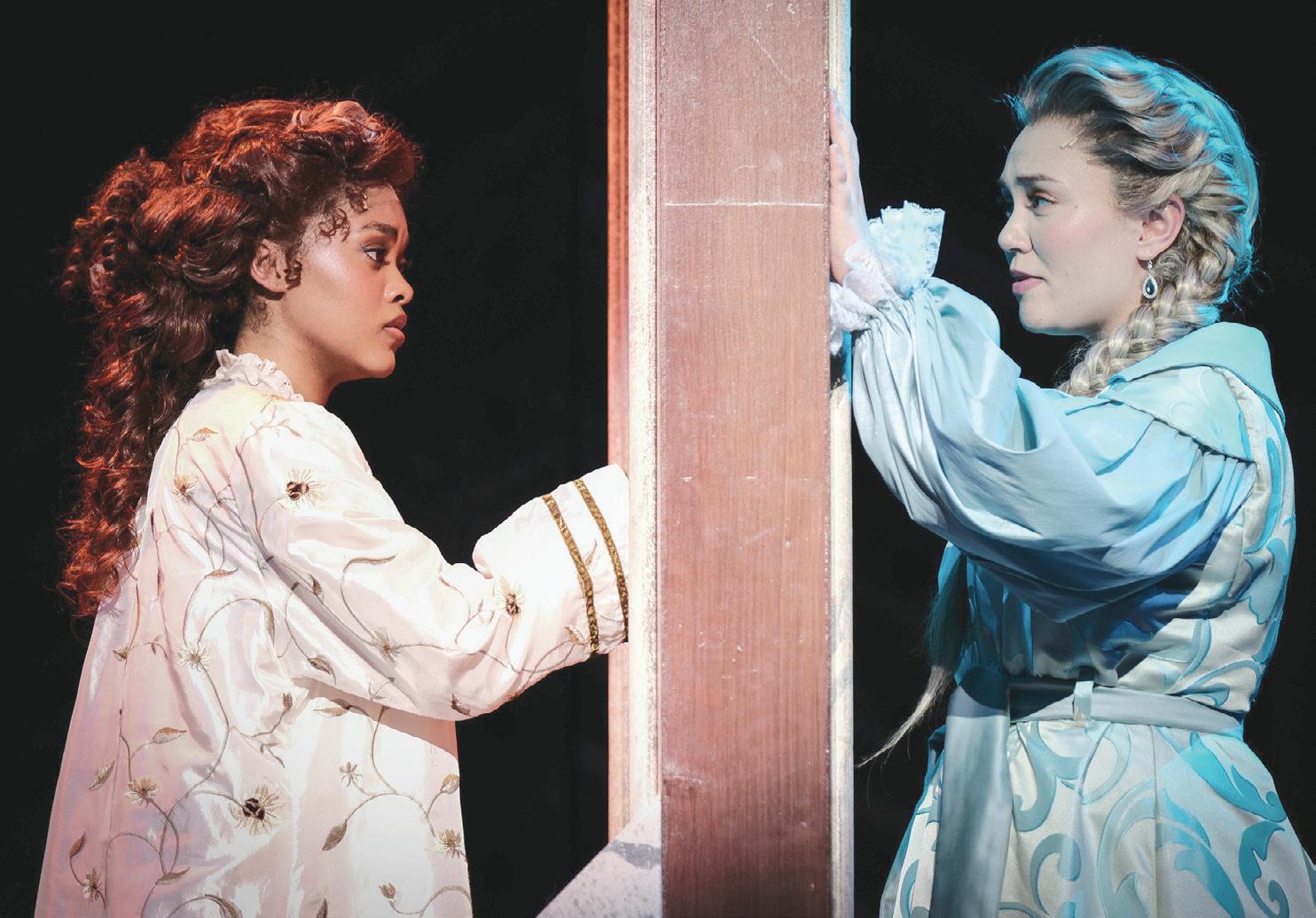
Wantuch and Maddie Kandel alternating) are lively and compelling, beautifully characterized. Once grown up, Anna (Tanner Cox) and Elsa (Lyda Jade Harlan) are showstoppers, each in her own way. Cox is spirited and daring and comical, with a lovely voice; from palace to peak she’s a scrambling bundle of energy. Harlan is reserved and stately, with a striking voice — sonorous, sweet, and impressively clear; her act one climax, “Let It Go,” is haunting.
Around these two fine principals swirl a host of others, all excellently sketched. Kristoff, the ice harvester whom Anna enlists to help her, is a skeptical Koray Tarhan; his loyal reindeer Sven is nicely acted by Jack Wyant from within an enormous puppet. David Lowenstein aptly hams it up as the foolish opportunist, Weselton, and the girls’ parents are nobly acted by Kai An Chee and Michael Everett.
Beau Harmon and Glendaliris Torres-Greaux present the leaders of the leafy hidden folk; their affectionate song about Kristoff, “Fixer Upper,” is an impish delight. And Matthew Dodaro is a persuasive Prince Hans, the 13th son in search of a kingdom (even if it means faking love); his powerful voice is downright heroic.
Two comic actors provide continual laughter and unstinting pleasure. Peter
Surace is the hearty Norwegian shopkeeper who impishly bargains and brags and excites everyone with his welcoming “Hygge,” the song celebrating coziness and conviviality. And of course there’s Olaf, the little snowman that the girls built years ago; he joins Anna, Kristoff, and Sven on their journey to find Elsa. Behind a remarkable puppet, Brendan Malafronte voices him very like the movie version and renders him incredibly funny and sympathetic. His paean to summertime is bittersweet, as he doesn’t know that’s when he’d melt.
Whether the songs in “Frozen” — music and lyrics by Kristen Anderson Lopez and Robert Lopez — are catchy (“Do You Want to Build a Snowman”) or triumphant (“Let It Go”), they’re uniformly memorable. Brian Cimmet’s orchestra provides strong support, though the sound mix sometimes obscures the lyrics. But the plot and themes are still easily comprehended: relying on community, acting selflessly for those we love, taking risks, and even just daring to feel rather than shut down. Syracuse’s dazzling production of this uplifting fable is assuredly bringing joy to adults as well as children.
Barbara Adams is a regional theatre and arts journalist and retired professor of writing, Ithaca College.
Anna (Tanner Cox) and Elsa (Lyda Jade Harlan) in the Syracuse Stage production of “Disney’s Frozen The Broadway Musical.” (Photo: Michael Davis/Syracuse Stage)
“Steal This Story, Please!” Is the Most Inspiring Journalism Film Since “Spotlight”
By Clement Obropta
Amy Goodman has worked tirelessly as a journalist for decades. For the daily independent progressive news outlet Democracy Now!, she has reported on the major issues of the day, both at home and abroad, from the Dakota Access Pipeline protests to the immediate a ermath of the American invasion of Iraq.
e documentary “Steal is Story, Please!” covers Goodman’s story and the story of the outlet she co-founded back in 1996. e lm is privately produced and is slowly rolling out across the U.S., and Ithaca is fortunate enough to have the documentary this week at Cinemapolis. e format and presentation of the lm is hardly new — like many biographical documentarians before them, lmmakers Carl Deal and Tia Lessin present a linear play-by-play of Goodman’s biggest stories while regularly spelunking into her Jewish upbringing in Brooklyn to add some dimension to their subject. But the directors, who are probably best known for producing Michael Moore’s lms, cover Goodman’s story with the same curiosity, clarity, and perspicacity that Goodman herself brings to her reporting. e result is perhaps the best journalism lm since “Spotlight,” a truly great documentary that will likely reignite in American audiences a ery belief in the importance of the fourth estate and, ultimately, teach them how to be better citizens.
Democracy Now! does not rely on corporate or government funding and airs on 1,500 radio and TV stations every day. Unlike most corporate media, Democracy Now! is an institution dedicated to legitimately holding truth to power, questioning and subverting o cial narratives to get at the o en-messy reality underneath the surface. To listen to a Democracy
This Story, Please!”
Now! radio broadcast, podcast episode, or TV clip is to engage with a kind of journalism that feels as though it’s endangered. Goodman’s principles as a reporter return to the forefront again and again throughout the documentary, beginning with the 1996 freeing of Moreese Bickham, a former Navy serviceman living in Louisiana who was given the death sentence a er shooting and killing two police o cers in self-defense. ough the sentence was later reduced to life without parole, Goodman reported on Bickham’s case on her show for months, becoming part of a national campaign that eventually succeeded in freeing Bickham. “She believes that journalism, put to its highest use, can be the greatest force for good that the world has seen,” one of Goodman’s colleagues says.
Many of Goodman’s toughest assignments as a reporter put her directly in harm’s way, from reporting on state violence in East Timor to covering the unrest in Nigeria a er the murder of Ken SaroWiwa. In Nigeria, she and colleague Jeremy Scahill sought to confront the links between the brutal military dictatorship and the Chevron Corporation’s extraction of oil in the delta. ey went to the headquarters of Chevron in the Niger Delta and, to their utter surprise, managed to interview the company’s head of media relations in the country, who openly admitted to Chevron calling on the military to forcibly remove and even shoot protesters.
Of course, researching the a ermath of these cases spoils much of the rousing inspiration the documentary is so good at capturing. Indonesia has never been held accountable for the genocide it committed in East Timor, and Chevron was exonerated in court for its alleged crimes in the Niger Delta. At least Moreese Bickham was able to live happily with his family for another 20 years a er his release before his death in 2016.
But the real power of the documentary lies in Goodman’s philosophy of using radio as a medium of connection and love, her ardent belief in the primacy of showing up and asking the questions nobody’s thought to ask, and her conviction in the importance of good journalism. No
other story the documentary shows articulates this better than when, in the a ermath of the September 11 attacks, Goodman and her team remained in their Chinatown studio reporting the news for days because they were in the middle of the evacuation zone — if they’d le , they likely would not have been let back in.
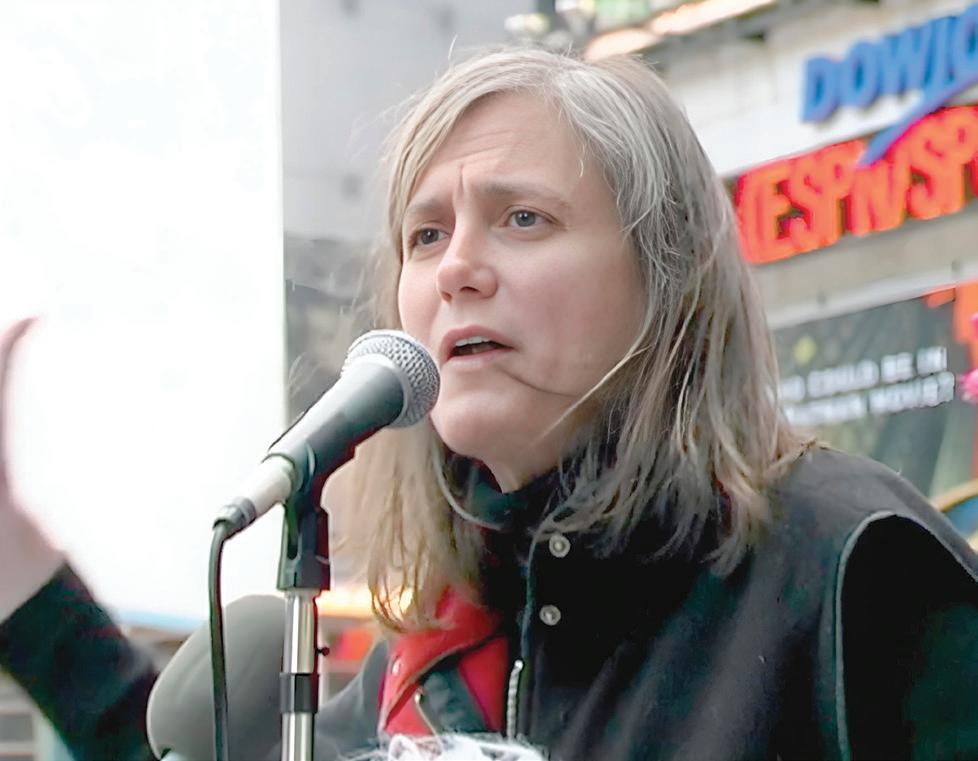
Whether you listen regularly to Democracy Now! or not, good journalism is the backbone of democracy. e documentary doesn’t have any easy prescriptive solutions for the threat Donald Trump poses to our civil rights, and the journalists it features likely don’t, either. But the dogged persistence of
outlets like Democracy Now! and the bravery of these principled reporters provide a beacon of hope in the darkness.
Clement Obropta is a lm columnist for the Ithaca Times.

Amy Goodman from Democracy Now! speaks out against the war in Iraq. (Photo: Doc Society/Elsewhere Films)
GOOD NEIGHBORS BUILD STRONG RELATIONSHIPS AND COMMUNITIES
This week, it’s Peaches Gillette!
By Roy Allen
In Ithaca and the surrounding towns, good neighbors have never been in short supply. Houses of worship open their doors with welcome. Volunteer groups quietly organize meals, rides, clothing drives, and acts of care. Community centers host gatherings, recovery meetings, youth programs, and support circles. These are the places where servant leaders show up, week after week, turning compassion into action.
The Who’s Your Neighbor? Directory, created by the Ithaca Times, was born from a simple desire: to help people find faith communities, spiritual services, outreach programs, and activities that foster connection, care, and belonging. Working with Eric Clay, we gathered information so neighbors could easily discover where meals are served, where support groups meet, where children are welcomed, and where kindness is freely offered.
Yet a directory is never just about buildings or calendars. It is about people—the servant leaders whose steady, faithful presence weaves our community together long before any crisis arrives. The true strength of a neighborhood is revealed when people show up for one another in the hardest seasons.
This week, we lift up one of those faithful servant leaders: Peaches Gillette. For years, Peaches has been a steady light in our region. She preaches at the First Unitarian Society of Ithaca, co-hosts the thoughtful “The Made of Clay Report with Peaches Gillette and Eric Clay” on WRFI Community Radio, serves as a chaplain in Horseheads, chairs the Board of Shared Journeys, and founded All Eyes and Ears on Racism. Through every role, she has shown up with listening ears, a courageous voice, and an open heart.
She has sat with people in grief, spoken boldly for justice and mercy, challenged systems that overlook the vulnerable, and built bridges across lines of race, faith, class, and politics. She has offered spiritual care, advocacy, honesty, and unwavering compassion to countless neighbors. Peaches is the very definition of a servant leader—one who serves with her whole self, quietly strengthening the fabric of our community.
Now, this dedicated servant leader needs her community to show up for her. Peaches is facing a recurrence of stage four cancer and has been told she is not a candidate for a kidney transplant. Friends have launched a GoFundMe to help with mounting medical expenses, daily
living costs, and her responsibilities caring for the great-nephews she has lovingly raised as her own grandchildren.
As so many families facing serious illness know, the burden reaches far
beyond medical bills. Appointments, medications, transportation, caregiving, lost income, and daily uncertainties add up quickly. Peaches has also discovered concerning gaps in prior diagnosis and follow-up
Peaches Gillette preaches at First Unitarian Society of Ithaca. (Photo: Provided)
care—experiences that sadly reflect broader inequities many face in our healthcare system.
In addition to financial support, she is seeking recommendations for a medical malpractice attorney willing to review her case. This is our moment to live out the spirit of “Who’s Your Neighbor?” A neighbor is anyone whose humanity calls us to respond. Peaches has responded to so many of us—with wisdom, courage, and care. Now we have the opportunity to respond to her with generosity, dignity, and love.
None of us can remove illness or promise outcomes. But we can ease burdens. We can provide meals, offer rides, share encouraging words, pray, and make sure she knows she is not alone. In a world that often pulls us toward isolation and cynicism, our smaller communities still know how to show up for one another. Ithaca’s strength has always been its willingness to cross differences and choose compassion.
To every servant leader who makes this region better through quiet, consistent care: thank you. And to Peaches Gillette—preacher, chaplain, radio voice, justice advocate, and beloved community builder— thank you for pouring yourself out for others for so many years.
If Peaches has touched your life, challenged your thinking, encouraged your spirit, or strengthened this community in any way, this is your chance to stand with her as she has stood with so many. Let us celebrate and support our servant leaders—not just with words, but with action. This is what healthy communities do. This is what good neighbors do.
FUNDRAISER
Peaches Gillette: A Friend to Us All

https://www.gofundme.com/f/a-friendto-us-all-efegj
In Her Own Words: Peaches
Gillette, Board Chair Shared Journeys: The Intimate Whimsy of the World Around Me
From www.sharedjourneys.net/peaches-gillette
My life is about being intimately engaged with all that is around me.
Every person I meet, every object I perceive, becomes a reminder, and an opportunity to embrace all that completes what we refer to as life: visual beauty, birth, growth, struggle, pain, joy, resolve, determination, death.
I want to deepen my understanding of each of these parts of our existence through my constant interactions with my environment, my community, and the world as a whole. I want to approach each with love, curiosity, condolence, tenderness and sometimes fiery compassion. I want to sit or walk with others on a daily basis (this includes within my dreams) and simply talk about these shared pieces of our time together on this earth. I want to experience the sacred in all things, being both student and teacher at all times.
There is wisdom in all things, and that wisdom is an energy that is continuously, reciprocally transmitted and absorbed.
My journey through this life is about the acknowledgment of the beauty in this world, beauty in all its shapes and forms: my journey beckons me into a chance to feel the oneness of all things. This is a journey that has no end, a blessing, a journey that must be shared; this is my journey.
I invite all to walk with me, sit with me.
view — stories of service and pain, of courage and fear. | NA 60 mins
Special Events
Garden Fair and Plant Sale |
1 p.m., 5/20 Wednesday | Ithaca
the brave men and women who gave their lives in service to our country.
Ovid Memorial Day Parade and Ceremony | 11 a.m., 5/25 Monday | Three Bears Park, Main St. | Ovid Memorial Day Parade and Ceremony | Free
Bars/Bands/Clubs
5/20 Wednesday
Argos Grove | 5:30 p.m. 05/20
Wednesday | Bar Argos, 408 E State St.
| Prices may vary
Jazz Night | 6 p.m. 05/20 Wednesday
| Brookton’s Market, 491 Brooktondale Rd., Brooktondale, NY 14817 | Prices may vary
Crunk Witch and Teencat | 7 p.m.
05/20 Wednesday | Hair*Color*Art, 950 Danby Rd Suite 120 | $10.00
5/21 Thursday
Evan Horne + Emmett Scott @ Danby Food and Drink | 6 p.m. | Danby Food and Drink, 1843 Danby Rd | Free
5/22 Friday
Wine and Pickle Pairing at Toast Winery | 10 a.m. | Toast Winery
Uptown Groove live | 4 p.m. | Treleaven Wines, 658 Lake Road
Hook & Sip: Happy Hour Specials @ Either Oar | 4 p.m. | Either Oar, 6075 State Route 414
Blind Tasting In The Vineyard @ Either Oar | 5 p.m. | Either Oar, 6075 State Route 414
Live Music — Kitestring | 6 p.m. | Hopshire Farms & Brewery, 1771 Dryden Rd.
THIS WEEK Music
5/23 Saturday
Quinn Bedore Live | 4 p.m. | Brewers Taproom, 10 Pinckney Rd.
5/24 Sunday
Bound for Glory Live with Rachael Kilgour | 2 p.m. | Lansing Area Performance Hall, 1004 Auburn Road | Free
Concerts/Recitals
5/21 Thursday
The Wailers - 50 Years of Positive Vibrations | 8 p.m. | Center for the Arts of Homer, 72 S Main St.
5/23 Saturday
Concert JLC Country Music Duo | 5 p.m. | Eldridge Park, Eldridge Park Road
Jimmy Jam Band | 5 p.m. | Seneca Stag Brewing, 1720 NY-14
5/24 Sunday
United States Air Force Heritage Brass Ensemble | 2 p.m. | Clemens Center, 207 Clemens Center Parkway
Bones East Octet Patriotic Concert | 2 p.m. | St. Peter and St, John Episcopal Church 169 Genesee Street
The Ron Spencer Band | 3 p.m. | ONCO Fermentations, 397 NY RT 281, Suite O


Stage
Sunset Music Series Presents
Evan Dillon | 3 p.m., 5/22 Friday | Wagner Vineyards, 9322 State Route 414 | Join us for the long-awaited return of our Friday Night Sunset Music Series at the Vantage Point at Wagner Vineyards Estate Winery!
The Cantata Singers present Dan Forrest’s CREATION | 4 p.m., 5/23 Saturday | Clemens Center, 207 Clemens Center Parkway | The Cantata Singers present Dan Forrest’s Creation free event for tickets and more information, call or visit the Clemens Center Box O ce at 607-734-8191 or 800-724-0159
Family Fiestas! | 4 p.m., 5/24
Sunday | Liquid State Brewing Company, 620 W Green St. | About the event Bring the whole family for a reoccurring Latin dance party on select Sundays throughout the spring! Show More
Art
Stephen Alexander Clark + Harry Littell | 11 a.m., 5/20 Wednesday | Corners Gallery, 903 Hanshaw Rd. Suite 101A Suite 101A | LAND / MARK features paintings by Stephen Alexander Clark and photographs by Harry Littell. | Free
Lin Price: How To Get From Here To There Exhibit | 12 p.m., 5/21
Thursday | The Gallery at South Hill,
EILEEN IVERS AND THE BRIGIDEENS AT THE HANGAR THEATRE
FRIDAY, MAY 22 FROM 8 TO 10:30 P.M.
950 Danby Rd., Ithaca, NY at the South Hill Business Campus | Free Science Together: Ramp Painting | 10:15 a.m., 5/27 Wednesday | Sciencenter, 601 1st St. | Let’s paint with gravity! Make patterns and test ideas while we roll paint-covered balls down ramps.
Film
World Cinema at Lifelong — Spring 2026 Film Series | 1:30 p.m., 5/26 Tuesday | Lifelong, 119 W. Court St. | World Cinema Spring 2026 –12-Session Film Series: April 7 – June 23, 2026 — 1:30 PM – 5:00 PM
Cinemapolis
120 E Green St., Ithaca
New movies opening the week of May 20. Contact Cinemapolis for showtimes and continuing lms.
I Love Boosters |A crew of professional shoplifters take aim at a cutthroat fashion maven. It’s like community service. | NA 105 mins
The Warrior Tradition |The Warrior Tradition tells the astonishing, heartbreaking, inspiring, and largelyuntold story of Native Americans in the United States military. Why would Indian men and women put their lives on the line for the very government that took their homelands? The lm relates the stories of Native American warriors from their own points of
The Hangar Theatre | EILEEN IVERS & THE BRIGIDEENS is the ery new acoustic powerhouse female band formed and led by Grammy awarded, Emmy-nominated, 9-time All-Ireland Fiddle Champion, Eileen Ivers. The group features critically acclaimed musicians and vocalists from the Celtic and Americana traditions. Tickets are $30 in advance online and $35 at the door, day of show. ” Native New Yorkers, Caitlin Maloney is on lead vocals and Hilary Hawke on 5-string banjo, upright bass, clarinet, spoons, and vocals. Anna Colliton, a Chicago native, is a master of the Irish bodhran and adds cajon/percussion. (Photo: Provided)
Farmers Market, Steamboat Landing, 545 3rd Street
Seneca Lake Wine Trail - Sip Into Spring Tasting Pass | 5/20 Wednesday | Wagner Vineyards, 9322 State Route 414 | Learn More about Seneca Lake Wine Trail Events
Homebrewed Comedy | 4:30 p.m., 5/21 Thursday | Brewer’s Kitchen & Taproom, 1384 Dryden Rd | The laughter is coming to Ithaca when Homebrewed Comedy hits the stage at Brewer’s Kitchen and Taproom on Thursday, May 21.
Southern Cayuga Ambulance Community Day | 11 a.m., 5/23
Saturday | Southern Cayuga Instant Aid, 2530 State Route 34B | Familyfriendly event celebrating local EMS services o ering the community a chance to connect with local emergency medical providers, learn lifesaving skills, and enjoy a day of activities and food for all ages. | Free
Family Fiestas! | 4 p.m., 5/24
Sunday | Liquid State Brewing Company, 620 W Green St. | About the event Bring the whole family for a reoccurring Latin dance party on select Sundays throughout the spring! Show More
Memorial Day Parade | 10:30 a.m., 5/25 Monday, 1009 East Main St. | Join us as we come together as a community to honor and remember
FREE Flag Twirling Parade Class | 5 p.m., 5/26 Tuesday | Ithaca Community School of Music and Arts, 330 East State Street | Join the fun in the Ithaca Festival Parade! Learn an exciting, upbeat routine you will perform on Thursday, May 28 with free ag twirling lessons on Tuesdays, 4/28-5/26, from 5-6 p.m. at the Community School of Music & Arts. | Free
Books
Silent Bookclub | 6 p.m., 5/21 Thursday | rosie’s cafe and parlor, 312 E Seneca St. | BYOB: Bring Your Own Book! Join friends and neighbors for So What? Studio’s rst Silent Bookclub event.
Meet the Author: Lusitania Code: A Lady Butterschloss Mystery | 2 p.m., 5/23 Saturday | Bu alo Street Books, 215 North Cayuga Street | This information is included in my original event request. This event will include a reading by the author, a Q&A hosted by Nancy Holzner, and a book signing.
Code Your Own Adventure! | 4 p.m., 5/26 Tuesday | Tompkins County Public Library, 101 East Green Street | Join Rachel Fomalhaut for a workshop that’s equal parts coding and creative writing! Rachel teaches Interactive Fiction in Digital and Data Studies at SUNY Binghamton.
Summer Poetry Writing Group with Jada Simone | 5:30 p.m., 5/26 Tuesday | Tompkins County Public
ONE NIGHT WITH YOU

SATURDAY, MAY 23 FROM 7 TO 9 P.M.
K-HOUSE Karaoke, 121 W State St. | An Elvis Dinner Show Are you lonesome tonight and looking for a hunk o' love? Well, Elvis isn't dead and he's crooning
Library, 101 East Green Street | Meet up with local poets in the Ithaca area to explore fun prompts and workshop poetry, prose, and spoken word pieces.
Open Mic Night! | 7 p.m., 5/26 Tuesday | Center for the Arts of Homer, 72 S Main St. | Want to play music to a live audience? Have you crafted a poem or short story you’d like to share or want to tell some jokes? Come join us Tuesday nights for a weekly Open Mic!
Kids
S cience Together: Flower Dissection | 10:15 a.m., 5/20 Wednesday | Sciencenter, 601 1st St. | Practice using tools and making observations as we look at all the parts of a ower!
LEGO Club | 4 p.m., 5/20 Wednesday | Cortland Free Library, 32 Church St. | Come join our Lego club & have some building fun! Each session we’ll have a challenge & a game. LEGO Club meets on the rst & third Wednesday of each month at 4 p.m.
Story + Craft | 4 p.m., 5/21 Thursday | Tompkins County Public Library, 101 East Green Street | Story + Craft is our weekly reading + creating event for children! Join us for a readaloud, followed by art-making or a guided craft.
“Li’l Sprouts” Waldorf playgroup for babies & toddlers | 9 a.m., 5/22
Friday | Ithaca Waldorf School, 20 Nelson Road | Weekly gatherings for parents with their baby/toddler to enjoy a morning rhythm of story and song designed for the very young, meet other like-minded parents, and
learn about Waldorf parenting and education. | $30.00 - $175.00
Spanish Storytime | 4 p.m., 5/22
Friday | Tompkins County Public Library, 101 E Green St. | Children of all ages and their caregivers are welcome to join us for Spanish storytime — songs, rhymes, stories, and crafts — completely in Spanish!
Circus in the Garden | 10 a.m., 5/23
Saturday | Ithaca Children’s Garden, 121 Turtle Lane | Come one, come all to Circus in the Garden! Join Circus Culture’s youth troupes for three free and family-friendly shows under the tent at the Ithaca Children’s Garden. No reservations needed — just show up! | Free
Math Fun with MathHappens! | 10 a.m., 5/23 Saturday | Sciencenter, 601 1st St. | Join us for playful, informal math learning with the MathHappens Foundation! Families and kids can explore hands-on activities that make math fun, creative, and connected to everyday life.
Notices
Garden Fair and Plant Sale | 1 p.m., 5/20 Wednesday | Ithaca Farmers Market, Steamboat Landing, 545 3rd Street |
The Midweek Session | 4 p.m., 5/20 Wednesday | NRE Space, 402 W. State St. | The Finger Lakes CannaMarket is adding Wednesdays. Starting April 29, join us from 4-9 PM for a free midweek 420 market where growers, enthusiasts, and the community connect. | Free

LGBTQ+ Youth Group | 4:30 p.m., 5/20 Wednesday | Tompkins County Public Library, 101 E Green St. | Join us at LGBTQ+ Youth Group to do crafts, play games, and socialize. Whether you’re lesbian, gay, bi, trans, questioning, or just trying to gure things out — we’re here for you!
Kitchen OPEN | 4:30 p.m., 5/20
Wednesday | We’re excited to share that Hopshire is now o ering a limited menu!
Mind Over Body Movement Class
| 6 p.m., 5/20 Wednesday | New eld Public Library, 198 Main Street | Learn how to improve through movement and techniques aimed at strengthening connection between mind and body from Mitch Raymond, MSPT, CEEAA. | Free
Common Council- Committee of the Whole Session B | 6 p.m., 5/20 Wednesday | Common Council Chambers, 3rd Floor City Hall 108 E Green St |
Free Rabies Vaccination ClinicsCortland County | 5/20 Wednesday | Cortland County O ce Building — Gym, 60 Central Ave |
Thriving Futures Mural Unveiling Celebrations | 9 a.m., 5/21 Thursday | CCE-Tompkins Education Center, 615 Willow Avenue | Last year, local artists painted 18 murals in communities across the Southern Tier as part of the Thriving Futures Mural Initiative sponsored by Cornell Cooperative Extension Smart Energy Choices
Continued Education Series — Brookdale Senior Living | 12 p.m., 5/21 Thursday | Greetings professional partners, Brookdale Senior
THE BEST OF ITHACA COMEDY SHOWCASE
SATURDAY, MAY 23 FROM 7 TO 9 P.M.
NRE Space, 402 W State St., Ithaca, NY | The Best of Ithaca Comedy Showcase is bringing some of the funniest local comedians in the area together for one wild night of stand-up, big energy, and real laughs at NRE Space. ComedyHOF shows are built di erent. Tight room. Fast sets. No bad seats. The crowd is right on top of the action, and every joke hits harder because you are in the middle of it. This is the kind of comedy night people talk about after it’s over. And yes, it’s BYOB. Bring your drinks, bring your people, and get ready for a loud night of live comedy with some of Ithaca’s best comics all on one stage. Get your tickets now. Seating is limited and this room should pack out fast.
Living would like to invite you to our next CE Course.
Seed to Supper | 6 p.m., 5/21 Thursday | Odessa Community Room, CO-Rte 15 | Our “Seed to Supper” 5-session gardening class Continues! This workshop is focused on practical, low-cost techniques for beginners. | Free
City Charter Revision Commission | 6 p.m., 5/21 Thursday | Council Chambers, 3rd Floor City Hall |
Karaoke with Elephant Sound | 8 p.m., 5/21 Thursday | 23 North Restaurant and Bar, 23 Cinema Dr. | Show o your singing chops every Thursday night during “Karaoke Night” at 23 North in Ithaca! Great food, great drinks, great FUN! | Free Stitch Club | 1 p.m., 5/22 Friday | Tompkins County Public Library, 101 E Green St. | Stitch Club is an opportunity for knitters, crocheters, needle-pointers, and other stitchers to come together and work.
“Queeraoke” | 8 p.m., 5/22 Friday | The Rhine House, 632 W Seneca St. | Ithaca’s original “Queeraoke” night is back! Come hang, sing and make new friends...cheers, queers!
Saturday Market | 9 a.m., 5/23
Saturday | Steamboat Landing, 545 3rd St. | Our Saturday Markets are now outside at the pavilion. Find us each week at Steamboat Landing.
Clute Park Craft Show | 10 a.m., 5/23 Saturday | Clute Park (Community Roller Skating Rink), 115 S. Clute Park Dr. | Explore beautiful handcrafted items from over 80 vendors at the Clute Park Craft Show! | Free

Southern Cayuga Ambulance
Community Day | 11 a.m., 5/23
Saturday | Southern Cayuga Instant Aid, 2530 State Route 34B | Familyfriendly event celebrating local EMS services o ering the community a chance to connect with local emergency medical providers, learn lifesaving skills, and enjoy a day of activities and food for all ages. | Free
Green Saturday | 12 p.m., 5/23
Saturday | NRE Space , 402 W. State St. | Get ready for a fun- lled day at the free FingerLakes CannaMarket in Ithaca, NY! Join us from 12 to 5 pm at 402 W State St for giveaways, great conversations, and the chance to meet top cannabis businesses. Celebrate cannabis culture in the heart of the Finger Lakes region! | Free Sunday Market | 10 a.m., 5/24
Sunday | Steamboat Landing, 545 3rd St. | Join us down at the pavilion for a visit with all your favorite vendors. Meet artisans, farmers and chefs who make, grow and cook their products from within 30 miles of the pavilion.
Ovid Memorial Day Parade and Ceremony | 11 a.m., 5/25 Monday | Three Bears Park, Main St. | Ovid Memorial Day Parade and Ceremony | Free
American Red Cross Blood Drive | 10 a.m., 5/26 Tuesday | Tompkins County Public Library, 101 East Green Street |
Federal Casework Assistance of Sta of Congressman Riley | 1 p.m., 5/26 Tuesday | Tompkins County Public Library, 101 E Green St. | An opportunity to meet with the sta from Congressman Josh Riley’s o ce
regarding concerns or Federal case work needs.
Summer Poetry Writing Group with Jada Simone | 5:30 p.m., 5/26 Tuesday | Tompkins County Public Library, 101 East Green Street | Meet up with local poets in the Ithaca area to explore fun prompts and workshop poetry, prose, and spoken word pieces.
Planning and Development Board Meeting | 6 p.m., 5/26 Tuesday, Hall 3rd Floor Council Chambers 108 E Green Street Ithaca |
Yoga with Lindsay | 6 p.m., 5/26 Tuesday | Hopshire Farms & Brewery, 1771 Dryden Rd. | Lindsay Graham teaches classes that focus on healthy skeletal alignment and creative sequences led by the breath, that cultivate a fun and challenging practice.
Community Line Dance | 7 p.m., 5/26 Tuesday | Foundation of Light, 391 Turkey Hill Rd. | Community Line Dance lessons
Yappy Hour | 4 p.m., 5/27 Wednesday | Canopy By Hilton, 324 E. State St. | Sip, socialize, get to know some adoptable pets from Stay Wild Resue. We will have drink specials, pet games, treats and more. All wellbehaved pets are welcome to join. Community Police Board Meeting | 4:30 p.m., 5/27 Wednesday | Council Chambers, 3rd Floor City Hall | Pet Clinic | 6 p.m., 5/27 Wednesday | Southside Community Center Gym, 305 S Plain St. | Pet Clinic
Special Committee on Wrongful Discharge and Labor Protections | 6 p.m., 5/27 Wednesday | Council Chambers, 3rd Floor City Hall

CIRCUS IN THE GARDEN
SATURDAY, MAY 23 FROM 7 TO 9 P.M. AND SUNDAY, MAY 24 FROM 10 A.M. TO 5 P.M. Ithaca Children's Garden, 121 Turtle Lane | Come one, come all to Circus in the Garden! Join Circus Culture's youth troupes for three free and family-friendly shows under the tent at the Ithaca Children's Garden. No reservations needed — just show up! We highly encourage bringing your own chairs and blankets, but we will have extras to share if needed. Seating area is under our open-air tent on grass.Shows will be canceled in high winds or electrical storms. Check @circusculture on Instagram for updates. Any donations collected will go towards Circus Culture's scholarship fund. Comprehensive info about venue accessibility can be found on the Ithaca Children's Garden
800/Services
HYPNOTHERAPY & SHAMANIC HEALING IN ITHACA
End old habits. Heal the mind and spirit. Create positive change in your life! Devin Ryback is a healer and certified clinical hypnotherapist with 14+ years experience. Book your free consultation today. Call or Text: (845) 238-8673 Book Online: devinryback.com
NOTIFICATION OF DISTRIBUTION
The Bolton Point Municipal Water System in accordance with US EPA regulations and NYS Public Health Law have prepared their Annual Water Quality Report for the year 2026. The report is available online at www.boltonpoint.org. Comments or questions regarding this notice, the Annual Water Quality Report, or to request a paper copy, please contact Glenn Ratajczak, Production Manager at 607-277-0660 x 241.
830/Home
DO YOU NEED A ROOF OR ENERGY EFFICIENT WINDOWS & HELP PAYING FOR IT?
YOU MAY QUALIFY THROUGH NEW RELIEF PROGRAMS (800) 944-9393 or visit NYProgramFunding.org to qualify. Approved applications will have the work completed by a repair crew provided by: HOMEOWNER FUNDING. Not affiliated with State or Gov Programs. (NYSCAN)





CORNELL BOARD OF TRUSTEES SAYS
continued from page A3
by a Cornell University EMS team that determined that he did not require additional treatment.
Students demanded a “truly independent investigation into the incident,” a reform to Cornell’s Code of Conduct, and a public meeting with Kotlikoff to discuss “campus speech issues.” Kotlikoff has faced calls to resign from several student groups in the weeks following the altercation.
STATE APPROVES TEMPORARY RATE HIKES
continued from page A4
of a rate proceeding for electric and gas utilities is well-founded,” DPS Commission Chair Rory Christian said in a release. “We have determined that a temporary rate, in the context of these major rate proceedings, is the best tool available to provide the additional time necessary to thoroughly review the proposals and make our final determination to establish just and reasonable rates.”
A NATION SPEAKS
continued from page A10
non-Jews, those Christians, that we call the “Righteous Gentiles,” whose selfless acts of heroism saved the honor of their faith. Why were they so few? Why was there a greater effort to save SS murderers after the war than to save their victims during the war? Why did some of America’s largest corporations continue to do business with Hitler’s Germany until 1942? It has been suggested, and it was documented, that the Wehrmacht could not have conducted its invasion of France without oil obtained from American sources. How is one to explain their indifference?
And yet, my friends, good things have also happened in this traumatic century:
SEVEN-TITLE SWEEP
continued from page A11
Staying on the topic of sustained excellence, it almost seems as if CJ Kirst might have been walking along the shores of Cayuga Lake before entering his senior year at Cornell, and a lamp washed up on shore. You know how the story goes... he rubbed the lamp and a genie came out and said “I will grant you three wishes. On
CITY PLANS MAJOR ROAD REPAIRS
continued from page A4
Mendizabal said the building owner, Ithaca Neighborhood Housing Services (INHS), will need to apply for state funding to support renovations in addition to applying for IURA funding. By applying for state funding, the building will become “regulated,” meaning it will be monitored for affordable housing purposes. She said that one state mandate says that there cannot be more rooms than people occupying the unit.
In February, the Tompkins County Legislature heard presentations from the county’s Chief Sustainability Officer, Terry Carroll, and NYSEG representatives on an ongoing rate increase case.
At the time, NYSEG’s case was in the litigation phase and Carrol said the administrative law judges denied the county’s request for remote observation, limiting the county’s ability to participate in the in-person hearings in Albany.
In a statement on social media, State Sen. Lea Webb said she is “appalled” by PSC’s decision and that PSC should complete its audit and billing investiga-
the defeat of Nazism, the collapse of communism, the rebirth of Israel on its ancestral soil, the demise of apartheid, Israel’s peace treaty with Egypt, the peace accord in Ireland. And let us remember the meeting, filled with drama and emotion, between Rabin and Arafat that you, Mr. President, convened in this very place. I was here and I will never forget it.
And then, of course, the joint decision of the United States and NATO to intervene in Kosovo and save those victims, those refugees, those who were uprooted by a man, whom I believe that because of his crimes, should be charged with crimes against humanity.
But this time, the world was not silent. This time, we do respond. This time, we intervene.
second thought, you deserve more than three. Wish away.”
Kirst said, “I’d like to enter my senior season with an opportunity to become the NCAA’s all-time goal scoring leader, and make it happen.” “Wish granted...” “I’d like to win the Tewaaraton Trophy, which recognizes the best player in college lacrosse...” “You got it...” “I’d like to help my team win the national championship...” “Check...” “I would like to be the number
“Currently there are some three-bedroom units that are not occupied by households that require a three-bedroom,” she said. “They won’t be dislocated, but they will be living in a unit that has been resized.”
Mendizabal said anybody affected by the renovation will be temporarily relocated and the residents currently living in those units will be able to move back into the building even if their income is higher than the affordable limit because they were there first. If those residents move out of the building, their unit will then be rented affordably.
tion of NYSEG before utility customers are “burdened” with rate increases, even temporarily.
“This decision is a slap in the face to ratepayers who are already dealing with some of the highest utility rates in the country, while utility companies continue to rake in profits,” Webb said. “I will continue to fight for policies to bring prices down by ending our reliance on fossil fuels and by enacting reforms to the PSC to make the rate-case process fairer and more transparent.”
Webb, along with other representatives such as Rep. Josh Riley, has opposed utility
Does it mean that we have learned from the past? Does it mean that society has changed? Has the human being become less indifferent and more human? Have we really learned from our experiences? Are we less insensitive to the plight of victims of ethnic cleansing and other forms of injustices in places near and far? Is today's justified intervention in Kosovo, led by you, Mr. President, a lasting warning that never again will the deportation, the terrorization of children and their parents, be allowed anywhere in the world? Will it discourage other dictators in other lands to do the same? What about the children? Oh, we see them on television, we read about them in the papers, and we do so with a broken heart. Their fate is always the most tragic,
one draft pick in the professional draft...”
This confused the genie, who was unsure whether CJ meant the Premier Lacrosse League, or the National Lacrosse League, so he said, “Why not be the first draft pick in both leagues? Wish granted. Any more wishes?” Kirst said, “I would love to win the NLL Rookie of the Year award...” Kirst played in 18 regular season games for the Toronto Rock, making a smooth transition from Field to Box lacrosse. He scored 34
LETTERS TO THE EDITOR
continued from page A8
York Health Trust Fund. This trust fund would be the only payer for health care services in NY.
Imagine health insurance without networks, premiums, deductibles, or co-pays. Imagine lower property taxes because Medicaid is folded into this plan. Imagine less time spent researching Medicare plans every fall. Call your legislators to support the New York Health Act. Let’s get this passed in 2026!” — Peter Raia, Endicott NY
companies’ attempts to increase rates. Last October, she encouraged utility customers voice their concerns during public hearings for the cases.
While DPS has not come to any final conclusions, the notice said that DPS staff recommended increasing revenue for NYSEG electric by $66.9 million, NYSEG gas by $26.4 million, RG&E electric by $68.9 million and RG&E gas by $21.6 million. The notice said these calculations need to be looked at in context of customers’ economic difficulties and further reductions may need to be considered.
inevitably. When adults wage war, children perish. We see their faces, their eyes. Do we hear their pleas? Do we feel their pain, their agony? Every minute one of them dies of disease, violence, famine. Some of them — so many of them — could be saved.
And so, once again, I think of the young Jewish boy from the Carpathian Mountains. He has accompanied the old man I have become throughout these years of quest and struggle. And together we walk towards the new millennium, carried by profound fear and extraordinary hope.
Next week, we will celebrate Anna Howard Shaw, early 20th century women’s suffrage leader; and her speech titled The Fundamental Principle of a Republic (1915).
goals, added 31 assists, then went on to the post-season, where he scored 6 goals and had 4 assists in the first four playoff games. Of course, the Rookie of the Year wish came true.
I have interacted with a few thousand college athletes over the decades, and I will say that no one is more deserving of success and fulfillment than CJ Kirst. Keep rubbing that lamp, young man, and keep working hard.









SCAN
Kendal at Ithaca

ATTENTION ALL ITHACANS
Become a Friend of the Times
A Community Initiative Supporting Freedom of Speech & the First Amendment
Friends of the Times is a new community support initiative of the Ithaca Times dedicated to strengthening local journalism, protecting freedom of speech, and upholding the principles of the First Amendment through meaningful community engagement.
We believe local stories matter. Through volunteer support and community donations, Friends of the Times will help fund reporting and feature stories that celebrate the people, culture, businesses, arts, and everyday life that make Ithaca unique.
We are currently seeking:
● Volunteers to assist with community outreach, events, and fundraising efforts
● Community supporters and donors who believe in independent local journalism and positive storytelling
● Residents, organizations, and local leaders interested in helping share stories that reflect the spirit of Ithaca
Together, we can help ensure that local voices continue to be heard and that community produced journalism remains strong for future generations.
For more information or to get involved, please contact: Roy@ithacatimes.com
Friends of the Times