

REST ACT RENT RELIEF
Ithaca Officials Back REST Stabilization, Say State Bill Could Help Struggling Renters
Opening Doors & Empowering Women to Shape Change.
This essay is sponsored by Hancock
Estabrook, LLP, a local law firm with offices in Ithaca and Syracuse
In New York State, the Minorityand Women-Owned Business Enterprise (MWBE) program is more than a bureaucratic designation—it is a policy tool designed to expand economic opportunity and address long-standing disparities in public contracting. For entrepreneurs seeking to grow their businesses, certification can be a gateway to new markets. Yet the process of becoming certified is often misunderstood, and at times, underestimated. Understanding both its mechanics and its purpose is essential for any business owner considering the investment of time and resources required to apply.
The MWBE program is administered by the New York State Division of Minority and Women’s Business Development, which operates under the umbrella of Empire State Development. Its mission is straightforward: ensure that businesses owned by women and minority group members have a fair opportunity to compete for state contracts. New York has set participation goals for MWBEs across state agencies, and those benchmarks have become a central feature of procurement policy. In that sense, certification is not just about individual businesses—it is part of a broader legal framework intended to reshape how public dollars are spent.
To qualify, a business must be at least 51 percent owned, operated, and controlled by individuals who meet the program’s eligibility criteria. But demonstrating that reality requires more than a simple declaration. The state evaluates not only formal ownership documents but also the practical realities of decision-mak-
ing authority. Who signs contracts? Who controls the bank accounts? Who makes hiring and strategic decisions? These questions are central to the review process and can determine whether an application is approved or denied.
The certification process begins with an online application submitted through the New York State Contract System (NYSCS). Applicants must create a detailed business profile and upload a substantial set of documents. These typically include proof of ownership—such as stock certificates, operating agreements, or partnership documents—along with business tax returns, financial statements, resumes of key personnel, and any professional licenses relevant to the company’s operations. The system has streamlined what was once a paper-heavy process, but it still demands careful attention to detail.
This distinction between ownership and control is where many applications encounter difficulty. For example, if a qualifying owner appears to have limited involvement in management, or if non-qualifying partners retain significant decision-making authority, the application may be flagged for further scrutiny. In some cases, the state conducts interviews or requests supplemental documentation to clarify these issues. The process can feel invasive, particularly for small business owners unaccustomed to this level of disclosure, but it reflects an effort to ensure that the benefits of the program reach those it is intended to serve.
Timing is another important consideration. While the state aims to pro-
cess applications within 90 days, that timeline is not guaranteed. Delays often stem from incomplete submissions or follow-up requests for clarification. Even minor inconsistencies— such as discrepancies between tax filings and ownership documents— can slow the process. For applicants, responsiveness is critical. Treating the application as an ongoing dialogue rather than a one-time submission can help keep things moving forward.
Beyond the mechanics, the value of certification lies in the opportunities it creates. MWBE-certified businesses are listed in state directories used by agencies and prime contractors seeking to meet participation goals. They may also gain access to targeted networking events, training programs, and procurement opportunities that are not as readily visible to non-certified firms. For newer businesses in particular, this visibility can be a catalyst for growth.
Still, certification is not a guarantee of contracts or revenue. It is best understood as a credential—one that signals eligibility and enhances visibility, but does not replace the fundamentals of running a successful business. Companies must still develop competitive proposals, maintain strong performance records, and cultivate relationships within their industries. In practice, those who benefit most from certification are those who integrate it into a broader business development strategy.
The process can also have intangible benefits. For some business owners, certification serves as a formal recognition of identity and achievement, reinforcing their place within a larger community of MWBE firms.
It can open the door to mentorship opportunities and peer networks that provide support beyond any single contract. In that sense, the program fosters not only economic participation but also professional connection.
For those considering applying, preparation is key. Gathering documents in advance, reviewing eligibility requirements carefully, and seeking guidance from available resources can significantly reduce the likelihood of delays. Workshops and technical assistance programs offered through state and local partners can help applicants avoid common pitfalls and better understand what reviewers are looking for.
Ultimately, the MWBE certification process illustrates how law and policy operate in everyday economic life. It translates legislative goals into practical procedures that affect who gets access to public contracts and under what conditions. While the application process can be demanding, it reflects a deliberate effort to balance accessibility with accountability. For business owners willing to navigate its requirements, certification offers not just a designation, but a meaningful opportunity to participate more fully in New York’s economic landscape.
EDITOR’S NOTE: This article is for informational purposes only and should not be construed as, and does not constitute, legal advice on any specific matter, nor does this message create an attorney-client relationship. These materials may be considered Attorney Advertising in some states. Prior results do not guarantee a similar outcome.
N ews line
America’s 250th: What’s Going On This Month?
By Charley Githler
With the 250th anniversary of the Declaration of Independence imminent, let’s take a look at the celebration events happening around the county this month.
This Saturday, June 13 from 10 a.m. to 5 p.m., at Myers Park in Lansing, “Lansing Celebrates America 250”. The celebration, funded in part by a Tompkins County America 250 Tourism Award, will include a reading of the Declaration of Independence, a parade, a chicken barbecue, ice cream truck, horse and wagon rides, historical games, face painting, a balloon artist, a time capsule and more. Sunday, June 14 at noon in DeWitt Park, there will be a public reading of the Declaration of Independence by historyminded citizens.
On Saturday, June 27 at 1 p.m. and at 4 p.m. at the Kitchen Theatre, a program sponsored by We Declare will share a curated selection of live readings of short writings created in response to phrases taken directly from the Declaration of Independence. Taken together, the intention of the performances is to

provide a snapshot of this moment in American history framed by the words of the Declaration. The event commemorates both the 250th anniversary of the Signing of the Declaration and the 20th anniversary of the Ithaca-based writing community Writing through the Rough Spots (WTRS), from which We Declare was born. Tickets are free, but registration is required (http:// kitchentheatre.org/ wedeclare). The program is made possible in part with funds from the Statewide Community Regrant Program from the NYS Council on the Arts, administered by the Community Arts Partnership of Tompkins County.
Also on Saturday, June 27, 10 a.m. to 3 p.m. brings the Town of Caroline’s “Big Two-Five-Oh” celebration at the Brooktondale Community Center. Another
T ake n ote
event supported by the Tompkins County Tourism Program, it’s an opportunity to celebrate, acknowledge and commemorate the anniversary of the Declaration of Independence. Activities will include presentations, demonstrations, live music, free samples, a beard contest, kids’ games, and a time capsule. Throughout the event, there will be hourly readings of the Declaration by different individuals.
X Tompkins County Seeks Applicants for Public Information Advisory Board
By Mikayla Rovenolt
Tompkins County is seeking applicants to fill a vacancy on the Tompkins County Public Information Advisory Board (TCPIAB). TCPIAB is a citizen advisory board that works to strengthen public access to information, support civic engagement, and promote transparency in local government.
The county legislature will appoint one county resident to complete an unexpired term ending December 31, 2027. Upon completion of the term, the appointee may apply for reappointment to a regular three-year term.
TCPIAB advises the Tompkins County Communications Director and the Tompkins County Legislature on effective ways to disseminate information and encourage meaningful public involvement in county government, issues, and activities.
TCPIAB meets monthly and provides recommendations to county leaders on public communication, community engagement, and local information needs.
TCPIAB also examines ways to support local journalism and strengthen the local information ecosystem. Recently, the advisory board sponsored and received a proclamation adopted by the Tompkins County Legislature declaring April 9, 2026, as Local News Day in Tompkins County.
TCPIAB consists of seven voting members with varied backgrounds and experience in public information, media, and community relations.
Current voting members are Linda Holzbaur (Chair), Paul Boyer (Vice Chair), Ron Van Ormer (Secretary), Kate Supron, Carissa Parlato, and Patricia Poist. Ex officio, non-voting members include Dan Wakeman (Tompkins County Legislator Liaison) and Monika Salvage (Tompkins County Communications Director).
“Strong local news and reliable public information are essential to an informed and engaged community," said Linda Holzbaur, Chair of TCPIAB in a press release. "We're looking for residents who care about transparency, civic participation, and ensuring that people have access to the information they need to be involved in local government.”
Those interested must complete and submit an Advisory Board Application by Friday, June 26. Applications may be obtained from the Clerk of the Legislature's Office, Governor Daniel D. Tompkins Building (Old Courthouse), 121 E. Court Street, Ithaca (Dewitt Park side entrance), or downloaded from the county website.
Completed applications should be dropped off at the Clerk of the Legislature's Office, mailed to the Clerk of the Legislature, emailed to legislature@tompkins-co.org, or faxed to 607-274-5430.
For more information about the Public Information Advisory Board, including meeting schedules and current initiatives, visit the county website.
ON THE COVER:
Local officials have spoken out in support of the Rent Emergency Stabilization for Tenants (REST) Act, currently in the Senate Finance Committee. Design by Zachary Isaac Stephens for the Ithaca Times.
, a d M inistrativ E c oordinator , c al E ndar E ditor jake @ ithacatimes com
M a R k S y V e R t S on , P hotogra P h E r marksyvertsonphotography @ gmail com
S te V e l aw R ence , s P orts c olu M nist stevesportsdude @ gmail com
l i S a e lli n , a dv E rtising & M ark E ting lisa e @ ithacatimes com
f r EE lanc E rs : Barbara Adams, Charley Githler, Stephen Burke, Bill Chaisson, Ross Haarstad, Steve Lawrence, Marjorie Olds, Peter Rothbart, Austin Lamb, Clement Obropta, Jake Sexton, Kira Walter, Vasant Alex Laplam, and Ceili Ayoung
THE ENTIRE CONTENTS OF THE ITHACA TIMES ARE COPYRIGHT © 2026 BY PATHWAYS TO EQUITY, LLC. All rights reserved. Events are listed free of charge in TimesTable. All copy must be received by Friday at noon. The Ithaca Times is available free of charge from various locations around Ithaca. Additional copies may be purchased from the Ithaca Times offices for $1. SUBSCRIPTIONS: $139 one year. Include check or money order and mail to the Ithaca Times, PO Box 27, Ithaca, NY 14851. ADVERTISING: Deadlines are Monday 5 p.m. for display, Tuesday at noon for classified. Advertisers should check their ad on publication. The Ithaca Times will not be liable for failure to publish an ad, for typographical error, or errors in publication except to the extent of the cost of the space in which the actual error appeared in the first insertion. The publisher reserves the right to refuse advertising for any reason and to alter advertising copy or graphics deemed unacceptable for publication. The Ithaca Times is published weekly Wednesday mornings. Offices are located at 109 N. Cayuga Street, Ithaca, NY 14850 607-277-7000, FAX 607277-1012, MAILING ADDRESS is PO Box 27, Ithaca, NY 14851. The Ithaca Times was preceded by the
and
Tompkins County will host an array of events celebrating America’s 250th anniversary this year. (Photo: Nathan Ellison/Ithaca Times File)
IN UIRING
PHOTOGR PHER Q A
By Mark Syvertson
QUESTION OF THE WEEK:
“ONLY TWO WEEKS OF SCHOOL LEFT. WHAT PART OF SUMMER VACATION ARE YOU LOOKING FORWARD TO?”
NOTE: If readers wish to participate in the Ithaca Times’ Inquiring Photographer column, contact Mark Syvertson at marksyvertsonphotography@gmail.com





Collegetown Community Collective Receives $40,000 for Community Efforts
By Mikayla Rovenolt
The Tompkins County Industrial Development Agency Board awarded $40,000 to Collegetown Community Collective (CCC) for a strategic action plan focusing on infrastructure, public safety and business development.
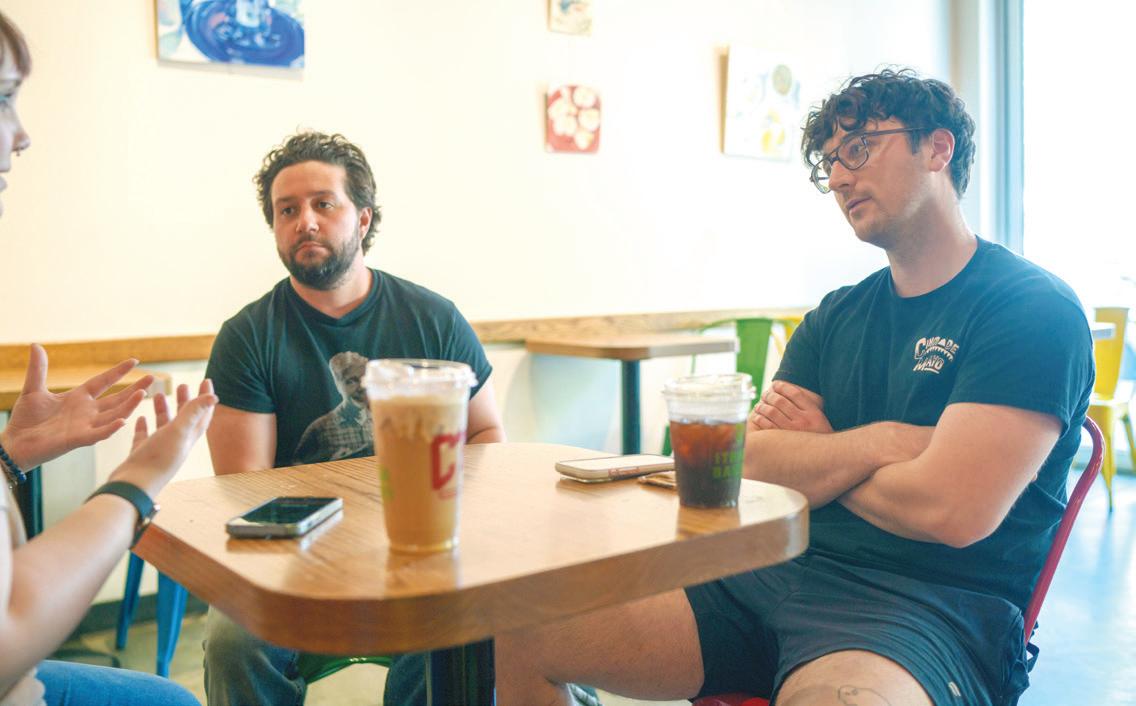
Common Council member Patrick Kuehl said the CCC is not just about property owners or business development, but the community as a whole. He said the CCC was created by a group of community individuals, students, and local leaders in government and businesses for the purpose of building up Collegetown.
CCC meets weekly on Wednesdays at 1 p.m. at St. Luke’s Lutheran Church and that anyone is welcome, not just residents of Collegetown, Kuehl said. He added that what started as meetings between three to five people has grown to meetings with over 30 individuals.
“We have representatives from the city and the chair of commerce, permanent residents, small business owners and Cornell students,” Kuehl said. “We continue to push forward and bring a couple more people in each week. I think one of the things that we try to do well is to make things that we do interesting and engaging and fun for people. It’s an opportunity for us to all see each other’s unique perspective.”
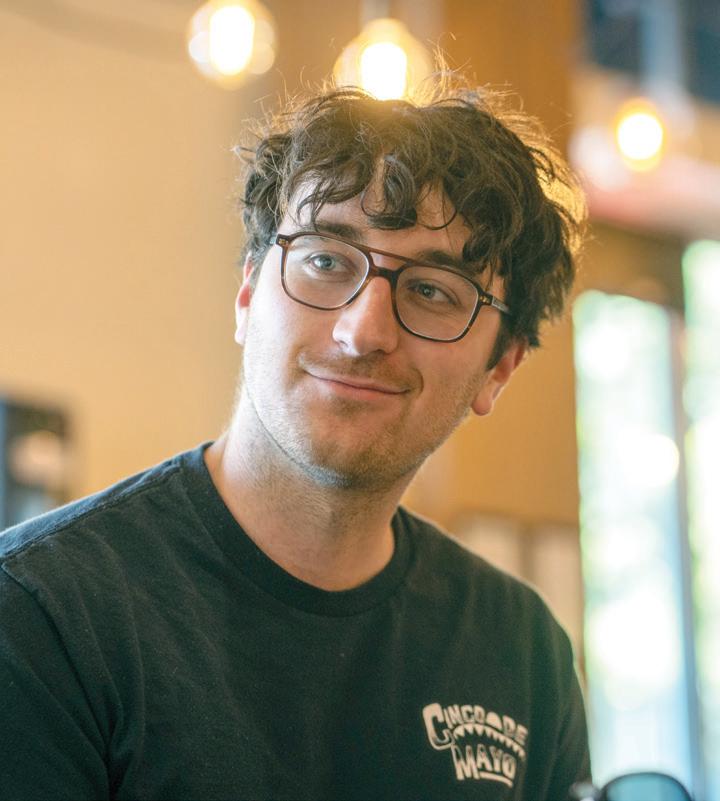
Jorge Bouras, a member of the CCC and co-owner of Dos Amigos, shared that it was apparent to him that Collegetown needed something like the CCC. He was previously part of Collegetown’s Small Business Alliance (SBA).
“That organization [SBA] kind of fizzled out, but when I got approached to be a part of this, it was obvious that it was the
work that needed to be done,” Bouras said. “It was the work that we had started through the SBA prior to the pandemic, and it was ever more clear through the pandemic that Collegetown needed a little tender loving care.”
Kuehl said that there is a “holistic approach” to the CCC. He shared that there will be a summer concert series in Collegetown and that through this event, the CCC is bringing the community together, bringing people up to Collegetown and supporting local businesses by putting more foot traffic in the area.
However, Kuehl and Bouras said the most exciting thing to happen to the CCC is the IDA’s $40,000 in funds for a strategic plan.
“It’s super focused on community,” Kuehl said. “There are surveys that we’re going to do, listening sessions with all the people who come to CCC meetings, local business interviews, and working with Gary Ferguson to develop that plan. Downtown Ithaca Alliance is going to work with us to kind of look at what our next priorities — five years, 10 years out — are, and I think that will really solidify us. It’s a process because we’re all volunteers.”
Bouras added that, to him, there are four major areas where work needs to be done: economic and business development, infrastructure and accessibility, public safety and sanitation, and community engagement.
“Collegetown should look and feel brighter, better, cleaner, safer, and should be more attractive to the general population,” Bouras said. “But it doesn’t feel that way right now.”
Kuehl said Ferguson, previously the director of the Downtown Ithaca Alliance, currently works as a private consultant and is helping the CCC on their strategic plan.
Kuehl added that the goal with the strategic plan is to have it developed and be able to dedicate someone to executing that plan full time, with the help of volunteers.
“We are very grateful to have received this grant,” Kuehl said.
“We are going to go to build this strategic plan that then allows us to essentially scale up the organization. It is a seed grant to get us to build the foundation and infrastructure for the CCC that then allows us to go to other government agencies, private sector, and abroad to source more money, raise more money for executing projects.”
Bouras said this grant is important in giving the CCC a structure and plan because no one person is responsible for the CCC.
“Aside from Patrick (Kuehl) and myself on the events committee, there is not one person that is really responsible for the whole entity and is responsible for pushing forward every day and week,” Bouras said. “Any organization lives and dies on having that constant gentle pressure, and someone who’s in charge. When you have volunteers where no one’s really appointed to that, there’s a limit to how much progress you make. Our goal with that $40,000 is to solidify that foundation.”
Bouras and Kuehl encouraged the Ithaca community to attend a CCC meeting to see how it operates as a community group. They both emphasized listening to all the voices within CCC and said they believe that will make the collective stronger.
“While we might move a little bit slower because there's more perspectives, everyone there is there because of a shared goal of moving Collegetown forward — not just for Collegetown’s sake, but for everyone,” Bouras said. “When Collegetown wins, all of Ithaca wins.”
Common Council Alderperson Patrick Kuehl said the Collegetown Community Collective was formed by a group of Collegetown residents and community members for the purpose of building up Collegetown. (Photo: Mark Syvertson/Ithaca Times)
Before joining CCC, Dos Amigos co-owner Jorge Bouras was a part of Collegetown’s Small Business Alliance. (Photo: Mark Syvertson/Ithaca Times)
“Going to Seabreeze and I want to go on a plane.” – Siena
“Make squishes.” – CJ
“Seeing my cousins in Seattle.” – Desmond
“Going to Zimbabwe.” – Abby
“Playing baseball.” – Silas
Common Council Requests State Investigation into NYSEG Practices
By Lorien Tyne
The Ithaca Common Council unanimously passed a resolution on June 3 requesting that the New York state attorney general investigate utility companies New York State Gas and Electric (NYSEG) and Rochester Gas and Electric (RG&E).
Last summer, NYSEG and RG&E led rate hike requests with the New York State Public Service Commission (PSC) to increase delivery rates. To give regulators more time to review the proposals and complete the rate case, PSC approved temporary rate increases for the utility companies, which went into e ect on June 1.
NYSEG and RG&E are owned by Avangrid, a subsidiary of multinational parent company Iberdrola, based in Spain.
Common Council is requesting that the New York State Attorney General Letitia James investigate Avangrid’s nancial relationship with Iberdrola and its overall service to New York customers. e resolution was submitted to the council by Rebecca Evans, the city’s director of sustainability.
“NYSEG rates are shooting through the roof,” Alderperson Robin Trumble said. “I hope that we all can do this very happily because we do not need to be paying this much for electricity costs, especially in the lens of looking towards electri cation across the city.”
Common Council highlighted the companies argument for needing rate increases, which the resolution explained is inconsistent when taking into account the high pro ts and dividends sent to parent company Iberdrola.
e resolution cites that since Iberdrola acquired NYSEG and RG&B in 2008, they have made up 8% of Iberdrola’s global network and 32% of its U.S. network. e resolution states that the companies claim Iberdrola provides more in capital investments than it receives in dividends, however, Avangrid has provided over $1.85 billion more in net income to Iberdrola than it has received in capital investment from Iberdrola in the rst three quarters of 2025.
In NYSEG and RG&B current rate cases, the companies requested a $557.4 million increase in electricity delivery rates, amounting to an increase of more than 35% over three years. In February 2025, Avangrid sent $450 million in divi-
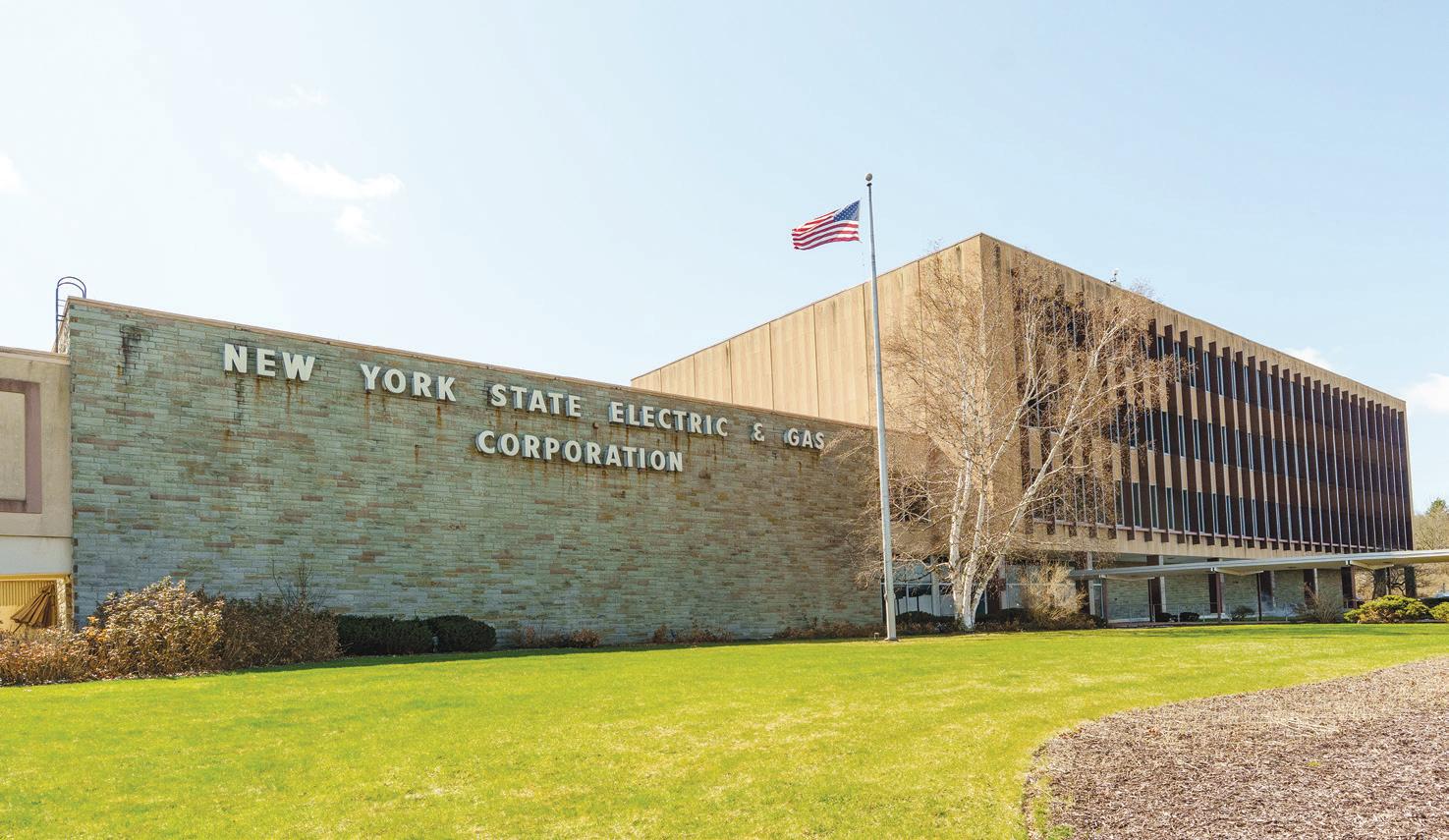
Like the Tompkins County Legislature and other local leaders, Ithaca's Common Council has called for an investigation into New York State Electric and Gas (NYSEG). (Photo: Mark Syvertson/Ithaca Times File)
dends to Iberdrola. Since 2010, Iberdrola has made over $2 billion in pro ts from NYSEG, according to the resolution.
“ e record further indicates that the Companies have provided poor service and failed to reach critical milestones, including nearly 400 ‘high risk’ gas violations between 2021-2023, demonstrating a total disregard for public safety and standard business practices,” the resolution states.
e resolution cited the companies’ underperformance according to System Average Interruption Frequency Index (SAIFI) scores. e New York State Department of Public Service’s 2024 Electric Reliability Performance report said that NYSEG failed to meet its outage frequency target for the sixth consecutive year. Its 2024 score was 1.30, meaning that, on average, a customer will experience about 1 to 2 power interruptions each year.
e report says that tree contacts accounts for 43% of system interruptions and a ected about 520,000 customers in 2024. e high frequency of tree-related outages were attributed to poor vegetation management practices, which was one reasoning for the 2023 rate hike approval.
“Despite these e orts, NYSEG has not demonstrated the necessary vegetation management improvements to address its ongoing challenges in delivering reliable electric service,” the state report said.
e Common Council resolution credited state Representative Josh Riley for uncovering many of the nancial facts referenced. Riley previously sent a formal request to NYSEG regarding billing data
UPS DOWNS&

Ups
The Stewart Park Carousel opened for the season at the end of May. Free ride days are being o ered throughout the month of June. The dates include June 6-7, 13-14, 20-21 and 27-28. New this year, the carousel is o ering sensory-friendly rides with no music and slower spins at the top of every hour.

Downs
One person was injured May 26 after a re broke out at the Rodeway Inn in Ithaca. The facility is being used as emergency shelter placement for Tompkins County. County o cials said one shelter resident was transported to the hospital for treatment following the re. The re was contained to one room, but two neighboring rooms experienced water damage from the sprinkler system.
and how customer payments contribute to its parent company’s pro ts.
Additionally, last year, the Tompkins County Legislature called on the New York State Legislature to commission an independent audit of NYSEG billing practices.
e resolution will be sent to the Tompkins County Legislature; the ofces of Assemblymember Anna Kelles, Senator Leah Webb, House Representative Josh Riley, Attorney General Letitia James, and Governor Kathy Hochul; and to the Department of Public Service and the Public Service Commission of New York State.
QUESTION OF THE WEEK
Should school capacity at South Hill Elementary be a concern as plans for SouthWorks take shape?
I don’t care. N EXT W EEK ’S Q UESTION :
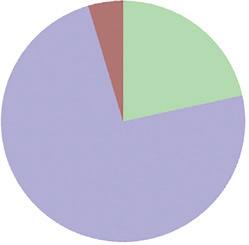
Should all neighborhoods in Ithaca have community organizations like the Collegetown Community Collective? Visit ithaca.com to submit your response.
HEARD SEEN&

Heard
Ithaca Pride Festival 2026, “United We Rise,” will be held June 14-16 in downtown Ithaca. The festival features performances, local businesses, resources, kids activities and more. The festival is volunteer run and aims to honor queer history through community.

Seen
Tompkins Consolidated Area Transit (TCAT) launched e-Ride Ithaca on June 1. The new electric microtransit pilot program is aimed at lling transportation gaps in some of Ithaca’s most vulnerable neighborhoods. The service is available seven days a week with an electric eet of four vans and four cars at $5.00 per ride. Drivers will be on call from 6 a.m. to 10 p.m. Monday through Friday, and 7 a.m. to 10 p.m. Saturday and Sunday to pick up and drop o riders who can request trips. Rides can be called through the eRide Ithaca mobile app developed by Spare. Riders can also schedule trips by calling the 2-1-1 call center.
IF YOU CARE TO RESPOND to something in this column, or suggest your own praise or blame, write editor@ithacatimes. com, with a subject head “U&D.”
Ithaca Officials Back REST Rent Stabilization, Say State Bill Could Help Struggling Renters
By Lorien Tyne
Affordable housing advocates in New York state, including leaders in Ithaca, are urging support for the Rent Emergency Stabilization for Tenants (REST) Act, which is expected to be reviewed during this year’s legislative session.
First introduced in early 2025, REST Act is now part of the Make Rent Affordable platform for the 2026 state legislative session. If passed, it would update the state’s Emergency Tenant Protection Act (ETPA) and aid municipalities in adopting rent stabilization. Rent stabilization aims to protect tenants by slowing rent hikes, keeping rental housing affordable and increasing housing stability.
The bill passed through the state senate’s Housing, Construction and Community Development Committee and as of June 8 is with the Senate Finance Committee.
The ETPA, enacted in 1974, allowed New York City to declare a housing emergency and implement rent stabilization measures if the vacancy rate fell below 5%. The 2019 Housing Stability and Tenant Protection Act updated the ETPA by allowing municipalities outside of NYC to adopt rent stabilization, but it still required an expensive vacancy survey.
The Ithaca Urban Renewal Agency (IURA) reported in 2021 that Ithaca has had a rental vacancy rate ranging from 0% to 2% for many years, leading to increased rents and lack of affordable housing.
The REST Act would provide an alternative to vacancy surveys by allowing the use of publicly available data such as eviction rates, homeless shelter population and renters’ housing cost burdens.
The bill also expands the range of rental housing that can be covered by rent stabilization. Municipalities can choose to regulate buildings with fewer than the current minimum of six units. Also, buildings constructed or significantly
renovated in the past 15 years would be exempt from rent regulations. Current policy exempts buildings built before 1974.
The Ithaca Common Council passed a resolution 7-4 in support of the REST Act
on March 4, with alderpersons Pat Sewell, David Shapiro, Patrick Kuehl and Margaret Fabrizio opposed.
During the March 4 meeting, Sewell said he is “wary” of rent stabilization
because it could deter housing development. He referenced the 2024 Tompkins County Housing Snapshot, which reported that housing production reached 57% of a multi-year goal made
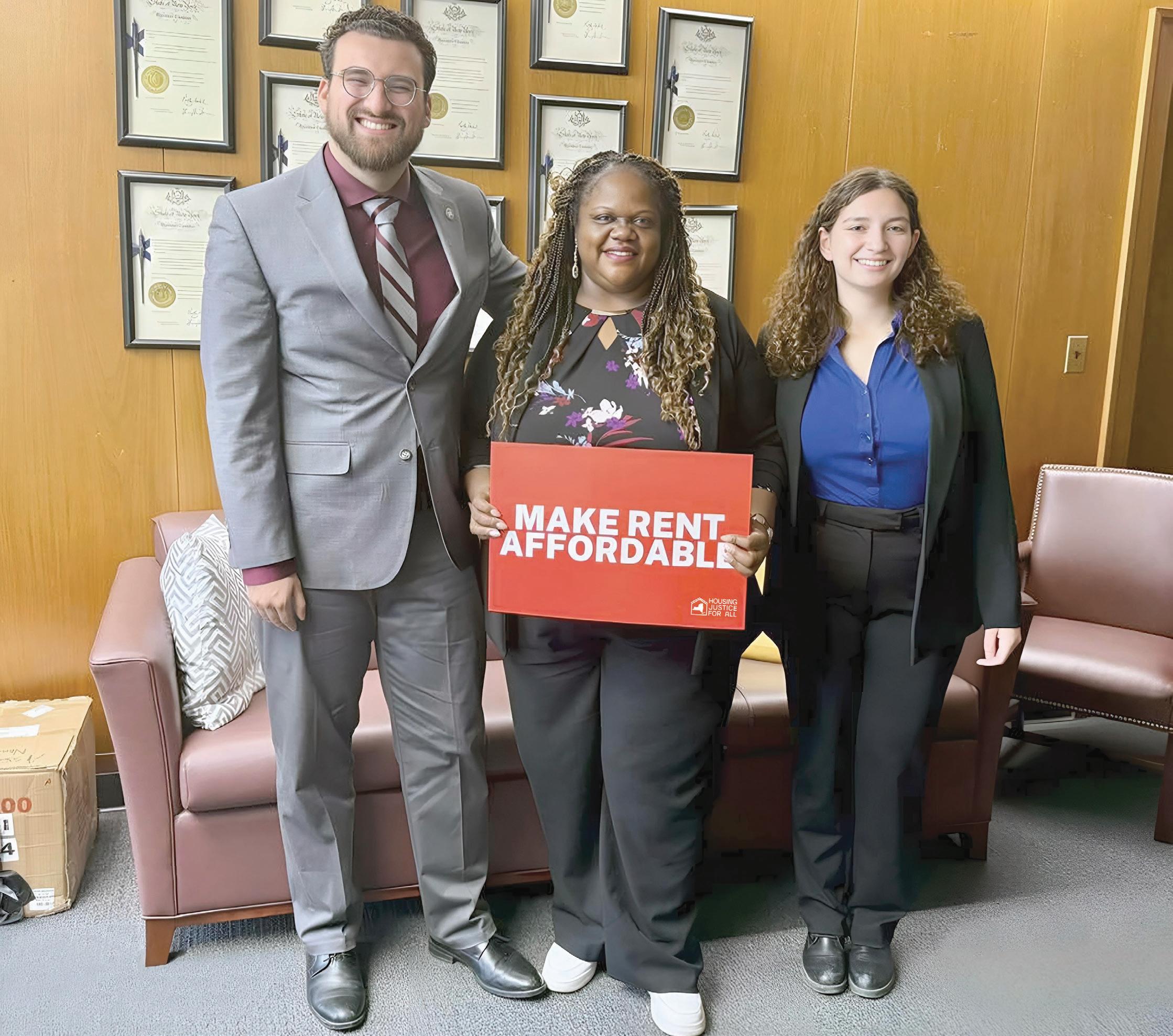
Alderpersons Jorge DeFendini (left), Hannah Shvets (right), and State Sen. Lea Webb (middle) support the REST Act. (Photo: Provided)
in 2017 to address the county’s housing crisis. New developments would be exempt from rent stabilization for the first 15 years, according to the bill.
Five Ithaca council members, including Mayor Robert Cantelmo, have signed Housing Justice for All’s letter of support for the REST Act along with other local leaders in the state. Housing Justice for All is a coalition representing tenants and homeless New Yorkers.
“The data is clear: there is a housing emergency in our communities and it's time the state allowed localities to take action.”
Cantelmo said the city is addressing the housing crisis by trying to expand housing supply and enhancing available rent stabilizing measures. The council adopted Good Cause Eviction in 2024, which prevented arbitrary evictions and limited rent hikes to 10% or the Consumer Price Index plus 5%, whichever is lower.
— Housing Justice for All Executive Director Sumathy Kumar
“Lawmakers know that housing affordability is a top issue for New Yorkers across the state, and the REST Act is an immediate step they can take to empower municipalities to make rents affordable in their communities,” Housing Justice for All Executive Director Sumathy Kumar said in a press release. “The data is clear: there is a housing emergency in our communities and it's time the state allowed localities to take action.”
A 2021 Ithaca Urban Renewal Agency report said 74% of city residents were renters, and many struggle to afford the cost of living. The report said 55% of Ithaca’s renters were cost-burdened and 41% severely cost-burdened. The city’s 2026 HUD funding application said at least 60% of Ithaca tenants are cost-burdened and 41% severely cost-burdened.
“Rent-burdened” means an individual is paying more than 30% of their income on rent, and “severely rent burdened” means an individual is paying more than half of their income on rent.
The median rent for apartments listed in Ithaca increased 5% over the past year, rising from $1,925 in February 2025 to $2,020 in February 2026, according to a USA Today analysis of Zumper rental data.
“We care deeply about the folks who are living in precarity right now, who are rent-burdened or severely rent-burdened, and we need to really be creative in marshaling the tools that we have to try and provide some relief there,” Cantelmo said.
Alderperson Jorge Defendini introduced a budget item in 2023 to set aside $50,000 in the 2024 city budget for a vacancy study. Common Council approved the money in restricted contingency, meaning the council would vote again if a plan was introduced to conduct the study. In early 2025, the Ithaca Tenants Union led a campaign pushing the city to complete the survey and opt-in to the ETPA. However, the city never conducted the study, and Defendini said the funding was encumbered and put back into the general planning and development budget.
“I think it was, frankly, the wrong decision to make, but I understand where it came from, because of the challenges and the limitations with eligible units,” Defendini said.
“We care deeply about the folks who are living in precarity right now, who are rent-burdened or severely rent-burdened, and we need to really be creative in marshaling the tools that we have to try and provide some relief there.”
— Ithaca Mayor Robert Cantelmo
Cantelmo said that if REST passes through the state government, the city attorney’s office would look at how the city could implement it, and then a resolution would be brought to the Common Council for approval.
“That’s why I’m a big advocate of the REST Act.”
Defendini said he is motivated to move forward with rent stabilization whether the REST Act passes or not, but he has been advocating for the bill and hopes it can be implemented. Alderpersons Defendini and Hannah Shvets went to Albany in April to meet with Senator Lea Webb, a co-sponsor of the bill.
“It’s a more perfect, more effective version of ETPA that makes sense for upstate,” Defendini said.

Don’t Let Ithaca Lose Its Storytellers
Imagine the sharpest, most passionate young journalists you’ve ever met (the ones who stay late chasing a story because they believe in this town) slowly packing their bags. Not because they want to leave… but because local rents force them out.
That’s the quiet heartbreak happening right now. Our best new writers, the ones who grew up here or fell in love with Ithaca in college, are being pushed toward cheaper cities just to survive.
The Rising Star Fund rewrites their story into a happy ending by sponsoring a simple monthly housing stipend (a hand up, never a handout) so they can keep living here, keep writing here, keep falling deeper in love with Ithaca… and keep telling the stories that make this city our home.
When a young journalist can afford to stay in Ithaca, you get:
● Fresh, fearless voices loyal to your local paper
● Someone at every city council meeting who believes local news matters
● The next great Ithaca story written by someone who actually lives here
● Your $25, $50, or $100 a month doesn’t just pay their rent.
● It keeps storytellers in our community and stops local brain drain.
● When our younger generation thrives, Ithaca’s future stays bright.
Keep local talent in Ithaca by donating today to the Rising Star Fund (an initiative of Pathways to Equity, Inc a registered 501(c)(3) nonprofit organization)
For more info: roy@ithacatimes.com
BusinessTimes
Developers Continue Construction on Elmira Road Comfort Inn and Suites
Another Ithaca Mall Eatery Closes Finger Lakes ReUse in Triphammer Relocates
Tompkins County Chamber Celebrates Young Professionals with Fab5 Awards
By Mikayla Rovenolt
On June 2, the Tompkins County Chamber of Commerce held the e Fab5 Young Professional Celebration, which highlights “the achievements and impact of young professionals, under 40, who are excelling and making an impact in Tompkins County.”
e Fab5 Awards are given to ve local, young professionals who are excelling in their respective elds across the county. e 2025 Fab5 Young Professionals Awards were presented by AmeriCU Credit Union with support from Centralus Health and Finger Lakes Wealth Management.
e Fab5 for this year’s celebration were: Olivia Carpenter, founder of Via's
Business Briefs
JPMorganChase provides grant to support Upstate NY business growth
JPMorganChase presented a $250,000 grant to Launch NY on May 11. e grant was given to the program to support “high-growth founders” across Upstate New York. e grant will expand the Founders Go Big program which supports new businesses with capital support and mentorship.
Matt Tipple, managing director, private bank and chair of the Upstate New York Market Leadership Team at JPMorganChase, said in a press release that small businesses are essential to building resilient local economies.
“JPMorganChase is proud to support Launch NY’s e orts to equip entrepreneurs with the capital, mentorship, and leadership skills they need to scale their businesses, create jobs, and drive meaningful economic opportunity throughout Upstate New York,” Tipple said.
Launch NY is a nonpro t venture
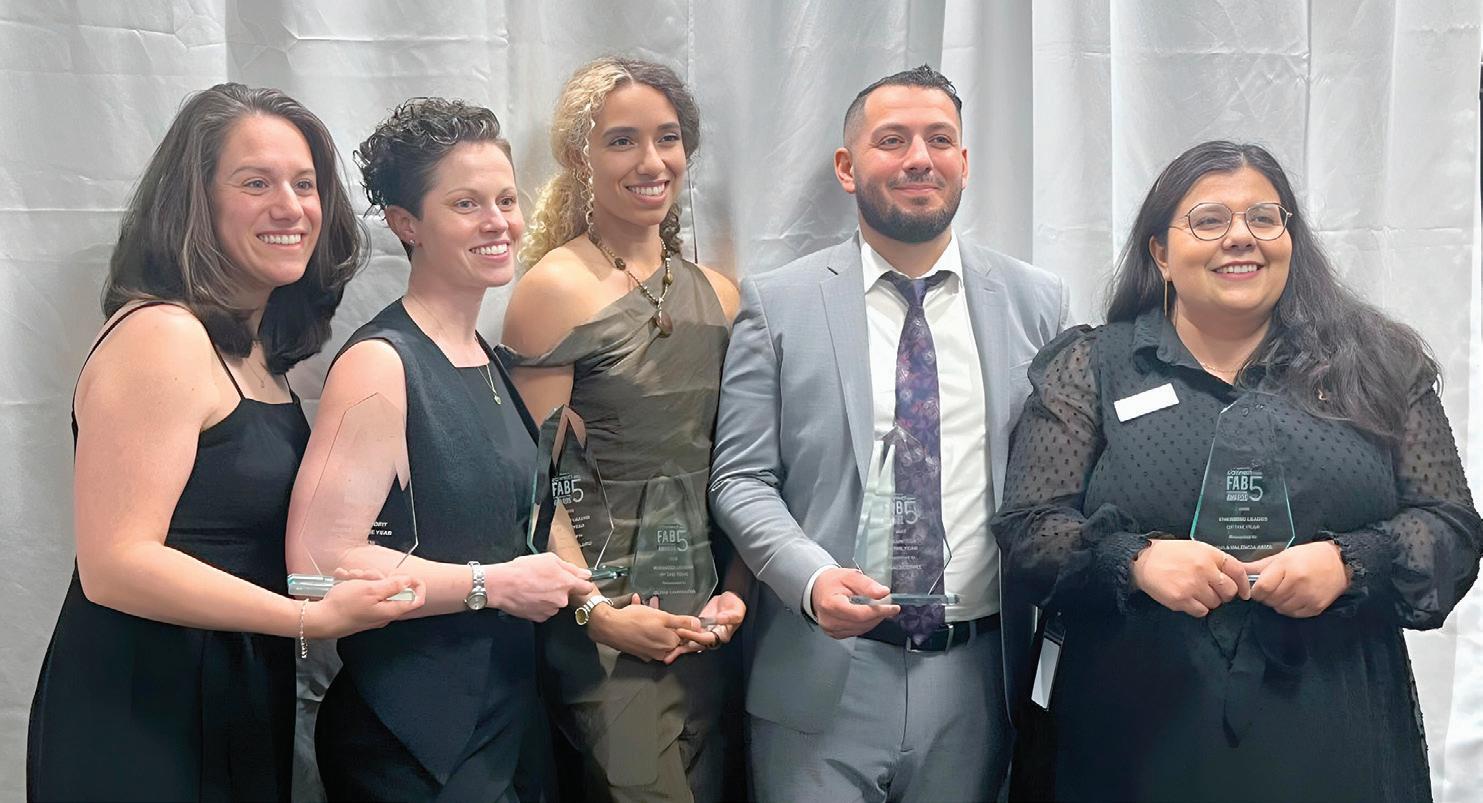
Cookies for the Business Leader of the Year award; Ignacio Lopez, Veteran Service O cer & VA Accredited Representative for the Tompkins County Department of Veterans Services as the Volunteer of the Year; Paula Valencia Ariza, Commercial Relationship Manager at Beginnings Credit Union was the Emerging Leader of the Year; Amanda Schmitt Piha, Associate Director for Philanthropy and Communications at the Paleontological Research Institute was the Not-for-Pro t Leader of the Year; Christina Alario, Director of Operations for Hammerstone School, Inc. was Industry Leader of the Year.
development organization and United States Treasury-designated Community Development Financial Institution that exclusively serves Upstate NY.
According to the Launch NY press release, the grant’s expansion of the Founders Go Big program will increase the number of companies who can utilize the program. It will also provide new support for growing businesses facing challenges within leadership and demanding fundraising needs.
“We’re thrilled that so many founders have been able to pursue their dream and join the growing legion of startups in our region through our Founders Go Big program,” said Marnie LaVigne, president and CEO of Launch NY. “Now we’ll be able to ensure they’re prepared to take on the challenges of scaling their businesses, so they can truly make their mark in driving economic prosperity and innovative industry solutions.”
Comfort Inn and Suites to be constructed on Elmira Road
Acontract
was awarded for a new
Comfort Inn and Suites to be built
at 635 Elmira Road in Ithaca. Construction on the hotel is expected to be nished October 2026.
TAYLOR, regional commercial general contractor, is teaming with local hoteliers, Ahir & Company, LLC and Choice Hotels for the construction. Additionally, architectural services will be provided by Hex 9 Architects, and engineering services will be provided by Marathon.
e hotel is set to be 3 stories and 37,000 square feet with 67 rooms. In alignment with other Comfort designs, the hotel will feature an open lobby that allows for clear line of sight to its breakfast area and lounge seating space. e hotel also plans to service guests with a warm greeting from sta and signature localized postcards.
For this hotel speci cally, the TAYLOR press release said that designs for the hotel lobby, breakfast and ex room areas have been adapted to incorporate “re ned furniture nishes and a cheerful, energizing space for guests to work, play and enjoy breakfast.” e overall design style for the hotel is set to feature bright and elevated colors in the guest rooms and public spaces.
“We are proud to help deliver this Comfort Inn & Suites as part of our exciting new relationship with this local hotel developer and continued relationship with Choice Hotels,” said TAYLOR Managing Partner, Karl Schuler. “TAYLOR looks forward to building many more with this team, as they thrive to build-upon their already growing portfolio of successful properties, and popular additions to the Ithaca community.”
Auntie Annie’s closes at the Shops at Ithaca Mall
Auntie
Anne’s has closed its location at the Shops at Ithaca Mall. e pretzel chain was located in the mall’s food court for about 10 years before the closure. e closure comes amid the brand’s expansion out of malls and into airports, train stations, sports venues and more.
Auntie Anne’s closure follows the closure of other food court options at the Shops at the Ithaca Mall including Subway. Sicilian Delight and Zocalo Mexican Bar &
Tompkins County Chamber of Commerce recently honored five local, young professionals with the annual Fab5 awards. (Photo: Mikayla Rovenolt/Ithaca Times)
The Talk at
LETTERS TO THE EDITOR
By Ithaca Times Readers
The New York Health Act Will Mend Fragmented Health Care System
“The New York Health Act (NYHA), A Universal Coverage Health Care Bill (S3425 and A1466) have rare bipartisan support in both houses. If enacted, the NYHA promises quality, and guaranteed health care for all New Yorkers.
The current system of healthcare is fragmented and costly. The full range of medical care would be covered as would mental health, dental, vision, prescription medications and hearing aids. All physicians and other health providers would be included. There would be no networks and no need to change your health plan each year. There would be no deductibles and no copays. You would pay a monthly cost based on income, the first $50,000 of which is not counted. Employers would also pay less than what they pay now. If you have Medicare, the monthly cost would be all you pay.
Even more compelling is that the NYHA potentially lowers taxes. NYS counties must pay employee health care and a significant portion of Medicaid costs. School districts must pay health care costs for employees and student health services. New Yorkers also pay a portion of Medicaid through property taxes. County and school budgets would see reductions. We cannot financially or medically
afford to continue healthcare as it has been. NY Health offers significant benefits to the physical and financial health of New Yorkers and to the financial health of the schools, counties, and the state.” —
Marita Florini, Endicott NY
Road safety Must be Prioritized
“I frequently drive on Ellis Hollow road and virtually every time I do I encounter walkers, dog walkers, joggers, cyclists and even people pushing strollers. While cyclists tend to be the exception, the vast majority of these folks are dressed in drab clothes and do not wear hunter orange or other bright or reflective materials. This is just plain dumb and risky for pedestrians and drivers. The road is very busy and drivers too often exceed the speed limit. Tree foliage throws shadows on the road which makes it hard for drivers to see pedestrians. So please, dress to be seen when walking on Ellis Hollow or any road. Drivers please, please obey the posted speed limit and slowdown when approaching pedestrians or cyclists. Don't risk hitting someone just to save a few seconds. Cyclists move over as much as you safely can, wear bright clothes and use front and rear lights. Let’s all share the road safely. Be seen and be kind.” —
John
A. Krout, Ithaca NY
Congressman Nicholas Langworthy Abuses Constitution
“Congressman Nicholas Langworthy dropped a ‘bombshell’ survey. Cruel and invasive experimentation is happening to dogs and cats! Rather than enforce the Animal Welfare Act, he wants to stop federal funding of animal research. (Office of Congressman Nicholas Langworthy email, May 21, 2026). Langworthy is trying to distract
us! Langworthy wants us to argue about anything but the Antil-Weaponization fund (slush fund) he will use for people President Trump believes were mistreated by the government! Many are convicted criminals (AP News Jan 29, 2026). Why are taxpayer dollars being used for this? This deal was made between Trump and his appointed Attorney General. Why is Langworthy ignoring the legality concerns? Only the House of Representatives, according to the Constitution, can grant funding. In addition, why should Trump and his sons be granted immunity from tax audits which is an unprecedented action from the office of the President (The Tax Center May 22, 2026)? Why should we bail out Trump when Americans cannot afford food, gas and healthcare? Langworthy supports Trump who abuses and ignores the Constitution.We need a congressional representative who will stand up to corruption. Vote for Aaron Gies in the Primary.” —
Jason Peter, Ithaca NY
RE: Cornell Cooperative Extension Unveils Thriving Futures Murals
“Can we please stop with this ridiculous virtue signaling nonsense? This town constantly pines on and on about "inclusion" but yet constantly fails to include the largest demographic in this town into murals. How about putting a mural next to the "Free Palestine" mural that remembers the 1,200 jews slaughtered
on Oct 7th, 2023? Oops, I guess those lives didn't matter. So much for diversity I guess.” — Ragnar LodBlox, Ithaca.com
Moving Day Brings
Finger Lakes Community Together
“Positivity and a sense of unity radiated among those present in the Ithaca region earlier this month, as the Parkinson Foundation hosted its third annual Moving Day Finger Lakes event on May 2nd at Stewart Park. Focused on movement as a key strategy for managing Parkinson’s disease, the event brought together the PD community—including patients, caretakers, and medical professionals—to support one another, share experiences, and celebrate the power of togetherness. The camaraderie on display reinforced the importance of community and movement for those navigating the challenges of PD. This event is vital for progressing the Parkinson’s Foundation’s mission and highlights the resilience of the Ithaca and Central New York communities, emphasizing the importance of unity. Despite the sunny yet frigid day, the region united in strong support for the growing number of individuals affected by PD. The Parkinson’s Foundation expresses gratitude to all participants, organizers, and service providers who contributed to the event’s success and support of the PD community.” — Analyse Adams, Auburn NY




A SPECIAL SERIES FROM THE ITHACA TIMES





Episode 2: The Economic Impact of Finger Lakes ReUse on Tompkins County
By Roy Allen Director of Strategic Partnerships Ithaca Times
Curator’s Note: Finger Lakes ReUse (FLR) has been growing in response to community demand (40% increase in donation drop-o s each year, for 10 years!), without enough resources to keep up. Now they are taking on a monumental and courageous growth step, the Cayuga ReUse Center on Triphammer Road near Ace Hardware and Aldi, with 18,000 more sq. . of retail, knowing they need this space to generate revenue and handle material volumes. FLR is currently resource-constrained, and is at risk of cutting programs or sta ng unless serious fundraising is secured in 2026. ey need your support—which is the purpose of us at the Ithaca Times telling their story—to rally Ithacans around FLR, to ensure this a ordable nonpro t stays available locally, and to keep all this good material out of the waste stream.
What’s Up Ithaca?
Welcome to the second episode of Pocket Economics: oughts on Money—Yours, Ours and eirs, a series exploring how nancial policies and public investments shape not only markets, but people’s everyday lives and opportunities. In this episode, we examine the economics of Finger Lakes ReUse—a popular spot for everyone in Ithaca to stop, shop and save. Excitingly, this June, they are opening a newly expanded Lansing location, the Cayuga ReUse Center, at the Cayuga Shopping Plaza, which also includes vibrant, a ordable shopping options like Aldi, Ross, and Ace Hardware.
Imagine taking a leisurely drive through the rolling hills of New York’s Finger Lakes region and discovering Tompkins County, an aesthetically beautiful and culturally vibrant yet also economically complex community anchored by Ithaca and its inter-
nationally recognized institutions, Cornell University and Ithaca College. ese institutions drive a knowledge-based economy centered on education, research, healthcare, technology, and tourism. ey attract investment, innovation, and a constant ow of students and visitors. Yet beneath this image of prosperity lies a reality familiar to many rural-college regions across the United States: rising housing costs, widening income inequality, seasonal employment uctuations, material insecurity, and growing pressures on public infrastructure. For many residents, the cost of everyday life continues to increase faster than wages. Students struggle to furnish apartments a ordably. Families face rising costs for home repairs and appliances. Nonpro ts, artists, and small businesses operate under constrained budgets. Meanwhile, enormous quantities of still-usable materials continue to ow into dumpsters and out of the county’s
waste stream every day.
Against this backdrop, Finger Lakes ReUse (FLR) has emerged as one of the region’s most innovative and quietly transformative economic institutions.
Founded in 2008 as a 501(c)(3) nonpro t organization, FLR transforms donated furniture, building materials, tools, appliances, electronics, clothing, and household goods into a ordable retail inventory while also operating deconstruction services, electronics refurbishment, workforce development programs, repair initiatives, and community access programs. By keeping materials circulating locally instead of sending them to land lls, FLR has become a living demonstration of what a local circular economy can look like in practice. At rst glance, reuse may appear to be simply a form of thri retail. In reality, Finger Lakes ReUse represents something much larger: a community-scale materials management system that generates economic, envi-
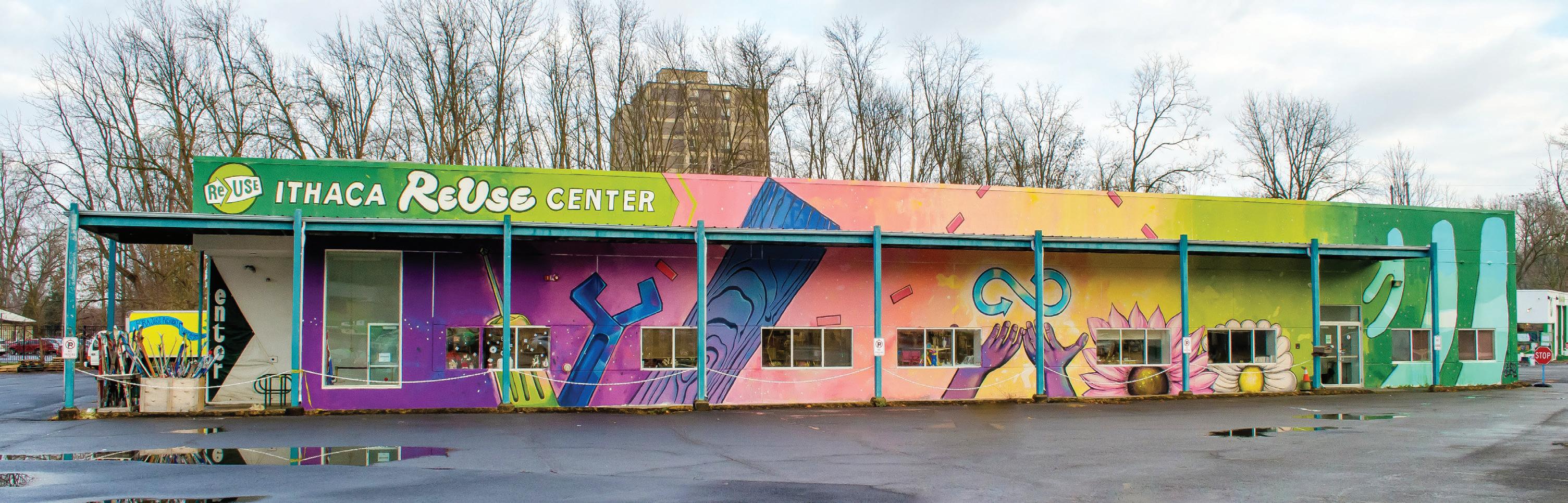
Building on Elmira Road in Ithaca. (Photo: Provided)
ronmental, and social value simultaneously.
As Diane Cohen, CEO of Finger Lakes ReUse, explains, “We believe communities can manage materials differently, and we are demonstrating that the public wants that as well.”
That statement captures the central importance of FLR’s work. The organization is not merely responding to consumer demand for affordable secondhand goods. It is helping redefine how communities think about value, waste, ownership, and economic resilience itself.
Reuse as Infrastructure
For decades, reuse in America has often been framed primarily as charity or secondhand consumption. Thrift stores were viewed as peripheral institutions serving limited populations rather than as core components of local economic systems. Increasingly, however, communities are beginning to understand reuse differently.
Reuse is infrastructure.
Just as recycling systems, libraries, parks, food systems, and public transportation serve collective community needs, reuse systems provide communities with material resilience. They recover value from existing resources, reduce waste disposal burdens, expand affordable access to goods, and strengthen local economic circulation.
In Tompkins County, this understanding has deep roots. Finger Lakes ReUse did not emerge accidentally or solely through private entrepreneurial effort. The organization’s origins trace back to Tompkins County’s long-term Solid Waste Management Plan in the 1990s, when county leaders began exploring alternatives to the traditional linear waste model.
That older model was simple: Buy. Use. Discard.
The problem with that system is that it treats materials as disposable despite the
enormous energy, labor, transportation, extraction, and manufacturing resources embedded within them. Furniture, appliances, tools, and building materials often retain years—or decades—of useful life even after being discarded.
Finger Lakes ReUse emerged from the recognition that these materials still possessed economic and social value.
The County provided seed funding and institutional support to test whether a reuse center could meaningfully divert materials from the waste stream while also serving community needs. What began as a county-
supported experiment has since evolved into one of the region’s most successful circular economy institutions.
Today, FLR demonstrates a fundamentally different model of material management: Acquire. Repair. Reuse. Redistribute. Remanufacture.
This emerging paradigm reflects a broader cultural shift taking place across society. Increasingly, people are reevaluating assumptions about consumption and value. The old belief that “new equals better” is gradually giving way to an appreciation for durability, repairability, affordability, and
local circulation.
The materials communities need already exist in enormous quantities. The challenge is no longer production alone. The challenge is recovery, repair, redistribution, and creating systems capable of keeping those materials in use.
Finger Lakes ReUse has successfully demonstrated both the scale of recoverable materials and the public demand for systems that keep those resources circulating locally.
Economic Context and Community Need
Tompkins County has a population of approximately 105,000 residents. While Cornell University contributes hundreds of millions of dollars annually through payroll, research activity, tourism, and student spending, economic pressures remain significant for large segments of the local population.
Housing costs are elevated due to limited supply and student demand. Cost-of-living pressures continue to rise. Service-sector and seasonal workers often struggle to afford basic household goods and repairs. A living wage for a single adult in the county is estimated at approximately $24.82 per hour.
At the same time, traditional waste management systems impose growing costs on local government and taxpayers. With local landfills closed, waste must be transported out of county at costs approaching $96 per ton.
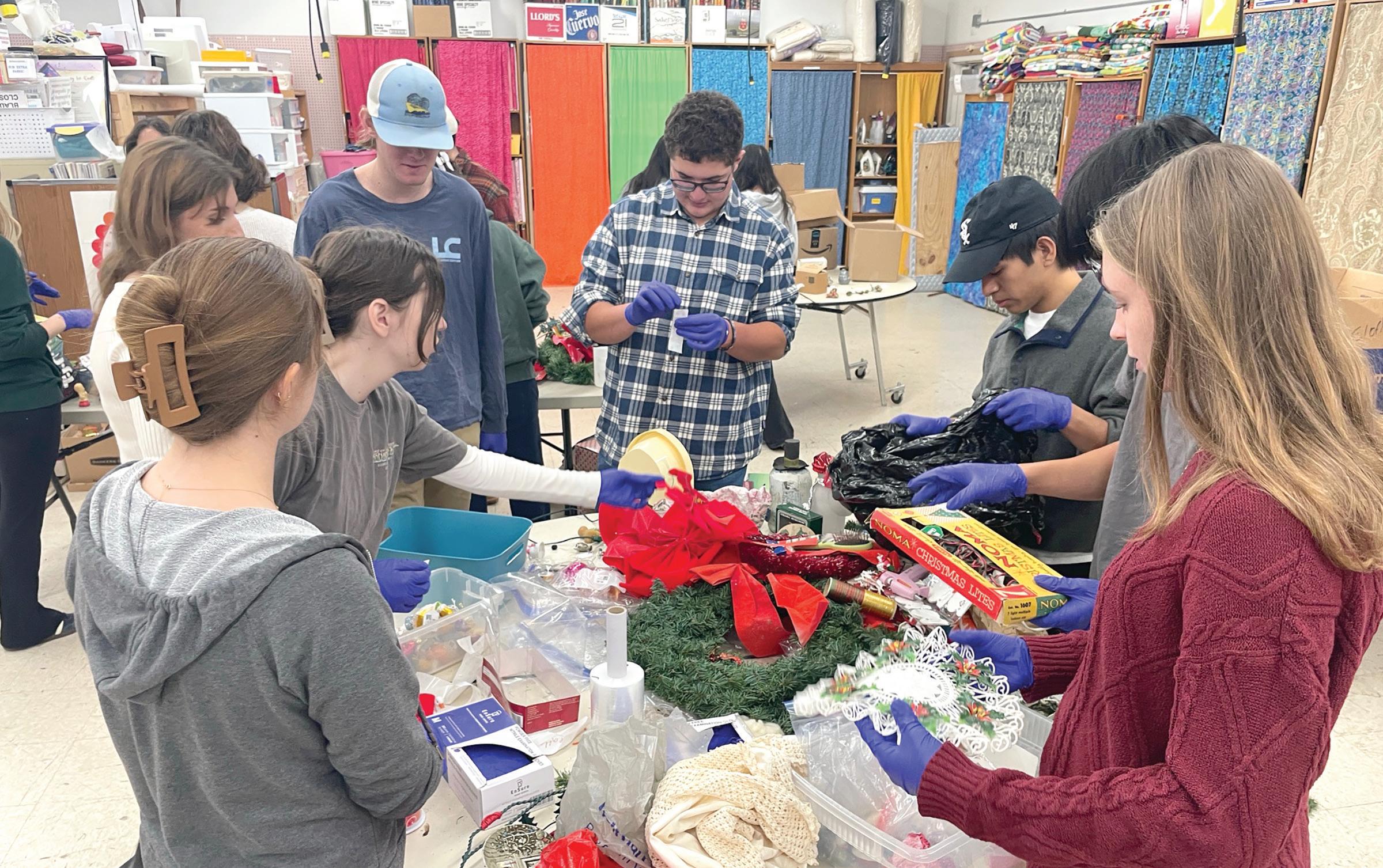
Sorting through community donations. (Photo: Provided)
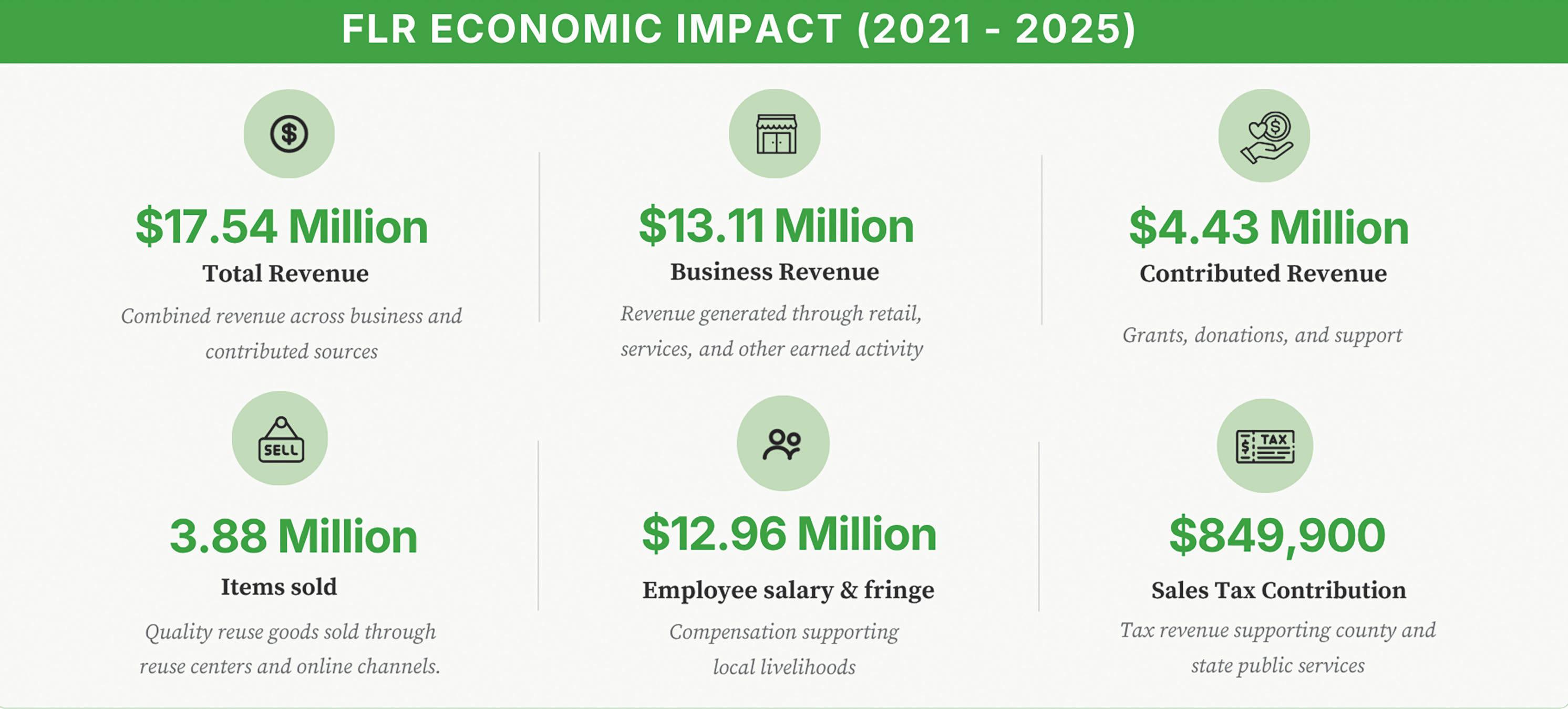
(Graphic provided by Professor Sisi Meng — Senior Lecturer at the Dyson School of Applied Economics and Management at Cornell University.)
Within this economic landscape, Finger Lakes ReUse operates simultaneously as:
• A local retailer
• A materials recovery system
• A workforce development institution
• A public affordability mechanism
• A climate action strategy
• A local economic development engine
The organization helps residents access affordable furniture, appliances, tools, electronics, and building materials that might otherwise be financially out of reach. Students furnishing apartments, renters moving into homes, artists sourcing supplies, nonprofits stretching budgets, and small business owners launching ventures all rely on reuse systems to reduce costs.
This affordability generates meaningful household savings while also strengthening broader local resilience.
Every reused item represents money that stays circulating within the regional economy rather than leaving through the purchase of newly manufactured goods imported from elsewhere.
The impact becomes tangible in everyday stories. One frequently shared example involves a coffee table purchased by graduate students from FLR for $30. Two years later, the table was re-donated to the organization with the original price tag still attached underneath. Staff simply returned it to the sales floor for another cycle of use.
That single object generated value repeatedly within the same community.
The story illustrates the core principle
of the circular economy: materials are not disposable endpoints but assets capable of generating ongoing local value.
Direct Economic Contributions: Jobs, Revenue, and Local Circulation
Finger Lakes ReUse has grown into a substantial economic institution in its own right.
In 2025 alone, FLR generated approximately $3.3 million in sales revenue. Between 2021 and 2025, cumulative sales reached roughly $13.11 million. Unlike traditional retail businesses that depend heavily on imported inventory and global supply chains, FLR sources the overwhelming majority of its inventory locally through donations.
This creates a closed-loop economic system that minimizes leakage from the local economy.
Instead of purchasing newly manufactured goods produced elsewhere, residents are recirculating existing materials already embedded within the region. Revenue generated through these transactions largely remains local, supporting wages, operations, facility improvements, transportation, and local vendors.
Employment impacts are equally significant.
FLR currently employs more than 80 workers, including approximately 65 full-time equivalent positions. From 2021 to 2025, the organization added 39 net new jobs, accounting for substantial growth within the local reuse and secondhand retail sector.
Yet the organization’s workforce impact extends beyond employment numbers alone.
Reuse is labor-intensive by nature.
Materials must be sorted, cleaned, repaired, transported, displayed, redistributed, and in some cases deconstructed or refurbished. These activities create jobs that cannot easily be outsourced.
Moreover, FLR intentionally integrates workforce development into its operational model.
• The organization supports:
• Job training
• Transitional employment
• Youth engagement
• Repair education
• Trades exposure
• Entrepreneurship pathways
• Leadership development
• Inclusive employment opportunities
Programs such as ReSET and repair collaborations like the Ithaca Fixers Collective create pathways for residents to gain practical skills while participating in a larger culture of repair and stewardship.
This combination of economic activity and social development is one reason reuse should increasingly be understood as a form of local economic development infrastructure.
FLR is not simply selling used goods. It is building community capacity.
Waste Diversion
and Environmental Value
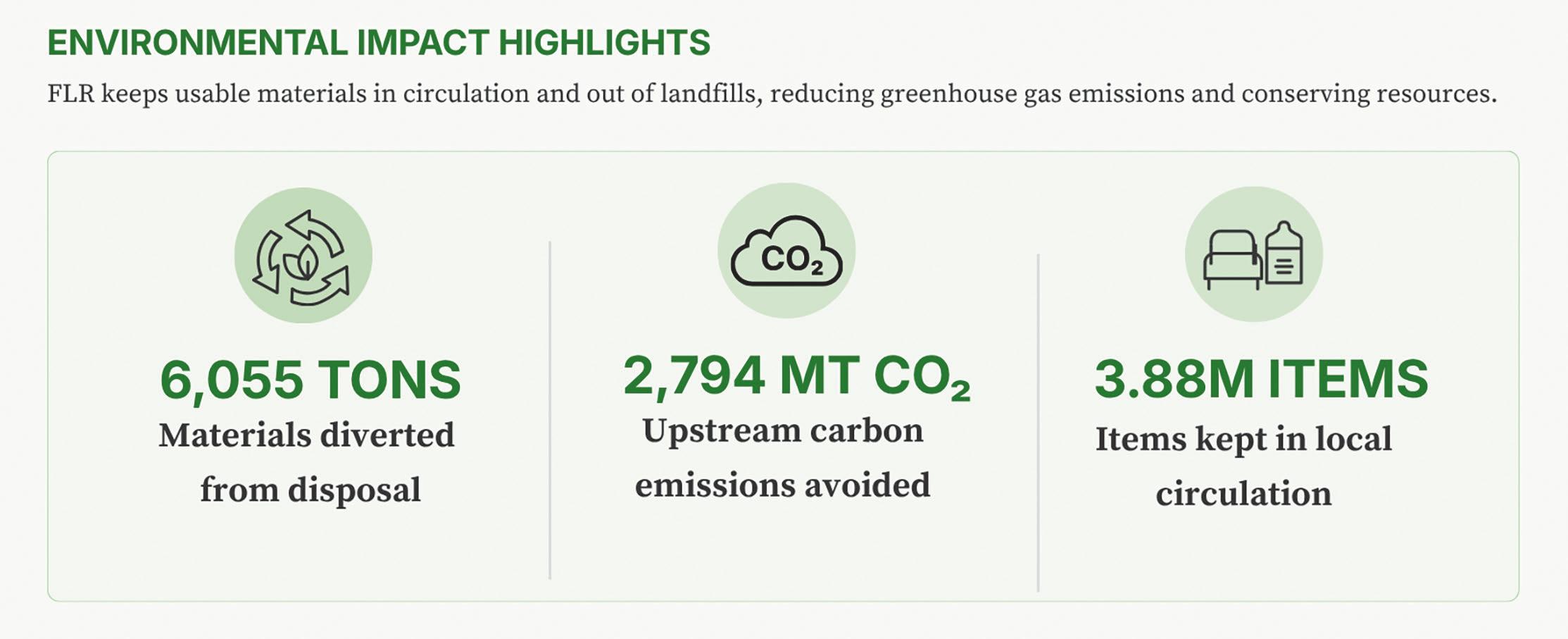
Between 2021 and 2025, Finger Lakes ReUse diverted more than 6,000 tons of material from landfills, saving Tompkins County an
estimated $593,000 in disposal fees. Annual diversion levels now approach or exceed 1,200 tons of material per year. However, the environmental importance of reuse extends far beyond landfill reduction alone.
Every manufactured object contains embodied carbon: the cumulative energy and emissions associated with extraction, manufacturing, packaging, transportation, and distribution. When an item is discarded prematurely, all of that embedded environmental investment is effectively lost.
Reuse preserves that value.
By extending the lifespan of furniture, appliances, tools, and building materials, FLR reduces demand for new extraction and manufacturing while lowering greenhouse gas emissions associated with production systems. This creates a form of local climate action with immediate and visible outcomes.
Unlike distant climate policies that may feel abstract to residents, reuse produces tangible environmental benefits communities can see directly:
• Less waste entering dumpsters
• Reduced disposal costs
• Extended material life
• Lower manufacturing demand
• Greater resource conservation
The organization also demonstrates that environmental sustainability and economic resilience are not opposing goals. In fact, they reinforce one another.
Reuse lowers costs while reducing environmental impact simultaneously.
(Graphic provided by Professor Sisi Meng — Senior Lecturer at the Dyson School of Applied Economics and Management at Cornell University.)
Community Participation as the Engine of Growth
One of Finger Lakes ReUse’s most important achievements is demonstrating that community participation itself can drive large-scale systems change.
The organization’s growth has not been powered primarily by corporate investment or centralized industrial systems. Instead, it has been fueled by collective civic participation.
Donors contribute materials. Shoppers purchase goods. Volunteers provide labor and expertise. Staff coordinate operations. Repair communities share skills and knowledge. Residents advocate for circular systems.
Together, these activities create a participatory local economy centered on stewardship rather than disposability.
This participation is also increasingly intergenerational. Students, retirees, families, tradespeople, artists, and longtime residents all interact within the same system. Reuse spaces become places where economic exchange intersects with education, creativity, repair culture, and civic engagement.
Programs like ReMAP further extend this impact by helping vulnerable residents access essential household goods. More than 1,800 households have received assistance through the program, representing hundreds of thousands of dollars in redistributed value.
Residents consistently describe FLR not merely as a store, but as an institution that
helps stabilize lives during periods of transition or economic hardship.
The organization supports people moving into first apartments, recovering from crises, launching businesses, repairing homes, and building community connections.
In this sense, FLR is not just redistributing materials.
It is redistributing opportunity.
Expansion and the Next Generation of Circular Infrastructure
Finger Lakes ReUse has already proven demand for reuse systems in Tompkins County.
The challenge now is scale.
Over the past decade, FLR has experienced approximately 40% year-over-year growth in donation volumes. Community participation has expanded faster than the physical infrastructure originally built to support it.
This operational strain is not evidence of failure. It is evidence of success.
To meet this growing demand, FLR is now entering a major new phase of expansion. In 2026, the ReUse MegaCenter at Triphammer Mall will relocate and expand into the Cayuga Shopping Center on North Triphammer Road in Ithaca. The Elmira Road location will also remain operational while receiving infrastructure upgrades.
These improvements will significantly increase:
• Processing capacity
• Storage space
• Retail display areas
• Refurbishment capabilities
• Workforce training opportunities
• Material throughput efficiency
The expanded infrastructure will also create opportunities for future growth in:
• Tool sharing systems
• Building material recovery
• Deconstruction services
• Repair programs
• Regional reuse partnerships
• Circular manufacturing initiatives
Internal projections suggest the organization could generate substantial increases in revenue, material diversion, and employment over the coming years.
But this expansion also raises a larger civic question:
What if reuse became recognized and supported as a public utility-like infrastructure system?
If roads move people, utilities move energy, and libraries move knowledge, reuse systems move materials and economic value through communities.
The infrastructure required for a circular economy does not emerge automatically. It requires facilities, logistics, labor, repair capacity, transportation systems, training programs, and public investment.
Finger Lakes ReUse has already demon-
strated that the public wants this system. Now the challenge is whether the region is prepared to build infrastructure capable of supporting it at the scale demand requires.
Conclusion: Building a Different Kind of Economy
Finger Lakes ReUse demonstrates that local economic systems do not need to be enormous to be transformative. They need to be rooted in community participation, strategically designed, and capable of circulating value locally.
Together, the residents of Tompkins County have already helped create something remarkable: a functioning circular economy infrastructure system that simultaneously advances affordability, environmental stewardship, workforce development, and economic resilience.
Millions of items have already recirculated through this system. Thousands of tons of waste have been diverted. Millions of dollars in economic activity have remained local. Jobs, repair skills, leadership opportunities, and workforce pathways have been created through materials once considered disposable.
Yet FLR’s significance extends beyond economics alone.
The organization represents a cultural transition already underway.
People are changing how they define value. Increasingly, durability, repairability, local circulation, and reuse are being recognized as forms of wealth in themselves.
This is not simply about secondhand retail.
It is not simply about recycling.
It is about rethinking the relationship between communities, materials, labor, and economic systems.
Finger Lakes ReUse has proven the model. The public has embraced participation. The environmental and economic returns are measurable. The demand is growing rapidly.
The next question is whether the community is prepared to invest in the next generation of reuse infrastructure capable of supporting this transformation.
Because the future of reuse is ultimately larger than waste diversion alone.
It is about building a different kind of economy altogether—one where materials continue generating value, where communities become stewards of their own resources, where affordability and sustainability reinforce one another, and where economic resilience is built not through endless extraction and disposal, but through repair, participation, and local circulation.
In Tompkins County, that future is no longer theoretical.
It is already being built, one reused item at a time.
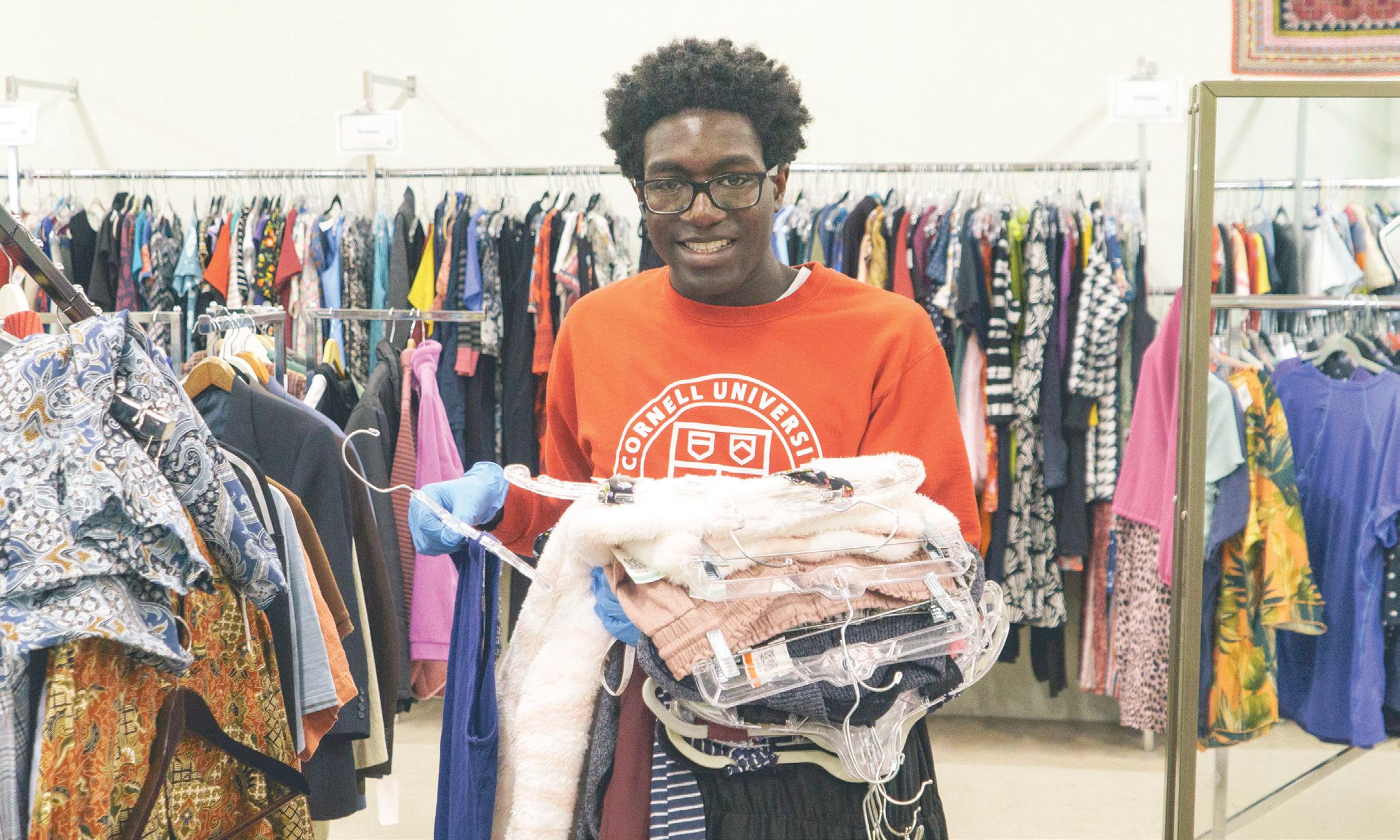
Sorting Clothes and Stocking the Racks. (Photo: Provided)
The Life (and Death) of Ithaca’s Own Money
By Stephen Burke
We never thought we’d be subjects of anthropological study, but it happened recently to myself and three other former directors of the Ithaca Hours currency system, a local money which existed in Ithaca for roughly 25 years, from 1990 through 2015 or so.
We were tracked down by Amiel Bize, an economic anthropologist who asked us to come speak to the students in a course she teaches at Cornell called The Social Life of Money. Apparently, Hours was an anthropologically significant enterprise that her class was eager to learn about.
The first line in the course description asks, “What is money?”
We Hours ex-directors didn’t know, from an academic standpoint. From a practical one, it is a topic that Ithaca Hours tested by creating money in cash denominations to be used just like U.S. dollars. Was it legal? Yes. Would it work? For a while, until people started using cards, then phones, more than paper cash.
Regarding its social life: Why did it start in Ithaca?
Ithaca is an educated city where people have ideas. It’s a small city where it’s easy to act on them.
There is an aspect of Ithaca that was once called anti-establishment, maybe now called progressive. That helps in creating things like alternatives to government currency.
Ithaca is a nice place to live, but a hard place to make a living. Many if not most people live paycheck to paycheck. The thinking behind Ithaca Hours was that if people needed more money in their lives, and it wasn’t forthcoming from anywhere else, why not just make new money ourselves?
It became an extra kind of money people could earn with skills they had to offer, or things they had to sell. They were listed in an Hours Directory that was like the Yellow Pages.
As Hours caught on and grew, familiar brick-and-mortar businesses started accepting them: GreenStar Co-op, Ithaca Bakery/ Collegetown Bagels, Autumn Leaves Books, Gimme Coffee, to name just a few.
Appealing to Ithacans who had Hours
Democracy Begins in Student Newsrooms
By Corallus Meeks
helped local businesses like Gimme Coffee compete with corporate ones like Starbucks. Ithaca was without a Starbucks longer, probably, than any other city its size. (A testament to Ithaca’s fundamental, lasting progressivism is that three eventually opened, but since have shut.)
Viva Tacqueria was an especially strong Hours business. Like most, It accepted Hours as partial payment, but on Tuesdays accepted them 100 percent.
Alternatives Federal Credit Union accepted Hours as partial repayment for loans and for other fees and services. Acceptance from a financial institution brought a lot of credibility to the community money.
Hours began to decline with the rise of credit cards. In the 1990s, when Hours started, GreenStar Co-op was a multi-million dollar business that did not accept credit cards. A lot of businesses didn’t. People didn’t have them in profusion. Cards had annual fees. They required credit checks. (Not until an act of Congress in 1974 did women have the legal right to obtain a credit card without a male co-signer.)
Eventually, credit cards dropped those onerous obstacles and flooded the market with cards that offered discounts, rewards programs and no up-front fees.
Suddenly, people carried multiple cards. Why not? You got all those benefits, and if you paid off balances every month, basically you had perpetual free loans.
Hours started as a way to bring more money into your life. You earned them, though. Now credit cards were offering access to plenty of money without doing a thing.
It was easy not to think about debt, just as it’s easy not to think about calories when eating junk food. But today it’s something to think about. Half of American families have savings of $8000 or less, while the average American has credit card debt of almost as much, $6700.
Credit cards are convenient to use. No more carrying cumbersome wads of cash dollars (or Hours). And they’re painless.
Journalism serves as an outlet for my passion for social justice. It has fundamentally shaped the way I understand democracy, social justice, and my own responsibility within both. It has gifted me two things: the ability to seek knowledge and the platform to critically engage with the issues I care about through my own lens. In a time of growing civic disengagement and distrust in institutions, that kind of education is invaluable.
The Student Journalism Education Act (S68/A8064), legislation currently sitting in the Senate and Assembly education committees, serves to protect student journalists from censorship unless their work is libelous, incites unlawful acts, or substantially disrupts school operations. It would finally extend meaningful press protections to students while still providing the necessary safeguards.
The principle behind this bill is hardly radical. The bill has been instated in numerous states where Republicans hold both chambers, being Kansas, Iowa, North Dakota, West Virginia, and Arkansas. In the landmark Supreme Court case Tinker v. Des Moines Independent Community School District, the Court famously declared students don’t “shed their constitutional rights to freedom of speech or expression at the schoolhouse gate.” Yet decades later, student journalists across the country continue to face retaliation for reporting stories that may stand outside social norms.
My own school paper, The Tattler, survived a life-threatening event in 2005 when escalating tensions between students and administrators erupted into a battle over censorship and editorial independence. Members of the paper’s board at the time refused to publish censored documents, arguing that the journal had been committed to honest reporting since 1892. A nine-year legal battle ensued over the publication’s independence, driving The Tattler underground for a time. They printed out of a parents’ bedroom and distributed anywhere but school grounds—even
standing at the outskirts of campus to hand out to students on their way home. The fight nearly destroyed the paper, but it also cemented something essential: we’ll do anything before we’ll silence ourselves.
And this isn’t an isolated event. Student journalists are frequently punished for exposing inequities, questioning authority, and bringing hidden issues into the public’s eye. Because of this, it remains an uphill battle to secure their rights. Decades of progress toward student free expression was undermined by the Supreme Court’s 1988 Hazelwood v. Kuhlmeier ruling, which broadened school officials’ power to censor student newspapers.
Efforts already exist to counter the pressure this ruling placed on journalists’ free speech. Organizations like the Southern Press Law Center work to defend student press freedom nationwide. They began the New Voices movement to push legislation, like the Student Journalism Education Act, protecting student journalists from censorship. Students at Binghamton High School spoke to the challenges their school paper, the Polaris Press, faced in gaining recognition as a public forum for student expression after being subdued to administrative review of all the content they publish. Higher education has been engulfed in free speech battles of its own. At Columbia University, one of the nation’s most renowned journalism institutions, student reporters described being denied access to protest areas, facing administrative pressure, and even seeing fellow student journalists temporarily suspended while covering campus demonstrations. Here in Ithaca, at Cornell University, questions surrounding protest, free expression, and the role of student voices have become increasingly prominent in recent years, beginning in the aftermath of protests over the war in Gaza and the university dedicating an entire academic year to exploring freedom of expression.
Why the Media Matters
By Roy Allen: Director of Strategic Partnerships — Ithaca Times, Finger Lakes Community Newspapers, Libations and ithaca.com
“We the People” introduces the U.S. Constitution with bold confidence. It is not a polite suggestion but a direct claim: power originates with ordinary citizens, not distant rulers. At once a declaration and a challenge, it carries a standing invitation—and a demand—for every generation to step forward and actively shape the republic. Democracy, if it is to mean anything at all, cannot be reduced to periodic voting followed by disengagement. It must be lived as a daily practice of informed debate, collective decisionmaking, and relentless accountability. At its core lies a simple but non-negotiable requirement: people must have access to reliable, diverse, and accurate information about the realities that shape their lives and the systems that govern them. This is where the role of media becomes indispensable. A functioning democracy depends on a well-informed public, and the media serves as one of the primary institutions through which citizens learn about government actions, social issues, economic developments, and global events. At its best, journalism acts as a watchdog, holding powerful institutions accountable, investigating wrongdoing, and providing the public with the information necessary to participate meaningfully in civic life. Without a strong and independent media, democracy risks becoming little more than a
ITHACA’S OWN MONEY
continued from page A14
When you use cash, you feel the reality of what you’re spending. With credit cards, and now phones, you feel modern magic, like you’re getting something for nothing. But at 20-plus percent interest, you’re getting something for something more, accruing monthly.
Cash provides privacy: no records of what you spend or where you go. Community cash creates reliance on one another. Credit cards and apps make people and businesses completely reliant on the intervention of a corporate third
formality rather than a genuine expression of popular sovereignty.
Yet the modern media landscape presents both opportunities and challenges. The digital age has dramatically expanded access to information, placing an unprecedented volume of news and perspectives at our fingertips. At the same time, the sheer abundance of information can make it difficult to distinguish verified facts from misinformation, analysis from opinion, and reporting from advocacy. Citizens are confronted not with a scarcity of information but with an overwhelming flood of competing narratives, each vying for attention.
To understand the importance of media today is to recognize that information shapes public perception, influences policy debates, and helps determine which issues receive national attention. Stories that dominate headlines often become matters of public concern, while those receiving little coverage can struggle to gain traction regardless of their significance. Media does not simply reflect reality; it plays a substantial role in constructing the public conversation about reality. For this reason, a healthy media ecosystem requires diversity of viewpoints, editorial independence, transparency, and a commitment to factual accuracy.
Under conditions where information is incomplete, distorted, or misleading, participatory democracy begins to weaken. Citizens who lack reliable information are less equipped to deliberate thoughtfully, evaluate competing claims, organize collectively, or hold leaders accountable. An electorate navigating confusion and misinformation faces greater difficulty
party (that keeps records on you forever) to get or give money: to do anything.
This isn’t a problem until it’s a big problem. You might not think the government would threaten credit card processors unless they froze the accounts of left-leaning or minority-owned businesses, but who thought it would extort universities to end diversity programs, or send secret police into U.S. cities to kill protestors and take children from their families into federal detention?
We didn’t get into such extreme speculation when we met with the anthropology class. We did ask the students if they had cash on them right now, figuring maybe
exercising genuine self-government. The promise embedded in “We the People” becomes harder to fulfill when people cannot confidently determine what is true, what is false, and what deserves their attention.
This reality makes media literacy a core civic competency. Democracy today requires more than passive consumption of headlines; it demands active engagement with information. Citizens must ask: Who produced this information? What evidence supports it? How was it verified? Are there other credible perspectives that should be considered? Education must evolve accordingly, emphasizing critical thinking, source evaluation, and digital literacy alongside traditional civic knowledge. A healthy democratic culture depends on individuals who are not merely consumers of information but active participants in evaluating and understanding it.
At the same time, the public is not simply a passive audience. Participatory democracy has always depended on engaged citizens who contribute to the exchange of ideas. Across communities, journalists, educators, researchers, local news organizations, independent media outlets, and everyday citizens help expand public understanding by sharing information, asking difficult questions, and fostering meaningful dialogue. Their contributions strengthen the public sphere and reinforce the democratic principle that informed participation belongs to everyone.
The responsibility, then, is both collective and personal. It requires supporting quality journalism, seeking information from multiple credible sources, and engaging in conversations that move beyond slogans and superficial talking points. It means resisting the temptation to remain within informational echo
one or two would, but were pleased to find it was more like half the class.
One of the students asked if we thought community money would ever return. We said we didn’t even know if cash dollars would ever return in strength. We all have a lot to learn first, hopefully not the hard way, but by thinking together, like in this class, and acting.
Postscript: The day after this column was written, the New York Times reported that in “the Trump administration’s campaign to force Cuba’s economic unraveling … a bank that processes Visa and Mastercard transactions withdrew business from the com-
chambers and embracing the more demanding practice of intellectual curiosity and critical inquiry. Democracy is not a finished monument; it is an ongoing project that requires constant attention and care.
In this light, the importance of media extends far beyond reporting daily events. Media serves as a bridge between citizens and the institutions that shape their lives. It provides transparency, encourages accountability, and creates a shared foundation of knowledge upon which democratic decision-making can occur. When functioning effectively, it empowers citizens to participate more fully in public life and strengthens the bonds that hold democratic societies together.
“We the People” is not a relic of the past; it is a living call to action. It asks us to see democracy not as something we inherit, but as something we create— through inquiry, dialogue, and participation. It reminds us that rights come paired with responsibilities: to remain informed, to engage thoughtfully with information, and to support the institutions that make democratic self-government possible. If participatory democracy is to endure, it must be nourished by a commitment to truth, transparency, and an informed citizenry. The strength of democratic society depends not only on the right to speak freely, but also on the ability of people to access trustworthy information and engage critically with the world around them. The question is not whether information matters, but whether we are willing to seek it, evaluate it, and use it responsibly.
The answer, as always, begins with us.
munist nation to avoid violating new U.S. regulations.”
Failure of the processor to comply could “bring sanctions, such as losing access to American banks” and “having their assets frozen.”
The Times reported that the World Food Program of the United Nations is suspending plans to distribute 3,000 tons of food in Cuba, unable to purchase fuel for delivery in Cuba “because it can no longer pay with Visa or Mastercard.”
Ithaca Notes foretells the advent of this kind of capitulation by credit card processors to government control, not foreseen anywhere else.
Kevin Cartmill’s Legacy Lives On in Ithaca Athletics

By Steve Lawrence
When I learned last week that Kevin Cartmill had passed unexpectedly at the young age of 50, I knew the news would hit hard for several segments of our community. Over the past 30 years, I saw Kevin wear several of his many hats — banking professional, tireless advocate for non-profits like Habitat for Humanity and Family & Children’s Services — but it was his role in the sports community and the joy he found in carrying on his family's legacy that lit him up the brightest. Since I started writing this column in 1992, I have sought out stories about local athletes, and early in my tenure, the Cartmill family sure gave me a lot of material. Kevin was a state champ in golf, a leader on some great basketball teams, Sarah was a force on the basketball court, Chris brought the same commitment to excellence...they kept me busy.
Given retired ICSD Athletic Director Bill Bryant has had a front row seat to the Cartmill family's impact on Little Red
athletics for over three decades, I knew that I had a great source for this story. Though Bill was happy to help, and he has done thousands of interviews, he was nervous about this one. “This is a really tough one,” Bryant offered. “I lost sleep last night, knowing we would be having this conversation and wondering if I could put into words how much the Cartmill family means to me.” He added, “I was Ithaca’s A.D. for 22 years, and Kevin was one of the best athletes I ever saw. He was not only the state golf champion, he was one of the key players on the basketball teams that John Stone coached to the Final 4.” (Kevin was later inducted into both the Ithaca High and Section IV Halls of Fame.)
Bryant — now the Director of Section IV Athletics — experienced a surreal set of circumstances last week. He was at the Ithaca High vs. Corning girls’ lacrosse championship, and as he was presenting the winners’ medals to the Little Red — including Lilia Cartmill — he noticed that Kevin and his wife, Kelli, were not in the stands. That was unusual, but what
was predictable was that Lee Cartmill, Kevin's dad, was there. Lee explained to Bill that Kevin and Kelli were at a wedding in Rhode Island. Twelve hours later, Bill received an “Are you sitting down?” phone call. “My wife told me that Kevin had passed, and I couldn't believe it,” Bryant told me.
Looking back at his 30-plus year friendship with the Cartmills, Bill said, “I always like to say that 'Ithaca Athletics has always been about family,’ and the Cartmills are the epitome of that. Lee and Deb (who, sadly, passed several years ago) raised three great kids, Kevin, Sarah and Chris, who were all great competitors. Lee and Deb were always in the stands to support their kids, but you never knew they were there. They were proudly watching.” Indeed, that is every coach’s dream, having parents whose dedication and involvement is evident, and who are willing to let their kids’ passion and performance and attitude speak for themselves.
Bryant and I have been friends for over 50 years — we went to the same high
school — and both of us are now watching athletes we coached and wrote about become parents and coaches themselves. In Bill's words, “I have watched Kevin help out as his own kids came up through the ranks, and his two sons — Nicholas and Zachary — both played college lacrosse (at Binghamton and Le Moyne), and now Lilia is a varsity athlete.”
A big part of Kevin's legacy will be, in Bryant's view, his involvement with the Little Red's Hall of Fame. “We started the Hall of Fame in the 1990s,” Bill offered, “and there was, for numerous reasons, a hiatus in recent years. Kevin, on his own, collected files and researched records and breathed life back into it.”
Bryant closed with, “The Cartmills are all great golfers, and we recently made a plan to play this summer. I’m so sad that won’t happen, but I will get together with Lee when the dust settles and make sure he knows that I want to do whatever I can to help to honor Kevin’s legacy. I will always remember him as being so positive, so willing to help, and most importantly, so present.”
Kevin Cartmill was a state champ in golf. (Photo: Provided)
Whether on the golf course,the basketball court, or as a professional and a devoted family man, Kevin Cartmill brought his A-Game every day. (Photo: Provided)
Arts&Entertainment
Exceptional Performances Make ‘A Bronx Tale’ a Season-Opening Success
By Barbara Adams
Kids and coppers and small-time criminals — what’s not to like? It’s all there in “A Bronx Tale, the Musical,” which opens e REV eatre Company’s 68th season of summer musicals in Auburn’s Emerson Park.
While the musical premiered only a decade ago, its story has a longer history, beginning in 1989 with actor/writer Chazz Palminteri’s one-man show inspired by growing up in the 1950s and ’60s Bronx. at’s still the core of the tale: young Calogero Anello steps outside the safety of his Sicilian-American family to nd a second home in the world of Sonny, the neighborhood crime boss. For the musical, Palminteri wrote the book, Alan Menken the music, and Glenn Slater the lyrics. Every REV production is a visual treat, and that’s what greets us right o in Milo Bue’s atmospheric set — crowded brick apartments rising into ominous darkness, metal balconies draped with faded laundry, re escape stairs and ladders crisscrossing the scene. At le , a sign proclaims “Belmont Avenue,” heart of the Italian neighborhood; it’s also the title of the opening song, crooned by a small cluster of doo-wop guys. We nd them in a rich spotlight by designer José Santiago, just the rst of his many splendid choices.
“A Bronx Tale, the Musical.”
Book by Chazz Palminteri, music by Alan Menken, lyrics by Glenn Slater. Directed by Brett Smock;
by Elle May Patterson, with
direction by Logan Medland. At the Merry-Go-Round Playhouse, The Rev Theatre Company, Emerson Park, Auburn, NY.
Tues.-Sun. at 7:30 p.m. and eight 2 p.m. matinees, Monday-Saturday, through June 20.
For tickets: TheREVTheatre.com or 315-255-1785.
At right there’s another street sign too, “Webster Avenue,” announcing the rst song of the second act. is identi es the Black neighborhood, which provides the story’s second tension: not only ordinary folks’ daily decency vs. criminal capers, but Italian vs. Black communities. Shades of “West Side Story” — there’s going to be a forbidden romance between our hero and a self-possessed young woman from the other side of the ’hood.
e story’s inciting incident occurs when Sonny shoots a man in cold blood and Calogero witnesses it from his stoop. When called to identify the killer in a police lineup, he recognizes Sonny but won’t snitch. At nine, he’s already absorbed the street code. “You did a good thing for a bad man,” his dad tells him.
Soon, the boy has great fun being Sonny’s good luck charm in a craps game. Eventually, as a teen, lured by the excitement and quick cash of the fast life, he rebels against his dad’s principled ways and joins Sonny’s entourage. Sonny takes “C,” as he renames him, under his wing, and their evolving relationship both echoes and contrasts with C’s bond with his father, a hardworking bus driver. Unsurprisingly, the tough mob boss proves paternally wise and supportive when C tries to woo Jane, despite the con icting taunts of gangs on both sides. is coming-of-age story (narrated from the start by a grown-up C) engages us because it unfolds in an earlier time, when accepted social prejudices were beginning to be questioned. (Our “benighted” past always entertains us.) It also appeals to our fascination with criminals and our eagerness to see them as fully dimensional, humanized, sympathetic. Be assured, “A Bronx Tale” nostalgically persists in maintaining the myth of the good bad guy.
But if that sleight of hand doesn’t bother you, every other aspect of this musical will delight. Brett Smock directs with a sure
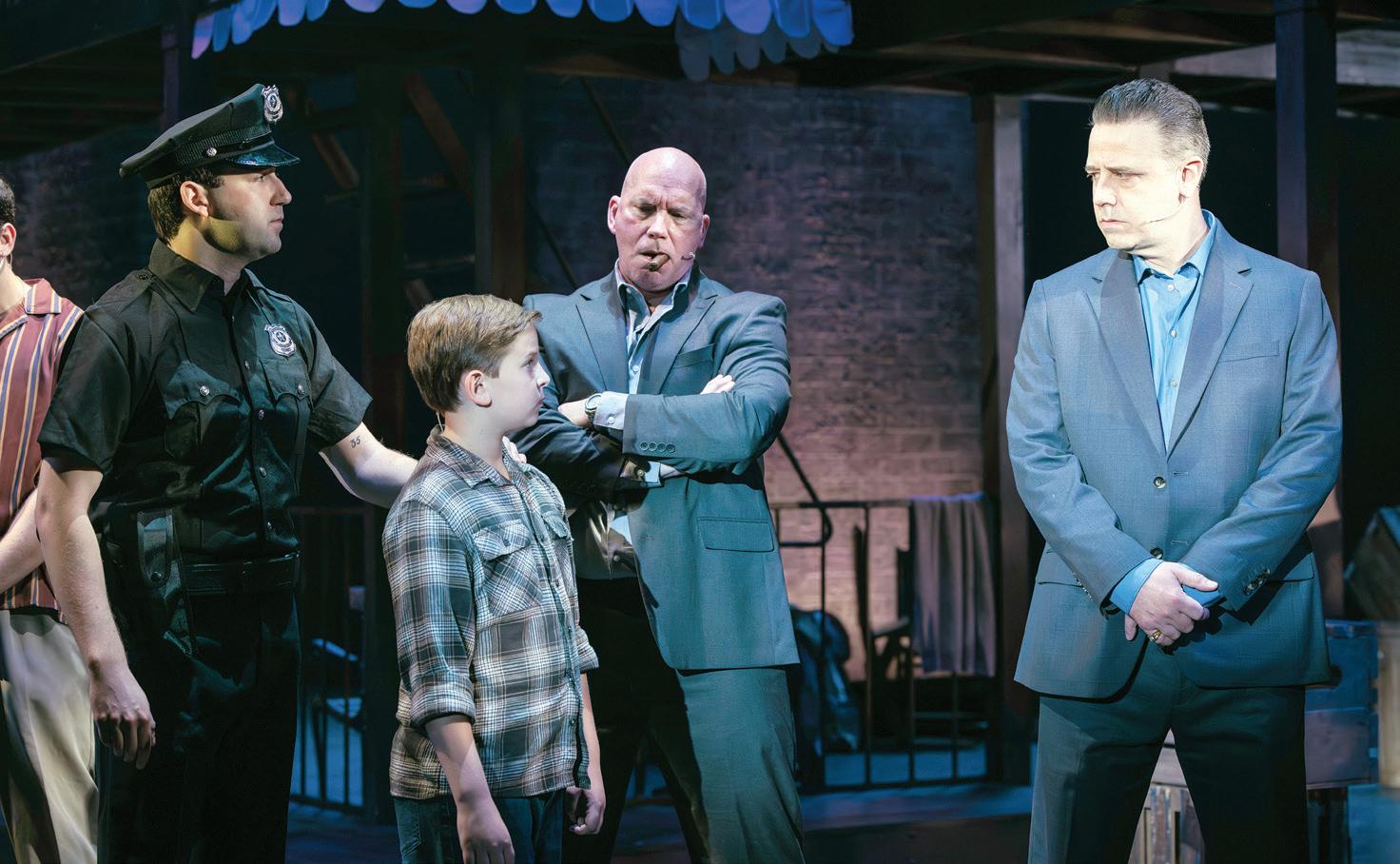
hand and handsome staging of each scene; choreographer Elle May Patterson li s the dynamic young ensemble in several exciting numbers; and music director Logan Medland’s orchestra does justice to Menken’s mix of ’60s rhythms, including Motown and pop.
Ti any Howard’s ne costumes take us back to that era — paying attention to every detail, like the varied cut and drape of men’s pants. Her use of color, from drab to bright, is luscious, and the tawny leather jacket that C slouches in is perfect for a wannabe tough guy.
Every member of this large cast shines as a perfect part of the whole: the ensemble of young dancers, the comically grotesque guys in Sonny’s crew, and all the main characters, starting with Benjamin DeBenedetto’s young C. His opening night performance was wonderful — clear, animated, and naturally personable, pulling us right into the story. As the teenage C, Trevor James persuasively delivers a young man reacting to events more than guiding them. e fact that both his onstage father gures are much taller than him visually reinforces his adolescence, his searching for his place.
Arjay Christina’s Jane is smart, decisive, and charming, but the love story is
inevitably less compelling than the risks C is taking in admiring Sonny’s gangster lifestyle. C’s parents are increasingly distressed but remain a constant for him: Alison Mahoney as the forgiving mother, Rosina, and Alan Chandler as his thoughtful father, Lorenzo. Chandler is especially striking as a calm moral force, a voice of reason and rm values tempered by love. At the center of it all is Sonny, the strongman with a so spot for this kid. Mike Keller is exceptional in the role — equally convincing in explosive anger or paternal fondness. His Sonny is vicious with enemies but at times re ective and even philosophical. Best of all, in classic criminal-comic style, he’s full of quips, expressions, attitudes, and advice that will leave you smiling. (Not the least of which, his test for how to tell if a dame really loves you.)
It’s a memorable performance in a tight, lively, smoothly acted and well-sung production. And by the nal curtain, “A Bronx Tale” has earned the return of that streetcorner chorus — now integrated.
Barbara Adams is a regional theatre and arts journalist and retired professor of writing, Ithaca College.
Jon Maltz as Cop, Rhys Natoli as Young Calogero, Aaron Lake as Tony Ten to Two, and Mike Keller as Sonny in The REV Theatre Company’s production of “A Bronx Tale.”
(Photo: Ron Heerkens, Jr. / Goat Factory Media Entertainment, LLC.)
choreographed
musical
Ithaca’s Pride Celebration Returns for Third Year
By Mikayla Rovenolt
The Ithaca Pride Alliance organized Ithaca’s third annual Pride Festival for June 12 through 14 with this year’s theme being “United We Rise.”
Chair of IPA and festival director Andrew Scheldorf said this year’s theme reinforces the idea that “no one is free until we are all free” and that everyone in a community needs to support one another to be successful.
“We all have to stand up and fight for each other and work in unison and solidarity with other marginalized groups across the country and the world,” Scheldorf said. “It truly is a situation where none of our freedoms are secure until all of us are free, and so we rise united to speak up for that and fight for each other’s rights and freedom and the ability to celebrate and be in community with each other.”
For the festival itself, Scheldorf said this year’s event is bigger than last year’s and has been a lot of work to produce, but that it is worth it.
This year, there are events before the weekend festival to “kick-off” the celebration. RainbowFest will be held June 12 at the Nocturnal Cafe and is done in collaboration with Ithaca Underground. The night will start at 7 p.m. and will feature a variety of LGBTQ+ bands with drag performances between sets. The show ends at 1 a.m.
On June 13 is the opening ceremony and all ages dance party. Starting at 3 p.m. in the
Bernie Milton Pavilion and surrounding area, there will be resource tables and an affirmation station for visitors. Access hour for the opening ceremony will be from 3 p.m. to 4 p.m. and will have no amplified sound or extreme lighting effects on stage. Visitors are encouraged to wear face masks.
Scheldorf shared that at 4 p.m. the Resistance Singers of Ithaca will lead a group sing along, followed by DJ Heathen Sinford from 5 p.m. to 6 p.m. The official opening ceremony starts at 6 p.m. with speakers from the community and words from this year’s Grand Marshal, Luca Maurer.
Maurer has worked across the United States and abroad with students and teachers, families and caregivers, faith communities, workplaces, and professionals in education, social services, healthcare, law enforcement, and more.
“In my lifetime we’ve gained the right to marry, recognition as the legal parents of our own children, and gender markers on government ID reflecting who we are,” Maurer wrote in a statement. “And now we are witnessing some of those same things rolled back. We survived then, and we will survive now. As this years Pride theme reminds us, United We Rise.”
Following the community speaks and Maurer will be the all ages dance party from 7 to 10 p.m. The dance party will be hosted by Skarlet Killz and DJ Cyber Bump.
Scheldorf said that June 14 is the largest part of the festival as it is an all day event with various activities throughout the day.
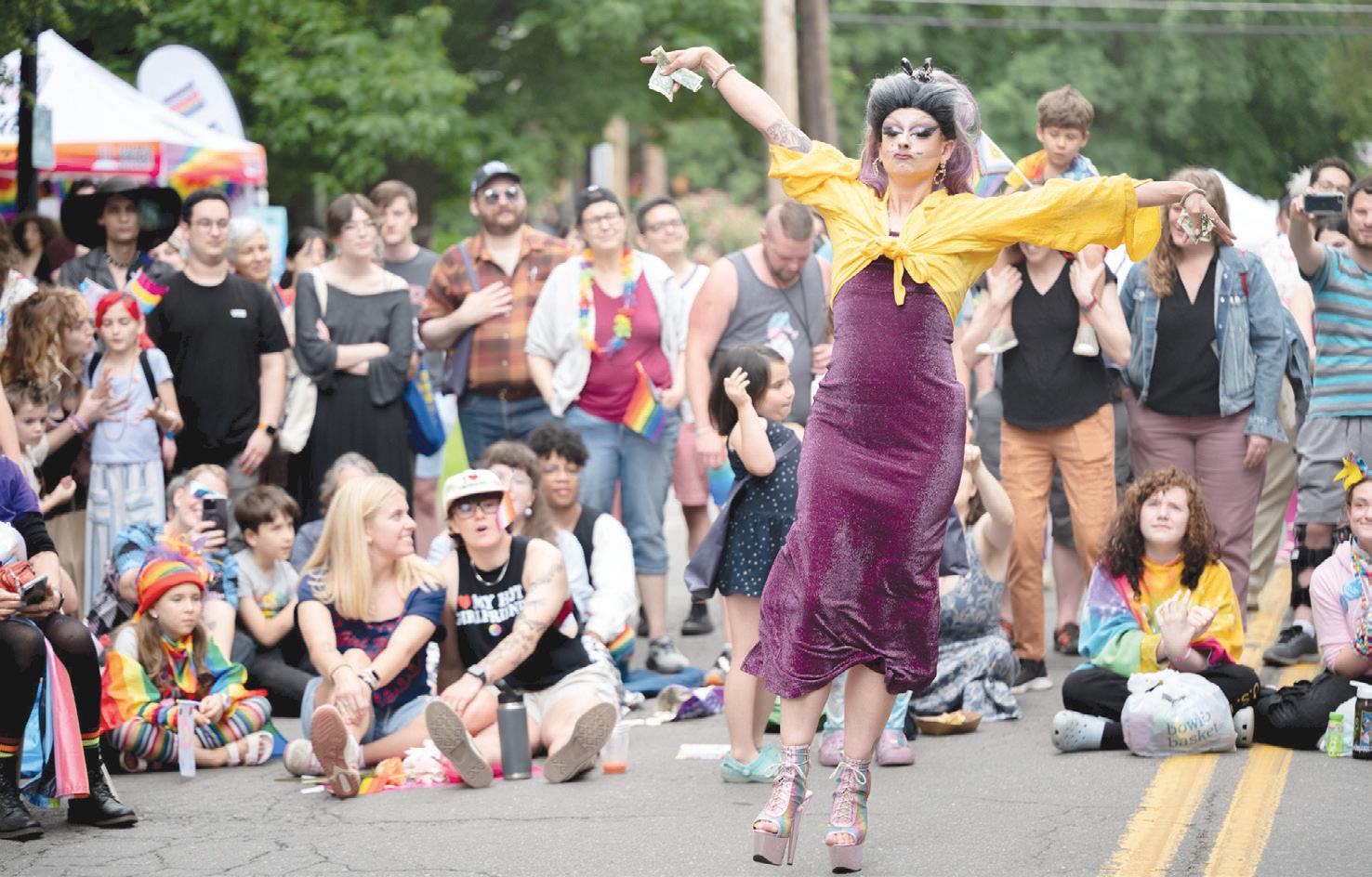

Pride in the Park will span from Dewitt Park to the Ithaca Commons and features a children and family parade, drag and musical performances, and over 50 craft vendors and resource tables as well as food trucks near Dewitt Park and on State Street.
Access hours for Pride in the Park are 10 a.m. to noon. There will be no amplified sound during this time and visitors are encouraged to wear masks. A full schedule of events can be found on the IPA website.
During Pride in the Park, Buffalo Street Books will serve as a decompression and nursing parents space.
Scheldorf concluded that while Pride
looks different now than it did 50 years ago, the roots of the movement still exist.
“I think pride is still a protest in many ways,” Scheldorf said. “While it might not appear to be a protest in the same way now that it was back then, celebration is still protest, queer joy is still activism. Pride in my mind is a lot of times a space for our community to gather and be defiantly joyous and queer, and kind of reaffirm that we are here, we’re still doing stuff, we’re still around, we still have a lot of work to go, and also a time for us to gather as a community in ways that we generally can’t throughout the year.”
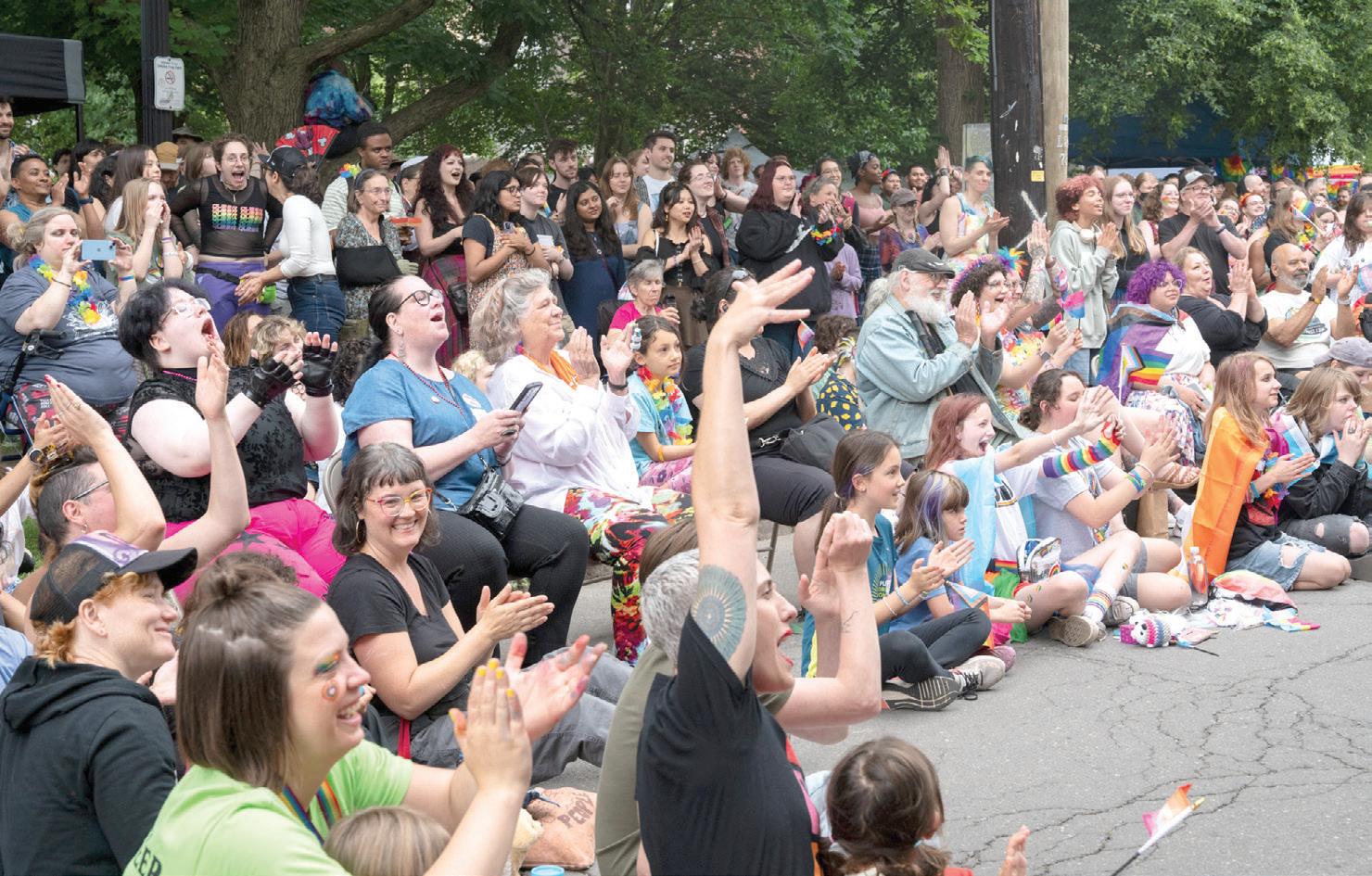
The theme for this year’s Pride Festival, organized by the Ithaca Pride Alliance, is “United We Rise.” (Photo: Nathan Ellison/Ithaca Times File)
The Festival will take place from June 12 through 14. (Photo: Nathan Ellison/Ithaca Times File)
Attendees gather at the 2025 Ithaca Pride Festival. (Photo: Nathan Ellison/Ithaca Times File)
A Mixed Revival of ‘Oklahoma!’ Opens Cortland Rep’s Summer Season
By Barbara Adams
Arobust Cortland Repertory Theatre opens its 55th summer season with the musical theatre classic, Richard Rogers and Oscar Hammerstein II’s “Oklahoma!” — last presented here three decades ago. At age 83, this groundbreaking show seems both unfashionable and fresh as ever.
It’s set in Indian Territory in the early 1900s, land settled by farmers and cowboys on not always amicable terms. This context may feel a long way from our current global worries, but some escapism is called for in summertime, and besides, young folks comically romancing offer perennial hope.
Charming cowpoke Curly and sullen farmhand Jud Fry complete for the attentions of a feisty Laurey, while in a second struggle, Ado Annie (the “girl who just can’t say no”) teases the hapless cowboy Will while zealously pursuing Ali Hakim, the seductive Persian peddler. The musical’s story and the songs are so familiar that audiences will sense visiting an old friend. In this production, directed by Trey Compton, some elements shine, but others seem distinctly less stellar.
Scott Holdredge’s set is straightforward — a pair of barn doors with farming tools flank the playing space and three wooden posts are moved around to suggest interiors. Serviceable, but drab, despite Matthew Webb’s nimble lighting. Until the very final scene where we get a glimpse of blue sky, there’s no suggestion of open prairie or fields of corn or any presence of
“Oklahoma!”
Music by Richard Rodgers; book and lyrics by Oscar Hammerstein II. Based on the play “Green Grow the Lilacs” by Lynn Riggs.
Directed by Trey Compton; choreographed by Donald J. Laney, with musical direction by Nicolás Guerrero.
At Cortland Repertory Theatre, Little York Lake Road, Preble, N.Y.
Through June 12 at 7:30 p.m.; plus 2 p.m. matinees on June 9 and 10.
For tickets: https://cortlandrep.org/ or 800-427-6160.
nature at all (unless you count some lyrics in “Surrey with a Fringe on Top”). Curly’s opening greeting, “Oh What a Beautiful Morning,” begins abruptly and without any complementary visuals.
Music director Nicolás Guerrero ensures that the well-known tunes are dynamically delivered by two facing onstage pianists (himself and Emmett Scott), and they engage in a nice bit of comic competition at the show’s end.
But the music overpowers the female vocalists, and in general, Sean McGinley’s sound design is overwhelming. This makes the acting seem pushed and outsized for the intimate venue. All performers are miked so loudly that I found listening from the back of the theater (admittedly only row 6) almost painful; being seated in a 45th row would have been preferable. (Even youthful memories of listening near giant speakers at rock concerts fade in comparison.) Who was all this volume for?
Two-thirds of the large cast consists of CRT’s performing interns, who do a fine job of populating the rural community.
Owen Creamer is a boyishly handsome Curly, with a fantastic, sonorous voice that belies his age. Natalie Green delivers Laurey as first scrappy but then increasingly irresolute; she captures the girl’s cleverness yet simplicity. Her voice, however, gives way to near-screeching in the high notes — also unfortunately true for Abigail Douglas’s Ado Annie (and the amplification makes this more unpleasant).
Even in this comic role, Douglas seems overdirected and just too silly. And her makeup, like that of all the young women except Laurey, is excessive for farm girls. The many costumes, by Clara Jean Kelly, are convincingly rural, though the cowboys sport too much faux fringe and Laurey’s pale green gown is oddly synthetic. The nicest touch, perhaps, comes in the young couple’s simple white wedding garb and post-bedroom appearance.
Shea Curran is persuasive as Ado Annie’s hopeful beau, Will, who’s determined to win her from her father and Ali Hakim. As the traveling salesman who leaves a string of women behind, Mikey LoBalsa-
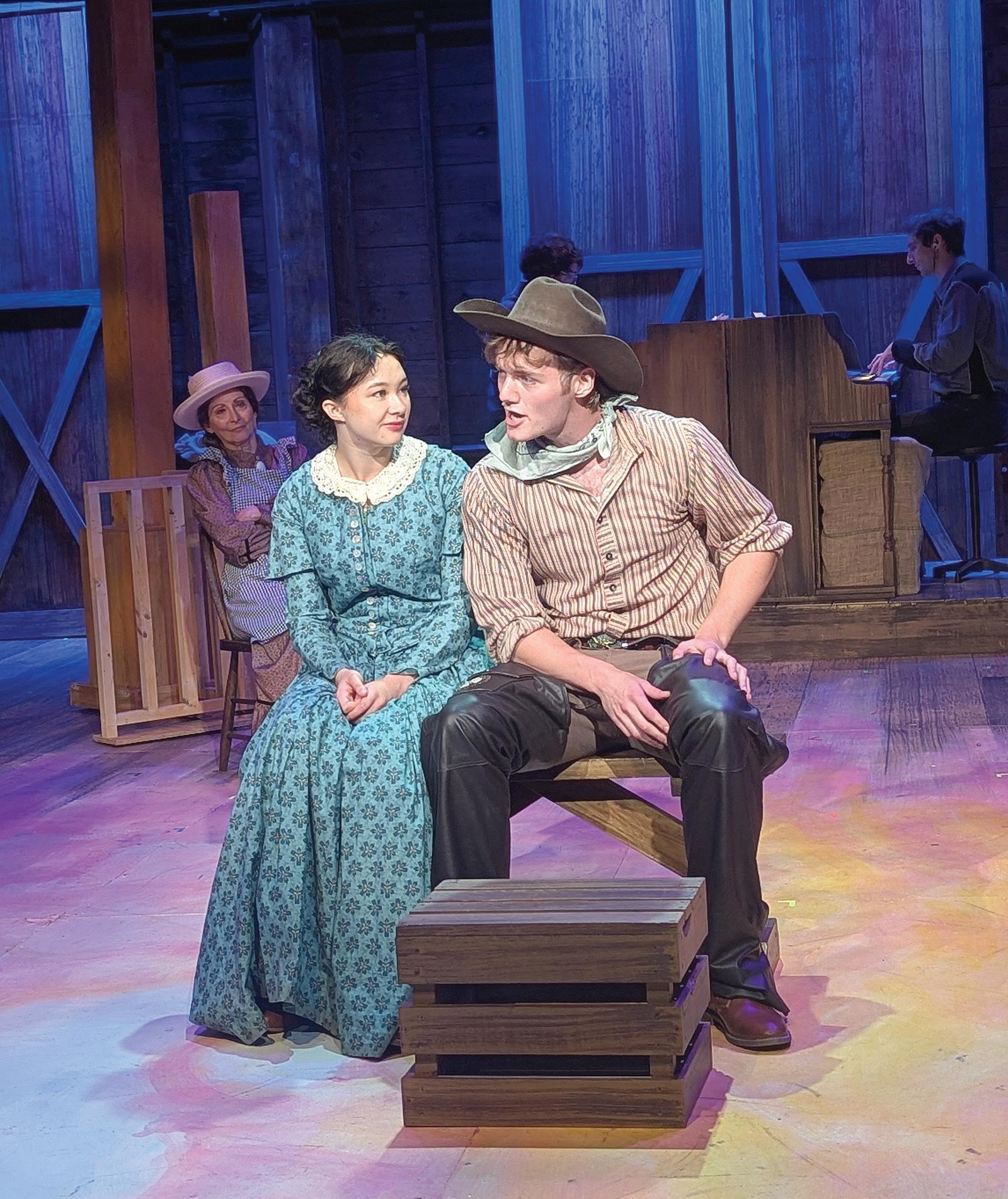
Natalie Green as Laurey Williams and Owen Creamer as Curly McLain in Cortland Rep’s production of “Rodgers and Hammerstein’s Oklahoma!” running June 3–12. (Photo: Ben Wells/Provided)
mo gets laughs with his copious “Persian kisses.” He doesn’t seem especially foreign, though, and his accent wanders mightily.
Reliably handsome performances come from the two community elders: Gerri Weagraff as sensible Aunt Eller and (her real-life husband) Paul Weagraff as Ado Annie’s father. And then there’s the outsider, Jud Fry, played with dark sensitivity by Austin Mirsoltani. His is a strange role: the prairie Caliban, volatile, lusty, and menacing, yet still sympathetic, a victim of his circumstances. Mirsoltani captures his contradictions and arrests us with his powerfully voiced solo, “Lonely Room.”
In her fearful fantasies about Jud, Laurey imagines the worst. This is rendered through the show’s famed dream ballet, here featuring Lizzie Patrick-Carcamo and
John Melagrida. As their unsettling chase unfurls, the real Laurey circles them in desperation.
While “Oklahoma!” explores such moments of psychic danger, above all it offers a positive vision of community. This is effectively evoked by the entire cast, especially in the vigorous dance numbers. Music director Guerrero and choreographer Donald J. Laney, who’ve teamed up here previously on “Hello, Dolly!" and “My Fair Lady,” keep the action delightfully buoyant. Their excellent collaboration guarantees the musical’s ultimate optimism — of new beginnings and new frontiers.
Barbara Adams is a regional theatre and arts journalist and retired professor of writing, Ithaca College.
A Curated Oral Portrait of Dorothy Cotton — A Civil Rights Movement Activist, Organizer and Educator
Curated by Roy Allen: Director of Strategic Partnerships — Ithaca Times, Finger Lakes Community Newspapers, www.ithaca.com in collaboration with Laura Branca — Project Director and Senior Fellow at the Dorothy Cotton Institute and Kristi Rudelius-Palmer — Strategy Advisor and Director for Human Rights Educations USA
Many voices have helped to shape the nation we call America. This week we feature Dorothy Cotton, one of the most influential yet often underrecognized voices of the Civil Rights Movement. Though there are few formal transcripts of her speeches or lectures, we felt it important to celebrate this great American in A Nation Speaks.
Dorothy Cotton’s Life June 9th marked what would have been Dorothy Cotton’s 96th birthday, and from where many of us stand today, her stars are still rising. In her honor, Ithaca Mayor Cantelmo proclaimed her birthday as Dorothy Cotton Day.
Laura Branca shared how rather than allowing early poverty and hardship to defeat her, Dorothy transformed those experiences into sources of courage, determination, and confidence. The struggles of her childhood helped shape a woman whose brilliance, boldness, and resilience would influence generations of activists, educators, and community leaders. She could be remarkably direct and outspoken in public, unafraid to challenge injustice or speak difficult truths. Yet those who knew her personally often encountered a very different side of her—a modest, thoughtful, and sometimes shy woman who never sought the spotlight for herself. Even when receiving well-deserved recognition for her leadership in the Civil Rights Movement, Dorothy was quick to redirect attention to others. After introductions at public events, she would often name women and local organizers whose contributions had gone unrecognized,
reminding audiences that movements are sustained not by a few celebrated figures but by countless individuals whose dedication, ingenuity, generosity, and persistence make lasting change possible. She understood that many of the true heroes—and sheroes—of the Freedom Movement never appeared in history books.
Dorothy Cotton’s voice did not merely recount history—it taught it. As Education Director for the Southern Christian Leadership Conference under Dr. Martin Luther King Jr., she helped design and lead Citizenship Education Programs that prepared ordinary people to become active participants in democracy. Through workshops, leadership training, and community organizing, Cotton helped thousands of Americans understand not only their rights, but also their responsibilities as citizens. Her work empowered people who had long been excluded from political participation to register to vote, speak publicly, organize locally, and advocate for change in their own communities.
Central to Dorothy's philosophy was her unwavering belief in the power of nonviolence and direct action. She taught that people could express dissent and demand justice peacefully yet resolutely, refusing to allow threats, intimidation, or violence to silence their voices. For Dorothy, democracy required participation, courage, and collective action. Citizenship was never a passive status; it was a practice.
Cotton moved to Ithaca in 1982 when she joined Cornell University as Director of Student Activities, later founding the Dorothy Cotton Institute. There she continued her lifelong commitment to leadership development, civic engagement, human rights, and social justice education. Her influence extended well beyond the Civil Rights Movement itself, inspiring new generations of students, educators, activists, and community leaders.
Her speaking style blended storytelling, moral clarity, humor, and collective identity—shifting seamlessly between personal reflection and communal instruction. Rather than positioning herself as the center of the story, she consistently emphasized the power of ordinary people working together toward a common purpose. She taught through rhythm, repeti-
tion, participation, and song.
Music, in fact, was one of Dorothy’s most powerful teaching tools. She understood that songs could strengthen courage, sustain hope, and build solidarity in the face of adversity. Friends and colleagues recall that she often began and ended marches, protests, and public gatherings with songs that united participants and reminded them of their shared purpose. As educator and human rights advocate Kristi RudeliusPalmer remembers, Dorothy recognized the power of music to carry movements forward. Reflecting on meeting Dorothy during a human rights teacher training in 2010, Rudelius-Palmer notes that the spirit of collective action sustained through song continues to inspire contemporary movements for justice. Today’s activists, she observes, stand on the shoulders of extraordinary leaders like Dorothy Cotton.
What follows is a curated selection of Dorothy Cotton’s words drawn from public lectures, including her 2007 Martin Luther King Jr. Commemorative Lecture at Cornell University and her 2011 oral history interview.
THE MEANING OF STRUGGLE
Cotton reframes suffering as transformation, using metaphor to convert historical trauma into collective meaning. For her, hardship was not merely something to endure, but something that could be transformed into strength, dignity, and purpose.
“Many people associate the civil rights movement with great suffering and sadness. However, from another perspective, that earth-changing movement gave millions a new reason to live.”
“Fighting for that cause brought a new meaning to our lives.”
“Working together as a community with a sense of purpose against the brutal racist culture turned those scars into stars.”
THE LANGUAGE OF ACTION
Cotton’s speech style emphasizes action over abstraction—short, declarative sentences meant to be remembered, repeated, and lived. Her words reflect a belief that social progress comes not from waiting for change, but from participating in it.
“We learned that we could only make the road by walking it.”
“We can use anger constructively to
empower ourselves.”
CIVIC LIFE AND RESPONSIBILITY
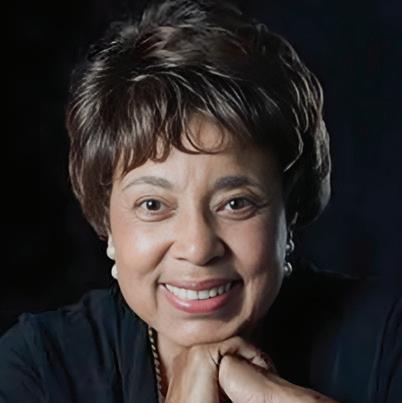
Cotton connects movement philosophy directly to democratic practice, insisting that citizenship is an active condition rather than a passive right. Throughout her career, she encouraged people to see democracy as a shared responsibility requiring ongoing participation.
“Government is by the people only if we make it so.”
“We must think proactively rather than reactively on how to coexist in comfort.”
THE VOICE OF COMMUNITY
This collective voice reflects her role as educator and organizer within the Civil Rights Movement, where speech functioned as instruction and mobilization. Cotton consistently used the language of “we” rather than “I,” reinforcing the idea that meaningful change emerges through collective effort and shared commitment.
“We learned that we could only make the road by walking it.”
A VOICE THAT TEACHES
Dorothy Cotton’s legacy is not only what she said, but how she said it—through rhythm, repetition, metaphor, song, and collective memory. She did not lecture in the traditional sense; she taught people how to become citizens through voice, movement, participation, and community. Her voice remains a reminder that civic change is not inherited—it is practiced.
At a time when democratic participation can often seem distant or abstract, Cotton’s message remains remarkably relevant. In an era marked by renewed struggles over voting rights, racial justice, gender equality, immigration, human rights, and democratic participation, her example challenges us to reject cynicism and embrace engagement. She understood that democracy requires vigilance, participation, and moral courage.
Those who knew Dorothy well believe she would not give in to hopelessness in the face of contemporary injustice. Instead, she would likely find inspiration in the millions of people who continue to organize, advocate, vote, teach, and demonstrate nonviolently for peace, due process, equality, and human dignity. She would recognize in them the same spirit that animated the Freedom Movement. Continued on Page B21
Aleshia Akers, the Chamber’s event and program coordinator, and Leon Holden, the county chief equity and diversity o cer, hosted the evening and spoke throughout the night.
e rst award of the evening was for the Not-for-Pro t Leader of the year, Schmitt Piha. She shared in her speech that PRI manages over 7 million specimens from all continents and that over 1 million people visit the museum each year. She said she does not consider herself a leader, but is appreciative of the award.
“I spent a lot of time digesting this title, digesting this honor and thinking about what it means,” Schmitt Piha said. “It’s been both a humbling and enlightening experience and I thank you all for providing that for me [...] I would not be standing up here without a tremendous community of people behind me.”
Holden introduced Lopez and presented
BUSINESS BRIEFS
continued from page A8
Grill are the mall’s only food options.
Captain Stanley Pierce earns
FishingBooker’s 2026 Angler’s Choice Award
Ithaca shing captain Stanley Pierce is in the top 8.3% of shing guides worldwide a er earning the FishingBooker’s 2026 Angler’s Choice Award.
FishingBooker is the world’s largest platform that connects anglers with sh-
DEMOCRACY BEGINS IN STUDENT NEWSROOMS
continued from page B14
When not sti ed, school papers, such as Stuyvesant High School’s Spectator, in Manhattan, and e Tattler, here at home, are able to blossom. ey report on climate change, a rmative action, public health, and religion. In pursuit of protecting their rights in doing so, delegates from the Spectator visited Albany, alongside student journalists from Beacon High School, Curtis High
his award for the Volunteer of the Year.
A er receiving the award, Lopez shared his thoughts with event attendees.
“When I rst received this recognition I started thinking,” Lopez said, “thinking about what it really means. e truth is, none of us accomplish anything alone. Every person being recognized tonight has been helped, challenged, encouraged and sometimes carried by the people around them.”
Lopez has worked with veterans, students, community organizations, and the broader community. He said our communities are built by the people who choose to show up for one another, especially when community members are struggling.
Emerging Leader of the Year Valencia Ariza followed Lopez’s speech and shared that 2025 began as a di cult year but grew to be a great year as she advanced in her career.
“Leadership wasn’t something I set out to pursue as a title,” Valencia Ariza said. “It started by saying yes to opportunities, raising my hand when help was needed, learning that being called bossy could actually
ing guides. Out of 9,463 captains globally, only 791 (8.3%) met the criteria of service, safety and reliability necessary to earn the award.
Captain Stanley Pierce is the only guide in the Ithaca area to receive this honor in 2026. He maintained a near-perfect 98% reliability rating and a 4.8-star average from veri ed guests throughout the past year.
“ e Finger Lakes o er a unique shing experience, but maintaining this level of consistency year-round requires incredible dedication,” says Vukan Simic, CEO of
School, and Rochester’s Brighton High School, to lobby for the Student Journalism Education Act in 2023.
In this past year, e Tattler has covered immigration enforcement, war in the Middle East, experiences of the Gayogo hó꞉nǫʼ Nation, local No Kings Day rallies, and bring school-wide issues to the attention of administration in nearly every editorial. e Student Journalism Education Act would establish consistent statewide protections that ensure all students have the same access to sharing their voice as e Tattler grants Ithaca High School students. e
translate into being decisive, organized, and willing to take responsibility as an adult.”
e next award, Business Leader of the Year, was presented to Carpenter by Dr. Nia Nunn. Dr. Nunn shared Carpenter’s successes and explained how she believes Carpenter is a community leader.
Carpenter shared thanks for the award in her speech and said it takes everyone in a community to make real changes. She urged people to spend their money locally and with organizations they trust because she believes that where people’s money goes matters.
“I am so grateful to all of the people that have supported me thus far,” Carpenter said, “and that I’ve been able to pour into with my love and my cookies and that’s love, justice, and cookies for all.”
e nal award of the evening, Industry Leader of the Year, was presented to Alario by Hammerstone School Inc. founder and executive director Maria KlempererJohnson.
Alario has been with Hammerstone for over a decade, teaching a variety of
FishingBooker. “Stanley Pierce has proven that Ithaca’s charter industry is operating at a world-class level.”
Finger Lakes ReUse in Triphammer Marketplace relocates to larger space
Aer 17 years, Finger Lakes ReUse closed its Village of Lansing at Triphammer Marketplace locations. e business is relocating to a larger space in the former Big Lots store at Cayuga Shopping Center. e new space will provide more room than the combined
legislation has already passed in 18 states. e timing could not be more urgent. Across the country, attacks on the free press have become increasingly normalized. President Trump has repeatedly targeted and tried to intimidate media organizations critical of his administration. Such actions send a message to young people that questioning authority is dangerous and inconvenient. ey discourage democratic, bipartisan debate. Simultaneously, young people are disengaging from civic life at alarming rates, o en feeling powerless within systems that
students and classes and building her own skills in the process.
“I o en hear from our students about how special their two days of class were and how the experience shi ed their perception of themselves, gave them the con dence they were looking for, and connected them to a community they didn’t even know that they needed. at’s already reward enough.”
Chamber President and CEO Peggy Coleman followed the awards ceremony by sharing information about the Tompkins Chamber Foundation, which is the scal sponsor of Tompkins Connect. According to its website, Tompkins Connect connects young professionals and emerging leaders through networking, community building, and volunteerism in Tompkins County.
Maria Telincho, the Chamber marketing and communications specialist and Visit Ithaca’s Maci Goldsmith, social media specialist, closed out the evening by speaking about their experience with Tompkins Connect. For more information, visit https:// www.tompkinsconnect.org/.
storefronts ReUse occupied at Triphammer Marketplace.
“ is move marks a signi cant milestone in the organization’s mission to enhance community, economy, and environment through reuse in Tompkins County,” the ReUse press release states.
ough ReUse MegaCenter is currently closed during the relocation process, Ithaca ReUse Center is still open. Donations are accepted at Ithaca ReUse Center from 10 a.m. to 4 p.m., Friday through Monday. Donations are closed Tuesday through ursday.
rarely invite their participation. Student journalism addresses both crises at once. Protecting student journalism means protecting the next generation’s ability to hold democratic institutions accountable. Youth are the promise of the continuation of democracy and free speech. Democracy does not begin when someone turns eighteen and walks into a voting booth. It begins when children learn their voice wields power.
Corallus Meeks is the Editor-in-Chief of e Tattler at Ithaca High School.
A NATION SPEAKS
continued from page B20
Most of all, she would remind us that change is never the work of a single leader.
It is the work of communities. It is the work of ordinary people discovering their collective power. It is the work of citizens making democracy real. at enduring faith in people—their
capacity to act together, persist together, sing together, and create change together—was at the heart of who Dorothy Cotton was.
NOTE: Source material is drawn from public lectures, oral history interviews, and
published remarks. Next week, we will celebrate Fred Rogers, a pioneer in children’s television, and revisit his Commencement Address at Dartmouth College in 2002.
on your own questions, thoughts, and observations.
Three Bears Still-Life Flower Painting Class | 6 p.m., 6/15 Monday | Three Bears Ovid, 7175 Main Street | Two free 1.5 hour watercolor painting classes in Papa Bear taught by local artist Andi Pisacano on June 20th and 27th from 1:00 to 2:30pm. | Free
Bars/Bands/Clubs
6/12 Friday
Sunset Music Series Presents
Doug & Eamonn Hubert | 3 p.m. | Wagner Vineyards, 9322 State Route 414
Evan Dillon | 5 p.m. | Wagner Vineyards, 9322 State Route 414
Live Music - The Time Riders | 6 p.m. | Hopshire Farm and Brewery, 1771 Dryden Road
6/13 Saturday
Cruel Summer | 3:30 p.m. | Treleaven Wines, 658 Lake Road
Harry Nichols Live | 4 p.m. | Brewers Taproom, 10 Pinckney Rd
Cruel Summer - Forever Starts Tonight | 5:30 p.m., 658 Lake Rd, King Ferry
Harry Nichols Live- 6/13 | 6 p.m., 10 Pinckney Rd, Ithaca
6/14 Sunday
Loud & Proud - Live Singing Drag Brunch | 11 a.m. | K-HOUSE Karaoke and Arts Hub, 121 W State Street
Sunday Mimosa Flight at Boundary Breaks | 11 a.m. | Boundary Breaks Vineyards, 1568 Porter Covert Road
Duos, Donuts & Drinks: Share and Pair Sunday with Boyd Parker Ambush | 11 a.m. | Fulkerson Winery, 5576 State Route 14
THIS WEEK Music
6/17 Wednesday
Motors & Music at The Glen | 5 p.m.
| Watkins Glen International, 2790 Co Rte 16, Concers/Recitals
6/10 Wednesday
Delvon Lamarr Organ Trio | 8 p.m. | Center for the Arts of Homer, 72 S Main St
6/11 Thursday
Beginnings Summer Concert Series | 5 p.m. | Bernie Milton Pavilion, Center Commons | Free Ithaca Concert Band | 7 p.m. | Stewart Park, 1 James L Gibbs Drive
6/12 Friday
Dark Star Orchestra | 6:30 p.m. | Beak & Ski Apple Orchards, 2708 Lords Hill Road
An Evening with CAKE at Beak & Ski (Lafayette, NY) | 6:30 p.m. | Beak & Ski Apple Orchards, 2708 Lords Hill Rd, Lafayette My Road to Auburn | 7 p.m. | Auburn Public Theater, 8 Exchange St | $15.00 Tres Cordes | 7:30 p.m. | Arnot Art Museum, 235 Lake Street | $40.00
6/14 Sunday
Science Connections: Tune Together | 2 p.m. | Sciencenter, 601 1st St
The Inner Crazy | Sunday Afternoon
Live in King Ferry, NY | 3 p.m. |
Northville Arts Center, 999 State Route 34B | Free
The Voice of the Lute at Lansing Area Performance Hall | 4 p.m. | The Savage Club Performing Arts Center, 1004 Auburn Road | Free
6/16 Tuesday
An Evening with Wilco | 5 p.m. | Beak & Ski Apple Orchards, 2708 Lords Hill Road
Stage
Meredith Willson’s THE MUSIC MAN | 7:30 p.m., 6/10 Wednesday | Clemens Center, 207 Clemens Center Parkway | The M&T Bank 2025-26 Broadway Season presents Tickets starting at $48.
Daughters (Hijas): A New Musical | 7 p.m., 6/11 Thursday | Kitchen Theatre Company, 417 W. State / W. MLK, Jr. Street | A New Musical at Kitchen Theatre Company | $15.00 - $30.00
The Shark Is Broken (Live Theatre) | 7:30 p.m., 6/12 Friday | Center for the Arts of Homer, 72 S Main St |
One Slight Hitch | 7:30 p.m., 6/12 Friday | Cider Mill Stage, 2 Nanticoke Ave | One Slight Hitch by Lewis Black It’s Courtney’s wedding day, and her mom, Delia, is making sure that everything is perfect.
Comedy Improv Show starring the Puzzled Players | 8 p.m., 6/12 Friday | Puzzled Players Comedy Improv
Theater and Training Center of Greater Binghamton, 19 Madison Avenue | Zany, interactive and fun! | $15.00
Ithaca Pride All Ages Dance Party | 7 p.m., 6/13 Saturday | Bernie Milton Pavilion, Center Commons | Ithaca Pride All Ages Dance Party | Free One Slight Hitch | 7:30 p.m., 6/13 Saturday | Cider Mill Stage Cider Mill Stage, 2 Nanticoke Ave | One Slight Hitch by Lewis Black It’s Courtney’s wedding day, and her mom, Delia, is making sure that everything is perfect.
Science Connections: Tune Together | 2 p.m., 6/14 Sunday | Sciencenter, 601 1st St | Join Tune Together for an engaging and interactive musical concert! Tune Together is a youth-led organization dedicated to inspiring and empowering younger generations through the power of music.
Participatory Contra, Square, and Circle Dancing | 7 p.m., 6/15 Monday | Ithaca Commons |
Art
Lin Price: How To Get From Here To There Exhibit | 12 p.m., 6/11 Thursday | The Gallery at South Hill, 950 Danby Rd., Ithaca, NY at the South Hill Business Campus | Free Nature Journaling with Joel Popp | 10:30 a.m., 6/13 Saturday | Tompkins County Public Library, 101 East Green Street | Connect with the natural world around you, using art to focus
Film
Short Films Screening and Conversation with Sarah Hennies | 6 p.m., 6/10 Wednesday | Tompkins County Public Library, 101 East Green Street | Join composer, percussionist and scholar Sarah Hennies as she shows two of her works, “Falsetto” (30min, 2019) and “Passing” (8min) and leads a Question and Answer session.
History Bu s’ Book Club | 6:30 p.m., 6/11 Thursday | Cortland Free Library, 32 Church St | Do you enjoy history? Join us at the library to discuss Humorous History. We choose the topic, You choose the book! Contact the library with any questions!
The Shark Is Broken (Live Theatre) | 7:30 p.m., 6/12 Friday | Center for the Arts of Homer, 72 S Main St |
World Cinema at Lifelong - Spring 2026 Film Series | 1:30 p.m., 6/16
Tuesday | Lifelong, 119 W. Court St. |
World Cinema Spring 2026 – 12-Session Film Series: April 7 – June 23, 2026 - 1:30 PM – 5:00 PM
Framing Ménerbes: FILM SCREENING, CONVERSATION, and RECEPTION | 7 p.m., 6/17 Wednesday | Ithaca College, 201 Muller Center | Back in Ithaca by Popular Demand! Filmed in France by NYC dance artist/ lmmaker Daniel Gwirtzman. WATCH THE TRAILER! Read More to VIEW | $12.51
Cinemapolis
120 E Green St, Ithaca
New movies opening the week of June 10. Contact Cinemapolis for showtimes and continuing lms. National Theatre Live: The Playboy of the Western World| Pegeen Flaherty’s life is turned upside down when, on a normal day, a young man walks into her pub claiming that he’s killed his father. Instead of being shunned, the killer Christy Mahon becomes a local hero. The welcome murderer wins hearts and races as he beds himself into village life. That is until a second man unexpectedly arrives on the scene. Caitríona McLaughlin (Artistic Director of the Abbey Theatre, Dublin) directs Nicola Coughlan (Bridgerton), Éanna Hardwicke (The Sixth Commandment) and Siobhán McSweeney (Derry Girls) in John Millington Synge’s riveting story of youth and self-discovery.| NA 147 mins
Disclosure Day |If you found out we weren’t alone, if someone showed you, proved it to you, would that frighten you? This summer, the truth belongs to seven billion people.We are coming close to … Disclosure Day. | NA 162 mins
The Little Sister |One Show Only-GLOBAL LENS — Fatima, 17, the youngest of three daughters, treads carefully as she searches for her own path, grappling with emerging desires, her attraction to women, and her loyalty to her caring FrenchAlgerian family. Starting university in Paris, she dates, makes friends, and explores a whole new world, all while confronting a timeless and heartrending dilemma: How can one stay true to oneself when reconciling di erent parts of one’s identity feels impossible?| NA 106 mins
A Room With A View|June 16 Only!A ROOM WITH A VIEW is one of the greatest—and most romantic—romantic comedies ever made. A young, independent-minded Edwardian woman (Helena Bonham Carter) is torn between her feelings for a free-spirited romantic (Julian Sands)



she meets on vacation in Florence and the priggish intellectual (Daniel DayLewis) to whom she becomes locked into an engagement with back home. An Academy Award-winning adaptation of the novel by E. M. Forster, A ROOM WITH A VIEW was written by James Ivory (CALL ME BY YOUR NAME). It was a massive box o ce hit that helped to propel more traditionally arthouse fare to the mainstream. Newly restored by Shout! Studios, the movie has never felt more stunning. | NA 117 mins
Special Events
GO ITHACA Open Hours | 2 p.m., 6/11 Thursday | Tompkins County Public Library, 101 East Green Street | Our program makes sustainable commuting accessible and a ordable for everyone.
Beak & Ski | 6:30 p.m., 6/12 Friday | Beak & Ski Apple Orchards, 2708 Lords Hill Road | DSP Shows Presents: Dark Star Orchestra June 12, 2026 Beak & Ski | Lafayette, NY darkstarorchestra.net Performing to critical acclaim for over 20 years and over 3000 shows, Dark Star Orchestra
An Evening with CAKE at Beak & Ski (Lafayette, NY) | 6:30 p.m., 6/12 Friday | Beak & Ski Apple Orchards, 2708 Lords Hill Rd, Lafayette | DSP Shows Presents: Dark Star Orchestra June 12, 2026 Beak & Ski | CrossFit Cortland Co ee Run and Tasting Tour With Local Roasters | 8 a.m., 6/13 Saturday | CrossFit Cortland and CFC Nutrition, 165 Main Street | Join us for a ca eine-fueled jog around town, sampling the best brews from local roasters — a workout for your taste buds! | $33.85
Ithaca Pride Festival Opening Events | 3 p.m., 6/13 Saturday | Bernie Milton Pavilion, Center Commons | Ithaca Pride Festival — Opening Events | Free
Barnyard Bonanza: Cows | 4 p.m., 6/16 Tuesday | Cortland Free Library, 32 Church St | Join our special guest, 2025 Cortland County Fair Queen Court, as they share stories, craft, and activities all about COWS. This program is geared towards ages 4-8. Registration is required.
Books
History Bu s’ Book Club | 6:30 p.m., 6/11 Thursday | Cortland Free Library, 32 Church St | Do you enjoy history? Join us at the library to discuss Humorous History. We choose the topic, You choose the book! Contact the library with any questions!
Claire Drucker Poetry Reading | 6 p.m., 6/12 Friday | Protagonist Books and Co ee, 8 West Main Street | Claire Drucker will read from her book The Life you Gave Me and share from her new work written in response to erased words under the current administration. | Free SVHC Poetry Slam | 7 p.m., 6/12 Friday | Ake Gallery, 165 Main Street, #Suite 14L | The vibe of an open mic + your poetry performed + community = Poetry Slam. Proceeds bene t the programs of Seven Valleys Health Coalition | $12.51
Trans Center Book Club | 1 p.m., 6/13 Saturday | Bu alo Street Books, 215 North Cayuga Street | Join us to discuss Stone Butch Blues by Leslie Feinberg! A book club hosted by the Ithaca Trans Center. | Free Poetry Reading with Claire Drucker | 4 p.m., 6/13 Saturday | Buffalo Street Books, 215 North Cayuga Street | Join us for a poetry reading with Claire Drucker! | Free Comic Book Club of Ithaca | 6:30 p.m., 6/16 Tuesday | Tompkins County Public Library, 101 East Green Street | The Comic Book Club of Ithaca — the oldest continuously running comic book club in the country — is a registered non-pro t organization.

LET’S READ + TALK ABOUT CLIMATE
— CLIMATE LIT DISCUSSION GROUP
| 4 p.m., 6/17 Wednesday | Bu alo Street Books, 215 North Cayuga Street | Join our community-led conversation about climate change, as we discuss Theory of Water: Nishnaabe Maps to the Times Ahead by Leanne Betasamosake Simpson! | Free
Kids
Helping Teens Thrive: A Parent Discussion Series | 6 p.m., 6/10 Wednesday | The series, Helping Teens Thrive: A Parent Discussion Series, is part of the Positive Parenting Program (Triple P) and o ers practical, strengths-based strategies for navigating common challenges that arise during adolescence | Free Story + Craft | 4 p.m., 6/11 Thursday | Tompkins County Public Library, 101 East Green Street | Story + Craft is our weekly reading + creating event for children! Join us for a read-aloud, followed by art-making or a guided craft.
Spanish Storytime | 4 p.m., 6/12 Friday | Tompkins County Public Library, 101 E Green St | Children of all ages and their caregivers are welcome to join us for Spanish storytime — songs, rhymes, stories, and crafts — completely in Spanish!
ICG Drop-In Discovery Days | 10 a.m., 6/13 Saturday | Ithaca Children’s Garden, 121 Turtle Lane | A free Saturday Summer series designed for nature explorers of all ages. Materials and sta will be available to support your exploration as you enjoy handson, themed activities at your own pace. | Free
Second Saturday Family Fun: Dinosaurs | 10:30 a.m., 6/13 Saturday | Cortland Free Library, 32 Church St | Get ready for Summer Reading with DINOSAUR stories, songs, snacks, craft and activities! Program geared to ages 3-7 yrs. but all families are welcome. Registration is required.

THE LITTLE SISTER
SUNDAY, JUNE 14 AT 2:30 P.M.
Cinemapolis, 120 E Green St. | GLOBAL LENS — Fatima, 17, the youngest of three daughters, treads carefully as she searches for her own path, grappling with emerging desires, her attraction to women, and her loyalty to her caring French-Algerian family. Starting university in Paris, she dates, makes friends, and explores a whole new world, all while confronting a timeless and heartrending dilemma: How can one stay true to oneself when reconciling di erent parts of one’s identity feels impossible?
Father’s Day nature, laser tag | 1 p.m., 6/14 Sunday | Fantasy Forest LLC, 99 Smith Rd. | Join us for a spectacular Father’s Day! Admission — $40 for 1 adult, & 2 children you’ll get to do 2 rounds of laser tag. You may purchase an extra round for $20, and it is $10 per any additional person. | $40.00 Science Connections: Tune Together | 2 p.m., 6/14 Sunday | Sciencenter, 601 1st St | Join Tune Together for an engaging and interactive musical concert! Tune Together is a youth-led organization dedicated to inspiring and empowering younger generations through the power of music.
Journey of Water — Free Summer Science Programming for Kids and Families | 2 p.m., 6/14 Sunday | Various, various | Explore the ways that water moves through our lives with the Community Science Institute. Free summer programming for kids and families. Go to communityscience. org/journeyofwater/ for schedule and to register. Kids get a passport to stamp at each program and can get a free t-shirt. | Free Sit! Stay! Read! | 3 p.m., 6/15 Monday | Tompkins County Public Library, 101 E Green St | Children are invited to practice their reading skills by sharing a story with a truly non-judgmental listener — a dog! Reading sessions will be held Mondays from 3-4 p.m. Tanglewood Nature Center | 3:30 p.m., 6/15 Monday | New eld Public Library, 198 Main St | Tanglewood Nature Center will. | Free Free Family Bingo Every Tuesday Night | 6/16 Tuesday | Ice Cream Bar, 207 E. Main St. (Rt 96 |
Notices
The Midweek Session | 4 p.m., 6/10 Wednesday | NRE Space, 402 W. State St | The Finger Lakes CannaMarket is adding Wednesdays. Starting April 29, join us from 4–9 PM for a free
midweek 420 market where growers, enthusiasts, and the community connect. | Free Kitchen OPEN | 4:30 p.m., 6/10
Wednesday | We’re excited to share that Hopshire is now o ering a limited menu!
Pet Clinic | 6 p.m., 6/10 Wednesday
| Southside Community Center Gym, 305 S Plain St | Pet Clinic
Succulent Wreath Workshop at Brewers | 6 p.m., 6/10 Wednesday
| Brewer’s Kitchen & Taproom, 1384 Dryden Rd | You’re going to want in on this amazing succulent wreath project!
Ithaca Urban Renewal Agency
Neighborhood Investment Committee Mtg | 9 a.m., 6/11 Thursday | Common Council Chambers, 3rd Floor City Hall 108 E Green St |
Master Gardener Volunteers’ Montour Falls Plant Sale | 4 p.m., 6/11 Thursday | Montour Falls Fireman’s Field, 301 Clawson Blvd | Join CCE Schuyler’s Master Gardeners for an afternoon full of Plants, Garden Decor, Plant Merch and Food at at new location: The Montour Falls Farmer’s Market at Fireman’s Field! | Free Travel Talks | 6:30 p.m., 6/11 Thursday | New eld Public Library, 198 Main St | Join us at the Library to hear about other peoples’ travel experiences and share your own! From river cruises to camping to time shares, get inspired for your next vacation or reminisce about your favorite trip with a group of travel lovers. | Free Karaoke with Elephant Sound | 8 p.m., 6/11 Thursday | 23 North Restaurant and Bar, 23 Cinema Dr | Show o your singing chops every Thursday night during “Karaoke Night” at 23 North in Ithaca! Great food, great drinks, great FUN! | Free SVHC Poetry Slam | 7 p.m., 6/12
Friday | Ake Gallery, 165 Main Street, #Suite 14L | The vibe of an open mic +

your poetry performed + community = Poetry Slam. Proceeds bene t the programs of Seven Valleys Health Coalition | $12.51
Saturday Market | 9 a.m., 6/13
Saturday | Steamboat Landing, 545 3rd St. | Our Saturday Markets are now outside at the pavilion. Find us each week at Steamboat Landing.
Summer Tree ID Walk | 10 a.m., 6/13
Saturday | CCE-Tompkins Education Center, 615 Willow Avenue | Learn to distinguish one tree from the next and about forest ecology. This tour will teach how to identify tree species using leaves, bark, and seeds. | $20.00 Pride in the Park 2026 | 10 a.m., 6/14 Sunday | Ithaca Dewitt Park, Ithaca Dewitt Park, Ithaca Dewitt Park, Ithaca Causes, Dewitt Park, N Cayuga St | Join us for local vendors, food, community resources, and a full day of stage performances.
Poses With Purpose-Yoga bene tting Lodi Whittier Library | 10 a.m., 6/14 Sunday | Lamoreaux Landing Wine Cellars, 9224 New York 414 | Enjoy a morning of yoga in the vineyard at Lamoreaux Landing while supporting Lodi Whittier Library! Tickets $20 cash/Venmo at the door. | Free
Growing Well Together | 5:30 p.m., 6/16 Tuesday | Ithaca Community Gardens, Cayuga Park Lane | Meet at the Ithaca Community Gardens pavilion to enjoy a free yoga class, learn how to grow your own vegetables, or join a walking group! | Free Community Line Dance | 7 p.m., 6/16 Tuesday | Foundation of Light, 391 Turkey Hill Rd | Community Line Dance lessons
Show Tunes Singalong! | 8 a.m., 6/17 Wednesday | St. Luke Lutheran Church, 109 Oak Street | In conjunction with and supporting Ithaca Pride Alliance — an evening of music, laughter, and community in celebration of Pride Month.

THE VOICE OF THE LUTE AT LANSING AREA PERFORMANCE HALL
SUNDAY, JUNE 14 FROM 4 P.M. TO 5 P.M.
The Savage Club Performing Arts Center Groton, NY | Join NYS Baroque’s Young Artist, Pedro Sperb, for an engaging and accessible concert that brings the earliest music for plucked strings to life. Through captivating performance and storytelling, discover how these instruments shaped the music we love today no prior knowledge needed.Free and open to the public just come and enjoy! (Photo from Eventbrite)
830/Home
DO YOU NEED A ROOF OR ENERGY EFFICIENT WINDOWS & HELP PAYING FOR IT?
YOU MAY QUALIFY THROUGH NEW RELIEF PROGRAMS (800) 944-9393 or visit NYProgramFunding.org to qualify. Approved applications will have the work completed by a repair crew provided by: HOMEOWNER FUNDING. Not affiliated with State or Gov Programs. (NYSCAN)
800/Services
ITHACA LOCAL ECONOMY LAB PODCAS
End stage capitalism got you down?
Learn how Ithaca’s radical experiments in community and economics are making a real difference today!
IthacaLocalEconomyLab.com on iTunes and Spotify
& SHAMANIC HEALING IN ITHACA
End old habits. Heal the mind and spirit. Create positive change in your life! Devin Ryback is a healer and certified clinical hypnotherapist with 14+ years experience. Book your free consultation today. Call or Text: (845) 238-8673 Book Online: devinryback.com




















Lisa ' s Marketing Corner
Practical Advice for the Merchants and Makers Who Keep our City Humming
Every day when I come into work I pass unique shops and businesses that make up the fabric of Ithaca, New York. From restaurants to handmade goods, to local beverage shops and tattoo parlors, from barber shops to art studios.
As a marketing professional, my mind quickly goes from “how lucky we are to have such diverse businesses in town” to “I hope all these businesses will not just survive, but thrive”. Hyperlocal, small city businesses have a special challenge when it comes to making sure consumers know they exist. Lots of personal resources - time, talent, treasure and lovehave been poured into these businesses as owners wait for the town to find and adore them. In these busy times when consumers have myriad distractions and many options available to purchase goods and services, it doesn’t always quite work out this way. But there is no need to despair.
The good news is that reaching your neighbors has never been easier. Or more affordable. I recently heard about a strategy called the 100-Meter Circle. Walk 100 meters from your business and introduce yourself to every company, shop, and organization you pass. Drop off a business card (or a stack), a few brochures, and make a plan to follow up, even just for coffee. Offer to cross-promote each others’ businesses. That coffee shop across the street? They see hundreds of customers before noon who may not know about your business.
Make it personal. Introduce yourself, have a small open house for neighbors, say “Hi” on the Next Door
app., ask local businesses to share their stories with you, offer to post business cards and flyers at your place, and join a local group of business owners that meet regularly to discuss strategies. You might even co-sponsor the events.
People in Ithaca want to support local businesses but they need to know that you exist. Keep communications with your neighbors and potential customers authentic and non-salesy. That can be tricky when you want to sell things, right? But consumers (our neighbors) don’t want to be sold to. They want value with no strings attached, diagnoses (“what are your needs?”), as opposed to quick solutions, several options so customers can make their own decisions, and real-life examples of how others have benefited from your services, whether through social media posts, news stories, or written testimonials.
Next month we will dig into how to sponsor local charitable events which allow you to support organizations that align with your values and may also help you meet new customers. Until then, put down your task at hand and go introduce yourself to your neighbor!
Lisa Ellin is a Customer Success Representative for the Ithaca Times and brings her experience in marketing, advertising, business ownership, and career coaching to every meeting. Lisa thoroughly enjoys partnering and strategizing with local businesses. Do you have a marketing topic you would like to see discussed here? Please reach out to Lisa at lisa.e@ithacatimes.com.
OpeNS next week!

TICKETS NOW!
HangarTheatre.org • 607.273.ARTS (2787) 801 Taughannock Blvd in Cass Park
In an emotionally charged musical journey, Alison travels through time, bringing to life her childhood, college years, and early adulthood, to unravel her coming-of-age and coming-out story while trying to make sense of the twisty, layered relationship she has with her father and their shared hometown. Based on the best-selling graphic memoir by Alison Bechdel and featuring a soaring score by Jeanine Tesori that ranges from rousing ‘70s pop to wistful, shimmering ballads and a witty, heartfelt book by Lisa Kron, Fun Home is a stunning, can’t-miss theatrical experience.


the expert care of Cayuga Orthopedics, Carol

BackPage









Participate in Discover Cayuga Lake’s Contest, to name our “New Boat for Everyone!” The first stage of the contest, happening through April, is donation-based and invites supporters to propose a name for the boat, accompanied by a donation of $500. Stage two, which will take place in May, invites everyone to vote for the name they like most, free of any obligation to donate.