F R E E / J u l y 8 , 2 0 2 6 / V o l u m e L I V , N u m b er 3 6 / O u r 5 4 t h Y e a r
Online @ Ithaca.com
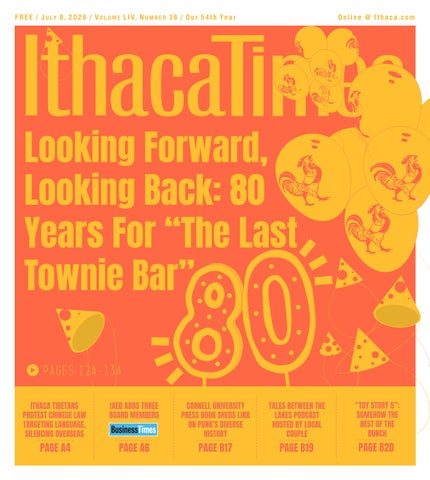
Looking Forward, Looking Back: 80 Years For “The Last Townie Bar” PAGES 12A-13A ITHACA TIBETANS PROTEST CHINESE LAW TARGETING LANGUAGE, SILENCING OVERSEAS
PAGE A4
IAED ADDS THREE BOARD MEMBERS
BusinessTimes
PAGE A6
CORNELL UNIVERSITY PRESS BOOK SHEDS LINK ON PUNK’S DIVERSE HISTORY
PAGE B17
TALES BETWEEN THE LAKES PODCAST HOSTED BY LOCAL COUPLE
PAGE B19
“TOY STORY 5”: SOMEHOW THE BEST OF THE BUNCH
PAGE B20
IMPACT LAW
THE RULE OF LAW AT 250 From Declaration to Durable Democracy Perspectives on Law, Governance, and Civic Continuity in the United States As the United States approaches the 250th anniversary of the Declaration of Independence, the moment invites more than commemoration. It calls for a clear-eyed reflection on what was declared in 1776—and what has since been constructed, tested, and sustained through law. The Declaration of Independence was not a legal document in the modern sense. It created no courts, no enforcement mechanisms, and no governing institutions. It was, instead, a political and moral statement of extraordinary force: that legitimacy in government does not arise from inheritance or authority imposed from above, but from the consent of the governed. That idea did not immediately produce a functioning legal system. In 1776, it justified separation from Britain; it did not yet define how a new nation would govern itself. But it permanently altered the intellectual foundation of American civic life. The Declaration reframed political power as conditional, not absolute, and placed moral accountability at the center of public authority. In its original context, the Declaration functioned as an indictment of arbitrary rule. It catalogued grievances against the Crown and articulated a philosophical justification for independence. Its language was aspirational rather than operational, rooted in natural rights rather than institutional design. Yet embedded in that philosophy were principles that would later become foundational to American constitutional law: equality, accountability, and the idea that power must be constrained by rule rather than will. The transformation from philosophical declaration to governing structure unfolded over more than a decade. The Articles of Confederation represented an early attempt at national governance but proved insufficient to sustain a unified and functional republic. The Constitution of 1787 emerged not as a rejection of the Declaration’s ideals, but as an effort
to give those ideals durable form. Where the Declaration articulated legitimacy, the Constitution operationalized it. This distinction is central to understanding the American rule of law. The Declaration is often treated as the moral origin of the nation, but the rule of law itself is expressed through constitutional structure and the legal system that followed. Together, they form a layered foundation: one defining purpose, the other establishing process. The rule of law, at its core, is the principle that governmental authority must be exercised according to established rules that are publicly known, consistently applied, and subject to institutional checks. It is not simply the existence of law, but the constraint of power through law. Under this framework, government does not act solely because it has the ability to do so; it acts because it is authorized to do so through legitimate procedures. The American system created this structure through several design features: separation of powers, federalism, and judicial review. These were not incidental developments, but deliberate choices intended to prevent the concentration of authority. The framers constructed a system in which ambition would check ambition, and no single institution would hold unchecked power. The goal was not perfect governance, but restrained governance—one in which legitimacy would depend on process rather than force. Over time, the rule of law became not only a constitutional theory but a lived institutional reality. Its meaning has expanded through amendments, legislation, and judicial interpretation. The abolition of slavery, the extension of citizenship, the expansion of voting rights, and the development of civil rights protections all represent stages in the ongoing effort to align legal systems with foundational ideals. This evolution has never been linear. American legal history is marked by periods in which the rule of law was both strengthened and tested. The Civil War
A2 T h e I T h a c a T I m e s / J u l y 8 – 1 4 2 0 2 6
challenged the survival of the constitutional order itself. Reconstruction attempted to extend legal equality in ways the founding era had not realized. The twentieth century introduced new frameworks for civil rights, administrative governance, and economic regulation, each expanding the reach of law into areas once governed by custom or unchecked authority. In each of these moments, the rule of law was not abandoned but reinterpreted. Its endurance lies not in rigidity, but in adaptability. A legal system survives not because it remains unchanged, but because it is capable of absorbing conflict and translating it into institutional development rather than breakdown. Yet the rule of law is not self-sustaining. It depends on institutions that are credible, processes that are transparent, and participants who are committed to its integrity. Public trust, procedural fairness, and equal access to justice are not peripheral concerns—they are essential conditions for legitimacy. Today, the American legal system operates in a period of rapid change. Technological innovation is reshaping privacy, commerce, and communication faster than legislative frameworks can fully adapt. Political polarization has placed new strain on institutional neutrality and public confidence. Economic and social inequalities continue to raise enduring questions about how consistently legal protections are experienced across communities. These pressures do not signal the absence of the rule of law. Rather, they demonstrate its continuing relevance. A legal system becomes most visible when it is tested, because it is in those moments that its boundaries and assumptions are actively defined. Within this environment, the role of the legal profession carries particular weight. Lawyers serve not only as advocates for individual clients, but as participants in a broader system that depends on the integrity of process. Their work reinforces due process, ethical standards, institutional accountability,
and public confidence in legal resolution. Law firms occupy a distinct position within this structure, operating at the intersection of private enterprise and public order. Their daily practice shapes how law is experienced in business, governance, and civic life. In this sense, the legal profession does not stand outside the rule of law—it helps sustain it. As the nation approaches 250 years since independence, the question is not whether the ideals of 1776 remain relevant, but how they continue to be interpreted in new contexts. The rise of digital governance, artificial intelligence, and global legal interdependence will require continued adaptation of legal frameworks. Yet the foundational principle remains unchanged: legitimacy must be grounded in law, and law must be grounded in consent. The Declaration of Independence began as a statement of aspiration. Over time, that aspiration became institutionalized through constitutional design and sustained through legal practice. The rule of law is therefore both inheritance and responsibility—something received from the past, and something continuously maintained in the present. At 250 years, the United States is not simply marking a historical anniversary. It is reaffirming a commitment to govern through law rather than discretion, through process rather than personality, and through principle rather than power. That commitment remains the enduring test of the American experiment. EDITOR’S NOTE: This article is for informational purposes only and should not be construed as, and does not constitute, legal advice on any specific matter, nor does this message create an attorney-client relationship. These materials may be considered Attorney Advertising in some states. Prior results do not guarantee a similar outcome.
Newsline
VOL. LIV / NO. 43 / July 8, 2026 Serving 47,125 readers week ly
ON THE COVER:
Sustainable Finger Lakes Appoints New Deputy Director
S
By L or i e n Ty n e
ustainable Finger Lakes (SFLX), a local nonprofit that focuses on environmental stewardship and community collaboration, announced in a June 30 press release that it has appointed Jessika Bond as the new deputy director. In the deputy director role, Bond will oversee regular operations and organizational growth while Founder and President Gay Nicholson works on coalition building and regional initiatives. One of SFLX’s primary programs is the Neighborhood Mini-Grant program, which provides grants ranging from $150 to $750 to residents, community groups, schools and small businesses to support sustainability projects. Previous grant recipients have used the funding for community gardens, bike repair stations, waste reduction initiatives, environmental education and resource-sharing efforts. SFLX has recently become a leading voice in the protests against a proposed AI data center on Cayuga Lake in Lansing. The group has organized public presentations, collected petition signatures and raised concerns about water use, air quality and demand on the electric grid. Bond has a Master of Public Administration degree from Western Carolina University and a bachelor’s degree in history and
anthropology from UNC Asheville. She holds certifications in sustainable zoning and land use from UNC SOG and in rural economic development from the NC Rural Center. “I am beyond thrilled to join the Sustainable Finger Lakes team as Deputy Director,” Bond said. “I am eager to listen to and learn from communities across the region and to work alongside staff, partners, and residents to expand both the reach of our mission and the depth of our impact throughout the Finger Lakes. I firmly believe that the solutions that we can create together will build a blueprint for future generations who love their communities and want to invest in their future.” The press release said Bond’s interest in SFLX stems from a mix of her connection to the area and her work in environmental preservation. Bond’s skillsets include organizational development, program creation, fundraising strategy, grant writing, philanthropy, coalition building and community engagement. “We’re thrilled to have Jessika join SFLX as deputy director,” Peter McDonald, Board Member and Chair of the search committee, said. “Her background, work history, commitment to the environment and social justice mean our important work is in good hands through these difficult times.” Bond’s professional history includes positions at organizations across Western
T a k e
The Chanticleer celebrates its 80th anniversary in 2026. Design by Zachary Isaac Stephens for the Ithaca Times.
NEWSLINE ����������������������������������A3-A4 BUSINESS TIMES ����������������������� A6-A7 LETTERS TO THE EDITOR ������������ A8 OPINION �����������������������������������A9-A10 SPORTS ������������������������������������������� A11 NEWS ��������������������������������������� A12-A13 PRIME TIMES ���������������������������������A14 ARTS & ENTERTAINMENT ������������������B17-B20 TIMES TABLE ������������������������� B22-B23 CLASSIFIED ������������������������������������B24 Jessika Bond is the new deputy director of Sustainable Finger Lakes. (Photo: Provided)
North Carolina where she worked to find funding, build interdisciplinary coalitions and support initiatives with missions based in community resilience and economic opportunity. During her early career, she held roles supporting neighborhood-based community gardens through the Bronx and Manhattan Land Trust. Those roles involved urban land stewardship initiatives, such as food accessibility programming, marketing and fundraising for local CSA’s and working with incarcerated youth. The press release said that these work experiences have encouraged her belief that real change comes from within communities.
N o t e
X Roy H. Park Preserve Updated with ADA-Compliant Features By Kaeleigh Banda
T
he Roy H. Park Preserve is now updated with a series of improvements in compliance with the Americans with Disabilities Act. The update includes the addition of two scenic overlooks, trail extensions to the wetlands, leveling and adding handrails to the boardwalk, and improved access to Hammond Hill State Forest. The preserve’s parking lot also has two accessible parking spaces. The Finger Lakes Land Trust received financial support for the project from the Tompkins County Tourism Capital Grant program, the New York State Conservation Pa r t n e r s h i p Pr o g r a m , a c o l l a b o r a t i o n between the Land Trust Alliance and the NYS Department of Environmental Conservation, and gifts from individual donors. The Roy H. Park Preserve connects over
8,000 acres of protected land. It borders Yellow Barn and Hammond Hill state forests and the Cornell Old 600 Natural Area. The preserve is located in the “Emerald Necklace,” which is a proposed greenbelt linking over 50,000 acres of conservation land in an arc around Ithaca from the Finger Lakes National Forest in the west to the Hammond Hill State Forest in the east. Within the preserve, visitors can explore a 1.6-mile trail network that cuts through forests, meadows, wetlands and a portion of Six-Mile Creek. Wildlife observation in each of the different ecosystems is a popular activity at the preserve. Each ecosystem has different wildlife to observe. For example, the wetlands are home to beavers and waterfowl. The preserve is also open for low-impact recreational activities. The opportunities for exploration change as the wildlife changes with the seasons. Visitors
ON T HE WE B
Visit our website at www.ithaca.com for more news, arts, sports and photos. Call us at 607-277-7000 Ma d dy Vo g el , Managi n g Ed ito r & Asso ciate Pu b l ish er e d i to r @ i t h ac at i m e s .co m Scot t Ma n so n, Asso ciate Pu b l ish er J i m B i l i n s k i , P u b l i s h e r E me r i t u s j b i l i n s k i @ i t h ac at i m e s .co m R o y A l l e n , D i r e c t o r o f St r at e g i c Pa r t n e r s h i p s r oy@ i t h ac at i m e s .co m L o r i e n T y n e , A s s i s ta n t E d i t o r l o r i e n @ i t h ac at i m e s .co m A u s t i n L a mb , C o p y E d i t o r a l a m b @ i t h ac at i m e s .co m P h i l i p O ’ D e l l , R ep o r t e r p h i l i p @ i t h ac at i m e s .co m M a c k R o v e n o l t , R ep o r t e r m ac k @ i t h ac at i m e s .co m Ja k e Se x to n , Ad m i n istr ative Co o r d i nato r , C a l e n d a r E d i t o r ja k e @ i t h ac at i m e s .co m Mark Sy vertson, Photographer m ar k s y v er t s o nph oto gr aph y@ gm a il .co m Ste ve L awr ence, Spo rts Co lumn ist stevesportsdude@gmail.com Lisa Ellin, Advertising & Marketing l i s a . e @ i t h ac at i m e s .co m K i r a W a l t e r , A r t s & E n t e r ta i n me n t r ep o r t e r a r t s @ i t h ac at i m e s .co m Z a c h a r y I s a a c S t e p h e n s , A u d i e n c e E n g a g eme n t & D e s i g n A s s o c i a t e F r ee l a n c e r s : Barbara Adams, Charley Githler, Stephen Burke, Bill Chaisson, Ross Haarstad, Steve Lawrence, Marjorie Olds, Peter Rothbart, Austin Lamb, Clement Obropta, Jake Sexton, Kira Walter, Vasant Alex Laplam, and Ceili Ayoung
(Photo by Chris Ray, FLLT) can explore the preserve year-round from dawn to dusk. “We’re pleased to provide opportunities for people of all abilities to experience the beauty of this diverse natural area,” said Land Trust President Andy Zepp. “This project is the first of its kind for our organization and is a significant expansion of universal access to nature in Tompkins County.”
J u ly
8
–
14
THE ENTIRE CONTENTS OF THE ITHACA TIMES ARE C O P Y R I G H T © 2 026 B Y PAT H W AY S T O E Q U I T Y, L L C . All rights reserved. Events are listed free of charge in TimesTable. All copy must be received by Friday at noon. The Ithaca Times is available free of charge from various locations around Ithaca. Additional copies may be purchased from the Ithaca Times offices for $1. SUBSCRIPTIONS: $139 one year. Include check or money order and mail to the Ithaca Times, PO Box 27, Ithaca, NY 14851. ADVERTISING: Deadlines are Monday 5 p.m. for display, Tuesday at noon for classified. Advertisers should check their ad on publication. The Ithaca Times will not be liable for failure to publish an ad, for typographical error, or errors in publication except to the extent of the cost of the space in which the actual error appeared in the first insertion. The publisher reserves the right to refuse advertising for any reason and to alter advertising copy or graphics deemed unacceptable for publication. The Ithaca Times is published weekly Wednesday mornings. Offices are located at 109 N. Cayuga Street, Ithaca, NY 14850 607-277-7000, FAX 607277-1012, MAILING ADDRESS is PO Box 27, Ithaca, NY 14851. The Ithaca Times was preceded by the Ithaca New Times (1972–1978) and The Good Times Gazette (1973–1978), combined in 1978. Founder Good Times Gazette: Tom Newton
2 0 2 6
/ T h e
It h ac a T im e s
A3
INQUIRING Ithaca Tibetans Protest Chinese Law Targeting Language, Silencing PHOTOGRAPHER N e w s l i n e
By Mark Sy ve r t son
QUESTION OF THE WEEK: “THE WORLD CUP IS THE BIGGEST SPORTING EVENT ON THE PLANET. WHAT MAKES IT SO APPEALING TO YOU?”
NOTE: If readers wish to participate in the Ithaca Times’ Inquiring Photographer column, contact Mark Syvertson at marksyvertsonphotography@gmail.com
“I think it's the sense of community. I'm not really a big sports fan but it's cool to see so many people enjoying the games.” – Dhruti
“For me, it's a way to spend time with family and connect.” – Aditi
“I've been following the World Cup since I was three. My family always puts a bracket on the wall and we're always texting about matches on the group chat.” – Kritika
Overseas Activists
I
By P h i l i p O’ D e l l
thaca-area Tibetans gathered July 1 on the Ithaca Commons to protest a Chinese law they said threatens to erase their culture, language and religious rights globally. China’s Ethnic Unity and Progress Promotion Law implemented the same day outlaws any action that would “undermine ethnic unity or create ethnic division,” according to CNN. The law requires classrooms and public offices to operate primarily in Mandarin. China includes 56 state-sanctioned ethnic groups, a population dominated by the Han majority, which comprises over 90% of its 1.4 billion residents. The legislation has drawn fierce criticism from human rights groups and experts who say it could suppress Chinese minorities, according to CNN. In an April letter, United Nations human rights experts warned the mandates could impact Tibetans, Uyghurs and Mongols, and lead to "transnational repression." Tenzin Tsokyi, a member of the Tibetan Association of Ithaca (TAI), said protesters are urging the U.S. and other global governments to oppose the Chinese law. Tsokyi expressed concern that the legislation will eliminate remaining religious freedoms and lead to further oppression of groups like Buddhists and Muslims. Tsokyi said Tibetans are staging similar
Local Tibetans in downtown Ithaca rallied against a new Chinese law that mandates the primary use of Mandarin in public offices and classrooms on July 1. While China's government claims the law prevents ethnic division, human rights groups claim it will heavily suppress minority cultures that include Tibetans. (Photo: Philip O’Dell/Ithaca Times)
protests worldwide, including in London, New York and parts of India. “We want to be together with the rest of the Tibetan people all over the world,” Tsokyi said. Tsokyi said TAI members host their heritage and cultural events at the Namgyal Monastery Institute of Buddhist Studies, located at 201 Tibet Drive in Ithaca, which serves as a social center for local Tibetans. Founded in 1992, the monastery serves as the North American seat of the Dalai Lama. Tenzin Aaya, secretary of the Tibetan Association of Ithaca, said the law’s most alarming aspect is its impact on children sent to government boarding schools. She noted that these institutions enforce Chinese culture and language, effectively isolating
QUESTION OF THE WEEK
Is Ithaca doing enough to protect residents during extreme heat emergencies? “I love sports because it's about working towards a shared goal and the community really rallies to support the team they love.” – Rishima
42.1% Yes. 26.3% No. 31.6% I don’t care.
N ext Week ’s Q uestion :
“I just want to see the small teams win. I love the underdogs.” – Arnith
The correct answer to last week’s question was Buffalo Street.
Are you attending Grassroots this year? Visit ithaca.com to submit your response.
A4 T h e I t h a c a T i m e s / J u l y 8 – 1 4 2 0 2 6
Tenzin Tsokyi organized the July 1 rally at the Ithaca Commons protesting China’s Ethnic Unity and Progress Promotion Law, which dissenters say will further oppress Tibetans and erasure their language and culture. (Photo: Philip O’Dell/Ithaca Time)
Tibetan youth from their heritage and erasing their own customs. Aaya said Tibetan students are unable to communicate with their own parents when they return home. “Some members of our community who still have parents and other family members in Tibet tell us that their relatives face increasing restrictions on the use of the Tibetan language, particularly in education,” Aaya said. “Families are concerned that children are being encouraged or required to learn primarily in Mandarin, reducing opportunities to study in their native language. There is also fear about openly expressing Tibetan cultural or religious identity, and many people are cautious about discussing these issues because of potential repercussions.” To pass down their heritage, the local diaspora organizes Sunday language classes, cultural events, traditional music and dance programs, and holiday celebrations. Aaya said families also prioritize speaking Tibetan at home to ensure younger generations stay connected to their ancestral identity and native tongue. Aaya estimates around 100 to 150 Tibetan families live in Ithaca and the surrounding Tompkins County area. According to the BBC, the law’s Article 63 allows Chinese authorities to target individuals and organizations abroad that “undermine ethnic unity” or “create ethnic division.” The BBC reports that critics worry the law will effectively allow China to persecute foreign-based minority rights advocates. The BBC reports China is already Contin u ed on Page B18
SPONSORED CONTENT
Primary Care Providers: Your Long-Term Healthcare Partners
Madison Coss, PA-C treats adult patients of all ages, from teenagers to the elderly.
The phrase “for better or worse, in sickness and in health” is typically associated with wedding vows, but this promise of support through all of life’s seasons doesn’t only apply to spouses. Much like your closest loved one, your primary care provider cares for your physical and mental health from your first day to your last. “I wanted to work in primary care because I like being able to build long-term relationships with my patients, take care of their health, and create a sense of trust,” says Madison Coss, Physician Assistant at Arnot Health, a Member of Centralus Health. Whether you’re checking annual wellness visits off your list of routine appointments, managing a chronic illness, or looking to refill medications – primary care providers have a well-rounded understanding of your medical history and can create a plan to meet your individual, ever-changing needs. “It’s important to have a primary care provider so we can take care of preventative screenings, take care of your health concerns, and be there when any issues arise.” There are very few providers who know you as well as your primary care provider. They gain an understanding of your personality, preferences, and family history. When something is wrong, they’re more likely to catch it early because they’re actively monitoring your health. Providers can’t offer optimal care if you don’t have open, honest conversations about your personal habits. “I hope that patients feel comfortable when they come into our office and feel like they can talk about all aspects of their health. We can work through any issues they might have.” In small communities, healthcare providers see entire families—caring for
newborns, grandparents, and every generation in between. The trust established over years of high-quality care allows providers to make a tangible difference in the health and vitality of the community they serve. Centralus Health cares for a diverse population, offering innovative services and eliminating barriers by expanding access to vital healthcare resources. “I wanted to work for Centralus Health because of their extensive network of healthcare providers, and so I could offer guidance and resources to this community.” Primary care is the core of healthcare. As your central health advocate, physicians diagnose and treat illnesses, coordinate care with specialists, and navigate various social factors that directly impact your well-being. “This job is rewarding because I get to help people reach their short-term and long-term goals.” Primary care looks at your health from a bird’s-eye view, treating the whole person rather than one condition. Providers, like Madison, are the first point of contact. With a broad array of healthcare knowledge, they can address your concerns, answer lingering questions, and offer referrals when necessary. Primary care providers specialize in prevention, detection, and treatment of illnesses. Cayuga Health offers primary care services at 40 Catherwood Road, Ithaca; 905 Hanshaw Road, Ithaca; 401 Cayuga Park Lane, Ithaca; 260 Tompkins Street, Cortland; 2138 West Seneca Street, Ovid; 220 Steuben Street, Montour Falls, and 217 N. Aurora Street, Ithaca. Arnot Health offers primary care services at 100 John Roemmelt Drive, Horseheads; 418 S. Hamilton Street, Erwin; 600 Roe Avenue, Elmira; 309 Hoffman Street, Elmira; 15 Community Drive, Addison, and 455 Maple Street, Big Flats. J u ly
8
–
14
2 0 2 6
/ T h e
It h ac a T im e s
A5
BusinessTimes
Rotary Club of Ithaca Opens Grant Application to Support Nonprofits Via’s Cookies Presented with New York State Empire Award
Repurposed Barn Brings Yoga and Pilates to Pine Ridge Farm
By Mik ayl a Ro ve nolt
L
eslie Roseman, a yoga and Pilates instructor with over 40 years of experience, has transformed part of a barn on her family's farm in Trumansburg into Embody Wellness Studio. Located at Pine Ridge Farm, Embody Wellness Studio is a multi-use studio offering yoga, Pilates, massage, and general movement classes for people of all ages and abilities. Roseman has the capacity for 17 mats in the studio, but said she can squeeze one or two more should there be demand for it. Roseman has been teaching Pilates since 2007, both as a private and class instructor. She has also offered massages since 2001 and has been a nearly-lifelong yoga practitioner.
“I did my yoga teacher training a few years ago,” Roseman said. “That way, I could incorporate that into what I can offer people, and I've had a private studio downtown for many years, but I'm just super excited to have this in our event center space.” Roseman said the studio is part of larger upgrades on the farm to be more community centered. Part of the farm upgrades included creating the Pine Rose Event Center, also located on the farm. She said they started with adding siding and insulation to the building so the studio could be built inside and be comfortable. “We decided to partition different spaces out, so that I could have my yoga and Pilates studio,” Roseman said. “I am starting off slow, teaching a few classes, because this is my busy season with the farm.”
The studio space fits 17 mats and is open for yoga and pilates classes this summer. (Photo: Provided)
Embody Wellness Studio currently offers a variety of yoga classes and “Leslie Lotties,” which is Roseman’s contemporary practice of Pilates. “I’m a contemporary Pilates teacher,
which means there’s traditional Pilates, which Joseph Pilates had created,” Roseman said. “With contemporary Pilates, Contin u ed on Page A7
Ithaca Area Economic Development Adds Three Board Members By Philip O’D e l l
T
hree local leaders with deep community roots are bringing their combined decades of experience in banking, healthcare and sustainability to the forefront of Tompkins County’s economic future. Ithaca Area Economic Development (IAED) appointed John Huhtala, Justin Runke and Scott Doyle to its board of directors during the quarterly meeting in June. According to its website, IAED is an accredited private nonprofit serving Tompkins County. It aims to foster long-term prosperity through targeted local business growth. IAED focuses on direct corporate
services, workforce cultivation, and economic leadership strategies to assist local industries and entrepreneurs. Huhtala and Runke will serve threeyear terms, while Doyle fills the remainder of former board member Tim Downs’ term, which he vacated in June. IAED President Kurt Foreman said that having dedicated and involved leaders like Huhtala, Runke and Doyle on the board is vital to its operations. “These three board members join an outstanding team of their peers, who along with partners and staff are making a true economic impact,” Foreman said.
A6 T h e I t h a c a T i m e s / J u l y 8 – 1 4 2 0 2 6
Justin Runke. (Photo: Provided)
John Huhtala. (Photo: Provided)
Huhtala serves as Tompkins Community Bank’s president of the Central New York Market. A 30-year veteran of commercial banking and sales, Huhtala joined the bank in 2025. Runke acts as chief administrative officer and general counsel for Cayuga Health System under Centralus Health. He previously spent five years as a corporate healthcare at-
Scott Doyle. (Photo: Provided)
torney for the network following a twodecade tenure at the law firm Harris Beach. At Ithaca College, Doyle has served as the director of energy management and sustainability since 2022. His previous experience includes 15 years with the Contin u ed on Page A10
Business Briefs Rotary Club of Ithaca Opens Grant Application to Support Nonprofits
A
pplications are now open for the Rotary Club of Ithaca’s 2026 Community Grants Program. The program aims to provide funding to nonprofit organizations that work to improve the quality of life throughout Tompkins County. Applicants can receive grants up to $1,500, but the Rotary Club intends to fund grant requests in full whenever possible. Small nonprofit organizations are especially encouraged to apply. In order to apply, the organization must be recognized under section 501(c) (3) of the Internal Revenue Code or have a qualifying fiscal sponsor. Any 2025 Rotary Community Grant recipients are not eligible to apply this year. Additionally, the funding is intended for projects located within Tompkins County. Grants are not available for capital campaigns, scholarship programs, endowments, individual needs, operating budgets or projects requiring ongoing financial support. Any organization that does not have its proposal selected for funding by the Rotary Club of Ithaca will be considered for donor-advised funding through the Community Foundation. Applications must be submitted electronically no later than 11:59 p.m. on July 31. The selected grant recipients will be
REPURPOSED BARN contin u ed from page A6
we've incorporated different things that we’ve learned since Joseph started creating the exercises.” Roseman said people have learned more about the structure of the human body since Pilates was originally created and contemporary Pilates incorporates that information. She said the principles are the same, with lengthening, strengthening, balancing, persistence, and breathing all part of the focus of contemporary Pilates.
B USINESS T IMES announced in late September. The applicaAward on June 18. The award is the highest tion must include a proposal submitted on award a NYS Senator can bestow upon busiorganizational letterhead, and it cannot exnesses and organizations in their district. ceed three pages in length. The press release “I am proud of Via’s Cookies for becomstates that applications should be concise, ing such a cornerstone of the Southern Tier,” easily scannable for committee review and said Senator Lea Webb. “This business began submitted as a single electronic file. More as a way to navigate the financial struggles information can be found on the Rotary of attending college, and has bloomed into Club of Ithaca’s website or by contacting the a thriving business that gives back to those Community Grants Committee. who need it most, really exemplifying the best of business in New York State.” Olivia Carpenter, founder of Via’s Cookies, launched her small business during the pandemic to pay bills as an Ithaca College student. She sold her cookies in local cafes eviveZone is a new immersive enterand markets, which caused her business to tainment space opening in Ithaca. It grow. Over time, she expanded her prodoffers Zero Latency immersive VR, golf ucts, creating gluten-free and vegan cookies simulators, game lounge experiences and as well. Carpenter also uses her business to private events. The company also provides give back to others by donating a portion of community-friendly promotions, includher proceeds to support underrepresented ing a Kids Summer Pass and 50% off your students and communities. first gaming experience. The ReviveZone “At Via's Cookies, our motto is love, is celebrating its opening with a ribbonjustice, and cookies for all because we began cutting ceremony July 17. “As a city known for its local businesses, with the intention of pouring into and uplifting our community,” said Via Carpenter, college energy, families, creatives, and Founder. “Seeing and knowing that we are community centered events, we’re excited achieving this feels amazing, and the recogto bring Ithaca a new indoor space where nition only solidifies that feeling. Thank you.” people can connect, celebrate, and try something different year-round.”
ReviveZone Immersive Entertainment Space to Open July 17
S
tate Senator Lea Webb presented Via’s Cookies with the New York State Empire
Roseman has previously taught classes at the YMCA, Island Health, Mighty Yoga and Blackbird Studio, but never had her own space to teach until now. She is excited to have space at her home farm to now hold classes. The event center is a kind of community center where Roseman does women’s clothing exchanges, different art events, some weddings, the Trumansburg junior prom, and celebrations of life. She said she does not want to have too many events, so she is selective about what the farm hosts.
Coughlin & Gerhart, LLP’s Ithaca Office Welcomes Jeffrey Walker
J
inger Lakes region founders created Teez, a new ready-to-drink hard tea and lemonade brand. The drinks contain cleaner ingredients and zero artificial sweeteners. Some of the flavors include black tea and vodka, lemonade and vodka, mango white tea and tequila, and raspberry white tea and tequila. Kim Persse, one of the founders, said the formulation contains real tea, real juice, real cane sugar and real spirits with only 100 calories. “We made Teez because we knew there was a way to create a better version of what we were all drinking,” Persse. “We’re all in our 40s and care more than ever about what’s in our
effrey Walker has joined Coughlin & Gerhart, LLP’s Ithaca Office as special counsel. According to a press release, Walker has over two decades of experience in municipal law, litigation, criminal defense, estate matters and civil practice. He will work within the firm’s litigation and public law practice groups. Most recently, Walker served as assistant county attorney for Chemung County, where he advised county departments and agencies on litigation, public employment matters, constitutional claims, Freedom of Information requests, risk management and regulatory issues. Walker also spent over ten years working for an Ithaca-based firm and became its managing partner. “We are excited to welcome Jeff to Coughlin & Gerhart,” said Rachel Abbott, managing partner. “Jeff brings an impressive breadth of experience in civil and criminal litigation along with public sector representation. His background, leadership experience, and strong ties to the Ithaca region will be a tremendous asset to both our clients and our firm.”
“My motto has always been making a difference one person at a time,” Roseman said. “If I can create that space for people to come together to learn together and breathe together, then I think it’s really special when we can all come together and create that intention.” The farm itself also has a multi-generational family history and has evolved from a dairy farm to growing hemp and cannabis to keep the farm working and in the family. “It was a dairy farm my husband’s whole life,” Roseman said, “and they just couldn’t get any bigger, and without being able to
get bigger, they couldn’t really compete. They were boarding for a bigger farm for a while, and then I suggested we grow hemp, and that turned into growing adult-use cannabis. It’s really been about saving the family farm and repurposing the barns.” Roseman said her and her husband’s wedding was the first event held in the barn in 2021. “It’s just a beautiful evolution,” Roseman concluded. “Having my yoga and Pilates studio on the farm to be able to invite people to come to the farm is just pretty special.”
R
Via’s Cookies Presented with New York State Empire Award
glass — and know based on consumer trends that others do, too. Even retailers are shifting focus toward better-for-you options.” Teez is not available online yet, but it is available at Northside Wine & Liquors in Ithaca, along with more select retailers across New York and Wegmans in New Jersey, Massachusetts, Maryland, Washington, D.C. and Virginia.
Local Founders Launch New Beverage Brand in Ithaca
F
J u ly
8
–
14
2 0 2 6
/ T h e
IT h ac a T I m e s
A7
The Talk at
LETTERS TO THE EDITOR By Ithaca Times Readers
Hangar Theatre Partners with Mental Health Organizations during “Dear Evan Hansen”
“
Anxious. Isolated. Desperate to belong. Millions of people know those feelings all too well. They are also at the heart of “Dear Evan Hansen,” which comes to the Hangar Theatre’s July 9-18. When we chose to produce a musical that includes suicide as part of the story, we knew the conversation shouldn't end with the curtain call. That’s why we invited local mental health organizations to join us. Before performances, during intermission and after most shows, audience members are invited to stop by a resource table, ask questions, learn about services and connect with people who dedicate their lives to supporting neighbors facing mental health challenges. We are deeply grateful to the National Alliance on Mental Illness (NAMI) Finger Lakes, American Foundation for Suicide Prevention, Suicide Prevention & Crisis
Services and the Mental Health Association in Tompkins County. Their support extends beyond the lobby. Volunteers generously offered to share their personal experiences of suicide thoughts, loss and recovery to help our artists better understand the emotional realities behind the story they are telling. Volunteers who will participate in a post-show discussion after the July 12 matinee. Many of these same individuals also joined us during June performances of “Fun Home,” another production that explores the impact of suicide. Their generosity reminds us that art can launch conversations, but community partnerships can turn those conversations into connection, understanding and access to essential resources. Virtual meetings, AI conversations, DoorDash, Uber, app ordering at restaurants, self-checkout lines, movie streaming, headphones and virtual workouts have helped fuel a loneliness epidemic that is exacerbated by social media. Supportive relationships can reduce the risk of depression and anxiety, and our local volunteers are connecting people with bridges to normalize mental health care and ease the sense of isolation and despair. We hope “Dear Evan Hansen” does more than move audiences. We hope it reminds people that no one has to struggle alone and that a local community of help and connection works every
A8 T h e I t h a c a T i m e s / J u l y 8 – 1 4 2 0 2 6
day to care for people in pain and point a way toward hope.” — Shirley Serotsky, Producing Artistic Director, Hangar Theatre & Sandra Sorensen, Executive Director, National Alliance on Mental Illness Finger Lakes
Concern Over Narrative That Absentee Voting is Unreliable
“
Mail-in voting (absentee voting) is considered unreliable by President Trump. His executive order required the US Postal Service (USPS) and Department of Homeland Security (DHS) create lists of verified US citizens and eligible voters (CNBC March 30, 2026). Furthermore, the USPS stated they won’t deliver mail ballots (MBs) to states that don’t turn over the lists. Judge Indira Talwani found that Trump’s directive to the USPS and DHS exceeded his authority under THE CONSTITUTION. The lawsuit was generated by 22 state attorney generals and the Governor of Pennsylvania. Trump will appeal. The Bipartisan Policy Center (Feb 20, 2026), a conservative source of information, confirmed MBs are submitted by voters who meet eligibility and validity requirements and have been counted in every election. Before counting, election officials verify the legitimacy of every MB. MBs that are suspect are set aside, investigated and, if appropriate, referred to law enforcement. According to the Brookings Institute, (considered centrist in political writing circles), cases of mail voting fraud are very rare, amounting to about four out of every 10 million mail votes. Trump is inaccurate about mail-in voting. Evidence clearly supports mail-in
voting reliability. Trump is worried about losing the midterm elections.” — Jane Nichols, Owego NY
Fourth of July Importance for All
“
Today America celebrates its important milestone of achieving freedom. We will see parades, concerts and fireworks along with educational activities in schools and colleges and places of worship. As an Ahmadi Muslim, I am grateful to America for granting me a place to practice my religion and an opportunity to excel in my career. I am grateful to all my colleagues, friends, and neighbours who helped me in achieving these goals. While we do that, I pray we safeguard the freedom of those who are being oppressed around the world, practice justice, and uphold the UN Charter to maintain peace and security. I pray God grants our country and its leaders the guidance to act righteously and make wise decisions. May all Americans enjoy a happy July 4th!” — S Rafiq Ahmad, Waterloo NY
When a 250th Isn't a 250th Special
“
When a county legislature issues proclamations for senior and AIPAC months but doesn’t issue a resolution naming a period of commemoration for the 250th birthday of the state and nation in which it is located, it disrespects the source of its being and teaches its residents to do the same. When a group of stakeholders allocates more than half of dedicated commemorative funds to a tourism platform while Contin u ed on Page B19
A NATION LISTENS: DISCOVERING CIVIC LIFE IN AN EVER-CHANGING WORLD
From Listening to the Voices of the Past to Sensing the Present By Roy A l l e n — D i r ect or of St r at e gic Pa rt n e r sh i ps — It h ac a Ti m e s , Fi nge r L a k e s C om m u n i t y Newspa pe r s , It h ac a .c om
D
ear Friends: For nearly a year, we have listened to the voices that shaped our nation. From George Washington and Dwight D. Eisenhower warning future generations in their Farewell Addresses, to the soaring poetry of Maya Angelou; from the call to public service of John F. Kennedy to the uncompromising truth spoken by Sojourner Truth; from the constitutional wisdom of Barbara Jordan to the courageous insistence on dignity and belonging voiced by Harvey Milk, and the enduring civic education legacy of Dorothy Cotton, we have revisited declarations and inaugurals, sermons and memorials, protests and promises, victories and defeats. Their words remind us that history is not merely a collection of events. It is a conversation carried across generations—a conversation about freedom, justice, equality, responsibility, and the unfinished work of building a more perfect union. Those voices still matter. But they are no longer enough. As our nation moves beyond the celebration of the 250th anniversary of the Declaration of Independence and toward September 17, 2037—the 250th anniversary of the ratification of the First Amendment, when free speech was enshrined as a constitutional right—the greatest challenge before us is not finding another speech to quote. It is learning how to hear one another. Listening has never been passive. Nor does listening require immediate action. In a culture that often prizes quick answers and immediate reactions, we sometimes forget that understanding has its own pace. There is wisdom in resisting the impulse to fix, persuade, or respond before we have truly absorbed what is being offered.
COMMUNITY CONNECTIONS
Derek English Marks One Year as Ithaca Free Clinic Celebrates 20 Years By M a rjor i e O l d s
A new friend recently shared a thought EDITOR’S NOTE: Due to an editing that lingers: error, a previously published Marjorie “Too often, us humans think we have Olds column ran in a recent issue. it all figured out before learning from The following is the correct column. natural systems that are so much more collaborative and symbiotic than us.” t’s Derek English’s One Year AnniThat insight reaches beyond ecology. It versary as Executive Director at the speaks to how communities endure. Nature renowned Ithaca Free Clinic, part of the does not organize itself around dominance Ithaca Health Alliance! The first Free Clinic or certainty, but around relationship. Forof its kind, our IFC has been replicated all ests communicate beneath the soil. Rivers over our country and beyond. Seeds have reshape land slowly, patiently. Life depends been planted and are growing as more on intricate systems of exchange—adaptive, people are concerned that all people need interdependent, and resilient. and deserve to have health care. Perhaps our communities are not so My local hero, Beth Harrington, one of different. the visionaries who created the Ithaca Free Listening comes in many forms and Clinic, reminds us that this is also the 20th through many mediums. We listen to one Anniversary for the Free Clinic: “20 years another’s stories and lived experiences. We ago, a local group of varied, local medilisten to the discoveries of science, the imagi- cal professionals and healers got together nation of art, the questions of children, and over concerns about access to health care the wisdom of elders. We listen to history, for those people without insurance. What poetry, music, and silence. We listen to the seemed critical in health care then, looms rhythms of the natural world, to animals as an absolute disaster today ... a situation whose lives are intertwined with our own, I don't believe anyone 20 years ago could and to those quiet moments of insight that have predicted. It is the commitment, dediarrive when we are still enough to notice. cation, and strength of those who volunteer Some of the most important lessons we for the Ithaca Free Clinic that has allowed will ever receive are not spoken at all like the Clinic to continue with its mission the lessons learned from competition, colthroughout these many years, despite these laboration and finding common ground. many negative changes in healthcare. Our We also listen through disagreement, deep appreciation to all those volunteers, if we are willing. Disagreement, when past and present, who have helped so many approached with care, is not a failure of people with health needs in our community listening but a deeper test of it. It asks who otherwise would not have received whether we can remain present with ideas medical care.” (Beth Harrington, RN (2005 that unsettle us without turning away IHA/IFC Planning Group and current from the person who holds them. In that Board Member) space, democracy becomes less about perFor Derek’s one year anniversary we suasion and more about endurance—the pause to consider two important two capacity to remain in relationship even things: Derek did have everything we when certainty dissolves. needed to move forward with free, availListening is a form of civic stewardship. able integrated health care for people, so It is how we care for what we share but we celebrate that IFC has thrived and do not control—our communities, our expanded in so many ways this past year. institutions, our collective understandHowever, we sadly observe that it is more ing of reality itself. Just as stewardship of difficult one year after Derek stepped up, land requires attention to the health of for all people to seek, gain and maintain health care, due to severe federal cutbacks. Derek: “The best part of my job is the Contin u ed on Page A11
I
J u ly
8
–
14
United Way Day of Action — Community Faith Partnership at the Ithaca Health Alliance/Ithaca Free Clinic. (Photo: Provided/Derek English)
chance to serve in this colorful, wonderful community. Every day is filled with new connections with the community, and every day I work hard and have fun. Often a community member needs healthcare, but has no transportation…We can connect them with transportation through the local Community Health and Resource Network. Someone comes in and gets medical care, but has no stable housing… We link them with our housing partners… A clinician notes that a patient has lost weight, that she doesn’t eat as often as she feels hungry; to be sure she can feed her growing kids…We make sure there is food for our patient and for her children.” “Not only do we participate in large, resourceful service networks, but we also partnered up with Fidelis’ Veggies to Go last year to provide fresh veggies to 300 families in need. In the Fall we partnered with Whole Health to offer free Flu and Covid vaccines to anyone without medical insurance… Together we can reach so many in need.” “If you walk through our front door, there is no charge and there are no fees. You don’t need a driver’s license or identification; you don’t need a permanent address, and we don’t bill insurance companies. We don’t ask questions…We believe everyone deserves to have medical care. No exceptions. Period.” So, Derek recounts all the expanding, supportive networks the community is creating and that is great news. However, all those service providers have faced daunting challenges as the “Big Beautiful Bill” has impacted the Affordable Care
2 0 2 6
Contin u ed on Page A11
/ T h e
It h ac a T im e s
A9
BEYOND THE CAMPUS — FIRST IMPRESSIONS
From We the People to Becoming Community By Roy A l l e n — D i r ect or of St r at e gic Pa rt n e r sh i ps — It h ac a Ti m e s , Fi nge r L a k e s C om m u n i t y Newspa pe r s , It h ac a .c om
G
reetings Readers: There is a particular moment that belongs to no syllabus, no orientation schedule, and no campus map. It happens somewhere between the car door closing, the fi nal hug, the unloading of boxes, and the fi rst walk alone through a new town. For thousands of students each year, and for many others whose lives orbit the halls of local colleges or universities, that moment arrives in Ithaca quietly—sometimes under a gray Finger Lakes sky, sometimes in late summer heat that feels more like surprise than season. First impressions are not just about place. They are about disorientation wearing the disguise of discovery. For new students, Ithaca often begins as a set of expectations formed long before arrival: a brochure, a ranking, a reputation. But layered into those expectations are quieter aspirations—the hope of meeting new friends who will turn unfamiliar hallways into something livable, the curiosity of trying new foods and discovering small rituals of eating together that become a kind of informal culture, and the desire to encounter life beyond the familiar rhythms of home. Beneath all of that is something harder to name: stepping, perhaps for the first time, outside the safety net of daily interaction with family. Not losing connection, but reshaping it—no longer anchored in shared space and routine, but in distance and intention. And yet students are not the only ones arriving. Each August and September, Ithaca also receives another kind of newcomer: early career professors and researchers stepping into their first faculty appointments, often carrying their own mixture of ambition, uncertainty, and reinvention. Their arrival is quieter, but no less
charged. There is a different kind of first impression here—not just of place, but of professional identity. A new office. A new department culture. New colleagues whose reputations precede them. A new expectation of authority that may or may not yet feel natural. For them, Ithaca is not only a place to live, but a place to begin proving something inwardly: that their research matters, that their teaching can land, that they belong in the room where academic life is shaped. The campus becomes both an opportunity and mirror. Every hallway conversation carries subtle signals. Every seminar is a stage where confidence and doubt coexist. And then there are those on the other side of the same cycle: the faculty, staff, and long-term residents preparing to say goodbye. For some, Ithaca is a place they have only recently come to know, but already must leave—postdoctoral fellows whose appointments end just as they have begun to feel at home, visiting scholars whose intellectual work briefly anchors them here before they move on again. For others, it is the closing chapter of decades. Retiring professors who have watched generations of students arrive and depart. Administrators and staff whose work has quietly held institutions together through countless academic seasons. Their first impressions are already long past, but their departures carry their own kind of clarity. Places are often only fully understood in retrospect. The streets that once felt unfamiliar now hold layers of memory. The campus buildings are no longer just structures, but archives of personal and collective time. Leaving Ithaca is not only logistical; it is reflective. It requires sorting what stays internal from what can be carried forward. In this way, Ithaca becomes less a single experience than a rotating set of thresholds. Students arrive carrying the hope of friendship, discovery, and independence. They test new social worlds, often for the fi rst time without the immediate pres-
ence of family as daily grounding. Early friendships form in shared uncertainty— dining halls, dorm corridors, late-night conversations, and the fi rst explorations of local food that slowly becomes part of memory. Early career professors arrive carrying a different hope: that this place will hold the beginning of a career they are still shaping. They look for intellectual community, for teaching rhythms that feel sustainable, for recognition that is earned rather than assumed. Their first impressions are often shaped by institutional texture—how decisions are made, how collaboration happens, how visible or invisible support systems feel. And those leaving carry something more complex: a mixture of attachment and release. They have watched students become graduates, colleagues become collaborators, ideas become programs. They leave with stories embedded in place—of lectures given in particular rooms, of breakthroughs in shared offices, of conversations that changed the direction of a career. Across all three groups, the same underlying human themes quietly repeat themselves. Belonging is never immediate. It is built through repetition, through recognition, through small accumulations of familiarity. Food becomes one of the earliest shared languages across difference. A recommendation for a café, a meal shared after a long day, a new place discovered together—these moments do not erase difference, but they soften it. They create informal maps of connection that are often more durable than formal introductions. Friendship, too, is not a single event but a sequence of small permissions granted over time. A seat offered. A conversation extended. A walk shared instead of taken alone. For students, these moments are the building blocks of a social world. For faculty, they become the foundation of collaboration and intellectual trust. For those leaving, they are what
remain most vividly when institutional roles fall away. And always there is the question of independence—what it means to live without the immediate daily presence of family, whether for the first time or after long establishment of distance. For students, this can feel like freedom and exposure at once. For early career professors, it can mean redefining adulthood in professional terms as well as personal ones. For those departing, it can mean a return to other forms of closeness, or a reconfiguration of what “home” has meant during their time here. Ithaca holds all of this at once: arrival, beginning, continuation, and departure. It is a place where lives overlap without fully synchronizing, where each group moves through its own version of first impressions and last impressions simultaneously. And perhaps that is what makes first impressions here so enduring. They are not only about seeing a place for the first time, but about realizing that others are doing the same—at different stages, with different stakes, but within the same shared landscape. In the years ahead, most will forget the precise details: which hallway they fi rst entered, which office they were assigned, which building they last exited before moving on. But they will remember the feeling of arrival and departure alike—the sense that something began here, or ended here, or quietly continued because of here. Ithaca, in its quiet way, is not just a backdrop for academic life. It is a place of thresholds. A place where people come not only to start, but to start becoming. And where, eventually, they learn how to leave while still carrying it forward. And so first impressions are never really only first impressions. They are the opening lines, the middle passages, and the final edits of stories still unfolding—well beyond the campus, and long after the people who pass through it have stopped noticing where it ends and where they begin.
B USINESS T IMES THREE BOARD MEMBERS contin u ed from page A6
Tompkins County Department of Plan-
ning and Sustainability. IAED Board Chair Jodi Lee Denman said she is excited to lead the board that includes the incoming arrivals.
A10 T h e I T h a c a T I m e s / J u l y 8 – 1 4 2 0 2 6
“It is a privilege to serve as Chair of this dynamic, 32-member board representing a wide array of our local economy,” IAED Board Chairperson Jodi Lee Denman said.
“I welcome the newest board members and look forward to collaborating with them to support IAED’s mission of building a thriving, prosperous Tompkins County.”
Sports
Professional Pitcher Helps Shape Cornell Softball’s Future By Ste ve L aw re nc e
I
mentioned a few weeks back that Tara Smith had been hired as the Jan Rock Zubrow ’77 Head Coach of Softball at Cornell after serving as the program’s Interim coach. Things went well in 2026, as the Big Red won five more games than they did last year, helped in large part by record-setting offensive machine Lauren Holt rewriting the program’s record book. There are many layers to any type of leadership, and one of them — in sports as well as in business — is to utilize your network. Bring in people you think can help build your vision. Well, Smith’s network is deep and wide, and as the Head Coach of Great Britain’s U-18 National Team since 2018 and having made several other coaching stops, she has seen some fine players on the national and international circuits. One of them is Georgina Corrick, who, despite having a historic collegiate career at the University of South Florida, happens to be a citizen of the U.K., and has played for Smith. Corrick is now an elite professional softball player, and she just happened to have a gap in her jammed schedule last fall, so A NATION LISTENS contin u ed from page A9
an ecosystem, stewardship of democracy requires attention to the health of understanding between people. Listening does not extract or impose; it holds, preserves, and sustains meaning across difference. In this sense, to listen is not passive. It is an act of responsibility—one that keeps shared life intact long enough for trust, understanding, and possibility to grow. Over the coming months, A Nation CELEBRATION contin u ed from page A9
Act, leaving many people unable to pay for huge increase in premiums, additional work requirements for persons, reduction in nutritional programs like SNAP. “Our marvelous Luz Rivera, who has been with IFC since 2015, provides Patient Advocacy in addition to being the Clinic Manager, so when a patient runs up against an obstacle, he or she has support.”
she came to Cornell to join her former coach and help out as an assistant. Georgina was kind enough to share what that experience was like, and I will be sharing some of that conversation, but first I’d like to talk about a softball journey that the players of previous generations could only dream about. Corrick was born in the United Kingdom, but moved to the U.S. as an infant. She grew up in Florida, and given her U.K. citizen status she was able to play internationally with Great Britain for the past 13 years, competing in the European Championships and the Women’s Softball World Cup. She pitched a perfect game against Ireland while playing for Great Britain. While at USF, Corrick became the first freshman to throw a no-hitter in a dozen years, and by the time her career had concluded, she threw six more no-hitters, including two Perfect Games. She was a Third Team All American in 2021, a Second Team pick in 2019, and capped off her career as a First Teamer in 2022. That historic season also saw Georgina become the first Pitching Triple Crown winner in NCAA Division 1 history (most wins, strikeouts and lowest ERA). She went high in the pro draft, and
is presently pitching professionally for the Utah Talons, in the Athletes Unlimited Softball League. She also plays professionally in Japan, bringing into clearer focus my earlier point about the challenge of carving time out of a busy schedule to work with Coach Smith and the Big Red. I know I share a lot of “back in the day” references, but I recall the time when a passionate softball player might get to play in two-dozen games per year. There were no travel team leagues, few opportunities to play internationally, and certainly, no professional softball. Corrick told me that she has been adding some coaching experience to her deep and wide softball resume, saying, “I was fortunate to be a Grad Assistant at USF, and I sought out an opportunity to coach in the Ivy League.” Her longtime connection with Coach Smith made that a possibility, and in Georgina’s words, “I plan to play professionally for a long time before I settle into coaching, but I enjoy the process of taking the things I have learned and figuring out how to make them applicable to 25 players.” She added, “I play professionally (in the U.S. and in Japan) and I am blessed to have my financial needs met. I am hoping
to play continuously, and my goal is to play in the 2028 Olympics in Los Angeles.” In the meantime, the pro game is growing in popularity, and Corrick is pleased to say that “Athletes Unlimited Softball League's partnership with Major League Baseball has been incredible.” The schedule sounds dizzying, but Corrick is passionate enough to keep growing as a player, and planting the seeds for a coaching career someday, “If,” in her words, “I ever decide to hang up my cleats.” I am guessing that there are a lot of opposing batters who wish she would do just that.
Listens will invite us into this broader practice—not only listening to people, but to systems, evidence, relationships, and the living world that sustains us. Our task will not be to rush toward agreement or immediate action. It will be to cultivate the patience, curiosity, and humility that allow understanding to take root. This kind of listening asks us to slow down, not in withdrawal from civic life, but in deeper participation in it. It asks us to notice what we usually overlook: the quiet patterns beneath headlines, the
small acts of cooperation that hold communities together, the fragile signals of change that only emerge when attention is sustained over time. Only then can understanding become movement. And only then can movement become a shared future. If A Nation Speaks gathered the voices that shaped America, A Nation Listens asks a quieter, more difficult question: are we prepared to hear one another well enough to shape what America becomes next?
Because democracy is not only the right to speak. It is the discipline of listening. It is also the patience to remain in conversation when answers do not arrive quickly, and the humility to accept that no single voice—no matter how eloquent or authoritative—can contain the complexity of a shared world. And the future will belong not to the loudest voices, but to the communities willing to hear each other—and the world itself—more deeply.
“In the last 3 months we had a 10% increase in service needs and a 10% increase in new patients. Everyone, even those barely surviving, are being told to get by with less… Yet we all know that regular preventive services minimize the need for Emergency Room visits. And the uninsured ER patients’ tab is paid by all those who can pay their bills…The simplest, least expensive system is to make basic care available to all.” The beauty of our Ithaca Free Clinic is that all patients, with resources and with-
out receive all the services IFC has to offer. And as committed and generous practitioners who believe in universal care and see the inequality of available resources, sign on to work a few hours a week at the IFC, the burgeoning patient population benefits. Parents and children have preventive care. They take home healthy vegetables. They have the satisfaction parents and other caretakers feel when their children or their elderly parents get high quality medical care and linkage to other
programs that can make their lives more stable, more comfortable. Derek: “Volunteer providers who share their time and talent are treasures…And judging from the years and years new doctors and other new providers end up serving at the Ithaca Free Clinic, once one signs on and joins the team, they savor their time with us.” “As my first year at the Ithaca Free Clinic
Ju ly
8
–
14
Professional softball player Georgina Corrick stepped in to work with the Big Red before the 2026 season. (Photo: Provided)
2 0 2 6
Contin u ed on Page B19
/ T h e
It h ac a T im e s
A11
Th e C h a n t i c l e e r c e l e b r at e s i t s 8 0 t h a n n i v e r s a ry i n 2 0 2 6 . ( P h o t o : M a r k S y v e r t s o n / It h ac a Ti m e s)
Looking Forward, Looking Back: 80 Years For “The Last Townie Bar”
“
Meet me at the cock on the corner,” is an Ithaca only catchphrase coined by regulars at the Chanticleer, allegedly the oldest bar putting local patrons first amidst rapid closures and openings in nightlife venues. In the last decade, downtown dives have been hammered by the COVID-19 pandemic, turnover, and steep realty expenses. But this year,
B y K i r a Wa l t e r the “Chanti” celebrates eight decades in business. While neighboring bars market to college students, add elaborate drink menus or change decor, the Chanti’s staff and management proudly agree they’ve remained classically consistent with the service and ambiance. “It’s been challenging to stay afloat sometimes, but you make adjustments,
A12 T h e I t h a c a T i m e s / J u l y 8 – 1 4 2 0 2 6
push through the hard times, and I think we’re coming around on an upswing,” said TJ Leonardo. The daughter of long-time owner Rich Leonardo, she has taken over many responsibilities keeping the establishment in shape. TJ reflected on how her family has not only sustained operations but kept the bar’s traditional ambience. “We try to keep the business as authentic to its original atmosphere as
possible. Same wallpaper, same meters, same bar,” she explained. “It’s like going to your best friend’s house if they don’t change the decor too much.” Since its 1946 founding by brothers Anthony and Frank Leonardo, many argue the bar’s essence is unchanged. Although newcomers and frequent faces are welcomed alike, the bar does the Commons a service by creating a home
for folks who value coziness and familiarity. The promise to maintain Chanti’s energy is appreciated by returning customers like Willie Tang, who has been coming back with a large group of friends going on 60 years. “I’ve known the owners for a long time. They’re good people and all the friends are here,” Tang remarked. In a circle of fellow regulars, he recalled sitting at the bar with his father. They celebrated that the bar removes the pressure of making plans, as close companions are always there to chat over drinks. Accompanied by Chanticleer veterans going on 20 plus years as patrons, the group also brought along newer clientele, maintaining a legacy of passing the bar on. Since the brother-owned business was inherited by their nephew Rich Leonardo in 1979, the tradition is conveniently suitable. As Rich’s children take on more responsibility, the Chanti stays in the family with new plans in the works. Despite keeping nostalgia a priority, the old venue has replaced windows, a new HVAC system and upgraded bathrooms. Investments are made to the bar’s ground floor infrastructure while the second floor is reutilized for special events. Plans to convert the third floor into a more usable space are also underway, returning Chanticleer to a multi-story operation once again. “It’s a prime location. There’s a lot of foot traffic, a lot of opportunity to transition the business,” TJ said. On the subject of returns, she confided that bringing food back to the Chanticleer isn’t out of the question. Having served as a successful fine dining restaurant before the mid1960s, food service is an important part of the bar’s history. In addition to their West State Street location, the Leonardo family also ran the Royal Palm Tavern in Collegetown. For 71 years, Joe and Lenny Leonardo upheld similar business principles to those practiced at the Chanti, creating a recognizable environment where locals and students could congregate alike. Though doors closed in 2012, the Palms community mourned the loss of a home where flashy interior design and overdone cocktails don’t dominate the vibe. TJ emphasized the importance of offering Ithacans a casual journey back in time with a drink menu that doesn’t overwhelm the eye. “We’re not too fancy here, we don’t use a lot of fruit, we just give you a cold one when you ask for it,” she said. Classic drink options are highly appreciated by returning customers like Forrest
Burdette, who brought several friends to grab Guinness while back in town. “The rooster’s iconic, the wallpaper’s nice, it feels very old school,” he said. His party shared the sentiment that the Chanticleer is one of the only bars in the area that prioritizes serving locals. Much like Tang’s table, there seemed to be a comfortable lack of planning leading up to the night. Managing the bar is long-time family friend and former high school football coach Clarence Welch, who also assists with preserving the menu and venue’s simplicity while contributing innovations of his own. As upper floors come into more extensive use, the manager heavily considers open mic nights and local talent sets. The management team expressed interest in having more activities that complement surrounding bars and businesses. That being said, with the bar's nocharge pool table and juke box, there isn’t an entertainment shortage at the Chanti either. As regulars recalled coming in with parents and relatives, the drinking spot has a cross-generational appeal with surroundings that promote socialization. “It was always nice to have family meet and hang out there, to come in and say hi to patrons whether they’re college students or tourists,” TJ said. “You meet a lot of fantastic people who are just there to grab a drink, have a conversation or shoot a game of pool.” The Leonardos both frequent their own business together and keep close proximity, living within walking distance from each other. TJ, who lived in New York City for 15 years, moved back to be with parents and raise children where she grew up. Now she treasures that her son can bike down the street to his grandfather’s house. In his 80s himself, Rich enjoys that two of his children live in the area while the other two return for constant visits. After years of management, he’s remained intimately connected with community members and his own pack, still doing work on the bar when it’s less busy. His daughter reflected on the bar’s ups and downs but its importance to the family. “It’s been a ride for sure. But the bar embodies our family and what my dad built over the course of his life,” she remarked. “There’s a lot of respect amongst all of us for my dad, for how much he devoted to the Chanti while still making time to raise four kids.” And now as new generations of Leonardo’s take on responsibility for the family business, the Chanticleer’s ownership is optimistic about the decades to come.
R i c h L e o n a r d o , l o n g - t i m e ow n e r o f t h e C h a n t i c l e e r . ( P h o t o : P r ov i d e d)
Th e C h a n t i c l e e r’s i c o n i c s i g n h a s b e c o m e a l o n g t i m e f i x t u r e i n d ow n t ow n It h ac a . ( P h o t o : P r ov i d e d) Ju ly
8
–
14
2 0 2 6
/ T h e
It h ac a T im e s
A13
Prime Times RESOURCES FOR 55+ PROMOTING HAPPY, HEALTHY LIVING
Poet Tish Pearlman Explores Life After a Heart Attack in “Leaves Falling Backwards” By Mikayla Rovenolt Radio show host and poet Tish Pearlman moved to Ithaca in 1999 to experience the seasons. Hailing from California, where she was born and raised, Pearlman said she wanted a quieter life in addition to experiencing seasonal changes. Writing poetry was a hobby for Pearlman, which began in her late teens and 20s, but her career was focused on being a radio show host. She was a freelancer in Berkeley, California, before moving to Ithaca and debuting her radio show “Out of Bounds” in 2005. “Out of Bounds” focused on interviews with writers, artists, and creatives from all over the country. Pearlman said she did about 50 interviews a year, every year. “Out of Bounds” ended its on-air run in 2019, but full episodes are available online at https://outofboundsradioshow.com/. Pearlman’s radio show did not include her own works of poetry, though it featured the works and lives of other writers and poets. In 2024, Pearlman published a collection of poems, “Leaves Falling Backwards,” with Finishing Line Press. Other works include a collection of poems titled “Afterlife” and “The Fix is In.” “Leaves Falling Backwards” is about Pearlman’s experience surviving a heart attack at 65. The book explores themes of survival, memory loss, and recovery. “My doctor kept saying ‘she’s going to survive,’” Pearlman said. “I was out of it for nearly six months. I didn’t think I was going to come back mentally.” Three months after her heart attack, Pearlman said she began writing again. She said she realized most of her writing was about the heart attack.
“I was writing, but then I saw that these are focused on the event that I could have flashes of,” Pearlman said, “and it's focused on surviving, the colors, the feelings and trying to get back into my body, into my brain.” Pearlman said the feeling after a heart attack is hard to explain, but that she felt like Tish Pearlman, author of “Leaves Falling Backwards” and former Tompkins County Poet Laureate. (Photo: Provided) she was disconnected from her body and was having a difficult time mentally as well. She described having trouble with her speech and memory loss. “I felt like I lost my footing,” Pearlman said. “I couldn’t talk particularly fluently, which is one of the things you need for broadcast, so I lost some of my memory and my ability to find words at first. And so I felt disconnected. I almost felt like if I don’t come back as myself, which I didn’t think I was, I don’t want to come back.” Pearlman, now 72, is still writing and publishing her work and has re-discovered herself in the years after her heart attack. “I knew I was back when I could start putting the book together,” Pearlman said. “I did the radio show for a little while afterwards but had to retire [because of the COVID-19] pandemic.” Pearlman was the poet laureate for Tompkins County from 2013 to 2014, during which she gave poetry workshops and spoke at events to represent the arts in Tompkins County. “Leaves Falling Backwards” is available for purchase on Finishing Line Press’ website at https://finishinglinepress.com/product/ leaves-falling-backwards-by-tish-pearlman/.
A14 T h e I t h a c a T i m e s / J u l y 8 – 1 4 2 0 2 6
Plan Ahead & Save Money For Peace of Mind
When it is time to choose a final resting place, we’re here to help. Pre-planning offers peace of mind and can save you money. Open year-round with many options to meet you and your family’s needs. For more information, visit our website or contact Mike at the Cemetery Office. https://www.immconch.org/cemeteries/ Calvary Cemetery 636 Five Mile Dr., Ithaca (607) 272-5780 Proudly owned & operated by Immaculate Conception Church. Serving people of all faiths and Tompkins County for over 125 years
Ness-Sibley Funeral Home Serving the community with dignity and compassion
Alison M. Weaver Owner/Funeral Director 23 South Street, Trumansburg (607)387-8151 sibleyfh@twcny.rr.com www.ness-sibley.com Ju ly
8
–
14
2 0 2 6
/ T h e
IT h ac a T I m e s
A15
• At-home atmosphere
• One-on-one attention
• Small, unique community
• Spacious studios with private bathrooms
Call for specials: 607-218-3593
839 Bennie Road | Cortland, NY 13045 Assisted Living | Memory Care | #210-F-030 WWW.SENIORLIFESTYLE.COM
SCIENCE MEETS PLAY Tompkins Financial Advisors
250+ Hands-On Exhibits • Meet Live Animals Outdoor Exploration • Daily Science Activities
Our Investment Committee builds holistic, rigorously tested strategies driven by diverse opinions to grow your total wealth.
AN UNCOMMONLY ACCOMPLISHED TEAM
Scan to visit our website www.tompkinsfinancialadvisors.com
Valid for: Businesses in Ithaca, NY or surrounding areas. Redeem by contacting: lisa.e@ithacatimes.com | (607) 277-7000 x1211 Terms: One per business. Review conducted by phone or in-person. No purchase required Offer Expires: December 31, 2026
A16 T h e I T h a c a T I m e s / J u l y 8 – 1 4 2 0 2 6
601 1st St, Ithaca, NY • 607-272-0600 • sciencenter.org
Arts&Entertainment Arts& &Entertainment Cornell University Press Book Sheds Link on Punk’s Diverse History Published in 2026, “We’re Having “We’re Much More Fun” was a decade in the Having Much making. In 2014, Cornell professors Peraino and McEnaney began co-teaching More Fun: a course about punk culture. Titled “Punk Culture: The Art and Politics of Refusal,” Punk Archives the course didn’t aim to define punk but rather follow the people and bands to exfor the Present plore how local scenes and communities develop, said McEnaney, who now teaches from CBGB at U.C. Berkeley. The course made use of a collection started years earlier by Katherto Gilman and ine Reagan, Cornell Library’s curator of rare books and the book’s “third author,” Beyond,” draws according to Peraino. Reagan, who’s also a musician, said from Cornell growing up around punk in the ‘80s in the San Francisco Bay Area gave her an Library’s vast understanding of the role of a local scene. If materials from outside of the cultural archives of mainstream aren’t preserved, she said, there are gaps in the historical record. punk culture. When Reagan began her position with
A
By Aust i n L a m b
new book by Cornell University Press showcases the university’s vast punk music archival collection and celebrates the genre’s diverse history. “We’re Having Much More Fun: Punk Archives for the Present from CBGB to Gilman and Beyond,” co-edited by Judith A. Peraino and Tom McEnaney, documents half a century of punk music in the United States. The book contains over four hundred color images of items such as handmade show fliers, local zines, letters between musicians, and tour expense sheets. It also features new interviews and essays from punk artists spanning generations, including Ian MacKaye, Jayne County, Aaron Cometbus, Anna Joy Springer, and Victoria Ruiz.
Cornell Library in the early 2000s, most university collections and academic libraries did not document underground music cultures and subgenres, she said. She began looking for items such as fliers, zines, demo tapes, posters and letters, especially from the last 50 years. “I think it is considered part of a curator’s job to assess the landscape of historical documentation and academic trends and interests and to look out for materials that may be important to future scholars but that are not currently being collected or preserved elsewhere,” she said. “This was one way that I could make sure that some of that history survived.” Cornell Library began building archives of a variety of musical subgeneres, from punk music to hip hop. In 2016, Peraino, McEnaney and Reagan organized Punkfest Cornell, a week-long event that included exhibitions, performances and panel discussions. Peraino and McEnaney
said Punkfest publicized the university’s growing punk archive, leading to further archival contributions. The event also helped Peraino and McEnaney conceptualize “We’re Having Much More Fun” as a presentation of materials from generations of punk cultures across the United States. As a curator, Reagan said she doesn’t seek to advance a narrative about punk, but rather “We’re Having Much More Fun: Punk Archives for the Present from CBGB to collect as diverse an assortment to Gilman and Beyond,” released in 2026, of documentation as she can find. documents half a century of punk music Peraino and McEnany said they in the United States. wanted their book to reflect the (Photo: Provided/Cornell University) history the archive was showing them, not the mainstream “And there was something about the way portrayals of punk history dominated by in which this punk music was broadcastwhite, straight men. ing something that I was quite afraid of “To make history like that, you have to broadcasting myself.” really overlook and push to the side a ton Both Peraino and McEnaney refrain of evidence that's staring you right in the from specific definitions of who, or what, face,” McEnaney said. "We just wanted is or isn’t punk. A central aspect of punk to follow what was actually there. And culture, McEnaney said, is it being a comfollowing what’s actually there is telling munity of misfits, where people who don’t the story of punk as a multi-generational fit in elsewhere are welcome. What keeps story, a queer story, a multi-racial story.” punk alive, he said, is its constant transPeraino said the book also showcases formation, rejecting what’s come before the visual element of punk culture and the and rejecting what’s oppressive. artists involved, an aspect often overshad“It’s saying, I don’t fit in in this identity owed by the music. Fliers and zines not or this community or this political formaonly told people when a show was and the tion or whatever,” McEnaney said. “And so bands who’d be playing, but they reflected I’m going to come to punk because punk the politics of their era through encoded is going to be welcoming, and it’s welcomsymbols and signage, she said. ing in its rejection of these other oppresPeraino remembers her own punk sive formations. And that’s the paradox awakening when she saw a Devo concert of it.” as a high schooler in Chicago. The next “We’re Having Much More Fun: Punk day at school, wearing a t-shirt from the Archives for the Present from CBGB to show, she got called “queer.” Gilman and Beyond” is a Three Hills book “This was a kind of crystallizing mothat can be purchased in paperback for ment for me because I was in fact coming $29.95 on the Cornell University Press out as queer to myself at that time, but I website. wasn't able to voice it out loud,” she said. Ju ly
8
–
14
2 0 2 6
/ T h e
IT h ac a T I m e s
B17
Film
“Ask E. Jean”: “Feminism’s Answer to Hunter S. Thompson” Speaks Out in New Documentary By Cl e me nt O b ropta
I
n the days following the 250th anniversary of America’s independence, few news stories better encapsulate the hypocrisy of America’s rejection of tyranny and celebration of equality than that of E. Jean Carroll. The writer, a women’s lifestyle columnist for Elle and host of the television series “Ask E. Jean,” accused President Donald Trump of sexually assaulting her in a Bergdorf ’s dressing room in 1996. The president denied her allegations and slandered her at every opportunity, even after a New York jury found him guilty. Now, Trump and his lawyers still refuse to pay Carroll the jury’s assessment of damages, which has reached over $5.8 million with interest. Carroll’s two court cases against the president, as well as her long career in journalism, are the subject of a new documentary, “Ask E. Jean,” directed by Ivy Meeropol. Meeropol, the granddaughter of Julius and Ethel Rosenberg, has reason more than most to distrust American politicians, and her film compellingly lays out Carroll’s legal battle, including more than a few clips of Trump himself. For once, Trump appears not as a fiery demon or a macho champion of the far-right but as a man — dense, forgetful, and definitely guilty of sexual assault, but a mortal man nonetheless. Forty years ago, this scandal would have been enough to result in his impeachment, but today’s world makes far less sense.
“Ask E. Jean” Not rated Directed by Ivy Meeropol Currently playing at Cinemapolis 120 E Green St., Ithaca
ITHACA TIBETANS PROTEST contin u ed from page A 4
suspected of jailing dissidents prior to the law’s implementation. Zhang Yadi, a 23-year-old student known as Tara, was reportedly arrested on charges of inciting
Meeropol resists making Trump the focus of her film, having found a much more interesting main character in E. Jean Carroll herself. Dubbed “feminism’s answer to Hunter S. Thompson” by The New York Times, she built a career as a gonzo journalist, someone who excelled at entering strange social situations and bending the goings-on around her like gravity around a star, then writing about it. Her bubbly, acerbic wit shines through in every article she writes. Influenced by the likes of Dear Abby and Ask Ann Landers, Carroll had wanted to be an advice columnist all her life. When she got a foothold selling stories to magazines, that childhood dream could finally blossom. From stories about Fran Lebowitz camping to tales of college fraternities, she says in the doc, she became “the go-to person at Esquire to cover bizarre sexual [and] gender stories.” As the conscience for generations of American women, Carroll had a front-row seat to the country’s cultural metamorphosis. “If you ever want to know the pulse of America, read an advice column,” she says. “It’s not necessarily in the answers — it’s in the question.” Carroll noticed recurring anxieties among her readers about sexism in the workplace and men’s pushback to the feminist movement. Carroll didn’t always have the best advice to give. Despite being one of the nation’s most widely read columnists, she openly admits in the film to not having a political bone in her body until she confronted Trump publicly — most apparent when she went on television to say that Anita Hill was a “wimp” for not standing up to Clarence Thomas. Her content throughout the ’90s reflected the close-mindedness and indo-
lence of some of the era’s white women feminism. Her philosophy to “stop cowering” and to “not give the other person the power to make you the victim” conveniently ignores gender power dynamics and institutional sexism, which made women’s advice columns essential in the first place. Frustrating though these sections of the film are, Carroll and Meeropol must be commended for addressing these shortcomings. Carroll says in the film that her outlook on life changed after the Harvey Weinstein accusers stepped forward. The #MeToo movement convinced her, she says, to speak out about how Trump sexually assaulted her in 1996. Now, she’s a champion for women’s rights. Bringing Carroll’s journey full-circle, Anita Hill even wrote a 2023 op-ed in the Los Angeles Times where she said of Carroll, “We must follow her example and continue to press our [cases].” The documentary around Carroll is terribly well-constructed. One can only
imagine the mountain of work it took the film’s two editors (Leah Goudsmit and Ferne Pearlstein) to comb through three years of her successful television talk show to find the most relevant clips. Even if the film often feels drunk on the misplaced optimism that preceded Trump’s re-election in 2024, it’s as effective a biography of Carroll as we can ever hope to get on film. “Ask E. Jean” offers liberal viewers plenty to chew on, painting both a beautiful portrait of a singular writer and a complex depiction of one of the most pivotal court battles of the #MeToo era. Its competence as both a biographical artist documentary and a ripped-from-the-headlines news doc cannot be underhyped in a world where too many other films fail to do either mode properly. Regardless of whether you agree with all her advice, Carroll is an inspiration and a hero.
secession and undermining national unity in July 2025 while visiting China. Before her arrest, she helped edit a Chineselanguage Tibetan rights platform while studying in France and used the social media site X to wish the Dalai Lama a happy 90th birthday. According to CNN, China tightened
control over religious institutions and curtailed minority language instruction from kindergarten through high school. Chinese officials repeatedly denied human rights abuse allegations that include mass internment of Uyghurs and other Muslim minorities in Xinjiang. The government also faced scrutiny for
global overreach. A 2022 report by the human rights group Safeguard Defenders claimed China operated over 100 “overseas police stations” to track, intimidate and forcibly expel exiled citizens. In Ithaca, Aaya praised the local
A18 T h e I t h a c a T i m e s / J u l y 8 – 1 4 2 0 2 6 B18
E. Jean Carroll deliberates over the phone. (Photo: Abramorama)
Clement Obropta is a film columnist for the Ithaca Times.
Contin u ed on Page B19
Culture
Tales Between the Lakes Podcast Hosted by Local Couple By Mik ayl a Ro ve nolt
S
tate University of New York Cortland alumni, Ryley Rasmussen and Lauren Sawyer, are releasing a podcast titled “Tales Between the Lakes,” that focuses on the Finger Lakes region of New York. Both Rasmussen and Sawyer are New York locals. Rasmussen is from Hector and Sawyer is from Fair Haven on Lake Ontario. Both fell in love with the area while attending SUNY Cortland and stayed in the area. Rasmussen, who has been doing photography and videography work since his sophomore year of college under the label “Three Trees Photography” said the idea to create a podcast came from his and Sawyer’s travels together. Currently, the couple has two episodes recorded with more planned. “We were talking about eventually doing a podcast, funny enough,” Rasmussen said. “A longer form was the first thought and doing a short interview form series. Right now we're trying to keep it under three minutes or like three to five minutes.” Both Rasmussen and Sawyer have art gigs in addition to their main jobs and expressed that they wanted to create the podcast to learn more about their artistic interests. Sawyer has expressed interest in learning videography and Rasmussen wants to further hone his photo and video skills. LETTERS TO THE EDITOR contin u ed from page A8
failing to inform residents that funding existed for 250th observances, it deprives residents of the opportunity to celebrate their nation in their own way. When a county historian chooses to honor the founding of an indigenous confederacy that pledged neutrality then ITHACA TIBETANS PROTEST contin u ed from page B18
community for its many years of support. She said multiple residents, civic organizations, religious groups, teachers and politicians routinely show solidarity with the Tibetan population by participating
“This was kind of a spin off of previous conversations,” Rasmussen said. “So, this is a hail to humans and lovers of New York, and just a fun creative outlet that we wanted to do to learn more about our crafts. It can also help out the community that we both love so much.” The podcast features interviews with local business owners, educators, and creatives of the Finger Lakes region. The first two episodes are about their mentor from Primitive Pursuits and the muralist Margalo. Primitive Pursuits is a non-profit 4-H program in partnership with Cornell Cooperative Extension of Tompkins County. They provide leadership and place-based wilderness skills education to toddlers, youth, teens and adults throughout the region. To learn more, visit https://primitivepursuits.com/about/. Margalo is a muralist based in Upstate New York and Central Pennsylvania that has a “passion for brightening public spaces.” To learn more about her work, visit https://margalomurals.com/. “We're trying to focus on individuals that are close by right now,” Rasmussen said. “We're planning on some road trips to get further out in the Finger Lakes, but we're just excited because this has received a little bit of attention, and a lot of people had really good suggestions.” Both Rasmussen and Sawyer said the most exciting part of this podcast project is
getting out in the community and meeting new people. They said they have received many interesting interview suggestions and are excited for the podcast series. “This area has such a unique and rich community that I think a lot of times is under-explored,” Sawyer said. “People know the Finger Lakes for their popular sites like Buttermilk Falls and Taughannock, but we want to dig a little bit deeper into the story that's here in the community because I think that there is a very strong
sense of community just among the Finger Lakes. It's just really such a wonderful area that I think deserves to be shared.” The couple said they are still sorting through the many emails they have received from the community and will be reaching out to local businesses in the coming weeks. Episodes will be released on Mondays on Instagram, Facebook and YouTube at TalesBetweenTheLakesFLX. Rasmussen and Sawyer can be reached at three.trees.studioflx@gmail.com.
covered its own council fire so some could fight with the British against others supporting the Americans in the Revolutionary War, it causes residents to wonder what is being celebrated. Reading into the past isn’t history, nor is worshipping any document as ‘timeless.’ Pretending that the Declaration of Independence is relevant today leaves Americans without the ability to evaluate their past and find their own way. Making history
into something no person then alive would recognize disrespects them and us. The Revolutionary War soldier settlers buried in Tompkins County had their own reasons for fighting. The words of the Declaration of Independence made their own timebound points. There is only one 250th. Through the events of July, 1776, the United States of America and the state of New York formed themselves. That is enough for anyone to celebrate.” —
Vivien Rose, Trumansburg NY
in rallies, signing petitions and attending advocacy events. “Ithaca has always been a community that values human rights, cultural diversity, and peaceful advocacy, and we are grateful for that continued support,” Aaya said. Tsokyi and Aaya said TAI urges elected officials at all levels to support policies that protect human rights, religious freedom
and the preservation of Tibetan culture and language. Aaya said TAI advocates for the enforcement of current U.S. laws supporting the Tibetan population, while pushing for more dialogue. She encouraged people to contact their elected officials and spread awareness on social media to reach a wider audience.
CELEBRATION
Ryley Rasmussen and Lauren Sawyer are excited to share their podcast with the Finger Lakes community. (Photo: Provided)
Ju ly
8
–
14
RE: Nightlife Live and Revived — Club Scene is Reinvented “Interesting that you mentioned that Deep Dive is now located where the Dock and Castaways used to be. But you completely looked right over Max’s without giving it any mention, why is that?” — Michael Maltzer, Ithaca.com
contin u ed from page A11
passes, we will be adorning our entrance with a beautiful mural. Come and join us as this transformation unfolds and you too can be part of our longtime open door plan, so that more of our neighbors will have access to great medical services and so much more.”
2 0 2 6
/ T h e
It h ac a T im e s
B19
Film
“Toy Story 5”: Somehow the Best of the Bunch By Cl e me nt O b ropta
T
ry to think of a franchise in which the fifth movie is the best one. Maybe “Shrek”? Maybe “The Fast and the Furious”? Well, they might not be dragging a safe through the streets of Rio de Janeiro (as Vin Diesel and company do in “Fast Five”), but the latest adventure for Woody (Tom Hanks), Buzz (Tim Allen), and Jessie (Joan Cusack) might very well be the best that Pixar has to offer. As entertaining for children as it is for adults, “Toy Story 5” has everything you could ever ask for from an animated fam-
“Toy Story 5” Rated PG Directed by Andrew Stanton Currently playing at Cinemapolis and Regal Ithaca Mall 120 E Green St., Ithaca and 40 Catherwood Road, Ithaca
ily film. Lovable characters. A tight script. Jokes that will make you audibly cackle in the cinema. An unexpectedly meaty role for Conan O’Brien as a potty-training device. And an incredibly goofy C-plot about multiple Buzz Lightyear toys that crash on a deserted beach and journey back to civilization. When “Toy Story 5” isn’t doing “Apocalypse Now” with dozens of Buzz Lightyears, it’s rooted in a remarkable story that feels like Pixar is responding directly to realworld issues facing parents and their kids. Unless you’ve been living under a rock for the whole 21st century, technology is everywhere. More kids probably know how to log onto Roblox than how to ride a bike. Into this reality bravely dives “Toy Story 5,” which introduces a new antagonist: Lilypad (Greta Lee), a kid-friendly all-in-one device that comes loaded with games, messaging features, and an internet connection.
A20 T h e I t h a c a T i m e s / J u l y 8 – 1 4 2 0 2 6 B20
Jessie (Joan Cusack), Buzz (Tim Allen), and Woody (Tom Hanks) are enamored with their kid’s new Lilypad toy (Greta Lee). (Photo: IMDb/Disney/Pixar)
The toys’ human, Bonnie (Scarlett Spears), is now 8 years old and struggling to make friends, and Lilypad promises instant connection (as well as an addiction to earlymorning games of Turtle Tag). “Toy Story 5” excels at meeting today’s kids and adults where they are, at using the themes, ideas, and characters at its disposal to comment on technology’s threat to children’s attention spans and mental health. For the first time since the original “Toy Story” hit screens back in 1995, proving that CG animation was a viable storytelling medium with a story about simple children’s toys brought to life with astounding dimension and fidelity, Pixar has produced a Buzz and Woody adventure that feels timely and relevant. And unlike many of the studio’s lesser sequels, this focus on technology gives “Toy Story 5” a legitimate reason to exist. Five installments in, the series still gives old Woody and Buzz something to do — a relief after seeing Buzz benched and Woody ride off into the sunset in “Toy Story 4” — but this is largely Jessie’s story, one that exhumes the character’s tragic history by sending her back to the home of her former kid. That abrupt left turn in the plot is one of the greatest gifts of “Toy Story 5.” Written by regular Pixar director Andrew Stanton and character designer and story artist Kenna Harris, the screenplay is consistently surprising and energetic, briskly zigging and zagging as Jessie, Woody, and Buzz battle Lilypad for control over Bonnie’s life.
Not only does the plot move with uncommon fluidity for the fifth installment in a 30-year-old series, but the quality of the animation also feels like it’s finally caught up to the Pixar team’s wildest ambitions. The company mostly nailed animating human beings by “Toy Story 3,” and “Toy Story 4” had the studio’s first photorealistic animal (the cat that guards the antique store), but “Toy Story 5” represents an epic achievement for the studio, with incredibly complex realistic lighting in outdoor sequences and loads of lifelike animals. One scene, in which Jessie gets to ride a real horse, soundtracked perfectly by the great Randy Newman, stands among Pixar’s most impressive accomplishments. For anyone paying attention, this should come as no surprise. This series, despite always threatening to slip into easy cash-grab territory, has reliably represented the efforts of some of the studio's best and brightest. But “Toy Story 3” definitely felt like the finale for these characters’ stories, “Toy Story 4” the unnecessary yet poignant epilogue. “Toy Story 5” earnestly breathes new life into this series, not just by introducing a handful of fun new characters, but also by challenging and expanding the boundaries of what a “Toy Story” film can be. The result is incredibly moving, beautiful, hilarious, and the best film in the series so far. Clement Obropta is a film columnist for the Ithaca Times.
Beyond the Glass How the Finger Lakes is Expanding the Way We Gather Sponsored by Finger Lakes Beverage Center - Ithaca, NY For more than 150 years, the Finger Lakes has been known for what fills a glass. From Rieslings overlooking Seneca Lake to craft beer brewed in small towns, farm-based cider, distilled spirits, and locally roasted coffee, this region has built a national reputation around beverages that bring people together. Visitors travel here to experience not only extraordinary products, but the landscapes, farms, and conversations that surround them. Today, another chapter is beginning to unfold. Across the Finger Lakes, a growing number of consumers are discovering non-alcoholic beer, dealcoholized wine, botanical beverages, craft sodas, hop waters, and sophisticated zero-proof cocktails. These drinks are not replacing the region’s celebrated wines and craft beers. Instead, they are expanding the ways people can participate in the social traditions that have always defined this place. The story is not about drinking less. It is about offering more choices. A Region Built on Hospitality The Finger Lakes has never been simply a wine region. It is an agricultural region, a culinary region, and increasingly, an innovation region. Visitors come for vineyard tours and farmers markets. They stay for chefowned restaurants, artisan cheese, local music, lakefront sunsets, and conversations that stretch long after dinner. Those experiences have never depended solely on alcohol. They have depended on hospitality. That distinction is becoming increasingly important. Families often include people who don’t drink. Designated drivers want more than soft drinks. Athletes training for races, young professionals balancing careers, expectant parents, individuals in recovery, older adults taking medications, and people simply choosing moderation all want beverages that feel intentional rather than like an afterthought. Hospitality is evolving to meet them.
The Rise of the “Third Choice” For decades, the beverage menu was simple. Drink alcohol. Or don’t. Today there is a third choice. Consumers are increasingly selecting premium non-alcoholic beer, sparkling teas, botanical spritzes, dealcoholized wines, and sophisticated craft beverages that deliver flavor, aroma, and ritual without alcohol. Nationally, this category has become one of the fastest-growing segments in the beverage industry. Here in the Finger Lakes, the opportunity may be even greater because the region already possesses the infrastructure that makes beverage culture successful. • The vineyards already exist. • The breweries already exist. The tasting rooms already exist. • The tourism economy already exists. What is emerging is an additional layer of experience that welcomes even more visitors to the table. The Finger Lakes Advantage Unlike many parts of the country, the Finger Lakes understands tasting. Residents and visitors appreciate conversations about fermentation, ingredients, craftsmanship, terroir, and local agriculture. They understand that beverages tell stories about place. That cultural foundation makes the region uniquely positioned to embrace thoughtful non-alcoholic alternatives. Rather than competing with wineries or breweries, zero-proof beverages can complement them. • A tasting room might offer both a celebrated Riesling and an expertly crafted alcohol-free option. • A brewery can introduce a hop-forward non-alcoholic beer alongside its flagship IPA. • Restaurants can create pairings that ensure every guest enjoys a complete dining experience regardless of what they choose to drink.
When everyone at the table has something thoughtfully prepared, everyone feels included. Local Businesses Are Already Responding Across Tompkins, Seneca, Yates, Schuyler, Ontario, Cayuga, and surrounding counties, retailers and hospitality businesses are quietly expanding their beverage selections. One example is FLX Beverage in Ithaca, whose growing inventory reflects changing customer demand. More shoppers are asking about non-alcoholic beers, wines, botanical beverages, and premium mixers—not because they have stopped enjoying traditional beverages, but because they want more flexibility in how they entertain, host friends, or unwind after work. Restaurant owners are noticing the same shift. Customers increasingly expect thoughtfully prepared alcohol-free options rather than a token soda or glass of juice. The message from consumers is consistent: If the food is crafted with care, the beverage should be too. Building a More Inclusive Beverage Culture Perhaps the greatest opportunity lies beyond the beverage itself. The Finger Lakes has always excelled at creating memorable experiences. • Farm dinners. • Harvest festivals. • Wine trails. • Brewery tours. • Lakefront concerts. Imagine those same experiences becoming more welcoming because every guest feels equally included. • Friends no longer have to explain why they are not drinking. • Parents can enjoy an evening out without compromise. • Visitors can sample regional crafts-
Ju ly
8
–
14
manship while remaining clear-headed for the next winery, museum, waterfall, or hiking trail. Expanding beverage choices expands participation. That benefits everyone. Looking Ahead Communities evolve through small changes that gradually become normal. • Coffeehouses become gathering places. • Food trucks become festivals. • Farmers markets become community institutions. The same may be true for the next generation of beverage culture in the Finger Lakes. In the months ahead, local retailers, restaurants, beverage makers, and community organizations will continue exploring how zero-proof offerings fit naturally alongside the region’s celebrated wines, beers, ciders, and spirits. The goal is not to replace a tradition. It is to broaden it. Because the Finger Lakes has never been defined simply by what people drink. It has always been defined by why they gather. If this region can become known not only for exceptional wine and craft beverages, but also for creating welcoming experiences where everyone has a place at the table, it may discover that its next great innovation is not found in the bottle at all. It is found in the community that forms around it. This sponsored community feature is part of an ongoing Ithaca Times series sponsored by Finger Lakes Beverage Center exploring innovation in beverage, hospitality, and community life throughout the Finger Lakes region. Future editions will highlight local producers, hospitality leaders, emerging trends, and opportunities to experience the region’s evolving beverage culture firsthand. FLX Beverage Company 605 W State St, Ithaca, NY 14850
2 0 2 6
/ T h e
It h ac a T im e s
B21
New movies opening the week of
unexpected twists and turns,
July 08. Contact Cinemapolis for
revealing deeply repressed emo-
showtimes and continuing films.
tions and unexplored sexuality.| NA 107 mins
National Theatre Live: Les
Nuestra Tierra (Our Land) | A
Liaisons Dangereuses | BAFTA
Midwestern bride-to-be, Gail
Award-winner Lesley Manville
Music Bars/Bands/Clubs
(Phantom Thread) joins Aidan
7/10 Friday Zac Brown Tribute Band Live (ZBTB) at | 5 p.m. | Treleaven Wines,
Turner (Rivals) in a striking new
Wednesday | Kitchen Theatre Com-
and Circle Dancing | 7 p.m., 7/13
staging of Christopher Hampton’s
pany, 417 W. State / W. MLK, Jr. Street
Monday | Ithaca Commons, 102 East
celebrated adaptation of the clas-
| One part deranged “Sip ‘n Paint”,
State Street |
sic novel, where among the glit-
one part karaoke night and one part
Local Hero | 1 p.m., 7/14 Tuesday |
tering salons of the super-rich,
Pulp Fiction | A burger-loving hit
Sotheby’s, with 6 audience members
Auburn Public Theater, 8 Exchange
one misstep can mean ruin. Mar-
man, his philosophical partner,
St. |
quise de Merteuil is a master in
a drug-addled gangster’s moll
Art
the art of survival. Alongside the
and a washed-up boxer converge
magnetic Vicomte de Valmont,
in this sprawling, comedic crime
Off the Rails @ Danby Food and
Party featuring ZBTB w/spg @
Drink | 6 p.m. | Danby Food and Drink,
Treleaven Wines | 6 p.m. | Treleaven
given the chance to paint Starry Night
1483 Danby Rd. | Free
Wines, 658 Lake Road
under the tutelage of the master, Van
Dear Evan Hansen | 7:30 p.m. |
Ageless Jazz Band to play free
Gogh, himself. | $20.00 - $30.00
concert in Groton, NY | 6:30 p.m.
MIX & MOVE DANCE CLASS | 4:30
Blvd. | $60.00
7/10 Friday Sunset Music Series Presents Whiskey Business | 5 p.m. | Wagner Vineyards, 9322 State Route 414
7/11 Saturday Adam Parker Live | 4 p.m. | Brewers Taproom, 10 Pinckney Rd..
7/12 Sunday Free All Ages Concert with Lucy Isabel | 3 p.m. | Northville Arts Center, 999 NY-34B | Free The PrettyMakers | 7:30 p.m. | Camilla Schade Studio at the Cherry Arts, 130 Cherry St. | $10.00 - $25.00
| Groton American Legion, 37 Main Street | Free
p.m., 7/9 Thursday | Finger Lakes Fitness Center, Center Ithaca, 171 East
7/11 Saturday
State Street | An upbeat, feel-good
Music in the Glen Tuesday and
DANCE class inspired by Latin, Pop,
Saturday concerts | 4 p.m. | Glen-
Hip-Hop, Reggaeton, Bhangra, K-Pop,
dale Park, 400 Glendale Drive
Italian Rap-Pop, and more.
Jimmy Jam Band | 5 p.m. | Seneca
Dear Evan Hansen | 7:30 p.m.,
Stag Brewing, 1720 NY-14
7/9 Thursday | Hangar Theatre, 801
7/12 Sunday
Taughannock Blvd. | The Tales of Custard the Dragon |
Echoes of America: An Organ Concert | 2 p.m. | Willard Memorial
10 a.m., 7/10 Friday | Hangar Theatre,
Chapel 17 Nelson Street, Auburn NY,
801 Taughannock Blvd. |
17 Nelson St.
LCL: The Root | 11 a.m., 7/11 Satur-
7/14 Tuesday
day | Lansing Town Hall, 29 Auburn
Bastille Day Organ Concert | 7 p.m.
Rd. | Free
| St. Luke Lutheran Church, 109 Oak
Big Steppas Summer Session | 1
Concerts/Recitals
Avenue | Free
p.m., 7/11 Saturday | Auburn Public
7/9 Thursday
Stage
Beginnings Summer Concert
5” — The Musical | 2 p.m., 7/8
Robopocalypse: The Musical! |
Series | 5 p.m. | Bernie Milton Pavil-
Wednesday | Cortland Repertory
ion, Center Commons | Free
Theatre, 6799 Little York Lake Rd.. |
THISWEEK
who uses it. Their relationship
Participatory Contra, Square,
7/9 Thursday
Hangar Theatre, 801 Taughannock
pass agreement with her fiancé
The Van Gogh Shogh | 7:30 p.m., 7/8
658 Lake Road | Free Treleaven Wines 10th Anniversary
Daughtry, has a celebrity hall
Theater, 8 Exchange St. | Puppeteers For Fears Presents
Cafe Do What? | 5 p.m., 7/8 Wednesday | Cafe Dewitt, 215 N. Cayuga St. | Beat the heat and join So What? Studio and Cafe Dewitt for some funky
they turn seduction into strategy and weaponise desire. But when their alliance collapses into rivalry, the battle between them
in crisis, Gail sets out on an epic journey through Hollywood to even the scale. | NA 119 mins
caper. Their adventures unfurl in three stories that ingeniously trip back and forth in time. | NA 154 mins
Works on Paper group exhibit at
the National Theatre, Marianne
Special Events
The Gallery at South Hill | 12 p.m.,
Elliott (Angels in America) directs
7/9 Thursday | The Gallery at South
GO ITHACA Open Hours | 2 p.m., 7/9
this thrilling game of love, lies,
Hill, 950 Danby Rd. South Hill Business
Thursday | Tompkins County Public
and social warfare.| NA 180 mins
Library, 101 East Green Street | Our
still life drawing.
Campus | Free
threatens to destroy everyone in their path.Filmed live on stage at
Gail Daughtry and the Celebrity
program makes sustainable com-
Arts and Crafts | 7/9 Thursday |
Sex Pass | A Midwestern bride-to-
muting accessible and affordable for
Film
be, Gail Daughtry, has a celebrity
everyone.
hall pass agreement with her
YMCA Family Fun Day | 1 p.m., 7/11
fiancé… who uses it. Their
Saturday | West Family Y, 740 Main
relationship in crisis, Gail sets
Street | Family Fun Day at the West
out on an epic journey through
Family YMCA.
Hollywood to even the scale. | NA
Rock N Putt | 5 p.m., 7/15 Wednesday
93 mins
| Eldridge Park, Eldridge Park Road |
choose the book! Contact the library
The Invite | Joe and Angela don’t
Join us for Rock N Putt as we rock our
with any questions!
have people over often. Tonight
way through Eldridge Park’s 18 hole
History Buffs’ Book Club | 6:30 p.m., 7/9 Thursday | Cortland Free Library, 32 Church St. | Do you enjoy history? Join us at the library to discuss American History. We choose the topic, You
their mysterious upstairs neigh-
Mini Golf Course! Enjoy a fun filled
8 p.m., 7/12 Sunday | Center for the
Cinemapolis
bors are coming down for dinner.
evening of music, mini golf, and great
Arts of Homer, 72 S Main St. | TKTS:
120 E Green St., Ithaca
What follows is an evening of
memories with family and friends.
THE TALES OF CUSTARD THE DRAGON FRIDAY, JULY 10 TO SUNDAY 12, FROM 10 A.M. TO NOON
Hangar Theatre KidsStage | Custard is an anxious dragon whose friends–a dog, a cat, and a little gray mouse–mock his nervous nature in this charming family musical based on the work of the beloved American poet Ogden Nash. When a pirate bursts into their home, the others hide, but Custard bravely confronts the invader, revealing his true strength and showing everyone that real courage can come from the most unexpected places. (Photo: Provided)
A22 T h e I T h a c a T I m e s / J u l y 8 – 1 4 2 0 2 6 B22
JACK AND THE TURNIP ROOT SATURDAY, JULY 11 AT 11 A.M.
The REV Theater, Lansing Town Hall | Jack and the Turnip Root is a playful new fairy tale featuring Jack (of Beanstalk fame), now spoiled and wealthy from the Giant’s treasures. There, Jack discovers a lively underground society full of magic, mischief, and unexpected challenges. Becoming their unlikely leader, he must learn bravery, kindness, and teamwork as he helps the elves reclaim their joy and save their world from trouble above. (Photo: Provided)
Books
audience? Have you crafted a poem
LCL: Sciencenter Visits the Library
have the opportunity to have open ex-
CCE-Tompkins Education Center, 615
Sunday Market | 10 a.m., 7/12 Sun-
or short story you’d like to share or
for an Owl Pellet Dissection | 10:30
ploration and discovery with a variety
Willow Avenue | Discover healthy eat-
day | Steamboat Landing, 545 3rd St. |
Unearth Your Story: Excavation |
want to tell some jokes? Come join us
a.m., 7/9 Thursday | Lansing Commu-
of arts & crafts materials! | Free
ing tips and learn delicious recipes!
Join us down at the pavilion for a visit
6 p.m., 7/9 Thursday | Tompkins
Tuesday nights for a weekly Open Mic!
nity Library, 27 Auburn Rd. | Free
Free Family Bingo Every Tuesday
Golden Hour Yoga & U-Pick (with
with all your favorite vendors.
Story + Craft | 4 p.m., 7/9 Thursday
Night | 7/14 Tuesday | Ice Cream Bar,
Lara Green) | 6:30 p.m., 7/9 Thursday
Trees Up Tompkins:
| Tompkins County Public Library, 101
207 E. Main St. (Rt 96 | Join us every
| Jenny Creek Flowers, 7048 Durling
Tree Planting Workshop | 2 p.m.,
East Green Street | Story + Craft is our
Tuesday evening for Free Family Bingo
Road | Breathe, stretch, and unwind
7/12 Sunday |
weekly reading + creating event for
at Ice Cream Bar; 4 p.m. – 7 p.m. Tues-
with a peaceful yoga session on the
CAP Art Space in The History Center
children! Join us for a read-aloud, fol-
day 6.2 – Tuesday 9.1. No purchase
flower farm, then linger in the fields
on, The Commons |
lowed by art-making or a guided craft.
necessary just come right up to the
or add an optional U-pick to gather
County Public Library, 101 East Green Street | In this personal writing workshop series, participants will be archaeologists of their own lives through excavating memories, artifacts, obsessions, places, family stories, photographs, objects, Panel by Panel Graphic Novel Book Club | 6:30 p.m., 7/13 Monday |
Kids Kids eat free summer meal program | 12:15 p.m., 7/8 Wednesday | Pine Valley Baptist Church, 4872 pinecrest Rd. | Providing free lunches for kids up to 18 years old. Free food and daily activities. | Free
STEAM Night: Monarch Butterflies
your own bouquet to take home. |
10 a.m., 7/11 Saturday | Ithaca Chil-
| 5 p.m., 7/15 Wednesday | Lodi Whit-
$20.00 - $35.00
dren’s Garden, 121 Turtle Lane | Free
tier Library, 8484 S Main St. |Free
Karaoke with Elephant Sound | 8
ICG Drop-In Discovery Days |
Tompkins County Public Library,
Lodi Library Summer Reading
LCL: The REV Theater presents |
101 East Green Street | Join us to dis-
Kickoff | 5 p.m., 7/8 Wednesday | Lodi
11 a.m., 7/11 Saturday | Lansing Town
cuss Medea by Blandine Le Callet and
Whittier Library, 8484 S Main St. |
Hall, 29 Auburn Rd. | Free
Nancy Peña: Who was Medea, really?
Celebrate summer reading with free
Children’s Mindfulness Medita-
Abolition of White Democ-
ice cream from Sprinkle Starship! |
tion Series — The Pebble Medita-
racy Reading Group | 7 p.m., 7/13
Free
tion | 12:30 p.m., 7/11 Saturday | The
Monday | ithaca writing studio, 1729
Yoga in the Parks | 5:15 p.m., 7/8
Foundation of Light, 391 Turkey Hill
Slaterville Rd. | Description written
Wednesday | DeWitt Park, 102 E Court
Road
by host, Ashley Cake: I’ve been
St. | Easy, accessible, family-friendly
Storytime at Suggett | 12 p.m., 7/13
threatening to do a community read
yoga | Free
Monday | Suggett Park, 108 Homer
of Abolition of White Democracy for some years now, and the time is finally nigh. Summer Teen Creative Writing Workshop | 5:30 p.m., 7/14 Tuesday | Tompkins County Public Library, 101 East Green Street | Love to write your own stories? Have ideas for your own
Animal Sleepover Storytime | 6 p.m., 7/8 Wednesday | Tompkins County Public Library, 101 East Green
Ave | Come early to get your free lunch and find a spot! Central New York Fossils for Families with Paleontological
Street | Music Explorations Summer Camp | 7/8 Wednesday | Dryden Center for Community, 9 E Main St. | Children
characters and worlds, or an interest
ages 4-7 will have a blast learning
in writing fanfiction? Join Adrienne
about music from all around the world
Raw for a Teen Creative Writing
during our Music Explorations class.
Workshop!
Our five day trip spans.
your singing chops every Thursday night during “Karaoke Night” at 23
Wednesday | NRE Space, 402 W. State
North in Ithaca! Great food, great
St. | The Finger Lakes CannaMarket is
drinks, great FUN! | Free
adding Wednesdays. | Free
Saturday Market | 9 a.m., 7/11
LGBTQ+ Youth Group | 4:30 p.m.,
Saturday | Steamboat Landing, 545
7/8 Wednesday | Tompkins County
3rd St. | Our Saturday Markets are now
Public Library, 101 E Green St. |
outside at the pavilion. Find us each
Kitchen OPEN | 4:30 p.m., 7/8
week at Steamboat Landing.
Wednesday | We’re excited to share
The History of Journalism in
that Hopshire is now offering a limited
Tompkins County | 2 p.m., 7/11
menu!
Saturday | Tompkins County Public
Research Institution | 5 p.m., 7/13
What Can I Do About Climate
Monday | Tompkins County Public
Change? | 6 p.m., 7/8 Wednesday |
Library, 101 East Green Street |
Tompkins County Public Library, 101
Journey of Water — Free Summer
rant and Bar, 23 Cinema Dr. | Show off
The Midweek Session | 4 p.m., 7/8
Library, 101 East Green Street | FIRST AID / CPR / AED / NARCAN TRAINING FOR DOWNTOWN
East Green Street |
Commission Meeting | 5 p.m., 7/13 Monday | Common Council Chambers,
p.m., 7/9 Thursday | 23 North Restau-
Notices
Sustainability & Climate Justice
RETAILERS | 9:30 a.m., 7/12 Sunday
3rd Floor City Hall 108 E Green St. | Unearth a Story theme Bookmark Contest: Voting July 13-25. Federal Casework Assistance of Staff of Congressman Riley | 1 p.m., 7/14 Tuesday | Tompkins County Public Library, 101 E Green St. | An opportunity to meet with the staff from Congressman Josh Riley’s office regarding concerns or Federal case work needs. IURA Economic Development Committee Meeting | 3:30 p.m., 7/14 Tuesday, 108 E. Green St. Common Council Chambers | Growing Well Together | 5:30 p.m., 7/14 Tuesday | Ithaca Community Gardens, Cayuga Park Lane | Free
Science Programming for Kids
Ithaca Urban Renewal Agency
| Finger Lakes Fitness Center, Center
Pride Night | 5 p.m., 7/15 Wednesday
and Families | 9 a.m., 7/14 Tuesday |
Neighborhood Investment
Ithaca, 171 East State Street | Get
| Danby Food and Drink, 1843 Danby
Various, various | Free
Committee Mtg | 9 a.m., 7/9 Thurs-
certified for First Aid / CPR / AED /
Rd.. | Free
Toddler + Preschool Art Studio |
day | Common Council Chambers,
Narcan at Finger Lakes Fitness Center
Magic Show with ‘The Great
on Sunday, July 12 from 9:30 a.m. to
& Powerful Dave’ | 6 p.m., 7/15
Open Mic Night! | 7 p.m., 7/14 Tues-
Science on the Lawn | 10 a.m., 7/9
10:30 a.m., 7/14 Tuesday | Tompkins
3rd Floor City Hall 108 E Green St. |
day | Center for the Arts of Homer, 72 S
Thursday | Hazard Library, 2487 State
County Public Library, 101 East Green
Mediterranean Eating Made
1 p.m. Downtown retailers and their
Wednesday | Tompkins County Public
Main St. | Want to play music to a live
Route 34B |
Street | Toddlers and preschoolers will
Simple | 4 p.m., 7/9 Thursday |
employees only for $95 per person.
Library, 101 East Green Street |
SUNDAY, JULY 12 FROM NOON TO 4 P.M.
SUNDAY, JULY 12
Stewart Park Small Pavilion, 42 Stewart Park | Ithaca Lesbian Coffee House (group builds community among lesbians and allies who identify (as women, non-binary, queers, trans). Join us for our 3rd annual potluck, family friendly, event at Stewart Park small pavilion on Sunday, July 12, noon to 4:00 p.m., rain or shine. There will be food, kids, activities, board and lawn games. We’ll provide eating utensils, plates, napkins, cups, water and ice. Grills are available if you bring food to grill. (Photo:fingerlakes1.com)
Cinemapolis, 120 E Green St. | In October 2009, Javier Chocobar, a member of the indigenous Chuchagasta community in northwest Argentina’s Tucumán Province, tried to defend himself and his people from being forcibly evicted from their land by a local landowner and two former police officers. As a result, the 68-year-old Chocobar was shot and killed, and two other community members were wounded.(Photo: imdb.com)
Ju ly
8
–
14
2 0 2 6
/ T h e
THISWEEK
ITHACA LESBIAN COFFEE HOUSE POTLUCK PICNIC
NUESTRA TIERRA (OUR LAND)
IT h ac a T I m e s
B23
Town & Country
Classifieds In Print | On Line | 10 Newspapers | 59,200 Readers
277-7000
Phone: Mon.-Fri. 9 a.m. - 5 p.m. Fax: 277-1012 (24 Hrs Daily)
Internet: www.ithaca.com Mail: Ithaca Times Classified Dept PO Box 27 Ithaca NY 14850 In Person: Mon.-Fri. 9 a.m. - 5 p.m. 109 North Cayuga Street
SERVICES
SERVICES
800/Services
ITHACA LOCAL ECONOMY LAB
HYPNOTHERAPY & SHAMANIC
PODCAST
HEALING IN ITHACA End old habits. Heal the mind and spirit. Create positive change in your life! Devin Ryback is a healer and certified
End stage capitalism got you down? Learn how Ithaca’s radical experiments in community
clinical hypnotherapist with 14+ years experience. Book your free consultation today. Call or Text: (845) 238-8673. Book Online: devinryback.com
and economics are making a real difference today! IthacaLocalEconomyLab.com on iTunes and Spotify!”
Vivienne Helen (Lilienborg) Burkleo Jun 12, 1932 — May 31, 2026 Winston-Salem Vivienne Lilienborg Burkleo, loved mother, grandmother and great- grandmother, sister and aunt, died May 31, 2026. Born June 12, 1932 in Malmo, Sweden, the eldest daughter of five children born to Helmi (Helen) and Erik Lilienborg. The family moved to the United States when she was 16, in 1948. She graduated from Cortland College and taught in Central New York for 27 years, to mostly fourth grade students. She married Charles Burkleo who preceded her in death in 2020. Together they built a family, travelled to all 50 states and Puerto Rico, as well as many European countries. She volunteered at Second Harvest Food Bank and helped build their house in Winston-Salem after her retirement. Vivienne loved her church families at Trumansburg Baptist Church, Trinity Methodist and Ardmore United Methodist Church. She often sang in the choir during those years prior to her late 80’s. She also sang with The Morning Glories, with performances across Winston-Salem. Vivienne loved the arts and participated in painting at Our House, played piano, and listening to local classical music station. She also knit prayer shawls for church ministry and knit sweaters and mittens for family. She loved to plant flowers every year and would feed and watch the birds and chipmunks out her window daily, often as she did her cryptograms. Vivienne passed peacefully holding hands with her children David and Vicki Burkleo. She is also survived by her grandchildren David and Stephen Taber, and John and Michael Burkleo, as well as six great-grandchildren, and her surviving sisters Doris Soyring, Jane Kelly, Nancy Grow, and many nieces and nephews. A private inurnment will be held at Trinity Methodist Church for the family followed by a Celebration of Life Service 3:00 pm, Friday June 12, 2026 at Ardmore United Methodist Church, 630 South Hawthorne Road, Winston-Salem, NC 27103 with a visitation following the service. Donations may be made to the charity of your choice. To send flowers or plant a memorial tree in memory, please visit our flower store.
New, Used & Vintage Stringed Instruments & Accessories
What is Orangetheory? A group workout combining full-body What is Orangetheory? strength training with heart-pumping
A group workout combining full-body cardio totraining help youwith burnheart-pumping fat and build strength strength now, thebuild cardio to help youwhile burnlaying fat and foundation for long-term health. strength now, while laying the foundation for long-term health. Certified coach-led, technologyCertified coach-led, technologytracked, science-backed. tracked, science-backed. Come try us out - we’re here to meet Come try us out - we’re here to meet you at any level, any age, and support you at any level, any age, and support your goals. your goals. FIRST CLASS FIRST CLASSON ONUS! US! VisitOrangetheory Orangetheory Fitness Ithaca Visit Fitness Ithaca or Call/Text for more information! or Call/Text for more information! @607.252.4811 @607.252.4811 Follow us on social media: @otfithaca
Follow us on social media: @otfithaca SCAN HERE ToSCAN BookHERE Your First FREE Class! To Book Your First
FREE Class!
Guitars Ukuleles Banjos and Mandolins
Strings, Straps, Stands, Songbooks and More!
215 N. Cayuga St. Ithaca, NY 14850 The Dewitt MaLL • (607) 272-2602
GUITARWORKS.COM
Manufacture to Install... we do it all! A FULL LINE OF VINYL REPLACEMENT WINDOWS Call for Free Estimate & Proffesional Installation Castom made & manufactured by...
SOUTH SENECA VINYL
Romulus, NY 315-585-6050 or Toll Free at 866-585-6050
w w w. s o u t h s e n e c a w i n d o w s . c o m A24 T h e I T h a c a T I m e s / J u l y 8 – 1 4 2 0 2 6 B24
Community Theatre for the Whole Community
Ju ly
8
–
14
2 0 2 6
/ T h e
It h ac a T im e s
B25
A26 T h e I t h a c a T i m e s / J u l y 8 – 1 4 2 0 2 6 B26
Shelter Goods
How Objects Move Through Ithaca’s Homes and Ecosystem by Roy Allen - Director of Strategic Partnerships - Ithaca Times, Finger Lakes Community Newspapers, Ithaca.com Every August, Ithaca quietly refurnishes itself.
Sidewalks fill with couches wrapped in plastic, mattresses leaning against porch railings, and chairs waiting for a second life that may or may not arrive before the next lease begins. Apartments empty in rhythm with academic calendars. New tenants arrive with suitcases, not furniture. What follows is not just a housing transition, but a material migration—a steady circulation of objects that keeps the city’s homes assembled while reducing the number of trucks headed to the landfill.
Ithaca does not simply consume goods. It moves them.
Beneath retail storefronts and rental listings is a parallel system: a “shelter goods” ecosystem.It is the network through which furniture, household items, and domestic essentials circulate after their first life. Taken together,it functions as an informal form of civic infrastructure,quietly supporting how people enter,exit,and move through housing in a town defined by constant turnover. This ecosystem can be understood through four overlapping layers: donation-based reuse, curated consignment, peer-to-peer exchange, and design-forward resale. Each plays a distinct role in maintaining both access and continuity in everyday living.
Moving In
1. Donation-Based Reuse: The Volume Layer
Moving Out
At the foundation is large-scale reuse infrastructure, where scale matters more than style. Organizations such as Finger Lakes ReUse absorb donated goods in volume, sorting, repairing when possible, and returning usable items to circulation at accessible prices. This layer is designed not around aesthetics, but around absorption—preventing usable materials from becoming waste. It functions as a core community utility, reducing the cost of entry into housing by ensuring that basic furnishings remain widely available regardless of income or circumstance. A table, a chair, a lamp—items that might otherwise be discarded—are instead redirected into continued use. This is the system’s base layer: broad, stabilizing, and continuous. It keeps the material foundation of housing in motion.
2. Curated Consignment: The Translation Layer
Above that sits a more selective system of curated resale and consignment. Shops like Mimi’s Attic operate in this middle space, filtering incoming goods for condition, usability, and resale value. Items are priced, staged, and presented in a way that transforms secondhand objects into intentional household choices. This layer performs a kind of translation. It takes the raw volume of reuse and reframes it into something legible for everyday living.A chair is no longer simply functional; it is positioned as part of a possible interior.A table becomes not surplus,but opportunity. As part of the broader civic infrastructure, this layer bridges affordability with presentation. It makes reused goods easier to adopt, especially for residents who may not have the time or capacity to navigate more chaotic secondary markets.
Finding What You Need
At the same time, it introduces friction around valuation and pricing—an inevitable byproduct of moving from donation logic to consignment logic.Still,it remains essential to keeping usable goods in circulation.
3. Peer-to-Peer Exchange: The Speed Layer
At the edge of the system is the fastest and least structured layer: peer-to-peer exchange: Facebook Marketplace listings, Craigslist posts, Buy Nothing groups, and informal neighborhood transfers move goods at the speed of necessity.Here,objects are not curated or processed—they are simply relocated. A lease ends.A graduate leaves.A job changes. Furniture must move immediately, not eventually.This layer is uneven but highly responsive.It absorbs the shocks of housing turnover and redistributes household goods in real time across the city. In practice, it functions as a low-friction community utility, especially during peak turnover seasons when demand for furnishings spikes suddenly and unevenly. It is the system’s velocity layer: imperfect,flexible,and constantly active.
4. Design-Forward Resale: The Signal Layer
Above the functional economy sits a smaller but culturally visible tier: design-forward resale and boutique curation. This includes shops and spaces that emphasize vintage design, aesthetic coherence, and interior identity. Found in Ithaca operates within this layer, where objects are selected not only for use, but for visual and cultural meaning.Here,shelter goods shift in function again.A chair is no longer just affordable or available—it becomes expressive.A lamp is not only functional—it signals taste,era,or design orientation. This layer is not essential to housing stability, but it shapes perception. It influences how reused objects are valued culturally, helping secondhand goods move from necessity into design language. In that sense, it extends the reach of the broader civic infrastructure by changing how reuse is understood. It is the system’s signal layer: lower volume,higher meaning.
The System Beneath Housing
Together, these four layers form an informal but essential civic infrastructure for housing in Ithaca. They support a town defined by constant movement—students arriving and departing on academic cycles, earlycareer professionals rotating through temporary roles, and long-term residents adjusting to changing household needs over time. Within this system, housing is not only about buildings. It is about what fills them—and how quickly those contents can be assembled,replaced,or redistributed. The shelter goods ecosystem reduces friction in that process. It lowers the cost of entry into housing. It extends the usable life of material goods. It reduces waste. And it enables homes to be continuously assembled and reassembled with minimal disruption. At its most practical level, it operates as a set of community utilities embedded within everyday life. At its structural level, it functions as civic infrastructure—quietly organizing how people and objects move through the city. But it also reveals something deeper: stability here is not static. It is maintained through circulation. Objects move so that people can move.
Closing: A Quiet Circular EcoCity
Economies are often described in terms of transactions, but Ithaca’s shelter goods system is better understood as circulation.It is not only about buying and selling—it is about continuity through reuse. Seen this way, the city is not a fixed collection of households, but a moving field of objects transitioning through multiple lives. Every couch has a trajectory. Every table passes through more than one room. Every lamp outlives its first home. And in that quiet circulation,Ithaca builds itself—not through accumulation,but through movement.
Finding What You Want
Ju ly
8
–
14
2 0 2 6
/ T h e
It h ac a T im e s
B27
BackPage AAM ALL ABOUT MACS
ANIMALS LAND & SEA
Macintosh Consulting http://www.allaboutmacs.com (607) 280-4729
FingerLakesAnimalRights�org
For rates and information contact front@ ithacatimes.com
277-7000
CLEANING SERVICES
TUNE IN TO TIVE NA R E T L A S ’ A C ITHA
http://www�cleanswithus�com JANITORIAL * DEEP CLEANINGS * INDEPENDENCE CLEANERS CORP Call 607-697-3294
DOWNLOAD OUR NEW APPS.
Local and not so local sounds, plus legendary programming on Ithaca’s student-run, independent radio station!
Available on both Android and iPhone
@wvbrfm
@wvbr
WVBR 93.5
www.wvbr.com
KAI Print #2NEW Run: July 8, Oct 14, Jan 20 [3 runs]
This is what Community feels like
Thank you for staff who seem to know all our names and names of our dogs, for 100-year olds who are still able to stay in their cottages, and for giving me a sense of being in another chapter of my life rather than of being at the end.
(607) 266-5300
www.kai.kendal.org
Kendal at Ithaca
A28 T h e I T h a c a T I m e s / J u l y 8 – 1 4 2 0 2 6 B28
Advertise with us! Send advertising inquiries to sales@wvbr.com