WRAPPING UP QUALITY WITH TAILORED PACKAGING SOLUTION. PG. 04/07
TECHNOLOGY, EXPERTISE AND PARTNERSHIP FOR INDUSTRIAL PACKAGING PG. 35 DCM SRL
59-76 EXHIBITIONS
CHIARAVALLI GROUP SPA
RASSPE BLADES BY CHIARAVALLI: HERITAGE MEETS HIGH-PRECISION TECHNOLOGY. PG. 48-49
SONIA V. MAFFIZZONI Editorial Manager
Artificial intelligence is no longer confined to offices. It is increasingly becoming an integral part of food processing operations, embedded directly into production lines.
More than a tool for data analysis or process optimization, AI is now helping operators simplify daily tasks, predict anomalies and support faster, more informed decisions.
This inevitably raises an important question: as machines become smarter, what will be the role of people? Their role will evolve, becoming increasingly focused on interpreting data, supervising processes and managing more sophisticated production systems.
Operators will spend less time on repetitive tasks and more on interpreting data, supervising processes and managing increasingly sophisticated production systems.
Artificial intelligence is therefore not a destination, but the beginning of a new phase for the food industry. The real challenge will not be building smarter machines, but creating an industry where technology and human expertise continue to evolve together.
editorial management and registered office: Editrice Zeus Srl: Via Cesare Cantù, 16 20831 Seregno (MB) - Italy
ZEUS Agency grafica@editricezeus.com creative dep ZEUS Agency grafica@editricezeus.com translations ZEUS Agency in partnership with: Thai-Italian Chamber of Commerce info@thaitch.org printing ZEUS Agency
Italian Magazine Food Processing
Europe: single issue: Euro 25
Annual (six issues): Euro 120
Outside Europe: single issue: US$ 30
Annual (six issues): US$ 170
Subscription payment can be made in the name of Editrice Zeus srl, by bank money transfer or cheque.
Italian Magazine Food Processing
An outline of the suppliers of machines, plants, products and equipment for the food industry. Published: monthly. Registration: Court of Monza no.10 of 05.09.2018. Shipment by air mail art.2 comma 20/b law 662/96 Milan. Panorama dei fornitori di macchine, impianti, prodotti e attrezzature per l’industria alimentare Periodicità: mensile. Autorizzazione del Tribunale di Monza, n.10 del 05.09.2018
Spedizione in a. p. 45% art. 2 comma 20/b legge 662/96 Filiale di Milano
The reproduction
The
Wrapping up quality with TAILORED PACKAGING SOLUTIONS
Dolcezze Savini is a company based in Tuscany that for three generations has passionately been working in the art of bread and pastry making, using old processing techniques and carefully selected ingredients. From its factories in Valdarno, for over fifty years Dolcez-
ze Savini has been baking high-quality products such as the famous bread cooked in a wood-burning oven, made with Tuscan wheat.
In addition to the different varieties of bread and pizza made with different types of flour, the Valdarno brand bo-
asts a rich pastry production that also includes the typical traditional pastries from Siena produced by the historic company Fiore 1827, acquired by Dolcezze Savini in 2017.
Among these specialities there are three important IGP products: two of them are from Siena and they are Panforte and Ricciarelli, while the almond biscuits named Cantuccini are linked to the Tuscan territory. For a long time, Dolcezze Savini has focused its activity on a production that pays particular attention to the importance of some elements such as natural ingredients, reduced gluten products, palm oil-free products and a clearer labelling system.
The current size of the company, which counts more than a hundred employees in total, has not affected the original characteristics of Dolcezze Savini, confirming its vocation for craftsmanship, its dedication to quality and its desire to be at the forefront of the technology used in its factories.
In this regard, in 2019 the company built a new production plant of over 4,000 meters with the clear intention of investing in technological innovation. Alongside the integration of two new semi-automatic lines for the production of partially baked bread, the new investment has opened more space for
artisanal production with the strengthening of the production of handmade pizza dough. The company has also developed a complete electronic management system, making it part of the world of industry 4.0. This innovation process has found full achievement in the strengthening of its packaging
sector, for which Dolcezze Savini has called upon the group Tecno Pack, a leading company in the supply of packaging technologies.
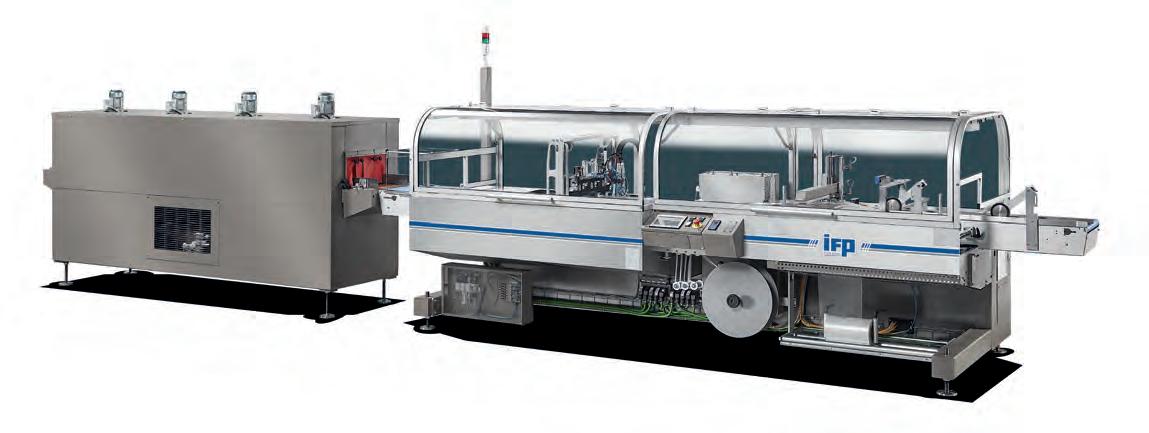
For over 30 years Tecno Pack has been designing, manufacturing and distributing horizontal packaging machines and automatic packaging systems for the food industry and other sectors. Tecno Pack is a group of companies including Tecno Pack, IFP and GSP. Based in Schio, in the pro-
vince of Vicenza, Tecno Pack stands out for being a pioneer and innovator in the packaging industry, developing cutting-edge solutions, increasing the digitalization of machines and plants, offering its customers excellent results with limited investments.
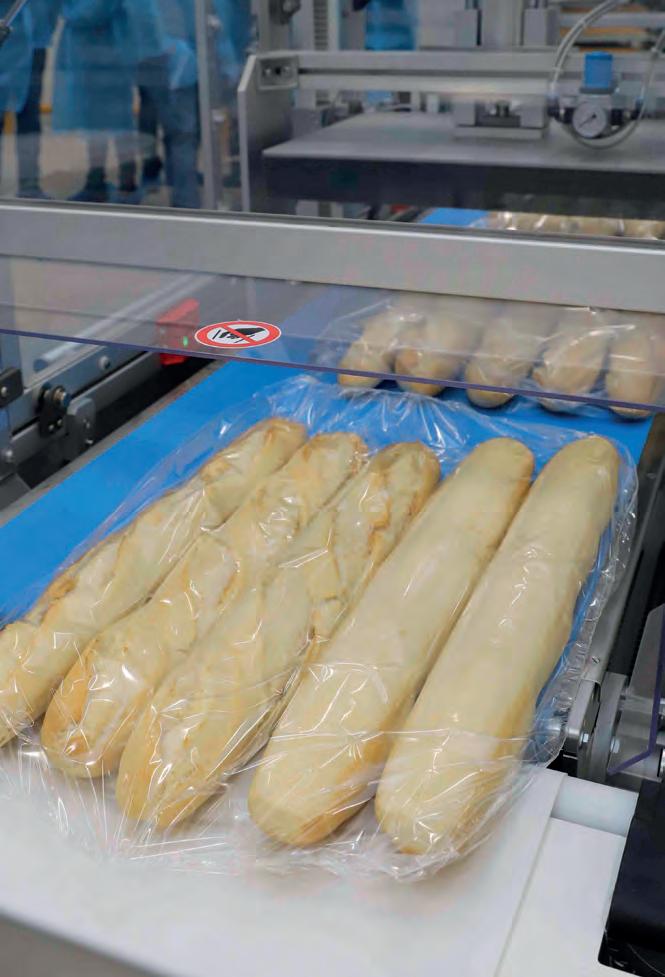
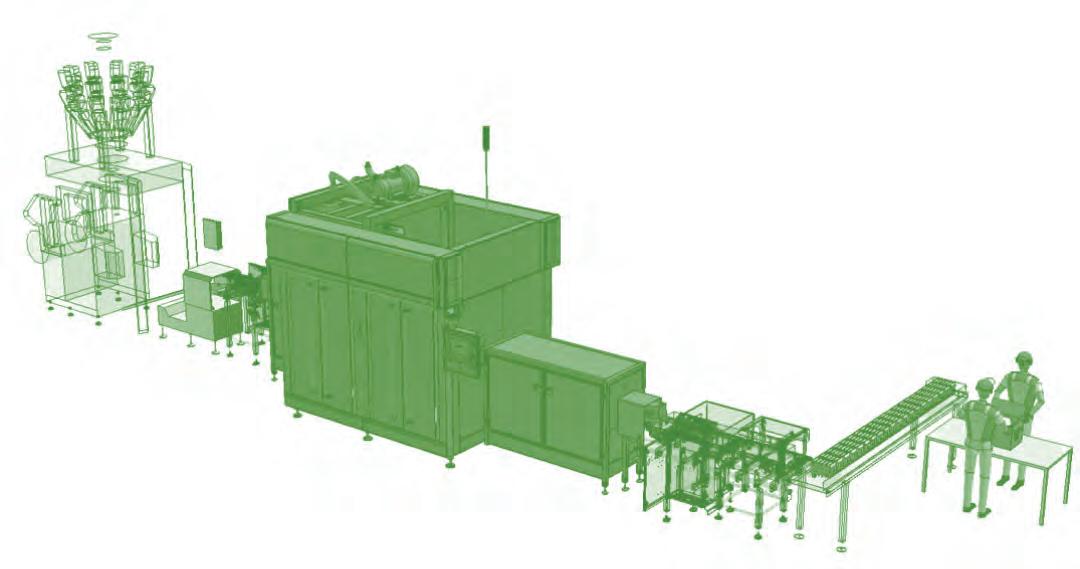
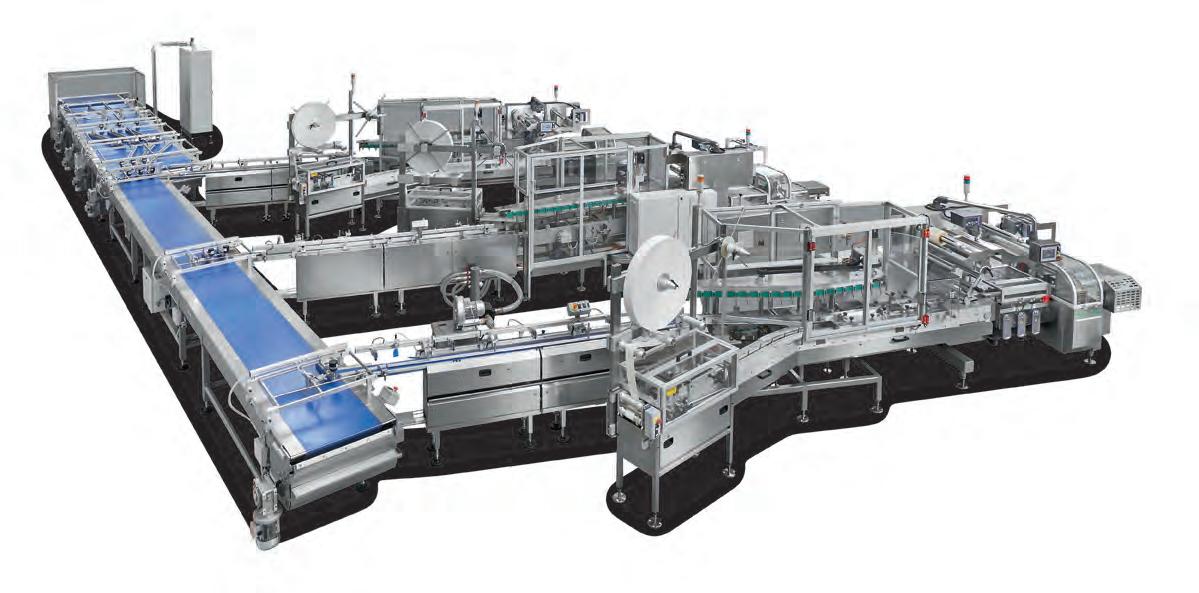
The partnership between Tecno Pack and Dolcezze Savini has resulted in the development of three packaging lines, specifically designed by the group for the bread sector of the Tuscan company. These, in detail, are
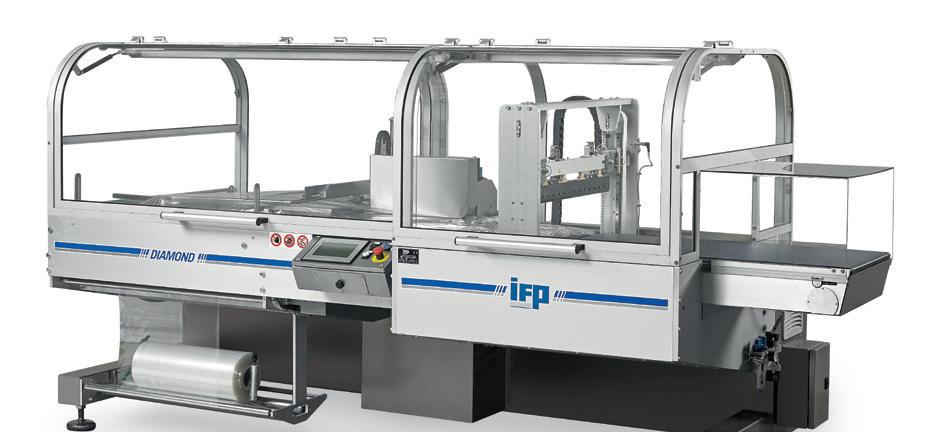
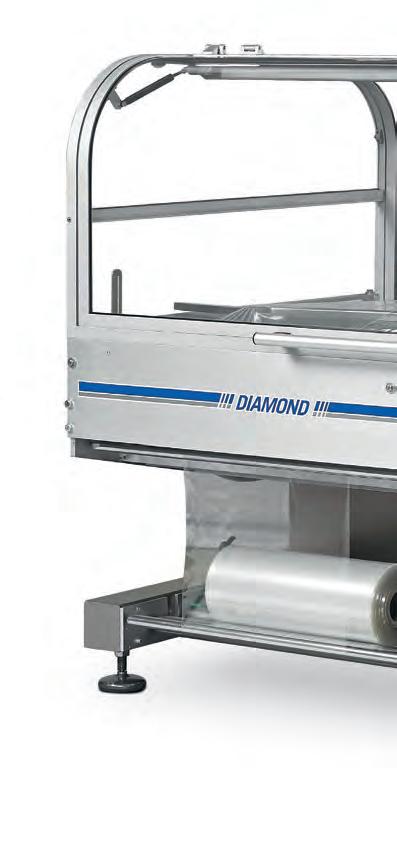
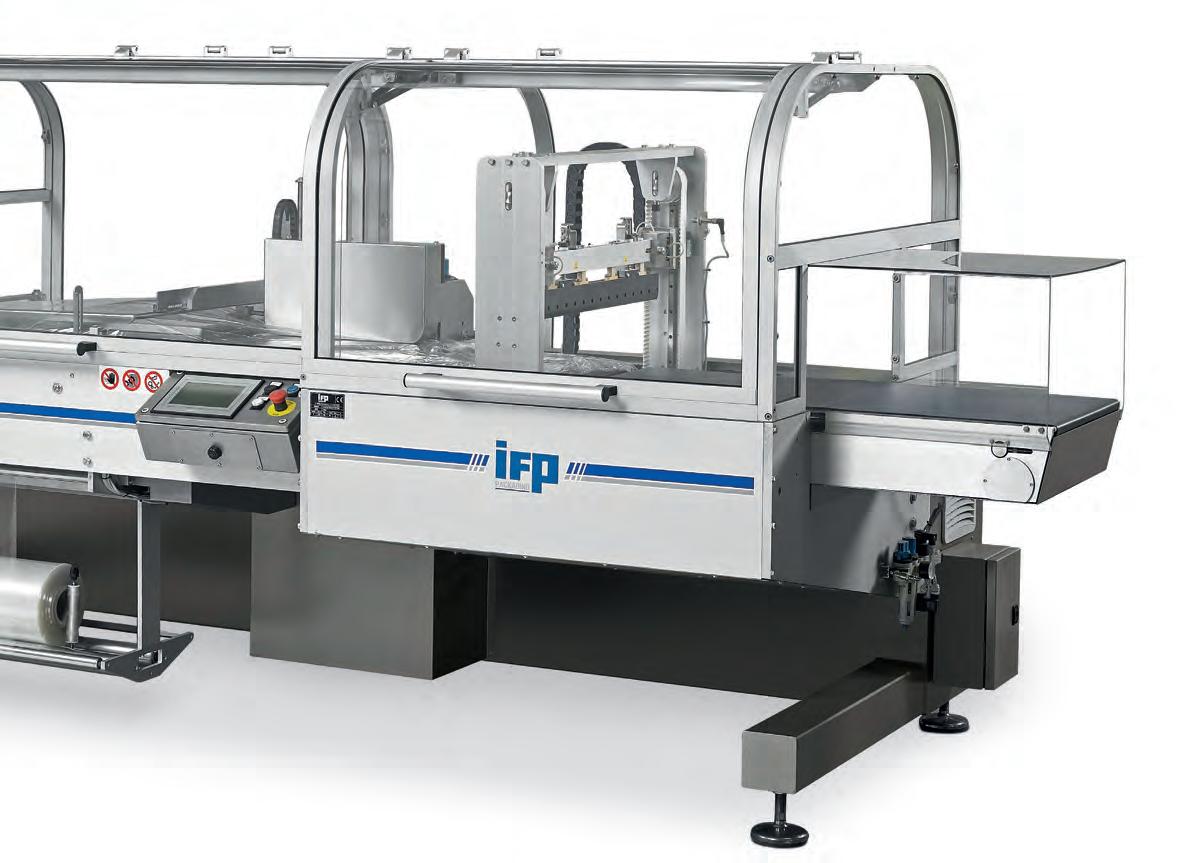
the new packaging lines implemented in the production system of Dolcezze Savini: • Monopiega Diamond 650 wrapper. This is an innovative and highperformance shrink wrapping machi-
ne, designed to wrap small, medium and large-sized items as well as thin solid products;
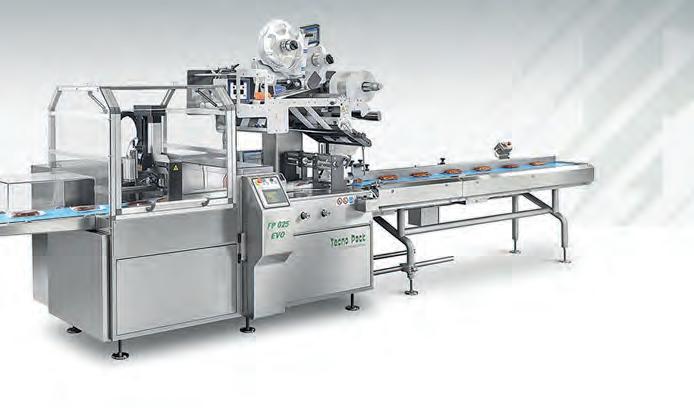
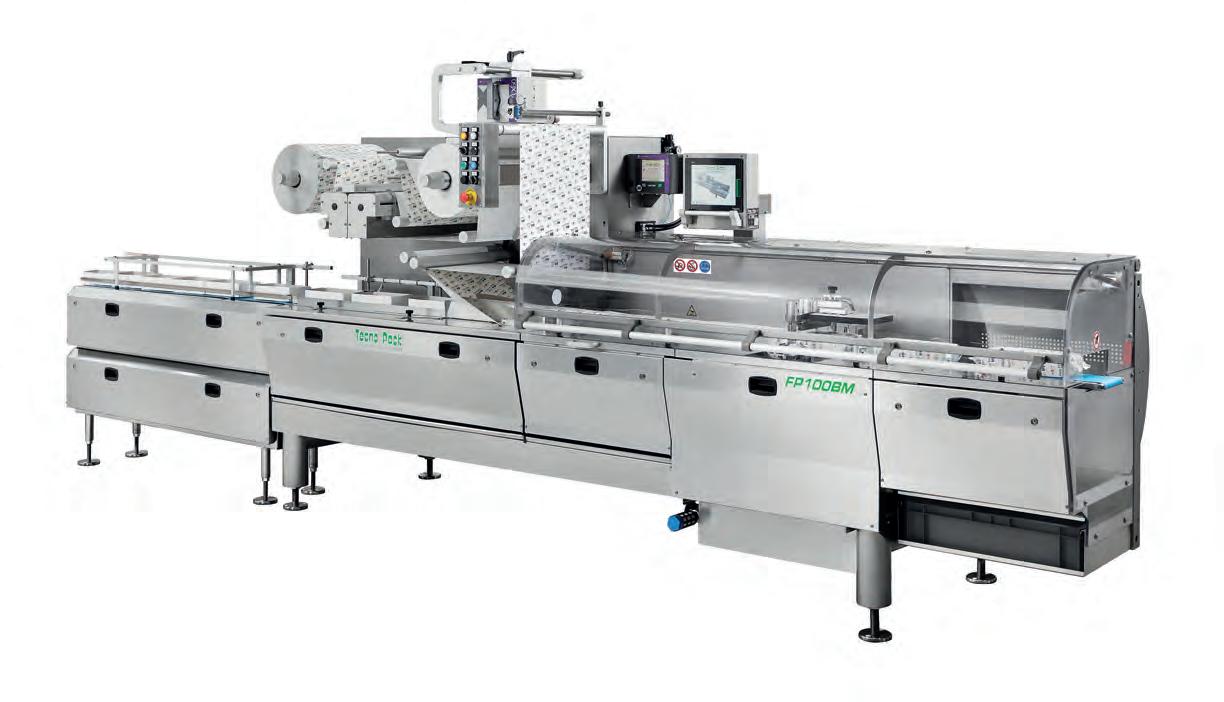
• Flow pack ATM FP 025 line suitable for pizza dough and ideal for “pinsa” (a traditional pizza made with an ancient Roman recipe). This horizontal packaging machine is specific for modified atmosphere packaging thanks to the tight packs granted by the sealing system. It is the most suitable flow-wrapper when aesthetically good-looking packages with high-quality side gussets and thick wrapping materials are required;
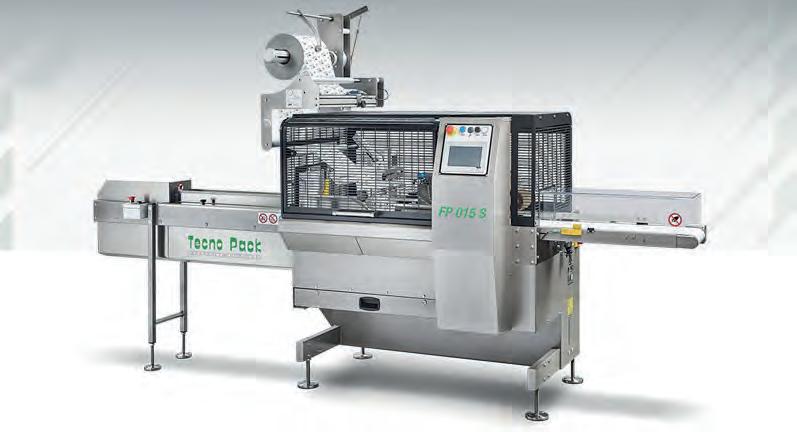
• The FP 015 line for sandwiches. This horizontal pillow pack wrapper
has a particular cantilevered frame with easy accessibility that helps sanitation, both for hygienic and maintenance reasons, guaranteeing full safety at work.
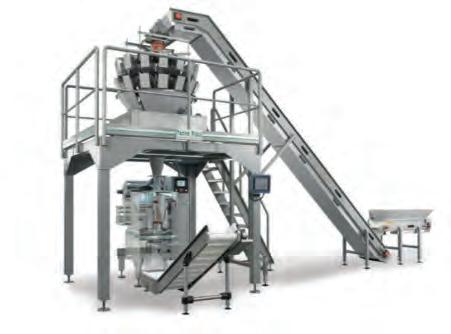
At the same time, the historical production carried out by Fiore 1827 was also implemented with the purchase of a vertical + multi-head packaging machine to improve the type of packaging and achieve greater production efficiency.
With the selection of these tailormade solutions, designed according to the production needs of Dolcezze Savini, the Tecno Pack
group not only proves to be a leading manufacturer in the sector of packaging machines and systems but also confirms to be the ideal partner to integrate new technologies created as “tailor-made” solutions according to specific automation requirements
The precious and fruitful collaboration between the Tecno Pack group and Dolcezze Savini represents the utmost expression of the most recent technological innovation combined with traditional working procedures for the production of a great variety of quality products with an authentic artisanal flavour.
PRODUCTION FLEXIBILITY AND INTEGRATION: new challenges in food packaging
The pasta market continues to show significant growth, supported by strong demand both nationally and internationally. It’s not just volume that is increasing, but also attention to quality, sustainability, and product presentation. In this context, packaging plays an increasingly strategic role: it must protect, communicate, and quickly adapt to different formats and distribution channels.
A project currently underway with a major player in the pasta sector exemplifies this approach. The goal is clear: to increase production efficiency while maintaining high flexibility, thereby responding to a dynamic and increasingly segmented market.
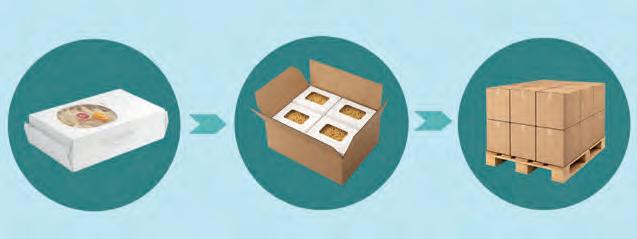
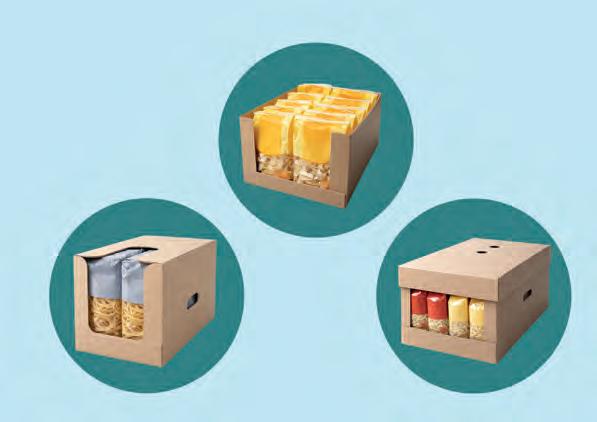
At the heart of the solution is the DRON wrap-around carton machine, which will be showcased at Interpack 2026 (Hall 11, Booth E01). This machine is designed to offer maximum versatility with a single system. It can produce various types of packaging: trays, wrap-around boxes, display trays, and boxes with lid. This feature helps reduce investment in multiple machines and simplifies line management.
The DRON also stands out for its production flexibility. It is designed to quickly adapt to customer needs, both in terms of formats and packaging configurations. This allows easy handling of production changes and new product launches without compromising efficiency.
In terms of performance, the machine is available in two versions: intermittent, with a capacity of up to 15 cartons per minute, and continuous,
reaching up to 40 cartons per minute. These two options cover different production requirements while maintaining reliability and precision.
This approach reflects DM Pack’s philosophy, positioning the company as a single partner for complete line solutions. The offering ranges from primary packaging solutions, such as film packers, to carton machines and palletizing systems, covering all stages of the packaging process.
This approach optimizes time, costs, and management, providing the customer with a single point of reference
and a complete overview of the process.
In a constantly evolving market, having access to flexible solutions and a reliable partner represents a tangible competitive advantage, enabling effective responses to customer needs.
CONFECTIONERY PACKAGING, COMPACTNESS BECOMES A COMPETITIVE FACTOR
Edited by SONIA V. MAFFIZZONI BENNATI
In the confectionery and snack industry, speed is only one part of the equation.
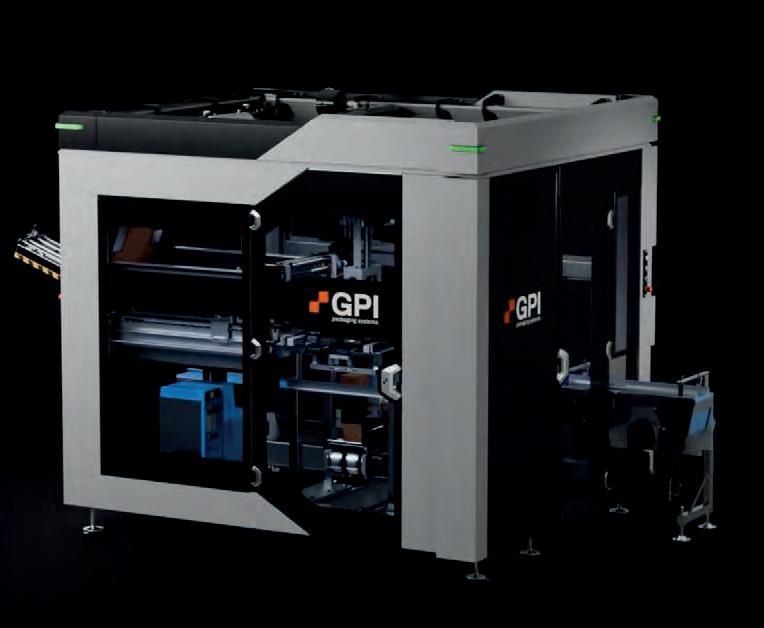
Today, manufacturers are also looking for compact lines, lower energy consumption, faster installation and solutions that can fit more easily into existing production environments. This is the direction behind MIRP Compact, the new packaging solution presented by GPI Group: a machine designed to combine high performance with reduced footprint and greater operational efficiency.
Maurizio Trento, CEO of the company, outlines the key features of a technology that reflects a broader vision for the future of packaging.
Maurizio, for which industrial target was MIRP Compact designed?
MIRP Compact was specifically designed for the confectionery market. It is a high-performance solution, capable of running up to 300 pieces per minute on the infeed and 30 boxes per minute on the outfeed. The goal is to offer confectionery producers a line that combines productivity, compactness and a more efficient use of space and energy.
What are the main features of this solution?
The main features are reduced footprint, lower energy consumption and an electrical cabinet integrated directly into the machine. This makes the solution more compact and easier to manage from an industrial point of view. Another important aspect is installation: the machine is plug and play and can be installed and started up in one day.
For producers, this means reducing complexity, limiting downtime and bringing a new line into operation very quickly.
The company has also presented a renewed brand logo. What does this change represent?
The renewed logo reflects a new vision for the future. It is connected to a new technological direction, focused on high-speed machines and on solutions that respond to the changing needs of the market.
Maurizio Trento CEO of GPI Group
a chat with
Sonia Bennati
For us, the logo is not only a graphic update. It represents the evolution of the company and the direction we want to follow in the coming years.
How is the market responding to this type of compact and efficient solution?
The response has been very positive. Customers are looking for technologies that combine high performance with easier installation, reduced footprint and lower energy consumption.
For us, this confirms that the direction is the right one. The confectionery and snack industries need machines that are fast, but also practical, efficient and ready to be integrated into modern production environments.
What makes MIRP Compact interesting is not only its speed, but the way performance is combined with industrial practicality.
In confectionery and snack packaging, where space, energy and installation time can strongly influence investment decisions, compactness becomes a strategic value. GPI Group’s proposal points in this direction: less footprint, faster start-up and a technological vision designed for manufacturers looking for efficiency without giving up productivity.
www.gpigroup.eu
OPEM SPA: reveals the secret behind K-Cup® Success
The italian engineering powering the world’s best-selling capsule
In the world of packaging excellence, there are milestones that define a “before” and an “after.”
For decades, an industrial secret has linked the success of American coffee giants to the mechanical precision of Italy’s Food Valley. Today, OPEM
S.p.A. reveals its role as the key technological partner in the development of production systems for the K-Cup® format, solving the engineering challenge that allowed for the birth of a cult product in the United States and beyond.
The Technical Challenge: The Internal Filter Paper
The global success of K-Cup® was not merely a matter of marketing, but of pure mechanical innovation. The heart
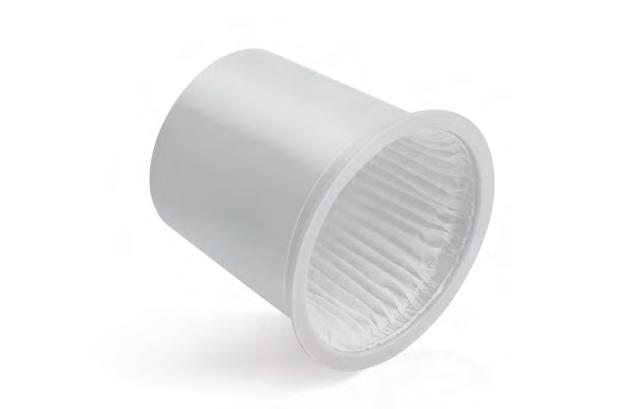
of the system lies in the ability to insert a paper filter (commonly known as a pleated cup) inside the rigid capsule perfectly, heat-sealing it completely with minimal to zero positioning tolerances at extremely high speeds.
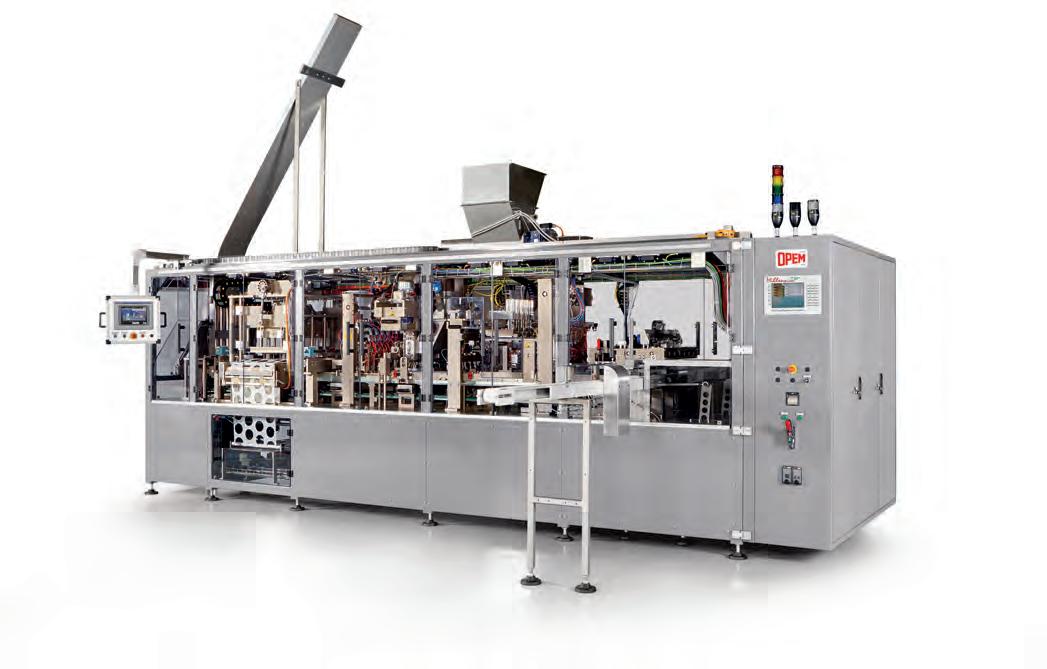
OPEM internally developed and patented worldwide the technology for the insertion and heat-sealing of the filter cup. This cutting-edge solution
solved a critical problem: how to handle an element as light, fragile, and sensitive to temperature and humidity as a paper filter within a high-speed production process, ensuring that every single capsule offers a flawless coffee extraction. Without the near-micrometric precision of OPEM’s patented filter positioning, the K-Cup® as we know it today would not have been industrially viable.
A Journey That Began with Green Mountain Coffee Roasters
The history of this collaboration dates back to 2006, marking the beginning of the exponential growth of what was then Green Mountain Coffee Roasters. At that crucial moment, OPEM served as the engineering partner of excellence, guiding the company through its most radical industrial evolutions.
OPEM’s technological support remained a constant pillar as the American company scaled the market: first transforming into Keurig Green Mountain and later, in 2018, through the historic $18.7 billion merger with the Dr Pepper Snapple Group. This operation gave life to the global beverage giant Keurig Dr Pepper (KDP), uniting the world of coffee with iconic soft drinks.
Throughout these phases, the packaging technology designed in Parma remained the immovable production foundation: engineering capable of evolving to anticipate sustainability challenges, upon which the entire single-serve coffee category in North America was built.
Parma Engineering Conquering the Global Market
“We are proud to finally be able to share this milestone,” states OPEM management. “Being the preferred technological partner for companies that have scaled the market to become giants of Keurig Dr Pepper’s caliber demonstrates our ability to manage projects of monumental scale. Our patent for the filter cup insertion solved the technical complexity that allowed this format to become the industry standard.”
OPEM’s ability to design systems that guarantee production speed and exceptionally high quality consistency has enabled several of its client-partners to grow from local businesses to world leaders. Today, that exclusive experience, accumulated over years of development and refinement, is being made available to the global market.
Access to “High-Performance” Technology
With the conclusion of exclusivity agreements with KDRP, OPEM is opening its doors to manufacturers worldwide.
Companies looking to implement high-performance production systems can now directly access the original technology that validated the K-Cup® market.
OPEM systems, renowned for their precision and reliability, offer:
• The Patented Filtering System: The original filter cup management technology for perfect extraction.
• Unrivaled Speed: Production lines designed for massive industrial volumes.
• Certified Reliability: Systems tested for decades in the most demanding production environments in the world.
A New Chapter for Packaging
The revelation of this historic link to the development of the K-Cup® system is not just a celebration of the past, but a solid foundation for the present. OPEM S.p.A. has already successfully integrated several sustainability principles into its processes, evolving its legendary filter insertion system to operate with the most advanced
eco-friendly and compostable materials
This technical capability allows the company to actively lead the challenges of the modern circular economy, offering concrete and tangible solutions today.
“Made in Parma” reaffirms itself not only as a synonym for food quality but as the nerve center of global mechanical innovation.
Manufacturers who choose OPEM are not just purchasing a machine; they are investing in a philosophy driven by avant-garde engineering, with the guarantee of a partner capable of mastering green technologies and proven to be a primary engine for market leaders of yesterday and tomorrow.
www.opem.it
M-TAPE: rethinking multipacks for a sustainable future
For decades, the way we buy snacks has hardly changed. A family pack of chips, biscuits for school lunches, or a bundle of popcorn bags has always looked the same: smaller packs wrapped together inside a bigger plastic bag. It was convenient, familiar, and easy to distribute-but also wasteful.
Today, the world is asking for something different. Consumers are more aware of the waste they create. Retailers are under pressure to cut emissions and reduce plastic. Governments are introducing stronger sustainability rules and targets. The traditional multipack, once seen as a practical solution, has now become a symbol of too much packaging.
This is exactly why M-TAPE was created.
From problem to innovation
The idea behind M-TAPE is simple yet powerful: if the bulky outer bag is unnecessary, why keep it?
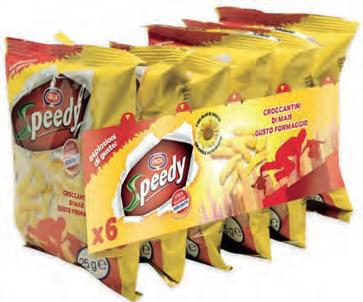
Instead of wrapping individual snack packs inside another plastic layer, M-TAPE holds them together using a thin but resistant adhesive strip. It may seem like a small change, but it creates a huge shift in impact. By removing the redundant packaging, the multipack instantly becomes lighter,
leaner, and more sustainable-while keeping the same convenience consumers rely on every day.
Why it matters to consumers
Today’s shoppers expect brands to offer more than taste. They look for products that reflect their values.
For families, M-TAPE means less plastic to throw away at home. For younger generations, it signals innovation and responsibility. For everyone, it delivers a pack that feels modern, transparent, and easy to use.
The tape also creates new opportunities for creativity and engagement.
Brands can print logos, promotions, QR codes, or sustainability messages directly on the tape-turning packaging into a communication tool that consumers notice.
Why retailers support it
For retailers, M-TAPE is more than an environmental gesture-it is a business advantage.
Taped multipacks take up less space in warehouses and on trucks, meaning better pallet efficiency, fewer shipments, and lower logistics costs.
On the shelf, the compact format allows more products to be displayed in the same area, improving ef-
ficiency and helping products sell faster. Just as importantly, the change is visible: shoppers can immediately see that less plastic has been used, strengthening trust and loyalty toward both retailers and brands.
The environmental case
Every taped multipack helps reduce the footprint of the food industry. Cutting plastic by 65–86% compared to traditional multipacks is not just a technical improvement-it is a measurable and reportable benefit aligned with ESG- Italy commitments worldwide.
Less packaging also means less waste to manage, fewer trucks on the road, and lower CO2 emissions throughout the supply chain.
For producers and retailers, these results can be integrated directly into sustainability reports, supporting progress against increasingly strict targets.
A global opportunity
The appetite for change does not stop in Europe. Across the Gulf Coopera-
tion Council (GCC) countries—Saudi Arabia, the UAE, Kuwait, Qatar, Oman, and Bahrain-consumer habits are evolving rapidly. Young, urban populations are increasingly demanding products that combine convenience with responsibility, while governments are embedding sustainability goals into long-term strategies. With a snack market currently valued at $8.5 billion and projected to exceed $12 billion by 2030, the opportunity is clear: introduce a proven European innovation into one of the fastest-growing regions in the world.
Packaging that pays
M-TAPE is more than a new way to bundle snack packs. It is a response to consumer expectations, an operational tool for retailers, and a practical solution that helps companies advance sustainability goals—without compromising profitability
At ESG-Italy, we believe M-TAPE represents the future of multipacks: packaging that shifts from being a cost and an environmental burden into a true strategic advantage.
Key benefits at a glance
• Up to 50% lower packaging cost
• Around 30% leaner logistics (space, pallets, transport efficiency)
• 65–86% plastic reduction vs traditional multipacks
• Lower CO2 impact across the supply chain
• Proven in Europe, with sales exceeding €50M
• GCC snack market growth: $8.5B → $12B+ by 2030.
www.esg-italy.com
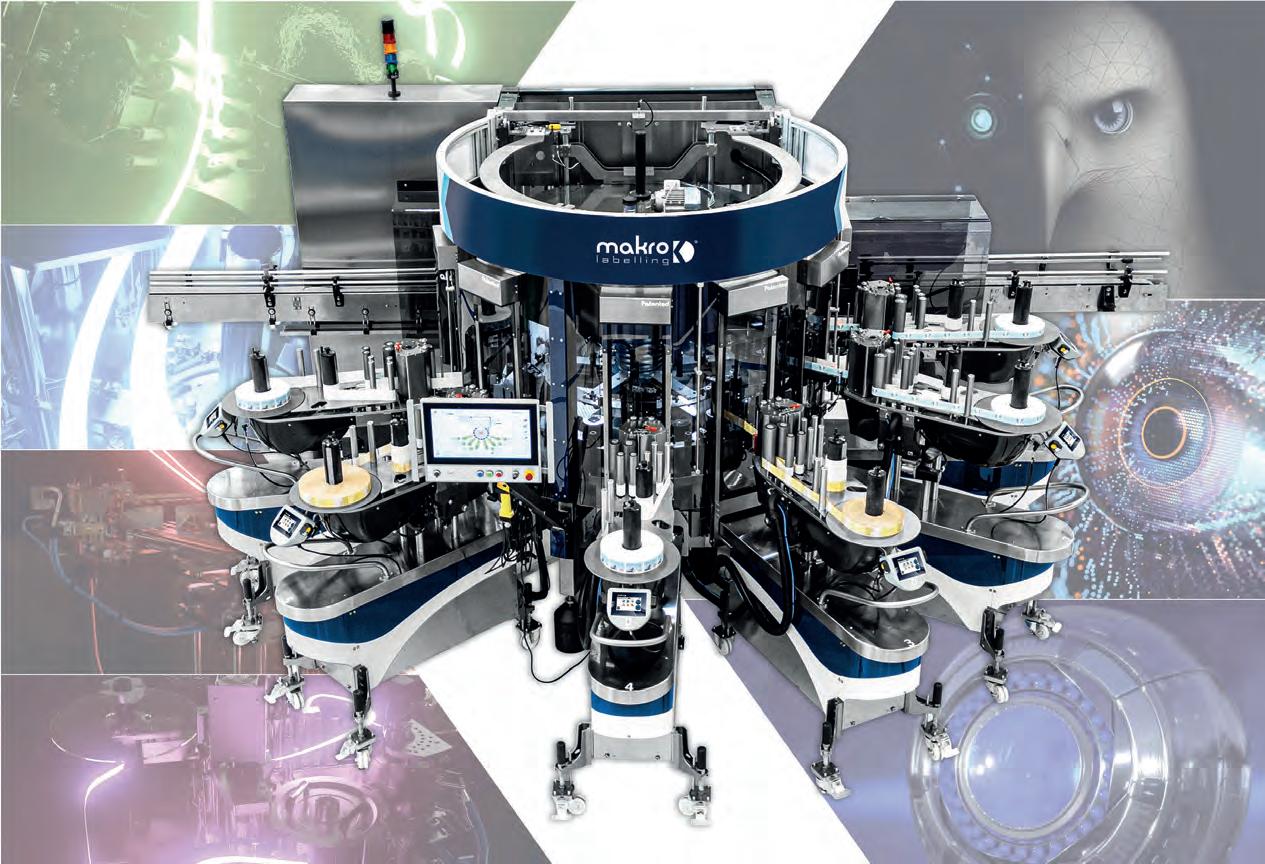
MAKRO LABELLING, Intelligent Choice
Founded in 2009 on over 30 years of experience from its founders, Makro Labelling has rapidly established itself as an international player in industrial labelling solutions.
Originally rooted in the Wine & Spirits sector, the company has progressively expanded its expertise into multiple industries, including food & beverage, personal care and other industrial segments, consistently maintaining high standards of precision, reliability and aesthetic quality.
Makro’s mission is to design cuttingedge labelling machines capable of adapting to continuously evolving production needs while ensuring longterm performance.
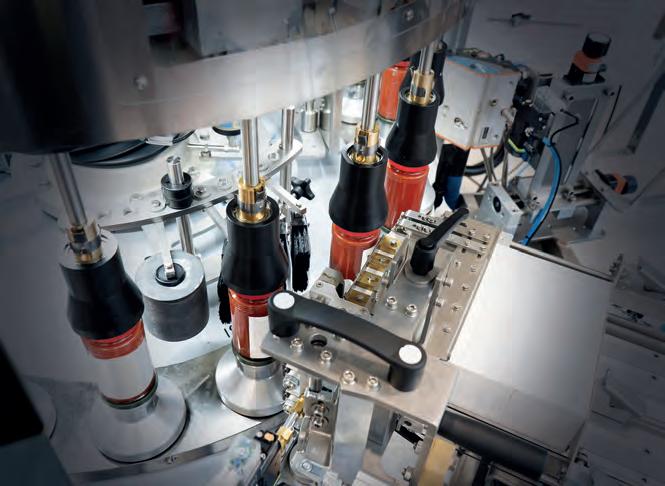
All machines are entirely developed in-house, from mechanics and electronics to vision systems, ensuring
full integration and complete process control.
Today, MAK labelling machines are also available with a new modern and ergonomic design, developed to improve accessibility and operational efficiency while delivering high production speeds.
The range covers applications from 1,500 up to 72,000 bottles per hour, with the capability to apply up to five labels per container.
Makro Labelling offers a complete portfolio of technologies: cold glue systems for high-precision and highspeed applications; self-adhesive solutions for maximum flexibility; hot
melt technologies; roll feed systems designed to ensure high efficiency and operational continuity across a wide range of applications.
Intelligent Choice is the claim that expresses Makro’s approach: a combination of expertise, values and integrated solutions designed to provide customers with a complete and effective system.
It is not simply artificial intelligence, but advanced technologies developed by Makro people to ensure consistent and reliable performance.
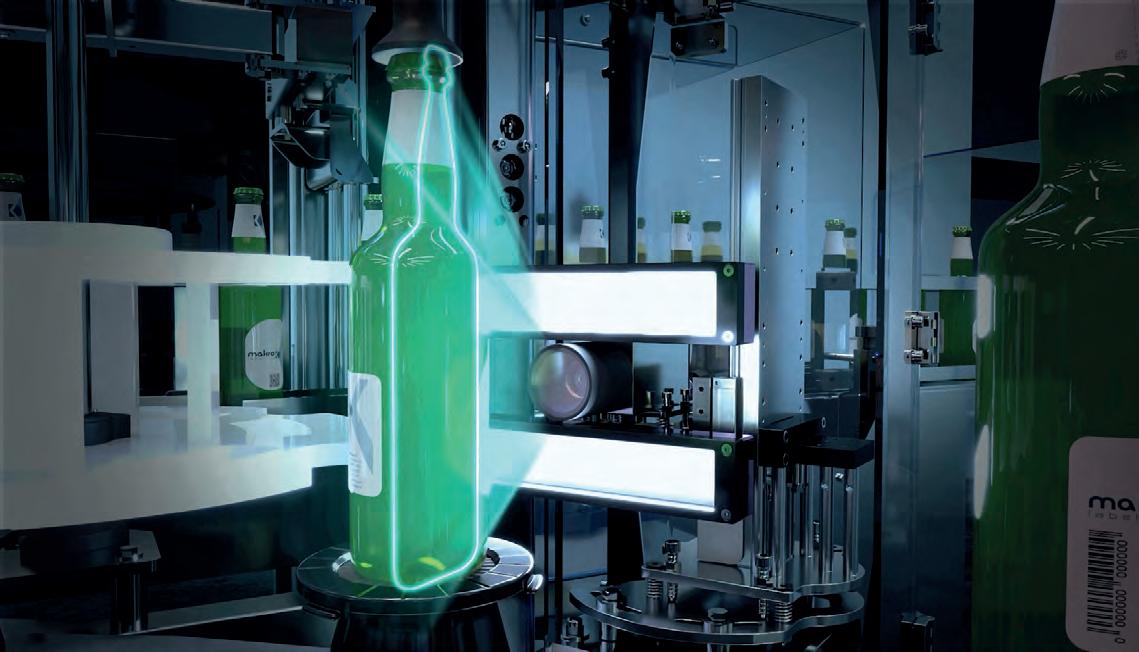
Vision systems are a key example: RAPTOR for orientation and ALICE for quality control ensure full product management throughout the entire line.
Within this framework, the new Alice 360 represents the latest evolution of Makro inspection systems: by using a single camera, it can inspect the entire container circumference, reducing space requirements inside the machine carousel and delivering higher performance. The result is total control, with reduced waste and improved final product quality.
Fully integrated and exclusively supported by Makro, these systems ensure maximum reliability, operational continuity and direct service throughout the entire lifecycle of the equipment.
www.makrolabelling.com
MONOMATERIALS AND REAL
RECYCLABILITY: THE NEW BALANCE IN PACKAGING
“
Recyclability in food packaging is shifting from a theoretical claim to a measurable, industrial reality. In this transition, monomaterials are emerging as a key direction, forcing the sector to balance sustainability with performance and real-world applicability.
by the editorial staff
In the debate on sustainable packaging, the term recyclability is often used very frequently, but not always with sufficient precision. For the food industry, in fact, it is not enough to declare that a material is theoretically recoverable. It is necessary to deal with real recyclability, meaning the actual possibility that a package can be collected, sorted, treated and reintroduced into a useful circuit. It is precisely in this transition from theory to application that monomaterials are
taking on a central role. Not as a magic solution, but as a serious attempt to address a structural problem of contemporary packaging.
For years, many food packages have relied on multilayer structures, designed to guarantee high barrier performance, mechanical resistance, printability and stability during processing. This architecture has delivered important results from a functional point of view,
but has created significant difficulties at the recycling stage. When several materials are permanently bonded together, separating them in an economically sustainable way becomes complex. This is where the interest in monomaterial solutions comes from, in which the packaging is designed using a single polymer family, or at least a structure that is more easily compatible with recovery processes.
The push toward monomaterials does not stem only from regulatory pressure or from brands seeking to improve their environmental profile. It also depends on the fact that the market is demanding demonstrable sustainability, less based on promises and more on technical evidence. A well-designed monomaterial package simplifies the sorting phase in recycling plants, reduces classification ambiguity and increases the chances that
the waste will actually be recovered and valorized. However, the issue does not end there. The real challenge is to achieve this result without losing the performance needed to protect the food product.
The industrial issue, in fact, lies entirely in the balance between recyclability and function.
Traditional multilayer structures often provide very high barriers against oxygen, moisture, light or odor migration, as well as good sealing, forming and resistance performance. Bringing these performances into a monomaterial system requires research, development and numerous technical compromises.
This is why companies are working on new formulations, film orientation, compatible coatings and thickness op-
timization. It is not enough to replace one material with another. The structure must be rethought in a way that is consistent with the entire product life cycle.
Industrial processing also represents an important testing ground. New materials must run on existing lines or, at the very least, require adjustments that are sustainable in terms of cost and timing.
Properties such as stiffness, coefficient of friction, sealing behavior and thermal stability directly affect productivity and packaging quality. This is why the introduction of monomaterials cannot be seen as an exclusively environmental choice. It is an industrial decision that involves purchasing, production, quality, marketing and sometimes even logistics, especially when weight, thickness or transport performance change.
There is also the often underestimated issue of consumer perception.
The sustainability of packaging is increasingly judged by how easily the material can be identified, separated and correctly disposed of. A package designed to be recyclable, but unclear in its communication or ambiguous in its apparent composition, risks losing part of its value. For this reason, many companies are comple-
menting material innovation with reflection on informational design and on the clarity of disposal instructions.
Talking about real recyclability also means considering the system as a whole. A better package is not enough if the territory lacks adequate infrastructure or if collection and sorting chains are not able to manage it effectively. The success of monomaterials therefore also depends on the ability of material producers, converters, brand owners, consortia, waste operators and recycling plants to work in dialogue. It is a supply chain challenge, not one for a single player alone.
For food packaging, monomaterials therefore represent a concrete and industrially relevant direction, but not a shortcut.
They require applied research, machine testing, shelf life validation and a more mature vision of the relationship between performance and end of life. Their value lies precisely here: they force the sector to engage with a form of sustainability that is less abstract and more verifiable. In this sense, the future of packaging will depend not only on the choice of material, but on the ability to build solutions that truly work, from filling to collection, from product protection to the real possibility of recovery.
LAZZARETTI FOODTECH: reliable and hygienic packaging solutions for the food industry
In the landscape of the food industry-where reliability, hygiene, and precision are essential requirements-Lazzaretti FoodTech emerges as a new entrepreneurial venture specializing in the design and construction of medium to low throughput packaging machines and lines. Based in Sala Baganza, Lazzaretti FoodTech relies on highly qualified personnel with extensive experience in the food packaging sector, gained through years of design, installation, and service on industrial systems.
This consolidated know how enables the company to offer advanced, reliable technological solutions designed to meet the real production needs of its customers. The company’s approach is centered on construction quality, attention to detail, and the highest focus on hygiene and sanitary standards-elements that are increasingly crucial in today’s food production processes.
Every machine is engineered to ensure structural robustness, easy sanitation, long term durability, and user friendly operation.
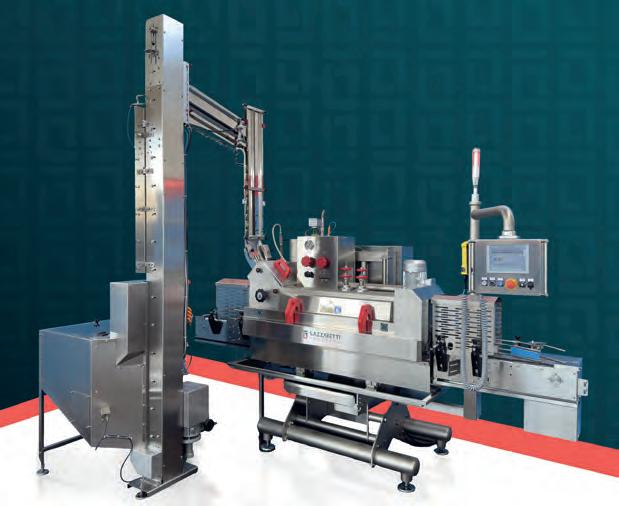
Among the latest innovations developed, special attention goes to the new twist off capping machine, model LFT M070 LS, which stands out significantly from the machines currently available on the market. The structure is made entirely of AISI 304 and 316 stainless steel, with a sturdy frame designed to meet the most demanding hygiene standards.
The machine head is built in AISI 316 stainless steel, a technical choice that allows long term processing of aggressive products containing vinegar
and salt, preventing damage and ensuring maximum corrosion resistance.
The machine is equipped with a floor mounted cap elevator with a capacity of up to 12.000 twist off caps (38mm), ensuring production continuity and operational autonomy.
The caps pick-up unit is also made of AISI 316 to provide greater durability and reliability in the most demanding applications.
Particular attention has been dedicated to the steam unit, equipped with a MOCA certified steam treatment filter, ensuring compliance with food contact requirements. The electric fan is included as standard, contributing to optimized system performance.
The LFT M070 LS integrates an automatic bottle/jar height adjustment
system, managed through recipes that can be set directly from the operator panel. The interface features a 7” Siemens color panel mounted on an adjustable arm for improved ergonomics and ease of use.
The equipment is completed by a router for remote assistance—allowing quick interventions and timely technical support—as well as a set of essential spare parts supplied as standard. With this new capping machine, Lazzaretti FoodTech reaffirms its commitment to providing solid, technologically advanced machines designed to deliver consistent long term performance, positioning itself as a reliable partner for companies in the food industry.
lazzarettifoodtech.com
success story
Edited by SONIA V. MAFFIZZONI BENNATI
SIEMENS AND TIBER PACK
the synergy transforming the way packaging is made
Manolito Ciabatti Managing Director of Tiber Pack
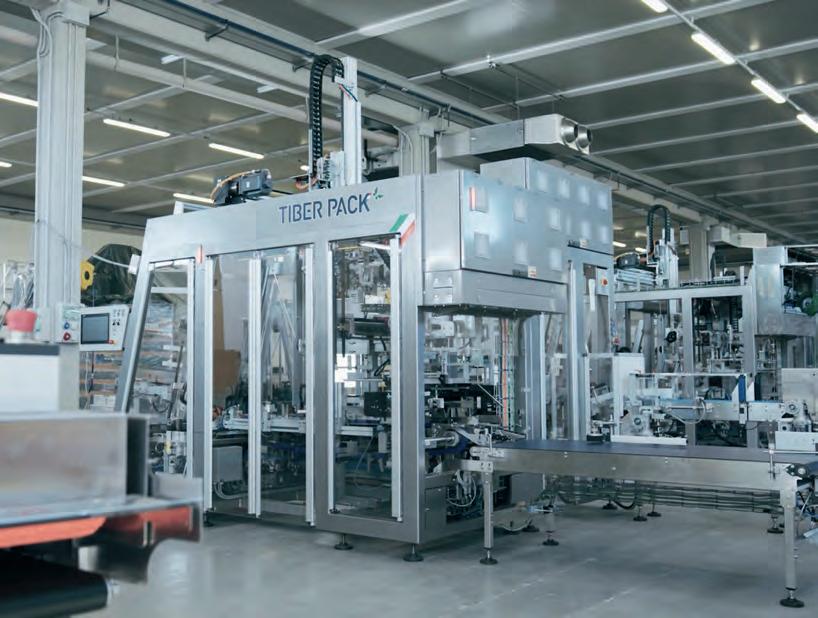
In secondary packaging, even an apparently simple operation such as closing a carton can become a field for innovation. This is the idea behind Nicetuck, the patented solution developed by Tiber Pack with the technological support of Siemens, designed to eliminate hot-melt glue and adhesive tape from the automatic cartoning process.
A technical choice that translates into lower energy consumption, reduced emissions and optimized operating costs.
For years, carton closing with hot-melt glue has represented a consolidated standard in end-of-line packaging: an effective, widespread process that operators know well. Yet it is often precisely in the most established processes that innovation can generate the greatest impact.
With Nicetuck, Tiber Pack decided to work on an apparently marginal step, transforming it into a strategic element of sustainability and efficiency.
The solution is the result of an industrial relationship built over time.
The collaboration between Tiber Pack and Siemens has lasted for more than twenty years and has evolved into a true application synergy.
Michele Celestini
Sales Area Manager of Tiber Pack
Alessio Cordelli
Business Developer OEM Packaging of Siemens
success story
Edited by SONIA V. MAFFIZZONI BENNATI
“Siemens is not only a supplier of technological equipment for us, but also a partner that supports us in the development of applications,” explains Manolito Ciabatti, Managing Director of Tiber Pack.
This relationship is based not only on technology, but also on the ability to interpret market needs and end-customer requirements together.
“We have patented this solution where, in order to close the carton, it is no longer necessary to use hot-melt glue or tape, with significant advantages in terms of environmental impact,” says Ciabatti.
This innovation led Tiber Pack to win the WorldStar Global Packaging Award, the international recognition assigned by the World Packaging Organisation.
However, the value of the solution does not lie only in the award.
What makes it particularly interesting for the industry are its measurable results.
As Michele Celestini, Sales Area Manager at Tiber Pack, points out, “with Nicetuck, a significant reduction in the environmental impact of the automatic cartoning process is achieved. This has also been demonstrated through a comparative LCA conducted in collaboration with TÜV, which highlighted a 51% reduction in CO2 equivalent emissions into the atmosphere”.
The environmental figure is accompanied by an equally significant energy benefit. Eli-
minating glue also means eliminating the heat required to melt it, with a reduction in electricity consumption that can reach up to 30%.
In addition, there are savings related to the purchase of glue, as well as its transport, handling and storage. In this case, sustainability does not appear as an additional cost, but as a concrete lever for industrial efficiency.
This is one of the most interesting aspects of the project: Nicetuck challenges the idea that a more sustainable process must necessarily be more complex, more expensive or less performing. On the contrary, the project shows that simplification can become an effective way to reduce environmental impact and improve competitiveness.
“We have created a simpler machine, a more cost-effective process, and one that leads to sustainability, also thanks to the collaboration with Siemens,” underlines Ciabatti.
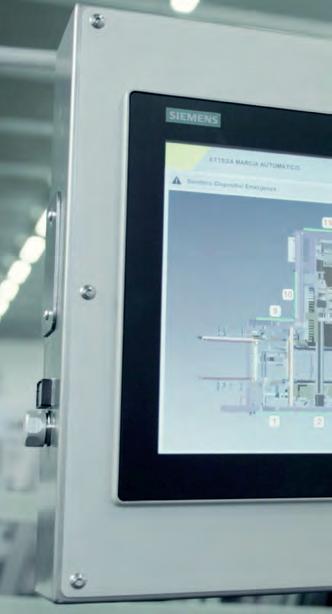
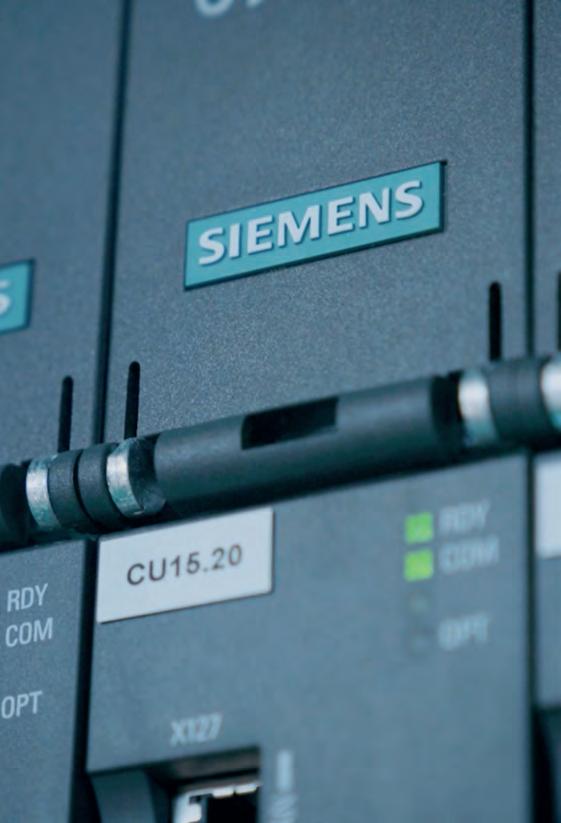
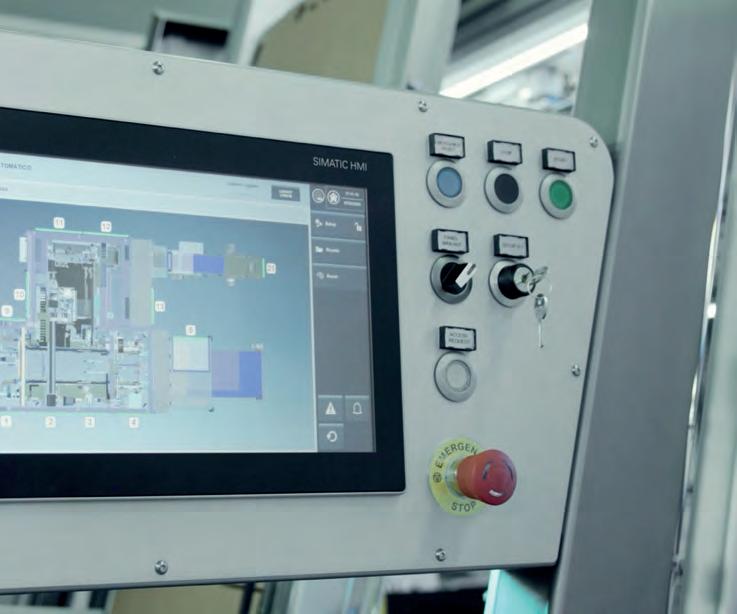
In this path, Siemens plays a role of technological support for OEMs. Alessio Cordelli, Business Developer OEM Packaging at Siemens, highlights the value of the company’s Pack Team: “The Pack Team is a Siemens division dedicated to machine builders and focused on the packaging sector, created to respond to customer needs and accelerate technological and strategic synergy”.
This approach makes it possible to support machine development not only in terms of automation, but also in terms of performance, efficiency and future digital integration. The next evolution is increasingly focused on data.
For Siemens and Tiber Pack, digitalization represents a further step toward improving machine performance, optimizing processes and providing customers with increasingly precise tools for control and continuous improvement.
Nicetuck therefore tells the story of a concrete transformation in secondary packaging: not an abstract innovation, but an applied, patented and award-winning solution validated by measurable results. A success story in which sustainability, energy efficiency and cost reduction do not run on separate tracks, but become part of the same industrial process.
tiberpack.com
PRESSPALL, the pallet with a sustainable heart that is reshaping logistics
IIn contemporary logistics, it is not only goods that move: ideas, choices and responsibilities move as well. In a sector where efficiency is essential, there is growing awareness that every solution must also respect the environment.
It is within this balance between performance and sustainability that Presspall takes shape: the pressed wood pallet designed for the future, without forgetting the needs of the present.
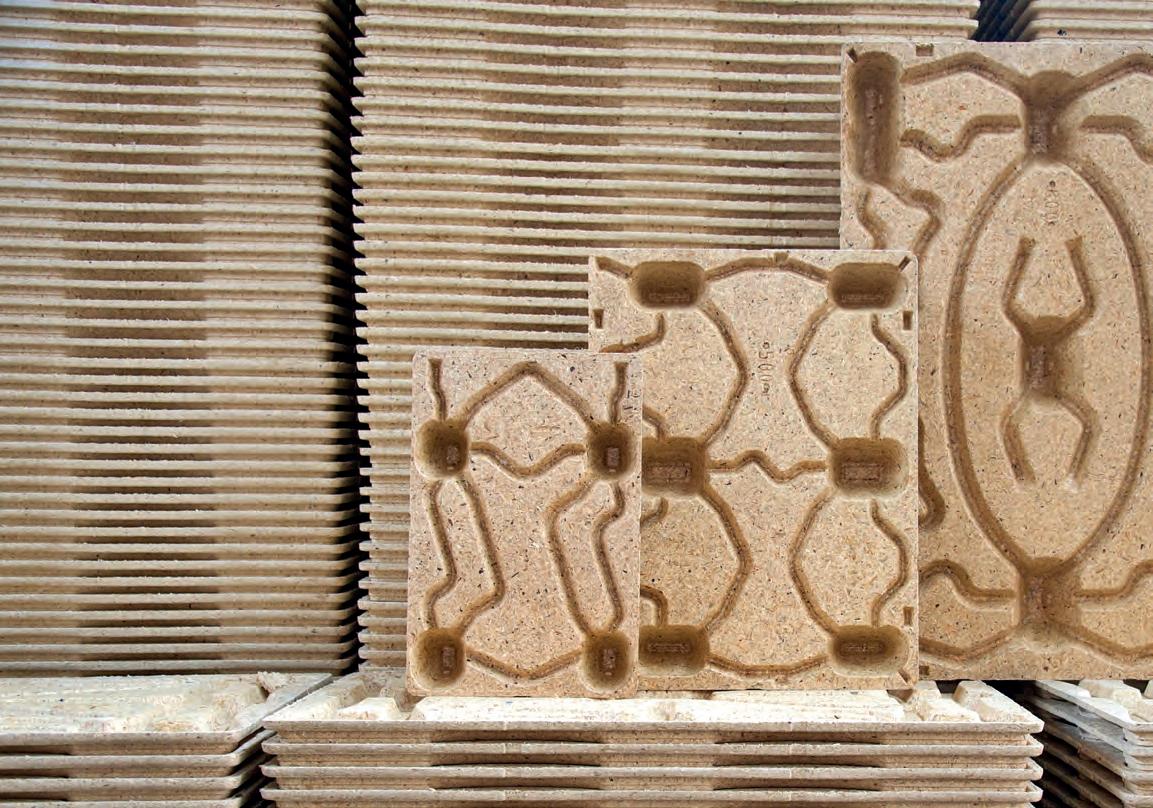
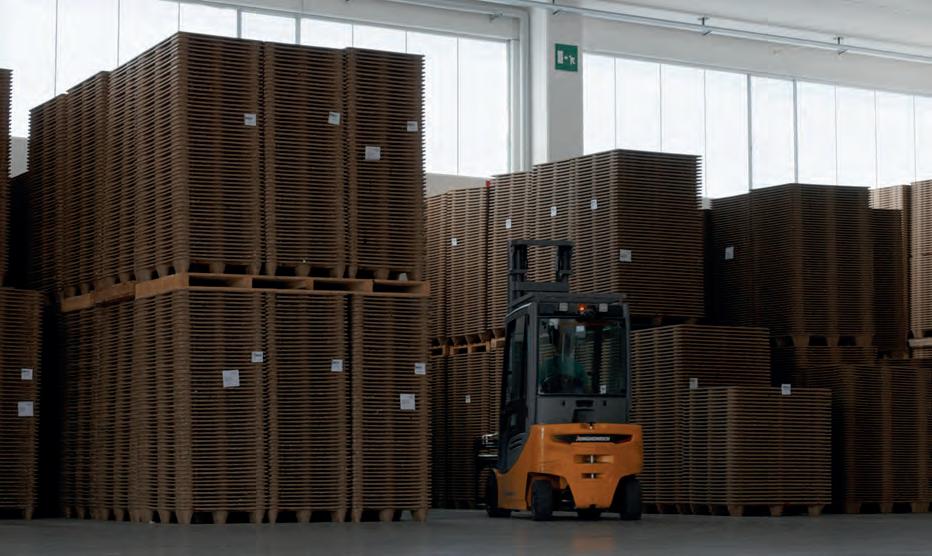
Presspall is made from a raw material that has already had a first life. It is produced from pressed wood
composed of recycled chipboard and natural resin, transforming processing waste and discarded packaging into a new, solid and reliable resource. It is a concrete action that reflects a clear vision: a more circular logistics model, capable of reducing waste and enhancing the value of existing materials.
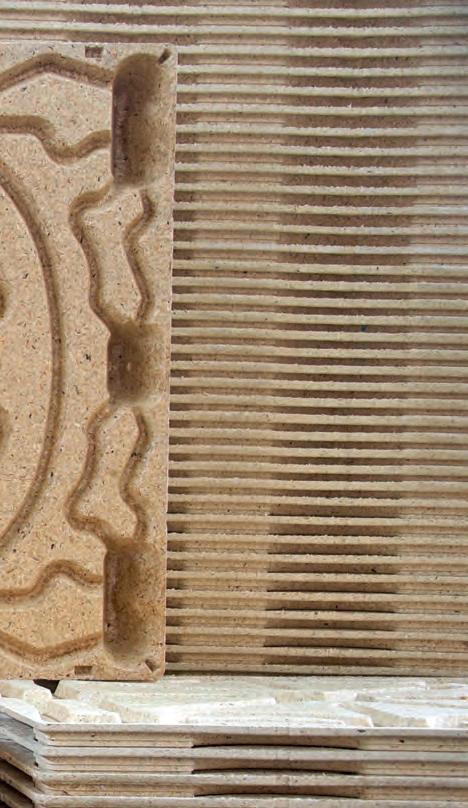
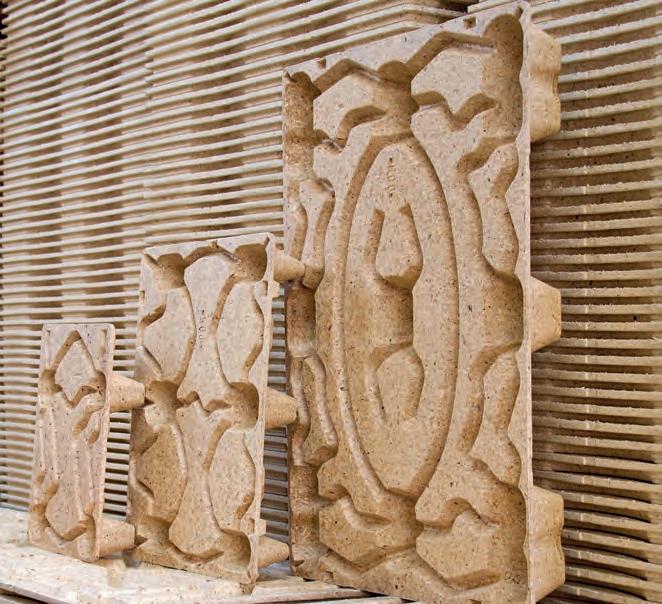
The first impact is visual and immediate: Presspall saves space. Its conical feet allow the pallets to be stacked one inside the other, drastically reducing the volume of empty pallets. In a stack of just 2.4 metres, it is possible to store between 50 and 60 pallets
in standard sizes (1,200 x 800 mm or 1,200 x 1,000 mm) and between 120 and 220 pallets in smaller sizes (600 x 800 mm or 400 x 600 mm). Less bulk means tidier warehouses, more efficient transport and more rational resource management. Every detail is designed to simplify daily operations. Presspall is compatible with forklifts, pallet trucks and lift trucks, can be accessed from all four sides and is easy to handle thanks to its reduced weight. Its smooth surface, free from nails and splinters, improves operator safety and protects goods during every handling phase. Efficiency also translates into concrete
savings. Thanks to its high stackability, a truck can transport over 2,000 Presspall pallets compared to around 750 traditional euro pallets. Fewer journeys, lower fuel consumption and reduced emissions: an economic advantage that also becomes a responsible choice.
Presspall’s sustainable heart is certified. The PEFC mark guarantees that the wood used comes from responsibly managed forests and that every stage of the supply chain is traceable. At the end of its life, the pallet is fully recyclable, completing the cycle of a virtuous production model.
Available in different sizes, with a dynamic load capacity of up to 1,250 kg and compliant with ISPM 15 regulations, Presspall is ready to meet the needs of international markets.
Choosing Presspall means making a concrete choice for both the present and the future. It means optimising
space, time and costs without giving up environmental responsibility. It proves that efficiency and sustainability can go hand in hand. Because truly efficient logistics is logistics that can take care of the present while thinking about the future.
www.cornopallets.it
a chat with AUTOMATION, WHERE WASHING AND HANDLING BECOME ONE PROCESS
Edited by SONIA V. MAFFIZZONI BENNATI
In modern food production, automation is no longer limited to individual machines.
The real value increasingly lies in connecting different operations, reducing manual intervention and making each phase of the process more controlled and traceable.
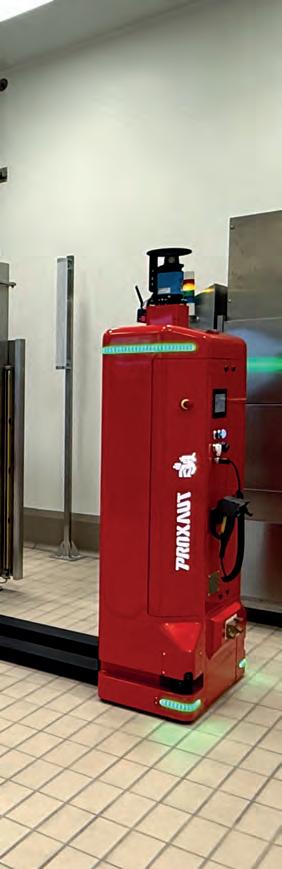
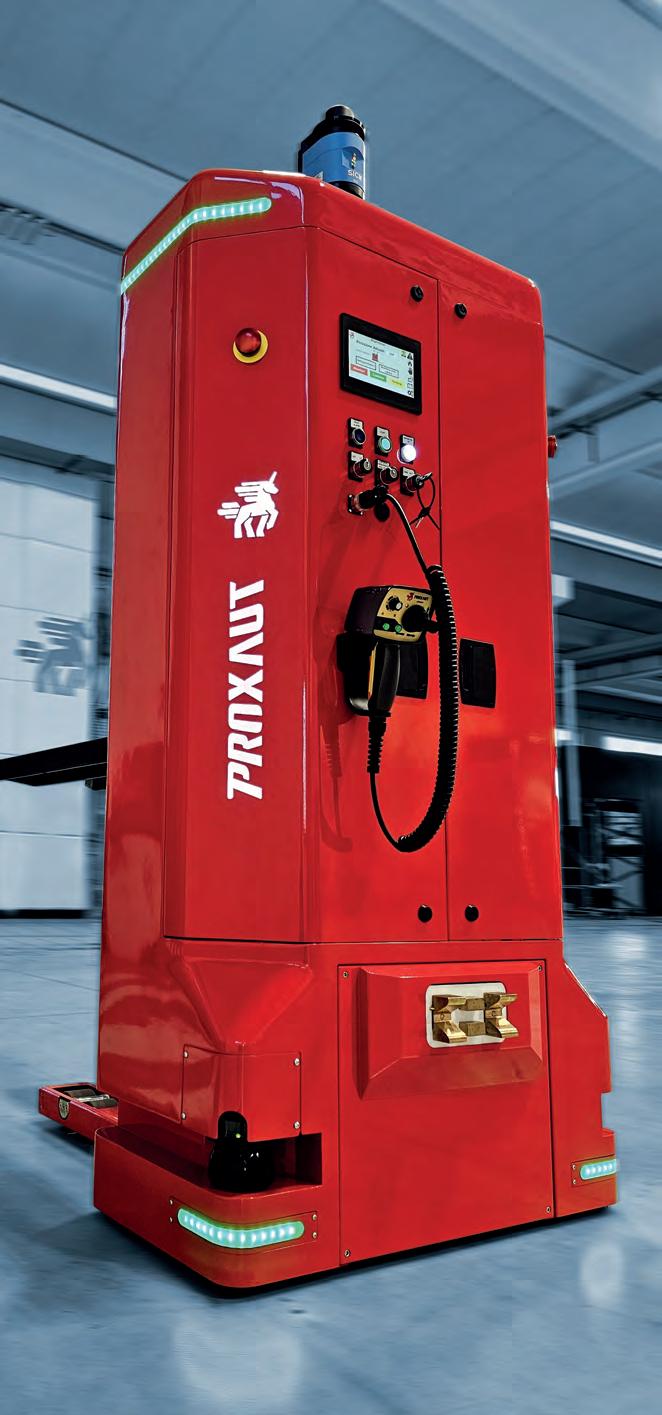
The collaboration between Colussi Ermes washing technology and Proxaut AGV systems shows how internal logistics can become an active part of process efficiency.
It is a theme that Michele Riva, CEO of Proxaut, approaches from a very practical angle: moving products, racks and equipment is no longer a support activity, but a measurable component of industrial performance.
Michele, let’s talk about the solution developed with Colussi Ermes. What does it consist of?
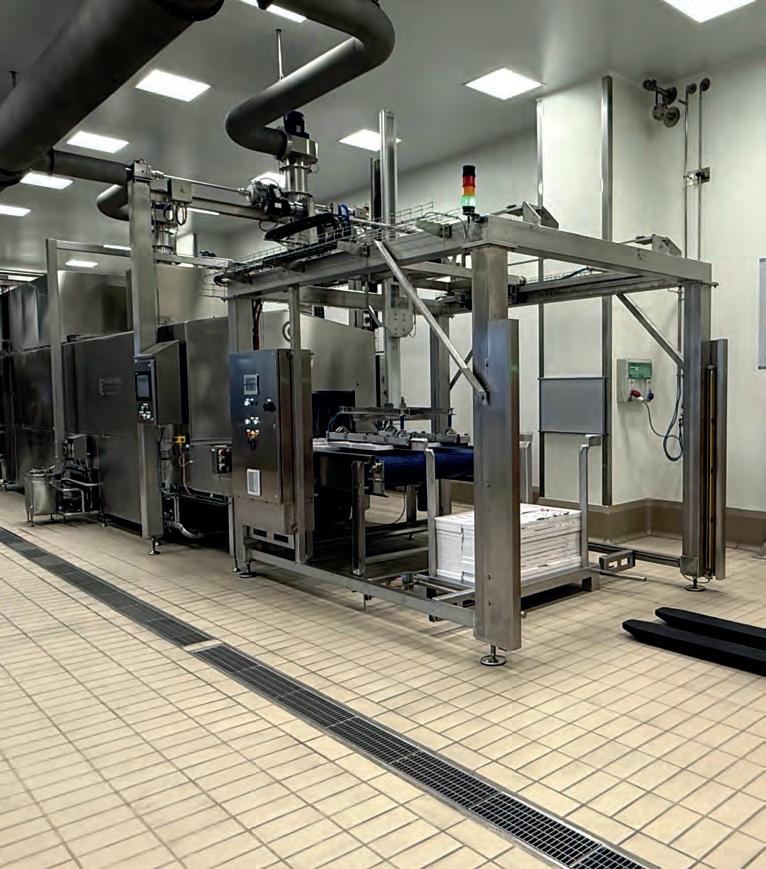
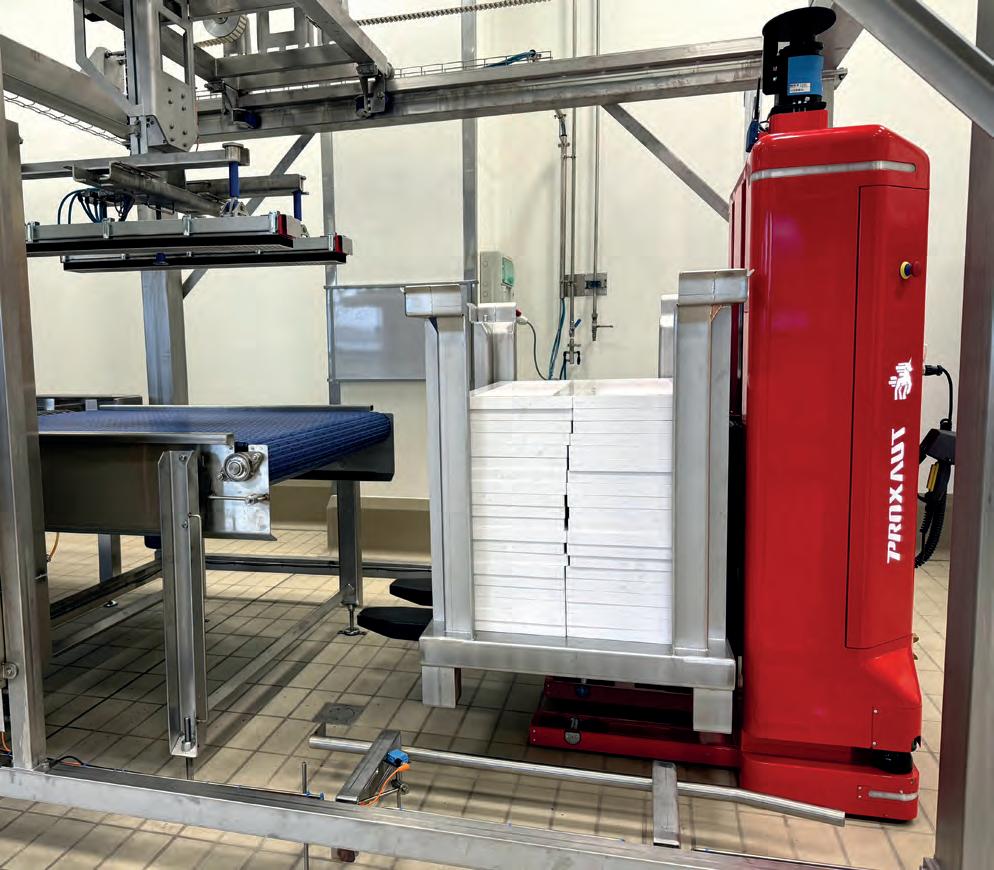
It is a unique solution based on the integration of two complementary technologies: Colussi Ermes for the washing operation and Proxaut for AGV automation.
In this specific case, the application is dedicated to chocolate moulds. The moulds are automatically moved in
and out of the washing process by an AGV, creating a fully automated flow between handling and washing.
The result is a turnkey solution for the customer. Instead of managing washing and internal movement as two separate operations, we bring them together into one integrated system. This reduces manual intervention, improves the continuity of the process and allows the production flow to become more organized, predictable and efficient.
What are the main advantages for customers?
This type of solution offers several concrete advantages. The first one is the reduction of manual labour, which is increasingly important in many production environments. But, in my opinion, the most important advantage is efficiency. With an automated system, we know exactly how many moulds or
Michele Riva CEO of Proxaut
racks are moved per hour, per shift and throughout the production cycle.
This makes the process measurable. Customers can monitor the movement of each load, understand the real performance of the line and manage production with a higher level of control.
Another key benefit is traceability. Every movement can be tracked, which means the customer has complete visibility over the process. In food production, this is becoming more and more valuable, because efficiency today is not only about speed, but also about reliability, control and repeatability.
Which industries can benefit from this type of solution?
Chocolate is one example of application, but the same automation concept can be adapted to several food sectors.
This kind of integrated automation can be used in bakery, meat, protein and other food sectors where companies need to connect washing operations with internal handling. Whenever there is a need to move products, racks, moulds, trays or equipment around a washing process, the same logic can be applied.
The value of the solution lies in its flexibility. It is not limited to one product category, but can support different industries that want to reduce manual operations, improve process control and make internal logistics more efficient.
What makes this solution particularly interesting is the way it shifts the focus from a single machine to the connection between operations. Washing, handling and traceability become part of the same automated flow.
In an industry where efficiency is measured not only by speed, but also by control, repeatability and reduced manual intervention, integrated automation can become a decisive factor in building safer and more efficient production environments.
D.C.M.: technology, expertise and partnership for industrial packaging
For over fifty years, D.C.M. has been a reference point for the packaging and automation industry. Founded in 1974, the company built its reputation on the distribution of paper folding machines, but over time it has evolved into a complete technology partner for machine manufacturers and companies operating in the pharmaceutical, paper converting, food & beverage, cosmetics, and logistics sectors.
Today, D.C.M. goes beyond simply supplying machines: it provides expertise, application consulting, technical services, and support throughout the entire lifecycle of production systems. This partnership-oriented approach enables customers to tackle the challenges of productivity, flexibility, and sustainability that define modern packaging with greater confidence.
Autonox Robotics mechanics for packaging
Robotics is now one of the key pillars of automation in packaging and endof-line operations.
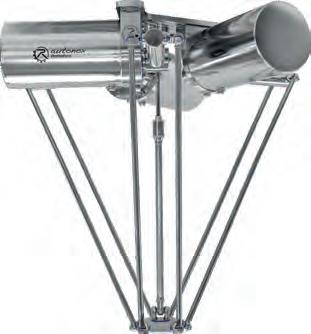
In this field, D.C.M. offers in Italy the solutions of autonox Robotics, characterized by an innovative approach
based on controller independent robot mechanics.
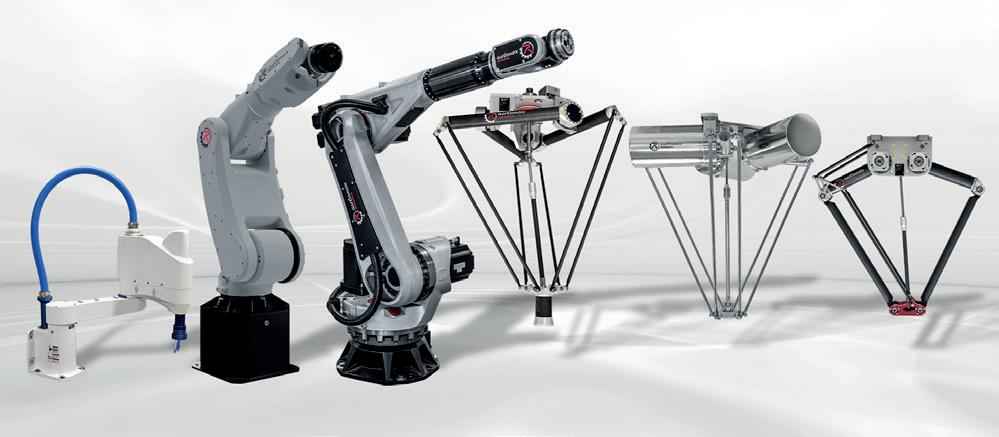
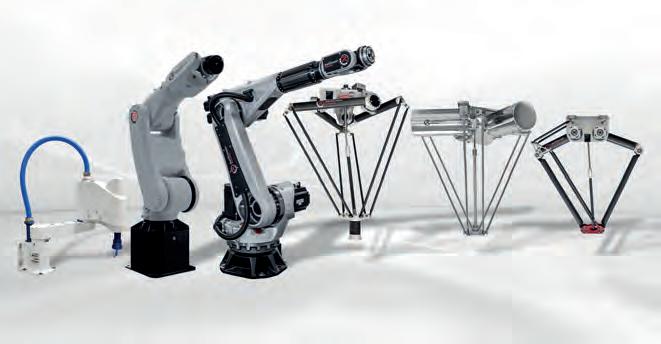
The range includes Duopods, Delta robots from 3 to 5 axes, articulated robots from 3 to 6 axes, SCARA robots, and hygienic design versions, for a total of more than 350 available mechanical configurations. This modularity allows the creation of tailor-made solutions for applications in any industrial sector.
Thanks to controller independence, robots and production lines can share the same control platform without the need for dedicated interfaces. This approach offers several advantages, including the elimination of hardware duplication, greater freedom in controller selection, enhanced software integration, and full ownership of the solution.
At Interpack, it will also be possible to discover some of the latest innovations developed by autonox Robotics, presented as concrete examples of the potential of parallel kinematics.
Among these, the Delta RLL stands out, a kinematic design specifically developed for applications involving long tools. Its distinctive RLL design ensures extremely high rigidity against toolholder tilting, enabling the use of very
extended end effectors—such as multigripper systems—which generate significant tilting moments during motion. Another noteworthy innovation is the world’s largest Delta robot mechanics, featuring a working area of up to 2400 mm, designed to handle applications requiring large operating spaces and high payloads.
Alongside this solution, a new Delta robot concept for close-proximity configurations will also be showcased, developed to enable compact, high-density installations within production lines. These solutions represent a concrete example of the modular and highly flexible approach that defines autonox robotics: components designed to integrate seamlessly into machines and production lines, offering machine builders and system integrators maximum design freedom.
www.dcm-italia.it
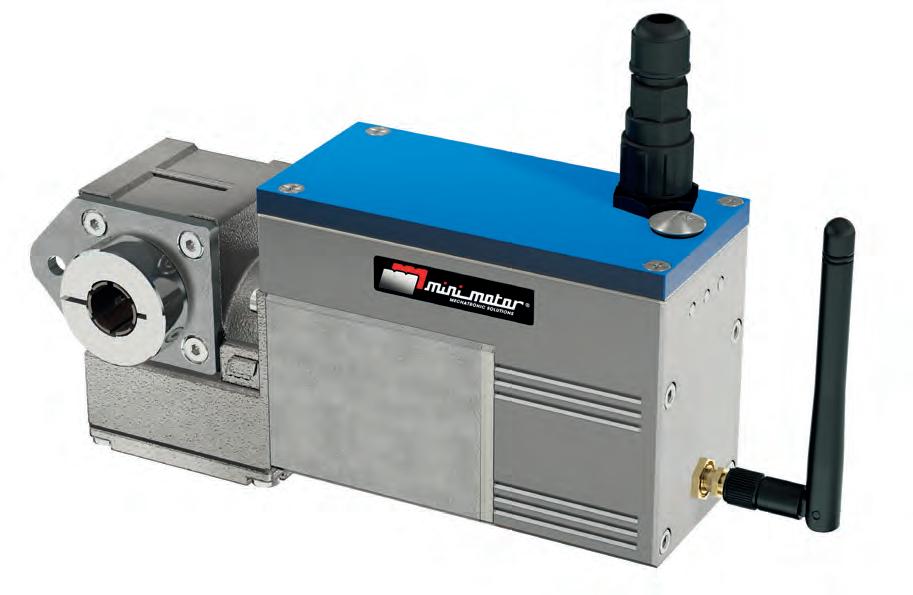
Mini Motor: mechatronic solutions for Food Processing
High dynamic efficiency and wireless-based industrial layouts
In Food & Beverage, versatility and flexibility have always been the two sides of the technical compromise. Increasingly, industry players find themselves having to manage small batches and a wide variety of formats. In this context, innovation means seeking versatility and process improvement in the components themselves, identifying those best suited to new automation design philosophies.
CoA 2.0, the “Wireless Revolution”: reduced cabling for format change
CoA 2.0 (Can Over Air) system was created to promote new design standards in industrial plants, freeing them from the physical constraints of fieldbus cabling. The architecture is based
on proprietary radio technology capable of ensuring low radio latency for each individual motor.
The heart of the system is the Coordinator, which acts as a bridge between the PLC and the individual actuators, opening up new possibilities for scaling, remodeling, and reconfiguration, freeing filling, capping, or labeling lines from the constraints of bus cable routing. Maximum latency registered: 32 m/s for 20 motors.
New generation encoder: dynamic precision and inertial load management
Greater precision, greater efficiency. The new 24-bit HRE encoder has been integrated to allow our compact motors to operate under high mechanical stress conditions, typical of highspeed filling and end-of-line lines.
The main innovation lies in the ability to maintain extreme precision in dynamics, even in the presence of
strong vibrations. But the real leap in quality concerns the management of inertial loads: advanced feedback algorithms compensate for mass fluctuations during sudden acceleration and deceleration phases. This means less stress on the mechanics, a longer component life and, above all, the elimination of positioning errors that could compromise product integrity.
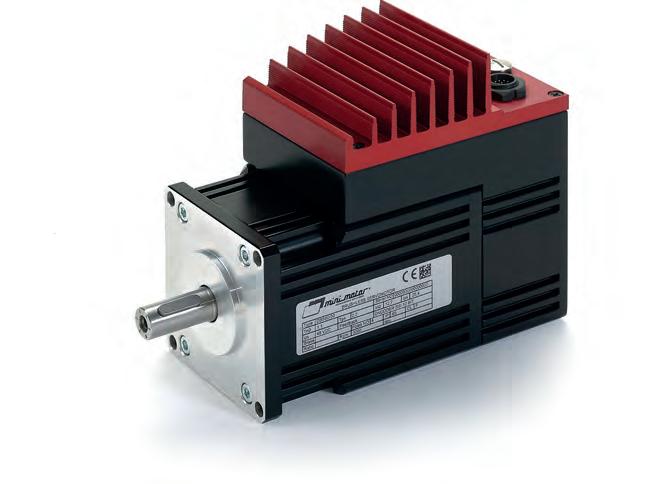
The heart of automation: the integrated drive brushless series
Despite increasingly advanced centralized control systems, the integrated drive brushless motor configuration remains one of the best practices for food processing. This solution meets two critical needs: reducing space requirements and simplifying wiring.
The real key is the versatility guaranteed by the multibus protocol.
The ability of these motors to interface natively with the main communication standards (EtherCAT, Ethernet/IP, PROFINET, Powerlink, Modbus, and CANopen) allows plug-and-play integration into any existing ecosystem.
This technological neutrality transforms the motor into a modular component ready for Industry 5.0. The versatility of the DBS line is also reflected in the
high degree of customization of the digital options: from CSP functions, to configurable DO (Digital Output), to STO (Safe Torque Off), as well as
the possibility of daisy chaining field communication.
Towards adaptive manufacturing
CoA 2.0 technologies, new feedback systems, and brushless integration are the pillars of flexible and responsive manufacturing, capable of responding to changing market demands. In 2026, Mini Motor’s goal is to transform technical complexity into operational simplicity, while ensuring that innovation is sustainable, efficient, and, above all, measurable.
For more information: sales@minimotor.com www.minimotor.com
Transition 5.0: technologies and incentives for integrated business sustainability
Regulations on safety and traceability impose new organisational, technological and economic challenges on companies every day. ROI, return on investment, has always been the guiding principle behind every business decision. However, in recent years, EU and global objectives linked to the protection of environmental and social goals have often required choices
tions that enable companies to achieve environmental, social and governance sustainability goals, while remaining compatible with business needs.
This is the context of the Transition 5.0 Plan, the Italian government initiative funded with €6.3 billion through the -
nies in their digital and sustainable -
presents an evolution of the previous Transition 4.0 Plan, which focused on digital transition through machine interconnection, introducing a stronger focus on energy and environmental sustainability.
Transition 5.0 investments must meet two requirements. Firstly, they must refer to 4.0 capital goods. Secondly, certified evidence must be provided that the machinery involved in the investment reduces energy consumption per unit of product. In other words, for a given production process, the energy consumption of the associated output after the interventions must be lower than in the previous situation.
What incentives are provided by the Transition 5.0 Plan?
The incentives are intended for the purchase of tangible and intangible assets, the self-production of energy from renewable sources and staff training. The Transition 5.0 Plan therefore also makes it possible to support the purchase of photovoltaic systems, provided they are combined with investments in capital goods.
The Ministry of Enterprises and Made in Italy has defined differentiated contributions based on the percentage reduction in energy consumption. For investments of up to €10 million, with an energy consumption reduction of between 5% and 10%, a minimum tax credit of 35% is granted. For a reduction in consumption of between 10% and 15%, the contribution is 40%, rising to 45% for an energy consumption reduction of more than 15%.
AUTOMATION
Expenses incurred to comply with energy saving certification obligations are also eligible, up to €10,000, as well as expenses of up to €5,000 incurred to comply with accounting certification obligations.
Can the solutions developed and proposed by Progetto 6 fall within Transition 5.0?
The answer is yes. Progetto 6 develops and offers 4.0-ready solutions for warehouse logistics, traceability, production data collection, automatic packaging end-of-line management, including automatic labelling machines and RFID portals, as well as shipment management. Process optimisation can enable energy savings compatible with the requirements of Transition 5.0.
Progetto 6 also provides its own factory MES solution, RDP, which collects all production data in real time. Combined with the data from sensors installed to detect energy consumption, this makes it possible to precisely measure energy consumption per unit of product manufactured, or the increase in productivity with the same energy consumption.
Another intervention that Progetto 6 can carry out from a Transition 4.0 and 5.0 perspective is the adoption of the Packer WMS warehouse management and handling system. Through real-time data management, this system enables average efficiency improvements across various company processes and costs, such as: a 10% increase in productivity, an 80% reduction in
warehouse stockouts, a 95% increase in punctuality, a 50% reduction in overtime, a 35% reduction in WIP and a 30% reduction in inventory.
Naturally, each situation must be assessed on a case-by-case basis through dedicated feasibility studies, which Progetto 6 is able to carry out. It is clear that all these processes must be analysed, recorded and measured before the interventions, in order to compare the data with those collected after implementation.
How can companies obtain Transition 5.0 incentives?
The interested company must submit a preliminary communication to reserve Transition 5.0 funds through the IT platform made available by the Energy Services Manager, GSE. The reservation must be accompanied by a series of documents, including the ex ante certification of energy consumption. Within 30 days of confirmation of the tax credit reservation, the company must submit a communication regarding the placement of orders, with a minimum down payment of 20% of the total investment cost.
Once the project has been completed, the company must submit a completion communication, accompanied by an ex post certification confirming the actual implementation of the investments and the expected reduction in energy consumption.
Aware that access to the funds of the Transition 5.0 Plan requires specific and trusted professional expertise, Progetto 6 has established a partnership
with IBS Consulting, a company specialised in subsidised finance and active in Brescia for 30 years.
The two partners, drawing on their respective technical, administrative and financial expertise, support Progetto 6’s client companies in adopting tools that improve business performance through solutions compliant with the Transition 5.0 Plan, while allowing them to benefit from the related tax credits.
Since 2021, Progetto 6 has been part of the smeup group, consolidating its expertise and expanding the range of solutions offered. Thanks to this synergy, the company is able to provide advanced tools for corporate traceability, fully integrated with the most advanced ERP systems and management platforms.
smeup: the partner for digital transformation smeup is a reference point for companies’ Digital Transformation, thanks to its experience in strategic software solutions and IT infrastructures. With 23 offices in Italy, 610 resources, 2,600 customers and €85 million in revenues in 2023, smeup supports companies through three Business Sectors:
• smeup BSA – Software solutions for business digitalisation: ERP, business analytics, document management, logistics, retail and much more.
• smeup ICS – Infrastructure, Cloud and Security: IT solutions designed to guarantee reliability, performance and data protection.
• smeup LAB – Software development and application modernisation through an advanced, multiplatform technology environment.
Thanks to this collaboration, Progetto 6 is even stronger and ready to face the challenges of the future, with the awareness of being a protagonist of its own tomorrow.
www.progetto6.it
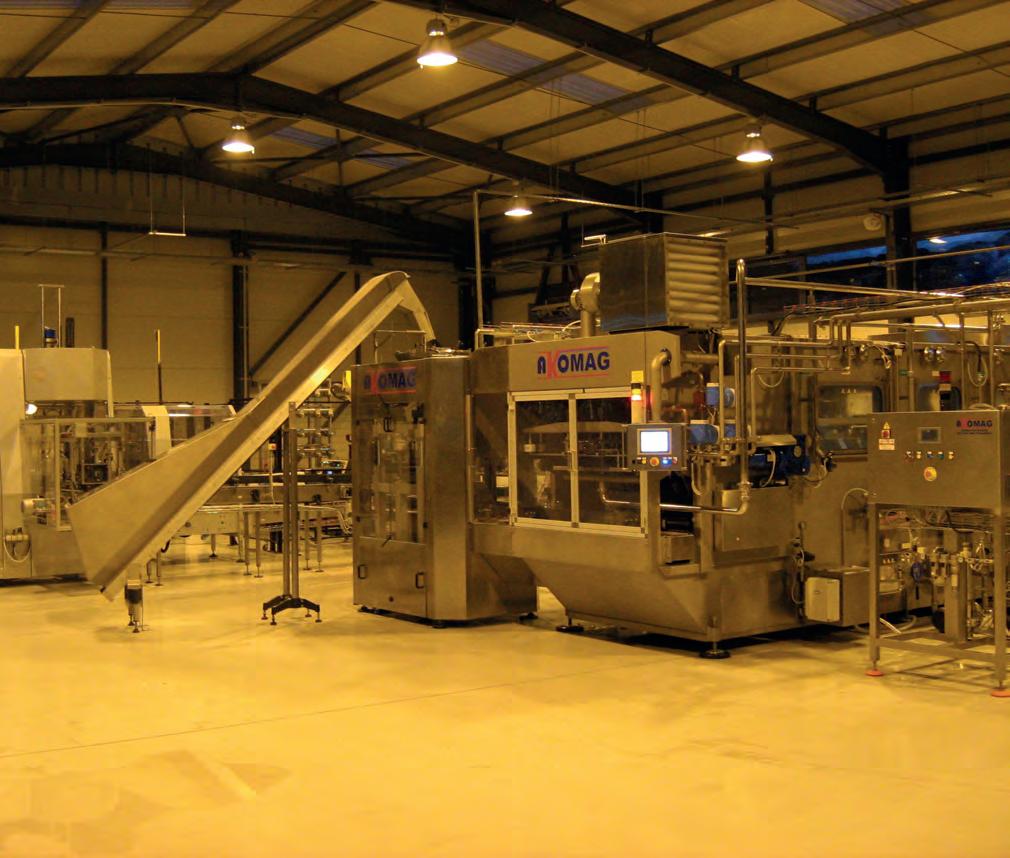
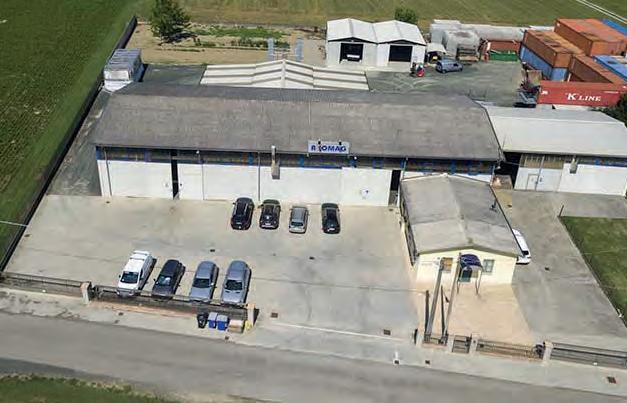
AKOMAG’s complete monobloc system for gallon bottle washing and filling
In recent years there has been a strong growth in the market of gallon water bottles, both in Italy and worldwide.
Dispensers showed a positive trend, apart from the temporary setback caused by the Covid-19, mainly involving offices, factories, warehouses and various communities. The success of gallon bottles, in particular those of reusable PET or PC bottles, obviously involves the need to guarantee the safety of water, and consequently the cleaning of containers and dispensers. Which must be ac-
curately and periodically sanitized. The water used to fill the gallon bottles, which can be natural spring water or water from other sources, must comply with the quality parameters defined in Community legislation on water intended for human consumption.
Used empty gallon bottles, if still intact, can be reused. But before being inserted in a new filling cycle, they must be inspected for integrity, absence of discoloration and possible odours. After that, they must
be washed with water and specific detergents and rinsed thoroughly with special machines. Like those built by Akomag, for example, an Italian company specialized in the design and production of machines and plants for the bottling industry.
Washing, rinsing, filling, capping
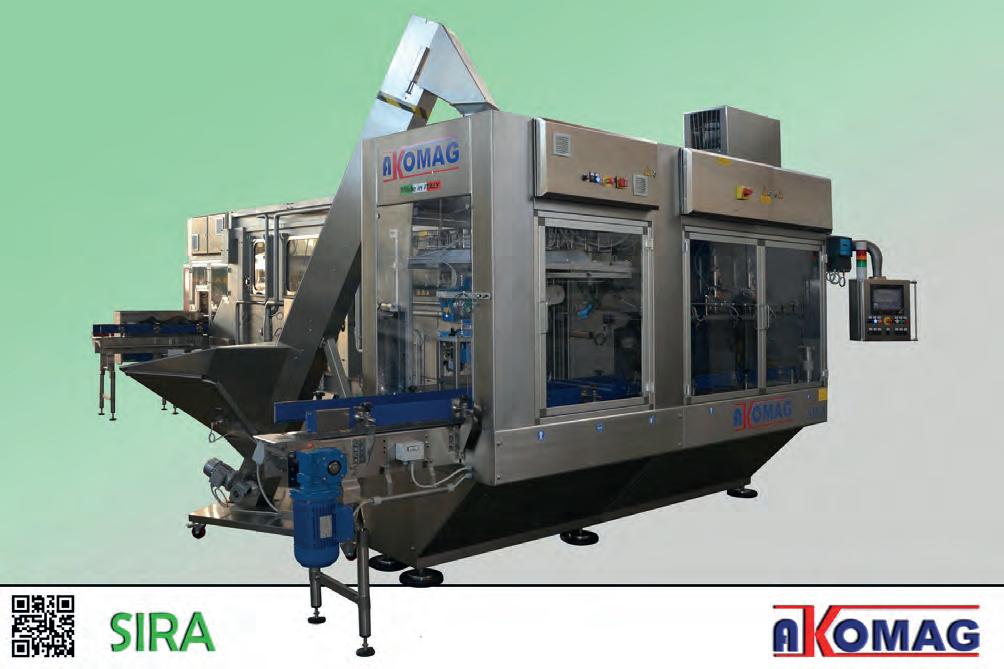
The Monobloc washer for gallon bottles Sira has been designed by Akomag for washing and sterilizing PET or PC gallon bottles or other bottles of various sizes, to be filled with
still water. The washing cycle adapts to the various production needs of the end customer and is very effective. For this machine Akomag has designed and produced a special spraying and brushing device for gallon bottles that ensures total cleanliness. Through the use of special mobile nozzles furniture (penetrating and rotating), the machine washes the bottle internally at high pressure (5 bar). While the outside is brushed by means of nylon brushes. The machine can be quickly adapted to the different bottle formats by simply setting the type of container to be handled on the control keyboard. The stainless steel control board installed next to the monobloc is easily accessible for the operator. The panel is equipped with a touch-screen for the complete management of all line functions, and the displayof operating parameters and alarms. The Monobloc features an automatic de-capper in stainless steel: a pneumatic system grips the bottle neck while ejecting the cap. The system is safe, but it can be
equipped with a system for the selection and ejection of gallon bottles that have not been properly de-capped. The bottles are then filled by means of special inverter- controlled pumps.
A valve designed by Akomag guarantees a laminar flow and no contact between the valve and the bottle. The filling is carried out by means of a special meteringdevice that ensures extreme filling accuracy. The
capper consists of soundproof vibrating hopper, a descent channel, and a tear-off pick-up head.
The closure of the bottle is guaranteed by an inclined pressure belt characterized with adjustable pressure. All adjustments are automatic and managed from the control panel.
www.akomag.com
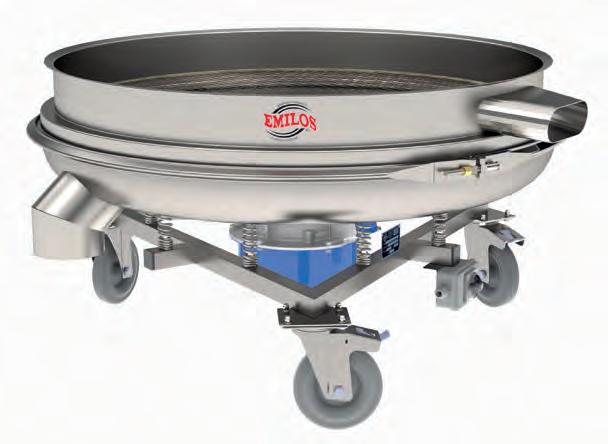
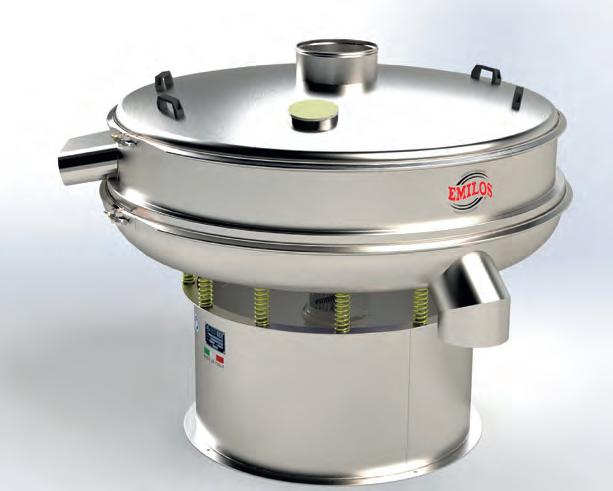
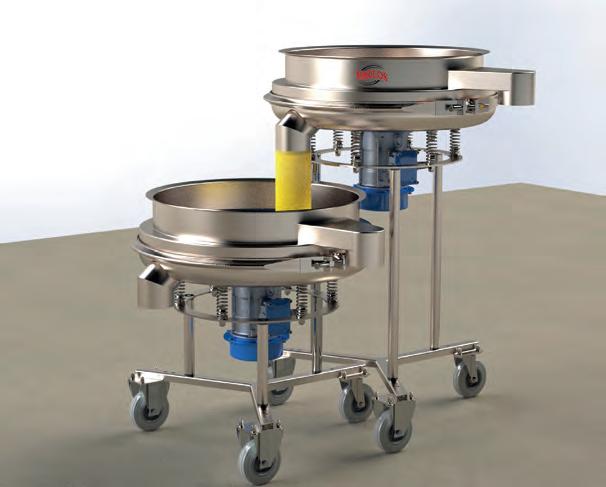
EMILOS: leader in the production of vibrating screens
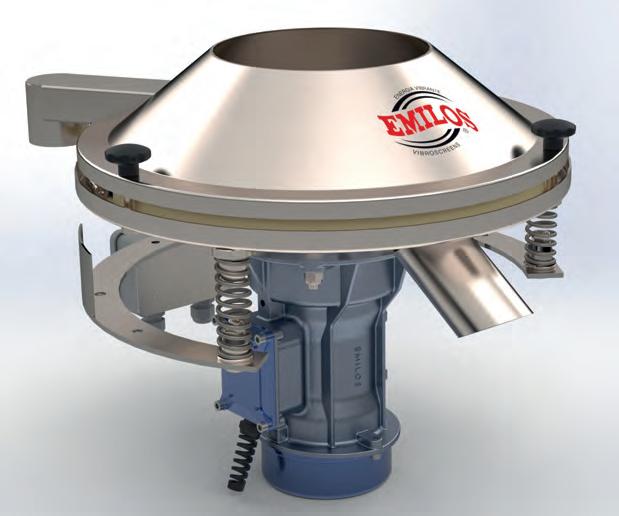
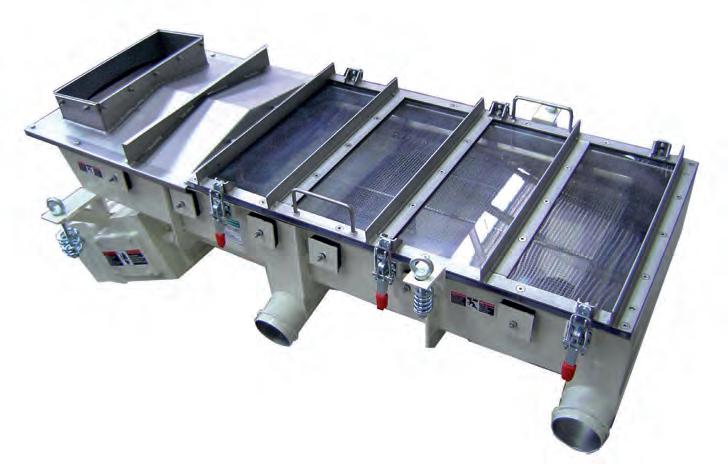
The Emilos sieving system is patented and delivers outstanding performance in terms of productivity and quality. Emilos’ dynamic approach ensures direct and immediate alignment with customer needs.
To address any challenges, the company conducts specific screening tests and manufactures vibrating screens that are exclusively Made in Italy.
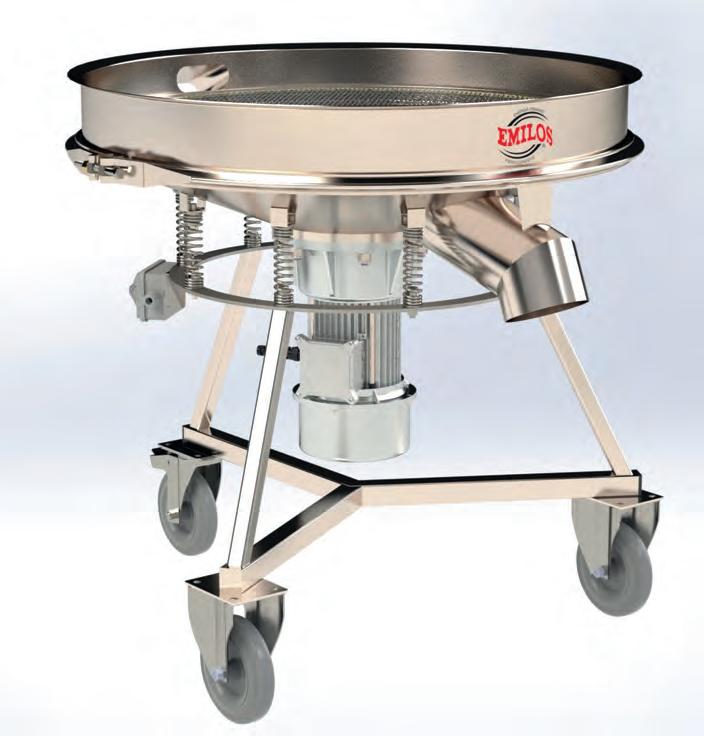
Emilos designs and produces vibrating screens suitable for sieving both food and non-food products, offering both in series and customized solutions.
Designed for continuous 24/7 operation, Emilos vibrating screens stand out from traditional models on the market due to their unique construction concept and the vibrator motor they are equipped with. Operating at 3,000 rpm instead of the stand-
ard 1,400 rpm, and allows for high hourly production.
For screening particularly challenging products, Emilos equips its vibrating screens with systems to prevent mesh clogging, thus increasing production and reducing downtime caused by interruptions for cleaning clogged meshes.
These systems include brushes, perforated trays with rubber balls or anti-clogging rings, and mesh frames featuring spokes and a small timed pneumatic motor.
The Emilos double-groove mesh frame allows operators to replace the mesh quickly and independently, reducing labor and transportation costs as well as downtime for technical assistance from the manufacturer.
Emilos vibrating screens are entirely constructed from stainless steel AISI 304L (or AISI 316 upon request) and can be equipped with Emilos-branded motors certified for explosive environments (Atex II 2GD EEx d IIB T4 certification).
The screens can handle any type of mesh, from the finest (e.g., 0.035 mm mesh size) to the largest, and are characterized by minimal maintenance requirements.
Emilos’ product range includes circular vibrating screens with diameters ranging from a minimum of 450 mm to a maximum of 1,800 mm.
Additionally, the company produces rectangular screens for high hourly throughput or with side-mounted motors instead of the traditional bottom-mounted ones, coarse sieves, refining vibrating screens, as well as automatic and manual magnets.
TARNOS: vibrating solutions for the efficient handling of bulk solids
The handling of bulk solids is a decisive factor for the efficiency, safety and profitability of industrial processes.
In an increasingly automated production environment, vibrating solutions have established themselves as a versatile and reliable technology for optimising material flow across many industrial sectors.
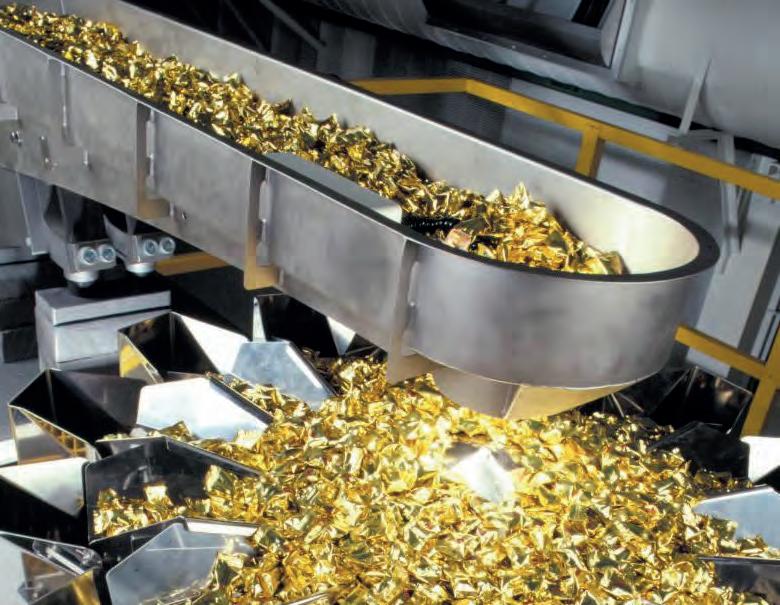
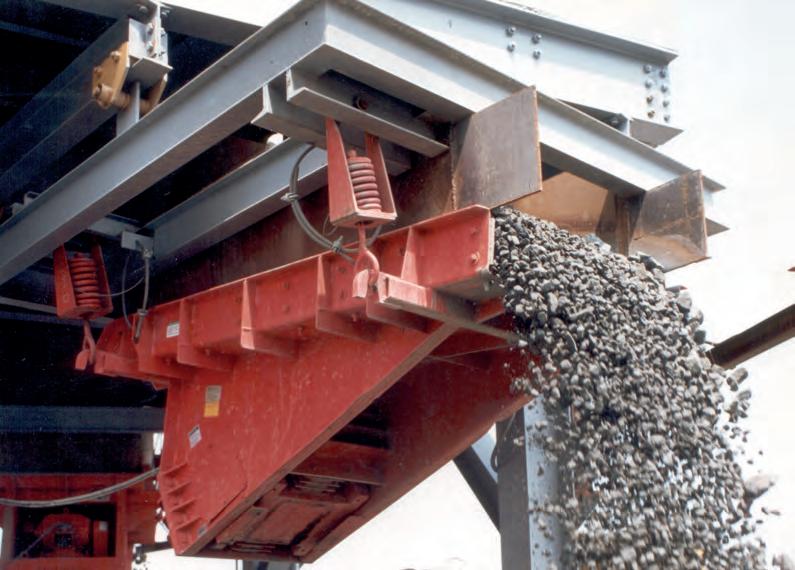
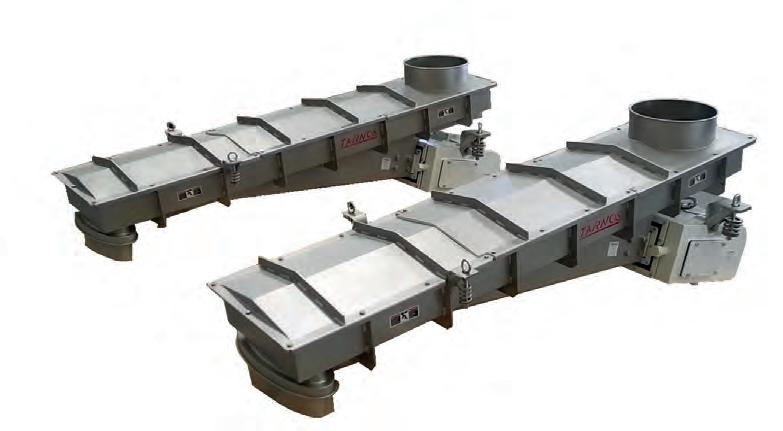
Tarnos vibrating equipment can cover a wide range of applications along the process line: precise dosing, controlled conveying, screening, sieving, elevation, product co-
oling, compaction, dedusting and feeding of both horizontal and vertical packaging systems. The ability to ensure continuous and uniform material movement directly contributes to improving productivity and reducing operational inefficiencies.
One of the main advantages of vibrating solutions is their adaptability to different types of solids, from fine
powders to granules and larger bulk materials. The equipment can be designed according to the specific characteristics of the product, while complying with high quality, safety and hygiene standards, thanks to the use of stainless steel, coatings suitable for product contact, high IP protection ratings and special executions compliant with ATEX regulations when required by the process.
Applications that create value
Vibrating solutions offer clear advantages in applications such as:
• Regular and controlled feeding of processes
• Precise dosing to weighing and control systems
• Size classification and impurity removal
• Product dedusting and cleaning
• Handling of high flow rates in continuous processes
• Improved stability in packaging lines
Tarnos vibrating feeders ensure constant and adjustable feeding, while vibrating screens and sieves provide effective separation even under demanding conditions, with wet, abrasive or corrosive materials.
Depending on the process requirements, the morphology and the behaviour of the product to be handled, the equipment can integrate electromechanical or electromagnetic technology, selected to optimise application performance, energy efficiency and the service life of the system.
Solutions with specific enclosures are also available for applications with high dust content, improving environmental control and plant safety.
Tarnos Equipment offers reliable, high-performance solutions designed to meet the most complex needs of the bulk solids industry.
With more than 70 years of experience in the design and production of vibrating equipment for material handling, and supported by the pioneering experience of Syntron®, Tarnos provides consolidated know-how developed across a wide range of projects and industrial sectors, guaranteeing efficient and reliable solutions even for the most critical handling processes.
www.tarnos.com
UF INTERNATIONAL launches state-of-the-art e-commerce platform to simplify global wholesale
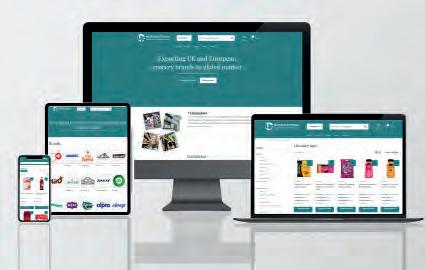
UF International, a leading provider of UK and European grocery products, has launched a new e-commerce website designed to streamline wholesale ordering and support retailers, importers, and brand owners across the globe. The platform gives users access to over 16,000 products from more than 800 trusted brands, covering ambient, chilled, frozen, and speciality categories, all ready for wholesale distribution.
The new website offers a seamless experience for retailers, providing full product information, pricing, and easy order management in one intuitive platform. Users can explore a wide range of popular UK and European brands, check availability in real time, and place orders from anywhere in the world, saving time and simplifying the wholesale process.
“At UF International, we’re passionate about helping our partners succeed in international markets,” said a spokesperson. “This new platform reflects our commitment to innovation, efficiency, and simplicity, ensuring that customers can access the products they need with minimal complexity.”
UF International works closely in brand distribution, partnering with brand owners to help them access new markets and retail opportunities through our expertise. Some of the brands we support include Pea Pops, Lady Sophia, Mallow & Marsh, and many more. Our team provides gui-
dance across every stage of the process, and the new website further enhances these capabilities by giving brands a platform to showcase their products, connect with retailers worldwide, and expand their reach efficiently and strategically.
The e-commerce platform is part of UF International’s comprehensive suite of services, which includes wholesale supply, logistics, compliance, and brand distribution.
With in-house logistics expertise, temperature-controlled warehouses, and real-time stock management, the company ensures that products reach their
destination safely, quickly, and in perfect condition.
The platform is designed to be userfriendly, flexible, and forward-thinking, allowing businesses of all sizes to register and start ordering within minutes.
By combining extensive product range, operational expertise, and global distribution capabilities, UF International continues to simplify international trade and provide strategic support for retailers and brands seeking to grow their presence across the UK and beyond.
www.ufinternational.co.uk/
HEINEN SERVICE: 360° support to keep you running
Heinen offers 24/7 service for pasteurisers, proofers, coolers, and freezers— covering inspections, repairs, spare parts, remote support, upgrades, relocations, training, and SLAs, even for other brands, to keep your production running smoothly. When things get complicated, Heinen delivers - worldwide. Their 24/7 full-range service ensures that you’re supported by highly qualified and dedicated professionals who won’t consider the job done until you’re satisfied.
Core service offerings include:
•Inspections
Regular inspections, maintenance, and wear-part replacements—keeping pasteurisers, proofers, coolers, and freezers operating smoothly.
•Repairs
Fast and reliable repairs—because time is money—and ensuring production resumes quickly with the right expertise and tools.
•Spare Parts
From screws to conveyor belts, they deliver perfectly fitting original parts exactly when needed.
•Remote Services
Thanks to the digitalization of their systems, Heinen’s technicians can troubleshoot and optimize processes remotely, saving time and cost.
•Retrofits & Relocations
You don’t always need a new system—Heinen can upgrade existing equipment or support relocating it.
•Training
Even automated systems depend on skilled operators. Heinen’s team ensures your staff can get the best results from your technology.
• Service Level Agreements (SLAs)
Flexible service contracts tailored to your needs help ensure continuous and optimal performance of your systems.
And they don’t stop at their own systems: Heinen also supports pasteurizers, proofers, coolers, or freezers made by other manufacturers.
Learn more about us and our services: www.heinen.biz/service
RASSPE BLADES BY CHIARAVALLI: heritage meets high-precision technology
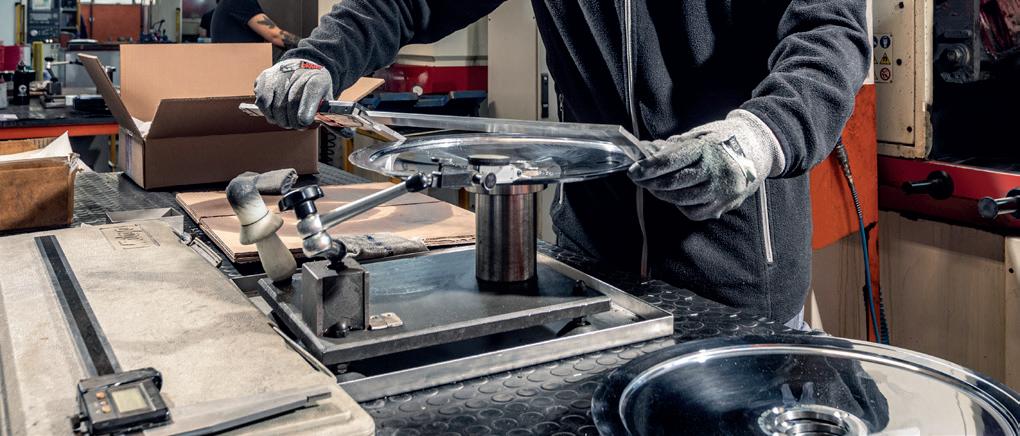
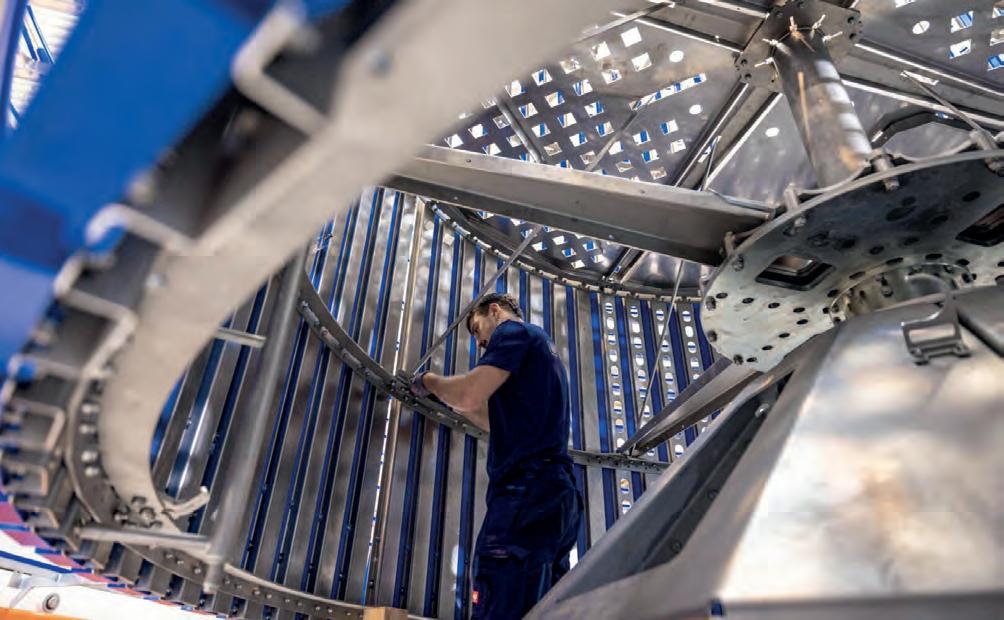
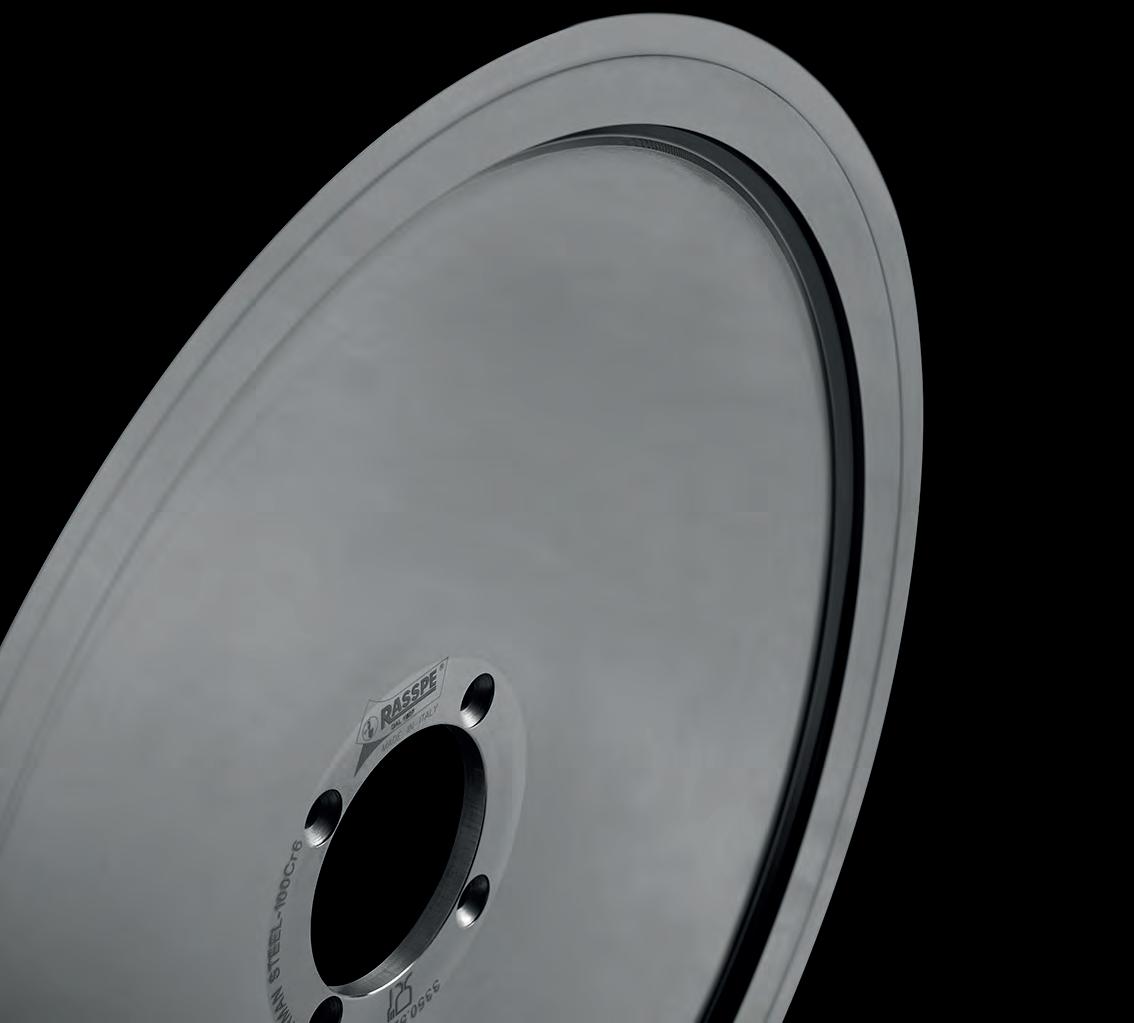
With origins dating back to 1827, RASSPE is the oldest and most iconic brand of slicer blades in the world. Today, this historic name lives inside the innovative ecosystem of Chiaravalli Group, where tradition and advanced industrial engineering meet to create one of the market’s most reliable slicing solutions. Entirely Made in Italy, RASSPE Blades combine decades of craftsmanship
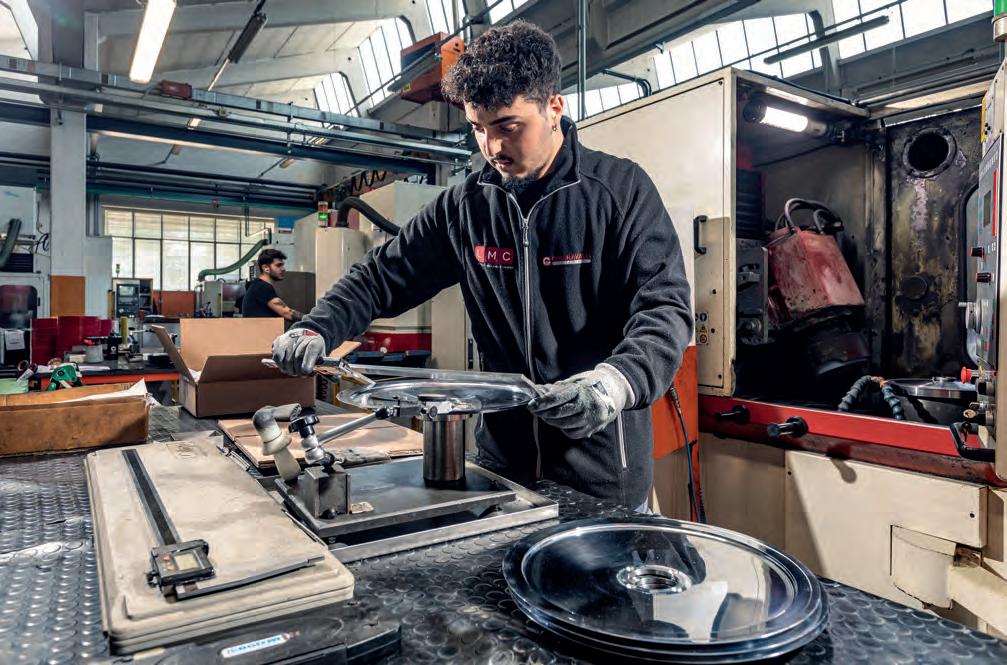
with the production power of a multisectoral group. Every stage — from design to machining, induction hardening, grinding, polishing and chrome finishing — is carried out in-house using state-of-the-art CNC technologies. This fully integrated workflow ensures maximum quality, consistency and performance, with over 30,000 blades produced monthly and a vast warehouse ready to serve global OEMs.
A Complete Range for Every Cutting Application
RASSPE’s product offering includes more than 150 blade models, engineered to meet the needs of professional slicer manufacturers and distributors.
Key technological solutions include:
• Third Generation (3G) Blades
A patented double-level profile that reduces friction, keeps the blade cooler, minimises product adhesion and delivers exceptionally thin, clean slices.
Ideal for deli meats, cheese and vegetables.
• Serrated Blades
Designed for products requiring greater grip: perfect for bread, semi-frozen meat and semi-frozen fish. Available in multiple tooth geometries.
To enhance smooth slicing — especially on cheese — RASSPE offers both traditional Teflon and innovative PFAS-freecoatings, ensuring improved hygiene and reduced residue. Finishes can be combined to create the ideal cutting solution for any product type, ensuring maximum versatility and performance.
Committed to Quality and Future Growth
Supported by Chiaravalli Group’s expertise in industrial mechanics,
food-processing equipment, RASSPE Blades are positioned as a strategic pillar of the Group’s Food Division. This synergy enables continuous innovation, reliable supply capabilities and a growing presence in more than 37 countries worldwide. For manufacturers seeking consistency, precision and a partner with deep technical roots, RASSPE Blades by Chiaravalli remain a benchmark in professional slicing technology — a perfect blend of heritage, engineering excellence and modern production strength
All about food: MAXIMUM EFFICIENCY for all production lines!
Effective planning and controlling of processes are one of the most important things when it comes to fresh food. However, the reality is different: Many producers, importers or packing houses still work with manual entries in confusing Excel tables.
Planning errors are based on this and on insufficient networking of the systems. How can this be avoided?
Smart, individual, digital: Food production 4.0. with 30% efficiency increase
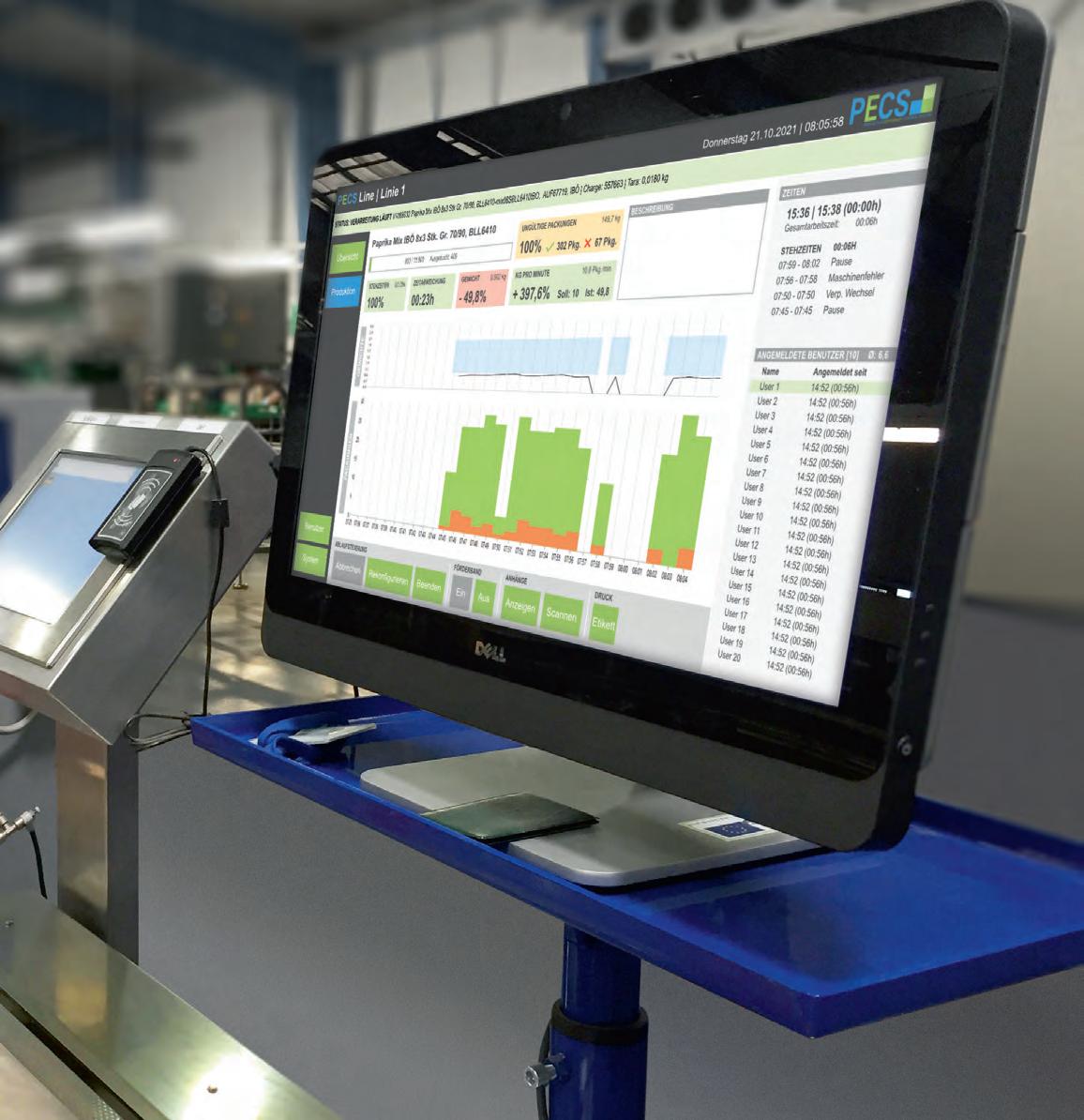
Although Industry 4.0 is a hot topic for decision-makers, there are only a few software providers dedicated to Food Production 4.0. An example of this digitalization offensive is the “PECS” tool.
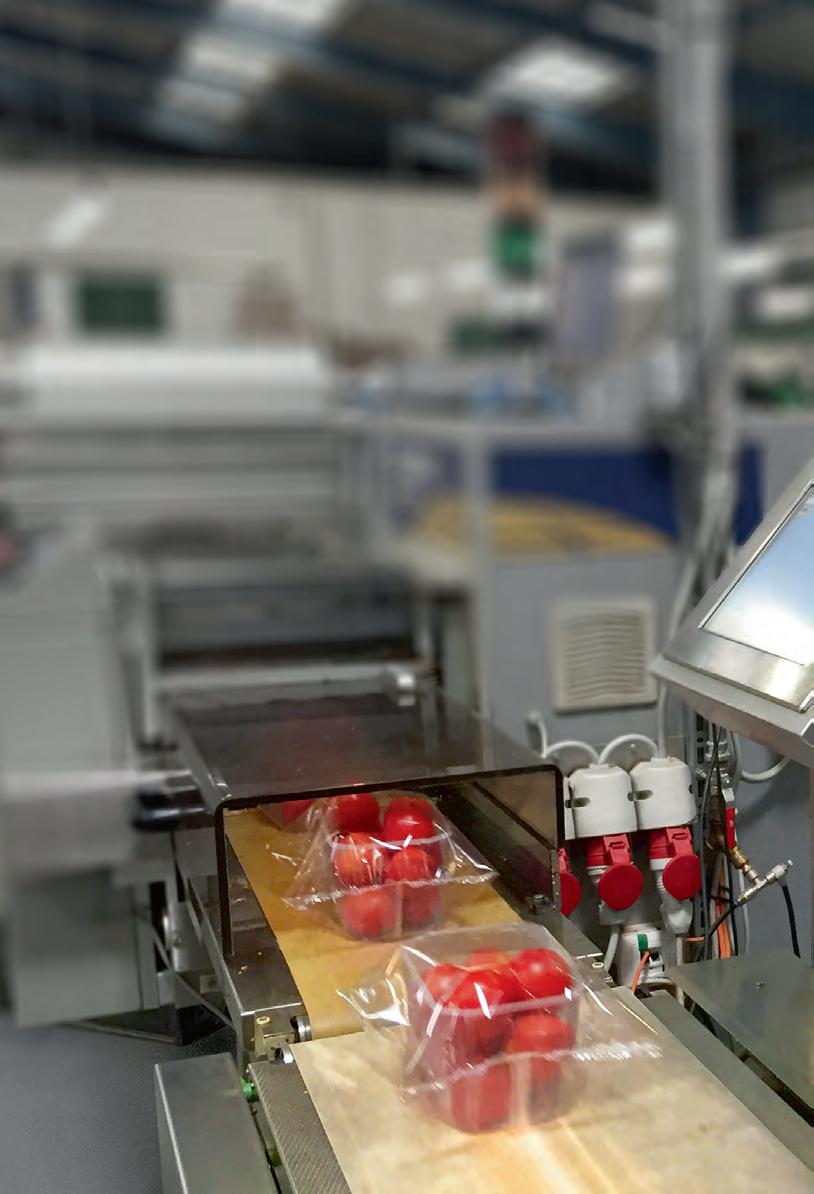
The Production Efficiency Control System covers the complete production control and networks plants and machines - regardless of the maker. Production lines are set up in just a few clicks, personnel planning is carried out in no time, and the performance data of the respective production is made available in a clear manner.
Future orders and activities can be forecast to the minute. An average 30% increase in production efficiency can be expected.
Import & maturity planning: Preventing sources of error that often cannot be taken into in the daily business routine
Especially in the case of perishables, it`s necessary to know exactly at which time which quantity is available
Effective planning and controlling of processes are one of the most important things when it comes to fresh food.
at which location. This is the only way to minimize over- or underdeliveries and the spoilage of goods. Planning is usually based on Excel lists, which then have to be manually converted into orders in the ERP system. The fact that errors happen here can hardly be avoided. The changeover to a database-based solution opens new potential.
The Fruit Import Planning System “FIPS” generates orders based on a
planning quantity and considers live data such as sales quantities, spoilage, lead times, transport times and ripening cycles.
This guarantees supply chain traceability and detailed planning of ripening chamber utilization. Underdeliveries are immediately apparent and appropriate replacements can be provided at an early stage.
ERP: Making yields visible even before the harvest
In many ERP systems, a comprehensive data exchange and thus a continuous, clear planning and control is only possible to a limited extent. The step towards an industry-specific solution such as “traceNET”, which can map the processes of food-producing
companies, is therefore obvious and necessary. Instead of manual entries, it works with automatisms that make everyday production easier. The complex processes of food producers are mapped and optimised in detail. Crop and harvest reporting, ordering, packaging material planning, batch tracing and certificate management are just some of the comprehensive functions.
Individual software solutions for food producing companies, mobile solutions, realtime overview & business intelligence tools can be found at “activeIT-Software & Consulting GmbH”.
www.active-it.at
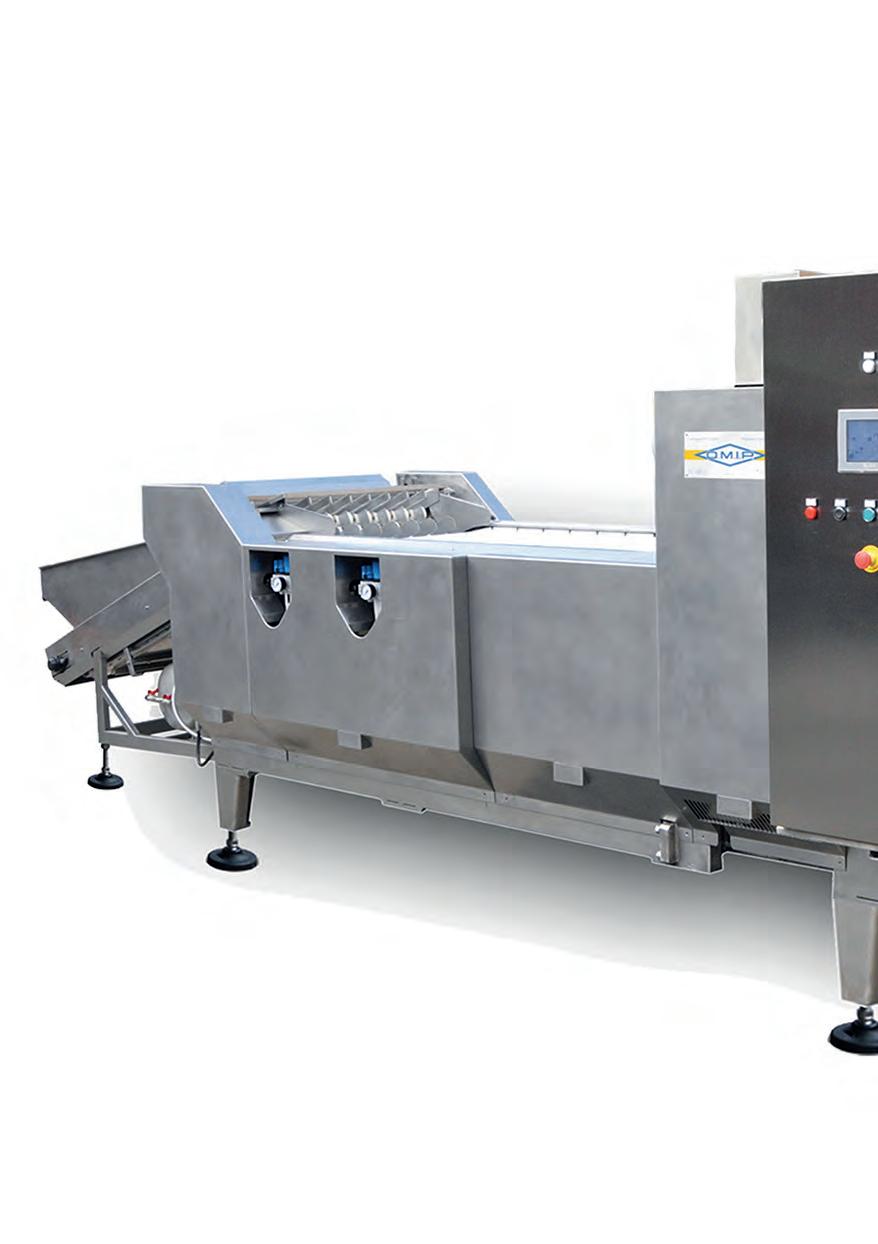
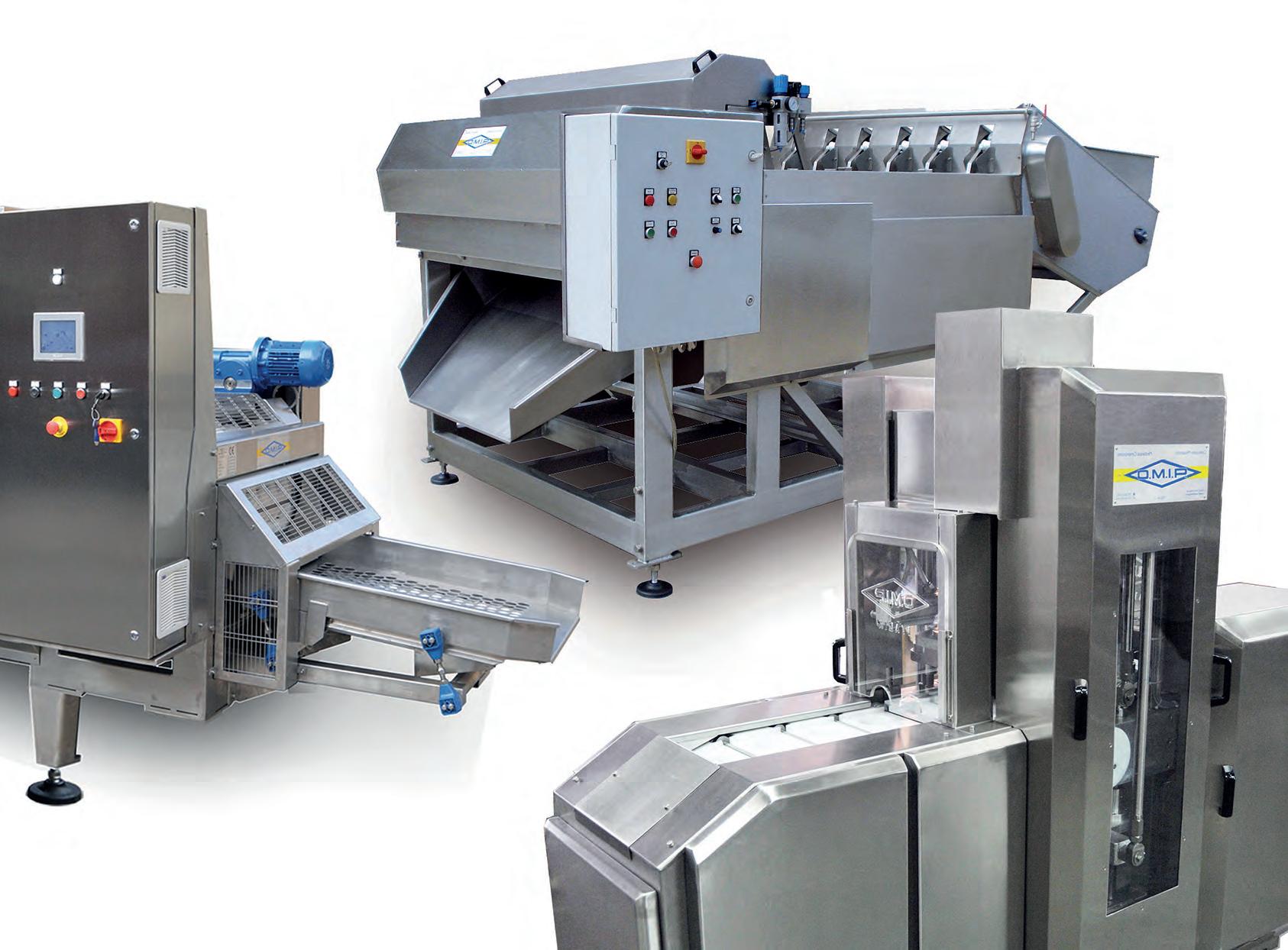
OMIP offers quality, innovation and technology for fruit processing
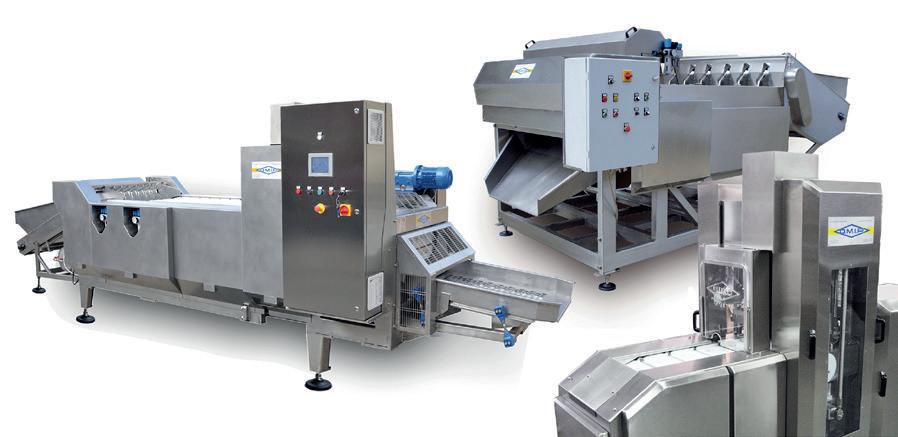
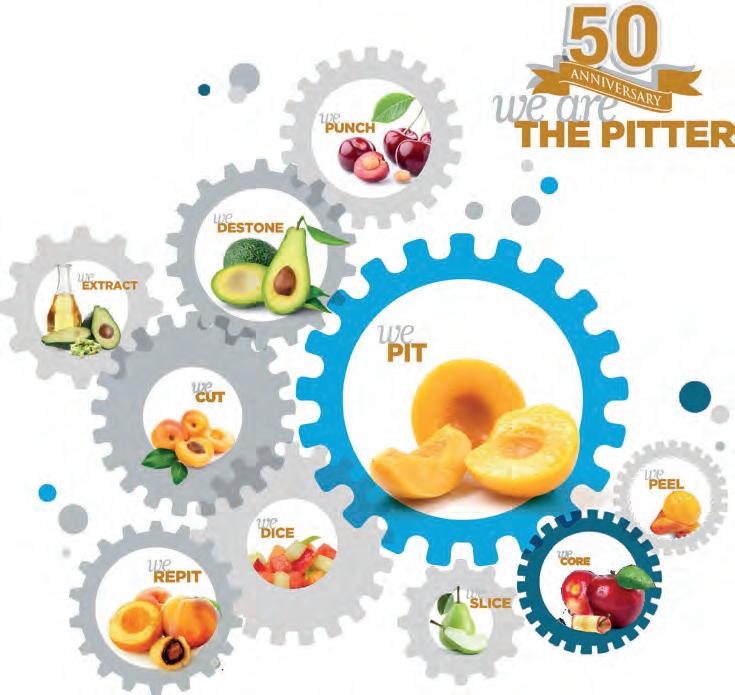
Avocado Pitter mod. KAV2: a revolutionary machine that minimizes operating costs
OMIP SRL, founded in 1971, is targeted at all the canning companies which need to have a more reliable equipment, built with quality materials and great robustness, where the cost of production, as well as that of the workforce, is minimized.
For this reason, it is focused on the design and construction of machinery characterized by simplicity of operation, versatility and reduction of costs.
“Thanks to research, development and innovation, we have been able to introduce, on the world market, the most modern technologies in the field of pitting and hence becoming a global reference for fruit processing” said the company managers Francesco Pannullo and Alfonso Califano.
“In addition to continuously improving the products already on the market, our objective of expanding our manufacturing horizons through the design of machinery capable of transforming fruits and vegetables other than those that it is already able to process – added sales manager Timothy Ahiagba - Examples of such achievement include the apricot pitters mod. KA3 and KA6, the peach Repitter and the Avocado Pitter mod. KAV2.”
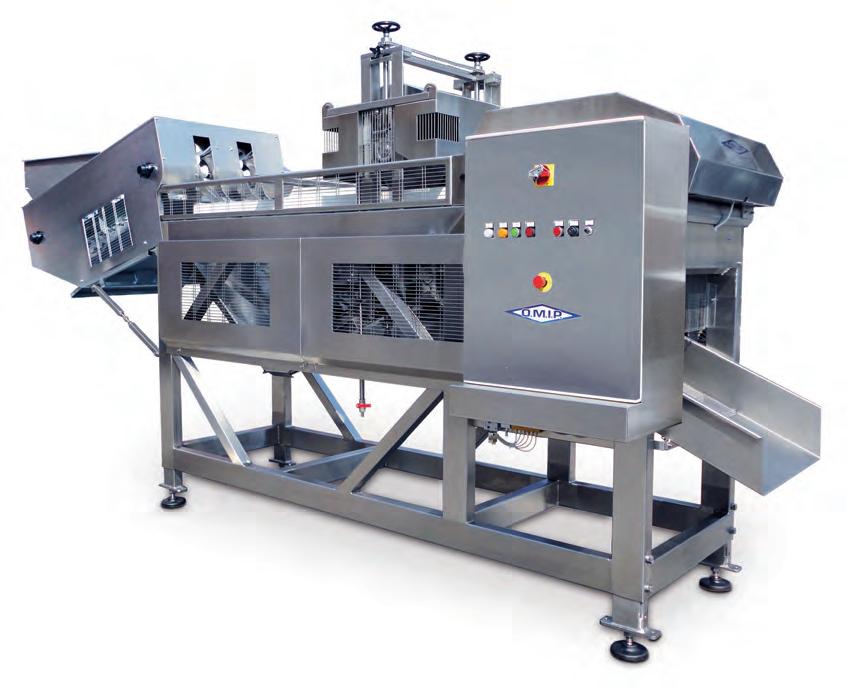
Avocado Pitter mod. KAV2
“The KAV2 pre-cuts the Avocado separating it into two halves and thereby facilitating its pitting – continued the
managers - The machine, available on the market over 8 years, is suitable to pit the avocado fruit even if it is not perfectly graded.”
All parts having contact with the fruit are for alimentary and hygienic purposes and the structure is completely made of stainless steel.
The avocados, appropriately unloaded into the Feeder, are discharged into the channels of the Orientation station that orientates the
fruits and positions them at the ideal cut through suitable and particular devices.
The flexibility of the orientation elements allow the machine to automatically compensate for the differences in the fruits that are not perfectly graded.
The Cutting Station is made up of three particular circular blades. “The innovated mechanisms have, almost all, eliminated the machine lubrication and have hence reduced operation costs to their minimum.”
OMIP’s organizational skills and the quality of their products have enabled them to establish themselves on all markets: from the Italian to European, from the South American and Californian ones to those of South Africa and Australia up to the Asian and New Zealand markets.
Today, the use of the latest mechatronic applications, places OMIP a step ahead, hence revolutionizing once again, the sector of fruit pitting.
www.omip.net
Avocado Pitter mod. KAV2
New markets, great opportunities MELINDA brings Italian fruit and vegetables to Arabia
The Consortium took part in the Italy–Saudi Arabia Business Forum in Riyadh, attended by companies and Minister Tajani. President Seppi stated: “We are working to grow our exports. We are receiving excellent feedback from new markets for the products of our territory.”
An important opportunity to strengthen and expand commercial channels in a rapidly growing market, as well as a chance for institutional dialogue during an event of significant strategic value for a Consortium that has long contributed to the
international expansion of Italian agri-food products among foreign consumers.
This captures the meaning of Melinda’s participation in the Italy–Saudi Arabia Business Forum, held in Riyadh. The initiative was organized by the Italian Ministry of Foreign Affairs and International Cooperation, represented by Deputy Prime Minister Antonio Tajani, together with ICE – Italian Trade & Investment Agency, led by President Matteo Zoppas, and featured numerous and prominent business delegations.
Characterized by a packed schedule of meetings, the mission in the Gulf engaged Melinda in concrete discussions with institutional representatives, as well as with experts and business leaders from both countries.
It was a productive participation, focused on exploring the many opportunities for growth and collaboration in a scenario of strong interest for producers, where the economic partnership between Rome and Riyadh plays a crucial role in the development of trade relations.
A promising context, therefore, also for Trentino and its fruit and vegetable
sector, called to seize new opportunities for expansion.
“We are here because we must never stop. Our export performance is positive, but it is not enough and it does not consolidate on its own. It requires daily commitment, presence in the markets, relationships built over time, and teamwork, because every mission abroad exists to add value to what we produce,” said Melinda President Ernesto Seppi, who led the Consortium’s delegation.
“Internationalization is a priority: it does not only mean selling apples in new countries, but establishing a presence in distant markets, listening to partners, respecting different cultures and building trust.
Saudi Arabia and the Middle East are a concrete example of the results this work can bring. In recent years, sales
in the area have grown significantly, demonstrating that the effort invested in missions, dialogue and investment benefits our entire agricultural community in Trentino.”
“The Saudi fruit and vegetable market is expanding rapidly and shows growing appreciation for premiumquality produce such as Italian fruits and vegetables. This is why we look with great interest to these regions, where the value of our apples and the reliability of Trentino’s cooperative system are recognized,” added Nicola Magnani, Commercial Director of the Melinda Consortium.
“To build solid and competitive supply chains in these markets, it is essential to integrate fresh and processed products, creating a complete and coherent offering that enhances origin and quality.
The synergy between Melinda’s activities and those of MelindaLab moves in this direction and is becoming increasingly strategic,” added Paolo Gerevini, General Manager of MelindaLab.
Driven by the Vision 2030 plan, adopted in the previous decade, Saudi Arabia is experiencing a period of major cultural and economic transformation, marked by reforms, innovation and ambitious projects supported by the local sovereign wealth fund.A highly dynamic context, reflected in the acceleration of GDP and one in which Italian products, data clearly show, are achieving increasing success.
Italy’s total exports to Riyadh have exceeded €6.2 billion, marking a growth of around 28% compared to the previous year. According to ICE estimates, the upward trend continues.
a chat with
PROPAK ASIA, A LARGER STAGE FOR PROCESSING AND PACKAGING INNOVATION
Edited by SONIA V. MAFFIZZONI BENNATI
The 2026 edition of ProPak Asia marked an important step in the evolution of one of the region’s most relevant platforms for processing and packaging technologies.
With a new, larger and more modern venue, the exhibition confirmed its ability to attract international exhibitors, advanced machinery and a growing number of professional visitors.
Miss Kotchasorn Tocharoentanapol, Event Director at Informa Markets
Thailand, explains how this move strengthens the role of ProPak Asia and of Bangkok as a strategic hub for the Asian and Asia-Pacific markets.
ProPak Asia 2026 was held in a new venue, larger, modern and impressive. What did this move bring to the show?
The decision to move ProPak Asia to this new venue was driven by the needs of our exhibitors. Many companies wanted to bring larger machines and more advanced technologies to the exhibition, and they needed a space that could support this evolution.
This new location allowed exhibitors to present their solutions in a more complete way.
It also gave visitors the opportunity to see technologies that, in some cases, were shown for the first time at ProPak Asia.
For us, the venue is not only a bigger space. It is a way to support innovation and to offer the industry a stronger platform for business, technology and networking.
Looking at the this edition, what results best reflect the growth of ProPak Asia?
The results of the 2026 edition were very positive.
Compared to the previous year, we recorded a 20% increase in paid exhibitors and an 8% growth in visitors. We also welcomed a strong international presence, with visitors and buyers from Asia, India and Bangladesh.
Event Director at Informa Markets
Miss Kotchasorn Tocharoentanapol
a chat with
Sonia Bennati INTERVIEWS and STORIES that tell INNOVATION
This is very important for us, because it confirms that ProPak Asia is increasingly recognized not only as a regional event, but as an international meeting point for the processing and packaging industry.
ProPak Asia is becoming more and more a global platform. What role does Bangkok play in the food processing and packaging industry?
Bangkok plays a central role in Asia. It is a convenient and strategic location for business, technology and logistics.
From here, companies can connect with several markets across Asia and the Asia-Pacific region.
This makes Bangkok an ideal hub to support the growth and efficiency of the processing and packaging industries.
The city offers accessibility, strong connections and a dynamic business environment.
For this reason, ProPak Asia can continue to grow as a platform that brings together technology suppliers, manufacturers and industry professionals from different countries.
The next edition of ProPak Asia is already scheduled. Can you share the dates?
Yes. ProPak Asia 2027 will take place from 9 to 12 June 2027 at IMPACT Muang Thong Thani,
the same venue that hosted the 2026 edition. We look forward to welcoming the industry again in Bangkok for another edition dedicated to innovation, business and international cooperation.
What stands out from this edition is the sense of scale. ProPak Asia is not simply growing in numbers, but in its ability to represent a wider industrial landscape.
The move to a larger venue, the increase in exhibitors and visitors, and the growing international participation all point in the same direction: Bangkok is consolidating its role as a strategic gateway for processing and packaging technologies across Asia and beyond. Visit: www.propakasia.com
34th WorldFood Istanbul at its new venue, Istanbul Expo Center, on December 15–18
WORLDFOOD ISTANBUL is preparing to
bring the future of the food industry together at Istanbul Expo Center with its 34 years of experience!
The pulse of the food industry will beat once again this year at the grand gathering of WorldFood Istanbul
The International Food Products and Technologies Exhibition – WorldFood Istanbul, the meeting point for food and beverage manufacturers as well as buyers from many parts of the world, will open its doors for
the 34th time on its new dates, December 15–18, 2026. Last year, the exhibition broke a record by bringing together over 900 buyers from
100 countries and hosting more than 80,000 visitors, 20,000 of whom were international, from 153 countries. This year, to offer a much more
efficient and powerful business environment to the sector, the exhibition will be held at its new venue, Istanbul Expo Center (IFC), which features a modern infrastructure, bringing its 34 years of experience together with its participants.
The exhibition, which will further expand its scope of content this year, will incorporate food technologies (Foodtech) into its structure as an additional product group in line with this goal.
Organized by ICA Events, which has signed over 50 exhibitions and conferences covering international companies, senior representatives of the region, and all areas of the economy, the International Food Products and Technologies Exhibition - WorldFood Istanbul will bring the sector together between the dates of December 1518, 2026, with its innovative vision.
While becoming a prestigious structure trusted by the sector since its first year and consolidating its leadership, the exhibition will be held at its new
location, Istanbul Expo Center, with its identity as a regional and international platform of vision.
In this way, participants will explore the food sector, connect with key figures and buyers in the industry, and promote their products in an exciting new market.
The undisputed largest meeting address of the food sector will be WorldFood Istanbul once again this year
Emphasizing that the exhibition is almost a living organism shaped according to today’s dynamics, Semi Benbanaste, Director of the International Food Products and Technologies Exhibition - WorldFood Istanbul, said: “The food industry, which is an important part of the Turkish economy, is increasing its visibility day by day in terms of both production and export potential.
At this point, WorldFood Istanbul, which opens the doors for the sector to meet the global arena with an increasing interest every year, conti-
nuously renews itself and creates sustainable value. We have achieved this by closely following the sector for over 30 years and constantly renewing ourselves. In this context, we will hold our exhibition
on its new dates at the Istanbul Expo Center this year, which will offer a much more efficient and powerful business environment to the sector with its modern infrastructure, central location, and large areas.
For us, this represents the responsibility brought by our exhibition’s undisputed leadership in its sector rather than just a change of venue. In our new location, we will carry forward the variety of commercial opportunities offered by WorldFood Istanbul, the scope of international collaborations, and the value it adds to the sector, just as we have done for 33 years.
Thus, we will create a unique meeting point for manufacturers, brands, buyers, and industry professionals. In addition, by expanding the scope of the exhibition, we will integrate food
technologies (Foodtech) into the structure as an additional product group this year.
Creating a strategic meeting point for Turkey and the surrounding region, WorldFood Istanbul, the unchanging address of high business potential with the right target audience, will shape the sector once again this year as a strategic platform opening up to the future of food.”
worldfood-istanbul.com
Organizing Turkey’s leading exhibitions in the building, tourism, cosmetics, food, rail systems, and logistics sectors, ICA Turkey transfers its strength and powerful global network in the exhibition industry into each sector it takes part in, creating new business, collaboration, and purchasing opportunities in the exhibitions it organizes, and contributing to the development of these sectors.
PROPAK INDIA 2026 to accelerate sustainable packaging and smart manufacturing transformation
The 8th edition of ProPak India expo, India’s leading B2B platform for packaging, processing, and supply chain innovation, is set to take place from August 26–28, 2026, at the Bombay Exhibition Center, Mumbai. The event will bring together over 200 exhibitors, 300+ brands, and 15,000+ highquality trade visitors from key sectors including food & beverage, pharmaceuticals, FMCG, personal care, manufacturing, and logistics.
Positioned at a critical juncture for the industry, marked by fluctuating raw material costs, tightening sustainability regulations, and accelerated adop-
tion of automation and digitalization, ProPak India 2026 aims to serve as a catalyst for business growth, innovation, and strategic collaboration. The
PROCESS. PACK. DELIVER.
For over seven successful editions, ProPak India has been a leading platform where the processing, packaging and supply chain industries come together to explore innovations, discover solutions, and build meaningful business connections.
What Visitors Can Expect:
Access to the Latest Technologies
Explore advanced solutions in processing, packaging, automation, and supply chain
Connect with Leading Solution Providers Meet exhibitors showcasing innovative machinery, materials, and technologies
Meaningful On-Ground Interactions Engage directly with industry experts and solution providers
What You Can Experience at ProPak India:
Industry Networking Opportunities
Connect with professionals from food, pharma, FMCG, and manufacturing sectors
Explore a dynamic show oor featuring the latest technologies and solutions across packaging, processing, and supply chain.
Gain rst-hand exposure to innovations, interact with leading solution providers, and discover ideas that can enhance your business operations.
Build valuable connections, exchange insights, and stay ahead in a rapidly evolving industry
Register now and be part of ProPak India 2026!
Join thousands of industry professionals exploring innovation and shaping the future of packaging and processing.
We look forward to welcoming you to a powerful and insightful experience.
Scan the QR code and Register now
exhibition will showcase a diverse range of categories, including packaging machinery, processing technology, automation and robotics, materials and consumables, as well as supply chain and logistics solutions, offering a comprehensive view of the industry’s evolving ecosystem.
With a strong focus on sustainable packaging and smart manufacturing, the event will feature dedicated zones for eco-friendly materials, automation, and robotics, alongside 20+ conference sessions led by 40+ industry experts addressing key themes such as the growth of India’s packaging industry, its shift towards eco-friendly materials, the increasing importance of sustainability and innovation, and actionable insights into supply chain efficiency and automation adoption.
Backed by industry bodies such as the Indian Beverage Association and supported by leading media platforms including IPP Catalog Publications, The
Packman, and SPM Group, the event strengthens its position as a key enabler of industry progress.
Commenting on the evolving landscape of the sector, Mr Yogesh Mudras, Managing Director, Informa Markets in India, said, “India’s packaging and processing sector is witnessing rapid expansion driven by FMCG, e-commerce, and pharmaceutical growth, with recent industry reports indicating a projected CAGR of over 10–12%, positioning India among the fastest-growing packaging markets globally.
At the same time, businesses are navigating increasing sustainability mandates, including Extended Producer Responsibility (EPR) norms, alongside rising input and logistics costs.
The industry is moving decisively towards automation, smart technologies, and circular packaging solu-
tions, with growing investments in digital manufacturing and supply chain optimization. As demand for sustainable and efficient packaging accelerates across sectors, it is imperative for businesses to stay agile and future-ready.
ProPak India 2026 will play a crucial role in enabling this transition by bringing together innovation, expertise, and meaningful business opportunities under one roof.”
With free registration and a strong emphasis on high-value B2B engagement, ProPak India 2026 is set to be a landmark platform where innovation, sustainability, and industry converge to shape the future of packaging and processing in India.
For more information and media registration, visit: https://visitor-registration. propakindia.com/register. php?form=media_registration
CIBUS TEC 2026: Parma at the heart of food technologies
Cibus Tec is preparing to return to Parma from 27 to 30 October 2026 with a broader and more international profile.
LEdited by SONIA V. MAFFIZZONI BENNATI
ong recognized as a key platform for food and beverage processing technologies, the exhibition is now strengthening its role across the entire production chain, with packaging emerging as one of the most dynamic areas.
The 2026 edition will reflect a market in which food processing, beverage filling and food packaging are increasingly interconnected.
As Fabio Bettio, Director of Cibus Tec, explains, “Considering the three main areas of Cibus Tec, food processing, beverage filling and food packaging, the food packaging area now covers more than 35% of the technological offer.”
It is a figure that marks a clear shift in the positioning of the event. Cibus Tec is no longer perceived only as a reference point for processing, but as a platform able to represent a broader idea of food technology. The growth of the packaging sector is also confirmed by the comparison with the previous edition.
Fabio Bettio Director of Cibus Tec
“We are recording 50% more exhibitors and 40% more exhibition area in the packaging sector,” Bettio says. Numbers that do not simply indicate an expansion in size, but a change in industrial perspective: packaging is becoming a central element in the development of food and beverage production lines.
This evolution also involves the international profile of the exhibition.
Despite a complex global scenario, Cibus Tec is registering a strong increase in the number of exhibitors from abroad. “The international component of our exhibitors is growing between 40% and 50% compared to the previous edition,” Bettio explains. For international food technology companies, Parma is becoming a strategic meeting point to develop business, create connections and access new opportunities.
According to Bettio, this confirms that Cibus Tec is increasingly seen “as a good tool to make business and networking in Italy and abroad.” Another key element of the 2026
edition will be the presence of qualified international buyers. Cibus Tec has built one of the most relevant top buyers programs among food and beverage technology exhibitions, and the next edition will further strengthen this direction.
“Once again in October, we will host more than 3,000 guests from abroad, from 90 countries,” he adds.
“They will be in Parma to choose the right technologies, the right solutions, with the right exhibitors in the right place.”
The message is clear: the value of a trade fair today is not only measured by exhibition space or visitor numbers, but by its ability to create concrete business opportunities and connect supply and demand at an international level.
Cibus Tec 2026 therefore tells a story that goes beyond the growth of a single event. It reflects the transformation of a sector in which technologies are no longer isolated stages of the production process. Processing, filling and packaging increasingly belong to the same industrial logic, where efficiency, integration and sustainability require a more complete view of the line.
Parma, with its industrial culture and international appeal, is preparing to become once again a meeting point for the global food technology industry. A place where innovation is not simply displayed, but read as part of a wider evolution of the food and beverage supply chain.
www.cibustec.it
EXHIBITIONS 2026-2027
MARCA
15-16/01/2026
BOLOGNA
European trade fairs for the private label industry and the International supermarket label exhibition.
PROSWEETS
01-04/02/2026
COLOGNE
Trade fair on technologies for the confectionery and snack industry.
FRUIT LOGISTICA
04-06/02/2026
BERLIN
Trade fair on technologies for the fruit and vegetable industry.
BEER&FOOD ATTRACTION
15-17/02/2026
RIMINI
Trade fair for the beer, food & beverage world.
SANA FOOD
22-24/02/2026
BOLOGNA International exhibition of healthy eating out.
SLOW WINE FAIR
22-24/02/2026
BOLOGNA International fair dedicated to the good, clean, and fair wine.
MECSPE
04-06/03/2026
BOLOGNA International trade fair for the manufacturing industry.
PROWEIN
15-17/03/2026
DUSSELDORF
International trade fair for wine and spirits.
VINITALY
12-15/04/2026
VERONA International exhibition for wine and spirits.
MIDDLE EAST 2026/27
DJAZAGRO
12-15/04/2026
ALGIERS Fair of the agri-food sector.
IRAN FOOD+BEV TEC
18-21/05/2026
TEHRAN Fair on packaging technologies.
PROPAK ASIA
10-13/06/2026
BANGKOK Fair for packaging.
FOOD SYRIA
26-28/07/2026
SYRIA Fair for food&beverage.
SAUDI FOOD SHOW
27-29/09/2026
JEDDAH SAUDI ARABIA Food&beverage products trade fair.
SAUDIFOOD MANUFACTURING
27-29/09/2026
JEDDAH SAUDI ARABIA Fair for the packaging and food&beverage industries.
HOSPITALITY QATAR
12-14/10/2026
DOHA Fair on hospitality and HORECA.
GULFOOD MANUFACTURING
03-05/11/2026
DUBAI Fair for the packaging and food&bev.
GULFHOST
03-05/11/2026
DUBAI
Hospitality fair for the Middle East, Africa, and Asia.
OMAN AGROFOOD
1-3/12/2026
OMAN Fair of agriculture, food, fisheries and aquaculture.
FOOD AFRICA
7-10/12/2026
EGYPT Food&beverage products trade fair.
INTERPACK MEA
7-10/12/2026
EGYPT Fair for processing and packaging.
GULFOOD
15-19/03/2027
DUBAI Fair on hospitality and food products.
EXHIBITIONS 2026-2027
LATINPACK
14-16/04/2026
SANTIAGO, CHILE
International trade fair on packaging and packing technologies.
MACFRUT
21-23/04/2026
RIMINI
Fair for the fruit and vegetable industry.
INTERPACK
07-13/05/2026
DUSSELDORF
Fair on production lines, solutions, and materials for packaging.
TUTTOFOOD
11-14/05/2026
MILAN
B2B trade fair for the entire agri-food ecosystem.
SPS/IPC/DRIVES
ITALIA
26-28/05/2026
PARMA
Fair on automation, components, and software for the industry.
FISPAL
16-19/06/2026
SAO PAULO, BRAZIL
Fair on packaging technologies.
MCTER EXPO
07-08/10/2026
VERONA
Exhibition on energy efficiency and renewable sources.
POWTECH
29/09-01/10/2026
NUREMBERG
Trade fair on technology for powder product processing.
SIAL PARIS
17-21/10/2026
PARIS
Trade fair on food products.
SUDBACK
24-27/10/2026
STUTTGART
Trade fair for baking technologies.
LABOTEC
27-28/10/2026
PARMA
Trade fair on food industry technologies and laboratory analysis
CIBUS TEC
27-30/10/2026
PARMA
Fair on technology for the food and beverage industry.
BRAU BEVIALE
10-12/11/2026
NUREMBERG
Fair on technologies for beer and beverage production.
SIMEI
17-20/11/2026
MILAN International exhibition on enology and bottling.
ALL4PACK
23-26/11/2026
PARIS International exhibition for packaging.
SANA FOOD
21-23/02/2027
BOLOGNA
Trade fair of healthy eating out.
SLOW WINE FAIR
21-23/02/2027
BOLOGNA International fair dedicated to the good, clean, and fair wine.
FACHPACK
21-23/09/2027
NORIMBERGA
Packaging industry trade fair.
HOST
22-26/10/2027
MILAN
Fair for the hospitality & Horeca sectors.
IBA
24-28/10/2027
DÜSSELDORF
Trade fair for the bakery.
IPACK-IMA
29/05 – 01/06/2028
MILANO
Trade fair for food and non-food processing and packaging technologies.
DRINKTEC
11-15/09/2028
MONACO
Trade fair for the beverage industry.
ACTIVEIT SOFTWARE & CONSULTING GMBH
50/52
Premstätter Straße 165 8054 Seiersberg-Pirka
Austria
AKOMAG SRL
40-41
Frazione Diolo, 15/D 43019 Soragna - PR
Italy
CHIARAVALLI GROUP SPA
SOCIO UNICO
48-49
Via per Cedrate, 476 21044 Cavaria con Premezzo - VA
Italy
CORNO PALLETS SRL
30-31
Via Revello, 38 12037 Saluzzo - CN
Italy
DCM SRL
35
Via Piersanti Mattarella, 10 20093 Cologno Monzese - MI
Italy
DM PACK SRL
8
Viale Dell’Artigianato, 34 36030 San Vito di Leguzzano - VI
Italy
EMILOS SRL
42-43
Via della Costituzione, 6 42025 Cavriago - RE
Italy
ESG SRL
16-17
Corso Genova, 28 27029 Vigevano - PV Italy
FIERE DI PARMA SPA
71-72
Viale delle Esposizioni, 393A 43126 Parma - Italy
GENERAL SYSTEM PACK SRL GSP
4/7-23
Via Lago di Albano, 76 36015 Schio - VI - Italy
GEO PROJECT INDUSTRIES SRL GPI
10/12
Via Leonardo da Vinci, 43 35015 Galliera Veneta - PD
Via S. Giovanna d’Arco, 9 46044 Goito - MN - Italy
MINI MOTOR SPA 36-37
Via E. Fermi, 5 42011 Bagnolo in Piano - RE Italy
OMIP SRL
54/56
Via Ponte, 21 84086 Roccapiemonte - SA - Italy
OPEM SPA 14-15
Via della Cooperazione, 2/A (Area Ind. Spip) 43122 Parma - Italy
PROGETTO 6 SRL 38-39
Via Vergnano, 81 25125 Brescia - Italy
www.itfoodonline.com
PROXAUT SRL
32/34
Via Della Tecnica, 4 41013 Piumazzo - MO Italy
SIEMENS SPA 26/29
Via Vipiteno, 4 20128 Milano - Italy
TARNOS S.A. 44-45
Calle Sierra de Gata, 23 28830 San Fernando de Henares Spain
TECNO PACK SPA 4/7-9
Via Lago Di Albano, 76 36015 Schio - VI Italy
Smart synergy sparks intelligence.
The clever integration of industrial AI with solutions for drive and sensor technology, software, and industrial communication is driving automation forward with unerring precision.
Track down a world of possibilities at the SPS – Smart Production Solutions, the international trade fair for automation.
POWERING FOOD SECURITY THROUGH MANUFACTURING INNOVATION
Gulfood Manufacturing stands as the leading global event for food and beverage manufacturers, supply chain leaders, and technological pioneers to access advanced innovations that recalibrate efficiency, amplify productivity, and secure long-term profitability.