







This handbook consists of two volumes which describe the ITER design from its inception up to the design, construction and assembly in 2025
The handbook is not designed to be read as a continuous sequence of chapters. Instead, it is composed of focused, self-contained sections that address specific topics. Each chapter can be read and understood independently, allowing readers to engage with the material most relevant to their needs without requiring familiarity with preceding chapters. As a result, the reader will find certain overlapping content in chapters.
It is to be noted that at the time of writing, the design for some systems is still on-going. Therefore, the reader should consider that whilst there is significant value of this important point-in-time study, an update would be required as the Project progresses
A broad Project overview is given in the first volume, to provide the reader with background information necessary to understand the context in the subsequent moredetailed chapters of the second volume, dedicated to the individual systems composing ITER.
For the overall table of contents of the Handbook and to access each one of the chapters, please refer to htps://www.iter.org/scien�sts/iter-technical-reports
This chapter is authored by Neill Taylor and co-authored by the Handbook Editors Federico Casci, Stefano Chiocchio Gianfranco Federici, Richard Hawryluk, John How, Akko Maas, Juan Knaster, Masanori Onozuka, René Raffray, Gabriella Saibene, and Bill Spears, with contributions from Jesus Izquierdo and Gilles Perrier.
It was recognised from the very beginning of the ITER project that it was likely that the facility would be subject to nuclear licensing in whatever country it would be constructed. Only two previous fusion experiments had actually used D-T plasmas with some tri�um fuel: TFTR at the Princeton Plasma Physics Laboratory in the US and JET at Culham in the UK, but neither of these had u�lised sufficient tri�um or generated a neutron fluence substan�al enough to require nuclear licensing. However, even at the outset it was understood that ITER would be different, due to
• A significant inventory of tri�um
• A neutron flux and fluence large enough to give rise to:
o Prompt radia�on hazards (both neutron and secondary gammas)
o Delayed radia�on hazards due to ac�va�on of materials
o Decay heat due to ac�va�on of materials
o A poten�al inventory of radioac�ve waste due to ac�va�on
o Possible radia�on damage to materials, including those of safety components.
These issues were recognised as sufficient to require authorisa�on to construct and operate the facility. The nature of that authorisa�on would be country-dependent, but it seemed very likely to involve a nuclear regulator and require licensing as a nuclear facility.
In the introduc�on to the first substan�al safety report of the ITER EDA, the Early Safety and Environmental Characteriza�on Study (ESECS)[ 1] of 1995, the control of radioac�ve hazards is said to be implemented “to ensure that all safety objec�ves are met along with regulatory requirements of the poten�al host countries where ITER may be built”. From the beginning of the EDA, it was a requirement that ITER should be site-able in any of the four par�es to the ITER EDA Agreement. This of course implies that the nuclear regula�on of any of the countries could be sa�sfied. Because of the novel nature of fusion, and the complete lack of any experience of regula�on of a fusion facility by a nuclear regulator, it was expected that the Home Teams of countries that may become poten�al sites for ITER construc�on would begin a dialogue with their respec�ve authori�es. To this end, the ESECS report said that its purpose was “to assist the Home Teams in their discussion with regulators, public, and interest groups in the communi�es where ITER may be sited. These discussions are vital to the ITER site selec�on process and are also important in the development of the regulatory requirements that would be applied to ITER in the various countries”.
Whether or not such discussions between Home Teams and their regulators took place at this early stage is not recorded. However, over the years that followed, as certain countries emerged as possible candidates for the ITER site, some informal discussions were held between members of the Safety Environmental and Health Division (SEHD) of the ITER Joint Central Team (JCT) and representa�ves of nuclear regulators of those countries.
The ESECS report of 1995 was followed by two releases of a more comprehensive Non Site-specific Safety Report (NSSR-1 and NSSR-2) in 1997 and 1998, and the Generic Site Safety Report (GSSR)[ 2] in 2001, which was part of the FDR 2001 baseline. In the preface of the GSSR, it is writen “the main purpose of GSSR is to provide technical informa�on to poten�al host countries, in combina�on with other ITER documenta�on, to assist in preparing regulatory submissions”. The generic nature of the safety analyses presented in the ten volumes of the report was intended to cover all the needs of the technical input to ini�al regulatory submissions in any of the candidate countries, while recognising that more detailed informa�on would be developed once a site is selected. “A�er si�ng the ITER safety design and implementa�on will be finalised in accordance with host country regula�ons and prac�ces”.
The process of selec�ng a site for ITER was long and slow (see Volume 1 sec�ons 6.9 and 6.10). As different candidate sites were proposed, aspects of their site-specific impact on safety and licensing were assessed. In the spring of 2001, a group of businesses, academics and trade unions offered to build ITER on Canadian soil a proposal that provided a much-needed interna�onal
credibility to the project as no other par�cipant had put forward a poten�al site at the �me. The site, Clarington, was located in southern Ontario about 70 km east of Toronto on the shores of Lake Ontario. The Clarington site was owned by Ontario Power Genera�on and was the site of the Darlington Nuclear Genera�ng Sta�on with 4 CANDU reactors with an installed capacity of 3,512 MWe and a Tri�um Removal Facility. The facili�es on the site were licensed by the Canadian Nuclear Safety Commission (CNSC) including tri�um related opera�ons and releases. There were ini�al briefings with CNSC staff on the ITER project and its safety aspects, and CNSC staff par�cipated in ITER mee�ngs. When Cadarache was selected by the project as the site for ITER, ITER Canada withdraw from the project and their sponsored staff le� the project.
While Japan was proposing a single site, Rokkasho-Mura, Europe was considering two possibili�es; in addi�on to the ul�mately selected site of Cadarache, one in Catalonia, Spain, called Vandellos, was also under considera�on. Vandellos, on the Mediterranean coast of Spain, was the site of an exis�ng PWR plant. Informal discussions were had with the Spanish nuclear regulator to understand the likely licensing regime to be applied if ITER were to be constructed at this site.
By 2004, only two candidate sites for ITER were in the frame: Rokkasho-Mura in Japan and Cadarache in France. An ini�al understanding of the regula�ons and prac�ces in these two countries had been acquired, and a new version of the GSSR was issued reflec�ng this understanding[ 3]. The ten volumes of this new GSSR comprised the original text of the 2001 version with addi�onal notes on work completed in the intervening years and, importantly, specific varia�ons expected according to the regula�ons governing Rokkasho and Cadarache. Appended to each volume were tables of differences for each of the candidate sites, for example different occupa�onal dose limits applying in Japanese and French regula�ons.
An example of how different approaches in the candidate site countries may have influenced the design is the need for a Fusion Power Termina�on System (FPTS, later re-named Fusion Power Shutdown System, FPSS). This system was ini�ally introduced to respond to a par�cular accident scenario, in which the cooling of a plasma-facing component is lost due to a major rupture of the cooling circuit somewhere outside the vessel, for example in the room containing the pumps and heat exchangers (the “vault”). If the plasma con�nues to burn, the temperature of the undercooled plasma-facing component rises very quickly, and within seconds may fail allowing cooling water/steam to enter the vessel, with a consequen�al challenge to the integrity of the vessel, par�cularly at diagnos�c windows and other penetra�ons.
To avoid this, the FPTS was specified to detect the cooling circuit fault and rapidly shut down the plasma before the in-vessel leak occurs. However, the criteria in Japan was that an FPTS was unnecessary, since as the plasma-facing surface temperature begins to rise, outgassing from that surface would poison the plasma and lead to a disrup�ve termina�on. The view in ITER Safety Environmental and Health Division (SEHD) was that while this mechanism may well be effec�ve, demonstra�ng its reliability to the sa�sfac�on of a regulator would never be possible, so the FPTS was required to guarantee �mely shutdown. Since no conclusion could be reached on this, in the
2004 GSSR Volume II (Safety Design), everywhere that FPTS is men�oned, the words “if implemented” have been appended.
8.1.2.1 Initial steps
In view of the an�cipated candidacy of Cadarache as a possible construc�on site for ITER, in 2002 the French Commissariat à l’Energie Atomique (CEA) ini�ated the first stage of the licensing process with the nuclear regulator, the DGSNR (Direc�on Générale de la Sûreté Nucléaire et de la Radioprotec�on, which later became the Autorité de Sûreté Nucléaire, ASN 1). As ITER did not, at that �me, exist as a legal en�ty, CEA made the submission to DGSNR on behalf of a future ITER Organiza�on.
Under French regula�ons, ITER is categorized as a Basic Nuclear Installa�on (Installa�on Nucléaire de Base, INB), because both its tri�um inventory and ac�vated materials inventory exceeds their respec�ve thresholds (around 27g for tri�um). There are many other INBs in France - ITER is number 174 - including not only fission reactors, but also plants linked to their fuel cycle, some accelerators and laboratories. It was expected that ITER would be included in the “laboratories and fuel plants” category.
This first stage of the licensing process required the CEA to submit to DGSNR a Dossier d’Op�ons de Sûreté (DOS). This 113-page report summarized the hazards presented by the ITER installa�on and aimed “at describing the safety op�ons chosen at this stage of design that are required to control both internal and external risks capable of provoking nuclear or health consequences”. It contained a descrip�on of the proposed ITER site at Cadarache and its characteris�cs, and an overview of the safety analysis with the aim of “recommending general safety objec�ves and verifying their validity by studying different opera�ng condi�ons (normal, incidental and accidental), par�cularly in terms of the radiological impact”, which was based on the GSSR of 2001. A descrip�on of dismantling at end-of-life and waste management considera�ons was also included.
The DOS report was examined by the authori�es, specifically in some detail by the Ins�tut de Radioprotec�on et de Sûreté Nucléaire (IRSN), the technical advisors to the nuclear regulator DGSNR (and later, ASN). The IRSN produced a comprehensive report giving their recommenda�ons, and these were considered by a Groupe Permanent (GP), which is a panel of independent experts, on whose findings the authori�es base their decisions. This GP concluded with a list of 15 recommenda�ons (“engagements”) that needed to be taken into account in a future Preliminary Safety Report (the Rapport Préliminaire de Sûreté, RPrS). The DGSNR took this advice and decided that “the main stakes in terms of safety have been correctly iden�fied and
1 ASN merged with IRSN in January 2025 becoming ASNR
that the corresponding safety op�ons seem appropriate”. They noted that an RPrS would be required for ITER and listed issues that needed to be addressed in the RPrS, based on the recommenda�ons of the GP.
This was November 2002, and nothing further was done for several years un�l the site was selected and work began on the next phase of the licensing process, including the genera�on of the RPrS. A mee�ng between CEA and DGSNR in October 2004, at which stage a site had s�ll not been chosen, noted the current situa�on and confirmed the steps that would next be needed for licensing, should Cadarache become the ITER site. As it turned out, the steps then iden�fied were modified by the enactment, in 2006, of a new law, known as the TSN law, for transparency in nuclear safety (loi no2006-686 rela�ve aux installa�ons nucléaires de base et au contrôle, en ma�ère de sûreté nucléaire, du transport de substances radioac�ves). This law did not substan�ally change the requirements for licensing nuclear facili�es in France, but it brought together various exis�ng legisla�on into a single act and somewhat streamlined the process. Later, in February 2012, a new specific regula�on for all nuclear facili�es was issued (known as INB order), and ITER became the first facility to be licensed as a nuclear facility following this new regula�on (ITER license 2012-1248 obtained in November 2012).
8.1.2.2 Proceeding to the Decret d’Autorisation de Création (DAC)
Following the decision in 2005 to site ITER at Cadarache, the ITER team began to assemble a safety group on the CEA site at Cadarache, the first members arriving in December 2005 and others transferring from the ITER office at Garching over the following year. Ini�ally the ITER safety team worked with Agence ITER France (AIF), a CEA agency (see sec�on 6.13) , to make prepara�ons for the licensing process. Engagement was re-established with the nuclear regulator, ASN, and their technical advisors, IRSN.
During 2006 and 2007 a series of mee�ngs were held between the ITER safety group, with AIF, and ASN together with IRSN. Each mee�ng focused on one technical aspect of the ITER design, with the ITER team giving a presenta�on, concentra�ng on the safety aspects of the ITER systems and components. Following each mee�ng IRSN sent to the ITER team a list of detailed ques�ons, to which the team provided comprehensive writen answers, some�mes with further discussion at following mee�ngs. These mee�ngs fulfilled two objec�ves: to familiarize IRSN personnel with technical aspects of fusion systems with which they were not acquainted, and to inform the ITER team about the concerns of the regulator and the approach to be taken in presen�ng the safety case. Like some of the ITER staff, the personnel at IRSN mainly had experience derived from fission reactors. This required some explana�ons about the differences for fusion, for example the ITER vacuum vessel was commonly regarded as being like a PWR pressure vessel.
Another step at this stage of the process was the organiza�on of a public debate. This comprised a series of public mee�ngs in towns and villages in the region, organized by AIF and held during 2006 and 2007. The objec�ve was for the public to raise their ques�ons and concerns about the
si�ng of ITER at Cadarache and for representa�ves of CEA and ITER to offer replies. Some of the mee�ngs were disrupted by an�-nuclear protesters, many of whom were not specifically arguing against the construc�on of ITER but against nuclear energy in general, apparently ignoring the essen�al difference between the ITER fusion plant and a fission reactor. Other objectors argued that the public debate was of no value as work had already begun on preparing the site, authoriza�on for this having been obtained via a separate process. Nevertheless, many mee�ngs generated genuine ques�ons from the local popula�on on the poten�al impact of ITER, predominately on socio-economic issues such as the cost of housing, and the effect of increased road traffic during construc�on. The series concluded with a posi�ve report from the chair of the mee�ngs, no�ng that on balance the par�cipants had been in favour of si�ng ITER at Cadarache.
Once the ITER Organiza�on (IO) was formally established in 2007, it became the applicant for the licensing of the facility (the “operator”) and began the process of seeking authoriza�on to construct ITER. In January 2008, IO submited to ASN an ini�al version of the request for this authorisa�on, the Demande d’Autorisa�on de Créa�on (DAC). These DAC files included a first version of the preliminary safety report (Rapport Préliminaire de Sûreté, RPrS). Within a few months the ASN responded reques�ng further detail and specifying some 60 areas in which expansion of RPrS was required. Work on this expansion con�nued over the next two years leading to a revised version of the DAC files, submited to the authori�es in March 2010.
8.1.3
8.1.3.1 Process to the Creation Decree of 2012
The DAC files submited by IO to the ASN in 2010 were in 14 parts:
Part 1: Informa�on about the ITER Organiza�on as the proposed operator, its technical capabili�es and financial status.
Part 2: An outline descrip�on of the ITER design and the principles of its opera�on, including a brief introduc�on to fusion.
Parts 3 – 5: Maps of the site and surroundings, at various scales.
Part 6: An impact study, presen�ng the expected impact on the local environment.
Part 7: The RPrS.
Part 8: A risk management study.
Part 9: A jus�fica�on for there being no need for public u�li�es to be prepared for radioac�ve releases around the site.
Parts 10- 11: A decommissioning plan and provisions for long-term monitoring of the site a�er final shutdown.
Part 12: Report on the outcome of the public debate held in 2006 (see above).
Part 13: A “complementary note” describing the organiza�on of the project, its seven members, financing, and the regula�ons for health and safety of its workers.
Part 14: List of relevant laws and regula�ons and plans for holding the public inquiry.
The DAC files were all prepared in French, as required by French law; English transla�ons were subsequently prepared for the benefit of IO personnel and the member states.
The most substan�al part of the DAC was part 7, the RPrS. Together with 25 annexes, which provided further details of some topics, it totaled some 4,000 pages. The main RPrS report was in two volumes, the first describing the ITER preliminary design, the planned opera�on and the site in some detail, focusing on safety and environmental aspects, the second providing a safety analysis. The sec�ons in each were:
Vol. 1 Descrip�on of the Facility and its Environment
General descrip�on of the facility
1. Site and environment
2. Neighbouring facili�es
3. Descrip�on of the pla�orm
4. Building-by-building descrip�on
5. Descrip�on of systems and u�li�es
6. Instrumenta�on and control
7. Human factors and organiza�on in design
8. Facility zoning schemes
9. Descrip�on of opera�ons
10. Waste and effluents
11. Risk iden�fica�on
12. Opera�ng feedback for design
13. Permanent shutdown and decommissioning
Vol. 2 Preliminary Safety Demonstra�on
1. General
2. Normal opera�on study
3. Preliminary safety studies on hazards
4. Preliminary accident safety studies
5. Assessment of radiological consequences
6. On-site emergency plan design analysis
7. Malevolence originated accident studies
Informa�on on the safety analyses reported in the RPrS is provided in sec�on 5.9 of Volume 2 of this report.
The revised DAC submited in 2010 was accepted by ASN as sufficient to be the basis of the licensing examina�on. The examina�on process was conducted by the IRSN, and took about 18
MANAGING THE DESIGN & CONSTRUCTION OF ITER
Vol.1, Ch. 8/1, p. 7
months to complete. During this �me, IRSN sent to IO some 700 ques�ons on a wide range of topics, reques�ng addi�onal detail, jus�fica�on or further analyses suppor�ng the points presented in the RPrS. A series of mee�ngs were held between specialists from IO and IRSN to discuss the issues raised, o�en leading to supplementary ques�ons, un�l finally IO had sent writen responses to all the ques�ons raised by IRSN.
Independently of the examina�on of RPrS by IRSN, the Environmental Authority (Autorité Environnementale, AE) reviewed the DAC files, in par�cular part 6, the Impact Study. In March 2011 it gave its advice, asking for some addi�onal informa�on to be included in the Impact Study. This was done, leading to the issue of an updated version.
In parallel with these examina�ons of the IO documents, a public inquiry was convened by the Préfet (local government chief). This ran for seven weeks between June and August 2011, during which �me the ITER DAC files were available for consulta�on in each town hall of towns and villages in the region surrounding the ITER construc�on site. Members of the public were able to write their comments and/or discuss their concerns with members of the Inquiry Commission, an independent panel appointed by the Préfet. IO also answered hundreds of ques�ons from the public during this period, and met several �mes with the Commission to provide responses to issues raised by the public. These issues covered many topics including rou�ne releases (both radiological and toxic, including beryllium), storage of tri�ated wastes, capacity of the storm basin, and socio-economic issues such as impact on transporta�on routes. In conclusion of the public inquiry, in September 2011 the Inquiry Commission announced a favourable opinion, with some recommenda�ons, allowing the licensing process to con�nue.
Another important aspect of public interac�on was the establishment of a local liaison commitee (Commission Locale d’Informa�on, CLI) as required by the TSN law. The ITER CLI met regularly star�ng in December 2009, discussing topics of concern with members of IO. The CLI also studied the ITER DAC files and made its own input to the public inquiry.
With all the various elements of this stage of the licensing process reaching a conclusion, the ASN were able to convene their standing commitee, the Groupe Permanent (GP), comprising about 30 independent experts, to consider the outcome of the examina�on and deliver an opinion on the gran�ng of the decree to authorize ITER construc�on. The IRSN reported to the GP their findings from their examina�on of the RPrS. These were discussed in two mee�ngs of GP in November and December 2011. The outcome was that the GP gave a posi�ve opinion on the gran�ng of the decree, subject to a substan�al number of recommenda�ons and commitments taken by IO to improve and extend the scope of some safety analyses, complete R&D in some areas and jus�fy some of the safety provisions taken the design.
In addi�on, another important safety file was produced in applica�on of the EURATOM ar�cle 37, for which the radiological consequences impact from ITER rou�ne opera�on and accident scenarios had to be presented to the other European countries for an acceptance by the European
Commission. This file was writen by IO, and supported by the Host Country and ASN, as a prerequisite for providing the license to ITER.
This posi�ve outcome was finally confirmed in June 2012, in a leter from the ASN giving their recommenda�on that the decree to authorize ITER construc�on be granted. There were associated condi�ons, some 25 demands and 162 engagements, which corresponded to the recommenda�ons and commitments taken at the GP. This led, in November 2012, to the issuing by the French government of the decree that authorizes the construc�on of the ITER facility.
This decree (see Fig. 8.1.3.1) sets certain legally-binding limits on aspects of the ITER design, namely:
• Maximum tri�um inventory in the en�re facility of 4 kg,
• Maximum tri�um inventory in the vacuum vessel of 1 kg,
• Maximum fusion power of 700 MW,
• Plasma current to be limited to 15 MA, unless authorised by the ASN.
The decree also states that the vacuum vessel shall have a pressure limi�ng system consis�ng of a line and a discharge tank. It lists the main safety func�ons to be provided (see Volume 2 sec�on 5.9.2.4) and the principal risks, both internal and external, to be taken into account in the design.
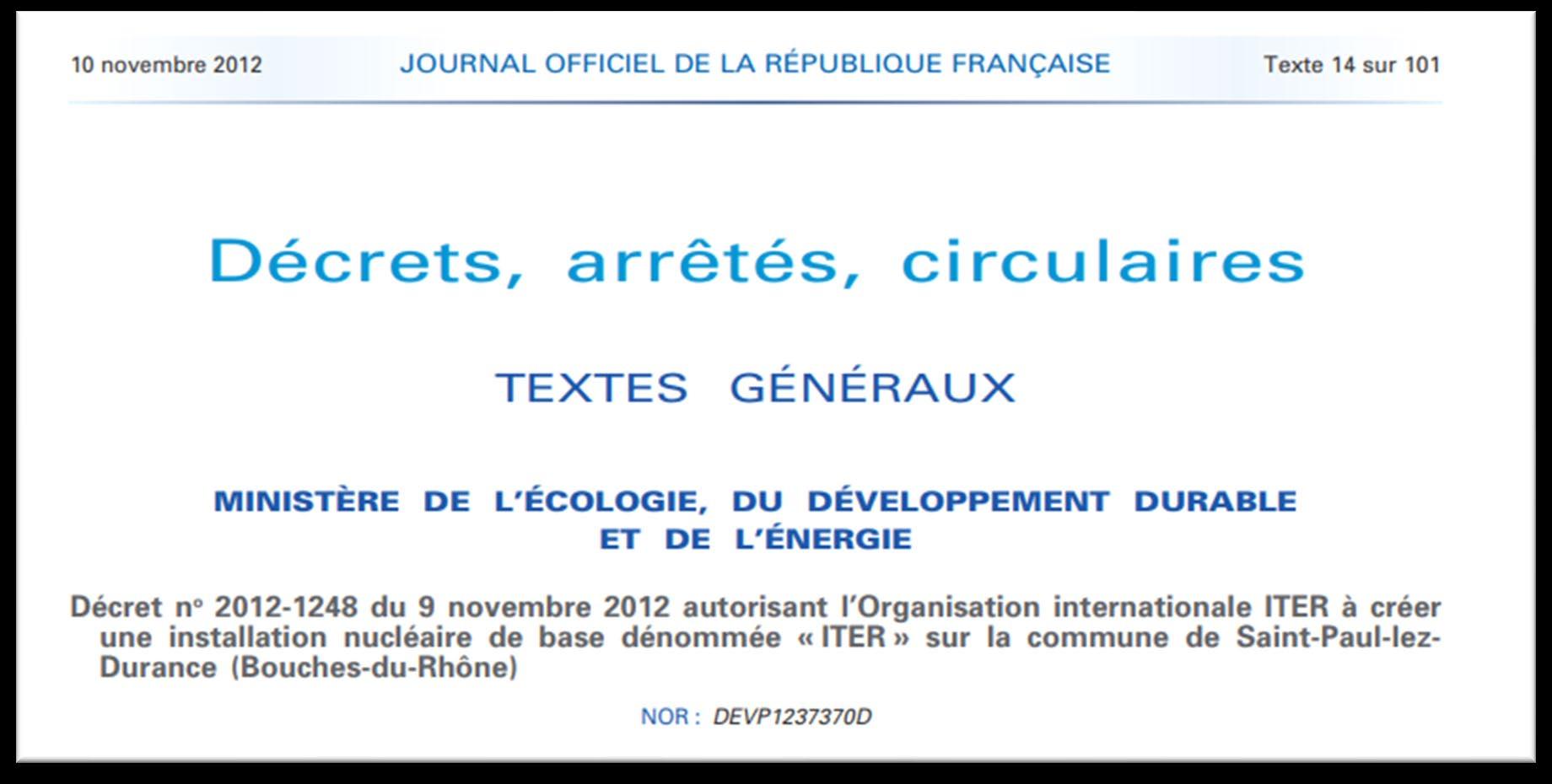
Fig. 8.1.3.1.1. Heading of the Creation Decree of ITER in 2012 as published in the “Journal Officiel de la République Française”
MANAGING THE DESIGN & CONSTRUCTION OF ITER Vol.1, Ch. 8/1, p. 9
The licensing steps a�er the award of the license for crea�on of the ITER facility were driven, on one hand, by the obliga�on of sa�sfying the previous 25 demands and 162 engagements with the ASN, and on the other hand, by the release by the ASN of the legal Technical Prescrip�ons[ 4] that the IO must implement in the design and construc�on of ITER. The Technical Prescrip�ons cons�tuted requirements for the Project and the establishment of a number of Hold Points before realizing some of them.
The ASN demands and engagements had been priori�zed according to what was important from the ASN perspec�ve with answers expected to be provided within 3 months (mostly scenarios likely to seriously challenge civil work and building leak-�ghtness), 1 year (mainly Vacuum Vessel and impact on systems, buildings and external loads likely to create irreversible impact), 2 years (other demands on systems, building and structures design), 3 years (mainly on plasma events), and later demands (e.g. for the nuclear commissioning of the facility).
Addi�onally, the regular exchange with the ASN generated other obliga�ons on the IO, deriving from the reply to the demands above, either from the ASN inspec�ons to IO and to external interven�ons, or from ITER unrelated events such as the worldwide stress test exercise following the Fukushima accident (see below).
The demands and engagements with the ASN since the Crea�on Decree in 2012 merited a strict follow-up from the ITER Organiza�on because of its legal relevance but also because of the need of coordina�ng a regulatory exchange involving hundreds of files and interac�ons. A logical aggrega�on of the demands and commitments (in French, engagements) by technical area was proposed and implemented as ‘lots of instruc�on’, linking them with the Technical Prescrip�ons Hold Points when required.
The list below indicates the arrangement of the ‘lots of instruc�ons’ and provides some relevant examples of their content:
- Lot 1 for minor demands, requiring the clarifica�on of technical aspects for a wide range of topics, from flooding and water table levels, to the loss of off-site power, and dose rate es�ma�ons in Remote Handling scenarios (completed in 2016);
- Lot 2 for power supply and control systems linked with the 400kV network, electrical protec�ons, design solu�on for safety electrical components, robustness against electromagne�c perturba�ons, or the plan for managing the configura�on of the so�ware for control (completed in 2018);
- Lot 3 for the release of the Hold Point to proceed with the assembly of the Tokamak, with a collec�on of ques�ons linked with civil works, vacuum vessel, detri�a�on system or plasma control;
- Lot 4 for a few tens of ques�ons on fire and explosion topics;
- Lot 4 bis for the Hot Cell and radwaste, especially with regard to the expected inventories and the risks linked with them, including the es�ma�ons of ac�vated corrosion products in the cooling loops;
- Lot 5 for the 1st Hydrogen plasma with details required for accidents (including pipe break and whipping), civil works, intermediate TBM studies or design against earthquakes;
- Lot 6 for the Hydrogen-Helium phase with most of the engagements devoted to the Tri�um Plant and to radia�on protec�on. There were also a few engagements related to the internal plan for emergencies in this lot;
- Lot 7 for the par�al commissioning with very diverse types of requests: leak rates for the rooms with confinement func�on, access control, safety classified power supplies (emergency Diesel generators, bateries, …) proof of robustness against flooding and other risks or refinement of effluents calcula�ons, etc.;
- Lot 8 for the final commissioning with also a wide range of topics to be completed but with emphasis in the readiness of all the environmental monitoring and protec�on aspects of the facility together with a complete update of the es�ma�on of plant risks.
As commented above, the �meline for sa�sfac�on of each of the ini�al demands and engagement was established in a period from 3 months to 3 years. However, it was soon evident that neither the design maturity nor the progress of the Project would allow for such milestones to be fulfilled with several of the demands s�ll pending final resolu�on several years later. The calendar to deliver the different files was updated in 2017 with ASN and IRSN in order to align it to the new strategy of the project and the update of the ASN Decision no 2013-DC-0379.
Later on, in 2022, IO communicated to the “Comité de pilotage ASN, IRSN, IO” the inten�on to rebaseline the deliveries of the lots, many of them connected with the hold points deriving from the Technical Prescrip�ons and the imminent submission of a new Baseline. The lots of instruc�on are to be revisited at the �me of wri�ng this book to make them consistent with the new staged approach for licensing aligned with the Baseline 2024 that brings new project phases, with a new research plan, new plant configura�on and new schedule towards commissioning (see sec�on 8.1.5)
A very specific demand – the Post-Fukushima Stress Tests
While the IO was wai�ng for the release of the Crea�on Decree, the Fukushima accident triggered a worldwide exercise to assess the safety margins of nuclear facili�es against extreme phenomena.
In that context, the ASN requested the IO to perform so called Complimentary Safety Evalua�on[ 5] or stress test analysis where the stress test situa�ons were iden�fied as extreme events that were not ini�ally considered in the design of ITER. The nuclear operator had to iden�fy or define a list of components, herein named HSCC (Hardened Safety Core Components), that would be required
to manage such situa�ons in a way that no cliff edge-effect was possible with respect to consequences to the public or the environment.
The IO submited the stress test report to the ASN in 2012. The file was assessed by the Regulator with a dedicated GP in July 2013 where the IO presented its engagements. In June 2014, the ASN declared that the overall approach was sa�sfactory[ 6] and required IO to answer to a set of addi�onal requests. Those requests were sa�sfied in 2015.
At that �me, out of the 12 analysed extreme scenarios, only 2 were considered to require Hardened Safety Core Components to keep the radiological release at acceptable levels: a mul�ple collapse of systems in the Tokamak building a�er an extreme earthquake (50% above the Safety earthquake, i.e. 50% above the seismic level required by French nuclear prac�se for which all safety func�ons are maintained) and a mul�ple fire in the Tri�um plant.
The hold points established in the Technical Prescrip�ons (TP) can be understood as licensing steps. They are cons�tuted by key project ac�vi�es that require ASN authoriza�on before proceeding. Such authoriza�on is made when the necessary files (replies to demands and engagements) are provided by the IO and considered sufficient by the ASN. The hold points for which ASN must agree to proceed are listed below:
• The pouring of concrete in the basemat suppor�ng the tokamak (TP 174-09, hold point released[ 7])
• The construc�on of the neutral beam injector cell (TP 174-08, hold point released[ 8])
• The start of the assembly of the tokamak equipment inside the cryostat (TP 174-07)
• The start of the H-He phase (TP 174-20)
Of special men�on is the Hold Point 174-07 for authorizing the start of the assembly of the tokamak in the cryostat and linked with the Lot of instruc�on number 3. A�er several itera�ons with the ASN, the IO finally sent a request to the ASN to obtain authoriza�on to begin assembling the VV sectors inside the cryostat in February 2021. One year later, in January 2022, a�er a few requests for clarifica�ons, the ASN communicated that the files submited by the IO were insufficient and that several points needed to be addressed, including (i) the treatment of dimensional non-conformi�es of the VV, (ii) the demonstra�on related to radiological zoning, (iii) the uncertain�es about poten�al fission products as a consequence of uranium impuri�es in the beryllium FW, and (iv) the demonstra�on related to the sizing margins of the Tokamak building civil works. The IO therefore organized itself to provide the addi�onal elements but simultaneously conducted a redefini�on of its experimental program based on a step-by-step safety demonstra�on strategy
To align the authoriza�on process with this new strategy, the ITER Organiza�on proposed to stage the transmission of the related files for the examina�on by the ASN, each file being self-contained, and proposing to use the update of the Preliminary Safety Report (RPrS) in 2027 for addressing coherently all the remaining queries.
Consequently, on December 20, 2024, the ITER Organiza�on sent to the ASN the first of the selfcontained files with the radiological mappings and the jus�fica�on of the robustness of the Tokamak support structure. The second self-contained file focusing on the vacuum vessel was sent on 22 June 2026.
In addi�on to the explicit Hold Points, the Technical Prescrip�ons indicate a number of files required to be presented to the ASN at specific moments. Examples of those requirements are:
• two years before the arrival of beryllium on site 2, the design and safety analysis of the equipment in the Hot Cell and Radwaste buildings must be presented (174-10);
• two years before the realiza�on of the H-He phase, the design and safety analysis of the tri�um building equipment must be presented (174-10-1);
• two years before commissioning, the design of the Remote Handling Transfer Cask and related docking systems must be transmited (174-29).
Since, when it submited the request for authoriza�on to construct the ITER facility, the IO formally became a “nuclear operator” under French regula�ons, it is subject to rou�ne inspec�ons by the nuclear safety authori�es, ASN. The first of these took place in July 2011, when representa�ves of ASN visited the ITER site. This inspec�on concentrated on the civil works, and as well as observing the work in progress, ASN requested to inspect various documenta�on, covering the surveillance by IO of the civil works, records of training in the applica�on of the French Quality Order of 1984 (which preceded the INB Order of 2012), and evidence of surveillance of the subcontractors working on site. In a second inspec�on, in January 2012, ASN iden�fied issues related to the processing of non-conformi�es by sub-contractors, in par�cular that some were not being reported to IO. Subsequent inspec�ons by ASN in November 2012 and January 2013 found that insufficient progress had been made in the repor�ng and follow-up on devia�ons and nonconformi�es by sub-contractors. This led to a complete revision of the ITER Non-Conformity Report (NCR) procedure in 2013.
As well as visits to the ITER site, ASN can make inspec�ons at sub-contractors construc�ng ITER components in other countries. The first such inspec�on was caried out in Italy in December
2 Beryllium was abandoned with the establishment of the Baseline 2024 so, this prescrip�on and several others are being reconsidered at the �me of wri�ng this Handbook
2013, where VV sectors were being manufactured. Here, too, ASN were concerned about the ability of the IO to be no�fied of non-conformi�es and to follow-up correc�ve ac�ons.
Inspec�ons by ASN (now known as ASNR) have con�nued at a rate of typically five �mes per year, and have covered a wide range of issues. A�er each inspec�on a formal leter is sent by ASNR to the ITER DG, o�en with requests that require a formal response by the IO. These leters have from �me to �me included the introduc�on of a new Hold Point (see sec�on 8.1.3.2). Of par�cular note are a 2018 inspec�on, which highlighted non-conformi�es and inconsistencies in the shielding and the radiological maps, and a 2021 inspec�on which iden�fied dimensional nonconformi�es affec�ng the VV. These inspec�ons directly influenced the content of the Hold Point described in 8.1.3.2.
The approach taken by the project since the first exchanges with the licensing authori�es, was always to provide a nuclear safety demonstra�on covering all the phases of the life�me of ITER. This made it possible to obtain the licence according to the French Decree No. 2012-1248 of 9 November 2012 (Decree of Authorisa�on for Crea�on (DAC) as explained above. But by its nature, this approach also included a large number of uncertain�es �ed to the low maturity of systems; the IO made major extrapola�ons based on the knowledge available at that �me.
ITER is a facility that will explore new scien�fic territory with many first-of-a-kind components, represen�ng a substan�al step beyond previous or present-day magne�c confinement fusion devices:
• In terms of the flux of neutrons, scope and scale of technology, and level of energy (it is more than seven orders of magnitude greater in fusion energy compared with JET);
• In complexity, leading to important ques�ons/challenges concerning plasma-facing components, magnets, vacuum vessel, remote maintenance, tri�um, hea�ng systems, shielding, etc.
There are a number of key safety ques�ons for which only a progressive approach can provide a �mely and sa�sfactory response. It was clearly understood in 2024 that given the complexity and significant uncertain�es in many parameters, the nuclear safety of ITER could only be demonstrated gradually by following a roadmap. One of the outstanding examples is a recent project decision in the design of the first wall material changing from beryllium to tungsten. Consequently, the RPrS update scheduled in 2027 must incorporate such design progress. Therefore, this roadmap at some points needs to be adjusted, based on the findings made throughout the experimental life of ITER, i.e. through a living knowledge acquisi�on program for systema�c integra�on of opera�onal feedback, experimental results, and updated scien�fic knowledge into the staged ITER safety case
Reflec�ng the stepwise approach to opera�on as part of the new Baseline 2024, a specific approach is being developed for the nuclear safety demonstra�on that will be required to support future authoriza�on applica�ons through to commissioning of the facility for the first opera�on phase, and subsequently through to the second and third opera�on phase
The ITER authoriza�on process will be punctuated by several updates of the safety report in which the demonstra�on of nuclear safety will be developed, at the level of depth that corresponds to the maturity of the project at the �me it is established:
• In order to support the licensing process, an update of the preliminary safety report (currently required by the Technical Prescrip�on two years before the first plasma) is currently in prepara�on;
• In a later stage, in order to obtain the authoriza�on for the SRO phase that includes the first DD plasma, the safety report will be established building upon the above preliminary safety report. In essence, this will be supplemented by an updated version of the impact study, the internal emergency plan, the general rules of opera�ons, and a specific file taking into account:
o the nuclear regulator’s observa�ons,
o the opera�ng experience acquired during the installa�on start-up tests, and
o the insights from the updated version of the living knowledge acquisi�on program (on topics like dust or ac�vated corrosion products)
• In support of the first DT-1 plasma authoriza�on applica�on, as per Ar�cle 4 of the licence, a further update of the latest version of the safety report will be established, incorpora�ng insights from the updated version of the living knowledge acquisi�on program.
• In support of the DT-2 authoriza�on applica�on, an addi�onal update of the latest version of the safety report will be prepared, which will include a new Hold Point at the end of DT-1, incorpora�ng insights from the updated version of the living knowledge acquisi�on program.
The IO proposed to update the Decision with the Technical Prescrip�ons to take account of the new program. Each version of the safety report, even the preliminary version, covers the en�re ITER installa�on, both physically (all the buildings within the site perimeter) and temporally (i.e., before SRO, a�er SRO, DT-1, DT-2, as well as deac�va�on and decommissioning). Nevertheless, using the lessons learned from the living knowledge acquisi�on program, each successive version of the safety report will provide more details considering the beter level of maturity of buildings and systems, as well as the first outcomes of the earlier commissioning or opera�on phases, in order to reduce the extent of the uncertain�es.
8.1.6
Some lessons learned concerning the licensing process are listed here. See also lessons learnt in nuclear safety, in Volume 2 sec�on 5.9.11.
• Before a site was selected, the specific approach and requirements of the licensing authori�es could not be known; basing the regulatory expecta�ons on the principles published by the IAEA was adequate.
• An early engagement with the nuclear safety regulator (ASN) and their technical advisors (IRSN) was essen�al. The informal mee�ngs between the IO safety team and ASN/ IRSN were valuable for both sides. Especially no�ng the context of ITER being a FOAK Project, more technical engagement with ASN was needed to have a more fit-for-purpose regulatory approach, ini�ally based on approaches derived from fission experience, progressively adapted to fusion inherent features (see next point) A “goal-oriented” regula�on allows graded approach and flexible applica�on The decision by ASNR in 2026, a�er extensive exchanges with IO over few years, to exempt the VV from European and French Pressure Equipment rules is an example to follow.
• It was required to familiarize the safety authority staff in fusion science and technology, par�cularly to avoid an approach that inappropriately applied fission reactor rules and regula�ons due to also the limited knowledge about nuclear safety in the majority of ITER team. Emphasizing the important differences between fission and fusion safety had to be maintained, par�cularly following turnover of staff in ASN/IRSN.
• Any undue safety margin asks for, e.g., more complex safety systems and/or reduc�on of the opera�on domain. Therefore, care should be taken when preliminary assump�ons are made for quan��es affec�ng safety evalua�ons, as once they are declared to the regulator, strong jus�fica�on may be needed to later introduce a change. Where values adopted in safety analyses are preliminary, it is important to indicate to the regulator that they may be liable to change later.A climate of trust and transparency with the regulator must be established and maintained to support effec�ve technical exchanges and enable op�miza�on. This depends, in par�cular, on a robust execu�on of the project throughout its successive phases and on maintaining a strong track record during ASNR inspec�ons.
• A nuclear safety culture in the project should be created from the very early stage of the design in which all staff of IO and Domes�c Agencies understand the requirements of nuclear safety. This must extend to contactors and sub-contractors of IO and the DAs.
• As the “nuclear operator”, IO is responsible for nuclear safety and needs to implement proper control and surveillance plan in the supply chain. In par�cular, any devia�ons or non-conformi�es during manufacture and construc�ons of components and structures that may have an impact on safety must be reported to IO, who must agree and monitor the correc�ve ac�ons (transparent culture in all the en��es).
Engineering Basis Handbook
• Differences in the design maturity of components which have an interface, and which have a safety importance may make it difficult to define the safety requirements; interface condi�ons should be defined as early as possible and remain fixed.
• As a first-of-a-kind facility and in view of its experimental nature, a stepwise approach to licensing is appropriate, so that the results obtained in early stages of opera�on can be used to inform the safety case for the later stages.
AE Autorité Environnementale (Environmental Agency)
AIF Agence ITER France
ASN Autorité de Sûreté Nucléaire (Nuclear Safety Authority)
ASNR Autorité de Sûreté Nucléaire et de Radioprotec�on (new name for ASN)
CEA Commissariat à l’Energie Atomique
CLI Commission Locale d’Informa�on
CNSC Canadian Nuclear Safety Commission
DAC Demande d’Autorisa�on de Créa�on
DGSNR Direc�on Générale de la Sûreté Nucléaire et de la Radioprotec�on (Directorate for Nuclear Safety and Radia�on Protec�on)
DOS Dossier d’Op�ons de Sûreté (Safety Op�ons Report)
DT Deuterium-Tri�um
EDA Engineering Design Ac�vi�es
ESECS Early Safety and Environmental Characteriza�on Study
FDR Final Design Report
FPSS Fusion Power Shutdown System
FPTS Fusion Power Termina�on System (later renamed FPSS)
GP Groupe Permanent (Commitee of Independent Experts)
GSSR Generic Site Safety Report
HSCC Hardened Safety Core Components
INB Installa�on Nucléaire de Base (Basic Nuclear Installa�on)
IO ITER Organiza�on
IRSN Ins�tut de Radioprotec�on et de Sûreté Nucléaire (Radia�on Protec�on and Nuclear Safety Ins�tute)
MANAGING THE DESIGN & CONSTRUCTION OF ITER
Vol.1, Ch. 8/1, p. 17
JCT Joint Central Team
JET Joint European Torus
NSSR Non Site-specific Safety Report
PWR Pressurized Water Reactor
RPrS Rapport Préliminaire de Sûreté (Preliminary Safety Report)
SEHD Safety Environmental and Health Division (of the ITER JCT)
SRO Start of Research Opera�ons
TFTR Tokamak Fusion Test Reactor
TP Technical Prescrip�ons
TSN Transparency in Nuclear Safety law (loi no2006-686 rela�ve aux installa�ons nucléaires de base et au contrôle, en ma�ère de sûreté nucléaire, du transport de substances radioac�ves).
VV Vacuum Vessel
MANAGING THE DESIGN & CONSTRUCTION OF ITER
Vol.1, Ch. 8/1, p. 18
[1] ITER Early Safety and Environmental Characteriza�on Study (ESECS), S 81 RE 2 95-06-01 W1.1 (August 1995)
[2] ITER Generic Site Safety Report (GSSR), G 84 RI 1 01-07-09 R0.1 (July 2001)
[3] ITER Generic Site Safety Report (GSSR), G 81 RI 1 R02 (July 2004)
[4] Décision no. 2013-DC-0379 de l’Autorité de sûreté nucléaire du 12 novembre 2013 fixant à l’Organisa�on interna�onale ITER des prescrip�ons pour l’installa�on nucléaire de base no 174, dénommée ITER, sur la commune de Saint-Paul-Lez-Durance (Bouches-du-Rhône).
[5] Décision no 2011-DC-0215 du 5 mai 2011 de l’Autorité de sûreté nucléaire prescrivant ITER ORGANIZATION de procéder une évalua�on complémentaire de la sureté de son installa�on nucléaire de base au regard de l’accident survenu à la centrale nucléaire de Fukushima Daiichi
[6] CODEP-DRC-2014-02405
[7] Décision n° 2014-DRC-028511 du président de l’Autorité de sûreté nucléaire du 10 juillet 2014 autorisant le coulage du béton de la zone du radier assurant la fonc�on de supportage du tokamak de l’installa�on nucléaire de base n° 174, dénommée ITER, en cours de construc�on sur la commune de Saint-Paul-Lez-Durance (Bouches-du-Rhône)
[8] Décision n° CODEP-CLG-2016-025317 du président de l’Autorité de sûreté nucléaire du 6 juillet 2016 autorisant la construc�on de la cellule des injecteurs de neutres de l’installa�on nucléaire de base n° 174, dénommée ITER, en cours de construc�on sur la commune de Saint-Paul-LezDurance (Bouches-du-Rhône).
MANAGING THE DESIGN & CONSTRUCTION OF ITER
Vol.1, Ch. 8/1, p. 19