





This handbook consists of two volumes which describe the ITER design from its inception up to the design, construction and assembly in 2025.
The handbook is not designed to be read as a continuous sequence of chapters. Instead, it is composed of focused, self-contained sections that address specific topics. Each chapter can be read and understood independently, allowing readers to engage with the material most relevant to their needs without requiring familiarity with preceding chapters. As a result, the reader will find certain overlapping content in chapters.
It is to be noted that at the time of writing, the design for some systems is still on-going. Therefore, the reader should consider that whilst there is significant value of this important point-in-time study, an update would be required as the Project progresses
A broad Project overview is given in the first volume, to provide the reader with background information necessary to understand the context in the subsequent moredetailed chapters of the second volume, dedicated to the individual systems composing ITER.
For the overall table of contents of the Handbook and to access each one of the chapters, please refer to https://www.iter.org/scientists/iter-technical-reports
This chapter is authored by Bill Spears, and co-authored by the Handbook Editors Federico Casci, Stefano Chiocchio, Gianfranco Federici, Richard Hawryluk, John How, Juan Knaster, Akko Maas, Masanori Onozuka, René Raffray and Gabriella Saibene.
This chapter has been written basing (also) on this reference:
• International Atomic Energy Agency, Co-chair’s Summary of the 3rd QEN Meeting, ITER EDA Documentation Series, no. 2, p. 46, Vienna, Austria: IAEA, Jul. 1991.
In 1973, at the height of The Cold War, President Richard Nixon and General Secretary Leonid Brezhnev met for a summit in Washington, D.C. With many disparate positions between them, they looked for something they could cooperate on as a sign of their hope for a better future relationship and settled on their countries collaborating on the next step in nuclear fusion development. This was a long-term technical challenge, and cooperation had begun, at a Soviet initiative, on a visit to Harwell, UK in 1956.
This was reaffirmed at the second Atoms for Peace Conference in Geneva in 1958 when Lev Artsimovich stressed that "worldwide collaboration is needed for progress", a sentiment seconded there by Edward Teller and continued with the sharing of scientific knowledge ever since, principally through the IAEA's regular Conference on Plasma Physics and Controlled Nuclear Fusion Research, and the journal Nuclear Fusion.
Although it took time to set up, in 1978 the Nixon-Brezhnev initiative began a decade of collaborative research on INTOR (International Tokamak Reactor). One-to-two-week workshops
took place at the IAEA in Vienna two to four times per year, triggering joint work on problems between each workshop, and reported on when the next workshop took place.
At times this work meandered due to lack of a single management structure and an uncertain goal, but it was certainly useful to encourage all participants to use similar assumptions, both in physics and engineering. It was always a safe place for scientists of the participants to talk fusion issues over with each other and build international friendships which would endure and be the basis for successful collaboration over the coming years.
In parallel, each of the participants Europe, Japan, the Soviet Union, and the USA were in the final stages of constructing their own programme flagship experiments respectively JET (Joint European Torus), JT-60 (Japan Tokamak), T-15 (USSR Tokamak) and TFTR (Tokamak Fusion Test Reactor) and looking forward to the next big step needed, so it seemed sensible to compare notes on exactly what to build, even if not necessarily to collaborate on building it.
In 1980, Mike McCormack in the US House of Representatives and Paul Tsongas in the Senate, introduced a bill, which had strong bipartisan support, to accelerate the fusion effort to the extent possible and push for definite goals within a decade. The "Magnetic Fusion Energy Engineering Act" of 1980 advocated a doubling of the budget in real dollars in order to make a demonstration of engineering feasibility by the early 1990s, and operation of a demonstration plant by the turn of the 21st century.
The US programme, therefore, had to react quickly, and it established a Fusion Engineering Design Centre in Oak Ridge, Tennessee, bringing together a design team of the best US experts in a very well-equipped new building. They quickly designed the Fusion Engineering Device (FED) as the focus of meeting the feasibility demonstration objective. The major radius would be 5 m, minor radius 1.3 m, elongated by a factor 1.6, a magnetic field around 4 T on axis (two options were considered) and a current around 6 MA.
The fusion power would be 200–400 MW, wall loading 0.5–1 MW/m², and the burn time around 100 s. By the end of 1981, this team had developed a very complete outline design and were ready to go on to the details. Unfortunately, despite this impetus, the Administration changed, and the programme was not supported. The required doubling of the US fusion budget did not happen, and the dream of building FED was scuttled.
Meanwhile, in the late 1970s, the Max Planck Institut für Plasmaphysik in Garching investigated a next step compact ignition experiment, ZEPHYR, to achieve ignition, study alpha particle confinement, and control the thermonuclear burn for several energy confinement times. This would soon be overtaken by events on a European-wide basis.
By 1983, with the construction and commissioning of JET, TFTR, JT-60 and T-15 nearing completion, the INTOR participants, realizing that the INTOR organisation would not be effective
for finalizing a design, were each setting up teams to design their proposed next step: NET (Next European Torus, Europe), FER (Fusion Experimental Reactor, Japan), TIBER (Tokamak Ignition/Burn Experimental Reactor, USA, after previous investigations of a TFCX (Tokamak Fusion Core Experiment) and a BCX (Burning Core Experiment), amongst others), and OTR (Experimental Fusion Reactor, USSR), with initial parameters as shown in Table 6. 1 . All these machines had the objective to attain plasma ignition and, except FER, to develop tritium-breeding blankets. FER and TIBER also were primarily aimed at non-inductive drive up to steady state operation. OTR was at least initially conceived as a potential fusion-fission hybrid development device.
14 MeV Neutron Wall Load (mean) (MW/m²)
14 MeV Fluence (mean) (MWa/m²)
Ignition margin (H) over: Kaye Goldston x 2
Given the considerable uncertainty in confinement time scaling and plasma beta limits, which was a topic under intensive investigation, there was always the question about how ambitious to be, both in the size of the step in plasma physics to be taken, and in the severity of the engineering challenges to be faced, in order to get the best value for money and the least risk of failure by overstepping the mark. The bigger the plasma, the greater the power, and the more likely to achieve ignition, but the greater the cost.
One could keep the machine small by pushing up the magnetic fields, using, for instance, more brittle niobium-tin than the (at the time) more state-of-the-art niobium-titanium superconductors, but the higher the magnetic fields, the greater the forces on the structure of the machine, and the higher the cost. Then, since the tokamak is inherently a pulsed device in which pulses can be stretched by external systems, the question was whether to optimise for pulsed operation, or for stretched/steady state.
There was nothing different qualitatively in all this compared to all innovative engineering, but the price and the risk here were quantitatively high. This was shown by the variance in ambition between the different international teams' designs for the next step, which reflected the knowhow at the time and different programmatic emphasis. The Soviet design seemed to require the least of an engineering challenge (maybe because it originally was conceived as a fission-fusion hybrid), whereas the USA’s design, perhaps knowing that their budget would be limited, pushed engineering beyond regions where European and Japanese engineers felt comfortable.
In Europe too, there was disagreement about how large to build, and how much consequent risk to take, in the light of the uncertain difficulty of reaching plasma ignition, with a machine (JIT) of 7.5 m major radius, 3 m minor radius, plasma current of 30 MA, 1800 s burn time, and fusion power of 2000 MW, utilizing copper magnets and igniting in L-mode, being considered necessary by some to be certain to ensure ignition, and leading to an increase in the size of NET (6.2 m, 2.2 m, 15-25 MA, 6 T and a burn time of 800 s).
These designs were not developed in isolation but stimulated new R&D and helped shepherd existing R&D towards common goals. By 1980, Europe (2 coils), Japan (1) and the USA (3) were already assembling a 6-coil Large Coil Project in Oak Ridge, to test various toroidal field D-coil winding technologies. This was the only large-scale inter-party technology collaboration at that time. Each party had also realised the development and testing of plasma-facing components would be key to success and were working with their industry to develop various design and manufacturing solutions, and to establish test facilities for them. Similarly, existing nuclear (fission) materials test facilities were being harnessed to gather and benchmark necessary materials data.
Meanwhile the political background was not standing still. General Secretary Gorbachev and President Reagan met in Geneva in 1986 and again sought to identify an area of cooperation. On the proposal of Evgeny Velikhov, Deputy Director of the Kurchatov Institute, realizing that the INTOR cooperation was not heading towards a joint design, they stimulated the creation of a new
design activity - ITER (then International Thermonuclear Experimental Reactor (and later “the way” in Latin)) set up "under the auspices" of the IAEA, to eventually cooperate in building the next step.
Between 1988 and 1991, teams of typically 40-50 engineers, managed by a board of four Directors, would come from Japan, the USA, the Soviet Union and Europe for several months at a time in winter and summer sessions to work together in Garching on the ITER Conceptual Design Activities (CDA). They followed mutually agreed detailed technical objectives for the next step machine, fulfilling its overall programmatic objective to demonstrate the scientific and technical feasibility of fusion power.
In detail, it was agreed this meant controlled ignition and extended burn time of DT plasmas, with steady state as an ultimate goal. This would mean a plasma current 2-4 times the maximum in existing experiments, i.e. 10-20MA, and a burn time of at least a few hundred seconds. ITER would validate design concepts and qualify engineering components for a fusion power reactor, and serve as a test bed for neutronics, blanket technology, tritium production, remote maintenance, and advanced plasma technologies. To do this, the power from 14MeV neutrons passing through the first wall surrounding the plasma would need to reach 1 MW/m², and the fluence, i.e. how long this power would need to be maintained, should be capable of reaching 3 MWa/m² (i.e. 3 working years)
The blanket should aim at a breeding ratio above unity, i.e. the machine should try to produce all the tritium it consumed, if necessary supplemented by external tritium supplies to a small extent (1 kg/year). ITER should demonstrate the reliability of its systems and the maintainability of its components, reaching an overall availability in its last 10 years of operation of 10%, with peak levels as high as 25%. Finally, ITER should demonstrate the potential for the safe and environmentally acceptable operation of a fusion power reactor. These objectives were thus even more concrete and even more ambitious than those of the individual participant's next step designs.
A major success of the CDA was the establishment of a framework for understanding worldwide plasma physics results, using common definitions and their interrelations. Clear specifications for the various postulated energy confinement time scalings, definitions of impurity levels and plasma beta, meant that results could now be properly compared.
A second success was in parametric system studies. Each team had its own systems code and figure of merit (usually cost), with inbuilt design modelling and assumptions. It was decided to write together instead a very simplified code linking dimensional constraints with a one-line cost
equation, benchmarked against each team's own code, and to use that for machine parameter selection. Typical results are shown in Fig. 6. 1
The parameter choice is driven towards the top left corner to the extent of the belief in the attainable H-mode enhancement factor.
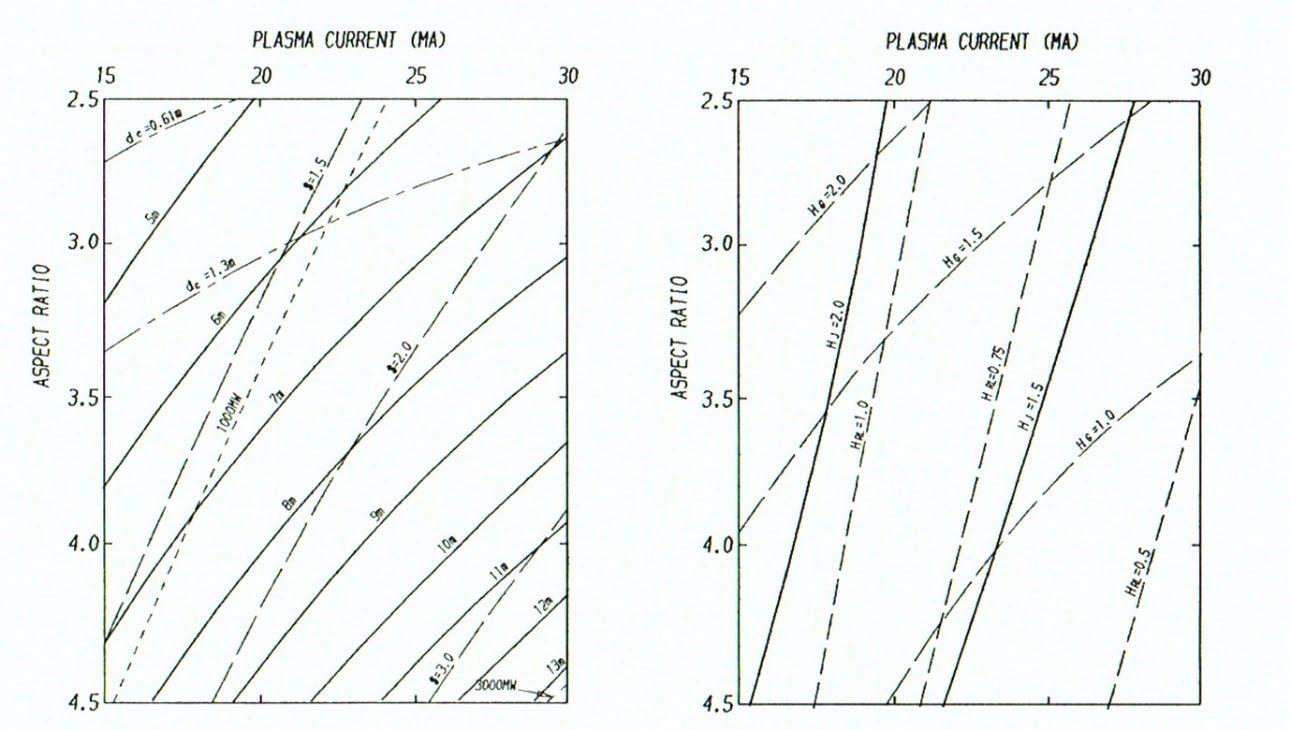
Fig. 6. 1. I-A Parameter Space for CDA Ignited ITER Design Choice. Contours of size (m, major radius), (MW fusion) power, cost ($) and inboard coil thickness (dc) (left), and corresponding required H-mode enhancement factor (relative to L-mode) for various confinement time scalings (HJ=JAERI, HR-L=Rebut-Lallia, HG=Goldston) (right) - for devices generating 1 MW/m² 14 MeV neutron wall loading (adjusting power by reducing necessary Troyon factor g from 2.8), constrained by fixed peak fields of 11 T (solenoid) and 12 T (TF coil), and inductive burn of at least 300 s.[ 2]
Such system analyses could only roughly model the real design constraints and needed to be checked by magnet and nuclear design experts. On these topics, the CDA was less successful in reaching consensus, though, it did succeed in identifying the problems to be solved, and in increasing design cooperation. A machine optimised for steady state driven operation tends to have higher aspect ratio than one aiming for ignition at the smallest size, so ITER's aim for ignition drove the choice in the end, to a machine of 6 m major radius, 2.15 m minor radius, plasma current 22MA, safety factor at the separatrix of 3.0, and peak fields at the TF coils and central solenoid of 11 T.
This enabled a preliminary estimate of the cost of constructing and operating ITER to be made, based on a full cost centre breakdown and cost component dictionary, major cost drivers established by the respective engineers, and their quantification for the ITER design point. Unit costs were largely based on those that had been used for NET cost estimates, for which extensive data was available, with some supplementary data from the USA. (With the much less integrated
PROJECT GENESIS AND EVOLUTION
Vol.1, Ch. 6, p. 6
world economy at that time, it was difficult to include comparative Japanese and Soviet unit costs.) Although bounded by considerable caveats due to the early stage of the design work, with many unknowns but also with little attempt at hardware cost minimisation, this led to the cost breakdown shown Table 6. 2
This cost estimate remained confidential at the time, so that the ITER stakeholders, particularly the USA, who were the most concerned about the cost of ITER, could be properly briefed beforehand.
The ITER participants also began to pull together physics and technology R&D into common tasks that would need to be addressed for the next phase of work, and to identify where there was already technical consensus. This largely documented the scope of their individual R&D programmes, which were being driven by the work each participant continued to do on their individual next step designs while joining in the CDA. Nevertheless, this at least indicated the test facilities and capabilities they had available
The main legacy of the CDA was the strong camaraderie and understanding that developed between the participants, during the long joint working sessions, and established office, organisation, and management practices, that would stand the project in good stead under the more difficult conditions that would follow.
The four participants had given considerable attention to what would come next. By the end of 1990, it was agreed that the scope of the Engineering Design Activities (EDA) would be to make a complete and detailed design with specifications of the device and its facilities ready for tendering, a human and finance resource-loaded plan from the placing of orders through to decommissioning, a finalised statement of site requirements and all necessary safety,
environmental and economic analyses, all the necessary validating research and development including scalable models, and proposals for joint construction, operation and decommissioning of ITER.
That way the four participants would have all the data needed to decide on ITER construction. In keeping with their unwillingness to give up supposed leadership, the participants wanted the option to be able to proceed on their own, should other participants drop out, making it important to negotiate an intellectual property rights agreement, and they wanted to ensure each participant contributed roughly equally to the work and its financing.
The structure of the EDA was also decided: a Council to appoint the Director, senior staff and the chairs of committees, decide the strength and main structure of the Joint Central Team (JCT), approve the design basis and any significant changes, and be the focal point of progress reporting. The Director would propose senior staff to the Council and select other JCT staff, draft and implement the work programme and report on it, and act independently of the participants in ITER. A Technical Advisory Committee (TAC) would advise the Council on technical matters, and a Management Advisory Committee (MAC) on financial and administrative ones.
The JCT members, composed of roughly equal numbers nominated by each participant, would report solely to the Director through the JCT structure, and would be mainly responsible for integrating the technical work. Each participant would set up a Home Team (HT) to carry out design and R&D tasks specified with the JCT. They would undertake approximately equal shares of the work. "Special Working Groups" (SWGs) would be set up by the Council to undertake work not within the scope of the Director. In addition, there were agreements on how to handle intellectual property, all legal issues, joint funding, and participation of third countries.
The overall programmatic objective of ITER would remain to demonstrate the scientific and technical feasibility of fusion power by demonstrating controlled ignition and extended burn of deuterium-tritium plasmas, with steady-state operation as an ultimate goal, by demonstrating technologies essential to a reactor in an integrated system, and by performing integrated testing of the high heat flux and nuclear components required for practical fusion power.
However, there remained considerable disagreement on the definition of the detailed technical objectives. Each participant undertook a high-level assessment of the CDA ITER design and its objectives. Europe, for instance, concluded that the project should stick to its programmatic objective, and that its primary role should be to establish a reactor plasma and assess the reactorrelevance of the main components, using simplicity, and safety and environmental acceptability, as the guiding design principles
The project aim should be to achieve controlled ignition and have a burn time demonstrating burn control (i.e. > 1000 s), demonstrate essential future reactor technologies such as superconducting magnets and remote maintenance, test future reactor components such as those to exhaust
power and particles from the plasma, and test reactor-relevant blankets with minimum interference in machine operation. It was considered that to achieve this the energy confinement capability would need enhancing relative to the CDA design, and although current drive and steady state operation remained important objectives, the machine should be able to achieve its objectives by inductive operation alone.
There was consensus that the machine should be operated in two phases: the first with a shielding blanket using externally supplied tritium and testing different blanket concepts, deploying the best concept in the second phase after a two-year maintenance period. These latter requirements meant that the machine should be about 15% larger and, therefore, similarly more expensive, but it was thought these extra costs could be minimised by the deferral of the full tritium breeding blanket and parts of the current drive system. So as not to block the actual start of the EDA, it was agreed that the objectives would be decided at a special working group right at the start of the EDA.
Meanwhile, the NET Team had been looking again at the best way ITER could be used to give information on blanket and first wall testing, a somewhat critical point. Due to its likely relatively low fluence and experimental nature (also to have time to learn about the best plasma physics for operation), ITER would be rather slow at gathering endurance data of components and materials. It was, therefore, considered to be much better to gather the materials data on a dedicated materials testing platform. ITER would then be used to confirm that the component performance would be sufficiently reliable in DEMO.
DEMO itself would be much better and more cost-effective for component endurance data. The results of the analysis showed that in order to accurately model and benchmark tritium release rates expected in DEMO (operating in steady state) as a function of the main parameterstemperature, inventory (radiation history), geometry and purge gas (flowrate and composition)
ITER, if not operating in steady state, would ideally need burn times of 1000 s, repeated over periods of typically 30 hours. With the expected access to the device, number of iterations, and expected blanket variants to be tested, the total module testing time would need to approach 500 hours.
The mechanical behaviour of a solid breeder DEMO candidate blanket under irradiation in a fusion environment swelling, cracking and breeder/cladding interactions would require in addition a blanket segment test of ~1000 hours, to properly benchmark material specimen irradiations. Such a test programme could be achieved with external supplies of tritium alone. Without separate gathering of structural materials data from a dedicated facility, such component data would guarantee only a month or so of operation of DEMO components, with failure at that point leaving a very expensive machine idle. It was therefore clear that a dedicated materials test facility to generate this structural materials data, in parallel to building and operating ITER, was going to be absolutely essential.
What was missing, at the end of 1990, was any agreement about the site of the JCT that would conduct the EDA. By the end of the CDA, there were firm written offers from the USA (San Diego), Europe (Garching) and Japan (Naka) to provide a site for the team. It was not easy to choose between the sites, and a "compilation of inputs" was made to compare them. However, this led to no clear choice, and instead of the next phase of ITER starting in January 1991, discussions on resolving the siting issue rolled on.
By March 1991, there had been no further progress, and momentum was being lost. There would have to be a compromise. Romano Toschi, European Home Team Leader, proposed to split the work of the JCT into three locations, at the three proposed sites, and to divide the work into two phases (later called "protocols"). The first protocol was intended to install management and define the tasks of each unit and site, finalise objectives, conceptual design and operation scenarios, define design specifications and R&D tasks, and assign design and R&D tasks to Home Teams, who would undertake the bulk of the work, and get "credit" for it to ensure a balance of effort between the participants could be made. The second protocol would then complete the engineering design and R&D in the same way, make a site proposal and choose a site, make a construction proposal and seek its approval and licensing, and prepare the site. By July 1991, this proposal was agreed.
In the summer the ITER Director, Paul-Henri Rebut (then JET Director), and senior staff were proposed, but then in August 1991 the Soviet Union collapsed, and was then reconstituted as the Commonwealth of Independent States, with the Russian Federation (RF) as leading member being recognised as its successor, in March 1992. In July 1992 in Vienna the EDA Agreement was formally signed and work began with the recruitment and movement of staff to the three locations.
Since the work was going on at three Joint Work Sites (JWSs), spaced roughly eight time zones apart, keeping the work coordinated was a key integration issue. High-speed computer links were established between the sites, allowing exchange of computer-aided design (CAD) drawings and models as well as physics data between the sites. The concept of an integrated process management system (IPMS) was promoted, to update documents at all sites in real time. In practice the software and internet capabilities were too limited at that time, and a system of copying important documents, particularly drawings, once a day between local site servers, taking advantage of the different working times, was successfully used instead throughout the EDA.
One of the key elements of Protocol 1 was the definition of technical objectives for ITER, and the "Special Working Group 1" quickly got to work. The first ITER Council meeting in September had given the group the guideline to aim to keep the cost comparable to that of the CDA design. The first group meeting soon after, on the fringes of a conference in Würzburg, heard presentations from the ITER Director on his opinion of the ITER objectives, and from Ontario Hydro on the
availability of tritium from Canada's fission programme. The group then discussed the objectives in detail, based on a model submitted by Europe, before splitting into sub-groups to redraft them.
A full agreement could not be reached then. There were some open issues that needed more time: whether to insist on ignition, or to aim for high plasma energy multiplication (Q), with a small amount of external heating supporting the fusion reactions at the selected Q,; how much to emphasise and focus on steady state operation, then thought by Europe to be driving the machine away from the size required for ignition; how long the inductively driven burn time should be, ranging from 400 s from Japan (who did not want this constraint to drive the machine size as they thought steady state current drive would be needed anyway) to 3000 s (which the USA thought necessary for good blanket testing); whether to insist on a demonstration of electricity generation in reactor-relevant blanket modules, which Japan thought important; when the full heating and current drive system should be installed, and what should be the target neutron flux and fluence. There was, however, agreement that the operation should be divided into two phases, a Basic Performance Phase (BPP) and an Enhanced Performance Phase (EPP).
At the second meeting a few weeks later in Milan, Japan removed its insistence on steady state operation driving the design choice, and the USA agreed to aim for controlled ignition instead of high Q. The objectives then became to keep the cost comparable to that of the CDA design, to operate safely and demonstrate the safety and environmental advantages of fusion power, to demonstrate ignition and an inductive burn of 1000 s, with 2000 s being desirable, and to accommodate and aim at demonstrating steady-state operation. The device should demonstrate superconducting magnet and remote handling technologies, and test reactor components, in particular design concepts of tritium-breeding blankets, for tritium extraction, production of highgrade heat, and electricity generation.
The target average neutron wall loading was set to 1 MW/m², and the machine should be capable of operating for a total of one year at that level (i.e. a fluence of 1MWa/m²). Permanent machine components should be capable of 3 years operation at that level. The BPP would be expected to last 10 years, including a few thousand hours of full DT plasma operation, using external tritium supplies. It would make experiments on plasma ignition and current drive and make functional tests of tritium-breeding blanket modules.
The EPP would also last 10 years, and would emphasise overall performance at high availability, as well as reactor-relevant blanket demonstration. Whether to incorporate a basic breeder blanket for this phase would depend on the availability of external tritium supplies and the success of breeding in the BPP. Whether to implement the EPP at all would depend on a review conducted at the end of the BPP. With agreement on all these points, in effect the European strategy for the next step was largely adopted by the other participants.
Compared to the CDA objectives, not much had changed regarding the basic capability expected of the device. Only the inductive burn time had been extended. What was evident now was a
more realistic approach to the blanket testing, and less reliance on tritium bred on site as well as a willingness to set a checkpoint in the operation after 10 years, to assess progress and readjust if needed.
Armed with these objectives, the ITER Director now had the challenging task to produce an outline design of ITER in about 10 months. He decided to develop and try to convince the Parties of his vision of a "thermonuclear furnace" developed previously as the copper-coiled, L-mode ignited JET [ 3], but this time with superconducting coils. Doubting that the confirmed objectives could be achieved with the CDA design, he changed the CDA ITER design quite radically. He increased the margin for controlled ignition by increasing the tokamak size and focussed on achieving the best plasma performance possible by extensively using beryllium, which had shown promise on JET, as a plasma-facing material. The fusion power was doubled. In the first design even the divertor was made of beryllium tubes, though this was later changed to carbon-fibre composite after detailed stress verification.
The number of toroidal field coils was increased to 24 to reduce the size of a coil for a given toroidal field ripple at the plasma outer edge (later this number was reduced to 20). The CDA internal architecture of the FW and shielding blanket was radically changed. An intermediate thick and large additional shell (called a back plate) was added inside the VV and toroidally continuous large blanket vessels were attached to this shell. Advanced, more reactor-relevant, materials were also used for the blankets. The plasma major radius was increased to 7.7 m, the plasma current to 24 MA and the fusion power up to 2000 MW, in the region of that needed for a small fusion power plant. Up to 50 MW of external heating equipment would be provided.
Such a design was, on the one hand, more ambitious (using innovative designs as well as initially using more possibly power-reactor-relevant materials such as vanadium as structural materials and either helium or liquid metal as coolant), but on the other hand more conservative with the larger size providing a greater margin for obtaining ignition. This had an impact on the design and R&D the Director was asking the participants to undertake under "task agreements". Aside from the agreed developments on high field magnets, including the building of model coil test facilities and the building of a divertor test facility, these planned task agreements asked the participants to investigate more advanced technologies, while asking to discontinue the existing and expensive R&D they were undertaking, for instance, on materials damage to stainless steels, which in the new design were not high priority
Although the initial plan had been for ITER to endorse existing R&D and give credit for next step R&D to the participants as a whole, by responding to the ITER priorities the participants would not get credit from ITER for their existing R&D programmes and would have to adjust them significantly, and soon, to match ITER priorities.
The final outline design, presented by the Director and approved by the TAC in 1993, included more “traditional” engineering solutions for the tokamak vessel and blanket, accommodating
criticisms and considerations coming from the Home Teams. Specifically, it featured a watercooled stainless steel vacuum vessel filled with steel balls, a separate and replaceable coppercoated first wall, and a replaceable in-vessel "shielding" blanket (which could itself also be replaced with blanket test modules for wider use in the EPP).
It was also agreed that the JCT could look at more advanced concepts for the EPP, when anyway it was envisaged that the blanket would have to be more reactor-relevant to produce sufficient tritium, but it had to give priority to the reference design for the shielding blanket of the BPP. The R&D planning for 1994 for the Home Teams was now more coherent, and a better match to work already underway, although again only some next-step activities of the participants would get credit.
Also, in the Outline Design Report (ODR), the Director pointed out the need to choose the ITER construction site by the middle of 1996 to be ready with all elements of the design by the deadline of July 1998 a prophetic statement.
During the headlong rush to produce the outline design for the EDA in under a year, the Director had had little time to develop the management of the ITER project and integrate new resources into the JCT. When the ODR was complete, he was asked by the ITER Council to pay more attention to improving the JCT and the project management, a necessary step in a growing project. This task proved to be a source of friction between the ITER project and the Home Teams, acting as the effective governance of the project. Different visions existed on the source of final design authority (the JCT, or jointly with the HTs), and the definition and attribution of R&D scope. The JCT advocated a stronger role for itself, including in the R&D area seen by the HT as their own responsibility.
These different visions on how to advance the project were complicated by the fact that the JCT had essentially no funds of its own for design and R&D, all the funds available being under the control of the participants through the HT Leaders. The HTs thought that their economic involvement and acquired know-how should guarantee a stronger involvement in the overall EDA management. The HTs considered the way out of this situation was for the design do be conducted jointly by the JCT and HTs, with the JCT integrating and coordinating the work. Whilst the JCT should have the primary responsibility for defining the R&D, the HTs should have the responsibility for deciding who should do it and how to share it out technically in the best way, also to ensure a balanced contribution from the four participants.
The view of the JCT, as represented by its director, on how to enter protocol 2 of the EDA phase (completion of engineering design and R&D) differed and conflicted with the HT view. One central point was the opinion that industries and organisations already experienced in construction of large projects should be seen as essential stakeholders for the next phase of the project. This was seen as diluting and reducing the role of the HT. The need to create a Joint Fund under IAEA
auspices to facilitate design and other common expenses, was also key to this vision, as part of a creation of a stronger JCT-led management of the project.
Revision to the governance of the project were also proposed, in particularly advocating for increased engineering expertise in TAC and a more independent MAC. The difficulty of handling protocol 2 of the EDA with 3 separate sites was also raised, asking for a unified site, and means for a faster build-up of expert staff. The Director considered the CDA to be an amalgamation of the four different conceptual design studies carried out by each participant, whereas the outline design was defended as a single point redesign, necessarily larger following the adjustment of the technical objectives
The last major point of discussion was the R&D: the Director explained that the effort of the JCT towards the completion of the ODR meant that it had not been possible to plan a coherent corresponding R&D programme, creating issues with the HT participants, requesting credit for their R&D work. The start of protocol 2 was the opportunity to propose a more coherent R&D programme. However, the request that about 20% of the R&D budget of each participant to be put at the disposal of the ITER project for direct actions outside the areas of interest of the HTs was not accepted.
These differences in vision, technical but mostly managerial led to the resignation of Paul-Henry Rebut, and to the selection of Robert Aymar (CEA Directeur des Sciences des Matières) as the next Director in July 1994.
Aymar agreed with the view of the HTs regarding sharing of the work between the JCT and HTs, while giving the lead in definition to the JCT, making them aware they were all on the same project and should reach consensus on how to proceed. This led to the creation of regular meetings of the new "General Project Board" consisting of the JWS Deputies, the Deputy to the Director, and a new Administrative Officer (Bob Iotti), and to the institution of Director and Home Team Leaders meetings every 3–4 months to discuss technical, management and financial issues. Following his review of the progress of the design and R&D, and visits to the JWSs, the Director committed to producing the Interim Design Report (IDR), i.e. the first attempt at a comprehensive design report, one year later in June 1995. He kept to the dimensions and capability of the machine designed by Rebut, doubling only the auxiliary heating provision to 100 MW. He tightened up the structure of the JCT to work on it and agreed with the participants on a staffing requirement for the JCT of 800 professional person years (ppy) for the EDA. General design requirements for the project were established, with which all designs had to comply.
Iotti was a significant addition to the project and brought his years of industrial experience with Ebasco, a major US architect-engineering company, to bear particularly on the planning for ITER.
A basic component of the work of the EDA had been to produce a fully, cost and manpower, resource-loaded schedule from the start of construction through to decommissioning. Iotti set to work with enthusiasm and imported working-level planning experts into the project in San Diego to execute the work.
Another innovation under Aymar was the launch of a "Site Requirements Group", to study the technical, social, safety and environmental requirements of siting ITER. This met during the first semester of 1995 and developed site requirements (mandatory) and site design assumptions (guidelines, pending site selection) in seven categories, including land, heat sink, energy and electrical power, transport and shipping, external hazards and accident initiators, infrastructure, and decommissioning.
Before that, in October 1994, the first Design Assessment Meeting took place in San Diego, attended by the about 10 main Technical Officers (TOs) from each JWS plus about 10 experts and Responsible Officers (ROs) from each Home Team. The Director and the JCT TOs gave presentations of the work done on the design, and how it might now evolve, and the HT experts gave well-appreciated comments. For example, by now, the first wall and shielding blanket had been radically changed, introducing. shielding modules to be separately removable from inside the vacuum vessel. Also, a toroidal limiter made by toroidal modules was introduced. (This was later changed into port limiters.)
These changes in architecture and removal strategy were adopted. One of the key issues was how best the mechanical support structure should be distributed across the toroidal field coil cross section, and whether the toroidal field coils should press on the central solenoid ("bucking"), or whether they should press sideways on each other like keystones ("wedging"). There were strong differences of engineering opinion as to which method of construction minimised the overall coil radial thickness, the main contributor to machine size, and therefore overall cost. The respective HTs were therefore set loose to help analyse and make technical arguments for the preferred option. At this time, the HT Leaders had a meeting with the Director and supported his proposals for organisational rearrangements. They also shared out amongst them the allocation of USD 150 million (1989 value) in R&D budget credit, and 80 ppy of the design budget.
Although much of the design work undertaken by the HTs was handled through design task agreements, an arrangement was also made with the RF Home Team, which established a Design Office at the Efremov Institute in St Peterburg, that somewhat compensated for the fact that the RF had no Joint Work Site. This rapidly responsive and flexible group of designers was called upon extensively to engage closely with the daily work going on at all three Joint Work Sites. The work of the Efremov Design Office, supported by the ITER Joint Fund, continued until the end of the EDA extension in 2001.
Iotti resolved arguments between proponents of various work and component breakdowns by coming up with a more appropriate work breakdown structure (WBS) along with an equivalent
responsibility assignment matrix (RAM), showing who did what that went with it. The idea was to use this as the basis for producing the resource-loaded schedule that would be required. The work on IPMS development was stopped and the already-mentioned server file-based data-sharing system put in place
Work started under Iotti for writing down the design requirements at the top level for the project ("General Design Requirements Document", GDRD) and then at the detailed level ("Detailed Design Requirements", DDR) for each system. The GDRD document was developed and revised extensively by all the TOs over the coming months. The first (IDR) version of the design description document (DDD) for each component system incorporated the DDR as a section also referring to the GDRD requirements. Later the DDR was separated out as a stand-alone document for each system.
Iotti also took charge of the costing, although this was given less emphasis at this stage as more design details needed to be developed first. The four participants' industries would need to become involved, and his team set guidelines for producing cost estimates in a consistent way. Iotti also made the first attempt at a construction schedule that could be built on and evolved later, on a top-down fashion Due to the lack of available technical detail by that point, and of time to iterate detailed schedules with each system designer, this approach unfortunately lacked realism, despite the visibility of its conclusions beyond the project.
The Director wanted to follow up the R&D covered by the "Emergency" and "Comprehensive" Task Agreements, that essentially endorsed at least part of the participants ongoing R&D programmes, with a work programme of more focussed R&D and design now better coordinated with the development of the ITER design. In the previous phase of the project, the participants had also been pressing for R&D tasks to be allocated in larger chunks, to give them more of a coherent programme within their own programmes rather than piecemeal items.
The Director realised this plan in late May 1995 with the introduction of the "seven large R&D projects" - central solenoid (L1) and toroidal field coil (L2) model coil test facilities, vacuum vessel sector mock-up (L3), blanket module (L4) and divertor cassette (L5) mock-ups, and blanket remote handling (L6), and divertor remote handling (L7) test facilities. These would develop and verify the manufacturing techniques at industrial scale, and other tasks would gravitate around them.
These "flagship projects" (an alternative name at the beginning was "the Magnificent Seven") would demonstrate to their governments the participants' capability at the working level to collaborate, deliver and assemble large manufactured hardware items and to test them, as a forerunner to the cooperation they would have to be demonstrated in building ITER itself. More resources were set aside for design work by the HTs (thus expanding the design capability of the whole project), compensated by a clustering of the R&D effort around the large projects, recognizing that some deliverables would come after the planned end of the EDA in mid-1998.
Because the large projects were collaborative tasks between the participants, they had some problems getting started, as no participant could really start the work until all participants in the task had agreed on their individual roles and responsibilities. This was an unforeseen difficulty, tied down by the slowest participant's delays, whether they were technical, financial, or administrative. However, when the projects belatedly did get off the ground, they did demonstrate exactly what the Director wanted - that the participants could efficiently work together technically, and that that working together actually helped, as national pride was at stake. They highlighted too all the difficulties faced by international projects, such as exporting technical equipment from the territory of one participant to the other, and the special tax situation if the equipment was ever to be returned.
The Director also introduced the Test Blanket Working Group (TBWG), which first met in July 1995, to coordinate the work of the participants on the blanket required later in the life of ITER, which would be tested during the BPP. This body thereafter essentially represented the future blanket testing customers of the ITER device and kept them interested in ITER and working to make sure their designs could be tested on it.
By May 1995 the project was ready to present its design to the participants, which it did in various informal technical reviews in Naka and Garching. This was make-or-break time for the project. If the report was not of high enough quality, and the reviews not good enough, the whole effectiveness of the project would be put in doubt, and it might even break apart. The reviews were attended by members of the JCT, HTs, TAC members and invited experts, and were designed to test the technical consensus for the design solutions proposed, without a formal defence of any particular solution.
The meeting participants were encouraged to raise "chits" detailing any concerns. 330 were raised in the two meetings and these were addressed, as far as possible, in a final plenary session. As a result of this informal atmosphere the meetings were very constructive in furthering the design and leaving the participants, particularly the TAC members, in a good position for their positive assessment of the interim design, which confirmed that this design would satisfy the objectives.
In a sideline at one of these meetings, one of the first meetings dedicated to quality assurance and control (QA/QC) was convened. The JCT in San Diego had begun to specify procedures that might be followed, although staff at Garching and Naka, who were the most involved in specifying hardware procurement, had not yet been involved. Although the participant teams already had QA/QC programmes in place, each had a slightly different emphasis: for Japan, quality in production was a matter of cultural honour; for the US, a question of legal liability; for Europe, it was considered important, but only when actual production hardware was being produced; for the RF, traceably controlling quality was somewhat of a novelty.
For now, it was agreed to avoid following overly controlling procedures, doing the minimum needed to ensure good management and an orderly approach to R&D and design task follow-up,
and to keep procedures as light and simple as possible, and proportionate to the size and type of the task, to avoid using up valuable design time.
The IDR itself consisted of a single volume including an executive summary, ITER Objectives and Design Overview, General Design Requirements, Management Requirements, ITER Plant Design Description (IPDD) (a top-level design description), Physics Performance Assessment, Preliminary Safety Assessment, Construction Plan & Project Schedule, Cost Estimate, and an appendix on General Safety and Environmental Design Criteria. The more detailed Design Description Documents (DDDs) for each major plant system, each in a separate volume, were not distributed to the participants at this time, but the contents were discussed at the meetings. They not only contained the most detailed descriptions of the design at the time, and the rationale for design choices from available alternatives, but also tried to log the compliance of the system design requirements with the general design requirements and included printouts of 2D drawings of the main components that had been designed by that time.
Immediately after the finalisation of the IDR, the work of the JCT and HTs focussed on setting up the large projects. The maximum magnetic field possible was being called for to get the highest possible performance in the smallest possible machine. The only option available was to use the brittle niobium-tin superconductor, involving very careful coil manufacturing techniques so the superconducting strands within the magnets would not break. No coil as large as ITER needed had ever been constructed, and there was no large-scale facility for testing the conductor ITER wanted to use.
The Central Solenoid Model Coil project (L1) was, therefore, designed to demonstrate the key high-quality manufacturing technologies of large-scale superconducting-coil manufacture by producing a facility in Naka to test a model coil consisting of an inner and outer coil which could together produce a peak field of 13 T, as well as insert coils (also operating at 13 T) to test out variations on the design, using the conductor designs proposed for the ITER coils. All four participants would take part in the superconducting strand production, using different manufacturing techniques. All participants would cable their strand into conductor. Jacketing would be carried out by Europe and Russia, using material provided by the USA, and the model coil and test facility would be manufactured, installed, and managed by Japan. Insert coils would be provided for testing by Japan and Russia.
The Toroidal Field Model Coil (L2) would be inserted in the TOSKA test facility in Europe (Karlsruhe), which was based around the Euratom coil returned from Oak Ridge at the conclusion of the Large Coil Project. The model coil would be manufactured by Europe using Russian and European strand, and US steel and Inconel structural materials, and based on strand optimisation carried out by all four participants. It would be braced against the LCT coil for testing, approximating the conditions to be experienced by the full configuration of ITER TF coils. As with the CS coil conductor, the coils would use the brittle niobium-tin superconductor, which meant
they had to be wound into their final shape first, then "reacted" heated to create the superconductor in situ from adjacent niobium and tin strands.
A particular feature of the ITER TF coils was that they were to be made up from coil conductor "pancakes" (i.e. single layer coils) inserted in precision-machined reinforcing steel plates for added strength, so the reacted coils would have to be slightly unwound for the insertion. The main aim of the L2 project would, therefore, be to check out processes, train industry, and demonstrate quality production for the complex manufacturing techniques involved.
The vacuum vessel provided the main vacuum boundary needed for the creation of high temperature plasmas. It had to be sufficiently leak-tight to maintain typically one 10-billionth of atmospheric pressure, which also meant it had to be "bakeable" able to be heated up to about 200 °C to drive out surface impurities. It had to be sufficiently strong to carry the plasma-facing systems mounted on it, under all operating conditions, to do its share of shielding the superconducting coils from heat and radiation loads, and to contain any accident conditions that might occur. The ITER vacuum vessel was being designed with a double wall, separated by radial plates, between which water coolant could pass.
This gave an added safety feature whatever happened inside the vacuum vessel, any heat generated (for example by radioactive decay) after the plasma terminated (which it would do immediately) could be removed by natural convection to the environment (i.e. heat transfer without externally driven coolant flow). The Vacuum Vessel Sector project (L3) was, therefore, designed to produce a full scale (9 m x 14.5 m) sector of 1/20th of the double-walled ITER vacuum vessel (by now the ITER design had 20-fold segmentation toroidally) including, after 1998, a midplane port, demonstrating all manufacturing techniques including automatic welding, cutting, inspection and leak tightness checking.
Two 9° sectors would be manufactured in Japan and assembled by field-joint welded using splice plates to form an 18° sector at Naka, with a mid-port extension provided by the RF, using welding and cutting techniques developed by Japan, the USA and Europe, and inspection methods developed by Europe.
Covering most of the inside of the vacuum vessel in ITER would be about 400 blanket "modules". These typically 1-2 m x 1 m x 0.5 m variously curved blocks would consist of a first wall armoured against the high heat loads expected, mounted on a steel shield with cooling channels. In later operation the idea would be to replace the steel shield with a tritium-breeding system developed in blanket test modules during the Basic Performance Phase. The modules themselves would experience quite high forces under some plasma operating conditions and would have to be attached to a steel backplate using specially designed attachments that would also allow the blanket modules to be replaced, when necessary, from the plasma side, and removed through the mid-plane ports during machine maintenance.
The ITER First Wall/Blanket Module project (L4) would involve the manufacture of several different blanket module prototypes (normal "primary" modules of varying curved shapes, as well as the more heat-transfer-critical "baffle" modules either side of the divertor "throat", and equally stressed plasma "limiter" modules on the outboard mid-plane), as well as their mounting on a backplate prototype using prototypical attachments. Simulating the thermal operating conditions could not be done on this scale, but thermal tests would be carried out on representative subsize and prototypical sections of the final components. All four participants would work together on the underlying work, with Europe doing the lion's share of the module manufacture and manufacturing the backplate. The work would take place in the specialised laboratories, and components would be tested in the high heat flux facilities of all four participants.
The component of the ITER plasma-facing systems subjected to the highest heat fluxes was the divertor, located on the floor of the vacuum vessel. Field lines from the plasma edge directly intersect this region, with plasma edge ions of various energy and strike the materials, transferring energy to it At the same time, the divertor geometry channels neutrals, the helium reaction product, deuterium or tritium fuel from the main plasma, or and any impurities coming in from the surrounding walls, to be pumped out.
The divertor region was configured to spread out the energy deposition as much as practicable, but inevitably this component experienced the highest heat loads of all plasma-facing systems, therefore the divertor had to be designed to be removed, refurbished and replaced relatively often (three times during the first ten years of operation and five times during the second phase was planned). The Divertor Cassette project (L5) therefore was aimed at building a complete ITER divertor "cassette", one of 60 in the EDA final design, including the cassette body and all the specially armoured targets and protective parts mounted on it.
Again, it would be impossible to mimic the conditions the cassette would experience in ITER, but it would be possible to check the ability of the targets to handle the thermal loadings expected. The cassette body would be manufactured by Europe, with Japan providing the inboard targets and Europe the outboard ones. The RF would provide the "gas box liners" protecting the particle exhaust and pumping region, and a mock-up of an alternate design would be built and tested by Europe. Testing of the whole cassette would be the responsibility of the USA.
The solution adopted in ITER for replacing blanket modules was to construct a mid-air monorail and its supporting system along the plasma axis inside the torus, and to operate a vehicle on it that could unmount and mount modules from the blanket backplate and deliver or collect them from a "transfer cask" docked at the mid-plane vessel port. This would require the remote manipulation of a 4t payload along complex paths, and location with high precision. It would also require the remote cutting and welding of coolant pipes and removal and fitting of the module attachments to the backplate.
The Blanket Module Remote Handling project (L6) would emulate this, by Japan building a system to deploy and use half the monorail and vehicle on a "blanket test platform" in Naka, attaching and detaching dummy modules, and testing out the procedures for using the transfer cask to avoid the spread of any contamination. Europe would provide port handling equipment and tools deployed from the transfer cask which would collect the modules from the vehicle and hand them over to the cask, and vice versa.
The ITER divertor cassettes were designed to be removed and replaced using a similar transfer cask to that to be used for the blanket modules, but which would be docked to the lower port of the vacuum vessel. The cassettes were mounted on toroidal rails on the floor of the vacuum vessel and moved by "toroidal mover" to four dedicated ports designed for remote handling, where they could be removed quickly by radial movement. The Divertor Module Remote Handling project (L7) therefore set out to model all the functionality needed, using a divertor test platform representing 72° of the vacuum vessel floor to test the various processes required for cassette movement, and a divertor refurbishment platform to test out the repair processes. It would be important to verify the time required for all the different operations. This project would be mostly conducted by Europe, in a facility to be built in Brasimone, Italy, with Japan providing some mock-ups and helping with testing.
At the start of 1996, there was a design review meeting in San Diego, over two weeks, bringing together the JCT to review the progress and to make final design choices that would provide a "point design" for further development. All the interfacing TOs worked together to identify and choose the solutions. In detail there were changes to the design, and selections of solutions that had been identified only as options in the IDR. In particular, the meeting decided the way the plant should respond to seismic events (tolerate accelerations up to 0.2 g), and the corresponding layout in the tokamak building and its surrounding buildings. Issues of tokamak assembly and maintenance were clarified (transfer flasks would be closed but not include shielding this would be moved into place separately as needed), and the fuelling, pumping and tritium processing plant detailed specifications were agreed. A major discussion point was the optimal central solenoid design, a critical component driving the machine size.
The favoured option (eventually adopted) was to wind the coil in layers, four or six turns at a time, as this meant the coil terminals and joints would be in a lower field region than the alternative, in which the central solenoid is made up of coil modules stacked one on top of the other, but which gives better control over the plasma shape. One issue coming out of the experimental programme, which was also giving cause for concern, was the strong forces generated on the vacuum vessel and its internal equipment in case that plasma vertical stability control was lost (so-called vertical displacement event). In this case, the entire plasma column moves up or down, inducing large electromagnetic currents and, upon hitting the first wall resulting in large current
flowing through these components and consequently forces on the vessel and in-vessel components. Such an event will also result in large energy fluxes on impacted first wall regions, reducing their lifetime; this needed to be also considered in the design process.
If the design was to be finished on time in July 1998, this was only two years away. At the Council meeting, in July 1996, the participants decided to launch "explorations" of future negotiations on ITER construction. These recognised that it would take some time to prepare for ITER construction, so it was essential to get started to avoid a delay thereafter. The "explorers", practical-level ministry officials and specialists, would look at various scenarios of siting, licensing and host support, analyse them considering the participants' constraints, and then identify specific issues that needed to be resolved by the subsequent negotiations. The only site offer on the table at that moment was an "unofficial" one, where Japan would pay 70% and the other three participants 10% each. Europe was beginning to support that idea, as it needed funding for the stellarator programme in Greifswald.
The JCT produced the Detailed Design Report (DDR) in December 1996. Compared to the IDR 18 months earlier, the design of all components had progressed dramatically, while apparently maintaining the overall construction costs at the same level. Many options had been resolved following the selection of the point design, but a few remained open. Safety and environmental aspects had been given particular attention, as exhibited in the 900-page safety report (NSSR-1).
A subsequent revision to this, at the end of 1997, was planned to provide the participants with all they needed to start the licensing process. The physics basis for ITER had also been extensively documented, pulling together all the participants' knowledge into a comprehensive report. The detailed design of the reactor hall and peripheral buildings had been optimised. The DDR was reviewed positively by the TAC and accepted by the ITER Council.
In July 1997, the ITER Council realised that negotiations on construction were not going to be completed by the formal end of the EDA and asked the explorers to investigate how continuity of the design team was going to be assured after July 1998. The output from the explorers’ meetings contained tentative statements about the possible future steps, but no real actionable proposals. Clearly the commitment to build ITER was running into trouble but nobody wanted to stop the process that had been started with such high hopes and aims. It already then looked likely that protocol 3 a three-year extension would be needed to get things sorted out.
Meanwhile, Japan had cooled on its plan to host ITER. Environmentalists there had woken up to the fact that ITER would use tritium, and were arguing that, if it escaped in quantity, it would contaminate the local food chain for several decades. The fact that, for functional viability of the fusion process, not to mention the safety reasons, the project would take stringent measures to avoid such an event, were apparently not appreciated. The idea that Italy could host ITER was also looking like a non-starter, as there was a nuclear (fission plant construction) moratorium in force, making any licensing difficult due to lack of procedures and experience. And the UK had also gone quiet on its plans. This left Canada (who at the time was participating in fusion development under
a Memorandum of Understanding with the EU) as the only country with a viable potential site, although no offer was yet on the table.
Meanwhile the JCT was trying to complete the Final Design Report (FDR), and a key element of this was the revised cost estimate. Having gone back to the HTs, and thus their industries, with much better procurement packages than for the IDR, based on the DDR documentation, because of the advance in the design the result was much better-considered estimates. As common in large projects at this stage, the estimators had been more cautious than before, and upped the estimates by either increasing labour costs, or increasing manufacturing hours, or by adding in items which had not been considered before.
The TOs were not allowing the HT's estimators to talk to each other, to avoid them influencing their estimates negatively, but could see this uniform effect across the whole project. The TOs were trying to push back, questioning high rates or high manufacturing time estimates, and trying to reach some consistent answers, but this was not enough to keep the costs down, at least to the previous estimates, and preferably below, which was the aim. The Director, visiting Naka and Garching to add emphasis, became involved in trying to look for ways to reduce costs, by modifying the estimate assumptions, or for making design choices that would lead to reduced costs. He endeavoured to remove the tendency of the estimators to put in contingencies for unknowns, now that the cost estimates were more likely to be used by each participant to set their actual budget contribution for future construction.
The aim of the costing exercise was primarily to allow the sharing out of the work packages of the complete project fairly between the participants, and it could not be guaranteed that any cost package estimate would be appropriate if manufactured by another participant.
By October 1997, in response to major cuts in the US fusion budget, the US Fusion Energy Sciences Advisory Committee (FESAC) was forced to restructure the fusion programme, and accepted the proposal of one of its subcommittees to focus on its scientific foundations, rather than its technological development and, as a result, to foresee only a small contribution to ITER work. The US budget was not increased by Congress to the level required to fund ITER properly, and TFTR ended operation in 1997.
Not only that, but the US recommended to the other ITER participants to join it in looking at (and funding) alternative concepts for fusion, or to focus on developing the underlying technologies separately. This was perhaps a sign that Europe and Japan's reluctance to commit to a site for building ITER had led the US to believe the other participants were not fully committed to building ITER. If the US dropped out, it would be up to the remaining ITER participants to show whether they had the determination to continue.
During the finalizing of the FDR in December 1997, the Director held a costing meeting with the HT Leaders and specialised staff. This was not to discuss the results in detail but to get the advice
of the participant stakeholders on the viability of the methodology and what to write in the final report on costing. There was some concern that the cost estimates consolidated by the JCT from the participants industries' estimates did not reflect the cost uncertainties notified by the participants. The Director pointed out that the uncertainty was not the issue, and that an overall contingency would be included at the end. What was more important at this stage was the relative size of the costs of each system, as that would affect the sharing of the construction between the participants.
There were many differences in detail compared to the IDR costing, and the meeting explained the technical reasoning behind them. What was evident was that further detailing of the design had not led to cost increases, in fact the opposite, a 10% decrease overall, as better design solutions emerged. In fact, this was due to the Director's efforts to avoid padding. As an outcome of the meeting, the HTs were strongly supportive of the methodology used by the JCT in reaching its consolidated estimate. Europe, the USA and the RF found the estimate reflected well their own estimates, both in the share of individual systems and the total. Japan indicated that their estimate also reflected the sharing, but that the total would be higher if built by Japan due to higher engineering support costs there.
Issues of course inevitably came to light as the JCT were finalizing the FDR. For example, with pressurised water-cooled blanket modules and divertor cassettes inside the plasma vacuum vessel, a key technical question was whether and how they could be checked for leak tightness. Finding out that they leaked into the vacuum vessel in the last stages of pumping down the vessel prior to plasma operations would be a serious problem and raised further questions on whether a dedicated on-site test facility for all modules was needed before installation. Not only would this be a considerable expense but also a significant bottleneck in the blanket and divertor installation process. In the end it was decided that a cold (room temperature) leak test of these components in the factory or in the on-site refurbishment facility, or an in-situ test after installation, with radiant heaters, would be sufficient to find all the leaks
Another issue concerned the adherence to codes. ITER was of course a nuclear facility. Nuclear fission reactor components must obey very strict structural design criteria due to the nature of the process, and the impact radiation damage has on materials. Although ITER would be a nuclear facility, the radiation damage expected as result of the fusion process was significantly reduced compared to components in a fission reactor. It would, therefore, be important for ITER, as the first nuclear fusion system, not to get unnecessarily drawn into the very exacting quality assurance standards applied to fission reactor components.
If such standards were not required for fusion, it would place an unnecessary burden on all fusion's future costs. ITER needed of course to pay strong attention to quality control, to be sure that what it had in place would perform as expected. In effect, the ITER team considered that ITER needed to write its own new nuclear codes for fusion, justifying them with analysis and testing, and then convince the licensing authorities that ITER could operate safely.
So far, this had not been discussed inside the project team, although the QA meetings with the participants quality experts had discussed this point but had not been able to resolve the different standpoints. Realizing now, for instance, that the vacuum vessel might be expected to require nuclear fission standards of quality assurance, which it technically did not need, these were replaced with ITER specific structural design criteria and quality assurance codes.
The FDR was given to the participants in January 1998. It consisted of a 60-page top-level report for the Council, a technical basis going into much more detail and covering the whole design, for review by the TAC (this included the ITER Plant Description Document (IPDD), plasma and safety assessments, the cost estimate, and the overall construction, commissioning, operation and decommissioning schedule), specialised reports on specific topics (the now much more detailed safety report (NSSR-2) ready for the participants' preparations for licensing, and the Plant Systems Integration Report (PSIR) looking more towards operation, as well as various project-wide manuals, for example for vacuum, remote handling, structural design criteria, and quality, nuclear (i.e. neutronic) and materials assessments, and the ITER Parameter Set (IPS, an early forerunner of the later Project Integration Document, PID), design description documents (DDDs) for each component system, and electronic versions of all drawings and models.
The industrial level costing of the project, consolidated by the JCT to arrive at a single cost, was covered by a confidential report that was circulated and discussed together with the participants' cost experts at a review meeting. However, the technical basis reported the overall values. The total cost, in mid-1997 monetary values, for constructing ITER, was estimated to be USD 7 200 million, EUR 6 500 million, or JPY 790 000 million plus USD 1 200 million, EUR 1 100 million, or JPY 134 000 million for construction management and support as well as R&D during construction. Yearly operating costs were expected in the range of USD 460 million, EUR 420 million, or JPY 50 billion. Thus, the total project lifetime cost amounted to USD 17.6 billion, EUR 16.0 billion, or JPY 1 924 billion. There was no equivalent cost in Rubles, due to the still very uncertain exchange rate with the other currencies. Although US$ inflation had been 30% from 1989 to 1997, the direct cost estimate had increased 85% compared to the CDA estimate. The overall project cost estimate was considered much more in line however, being only 35% greater.
In February 1998, the ITER Council drew attention to the shared interest of the participants in "jointly progressing further toward a possible decision on the construction/operation of ITER in a collaborative framework". They stated that the prerequisites for such a decision were to have carried out site-specific adaptation of the design, and to have provided all the information needed for the participants to decide on licensing ITER. However, they added a third prerequisite, at the behest of the USA, in case the participants were "unable for financial reasons to proceed with the construction of the reference design", to provide lower cost design options by reducing the technical objectives and decreasing technical margins. And they proposed a three-year period,
the "EDA extension", to begin beyond July 1998. Furthermore, they proposed another Special Working Group to immediately propose these reduced objectives.
This last prerequisite came about due to the difficulties the US were having to keep their ITER contribution going. Parts of the US scientific community were becoming more outspoken in their doubts that ITER would ignite. There would always be an element of doubt about this (as recognised and accepted by FESAC), as the likelihood of ignition was hard to determine. Nevertheless, the machine design and size of ITER had been chosen such that there was a high probability that ignition would occur, based on the full international balance of opinion amongst plasma physicists, recorded in the ITER physics basis. This inability to prove that ignition would occur unfortunately came while oil prices reached a new low. With the Middle East being relatively stable at the time, there were few concerns for future energy demands. The USA was therefore asking ITER to look at cheaper alternatives.
The Special Working Group established by the Council adjusted the objectives in a consultative operation with the JCT, who carried out system studies to see which machines satisfied the cost objective. Ignition became a possibility that should not be excluded, instead of a necessity. Instead, the device should have a confinement capability that ensured an extended burn time. This meant that the plasma Q, the ratio of fusion power to heating power, should be at least 10 (instead of infinite in the case of ignition), and at least 5 in the case of steady state operation. The fusion power could be reduced substantially, by about a factor of 3, bringing the plasma major radius down to 6-6.5 m from the 8.1 m reference.
The burn length should be set by the need to fully understand plasma and plasma wall interaction processes, and not by the requirements of blanket testing. This led to a burn time requirement of about 400 s. The number of pulses would be limited to a few tens of thousands, to avoid metal fatigue in the coil structure. The design choice should depend more on achieving the advanced modes of operation seen in the then-current experiments and use minimum-cost technology and design solutions. Flexibility of operation would be reduced, but the machine should be upgradable to reach higher performance if needed, and/or to install a tritium-breeding blanket. The device would depend for its whole life on external supplies of tritium. During the physics phase, lasting up to 10 years, all issues of extended burn, steady state operation and, possibly, ignition should be addressed.
The subsequent technology phase, also lasting about 10 years, would focus on functional testing of DEMO-relevant blanket modules at a wall loading >0.5 MW/m², accumulating a fluence of at least 0.3 MWa/m² with a few thousand hours of integral burn time. The device would, therefore, complete its programme at a point equivalent to the end of the basic performance phase in the old reference design.
Despite these moves by the project, in early summer 1998, the US fusion community internally re-discussed its fusion strategy to see if there was a better way to make progress than to build
ITER. The meeting looked at three scenarios: a reduced cost ITER-like next step device, a modular programme pathway composed of multiple smaller machines focussed on specific issues, and an enhanced confinement pathway, exploring a broader range of concepts. The conclusion was that the USA should ideally remain involved in ITER and push the reduced cost options to "incorporate advanced features" i.e. be more aggressive in engineering. Unfortunately, this did not convince Congress to support constructing ITER.
An extra ITER Council was held in July 1998. This approved the final version of the Final Design Report. At the same meeting, the Council also accepted the report of the Special Working Group on reduced objectives, and set out the timetable for the EDA extension, namely an outline design of the reduced cost option by the end of 1998, with a detailed report in July 2000 and final report in July 2001. This reduced cost option should have a direct capital cost about half as much as the reference design, while still satisfying the overall programmatic objective.
In August 1998, the US House of Representatives Science Committee Chairman visited the Naka site, clearly conveying the message that in its view the project would not achieve its technical objectives, and they did not think it would ignite, and that this would not be improved by now considering a machine with half the cost. It was not surprising, therefore, that the US budget for ITER had been continually having problems with approval. This reflected the lack of support for ITER and fusion more generally in Congress. The other participants tried to keep the US on board but ultimately failed. The US honoured its obligations to complete the R&D but stopped participating in the JCT and HT design work.
The participation of some US personnel remained in doubt up to the last minute, which was personally damaging for those involved as well as very demoralising. Perhaps surprisingly for the US, Europe, Russia (with the strong support of Velikhov) and Japan agreed at a meeting in Yokohama in October 1998 to continue the EDA extension for three years, until July 2001, "consistent with the principles of the agreement", and all three said they would propose a site for ITER, thus allowing site-specific design work to proceed. Such an extension had a rather weak legal basis, as the ITER agreement was a four party one, and the US had not signed.
The US withdrawal resulted in the closure of the San Diego Joint Work Site. The Director's office moved to Garching, and the non-US staff and functions were redeployed as appropriate to the other two sites. As a result, there was a lot of office shuffling in Garching and Naka, but in general the consolidation onto two sites worked well.
Having reset the objectives, the Special Working Group was given the further task of investigating whether the US reservations about investing immediately in a single machine was the best strategy, or whether it would be better to build and operate a new generation of separate facilities addressing critical issues in technology and physics. It reported on this in January 1999, concluding "... this would delay by 10 years or more the key fusion demonstration and integration step, and would increase the total cost of fusion development substantially. It is the unanimous opinion of
the [Special Working Group] that the world program is ready to take the important ITER step". In reaching this conclusion, the Special Working Group included eight members of the US fusion programme, showing that some leading members of the US scientific community were still strongly in favour of pursuing ITER, despite the Congressional action to stop it.
During the latter part of 1998 and the first half of 1999, as soon as the EDA FDR details were completed, the remaining team members increasingly became involved in the "RTO/RC" (reduced technical objectives and reduced cost) ITER studies called for by the revised objectives.
Although the main activity was to engage in system studies of the various possible alternative sets of machine parameters, this "Task Force", expanded by physics specialists and the engineers of the key magnet and nuclear components from the JCT and HTs, began to decide, at point design meetings in October 1998 and February 1999, which of these options best fitted the new technical objectives, while maintaining the cost target of a 50% reduction in direct costs versus the reference design.
The main uncertainty in the design choice was the desirable aspect ratio of the plasma, the ratio of the major radius of the torus to the minor radius. If the aspect ratio were small, the plasma current to be driven would be large in a non-inductive plasma scenario, but the plasma would occupy a large proportion of the cross section inside the D-shaped toroidal field coils, so the use of the magnetic energy would be most efficient. The number of toroidal field coils cannot be reduced too much however, or field "ripple" at the outer plasma edge caused by coil discreteness would become too high, although it would be possible to consider larger, more expensive, TF coils to reduce ripple.
A higher aspect ratio could require a lower plasma current and it should be easier to drive the current. However, access to the plasma for neutral beam current drive and maintenance would be more difficult. The devil as always was in the detail. In October 1998, at a point design meeting in, a high aspect ratio variant from the system studies was discarded, as it raised too many access issues. Instead, an intermediate (IAM) and low aspect ratio (LAM) machine variant were studied in more technical detail across the project thereafter.
What was clear is that these changes alone would not give the required 50% reduction in the capital cost. More ambition was needed, reducing technical margins, with the risk of incurring higher costs later, and looking to reduce manufacturing costs. The elongation of the plasma crosssection would have to increase, and its triangularity, but always keeping within the known plasma physics limits. This would imply control coils inside the vessel and a copper cladding on the vessel, both of which would complicate matters. The toroidal field coils would have to be wedged to one another like keystones to save structural space, and the central solenoid might have to be made in several modules also to aid plasma shaping and control.
The plasma volume would have to be maximised by minimizing the coil shielding, resulting in increased nuclear heating and increased damage in the coils, reducing their likely operational life. The blanket modules and their cooling lines would need to be mounted directly on the vessel, complicating its primary role of maintaining a high-quality vacuum, but eliminating the backplate and saving space. The maximum possible size of ports between the toroidal field coils would have to be maintained, putting more stress on the reduced "inter-coil" mechanical structure which avoided them twisting. And since the EDA had started, physics experiments had identified how important it was to take account of edge-localised modes (a plasma instability) in the design. All this would have to be carried out without compromising the safe operational characteristics promised for fusion.
In February 1999, there was another point design meeting (all these meetings now involved Home Team experts). For this the JCT had prepared a draft outline design report, which proposed the two options still being considered. At the meeting itself, however, it seemed the Home Team participants had other ideas. Europe seemed to like neither option presented. The next European 5-year plan for research was in the process of being finalised, so any decision was unwelcome, and they, in fact, preferred to look for even larger cost reductions to 40% of the reference design cost, invoking even more ambitious plasma physics than the physics database justified, in case Europe needed to go ahead with the next step on its own. Japan was interested only in the IAM variant, having apparently committed to this option with their government, and wanted to take advantage of having a firm design by mid-2001 to be able to host ITER, and they were joined in this aim by the Director, who was following the set objectives.
The draft report had to be converted into a "Study of RTO/RC options" to include the European option and broaden the scope of the work to avoid choosing a parameter set yet for more detailed study. One key finding of the work, however, was that, due to inevitable uncertainty in the required machine size for a given performance, the lower the target Q (plasma power amplification), the greater the uncertainty that the value of Q could be achieved. Being too ambitious to reduce cost and size could increase the difficulty of achieving the objectives.
The delay resulting from the inability to converge to a single set of design parameters was not the best use of a project team built to study a single design and develop it in detail. There were already signs that the Director was becoming concerned about continuing to lead the effort, also due to lack of support for his views at the Council and MAC level, and he was not the only one. The participants desperately needed to make up their mind and agree on where in the parameter space they wanted to be
By July, there had been two more point-design meetings, and the work was proceeding on two fronts, one looking at the IAM device with some variations in its performance, and the other examining a wider range of device options from Q=5 machines with superconducting coils up to Q=100 with copper coils. It was an unwritten agreement now that IAM was about optimum, and it had not been possible to reproduce, under the same ground rules, a device the European Home
Team was claiming was better, which rather undercut their proposal. Japan and Russia wanted a design point to be selected, but Europe did not. The Director now had the difficult task of presenting this status to the participants' Program Directors, who were clamouring for a solution.
By the middle of October 1999, the Director could wait no longer with a design point decision and worked with the Design Integration Group to review the latest physics extrapolations for the performance of IAM-like machines. The machine that resulted was initially known as ITER-FEAT (Fusion Energy Advanced Tokamak) to distinguish it from the reference design of 1998, before becoming just "ITER" once the reference design became known as the "old EDA design". Major radius was 6.2 m, plasma current 15 MA, toroidal field on axis 5.3 T, with a fusion power of 500 MW and neutron wall loading of 0.6 MW/m².
The design provided inductive pulse length of at least 300 s. These dimensions were close to those of the CDA design, but even more like the revised NET design in having a low plasma current. Although the goals had changed, it had taken a lot of effort and twelve years more work to get to the same point Europe had been at in 1988, at the start of the CDA. The enthusiasm for a large machine to ensure ignition, thought to be easier in a multinational collaboration, ended up being a bridge too far, and aiming for it had also set fusion's development back more than a decade.
It was decided to revise the project documentation into a more hierarchical and logical structure (Fig. 6. 2). At the top level would be a Plant Design Specification (PDS) incorporating all the external constraints such as the objectives defined by the Special Working Group and external licensing requirements (previously the GSEDC), and beneath that a plant level Design Requirements and Guidelines Level 1 document (DRG1, previously the GDRD) and even deeper, but now broken out, Design Requirements and Guidelines Level 2 (DRG2) covering each system (previously found in Chapter 1 of the DDDs).
Corresponding to the DRG1 would be the description of the plant, the Plant Description Document (PDD, previously the IPDD), and corresponding to DRG2, the newly formulated DDDs. The DRG1 would call on Design Basis Documents (DBDs) more-specialised manuals and guidelines, for example, for remote handling and assembly, vacuum, materials, CAD, and the physics basis. The PDD would refer to Plant Assessment Documents (PADs) plant-wide assessments, such as for assembly and maintenance, seismic and nuclear analysis, operation and safety, decommissioning, reliability, planning and costing. This arrangement would make a clear split between control documents (PDS, DRG1 and DRG2) and description documents (PDD and DDDs).
The complete arrangement would not be used for this Outline Design Report (ODR), as it would require only a "Technical Basis" document which just had detailed chapters describing the design, like the report on the Study of RTO/RC Options, but with the machine parameters chosen, if
possible, by then. The ODR Technical Basis was thus going to be just a combination of the PDS and the PDD parts of this documentation structure. However, the full structure would be used for the Final Design Report.

In November 1999, the JCT delivered a first draft report to the TAC members for their review in mid-December. After that meeting, it was mainly revised to show that nearly all the previous R&D that had been carried out on the old reference was still relevant. The ITER Meeting (it could not
be called a Council as the ITER Agreement was formally not in force) in January 2000 then endorsed it.
At the same time as the ODR was delivered, a further task for the Special Working Group set up by the Council was also reported. This had been investigating at how ITER might be implemented in practice. With some minor adjustments, this was the scheme which was eventually adopted. Except for pre-existing business-confidential intellectual property, the participants to the project would share the scientific and technological knowhow gained and be able to use it further for fusion energy development. About 75% of the overall capital cost would be shared equally by the participants. The host would bear the remainder, covering buildings and infrastructure, machine assembly, and licensing.
Operating costs would be shared in the same proportions. Components and services could be provided in kind (i.e. from a participant's own funds, for a certain project credit) or procured directly by the project with ("cash") funds provided by a participant. The project, the "ITER legal entity", would be established by a binding agreement under international law. The hosting would be covered by a Host Agreement with the ITER Legal Entity (ILE), which would be managed by a Director-General (DG), who would be the CEO and its legal representative. The DG would report to the Council of the participants' representatives responsible for the overall direction of the project and supervision of its execution. The staff of the ITER Legal Entity would report only to the DG, who would be responsible for all aspects (including technical) of the project's execution.
Up to now, the process of ensuring coherence of the design being developed across the organisation had essentially been assured by two methods. The first was directorial decision, with the Director being informed about potential changes and then making or rejecting them. This had the advantage of simplicity but produced delays whenever the Director was unavailable. The second was decisions made based on system analyses carried out at the project level, such as overall structural design, costing and planning. These ran the risk of making assumptions specialised technical officers could later criticise. In essence there was a lack of formal integration and documentation of decisions.
Following a design review meeting to set the work towards the final report into action in February 2000, the Director established a Design Integration Unit (DIU) charged with interface management, top-level plant and machine layouts, overall analyses and assessments, and overall system design and optimisation, including the identification of special actions requiring a task force approach to solution. The main initial actions it took was first to expand the scope of the DRG1 to include not only qualitative requirements but to define functional interfaces between multiple systems, by adding numerical values to quantify requirements and add general design guidelines, and secondly to add layout configuration models which could define geometrical interfaces and mark out space allocations, thereby representing the reference machine layout.
Detailed subsystem designers would have to remain in their configuration space or notify the DIU if it was not possible. Configuration management would be accomplished through design integration and technical coordination meetings to notify and coordinate change in the design.
By March 2000, a draft of DRGs 1 and 2 was ready. By defining the initial requirements to define subsystem parameters, it was immediately apparent which requirements needed to be defined at a higher level, and in greater detail, as they affected more than one subsystem. Eventually, a coherent set of documents was produced, which defined the system requirements in the requisite detail.
In October, the JCT continued drafting the FDR, aiming for a first version by the end of the year, for agreement by the TAC. Even after all this time working on the design, the integrating work could still show up issues between systems. One late issue was what would happen when injecting fuel pellets into a plasma when the plasma disrupted or experienced a VDE. Although the blanket modules were designed for this situation, with the plasma absent there would be no target for frozen deuterium/tritium fuel pellets, which would hit the opposing first wall. Some last-minute analysis was required to check that the right design requirements were included and feasible
In the time leading to the FDR, efforts were made by the team to further reduce the overall costs. A major one was a redesign of the first wall, introducing a faceted wall to achieve a rather large reduction of the manufacturing costs, avoiding the double curvature of a shaped first wall. This decision was later reversed in 2007, when it was realised the heat loads were larger than previously calculated, and limiters were removed/abolished. The re-inserted shaped first wall and the higher heat loads resulted in much higher first wall costs.
Looking back on the roughly EUR 660 millions of R&D that had been performed on the project since the start of the EDA, Europe and Japan had each performed roughly one third, with the rest split approximately equally between the RF and the USA. Design tasks produced by 940 ppy had been split more evenly 30% each from Europe and Japan, and 20% from the RF and the USA. About three quarters of the R&D (including materials development) had been spent on the large projects (6.4). The dominant area of R&D in terms of expenditure had been in blanket, divertor, and their remote handling and materials development, with magnet development not far behind. In design, the top areas were safety analysis and magnet design, with almost as much (¹⁄₇) having been spent on each.
As the EDA was ending, it was time for celebration. In June, Russia hosted a symposium on the "ITER Days" in Moscow. This was attended by all the participants' senior members, particularly those who had been instrumental in the RF in starting and keeping Russia's participation going through what had certainly been highly transformative times for the country. During these "days", in the Presidential Hall of the Russian Academy of Sciences, the Canadian Ambassador to the RF launched Canada's bid to host ITER.
As far back as October 2000 it had become clear that formal negotiations should be able to start between the participants in early 2001, and that the JCT could be kept together in preparation for construction by continuing Coordinated Technical Activities (CTA) from mid-2001 until a construction agreement was signed, hopefully at the end of 2002.
The European Council of (Science) ministers had given the go-ahead from the European side for negotiations to start but warned that the next 'framework" programme 2002-2007, in which ITER could be funded, was still not fully agreed, but that ITER was an important part of that draft programme. Russia and Japan also had received a mandate to negotiate. The trigger for the negotiations and the CTA to start was the existence of at least one bid to host ITER from the participants. Although the French had started to think about launching a bid for Cadarache to host ITER as early as January 2001, they had not yet produced a formal proposal.
Japan was, in principle, interested in proposing a site, but the proposal was currently blocked by their finance ministry. However, as they had previously promised, Canada (who still participated in the project as part of the European contribution) had now come forward and duly offered the Clarington site (to distinguish it from the nearby Darlington CANDU reactor site) near Toronto, and the negotiations, and the CTA phase, could start. The first meeting of the negotiators took place immediately.
The ITER Days in Moscow had been a good rehearsal for a similar event, held right at the end of the EDA Extension in July 2001, at the IAEA in Vienna. There, apart from the last meetings of the top ITER EDA committees, an official closing ceremony and celebration took place, presided over by the IAEA Director-General, under whose auspices the EDA and its extension had been carried out. It was also the chance for the second meeting of the negotiators. On 21st July 2001, the FDR was sent out to the participants on CD Rom, and the CTA could finally begin.
Although the purpose of the CTA was to keep the design team together to preserve the expertise while the negotiations on construction were reaching agreement, this hiatus gave also an opportunity for the project to address site-specific issues and to get better prepared for the construction process. It looked into developing important details in the existing design, any design adaptations that would be needed at potential sites, what would have to be done to satisfy the local licensing requirements, more detailed procurement packages for long lead items that would need to be launched as soon as possible, interface definitions, quality management, and refining the planning schedule.
Long lead items included all the superconducting conductors for the magnets, and their winding into their respective coils, the main plasma vacuum vessel and the blanket attachments and coolant manifolds, the ITER site facilities (tunnels, fences and environmental interfaces), the main
machine hall, and the cryogenic buildings (which were to be used as workshops for winding the large poloidal field coils), the electrical switchyard, high voltage and steady-state power supplies, and all large piping for water cooling on site. In addition to improved definition of these systems, there were some significant design changes, mainly to simplify and improve the design.
The CTA work allowed the proper incorporation of the results of R&D, particularly the large projects, as well as the launching of more construction-relevant R&D on issues that had been identified as potentially critical in the design. It also allowed the development of design in areas of important technical detail, such as the coil terminations, which required very careful design. For those procurements which were not on the critical path to construction, work continued where there were still personnel to lead it.
To underpin the work, it was decided to have regular Technical Coordination Meetings (TCMs) between Garching and Naka, to "review all proposed major design changes and to keep track of all decisions that affect the design baseline documents". Luckily the technology had advanced somewhat by now and videoconferencing and sharing desktops for presentations was becoming easier. These meetings were kicked off in October 2001 with a design review meeting to see how overall cost could be reduced and performance improved. TCMs then took place on specific topics roughly once a month from January 2002, chaired by the Director. Design Integration/Drawing Office (DI/DO) meetings were also held weekly or bi-weekly to decide priorities and apportion work to make best use of the limited CAD resources. From now on, no work in the CAD office could take place without it being governed by a Design Work Order (DWO) setting out the task and its deliverables, its priority, and required delivery date and any relation to a TCM decision, and an estimate of the resource needs.
The experimental physics community wanted to preserve the topical expert groups that had been established for ITER during the EDA, and in September 2001 an agreement was signed launching the International Tokamak Physics Activity (ITPA), which reorganised and added to these groups, and was conducted under the auspices of the IAEA, separately from ITER, but of course closely allied to it. The aim now was to provide shared information not just for ITER, but for all successor experiments on burning plasmas, thereby covering any activities the USA might pursue while outside ITER.
The ITPA participants would validate experimental data, analyse the results of experiments, organise, manage and update common databases, develop theoretical models and simulations to explain and reproduce experimental results, study fusion plasma performance in burning plasma tokamak devices, such as ITER, and identify and solve key diagnostics issues. This was a system that would endure over the coming years and be vital in coordinating cooperation worldwide to advance the understanding of how plasmas behave, and how that behaviour can best be exploited.
By early 2002, it was clear that ITER needed to have better document management systems. It had been relying on the originally Apple Mac Hypercard-based IDoMS (ITER Document Management System) now for 7 years and the software was showing signs of age and a lack of functionality. The JCT had been looking at PDM/PLM systems but had found nothing suitable or with a reasonable price-tag to establish it. ITER had a good relationship with CERN, and they explained their document management system to ITER, gave some helpful guidance, and helped set up a pilot project to demonstrate how it would work if ITER adopted the same system. Although this seemed a good system, long-term support by the commercial company providing it over the 35-year timescale of ITER was a little in doubt, and this raised concerns about its adoption. In addition, the CERN document management system was part of a highly sophisticated suite of utilities (documents, procurement, CAD, meeting protocol, finance and administration) which required considerable support. This was rather disproportionate to the size of the ITER team at that time and there was not an obvious phased introduction route.
In November 2002, data structures identifiers which would be used to describe documents and to identify hardware were being discussed and there were several meetings about the requirements and feasibility of the system. In the early part of the CTA, systems were developed to be used for documents, drawings and eventually for parts. At that time, due to the wish not to rely purely on lookup in a computer database, most items in such systems were assigned an “intelligent” number that described the general nature of what it was, and was related to the JWS, the WBS and the type of item.
However, one had to know what the acronyms meant for this to be useful and, particularly with multinational participants, such systems were a source of misunderstanding and error. It was realised it would be more reliable to use a unique randomly generated number as an identifier and then use a database lookup for identification. In addition, one had to add a version number, essential for drawings, models and documents, but also for parts which might be replaced. One needed also to add identifiers which linked the number to ITER (or any project) or showed what type of item they were (CAD, Document or Part), to identify the database to be looked in. The random identifier needed to incorporate letters as well as numbers to keep it short and should also incorporate a check digit to avoid copying errors. Eventually this scheme was adopted as the solution for the ITER document management system.
There was also the question of how to cope with all the different drawing and modelling systems the project would be dealing with. Although the ITER design drawings would be made consistently with CATIA, some procurements would be by functional specification, and it would be necessary to receive and incorporate in any ITER system the technical drawings of those systems for reference. The approval or submission process needed to be defined, even though the management system that would enforce it was not yet clear. One thing that did become clear, was that the requirements and even operation of a document management system could and should be kept separate from that of the drawing management system. Only the approval of certain
versions of models or drawings needed to be tracked by the document management system, whereas all versions needed to be tracked by the drawing management system. This loose link approach, also adopted by CERN, would allow to put in place the requisite management systems on their own most appropriate timescales.
The suitable product lifecycle management (PLM) software to use with CATIA was also an issue. Enovia LCA was at the time being developed by Dassault Systemes partly using ITER experience, and they had recently acquired the simpler Smarteam software as an alternative. The advantage of Enovia LCA was that it could determine which models had a presence in any space, extremely useful when it came to checking possible clashes between components and the routing of services. Although a pilot project was carried out with Smarteam, this latter feature indicated that the project would have to use Enovia LCA and its derivatives.
Once the "ITER Transitional Arrangements" (ITA) began in January 2003, each participant was charged, at their own expense, with holding the project together until the Joint Implementation Agreement could be signed. The ITA would establish any structures foreseen by the draft construction agreement and for the ILE to start to build up the site team once a site had been chosen, and put in place any technical, managerial or administrative systems or tools, and coordinate each participant's domestic arrangement preparation. It would also continue the technical work of the CTA focussed on the procurement of long lead items, site adaptations, and any safety assessments in preparation for licensing. The work would be managed by an ITER Preparatory Committee (two members per participant, plus the nominee Director-General of the future ITER Organization (IO) (ad interim designated the ITER Project Leader, succeeding the International Team Leader of the CTA, previously the ITER Director of the EDA)). The nominee DG would head the "Transitional Project Team" (successor to and initially represented by the International Project Team), coordinate all technical activities (including those of the Participant Teams) and represent the project to the outside world.
In June 2003, Aymar was recruited as Director-General of CERN, and handed over his responsibilities as (now) Interim Project Leader and Nominee Director General of ITER to Yasuo Shimomura. Aymar apologised for not having brought the project decision-making further before he moved on, as the key decisions regarding the progress of the project became delayed by the extended number of participants and the increasingly political choice of construction site. Shimomura now set the perspective of work for the International Project Team during the ITA, to focus on transforming the ITER design into a fully coherent baseline design adapted to the chosen site that could be used for procurement and licensing, to prepare the preliminary site safety report for licensing and procurement documents for long lead items, to define all the interfaces, and to develop the construction schedule details.
For the long lead items he emphasised the need to converge to single magnet conductor designs, qualify strand manufacturers, complete magnet safety and structural analysis, complete the detail and analysis of the vacuum vessel, detail the layout of systems and services around the tokamak,
verify the design of the magnet cryostat and thermal shields, and continue design improvements for the blanket and divertor and their remote handling.
Through the regular Technical Coordination Meetings (TCMs), and the updated Technical Website that had been evolved to bring together all the developing documentation, progress was being made in the development of the technical specifications. The main vacuum vessel was improved in many respects to simplify and detail the design, and to make it more robust. The L3 Large Project full-scale sector and port model had checked the welding techniques proposed. The decay heat of the vacuum vessel and in-vessel components after the plasma had been extinguished was intended to be passively removable without causing any melting. The natural convection in the vessel water cooling loop on which this depended needed to be tested in various ways to support the subsequent licensing.
The work on the site and buildings had also moved on from the (FEAT) FDR, even though the actual site was still unknown. Nevertheless, considerable optimisation of the layout of services could be performed, and the logistics for any hot cell work on irradiated components could be improved. The Test Blanket Working Group met again in 2003, with new members from China and Korea, as well as the returning USA, who joined the project during this period. With more participants envisaged, and the same number of available testing locations, more sharing of space, and pooling of design, concept validation was going to be required. Plasma diagnostics were also being given more attention. Again, there were a limited number of locations on the tokamak to accommodate the required plasma measurements, which came largely at the behest of each participant’s wider physics community via the ITPA mechanism Diagnostics had to be accommodated wherever practical, usually by packaging up several diagnostics in shared "plugs" in the available ports. This was going to result in complicated procurements, as those responsible for a port plug would have to accommodate all included diagnostics.
On the project-level documentation front, the plant design description (PDD) and the design requirements and guidelines level 1 (DRG-1) had been combined into a single document, the "Project Integration Document" (PID), with version 1 released in September 2004 and annual updates foreseen. The problem with the PDD was that it contained a detailed design description that was difficult to update alongside changes to ITER’s design. By extracting the key design details that needed to be more widely known outside each system, a more useful document for overall configuration control resulted – the PID. This made it much easier to use the new document to keep track of issues and design changes and their implications across the project.
The document management system solution had still not been found, and it was time now for action. After extensive discussion, it was decided to try to develop a more tailored system in house, and in February 2004, this work began. The bare bones of the future "IDM" (ITER Document Management) system were decided rather quickly and are still reflected in the IDM used today. By October 2004, the long-awaited new documentation system for ITER was finally
available to succeed the now 10-year-old IDoMS. This new web-based system gave rapid access to duly authorised staff, from anywhere, to all the project documentation.
Access to different parts of the file structure could be carefully tailored to users to ensure document security, and there were built-in systems for document management and approval of document versions. Once the system was implemented, it took a while for a sensible file structure to emerge, as the "Folder Responsible Officers" began to organise their areas and sub-areas. Luckily, in the new system, links to the same document could be stored anywhere, so there were several logical solutions to finding a document, beyond a search. These links could also be to specific versions, which simplified record keeping. The long job of migrating key documents and links from IDoMS and the Technical Web was undertaken throughout 2004 and 2005.
The cost for the ITER project hardware had also been refined. The direct construction cost of ITER was now estimated to be USD1989 2.8 B, just under 50% of the equivalent cost of the 1998 reference design. 31% of this was for the magnets (including cryostat and thermal shields), 14% for the buildings and site facilities, and 17% for the vacuum vessel, blanket and divertor. Who would build what, was still dependent on the site decision, but it was clear that a large proportion of the project was in the category of procurement where several participants wanted to be involved, so the work would have to be split up between them.
This also meant that most of the procurement would be done by the participants, using their own organisations, and then contributed to the project in kind. The staff required to manage was estimated at 840 ppy in the Central Team, and 960 ppy in the Participant Teams over the course of the project. There would also be a continued need for R&D during construction. Taking account of the 9-year construction period and the necessary support staff for these two different types of actions (integration and purchasing/follow-up) it was estimated that the total annual cost to the participants during construction would be about USD1989 360 M. This was less than Europe for instance was then currently spending on fusion research annually.
As for operation of ITER, annual costs were estimated to be USD1989 190 M/annum over the 20 years planned. For decommissioning, a detailed strategy and plan had been worked out, involving a clean-up of the machine to remove tritium dust, any toxic material, and all the in-vessel components in the first 5 years, to then let the machine sit for several decades while radioactivity reduced significantly, and then to move in for final dismantling and disposal of the remaining equipment over a further period of 5 years. The estimated cost would be USD1989 335 M. In summary therefore, the total cost of ITER, from cradle to grave, would be USD1989 7.4 B
In September 2004, all the revisions to the project information in the last three years were released as a new version of the EDA Documentation. The idea was to pull together all the changes made over the preceding three years so that the new incoming Director-General would have an up-to-date view of the project, and to highlight where the documentation needed further elaboration. A web page reflecting the documentation structure was put together and the correct
files linked to it, and a similar web-based site for everything related to R&D and design task agreements and their reports was set up. The new document management system just coming online was vital to handle all the data and its updates correctly.
At the ITER Days in June 2001, Canada named the Clarington, Ontario site (adjacent to the nearby Darlington CANDU reactor site) as its proposal for the ITER site. It had the backing of Ontario Hydro, local businesses and the endorsement of the Provincial and Federal Governments. The fact of this single proposal was a prerequisite for the project to move into the CTA (Coordinated Technical Activities) phase, and was thus very welcome at that stage, as plans for proposals from Japan or Europe were not yet ready.
In June 2002, somewhat later than expected, Europe proposed two sites at Cadarache in the south of France and at Vandellos in north-eastern Spain and Japan proposed Rokkasho-mura in northern Honshu. This would allow a joint assessment of specific sites (JASS) to begin in earnest.
Each of the site proposals had addressed requirements which had been developed for the EDA design by the Special Working Group in 1995, and which were subsequently revised to match the ITER FEAT design in 2000. Absolute requirements were supplemented by design assumptions generically appropriate to any site, which allowed a more comprehensive proposal to be made (see box).
Site Requirements
Land Area: 40 ha, enclosed within perimeter, available for 30 years.
Load-Bearing: 65t/m2 at a depth of 25m under tokamak building.
Potable Water: 0.2 m3/minute average, 2 m3/minute peak, daily consumption 200m3
Sewerage: For peak site population of 1000, industrial sewerage up to 200m3/day.
Heat Sink: Maximum average 450MW. Up to 1200MW for up to 1 hour.
Power: 120MW continuous (also during line maintenance). 2 connections.
Component Access Size: Up to 9m (W) x 8m (H) x 15m (L) not simultaneous.
Component Access Weight: ~12 x 600t + 100 x 100-600t.
Regulatory: The Host’s regulatory system must provide a practicable licensing framework to permit ITER to be built and to operate taking into account, in particular, the transport of kilograms of tritium during ITER operation, and the acceptance and storage of thousands of tonnes of activated material arising from operation and decommissioning. The host should provide for the issue of liability beyond the capacity of the project that may arise from construction, operation and decommissioning.
Land Area: Temporary use of additional 30ha nearby, for construction laydown, field engineering, pre-assembly, concrete batch, excavation spoil, other construction activities, interim waste storage, heavy equipment storage, activities related to maintenance and improvement of the ITER plant, and extra parking.
Topography: Cuts ≈ Fills. Max ±5m about mean elevation.
Excavation: Not requiring hard rock removal except for Tokamak Building at 25m depth.
Groundwater: 10m below nominal grade.
Seismic: Peak ground acceleration of 0.2g 50% likely in 104 years.
Meteorological: Wind <140 km/hr @10m, Air Temp. <35°C (24 hr. <30°C), >-25°C (24hr. >-15°C), Rel. hum. <95% (24 hr.) <90% (30 day), Bar. press. <500m, Snow load <150kg/m2, Icing < 10mm, Rainfall <20cm (24 hr), <5cm (1 hr), Air pollution Level 3 acc. IEC71-2.
Cooling: Assuming cooling towers peak 16 m3/minute fresh water needed.
Power Reliability: single phase faults: a few 10s/year with 80% <1s, a few /year with 20% <5 min, three phase faults: a few /year.
Pulsed Power Supply: Peak active power 500 MW, peak reactive 400 MVAr, power derivative 200 MW/s, power steps 60 MW, fault level 10-25 GVA, pulse rep 1800s.
Transport: Accessible by major highway connected to ports of entry, within reasonable commute of airport with international connections, rail and waterway connections.
External Hazards: not subject to significant industrial or man-made hazards, not subject to tornadic winds >200km/hr, not subject to flooding.
Infrastructure: Access for a workforce of several hundred) to industrial infrastructure typically required to build and operate a large, complex industrial plant. The scientific workforce to
conduct ITER experiments will also require several hundred scientists and engineers. They will come from neighbouring communities so no provisions for on-site dormitories or other housing for plant personnel. This staff can be greatly augmented if remote experimental capability is provided. Neighbouring communities (<50km, <1 hr travel from site) will provide socioeconomic infrastructure such as dwellings, international schools (KG to Secondary), hospitals and clinics, job opportunities for family members, cosmopolitan cultural life.
Decommissioning: Assumed to be the responsibility of a new organization of the host country. The ITER Organization will provide all as-built drawings and develop a plan to stabilise the plant while it awaits dismantling. All radioactive materials should be rendered to a stable condition as soon as possible after operations cease.
Construction: A workforce of up to 3,000 people on site should be expected during construction
The JASS began at Darlington in September, Rokkasho in October, and Cadarache and Vandellos in December 2002. The assessment focussed on technical, socio-cultural, licensing, host country support, and financial aspects. The report in January 2003 concluded that, despite their differences, all four sites satisfied the site and design requirements, and that ITER could be successfully implemented at any of the suggested sites. This conclusion was hardly surprising - no participant would have proposed an inadequate site - and it put the final choice of site firmly back into the political arena.
With the impossibility to separate the site proposals on technical grounds, finalizing the site needed to be solved in negotiations between the participants which had been going on since the Canadian site proposal was made. The negotiations were initially between Europe, Japan, the Russian Federation, and Canada. These were at two levels. First, a Negotiators Standing SubCommittee (NSSG) representing all the formal participants would meet and discuss and draft/redraft detailed proposals for all the various documents that would be needed for a future Joint Implementation Agreement (JIA), a decision on the site, and how to share procurement, and the future organisation structure. Then a few weeks later a more senior Negotiators (N) committee would meet to consider their findings and, if necessary, change the emphasis. The Negotiators also were able to report on their own domestic preparations and site offers.
At the working level in the International Team, and in the European Participant Team, there was some concern that the Negotiators might not set the project up in the right way for the construction phase. They did not have the hands-on experience of what had been good and bad in the EDA setup, and the continued splitting into International and Participant Teams was not an encouraging sign. Team members, therefore, wrote a letter to the EU Negotiators setting out a
vision of the essential elements of the future organisation. This envisaged that to ensure clear responsibility and accountability there should be a single team incorporating International and Participant Teams under one Director-General with the power to approve technical specifications, sign contracts and payments, and manage those who would follow the technical procurements. Even if some procurements were provided in kind, they should be technically managed by the DG and the Team. The age profile of the Team members also needed to be arranged to allow continuity through to operation, and there should be sufficient money in the budget to allow design changes and cross-participant redistribution of responsibilities and contract modifications.
At the first meetings of NSSG there was extensive discussion on the future setup of the team managing the project. The proposal from the International Team side, put forward by the Director, largely followed the above letter, elaborated further to introduce the idea of "Field Teams" branch offices of the "Central Team" that would work closely with the "Domestic Agencies" of each participant which were financially and administratively responsible for the procurements. The initial idea was that the Field Team personnel would "manage and follow up the technical content" of the procurements. By the next meeting, however, the "manage" component was removed, which completely devalued the use of the field teams. The domestic agencies would employ technical staff to manage the procurements, but they were not under the management control of the Director General of ITER. Eventually the fields teams were not instituted in the project.
At the end of November 2002, a team of US costing experts led by Dan Lehman, Director of the US Department of Energy's Office of Science Construction Management Support Division, was invited to review the ITER cost estimate in a working meeting over several days in Garching. It concluded that the cost estimate was complete, based on sound engineering and management principles, and at the level one would expect given the state of development of the design. It was stated to be a credible basis on which to establish the relative contributions of each participant to ITER, the design itself being "unusually mature" for a project requesting construction funding. However, if the USA were to rejoin ITER, it would have to carry out its own industrial-level cost estimates for those items the USA would contribute.
In the latter half of 2002, China expressed its interest in joining in the negotiations on ITER construction, with a view to becoming a full participant in the project. The ITER participants' representatives held an informal meeting with Chinese counterparts in Beijing in November 2002, and in January 2003 this was followed by a technical delegation visit. Shortly afterwards, at the end of January, the USA announced that it would rejoin ITER negotiations and become fully involved once again in the team effort. China and the USA joined the ITER negotiations from February 2003. In March, the Republic of Korea expressed its interest in joining ITER, and a technical delegation from the International Team visited their facilities in April 2003, and they joined in negotiations shortly thereafter.
The ITER negotiations began focussing on the details of intellectual property rights sharing, project staffing, procurement systems and methods, management structure, procurement allocation, technical and financial aspects of decommissioning, financial regulations, and the actual draft agreement and "related instruments". Although the project had already developed procurement procedures during the CTA, learning from the experience of CERN, the negotiators insisted on developing new procedures from scratch. The concept of a strong central team run under the international agreement, procuring hardware and services provided by the participant teams was discussed. Since the participant teams’ leadership was responsible for securing funding from their respective governments and delivering their scope to the central team within the constraints agreed upon, this created competing incentives.
During the negotiations this concept slowly came into question, as it was realised that the central team management had no direct influence over the views of the participants, whereas the participant teams' leadership did. To make progress, the leaders of all parts of the future project would have to work towards the same common interest.
Since January 2003, Europe had been in some difficulties as it had two good sites to choose from and was required by the negotiations to narrow this down to just one. There were a lot of internal discussions at various levels inside Europe to try to resolve this. Finally, at the end of November 2003, Europe settled on its preferred site and chose Cadarache in France over Vandellos in Spain. The "quid pro quo" inside the EU was that, if Europe were to win the site, Spain would provide a representative at the highest staff level and the European procuring organisation for ITER would be based in Spain.
In December 2003, Canada announced that it would no longer participate in the ITA and was withdrawing its site offer. Canada's bid had been put together with private backing of "ITER Canada" and endorsed by the Province of Ontario and Federal Government, but it could not be argued to command the depth of national governmental support that existed for the European or Japanese bids. As with the other site offers, the concept was for the host to procure the buildings, but in Canada's case they wanted to lease them back to the project to recover the costs over the life of the project.
The Canadian site would, therefore, be more expensive for the other participants. When the other sites came forward, Canada chose not to revise its offer. There was also quite a strong opposition building in Canada to hosting ITER, and this may have affected the Canadian government’s decision. The enthusiasm for Canada's offer in Canada was not helped also by the untimely death in August 2002 of Pete Barnard, CEO of ITER Canada, who had been a very effective proponent for the project.
There were now just two sites to choose between. However, although at the staff working level the more geographically accessible Cadarache was considered more attractive than the more remote Rokkasho, there was little to separate the two sites when all things were considered.
Although a high ministerial level meeting was held in December 2003 between the remaining participants in the hope of announcing a site choice, and there was a clear expectation that a decision would be announced, in the end no agreement could be reached. China and the Russian Federation supported Cadarache, whereas Korea and the USA supported Rokkasho.
Further questions were asked of the potential hosts to try to find reasons to break the impasse, but the most interesting thing to come out of the meeting was the suggestion by Rob Goldston (Director of PPPL and a US negotiator) which led to a request, echoing the 12-year-old footnote to the meeting of participants [ 5], for the Team and participants to look into the idea of a "broader project approach to fusion power". Although it would take time, in the end this concept would be the key, by growing to be sufficiently rewarding to unlock the blockage over site choice, giving a respectable and attractive compensation to the participant which lost out on hosting ITER.
Although the meeting in December indicated a decision might be reached in February 2004, the discussions dragged on. In March, the technical comparisons of the two sites could go no further. The choice was now completely in the political arena, with details being discussed of how the roles and responsibilities of the "host" and "non-host" could be balanced. By April, the Chinese were having problems, as the likely large contribution China would be making to ITER, albeit only 10% of the overall cost, was attacked by their high energy physics community as taking too much of the science research budget. They managed to resist this attack, however, but this was indicative of the problem each non-host participant faced. On the one hand, 10% was significant sum of money but, on the other hand, a contribution of "only" 10% left the participant feeling rather weak in decision-making on the project and called into question the control they had over its execution and research programme.
In March 2005, there was another Negotiators meeting, but again no decision could be reached. Adding to the broader approach projects to be conducted by the "non-host", there was now also a proposal to ensure a good portion of the host procurements would be made by the non-host. This would go further to compensate the non-host. At the working level, in the previous three years, Japan's involvement in the International Team had slowly declined, whereas Europe's had increased, and it was noticeable that Europe was making more effort than Japan to convince the scientific community that Europe would be a good host.
Although ITER's own stand at exhibitions and conferences tried to portray both Europe and Japan's site proposals equally, the French Cadarache host site organisation were ever-present promoting their suitability, whereas Rokkasho’s was notably absent. The bigger guns were now coming to the fore. European Science and Technology Commissioner Janez Potočnik claimed that "The EU ... has made an offer to Japan that in all respects is comparable to the Japanese proposal" and proposed to "sit together and find an acceptable compromise at a high political level". Satoru Ohtake, Director of Fusion Energy at the Japan Ministry of Science and Technology immediately countered with "High level political talks would be fruitless ... we would only reach deadlock." and
added that "Japan's proposal is better." The European Council agreed that a decision "should" be taken by the middle of the year.
It took until 28 June 2005 in Moscow for a decision on the site to be reached. The selected site was Cadarache (France) and this ended the deadlock. Discussions held shortly before the Moscow meeting between France’s president Jacques Chirac and Japan’s prime minister Junichiro Koizumi solved the impasse on the site selection.
Weighing up the damage that would be done by prolonging the indecision over the site choice, the urgency of starting the project now that all six participants had their government's support, and the benefit for international cooperation in science in general from starting ITER construction as soon as possible, Japan decided to let Europe host.
The agreement reinforcing this difficult deal relied on an additional bilateral agreement (Broader Approach agreement or BA) between Europe and Japan. This ensured that Europe as host would contribute 50% of the construction cost of ITER, but would procure 20% of its contribution in Japan, for components designated by Japan, provided that did not disrupt the project flow. Similarly, Europe would provide 40% of the staff of the ITER Organization (the ILE), and Japan 20%. Japan and Europe would also engage together in "broader approach activities" in Japan during ITER construction) These would comprise at least the Engineering Validation and Engineering Design Activities (EVEDA) of the International Fusion Materials Irradiation Facility (IFMIF), creation of an International Fusion Energy Research Centre (IFERC), and a Satellite Tokamak Programme (STP), constructing an almost-new plasma experimental device (JT-60SA) to support experimentation on ITER. Further projects could be added later by mutual agreement.
The cost of this programme would be almost JPY 50 billion from Japan and EUR 340 million from Europe (i.e. 50% each in the monetary value of May 2005). Japan's contribution to this no doubt came from central government funds, but Europe's was more difficult it would nearly all have to come from the Euratom Associations as there was nowhere near enough in the European fusion budget for it. This meant that, to move ahead with this whole agreement, extra funds would have to be found in Europe for the broader approach. Voluntary contributions were invited, and those countries who voluntarily contributed funds would be able to take part in the broader approach projects.
Taking part in this case meant "paying for" as well as having their laboratories and scientists participate in the BA projects. Fortunately, France, Italy, Spain, Belgium, Germany, and initially Switzerland (before withdrawing in 2010) stepped forward to cover this unforeseen extra cost of bringing ITER to Europe. But that was not all there was one final item. The bilateral agreement also laid down that, if construction of a DEMO reactor was part of a future international cooperation, Europe would support Japan's candidature to host it.
Once the dust had settled after this momentous agreement against a background of continuous deadlock, it "merely" remained to finalise the terms of the Joint Implementation Agreement establishing the ITER Organization itself, and to choose the Director-General (DG). In practice, the latter also meant "and senior staff", as the initial idea was to have an internationally balanced leadership for the project, rather than to recruit purely on merit for all posts below the DG.
In November 2005, following Japan's proposal, Kaname Ikeda, previously Executive Director of Japan's National Space Development Agency and currently Japan's Ambassador to Croatia, was accepted as the Nominee Director-General (DG) of the future IO. Ikeda would take over formally from Shimomura in March 2006.
In late November 2005, India formally applied and was accepted as a project participant. India had been investigating becoming involved in ITER since at least the start of April. At that time, it looked like they might have to join in as part of another participant's contribution, as Canada previously had but, since the agreement had been initialled, there was a new way. India immediately thereafter expressed serious interest in joining the project, and the wheels were set in motion to get them involved as a full participant. After several visits and rounds of discussions, their participation was formalised in just a few months. India's participation required an adjustment of the project shares. With the additional participant there would now be 11 shares, with Europe contributing five and the rest one each. This would conveniently also ensure that Europe alone would always be in a voting minority, which was a further requirement of the Europe-Japan bilateral agreement.
At a Negotiators meeting at Jeju, Republic of Korea in December 2005, also attended by the new Nominee DG, an attempt was made to thrash out the final details of the "Joint Implementation Agreement" that would legally establish the IO. It was impossible to make any fine tuning at the meeting, as no negotiator wanted to break consensus for a "technicality", even if, for instance, that would mean that staff would be liable for damage caused by their actions. Once all the issues had been discussed thus, convergence on all issues was recorded and celebrated, and the green light was given to go ahead with finalizing all the legal texts. This was finally completed at the beginning of April 2006.
Before everyone left Jeju, there was an ITER Preparatory Committee meeting, which raised all kinds of issues and solved them only in part. Japan and Europe wanted to close the existing Joint Work Sites before the end of 2006, and to focus on building up the Cadarache Joint Work Site as soon as possible. There would be a review of the design to inform new management and staff and allow them to understand the rationale for the current design choices. The joint fund would be set up as soon as possible, to cover essential shared expenses.
Although the Jeju meeting essentially ended the negotiations, several months were needed for the participants' legal experts to peruse the agreements and fine tune them. It took until May 2006 for the Negotiators to finish the job by initialling the Joint Implementation Agreement (now called the ITER Agreement) and all its subdocuments. However, due to legal requirements in the USA it would take until November 2006 before the formal signature could take place, in the Elysée Palace in Paris, hosted by Jacques Chirac for France and Manuel Barroso for Europe. Even then it was not clear whether the signature on the ITER Agreement meant the ITER Organization could immediately start operating as a legal entity, or whether interim actions would have to continue until the agreement had been ratified by each participant. Eventually it was decided the latter, and a further 11 months were spent on the ratification process. Nevertheless, nearly four years after the end of the CTA, and five and a half years after the end of the EDA, the interim ITER Organization was now provisionally in existence and could begin building ITER.
At the beginning of April 2006, Norbert Holtkamp was designated Nominee Principal Deputy Director-General (PDDG). Proposed by Europe, and selected from over 400 applicants, he was to be responsible for the technical management of the project. Holtkamp had led the construction of the Accelerator Systems for the Spallation Neutron Source (SNS) at Oak Ridge Tennessee, in an arrangement of labs and central organisation with marked similarity to ITER's Central and Participant Teams.
In April 2006 in Goa the new management met with Preparatory Committee to discuss staffing. Every participant wanted to have a senior management position, and the number of less senior staff positions that could be envisaged would be less than half the number requested by September, slowing team buildup
Once it was clear where ITER was to be built, it was possible to divide up the in-kind procurement, representing around 90% of the direct construction cost of the project, amongst the participants (Fig. 6. 3). All participants wanted some share in the main technological challenges to prime their industries for future fusion reactor construction. In the end, the agreed solution had buildings and site infrastructure being constructed by Europe, all participants providing a technical contribution to magnet and vessel systems, heating, diagnostics and control, and power supplies, and all except the RF contributing to vacuum, tritium, cryogenic, cryostat, assembly, maintenance and cooling systems.
Individual procurements were also split, with for example half the toroidal field coils being provided by Japan and half by Europe, and seven of nine vacuum vessel sectors being provided by Europe and two by the Republic of Korea. In these particular cases, the split was also justified by the need to reduce the industrial risk to ensure that at least one vendor is able to deliver, but it came at a significant cost for the procurements, which could not then gain so much from
economies of scale. Furthermore, the central team staff estimates for integrating and monitoring the procurements had assumed they would not be split up. Now more central team staff would be needed to make sure the split procurements interfaced correctly. However, it was thought that splitting of large and complex procurement packages provided a measure of risk reduction in case of issues with one vendor, as well as circumventing possible bottlenecks related to industrial capacity in any single participant. In any case, once the procurements were divided between the participants, this subdivision became a part of the final negotiations, and part of the ultimate agreement. More detailed consideration on the effects of the splitting of the procurement sharing and the later evolution of this sharing is described in Chapter 8 of Volume 1.
The difficulties of quality management inherent in the procurement process were also becoming more evident, as the IO would have to integrate systems procured under its quality controls, by each domestic agency under its quality controls, from its industry under its quality controls. These three systems of quality management would have to mesh well, implementing essential changes and identifying and fixing non-conformities at each acceptance stage and at the appropriate expense of IO, DA and/or industry depending on where any fault lay. The IO would have to work through the DA to influence industry. Furthermore, for the IO staff even to be involved in direct discussions with a members’ industrial contractor to understand and solve problems, protections against potential leakage of business confidential information would have to be carefully put in place.
Against this background, the IO in 2007 had to put its own house in order. By 2005 all relevant procedures under the control of the central team had been collected in the "Management and Quality Programme", and this now needed revising to take account of the site choice, the existence of the IO, and changes in personnel and management structure. This (Fig. 6. 3) not only covered quality management procedures accompanying procurements, but how the IO should work, including procedures for personnel management, publication and documentation, design and procurement, risk management, task agreements, and the control of submission of documents to regulatory bodies.
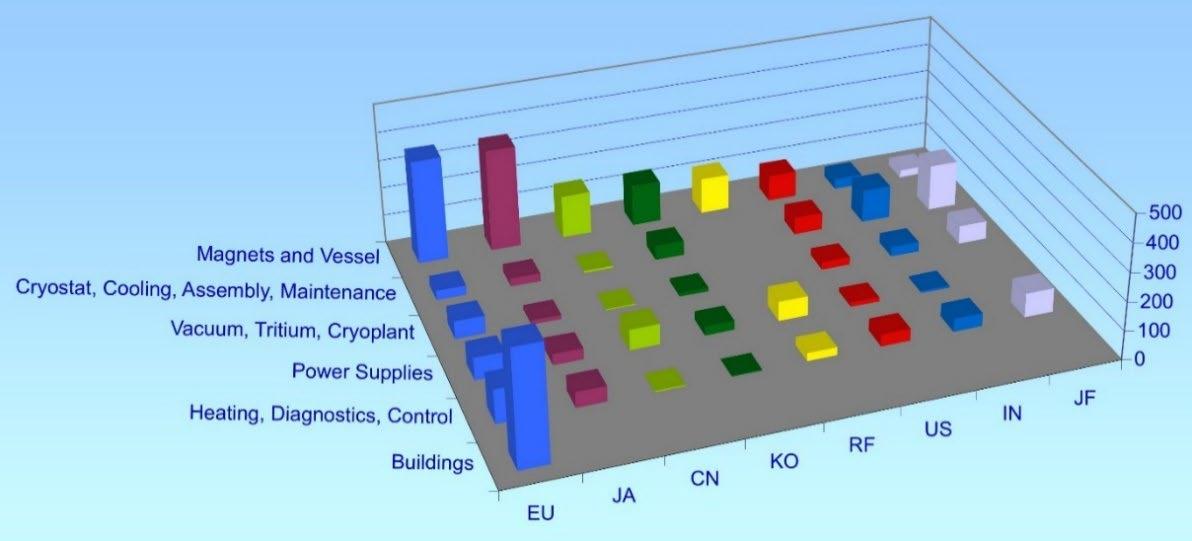
6. 3. Planned Procurement Sharing between Members and Systems in 2006 (in IUA, individual procurement packages were even more divided) [ 6]
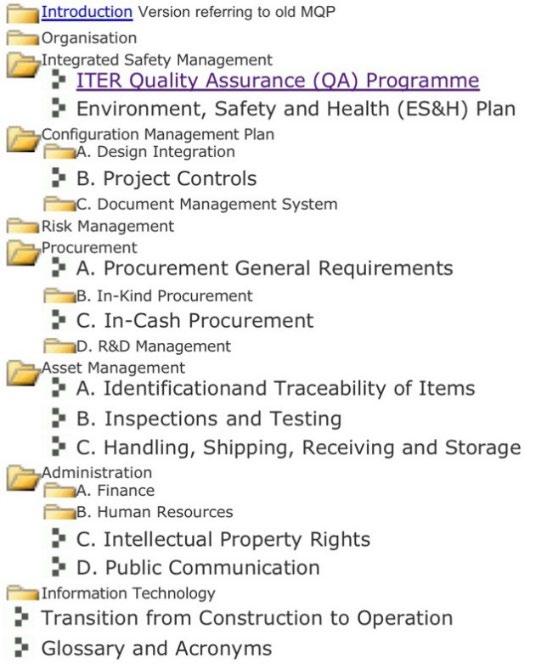
6. 4. Outline of Management and Quality Programme (MQP).
Following site selection, the land on which ITER would be built was purchased by CEA and subsequently transferred to the ITER Organization. The deforestation and the levelling of the site were undertaken by a newly formed agency of CEA, "Agence Iter France (AIF)" in close cooperation with the newly formed European Domestic Agency, Fusion for Energy (F4E). AIF also
PROJECT GENESIS AND EVOLUTION
Vol.1, Ch. 6, p. 50
took care, with the French State Services, to begin establishing an International School in Manosque and to prepare the itinerary for the transport of large components between the harbour of Fos sur Mer and the Cadarache site.
The site preparation involved the clearing of approximately 90 ha, followed by levelling of the building and technical areas - the "platform" - to within 1 m, except for a 40 m x 40 m hole for the tokamak pit. To compensate for the resulting tree removal, a separate forest three times this size was purchased and donated to the locality. 20 km of hydraulic networks were installed to connect ITER to the French network, and construct storm and cooling water test basins, and a heavy-duty road was constructed at the perimeter of the platform for the delivery of components to the Assembly Building, for the final stages of the more than 200 planned convoys of loads exceeding 800 t.
AIF was mandated to act for ITER in the public debate that would take place in France with the population prior to licensing discussions with the nuclear authorities. Such a debate is required in France for all projects with a significant social and environmental impact and the public relations advantages of this arrangement rapidly became apparent with the eventual strong support of the local communities around Cadarache.
However, the first meeting in January 2006, was disrupted when demonstrators (many antinuclear) took over the stage and prevented discussions, arguing that it was too late for the debate as the site had already been chosen. But subsequent meetings over the coming months at various locations in the area were more successful, and the public asked more than 600 questions, ranging from how much ITER would cost France, to what the influence would be on local house prices, and to whether ITER could not better be simulated. In the end, in May, the independent committee managing the public debate concluded that a strong majority of the participants in the debate were in favour of hosting ITER in Provence. The local public acceptance hurdle had been overcome.
For the modifications that were necessary on the roads and bridges for the transport of the large components, the site proponent team had already been working with local and national authorities to find possible solutions. However, to execute the necessary modifications, a public enquiry was organised along the itinerary. (A public enquiry is an administratively different procedure from a public debate and more locally concentrated on the directly impacted population). Around ten meetings took place at the different locations along the itinerary where concerns of the local population were listened to. As for the public debate on the project there was a general acceptance and support, especially since the modifications proposed considered already existing difficulties for local traffic and made improvements. In both the public enquiry on transport and the public debate, the Central Team was represented.
Planning now moved to the evolution of the detailed site arrangements leading up to the creation of the international organisation. This plan envisaged opening a new Joint Work Site in Cadarache from end 2005, and gradually moving staff there by the end of 2006, keeping the existing sites open until proper infrastructure and buildings were provided. There was no point rushing everyone off to France to sit in temporary buildings in a field with no infrastructure, and the staging of staff arrivals and the ability of Cadarache to free up existing buildings, before a permanent building could be built, had to be carefully worked out. The new Joint Work Site in Cadarache was agreed in September 2005, allowing international staff to be recruited and technical work to begin, such as site surveys.
The Cadarache Joint Work Site was formally inaugurated on 15th December 2005 The first dozen or so staff arrived at the Cadarache JWS in January 2006. For the Garching JWS, it was decided to move in three phases: in February, for safety and building staff, being most closely involved with licensing and site preparation, in the summer, when the new (temporary) building would be ready, for those with school-age children, and by the end of 2006, for the rest. There was a lot of planning for moving documents (about 600m of shelf space) - in those days many documents and reports were only available on paper, and it was important to preserve them. In Cadarache itself, office managers were also doing a juggling act to accommodate people and files in existing buildings, as well as planning arrivals compatibly with the availability of new temporary building.
It was also necessary to decide what equipment (mostly computer equipment) to take from Garching, properly transferring the ownership and liability, as well as finding means to bring individual equipment in the CEA work site. Moving equipment within Europe was somewhat a bureaucratic challenge but not a major one. Moving equipment from Naka was more problematic.
Not only was the equipment running on a different voltage than in Europe, but there were formal barriers (dual use) to permanent export of used computer equipment purchased in Japan. In the end it was found to be easier to purchase this equipment and licences again in France and only export the technical data.
At the time it was still envisaged that the IO would have outposts Field Teams located in or near the Domestic Agencies of each participant, to monitor procurements. It soon was decided that the Domestic Agencies would take more responsibility for the procurement, so the monitoring did not need to be done locally on a regular basis and could be covered by business trips from the central team. Thus, the central team needed fewer technical staff, and the Domestic Agencies more. In addition, there were now seven Domestic Agencies, rather than three as originally foreseen. The unclear sharing of responsibilities between the Domestic Agencies and the Central Team led to much confusion in the coming years, with more details described in volume 1, 7.2.
The consolidation of the team at Cadarache was a major upheaval for all concerned. Although Europeans would have limited problems moving their domicile within the EU, for all other participants it was far more challenging. Questions of legal status, medical cover and schooling, adapting to the language, as well as finding practical solutions to accommodation and transport, figured large in the minds of incoming staff to the new site. Although AIF had been established to smooth this path, and did all they could to help people settle in, the magnitude and range of problems that needed to be faced inevitably made for some an uncomfortable start in this new project phase.
The first building to be erected on the site was the Poloidal Field (PF) coil fabrication building, which was not used for some time as the European Domestic Agency had difficulties finding the right contractor to undertake the fabrication of these large coils, which cannot be transported over the road network.
A second building was erected soon after on site, an office building. This temporary accommodation was the first headquarters and part of the team moved into this building; the team grew to about 500 people by the end of 2012.
In 2007, the ITER Organization worked on the cost estimates and the adaptation of the generic design to the specifics of the site in Cadarache. When the cost estimates were presented to the IO management, they felt that these estimates could not be defended in front of the Council and made drastic cuts. Similarly for the schedule, although the new dates indicated a construction finish by around 2019, a finish date of 2016 with the reduced cost estimates was presented to the ITER Council as the proposed baseline. The Council asked a group to review these already reduced cost estimates. The group was split; the majority proposed an additional 5% cut, while a minority proposed an additional 15% cut. The compromise was reached to impose an additional 10% cut, and that was recommended by the Management Advisory Committee (MAC) and adopted by the Council. This decision posed a substantial challenge to the ITER Organization and for the whole project.
The decision was made to hold a design review of the project, including a value engineering review of the buildings. Consequently, the main Tokamak Building was reduced by 1 m on each side (see 7.1, Volume 1) and the Assembly Hall became a steel frame structure, rather than the originally envisaged concrete structure. It was also decided to put the Tokamak Building, the Tritium Building and the Diagnostic Building on a common basemat on anti-seismic bearings.
The Council and the Members became concerned with the lack of progress in the design, procurements, and construction under the then current management team. The Japanese
delegation proposed to change the Director-General and since the first term had not been completed, the other Members agreed to a new Director-General proposed by Japan. Further management changes were implemented, including the departure of PDDG Norbert Holtkamp.
In July 2010, at an extraordinary ITER Council meeting, Director-General Osamu Motojima (who previously led the design and construction of the Large Helical Device, LHD in Japan) was appointed by the Members, with the mandate of implementing the above baseline.
The Director-General also reorganised the senior management team, eliminating the position of a Principal Deputy Director-General and establishing his own executive team.
The relation with the French Regulator, ASN, was established based on the existing legislation mainly designed for fission plants. ITER was classified as an INB (a nuclear installation) because of the amount of tritium expected.
As part of the licensing process, a further public enquiry took place in June-August 2011 that was essential to obtaining the decree to permit the construction of ITER in 2012. Another aspect of public engagement was the establishment of a Commission Locale d’Information (CLI, Local Information Commission). In the technical domain, it was decided to reduce the basemat of the machine to 1.5 m, under strong pressure from the European Domestic Agency, with the aim of reducing the cost of construction, although this later proved not to be the case.
By 2012, several members of the ITER Council were doubting whether Motojima could overcome the challenges of schedule delays and cost increases and started to look for another way forward. The Management Assessment of 2013 was extremely clear in their conclusion in March 2014: “replace the Director-General as soon as possible”. It took, nevertheless, more than a year before a new Director-General could be found.
In March 2015, at another Extraordinary Meeting, the ITER Council appointed the Frenchman Bernard Bigot (Administrator-General of CEA) to the position of ITER Director-General. Bigot reduced the number of Deputy Director-Generals to two.
Since one of the main reasons for the replacement of Motojima had been the slipping of the schedule, a new baseline was established. Once again there was pressure put on the IO to limit
the baseline preparation to a first plasma in 2025 (even though the schedule simulation indicated 2028) with a “phased approach” to the rest of the technical and scientific milestones. After a drawn-out political process, the Baseline 2016 was approved by the ITER Council (significantly with an “interim” approval of the cost part of the Baseline, reflecting concerns by some Members) with the cost still needing to be supported by some Member's budgets reflecting a significant increase). One important successful initiative was the creation of a contingency fund (the "Reserve Fund") at project level that did not exist before, to be used for paying for approved Project Change Requests (PCRs) or other approved extra cost, under the direct control of the DG
The regulatory framework for ITER based on the existing regulations developed for fission plants was not rediscussed by Bigot, but he tried to change the approach in the relationship with ASN to obtain concessions based on the fusion specific aspects
By 2020, it started to become clear that several late deliveries of vital components were delaying the schedule. Nevertheless, Bigot was given a second term as Director-General (a maximum of two terms of 5 years is allowed in the ITER Agreement). With the arrival of COVID-19 and the associated problems with the workforce and the worldwide logistics, further delays were incurred and the team under Bigot started to work on a new baseline. Bigot used the opportunity of his renewal to reorganise the management structure of the IO, eliminating the posts of Deputy Director-Generals (Council appointed) and appointing four Domain Heads.
The first Vacuum Vessel sector (number 6) was completed by the Korean Domestic Agency, although the Head of the Domestic Agency requested more time to execute some necessary repairs to deal with the tight tolerances. Bigot was worried about further delays to the schedule and decided to request the shipping of the sector in any case, with the idea that necessary repairs could take place at the ITER site, even in the Tokamak Pit.
Vacuum Vessel Sector 6 in the meantime had been assembled with its Thermal Shield modules and two TF Coils. On 11 May, Sector 6 was lowered into the pit on the assumption that the necessary repairs would be executed there.
In early March 2022, Bigot was hospitalized and he never returned to the office. On 14 May 2022 he passed away.
The Chair of the ITER Council asked Eisuke Tada to assume the role of Director-General ad interim, while the search for a new Director-General commenced. He was given instructions not to make any drastic changes and went ahead to present the update of the Baseline 2016 to the ITER Council in June 2022. The Council took a very firm decision that this proposed updated baseline was not acceptable. Tada remained in function until the appointment of the new Director-General in October 2022, Pietro Barabaschi. An electro-mechanical engineering by training, P Barabaschi has worked his entire career in fusion engineering and design, starting in JET and then joining the ITER Team. In the year 2000 he was appointed deputy to the ITER project leader and head of
Engineering & integration. From 2006 to his appointment as ITER DG, P Barabaschi was Head of Broader Approach Activities at F4E, the European Domestic Agency and acting director of F4E.
Upon his arrival, Barabaschi, immediately stated that the proposed repairs on VV sector 6 foreseen in the pit were not a viable solution. Furthermore, it was confirmed that the thermal shields to be installed around the machine, including around the vacuum vessel sectors, showed signs of corrosion cracking, potentially leading to leaks and therefore potentially reducing the efficiency of the thermal shields. Barabaschi decided to remove VV sector 6 from the pit to undertake the necessary repairs on sector 6 and on the thermal shields. Similarly, sector 7 and sector 8 (already delivered to the site) were to be repaired as soon as possible.
An investigation on sectors still under construction in their factories was also started. The thermal shields surrounding the vacuum vessel sectors were also either repaired or replaced (with several sections being remanufactured). For the cryostat thermal shields at the bottom of the machine, it was judged to be too late or impossible to replace them, although their cooling lines were replaced, whereas for those cryostat thermal shields at the top of the machine, repairs and replacements were put in place.
Given these technical delays, and in line with the original idea in 2001, Barabaschi revised the schedule and operational phases of the machine, so that the first plasma, although occurring later, would no longer be a token operation prior to subsequent long installation shutdowns, but the start of a fully meaningful scientific test period with a much more capable machine on a faster path to full operation in DT. Furthermore, he pressed to link successive licensing approval to the limits of each operation phase, with a view to facilitating the approval of the eventual DT operation phase licence and curtailed the accumulated pulse length in early operation phases to permit hands-on intervention in, and later around, the machine for as long as possible. Further details are given in Chapter 7 of Volume 1.
Barabaschi also questioned to use of beryllium as a first wall material, arguing that it was not a reactor-relevant material. Barabaschi proposed to the ITER Council to replace the first wall material with tungsten, the same material used for the divertor plasma-facing components. He also invoked starting with a passively cooled and in-situ replaceable first wall, given the short pulse duration in early phases. At the same time, he proposed to increase the external heating power for the machine to assure more reliable access to the H-mode. The ITER Council asked the IO and DAs to develop a new baseline based on these proposals. The development of the new baseline, done in close collaboration between the IO and DAs, showed an increased cooperation between the IO and DAs, which would continue in the following years. The schedule developed was based on realistic data and was supported by the IO and DAs and did not suffer from the political pressure that previous schedules were submitted to.
The IO and DAs proposed a new baseline in June 2024 with a new schedule, an increased budget and the introduction of real contingency (discussed in more detail in Chapters 7 and 8). This would lead to a meaningful scientific operation phase beginning in 2035 and full DT operation by 2039, four years later than envisaged in 2016. The IO and DAs were instructed by Council to execute work in accordance with the new schedule even before the approval of the new baseline (Members needing to assure funding in their own systems).
The senior management team put in place by Barabaschi also reviewed and renegotiated the large machine assembly contracts that were put in place by Bigot, to take account of the forced changes in the assembly process. Barabaschi reorganised the IO and removed the Domain Heads by reinstating the role of Deputy Director-Generals in line with earlier established practice and to the satisfaction of the Members. He also introduced the concept of a matrixed organisation.
Integration of activities between the IO and DAs is not limited to the schedule software, as reported above, but is also achieved in other tools, such as the document management system (IDM) as well as other similar tools within ICP (ITER Collaborative Platform) and the quality control programmes. The IO has also opened its project progress reporting systems to the DAs and to representatives of the Members.
As of October 2025, the changes instituted by Barabaschi have put the project on a successful path to first plasma operation in 2035. Repairs to faulty components are well on the way to completion, and the overall machine assembly process is once again underway. New tungstencoated components for divertor and first wall are in the process of manufacture, and extensive modelling has demonstrated the potential of the machine operation to reach its goals with this change in material. The additional cold testing of coils now envisaged is approaching its first test.
The safety authority has accepted the approach of the project of staged operational approval. The detailed operation phase stages and their expected attainments have been worked out, and the necessary integrated commissioning scheme for each phase has been defined. The Members continue to support the revised schedule and its financial implications in a staged approach Furthermore, the work of the IO and the Domestic Agencies is now following a more integrated approach to ensuring project completion with the necessary quality level.
AIF Agence ITER France
ASN Autorité de sûreté nucléaire
BCX Burning Core Experiment
BPP Basic Performance Phase
CAD Computer-Aided Design
CDA Conceptual Design Activities
CEA Commissariat à l'énergie atomique et aux énergies alternatives
CERN Conseil Européen pour le Recherche Nucléaire
CS Central Solenoid
CTA Coordinated Technical Activities, Comprehensive Task Agreement
CLI Commission Locale d'Information
DA Domestic Agency
DBD Design Basis Document
DDD Detailed Design Document
DDR Detailed Design Report
DG Director General
DI/DO Design Integration/Drawing Office
DIU Design Integration Unit
DOE Department of Energy
DRG Design Requirements and Guidelines
DWO Design Work Order
EDA Engineering Design Activities
EPP Enhanced Performance Phase
EVEDA Engineering Validation and Engineering Design Activities
F4E Fusion for Energy
FDR Final Design Report
FEAT Fusion Energy Advanced Tokamak
FED Fusion Engineering Device
FER Fusion Experimental Reactor
FESAC Fusion Energy Sciences Advisory Committee
FW First Wall
GDRD General Design Requirements Document
GPB General Project Board
GSEDC General Safety and Environment Design Criteria
HAM High Aspect ratio Machine
HT Home Team
IAEA International Atomic Energy Agency
IAM Intermediate Aspect ratio Machine
IC ITER Council
IDR Interim Design Report
IDM ITER Document Management
IDoMS ITER Document Management System
IFERC International Fusion Energy Research Centre
IFMIF International Fusion Materials Irradiation Facility
ILE ITER Legal Entity
INTOR International Tokamak Reactor
IO ITER Organisation
IPDD ITER Plant Description Document
IPMS ITER Process Management System
IPS ITER Parameter Set
IPT International Project Team
ITPA International Tokamak Physics Activity
ITA ITER Transitional Arrangements
JAERI Japan Atomic Energy Research Institute
JASS Joint Assessment of Specific Sites
JET Joint European Torus
JCT Joint Central Team
JT-60 Japan Tokamak 60
JWS Joint Work Site
LAM Low Aspect ratio Machine
LCT Large Coil Test facility
LHD Large Helical Device
MAC Management Advisory Committee
NET Next European Torus
NSSG Negotiators Standing Subcommittee
NSSR Non-Site-Specific Safety Report
ODR Outline Design Report
OTR Experimental Fusion Reactor
PAD Plant Assessment Documents
PDD Plant Description Document
PDDG Principal Deputy Director General
PDS Plant Design Description
PDM/PLM Project Data Management/Product Lifecycle Management
PID Project Integration Document
PPPL Princeton Plasma Physics Laboratory
PSIR Plant Systems Integration Report
RAM Responsibility Assignment Matrix
RO Responsible Officer
RTO/RC Reduced Technical Objectives/Reduced Cost
SNS Spallation Neutron Source
SWG Special Working Group
STA Science and Technology Agency
TA Task Agreement
TAC Technical Advisory Committee
TBWG Test Blanket Working Group
TCM Technical Coordination Meetings
TF Toroidal Field
TFCX Tokamak Fusion Core Experiment
TFTR Tokamak Fusion Test Reactor
TIBER Tokamak Ignition/Burn Experimental Reactor TO Technical Officer
WBS Work Breakdown Structure
[1] K. Borraß and W. Spears, A Systems Analysis Study of INTOR-Like Designs, Max-Planck-Institut für Plasmaphysik, Internal Report, Dec. 1987.
[2] International Atomic Energy Agency, Design Point Selection for an Ignited ITER, ITER Documentation Series, no. 5, Vienna, Austria: IAEA, 1989.
[3] International Atomic Energy Agency, ITER EDA Documentation Series No. 22 [Online]. Available: https://www-pub.iaea.org/MTCD/Publications/PDF/ITER-EDA-DS-22.pdf.
[4] International Atomic Energy Agency, ITER EDA Documentation Series No. 22 [Online]. Available: https://www-pub.iaea.org/MTCD/Publications/PDF/ITER-EDA-DS-22.pdf.
[5] P. H. Rebut and P. P. Lallia, “JET results and the prospects for fusion,” Fusion Engineering and Design, vol. 11, no. 1–2, pp. 1–21, Jun. 1989, doi: 10.1016/0920-3796(89)90003-3. [Online].
Available: https://linkinghub.elsevier.com/retrieve/pii/0920379689900033.
[6]STAC Meeting, Cadarache, 5–6 Sept. 2008. [Online]. Available: https://www.iter.org/sites/default/files/education/L07_Matsuda.pdf.